Disclosure of Invention
In order to make up for the above deficiency, the application provides a splitting machine external force eliminating device, aims at improving the problem that the existing splitting machine adopts fixing device directly fixed on a loading machine tool and cannot swing to eliminate the reaction force of the rock in the splitting force, and effectively reduces the probability of deformation of the central wedge block of the splitting machine and the splitting block close to the rock a in the splitting process.
The embodiment of the application provides a splitting machine external force eliminating device which comprises a loading machine, a splitting machine body and a connecting assembly.
The linking assembly comprises a fixing piece and an external force eliminating piece, the fixing piece is arranged at the movable end of the loading machine and the top end of the loading machine and connected with the splitter body in a rotating mode, the external force eliminating piece comprises a supporting frame, an arc plate A, an arc plate B and a plurality of telescopic clamping portions, the supporting frame is arranged at the bottom end of the fixing piece and the outer end of the fixing piece and the arc plate A are fixed, the outer end of the arc plate A and the arc plate B are fixedly butted and the two of the arc plate B and the arc plate B jointly enclose the outer ring of the splitter body, the plurality of the fixed ends of the telescopic clamping portions are fixed on the outer wall of the arc plate A and the outer wall of the arc plate B respectively in an equidistant mode, and the piston ends of the fixing piece penetrate through the directly connected structure and move jointly and abut against the outer wall of the splitter body.
In a specific implementation scheme, two sides of the opening of the arc plate A and the opening of the arc plate B are respectively provided with a convex block, and the convex blocks corresponding to the two are fixed through bolts and nuts.
In a specific embodiment, the fixing member includes a fixing plate and a rotating portion connected to the top end of the fixing plate, the fixing plate is fixed to the outer wall of the supporting frame, and the rotating portion is fixed to the top end of the splitter body.
In a specific embodiment, the rotation portion includes two connection otic placodes A, links up arm and two connection otic placodes B, two connect otic placode A parallel design and its two bottom all the fixed plate is fixed, two connect otic placode B also parallel design and its two bottom all with the splitter body top is fixed, two connect otic placode A and two the direction that connection otic placode B is parallel is mutually perpendicular, just link up the arm both ends respectively with two connect otic placode A and two it rotates to connect otic placode B and connects.
In the implementation process, the upper side and the lower side of the linking arm can be selectively connected with the rotating shaft, the bearing can be embedded in the eyelets of the connecting lug plate A and the connecting lug plate B, the rotating shaft and the corresponding bearing can be connected in an interference fit manner or in a key connection manner, so that the linking arm can move around the two connecting lug plates A or the connecting lug plates B, and the splitting machine body can indirectly swing along with the linking arm.
In a specific embodiment, the splitting machine body includes hydro-cylinder, center wedge and two splitting blocks, the hydro-cylinder top is fixed in two connect otic placode B, two splitting blocks are located the both sides of hydro-cylinder stiff end bottom, center wedge top with the jar pole outer end of hydro-cylinder is fixed, and with two the squeezing of splitting block touches.
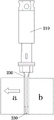
In the implementation process, the loading machine enables the center wedge block and the two splitting blocks to be inserted into the drill hole by moving the splitting machine body, the cylinder rod of the oil cylinder is pushed downwards, and then the center wedge block is pushed downwards, so that the splitting blocks close to the rock a are pushed outwards, and splitting force is generated to split the rock.
In a particular embodiment, the central wedge and the two splitting blocks together form a wedge-shaped structure.
In a specific embodiment, the loader comprises a vehicle body and a mechanical arm, wherein the vehicle body moves on a road surface, the mechanical arm is rotatably connected to the vehicle body and connected with the fixing part, and the mechanical arm is specifically divided into an adjusting part A, an adjusting part B and an adjusting part C.
In a specific embodiment, the adjusting part a comprises a support arm a and a hydraulic cylinder a, the bottom end of the support arm a is rotatably connected to the top end of the vehicle body, and two ends of the hydraulic cylinder a are rotatably connected with the support arm a and the vehicle body respectively.
In a specific implementation scheme, the adjusting part B comprises a support arm B and a hydraulic cylinder B, one side of the support arm B is rotatably connected with the outer end of the support arm A, and two ends of the hydraulic cylinder B are respectively rotatably connected with the outer wall of the support arm A and one end of the support arm B.
In a specific implementation scheme, the adjusting part C comprises a joining block and a hydraulic cylinder C, the joining block is rotatably connected with the outer end of the support arm B, two ends of the hydraulic cylinder C are rotatably connected with the support arm B and the joining block respectively, and a sliding rotating mechanism is arranged between the joining block and the fixing plate.
Compared with the prior art, the method has the advantages that:
when the splitting machine body does not split rocks, the cylinder rods of the plurality of telescopic clamping parts are in an extending state and can press the splitting machine body through the control of a hydraulic system in the prior art, so that the splitting machine body is fixedly connected with the external force eliminating piece, and the wedge-shaped structure of the splitting machine body shown in the figure 5 can be conveniently inserted into a drill hole by moving the loading machine shown in the figure 6; when the splitting machine body splits the rock, the plurality of telescopic clamping parts are in a pressure relief state under the control of the hydraulic system, so that the corresponding cylinder rods cannot compress the splitting machine body, the splitting machine body can freely swing along with the cracking of the rock when splitting the rock, and the reverse acting force of the rock is absorbed when splitting the rock.
To sum up: the device can enable the splitting machine body to be in a free swinging state when splitting the rock, so that the reverse acting force of the rock is eliminated, the center wedge block and the splitting block of the splitting machine body are prevented from being damaged, the durability and the working reliability of the center wedge block and the splitting block are obviously improved, the time consumed by damage and replacement of the center wedge block and the splitting block is reduced, the working efficiency of rock splitting is improved, and meanwhile, the production cost caused by replacement of the center wedge block and the splitting block is greatly reduced.
Detailed Description
To make the objects, technical solutions and advantages of the embodiments of the present application clearer, the technical solutions of the embodiments of the present application will be clearly and completely described below with reference to the drawings in the embodiments of the present application, and it is obvious that the described embodiments are some embodiments of the present application, but not all embodiments. All other embodiments obtained by a person of ordinary skill in the art without any inventive work based on the embodiments in the present application are within the scope of protection of the present application.
Referring to fig. 1, the present application provides a splitter external force eliminating device, which includes a loader 10, a splitter body 20 and a linking assembly 30.
The splitting machine body 20 is fixed on the loading machine 10 through the joining assembly 30, the fixing member 310 in the joining assembly 30 can movably fix the loading machine 10, and the external force eliminating member 320 in the joining assembly 30 can effectively reduce the probability of deformation of the central wedge and the splitting block of the splitting machine in the splitting process.
Referring to fig. 1 and 6, the loader 10 includes a vehicle body 110 and a mechanical arm 120, the vehicle body 110 moves on a road surface, the mechanical arm 120 is rotatably connected to the vehicle body 110 and connected to a fixing member 310, and the mechanical arm 120 is specifically divided into an adjusting portion a121, an adjusting portion B122 and an adjusting portion C123. The body 110 is moved to drive the splitter body 20 to move to a proper position for splitting the rock, and the mechanical arm 120 is designed to enable the splitter body 20 to split the rock to be controlled more accurately.
In this embodiment, the adjusting portion A121 includes an arm A1211 and a cylinder A1212, wherein the bottom end of the arm A1211 is rotatably connected to the top end of the vehicle body 110, and the two ends of the cylinder A1212 are rotatably connected to the arm A1211 and the vehicle body 110, respectively. The hydraulic cylinder A1212 is designed to allow the arm A1211 to angularly deflect around the top end of the car body 110, thereby changing the position of the splitter body 20.
In this embodiment, the adjusting portion B122 includes an arm B1221 and a cylinder B1222, the arm B1221 is rotatably connected to the outer end of the arm a1211 at one side, and the cylinder B1222 is rotatably connected to the outer wall of the arm a1211 and one end of the arm B1221 at the other side. The design of the hydraulic cylinder B1222 facilitates the angular deflection of the arm B1221 around the arm A1211, thereby changing the position of the splitter body 20.
In this embodiment, the adjusting portion C123 includes an engaging block 1231 and a hydraulic cylinder C1232, the engaging block 1231 is rotatably connected to the outer end of the supporting arm B1221, two ends of the hydraulic cylinder C1232 are rotatably connected to the supporting arm B1221 and the engaging block 1231, respectively, and a sliding and rotating mechanism is disposed between the engaging block 1231 and the fixing plate 311. The design of the hydraulic cylinder C1232 is used to make the engaging block 1231 angularly deflect around the arm B1221, thereby changing the position of the splitter body 20. In conclusion, the position of the splitter body 20 for splitting the rock is controlled more accurately by the adjusting parts a121 and B122 and the adjusting part C123.
In addition, the sliding and rotating mechanism comprises an L-shaped plate c shown in fig. 6, a sliding portion d, a rotating portion e and a drilling machine f, the rotating portion e is connected to the outer end of the connecting block 1231, the rotating portion comprises a frame body, a servo motor B and a rotating shaft connected with an output end, the frame body is connected to the outer end of the connecting block 1231, the servo motor B is installed in the middle cavity of the frame body, the rotating shaft is connected with the L-shaped plate c, the fixing plate 311 is also connected to the L-shaped plate c, the sliding portion d is further connected to the L-shaped plate c, the sliding portion d comprises a servo motor a and a ball screw pair connected with the output end of the servo motor a, the servo motor a is installed on the L-shaped plate c, the ball screw pair is rotatably connected with a screw nut pair, the screw nut pair is slidably connected with the L-shaped plate c, and is connected with the drilling machine f. During operation, the rotating part e can drive the L-shaped plate c to rotate, and the working steps of the rotating part e are that firstly, a drilling machine f is used for drilling holes on the rock, then the rotating part e drives the L-shaped plate c to rotate, the splitting blocks 220 are aligned to the center of the hole, then the oil cylinder 210 is pushed in and inserted into the hole, and the rock is split.
The drilling rig f is prior art and will not be described in detail here.
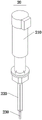
Referring to fig. 1, 4 and 5, the splitter body 20 includes an oil cylinder 210, a central wedge 230 and two splitting blocks 220, the top end of the oil cylinder 210 is fixed to two connecting lug plates B3123, the two splitting blocks 220 are disposed at two sides of the bottom of the fixed end of the oil cylinder 210, and the top end of the central wedge 230 is fixed to the outer end of the rod of the oil cylinder 210 and is in compressive contact with the two splitting blocks 220. The loader 10 inserts the center wedge 230 and the two splitting blocks 220 into the drilled hole by moving the splitter body 20, and pushes the center wedge 230 to move downwards by pushing the cylinder rod of the oil cylinder 210, so that the splitting blocks 220 close to the rock a are pushed outwards to generate splitting force to split the rock.
The central wedge 230 and the two splitting blocks 220 together form a wedge structure. Wherein the two splitting blocks 220 and the center wedge 230 form a wedge structure that facilitates insertion into a borehole for splitting rock.
Referring to fig. 1-3 and 6, the linking assembly 30 includes a fixing member 310 and an external force eliminating member 320, the fixing member 310 is disposed at the movable end of the loader 10, and the top end of the fixing member is rotatably connected to the splitter body 20, the external force eliminating member 320 includes a supporting frame 321, an arc plate a322, an arc plate B323, and a plurality of telescopic clamping portions 324, the supporting frame 321 is disposed at the bottom end of the fixing member 310, and the outer end of the supporting frame 321 is fixed to the arc plate a322, the outer end of the arc plate a322 is fixedly connected to the arc plate B323 in a butt joint manner, and the two are enclosed around the splitter body 20, the fixed ends of the plurality of telescopic clamping portions 324 are respectively fixed to the outer walls of the arc plate a322 and the arc plate B323 at equal intervals, and the piston ends of the plurality of telescopic clamping portions penetrate through the structure directly connected thereto and movably abut against the outer wall of the splitter body 20. Wherein, the plurality of telescopic clamping parts 324 can be selected to be one of small oil cylinders or small hydraulic cylinders.
In this embodiment, the two sides of the opening of the arc plate a322 and the arc plate B323 are both provided with a bump 325, and the corresponding bumps 325 on the two are fixed by bolts and nuts. Wherein, it is convenient for fix arc A322 and arc B323 with bolt cooperation nut for external force elimination piece 320 can enclose the splitting machine body 20 periphery and support its activity tightly, so be convenient for utilize external force elimination piece 320 to reduce the counter force that brings when splitting the rock of splitting machine body 20.
In this embodiment, the fixing member 310 includes a fixing plate 311 and a rotating part 312 connected to the top end of the fixing plate 311, the fixing plate 311 is fixed to the outer wall of the supporting frame 321, and the rotating part 312 is fixed to the top end of the splitter body 20. The design of the rotating part 312 enables the splitting machine body 20 to be rotatably connected with the fixing plate 311, so that the external force eliminating piece 320 can swing along with the rotating part 312 in an angle mode under the non-abutting state, and therefore the reverse acting force caused by splitting the rock is reduced.
In this embodiment, the rotating portion 312 includes two connecting ear plates a3121, a connecting arm 3122 and two connecting ear plates B3123, the two connecting ear plates a3121 are designed in parallel and both bottom ends thereof are fixed by the fixing plate 311, the two connecting ear plates B3123 are also designed in parallel and both bottom ends thereof are fixed to the top end of the splitter body 20, the directions in which the two connecting ear plates a3121 and the two connecting ear plates B3123 are parallel are perpendicular to each other, and both ends of the connecting arm 3122 are respectively connected to the two connecting ear plates a3121 and the two connecting ear plates B3123 in a rotating manner. Wherein, both sides are optional about the link arm 3122 and connect the pivot, and can inlay the dress bearing in the perforation of connection otic placode A3121 and connection otic placode B3123, but pivot and the bearing interference fit that corresponds connect or the key-type connection, so make link arm 3122 can move around two connection otic placodes A3121 or connection otic placode B3123, the indirect splitter body 20 of being convenient for swings along with link arm 3122.
When in use:
the external force eliminating part 320 is fixed at the bottom of the fixing plate 311 and is located at the periphery of the splitter body 20, a gap exists between a ring formed by the arc-shaped plate a322 and the arc-shaped plate B323 in the external force eliminating part 320 and the periphery of the splitter body 20, when the splitter body 20 does not split rocks, the cylinder rods of the plurality of telescopic clamping parts 324 are in an extended state and can press the splitter body 20 tightly under the control of a hydraulic system in the prior art, so that the splitter body 20 is fixedly connected with the external force eliminating part 320, and the wedge-shaped structure of the splitter body 20 shown in fig. 5 can be conveniently inserted into a drill hole by moving the loading tool 10 shown in fig. 6; when the splitter body 20 splits rocks, the plurality of telescopic clamping parts 324 are in a pressure relief state under the control of the hydraulic system, so that the corresponding cylinder rods cannot press the splitter body 20, and thus when the splitter body 20 splits rocks, the whole splitter body 20 can freely swing along with the cracking of the rocks, the reverse acting force of the rocks when the rocks are split is absorbed, the center wedges 230 and the splitting blocks 220 are prevented from being damaged by bending, cracking and the like, and the durability and reliability of the splitter body are greatly improved.
The above mentioned hydraulic system is prior art, and is not described herein again.
It should be further noted that the specific model specifications of the hydraulic cylinder a1212, the hydraulic cylinder B1222, the hydraulic cylinder C1232, the oil cylinder 210, the center wedge 230, the splitting block 220, and the telescopic clamping portion 324 need to be determined by model selection according to the actual specification of the device, and the specific model selection calculation method adopts the prior art in the field, and therefore, detailed description is omitted.
The power supply and the principle of the sliding part d, the rotating part e, the hydraulic cylinder a1212, the hydraulic cylinder B1222, the hydraulic cylinder C1232, the cylinder 210 and the telescopic clamp 324 will be clear to those skilled in the art and will not be described in detail herein.
The above description is only for the specific embodiments of the present application, but the scope of the present application is not limited thereto, and any person skilled in the art can easily conceive of the changes or substitutions within the technical scope of the present application, and shall be covered by the scope of the present application. Therefore, the protection scope of the present application shall be subject to the protection scope of the claims.