Disclosure of Invention
In order to solve the existing technical problem, embodiments of the present invention provide an automatic neighbor discovery method, apparatus, communication device, and storage medium.
In order to achieve the above purpose, the technical solution of the embodiment of the present invention is implemented as follows:
in a first aspect, an embodiment of the present invention provides an automatic neighbor discovery method, where the method includes:
a terminal device sends first information to a first network device, where the first information includes a non-public network identifier of a first cell, and the first information further includes whether the first cell supports online Subscription and a supported group identifier or a Subscription Owner-independent networking non-public network (SO-SNPN, subscription Owner-Stand-alone NPN) list, and/or whether the first cell supports access using a third party entity and a supported group identifier;
and/or the terminal device sends second information to the first network device, where the second information includes a non-public network identifier of the first cell, and the second information is further used to indicate that the terminal device does not support an online subscription function and/or a third-party entity access function, or the second information is further used to indicate that the terminal device does not want to initiate an online subscription and/or a third-party entity access service, or is not interested in the online subscription and/or the third-party entity access service.
In the foregoing solution, the method further includes: and the terminal equipment receives a first request message of the first network equipment, wherein the first request message is used for requesting the terminal equipment to send the first information and/or the second information.
In the above scheme, the sending, by the terminal device, the first information to the first network device includes:
and the terminal equipment sends first information to the first network equipment when performing or initiating online subscription and/or accessing a non-public network by using a certificate of a third party entity.
In the above scheme, the method further comprises: the terminal equipment and the first network equipment carry out wireless resource control connection establishment, the terminal equipment sends first indication information to the first network equipment, and the first indication information is used for indicating that the purpose of the wireless resource control connection establishment is online subscription and/or a certificate of a third party entity is used for accessing a non-public network.
In the above scheme, the method further comprises: the terminal device obtains the first information from the first cell.
In the above solution, the obtaining, by the terminal device, the first information from the first cell includes:
the terminal equipment receives a broadcast message of the first cell, wherein the broadcast message comprises the first information;
or, the terminal device requests the first information to the first cell, and the terminal device receives the first information sent by the first cell.
In a second aspect, an embodiment of the present invention further provides an automatic neighbor discovery method, where the method includes:
a first network device receives first information sent by a terminal device, wherein the first information comprises a non-public network identifier of a first cell, and the first information also comprises whether the first cell supports online subscription and a supported group identifier or an SO-SNPN list, and/or whether the first cell supports access by using a third party entity and a supported group identifier;
and/or the first network device receives second information sent by the terminal device, where the second information includes a non-public network identifier of the first cell, and the second information is further used to indicate that the terminal device does not support online subscription and/or third-party entity access, or the second information is further used to indicate that the terminal device does not want to initiate an online subscription function and/or third-party entity access service, or is not interested in the online subscription and/or third-party entity access service;
the first network equipment updates the neighbor cell list based on the first information and/or the second information.
In the foregoing solution, the method further includes: the first network device sends a first request message to the terminal device, wherein the first request message is used for requesting the terminal device to send the first information and/or the second information.
In the above scheme, the method further comprises: the first network device obtains the capability information of the terminal device, and determines whether to send the first request message to the terminal device based on the capability information, or determines whether the first request message is used for requesting whether the first cell supports online subscription and supported group identifiers or SO-SNPN lists, and/or whether the first cell supports access by using a third-party entity and supported group identifiers.
In the foregoing solution, the method further includes: the first network equipment receives first indication information sent by the terminal equipment, wherein the first indication information is used for indicating that the purpose of establishing the radio resource control connection is online subscription and/or accessing a non-public network by using a certificate of a third party entity; the first indication information is further used for determining whether the first request message is used for requesting the terminal device to send the first information and/or the second information.
In the foregoing solution, the method further includes: the first network equipment receives a first notification message of second network equipment and sends a first request message to the terminal equipment based on the first notification message; the first notification message is used for notifying the first network equipment that the terminal equipment is updating the certificate for online subscription and/or updating the certificate for third-party entity access; the first notification message is further used for the first network device to determine whether the first request message is used for requesting the terminal device to send the first information and/or the second information.
In a third aspect, an embodiment of the present invention further provides an automatic neighbor discovery method, where the method includes:
the method comprises the steps that a second network device sends a first notification message to a first network device, wherein the first notification message is used for notifying the first network device that a terminal device is updating a certificate for online subscription and/or updating a certificate for third party entity access, and the first notification message is also used for determining whether a first request message sent to the terminal device is used for requesting the terminal device to send first information and/or second information;
the first information comprises a non-public network identifier of a first cell, and the first information further comprises whether the first cell supports online subscription and a supported group identifier or an SO-SNPN list, and/or whether the first cell supports access by using a third party entity and a supported group identifier; the second information includes a non-public network identifier of the first cell, and the second information is further used for indicating that the terminal device does not support online subscription and/or third-party entity access, or indicating that the terminal device does not want to initiate an online subscription function and/or third-party entity access service, or is not interested in the online subscription and/or third-party entity access service.
In a fourth aspect, an embodiment of the present invention further provides an automatic neighbor cell discovery apparatus, where the apparatus includes a first sending unit, configured to send first information to a first network device, where the first information includes a non-public network identifier of a first cell, and the first information further includes whether the first cell supports online subscription and a supported group identifier or SO-SNPN list, and/or whether the first cell supports access using a third party entity and a supported group identifier; and/or sending second information to the first network device, where the second information includes a non-public network identifier of the first cell, and the second information is further used to indicate that the terminal device does not support an online subscription function and/or does not support a third-party entity access function, or the second information is further used to indicate that the terminal device does not want to initiate an online subscription function and/or a third-party entity access service, or is not interested in the online subscription function and/or the third-party entity access service.
In a fifth aspect, an embodiment of the present invention further provides an automatic neighbor discovery apparatus, where the apparatus includes a second receiving unit and a second processing unit; wherein,
the second receiving unit is configured to receive first information sent by a terminal device, where the first information includes a non-public network identifier of a first cell, and the first information further includes whether the first cell supports online subscription and a supported group identifier or SO-SNPN list, and/or whether the first cell supports access using a third party entity and a supported group identifier; and/or receiving second information sent by a terminal device, wherein the second information includes a non-public network identifier of a first cell, and the second information is further used for indicating that the terminal device does not support online subscription and/or third-party entity access, or indicating that the terminal device does not want to initiate an online subscription function and/or third-party entity access service, or is not interested in the online subscription and/or third-party entity access service;
the second processing unit is configured to update a neighbor cell list based on the first information and/or the second information.
In a sixth aspect, an embodiment of the present invention further provides an automatic neighbor discovery apparatus, where the apparatus includes a third sending unit, configured to send a first notification message to a first network device, where the first notification message is used to notify the first network device that a terminal device is updating a certificate for online subscription and/or updating a certificate for access by a third party entity, and the first notification message is further used for the first network device to determine whether a first request message sent to the terminal device is used to request the terminal device to send first information and/or second information;
the first information comprises a non-public network identifier of a first cell, and the first information further comprises whether the first cell supports online subscription and a supported group identifier or an SO-SNPN list, and/or whether the first cell supports access by using a third party entity and a supported group identifier; the second information includes a non-public network identifier of the first cell, and the second information is further used for indicating that the terminal device does not support online subscription and/or third-party entity access, or indicating that the terminal device does not want to initiate an online subscription function and/or third-party entity access service, or is not interested in the online subscription and/or third-party entity access service.
In a seventh aspect, an embodiment of the present invention further provides a computer-readable storage medium, on which a computer program is stored, where the computer program, when executed by a processor, implements the steps of the method in the first aspect, the second aspect, or the third aspect of the embodiment of the present invention.
In an eighth aspect, an embodiment of the present invention further provides a communication device, which includes a memory, a processor, and a computer program stored in the memory and executable on the processor, where the processor executes the computer program to implement the steps of the method in the first aspect, the second aspect, or the third aspect of the embodiment of the present invention.
In the method, apparatus, communication device, and storage medium for automatic neighbor discovery provided in the embodiments of the present invention, a terminal device sends first information to a first network device, where the first information includes a non-public network (NPN) identifier of a first cell, and the first information further includes a group identifier or SO-SNPN list whether the first cell supports online subscription and support, and/or whether the first cell supports using a third-party entity for access and a supported group identifier; and/or the terminal device sends second information to the first network device, the second information includes a non-public network identifier of the first cell, the second information is further used for indicating that the terminal device does not support an online subscription function and/or a third-party entity access function, or the second information is further used for indicating that the terminal device does not want to initiate an online subscription and/or a third-party entity access service, or is uninteresting in the online subscription and/or the third-party entity access service; the first network equipment updates the neighbor cell list based on the first information and/or the second information. According to the technical scheme of the embodiment of the invention, when the initial automatic adjacent cell is established, the terminal equipment reports the first information and/or the second information of the first cell; after the first network device obtains the information of the neighboring cells, if the terminal which is performing the online subscription and/or the third party entity access service is switched, the first network device can know whether the target cell supports the online subscription and/or the third party entity access before the switching occurs, and the terminal device is prevented from being switched to the cell which does not support the two services. In addition, the information is reported by the terminal, and the information does not need to be interacted with the Xn interface of the adjacent cell to obtain the information, so that the time delay can be reduced, and the related signaling overhead on the Xn interface is saved.
Detailed Description
The present invention will be described in further detail with reference to the accompanying drawings and specific embodiments.
The technical scheme of the embodiment of the invention can be applied to various communication systems, such as: a Global System for Mobile communications (GSM) System, a Long Term Evolution (LTE) System, or a 5G System. Alternatively, the 5G system or the 5G network may also be referred to as a New Radio (NR) system or an NR network.
For example, a communication system applied in the embodiment of the present invention may include a network device and a terminal device (also referred to as a terminal, a communication terminal, etc.); the network device may be a device that communicates with the terminal device. The network device may provide communication coverage for a certain area, and may communicate with terminals located in the area. Alternatively, the network device may be a base station in each communication system, such as an evolved Node B (eNB) in an LTE system, and a base station (gNB) in a 5G system or an NR system.
It should be understood that, in the embodiments of the present application, a device having a communication function in a network/system may be referred to as a communication device. The communication device may include a network device and a terminal having a communication function, and the network device and the terminal device may be the above-mentioned specific devices, which are not described herein again; the communication device may further include other devices in the communication system, such as other network entities like a network controller, a mobility management entity, and the like, which is not limited in the embodiment of the present invention.
It should be understood that the terms "system" and "network" are often used interchangeably herein. The term "and/or" herein is merely an association relationship describing an associated object, and means that there may be three relationships, for example, a and/or B, which may mean: a exists alone, A and B exist simultaneously, and B exists alone. In addition, the character "/" herein generally indicates that the former and latter related objects are in an "or" relationship.
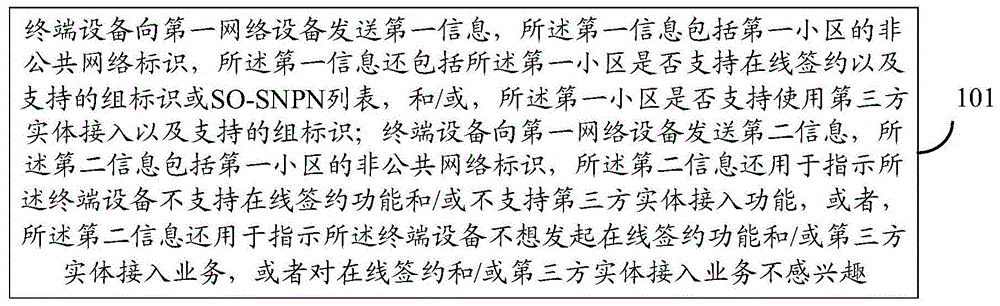
The embodiment of the invention provides an automatic neighbor cell discovery method. Fig. 1 is a first flowchart illustrating an automatic neighbor discovery method according to an embodiment of the present invention; as shown in fig. 1, the method includes:
step 101: the method comprises the steps that a terminal device sends first information to a first network device, wherein the first information comprises a non-public network identifier of a first cell, and the first information also comprises whether the first cell supports online subscription and a supported group identifier or an SO-SNPN list, and/or whether the first cell supports access by using a third-party entity and a supported group identifier;
and/or the terminal device sends second information to the first network device, where the second information includes a non-public network identifier of the first cell, and the second information is further used to indicate that the terminal device does not support an online subscription function and/or a third-party entity access function, or the second information is further used to indicate that the terminal device does not want to initiate an online subscription and/or a third-party entity access service, or is not interested in the online subscription and/or the third-party entity access service.
In a conventional technical solution, in an ANR process, a terminal device measures a signal of a cell and reports a measurement result to a first network device; the reported measurement result may include a Physical Cell Identifier (PCI) of the Cell. If the first Network device finds that the Cell is the first Cell, the first Network device may instruct the terminal device to read an NR Cell Global Identifier (NCGI), a Tracking Area Identifier (TAC), a radio access Network Area Identifier (RANAC), a Public Land Mobile Network (PLMN ID), and an NR frequency point of the first Cell, and report the NR frequency point to the first Network device.
After the 5G network introduces an NPN or PRN, the terminal device may report an NPN identifier (denoted as an NPN ID) of the cell in addition to the above information. But with the subsequent corresponding enhancement to the NPN, the cell may also broadcast whether each supports online subscription (onboarding), and supported Group identification (Group ID) or SO-SNPN list (SO-SNPN list), and/or whether it supports access using a third party entity and supported Group identification (Group ID).
In the embodiment of the invention, when the initial automatic adjacent cell is established, the terminal equipment reports the first information and/or the second information of the first cell. As an embodiment, the terminal device may report, to the network device, whether the first cell supports online subscription and a supported group identifier or SO-SNPN list, and/or the terminal device may report, to the network device, whether the first cell supports access using a third-party entity and a supported group identifier. As another embodiment, the terminal may also select to report the first information or the second information according to its own condition. After the first network device obtains the information of the neighboring cells, if the terminal which is performing online subscription and/or third-party entity access service is switched, the first network device can know whether the target cell supports online subscription and/or third-party entity access before the terminal is switched, and the terminal device is prevented from being switched to the cell which does not support the online subscription and/or third-party entity access. In addition, the information is reported by the terminal, and the information is obtained without the need of information interaction on an Xn interface of the adjacent cell, so that the time delay is reduced, and the related signaling overhead on the Xn interface is saved.
The terminal device does not want to initiate an online subscription and/or third-party entity access service, or is not interested in the online subscription and/or third-party entity access service, which may specifically mean that the terminal device supports an online subscription function and/or supports a third-party entity access function, but the terminal device may not want to initiate the online subscription and/or third-party entity access service, or is not interested in the online subscription and/or third-party entity access service (unintended) for some reasons (for example, resource occupation is large, energy consumption is high, and the like) at present, that is, the terminal device does not initiate the online subscription and/or third-party entity access service under such a condition.
In some optional embodiments, the method further comprises: the terminal device obtains the first information from the first cell.
Optionally, the obtaining, by the terminal device, the first information from the first cell includes: the terminal equipment receives a broadcast message of the first cell, wherein the broadcast message comprises the first information; or, the terminal device requests the first information from the first cell, and the terminal device receives the first information sent by the first cell.
In this embodiment, in an example, the terminal device may obtain the first information in a broadcast manner, that is, the first cell broadcasts the first information, and the terminal device receives a broadcast message of the first cell, so as to obtain the first information. In another example, the terminal device may obtain the first information in an on-demand (on-demand) manner, that is, the terminal device requests the first information from the first cell, and the first cell sends the first information to the terminal device after receiving the request.
In some optional embodiments of the invention, the method further comprises: and the terminal equipment receives a first request message of the first network equipment, wherein the first request message is used for requesting the terminal equipment to send the first information and/or the second information.
In this embodiment, the terminal device may send the first information and/or the second information to the first network device after receiving the first request message of the first network device.
In some optional embodiments of the present invention, the sending, by the terminal device, the first information to the first network device includes: and the terminal equipment sends first information to the first network equipment when performing or initiating online subscription and/or accessing a non-public network by using a certificate of a third party entity.
In this embodiment, the terminal device may also send the first information to the first network device without a request from the first network device and under a certain condition satisfied by the terminal device itself. Illustratively, in the case where the terminal device performs or initiates online subscription and/or accesses the non-public network using the certificate of the third party entity (not limited herein to before the service performing or service initiating process or after the service performing or service initiating process or during the service performing or service initiating process), the sending of the first information to the first network device is triggered.
In some optional embodiments of the invention, the method further comprises: in the process of establishing the radio resource control connection between the terminal equipment and the first network equipment, the terminal equipment sends first indication information to the first network equipment, wherein the first indication information is used for indicating that the purpose of establishing the radio resource control connection is to perform online subscription and/or use a certificate of a third party entity to access a non-public network.
In this embodiment, in the process of establishing a Radio Resource Control (RRC) connection with a first network device, a terminal device may indicate that an RRC access is intended to perform an online subscription and/or use a certificate of a third party entity to access a non-public network; in this case, after receiving the first indication information, the first network device may send a first request message to the terminal device, and may determine the content requested in the first request message.
Based on the above embodiment, the embodiment of the present invention further provides an automatic neighbor cell discovery method. Fig. 2 is a second flowchart illustrating an automatic neighbor cell discovery method according to an embodiment of the present invention; as shown in fig. 2, the method includes:
step 201: a first network device receives first information sent by a terminal device, wherein the first information comprises a non-public network identifier of a first cell, and the first information also comprises whether the first cell supports online subscription and a supported group identifier or an SO-SNPN list, and/or whether the first cell supports access by using a third party entity and a supported group identifier;
and/or the first network device receives second information sent by the terminal device, where the second information includes a non-public network identifier of the first cell, and the second information is further used to indicate that the terminal device does not support online subscription and/or third-party entity access, or the second information is further used to indicate that the terminal device does not want to initiate online subscription and/or third-party entity access service, or is not interested in the online subscription and/or third-party entity access service;
step 202: the first network device updates a neighbor cell list based on the first information and/or the second information.
In this embodiment, the first network device may be an access network device in a communication system or a communication network; illustratively, the first network device may specifically be a base station, for example, a base station (gNB) of a 5G network.
In the embodiment of the invention, when the initial automatic neighboring cell is established, the terminal equipment reports the first information and/or the second information of the first cell. After the first network device obtains the information of the neighboring cells, if the terminal which is performing online subscription and/or third-party entity access service is switched, the first network device can know whether the target cell supports online subscription and/or uses third-party entity access before the switching occurs, and the terminal device is prevented from being switched to the cell which does not support the two services. In addition, the information is reported through the terminal, the information does not need to be obtained through information interaction on an Xn interface of the adjacent cell, time delay can be reduced, and related signaling overhead on the Xn interface is saved.
In some optional embodiments of the invention, the method further comprises: and the first network equipment sends a first request message to the terminal equipment, wherein the first request message is used for requesting the terminal equipment to send the first information and/or the second information.
In some optional embodiments of the invention, the method further comprises: the first network device obtains capability information of the terminal device, and determines whether to send the first request message to the terminal device based on the capability information, or determines whether the first request message is used for requesting whether the first cell supports online subscription and supported group identifiers or SO-SNPN lists, and/or whether the first cell supports access using a third-party entity and supported group identifiers.
In this embodiment, the first network device may obtain capability information of the terminal device, where the capability information of the terminal device includes whether the terminal device supports online subscription and/or supports access by using a third party entity. Furthermore, the first network device may determine whether to send the first request message to the terminal device based on the capability information of the terminal device, or, in a case of determining to send the first request message to the terminal device, may also determine the content of the first request message according to the capability information of the terminal device, specifically, determine whether the first request message is used to request whether the first cell supports the online subscription and the supported group identifier or SO-SNPN list, and/or whether the first cell supports the access and the supported group identifier using the third party entity.
For example, the first network device may obtain the capability information of the terminal device from the terminal device, or may also obtain the capability information of the terminal device from the core network device.
In some optional embodiments of the invention, the method further comprises: the first network equipment receives first indication information sent by the terminal equipment, wherein the first indication information is used for indicating that the purpose of establishing the radio resource control connection is to perform online subscription and/or use a certificate of a third party entity to access a non-public network; the first indication information is further used for determining whether the first request message is used for requesting the terminal device to send the first information and/or the second information.
In this embodiment, in the RRC connection establishment process between the terminal device and the first network device, the terminal device may indicate that the purpose of RRC access is online subscription and/or access to a non-public network using a certificate of a third party entity, that is, the first network device receives first indication information sent by the terminal device; in this case, after receiving the first indication information, the first network device may determine the content requested in the first request message according to the first indication information, and may further send the first request message to the terminal device.
In some optional embodiments of the invention, the method further comprises: the first network equipment receives a first notification message of second network equipment and sends a first request message to the terminal equipment based on the first notification message; the first notification message is used for notifying the first network equipment that the terminal equipment is updating the certificate for online subscription and/or updating the certificate for third-party entity access; the first notification message is further used for the first network device to determine whether the first request message is used for requesting the terminal device to send the first information and/or the second information.
In this embodiment, in the process that the second network device updates the terminal device with the certificate for online subscription and/or updates the certificate for third-party entity access, the second network device may further notify the first network device through the NG interface to notify the first network device that the terminal device is updating the certificate for online subscription and/or updating the certificate for third-party entity access. The first network device may send the first request message to the terminal device and may determine the content requested in the first request message according to the first notification message, if the first network device learns that the terminal device may perform online subscription or use a third party entity for access.
Based on the above embodiment, the embodiment of the present invention further provides an automatic neighbor cell discovery method. Fig. 3 is a third schematic flow chart of an automatic neighbor cell discovery method according to an embodiment of the present invention; as shown in fig. 3, the method includes:
step 301: the method comprises the steps that a second network device sends a first notification message to a first network device, wherein the first notification message is used for notifying the first network device that a terminal device is updating a certificate for online subscription and/or updating a certificate for third-party entity access, and the first notification message is also used for determining whether a first request message sent to the terminal device is used for requesting the terminal device to send first information and/or second information;
the first information comprises a non-public network identifier of a first cell, and the first information also comprises whether the first cell supports online subscription and a supported group identifier or a SO-SNPN list, and/or whether the first cell supports access by using a third-party entity and a supported group identifier; the second information includes a non-public network identifier of the first cell, and the second information is further used for indicating that the terminal device does not support online subscription and/or third-party entity access, or the second information is further used for indicating that the terminal device does not want to initiate an online subscription service and/or a third-party entity access service, or is not interested in the online subscription and/or the third-party entity access service.
In this embodiment, the second network device is a core network device.
In each embodiment of the present invention, the first Cell may also be referred to as a New Cell (New Cell), and specifically may be a Cell that is reported by a terminal device and is not in a neighbor Cell list. Exemplarily, the terminal device reports the measurement result to a first network device (e.g., a base station), where the reported measurement result includes a PCI of a Cell, and the first network device searches a neighbor Cell list and determines that the PCI of the Cell is not in the neighbor Cell list, so that the first network device may request the terminal to obtain a Cell Global Identity (CGI) and other information of the Cell, so as to identify the Cell; the cell may be referred to as a new cell or a target cell in the automatic neighbor discovery process.
The following describes an automatic neighbor discovery method according to an embodiment of the present invention with reference to a specific example. In the following example, UE represents a terminal device, 5G radio access network (NG-RAN) represents a first network device, and Core Network (CN) represents a second network device, and in the following example, the new cells are all the first cells in the above embodiments.
Example 1
In this example, when the CN updates the UE with the certificate (identities) for online subscription (onsigning) and/or is updating the certificate (identities) for third party entity access, the CN notifies the NG-RAN through the NG interface; the NG-RAN knows that the UE may subscribe online or access a non-public network using a certificate of a third party entity, the NG-RAN configures that the UE needs to report an NPN ID of the new cell (if any), and if the NPN ID of the new cell is an SNPN ID, also reports whether the new cell supports online subscription (onboarding), and a supported Group identity (Group ID) or an SO-SNPN list (SO-SNPN list), and/or whether the new cell supports access using the third party entity and the supported Group identity (Group ID).
Fig. 4a is a schematic interaction flow diagram of a method for discovering an automatic neighbor cell according to an embodiment of the present invention; as shown in fig. 4a, the method comprises:
step 400: the CN updates the UE with a certificate (certificates) for online subscription (onsigning).
Here, the CN updates the UE with a certificate (certificates) for online subscription (online) through the NG-RAN; the NG-RAN transparently passes the message without knowing the content of the message.
Step 401: the CN sends a first notification message to the NG-RAN, i.e. the CN notifies the NG-RAN that the UE is updating certificates (certificates) for online subscriptions (subscriptions).
Step 402: and the UE reports the PCI information of the new cell.
The order of step 402 and step 401 is not limited to the above, and step 402 may precede step 401.
Step 403: the NG-RAN sends a first request message to the UE to request the UE to report an NPN ID (if the NPN ID is the SNPN ID) of the new cell, and requests whether the SNPN of the new cell supports online subscription (onbroadcasting) and a Group ID or an SO-SNPN list supported by the SNPN if the NPN ID is the SNPN ID.
Step 404: the UE acquires first information from a new cell, wherein the first information comprises a non-public network identifier of the new cell, and the first information also comprises whether the new cell supports online subscription or not and a supported group identifier or an SO-SNPN list.
In this embodiment, the UE may read the broadcast system information of the new cell to obtain the first information, or obtain the first information in an on-demand manner.
Step 405: the UE reports the first information to the NG-RAN, that is, reports the relevant information of the new cell, including the NPN ID of the new cell, and may further include whether the SNPN supports online subscription (onsigning) and a Group ID or SO-SNPN list supported by the SNPN when the NPN ID is an SNPN ID.
Here, when the new cell has no SNPN information, the UE does not report the relevant NPN information.
Step 406: the NG-RAN updates the neighbor cell list.
Here, the NG-RAN adds the information related to the new cell to the neighbor relation of the own cell, stores the information received from the UE, and updates the neighbor list.
As shown in fig. 4b, the difference from fig. 4a is that fig. 4b is an example for third party entity access, including:
step 500: the CN updates the UE with credentials (creatials) for third party entity access.
Step 501: the CN sends a first notification message to the NG-RAN informing the NG-RAN that the UE is updating credentials (creatials) for third party entity access.
Step 502: and the UE reports the PCI information of the new cell.
The order of step 502 and step 501 is not limited to the above, and step 502 may precede step 501.
Step 503: the NG-RAN sends a first request message to the UE, wherein the first request message requests the UE to report the NPN ID of the new cell (if the NPN ID is the SNPN ID), and requests whether the SNPN of the new cell supports the access using the third-party entity and the Group ID supported by the SNPN ID if the NPN ID is the SNPN ID.
Step 504: the UE acquires first information from a new cell, wherein the first information comprises an NPN ID (if any) of the new cell, and in the case that the NPN ID is an SNPN ID, the first information also comprises whether the SNPN of the new cell supports the access by using a third-party entity and a supported group identifier.
Step 505: the UE reports the first information to the NG-RAN, that is, reports the related information of the new cell, including the NPN ID of the new cell, and may further include whether the SNPN supports using the third party entity for access and the supported group identifier when the NPN ID is the SNPN ID.
Here, if the new cell has no SNPN information, the UE will not report the relevant NPN information.
Step 506: the NG-RAN updates the neighbor cell list.
Here, the NG-RAN adds the new cell to the neighbor relation of the own cell, and stores the above information received from the UE, and updates the neighbor list.
For example, the neighbor cell list may be as shown in table 1, where "group identifier or SO-SNPN list supporting online subscription" and "group identifier supporting third-party entity access" are separately defined and reported by the UE respectively.
TABLE 1
In this example, if the Group ID is broadcast in another SIB except a System Information Block (SIB) 1, and if the reported Information includes an association relationship or a mapping relationship between the Group ID and the SNPN, the UE also needs to report the association relationship or the mapping relationship between the Group ID and the SNPN to the NG-RAN.
Example two
In this example, when the UE performs online subscription (onboarding) or accesses the UE by using a certificate (certificates) of a third party entity, the UE actively reports an NPN ID of the new cell (if the NPN ID of the new cell is an SNPN ID), and if the NPN ID of the new cell is an SNPN ID, the UE also reports information such as whether the SNPN of the new cell supports the online subscription (onboarding) and a Group ID or SO-SNPN list supported by the onboarding, and/or whether the new cell supports access by the third party entity and a Group ID supported by the onboarding. Or, if the UE indicates that its access is for online subscription (onboarding) or that it is accessing using a certificate (certificates) of a third party entity in the RRC connection establishment process, the NG-RAN may request the UE to report whether the SNPN of the new cell supports online subscription (onboarding) and its supported Group ID or SO-SNPN list, and/or whether the SNPN of the new cell supports access using a third party entity and its supported Group ID, after receiving the indication.
Fig. 5a is a schematic interaction flow diagram of an automatic neighbor cell discovery method according to an embodiment of the present invention; as shown in fig. 5a, the method comprises:
step 601: the UE sends first indication information in an RRC connection establishment procedure to indicate that the purpose of the RRC connection establishment is for online subscription (onboarding) or that the UE is accessing using a certificate (certificates) of a third party entity.
Step 602: and the UE reports the PCI information of the new cell.
Step 603: after receiving the first indication information of the UE, the NG-RAN may send a first request message to the UE to request the UE to report information of the new cell, where the report includes reporting an NPN ID of the new cell (if any), and requesting whether or not an SNPN of the new cell supports online subscription (onboarding) and a Group ID or SO-SNPN list supported by the new cell if the NPN ID is an SNPN ID.
This step is an optional step.
Step 604: the UE obtains first information from the new cell, the first information including an NPN ID of the new cell (if any), and in case the NPN ID is an SNPN ID, whether the new cell supports online subscription, and a supported group identity or SO-SNPN list.
In this embodiment, the UE may read the broadcast system information of the new cell to obtain the first information, or obtain the first information in an on-demand manner.
Step 605: the UE reports the first information to the NG-RAN, that is, reports the relevant information of the new cell, including the NPN ID of the new cell, and may further include whether the SNPN supports online subscription (onbroadcasting) and a Group ID or SO-SNPN list supported by the SNPN when the NPN ID is the SNPN ID.
Here, if the new cell has no SNPN information, the UE will not report the relevant NPN information.
Optionally, if there is no step 603 in this example, the ue may actively report the relevant information of the new cell, including the NPN ID of the new cell, and may further include whether the SNPN supports online subscription (onsigning) and a Group ID or SO-SNPN list supported by the SNPN when the NPN ID is an SNPN ID.
Step 606: the NG-RAN updates the neighbor cell list.
Here, similarly to the example one, the NG-RAN adds the information related to the new cell to the neighbor relation of the own cell, and stores the above information received from the UE, and updates the neighbor list.
As shown in fig. 5b, the difference with fig. 5a is that fig. 5b is an example for third party entity access, including:
step 701: the UE transmits first indication information in an RRC connection setup procedure to indicate that the purpose of the RRC connection setup is for access using a certificate (certificates) of a third party entity.
Step 702: and the UE reports the PCI information of the new cell.
Step 703: after receiving the first indication information of the UE, the NG-RAN may send a first request message to the UE to request the UE to report information of the new cell, where the report includes reporting an NPN ID of the new cell (if any), and requesting whether or not the SNPN of the new cell supports using an access of a third party entity and a Group ID supported by the third party entity if the NPN ID is an SNPN ID.
Step 704: the UE acquires first information from a new cell, wherein the first information comprises an NPN ID (if any) of the new cell, and in the case that the NPN ID is an SNPN ID, the first information also comprises whether the SNPN of the new cell supports the access by using a third-party entity and a supported group identifier.
Step 705: the UE reports the first information to the NG-RAN, that is, reports the relevant information of the new cell, including the NPN ID of the new cell, and may further include whether the SNPN supports using the third party entity access and the supported group identifier when the NPN ID is the SNPN ID.
Here, if the new cell has no SNPN information, the UE will not report the relevant NPN information.
Step 706: the NG-RAN updates the neighbor list.
Example three
In this example, the NG-RAN configures that the UE needs to report an NPN ID of the new cell (if any), and if the NPN ID of the new cell is an SNPN ID, further report whether the new cell supports online subscription (onsigning), a supported Group identifier (Group ID) or an SO-SNPN list (SO-SNPN list), and/or whether the new cell supports access using a third party entity and a supported Group identifier (Group ID). If the UE does not support the third party entity access or does not support online subscription (onboarding) or does not want to initiate the at least one service currently, it may choose not to report the corresponding information, and may indicate to the NG-RAN that the UE does not support the function itself or does not want to initiate the service or is not interested in the service.
Fig. 6 is a schematic interaction flow diagram of an automatic neighbor cell discovery method according to an embodiment of the present invention; as shown in fig. 6, the method includes:
step 801: and the UE reports the PCI information of the new cell.
Step 802: the NG-RAN sends a first request message to the UE to request the UE to report an NPN ID (if any) of the new cell, and requests whether the SNPN of the new cell supports online subscription (onboarding) and a Group ID or SO-SNPN list supported by the SNPN if the NPN ID is the SNPN ID, and/or reports whether the SNPN of the new cell supports access using a third party entity and the Group ID supported by the SNPN.
Step 803: the UE acquires first information from a new cell, wherein the first information comprises a non-public network identification (if any) of the new cell, whether the new cell supports online subscription and a supported group identification or SO-SNPN list under the condition that the NPN ID is the SNPN ID, and/or whether the SNPN of the new cell supports access by using a third-party entity and the supported group identification.
Step 804: if the UE does not support online subscription (onsigning) and/or third-party entity access, or the UE is not interested in any of the services, the UE may report second information to the NG-RAN, that is, does not report related information of the new cell, where the second information may include an NPN ID of the new cell, and the second information may further indicate that the UE does not support online subscription and/or the UE does not support a third-party entity access function, or the second information is further used to indicate that the UE does not want to initiate online subscription service and/or third-party entity access service, or that the UE is not interested in the online subscription service and/or third-party entity access service.
Here, if the new cell has no SNPN information, the UE will not report the relevant NPN information.
Step 805: the NG-RAN updates the neighbor cell list.
Here, the NG-RAN records whether the SNPN supports an online subscription (associating) function and/or supports access using a third party entity, and may subsequently acquire corresponding information through other UEs. For example, the neighbor cell list may be as shown in table 2, where the "group identifier or SO-SNPN list supporting online subscription" and the "group identifier supporting third party entity access" are separately defined and reported by the UE respectively.
TABLE 2
Example four
In this example, the NG-RAN determines whether to configure the UE to report related information of the new cell according to the capability of the UE (i.e., whether the UE supports an online subscription (onsigning) function or a function of supporting an access of a third party entity), that is, the NG-RAN determines whether to send the first request message to the UE according to the capability of the UE, and determines the content of the first request message according to the capability of the UE, whether to request whether the new cell supports the online subscription and a supported group identifier or SO-SNPN list, and/or whether the new cell supports an access using the third party entity and a supported group identifier. If the UE does not support an online subscription (onsigning) function and does not support a function of third party entity access, the NG-RAN may not send the first request message to the UE. If the UE supports only an online subscription (onsigning) function or only a function of supporting access by a third party entity, the NG-RAN may send a first request message to the UE, where the first request message is only used to request whether the new cell supports online subscription and a supported group identity or SO-SNPN list, or is only used to request whether the new cell supports access using a third party entity and a supported group identity.
The embodiment of the invention also provides an automatic neighbor cell discovery device. Fig. 7 is a first schematic diagram of a configuration of an automatic neighbor discovery apparatus according to an embodiment of the present invention; as shown in fig. 7, the apparatus includes a first sending unit 11, configured to send first information to a first network device, where the first information includes a non-public network identifier of a first cell, and the first information further includes whether the first cell supports online subscription and a supported group identifier or SO-SNPN list, and/or whether the first cell supports access using a third party entity and a supported group identifier; and/or sending second information to the first network device, where the second information includes a non-public network identifier of the first cell, and the second information is further used to indicate that the terminal device does not support an online subscription function and/or does not support a third-party entity access function, or the second information is further used to indicate that the terminal device does not want to initiate an online subscription function and/or a third-party entity access service, or is not interested in an online subscription and/or a third-party entity access service.
In some optional embodiments of the present invention, the apparatus further includes a first receiving unit 13, configured to receive a first request message of the first network device, where the first request message is used to request the terminal device to send the first information and/or the second information.
In some optional embodiments of the present invention, the apparatus further includes a first processing unit 12, configured to send, by the first sending unit 11, the first information to the first network device when performing or initiating online subscription and/or accessing a non-public network using a certificate of a third party entity.
In some optional embodiments of the present invention, the first sending unit 11 is further configured to send, to the first network device, first indication information during a radio resource control connection establishment process with the first network device, where the first indication information is used to indicate that a purpose of the radio resource control connection establishment is to perform online subscription and/or use a certificate of a third party entity to access a non-public network.
In some optional embodiments of the invention, the apparatus further comprises an obtaining unit, configured to obtain the first information from the first cell.
In some optional embodiments of the present invention, the obtaining unit is configured to receive a broadcast message of the first cell through the first receiving unit 13, where the broadcast message includes the first information; or, the first information is requested to the first cell by the first transmitting unit 11, and the first information transmitted by the first cell is received by the first receiving unit 13.
In the embodiment of the invention, the automatic neighbor cell discovery device is applied to terminal equipment. The first Processing Unit 12 in the apparatus may be implemented by a Central Processing Unit (CPU), a Digital Signal Processor (DSP), a Micro Control Unit (MCU), or a Programmable Gate Array (FPGA) in practical applications; the first sending unit 11, the first receiving unit 13 and the obtaining unit in the device can be realized by a communication module (including a basic communication suite, an operating system, a communication module, a standardized interface, a protocol and the like) and a transceiving antenna in practical application.
The embodiment of the invention also provides an automatic neighbor cell discovery device. Fig. 8 is a schematic structural diagram of a second exemplary embodiment of an automatic neighbor discovery apparatus according to the present invention; as shown in fig. 8, the apparatus includes a second receiving unit 21 and a second processing unit 22; wherein,
the second receiving unit 21 is configured to receive first information sent by a terminal device, where the first information includes a non-public network identifier of a first cell, and the first information further includes whether the first cell supports online subscription, a supported group identifier or an SO-SNPN list, and/or whether the first cell supports access using a third party entity and a supported group identifier; and/or receiving second information sent by a terminal device, wherein the second information includes a non-public network identifier of a first cell, and the second information is further used for indicating that the terminal device does not support online subscription and/or third-party entity access, or indicating that the terminal device does not want to initiate an online subscription function and/or third-party entity access service, or is not interested in the online subscription and/or third-party entity access service;
the second processing unit 22 is configured to update a neighbor list based on the first information and/or the second information.
In some optional embodiments of the present invention, the apparatus further includes a second sending unit 23, configured to send a first request message to the terminal device, where the first request message is used to request the terminal device to send the first information and/or the second information.
In some optional embodiments of the present invention, the second processing unit 22 is further configured to obtain capability information of the terminal device, determine whether to send the first request message to the terminal device based on the capability information, or determine whether the first request message is used to request whether the first cell supports online subscription and supported group identifier or SO-SNPN list, and/or whether the first cell supports access using a third party entity and supported group identifier.
In some optional embodiments of the present invention, the second receiving unit 21 is further configured to receive first indication information sent by the terminal device, where the first indication information is used to indicate that the purpose of radio resource control connection establishment is to perform online subscription and/or use a certificate of a third party entity to access a non-public network; the first indication information is further used for determining whether the first request message is used for requesting the terminal device to send the first information and/or the second information.
In some optional embodiments of the present invention, the second receiving unit 21 is further configured to receive a first notification message of a second network device, where the first notification message is used to notify the first network device that the terminal device is updating a certificate for online subscription and/or updating a certificate for third-party entity access; the first notification message is further used for the first network device to determine whether the first request message is used for requesting the terminal device to send the first information and/or the second information;
the apparatus further includes a second sending unit 23, configured to send a first request message to the terminal device based on the first notification message.
In the embodiment of the present invention, the automatic neighbor discovery apparatus is applied to a first network device. The second processing unit 22 in the device can be realized by a CPU, a DSP, an MCU or an FPGA in practical application; the second sending unit 23 and the second receiving unit 21 in the device can be realized by a communication module (including a basic communication suite, an operating system, a communication module, a standardized interface, a protocol and the like) and a transceiving antenna in practical application.
The embodiment of the invention also provides an automatic neighbor cell discovery device. Fig. 9 is a third schematic structural diagram of an automatic neighbor discovery apparatus according to an embodiment of the present invention; as shown in fig. 9, the apparatus includes a third sending unit 31, configured to send a first notification message to a first network device, where the first notification message is used to notify the first network device that a terminal device is updating a certificate for online subscription and/or updating a certificate for third-party entity access, and the first notification message is also used for the first network device to determine whether a first request message sent to the terminal device is used to request first information and/or second information;
the first information comprises a non-public network identifier of a first cell, and the first information also comprises whether the first cell supports online subscription and a supported group identifier or a SO-SNPN list, and/or whether the first cell supports access by using a third-party entity and a supported group identifier; the second information includes a non-public network identifier of the first cell, and the second information is further used for indicating that the terminal device does not support online subscription and/or third-party entity access, or the second information is further used for indicating that the terminal device does not want to initiate an online subscription function and/or third-party entity access service, or is not interested in the online subscription and/or third-party entity access service.
In the embodiment of the present invention, the automatic neighbor discovery apparatus is applied to a second network device. The third sending unit 31 in the device can be realized by a communication module (including a basic communication suite, an operating system, a communication module, a standardized interface, a protocol and the like) and a transceiving antenna in practical application.
It should be noted that: in the automatic neighbor discovery apparatus provided in the foregoing embodiment, only the division of each program module is described as an example when performing automatic neighbor discovery, and in practical applications, the processing distribution may be completed by different program modules as needed, that is, the internal structure of the apparatus is divided into different program modules to complete all or part of the processing described above. In addition, the automatic neighbor discovery apparatus and the automatic neighbor discovery method provided by the above embodiments belong to the same concept, and specific implementation processes thereof are detailed in the method embodiments and are not described herein again.
The embodiment of the present invention further provides a communication device, where the communication device may be the terminal device, the first network device, or the second network device in the foregoing embodiment. Fig. 10 is a schematic diagram of a hardware structure of a communication device according to an embodiment of the present invention, as shown in fig. 10, the communication device includes a memory 42, a processor 41, and a computer program stored in the memory 42 and executable on the processor 41, and when the processor 41 executes the computer program, the steps of the method according to an embodiment of the present invention are implemented.
Optionally, the communication device further comprises one or more network interfaces 43. It will be appreciated that the various components of the communication device are coupled together by a bus system 44. It will be appreciated that the bus system 44 is used to enable communications among the components of the connection. The bus system 44 includes a power bus, a control bus, and a status signal bus in addition to the data bus. For clarity of illustration, however, the various buses are labeled as bus system 44 in fig. 10.
It will be appreciated that the memory 42 can be either volatile memory or nonvolatile memory, and can include both volatile and nonvolatile memory. The nonvolatile Memory may be a Read Only Memory (ROM), a Programmable Read Only Memory (PROM), an Erasable Programmable Read-Only Memory (EPROM), an Electrically Erasable Programmable Read-Only Memory (EEPROM), a magnetic Random Access Memory (FRAM), a Flash Memory (Flash Memory), a magnetic surface Memory, an optical Disc, or a Compact Disc Read-Only Memory (CD-ROM); the magnetic surface storage may be disk storage or tape storage. Volatile Memory can be Random Access Memory (RAM), which acts as external cache Memory. By way of illustration, and not limitation, many forms of RAM are available, such as Static Random Access Memory (SRAM), synchronous Static Random Access Memory (SSRAM), dynamic Random Access Memory (DRAM), synchronous Dynamic Random Access Memory (SDRAM), double Data Rate Synchronous Dynamic Random Access Memory (DDRSDRAM), double Data Rate Synchronous Random Access Memory (ESDRAM), enhanced Synchronous Dynamic Random Access Memory (ESDRAM), enhanced Synchronous Random Access Memory (DRAM), synchronous Random Access Memory (DRAM), direct Random Access Memory (DRmb Access Memory). The memory 42 described in connection with the embodiments of the invention is intended to comprise, without being limited to, these and any other suitable types of memory.
The method disclosed in the above embodiments of the present invention may be applied to the processor 41, or implemented by the processor 41. The processor 41 may be an integrated circuit chip having signal processing capabilities. In implementation, the steps of the above method may be performed by instructions in the form of hardware integrated logic circuits or software in the processor 41. The processor 41 described above may be a general purpose processor, DSP, or other programmable logic device, discrete gate or transistor logic device, discrete hardware component, or the like. Processor 41 may implement or perform the methods, steps, and logic blocks disclosed in the embodiments of the present invention. A general purpose processor may be a microprocessor or any conventional processor or the like. The steps of the method disclosed by the embodiment of the invention can be directly implemented by a hardware decoding processor, or can be implemented by combining hardware and software modules in the decoding processor. The software modules may be located in a storage medium located in memory 42, where processor 41 reads the information in memory 42 and in combination with its hardware performs the steps of the method described above.
In an exemplary embodiment, the communication Device may be implemented by one or more Application Specific Integrated Circuits (ASICs), DSPs, programmable Logic Devices (PLDs), complex Programmable Logic Devices (CPLDs), FPGAs, general purpose processors, controllers, MCUs, microprocessors (microprocessors), or other electronic components for performing the aforementioned methods.
In an exemplary embodiment, the present invention further provides a computer readable storage medium, such as the memory 42, comprising a computer program, which is executable by the processor 41 of the communication device to perform the steps of the aforementioned method. The computer readable storage medium can be Memory such as FRAM, ROM, PROM, EPROM, EEPROM, flash Memory, magnetic surface Memory, optical disk, or CD-ROM; or may be various devices including one or any combination of the above memories.
The computer readable storage medium provided by the embodiment of the present invention stores thereon a computer program, which when executed by a processor implements the steps of the method described in the embodiment of the present invention.
The methods disclosed in the several method embodiments provided in the present application may be combined arbitrarily without conflict to obtain new method embodiments.
Features disclosed in several of the product embodiments provided in the present application may be combined in any combination to yield new product embodiments without conflict.
The features disclosed in the several method or apparatus embodiments provided in the present application may be combined arbitrarily, without conflict, to arrive at new method embodiments or apparatus embodiments.
In the several embodiments provided in the present application, it should be understood that the disclosed apparatus and method may be implemented in other ways. The above-described device embodiments are merely illustrative, for example, the division of the unit is only a logical functional division, and there may be other division ways in actual implementation, such as: multiple units or components may be combined, or may be integrated into another system, or some features may be omitted, or not implemented. In addition, the coupling, direct coupling or communication connection between the components shown or discussed may be through some interfaces, and the indirect coupling or communication connection between the devices or units may be electrical, mechanical or in other forms.
The units described as separate parts may or may not be physically separate, and parts displayed as units may or may not be physical units, that is, may be located in one place, or may be distributed on a plurality of network units; some or all of the units can be selected according to actual needs to achieve the purpose of the solution of the embodiment.
In addition, all the functional units in the embodiments of the present invention may be integrated into one processing unit, or each unit may be separately regarded as one unit, or two or more units may be integrated into one unit; the integrated unit can be realized in a form of hardware, or in a form of hardware plus a software functional unit.
Those of ordinary skill in the art will understand that: all or part of the steps for implementing the method embodiments may be implemented by hardware related to program instructions, and the program may be stored in a computer readable storage medium, and when executed, the program performs the steps including the method embodiments; and the aforementioned storage medium includes: a removable storage device, a ROM, a RAM, a magnetic or optical disk, or various other media that can store program code.
Alternatively, the integrated unit of the present invention may be stored in a computer-readable storage medium if it is implemented in the form of a software functional module and sold or used as a separate product. Based on such understanding, the technical solutions of the embodiments of the present invention may be essentially implemented or a part contributing to the prior art may be embodied in the form of a software product, which is stored in a storage medium and includes several instructions for causing a computer device (which may be a personal computer, a server, or a network device) to execute all or part of the methods described in the embodiments of the present invention. And the aforementioned storage medium includes: a removable storage device, a ROM, a RAM, a magnetic or optical disk, or various other media that can store program code.
The above description is only for the specific embodiments of the present invention, but the scope of the present invention is not limited thereto, and any person skilled in the art can easily think of the changes or substitutions within the technical scope of the present invention, and shall cover the scope of the present invention. Therefore, the protection scope of the present invention shall be subject to the protection scope of the claims.