CN115861663A - Document image content comparison method based on self-supervision learning model - Google Patents

Document image content comparison method based on self-supervision learning model Download PDF

Info

Publication number
CN115861663A
CN115861663A CN202310185709.2A CN202310185709A CN115861663A CN 115861663 A CN115861663 A CN 115861663A CN 202310185709 A CN202310185709 A CN 202310185709A CN 115861663 A CN115861663 A CN 115861663A
Authority
CN
China
Prior art keywords
character
image
electronic
character image
self
Prior art date
Legal status (The legal status is an assumption and is not a legal conclusion. Google has not performed a legal analysis and makes no representation as to the accuracy of the status listed.)
Granted
Application number
CN202310185709.2A
Other languages
Chinese (zh)
Other versions
CN115861663B (en
Inventor
刘学亮
汪萌
Current Assignee (The listed assignees may be inaccurate. Google has not performed a legal analysis and makes no representation or warranty as to the accuracy of the list.)
Anhui Yunxi Quantum Technology Co ltd
Original Assignee
Institute of Artificial Intelligence of Hefei Comprehensive National Science Center
Priority date (The priority date is an assumption and is not a legal conclusion. Google has not performed a legal analysis and makes no representation as to the accuracy of the date listed.)
Filing date
Publication date
Application filed by Institute of Artificial Intelligence of Hefei Comprehensive National Science Center filed Critical Institute of Artificial Intelligence of Hefei Comprehensive National Science Center
Priority to CN202310185709.2A priority Critical patent/CN115861663B/en
Publication of CN115861663A publication Critical patent/CN115861663A/en
Application granted granted Critical
Publication of CN115861663B publication Critical patent/CN115861663B/en
Active legal-status Critical Current
Anticipated expiration legal-status Critical

Links

Images

Classifications

    • Y—GENERAL TAGGING OF NEW TECHNOLOGICAL DEVELOPMENTS; GENERAL TAGGING OF CROSS-SECTIONAL TECHNOLOGIES SPANNING OVER SEVERAL SECTIONS OF THE IPC; TECHNICAL SUBJECTS COVERED BY FORMER USPC CROSS-REFERENCE ART COLLECTIONS [XRACs] AND DIGESTS
    • Y02—TECHNOLOGIES OR APPLICATIONS FOR MITIGATION OR ADAPTATION AGAINST CLIMATE CHANGE
    • Y02D—CLIMATE CHANGE MITIGATION TECHNOLOGIES IN INFORMATION AND COMMUNICATION TECHNOLOGIES [ICT], I.E. INFORMATION AND COMMUNICATION TECHNOLOGIES AIMING AT THE REDUCTION OF THEIR OWN ENERGY USE
    • Y02D10/00—Energy efficient computing, e.g. low power processors, power management or thermal management

Landscapes

  • Image Analysis (AREA)
  • Character Input (AREA)

Abstract

本发明涉及计算机视觉技术领域,公开了一种基于自监督学习模型的文档图像内容比对方法,包括以下步骤:将纸质文档转化为扫描版图像,电子文档转化为电子版图像;提取扫描版图像和电子版图像中的字符图像并依次排序,分别形成扫描字符图像序列和电子字符图像序列;将扫描字符图像序列和电子字符图像序列输入至文字比对自监督模型的编码器中,分别得到扫描图像编码序列和电子图像编码序列;计算扫描图像编码序列和电子图像编码序列相同位置i上的两个元素的余弦相似度,当余弦相似度小于设定的阈值时,则认为电子文档位置i处的内容被篡改。本发明不需要检测图像中每个字符的具体内容完成比对,能够提高比对的效率。

Figure 202310185709

The invention relates to the field of computer vision technology, and discloses a document image content comparison method based on a self-supervised learning model, which includes the following steps: converting paper documents into scanned images, converting electronic documents into electronic images; extracting scanned The character images in the image and the electronic version of the image are sorted in turn to form a scanned character image sequence and an electronic character image sequence; input the scanned character image sequence and the electronic character image sequence into the encoder of the text comparison self-supervised model, and obtain Scanned image coding sequence and electronic image coding sequence; calculate the cosine similarity of two elements at the same position i in the scanned image coding sequence and electronic image coding sequence, and when the cosine similarity is less than the set threshold, the electronic document position i is considered content has been tampered with. The invention does not need to detect the specific content of each character in the image to complete the comparison, and can improve the efficiency of the comparison.

Figure 202310185709

Description

Document image content comparison method based on self-supervision learning model
Technical Field
The invention relates to the field of computer vision, in particular to a document image content comparison method based on an automatic supervision learning model.
Background
Paper documents are typically made into electronic documents by word processing software and printed. The electronic document made by word processing software is subject to the phenomenon that the content of the document is falsified in the transmission process, which causes the problem that the final printed document is inconsistent with the original electronic document.
In order to solve the problem that the electronic document is tampered in the circulation process, the existing technology generally identifies a scanning piece of a paper document through an optical character identification technology, and then compares an identification result with the electronic document. However, the optical character recognition technology has the problems of low precision and high computational power consumption.
Disclosure of Invention
In order to solve the technical problems, the invention provides a document image content comparison method based on an automatic supervision learning model, which realizes a rapid comparison function by calculating the similarity between single character images on the basis of character image detection of a document.
In order to solve the technical problem, the invention adopts the following technical scheme:
a document image content comparison method based on an automatic supervision learning model comprises the following steps:
step A1: converting a paper document into a scanning version image, and converting an electronic document into an electronic version image;
step A2: extracting character images in the scanning version image and the electronic version image and sequencing the character images in sequence to respectively form a scanning character image sequence and an electronic character image sequence;
step A3: inputting the scanned character image sequence and the electronic character image sequence into an encoder of a character comparison self-supervision model to respectively obtain a scanned image coding sequence and an electronic image coding sequence;
step A4: calculating cosine similarity of two elements at same position i of scanned image coding sequence and electronic image coding sequence
Figure SMS_1
When the cosine similarity is greater than or equal to>
Figure SMS_2
When the content is smaller than the set threshold value, the content at the position i of the electronic document is considered to be falsified;
the training method of the character comparison self-supervision model comprises the following steps:
step B1: converting each character in the dictionary library into a character image, and after data amplification is carried out on the character image, endowing each character image obtained by the same character with the same label to obtain a character image data set;
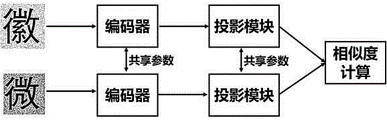
and step B2: constructing a character comparison self-monitoring model adopting a shared parameter and a double-tower structure, wherein the character comparison self-monitoring model comprises an encoder and a projection module;
the coder is used for coding an input character image; the encoder comprises a nine-layer structure: the first seven layers are ResNet structures, and a maximum pooling layer is connected behind the ResNet structures; the latter two layers are all connected layers, and the activation function is ReLu;
the projection module comprises two layers of fully-connected network structures, wherein the activation function of the first layer of fully-connected network structure is ReLu, and the activation function of the second layer of fully-connected network structure is tanh;
and step B3: training a character comparison self-monitoring model through a character image data set; for a given character image x, the output of the encoder is
Figure SMS_3
The output of the projection module is->
Figure SMS_4
(ii) a Loss function of text comparison self-supervision model>
Figure SMS_5
Comprises the following steps:
Figure SMS_6
;
wherein ,
Figure SMS_7
、
Figure SMS_8
is respectively a character image with the same label as the character image x and a character image with a different label from the character image x, and is/are selected>
Figure SMS_9
For the total number of character images having a different label than the character image x, <' >>
Figure SMS_10
Indicating transposition.
Further, when the text comparison self-supervision model is trained, each batch of data comprises 128 character images, an Adam optimizer is adopted, and the learning rate is set to be 0.001.
Further, in step B1, data augmentation is performed on the character image by adding noise, changing brightness and contrast, or using a morphological algorithm.
Further, in step A1, the paper document is converted into a scanogram image by the scanner, and perspective transformation is performed to correct distortion and tilt in the scanogram image.
Further, when extracting character images and sequencing the character images in sequence in the step A2, utilizing a text detection tool to perform character detection to obtain the upper left corner coordinate and the lower right corner coordinate of each independent character, scratching out each character image according to the upper left corner coordinate and the lower right corner coordinate of the character, after normalizing to a uniform size, sequencing the character images according to the coordinate value of the upper left corner coordinate and the sequence from top to bottom and from left to right to form a character image sequence.
Compared with the prior art, the invention has the beneficial technical effects that:
currently, a commonly used text comparison method usually needs to perform Optical Character Recognition (OCR) processing on a document image to convert a text in the image into a text format that can be compared. Then, whether the characters are the same or not is judged by calculating the similarity between the characters; the calculation amount is relatively large.
The method comprises the steps of carrying out character detection on a scanned version image of a paper document and an electronic version image of an electronic document, coding a character image sequence, and judging whether the electronic document is falsified or not by calculating the similarity of the same positions of a character image coding sequence; the invention can complete comparison without detecting the specific content of each character in the image, and can improve the comparison efficiency.
Drawings
FIG. 1 is a flow chart of the training process of the text comparison self-supervision model of the present invention;
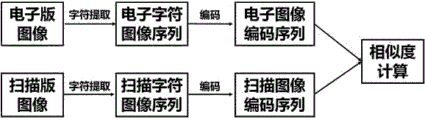
FIG. 2 is a flowchart of a document image content comparison method according to the present invention.
Detailed Description
A preferred embodiment of the present invention will be described in detail below with reference to the accompanying drawings.
The training method of the character comparison self-supervision model comprises the following steps:
b1, establishing a character image data set:
b11: and collecting characters such as common Chinese characters, numbers, english letters, symbols and the like as a model dictionary library.
B12: and generating a series of character images by using common fonts such as Song script, regular script, song imitation, black body and the like for each character in the model dictionary library by using a text-image conversion tool, wherein the size of the character images is fixed to be 32 pixels multiplied by 32 pixels.
B13: and for the generated character image, data set augmentation is performed by methods such as noise addition, brightness and contrast change, morphological algorithm and the like.
B14: and assigning the same label to each character image obtained from the same character to obtain a character image data set.
B2, construction of a character comparison self-supervision model:
the character comparison self-monitoring model adopts a double-tower structure with shared parameters and mainly comprises an encoder and a projection module.
The encoder realizes the encoding of the input character image, and the encoding is a network model which is formed by convolution and pooling and has a nine-layer structure. The first seven-layer structure is a ResNet structure, each ResNet structure comprises two convolution layers with convolution kernel size of 3 multiplied by 3, and the number of the convolution kernels is 32, 64 and 128 respectively; the ResNet structure is followed by a max pooling layer. The latter two layers are fully connected layers, the output sizes of the two fully connected layers are 512 and 128 respectively, and the activation function is ReLu.
The projection module is a two-layer fully-connected network structure, and the output sizes are 128 and 64 respectively; the activation function of the first layer of fully-connected network structure is ReLu, and the activation function of the second layer of fully-connected network structure is tanh.
For a given character image x, the output of the model encoder is
Figure SMS_11
The output of the projection module is->
Figure SMS_12
。
The text alignment self-supervision model loss function is as follows:
Figure SMS_13
;
Figure SMS_14
、
Figure SMS_15
the character image having the same label as the character image x and the character image having a different label from the character image x are respectively described.
And (4) carrying out optimization solution on the character comparison self-supervision model by using a character image data set and adopting an Adam optimizer. 128 character images were sampled per batch of data and the learning rate was set to 0.001.Adam is a commonly used optimizer for training neural network models, which can optimize the solution process of the model by specifying learning rates and other parameters.
By adopting an Adam optimizer and setting parameters such as a proper learning rate of 0.001 and the number of character images sampled by each batch of data, the training efficiency of the character comparison self-supervision model can be improved, and the prediction accuracy of the character comparison self-supervision model can be effectively improved.
The document image content comparison method comprises the following steps:
a1, converting a document image:
and scanning the paper document to obtain a scanning version image, and correcting the scanning version image through perspective transformation. The scanner can capture an image of a paper document, which is typically saved as a scanned piece in an image format, such as JPEG, PNG, etc. The scanning element may have distortion or tilt problems that require correction using perspective transformation. Perspective transformation corrects distortion, tilt, etc. problems in an image by changing the size, orientation, and shape of the image.
And converting the electronic document into an electronic version image.
A2: respectively carrying out character detection on the scanned version image and the electronic version image by using a text detection tool to obtain the coordinates of the upper left corner and the lower right corner of each independent character; and (4) according to the coordinates of the upper left corner and the lower right corner of the character, scratching out each character image and normalizing to 32 pixels multiplied by 32 pixels. Then, according to the coordinate value of the upper left corner, sorting is carried out in the order from top to bottom and from left to right, and the scanning character image sequence and the electronic character image sequence are respectively obtained.
A3: and inputting the scanned character image sequence and the electronic character image sequence into an encoder of the character comparison self-supervision model to respectively obtain a scanned image coding sequence and an electronic image coding sequence.
A4: calculating cosine similarity of two elements at same position i of scanned image coding sequence and electronic image coding sequence
Figure SMS_16
When cosine similarity
Figure SMS_17
If the value is less than the set threshold value (0.22), the content at the position i of the electronic document is considered to be falsified.
It will be evident to those skilled in the art that the invention is not limited to the details of the foregoing illustrative embodiments, and that the present invention may be embodied in other specific forms without departing from the spirit or essential attributes thereof. The present embodiments are therefore to be considered in all respects as illustrative and not restrictive, the scope of the invention being indicated by the appended claims rather than by the foregoing description, and all changes which come within the meaning and range of equivalency of the claims are therefore intended to be embraced therein, and any reference signs in the claims are not to be construed as limiting the claims.
Furthermore, it should be understood that although the present description refers to embodiments, not every embodiment may contain only a single embodiment, and such description is for clarity only, and those skilled in the art should integrate the description, and the embodiments may be combined as appropriate to form other embodiments understood by those skilled in the art.

Claims (5)

1.A document image content comparison method based on an automatic supervision learning model comprises the following steps:
step A1: converting a paper document into a scanning version image, and converting an electronic document into an electronic version image;
step A2: extracting character images in the scanning version image and the electronic version image and sequencing the character images in sequence to respectively form a scanning character image sequence and an electronic character image sequence;
step A3: inputting the scanned character image sequence and the electronic character image sequence into an encoder of a character comparison self-supervision model to respectively obtain a scanned image coding sequence and an electronic image coding sequence;
step A4: calculating scan image coding sequence and electronic image coding sequenceCosine similarity of two elements at column identity position i
Figure QLYQS_1
When the cosine similarity is greater than or equal to>
Figure QLYQS_2
When the content is smaller than the set threshold value, the content at the position i of the electronic document is considered to be falsified;
the training method of the character comparison self-supervision model comprises the following steps:
step B1: converting each character in the dictionary library into a character image, and after data amplification is carried out on the character image, endowing each character image obtained by the same character with the same label to obtain a character image data set;
and step B2: constructing a character comparison self-monitoring model adopting a shared parameter and a double-tower structure, wherein the character comparison self-monitoring model comprises an encoder and a projection module;
the encoder is used for encoding the input character image; the encoder comprises a nine-layer structure: the first seven layers are ResNet structures, and a maximum pooling layer is connected behind the ResNet structures; the latter two layers are all connected layers, and the activation function is ReLu;
the projection module comprises two layers of fully-connected network structures, wherein the activation function of the first layer of fully-connected network structure is ReLu, and the activation function of the second layer of fully-connected network structure is tanh;
and step B3: training a character comparison self-monitoring model through a character image data set; for a given character image x, the output of the encoder is
Figure QLYQS_3
The output of the projection module is->
Figure QLYQS_4
(ii) a Loss function in text-comparison self-supervision model>
Figure QLYQS_5
Comprises the following steps:
Figure QLYQS_6
;
wherein ,
Figure QLYQS_7
、
Figure QLYQS_8
respectively a character image having the same label as the character image x, a character image having a label different from the character image x, and a device for determining whether the character image x is on or off>
Figure QLYQS_9
For the total number of character images having a different label than the character image x, <' >>
Figure QLYQS_10
Indicating transposition.
2. The document image content comparison method based on the self-supervised learning model as recited in claim 1, wherein: when the character comparison self-monitoring model is trained, each batch of data comprises 128 character images, an Adam optimizer is adopted, and the learning rate is set to be 0.001.
3. The document image content comparison method based on the self-supervised learning model as recited in claim 1, wherein: in step B1, data augmentation is performed on the character image by adding noise, changing brightness and contrast, or using a morphological algorithm.
4. The document image content comparison method based on the self-supervised learning model as recited in claim 1, wherein: in the step A1, a paper document is converted into a scanning plate image through a scanner, and perspective transformation is carried out to correct distortion and inclination in the scanning plate image.
5. The document image content comparison method based on the self-supervised learning model as recited in claim 1, wherein: and when the character images are extracted and sequenced in sequence in the step A2, character detection is carried out by using a text detection tool to obtain the coordinates of the upper left corner and the lower right corner of each independent character, each character image is extracted according to the coordinates of the upper left corner and the lower right corner of the character, after the character images are normalized to be uniform in size, sequencing is carried out according to the coordinate value of the upper left corner coordinate from top to bottom and from left to right, and a character image sequence is formed.
CN202310185709.2A 2023-03-01 2023-03-01 Document image content comparison method based on self-supervision learning model Active CN115861663B (en)

Priority Applications (1)

Application Number Priority Date Filing Date Title
CN202310185709.2A CN115861663B (en) 2023-03-01 2023-03-01 Document image content comparison method based on self-supervision learning model

Applications Claiming Priority (1)

Application Number Priority Date Filing Date Title
CN202310185709.2A CN115861663B (en) 2023-03-01 2023-03-01 Document image content comparison method based on self-supervision learning model

Publications (2)

Publication Number Publication Date
CN115861663A true CN115861663A (en) 2023-03-28
CN115861663B CN115861663B (en) 2023-05-23

Family

ID=85659536

Family Applications (1)

Application Number Title Priority Date Filing Date
CN202310185709.2A Active CN115861663B (en) 2023-03-01 2023-03-01 Document image content comparison method based on self-supervision learning model

Country Status (1)

Country Link
CN (1) CN115861663B (en)

Citations (8)

* Cited by examiner, † Cited by third party
Publication number Priority date Publication date Assignee Title
CN104636708A (en) * 2013-11-11 2015-05-20 方正国际软件(北京)有限公司 Partial document image comparison method and system
CN111930894A (en) * 2020-08-13 2020-11-13 腾讯科技(深圳)有限公司 Long text matching method and device, storage medium and electronic equipment
CN113011427A (en) * 2021-03-17 2021-06-22 中南大学 Remote sensing image semantic segmentation method based on self-supervision contrast learning
CN113901907A (en) * 2021-09-30 2022-01-07 北京百度网讯科技有限公司 Image-text matching model training method, image-text matching method and device
US20220292715A1 (en) * 2021-03-09 2022-09-15 Samsung Electronics Co., Ltd. Method and apparatus for estimating pose of device
US20220383108A1 (en) * 2021-05-21 2022-12-01 Nec Laboratories America, Inc. Information-aware graph contrastive learning
US20230019972A1 (en) * 2021-06-30 2023-01-19 Tencent America LLC Systems and methods of contrastive point completion with fine-to-coarse refinement
CN115687567A (en) * 2022-10-14 2023-02-03 中电万维信息技术有限责任公司 A short text search method for similar long texts without labeling data

Patent Citations (8)

* Cited by examiner, † Cited by third party
Publication number Priority date Publication date Assignee Title
CN104636708A (en) * 2013-11-11 2015-05-20 方正国际软件(北京)有限公司 Partial document image comparison method and system
CN111930894A (en) * 2020-08-13 2020-11-13 腾讯科技(深圳)有限公司 Long text matching method and device, storage medium and electronic equipment
US20220292715A1 (en) * 2021-03-09 2022-09-15 Samsung Electronics Co., Ltd. Method and apparatus for estimating pose of device
CN113011427A (en) * 2021-03-17 2021-06-22 中南大学 Remote sensing image semantic segmentation method based on self-supervision contrast learning
US20220383108A1 (en) * 2021-05-21 2022-12-01 Nec Laboratories America, Inc. Information-aware graph contrastive learning
US20230019972A1 (en) * 2021-06-30 2023-01-19 Tencent America LLC Systems and methods of contrastive point completion with fine-to-coarse refinement
CN113901907A (en) * 2021-09-30 2022-01-07 北京百度网讯科技有限公司 Image-text matching model training method, image-text matching method and device
CN115687567A (en) * 2022-10-14 2023-02-03 中电万维信息技术有限责任公司 A short text search method for similar long texts without labeling data

Non-Patent Citations (2)

* Cited by examiner, † Cited by third party
Title
ROMAIN COSENTINO等: "《Toward a Geometrical Understanding of Self-supervised Contrastive Learning》" *
张重生 等: "《深度对比学习综述》" *

Also Published As

Publication number Publication date
CN115861663B (en) 2023-05-23

Similar Documents

Publication Publication Date Title
US20240037969A1 (en) Recognition of handwritten text via neural networks
CN112307919B (en) Improved YOLOv 3-based digital information area identification method in document image
EP3539051B1 (en) System and method of character recognition using fully convolutional neural networks
CN114092938B (en) Image recognition processing method and device, electronic equipment and storage medium
US20200134382A1 (en) Neural network training utilizing specialized loss functions
CN111738169A (en) A Handwritten Formula Recognition Method Based on End-to-End Network Model
CN112149523B (en) Method and device for identifying and extracting pictures based on deep learning and union search algorithm
CN107220641B (en) A Multilingual Text Classification Method Based on Deep Learning
CN115116074A (en) Handwritten character recognition and model training method and device
CN113901952A (en) Print form and handwritten form separated character recognition method based on deep learning
CN1445715A (en) Systems and methods that facilitate pattern recognition
CN109784342A (en) A kind of OCR recognition methods and terminal based on deep learning model
US11715288B2 (en) Optical character recognition using specialized confidence functions
CN107451582A (en) A kind of graphics context identifying system and its recognition methods
CN111401099A (en) Text recognition method, device and storage medium
CN118135584A (en) A method and system for automatic recognition of handwritten forms based on deep learning
CN113468979A (en) Text line language identification method and device and electronic equipment
Hemanth et al. CNN-RNN based handwritten text recognition.
WO2024103997A1 (en) Handwriting recognition method and handwriting recognition model training method and apparatus
CN109508712A (en) A kind of Chinese written language recognition methods based on image
CN114005127B (en) Image optical character recognition method based on deep learning, storage device and server
CN121214468A (en) A general table recognition method and system based on multimodal feature fusion
CN120564208A (en) Intelligent recognition system and method for Mongolian ancient books and documents based on large model
CN117095423B (en) Bank bill character recognition method and device
CN115861663B (en) Document image content comparison method based on self-supervision learning model

Legal Events

Date Code Title Description
PB01 Publication
PB01 Publication
SE01 Entry into force of request for substantive examination
GR01 Patent grant
GR01 Patent grant
TR01 Transfer of patent right

Effective date of registration: 20240612

Address after: Room 204-a10, embedded R & D building, future center, Institute of advanced technology, University of science and technology of China

Patentee after: Anhui Yunxi Quantum Technology Co.,Ltd.

Country or region after: China

Address before: 230000 future center of Institute of advanced technology, University of science and technology of China, No. 5089, Wangjiang West Road, high tech Zone, Hefei, Anhui b1205-b1208

Patentee before: Artificial Intelligence Research Institute of Hefei comprehensive national science center (Artificial Intelligence Laboratory of Anhui Province)

Country or region before: China

TR01 Transfer of patent right
PE01 Entry into force of the registration of the contract for pledge of patent right

Denomination of invention: A method for comparing document image content based on self supervised learning model

Granted publication date: 20230523

Pledgee: Hefei Xingtai Technology Micro-loan Co.,Ltd.

Pledgor: Anhui Yunxi Quantum Technology Co.,Ltd.

Registration number: Y2025980010617

PE01 Entry into force of the registration of the contract for pledge of patent right
PC01 Cancellation of the registration of the contract for pledge of patent right

Granted publication date: 20230523

Pledgee: Hefei Xingtai Technology Micro-loan Co.,Ltd.

Pledgor: Anhui Yunxi Quantum Technology Co.,Ltd.

Registration number: Y2025980010617

PC01 Cancellation of the registration of the contract for pledge of patent right