CN116299536A - LiDAR SLAM Degradation Detection Method and System Based on Pose Constraints - Google Patents

LiDAR SLAM Degradation Detection Method and System Based on Pose Constraints Download PDF

Info

Publication number
CN116299536A
CN116299536A CN202310207645.1A CN202310207645A CN116299536A CN 116299536 A CN116299536 A CN 116299536A CN 202310207645 A CN202310207645 A CN 202310207645A CN 116299536 A CN116299536 A CN 116299536A
Authority
CN
China
Prior art keywords
constraint
pose
degradation
robot
laser radar
Prior art date
Legal status (The legal status is an assumption and is not a legal conclusion. Google has not performed a legal analysis and makes no representation as to the accuracy of the status listed.)
Granted
Application number
CN202310207645.1A
Other languages
Chinese (zh)
Other versions
CN116299536B (en
Inventor
杨明
钱烨强
张弛
柴子豪
Current Assignee (The listed assignees may be inaccurate. Google has not performed a legal analysis and makes no representation or warranty as to the accuracy of the list.)
Shanghai Jiao Tong University
Original Assignee
Shanghai Jiao Tong University
Priority date (The priority date is an assumption and is not a legal conclusion. Google has not performed a legal analysis and makes no representation as to the accuracy of the date listed.)
Filing date
Publication date
Application filed by Shanghai Jiao Tong University filed Critical Shanghai Jiao Tong University
Priority to CN202310207645.1A priority Critical patent/CN116299536B/en
Publication of CN116299536A publication Critical patent/CN116299536A/en
Application granted granted Critical
Publication of CN116299536B publication Critical patent/CN116299536B/en
Active legal-status Critical Current
Anticipated expiration legal-status Critical

Links

Images

Classifications

    • GPHYSICS
    • G01MEASURING; TESTING
    • G01SRADIO DIRECTION-FINDING; RADIO NAVIGATION; DETERMINING DISTANCE OR VELOCITY BY USE OF RADIO WAVES; LOCATING OR PRESENCE-DETECTING BY USE OF THE REFLECTION OR RERADIATION OF RADIO WAVES; ANALOGOUS ARRANGEMENTS USING OTHER WAVES
    • G01S17/00Systems using the reflection or reradiation of electromagnetic waves other than radio waves, e.g. lidar systems
    • G01S17/88Lidar systems specially adapted for specific applications
    • GPHYSICS
    • G01MEASURING; TESTING
    • G01SRADIO DIRECTION-FINDING; RADIO NAVIGATION; DETERMINING DISTANCE OR VELOCITY BY USE OF RADIO WAVES; LOCATING OR PRESENCE-DETECTING BY USE OF THE REFLECTION OR RERADIATION OF RADIO WAVES; ANALOGOUS ARRANGEMENTS USING OTHER WAVES
    • G01S17/00Systems using the reflection or reradiation of electromagnetic waves other than radio waves, e.g. lidar systems
    • G01S17/02Systems using the reflection of electromagnetic waves other than radio waves
    • G01S17/06Systems determining position data of a target
    • YGENERAL TAGGING OF NEW TECHNOLOGICAL DEVELOPMENTS; GENERAL TAGGING OF CROSS-SECTIONAL TECHNOLOGIES SPANNING OVER SEVERAL SECTIONS OF THE IPC; TECHNICAL SUBJECTS COVERED BY FORMER USPC CROSS-REFERENCE ART COLLECTIONS [XRACs] AND DIGESTS
    • Y02TECHNOLOGIES OR APPLICATIONS FOR MITIGATION OR ADAPTATION AGAINST CLIMATE CHANGE
    • Y02TCLIMATE CHANGE MITIGATION TECHNOLOGIES RELATED TO TRANSPORTATION
    • Y02T10/00Road transport of goods or passengers
    • Y02T10/10Internal combustion engine [ICE] based vehicles
    • Y02T10/40Engine management systems

Landscapes

  • Physics & Mathematics (AREA)
  • Engineering & Computer Science (AREA)
  • Electromagnetism (AREA)
  • Computer Networks & Wireless Communication (AREA)
  • General Physics & Mathematics (AREA)
  • Radar, Positioning & Navigation (AREA)
  • Remote Sensing (AREA)
  • Control Of Position, Course, Altitude, Or Attitude Of Moving Bodies (AREA)

Abstract

本发明提供一种基于位姿约束的激光雷达SLAM退化检测方法及系统,包括:通过激光雷达传感器采集连续帧点云;对所述连续帧点云进行分析,获取机器人位姿抗扰动鲁棒性的点云约束关系;根据所述点云约束关系,进行机器人位姿约束扰动识别,获得SLAM退化方向。本发明能解决激光雷达SLAM在退化场景下失效难以检测的问题,为激光SLAM的稳定运行提供预警,能实现较高的检测准确性,有利于实际应用。

Figure 202310207645

The present invention provides a laser radar SLAM degradation detection method and system based on pose constraints, including: collecting continuous frame point clouds through a laser radar sensor; analyzing the continuous frame point clouds to obtain robot pose anti-disturbance robustness The point cloud constraint relationship; according to the point cloud constraint relationship, the robot pose constraint disturbance recognition is performed to obtain the SLAM degradation direction. The invention can solve the problem that the laser radar SLAM fails to be difficult to detect in a degraded scene, provides early warning for the stable operation of the laser SLAM, can achieve higher detection accuracy, and is beneficial to practical application.

Figure 202310207645

Description

Laser radar SLAM degradation detection method and system based on pose constraint
Technical Field
The invention relates to the field of computer vision, in particular to a laser radar SLAM degradation detection method and system based on pose constraint.
Background
Lidar is a widely used sensor of the current type: the transmitting module transmits laser with specific wavelength by means of pulse, frequency modulation, amplitude modulation and the like based on an optical principle; the receiving module detects the laser reflected back after being emitted by the diode element, and accurate ranging can be obtained through light flight time. The laser radar is widely applied to applications such as target detection, scene modeling, robot navigation and the like, and has wider commercial and academic prospects.
The synchronous mapping and positioning algorithm (SLAM) is to use information provided by the sensor to build a map of the environment scene, and determine the corresponding position of the sensor in the map. At present, SLAM technology is widely applied to autonomous positioning and navigation tasks of robots. The SLAM algorithm based on the laser radar is widely applied to high-difficulty positioning navigation tasks such as unmanned logistics, unmanned minibus and the like due to high-precision ranging information and robust positioning results.
One of the application challenges of the lidar SLAM algorithm is the algorithm failure problem facing a specific scenario. These scenarios include: tunnels, galleries, outdoor open parking lots, highways and the like, and is characterized in that structural textures in scenes are fewer, scene degradation occurs, and data constraint provided by a laser radar is insufficient during positioning, so that an algorithm is disabled. The degradation problem can be processed by methods such as multi-sensor data fusion, state space modeling compensation and the like, and how to identify and detect the degradation scene of the laser radar SLAM becomes a key step of algorithm optimization.
Disclosure of Invention
Aiming at the defects in the prior art, the invention aims to provide a laser radar SLAM degradation detection method and system based on pose constraint.
According to one aspect of the present invention, there is provided a laser radar SLAM degradation detection method based on pose constraint, including:
collecting continuous frame point clouds through a laser radar sensor;
analyzing the continuous frame point cloud to obtain a point cloud constraint relation of robot pose disturbance rejection robustness;
and carrying out robot pose constraint disturbance recognition according to the point cloud constraint relation to obtain a degradation direction.
Preferably, the analyzing the continuous frame point cloud to obtain a point cloud constraint relationship of robot pose disturbance rejection robustness includes:
approximating the local surface of the continuous frame point cloud as a plane, each measurement point satisfying the following relation:
Figure BDA0004111467740000021
wherein,,
Figure BDA0004111467740000022
is the unit vector of the laser beam in the radar coordinate system for indicating the beam direction,/or%>
Figure BDA0004111467740000023
Corresponding to the beam length, i.e {1,2, …, m } is the index of the laser spot beam, +.>
Figure BDA0004111467740000024
Is an approximately planar normal vector, p i,0 Is a point on the approximate plane, +.>
Figure BDA0004111467740000025
The position and attitude of the robot are described separately;
will be
Figure BDA0004111467740000026
Denoted as d i The point cloud constraint relation for obtaining the robot pose disturbance rejection robustness is as follows:
Figure BDA0004111467740000027
preferably, the performing robot pose constraint disturbance recognition according to the point cloud constraint relationship includes:
in the point cloud registration process, the position and posture (R, t) of the robot change less, and the change of (R, t) can be regarded as disturbance;
measuring distance ρ by calculating laser i And judging whether the laser radar SLAM has scene degradation or not according to the sensitivity degree of the (R, t) disturbance.
Preferably, if the pose of the robot is disturbed and the laser measurement distance is changed greatly, the pose constraint of the robot is described to be stronger currently; otherwise, if the pose of the robot is disturbed and the laser measurement distance is not changed greatly, the robot is extremely weak in constraint and the system is in a degradation environment.
Preferably, the obtaining the degradation direction includes:
based on the assumption of small angle transformation in robot pose, R.apprxeq.I+ [ theta ] is used] × Linearizing the derivative problem:
Figure BDA0004111467740000028
based on the hidden function theorem, an equation is established:
Figure BDA0004111467740000029
Figure BDA00041114677400000210
derivation of cocoa the product can be obtained by the method,
Figure BDA00041114677400000211
according to the formula obtained by the hidden function theorem, an F matrix and a T matrix are constructed, wherein the sensitivity of laser constraint to translation parameters and the sensitivity of laser constraint to rotation parameters are respectively represented:
Figure BDA0004111467740000031
Figure BDA0004111467740000032
performing eigenvalue decomposition on the F matrix and the T matrix to obtain a group of eigenvectors,
Figure BDA0004111467740000033
the feature vector corresponding to the minimum feature value is the current degradation direction: the minimum eigenvalue of the F matrix is used for judging the degradation direction of the translation quantity; the minimum eigenvalue of the T matrix is used to determine the degradation direction of rotation.
Preferably, the projection of the matrix on any feature vector is the expansion and contraction of the feature vector, the expansion and contraction proportion is a feature value, the feature value reflects the proportion of the projection of the matrix in the direction of the feature vector, and the smaller the feature value is, the smaller the constraint of the matrix in the direction of the feature vector is, the smaller the constraint is, and the degradation is easy to occur in the direction.
Preferably, if lambda min Less than the set threshold, representing degradation of the current scene; at the same time, a minimum eigenvalue lambda min The corresponding feature vector is the current degradation direction.
According to a second aspect of the present invention, there is provided a laser radar SLAM degradation detection system based on pose constraint, comprising:
the data module is used for collecting continuous frame point clouds through a laser radar sensor;
the constraint relation module analyzes the continuous frame point clouds and obtains a point cloud constraint relation of robot pose disturbance rejection robustness;
and the disturbance recognition module is used for carrying out robot pose constraint disturbance recognition according to the point cloud constraint relation.
According to a third aspect of the present invention, there is provided a terminal comprising a memory, a processor and a computer program stored on the memory and executable on the processor, the processor being operable, when executing the program, to perform the pose constraint based lidar SLAM degradation detection method or to run the pose constraint based lidar SLAM degradation detection system described above.
According to a fourth aspect of the present invention, there is provided a computer-readable storage medium having stored thereon a computer program which, when executed by a processor, is operative to perform the above-described pose constraint-based laser radar SLAM degradation detection method, or to run the above-described pose constraint-based laser radar SLAM degradation detection system.
Compared with the prior art, the invention has the following beneficial effects:
the method can solve the problem that the laser radar SLAM is difficult to detect when losing efficacy in a degradation scene, provides early warning for the stable operation of the laser SLAM, can realize higher detection accuracy, and is beneficial to practical application.
Drawings
Other features, objects and advantages of the present invention will become more apparent upon reading of the detailed description of non-limiting embodiments, given with reference to the accompanying drawings in which:
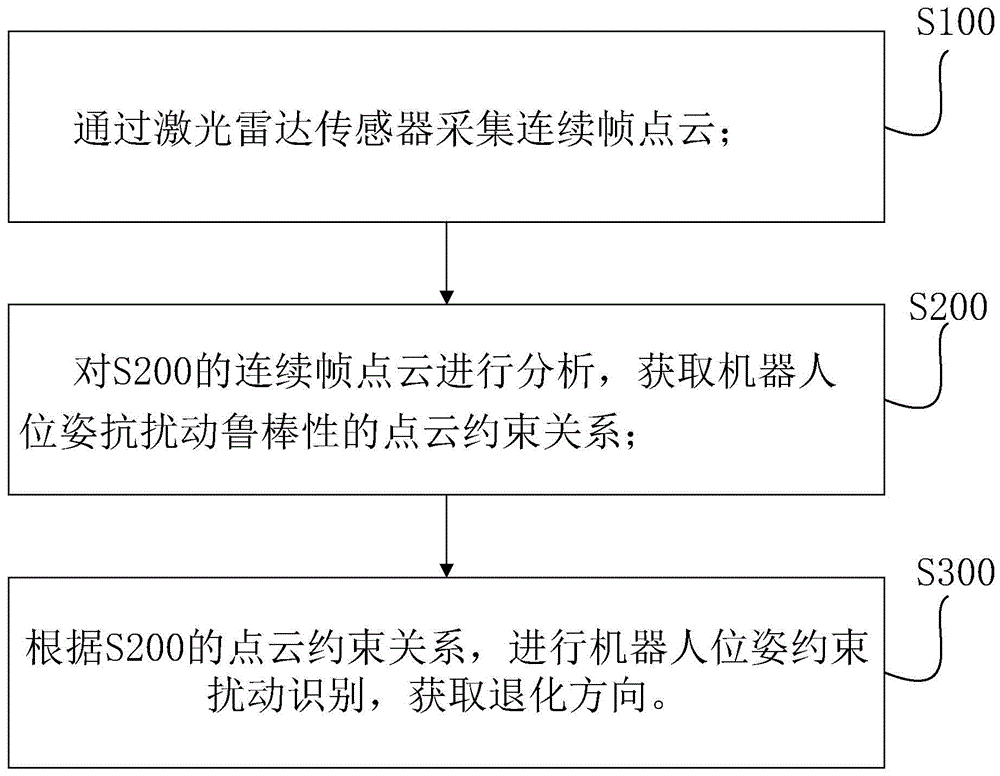
FIG. 1 is a flow chart of a laser radar SLAM degradation detection method based on pose constraints in an embodiment of the invention;
FIG. 2 is a flow chart of laser radar SLAM degradation detection based on pose constraints in a preferred embodiment of the present invention;
FIG. 3 is a schematic representation of robot pose constraints in an embodiment of the invention.
Detailed Description
The present invention will be described in detail with reference to specific examples. The following examples will assist those skilled in the art in further understanding the present invention, but are not intended to limit the invention in any way. It should be noted that variations and modifications could be made by those skilled in the art without departing from the inventive concept. These are all within the scope of the present invention.
First, terms (SLAM and degraded scene) involved in the present invention are explained. SLAM: and (3) synchronously mapping and positioning algorithms, and establishing a map of the environment scene in which the sensor is positioned in the motion process by utilizing information provided by the sensor, and simultaneously determining the corresponding position of the sensor in the map. The SLAM technology is widely applied to environment modeling and autonomous positioning navigation tasks of robots. The laser radar SLAM is a map which draws a laser scanning scene according to the point cloud information acquired by the laser radar sensor, and determines the position of the laser radar sensor in the map. Degradation scenario: the laser radar uses fewer structural textures in the scene, so that the sensor cannot provide enough constraint when the data provided in the scene faces to the optimization problem of the system, and the optimization object falls into a local optimal solution to cause the system to fail. The degradation scene of the laser radar comprises tunnels, galleries, outdoor open parking lots, highways and the like.
The invention provides an embodiment, a laser radar SLAM degradation detection method based on pose constraint, which is shown in fig. 1 and comprises the following steps:
s100, collecting continuous frame point clouds through a laser radar sensor;
s200, analyzing the continuous frame point clouds of the S200 to obtain a point cloud constraint relation of the robot pose disturbance rejection robustness;
s300, carrying out robot pose constraint disturbance recognition according to the point cloud constraint relation of S200, and obtaining the degradation direction.
The embodiment solves the problem that the laser radar SLAM is difficult to detect in failure under a degradation scene, provides early warning for the stable operation of the laser radar SLAM, can realize higher detection accuracy, and is beneficial to practical application.
In a preferred embodiment of the present invention, S100 is implemented, where a laser radar sensor collects a continuous frame point cloud, specifically, a robot carries a laser radar, and the laser radar emits laser light with a specific wavelength by means of pulse, frequency modulation, amplitude modulation, and the like, and after the laser radar irradiates an object, the laser light is reflected, and the laser light reflected after the emission is received, so as to obtain original point cloud data. Each frame includes a cloud of points, including the point clouds emitted by the m laser points. Wherein the reflection of each laser light on the object corresponds to a measurement point.
In a preferred embodiment of the present invention, S200 is implemented, that is, for laser radar positioning, pose constraints of each measurement point of the laser radar on the robot are obtained, see fig. 2, and the specific procedure is as follows:
approximating the local surface of the point cloud as a plane, then for each measurement point:
Figure BDA0004111467740000051
wherein the method comprises the steps of
Figure BDA0004111467740000052
Is the unit vector of the laser beam in the radar coordinate system for indicating the beam direction,/or%>
Figure BDA0004111467740000053
Corresponding to the beam length, i.e {1,2, …, m } is the index of the laser spot beam, +.>
Figure BDA0004111467740000054
Is an approximately planar normal vector, p i,0 Is a point on the approximate plane, +.>
Figure BDA0004111467740000055
The position and pose of the robot are described separately, see fig. 3.
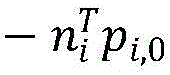
Will be
Figure BDA0004111467740000056
Denoted as d i The following steps are:
Figure BDA0004111467740000057
and taking the model as a point cloud constraint relation of robot pose disturbance rejection robustness. The constraint relation describes the constraint relation between the pose of the robot and the laser point, and provides an accurate model foundation for further detecting whether the laser point measurement is degraded or not.
In a preferred implementation of the present invention, S300 is implemented, where in point cloud registration (that is, as the robot moves, the lidar continuously obtains two frames of point cloud data, and the point cloud registration needs to find a point-to-point matching relationship between the two frames of point clouds), the transformation matrices corresponding to the two registrations are not different greatly, so that (R, t) is smaller. (R, t) can be regarded as a disturbance describing the locatable capability of the system, converted into a laser measurement distance ρ i Sensitization to (R, t)Degree of feel. If the pose of the robot is slightly disturbed and the laser measurement distance is changed greatly, the pose constraint of the robot is strong. Otherwise, if the pose of the robot is disturbed, but the laser measurement distance is not changed greatly, the robot is extremely weak in constraint, and the system is in a degradation environment.
In another preferred embodiment, referring to fig. 2, the preferred process of S300 is as follows:
s301: solving the laser measurement distance ρ i For the partial derivatives of (R, t), R.apprxeq.I+ [ theta ] is used based on the assumption of a small angle transformation] × Linearizing the derivative problem:
Figure BDA0004111467740000058
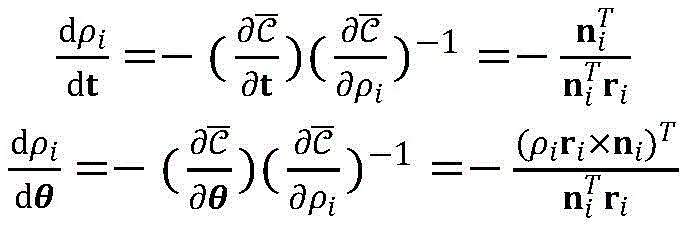
s302: based on the hidden function theorem, an equation is established as follows:
Figure BDA0004111467740000061
Figure BDA0004111467740000062
combining S301 derivation, we can obtain:
Figure BDA0004111467740000063
Figure BDA0004111467740000064
step S303: according to the formula obtained in the step S302, an F matrix and a T matrix are constructed, wherein the sensitivity of the laser constraint to the translation parameter and the sensitivity of the laser constraint to the rotation parameter are respectively represented:
Figure BDA0004111467740000065
Figure BDA0004111467740000066
step S304: and (3) carrying out eigenvalue decomposition according to the formula obtained in the step S303 to obtain corresponding eigenvectors.
Figure BDA0004111467740000067
Figure BDA0004111467740000068
Step S305: the feature vector corresponding to the minimum feature value is the current degradation direction: the minimum eigenvalue of the F matrix is used for judging the degradation direction of the translation quantity; the minimum eigenvalue of the T matrix is used to determine the degradation direction of rotation.
The projection of any one of the eigenvectors on the coordinate system (matrix) is only the expansion and contraction of the fixed, and the expansion and contraction proportion is the magnitude of the eigenvalue, so that the eigenvalue can reflect the proportion of the vector direction on the matrix, and the smaller the eigenvalue, the smaller the constraint of the matrix on the eigenvector direction is. The constraint is small, indicating that degradation is likely to occur in this direction, and therefore the minimum eigenvalue λ min The locatability of the current location may be described.
Further, if lambda min Less than the set threshold, representing degradation of the current scene. At the same time, a minimum eigenvalue lambda min The corresponding feature vector is the current degradation direction.
Based on the same technical conception, in other embodiments of the present invention, a laser radar SLAM degradation detection system based on pose constraint is provided, which includes a data module, a constraint relation module, and a disturbance recognition module. The data module acquires continuous frame point clouds through a laser radar sensor; the constraint relation module analyzes the continuous frame point clouds to obtain a point cloud constraint relation of robot pose disturbance rejection robustness; and the disturbance recognition module performs robot pose constraint disturbance recognition according to the point cloud constraint relation.
Based on the same technical concept, in other embodiments of the present invention, a terminal is provided, which includes a memory, a processor, and a computer program stored on the memory and executable on the processor, where the processor executes the program and is used to perform the above method or to run the above system.
Optionally, a memory for storing a program; memory, which may include volatile memory (english) such as random-access memory (RAM), such as static random-access memory (SRAM), double data rate synchronous dynamic random-access memory (Double Data Rate Synchronous Dynamic Random Access Memory, DDR SDRAM), and the like; the memory may also include a non-volatile memory (English) such as a flash memory (English). The memory is used to store computer programs (e.g., application programs, functional modules, etc. that implement the methods described above), computer instructions, etc., which may be stored in one or more memories in a partitioned manner. And the above-described computer programs, computer instructions, data, etc. may be invoked by a processor.
The computer programs, computer instructions, etc. described above may be stored in one or more memories in partitions. And the above-described computer programs, computer instructions, data, etc. may be invoked by a processor.
A processor for executing the computer program stored in the memory to implement the steps in the method according to the above embodiment. Reference may be made in particular to the description of the embodiments of the method described above.
The processor and the memory may be separate structures or may be integrated structures that are integrated together. When the processor and the memory are separate structures, the memory and the processor may be connected by a bus coupling.
Based on the same technical idea, in other embodiments of the present invention, a computer-readable storage medium is provided, on which a computer program is stored, which program, when being executed by a processor, is operative to perform the method described above, or to run the system described above.
Among them, computer-readable media include computer storage media and communication media including any medium that facilitates transfer of a computer program from one place to another. A storage media may be any available media that can be accessed by a general purpose or special purpose computer. An exemplary storage medium is coupled to the processor such the processor can read information from, and write information to, the storage medium. In the alternative, the storage medium may be integral to the processor. The processor and the storage medium may reside in an ASIC. In addition, the ASIC may reside in a user device. The processor and the storage medium may reside as discrete components in a communication device.
It will be appreciated by those skilled in the art that embodiments of the present application may be provided as a method, system, or computer program product. Accordingly, the present application may take the form of an entirely hardware embodiment, an entirely software embodiment, or an embodiment combining software and hardware aspects. Furthermore, the present application may take the form of a computer program product embodied on one or more computer-usable storage media (including, but not limited to, disk storage, CD-ROM, optical storage, and the like) having computer-usable program code embodied therein.
The present application is described with reference to flowchart illustrations and/or block diagrams of methods, apparatus (systems) and computer program products according to the application. It will be understood that each flow and/or block of the flowchart illustrations and/or block diagrams, and combinations of flows and/or blocks in the flowchart illustrations and/or block diagrams, can be implemented by computer program instructions. These computer program instructions may be provided to a processor of a general purpose computer, special purpose computer, embedded processor, or other programmable data processing apparatus to produce a machine, such that the instructions, which execute via the processor of the computer or other programmable data processing apparatus, create means for implementing the functions specified in the flowchart flow or flows and/or block diagram block or blocks.
These computer program instructions may also be stored in a computer-readable memory that can direct a computer or other programmable data processing apparatus to function in a particular manner, such that the instructions stored in the computer-readable memory produce an article of manufacture including instruction means which implement the function specified in the flowchart flow or flows and/or block diagram block or blocks.
These computer program instructions may also be loaded onto a computer or other programmable data processing apparatus to cause a series of operational steps to be performed on the computer or other programmable apparatus to produce a computer implemented process such that the instructions which execute on the computer or other programmable apparatus provide steps for implementing the functions specified in the flowchart flow or flows and/or block diagram block or blocks.
It will be apparent to those skilled in the art that various modifications and variations can be made in the present application without departing from the spirit or scope of the application. Thus, if such modifications and variations of the present application fall within the scope of the claims and the equivalents thereof, the present application is intended to cover such modifications and variations.
The foregoing describes specific embodiments of the present invention. It is to be understood that the invention is not limited to the particular embodiments described above, and that various changes and modifications may be made by one skilled in the art within the scope of the claims without affecting the spirit of the invention. The above-described preferred features may be used in any combination without collision.

Claims (10)

1. The laser radar SLAM degradation detection method based on pose constraint is characterized by comprising the following steps of:
collecting continuous frame point clouds through a laser radar sensor;
analyzing the continuous frame point cloud to obtain a point cloud constraint relation of robot pose disturbance rejection robustness;
and carrying out robot pose constraint disturbance recognition according to the point cloud constraint relation to obtain an SLAM degradation direction.
2. The laser radar SLAM degradation detection method based on pose constraint according to claim 1, wherein the analyzing the continuous frame point cloud to obtain the point cloud constraint relation of the robot pose disturbance rejection robustness comprises:
approximating the local surface of the continuous frame point cloud as a plane, each measurement point satisfying the following relation:
Figure FDA0004111467720000011
wherein,,
Figure FDA0004111467720000012
is the unit vector of the laser beam in the radar coordinate system for indicating the beam direction,/or%>
Figure FDA0004111467720000013
I e {1,2,..m } is the index of the laser spot beam, corresponding to its beam length,/-for>
Figure FDA0004111467720000014
Is an approximately planar normal vector, p i,0 Is a point on the approximate plane, +.>
Figure FDA0004111467720000015
The position and the gesture of the robot are respectively described, R is a rotation matrix, and t is a translation distance;
will be
Figure FDA0004111467720000016
Denoted as d i The point cloud constraint relation for obtaining the robot pose disturbance rejection robustness is as follows:
Figure FDA0004111467720000017
3. the laser radar SLAM degradation detection method based on pose constraint according to claim 1, wherein the performing robot pose constraint disturbance recognition according to the point cloud constraint relation comprises:
in the point cloud registration process, the position and posture (R, t) variation of the robot is regarded as disturbance;
measuring distance ρ by calculating laser i And judging whether the laser radar SLAM has scene degradation or not according to the sensitivity degree of the (R, t) disturbance.
4. The laser radar SLAM degradation detection method based on pose constraint according to claim 3, wherein if the pose of the robot is disturbed and the laser measurement distance is changed greatly, the pose constraint of the robot is described as being stronger; otherwise, if the pose of the robot is disturbed and the laser measurement distance is not changed greatly, the robot is extremely weak in constraint and the system is in a degradation environment.
5. The method for detecting laser radar SLAM degradation based on pose constraint according to claim 1, wherein the obtaining the degradation direction comprises:
based on the assumption of small angle theta transformation in robot pose, R (approximately) I (approximately) theta is used] × Linearizing the derivative problem:
Figure FDA0004111467720000021
based on the hidden function theorem, an equation is established:
Figure FDA0004111467720000022
Figure FDA0004111467720000023
the formula is derived from the formula,
Figure FDA0004111467720000024
according to the equation and the formula obtained by the hidden function theorem, an F matrix and a T matrix are constructed, wherein the sensitivity of the laser constraint to the translation parameter and the sensitivity of the laser constraint to the rotation parameter are respectively represented:
Figure FDA0004111467720000025
Figure FDA0004111467720000026
performing eigenvalue decomposition on the F matrix and the T matrix to obtain a group of eigenvectors,
Figure FDA0004111467720000027
the feature vector corresponding to the minimum feature value is the current degradation direction: the minimum eigenvalue of the F matrix is used for judging the degradation direction of the translation quantity; the minimum eigenvalue of the T matrix is used to determine the degradation direction of rotation.
6. The laser radar SLAM degradation detection method based on pose constraint according to claim 5, wherein the projection of the matrix on any eigenvector is the fixed expansion of the eigenvector, the expansion ratio is an eigenvalue, the eigenvalue reflects the ratio of the projection of the matrix on the eigenvector direction, the smaller the eigenvalue, the smaller the constraint of the matrix on the eigenvector direction is, the constraint is small, and the degradation is easy to occur in the direction.
7. According to claim 6A laser radar SLAM degradation detection method based on pose constraint is characterized in that if lambda is min Less than the set threshold, representing degradation of the current scene; at the same time, a minimum eigenvalue lambda min The corresponding feature vector is the current degradation direction.
8. A laser radar SLAM degradation detection system based on pose constraints, comprising:
the data module is used for collecting continuous frame point clouds through a laser radar sensor;
the constraint relation module analyzes the continuous frame point clouds and obtains a point cloud constraint relation of robot pose disturbance rejection robustness;
and the disturbance recognition module is used for carrying out robot pose constraint disturbance recognition according to the point cloud constraint relation.
9. A terminal comprising a memory, a processor and a computer program stored on the memory and executable on the processor, wherein the processor is operable to perform the method of any one of claims 1-7 or to run the system of claim 8 when the program is executed by the processor.
10. A computer readable storage medium having stored thereon a computer program, which when executed by a processor is operative to perform the method of any one of claims 1-7 or to run the system of claim 8.
CN202310207645.1A 2023-03-06 2023-03-06 Laser radar SLAM degradation detection method and system based on pose constraint Active CN116299536B (en)

Priority Applications (1)

Application Number Priority Date Filing Date Title
CN202310207645.1A CN116299536B (en) 2023-03-06 2023-03-06 Laser radar SLAM degradation detection method and system based on pose constraint

Applications Claiming Priority (1)

Application Number Priority Date Filing Date Title
CN202310207645.1A CN116299536B (en) 2023-03-06 2023-03-06 Laser radar SLAM degradation detection method and system based on pose constraint

Publications (2)

Publication Number Publication Date
CN116299536A true CN116299536A (en) 2023-06-23
CN116299536B CN116299536B (en) 2025-07-25

Family

ID=86781009

Family Applications (1)

Application Number Title Priority Date Filing Date
CN202310207645.1A Active CN116299536B (en) 2023-03-06 2023-03-06 Laser radar SLAM degradation detection method and system based on pose constraint

Country Status (1)

Country Link
CN (1) CN116299536B (en)

Citations (7)

* Cited by examiner, † Cited by third party
Publication number Priority date Publication date Assignee Title
US20170307735A1 (en) * 2016-04-22 2017-10-26 Mohsen Rohani Object detection using radar and machine learning
CN112258600A (en) * 2020-10-19 2021-01-22 浙江大学 Simultaneous positioning and map construction method based on vision and laser radar
US20210150230A1 (en) * 2019-11-15 2021-05-20 Nvidia Corporation Multi-view deep neural network for lidar perception
CN112862894A (en) * 2021-04-12 2021-05-28 中国科学技术大学 Robot three-dimensional point cloud map construction and expansion method
CN115061143A (en) * 2022-06-22 2022-09-16 上海西井信息科技有限公司 Positioning method, system, equipment and storage medium based on laser radar
CN115248439A (en) * 2022-07-26 2022-10-28 中山大学 Laser radar slam method and system based on geometric information and intensity information
CN115494518A (en) * 2022-08-15 2022-12-20 杭州羽亿创智科技有限公司 A mapping method based on mode switching and laser radar equipment

Patent Citations (7)

* Cited by examiner, † Cited by third party
Publication number Priority date Publication date Assignee Title
US20170307735A1 (en) * 2016-04-22 2017-10-26 Mohsen Rohani Object detection using radar and machine learning
US20210150230A1 (en) * 2019-11-15 2021-05-20 Nvidia Corporation Multi-view deep neural network for lidar perception
CN112258600A (en) * 2020-10-19 2021-01-22 浙江大学 Simultaneous positioning and map construction method based on vision and laser radar
CN112862894A (en) * 2021-04-12 2021-05-28 中国科学技术大学 Robot three-dimensional point cloud map construction and expansion method
CN115061143A (en) * 2022-06-22 2022-09-16 上海西井信息科技有限公司 Positioning method, system, equipment and storage medium based on laser radar
CN115248439A (en) * 2022-07-26 2022-10-28 中山大学 Laser radar slam method and system based on geometric information and intensity information
CN115494518A (en) * 2022-08-15 2022-12-20 杭州羽亿创智科技有限公司 A mapping method based on mode switching and laser radar equipment

Non-Patent Citations (1)

* Cited by examiner, † Cited by third party
Title
杨明: "《一种面向固态激光雷达的简易标定与验证方法》", 《上海交通大学学报》, 24 January 2022 (2022-01-24) *

Also Published As

Publication number Publication date
CN116299536B (en) 2025-07-25

Similar Documents

Publication Publication Date Title
JP7179110B2 (en) Positioning method, device, computing device, computer-readable storage medium and computer program
JP2023021098A (en) Map construction method, apparatus, and storage medium
Rapp et al. Probabilistic ego-motion estimation using multiple automotive radar sensors
CN114236564B (en) Method for positioning robot in dynamic environment, robot, device and storage medium
US20220291012A1 (en) Vehicle and method for generating map corresponding to three-dimensional space
CN117495968B (en) Mobile robot pose tracking method and device based on 3D laser radar
KR102624644B1 (en) Method of estimating the location of a moving object using vector map
CN115291197A (en) Lidar calibration parameter detection method, device, vehicle and storage medium
CN116608847A (en) Positioning and mapping method based on area array laser sensor and image sensor
CN115494533A (en) Vehicle positioning method, device, storage medium and positioning system
WO2024001649A1 (en) Robot positioning method, apparatus and computing readable storage medium
CN112767545A (en) Point cloud map construction method, device, equipment and computer storage medium
CN112964291A (en) Sensor calibration method and device, computer storage medium and terminal
US12535322B2 (en) System and methods of vehicle pose estimation
CN113483762A (en) Pose optimization method and device
CN116299535A (en) Laser radar SLAM degradation detection method and system based on geometric information
CN116524014B (en) Method and device for calibrating external parameters on line
CN120930082B (en) AGV accurate positioning control method, device, equipment and medium integrating vision and laser radar
CN116203579B (en) Laser radar SLAM degradation detection method and system based on point cloud residual error
CN116465393A (en) Synchronous positioning and mapping method and device based on area array laser sensor
CN116299536B (en) Laser radar SLAM degradation detection method and system based on pose constraint
CN115128620A (en) Method, device and equipment for determining position of object
CN114147707A (en) Robot docking method and device based on visual identification information
CN115655289B (en) Lane positioning method, device, vehicle and storage medium
CN118169725A (en) Vehicle positioning method, device, equipment and medium

Legal Events

Date Code Title Description
PB01 Publication
PB01 Publication
SE01 Entry into force of request for substantive examination
GR01 Patent grant
GR01 Patent grant