CN1205247C - Polymers, their preparation and uses - Google Patents
Polymers, their preparation and uses Download PDFInfo
- Publication number
- CN1205247C CN1205247C CNB018053394A CN01805339A CN1205247C CN 1205247 C CN1205247 C CN 1205247C CN B018053394 A CNB018053394 A CN B018053394A CN 01805339 A CN01805339 A CN 01805339A CN 1205247 C CN1205247 C CN 1205247C
- Authority
- CN
- China
- Prior art keywords
- polymkeric substance
- formula
- group
- nar
- substituted
- Prior art date
- Legal status (The legal status is an assumption and is not a legal conclusion. Google has not performed a legal analysis and makes no representation as to the accuracy of the status listed.)
- Expired - Fee Related
Links
Classifications
-
- C—CHEMISTRY; METALLURGY
- C08—ORGANIC MACROMOLECULAR COMPOUNDS; THEIR PREPARATION OR CHEMICAL WORKING-UP; COMPOSITIONS BASED THEREON
- C08G—MACROMOLECULAR COMPOUNDS OBTAINED OTHERWISE THAN BY REACTIONS ONLY INVOLVING UNSATURATED CARBON-TO-CARBON BONDS
- C08G61/00—Macromolecular compounds obtained by reactions forming a carbon-to-carbon link in the main chain of the macromolecule
- C08G61/12—Macromolecular compounds containing atoms other than carbon in the main chain of the macromolecule
- C08G61/121—Macromolecular compounds containing atoms other than carbon in the main chain of the macromolecule derived from organic halides
-
- C—CHEMISTRY; METALLURGY
- C08—ORGANIC MACROMOLECULAR COMPOUNDS; THEIR PREPARATION OR CHEMICAL WORKING-UP; COMPOSITIONS BASED THEREON
- C08G—MACROMOLECULAR COMPOUNDS OBTAINED OTHERWISE THAN BY REACTIONS ONLY INVOLVING UNSATURATED CARBON-TO-CARBON BONDS
- C08G61/00—Macromolecular compounds obtained by reactions forming a carbon-to-carbon link in the main chain of the macromolecule
- C08G61/12—Macromolecular compounds containing atoms other than carbon in the main chain of the macromolecule
-
- C—CHEMISTRY; METALLURGY
- C08—ORGANIC MACROMOLECULAR COMPOUNDS; THEIR PREPARATION OR CHEMICAL WORKING-UP; COMPOSITIONS BASED THEREON
- C08G—MACROMOLECULAR COMPOUNDS OBTAINED OTHERWISE THAN BY REACTIONS ONLY INVOLVING UNSATURATED CARBON-TO-CARBON BONDS
- C08G61/00—Macromolecular compounds obtained by reactions forming a carbon-to-carbon link in the main chain of the macromolecule
- C08G61/12—Macromolecular compounds containing atoms other than carbon in the main chain of the macromolecule
- C08G61/122—Macromolecular compounds containing atoms other than carbon in the main chain of the macromolecule derived from five- or six-membered heterocyclic compounds, other than imides
-
- C—CHEMISTRY; METALLURGY
- C09—DYES; PAINTS; POLISHES; NATURAL RESINS; ADHESIVES; COMPOSITIONS NOT OTHERWISE PROVIDED FOR; APPLICATIONS OF MATERIALS NOT OTHERWISE PROVIDED FOR
- C09K—MATERIALS FOR MISCELLANEOUS APPLICATIONS, NOT PROVIDED FOR ELSEWHERE
- C09K11/00—Luminescent materials, e.g. electroluminescent or chemiluminescent
- C09K11/06—Luminescent materials, e.g. electroluminescent or chemiluminescent containing organic luminescent materials
-
- H—ELECTRICITY
- H10—SEMICONDUCTOR DEVICES; ELECTRIC SOLID-STATE DEVICES NOT OTHERWISE PROVIDED FOR
- H10K—ORGANIC ELECTRIC SOLID-STATE DEVICES
- H10K85/00—Organic materials used in the body or electrodes of devices covered by this subclass
- H10K85/10—Organic polymers or oligomers
- H10K85/111—Organic polymers or oligomers comprising aromatic, heteroaromatic, or aryl chains, e.g. polyaniline, polyphenylene or polyphenylene vinylene
-
- H—ELECTRICITY
- H10—SEMICONDUCTOR DEVICES; ELECTRIC SOLID-STATE DEVICES NOT OTHERWISE PROVIDED FOR
- H10K—ORGANIC ELECTRIC SOLID-STATE DEVICES
- H10K85/00—Organic materials used in the body or electrodes of devices covered by this subclass
- H10K85/10—Organic polymers or oligomers
- H10K85/151—Copolymers
-
- H—ELECTRICITY
- H10—SEMICONDUCTOR DEVICES; ELECTRIC SOLID-STATE DEVICES NOT OTHERWISE PROVIDED FOR
- H10K—ORGANIC ELECTRIC SOLID-STATE DEVICES
- H10K85/00—Organic materials used in the body or electrodes of devices covered by this subclass
- H10K85/60—Organic compounds having low molecular weight
- H10K85/631—Amine compounds having at least two aryl rest on at least one amine-nitrogen atom, e.g. triphenylamine
- H10K85/636—Amine compounds having at least two aryl rest on at least one amine-nitrogen atom, e.g. triphenylamine comprising heteroaromatic hydrocarbons as substituents on the nitrogen atom
-
- H—ELECTRICITY
- H10—SEMICONDUCTOR DEVICES; ELECTRIC SOLID-STATE DEVICES NOT OTHERWISE PROVIDED FOR
- H10K—ORGANIC ELECTRIC SOLID-STATE DEVICES
- H10K2102/00—Constructional details relating to the organic devices covered by this subclass
- H10K2102/10—Transparent electrodes, e.g. using graphene
- H10K2102/101—Transparent electrodes, e.g. using graphene comprising transparent conductive oxides [TCO]
- H10K2102/103—Transparent electrodes, e.g. using graphene comprising transparent conductive oxides [TCO] comprising indium oxides, e.g. ITO
-
- H—ELECTRICITY
- H10—SEMICONDUCTOR DEVICES; ELECTRIC SOLID-STATE DEVICES NOT OTHERWISE PROVIDED FOR
- H10K—ORGANIC ELECTRIC SOLID-STATE DEVICES
- H10K50/00—Organic light-emitting devices
- H10K50/10—OLEDs or polymer light-emitting diodes [PLED]
- H10K50/11—OLEDs or polymer light-emitting diodes [PLED] characterised by the electroluminescent [EL] layers
-
- H—ELECTRICITY
- H10—SEMICONDUCTOR DEVICES; ELECTRIC SOLID-STATE DEVICES NOT OTHERWISE PROVIDED FOR
- H10K—ORGANIC ELECTRIC SOLID-STATE DEVICES
- H10K85/00—Organic materials used in the body or electrodes of devices covered by this subclass
- H10K85/10—Organic polymers or oligomers
- H10K85/111—Organic polymers or oligomers comprising aromatic, heteroaromatic, or aryl chains, e.g. polyaniline, polyphenylene or polyphenylene vinylene
- H10K85/113—Heteroaromatic compounds comprising sulfur or selene, e.g. polythiophene
- H10K85/1135—Polyethylene dioxythiophene [PEDOT]; Derivatives thereof
-
- H—ELECTRICITY
- H10—SEMICONDUCTOR DEVICES; ELECTRIC SOLID-STATE DEVICES NOT OTHERWISE PROVIDED FOR
- H10K—ORGANIC ELECTRIC SOLID-STATE DEVICES
- H10K85/00—Organic materials used in the body or electrodes of devices covered by this subclass
- H10K85/10—Organic polymers or oligomers
- H10K85/111—Organic polymers or oligomers comprising aromatic, heteroaromatic, or aryl chains, e.g. polyaniline, polyphenylene or polyphenylene vinylene
- H10K85/115—Polyfluorene; Derivatives thereof
-
- H—ELECTRICITY
- H10—SEMICONDUCTOR DEVICES; ELECTRIC SOLID-STATE DEVICES NOT OTHERWISE PROVIDED FOR
- H10K—ORGANIC ELECTRIC SOLID-STATE DEVICES
- H10K85/00—Organic materials used in the body or electrodes of devices covered by this subclass
- H10K85/60—Organic compounds having low molecular weight
- H10K85/649—Aromatic compounds comprising a hetero atom
- H10K85/654—Aromatic compounds comprising a hetero atom comprising only nitrogen as heteroatom
Landscapes
- Chemical & Material Sciences (AREA)
- Engineering & Computer Science (AREA)
- Materials Engineering (AREA)
- Organic Chemistry (AREA)
- Health & Medical Sciences (AREA)
- Chemical Kinetics & Catalysis (AREA)
- Medicinal Chemistry (AREA)
- Polymers & Plastics (AREA)
- Physics & Mathematics (AREA)
- Spectroscopy & Molecular Physics (AREA)
- Macromolecular Compounds Obtained By Forming Nitrogen-Containing Linkages In General (AREA)
- Electroluminescent Light Sources (AREA)
- Polyoxymethylene Polymers And Polymers With Carbon-To-Carbon Bonds (AREA)
- Addition Polymer Or Copolymer, Post-Treatments, Or Chemical Modifications (AREA)
- Medicinal Preparation (AREA)
Abstract
Description
本发明涉及共轭聚合物及其应用例如在光学器件中的应用,还涉及制备这类聚合物的方法。The present invention relates to conjugated polymers and their use, for example in optical devices, and to methods of preparing such polymers.
采用有机材料作为发光材料的有机埸致发光器件在技术上是众所周知的。在有机材料中,已知简单芳族分子(如蒽、苝(perilene)、蔻)具有埸致发光效应。美国专利4539507公开了小分子有机物质例如8-羟基喹啉(铝)作为发光材料的用途。PCT/WO90/13148公开了包括半导体层的埸致发光器件,其中半导体层包含作为发光层的、含至少一种共轭聚合物的聚合物膜。在这种情况中,该聚合物膜包括聚(对亚苯基亚乙烯基)(PPV)膜。Organic electroluminescent devices using organic materials as light-emitting materials are well known in the art. Among organic materials, simple aromatic molecules (such as anthracene, perilene, coronene) are known to have electroluminescent effects. US Patent 4539507 discloses the use of small molecular organic substances such as 8-hydroxyquinoline (aluminum) as luminescent materials. PCT/WO90/13148 discloses an electroluminescence device comprising a semiconductor layer comprising, as a light-emitting layer, a polymer film containing at least one conjugated polymer. In this case, the polymer film comprises a poly(p-phenylene vinylene) (PPV) film.
大家都知道,可采用半导体共轭共聚物作为埸致发光器件中的发光层。半导体共轭共聚物包含至少两种化学上不同的单体单元,当它们各自以均聚物形态存在时,它们通常具有不同的半导体带隙。可通过对共聚物中化学上不同的单体单元的比例的选择来调整共聚物的半导体带隙,从而调整共聚物的光学性质。共聚物的共轭程度会影响共聚物的π-π*带隙。这一性质可利用来对半导体带隙进行调整,从而调整发光时所发出的辐射波长。此外,通过调整共聚物的半导体带隙,有可能提高共聚物受激发光的量子效率。而且,半导体带隙是影响共聚物折射率的因素。It is known that semiconducting conjugated copolymers can be used as light-emitting layers in electroluminescent devices. Semiconducting conjugated copolymers comprise at least two chemically distinct monomer units, which typically have different semiconducting bandgaps when each exists in homopolymer form. The optical properties of the copolymers can be tuned by tuning the semiconducting bandgap of the copolymers through selection of the ratio of chemically distinct monomer units in the copolymers. The degree of conjugation of the copolymer affects the π-π* bandgap of the copolymer. This property can be used to adjust the band gap of semiconductors, thereby adjusting the wavelength of radiation emitted when emitting light. In addition, by tuning the semiconductor bandgap of the copolymer, it is possible to increase the quantum efficiency of the copolymer's stimulated light emission. Furthermore, the semiconductor bandgap is a factor affecting the refractive index of the copolymer.
一种制备含芳基的共轭聚合物的方法是Suzuki反应。美国专利5777070涉及旨在改进Suzuki反应,以便由芳族单体制成共轭聚合物。该方法包括(i)使具有选自硼酸、C1-C6硼酸酯、C1-C6硼烷和它们的混合物的两个反应性基团的单体与芳族二卤官能单体相接触,或者(ii)使具有一个反应性硼酸、硼酸酯或硼烷基团和一个反应性卤官能基团的单体相互接触。提出的各种芳族单体包括含三芳基胺的单体。One method of preparing aryl-containing conjugated polymers is the Suzuki reaction. US Patent 5,777,070 is directed to modifying the Suzuki reaction to make conjugated polymers from aromatic monomers. The method comprises (i) combining a monomer having two reactive groups selected from boronic acid, C 1 -C 6 borate ester, C 1 -C 6 borane and mixtures thereof with an aromatic dihalogen functional monomer or (ii) contacting monomers having a reactive boronic acid, borate or borane group and a reactive halofunctional group with each other. The various aromatic monomers proposed include triarylamine-containing monomers.
三芳基胺单元的通式结构为Ar1Ar2Ar3N,其中各个Ar是相同的或不相同的芳基基团或杂芳基基团。The general structure of the triarylamine unit is Ar 1 Ar 2 Ar 3 N, wherein each Ar is the same or different aryl group or heteroaryl group.
美国专利5633337、5536866和5534613各自公开了包含三芳基胺单元的聚合物。在这些聚合物中重复单元可规定为包含杂芳基基团。然,杂芳基基团不是直接与氮基团相连,而是经亚苯基基团间接与氮基团相连。这是上述三篇专利中所述的聚合物结构的基本特征。这种结构主要是为了使所述聚合物获得有利的性能。US Patents 5,633,337, 5,536,866 and 5,534,613 each disclose polymers comprising triarylamine units. In these polymers the repeat unit can be specified to contain heteroaryl groups. However, the heteroaryl group is not directly attached to the nitrogen group, but indirectly via a phenylene group. This is an essential feature of the polymer structures described in the above three patents. This structure is mainly in order to obtain the advantageous properties of the polymer.
美国专利5814244广泛地涉及了包含一种或多种具有下式结构单元的聚合物的埸致发光材料。US Patent No. 5,814,244 relates broadly to electroluminescent materials comprising one or more polymers having structural units of the formula.

式中符号和指数的意义如下:The meanings of symbols and indices in the formula are as follows:
Ar1、Ar2、Ar3、Ar4、Ar5、Ar6是相同的或不相同的、单环和/或多环芳基和/或杂芳基基团,该基团可经一个或多个桥链相连接,和/或是稠合的,可以是未经取代或经取代的,其中Ar1、Ar3、Ar5和Ar6各自为二价,而Ar2和Ar4各自为一价;Ar 1 , Ar 2 , Ar 3 , Ar 4 , Ar 5 , Ar 6 are the same or different, monocyclic and/or polycyclic aryl and/or heteroaryl groups, which can be modified by one or A plurality of bridges are connected, and/or fused, and may be unsubstituted or substituted, wherein Ar 1 , Ar 3 , Ar 5 and Ar 6 are each bivalent, and Ar 2 and Ar 4 are each One price;
R1是H,具有1-22个碳原子的烃基,可以是未经取代或经取代的,优选为F取代的,也可含杂原子优选为O或Ar7,其中Ar7分别为Ar1-6,Ar1-6规定同上;R 1 is H, a hydrocarbon group having 1-22 carbon atoms, which may be unsubstituted or substituted, preferably F substituted, and may also contain heteroatoms, preferably O or Ar 7 , where Ar 7 is Ar 1 respectively -6 , Ar 1-6 are the same as above;
n为0、1或2。n is 0, 1 or 2.
此专利所述的聚合物是低分子量的,因此,可加工性能较差。聚合物中乙烯基基团会使聚合物较不稳定。此专利公开的聚合物是不经封端的。The polymers described in this patent are of low molecular weight and, therefore, have poor processability. Vinyl groups in the polymer make the polymer less stable. The polymers disclosed in this patent are not capped.
鉴于先有技术,仍需要提供适用于光学器件,尤其是埸致发光器件的新聚合物。In view of the prior art, there remains a need to provide new polymers suitable for use in optical devices, especially electroluminescent devices.
本发明目的就是提供这类新聚合物。The object of the present invention is to provide such novel polymers.
因此,本发明的第一方面是提供包含三芳基胺单元的聚合物。该聚合物包含Arh-NAr2的一个或多个结构单元,其中N直接与Arh相连,各个Ar是相同的或是不相同的,包括经取代或未经取代的芳基或杂芳基基团,N直接与Arh相连。Accordingly, a first aspect of the present invention is to provide polymers comprising triarylamine units. The polymer comprises one or more structural units of Ar h -NAr 2 , wherein N is directly connected to Ar h , and each Ar is the same or different, including substituted or unsubstituted aryl or heteroaryl group, N is directly connected to Ar h .
业已发现,根据本发明在聚合物中引入三芳基胺单元,可使聚合物材料具有良好的物理性能和加工性能,并在聚合物合成时可通过选择芳基基团或杂芳基基团及其取代基而达到调节该聚合物带隙的目的。这是一个重要的特征,特别是在埸致发光器件的设计方面,器件的效率随聚合物的最高已占分子轨道能级和最低未占分子轨道能级与阴极和阳极及器件基质材料的匹配而定。It has been found that the introduction of triarylamine units in the polymer according to the present invention can make the polymer material have good physical properties and processing properties, and can be selected by selecting aryl groups or heteroaryl groups and Its substituents can achieve the purpose of adjusting the band gap of the polymer. This is an important feature, especially in the design of electroluminescent devices. The efficiency of the device varies with the matching of the highest occupied molecular orbital energy level and the lowest unoccupied molecular orbital energy level of the polymer with the cathode and anode and the device matrix material. depends.
对于本发明来说,术语“聚合物”应认为包括线形和支化聚合物、低聚物、树枝状聚合物、均聚物、共聚物以及三元共聚物。For the purposes of the present invention, the term "polymer" shall be considered to include linear and branched polymers, oligomers, dendrimers, homopolymers, copolymers and terpolymers.
优选的是,Arh包括经取代或未经取代的含氮杂芳基基团。一般来说,杂芳基基团应包含缺电子杂原子。Preferably, Ar h comprises a substituted or unsubstituted nitrogen-containing heteroaryl group. In general, heteroaryl groups will contain electron deficient heteroatoms.
优选的是,各个Arh是经取代或未经取代的苯基基团。当苯基基团未经取代时,该聚合物是低聚物。当苯基基团经取代时,取代基可以是自然状态的,以便能构成简单的聚合物链和/或简单地调整聚合物带隙或赋予聚合物在特定的溶剂体系中有溶解性能。常用的溶剂包括非极性溶剂。为此,优选的是聚合物有一个或多个取代基。Preferably, each Ar h is a substituted or unsubstituted phenyl group. When the phenyl groups are unsubstituted, the polymer is an oligomer. When the phenyl groups are substituted, the substituents may be natural in order to form simple polymer chains and/or simply adjust the polymer band gap or impart solubility properties to the polymer in a particular solvent system. Commonly used solvents include non-polar solvents. For this reason, it is preferred that the polymer has one or more substituents.
在第一个实施方案中,聚合物包括线形聚合物,其中结构单元或每一结构单元包含Arh(NAr2)Arco,其中Arco包括经取代或未经取代的芳基或杂芳基基团,Arh包括经取代或未经取代的杂芳基基团,各个Ar是相同或不相同的、包括经取代或未经取代的芳基或杂芳基基团。Arco与Arh不相同是优选的。如上所述,Arco上的取代基能调整聚合物的半导体带隙。In a first embodiment, the polymer comprises a linear polymer wherein the or each structural unit comprises Ar h (NAr 2 ) Ar co , wherein Ar co comprises a substituted or unsubstituted aryl or heteroaryl group Group, Ar h includes substituted or unsubstituted heteroaryl groups, each Ar is the same or different, including substituted or unsubstituted aryl or heteroaryl groups. It is preferred that Ar co is not identical to Ar h . As mentioned above, the substituents on Ar co can adjust the semiconducting bandgap of the polymer.
主链上含一个或多个二亚乙烯基亚芳基单元的共聚物可排除在本发明范围之外。此外,主链上含一个或多个二亚乙烯基亚芳基单元的均聚物也可排除在本发明范围之外。一般来说,这种共聚物和这种均聚物不排除在本发明范围之外。Copolymers containing one or more divinylidene arylene units in the backbone are excluded from the scope of the present invention. Furthermore, homopolymers containing one or more divinylidenearylene units in the backbone are also excluded from the scope of the present invention. In general, such copolymers and such homopolymers are not excluded from the scope of the present invention.
在第一个实施方案的第一方面中,Arh作为聚合物主链的侧基是优选的。In the first aspect of the first embodiment Ar h is preferred as a pendant group from the polymer backbone.
在第一个实施方案的第一方面的第一子项中,聚合物包含多个如式In the first subclause of the first aspect of the first embodiment, the polymer comprises a plurality of
(13)所示的结构单元是优选的:The structural units shown in (13) are preferred:
在第一子项中,最优选的聚合物包含多个如式(8)所示的结构单元:In the first sub-item, the most preferred polymer comprises a plurality of structural units as shown in formula (8):

在上式(1 3)和(8)中,Arh优选包括如式(1)-(4)所示的任一基团:In the above formulas (13) and (8), Ar h preferably includes any group shown in formulas (1)-(4):

在第一个实施方案的第一方面的第二子项中,聚合物包含多个如式In the second subclause of the first aspect of the first embodiment, the polymer comprises a plurality of
(14)所示的结构单元是优选的:The structural units shown in (14) are preferred:
式中Arh可以是进一步经取代的。在Arh上增加取代基数是提高聚合物溶解度的一种方法。In the formula, Ar h may be further substituted. Increasing the number of substituents on Ar h is one way to increase the solubility of polymers.
在第二子项中最优选的聚合物包含多个如式(15)所示的结构单元:The most preferred polymers in the second subitem comprise a plurality of structural units as shown in formula (15):

三嗪环上还可为其它取代基所取代。这些取代基能调整聚合物的带隙和改变聚合物的电荷输送性能。The triazine ring can also be substituted by other substituents. These substituents can adjust the band gap of the polymer and change the charge transport properties of the polymer.
三嗪环是稳定的并是易于取代的。然而,二嗪的任何一种异构体或吡啶等基团都可用于代替三嗪环。Triazine rings are stable and easily substituted. However, any isomer of diazine or a group such as pyridine may be used in place of the triazine ring.
包含有如式(8)、(13)、(14)或(15)中之一的重复单元的聚合物可以包括共聚物或共低聚物。或者,该聚合物可以包括由单一单体构成的均聚物或均低聚物。关于这一点,就均聚物而论,单体与重复单元是有区别的,例如,(AB)n可规定为一种或多种不同的重复单元(即,一种重复单元AB,或重复单元A和重复单元B)。Polymers comprising repeating units of one of formulas (8), (13), (14) or (15) may comprise copolymers or co-oligomers. Alternatively, the polymer may comprise a homopolymer or homooligomer composed of a single monomer. In this regard, with regard to homopolymers, monomers are distinguished from repeating units, for example, (AB) n can be specified as one or more different repeating units (i.e., one repeating unit AB, or repeating unit A and repeating unit B).
制备根据第一实施方案第一方面中的第一子项的聚合物的常用方法如下:Common methods for preparing polymers according to the first subitem of the first aspect of the first embodiment are as follows:

上述反应示意图中,各个Hal优选为Br。步骤(3)的反应条件是任何使反应剂聚合的条件如Suzuki聚合反应条件,通常还包括使用钯催化剂。步骤1通常是钯或铜偶联反应,其中起始原料ArhNH2与碘苯或溴苯反应。步骤2是卤化反应。In the above reaction scheme, each Hal is preferably Br. The reaction conditions of step (3) are any conditions that allow the reactants to polymerize such as Suzuki polymerization conditions, usually also including the use of a palladium catalyst. Step 1 is usually a palladium or copper coupling reaction in which the starting material Ar h NH 2 is reacted with iodobenzene or bromobenzene. Step 2 is a halogenation reaction.
当Arh包括式(1)-(4)中任一个基团,则上述反应示意图中的ArhNH2可以是:When Arh comprises any one group in formula (1)-(4), then ArhNH in the above-mentioned reaction scheme can be:
在第一个实施方案的第二方面,Arh构成聚合物主链的一部分。在该第二方面中,优选的是,Arh包含氨基取代的杂芳基基团,更优选的是如式(5)所示的氨基取代的杂芳基基团:In a second aspect of the first embodiment, Ar h forms part of the polymer backbone. In this second aspect, it is preferred that Ar comprises an amino-substituted heteroaryl group, more preferably an amino-substituted heteroaryl group as shown in formula (5):
在第一个实施方案的第二方面中,Arco是经取代或未经取代的苯基基团是优选的。Arco应选择具有空间位阻、并可使聚合物链扭转以便能控制聚合物共轭程度的基团。In the second aspect of the first embodiment it is preferred that Ar co is a substituted or unsubstituted phenyl group. Ar co should be selected as a group that has steric hindrance and can twist the polymer chain so that the degree of conjugation of the polymer can be controlled.
在第一个实施方案的第二方面中,更优选的是Arco是聚合物主链的侧链,关于这一点,再更优选是该结构单元或每一结构单元包含式(11)基团:In this second aspect of the first embodiment it is more preferred that Arco is a side chain of the polymer backbone and in this regard it is even more preferred that the or each structural unit comprises a group of formula (11) :
式中Arh、Arco的规定同上,(Ar2N)’与(NAr2)是相同的或不相同的。The provisions of Ar h and Ar co in the formula are the same as above, and (Ar 2 N)' and (NAr 2 ) are the same or different.
优选的是,(NAr2)与(Ar2N)’是相同的。更优选的是,各个(NAr2)和(Ar2N)’包含经取代或未经取代的通式(9)基团:Preferably, (NAr 2 ) and (Ar 2 N)' are the same. More preferably, each of (NAr 2 ) and (Ar 2 N)' comprises a substituted or unsubstituted group of general formula (9):
有利的是,在本发明第一个实施方案中,该结构单元或各结构单元是本发明聚合物的重复单元。根据第一个实施方案第二方面的各重复单元的优选结构单元为式(12a)与式(12b)和式(16a)与式(16b)所示:Advantageously, in a first embodiment of the invention, the or each structural unit is a repeat unit of a polymer according to the invention. Preferred structural units of each repeating unit according to the second aspect of the first embodiment are shown in formula (12a) and formula (12b) and formula (16a) and formula (16b):

式中R、R1、R2和R3是相同的或不相同的,各个R是取代基基团,优选为烃基,任选含一个或多个杂原子,更优选为芳基、烷基、杂芳基、杂烷基、芳基烷基、芳族或杂芳族基团。In the formula, R, R 1 , R 2 and R 3 are the same or different, and each R is a substituent group, preferably a hydrocarbon group, optionally containing one or more heteroatoms, more preferably an aryl group, an alkyl group , heteroaryl, heteroalkyl, arylalkyl, aromatic or heteroaromatic groups.
优选的是,R和R’是相同的。Preferably, R and R' are the same.
具有式(12)重复单元的特定结构单元如式(13)所示:The specific structural unit with formula (12) repeating unit is as shown in formula (13):
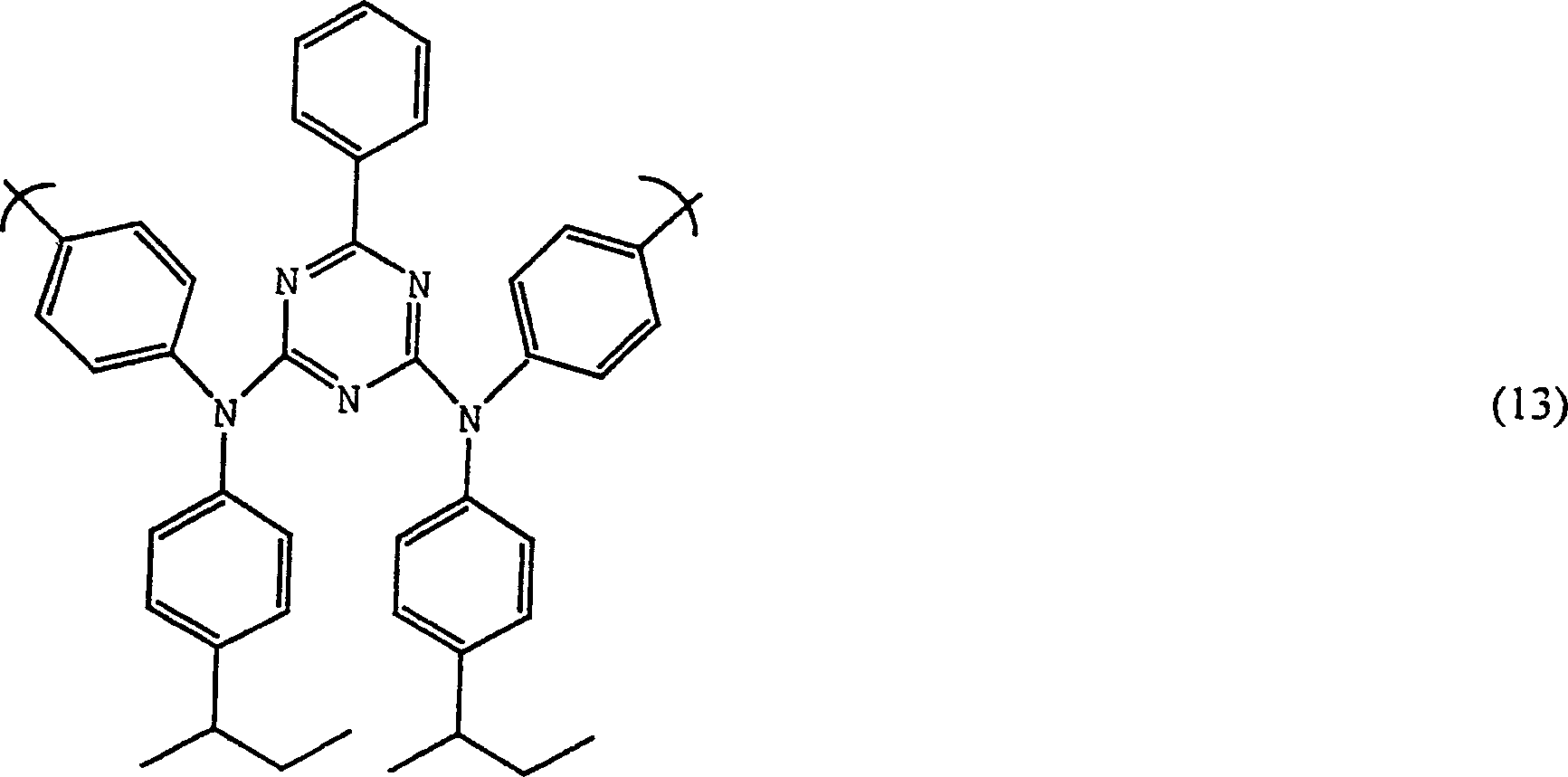
本发明者展望包含通式(12)、(13)或(16)的重复单元的均聚物在光学器件中特别是埸致发光器件中可用作电子输送材料。The present inventors envisage that homopolymers comprising repeating units of general formula (12), (13) or (16) can be used as electron transport materials in optical devices, especially electroluminescent devices.
本文还提到国际专利公开No.WO/0055927,其内容已列入本文供参考。可以预期,根据本发明的重复单元如通式(12)、(13)或(16)特别是通式(12)所示的重复单元可用作电荷(空穴或电子)输送材料和/或作为根据WO/0055927的聚合物发光体。Reference is also made to International Patent Publication No. WO/0055927, the contents of which are incorporated herein by reference. It can be expected that the repeating unit according to the present invention, such as the repeating unit represented by the general formula (12), (13) or (16), especially the general formula (12), can be used as a charge (hole or electron) transport material and/or As a polymer emitter according to WO/0055927.
制备包含通式(12)或(13)结构单元或重复单元的聚合物的一般方法的第一步骤如下所示:The first step of a general process for the preparation of polymers comprising structural or repeating units of general formula (12) or (13) is as follows:
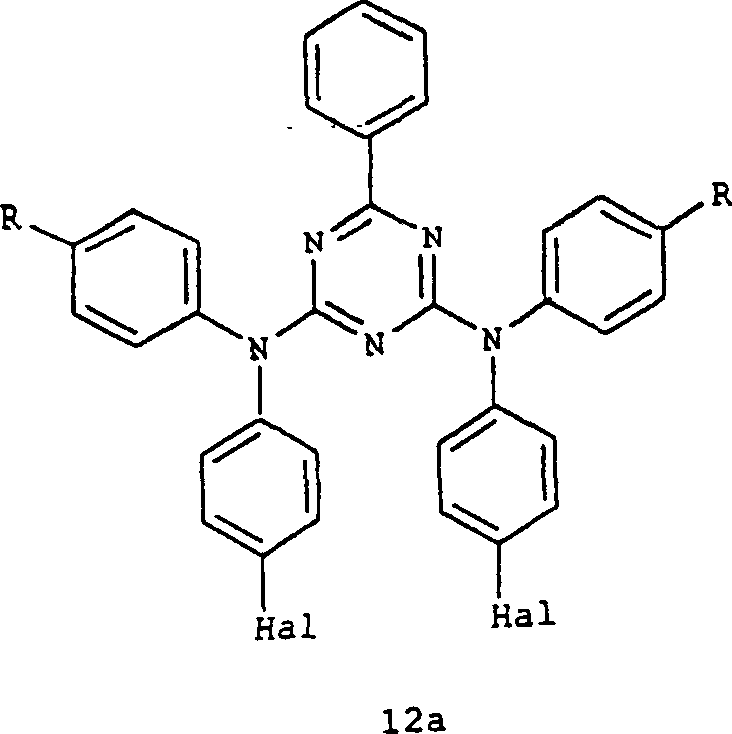
产物12a或12b可用于为获得根据第一个实施方案的第二方面的聚合物的任何一个聚合反应中。The product 12a or 12b can be used in any one of the polymerization reactions to obtain the polymer according to the second aspect of the first embodiment.
在上述反应示意图中,各个Hal优选为Br。In the above reaction scheme, each Hal is preferably Br.
根据第一个实施方案第二方面的优选聚合物是共聚物。可以预期,这类聚合物能在光学器件特别是埸致发光器件中用来输送电子。同时,如同能输送电子一样,这类聚合物也能输送质子和/或使质子与电子相结合而发光。Preferred polymers according to the second aspect of the first embodiment are copolymers. Such polymers are expected to be useful for transporting electrons in optical devices, particularly electroluminescent devices. At the same time, as well as electrons, such polymers can also transport protons and/or combine protons with electrons to emit light.
根据第一个实施方案第一或第二方面的聚合物分子中的单体数优选至少为100,更优选至少为150。聚合物分子长度的上限为约300个单体,尽管聚合物分子长度可高达1000个单体。The number of monomers in the polymer molecule according to the first or second aspect of the first embodiment is preferably at least 100, more preferably at least 150. The upper limit of polymer molecular length is about 300 monomers, although polymer molecular lengths can be as high as 1000 monomers.
在第二个优选实施方案中,该聚合物包括包含引发剂芯或芯单元和支化单元的树枝状聚合物。优选的是,一个或多个结构单元包含芯单元。最优选的是,该聚合物具有单一结构单元。In a second preferred embodiment, the polymer comprises a dendrimer comprising an initiator core or core unit and a branching unit. Preferably, one or more of the structural units comprises a core unit. Most preferably, the polymer has a single structural unit.
根据第二个实施方案,树枝状聚合物更优选包含支化单元,特别是一种类型的支化单元,最优选的支化单元是如式(9)所示,经取代或未经取代的单元:According to a second embodiment, the dendritic polymer more preferably comprises branching units, in particular one type of branching unit, most preferred branching units are substituted or unsubstituted as shown in formula (9) unit:
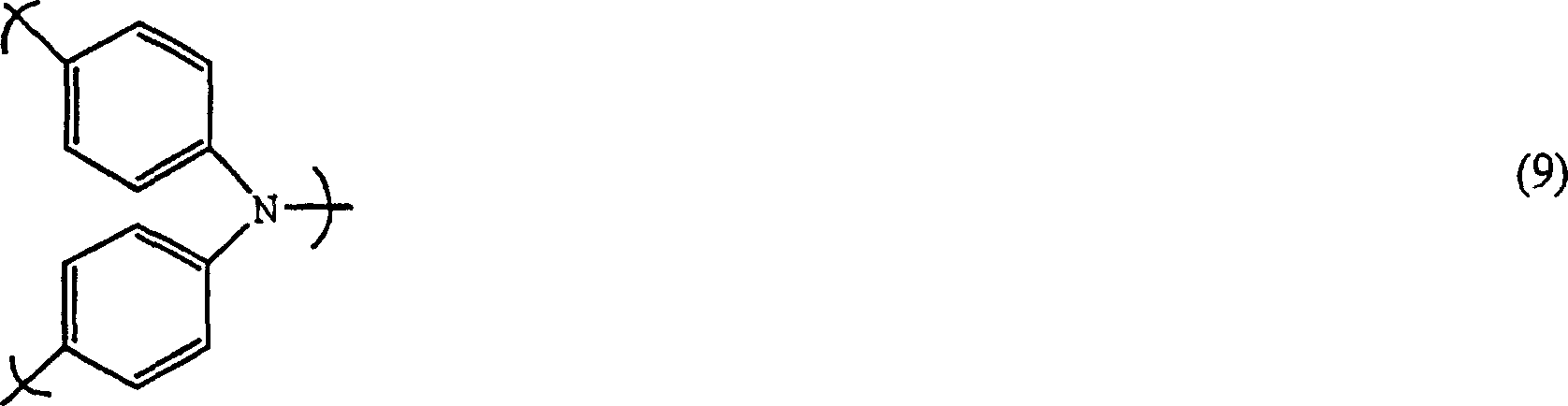
根据本发明第二个实施方案优选的树枝状聚合物是第一至第十代树枝状聚合物。Preferred dendrimers according to the second embodiment of the invention are dendrimers of the first to tenth generation.
在第二个实施方案的第一方面中,一个或多个结构单元包括Arh(NAr2)3,其中各个N直接与Arh相连,各个(NAr2)是相同或不相同的。优选的是,各个(NAr2)是相同的、经取代或未经取代的苯基基团。如上所述,可通过对各个(NAr2)进行选择来调整聚合物的带隙。In a first aspect of the second embodiment, the one or more structural units comprise Ar h (NAr 2 ) 3 , wherein each N is directly attached to Ar h and each (NAr 2 ) is the same or different. Preferably, each (NAr 2 ) is the same, substituted or unsubstituted phenyl group. As described above, the band gap of the polymer can be adjusted by selecting each (NAr 2 ).
优选的是在第二个实施方案的第一方面中,Arh包括如式(5)所示的基团:It is preferred that in the first aspect of the second embodiment, Ar h comprises a group represented by formula (5):
最优选的第二个实施方案的第一方面,聚合物包括包含如式(6)所示基团的单一结构单元:In the first aspect of the most preferred second embodiment, the polymer comprises a single structural unit comprising a group represented by formula (6):

其中结构单元包含芯单元。Wherein the structural unit comprises a core unit.
在第二个实施方案的第二方面中,结构单元包含Arh(NAr2)2Ar”,其中Ar”是经取代或未经取代的芳基或杂芳基基团,各个(NAr2)是相同或不相同的。优选的是,如第二个实施方案的第一方面那样,各个(NAr2)是相同的,并是经取代或未经取代的苯基基团。In a second aspect of the second embodiment, the structural unit comprises Ar h (NAr 2 ) 2 Ar", wherein Ar" is a substituted or unsubstituted aryl or heteroaryl group, each (NAr 2 ) be the same or not. Preferably, each ( NAr2 ) is the same as in the first aspect of the second embodiment and is a substituted or unsubstituted phenyl group.
优选的是,Ar”是经取代或未经取代的苯基基团。Ar”应选择具有空间位阻的并可使聚合物链扭转以便能控制聚合物共轭程度的基团。Preferably, Ar" is a substituted or unsubstituted phenyl group. Ar" should be chosen to be sterically hindered and to twist the polymer chain so that the degree of conjugation of the polymer can be controlled.
在第二实施方案第二方面的最优选的实施方案中,聚合物包括包含如式(7)所示基团的单一结构单元:In the most preferred embodiment of the second aspect of the second embodiment, the polymer comprises a single structural unit comprising a group represented by formula (7):
其中单一结构单元包含芯单元。Wherein the single structural unit comprises a core unit.
制备根据第二实施方案第一方面的聚合物的一般方法涉及以三聚氰胺作为起始材料。使三聚氰胺与碘苯或溴苯进行钯偶联反应以产生如式(10)的结构:A general method of preparing polymers according to the first aspect of the second embodiment involves melamine as a starting material. Make melamine and iodobenzene or bromobenzene carry out palladium coupling reaction to produce the structure such as formula (10):

通过使式(10)化合物的一个或多个环发生卤化优选溴化作用,接着在适当的条件下与(ph)2NB(OH)2反应,可形成树枝状聚合物。采用Suzuki反应容易实施这一反应。可采用相应的方法来制备第二发明的第二方面的聚合物,其中以2,4-二氨基-6-苯基-1,3,5-三嗪(三聚氰胺衍生物)代替三聚氰胺起始材料。Dendrimers can be formed by halogenation, preferably bromination, of one or more rings of a compound of formula (10), followed by reaction with (ph) 2NB (OH) 2 under appropriate conditions. This reaction is easily carried out using the Suzuki reaction. A corresponding method can be used to prepare the polymer of the second aspect of the second invention, wherein the melamine starting material is replaced by 2,4-diamino-6-phenyl-1,3,5-triazine (a melamine derivative) .
在第二个实施方案中,芯单元可包括如式(6)或(7)的结构。在该聚合物中,如式(12)或(15)所示的线形重复单元可连接到芯单元上。这类聚合物可称为“线形的”,但呈树枝状。可以预期,这类聚合物能用作电荷(电子或空穴)输送材料和/或用作发光材料。In a second embodiment, the core unit may include a structure such as formula (6) or (7). In this polymer, a linear repeating unit represented by formula (12) or (15) may be linked to a core unit. Such polymers may be referred to as "linear", but are dendritic. Such polymers are expected to be useful as charge (electron or hole) transport materials and/or as emissive materials.
这类聚合物分子中的单体数优选至少为100,优选为至少150。聚合物分子长度的上限一般为约300个单体,尽管聚合物分子长度可高达1000个单体。The number of monomers in such polymer molecules is preferably at least 100, preferably at least 150. The upper limit of polymer molecular length is generally about 300 monomers, although polymer molecular lengths can be as high as 1000 monomers.
在再一方面,提供了本发明第一个或第二个实施方案的聚合物在光学器件如发光器件,优选埸致发光器件中的应用。该聚合物还可应用于其它器件包括光致发光器件、光电器件和波导器件。聚合物在这些器件中的用途包括通常在埸致发光器件中用作发光材料、空穴输送材料或电子输送材料的用途。该聚合物也可用于染料组合物、纤维或传感器中。In a further aspect there is provided the use of a polymer according to the first or second embodiment of the invention in an optical device such as a light emitting device, preferably an electroluminescent device. The polymer is also applicable to other devices including photoluminescent devices, optoelectronic devices and waveguide devices. The use of polymers in these devices includes their use as light-emitting materials, hole-transporting materials or electron-transporting materials, typically in electroluminescent devices. The polymers can also be used in dye compositions, fibers or sensors.
在本发明中,还提供了包括基体和载持在基体上的、包含根据本发明聚合物的组合物的光学器件。基体本身可以是一个电极或者是任何适于载持组合物的其它类型基材。该组合物可包含在不同层如任选与一层或多层空穴和/或电子输送层相接触的发光层中。当光学器件包括埸致发光器件时,组合物可包含在可以是该聚合物或其它发光聚合物的埸致发光层中。In the present invention there is also provided an optical device comprising a substrate and a composition comprising a polymer according to the invention supported on the substrate. The substrate itself can be an electrode or any other type of substrate suitable for supporting the composition. The composition may be contained in a different layer such as an emissive layer, optionally in contact with one or more hole and/or electron transport layers. When the optical device includes an electroluminescent device, the composition may be included in an electroluminescent layer which may be the polymer or other light emitting polymer.
一种典型的埸致发光器件具有阳极层,阴极层和位于阳极与阴极之间的发光层。任选的是,电荷输送层可置于阳极和/或阴极与发光层之间。A typical electroluminescent device has an anode layer, a cathode layer and a light emitting layer between the anode and cathode. Optionally, a charge transport layer may be placed between the anode and/or cathode and the emissive layer.
包含根据本发明聚合物的共混材料可用作埸致发光器件的发光层。优选的是,根据本发明聚合物与一种或多种空穴和/或电子输送材料相共混,更优选与空穴和/或电子输送聚合物相共混。或者,根据本发明的聚合物可与埸致发光材料,优选任何埸致发光聚合物相共混。Blended materials comprising polymers according to the invention can be used as light-emitting layers of electroluminescent devices. Preferably, the polymers according to the invention are blended with one or more hole and/or electron transport materials, more preferably with hole and/or electron transport polymers. Alternatively, the polymers according to the invention may be blended with an electroluminescent material, preferably any electroluminescent polymer.
可用于制造根据本发明聚合物的几种不同的聚合方法都是已知的。Several different polymerization processes are known which can be used to produce the polymers according to the invention.
一种特别适用的方法已公开在国际专利公开No.WO 00/53656中,该公开内容已列入本文供参考。该公开内容介绍了制备共轭聚合物的方法,该方法包括:使具有至少两个选自硼酸基团、硼酸酯基团和硼烷基团的反应性硼衍生物基团的芳族单体与具有至少两个反应性卤官能基团的芳族单体的反应混合物(a)聚合;或者使具有一个反应性卤官能基团和一个选自硼酸基团、硼酸酯基团和硼烷基团的反应性硼衍生物基团的芳族单体的反应混合物(b)聚合,其中反应混合物包含适用于芳族单体催化聚合的催化量催化剂和足以使反应性硼衍生物官能基团转变为-BX3阴离子基团的一定量有机碱,其中X分别选自F和OH。A particularly suitable method is disclosed in International Patent Publication No. WO 00/53656, the disclosure of which is incorporated herein by reference. This disclosure describes a process for the preparation of conjugated polymers comprising: making an aromatic monomer having at least two reactive boron derivative groups selected from boronic acid groups, boronic acid ester groups and borane groups monomer with a reaction mixture (a) of an aromatic monomer having at least two reactive halofunctional groups; or polymerizing a reaction mixture (a) having one reactive halofunctional group and one A reaction mixture (b) polymerization of an aromatic monomer of a reactive boron derivative group of an alkyl group, wherein the reaction mixture comprises a catalytic amount of a catalyst suitable for the catalytic polymerization of the aromatic monomer and sufficient to render the reactive boron derivative functional group A certain amount of organic base that converts the group into -BX3 anionic group, wherein X is selected from F and OH respectively.
通过该方法制备的根据本发明聚合物是特别有利的。这是由于制备反应的时间短和聚合物中残留催化剂(如钯)量低。The polymers according to the invention produced by this method are particularly advantageous. This is due to the short time of the preparation reaction and the low amount of residual catalyst (eg palladium) in the polymer.
这一聚合方法能很好控制聚合物的分子量。其部分原因是由于这一聚合方法几乎没有副反应,因此可制得有高分子量例如高于100或150个重复单元并可高达300个重复单元或1000个重复单元的聚合物。This polymerization method allows good control of the molecular weight of the polymer. This is partly due to the fact that this polymerization method has few side reactions and thus can produce polymers with high molecular weights, eg above 100 or 150 repeat units and up to 300 repeat units or 1000 repeat units.
应当指出,为除去卤素端基团,根据本发明的聚合物可以是封端的。例如可通过添加卤代苯或苯基硼酸进行这样的封端。实施例3(ii)就是这种封端的例证。It should be noted that the polymers according to the invention may be end-capped in order to remove halogen end groups. Such capping can be performed, for example, by addition of halobenzene or phenylboronic acid. Example 3(ii) is an illustration of this capping.
美国专利5777070已公开了另一种聚合方法。该方法包括使具有选自硼酸、C1-C6硼酸酯、C1-C6硼烷和它们混合物的两个反应性基团的单体与芳族二卤官能单体相接触,或者使具有一个反应性硼酸、硼酸酯或硼烷基团和一个反应性卤官能基团的单体彼此接触。Another polymerization method has been disclosed in US Patent 5777070. The method comprises contacting a monomer having two reactive groups selected from boronic acid, C1 - C6 borate, C1 - C6 borane, and mixtures thereof with an aromatic dihalofunctional monomer, or Monomers having a reactive boronic acid, borate or borane group and a reactive halofunctional group are brought into contact with each other.
“Macromolecules”(31,1099-1103,(1998))介绍了另一种聚合方法。该聚合反应涉及二溴化物单体的镍媒介的偶联反应。该方法通常称为“Yamamoto聚合”。"Macromolecules" (31, 1099-1103, (1998)) describes another polymerization method. The polymerization involves the nickel-mediated coupling of dibromide monomers. This method is often called "Yamamoto aggregation".
实施例1Example 1
三嗪1合成:反应流程图Synthesis of Triazine 1: Reaction Scheme
(i)2-苯基-4,6-二氯三嗪的制备(i) Preparation of 2-phenyl-4,6-dichlorotriazine
参考文献:Helv、Chim.Acta,1950,179,1365References: Helv, Chim. Acta, 1950, 179, 1365
向已冷却到-78℃的氰脲酰氯(10克,54.8毫摩尔)的THF(150毫升)溶液滴加苯基Mg-Br(325毫升,1M THF溶液)。使反应混合物在搅拌下温热至室温。将反应混合物蒸发至干,然后用Et2O-H2O洗涤处理。用醚提取得93%纯度的产物1.02克。将提取后的残留物溶于CH2Cl2中。该溶解物用己烷经柱色谱法(干填充)提纯得到10克呈白色晶体(99.2%)的所需产物。总产率为90%,HPLC纯度为99.2%。1HNMR(CDCl3)为:8.52(2H,dd,J1.4,8.5),7.66(1H,tt,J1.4,2.7,8.8),7.57-7.50(2H,m)。To a solution of cyanuric chloride (10 g, 54.8 mmol) in THF (150 mL) cooled to -78°C was added dropwise phenylMg-Br (325 mL, 1M in THF). The reaction mixture was allowed to warm to room temperature with stirring. The reaction mixture was evaporated to dryness and then worked up with Et2OH2O washes. Extraction with ether gave 1.02 g of product in 93% purity. The extracted residue was dissolved in CH2Cl2 . The lysate was purified by column chromatography (dry packing) with hexane to afford 10 g of the desired product as white crystals (99.2%). The overall yield was 90%, and the HPLC purity was 99.2%. 1 H NMR (CDCl 3 ): 8.52 (2H, dd, J1.4, 8.5), 7.66 (1H, tt, J1.4, 2.7, 8.8), 7.57-7.50 (2H, m).
(ii)单取代苯基三嗪的制备(ii) Preparation of monosubstituted phenyl triazines
参考文献:J.Polym.Sci.Polym Chem.Ed.,1984,22,503References: J. Polym. Sci. Polym Chem. Ed., 1984, 22, 503

将4-仲丁基苯胺(23.6毫升)与Na2CO3(4.69克,44.2毫摩尔)混合物的二噁烷(100毫升)溶液加热至115℃。当温度达到115℃时,于3小时内向该溶液滴加2-苯基-4,6-二氯三嗪(10克,44.2毫摩尔)的二噁烷(100毫升)溶液。通过TLC确认反应完全后,将反应混合物倾入冰中使反应停止,沉淀产物为米黄色固体。用EtOAC/己烷重结晶得到15.7克(79%,HPLC纯度为100%)白色粉末状所需产物。1HNMR(CDCl3)8.43(2H,d,J6.3),7.56-7.44(7H,m),7.32(2H,brs,NH),7.32(4H,d,J8.3),2.66-2.53(2H,m),1.60(4H,m),1.26(6H,d,J6.8),8.0.87(6H,t,J7.4);Gc-MS 452,451,422,197,145,126,104。A solution of a mixture of 4-sec-butylaniline (23.6 mL) and Na2CO3 (4.69 g, 44.2 mmol) in dioxane (100 mL) was heated to 115 °C. When the temperature reached 115°C, a solution of 2-phenyl-4,6-dichlorotriazine (10 g, 44.2 mmol) in dioxane (100 mL) was added dropwise to the solution within 3 hours. After the completion of the reaction was confirmed by TLC, the reaction mixture was poured into ice to stop the reaction, and the precipitated product was a beige solid. Recrystallization from EtOAC/hexanes afforded 15.7 g (79%, 100% HPLC purity) of the desired product as a white powder. 1 HNMR (CDCl 3 ) 8.43 (2H, d, J6.3), 7.56-7.44 (7H, m), 7.32 (2H, brs, NH), 7.32 (4H, d, J8.3), 2.66-2.53 ( 2H, m), 1.60 (4H, m), 1.26 (6H, d, J6.8), 8.0.87 (6H, t, J7.4); Gc-MS 452, 451, 422, 197, 145, 126 , 104.
(iii)三嗪系列I前体的制备:(iii) Preparation of Triazine Series I Precursors:
向单取代苯基三嗪(10.56克,23.4毫摩尔)的DMF(250毫升)溶液加入铜(5.94克,93.48毫摩尔),碳酸钾(25.84克,187.0毫摩尔)、18-冠醚-6(1.24克,4.69毫摩尔)和碘苯(6.55毫升,14.6毫摩尔)。对该反应混合物加热72小时后,使该悬浮液冷却到室温,然后经硅藻土过滤。采用柱色谱法和重结晶对产物进行提纯,得到呈白色固体的所需产物12.93克(92%)。1HNMR(CDCl3)8.02(2H,d,J5.6),7.38(1H,t,J5.2),7.28-7.06(20H,m);13C NMR(CDCl3)12.477,21.961,31.484,41.456,125.557,127.310,127.600,127.928,128.263,128.690,128.789,131.572,137.176,141.377,143.954,145.059,166.513,170.783。To a solution of monosubstituted phenyltriazine (10.56 g, 23.4 mmol) in DMF (250 mL) was added copper (5.94 g, 93.48 mmol), potassium carbonate (25.84 g, 187.0 mmol), 18-crown-6 (1.24 g, 4.69 mmol) and iodobenzene (6.55 mL, 14.6 mmol). After heating the reaction mixture for 72 hours, the suspension was allowed to cool to room temperature and then filtered through celite. The product was purified by column chromatography and recrystallization to give 12.93 g (92%) of the desired product as a white solid. 1 HNMR (CDCl 3 ) 8.02 (2H, d, J5.6), 7.38 (1H, t, J5.2), 7.28-7.06 (20H, m); 13 C NMR (CDCl 3 ) 12.477, 21.961, 31.484, 41.456, 125.557, 127.310, 127.600, 127.928, 128.263, 128.690, 128.789, 131.572, 137.176, 141.377, 143.954, 145.059, 166.513, 170.783.
三嗪I的制备:Preparation of Triazine I:

向前体三嗪1(12.94克,21.4毫摩尔)的DMF(50毫升)溶液添加N-溴代琥珀酰亚胺(7.63克,42.8毫摩尔)溶液,并在室温下搅拌。72小时后,析出白色固体产物。过滤该固体产物并用水洗涤之。然后用石油醚(100-120℃)提纯产物后得到3.66克(22%)所要求的产物。注意,提纯时会损耗50%产物。如选用另一种溶剂效果可能会更好。1HNMR(CDCl3)8.02(2H,d,J7.2),7.42-7.10(19H,m),2.64-2.58(2H,m),1.64-1.57(4H,m),1.27(6H,d,J6.8),0.88(6H,t,J7.2);13C NMR(CDCl3)12.44,21.91,31.48,41.45,118.84,127.524,127.68,128.37,128.77,129.33,131.73,131.85,136.81,140.79,142.90,145.75,166.26,171.03。To a solution of precursor triazine 1 (12.94 g, 21.4 mmol) in DMF (50 mL) was added a solution of N-bromosuccinimide (7.63 g, 42.8 mmol) and stirred at room temperature. After 72 hours, the product precipitated as a white solid. The solid product was filtered and washed with water. The product was then purified with petroleum ether (100-120°C) to give 3.66 g (22%) of the desired product. Note that 50% of the product is lost during purification. It may be better to use another solvent. 1 HNMR (CDCl 3 ) 8.02 (2H, d, J7.2), 7.42-7.10 (19H, m), 2.64-2.58 (2H, m), 1.64-1.57 (4H, m), 1.27 (6H, d, J6.8), 0.88 (6H, t, J7.2); 13 C NMR (CDCl 3 ) 12.44, 21.91, 31.48, 41.45, 118.84, 127.524, 127.68, 128.37, 128.77, 129.33, 131.73, 131.85, 136.89, 140 , 142.90, 145.75, 166.26, 171.03.
实施例2Example 2
三嗪2的合成:反应流程图Synthesis of Triazine 2: Reaction Scheme
(i)2-二苯胺-4,6-二氯三嗪的制备(i) 2-diphenylamine-4, the preparation of 6-dichlorotriazine

向已加热的二苯胺(9.18克,54.2毫摩尔)、碳酸钠(5.75克,54.2毫摩尔)的1,4-二噁烷(100毫升)溶液添加氰脲酰氯(10克,54.2毫摩尔)的1,4-二噁烷(25毫升)溶液。将混合物加热2小时,然后倾入冰水中。析出淡黄色粉状产物。在异丙醇重结晶后得到13.76克(产率80%)2-二苯胺-4,6-二氯三嗪。1HNMR(CDCl3)为:7.20-7.42(10H,m);13CNMR122.23,122.67,124.50,136.64,160.89,165.64。To a heated solution of diphenylamine (9.18 g, 54.2 mmol), sodium carbonate (5.75 g, 54.2 mmol) in 1,4-dioxane (100 mL) was added cyanuric chloride (10 g, 54.2 mmol) 1,4-dioxane (25 mL). The mixture was heated for 2 hours, then poured into ice water. A light yellow powdery product precipitated out. After recrystallization from isopropanol 13.76 g (80% yield) of 2-diphenylamine-4,6-dichlorotriazine were obtained. 1 HNMR (CDCl 3 ): 7.20-7.42 (10H, m); 13 CNMR 122.23, 122.67, 124.50, 136.64, 160.89, 165.64.
(ii)2-二苯胺-4,6-二苯基-三嗪的制备(ii) Preparation of 2-diphenylamine-4,6-diphenyl-triazine
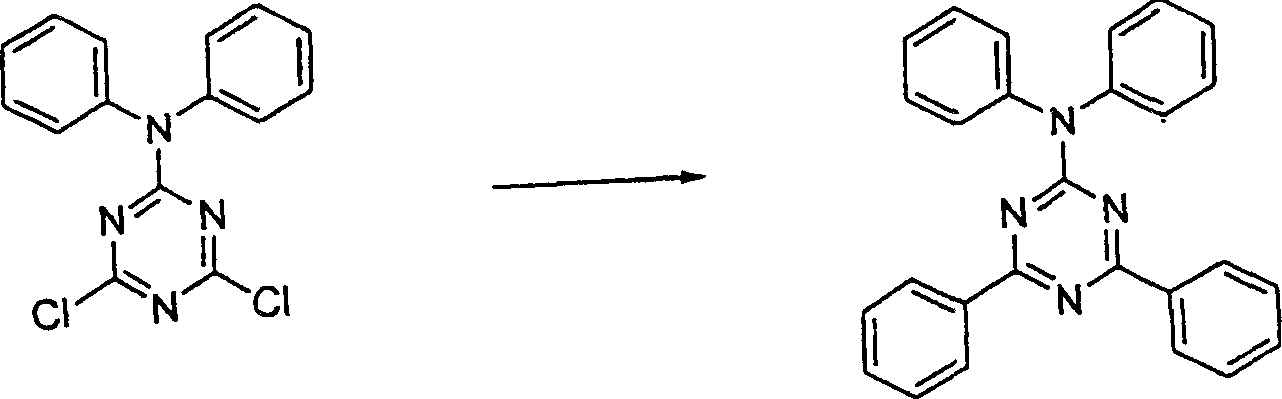
向已冷却到(-78℃)的2-二苯胺-4,6-二苯基-三嗪(13.76克,43.4毫摩尔)在THF(150毫升)中的悬浮液滴加苯基溴化镁(28.92毫升,86.8毫摩尔,3M二乙醚溶液)。在滴加格利雅试剂时使反应混合物的温度保持低于-60℃。当试剂加毕后,将反应混合物温热至室温。在真空下脱除THF后将残留物溶于甲苯中并用10%柠檬酸洗涤。有机相用水洗涤后,经真空浓缩,析出白色粉状产物10.36克(产率60%)。To a suspension of 2-diphenylamine-4,6-diphenyl-triazine (13.76 g, 43.4 mmol) in THF (150 mL) which had been cooled to (-78°C) was added dropwise phenylmagnesium bromide (28.92 mL, 86.8 mmol, 3M solution in diethyl ether). The temperature of the reaction mixture was kept below -60°C during the dropwise addition of the Grignard reagent. When the addition of the reagents was complete, the reaction mixture was allowed to warm to room temperature. After removal of THF under vacuum the residue was dissolved in toluene and washed with 10% citric acid. After the organic phase was washed with water, it was concentrated in vacuo to precipitate 10.36 g of a white powdery product (yield 60%).
(iii)二溴-2-二苯胺-4,6-二苯基三嗪的制备(iii) Preparation of dibromo-2-diphenylamine-4,6-diphenyltriazine
向2-二苯胺-4,6-二苯基-三嗪(500毫克,1.25毫摩尔)的CH2Cl2(10毫升)溶液添加N-溴代琥珀酰亚胺(444毫克,2.5毫摩尔)。在室温下将该反应溶液搅拌4天。GC-MS分析表明反应已进行完全。对反应混合物进行过滤,将滤液蒸发至干,残留物用二噁烷/己烷重结晶。To a solution of 2- diphenylamine -4,6-diphenyl-triazine (500 mg, 1.25 mmol) in CH2Cl2 (10 mL) was added N-bromosuccinimide (444 mg, 2.5 mmol ). The reaction solution was stirred at room temperature for 4 days. GC-MS analysis indicated that the reaction had gone to completion. The reaction mixture was filtered, the filtrate was evaporated to dryness, and the residue was recrystallized from dioxane/hexane.
按比例扩大、选用另一种溶剂Scale up, choose another solvent
将2-二苯胺-4,6-二苯基-三嗪(10.3克,25.87毫摩尔)的DMF(50毫升)和THF(10毫升)溶液加热至70℃直到形成清沏的溶液。在反应混合物冷却至45℃后,添加N-溴代琥珀酰亚胺(9.21克,51.74毫摩尔)。在室温下将反应混合物悬浮液搅拌两天。GC-MS分析显示产物含40%单溴化物质和60%所要求的产物。A solution of 2-diphenylamine-4,6-diphenyl-triazine (10.3 g, 25.87 mmol) in DMF (50 mL) and THF (10 mL) was heated to 70° C. until a clear solution formed. After the reaction mixture was cooled to 45°C, N-bromosuccinimide (9.21 g, 51.74 mmol) was added. The reaction mixture suspension was stirred at room temperature for two days. GC-MS analysis showed the product to be 40% monobrominated species and 60% the desired product.
实施例3Example 3
(i)TFPY-二溴化物的制备(i) Preparation of TFPY-dibromide
在氮气氛下,将甲苯(55毫升),二溴二苯胺(7.26克,22.2毫摩尔),4-碘吡啶(5.00克,24.4毫摩尔),1,10-菲咯啉(0.145克,0.805毫摩尔)、氯化亚铜(I)(0.08克,0.0808毫摩尔),氢氧化钾(片状,9.76克,174毫摩出)装入烧瓶中,然后在117℃下加热过夜。18小时后,TLC分析表明仍残留一些二溴二苯胺。添加另外的0.91克(4.44毫摩尔)4-碘吡啶以及额外的等分催化剂和配体,继续在117℃下加热过夜。Under a nitrogen atmosphere, toluene (55 ml), dibromodiphenylamine (7.26 g, 22.2 mmol), 4-iodopyridine (5.00 g, 24.4 mmol), 1,10-phenanthroline (0.145 g, 0.805 millimole), cuprous (I) chloride (0.08 g, 0.0808 mmol), potassium hydroxide (flaky, 9.76 g, 174 mmol) were charged into a flask, and then heated overnight at 117°C. After 18 hours, TLC analysis showed some dibromodiphenylamine remained. An additional 0.91 g (4.44 mmol) of 4-iodopyridine was added along with an additional aliquot of catalyst and ligand and heating at 117°C was continued overnight.
使反应混合物冷却至室温,然后用甲苯(100毫升)和水(100毫升)处理。滤出固体残留物。The reaction mixture was cooled to room temperature, then treated with toluene (100 mL) and water (100 mL). The solid residue was filtered off.
移出水相,用甲苯(2×30毫升)洗涤。合并甲苯层并用水(3×100毫升)洗至中性,然后用2N盐酸(2×50毫升)处理,再用水洗涤。产物以酸式盐开始析出。用乙醚(3×50毫升)洗涤悬浮液后用2N氢氧化钠碱化。用二氯甲烷(3×20毫升)提取黄色固体沉淀。合并二氯甲烷层,用水(100毫升)洗涤,再用饱和氯化钠(100毫升)洗涤,然后在MgSO4上干燥,过滤,蒸去溶剂得到9克深色油状产物。将油状产物与20毫升甲醇一起研制可得到白色固体(5.28克)。用热甲醇处理该固体,然后将固体滤出。母液经浓缩可得3.89克产物,经异丙醇重结晶后可得到2.8克白色固体(得率31%)。The aqueous phase was removed and washed with toluene (2 x 30 mL). The toluene layers were combined and washed with water (3 x 100 mL) until neutral, then treated with 2N hydrochloric acid (2 x 50 mL) and washed with water. The product started to precipitate out as an acid salt. The suspension was washed with ether (3 x 50 mL) and basified with 2N sodium hydroxide. The precipitated yellow solid was extracted with dichloromethane (3 x 20 mL). The combined dichloromethane layers were washed with water (100 mL) and saturated NaCl (100 mL), then dried over MgSO4, filtered and the solvent evaporated to give 9 g of product as a dark oil. Trituration of the oily product with 20 mL of methanol afforded a white solid (5.28 g). The solid was treated with hot methanol and the solid was filtered off. The mother liquor was concentrated to obtain 3.89 g of product, and 2.8 g of white solid (yield 31%) could be obtained after recrystallization from isopropanol.
1HNMR(CDCl3)8.28(2H,d,J6.8),7.47(4H,dAB,J8.8),7.03(4H,dAB J8.8),6.75(2H,d,J6);13CNMR(CDCl3)153.2,150.7,144.3,133.2,128.0,118.9,113.7。 1 HNMR (CDCl 3 ) 8.28 (2H, d, J6.8), 7.47 (4H, dAB, J8.8), 7.03 (4H, dAB J8.8), 6.75 (2H, d, J6); 13 CNMR ( CDCl 3 ) 153.2, 150.7, 144.3, 133.2, 128.0, 118.9, 113.7.
(ii)TFPY-F8共聚物的制备(ii) Preparation of TFPY-F8 copolymer
在配置有与机械搅拌器相连的玻璃搅棒和与氮气管线连接的冷凝器的250毫升三颈RBF中装入F8-二硼酸酯(4.7734克,9毫摩尔),F8-二溴化物(3.9490克,7.2毫摩尔),TFPY-二溴化物(0.7276克,1.8毫摩尔)和甲苯(45毫升)。在室温和氮气氛下搅拌该溶液10分钟。加入催化剂四(三苯基膦)钯(31.4毫克)。10分钟后,加入四乙基氢氧化铵(20重量%水溶液30毫升)。将反应混合物加热至115℃,保持回流状态过夜。添加溴苯(1.5毫升),在搅拌下回流45分钟。添加苯基硼酸(1.5克),让反应溶液再回流1小时30分钟,然后冷却至室温。A 250 mL three-neck RBF equipped with a glass stirrer connected to a mechanical stirrer and a condenser connected to a nitrogen line was charged with F8-diboronate (4.7734 g, 9 mmol), F8-dibromide ( 3.9490 g, 7.2 mmol), TFPY-dibromide (0.7276 g, 1.8 mmol) and toluene (45 mL). The solution was stirred at room temperature under a nitrogen atmosphere for 10 minutes. The catalyst tetrakis(triphenylphosphine)palladium (31.4 mg) was added. After 10 minutes, tetraethylammonium hydroxide (30 mL of a 20% by weight aqueous solution) was added. The reaction mixture was heated to 115°C and held at reflux overnight. Bromobenzene (1.5 mL) was added and refluxed for 45 minutes with stirring. Phenylboronic acid (1.5 g) was added and the reaction solution was refluxed for an additional 1 hour and 30 minutes, then cooled to room temperature.
使反应产生的聚合物在3升甲醇中沉析,然后通过在115℃加热几小时使沉淀再溶于甲苯(300毫升)中。添加二乙基二硫代氨基甲酸钠盐三水合物溶液(10克溶于110毫升水中),然后在氮气氛下在65℃搅拌过夜。The polymer produced by the reaction was precipitated in 3 liters of methanol and then redissolved in toluene (300 mL) by heating at 115° C. for several hours. Diethyldithiocarbamate sodium salt trihydrate solution (10 g dissolved in 110 ml water) was added, followed by stirring overnight at 65°C under a nitrogen atmosphere.
将混合物冷却至室温,使水相与有机相分离。重复用二乙基二硫代氨基甲酸钠盐三水合物溶液(10克溶于110毫升水中)洗涤,并在氮气氛下于65℃再搅拌4小时。The mixture was cooled to room temperature and the aqueous and organic phases were separated. Washing with diethyldithiocarbamate sodium salt trihydrate solution (10 g dissolved in 110 ml water) was repeated and stirred at 65° C. for a further 4 hours under a nitrogen atmosphere.
将混合物冷却至室温,使水相与有机相分离。有机相用水(250毫升)洗涤。The mixture was cooled to room temperature and the aqueous and organic phases were separated. The organic phase was washed with water (250 mL).
将水相与有机相分离,1/5有机相通过60克硅藻土过滤并用甲苯洗涤。溶剂经浓缩至70毫升,然后滴入到600毫升甲醇中。析出的聚合物经过滤、干燥,得到0.92克聚合产物,Mp为260000。其余的有机相(4/5)也用60克硅藻土过滤,用甲苯洗涤。溶剂浓缩至250毫升,然后滴入2.5升甲醇中。得到的干燥聚合物为5.39克,Mp为256000。The aqueous phase was separated from the organic phase and 1/5 of the organic phase was filtered through 60 g of celite and washed with toluene. The solvent was concentrated to 70 ml, and then dropped into 600 ml of methanol. The precipitated polymer was filtered and dried to obtain 0.92 g of a polymer product with an Mp of 260,000. The remaining organic phase (4/5) was also filtered through 60 g of celite and washed with toluene. The solvent was concentrated to 250 ml, and then dropped into 2.5 liters of methanol. The dry polymer obtained was 5.39 g with a Mp of 256,000.
根据上述实施例和聚合方法中提供的相关内容,技术熟练人员能够制备根据本发明的其它聚合物,例如:According to the relevant content provided in the foregoing examples and polymerization methods, those skilled in the art can prepare other polymers according to the present invention, for example:
1)、F8-二硼酸酯(50%),F8-二溴化物(30%)和三嗪1(20%实施例1中制备的三嗪)的聚合。1) Polymerization of F8-diboronate (50%), F8-dibromide (30%) and triazine 1 (20% of the triazine prepared in Example 1).
2)、F8-二硼酸酯(50%),F8-二溴化物(40%)和三嗪1(10%)的聚合。该聚合步骤与实施例(3ii)相同,但用三嗪1代替TFPY。2), Polymerization of F8-diboronate (50%), F8-dibromide (40%) and triazine 1 (10%). The polymerization procedure was the same as example (3ii), but using triazine 1 instead of TFPY.
3)、F8-二硼酸酯(50%)和三嗪1(50%)的聚合。3), Polymerization of F8-diboronate (50%) and Triazine 1 (50%).
实施例4Example 4
光学器件optical instrument
一种适用的器件结构如图1所示。阳极2是载持在玻璃或塑料基体1上的透明的铟-锡氧化物(“ITO”)层。阳极2层的厚度为1000-2000,通常为约1500。阴极5是厚度约1500的Ca层。在两电极之间是厚度至约1000的发光层4。发光层4包含0.5-30(重量)%的本发明聚合物,其余为由空穴和/或电子输送材料和/或发光材料组成的发光层。有利的是,该器件包括厚度约1000的PEDOT空穴输送材料层3。层6是适当厚度的包封层。A suitable device structure is shown in Figure 1. Anode 2 is a transparent indium-tin oxide ("ITO") layer supported on a glass or plastic substrate 1 . The thickness of the anode 2 layer is 1000-2000 Å, typically about 1500 Å. The cathode 5 is a layer of Ca with a thickness of about 1500 Å. Between the two electrodes is a light-emitting layer 4 with a thickness of up to about 1000 Å. The emitting layer 4 contains 0.5-30% by weight of the polymers according to the invention, the balance being an emitting layer consisting of hole and/or electron transport materials and/or emitting materials. Advantageously, the device comprises a layer 3 of PEDOT hole transport material with a thickness of about 1000 Å. Layer 6 is an encapsulation layer of appropriate thickness.
Claims (38)



Applications Claiming Priority (6)
| Application Number | Priority Date | Filing Date | Title |
|---|---|---|---|
| GBGB0000095.0A GB0000095D0 (en) | 2000-01-05 | 2000-01-05 | Polymers their preparation and uses |
| GB0000095.0 | 2000-01-05 | ||
| US18573700P | 2000-02-29 | 2000-02-29 | |
| US60/185,737 | 2000-02-29 | ||
| GB0005842.0 | 2000-03-10 | ||
| GBGB0005842.0A GB0005842D0 (en) | 2000-03-10 | 2000-03-10 | Copoymer |
Publications (2)
| Publication Number | Publication Date |
|---|---|
| CN1419574A CN1419574A (en) | 2003-05-21 |
| CN1205247C true CN1205247C (en) | 2005-06-08 |
Family
ID=27255451
Family Applications (1)
| Application Number | Title | Priority Date | Filing Date |
|---|---|---|---|
| CNB018053394A Expired - Fee Related CN1205247C (en) | 2000-01-05 | 2001-01-04 | Polymers, their preparation and uses |
Country Status (8)
| Country | Link |
|---|---|
| EP (1) | EP1246860B1 (en) |
| JP (1) | JP3886381B2 (en) |
| KR (1) | KR100533128B1 (en) |
| CN (1) | CN1205247C (en) |
| AT (1) | ATE284910T1 (en) |
| AU (1) | AU2385001A (en) |
| DE (1) | DE60107807T2 (en) |
| WO (1) | WO2001049769A1 (en) |
Families Citing this family (37)
| Publication number | Priority date | Publication date | Assignee | Title |
|---|---|---|---|---|
| SG92833A1 (en) | 2001-03-27 | 2002-11-19 | Sumitomo Chemical Co | Polymeric light emitting substance and polymer light emitting device using the same |
| US7629429B2 (en) | 2001-05-11 | 2009-12-08 | Cambridge Display Technology Limited | Substituted fluorene polymers their preparation and uses |
| JP2003007475A (en) * | 2001-06-20 | 2003-01-10 | Honda Motor Co Ltd | Organic electroluminescence device |
| GB0125620D0 (en) | 2001-10-25 | 2001-12-19 | Cambridge Display Tech Ltd | Monomers and low band gap polymers formed therefrom |
| SG124249A1 (en) | 2001-12-07 | 2006-08-30 | Sumitomo Chemical Co | New polymer and polymer light-emitting device using the same |
| GB0204989D0 (en) | 2002-03-04 | 2002-04-17 | Opsys Ltd | Phosphorescent compositions and organic light emitting devices containing them |
| DE10392958T5 (en) | 2002-07-22 | 2005-08-11 | Sumitomo Chemical Co., Ltd. | Copolymer and polymeric light-emitting device using the same |
| TWI280973B (en) | 2002-08-28 | 2007-05-11 | Sumitomo Chemical Co | Polymer compound and polymer light-emitting device using the same |
| DE60332638D1 (en) * | 2002-09-03 | 2010-07-01 | Cambridge Display Tech Ltd | Method for producing an optical device |
| DE10249723A1 (en) | 2002-10-25 | 2004-05-06 | Covion Organic Semiconductors Gmbh | Conjugated polymers containing arylamine units, their preparation and use |
| GB0226010D0 (en) | 2002-11-08 | 2002-12-18 | Cambridge Display Tech Ltd | Polymers for use in organic electroluminescent devices |
| JP5230942B2 (en) * | 2003-12-13 | 2013-07-10 | メルク パテント ゲーエムベーハー | Oligomer and polymer |
| US7960587B2 (en) | 2004-02-19 | 2011-06-14 | E.I. Du Pont De Nemours And Company | Compositions comprising novel compounds and electronic devices made with such compositions |
| US7365230B2 (en) | 2004-02-20 | 2008-04-29 | E.I. Du Pont De Nemours And Company | Cross-linkable polymers and electronic devices made with such polymers |
| JP4736471B2 (en) * | 2004-02-26 | 2011-07-27 | 住友化学株式会社 | Polymer compound and polymer light emitting device using the same |
| JP5214237B2 (en) | 2004-03-31 | 2013-06-19 | イー・アイ・デュポン・ドウ・ヌムール・アンド・カンパニー | Triarylamine compounds used as charge transport materials |
| DE102004020299A1 (en) | 2004-04-26 | 2005-12-01 | Covion Organic Semiconductors Gmbh | Conjugated polymers, their preparation and use |
| EP1627891A1 (en) | 2004-08-11 | 2006-02-22 | Covion Organic Semiconductors GmbH | Polymers for use in organic electroluminescent devices |
| DE112005003100T5 (en) | 2004-12-03 | 2008-01-24 | Sumitomo Chemical Co., Ltd. | Triarylamine-containing polymers and electronic devices |
| TW200724558A (en) | 2005-10-07 | 2007-07-01 | Sumitomo Chemical Co | Polymer compound and polymer light-emitting device using the same |
| GB2433509A (en) * | 2005-12-22 | 2007-06-27 | Cambridge Display Tech Ltd | Arylamine polymer |
| CN101573324B (en) | 2006-12-08 | 2013-11-20 | 新加坡科技研究局 | Arylamine compounds and electronic devices |
| JP5399236B2 (en) * | 2007-03-26 | 2014-01-29 | 新日鉄住金化学株式会社 | Compound for organic electroluminescence device and organic electroluminescence device |
| TW200907016A (en) * | 2007-03-27 | 2009-02-16 | Nippon Steel Chemical Co | Compound for organic electroluminescent device and organic electroluminescent device |
| JP2013508375A (en) | 2009-10-19 | 2013-03-07 | イー・アイ・デュポン・ドウ・ヌムール・アンド・カンパニー | Triarylamine compounds for electronic applications |
| CN102574773B (en) | 2009-10-19 | 2014-09-17 | E.I.内穆尔杜邦公司 | Triarylamine compounds for electronic applications |
| JP5609614B2 (en) * | 2010-12-15 | 2014-10-22 | 東ソー株式会社 | Novel arylamine dendrimer-like compound, production method thereof and use thereof |
| KR101853013B1 (en) * | 2011-01-17 | 2018-04-30 | 삼성전자주식회사 | Polymer and organic light emitting diode comprising the same |
| JP6194881B2 (en) * | 2012-03-08 | 2017-09-13 | 日産化学工業株式会社 | Resin coating agent |
| CN104910372B (en) * | 2015-05-07 | 2017-10-20 | 华南理工大学 | Aryl polyphenol and the injection of 1,3,5 s-triazine cross-linked polymer holes and transmission material and preparation method and application |
| JP6769020B2 (en) * | 2015-09-30 | 2020-10-14 | 日立化成株式会社 | Charge transporting material, ink composition using the material, organic electronics element, organic electroluminescence element, display element, lighting device, and display device. |
| JP7081898B2 (en) * | 2016-04-28 | 2022-06-07 | メルク パテント ゲゼルシャフト ミット ベシュレンクテル ハフツング | Organic electroluminescence elements, display devices and lighting devices |
| CN108117525B (en) * | 2016-11-30 | 2020-07-07 | 武汉尚赛光电科技有限公司 | Organic luminescent material containing triazinyl and anilino, preparation method, application and device thereof |
| CN113150251A (en) * | 2021-03-30 | 2021-07-23 | 广州万物物联科技有限公司 | Red light polymer electroluminescent material and preparation method thereof |
| CN113201120A (en) * | 2021-03-30 | 2021-08-03 | 广州万物物联科技有限公司 | Red light polymer electroluminescent material and preparation method thereof |
| CN113512177A (en) * | 2021-03-30 | 2021-10-19 | 广州万物物联科技有限公司 | Red light polymer and preparation method thereof |
| CN113278135A (en) * | 2021-03-30 | 2021-08-20 | 广州万物物联科技有限公司 | Green light polymer electroluminescent material and preparation method thereof |
Family Cites Families (3)
| Publication number | Priority date | Publication date | Assignee | Title |
|---|---|---|---|---|
| WO1997009394A1 (en) * | 1995-09-04 | 1997-03-13 | Hoechst Research & Technology Deutschland Gmbh & Co. Kg | Polymers containing triarylamine units for use as electroluminescent materials |
| US6309763B1 (en) * | 1997-05-21 | 2001-10-30 | The Dow Chemical Company | Fluorene-containing polymers and electroluminescent devices therefrom |
| US5777070A (en) * | 1997-10-23 | 1998-07-07 | The Dow Chemical Company | Process for preparing conjugated polymers |
-
2001
- 2001-01-04 DE DE60107807T patent/DE60107807T2/en not_active Expired - Lifetime
- 2001-01-04 WO PCT/GB2001/000029 patent/WO2001049769A1/en not_active Ceased
- 2001-01-04 AT AT01900173T patent/ATE284910T1/en not_active IP Right Cessation
- 2001-01-04 KR KR10-2002-7008756A patent/KR100533128B1/en not_active Expired - Fee Related
- 2001-01-04 JP JP2001550309A patent/JP3886381B2/en not_active Expired - Fee Related
- 2001-01-04 CN CNB018053394A patent/CN1205247C/en not_active Expired - Fee Related
- 2001-01-04 AU AU23850/01A patent/AU2385001A/en not_active Abandoned
- 2001-01-04 EP EP01900173A patent/EP1246860B1/en not_active Expired - Lifetime
Also Published As
| Publication number | Publication date |
|---|---|
| EP1246860A1 (en) | 2002-10-09 |
| DE60107807T2 (en) | 2005-12-22 |
| KR20020080362A (en) | 2002-10-23 |
| AU2385001A (en) | 2001-07-16 |
| CN1419574A (en) | 2003-05-21 |
| DE60107807D1 (en) | 2005-01-20 |
| JP2004500455A (en) | 2004-01-08 |
| ATE284910T1 (en) | 2005-01-15 |
| WO2001049769A1 (en) | 2001-07-12 |
| KR100533128B1 (en) | 2005-12-02 |
| EP1246860B1 (en) | 2004-12-15 |
| JP3886381B2 (en) | 2007-02-28 |
Similar Documents
| Publication | Publication Date | Title |
|---|---|---|
| CN1205247C (en) | Polymers, their preparation and uses | |
| CN1252215C (en) | Luminescent polymer | |
| CN1094964C (en) | Conjugated polymers containing heterospiro atoms and their use as electroluminescent materials | |
| CN1263754C (en) | Monomer for use in preparation of a polymer to be used in optical devices | |
| CN1882632A (en) | Crosslinkable substituted fluorene compounds and conjugated oligomers or polymers based thereon | |
| CN1153796C (en) | Oligo-p-phenylene-unit-containing polymers, process for their production and their use | |
| EP2373759B1 (en) | Functionalized polyfluorenes for use in optoelectronic devices | |
| CN1419575A (en) | Soluble poly(aryl-oxadiazole) conjugated polymers | |
| CN1768090A (en) | Polymers | |
| CN1526689A (en) | Diphenyl anthracene derivate and organic electroluminescent apparatus using diphenyl anthracene derivate | |
| CN1853448A (en) | Electroluminescent device | |
| CN1886443A (en) | Crosslinkable arylamine compounds and conjugated oligomers or polymers based on them | |
| CN1116376C (en) | Conjugated polymers with hetero spiro-atoms and their use as electroluminescent materials | |
| CN1643107A (en) | Polymerisable compositions and organic light-emitting devices containing them | |
| US6512082B2 (en) | Polymers, their preparation and uses | |
| CN1524100A (en) | Electroactive fluorene copolymers and devices fabricated from such copolymers | |
| CN1800298A (en) | Blue-emitting polymer and organic electroluminescent device using the same | |
| EP2225346A1 (en) | Emissive polymeric materials for optoelectronic devices | |
| CN1507464A (en) | Electroactive fluorene polymers having perfluoroalkyl groups, methods of preparing such polymers, and devices fabricated from such polymers | |
| CN1243778C (en) | aggregation method | |
| CN1582310A (en) | Process for preparing aromatic polymers | |
| US7973126B2 (en) | Emissive polymeric materials for optoelectronic devices | |
| CN101044186A (en) | Synthesis of polynaphthalenes and their use | |
| HK1053322A1 (en) | Luminescent polymer | |
| US8053536B2 (en) | Functionalized polyfluorenes for use in optoelectronic devices |
Legal Events
| Date | Code | Title | Description |
|---|---|---|---|
| C06 | Publication | ||
| PB01 | Publication | ||
| C10 | Entry into substantive examination | ||
| SE01 | Entry into force of request for substantive examination | ||
| C14 | Grant of patent or utility model | ||
| GR01 | Patent grant | ||
| CF01 | Termination of patent right due to non-payment of annual fee | ||
| CF01 | Termination of patent right due to non-payment of annual fee |
Granted publication date: 20050608 Termination date: 20200104 |