CN1221309C - Apparatus for corpuscle field and flow separation by sound field force and other active force - Google Patents
Apparatus for corpuscle field and flow separation by sound field force and other active force Download PDFInfo
- Publication number
- CN1221309C CN1221309C CN 00130562 CN00130562A CN1221309C CN 1221309 C CN1221309 C CN 1221309C CN 00130562 CN00130562 CN 00130562 CN 00130562 A CN00130562 A CN 00130562A CN 1221309 C CN1221309 C CN 1221309C
- Authority
- CN
- China
- Prior art keywords
- reaction tank
- mounting medium
- electric signal
- force
- piezoelectric sensor
- Prior art date
- Legal status (The legal status is an assumption and is not a legal conclusion. Google has not performed a legal analysis and makes no representation as to the accuracy of the status listed.)
- Expired - Fee Related
Links
Images

Landscapes
- Physical Or Chemical Processes And Apparatus (AREA)
Abstract
本发明公开了一种在场流分离中利用声场力识别物质的装置及其方法,该装置包括:一个反应池包括至少一个入口端口和至少一个出口端口,所述的反应池具有这样的结构特点,即当载体介质被诱导通过该反应池时,在反应池内不同位置所述的载体介质的移动速度是不一样的;至少有一个压电传感器组成了所述反应池的一部分,其中所述的压电传感器可以通过由电信号发生器产生的至少一路电信号激发并产生声波,从而导致至少一个施加于所述载体介质中物质上的声场力,该声场力具有垂直于载体介质移动方向的分量。本发明也公开一种在场流分离中利用声场力识别物质的方法。
The invention discloses a device and method for identifying substances by using acoustic field force in field flow separation. The device includes: a reaction pool includes at least one inlet port and at least one outlet port, and the reaction pool has such structural characteristics, That is, when the carrier medium is induced to pass through the reaction cell, the moving speed of the carrier medium at different positions in the reaction cell is different; at least one piezoelectric sensor forms a part of the reaction cell, wherein the pressure The electrical sensor can be excited by at least one electrical signal generated by the electrical signal generator and generate an acoustic wave, resulting in at least one acoustic field force exerted on the substance in the carrier medium, the acoustic field force having a component perpendicular to the direction of movement of the carrier medium. The invention also discloses a method for identifying substances by using acoustic field force in field flow separation.
Description
技术领域technical field
这项发明与场流分离领域相关。特别的,这项发明披露了在场流分离中使用声场力、或是辅之以电泳力或介电电泳力的声场力识别物质的装置和方法。This invention is related to the field of field flow separation. In particular, this invention discloses a device and method for identifying substances using acoustic field force in field-flow separation, or acoustic field force supplemented by electrophoretic force or dielectrophoretic force.
背景技术Background technique
工程技术领域对电-场流分离(E-FFF)和介电-场流分离(DEP-FFF)的方法很熟悉。例如,美国专利第5240618号披露了一种电场流分离的方法,美国专利第5888370号、5993630号和5993632号披露了使用传统和拓展的介电电泳方法进行场流分离的方法和装置。在电-场流分离中,电泳力用于平衡沉降力(运用于大微粒,微粒尺寸达到几个微米或更大)和/或扩散力(运用于小微粒),并控制微粒在流体速度分布中的平衡位置(或平衡分布)。具有不同电荷数、尺寸、密度的微粒分布在不同的平衡位置(或不同的分布带),并以不同的速度通过反应池,从而可以被分离成不同的部分。在介电-场流分离方法(例如Huang et al,Introducing dielelectrophoresis as a new force field for field-flow fractionation,Biophys J.1997 Aug:73(2):1118-29;Markx et al,applications of dielectrophoresis inbiotechnology,Trends Biotechnol,1997 Oct,15(10):426-32以及Wang et al,Separation of polystyrene mircrobeads using dielectrophoretic/gravitationalfield-flow-fractionation,Biophys J,1998 May:74(5):2689-701)中,介电电泳力的竖直分量用于平衡沉降力并控制微粒在流体中的平衡位置。具有不同介电性质的微粒分布在流体的不同高度处并以不同的速度运动。被导入到电-场流分离或是介电-场流分离反应池内的微粒混合物可以根据微粒离开反应池的时间分离出几个亚类。电-场流分离方法的原理在分离胶质吸附复合物上得到了证实。介电-场流分离方法的原理在分离人工合成聚苯乙烯珠体和生物细胞时得到了证实。The engineering field is familiar with the methods of electric-field-flow separation (E-FFF) and dielectric-field-flow separation (DEP-FFF). For example, US Patent No. 5,240,618 discloses a method for electric field flow separation, and US Patent Nos. 5,888,370, 5,993,630 and 5,993,632 disclose methods and devices for field flow separation using traditional and expanded dielectrophoresis methods. In electro-field flow separation, the electrophoretic force is used to balance the sedimentation force (applied to large particles, the particle size reaches a few microns or larger) and/or the diffusion force (applied to small particles), and to control the particle velocity distribution in the fluid The equilibrium position (or equilibrium distribution) in . Particles with different charges, sizes, and densities are distributed in different equilibrium positions (or different distribution bands), and pass through the reaction cell at different speeds, so that they can be separated into different parts. In the dielectric-field flow separation method (such as Huang et al, Introducing dielectrophoresis as a new force field for field-flow fractionation, Biophys J.1997 Aug: 73 (2): 1118-29; Markx et al, applications of dielectrics in biotechnology , Trends Biotechnol, 1997 Oct, 15(10): 426-32 and Wang et al, Separation of polystyrene microbeads using dielectric/gravitationalfield-flow-fractionation, Biophys J, 1998 May: 74(5): 2689-701), The vertical component of the dielectrophoretic force is used to balance the settling force and control the equilibrium position of the particles in the fluid. Particles with different dielectric properties are distributed at different heights in the fluid and move at different speeds. Particle mixtures introduced into electro-field flow separation or dielectric-field flow separation cells can be separated into several subclasses according to the time the particles leave the cell. The principle of the electro-field flow separation method was demonstrated for the separation of colloid-adsorbed complexes. The principle of the dielectric-field flow separation method was demonstrated for the separation of synthetic polystyrene beads and biological cells.
但是,现存的用于场流分离的方法和装置存在以下的局限。对于电-场流分离,电极极化作用是一个很显著的问题,因为所加的绝大多数电压都在通过电极/介质界面时损失了。而且,电荷只有在某些特例中才能作为分离的参数。相似的,对于介电-场流分离,微粒的介电性质也只在某些特例中才能作为分离的参数。而且在微粒的介电-场流分离中,正向介电电泳力从未被使用过。现有的场流分离方法的分离效率在许多应用中仍然不尽人意。这样,就需要进一步改进场流分离的方法以提高该方法的分离效率。本发明就处于这一目的,并涉及到这一技术的其它方面。However, the existing methods and devices for field flow separation have the following limitations. For electric-field current separation, electrode polarization is a significant problem because most of the applied voltage is lost across the electrode/dielectric interface. Moreover, charge can be used as a parameter of separation only in certain special cases. Similarly, for dielectric-field flow separations, the dielectric properties of particles can only be used as separation parameters in some special cases. And in the dielectric-field flow separation of particles, the forward dielectrophoretic force has never been used. The separation efficiency of existing field flow separation methods is still unsatisfactory in many applications. Thus, it is necessary to further improve the field flow separation method to increase the separation efficiency of the method. It is to this aim that the present invention relates to other aspects of this art.
本发明所涉及的参考文献为:References involved in the present invention are:
Barmatz MB et al.,US patent 4523682,June 1985Barmatz MB et al., US patent 4523682, June 1985
Caldwell K.D.and Gao Y-S.,Anal.Chem.Vol.65,No.13,July,1993,1764-1772.Caldwell K.D. and Gao Y-S., Anal.Chem.Vol.65, No.13, July, 1993, 1764-1772.
Lee S.et al,Anal.Chem.Vol.61,p2439-2444,1989.Lee S. et al, Anal. Chem. Vol.61, p2439-2444, 1989.
Levin S.and Giddings J.C.J.Chem.Tech.Biotechnol.,Vol.50,p43-56,1991.Levin S. and Giddings J.C.J.Chem.Tech.Biotechnol., Vol.50, p43-56, 1991.
Giddings,Anal.Chem.Vol.53,p1170A-1178A,1981.Giddings, Anal. Chem. Vol. 53, p1170A-1178A, 1981.
Giddings,Science,Vol.260,p1456-1465,1993.Giddings, Science, Vol.260, p1456-1465, 1993.
Huang Y et al.,Biophys.J.Vol.73,p1118-1129,1997.Huang Y et al., Biophys.J.Vol.73, p1118-1129, 1997.
Huang Y et al.,J.Hematoterapy and Stem Cell Research Vol.8,481-490,1999Huang Y et al., J. Hematoterapy and Stem Cell Research Vol.8, 481-490, 1999
Markx,G.H.et al,J.Liq.Chrom.&Rel.Technol.,Vol.20,p2857-2872.1997Markx, G.H.et al, J.Liq.Chrom.&Rel.Technol., Vol.20, p2857-2872.1997
Pui P.W.S.et al,Biotechnol,Prog.Vol.11,p146-152,1995.Pui P.W.S. et al, Biotechnol, Prog. Vol.11, p146-152, 1995.
Ratanathanawongs S.K.and Giddings J.C.Anal.Chem.Vol.64,p6-15,1992Ratanathanawongs S.K. and Giddings J.C. Anal. Chem. Vol.64, p6-15, 1992
Springston et al,Anal.Chem.Vol.59,p344-350,1987.Springston et al, Anal.Chem.Vol.59, p344-350, 1987.
Wang et al.,Biophys.J.Vol.74,p2689-2701,1998.Wang et al., Biophys. J. Vol.74, p2689-2701, 1998.
Williams et al.,Chem.Eng.Comm.Vol.111,p121-147,1992.Williams et al., Chem.Eng.Comm.Vol.111, p121-147, 1992.
Williams et al.,Chem.Eng.Comm.Vol.130,p143-166,1994.Williams et al., Chem.Eng.Comm.Vol.130, p143-166, 1994.
Williams et al.,Chem.Eng.Sci.,Vol.51,p4477-4488,1996.Williams et al., Chem. Eng. Sci., Vol.51, p4477-4488, 1996.
Williams et al.,Anal.Chem.Vol.69,p349-360,1997.Williams et al., Anal. Chem. Vol.69, p349-360, 1997.
Yang J.et al.Anal.Chem.Vol.71,p911-918,1999Yang J.et al.Anal.Chem.Vol.71, p911-918, 1999
Yasuda K.et al.,J.Acoust.Soc.Am.Vol.99(4),p1965-1970,April,1996 A.Yasuda K. et al., J.Acoust.Soc.Am.Vol.99(4), p1965-1970, April, 1996 A.
Yasuda K.et al.,Jpn.J.Appl.Phys.Vol.35(1),No.5B,p3295-3299.1996 B.Yasuda K. et al., Jpn.J.Appl.Phys.Vol.35(1), No.5B, p3295-3299.1996 B.
Yasuda K.et al.,J.Acoust.Soc.Am.,Vol.99(2),p1248-1251,1996C.Yasuda K. et al., J.Acoust.Soc.Am., Vol.99(2), p1248-1251, 1996C.
Yasuda K.et al.,J.Acoust.Soc.Am.Vol.102(1),p642-645,July,1997.Yasuda K. et al., J.Acoust.Soc.Am.Vol.102(1), p642-645, July, 1997.
Yasuda K.and Kamakura T.Appl.Phys.Lett,Vol.71(13),p1771-1773,Sep.1997.Yasuda K. and Kamakura T. Appl. Phys. Lett, Vol.71(13), p1771-1773, Sep.1997.
Yoshioka K.and Kawashima Y.Acustica,Vol.5,pages 167-173,1955.Yoshioka K. and Kawashima Y. Acustica, Vol.5, pages 167-173, 1955.
发明内容Contents of the invention
本发明披露了使用声场辐射力(或声场力)、电泳(E)力、介电电泳(DEP)力、重力、流体力和流体分布进行微粒鉴定、操纵和分离的方法和所需装置。由于新的力(如声场辐射力)被引入场流分离(FFF)、电泳-场流分离(E-FFF)和介电-场流分离(DEP-FFF)领域,这一新的发明和传统的场流分离、电-场流分离和介电-场流分离的方法相比,具有了许多优点:The present invention discloses methods and required devices for particle identification, manipulation and separation using acoustic field radiation force (or acoustic field force), electrophoretic (E) force, dielectrophoretic (DEP) force, gravity, fluid force and fluid distribution. This new invention and traditional Compared with the methods of field-flow separation, electric-field-flow separation and dielectric-field-flow separation, it has many advantages:
·微粒,例如细胞,可以根据它们本身的性质,如尺寸、密度、介电参数、所带电荷等进行分离。同样,声阻抗也是这样一种微粒本身的性质,可以作为微粒识别和分离的参数。· Particles, such as cells, can be separated according to their own properties, such as size, density, dielectric parameters, charged, etc. Likewise, acoustic impedance is a property of such a particle itself and can be used as a parameter for particle identification and separation.
·正向介电电泳力也可以用于微粒分离——拓宽了原来只能使用负向介电电泳力的介电场流分离领域。·Positive dielectrophoretic force can also be used for particle separation—it broadens the field of dielectric field flow separation that can only use negative dielectrophoretic force.
·可以获得更好的微粒分离效率。· Better particle separation efficiency can be obtained.
由于增加了声场辐射力(或者简单的称为声场力)作为一种附加的力,所以在场流分离、电-场流分离、介电-场流分离的操作中可以影响微粒的位置,包括改变微粒的平衡位置,或是微粒的分布带包括微粒的平衡分布带,所以这些方法被称为声场-场流分离、声场-电泳-场流分离和声场-介电-场流分离。在这里,微粒可以是各种种类的物质,如微粒物质、溶液中溶解的物质,或是这些物质的组合体。声场力由声波(如驻波)引发,声场力的方向在反应池中和流体流动方向垂直,和主动式介电电泳力或是电泳力方向平行。驻波可以由多种方法生成,如使用压电传感器。Due to the addition of the acoustic field radiation force (or simply called the acoustic field force) as an additional force, the position of the particles can be affected in the operations of field-flow separation, electric-field-flow separation, and dielectric-field-flow separation, including changing The equilibrium position of the particle, or the distribution zone of the particle includes the equilibrium distribution zone of the particle, so these methods are called acoustic field-field-flow separation, acoustic field-electrophoresis-field-flow separation and acoustic-dielectric-field-flow separation. Here, the particles can be various kinds of substances, such as particulate matter, dissolved substances in a solution, or a combination of these substances. The acoustic field force is induced by acoustic waves (such as standing waves), and the direction of the acoustic field force is perpendicular to the flow direction of the fluid in the reaction cell, and parallel to the direction of the active dielectrophoretic force or electrophoretic force. Standing waves can be generated by various methods, such as using piezoelectric transducers.
本发明披露了用于识别各种类型微粒和物质和溶解物质的方法和所需装置。在这里,识别包括多种含义,例如对微粒的分离、鉴定、区分和操纵。本发明要求微粒在引入装置前,先悬浮在液体中。识别过程发生在一个装置中,该装置是一个封闭的薄形反应池。微粒可以根据本身性质的差别,如密度、尺寸、介电电容率、电导率、表面电荷、表面结构或是声阻抗的差异,在反应池内得到分离。本发明所述的装置和方法可以用于同时识别不同种类的微粒。The present invention discloses methods and required devices for identifying various types of particles and substances and dissolved substances. Here, recognition includes various meanings, such as separation, identification, differentiation and manipulation of particles. The present invention requires that the particles be suspended in a liquid prior to introduction into the device. The identification process takes place in a device which is a closed thin reaction cell. Particles can be separated in the reaction cell based on differences in their properties, such as density, size, dielectric permittivity, conductivity, surface charge, surface structure, or acoustic impedance. The devices and methods described in the present invention can be used to simultaneously identify different types of particles.
本发明可以运用于对各种微粒的分离、鉴定和操纵,这些微粒可以是固态微粒如玻璃珠、乳胶微粒、液态微粒如液滴或是气态微粒如气泡等等;微粒也可以是有机物,如哺乳动物细胞、细菌、病毒或是其它微生物,也可以是无机物,如金属微粒;微粒的形状也可以各不相同,如球形、椭圆形、立方体、饼形和针状等;微粒的尺寸也可以各异,如纳米量级的金胶团,至微米量级的细胞,至毫米量级的微粒多聚体都适用。可被分析的微粒可以是,但不仅仅限于,生物分子如DNA、RNA、染色体、蛋白分子(如抗体)、细胞和胶体微粒(如聚苯乙烯珠体)。The present invention can be applied to the separation, identification and manipulation of various particles, which can be solid particles such as glass beads, latex particles, liquid particles such as liquid droplets or gaseous particles such as bubbles, etc.; particles can also be organic matter, such as Mammalian cells, bacteria, viruses or other microorganisms can also be inorganic substances, such as metal particles; the shapes of the particles can also vary, such as spherical, elliptical, cubic, pie-shaped and needle-shaped; the size of the particles can also be It can be different, such as gold micelles on the nanometer scale, cells on the micron scale, and microparticle polymers on the millimeter scale. Particles that can be analyzed can be, but are not limited to, biomolecules such as DNA, RNA, chromosomes, protein molecules (such as antibodies), cells, and colloidal particles (such as polystyrene beads).
这项发明可以运用于各项微粒分离问题,尤其适用于生物医学领域的细胞分离操作。微粒分离的实例包括,但不局限于,将癌症细胞和正常细胞分离、将转移型癌细胞从血细胞中分离、从孕妇红血球细胞/成核细胞中分离胎儿成核细胞、分离出同种细胞中被病毒感染的细胞、区分红血球和白血球和从血液、尿液等人体液体代谢物中分离细菌等等。当将这项发明用于生物学研究领域,对活体细胞进行分析时,不用对细胞进行配基、染色剂、抗体或是其它方式的修饰就可以对细胞进行分离。在非生物学研究领域,同样的,对待分析的微粒也无需作任何修饰。当然,对于已经修饰过的生物学物质,用这项发明提供的方法进行分析也很适合。基于这项发明的微粒分离过程对需分析的微粒几乎没有影响或是影响很小。活体细胞在整个分离过程中可以不受影响、不受修饰,保持活性。或者可以说,这种分离方法对细胞的影响足够的小,分离后细胞仍然可以继续运用于进一步的检验、分析、鉴定或是生长。The invention can be applied to various microparticle separation problems, and is especially suitable for cell separation operations in the field of biomedicine. Examples of particle separations include, but are not limited to, separation of cancer cells from normal cells, separation of metastatic cancer cells from blood cells, separation of fetal nucleated cells from maternal red blood cells/nucleated cells, separation of allogenic cells Virus-infected cells, distinguishing between red and white blood cells, and separating bacteria from human fluid metabolites such as blood and urine, etc. When this invention is used in the field of biological research to analyze living cells, the cells can be separated without modifying the cells with ligands, dyes, antibodies or other methods. In non-biological research areas, too, no modification of the particles to be analyzed is required. Of course, the method provided by this invention is also very suitable for the analysis of modified biological substances. The particle separation process based on this invention has little or no effect on the particles to be analyzed. Living cells can remain unaffected, unmodified, and viable throughout the isolation process. Or it can be said that this separation method has a small enough impact on the cells, and the cells can still be used for further inspection, analysis, identification or growth after separation.
A.使用声场力的装置A. Devices using acoustic field force
这项发明描述了在场流分离中使用声场力进行物质识别的装置,该装置的包括:This invention describes a device for material identification using acoustic field forces in field-flow separation comprising:
a)一个至少含有一个入口端口和一个出口端口的反应池,并且这个反应池的结构设计要满足以下要求,即当载体介质被引入反应池中,位于反应池中不同位置的载体介质的流速不一样;a) A reaction tank containing at least one inlet port and one outlet port, and the structural design of the reaction tank should meet the following requirements, that is, when the carrier medium is introduced into the reaction tank, the flow rate of the carrier medium at different positions in the reaction tank is different. Same;
b)至少有一个压电传感器组成了反应池的一部分,其中所述的压电传感器可以通过由电信号发生器产生的至少一路电信号激发并产生声波,从而导致至少一个施加于所述载体介质中物质上的声场力,该声场力具有垂直于载体介质移动方向的分量。b) At least one piezoelectric sensor constitutes a part of the reaction cell, wherein the piezoelectric sensor can be excited by at least one electrical signal generated by an electrical signal generator and generate sound waves, thereby causing at least one piezoelectric sensor to be applied to the carrier medium An acoustic field force on a medium that has a component perpendicular to the direction of movement of the carrier medium.
装置可以包括单个入口端口和单个出口端口。或者,也可以包括多个入口端口和出口端口。最好是将出口端口直接接到一个收集装置或是鉴定装置上。这项发明所设计的反应池的出口端口可以有多种形式。可以具有单个出口端口,也可以具有多个出口端口,甚至可以是一个多出口端口的阵列。出口端口的宽度可以和反应池一致或是只占反应池宽度的一部分。从出口端口可以收集不同形状和尺寸的微粒。出口端口的尺寸可以从微粒尺寸的两倍到与反应池的宽度一致。一个实体例子中,出口端口由一根或多根管状结构(如聚四氟乙烯管)构成。这些管状结构可以组合成一个复合的出样端口。进一步,出口可以直接接到部分收集器或是收集孔上以收集分离的样品。除了收集装置,其它装置也可以接到分离装置的末端,如测量和诊断装置,例如血细胞计数器、微粒计数器和分光光度计。其它用于对分离物质进行进一步检验和分析的装置也可以被连接到本发明所述的装置上。A device may include a single inlet port and a single outlet port. Alternatively, multiple ingress and egress ports may also be included. It is best to connect the outlet port directly to a collection or identification device. The outlet port of the reaction pool designed by this invention can have various forms. There can be a single egress port, multiple egress ports, or even an array of multiple egress ports. The width of the outlet port can be the same as that of the reaction cell or only occupy a part of the width of the reaction cell. Particles of different shapes and sizes can be collected from the outlet port. The size of the outlet port can vary from twice the size of the particle to match the width of the reaction cell. In one physical example, the outlet port is formed by one or more tubular structures such as Teflon tubes. These tubular structures can be combined into a composite sample port. Further, the outlet can be directly connected to a fraction collector or a collection hole to collect separated samples. In addition to the collection device, other devices can also be connected to the end of the separation device, such as measurement and diagnostic devices, eg hemocytometers, particle counters and spectrophotometers. Other devices for further examination and analysis of the separated substances may also be connected to the device of the present invention.
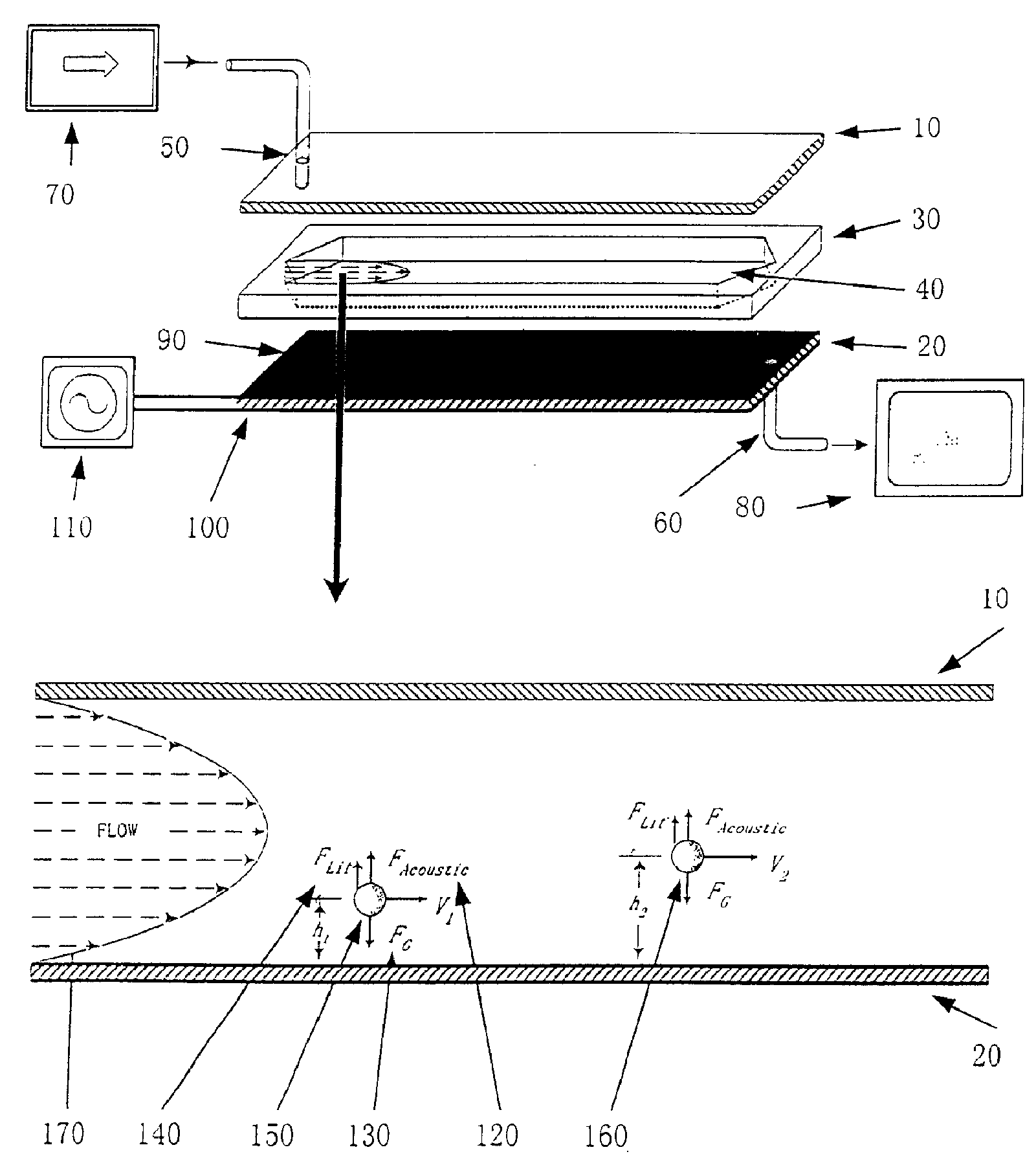
装置反应池的设计结构要能够使得引入反应池的流体(液体或气体)在不同的位置具有不同的流动速率,并且流体(液体或气体)在通过反应池的时候遵循速度分布的规律。例如,反应池可以是四方形状,包含一个顶盖、一个底面和两个侧壁。顶盖和底面应该完全平行或基本平行,顶盖和底面之间的距离就是反应池的高度。如果反应池仅仅包含一个入口和出口,那么出口和进口之间的距离就是反应池的长度。两个侧壁应该完全平行或基本平行。这两个平行侧壁之间的距离就称为反应池的宽度。两个侧壁可以是顶盖和底面之间垫圈的一部分。垫圈可以在中部切出扁平六角形、椭圆形、圆形或是其它形状的结构。在确定的实体例子中,反应池是一个中间具有矩形通道的扁平状结构(即反应池的高度大大低于反应池的长度和宽度,且反应池的形状为矩形)。这种结构的反应池的优点是,当载体介质流经矩形通道(或流过反应池)时,可以形成抛物线或近似抛物线的速度分布。紧靠顶盖和底面的载体介质流速为零,流速随着载体介质离开顶盖和底面距离的增加而增大,在顶盖和底面间距离的一半处达到最大值。在另一些实体例子中,反应池是一个狭长形结构(即反应池的宽度大大低于反应池的高度和长度,且反应池的形状为矩形)。反应池还可以是圆形、椭圆形、三角形、矩形、六边形等等结构。反应池可以由一个顶盖、一个底面以及在顶盖和底面之间的垫圈组成。垫圈可以在中部切出扁平六角形孔,也可以切成椭圆、圆或是其它形状的孔。在一些实体例子中,反应池是一个扁平状的结构(即反应池的高度大大低于反应池的长度和宽度,且反应池的形状为矩形)。这样的扁平结构的反应池的优点是,当载体介质流经反应池时,可以形成抛物线或近似抛物线的速度分布。紧靠顶盖和底面的载体介质流速为零,流速随着载体介质离开顶盖和底面距离的增加而增大,在顶盖和底面间距离的一半处达到最大值。一般而言,对于矩形通道,宽度可以从1mm至20cm,高度从20μm至10mm,长度从1cm至200cm,适宜的长度为10cm到50cm。虽然给出了上述数据,但是并不意味着本发明要求反应池都是规则的几何形状。反应池可以由各种材料制成,如玻璃、多聚物、塑料、石英、涂覆的金属等等,但是其结构特点需满足以下要求:当载体介质流经反应池时,反应池中不同位置处的介质流速不一样。The design structure of the reaction cell of the device should enable the fluid (liquid or gas) introduced into the reaction cell to have different flow rates at different positions, and the fluid (liquid or gas) to follow the law of velocity distribution when passing through the reaction cell. For example, a reaction cell may be square in shape, comprising a top, a bottom, and two side walls. The top cover and the bottom surface should be completely parallel or substantially parallel, and the distance between the top cover and the bottom surface is the height of the reaction pool. If the cell contains only one inlet and one outlet, then the distance between the outlet and the inlet is the length of the cell. The two side walls should be perfectly parallel or substantially parallel. The distance between these two parallel side walls is called the width of the reaction cell. The two side walls may be part of a gasket between the top cover and the bottom surface. Washers can be cut into flat hexagonal, oval, circular or other shapes in the middle. In a certain physical example, the reaction pool is a flat structure with a rectangular channel in the middle (that is, the height of the reaction pool is much lower than the length and width of the reaction pool, and the shape of the reaction pool is rectangular). The advantage of the reaction cell with this structure is that when the carrier medium flows through the rectangular channel (or flows through the reaction cell), a parabolic or nearly parabolic velocity distribution can be formed. The flow velocity of the carrier medium close to the top cover and the bottom surface is zero, and the flow velocity increases with the increase of the distance between the carrier medium and the top cover and the bottom surface, reaching a maximum value at half the distance between the top cover and the bottom surface. In some other physical examples, the reaction pool is a long and narrow structure (that is, the width of the reaction pool is much lower than the height and length of the reaction pool, and the shape of the reaction pool is rectangular). The reaction cell can also be circular, elliptical, triangular, rectangular, hexagonal and so on. The reaction cell may consist of a top cover, a bottom surface and a gasket between the top cover and the bottom surface. Washers can be cut with a flat hexagonal hole in the middle, or with oval, round, or other shaped holes. In some physical examples, the reaction pool is a flat structure (ie, the height of the reaction pool is much lower than the length and width of the reaction pool, and the shape of the reaction pool is rectangular). A reaction cell of such a flat configuration has the advantage that a parabolic or approximately parabolic velocity profile can be formed when the carrier medium flows through the reaction cell. The flow velocity of the carrier medium close to the top cover and the bottom surface is zero, and the flow velocity increases with the increase of the distance between the carrier medium and the top cover and the bottom surface, reaching a maximum value at half the distance between the top cover and the bottom surface. In general, for a rectangular channel, the width may be from 1 mm to 20 cm, the height from 20 μm to 10 mm, and the length from 1 cm to 200 cm, with a suitable length of 10 cm to 50 cm. While the above data are given, it is not meant that the invention requires the reaction cells to be of regular geometry. The reaction cell can be made of various materials, such as glass, polymer, plastic, quartz, coated metal, etc., but its structural characteristics need to meet the following requirements: when the carrier medium flows through the reaction cell, different The flow rate of the medium at the location is not the same.
装置包括一个或多个压电传感器。多个压电传感器可以通以相同的电信号或不同的电信号激发。这些压电传感器可以位于反应池的内表面或外表面,也可以位于和载体介质流经反应池方向充分平行的平面上。The device includes one or more piezoelectric sensors. Multiple piezoelectric sensors can be excited with the same electrical signal or with different electrical signals. These piezoelectric sensors can be located on the inner or outer surface of the reaction cell, or on a plane substantially parallel to the direction in which the carrier medium flows through the reaction cell.
通常由电信号发生器输出的用于激发压电传感器的电信号的幅值和频率是可以调节的。Usually the amplitude and frequency of the electrical signal output by the electrical signal generator used to excite the piezoelectric sensor can be adjusted.
在一个首选实体例子中,反应池是一个管状结构。一个或多个压电传感器是位于管状结构的内表面或外表面上。In an example of a preferred entity, the reaction cell is a tubular structure. One or more piezoelectric transducers are located on the inner or outer surface of the tubular structure.
在另一个首选的实体例子中,反应池由一个顶盖、一个底面和两个侧壁构成。一个或多个压电传感器可以位于反应池的顶盖上,或者位于反应池的底面,也可以在反应池的反面。反应池的高度(顶盖和底面之间的距离)最好与驻波的半波长接近。In another preferred solid example, the reaction cell is formed of a top cover, a bottom surface and two side walls. One or more piezoelectric sensors can be located on the top cover of the reaction cell, or on the bottom of the reaction cell, or on the opposite side of the reaction cell. The height of the reaction cell (the distance between the top cover and the bottom surface) is preferably close to the half wavelength of the standing wave.
在场流分离中使用声场力识别物质的装置本质上包括:a)一个反应池包括至少一个入口端口和至少一个出口端口,所述的反应池具有这样的结构特点,即当载体介质被诱导通过该反应池时,在反应池内不同位置所述的载体介质的移动速度是不一样的;b)至少有一个压电传感器位于所述反应池的某一部分,其中所述的压电传感器可以通过由电信号发生器产生的至少一路电信号激发产生声波,从而导致至少一个施加于所述载体介质中物质上的声场力,该声场力具有垂直于载体介质移动方向的分量。The device for identifying substances using acoustic force in field flow separation essentially comprises: a) a reaction cell comprising at least one inlet port and at least one outlet port, said reaction cell having such a structural feature that when a carrier medium is induced through the When the reaction cell is used, the moving speed of the carrier medium at different positions in the reaction cell is not the same; b) at least one piezoelectric sensor is located in a certain part of the reaction cell, wherein the piezoelectric sensor can pass through the electric At least one electrical signal generated by the signal generator excites and generates sound waves, thereby resulting in at least one acoustic field force exerted on the substance in the carrier medium, and the acoustic field force has a component perpendicular to the moving direction of the carrier medium.
B.使用电泳和声场力的装置B. Devices Using Electrophoresis and Acoustic Field Forces
另一方面,这项发明指出,在场流分离中使用电泳和声场力识别物质的装置包括:a)一个反应池包括至少一个入口端口和至少一个出口端口,所述的反应池具有这样的结构特点,即当载体介质被诱导通过该反应池时,在反应池内不同位置所述的载体介质的移动速度是不一样的;b)至少有两个电极组成了所述反应池的一部分,所述的电极可以通过由电信号发生器产生的至少一路电信号激发产生电场,从而导致至少一个施加于所述载体介质中物质上的电泳力,该电泳力具有垂直于载体介质移动方向的分量。C)至少有一个压电传感器组成了所述反应池的一部分,其中所述的压电传感器可以通过由电信号发生器产生的至少一路电信号激发产生声波,从而导致至少一个施加于所述载体介质中物质上的声场力,该声场力具有垂直于载体介质移动方向的分量。In another aspect, the invention states that a device for identifying substances using electrophoresis and acoustic field force in field flow separation comprises: a) a reaction cell comprising at least one inlet port and at least one outlet port, said reaction cell having such a structural feature , that is, when the carrier medium is induced to pass through the reaction cell, the moving speed of the carrier medium at different positions in the reaction cell is different; b) at least two electrodes form a part of the reaction cell, and the The electrodes can be excited by at least one electrical signal generated by the electrical signal generator to generate an electric field, thereby causing at least one electrophoretic force on the substance in the carrier medium, the electrophoretic force having a component perpendicular to the direction of movement of the carrier medium. C) At least one piezoelectric sensor constitutes a part of the reaction cell, wherein the piezoelectric sensor can be excited by at least one electrical signal generated by an electrical signal generator to generate sound waves, thereby causing at least one applied to the carrier An acoustic field force on a substance in a medium that has a component perpendicular to the direction of movement of the carrier medium.
装置包括一个入口端口和一个出口端口,也可以包括多个入口端口和多个出口端口。最好是出口端口与收集装置或鉴定装置直接相接。本发明所设计的反应池的出口端口可以有多种形式,如可以是单出口端口,也可以是多出口端口,甚至可以是一个出口端口阵列。出口端口的宽度可以和反应池一致或是只占反应池宽度的一部分。从出口端口可以收集不同形状和尺寸的微粒。出口端口的尺寸范围可以从微粒尺寸的两倍到与反应池的宽度一致。在一个实体例子中,出口端口是由一根或多根管状结构(如聚四氟乙烯管)构成。这些管状结构可以组合成一个复合的出样端口。例如,出口端口可以直接接到部分收集器或是收集孔上以收集分离的样品。除了收集装置,其它装置也可以接到分离装置的末端,如测量和诊断装置,例如血细胞计数器、微粒计数器和分光光度计。其它用于对分离物质进行进一步检验和分析的装置也可以被连接到分离装置上。The device includes an inlet port and an outlet port, and may include multiple inlet ports and multiple outlet ports. Preferably the outlet port is directly connected to the collection device or identification device. The outlet ports of the reaction pool designed in the present invention can have various forms, such as a single outlet port, multiple outlet ports, or even an array of outlet ports. The width of the outlet port can be the same as that of the reaction cell or only occupy a part of the width of the reaction cell. Particles of different shapes and sizes can be collected from the outlet port. The size of the outlet port can range from twice the particle size to the width of the reaction cell. In one physical example, the outlet port is formed from one or more tubular structures such as Teflon tubes. These tubular structures can be combined into a composite sample port. For example, the outlet port can be connected directly to a fraction collector or to a collection well to collect separated samples. In addition to the collection device, other devices can also be connected to the end of the separation device, such as measurement and diagnostic devices, eg hemocytometers, particle counters and spectrophotometers. Other devices for further examination and analysis of the separated substances may also be connected to the separation device.
装置的反应池设计结构要能够使得引入反应池的流体(液体或气体)在不同的位置具有不同的流动速率,并且流体(液体或气体)在通过反应池的时候遵循速度分布的规律。例如,这个反应池可以是四方形状,包含一个顶盖、一个底面和两个侧壁。顶盖和底面应该完全平行或基本平行,顶盖和底面之间的距离就是反应池的高度。如果反应池仅仅包含一个入口端口和出口端口,那么出口端口和入口端口之间的距离就是反应池的长度。两个侧壁应该完全平行或基本平行。这两个平行侧壁之间的距离就称为反应池的宽度。两个侧壁可以是顶盖和底面之间的垫圈的一部分。垫圈可以在中部切出扁平六边形结构,也可以是椭圆形、圆形或是其它形状。在实体例子中,反应池是一个中间具有矩形通道的扁平状结构(即反应池的高度大大低于反应池的长度和宽度,且反应池的形状为矩形)。这种结构的反应池的优点是,当载体介质流经矩形通道(或流过反应池)时,可以形成抛物线或近似抛物线的速度分布。紧靠顶盖和底面的载体介质流速为零,流速随着载体介质离开顶盖和底面距离的增加而增大,在顶盖和底面间距离的一半处达到最大值。在另一些实体例子中,反应池是一个狭长形结构(即反应池的宽度大大低于反应池的高度和长度,且反应池的形状为矩形)。反应池还可以是圈形、椭圆形、三角形、矩形、六边形等等结构。反应池可以由一个顶盖、一个底面以及在顶盖和底面之间的垫圈组成。垫圈可以在中部切出矩形的结构,也可以切出椭圆、圆或是其它形状。在某些实体例子中,反应池是一个扁平状的结构(即反应池的高度大大低于反应池的长度和宽度,且反应池的形状为矩形)。这样的扁平结构的反应池的优点是,当载体介质流经反应池时,可以形成抛物线或近似抛物线的速度分布。紧靠顶盖和底面的载体介质流速为零,流速随着载体介质离开顶盖和底面距离的增加而增大,在顶盖和底面间距离的一半处达到最大值。一般而言,对于矩形通道,宽度可以从1mm至20cm,高度从20μm至10mm,长度从1cm至200cm,最好是从10cm到50cm。虽然给出了上述数据,但是并不意味着本发明要求反应池都是规则的几何形状。反应池可以由各种材料制成,如玻璃、多聚物、塑料、石英、包被的金属等等,但是其结构特点需满足以下要求:当载体介质流经反应池时,反应池中不同位置处的介质流速不一样。The design structure of the reaction pool of the device should enable the fluid (liquid or gas) introduced into the reaction pool to have different flow rates at different positions, and the fluid (liquid or gas) to follow the law of velocity distribution when passing through the reaction pool. For example, the reaction cell can be square in shape, comprising a top, a bottom and two side walls. The top cover and the bottom surface should be completely parallel or substantially parallel, and the distance between the top cover and the bottom surface is the height of the reaction pool. If the cell contains only one inlet port and one outlet port, then the distance between the outlet port and the inlet port is the length of the cell. The two side walls should be perfectly parallel or substantially parallel. The distance between these two parallel side walls is called the width of the reaction cell. The two side walls may be part of a gasket between the top cover and the bottom surface. Washers can have a flat hexagon cut out in the middle, or they can be oval, round, or other shapes. In the physical example, the reaction pool is a flat structure with a rectangular channel in the middle (that is, the height of the reaction pool is much lower than the length and width of the reaction pool, and the shape of the reaction pool is rectangular). The advantage of the reaction cell with this structure is that when the carrier medium flows through the rectangular channel (or flows through the reaction cell), a parabolic or nearly parabolic velocity distribution can be formed. The flow velocity of the carrier medium close to the top cover and the bottom surface is zero, and the flow velocity increases with the increase of the distance between the carrier medium and the top cover and the bottom surface, reaching a maximum value at half the distance between the top cover and the bottom surface. In some other physical examples, the reaction pool is a long and narrow structure (that is, the width of the reaction pool is much lower than the height and length of the reaction pool, and the shape of the reaction pool is rectangular). The reaction cell can also be in the shape of circle, ellipse, triangle, rectangle, hexagon and so on. The reaction cell may consist of a top cover, a bottom surface and a gasket between the top cover and the bottom surface. Washers can be cut into rectangular structures in the middle, or ellipses, circles, or other shapes. In some physical examples, the reaction pool is a flat structure (ie, the height of the reaction pool is much lower than the length and width of the reaction pool, and the shape of the reaction pool is rectangular). A reaction cell of such a flat configuration has the advantage that a parabolic or approximately parabolic velocity profile can be formed when the carrier medium flows through the reaction cell. The flow velocity of the carrier medium close to the top cover and the bottom surface is zero, and the flow velocity increases with the increase of the distance between the carrier medium and the top cover and the bottom surface, reaching a maximum value at half the distance between the top cover and the bottom surface. In general, for rectangular channels, the width may be from 1 mm to 20 cm, the height from 20 μm to 10 mm, and the length from 1 cm to 200 cm, preferably from 10 cm to 50 cm. While the above data are given, it is not meant that the invention requires the reaction cells to be of regular geometry. The reaction cell can be made of various materials, such as glass, polymer, plastic, quartz, coated metal, etc., but its structural characteristics need to meet the following requirements: When the carrier medium flows through the reaction cell, different The flow rate of the medium at the location is not the same.
装置包括两个或是多个电极。每个电极都单独地连接在与电信号发生器电连接的电导线总线中的一条电导线上。电极可以以横向或纵向的方式排列在反应池上。电极可以排成一个与载体介质运动方向基本平行的平面,最好是排成一个平面的电极阵列。电极阵列可以是相互交错式电极阵列、相互交错式城堡电极阵列、带有突出弧形顶端的交错式电极阵列。最好这些电极是涂覆在反应池表面的金属层,如金层电极。也可以使用其它金属,如铂、铝、铬、钛、铜和银等。The device includes two or more electrodes. Each electrode is individually connected to an electrical lead in a bus of electrical leads electrically connected to the electrical signal generator. Electrodes can be arranged on the reaction cell in a horizontal or vertical manner. The electrodes can be arranged in a plane substantially parallel to the moving direction of the carrier medium, preferably in a planar electrode array. The electrode array may be an interdigitated electrode array, an interdigitated castle electrode array, or an interdigitated electrode array with protruding arc-shaped tops. Preferably these electrodes are metal layers coated on the surface of the reaction cell, such as gold layer electrodes. Other metals such as platinum, aluminum, chromium, titanium, copper, and silver may also be used.
用于激发电极产生电泳力的电信号发生器可以是能调节电压幅值的直流信号源,也可以是能调节幅值和频率的交流信号源。用于激发电极产生电泳力的电信号最好是直流信号或低频交流信号。The electrical signal generator used to excite the electrodes to generate electrophoretic force can be a DC signal source capable of adjusting voltage amplitude, or an AC signal source capable of adjusting amplitude and frequency. The electrical signal used to excite the electrodes to generate electrophoretic force is preferably a direct current signal or a low frequency alternating current signal.
装置中带有一个或是多个压电传感器。如果是多个压电传感器,它们可以通以相同的电信号,也可以通以不同的电信号来激发。多个压电传感器可以位于反应池的内表面或外表面,也可以位于和载体介质流经反应池方向充分平行的平面上。The device contains one or more piezoelectric sensors. If there are multiple piezoelectric sensors, they can be excited by the same electrical signal or by different electrical signals. A plurality of piezoelectric sensors can be located on the inner or outer surface of the reaction cell, or on a plane substantially parallel to the direction in which the carrier medium flows through the reaction cell.
通常由电信号发生器输出的用于激发压电传感器以产生声场力的电信号的幅值和频率是可以调节的。Generally, the amplitude and frequency of the electric signal output by the electric signal generator for exciting the piezoelectric sensor to generate the acoustic field force can be adjusted.
公共电导线总线用于连接多个电极和信号发生器。公共电导线总线可以采取和装置上电极一样的制作方法,或是是一个或多个传导部件,如用带状导体、金属带或是镀了金属的塑料。对于交互相错式电极阵列,交错的电极可以连接在一起从信号发生器得到电信号。信号发生器可以是能提供可调节电压的直流电源。本发明所述的方法和装置要求电压的范围是0至15伏,最佳值是0至2伏。信号发生器也可以是能提供可调节电压和频率的电源,如惠普的No.8116A型信号发生器这类的多功能信号发生器。本项发明所用的方法和装置要求电压的范围是0至15伏,频率范围是0.1Hz至100KHz,最佳值是电压0至2伏,频率0.1至1KHz。A common electrical wire bus is used to connect multiple electrodes and signal generators. The common electrical conductor bus can be made in the same way as the electrodes on the device, or it can be one or more conductive elements, such as strip conductors, metal strips or metallized plastic. For interleaved electrode arrays, the interleaved electrodes can be connected together to obtain electrical signals from a signal generator. The signal generator can be a DC power supply that can provide an adjustable voltage. The method and apparatus of the present invention require a voltage in the range of 0 to 15 volts, preferably 0 to 2 volts. The signal generator can also be a power supply that can provide adjustable voltage and frequency, such as Hewlett-Packard's No.8116A signal generator and other multifunctional signal generators. The method and device used in the present invention require a voltage in the range of 0 to 15 volts and a frequency in the range of 0.1 Hz to 100 KHz, and the optimum value is a voltage of 0 to 2 volts and a frequency of 0.1 to 1 KHz.
在一个首选实体例子中,装置中的反应池是一个管状结构。电极和/或压电传感器,或者它们中的大部分可以位于管状结构的内表面或是外表面。In an example of a preferred entity, the reaction cell in the device is a tubular structure. Electrodes and/or piezoelectric sensors, or a majority of them, may be located on the inner or outer surface of the tubular structure.
在另一首选实体例子中,反应池由一个顶盖、一个底面和两个侧壁构成。电极和/或压电传感器,或者它们中的大部分可以分布在反应池的顶盖上,或者是位于反应池的底面,在另一个结构中,电极和/或压电传感器,或者它们中的大部分也可以分布在反应池的反面。反应池的高度(顶盖和底面之间的距离)最好与驻波的半波长接近。In another example of a preferred entity, the reaction cell consists of a top cover, a bottom surface and two side walls. Electrodes and/or piezoelectric sensors, or most of them can be distributed on the top cover of the reaction cell, or located on the bottom of the reaction cell, in another structure, electrodes and/or piezoelectric sensors, or one of them Most can also be distributed on the opposite side of the reaction tank. The height of the reaction cell (the distance between the top cover and the bottom surface) is preferably close to the half wavelength of the standing wave.
在另一个首选实体例子中,装置包括:a)一个反应池包括至少一个入口端口和至少一个出口端口,所述的反应池具有这样的结构特点,即当载体介质被诱导通过该反应池时,在反应池内不同位置所述的载体介质的移动速度是不一样的;b)至少有两个电极组成了所述反应池的一部分,其中所述的电极可以通过由电信号发生器产生的至少一路电信号激发产生电场,从而导致至少一个施加于所述载体介质中物质上的电泳力,该电泳力具有垂直于载体介质移动方向的分量;C)至少有一个压电传感器组成了所述反应池的一部分,其中所述的压电传感器可以通过由电信号发生器产生的至少一路电信号激发产生声波,从而导致至少一个施加于所述载体介质中物质上的声场力,该声场力具有垂直于载体介质移动方向的分量。In another example of a preferred entity, the apparatus comprises: a) a reaction well comprising at least one inlet port and at least one outlet port, said reaction well having structural features such that when the carrier medium is induced through the reaction well, The moving speed of the carrier medium at different positions in the reaction cell is not the same; b) at least two electrodes form a part of the reaction cell, wherein the electrodes can pass through at least one path generated by an electrical signal generator electrical signal excitation generates an electric field, resulting in at least one electrophoretic force exerted on the substance in said carrier medium, the electrophoretic force having a component perpendicular to the direction of movement of the carrier medium; C) at least one piezoelectric sensor constituting said reaction cell A part of the method, wherein the piezoelectric sensor can be excited by at least one electrical signal generated by an electrical signal generator to generate acoustic waves, thereby causing at least one acoustic field force applied to the substance in the carrier medium, and the acoustic field force has a force perpendicular to Component of direction of movement of the carrier medium.
C.使用介电电泳和声场力的装置C. Devices Using Dielectrophoresis and Acoustic Field Forces
另一方面,本发明提供了一个在场流分离中使用介电电泳和声场力识别物质的装置,该装置包括:a)一个反应池包括至少一个入口端口和至少一个出口端口,所述的反应池具有这样的结构特点,即当载体介质被诱导通过该反应池时,在反应池内不同位置所述的载体介质的移动速度是不一样的;b)至少有两个电极组成了所述反应池的一部分,其中所述的电极可以通过由电信号发生器产生的至少一路电信号激发产生一个不均匀电场,从而导致至少一个施加于所述载体介质中物质上的介电电泳力,该介电电泳力具有垂直于载体介质移动方向的分量;c)至少有一个压电传感器组成了所述反应池的一部分,其中所述的压电传感器可以通过由电信号发生器产生的至少一路电信号激发产生声波,从而导致至少一个施加于所述载体介质中物质上的声场力,该声场力具有垂直于载体介质移动方向的分量。In another aspect, the present invention provides a device for identifying substances using dielectrophoresis and acoustic field force in field flow separation, the device comprising: a) a reaction cell comprising at least one inlet port and at least one outlet port, said reaction cell It has such a structural feature that when the carrier medium is induced to pass through the reaction cell, the moving speed of the carrier medium at different positions in the reaction cell is different; b) at least two electrodes form the reaction cell A part, wherein the electrodes can be excited by at least one electrical signal generated by an electrical signal generator to generate a non-uniform electric field, thereby causing at least one dielectrophoretic force exerted on the substance in the carrier medium, the dielectrophoretic The force has a component perpendicular to the moving direction of the carrier medium; c) at least one piezoelectric sensor forms part of the reaction cell, wherein the piezoelectric sensor can be excited by at least one electrical signal generated by an electrical signal generator The sound waves, thereby causing at least one acoustic field force exerted on the substance in the carrier medium, the acoustic field force having a component perpendicular to the direction of movement of the carrier medium.
装置包括一个入口端口和一个出口端口,也可以包括多个入口端口和多个出口端口。最好是出口端口与收集装置或鉴定装置直接相接。本发明所设计的反应池的出口端口可以有多种形式,如可以是单出口端口,也可以是多出口端口,甚至可以是一个出口端口阵列。出口端口的宽度可以和反应池一致或是只占反应池宽度的一部分。从出口端口可以收集不同形状和尺寸的微粒。出口端口的尺寸范围可以从微粒尺寸的两倍到与反应池的宽度一致。在一个实体例子中,出口端口是由一根或多根管状结构(如聚四氟乙烯管)构成。这些管状结构可以组合成一个复合的出样端口。例如,出口端口可以直接接到部分收集器或是收集孔上以收集分离的样品。除了收集装置,其它装置也可以接到分离装置的末端,如测量和诊断装置,例如血细胞计数器、微粒计数器和分光光度计。其它用于对分离物质进行进一步检验和分析的装置也可以被连接到分离装置上。The device includes an inlet port and an outlet port, and may include multiple inlet ports and multiple outlet ports. Preferably the outlet port is directly connected to the collection device or identification device. The outlet ports of the reaction pool designed in the present invention can have various forms, such as a single outlet port, multiple outlet ports, or even an array of outlet ports. The width of the outlet port can be the same as that of the reaction cell or only occupy a part of the width of the reaction cell. Particles of different shapes and sizes can be collected from the outlet port. The size of the outlet port can range from twice the particle size to the width of the reaction cell. In one physical example, the outlet port is formed from one or more tubular structures such as Teflon tubes. These tubular structures can be combined into a composite sample port. For example, the outlet port can be connected directly to a fraction collector or to a collection well to collect separated samples. In addition to the collection device, other devices can also be connected to the end of the separation device, such as measurement and diagnostic devices, eg hemocytometers, particle counters and spectrophotometers. Other devices for further examination and analysis of the separated substances may also be connected to the separation device.
装置的反应池设计结构要能够使得引入反应池的流体(液体或气体)在不同的位置具有不同的流动速率,并且流体(液体或气体)在通过反应池的时候遵循速度分布的规律。例如,这个反应池可以是四方形状,包含一个顶盖、一个底面和两个侧壁。顶盖和底面应该完全平行或基本平行,顶盖和底面之间的距离就是反应池的高度。如果反应池仅仅包含一个入口端口和出口端口,那么出口端口和入口端口之间的距离就是反应池的长度。两个侧壁应该完全平行或基本平行。这两个平行侧壁之间的距离就称为反应池的宽度。两个侧壁可以是顶盖和底面之间的垫圈的一部分。垫圈可以在中部切出扁平六边形结构,也可以是椭圆形、圆形或是其它形状。在实体例子中,反应池是一个中间具有矩形通道的扁平状结构(即反应池的高度大大低于反应池的长度和宽度,且反应池的形状为矩形)。这种结构的反应池的优点是,当载体介质流经矩形通道(或流过反应池)时,可以形成抛物线或近似抛物线的速度分布。紧靠顶盖和底面的载体介质流速为零,流速随着载体介质离开顶盖和底面距离的增加而增大,在顶盖和底面间距离的一半处达到最大值。在另一些实体例子中,反应池是一个狭长形结构(即反应池的宽度大大低于反应池的高度和长度,且反应池的形状为矩形)。反应池还可以是圆形、椭圆形、三角形、矩形、六边形等等结构。反应池可以由一个顶盖、一个底面以及在顶盖和底面之间的垫圈组成。垫圈可以在中部切出矩形结构,也可以切成椭圆、圆或是其它形状。在某些实体例子中,反应池是一个扁平状的结构(即反应池的高度大大低于反应池的长度和宽度,且反应池的形状为矩形)。这样的扁平结构的反应池的优点是,当载体介质流经反应池时,可以形成抛物线或近似抛物线的速度分布。紧靠顶盖和底面的载体介质流速为零,流速随着载体介质离开顶盖和底面距离的增加而增大,在顶盖和底面间距离的一半处达到最大值。一般而言,对于矩形通道,宽度可以从1mm至20cm,高度从20μm至10mm,长度从1cm至200cm,最好是从10cm到50cm。虽然给出了上述数据,但是并不意味着本发明要求反应池都是规则的几何形状。反应池可以由各种材料制成,如玻璃、多聚物、塑料、石英、包被的金属等等,但是其结构特点需满足以下要求:当载体介质流经反应池时,反应池中不同位置处的介质流速不一样。The design structure of the reaction pool of the device should enable the fluid (liquid or gas) introduced into the reaction pool to have different flow rates at different positions, and the fluid (liquid or gas) to follow the law of velocity distribution when passing through the reaction pool. For example, the reaction cell can be square in shape, comprising a top, a bottom and two side walls. The top cover and the bottom surface should be completely parallel or substantially parallel, and the distance between the top cover and the bottom surface is the height of the reaction pool. If the cell contains only one inlet port and one outlet port, then the distance between the outlet port and the inlet port is the length of the cell. The two side walls should be perfectly parallel or substantially parallel. The distance between these two parallel side walls is called the width of the reaction cell. The two side walls may be part of a gasket between the top cover and the bottom surface. Washers can have a flat hexagon cut out in the middle, or they can be oval, round, or other shapes. In the physical example, the reaction pool is a flat structure with a rectangular channel in the middle (that is, the height of the reaction pool is much lower than the length and width of the reaction pool, and the shape of the reaction pool is rectangular). The advantage of the reaction cell with this structure is that when the carrier medium flows through the rectangular channel (or flows through the reaction cell), a parabolic or nearly parabolic velocity distribution can be formed. The flow velocity of the carrier medium close to the top cover and the bottom surface is zero, and the flow velocity increases with the increase of the distance between the carrier medium and the top cover and the bottom surface, reaching a maximum value at half the distance between the top cover and the bottom surface. In some other physical examples, the reaction pool is a long and narrow structure (that is, the width of the reaction pool is much lower than the height and length of the reaction pool, and the shape of the reaction pool is rectangular). The reaction cell can also be circular, elliptical, triangular, rectangular, hexagonal and so on. The reaction cell may consist of a top cover, a bottom surface and a gasket between the top cover and the bottom surface. Washers can be cut into rectangular structures in the middle, or they can be cut into ellipses, circles or other shapes. In some physical examples, the reaction pool is a flat structure (ie, the height of the reaction pool is much lower than the length and width of the reaction pool, and the shape of the reaction pool is rectangular). A reaction cell of such a flat configuration has the advantage that a parabolic or approximately parabolic velocity profile can be formed when the carrier medium flows through the reaction cell. The flow velocity of the carrier medium close to the top cover and the bottom surface is zero, and the flow velocity increases with the increase of the distance between the carrier medium and the top cover and the bottom surface, reaching a maximum value at half the distance between the top cover and the bottom surface. In general, for rectangular channels, the width may be from 1 mm to 20 cm, the height from 20 μm to 10 mm, and the length from 1 cm to 200 cm, preferably from 10 cm to 50 cm. While the above data are given, it is not meant that the invention requires the reaction cells to be of regular geometry. The reaction cell can be made of various materials, such as glass, polymer, plastic, quartz, coated metal, etc., but its structural characteristics need to meet the following requirements: When the carrier medium flows through the reaction cell, different The flow rate of the medium at the location is not the same.
装置包括两个或是多个电极。每个电极都单独地连接在与电信号发生器电连接的电导线总线中的一条电导线上。电极可以以横向或纵向的方式排列在反应池上。电极也可以分布在一个与载体介质运动方向基本平行的平面,最好是排成一个平面的电极阵列。电极阵列可以是相互交错式电极阵列、相互交错式城堡电极阵列、带有突出弧形顶端的交错式电极阵列。最好这些电极是涂覆在反应池表面的金属层,如金层电极。也可以使用其它金属,如铂、铝、铬、钛、铜和银等。The device includes two or more electrodes. Each electrode is individually connected to an electrical lead in a bus of electrical leads electrically connected to the electrical signal generator. Electrodes can be arranged on the reaction cell in a horizontal or vertical manner. The electrodes can also be distributed in a plane substantially parallel to the direction of movement of the carrier medium, preferably arranged in a planar electrode array. The electrode array may be an interdigitated electrode array, an interdigitated castle electrode array, or an interdigitated electrode array with protruding arc-shaped tops. Preferably these electrodes are metal layers coated on the surface of the reaction cell, such as gold layer electrodes. Other metals such as platinum, aluminum, chromium, titanium, copper, and silver may also be used.
用于激发电极产生电泳力的电信号发生器可以是能调节电压幅值的直流信号源,也可以是能调节幅值和频率的交流信号源。The electrical signal generator used to excite the electrodes to generate electrophoretic force can be a DC signal source capable of adjusting voltage amplitude, or an AC signal source capable of adjusting amplitude and frequency.
装置中带有一个或是多个压电传感器。如果悬多个压电传感器,它们可以通以相同的电信号,也可以通以不同的电信号来激发。多个压电传感器可以位于反应池的内表面或外表面,也可以位于和载体介质流经反应池方向充分平行的平面上。The device contains one or more piezoelectric sensors. If multiple piezoelectric sensors are suspended, they can be excited by the same electrical signal or by different electrical signals. A plurality of piezoelectric sensors can be located on the inner or outer surface of the reaction cell, or on a plane substantially parallel to the direction in which the carrier medium flows through the reaction cell.
通常由电信号发生器输出的用于激发压电传感器以产生声场力的电信号的幅值和频率是可以调节的。Generally, the amplitude and frequency of the electric signal output by the electric signal generator for exciting the piezoelectric sensor to generate the acoustic field force can be adjusted.
公共电导线总线用于连接多个电极和信号发生器。公共电导线总线可以采取和装置上电极一样的制作方法,或是是一个或多个传导部件,如用带状导体、金属带或是镀了金属的塑料。对于交互相错式电极阵列,交错的电极可以连接在一起从信号发生器得到电信号。信号发生器可以是能提供可调节电压的直流电源。本发明所述的方法和装置要求电压的范围是0至15伏,最佳值是0至10伏。信号发生器也可以是能提供可调节电压和频率的电源,如惠普的No.8116A型信号发生器这类的多功能信号发生器。本项发明所用的方法和装置要求电压的范围是0至15伏,频率范围是0.1Hz至500MHz,最佳值是电压0至10伏,频率0.1至10MHz。因为利用介电电泳力识别物质所需的频率依赖于被识别物质的特性和介质(如细胞悬浮液)的电导率,所以在此所述的频率只是作为一个例子。对物质的识别还依赖于电极的形状、尺寸和排布。在一个实体例子中,所用的信号是正弦波,当然也可以使用其他周期性或非周期性的波形。电信号可以由一个或多个具有调节输出电信号的幅值和频率能力的电信号发生器来产生。A common electrical wire bus is used to connect multiple electrodes and signal generators. The common electrical conductor bus can be made in the same way as the electrodes on the device, or it can be one or more conductive elements, such as strip conductors, metal strips or metallized plastic. For interleaved electrode arrays, the interleaved electrodes can be connected together to obtain electrical signals from a signal generator. The signal generator can be a DC power supply that can provide an adjustable voltage. The method and apparatus of the present invention require a voltage in the range of 0 to 15 volts, preferably 0 to 10 volts. The signal generator can also be a power supply that can provide adjustable voltage and frequency, such as Hewlett-Packard's No.8116A signal generator and other multifunctional signal generators. The method and apparatus used in the present invention require a voltage in the range of 0 to 15 volts and a frequency in the range of 0.1 Hz to 500 MHz, and the optimum value is a voltage of 0 to 10 volts and a frequency of 0.1 to 10 MHz. Since the frequency required to identify substances using dielectrophoretic forces depends on the properties of the substance to be identified and the conductivity of the medium (eg, cell suspension), the frequencies described here are merely examples. The recognition of substances also depends on the shape, size and arrangement of electrodes. In one practical example, the signal used is a sine wave, although other periodic or non-periodic waveforms may of course be used. The electrical signal may be generated by one or more electrical signal generators capable of adjusting the amplitude and frequency of the output electrical signal.
在一个首选实体例子中,装置中的反应池是一个管状结构。电极和/或压电传感器,或者它们中的大部分可以位于管状结构的内表面或是外表面。In an example of a preferred entity, the reaction cell in the device is a tubular structure. Electrodes and/or piezoelectric sensors, or a majority of them, may be located on the inner or outer surface of the tubular structure.
在另一首选实体例子中,反应池由一个顶盖、一个底面和两个侧壁构成。电极和/或压电传感器,或者它们中的大部分可以分布在反应池的顶盖上,或者是位于反应池的底面,在另一个结构中,电极和/或压电传感器,或者它们中的大部分也可以分布在反应池的反面。反应池的高度(顶盖和底面之间的距离)最好与驻波的半波长接近。In another example of a preferred entity, the reaction cell consists of a top cover, a bottom surface and two side walls. Electrodes and/or piezoelectric sensors, or most of them can be distributed on the top cover of the reaction cell, or located on the bottom of the reaction cell, in another structure, electrodes and/or piezoelectric sensors, or one of them Most can also be distributed on the opposite side of the reaction tank. The height of the reaction cell (the distance between the top cover and the bottom surface) is preferably close to the half wavelength of the standing wave.
在另一个首选实体例子中,装置包括:a)一个反应池包括至少一个入口端口和至少一个出口端口,所述的反应池具有这样的结构特点,即当载体介质被诱导通过该反应池时,在反应池内不同位置所述的载体介质的移动速度是不一样的;b)至少有两个电极组成了所述反应池的一部分,其中所述的电极可以通过由电信号发生器产生的至少一路电信号激发产生电场,从而导致至少一个施加于所述载体介质中物质上的电泳力,该电泳力具有垂直于载体介质移动方向的分量;C)至少有一个压电传感器组成了所述反应池的一部分,其中所述的压电传感器可以通过由电信号发生器产生的至少一路电信号激发产生声波,从而导致至少一个施加于所述载体介质中物质上的声场力,该声场力具有垂直于载体介质移动方向的分量。In another example of a preferred entity, the apparatus comprises: a) a reaction well comprising at least one inlet port and at least one outlet port, said reaction well having structural features such that when the carrier medium is induced through the reaction well, The moving speed of the carrier medium at different positions in the reaction cell is not the same; b) at least two electrodes form a part of the reaction cell, wherein the electrodes can pass through at least one path generated by an electrical signal generator electrical signal excitation generates an electric field, resulting in at least one electrophoretic force exerted on the substance in said carrier medium, the electrophoretic force having a component perpendicular to the direction of movement of the carrier medium; C) at least one piezoelectric sensor constituting said reaction cell A part of the method, wherein the piezoelectric sensor can be excited by at least one electrical signal generated by an electrical signal generator to generate acoustic waves, thereby causing at least one acoustic field force applied to the substance in the carrier medium, and the acoustic field force has a force perpendicular to Component of direction of movement of the carrier medium.
D.使用声场力或与电泳或介电电泳力同时使用声场力识别物质的方法D. Methods of identifying substances using acoustic field forces or using acoustic field forces simultaneously with electrophoretic or dielectrophoretic forces
从另一个方面看,本发明提供一种在场流分离中使用声场力来识别物质的“连续模式”方法,该方法包括:a)获得一个在A节中描述的装置;b)通过所述装置的入口端口将含有待识别物质的载体介质导入到装置的反应池中,其中所述的导入使得载体介质依照速度分布通过反应池;c)通过对压电传感器施加由电信号发生器产生的至少另外一路电信号激发产生声波,从而导致至少有一个施加于所述载体介质中物质上的声场力具有一个垂直于载体介质移动通过反应池方向的分量,并且处于所述的载体介质中的所述的物质在力的作用下被位移到与载体介质移动方向垂直的一个方向上的某个位置,根据物质在该方向上分布位置的不同来识别物质。这就是声场-场流分离(声场-FFF)的连续模式。它可以使用在A节中描述的任何一种装置。Viewed from another aspect, the invention provides a "continuous mode" method of using acoustic field forces to identify matter in field-flow separation, the method comprising: a) obtaining a device as described in Section A; b) by said device The inlet port of the inlet port will introduce the carrier medium containing the substance to be identified into the reaction cell of the device, wherein the introduction makes the carrier medium pass through the reaction cell according to the velocity distribution; c) by applying at least Another electrical signal excites and generates sound waves, thereby causing at least one acoustic field force applied to the substance in the carrier medium to have a component perpendicular to the direction in which the carrier medium moves through the reaction cell, and the The substance is displaced to a certain position in a direction perpendicular to the moving direction of the carrier medium under the action of force, and the substance is identified according to the difference in the distribution position of the substance in this direction. This is the continuous mode of soundfield-field-flow separation (soundfield-FFF). It can use any of the devices described in Section A.
在另一方面,本发明提供一种在场流分离使用声场力识别物质的“批量模式”方法。这种方法包括:a)获得一个在A节中描述的装置;b)通过所述装置的入口端口将载体介质导入到装置的反应池中直至载体介质充满整个反应池;c)将含有待识别物质的样品输送(如注入)到反应池内的载体介质中;d)对压电传感器施加由电信号发生器产生的至少一路电信号,其中所述的激发压电传感器产生了声波,从而导致至少有一个声场力施加在所述的物质上;e)通过装置的入口端口将载体介质导入到装置的反应池内,其中所述的导入使得载体介质依照速度分布通过反应池,处于所述的载体介质中的所述的物质在力的作用下被位移到与载体介质移动方向垂直的一个方向上的某个位置,根据物质在该方向上分布位置的不同来识别物质。这种声场-场流分离的“批量模式”可以使用在A节中描述的任何一种装置。In another aspect, the present invention provides a "batch mode" method for identifying substances using acoustic field forces in field flow separation. This method comprises: a) obtaining a device as described in section A; b) introducing carrier medium into the reaction cell of the device through the inlet port of the device until the carrier medium fills the entire reaction cell; The sample of the substance is transported (such as injected) into the carrier medium in the reaction cell; d) applying at least one electrical signal generated by the electrical signal generator to the piezoelectric sensor, wherein the excitation of the piezoelectric sensor generates sound waves, resulting in at least There is an acoustic field force exerted on the substance; e) introducing the carrier medium into the reaction cell of the device through the inlet port of the device, wherein the introduction causes the carrier medium to pass through the reaction cell according to the velocity distribution, and the carrier medium in the The substance described in is displaced to a certain position in a direction perpendicular to the moving direction of the carrier medium under the action of force, and the substance is identified according to the difference in the distribution position of the substance in this direction. This "batch mode" of field-field flow separation can use any of the devices described in Section A.
在上述声场-场流分离的“批量模式”方法中,最好的方法是,在引导载体介质进入反应池之前它使得载体介质根据一个速度分布通过反应池(步骤e),在压电传感器上施加电信号使其产生声场力作用在在上述物质上,该声场力导致物质分布在沿垂直于介质通过反应池的流动方向上的平衡位置。In the "batch mode" method of acoustic field-field flow separation described above, the best method is that it passes the carrier medium through the reaction cell according to a velocity profile (step e) before guiding the carrier medium into the reaction cell (step e), on the piezoelectric transducer The application of an electrical signal causes an acoustic field force to act on the substance which causes the substance to be distributed in an equilibrium position along a direction perpendicular to the flow of the medium through the reaction cell.
在另一方面,本发明提供一种在场流分离同时使用电泳力和声场力识别物质的“连续模式”方法。这种方法包括:a)获得一个在B节中描述的装置;b)通过所述装置的入口端口将含有待识别物质的载体介质导入到装置的反应池中,其中所述的导入使得载体介质依照速度分布通过反应池;c)通过对电极施加由电信号发生器产生的至少一路电信号激发产生电场,从而导致至少有一个施加于所述载体介质中物质上的电泳力具有一个垂直于载体介质移动通过反应池方向的分量;d)通过对压电传感器施加由电信号发生器产生的至少另外一路电信号激发产生声波,从而导致至少有一个施加于所述载体介质中物质上的声场力具有一个垂直于载体介质移动通过反应池方向的分量,处于所述的载体介质中的所述的物质在力的作用下被位移到与载体介质移动方向垂直的一个方向上的某个位置,根据物质在该方向上分布位置的不同来识别物质。在B节中描述的任何一种装置可以用于这种声场-电泳-场流分离(声场-电泳-场流分离)的连续方式。In another aspect, the present invention provides a "continuous mode" method for identifying substances using electrophoretic and acoustic field forces simultaneously in field flow separation. This method comprises: a) obtaining a device as described in section B; b) introducing a carrier medium containing a substance to be identified into a reaction cell of the device through an inlet port of the device, wherein said introduction causes the carrier medium passing through the reaction cell according to the velocity distribution; c) generating an electric field by applying at least one electric signal generated by the electric signal generator to the electrode, thereby causing at least one electrophoretic force applied to the substance in the carrier medium to have a direction perpendicular to the carrier The medium moves through the component of the direction of the reaction cell; d) by applying at least one other electrical signal generated by the electrical signal generator to the piezoelectric sensor to excite and generate sound waves, thereby causing at least one acoustic field force applied to the substance in the carrier medium has a component perpendicular to the direction in which the carrier medium moves through the reaction cell, the substance in the carrier medium is displaced to a position in a direction perpendicular to the direction in which the carrier medium moves under the action of a force, according to The difference in the distribution position of the substance in this direction is used to identify the substance. Any of the devices described in Section B can be used in a continuous manner for this acoustic field-electrophoretic-field-flow separation (acoustic-electrophoretic-field-flow separation).
在另一方面,本发明提供一种在场流分离中同时使用电泳力和声场力识别物质的“批量模式”方法。这种方法包括:a)获得一个在B节中描述的装置;b)通过所述装置的入口端口将载体介质导入到装置的反应池中直至载体介质充满整个反应池;c)将含有待识别物质的样品输送(如注入)到反应池内的载体介质中;d)对电极施加由电信号发生器产生的至少一路电信号,其中所述的激发电极产生了一个电场,从而导致至少有一个电泳力施加在所述的物质上;e)对压电传感器施加由电信号发生器产生的至少另一路电信号,其中所述的激发压电传感器产生了声波,从而导致至少有一个声场力施加在所述的物质上;f)通过装置的入口端口将载体介质导入到装置的反应池内,其中所述的导入使得载体介质依照速度分布通过反应池,处于所述的载体介质中的所述的物质在力的作用下被位移到与载体介质移动方向垂直的一个方向上的某个位置,根据物质在该方向上分布位置的不同来识别物质。在B节中描述的任何一种装置可以在使用这种声场-电泳-场流分离的“批量模式”。In another aspect, the present invention provides a "batch mode" method for identifying substances using both electrophoretic and acoustic force in field flow separation. This method includes: a) obtaining a device as described in Section B; b) introducing carrier medium into the reaction cell of the device through the inlet port of the device until the carrier medium fills the entire reaction cell; The sample of the substance is transported (such as injected) into the carrier medium in the reaction cell; d) applying at least one electrical signal generated by the electrical signal generator to the electrode, wherein the excitation electrode generates an electric field, resulting in at least one electrophoresis a force is applied to said substance; e) applying at least another electrical signal generated by an electrical signal generator to the piezoelectric sensor, wherein said excitation of the piezoelectric sensor generates an acoustic wave, thereby causing at least one acoustic field force to be applied to the piezoelectric sensor On the substance; f) introducing the carrier medium into the reaction cell of the device through the inlet port of the device, wherein the introduction makes the carrier medium pass through the reaction cell according to the velocity distribution, and the substance in the carrier medium Under the action of force, it is displaced to a certain position in a direction perpendicular to the moving direction of the carrier medium, and the substance is identified according to the difference in the distribution position of the substance in this direction. Any of the devices described in Section B can be used in "batch mode" for this acoustic-electrophoretic-field-flow separation.
在上述声场-电泳-场流分离的“批量模式”方法中,最好的方法是,在引导载体介质进入反应池之前它使得载体介质根据一个速度分布通过反应池(步骤f),在压电传感器上施加电信号产生声场力作用于在上述物质上,该声场力导致物质在沿垂直于介质通过反应池的流动方向上移动到一个平衡位置。In the "batch mode" method of acoustic field-electrophoresis-field flow separation described above, the best method is that it causes the carrier medium to pass through the reaction cell according to a velocity profile (step f) before introducing the carrier medium into the reaction cell (step f). Applying an electrical signal to the sensor produces an acoustic field force acting on the substance, which causes the substance to move to an equilibrium position in a direction perpendicular to the flow of the medium through the reaction cell.
在另一方面,本发明提供一种在场流分离中同时使用介电电泳力和声场力识别物质的“连续模式”方法,该方法包括:a)获得一个在C节中描述的装置;b)通过所述装置的入口端口将载体介质导入到装置的反应池中,其中所述的导入使得载体介质依照速度分布通过反应池;c)对电极施加由电信号发生器产生的至少一路电信号,其中所述的激发电极产生了一个非均匀电场,从而导致至少有一个施加在所述的物质上的介电电泳力具有一个垂直于载体介质移动通过反应池方向的分量;d)对压电传感器施加由电信号发生器产生的至少另一路电信号,其中所述的激发压电传感器产生了声波,从而导致至少有一个施加在所述的物质上的声场力具有一个垂直于载体介质移动通过反应池方向的分量;处于所述的载体介质中的所述的物质在力的作用下被位移到与载体介质移动方向垂直的一个方向上的某个位置,根据物质在该方向上分布位置的不同来识别物质。在C节中描述的任何一种装置都可以用于本声场-介电电泳-场流分离(声场-介电-场流分离)的连续方式。In another aspect, the present invention provides a "continuous mode" method of simultaneously using dielectrophoretic and acoustic field forces to identify substances in field-flow separations, the method comprising: a) obtaining a device as described in Section C; b) introducing the carrier medium into the reaction cell of the device through the inlet port of the device, wherein the introduction causes the carrier medium to pass through the reaction cell according to the velocity distribution; c) applying at least one electrical signal generated by an electrical signal generator to the electrodes, Wherein said excitation electrode generates a non-uniform electric field, thereby causing at least one dielectrophoretic force exerted on said substance to have a component perpendicular to the direction in which the carrier medium moves through the reaction cell; d) for piezoelectric sensors applying at least one other electrical signal generated by an electrical signal generator, wherein said excitation of the piezoelectric sensor generates an acoustic wave, thereby causing at least one acoustic field force on said substance to have a movement perpendicular to the carrier medium through the reaction The component of the pool direction; the substance in the carrier medium is displaced to a certain position in a direction perpendicular to the moving direction of the carrier medium under the action of force, according to the difference in the distribution position of the substance in this direction to identify the substance. Any of the devices described in Section C can be used in the present acoustic field-dielectrophoresis-field-flow separation (acoustic-dielectric-field-flow separation) continuous manner.
在另一方面,本发明提供一种在场流分离中同时使用介电电泳力和声场力识别物质的“批量模式”方法,该方法包括:a)获得一个在C节中描述的装置;b)通过所述装置的入口端口将载体介质导入到装置的反应池中直至载体介质充满整个反应池;c)将含有待识别物质的样品输送(如注入)到反应池内的载体介质中;d)对电极施加由电信号发生器产生的至少一路电信号,其中所述的激发电极产生了一个电场,从而导致至少有一个介电电泳力施加在所述的物质上;e)对压电传感器施加由电信号发生器产生的至少另一路电信号,其中所述的激发压电传感器产生了声波,从而导致至少有一个声场力施加在所述的物质上;f)通过装置的入口端口将载体介质导入到装置的反应池内,其中所述的导入使得载体介质依照速度分布通过反应池;处于所述的载体介质中的所述的物质在力的作用下被位移到与载体介质移动方向垂直的一个方向上的某个位置,根据物质在该方向上分布位置的不同来识别物质。在B节中描述的任何一种装置可以在使用这种声场-介电-场流分离的“批量模式”。In another aspect, the present invention provides a "batch mode" method of simultaneously using dielectrophoretic and acoustic field forces to identify substances in field flow separation, the method comprising: a) obtaining a device as described in section C; b) The carrier medium is introduced into the reaction pool of the device through the inlet port of the device until the carrier medium fills the entire reaction pool; c) the sample containing the substance to be identified is transported (such as injected) into the carrier medium in the reaction pool; d) The electrodes apply at least one electrical signal generated by the electrical signal generator, wherein the excitation electrode generates an electric field, thereby causing at least one dielectrophoretic force to be applied to the substance; e) applying the piezoelectric sensor by at least one other electrical signal generated by an electrical signal generator, wherein said excitation of the piezoelectric sensor generates an acoustic wave, thereby causing at least one acoustic field force to be exerted on said substance; f) introducing the carrier medium through the inlet port of the device Into the reaction pool of the device, wherein the introduction causes the carrier medium to pass through the reaction pool according to the velocity distribution; the substance in the carrier medium is displaced to a direction perpendicular to the moving direction of the carrier medium under the action of force A certain position on the direction, the substance is identified according to the difference in the distribution position of the substance in this direction. Any of the devices described in Section B can be used in a "batch mode" of this acoustic-dielectric-field flow separation.
在上述声场-介电-场流分离的“批量模式”方法中,最好的方法是,在引导载体介质进入反应池之前使得载体介质根据一个速度分布通过反应池(步骤f),在压电传感器上施加电信号产生声场力租用在上述物质上,该声场力导致物质分布在沿垂直于介质通过反应池的流动方向上的平衡位置。In the "batch mode" method of acoustic-dielectric-field flow separation described above, it is best to pass the carrier medium through the reaction cell according to a velocity profile (step f) before introducing the carrier medium into the reaction cell (step f), where the piezoelectric The application of an electrical signal to the sensor generates an acoustic field force on the substance which causes the substance to be distributed in an equilibrium position along a direction perpendicular to the flow of the medium through the reaction cell.
在上述声场-电泳-场流分离或声场-介电-场流分离方法中,相似的,但是最好是使用不同的电信号来产生声场力、电泳或介电电泳力。In the acousto-electrophoretic-field-flow separation or acousto-dielectric-field-flow separation methods described above, similar but preferably different electrical signals are used to generate the acoustic, electrophoretic or dielectrophoretic forces.
在上述的声场-电泳-场流分离或声场-介电-场流分离方法中,声场力、电泳力或介电电泳力可以是同时或顺序产生的。In the above acoustic field-electrophoretic-field-flow separation or acoustic-dielectric-field-flow separation method, the acoustic field force, electrophoretic force or dielectrophoretic force can be generated simultaneously or sequentially.
上述的声场-电泳-场流分离、声场-电泳-场流分离和声场-介电-场流分离方法可以进一步包含一个根据载体介质通过反应池的速度分布和在反应池中物质在速度分布中的位置决定的速度移动来识别物质的步骤。The above-mentioned acoustic field-electrophoresis-field flow separation, acoustic field-electrophoresis-field flow separation and acoustic field-dielectric-field flow separation method can further include a velocity distribution according to the carrier medium passing through the reaction cell and the material in the reaction cell in the velocity distribution The position determines the speed at which the material moves to identify the steps.
上述的声场-电泳-场流分离、声场-电泳-场流分离和声场-介电-场流分离方法可以进一步包含一步将识别的物质与装置分离开,并且最好导致被识别的物质之间也相互分离。在通过本发明的反应池的载体介质中分离后,被分离的物质根据物质在载体介质通过反应池时的速度分布中的位置不同在不同的时间从反应池的单个或多个出口端口离开。特别的,在速度分布中分布在不同高度的物质以不同的速度流动,所以可以通过在速度分布中不同的位置和运动的速度来识别不同的物质。在速度分布中不同位置的物质以不同的速度运动并且在不同的时间从反应池的单个或多个出口端口离开。The acoustic field-electrophoretic-field-flow separation, acoustic-electrophoretic-field-flow separation and acoustic-dielectric-field-flow separation methods described above may further comprise a step of separating the identified substance from the device, and preferably results in a separation between the identified substance are also separated from each other. After separation in the carrier medium of the reaction cell according to the invention, the separated substances exit the single or multiple outlet ports of the reaction cell at different times depending on the position of the species in the velocity profile of the carrier medium as it passes through the reaction cell. In particular, substances distributed at different heights in the velocity distribution flow at different velocities, so different substances can be identified by different positions and moving velocities in the velocity distribution. Species at different locations in the velocity profile move at different velocities and exit the single or multiple outlet ports of the reaction cell at different times.
速度分布可以是动态流体分布如抛物线流动分布。对于矩形的反应池,反应池的结构特征可以由反应池的长度、反应池的宽度和反应池的高度来定义。速度分布可以通过已知的流体流动速度、和反应池的宽度、厚度和反应池的长度决定。例如,对于反应池长度和宽度远远大于反应池的高度的矩形反应池,在反应池中可以建立一个薄层分布。在不同位置载体介质的速度主要由它至反应池底墙的距离决定并且速度分布近似于抛物线流体分布(或近似于抛物线分布),由下式给出The velocity profile may be a dynamic fluid profile such as a parabolic flow profile. For a rectangular reaction cell, the structural characteristics of the reaction cell can be defined by the length of the reaction cell, the width of the reaction cell, and the height of the reaction cell. The velocity profile can be determined from the known fluid flow velocity, and the width, thickness and length of the reaction cell. For example, for a rectangular reaction cell whose length and width are much greater than the height of the reaction cell, a thin layer distribution can be established in the reaction cell. The velocity of the carrier medium at different positions is mainly determined by the distance from it to the bottom wall of the reaction tank and the velocity distribution approximates the parabolic fluid distribution (or approximates the parabolic distribution), given by
其中<Vm>为载体介质的平均速度,H是反应池的高度,Vm是载体介质位置距离反应池底面距离为z的速度。需要指出的是上面的抛物线速度分布仅仅是在反应池长度和宽度远远大于反应池高度条件下的速度分布的近似。因此在本专利文本中我们使用了近似抛物线分布这个词。沿着反应池宽度方向,上面公式的抛物线分布对于在反应池宽度方向的中部位置比在端部位置更加准确。相似的,沿着反应池长度方向,上面公式的抛物线分布对于在反应池长度方向的中部位置比在端部位置更加准确。平均速度可以根据下面的公式计算:Where <V m > is the average velocity of the carrier medium, H is the height of the reaction tank, and V m is the velocity at which the distance between the position of the carrier medium and the bottom of the reaction tank is z. It should be pointed out that the above parabolic velocity distribution is only an approximation of the velocity distribution under the condition that the length and width of the reaction pool are much larger than the height of the reaction pool. We therefore use the term approximately parabolic distribution in this patent text. Along the width of the bath, the parabolic distribution of the above formula is more accurate for positions in the middle of the width of the bath than for positions at the ends. Similarly, along the length of the bath, the parabolic distribution of the above formula is more accurate for positions in the middle of the length of the bath than for positions at the ends. The average speed can be calculated according to the following formula:
平均速度<Vm>=(流动速度)/(反应池宽度×反应池高度或厚度)Average velocity <V m >=(flow velocity)/(reaction cell width×reaction cell height or thickness)
这样,反应池的影响流体流动的速度分布的结构特征包括:反应池宽度、反应池高度(或反应池厚度)和反应池长度。当流体通过反应池时,不同尺寸和几何形状的反应池将导致不同的速度分布。决定流体流动时速度分布的参数包括,但不局限于,反应池几何尺寸;流体流动路径的压缩和膨胀,例如,那些处于不平行位置的相对的反应池壁,或适当地放置障碍物或翼;反应池壁的表面粗糙度;反应池壁的结构特征导致流体厚度周期或非周期的修正,包括电极单元和其他表面结构构造,并且反应池的几何形状可以是,例如,矩形、圆形、楔形等。Thus, structural features of the reaction cell that affect the velocity distribution of fluid flow include: reaction cell width, reaction cell height (or reaction cell thickness), and reaction cell length. Reactor cells of different sizes and geometries will result in different velocity profiles as the fluid passes through the cell. Parameters that determine the velocity distribution of fluid flow include, but are not limited to, reaction cell geometry; compression and expansion of fluid flow paths, for example, those opposing reaction cell walls in a non-parallel position, or proper placement of obstacles or wings ; the surface roughness of the reaction cell wall; the structural features of the reaction cell wall cause periodic or non-periodic modification of the fluid thickness, including electrode units and other surface structural configurations, and the geometry of the reaction cell can be, for example, rectangular, circular, wedge etc.
在上面的方法中,分离的物质可以根据在速度分布中的位置从反应池的多个出口端口中的一个排出。在一个首选实体例子中,作用在物质上的重力其作用方向垂直于反应池中载体介质的流动方向。In the above method, the separated species can be discharged from one of the plurality of outlet ports of the reaction cell according to the position in the velocity distribution. In an example of a preferred entity, the gravitational force acting on the substance acts in a direction perpendicular to the flow of the carrier medium in the reaction cell.
此处所述的声场-场流分离、声场-电泳-场流分离和声场-介电-场流分离方法可以用于识别任何物质。一个特定的实体例子中,需要识别的物质是细胞、细胞器、病毒、分子或是它们的集合体或复合体。可识别细胞包括但不局限于动物细胞、植物细胞、菌类细胞、细菌、培养细胞或重组细胞。可识别的细胞器包括但不局限于细胞核、线粒体、叶绿体、核糖体、粗面内质网、高尔基体、溶酶体、蛋白酶体、分泌小泡、液泡、或微粒体。可识别的分子包括无机例如离子,有机分子或它们的复合物。可识别的离子包括但不局限于钠、钾、镁、钙、铝、氯、铁、铜、锌、锰、钴、碘、钼、钒、镍、铬、氟、硅、锡、硼、砷离子。可识别的有机分子包括但不局限于氨基酸、肽、蛋白质、核苷、核苷酸、寡核甘酸、核酸、维生素、单糖、寡糖、碳水化合物、脂类或它们的复合物。待识别的物质可以是任意的尺寸。然而最好待识别物质的尺寸在0.01微米至1000微米之间。The acoustic field-field flow separation, acoustic field-electrophoretic-field flow separation and acoustic field-dielectric-field flow separation methods described herein can be used to identify any substance. In a specific example of entities, the substances to be identified are cells, organelles, viruses, molecules or their aggregates or complexes. Recognizable cells include, but are not limited to, animal cells, plant cells, fungal cells, bacteria, cultured cells, or recombinant cells. Identifiable organelles include, but are not limited to, the nucleus, mitochondria, chloroplasts, ribosomes, rough endoplasmic reticulum, Golgi apparatus, lysosomes, proteasomes, secretory vesicles, vacuoles, or microsomes. Recognizable molecules include inorganic such as ions, organic molecules or complexes thereof. Recognized ions include, but are not limited to, sodium, potassium, magnesium, calcium, aluminum, chlorine, iron, copper, zinc, manganese, cobalt, iodine, molybdenum, vanadium, nickel, chromium, fluorine, silicon, tin, boron, arsenic ion. Recognizable organic molecules include, but are not limited to, amino acids, peptides, proteins, nucleosides, nucleotides, oligonucleotides, nucleic acids, vitamins, monosaccharides, oligosaccharides, carbohydrates, lipids, or complexes thereof. The substances to be identified can be of any size. Preferably, however, the size of the substance to be identified is between 0.01 microns and 1000 microns.
附图说明Description of drawings
图1是带有在中间割开的矩形通道声场-场流分离反应池的示意图。同时示意了声场-场流分离工作的原理。Fig. 1 is a schematic diagram of a sound field-field flow separation reaction cell with a rectangular channel cut in the middle. At the same time, the working principle of sound field-field flow separation is illustrated.
图2是带有在中间割开的椭圆形通道声场-场流分离反应池的示意图。Fig. 2 is a schematic diagram of an acoustic field-field flow separation reaction cell with an elliptical channel cut in the middle.
图3是带有在中间割开通道的椭圆形声场-场流分离反应池的示意图。Fig. 3 is a schematic diagram of an elliptical sound field-field flow separation reaction cell with a channel cut in the middle.
图4是在反应池的出口端带有多个出口的声场-场流分离反应池的示意图。Fig. 4 is a schematic diagram of an acoustic field-field flow separation reaction cell with multiple outlets at the outlet end of the reaction cell.
图5是带有在中间割开的矩形通道声场-电泳-场流分离反应池的示意图。同时示意了声场-电泳-场流分离工作的原理。Fig. 5 is a schematic diagram of an acoustic field-electrophoresis-field flow separation reaction cell with a rectangular channel cut in the middle. At the same time, the working principle of acoustic field-electrophoresis-field flow separation is illustrated.
图6是可以用于声场-电泳-场流分离装置的电极阵列。(A)相互错位式电极阵列。(B)相互错位式城堡电极阵列。Fig. 6 is an electrode array that can be used in the acoustic field-electrophoresis-field flow separation device. (A) Mutually dislocated electrode array. (B) Mutually dislocated castle electrode array.
图7是带有在中间割开的矩形通道的声场-介电-场流分离反应池示意图,同时示意了声场-介电-场流分离工作的原理。Fig. 7 is a schematic diagram of the acoustic field-dielectric-field flow separation reaction cell with a rectangular channel cut in the middle, and also illustrates the working principle of the acoustic field-dielectric-field flow separation.
图8是可以用于声场-介电-场流分离装置的电极阵列。(A)带有三角形端部的相互错位式电极阵列。(B)带有周期性弧形端部的相互错位式电极阵列。Figure 8 is an electrode array that can be used in the acoustic field-dielectric-field current separation device. (A) Mutually displaced electrode array with triangular-shaped ends. (B) Mutually displaced electrode arrays with periodic arc-shaped ends.
图9示意了使用声场-场流分离、声场-电泳-场流分离和声场-介电-场流分离装置的“批量模式工作原理”。(A)在“松弛”过程中施加力的作用,不同类型的微粒分布在不同平衡高度位置。(B)分布在不同平衡高度位置的不同类型微粒在反应池中的流体流动的影响下以不同的速度沿反应池移动。Fig. 9 schematically illustrates the "batch mode working principle" using acoustic field-field flow separation, acoustic field-electrophoresis-field flow separation and acoustic field-dielectric-field flow separation devices. (A) As a result of the applied force during the "relaxation" process, different types of particles are distributed at different equilibrium heights. (B) Different types of particles distributed at different equilibrium heights move along the reaction cell at different speeds under the influence of fluid flow in the reaction cell.
图10示意了使用声场-场流分离、声场-电泳-场流分离和声场-介电-场流分离装置的“批量模式工作原理”。在载体介质的微粒连续的注入反应池,并且在载体介质中连续的分布在不同的高度位置,然后再不同的出口端口处排出。Figure 10 schematically illustrates the "batch mode working principle" using acoustic field-field flow separation, acoustic field-electrophoresis-field flow separation and acoustic field-dielectric-field flow separation devices. The particles in the carrier medium are continuously injected into the reaction tank, and are continuously distributed at different heights in the carrier medium, and then discharged from different outlet ports.
实施本发明的模式Modes for Carrying Out the Invention
A.定义A. Definition
除非有其他的定义,所有这里使用的技术和科学术语与通用的意义相同,可以被任何一个具有在本发明领域普通技能的人理解。所以专利、应用、公布的应用和其他出版物和基因库中的序列和在本应用中任何部分引用的数据库都以参考文献的形式整合在本专利中。Unless otherwise defined, all technical and scientific terms used herein have the same meaning as commonly understood by anyone with ordinary skill in the field of the invention. All patents, applications, published applications, and other publications and sequences in GenBank and databases cited in any part of this application are incorporated by reference into this patent.
在这里,“物质”指微粒物质、可溶性物质或它们的结合物。Herein, "substance" refers to particulate matter, soluble matter or combinations thereof.
在这里,“电极单元(或电极)”指由高电导率材料构成的结构的可以施加恒定的或近似恒定的电压。近似恒定意思是在这样的电导率结构上的电压降的值是非常小以致于电信号施加在椭圆形、三角形、矩形、六边形或其他几何形状的结构上时可以在电极单元周围产生一个足够强的电场。典型的高电导率材料如金属薄膜(如金、铂、钛、铬等),半导体材料如硅搀杂(如硅搀入磷、砷、锑、铝、镓或铟),以及其他导电率高的材料。对于本发明,高电导率材料指电导率充分大于用于分离的载体介质(如导电材料的导电率是载体介质的两倍或两倍以上)。对于当前说明和权利要求中描述的包括所有电极构造的术语必须理解。Here, "electrode unit (or electrode)" refers to a structure made of high-conductivity material to which a constant or approximately constant voltage can be applied. Approximately constant means that the value of the voltage drop across such a conductivity structure is so small that an electrical signal applied to an elliptical, triangular, rectangular, hexagonal or other geometrically shaped structure can generate a sufficiently strong electric field. Typical high-conductivity materials such as metal films (such as gold, platinum, titanium, chromium, etc.), semiconductor materials such as silicon-doped (such as silicon doped with phosphorus, arsenic, antimony, aluminum, gallium or indium), and other high-conductivity materials Material. For the purposes of the present invention, a material with high electrical conductivity refers to an electrical conductivity substantially greater than that of the carrier medium used for separation (eg, the conductive material has twice or more the conductivity of the carrier medium). The terms described in the present specification and claims must be understood to include all electrode configurations.
在这里所说的“电极阵列”指的是多个电极的集合。在电极阵列中,各个单独的电极的相对位置可以按某种指定好的几何关系进行排列。例如,相互错位式电极阵列,相互错位式城堡电极阵列,多项式电极阵列、具有周期三角形顶端(或圆弧顶端、矩形顶端)的相互错位式电极阵列或者类似的电极阵列。电极阵列可以包括多个相同或不同几何形状的电极。The "electrode array" mentioned here refers to a collection of multiple electrodes. In the electrode array, the relative positions of individual electrodes can be arranged according to a certain specified geometric relationship. For example, mutually dislocated electrode arrays, mutually dislocated castle electrode arrays, polynomial electrode arrays, mutually dislocated electrode arrays with periodic triangular tops (or arc tops, rectangular tops) or similar electrode arrays. An electrode array may comprise a plurality of electrodes of the same or different geometries.
这里所说的流过反应池的载体介质“垂直于传输方向”指的是基本上不与流动方向相对或平行的一个方向。例如,当一载体介质延着一矩形反应池的长度方向流过时,“垂直于传输方向”的方向可以是穿过反应池宽度的方向,穿过反应池高度的方向,或者这样一个方向,其位于与由反应池宽度和高度决定的平面平行的某一平面中,或者任意一种方向,只要其不与载体介质的流动方向相对。通常,传输方向和“垂直于传输方向”的夹角介于45度到135度,最好该夹角是介于80度到100度,更好的情况是介于85度到95度。The term "perpendicular to the conveying direction" of the carrier medium flowing through the reaction cell herein refers to a direction that is substantially not opposite to or parallel to the flow direction. For example, when a carrier medium flows along the length of a rectangular reaction cell, the direction "perpendicular to the direction of transport" may be the direction across the width of the reaction cell, the direction across the height of the reaction cell, or a direction that lies between In a certain plane parallel to the plane determined by the width and height of the reaction pool, or in any direction, as long as it is not opposite to the flow direction of the carrier medium. Usually, the included angle between the transport direction and the "perpendicular to the transport direction" is between 45° and 135°, preferably the included angle is between 80° and 100°, more preferably between 85° and 95°.
“分离收集器(或者收集池,收集装置)”包括存储和收集装置,用于保存分离的或者已区分的或者被识别的物质。A "separation collector (or collection pool, collection means)" includes storage and collection means for holding separated or differentiated or identified substances.
“鉴定装置”指那些能够用于鉴定那些被分离的或者被识别的或者已区分的物质。鉴定装置可以是一个用于记录微粒个数或者微粒离开反应池的时间的微粒计数器。鉴定装置还可以是用于进行更深入分析和分离的检定装置。"Identification means" means those which can be used to identify those isolated or identified or distinguished substances. The identification device may be a particle counter for recording the number of particles or the time the particles have left the reaction cell. The identification device can also be an assay device for more in-depth analysis and separation.
“压电传感器”指的是压电材料构件,当它由于受到强加的机械力引起尺度变化时可以产生电场。机械压力可以通过施加电信号得到。在这个发明中,我们给压电传感器施加交流电信号以产生交变机械压力,耦合成声波进入载体介质用于物质的分离和识别。"Piezoelectric sensor" refers to a piezoelectric material member that generates an electric field when it changes in dimension due to an imposed mechanical force. Mechanical pressure can be obtained by applying an electrical signal. In this invention, we apply an alternating current signal to the piezoelectric sensor to generate alternating mechanical pressure, which is coupled into an acoustic wave into the carrier medium for separation and identification of substances.
“反应池的结构特征”指反应池的结构特征,包括但不局限于反应池的几何形状、尺寸、结构以及反应池相互之间的位置(例如顶盖、底面、侧壁)。"Structural features of the reaction pool" refers to the structural features of the reaction pool, including but not limited to the geometric shape, size, structure and position of the reaction pools (such as top cover, bottom surface, side wall) of the reaction pool.
“在反应池中不同位置的载体介质其运动的速度是不同的”指的是反应池的结构特点被设计或选择为载体介质在反应池中至少两个位置上其运动速度是不同的。一般不需要载体介质在反应池中所有位置处其运动速度都不同。在很多例子中,只要载体介质在确定的高度(或宽度),或在一个垂直于运动方向的确定平面上的速度是相同,但与其它高度(或宽度),或其它平行平面上的载体介质的运动速度是不同的就可以。"The carrier medium moves at different speeds at different positions in the reaction tank" means that the structural features of the reaction tank are designed or selected so that the carrier medium moves at different speeds at at least two positions in the reaction tank. It is generally not necessary for the carrier medium to move at different speeds at all locations in the reaction cell. In many cases, as long as the speed of the carrier medium is the same at a certain height (or width) or on a certain plane perpendicular to the direction of motion, it is the same as that of other heights (or widths) or other parallel planes. The speed of movement is different as it can be.
“物质被沿特定方向转移到某个位置”指的是物质由于受到施加在其上的力的作用而沿着一个感兴趣的方向移动到一个确切的位置。这里的位置被确定为该方向上的场所或位点。例如在一个矩形反应池中,该反应池由顶盖和底面及将它们隔开的薄垫圈构成,薄垫圈中间刻有浅的矩形通道,包含待区分的物质的载体介质就沿着该通道的长度方向移动。电极和压电传感器被装配在反应池的顶部或/和底部。当电信号施加到电极和压电传感器上时,将产生声场力和介电力作用于载体介质中的物质上。这些力有沿垂直方向的分量,与运动方向正交。这些分量会使物质沿着垂直方向运动到不同的位置。例如,当施加电信号以激励电极及压电传感器后,原先位于紧靠反应池底部的物质会移动到距离底部某一高度的位置。在本发明中用于改变物质位置的力包括声场力、电泳力、介电力、重力、流体升力、热扩散力。对于位置受热扩散力影响的“物质”,“物质”的位置是指沿某一方向的分布或者浓度分布。对于位置不受热扩散力影响的物质,“物质”在某一方向上的位置就指“物质”在该方向上的具体位置。"Matter is transported to a position in a particular direction" means that matter is moved to a precise position in a direction of interest due to the force exerted on it. The location here is determined as a location or point in that direction. For example, in a rectangular reaction cell, the reaction cell consists of a top cover and a bottom surface and a thin gasket separating them. A shallow rectangular channel is carved in the middle of the thin gasket. Move in the length direction. Electrodes and piezoelectric sensors are mounted on the top and/or bottom of the reaction cell. When an electrical signal is applied to the electrodes and the piezoelectric sensor, an acoustic field force and a dielectric force will be generated to act on the substance in the carrier medium. These forces have components along the vertical direction, normal to the direction of motion. These components cause matter to move to different positions along the vertical direction. For example, when an electrical signal is applied to excite the electrodes and the piezoelectric sensor, the substance that was originally located close to the bottom of the reaction cell will move to a certain height from the bottom. The force used to change the position of matter in the present invention includes acoustic field force, electrophoretic force, dielectric force, gravity, fluid lift force, thermal diffusion force. For a "substance" whose position is affected by thermal diffusivity, the position of the "substance" refers to a distribution or a concentration distribution along a certain direction. For substances whose position is not affected by thermal diffusivity, the position of "substance" in a certain direction refers to the specific position of "substance" in this direction.
“速度分布内的位移”指的是在反应池中运动的载体介质的速度分布曲线内的物质位移。这里的位移是指沿着速度分布曲线方向上的位移。位于速度分布中快速移动部分的物质将比位于速度分布中慢速移动部分的物质运动得快。对于位置受热扩散力作用的物质,速度分布内的“物质”位移指的是速度分布参照框架内的物质的浓度分布。对于位置不受热扩散力作用的“物质”,速度分布内的物质位移指的是速度分布参照框架内的物质位移。"Displacement within a velocity profile" refers to mass displacement within the velocity profile of a carrier medium moving in a reaction cell. The displacement here refers to the displacement along the direction of the velocity distribution curve. Matter in the fast-moving part of the velocity distribution will move faster than material in the slow-moving part of the velocity distribution. For substances whose positions are affected by thermal diffusion forces, the "substance" displacement within the velocity distribution refers to the concentration distribution of the species within the velocity distribution's reference frame. For "matter" whose position is not affected by the thermal diffusion force, the material displacement within the velocity distribution refers to the material displacement within the reference frame of the velocity distribution.
“物质被位移到某一方向上的平衡位置”指的是物质在作用于其上的力的影响下位移到某一方向上的感兴趣的平衡位置。平衡位置指的是该方向上的场所或者位点。平衡位置指的是该处物质上的净力为零或近似为零,这样物质就可以保持在该位置。对于位置受热扩散影响的物质,“物质”在某方向上的平衡位置指的是在该方向上物质的平衡位置分布。对于位置不受热扩散影响的物质,“物质”在某方向上的平衡位置指的是当物质受力平衡时,“物质”在该方向上所处的位置。"An equilibrium position where a substance is displaced in a certain direction" refers to an equilibrium position of interest in which a substance is displaced in a certain direction under the influence of a force acting thereon. The equilibrium position refers to a place or point in this direction. A position of equilibrium is one where the net force on the matter is zero or nearly zero, such that the matter remains in that position. For a substance whose position is affected by thermal diffusion, the equilibrium position of a "substance" in a certain direction refers to the distribution of equilibrium positions of the substance in that direction. For substances whose position is not affected by thermal diffusion, the equilibrium position of the "matter" in a certain direction refers to the position of the "matter" in this direction when the material is balanced by force.
“反应池的长度相对于宽度和高度是充分的大”指的是在不考虑实际反应池的形状,反应池的典型长度至少是反应池典型宽度和高度的两倍。最好是典型长度至少是典型宽度和高度的三倍,更适宜的情况是反应池的典型长度至少是典型宽度和高度的五倍。虽然反应池的宽度和高度可以相同或近似相同,但是最好是一个比另一个要长,如宽度充分大于高度,例如,反应池的典型宽度可以是典型高度的至少两倍、三倍、或五倍大。"The length of the reaction well is sufficiently large relative to the width and height" means that, irrespective of the actual shape of the reaction well, the typical length of the reaction well is at least twice the typical width and height of the reaction well. Preferably the typical length is at least three times the typical width and height, more suitably the typical length of the reaction well is at least five times the typical width and height. While the width and height of the reaction well may be the same or approximately the same, preferably one is longer than the other, such as the width being substantially greater than the height, for example, a typical width of a reaction well may be at least two, three times, or Five times bigger.
为了描述的清晰性,不受方式的局限,发明的详细描述分成以下两个部分。For the clarity of the description, without being limited by the manner, the detailed description of the invention is divided into the following two parts.
B.示范性装置B. Exemplary installation
B.1.声场-场流分离反应池B.1. Acoustic field-field flow separation reaction cell
图1显示了一个声场-场流分离反应池的实体例子及声场-场流分离的运作原理。反应池有一顶盖10和底面20。顶盖和底面用刻有矩形通道40的垫圈或隔板30分开。通道40末端为锥形。为了清晰起见,分开显示顶盖10、垫圈30和底面20。使用时,这些部件被连接在一起形成声场-场流分离反应池。入口50和出口60分别位于顶盖和底面,反应池的入口端口和出口端口。入口50与一注入装置70相连,可以将载体介质积待区分的物质引入到反应池中。注入装置可以是一配有注入阀的注射器泵(Wang,et al.,1998)。出口60与收集或检定装置80相连,可以用于声场-场流分离后被分离和区分的物质的检定。收集或检定装置可以是微粒计数器、流体血细胞计数器或者分离收集器。Figure 1 shows a physical example of an acoustic field-field-flow separation reaction tank and the operating principle of the acoustic field-field-flow separation. The reaction cell has a
在实体例子的图中,整个底面20是一个压电传感器。底面20的上表面90和下表面100被涂敷了金属薄膜或者其他导电材料。从信号发生器110输出的交流电信号加到压电传感器20的上表面90和下表面100,产生方向与表面90和100正交的声波。压电传感器发出的声波被反射到顶盖10上。压电传感器发出的声波和顶盖反射地声波叠加形成反应池内的合成声场。合成声场可以有两个分量,驻波分量和行波分量。驻波分量和行波分量的比例决定于反应池的高度(顶盖与底面间的距离),声波的波长,顶盖10和底面20的声学性质,声波在载体介质中的衰减系数。一个实体例子是反应池高度是驻波波长的一半,在反应池中会形成驻波。反应池的中心平面存在着声压节点。另外一个例子是,反应池高度大于或者小于驻波波长的一半。In the drawing of the solid example, the
图1的例子中,底面20对应于压电传感器。沿反应池的各个部分装配一个或者多个压电传感器可以有多种变化。可以装在顶盖或者底面。对于将压电传感器装在底面的情况,传感器可以结合在一固体平板的下表面上,这样该平板就可以形成反应池的底面。压电传感器产生声波并通过固体平板耦合到反应池中的载体介质。类似的对于将压电传感器装在顶盖上的情况,传感器可以结合在一固体平板的上表面上,该平板就可以形成反应池的顶盖。压电传感器产生声波并通过固体平板耦合到反应池中的载体介质。图1中的场流分离反应池包括一个压电传感器。一个反应池中可以使用多个压电传感器。这些传感器可以串连在反应池的顶盖或者底部,或者顶盖和底部都有,形成压电传感器阵列。可以在这些压电传感器上施加同样的或者不同的电信号,从而在反应池中产生声波。In the example of FIG. 1 , the
被引入到反应池中的物质会受到反应池中不同力的作用。我们考虑这样的情况:引入的物质是细小的微粒,反应池平放。这些力是:Substances introduced into the reaction cell are subject to different forces in the reaction cell. We consider a situation where the introduced substance is a fine particle and the reaction cell is placed flat. These forces are:
垂直方向的 声场辐射力Facoustic120,指向或者离开顶盖(底面),决定于与微粒和悬浮载体密度、声阻抗相关的因素。该声场辐射力Facoustic120可能只是作用在微粒上的全部声场力的一个分量。 The sound field radiation force F acoustic 120 in the vertical direction, pointing to or away from the top cover (bottom surface), depends on factors related to particle and suspended carrier density and acoustic impedance. The acoustic field radiation force F acoustic 120 may only be one component of the overall acoustic field force acting on the particle.
抬升或沉淀微粒的 重力FG130,决定于微粒和悬浮载体的相对密度。流体升力FLift140,趋向将微粒推出反应池池。虽然对流体升力已进行了不同的理论和实验研究,它的本质依旧是个问题(Williams et al.,1992;1994;1996;1997)。不管如何,普遍接受的观点是当微粒非常接近反应池壁(例如在200um厚的反应池内与壁的距离小于5um)时,这个力发挥很大作用。近来对于介电-场流分离(Huang et al.,1997;Wang et al.,1998)的研究表明这个力对于介电-场流分离作用有限。 The gravitational force F G 130 that lifts or settles the particles depends on the relative densities of the particles and the suspended carrier. Fluid lift, F Lift 140, tends to push particles out of the reaction cell. Although fluid lift has been studied differently theoretically and experimentally, its nature remains a problem (Williams et al., 1992; 1994; 1996; 1997). Regardless, the generally accepted view is that this force plays a large role when the particles are very close to the cell wall (eg, less than 5 um from the wall in a 200 um thick cell). Recent studies on dielectric-field current separation (Huang et al., 1997; Wang et al., 1998) show that this force has limited effect on dielectric-field current separation.
这三个力作用于微粒,使其向平衡位置移动,在平衡位置处各个力相互平衡,作用在单个微粒上的净力在垂直方向为零,就是:These three forces act on the particle to move it toward the equilibrium position, where the forces balance each other, and the net force acting on a single particle is zero in the vertical direction, which is:
Facoustic(z)+FLift(z)-FG=0F acoustic (z)+F Lift (z)-F G =0
不同性质(如:大小、几何形状、密度、声阻抗)的微粒平衡位置的高度不同。例如,微粒150和160从反应池底面转移到不同高度。当通过入口50引入载体介质产生流动时,出现速度分布170。这个例子中的运动方向平行于顶盖和底面,从反应池入口端指向出口端。载体介质在不同位置具有不同速度。对于图1中的例子,当反应池长度(即蚀刻的通道长度)和宽度(即通道的宽度)远大于高度(即顶盖和底面的距离)时,离垫圈形成的通道壁较远的载体介质的速度在垂直方向上服从近似抛物线速度分布,Particles with different properties (eg, size, geometry, density, acoustic impedance) have different equilibrium positions at different heights. For example, particles 150 and 160 are transferred to different heights from the bottom of the reaction tank. Velocity profile 170 occurs when a carrier medium is introduced through
这里Vm是载体在距离反应池底面高度z时的速度,<Vm>是载体的平均速度,H是反应池高度。这样反应池中的载体介质在垂直方向上形成近似抛物线速度分布。微粒150和160可以根据沿与载体介质运动方向垂直的方向上所处高度h1和h2被区分。此外,根据速度分布上的垂直位置微粒150和160可以被进一步加以区分。再进一步,微粒150和160以不同速度穿过反应池。如果微粒150和160以不同速度被差不多同时引进反应池,因为运载速度不同,微粒150和160将在反应池中停留不同时间。不同性质的微粒(例如大小、密度、几何形状、声阻抗)可以被转移到垂直方向上的不同位置,可以根据垂直方向上或者速度分布内的转移位置或者被区分,可以根据微粒穿过反应池的速度或者停留时间区分。不同性质的微粒可以被分成子群体。另外,如果出口在反应池末端垂直分布,当微粒通过不同出口离开反应池时,不同高度的微粒可以被分成子群体。Here V m is the velocity of the carrier at the height z from the bottom of the reaction tank, <V m > is the average velocity of the carrier, and H is the height of the reaction tank. In this way, the carrier medium in the reaction pool forms an approximate parabolic velocity distribution in the vertical direction. The particles 150 and 160 can be differentiated according to their heights h1 and h2 in a direction perpendicular to the direction of movement of the carrier medium. In addition, the particles 150 and 160 can be further differentiated according to the vertical position on the velocity distribution. Still further, particles 150 and 160 pass through the reaction cell at different speeds. If the particles 150 and 160 are introduced into the reaction cell at approximately the same time at different velocities, the particles 150 and 160 will reside in the reaction cell for different times because of the different transport velocities. Particles of different properties (e.g., size, density, geometry, acoustic impedance) can be transferred to different vertical positions, can be differentiated according to the transferred position in the vertical direction or within the velocity distribution, can be based on the particle's passage through the reaction cell speed or dwell time. Particles of different properties can be divided into subpopulations. Additionally, if the outlets are distributed vertically at the end of the reaction cell, particles of different heights can be divided into subpopulations as they exit the reaction cell through different outlets.
在上面的讨论中,考虑的是反应池平放的情况。然而,反应池可以被摆成沿任何方向或者与水平面成任何角度。在这些情况下,我们仍然考虑作用在待区分的微粒上的力主要沿与载体介质运动方向垂直的方向。这些情况与上述的反应池水平放置的差异是重力。在上面的情况中,重力的作用方向与载体的运动方向的夹角为90度。在反应池不是平放的情况下,重力的作用方向与载体的运动方向的夹角可能不为90度。这样的话,当分析施加在待区分的物质上沿与载体介质运动方向夹角为90度方向上的力时,只须考虑重力的一个分量。In the above discussion, consideration is given to the case where the reaction cell is laid flat. However, the reaction cell can be positioned in any direction or at any angle to the horizontal. In these cases we still consider that the forces acting on the particles to be discriminated are mainly in a direction perpendicular to the direction of motion of the carrier medium. The difference between these cases and the horizontal placement of the reaction cells described above is gravity. In the above case, the angle between the acting direction of gravity and the moving direction of the carrier is 90 degrees. In the case that the reaction cell is not laid flat, the angle between the direction of gravity and the direction of movement of the carrier may not be 90 degrees. In this way, only one component of gravity needs to be considered when analyzing the force exerted on the substance to be distinguished along the direction with an angle of 90 degrees to the direction of motion of the carrier medium.
图1中反应池的速度分布决定于反应池的结构特征。当反应池长度和宽度远大于高度时,沿反应池的垂直方向存在着抛物线或者近似抛物线的速度分布。近似抛物线的原因是接近垫圈壁出的速度分布不是“抛物线分布”。当反应池宽度与高度接近时,载体介质的速度会遵循其他的速度分布,而不是上述的“抛物线分布”。此外,上述讨论中顶盖和底面考虑成平整且相互平行。当顶盖和/或底面不平整或者相互不平行,或者顶盖或底面被不同厚度的结构元素改变时,载体介质的速度分布会和上述的“近似抛物线分布”不同。The velocity distribution of the reaction cell in Figure 1 is determined by the structural characteristics of the reaction cell. When the length and width of the reaction pool are much greater than the height, there is a parabolic or nearly parabolic velocity distribution along the vertical direction of the reaction pool. The reason for the approximate parabola is that the velocity distribution close to the gasket wall is not a "parabolic distribution". When the width of the reaction cell is close to the height, the velocity of the carrier medium will follow other velocity distributions than the "parabolic distribution" mentioned above. Furthermore, the top and bottom surfaces are considered flat and parallel to each other in the above discussion. The velocity profile of the carrier medium can differ from the "approximately parabolic distribution" described above when the top and/or bottom surfaces are uneven or not parallel to each other, or if the top or bottom surfaces are altered by structural elements of different thickness.
为了产生不同的载体介质速度分布,可以在顶盖10和底面20之间的垫圈30上蚀刻不同形状的通道。例如,图2中场流分离反应池中的通道40是椭圆形。当载体介质经过这样的反应池时,速度分布和图1中的不同。类似地,当载体介质经过图3反应池中的通道时会产生独特的速度分布。In order to generate different velocity profiles of the carrier medium, channels of different shapes can be etched into the
在上述的关于场流分离反应池讨论中我们主要集中在微粒的区分而忽略了热扩散效应的影响。对于场流分离反应池中待区分的细微物质,有必要考虑热扩散力。在这种情况下,受力的作用沿某方向转移或者在速度分布内的物质位置是指受力的作用影响下的物质分布。沿某方向或者在速度分布内的物质分布是指物质沿某方向或者在速度分布内浓度分布。In the above discussion about the field flow separation reaction cell, we mainly focused on the distinction of particles and ignored the influence of thermal diffusion effect. For the fine substances to be separated in the field flow separation reaction cell, it is necessary to consider the thermal diffusion force. In this case, the action of the force is shifted in a certain direction or the position of the matter within the velocity distribution refers to the distribution of matter under the influence of the action of the force. The substance distribution along a certain direction or within the velocity distribution refers to the concentration distribution of the substance along a certain direction or within the velocity distribution.
场流分离反应池可以有一个或者多个入口来引入待区分的物质和载体介质。场流分离反应池可以有一个或者多个出口来导出区分后的物质和载体介质。入口和出口可以位于顶盖和/或底面。入口和出口可以是在顶盖和/或底面上钻的孔(直径从几微米到数毫米)。PEEK、塑料或者金属导管可以插入孔中连接反应池和外部流体通道,如注入或者收集装置。入口和出口也可以是在反应池末端钻通的通道(宽度从几微米到数毫米)。排成带状的多管道系统可以与通道向接。图4反应池中,单一的入口-孔-位于反应池的底面。同时位于顶盖和底部的两个输出端口180和190是在壁上割的通道。大多数排成带状的管道系统作为用于连接通道的出口。位于顶盖和底部的两个出口对应于用于场流分离中的分离装置(Springston et al,1987;Lee et al,1989;Levin and Giddings,1991)。The field flow separation reaction cell can have one or more inlets to introduce the substances to be separated and the carrier medium. The field flow separation reaction cell can have one or more outlets to lead out the separated substances and carrier media. The inlet and outlet can be located on the top cover and/or the bottom surface. The inlets and outlets can be holes (from a few micrometers to millimeters in diameter) drilled in the top and/or bottom surface. PEEK, plastic, or metal tubing can be inserted into the well to connect the reaction cell to external fluid pathways, such as injection or collection devices. The inlets and outlets can also be channels (from a few micrometers to millimeters in width) drilled through the end of the reaction cell. A multi-pipe system arranged in a strip can be connected to the channel. In the reaction cell of Figure 4, a single inlet - orifice - is located at the bottom of the reaction cell. The two
B.2.声场-电泳-流分离反应池B.2. Acoustic field-electrophoresis-flow separation reaction cell
图5展示了声场-电泳-场流分离的一个具体实现及操作原理。反应池有顶盖210和底面220。顶盖和底面由一个刻有矩形通道240的垫圈或隔板230分开。通道240具有尖细的末端。为了清晰起见,顶盖210、底面220、垫圈230和通道240分开显示。使用时,这些部件连接在一起形成一个声场-电泳-场流分离反应池。入口250和出口260分别位于顶盖及底面,反应池的入口端和出口端。入口250与一个用于将载体介质和待区分的物质引入反应池的注入装置270。注入装置可以是一个结合了注入阀的注射器泵(Wang et al.,1998,Huang et al.,1999,Yang et al.,1999)。出口260与一个用于检定场流分离作用后分离和区分的物质的收集或检定。收集或检定装置可以是一个微粒计数器,流体血细胞计数器或分离收集器。Figure 5 shows a specific realization and operation principle of acoustic field-electrophoresis-field flow separation. The reaction cell has a top cover 210 and a bottom surface 220 . The top and bottom surfaces are separated by a gasket or partition 230 with a rectangular channel 240 carved into it. Channel 240 has a tapered end. Top cover 210, bottom surface 220, gasket 230, and channel 240 are shown separately for clarity. When in use, these components are connected together to form an acoustic field-electrophoresis-field flow separation reaction pool. The inlet 250 and the outlet 260 are respectively located on the top cover and the bottom surface, the inlet end and the outlet end of the reaction pool. The inlet 250 is connected with an injection device 270 for introducing the carrier medium and the substances to be separated into the reaction cell. The injection device can be a syringe pump incorporating an injection valve (Wang et al., 1998, Huang et al., 1999, Yang et al., 1999). Outlet 260 is associated with a collection or assay for the separation and separation of substances after assay field flow separation. The collection or assay device can be a particle counter, flow cytometer or separation collector.
图5例子中,整个底面是压电传感器。底面220的顶面290和底面300涂敷了一层金属薄膜或别的导电材料。从信号发生器310输出的交流电信号加到压电传感器220的上表面290和下表面300,产生方向与表面290和300正交的声波。压电传感器发出的声波被反射到顶盖210上。压电传感器发出的声波和顶盖反射地声波叠加形成反应池内的合成声场。合成声场可以有两个分量,驻波分量和行波分量。驻波分量和行波分量的比例决定于反应池的高度(顶盖与底面间的距离),声波的波长,顶盖210和底面220的声学性质,声波在载体介质中的衰减系数。一个实体例子是反应池高度是驻波波长的一半,其中会形成驻波。反应池的中心平面存在着声压节点。另外一个例子是,反应池高度大于或者小于驻波波长的一半。In the example in Figure 5, the entire bottom surface is a piezoelectric sensor. The top surface 290 and the bottom surface 300 of the bottom surface 220 are coated with a layer of metal film or other conductive materials. The AC signal output from the signal generator 310 is applied to the upper surface 290 and the lower surface 300 of the piezoelectric sensor 220 to generate sound waves in directions perpendicular to the surfaces 290 and 300 . The sound waves emitted by the piezoelectric transducer are reflected to the top cover 210 . The sound waves emitted by the piezoelectric sensor and the sound waves reflected by the top cover are superimposed to form a synthetic sound field in the reaction cell. A synthetic sound field can have two components, a standing wave component and a traveling wave component. The ratio of the standing wave component to the traveling wave component depends on the height of the reaction cell (the distance between the top cover and the bottom surface), the wavelength of the sound wave, the acoustic properties of the top cover 210 and the bottom surface 220, and the attenuation coefficient of the sound wave in the carrier medium. A solid example is a reaction cell whose height is half the wavelength of the standing wave in which a standing wave will form. There is a sound pressure node in the center plane of the reaction cell. Another example is where the height of the reaction cell is greater than or less than half the wavelength of the standing wave.
图5的例子中,底面220对应于压电传感器。沿反应池的各个部分装配一个或者多个压电传感器可以有多种变化。可以装在顶盖或者底面。对于将压电传感器装在底面的情况,传感器可以结合在一固体平板的下表面上,这样该平板就可以形成反应池的底面。压电传感器产生声波并通过固体平板耦合到反应池中的载体介质。类似的对于将压电传感器装在顶盖上的情况,传感器可以结合在一固体平板的上表面上,该平板就可以形成反应池的顶盖。压电传感器产生声波并通过固体平板耦合到反应池中的载体介质。图5中的场流分离反应池包括一个压电传感器。一个反应池中可以使用多个压电传感器。这些传感器可以串连在反应池的顶盖或者底部,或者顶盖和底部都有,形成压电传感器阵列。可以在这些压电传感器上施加同样的或者不同的电信号,从而在反应池中产生声波。In the example of FIG. 5, the bottom surface 220 corresponds to a piezoelectric sensor. Variations are possible for mounting one or more piezoelectric sensors along various portions of the reaction cell. Can be mounted on top or bottom. In the case of bottom-mounted piezoelectric sensors, the sensors can be bonded to the lower surface of a solid plate such that the plate forms the bottom of the reaction cell. Piezoelectric transducers generate sound waves that are coupled via a solid plate to the carrier medium in the reaction cell. Similarly for the case where the piezoelectric sensor is mounted on the top cover, the sensor can be bonded to the upper surface of a solid plate which can form the top cover of the reaction cell. Piezoelectric transducers generate sound waves that are coupled via a solid plate to the carrier medium in the reaction cell. The field flow separation reaction cell in Figure 5 includes a piezoelectric sensor. Multiple piezoelectric sensors can be used in one reaction cell. These sensors can be connected in series on the top cover or the bottom of the reaction cell, or both the top cover and the bottom, to form a piezoelectric sensor array. The same or different electrical signals can be applied to these piezoelectric transducers to generate sound waves in the reaction cell.
例图5中,反应池中用于产生电场的电极对应于底面220的上表面290以及顶盖210的下表面295。底面220的上表面290和顶盖210的下表面295涂敷了一层金属薄膜或别的导电材料。这样信号发生器315产生的直流电信号或低频交流信号施加到表面290和295之间,产生一正交于顶盖和底面的电场。引入到该电场的物质会受到决定于场强度及物质有效电荷的电泳力的作用。In FIG. 5 , the electrodes for generating an electric field in the reaction cell correspond to the upper surface 290 of the bottom surface 220 and the lower surface 295 of the top cover 210 . The upper surface 290 of the bottom surface 220 and the lower surface 295 of the top cover 210 are coated with a layer of metal film or other conductive materials. In this way, the DC signal or the low frequency AC signal generated by the signal generator 315 is applied between the surfaces 290 and 295 to generate an electric field perpendicular to the top cover and the bottom surface. Substances introduced into this electric field are subjected to electrophoretic forces that depend on the field strength and the effective charge of the substance.
图5的例子中,底面220的上表面290作为一个产生电场的电极,同时也用于激励压电传感器。通常,用于产生电场的电极和用于激励压电传感器的电极不同。此外,用于产生电场的电极可以只部分覆盖顶盖的下表面或者底面的上表面。这些表面(即顶盖的下表面或底面的上表面)上可以应用不同的电极阵列。图6显示了一个相互交错式电极阵列400和一个相互交错式城堡型电极阵列410。电极可以沿着反应池呈纵向(如图6A或图6B)或横向(即图6A中的电极旋转90度)分布。电极阵列中的单个电极与两路电导线总线405和408中的一路相连。当信号源发出的信号连到电导线总线时,激励电极产生电场。在这些利用电极阵列产生电场的情况中,产生电场和激励压电传感器可以使用不同的电信号连接模式。例如,当一个电极用于在反应池中产生电场时顶盖的下表面形成导电平面,底面的下表面涂敷金属薄膜,上表面覆盖交叉型电极阵列,形成压电传感器。在反应池中产生电场的电信号可以施加穿过顶盖的下表面和交叉阵列中的任一条或两条电导线总线(图6A中405和408)。在反应池中产生电场的电信号可以施加穿过底面的下表面和交叉阵列中的任一条或两条电导线总线(图6A中405和408)。In the example of FIG. 5, the upper surface 290 of the bottom surface 220 serves as an electrode for generating an electric field, and is also used to excite the piezoelectric sensor. Typically, the electrodes used to generate the electric field are different from the electrodes used to excite the piezoelectric sensor. Furthermore, the electrodes for generating the electric field may only partially cover the lower surface of the top cover or the upper surface of the bottom surface. Different electrode arrays can be applied on these surfaces (ie the lower surface of the top cover or the upper surface of the bottom surface). FIG. 6 shows an interdigitated electrode array 400 and an interdigitated castellation electrode array 410 . The electrodes can be distributed longitudinally (as shown in FIG. 6A or FIG. 6B ) or horizontally (ie, the electrodes in FIG. 6A are rotated by 90 degrees) along the reaction cell. Individual electrodes in the electrode array are connected to one of two electrical conductor buses 405 and 408 . When the signal from the signal source is connected to the electric wire bus, the electrodes are excited to generate an electric field. In those cases where an electrode array is used to generate an electric field, different electrical signal connection modes may be used for generating the electric field and for actuating the piezoelectric sensor. For example, when an electrode is used to generate an electric field in the reaction cell, the lower surface of the top cover forms a conductive plane, the lower surface of the bottom surface is coated with a metal film, and the upper surface is covered with a cross-shaped electrode array to form a piezoelectric sensor. The electrical signal to generate an electric field in the reaction cell can be applied across the lower surface of the top cover and either or both of the electrical wire buses (405 and 408 in FIG. 6A ) in the intersecting array. The electrical signal to generate an electric field in the reaction cell can be applied through the lower surface of the bottom surface and any one or both of the electrical wire buses (405 and 408 in FIG. 6A ) in the cross array.
被引入到声场-电泳-场流分离反应池中的物质会受到反应池中不同力的作用。我们考虑这样的情况:引入的物质是细小的微粒,反应池平放。参考图5,这些力是:The substances introduced into the acoustic field-electrophoresis-field flow separation reaction cell will be affected by different forces in the reaction cell. We consider a situation where the introduced substance is a fine particle and the reaction cell is placed flat. Referring to Figure 5, these forces are:
垂直方向的 声场辐射力Facoustic320,指向或者离开顶盖(底面),决定于与微粒和悬浮载体密度、声阻抗相关的因素。该声场辐射力Facoustic320可能只是作用在微粒上全部声场力的一个分量。 The sound field radiation force F acoustic 320 in the vertical direction, pointing to or away from the top cover (bottom surface), depends on factors related to particle and suspended carrier density and acoustic impedance. The acoustic field radiation force F acoustic 320 may only be a component of the total acoustic field force acting on the particle.
垂直作用于带电微粒上的电泳力FE325。决定于微粒带正电还是负电、直流电场的方向。该力指向或者离开反应池底面。该电泳力FE325可能只是作用在微粒上全部电泳力的一个分量。Electrophoretic force F E 325 acting perpendicularly on charged particles. It depends on whether the particle is positively charged or negatively charged, and the direction of the DC electric field. The force is directed towards or away from the bottom of the reaction cell. This electrophoretic force F E 325 may only be a component of the total electrophoretic force acting on the particle.
抬升或沉淀微粒的 重力FG130,决定于微粒和悬浮载体的相对密度。 The gravitational force F G 130 that lifts or settles the particles depends on the relative densities of the particles and the suspended carrier.
流体升力FLift340,趋向将微粒推出反应池池。虽然对流体升力已进行了不同的理论和实验研究,它的本质依旧是个问题(Williams et al.,1992;1994;1996;1997)。不管如何,普遍接受的观点是当微粒非常接近反应池壁(例如在200um厚的反应池内与壁的距离小于5um)时,这个力发挥很大作用。近来对于介电-场流分离(Huang et al.,1997;Wang et al.,1998)的研究表明这个力对于介电-场流分离作用有限。 Fluid lift, F Lift 340, tends to push particles out of the reaction cell. Although fluid lift has been studied differently theoretically and experimentally, its nature remains a problem (Williams et al., 1992; 1994; 1996; 1997). Regardless, the generally accepted view is that this force plays a large role when the particles are very close to the cell wall (eg, less than 5 um from the wall in a 200 um thick cell). Recent studies on dielectric-field current separation (Huang et al., 1997; Wang et al., 1998) show that this force has limited effect on dielectric-field current separation.
这几个力作用于微粒,使其向平衡位置移动,在平衡位置处各个力相互平衡,作用在单个微粒上的净力在垂直方向为零,就是:These forces act on the particle to move it to the equilibrium position, where the forces balance each other, and the net force acting on a single particle is zero in the vertical direction, that is:
Facoustic(z)+FLift(z)+FE(z)-FG=0F acoustic (z)+F Lift (z)+F E (z)-F G =0
不同性质(如大小、几何形状、密度、声阻抗)的微粒平衡位置的高度不同。例如,微粒350和360从反应池底面转移到不同高度。当通过入口250引入载体介质产生流动时,出现速度分布270。这个例子中的运动方向平行于顶盖和底面,从反应池入口端指向出口端。载体介质在不同位置具有不同速度。对于图5中的例子,当反应池长度(即蚀刻的通道长度)和宽度(即通道的宽度)远大于高度(即顶盖和底面的距离)时,离垫圈形成的通道壁较远的载体介质的速度在垂直方向上服从近似抛物线速度分布,Particles of different properties (eg, size, geometry, density, acoustic impedance) have different equilibrium positions at different heights. For example, particles 350 and 360 are transferred to different heights from the bottom of the reaction tank. Velocity profile 270 occurs when a carrier medium is introduced through inlet 250 to create flow. The direction of motion in this example is parallel to the top and bottom surfaces, pointing from the inlet end of the reaction cell to the outlet end. The carrier medium has different velocities at different locations. For the example in Figure 5, when the length of the reaction cell (i.e., the length of the etched channel) and the width (i.e., the width of the channel) are much greater than the height (i.e., the distance between the top cover and the bottom surface), the carrier farther away from the channel wall formed by the gasket The velocity of the medium obeys an approximate parabolic velocity distribution in the vertical direction,
这里Vm是载体在距离反应池底面高度z时的速度,<Vm>是载体的平均速度,H是反应池高度。这样反应池中的载体介质在垂直方向上形成近似抛物线的速度分布。微粒350和360可以根据沿与载体介质运动方向垂直的方向上所处高度h1和h2被区分。此外,根据速度分布上的垂直位置微粒350和360可以被进一步加以区分。再进一步,微粒350和360以不同速度穿过反应池。如果微粒350和360以不同速度被差不多同时引进反应池,因为运载速度不同,微粒350和360将在反应池中停留不同时间。不同性质的微粒(例如大小、密度、几何形状、声阻抗)可以被转移到垂直方向上的不同位置,可以根据垂直方向上或者速度分布内的转移位置或者被区分,可以根据微粒穿过反应池的速度或者停留时间区分。不同性质的微粒可以被分成子群体。另外,如果出口在反应池末端垂直分布,当微粒通过不同出口离开反应池时,不同高度的微粒可以被分成子群体。Here V m is the velocity of the carrier at the height z from the bottom of the reaction tank, <V m > is the average velocity of the carrier, and H is the height of the reaction tank. In this way, the carrier medium in the reaction pool forms an approximately parabolic velocity distribution in the vertical direction. The particles 350 and 360 can be differentiated according to their heights h1 and h2 in a direction perpendicular to the direction of movement of the carrier medium. In addition, the particles 350 and 360 can be further differentiated according to the vertical position on the velocity distribution. Still further, particles 350 and 360 pass through the reaction cell at different speeds. If the particles 350 and 360 are introduced into the reaction cell at approximately the same time at different velocities, the particles 350 and 360 will reside in the reaction cell for different times because of the different transport velocities. Particles of different properties (e.g., size, density, geometry, acoustic impedance) can be transferred to different vertical positions, can be differentiated according to the transferred position in the vertical direction or within the velocity distribution, can be based on the particle's passage through the reaction cell speed or dwell time. Particles of different properties can be divided into subpopulations. Additionally, if the outlets are distributed vertically at the end of the reaction cell, particles of different heights can be divided into subpopulations as they exit the reaction cell through different outlets.
在以上的讨论中,反应池被认为是水平放置的,但实际上反应池可以是沿任何方向放置,或与水平面成任意角度放置。在这些情况下,我们还需考虑那些作用在待分离物体上、与载体介质运动方向夹角为90度的力。这与以上讨论的反应池水平放置情况相比,差别在于重力作用的不同。在前面讨论的情况中,重力的作用方向与载体介质的运动方向夹角为90度。当反应池不是水平放置时,重力的作用方向与载体介质的运动方向的夹角可能不为90度。这样的话,当分析施加在待区分的物质上沿与载体介质运动方向夹角为90度方向上的力时,只须考虑重力的一个分量。In the above discussion, the reaction cell is considered to be placed horizontally, but in fact the reaction cell can be placed in any direction, or at any angle to the horizontal plane. In these cases we also need to take into account the forces acting on the objects to be separated at an angle of 90° to the direction of motion of the carrier medium. This is compared to the horizontal placement of the reaction cell discussed above, the difference is the difference in the effect of gravity. In the case discussed above, the direction of gravity acts at an angle of 90 degrees to the direction of motion of the carrier medium. When the reaction cell is not placed horizontally, the angle between the direction of gravity and the direction of movement of the carrier medium may not be 90 degrees. In this way, only one component of gravity needs to be considered when analyzing the force exerted on the substance to be distinguished along the direction with an angle of 90 degrees to the direction of motion of the carrier medium.
图5所示矩形反应池中的速度分布取决于这一反应池的结构特性。当反应池的长度与宽度远远大于反应池的高度时,在此反应池中会出现一个沿垂直方向的抛物线型和近似抛物线形的速度分布。形成近似抛物线形的原因是靠近垫圈壁处的速度分布不是抛物线形分布。当反应池的宽度与其高度同样大小时,反应池中载体介质的速度将与上述分布不同。此外,在上述讨论中顶盖和底面被认为是扁平的并且互相平行的。当顶盖和/或底面不是扁平时,或者当顶盖和底面互相不平行时,或者当顶盖和底面随不同厚度的结构元件而变化时,载体介质的速度分布将不同于以上讨论的近抛物线速度分布。The velocity distribution in the rectangular reaction cell shown in Figure 5 depends on the structural properties of this reaction cell. When the length and width of the reaction pool are much greater than the height of the reaction pool, a parabolic or nearly parabolic velocity distribution along the vertical direction will appear in the reaction pool. The reason for the approximate parabolic shape is that the velocity distribution near the gasket wall is not parabolic. When the width of the reaction cell is as large as its height, the velocity of the carrier medium in the reaction cell will be different from the above distribution. Furthermore, in the above discussion the top and bottom surfaces are considered to be flat and parallel to each other. When the top and/or bottom surfaces are not flat, or when the top and bottom surfaces are not parallel to each other, or when the top and bottom surfaces vary with structural elements of different thicknesses, the velocity profile of the carrier medium will differ from the approximate Parabolic velocity distribution.
为了产生载体介质的不同速度分布,在顶盖210和底面220之间的垫圈230可以从中间切开来形成其它形状的通道。例如,声场-介电-场流分离反应池中的通道可以是一个椭圆形的,相似于图2中所示声场-场流分离反应池的通道。当载体介质通过这样一个反应池时,载体介质的速度分布将会与图5中所示的有所不同。同样的,图3中所示的声场-场流分离反应池中的通道可以被用作一个声场-介电-场流分离反应池。当载体介质通过该通道时,这样一个反应池将会使载体介质形成一个唯一的速度分布。To create different velocity profiles of the carrier medium, the gasket 230 between the top cover 210 and the bottom surface 220 can be cut down the middle to form channels of other shapes. For example, the channel in the acoustic field-dielectric-field flow separation reaction cell can be an ellipse, similar to the channel in the acoustic field-field flow separation reaction cell shown in FIG. 2 . When the carrier medium passes through such a reaction cell, the velocity profile of the carrier medium will be different from that shown in FIG. 5 . Similarly, the channel in the acoustic field-field flow separation reaction cell shown in FIG. 3 can be used as an acoustic field-dielectric-field flow separation reaction cell. Such a reaction cell will create a unique velocity profile for the carrier medium as it passes through the channel.
以上有关声场-介电-场流分离反应池的讨论主要集中在微粒分离,忽略了热扩散效应的影响。对于在声场-介电-场流分离反应池中那些待分离的小尺寸物体来说,应该计入热扩散效应。这样,在外力作用下沿一个方向或者在速度分布内排列的物质的位置,指的是在外力作用下物质的分布。这种沿某个方向或某个速度分布的物体分布即指沿该方向或速度分布的物体的浓度分布或位置分布。The above discussion about the acoustic field-dielectric-field flow separation reaction cell mainly focuses on particle separation, ignoring the influence of thermal diffusion effect. For small objects to be separated in the acoustic-dielectric-field flow separation cell, thermal diffusion effects should be taken into account. Thus, the position of matter arranged in one direction or within a velocity distribution under the action of an external force refers to the distribution of matter under the action of an external force. The distribution of objects along a certain direction or a certain speed refers to the concentration distribution or position distribution of objects distributed along this direction or speed.
声场-介电-场流分离反应池可以有一个或者多个入口,以输入待分离的物体和载体介质。反应池也可以有一个或多个出口,以输出已分离的物体和载体介质。入口和出口可以放在反应池的顶盖或/和底面。入口和出口可以是钻在反应池顶盖或/和底面的小孔(直径小到几微米或大到几毫米)。PEEK或者塑料,或者将金属管插入孔中,作为反应池和外部流体回路(例如扩散装置或者收集装置)的流体联结。另一方面,入口和出口也可以是一个在反应池出口端的通道(宽度由微米到毫米)。复合管,以带状排列,可以同上述通道连接。图4中所示的示例声场-场流分离反应池可以作为一个声场-介电-场流分离反应池的例子。这时,一个单输入口(孔)位于反应池的底面。两个出口180和190位于反应池的顶盖和底面,是在壁上切割得到的细薄的通道。以带状排列的许多管子用于与这些通道的出口相连。位于顶盖和底部的两个出口对应于用于场流分离中的分离装置(Springston et al,1987;Lee et al,1989;Levin and Giddings,1991)。The acoustic field-dielectric-field flow separation reaction cell can have one or more inlets to input the objects to be separated and the carrier medium. The reaction cell can also have one or more outlets for the output of separated objects and carrier medium. Inlets and outlets can be placed on the top or/and bottom of the reaction tank. The inlet and outlet can be small holes (diameter as small as several microns or as large as several millimeters) drilled in the top and/or bottom of the reaction tank. PEEK or plastic, or metal tubing is inserted into the holes as the fluidic connection between the reaction cell and the external fluid circuit (eg diffuser or collection device). On the other hand, the inlet and outlet can also be a channel (width from microns to millimeters) at the outlet end of the reaction cell. Composite pipes, arranged in strips, can be connected with the above-mentioned passages. The exemplary acoustic field-field flow separation reaction cell shown in FIG. 4 can be used as an example of an acoustic field-dielectric-field flow separation reaction cell. At this time, a single input port (hole) is located on the bottom surface of the reaction cell. The two
B3.声场-介电-场流分离反应池B3. Acoustic field-dielectric-field flow separation reaction cell
图7所示是一个声介电-场流分离反应池结构和声介电-场流分离反应池的工作原理。反应池有顶盖510和底面520,两者被垫片530隔开,530上刻有一个矩形通道540。540两端是锥形。在底面有一个压电传感器525。为清晰起见,顶盖510、垫片530、底面520、压电传感器525分别示出。在使用中,这些元件被键合在一起构成一个声介电-场流分离反应池。入口550和出口560分别位于顶盖和底面,即分别在反应池的入口端和出口端。入口550与注入器件570相连,570能导入载体介质和待分离的物体。注入器件可以是一个有注射阀的注射泵(Wang et al.,1998;Huang et al.,1999;Yang et al.,1999)。出口560与一个收集器件580相连,580能鉴定已被声介电-场流分离反应池分离的物体。收集器件可以是一个微粒计数器,一个流式血细胞计数器或一个分离收集器。Figure 7 shows the structure of an acoustic-dielectric-field-flow separation reaction cell and the working principle of the acoustic-dielectric-field-flow separation reaction cell. The reaction cell has a top cover 510 and a bottom surface 520, which are separated by a gasket 530, and a rectangular channel 540 is engraved on the 530. The two ends of the 540 are tapered. There is a piezoelectric sensor 525 on the underside. For clarity, the top cover 510, spacer 530, bottom surface 520, and piezoelectric sensor 525 are shown separately. In use, these components are bonded together to form an acoustic dielectric-field flow separation reaction cell. The inlet 550 and the outlet 560 are respectively located on the top cover and the bottom surface, that is, at the inlet end and the outlet end of the reaction pool respectively. The inlet 550 is connected to an injection device 570 which can introduce the carrier medium and the objects to be separated. The injection device can be a syringe pump with an injection valve (Wang et al., 1998; Huang et al., 1999; Yang et al., 1999). Outlet 560 is connected to a collection device 580 capable of identifying objects that have been separated by the ADF separation cell. The collecting device can be a particle counter, a flow cytometer or a split collector.
在示例7中,压电传感器525对应于整个反应池底面区域,其上表面590和下表面600被涂上了金属膜和其它导电材料。信号发生器产生的交流电信号施加在压电传感器525的上表面590和下表面600,以激励压电传感器在反应池中与590、600垂直的方向上产生声波。压电传感器发出的声波与底面520耦合进入反应池中,被顶盖510反射回来。压电传感器传播波和顶盖反射波的叠加构成反应池中的全部声场。全声波场有两个分量,即驻波分量和行波分量。两分量的大小之比取决于反应池高度(即反应池顶盖、底面之间的距离)、声波波长,及顶盖510、底面520和压电传感器525的声学特性,以及载体介质和声波的衰减因子。在一种实现中,顶盖、底面之间的反应池高度是驻波的半波长,因此在反应池中构成驻波。反应池中间平面存在声压结点。在另一种实现中,反应池高度大于(或小于)驻波的半波长。In Example 7, the piezoelectric sensor 525 corresponds to the entire bottom area of the reaction cell, and its upper surface 590 and lower surface 600 are coated with metal film and other conductive materials. The AC signal generated by the signal generator is applied to the upper surface 590 and the lower surface 600 of the piezoelectric sensor 525 to excite the piezoelectric sensor to generate sound waves in the direction perpendicular to 590 and 600 in the reaction cell. The sound wave emitted by the piezoelectric sensor is coupled with the bottom surface 520 into the reaction cell, and is reflected back by the top cover 510 . The superposition of the propagating wave of the piezoelectric sensor and the reflected wave of the top cover constitutes the entire sound field in the reaction cell. The full acoustic wave field has two components, the standing wave component and the traveling wave component. The ratio of the size of the two components depends on the height of the reaction cell (i.e. the distance between the top cover and the bottom surface of the reaction cell), the wavelength of the sound wave, and the acoustic characteristics of the top cover 510, the bottom surface 520 and the piezoelectric sensor 525, as well as the carrier medium and the sound wave. decay factor. In one implementation, the height of the reaction cell between the top cover and the bottom surface is half the wavelength of the standing wave, thus forming a standing wave in the reaction cell. There is a sound pressure node in the middle plane of the reaction cell. In another implementation, the reaction cell height is greater (or less) than half the wavelength of the standing wave.
在图7中,压电传感器525与反应池底面520键合。将一个或多个压电传感器沿反应池各部分放置可有多种方式。525可放在顶盖和(或)底面。当把压电传感器放在顶盖时,它可以从顶盖与一个固体片键合,这样固体片构成反应池的顶盖。声波可由压电传感器产生并通过固体片耦合到反应池中的载体介质中。另外,压电传感器也可以直接用作反应池顶盖。当把压电传感器放在反应池的底面是,传感器可直接用作反应池底面,微电极元件或阵列可直接在这种压电传感器的上表面制作。图7所示声介电-场流分离反应池包含反应池中的一个压电传感器。多个压电传感器可放置在同一个反应池中。它们可串联地放在顶盖或底面或同时放置来构成压电传感器阵列。多个压电传感器可被相同的或不同的电信号激励来产生反应池中的声波。In FIG. 7 , a piezoelectric sensor 525 is bonded to the bottom surface 520 of the reaction cell. There are various ways of placing one or more piezoelectric sensors along various sections of the reaction cell. 525 can be placed on top cover and/or bottom surface. When the piezoelectric sensor is placed on the top cover, it can be bonded to a solid piece from the top cover so that the solid piece forms the top cover of the reaction cell. Acoustic waves can be generated by piezoelectric transducers and coupled through solid plates into the carrier medium in the reaction cell. In addition, piezoelectric sensors can also be used directly as reaction cell top covers. When the piezoelectric sensor is placed on the bottom of the reaction pool, the sensor can be directly used as the bottom of the reaction pool, and the microelectrode element or array can be directly fabricated on the upper surface of the piezoelectric sensor. The acoustic dielectric-field flow separation reaction cell shown in Fig. 7 includes a piezoelectric sensor in the reaction cell. Multiple piezoelectric sensors can be placed in the same reaction cell. They can be placed in series on the top cover or bottom or both to form a piezoelectric sensor array. Multiple piezoelectric transducers can be excited by the same or different electrical signals to generate acoustic waves in the reaction cell.
在图7的示例中,用于在反应池中产生电场的电极元件对应于底面520上表面上的电极阵列545。可以将信号发生器615施加到电极阵列545上产生交流信号,以在反应池中形成一个不均匀电场。受这种不均匀电场作用的物体将会受到介电电泳力的作用,该力与物体及其周围媒介的介电常数有关,也与电场的不均匀分布有关。In the example of FIG. 7 , the electrode elements for generating an electric field in the reaction cell correspond to the electrode array 545 on the upper surface of the bottom surface 520 . The signal generator 615 can be applied to the electrode array 545 to generate an AC signal to form a non-uniform electric field in the reaction cell. An object subjected to such an uneven electric field will be subjected to a dielectrophoretic force, which is related to the dielectric constant of the object and its surrounding medium, and also related to the uneven distribution of the electric field.
在图7的示例中,电极阵列545安置在底面520的上表面上来产生不均匀电场。一般地,用于产生电场的电极元件可部分地覆盖顶盖的下表面和底面的上表面或两种。在这些表面上可采用不同结构的电极阵列(即顶盖的下表面和底面的上表面)。可采用图6A,6B的相互交错式电极阵列400和相互交错式城堡电极阵列410。电极沿反应池纵向(图6A,6B,图7中阵列545)或横向(图6A,6B,图7中阵列545的电极元件旋转90度)分布。类似的,也可用图8所示有周期三角(700)或弧状电极(710)的相互交错式电极阵列,电极沿反应池纵向(图8A,8B)或横向(图8A,8B中的电极元件旋转90度)分布。图8A,8B中电极阵列中的单个电极元件与两个公共电导线总线705,708之一相连。当信号源发出的电信号加到电导线总线是,电极元件就被激励来产生电场。In the example of FIG. 7, an electrode array 545 is disposed on the upper surface of the bottom surface 520 to generate a non-uniform electric field. Generally, the electrode elements for generating the electric field may partially cover the lower surface of the top cover and the upper surface of the bottom surface or both. Electrode arrays of different configurations can be used on these surfaces (ie, the lower surface of the top cover and the upper surface of the bottom surface). The staggered electrode array 400 and the staggered castle electrode array 410 shown in FIGS. 6A and 6B can be used. The electrodes are distributed longitudinally (Fig. 6A, 6B, array 545 in Fig. 7) or transversely (Fig. 6A, 6B, electrode elements of array 545 in Fig. 7 are rotated 90 degrees) along the reaction cell. Similarly, as shown in Figure 8, an interlaced electrode array with periodic triangular (700) or arc-shaped electrodes (710) can also be used, and the electrodes can be vertically (Fig. 8A, 8B) or laterally (Fig. rotated 90 degrees) distribution. Individual electrode elements in the electrode arrays of Figures 8A, 8B are connected to one of two common electrical conductor buses 705,708. When the electrical signal sent by the signal source is applied to the electrical wire bus, the electrode elements are excited to generate an electric field.
图7所示例子的结构是电极阵列545安置在反应池底面520上,压电传感器525被键合在底面520上。在其它实现方式中,不同结合形状的电极阵列也可直接在压电传感器上制成。例如,PZT是一种压电材料,可用于压电传感器。当其表面被磨到足够光滑时,就可以采用微加工方法在其压电衬底上制作微电极。在构建声介电-场流分离反应池的操作中,上表面有微电极、下表面有平板电极的压电传感器可用作声介电-场流分离反应池的底面。可从上表面对微电极阵列施加电信号来产生介电电泳力。同时,电信号可施加到上方电极阵列(通过电导线总线705和708)和下方电极阵列来产生声场和力。这种方法的优点是用来产生介电电泳力的电极阵列被集成到压电传感器的表面上。这种将电极阵列与压电传感器集成的方法与图5所示的声场流分离反应池的方法类似。图5中用来产生电泳力的电极在压电传感器的上表面上。The structure of the example shown in FIG. 7 is that the electrode array 545 is arranged on the bottom surface 520 of the reaction cell, and the piezoelectric sensor 525 is bonded on the bottom surface 520 . In other implementations, electrode arrays with different combined shapes can also be fabricated directly on the piezoelectric sensor. For example, PZT is a piezoelectric material that can be used in piezoelectric sensors. When its surface is ground to be smooth enough, micro-machining methods can be used to make micro-electrodes on its piezoelectric substrate. In the operation of constructing the acoustic dielectric-field flow separation reaction cell, the piezoelectric sensor with the microelectrode on the upper surface and the flat plate electrode on the lower surface can be used as the bottom surface of the acoustic dielectric-field flow separation reaction cell. Dielectrophoretic forces can be generated by applying electrical signals to the microelectrode array from the upper surface. Simultaneously, electrical signals can be applied to the upper electrode array (via electrical wire buses 705 and 708) and the lower electrode array to generate sound fields and forces. The advantage of this approach is that the electrode array used to generate the dielectrophoretic force is integrated on the surface of the piezoelectric sensor. This method of integrating the electrode array with the piezoelectric sensor is similar to the method of the acoustic field flow separation reaction cell shown in Fig. 5. The electrodes used to generate the electrophoretic force in Fig. 5 are on the upper surface of the piezoelectric sensor.
被引入声场-介电-场流分离反应池的物体在反应池中将受到多种力的作用。我们考虑引入的物体是微小颗粒,且反应池是水平放置的情况。参照图7,这些力是Objects introduced into the acoustic field-dielectric-field flow separation reaction cell will be subjected to various forces in the reaction cell. We consider the situation that the introduced objects are tiny particles and the reaction pool is placed horizontally. Referring to Figure 7, these forces are
声场辐射力Facoustic620:在纵向指向或远离顶盖(底面),依赖于一个与微粒和悬浮媒介密度、声阻抗有关的系数。该声场辐射力Facoustic620可能只是作用在微粒上全部声场力的一个分量。Sound field radiation force F acoustic 620: in the longitudinal direction or away from the top cover (bottom surface), it depends on a coefficient related to the density and acoustic impedance of particles and suspended media. The acoustic field radiation force F acoustic 620 may only be a component of the total acoustic field force acting on the particles.
介电电泳力FDEP625:在纵向作用在极化颗粒上。根据微粒较周围媒介更易或更不易极化,该力指向或远离电极元件。该介电电泳力FDEP625可能只是作用在微粒上全部介电电泳力的一个分量。Dielectrophoretic force F DEP 625: acts on polarized particles in the longitudinal direction. This force is directed towards or away from the electrode element, depending on whether the particle is more or less polarizable than the surrounding medium. This dielectrophoretic force F DEP 625 may only be one component of the total dielectrophoretic force acting on the particle.
重力FG630:使微粒悬浮或沉积的力,与微粒和周围媒介的密度相对大小有关。Gravity F G 630: The force that suspends or deposits particles, related to the relative density of the particles and the surrounding medium.
流体升力FLift640:试图驱使微粒远离反应池壁。已有各种关于流体升力的理论和实验研究,但其本质仍然未知。目前被普遍接受的观点是仅当微粒非常接近于反应池壁(例如在厚达200微米的反应池中小于5微米的距离)时,该力才起重要作用。近来一些关于介电-场流分离的工作(Huang et al.,1997;Wang etal.,1998)显示该力在介电-场流分离操纵中所起的作用很小。Fluid Lift F Lift 640: Attempts to drive particles away from the walls of the reaction tank. There have been various theoretical and experimental studies on fluid lift, but its nature remains unknown. The currently generally accepted view is that this force is only important when the particles are very close to the cell walls (eg, less than 5 microns distance in cells up to 200 microns thick). Some recent work on dielectric-field current separation (Huang et al., 1997; Wang et al., 1998) showed that this force plays a small role in the manipulation of dielectric-field current separation.
以上这些力作用在微粒上,驱使微粒朝着总力平衡的位置运动,因此在纵向上作用在单个微粒的净力为0,即The above forces act on the particle, driving the particle to move towards the position where the total force is balanced, so the net force acting on a single particle in the longitudinal direction is 0, that is
Facoustic(z)+FLift(z)+FDEP(z)-FG=0F acoustic (z)+F Lift (z)+F DEP (z)-F G =0
不同性质的微粒(如大小、几何形状、密度、介电常数、声阻抗)在不同的高度达到平衡。例如微粒650和660在距反应池底面不同高度(h1,h2)处平衡。当把载体介质从入口550处注入反应池中形成流体时,会产生一个流体速度分布670。这时的运动方向与反应池顶盖和底面平行,且从入口端指向出口端。反应池中不同位置处的载体介质有不同的速度。如同7中的例子,当反应池长度(即在中部切割的通道长度)和反应池宽度(即通道宽度)远大于反应池高度(即顶盖和底面的距离)时, 载体介质在远离反应池壁的位置处的速度服从纵向的一个近似抛物线速度分布。Particles with different properties (such as size, geometry, density, dielectric constant, acoustic impedance) reach equilibrium at different heights. For example particles 650 and 660 are equilibrated at different heights (h1, h2) from the bottom of the reaction cell. When the carrier medium is injected into the reaction cell from the inlet 550 to form a fluid, a fluid velocity profile 670 is created. At this time, the direction of movement is parallel to the top cover and bottom surface of the reaction pool, and is directed from the inlet end to the outlet end. The carrier medium has different velocities at different locations in the reaction cell. As in the example in 7, when the length of the reaction cell (that is, the length of the channel cut in the middle) and the width of the reaction cell (that is, the width of the channel) are much greater than the height of the reaction cell (that is, the distance between the top cover and the bottom surface), the carrier medium is far away from the reaction cell The velocity at the location of the wall follows an approximately parabolic velocity profile in the longitudinal direction.
其中Vm是媒介在距反应池底面高度为Z处的速度,<Vm>是媒介的平均速度,H是反应池高度。这样就对反应池中的载体介质沿纵向建立了一个近似抛物线速度分布。由此微粒550、560就能根据在速度分布中所处的不同位置被分开。更进一步,微粒550、560以不同的速度通过反应池。若微粒550、560同时通过反应池,则由于它们在反应池中运动速度不同,它们将部同时离开反应池。具不同性质的位置(如大小、几何形状、密度、介电常数、声阻抗)的微粒可沿纵向放置在不同的位置处,可根据在纵向上放置位置的不同被分开,可根据微粒通过反应池速度的不同,或根据微粒离开反应池时间的不同分开。Where V m is the velocity of the medium at the height Z from the bottom of the reaction tank, <V m > is the average velocity of the medium, and H is the height of the reaction tank. This creates an approximately parabolic velocity profile in the longitudinal direction of the carrier medium in the reaction cell. The particles 550, 560 can thus be separated according to their different positions in the velocity distribution. Furthermore, particles 550, 560 pass through the reaction cell at different speeds. If the particles 550, 560 pass through the reaction cell at the same time, they will all leave the reaction cell at the same time due to their different moving speeds in the reaction cell. Particles with different properties (such as size, geometry, density, dielectric constant, acoustic impedance) can be placed at different positions in the longitudinal direction, can be separated according to the different positions in the longitudinal direction, and can be separated according to the reaction of the particles. The difference in cell speed, or the separation according to the difference in the time for particles to leave the reaction cell.
在以上的讨论中,反应池被认为是水平放置的,但实际上反应池可以是沿任何方向放置,或与水平面成任意角度放置。在这些情况下,我们还需考虑那些作用在待分离物体上、与载体介质运动方向夹角为90度的力。这与以上讨论的反应池水平放置情况相比,差别在于重力作用的不同。在前面讨论的情况中,重力的作用方向与载体介质的运动方向夹角为90度。当反应池不是水平放置时,重力的作用方向与载体介质的运动方向的夹角可能不为90度。这样的话,当分析施加在待区分的物质上沿与载体介质运动方向夹角为90度方向上的力时,只须考虑重力的一个分量。In the above discussion, the reaction cell is considered to be placed horizontally, but in fact the reaction cell can be placed in any direction, or at any angle to the horizontal plane. In these cases we also need to take into account the forces acting on the objects to be separated at an angle of 90° to the direction of motion of the carrier medium. This is compared to the horizontal placement of the reaction cell discussed above, the difference is the difference in the effect of gravity. In the case discussed above, the direction of gravity acts at an angle of 90 degrees to the direction of motion of the carrier medium. When the reaction cell is not placed horizontally, the angle between the direction of gravity and the direction of movement of the carrier medium may not be 90 degrees. In this way, only one component of gravity needs to be considered when analyzing the force exerted on the substance to be distinguished along the direction with an angle of 90 degrees to the direction of motion of the carrier medium.
图7所示矩形反应池中的速度分布取决于这一反应池的结构特性。当反应池的长度与宽度远远大于反应池的高度时,在此反应池中会出现一个沿垂直方向的抛物线型和近似抛物线形的速度分布。形成近似抛物线形的原因是靠近垫圈壁处的速度分布不是抛物线形分布。当反应池的宽度与其高度同样大小时,反应池中载体介质的速度将与上述分布不同。此外,在上述讨论中顶盖和底面被认为是扁平的并且互相平行的。当顶盖和/或底面不是扁平时,或者当顶盖和底面互相不平行时,或者当顶盖和底面随不同厚度的结构元件而变化时,载体介质的速度分布将不同于以上讨论的近抛物线速度分布。The velocity distribution in the rectangular reaction cell shown in Figure 7 depends on the structural properties of this reaction cell. When the length and width of the reaction pool are much greater than the height of the reaction pool, a parabolic or nearly parabolic velocity distribution along the vertical direction will appear in the reaction pool. The reason for the approximate parabolic shape is that the velocity distribution near the gasket wall is not parabolic. When the width of the reaction cell is as large as its height, the velocity of the carrier medium in the reaction cell will be different from the above distribution. Furthermore, in the above discussion the top and bottom surfaces are considered to be flat and parallel to each other. When the top and/or bottom surfaces are not flat, or when the top and bottom surfaces are not parallel to each other, or when the top and bottom surfaces vary with structural elements of different thicknesses, the velocity profile of the carrier medium will differ from the approximate Parabolic velocity distribution.
为了产生载体介质的不同速度分布,在顶盖510和底面520之间的垫圈530可以从中间切开来形成其它形状的通道。例如,声场-介电-场流分离反应池中的通道可以是一个椭圆形的,相似于图2中所示声场-场流分离反应池的通道。当载体介质通过这样一个反应池时,载体介质的速度分布将会与图7中所示的有所不同。同样的,图3中所示的声场-场流分离反应池中的通道可以被用作一个声场-介电-场流分离反应池。当载体介质通过该通道时,这样一个反应池将会使载体介质形成一个唯一的速度分布。To create different velocity profiles of the carrier medium, the gasket 530 between the top cover 510 and the bottom surface 520 can be cut down the middle to form channels of other shapes. For example, the channel in the acoustic field-dielectric-field flow separation reaction cell can be an ellipse, similar to the channel in the acoustic field-field flow separation reaction cell shown in FIG. 2 . When the carrier medium passes through such a reaction cell, the velocity profile of the carrier medium will be different from that shown in FIG. 7 . Similarly, the channel in the acoustic field-field flow separation reaction cell shown in FIG. 3 can be used as an acoustic field-dielectric-field flow separation reaction cell. Such a reaction cell will create a unique velocity profile for the carrier medium as it passes through the channel.
以上有关声场-介电-场流分离反应池的讨论主要集中在微粒分离,忽略了热扩散效应的影响。对于在声场-介电-场流分离反应池中那些待分离的小尺寸物体来说,应该计入热扩散效应。这样,在外力作用下沿一个方向或者在速度分布内排列的物质的位置,指的是在外力作用下物质的分布。这种沿某个方向或某个速度分布的物体分布即指沿该方向或速度分布的物体的浓度分布或位置分布。The above discussion about the acoustic field-dielectric-field flow separation reaction cell mainly focuses on particle separation, ignoring the influence of thermal diffusion effect. For small objects to be separated in the acoustic-dielectric-field flow separation cell, thermal diffusion effects should be taken into account. Thus, the position of matter arranged in one direction or within a velocity distribution under the action of an external force refers to the distribution of matter under the action of an external force. The distribution of objects along a certain direction or a certain speed refers to the concentration distribution or position distribution of objects distributed along this direction or speed.
声场-介电-场流分离反应池可以有一个或者多个入口,以输入待分离的物体和载体介质。反应池也可以有一个或多个出口,以输出已分离的物体和载体介质。入口和出口可以放在反应池的顶盖或/和底面。入口和出口可以是钻在反应池顶盖或/和底面的小孔(直径小到几微米或大到几毫米)。PEEK或者塑料,或者将金属管插入孔中,作为反应池和外部流体回路(例如扩散装置或者收集装置)的流体联结。另一方面,入口和出口也可以是一个在反应池出口端的通道(宽度由微米到毫米)。以带状排列的多个管与上述通道连接。图4中所示的示例声场-场流分离反应池可以作为一个声场-介电-场流分离反应池的例子。这时,一个单输入口(孔)位于反应池的底面。两个出口180和190位于反应池的顶盖和底面,是在壁上切割得到的细薄的通道。以带状排列的许多管子用于与这些通道的出口相连。位于顶盖和底部的两个出口对应于用于场流分离中的分离装置(Springston et al,1987;Lee et al,1989;Levin and Giddings,1991)。The acoustic field-dielectric-field flow separation reaction cell can have one or more inlets to input the objects to be separated and the carrier medium. The reaction cell can also have one or more outlets for the output of separated objects and carrier medium. Inlets and outlets can be placed on the top or/and bottom of the reaction tank. The inlet and outlet can be small holes (diameter as small as several microns or as large as several millimeters) drilled in the top and/or bottom of the reaction tank. PEEK or plastic, or metal tubing is inserted into the holes as the fluidic connection between the reaction cell and the external fluid circuit (eg diffuser or collection device). On the other hand, the inlet and outlet can also be a channel (width from microns to millimeters) at the outlet end of the reaction cell. A plurality of tubes arranged in a strip shape are connected to the above-mentioned channels. The exemplary acoustic field-field flow separation reaction cell shown in FIG. 4 can be used as an example of an acoustic field-dielectric-field flow separation reaction cell. At this time, a single input port (hole) is located on the bottom surface of the reaction cell. The two
C,示例方法C, example method
C.1.声场-场流分离,声场-电泳-场流分离和声场-介电-场流分离批处理操作C.1. Sound field-field flow separation, sound field-electrophoresis-field flow separation and sound field-dielectric-field flow separation batch operation
在批处理操作中,一个声场-场流分离(或者声场-电泳-场流分离或者声场-介电-场流分离)反应池通过入口预先加载载体介质。混合微粒样品(例如100uL)通过输入端口注入或者插入反应池中的媒质中。对于声场-场流分离来说,应用适当的声场状态,则微粒在声力和其它力的影响下会在指定的时间内达到它们的平衡位置。反应池中的声场是通过适当的电信号及压电传感器得到的。对于声场-电-场流分离,加上适当的电场和声场,则微粒在声力,电泳力和其它力的影响下将会在指定时间内达到它们的平衡位置。对于声场-介电-场流分离,加上适当的介电电泳场和声场,则微粒在声场力、介电电泳力和其它力的影响下在一段时间内达到它们的平衡位置。该步骤在典型的场流分离过程中被称作“弛豫”(Giddings,1981,Giddings,1993)。在驰豫阶段(图9A),不同性质的微粒在所加力的影响下,在反应池中处于不同的平衡位置。对于热扩散效应对微粒的平衡位置有重要影响的小尺寸微粒(或物体)来说,,不同类型微粒的平衡位置对应于不同微粒类型的平衡浓度分布。在驰豫步骤后,流体的流动就被建立起来,处于不同高度的微粒以不同的速度被驱动通过反应池。在这个过程中,保持外加场的条件不变。根据微粒离开反应池时间的不同,不同性质的微粒被分离成多个子群(图9B)。图9A,9B显示在一个矩形声场-场流分离(或电泳-场流分离,或介电-场流分离)截面图中的批处理过程。图9A显示在驰豫过程中,微粒800和850在外加场的作用下已被放置在不同的高度。图9B显示紧接着驰豫过程,在反应池中建立流体分布(即速度分布780)后,微粒800超过微粒850,因此要较早在出口795处离开反应池。流体流动是通过将载体介质注入反应池入口790实现的。In batch operation, an acoustic-field-flow separation (or acoustic-electrophoretic-field-flow separation or acoustic-dielectric-field-flow separation) reaction cell is preloaded with carrier medium through the inlet. The mixed particle sample (eg, 100 uL) is injected or inserted into the medium in the reaction cell through the input port. For acoustic field-field flow separation, applying the appropriate acoustic field conditions, the particles will reach their equilibrium positions within a specified time under the influence of acoustic and other forces. The acoustic field in the reaction cell is obtained through appropriate electrical signals and piezoelectric transducers. For acoustic-electric-field flow separation, with appropriate electric and acoustic fields, the particles will reach their equilibrium positions within a specified time under the influence of acoustic, electrophoretic and other forces. For acoustic field-dielectric-field flow separation, with appropriate dielectrophoretic field and acoustic field, the particles reach their equilibrium positions within a period of time under the influence of acoustic field force, dielectrophoretic force and other forces. This step is called "relaxation" in typical field-flow separation processes (Giddings, 1981, Giddings, 1993). In the relaxation stage (FIG. 9A), particles with different properties are in different equilibrium positions in the reaction cell under the influence of applied force. For small-sized particles (or objects) where the thermal diffusion effect has an important influence on the equilibrium position of the particle, the equilibrium positions of different types of particles correspond to the equilibrium concentration distributions of different particle types. After the relaxation step, fluid flow is established and particles at different heights are driven through the reaction cell at different velocities. During this process, the conditions of the external field were kept constant. The particles with different properties were separated into multiple subgroups according to the time when the particles left the reaction cell ( FIG. 9B ). 9A, 9B show the batch process in a rectangular acoustic field-field flow separation (or electrophoretic-field flow separation, or dielectric-field flow separation) cross section. Figure 9A shows that during relaxation, particles 800 and 850 have been placed at different heights by the applied field. FIG. 9B shows that following the relaxation process, after establishing a fluid profile (ie velocity profile 780 ) in the reaction cell, particles 800 outnumber particles 850 and therefore leave the reaction cell at outlet 795 earlier. Fluid flow is achieved by injecting carrier medium into reaction cell inlet 790 .
对大多数场流分离来说批处理模式是常见的操作方式。微粒可从单个出口或多个出口(例如一个在反应池顶盖,另一个在反应池底面)离开反应池。在顶盖和底面对两个出口可直接用来收集两个已分离的部分。在某些应用场合下驰豫步骤是不必要的。根据微粒混合物对类型,可能微粒在被引入反应池后很短暂的时间内就能达到它们的平衡高度。在这种情况下,微粒就可以以批处理的方式被分离,而不需要驰豫步骤。Batch mode is a common mode of operation for most field flow separations. Particles may exit the reaction cell from a single outlet or from multiple outlets (eg, one at the top of the reaction cell and another at the bottom of the reaction cell). Two outlets on the top and bottom face can be used directly to collect the two separated parts. In some applications the relaxation step is unnecessary. Depending on the type of particle mixture pair, it is possible that the particles reach their equilibrium height very shortly after being introduced into the reaction cell. In this case, particles can be separated in batch mode without a relaxation step.
这样,在场流分离中利用声场力以批处理的方式分离一个物体包括以下步骤:1)建立本发明所描述的装置;2)通过所述装置的入口端口将载体介质导入到装置的反应池中直至载体介质充满整个反应池;3)将含有待识别物质的样品注入反应池内的载体介质中;4)对压电传感器施加由电信号发生器产生的至少一路电信号,其中所述的激发压电传感器产生了声波,从而导致至少有一个声场力施加在物质上;5)通过装置的入口端口将载体介质导入到装置的反应池内,其中所述的导入使得载体介质依照速度分布通过反应池;在所述的载体介质中的所述的物质是分布在垂直于载体介质移动通过反应池方向上,识别物质是根据物质在垂直于载体介质移动通过反应池方向上分布位置的不同来实现的。这种声场流分离批处理模式可以在本发明所描述对各种声场-场流分离装置中应用。In this way, using acoustic field force in field flow separation to separate an object in a batch manner includes the following steps: 1) setting up the device described in the present invention; 2) introducing the carrier medium into the reaction cell of the device through the inlet port of the device until the carrier medium fills the entire reaction cell; 3) inject the sample containing the substance to be identified into the carrier medium in the reaction cell; 4) apply at least one electrical signal generated by the electrical signal generator to the piezoelectric sensor, wherein the excitation voltage The electrical sensor generates sound waves, thereby causing at least one acoustic field force to be exerted on the substance; 5) introducing the carrier medium into the reaction cell of the device through the inlet port of the device, wherein said introduction causes the carrier medium to pass through the reaction cell according to a velocity distribution; The substances in the carrier medium are distributed in the direction perpendicular to the carrier medium moving through the reaction pool, and the identification of the substances is realized according to the difference in the distribution position of the substances in the direction perpendicular to the carrier medium moving through the reaction pool. This acoustic field flow separation batch processing mode can be applied to various acoustic field-field flow separation devices described in the present invention.
在上述声场-场流分离对批处理方式中,最好在将载体介质引入使其按照某一速度分布行进的反应池之前,先对能在所说物体上引起声场力的压电传感器上施加电信号以把待分离物体沿与载体介质在反应池中行进方向垂直的方向放置到平衡位置。In the above-mentioned acoustic field-field flow separation pair batch method, preferably before the carrier medium is introduced into the reaction cell to make it travel according to a certain velocity distribution, the piezoelectric sensor that can cause the acoustic field force on the object is first applied. The electric signal is used to place the object to be separated to the equilibrium position along the direction perpendicular to the direction of travel of the carrier medium in the reaction cell.
在场流分离中应用电泳力和声场力来分离物体对批处理方式包括以下步骤:1)建立本发明所描述的装置。2)通过所述装置的入口端口将载体介质导入到装置的反应池中直至载体介质充满整个反应池;3)将含有待识别物质的样品注入反应池内的载体介质中;4)对电极施加由电信号发生器产生的至少一路电信号,其中所述的激发电极产生了一个电场,从而导致至少有一个电泳力施加在所述的物质上;5)通过装置的入口端口将载体介质导入到装置的反应池内,其中所述的导入使得载体介质依照速度分布通过反应池;在所述的载体介质中的所述的物质是分布在垂直于载体介质移动通过反应池方向上,识别物质是根据物质在垂直于载体介质移动通过反应池方向上分布位置的不同来实现的。本发明所描述的各种声场-电泳-场流分离装置均可在声场-电泳-场流分离批处理方式中应用。The application of electrophoretic force and acoustic field force in field flow separation to separate objects includes the following steps: 1) Establish the device described in the present invention. 2) introducing the carrier medium into the reaction cell of the device through the inlet port of the device until the carrier medium fills the entire reaction cell; 3) injecting the sample containing the substance to be identified into the carrier medium in the reaction cell; 4) applying the At least one electrical signal generated by an electrical signal generator, wherein the excitation electrode generates an electric field, thereby causing at least one electrophoretic force to be applied to the substance; 5) introducing the carrier medium into the device through the inlet port of the device In the reaction pool, wherein the introduction makes the carrier medium pass through the reaction pool according to the speed distribution; the substance in the carrier medium is distributed in the direction perpendicular to the direction of the carrier medium moving through the reaction pool, and the identification of the substance is based on the substance This is achieved by distributing positional differences in the direction perpendicular to the movement of the carrier medium through the reaction cell. Various sound field-electrophoresis-field flow separation devices described in the present invention can be applied in the batch processing mode of sound field-electrophoresis-field flow separation.
在上述声场-电-场流分离对批处理方式中,最好在将载体介质引入使其按照某一速度分布行进的反应池之前,先对能在所说物体上引起介电电泳力的电极元件和引起声场力的压电传感器上施加电信号以把待分离物体沿与载体介质在反应池中行进方向垂直的方向放置到平衡位置。In the above-mentioned acoustic field-electricity-field flow separation pair batch process, preferably before the carrier medium is introduced into the reaction cell to make it travel according to a certain velocity distribution, the electrodes capable of inducing dielectrophoretic forces on said objects An electric signal is applied to the element and the piezoelectric sensor causing the acoustic field force to place the object to be separated to an equilibrium position in a direction perpendicular to the direction of travel of the carrier medium in the reaction cell.
在场流分离中应用介电电泳力和声场力来分离物体对批处理方式包括以下步骤:A)建立本发明所描述的装置;B)通过所述装置的入口端口将载体介质导入到装置的反应池中直至载体介质充满整个反应池;C)将含有待识别物质的样品注入反应池内的载体介质中;D)对电极施加由电信号发生器产生的至少一路电信号,其中所述的激发电极产生了一个电场,从而导致至少有一个介电电泳力施加在所述的物质上;E)对压电传感器施加由电信号发生器产生的至少另一路电信号,其中所述的激发压电传感器产生了声波,从而导致至少有一个声场力施加在所述的物质上;F)通过装置的入口端口将载体介质导入到装置的反应池内,其中所述的导入使得载体介质依照速度分布通过反应池;在所述的载体介质中的所述的物质是分布在垂直于载体介质移动通过反应池方向上,识别物质是根据物质在垂直于载体介质移动通过反应池方向上分布位置的不同来实现的。任何一个使用上述发明的装置都可以进行声场-介电-场流分离的批处理操作。The application of dielectrophoretic and acoustic field forces in field flow separation to separate objects in a batch manner involves the following steps: A) building the device described in the present invention; B) the reaction of introducing the carrier medium into the device through the inlet port of the device until the carrier medium fills the entire reaction cell; C) inject the sample containing the substance to be identified into the carrier medium in the reaction cell; D) apply at least one electrical signal generated by the electrical signal generator to the electrode, wherein the excitation electrode generating an electric field, thereby causing at least one dielectrophoretic force to be applied to said substance; E) applying at least another electrical signal generated by an electrical signal generator to the piezoelectric sensor, wherein said excited piezoelectric sensor generating sound waves, thereby causing at least one acoustic field force to be exerted on said substance; F) introducing the carrier medium into the reaction cell of the device through the inlet port of the device, wherein said introduction causes the carrier medium to pass through the reaction cell according to the velocity distribution The substances in the carrier medium are distributed in the direction perpendicular to the carrier medium moving through the reaction pool, and the identification of the substance is realized according to the difference in the distribution position of the substance in the direction perpendicular to the carrier medium moving through the reaction pool . Any device using the above invention can perform a batch operation of acoustic field-dielectric field flow separation.
在上述使用声场-介电-场流分离的“批处理”操作中,最好是先通过对电极施加电信号产生介电力施加在待识别物质上,并且通过对压电传感器施加电信号产生声场力施加在待识别物质上,使得待识别物质分布在垂直于流体流动的方向上并处于平衡状态,然后导入介质、以形成速度分布之前(步骤f)。In the above-mentioned "batch processing" operation using acoustic field-dielectric-field flow separation, it is best to first generate a dielectric force by applying an electrical signal to the electrode to be applied to the substance to be identified, and to generate an acoustic field by applying an electrical signal to the piezoelectric sensor A force is applied to the substance to be identified so that the substance to be identified is distributed in a direction perpendicular to the flow of the fluid and in equilibrium before being introduced into the medium to form a velocity distribution (step f).
在上述使用声场-电泳-场流分离或声场-介电-场流分离的批处理操作中,同样的,最好是施加不同的电信号以产生声场力,电泳力,或者是介电电泳力。In the above-mentioned batch operation using acoustic-electrophoretic-field-flow separation or acoustic-dielectric-field-flow separation, it is also preferable to apply different electrical signals to generate acoustic field force, electrophoretic force, or dielectrophoretic force .
在上述使用声场-电泳-场流分离或声场-介电-场流分离的批处理操作中,声场力、电泳力或介电电泳力可以同时产生,也可以顺序产生。In the above batch operation using acoustic field-electrophoresis-field-flow separation or acoustic-dielectric-field-flow separation, the acoustic field force, electrophoretic force or dielectrophoretic force can be generated simultaneously or sequentially.
C.2.声场-场流分离、声场-电泳-场流分离、声场-介电-场流分离的连续模式操作C.2. Continuous mode operation of acoustic field-field-flow separation, acoustic field-electrophoresis-field-flow separation, and acoustic field-dielectric-field-flow separation
在连续模式操作中,微粒混合样品通过入口端口连续地导入到声场-场流分离(或者声场-电泳-场流分离、声场-介电-场流分离)的反应池中。对于声场-场流分离,在适当的声场作用下,微粒会在声场力以及其它力(如重力、流体升力等)的作用下,在反应池中处于平衡位置。反应池中的声场力是通过对压电传感器施加适当的电信号得到的。对于声场-电泳-场流分离,在适当的电场、声场作用下,微粒会在声场力、电泳力以及其它力(如重力、流体升力等)的作用下,使得微粒在反应池中处于平衡位置。对于声场-介电-场流分离,在适当的介电电场、声场作用下,微粒会在声场力、介电电泳力以及其它力(如重力、流体升力等)的作用下,使得微粒在反应池中处于平衡位置。取两种微粒样品在声场-场流分离(或者声场-电泳-场流分离、声场-介电-场流分离)反应池中进行分离和分析。在声场-场流分离(或者声场-电泳-场流分离、声场-介电-场流分离)反应池中处于较高平衡位置的微粒将从出口的较高位置流出,在反应池中处于较低平衡位置的微粒将从出口的较低位置流出。这样,微粒混合物就被连续的分成两层。显然,需要在反应池出口把流体分开。(Springston et al,1987;Lee et al,1989;Levin and Giddings,1991)。In continuous mode operation, the particulate mixed sample is continuously introduced into the reaction cell of acoustic field-field flow separation (or acoustic field-electrophoresis-field flow separation, acoustic field-dielectric-field flow separation) through the inlet port. For acoustic field-field flow separation, under the action of an appropriate acoustic field, the particles will be in an equilibrium position in the reaction cell under the action of the acoustic field force and other forces (such as gravity, fluid lift, etc.). The acoustic field force in the reaction cell is obtained by applying an appropriate electrical signal to the piezoelectric sensor. For acoustic field-electrophoresis-field flow separation, under the action of an appropriate electric field and acoustic field, the particles will be in an equilibrium position in the reaction cell under the action of the acoustic field force, electrophoretic force and other forces (such as gravity, fluid lift, etc.) . For the separation of acoustic field-dielectric-field flow, under the action of appropriate dielectric electric field and acoustic field, the particles will react under the action of acoustic field force, dielectrophoretic force and other forces (such as gravity, fluid lift, etc.). The pool is in equilibrium. Two kinds of particle samples are taken for separation and analysis in the acoustic field-field flow separation (or acoustic field-electrophoresis-field flow separation, acoustic field-dielectric-field flow separation) reaction cell. In the acoustic field-field flow separation (or acoustic field-electrophoresis-field flow separation, acoustic field-dielectric-field flow separation) reaction cell, the particles at a higher equilibrium position will flow out from the higher position of the outlet, and in the reaction cell at a higher position Particles in the low equilibrium position will flow out from the lower position of the outlet. In this way, the particle mixture is continuously divided into two layers. Clearly, there is a need to separate the fluids at the outlet of the reaction cell. (Springston et al, 1987; Lee et al, 1989; Levin and Giddings, 1991).
如果在反应池的顶部和底部有多个出口,就可以收集到多个场流。图10的例子中,反应池的顶部有一个出口870,底部有两个出口880和890。这样,这种反应池就可以用来分离三种或者三种以上的微粒。这种反应池可以是声场-场流分离反应池,也可以是声场-电泳-场流分离、声场-介电-场流分离反应池。反应池内存在一个流体速度分布860。Multiple field flows can be collected if there are multiple outlets at the top and bottom of the tank. In the example of Figure 10, there is one outlet 870 at the top of the reaction cell and two outlets 880 and 890 at the bottom. In this way, this reaction cell can be used to separate three or more particles. The reaction cell can be an acoustic field-field flow separation reaction cell, or an acoustic field-electrophoresis-field flow separation, sound field-dielectric-field flow separation reaction cell. A fluid velocity profile 860 exists within the reaction cell.
由于施加的各种力的作用,微粒900在流过反应池的过程中,处于最高的位置,因此从顶部出口870流出。而由于施加的各种力的作用,微粒910在流过反应池的过程中,处于最低的位置,因此从底部出口880流出。另一种微粒920则处于中间位置,这样,它就从底部的另一个出口890流出。这种操作是与使用分离装置的场流分离系统相对应的。(Springston et al,1987;Lee et al,1989;Levin and Giddings,1991)。Due to the various forces applied, the particles 900 are in the highest position during the flow through the reaction cell, and thus flow out from the top outlet 870 . However, due to various forces applied, the particles 910 are at the lowest position during the process of flowing through the reaction cell, and thus flow out from the outlet 880 at the bottom. Another particle 920 is in the middle so that it exits another outlet 890 at the bottom. This operation corresponds to a field flow separation system using a separation device. (Springston et al, 1987; Lee et al, 1989; Levin and Giddings, 1991).
在场流分离中通过施加声场力对物质进行分离的连续模式操纵中包括以下步骤:a)得到一个在本发明中所述的声场-场流分离装置;B)通过所述装置的入口端口将含有待识别物质的载体介质导入到装置的反应池中,其中所述的导入使得载体介质依照速度分布通过反应池;C)通过对压电传感器施加由电信号发生器产生的至少一路电信号激发产生声波,从而导致至少有一个施加于所述载体介质中物质上的声场力具有一个垂直于载体介质移动通过反应池方向的分量。在所述的载体介质中的所述的物质是分布在垂直于载体介质移动通过反应池方向上,根据物质在垂直于载体介质移动通过反应池方向上分布位置的不同来识别物质。这种声场-场流分离的连续模式可以用于任一声场-场流分离装置中。In field flow separation, the continuous mode manipulation of separating substances by applying acoustic field force includes the following steps: a) obtaining an acoustic field-field flow separation device described in the present invention; B) passing through the inlet port of the device will contain The carrier medium of the substance to be identified is introduced into the reaction cell of the device, wherein the introduction makes the carrier medium pass through the reaction cell according to the speed distribution; C) the piezoelectric sensor is excited by applying at least one electrical signal generated by the electrical signal generator to generate Acoustic waves such that at least one acoustic field force exerted on a substance in said carrier medium has a component perpendicular to the direction of movement of the carrier medium through the reaction cell. The substances in the carrier medium are distributed in the direction perpendicular to the carrier medium moving through the reaction pool, and the substances are identified according to the difference in distribution position of the substances in the direction perpendicular to the carrier medium moving through the reaction pool. This continuous mode of sound field-field flow separation can be used in any sound field-field flow separation device.
在声场-电泳-场流分离中通过施加声场力对物质进行分离的连续模式操纵中包括以下步骤:A)一个在本发明中所述的声场-电泳-场流分离装置。B)通过所述装置的入口端口将载体介质导入到装置的反应池中,其中所述的导入使得载体介质依照速度分布通过反应池;C)通过对电极施加由电信号发生器产生的至少一路电信号激发产生电场,从而导致至少有一个施加于所述载体介质中物质上的电泳力具有一个垂直于载体介质移动通过反应池方向的分量;D)通过对压电传感器施加由电信号发生器产生的至少另外一路电信号激发产生声场,从而导致至少有一个施加于所述载体介质中物质上的声场力具有一个垂直于载体介质移动通过反应池方向的分量。在所述的载体介质中的所述的物质是分布在垂直于载体介质移动通过反应池方向上,根据物质在垂直于载体介质移动通过反应池方向上分布位置的不同来识别物质。这种声场-电泳-场流分离的连续模式可以用于任一声场-电泳-场流分离装置中。The continuous mode manipulation of separating substances by applying acoustic field force in the acoustic field-electrophoresis-field flow separation includes the following steps: A) an acoustic field-electrophoresis-field flow separation device described in the present invention. B) introducing the carrier medium into the reaction cell of the device through the inlet port of the device, wherein the introduction causes the carrier medium to pass through the reaction cell according to the velocity distribution; C) by applying at least one path generated by an electrical signal generator to the electrodes The electric signal is excited to generate an electric field, thereby causing at least one electrophoretic force applied to the substance in the carrier medium to have a component perpendicular to the direction in which the carrier medium moves through the reaction cell; D) by applying an electric signal generator to the piezoelectric sensor The generated at least one other electrical signal excites an acoustic field such that at least one acoustic field force exerted on a substance in said carrier medium has a component perpendicular to the direction of movement of the carrier medium through the reaction cell. The substances in the carrier medium are distributed in the direction perpendicular to the carrier medium moving through the reaction pool, and the substances are identified according to the difference in distribution position of the substances in the direction perpendicular to the carrier medium moving through the reaction pool. This continuous mode of acoustic field-electrophoresis-field flow separation can be used in any acoustic field-electrophoresis-field flow separation device.
在声场-介电电泳-场流分离中通过施加声场力对物质进行分离的连续模式操纵中包括以下步骤:A)得到一个在本发明中所述的声场-介电-场流分离装置。B)通过所述装置的入口端口将载体介质导入到装置的反应池中,其中所述的导入使得载体介质依照速度分布通过反应池;C)对电极施加由电信号发生器产生的至少一路电信号,其中所述的激发电极产生了一个非均匀电场,从而导致至少有一个施加在所述的物质上的介电电泳力具有一个垂直于载体介质移动通过反应池方向的分量;D)对压电传感器施加由电信号发生器产生的至少另一路电信号,其中所述的激发压电传感器产生了一个声场,从而导致至少有一个施加在所述的物质上的声场力具有一个垂直于载体介质移动通过反应池方向的分量;在所述的载体介质中的所述的物质是分布在垂直于载体介质移动通过反应池方向上,根据物质在垂直于载体介质移动通过反应池方向上分布位置的不同来识别物质。这种声场-场流分离的连续模式可以用于任一声场-场流分离装置中。这种声场-介电电泳-场流分离的连续模式可以用于任一声场-介电电泳-场流分离装置中。In the acoustic field-dielectrophoresis-field flow separation, the continuous mode manipulation of separating substances by applying the acoustic field force includes the following steps: A) Obtain an acoustic field-dielectric-field flow separation device described in the present invention. B) introducing the carrier medium into the reaction cell of the device through the inlet port of the device, wherein the introduction makes the carrier medium pass through the reaction cell according to the velocity distribution; C) applying at least one electric signal generated by the electric signal generator to the electrode signal, wherein the excitation electrode produces a non-uniform electric field, thereby causing at least one dielectrophoretic force exerted on the substance to have a component perpendicular to the direction of the carrier medium moving through the reaction cell; D) for pressure The electrical sensor applies at least another electrical signal generated by an electrical signal generator, wherein said excited piezoelectric sensor generates an acoustic field, thereby causing at least one acoustic field force applied to said substance to have a force perpendicular to the carrier medium The component moving through the direction of the reaction pool; the substance in the carrier medium is distributed in the direction perpendicular to the direction of the carrier medium moving through the reaction pool, according to the distribution position of the substance moving through the direction of the reaction pool perpendicular to the carrier medium Differently identify substances. This continuous mode of sound field-field flow separation can be used in any sound field-field flow separation device. This continuous mode of acoustic field-dielectrophoresis-field flow separation can be used in any acoustic field-dielectrophoresis-field flow separation device.
D.力D. force
尽管我们不希望北这里所述的理论和机制所束缚,以下介绍几种目前的装置和方法所利用的各种力。Although we do not wish to be bound by the theory and mechanisms described here, the following describe several current devices and methods utilizing the various forces.
D.1.声场辐射力D.1. Radiation force of sound field
声场辐射力是一种可以用在流体中,用于捕捉、操纵、移动微粒的非接触式的力。利用超声波产生的声场力对微粒进行的操作有:收集红细胞(Yasuda et al,1997)、收集微米级的聚乙烯微粒(直径0.3到10微米,Yasuda and Kamakura,1997),收集DNA分子(Yasuda et al,1996C)、对细胞的大批量、半连续收集和沉淀(Pui,et al,1995)。通过静电力和声场辐射力之间的竞争,可以分离不同大小和带电电荷的聚乙烯微粒(Yasuda et al,1996A,B)。另外,在利用声场辐射力对哺乳动物细胞进行操纵时,观察到离子通透(对于红细胞,Yasuda et al,1997)、产生抗体(对于杂种瘤细胞,Pui.et al,1995)。在操纵过程中,对细胞不造成或者造成极小的伤害。Acoustic radiation force is a non-contact force that can be used in fluids to capture, manipulate, and move particles. The operations on particles using the acoustic field force generated by ultrasonic waves include collecting red blood cells (Yasuda et al, 1997), collecting micron-sized polyethylene particles (0.3 to 10 microns in diameter, Yasuda and Kamakura, 1997), and collecting DNA molecules (Yasuda et al. al, 1996C), large-scale, semi-continuous collection and sedimentation of cells (Pui, et al, 1995). Polyethylene microparticles of different sizes and charges can be separated by competition between electrostatic forces and acoustic field radiation forces (Yasuda et al, 1996A, B). In addition, ion permeation (for erythrocytes, Yasuda et al, 1997) and antibody production (for hybridoma cells, Pui. et al, 1995) were observed when mammalian cells were manipulated by the force of acoustic field radiation. During manipulation, no or minimal damage is done to the cells.
通过在压电传感器上施加交流信号,可以在一个声场-场流分离反应池(或者声场-电泳-场流分离、声场-介电电泳-场流分离反应池)中产生一个驻波平面。同样的,过在压电传感器上施加交流信号,可以在一个声场-场流分离反应池(或者声场-电泳-场流分离、声场-介电电泳-场流分离反应池)中产生一个具有驻波分量的声场。我们现在来检查一下微粒在驻波场中受到的声场辐射力。假设驻波是建立在液体中一个特定的方向上(例如,Z方向)。驻波在Z方向上的变化可以用以下表示:A standing wave plane can be generated in an acoustic field-field flow separation reaction cell (or acoustic field-electrophoresis-field flow separation, acoustic field-dielectrophoresis-field flow separation reaction cell) by applying an AC signal to the piezoelectric sensor. Similarly, by applying an AC signal on the piezoelectric sensor, a reaction cell with standing The sound field of wave components. Let us now examine the acoustic field radiation force experienced by particles in a standing wave field. Assume that the standing wave is established in a specific direction in the liquid (for example, the Z direction). The change of the standing wave in the Z direction can be expressed as follows:
Δp(z)=p0 sin(kz)cos(ωt)Δp(z)=p 0 sin(kz)cos(ωt)
其中Δp代表在Z方向上的声场压力,p0代表声场压力强度,k代表波数(2π/λ,其中λ是波长),z代表到压力节点的距离,ω代表角频率,t代表时间。根据Yoshioka and Kawashima 1955年提出的理论,在一个静态的驻波场中,作用在一个球形微粒的声场辐射力可以用下式来表示(看K.Yoshioka和Y.Kawashima在Acustica,1955,Vol.5,pages 167-173:Acoustic radiation pressure on acompressible sphere):Where Δp represents the sound field pressure in the Z direction, p 0 represents the sound field pressure intensity, k represents the wave number (2π/λ, where λ is the wavelength), z represents the distance to the pressure node, ω represents the angular frequency, and t represents time. According to the theory proposed by Yoshioka and Kawashima in 1955, in a static standing wave field, the sound field radiation force acting on a spherical particle can be expressed by the following formula (see K.Yoshioka and Y.Kawashima in Acustica, 1955, Vol. 5, pages 167-173: Acoustic radiation pressure on a compressible sphere):
其中r是微粒的半径,Eacoustic是声场的平均能量密度,A是个常数,用下式表示:Where r is the radius of the particle, E acoustic is the average energy density of the sound field, A is a constant, expressed by the following formula:
其中ρm和ρp代表微粒和介质的密度,γm和γp代表微粒和介质的声阻抗。A这里代表声场极化参数。声阻抗定义为材料的密度(ρm和ρp代表微粒和介质的密度)与声速(Cm和Cp代表介质和微粒的中的声速)的乘积(γm=ρm·Cm和γp=ρp·Cp)。Among them, ρ m and ρ p represent the density of particles and medium, and γ m and γ p represent the acoustic impedance of particles and medium. A here represents the polarization parameter of the sound field. The acoustic impedance is defined as the product of the density of the material (ρ m and ρ p represent the density of particles and media) and the sound velocity (C m and C p represent the sound speed in media and particles) (γ m = ρ m · C m and γ p = ρ p · C p ).
当A>0,微粒向驻波的压力节点(z=0)处移动。When A>0, the particle moves to the pressure node (z=0) of the standing wave.
当A<0,微粒向远离驻波的压力节点(z=0)处移动。When A<0, the particle moves away from the pressure node (z=0) of the standing wave.
很明显,当把不同密度和声阻抗的微粒放置在驻波场中时,它们受到不同的声场辐射力。例如:根据已经建立的声场能量分布,一个直径为10微米的微粒受到的声场辐射力从0.01到1000pN之间变化。Obviously, when particles with different densities and acoustic impedances are placed in the standing wave field, they are subject to different acoustic field radiation forces. For example: According to the established sound field energy distribution, the sound field radiation force experienced by a particle with a diameter of 10 microns varies from 0.01 to 1000pN.
在K.Yoshioka和Y.Kawashima在Acustica,1955,Vol.5,pages 167-173:“Acoustic radiation pressure on a compressible sphere”中,还描述了在行波声场中微粒受到的声场辐射力。利用这些理论,那些利用声场进行微粒操作的专家就可以分析和计算微粒所受到的声场辐射力。In K.Yoshioka and Y.Kawashima in Acustica, 1955, Vol.5, pages 167-173: "Acoustic radiation pressure on a compressible sphere", the sound field radiation force that particles are subjected to in the traveling wave sound field is also described. Using these theories, experts who use sound fields to manipulate particles can analyze and calculate the sound field radiation force on particles.
压电传感器是用压电材料制成的。当从外部压电材料对施加机械力而发生形变时,压电材料会产生电场(这叫做压电效应或者发电机效应)。相反的,对压电材料施加电场会产生一个机械应力(这叫做电致收缩效应或者发动机效应)。压电效应由Pierre Curie和他的兄弟Jacques在1880年发现的。解释的理由是离子的置换导致了材料结构单元的电极化。当施加电场时,离子被静电力所代替,导致整个材料的机械变性。这样,在一个声场-场流分离或者声场-电泳-场流分离或者声场-介电电泳-场流分离装置中,对压电传感器施加交流信号,那么传感器上产生的震动就耦合到反应池中的液体中,导致反应池中产生声波。这样的声波可能带有行波和驻波分量。Piezoelectric sensors are made of piezoelectric materials. When deformed by an applied mechanical force from an external piezoelectric material, the piezoelectric material generates an electric field (this is called the piezoelectric effect or dynamo effect). Conversely, applying an electric field to a piezoelectric material produces a mechanical stress (this is called the electrostriction or motor effect). The piezoelectric effect was discovered in 1880 by Pierre Curie and his brother Jacques. The reason for the explanation is that the displacement of ions leads to the electrical polarization of the structural units of the material. When an electric field is applied, the ions are displaced by electrostatic forces, resulting in mechanical denaturation of the entire material. In this way, in an acoustic field-field-flow separation or acoustic field-electrophoresis-field-flow separation or acoustic field-dielectrophoresis-field-flow separation device, an AC signal is applied to the piezoelectric sensor, and the vibration generated on the sensor is coupled into the reaction pool in the liquid, causing sound waves to be generated in the reaction cell. Such sound waves may have traveling and standing wave components.
以前,已经有利用声波在介质中对微粒进行分离。例如:美国专利No.4523682介绍了一种在声波反应池中对不同大小,不同密度以及不同性质的微粒进行分离的方法。美国专利No.4523682的全文以参考文献的方式被本专利引用。美国专利No.4523682描述了不同性质的微粒在声波中的空间分离。利用本发明中声波-场流分离的装置和方法的特点是可以从混合物中分离微粒,并且得到纯的微粒样品。而在美国专利No.4523682中,只能通过微粒在声波反应池中的位置来分离微粒。Previously, acoustic waves have been used to separate particles in a medium. For example: US Patent No. 4523682 introduces a method for separating particles of different sizes, densities and properties in an acoustic wave reaction cell. The entirety of US Patent No. 4,523,682 is incorporated herein by reference. US Patent No. 4523682 describes the spatial separation of particles of different nature in acoustic waves. The characteristic of the device and method utilizing the acoustic wave-field flow separation of the present invention is that particles can be separated from mixtures and pure particle samples can be obtained. However, in US Patent No. 4,523,682, the particles can only be separated by the position of the particles in the acoustic wave reaction cell.
D.2电泳力D.2 Electrophoretic force
在外界施加的电场

其中Qp代表微粒上的有效电荷。微粒的电荷极性以及施加电场的方向决定了微粒受到的静电力的方向。where Qp represents the effective charge on the particle. The charge polarity of the particle and the direction of the applied electric field determine the direction of the electrostatic force on the particle.
D.3介电电泳力D.3 Dielectrophoretic force
处于一个非均匀电场中,一个半径为r的微粒受到的介电电泳力FDEPz可以用下式表示:In a non-uniform electric field, the dielectrophoretic force F DEPz on a particle with a radius r can be expressed by the following formula:
其中Erms是电场强度的均方根值,εm是介质的介电通透率,χDEP是微粒的极化参数,用下式表示:Where E rms is the root mean square value of the electric field intensity, ε m is the dielectric permeability of the medium, and χ DEP is the polarization parameter of the particle, which is expressed by the following formula:
″Re″代表复数的实部。符号

上述对介电电泳力的方程也可以写作:The above equation for the DEP force can also be written as:
其中p(z)是一个单位脉冲电压(V=1V)在电极上的方波场分布。Wherein p(z) is a square wave field distribution of a unit pulse voltage (V=1V) on the electrode.
在一个声场-介电电泳-场流分离装置中,可以通过对反应池表面上的微电极施加交流信号产生一个非均匀电场。对于一个交错式的电极阵列,介电力在电极平面的垂直方向上大致按指数衰减。这可以从Huang et al,1997得出。In an acoustic field-dielectrophoresis-field flow separation device, a non-uniform electric field can be generated by applying an AC signal to the microelectrode on the surface of the reaction cell. For a staggered electrode array, the dielectric force decays roughly exponentially in the direction perpendicular to the plane of the electrodes. This can be derived from Huang et al, 1997.
在一个声场-介电电泳-场流分离反应池垂直方向上,具有不同介电特性(即通透率和导电率)的微粒或者细胞将受到不同的介电力。对于用介电电泳操纵的微粒(包括细胞),作用在一个直径为10微米的微粒上的介电力在0.01到1000pN之间变化。In the vertical direction of an acoustic field-dielectrophoresis-field flow separation reaction cell, particles or cells with different dielectric properties (ie, permeability and conductivity) will be subjected to different dielectric forces. For particles (including cells) manipulated by DEP, the dielectric force acting on a particle with a diameter of 10 microns varies between 0.01 and 1000 pN.
在以前报道的介电电泳-场流分离技术里(Huang et al,Biophys.J.Vol.73,p1118-1129,1997.;Wang et al.,Biophys.J.Vol.74,p2689-2701,1998.),在对流体速度分布中微粒的位置进行影响/控制/操纵时,只用到了负向介电电泳。这是因为正向介电电泳可能导致待微粒被吸附或者捕捉到电极表面。但是在本发明里的声场-介电电泳-场流分离方法或者装置中,正向介电电泳和负向介电电泳都可以使用。。因为通过加上提供可以空间变化的声场辐射力,可以把微粒控制到流体中去。这里,正向介电电泳可以被空间变化的声场辐射力所平衡。In the previously reported dielectrophoresis-field flow separation technique (Huang et al, Biophys.J.Vol.73, p1118-1129, 1997.; Wang et al., Biophys.J.Vol.74, p2689-2701, 1998.), only negative dielectrophoresis was used when influencing/controlling/manipulating the position of particles in the fluid velocity distribution. This is because forward dielectrophoresis may cause the particles to be adsorbed or captured to the electrode surface. However, in the acoustic field-dielectrophoresis-field flow separation method or device of the present invention, both positive dielectrophoresis and negative dielectrophoresis can be used. . Because the particles can be controlled into the fluid by adding a spatially variable sound field radiation force. Here, forward dielectrophoresis can be balanced by the spatially varying acoustic field radiation force.
D.4流体升力D.4 Fluid lift
在一个进行微粒分离和分析的声场-场流分离反应池(或者声场-电泳-场流分离反应池或者声场-介电电泳-场流分离反应池)中,可以形成一个流体速度分布。在一个长度和宽度都远远大于其高度的矩形反应池中,可以形成一个抛物线形的层流流体分布。这样一个速度分布可以用下式来表示:In an acoustic field-field flow separation reaction cell (or acoustic field-electrophoresis-field flow separation reaction cell or acoustic field-dielectrophoresis-field flow separation reaction cell) for particle separation and analysis, a fluid velocity distribution can be formed. In a rectangular reaction cell whose length and width are much greater than its height, a parabolic laminar fluid distribution can be formed. Such a velocity distribution can be expressed by:
其中Vm是距离反应池底部z高度的流体速度。H是反应池的高度,<Vm>是流体在反应池中的平均流速。如果一个微粒由有这样速度分布的流体运输,并且这个微粒位于离反应池底部或者顶部很近的位置,它将受到一个流体升力Flift(这个反映池水平放置或者接近水平放置)。如果一个微粒和反应池底部的距离非常小(例如,在高度为200微米的反应池中,10微米的微粒距离底部小于1微米)时,流体升力可以使微粒离开池壁(Williams et al.,1992;1994;1996;1997)。这种力被用在经典的超膜-场流分离技术中。由于流体升力于沉降力的平衡,微粒被放置到反应池中的不同高度(例如,Ratanathanawongs S.K.and Giddings,1992,Williams et al,1996)。众所周知,当微粒与池壁的距离增大时,流体升力衰减为零,但在较近的距离,还是应该考虑它的影响。where Vm is the velocity of the fluid at z-height from the bottom of the reaction cell. H is the height of the reaction cell, <V m > is the average flow rate of the fluid in the reaction cell. If a particle is transported by a fluid with such a velocity distribution, and the particle is located very close to the bottom or top of the reaction cell, it will experience a fluid lift force F lift (the reaction cell is placed horizontally or nearly horizontally). If the distance between a particle and the bottom of the cell is very small (for example, a 10-µm particle is less than 1 µm from the bottom in a cell with a height of 200 µm), fluid lift can cause the particle to move away from the cell wall (Williams et al., 1992; 1994; 1996; 1997). This force is used in the classical supermembrane-field flow separation technique. Due to the balance of fluid lift and sink forces, particles are placed at different heights in the reaction tank (eg, Ratanathanawongs SK and Giddings, 1992, Williams et al, 1996). It is well known that when the distance between the particle and the pool wall increases, the fluid lift force decays to zero, but at a shorter distance, its influence should still be considered.
D.5声场-场流分离、声场-电泳-场流分离,声场-介电-场流分离反应池中的各力平衡D.5 The balance of forces in the acoustic field-field flow separation, sound field-electrophoresis-field flow separation, and sound field-dielectric-field flow separation reaction cell
在一个水平放置或者近似水平放置的声场-场流分离反应池中,流体沿水平方向流动。在垂直方向上,微粒受到三个力,即Facoustic,Flift以及沉降力
Facoustic(z)+Flift(z)+FG=0F acoustic (z)+F lift (z)+F G =0
如果微粒受力为零,微粒将停止上下移动。由于受到由高度决定的声场力和流体升力,微粒在受力为零的位置heq平衡。这个位置由声场能量分布决定,但是更重要的是由微粒密度、声阻抗以及微粒大小决定。具有不同性质(密度、声阻抗、大小)的微粒,将在不同的高度平衡。并且在流体中以不同的速度运动(Vp,由heq决定)。因此,流过反应池的时间不同(tp=L/Vp)。类似的分析也可以用于不水平放置的声场-场流分离反应池。在这种情况下,微粒在流体速度分布中受到的沉降力效应与上述不同。只有沉降力的分量对微粒在速度分布中的位置由影响。因为只有沉降力作用方向与流动运动方向成90度夹角的分量才起作用。If the force on the particle is zero, the particle will stop moving up and down. Due to the sound field force and fluid lift force determined by the height, the particle is balanced at the position h eq where the force is zero. This position is determined by the energy distribution of the sound field, but more importantly by the particle density, acoustic impedance and particle size. Particles with different properties (density, acoustic impedance, size) will balance at different heights. And move at different speeds in the fluid (V p , determined by heq ). Therefore, the time of flow through the reaction cell is different (t p =L/V p ). Similar analysis can also be used for the acoustic field-field flow separation reaction cell which is not placed horizontally. In this case, the settling force effect on the particles in the fluid velocity distribution is different from that described above. Only the settling force component has an influence on the particle's position in the velocity distribution. Because only the component of the 90-degree angle between the direction of the sedimentation force and the direction of the flow movement works.
在一个水平放置或者近似水平放置的声场-电泳-场流分离反应池中,流体沿水平方向流动。在垂直方向上,微粒受到四个力,即Facoustic,FE,Flift以及沉降力
Facoustic(z)+FE+Flift(z)+FG=0F acoustic (z)+F E +F lift (z)+F G =0
如果微粒受力为零,微粒将停止上下移动。由于受到由高度决定的声场力和流体升力,微粒在受力为零的位置heq平衡。这个位置由声场能量分布、施加电场强度决定,但是更重要的是由微粒密度、声阻抗以及微粒大小决定。具有不同性质(密度、声阻抗、大小)的微粒,将在不同的高度平衡。并且在流体中以不同的速度运动(Vp,由heq决定)。因此,流过反应池的时间不同(tp=L/Vp)。与电泳-场流分流相比,力平衡方程中加入了声场辐射力。类似的分析也可以用于不水平放置的声场-电泳-场流分离反应池。在这种情况下,微粒在流体速度分布中受到的沉降力效应与上述不同。只有沉降力的分量对微粒在速度分布中的位置由影响。因为只有沉降力作用方向与流动运动方向成90度夹角的分量才起作用。If the force on the particle is zero, the particle will stop moving up and down. Due to the sound field force and fluid lift force determined by the height, the particle is balanced at the position h eq where the force is zero. This position is determined by the energy distribution of the acoustic field, the strength of the applied electric field, but more importantly by the particle density, acoustic impedance, and particle size. Particles with different properties (density, acoustic impedance, size) will balance at different heights. And move at different speeds in the fluid (V p , determined by heq ). Therefore, the time of flow through the reaction cell is different (t p =L/V p ). Compared with electrophoresis-field flow splitting, the acoustic field radiation force is added to the force balance equation. Similar analysis can also be used for acoustic field-electrophoresis-field flow separation reaction cells that are not placed horizontally. In this case, the settling force effect on the particles in the fluid velocity distribution is different from that described above. Only the settling force component has an influence on the particle's position in the velocity distribution. Because only the component of the 90-degree angle between the direction of the sedimentation force and the direction of the flow movement works.
通过声场辐射力与静电力(电泳力)的比较,Yasuda et al.(1996A,B)证明在750微米高的反应池中,可以把不同大小、带不同电荷的聚乙烯微粒空间分离距离时20微米。By comparing the radiation force of the sound field with the electrostatic force (electrophoretic force), Yasuda et al. (1996A, B) proved that in a reaction cell with a height of 750 microns, polyethylene particles of different sizes and charges can be separated by a distance of 20 hours. Microns.
同样的,在一个水平放置或者近似水平放置的声场-介电-场流分离反应池中,流体沿水平方向流动。微粒在声场-介电-场流分离反应池中的各力平衡方程是:Similarly, in a horizontal or approximately horizontal acoustic field-dielectric field flow separation reaction cell, the fluid flows along the horizontal direction. The force balance equations of particles in the acoustic field-dielectric-field flow separation reaction cell are:
Facoustic(z)+FDEP(z)+Flift(z)+FG=0F acoustic (z)+F DEP (z)+F lift (z)+F G =0
一样的,微粒受力为零的位置是平衡高度heq。这个位置由声场能量分布、施加非均匀电场强度决定,但是更重要的是由微粒密度、声阻抗以及微粒大小决定。具有不同性质(密度、声阻抗、大小)的微粒,将在不同的高度平衡。并且在流体中以不同的速度运动(Vp,由heq决定)。因此,流过反应池的时间不同(tp=L/Vp)。与介电电泳-场流分流相比,力平衡方程中加入了声场辐射力。类似的分析也可以用于不水平放置的声场-电泳-场流分离反应池。类似的分析也可以用于不水平放置的声场-介电-场流分离反应池。在这种情况下,微粒在流体速度分布中受到的沉降力效应与上述不同。只有沉降力的分量对微粒在速度分布中的位置由影响。因为只有沉降力作用方向与流动运动方向成90度夹角的分量才起作用。Similarly, the position where the force on the particle is zero is the equilibrium height h eq . This position is determined by the energy distribution of the acoustic field, the strength of the applied non-uniform electric field, but more importantly by the particle density, acoustic impedance, and particle size. Particles with different properties (density, acoustic impedance, size) will balance at different heights. And move at different speeds in the fluid (V p , determined by heq ). Therefore, the time of flow through the reaction cell is different (t p =L/V p ). Compared with dielectrophoresis-field flow splitting, the acoustic field radiation force is added to the force balance equation. Similar analysis can also be used for acoustic field-electrophoresis-field flow separation reaction cells that are not placed horizontally. Similar analysis can also be used for acoustic field-dielectric-field flow separation reaction cells that are not placed horizontally. In this case, the settling force effect on the particles in the fluid velocity distribution is different from that described above. Only the settling force component has an influence on the particle's position in the velocity distribution. Because only the component of the 90-degree angle between the direction of the sedimentation force and the direction of the flow movement works.
上述分析时基于单个(大)微粒而言的,微粒的扩散效应被忽略了。声场-场流分离、声场-电泳-场流分离,声场-介电-场流分离方法对于微粒的分离和描述也可以使用对小微粒的操作(小到分子水平)。对上述分析的改良应该考虑到扩散效应。例如,Yasuda et al.(1996A)在一维超声驻波场和电场中微粒浓度的分布中,就考虑了微粒的扩散效应。在这些考虑了微粒扩散效应的情况下,微粒在垂直方向上的浓度分布决定力特定种类微粒的洗脱时间。在流体的垂直方向上,对小微粒在场流分离效应下的浓度分布的理论分析可以在许多场流分离的著作中见到(例如:Caldwell and Gao,1993,Giddings 1993)。那些在用场流分离技术进行分子和小微粒分离和分析的专家,以及利用声场/电泳/介电电泳效应进行微粒分离的专家,会随时对利用声场-场流分离、声场-电泳-场流分离,声场-介电-场流分离用于分子和小微粒分离和分析进行理论分析。The above analysis is based on a single (large) particle, and the diffusion effect of the particle is ignored. Acoustic field-field flow separation, acoustic field-electrophoresis-field flow separation, and acoustic field-dielectric-field flow separation methods can also use the operation of small particles (down to the molecular level) for the separation and description of particles. A refinement of the above analysis should take into account diffusion effects. For example, Yasuda et al. (1996A) considered the diffusion effect of particles in the distribution of particle concentration in one-dimensional ultrasonic standing wave field and electric field. In these cases where particle diffusion effects are considered, the concentration distribution of particles in the vertical direction determines the elution time of a particular type of particle. In the vertical direction of the fluid, the theoretical analysis of the concentration distribution of small particles under the effect of field flow separation can be seen in many works on field flow separation (for example: Caldwell and Gao, 1993, Giddings 1993). Those experts who use field flow separation technology to separate and analyze molecules and small particles, as well as experts who use acoustic field/electrophoresis/dielectrophoretic effects to separate particles, will use acoustic field-field flow separation, acoustic field-electrophoresis-field flow separation , Acoustic field-dielectric-field flow separation is used for the separation and analysis of molecules and small particles for theoretical analysis.
Claims (77)
- A flow point on the scene from utilize the device of sound field power recognition material, this device comprises:A) reaction tank comprises at least one ingress port and at least one outlet port, described reaction tank has such design feature, promptly when mounting medium was induced by this reaction tank, the translational speed of the described mounting medium of diverse location was different in reaction tank;B) have at least a piezoelectric sensor to form the part of described reaction tank, wherein said piezoelectric sensor can excite and produce sound wave by at least one road electric signal that is produced by electric signal generator, thereby cause at least one to put on the sound field power on the material in the described mounting medium, this sound field power has the component perpendicular to the mounting medium moving direction.
- 2. according to the device described in the claim 1, comprise a plurality of ingress ports.
- 3. according to the device described in the claim 1, comprise a plurality of outlet ports.
- 4. according to the device described in the claim 1, wherein said outlet port is connected with gathering-device or identification apparatus.
- 5. according to the device described in the claim 1, the length that the design feature of wherein said reaction tank is defined as reaction tank is fully greater than the height and the width of reaction tank.
- 6. according to the device described in the claim 1, also comprise a plurality of piezoelectric sensors.
- 7. according to the device described in the claim 6, wherein said a plurality of piezoelectric sensors are to excite by identical or different electric signal.
- 8. according to the device described in the claim 6, wherein said a plurality of piezoelectric sensors are to be contained on the inside surface or outside surface of reaction tank.
- 9. according to the device described in the claim 6, wherein said a plurality of piezoelectric sensors be arranged in one with mounting medium by on the fully parallel plane of the moving direction of reaction tank.
- 10. according to the device described in the claim 1, the wherein said electric signal generator that is used to excite piezoelectric sensor to produce sound field power can be exported the electric signal of different amplitudes and frequency.
- 11. according to the device described in the claim 1, wherein said reaction tank comprises a pipe.
- 12. according to the device described in the claim 11, wherein said one or more piezoelectric sensors are to be distributed on the inside surface of pipe.
- 13. according to the device described in the claim 11, wherein said piezoelectric sensor, or most of piezoelectric sensors wherein are to be distributed on the outside surface of pipe.
- 14. according to the device described in the claim 1, wherein said reaction tank comprises a top cover, a bottom surface and two sidewalls.
- 15. according to the device described in the claim 14, the velocity distribution of wherein said mounting medium diverse location in reaction tank is para-curve or approximate parabolical distribution.
- 16. according to the device described in the claim 14, a wherein said piezoelectric sensor or a plurality of piezoelectric sensor are to be arranged on the reaction tank top cover.
- 17. according to the device described in the claim 14, a wherein said piezoelectric sensor or a plurality of piezoelectric sensor are to be arranged on the reaction tank bottom surface.
- 18. according to the device described in the claim 14, a wherein said piezoelectric sensor or a plurality of piezoelectric sensor are to be arranged on the interior facing surfaces of reaction tank.
- 19. according to the device described in the claim 14, the height between wherein said reaction tank top and the bottom is the half-wavelength of sound wave standing wave.
- 20. according to the device described in the claim 14, wherein said two parts that sidewall is the packing ring between top wall and base wall, and on packing ring, have passage.
- 21. according to the device described in the claim 20, wherein said passage be shaped as rectangle, ellipse or circular.
- 22. according to the device described in the claim 20, wherein said width of channel is between 1 millimeter to 20 centimetres, the height of passage is between 20 microns to 10 millimeters, and the length of passage is between 1 centimetre to 200 centimetres.
- 23. a flow point on the scene from utilize the device of sound field power recognition material, this device comprises:A) reaction tank comprises at least one ingress port and at least one outlet port, described reaction tank has such design feature, promptly when mounting medium was induced by this reaction tank, the translational speed of the described mounting medium of diverse location was different in reaction tank;B) have at least a piezoelectric sensor to be positioned at certain part of described reaction tank, wherein said piezoelectric sensor can excite the generation sound wave by at least one road electric signal that is produced by electric signal generator, thereby cause at least one to put on the sound field power on the material in the described mounting medium, this sound field power has the component perpendicular to the mounting medium moving direction.
- 24. a flow point on the scene from utilize the device of sound field power recognition material, this device is by constituting with lower member:A) reaction tank comprises at least one ingress port and at least one outlet port, described reaction tank has such design feature, promptly when mounting medium was induced by this reaction tank, the translational speed of the described mounting medium of diverse location was different in reaction tank;B) have at least a piezoelectric sensor to form the part of described reaction tank, wherein said piezoelectric sensor can excite the generation sound wave by at least one road electric signal that is produced by electric signal generator, thereby cause at least one to put on the sound field power on the material in the described mounting medium, this sound field power has the component perpendicular to the mounting medium moving direction.
- 25. a flow point on the scene from utilize the device of electrophoretic force harmony field force recognition material, this device is by constituting with lower member:A) reaction tank comprises at least one ingress port and at least one outlet port, described reaction tank has such design feature, promptly when mounting medium was induced by this reaction tank, the translational speed of the described mounting medium of diverse location was different in reaction tank;B) have at least two electrodes to form the part of described reaction tank, wherein said electrode can excite the generation electric field by at least one road electric signal that is produced by electric signal generator, thereby cause at least one to put on the electrophoretic force on the material in the described mounting medium, this electrophoretic force has the component perpendicular to the mounting medium moving direction;C) have at least a piezoelectric sensor to form the part of described reaction tank, wherein said piezoelectric sensor can excite the generation sound wave by at least one road electric signal that is produced by electric signal generator, thereby cause at least one to put on the sound field power on the material in the described mounting medium, this sound field power has the component perpendicular to the mounting medium moving direction.
- 26., comprise plural electrode according to the device described in the claim 25.
- 27. according to the device described in the claim 25, each electrode in the wherein said plural electrode all is connected on the electrical lead in the electrical lead bus that is electrically connected with electric signal generator individually.
- 28. according to the device described in the claim 25, wherein said electrode is to be distributed on the reaction tank vertical or horizontally.
- 29. according to the device described in the claim 25, wherein said distribution of electrodes is on the inside surface of reaction tank.
- 30. according to the device described in the claim 25, wherein said electrode be arranged in one with the fully parallel plane of the moving direction of mounting medium by reaction tank on.
- 31. according to the device described in the claim 25, wherein said electrode forms an electrod-array, described electrod-array can be a mutual dislocation formula electrod-array, mutual dislocation formula castle electrod-array has the mutual dislocation formula electrod-array of cycle apex and has the mutual dislocation formula electrod-array on cycle circular arc top.
- 32. according to the device described in the claim 25, wherein said electrode is a metal level that is deposited on the reaction tank surface.
- 33. according to the device described in the claim 32, wherein said metal can be a gold, platinum, aluminium, chromium, titanium, copper and silver.
- 34. according to the device described in the claim 25, the wherein said electric signal generator that is used for exciting electrode generation electrophoretic force is one and can exports the galvanic direct voltage source of different amplitudes or the alternating-current voltage source that can export different amplitudes, phase place.
- 35. according to the device described in the claim 25, the wherein said electric signal that is used for exciting electrode generation electrophoretic force is the ac signal of a direct current electric signal or a low frequency.
- 36. according to the device described in the claim 25, wherein said reaction tank comprises a pipe.
- 37. according to the device described in the claim 36, a wherein said electrode and/or piezoelectric sensor, or a plurality of electrode and/or piezoelectric sensor are to be distributed on the inside surface of pipe.
- 38. according to the device described in the claim 36, a wherein said piezoelectric sensor, or a plurality of piezoelectric sensor is to be distributed on the outside surface of pipe.
- 39. according to the device described in the claim 25, wherein said reaction tank comprises a top cover, a bottom surface and two sidewalls, and a described electrode and/or piezoelectric sensor, or a plurality of electrode and/or piezoelectric sensor are to be distributed on the top cover of reaction tank.
- 40. according to the device described in the claim 25, wherein said reaction tank comprises a top cover, a bottom surface and two sidewalls, and a described electrode and/or piezoelectric sensor, or a plurality of electrode and/or piezoelectric sensor are to be distributed on the bottom surface of reaction tank.
- 41. according to the device described in the claim 25, a wherein said electrode and/or piezoelectric sensor, or a plurality of electrode and/or piezoelectric sensor are to be arranged in the reaction tank on the facing surfaces.
- 42. a flow point on the scene from utilize the device of electrophoretic force harmony field force recognition material, this device comprises:A) reaction tank comprises at least one ingress port and at least one outlet port, described reaction tank has such design feature, promptly when mounting medium was induced by this reaction tank, the translational speed of the described mounting medium of diverse location was different in reaction tank;B) have at least two electrodes to form the part of described reaction tank, wherein said electrode can excite the generation electric field by at least one road electric signal that is produced by electric signal generator, thereby cause at least one to put on the electrophoretic force on the material in the described mounting medium, this electrophoretic force has the component perpendicular to the mounting medium moving direction;C) have at least a piezoelectric sensor to form the part of described reaction tank, wherein said piezoelectric sensor can excite the generation sound wave by at least one road electric signal that is produced by electric signal generator, thereby cause at least one to put on the sound field power on the material in the described mounting medium, this sound field power has the component perpendicular to the mounting medium moving direction.
- 43. a flow point on the scene from utilize the device of electrophoretic force harmony field force recognition material, this device to have to constitute with lower member:A) reaction tank comprises at least one ingress port and at least one outlet port, described reaction tank has such design feature, promptly when mounting medium was induced by this reaction tank, the translational speed of the described mounting medium of diverse location was different in reaction tank;B) have at least two electrodes to form the part of described reaction tank, wherein said electrode can excite the generation electric field by at least one road electric signal that is produced by electric signal generator, thereby cause at least one to put on the electrophoretic force on the material in the described mounting medium, this electrophoretic force has the component perpendicular to the mounting medium moving direction;C) have at least a piezoelectric sensor to form the part of described reaction tank, wherein said piezoelectric sensor can excite the generation sound wave by at least one road electric signal that is produced by electric signal generator, thereby cause at least one to put on the sound field power on the material in the described mounting medium, this sound field power has the component perpendicular to the mounting medium moving direction.
- 44. a flow point on the scene from utilize the device of dielectrophoresis force harmony field force recognition material, this device is by constituting with lower member:A) reaction tank comprises at least one ingress port and at least one outlet port, described reaction tank has such design feature, promptly when mounting medium was induced by this reaction tank, the translational speed of the described mounting medium of diverse location was different in reaction tank;B) have at least two electrodes to form the part of described reaction tank, wherein said electrode can excite by at least one road electric signal that is produced by electric signal generator and produce a non-uniform electric field, thereby cause at least one to put on the dielectrophoresis force on the material in the described mounting medium, this dielectrophoresis force has a component perpendicular to the mounting medium moving direction;C) have at least a piezoelectric sensor to form the part of described reaction tank, wherein said piezoelectric sensor can excite the generation sound wave by at least one road electric signal that is produced by electric signal generator, thereby cause at least one to put on the sound field power on the material in the described mounting medium, this sound field power has the component perpendicular to the mounting medium moving direction.
- 45., comprise plural electrode according to the device described in the claim 44.
- 46. according to the device described in the claim 45, each electrode in the wherein said plural electrode all is connected on the electrical lead in the electrical lead bus that is electrically connected with electric signal generator individually.
- 47. according to the device described in the claim 45, wherein said electrode further can also produce the space non-uniform electric field.
- 48. according to the device described in the claim 44, the electric signal that the wherein said electric signal generator output that is used for exciting electrode generation dielectrophoresis force has different amplitudes and phase place.
- 49. a flow point on the scene from utilize the device of dielectrophoresis force harmony field force recognition material, this device comprises:A) reaction tank comprises at least one ingress port and at least one outlet port, described reaction tank has such design feature, promptly when mounting medium was induced by this reaction tank, the translational speed of the described mounting medium of diverse location was different in reaction tank;B) have at least two electrodes to form the part of described reaction tank, wherein said electrode can excite by at least one road electric signal that is produced by electric signal generator and produce a non-uniform electric field, thereby cause at least one to put on the dielectrophoresis force on the material in the described mounting medium, this dielectrophoresis force has a component perpendicular to the mounting medium moving direction;C) have at least a piezoelectric sensor to form the part of described reaction tank, wherein said piezoelectric sensor can excite the generation sound wave by at least one road electric signal that is produced by electric signal generator, thereby cause at least one to put on the sound field power on the material in the described mounting medium, this sound field power has the component perpendicular to the mounting medium moving direction.
- 50. a flow point on the scene from utilize the method for sound field power recognition material, this method comprises:A) obtain the device described in the claim 1;B) mounting medium that will contain material to be identified of the ingress port by device described in the claim 1 imports in the reaction tank of device, and wherein said importing makes mounting medium pass through reaction tank according to velocity distribution;C) excite the generation sound wave by piezoelectric sensor being applied at least one road electric signal that produces by electric signal generator, thereby cause at least one to put on the sound field power on the material in the described mounting medium, this sound field power has the component perpendicular to the mounting medium moving direction;Be in described material in the described mounting medium in certain position that is shifted onto under the effect of power on the direction vertical, come recognition material according to the difference of material distributing position on this direction with the mounting medium moving direction.
- 51. according to the method described in the claim 50, wherein said identification to material is to realize by the velocity distribution of mounting medium by reaction tank, the speed dependent that material moves in reaction tank is in its residing position in velocity distribution.
- 52. according to the method described in the claim 50, it is to depend on their positions velocity distribution that wherein said material moves out the time interval of coming from the outlet port of reaction tank.
- 53. according to the method described in the claim 50, it is to depend on their positions in velocity distribution that the outlet port of wherein said material from a plurality of outlet ports of reaction tank moves out the time interval of coming.
- 54., wherein act on gravity direction on the material perpendicular to the moving direction of mounting medium by reaction tank according to the method described in the claim 50.
- 55. according to the method described in the claim 50, wherein said material to be identified comprises cell, organelle, virus, molecule or their condensate or complex.
- 56. according to the method described in the claim 55, wherein said cell comprises zooblast, vegetable cell, mushroom cell, bacterial cell, cultured cell or recombinant cell.
- 57. according to the method described in the claim 55, wherein said organelle comprises nucleus, mitochondria, chloroplast, ribosomes, thick matter endoplasmic reticulum, golgiosome, lysosome, proteasome, excretion vesicles, vacuole or microsome.
- 58. according to the method described in the claim 55, wherein said molecule comprises inorganic molecule, organic molecule or their complex.
- 59. according to the method described in the claim 58, wherein said inorganic molecule comprises sodium, potassium, magnesium, calcium, chlorine, iron, copper, zinc, manganese, cobalt, iodine, molybdenum, vanadium, nickel, chromium, fluorine, silicon, tin, boron or arsenic ion.
- 60. according to the described method of claim 58, wherein said organic molecule comprises amino acid, peptide, protein, nucleosides, nucleotide, oligonucleotides, nucleic acid, vitamin, monose, oligosaccharides, carbohydrates, lipid or their compound.
- 61. according to the described method of claim 50, the size of wherein said material to be identified is between 0.01 micron to 1000 microns.
- 62. a flow point on the scene from utilize the method for sound field power recognition material, this method comprises:A) obtain the device described in the claim 1;B) ingress port by device described in the claim 1 imports to mounting medium in the reaction tank of device and is full of the entire reaction pond until mounting medium;C) sample that will contain material to be identified injects the interior mounting medium of reaction tank;D) piezoelectric sensor is applied at least one road electric signal that is produced by electric signal generator, the wherein said piezoelectric sensor that excites has produced sound wave, thereby causes having at least a sound field power to be applied on the material;E) ingress port by device imports to mounting medium in the reaction tank of device, and wherein said importing makes mounting medium flow through reaction tank according to a kind of velocity distribution;Be in described material in the described mounting medium in certain position that is shifted onto under the effect of power on the direction vertical, come recognition material according to the difference of material distributing position on this direction with the mounting medium moving direction.
- 63. according to the method described in the claim 62, wherein saidly piezoelectric sensor is applied electric signal make its generation be applied to sound field power on the described material to have caused adding mounting medium and mounting medium is complied with before certain velocity distribution flows through reaction tank in reaction tank, the material in the mounting medium is shifted onto the equilibrium position on the direction vertical with the mounting medium moving direction.
- 64. a flow point on the scene from utilize the method for electrophoretic force harmony field force recognition material, this method comprises:A) obtain the device described in the claim 25;B) ingress port by device described in the claim 25 imports to mounting medium in the reaction tank of device, and wherein said importing makes mounting medium pass through reaction tank according to velocity distribution;C) excite the generation electric field by electrode being applied at least one road electric signal that is produced by electric signal generator, thereby cause at least one to put on the electrophoretic force on the material in the described mounting medium, this electrophoretic force has the component perpendicular to the mounting medium moving direction;D) excite the generation sound wave by piezoelectric sensor being applied other at least one road electric signal that produces by electric signal generator, thereby cause at least one to put on the sound field power on the material in the described mounting medium, this sound field power has the component perpendicular to the mounting medium moving direction;Be in described material in the described mounting medium in certain position that is shifted onto under the effect of power on the direction vertical, come recognition material according to the difference of material distributing position on this direction with the mounting medium moving direction.
- 65. according to the described method of claim 64, wherein said electrophoretic force harmony field force is produced simultaneously.
- 66. according to the described method of claim 64, wherein said electrophoretic force harmony field force is that order produces.
- 67. a flow point on the scene from utilize the method for electrophoretic force harmony field force recognition material, this method comprises:A) obtain the device described in the claim 25;B) ingress port by device described in the claim 25 imports to mounting medium in the reaction tank of device and is full of the entire reaction pond until mounting medium;C) sample that will contain material to be identified injects the interior mounting medium of reaction tank;D) electrode is applied at least one road electric signal that is produced by electric signal generator, wherein said exciting electrode has produced an electric field, thereby causes having at least an electrophoretic force to be applied on the described material;E) piezoelectric sensor is applied another road electric signal at least that is produced by electric signal generator, the wherein said piezoelectric sensor that excites has produced sound wave, thereby causes having at least a sound field power to be applied on the described material;F) ingress port by device imports to mounting medium in the reaction tank of device, and wherein said importing makes mounting medium pass through reaction tank according to velocity distribution;Be in described material in the described mounting medium in certain position that is shifted onto under the effect of power on the direction vertical, come recognition material according to the difference of material distributing position on this direction with the mounting medium moving direction.
- 68. according to the method described in the claim 67, wherein saidly electrode is applied electric signal make it produce at least one electrophoretic force to be applied on the described material, piezoelectric sensor is applied electric signal to be made it produce at least one sound field power to be applied on the described material, caused in reaction tank, add mounting medium make mounting medium according to the velocity distribution form by before the reaction tank, the species distribution in the mounting medium perpendicular to mounting medium by the equilibrium position on the reaction tank direction.
- 69. according to the described method of claim 67, wherein said electrophoretic force harmony field force is produced simultaneously.
- 70. according to the described method of claim 67, wherein said electrophoretic force harmony field force is that order produces.
- 71. a flow point on the scene from utilize the method for dielectrophoresis force harmony field force recognition material, this method comprises:A) obtain the device described in the claim 44;B) ingress port by device described in the claim 44 imports to mounting medium in the reaction tank of device, and wherein said importing makes mounting medium pass through reaction tank according to velocity distribution;C) electrode is applied at least one road electric signal that is produced by electric signal generator, wherein said exciting electrode has produced an inhomogeneous field, thereby causes having at least a dielectrophoresis force that is applied on the described material to have a component that moves through the reaction tank direction perpendicular to mounting medium;D) piezoelectric sensor is applied another road electric signal at least that is produced by electric signal generator, the wherein said piezoelectric sensor that excites has produced a sound wave, thereby cause at least one to put on the sound field power on the material in the described mounting medium, this sound field power has the component perpendicular to the mounting medium moving direction;Be in described material in the described mounting medium in certain position that is shifted onto under the effect of power on the direction vertical, come recognition material according to the difference of material distributing position on this direction with the mounting medium moving direction.
- 72. according to the described method of claim 71, wherein said dielectrophoresis force harmony field force is produced simultaneously.
- 73. according to the described method of claim 71, wherein said dielectrophoresis force harmony field force is that order produces.
- 74. a flow point on the scene from utilize the method for dielectrophoresis force harmony field force recognition material, this method comprises:A) obtain the device described in the claim 44;B) ingress port by device described in the claim 44 imports to mounting medium in the reaction tank of device and is full of the entire reaction pond until mounting medium;C) sample that will contain material to be identified injects the interior mounting medium of reaction tank;D) electrode is applied at least one road electric signal that is produced by electric signal generator, wherein said exciting electrode has produced an electric field, thereby causes having at least a dielectrophoresis force to be applied on the described material;E) piezoelectric sensor is applied another road electric signal at least that is produced by electric signal generator, the wherein said piezoelectric sensor that excites has produced sound wave, thereby causes having at least a sound field power to be applied on the described material;F) ingress port by device imports to mounting medium in the reaction tank of device, and wherein said importing makes mounting medium pass through reaction tank according to velocity distribution;Be in described material in the described mounting medium in certain position that is shifted onto under the effect of power on the direction vertical, come recognition material according to the difference of material distributing position on this direction with the mounting medium moving direction.
- 75. according to the method described in the claim 74, wherein saidly electrode is applied electric signal make it produce at least one dielectrophoresis force to be applied on the described material, piezoelectric sensor is applied electric signal to be made it produce at least one sound field power to be applied on the described material, caused adding mounting medium and mounting medium is complied with before certain velocity distribution flows through reaction tank in reaction tank, the material in the mounting medium is shifted onto the equilibrium position on the direction vertical with the mounting medium moving direction.
- 76. according to the described method of claim 74, wherein said dielectrophoresis force harmony field force is produced simultaneously.
- 77. according to the described method of claim 74, wherein said dielectrophoresis force harmony field force is that order produces.
Priority Applications (5)
| Application Number | Priority Date | Filing Date | Title |
|---|---|---|---|
| CN 00130562 CN1221309C (en) | 2000-09-30 | 2000-09-30 | Apparatus for corpuscle field and flow separation by sound field force and other active force |
| PCT/US2001/042280 WO2002029400A2 (en) | 2000-09-30 | 2001-09-20 | Apparatuses and methods for field flow fractionation of particles using acoustic and other forces |
| CA 2422837 CA2422837A1 (en) | 2000-09-30 | 2001-09-20 | Apparatuses and methods for field flow fractionation of particles using acoustic and other forces |
| AU2002213426A AU2002213426A1 (en) | 2000-09-30 | 2001-09-20 | Apparatuses and methods for field flow fractionation of particles using acoustic and other forces |
| EP01981809A EP1322953A2 (en) | 2000-09-30 | 2001-09-20 | Apparatuses and methods for field flow fractionation of particles using acoustic and other forces |
Applications Claiming Priority (1)
| Application Number | Priority Date | Filing Date | Title |
|---|---|---|---|
| CN 00130562 CN1221309C (en) | 2000-09-30 | 2000-09-30 | Apparatus for corpuscle field and flow separation by sound field force and other active force |
Publications (2)
| Publication Number | Publication Date |
|---|---|
| CN1345624A CN1345624A (en) | 2002-04-24 |
| CN1221309C true CN1221309C (en) | 2005-10-05 |
Family
ID=4594198
Family Applications (1)
| Application Number | Title | Priority Date | Filing Date |
|---|---|---|---|
| CN 00130562 Expired - Fee Related CN1221309C (en) | 2000-09-30 | 2000-09-30 | Apparatus for corpuscle field and flow separation by sound field force and other active force |
Country Status (1)
| Country | Link |
|---|---|
| CN (1) | CN1221309C (en) |
Cited By (3)
| Publication number | Priority date | Publication date | Assignee | Title |
|---|---|---|---|---|
| CN102089635A (en) * | 2007-12-19 | 2011-06-08 | 洛斯阿拉莫斯国家安全有限责任公司 | Particle Analysis in a Sonocytometer |
| CN109690303A (en) * | 2016-07-26 | 2019-04-26 | Qorvo美国公司 | Use the microfluid sensor of electrophoresis |
| US10537831B2 (en) | 2004-07-29 | 2020-01-21 | Triad National Security, Llc | Ultrasonic analyte concentration and application in flow cytometry |
Families Citing this family (18)
| Publication number | Priority date | Publication date | Assignee | Title |
|---|---|---|---|---|
| CN100457239C (en) * | 2005-12-30 | 2009-02-04 | 财团法人工业技术研究院 | Multi-sample microfluid dielectrophoresis separation device |
| CN101177673B (en) * | 2006-11-06 | 2010-05-12 | 瑞鼎科技股份有限公司 | Method of arranging cells and electrode pattern used therefor |
| US8714014B2 (en) * | 2008-01-16 | 2014-05-06 | Life Technologies Corporation | System and method for acoustic focusing hardware and implementations |
| CN101912732B (en) * | 2010-08-09 | 2012-02-01 | 天津富金环境技术研究有限公司 | Efficient continuous process for pollution-free recovery of precious metals by a dielectrophoresis method |
| FI124516B (en) | 2012-05-25 | 2014-09-30 | Kemira Oyj | Method for analyzing a sample in a liquid stream containing solids, a system for measuring sample suspensions containing solids of various sizes, and their use for monitoring or controlling industrial processes |
| CN104190546B (en) * | 2014-08-19 | 2017-11-21 | 阮海生 | Separate electrode structure, its battery lead plate and electrod-array for being formed of microparticle thing |
| CN104162484B (en) * | 2014-08-22 | 2017-08-08 | 成都代代吉前瞻科技股份有限公司 | A kind of efficient combined-type dielectrophoresis air purifier |
| CN106311473B (en) * | 2015-07-01 | 2018-01-26 | 王冰 | A kind of DEP panel type air filters |
| CN106311471B (en) * | 2015-07-01 | 2018-01-26 | 王冰 | A kind of outdoor dielectrophoresis cleaner |
| CN106310944B (en) * | 2015-07-01 | 2022-10-11 | 王冰 | Dielectrophoresis electrode and electrode array for separating particles and droplets in a medium |
| CN106311472B (en) * | 2015-07-01 | 2018-01-26 | 王冰 | A kind of DEP roads fume purifier |
| CN105890926B (en) * | 2016-04-01 | 2018-10-30 | 李志生 | The devices and methods therefor of enriched air suspended particulate substance is sorted using sound power |
| JP7097825B2 (en) * | 2016-06-21 | 2022-07-08 | ベクトン・ディキンソン・アンド・カンパニー | Devices and methods for acoustic particle separation |
| CN107014476B (en) * | 2017-03-07 | 2019-07-05 | 中国石油大学(华东) | A method of utilizing sound pressure amplitudes in acoustic levitation drop measurement liquid |
| DE102018112258B4 (en) * | 2018-05-22 | 2023-01-05 | Leibniz-Institut Für Festkörper- Und Werkstoffforschung Dresden E.V. | ACOUSTOFLUIDIC COMPONENTS AND PROCESSES FOR THEIR MANUFACTURE |
| WO2020140203A1 (en) * | 2019-01-02 | 2020-07-09 | 京东方科技集团股份有限公司 | Chip and operating method therefor, and detection device |
| CN112080392A (en) * | 2020-09-21 | 2020-12-15 | 长春理工大学 | A three-dimensional dielectrophoresis microfluidic chip for high-throughput separation of circulating tumor cells |
| CN117019402A (en) * | 2023-07-13 | 2023-11-10 | 天津大学 | Screening device for submicron and nanometer-scale particulate matters in solution |
-
2000
- 2000-09-30 CN CN 00130562 patent/CN1221309C/en not_active Expired - Fee Related
Cited By (9)
| Publication number | Priority date | Publication date | Assignee | Title |
|---|---|---|---|---|
| US10537831B2 (en) | 2004-07-29 | 2020-01-21 | Triad National Security, Llc | Ultrasonic analyte concentration and application in flow cytometry |
| CN102089635A (en) * | 2007-12-19 | 2011-06-08 | 洛斯阿拉莫斯国家安全有限责任公司 | Particle Analysis in a Sonocytometer |
| US9038467B2 (en) | 2007-12-19 | 2015-05-26 | Los Alamos National Security, Llc | Particle analysis in an acoustic cytometer |
| US9488621B2 (en) | 2007-12-19 | 2016-11-08 | Los Alamos National Security, Llc | Particle analysis in an acoustic cytometer |
| US11287362B2 (en) | 2007-12-19 | 2022-03-29 | Triad National Security, Llc | Particle analysis in an acoustic cytometer |
| US11287363B2 (en) | 2007-12-19 | 2022-03-29 | Triad National Security, Llc | Particle analysis in an acoustic cytometer |
| CN109690303A (en) * | 2016-07-26 | 2019-04-26 | Qorvo美国公司 | Use the microfluid sensor of electrophoresis |
| US10974243B2 (en) | 2016-07-26 | 2021-04-13 | Qorvo Us, Inc. | Microfluidic sensors using electrophoresis |
| CN109690303B (en) * | 2016-07-26 | 2021-12-14 | Qorvo美国公司 | Microfluidic sensors using electrophoresis |
Also Published As
| Publication number | Publication date |
|---|---|
| CN1345624A (en) | 2002-04-24 |
Similar Documents
| Publication | Publication Date | Title |
|---|---|---|
| CN1345624A (en) | Apparatus for corpuscle field and flow separation by sound field force and other active force | |
| CN1181337C (en) | Method for manipulating solid molecules in microfluidic system and related kits | |
| US6881314B1 (en) | Apparatuses and methods for field flow fractionation of particles using acoustic and other forces | |
| CN104968417B (en) | Efficient separation and manipulation of particles and cells | |
| CN1170942C (en) | Flow-channel-free separation of biological particles on a bioelectrical chip by dielectrophoresis | |
| US9835540B2 (en) | Devices and methods for manipulating components in a fluid sample | |
| Tsutsui et al. | Cell separation by non-inertial force fields in microfluidic systems | |
| Ma et al. | Mechanical properties based particle separation via traveling surface acoustic wave | |
| Docoslis et al. | A novel dielectrophoresis‐based device for the selective retention of viable cells in cell culture media | |
| US5626734A (en) | Filter for perfusion cultures of animal cells and the like | |
| JP6203733B2 (en) | System and method for separating cells and / or particles | |
| EP2150350B1 (en) | Integrated fluidics devices with magnetic sorting | |
| US20110137018A1 (en) | Magnetic separation system with pre and post processing modules | |
| WO2006058245A2 (en) | Dielectrophoretic particle sorter | |
| CN1575198A (en) | Separation device, analysis system, separation method and method of manufacturing the separation device | |
| Derakhshan et al. | Design of a novel optimized microfluidic channel for CTCs separation utilizing a combination of TSAWs and DEP methods | |
| CN105149024B (en) | Thermophoresis coupling subparticle sorter | |
| JP7667802B2 (en) | Cell sorting chip, device, and method based on deterministic lateral displacement by dielectrophoresis | |
| CN1291035C (en) | Integrated biological chip system for preparing and analyzing sample | |
| CA2422837A1 (en) | Apparatuses and methods for field flow fractionation of particles using acoustic and other forces | |
| Wu et al. | Bipolar electrode-based sheath-less focusing and continuous acoustic sorting of particles and cells in an integrated microfluidic device | |
| CN1348100A (en) | Entity molecule separating process on chip and required device and reagent | |
| Mirakhorli et al. | Microfluidic platforms for cell sorting | |
| Hill et al. | Ultrasonic particle manipulation | |
| US9480992B2 (en) | Method for the separation of polarizable bioparticles |
Legal Events
| Date | Code | Title | Description |
|---|---|---|---|
| C10 | Entry into substantive examination | ||
| SE01 | Entry into force of request for substantive examination | ||
| C06 | Publication | ||
| PB01 | Publication | ||
| ASS | Succession or assignment of patent right |
Owner name: CAPITALBIO CORPORATION Free format text: FORMER OWNER: TENGLONG TECHNOLOGY CO.,LTD. Effective date: 20020929 |
|
| C41 | Transfer of patent application or patent right or utility model | ||
| TA01 | Transfer of patent application right |
Effective date of registration: 20020929 Address after: Tsinghua Yuan, Haidian District, Beijing Applicant after: TSINGHUA University Co-applicant after: Beijing Boao Biochip Co.,Ltd. Address before: Tsinghua Yuan, Haidian District, Beijing Applicant before: Tsinghua University Co-applicant before: AVIVA Biosciences |
|
| C14 | Grant of patent or utility model | ||
| GR01 | Patent grant | ||
| C56 | Change in the name or address of the patentee |
Owner name: QINGHUA UNIVERSITY; BOAO BIOLOGICAL CO., LTD. Free format text: FORMER NAME OR ADDRESS: QINGHUA UNIVERSITY; CAPITALBIO CORPORATION |
|
| CP01 | Change in the name or title of a patent holder |
Address after: Tsinghua Yuan, Haidian District, Beijing Co-patentee after: CAPITALBIO Corp. Patentee after: TSINGHUA University Address before: Tsinghua Yuan, Haidian District, Beijing Co-patentee before: Beijing Boao Biochip Co.,Ltd. Patentee before: Tsinghua University |
|
| CF01 | Termination of patent right due to non-payment of annual fee | ||
| CF01 | Termination of patent right due to non-payment of annual fee |
Granted publication date: 20051005 Termination date: 20190930 |