CN1230954A - Process and intermediates for preparing substituted chromanol derivatives - Google Patents
Process and intermediates for preparing substituted chromanol derivatives Download PDFInfo
- Publication number
- CN1230954A CN1230954A CN97197985A CN97197985A CN1230954A CN 1230954 A CN1230954 A CN 1230954A CN 97197985 A CN97197985 A CN 97197985A CN 97197985 A CN97197985 A CN 97197985A CN 1230954 A CN1230954 A CN 1230954A
- Authority
- CN
- China
- Prior art keywords
- compound
- alkyl
- formula
- phenyl
- enantiomer
- Prior art date
- Legal status (The legal status is an assumption and is not a legal conclusion. Google has not performed a legal analysis and makes no representation as to the accuracy of the status listed.)
- Granted
Links
Classifications
-
- C—CHEMISTRY; METALLURGY
- C07—ORGANIC CHEMISTRY
- C07C—ACYCLIC OR CARBOCYCLIC COMPOUNDS
- C07C33/00—Unsaturated compounds having hydroxy or O-metal groups bound to acyclic carbon atoms
- C07C33/40—Halogenated unsaturated alcohols
- C07C33/50—Halogenated unsaturated alcohols containing six-membered aromatic rings and other rings
-
- C—CHEMISTRY; METALLURGY
- C07—ORGANIC CHEMISTRY
- C07D—HETEROCYCLIC COMPOUNDS
- C07D311/00—Heterocyclic compounds containing six-membered rings having one oxygen atom as the only hetero atom, condensed with other rings
- C07D311/02—Heterocyclic compounds containing six-membered rings having one oxygen atom as the only hetero atom, condensed with other rings ortho- or peri-condensed with carbocyclic rings or ring systems
- C07D311/04—Benzo[b]pyrans, not hydrogenated in the carbocyclic ring
- C07D311/22—Benzo[b]pyrans, not hydrogenated in the carbocyclic ring with oxygen or sulfur atoms directly attached in position 4
-
- C—CHEMISTRY; METALLURGY
- C07—ORGANIC CHEMISTRY
- C07F—ACYCLIC, CARBOCYCLIC OR HETEROCYCLIC COMPOUNDS CONTAINING ELEMENTS OTHER THAN CARBON, HYDROGEN, HALOGEN, OXYGEN, NITROGEN, SULFUR, SELENIUM OR TELLURIUM
- C07F5/00—Compounds containing elements of Groups 3 or 13 of the Periodic Table
- C07F5/02—Boron compounds
- C07F5/025—Boronic and borinic acid compounds
Landscapes
- Chemical & Material Sciences (AREA)
- Organic Chemistry (AREA)
- Pharmaceuticals Containing Other Organic And Inorganic Compounds (AREA)
- Plural Heterocyclic Compounds (AREA)
- Pyrane Compounds (AREA)
- Heterocyclic Carbon Compounds Containing A Hetero Ring Having Oxygen Or Sulfur (AREA)
- Low-Molecular Organic Synthesis Reactions Using Catalysts (AREA)
- Organic Low-Molecular-Weight Compounds And Preparation Thereof (AREA)
Abstract
Description
本发明涉及制备取代的苯并二氢吡喃醇衍生物和在所述的制备中有用的中间体。根据本发明制备的取代的苯并二氢吡喃醇衍生物公开于1995年1月9日申请的发明名称为“苯并吡喃及相关的LTB4拮抗剂”的美国专利申请系列号08/295,827、PCT国际申请公开号WO96/11925(公开于1996年4月25日)、PCT国际申请公开号WO96/11920(公开于1996年4月25日)、PCT国际申请公开号WO93/15066(公开于1993年8月5日)。前述美国专利申请以及PCT国际专利申请均全文并入本文作为参考。The present invention relates to the preparation of substituted chromanol derivatives and intermediates useful in said preparation. Substituted chromanol derivatives prepared in accordance with the present invention are disclosed in U.S. Patent Application Serial No. 08/295,827, filed January 9, 1995, entitled "Chrene and Related LTB4 Antagonists" , PCT International Application Publication No. WO96/11925 (published on April 25, 1996), PCT International Application Publication No. WO96/11920 (published on April 25, 1996), PCT International Application Publication No. WO93/15066 (published on August 5, 1993). The foregoing US patent applications and PCT international patent applications are hereby incorporated by reference in their entirety.
如上文提到的美国专利申请系列号08/295,827中所公开的,根据本发明制备的取代的苯并二氢吡喃醇衍生物抑制LTB4的作用。作为LTB4拮抗剂,根据本发明制备的取代的苯并二氢吡喃醇衍生物可用于治疗LTB4-诱导的疾病如炎症性紊乱,包括类风湿性关节炎、骨关节炎、炎症性肠疾病、牛皮癣、湿疹、红斑、瘙痒、粉刺、中风、移植物排斥、自身免疫疾病以及哮喘。Substituted chromanol derivatives prepared in accordance with the present invention inhibit the action of LTB 4 as disclosed in the above-mentioned US Patent Application Serial No. 08/295,827. As LTB 4 antagonists, the substituted chromanol derivatives prepared according to the present invention are useful in the treatment of LTB 4 -induced diseases such as inflammatory disorders, including rheumatoid arthritis, osteoarthritis, inflammatory bowel disease disease, psoriasis, eczema, erythema, itching, acne, stroke, graft rejection, autoimmune disease, and asthma.
本发明涉及制备下式化合物或所述化合物的对映体的方法,
其中,在所述的式Ⅹ化合物中,R3-取代的苯甲酸部分连接于苯并二氢吡喃环的碳6或7上;Wherein, in the compound of formula X, the R 3 -substituted benzoic acid moiety is connected to carbon 6 or 7 of the chroman ring;
R1是-(CH2)qCHR5R6,其中q是0至4;R 1 is -(CH 2 ) q CHR 5 R 6 , where q is 0 to 4;
每一R2和R3独立地选自氢、氟、氯、C1-C6烷基、C1-C6烷氧基、苯基亚磺酰基、苯基磺酰基和其中n是0至2的-S(O)n(C1-C6烷基),且其中,所述的烷基、所述烷氧基和-S(O)n(C1-C6烷基)基团的烷基部分以及所述苯基亚磺酰基和苯基磺酰基基团的苯基部分任选由1至3个氟基团取代;Each R 2 and R 3 is independently selected from hydrogen, fluorine, chlorine, C 1 -C 6 alkyl, C 1 -C 6 alkoxy, phenylsulfinyl, phenylsulfonyl and wherein n is 0 to 2's -S(O) n (C 1 -C 6 alkyl), and wherein said alkyl, said alkoxy and -S(O) n (C 1 -C 6 alkyl) groups The alkyl portion of and the phenyl portion of said phenylsulfinyl and phenylsulfonyl groups are optionally substituted with 1 to 3 fluoro groups;
R5是H、C1-C6烷基或由R2取代的苯基;R 5 is H, C 1 -C 6 alkyl or phenyl substituted by R 2 ;
R6是H、C1-C6烷基、C3-C8-环烷基、C6-C10-芳基或5-10元杂芳基,其中所述的芳基和杂芳基任选由1或2个独立地选自苯基、R2和由1或2个R2取代的苯基的取代基取代;R 6 is H, C 1 -C 6 alkyl, C 3 -C 8 -cycloalkyl, C 6 -C 10 -aryl or 5-10 membered heteroaryl, wherein the aryl and heteroaryl optionally substituted with 1 or 2 substituents independently selected from phenyl, R , and phenyl substituted with 1 or 2 R;
所述的方法包含:将下式化合物
在所述的制备式Ⅹ化合物的方法中,式Ⅸ化合物优选用含水氢氧化物碱处理,R1优选是苄基,4-氟苄基、4-苯基苄基、4-(4-氟苯基)苄基或苯乙基,R2优选是氢或氟,R3优选是氟、氯或任选由1至3个氟取代的甲基,而R4优选是乙基或2,2-二甲基丙基。最优选的是,所述的式Ⅸ化合物用包含含水氢氧化钠的碱处理,所述的式Ⅸ化合物是(3S,4R)-2-(3-苄基-4-羟基-苯并二氢吡喃-7-基)-4-三氟甲基-苯甲酸乙酯,而所述的式Ⅹ化合物是(3S,4R)-2-(3-苄基-4-羟基-苯并二氢吡喃-7-基)-4-三氟甲基-苯甲酸。In the method for preparing the compound of formula X, the compound of formula IX is preferably treated with an aqueous hydroxide base, and R is preferably benzyl, 4-fluorobenzyl, 4-phenylbenzyl, 4-(4-fluoro phenyl)benzyl or phenethyl, R2 is preferably hydrogen or fluorine, R3 is preferably fluorine, chlorine or methyl optionally substituted by 1 to 3 fluorines, and R4 is preferably ethyl or 2,2 - Dimethylpropyl. Most preferably, said compound of formula IX is treated with a base comprising aqueous sodium hydroxide, said compound of formula IX is (3S,4R)-2-(3-benzyl-4-hydroxy-chroman Pyran-7-yl)-4-trifluoromethyl-ethyl benzoate, and the compound of formula X is (3S, 4R)-2-(3-benzyl-4-hydroxyl-chroman Pyran-7-yl)-4-trifluoromethyl-benzoic acid.
在本发明的另一方面,所述的式Ⅸ化合物,或所述化合物的对映体,其中R1、R2、R3和R4如上所定义,是在碱或氟化物盐和钯催或在制备式Ⅸ化合物的对映体时,将所述式Ⅶ化合物的对映体,其中R1和R2如上所定义且硼酸(boroni c acid)部分连接在苯并二氢吡喃环的6或7位上,用下式化合物
在所述的制备式Ⅸ化合物或所述化合物的对映体的方法中,用于R1、R2、R3和R4的优选取代基是在上文所述制备式Ⅹ化合物方法中陈述的那些。在另一优选实施方案中,Z是卤,所述碱或氟化物盐选自碳酸钠、三乙胺、碳酸氢钠、碳酸铯、磷酸三钾、氟化钾、氟化铯、氢氧化钠、氢氧化钡和氟化四丁铵,所述钯催化剂选自四(三苯基膦)钯(O)、二氯双(三苯基膦)钯(Ⅱ)、乙酸钯(Ⅱ)、氯化烯丙基钯二聚物、三(二亚苄基丙酮)二钯(O)和10%披钯炭。最优选的是,所述碱或氟化物盐是氟化钾,所述钯催化剂是10%披钯炭,所述式Ⅶ化合物是(3S,4R)-(3-苄基-4-羟基-苯并二氢吡喃-7-基)-硼酸,所述式Ⅷ化合物是2-碘-4-三氟甲基-苯甲酸乙酯。In said process for preparing a compound of formula IX or an enantiomer of said compound, preferred substituents for R 1 , R 2 , R 3 and R 4 are as stated above in the process for preparing a compound of formula X of those. In another preferred embodiment, Z is halogen and the base or fluoride salt is selected from sodium carbonate, triethylamine, sodium bicarbonate, cesium carbonate, tripotassium phosphate, potassium fluoride, cesium fluoride, sodium hydroxide , barium hydroxide and tetrabutylammonium fluoride, and the palladium catalyst is selected from tetrakis (triphenylphosphine) palladium (O), dichlorobis (triphenylphosphine) palladium (II), palladium acetate (II), chlorine Allylpalladium dimer, tris(dibenzylideneacetone)dipalladium(0) and 10% palladium on charcoal. Most preferably, the base or fluoride salt is potassium fluoride, the palladium catalyst is 10% palladium on carbon, and the compound of formula VII is (3S,4R)-(3-benzyl-4-hydroxyl- Chrom-7-yl)-boronic acid, the compound of formula VIII is ethyl 2-iodo-4-trifluoromethyl-benzoate.
在本发明的另一方面,式Ⅶ化合物,或所述化合物的对映体,其中R1和R2如上所定义,是通过将下式化合物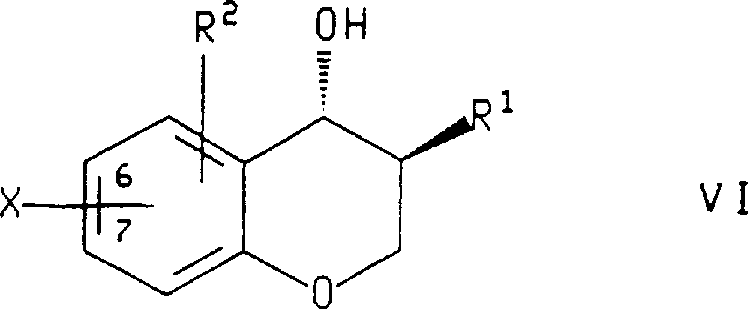
在所述的制备式Ⅶ化合物或所述化合物的对映体的方法中,用于R1和R2的优选取代基是在上文所述制备式Ⅹ化合物方法中陈述的那些。在另一优选的实施方案中,X是溴或碘,且所述的式Ⅵ化合物是用(1)甲基锂,(2)丁基锂和(3)所述的硼酸化剂处理,所述硼酸化剂选自甲硼烷-四氢呋喃配合物、硼酸三异丙酯和硼酸三甲酯。最优选的是,式Ⅵ化合物是(3S,4R)-3-苄基-7-溴-苯并二氢吡喃-4-醇且所述的硼酸化剂是甲硼烷-四氢呋喃配合物。In said process for the preparation of a compound of formula VII or an enantiomer of said compound, preferred substituents for R1 and R2 are those stated above in the process for the preparation of a compound of formula X. In another preferred embodiment, X is bromine or iodine, and said compound of formula VI is treated with (1) methyllithium, (2) butyllithium and (3) said borating agent, the The borating agent is selected from borane-tetrahydrofuran complexes, triisopropyl borate and trimethyl borate. Most preferably, the compound of formula VI is (3S,4R)-3-benzyl-7-bromo-chroman-4-ol and said borating agent is a borane-tetrahydrofuran complex.
在本发明的另一方面,式Ⅵ化合物或所述化合物的对映体,其中R1、R2和X如上所定义,是通过将下式化合物或在制备式Ⅵ化合物的对映体时,将所述式Ⅴ化合物的对映体,其中R1、R2和X如上所定义且X连接在苯环的4或5位上,且Y是卤或硝基,用碱处理,所述处理任选在添加的铜盐的存在下进行。In another aspect of the invention, the compound of formula VI, or an enantiomer of said compound, wherein R 1 , R 2 and X are as defined above, is obtained by adding the compound of formula Or when preparing the enantiomer of the compound of formula VI, the enantiomer of the compound of formula V, wherein R 1 , R 2 and X are as defined above and X is connected to the 4 or 5 position of the benzene ring, and Y is Halo or nitro, with base treatment, optionally in the presence of added copper salt.
在所述的制备式Ⅵ化合物或所述化合物的对映体的方法中,用于R1、R2和X的优选取代基是在上文所述制备式Ⅶ化合物方法中陈述的那些。在另一优选实施方案中,Y是卤,而所述的碱是叔丁醇钾、双(三甲基甲硅烷基)氨化钠、双(三甲基甲硅烷基)氨化钾、碳酸铯或氢化钠。最优选的是,所述的碱是叔丁醇钾,式Ⅴ化合物是(1R-,2S-)-2-苄基-1-(4-溴-2-氟-苯基)-丙-1,3-二醇。In said process for preparing a compound of formula VI or an enantiomer of said compound, preferred substituents for R 1 , R 2 and X are those set forth above in the process for preparing a compound of formula VII. In another preferred embodiment, Y is a halogen and the base is potassium tert-butoxide, sodium bis(trimethylsilyl)amide, potassium bis(trimethylsilyl)amide, carbonate cesium or sodium hydride. Most preferably, the base is potassium tert-butoxide, and the compound of formula V is (1R-, 2S-)-2-benzyl-1-(4-bromo-2-fluoro-phenyl)-propan-1 ,3-diol.
在本发明的另一方面,式Ⅴ化合物或所述化合物的对映体,其中R1、R2、X和Y如上所定义,是通过将下式化合物
在所述的制备式Ⅴ化合物或所述化合物的对映体的方法中,用于R1、R2、X和Y的优选取代基是在上文所述制备式Ⅵ化合物方法中陈述的那些。在另一优选的实施方案中,Xc是(R)-4-苄基-2-噁唑烷酮、(S)-4-苄基-2-噁唑烷酮、(4R,5S)-4-甲基-5-苯基-噁唑烷-2-酮或(4S,5R)-4-甲基-5-苯基-噁唑烷-2-酮,其中所述的Xc是连接在噁唑烷-2-酮的氮原子上,且所述的还原剂是硼氢化锂、氢化铝锂、硼氢化钠或硼氢化钙。最优选的是,式Ⅳ化合物是[4R-[3(2R,3R)]]-4-苄基-3-[2-苄基-3-(4-溴-2-氟-苯基)-3-羟基-丙酰基]-噁唑烷-2-酮、1-甲基-2-吡咯烷酮溶剂化物或[4R-[3(2R,3R)]]-4-苄基-3-[2-苄基-3-(4-溴-2-氟-苯基)-3-羟基-丙酰基]-噁唑烷-2-酮,且所述的还原剂是硼氢化锂。In said process for the preparation of a compound of formula V or an enantiomer of said compound, preferred substituents for R 1 , R 2 , X and Y are those stated above in the process for the preparation of a compound of formula VI . In another preferred embodiment, X c is (R)-4-benzyl-2-oxazolidinone, (S)-4-benzyl-2-oxazolidinone, (4R,5S)- 4-Methyl-5-phenyl-oxazolidin-2-one or (4S,5R)-4-methyl-5-phenyl-oxazolidin-2-one, wherein said X c is linking on the nitrogen atom of oxazolidin-2-one, and the reducing agent is lithium borohydride, lithium aluminum hydride, sodium borohydride or calcium borohydride. Most preferably, the compound of formula IV is [4R-[3(2R,3R)]]-4-benzyl-3-[2-benzyl-3-(4-bromo-2-fluoro-phenyl)- 3-Hydroxy-propionyl]-oxazolidin-2-one, 1-methyl-2-pyrrolidinone solvate or [4R-[3(2R,3R)]]-4-benzyl-3-[2- benzyl-3-(4-bromo-2-fluoro-phenyl)-3-hydroxy-propionyl]-oxazolidin-2-one, and the reducing agent is lithium borohydride.
在本发明的另一方面,式Ⅳ化合物或所述化合物的对映体,其中R1、R2、X、Xc和Y如上所定义,是通过将式R1-CH2C(O)-Xc的化合物,其中R1和Xc如上所定义,用(1)路易斯酸,(2)碱和(3)下式的化合物其中R2、X和Y如上所定义且X连接于苯环的4或5位上,进行处理而制备。In another aspect of the invention, the compound of formula IV, or an enantiomer of said compound, wherein R 1 , R 2 , X, X c and Y are as defined above, is obtained by adding the formula R 1 -CH 2 C(O) The compound of -X c , wherein R and X c are as defined above, with ( 1 ) Lewis acid, (2) base and (3) compound of the following formula wherein R 2 , X and Y are as defined above and X is attached to the 4 or 5 position of the benzene ring, and prepared by treatment.
在所述的制备式Ⅳ化合物或所述化合物的对映体的方法中,用于R1、R2、X、Xc和Y的优选取代基是在上文所述制备式Ⅴ化合物方法中陈述的那些。在另一优选实施方案中,所述的路易斯酸是卤化硼或磺酸硼,且所述的碱是三乙胺或二异丙基乙胺。最优选的是,所述式R1-CH2C(O)-Xc化合物是(R)-4-苄基-3-(3-苯基-丙酰基)-噁唑烷-2-酮,所述的式Ⅲ化合物是4-溴-2-氟-苯甲醛,所述的路易斯酸是二丁基三氟甲磺酸硼,且所述的碱是三乙胺。In said process for preparing a compound of formula IV or an enantiomer of said compound, preferred substituents for R 1 , R 2 , X, X c and Y are in the process for preparing a compound of formula V described above those stated. In another preferred embodiment, the Lewis acid is a boron halide or boron sulfonate, and the base is triethylamine or diisopropylethylamine. Most preferably, the compound of formula R 1 -CH 2 C(O)-X c is (R)-4-benzyl-3-(3-phenyl-propionyl)-oxazolidin-2-one , the compound of formula III is 4-bromo-2-fluoro-benzaldehyde, the Lewis acid is dibutylboron trifluoromethanesulfonate, and the base is triethylamine.
在本发明的另一方面,式Ⅳ化合物或所述化合物的对映体,其中R1、R2、X、Xc和Y如上所定义,是通过将式R1-CH2C(O)-Xc的化合物,其中R1和Xc如上所定义,用(1)卤化钛(IV),(2)碱,任选接着用给体配位体处理,和(3)下式的化合物
在所述的制备式Ⅳ化合物或所述化合物的对映体的方法中,用于R1、R2、X、Xc和Y的优选取代基是在上文所述制备式Ⅴ化合物方法中陈述的那些。在另一优选的实施方案中,所述的卤化钛(Ⅳ)是四氯化钛,且所述的碱是叔胺或叔二胺碱。在另一优选实施方案中,所述的碱是三乙胺或N,N,N’,N’-四甲基乙二胺,且所述的用所述碱处理之后是用选自下列的给体配位体处理:1-甲基-2-吡咯烷酮、二甲基甲酰胺、1,3-二甲基-3,4,5,6-四氢-2(1H)-嘧啶酮、磷酸三乙酯和2,2’-二吡啶基。最优选的是,所述的式R1-CH2C(O)-Xc的化合物是(R)-4-苄基-3-(3-苯基-丙酰基)-噁唑烷-2-酮,所述的式Ⅲ的化合物是4-溴-2-氟-苯甲醛,所述的碱是N,N,N’,N’-四甲基乙二胺,且所述的给体配位体是1-甲基-2-吡咯烷酮。In said process for preparing a compound of formula IV or an enantiomer of said compound, preferred substituents for R 1 , R 2 , X, X c and Y are in the process for preparing a compound of formula V described above those stated. In another preferred embodiment, said titanium(IV) halide is titanium tetrachloride, and said base is a tertiary amine or tertiary diamine base. In another preferred embodiment, said base is triethylamine or N,N,N',N'-tetramethylethylenediamine, and said treatment with said base is followed by Donor ligand treatment: 1-methyl-2-pyrrolidone, dimethylformamide, 1,3-dimethyl-3,4,5,6-tetrahydro-2(1H)-pyrimidinone, phosphoric acid Triethyl ester and 2,2'-dipyridyl. Most preferably, the compound of formula R 1 -CH 2 C(O)-X c is (R)-4-benzyl-3-(3-phenyl-propionyl)-oxazolidine-2 -ketone, the compound of the formula III is 4-bromo-2-fluoro-benzaldehyde, the base is N,N,N',N'-tetramethylethylenediamine, and the donor The ligand is 1-methyl-2-pyrrolidone.
在本发明的另一方面,所述的式Ⅸ化合物或所述化合物的对映体,其中R1、R2、R3和R4如上所定义,是在碱或氟化物盐和钯催化剂存在下,通过将下式化合物
在制备式Ⅸ化合物或所述化合物的对映体的方法中,如上文直接提到的,用于R1、R2、R3和R4的优选取代基是上文制备式Ⅹ化合物方法中陈述的那些。在另一优选实施方案中,X′优选是溴、碘,或三氟甲磺酸根,所述钯催化剂优选选自四(三苯基膦)钯(O),二氯双(三苯基膦)钯(Ⅱ)、乙酸钯(Ⅱ)、氯化烯丙基钯二聚物,三(二亚苄基丙酮)二钯(O),和10%披钯炭,而所述碱或氟化物盐选自碳酸钠、三乙胺、碳酸氢钠、碳酸铯、磷酸三钾、氟化钾、氟化铯、氢氧化钠、氢氧化钡和氟化四丁铵。最优选的是,式Ⅵ化合物是(3S,4R)-3-苄基-7-溴-苯并二氢吡喃-4-醇,式ⅩⅣ化合物是2-(2,2-二甲基-丙氧基羰基-5-三氟甲基-苯硼酸,所述碱或氟化物盐是碳酸钠,而所述钯催化剂是四(三苯基膦)钯(O)。In the process for preparing a compound of formula IX or an enantiomer of said compound, as mentioned directly above, preferred substituents for R 1 , R 2 , R 3 and R 4 are in the process for preparing a compound of formula X above those stated. In another preferred embodiment, X' is preferably bromine, iodine, or trifluoromethanesulfonate, and the palladium catalyst is preferably selected from tetrakis(triphenylphosphine)palladium(O), dichlorobis(triphenylphosphine) ) palladium(II), palladium(II) acetate, allylpalladium chloride dimer, tris(dibenzylideneacetone)dipalladium(O), and 10% palladium on carbon, and the alkali or fluoride The salt is selected from sodium carbonate, triethylamine, sodium bicarbonate, cesium carbonate, tripotassium phosphate, potassium fluoride, cesium fluoride, sodium hydroxide, barium hydroxide and tetrabutylammonium fluoride. Most preferably, the compound of formula VI is (3S,4R)-3-benzyl-7-bromo-chroman-4-ol, and the compound of formula XIV is 2-(2,2-dimethyl- Propoxycarbonyl-5-trifluoromethyl-phenylboronic acid, the base or fluoride salt is sodium carbonate, and the palladium catalyst is tetrakis(triphenylphosphine)palladium(0).
在本发明的另一方面,式ⅩⅣ化合物,其中R3和R4如上所定义,是通过将下式化合物水解而制备的:
在本发明的另一方面,式ⅩⅥ化合物,其中R3、R4和R8如上所定义,是通过将式ⅩⅣ化合物,其中R3和R4如上所定义,与式HO(CH2)m-N(R8)-(CH2)nOH(式ⅩⅤ),其中n、m和R8如上所定义,进行反应而制备。在所述的制备式ⅩⅥ化合物的方法中,用于R3和R4的优选取代基是在上文所述制备式Ⅹ化合物方法中陈述的那些。最优选的是,所述的式ⅩⅣ化合物是2-(2,2-二甲基-丙氧基羰基)-5-三氟甲基苯硼酸且所述的式ⅩⅤ化合物是二乙醇胺。In another aspect of the invention, the compound of formula XVI, wherein R 3 , R 4 and R 8 are as defined above, is obtained by combining the compound of formula XIV, wherein R 3 and R 4 are as defined above, with the formula HO(CH 2 ) m -N(R 8 )-(CH 2 ) n OH (Formula XV), wherein n, m and R 8 are as defined above, is prepared by reacting. In said process for the preparation of compounds of formula XVI, preferred substituents for R3 and R4 are those stated above in the process for the preparation of compounds of formula X. Most preferably, said compound of formula XIV is 2-(2,2-dimethyl-propoxycarbonyl)-5-trifluoromethylphenylboronic acid and said compound of formula XV is diethanolamine.
在本发明的另一方面,式ⅩⅣ化合物,其中R4和R3如上所定义,是通过将下式化合物
在本发明的另一方面,式ⅩⅢ化合物,其中R3、R4和R7如上所定义,是通过将下式化合物其中R3和R4如上所定义,用氨基金属碱在三-(C1-C6烷基)硼酸酯存在下进行处理而制备。In another aspect of the invention, the compound of formula XIII, wherein R 3 , R 4 and R 7 are as defined above, is obtained by adding the compound of formula wherein R 3 and R 4 are as defined above, prepared by treatment with an amino metal base in the presence of a tris-(C 1 -C 6 alkyl) borate.
在所述的制备式ⅩⅢ化合物的方法中,用于R3和R4的优选取代基是在上文所述制备式Ⅹ化合物方法中陈述的那些。在另一优选实施方案中,所述的氨基金属碱选自二异丙基氨化锂、二乙基氨化锂、2,2,6,6-四甲基哌啶锂和双(2,2,6,6-四甲基哌啶子基)镁,而所述的三-(C1-C4烷基)硼酸酯选自硼酸三异丙酯、硼酸三乙酯和基硼酸三甲酯。最优选的是,式Ⅻ化合物是4-三氟甲基-苯甲酸2,2-二甲基-丙基酯,所述的氨基金属碱是二异丙基氨化锂,而所述的三-(C1-C6烷基)硼酸酯是硼酸三异丙酯。Preferred substituents for R3 and R4 in the described process for the preparation of compounds of formula XIII are those stated above in the process for the preparation of compounds of formula X. In another preferred embodiment, the amino metal base is selected from lithium diisopropylamide, lithium diethylamide, lithium 2,2,6,6-tetramethylpiperidine and bis(2, 2,6,6-tetramethylpiperidino) magnesium, and the tri-(C 1 -C 4 alkyl) borate is selected from the group consisting of triisopropyl borate, triethyl borate and tris-boronate methyl ester. Most preferably, the compound of formula XII is 2,2-dimethyl-propyl 4-trifluoromethyl-benzoate, the amino metal base is lithium diisopropylamide, and the three -(C 1 -C 6 alkyl) borate is triisopropyl borate.
在本发明的另一方面,式Ⅹ化合物或所述化合物的对映体,其中R1、R2和R3如上所定义,与其中R5和R6如上所定义的式NHR5R6的仲胺进行反应,形成下式的羧酸铵
本发明还涉及制备下式化合物或所述化合物的对映体的方法,
ⅩⅨ式中R1和Xc与在上文所述制备式Ⅴ化合物方法所定义的相同,且R11是C1-C9烷基、C2-C9链烯基或在2位上由Y、在4或5位上由X且在苯基部分的余下位置之一上由R2取代的苯基,其中Y、X和R2与在上文所述制备式Ⅴ化合物方法所定义的相同,所述的方法是将式R1-CH2C(O)-Xc的化合物,其中R1和Xc如上所定义,用(1)卤化钛(Ⅳ),(2)碱,任选接着用给体配位体处理,和(3)相对于所述式R1-CH2C(O)-Xc化合物的量少于2当量、优选大约1当量的其中R11如上所定义的式R11-C(O)H,进行处理。制备所述式ⅩⅨ化合物或所述化合物的对映体的所述方法的优选取代基和试剂,是在上文对使用所述卤化钛(Ⅳ)制备式Ⅳ化合物的所述方法中陈述的那些。In formula XIX, R 1 and X c are the same as defined in the method for preparing the compound of formula V described above, and R 11 is C 1 -C 9 alkyl, C 2 -C 9 alkenyl or at the 2 position by Y, phenyl substituted by X at position 4 or 5 and R at one of the remaining positions of the phenyl moiety, wherein Y, X and R are as defined above for the preparation of compounds of formula V Similarly, the method is to use the compound of formula R 1 -CH 2 C(O)-X c , wherein R 1 and X c are as defined above, with (1) titanium (IV) halide, (2) base, any optionally followed by treatment with a donor ligand, and (3) less than 2 equivalents, preferably about 1 equivalent, of the compound wherein R 11 is as defined above, relative to said compound of formula R 1 -CH 2 C(O)-X c The formula R 11 -C(O)H, is processed. Preferred substituents and reagents for the process of preparing said compound of formula XIX or an enantiomer of said compound are those set forth above for said process of preparing a compound of formula IV using said titanium(IV) halide .
本发明还涉及下式化合物
在所述的式Ⅴ化合物和所述化合物的对映体中,用于R1、R2、X和Y的优选取代基是在上文所述制备式Ⅵ化合物的所述方法中陈述的那些。最优选的是,所述的式Ⅴ化合物是(1R,2S)-2-苄基-1-(4-溴-2-氟-苯基)-丙-1,3-二醇。In said compounds of formula V and the enantiomers of said compounds, preferred substituents for R 1 , R 2 , X and Y are those stated above in said process for the preparation of compounds of formula VI . Most preferably, the compound of formula V is (1R,2S)-2-benzyl-1-(4-bromo-2-fluoro-phenyl)-propan-1,3-diol.
本发明还涉及下式化合物
在所述的式Ⅵ化合物和所述化合物的对映体中,用于R1和R2的优选取代基是在上文所述式Ⅴ化合物中陈述的那些,且X′优选是溴、碘或三氟甲磺酸根。最优选的是,所述的式Ⅵ化合物是(3S,4R)-3-苄基-7-溴-苯并二氢吡喃-4-醇。In said compounds of formula VI and the enantiomers of said compounds, preferred substituents for R and R are those stated above for compounds of formula V, and X' is preferably bromo, iodo or triflate. Most preferably, the compound of formula VI is (3S,4R)-3-benzyl-7-bromo-chroman-4-ol.
本发明还涉及下式化合物
在所述的式Ⅶ化合物和所述化合物的对映体中,用于R1和R2的优选取代基是在上文所述式Ⅵ化合物中陈述的那些。最优选的是,所述的式Ⅶ化合物是(3S,4R)-(3-苄基-4-羟基-苯并二氢吡喃-7-基)-硼酸。In said compounds of formula VII and the enantiomers of said compounds, preferred substituents for R1 and R2 are those stated above for the compounds of formula VI. Most preferably, said compound of formula VII is (3S,4R)-(3-benzyl-4-hydroxy-chroman-7-yl)-boronic acid.
本发明还涉及下式化合物
在所述的式Ⅸ化合物和所述化合物的对映体中,用于R1、R2、R3和R4的优选取代基是在上文所述制备式Ⅹ化合物的所述方法中陈述的那些。最优选的是,式Ⅸ化合物是(3S,4R)-2-(3-苄基-4-羟基-苯并二氢吡喃-7-基)-4-三氟甲基苯甲酸乙酯。In said compounds of formula IX and the enantiomers of said compounds, preferred substituents for R 1 , R 2 , R 3 and R 4 are as stated above in said process for the preparation of compounds of formula X of those. Most preferably, the compound of formula IX is ethyl (3S,4R)-2-(3-benzyl-4-hydroxy-chroman-7-yl)-4-trifluoromethylbenzoate.
本发明还涉及下式化合物其中R3、R4和R7是在上文所述的使用式ⅩⅢ化合物制备式ⅩⅣ化合物的所述方法中陈述的那些。The present invention also relates to compounds of the following formula wherein R 3 , R 4 and R 7 are those set forth above in the process described above for the preparation of compounds of formula XIV using compounds of formula XIII.
在所述的式ⅩⅢ化合物中,用于R7、R3和R4的优选取代基是上文所述的使用式ⅩⅢ化合物制备式ⅩⅣ化合物的所述方法中陈述的那些。In said compounds of formula XIII, preferred substituents for R7 , R3 and R4 are those set forth above in said process for preparing compounds of formula XIV using compounds of formula XIII.
本发明还涉及下式化合物
在所述的式ⅩⅣ化合物中,用于R3和R4的优选取代基是在上文所述式ⅩⅢ化合物中陈述的那些。最优选的是,所述的式ⅩⅣ化合物是2-(2,2-二甲基-丙氧基羰基)-5-三氟甲基-苯硼酸。In said compounds of formula XIV, preferred substituents for R3 and R4 are those set out above for said compounds of formula XIII. Most preferably, said compound of formula XIV is 2-(2,2-dimethyl-propoxycarbonyl)-5-trifluoromethyl-phenylboronic acid.
本发明还涉及下式化合物其中虚线指B与N原子间有-个键或无键,n和m独立地是2至5,R3和R4如上对所述式ⅩⅣ化合物的定义,且R8是H或C1-C6烷基。The present invention also relates to compounds of the following formula Wherein the dotted line means that there is a bond or no bond between B and N atoms, n and m are independently 2 to 5, R 3 and R 4 are as defined above for the compound of formula XIV, and R 8 is H or C 1 - C 6 alkyl.
在所述的式ⅩⅥ化合物中,n和m各自优选是2,用于R3和R4的优选取代基如上对所述式ⅩⅣ化合物的定义,且R8优选是H。最优选的是,式ⅩⅥ化合物是2-[1,3,6,2]-dioxazaborocan-2-基-4-三氟甲基-苯甲酸2,2-二甲基-丙基酯。In said compounds of formula XVI, n and m are each preferably 2, preferred substituents for R3 and R4 are as defined above for said compounds of formula XIV, and R8 is preferably H. Most preferably, the compound of formula XVI is 2,2-dimethyl-propyl 2-[1,3,6,2]-dioxazaborocan-2-yl-4-trifluoromethyl-benzoate.
本发明还涉及下式的羧酸铵化合物和所述化合物的对映体,其中R1、R2、R3、R5和R6如上文所述制备式Ⅹ化合物方法所定义。用于R1、R2和R3的优选取代基是在上文所述的制备式Ⅹ化合物的方法中陈述的那些。在铵部分中,R5和R6各自优选是环己基。最优选的是,所述的式ⅩⅦ化合物是(3S,4R)-二环己基铵-2-(3-苄基-4-羟基-苯并二氢吡喃-7-基)-4-三氟甲基苯甲酸盐。The present invention also relates to ammonium carboxylate compounds of the formula and the enantiomers of said compounds, wherein R 1 , R 2 , R 3 , R 5 and R 6 are as defined above for the preparation of the compound of formula X. Preferred substituents for R 1 , R 2 and R 3 are those set forth above in the process for the preparation of compounds of formula X described above. In the ammonium moiety, each of R5 and R6 is preferably cyclohexyl. Most preferably, the compound of formula XVII is (3S,4R)-dicyclohexylammonium-2-(3-benzyl-4-hydroxy-chroman-7-yl)-4-tri Fluoromethylbenzoate.
本发明还涉及下式化合物
本文中所用的术语“卤”,除非另有说明,指氟、氯、溴或碘。The term "halo" as used herein, unless otherwise stated, refers to fluorine, chlorine, bromine or iodine.
本文中所用的术语“烷基”,除非另有说明,包括具有直链、支链或环状部分的饱和一价烃基或其组合。The term "alkyl" as used herein, unless otherwise stated, includes saturated monovalent hydrocarbon radicals having linear, branched or cyclic moieties or combinations thereof.
本文中所用的术语“烷氧基”包括其中“烷基”如上所定义的O-烷基基团。As used herein, the term "alkoxy" includes O-alkyl groups wherein "alkyl" is as defined above.
本文中所用的术语“芳基”,除非另有说明,包括由芳烃除去一个氢而衍生的有机基,如苯基或萘基。As used herein, unless otherwise stated, the term "aryl" includes organic radicals derived from aromatic hydrocarbons by removing one hydrogen, such as phenyl or naphthyl.
本文中所用的术语“杂芳基”,除非另有说明,包括芳族杂环化合物除去一个氢而衍生的有机基,如吡啶基、呋喃基、噻吩基、异喹啉基、嘧啶基和吡嗪基。The term "heteroaryl" as used herein, unless otherwise stated, includes organic radicals derived from aromatic heterocyclic compounds by removing one hydrogen, such as pyridyl, furyl, thienyl, isoquinolyl, pyrimidinyl and pyridyl Azinyl.
本文中所用的术语“对映体”,涉及式Ⅹ化合物时是指下式化合物 The term "enantiomer" as used herein, when referring to a compound of formula X refers to the following compound
本文中所用的术语“对映体”,涉及式Ⅸ化合物时
本文中所用的术语“对映体”,涉及式Ⅶ化合物时
本文中所用的术语“对映体”,涉及式Ⅵ化合物时是指下式化合物
本文中所用的术语“对映体”,涉及式Ⅴ化合物时是指下式化合物
本文中所用的术语“对映体”,涉及式Ⅳ化合物时

本文中所用的术语“对映体”,涉及式ⅩⅦ化合物时

本文中所用的术语“对映体”,涉及式ⅩⅨ化合物时
ⅩⅨ是指下式化合物 XIX refers to the compound of formula
本发明方法和本发明化合物的制备用下列反应方案进行说明。在下列反应方案和下文的讨论中,除非另有说明,R1、R2、R3、R4、R5、R6、R7、R8、R11、Y、Z、X、Xc和X′如上所定义。下列反应方案和下文的讨论描述了式Ⅰ-ⅩⅨ化合物的制备。下列反应方案和下文的描述同样适用于式Ⅰ-ⅩⅨ化合物的对映体,其中术语“对映体”如上所定义。The methods of the invention and the preparation of the compounds of the invention are illustrated by the following reaction schemes. In the following reaction schemes and discussions below, unless otherwise stated, R 1 , R 2 , R 3 , R 4 , R 5 , R 6 , R 7 , R 8 , R 11 , Y, Z, X, X c and X' are as defined above. The following reaction schemes and discussion below describe the preparation of compounds of formulas I-XIX. The following reaction schemes and descriptions below apply equally to the enantiomers of the compounds of formulas I-XIX, wherein the term "enantiomer" is as defined above.
反应方案1
反应方案1(续)
反应方案2
反应方案3 Reaction scheme 3
反应方案4
综上所述,反应方案1的合成顺序涉及将手性辅助剂Xc连接到含R1的化合物Ⅰ上(步骤1),与醛Ⅲ的不对称醛醇缩合(步骤2或2’),由醛醇Ⅳ还原除去手性辅助剂(步骤3),二醇Ⅴ的碱介导的环化(步骤4),卤代苯并二氢吡喃Ⅵ的锂化和硼酸化(步骤5),用芳基卤或磺酸盐Ⅷ偶合硼酸Ⅶ(步骤6)和水解酯Ⅸ(步骤7)。In summary, the synthetic sequence of Reaction Scheme 1 involves attachment of chiral auxiliary Xc to compound I containing R (step 1 ), asymmetric aldol condensation with aldehyde III (step 2 or 2'), Reductive removal of chiral auxiliary from aldol IV (step 3), base-mediated cyclization of diol V (step 4), lithiation and borylation of halochroman VI (step 5), Coupling of boronic acid VII (step 6) and hydrolyzed ester IX (step 7) with aryl halide or sulfonate VIII.
在反应方案1的步骤1中,在非质子传递溶剂,如醚溶剂,优选四氢呋喃(THF)中,在大约-80至0℃,优选-78至-55℃的温度下,通过用适合的强碱,如烷基锂碱,优选是丁基锂,处理大约20分钟至1小时,将手性辅助剂HXc转化成相应的阴离子。取代基Xc是在不对称醛醇反应中适合用来控制相对和绝对立体化学的手性辅助剂。HXc的实例包括(R)-4-苄基-2-噁唑烷酮、(S)-4-苄基-2-噁唑烷酮、(4R,5S)-4-甲基-5-苯基-噁唑烷-2-酮和(4S,5R)-4-甲基-5-苯基-噁唑烷-2-酮。在相同的溶剂中,在大约-80至0℃下,优选大约-75℃,经大约一小时的时间,将所得的阴离子用酰化剂Ⅰ处理,其中基团W是卤化物,优选是氯,且R1如上所定义,之后在水溶液处理之前升温到大约-20至20℃,优选大约0℃,所述水溶液处理优选是用含水碳酸氢钠处理,产生酰化的手性辅助剂Ⅱ。In step 1 of Reaction Scheme 1, in an aprotic solvent, such as an ether solvent, preferably tetrahydrofuran (THF), at a temperature of about -80 to 0°C, preferably -78 to -55°C, by using a suitable strong Treatment with a base, such as an alkyllithium base, preferably butyllithium, for about 20 minutes to 1 hour converts the chiral auxiliary HX c to the corresponding anion. The substituent X c is a suitable chiral auxiliary for controlling relative and absolute stereochemistry in asymmetric aldol reactions. Examples of HX c include (R)-4-benzyl-2-oxazolidinone, (S)-4-benzyl-2-oxazolidinone, (4R,5S)-4-methyl-5- Phenyl-oxazolidin-2-one and (4S,5R)-4-methyl-5-phenyl-oxazolidin-2-one. The resulting anion is treated with an acylating agent I, wherein the group W is a halide, preferably chloride, at about -80 to 0°C, preferably at about -75°C, over a period of about one hour in the same solvent , and R1 is as defined above, followed by warming to about -20 to 20°C, preferably about 0°C, prior to aqueous treatment, preferably with aqueous sodium bicarbonate, to yield the acylated chiral auxiliary II.
反应方案1的步骤2是“Evans醛醇”反应,该反应是在类似于Evans,D.A.;Bartroli,J.;Shih,T.L.《美国化学学会杂志》[J.Am.Chem.Soc.]1981,103,2127和Gage,J.R.;Evans,D.A.,《有机合成》[Org.Syn.]1989,68,83中描述的那些条件,这两篇参考文献均并入本文作为参考。具体地说,在反应方案1的步骤2中,酰化的手性辅助剂Ⅱ是用路易斯酸、碱、和取代的苯甲醛Ⅲ处理,产生具有高度立体选择性的醇Ⅳ。苯甲醛Ⅲ由在环化步骤4期间作为离去基团的邻位取代基Y、在偶合步骤6期间由芳基侧链取代的基团X(或对于反应方案2,特别是反应方案2的偶合步骤4而言为X′)和如上定义的取代基R2取代。取代基X(或对于反应方案2而言为X′)连接在苯甲醛Ⅲ的苯基部分的4或5位上。离去基团Y典型地是卤或硝基,且X是卤化物(和,对于反应方案2而言,X′是卤化物或C1-C4全氟烷基磺酸根)。为制备醛醇产物Ⅳ,在非质子传递溶剂如二氯甲烷、1,2-二氯乙烷、甲苯或乙醚,优选是二氯甲烷中,在大约-78℃至40℃,优选-5℃下,经大约20分钟的时间,将酰化的手性辅助剂Ⅱ用卤化硼或硼磺酸酯如二烷基硼磺酸酯,优选是二丁基三氟甲磺酸硼处理,接着在大约-78℃至40℃,优选-5至5℃,经大约一小时的时间,用叔胺碱如三乙胺或二异丙基乙胺,优选三乙胺处理。在大约-100至0℃,优选大约-70℃,经大约30分钟的时间,将此混合物用取代的苯甲醛Ⅲ处理。让此混合物经大约一小时,升温到大约-20至25℃,优选大约-10℃的温度,之后在低于大约15℃下,通过用质子传递氧化猝灭剂处理,优选通过依次加入pH7缓冲液、甲醇和过氧化氢水溶液处理,产生醇Ⅳ。Step 2 of Reaction Scheme 1 is the "Evans aldol" reaction, which was developed in a similar manner to Evans, DA; Bartroli, J.; Shih, TL "Journal of the American Chemical Society" [J.Am.Chem.Soc.] 1981, 103, 2127 and Gage, JR; Evans, DA, those conditions described in Organic Synthesis [Org. Syn.] 1989, 68, 83, both of which are incorporated herein by reference. Specifically, in step 2 of Reaction Scheme 1, the acylated chiral auxiliary II is treated with a Lewis acid, base, and substituted benzaldehyde III to produce highly stereoselective alcohol IV. Benzaldehyde III consists of the ortho substituent Y as the leaving group during the cyclization step 4, the group X substituted by the aryl side chain during the coupling step 6 (or for Reaction Scheme 2, especially Reaction Scheme 2 Coupling step 4 is substituted by X') and substituent R 2 as defined above. Substituent X (or X' for Reaction Scheme 2) is attached to the 4 or 5 position of the phenyl moiety of benzaldehyde III. The leaving group Y is typically halo or nitro, and X is a halide (and, for Reaction Scheme 2, X' is a halide or a C 1 -C 4 perfluoroalkylsulfonate). To prepare the aldol product IV, in an aprotic solvent such as dichloromethane, 1,2-dichloroethane, toluene or diethyl ether, preferably dichloromethane, at about -78°C to 40°C, preferably -5°C , over a period of about 20 minutes, the acylated chiral auxiliary II is treated with a boron halide or a borosulfonate such as a dialkylboronsulfonate, preferably dibutylborontriflate, followed by At about -78°C to 40°C, preferably -5 to 5°C, over a period of about one hour, treat with a tertiary amine base such as triethylamine or diisopropylethylamine, preferably triethylamine. The mixture is treated with the substituted benzaldehyde III at about -100 to 0°C, preferably at about -70°C, over a period of about 30 minutes. This mixture is allowed to warm to a temperature of about -20 to 25°C, preferably about -10°C, over about one hour, and then at a temperature below about 15°C, by treatment with a protic oxidation quencher, preferably by sequential addition of a pH 7 buffer solution, methanol and aqueous hydrogen peroxide to produce alcohol IV.
反应方案1的步骤2’是另外的且是优选的使用含钛路易斯酸提供醇Ⅳ的方法。在反应方案1的步骤2’中,在非质子传递溶剂如二氯甲烷、1,2-二氯乙烷或甲苯,优选二氯甲烷中,在大约-80至0℃,优选在-80至-70℃的温度下,将酰化的手性辅助剂Ⅱ用卤化钛(Ⅳ),优选用四氯化钛处理大约30分钟,另加搅拌大约30分钟,接着在大约-80至0℃,优选-80至-65℃的温度下,用叔胺或叔二胺碱如三乙胺或N,N,N’,N’-四甲基乙二胺,优选N,N,N’,N’-四甲基乙二胺处理大约30分钟。这点是任选的,且是优选的,接着在大约-80至0℃,优选-80至-65℃的温度下,用给体配位体如1-甲基-2-吡咯烷酮、二甲基甲酰胺、1,3-二甲基-3,4,5,6-四氢-2(1H)-嘧啶酮、磷酸三乙酯或2,2’-二吡啶基,优选1-甲基-2-吡咯烷酮处理,接着搅拌大约30分钟的时间。在大约-100至0℃,优选-80至-65℃的温度下,此混合物用取代的苯甲醛Ⅲ处理大约30分钟,并让其经大约一至24小时,优选大约4小时的时间,升温至-30至30℃,优选0至25℃。在-30至30℃,优选0至25℃下,将此混合物用质子传递猝灭剂优选含水氯化铵处理,产生醇Ⅳ。在用给体配位体进行处理时,在一些情况下,醇Ⅳ是以与给体配位体形成的晶体溶剂化物形式提供的。在大约20℃下用固体载体如Celite将猝灭的反应混合物搅拌大约12小时,改善除去钛副产物的反应混合物过滤。Step 2' of Reaction Scheme 1 is an additional and preferred method of providing alcohol IV using a titanium-containing Lewis acid. In step 2' of Reaction Scheme 1, in an aprotic solvent such as dichloromethane, 1,2-dichloroethane or toluene, preferably dichloromethane, at about -80 to 0°C, preferably at -80 to At a temperature of -70 ° C, the acylated chiral auxiliary II is treated with a titanium (IV) halide, preferably titanium tetrachloride, for about 30 minutes, and stirred for about 30 minutes, and then at about -80 to 0 ° C, Preferably at a temperature of -80 to -65°C, with a tertiary amine or tertiary diamine base such as triethylamine or N,N,N',N'-tetramethylethylenediamine, preferably N,N,N',N '-Tetramethylethylenediamine for about 30 minutes. This is optional and preferred, followed by a reaction with a donor ligand such as 1-methyl-2-pyrrolidone, dimethyl Dimethyl formamide, 1,3-dimethyl-3,4,5,6-tetrahydro-2(1H)-pyrimidinone, triethyl phosphate or 2,2'-dipyridyl, preferably 1-methyl -2-pyrrolidone treatment, followed by stirring for about 30 minutes. At a temperature of about -100 to 0°C, preferably -80 to -65°C, this mixture is treated with substituted benzaldehyde III for about 30 minutes and allowed to heat up to -30 to 30°C, preferably 0 to 25°C. Treatment of this mixture with a protic quencher, preferably aqueous ammonium chloride, at -30 to 30°C, preferably 0 to 25°C, yields alcohol IV. Upon treatment with the donor ligand, in some cases the alcohol IV is provided in the form of a crystalline solvate with the donor ligand. The quenched reaction mixture is stirred for about 12 hours at about 20°C with a solid support such as Celite (R) to improve filtration of the reaction mixture to remove titanium by-products.
反应方案1的步骤2’的钛醛醇条件是优选的,且与反应方案1的步骤2的硼醛醇条件相比,操作上更简单,因为在制备路易斯酸二丁基三氟甲磺酸硼时,前者避免引火试剂三丁基硼烷、腐蚀性试剂三氟甲磺酸和其放热组合。再者,与文献如Evans,D.A.;Rieger,D.L.;Bilodeau,M.T.;Urpi,F.《美国化学学会杂志》[J.Am.Chem.Soc.]1991,113,1047中描述的钛醛醇反应相反,反应方案1的步骤2’的钛醛醇条件提供少于二当量的醛Ⅲ的高度选择性。优选的是,在此步骤中,使用大约一当量的醛Ⅲ。在本文中提到醛Ⅲ或式R11C(O)H化合物(如权利要求书中所引述的)时,“大约一当量”一词是指所述的化合物少于1.5当量。在前述Evans等的文章中,报道了对类似于反应方案1的步骤2’的钛醛醇反应来说,需要2当量的醛。The titanium aldol condition of step 2' of reaction scheme 1 is preferred, and compared with the boron aldol condition of step 2 of reaction scheme 1, it is simpler in operation because in the preparation of Lewis acid dibutyltrifluoromethanesulfonic acid In the case of boron, the former avoids the pyrophoric reagent tributylborane, the corrosive reagent trifluoromethanesulfonic acid, and their exothermic combinations. Furthermore, with the titanium aldol reaction described in documents such as Evans, DA; Rieger, DL; Bilodeau, MT; Urpi, F. In contrast, the titanium aldol conditions of step 2' of Reaction Scheme 1 provide a high selectivity of less than two equivalents of aldehyde III. Preferably, about one equivalent of aldehyde III is used in this step. Where reference is made herein to aldehyde III or to a compound of formula R11C (O)H (as recited in the claims), the phrase "about one equivalent" means less than 1.5 equivalents of the compound in question. In the aforementioned Evans et al. article, it is reported that for a titanium aldol reaction analogous to step 2' of Reaction Scheme 1, 2 equivalents of aldehyde are required.
除了在制备式Ⅹ的治疗剂方面有用之外,反应方案1的步骤2’的钛醛醇条件可用于制备HIV蛋白酶抑制剂化合物,所述化合物描述于英国专利申请2,270,914号(公开于1994年3月30日)和B.D.Dorsey等,《四面体通讯》[Tetrahedron Letters],1993,34(12),1851。反应方案4说明将钛醛醇反应应用于醛ⅩⅧ,其中R11是C1-C9烷基、C2-C9链烯基或在2位上由Y、在4或5位上由X且在苯基部分余下位置之一上由R2取代的苯基,其中Y、X和R2如上所定义。反应方案4的反应条件与在上文反应方案1的步骤2’中描述的那些相同。醛ⅩⅧ包括来自反应方案1的醛Ⅲ,并且醇ⅩⅨ包括来自反应方案1的醇Ⅳ。反应方案4的反应可以用来制备上文提到的英国专利申请2,270,914号中描述的HIV蛋白酶抑制剂化合物,其中R11是C1-C9烷基或C2-C9链烯基,优选3-环己基丙烯基。In addition to being useful in the preparation of therapeutic agents of formula X, the titanium aldol conditions of step 2' of Reaction Scheme 1 can be used to prepare HIV protease inhibitor compounds described in British Patent Application No. 2,270,914 (published on March 1994 30th) and BD Dorsey et al., "Tetrahedron Letters" [Tetrahedron Letters], 1993, 34(12), 1851. Reaction scheme 4 illustrates the application of titanium aldol reaction to aldehyde XVIII, wherein R 11 is C 1 -C 9 alkyl, C 2 -C 9 alkenyl or Y at the 2 position, X at the 4 or 5 position and phenyl substituted by R at one of the remaining positions of the phenyl moiety, wherein Y, X and R are as defined above. The reaction conditions of Reaction Scheme 4 are the same as those described in Step 2' of Reaction Scheme 1 above. Aldehyde XVIII includes aldehyde III from Reaction Scheme 1, and alcohol XIX includes alcohol IV from Reaction Scheme 1. The reaction of Reaction Scheme 4 can be used to prepare the HIV protease inhibitor compounds described in the above-mentioned British Patent Application No. 2,270,914, wherein R 11 is C 1 -C 9 alkyl or C 2 -C 9 alkenyl, preferably 3-cyclohexylpropenyl.
下文的表1说明反应方案4或反应方案1的步骤2’的产物可以怎样根据所用的反应条件而变化,且特别是,非对映体选择性是如何通过将TMEDA的量从1.2增加至3当量和通过添加2当量的NMP来增加的。在表1中,每一反应使用1.0当量的醛RCHO,x和y分别代表碱和NMP的当量,NMP指1-甲基-2-吡咯烷酮,TMEDA指N,N,N’,N’-四甲基乙二胺,NEtiPr2指二异丙基乙胺,而非对映体的比率用HPLC测定。根据类似于那些描述于Van Draanen,N.A.;Arseniyadia,S.;Crimmins,M.T.;Heathcock,C.H.,《有机化学杂志》[J.Org.Chem.]1991,56,2499和Gage,J.R.;Evans,D.A.,《有机合成》[Org.Syn.]1989,68,83中的方法,通过分离和通过用LiOH/H2O2水解来转化成已知的羧酸异构体来鉴别醛醇异构体。所需的异构体用粗体指明。Table 1 below illustrates how the product of Reaction Scheme 4 or Step 2' of Reaction Scheme 1 can vary depending on the reaction conditions used and, in particular, how diastereoselectivity can be increased by increasing the amount of TMEDA from 1.2 to 3 equivalents and increased by adding 2 equivalents of NMP. In Table 1, each reaction uses 1.0 equivalent of aldehyde RCHO, x and y represent the equivalent of base and NMP, respectively, NMP refers to 1-methyl-2-pyrrolidone, TMEDA refers to N,N,N',N'-tetra Methylethylenediamine, NEtiPr 2 refers to diisopropylethylamine and the ratio of diastereomers was determined by HPLC. According to similar to those described in Van Draanen, NA; Arseniyadia, S.; Crimmins, MT; Heathcock, CH, "Journal of Organic Chemistry" [J.Org.Chem.] 1991, 56, 2499 and Gage, JR; , method in Organic Synthesis [Org.Syn.] 1989, 68, 83, identification of aldol isomers by separation and conversion into known carboxylic acid isomers by hydrolysis with LiOH/H 2 O 2 . The desired isomer is indicated in bold.
表1的反应方案
表1
在反应方案1的步骤3中,根据类似于Penning,T.D.;Djuric,S.W.;Haack,R.A.;Kalish,V.J.;Miyashiro,J.M.;Rowell,B.W.;Yu,S.S.,《合成通讯》[Syn.Commun.]1990,20,307(该文并入本文作为参考)中描述的方法,除去手性辅助剂Xc(和任选回收再用于步骤1),并且将化合物Ⅳ(酸水平)的氧化态还原成所需的醇Ⅴ。在此方法中,在醚溶剂如THF、二异丙醚或甲基叔丁基醚,优选THF中,典型的是含有质子传递溶剂,如水、乙醇或异丙醇,在大约-78℃至回流温度下,优选在0℃至室温(20-25℃)下,将醇Ⅳ用氢化物还原剂如硼氢化锂、氢化铝锂、硼氢化钠或硼氢化钙,优选硼氢化锂,进行处理。在1至24小时,典型的是12小时后,反应用水猝灭,任选随后加入过氧化氢。通过选择性沉淀,或通过从二醇Ⅴ在有机溶剂如二异丙基乙基或乙酸乙酯和己烷的混合物中的溶液,将HXc萃取入含水的酸,优选盐酸,接着用碱中和含水的酸性萃取液,并将HXc萃取入有机溶剂,可以将手性HXc回收,再用于步骤1。In step 3 of Reaction Scheme 1, according to analogy Penning, TD; Djuric, SW; Haack, RA; Kalish, VJ; Miyashiro, JM; Rowell, BW; 1990,20,307 (which is incorporated herein by reference), the chiral auxiliary Xc is removed (and optionally recovered for reuse in step 1), and the oxidation state of compound IV (acid level) is reduced to the Alcohol V is required. In this process, in an ethereal solvent such as THF, diisopropyl ether or methyl tert-butyl ether, preferably THF, typically containing a protic solvent such as water, ethanol or isopropanol, at about -78°C to reflux The alcohol IV is treated with a hydride reducing agent such as lithium borohydride, lithium aluminum hydride, sodium borohydride or calcium borohydride, preferably lithium borohydride, at temperature, preferably between 0°C and room temperature (20-25°C). After 1 to 24 hours, typically 12 hours, the reaction is quenched with water, optionally followed by addition of hydrogen peroxide. By selective precipitation, or by extraction of HXc from a solution of diol V in an organic solvent such as diisopropylethyl or a mixture of ethyl acetate and hexane, into an aqueous acid, preferably hydrochloric acid, followed by neutralization with base Aqueous acidic extract, and extract HX c into an organic solvent, the chiral HX c can be recovered and reused in step 1.
反应方案1的步骤4是分子内芳族取代,这样,二醇Ⅴ中的伯羟基代替邻位离去基团Y,产生苯并二氢吡喃醇环系VI。具体地说,二醇Ⅴ,其中离去基团Y是卤或硝基基团,优选是氟基团,用碱如叔丁醇钾、双(三甲基甲硅烷基)氨化钠、双(三甲基甲硅烷基)氨化钾、碳酸铯或氢化钠,优选叔丁醇钾,在非质子传递溶剂如THF、二甲基亚砜或1-甲基-2-吡咯烷酮,优选THF中,任选在添加的铜盐的存在下,在室温至130℃,优选大约70℃的温度下,处理1至24小时,典型的是大约四小时,给出苯并二氢吡喃醇Ⅵ。在苯并二氢吡喃醇Ⅵ中,取代基X(或对于反应方案2为X′)连接在苯并二氢吡喃环的6或7位上。Step 4 of Reaction Scheme 1 is an intramolecular aromatic substitution such that the primary hydroxyl group in diol V replaces the ortho leaving group Y to generate the chromanol ring system VI. Specifically, diol V, wherein the leaving group Y is a halo or nitro group, preferably a fluorine group, is treated with a base such as potassium tert-butoxide, sodium bis(trimethylsilyl)amide, bis(trimethylsilyl)amide, Potassium (trimethylsilyl)amide, cesium carbonate or sodium hydride, preferably potassium tert-butoxide, in an aprotic solvent such as THF, dimethylsulfoxide or 1-methyl-2-pyrrolidone, preferably THF , optionally in the presence of added copper salt, at a temperature of from room temperature to 130°C, preferably about 70°C, for 1 to 24 hours, typically about four hours, to give the chromanol VI. In chromanol VI, the substituent X (or X' for Reaction Scheme 2) is attached to the 6 or 7 position of the chroman ring.
在反应方案1的步骤5中,苯并二氢吡喃醇Ⅵ中的取代基X转化成锂,之后转化成硼酸基团。锂化时,苯并二氢吡喃醇Ⅵ优选先用甲基锂处理,形成烷醇锂,接着用丁基锂处理,形成芳基锂。在此方法中,苯并二氢吡喃醇Ⅵ,其中X是卤素,优选是溴或碘,在醚溶剂中,优选THF,在-78至0℃,优选-70至-65℃下,用2当量烷基锂,优选先用1当量甲基锂,接着用1当量丁基锂,进行处理大约1小时,接着用硼酸化剂如甲硼烷-四氢呋喃配合物、硼酸三异丙酯或硼酸三甲酯,优选是甲硼烷-THF配合物,在-78至0℃,优选-70至-65℃,进行处理大约30分钟,接着在大约-65℃至室温,优选在大约0℃下,用水或任选用含水酸猝灭,给出硼酸Ⅶ,其中硼酸部分连接在苯并吡喃环的6或7位上。In step 5 of Reaction Scheme 1, the substituent X in chromanol VI is converted to lithium and then to a boronic acid group. When lithiated, the chromanol VI is preferably first treated with methyllithium to form lithium alkoxide, followed by treatment with butyllithium to form aryllithium. In this method, chromanol VI, wherein X is halogen, preferably bromine or iodine, is used in an ether solvent, preferably THF, at -78 to 0°C, preferably -70 to -65°C, with 2 equivalents of alkyllithium, preferably 1 equivalent of methyllithium, followed by 1 equivalent of butyllithium, for about 1 hour, followed by a borating agent such as borane-tetrahydrofuran complex, triisopropyl borate or boric acid Trimethyl ester, preferably borane-THF complex, at -78 to 0°C, preferably -70 to -65°C, for about 30 minutes, followed by about -65°C to room temperature, preferably at about 0°C , quenched with water or optionally with an aqueous acid, gives boronic acid VII in which the boronic acid moiety is attached to the 6 or 7 position of the benzopyran ring.
反应方案1的步骤6是硼酸Ⅶ与化合物Ⅷ间的Suzuki偶合,形成化合物Ⅸ的联芳基键。在化合物Ⅷ中,Z是卤化物或磺酸根,优选是溴化物、碘化物或三氟甲磺酸根,R4是C1-C6烷基且R3如上所定义。此程序类似于描述于Mi yaura,N.;Suzuki,A.,《化学评论》[Chem.Rev.]1995,95,2457中的程序,该文并入本文作为参考。由于大规模制备有机锌有难度和有机锡的毒性,此程序对于锌或锡物质的偶合是优选的。在此方法中,硼酸Ⅶ,芳烃Ⅷ,钯催化剂如四(三苯基膦)钯(O)、二氯双(三苯基膦)钯(Ⅱ)、乙酸钯(Ⅱ)、氯化烯丙基钯二聚体、三(二亚苄基丙酮)二钯(O)或10%披钯炭,优选是10%披钯炭,和碱或氟化物盐如碳酸钠、三乙胺、碳酸氢钠、碳酸铯、磷酸三钾、氟化钾、氟化铯或氟化四丁铵,优选是氟化钾,在溶剂如乙醇、二甲氧基乙烷或甲苯,任选含有水,优选是乙醇中,在室温至130℃,优选在回流温度下,搅拌大约1至大约24小时,优选大约3小时,给出联芳基Ⅸ,其中苄基酯部分连接在苯并二氢吡喃环的6或7位上。Step 6 of Reaction Scheme 1 is the Suzuki coupling between boronic acid VII and compound VIII to form the biaryl linkage of compound IX. In compound VIII, Z is halide or sulfonate, preferably bromide, iodide or triflate, R 4 is C 1 -C 6 alkyl and R 3 is as defined above. This procedure is similar to that described in Miyaura, N.; Suzuki, A., Chemical Reviews [Chem. Rev.] 1995, 95, 2457, which is incorporated herein by reference. Due to the difficulty in preparing organozincs on a large scale and the toxicity of organotins, this procedure is preferred for the coupling of zinc or tin species. In this method, boric acid VII, arene VIII, palladium catalysts such as tetrakis(triphenylphosphine)palladium(O), dichlorobis(triphenylphosphine)palladium(II), palladium(II) acetate, allyl chloride based palladium dimer, tris(dibenzylideneacetone) dipalladium (O) or 10% palladium on carbon, preferably 10% palladium on carbon, and alkali or fluoride salts such as sodium carbonate, triethylamine, bicarbonate Sodium, cesium carbonate, tripotassium phosphate, potassium fluoride, cesium fluoride or tetrabutylammonium fluoride, preferably potassium fluoride, in a solvent such as ethanol, dimethoxyethane or toluene, optionally containing water, preferably Stirring in ethanol at room temperature to 130°C, preferably at reflux temperature, for about 1 to about 24 hours, preferably about 3 hours, gives biaryl IX in which the benzyl ester moiety is attached to the chroman ring 6 or 7 digits.
在反应方案1的步骤7中,在40℃至回流温度下,优选在回流温度下,将酯Ⅸ用含水氢氧化物碱,如含水氢氧化钠,在含醇溶剂,如异丙醇中,进行处理大约1至大约24小时,优选大约6小时。将反应混合物冷却至室温,并在含水碱和有机溶剂如己烷与异丙醚的混合物间分配。将水溶液酸化,并将最终化合物Ⅹ萃取入有机溶剂如乙酸乙酯中。此用有机溶剂萃取化合物Ⅹ的方法去除中性杂质,这点在此合成的最后步骤中特别有利。In step 7 of Reaction Scheme 1, ester IX is treated with an aqueous hydroxide base, such as aqueous sodium hydroxide, in an alcoholic solvent, such as isopropanol, at 40°C to reflux temperature, preferably at reflux temperature, The treatment is carried out for about 1 to about 24 hours, preferably about 6 hours. The reaction mixture was cooled to room temperature and partitioned between an aqueous base and a mixture of an organic solvent such as hexane and isopropyl ether. The aqueous solution is acidified and the final compound X is extracted into an organic solvent such as ethyl acetate. This method of extracting compound X with an organic solvent removes neutral impurities, which is particularly advantageous in the final step of the synthesis.
为利于操作羧酸Ⅹ,此化合物可以在溶剂如甲苯中,用其中R5和R6如上所定义的式NHR5R6仲胺处理,形成下式的羧酸铵其中R1、R2、R3、R5和R5如上所定义。羧酸铵ⅩⅦ可以在溶剂如乙酸乙酯、甲苯或二氯甲烷中,优选在乙酸乙酯中,在0℃至室温下,用含水酸如盐酸或硫酸,优选盐酸,进行处理30分钟至3小时,优选1小时,提供羧酸Ⅹ。To facilitate manipulation of carboxylic acid X, this compound can be treated with a secondary amine of formula NHR 5 R 6 wherein R 5 and R 6 are as defined above in a solvent such as toluene to form an ammonium carboxylate of formula wherein R 1 , R 2 , R 3 , R 5 and R 5 are as defined above. Ammonium carboxylate XVII can be treated with an aqueous acid such as hydrochloric acid or sulfuric acid, preferably hydrochloric acid, in a solvent such as ethyl acetate, toluene or dichloromethane, preferably in ethyl acetate, for 30 minutes to 3 Hour, preferably 1 hour, provides carboxylic acid X.
反应方案2说明反应方案1的步骤5和6的偶合顺序的另一种选择。反应方案2的方法是优选的。反应方案2的步骤1是用醇R4OH酯化羧酸Ⅺ,其中R3和R4如上所定义,产生酯Ⅻ。在此方法中,羧酸Ⅺ是在溶剂如甲苯、二氯甲烷或二氯乙烷中,优选甲苯中,在0℃至回流温度下,优选在回流温度下,用醇R4OH,优选伯或仲醇如2,2-二甲基-丙基醇,和酸如硫酸、盐酸、甲磺酸、甲苯磺酸或樟脑磺酸,进行处理1至24小时,典型的是4小时,提供酯Ⅻ。Reaction Scheme 2 illustrates an alternative to the coupling sequence of steps 5 and 6 of Reaction Scheme 1 . The method of Reaction Scheme 2 is preferred. Step 1 of Reaction Scheme 2 is the esterification of carboxylic acid XI with alcohol R4OH , wherein R3 and R4 are as defined above, yielding ester XII. In this method, carboxylic acid XI is dissolved in a solvent such as toluene, dichloromethane or dichloroethane, preferably toluene, at 0°C to reflux temperature, preferably at reflux temperature, with alcohol R 4 OH, preferably primary or a secondary alcohol such as 2,2-dimethyl-propyl alcohol, and an acid such as sulfuric acid, hydrochloric acid, methanesulfonic acid, toluenesulfonic acid, or camphorsulfonic acid, treated for 1 to 24 hours, typically 4 hours, provides the ester Ⅻ.
在反应方案2的步骤2中,酯Ⅻ是用碱处理,并将所得的邻位金属取代的物质用硼酸三烷基酯捕获,给出硼酸酯ⅩⅢ。在反应方案2的步骤3中,硼酸酯ⅩⅢ水解成相应的硼酸ⅩⅣ,这是通过本领域已知的方法来进行。在反应方案2的步骤2和3中,在三-(C1-C4烷基)硼酸酯如硼酸三异丙酯、硼酸三乙酯或硼酸三甲酯存在下,优选硼酸三异丙酯存在下,在醚溶剂如THF、二异丙醚、二噁烷或甲基叔丁基醚,优选THF中,在大约-78℃至室温(20-25℃),优选大约0℃下,将酯Ⅻ用氨基金属碱如二异丙基氨化锂、二乙基氨化锂、2,2,6,6-四甲基哌啶锂或双(2,2,6,6-四甲基哌啶子基)镁,优选二异丙基氨化锂,进行处理。在10分钟至5小时后,典型的是1小时后,反应用含水酸猝灭,提供硼酸ⅩⅣ。In step 2 of Reaction Scheme 2, ester XII is treated with base and the resulting ortho-metal-substituted species is captured with a trialkyl borate to give boronate XIII. In step 3 of Reaction Scheme 2, borate ester XIII is hydrolyzed to the corresponding boronic acid XIV by methods known in the art. In steps 2 and 3 of Reaction Scheme 2, in the presence of a tris-(C 1 -C 4 alkyl) borate such as triisopropyl borate, triethyl borate or trimethyl borate, preferably triisopropyl borate In the presence of the ester, in an ethereal solvent such as THF, diisopropyl ether, dioxane or methyl tert-butyl ether, preferably THF, at about -78°C to room temperature (20-25°C), preferably at about 0°C, The ester XII was treated with an amino metal base such as lithium diisopropylamide, lithium diethylamide, lithium 2,2,6,6-tetramethylpiperidinium or bis(2,2,6,6-tetramethyl (piperidino)magnesium, preferably lithium diisopropylamide, for treatment. After 10 minutes to 5 hours, typically 1 hour, the reaction is quenched with aqueous acid to provide boronic acid XIV.
在反应方案2的步骤4之前,为利于操作硼酸ⅩⅣ,如反应方案3中所示,硼酸ⅩⅣ可以与氨基二醇反应。在反应方案3中,在溶剂如异丙醇、乙醇、甲醇、己烷类、甲苯或上述溶剂之组合,优选是异丙醇中,在0℃至回流温度下,优选在室温下,使硼酸ⅩⅣ与其中R8、m和n如上所定义的氨基二醇ⅩⅤ反应15分钟至10小时,优选10小时,提供胺配合物ⅩⅥ。为进行反应方案2的步骤4,根据本领域技术人员已知的方法,将胺配合物ⅩⅤ水解成硼酸ⅩⅣ。这些方法包括使用含水酸如盐酸。Prior to step 4 of Reaction Scheme 2, to facilitate manipulation of boronic acid XIV, as shown in Reaction Scheme 3, boronic acid XIV can be reacted with an aminodiol. In Reaction Scheme 3, in a solvent such as isopropanol, ethanol, methanol, hexanes, toluene or a combination of the above solvents, preferably isopropanol, at 0°C to reflux temperature, preferably at room temperature, boronic acid Reaction of XIV with aminodiol XV wherein R 8 , m and n are as defined above for 15 minutes to 10 hours, preferably 10 hours, provides amine complex XVI. To carry out step 4 of reaction scheme 2, the amine complex XV is hydrolyzed to the boronic acid XIV according to methods known to those skilled in the art. These methods include the use of aqueous acids such as hydrochloric acid.
反应方案2的步骤4是硼酸ⅩⅣ与苯并二氢吡喃醇Ⅵ间的Suzuki偶合形成Ⅸ的联芳基键合。在此方法中,制备出一种混合物,它含有硼酸ⅩⅣ、苯并二氢吡喃醇Ⅵ、钯催化剂如四(三苯基膦)钯(0)、二氯双(三苯基膦)钯(Ⅱ)、乙酸钯(Ⅱ)、氯化烯丙基钯二聚体、三(二亚苄基丙酮)钯(O)、或10%披钯炭,优选的是四(三苯基膦)钯(O),一种碱或氟化物盐,如碳酸钠、三乙胺、碳酸氢钠、碳酸铯、磷酸三钾、氟化钾、氟化铯、氢氧化钠、氢氧化钡或氟化四丁铵,优选碳酸钠,和一种溶剂如甲苯、乙醇、二甲氧基乙烷,任选含有水,优选是含有水的甲苯。在苯并二氢吡喃醇Ⅵ(它根据反应方案1制备)中,连接于苯并二氢吡喃环6或7位上的X′代表卤化物或C1-C4全氟烷基磺酸根,优选是溴化物、碘化物或三氟甲磺酸根。此混合物在室温至回流温度下,优选在回流温度下,搅拌大约10分钟至大约6小时,优选1小时,提供联芳基Ⅸ。Step 4 of Reaction Scheme 2 is the Suzuki coupling between boronic acid XIV and chromanol VI to form the biaryl linkage of IX. In this method, a mixture is prepared which contains boric acid XIV, chromanol VI, a palladium catalyst such as tetrakis(triphenylphosphine)palladium(0), dichlorobis(triphenylphosphine)palladium(0), dichlorobis(triphenylphosphine)palladium (II), palladium(II) acetate, allylpalladium chloride dimer, tris(dibenzylideneacetone)palladium(O), or 10% palladium on carbon, preferably tetrakis(triphenylphosphine) Palladium(O), a base or fluoride salt such as sodium carbonate, triethylamine, sodium bicarbonate, cesium carbonate, tripotassium phosphate, potassium fluoride, cesium fluoride, sodium hydroxide, barium hydroxide, or fluoride Tetrabutylammonium, preferably sodium carbonate, and a solvent such as toluene, ethanol, dimethoxyethane, optionally with water, preferably toluene with water. In chromanol VI (which is prepared according to Reaction Scheme 1), X' attached to the 6 or 7 position of the chroman ring represents a halide or a C 1 -C 4 perfluoroalkyl sulfonate An acid group, preferably bromide, iodide or triflate. This mixture is stirred at room temperature to reflux temperature, preferably at reflux temperature, for about 10 minutes to about 6 hours, preferably 1 hour, to provide the biaryl IX.
在反应方案2的步骤5中,如在上文反应方案1的步骤7中所述,将酯Ⅸ水解,提供羧酸Ⅹ。In step 5 of Reaction Scheme 2, ester IX is hydrolyzed to provide carboxylic acid X as described above in Step 7 of Reaction Scheme 1.
本发明通过下列实施例进行说明,但本发明并不限于这些细节。在下列实施例中,术语“室温”指大约20至大约25℃。The invention is illustrated by the following examples, but the invention is not limited to these details. In the following examples, the term "room temperature" refers to about 20 to about 25°C.
实施例1Example 1
(R)-4-苄基-3-(3-苯基-丙酰基)-噁唑烷-2-酮(R)-4-Benzyl-3-(3-phenyl-propionyl)-oxazolidin-2-one
向-78℃下的(R)-(+)-4-苄基-2-噁唑烷酮(910g,5.14mol)和500mg作为指示剂的2,2’-二吡啶基在四氢呋喃(9L)的溶液中,用30分钟加入BuLi在己烷类中的2.5M溶液(2.03L,5.14mol)。在加入期间,反应混合物的温度保持在低于-55℃。将反应混合物冷却到-75℃,用5分钟加入氢化肉桂酰基氯(950g,5.63mol)。让反应混合物升温至0℃,在此时,通过薄层色谱(己烷类/乙酸乙酯,2∶1)来判断,反应混合物完结。通过加入10%碳酸氢钠水溶液(3.6L)和水(3.6L),将反应猝灭。分离出水相,并用乙酸乙酯(3L)萃取。合并的有机层用5%碳酸钠水溶液(3.6L)和饱和氯化钠水溶液(2L)洗涤,用硫酸镁干燥,并真空浓缩至大约2L粘性黄色悬浮液。将此淤浆溶解于乙酸乙酯(3L)中,浓缩至固体,并在50℃下溶解于乙酸乙酯中。加入己烷类(10.7L),并将混合物缓慢冷却至10℃,导致沉淀出固体,并将固体在10℃下搅拌30分钟。通过过滤收集固体,用己烷类洗涤,并在室温下风干,产生1.4kg(88%)的(R)-4-苄基-3-(3-苯基-丙酰基)-噁唑烷-2-酮,为淡黄色针状物:1H NMR(300MHz,CDCl3)δ7.14-7.33(m,10H),4.66(m,1H),4.17(t,J=3.4 Hz,2H),3.26(m,3H),3.03(t,J=7Hz,2H),2.75(dd,J=9.5,13.4Hz,1H);IR1787,1761,1699,1390,1375,1308,1208,1203,746,699 cm-1;mp102-104℃。To (R)-(+)-4-benzyl-2-oxazolidinone (910g, 5.14mol) and 500mg as indicator 2,2'-dipyridyl in tetrahydrofuran (9L) at -78°C A solution of BuLi in hexanes (2.03 L, 5.14 mol) was added over 30 minutes. During the addition, the temperature of the reaction mixture was kept below -55°C. The reaction mixture was cooled to -75°C and hydrocinnamoyl chloride (950 g, 5.63 mol) was added over 5 minutes. The reaction mixture was allowed to warm to 0° C., at which point the reaction mixture was complete as judged by thin layer chromatography (hexanes/ethyl acetate, 2:1). The reaction was quenched by the addition of 10% aqueous sodium bicarbonate (3.6 L) and water (3.6 L). The aqueous phase was separated and extracted with ethyl acetate (3 L). The combined organic layers were washed with 5% aqueous sodium carbonate (3.6 L) and saturated aqueous sodium chloride (2 L), dried over magnesium sulfate, and concentrated in vacuo to approximately 2 L of a viscous yellow suspension. This slurry was dissolved in ethyl acetate (3 L), concentrated to a solid, and dissolved in ethyl acetate at 50 °C. Hexanes (10.7 L) were added, and the mixture was slowly cooled to 10°C, resulting in the precipitation of a solid, which was stirred at 10°C for 30 minutes. The solid was collected by filtration, washed with hexanes, and air-dried at room temperature to yield 1.4 kg (88%) of (R)-4-benzyl-3-(3-phenyl-propionyl)-oxazolidine- 2-Kone, as light yellow needles: 1 H NMR (300MHz, CDCl 3 ) δ7.14-7.33 (m, 10H), 4.66 (m, 1H), 4.17 (t, J=3.4 Hz, 2H), 3.26(m,3H),3.03(t,J=7Hz,2H),2.75(dd,J=9.5,13.4Hz,1H);IR1787,1761,1699,1390,1375,1308,1208,1203,746,699 cm -1 ; mp 102-104°C.
实施例2Example 2
[4R-[3(2R,3R)]]-4-苄基-3-[2-苄基-3-(4-溴-2-氟-苯基)-3-羟基-丙酰基]-噁唑烷-2-酮[4R-[3(2R,3R)]]-4-benzyl-3-[2-benzyl-3-(4-bromo-2-fluoro-phenyl)-3-hydroxy-propionyl]-oxa oxazolidin-2-one
向-5℃下的(R)-4-苄基-3-(3-苯基-丙酰基)-噁唑烷-2-酮(1064g,3.44mol)的二氯甲烷(5.6L)溶液中用20分钟加入二丁基三氟甲磺酸硼(1133g,4.13mol),接着加入三乙胺(719mL,5.16mol),同时保持反应温度低于5℃。将此混合物冷却至-70℃,并用30分钟加入4-溴-2-氟-苯甲醛(699g,3.44mol)的二氯甲烷(2L)溶液。让混合物用1小时升温至-10℃,在此时,通过薄层色谱(己烷类/乙酸乙酯,2∶1)来判断,反应将要完毕。通过用30分钟加入磷酸一钾-氢氧化钠pH7缓冲液(3.5L),接着用1.5小时加入甲醇(1.8L)和35%过氧化氢水溶液(1.8L),同时保持反应温度低于15℃,将反应猝灭。分离出有机层,用饱和碳酸氢钠水溶液(6.7L)洗涤,并用无水乙醇(4L)和25%亚硫酸氢钠水溶液(6.7L)来稀释。分离出有机层,用水(4L)洗涤,经硫酸镁干燥,并真空浓缩,给出1818g(103%-粗制品重量)的[4R-[3(2R,3R)]]-4-苄基-3-[2-苄基-3-(4-溴-2-氟-苯基)-3-羟基-丙酰基]-噁唑烷-2-酮,为非常粘的琥珀色油:1H NMR(400MHz,CDCl3)δ7.46(t,J=8.0Hz,1H),7.16-7.32(m,10H),6.94-6.96(m,2H),5.35(d,J=4.7Hz,1H),4.92-5.29(m,1H),4.45-4.51(m,1H),3.92(m,2H),3.01-3.14(m,3H),2.83(dd,J=3.1,13.6Hz,1H),2.05(dd,J=10.0,13.5Hz,1H);IR3460(br),1780,1696,1483,1388,1350,1209,1106,1068,877,760,747,701,583.512,486cm-1。To a solution of (R)-4-benzyl-3-(3-phenyl-propionyl)-oxazolidin-2-one (1064g, 3.44mol) in dichloromethane (5.6L) at -5°C Dibutylboron triflate (1133 g, 4.13 mol) was added over 20 minutes followed by triethylamine (719 mL, 5.16 mol) while maintaining the reaction temperature below 5°C. The mixture was cooled to -70°C and a solution of 4-bromo-2-fluoro-benzaldehyde (699 g, 3.44 mol) in dichloromethane (2 L) was added over 30 minutes. The mixture was allowed to warm to -10°C over 1 hour, at which point the reaction was nearing completion as judged by thin layer chromatography (hexanes/ethyl acetate, 2:1). By adding monopotassium phosphate-sodium hydroxide pH 7 buffer (3.5 L) over 30 minutes, followed by methanol (1.8 L) and 35% aqueous hydrogen peroxide (1.8 L) over 1.5 hours while keeping the reaction temperature below 15°C , to quench the reaction. The organic layer was separated, washed with saturated aqueous sodium bicarbonate (6.7 L), and diluted with absolute ethanol (4 L) and 25% aqueous sodium bisulfite (6.7 L). The organic layer was separated, washed with water (4 L), dried over magnesium sulfate, and concentrated in vacuo to give 1818 g (103% - crude weight) of [4R-[3(2R,3R)]]-4-benzyl- 3-[2-Benzyl-3-(4-bromo-2-fluoro-phenyl)-3-hydroxy-propionyl]-oxazolidin-2-one as a very viscous amber oil: 1 H NMR (400MHz, CDCl 3 )δ7.46(t,J=8.0Hz,1H),7.16-7.32(m,10H),6.94-6.96(m,2H),5.35(d,J=4.7Hz,1H), 4.92-5.29(m,1H),4.45-4.51(m,1H),3.92(m,2H),3.01-3.14(m,3H),2.83(dd,J=3.1,13.6Hz,1H),2.05( dd, J=10.0, 13.5Hz, 1H); IR3460(br), 1780, 1696, 1483, 1388, 1350, 1209, 1106, 1068, 877, 760, 747, 701, 583.512, 486cm -1 .
实施例3Example 3
[4R-[3(2R,3R)]]-4-苄基-3-[2-苄基-3-(4-溴-2-氟-苯基)-3-羟基-丙酰基]-噁唑烷-2-酮,1-甲基-2-吡咯烷酮溶剂化物[4R-[3(2R,3R)]]-4-benzyl-3-[2-benzyl-3-(4-bromo-2-fluoro-phenyl)-3-hydroxy-propionyl]-oxa Oxazolidin-2-one, 1-methyl-2-pyrrolidinone solvate
向-70℃至-80℃下的(R)-4-苄基-3-(3-苯基-丙酰基)-噁唑烷-2-酮(12.0kg,38.8mol)的二氯甲烷(180L)溶液中用30分钟加入四氯化钛(8.8kg,46.6mol),给出稠悬浮液,将其在-70℃至-80℃下再搅拌30分钟。用30分钟加入N,N,N’N’-四甲基乙二胺(17.6L,116.4mol),给出一种流动性更好的反应混合物。加入1-甲基-2-吡咯烷酮(7.6kg,77.6mol),并将反应混合物搅拌30分钟,与之同时均保持反应温度低于-65℃。用30分钟加入4-溴-2-氟-苯甲醛(7.9kg,38.8mol)的二氯甲烷(38L)溶液,同时保持反应温度低于或等于-68℃。用8小时让反应混合物升温至20℃,在此时,将其冷却至10℃,并用5.0kg氯化铵在11L水中的溶液猝灭,产生白色沉淀物,并放热至28℃。加入Celite(12kg),并将此反应混合物在20℃下搅拌12小时。将反应混合物过滤,常压浓缩成一种油状物,用己烷类(120L)处理,浓缩至大约50L,缓慢冷却至0℃,并粒化24小时。此粗制的产物,24.3kg,通过过滤分离,与从二个在110L二氯甲烷中的类似反应得到的粗制产物合并,用320L己烷类处理,常压浓缩至终体积为大约250L(蒸馏温度65℃),用纯产物接种晶体,并在20℃下缓慢冷却成粒18小时。过滤,产生67.4kg(94%)的[4R-[3(2R,3R)]]-4-苄基-3-[2-苄基-3-(4-溴-2-氟-苯基)-3-羟基-丙酰基]-噁唑烷-2-酮,1-甲基-2-吡咯烷酮溶剂化物,为一种淡褐色粒状固体:1H NMR(400MHz,CDCl3)δ7.46(t,J=8.0Hz,1H),7.15-7.29(m,10H),6.94(dd,J=1.9,7.2Hz,2H),5.34(d,J=4.8Hz,1H),4.91-4.96(m,1H),4.44-4.49(m,1H),3.90-3.95(m,2H),3.55(bs,1H),3.37(dd,J=7.2,7.2Hz,2H),3.00-3.13(m,2H),2.83(s,3H),2.82(dd,J=3.3,13.3 Hz,1H),2.36(dd.J=8 2,8.2Hz,2H),1.97-2.06(m,3H);IR3150(br),1776,1695,1652,1600,1221,1050,996.953,875cm-1;mp80-83℃。Add (R)-4-benzyl-3-(3-phenyl-propionyl)-oxazolidin-2-one (12.0kg, 38.8mol) in dichloromethane ( 180 L) to the solution was added titanium tetrachloride (8.8 kg, 46.6 mol) over 30 minutes to give a thick suspension which was stirred at -70°C to -80°C for a further 30 minutes. N,N,N'N'-tetramethylethylenediamine (17.6 L, 116.4 mol) was added over 30 minutes to give a more fluid reaction mixture. 1-Methyl-2-pyrrolidone (7.6 kg, 77.6 mol) was added and the reaction mixture was stirred for 30 minutes while maintaining the reaction temperature below -65°C. A solution of 4-bromo-2-fluoro-benzaldehyde (7.9 kg, 38.8 mol) in dichloromethane (38 L) was added over 30 minutes while maintaining the reaction temperature below or equal to -68°C. The reaction mixture was allowed to warm to 20°C over 8 hours at which time it was cooled to 10°C and quenched with 5.0 kg ammonium chloride in 11 L of water, resulting in a white precipitate which exothermed to 28°C. Celite® (12 kg) was added and the reaction mixture was stirred at 20°C for 12 hours. The reaction mixture was filtered, concentrated to an oil at atmospheric pressure, treated with hexanes (120 L), concentrated to approximately 50 L, cooled slowly to 0° C., and granulated for 24 hours. This crude product, 24.3 kg, was isolated by filtration, combined with the crude product obtained from two similar reactions in 110 L of dichloromethane, treated with 320 L of hexanes, and concentrated at atmospheric pressure to a final volume of approximately 250 L ( Distillation temperature 65°C), inoculate crystals with pure product, and slowly cool to granulate at 20°C for 18 hours. Filtration yielded 67.4 kg (94%) of [4R-[3(2R,3R)]]-4-benzyl-3-[2-benzyl-3-(4-bromo-2-fluoro-phenyl) -3-Hydroxy-propionyl]-oxazolidin-2-one, 1-methyl-2-pyrrolidinone solvate, as a light brown granular solid: 1 H NMR (400MHz, CDCl 3 ) δ7.46(t ,J=8.0Hz,1H),7.15-7.29(m,10H),6.94(dd,J=1.9,7.2Hz,2H),5.34(d,J=4.8Hz,1H),4.91-4.96(m, 1H),4.44-4.49(m,1H),3.90-3.95(m,2H),3.55(bs,1H),3.37(dd,J=7.2,7.2Hz,2H),3.00-3.13(m,2H) ,2.83(s,3H),2.82(dd,J=3.3,13.3 Hz,1H),2.36(dd.J=8 2,8.2Hz,2H),1.97-2.06(m,3H);IR3150(br) , 1776, 1695, 1652, 1600, 1221, 1050, 996.953, 875 cm -1 ; mp 80-83°C.
实施例4Example 4
(1R,2S)-2-苄基-1-(4-溴-2-氟-苯基)-丙-1,3-二醇 (1R,2S)-2-Benzyl-1-(4-bromo-2-fluoro-phenyl)-propan-1,3-diol
将硼氢化锂在四氢呋喃(1.7L,3.4mol)中的2M溶液用四氢呋喃(1.7L)稀释,并小心用水(61mL,3.4mol)处理15分钟。此混合物在室温下搅拌,直到不再产生氢气(0.5至1小时),之后用30分钟将其加入到0℃下的[4R-[3(2R,3R)]]-4-苄基-3-[2-苄基-3-(4-溴-2-氟-苯基)-3-羟基-丙酰基]-噁唑烷-2-酮(1.75kg,3.4mol)的四氢呋喃(8.75L)溶液中。用12小时让所得的奶白色悬浮液升温至室温,在此时,通过薄层色谱(己烷类/乙酸乙酯,2∶1)判断,反应将要完毕。将反应混合物冷却至15℃和用水(5.25L)猝灭15分钟,并在用20分钟加入35%过氧化氢水溶液(2.6L)前,再搅拌10分钟。将反应混合物搅拌15分钟,之后用乙酸乙酯(5.3L)和水(4L)稀释。分离出有机层,并用水(5.3L)、5%亚硫酸氢钠水溶液(5.25L)和50%饱和氯化钠水溶液(7.5L)洗涤。在有机层中检测到有过氧化物,因此再用5%亚硫酸氢钠水溶液(5L)和50%饱和氯化钠水溶液(6L)洗涤。将有机层真空浓缩成一种油状物,用乙酸乙酯(4L)和己烷类(13L)稀释,并用1N盐酸水溶液(6×17L)洗涤,除去(R)-(+)-4-苄基-2-噁唑烷酮。有机层用饱和碳酸氢钠水溶液(5.3L)洗涤,用甲苯(2L)稀释,并真空浓缩,产生1138g(98%)的(1R,2S)-2-苄基-1-(4-溴-2-氟-苯基)-丙-1,3-二醇,为一种油状物:1HNMR(400MHz,CDCl3)δ7.47-7.51(m,1H),7.33(dd,J=1.9,8.3Hz,1H),7.15-7.25(m,4H),7.04-706(m,2H),5.39(d,J=2.6Hz,1H),377(dd,J=3.0,10.7Hz,1H),3.64(dd,J=5.0,10.8Hz,1H),3.44(bs,1H),2.68(dd,J=11.0,13.8Hz,1H),2.59(dd,J=4.1,13.9Hz,1H),2.15-2.20(m,1H),2.01(bs,1H);IR3370(br),3269(br),1485,1406,1213,1033,1021,870,700cm-1。A 2M solution of lithium borohydride in tetrahydrofuran (1.7 L, 3.4 mol) was diluted with tetrahydrofuran (1.7 L) and carefully treated with water (61 mL, 3.4 mol) for 15 minutes. This mixture was stirred at room temperature until hydrogen evolution ceased (0.5 to 1 hour), after which it was added to [4R-[3(2R,3R)]]-4-benzyl-3 at 0°C over 30 minutes. -[2-Benzyl-3-(4-bromo-2-fluoro-phenyl)-3-hydroxy-propionyl]-oxazolidin-2-one (1.75kg, 3.4mol) in tetrahydrofuran (8.75L) in solution. The resulting milky white suspension was allowed to warm to room temperature over 12 hours, at which point the reaction was nearing completion as judged by thin layer chromatography (hexanes/ethyl acetate, 2:1). The reaction mixture was cooled to 15°C and quenched with water (5.25 L) for 15 minutes and stirred for a further 10 minutes before adding 35% aqueous hydrogen peroxide (2.6 L) over 20 minutes. The reaction mixture was stirred for 15 minutes before being diluted with ethyl acetate (5.3 L) and water (4 L). The organic layer was separated and washed with water (5.3 L), 5% aqueous sodium bisulfite (5.25 L) and 50% saturated aqueous sodium chloride (7.5 L). Peroxide was detected in the organic layer, so it was further washed with 5% aqueous sodium bisulfite (5 L) and 50% saturated aqueous sodium chloride (6 L). The organic layer was concentrated in vacuo to an oil, diluted with ethyl acetate (4 L) and hexanes (13 L), and washed with 1N aqueous hydrochloric acid (6 x 17 L) to remove (R)-(+)-4-benzyl- 2-oxazolidinone. The organic layer was washed with saturated aqueous sodium bicarbonate (5.3 L), diluted with toluene (2 L), and concentrated in vacuo to yield 1138 g (98%) of (1R,2S)-2-benzyl-1-(4-bromo- 2-Fluoro-phenyl)-propane-1,3-diol as an oil: 1 HNMR (400MHz, CDCl 3 ) δ7.47-7.51 (m, 1H), 7.33 (dd, J=1.9, 8.3Hz,1H),7.15-7.25(m,4H),7.04-706(m,2H),5.39(d,J=2.6Hz,1H),377(dd,J=3.0,10.7Hz,1H), 3.64(dd, J=5.0,10.8Hz,1H),3.44(bs,1H),2.68(dd,J=11.0,13.8Hz,1H),2.59(dd,J=4.1,13.9Hz,1H),2.15 -2.20 (m, 1H), 2.01 (bs, 1H); IR3370 (br), 3269 (br), 1485, 1406, 1213, 1033, 1021, 870, 700 cm -1 .
实施例5Example 5
(3S,4R)-3-苄基-7-溴-苯并二氢吡喃-4-醇 (3S,4R)-3-Benzyl-7-bromo-chroman-4-ol
在室温下,用20分钟,将双(三甲基甲硅烷基)氨化钠在四氢呋喃(6.55L,6.55mol)中的1M溶液加入到(1R-,2S)-2-苄基-1-(4-溴-2-氟-苯基)-丙-1,3-二醇(1975g,5.82mol)的二甲基亚砜(9.88L)溶液中。在吸气器真空下将混合物缓慢加热到60℃,从反应混合物中置换出四氢呋喃,之后在60至65℃下在吸气器真空下加热5小时,在此时,根据薄层色谱(己烷类/乙酸乙酯,2∶1)判断,反应将要完毕。将反应混合物冷却至室温,并通过加入水(10L),接着加入1N盐酸水溶液(10L)来猝灭。将所得的褐色悬浮液过滤,用水(2L)洗涤,并溶解于乙酸乙酯(12L)中。此溶液用水洗涤(2×12L),浓缩至小体积,溶解于异丙醚(4L)中,并在50至60℃常压下浓缩至1.0L,在此时,固体物开始沉淀。将所得的悬浮液冷却至室温,搅拌12小时,浓缩至其体积的一半,冷却至0至5℃,并过滤,给出916g(49%)(3S,4R)-3-苄基-7-溴-苯并二氢吡喃-4-醇,为白色固体。将滤液浓缩至暗色油状物(906g),在回流下溶解于异丙醚(1.5L)中,冷却至室温,搅拌,并过滤,给出另外的82g固体。将滤液浓缩,并用3∶1己烷类/乙酸乙酯洗脱在硅胶(60-230目)上色谱分离。将富产物级份浓缩,并由异丙醚重结晶,产生另外的82g固体。总计产生1080g(3s,4R)-3-苄基-7-溴-苯并二氢吡喃-4-醇(58%):1HNMR(400MHz,CDCl3)δ7.29-7.33(m,2H),7.21-7.25(m,1H),7.15-7.19(m,3H),7.06-7.09(m,2H),4.44(bs,1H),4.21(dd,J=2.6,11.3Hz,1H),3.97(dd,J=4.5,11.3Hz,1H),2.68(dd,J=6.5,13.8Hz,1H),2.51(dd,J=9.1,13.8Hz,1H),2.18-2.23(m.1H),1.85(d,J=4.3Hz,1H);1R3274(br),3181(br),1598,1573,1493,1480,1410 1219,1070,1052,1023,859,700cm-1;mp143.5-144.0℃。A 1M solution of sodium bis(trimethylsilyl)amide in tetrahydrofuran (6.55 L, 6.55 mol) was added to (1R-,2S)-2-benzyl-1- (4-Bromo-2-fluoro-phenyl)-propane-1,3-diol (1975g, 5.82mol) in a solution of dimethylsulfoxide (9.88L). The mixture was slowly heated to 60°C under aspirator vacuum to displace THF from the reaction mixture, followed by heating at 60 to 65°C under aspirator vacuum for 5 hours at which time, according to thin layer chromatography (hexane Class/ethyl acetate, 2:1) judged that the reaction was going to be completed. The reaction mixture was cooled to room temperature and quenched by the addition of water (10 L), followed by 1 N aqueous hydrochloric acid (10 L). The resulting brown suspension was filtered, washed with water (2 L), and dissolved in ethyl acetate (12 L). This solution was washed with water (2 x 12 L), concentrated to a small volume, dissolved in isopropyl ether (4 L), and concentrated to 1.0 L at 50 to 60 °C under atmospheric pressure, at which point solids began to precipitate. The resulting suspension was cooled to room temperature, stirred for 12 hours, concentrated to half its volume, cooled to 0 to 5 °C, and filtered to give 916 g (49%) of (3S,4R)-3-benzyl-7- Bromo-chroman-4-ol as a white solid. The filtrate was concentrated to a dark oil (906 g), dissolved in isopropyl ether (1.5 L) at reflux, cooled to room temperature, stirred, and filtered to give an additional 82 g of solid. The filtrate was concentrated and chromatographed on silica gel (60-230 mesh) eluting with 3:1 hexanes/ethyl acetate. The product-rich fractions were concentrated and recrystallized from isopropyl ether to yield an additional 82 g of solid. A total of 1080 g (3s,4R)-3-benzyl-7-bromo-chroman-4-ol (58%) was produced: 1 HNMR (400 MHz, CDCl 3 ) δ 7.29-7.33 (m, 2H ),7.21-7.25(m,1H),7.15-7.19(m,3H),7.06-7.09(m,2H),4.44(bs,1H),4.21(dd,J=2.6,11.3Hz,1H), 3.97(dd, J=4.5,11.3Hz,1H),2.68(dd,J=6.5,13.8Hz,1H),2.51(dd,J=9.1,13.8Hz,1H),2.18-2.23(m.1H) ,1.85(d,J=4.3Hz,1H); 1R3274(br),3181(br),1598,1573,1493,1480,1410 1219,1070,1052,1023,859,700cm -1 ;mp143.5-144.0 ℃.
实施例6Example 6
(3S,4R)-3-苄基-7-溴-苯并二氢吡喃-4-醇 (3S,4R)-3-Benzyl-7-bromo-chroman-4-ol
向(1R,2S)-2-苄基-1-(4-溴-2-氟-苯基)-丙-1,3-二醇(未经分离,由33.5kg(54.8mol)[4R-[3(2R,3R)]]-4-苄基-3-[2-苄基-3-(4-溴-2-氟-苯基)-3-羟基-丙酰基]-噁唑烷-2-酮,1-甲基-2-吡咯烷酮溶剂化物制备)在185L四氢呋喃中的溶液中加入12.9kg(115mol)叔丁醇钾。将此反应混合物在回流下加热4小时,在此时,通过薄层色谱(己烷类/乙酸乙酯,3∶1)发现反应完毕。将反应混合物冷却至室温,用170L水猝灭,用83L乙酸乙酯稀释,并用7.5L浓盐酸酸化至pH5.3(水层)。有机层在真空下浓缩至大约38L淤浆,用76L异丙醚稀释,升温溶解固体物,缓慢冷却至0℃,并在0℃下成粒12小时。通过过滤,分离出(3S,4R)-3-苄基-7-溴-苯并二氢吡喃-4-醇,5.1kg白色固体。母液用4L饱和氯化钠水溶液洗涤,浓缩至终体积为57L,并在0℃下成粒1 2小时,给出4.3kg第二份(3S,4R)-3-苄基-7-溴-苯并二氢吡喃-4-醇。To (1R,2S)-2-benzyl-1-(4-bromo-2-fluoro-phenyl)-propane-1,3-diol (not isolated, from 33.5kg (54.8mol) [4R- [3(2R,3R)]]-4-Benzyl-3-[2-benzyl-3-(4-bromo-2-fluoro-phenyl)-3-hydroxy-propionyl]-oxazolidine- 2-keto, 1-methyl-2-pyrrolidone solvate preparation) was added to a solution in 185 L of tetrahydrofuran by adding 12.9 kg (115 mol) of potassium tert-butoxide. The reaction mixture was heated at reflux for 4 hours at which time the reaction was found to be complete by thin layer chromatography (hexanes/ethyl acetate, 3:1). The reaction mixture was cooled to room temperature, quenched with 170 L of water, diluted with 83 L of ethyl acetate, and acidified to pH 5.3 with 7.5 L of concentrated hydrochloric acid (aqueous layer). The organic layer was concentrated under vacuum to approximately 38 L of slurry, diluted with 76 L of isopropyl ether, warmed to dissolve the solids, cooled slowly to 0°C, and granulated at 0°C for 12 hours. (3S,4R)-3-Benzyl-7-bromo-chroman-4-ol was isolated by filtration as 5.1 kg of white solid. The mother liquor was washed with 4 L of saturated aqueous sodium chloride, concentrated to a final volume of 57 L, and granulated at 0°C for 12 hours to give 4.3 kg of a second portion of (3S,4R)-3-benzyl-7-bromo- chroman-4-ol.
猝灭第二份相同的反应混合物,用乙酸乙酯稀释,并如上进行酸化。有机层经10kg硫酸镁干燥,常压浓缩至大约30L淤浆,用38L异丙醚稀释,浓缩至大约57L,缓慢冷却,并在0至10℃下成粒12小时。通过过滤分离出8.7kg(3S,4R)-3-苄基-7-溴-苯并二氢吡喃-4-醇。此母液与从第一次反应得的第二份母液合并,浓缩成油状物,通过冷却固化,在20℃下在6L异丙醚中成粒12小时和在0℃下2小时,在用冷异丙醚洗涤之后过滤,给出6.3kg(3S,4R)-3-苄基-7-溴-苯并二氢吡喃-4-醇。将由两个反应的合并收获物干燥,给出20.8kg(59%)(3S,4R)-3-苄基-7-溴-苯并二氢吡喃-4-醇。A second identical reaction mixture was quenched, diluted with ethyl acetate, and acidified as above. The organic layer was dried over 10 kg magnesium sulfate, concentrated at atmospheric pressure to about 30 L of slurry, diluted with 38 L of isopropyl ether, concentrated to about 57 L, cooled slowly, and granulated at 0 to 10° C. for 12 hours. 8.7 kg of (3S,4R)-3-benzyl-7-bromo-chroman-4-ol were isolated by filtration. This mother liquor was combined with the second mother liquor from the first reaction, concentrated to an oil, solidified by cooling, granulated in 6 L of isopropyl ether at 20°C for 12 hours and at 0°C for 2 hours, and then Filtration after washing with isopropyl ether gave 6.3 kg of (3S,4R)-3-benzyl-7-bromo-chroman-4-ol. The combined harvest from both reactions was dried to give 20.8 kg (59%) of (3S,4R)-3-benzyl-7-bromo-chroman-4-ol.
实施例7Example 7
(3S,4R)-(3-苄基-4-羟基-苯并二氢吡喃-7-基)-硼酸(3S,4R)-(3-Benzyl-4-hydroxy-chroman-7-yl)-boronic acid
用45分钟,向在-75℃下的(3S,4R)-3-苄基-7-溴-苯并二氢吡喃-4-醇(377g,1.18mol)的四氢呋喃(5.6L)溶液中加入甲基锂在乙醚(1.6L,2.37mol)中的1.48M溶液,同时保持温度低于-65℃。将反应混合物在低于-65℃下搅拌1小时,接着用15分钟加入丁基锂在己烷类(440mL,1.3mol)中的2.5M溶液。将反应混合物在低于-65℃下搅拌1小时,接着用30分钟加入甲硼烷-四氢呋喃配合物在四氢呋喃(5.9L,5.9mol)中的1.0M溶液。将反应混合物升温至0℃,通过加入水(4.4L)来猝灭,用1N盐酸水溶液(4L)调节至pH2,并用异丙醚(4L)萃取。水层用异丙醚(4L)萃取,并将合并的有机层用0.5N氢氧化钠水溶液(7.2L)洗涤。水层用1N盐酸水溶液(5.5L)调节至pH3,并用乙酸乙酯(5.4L和2.7L)萃取。合并的乙酸乙酯层经硫酸镁干燥,并真空浓缩,产生304.5g(91%)的(3S,4R)-(3-苄基-4-羟基-苯并二氢吡喃-7-基)-硼酸,为黄色泡沫:1HNMR(300MHz.CDCl3)δ7.35-7.00(m,8H),4.42(d,J=4.1Hz,1H),4.19(d,J=11Hz,1H),3.90(m,1H),2.68(dd,J=6.2,13.8Hz,1H),2.47(m,1H),2.15(m,1H);IR 3330(br),1413,1348,1320,1211,1025,749,730,700cm-1。To a solution of (3S,4R)-3-benzyl-7-bromo-chroman-4-ol (377g, 1.18mol) in tetrahydrofuran (5.6L) at -75°C over 45 minutes A 1.48M solution of methyllithium in diethyl ether (1.6 L, 2.37 mol) was added while maintaining the temperature below -65°C. The reaction mixture was stirred below -65°C for 1 hour, followed by the addition of a 2.5M solution of butyllithium in hexanes (440 mL, 1.3 mol) over 15 minutes. The reaction mixture was stirred below -65°C for 1 hour, followed by the addition of a 1.0 M solution of the borane-tetrahydrofuran complex in tetrahydrofuran (5.9 L, 5.9 mol) over 30 minutes. The reaction mixture was warmed to 0 °C, quenched by adding water (4.4 L), adjusted to pH 2 with 1 N aqueous hydrochloric acid (4 L), and extracted with isopropyl ether (4 L). The aqueous layer was extracted with isopropyl ether (4 L), and the combined organic layers were washed with 0.5N aqueous sodium hydroxide solution (7.2 L). The aqueous layer was adjusted to pH 3 with 1N aqueous hydrochloric acid (5.5 L), and extracted with ethyl acetate (5.4 L and 2.7 L). The combined ethyl acetate layers were dried over magnesium sulfate and concentrated in vacuo to yield 304.5 g (91%) of (3S,4R)-(3-benzyl-4-hydroxy-chroman-7-yl) - Boric acid, yellow foam: 1 HNMR (300MHz.CDCl 3 ) δ7.35-7.00 (m, 8H), 4.42 (d, J=4.1Hz, 1H), 4.19 (d, J=11Hz, 1H), 3.90 (m,1H),2.68(dd,J=6.2,13.8Hz,1H),2.47(m,1H),2.15(m,1H);IR 3330(br),1413,1348,1320,1211,1025, 749,730,700 cm -1 .
实施例8(3S,4R)-2-(3-苄基-4-羟基-苯并二氢吡喃-7-基)-4-三氟甲基-苯甲酸乙酯Example 8 (3S,4R)-2-(3-Benzyl-4-hydroxy-chroman-7-yl)-4-trifluoromethyl-benzoic acid ethyl ester
将2-碘-4-三氟甲基-苯甲酸乙酯(723g,2.1mol)、(3S,4R)-(3-苄基-4-羟基-苯并二氢吡喃-7-基)-硼酸(627g,2.2mol)、氟化钾(366g,6.3mol)、10%披钯炭(157g,50%水份)和无水乙醇(6.27L)的混合物加热回流3小时,在此时,薄层色谱(甲苯/乙酸,5∶1)表明反应完毕。将反应混合物用异丙醚(8L)稀释,经Celite过滤,用10%碳酸氢钠水溶液(1.5L)洗涤。分离出水层,并用异丙醚(3L)萃取。合并的有机层用水(6L)洗涤,经硫酸镁干燥,并用DarcoG-60(1.0kg)和硅胶(1.0kg,70-230目)在室温下处理。此混合物经硅胶(70-230目)垫过滤,并真空浓缩成922g暗色油状物。此油状物用乙酸乙酯(1L)稀释,并用乙酸乙酯洗脱滤过硅胶柱(2kg),给出淡琥珀色溶液,将其浓缩,给出897g(92%)的(3S,4R)-2-(3-苄基-4-羟基-苯并二氢吡喃-7基)-4-三氟甲基-苯甲酸乙酯,为淡琥珀色油状物。1H NMR(400MHz,CDCl3)δ7.89(d,J=8.1Hz,1H),7.63-7.67(m,2H),7.18-7.38(m,6H),6.91(dd,J=1.8,7.8Hz,1H),6.86(d,J=1.7Hz,1H),4.55(bs,1H),4.25(dd,J=2.7,11.2Hz,1H),4.17(q,J=7.1Hz,2H),4.00(ddd,J=1.0,4.5,11.2Hz,1H),2.75(dd,J=6.4,13.9Hz,1H),2.56(dd,J=9.3,13.8Hz,1H),2.26(m,1H),1.93(d,J=4.3Hz,1H),1.09(t,J=7.2Hz,3H);IR 3307(br),3216(br),1734,1339,1298,1247,1191,1175,1118,1097,1050cm-1。2-iodo-4-trifluoromethyl-benzoic acid ethyl ester (723g, 2.1mol), (3S,4R)-(3-benzyl-4-hydroxy-chroman-7-yl) - a mixture of boric acid (627g, 2.2mol), potassium fluoride (366g, 6.3mol), 10% palladium on carbon (157g, 50% moisture) and absolute ethanol (6.27L) was heated to reflux for 3 hours, at this time , TLC (toluene/acetic acid, 5:1) showed completion of the reaction. The reaction mixture was diluted with isopropyl ether (8 L), filtered through Celite (R) , and washed with 10% aqueous sodium bicarbonate (1.5 L). The aqueous layer was separated and extracted with isopropyl ether (3 L). The combined organic layers were washed with water (6 L), dried over magnesium sulfate, and treated with Darco® G-60 (1.0 kg) and silica gel (1.0 kg, 70-230 mesh) at room temperature. The mixture was filtered through a pad of silica gel (70-230 mesh) and concentrated in vacuo to 922 g of a dark oil. The oil was diluted with ethyl acetate (1 L) and filtered through a silica gel cartridge (2 kg) eluting with ethyl acetate to give a light amber solution which was concentrated to give 897 g (92%) of (3S,4R) -2-(3-Benzyl-4-hydroxy-chroman-7yl)-4-trifluoromethyl-benzoic acid ethyl ester as a light amber oil. 1 H NMR (400MHz, CDCl 3 )δ7.89(d, J=8.1Hz, 1H), 7.63-7.67(m, 2H), 7.18-7.38(m, 6H), 6.91(dd, J=1.8, 7.8 Hz,1H),6.86(d,J=1.7Hz,1H),4.55(bs,1H),4.25(dd,J=2.7,11.2Hz,1H),4.17(q,J=7.1Hz,2H), 4.00(ddd, J=1.0,4.5,11.2Hz,1H),2.75(dd,J=6.4,13.9Hz,1H),2.56(dd,J=9.3,13.8Hz,1H),2.26(m,1H) ,1.93(d,J=4.3Hz,1H),1.09(t,J=7.2Hz,3H); IR 3307(br),3216(br),1734,1339,1298,1247,1191,1175,1118, 1097,1050cm -1 .
实施例9(3S,4R)-2-(3-苄基-4-羟基-苯并二氢吡喃-7-基)-4-三氟甲基-苯甲酸Example 9 (3S,4R)-2-(3-benzyl-4-hydroxy-chroman-7-yl)-4-trifluoromethyl-benzoic acid
将(3S,4R)-2-(3-苄基-4-羟基-苯并二氢吡喃-7-基)-4-三氟甲基-苯甲酸乙酯(897g,1.93mol)和10%氢氧化钠水溶液(980mL,2.72mol)在异丙醇(9L)中的混合物加热回流6小时,冷却到室温,并搅拌12小时。反应混合物用水(13.5L)、己烷类(9L)和异丙醚(4.5L)稀释。分离出水层,用己烷类(9L)和异丙醚(4.5L)萃取,用2N盐酸水溶液调节至pH2,并用乙酸乙酯(8L和4L)萃取。合并的乙酸乙酯萃取液用水(6L)洗涤,经硫酸镁干燥,并真空浓缩成暗琥珀色油状物,将其用甲苯(2L)稀释,并再浓缩成油状物。将此油状物在60℃下溶解于甲苯(4.2L)中,并以保持温度高于50℃的速率添加己烷类(8.8L)。当用几小时缓慢冷却至室温时,沉淀出褐色固体,将其滤出,并用2∶1己烷/甲苯(2L)洗涤。把此固体在60℃下溶解于甲苯(5L)中,用DarcoG-60处理,过滤,用甲苯洗涤,并真空浓缩至大约4.0L。将此混合物加热到50-60℃,用逐滴加入己烷类(8.6L)处理,冷却,并在5℃下成粒1至2小时。滤出所得的固体,用2∶1己烷类/甲苯(2L)洗涤,湿饼用己烷类(4L)在回流下搅拌30分钟。将此混合物冷却至室温,成粒1小时,过滤,并将所得的固体真空下干燥过夜,提供450g(55%)的(3S,4R)-2-(3-苄基-4-羟基-苯并二氢吡喃-7-基)-4-三氟甲基-苯甲酸,为米色固体:1H NMR(400MHz,CDCl3)δ7.99(d,J=8.1Hz,1H),7.66(dd,J=1.1,8.1Hz,1H),7.63《s,1H),7.15-7.32(m,6H),6.89(dd,J=1.7,7,9Hz,1H),6.85(d,J=1.7Jz,1H),6.1(bs,2H),4.50(d,J=4.3Hz,1H),4.18(dd,J=2.7,11.2Hz,1H),3.94(dd,J=4.6.11.0Hz,1H),2.74(dd,J=6.1,13.8Hz,1H),2.51(dd,J=9.4,13.9Hz,1H),2.22(m,1H);IR 3454,3218(br),1699,1431,1337,1299,1275,1258,1191,1178,1135,1123.700cm-1;mp142℃。(3S,4R)-2-(3-Benzyl-4-hydroxy-chroman-7-yl)-4-trifluoromethyl-benzoic acid ethyl ester (897g, 1.93mol) and 10 A mixture of aqueous % sodium hydroxide (980 mL, 2.72 mol) in isopropanol (9 L) was heated at reflux for 6 hours, cooled to room temperature, and stirred for 12 hours. The reaction mixture was diluted with water (13.5 L), hexanes (9 L) and isopropyl ether (4.5 L). The aqueous layer was separated, extracted with hexanes (9 L) and isopropyl ether (4.5 L), adjusted to pH 2 with 2N aqueous hydrochloric acid, and extracted with ethyl acetate (8 L and 4 L). The combined ethyl acetate extracts were washed with water (6 L), dried over magnesium sulfate, and concentrated in vacuo to a dark amber oil which was diluted with toluene (2 L) and concentrated to an oil again. This oil was dissolved in toluene (4.2 L) at 60°C and hexanes (8.8 L) were added at a rate to maintain the temperature above 50°C. Upon slow cooling to room temperature over several hours, a tan solid precipitated, which was filtered off and washed with 2:1 hexane/toluene (2 L). This solid was dissolved in toluene (5 L) at 60°C, treated with Darco® G-60, filtered, washed with toluene, and concentrated in vacuo to approximately 4.0 L. This mixture was heated to 50-60°C, treated with dropwise addition of hexanes (8.6 L), cooled, and granulated at 5°C for 1 to 2 hours. The resulting solid was filtered off, washed with 2:1 hexanes/toluene (2 L), and the wet cake was stirred with hexanes (4 L) at reflux for 30 minutes. This mixture was cooled to room temperature, granulated for 1 hour, filtered, and the resulting solid dried under vacuum overnight to provide 450 g (55%) of (3S,4R)-2-(3-benzyl-4-hydroxy-benzene Dihydropyran-7-yl)-4-trifluoromethyl-benzoic acid as a beige solid: 1 H NMR (400MHz, CDCl 3 ) δ7.99 (d, J=8.1Hz, 1H), 7.66( dd,J=1.1,8.1Hz,1H),7.63《s,1H),7.15-7.32(m,6H),6.89(dd,J=1.7,7,9Hz,1H),6.85(d,J=1.7 Jz,1H),6.1(bs,2H),4.50(d,J=4.3Hz,1H),4.18(dd,J=2.7,11.2Hz,1H),3.94(dd,J=4.6.11.0Hz,1H ),2.74(dd,J=6.1,13.8Hz,1H),2.51(dd,J=9.4,13.9Hz,1H),2.22(m,1H);IR 3454,3218(br),1699,1431,1337 , 1299, 1275, 1258, 1191, 1178, 1135, 1123.700 cm -1 ; mp 142°C.
实施例10Example 10
4-三氟甲基-苯甲酸2,2-二甲基丙基酯 2,2-Dimethylpropyl 4-trifluoromethyl-benzoate
向4-三氟甲基苯甲酸(75.0g,394mmol)和2,2-二甲基丙醇(70.5g,800mmol)在甲苯(500ml)中的悬浮液中加入浓硫酸(3.0mL)。将此混合物在回流下搅拌4小时,冷却至室温,倒入饱和碳酸钠水溶液(250mL)中,并将不同的层分离开。有机层用饱和碳酸钠水溶液(250mL)和盐水(100mL)洗涤,并浓缩,给出4-三氟甲基-苯甲酸,2,2-二甲基-丙基酯(102g,收率99%),为黄色液体:Rf:0.66(乙酸乙酯/己烷类25/75);IR 2932,1727,1327,1280,1133,1066,862 775,704cm-1;1H NMR(400 MHz,CDCl3)δ8.16(d,J=7.9Hz,2H),7.70(d,J=8.1Hz,2H),4.04(s,2H),1.04(s,9);13C NMR(100MHz,CDCl3)δ26.51,31.61,74.72,123.63(q,J=272.7HZ),125.4,129.9,133.7,134.35(q,J=31.7Hz),165.35.To a suspension of 4-trifluoromethylbenzoic acid (75.0 g, 394 mmol) and 2,2-dimethylpropanol (70.5 g, 800 mmol) in toluene (500 ml) was added concentrated sulfuric acid (3.0 mL). The mixture was stirred at reflux for 4 hours, cooled to room temperature, poured into saturated aqueous sodium carbonate (250 mL), and the different layers were separated. The organic layer was washed with saturated aqueous sodium carbonate (250 mL) and brine (100 mL), and concentrated to give 4-trifluoromethyl-benzoic acid, 2,2-dimethyl-propyl ester (102 g, 99% yield ), as a yellow liquid: Rf:0.66 (ethyl acetate/hexanes 25/75); IR 2932,1727,1327,1280,1133,1066,862 775,704cm -1 ; 1 H NMR (400 MHz, CDCl 3 )δ8.16(d,J=7.9Hz,2H),7.70(d,J=8.1Hz,2H),4.04(s,2H),1.04(s,9); 13 C NMR(100MHz,CDCl 3 ) δ26.51,31.61,74.72,123.63(q,J=272.7HZ),125.4,129.9,133.7,134.35(q,J=31.7Hz),165.35.
实施例11Example 11
2-(2,2-二甲基-丙氧基羰基)-5-三氟甲基-苯硼酸向4-三氟甲基-苯甲酸2,2-二甲基-丙基酯(4.225g,16.23mmol)在四氢呋喃(40mL)中的溶液中加入硼酸三异丙酯(9.00mL,39.0mmol)。将溶液冷却至-78℃,并用5分钟滴加二异丙基氨化锂(12.0mL的在四氢呋喃/庚烷中的2.0M溶液,24.0mmol)。将此红色溶液搅拌30分钟,升温至0℃,并通过缓慢加入1N盐酸(50mL)来猝灭。让混合物升温到室温,搅拌30分钟,并加入己烷类(200ml)。将不同的层分离,将有机层依次用2N盐酸(2×100mL)、水(100mL)和盐水(50mL)洗涤。有机萃取液经硫酸镁干燥,过滤,并浓缩成油状物。粗制的产物由庚烷(40mL)结晶,给出2-(2,2-二甲基-丙氧基羰基)-5-三氟甲基-苯硼酸(3.037g,收率62%),为白色固体:mp=159-160℃;IR 3377(br),2963,1703,1371,1308,1171,1131,794,709cm-1;1H NMR(400MHz,DMSO/D2O)δ8.05(d,J=8.1Hz,1H),7.78(d,J=8.3Hz,1H),7.66(s,1H),3.94(s,2H),0.95(s,9H);13C NMR(100MHz,DMSO/D2O)δ26.69,31.69,74.91,125.29,125.75,128.30,129.62,131.98(q,J=31.8Hz),136.28,142.68,166.90。2-(2,2-Dimethyl-propoxycarbonyl)-5-trifluoromethyl-phenylboronic acid to 2,2-dimethyl-propyl 4-trifluoromethyl-benzoate (4.225g , 16.23 mmol) in tetrahydrofuran (40 mL) was added triisopropyl borate (9.00 mL, 39.0 mmol). The solution was cooled to -78°C and lithium diisopropylamide (12.0 mL of a 2.0 M solution in tetrahydrofuran/heptane, 24.0 mmol) was added dropwise over 5 minutes. The red solution was stirred for 30 minutes, warmed to 0 °C, and quenched by slow addition of 1N hydrochloric acid (50 mL). The mixture was allowed to warm to room temperature, stirred for 30 minutes, and hexanes (200ml) were added. The different layers were separated and the organic layer was washed sequentially with 2N hydrochloric acid (2 x 100 mL), water (100 mL) and brine (50 mL). The organic extracts were dried over magnesium sulfate, filtered, and concentrated to an oil. The crude product was crystallized from heptane (40 mL) to give 2-(2,2-dimethyl-propoxycarbonyl)-5-trifluoromethyl-phenylboronic acid (3.037 g, 62% yield), It is a white solid: mp=159-160℃; IR 3377(br), 2963,1703,1371,1308,1171,1131,794,709cm -1 ; 1 H NMR(400MHz,DMSO/D 2 O)δ8.05( d,J=8.1Hz,1H),7.78(d,J=8.3Hz,1H),7.66(s,1H),3.94(s,2H),0.95(s,9H); 13 C NMR(100MHz,DMSO /D 2 O) δ26.69, 31.69, 74.91, 125.29, 125.75, 128.30, 129.62, 131.98 (q, J=31.8Hz), 136.28, 142.68, 166.90.
实施例12Example 12
(3S,4R)-2-(3-苄基-4-羟基-苯并二氢吡喃-7-基)-4-三氟甲(3S,4R)-2-(3-Benzyl-4-hydroxy-chroman-7-yl)-4-trifluoromethane
基-苯甲酸2,2-二甲基-丙基酯 2,2-Dimethyl-propyl benzoate
将2-(2,2-二甲基-丙氧基羰基)-5-三氟甲基-苯硼酸(1.72g,5.66mmol)、(3S,4R)-3-苄基-7-溴-苯并二氢吡喃-4-醇(1.80g,5.63mmol)、碳酸钠(1.82g,17.2mmol)和四(三苯基膦)钯(0)(12mg,0.19mol%)在甲苯(15mL)和水(9mL)中的二相溶液回流搅拌100分钟。将反应混合物冷却至室温,倒入水(40mL)中,并用二异丙醚(75mL)萃取。有机萃取液用盐水(50mL)洗涤,用DarcoG-60处理,经硫酸镁干燥,滤过Celite,并浓缩。粗制的产物在硅胶上色谱(乙酸乙酯/己烷类20/80)纯化,给出(3S,4R)-2-(3-苄基-4-羟基-苯并二氢吡喃-7-基)-4-三氟甲基-苯甲酸2,2-二甲基丙基酯,为白色泡沫(2.35g,二氢收率84%):Rf:0.32(乙酸乙酯/己烷类25/75);IR 3407(br),2961,1721,1336,1292,1252,1172,1134,1110,1022.848,749cm-1;1H NMR(400MHz,CDCl3)δ7.90(d,J=8.1Hz,1H),7.66(d,J=8.1Hz,1H),7.63(s,1H),7.19-7.37(m,6H),6.88-6.93(m,2H),4.53(t,J=4.4Hz,1H),4.22(dd,J=11.2,2.5Hz,1H),3.99(dd,J=11.2,3.3Hz,1H),3.78(s,2H),2.73(dd,J=13.8,6.3Hz,1H),2.54(dd,J=13.6,9.4Hz,1H),2.20-2.80(m,1H),1.81(d,J=5.2Hz,1H),0.74(s,9H);13C NMR(100MHz,CDCl3)δ26.64,30.96,34.62,41.53,64.76,67.42,75.33,116.77,121.07,122.97,124.13,126.44,127.50,127.54,128.45,128.60,128.92,129.11,130.25,130.31,139.08,141.69,142.03,154.44,168.14.2-(2,2-Dimethyl-propoxycarbonyl)-5-trifluoromethyl-phenylboronic acid (1.72g, 5.66mmol), (3S,4R)-3-benzyl-7-bromo- Chrom-4-ol (1.80g, 5.63mmol), sodium carbonate (1.82g, 17.2mmol) and tetrakis(triphenylphosphine) palladium (0) (12mg, 0.19mol%) in toluene (15mL ) and water (9 mL) was stirred at reflux for 100 min. The reaction mixture was cooled to room temperature, poured into water (40 mL), and extracted with diisopropyl ether (75 mL). The organic extracts were washed with brine (50 mL), treated with Darco(R) G-60, dried over magnesium sulfate, filtered through Celite(R), and concentrated. The crude product was purified by chromatography on silica gel (ethyl acetate/hexanes 20/80) to give (3S,4R)-2-(3-benzyl-4-hydroxy-chroman-7 -yl)-4-trifluoromethyl-benzoic acid 2,2-dimethylpropyl ester as a white foam (2.35 g, 84% dihydrogen yield): R f : 0.32 (ethyl acetate/hexane 25/75); IR 3407 (br), 2961, 1721, 1336, 1292, 1252, 1172, 1134, 1110, 1022.848, 749cm -1 ; 1 H NMR (400MHz, CDCl 3 ) δ7.90 (d, J =8.1Hz,1H),7.66(d,J=8.1Hz,1H),7.63(s,1H),7.19-7.37(m,6H),6.88-6.93(m,2H),4.53(t,J= 4.4Hz,1H),4.22(dd,J=11.2,2.5Hz,1H),3.99(dd,J=11.2,3.3Hz,1H),3.78(s,2H),2.73(dd,J=13.8,6.3 Hz,1H),2.54(dd,J=13.6,9.4Hz,1H),2.20-2.80(m,1H),1.81(d,J=5.2Hz,1H ) ,0.74(s,9H); (100MHz,CDCl 3 )δ26.64,30.96,34.62,41.53,64.76,67.42,75.33,116.77,121.07,122.97,124.13,126.44,127.50,127.54,128.45,128.60,128.92,129.11,130.25,130.31,139.08, 141.69, 142.03, 154.44, 168.14.
实施例13(3S,4R)-2-(3-苄基-4-羟基-苯并二氢吡喃-7-基)-4-三氟甲基-苯Example 13 (3S,4R)-2-(3-benzyl-4-hydroxy-chroman-7-yl)-4-trifluoromethyl-benzene
甲酸 formic acid
将(3S,4R)-2-(3-苄基-4-羟基-苯并二氢吡喃-7-基)-4-三氟甲基-苯甲酸2,2-二甲基-丙基酯(2.34g,4.69mmol)在异丙醇(23mL)中的溶液用10%氢氧化钠水溶液(2.3mL,6.4mmol)处理,并加热回流3小时。将反应混合物冷却至室温,倒入水(34mL)中,并用己烷类(23mL)和异丙醚(13mL)萃取。分离出水层,并用己烷类(23mL)和异丙醚(13mL)萃取,用6N盐酸水溶液调节至pH2,并用乙酸乙酯萃取(2×40mL)。合并的乙酸乙酯萃取液用盐水(40mL)洗涤,经硫酸镁干燥,过滤,并浓缩成白色泡沫,将其由甲苯/己烷类重结晶。将所得的固体滤出,并用己烷类洗涤,湿饼用己烷类(20mL)搅拌1小时。将混合物过滤,并将所得的固体在真空下干燥,给出1.01g(收率50%)的(3S,4R)-2-(3-苄基-4-羟基-苯并二氢吡喃-7-基)-4-三氟甲基-苯甲酸,为白色固体:1H NMR(400 MHz,CDCl3)δ8.00(d,J=8.1Hz,1H),7.67(d,J=8.1Hz,1H),7.64(s,1H),7.18-7.36(m,eH),6.91(dd,J=7.9,1.7Hz,1H),6.86(d,J=1.7Hz,1H),4.53(d,J=4.2Hz,1H),4.24(dd,J=11.2,2.7Hz,1H),3.97(dd,J=11.0.4.0Hz,1H),2.76(dd,J=13.9,6.4Hz,1H),2.53(dd,J=13.7,9.3Hz,1H),2.24-2.26(m,1H)。(3S,4R)-2-(3-Benzyl-4-hydroxy-chroman-7-yl)-4-trifluoromethyl-benzoic acid 2,2-dimethyl-propyl A solution of the ester (2.34 g, 4.69 mmol) in isopropanol (23 mL) was treated with 10% aqueous sodium hydroxide (2.3 mL, 6.4 mmol) and heated at reflux for 3 hours. The reaction mixture was cooled to room temperature, poured into water (34 mL), and extracted with hexanes (23 mL) and isopropyl ether (13 mL). The aqueous layer was separated and extracted with hexanes (23 mL) and isopropyl ether (13 mL), adjusted to pH 2 with 6N aqueous hydrochloric acid, and extracted with ethyl acetate (2 x 40 mL). The combined ethyl acetate extracts were washed with brine (40 mL), dried over magnesium sulfate, filtered, and concentrated to a white foam which was recrystallized from toluene/hexanes. The resulting solid was filtered off and washed with hexanes, and the wet cake was stirred with hexanes (20 mL) for 1 hour. The mixture was filtered and the resulting solid was dried under vacuum to give 1.01 g (50% yield) of (3S,4R)-2-(3-benzyl-4-hydroxy-chroman- 7-yl)-4-trifluoromethyl-benzoic acid as a white solid: 1 H NMR (400 MHz, CDCl 3 ) δ8.00 (d, J=8.1 Hz, 1H), 7.67 (d, J=8.1 Hz,1H),7.64(s,1H),7.18-7.36(m,eH),6.91(dd,J=7.9,1.7Hz,1H),6.86(d,J=1.7Hz,1H),4.53(d ,J=4.2Hz,1H),4.24(dd,J=11.2,2.7Hz,1H),3.97(dd,J=11.0.4.0Hz,1H),2.76(dd,J=13.9,6.4Hz,1H) ,2.53(dd,J=13.7,9.3Hz,1H),2.24-2.26(m,1H).
实施例142-[1,3,6,2]Dioxazaborocan-2-基-4-三氟甲基-苯甲酸2l2-二甲Example 14 2-[1,3,6,2]Dioxazaborocan-2-yl-4-trifluoromethyl-benzoic acid 2l2-dimethyl
基-丙基酯propyl-propyl ester
向4-三氟甲基-苯甲酸2,2-二甲基丙基酯(35.8g,138mmol)在四氢呋喃(250mL)中的溶液中加入硼酸三异丙酯(73.0mL,316mmol)。将此溶液冷却至0℃,用20分钟滴加二异丙基氨化锂(73.0mL的在四氢呋喃/庚烷中的2.0M溶液,146.0mmol),并将此红色溶液再搅拌30分钟。添加己烷类(200mL),接着加入1N盐酸(200mL)。将此混合物搅拌10分钟,并倒入己烷类(200mL)中。有机层用1N盐酸(2×150mL)和盐水(100mL)洗涤。有机萃取液经硫酸镁干燥,过滤,并浓缩至大约200mL。添加异丙醇(100mL)和二乙醇胺(15.95g,151.7mmol),并将混合物在室温下搅拌10小时。滤出固体,并用异丙醇(15mL)和己烷类(30mL)的混合物洗涤,给出2-[1,3,6,2]dioxazaborocan-2-基-4-三氟甲基-苯甲酸2,2-二甲基丙基酯(37.83g,收率74%),为白色固体。mp=233-234℃;IR 3077,2963,2862,1722,1480,1467,1371,1331,1298,1290,1279,1254,1161,1117,1108,1087,1074,995,952,862,cm-1;1H NMR(400MHz,CDCl3)d 8.23(s,1H),7.72(d,J=7.9Hz,1H),7.52(dd.J=7.9,1.3Hz,1H),6.33(brs,1H),4.08-4.14(m,2H),3.98(s,2H),3.93-3.98(m,2H),3.42-3.50(m,2H),2.88-2.94(m,2H),1.02(s,9H);13C NMR(100MHz,CDCl3)26.51,31.69,50.92,63.33,74.72,123.94,128.59,132.06,139.61,171.56。To a solution of 2,2-dimethylpropyl 4-trifluoromethyl-benzoate (35.8 g, 138 mmol) in tetrahydrofuran (250 mL) was added triisopropyl borate (73.0 mL, 316 mmol). The solution was cooled to 0° C., lithium diisopropylamide (73.0 mL of a 2.0 M solution in tetrahydrofuran/heptane, 146.0 mmol) was added dropwise over 20 minutes, and the red solution was stirred for an additional 30 minutes. Hexanes (200 mL) were added, followed by 1N hydrochloric acid (200 mL). The mixture was stirred for 10 minutes and poured into hexanes (200 mL). The organic layer was washed with 1N hydrochloric acid (2 x 150 mL) and brine (100 mL). The organic extracts were dried over magnesium sulfate, filtered, and concentrated to approximately 200 mL. Isopropanol (100 mL) and diethanolamine (15.95 g, 151.7 mmol) were added, and the mixture was stirred at room temperature for 10 hours. The solid was filtered off and washed with a mixture of isopropanol (15 mL) and hexanes (30 mL) to give 2-[1,3,6,2]dioxazaborocan-2-yl-4-trifluoromethyl-benzoic acid 2 , 2-Dimethylpropyl ester (37.83 g, 74% yield) as a white solid. mp=233-234℃; IR 3077,2963,2862,1722,1480,1467,1371,1331,1298,1290,1279,1254,1161,1117,1108,1087,1074,995,952,862,cm -1 ; 1 H NMR(400MHz, CDCl 3 )d 8.23(s,1H),7.72(d,J=7.9Hz,1H),7.52(dd.J=7.9,1.3Hz,1H),6.33(brs,1H),4.08- 4.14(m,2H),3.98(s,2H),3.93-3.98(m,2H),3.42-3.50(m,2H),2.88-2.94(m,2H),1.02(s,9H); 13C NMR (100MHz, CDCl3 ) 26.51, 31.69, 50.92, 63.33, 74.72, 123.94, 128.59, 132.06, 139.61, 171.56.
实施例15Example 15
(3S,4R)-二环己基铵-2-(3-苄基-4-羟基-苯并二氢吡喃-7-(3S,4R)-Dicyclohexylammonium-2-(3-benzyl-4-hydroxy-chroman-7-
基)-4-三氟甲基-苯甲酸盐yl)-4-trifluoromethyl-benzoate
将2-[1,3,6,2]dioxazaborocan-2-基-4-三氟甲基-苯甲酸2,2-二甲基丙基酯(7.04g,18.9mmol)在甲苯(45mL)和1.5N盐酸(45mL)中的混合物在室温下搅拌45分钟。除去水层,并添加碳酸钠(2.73g,25.8mmol)、(3S,4R)-3-苄基-7-溴-苯并二氢吡喃-4-醇(5.47g,17.1mmol)、四(三苯基膦)钯(O)(24.0mg,20.8μmol)和水(20mL)。将此二相溶液回流下搅拌100分钟,冷却至室温,并倒入水(50mL)中。将不同的层分离,有机层用DarcoG-60处理,过滤,并浓缩。把粗制的酯溶解于异丙醇(80mL),并添加10%氢氧化钠水溶液(8.0mL)。将溶液加热回流3小时,冷却至室温,倒入水(120mL)中,并用己烷类(80mL)和异丙醚(40mL)萃取。水层用己烷类(80mL)和异丙醚(40mL)洗涤,用6N盐酸调节至pH2,并用甲基叔丁基醚(2×75mL)萃取。有机萃取液经硫酸镁干燥,过滤,并浓缩。将粗制的产物溶解于甲基叔丁基醚(40mL)中,并添加二环己基胺(4.10mL,20.6mmol)。将混合物搅拌过夜,过滤出固体物并用甲基叔丁基醚(20mL)洗涤,给出(3S,4R)-二环己基铵-2-(3-苄基-4-羟基-苯并二氢吡喃-7-基)-4-三氟甲基-苯甲酸盐(7.32g,收率70%):mp=209-210℃;IR 3307,3025,2939,2858,1626,1564,1429,1398,1388,1333,1168,1119,903,875,846,838 cm-1;1H NMR(400MHz,CDCl3)δ7.62(d,J=7.7Hz,1H),7.55(s,1H),7.52(d,J=7.9Hz,1H),7.17-7.31(m,6H),7.08(dd,J=7.9,1.7Hz,1H),7.00(d,J=1.7Hz,1H),4.48(d,J-4.4Hz,1H),4.17(dd,J=11.0,2.6Hz,1H),3.90(dd,J=11.0,5.0Hz 1H),2.74-2.79(m,3H),2.50(dd,J=13.8,94Hz,1H),1.80-1.82(m,4H),2.20(brs,1H),1.68-1.70(m,4H),1.56(d,J=12.2Hz,2H),1.00-1.26(m,10H).13CNMR(100MHz,CDCl3)δ24.70,24.73,25.03,28.94,29.09,34.75,41.75,52.64,65.00,67.57,116.50,121.42,122.59,123.77,126.38,126.73,128.03,128.55,129.06,129.45,138.95,139 16,142.51,144.20,154.04,173.85。2-[1,3,6,2]dioxazaborocan-2-yl-4-trifluoromethyl-benzoic acid 2,2-dimethylpropyl ester (7.04 g, 18.9 mmol) in toluene (45 mL) and The mixture in 1.5N hydrochloric acid (45 mL) was stirred at room temperature for 45 minutes. The aqueous layer was removed and sodium carbonate (2.73g, 25.8mmol), (3S,4R)-3-benzyl-7-bromo-chroman-4-ol (5.47g, 17.1mmol), tetra (Triphenylphosphine)palladium(0) (24.0 mg, 20.8 μmol) and water (20 mL). The biphasic solution was stirred at reflux for 100 minutes, cooled to room temperature, and poured into water (50 mL). The different layers were separated and the organic layer was treated with Darco(R) G-60, filtered and concentrated. The crude ester was dissolved in isopropanol (80 mL), and 10% aqueous sodium hydroxide (8.0 mL) was added. The solution was heated to reflux for 3 hours, cooled to room temperature, poured into water (120 mL), and extracted with hexanes (80 mL) and isopropyl ether (40 mL). The aqueous layer was washed with hexanes (80 mL) and isopropyl ether (40 mL), adjusted to pH 2 with 6N hydrochloric acid, and extracted with methyl tert-butyl ether (2×75 mL). The organic extracts were dried over magnesium sulfate, filtered, and concentrated. The crude product was dissolved in methyl tert-butyl ether (40 mL), and dicyclohexylamine (4.10 mL, 20.6 mmol) was added. The mixture was stirred overnight, the solid was filtered off and washed with methyl tert-butyl ether (20 mL) to give (3S,4R)-dicyclohexylammonium-2-(3-benzyl-4-hydroxy-chroman Pyran-7-yl)-4-trifluoromethyl-benzoate (7.32g, yield 70%): mp=209-210°C; IR 3307, 3025, 2939, 2858, 1626, 1564, 1429 ,1398,1388,1333,1168,1119,903,875,846,838 cm -1 ; 1 H NMR (400MHz, CDCl 3 )δ7.62(d,J=7.7Hz,1H),7.55(s,1H),7.52(d, J=7.9Hz,1H),7.17-7.31(m,6H),7.08(dd,J=7.9,1.7Hz,1H),7.00(d,J=1.7Hz,1H),4.48(d,J-4.4 Hz,1H),4.17(dd,J=11.0,2.6Hz,1H),3.90(dd,J=11.0,5.0Hz 1H),2.74-2.79(m,3H),2.50(dd,J=13.8,94Hz ,1H),1.80-1.82(m,4H),2.20(brs,1H),1.68-1.70(m,4H),1.56(d,J=12.2Hz,2H),1.00-1.26(m,10H). 13 CNMR(100MHz,CDCl 3 )δ24.70,24.73,25.03,28.94,29.09,34.75,41.75,52.64,65.00,67.57,116.50,121.42,122.59,123.77,126.38,126.73,128.03,128.55,129.06,129.45, 138.95, 139, 16, 142.51, 144.20, 154.04, 173.85.
实施例16(3S,4R)-2-(3-苄基-4-羟基-苯并二氢吡喃-7-基)-4-三氟甲基-苯Example 16 (3S,4R)-2-(3-benzyl-4-hydroxy-chroman-7-yl)-4-trifluoromethyl-benzene
甲酸 formic acid
将(3S,4R)-二环己基铵-2-(3-苄基-4-羟基-苯并二氢吡喃-7-基)-4-三氟甲基-苯甲酸盐(2.37g,3.89mmol)在乙酸乙酯(25mL)和1N盐酸(25mL)中的混合物在室温下搅拌1小时。将此混合物倒入乙酸乙酯(20mL)中,并除去水层。有机层用水(6×50mL)洗涤,经硫酸镁干燥,过滤,并浓缩,给出(3S,4R)-2-(3-苄基-4-羟基-苯并二氢吡喃-7-基)-4-三氟甲基-苯甲酸(1.66g,收率100%):1H NMR(400 MHz,CDCl3)δ8.00(d,J=8.1Hz,1H),7.67(d,J=8.1Hz,1H),7.64(s,1H),7.18-7.36(m,6H),6.91(dd,J=7.9,1.7Hz,1H),6.86(d,J=1.7Hz,1H),4.53(d,J=4.2Hz,1H),4.24(dd,J=11.2,2.7Hz,1H),3.97(dd,J=11.0,4.0Hz,1H),2.76(dd,J=13.9,6.4Hz,1H),2.53(dd,J=137,9.3Hz,1H),2.24-2.26(m,1H)。(3S,4R)-Dicyclohexylammonium-2-(3-benzyl-4-hydroxy-chroman-7-yl)-4-trifluoromethyl-benzoate (2.37g , 3.89 mmol) in ethyl acetate (25 mL) and 1N hydrochloric acid (25 mL) was stirred at room temperature for 1 hour. This mixture was poured into ethyl acetate (20 mL), and the aqueous layer was removed. The organic layer was washed with water (6 x 50 mL), dried over magnesium sulfate, filtered, and concentrated to give (3S,4R)-2-(3-benzyl-4-hydroxy-chroman-7-yl )-4-trifluoromethyl-benzoic acid (1.66g, yield 100%): 1 H NMR (400 MHz, CDCl 3 ) δ8.00 (d, J=8.1Hz, 1H), 7.67 (d, J =8.1Hz,1H),7.64(s,1H),7.18-7.36(m,6H),6.91(dd,J=7.9,1.7Hz,1H),6.86(d,J=1.7Hz,1H),4.53 (d,J=4.2Hz,1H),4.24(dd,J=11.2,2.7Hz,1H),3.97(dd,J=11.0,4.0Hz,1H),2.76(dd,J=13.9,6.4Hz, 1H), 2.53(dd, J=137, 9.3Hz, 1H), 2.24-2.26(m, 1H).
实施例17Example 17
[[3(2R,3R)]-4R,5S]-3-[2-苄基-3-〔4-溴-2-氟-苯基)-3-羟[[3(2R,3R)]-4R,5S]-3-[2-Benzyl-3-[4-bromo-2-fluoro-phenyl)-3-hydroxy
基-丙酰基]-4-甲基-5-苯基-噁唑烷-2-酮Syl-propionyl]-4-methyl-5-phenyl-oxazolidin-2-one
向在-70℃下的(4R,5S)-4-甲基-5-苯基-3-(3-苯基-丙酰基)-噁唑烷-2-酮(1.50g,4.8mmol)在二氯甲烷(23mL)中的溶液中加入四氯化钛(0.6mL,5.3mmol),给出橙黄色溶液,将其在-70℃下搅拌15分钟。用10分钟添加N,N,N’,N’-四甲基乙二胺(2.2mL,15mmol),给出暗红色反应混合物,将其在-78℃下搅拌70分钟。滴加1-甲基-2-吡咯烷酮(0.90mL,9.7mmol),并将此反应混合物在-70℃下搅拌30分钟。滴加4-溴-2-氟-苯甲醛(0.990g,4.9mmol)在二氯甲烷(5mL)中的溶液,同时保持反应温度低于或等于-68℃。将反应混合物在-70℃下搅拌60分钟,之后用90分钟让其升温至0℃,在此时,用15mL饱和氯化铵水溶液和1.2g Celite猝灭。将此混合物在室温下搅拌过夜并过滤。将不同的相分离,有机相用水洗涤三次,用盐水洗涤一次,经硫酸镁干燥,并在真空下浓缩,给出2.76g含有标题化合物和1.2当量1-甲基-2-吡咯烷酮的油状物:1H NMR(400MHz,CDCl3)δ7.48(t,J=8.1Hz,1H),7.09-7.34(m,12H),5.35(d,J=7.3Hz,1H),5.32(d,J=4.9 Hz,1H),4.894.92(m,1H),4.51-4.55(m,1H),3.65(bs,1H),3.35(dd,J=7.1,71Hz,2H),3.033.06(m,2H),2.81(s,3H),2.34(dd,J=8.1,8.1Hz,2H),1.95-2.03(m,2H),0.40(d,J=6.6Hz,3H)。To (4R,5S)-4-methyl-5-phenyl-3-(3-phenyl-propionyl)-oxazolidin-2-one (1.50g, 4.8mmol) at -70°C in To a solution in dichloromethane (23 mL) was added titanium tetrachloride (0.6 mL, 5.3 mmol) to give an orange-yellow solution which was stirred at -70°C for 15 minutes. N,N,N',N'-tetramethylethylenediamine (2.2 mL, 15 mmol) was added over 10 minutes to give a dark red reaction mixture which was stirred at -78°C for 70 minutes. 1-Methyl-2-pyrrolidone (0.90 mL, 9.7 mmol) was added dropwise, and the reaction mixture was stirred at -70°C for 30 minutes. A solution of 4-bromo-2-fluoro-benzaldehyde (0.990 g, 4.9 mmol) in dichloromethane (5 mL) was added dropwise while maintaining the reaction temperature below or equal to -68 °C. The reaction mixture was stirred at -70°C for 60 minutes and then allowed to warm to 0°C over 90 minutes at which time it was quenched with 15 mL of saturated aqueous ammonium chloride and 1.2 g of Celite(R). The mixture was stirred overnight at room temperature and filtered. The different phases were separated and the organic phase was washed three times with water and once with brine, dried over magnesium sulfate and concentrated under vacuum to give 2.76 g of an oil containing the title compound and 1.2 equivalents of 1-methyl-2-pyrrolidone: 1 H NMR (400MHz, CDCl 3 ) δ7.48(t, J=8.1Hz, 1H), 7.09-7.34(m, 12H), 5.35(d, J=7.3Hz, 1H), 5.32(d, J= 4.9 Hz, 1H), 4.894.92(m, 1H), 4.51-4.55(m, 1H), 3.65(bs, 1H), 3.35(dd, J=7.1, 71Hz, 2H), 3.033.06(m, 2H), 2.81(s, 3H), 2.34(dd, J=8.1, 8.1Hz, 2H), 1.95-2.03(m, 2H), 0.40(d, J=6.6Hz, 3H).
Claims (23)


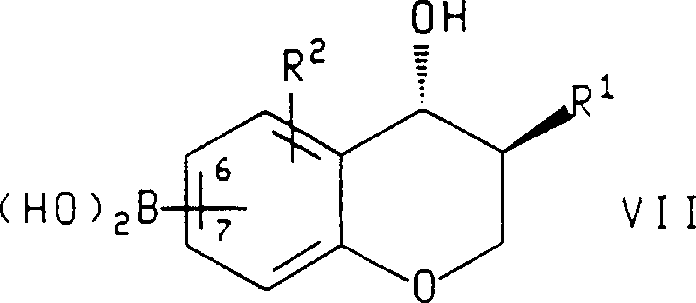


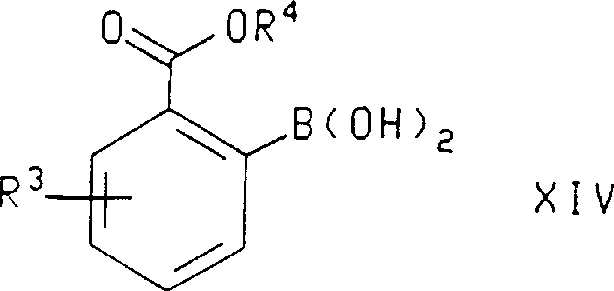


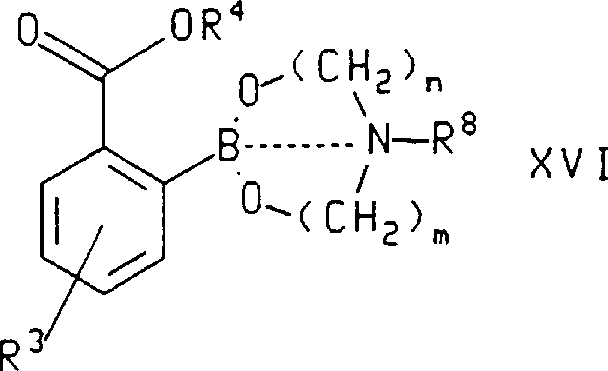

Applications Claiming Priority (2)
| Application Number | Priority Date | Filing Date | Title |
|---|---|---|---|
| US2637296P | 1996-09-16 | 1996-09-16 | |
| US60/026,372 | 1996-09-16 |
Publications (2)
| Publication Number | Publication Date |
|---|---|
| CN1230954A true CN1230954A (en) | 1999-10-06 |
| CN1108298C CN1108298C (en) | 2003-05-14 |
Family
ID=21831429
Family Applications (1)
| Application Number | Title | Priority Date | Filing Date |
|---|---|---|---|
| CN97197985A Expired - Fee Related CN1108298C (en) | 1996-09-16 | 1997-08-25 | Process for preparing substituted chromanol derivatives |
Country Status (39)
| Country | Link |
|---|---|
| US (4) | US6096906A (en) |
| EP (1) | EP0925292B1 (en) |
| JP (1) | JP3117730B2 (en) |
| KR (1) | KR100339164B1 (en) |
| CN (1) | CN1108298C (en) |
| AP (1) | AP726A (en) |
| AT (1) | ATE249452T1 (en) |
| AU (1) | AU713701B2 (en) |
| BG (1) | BG63542B1 (en) |
| BR (1) | BR9711482A (en) |
| CA (1) | CA2265043C (en) |
| CO (1) | CO4600635A1 (en) |
| DE (1) | DE69724801T2 (en) |
| DK (1) | DK0925292T3 (en) |
| DZ (1) | DZ2308A1 (en) |
| EA (1) | EA002204B1 (en) |
| ES (1) | ES2206738T3 (en) |
| GT (3) | GT199700104A (en) |
| HN (1) | HN1997000127A (en) |
| HR (1) | HRP970497B1 (en) |
| ID (1) | ID19613A (en) |
| IL (1) | IL128732A0 (en) |
| IS (1) | IS4980A (en) |
| MA (1) | MA24319A1 (en) |
| NO (1) | NO991254L (en) |
| NZ (1) | NZ334214A (en) |
| OA (1) | OA10995A (en) |
| PA (1) | PA8437901A1 (en) |
| PE (1) | PE109798A1 (en) |
| PL (1) | PL332351A1 (en) |
| PT (1) | PT925292E (en) |
| SK (1) | SK31399A3 (en) |
| TN (1) | TNSN97155A1 (en) |
| TR (1) | TR199900592T2 (en) |
| TW (1) | TW449579B (en) |
| UA (1) | UA58520C2 (en) |
| WO (1) | WO1998011085A1 (en) |
| YU (1) | YU13299A (en) |
| ZA (1) | ZA978291B (en) |
Families Citing this family (15)
| Publication number | Priority date | Publication date | Assignee | Title |
|---|---|---|---|---|
| US6436987B1 (en) * | 2000-06-08 | 2002-08-20 | Pfizer Inc. | Crystalline forms of (3S-trans)-2-[3,4-dihydro-4-hydroxy-3-(phenylmethyl)-2H-1-benzopyran-7-yl]-4-(trifluoromethyl)-benzoic acid |
| WO2002060888A1 (en) * | 2001-01-30 | 2002-08-08 | Pfizer Products Inc. | Processes for preparing chromanylbenzoic acids |
| AU4239302A (en) * | 2001-06-28 | 2003-01-02 | Pfizer Products Inc. | Benzoic acid substituted benzopyrans for the treatment of atherosclerosis |
| EP2181103B1 (en) * | 2007-07-23 | 2015-08-05 | The Board Of Trustees Of The University Of Illinois | System for controlling the reactivity of boronic acids |
| WO2010036921A2 (en) | 2008-09-26 | 2010-04-01 | The Board Of Trustees Of The University Of Illinois | Slow release of organoboronic acids in cross-coupling reactions |
| JP2013503943A (en) * | 2009-09-02 | 2013-02-04 | イー・アイ・デュポン・ドウ・ヌムール・アンド・カンパニー | Polyaramids containing fluorovinyl ether functionalized aromatic moieties |
| US20110218319A1 (en) * | 2009-09-02 | 2011-09-08 | E. I. Du Pont De Nemours And Company | Polyaramid films comprising fluorovinylether functionalized aromatic moieties |
| US8293928B2 (en) * | 2009-09-02 | 2012-10-23 | E I Du Pont De Nemours And Company | Fluorinated 4-oxo-chroman-7-carboxylates |
| CN102612509A (en) | 2009-09-02 | 2012-07-25 | 纳幕尔杜邦公司 | Fluoroether functionalized aromatic diesters and derivatives thereof |
| AU2010289576B2 (en) * | 2009-09-02 | 2015-07-16 | E. I. Du Pont De Nemours And Company | Polyester films with improved oil repellency |
| BR112012004774A2 (en) * | 2009-09-02 | 2017-05-30 | Du Pont | polymer and process |
| US8557980B2 (en) | 2010-02-18 | 2013-10-15 | The Board Of Trustees Of The University Of Illinois | Methods for forming protected organoboronic acids |
| WO2016149126A1 (en) | 2015-03-13 | 2016-09-22 | The Board Of Trustees Of The Leland Stanford Junior University | Ltb4 inhibition to prevent and treat human lymphedema |
| KR102807066B1 (en) * | 2019-09-30 | 2025-05-15 | 주식회사 엘지화학 | Preparing method for amine compound |
| CN117384617B (en) * | 2023-12-13 | 2024-03-29 | 中国石油大学(华东) | Salt-resistant guanidine gum fracturing fluid cross-linking agent aqueous solution and preparation method and application thereof |
Family Cites Families (8)
| Publication number | Priority date | Publication date | Assignee | Title |
|---|---|---|---|---|
| GB9119920D0 (en) * | 1991-09-18 | 1991-10-30 | Glaxo Group Ltd | Chemical compounds |
| EP0623122B1 (en) * | 1992-01-23 | 1997-03-05 | Pfizer Inc. | Benzopyran and related LTB4-antagonists. |
| MX9300312A (en) * | 1992-01-23 | 1993-07-31 | Pfizer | BENZOPYRANIC AND RELATED ANTAGONISTS OF LTB. |
| PL308473A1 (en) * | 1992-10-21 | 1995-08-07 | Pfizer | Enabntiomeric cis-3-(4,6-dihydoxychroman-3-yl methyl)bezoic acids |
| US5641789A (en) * | 1992-10-21 | 1997-06-24 | Pfizer Inc. | Sulfonamide derivatives of benzenefused hydroxy substituted cycloalkyl and heterocyclic ring compounds |
| AU696890B2 (en) * | 1994-10-13 | 1998-09-24 | Pfizer Inc. | Benzopyran and benzo-fused compounds, their preparation and their use as leukotriene B4 (LTB4) antagonists |
| MX9702734A (en) * | 1994-10-13 | 1997-06-28 | Pfizer | Benzopyran and benzo-fused compounds, their preparation and their use as leukotriene b4' (ltb4) antagonists. |
| US5539128A (en) * | 1994-11-30 | 1996-07-23 | Pfizer Inc. | Processes and intermediates for preparing cis(+)3-[4,6-dihydroxy chroman-3-ylmethyl]-4-methoxyaniline |
-
1997
- 1997-08-25 TR TR1999/00592T patent/TR199900592T2/en unknown
- 1997-08-25 SK SK313-99A patent/SK31399A3/en unknown
- 1997-08-25 EA EA199900204A patent/EA002204B1/en not_active IP Right Cessation
- 1997-08-25 UA UA99031394A patent/UA58520C2/en unknown
- 1997-08-25 PT PT97934679T patent/PT925292E/en unknown
- 1997-08-25 NZ NZ334214A patent/NZ334214A/en unknown
- 1997-08-25 DK DK97934679T patent/DK0925292T3/en active
- 1997-08-25 EP EP97934679A patent/EP0925292B1/en not_active Expired - Lifetime
- 1997-08-25 KR KR1019997002175A patent/KR100339164B1/en not_active Expired - Fee Related
- 1997-08-25 BR BR9711482A patent/BR9711482A/en not_active Application Discontinuation
- 1997-08-25 IL IL12873297A patent/IL128732A0/en unknown
- 1997-08-25 US US09/367,235 patent/US6096906A/en not_active Expired - Fee Related
- 1997-08-25 DE DE69724801T patent/DE69724801T2/en not_active Expired - Fee Related
- 1997-08-25 PL PL97332351A patent/PL332351A1/en unknown
- 1997-08-25 CA CA002265043A patent/CA2265043C/en not_active Expired - Fee Related
- 1997-08-25 JP JP10513430A patent/JP3117730B2/en not_active Expired - Fee Related
- 1997-08-25 ES ES97934679T patent/ES2206738T3/en not_active Expired - Lifetime
- 1997-08-25 WO PCT/IB1997/001024 patent/WO1998011085A1/en not_active Ceased
- 1997-08-25 AT AT97934679T patent/ATE249452T1/en not_active IP Right Cessation
- 1997-08-25 YU YU13299A patent/YU13299A/en unknown
- 1997-08-25 AU AU37814/97A patent/AU713701B2/en not_active Ceased
- 1997-08-25 CN CN97197985A patent/CN1108298C/en not_active Expired - Fee Related
- 1997-08-29 HN HN1997000127A patent/HN1997000127A/en unknown
- 1997-09-04 CO CO97051475A patent/CO4600635A1/en unknown
- 1997-09-05 PA PA19978437901A patent/PA8437901A1/en unknown
- 1997-09-08 GT GT199700104A patent/GT199700104A/en unknown
- 1997-09-11 AP APAP/P/1997/001083A patent/AP726A/en active
- 1997-09-12 PE PE1997000813A patent/PE109798A1/en not_active Application Discontinuation
- 1997-09-12 TW TW086113297A patent/TW449579B/en active
- 1997-09-15 ZA ZA978291A patent/ZA978291B/en unknown
- 1997-09-15 ID IDP973183A patent/ID19613A/en unknown
- 1997-09-15 DZ DZ970158A patent/DZ2308A1/en active
- 1997-09-15 MA MA24797A patent/MA24319A1/en unknown
- 1997-09-15 TN TNTNSN97155A patent/TNSN97155A1/en unknown
- 1997-09-16 HR HR970497A patent/HRP970497B1/en not_active IP Right Cessation
- 1997-10-04 GT GT199700104BL patent/GT199700104BA/en unknown
- 1997-10-04 GT GT199700104AK patent/GT199700104AA/en unknown
-
1999
- 1999-02-16 IS IS4980A patent/IS4980A/en unknown
- 1999-03-09 BG BG103231A patent/BG63542B1/en unknown
- 1999-03-12 OA OA9900056A patent/OA10995A/en unknown
- 1999-03-15 NO NO991254A patent/NO991254L/en not_active Application Discontinuation
-
2000
- 2000-02-23 US US09/511,475 patent/US6288242B1/en not_active Expired - Fee Related
-
2001
- 2001-03-21 US US09/813,546 patent/US6355825B1/en not_active Expired - Fee Related
- 2001-10-31 US US09/999,240 patent/US6444826B1/en not_active Expired - Fee Related
Also Published As
Similar Documents
| Publication | Publication Date | Title |
|---|---|---|
| CN1108298C (en) | Process for preparing substituted chromanol derivatives | |
| CN101723809B (en) | Diaryl phenoxy aluminium compound | |
| CN1582272A (en) | Process for preparing 5-(3-cyanophenyl)-3-formylbenzoic acid compound | |
| WO2021143712A1 (en) | Method for preparing l-glufosinate-ammonium intermediate | |
| KR100794091B1 (en) | Method for preparing (S) -enantiomer of 2-ethoxy-3- (4-hydroxyphenyl) propanoic acid and derivatives thereof | |
| CN1075318A (en) | Chromene and relevant leukotriene B 4Antagonist | |
| CN1069629C (en) | Process for manufacture of alpha-beta-unsaturated organic carboxylic acids | |
| CN1662484A (en) | Process for preparing (r)-aryloxypropionic acid ester derivatives | |
| CN1589263A (en) | Process for producing optically active oxoheptenoic acid ester | |
| CN1180353A (en) | 2-substituted benzo [b] thiophene compound and preparation method of its intermediate | |
| CN101133067B (en) | Diarylphenoxyaluminum compound | |
| HK1022309A (en) | Processes and intermediates for preparing substituted chromanol derivatives | |
| JP4540197B2 (en) | (E) Process for producing 3-methyl-2-cyclopentadecenone | |
| CN1360574A (en) | Method for preparing tricyclic aminoalcohol derivatives | |
| CN1241914C (en) | Method for preparing 7-quinolinyl-3, 5-dihydroxyhept-6-enoate | |
| CN1464875A (en) | Organometallic complexes, catalysts containing the same, and process for preparation of carboxylic esters | |
| CN1847231A (en) | Process of preparing aromatic ring substituted ixooxazoline compound | |
| CN1367774A (en) | Method for preparing cyclohexane carboxylic acids | |
| CN1240673C (en) | Process and intermediates for the preparation of 4-cyanocyclohexanecarboxylic acid | |
| HK1072931A (en) | Process for producing 5-(3-cyanophenyl)-3-formylbenzoic acid compound | |
| JP2004518685A (en) | Method for preparing chromanyl benzoic acid | |
| CN1738811A (en) | Preparation method of 1-acetoxy-3-(substituted phenyl)propene compound | |
| JP2006160622A (en) | Method for producing tolterodine | |
| HUP9903247A2 (en) | Processes for preparing substituted chromanol derivatives and their intermediates | |
| HK1088604B (en) | Process for the production of 1-acetoxy-3- (substituted phenyl) propenes |
Legal Events
| Date | Code | Title | Description |
|---|---|---|---|
| C06 | Publication | ||
| PB01 | Publication | ||
| C10 | Entry into substantive examination | ||
| SE01 | Entry into force of request for substantive examination | ||
| C14 | Grant of patent or utility model | ||
| GR01 | Patent grant | ||
| C19 | Lapse of patent right due to non-payment of the annual fee | ||
| CF01 | Termination of patent right due to non-payment of annual fee | ||
| REG | Reference to a national code |
Ref country code: HK Ref legal event code: WD Ref document number: 1022309 Country of ref document: HK |