CN1237119C - Dopant agent and electroconductive polymer materials comprising the same - Google Patents
Dopant agent and electroconductive polymer materials comprising the same Download PDFInfo
- Publication number
- CN1237119C CN1237119C CN02801618.1A CN02801618A CN1237119C CN 1237119 C CN1237119 C CN 1237119C CN 02801618 A CN02801618 A CN 02801618A CN 1237119 C CN1237119 C CN 1237119C
- Authority
- CN
- China
- Prior art keywords
- sulfonic acid
- dioxo
- tetrahydroquinazoline
- group
- sulfo
- Prior art date
- Legal status (The legal status is an assumption and is not a legal conclusion. Google has not performed a legal analysis and makes no representation as to the accuracy of the status listed.)
- Expired - Fee Related
Links
Classifications
-
- H—ELECTRICITY
- H01—ELECTRIC ELEMENTS
- H01G—CAPACITORS; CAPACITORS, RECTIFIERS, DETECTORS, SWITCHING DEVICES, LIGHT-SENSITIVE OR TEMPERATURE-SENSITIVE DEVICES OF THE ELECTROLYTIC TYPE
- H01G9/00—Electrolytic capacitors, rectifiers, detectors, switching devices, light-sensitive or temperature-sensitive devices; Processes of their manufacture
- H01G9/004—Details
- H01G9/04—Electrodes or formation of dielectric layers thereon
- H01G9/048—Electrodes or formation of dielectric layers thereon characterised by their structure
- H01G9/052—Sintered electrodes
-
- C—CHEMISTRY; METALLURGY
- C08—ORGANIC MACROMOLECULAR COMPOUNDS; THEIR PREPARATION OR CHEMICAL WORKING-UP; COMPOSITIONS BASED THEREON
- C08K—Use of inorganic or non-macromolecular organic substances as compounding ingredients
- C08K5/00—Use of organic ingredients
- C08K5/36—Sulfur-, selenium-, or tellurium-containing compounds
- C08K5/41—Compounds containing sulfur bound to oxygen
- C08K5/42—Sulfonic acids; Derivatives thereof
-
- C—CHEMISTRY; METALLURGY
- C08—ORGANIC MACROMOLECULAR COMPOUNDS; THEIR PREPARATION OR CHEMICAL WORKING-UP; COMPOSITIONS BASED THEREON
- C08L—COMPOSITIONS OF MACROMOLECULAR COMPOUNDS
- C08L101/00—Compositions of unspecified macromolecular compounds
- C08L101/12—Compositions of unspecified macromolecular compounds characterised by physical features, e.g. anisotropy, viscosity or electrical conductivity
-
- H—ELECTRICITY
- H01—ELECTRIC ELEMENTS
- H01B—CABLES; CONDUCTORS; INSULATORS; SELECTION OF MATERIALS FOR THEIR CONDUCTIVE, INSULATING OR DIELECTRIC PROPERTIES
- H01B1/00—Conductors or conductive bodies characterised by the conductive materials; Selection of materials as conductors
- H01B1/06—Conductors or conductive bodies characterised by the conductive materials; Selection of materials as conductors mainly consisting of other non-metallic substances
- H01B1/12—Conductors or conductive bodies characterised by the conductive materials; Selection of materials as conductors mainly consisting of other non-metallic substances organic substances
-
- H—ELECTRICITY
- H01—ELECTRIC ELEMENTS
- H01B—CABLES; CONDUCTORS; INSULATORS; SELECTION OF MATERIALS FOR THEIR CONDUCTIVE, INSULATING OR DIELECTRIC PROPERTIES
- H01B1/00—Conductors or conductive bodies characterised by the conductive materials; Selection of materials as conductors
- H01B1/06—Conductors or conductive bodies characterised by the conductive materials; Selection of materials as conductors mainly consisting of other non-metallic substances
- H01B1/12—Conductors or conductive bodies characterised by the conductive materials; Selection of materials as conductors mainly consisting of other non-metallic substances organic substances
- H01B1/124—Intrinsically conductive polymers
- H01B1/127—Intrinsically conductive polymers comprising five-membered aromatic rings in the main chain, e.g. polypyrroles, polythiophenes
Landscapes
- Chemical & Material Sciences (AREA)
- Medicinal Chemistry (AREA)
- Health & Medical Sciences (AREA)
- Power Engineering (AREA)
- Chemical Kinetics & Catalysis (AREA)
- Engineering & Computer Science (AREA)
- Polymers & Plastics (AREA)
- Organic Chemistry (AREA)
- Physics & Mathematics (AREA)
- Spectroscopy & Molecular Physics (AREA)
- Microelectronics & Electronic Packaging (AREA)
- Pharmaceuticals Containing Other Organic And Inorganic Compounds (AREA)
- Secondary Cells (AREA)
Abstract
Description
技术领域technical field
本发明涉及一种可用于导电聚合物材料的新型芳香族磺酸衍生物掺杂剂;一种含有该掺杂剂的导电聚合物;以及使用这种聚合物材料的固体电解电容器。特别的,本发明涉及一种适合于制造固体电解电容器的具有良好耐热性和耐湿性的导电聚合物材料,以及一种使用该聚合物材料作为阴极导电材料的固体电解电容器。The present invention relates to a novel aromatic sulfonic acid derivative dopant usable in conductive polymer materials; a conductive polymer containing the dopant; and a solid electrolytic capacitor using the polymer material. In particular, the present invention relates to a conductive polymer material having good heat resistance and moisture resistance suitable for manufacturing a solid electrolytic capacitor, and a solid electrolytic capacitor using the polymer material as a cathode conductive material.
背景技术Background technique
近年,随着电子学技术的进步,新型电子材料也得到发展。特别是在包括高性能的有机材料在内的领域中取得了显著的技术革新。即使只限制在导电材料的范围内,也发展了将一些电子受体化合物作为掺杂剂掺杂到聚乙炔、聚对苯撑、聚吡咯和聚苯胺等电子共轭的聚合物中而制得的导电聚合物材料。并且,也有一些新开发的材料被投入实际工业应用的情况,如作为电容器电极材料、电池电极材料和抗静电材料。In recent years, with the advancement of electronics technology, new electronic materials have also been developed. Significant technological innovations have been achieved especially in the field including high-performance organic materials. Even if it is only limited to the range of conductive materials, some electron acceptor compounds have been developed as dopants to electronically conjugated polymers such as polyacetylene, polyparaphenylene, polypyrrole and polyaniline. conductive polymer materials. Also, there are cases where newly developed materials are put into practical industrial applications, such as capacitor electrode materials, battery electrode materials, and antistatic materials.
但是,为了扩大这些导电聚合物材料的工业应用,存在的包括诸如材料的耐热性和耐湿性等的环境稳定性在内的重要问题必须得到解决,另外,还需进一步提高它们的电导率。However, in order to expand the industrial applications of these conductive polymer materials, there are important issues including environmental stability such as the heat resistance and moisture resistance of the materials that must be solved, and in addition, their electrical conductivity needs to be further improved.
为了解决这些在工业化上遇到的困难,我们在日本特开平2000-204074中提供了一种针对环境稳定性的π-电子共轭聚合物材料,这种材料含有间磺基苯甲酰胺衍生物作为掺杂剂,并显示出了较高的电导率和改善的耐热性。In order to solve these difficulties encountered in industrialization, we provided a π-electron conjugated polymer material for environmental stability in Japanese Patent Laid-Open No. 2000-204074, which contains m-sulfobenzamide derivatives As a dopant, it shows higher electrical conductivity and improved heat resistance.
例如,我们发现,掺杂了间磺基苯甲酰胺的聚吡咯即使是放置在150℃下的空气中也显示出了非常缓慢的电导率能的下将,并能维持100S/cm或更高的电导率。For example, we found that polypyrrole doped with m-sulfobenzamide showed a very slow decline in conductivity even when placed in air at 150 °C, and could maintain 100 S/cm or higher. conductivity.
但是,在高温下,当空气中含有湿气时,掺杂了间磺基苯甲酰胺的聚吡咯会很快失去其电导率。因此,为了能扩大这些导电聚合物材料的工业应用,关键是使材料在含湿气的高温环境中,即在高温高湿的条件下显示出改善的稳定性。However, at high temperatures, polypyrrole doped with m-sulfobenzamide quickly loses its electrical conductivity when the air contains moisture. Therefore, in order to expand the industrial applications of these conductive polymer materials, it is crucial for the materials to exhibit improved stability in high-temperature environments containing moisture, ie, under conditions of high temperature and high humidity.
因此,本发明的一个目的是提供一种掺杂剂,其能赋予π-电子共轭聚合物材料较高的电导率,并且其电导率能在高温高湿的环境条件下得以保持;一种具有良好的耐热性和耐湿性的导电聚合物材料;以及一种含有这种聚合物材料的固体电解电容器。Therefore, an object of the present invention is to provide a kind of dopant, it can endow π-electron conjugated polymer material higher electric conductivity, and its electric conductivity can be kept under the environment condition of high temperature and high humidity; A conductive polymer material having good heat resistance and moisture resistance; and a solid electrolytic capacitor comprising the polymer material.
发明内容Contents of the invention
即,本发明涉及一种含有至少一种由通式1和2表示的芳香族磺酸衍生物的掺杂剂;一种含有掺杂剂的显示出良好的耐热性和耐湿性的导电聚合物材料;以及一种含有该聚合物材料的固体电解电容器。That is, the present invention relates to a dopant containing at least one aromatic sulfonic acid derivative represented by general formulas 1 and 2; material; and a solid electrolytic capacitor comprising the polymer material.

其中,R1~R6中的至少一个代表磺酸基,其具有选自包含氢离子、碱金属离子、碱土金属离子和元素周期表上8~10族的过渡金属离子的组中的反阳离子;其余的R1~R6可以相同或不同,代表氢、具有4个或更少的碳原子的烷基或苯基;或者R1~R6中的任意两个或更多的基团可以结合在一起形成芳香族或脂肪族的环。Wherein, at least one of R 1 to R 6 represents a sulfonic acid group, which has a counter cation selected from the group consisting of hydrogen ions, alkali metal ions, alkaline earth metal ions and transition metal ions of groups 8 to 10 on the periodic table ; the rest of R 1 to R 6 may be the same or different, and represent hydrogen, an alkyl group with 4 or fewer carbon atoms or a phenyl group; or any two or more groups in R 1 to R 6 may Combined to form an aromatic or aliphatic ring.

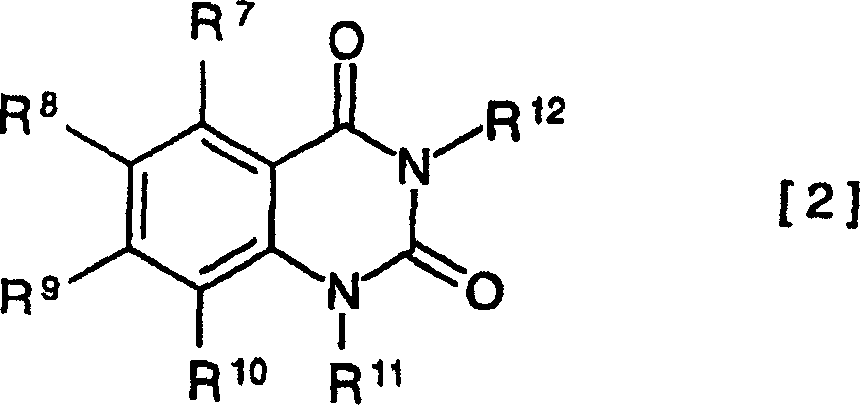
其中,R7~R10中的至少一个代表磺酸基,其具有选自包含氢离子、碱金属离子、碱土金属离子和元素周期表中8~10族的过渡金属离子的组中的反阳离子;其余的R7~R12可以相同或不同,代表氢、具有4个或更少的碳原子的烷基或苯基;或者R7~R10中的任意两个或更多的基团可以接合在一起形成芳香族或脂肪族的环。Wherein, at least one of R 7 to R 10 represents a sulfonic acid group, which has a counter cation selected from the group consisting of hydrogen ions, alkali metal ions, alkaline earth metal ions and transition metal ions of groups 8 to 10 in the periodic table of elements ; the remaining R 7 to R 12 may be the same or different, and represent hydrogen, an alkyl group with 4 or less carbon atoms or a phenyl group; or any two or more groups in R 7 to R 10 may be joined together to form an aromatic or aliphatic ring.
具体实施方式Detailed ways
本发明中,使用了一种或多种由上述通式1和2代表的芳香族磺酸衍生物作为掺杂剂。In the present invention, one or more aromatic sulfonic acid derivatives represented by the above general formulas 1 and 2 are used as a dopant.
在通式1或2代表的芳香族磺酸衍生物中,磺酸基的反阳离子是选自氢、碱金属、碱土金属和元素周期表中8~10族的过渡金属元素的阳离子;例如,氢、锂、钠、钾、铷、铯、铍、镁、钙、锶、钡、铁、钴、镍、钌、铑、钯、锇、铱和铂离子,优选为氢、钠、钾和铁(III)离子。In the aromatic sulfonic acid derivatives represented by the general formula 1 or 2, the counter cation of the sulfonic acid group is a cation selected from hydrogen, alkali metals, alkaline earth metals and transition metal elements of groups 8 to 10 in the periodic table; for example, Hydrogen, lithium, sodium, potassium, rubidium, cesium, beryllium, magnesium, calcium, strontium, barium, iron, cobalt, nickel, ruthenium, rhodium, palladium, osmium, iridium and platinum ions, preferably hydrogen, sodium, potassium and iron (III) Ions.
由通式1代表的芳香族磺酸衍生物的例子包括如下芳香族磺酸衍生物:Examples of aromatic sulfonic acid derivatives represented by the general formula 1 include the following aromatic sulfonic acid derivatives:
2-磺基-1,8-萘二甲酸酐,2-sulfo-1,8-naphthalic anhydride,
3-磺基-1,8-萘二甲酸酐,3-sulfo-1,8-naphthalic anhydride,
4-磺基-1,8-萘二甲酸酐,4-sulfo-1,8-naphthalic anhydride,
3,5-二磺基-1,8-萘二甲酸酐,3,5-disulfo-1,8-naphthalic anhydride,
3,6-二磺基-1,8-萘二甲酸酐,3,6-disulfo-1,8-naphthalic anhydride,
4,5-二磺基-1,8-萘二甲酸酐,4,5-disulfo-1,8-naphthalic anhydride,
2-甲基-4-磺基-1,8-萘二甲酸酐,2-methyl-4-sulfo-1,8-naphthalic anhydride,
5-甲基-4-磺基-1,8-萘二甲酸酐,5-Methyl-4-sulfo-1,8-naphthalic anhydride,
6-甲基-4-磺基-1,8-萘二甲酸酐,6-Methyl-4-sulfo-1,8-naphthalic anhydride,
7-甲基-4-磺基-1,8-萘二甲酸酐,7-Methyl-4-sulfo-1,8-naphthalic anhydride,
5-甲基-3-磺基-1,8-萘二甲酸酐,5-Methyl-3-sulfo-1,8-naphthalic anhydride,
6-甲基-3-磺基-1,8-萘二甲酸酐,6-Methyl-3-sulfo-1,8-naphthalic anhydride,
7-甲基-3-磺基-1,8-萘二甲酸酐,7-Methyl-3-sulfo-1,8-naphthalic anhydride,
2-乙基-4-磺基-1,8-萘二甲酸酐,2-Ethyl-4-sulfo-1,8-naphthalic anhydride,
5-乙基-4-磺基-1,8-萘二甲酸酐,5-Ethyl-4-sulfo-1,8-naphthalic anhydride,
6-乙基-4-磺基-1,8-萘二甲酸酐,6-Ethyl-4-sulfo-1,8-naphthalic anhydride,
7-乙基-4-磺基-1,8-萘二甲酸酐,7-Ethyl-4-sulfo-1,8-naphthalic anhydride,
5-乙基-3-磺基-1,8-萘二甲酸酐,5-Ethyl-3-sulfo-1,8-naphthalic anhydride,
6-乙基-3-磺基-1,8-萘二甲酸酐,6-Ethyl-3-sulfo-1,8-naphthalic anhydride,
7-乙基-3-磺基-1,8-萘二甲酸酐,7-Ethyl-3-sulfo-1,8-naphthalic anhydride,
2-正丙基-4-磺基-1,8-萘二甲酸酐,2-n-Propyl-4-sulfo-1,8-naphthalic anhydride,
5-正丙基-4-磺基-1,8-萘二甲酸酐,5-n-propyl-4-sulfo-1,8-naphthalic anhydride,
6-正丙基-4-磺基-1,8-萘二甲酸酐,6-n-propyl-4-sulfo-1,8-naphthalic anhydride,
7-正丙基-4-磺基-1,8-萘二甲酸酐,7-n-Propyl-4-sulfo-1,8-naphthalic anhydride,
5-正丙基-3-磺基-1,8-萘二甲酸酐,5-n-propyl-3-sulfo-1,8-naphthalic anhydride,
6-正丙基-3-磺基-1,8-萘二甲酸酐,6-n-propyl-3-sulfo-1,8-naphthalic anhydride,
7-正丙基-3-磺基-1,8-萘二甲酸酐,7-n-Propyl-3-sulfo-1,8-naphthalic anhydride,
2-异丙基-4-磺基-1,8-萘二甲酸酐,2-isopropyl-4-sulfo-1,8-naphthalic anhydride,
5-异丙基-4-磺基-1,8-萘二甲酸酐,5-isopropyl-4-sulfo-1,8-naphthalic anhydride,
6-异丙基-4-磺基-1,8-萘二甲酸酐,6-isopropyl-4-sulfo-1,8-naphthalic anhydride,
7-异丙基-4-磺基-1,8-萘二甲酸酐,7-isopropyl-4-sulfo-1,8-naphthalic anhydride,
5-异丙基-3-磺基-1,8-萘二甲酸酐,5-isopropyl-3-sulfo-1,8-naphthalic anhydride,
6-异丙基-3-磺基-1,8-萘二甲酸酐,6-isopropyl-3-sulfo-1,8-naphthalic anhydride,
7-异丙基-3-磺基-1,8-萘二甲酸酐,7-isopropyl-3-sulfo-1,8-naphthalic anhydride,
2-正丁基-4-磺基-1,8-萘二甲酸酐,2-n-Butyl-4-sulfo-1,8-naphthalic anhydride,
5-正丁基-4-磺基-1,8-萘二甲酸酐,5-n-Butyl-4-sulfo-1,8-naphthalic anhydride,
6-正丁基-4-磺基-1,8-萘二甲酸酐,6-n-butyl-4-sulfo-1,8-naphthalic anhydride,
7-正丁基-4-磺基-1,8-萘二甲酸酐,7-n-Butyl-4-sulfo-1,8-naphthalic anhydride,
5-正丁基-3-磺基-1,8-萘二甲酸酐,5-n-Butyl-3-sulfo-1,8-naphthalic anhydride,
6-正丁基-3-磺基-1,8-萘二甲酸酐,6-n-butyl-3-sulfo-1,8-naphthalic anhydride,
7-正丁基-3-磺基-1,8-萘二甲酸酐,7-n-Butyl-3-sulfo-1,8-naphthalic anhydride,
2-异丁基-4-磺基-1,8-萘二甲酸酐,2-isobutyl-4-sulfo-1,8-naphthalic anhydride,
5-异丁基-4-磺基-1,8-萘二甲酸酐,5-isobutyl-4-sulfo-1,8-naphthalic anhydride,
6-异丁基-4-磺基-1,8-萘二甲酸酐,6-isobutyl-4-sulfo-1,8-naphthalic anhydride,
7-异丁基-4-磺基-1,8-萘二甲酸酐,7-isobutyl-4-sulfo-1,8-naphthalic anhydride,
5-异丁基-3-磺基-1,8-萘二甲酸酐,5-isobutyl-3-sulfo-1,8-naphthalic anhydride,
6-异丁基-3-磺基-1,8-萘二甲酸酐,6-isobutyl-3-sulfo-1,8-naphthalic anhydride,
7-异丁基-3-磺基-1,8-萘二甲酸酐,7-isobutyl-3-sulfo-1,8-naphthalic anhydride,
2-叔丁基-4-磺基-1,8-萘二甲酸酐,2-tert-butyl-4-sulfo-1,8-naphthalic anhydride,
5-叔丁基-4-磺基-1,8-萘二甲酸酐,5-tert-butyl-4-sulfo-1,8-naphthalic anhydride,
6-叔丁基-4-磺基-1,8-萘二甲酸酐,6-tert-butyl-4-sulfo-1,8-naphthalic anhydride,
7-叔丁基-4-磺基-1,8-萘二甲酸酐,7-tert-butyl-4-sulfo-1,8-naphthalic anhydride,
5-叔丁基-3-磺基-1,8-萘二甲酸酐,5-tert-butyl-3-sulfo-1,8-naphthalic anhydride,
6-叔丁基-3-磺基-1,8-萘二甲酸酐,6-tert-butyl-3-sulfo-1,8-naphthalic anhydride,
7-叔丁基-3-磺基-1,8-萘二甲酸酐,7-tert-butyl-3-sulfo-1,8-naphthalic anhydride,
2-苯基-4-磺基-1,8-萘二甲酸酐,2-Phenyl-4-sulfo-1,8-naphthalic anhydride,
5-苯基-4-磺基-1,8-萘二甲酸酐,5-Phenyl-4-sulfo-1,8-naphthalic anhydride,
6-苯基-4-磺基-1,8-萘二甲酸酐,6-Phenyl-4-sulfo-1,8-naphthalic anhydride,
7-苯基-4-磺基-1,8-萘二甲酸酐,7-Phenyl-4-sulfo-1,8-naphthalic anhydride,
5-苯基-3-磺基-1,8-萘二甲酸酐,5-Phenyl-3-sulfo-1,8-naphthalic anhydride,
6-苯基-3-磺基-1,8-萘二甲酸酐,6-Phenyl-3-sulfo-1,8-naphthalic anhydride,
7-苯基-3-磺基-1,8-萘二甲酸酐,7-Phenyl-3-sulfo-1,8-naphthalic anhydride,
3-磺基-1,9-蒽二甲酸酐,3-sulfo-1,9-anthracene dicarboxylic anhydride,
4-磺基-1,9-蒽二甲酸酐,4-sulfo-1,9-anthracene dicarboxylic anhydride,
10-磺基-1,9-蒽二甲酸酐,10-sulfo-1,9-anthracene dicarboxylic anhydride,
3-磺基-1,10-菲二甲酸酐,3-sulfo-1,10-phenanthrene dicarboxylic anhydride,
4-磺基-1,10-菲二甲酸酐,和4-sulfo-1,10-phenanthrene dicarboxylic anhydride, and
3-磺基苊-5,6-二甲酸酐,以及其碱金属盐、碱土金属盐和元素周期表中8~10族的过渡金属盐,优选为芳香族磺酸衍生物的钠盐、钾盐和铁(III)盐。3-sulfoacenaphthylene-5,6-dicarboxylic anhydride, and its alkali metal salts, alkaline earth metal salts, and transition metal salts of groups 8 to 10 in the periodic table, preferably sodium and potassium aromatic sulfonic acid derivatives salts and iron(III) salts.
优选的例子包括如下芳香族磺酸衍生物:Preferred examples include the following aromatic sulfonic acid derivatives:
2-磺基-1,8-萘二甲酸酐,2-sulfo-1,8-naphthalic anhydride,
3-磺基-1,8-萘二甲酸酐,3-sulfo-1,8-naphthalic anhydride,
4-磺基-1,8-萘二甲酸酐,4-sulfo-1,8-naphthalic anhydride,
3,5-二磺基-1,8-萘二甲酸酐,3,5-disulfo-1,8-naphthalic anhydride,
3,6-二磺基-1,8-萘二甲酸酐,3,6-disulfo-1,8-naphthalic anhydride,
4,5-二磺基-1,8-萘二甲酸酐,4,5-disulfo-1,8-naphthalic anhydride,
2-甲基-4-磺基-1,8-萘二甲酸酐,2-methyl-4-sulfo-1,8-naphthalic anhydride,
5-甲基-4-磺基-1,8-萘二甲酸酐,5-Methyl-4-sulfo-1,8-naphthalic anhydride,
6-甲基-4-磺基-1,8-萘二甲酸酐,6-Methyl-4-sulfo-1,8-naphthalic anhydride,
7-甲基-4-磺基-1,8-萘二甲酸酐,7-Methyl-4-sulfo-1,8-naphthalic anhydride,
5-甲基-3-磺基-1,8-萘二甲酸酐,5-Methyl-3-sulfo-1,8-naphthalic anhydride,
6-甲基-3-磺基-1,8-萘二甲酸酐,6-Methyl-3-sulfo-1,8-naphthalic anhydride,
7-甲基-3-磺基-1,8-萘二甲酸酐,7-Methyl-3-sulfo-1,8-naphthalic anhydride,
3-磺基-1,9-蒽二甲酸酐,3-sulfo-1,9-anthracene dicarboxylic anhydride,
4-磺基-1,9-蒽二甲酸酐,4-sulfo-1,9-anthracene dicarboxylic anhydride,
10-磺基-1,9-蒽二甲酸酐,以及芳香族磺酸衍生物的钠盐、钾盐和铁(III)盐。10-sulfo-1,9-anthracene dicarboxylic anhydride, and sodium, potassium and iron(III) salts of aromatic sulfonic acid derivatives.
更优选的例子包括3-磺基-1,8-萘二甲酸酐和4-磺基-1,8-萘二甲酸酐,以及芳香族磺酸衍生物的钠盐、钾盐和铁(III)盐。More preferred examples include 3-sulfo-1,8-naphthalene dicarboxylic anhydride and 4-sulfo-1,8-naphthalene dicarboxylic anhydride, and sodium salts, potassium salts and iron (III )Salt.
由通式2代表的芳香族磺酸衍生物的例子包括如下芳香族磺酸衍生物,如:Examples of aromatic sulfonic acid derivatives represented by the general formula 2 include the following aromatic sulfonic acid derivatives, such as:
2,4-二氧代-1,2,3,4-四氢喹唑啉-5-磺酸,2,4-dioxo-1,2,3,4-tetrahydroquinazoline-5-sulfonic acid,
2,4-二氧代-1,2,3,4-四氢喹唑啉-6-磺酸,2,4-dioxo-1,2,3,4-tetrahydroquinazoline-6-sulfonic acid,
2,4-二氧代-1,2,3,4-四氢喹唑啉-7-磺酸,2,4-dioxo-1,2,3,4-tetrahydroquinazoline-7-sulfonic acid,
2,4-二氧代-1,2,3,4-四氢喹唑啉-8-磺酸,2,4-dioxo-1,2,3,4-tetrahydroquinazoline-8-sulfonic acid,
2,4-二氧代-1,2,3,4-四氢喹唑啉-5,7-二磺酸,2,4-dioxo-1,2,3,4-tetrahydroquinazoline-5,7-disulfonic acid,
2,4-二氧代-1,2,3,4-四氢喹唑啉-6,8-二磺酸,2,4-dioxo-1,2,3,4-tetrahydroquinazoline-6,8-disulfonic acid,
1-甲基-2,4-二氧代-1,2,3,4-四氢喹唑啉-5-磺酸,1-methyl-2,4-dioxo-1,2,3,4-tetrahydroquinazoline-5-sulfonic acid,
1-甲基-2,4-二氧代-1,2,3,4-四氢喹唑啉-6-磺酸,1-methyl-2,4-dioxo-1,2,3,4-tetrahydroquinazoline-6-sulfonic acid,
1-甲基-2,4-二氧代-1,2,3,4-四氢喹唑啉-7-磺酸,1-methyl-2,4-dioxo-1,2,3,4-tetrahydroquinazoline-7-sulfonic acid,
1-甲基-2,4-二氧代-1,2,3,4-四氢喹唑啉-8-磺酸,1-methyl-2,4-dioxo-1,2,3,4-tetrahydroquinazoline-8-sulfonic acid,
3-甲基-2,4-二氧代-1,2,3,4-四氢喹唑啉-5-磺酸,3-methyl-2,4-dioxo-1,2,3,4-tetrahydroquinazoline-5-sulfonic acid,
3-甲基-2,4-二氧代-1,2,3,4-四氢喹唑啉-6-磺酸,3-Methyl-2,4-dioxo-1,2,3,4-tetrahydroquinazoline-6-sulfonic acid,
3-甲基-2,4-二氧代-1,2,3,4-四氢喹唑啉-7-磺酸,3-methyl-2,4-dioxo-1,2,3,4-tetrahydroquinazoline-7-sulfonic acid,
3-甲基-2,4-二氧代-1,2,3,4-四氢喹唑啉-8-磺酸,3-Methyl-2,4-dioxo-1,2,3,4-tetrahydroquinazoline-8-sulfonic acid,
5-甲基-2,4-二氧代-1,2,3,4-四氢喹唑啉-6-磺酸,5-methyl-2,4-dioxo-1,2,3,4-tetrahydroquinazoline-6-sulfonic acid,
5-甲基-2,4-二氧代-1,2,3,4-四氢喹唑啉-7-磺酸,5-methyl-2,4-dioxo-1,2,3,4-tetrahydroquinazoline-7-sulfonic acid,
5-甲基-2,4-二氧代-1,2,3,4-四氢喹唑啉-8-磺酸,5-methyl-2,4-dioxo-1,2,3,4-tetrahydroquinazoline-8-sulfonic acid,
6-甲基-2,4-二氧代-1,2,3,4-四氢喹唑啉-5-磺酸,6-Methyl-2,4-dioxo-1,2,3,4-tetrahydroquinazoline-5-sulfonic acid,
6-甲基-2,4-二氧代-1,2,3,4-四氢喹唑啉-7-磺酸,6-Methyl-2,4-dioxo-1,2,3,4-tetrahydroquinazoline-7-sulfonic acid,
6-甲基-2,4-二氧代-1,2,3,4-四氢喹唑啉-8-磺酸,6-Methyl-2,4-dioxo-1,2,3,4-tetrahydroquinazoline-8-sulfonic acid,
7-甲基-2,4-二氧代-1,2,3,4-四氢喹唑啉-5-磺酸,7-Methyl-2,4-dioxo-1,2,3,4-tetrahydroquinazoline-5-sulfonic acid,
7-甲基-2,4-二氧代-1,2,3,4-四氢喹唑啉-6-磺酸,7-Methyl-2,4-dioxo-1,2,3,4-tetrahydroquinazoline-6-sulfonic acid,
7-甲基-2,4-二氧代-1,2,3,4-四氢喹唑啉-8-磺酸,7-methyl-2,4-dioxo-1,2,3,4-tetrahydroquinazoline-8-sulfonic acid,
8-甲基-2,4-二氧代-1,2,3,4-四氢喹唑啉-5-磺酸,8-Methyl-2,4-dioxo-1,2,3,4-tetrahydroquinazoline-5-sulfonic acid,
8-甲基-2,4-二氧代-1,2,3,4-四氢喹唑啉-6-磺酸,8-methyl-2,4-dioxo-1,2,3,4-tetrahydroquinazoline-6-sulfonic acid,
8-甲基-2,4-二氧代-1,2,3,4-四氢喹唑啉-7-磺酸,8-Methyl-2,4-dioxo-1,2,3,4-tetrahydroquinazoline-7-sulfonic acid,
1,3-二甲基-2,4-二氧代-1,2,3,4-四氢喹唑啉-5-磺酸,1,3-Dimethyl-2,4-dioxo-1,2,3,4-tetrahydroquinazoline-5-sulfonic acid,
1,3-二甲基-2,4-二氧代-1,2,3,4-四氢喹唑啉-6-磺酸,1,3-Dimethyl-2,4-dioxo-1,2,3,4-tetrahydroquinazoline-6-sulfonic acid,
1,3-二甲基-2,4-二氧代-1,2,3,4-四氢喹唑啉-7-磺酸,1,3-Dimethyl-2,4-dioxo-1,2,3,4-tetrahydroquinazoline-7-sulfonic acid,
1,3-二甲基-2,4-二氧代-1,2,3,4-四氢喹唑啉-8-磺酸,1,3-Dimethyl-2,4-dioxo-1,2,3,4-tetrahydroquinazoline-8-sulfonic acid,
1,5-二甲基-2,4-二氧代-1,2,3,4-四氢喹唑啉-6-磺酸,1,5-Dimethyl-2,4-dioxo-1,2,3,4-tetrahydroquinazoline-6-sulfonic acid,
1,5-二甲基-2,4-二氧代-1,2,3,4-四氢喹唑啉-7-磺酸,1,5-Dimethyl-2,4-dioxo-1,2,3,4-tetrahydroquinazoline-7-sulfonic acid,
1,5-二甲基-2,4-二氧代-1,2,3,4-四氢喹唑啉-8-磺酸,1,5-Dimethyl-2,4-dioxo-1,2,3,4-tetrahydroquinazoline-8-sulfonic acid,
1,6-二甲基-2,4-二氧代-1,2,3,4-四氢喹唑啉-5-磺酸,1,6-Dimethyl-2,4-dioxo-1,2,3,4-tetrahydroquinazoline-5-sulfonic acid,
1,6-二甲基-2,4-二氧代-1,2,3,4-四氢喹唑啉-7-磺酸,1,6-Dimethyl-2,4-dioxo-1,2,3,4-tetrahydroquinazoline-7-sulfonic acid,
1,6-二甲基-2,4-二氧代-1,2,3,4-四氢喹唑啉-8-磺酸,1,6-Dimethyl-2,4-dioxo-1,2,3,4-tetrahydroquinazoline-8-sulfonic acid,
1,7-二甲基-2,4-二氧代-1,2,3,4-四氢喹唑啉-5-磺酸,1,7-Dimethyl-2,4-dioxo-1,2,3,4-tetrahydroquinazoline-5-sulfonic acid,
1,7-二甲基-2,4-二氧代-1,2,3,4-四氢喹唑啉-6-磺酸,1,7-Dimethyl-2,4-dioxo-1,2,3,4-tetrahydroquinazoline-6-sulfonic acid,
1,7-二甲基-2,4-二氧代-1,2,3,4-四氢喹唑啉-8-磺酸,1,7-Dimethyl-2,4-dioxo-1,2,3,4-tetrahydroquinazoline-8-sulfonic acid,
1,8-二甲基-2,4-二氧代-1,2,3,4-四氢喹唑啉-5-磺酸,1,8-Dimethyl-2,4-dioxo-1,2,3,4-tetrahydroquinazoline-5-sulfonic acid,
1,8-二甲基-2,4-二氧代-1,2,3,4-四氢喹唑啉-6-磺酸,1,8-Dimethyl-2,4-dioxo-1,2,3,4-tetrahydroquinazoline-6-sulfonic acid,
1,8-二甲基-2,4-二氧代-1,2,3,4-四氢喹唑啉-7-磺酸,1,8-Dimethyl-2,4-dioxo-1,2,3,4-tetrahydroquinazoline-7-sulfonic acid,
3,5-二甲基-2,4-二氧代-1,2,3,4-四氢喹唑啉-6-磺酸,3,5-Dimethyl-2,4-dioxo-1,2,3,4-tetrahydroquinazoline-6-sulfonic acid,
3,5-二甲基-2,4-二氧代-1,2,3,4-四氢喹唑啉-7-磺酸,3,5-Dimethyl-2,4-dioxo-1,2,3,4-tetrahydroquinazoline-7-sulfonic acid,
3,5-二甲基-2,4-二氧代-1,2,3,4-四氢喹唑啉-8-磺酸,3,5-Dimethyl-2,4-dioxo-1,2,3,4-tetrahydroquinazoline-8-sulfonic acid,
3,6-二甲基-2,4-二氧代-1,2,3,4-四氢喹唑啉-5-磺酸,3,6-Dimethyl-2,4-dioxo-1,2,3,4-tetrahydroquinazoline-5-sulfonic acid,
3,6-二甲基-2,4-二氧代-1,2,3,4-四氢喹唑啉-7-磺酸,3,6-Dimethyl-2,4-dioxo-1,2,3,4-tetrahydroquinazoline-7-sulfonic acid,
3,6-二甲基-2,4-二氧代-1,2,3,4-四氢喹唑啉-8-磺酸,3,6-Dimethyl-2,4-dioxo-1,2,3,4-tetrahydroquinazoline-8-sulfonic acid,
3,7-二甲基-2,4-二氧代-1,2,3,4-四氢喹唑啉-5-磺酸,3,7-Dimethyl-2,4-dioxo-1,2,3,4-tetrahydroquinazoline-5-sulfonic acid,
3,7-二甲基-2,4-二氧代-1,2,3,4-四氢喹唑啉-6-磺酸,3,7-Dimethyl-2,4-dioxo-1,2,3,4-tetrahydroquinazoline-6-sulfonic acid,
3,7-二甲基-2,4-二氧代-1,2,3,4-四氢喹唑啉-8-磺酸,3,7-Dimethyl-2,4-dioxo-1,2,3,4-tetrahydroquinazoline-8-sulfonic acid,
3,8-二甲基-2,4-二氧代-1,2,3,4-四氢喹唑啉-5-磺酸,3,8-Dimethyl-2,4-dioxo-1,2,3,4-tetrahydroquinazoline-5-sulfonic acid,
3,8-二甲基-2,4-二氧代-1,2,3,4-四氢喹唑啉-6-磺酸,3,8-Dimethyl-2,4-dioxo-1,2,3,4-tetrahydroquinazoline-6-sulfonic acid,
3,8-二甲基-2,4-二氧代-1,2,3,4-四氢喹唑啉-7-磺酸,3,8-Dimethyl-2,4-dioxo-1,2,3,4-tetrahydroquinazoline-7-sulfonic acid,
5,6-二甲基-2,4-二氧代-1,2,3,4-四氢喹唑啉-7-磺酸,5,6-Dimethyl-2,4-dioxo-1,2,3,4-tetrahydroquinazoline-7-sulfonic acid,
5,6-二甲基-2,4-二氧代-1,2,3,4-四氢喹唑啉-8-磺酸,5,6-Dimethyl-2,4-dioxo-1,2,3,4-tetrahydroquinazoline-8-sulfonic acid,
5,7-二甲基-2,4-二氧代-1,2,3,4-四氢喹唑啉-6-磺酸,5,7-Dimethyl-2,4-dioxo-1,2,3,4-tetrahydroquinazoline-6-sulfonic acid,
5,7-二甲基-2,4-二氧代-1,2,3,4-四氢喹唑啉-8-磺酸,5,7-Dimethyl-2,4-dioxo-1,2,3,4-tetrahydroquinazoline-8-sulfonic acid,
5,8-二甲基-2,4-二氧代-1,2,3,4-四氢喹唑啉-6-磺酸,5,8-Dimethyl-2,4-dioxo-1,2,3,4-tetrahydroquinazoline-6-sulfonic acid,
5,8-二甲基-2,4-二氧代-1,2,3,4-四氢喹唑啉-7-磺酸,5,8-Dimethyl-2,4-dioxo-1,2,3,4-tetrahydroquinazoline-7-sulfonic acid,
6,7-二甲基-2,4-二氧代-1,2,3,4-四氢喹唑啉-5-磺酸,6,7-Dimethyl-2,4-dioxo-1,2,3,4-tetrahydroquinazoline-5-sulfonic acid,
6,7-二甲基-2,4-二氧代-1,2,3,4-四氢喹唑啉-8-磺酸,6,7-Dimethyl-2,4-dioxo-1,2,3,4-tetrahydroquinazoline-8-sulfonic acid,
6,8-二甲基-2,4-二氧代-1,2,3,4-四氢喹唑啉-5-磺酸,6,8-Dimethyl-2,4-dioxo-1,2,3,4-tetrahydroquinazoline-5-sulfonic acid,
6,8-二甲基-2,4-二氧代-1,2,3,4-四氢喹唑啉-7-磺酸,6,8-Dimethyl-2,4-dioxo-1,2,3,4-tetrahydroquinazoline-7-sulfonic acid,
7,8-二甲基-2,4-二氧代-1,2,3,4-四氢喹唑啉-5-磺酸,7,8-Dimethyl-2,4-dioxo-1,2,3,4-tetrahydroquinazoline-5-sulfonic acid,
7,8-二甲基-2,4-二氧代-1,2,3,4-四氢喹唑啉-6-磺酸,7,8-Dimethyl-2,4-dioxo-1,2,3,4-tetrahydroquinazoline-6-sulfonic acid,
1-乙基-2,4-二氧代-1,2,3,4-四氢喹唑啉-5-磺酸,1-ethyl-2,4-dioxo-1,2,3,4-tetrahydroquinazoline-5-sulfonic acid,
1-乙基-2,4-二氧代-1,2,3,4-四氢喹唑啉-6-磺酸,1-ethyl-2,4-dioxo-1,2,3,4-tetrahydroquinazoline-6-sulfonic acid,
1-乙基-2,4-二氧代-1,2,3,4-四氢喹唑啉-7-磺酸,1-ethyl-2,4-dioxo-1,2,3,4-tetrahydroquinazoline-7-sulfonic acid,
1-乙基-2,4-二氧代-1,2,3,4-四氢喹唑啉-8-磺酸,1-ethyl-2,4-dioxo-1,2,3,4-tetrahydroquinazoline-8-sulfonic acid,
3-乙基-2,4-二氧代-1,2,3,4-四氢喹唑啉-5-磺酸,3-Ethyl-2,4-dioxo-1,2,3,4-tetrahydroquinazoline-5-sulfonic acid,
3-乙基-2,4-二氧代-1,2,3,4-四氢喹唑啉-6-磺酸,3-Ethyl-2,4-dioxo-1,2,3,4-tetrahydroquinazoline-6-sulfonic acid,
3-乙基-2,4-二氧代-1,2,3,4-四氢喹唑啉-7-磺酸,3-Ethyl-2,4-dioxo-1,2,3,4-tetrahydroquinazoline-7-sulfonic acid,
3-乙基-2,4-二氧代-1,2,3,4-四氢喹唑啉-8-磺酸,3-Ethyl-2,4-dioxo-1,2,3,4-tetrahydroquinazoline-8-sulfonic acid,
5-乙基-2,4-二氧代-1,2,3,4-四氢喹唑啉-6-磺酸,5-Ethyl-2,4-dioxo-1,2,3,4-tetrahydroquinazoline-6-sulfonic acid,
5-乙基-2,4-二氧代-1,2,3,4-四氢喹唑啉-7-磺酸,5-Ethyl-2,4-dioxo-1,2,3,4-tetrahydroquinazoline-7-sulfonic acid,
5-乙基-2,4-二氧代-1,2,3,4-四氢喹唑啉-8-磺酸,5-ethyl-2,4-dioxo-1,2,3,4-tetrahydroquinazoline-8-sulfonic acid,
6-乙基-2,4-二氧代-1,2,3,4-四氢喹唑啉-5-磺酸,6-Ethyl-2,4-dioxo-1,2,3,4-tetrahydroquinazoline-5-sulfonic acid,
6-乙基-2,4-二氧代-1,2,3,4-四氢喹唑啉-7-磺酸,6-ethyl-2,4-dioxo-1,2,3,4-tetrahydroquinazoline-7-sulfonic acid,
6-乙基-2,4-二氧代-1,2,3,4-四氢喹唑啉-8-磺酸,6-Ethyl-2,4-dioxo-1,2,3,4-tetrahydroquinazoline-8-sulfonic acid,
7-乙基-2,4-二氧代-1,2,3,4-四氢喹唑啉-5-磺酸,7-Ethyl-2,4-dioxo-1,2,3,4-tetrahydroquinazoline-5-sulfonic acid,
7-乙基-2,4-二氧代-1,2,3,4-四氢喹唑啉-6-磺酸,7-ethyl-2,4-dioxo-1,2,3,4-tetrahydroquinazoline-6-sulfonic acid,
7-乙基-2,4-二氧代-1,2,3,4-四氢喹唑啉-8-磺酸,7-Ethyl-2,4-dioxo-1,2,3,4-tetrahydroquinazoline-8-sulfonic acid,
8-乙基-2,4-二氧代-1,2,3,4-四氢喹唑啉-5-磺酸,8-Ethyl-2,4-dioxo-1,2,3,4-tetrahydroquinazoline-5-sulfonic acid,
8-乙基-2,4-二氧代-1,2,3,4-四氢喹唑啉-6-磺酸,8-Ethyl-2,4-dioxo-1,2,3,4-tetrahydroquinazoline-6-sulfonic acid,
8-乙基-2,4-二氧代-1,2,3,4-四氢喹唑啉-7-磺酸,8-Ethyl-2,4-dioxo-1,2,3,4-tetrahydroquinazoline-7-sulfonic acid,
1-正丙基-2,4-二氧代-1,2,3,4-四氢喹唑啉-5-磺酸,1-n-propyl-2,4-dioxo-1,2,3,4-tetrahydroquinazoline-5-sulfonic acid,
1-正丙基-2,4-二氧代-1,2,3,4-四氢喹唑啉-6-磺酸,1-n-propyl-2,4-dioxo-1,2,3,4-tetrahydroquinazoline-6-sulfonic acid,
1-正丙基-2,4-二氧代-1,2,3,4-四氢喹唑啉-7-磺酸,1-n-propyl-2,4-dioxo-1,2,3,4-tetrahydroquinazoline-7-sulfonic acid,
1-正丙基-2,4-二氧代-1,2,3,4-四氢喹唑啉-8-磺酸,1-n-propyl-2,4-dioxo-1,2,3,4-tetrahydroquinazoline-8-sulfonic acid,
3-正丙基-2,4-二氧代-1,2,3,4-四氢喹唑啉-5-磺酸,3-n-propyl-2,4-dioxo-1,2,3,4-tetrahydroquinazoline-5-sulfonic acid,
3-正丙基-2,4-二氧代-1,2,3,4-四氢喹唑啉-6-磺酸,3-n-propyl-2,4-dioxo-1,2,3,4-tetrahydroquinazoline-6-sulfonic acid,
3-正丙基-2,4-二氧代-1,2,3,4-四氢喹唑啉-7-磺酸,3-n-Propyl-2,4-dioxo-1,2,3,4-tetrahydroquinazoline-7-sulfonic acid,
3-正丙基-2,4-二氧代-1,2,3,4-四氢喹唑啉-8-磺酸,3-n-Propyl-2,4-dioxo-1,2,3,4-tetrahydroquinazoline-8-sulfonic acid,
5-正丙基-2,4-二氧代-1,2,3,4-四氢喹唑啉-6-磺酸,5-n-propyl-2,4-dioxo-1,2,3,4-tetrahydroquinazoline-6-sulfonic acid,
5-正丙基-2,4-二氧代-1,2,3,4-四氢喹唑啉-7-磺酸,5-n-propyl-2,4-dioxo-1,2,3,4-tetrahydroquinazoline-7-sulfonic acid,
5-正丙基-2,4-二氧代-1,2,3,4-四氢喹唑啉-8-磺酸,5-n-propyl-2,4-dioxo-1,2,3,4-tetrahydroquinazoline-8-sulfonic acid,
6-正丙基-2,4-二氧代-1,2,3,4-四氢喹唑啉-5-磺酸,6-n-propyl-2,4-dioxo-1,2,3,4-tetrahydroquinazoline-5-sulfonic acid,
6-正丙基-2,4-二氧代-1,2,3,4-四氢喹唑啉-7-磺酸,6-n-propyl-2,4-dioxo-1,2,3,4-tetrahydroquinazoline-7-sulfonic acid,
6-正丙基-2,4-二氧代-1,2,3,4-四氢喹唑啉-8-磺酸,6-n-propyl-2,4-dioxo-1,2,3,4-tetrahydroquinazoline-8-sulfonic acid,
7-正丙基-2,4-二氧代-1,2,3,4-四氢喹唑啉-5-磺酸,7-n-Propyl-2,4-dioxo-1,2,3,4-tetrahydroquinazoline-5-sulfonic acid,
7-正丙基-2,4-二氧代-1,2,3,4-四氢喹唑啉-6-磺酸,7-n-propyl-2,4-dioxo-1,2,3,4-tetrahydroquinazoline-6-sulfonic acid,
7-正丙基-2,4-二氧代-1,2,3,4-四氢喹唑啉-8-磺酸,7-n-propyl-2,4-dioxo-1,2,3,4-tetrahydroquinazoline-8-sulfonic acid,
8-正丙基-2,4-二氧代-1,2,3,4-四氢喹唑啉-5-磺酸,8-n-Propyl-2,4-dioxo-1,2,3,4-tetrahydroquinazoline-5-sulfonic acid,
8-正丙基-2,4-二氧代-1,2,3,4-四氢喹唑啉-6-磺酸,8-n-propyl-2,4-dioxo-1,2,3,4-tetrahydroquinazoline-6-sulfonic acid,
8-正丙基-2,4-二氧代-1,2,3,4-四氢喹唑啉-7-磺酸,8-n-propyl-2,4-dioxo-1,2,3,4-tetrahydroquinazoline-7-sulfonic acid,
1-异丙基-2,4-二氧代-1,2,3,4-四氢喹唑啉-5-磺酸,1-isopropyl-2,4-dioxo-1,2,3,4-tetrahydroquinazoline-5-sulfonic acid,
1-异丙基-2,4-二氧代-1,2,3,4-四氢喹唑啉-6-磺酸,1-isopropyl-2,4-dioxo-1,2,3,4-tetrahydroquinazoline-6-sulfonic acid,
1-异丙基-2,4-二氧代-1,2,3,4-四氢喹唑啉-7-磺酸,1-isopropyl-2,4-dioxo-1,2,3,4-tetrahydroquinazoline-7-sulfonic acid,
1-异丙基-2,4-二氧代-1,2,3,4-四氢喹唑啉-8-磺酸,1-isopropyl-2,4-dioxo-1,2,3,4-tetrahydroquinazoline-8-sulfonic acid,
3-异丙基-2,4-二氧代-1,2,3,4-四氢喹唑啉-5-磺酸,3-isopropyl-2,4-dioxo-1,2,3,4-tetrahydroquinazoline-5-sulfonic acid,
3-异丙基-2,4-二氧代-1,2,3,4-四氢喹唑啉-6-磺酸,3-isopropyl-2,4-dioxo-1,2,3,4-tetrahydroquinazoline-6-sulfonic acid,
3-异丙基-2,4-二氧代-1,2,3,4-四氢喹唑啉-7-磺酸,3-isopropyl-2,4-dioxo-1,2,3,4-tetrahydroquinazoline-7-sulfonic acid,
3-异丙基-2,4-二氧代-1,2,3,4-四氢喹唑啉-8-磺酸,3-isopropyl-2,4-dioxo-1,2,3,4-tetrahydroquinazoline-8-sulfonic acid,
5-异丙基-2,4-二氧代-1,2,3,4-四氢喹唑啉-6-磺酸,5-isopropyl-2,4-dioxo-1,2,3,4-tetrahydroquinazoline-6-sulfonic acid,
5-异丙基-2,4-二氧代-1,2,3,4-四氢喹唑啉-7-磺酸,5-isopropyl-2,4-dioxo-1,2,3,4-tetrahydroquinazoline-7-sulfonic acid,
5-异丙基-2,4-二氧代-1,2,3,4-四氢喹唑啉-8-磺酸,5-isopropyl-2,4-dioxo-1,2,3,4-tetrahydroquinazoline-8-sulfonic acid,
6-异丙基-2,4-二氧代-1,2,3,4-四氢喹唑啉-5-磺酸,6-isopropyl-2,4-dioxo-1,2,3,4-tetrahydroquinazoline-5-sulfonic acid,
6-异丙基-2,4-二氧代-1,2,3,4-四氢喹唑啉-7-磺酸,6-isopropyl-2,4-dioxo-1,2,3,4-tetrahydroquinazoline-7-sulfonic acid,
6-异丙基-2,4-二氧代-1,2,3,4-四氢喹唑啉-8-磺酸,6-isopropyl-2,4-dioxo-1,2,3,4-tetrahydroquinazoline-8-sulfonic acid,
7-异丙基-2,4-二氧代-1,2,3,4-四氢喹唑啉-5-磺酸,7-isopropyl-2,4-dioxo-1,2,3,4-tetrahydroquinazoline-5-sulfonic acid,
7-异丙基-2,4-二氧代-1,2,3,4-四氢喹唑啉-6-磺酸,7-isopropyl-2,4-dioxo-1,2,3,4-tetrahydroquinazoline-6-sulfonic acid,
7-异丙基-2,4-二氧代-1,2,3,4-四氢喹唑啉-8-磺酸,7-isopropyl-2,4-dioxo-1,2,3,4-tetrahydroquinazoline-8-sulfonic acid,
8-异丙基-2,4-二氧代-1,2,3,4-四氢喹唑啉-5-磺酸,8-isopropyl-2,4-dioxo-1,2,3,4-tetrahydroquinazoline-5-sulfonic acid,
8-异丙基-2,4-二氧代-1,2,3,4-四氢喹唑啉-6-磺酸,8-isopropyl-2,4-dioxo-1,2,3,4-tetrahydroquinazoline-6-sulfonic acid,
8-异丙基-2,4-二氧代-1,2,3,4-四氢喹唑啉-7-磺酸,8-isopropyl-2,4-dioxo-1,2,3,4-tetrahydroquinazoline-7-sulfonic acid,
1-正丁基-2,4-二氧代-1,2,3,4-四氢喹唑啉-5-磺酸,1-n-Butyl-2,4-dioxo-1,2,3,4-tetrahydroquinazoline-5-sulfonic acid,
1-正丁基-2,4-二氧代-1,2,3,4-四氢喹唑啉-6-磺酸,1-n-Butyl-2,4-dioxo-1,2,3,4-tetrahydroquinazoline-6-sulfonic acid,
1-正丁基-2,4-二氧代-1,2,3,4-四氢喹唑啉-7-磺酸,1-n-Butyl-2,4-dioxo-1,2,3,4-tetrahydroquinazoline-7-sulfonic acid,
1-正丁基-2,4-二氧代-1,2,3,4-四氢喹唑啉-8-磺酸,1-n-butyl-2,4-dioxo-1,2,3,4-tetrahydroquinazoline-8-sulfonic acid,
3-正丁基-2,4-二氧代-1,2,3,4-四氢喹唑啉-5-磺酸,3-n-Butyl-2,4-dioxo-1,2,3,4-tetrahydroquinazoline-5-sulfonic acid,
3-正丁基-2,4-二氧代-1,2,3,4-四氢喹唑啉-6-磺酸,3-n-Butyl-2,4-dioxo-1,2,3,4-tetrahydroquinazoline-6-sulfonic acid,
3-正丁基-2,4-二氧代-1,2,3,4-四氢喹唑啉-7-磺酸,3-n-Butyl-2,4-dioxo-1,2,3,4-tetrahydroquinazoline-7-sulfonic acid,
3-正丁基-2,4-二氧代-1,2,3,4-四氢喹唑啉-8-磺酸,3-n-Butyl-2,4-dioxo-1,2,3,4-tetrahydroquinazoline-8-sulfonic acid,
5-正丁基-2,4-二氧代-1,2,3,4-四氢喹唑啉-6-磺酸,5-n-Butyl-2,4-dioxo-1,2,3,4-tetrahydroquinazoline-6-sulfonic acid,
5-正丁基-2,4-二氧代-1,2,3,4-四氢喹唑啉-7-磺酸,5-n-Butyl-2,4-dioxo-1,2,3,4-tetrahydroquinazoline-7-sulfonic acid,
5-正丁基-2,4-二氧代-1,2,3,4-四氢喹唑啉-8-磺酸,5-n-butyl-2,4-dioxo-1,2,3,4-tetrahydroquinazoline-8-sulfonic acid,
6-正丁基-2,4-二氧代-1,2,3,4-四氢喹唑啉-5-磺酸,6-n-butyl-2,4-dioxo-1,2,3,4-tetrahydroquinazoline-5-sulfonic acid,
6-正丁基-2,4-二氧代-1,2,3,4-四氢喹唑啉-7-磺酸,6-n-butyl-2,4-dioxo-1,2,3,4-tetrahydroquinazoline-7-sulfonic acid,
6-正丁基-2,4-二氧代-1,2,3,4-四氢喹唑啉-8-磺酸,6-n-Butyl-2,4-dioxo-1,2,3,4-tetrahydroquinazoline-8-sulfonic acid,
7-正丁基-2,4-二氧代-1,2,3,4-四氢喹唑啉-5-磺酸,7-n-butyl-2,4-dioxo-1,2,3,4-tetrahydroquinazoline-5-sulfonic acid,
7-正丁基-2,4-二氧代-1,2,3,4-四氢喹唑啉-6-磺酸,7-n-butyl-2,4-dioxo-1,2,3,4-tetrahydroquinazoline-6-sulfonic acid,
7-正丁基-2,4-二氧代-1,2,3,4-四氢喹唑啉-8-磺酸,7-n-butyl-2,4-dioxo-1,2,3,4-tetrahydroquinazoline-8-sulfonic acid,
8-正丁基-2,4-二氧代-1,2,3,4-四氢喹唑啉-5-磺酸,8-n-Butyl-2,4-dioxo-1,2,3,4-tetrahydroquinazoline-5-sulfonic acid,
8-正丁基-2,4-二氧代-1,2,3,4-四氢喹唑啉-6-磺酸,8-n-Butyl-2,4-dioxo-1,2,3,4-tetrahydroquinazoline-6-sulfonic acid,
8-正丁基-2,4-二氧代-1,2,3,4-四氢喹唑啉-7-磺酸,8-n-Butyl-2,4-dioxo-1,2,3,4-tetrahydroquinazoline-7-sulfonic acid,
1-异丁基-2,4-二氧代-1,2,3,4-四氢喹唑啉-5-磺酸,1-isobutyl-2,4-dioxo-1,2,3,4-tetrahydroquinazoline-5-sulfonic acid,
1-异丁基-2,4-二氧代-1,2,3,4-四氢喹唑啉-6-磺酸,1-isobutyl-2,4-dioxo-1,2,3,4-tetrahydroquinazoline-6-sulfonic acid,
1-异丁基-2,4-二氧代-1,2,3,4-四氢喹唑啉-7-磺酸,1-isobutyl-2,4-dioxo-1,2,3,4-tetrahydroquinazoline-7-sulfonic acid,
1-异丁基-2,4-二氧代-1,2,3,4-四氢喹唑啉-8-磺酸,1-isobutyl-2,4-dioxo-1,2,3,4-tetrahydroquinazoline-8-sulfonic acid,
3-异丁基-2,4-二氧代-1,2,3,4-四氢喹唑啉-5-磺酸,3-isobutyl-2,4-dioxo-1,2,3,4-tetrahydroquinazoline-5-sulfonic acid,
3-异丁基-2,4-二氧代-1,2,3,4-四氢喹唑啉-6-磺酸,3-isobutyl-2,4-dioxo-1,2,3,4-tetrahydroquinazoline-6-sulfonic acid,
3-异丁基-2,4-二氧代-1,2,3,4-四氢喹唑啉-7-磺酸,3-isobutyl-2,4-dioxo-1,2,3,4-tetrahydroquinazoline-7-sulfonic acid,
3-异丁基-2,4-二氧代-1,2,3,4-四氢喹唑啉-8-磺酸,3-isobutyl-2,4-dioxo-1,2,3,4-tetrahydroquinazoline-8-sulfonic acid,
5-异丁基-2,4-二氧代-1,2,3,4-四氢喹唑啉-6-磺酸,5-isobutyl-2,4-dioxo-1,2,3,4-tetrahydroquinazoline-6-sulfonic acid,
5-异丁基-2,4-二氧代-1,2,3,4-四氢喹唑啉-7-磺酸,5-isobutyl-2,4-dioxo-1,2,3,4-tetrahydroquinazoline-7-sulfonic acid,
5-异丁基-2,4-二氧代-1,2,3,4-四氢喹唑啉-8-磺酸,5-isobutyl-2,4-dioxo-1,2,3,4-tetrahydroquinazoline-8-sulfonic acid,
6-异丁基-2,4-二氧代-1,2,3,4-四氢喹唑啉-5-磺酸,6-isobutyl-2,4-dioxo-1,2,3,4-tetrahydroquinazoline-5-sulfonic acid,
6-异丁基-2,4-二氧代-1,2,3,4-四氢喹唑啉-7-磺酸,6-isobutyl-2,4-dioxo-1,2,3,4-tetrahydroquinazoline-7-sulfonic acid,
6-异丁基-2,4-二氧代-1,2,3,4-四氢喹唑啉-8-磺酸,6-isobutyl-2,4-dioxo-1,2,3,4-tetrahydroquinazoline-8-sulfonic acid,
7-异丁基-2,4-二氧代-1,2,3,4-四氢喹唑啉-5-磺酸,7-isobutyl-2,4-dioxo-1,2,3,4-tetrahydroquinazoline-5-sulfonic acid,
7-异丁基-2,4-二氧代-1,2,3,4-四氢喹唑啉-6-磺酸,7-isobutyl-2,4-dioxo-1,2,3,4-tetrahydroquinazoline-6-sulfonic acid,
7-异丁基-2,4-二氧代-1,2,3,4-四氢喹唑啉-8-磺酸,7-isobutyl-2,4-dioxo-1,2,3,4-tetrahydroquinazoline-8-sulfonic acid,
8-异丁基-2,4-二氧代-1,2,3,4-四氢喹唑啉-5-磺酸,8-isobutyl-2,4-dioxo-1,2,3,4-tetrahydroquinazoline-5-sulfonic acid,
8-异丁基-2,4-二氧代-1,2,3,4-四氢喹唑啉-6-磺酸,8-isobutyl-2,4-dioxo-1,2,3,4-tetrahydroquinazoline-6-sulfonic acid,
8-异丁基-2,4-二氧代-1,2,3,4-四氢喹唑啉-7-磺酸,8-isobutyl-2,4-dioxo-1,2,3,4-tetrahydroquinazoline-7-sulfonic acid,
1-叔丁基-2,4-二氧代-1,2,3,4-四氢喹唑啉-5-磺酸,1-tert-butyl-2,4-dioxo-1,2,3,4-tetrahydroquinazoline-5-sulfonic acid,
1-叔丁基-2,4-二氧代-1,2,3,4-四氢喹唑啉-6-磺酸,1-tert-butyl-2,4-dioxo-1,2,3,4-tetrahydroquinazoline-6-sulfonic acid,
1-叔丁基-2,4-二氧代-1,2,3,4-四氢喹唑啉-7-磺酸,1-tert-butyl-2,4-dioxo-1,2,3,4-tetrahydroquinazoline-7-sulfonic acid,
1-叔丁基-2,4-二氧代-1,2,3,4-四氢喹唑啉-8-磺酸,1-tert-butyl-2,4-dioxo-1,2,3,4-tetrahydroquinazoline-8-sulfonic acid,
3-叔丁基-2,4-二氧代-1,2,3,4-四氢喹唑啉-5-磺酸,3-tert-butyl-2,4-dioxo-1,2,3,4-tetrahydroquinazoline-5-sulfonic acid,
3-叔丁基-2,4-二氧代-1,2,3,4-四氢喹唑啉-6-磺酸,3-tert-butyl-2,4-dioxo-1,2,3,4-tetrahydroquinazoline-6-sulfonic acid,
3-叔丁基-2,4-二氧代-1,2,3,4-四氢喹唑啉-7-磺酸,3-tert-butyl-2,4-dioxo-1,2,3,4-tetrahydroquinazoline-7-sulfonic acid,
3-叔丁基-2,4-二氧代-1,2,3,4-四氢喹唑啉-8-磺酸,3-tert-butyl-2,4-dioxo-1,2,3,4-tetrahydroquinazoline-8-sulfonic acid,
5-叔丁基-2,4-二氧代-1,2,3,4-四氢喹唑啉-6-磺酸,5-tert-butyl-2,4-dioxo-1,2,3,4-tetrahydroquinazoline-6-sulfonic acid,
5-叔丁基-2,4-二氧代-1,2,3,4-四氢喹唑啉-7-磺酸,5-tert-butyl-2,4-dioxo-1,2,3,4-tetrahydroquinazoline-7-sulfonic acid,
5-叔丁基-2,4-二氧代-1,2,3,4-四氢喹唑啉-8-磺酸,5-tert-butyl-2,4-dioxo-1,2,3,4-tetrahydroquinazoline-8-sulfonic acid,
6-叔丁基-2,4-二氧代-1,2,3,4-四氢喹唑啉-5-磺酸,6-tert-butyl-2,4-dioxo-1,2,3,4-tetrahydroquinazoline-5-sulfonic acid,
6-叔丁基-2,4-二氧代-1,2,3,4-四氢喹唑啉-7-磺酸,6-tert-butyl-2,4-dioxo-1,2,3,4-tetrahydroquinazoline-7-sulfonic acid,
6-叔丁基-2,4-二氧代-1,2,3,4-四氢喹唑啉-8-磺酸,6-tert-butyl-2,4-dioxo-1,2,3,4-tetrahydroquinazoline-8-sulfonic acid,
7-叔丁基-2,4-二氧代-1,2,3,4-四氢喹唑啉-5-磺酸,7-tert-butyl-2,4-dioxo-1,2,3,4-tetrahydroquinazoline-5-sulfonic acid,
7-叔丁基-2,4-二氧代-1,2,3,4-四氢喹唑啉-6-磺酸,7-tert-butyl-2,4-dioxo-1,2,3,4-tetrahydroquinazoline-6-sulfonic acid,
7-叔丁基-2,4-二氧代-1,2,3,4-四氢喹唑啉-8-磺酸,7-tert-butyl-2,4-dioxo-1,2,3,4-tetrahydroquinazoline-8-sulfonic acid,
8-叔丁基-2,4-二氧代-1,2,3,4-四氢喹唑啉-5-磺酸,8-tert-butyl-2,4-dioxo-1,2,3,4-tetrahydroquinazoline-5-sulfonic acid,
8-叔丁基-2,4-二氧代-1,2,3,4-四氢喹唑啉-6-磺酸,8-tert-butyl-2,4-dioxo-1,2,3,4-tetrahydroquinazoline-6-sulfonic acid,
8-叔丁基-2,4-二氧代-1,2,3,4-四氢喹唑啉-7-磺酸,8-tert-butyl-2,4-dioxo-1,2,3,4-tetrahydroquinazoline-7-sulfonic acid,
1-苯基-2,4-二氧代-1,2,3,4-四氢喹唑啉-5-磺酸,1-phenyl-2,4-dioxo-1,2,3,4-tetrahydroquinazoline-5-sulfonic acid,
1-苯基-2,4-二氧代-1,2,3,4-四氢喹唑啉-6-磺酸,1-phenyl-2,4-dioxo-1,2,3,4-tetrahydroquinazoline-6-sulfonic acid,
1-苯基-2,4-二氧代-1,2,3,4-四氢喹唑啉-7-磺酸,1-phenyl-2,4-dioxo-1,2,3,4-tetrahydroquinazoline-7-sulfonic acid,
1-苯基-2,4-二氧代-1,2,3,4-四氢喹唑啉-8-磺酸,1-phenyl-2,4-dioxo-1,2,3,4-tetrahydroquinazoline-8-sulfonic acid,
3-苯基-2,4-二氧代-1,2,3,4-四氢喹唑啉-5-磺酸,3-Phenyl-2,4-dioxo-1,2,3,4-tetrahydroquinazoline-5-sulfonic acid,
3-苯基-2,4-二氧代-1,2,3,4-四氢喹唑啉-6-磺酸,3-Phenyl-2,4-dioxo-1,2,3,4-tetrahydroquinazoline-6-sulfonic acid,
3-苯基-2,4-二氧代-1,2,3,4-四氢喹唑啉-7-磺酸,3-Phenyl-2,4-dioxo-1,2,3,4-tetrahydroquinazoline-7-sulfonic acid,
3-苯基-2,4-二氧代-1,2,3,4-四氢喹唑啉-8-磺酸,3-Phenyl-2,4-dioxo-1,2,3,4-tetrahydroquinazoline-8-sulfonic acid,
5-苯基-2,4-二氧代-1,2,3,4-四氢喹唑啉-6-磺酸,5-Phenyl-2,4-dioxo-1,2,3,4-tetrahydroquinazoline-6-sulfonic acid,
5-苯基-2,4-二氧代-1,2,3,4-四氢喹唑啉-7-磺酸,5-Phenyl-2,4-dioxo-1,2,3,4-tetrahydroquinazoline-7-sulfonic acid,
5-苯基-2,4-二氧代-1,2,3,4-四氢喹唑啉-8-磺酸,5-Phenyl-2,4-dioxo-1,2,3,4-tetrahydroquinazoline-8-sulfonic acid,
6-苯基-2,4-二氧代-1,2,3,4-四氢喹唑啉-5-磺酸,6-phenyl-2,4-dioxo-1,2,3,4-tetrahydroquinazoline-5-sulfonic acid,
6-苯基-2,4-二氧代-1,2,3,4-四氢喹唑啉-7-磺酸,6-phenyl-2,4-dioxo-1,2,3,4-tetrahydroquinazoline-7-sulfonic acid,
6-苯基-2,4-二氧代-1,2,3,4-四氢喹唑啉-8-磺酸,6-phenyl-2,4-dioxo-1,2,3,4-tetrahydroquinazoline-8-sulfonic acid,
7-苯基-2,4-二氧代-1,2,3,4-四氢喹唑啉-5-磺酸,7-Phenyl-2,4-dioxo-1,2,3,4-tetrahydroquinazoline-5-sulfonic acid,
7-苯基-2,4-二氧代-1,2,3,4-四氢喹唑啉-6-磺酸,7-Phenyl-2,4-dioxo-1,2,3,4-tetrahydroquinazoline-6-sulfonic acid,
7-苯基-2,4-二氧代-1,2,3,4-四氢喹唑啉-8-磺酸,7-Phenyl-2,4-dioxo-1,2,3,4-tetrahydroquinazoline-8-sulfonic acid,
8-苯基-2,4-二氧代-1,2,3,4-四氢喹唑啉-5-磺酸,8-Phenyl-2,4-dioxo-1,2,3,4-tetrahydroquinazoline-5-sulfonic acid,
8-苯基-2,4-二氧代-1,2,3,4-四氢喹唑啉-6-磺酸,8-Phenyl-2,4-dioxo-1,2,3,4-tetrahydroquinazoline-6-sulfonic acid,
8-苯基-2,4-二氧代-1,2,3,4-四氢喹唑啉-7-磺酸,8-Phenyl-2,4-dioxo-1,2,3,4-tetrahydroquinazoline-7-sulfonic acid,
1,3-二氧代-1,2,3,4-四氢-苯并[f]喹唑啉-5-磺酸,1,3-dioxo-1,2,3,4-tetrahydro-benzo[f]quinazoline-5-sulfonic acid,
1,3-二氧代-1,2,3,4-四氢-苯并[f]喹唑啉-6-磺酸,1,3-dioxo-1,2,3,4-tetrahydro-benzo[f]quinazoline-6-sulfonic acid,
2,4-二氧代-1,2,3,4-四氢-苯并[g]喹唑啉-5-磺酸,2,4-dioxo-1,2,3,4-tetrahydro-benzo[g]quinazoline-5-sulfonic acid,
2,4-二氧代-1,2,3,4-四氢-苯并[g]喹唑啉-10-磺酸,2,4-dioxo-1,2,3,4-tetrahydro-benzo[g]quinazoline-10-sulfonic acid,
2,4-二氧代-1,2,3,4-四氢-苯并[h]喹唑啉-5-磺酸,2,4-dioxo-1,2,3,4-tetrahydro-benzo[h]quinazoline-5-sulfonic acid,
2,4-二氧代-1,2,3,4-四氢-苯并[h]喹唑啉-6-磺酸,2,4-dioxo-1,2,3,4-tetrahydro-benzo[h]quinazoline-6-sulfonic acid,
以及其碱金属盐、碱土金属盐和元素周期表中8~10族的过渡金属盐,优选为芳香族磺酸衍生物的钠盐、钾盐和铁(III)盐。And its alkali metal salts, alkaline earth metal salts and transition metal salts of groups 8 to 10 in the periodic table of elements, preferably sodium salts, potassium salts and iron (III) salts of aromatic sulfonic acid derivatives.
优选的例子包括如下芳香族磺酸衍生物:Preferred examples include the following aromatic sulfonic acid derivatives:
2,4-二氧代-1,2,3,4-四氢喹唑啉-5-磺酸,2,4-dioxo-1,2,3,4-tetrahydroquinazoline-5-sulfonic acid,
2,4-二氧代-1,2,3,4-四氢喹唑啉-6-磺酸,2,4-dioxo-1,2,3,4-tetrahydroquinazoline-6-sulfonic acid,
2,4-二氧代-1,2,3,4-四氢喹唑啉-7-磺酸,2,4-dioxo-1,2,3,4-tetrahydroquinazoline-7-sulfonic acid,
2,4-二氧代-1,2,3,4-四氢喹唑啉-8-磺酸,2,4-dioxo-1,2,3,4-tetrahydroquinazoline-8-sulfonic acid,
2,4-二氧代-1,2,3,4-四氢喹唑啉-5,7-二磺酸,2,4-dioxo-1,2,3,4-tetrahydroquinazoline-5,7-disulfonic acid,
2,4-二氧代-1,2,3,4-四氢喹唑啉-6,8-二磺酸,2,4-dioxo-1,2,3,4-tetrahydroquinazoline-6,8-disulfonic acid,
1-甲基-2,4-二氧代-1,2,3,4-四氢喹唑啉-5-磺酸,1-methyl-2,4-dioxo-1,2,3,4-tetrahydroquinazoline-5-sulfonic acid,
1-甲基-2,4-二氧代-1,2,3,4-四氢喹唑啉-6-磺酸,1-methyl-2,4-dioxo-1,2,3,4-tetrahydroquinazoline-6-sulfonic acid,
1-甲基-2,4-二氧代-1,2,3,4-四氢喹唑啉-7-磺酸,1-methyl-2,4-dioxo-1,2,3,4-tetrahydroquinazoline-7-sulfonic acid,
1-甲基-2,4-二氧代-1,2,3,4-四氢喹唑啉-8-磺酸,1-methyl-2,4-dioxo-1,2,3,4-tetrahydroquinazoline-8-sulfonic acid,
3-甲基-2,4-二氧代-1,2,3,4-四氢喹唑啉-5-磺酸,3-methyl-2,4-dioxo-1,2,3,4-tetrahydroquinazoline-5-sulfonic acid,
3-甲基-2,4-二氧代-1,2,3,4-四氢喹唑啉-6-磺酸,3-Methyl-2,4-dioxo-1,2,3,4-tetrahydroquinazoline-6-sulfonic acid,
3-甲基-2,4-二氧代-1,2,3,4-四氢喹唑啉-7-磺酸,3-methyl-2,4-dioxo-1,2,3,4-tetrahydroquinazoline-7-sulfonic acid,
3-甲基-2,4-二氧代-1,2,3,4-四氢喹唑啉-8-磺酸,3-Methyl-2,4-dioxo-1,2,3,4-tetrahydroquinazoline-8-sulfonic acid,
5-甲基-2,4-二氧代-1,2,3,4-四氢喹唑啉-6-磺酸,5-methyl-2,4-dioxo-1,2,3,4-tetrahydroquinazoline-6-sulfonic acid,
5-甲基-2,4-二氧代-1,2,3,4-四氢喹唑啉-7-磺酸,5-methyl-2,4-dioxo-1,2,3,4-tetrahydroquinazoline-7-sulfonic acid,
5-甲基-2,4-二氧代-1,2,3,4-四氢喹唑啉-8-磺酸,5-methyl-2,4-dioxo-1,2,3,4-tetrahydroquinazoline-8-sulfonic acid,
6-甲基-2,4-二氧代-1,2,3,4-四氢喹唑啉-5-磺酸,6-Methyl-2,4-dioxo-1,2,3,4-tetrahydroquinazoline-5-sulfonic acid,
6-甲基-2,4-二氧代-1,2,3,4-四氢喹唑啉-7-磺酸,6-Methyl-2,4-dioxo-1,2,3,4-tetrahydroquinazoline-7-sulfonic acid,
6-甲基-2,4-二氧代-1,2,3,4-四氢喹唑啉-8-磺酸,6-Methyl-2,4-dioxo-1,2,3,4-tetrahydroquinazoline-8-sulfonic acid,
7-甲基-2,4-二氧代-1,2,3,4-四氢喹唑啉-5-磺酸,7-Methyl-2,4-dioxo-1,2,3,4-tetrahydroquinazoline-5-sulfonic acid,
7-甲基-2,4-二氧代-1,2,3,4-四氢喹唑啉-6-磺酸,7-Methyl-2,4-dioxo-1,2,3,4-tetrahydroquinazoline-6-sulfonic acid,
7-甲基-2,4-二氧代-1,2,3,4-四氢喹唑啉-8-磺酸,7-methyl-2,4-dioxo-1,2,3,4-tetrahydroquinazoline-8-sulfonic acid,
8-甲基-2,4-二氧代-1,2,3,4-四氢喹唑啉-5-磺酸,8-Methyl-2,4-dioxo-1,2,3,4-tetrahydroquinazoline-5-sulfonic acid,
8-甲基-2,4-二氧代-1,2,3,4-四氢喹唑啉-6-磺酸,8-methyl-2,4-dioxo-1,2,3,4-tetrahydroquinazoline-6-sulfonic acid,
8-甲基-2,4-二氧代-1,2,3,4-四氢喹唑啉-7-磺酸,以及芳香族磺酸衍生物的钠盐、钾盐和铁(III)盐。8-Methyl-2,4-dioxo-1,2,3,4-tetrahydroquinazoline-7-sulfonic acid, and sodium, potassium and iron(III) derivatives of aromatic sulfonic acids Salt.
更优选的例子包括如下芳香族磺酸衍生物:More preferred examples include the following aromatic sulfonic acid derivatives:
2,4-二氧代-1,2,3,4-四氢喹唑啉-5-磺酸,2,4-dioxo-1,2,3,4-tetrahydroquinazoline-5-sulfonic acid,
2,4-二氧代-1,2,3,4-四氢喹唑啉-6-磺酸,2,4-dioxo-1,2,3,4-tetrahydroquinazoline-6-sulfonic acid,
2,4-二氧代-1,2,3,4-四氢喹唑啉-7-磺酸,2,4-dioxo-1,2,3,4-tetrahydroquinazoline-7-sulfonic acid,
2,4-二氧代-1,2,3,4-四氢喹唑啉-8-磺酸以及芳香族磺酸衍生物的钠盐、钾盐和铁(III)盐。Sodium, potassium and iron(III) salts of 2,4-dioxo-1,2,3,4-tetrahydroquinazoline-8-sulfonic acid and aromatic sulfonic acid derivatives.
由通式1或2表示的芳香族磺酸衍生物可以单独使用或组合使用。另外,它们也可与其他的掺杂剂组合使用。The aromatic sulfonic acid derivatives represented by the general formula 1 or 2 may be used alone or in combination. In addition, they can also be used in combination with other dopants.
由通式1或2表示的芳香族磺酸衍生物可以通过对由通式6或7表示的化合物与合适的磺化试剂如硫酸、发烟硫酸、三氧化硫、三氧化硫-吡啶络合物和酰胺硫酸进行反应等而制得。Aromatic sulfonic acid derivatives represented by general formula 1 or 2 can be obtained by complexing compounds represented by general formula 6 or 7 with suitable sulfonating reagents such as sulfuric acid, oleum, sulfur trioxide, sulfur trioxide-pyridine It can be prepared by reacting with amide sulfuric acid and so on.
其中,R1~R6中的至少一个代表氢,其他的可以相同或不同,代表氢、具有4个或更少的碳原子的烷基或苯基;或者R1~R6中合适的两个或更多的基团可以结合在一起形成芳香族或脂肪族的环。Wherein, at least one of R1~R6 represents hydrogen, and the others may be the same or different, representing hydrogen, an alkyl group or phenyl group with 4 or less carbon atoms; or suitable two or more of R1 ~ R6 Further groups can be combined to form aromatic or aliphatic rings.
其中,R7~R10中的至少一个代表氢,其余的R7~R12可以相同或不同,代表氢、具有4或更少的碳原子的烷基或苯基;或者R7~R10中合适的两个或更多的基团可以接合在一起形成芳香族或脂肪族的环。Wherein, at least one of R 7 to R 10 represents hydrogen, and the remaining R 7 to R 12 may be the same or different, representing hydrogen, an alkyl group with 4 or less carbon atoms or a phenyl group; or R 7 to R 10 Suitable two or more groups in may join together to form an aromatic or aliphatic ring.
对于通过上述磺化进行合成的反应条件没有特别的限制。例如,作为起始原料的通式6或7代表的化合物(以下称为被磺化材料)与磺化试剂的反应比例通常为There are no particular limitations on the reaction conditions for the synthesis by the above-mentioned sulfonation. For example, the reaction ratio of the compound represented by the general formula 6 or 7 as the starting material (hereinafter referred to as the sulfonated material) and the sulfonated reagent is usually
1∶1~200(摩尔比)。在磺化反应中没有必要使用反应溶剂。如果使用溶剂的话,则任何能够溶解被磺化材料和磺化试剂的溶剂均可使用,并且,这种溶剂应满足其本身不会被磺化。这种溶剂的例子包括二氯乙烷、四氯化碳和二氧杂环己烷。1:1-200 (molar ratio). It is not necessary to use a reaction solvent in the sulfonation reaction. If a solvent is used, any solvent capable of dissolving the material to be sulfonated and the sulfonating agent can be used, and such a solvent should not itself be sulfonated. Examples of such solvents include dichloroethane, carbon tetrachloride and dioxane.
对反应的温度没有特别的限制,只要其能够提供适当的反应速率,同时能够避免由热量的急剧产生而导致副反应的发生,并且能避免被磺化材料和反应产物芳香族磺酸衍生物的分解即可。通常,反应在0~150℃下进行。采用这样的反应条件,可以以高产率制得理想的产品。The temperature of the reaction is not particularly limited, as long as it can provide an appropriate reaction rate, while avoiding the occurrence of side reactions caused by the rapid generation of heat, and avoiding the destruction of the sulfonated material and the reaction product aromatic sulfonic acid derivative. Just break it down. Usually, the reaction is carried out at 0 to 150°C. Using such reaction conditions, the desired product can be obtained in high yield.
根据本发明的芳香族磺酸衍生物可被用作掺杂π-电子共轭聚合物的掺杂剂,以提供能够长期显示出电导性的导电聚合物材料。导电聚合物可以是任何的具有π-电子共轭分子结构的聚合物;例如,至少含有由通式3,4和5所分别表示的吡咯、噻吩和苯胺中的一种作为其重复单元的共轭聚合物。The aromatic sulfonic acid derivative according to the present invention can be used as a dopant for doping π-electron conjugated polymers to provide a conductive polymer material capable of exhibiting electrical conductivity for a long period of time. The conductive polymer may be any polymer having a π-electron conjugated molecular structure; for example, a polymer containing at least one of pyrrole, thiophene and aniline represented by general formulas 3, 4 and 5 as its repeating unit. conjugated polymers.

其中,R13和R14可以相同或不同,代表氢或具有1-20个碳原子的直链、环状或支链的烷基或烷氧基;或者它们可以结合形成环;设符号“*”代表重复单元连接的位置。Wherein, R 13 and R 14 can be the same or different, representing hydrogen or a linear, cyclic or branched alkyl or alkoxy group with 1-20 carbon atoms; or they can be combined to form a ring; the symbol "* " represents the position where the repeating unit is linked.
其中,R15和R16可以相同或不同,代表氢或具有1-20个碳原子的直链、环状或支链的烷基或烷氧基;或者它们可以结合形成环;设符号“*”代表重复单元连接的位置。Wherein, R 15 and R 16 can be the same or different, representing hydrogen or a linear, cyclic or branched alkyl or alkoxy group with 1-20 carbon atoms; or they can be combined to form a ring; the symbol "* " represents the position where the repeating unit is linked.
其中,R17~R20可以相同或不同,代表氢或具有1-20个碳原子的直链、环状或支链的烷基或烷氧基;或者R17和R18或R19和R20可以结合形成环;设符号“*”代表重复单元连接的位置。Among them, R 17 to R 20 may be the same or different, and represent hydrogen or a straight-chain, cyclic or branched alkyl or alkoxy group with 1-20 carbon atoms; or R 17 and R 18 or R 19 and R 20 can be combined to form a ring; let the symbol "*" represent the position where the repeat unit is linked.
其中,优选使用的聚合物为具有至少一个由通式3,4和5分别代表的重复单元的π-电子共轭聚合物,特别是具有由通式3代表的重复单元的聚吡咯π-电子共轭聚合物。Among them, the polymer preferably used is a π-electron conjugated polymer having at least one repeating unit represented by the general formulas 3, 4 and 5, especially a polypyrrole π-electron conjugated polymer having a repeating unit represented by the general formula 3 Conjugated polymers.
根据本发明的将π-电子共轭聚合物与芳香族磺酸衍生物掺杂可以通过任何公知的方法进行,例如将聚合物浸入芳香族磺酸衍生物的溶液中进行,使用芳香族磺酸衍生物作为支持电解液进行电解氧化聚合进行,以及使用芳香族磺酸衍生物的过渡金属盐进行化学氧化聚合进行。The doping of π-electron conjugated polymers with aromatic sulfonic acid derivatives according to the present invention can be carried out by any known method, such as immersing the polymer in a solution of aromatic sulfonic acid derivatives, using aromatic sulfonic acid The derivatives are carried out as a supporting electrolyte for electrolytic oxidative polymerization, and for chemical oxidative polymerization using transition metal salts of aromatic sulfonic acid derivatives.
在浸入掺杂时,用于溶解芳香族磺酸衍生物的溶剂可以是任何具有足够溶解力的溶剂,例如,水、乙腈、硝基苯和碳酸异丙烯酯。The solvent used to dissolve the aromatic sulfonic acid derivative at the time of immersion doping may be any solvent having sufficient solvency, for example, water, acetonitrile, nitrobenzene, and propylene carbonate.
在电解氧化聚合时,可以通过对作为支持电解液的芳香族磺酸衍生物和重复单元形成单体的溶液施加给定的电流或电压来实现掺杂。重复单元形成单体的例子包括吡咯、噻吩、苯胺以及它们的衍生物。In electrolytic oxidative polymerization, doping can be achieved by applying a given current or voltage to a solution of an aromatic sulfonic acid derivative and a repeating unit forming monomer as a supporting electrolyte. Examples of repeating unit forming monomers include pyrrole, thiophene, aniline and their derivatives.
用于聚合反应的溶剂可以是任何的能够溶解芳香族磺酸衍生物和重复单元形成单体的溶剂;例如,水、二甲基甲酰胺、乙腈、碳酸异丙烯酯和1,2-亚乙基二醇。电解氧化聚合可以在-100~150℃的范围内,优选在0~50℃内,并且在恒定电流或恒电势电解下进行。电解氧化聚合优选在氮气等惰性气体环境中进行。The solvent used for the polymerization reaction can be any solvent capable of dissolving the aromatic sulfonic acid derivative and the repeating unit forming monomer; for example, water, dimethylformamide, acetonitrile, propylene carbonate and 1,2-ethylene base glycol. The electrolytic oxidative polymerization can be carried out in the range of -100 to 150°C, preferably in the range of 0 to 50°C, and under constant current or constant potential electrolysis. Electrolytic oxidation polymerization is preferably carried out in an inert gas atmosphere such as nitrogen.
对于通过化学氧化聚合实现的掺杂来说,其是将芳香族磺酸衍生物与具有共轭配合基的过渡金属络合物形成的盐与含有能够在溶液中形成具有π-电子共轭的分子结构的聚合物的重复单元的单体接触,并同时进行掺杂和聚合。过渡金属络合物中的中心金属可以是,如,铁、钴或钌,特别是铁。过渡金属络合物的用量相对于1摩尔的单体来说,通常为1~10摩尔。For doping by chemical oxidative polymerization, it is a salt formed of an aromatic sulfonic acid derivative and a transition metal complex with a conjugated ligand and a compound that can form a π-electron conjugate in solution. The monomers of the repeating units of the molecular structure of the polymer come into contact, and simultaneously undergo doping and polymerization. The central metal in the transition metal complex can be, for example, iron, cobalt or ruthenium, especially iron. The usage-amount of a transition metal complex is 1-10 mol normally with respect to 1 mol of monomers.
重复单元形成单体可以选自上述的吡咯、噻吩和苯胺以及它们的衍生物。反应中使用的溶剂可以是任何能够溶解上述过渡金属络合物和单体的溶剂;例如,水、二甲基甲酰胺、乙腈、四氢呋喃、碳酸异丙烯酯和1,2-亚乙基二醇。聚合温度优选为0~50℃,反应时间优选为1~48小时。理想的聚合反应是在氮气和氩气等惰性气体中进行。The repeating unit forming monomers may be selected from the aforementioned pyrrole, thiophene and aniline and their derivatives. The solvent used in the reaction can be any solvent capable of dissolving the above-mentioned transition metal complexes and monomers; for example, water, dimethylformamide, acetonitrile, tetrahydrofuran, propylene carbonate, and ethylene glycol . The polymerization temperature is preferably 0 to 50°C, and the reaction time is preferably 1 to 48 hours. Ideally, the polymerization reaction is carried out in an inert gas such as nitrogen and argon.
下面将说明根据本发明的导电聚合物材料在固体电解电容器的阴极导电材料中的应用。The application of the conductive polymer material according to the present invention to the cathode conductive material of a solid electrolytic capacitor will be described below.
固体电解电容器通常具有的基本结构是,阳极金属通过电介质层连接到阴极导电材料上,并且每个阳极金属和阴极导电材料都具有自己的电极引线。Solid electrolytic capacitors usually have a basic structure where the anode metal is connected to the cathode conductive material through a dielectric layer, and each anode metal and cathode conductive material has its own electrode lead.
阳极金属可以由铝或钽等制成,并通常呈随意蚀刻的箔状。阴极导电材料通常为无机或有机的导电材料并被加工成膜,在它的表面可以形成金属阴极。另外,可以在阴极导电材料和金属阳极之间形成一石墨层,以改善阴极导电材料与金属阳极的接触。电介质层通常为一层阳极金属的氧化物,其可以通过氧化阳极金属表面或选择性地涂布含有阳极金属氧化物的液体而形成。The anode metal can be made of, for example, aluminum or tantalum, and is usually in the form of a randomly etched foil. The cathode conductive material is usually an inorganic or organic conductive material and is processed into a film on which a metal cathode can be formed. In addition, a graphite layer can be formed between the cathode conductive material and the metal anode to improve the contact between the cathode conductive material and the metal anode. The dielectric layer is usually a layer of oxide of the anode metal, which may be formed by oxidizing the surface of the anode metal or selectively coating a liquid containing the oxide of the anode metal.
根据本发明的固体电解电容器包括了上述的导电聚合物材料作为阴极导电材料,以及常用的材料作为阳极金属。含有阴极和阳极的固体电解电容器可以具有任何形状,如圆柱形和插件形。The solid electrolytic capacitor according to the present invention includes the above-mentioned conductive polymer material as the cathode conductive material, and commonly used materials as the anode metal. Solid electrolytic capacitors containing cathode and anode can have any shape, such as cylindrical and plug-in.
实施例Example
下面将用实施例对本发明作更详细的描述,但其并非用于限制本发明。The present invention will be described in more detail with examples below, but they are not intended to limit the present invention.
参考例1:3-磺基-1,8-萘二甲酸酐的制备Reference Example 1: Preparation of 3-sulfo-1,8-naphthalic anhydride
向一个50mL的四口烧瓶中加入200mL的发烟硫酸(30wt%过量的三氧化硫)。搅拌发烟硫酸,同时缓慢加入100g的1,8-萘二甲酸酐,然后在100℃下继续搅拌10小时。然后将反应混合物放置过夜。将反应混合物倒入200g的冰中以分解未反应的发烟硫酸。静置后,混合物沉淀出褐色的粉末,然后用玻璃漏斗过滤收集。向该过滤得到的褐色粉末中加入300mL的丙酮,搅拌混合物进行洗涤。洗涤后,除去丙酮得到固体,再将该固体溶解于150mL的浓硫酸中。在溶液中加入75g的冰以生成沉淀,然后用玻璃漏斗过滤,并用300mL的丙酮冲洗,然后在室温下真空干燥24小时得到固体(37.1g)。Add 200 mL of oleum (30 wt% excess sulfur trioxide) into a 50 mL four-neck flask. While stirring the oleum, slowly add 100 g of 1,8-naphthalene dicarboxylic anhydride, and then continue stirring at 100° C. for 10 hours. The reaction mixture was then left overnight. The reaction mixture was poured into 200 g of ice to decompose unreacted fuming sulfuric acid. After standing, the mixture precipitated a brown powder, which was collected by filtration through a glass funnel. 300 mL of acetone was added to the brown powder obtained by filtration, and the mixture was stirred for washing. After washing, acetone was removed to obtain a solid, which was then dissolved in 150 mL of concentrated sulfuric acid. 75 g of ice was added to the solution to form a precipitate, which was then filtered with a glass funnel, rinsed with 300 mL of acetone, and dried under vacuum at room temperature for 24 hours to give a solid (37.1 g).
用FD-MS谱(Nippon Denshi Co.Ltd.,SX-102A)进行分析,确认产物为3-磺基-1,8-萘二甲酸酐(m/z=277)。另外,其结构通过NMR谱也得到确认(溶剂:DMSO-d6:8.75ppm(s,1H),8.65ppm(s+d,2H),8.52ppm(d,1H)和7.92ppm(t,1H)。Analysis by FD-MS spectrum (Nippon Denshi Co. Ltd., SX-102A) confirmed that the product was 3-sulfo-1,8-naphthalene dicarboxylic anhydride (m/z=277). In addition, its structure was also confirmed by NMR spectrum (solvent: DMSO-d 6 : 8.75ppm (s, 1H), 8.65ppm (s+d, 2H), 8.52ppm (d, 1H) and 7.92ppm (t, 1H ).
参考例2:2,4(1H,3H)-喹唑啉二酮一磺酸的制备Reference Example 2: Preparation of 2,4(1H,3H)-quinazolinedione-sulfonic acid
进行与参考例1相同的过程,其中用2,4(1H,3H)-喹唑啉二酮代替1,8-萘二甲酸酐,得到128.5g的2,4(1H,3H)-喹唑啉二酮一磺酸。Carry out the same process as Reference Example 1, wherein with 2,4 (1H, 3H)-quinazoline dione instead of 1,8-naphthalene dicarboxylic anhydride, obtain 2,4 (1H, 3H)-quinazole of 128.5g Phenyldione-sulfonic acid.
用FD-MS谱确认产物为2,4(1H,3H)-喹唑啉二酮一磺酸(m/z=241)。另外,其结构通过NMR谱也得到确认(溶剂:DMSO-d6:8.11ppm(s,1H),7.83ppm(d,1H)和7.12ppm(d,1H)。The product was confirmed to be 2,4(1H,3H)-quinazolinedione monosulfonic acid (m/z=241) by FD-MS spectrum. In addition, its structure was also confirmed by NMR spectrum (solvent: DMSO-d 6 : 8.11 ppm (s, 1H), 7.83 ppm (d, 1H) and 7.12 ppm (d, 1H).
参考例3:2,4(1H,3H)-喹唑啉二酮一磺酸钠盐的制备Reference Example 3: Preparation of 2,4(1H,3H)-quinazolinedione monosulfonic acid sodium salt
将156.11g由参考例2中制备的2,4(1H,3H)-喹唑啉二酮一磺酸溶解在300mL的纯水中。搅拌溶液并分批加入41.13g的碳酸钠。溶液中出现白色沉淀。过滤沉淀并在室温下真空干燥过夜,得到97.34g的2,4(1H,3H)-喹唑啉二酮一磺酸钠盐。156.11 g of 2,4(1H,3H)-quinazolinedione monosulfonic acid prepared in Reference Example 2 was dissolved in 300 mL of pure water. The solution was stirred and 41.13 g of sodium carbonate were added in portions. A white precipitate appeared in solution. The precipitate was filtered and dried under vacuum at room temperature overnight to obtain 97.34 g of 2,4(1H,3H)-quinazolinedione monosulfonic acid sodium salt.
参考例4:3-磺基-1,8-萘二甲酸酐钠盐的制备Reference Example 4: Preparation of 3-sulfo-1,8-naphthalene dicarboxylic anhydride sodium salt
将138.5g由参考例1中制备的3-磺基-1,8-萘二甲酸酐溶解在300mL的纯水中。搅拌溶液并分批加入26.5g的碳酸钠。溶液中出现白色沉淀。过滤沉淀并在室温下真空干燥过夜,得到119.6g的3-磺基-1,8-萘二甲酸酐钠盐。138.5 g of 3-sulfo-1,8-naphthalic anhydride prepared in Reference Example 1 was dissolved in 300 mL of pure water. The solution was stirred and 26.5 g of sodium carbonate were added in portions. A white precipitate appeared in solution. The precipitate was filtered and vacuum dried overnight at room temperature to yield 119.6 g of 3-sulfo-1,8-naphthalic anhydride sodium salt.
实施例1Example 1
在200mL的纯水中溶解5.56g的由参考例1中制备的3-磺基-1,8-萘二甲酸酐以及1.34g的吡咯,制备用于电解氧化聚合的反应溶液。5.56 g of 3-sulfo-1,8-naphthalic anhydride prepared in Reference Example 1 and 1.34 g of pyrrole were dissolved in 200 mL of pure water to prepare a reaction solution for electrolytic oxidative polymerization.
向此反应溶液中通入氮气约15分钟以除去其中溶解的空气。然后在溶液中浸入4平方厘米的不锈钢304板(间隔1厘米)作为工作电极和反电极。施加恒电流(1.25mA/cm2)40分钟进行电解氧化聚合。Nitrogen gas was bubbled through the reaction solution for about 15 minutes to remove dissolved air therein. Then 4 cm2 stainless steel 304 plates (1 cm apart) were immersed in the solution as working and counter electrodes. Electrolytic oxidation polymerization was performed by applying a constant current (1.25 mA/cm 2 ) for 40 minutes.
用纯水和丙酮冲洗在电极上形成的聚吡咯膜PA,将其从电极上移走,并真空干燥12小时。The polypyrrole film PA formed on the electrode was washed with pure water and acetone, removed from the electrode, and vacuum-dried for 12 hours.
用四探针法测得的PA膜的电导率为61S/cm。The electrical conductivity of the PA film measured by the four-probe method was 61 S/cm.
然后,将聚吡咯膜PA在150℃的高温下保持8小时后,再次测得其电导率为59S/cm。Then, after keeping the polypyrrole film PA at a high temperature of 150° C. for 8 hours, the electrical conductivity thereof was measured again to be 59 S/cm.
另外,将聚吡咯膜PA浸入到90℃的纯水中13小时,取出聚吡咯膜,真空干燥并测量其电导率。该膜保持良好的电导率,为53S/cm。In addition, the polypyrrole membrane PA was immersed in pure water at 90° C. for 13 hours, the polypyrrole membrane was taken out, vacuum-dried, and its electrical conductivity was measured. The film maintained a good electrical conductivity of 53 S/cm.
实施例2Example 2
按照实施例1中描述的方法制备聚吡咯膜PB,其中用4.86g的在参考例2中制备的2,4(1H,3H)-喹唑啉二酮一磺酸代替3-磺基-1,8-萘二甲酸酐。Polypyrrole membrane PB was prepared according to the method described in Example 1, wherein 4.86 g of 2,4(1H,3H)-quinazolinedione monosulfonic acid prepared in Reference Example 2 was used instead of 3-sulfo-1 , 8-naphthalene dicarboxylic anhydride.
用四探针法测得的该制备的PB膜的电导率为91S/cm。The electrical conductivity of the prepared PB film measured by the four-probe method is 91 S/cm.
将聚吡咯膜PB在150℃的高温下保持8小时后,再用四探针法测得其电导率为89S/cm。After keeping the polypyrrole membrane PB at a high temperature of 150° C. for 8 hours, its conductivity was measured to be 89 S/cm by the four-probe method.
将聚吡咯膜PB浸入到90℃的纯水中13小时后真空干燥并测量其电导率,该膜保持了90S/cm的电导率。After immersing the polypyrrole film PB in pure water at 90° C. for 13 hours and then vacuum-drying and measuring its conductivity, the film maintained a conductivity of 90 S/cm.
实施例3Example 3
按照实施例2中描述的方法制备聚吡咯膜PC,其中用5.28g的在参考例3中制备的2,4(1H,3H)-喹唑啉二酮一磺酸钠盐代替2,4(1H,3H)-喹唑啉二酮一磺酸。Polypyrrole film PC was prepared according to the method described in Example 2, wherein 2,4(1H,3H)-quinazolinedione monosulfonic acid sodium salt prepared in Reference Example 3 was used to replace 2,4( 1H,3H)-Quinazolinedione monosulfonic acid.
用四探针法测得的该制备的PC膜的电导率为86S/cm。The electrical conductivity of the prepared PC film measured by the four-probe method was 86 S/cm.
将聚吡咯膜PC在150℃的高温下保持7小时后,再用四探针法测得其电导率为85S/cm。After keeping the polypyrrole film PC at a high temperature of 150° C. for 7 hours, its conductivity was measured to be 85 S/cm by a four-probe method.
将聚吡咯膜PC浸入到90℃的纯水中7小时后真空干燥并测量其电导率,该PC膜具有90S/cm的电导率。The polypyrrole film PC was immersed in pure water at 90° C. for 7 hours, vacuum-dried and its electrical conductivity was measured, and the PC film had an electrical conductivity of 90 S/cm.
实施例4Example 4
按照实施例1中描述的方法制备聚吡咯膜PD,其中用5.98g的在参考例4中制备的3-磺基-1,8-萘二甲酸酐钠盐代替3-磺基-1,8-萘二甲酸酐。Polypyrrole membrane PD was prepared according to the method described in Example 1, wherein 5.98 g of 3-sulfo-1,8-naphthalene dicarboxylic anhydride sodium salt prepared in Reference Example 4 was used instead of 3-sulfo-1,8 - naphthalic anhydride.
将PD膜浸入到90℃的纯水中7小时后干燥并测量其电导率,该膜具有与刚制备完后几乎相同的电导率。The PD film was immersed in pure water at 90° C. for 7 hours and then dried and its conductivity was measured. The film had almost the same conductivity as immediately after preparation.
实施例5Example 5
按照实施例1中描述的方法制备聚-3,4-亚乙二氧基噻吩膜TA,其中用2.84g的3,4-亚乙二氧基噻吩代替吡咯。Poly-3,4-ethylenedioxythiophene film TA was prepared according to the method described in Example 1, wherein 2.84 g of 3,4-ethylenedioxythiophene was used instead of pyrrole.
将TA膜浸入到90℃的纯水中7小时后干燥并测量其电导率,该膜保持了与刚制备完后几乎相同的电导率。When the TA film was immersed in pure water at 90° C. for 7 hours, dried and measured for electrical conductivity, the film maintained almost the same electrical conductivity as immediately after preparation.
实施例6Example 6
按照实施例1中描述的方法制备聚苯胺膜AA,其中用1.84g的苯胺代替吡咯。A polyaniline film AA was prepared as described in Example 1, wherein 1.84 g of aniline was used instead of pyrrole.
将AA膜浸入到90℃的纯水中7小时后干燥并测量其电导率,该膜保持了与刚制备完后几乎相同的电导率。When the AA film was immersed in pure water at 90° C. for 7 hours, dried and measured for electrical conductivity, the film maintained almost the same electrical conductivity as immediately after preparation.
实施例7Example 7
按照实施例2中描述的方法制备聚-3,4-亚乙二氧基噻吩膜TB,其中用2.84g的3,4-亚乙二氧基噻吩代替吡咯。Poly-3,4-ethylenedioxythiophene film TB was prepared as described in Example 2, wherein 2.84 g of 3,4-ethylenedioxythiophene was used instead of pyrrole.
将TB膜浸入到90℃的纯水中7小时后干燥并测量其电导率,该膜保持了与刚制备完后几乎相同的电导率。When the TB film was immersed in pure water at 90° C. for 7 hours, dried and measured for electrical conductivity, the film maintained almost the same electrical conductivity as immediately after preparation.
实施例8Example 8
按照实施例2中描述的方法制备聚苯胺膜AB,其中用1.84g的苯胺代替吡咯。Polyaniline film AB was prepared according to the method described in Example 2, wherein 1.84 g of aniline was used instead of pyrrole.
将AB膜浸入到90℃的纯水中7小时后干燥并测量其电导率,该膜保持了与刚制备完后几乎相同的电导率。When the AB film was immersed in pure water at 90° C. for 7 hours, dried and measured for electrical conductivity, the film maintained almost the same electrical conductivity as immediately after preparation.
根据本发明的芳香族磺酸衍生物可被用作导电聚合物的掺杂剂。经过掺杂后的导电聚合物材料显示出较高的电导率,改善的耐热性和较高的耐热水性。因此使获得的导电聚合物材料可被用作电容器电极或电池电极等的材料。The aromatic sulfonic acid derivatives according to the present invention can be used as dopants for conductive polymers. The conductive polymer material after doping shows higher electrical conductivity, improved heat resistance and higher resistance to hot water. Therefore, the obtained conductive polymer material can be used as a material for capacitor electrodes or battery electrodes or the like.
Claims (8)


Applications Claiming Priority (6)
| Application Number | Priority Date | Filing Date | Title |
|---|---|---|---|
| JP141114/01 | 2001-05-11 | ||
| JP2001141114 | 2001-05-11 | ||
| JP141114/2001 | 2001-05-11 | ||
| JP147410/2001 | 2001-05-17 | ||
| JP147410/01 | 2001-05-17 | ||
| JP2001147410 | 2001-05-17 |
Publications (2)
| Publication Number | Publication Date |
|---|---|
| CN1462299A CN1462299A (en) | 2003-12-17 |
| CN1237119C true CN1237119C (en) | 2006-01-18 |
Family
ID=26614942
Family Applications (1)
| Application Number | Title | Priority Date | Filing Date |
|---|---|---|---|
| CN02801618.1A Expired - Fee Related CN1237119C (en) | 2001-05-11 | 2002-05-13 | Dopant agent and electroconductive polymer materials comprising the same |
Country Status (3)
| Country | Link |
|---|---|
| US (2) | US6814888B2 (en) |
| CN (1) | CN1237119C (en) |
| WO (1) | WO2002092695A1 (en) |
Families Citing this family (7)
| Publication number | Priority date | Publication date | Assignee | Title |
|---|---|---|---|---|
| WO2001043215A1 (en) * | 1999-12-10 | 2001-06-14 | Nitto Denko Corporation | Fuel cell |
| US7538165B2 (en) * | 2001-12-19 | 2009-05-26 | Nitto Denko Corporation | Conductive polyaniline composition, film thereof and processes for producing these |
| TWI404090B (en) * | 2006-02-21 | 2013-08-01 | Shinetsu Polymer Co | Capacitor and capacitor manufacturing method |
| JP2009176719A (en) * | 2007-12-26 | 2009-08-06 | Sony Corp | Electrolyte, secondary battery and sulfone compound |
| EP2452983B1 (en) * | 2009-07-08 | 2019-01-02 | Soken Chemical & Engineering Co., Ltd. | Composition for solid electrolyte and solar cell using same |
| WO2016174817A1 (en) * | 2015-04-28 | 2016-11-03 | パナソニックIpマネジメント株式会社 | Electrolytic capacitor |
| WO2019131476A1 (en) * | 2017-12-28 | 2019-07-04 | パナソニックIpマネジメント株式会社 | Electrolytic capacitor and method for manufacturing same |
Family Cites Families (10)
| Publication number | Priority date | Publication date | Assignee | Title |
|---|---|---|---|---|
| US4207107A (en) | 1978-08-23 | 1980-06-10 | Rca Corporation | Novel ortho-quinone diazide photoresist sensitizers |
| DE2846432A1 (en) * | 1978-10-25 | 1980-05-08 | Nippon Kayaku Kk | 1,8-Naphthalene di:carboxylic acid(s) and anhydride(s) prepn. - by oxidn. of acenaphthene using promoted heavy metal cpd. catalyst and aliphatic acid anhydride accelerator |
| US4267325A (en) * | 1979-02-27 | 1981-05-12 | Cadbury-Schweppes Limited | Bleaching agents |
| JPH04121754A (en) * | 1990-09-12 | 1992-04-22 | Mitsubishi Kasei Corp | Toner for developing electrostatic images |
| JPH04290833A (en) * | 1991-03-15 | 1992-10-15 | Nippon Steel Chem Co Ltd | Alkaline melt reaction method for aromatic compounds |
| JPH0659518A (en) * | 1992-06-09 | 1994-03-04 | Hodogaya Chem Co Ltd | Composition for charge control agent and electrophotographic toner |
| FR2711140B1 (en) * | 1993-10-12 | 1996-01-05 | Sanofi Sa | 1-Naphtylpyrazole-3-substituted carboxamides active on neurotensin, their preparation, pharmaceutical compositions containing them. |
| JPH07114216A (en) * | 1993-10-14 | 1995-05-02 | Mitsubishi Chem Corp | Charge-imparting material for electrostatic image development |
| JP4321692B2 (en) | 1998-11-13 | 2009-08-26 | 三井化学株式会社 | Benzenesulfonic acid derivative compound and dopant agent |
| US6015458A (en) * | 1998-12-15 | 2000-01-18 | Bayer Corporation | Process for the preparation of highly chromatic perylene pigments |
-
2002
- 2002-05-13 CN CN02801618.1A patent/CN1237119C/en not_active Expired - Fee Related
- 2002-05-13 WO PCT/JP2002/004603 patent/WO2002092695A1/en not_active Ceased
- 2002-05-13 US US10/312,960 patent/US6814888B2/en not_active Expired - Fee Related
-
2004
- 2004-09-29 US US10/951,885 patent/US20050040373A1/en not_active Abandoned
Also Published As
| Publication number | Publication date |
|---|---|
| WO2002092695A1 (en) | 2002-11-21 |
| US20050040373A1 (en) | 2005-02-24 |
| CN1462299A (en) | 2003-12-17 |
| US6814888B2 (en) | 2004-11-09 |
| US20030142462A1 (en) | 2003-07-31 |
Similar Documents
| Publication | Publication Date | Title |
|---|---|---|
| CN1517357A (en) | Alkylenedioxythiophenes and poly(alkylenedioxythiophenes) containing groups suitable for forming mesophases | |
| CN1268692C (en) | Functionalized perylene tetracarboxylic acid diimides | |
| CN1082061C (en) | Cumarin and quinolinone derivatives for preparing liquid crystal orientation layers | |
| CN1230925C (en) | Organic thin film transistor | |
| CN1624948A (en) | Method of doping organic semiconductors with quinonediimine derivatives | |
| CN1835138A (en) | Solid electrolytic capacitor and process for the production thereof | |
| CN1122036C (en) | Intermediates and processes for the preparation of olanzapine | |
| CN1070650A (en) | Preparation method of bridged metallocene compound and catalyst component and olefin polymerization method | |
| CN1539828A (en) | Nitrogen-containing heterocyclic carboxamide derivatives or salts thereof | |
| CN101065359A (en) | Binuclear metal complexes, metal complex pigments, photoelectric conversion elements and photochemical cells | |
| CN1837324A (en) | Composite material, light-emitting element and light-emitting device using the composite material | |
| CN1237119C (en) | Dopant agent and electroconductive polymer materials comprising the same | |
| CN101039909A (en) | Carbazole derivative, light-emitting element and light-emitting device using the carbazole derivative | |
| CN1631890A (en) | Tetraphenylporphyrin Derivatives and Their Applications in Organic Electroluminescent Devices | |
| CN1872836A (en) | Organic semiconductor material, organic semiconductor thin film and organic semiconductor device | |
| CN1190427C (en) | Method for preparing pyrimidine derivative | |
| CN1545497A (en) | The method for preparing 4-aminodiphenylamine | |
| CN1934658A (en) | Crosslinked self-doping conductive polymer, method for its production, products and electronic devices coated with the same | |
| CN1545741A (en) | Organic Electroluminescent Devices Based on 2,5-Diaminoterephthalic Acid Derivatives | |
| CN1518555A (en) | Process for the preparation of metal carbene catalysts for the hydrosilylation of unsaturated compounds and the catalysts obtained | |
| CN1926647A (en) | Electrode for energy storage device and process for producing the same | |
| CN1616458A (en) | Light-emitting compound and luminescent element | |
| CN1511326A (en) | Electrolyte for electrolytic capacitor | |
| CN1918135A (en) | Aminoquinoxaline compound, polyaminoquinoxaline compound, and use thereof | |
| CN1906227A (en) | Dihalide, polymer compound and method for producing same |
Legal Events
| Date | Code | Title | Description |
|---|---|---|---|
| C06 | Publication | ||
| PB01 | Publication | ||
| C10 | Entry into substantive examination | ||
| SE01 | Entry into force of request for substantive examination | ||
| C14 | Grant of patent or utility model | ||
| GR01 | Patent grant | ||
| C19 | Lapse of patent right due to non-payment of the annual fee | ||
| CF01 | Termination of patent right due to non-payment of annual fee |