CN1237313A - Process for controlling initiation of emergency calls in cordless telecommunication systems, in particular DECT/GAP systems - Google Patents
Process for controlling initiation of emergency calls in cordless telecommunication systems, in particular DECT/GAP systems Download PDFInfo
- Publication number
- CN1237313A CN1237313A CN97199622A CN97199622A CN1237313A CN 1237313 A CN1237313 A CN 1237313A CN 97199622 A CN97199622 A CN 97199622A CN 97199622 A CN97199622 A CN 97199622A CN 1237313 A CN1237313 A CN 1237313A
- Authority
- CN
- China
- Prior art keywords
- base station
- cordless
- emergency call
- cordless base
- telecommunication
- Prior art date
- Legal status (The legal status is an assumption and is not a legal conclusion. Google has not performed a legal analysis and makes no representation as to the accuracy of the status listed.)
- Pending
Links
Images


Classifications
-
- H—ELECTRICITY
- H04—ELECTRIC COMMUNICATION TECHNIQUE
- H04M—TELEPHONIC COMMUNICATION
- H04M11/00—Telephonic communication systems specially adapted for combination with other electrical systems
- H04M11/04—Telephonic communication systems specially adapted for combination with other electrical systems with alarm systems, e.g. fire, police or burglar alarm systems
-
- H—ELECTRICITY
- H04—ELECTRIC COMMUNICATION TECHNIQUE
- H04L—TRANSMISSION OF DIGITAL INFORMATION, e.g. TELEGRAPHIC COMMUNICATION
- H04L9/00—Cryptographic mechanisms or cryptographic arrangements for secret or secure communications; Network security protocols
- H04L9/40—Network security protocols
-
- H—ELECTRICITY
- H04—ELECTRIC COMMUNICATION TECHNIQUE
- H04W—WIRELESS COMMUNICATION NETWORKS
- H04W4/00—Services specially adapted for wireless communication networks; Facilities therefor
- H04W4/90—Services for handling of emergency or hazardous situations, e.g. earthquake and tsunami warning systems [ETWS]
-
- H—ELECTRICITY
- H04—ELECTRIC COMMUNICATION TECHNIQUE
- H04W—WIRELESS COMMUNICATION NETWORKS
- H04W76/00—Connection management
- H04W76/50—Connection management for emergency connections
Landscapes
- Engineering & Computer Science (AREA)
- Signal Processing (AREA)
- Computer Networks & Wireless Communication (AREA)
- Computer Security & Cryptography (AREA)
- Business, Economics & Management (AREA)
- Health & Medical Sciences (AREA)
- Emergency Management (AREA)
- Environmental & Geological Engineering (AREA)
- Public Health (AREA)
- Mobile Radio Communication Systems (AREA)
- Alarm Systems (AREA)
Abstract
为在各无绳电信系统中有效和可靠地控制启动紧急呼叫,建议一种专门的紧急呼叫传输过程,紧急呼叫传输过程的实施在任何情况下均导致紧急呼叫的建立。
To effectively and reliably control the initiation of emergency calls in various cordless telecommunications systems, a dedicated emergency call transmission procedure is proposed, the implementation of which results in the establishment of an emergency call under all circumstances.
Description
In each Communication Information System that has communication information transmission line between communication information source and the communication information meeting point, adopt each transmitting and receiving apparatus to be used for communication information processing and communication information transmission, on these emissions and receiving equipment.
1) last or (two in a preferential transmission direction (single labour movement row) two transmission directions
The labour movement row) can communicate the transmission of the information processing and the communication information on.
2) communication information processing is simulation or digital,
3) communication information transmission through the remote transmission circuit is wirelessly based on different communication letters
Breath transmission method FDMA (frequency division multiple access), TDMA (time division multiple access) and/or CDMA
(code division multiple access), for example by picture DECT, GSM, WACS or PACS, IS-54,
PHS, the radio standard of PDC or the like [sees also IEEE Communication
Magazine (IEEE communication magazine), January nineteen ninety-five,
50 to 57 pages; D.D.Falconer and other works: the time-division that wireless personal communications is used
Multiple addressing "] and/or wired carrying out.
" passing through information " (Nachricht) is a total notion, and it had both represented the also embodiment of represents physical (signal) of meaning content (information).Although various signal forms may appear in the identical meaning content (just identical information) of communication.Therefore the communication information that for example relates to an object may
(1) with image format,
(2) as the word of voice,
(3) as the word of writing,
(4) word or the image as coding transmits.
Usually characterize by (1) by continuous (simulation) signal at this ... (3) transmission means, and pressing the common discontinuous signal (for example pulse, digital signal) that produces on the transmission means of (4).
From total definition of this communication system, according to the preamble of claim 1, the present invention relates to a kind ofly in cord-less telecom system, especially control starts the method for urgent call in the DECT/GAP system.
Each cord-less telecom system of front define styles for example is that [numeral strengthens (in the past: pan-European) cordless telecommunication in each DECT system; See also 42 (1992) January/February of (1): NachrichtentechnikElektronik (communication technology electronics), the 1st phase, Berlin, DE (moral), U.Pilger work " Struktur des DECT-Standards (structure of dect standard) ", 23 to 29 pages in conjunction with ETSI document ETS 300175-1 ... in October, 9,1992; (2): Telcom Report (telecommunications report) 16 (1993), the 1st phase, J.H.Koch work: " Digitaler Komfort f ü r SchnurloseTelekommunikation-DECT-Standard eroeffnet neueNutzungsgebiete (the new use field of digital comfortableness developing that the cordless telecommunication dect standard is used) ", 26 and 27 pages; (3) technical journal of tec2/93-Ascom " Wege zuruniversellen mobilen Telekommunikation (the various approach that lead to the general-purpose mobile communication) ", 35 to 42 pages; (4): Philips Telecommunication Review (comment of Philip telecommunications) 49 volumes, the 3rd phase, in September, 1991, R.J.Mulder work: " DECT a universal cordless access system (DECT general-purpose radio access system) "; (5): WO93/21719 (Fig. 1 to 3 with belong to this explanation)], or can be for example by each GAP system (Generic AccessProfile is subordinate to the access summary) of the foundation of the diagrammatic sketch among Fig. 1; ETSI document prETS 300 444, nineteen ninety-five, in April, Final Draft finally designs), ETSI, FR (method)).
The GAP standard is a subordinate part of dect standard, and its task is to guarantee the interoperability of the DECT air interface that each public telecommunication purposes is especially used.
When referring to each DECT/GAP system, then refer to each special use and/or public system when following with this.
Can be by the DECT/GAP standard by being described on the DECT/GAP base station BS among Fig. 1, through one be between 1.88 and the DECT/GAP air interface of the frequency range of 1.90GHZ design, set up parallel each DECT/GAP movable part MT1 that leads to by TDMA/FDMA/TDD method (TDMA/FDMA/time division duplex) ... maximum 12 connections of MT12.Draw this numeral 12 by the time slot of arranging for the duplex operation of a DECT/GAP system or the number " k " of telecommunication channel (k=12).These are connected this may be inside and/or outside.When the connection of an inside, for example two movable parts of registering on base station BS of movable part MT2 and movable part MT3 can be communicated by letter each other.For setting up outside this base station BS of connection is for example to be connected with telecommunications network TKN through a telecommunication interface unit TAE with wired form, and perhaps a little automatic switch-board NStA is connected with higher level's telecommunications network as relay station with wireless with a wired telecommunications network or by WO95/05040.People can be with the movable part of movable part MT1 for example through base station BS when externally connecting, a telex network among telecommunication interface unit TAE or little automatic switch-board NStA and the telecommunications network TKN.If this base station BS is as (Siemens's cordless telephone in the situation of Gigaset951, see also telcomReport (telecommunications report) 16, (1993) the 1st phases, 26 and 27 pages) have only an interface that leads to telecommunication interface unit TAE or little automatic switch-board NStA, the connection that then can only set up an outside.If this base station BS is as (Siemens's cordless telephone in the situation of Gigaset 952; See also telcom Report 16, (1993), the 1st phase, 26 and 27 pages) two words of leading to two interfaces of telecommunications network TKN are arranged, then outer being added on outside the outside of movable part MT1 is connected, one is connected to one of telecommunication terminal equipment TKE on the base station BS other outside connection wiredly is possible.It is contemplated that also in principle that at this for example movable part MT12 second movable part uses outside second interface that connects to replace this telecommunication terminal equipment TKE.The base station BS that constitutes wireless little switching equipment is connected on the electrical network SPN through power-supply device NAG, and moves these movable parts MT1 with battery or storage battery ... MT12.
According to document " parts " (Components) 31 (1993), the 6th phase, 215 to 218 pages; S.Althammer, D.Br ü ckmann work: " Hochoptimierte IC ' S f ü rDECT-Schnurlostelefone (the various integrated circuits of the height optimization that the DECT cordless telephone is used) ", Fig. 2 show the principle electrical circuit structure of base station BS and movable part MT.Have one by this this base station BS and movable part MT and have for transmitting and receiving the radio part FKT of radio signal antenna distributed ANT, a signal processing apparatus SVE and the control ZST of central authorities, they be with shown in mode interconnected.In this radio part FKT, mainly contain picture reflector SE, each known devices of receiver EM and synthesizer SYN.In signal processing apparatus SVE, contain a coding/decoding device CODEC in addition.This central authorities control ZST both also had a microprocessor μ P to movable part MT to base station BS, and this microprocessor has by the OSI/ISO layer model and (sees also (1): teaching materials-Deutsche Telekom (Deutsche Telecom), 48 years volumes, 2/1995,102 to 111 page; (2): ETSI document ETS 300175-1 ... in October, 9,1992) a program module PGM of Jian Liing, the signal processor DSP of a signal controlling part SST and a numeral, they be with shown in mode interconnected.In each layer that these define, only represented to be main four layers of beginning directly to base station BS and movable part MT in layer model.This signal controlling part SST constitutes time-division switching controller TSC (Time Switch Controller) in base station BS, and constitutes burst mode controller BMC (Burst Mode Controller) in movable part MT.Two signal controlling part TSC, the main difference between the BMC is that with respect to the special signal controlling part BMC of movable part, the special signal controlling part TSC in this base station bears each function of exchange (Switch-Funktionen) extraly.
The document Components that for example quotes in front " (parts) 31 (1993), the 6th phase, the principle functional method of aforementioned each circuit unit has been described in 215 to 218 pages.
On base station BS and the mobile radio station MT by according to their function in the DECT/GAP system of Fig. 1, replenish described circuit structure by the functional unit that respectively adds by Fig. 2.
Base station BS is that TAE's or little switching equipment NStA's signal processing apparatus SVE is connected with telecommunications network TKN through the telecommunication interface unit.Base station BS also can be used as option and has operating surface (each functional unit that with dashed lines is drawn among Fig. 2), this operating surface is for example by an input unit EE who constitutes keyboard, a display unit AE who constitutes display, one constitutes the saying of the mobile phone that has microphone MIF and earphone HK/device for tone frequencies SHE and a ring TRK forms.
Movable part MT has the operating surface that can be used as option on base station BS, and this operating surface has each the aforementioned operation element that belongs to this operating surface.
Show a honeycomb fashion DECT/GAP multiplicated system CMI (the wireless many sub-districts of Cordless Multicell Integration are integrated) according to the DECT system diagram 3 of pressing Fig. 1, on this DECT/GAP multiplicated system TKS, the aforementioned a plurality of systems that respectively carry each DECT/GAP system of a base station BS and one/a plurality of movable part MT are that concentrated area (on a kind of " focus " arranges meaning) for example is present in during having a management building of each large space floor office arbitrarily on the geographical position.Substitute " closed " geographical position in image tube reason building, but " open " geographical position with strategic telecommunications meaning, for example have high traffic, each square in each big city that industrial and commercial unit a large amount of that assemble and personnel are flowed in a large number also is possible for the installation of honeycomb DECT/GAP multiplicated system CMI.Be different from each base station by WO94/10764 shown in Fig. 1 and 2, the part of each base station BS of arranging in large space office constitutes the antenna diversity base station at this.The TKS of these DECT/GAP systems to concentrate on this be like this design (tight ground radio covers this geographical position), make each single DECT/GAP TKS of system in identical environment, work by each the honeycomb fashion DECT/GAP radio operating radius FB that overlaps each other.
May mean by degree of overlapping this identical environment that do not coexist,
A) one of one first telecommunication system TKS1 first base station BS 1 is to be arranged in one
Among the one radio operating radius FB1 with of one second telecommunication system TKS2
Second base station BS 2 is arranged among one the second radio operating radius FB2, and
And first base station and second base station can be set up and lead at least one movable part MT
1,2
Each telecommunications connects,
B) one of one the 3rd telecommunication system TKS3 the 3rd base station BS 3 and one the 4th telecommunications
One the 4th base station BS 4 of system TKS4 be arranged in one the common the 3rd wireless
Among the electro ultrafiltration radius FB3, and the 3rd base station and the 4th base station can set up lead to
Few movable part MT
3,4Each telecommunications connect.
According to Fig. 1 to 3 with based on 42 (1992) January/February of document " Nachrichtentechnik Elektronik " (communication technology electronics), the 1st phase Berlin, DE (moral); U.Pilger: " Struktur des DECT-Standards (structure of dect standard) ", 23 to 29 pages in conjunction with ETS 300175-1 ... in October, 9,1992 ", Fig. 4 shows the TDMA structure of the TKS of DECT/GAP system.This DECT/GAP system be a kind of hybrid system at multiple access method aspect in this system by the FDMA principle between 1.88 and the 1.90GHz frequency band in 10 frequencies on, the TDMA principle of pressing Fig. 4 can send each radio communication information to movable part MT with from movable part MT to base station BS (time division duplex operation) from base station BS with a kind of official hour order.Determine this time order at this by a multiple timeframe MZR, this multiple timeframe appears in every 160ms, and this multiple timeframe has 16 time frame ZR that have the 10ms duration of respectively doing for oneself.In these time frames ZR, relate to a C-who in dect standard, defines, M-, N-, P-, each information of Q channel to base station BS and movable part MT transmission dividually.If the information of a plurality of channels in a time frame ZR in these channels of transmission is then transmitted by the precedence table with M>C>N and P>N.Among 16 time frame ZR of multiple timeframe MZR each is divided into 24 time slot ZS of the 417 μ s duration of respectively doing for oneself again, 12 time slot ZS (time slots 0 in these time slots, have been determined ... 11) be used for the transmission direction of " base station BS → movable part MT ", and other 12 time slot ZS (time slot 12 ... 23) be used for the transmission direction of " movable part MT → base station BS ".In each of these time slots ZS, have 480 various information that the position is long by the dect standard transmission.In these 480, transmit 32 as the synchronizing information in the SYNC field, and transmit 388 as the useful information in the D field.All the other 60 transmit as additional information in the Z field and the protection information in " guard time " field.These are divided into one 64 long A fields again, one 320 long B fields and one 4 long " X-CRC (CRC) " words as 388 of the D field of useful information transmission.These 64 long A fields are by one 8 long data heads (head Header), one 40 the long C-that have, and Q-, M-, N-, the data set of the data that the P channel is used and one 16 long " A-CRC " words combine.
In addition, outside aforementioned each DECT/GAP system that is used to start urgent call, also can consider other future, based on each known multiple access method FDMA, TDMA, CDMA (frequency division multiple access, time division multiple access, code division multiple access) and form the various cord-less telecom systems that respectively mix on the multiple access method thus.
For by in each DECT/GAP system of Fig. 1 to 4 this/each the telecommunications establishment of connection between each base station BS and each the movable part MT for example arranged the process of the following stated by the DECT/GAP standard.
The base station BS (radio standing part Radio Fixed Part RFP) of pressing Fig. 1 to 4 through the DECT air interface with the well-regulated time interval, on each single worker's transmission line of so-called virtual set channel, send broadcast message, receive these broadcast messages by movable part MT (the portable part Radio Portable of radio Part RPP), and these broadcast messages are used for base station synchronization for this movable part and connect by Fig. 1 to 4.Not unconditionally to go up to send these broadcast messages in a virtual transmission path (virtual set channel Dummy Bearer).
Because the base station has been kept and has been led to other the telecommunications of at least one so-called service transmission path (collection of services channel Traffic-Bearer) of movable part and connect, and send these essential broadcast messages then on this service transmission path, it also is possible not having virtual transmission path.It is passable to want to have the movable part that a telecommunications of leading to the base station connects in the case, receives each broadcast message as transmitting broadcast information on virtual transmission path.
These broadcast messages are pressed ETSI document ETS300 175-3, and in October, 1992, the 9.1.1.1 chapter contains relevant for each access right, the various information of system information and paging information.
In these system informations, in addition contain each additional information, whether these additional informations notice movable parts, this base station to be an energy start the base station (in the ETSI-RES03R committee and the ETSI-RES03N committee in the fact of case of the open debate first half of the year in 1996) of each urgent call through it.
If this movable part has received these additional informations, and this relevant movable part have in addition to the words of each access right of the base station that sends these additional informations (for example when this movable part be on base station (each claim in the explanation of Fig. 4), declare by WO94/10785 with the registration in), then [for example select emergency telephone number 112 according to a kind of special guidance panel process, press emergency call key, select Lay list information " EMERGENCY CALL (urgent call) " or the like] on movable part, (see also ETSI document pr ETS300444 by the GAP standard, April nineteen ninety-five), the process of setting up (SETUP process) that connects usefulness based on each normal (common) descending telecommunications (sees also ETSI document prETS 300444 through a direct calling connection, April nineteen ninety-five, 8.10 chapters (" CC_INFO<<MULTI KEYPAD)] select the urgent call that the emergence call service station is led in a pre-configured emergency telephone number and foundation to be connected automatically.
The aforementioned process that is used in the transmission urgent call of DECT/GAP system may be enough for each dedicated system, in these special-purpose systems, can have access right from these movable parts to each base station, but for each public system that perhaps only also provides access right thereon under each individual cases, illustrated process is not enough.
This external being used for has not always guaranteed that these movable parts that have a base station access right under any circumstance can start each urgent call on the aforementioned process of DECT/GAP system each urgent call of transmission.Therefore for example may occur that, promptly for example because limited this relevant base station of channel resource no longer includes vacant channel, perhaps request or the hope that must refuse to start a urgent call for each other (abnormal) reason (sees also ETSI document prETS 300444, April nineteen ninety-five, 8,2.2.3 chapter or 8.8 chapters).Though relevant then movable part can seek each other, can also start the base station of each urgent call through them, not having this searching is fruitful a kind of like this assurance.
In addition unclarified problem is, when in case from a movable part when a base station successfully starts a urgent call of leading to the emergence call service station, urgent call connects and how to exist, and when with whose urgent call that can stop or remove this existence again especially is connected.
In each radio telecommunications system, start each urgent call and be and knownly in each mobile radio system (see also M.Mouly by GSM standard, the document of M-B.Pautet: " The GSMSystem For Mobile Communications (gsm system of tracking exchage) " 1992, Int.Standard Book (international standard volume), 2-9507190-0-7 number, 49,435,437 and the 532-535 page or leaf).
In these mobile radio systems, do not have to speak of previously with start the relevant variety of issue of each urgent call.
Be based on task of the present invention, in each cord-less telecom system, especially in each DECT/GAP system, effectively and reliably control the startup of each urgent call.
According to the method that in the preamble of claim 1, defines, solve this task by each illustrated in the characteristic of claim 1 feature.
Mainly be based on thought of the present invention, in each cord-less telecom system, so control the startup of each urgent call, make the execution of this process under any circumstance all cause urgent call to connect by a kind of special urgent call transmission course.
Each favourable further developing of the present invention has been described in each dependent claims.
Set forth one embodiment of the present of invention with Fig. 5.
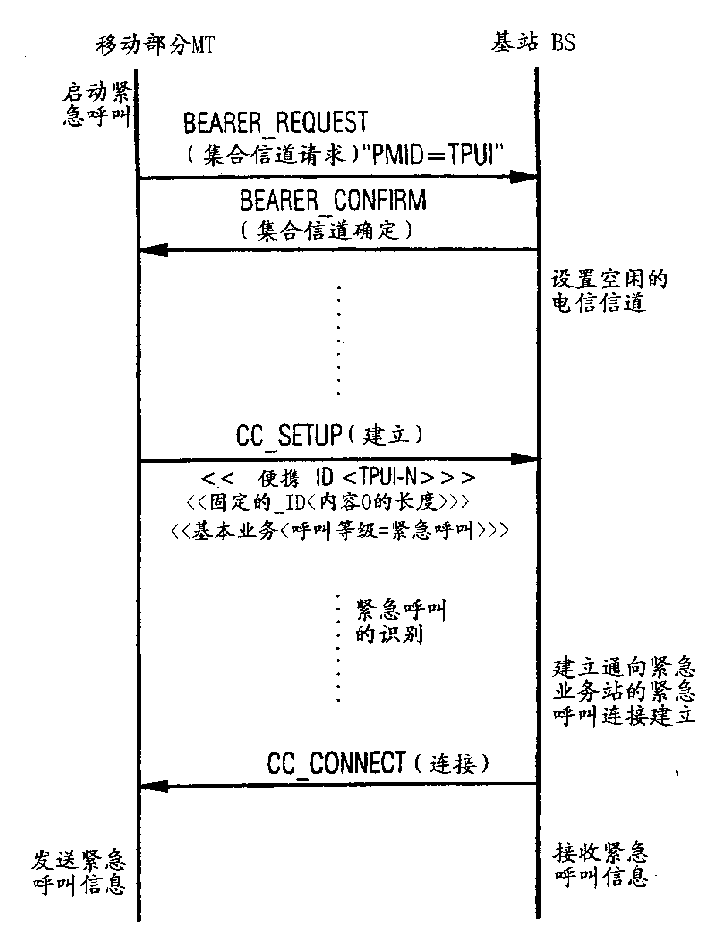
Fig. 5 shows the urgent call transmission course with excited state figure, and this urgent call transmission course ensures effectively and reliably starting of each urgent call in pressing each DECT/GAP system of Fig. 1 to 4.
Before movable part MT (portable part) is with the process shown in base station BS (standing part) startup, movable part (as beginning has been mentioned the time) should have the access right to this base station BS, if lack this access right, preparation property ground should make and oneself has been synchronized at least provisionally on these base station BSs that a telecommunications that is confined to start each urgent call uses for starting each urgent call.By the settling time in this synchronous urgent call of shortening widely in case of emergency that shifts to an earlier date.So making to be synchronized on the base station becomes possibility, the additional information of mentioning when promptly this base station sends out beginning in the scope of each broadcast message that is sent.When this movable part of searching does not have the base station of access right to it, if this movable part is sought each public base station earlier, because these base stations send out a little additional informations with respect to each private base station with bigger probability, if and this movable part just seeks each private base station after the invalid searching that is directed to this, then is favourable., much frequent as to transmit this sign as the criterion of difference public base station and private base station with respect to additional information only by the sign A RC (ACCESS RIGHTS CLASS access right grade) that each public base station adopted.
If movable part MT has found a base station BS by each aforementioned criterion, then on this movable part MT as mentioning, in the startup that needs to begin by a kind of manual operation panel process under the situation urgent call.
This movable part MT sets up process [Bearer Setup Procedure (aggregate channel is set up process) in connection then; See also ETSI document ETS 300175-3, in October, 1992, (see also ETSI document ETS300175-3 10.5.1.1 transmit one the one MAC (media interviews control) communication information " BEARER_REQUEST (aggregate channel request) " that has parameter " PMID " (portable MAC identifier Portable MAC Identifier) to base station BS in scope chapter), in October, 1992,7.3.3.2 parameter " TPUI " (interim portable user label (Temporary Portable User Identification) chapter); See also ETSI document ETS 300175-6, in October, 1992,6.3.1 chapter) be to be assigned to this parameter " PMID " as the special temporary sign word of urgent call.This base station BS can require and common conversation requirement with the urgent call that this communication information of so stipulating is distinguished movable part.Base station BS sends one the 2nd MAC communication information " BEARER-CONFIRM (aggregate channel affirmations) " (seeing also ETSI document ETS300175-3, in October, 1992,7.3.3.3 chapter) as replying first communication information of reception to movable part MT.
When this base station BS (MAC protocol layer) has been discerned a urgent call requirement, then entrust each higher protocol layer and protocol layer control (lower management entity LLME) that the telecommunication channel of a free time is set immediately.This set may be such at this, if or all can be to take for the telecommunication channel of domination in base station BS, connect the channel of creating a free time by removing an existing telecommunications, or reserve the channel of a free time from the beginning.When under this situation, referring to a telecommunication channel, then, also refer to each radio channel or each time slot with this voice-and-data channel that had both referred to each network side.
At the telecommunication channel that is provided with the free time with after with this notice movable part MT, movable part MT transmission one the one NWK communication information " CC-SETUP " (sees also ETSI document ETS 300175-5, in October, 1992, the 6.3.2.1 chapter), this NWK communication channel has
1) information word " BASIC SERVICE (basic service) " (sees also the ETSI document
ETS300175-5, in October, 1992,7.6.4 chapter), in this information word,
Section " CALL CLASS (call class) " meaningful " urgent call ",
2) information word " PORTABLE IDENTITY (portable sign) " (sees also ETST
Document ETS300175-5, in October, 1992,7.7.30 chapter) and section " IPUI
-N”,
3) information word " FIXED IDENTITY (fixed signal) " (sees also the ETSI document
ETS 300175-5, in October, 1992,7.7.18 chapter) and section " LENGTH OF
CONTENTS O (content-length 0) ".
Base station BS should be confirmed this NWK communication information of movable part MT without check " FIXED_IDETITY " and " PORTABLE_IDETITY ", and proceed (to see also ETSI document prETS300444 by GAP standard N WK protocol layer process without each NWK protocol layer sign of check, April nineteen ninety-five, 8.2 chapters).
After the urgent call of having discerned by the GAP standard, base station BS is set up the urgent call of leading to the emergence call service station and is connected, and (see also ETSI document ETS 300175-5 to movable part MT transmission one the 2nd NWK communication information " CC-CONNECT ", in October, 1992, the 6.3.2.6 chapter).At this by a public base station preferentially automatically, preferentially setting up this urgent call by emergency telephone number of automatic choice by the base station of a special use connects.
Can on movable part MT, import this original urgent call communication information directly or indirectly now.This urgent call communication information arrives the emergence call service station through this base station BS.
In addition advantageously, when existing the urgent call connection and having transmitted this urgent call communication information, the base station is removed the urgent call connection of this existence again thus.Possiblely thus be, for example accident in emergency circumstances by each unintentionally the guidance panel process on movable part, can not remove this urgent call and connect.
Claims (9)
Applications Claiming Priority (2)
| Application Number | Priority Date | Filing Date | Title |
|---|---|---|---|
| DE19638111.8 | 1996-09-11 | ||
| DE19638111A DE19638111C2 (en) | 1996-09-11 | 1996-09-11 | Method for controlling the making of emergency calls in cordless telecommunication systems, in particular DECT / GAP systems |
Publications (1)
| Publication Number | Publication Date |
|---|---|
| CN1237313A true CN1237313A (en) | 1999-12-01 |
Family
ID=7806050
Family Applications (1)
| Application Number | Title | Priority Date | Filing Date |
|---|---|---|---|
| CN97199622A Pending CN1237313A (en) | 1996-09-11 | 1997-09-05 | Process for controlling initiation of emergency calls in cordless telecommunication systems, in particular DECT/GAP systems |
Country Status (12)
| Country | Link |
|---|---|
| US (1) | US20020086658A1 (en) |
| EP (1) | EP0925695A2 (en) |
| JP (1) | JP2000502871A (en) |
| CN (1) | CN1237313A (en) |
| AR (1) | AR009750A1 (en) |
| AU (1) | AU4450597A (en) |
| BR (1) | BR9711754A (en) |
| CA (1) | CA2265850A1 (en) |
| DE (1) | DE19638111C2 (en) |
| PL (1) | PL332080A1 (en) |
| WO (1) | WO1998011740A2 (en) |
| ZA (1) | ZA978181B (en) |
Cited By (1)
| Publication number | Priority date | Publication date | Assignee | Title |
|---|---|---|---|---|
| CN101588567B (en) * | 2007-01-05 | 2013-03-27 | 捷讯研究有限公司 | System and method for conditionally attempting an emergency call setup |
Families Citing this family (3)
| Publication number | Priority date | Publication date | Assignee | Title |
|---|---|---|---|---|
| US8688809B2 (en) * | 2006-09-07 | 2014-04-01 | Airvana Lp | Provisioning private access points for wireless networking |
| US8229498B2 (en) * | 2006-12-28 | 2012-07-24 | Airvana, Corp. | Assigning code space to portable base stations |
| US20110059719A1 (en) * | 2009-09-08 | 2011-03-10 | Steve Spielvogel | Wireless emergency call device |
Family Cites Families (13)
| Publication number | Priority date | Publication date | Assignee | Title |
|---|---|---|---|---|
| DE3324517A1 (en) * | 1983-07-07 | 1985-01-17 | ANT Nachrichtentechnik GmbH, 7150 Backnang | Emergency call system |
| CA1299706C (en) * | 1987-08-27 | 1992-04-28 | Yasutaka Sasaki | Concentrator system capable of completing emergency calls under congested traffic |
| JPH0496432A (en) * | 1990-08-10 | 1992-03-27 | Fujitsu General Ltd | cordless phone system |
| DE4130647A1 (en) * | 1991-09-14 | 1993-03-18 | Bosch Gmbh Robert | EMERGENCY CALL DEVICE |
| WO1993021719A1 (en) * | 1992-04-09 | 1993-10-28 | Siemens Aktiengesellschaft | Method of structuring a b-field format in a dect-standard system |
| ES2085800T3 (en) * | 1992-10-26 | 1996-06-01 | Siemens Ag | PROCEDURE AND DISPOSITION FOR THE DIVERSITY OF ANTENNA SELECTION IN A WIRELESS TELEPHONE SYSTEM. |
| DE4236778A1 (en) * | 1992-10-30 | 1994-05-05 | Siemens Ag | Method for connecting transmitters / receivers of a cordless communication system to form a communication-capable unit |
| US5465388A (en) * | 1993-02-19 | 1995-11-07 | Zicker; Robert G. | Emergency cellular radiotelephone and method therefor |
| DE4318441A1 (en) * | 1993-06-03 | 1994-12-08 | Sel Alcatel Ag | Emergency call system |
| DE4326523A1 (en) * | 1993-08-06 | 1995-02-09 | Siemens Ag | Universal mobile telecommunication system |
| JPH07254933A (en) * | 1994-03-15 | 1995-10-03 | Fujitsu Ltd | Emergency call processing method |
| DE4413974C2 (en) * | 1994-04-21 | 1996-07-18 | Siemens Ag | Emergency call system |
| KR960706668A (en) * | 1994-10-13 | 1996-12-09 | 요트. 게. 아. 롤페즈 | A wireless object locating system and a central station and a radio alarm apparatus |
-
1996
- 1996-09-11 DE DE19638111A patent/DE19638111C2/en not_active Expired - Fee Related
-
1997
- 1997-09-05 PL PL97332080A patent/PL332080A1/en unknown
- 1997-09-05 WO PCT/DE1997/001963 patent/WO1998011740A2/en not_active Ceased
- 1997-09-05 CA CA002265850A patent/CA2265850A1/en not_active Abandoned
- 1997-09-05 AU AU44505/97A patent/AU4450597A/en not_active Abandoned
- 1997-09-05 CN CN97199622A patent/CN1237313A/en active Pending
- 1997-09-05 EP EP97942794A patent/EP0925695A2/en not_active Withdrawn
- 1997-09-05 US US09/254,802 patent/US20020086658A1/en not_active Abandoned
- 1997-09-05 JP JP10513134A patent/JP2000502871A/en active Pending
- 1997-09-05 BR BR9711754A patent/BR9711754A/en unknown
- 1997-09-11 AR ARP970104160A patent/AR009750A1/en unknown
- 1997-09-11 ZA ZA9708181A patent/ZA978181B/en unknown
Cited By (1)
| Publication number | Priority date | Publication date | Assignee | Title |
|---|---|---|---|---|
| CN101588567B (en) * | 2007-01-05 | 2013-03-27 | 捷讯研究有限公司 | System and method for conditionally attempting an emergency call setup |
Also Published As
| Publication number | Publication date |
|---|---|
| EP0925695A2 (en) | 1999-06-30 |
| BR9711754A (en) | 1999-08-24 |
| US20020086658A1 (en) | 2002-07-04 |
| AU4450597A (en) | 1998-04-02 |
| WO1998011740A3 (en) | 1998-06-25 |
| DE19638111C2 (en) | 1998-11-26 |
| DE19638111A1 (en) | 1998-03-19 |
| WO1998011740A2 (en) | 1998-03-19 |
| AR009750A1 (en) | 2000-05-03 |
| PL332080A1 (en) | 1999-08-30 |
| ZA978181B (en) | 1998-03-11 |
| JP2000502871A (en) | 2000-03-07 |
| CA2265850A1 (en) | 1998-03-19 |
Similar Documents
| Publication | Publication Date | Title |
|---|---|---|
| US6393268B1 (en) | Method for making emergency calls cordless telecommunications systems | |
| CN1227684A (en) | Method for establishing a communication connection between communication devices in a wireless communication system, in particular between DECT devices of a DECT system | |
| CN1138436C (en) | Method and circuit configuration for compensating variations in the cmos image sensors resulting from temperature, voltage and production | |
| CN1116780C (en) | A Base Station with Fast Channel Switching Function for a Cellular TDMA/FDMA Wireless Communication System | |
| US6400938B1 (en) | Process for controlling the initiation of emergency calls in cordless telecommunication systems, in particular DECT/GAP systems | |
| CN1135816C (en) | Method for transmitting "message waiting indication service" special message over telecommunication network | |
| CN1237313A (en) | Process for controlling initiation of emergency calls in cordless telecommunication systems, in particular DECT/GAP systems | |
| US6532361B1 (en) | Method for controlling the access authorizations of telecommunication devices at cooperation stations | |
| CN1160989C (en) | Roaming of mobile parts in at least partially asynchronous wireless communication networks, in particular DECT networks | |
| CN1296710A (en) | Method and mobile element for setting up telecommunication links in telecommunication systems, especially in DECT/GAP systems | |
| HK1024131A (en) | Process for controlling the initiation of emergency calls in cordless telecommunication systems, in particular dect/gap systems | |
| HK1022587B (en) | Method for controlling generation of urgent call in cordless communication system, especially in dect/gap system | |
| DE19638112C2 (en) | Method for controlling emergency call connections in cordless telecommunication systems, in particular DECT / GAP systems | |
| HK1022589A (en) | Method for making emergency calls in cordless telecommunications systems, in particular dect/gap systems | |
| HK1022386A (en) | Process for establishing telecommunication connection between telecommunication apparatuses in wireless telecommunication systems, in particular between dect-apparatuses of a dect-system |
Legal Events
| Date | Code | Title | Description |
|---|---|---|---|
| C06 | Publication | ||
| PB01 | Publication | ||
| C10 | Entry into substantive examination | ||
| C02 | Deemed withdrawal of patent application after publication (patent law 2001) | ||
| WD01 | Invention patent application deemed withdrawn after publication | ||
| REG | Reference to a national code |
Ref country code: HK Ref legal event code: WD Ref document number: 1024131 Country of ref document: HK |