CN1237644C - A mixed reactant fuel cell - Google Patents
A mixed reactant fuel cell Download PDFInfo
- Publication number
- CN1237644C CN1237644C CNB018069738A CN01806973A CN1237644C CN 1237644 C CN1237644 C CN 1237644C CN B018069738 A CNB018069738 A CN B018069738A CN 01806973 A CN01806973 A CN 01806973A CN 1237644 C CN1237644 C CN 1237644C
- Authority
- CN
- China
- Prior art keywords
- fuel
- battery
- cell
- electrolyte
- fuel cell
- Prior art date
- Legal status (The legal status is an assumption and is not a legal conclusion. Google has not performed a legal analysis and makes no representation as to the accuracy of the status listed.)
- Expired - Fee Related
Links
Images




Classifications
-
- H—ELECTRICITY
- H01—ELECTRIC ELEMENTS
- H01M—PROCESSES OR MEANS, e.g. BATTERIES, FOR THE DIRECT CONVERSION OF CHEMICAL ENERGY INTO ELECTRICAL ENERGY
- H01M8/00—Fuel cells; Manufacture thereof
- H01M8/08—Fuel cells with aqueous electrolytes
-
- H—ELECTRICITY
- H01—ELECTRIC ELEMENTS
- H01M—PROCESSES OR MEANS, e.g. BATTERIES, FOR THE DIRECT CONVERSION OF CHEMICAL ENERGY INTO ELECTRICAL ENERGY
- H01M8/00—Fuel cells; Manufacture thereof
- H01M8/02—Details
- H01M8/0202—Collectors; Separators, e.g. bipolar separators; Interconnectors
- H01M8/0258—Collectors; Separators, e.g. bipolar separators; Interconnectors characterised by the configuration of channels, e.g. by the flow field of the reactant or coolant
-
- H—ELECTRICITY
- H01—ELECTRIC ELEMENTS
- H01M—PROCESSES OR MEANS, e.g. BATTERIES, FOR THE DIRECT CONVERSION OF CHEMICAL ENERGY INTO ELECTRICAL ENERGY
- H01M8/00—Fuel cells; Manufacture thereof
- H01M8/02—Details
- H01M8/0297—Arrangements for joining electrodes, reservoir layers, heat exchange units or bipolar separators to each other
-
- H—ELECTRICITY
- H01—ELECTRIC ELEMENTS
- H01M—PROCESSES OR MEANS, e.g. BATTERIES, FOR THE DIRECT CONVERSION OF CHEMICAL ENERGY INTO ELECTRICAL ENERGY
- H01M8/00—Fuel cells; Manufacture thereof
- H01M8/04—Auxiliary arrangements, e.g. for control of pressure or for circulation of fluids
- H01M8/04082—Arrangements for control of reactant parameters, e.g. pressure or concentration
- H01M8/04089—Arrangements for control of reactant parameters, e.g. pressure or concentration of gaseous reactants
-
- H—ELECTRICITY
- H01—ELECTRIC ELEMENTS
- H01M—PROCESSES OR MEANS, e.g. BATTERIES, FOR THE DIRECT CONVERSION OF CHEMICAL ENERGY INTO ELECTRICAL ENERGY
- H01M8/00—Fuel cells; Manufacture thereof
- H01M8/22—Fuel cells in which the fuel is based on materials comprising carbon or oxygen or hydrogen and other elements; Fuel cells in which the fuel is based on materials comprising only elements other than carbon, oxygen or hydrogen
-
- H—ELECTRICITY
- H01—ELECTRIC ELEMENTS
- H01M—PROCESSES OR MEANS, e.g. BATTERIES, FOR THE DIRECT CONVERSION OF CHEMICAL ENERGY INTO ELECTRICAL ENERGY
- H01M8/00—Fuel cells; Manufacture thereof
- H01M8/24—Grouping of fuel cells, e.g. stacking of fuel cells
- H01M8/241—Grouping of fuel cells, e.g. stacking of fuel cells with solid or matrix-supported electrolytes
-
- H—ELECTRICITY
- H01—ELECTRIC ELEMENTS
- H01M—PROCESSES OR MEANS, e.g. BATTERIES, FOR THE DIRECT CONVERSION OF CHEMICAL ENERGY INTO ELECTRICAL ENERGY
- H01M8/00—Fuel cells; Manufacture thereof
- H01M8/24—Grouping of fuel cells, e.g. stacking of fuel cells
- H01M8/2457—Grouping of fuel cells, e.g. stacking of fuel cells with both reactants being gaseous or vaporised
-
- H—ELECTRICITY
- H01—ELECTRIC ELEMENTS
- H01M—PROCESSES OR MEANS, e.g. BATTERIES, FOR THE DIRECT CONVERSION OF CHEMICAL ENERGY INTO ELECTRICAL ENERGY
- H01M4/00—Electrodes
- H01M4/86—Inert electrodes with catalytic activity, e.g. for fuel cells
- H01M4/8605—Porous electrodes
-
- H—ELECTRICITY
- H01—ELECTRIC ELEMENTS
- H01M—PROCESSES OR MEANS, e.g. BATTERIES, FOR THE DIRECT CONVERSION OF CHEMICAL ENERGY INTO ELECTRICAL ENERGY
- H01M8/00—Fuel cells; Manufacture thereof
- H01M8/10—Fuel cells with solid electrolytes
- H01M8/1007—Fuel cells with solid electrolytes with both reactants being gaseous or vaporised
-
- Y—GENERAL TAGGING OF NEW TECHNOLOGICAL DEVELOPMENTS; GENERAL TAGGING OF CROSS-SECTIONAL TECHNOLOGIES SPANNING OVER SEVERAL SECTIONS OF THE IPC; TECHNICAL SUBJECTS COVERED BY FORMER USPC CROSS-REFERENCE ART COLLECTIONS [XRACs] AND DIGESTS
- Y02—TECHNOLOGIES OR APPLICATIONS FOR MITIGATION OR ADAPTATION AGAINST CLIMATE CHANGE
- Y02E—REDUCTION OF GREENHOUSE GAS [GHG] EMISSIONS, RELATED TO ENERGY GENERATION, TRANSMISSION OR DISTRIBUTION
- Y02E60/00—Enabling technologies; Technologies with a potential or indirect contribution to GHG emissions mitigation
- Y02E60/30—Hydrogen technology
- Y02E60/50—Fuel cells
Landscapes
- Life Sciences & Earth Sciences (AREA)
- Engineering & Computer Science (AREA)
- Manufacturing & Machinery (AREA)
- Sustainable Development (AREA)
- Sustainable Energy (AREA)
- Chemical & Material Sciences (AREA)
- Chemical Kinetics & Catalysis (AREA)
- Electrochemistry (AREA)
- General Chemical & Material Sciences (AREA)
- Fuel Cell (AREA)
- Inert Electrodes (AREA)
Abstract
用于通过电化学装置提供有用的电能的燃料电池或电池,包括:至少一个电池单元;在所述电池单元中的至少一个阳极和至少一个阴极,以及在电极之间用于传导离子的导离子的电解质;并且其特征在于:所述电极是多孔的,并且以此种方式导致至少燃料和氧化剂的混合物流过所述电极体的动力学流动。
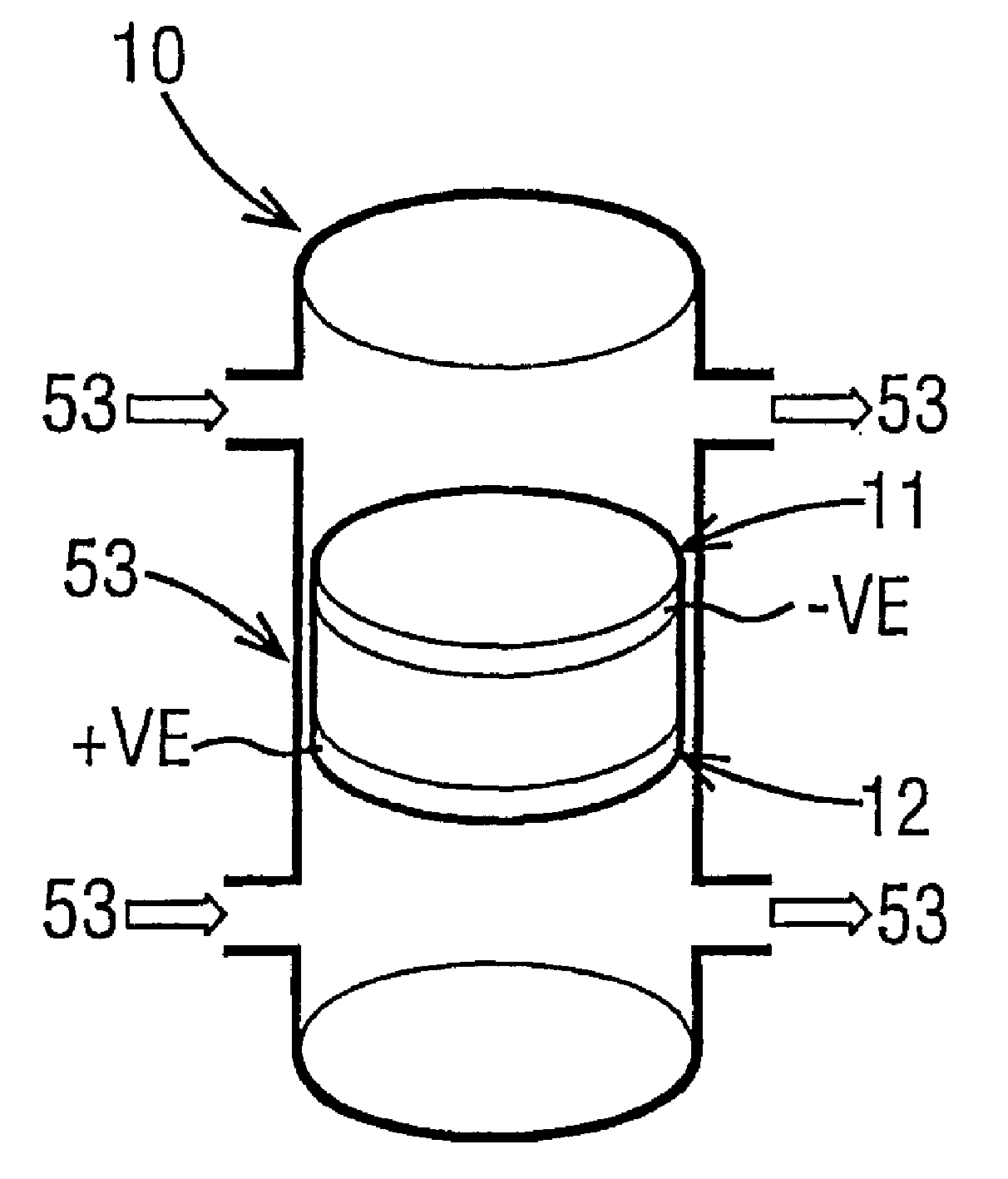
A fuel cell or battery for providing useful electrical energy by an electrochemical device, comprising: at least one battery cell; at least one anode and at least one cathode in the battery cell, and an ion-conducting electrolyte for conducting ions between the electrodes; and characterized in that: the electrodes are porous and in such a way as to cause a kinetic flow of a mixture of at least a fuel and an oxidant through the electrode body.
Description
技术领域technical field
本发明涉及电化学体系,更具体地说,涉及使用混合反应物的燃料电池或电池,也就是说,反应物在燃料电池或电池中相互直接接触。This invention relates to electrochemical systems and, more particularly, to fuel cells or batteries using mixed reactants, that is, the reactants are in direct contact with each other in the fuel cell or battery.
背景技术Background technique
通常,本领域中的普通技术人员应能理解,术语“燃料电池”指的是产生电能的电化学设备,向其中连续地供入反应物(燃料加氧化剂)以满足需要。术语“电池”通常理解为产生电能的电化学体系,它是自容的并且不接受为满足需要而连续供料的反应物,但是会变得电化学耗尽。当然,电池可通过充电再生。本文不想提供“燃料电池”和“电池”的新定义,但是其中含有移动或可动反应物的电池包括在本发明的范围内。Generally, as will be understood by those of ordinary skill in the art, the term "fuel cell" refers to an electrochemical device that generates electrical energy to which reactants (fuel plus oxidant) are continuously fed to meet demand. The term "battery" is generally understood to mean an electrochemical system that produces electrical energy, which is self-contained and does not accept a continuous supply of reactants to satisfy demand, but which becomes electrochemically exhausted. Of course, the battery can be regenerated by charging. It is not intended herein to provide new definitions of "fuel cell" and "battery", but batteries containing mobile or movable reactants therein are included within the scope of this invention.
常规的燃料电池由夹在电解质周围的两个电极构成,其用于使化学反应物完全地相互分开。在一种常规类型的燃料电池中,反应物是氢和氧。氧穿过一个电极,而氢穿过另一个,从而产生电能、水和热。在此类燃料电池中,氢燃料供入燃料电池的阳极。氧或空气供入燃料电池的阴极区域。在阳极,通常在催化剂的帮助下,氢原子分裂成质子和电子。质子穿过电解质,该电解质为离子导体,但对于电子的传输具有很高的阻力,因而能够认为是电子绝缘体。由此,电子从外部通路到达阴极,并在与阴极反应之前,能够通过一个载荷,以便做有用功。在阴极,通过电解质迁移来的质子与氧和电子结合从而形成水。A conventional fuel cell consists of two electrodes sandwiched around an electrolyte, which serves to keep the chemical reactants completely separated from each other. In one conventional type of fuel cell, the reactants are hydrogen and oxygen. Oxygen passes through one electrode and hydrogen passes through the other, creating electricity, water and heat. In this type of fuel cell, hydrogen fuel is fed to the anode of the fuel cell. Oxygen or air is supplied to the cathode region of the fuel cell. At the anode, hydrogen atoms are split into protons and electrons, usually with the help of a catalyst. The protons travel through the electrolyte, which is an ion conductor but has a high resistance to the transport of electrons and can therefore be considered an electronic insulator. Thus, electrons travel from the external pathway to the cathode and are able to pass through a load to do useful work before reacting with the cathode. At the cathode, protons migrating through the electrolyte combine with oxygen and electrons to form water.
由于燃料电池依赖于电化学而不是热燃烧来提供有用的能量转化,操作温度和转化效率较高,因此从燃料电池系统的排放比即使是最干净的燃料燃烧系统的排放也要小很多。这是燃料电池引人注目的两个原因。但是,目前由于其成本很高而使得燃料电池远没有低成本的燃烧发电有份量。尽管燃料电池提供附加的优点,如低噪音和宽载荷性能,但是目前燃料电池技术的主要努力方向在于开发在成本、重量和体积方面能够与常规能量发生体系相比更廉价的体系。Because fuel cells rely on electrochemical rather than thermal combustion to provide useful energy conversion, operating temperatures and conversion efficiencies are higher, so emissions from fuel cell systems are much smaller than those from even the cleanest fuel burning systems. These are two reasons why fuel cells are compelling. However, at present, due to its high cost, fuel cells are far less important than low-cost combustion power generation. Although fuel cells offer additional advantages, such as low noise and wide load capacity, the main effort in current fuel cell technology is to develop systems that can be less expensive than conventional energy generating systems in terms of cost, weight and volume.
在燃料电池技术中报道的主要工作是基于如上所述的常规布置,其中燃料和氧化剂的分开供料被送入燃料电池中不同的室。但是,极少量的工作者研究了用混合反应物的可能性,其主旨描述如下。尽管混合反应物间的直接反应在热力学观点上是可行的,然而却由于种种原因而阻止了燃料电池设计者对其的实施:如,直接进行反应的高的活化能量和/或反应的慢的动力学和/或慢的混合速度都阻止了反应的发生。通过选择性地加入催化电极或选择性地选用其它途径,在阴极上的还原反应以及在阳极上的氧化反应都可得到提高,同时混合反应物中发生反应的可能性还是很小。The major work reported in fuel cell technology is based on the conventional arrangement described above, where separate supplies of fuel and oxidant are fed to different chambers in the fuel cell. However, very few workers have investigated the possibility of using mixed reactants, the gist of which is described below. Although a direct reaction between mixed reactants is thermodynamically feasible, fuel cell designers are prevented from implementing it for various reasons: e.g., the high activation energy of the direct reaction and/or the slowness of the reaction. Kinetics and/or slow mixing speeds prevent the reaction from occurring. By selectively adding catalytic electrodes or selectively choosing other routes, both the reduction reaction at the cathode and the oxidation reaction at the anode can be enhanced, while the possibility of reaction in the mixed reactants is still small.
在混合反应物燃料电池领域的早期工作由Charles Eyraud、JanineLenoir和Michel Géry在1961年3月13日的Seánce上报道。在该文献中报道的单电池使用其上吸附有水分子的多孔氧化铝膜,在特定的温度和压力条件下,能够作为膜电解质使用。例如,阴极为铜或镍的多孔金属片。阳极是铂或钯的真空沉积层。据报道,在湿空气中(即,无燃料),镍的氧化使其自身在多孔Ni-Al2O3-Pd元素电极上表现出电位差。随着燃料混入供料气体混合物中,该种布置的工作情况受到燃料和氧化剂混合物通过多孔氧化铝元素的扩散特性的限制。试图将可离子化组分如氨加入到氧化铝或加入到气态混合物中,以增强吸附在多孔氧化铝中的固定水膜电解质的离子电导率。但,上述概念中没有一个开发成为有实际价值的产品。Early work in the field of mixed reactant fuel cells was reported by Charles Eyraud, Janine Lenoir and Michel Géry in Seánce, 13 March 1961. The single cell reported in this document uses a porous alumina membrane on which water molecules are adsorbed, which can be used as a membrane electrolyte under specific temperature and pressure conditions. For example, the cathode is a porous metal sheet of copper or nickel. The anode is a vacuum deposited layer of platinum or palladium. It has been reported that in humid air (ie, no fuel ), the oxidation of nickel renders itself a potential difference across the porous Ni- Al2O3 -Pd elemental electrode. The operation of this arrangement is limited by the diffusion properties of the fuel and oxidant mixture through the porous alumina element as the fuel is mixed into the feed gas mixture. Attempts have been made to add ionizable components such as ammonia to alumina or to gaseous mixtures to enhance the ionic conductivity of immobilized water membrane electrolytes adsorbed in porous alumina. However, none of the above concepts has been developed into a practical product.
C.K.Dyer在《自然(Nature)》第343卷(1990),第547-548页上描述了一种用于能量转化的薄膜电化学设备。Dyer的设备是一个固体电解质燃料电池,它能够用氧化剂与燃料的混合物来操作。它包括一个可渗透的催化电极和一个不可渗透的催化电极,上述两个电极由电子绝缘但离子导通的气态渗透固体电解质分开。该固体电解质燃料电池在气态燃料/氧化剂混合物下操作。该混合物仅供入一个电极,并通过多孔电解质扩散到另一个电极。通过不同的扩散迁移产生浓度梯度。该设备仅描述为单电池形式。C.K. Dyer in Nature, Vol. 343 (1990), pp. 547-548 describes a thin film electrochemical device for energy conversion. Dyer's device is a solid electrolyte fuel cell that can operate with a mixture of oxidant and fuel. It consists of a permeable catalytic electrode and an impermeable catalytic electrode separated by an electronically insulating but ionically conducting gaseous permeable solid electrolyte. The solid electrolyte fuel cell operates on a gaseous fuel/oxidant mixture. The mixture is fed into only one electrode and diffuses through the porous electrolyte to the other electrode. Concentration gradients are generated by different diffusional migrations. The device is only described as a single battery.
Moseley和Williams在《自然(Nature)》第346卷(1990),第23页上发表了在传感设备中使用Au/Pt电极来传感还原气体。在他们的系统中,环境水吸附在用于分隔电极的作为固定膜电解质的基体表面上。他们还宣称铂电极能够使目标气体如一氧化碳电化学燃烧。他们的设备由于在室温下操作,并且无需使解析(燃料)气体与氧化剂分开因而更方便。需要强调的是该设备用作传感器,并且未打算用来产生能量。Moseley and Williams, Nature, Vol. 346 (1990), p. 23, report the use of Au/Pt electrodes in a sensing device for sensing reducing gases. In their system, ambient water is adsorbed on the surface of a substrate serving as a fixed membrane electrolyte separating the electrodes. They also claim that platinum electrodes enable the electrochemical combustion of target gases such as carbon monoxide. Their device is more convenient since it operates at room temperature and does not require separation of the desorbed (fuel) gas from the oxidant. It is important to emphasize that this device is used as a sensor and is not intended to generate power.
W.van Gool在Philips Res.Repts.的第20卷(1965)第81-93页讨论了在燃料电池中采用表面迁移和多相催化剂的可能性。在公开的一种布置中,两个电极均与燃料气和氧的混合物接触,离子通过电极之间的基体表面迁移,并用选择性化学吸附获得分隔。此种燃料电池布置因为电解质几何学的高电阻而对于产生能量具有固有的不适合性,通常仅适用于传感器领域。选择性电极,特别是通过选择性化学吸附来操作,在此种燃料电池布置中有用。W. van Gool in Philips Res. Repts. Vol. 20 (1965) pp. 81-93 discusses the possibility of employing surface transport and heterogeneous catalysts in fuel cells. In one disclosed arrangement, both electrodes are in contact with a mixture of fuel gas and oxygen, ions migrate through the substrate surface between the electrodes, and separation is achieved by selective chemisorption. Such fuel cell arrangements are inherently unsuitable for power generation due to the high resistance of the electrolyte geometry and are generally only applicable in the field of sensors. Selective electrodes, particularly operating by selective chemisorption, are useful in such fuel cell arrangements.
在燃料和空气的均一混合物下操作的固体氧化物燃料电池的回顾见于《固态离子型表面活性剂》(Solid State Ionics)第82卷(1995)第1-4页。A review of solid oxide fuel cells operating with a homogeneous mixture of fuel and air is found in Solid State Ionics, Vol. 82 (1995), pp. 1-4.
Hibino和Iwahara在Chemistry Letters(1993)第1131-1134页上描述了采用甲烷部分氧化的简化的固体氧化物燃料电池体系。提出了一种可替代的燃料电池体系,该体系在高温下工作,并且采用甲烷加空气混合物作为能源。Y2O3掺杂的氧化锆(YSZ)盘用作一种固体电解质。镍-YSZ金属陶瓷(80∶20重量%)在1400℃下烧结到固体电解质盘的一个表面上,而后在900℃下将金属Au涂覆到固体电解质盘的另一个表面上。据报道这些电极孔足够多,从而允许周围的燃料加空气混合物扩散通过它们。基于该系统的早先设计,在电功率输出方面是不能令人满意的。Hibino and Iwahara in Chemistry Letters (1993) pp. 1131-1134 describe a simplified solid oxide fuel cell system employing partial oxidation of methane. An alternative fuel cell system is proposed that operates at high temperatures and uses a mixture of methane and air as an energy source. Y 2 O 3 doped zirconia (YSZ) discs were used as a solid electrolyte. Nickel-YSZ cermet (80:20 wt%) was sintered at 1400°C on one surface of the solid electrolyte disc, and then metallic Au was coated on the other surface of the solid electrolyte disc at 900°C. These electrodes are reported to be sufficiently porous to allow the surrounding fuel plus air mixture to diffuse through them. Based on the previous design of the system, it was not satisfactory in terms of electrical power output.
近来(《科学(Science)》第288卷(2000)第2031-2033页),Hibino报道了一种低操作温度的固体氧化物燃料电池,采用烃-空气混合物,但是采用氧化钐掺杂的二氧化铈(SDC)作为固体电解质。据报道与YSZ相比,在氧化气氛中,SDC具有非常高的离子电导。而且,该体系在电极中不使用贵金属,因此生产成本相对较低。Recently (Science (Science) Vol. 288 (2000) pp. 2031-2033), Hibino reported a low operating temperature solid oxide fuel cell using a hydrocarbon-air mixture but using samarium oxide doped di Cerium oxide (SDC) was used as the solid electrolyte. It has been reported that SDC has very high ionic conductance in oxidizing atmosphere compared with YSZ. Moreover, the system does not use noble metals in the electrodes, so production costs are relatively low.
与之类似,Gdickemeier等人在电化学协会第192次会议和电化学国际协会第48次会议(1997年在法国的巴黎举行)的论文集中报道了具有反应选择性电极的固体氧化物燃料电池。他们报道了一种布置,其中固体氧化物燃料电池在燃料气与空气的均一混合物中操作。电压在阳极和阴极之间产生,该阳极对燃料的氧化有选择性,该阴极上仅能发生氧的还原。当燃料气为甲烷时,阴极对甲烷的燃烧呈惰性。Similarly, Gdickemeier et al. reported solid oxide fuels with reaction-selective electrodes in the proceedings of the 192nd meeting of the Electrochemical Association and the 48th meeting of the International Association of Electrochemistry (held in Paris, France, 1997). Battery. They report an arrangement in which solid oxide fuel cells operate in a homogeneous mixture of fuel gas and air. A voltage is generated between the anode, which is selective for the oxidation of the fuel, and the cathode, on which only the reduction of oxygen can take place. When the fuel gas is methane, the cathode is inert to the combustion of methane.
在《燃料电池(Fuel Cells)》中,“用于电化学生产能量的现代工艺”(Modern Processes for the Electrochemical Production ofEnergy)”,Wolf Vielstich,Institute für Physikalische Chemie derUniversitt Bonn(由D.J.G.Ives翻译,Birkbeck学院,伦敦大学,Wiley-Interscience ISBN 0471906956),在第374和375页上描述了一种放射性(radiolytically)再生氢氧电池。水通过化学核反应堆分解为氢和氧。产物气体即氢和氧的混合物供入具有两个气体扩散电极的电解槽中。混合燃料气首先引入槽的阴极侧,而作为选择性反应的结果,氧的浓度降低。而后将残余的富氢气体供入槽的阳极侧。在该布置中,在两步法中利用混合燃料。液体电解质限制在电极之间,而反应气体供入电极的外表面。In Fuel Cells, "Modern Processes for the Electrochemical Production of Energy", Wolf Vielstich, Institute für Physikalische Chemie der Universitt Bonn (translated by D.J.G.Ives, Birkbeck College, University of London, Wiley-Interscience ISBN 0471906956), on pages 374 and 375, a radioactive (radiolytically) regenerative hydrogen-oxygen battery is described. Water is decomposed into hydrogen and oxygen by a chemical nuclear reactor. The product gas is hydrogen and oxygen The mixture is fed into an electrolytic cell with two gas diffusion electrodes. The mixed fuel gas is first introduced into the cathode side of the cell, while the concentration of oxygen is reduced as a result of a selective reaction. The residual hydrogen-rich gas is then fed into the anode side of the cell In this arrangement, a mixed fuel is utilized in a two-step process. The liquid electrolyte is confined between the electrodes, while the reactant gas is fed to the outer surfaces of the electrodes.
Zhu等人在《能源》期刊第79卷(1999)第30-36页上描述了被称作“非传统的”燃料电池体系,包括在混合反应物下操作的单室体系。使用传统的固体电解质并且采用掺杂作为调整(tailoring)电导率,以及电解质和/或电极的其它性能以获得所需功能的方式。Zhu et al., Energy, Vol. 79 (1999), pp. 30-36, describe so-called "non-conventional" fuel cell systems, including single-chamber systems operating with mixed reactants. Conventional solid electrolytes are used and doping is employed as a means of tailoring the conductivity, and other properties of the electrolyte and/or electrodes, for desired functionality.
上面讨论的每种混合反应物体系的主要优点之一是使用混合反应物可以省去复杂的管线。无需设置向燃料电池的室中分别供入分开的燃料和氧化剂供料的卷绕管道。因此,减轻了燃料电池所需的密封困难问题。One of the main advantages of each of the mixed reactant systems discussed above is the elimination of complicated plumbing by using mixed reactants. There is no need to provide coiled tubing that feeds separate fuel and oxidant supplies into the chambers of the fuel cell. Thus, the problem of difficult sealing required for fuel cells is alleviated.
另外,减少密封需求并且无管线的布置不象常规燃料电池那样浪费空间。仍需要将燃料加氧化剂在电池内或穿过电池从一处移到另一处的基础设施,但是通常采用混合反应物体系允许电池设计的更多的变换。混合反应物技术可用于从放射性(radiolytic)体系、电解体系或光解体系产生的气体混合物。上文中讨论了使用辐解的体系中所排放的废气的例子。Additionally, the reduced sealing requirements and the plumbing-free arrangement does not waste space like conventional fuel cells. Infrastructure to move the fuel plus oxidant from one place to another within or across the cell is still required, but generally employing a mixed reactant system allows for more flexibility in cell design. Mixed reactant techniques can be used for gas mixtures generated from radiolytic, electrolytic or photolytic systems. Examples of off-gas emissions from systems using radiolysis are discussed above.
混合反应物燃料电池与它们的常规版式相比的缺点在于,它们通常在燃料效率和电池电压(寄生的燃料-氧化剂反应)方面传送较低的性能。与寄生反应相关的问题可以通过制造选择性较好的电极来克服。采用常规电极材料,混合反应物燃料电池效率与其中燃料和氧化剂容纳在分开的进料中的常规体系相比较低。但是,测得的其它性能,如成本和比功率将显著提高。关于混合反应物燃料电池值得注意的是,某些反应物混合物具有潜在的爆炸的危险。然而,如上文中讨论的,混合反应物并不简单地由于它是热力学有利的而必然发生反应。A disadvantage of mixed reactant fuel cells compared to their conventional versions is that they generally deliver lower performance in terms of fuel efficiency and cell voltage (parasitic fuel-oxidant reaction). The problems associated with parasitic reactions can be overcome by making electrodes with better selectivity. With conventional electrode materials, mixed reactant fuel cells are less efficient than conventional systems in which fuel and oxidant are contained in separate feeds. However, other measured properties such as cost and specific power will be significantly improved. One thing to note about mixed reactant fuel cells is that certain reactant mixtures are potentially explosive. However, as discussed above, a mixed reactant does not necessarily react simply because it is thermodynamically favorable.
公知的燃料电池的另一个限制是,电化学反应仅在三相的界面处发生。换句话说,电化学反应限制在催化剂上反应物和电解质相遇的地方。这后一个问题不仅是混合反应物燃料电池的局限,而且也是常规燃料电池的缺陷。Another limitation of known fuel cells is that the electrochemical reactions only occur at the interface of the three phases. In other words, the electrochemical reaction is limited to where the reactants and electrolyte meet on the catalyst. This latter problem is not only a limitation of mixed reactant fuel cells, but also a drawback of conventional fuel cells.
发明内容Contents of the invention
因此本发明的一个目的是提供一种能够改进上述缺陷的燃料电池或电池。更具体地说,本发明的目的是提供一种能够减少复合管线和减少与提供有效密封相关问题的燃料电池或电池。本发明的又一个目的是提供一种能更有效地利用其所占空间的燃料电池或电池。本发明的再一个目的是提供一种燃料电池或电池,其用途或应用是万向的,并且能够使用现有的混合燃料和氧化剂作为反应物,或者能够使用放射体系、电解体系或光解体系中产生的气体。本发明的还一个目的是通过提高综合性能来补偿燃料不太理想的缺陷。本发明的又一个目的是提供一种能够传送所需高功率水平的燃料电池或电池。It is therefore an object of the present invention to provide a fuel cell or battery capable of improving the above-mentioned drawbacks. More specifically, it is an object of the present invention to provide a fuel cell or battery capable of reducing the number of composite lines and problems associated with providing effective sealing. It is a further object of the present invention to provide a fuel cell or battery which utilizes the space it occupies more efficiently. Yet another object of the present invention is to provide a fuel cell or battery whose use or application is universal and capable of using existing mixed fuels and oxidants as reactants, or capable of using radiation systems, electrolysis systems or photolysis systems gas produced in. Yet another object of the present invention is to compensate for less than ideal fuels by improving overall performance. Yet another object of the present invention is to provide a fuel cell or battery capable of delivering the required high power levels.
在第一方面,本发明是一种通过电化学装置来提供可利用的电源的燃料电池或电池,包括:In a first aspect, the invention is a fuel cell or battery for providing electrical power available by electrochemical means, comprising:
至少一个电池单元;at least one battery cell;
在所述电池单元内的至少一个阳极和至少一个阴极;以及at least one anode and at least one cathode within the battery cell; and
用于在电极之间传导离子的导离子的电解质;an ion-conducting electrolyte for conducting ions between electrodes;
其特征在于:It is characterized by:
燃料、氧化剂和电解质以混合物的形式存在,并且在所述电极之间具有隔离措施。Fuel, oxidant and electrolyte are present in a mixture with isolation between the electrodes.
燃料和氧化剂以混合的形式存在是重要的。优选的,该混合物是流体,包括液体、气体、溶液甚至等离子体。该混合物可以是固体或固定的,如:混合物可选择性地粘在一起或是联接到或含在载体内。该混合物的组成优选具有在彼此内部的高扩散性。It is important that the fuel and oxidant are present in admixture. Preferably, the mixture is a fluid, including liquid, gas, solution or even plasma. The mixture may be solid or immobilized, eg the mixture may optionally stick together or be attached to or contained within a carrier. The composition of the mixture preferably has a high diffusivity within each other.
最优选的,燃料为一种流体状态(如上文中限定的)的可氧化组分。可氧化指的是燃料能够贡献电子以形成一种可选择的氧化状态。适当的燃料包括,如:氢、烃如甲烷和丙烷,C1-C4的醇,特别是甲醇和/或乙醇,氢硼化钠,氨,肼和熔融或溶解形式的金属盐。Most preferably, the fuel is an oxidizable component in a fluid state (as defined above). Oxidisable refers to the ability of the fuel to donate electrons to form an alternative oxidation state. Suitable fuels include, for example: hydrogen, hydrocarbons such as methane and propane, C 1 -C 4 alcohols, especially methanol and/or ethanol, sodium borohydride, ammonia, hydrazine and metal salts in molten or dissolved form.
最优选的是,氧化剂为流体形式的可还原的组分。也就是说,该氧化剂作为电子受体。适当的氧化剂材料包括,如:氧,空气,过氧化氢,金属盐-特别是含氧的金属盐,如铬酸盐、钒酸盐或锰酸盐等,以及酸。氧可以以溶解形式存在,例如,以在水、酸性溶液中溶解的氧存在,或溶解在全氟化碳中。Most preferably, the oxidizing agent is a reducible component in fluid form. That is, the oxidizing agent acts as an electron acceptor. Suitable oxidizing materials include, for example: oxygen, air, hydrogen peroxide, metal salts - especially oxygen-containing metal salts, such as chromates, vanadates or manganates, etc., and acids. Oxygen may be present in dissolved form, for example, as dissolved oxygen in water, acidic solutions, or dissolved in perfluorocarbons.
电解质同样可以是流体状态的物质,同时具有传输离子或电子的能力,从而较电极更利于传输离子。用于作电解质的合适的材料包括:酸化的全氟化碳,等离子体,水和含水体系,熔融盐,酸和碱。The electrolyte can also be a substance in a fluid state, and at the same time has the ability to transport ions or electrons, which is more conducive to ion transport than electrodes. Suitable materials for use as electrolytes include: acidified perfluorocarbons, plasmas, water and aqueous systems, molten salts, acids and bases.
燃料或氧化剂可以产生电解质或作为电解质是可能的。换句话说,电解质,无须为该混合物中的离散组分。同样燃料和氧化剂也无须为该混合物中的离散组分。但是,重要的是,该混合物具有至少三种功能,氧化剂、燃料和电解质功能必须依赖于它。It is possible that the fuel or oxidizer can generate or act as an electrolyte. In other words, the electrolyte need not be a discrete component of the mixture. Likewise the fuel and oxidizer need not be discrete components of the mixture. However, it is important that this mixture has at least three functions on which the oxidant, fuel and electrolyte functions must depend.
在本文中术语“电极”应理解为包括电催化剂和导电子介质,在其中或其上结合有该电催化剂,或其为电催化剂本身。In this context the term "electrode" is understood to include electrocatalysts and electron-conducting media in which or on which the electrocatalyst is incorporated, or which is the electrocatalyst itself.
电极以小缝隙隔开,或通过功能上惰性的多孔膜隔开,或通过多孔电解质膜隔开。The electrodes are separated by small gaps, either by a functionally inert porous membrane, or by a porous electrolyte membrane.
本发明与常规燃料电池,以及如上所述混合反应物体系相比,具有的一个主要优点是,在反应物混合物中结合的电解质官能度显著增加了电极的有效活性表面。通常,增加电极的活性表面积的方法是提供更小的电催化剂颗粒。提供使反应混合物与其三倍的官能度一起穿过多孔电极体,本发明有效地使电极的活性表面最大化。A major advantage of the present invention over conventional fuel cells, and mixed reactant systems as described above, is that the incorporation of electrolyte functionality in the reactant mixture significantly increases the effective active surface of the electrodes. In general, a way to increase the active surface area of an electrode is to provide smaller electrocatalyst particles. Provided that the reaction mixture passes through the porous electrode body along with its tripled functionality, the present invention effectively maximizes the active surface of the electrode.
而且,常规的固体电解质是昂贵的,因此本发明提供了省略燃料电池中一个昂贵部分的可能性。因此,生产成本可以降低。而且,常规燃料电池中采用的固体电解质需要仔细控制水。例如,如果不控制水,则水合聚合物电解质膜易于遭受干燥或液泛。流体电解质与固体电解质相比通常具有较高的电导率。另外,流体电解质可以进行搅拌,以进一步增强离子传导。由此可见,构造一个燃料电池可以具有许多优点,其无需传统电解质并且没有其附加的缺点。Also, conventional solid electrolytes are expensive, so the present invention offers the possibility of omitting an expensive part of the fuel cell. Therefore, production costs can be reduced. Also, the solid electrolytes employed in conventional fuel cells require careful control of water. For example, hydrated polymer electrolyte membranes are susceptible to drying out or flooding if water is not controlled. Fluid electrolytes generally have higher electrical conductivity than solid electrolytes. Additionally, the fluid electrolyte can be agitated to further enhance ionic conduction. It follows that there can be many advantages in constructing a fuel cell that does not require conventional electrolytes and does not have their attendant disadvantages.
另一个优点是,可以使用已经含有燃料加氧化剂的混合物的环境产物,例如,含甲烷加空气的堆土废气(land-fill gas)。Another advantage is that environmental products that already contain a mixture of fuel plus oxidant, eg land-fill gas containing methane plus air, can be used.
尽管传质将限制在非流体体系中,但是应当认识到本发明燃料电池的某些用途受益于使用受约混合物。例如,在用作电池替代品的微型燃料电池和/或固态燃料电池领域中,有利的是把该混合物作为盒式磁带/盒带或其它易于操作的形式重新补足。此种补充可以是与更换打印机设备中用尽的油墨盒等类似,或者与给香烟的打火机或加热发卷夹补充燃料类似。Although mass transfer will be limited to non-fluid systems, it should be recognized that certain uses of the fuel cells of the present invention benefit from the use of constrained mixtures. For example, in the field of micro fuel cells and/or solid state fuel cells used as battery replacements, it may be advantageous to replenish the mixture as a cassette/cassette or other easily handled form. Such replenishment may be similar to replacing a spent ink cartridge or the like in a printer device, or similar to refueling a cigarette lighter or heated hair curler.
向燃料电池或电池补充燃料不限于上述给出的例子,其中描述了通过物理方法补充混合物。补充混合物还可通过热、化学或电的方法。将混合物组分再生或更新也包括在本发明的范围内。此种补充方法可以通过物理、热、化学或电的方法。Refueling a fuel cell or battery is not limited to the examples given above, which describe replenishing the mixture by physical means. The supplementary mixture can also be obtained by thermal, chemical or electrical means. It is also within the scope of the invention to regenerate or refresh the components of the mixture. Such supplementary methods can be by physical, thermal, chemical or electrical means.
根据本发明,燃料电池的操作温度范围可以是0℃~1000℃或更高。在混合物中使用等离子体组分的这些体系将难以通过操作温度来分类,因为难以测量等离子体的温度。According to the present invention, the operating temperature range of the fuel cell may be 0° C. to 1000° C. or higher. These systems using plasma components in the mixture would be difficult to classify by operating temperature because it is difficult to measure the temperature of the plasma.
本发明的燃料电池或电池可包括,诸如:挡板或搅拌器等装置,以便使体系内产生湍流,从而增强向电极或由电极向外的物质传输。一个或多个电极可吸附或存储燃料或氧化剂。The fuel cell or battery of the present invention may include devices such as baffles or stirrers to create turbulent flow in the system to enhance mass transport to and from the electrodes. One or more electrodes may adsorb or store fuel or oxidant.
优选的,利用反应物之间在高活化能下反应以提供稳定性,防止燃料电池或电池的自放电。可替代的是,可利用反应物之间缓慢的动力学反应来提供稳定性,防止自放电。而且,可利用对反应物扩散有利的缓慢的动力学来提供稳定性,防止自放电。Preferably, the reaction between the reactants under high activation energy is used to provide stability and prevent self-discharge of the fuel cell or battery. Alternatively, slow kinetic reactions between reactants can be used to provide stability against self-discharge. Furthermore, the slow kinetics favoring reactant diffusion can be used to provide stability against self-discharge.
载氧液体(如全氟化碳)可用于溶解氧或用于燃料和氧的共溶解。而后,可通过将气体(如氧气)溶解在适当的溶液(如全氟化碳)中将燃料电池或电池的氧化剂组分再充电。Oxygen-carrying liquids such as perfluorocarbons can be used to dissolve oxygen or to co-dissolve fuel and oxygen. The oxidant component of the fuel cell or battery can then be recharged by dissolving a gas such as oxygen in a suitable solution such as a perfluorocarbon.
本发明还涉及在反应物稳定结合的单一供料下操作的燃料电池或电池,该反应物是不可混合或部分不可混合的相,或者包含在不可混合或部分不可混合的相中。此种布置的例子是反应物/电解质混合物由稳定的乳液组成。本发明的燃料电池或电池可以在反应物相结合的单一供料下操作,该反应物是不可混合或部分不可混合的相,或包含在不可混合或部分不可混合的相中,该相在设备中自发的分离。可替代的是,燃料电池或电池可以在氧化剂和还原剂的分开供料下操作,氧化剂和还原剂是不可混合或部分不可混合的相,或包含在不可混合或部分不可混合的相中,其与存在电解质的设备接触,该电解质可选择的与氧化剂和还原剂的至少一个供料相结合。如上所述,氧化剂和/或还原剂可具有电解质的功能,从而无需分离电解质组分。The present invention also relates to fuel cells or cells operating on a single feed of stably combined reactants that are, or are contained in, immiscible or partially immiscible phases. An example of such an arrangement is where the reactant/electrolyte mixture consists of a stable emulsion. The fuel cell or cell of the present invention may be operated with a single feed of reactants combined in, or contained in, an immiscible or partially immiscible phase that is present in the device Spontaneous separation in Alternatively, the fuel cell or battery may be operated with separate feeds of oxidant and reductant, which are or are contained in immiscible or partially immiscible phases, which Contacting the device presents an electrolyte, optionally in combination with at least one supply of an oxidizing agent and a reducing agent. As noted above, the oxidizing and/or reducing agents may function as electrolytes, thereby eliminating the need to separate the electrolyte components.
湍流可用来增加不可混合或部分不可混合相之间的接触。优选的,两相中存在适量的电解质,这是由于如上所述电化学反应仅在催化剂/电解质/反应物这三相的界面处发生。因此,如果不可混合或部分不可混合的相中之一电解质不足,则发生电化学反应的可能性将受到限制,并且燃料电池或电池的性能也将受损。再次,湍流可用来增加贫电解质相与富电解质相和相应电池电极之间的接触表面积。根据本发明的燃料电池或电池可利用电极材料既作为氧化还原反应的表面同时也作为氧化还原反应的反应物,它向电池提供额外的输出电压和/或更高的固有的比能量。当设备不产生电能时,本发明的燃料电池或电池还可利用NEMCA(催化活性的非感应电流的电化学改性)或具类似功能来增强混合物稳定性。NEMCA相应是电催化剂的活性被其表面电荷改变的标识。Turbulent flow can be used to increase contact between immiscible or partially immiscible phases. Preferably, an appropriate amount of electrolyte is present in the two phases, since the electrochemical reaction occurs only at the interface of the three phases catalyst/electrolyte/reactant as described above. Therefore, if one of the immiscible or partially immiscible phases has insufficient electrolyte, the possibility of electrochemical reactions will be limited and the performance of the fuel cell or battery will suffer. Again, turbulent flow can be used to increase the contact surface area between the electrolyte-poor and electrolyte-rich phases and the corresponding battery electrodes. A fuel cell or battery according to the invention may utilize electrode materials both as a surface and as a reactant for a redox reaction, which provide the cell with additional output voltage and/or higher intrinsic specific energy. The fuel cell or battery of the present invention may also utilize NEMCA (Non-Induced Amperometric Electrochemical Modification of Catalytic Activity) or similar functions to enhance mixture stability when the device is not generating electrical power. The NEMCA response is an indication that the activity of an electrocatalyst is altered by its surface charge.
本发明的燃料电池或电池包括含能够发生歧化反应组分的反应物供料。此种体系可选择的可再充电。例如,反应物可包括一氧化碳,其发生歧化反应形成碳和二氧化碳,通过加热可再生为一氧化碳。另一个例子是锰离子的溶液,其中歧化反应组分仍是电解质。The fuel cell or battery of the present invention includes a reactant supply comprising a component capable of undergoing a disproportionation reaction. This system is optionally rechargeable. For example, reactants may include carbon monoxide, which undergoes a disproportionation reaction to form carbon and carbon dioxide, which can be regenerated to carbon monoxide by heating. Another example is a solution of manganese ions, where the disproportionation reaction component is still the electrolyte.
在本发明的第二方面涉及用于通过电化学装置提供电能的燃料电池或电池,包括:In a second aspect the invention relates to a fuel cell or battery for providing electrical energy by electrochemical means, comprising:
至少一个电池单元;at least one battery cell;
在所述电池单元内的至少一个阳极和至少一个阴极,以及at least one anode and at least one cathode within the battery cell, and
用于在电极之间传导离子的碱性电解质;Alkaline electrolyte for conducting ions between electrodes;
其特征在于:It is characterized by:
所述电解质以混合物的形式存在,其中所述燃料是碳或含碳物质。The electrolyte is present as a mixture in which the fuel is carbon or a carbonaceous substance.
迄今为止,人们一直认为不可能在低温下操作燃料电池或电池,如那些具有特定含碳物质,采用常规的铂阳极催化剂并基于质子交换膜或碱性电解质的燃料电池或电池,因为含碳物质将很快使铂催化剂中毒,并且使其性能显著恶化。但是,根据本发明,现在证实,只要保持电解质浓度,即可以直接在烃燃料(如甲醇,或含CO/CO2燃料)中,在具有简单的铂催化剂阳极条件下,操作碱性燃料电池或电池更长的时间,而没有显著降级。不期望受理论的制约,据信允许此种操作而没有铂催化剂中毒的机理在于,含碳材料被电解质有效地洗涤。由本发明带来的优点在于,电解质为燃料、氧化剂以及电解质混合物中的一部分,并且因此可以在允许连续操作而不发生催化剂中毒的浓度下供入电池中。Hitherto, it has been considered impossible to operate fuel cells or batteries at low temperatures, such as those with specific carbonaceous species, using conventional platinum anode catalysts and based on proton exchange membranes or alkaline electrolytes, because the carbonaceous species Will quickly poison the platinum catalyst and significantly deteriorate its performance. However, according to the present invention, it is now demonstrated that it is possible to operate alkaline fuel cells or The battery lasts longer without significant degradation. Without wishing to be bound by theory, it is believed that the mechanism allowing this operation without platinum catalyst poisoning is that the carbonaceous material is effectively washed by the electrolyte. The advantage brought about by the present invention is that the electrolyte is part of the fuel, oxidizer and electrolyte mixture and can thus be fed into the cell at a concentration which allows continuous operation without catalyst poisoning.
另外,当空气阴极(典型的,基于锰,基于镍)直接浸渍在液体、燃料和碱性电极的混合物中时,连续引入氧化剂,如空气,可保持此种碱性燃料电池或电池的操作。Additionally, the continuous introduction of an oxidizing agent, such as air, maintains the operation of such an alkaline fuel cell or battery when the air cathode (typically, manganese-based, nickel-based) is directly immersed in the mixture of liquid, fuel, and alkaline electrode.
在本发明的第三方面中涉及通过电化学装置提供有用的电能的燃料电池或电池,包括:In a third aspect the invention relates to a fuel cell or battery for providing useful electrical energy by electrochemical means, comprising:
至少一个电池单元;at least one battery cell;
在所述电池单元中的至少一个阳极和至少一个阴极,以及at least one anode and at least one cathode in said battery cell, and
用于在电极之间传导离子的导离子电解质;Ion-conducting electrolytes for conducting ions between electrodes;
其特征在于:It is characterized by:
燃料、氧化剂和所说的电解质以混合物的形式存在,其中所述电极具有电催化剂,其通过它们电位的高低是可选择的。Fuel, oxidant and said electrolyte are present in the form of a mixture, wherein said electrodes have electrocatalysts through which their electrical potential is selectable.
通过催化剂的电位,而不是通过它们的化学或物理性质使之具有选择性的现象公知是NEMCA(催化活性的非感应电流电化学改性)效应。本发明将相同的NEMCA催化剂用于单室燃料电池或电池的阳极和阴极中。当在相对正的电位下时,催化剂利于还原反应,而在相对负的电位下时,催化剂利于氧化反应。一旦操作燃料电池或电池,电化学反应将保持每个电极上的偏压,及其选择性。该偏压最初可以是通过随机的不稳定性的正反馈建立起来的,或者是通过施加短暂的外电压建立起来的。The phenomenon that catalysts are made selective by their potential, rather than by their chemical or physical properties, is known as the NEMCA (Non-Induced Amperometric Electrochemical Modification of Catalytic Activity) effect. The present invention uses the same NEMCA catalyst in the anode and cathode of a single chamber fuel cell or battery. When at a relatively positive potential, the catalyst favors a reduction reaction, while at a relatively negative potential, the catalyst favors an oxidation reaction. Once a fuel cell or battery is operating, the electrochemical reaction maintains the bias voltage on each electrode, and its selectivity. The bias voltage can be initially established by positive feedback of random instability, or by applying a brief external voltage.
该布置的优点在于,在操作过程中,通过施加短暂的外加电压而使极性可逆,由此阳极变成阴极,反之亦然。例如,外加电压可通过外部电源提供,或者通过使用由燃料电池或电池自身充电的电容器提供。其优点是可以显著提高燃料电池或电池的性能,其可由较高的电流密度,电池电压和改进的燃料利用率来表征。The advantage of this arrangement is that, during operation, the polarity is reversed by applying a brief applied voltage, whereby the anode becomes the cathode and vice versa. For example, the applied voltage can be provided by an external power source, or by using a capacitor charged by the fuel cell or battery itself. The advantage is that the performance of the fuel cell or battery can be significantly improved, which can be characterized by higher current density, cell voltage and improved fuel utilization.
目前的燃料电池或电池具有两个影响它们性能的缺点,这些可由本发明的这一方面克服。首先,反应物在靠近电极处耗尽。其次,催化剂在操作过程中中毒,从而使它们的初始性能中电流流过相当短的时间(也许仅几分钟)后显著降低。有规律地改变燃料电池或电池的极性可以避免上述两个缺点,并且通过减少由于电池极化而导致的功率损失,从而产生提高的电流和电压特性。Current fuel cells or batteries suffer from two disadvantages affecting their performance which are overcome by this aspect of the invention. First, the reactants are depleted close to the electrodes. Second, the catalysts are poisoned during operation so that their initial performance is significantly reduced after a relatively short period of current flow (perhaps only a few minutes). Regularly changing the polarity of the fuel cell or battery avoids both of the aforementioned disadvantages and results in improved current and voltage characteristics by reducing power loss due to cell polarization.
在任何燃料电池或电池中在正常的操作下,在阳极局部存在的燃料氧化,而在阴极局部存在的氧化剂还原,这将导致这些反应物在它们各自的电极处耗尽,其结果是电池性能随时间而降级。在本说明书的上述混合反应物燃料电池或电池中,如上述方法所述,未反应的氧化剂将在阳极局部存在,并可能聚集。类似的,未反应的燃料将在阴极局部存在,并也可聚集。但是,只要极性改变,这些局部浓缩的燃料和氧化剂就可参与电化学反应,从而显著提高瞬间电池性能。类似的,一旦电极极性逆转,局部浓缩的先前耗尽的反应物就有机会恢复。通过以适于混合反应物电池几何学和性质的最佳速率有规律地变换电极极性,就能够使总电池性能保持在接近其瞬间性能峰。Under normal operation in any fuel cell or battery, the fuel locally present at the anode is oxidized and the oxidant locally present at the cathode is reduced, which will lead to the depletion of these reactants at their respective electrodes, with the result that the cell performance Degrades over time. In the above mixed reactant fuel cell or cell of the present specification, as described in the above method, unreacted oxidant will be locally present at the anode and possibly accumulate. Similarly, unreacted fuel will be localized at the cathode and can also accumulate. However, these locally concentrated fuels and oxidants can participate in electrochemical reactions as long as the polarity is changed, thereby significantly improving the instantaneous battery performance. Similarly, once the electrode polarity is reversed, there is an opportunity for locally concentrated, previously depleted reactants to recover. By regularly switching electrode polarity at rates optimal for the geometry and properties of the mixed reactant cell, overall cell performance can be maintained close to its instantaneous peak performance.
根据本发明的燃料电池或电池有三个主要的应用领域。首先,它们可用于机动车辆领域,最终用于安装在交通工具(board vehicles)上代替内燃机。已经有一些混合体系投入了实际使用,其中燃烧矿物燃料的发动机通过燃料电池或电池来加以补充。典型的,使用氢燃料电池或电池,氢可以存储在车辆的底板上或由重整器产生。可用液态燃料如甲醇来代替供入上述混合反应物体系。这有利于传递较高的峰电流。但是,现在燃料电池或电池在单位功率的成本方面还不可能与内燃机相比。通常,对于内燃机而言,功率成本为每kW$30~$40。还必须考虑到尺寸,如果需要大量燃料存储和液体处理系统则需要占据比目前的布置更多的空间,则不可能用燃料电池或电池作为内燃机的替代。The fuel cell or battery according to the invention has three main fields of application. Firstly, they can be used in the field of motor vehicles and eventually in board vehicles to replace internal combustion engines. There are already some hybrid systems in use where fossil fuel-burning engines are supplemented by fuel cells or batteries. Typically, using a hydrogen fuel cell or battery, the hydrogen can be stored on the vehicle's floor or produced by a reformer. Liquid fuel such as methanol can be used instead of feeding the above mixed reactant system. This facilitates delivery of higher peak currents. However, it is not yet possible for fuel cells or batteries to compare with internal combustion engines in terms of cost per unit of power. Typically, for an internal combustion engine, the power cost is $30-$40 per kW. Size must also be considered, as a fuel cell or battery would not be possible as a replacement for an internal combustion engine if substantial fuel storage and liquid handling systems would need to take up more space than current arrangements.
根据本发明的燃料电池或电池的另一个用途是固定系统,如联合生产热和电能。将中心产生的电能进行分配的基础设施已经存在,但是分配热还很鲜见。燃料电池或电池的一个优点是当缩小时效力不变,因此它们具有用于为住宅联合产生热和电能的可能。Another use of a fuel cell or battery according to the invention is stationary systems, such as co-production of heat and electricity. The infrastructure for distributing the electricity generated at the center already exists, but distributing the heat is rare. One advantage of fuel cells, or batteries, is that they remain effective when scaled down, so they have the potential to be used to co-generate heat and electricity for a dwelling.
根据本发明,燃料电池或电池的另一个用途是代替和援助常规电池。如上所述,根据本发明的燃料电池或电池可机械再充电,而不是化学或电学再充电,因此则使得补充非常迅速。而且,例如,基于甲醇的体系的比能量比常规电池优越,因此将燃料电池或电池用于便携式电子设备有着巨大的潜力。当无需管线时,这成为事实,因为燃料电池或电池能够做得更紧凑。而且,氧化剂在系统中,因此无需空气电极或暴露于空气中。从而可以避免诸如电极干燥的水管理问题。Another use of fuel cells or batteries according to the invention is to replace and assist conventional batteries. As mentioned above, the fuel cell or battery according to the invention can be recharged mechanically rather than chemically or electrically, thus allowing very rapid replenishment. Also, for example, the specific energy of methanol-based systems is superior to conventional batteries, so there is great potential for using fuel cells or batteries in portable electronic devices. This becomes true when no plumbing is required, since the fuel cell or battery can be made more compact. Also, the oxidizer is in the system, so there is no need for an air electrode or exposure to air. Water management problems such as electrode drying can thus be avoided.
附图说明Description of drawings
本发明将结合附图通过实施例的方式进行详细描述,其中:The present invention will be described in detail by way of embodiment in conjunction with accompanying drawing, wherein:
图1是常规燃料电池或电池的示意图;Figure 1 is a schematic diagram of a conventional fuel cell or battery;
图2是根据本发明第一方面的电池堆的透视示意图;Figure 2 is a schematic perspective view of a battery stack according to the first aspect of the present invention;
图3是电极间隔4cm的三室电池原型的电压/电流曲线图;Fig. 3 is the voltage/current graph of the three-compartment battery prototype with an electrode interval of 4 cm;
图4是与采用溶解氧的燃料电池或电池相比的电压/电流图;Figure 4 is a graph of voltage/current compared to a fuel cell or battery employing dissolved oxygen;
图5是说明具有不同的电极间距的性能变化图;Fig. 5 is a graph illustrating performance variation with different electrode spacings;
图6是具有五个阳极和阴极堆的电池原型的电压/电流曲线;Figure 6 is a voltage/current curve for a battery prototype with five anode and cathode stacks;
图7是一个可选择堆的功率/时间图,以及Figure 7 is a power/time diagram for an alternative stack, and
图8是常规燃料电池或电池和本发明的燃料电池或电池之间性能的比较图。Fig. 8 is a graph comparing performance between a conventional fuel cell or battery and the fuel cell or battery of the present invention.
首先,参考图1,所示为常规燃料电池或电池10布置的示意图,该电池包括阳极11和阴极12,由电解质介质13分开,介质13允许离子通过但是阻止电子传输。容纳电解质介质13的室外分别为阳极和阴极气体空间21、22。阳极气体空间21具有接收氧化剂如氧气的供料流入口31。阴极气体空间22具有接收燃料如氢气的供料流入口32,以及用于除去未使用的燃料和电化学反应副产物的出口42。Referring first to FIG. 1 , there is shown a schematic diagram of the arrangement of a conventional fuel cell or
每个气体空间和供料流必须相互隔开,并且尽管由图1的图示不太清楚,但是根据常规原理构造的燃料电池组件复杂且具有盘绕的管线。要求密封,并且大量有用的空间被与电池的功率输出无关的组分占据。Each gas space and feed flow must be isolated from each other, and although not clear from the illustration in Figure 1, fuel cell assemblies constructed according to conventional principles are complex and have coiled lines. Sealing is required, and a large amount of useful space is taken up by components unrelated to the power output of the battery.
具体实施方式Detailed ways
使用碱性燃料电池进行实验。电流-电压图是由使用甲醇和硼氢化钠作为燃料,氢氧化钾作为电解质,气态和溶解的氧作为氧化剂的燃料电池获得的。混合反应物概念在静态和流通模式下测试,并与“常规”分开的反应物燃料电池模式进行比较。Experiment with an alkaline fuel cell. Current-voltage diagrams were obtained for a fuel cell using methanol and sodium borohydride as fuel, potassium hydroxide as electrolyte, and gaseous and dissolved oxygen as oxidant. The mixed reactant concept was tested in static and flow-through modes and compared to a "conventional" split reactant fuel cell mode.
选来作为对照的常规电池是选自易于与本发明的燃料电池进行对比的。直接甲醇电池形式的常规电池的性能与最佳气态加料聚合物电解质膜燃料电池相比非常温和,而是在保持新混合反应物燃料电池的非优化设计上。Conventional cells selected as controls were selected for ease of comparison with the fuel cells of the present invention. The performance of conventional cells in the form of direct methanol cells is very modest compared to the best gaseous-fed polymer electrolyte membrane fuel cells, but remains on the non-optimized design of new mixed-reactant fuel cells.
令人惊奇地,混合反应物电池比常规分开反应物电池输出略多的功率。这归功于在阳极的两侧具有燃料,以及氧溶解在含水溶液中而不是在空气中。Surprisingly, the mixed reactant cells output slightly more power than conventional split reactant cells. This is due to having the fuel on both sides of the anode, and the fact that the oxygen is dissolved in the aqueous solution rather than in air.
补充实验显示“流通”燃料电池概念也存在。构造一个紧密的混合反应物燃料电池,包括电极堆,通过该电极堆泵送燃料、氧化剂和电解质。令人惊奇地,证实通过将电池串连电连接可以获得高于单电池的电压。其原因尚未完全弄懂。Complementary experiments showed that the "flow-through" fuel cell concept also exists. An intimate mixed-reactant fuel cell is constructed, consisting of an electrode stack through which fuel, oxidant, and electrolyte are pumped. Surprisingly, it turned out that by electrically connecting cells in series, a voltage higher than that of a single cell can be obtained. The reasons for this are not fully understood.
原型燃料电池通过将电极安装在外径为5cm的有机玻璃管部分之间来构造。阴极是在具有PTFE粘合剂的镍网上的碳载体上的锰。阳极也是使用PTFE粘合剂的镍网上的碳载体上的铂。这些电极材料,以及所使用的碱性体系,主要是依据它们的可商购性和易于获得紧密的混合反应物形式来选择的。A prototype fuel cell was constructed by mounting electrodes between sections of plexiglass tubes with an outer diameter of 5 cm. The cathode was manganese on carbon support on nickel mesh with PTFE binder. The anode was also platinum on carbon support on a nickel mesh using a PTFE binder. These electrode materials, as well as the basic system used, were chosen primarily on the basis of their commercial availability and ease of access to intimately mixed reactant forms.
上述示意性描绘的燃料电池布置显示出电极夹在有机玻璃管之间。该管具有供气体和液体通过的入口和出口,并用O形环密封在一起。The above schematically depicted fuel cell arrangement shows electrodes sandwiched between plexiglass tubes. The tube has inlets and outlets for gas and liquid passage and is sealed together with O-rings.
室1含有燃料,CH3OH(5%v/v)或NaBH4(各种浓度)溶解在1M的KOH中,其还作为电解质。室2含有电解质或燃料与电解质的混合物。室3含有空气、电解质或燃料和电解质。氧通过将空气鼓泡而溶解在燃料或电解质中。
通过在燃料电池中连接不同的电阻来获得电流相对于电压的曲线。在改变电阻后,测量前,可使电流和电压稳定1分钟。在某些实验中,特别是电极之间距离小时,I和V随时间迅速下降。A current versus voltage curve is obtained by connecting different resistors in the fuel cell. After changing the resistance, allow the current and voltage to stabilize for 1 minute before measurement. In some experiments, especially when the distance between electrodes is small, I and V drop rapidly with time.
下面的段落对进行的实验和获得的电池性能进行了小结。The following paragraphs provide a summary of the experiments performed and the obtained cell performance.
1、实验数据1. Experimental data
1.1初始实验1.1 Initial experiment
在初始实验中,电极间隔4cm。在第一实验中,电池1含有存在于KOH中的CH3OH,电池2含有KOH,电池3含有空气。在第二实验中使用在KOH中的CH3OH作为电解质。在这两个实验中观察到了细微的区别,这说明空气阴极对还原具有O2选择性,但是不促进CH3OH的氧化。In initial experiments, the electrodes were separated by 4 cm. In the first experiment,
在这组实验的结尾处,将KOH和CH3OH用在所有三个室中,并使O2在电池内与阴极接触处鼓泡。结果与后面观察到的相反,明显比使用空气阴极的差。认为这是由于阴极上的PTFE衬的作用,或更有可能是由于老化-电极的性能随时间变坏引起的。At the end of this set of experiments, KOH and CH3OH were used in all three chambers, and O2 was bubbled inside the cell at the contact with the cathode. The results, contrary to what was observed later, are significantly worse than those using an air cathode. This is thought to be due to the effect of the PTFE lining on the cathode, or more likely due to aging - the deterioration of the performance of the electrodes over time.
在第一组实验中,初始开路电压为0.586V。在第一实验后,再次测量开路电压为0.537V。In the first set of experiments, the initial open circuit voltage was 0.586V. After the first experiment, the open circuit voltage was measured again to be 0.537V.
1.2第二燃料电池实验1.2 Second fuel cell experiment
该实验的目的是比较使用溶解氧的电池性能,其中之一以CH3OH/KOH作为电解质,并且其它以KOH作为电解质的燃料电池。注意安培计使用A刻度,因此测量结果为0.001A。The purpose of this experiment was to compare the performance of cells using dissolved oxygen, one of which had CH3OH /KOH as electrolyte, and the other fuel cell with KOH as electrolyte. Note that the ammeter uses an A scale, so the measurement will be 0.001A.
1.3改变电极间距的作用1.3 The effect of changing the electrode spacing
所有三个室含有在1M的KOH中的5%CH3OH,空气在室3中鼓泡。第一实验(使用新鲜的电极)电极之间的间距为4cm,开路电压为0.66V,读数的时间间隔为1分钟。第二实验采用电极之间1.5cm的间距。在进行完这组实验后,电池恢复到开路条件,并且电压在15分钟内由0.537V增加到0.59V。All three chambers contained 5% CH3OH in 1M KOH, and air was bubbled in chamber 3. In the first experiment (using fresh electrodes) the spacing between electrodes was 4 cm, the open circuit voltage was 0.66 V, and the time interval between readings was 1 minute. The second experiment employed a spacing of 1.5 cm between electrodes. After running this set of experiments, the cell returned to the open circuit condition and the voltage increased from 0.537V to 0.59V within 15 minutes.
期望电极之间间距小的电池具有更好的性能,这是因为电极之间的电解质对离子的流动将有更少的电阻。相反,看起来主要的影响是燃料的消耗(或可能是有电解质形成K2CO3)导致电池输出的功率随时间下降—这导致从电池输出的电流随电阻下降而下降。Batteries with a small spacing between electrodes are expected to have better performance because the electrolyte between the electrodes will have less resistance to the flow of ions. Instead, it appears that the main effect is that depletion of fuel (or possibly electrolyte formation of K2CO3 ) causes the power output by the cell to drop over time - which causes the current output from the cell to drop as resistance falls.
1.4第一电池堆实验1.4 The first battery stack experiment
组装5个阳极和5个阴极的电池堆,由蠕动泵供料,在300ml 1M的KOH中含有0.104g的NaBH4。第二电池起始时工作得最好(第一电极可能是以前用过的?)但是随时间降低,如下文所示。开路电压为0.874V。A stack of 5 anodes and 5 cathodes was assembled, fed by a peristaltic pump, containing 0.104 g of NaBH 4 in 300 ml of 1M KOH. The second cell worked best initially (the first electrode may have been used before?) but degraded over time as shown below. The open circuit voltage is 0.874V.
电阻为20欧姆,由电池输出的电压和电流作为时间的函数来测量,并且功率相对于时间的图如图8所示。在42分钟后,流速从0.5rpm(0.032ml/s)倍增为1.0rpm(0.064ml/s),导致由电池的功率输出也几乎翻倍。The resistance was 20 ohms, the voltage and current output by the battery were measured as a function of time, and the plot of power versus time is shown in Figure 8. After 42 minutes, the flow rate doubled from 0.5 rpm (0.032 ml/s) to 1.0 rpm (0.064 ml/s), resulting in a nearly doubling of the power output from the battery as well.
如下表所示,开路电压随电池堆而不同。燃料从底部进入电池堆,因此电池堆的电压逐渐下降可解释为由某些后反应(back reaction)导致的燃料消耗。最底部电池的较差的性能可能是由于在实验中使用的所有其它电极为新鲜的这一事实造成的。
当整个电池堆并联连接时,得到0.476V的开路电压,并且电池性能差。在该实验后,中间的三个电池并联连接,开路电压为0.288V,说明电池组件随时间退化。When the entire battery stack is connected in parallel, an open circuit voltage of 0.476V is obtained, and the battery performance is poor. After this experiment, the three cells in the middle were connected in parallel with an open circuit voltage of 0.288 V, indicating degradation of the cell assembly over time.
1.5重复实验以测试混合反应物概念1.5 Repeat experiment to test mixed reactant concept
由于电池随时间降级,因此要测试混合反应物概念的实验在每个实验中使用新鲜的电极反复进行。在第一个实验中,室1用CH3OH/KOH填充,电池2用KOH填充,而电池3用空气填充。在第二个实验中,使用新鲜溶液和电极,在每个室中使用混合的CH3OH/KOH,并且空气在阴极室鼓泡。与先前一样,以1分钟的间隔测量。Because batteries degrade over time, experiments to test the concept of mixed reactants were repeated with fresh electrodes in each experiment. In the first experiment,
在该时间,结果显示混合反应物电池比分开室工作得好,这是由于甲醇存在于阳极的两侧和/或在溶液中与在空气中相比O2的活性较高。At this time, the results show that the mixed reactant cell works better than the split chamber due to the presence of methanol on both sides of the anode and/or the higher activity of O2 in solution compared to air.
1.6第二电池堆实验1.6 The second battery stack experiment
本实验的目的是测试当给定过量燃料和较高流速时,能否从每个电池堆获得相同的性能,并且测试将每个电池串连连接和并联连接的作用。The purpose of this experiment was to test whether the same performance could be obtained from each cell stack given excess fuel and a higher flow rate, and to test the effect of connecting each cell in series and in parallel.
在5rpm,60秒内输送19.08g的H2O,相当于流速为0.32cm3s-1。At 5 rpm, 19.08 g of H 2 O were delivered in 60 seconds, corresponding to a flow rate of 0.32 cm 3 s −1 .
在垂直方向的电池堆中建立五个电池。初始,最下面的三个电池以5rpm串连连接,并且获得的开路电压为1.57V。而后,将三个电池中的每个分别连接,它们给出的开路电压为0.79V(电池1),0.83V和0.83V。当电池1和2基本上串连连接时,获得的开路电压为1.20v。当该三个电池再次串连连接时,获得1.41V的电压,再次说明组成随时间变坏。Build five cells in a vertically oriented cell stack. Initially, the bottom three cells were connected in series at 5 rpm, and an open circuit voltage of 1.57V was obtained. Then, each of the three cells was connected separately and they gave open circuit voltages of 0.79V (cell 1), 0.83V and 0.83V. When
还将相同的三个电池并联连接,并测量20W电阻器的电流和电压,如下所示。
三个电池及其并联连接后的电压和电流。Voltage and current of three batteries and their parallel connection.
为了对比,电池3穿过40W的电阻器连接,因此电压为0.75V,与三个电池并联连接的情况类似。所得到的电流为13.4mA。再次,尽管三个电池以并联连接能给出高于任何单独电池的功率,但是电流不是任何一个电池单独操作时产生电流的三倍。For comparison, battery 3 is connected across a 40W resistor, so the voltage is 0.75V, similar to the case of three batteries connected in parallel. The resulting current was 13.4 mA. Again, although three cells connected in parallel can give more power than any individual cell, the current is not three times that produced by any one cell operating alone.
这种不理想的行为归因于电池的非优化结构,并不认为表明有未预料的电化学作用。This undesirable behavior is attributed to the non-optimized structure of the cell and is not considered to indicate unanticipated electrochemical effects.
2、实验结果分析2. Analysis of experimental results
2.1混合反应物的作用2.1 The role of mixed reactants
测量在室1中含有CH3OH/KOH、在室2中含有KOH且在室3中含有空气的对照电池的电压相对于电流的曲线。还获得了在所有三个室中具有溶解的氧的含CH3OH/KOH的电池的V-I曲线。The voltage versus current curve was measured for a control cell containing CH3OH /KOH in
尽管从这些碱性电池输出的功率低(与直接-甲醇相比),上述结果说明本发明的概念-即可由混合反应物电池获得电能。而且,混合反应物电池比燃料、电解质和氧化剂分开的电池工作得好(在0.35V为1.86mA/cm2;峰功率=8.4mW)。这部分是由于在阳极的两侧具有甲醇,而且还由于溶解在水中的氧(0.25)比溶解在空气中的氧(0.21)具有更高的活性[在开路情况下较扩散限制的负载模式下更是如此]。这些观察证实,增强的性能是由于在全液体模式下操作而使每个电极的活性表面积增加。Although the power output from these alkaline cells is low (compared to direct-methanol), the above results illustrate the concept of the present invention - that is, power can be harvested from mixed reactant cells. Also, the mixed reactant cell worked better than the cell with separate fuel, electrolyte and oxidant (1.86 mA/ cm2 at 0.35V; peak power = 8.4mW). This is partly due to having methanol on both sides of the anode, but also due to the higher activity of oxygen dissolved in water (0.25) than oxygen dissolved in air (0.21) [in the open circuit case compared to the diffusion-limited load mode Even more so]. These observations confirm that the enhanced performance is due to the increased active surface area of each electrode operating in the all-liquid mode.
2.2电极间距的作用2.2 The role of electrode spacing
在任何燃料电池中的电解质均向电化学回路提供一个电阻。当由电池输出电流时,该电阻导致电池的电压降,或极化。减少电解质厚度,即减少电极间距导致电池性能的相应提高。The electrolyte in any fuel cell provides an electrical resistance to the electrochemical circuit. This resistance causes a voltage drop, or polarization, of the battery when current is drawn from the battery. Reducing the electrolyte thickness, i.e. reducing the electrode spacing, leads to a corresponding increase in battery performance.
根据本发明的燃料电池的一个优点是省去在电池中将燃料与氧化剂分开的膜/结构,因此电极相互可以放置得比标准电池更近。实验使用混合反应物(CH3OH/KOH/O2)电池进行,电极组件的距离在4cm~约1.5mm之间变化,以便研究该作用。其结果示于图6中。One advantage of the fuel cell according to the invention is that the membrane/structure separating the fuel from the oxidant in the cell is eliminated, so the electrodes can be placed closer to each other than in a standard cell. Experiments were performed using a mixed reactant (CH 3 OH/KOH/O 2 ) cell with the electrode assembly distance varied between 4 cm and about 1.5 mm in order to study this effect. The results are shown in FIG. 6 .
令人惊奇地,将电极间距由40mm降至1.5mm,对电池性能具有最小作用,直至电流达到一个临界水平。在该临界点,电池的功率输出以时间-依赖方式突然下降。Surprisingly, reducing the electrode spacing from 40 mm to 1.5 mm had minimal effect on cell performance until the current reached a critical level. At this critical point, the power output of the battery drops abruptly in a time-dependent manner.
最小作用区域说明测试电池的性能受电解质电阻以外的因素支配。例如,这些因素可包括电极极化(即,选择的电催化剂的作用)。The area of minimum action indicates that the performance of the test cell is dominated by factors other than electrolyte resistance. For example, these factors may include electrode polarization (ie, the effect of the selected electrocatalyst).
在高电流下功率的突然下降归因于反应物在电极之间的小液体体积内的耗尽。尽管原因还可能是由于在电极上形成K2CO3(即,电极堵塞),甲醇与电解质之间的反应应当是更缓慢的而不是突然的。The sudden drop in power at high currents is attributed to the depletion of reactants in the small liquid volume between the electrodes. The reaction between methanol and electrolyte should be slower rather than abrupt, although the cause could also be due to the formation of K2CO3 on the electrodes (ie, electrode clogging).
后面的实验,即用不与碱性电解质反应的NaBH4燃料代替甲醇,表现出类似的行为,说明在此种情况下K2CO3的形成不是重要因素。A later experiment, where methanol was replaced by NaBH4 fuel that does not react with the alkaline electrolyte, showed similar behavior, indicating that K2CO3 formation was not an important factor in this case.
进一步,利用较高的燃料浓度并通过本发明的系统引入反应物混合物和电解质流来进行实验,表明可以避免突然的功率降,即燃料耗尽是最可能的原因。Further, experiments with higher fuel concentrations and introduction of reactant mixture and electrolyte flow through the system of the present invention showed that sudden power drops, ie fuel exhaustion being the most likely cause, could be avoided.
2.3燃料电池的紧密电池堆2.3 Compact stack of fuel cells
由5对电极组成的电池堆通过用1.5mm厚的橡胶垫片/间隔器(在“轮子”中具有四个“轮辐”的环形,从而防止相邻电极相互接触)将每个电极隔开。在电极内形成多个针孔,以便允许反应物混合物缓慢地通过蠕动泵泵送过电池堆。A cell stack consisting of 5 pairs of electrodes was separated by each electrode with a 1.5 mm thick rubber spacer/spacer (annular shape with four "spokes" in a "wheel", preventing adjacent electrodes from touching each other). Multiple pinholes are formed in the electrodes to allow the reactant mixture to be slowly pumped through the stack by a peristaltic pump.
2.3.i低燃料浓度和反应物速率2.3.i Low fuel concentration and reactant rates
使用NaBH4作为燃料,其浓度为0.01摩尔/dm3,以0.032cm3s-1的流速流过电池堆,由电池堆最接近反应物入口的电池处得到良好的结果,但是在电池堆中的每个电池的性能(电压和电流)随着在电池堆中的位置离该入口越来越远而稳定下降。该行为在开路条件(即无电流输出)和输出电流这两种情况下都观察到了。Using NaBH 4 as fuel at a concentration of 0.01 mol/dm 3 flowing through the stack at a flow rate of 0.032 cm 3 s -1 gives good results from the cell closest to the reactant inlet in the stack, but in the stack The performance (voltage and current) of each cell decreases steadily as the position in the stack is farther and farther away from this inlet. This behavior was observed both under open circuit conditions (ie, no current output) and with output current.
开路行为说明燃料与氧化剂之间的直接背景反应易于发生,其中没有电子通过外部回路迁移。该反应可能发生在任何电极上,但是最可能在铂阳极上。这强烈说明电催化剂选择性的重要性,这是根据具有创造性的燃料电池概念并表明该概念非常正确。The open-circuit behavior illustrates that a direct background reaction between the fuel and oxidant readily occurs in which no electrons migrate through the external loop. This reaction may occur at any electrode, but most likely at the platinum anode. This strongly illustrates the importance of electrocatalyst selectivity, which is based on the inventive concept of fuel cells and shows that the concept is very correct.
当由电池堆的电池中输出功率时,该功率随时间显著下降,直到其降低至基本稳定的状态。这说明,诸如在上述实验中描述过的,燃料的消耗速度大于其补充速度。As power is delivered from the cells of the stack, the power drops significantly over time until it drops to a substantially steady state. This demonstrates that, such as described in the experiments above, fuel is being consumed faster than it can be replenished.
在“稳态”期,当流速加倍时,产生的功率几乎加倍,再次说明性能受反应物供料的影响这一结论。During the "steady state" period, when the flow rate is doubled, the power generated nearly doubles, again illustrating the conclusion that performance is affected by the reactant feed.
2.3.ii高燃料浓度和反应物流速2.3.ii High fuel concentration and reactant flow rate
当以较高(5X)浓度(0.05M)和非常高(10X)的流速(0.32cm3s-1)使用NaBH4燃料时,由每个电池堆中的电池得到类似的结果(起先,沿电池堆中的流动方向性能下降)。该结果证明燃料和溶解的氧之间的背景反应远不如两个组分之间的电化学“燃料电池”反应显著。另外,该实验较高的功率输出比例(在0.70V下1.58mA/cm2;通过20W的电阻时,功率=13.2mW)与较低的流速和浓度(在0.29V下0.74mA/cm2;通过20W电阻时,功率=2.58mW)相比,再次增强了反应物流与功率输出之间的联系。Similar results were obtained from cells in each stack when NaBH 4 fuel was used at a higher (5X) concentration (0.05M) and a very high (10X) flow rate (0.32 cm 3 s -1 ) (initially, along degraded flow direction performance in the stack). This result demonstrates that the background reaction between the fuel and dissolved oxygen is much less significant than the electrochemical "fuel cell" reaction between the two components. In addition, the ratio of higher power output in this experiment (1.58mA/cm 2 at 0.70V; power = 13.2mW through a 20W resistor) to lower flow rate and concentration (0.74mA/cm 2 at 0.29V; This again enhances the link between reactant flow and power output compared to power = 2.58mW through a 20W resistor.
2.3.iii平行电池堆性能2.3.iii Parallel cell stack performance
上述以高浓度/高流速模式使用5-电池堆的电池,每个电池的性能与多个相连电池相比。在电池堆中的三个中心电池以并联和串连模式电连接。The performance of each cell compared to multiple connected cells using the 5-cell stack described above in high concentration/high flow mode. The three central cells in the stack are electrically connected in parallel and series mode.
从对具有创造性的燃料电池概念的较早分析可见,并联模式最初被认为是液体电解质+燃料+氧化剂相结合的唯一操作模式。在并联操作中,通常希望燃料电池堆以单电池操作(即,单电池电压),其总的电池面积(以及总的电流)等于每个电池的和。在具有创造性的电池堆的测试中,20W的施加载荷给出比每个电池性能的三倍小得多的性能(见下表)。
三个电池及其并联后测得的电压和电流。The measured voltage and current of three batteries and their parallel connection.
并联连接的电池堆性能上的下降没有完全弄懂。一个可能的原因可能是并联连接电池的电阻较高。为了更为直接地比较单电池和并联电池的性能,单电池(电池3)的电压通过将电池上的电阻载荷增加到40W来升高。新的单电池电压为0.75V(类似于三个电池并联的),所得到的电流为13.4mA。再次,尽管并联的三个电池给出比任何单独电池高的功率,但是并联电池堆的电流输出仍为预期的约一半。需要再进行实验以弄懂该行为。The drop in performance of stacks connected in parallel is not fully understood. One possible reason could be the higher resistance of the batteries connected in parallel. To more directly compare the performance of single cells and parallel cells, the voltage of the single cell (Cell 3) was increased by increasing the resistive load on the cell to 40W. The new single cell voltage is 0.75V (similar to three cells in parallel) and the resulting current is 13.4mA. Again, the current output of the parallel stack is about half that expected, although three cells in parallel give more power than any single cell. Additional experiments are required to understand this behavior.
2.3.iv串连连接的电池堆的行为2.3.iv Behavior of battery stacks connected in series
三个电池的电连接重新布置,以便使之串连连接。根据系统的初始分析,当以串连连接时,在此类电池堆中除外部电极以外的所有电极应短路,因此不能给出比单电池更多的电压和电流。The electrical connections of the three cells are rearranged so that they are connected in series. According to the initial analysis of the system, when connected in series, in such a stack all electrodes except the external electrodes should be short circuited and thus cannot give more voltage and current than a single cell.
令人惊奇地,如下表所示,当三个电池以串连连接时,得到了比单电池高的电压(开路电压)。尽管串连电压小于三个电池单独操作时的电池总和,但是该结果说明具有创造性的系统表现出比原始理论中预期的更复杂的行为。可能可以从简单的串连连接电池堆中输出巨大的功率。
最接近混合反应物供料的三个电池的开路电压,以及串连连接的三个相同电池的开路电压。The open circuit voltage of the three cells closest to the mixed reactant feed, and the open circuit voltage of three identical cells connected in series.
尽管本发明已经参考特定实施方案进行了详细描述,但是本领域的普通技术人员应当理解可以进行各种变化和改进,而不偏离本发明所附权利要求书的范围。Although the invention has been described in detail with reference to specific embodiments, it will be understood by those skilled in the art that various changes and modifications can be made without departing from the scope of the invention as claimed in the appended claims.
Claims (7)
Applications Claiming Priority (12)
| Application Number | Priority Date | Filing Date | Title |
|---|---|---|---|
| GB0007306.4 | 2000-03-24 | ||
| GBGB0007306.4A GB0007306D0 (en) | 2000-03-24 | 2000-03-24 | Concept for a compact mixed-reactant fuel cell or battery |
| GB0019622.0 | 2000-08-09 | ||
| GB0019623.8 | 2000-08-09 | ||
| GB0019622A GB0019622D0 (en) | 2000-08-09 | 2000-08-09 | Fuel cell with electrodes of reversible polarity |
| GB0019623A GB0019623D0 (en) | 2000-08-09 | 2000-08-09 | Novel fuel cell geometry |
| GB0025030A GB0025030D0 (en) | 2000-10-12 | 2000-10-12 | A direct hydrocarbon mixed-reactant alkaline fuel cell system |
| GB0025030.8 | 2000-10-12 | ||
| GB0026935.7 | 2000-11-03 | ||
| GB0026935A GB0026935D0 (en) | 2000-11-03 | 2000-11-03 | A fuel cell gas burner |
| GB0027587A GB0027587D0 (en) | 2000-11-10 | 2000-11-10 | Mixed-reactant fuel-cell or battery |
| GB0027587.5 | 2000-11-10 |
Publications (2)
| Publication Number | Publication Date |
|---|---|
| CN1426613A CN1426613A (en) | 2003-06-25 |
| CN1237644C true CN1237644C (en) | 2006-01-18 |
Family
ID=27546593
Family Applications (2)
| Application Number | Title | Priority Date | Filing Date |
|---|---|---|---|
| CNB018069738A Expired - Fee Related CN1237644C (en) | 2000-03-24 | 2001-03-26 | A mixed reactant fuel cell |
| CNB018069754A Expired - Fee Related CN100431214C (en) | 2000-03-24 | 2001-03-26 | Mixed reactant fuel cell with porous electrodes with overflow channels |
Family Applications After (1)
| Application Number | Title | Priority Date | Filing Date |
|---|---|---|---|
| CNB018069754A Expired - Fee Related CN100431214C (en) | 2000-03-24 | 2001-03-26 | Mixed reactant fuel cell with porous electrodes with overflow channels |
Country Status (8)
| Country | Link |
|---|---|
| US (2) | US20030165727A1 (en) |
| EP (2) | EP1266420A1 (en) |
| JP (2) | JP2004501480A (en) |
| CN (2) | CN1237644C (en) |
| AU (4) | AU2001242584B2 (en) |
| BR (1) | BR0109513A (en) |
| CA (2) | CA2403938A1 (en) |
| WO (2) | WO2001073880A1 (en) |
Families Citing this family (71)
| Publication number | Priority date | Publication date | Assignee | Title |
|---|---|---|---|---|
| JP3731650B2 (en) | 2001-10-30 | 2006-01-05 | 日産自動車株式会社 | Fuel cell |
| WO2003056649A1 (en) * | 2001-12-27 | 2003-07-10 | Daihatsu Motor Co., Ltd. | Fuel cell |
| US6982128B2 (en) * | 2002-01-28 | 2006-01-03 | Hewlett-Packard Development Company, L.P. | Co-catalyst proton exchange membrane fuel cell utilizing borohydride fuels |
| JP4227757B2 (en) * | 2002-04-02 | 2009-02-18 | 新光電気工業株式会社 | Fuel cell |
| US7073897B2 (en) * | 2002-11-15 | 2006-07-11 | Canon Kabushiki Kaisha | Ink jet recording apparatus of mobile type |
| US6893769B2 (en) * | 2002-12-18 | 2005-05-17 | Hewlett-Packard Development Company, L.P. | Fuel cell assemblies and methods of making the same |
| US7014929B2 (en) * | 2003-01-23 | 2006-03-21 | Hewlett-Packard Development Company, L.P. | Fuel cell |
| JP2005063686A (en) | 2003-08-11 | 2005-03-10 | Shinko Electric Ind Co Ltd | Solid electrolyte fuel cell |
| DE10342161A1 (en) * | 2003-09-08 | 2005-04-07 | Fraunhofer-Gesellschaft zur Förderung der angewandten Forschung e.V. | Electrical contacting for high-temperature fuel cells and method for producing such a contact |
| JP4351557B2 (en) * | 2004-03-03 | 2009-10-28 | 本田技研工業株式会社 | Proton conductor |
| WO2005107002A1 (en) * | 2004-05-04 | 2005-11-10 | Council Of Scientific And Industrial Research | Direct borohydride fuel cells with hydrogen peroxide oxidant |
| GB0410654D0 (en) | 2004-05-13 | 2004-06-16 | Adelan Ltd | Portable fuel cell device |
| US7638226B2 (en) * | 2004-07-13 | 2009-12-29 | Ford Motor Company | Apparatus and method for controlling kinetic rates for internal reforming of fuel in solid oxide fuel cells |
| US20060078782A1 (en) * | 2004-10-07 | 2006-04-13 | Martin Jerry L | Single-pass, high fuel concentration, mixed-reactant fuel cell generator apparatus and method |
| US20080038592A1 (en) * | 2004-10-08 | 2008-02-14 | Harlan Anderson | Method of operating a solid oxide fuel cell having a porous electrolyte |
| US7267807B2 (en) * | 2005-02-06 | 2007-09-11 | Leo B Kriksunov | Method and device for treating automotive exhaust |
| JP4931357B2 (en) | 2005-03-14 | 2012-05-16 | 新光電気工業株式会社 | Solid oxide fuel cell |
| WO2007022467A2 (en) * | 2005-08-19 | 2007-02-22 | Gibbard Research & Development Corp. | Mixed reactant fuel cell system with vapor recovery and method of recovering vapor |
| WO2007024907A2 (en) * | 2005-08-23 | 2007-03-01 | Massachusetts Institute Of Technology | Micro fuel cell |
| KR100658756B1 (en) * | 2006-02-16 | 2006-12-15 | 삼성에스디아이 주식회사 | Membrane-electrode assembly for fuel mixed fuel cell and fuel mixed fuel cell system comprising same |
| KR100709222B1 (en) * | 2006-02-20 | 2007-04-18 | 삼성에스디아이 주식회사 | Stack for fuel mixed fuel cell and fuel mixed fuel cell system comprising same |
| IN266777B (en) | 2006-03-24 | 2015-06-01 | Acal Energy Ltd | |
| JP5245205B2 (en) * | 2006-03-31 | 2013-07-24 | 大日本印刷株式会社 | Solid oxide fuel cell |
| KR20070102819A (en) * | 2006-04-17 | 2007-10-22 | 삼성에스디아이 주식회사 | Stacks for mixed injection fuel cells, and mixed injection fuel cell systems comprising the same |
| GB0608079D0 (en) | 2006-04-25 | 2006-05-31 | Acal Energy Ltd | Fuel cells |
| JP5013748B2 (en) * | 2006-05-23 | 2012-08-29 | 新光電気工業株式会社 | Solid oxide fuel cell |
| GB0614338D0 (en) | 2006-07-19 | 2006-08-30 | Acal Energy Ltd | Fuel cells |
| GB0614337D0 (en) | 2006-07-19 | 2006-08-30 | Acal Energy Ltd | Fuel Cells |
| JP5256598B2 (en) * | 2006-09-01 | 2013-08-07 | 大日本印刷株式会社 | Single-chamber solid oxide fuel cell and its stack structure |
| US20080057381A1 (en) * | 2006-09-05 | 2008-03-06 | Jang Bor Z | Dissolved-fuel direct alcohol fuel cell |
| JP2010509736A (en) * | 2006-11-07 | 2010-03-25 | ポリフューエル・インコーポレイテッド | Passive recovery of liquid water generated from fuel cells |
| EP2109909B1 (en) * | 2006-12-21 | 2016-07-06 | Arizona Board of Regents, acting for and on behalf of, Arizona State University | Fuel cell with transport flow across gap |
| US8691464B2 (en) | 2007-05-25 | 2014-04-08 | Massachusetts Institute Of Technology | Three dimensional single-chamber fuel cells |
| GB0718349D0 (en) | 2007-09-20 | 2007-10-31 | Acal Energy Ltd | Fuel cells |
| GB0718577D0 (en) | 2007-09-24 | 2007-10-31 | Acal Energy Ltd | Fuel cells |
| GB0801198D0 (en) | 2008-01-23 | 2008-02-27 | Acal Energy Ltd | Fuel cells |
| GB0801199D0 (en) | 2008-01-23 | 2008-02-27 | Acal Energy Ltd | Fuel cells |
| US8168337B2 (en) * | 2008-04-04 | 2012-05-01 | Arizona Board Of Regents For And On Behalf Of Arizona State University | Electrochemical cell, and particularly a metal fueled cell with non-parallel flow |
| US8309259B2 (en) | 2008-05-19 | 2012-11-13 | Arizona Board Of Regents For And On Behalf Of Arizona State University | Electrochemical cell, and particularly a cell with electrodeposited fuel |
| GB2474202B (en) * | 2008-08-07 | 2012-07-18 | 0798465 B C Ltd | Mixed reactant flow-by fuel cell |
| JP5218561B2 (en) * | 2008-09-22 | 2013-06-26 | トヨタ自動車株式会社 | Fuel cell system |
| US20100112391A1 (en) * | 2008-10-31 | 2010-05-06 | Arizona Board Of Regents For And On Behalf Of Arizona State University | Counter-flow membraneless fuel cell |
| US8492052B2 (en) | 2009-10-08 | 2013-07-23 | Fluidic, Inc. | Electrochemical cell with spacers for flow management system |
| GB0921881D0 (en) | 2009-12-15 | 2010-01-27 | Priestnall Michael A | Carbonate fuel cell |
| CN202721244U (en) | 2010-06-24 | 2013-02-06 | 流体股份有限公司 | Electrochemical cell with ladder-shaped support fuel anode |
| CN102403525B (en) | 2010-09-16 | 2016-02-03 | 流体公司 | Electrochemical cell system with progressive oxygen evolution electrode/fuel electrode |
| EP2966722B1 (en) | 2010-10-20 | 2018-08-29 | Fluidic, Inc. | Battery resetting process for scaffold fuel electrode |
| JP5908251B2 (en) | 2010-11-17 | 2016-04-26 | フルイディック,インク.Fluidic,Inc. | Multi-mode charging of hierarchical anode |
| US8821715B2 (en) | 2011-05-24 | 2014-09-02 | Saudi Arabian Oil Company | Electrochemical promotion of catalysis in hydrodesulfurization processes |
| US9718046B2 (en) | 2011-05-24 | 2017-08-01 | Saudi Arabian Oil Company | Bimetallic titania-based electrocatalysts deposited on ionic conductors for hydrodesulfurization reactions |
| WO2014164822A1 (en) * | 2013-03-11 | 2014-10-09 | Stc.Unm | Mixed-reactant fuel cells with selective electrodes |
| CN109565097A (en) | 2016-07-22 | 2019-04-02 | 南特能源公司 | Defogging system for electrochemical cell |
| BR112019000713B1 (en) | 2016-07-22 | 2023-04-25 | Nantenergy, Inc | ELECTROCHEMICAL CELL AND METHOD OF CONSERVING MOISTURE INSIDE AN ELECTROCHEMICAL CELL |
| EP3513477B8 (en) | 2016-09-15 | 2021-05-26 | Form Energy, Inc. | Hybrid battery system |
| EP3529844A4 (en) | 2016-10-21 | 2020-07-15 | NantEnergy, Inc. | CORRUGATED FUEL ELECTRODE |
| WO2020006419A1 (en) | 2018-06-29 | 2020-01-02 | Form Energy Inc. | Metal air electrochemical cell architecture |
| EP3815172A4 (en) | 2018-06-29 | 2022-03-09 | Form Energy, Inc. | ROLLING DIAPHRAGM SEAL |
| CN109735868A (en) * | 2018-08-26 | 2019-05-10 | 熵零技术逻辑工程院集团股份有限公司 | A kind of electrolysis unit |
| CN109860679A (en) * | 2018-08-26 | 2019-06-07 | 熵零技术逻辑工程院集团股份有限公司 | A kind of chemical energy device for converting electric energy |
| CN109802202A (en) * | 2018-08-26 | 2019-05-24 | 熵零技术逻辑工程院集团股份有限公司 | A kind of electrochemical appliance |
| CN109786803A (en) * | 2018-08-26 | 2019-05-21 | 熵零技术逻辑工程院集团股份有限公司 | A kind of electrochemical appliance |
| DE102018009198A1 (en) * | 2018-11-22 | 2020-05-28 | Linde Aktiengesellschaft | Process for changing the operating mode of an electrolysis plant and electrolysis plant |
| CN109802204A (en) * | 2018-11-29 | 2019-05-24 | 熵零技术逻辑工程院集团股份有限公司 | A kind of chemical energy device for converting electric energy |
| CN109888352A (en) * | 2019-02-20 | 2019-06-14 | 熵零技术逻辑工程院集团股份有限公司 | A kind of chemical energy device for converting electric energy |
| JP7345267B2 (en) * | 2019-03-29 | 2023-09-15 | 大阪瓦斯株式会社 | Electrochemical elements, electrochemical modules, electrochemical devices and energy systems |
| EP3966887B1 (en) | 2019-05-10 | 2025-07-02 | Form Energy, Inc. | Nested annular metal-air cell and systems containing same |
| WO2020264344A1 (en) | 2019-06-28 | 2020-12-30 | Form Energy Inc. | Device architectures for metal-air batteries |
| CN112751068A (en) * | 2020-01-20 | 2021-05-04 | 熵零技术逻辑工程院集团股份有限公司 | Fuel cell |
| CN111416141B (en) * | 2020-04-03 | 2021-10-19 | 内蒙古工业大学 | Molten hydroxide direct carbon fuel cell and power generation device including the same |
| WO2021226399A1 (en) | 2020-05-06 | 2021-11-11 | Form Energy, Inc. | Decoupled electrode electrochemical energy storage system |
| CN114551953B (en) * | 2022-02-17 | 2024-04-26 | 广东工业大学 | A method for high-value utilization of industrial lignin |
Family Cites Families (23)
| Publication number | Priority date | Publication date | Assignee | Title |
|---|---|---|---|---|
| US3252837A (en) * | 1961-05-08 | 1966-05-24 | Monsanto Res Corp | Fuel cell |
| US3116673A (en) * | 1961-07-27 | 1964-01-07 | Bogopolsky Raphael | Automatic regulating device for the lighting of a photo-sensitive film during filming |
| US3350227A (en) * | 1962-09-14 | 1967-10-31 | Exxon Research Engineering Co | Method of regenerating nitric acid oxidant of fuel cell |
| US3446673A (en) * | 1965-08-30 | 1969-05-27 | Allis Chalmers Mfg Co | H2o2 fuel cell and method of producing electrical energy |
| US3615838A (en) * | 1968-05-10 | 1971-10-26 | Albert C Erickson | Fuel cell unit with novel fluid distribution drain and vent features |
| US3719529A (en) * | 1971-09-30 | 1973-03-06 | Gen Motors Corp | Voltaic cell and method using dilute fuel gases for generate electrical power |
| US4248941A (en) * | 1979-12-26 | 1981-02-03 | United Tecnologies Corporation | Solid electrolyte electrochemical cell |
| US4477541A (en) * | 1982-12-22 | 1984-10-16 | The United States Of America As Represented By The United States Department Of Energy | Solid electrolyte structure |
| US4569924A (en) * | 1982-12-30 | 1986-02-11 | Ozin Geoffrey A | Metal carbon catalyst preparation |
| GB8724543D0 (en) * | 1987-10-20 | 1987-11-25 | Johnson Matthey Plc | Demonstrating & studying operation of fuel cell |
| USRE34248E (en) * | 1988-09-15 | 1993-05-11 | Bell Communications Research, Inc. | Primary source of electrical energy using a mixture of fuel and oxidizer |
| US4863813A (en) * | 1988-09-15 | 1989-09-05 | Bell Communications Research, Inc. | Primary source of electrical energy using a mixture of fuel and oxidizer |
| US5100742A (en) * | 1990-03-08 | 1992-03-31 | Gte Laboratories Incorporated | Method and device for gaseous fuel cell operation |
| US5094928A (en) * | 1990-04-20 | 1992-03-10 | Bell Communications Research, Inc. | Modular fuel cell assembly |
| US4988582A (en) * | 1990-05-04 | 1991-01-29 | Bell Communications Research, Inc. | Compact fuel cell and continuous process for making the cell |
| US5102750A (en) * | 1990-12-18 | 1992-04-07 | Bell Communications Research, Inc. | Efficiency enhancement for solid-electrolyte fuel cell |
| US5162166A (en) * | 1991-07-19 | 1992-11-10 | Kerr-Mcgee Corporation | Devices providing electrical energy from fuel/oxygen mixtures |
| US5723229A (en) * | 1996-07-08 | 1998-03-03 | Motorola, Inc. | Portable fuel cell device including a water trap |
| FR2759087B1 (en) * | 1997-02-06 | 1999-07-30 | Electricite De France | POROUS COMPOSITE PRODUCT WITH HIGH SPECIFIC SURFACE, PREPARATION METHOD AND ELECTRODE FOR ELECTROCHEMICAL ASSEMBLY FORMED FROM POROUS COMPOSITE FILM |
| US6492050B1 (en) * | 1997-10-01 | 2002-12-10 | Acumentrics Corporation | Integrated solid oxide fuel cell and reformer |
| WO2000025380A2 (en) * | 1998-10-27 | 2000-05-04 | Quadrise Limited | Electrical energy storage compound |
| US6936370B1 (en) * | 1999-08-23 | 2005-08-30 | Ballard Power Systems Inc. | Solid polymer fuel cell with improved voltage reversal tolerance |
| US6864002B1 (en) * | 2001-10-19 | 2005-03-08 | Christopher K. Dyer | Fuel cell system and method for producing electrical energy |
-
2001
- 2001-03-26 CN CNB018069738A patent/CN1237644C/en not_active Expired - Fee Related
- 2001-03-26 BR BR0109513-7A patent/BR0109513A/en not_active Application Discontinuation
- 2001-03-26 AU AU2001242584A patent/AU2001242584B2/en not_active Ceased
- 2001-03-26 JP JP2001571498A patent/JP2004501480A/en not_active Withdrawn
- 2001-03-26 JP JP2001571499A patent/JP2004500691A/en not_active Withdrawn
- 2001-03-26 WO PCT/GB2001/001322 patent/WO2001073880A1/en not_active Ceased
- 2001-03-26 AU AU4258401A patent/AU4258401A/en active Pending
- 2001-03-26 CA CA002403938A patent/CA2403938A1/en not_active Abandoned
- 2001-03-26 CN CNB018069754A patent/CN100431214C/en not_active Expired - Fee Related
- 2001-03-26 AU AU2001242590A patent/AU2001242590B2/en not_active Ceased
- 2001-03-26 AU AU4259001A patent/AU4259001A/en active Pending
- 2001-03-26 WO PCT/GB2001/001339 patent/WO2001073881A1/en not_active Ceased
- 2001-03-26 EP EP01915500A patent/EP1266420A1/en not_active Withdrawn
- 2001-03-26 US US10/239,349 patent/US20030165727A1/en not_active Abandoned
- 2001-03-26 CA CA002403935A patent/CA2403935A1/en not_active Abandoned
- 2001-03-26 EP EP01915493A patent/EP1266419A1/en not_active Withdrawn
-
2007
- 2007-10-31 US US11/980,656 patent/US20080063909A1/en not_active Abandoned
Also Published As
| Publication number | Publication date |
|---|---|
| CA2403938A1 (en) | 2001-10-04 |
| CN1426613A (en) | 2003-06-25 |
| BR0109513A (en) | 2003-06-10 |
| JP2004500691A (en) | 2004-01-08 |
| AU4258401A (en) | 2001-10-08 |
| AU4259001A (en) | 2001-10-08 |
| WO2001073880A1 (en) | 2001-10-04 |
| AU2001242584B2 (en) | 2004-11-11 |
| CN1419717A (en) | 2003-05-21 |
| JP2004501480A (en) | 2004-01-15 |
| WO2001073881A1 (en) | 2001-10-04 |
| US20080063909A1 (en) | 2008-03-13 |
| CN100431214C (en) | 2008-11-05 |
| CA2403935A1 (en) | 2001-10-04 |
| US20030165727A1 (en) | 2003-09-04 |
| EP1266420A1 (en) | 2002-12-18 |
| AU2001242590B2 (en) | 2004-11-25 |
| EP1266419A1 (en) | 2002-12-18 |
Similar Documents
| Publication | Publication Date | Title |
|---|---|---|
| CN1426613A (en) | Mixed reactant fuel cells | |
| US20040058203A1 (en) | Mixed reactant fuel cells | |
| AU2001242584A1 (en) | Mixed reactant fuel cells | |
| AU2001242590A1 (en) | Mixed reactant fuel cells with flow through porous electrodes | |
| US20090169962A1 (en) | Integrated flow field plate and diffusion electrode in a fuel cell | |
| JP2005522846A (en) | Control of gas transport in fuel cells. | |
| US20040247992A1 (en) | Fuel cell | |
| CN100372160C (en) | Fuel cell electrodes and membrane electrode assemblies and fuel cell systems | |
| JP4025615B2 (en) | Fuel cell capable of fuel regeneration, power generation method and fuel regeneration method | |
| Ho et al. | Microfluidic fuel cell systems | |
| US20240234747A9 (en) | Method for producing catalyst layers for fuel cells | |
| US20190020082A1 (en) | Reversible electrochemical system comprising two pem devices in oxidation and reduction electrodes configuration | |
| JP2004356031A (en) | Fuel cells and small electrical equipment | |
| US8133633B2 (en) | Structure of cathode electrode for fuel cell | |
| JP5059416B2 (en) | Fuel cell | |
| JP5093640B2 (en) | Solid oxide fuel cell and manufacturing method thereof | |
| US9537167B2 (en) | Methods and apparatus of an anode/cathode (A/C) junction fuel cell with solid electrolyte | |
| JP2005116416A (en) | Manufacturing method of fuel cell and membrane electrode assembly used therefor | |
| JP2005294264A (en) | Catalyst structure of electrochemical fuel cell | |
| JP2006216368A (en) | Electrolyte membrane / electrode assembly, method for producing the same, and fuel cell | |
| JP4683974B2 (en) | Fuel cell system | |
| JP5128824B2 (en) | Fuel cell system | |
| JP2022177727A (en) | reversible fuel cell | |
| JP2006351320A (en) | Manufacturing method of fuel cell | |
| JP2006210357A (en) | Liquid fuel direct supply type fuel cell |
Legal Events
| Date | Code | Title | Description |
|---|---|---|---|
| C06 | Publication | ||
| PB01 | Publication | ||
| C10 | Entry into substantive examination | ||
| SE01 | Entry into force of request for substantive examination | ||
| ASS | Succession or assignment of patent right |
Owner name: CMR FUEL BATTERY CO., LTD. Free format text: FORMER OWNER: SCIENTIFIC GENERICS LTD. Effective date: 20040702 |
|
| C41 | Transfer of patent application or patent right or utility model | ||
| TA01 | Transfer of patent application right |
Effective date of registration: 20040702 Address after: Cambridge County Applicant after: CMR Fuel Cell Inc. Address before: Cambridge County Applicant before: Scientific Generics Ltd. |
|
| C14 | Grant of patent or utility model | ||
| GR01 | Patent grant | ||
| C56 | Change in the name or address of the patentee |
Owner name: CMR FUEL CELL (UK) LIMITED Free format text: FORMER NAME OR ADDRESS: CMR FUEL BATTERY CO., LTD. |
|
| CP01 | Change in the name or title of a patent holder |
Address after: Cambridge County Patentee after: C Mr Fuel cell (UK) Co., Ltd. Address before: Cambridge County Patentee before: C Mr Fuel cell Co Ltd |
|
| C17 | Cessation of patent right | ||
| CF01 | Termination of patent right due to non-payment of annual fee |
Granted publication date: 20060118 |