CN1237787C - Method and system for linking screen display headers to utilize single screen display pixmaps - Google Patents
Method and system for linking screen display headers to utilize single screen display pixmaps Download PDFInfo
- Publication number
- CN1237787C CN1237787C CNB011167998A CN01116799A CN1237787C CN 1237787 C CN1237787 C CN 1237787C CN B011167998 A CNB011167998 A CN B011167998A CN 01116799 A CN01116799 A CN 01116799A CN 1237787 C CN1237787 C CN 1237787C
- Authority
- CN
- China
- Prior art keywords
- display mode
- header
- pixel
- display
- osd
- Prior art date
- Legal status (The legal status is an assumption and is not a legal conclusion. Google has not performed a legal analysis and makes no representation as to the accuracy of the status listed.)
- Expired - Lifetime
Links
- 238000000034 method Methods 0.000 title claims description 21
- 230000004044 response Effects 0.000 abstract description 5
- 238000013507 mapping Methods 0.000 abstract description 2
- 238000012545 processing Methods 0.000 description 6
- 230000006870 function Effects 0.000 description 5
- 238000004891 communication Methods 0.000 description 4
- 238000013459 approach Methods 0.000 description 3
- 238000012937 correction Methods 0.000 description 2
- 230000006837 decompression Effects 0.000 description 2
- 238000009877 rendering Methods 0.000 description 2
- 230000001360 synchronised effect Effects 0.000 description 2
- 230000003139 buffering effect Effects 0.000 description 1
- 230000006835 compression Effects 0.000 description 1
- 238000007906 compression Methods 0.000 description 1
- 238000004590 computer program Methods 0.000 description 1
- 238000010586 diagram Methods 0.000 description 1
- 230000000750 progressive effect Effects 0.000 description 1
Images




Classifications
-
- H—ELECTRICITY
- H04—ELECTRIC COMMUNICATION TECHNIQUE
- H04N—PICTORIAL COMMUNICATION, e.g. TELEVISION
- H04N21/00—Selective content distribution, e.g. interactive television or video on demand [VOD]
- H04N21/40—Client devices specifically adapted for the reception of or interaction with content, e.g. set-top-box [STB]; Operations thereof
- H04N21/43—Processing of content or additional data, e.g. demultiplexing additional data from a digital video stream; Elementary client operations, e.g. monitoring of home network or synchronising decoder's clock; Client middleware
- H04N21/434—Disassembling of a multiplex stream, e.g. demultiplexing audio and video streams, extraction of additional data from a video stream; Remultiplexing of multiplex streams; Extraction or processing of SI; Disassembling of packetised elementary stream
-
- H—ELECTRICITY
- H04—ELECTRIC COMMUNICATION TECHNIQUE
- H04N—PICTORIAL COMMUNICATION, e.g. TELEVISION
- H04N21/00—Selective content distribution, e.g. interactive television or video on demand [VOD]
- H04N21/40—Client devices specifically adapted for the reception of or interaction with content, e.g. set-top-box [STB]; Operations thereof
- H04N21/47—End-user applications
- H04N21/472—End-user interface for requesting content, additional data or services; End-user interface for interacting with content, e.g. for content reservation or setting reminders, for requesting event notification, for manipulating displayed content
-
- G—PHYSICS
- G09—EDUCATION; CRYPTOGRAPHY; DISPLAY; ADVERTISING; SEALS
- G09G—ARRANGEMENTS OR CIRCUITS FOR CONTROL OF INDICATING DEVICES USING STATIC MEANS TO PRESENT VARIABLE INFORMATION
- G09G5/00—Control arrangements or circuits for visual indicators common to cathode-ray tube indicators and other visual indicators
- G09G5/36—Control arrangements or circuits for visual indicators common to cathode-ray tube indicators and other visual indicators characterised by the display of a graphic pattern, e.g. using an all-points-addressable [APA] memory
- G09G5/363—Graphics controllers
-
- H—ELECTRICITY
- H04—ELECTRIC COMMUNICATION TECHNIQUE
- H04N—PICTORIAL COMMUNICATION, e.g. TELEVISION
- H04N21/00—Selective content distribution, e.g. interactive television or video on demand [VOD]
- H04N21/40—Client devices specifically adapted for the reception of or interaction with content, e.g. set-top-box [STB]; Operations thereof
- H04N21/41—Structure of client; Structure of client peripherals
- H04N21/426—Internal components of the client ; Characteristics thereof
- H04N21/42653—Internal components of the client ; Characteristics thereof for processing graphics
-
- H—ELECTRICITY
- H04—ELECTRIC COMMUNICATION TECHNIQUE
- H04N—PICTORIAL COMMUNICATION, e.g. TELEVISION
- H04N21/00—Selective content distribution, e.g. interactive television or video on demand [VOD]
- H04N21/40—Client devices specifically adapted for the reception of or interaction with content, e.g. set-top-box [STB]; Operations thereof
- H04N21/41—Structure of client; Structure of client peripherals
- H04N21/426—Internal components of the client ; Characteristics thereof
- H04N21/42692—Internal components of the client ; Characteristics thereof for reading from or writing on a volatile storage medium, e.g. Random Access Memory [RAM]
-
- H—ELECTRICITY
- H04—ELECTRIC COMMUNICATION TECHNIQUE
- H04N—PICTORIAL COMMUNICATION, e.g. TELEVISION
- H04N5/00—Details of television systems
- H04N5/44—Receiver circuitry for the reception of television signals according to analogue transmission standards
- H04N5/445—Receiver circuitry for the reception of television signals according to analogue transmission standards for displaying additional information
- H04N5/44504—Circuit details of the additional information generator, e.g. details of the character or graphics signal generator, overlay mixing circuits
-
- G—PHYSICS
- G09—EDUCATION; CRYPTOGRAPHY; DISPLAY; ADVERTISING; SEALS
- G09G—ARRANGEMENTS OR CIRCUITS FOR CONTROL OF INDICATING DEVICES USING STATIC MEANS TO PRESENT VARIABLE INFORMATION
- G09G2340/00—Aspects of display data processing
- G09G2340/12—Overlay of images, i.e. displayed pixel being the result of switching between the corresponding input pixels
- G09G2340/125—Overlay of images, i.e. displayed pixel being the result of switching between the corresponding input pixels wherein one of the images is motion video
-
- H—ELECTRICITY
- H04—ELECTRIC COMMUNICATION TECHNIQUE
- H04N—PICTORIAL COMMUNICATION, e.g. TELEVISION
- H04N5/00—Details of television systems
- H04N5/44—Receiver circuitry for the reception of television signals according to analogue transmission standards
- H04N5/46—Receiver circuitry for the reception of television signals according to analogue transmission standards for receiving on more than one standard at will
-
- H—ELECTRICITY
- H04—ELECTRIC COMMUNICATION TECHNIQUE
- H04N—PICTORIAL COMMUNICATION, e.g. TELEVISION
- H04N7/00—Television systems
- H04N7/01—Conversion of standards, e.g. involving analogue television standards or digital television standards processed at pixel level
- H04N7/0117—Conversion of standards, e.g. involving analogue television standards or digital television standards processed at pixel level involving conversion of the spatial resolution of the incoming video signal
- H04N7/0122—Conversion of standards, e.g. involving analogue television standards or digital television standards processed at pixel level involving conversion of the spatial resolution of the incoming video signal the input and the output signals having different aspect ratios
Landscapes
- Engineering & Computer Science (AREA)
- Multimedia (AREA)
- Signal Processing (AREA)
- Computer Graphics (AREA)
- Physics & Mathematics (AREA)
- Computer Hardware Design (AREA)
- General Physics & Mathematics (AREA)
- Theoretical Computer Science (AREA)
- Databases & Information Systems (AREA)
- Human Computer Interaction (AREA)
- Controls And Circuits For Display Device (AREA)
- Television Systems (AREA)
Abstract
在具有不同尺寸的多种视频光栅下使用单像素映像的TV系统。该TV系统使用至少两组报头(198,200)来选择要根据不同光栅尺寸显示的单像素映像(190)的不同部分。在报头组中每个报头都指向一条像素线,选择关于那条像素线的像素数。在报头组中的报头数确定像素映像的高度,由一组报头选择的像素数确定像素映像(190)的宽度。响应不同显示模式,TV系统有选择地调用两组报头(198,200)之一选择单像素映像(190)的不同部分。故可在具有不同光栅尺寸的多视频光栅下使用单像素映像。
TV system using single pixel mapping with multiple video rasters of different sizes. The TV system uses at least two sets of headers (198, 200) to select different portions of the pixmap (190) to be displayed according to different raster sizes. Each header points to a pixel line in the header group, select the number of pixels about that pixel line. The number of headers in a header set determines the height of the pixmap, and the number of pixels selected by a set of headers determines the width of the pixmap (190). In response to different display modes, the TV system selectively invokes one of two sets of headers (198, 200) to select different portions of the pixmap (190). So pixmaps can be used with multiple video rasters with different raster sizes.
Description
本发明一般涉及视频数据处理,尤其涉及在数种视频图像上显示一种像素映像的视频数据处理。This invention relates generally to video data processing, and more particularly to video data processing for displaying a pixmap over several video images.
将个人计算机和电视功能(PC/TV系统)组合在一起的家庭娱乐系统正在逐步成为通用用户交互式多信源多目标通信设备。为了响应用户的请求,对于各种各样的应用,要求这样的多媒体系统在多个地点之间以不同的数据格式通信。例如,PC/TV系统可以从包括高清晰度电视(HDTV)广播、多点微波分配系统(MMDS)广播和数字视频广播(DVB)在内的卫星或地面信源接收数据。PC/TV系统还可以通过电话(例如,因特网)和同轴线(例如,有线TV),以及从诸如数字视频盘(DVD)、CDROM(光盘只读存储器)、VHS和数字VHS(VHC录像机格式)(DVHSTM)型播放机、和PC之类的远程和本地信源两者接收和发送数据。Home entertainment systems that combine personal computer and television functions (PC/TV systems) are gradually becoming general-purpose user-interactive multi-source and multi-target communication devices. Such multimedia systems are required to communicate in different data formats between multiple locations for a wide variety of applications in order to respond to user requests. For example, a PC/TV system may receive data from satellite or terrestrial sources including high definition television (HDTV) broadcasts, multipoint microwave distribution system (MMDS) broadcasts, and digital video broadcasts (DVB). PC/TV systems can also be accessed via telephone (e.g., the Internet) and coaxial line (e.g., cable TV), as well as from sources such as Digital Video Disk (DVD), CDROM (Compact Disc Read Only Memory), VHS, and Digital VHS (VHC Video Recorder Format). ) (DVHS ™ ) type player, and both remote and local sources such as PCs receive and transmit data.
这样的通用PC/TV娱乐系统需要各种不同的屏幕显示(OSD)供来自不同的信源或针对不同应用的视频节目内容使用。在这样的系统中,为了传递信息或在TV显示器上显示菜单的目的,OSD功能用于在TV显示器上显示重叠在视频图像上的位映像图像。把OSD再现到存储器中的“像素映像”上,该像素映像被映射到TV显示器。在视频图像上的任何位置上这个OSD像素映像都需要与TV显示器上的有效视频区具有相同的尺寸。Such a general-purpose PC/TV entertainment system requires a variety of different On-Screen Displays (OSDs) for video programming content from different sources or for different applications. In such systems, the OSD function is used to display a bitmap image superimposed on the video image on the TV display for the purpose of conveying information or displaying a menu on the TV display. The OSD is rendered onto a "pixmap" in memory that is mapped to the TV display. This OSD pixmap needs to be the same size as the active video area on the TV display anywhere on the video image.
在一些系统中,视频光栅根据观看的通道在2H与2.14H扫描速率模式之间切换。因此,在两种模式的每一种中,有效视频区的尺寸是不同的。这就要求不同尺寸的OSD像素映像必须适用于每一种光栅模式。例如,在2H模式中,OSD尺寸要求是480线×2096像素/线,而在2.14H模式中,OSD尺寸要求是540线×1920像素/线。这是因为OSD像素时钟是视频光栅时钟的函数。In some systems, the video raster switches between 2H and 2.14H scan rate modes depending on the channel being viewed. Therefore, the size of the active video area is different in each of the two modes. This requires that different sized OSD pixmaps must be available for each raster mode. For example, in 2H mode, the OSD size requirement is 480 lines×2096 pixels/line, while in 2.14H mode, the OSD size requirement is 540 lines×1920 pixels/line. This is because the OSD pixel clock is a function of the video raster clock.
解决该问题的一种方法是为具有不同光栅尺寸的多种图像保持多种像素映像,并根据所需的显示模式切换到特定的像素映像。但是,这种方法的一个缺点是,因为该方法牵涉到再现所有OSD位映像许多次(每个像素映像一次),所以浪费了存储空间。这种方法的另一个缺点是因为像素映像的再现时间将加倍,所以降低了系统速度。One way to solve this problem is to maintain multiple pixmaps for multiple images with different raster sizes, and switch to a specific pixmap depending on the desired display mode. One disadvantage of this approach, however, is that storage space is wasted because the approach involves rendering all OSD bitmaps many times (once for each pixmap). Another disadvantage of this approach is that the system speed is reduced because the rendering time of the pixmap will be doubled.
因此,需要一种在具有不同尺寸的多种视频光栅下使用单个像素映像的方法和系统。本发明提供了满足这个需要的方法和系统。Therefore, what is needed is a method and system for using a single pixmap with multiple video rasters having different sizes. The present invention provides methods and systems that meet this need.
本发明的目的是提供在具有不同尺寸的多种视频光栅下,使用包含许多条像素线的单个像素映像的方法和系统。一般来说,本发明使用至少两组报头(header)(例如,第一和第二组报头)来选择要根据不同光栅尺寸显示的单个像素映像的不同部分。在第一或第二报头组中每一个报头都指向一条像素线,选择关于那条像素线的像素数。因此,在报头组中的报头数确定像素映像的高度,由一组报头选择的像素数确定像素映像的宽度。响应不同的显示模式,本发明有选择地调用第一或第二组报头,来选择要显示的像素映像的各个部分。这样,可以在具有不同尺寸的多个视频光栅下使用单个像素映像。It is an object of the present invention to provide a method and system for using a single pixmap comprising many pixel lines with a variety of video rasters having different sizes. In general, the present invention uses at least two sets of headers (eg, first and second sets of headers) to select different portions of a single pixmap to be displayed according to different raster sizes. Each header points to a pixel line in the first or second header set, and the number of pixels with respect to that pixel line is selected. Thus, the number of headers in a header set determines the height of the pixmap, and the number of pixels selected by a set of headers determines the width of the pixmap. In response to different display modes, the present invention selectively invokes the first or second set of headers to select portions of the pixmap to be displayed. This way, a single pixmap can be used under multiple video rasters with different sizes.
在附图中,In the attached picture,
图1显示了根据本发明处理OSD报头和内容数据的示范性家庭娱乐系统;Figure 1 shows an exemplary home entertainment system for processing OSD header and content data according to the present invention;
图2进一步图示了图1所示的示范性家庭娱乐系统的MPEG解码器和视频存储器;Figure 2 further illustrates the MPEG decoder and video memory of the exemplary home entertainment system shown in Figure 1;
图3图示了传统MPEG解码器和视频存储器配置;Figure 3 illustrates a conventional MPEG decoder and video memory configuration;
图4是说明传统OSD检索过程的流程图;FIG. 4 is a flowchart illustrating a conventional OSD retrieval process;
图5图示了传统OSD数据格式;Figure 5 illustrates a conventional OSD data format;
图6图示了本发明的MPEG解码器和视频存储器配置;Figure 6 illustrates the MPEG decoder and video memory configuration of the present invention;
图7图示了本发明的改进OSD配置;和Figure 7 illustrates an improved OSD configuration of the present invention; and
图8是说明本发明的像素映像检索过程的流程图。Figure 8 is a flowchart illustrating the pixmap retrieval process of the present invention.
通过举例方式对本发明进行如下描述,本发明的特征和优点将更加清楚。The features and advantages of the present invention will be more apparent by way of the following description of the present invention by way of examples.
现在参照图1,图1显示了根据本发明原理进行操作的示范性数字视频接收系统的方块图。视频接收系统包括天线10和输入处理器15,用于接收和数字化用携带音频、视频和相关数据的信号调制的广播载波;解调器20,用于接收和解调来自输入处理器15的数字输出信号;和解码器30,输出经过格式解码、映射成字节长度数据段、解交织和里德-索洛蒙(Reed-Solomon)纠错的信号。来自解码器单元30的纠正输出数据的形式是包含代表多路复用的音频、视频和数据分量的节目的MPEG兼容传输数据流。Referring now to FIG. 1, there is shown a block diagram of an exemplary digital video receiving system operating in accordance with the principles of the present invention. The video receiving system includes an
视频接收系统还包括调制解调器80,调制解调器80可以通过电话线与服务器83或连接服务设施87相连接,使得以各种格式(例如,MPEG、HTML、和/或JAVA)的数据可以由视频接收系统在电话线上接收。The video receiving system also includes a
处理器25处理从解码器30和/或调制解调器80输出的数据,使得可以按照用户通过远程控制单元125输入的请求,将处理过的数据显示在显示单元75上或存储在存储介质105上。更具体地说,处理器25包括控制器115,控制器115解释通过远程单元接口120从远程控制单元125接收的请求,并适当地配置处理器25的部件以实现用户请求(例如,通道、网站、和/或OSD显示器)。在一种示范性模式中,控制器115配置处理器25的部件以提供MPEG解码数据和OSD,显示在显示单元75上。在另一种示范性模式中,控制器15配置处理器25的部件以提供MPEG兼容数据流,通过存储设备90和存储接口95存储在存储介质105上。在还再一种示范性模式中,控制器115配置处理器25的部件用于其它通信模式,譬如,用于通过服务器83或连接服务设施87进行双向(例如,因特网)通信。The
处理器25包括解码PID选择单元45,解码PID选择单元45识别和路由传输流中从解码器30到传输解码器55的所选分组。来自解码器30的传输流由传输解码器55多路分解成音频、视频、和数据分量,并由处理器25的其它部件作进一步处理,下面将对此作更详细描述。
提供给处理器25的传输流包括含有节目通道数据、辅助系统定时信息、和诸如节目内容等级和节目指南信息之类的节目特定信息的数据分组。传输解码器55将辅助信息分组引导到控制器115,控制器115分析,核对辅助信息,并将其汇编分量级排列的表。利用汇编的节目特定信息识别和汇编包括用户选择的节目通道的单独数据分组。系统定时信息包含时间基准指示符和相关的纠正数据(例如,夏令时指示符和对时间漂移、闰年等进行调整的补偿信息)。这个定时信息足以使解码器将时间基准指示符转换成建立节目广播电台将来发送节目的时间和日期的时钟(例如,美国东部时间)。该时钟可用于启动预定节目处理功能,譬如,节目播放、节目记录和节目重放。并且,节目特定信息包含条件访问、网络信息、和能够使图1所示的系统调谐到所需通道和汇编数据分组以形成完整节目的识别和连接数据。节目特定信息还包含辅助节目内容等级信息(例如,基于年令的适宜性等级)、节目指南信息(例如,电子节目指南-EPG)、和与广播节目有关的描述性文本,以及支持此辅助信息的识别和汇编的数据。The transport stream provided to
传输解码器55向MPEG解码器65提供MPEG兼容视频、音频和分画面流。视频和音频流包含代表所选通道节目内容的压缩视频和音频数据。分画面数据包含诸如等级信息、节目描述信息等与通道节目内容相关的信息。
MPEG解码器65与随机存取存储器(RAM)67合作解码和解压缩来自单元55的MPEG兼容分组音频和视频数据,并向显示处理器70提供解压缩节目代表性像素数据。解码器65还汇编、核对和翻译来自单元55的分画面数据,产生格式化的节目指南数据输出到内部OSD模块(参见图2、3、和7)。OSD模块与RAM合作处理分画面数据和其它信息,生成代表字幕、控制和信息菜单显示的像素映像的数据,字幕、控制和信息菜单显示包括根据本发明呈现在显示设备75上的可选菜单选项和其它项目。显示的控制和信息菜单使用户能够选择要观看的节目和编排未来节目处理功能,包括调谐到接收所选节目进行观看,将节目记录在存储介质105上,和从存储介质105上重放节目。MPEG
在控制器115的指导下,以重叠像素映像数据的形式生成包括由OSD模块产生的文本和图形的控制和信息显示。在控制器115的指导下,将来自OSD模块的重叠像素映像数据组合在一起,并与来自MPEG解码器65的解压缩像素代表性数据保持同步。代表所选通道上的视频节目的组合像素映像数据与相关的分画面数据一起由显示处理器70解码,并输出到设备75进行显示。Under the direction of the
本发明的原理可以应用于地面、有线、卫星、因特网或计算机网络广播系统中,其中编码类型或调制格式均可以改变。这样的系统可以包括,例如,非MPEG兼容系统,它牵涉到编码数据流的其它类型和传递节目特定信息的其它方法。并且,尽管在这里公开的系统被称作处理广播节目,但这只是示范性的。术语“节目”用于代表任何形式的分组数据,例如,音频数据、电话消息、计算机程序、因特网数据或其它通信等。The principles of the present invention can be applied in terrestrial, cable, satellite, Internet or computer network broadcasting systems where the coding type or modulation format can be changed. Such systems may include, for example, non-MPEG compliant systems that involve other types of encoded data streams and other methods of conveying program specific information. Also, although the system disclosed herein is referred to as processing broadcast programming, this is exemplary only. The term "program" is used to represent any form of packetized data, such as audio data, telephone messages, computer programs, Internet data or other communications, and the like.
图1的结构不是唯一的。根据本发明的原理可以推导出其它结构来实现相同的目的。并且,在微处理器的编程指令内可以全部或部分实现图1的处理器25的各个部件的功能。另外,本发明的原理应用于任何形式的MPEG或非MPEG兼容电子节目指南。The structure of Figure 1 is not unique. Other structures can be derived according to the principle of the present invention to achieve the same purpose. Moreover, the functions of the various components of the
现在参照图2,图2更详细地图示了MPEG解码器65和视频RAM 67。解码器65包括FIFO缓冲存储器130,它一经请求就一小段一小段地从传输解码器55接收视频数据分组,并通过存储器控制器132到为解码和解压缩保留的RAM 67的部件134将它们耦合成相对较大的段。在存储器控制器132的控制下对视频RAM 67寻址。RAM 67的部件134包括在解码和解压缩操作期间存储接收的视频数据分组的速率缓冲部分和存储视频信息的帧的帧存储部分。视频显示单元140解码和解压缩存储的视频数据分组,形成视频图像分量序列。为此目的,视频显示单元140按要求通过存储器控制器132从部件134的解码和解压缩部分请求数据。让视频图像分量序列与显示处理器70生成的场、线和像素速率信号保持同步。控制器115生成的控制数据由控制器接口单元142接收,并通过内部控制总线耦合到MPEG解码器65的各种部件。Referring now to FIG. 2, FIG. 2 illustrates the
MPEG解码器65的OSD部分包括OSD显示单元144,它通过存储器控制器132与RAM 67的OSD报头存储块136和OSD像素映像或位映像存储块138通信,下面将会对此作更详细描述。随着视频接收器的初始化,控制器115生成单个像素映像和相关的像素映像报头组,并通过控制接口142和存储器控制器132将它们存储在存储器138的OSD像素映像和OSD报头块中。The OSD portion of the
在OSD显示单元144的控制下,输出多路复用器146将视频显示单元140的输出(视频图像分量)和OSD显示单元144的输出(图形图像分量)组合在一起,并将视频和图形组合传送到显示处理器70,显示在显示单元75上。Under the control of the
现在参照图3,图3显示了传统OSD管理和控制配置。存储器控制器132除了别的之外,尤其包括便于存储器67的OSD报头块136和OSD像素映像块138中OSD数据的存储和检索的OSD报头指针(OHP)寄存器148和存储器存取文件(MAF)寄存器150。存储器控制器132响应来自OSD显示单元144的请求,管理存储器67中OSD数据的存储和检索。一旦视频接收器初始化,将多个OSD数据结构存储在存储器67中。每个OSD数据结构包括存储在存储器67的报头块136中的OSD报头(例如,“OSD 1”“OSD 2”和“OSD 3”报头),和存储在存储器67的像素映像块138中的OSD像素映像(例如,“OSD 1”“OSD 2”和“OSD 3”像素映像)。按照传统OSD缓冲技术,对于存储在像素映像块138中的每个OSD像素映像,存在存储在报头块136中的单个OSD报头。每个OSD报头包含相关像素映像在像素映像块138中的存储单元,以及一组定义相关像素映像将如何由显示处理器70处理并显示在显示单元75上的显示特性。例如,“OSD 1”报头包含“OSD 1”像素映像的存储单元,以及一组定义“OSD 1”像素映像将如何被处理和显示的显示特性。显示特性包括,但不仅限于,OSD侧面板的存在与否、像素压缩的应用、每个像素的位数、YUV或YIQ色度、透明度、OSD尺寸、OSD格式(例如,隔行扫描或逐行扫描)、OSD色彩方案、OSD混全比、OSD分辨率、宽高比、水平像素复制、垂直像素复制、OSD屏幕位置。一些示范性的OSD报头和OSD像素映像数据结构图示在图5中。正如上面所讨论的,每个OSD报头167与不同的OSD像素映像168相关联。Referring now to FIG. 3, FIG. 3 shows a conventional OSD management and control configuration.
现在参照图4,图4与图3一起显示了传统OSD检索过程151。最初,在步骤152,OSD显示单元144从控制器115接收OSD显示请求,将OSD(例如,如图5所示的图形图像)显示在显示单元75上。在步骤154,响应控制器的请求,OSD显示单元144将存储器存取请求发送到OHP寄存器148。在步骤156,OHP寄存器148通过将与所需OSD像素映像相对应的OSD报头写入MAF寄存器150中,进行请求服务。在步骤158,OSD显示单元144读取OSD报头以确定OSD像素映像在像素映像块138中的位置。一旦确定了像素映像位置,OSD显示单元144就在存储器控制器132中设置OSD地址,并请求存储器控制器132将在所设定地址上的图像读到MAF寄存器150中。然后,在步骤160,OSD显示单元144确定在所检索OSD报头中的显示特性是否与OSD显示请求的显示特性相一致。例如,所检索报头的显示特性可能指示相关像素映像要在显示器75的上部被显示成蓝色图像,而所请求的显示特性却是关于要在显示器75的下部被显示成绿色图像的相关像素映像的。如果OSD报头的显示特性与所请求的显示特性相一致,则在步骤162,OSD显示单元144将OSD像素映像和相关的显示特性(如在OSD报头中提供的)传送到显示处理器70。如果OSD报头的显示特性与所请求的显示特性不一致,则在步骤164,OSD显示单元144在将OSD像素映像(重画的)和相关的报头(重写的)在步骤166传送到显示处理器70之前,重写所检索OSD报头中的显示特性和/或重画OSD像素映像以包含所请求的显示特性。OSD报头的重写和/或OSD像素映像的重画导致来自控制器115的OSD请求和具有所需显示特性的OSD的显示之同的延迟。换言之,修正OSD报头和相关的OSD像素映像所需要的多个存储指令导致OSD显示的延迟。应该注意到,如果OSD显示请求发生在视频接收器正处在时间临界处理(例如,视频节目的显示)之中时,则OSD显示的延迟可能导致正在向用户显示的视频的混乱或畸变(例如,视频异常的混入)。Referring now to FIG. 4 , FIG. 4 shows a conventional
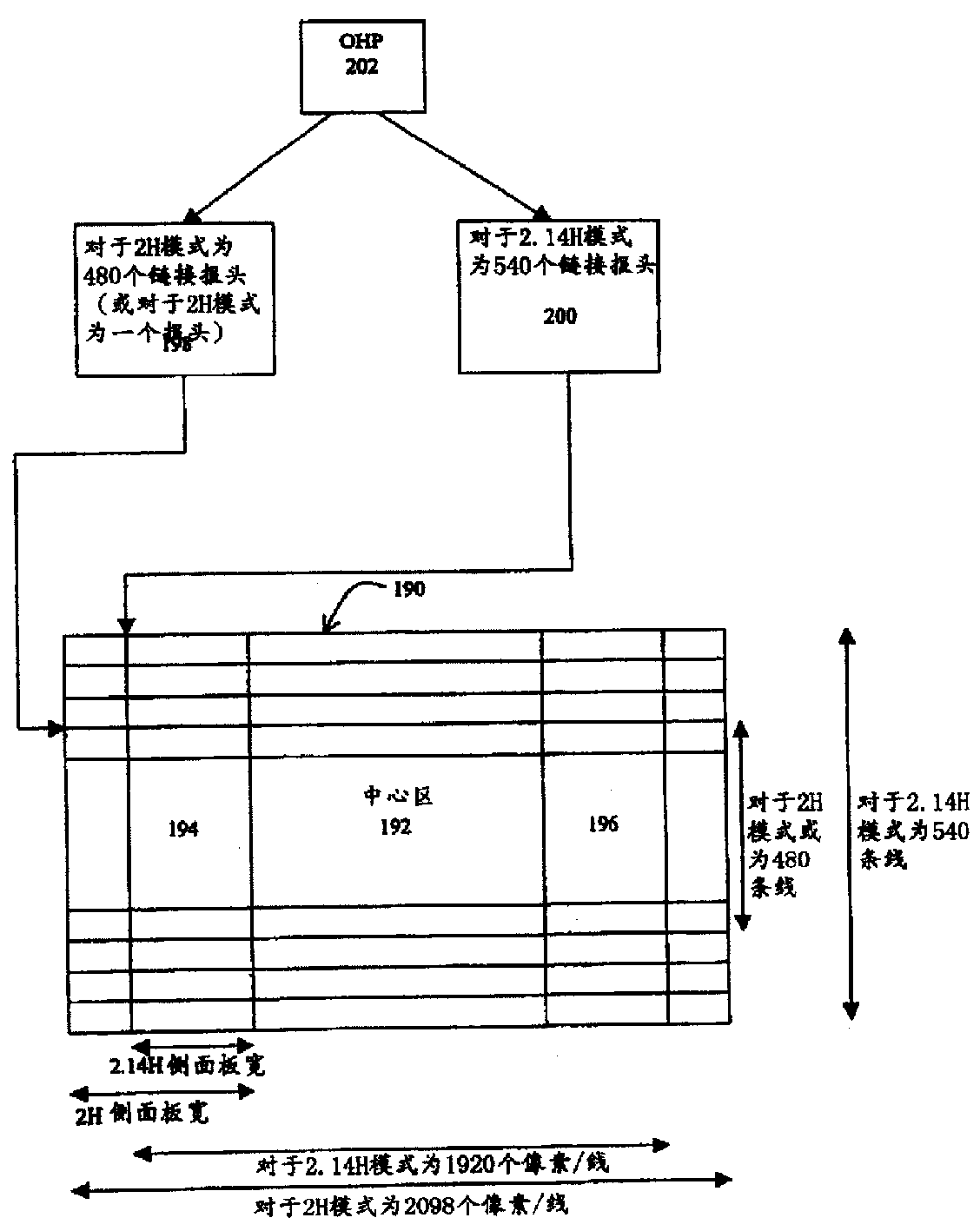
参照图6,图6图示了本发明的改进OSD像素映像布局,其中单个OSD像素映像可以在多种视频光栅尺寸上显示。如图6所示,像素映像布局包括像素映像190、第一组报头198、第二组报头200、和OHP(OSD报头指针)202。像素映像190通常包括显示菜单/指南/等的中心区192、总称为侧面板的左右侧部(194和196)。要选来显示在侧面板上的像素可以被规定成灰色或透明的像素,这取决于显示的基础视频图像是以4×3格式的还是以16×9格式的。这样,将像素映像190设计成可以操纵像素映像的侧面板来补偿两种显示模式之间的尺寸差异,而使OSD图像的中部保持不变。Referring to FIG. 6, FIG. 6 illustrates an improved OSD pixmap layout of the present invention, wherein a single OSD pixmap can be displayed on multiple video raster sizes. As shown in FIG. 6 , the pixmap layout includes a
作为示范性的实施方式,像素映像190包含540条像素线,每条像素线则包含2096个像素。第一组报头198包含480个单独报头(或只包含一个报头),第二组报头200包含540个单独报头。在第一和第二报头组中的单独报头是链接在一起的,每一个报头都指向像素映像190中的单条像素线。通过利用本发明的像素映像布局,可以在不同显示模式(例如,2H或2.41H模式)、不同视频光栅下使用单个像素映像。具体地说,在第一报头组198中480个报头的每一个指向2096个像素宽的像素映像190的单条连续像素线。在第二报头组200中540个报头的每一个指向1920个像素宽的像素映像190的单条连续像素线。随着通道改变,OHP 202可以在处在2H模式时选择第一报头组198中的480个链接报头,或在处在2.14H模式时选择第二报头组200中的540个链接报头。As an exemplary embodiment, the
应该注意到,为了选择2.14H模式下像素映像的宽度,在第二报头组200中的每个报头只选择像素映像沿水平方向的像素的一部分(即,2096个像素中的1920个)。因此,有必要利用第二报头组200中的540个单独报头指向像素映像190中的540条像素线。但是,为了选择2H模式下像素映像的宽度,在第一报头组198中的480个报头的每一个选择像素映像沿水平方向的所有像素(即,2096个像素中的2096个)。因此,作为另一种可供选择的实施方式,如图6所示,可以在第一报头组198中利用单个报头指向像素映像中的480条中心像素线。It should be noted that in order to select the width of the pixmap in 2.14H mode, each header in the second header set 200 selects only a fraction of the pixels of the pixmap in the horizontal direction (ie, 1920 out of 2096 pixels). Therefore, it is necessary to point to 540 pixel lines in the
现在参照图7,图7图示了本发明的改进OSD管理和控制配置。按照本发明的配置,随着视频接收器的初始化,将OSD数据结构存储在存储器67中。更具体地说,本发明的OSD数据结构包括存储在存储器67的像素映像块138中的单个OSD像素映像。像素映像包含540条像素线,每条像素线则包含2096个像素。OSD数据结构还包括存储在存储器67的报头块136中的第一和第二报头组。第一报头组包含480个单独报头(或正如上面所讨论的,可以只包含一个报头),第二报头组包含540个单独报头。第一和第二报头组中的单独报头在存储器67中的报头块136中链接在一起。每个单独报头包含存储在存储器67的像素映像块138中的相关像素线的存储单元。Reference is now made to FIG. 7, which illustrates an improved OSD management and control configuration of the present invention. According to the configuration of the present invention, the OSD data structure is stored in
现在参照图8,图8与图7一起显示了本发明的示范性像素映像检索过程170。Referring now to FIG. 8, FIG. 8, together with FIG. 7, shows an exemplary pixmap retrieval process 170 of the present invention.
在步骤172,OSD显示单元144从控制器115接收OSD显示请求。显示请求包含有关观看通道的显示模式的信息。The
在步骤174,根据接收的OSD显示请求,OSD显示单元144确定(或检测)显示请求中的显示模式。In
在步骤176,响应显示请求,OSD显示单元144根据所检测的显示模式,将报头指针发送到OHP寄存器148。具体地说,如果所检测的显示模式是2H,则发送的报头指针将选择第一报头组198。如果所检测的显示模式是2.14H,则发送的报头指针将选择第二报头组200。In
在步骤178,OHP寄存器148通过检索所选报头组中的第一报头(或后续报头)和将所检索的报头写入MAF寄存器150中,进行请求服务。In
在步骤180,OSD显示单元144分析检索的报头以确定存储在像素映像块138中的相关像素线的位置。At
在步骤182,OSD显示单元144将所检索的报头和相关的像素线传送到显示处理器70。在该步骤,在所选报头组中的所检索报头选择要显示的像素数(1920或2096个像素),这取决于观看信息的显示模式。In
在步骤184,显示处理器70将中心区192中的像素显示成彩色像素,将侧面板的所选部分中的像素显示成灰色或透明像素。In
在步骤186,OSD显示单元144确定在所选报头组中是否存在与当前报头相链接的后续报头。如果在所选报头组中存在与当前报头相链接的后续报头,则操作返回到步骤178显示像素映像中的后续像素线。重复从步骤178到步骤186的处理直到处理完所选报头组中的最后一个报头为止。In
应该注意到,在第一报头组198只包含一个报头的情况下,该报头将指向像素映像中中心的480条像素线。因此,OSD显示单元144同时检索中心的480条像素线,并将它们一起传送到显示处理器70,显示处理器70进一步在视频图像上显示中心的480条像素线。It should be noted that where the first header set 198 contains only one header, that header will point to the center 480 pixel line in the pixmap. Accordingly, the
总而言之,本发明可以在多种视频光栅尺寸上显示单个像素映像。除了节省存储器空间之外,本发明还提高了TV系统的显示速度。因此,在某种意义上,“以一概全”是对本发明的像素映像的贴切描述。应该注意到,尽管是在N(N=2)显示模式下利用一个像素映像对本发明加以描述的,但N可以大于2(N>2)。例如,对于任意的N,将有N个报头组。本发明可以检测现在正在显示N种显示模式中的哪一种,N个报头组之一由此可以选择像素映像的适当部分。因此,只要单个像素映像大到足以包容N种显示模式中的最大光栅尺寸,本发明就可以使N种显示模式的任何一种与单个像素映像相适应。In summary, the present invention can display a single pixmap on a variety of video raster sizes. In addition to saving memory space, the invention also increases the display speed of the TV system. Thus, in a sense, "one size fits all" is an apt description of the pixmap of the present invention. It should be noted that although the invention has been described using one pixmap in an N (N=2) display mode, N may be greater than 2 (N>2). For example, for any N, there will be N header groups. The present invention can detect which of N display modes is currently being displayed, one of the N header sets can then select the appropriate part of the pixmap. Thus, the present invention can accommodate any of the N display modes with a single pixmap as long as the single pixmap is large enough to accommodate the largest raster size of the N display modes.
虽然通过结合优选实施例已经对本发明作了描述,但本领域的普通技术人员应该明白,可以对这些实施例进行各种各样的改变而不偏离所附权利要求书所限定的、本发明的精神和范围。Although the invention has been described in conjunction with preferred embodiments, it will be apparent to those skilled in the art that various changes may be made to these embodiments without departing from the spirit of the invention as defined in the appended claims. spirit and scope.
Claims (15)
Applications Claiming Priority (2)
| Application Number | Priority Date | Filing Date | Title |
|---|---|---|---|
| US20405300P | 2000-05-12 | 2000-05-12 | |
| US60/204,053 | 2000-05-12 |
Publications (2)
| Publication Number | Publication Date |
|---|---|
| CN1326293A CN1326293A (en) | 2001-12-12 |
| CN1237787C true CN1237787C (en) | 2006-01-18 |
Family
ID=22756422
Family Applications (1)
| Application Number | Title | Priority Date | Filing Date |
|---|---|---|---|
| CNB011167998A Expired - Lifetime CN1237787C (en) | 2000-05-12 | 2001-05-11 | Method and system for linking screen display headers to utilize single screen display pixmaps |
Country Status (8)
| Country | Link |
|---|---|
| US (1) | US7202912B2 (en) |
| EP (1) | EP1154642B1 (en) |
| JP (1) | JP4623860B2 (en) |
| KR (1) | KR100767776B1 (en) |
| CN (1) | CN1237787C (en) |
| DE (1) | DE60121252T2 (en) |
| MX (1) | MXPA01004804A (en) |
| MY (1) | MY129829A (en) |
Families Citing this family (19)
| Publication number | Priority date | Publication date | Assignee | Title |
|---|---|---|---|---|
| JP3689074B2 (en) * | 2002-08-13 | 2005-08-31 | 株式会社東芝 | Information storage medium and reproducing apparatus thereof |
| JP3988990B2 (en) * | 2002-08-27 | 2007-10-10 | 株式会社リコー | Code conversion apparatus, code conversion method, program, and recording medium |
| CN100481901C (en) * | 2003-07-21 | 2009-04-22 | 汤姆森许可贸易公司 | System and method for avoiding on-screen fluctuations due to input signal changes |
| JP4122456B2 (en) * | 2003-09-18 | 2008-07-23 | 船井電機株式会社 | Image data compression method |
| JP2005197930A (en) * | 2004-01-06 | 2005-07-21 | Funai Electric Co Ltd | Terrestrial wave digital broadcast receiver and digital broadcast receiver |
| JP4458925B2 (en) * | 2004-05-14 | 2010-04-28 | キヤノン株式会社 | Video processing device |
| TWI248762B (en) * | 2004-11-10 | 2006-02-01 | Realtek Semiconductor Corp | Video processing device and method thereof |
| KR100743520B1 (en) * | 2005-01-04 | 2007-07-27 | 삼성전자주식회사 | Video Scaler and Scaling Methods |
| JP2007228167A (en) * | 2006-02-22 | 2007-09-06 | Funai Electric Co Ltd | Panel type video display device and liquid crystal television |
| TWI404041B (en) * | 2008-12-01 | 2013-08-01 | Mstar Semiconductor Inc | Device and method for automatically adjusting display information on a screen |
| JP5423425B2 (en) * | 2010-01-25 | 2014-02-19 | 富士通モバイルコミュニケーションズ株式会社 | Image processing device |
| US10115177B2 (en) | 2014-06-27 | 2018-10-30 | Samsung Electronics Co., Ltd. | Online texture compression and decompression in hardware |
| US9947071B2 (en) | 2014-06-27 | 2018-04-17 | Samsung Electronics Co., Ltd. | Texture pipeline with online variable rate dictionary compression |
| CN106937068A (en) * | 2017-02-14 | 2017-07-07 | 广东九联科技股份有限公司 | A kind of Set Top Box video recording system and method |
| US10860399B2 (en) | 2018-03-15 | 2020-12-08 | Samsung Display Co., Ltd. | Permutation based stress profile compression |
| US10776957B2 (en) | 2018-10-02 | 2020-09-15 | Samsung Electronics Co., Ltd. | Online image compression in hardware |
| US10803791B2 (en) | 2018-10-31 | 2020-10-13 | Samsung Display Co., Ltd. | Burrows-wheeler based stress profile compression |
| US11308873B2 (en) | 2019-05-23 | 2022-04-19 | Samsung Display Co., Ltd. | Redundancy assisted noise control for accumulated iterative compression error |
| US11245931B2 (en) | 2019-09-11 | 2022-02-08 | Samsung Display Co., Ltd. | System and method for RGBG conversion |
Family Cites Families (20)
| Publication number | Priority date | Publication date | Assignee | Title |
|---|---|---|---|---|
| SE428161B (en) | 1981-10-14 | 1983-06-06 | Philips Svenska Ab | PLANT FOR DISPLAYING SELECTABLE BACKGROUND INFORMATION COMBINED WITH SELECTABLE OVERLAYING INFORMATION ON A SCREEN DEVICE AND USING A DOUBLE PRESENTATION PLANT |
| FR2602363B1 (en) | 1986-07-31 | 1989-04-28 | Picard Michel | METHOD FOR DEFINING AND MODIFYING A PARTITION ON THE MEMORY SPACE OF A NON-ERASABLE MEDIUM |
| US5020003A (en) | 1988-09-29 | 1991-05-28 | At&T Bell Laboratories | Graphics controller image creation |
| US5420605A (en) | 1993-02-26 | 1995-05-30 | Binar Graphics, Inc. | Method of resetting a computer video display mode |
| US5534942A (en) | 1994-06-17 | 1996-07-09 | Thomson Consumer Electronics, Inc. | On screen display arrangement for digital video signal processing system |
| US5489947A (en) | 1994-06-17 | 1996-02-06 | Thomson Consumer Electronics, Inc. | On screen display arrangement for a digital video signal processing system |
| US5640502A (en) | 1994-08-05 | 1997-06-17 | Thomson Consumer Electronics, Inc. | Bit-mapped on-screen-display device for a television receiver |
| JP3645619B2 (en) | 1995-06-23 | 2005-05-11 | 富士写真フイルム株式会社 | How to record and play back image data |
| BR9610169A (en) * | 1995-08-02 | 1998-08-11 | Thomson Consumer Electronics | Display on linked list structure screen |
| US5745095A (en) | 1995-12-13 | 1998-04-28 | Microsoft Corporation | Compositing digital information on a display screen based on screen descriptor |
| US5936606A (en) * | 1996-04-15 | 1999-08-10 | Winbond Electronics Corp. | On-screen edit/display controller |
| DE69623055T2 (en) | 1996-10-16 | 2003-07-24 | Thomson Multimedia Inc., Indianapolis | DEVICE AND METHOD FOR GENERATING OSD MESSAGES WITH DOUBLE-DISTANCE |
| US6480238B1 (en) * | 1996-10-16 | 2002-11-12 | Thomson Licensing S.A. | Apparatus and method for generating on-screen-display messages using field doubling |
| US6175388B1 (en) * | 1996-10-16 | 2001-01-16 | Thomson Licensing S.A. | Apparatus and method for generating on-screen-display messages using on-bit pixels |
| US6128037A (en) | 1996-10-16 | 2000-10-03 | Flashpoint Technology, Inc. | Method and system for adding sound to images in a digital camera |
| KR100413870B1 (en) * | 1996-10-16 | 2004-01-07 | 톰슨 콘슈머 일렉트로닉스, 인코포레이티드 | Apparatus and method for generating on-screen-display messages using field doubling |
| JP3101580B2 (en) * | 1997-02-26 | 2000-10-23 | 三洋電機株式会社 | Image recording and playback device |
| JPH1169251A (en) * | 1997-08-21 | 1999-03-09 | Hitachi Ltd | Digital broadcasting receiver |
| DE19918046B4 (en) * | 1998-04-23 | 2007-02-15 | Lg Electronics Inc. | Memory structure for picture-in-picture display in a digital video display unit and method therefor |
| DE60024174T2 (en) | 1999-07-13 | 2006-07-06 | Thomson Licensing | Video processing method and system with multiple OSD formats |
-
2001
- 2001-04-30 US US09/845,959 patent/US7202912B2/en not_active Expired - Lifetime
- 2001-05-03 DE DE60121252T patent/DE60121252T2/en not_active Expired - Lifetime
- 2001-05-03 EP EP01401146A patent/EP1154642B1/en not_active Expired - Lifetime
- 2001-05-11 KR KR1020010025721A patent/KR100767776B1/en not_active Expired - Lifetime
- 2001-05-11 CN CNB011167998A patent/CN1237787C/en not_active Expired - Lifetime
- 2001-05-11 MY MYPI20012194A patent/MY129829A/en unknown
- 2001-05-11 MX MXPA01004804A patent/MXPA01004804A/en active IP Right Grant
- 2001-05-14 JP JP2001143751A patent/JP4623860B2/en not_active Expired - Lifetime
Also Published As
| Publication number | Publication date |
|---|---|
| KR20010104265A (en) | 2001-11-24 |
| EP1154642A3 (en) | 2004-04-07 |
| JP4623860B2 (en) | 2011-02-02 |
| EP1154642A2 (en) | 2001-11-14 |
| DE60121252T2 (en) | 2007-01-18 |
| US7202912B2 (en) | 2007-04-10 |
| MY129829A (en) | 2007-05-31 |
| US20020051154A1 (en) | 2002-05-02 |
| KR100767776B1 (en) | 2007-10-17 |
| CN1326293A (en) | 2001-12-12 |
| MXPA01004804A (en) | 2004-11-10 |
| DE60121252D1 (en) | 2006-08-17 |
| JP2002033972A (en) | 2002-01-31 |
| EP1154642B1 (en) | 2006-07-05 |
Similar Documents
| Publication | Publication Date | Title |
|---|---|---|
| US7202912B2 (en) | Method and system for using single OSD pixmap across multiple video raster sizes by chaining OSD headers | |
| CN1237781C (en) | Method and system for displaying pixmaps using a single screen using multiple headers | |
| US6175388B1 (en) | Apparatus and method for generating on-screen-display messages using on-bit pixels | |
| US6480238B1 (en) | Apparatus and method for generating on-screen-display messages using field doubling | |
| EP1069770B1 (en) | Method and system for processing video incorporating multiple on screen display formats | |
| US6911986B1 (en) | Method and system for processing video incorporating multiple on screen display formats | |
| US6351292B1 (en) | Apparatus and method for generating on-screen-display messages using line doubling | |
| EP0932978B1 (en) | Apparatus and method for generating on-screen-display messages using line doubling | |
| US6118494A (en) | Apparatus and method for generating on-screen-display messages using true color mode | |
| EP0932977B1 (en) | Apparatus and method for generating on-screen-display messages using field doubling | |
| EP0932982B1 (en) | Apparatus and method for generating on-screen-display messages using true color mode | |
| AU719563C (en) | Apparatus and method for generating on-screen-display messages using field doubling | |
| MXPA99003535A (en) | Apparatus and method for generating on-screen-display messages using field doubling | |
| MXPA99003537A (en) | Apparatus and method for generating on-screen-display messages using line doubling |
Legal Events
| Date | Code | Title | Description |
|---|---|---|---|
| C06 | Publication | ||
| PB01 | Publication | ||
| C10 | Entry into substantive examination | ||
| SE01 | Entry into force of request for substantive examination | ||
| C14 | Grant of patent or utility model | ||
| GR01 | Patent grant | ||
| CP02 | Change in the address of a patent holder |
Address after: I Si Eli Murli Nor, France Patentee after: THOMSON LICENSING Address before: French Boulogne Patentee before: THOMSON LICENSING |
|
| CP02 | Change in the address of a patent holder | ||
| TR01 | Transfer of patent right |
Effective date of registration: 20190125 Address after: Paris France Patentee after: International Digital Madison Patent Holding Co. Address before: I Si Eli Murli Nor, France Patentee before: THOMSON LICENSING Effective date of registration: 20190125 Address after: I Si Eli Murli Nor, France Patentee after: THOMSON LICENSING Address before: I Si Eli Murli Nor, France Patentee before: THOMSON LICENSING |
|
| TR01 | Transfer of patent right | ||
| CX01 | Expiry of patent term |
Granted publication date: 20060118 |
|
| CX01 | Expiry of patent term |