CN1260751C - Polymer electrolyte composite, electrolytic capacitor using same and mfg. method thereof - Google Patents
Polymer electrolyte composite, electrolytic capacitor using same and mfg. method thereof Download PDFInfo
- Publication number
- CN1260751C CN1260751C CNB021246831A CN02124683A CN1260751C CN 1260751 C CN1260751 C CN 1260751C CN B021246831 A CNB021246831 A CN B021246831A CN 02124683 A CN02124683 A CN 02124683A CN 1260751 C CN1260751 C CN 1260751C
- Authority
- CN
- China
- Prior art keywords
- monomer
- electrolytic capacitor
- electrolyte
- carbon atom
- alkyl
- Prior art date
- Legal status (The legal status is an assumption and is not a legal conclusion. Google has not performed a legal analysis and makes no representation as to the accuracy of the status listed.)
- Expired - Fee Related
Links
Images

Classifications
-
- H—ELECTRICITY
- H01—ELECTRIC ELEMENTS
- H01G—CAPACITORS; CAPACITORS, RECTIFIERS, DETECTORS, SWITCHING DEVICES, LIGHT-SENSITIVE OR TEMPERATURE-SENSITIVE DEVICES OF THE ELECTROLYTIC TYPE
- H01G9/00—Electrolytic capacitors, rectifiers, detectors, switching devices, light-sensitive or temperature-sensitive devices; Processes of their manufacture
- H01G9/004—Details
- H01G9/022—Electrolytes; Absorbents
- H01G9/025—Solid electrolytes
Landscapes
- Chemical & Material Sciences (AREA)
- Chemical Kinetics & Catalysis (AREA)
- Electrochemistry (AREA)
- Engineering & Computer Science (AREA)
- Power Engineering (AREA)
- Microelectronics & Electronic Packaging (AREA)
- Compositions Of Macromolecular Compounds (AREA)
- Addition Polymer Or Copolymer, Post-Treatments, Or Chemical Modifications (AREA)
- Electric Double-Layer Capacitors Or The Like (AREA)
Abstract
Description
技术领域technical field
本发明涉及电解电容器驱动用高分子电解质复合体和用它制造的电解电容器,及其制造方法,该电解质是离子传导型的。The present invention relates to a polymer electrolyte complex for driving an electrolytic capacitor, an electrolytic capacitor manufactured therefrom, and a method for manufacturing the same. The electrolyte is ion-conductive.
技术背景technical background
电解电容器具有是由阴极,和由合成形成电介质氧化膜的阳极,夹持着的电解质的构成。电解质的类型,液体或固体时,有离子传导性型;为固体时,有电子传导性型。An electrolytic capacitor has an electrolyte sandwiched between a cathode and an anode formed of a composite dielectric oxide film. The type of electrolyte, when it is liquid or solid, has ion conductivity; when it is solid, it has electron conductivity.
液体时,离子传导性型是用电解液作电解质的。在电解液时,即使电介质氧化膜上产生很深的缺陷部分,也可以在阴阳极之间施加很高的修复电压,即可以施加以氧化膜的再形成为目的的高的合成电压,,据此,缺陷部分很容易得修复。所说的能施加高的修复电压,是说即使施加很高的电压,也不会产生火花,即高的火花电压。然而,为了将电解液保持在阴阳极之间,需要用电解液完全充满,并需要充分隔离阴极和阳极的隔离物。作为满足其条件的隔离材料,需要使用单位面积重量,即密度与厚度之积足够大的纸或无纺布。电解液具有比较高的离子传导度。电解液本身的电阻(ESR:等效直到电阻)比较小,由于单位面积重量大的隔离物,导致隔离物。电解液复合体的电阻增大。即,作为电解电容器的电阻损失中,由电解液造成的电阻损失比较小,由于隔离物,作为整体的电阻损失却变得很大。说起来是因为使用了液体,所以,就漏液、向设备的安装、加工性等方面仍存在不足之外。In the case of a liquid, the ion-conductive type uses an electrolytic solution as an electrolyte. In the electrolyte, even if a deep defect occurs on the dielectric oxide film, a high repair voltage can be applied between the cathode and the anode, that is, a high composite voltage for the purpose of reforming the oxide film can be applied, according to Therefore, defective parts can be repaired easily. The so-called ability to apply a high repair voltage means that even if a high voltage is applied, no spark will be generated, that is, a high spark voltage. However, in order to keep the electrolyte between the cathode and anode, it needs to be completely filled with electrolyte and a separator that sufficiently separates the cathode and anode is required. As an insulating material that satisfies its conditions, it is necessary to use paper or non-woven fabric with a unit area weight, that is, a product of density and thickness that is sufficiently large. The electrolyte has relatively high ion conductivity. The resistance (ESR: Equivalent Resistor) of the electrolyte itself is relatively small, and the spacer is caused by a spacer with a large weight per unit area. The resistance of the electrolyte complex increases. That is, among the resistance losses of the electrolytic capacitor, the resistance loss due to the electrolytic solution is relatively small, but the resistance loss as a whole becomes large due to the separator. Speaking of which, because liquid is used, there are still deficiencies in terms of liquid leakage, installation to equipment, and processability.
因此,多年来一直研究电解液的固体化。在使用固体电解质型中,就不存在像使用液体时的短处。其中,固体时,电子传导怀型的一个实例,作为电解质,例如使用聚吡咯代替上述电解液,作为隔离物使用了聚丙烯或聚惭烯等多孔质树脂。由于使用了电子传导,所以其电阻很小,作为电解电容器,其特长是电阻损失小。然而,这种固体电子传导性型时,在电介质氧化膜上产生缺陷部分时,利用施加高修复电压也很难得到充分修复。这是因为,这种类型时,即使使用比较低的修复电压也会产生火花。即,几乎不具有氧化膜修复功能。Therefore, the solidification of the electrolytic solution has been studied for many years. In the type using a solid electrolyte, there is no disadvantage like when using a liquid. Among them, in the case of a solid, an example of an electron-conductive core, as an electrolyte, for example, polypyrrole is used instead of the above-mentioned electrolyte solution, and a porous resin such as polypropylene or polyolefin is used as a separator. Due to the use of electron conduction, its resistance is very small. As an electrolytic capacitor, its characteristic is that its resistance loss is small. However, in the case of this solid electron conductivity type, when a defective part is generated on the dielectric oxide film, it is difficult to sufficiently repair it by applying a high repair voltage. This is because, with this type, sparks can be generated even with a relatively low repair voltage. That is, it hardly has an oxide film repairing function.
另一方面,固体时,作为离子传导性型的,有无机系的和高分子系的。无机系的,虽然具有所谓离子传导率高的特长,但其不足之处是较重、缺乏柔软性,成形性差。On the other hand, in the case of a solid, there are inorganic type and polymer type as the ion conductive type. Inorganic type has the feature of high ion conductivity, but its disadvantages are heavy, lack of flexibility, and poor formability.
固体时,高分子系型的,即,离子传导性高分子,与无机系的电解质比较,尽管离子传导率极小,但很轻,就柔软性、成形性等机械性能方面都很优良,所以受到极大观注。作为以前提出的离子传导性高分子,例如报导有聚乙烯氧化物(PEO)和锂盐的复合体(离子传导率:在100℃~10-4s/cm){polymer,14,586,(1973)}、三醇型聚乙烯氧化物的二异氰酸酯交联聚合物-金属盐复合体(离子传导率:在30℃10-5s/cm{特开昭62-48716号公报}、聚甲基丙烯酸低氧乙烯。甲基丙烯酸碱金属盐共聚物的对离子固定离子传导性高分子(离子传导率:在室温107s/cm){polymer Reprints Japan,35,583,(1986)}、单官能和多官能丙烯酰基变性聚烷撑氧化物和碱金属和/或碱土类金属盐的混合物(离子传导率:在25℃10-3s/cm){特开平8-295711}等。实际上,作为适用于电解电容器的离子传导性高分子实例,椐报导,除了溶剂和电解质盐外,还由热变性高分子和/或纤维素衍生物形成,上述溶剂含有分子量在200以下的多元醇化合物,上述热变性高分子是含有蛋白质和/或β-1,3-莆聚糖的离子传导性高分子(离子传导率:在室温10-3s/cm){特开平5-55-88公报}。When it is solid, the polymer type, that is, the ion-conductive polymer, is very light in comparison with the inorganic electrolyte, although the ion conductivity is extremely small, and it is excellent in mechanical properties such as flexibility and formability, so received great attention. As previously proposed ion-conducting polymers, for example, a composite of polyethylene oxide (PEO) and lithium salt (ion conductivity: 100°C to 10 -4 s/cm) has been reported {polymer, 14, 586, ( 1973)}, diisocyanate cross-linked polymer-metal salt complex of triol-type polyethylene oxide (ion conductivity: 10 -5 s/cm at 30°C {JP-A-62-48716 Gazette}, polyformaldehyde Acrylic acid oxyethylene. Ion-immobilized ion-conducting polymer of alkali metal methacrylate copolymer (ion conductivity: 10 7 s/cm at room temperature) {polymer Reprints Japan, 35, 583, (1986)}, Mixtures of monofunctional and polyfunctional acryloyl modified polyalkylene oxides and alkali metal and/or alkaline earth metal salts (ionic conductivity: 10 -3 s/cm at 25°C) {JP-P-8-295711}, etc. Actual In the past, as an example of an ion-conducting polymer suitable for electrolytic capacitors, it has been reported that, in addition to solvents and electrolyte salts, they are also formed of heat-denatured polymers and/or cellulose derivatives. The above-mentioned solvents contain polyols with a molecular weight of 200 or less Compound, the above-mentioned thermally denatured polymer is an ion-conducting polymer containing protein and/or β-1,3-polysaccharide (ion conductivity: 10 -3 s/cm at room temperature) {JP-A-5-55-88 Bulletin}.
然而,这些离子传导性高分子中,有一种,室温下离子传导离很低,适用于电解电容器时,电阻损失很大,得不到理想的特性。而另一种,具有和电解液同等的离子传导离,但有时高分子耐热性很低。进而,由于使用金属盐,所以不足之处是在高温环境下产生短路,得不到理想的特性。。However, one of these ion-conducting polymers has a very low ion conductivity at room temperature, and when applied to an electrolytic capacitor, the resistance loss is large, and ideal characteristics cannot be obtained. The other type has the same ion conductivity as the electrolyte, but sometimes the heat resistance of the polymer is very low. Furthermore, since a metal salt is used, there is a disadvantage that a short circuit occurs in a high-temperature environment, and ideal characteristics cannot be obtained. .
发明内容Contents of the invention
本发明的目的是为解决上述现有问题,而提供一种室温下离子传导率高、耐热性也高、而且构成电解电容器时,不与铝等电极箔反应,成形性以及耐用性优良的电解电容器驱动用高分子电解质复合体。The object of the present invention is to solve the above-mentioned conventional problems, and to provide an electrolytic capacitor having high ion conductivity at room temperature, high heat resistance, no reaction with electrode foils such as aluminum, and excellent formability and durability when constituting an electrolytic capacitor. Polymer electrolyte complex for driving electrolytic capacitors.
本发明的另一目的是提供一种使用该高分子电解质复合体的电解电容器。Another object of the present invention is to provide an electrolytic capacitor using the polymer electrolyte complex.
本发明的电解电容器驱动用高分子电解质复合体是具有电解质和含有丙烯酸系衍生物共聚物的丙烯酸系高分子的复合体。上述电解质是由极性溶剂和无机酸或有机酸或它们的盐任何一种以上的溶质所形成。上述共聚物是由第1单体和第2单体形成的聚合物,而第1单体是由丙烯酸系衍生物末端具有羟基并具有1个聚合性不饱和双键的单官能单体组中至少1种形成,第2单体是由丙烯酸系衍生物具有数个聚合性不饱和双键的多官能单体组中至少1种形成。作为丙烯酸系衍生物末端的羟基,并不仅是狭义的羟基,而是包括羟基、磷酸基、二羟基等末端上具有的羟基。The polymer electrolyte complex for driving an electrolytic capacitor of the present invention is a complex comprising an electrolyte and an acrylic polymer containing an acrylic derivative copolymer. The above-mentioned electrolyte is formed by a polar solvent and any one or more solutes of inorganic acid or organic acid or their salts. The above-mentioned copolymer is a polymer composed of a first monomer and a second monomer, and the first monomer is a group of monofunctional monomers having a hydroxyl group at the end of an acrylic derivative and one polymerizable unsaturated double bond. At least one kind is formed, and the second monomer is formed from at least one kind of polyfunctional monomer group having several polymerizable unsaturated double bonds in the acrylic derivative. The hydroxyl group at the terminal of the acrylic derivative includes not only a hydroxyl group in a narrow sense, but also hydroxyl groups, phosphoric acid groups, dihydroxyl groups, and other terminal hydroxyl groups.
上述丙烯酸系衍生物的共聚物,在构成共聚物基质时,最好使上述电解质进入到共聚物基质中。When the copolymer of the above-mentioned acrylic derivative constitutes the copolymer matrix, it is preferable that the above-mentioned electrolyte is incorporated into the copolymer matrix.
上述丙烯酸系衍生物的共聚物,最好含有聚氧烷撑基。The copolymer of the above-mentioned acrylic derivative preferably contains a polyoxyalkylene group.
上述溶质最好不含有作阳离子的金属盐(free of metal salts as cations)。上述溶质最好具有从上述无机酸和上述有机酸的铵盐、胺盐和脒盐中至少选出的1种盐。The above-mentioned solute preferably does not contain metal salts as cations (free of metal salts as cations). The above-mentioned solute preferably has at least one salt selected from the above-mentioned ammonium salts, amine salts and amidine salts of the above-mentioned inorganic acids and the above-mentioned organic acids.
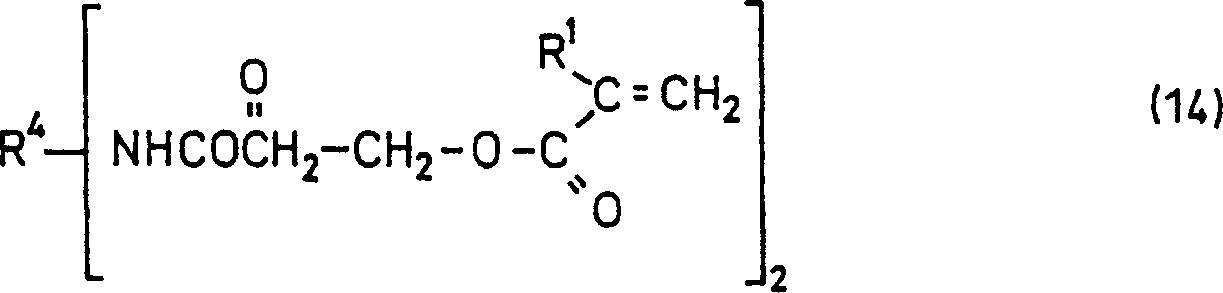
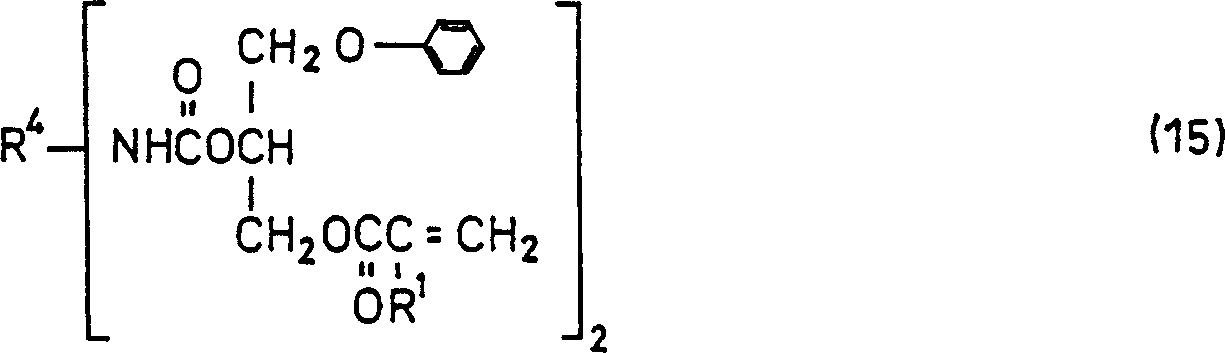
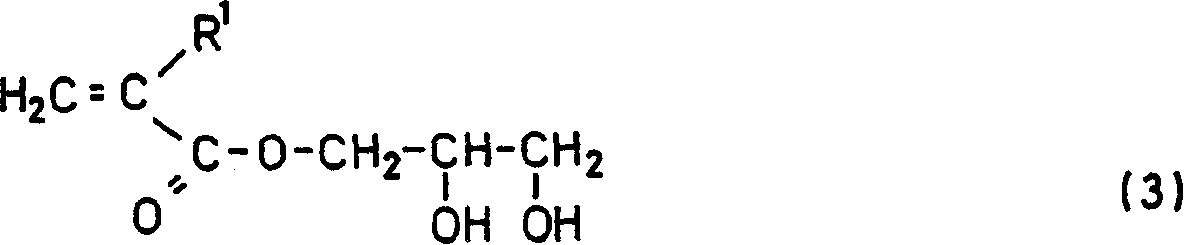
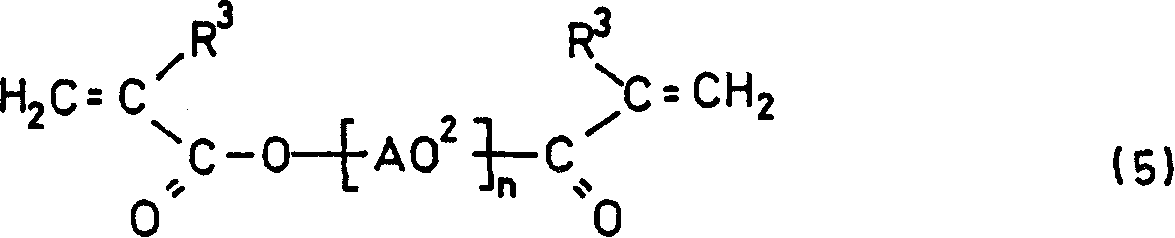
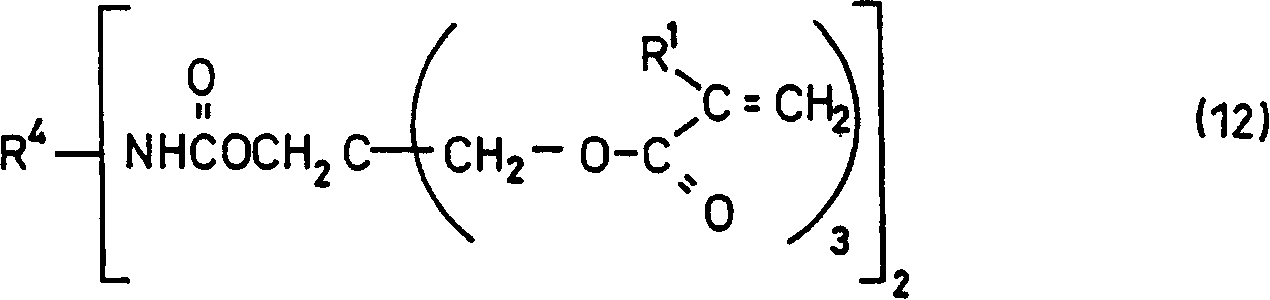
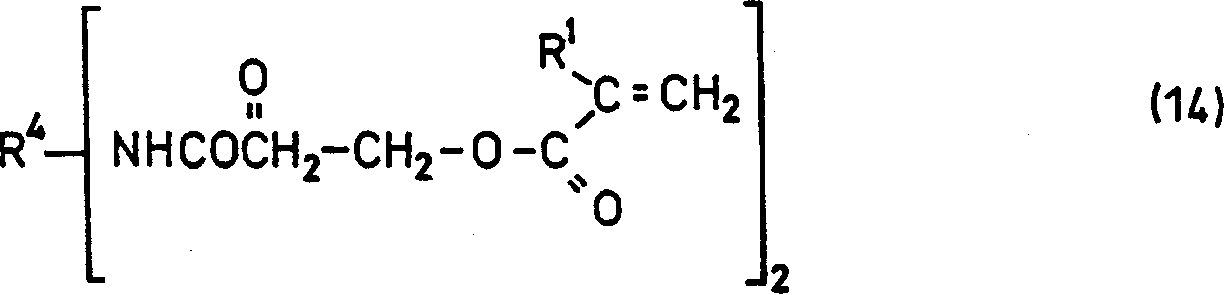
上述单官能单体组最好由下述式(1)~式(4)表示的丙烯酸系衍生物构成,上述多官能单体组最好由下述式(5)~式(16)表示的丙烯酸系衍生物构成。The above-mentioned monofunctional monomer group is preferably composed of acrylic derivatives represented by the following formulas (1) to (4), and the above-mentioned polyfunctional monomer group is preferably represented by the following formulas (5) to (16). Composed of acrylic derivatives.
上述第1单体和第2单体的重量比最好为100∶3~3∶100的范围。The weight ratio of the first monomer to the second monomer is preferably in the range of 100:3 to 3:100.
上述溶质和上述丙烯酸系衍生物的共聚物的合计重量中,该共聚物的含有量最好为5~50wt%的范围。The content of the copolymer is preferably in the range of 5 to 50% by weight based on the total weight of the copolymer of the above-mentioned solute and the above-mentioned acrylic derivative.
本发明的电解电容器具有阳极箔、阴极箔、和夹在上述阳极箔和阴极箔之间的含有电解电容器驱动用高分子电解质复合体的隔离物。上述电解电容器驱动用高分子电解质复合体,具有电解质和含有丙烯酸系衍生物共聚物的丙烯酸系高分子。上述电解质具有极性溶性剂和由无机酸或有机酸或它们的盐中至少1种形成的溶质。上述共聚物的构成是由第1单体和第2单体形成的聚合物,第1单体是由丙烯酸系衍生物末端具有羟基并具有1个聚合性不饱和双键的单官能单体中至少1个形成,而第2单体是由丙烯酸系衍生物具有数个聚合性不饱和双键的多官能单体组中至少1个形成。The electrolytic capacitor of the present invention has an anode foil, a cathode foil, and a separator including a polymer electrolyte composite for driving an electrolytic capacitor sandwiched between the anode foil and the cathode foil. The polymer electrolyte complex for driving an electrolytic capacitor includes an electrolyte and an acrylic polymer containing an acrylic derivative copolymer. The above-mentioned electrolyte has a polar solvent and a solute composed of at least one of an inorganic acid or an organic acid or a salt thereof. The composition of the above-mentioned copolymer is a polymer composed of a first monomer and a second monomer, and the first monomer is a monofunctional monomer having a hydroxyl group at the end of an acrylic derivative and one polymerizable unsaturated double bond. At least one monomer is formed, and the second monomer is formed from at least one polyfunctional monomer group having acrylic derivatives having several polymerizable unsaturated double bonds.
上述电解电容器中,上述隔离物的单位面积重量最好为0.01~55g/m2。In the above-mentioned electrolytic capacitor, the weight per unit area of the above-mentioned separator is preferably 0.01 to 55 g/m 2 .
上述隔离物最好是多孔质树脂膜或无纺布。The above separator is preferably a porous resin film or nonwoven fabric.
进而,上述隔离物的孔隙率最好为10~90%。Furthermore, the porosity of the spacer is preferably 10 to 90%.
本发明电解电容器的制造方法包括以下工序,即,形成具有阳极箔、阴极箔和其间夹持隔离物的电容器前驱体的形成工序、向上述电容器前驱体内浸泡高分子电解质复合体原液,制作电解电容器原件的制作工序、和使上述电解电容器原件中的上述高分子电解质复合体原液进行硬化的硬化工序。上述高分子电解质复合体原液是具有如下成分的混合液,即,具有极性溶剂和由无机酸或有机酸或其盐中至少1种形成溶质的电解质溶液、由丙烯酸衍生物末端具有羟基并具有1个聚合性不饱和双键的单官能单体组中至少1种形成的第1单体、和丙烯酸系衍生物具有数个聚合性不饱和双键的多官单体组中至少1种形成的第2单体。根据上述硬化工序,其构成是将上述第1单体和上述第2单体进行共聚,形成共聚基质,同时使上述电解质溶液进入到上述共聚物基质中,形成凝胶状的电解电容器驱动用电解质。The manufacturing method of the electrolytic capacitor of the present invention includes the steps of forming a capacitor precursor having an anode foil, a cathode foil, and a separator sandwiched therebetween, soaking the polymer electrolyte complex stock solution in the capacitor precursor, and manufacturing an electrolytic capacitor. An element manufacturing step, and a curing step of curing the polymer electrolyte composite stock solution in the electrolytic capacitor element. The above-mentioned polymer electrolyte complex stock solution is a mixed solution having a polar solvent and an electrolyte solution formed of at least one of an inorganic acid or an organic acid or a salt thereof, and an acrylic acid derivative having a hydroxyl group at the end and having a A first monomer formed of at least one type of monofunctional monomer group having a polymerizable unsaturated double bond, and at least one type of polyfunctional monomer group formed of an acrylic derivative having several polymerizable unsaturated double bonds The second monomer. According to the above-mentioned hardening step, the structure is that the above-mentioned first monomer and the above-mentioned second monomer are copolymerized to form a copolymer matrix, and at the same time, the above-mentioned electrolytic solution is infiltrated into the above-mentioned copolymer matrix to form a gel-like electrolyte for driving electrolytic capacitors. .
附图的简要描述Brief description of the drawings
图1是根据本发明实施形态的电解电容器主要构成元件的斜视图。Fig. 1 is a perspective view of main components of an electrolytic capacitor according to an embodiment of the present invention.
图2是根据本发明一实施例和一比较例,示出使用电解电容器驱动用高分子电解质复合体时修复电极箔的合成能力差异图。FIG. 2 is a graph showing the difference in synthesis capability of repaired electrode foil when using a polymer electrolyte composite for driving an electrolytic capacitor according to an example of the present invention and a comparative example.
发明的详细描述Detailed description of the invention
以下,虽然对本发明的实施形态用附图作了说明,同时用实施例作了更具体的说明,但本发明并不仅限于这些说明的内容。Hereinafter, although the embodiments of the present invention are described with reference to the drawings and more specifically described with reference to examples, the present invention is not limited to the contents of these descriptions.
图1是根据本发明一实施形态,示出了电解电容器主要构成元件的斜视图。如图1所示,电容器元件的基本构成是,例如,用作为阳极的由铝形成阳极箔1,和同样例如作为阴极的由铝形成的阴极箔2,夹持着含有下述高分子电解质复合体的隔离物3a、3b并对向卷绕而成,阳极箔1和阴极箔2分别与引出导线4a、4b连接。Fig. 1 is a perspective view showing main components of an electrolytic capacitor according to an embodiment of the present invention. As shown in FIG. 1 , the basic structure of a capacitor element is, for example, an anode foil 1 made of aluminum serving as an anode, and a cathode foil 2 also made of aluminum serving as a cathode, sandwiching a polymer electrolyte compound containing The separators 3a and 3b of the body are wound in opposite directions, and the anode foil 1 and the cathode foil 2 are respectively connected to the lead wires 4a and 4b.
对这种电容器元件的制造方法作具体说明。首先,在对向的阳极箔1和阴极箔2之间夹持隔离物3a、3b,将其卷绕形成电容器前躯体。向这种电容器前躯体中,浸泡具有下述电解质溶液和液状高分子材料的高分子电解质复合体用原液,制作成电解电容器原件。随后,没有图示,例如,将上述电解电容器原件封装到铝制壳体内,随后,用橡胶或酚醛树脂等密封材料,将上述壳体密封。在该密封工序前后,通过加热等方式,使上述高分子电解质复合体用原液硬化。通过这些工序可制造出作为本发明实施形态的电解电容器。A method of manufacturing such a capacitor element will be specifically described. First, the separators 3a and 3b are interposed between the facing anode foil 1 and cathode foil 2, and are wound to form a capacitor precursor. Into this capacitor precursor body, a stock solution for a polymer electrolyte complex having the following electrolytic solution and a liquid polymer material was soaked to prepare an electrolytic capacitor element. Subsequently, not shown, for example, the above-mentioned electrolytic capacitor element is packaged in an aluminum case, and then, the above-mentioned case is sealed with a sealing material such as rubber or phenolic resin. Before and after this sealing step, the stock solution for the polymer electrolyte complex is cured by heating or the like. Through these steps, an electrolytic capacitor as an embodiment of the present invention can be produced.
上述电解电容器驱动用高分子电解质复合体原液是电解质溶液和下述液状高分子材料的混合液。通过上述硬化工序,使上述高分子材料硬化,形成高分子基质,同时,上述电解质游泳形成凝胶状电解质,并进入到上述高分子基质中。The polymer electrolyte complex stock solution for driving an electrolytic capacitor is a mixed solution of an electrolytic solution and a liquid polymer material described below. Through the curing step, the polymer material is hardened to form a polymer matrix, and at the same time, the electrolyte swims to form a gel electrolyte and enters the polymer matrix.
对本发明的最大特点的高分子电解质复合体,即,对高分子和电解质的组合的实施形态,作以下详述。The most characteristic polymer electrolyte complex of the present invention, that is, an embodiment of a combination of a polymer and an electrolyte, will be described in detail below.
本发明电解电容器驱动用高分子电解质复合体是由电解质和含有丙烯酸系衍生物共聚物的丙烯酸系高分子形成的复合体。The polymer electrolyte complex for driving an electrolytic capacitor of the present invention is a complex formed of an electrolyte and an acrylic polymer containing an acrylic derivative copolymer.
本发明中,所说的丙烯酸系衍生物是具有以下式所示基的化合物衍生物。In the present invention, the acrylic derivative is a compound derivative having a group represented by the following formula.
(式中,R表示H或1~5个碳原子的烷基)(In the formula, R represents H or an alkyl group with 1 to 5 carbon atoms)
上述电解质是由极性溶剂和无机酸或有机酯或它们的盐任何1种以上的溶质所形成。上述共聚物是由第1单体和第2单体形成的聚合物,而第1单体是由丙烯酸系衍生物末端具有羟基并具有1个聚合性不饱和双键的单官能单体组中至少1个所形成,而第2单体是由丙烯酸系衍生物具有数个聚合性不饱和双键的多官能单体组中至少1个所形成。The above-mentioned electrolyte is formed of a polar solvent and one or more solutes of inorganic acids or organic esters or salts thereof. The above-mentioned copolymer is a polymer composed of a first monomer and a second monomer, and the first monomer is a group of monofunctional monomers having a hydroxyl group at the end of an acrylic derivative and one polymerizable unsaturated double bond. At least one is formed, and the second monomer is formed by at least one of the polyfunctional monomer group having several polymerizable unsaturated double bonds of the acrylic derivative.
作为上述单官能单体组,可使用以下式(1)~(4)表示的丙烯酸系衍生物组,作为上述多官能单体组,可使用式(5)~式(16)表示的丙烯酸系衍生物。As the monofunctional monomer group, acrylic derivatives represented by the following formulas (1) to (4) can be used, and as the polyfunctional monomer group, acrylic derivatives represented by the formulas (5) to (16) can be used. derivative.
R1:H或1-5个碳原子的烷基R 1 : H or an alkyl group of 1-5 carbon atoms
AO1:2~4个碳原子的氧烷撑基AO 1 : oxyalkylene group with 2 to 4 carbon atoms
n:2~4个碳原子的氧烷撑基平均加成摩尔数为1~200n: The average addition mole number of oxyalkylene groups with 2 to 4 carbon atoms is 1 to 200

R1:H或1-5个碳原子的烷基R 1 : H or an alkyl group of 1-5 carbon atoms
n:2个碳原子的氧烷撑基平均加成摩尔数为1~200n: The average addition mole number of oxyalkylene groups with 2 carbon atoms is 1 to 200
R1:H或1-5个碳原子的烷基R 1 : H or an alkyl group of 1-5 carbon atoms
R1:H或1-5个碳原子的烷基R 1 : H or an alkyl group of 1-5 carbon atoms
n:2个碳原子的氧烷撑基平均加成摩尔数为1~200n: The average addition mole number of oxyalkylene groups with 2 carbon atoms is 1 to 200
R3:H或1-5个碳原子的烷基R 3 : H or an alkyl group of 1-5 carbon atoms
AO2:2~4个碳原子的氧烷撑基AO 2 : oxyalkylene group with 2 to 4 carbon atoms
n:2~4个碳原子的氧烷撑基平均加成摩尔数为1~200n: The average addition mole number of oxyalkylene groups with 2 to 4 carbon atoms is 1 to 200
R3:H或1-5个碳原子的烷基R 3 : H or an alkyl group of 1-5 carbon atoms

R1:H或1-5个碳原子的烷基,与R2相同或不同的基R 1 : H or an alkyl group of 1-5 carbon atoms, same or different from R 2
R2:H或1-5个碳原子的烷基,与R1相同或不同的基R 2 : H or an alkyl group of 1-5 carbon atoms, same or different from R 1
R1:H或1-5个碳原子的烷基,与R2相同或不同的基R 1 : H or an alkyl group of 1-5 carbon atoms, same or different from R 2
R2:H或1-5个碳原子的烷基,与R1相同或不同的基R 2 : H or an alkyl group of 1-5 carbon atoms, same or different from R 1
1:2个碳原子的氧烷撑基平均加成摩尔数为1~2001: The average addition mole number of oxyalkylene groups with 2 carbon atoms is 1 to 200
m:2个碳原子的氧烷撑基平均加成摩尔数为1~200m: The average addition mole number of oxyalkylene groups with 2 carbon atoms is 1 to 200
n:2个碳原子的氧烷撑基平均加成摩尔数为1~200n: The average addition mole number of oxyalkylene groups with 2 carbon atoms is 1 to 200
R1:H或1-5个碳原子的烷基R 1 : H or an alkyl group of 1-5 carbon atoms
R1:H或1-5个碳原子的烷基R 1 : H or an alkyl group of 1-5 carbon atoms
R1:H或1-5个碳原子的烷基R 1 : H or an alkyl group of 1-5 carbon atoms
R1:H或1-5个碳原子的烷基R 1 : H or an alkyl group of 1-5 carbon atoms
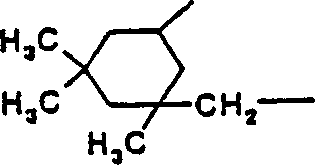
R4:-(CH2)n-、-(C2H4O)n-、R 4 : -(CH 2 )n-, -(C 2 H 4 O) n- ,

n:为1~9的自然数n: a natural number from 1 to 9
R1:H或1-5个碳原子的烷基R 1 : H or an alkyl group of 1-5 carbon atoms
R4:-(CH2)n-、-(C2H4O)n-、R 4 : -(CH 2 )n-, -(C 2 H 4 O) n- ,
n:为1-9的自然数n: a natural number from 1-9
R1:H或1-5个碳原子的烷基R 1 : H or an alkyl group of 1-5 carbon atoms
R4:-(CH2)n-、-(C2H4O)n-、R 4 : -(CH 2 )n-, -(C 2 H 4 O) n- ,
n:为1~9的自然数n: a natural number from 1 to 9
R1:H或1-5个碳原子的烷基R 1 : H or an alkyl group of 1-5 carbon atoms
R4:-(CH2)n-、-(C2H4O)n-、R 4 : -(CH 2 )n-, -(C 2 H 4 O) n- ,
n:为1~9的自然数n: a natural number from 1 to 9
R1:H或1-5个碳原子的烷基R 1 : H or an alkyl group of 1-5 carbon atoms
n:为1~9的自然数n: a natural number from 1 to 9
这些式(1)~式(4)的单官能单体,末端具有羟基,具有1个聚合性的不饱和双键。此处使用所谓羟基的表现形式,并不是狭义的羟基,而是包括羧基、磷酸基、二羟基等,末端上有羟基的。式(5)~式(6)的多官能单体具有数个聚合性的不饱和双键。These monofunctional monomers of formulas (1) to (4) have a hydroxyl group at the terminal and have one polymerizable unsaturated double bond. The expression form of the so-called hydroxyl group used here is not a narrowly defined hydroxyl group, but includes carboxyl groups, phosphoric acid groups, dihydroxyl groups, etc., with hydroxyl groups at the end. The polyfunctional monomers of formulas (5) to (6) have several polymerizable unsaturated double bonds.
上述第1单体即单官能单体,和上述多官能单体,即第2单体,通过加热、或照射紫外线(UV)、电子线(EB),引起游离基聚合反应,通过交联、共聚形成共聚物基质。与此同时,具有无机酸或有机酸或它们的盐中任何1种以上的溶质和极性溶剂的电解质,可进入到该共聚物基质中。这样可获得常温下了子传导率高的物质。The above-mentioned first monomer, which is a monofunctional monomer, and the above-mentioned polyfunctional monomer, that is, a second monomer, are heated or irradiated with ultraviolet rays (UV) or electron beams (EB) to cause a radical polymerization reaction, through crosslinking, Copolymerization forms a copolymer matrix. At the same time, an electrolyte having a solute of any one or more of inorganic acids or organic acids or their salts and a polar solvent can be incorporated into the copolymer matrix. In this way, a material with high electron conductivity at room temperature can be obtained.
由于将上述多官能单体的丙烯酸系衍生物形成了具有二丙烯酸酯的化合物。所以很容易形成3元交联结构,与上述只是单官能单体的丙烯酸酯的单独聚合相比,可更稳定地维持共聚物基质的骨架。其结果,将具有溶入无机酸或有机酸或其盐中任何1种以上溶质的极性溶剂的电解质,能更稳定地保持在共聚物基质中。Since the acrylic derivatives of the above-mentioned multifunctional monomers are formed into compounds having diacrylates. Therefore, it is easy to form a ternary cross-linked structure, and the skeleton of the copolymer matrix can be maintained more stably than the above-mentioned single polymerization of acrylate which is only a monofunctional monomer. As a result, the electrolyte having a polar solvent in which one or more solutes of inorganic acid or organic acid or salts thereof are dissolved can be more stably held in the copolymer matrix.
由于使用了像上述单官能单体的丙烯酸酯一类分子末端上具有亲水基的丙烯酸酯,从而提高了与溶剂的亲和性,使溶入了无机酸或有机酸或其盐中任何1种以上溶质的极性溶剂,能很容易地进入到可进行交联的基质中。Due to the use of acrylates with hydrophilic groups at the end of the molecule like the acrylates of the above-mentioned monofunctional monomers, the affinity with the solvent is improved, and any 1 Polar solvents with more than one solute can easily enter the matrix that can be cross-linked.
像上述多官能单体的丙烯酸系衍生物,由于具官能基的交联结构,或具有多链型的交联结构,所以能提高与溶剂的亲和性和交联密度,从而能提高电解质的含有量。Like the acrylic derivatives of the above-mentioned multifunctional monomers, due to the cross-linked structure with functional groups, or a multi-chain cross-linked structure, it can improve the affinity with the solvent and the cross-link density, thereby improving the stability of the electrolyte. content.
由于使用了具有磷酸基交联结构的丙烯酸系衍生物,所以促进了共聚基质向电解电容器的阳极箔和阴极箔吸附,提高了含有丙烯酸系衍生物的共聚物基质的驱动用电解质的密合性,从而能降低与箔的接触电阻。据此可进一步实现更高的离子传导率,而且,由于维持了共聚基质物理极间的距离,适用于电解电容器时,显示出难以短路的优良特性。The use of an acrylic derivative having a phosphoric acid group cross-linked structure facilitates the adsorption of the copolymer matrix to the anode foil and cathode foil of an electrolytic capacitor, and improves the adhesion of the drive electrolyte containing the copolymer matrix containing the acrylic derivative , thereby reducing the contact resistance with the foil. According to this, a higher ion conductivity can be further realized, and because the distance between the physical poles of the copolymer matrix is maintained, when it is suitable for electrolytic capacitors, it shows excellent characteristics that are difficult to short circuit.
在式1)和式(5)表示的结构中,AO是2-4个碳原子的氧烷撑基。作为2-4个碳原子的氧烷撑基,可使用氧乙烯基(以下称EO)、氧丙烯基(以下称PO)、氧丁烯基(以下称BO)、氧四甲撑基(以下称TMO)等。聚氧烷撑基也可以是这些氧烷撑基中1种的单独聚合或2种以上的共聚物,也可以以交联物形成聚氧烷撑基的的基质。其中,其中,从使更多的电解液成分进入到该基质中考虑,最好根据所用的电解液成分中的极性溶剂或溶质的种类,选择聚合对象的氧烷撑基,以提高该电解液成分和该基质的亲合性。In the structures represented by formula 1) and formula (5), AO is an oxyalkylene group of 2 to 4 carbon atoms. As the oxyalkylene group with 2-4 carbon atoms, oxyethylene (hereinafter referred to as EO), oxypropylene (hereinafter referred to as PO), oxybutenyl (hereinafter referred to as BO), oxytetramethylene (hereinafter referred to as BO) can be used. called TMO) and so on. The polyoxyalkylene group may be a single polymerization of one of these oxyalkylene groups or a copolymer of two or more types, or a cross-linked product may form a polyoxyalkylene group matrix. Among them, from the perspective of allowing more electrolyte components to enter the matrix, it is best to select the oxyalkylene group to be polymerized according to the type of polar solvent or solute in the electrolyte component used to improve the electrolytic solution. Affinity of liquid components to the matrix.
含有2种以上氧烷撑基的聚氧烷撑基,可以是以块状进行加成的,也可以是以无规则状加成的,对此没有特殊限定。The polyoxyalkylene group containing two or more types of oxyalkylene groups may be added in a block form or may be added in a random form, and it is not particularly limited.
在共聚基质中含有溶入了无机酸或有机酸或其盐中任何1种以上溶质的极性溶剂的驱动用电解质状态,基本上形成实质的凝胶状。此处所说的实质凝胶状是说至少有相当部分形成凝胶的意思,一部分也可以形成固体或高粘性液体等状态,并不仅限于全部都形成凝胶状。In the state of the driving electrolyte containing any one or more solutes of an inorganic acid or an organic acid or a salt thereof dissolved in a copolymer matrix, the state of the driving electrolyte basically forms a substantial gel. The term “substantially gelatinous” here means that at least a considerable portion of the substance is gelled, and a portion may be in a state of solid or highly viscous liquid.
即,在本实施形态中,实质的凝胶状电解质,基本上是由高分子,即共聚基质保持的。因此,制作电解电容器时使用的隔离物,没有必要具有直接保持电解液等自身没有保持功能的电解质的功能。因此,对隔离物要求的功能,基本上是隔离阳极和阴极的功能。即,作为隔离物的材料,没有必要限定在以前为保持电解液而通常使用纸或无纺布,即可以使用单位面积重量小的,即电阻小的材料。因此,本实施形态的高分子电解质复合体-隔离物的构成,若只考虑电解质的电阻在以前的电解液-隔离物构成中的电解液一方,离子传导性很高,电阻很低,若包括隔离物一起考虑,作为整体的电阻可很小。进而,与以前的聚吡咯等固体电解质比较时,由于电解质是实质的凝胶状,所以,为了修复阳极氧化膜,可施加比以前固体电解质时高的加成电压。That is, in the present embodiment, the substantially gel-like electrolyte is basically held by a polymer, that is, a copolymer matrix. Therefore, it is not necessary for the separator used in the production of the electrolytic capacitor to have the function of directly holding the electrolyte, such as the electrolytic solution, which itself does not have a holding function. Therefore, the required function of the separator is basically the function of isolating the anode and the cathode. That is, the material of the separator is not necessarily limited to paper or non-woven fabric which is conventionally used to hold the electrolyte, that is, a material with a small weight per unit area, that is, a material with low resistance can be used. Therefore, in the composition of the polymer electrolyte complex-separator of the present embodiment, if only the resistance of the electrolyte is considered, the electrolytic solution in the previous electrolyte-separator configuration has high ion conductivity and low resistance. Considering the spacers together, the resistance as a whole can be very small. Furthermore, compared with conventional solid electrolytes such as polypyrrole, since the electrolyte is substantially gel-like, in order to restore the anodized film, a higher voltage can be applied than conventional solid electrolytes.
作为上述极性溶剂,可以使用乙烯乙二醇、丙烯乙二醇、1,4-丁二醇、甘油、水、聚氧烷撑多元醇类、酰胺类、醇类、醚类、腈类、呋喃类、环丁砜类、碳酸酯类、内酯类、咪唑烷酮类、吡咯烷酮类中的1种或2种以上并用的极性溶剂。As the polar solvent, ethylene glycol, propylene glycol, 1,4-butanediol, glycerin, water, polyoxyalkylene polyols, amides, alcohols, ethers, nitriles, A polar solvent used in combination of one or more of furans, sulfolanes, carbonates, lactones, imidazolidinones, and pyrrolidones.
以下记载了上述类溶剂中的具体实例。Specific examples of the above solvents are described below.
作为聚氧烷撑多元醇类,有分子量200以下的聚乙烯氧化物、聚丙烯氧化物、聚氧乙烯·氧丙烯乙二醇,以及这些中2神以上并用等。As the polyoxyalkylene polyols, there are polyethylene oxide, polypropylene oxide, polyoxyethylene/oxypropylene glycol with a molecular weight of 200 or less, and combinations of two or more of these.
作为酰胺类,有N-甲基甲酰胺、N,N-二甲基甲酰胺、N-甲基乙酰胺、N-甲基吡咯烷酮等。As amides, there are N-methylformamide, N,N-dimethylformamide, N-methylacetamide, N-methylpyrrolidone and the like.
作为醇类,有甲醇、乙醇等。The alcohols include methanol, ethanol, and the like.
作为醚类,有甲缩醛、1,2-二甲氧乙烷、1-乙氧-2-甲氧乙烷、1,2-二乙氧乙烷等。Examples of ethers include methylal, 1,2-dimethoxyethane, 1-ethoxy-2-methoxyethane, 1,2-diethoxyethane, and the like.
作为腈类,有乙腈、3-甲氧丙腈等。Examples of nitriles include acetonitrile, 3-methoxypropionitrile, and the like.
作为呋喃类,有2,5-二甲氧四氢呋喃等。Examples of furans include 2,5-dimethoxytetrahydrofuran and the like.
作为环丁砜类,有环丁砜、3-甲基环丁砜、2,4-二甲基环丁砜等。Sulfolanes include sulfolane, 3-methylsulfolane, 2,4-dimethylsulfolane and the like.
作为碳酸酯类,有丙烯碳酸酯、乙烯碳酸酯、二乙基碳酸酯、苯乙烯碳酸酯、二甲基碳酯酯、或甲基乙基碳酸酯等。Examples of carbonates include propylene carbonate, ethylene carbonate, diethyl carbonate, styrene carbonate, dimethyl carbonate, methyl ethyl carbonate, and the like.
作为内酯类,有γ-内酯、γ-戊内酯、δ-戊内酯、3-甲基-1,3-噁二嗪-2-酮-3-噁二嗪-2-酮等。Examples of lactones include γ-lactone, γ-valerolactone, δ-valerolactone, 3-methyl-1,3-oxadiazin-2-one-3-oxadiazin-2-one, etc. .
作为咪唑烷酮类,有1,3-二甲基-2-咪唑烷酮等。Examples of imidazolidinones include 1,3-dimethyl-2-imidazolidinone and the like.
上述极性溶剂中,最好是乙烯乙二醇、丙烯乙二醇、二乙烯乙二醇、水、内酯溶剂、醇溶剂、碳酸酯溶剂、醚溶剂、腈溶剂和呋喃溶剂。Among the above polar solvents, ethylene glycol, propylene glycol, diethylene glycol, water, lactone solvents, alcohol solvents, carbonate solvents, ether solvents, nitrile solvents and furan solvents are preferable.
作为上述无机酸和有机酸,可使用聚羧酸类(2-4价)、单羧酸类、硼酸、磷酸、硅钨酸、硅钼酸、磷钨酸、磷钼酸等。As the above-mentioned inorganic acid and organic acid, polycarboxylic acids (2-4 valent), monocarboxylic acids, boric acid, phosphoric acid, silicotungstic acid, silicomolybdic acid, phosphotungstic acid, phosphomolybdic acid and the like can be used.
其中,作为聚羧酸类,可使用脂肪族聚羧酸类、芳香族聚羧酸类、脂环式聚羧酸类、这些聚羧酸类的烷基(1-3个碳原子)或硝基置换体,例如,甲基马来酸、二甲基马来酸、硝基酞酸(3-硝基酞酸、4-硝基酞酸),还可使用硫代丙酸等含硫的聚羧酸类。Among them, as polycarboxylic acids, aliphatic polycarboxylic acids, aromatic polycarboxylic acids, alicyclic polycarboxylic acids, alkyl groups (1 to 3 carbon atoms) or nitric acid groups of these polycarboxylic acids can be used. Substitutes, such as methylmaleic acid, dimethylmaleic acid, nitrophthalic acid (3-nitrophthalic acid, 4-nitrophthalic acid), sulfur-containing thiopropionic acid, etc. polycarboxylates.
作为上述脂肪族聚羧酸糊可使用:饱和聚羧酸、例如,草酸、丙二酸、琥珀酸、戊二酸、乙二酸、庚二酸、辛二酸、壬二酸、癸二酸、1,6-癸二羧酸、5,6-癸二羧酸、1,7-辛二羧酸、7-甲基-7-甲氧-羰基-1,9-癸二羧酸、7,9-二甲基7,9-二甲氧羰基-1,11-十二烷基二羧酸、7,8-二甲基7,8-二甲氧羰基-1,14-十四烷基二羧酸;不饱和聚羧酸,例如,马来酸、富马酸、衣康酸。As the above-mentioned aliphatic polycarboxylic acid pastes can be used: saturated polycarboxylic acids such as oxalic acid, malonic acid, succinic acid, glutaric acid, oxalic acid, pimelic acid, suberic acid, azelaic acid, sebacic acid , 1,6-decanedicarboxylic acid, 5,6-decanedicarboxylic acid, 1,7-octanedicarboxylic acid, 7-methyl-7-methoxy-carbonyl-1,9-decanedicarboxylic acid, 7 , 9-Dimethyl 7,9-dimethoxycarbonyl-1,11-dodecyl dicarboxylic acid, 7,8-dimethyl 7,8-dimethoxycarbonyl-1,14-tetradecane dicarboxylic acids; unsaturated polycarboxylic acids, for example, maleic acid, fumaric acid, itaconic acid.
作为上述芳香族聚羧酸类,例如可使用酞酸、异酞酸、对酞酸、偏苯三酸、苯均四酸。As said aromatic polycarboxylic acid, phthalic acid, isophthalic acid, terephthalic acid, trimellitic acid, pyromellitic acid can be used, for example.
作为上述脂环式聚羧酸类,例如可使用四氢酞酸(环乙烷-1,2-二羧酸等)、六氢酞酸。As the above-mentioned alicyclic polycarboxylic acids, for example, tetrahydrophthalic acid (cycloethane-1,2-dicarboxylic acid, etc.) and hexahydrophthalic acid can be used.
作为上述一元单羧酸类,可使用脂肪族一元羧酯类(1-30碳原子)、芳香族一元羧酸类、羟酸类。As the above-mentioned monocarboxylic acids, aliphatic monocarboxylic esters (1 to 30 carbon atoms), aromatic monocarboxylic acids, and hydroxy acids can be used.
作为上述脂肪族一元羧酸可使用:饱和一元羧酸、例如,蚁酸、醋酸、丙酸、酪酸、异酪酸、吉草酸、己酸、庚酸、辛酸、壬酸、月桂酸、肉豆酸、硬脂酸、山酸、消旋苹果酸、酒石酸;不饱和单羧酸,例如丙烯酸、甲基丙烯酸、油酸。As the above-mentioned aliphatic monocarboxylic acids, saturated monocarboxylic acids such as formic acid, acetic acid, propionic acid, butyric acid, isobutyric acid, oxalic acid, caproic acid, heptanoic acid, caprylic acid, pelargonic acid, lauric acid, myristic acid can be used , stearic acid, behenic acid, racemic malic acid, tartaric acid; unsaturated monocarboxylic acids such as acrylic acid, methacrylic acid, oleic acid.
作为上述芳香族单羧酸,例如可使用安息香酸、O-硝基安息香酸、P-硝基安息香酸、桂皮酸、萘甲酸。As the aromatic monocarboxylic acid, for example, benzoic acid, O-nitrobenzoic acid, P-nitrobenzoic acid, cinnamic acid, and naphthoic acid can be used.
作为上述芳香族一元羧酸类,可以使用例如安息香酸、O-硝基安息香酸、P硝基安息香酸、内桂酸、油酸。As the above-mentioned aromatic monocarboxylic acids, for example, benzoic acid, O-nitrobenzoic acid, P-nitrobenzoic acid, lauric acid, and oleic acid can be used.
作为上述氧羧酸类,例如可使用水杨酸、扁桃酸、间苯二酚酸等。As the above-mentioned oxycarboxylic acids, for example, salicylic acid, mandelic acid, resorcinol acid and the like can be used.
作为上述无机酸或有机酸的盐,适宜的有铵盐、胺盐或脒盐。作为构成胺盐的胺,可使用一级胺(甲胺、乙胺、丙胺、丁胺、乙二胺等)、二级胺(二甲胺、二乙胺、二丙胺、甲基乙胺、二苯胺、二乙醇胺等)、三级胺(三甲胺、三乙胺、三丙胺、三苯胺、三乙醇胺等)、四级胺(四甲胺、四乙胺、四丙胺等)。作为脒盐,可使用具有烷基置换脒基的化合物和该化合物的4级化物。例如,用1-11个碳原子的烷基或芳烷基四级化的咪唑化合物、苯咪唑化合物、脂环式脒化合物。As the above-mentioned salts of inorganic acids or organic acids, ammonium salts, amine salts or amidine salts are suitable. As the amine constituting the amine salt, primary amines (methylamine, ethylamine, propylamine, butylamine, ethylenediamine, etc.), secondary amines (dimethylamine, diethylamine, dipropylamine, methylethylamine, Diphenylamine, diethanolamine, etc.), tertiary amines (trimethylamine, triethylamine, tripropylamine, triphenylamine, triethanolamine, etc.), quaternary amines (tetramethylamine, tetraethylamine, tetrapropylamine, etc.). As the amidine salt, a compound having an amidine group substituted with an alkyl group and a quaternary compound of the compound can be used. For example, imidazole compounds, benzimidazole compounds, and alicyclic amidine compounds quaternized with alkyl or aralkyl groups of 1 to 11 carbon atoms.
具体讲,作为具有烷基置换脒基的化合物的四级化物,有1-甲基1,8-二偶氮二环[5,4,0]十一碳烯-7、1-甲基1,5-二偶氮二环[4,3,0]壬烷5、1,2,3-三甲基咪唑啉、1,2,3,4-四甲基咪唑啉、1,2-二甲基-乙基咪唑啉、1,3,4-三甲基-2-乙基咪唑啉、1,3-二甲基-2-庚基咪唑啉、1,3-二甲基-2-(-3′庚基)咪唑啉、1,3-二甲基-2-十二烷基咪唑啉、1,2,3-三甲基1,4,5,6-四氢嘧啶、1,3-二甲基咪唑啉、1-甲基-3-乙基咪唑啉、1,3-二甲苯咪唑啉等,可从这些中选出1种以上使用。这些材料中,作为阳离子,由于不使用金属盐,应用于电解电容器时,既提高了耐短路性,即,难以引起短路,同时又能获得引出高离子传导率的作用和效果。Specifically, as a quaternary product of a compound having an alkyl-substituted amidino group, there are 1-methyl 1,8-diazobicyclo[5,4,0]undecene-7, 1-methyl 1 , 5-diazobicyclo[4,3,0]nonane 5, 1,2,3-trimethylimidazoline, 1,2,3,4-tetramethylimidazoline, 1,2-di Methyl-ethylimidazoline, 1,3,4-trimethyl-2-ethylimidazoline, 1,3-dimethyl-2-heptyl imidazoline, 1,3-dimethyl-2- (-3'heptyl) imidazoline, 1,3-dimethyl-2-dodecyl imidazoline, 1,2,3-trimethyl 1,4,5,6-tetrahydropyrimidine, 1, 3-Dimethylimidazoline, 1-methyl-3-ethylimidazoline, 1,3-dimethylbenzimidazoline and the like can be used at least one kind selected from these. Among these materials, since metal salts are not used as cations, when applied to electrolytic capacitors, short-circuit resistance is improved, that is, it is difficult to cause short-circuits, and at the same time, the action and effect of leading to high ion conductivity can be obtained.
关于上述第1单体和第2单体的混合比,比重量比,好的为100∶3~3∶100。当超过该重量比的上限、下限时,难以形成共聚基质。最好是100∶10~10∶100。由此能更稳定地维持基质的骨架,并能获得有效引出该效果的作用和效果。Regarding the mixing ratio of the above-mentioned first monomer and second monomer, the specific weight ratio is preferably 100:3 to 3:100. When the upper and lower limits of the weight ratio are exceeded, it becomes difficult to form a copolymer matrix. It is preferably 100:10 to 10:100. As a result, the skeleton of the matrix can be maintained more stably, and actions and effects that effectively induce the effect can be obtained.
在将上述溶质和上述丙烯酸系衍生物的共聚物合在一起的重量中,上术丙烯酸系衍生物的共聚物含量最好为5~50wt%。该共聚物的含量少于5wt%时,不能形成交联物基质,更不能硬化。含量超过50wt%以上时,由于进入基质中的电解液绝对量减少,所以离子传导率大幅度降低,不能引出足够的特性。In the total weight of the above-mentioned solute and the above-mentioned copolymer of the acrylic derivative, the content of the copolymer of the above-mentioned acrylic derivative is preferably 5 to 50 wt%. When the content of the copolymer is less than 5 wt%, the matrix of the cross-linked product cannot be formed, let alone hardened. When the content is more than 50 wt%, since the absolute amount of the electrolyte solution entering the matrix decreases, the ion conductivity is greatly reduced, and sufficient characteristics cannot be drawn.
根据上述的本实施形态,将高分子电解质复合体作为电解电容器驱动用要素含有的隔离物,夹持在阳极箔和阴极箔之间制成的电解电容器,即使在高温环境下,也能长时间维持稳定的性能。该高分子电解质复合体,例如,不与铝或碳的电极箔反应,所以能提供成形性和耐用性优良的电容器。According to the above-mentioned present embodiment, the electrolytic capacitor made by sandwiching the polymer electrolyte complex as the separator contained in the driving element of the electrolytic capacitor between the anode foil and the cathode foil can operate for a long time even in a high temperature environment. maintain stable performance. This polymer electrolyte complex does not react with, for example, aluminum or carbon electrode foils, and thus can provide a capacitor excellent in formability and durability.
根据本实施形态的电解电容器中,上述隔离物的单位面积重量最好为0.01~5g/m2。在以前的电解液或离子传导性高分子中,使用这些单位面积重量低的隔离物时,引起短路,不能保持稳定的特性,与其相反,在使用本实施形态的电解电容器驱动用高分子电解质复合体时,由于高分子基质以网眼状遍布在隔离物中,从物理角度能保持电容器中电极之间的距离,所以提高了耐压的稳定性,在以前不能适用的中高压电容器中也可以使用单位面积重量低的隔离物,并能引出良好的特性。In the electrolytic capacitor according to the present embodiment, the weight per unit area of the separator is preferably 0.01 to 5 g/m 2 . In conventional electrolytic solutions or ion-conducting polymers, when using these separators with low basis weight, short circuits occur and stable characteristics cannot be maintained. In bulk, because the polymer matrix is distributed in the spacer in a mesh shape, the distance between the electrodes in the capacitor can be maintained from a physical point of view, so the stability of the withstand voltage is improved, and it can also be used in medium and high voltage capacitors that were not applicable before. A spacer with a low weight per unit area and can elicit good properties.
作为可用作隔离物材料的实例,有马尼拉纸、牛皮纸、Hemp、无纺布、及它们的混合材料。最好的隔离物是多孔性树脂膜和无纺布。这是因为易于控制孔隙率。As examples of materials that can be used as the separator, there are Manila paper, kraft paper, Hemp, non-woven fabric, and their mixed materials. The best separators are porous resin films and non-woven fabrics. This is because porosity is easy to control.
上述隔离物的孔隙率最好为10~90%,作为隔离物的材料使用多孔质树脂薄膜或无纺布时,其效果相当显著。即,在以前的电解液或离子传导性高分子中,在10~90%的范围内,根据多孔质树脂薄膜或无纺布的种类会引起短路,与其相反,在使用本实施形态的电容器驱动用高分子电解质复合体时,高分子基质以网眼状遍布在多孔质树脂薄膜或无纺布中。其中含有溶入溶质的极性溶剂凝胶,所以从物理角度能保持电解电容器的电极间距。因此能稳定地保持耐压,并能引出良好的特性。The spacer preferably has a porosity of 10 to 90%. When a porous resin film or nonwoven fabric is used as the material of the spacer, the effect is remarkable. That is, in the range of 10 to 90% in the conventional electrolytic solution or ion-conductive polymer, a short circuit may occur depending on the type of porous resin film or nonwoven fabric. When the polymer electrolyte complex is used, the polymer matrix is spread throughout the porous resin film or non-woven fabric in the form of a mesh. It contains a polar solvent gel dissolved in a solute, so it can maintain the electrode distance of an electrolytic capacitor from a physical point of view. Therefore, the withstand voltage can be stably maintained, and good characteristics can be derived.
通过使用这些材料,在电容器内隔离物占据电阻的部分可大大降低,低ESR(等效直列电阻)化、低阻抗化的效果很大。By using these materials, the part of the resistance occupied by the spacer in the capacitor can be greatly reduced, and the effect of lowering the ESR (equivalent series resistance) and lowering the impedance is great.
作为上述多孔质树指薄膜或无纺布,可使用聚乙烯树脂、聚丙烯树脂、氟树脂、聚酯树脂、聚酰胺树脂、聚氨酯树脂、苯乙烯树脂、聚乙烯对酞酸酯树脂、氯乙烯树脂、乙烯卡唑树脂、氯乙烯叉树脂、醋酸乙烯树脂、甲基丙烯酸树脂、聚碳酸酯树脂、聚缩醛树脂、纤维素树脂、酚醛树脂、尿素树脂、密胺树脂、二氨基三嗪树脂、苯胺树脂、环氧树脂、不饱和聚酯树脂、烯丙树脂、二甲苯树脂、硅树脂、呋喃树脂等。As the above-mentioned porous resin film or nonwoven fabric, polyethylene resin, polypropylene resin, fluororesin, polyester resin, polyamide resin, polyurethane resin, styrene resin, polyethylene terephthalate resin, vinyl chloride resin, etc. can be used. Resin, vinylcarbazole resin, vinyl chloride resin, vinyl acetate resin, methacrylic resin, polycarbonate resin, polyacetal resin, cellulose resin, phenolic resin, urea resin, melamine resin, diaminotriazine resin , aniline resin, epoxy resin, unsaturated polyester resin, allyl resin, xylene resin, silicone resin, furan resin, etc.
以下利用实施例更具体地说明本实施形态,同时为了比较,也列举一些比较例作具体说明。Hereinafter, the present embodiment will be described more concretely by using examples, and some comparative examples will also be given for the purpose of comparison.
实施例Example
以下对具体的实施例作详细说明。Specific embodiments are described in detail below.
实施例组IExample Group I
[I-1,实施例1~17的电解质组成及其特性][I-1, Electrolyte composition and characteristics thereof of Examples 1 to 17]
作为根据本实施形态的实施例,有17种高分子电解质复合体的样品,作为比较例有2种固体电解质的样品比较例1和2,合计制作19种电解质的样品。它们的构成材料和特性测定结果示于表1。作为式(1)和式(5)的丙烯酸系衍生物也有各种结构时,它们的实例示于表2和表3。作为实施例,使用了它们的实例中所规定的,如表1所示。As examples according to this embodiment, there were 17 kinds of samples of polymer electrolyte complexes, and as comparative examples, there were 2 kinds of samples of solid electrolytes, Comparative Examples 1 and 2, and a total of 19 kinds of samples of electrolytes were produced. Table 1 shows their constituent materials and characteristic measurement results. When the acrylic derivatives of formula (1) and formula (5) have various structures, their examples are shown in Table 2 and Table 3. As examples, those specified in their examples, as shown in Table 1, were used.
实施例1~17和比较例1和2的各电解质样品,制作如下。The respective electrolyte samples of Examples 1 to 17 and Comparative Examples 1 and 2 were produced as follows.
首先,对实施例1进行说明,准备表1中实施例1构成材料栏示出的4种材料。即,作为极性溶剂的乙烯乙二醇、作为溶质的安息香酸氨、作为第1单体的式(1)化合物(表中No.1的)和第2单体的式(5)化合物(表3中No.11的)。将这4种材料以表1所示配合物比进行混合,制成电解质样品原液。将20g该电解质样品原液装入壳体内,盖好盖后,在规定的温度和时间内进行加热硬化,制成实施例1的电解质样品。将加热硬化后电解质样品中的水分调整为2wt%。对这样制作的实施例1电解质样品,用阻抗测量仪测定离子传导率。其测定结果,离子传导率为2.2ms/cm。First, Example 1 will be described, and four materials shown in the column of the constituent material of Example 1 in Table 1 will be prepared. That is, ethylene glycol as a polar solvent, ammonium benzoic acid as a solute, the formula (1) compound (of No.1 in the table) as the first monomer and the formula (5) compound of the second monomer ( No.11 in Table 3). These four materials were mixed at the complex ratio shown in Table 1 to prepare electrolyte sample stock solution. Put 20 g of the electrolyte sample stock solution into the casing, cover it, and heat and harden it at a specified temperature and time to prepare the electrolyte sample of Example 1. The water content in the electrolyte sample after heating and hardening was adjusted to 2 wt%. The ionic conductivity of the electrolyte sample of Example 1 prepared in this way was measured with an impedance meter. As a result of the measurement, the ion conductivity was 2.2 ms/cm.
进而对实施例1的电解质样品,按如下测定火花发生电压。即,首先,以上述相同方法制作规定量的电解质样品原液,装入密封瓶内。在该电解质样品原液中,浸泡2cm×5cm对的规定厚度的铝阳极箔和铝阴极箔,并保持1cm间距,在固定两电极箔的状态下,密封上述密封瓶。将该密封瓶在规定的温度和时间内进行加热,使眩述电解质样品原液硬化。在此状态下,在两电极箔之间施加电压,通过慢慢提高该电压,测定产生火花时的电压,即,两电极间开始产生火花时的电压。制作上述阳极箔是在酸性水溶液中对铝箔实施腐蚀处理后,施加规定的电压,在硼酸水溶液中进行阳极氧化,在正反两面上形成规定厚度的愧疚化铝电介质膜。其测定结果,火花产生电压为580V。Furthermore, with respect to the electrolyte sample of Example 1, the spark generation voltage was measured as follows. That is, first, a predetermined amount of electrolyte sample stock solution was prepared in the same manner as above, and filled into a sealed bottle. In this electrolyte sample stock solution, a 2 cm x 5 cm pair of aluminum anode foil and aluminum cathode foil with a predetermined thickness was immersed, and a distance of 1 cm was maintained, and the above-mentioned airtight bottle was sealed in a state where the two electrode foils were fixed. The sealed bottle was heated at a predetermined temperature and time to harden the electrolyte sample stock solution. In this state, a voltage was applied between the two electrode foils, and the voltage was gradually increased to measure the voltage at which the spark occurred, that is, the voltage at which the spark started to be generated between the two electrodes. The above-mentioned anode foil is made by corroding the aluminum foil in an acidic aqueous solution, then applying a specified voltage, anodizing in a boric acid aqueous solution, and forming an embittered aluminum dielectric film with a specified thickness on both sides. As a result of the measurement, the spark generation voltage was 580V.
以和上述实施例2电解质样品制作方法相同的方法,制作实施例2~17和比较例1和2的电解质样品。即,以和上述相同的方法,将20g具有表1组成的各电解质样品原液进行加热硬化,制成电解质样品,同时将加热硬化后各电解质样品中的水分调整为2wt%。以和上述相同的方法测定这些电解质样品的离子传导率,测定结果示于表1。使用和上述相同的密封瓶的火花产生电压测定方法,对实施例2~17和比较例1和2的电解质样品测定火花产生电压,这些火花产生电压的测定结果示于表1。Electrolyte samples of Examples 2 to 17 and Comparative Examples 1 and 2 were prepared in the same manner as the method for preparing the electrolyte sample of Example 2 above. That is, in the same way as above, 20 g of each electrolyte sample stock solution having the composition in Table 1 was heated and hardened to prepare electrolyte samples, and the water content in each electrolyte sample after heat hardening was adjusted to 2 wt%. The ion conductivity of these electrolyte samples was measured in the same manner as above, and the results are shown in Table 1. The sparking voltages of the electrolyte samples of Examples 2 to 17 and Comparative Examples 1 and 2 were measured using the same method of measuring the sparking voltages of sealed bottles as above. Table 1 shows the results of these sparking voltages.
由表1所示结果可知,与比较例1和2比较,实施例1~17的电解质样品,虽然离子传导率多少有所降低,但提高了火花产生电压。即,认为难以短路,获得改善短路性的效果。As can be seen from the results shown in Table 1, compared with Comparative Examples 1 and 2, the electrolyte samples of Examples 1 to 17 have somewhat lower ion conductivity, but increased spark generation voltage. That is, it is considered that short-circuiting is difficult, and the effect of improving short-circuit property is obtained.
以下以实施例1为基准,研究第1单体和第2单体的重量比对共聚物基质的形成、离子传导率、火花电压的影响。用和实施例1电解质样品制作方法相同的的制作方法,制作8个电解质样品,如表4所示,使第1单体和第2单体的重量比在100∶1~1∶100范围内变动(用将多的一方取为100重量份的重量比)。对于这些电解质样品,测定是否形成基质,和表1的情况一样,测定离子传导率和火花电压。其结果示于表4。实施例1的情况是表1所示的各重量%的8wt%和2wt%的比,即8∶2,用将多的一方取为100重量份的重量比换算时,为100∶25。Based on Example 1, the effects of the weight ratio of the first monomer to the second monomer on the formation of the copolymer matrix, ion conductivity, and spark voltage were studied. Using the same preparation method as the electrolyte sample preparation method in Example 1, 8 electrolyte samples were prepared, as shown in Table 4, so that the weight ratio of the first monomer and the second monomer was within the range of 100:1 to 1:100 Variation (in a weight ratio that takes the larger one as 100 parts by weight). For these electrolyte samples, whether or not a matrix was formed was determined, and as in the case of Table 1, ionic conductivity and spark voltage were measured. The results are shown in Table 4. In the case of Example 1, the ratio of 8wt% and 2wt% of each weight% shown in Table 1, that is, 8:2, is 100:25 when converted to a weight ratio that takes the more side as 100 parts by weight.
从表4可知,第1单体和第2单体的重量比,在低于100∶3,或超过3∶100的范围内,不能形成基质,以及综合评价离子传导率和火花电压时,在重量比100∶3~3∶100中,更好是100∶100~10∶100的范围。As can be seen from Table 4, the weight ratio of the first monomer and the second monomer is lower than 100:3, or in the range of more than 3:100, the matrix cannot be formed, and when the ion conductivity and spark voltage are comprehensively evaluated, in The weight ratio is in the range of 100:3 to 3:100, more preferably in the range of 100:100 to 10:100.
[I-2,使用了上述实施例中电解质的电解电容器特性][I-2, Characteristics of Electrolytic Capacitor Using the Electrolyte in the Examples Above]
表5中的实施例编号,使用了表1中所示电解质中相同的编号,对每种电解质准备20个铝电解电容器样品,测定初期特性,同时进行寿命试验。The example numbers in Table 5 used the same numbers as those in the electrolytes shown in Table 1, and 20 aluminum electrolytic capacitor samples were prepared for each electrolyte, and the initial characteristics were measured and life tests were performed simultaneously.
以使用实施例1电解质的情况为例,以下对该电解电容器样品的制作方法进行说明。首先,以和[I-1]中说明的相同方法,根据实施例1首先准备电解质样品原注。Taking the case of using the electrolyte of Example 1 as an example, the fabrication method of the electrolytic capacitor sample will be described below. First, in the same manner as described in [I-1], an electrolyte sample stock was first prepared according to Example 1.
另一方面,准备100μm厚的铝箔,在酸性水溶液中实施腐蚀处理后,在施加600V的电压下,于硼酸水溶液中进行阳极氧化,在该铝箔的正反两面上形成氧化铝的电介质氧化膜。通过此工序形成具有规定厚度电介质膜的阳极箔。在如此制作的阳极箔和22μm厚的铝制阴极箔之间,夹持作为隔离物的60μm厚的牛皮纸(单位面积重量35g/m2),使两电极箔相对卷绕规定卷数,同时使导线分别与上述阳极箔和阴极箔进行电连接。如此制成电容器前躯体。On the other hand, an aluminum foil with a thickness of 100 μm was prepared, etched in an acidic aqueous solution, and then anodized in a boric acid aqueous solution with a voltage of 600 V applied to form a dielectric oxide film of aluminum oxide on both sides of the aluminum foil. Through this process, an anode foil having a dielectric film of a predetermined thickness is formed. Between the thus produced anode foil and the 22 μm thick aluminum cathode foil, a 60 μm thick kraft paper (weight per unit area: 35 g/m 2 ) was sandwiched as a separator, and the two electrode foils were wound opposite to each other for a predetermined number of rolls. The wires are respectively electrically connected to the anode foil and the cathode foil. A capacitor precursor is thus produced.
向该电解电容器前躯体中浸泡规定量的上述准备的电解质样品原液,制成电解电容器原件。将该原件装入规定的铝制壳体内,用封口构件密封住该悫体。随后,将具有该原件的壳体进行加热,使原件内部的电解质原液硬化。以此制作方法,根据实施例1制作20个电解电容器样品。制作这些样品时,调整上述箔-隔离物的卷绕圈数使所有20个的定都额为400WV 470μF。使这些样品在施加425V的电压下老化1小时。A predetermined amount of the above-prepared electrolyte sample stock solution was soaked in this electrolytic capacitor precursor to prepare an electrolytic capacitor element. This original is put into a predetermined aluminum case, and the body is sealed with a sealing member. Subsequently, the casing with the element is heated to harden the electrolyte stock solution inside the element. With this manufacturing method, 20 electrolytic capacitor samples were manufactured according to Example 1. In making these samples, the number of turns of the above foil-separator was adjusted so that all 20 were rated at 400WV 470uF. These samples were aged for 1 hour with an applied voltage of 425V.
根据上述实施例1以和电解电容器样品制作方法相同的方法,制作实施例4、5、7、8、9、12、14、15和比较例1和2的电解质样品,即,以和[I-1]中说明相同的方法,首先准备具有表1各实施例组成的各电解质样品原液,用时以在该[I-2]开头中说明相同的方法,根据各实施例和比较例分别制作20个电解电容器样品。According to above-mentioned embodiment 1 with the method identical with electrolytic capacitor sample preparation method, make the electrolyte sample of embodiment 4,5,7,8,9,12,14,15 and comparative example 1 and 2, namely, with and [I Describe the same method in -1], at first prepare each electrolyte sample stoste that has each embodiment composition of table 1, when using, explain the same method in the beginning of this [I-2], make 20 respectively according to each embodiment and comparative example samples of electrolytic capacitors.
对如此制作的电解电容器样品,测定它们的初期特性,和利用105℃波动负载试验在5000小时时刻的特性。作为波动负载试验方法,是在DC电压上叠加上60Hz的波动电流,像形成定额电压那样设定上述DC电压,在规定的温度(此处为105℃)下研究特性变化的方法。这些用JIS(日本工业规格)C-5102中记载的测定方法进行测定,其测定结果示于表5。这些数值是20个样品的平均值。例如,根据实施例1制作的20个电解电容器,初期的tanδ(介电损失)为4.6%、IC(漏电流)为20μA、105℃波动负载试验5000小时时,ΔC(容量变化率)为-0.6%、tanδ为6.8%、LC为11μA、20个样品没有一个有外观异常现象。For the electrolytic capacitor samples produced in this way, their initial characteristics and characteristics at the time of 5000 hours by a 105° C. fluctuating load test were measured. As a fluctuating load test method, a fluctuating current of 60 Hz is superimposed on a DC voltage, the DC voltage is set as a rated voltage, and a characteristic change is studied at a predetermined temperature (here, 105°C). These were measured by the measuring method described in JIS (Japanese Industrial Standard) C-5102, and the measurement result is shown in Table 5. These values are the average of 20 samples. For example, for 20 electrolytic capacitors manufactured according to Example 1, the initial tan δ (dielectric loss) is 4.6%, the IC (leakage current) is 20 μA, and the ΔC (capacity change rate) is - 0.6%, tanδ was 6.8%, LC was 11 μA, and none of the 20 samples had abnormal appearance.
从表5所示结果可知,对于比较例1和2中各20个样品,在老化中产生短路,不能制作出正常的电解电容器,与其相反,实施例1和实施例4、5、7、8、9、12、14、15的电解电容器,初期特性稳定,105℃下波动负载试验5000小时后,也不产生短路、和开阀等不良现象。由此判断含有由本实施形态的丙烯酸系衍生物形成共聚物基质的电解电容器驱动用高分子电解质复合体具有很大的耐热性效果。As can be seen from the results shown in Table 5, for each of the 20 samples in Comparative Examples 1 and 2, a short circuit occurs during aging, and normal electrolytic capacitors cannot be produced. On the contrary, Example 1 and Examples 4, 5, 7, and 8 , 9, 12, 14, and 15 electrolytic capacitors have stable initial characteristics, and after 5,000 hours of fluctuating load tests at 105°C, there are no short-circuits and valve openings. From this, it was judged that the polymer electrolyte composite for driving an electrolytic capacitor containing the copolymer matrix formed of the acrylic derivative of the present embodiment has a large heat resistance effect.
实施例组IIExample Group II
[II-1,实施例18-30的电解质组成及其特性][II-1, Electrolyte composition and characteristics thereof of Examples 18-30]
作为根据本实施形态的实施例,制作13种高分子电解质复合体样品,作为比较例,制作固体电解质样品(比较例3)和电解液样品(比较例4和5),合计制作16种电解质样品。这些的组成和特性测定结果示于表6。和上述[I-1]的情况一样,作为式(1)和式(5)的丙烯酸系衍生物实例,表2和表3中所示中用作本[II-2]中的一部分实施例示于表6。As an example according to this embodiment, 13 kinds of polymer electrolyte composite samples were produced, and as a comparative example, a solid electrolyte sample (comparative example 3) and an electrolyte solution sample (comparative examples 4 and 5) were produced, and a total of 16 kinds of electrolyte samples were produced. . Table 6 shows the composition and characteristic measurement results of these. As in the case of [I-1] above, as examples of acrylic derivatives of formula (1) and formula (5), those shown in Table 2 and Table 3 are used as part of the examples in this [II-2] in Table 6.
实施例18~30和比较例3、4和5的各电解质样品,和以上[I-1]说明的相同,将表6中各实施例组成栏中所示的材料,以表6中所示配合比进行混合,准备电解质样品原液,将这种电解质样品原液20g装入壳体内,封好盖后,在规定的温度和时间内硬化,制成各电解质样品。对于实施例18~25和比较例3,和[I-1]的情况一样,将加热硬化后各电解质样品中的水分调整为2wt%。另一方面,关于含有硼酸系材料的实施例26~30和比较例4和5,将各电解质样品中的水分调整到25wt%。Each electrolyte sample of embodiment 18~30 and comparative example 3,4 and 5, and the same as above [I-1] explanation, the material shown in each embodiment composition column in table 6 is shown in table 6 The mixture ratio was mixed to prepare electrolyte sample stock solution, put 20 g of this electrolyte sample stock solution into the case, seal the cover, and harden at the specified temperature and time to make each electrolyte sample. For Examples 18 to 25 and Comparative Example 3, as in the case of [I-1], the water content in each electrolyte sample after heat hardening was adjusted to 2 wt%. On the other hand, regarding Examples 26 to 30 and Comparative Examples 4 and 5 containing a boric acid-based material, the water content in each electrolyte sample was adjusted to 25 wt%.
用阻抗测量仪测定如此制作的16个电解质样品的离子传导率。使用和实施例组I中相同密闭瓶的火花产生电压测定方法,测定该16个电解质样品的火花产生电位,它们的特性测定结果示于表6。例如,实施例18的电解质样品,离子传导率为1.2ms/cm,火花产生电压为550V。The ionic conductivity of the 16 electrolyte samples thus produced was measured with an impedance meter. The spark generation potentials of the 16 electrolyte samples were measured using the same method for measuring the spark generation voltage of the sealed bottle as in Example Group I, and their characteristic measurement results are shown in Table 6. For example, the electrolyte sample of Example 18 has an ion conductivity of 1.2 ms/cm and a spark generation voltage of 550V.
从表6所示结果可知,与比较例3、4和5比较,实施例18~30的电解质样品与使用相同溶剂和相同溶质的比较例相比,可大幅度提高火花产生电压。From the results shown in Table 6, it can be seen that compared with Comparative Examples 3, 4 and 5, the electrolyte samples of Examples 18-30 can greatly increase the spark generation voltage compared with the comparative examples using the same solvent and the same solute.
[II-2,使用上述实施例电解质的电解电容器特性][II-2, Characteristics of electrolytic capacitors using the electrolytes of the above examples]
表1和表6示出的电解质中,在表7和表8中使用了相同的实施例编号,对每种电解质准备20个铝电解电容器样品,测定初期特性,并进行寿命试验。Among the electrolytes shown in Tables 1 and 6, the same example numbers were used in Tables 7 and 8, and 20 aluminum electrolytic capacitor samples were prepared for each electrolyte, and initial characteristics were measured and life tests were performed.
其中,关于表7所示各电解电容器样品的制作方法,使用的电解质构成材料是与表1和表7中实施例编号相同的表6中实施例编号的,作为隔离物,使用马尼拉纸,而且改变其单位面积重量,进而将阳极氧化的600V施加电压变成300V,与其相对应,将各电解电容器样品的定额,从400WV,470μF变成160WV、330μF。除此之外,以和上述[I-2]中记载的相同制作方法进行制作。此处所说的单位面积重量是密度和厚度之乘积。Wherein, regarding the preparation method of each electrolytic capacitor sample shown in Table 7, the electrolyte constituent material used is the same as the embodiment number in Table 6 in Table 1 and Table 7, as the separator, Manila paper is used, and Change the weight per unit area, and then change the applied voltage of 600V for anodic oxidation to 300V, and correspondingly, change the rating of each electrolytic capacitor sample from 400WV, 470μF to 160WV, 330μF. Other than that, it was produced by the same production method as described in [I-2] above. The weight per unit area mentioned here is the product of density and thickness.
关于表8中所示各电解电容器样品的制作方法,使用的电解质构成材料是和代替表1中的表8中实施例编号相同的表6中实施例编号的,作为隔离物,取代牛皮纸,使用40μm厚、孔隙率和种类不同的多孔质树脂薄膜,将各电解电容器样品的定额400WV,470μF变成400WV,330μF,除此之外,以和上述[I-2]中记载的相同方法进行制作。此处所说的孔隙率是[1-(隔离物的密度/该隔离物材料的真空度)]×100(%)的值,将此值作为隔离物的孔隙率。Regarding the preparation method of each electrolytic capacitor sample shown in Table 8, the electrolyte constituent material used is the same as the embodiment number in Table 6 that replaces the embodiment number in Table 8 in Table 1. As a separator, instead of kraft paper, use Porous resin films with a thickness of 40 μm and different porosity and types were produced in the same manner as described in [I-2] above, except that the rating of each electrolytic capacitor sample was changed from 400WV, 470μF to 400WV, 330μF . The porosity mentioned here is a value of [1-(density of the separator/vacuum degree of the material of the separator)]×100(%), and this value is taken as the porosity of the separator.
关于如此制作的电解电容器样品,测定它们的初期特性、和根据DC负载试验5000小时时的特性。表7情况的DC负载试验设定在125℃的温度下,表8情况的DC负载试验设定在95℃的温度下,以和上述105℃的DC负载试验相同的方法,利用施加DC电压实施负荷试验。此处,和105℃的情况不同,在DC电压上不叠加波动电流。这些特性,根据JIS-C-5102的测定方法进行测定。其测定结果分别示于表7和表8。这些数值是20个样品的平均值。如表7所示,例如,根据实施例18,使用了单位面积重量为12.0g/m2,密度为0.3g/cm2的隔离物的20个电解电容器的情况,初期的tanδ(介电损失)为2.9%,LC(漏电流)为30μA,125℃下DC负载试验5000小时时,ΔC(容量变化率)为00.8%,tanδ为6.1%,LC为13μA,20个样品没有一个样品有外观异常现象。About the electrolytic capacitor samples manufactured in this way, the initial characteristic and the characteristic at the time of 5000 hours by DC load test were measured. The DC load test in the case of Table 7 was set at a temperature of 125°C, and the DC load test in the case of Table 8 was set at a temperature of 95°C, and was carried out by applying a DC voltage in the same way as the above-mentioned DC load test at 105°C load test. Here, unlike the case of 105° C., no fluctuating current is superimposed on the DC voltage. These characteristics are measured according to the measuring method of JIS-C-5102. The measurement results are shown in Table 7 and Table 8, respectively. These values are the average of 20 samples. As shown in Table 7, for example, according to Example 18, in the case of 20 electrolytic capacitors using separators with a basis weight of 12.0 g/m 2 and a density of 0.3 g/cm 2 , the initial tan δ (dielectric loss ) is 2.9%, LC (leakage current) is 30μA, when the DC load test is performed at 125°C for 5000 hours, ΔC (capacity change rate) is 00.8%, tanδ is 6.1%, LC is 13μA, and none of the 20 samples has an appearance Anomalies.
如表8所示,例如,根据实施例26,使用了孔隙率40%聚乙烯树脂薄膜隔离物的20个电解电容器样品的情况,初期的tanδ(介电损失)为24.1%,LC(漏电流)为24μA,95℃下DC负载试验5000小时时,ΔC(容量变化率)为0.5%,tanδ为6.7%,LC为9μA,20个样品没有一个样品有外观异常现象。As shown in Table 8, for example, according to Example 26, in the case of 20 electrolytic capacitor samples using a polyethylene resin film separator with a porosity of 40%, the initial tan δ (dielectric loss) was 24.1%, and the LC (leakage current ) was 24μA, and when the DC load test was performed at 95°C for 5000 hours, ΔC (capacity change rate) was 0.5%, tanδ was 6.7%, and LC was 9μA. None of the 20 samples had abnormal appearance.
由表7和表8的结果可知,本实施形态的实施例18~30的铝电解电容器,与各比较例相比,电解电容器驱动用电解质的电特性一样,但在高温下的DC负载试验中,使用了单位面积重量小的隔离物的比较例3和使用了孔隙率25%我孔质树脂隔离物的比较例4,都产生了短路,与其相反,本实施形态的各实施例样品都非常稳定,但确实存在着差异。From the results of Table 7 and Table 8, it can be seen that the aluminum electrolytic capacitors of Examples 18 to 30 of this embodiment have the same electrical characteristics as the electrolytes for driving electrolytic capacitors compared with the comparative examples, but in the DC load test at high temperature In Comparative Example 3 using a spacer with a small weight per unit area and in Comparative Example 4 using a porous resin spacer with a porosity of 25%, a short circuit occurred. On the contrary, each example sample of the present embodiment was very Stable, but differences do exist.
使用了孔隙率25%的牛皮纸制隔离物的比较例没有发生短路,负载试验前后的特性变化率却显著增大,与其相反,本实施形态的各实施例,试验后仍保持着稳定的特性。In contrast to the comparative example using a kraft paper separator with a porosity of 25%, no short circuit occurred, and the rate of change in characteristics before and after the load test was significantly increased. In contrast, each example of this embodiment maintained stable characteristics after the test.
从表7可知,隔离物的单位面积重量为0.01~55g/m2时,各特性呈现出很好的数值,低于0.01g/m2或超过55g/m2时,电解电容器样品产生短时,或者tanδ数值变得过大。It can be seen from Table 7 that when the weight per unit area of the separator is 0.01 to 55g/m 2 , various characteristics show good values, and when the weight per unit area of the separator is less than 0.01g/m 2 or exceeds 55g/m 2 , the electrolytic capacitor sample has short-term , or the value of tanδ becomes too large.
从表8可知,使用了多孔树脂薄膜的隔离物的孔隙率为10-90%时,各特性呈现出很好的数值,但低于10%或超过90%时,电解电容器发生短路,或者,tanδ数值变得过大。此处,作为具体的样品虽然没有示出,但用无纺布代替多孔质树脂薄膜时,可以确认和多孔质树脂薄膜一样,孔隙率为10~90%时,各特性也能呈现出好的数值。As can be seen from Table 8, when the porosity of the separator using the porous resin film is 10-90%, various characteristics show good values, but when it is less than 10% or exceeds 90%, the electrolytic capacitor is short-circuited, or, The value of tan δ becomes too large. Here, although not shown as a specific sample, when the porous resin film is replaced with a non-woven fabric, it has been confirmed that, like the porous resin film, good properties can be exhibited even when the porosity is 10 to 90%. value.
由这些结果可知,至少具有1种在以式(1)~式(4)表示的丙烯酸系衍生物末端带有轻基化合物的第1单体,和至少具有1种以式(5)~式(16)表示丙烯酸系衍生物化合物的第2单体,含有由以上两种单体共聚物基质的驱动用电解质,与以前的电解液相比,降低了离子传导率,由于使用单位面积重量低的隔离物和多孔质树脂隔离物,仍能充分降低tanδ-ESR和阻抗。From these results, it can be seen that there is at least one first monomer having a hydroxyl compound at the end of the acrylic derivative represented by formula (1) to formula (4), and at least one monomer having a hydroxyl compound represented by formula (5) to formula (16) The second monomer representing the acrylic derivative compound contains a driving electrolyte composed of the above two types of monomer copolymer matrix. Compared with the previous electrolyte, the ion conductivity is reduced. Due to the use of low weight per unit area The separator and the porous resin separator can still sufficiently reduce tanδ-ESR and impedance.
用本实施形态的驱动用电解质(表5的实施例1、实施例4和实施例5,及表7的实施例18)和比较例(比较例4)的电解电容器样品,向电极箔的合成能力进行比较,为了比较合成能力,在各电解电容器的阴阳极之间施加恒电流为2mA/10cm2的电压,此时,在合成作用进行期间,使阴阳极间的电压上升,提高该电压,直到该电介质膜能承受的电压,随后开始产生火花,电压开始不稳定,其结果示于图2。使用本实施形态的驱动用电解质时,与比较例相比,显示出具有100V以上高的合成能力。由此可知,即使在高温环境下,仍能获得提高耐短路性。其结果,即使使用单位面积重量低的隔离物和多孔质树脂膜,仍能获得优良的耐用特性。Using the driving electrolyte of this embodiment (Example 1, Example 4, and Example 5 in Table 5, and Example 18 in Table 7) and the electrolytic capacitor sample of the comparative example (Comparative Example 4), synthesis of the electrode foil To compare the synthesis ability, a constant current of 2mA/ 10cm2 is applied between the cathode and anode of each electrolytic capacitor. At this time, during the synthesis, the voltage between the cathode and anode is increased, and the voltage is increased. Until the dielectric film can withstand the voltage, then it starts to generate sparks and the voltage becomes unstable, the results are shown in Figure 2. When the driving electrolyte of this embodiment was used, it was shown to have a higher synthesis ability of 100 V or more than that of the comparative example. From this, it can be seen that improved short-circuit resistance can be obtained even in a high-temperature environment. As a result, excellent durability characteristics can be obtained even if a separator and a porous resin film having a low basis weight are used.
为了使表5、表7和表8所示效果更明确,对于表5的实施例1和实施例4、表7的实施例18、表8的实施例26(使用孔隙率40%聚乙烯树脂制隔离物)和比较例5的铝电解电容器样品,在上述试验结束后,进行分解,研究阴极箔的容量和外观,结果示于表9。In order to make the effects shown in table 5, table 7 and table 8 clearer, for embodiment 1 and embodiment 4 of table 5, embodiment 18 of table 7, embodiment 26 of table 8 (using porosity 40% polyethylene resin The aluminum electrolytic capacitor samples of Comparative Example 5 and Comparative Example 5 were disassembled after the above-mentioned test, and the capacity and appearance of the cathode foil were studied. The results are shown in Table 9.
正如由表9所明确的那样,比较例5在试验后的阴极箔,初期容量比减少到1/2以下,而且表面变成黑色,与其相反,实施例1,4,18,26的阴极箔,几乎观察不到容量发生变化,也示见变色。As is clear from Table 9, in the cathode foil of Comparative Example 5 after the test, the initial capacity ratio was reduced to 1/2 or less, and the surface became black. On the contrary, the cathode foils of Examples 1, 4, 18, and 26 , almost no change in capacity was observed, and discoloration was also shown.
由以上可以确认本发明的电容器驱动用电解质具有电解质和含有丙烯酸系衍生物共聚物,即使在高温环境下仍具有能保护阴极箔表面的特性。上述电解质具有极性溶剂、和由无机酸或有机酸或其盐中至少1种形成的溶质。上述共聚物是由第1单体和第2单体的聚合物形成的共聚物基质。而第1单体是由丙烯酸系衍生物末端具有羟基并具有1个聚合性不饱和双键的单官能单体组中至少1种所形成。第2单体是由丙烯酸系衍生物具有数个聚合性不饱和双键的多官能单体组中至少1个所形成。从而能提供在高温具有长寿命稳定性的铝电解电容器。From the above, it was confirmed that the capacitor driving electrolyte of the present invention has an electrolyte and an acrylic derivative-containing copolymer, and has the property of protecting the surface of the cathode foil even in a high-temperature environment. The above-mentioned electrolyte has a polar solvent and a solute composed of at least one of an inorganic acid or an organic acid or a salt thereof. The above-mentioned copolymer is a copolymer matrix formed of a polymer of the first monomer and the second monomer. On the other hand, the first monomer is formed of at least one kind of monofunctional monomer group having a hydroxyl group at the end of the acrylic derivative and having one polymerizable unsaturated double bond. The second monomer is formed of at least one polyfunctional monomer group having an acrylic derivative having several polymerizable unsaturated double bonds. Thereby, an aluminum electrolytic capacitor having long-life stability at high temperature can be provided.
虽然在上述实施例没有示出,但仍可以确认,即使在4~100WV的电解电容器中使用本实施形态的驱动用电解质,仍能获得同样的效果。Although not shown in the above examples, it was confirmed that the same effect can be obtained even when the driving electrolyte of this embodiment is used in an electrolytic capacitor of 4 to 100 WV.
表1
表2式(1)表示的化合物具体结构例
表3式(5)表示的化合物具体结构例
表4
表5
表6
表7 160WV330μF的电容器试验结果
表8
表9试验结束的阴极箔耐压和电容的评价
正如以上所述,本发明的电容器驱动用电解质,其构成是具有电解质和含有丙烯酸系衍生物共聚物的丙烯酸系高分子,该电解质具有极性溶剂和由无机酸或有机酸或其盐中至少1种形成的溶质,该共聚物是由第1单体和第2单体的聚合物形成的共聚物基质,而该第1单体是由丙烯酸系衍生物末端具有羟基并具有1个聚合性不饱和双键的单官能单体组中至少1种所形成,而第2单体是由丙烯酸系衍生物具有数个聚合性不饱和双键的多官能单体组中至少1种所形成。通过如此上述构成,本发明与以前的驱动用电解液相比,就漏液和耐热性方面具有良好的特性,与以前的驱动用离子传导性高分子相比,由于不使用金属盐等,耐短路性呈现出大幅度提高,所以加大了其工业价值。As described above, the capacitor driving electrolyte of the present invention is composed of an acrylic polymer containing an electrolyte and an acrylic derivative copolymer, the electrolyte has a polar solvent and at least one of inorganic acid or organic acid or a salt thereof 1 solute formed, the copolymer is a copolymer matrix formed of a polymer of a first monomer and a second monomer, and the first monomer is an acrylic derivative having a hydroxyl group at the end and having a polymerizable The second monomer is formed of at least one type of monofunctional monomer group having an unsaturated double bond, and the second monomer is formed of at least one type of polyfunctional monomer group having a plurality of polymerizable unsaturated double bonds in the acrylic derivative. With the above-mentioned structure, the present invention has better characteristics in terms of liquid leakage and heat resistance than conventional driving electrolytes, and compared with conventional driving ion-conducting polymers, since no metal salt or the like is used, The short-circuit resistance shows a significant improvement, so its industrial value is increased.
Claims (13)

Applications Claiming Priority (6)
| Application Number | Priority Date | Filing Date | Title |
|---|---|---|---|
| JP2001166595 | 2001-06-01 | ||
| JP2001166595 | 2001-06-01 | ||
| JP2001279963 | 2001-09-14 | ||
| JP2001279963 | 2001-09-14 | ||
| JP2001384347 | 2001-12-18 | ||
| JP2001384347 | 2001-12-18 |
Publications (2)
| Publication Number | Publication Date |
|---|---|
| CN1402279A CN1402279A (en) | 2003-03-12 |
| CN1260751C true CN1260751C (en) | 2006-06-21 |
Family
ID=27346849
Family Applications (1)
| Application Number | Title | Priority Date | Filing Date |
|---|---|---|---|
| CNB021246831A Expired - Fee Related CN1260751C (en) | 2001-06-01 | 2002-05-29 | Polymer electrolyte composite, electrolytic capacitor using same and mfg. method thereof |
Country Status (3)
| Country | Link |
|---|---|
| US (2) | US6765785B2 (en) |
| CN (1) | CN1260751C (en) |
| MY (1) | MY127564A (en) |
Families Citing this family (21)
| Publication number | Priority date | Publication date | Assignee | Title |
|---|---|---|---|---|
| ATE509356T1 (en) * | 2001-06-29 | 2011-05-15 | Fuji Heavy Ind Ltd | CAPACITOR WITH ORGANIC ELECTROLYTE |
| MY137710A (en) * | 2002-12-06 | 2009-02-27 | Panasonic Corp | Electrolytic capacitor |
| JP4315038B2 (en) * | 2004-03-29 | 2009-08-19 | パナソニック株式会社 | Solid electrolytic capacitor |
| US7733629B2 (en) * | 2005-03-31 | 2010-06-08 | Fuji Jukogyo Kabushiki Kaisha | Lithium ion capacitor |
| JP2007158203A (en) * | 2005-12-08 | 2007-06-21 | Nichicon Corp | Electrolytic capacitor |
| JP4448865B2 (en) * | 2007-03-19 | 2010-04-14 | ニチコン株式会社 | Manufacturing method of solid electrolytic capacitor |
| JP5076850B2 (en) * | 2007-12-07 | 2012-11-21 | パナソニック株式会社 | Electrolytic capacitor and electrolytic solution for electrolytic capacitor drive |
| CN101499375B (en) * | 2008-01-30 | 2011-03-02 | 至美电器股份有限公司 | Coaxial multi-pin aluminum electrolytic capacitor |
| FR2927727B1 (en) * | 2008-02-19 | 2017-11-17 | Batscap Sa | MULTIBOBIN ELECTRIC ENERGY STORAGE ASSEMBLY. |
| US8405956B2 (en) * | 2009-06-01 | 2013-03-26 | Avx Corporation | High voltage electrolytic capacitors |
| US8223473B2 (en) * | 2009-03-23 | 2012-07-17 | Avx Corporation | Electrolytic capacitor containing a liquid electrolyte |
| KR20110035990A (en) * | 2009-09-30 | 2011-04-06 | 하.체.스타르크 클레비오스 게엠베하 | Monomers With Selected Color Number And Capacitors Made From Them |
| KR101101695B1 (en) * | 2010-06-10 | 2011-12-30 | 삼성전기주식회사 | Electrolyte for lithium ion capacitor and lithium ion capacitor comprising same |
| JP5655945B2 (en) * | 2011-06-27 | 2015-01-21 | パナソニックIpマネジメント株式会社 | Electric double layer capacitor |
| US10131777B2 (en) * | 2012-06-18 | 2018-11-20 | National University Corporation Kumamoto University | Composite of polymer and tungstic acid and/or molybdic acid |
| CN103337366A (en) * | 2013-06-06 | 2013-10-02 | 上海洪微电子科技有限公司 | Flash voltage boosting agent used for capacitor working electrolyte and preparation method of flash voltage boosting agent |
| CN106098379B (en) * | 2016-08-08 | 2019-10-29 | 深圳市智胜新电子技术有限公司 | Electrolyte, the preparation method of electrolyte and aluminium electrolutic capacitor |
| CN106554509B (en) * | 2016-12-02 | 2019-01-25 | 青岛大学 | A kind of preparation method of quaternary ionic copolymer-inorganic composite biomimetic electric drive active material |
| JP7161685B2 (en) * | 2017-10-04 | 2022-10-27 | 日本ケミコン株式会社 | Electrolytic capacitor |
| CN108878152A (en) * | 2018-06-21 | 2018-11-23 | 益阳市万京源电子有限公司 | A solid aluminum electrolytic capacitor with self-healing function and preparation method thereof |
| CN115236148B (en) * | 2022-07-19 | 2023-12-22 | 中国科学院烟台海岸带研究所 | A salinity detection sensor suitable for coastal sediment environment and its detection method |
Family Cites Families (4)
| Publication number | Priority date | Publication date | Assignee | Title |
|---|---|---|---|---|
| JPH0627258B2 (en) | 1985-08-27 | 1994-04-13 | 日本板硝子株式会社 | Thermosetting solid polymer electrolyte |
| JP3191818B2 (en) | 1991-02-19 | 2001-07-23 | 三洋化成工業株式会社 | Polymer solid electrolyte for driving electrolytic capacitors |
| US5900182A (en) * | 1994-10-17 | 1999-05-04 | Matsushita Electric Industrial Co., Ltd. | Ion-conductive polymer electrolyte, method for producing the same and capacitors using the same electrolyte |
| JPH08295711A (en) | 1995-04-25 | 1996-11-12 | Nippon Oil Co Ltd | Method for producing polymer solid electrolyte |
-
2002
- 2002-05-29 CN CNB021246831A patent/CN1260751C/en not_active Expired - Fee Related
- 2002-05-31 MY MYPI20022032A patent/MY127564A/en unknown
- 2002-05-31 US US10/158,131 patent/US6765785B2/en not_active Expired - Fee Related
-
2003
- 2003-11-26 US US10/721,105 patent/US7004983B2/en not_active Expired - Lifetime
Also Published As
| Publication number | Publication date |
|---|---|
| CN1402279A (en) | 2003-03-12 |
| US20040105217A1 (en) | 2004-06-03 |
| US7004983B2 (en) | 2006-02-28 |
| MY127564A (en) | 2006-12-29 |
| US6765785B2 (en) | 2004-07-20 |
| US20030076648A1 (en) | 2003-04-24 |
Similar Documents
| Publication | Publication Date | Title |
|---|---|---|
| CN1260751C (en) | Polymer electrolyte composite, electrolytic capacitor using same and mfg. method thereof | |
| CN1291430C (en) | Aluminium electrolytic capacitor and its making method | |
| CN1063871C (en) | An ionic conductive polymer electrolyte | |
| CN1129712A (en) | Ion-conducting polymer electrolytes, electrolytic capacitors, and electric dipole layer capacitors | |
| CN1154134C (en) | Single-Board Capacitor Elements and Multilayer Solid Electrolytic Capacitors | |
| CN1871724A (en) | Reactive polymer-loaded porous membranes for battery separators and applications thereof | |
| CN1321322A (en) | Solid electrolytic capacitor, manufacturing method thereof, and oxidizing agent solution for conducting polymer polymerization | |
| CN108292565A (en) | Electrolytic capacitor | |
| CN1385921A (en) | Projel composition, its dehydration method, secondary cell and double electric layer capacitor | |
| CN1213149A (en) | Electrolytic condenser and manufacture method thereof | |
| CN103021665A (en) | Method of manufacturing solid electrolytic capacitor | |
| CN101057306A (en) | Electrolyte for electrolytic capacitor and electrolytic capacitor utilizing the same | |
| CN1229259A (en) | Electrochemical device | |
| CN1186790C (en) | Solid electrolyte capacitor and its manufacture | |
| CN1711612A (en) | Proton conductor, single ion conductor, process for the production of them, and electrochemical capacitors | |
| CN1941237A (en) | Electric double layer capacitor | |
| CN1601793A (en) | Proton conductive polymer, catalyst composition, electrolyte membrane for fuel cell, and fuel cell | |
| CN1505848A (en) | organic electrolyte battery | |
| JP4412882B2 (en) | Polymer electrolyte composite for driving electrolytic capacitor, electrolytic capacitor using the same, and manufacturing method thereof | |
| CN1698145A (en) | Solid electrolytic capacitor and manufacturing method thereof | |
| CN1299306C (en) | Capacitor and its mfg. method | |
| CN1273677A (en) | Conductive polymer, solid electrolytic capacitor and process for producing these | |
| CN1399784A (en) | Solid electrolytic capacitor and its production method | |
| JP2004186642A (en) | Electrolytic capacitor and its manufacturing method | |
| JP4449305B2 (en) | Aluminum electrolytic capacitor |
Legal Events
| Date | Code | Title | Description |
|---|---|---|---|
| C06 | Publication | ||
| PB01 | Publication | ||
| C14 | Grant of patent or utility model | ||
| GR01 | Patent grant | ||
| C17 | Cessation of patent right | ||
| CF01 | Termination of patent right due to non-payment of annual fee |
Granted publication date: 20060621 Termination date: 20120529 |