CN1275932C - Polymerizable compound, polymerizable composition and cured product containing the compound - Google Patents
Polymerizable compound, polymerizable composition and cured product containing the compound Download PDFInfo
- Publication number
- CN1275932C CN1275932C CNB02814533XA CN02814533A CN1275932C CN 1275932 C CN1275932 C CN 1275932C CN B02814533X A CNB02814533X A CN B02814533XA CN 02814533 A CN02814533 A CN 02814533A CN 1275932 C CN1275932 C CN 1275932C
- Authority
- CN
- China
- Prior art keywords
- compound
- bisphenol
- trimethylammonium
- salt
- expression
- Prior art date
- Legal status (The legal status is an assumption and is not a legal conclusion. Google has not performed a legal analysis and makes no representation as to the accuracy of the status listed.)
- Expired - Fee Related
Links
Images



Classifications
-
- C—CHEMISTRY; METALLURGY
- C07—ORGANIC CHEMISTRY
- C07C—ACYCLIC OR CARBOCYCLIC COMPOUNDS
- C07C69/00—Esters of carboxylic acids; Esters of carbonic or haloformic acids
- C07C69/52—Esters of acyclic unsaturated carboxylic acids having the esterified carboxyl group bound to an acyclic carbon atom
- C07C69/593—Dicarboxylic acid esters having only one carbon-to-carbon double bond
- C07C69/60—Maleic acid esters; Fumaric acid esters
-
- C—CHEMISTRY; METALLURGY
- C07—ORGANIC CHEMISTRY
- C07C—ACYCLIC OR CARBOCYCLIC COMPOUNDS
- C07C67/00—Preparation of carboxylic acid esters
- C07C67/24—Preparation of carboxylic acid esters by reacting carboxylic acids or derivatives thereof with a carbon-to-oxygen ether bond, e.g. acetal, tetrahydrofuran
- C07C67/26—Preparation of carboxylic acid esters by reacting carboxylic acids or derivatives thereof with a carbon-to-oxygen ether bond, e.g. acetal, tetrahydrofuran with an oxirane ring
-
- C—CHEMISTRY; METALLURGY
- C08—ORGANIC MACROMOLECULAR COMPOUNDS; THEIR PREPARATION OR CHEMICAL WORKING-UP; COMPOSITIONS BASED THEREON
- C08F—MACROMOLECULAR COMPOUNDS OBTAINED BY REACTIONS ONLY INVOLVING CARBON-TO-CARBON UNSATURATED BONDS
- C08F216/00—Copolymers of compounds having one or more unsaturated aliphatic radicals, each having only one carbon-to-carbon double bond, and at least one being terminated by an alcohol, ether, aldehydo, ketonic, acetal or ketal radical
- C08F216/12—Copolymers of compounds having one or more unsaturated aliphatic radicals, each having only one carbon-to-carbon double bond, and at least one being terminated by an alcohol, ether, aldehydo, ketonic, acetal or ketal radical by an ether radical
- C08F216/125—Monomers containing two or more unsaturated aliphatic radicals, e.g. trimethylolpropane triallyl ether or pentaerythritol triallyl ether
Landscapes
- Chemical & Material Sciences (AREA)
- Organic Chemistry (AREA)
- Health & Medical Sciences (AREA)
- Chemical Kinetics & Catalysis (AREA)
- Medicinal Chemistry (AREA)
- Polymers & Plastics (AREA)
- Organic Low-Molecular-Weight Compounds And Preparation Thereof (AREA)
- Epoxy Resins (AREA)
- Macromonomer-Based Addition Polymer (AREA)
Abstract
Description
相关申请的相互参照Cross-references to related applications
本申请是根据35U.S.C.§111(a)提交的申请,依据35U.S.C.§119(e)(1)要求于2001年8月1日依据35U.S.C.§111(b)提交的临时申请60/308,862的申请日的的权益。This application is an application filed under 35 U.S.C. §111(a), a provisional application filed under 35 U.S.C. §111(b) on August 1, 2001, pursuant to 35 U.S.C. §119(e)(1) 60 /308,862 benefits on the filing date.
技术领域technical field
本发明涉及新型可聚合化合物,该可聚合化合物的制备方法,含有该可聚合化合物的可聚合组合物,通过固化该可聚合组合物获得的固化产物,以及该固化产物的生产方法。The present invention relates to a novel polymerizable compound, a method for producing the polymerizable compound, a polymerizable composition containing the polymerizable compound, a cured product obtained by curing the polymerizable composition, and a method for producing the cured product.
更具体地说,本发明涉及可聚合化合物,它对基材如聚对苯二甲酸乙二醇酯(PET)具有良好粘合性能并具有可自由基聚合性、从而能进行热固化和/或通过活性能量射线(active energy ray)来固化,还涉及该可聚合化合物的制备方法,含有该可聚合化合物的可聚合组合物,以及通过固化该可聚合组合物获得的固化产物。More specifically, the present invention relates to polymerizable compounds which have good adhesion properties to substrates such as polyethylene terephthalate (PET) and are free radically polymerizable to allow thermal curing and/or Curing by active energy rays, and also relates to a method for producing the polymerizable compound, a polymerizable composition containing the polymerizable compound, and a cured product obtained by curing the polymerizable composition.
这里使用的术语“活性能量射线”指电磁波或具有能量的微粒子射线,如近红外射线、可见射线、紫外线、真空紫外线、X射线、γ射线和电子束。The term "active energy ray" as used herein refers to electromagnetic waves or fine particle rays having energy such as near infrared rays, visible rays, ultraviolet rays, vacuum ultraviolet rays, X rays, gamma rays and electron beams.
还有,这里使用的术语“热固化”是指使用自由基聚合通过热来进行固化。Also, the term "thermal curing" used herein refers to curing by heat using radical polymerization.
背景技术Background technique
带有羟基的代表性自由基固化性树脂例如可以包括通过让环氧树脂与丙烯酸、甲基丙烯酸或类似物反应来获得的乙烯基酯树脂(环氧丙烯酸酯)。乙烯基酯树脂携带具有可自由基聚合性的(甲基)丙烯酸酯基团,因此可以加热固化或光固化。因此,它们广泛地用作UV胶版印刷油墨用树脂或合成大理石用树脂。Representative radical curable resins having hydroxyl groups may include, for example, vinyl ester resins (epoxy acrylates) obtained by reacting epoxy resins with acrylic acid, methacrylic acid, or the like. Vinyl ester resins carry radically polymerizable (meth)acrylate groups and thus can be cured by heat or by light. Therefore, they are widely used as resins for UV offset printing inks or resins for synthetic marble.
然而,乙烯基酯树脂在聚合过程中遭受氧的聚合抑制作用。因此,当用于薄膜涂布方法如用于获取薄涂层时,它们可能固化不充分。However, vinyl ester resins suffer from polymerization inhibition by oxygen during polymerization. Consequently, they may not cure sufficiently when used in thin film coating methods such as for obtaining thin coatings.
为了避免出现由氧带来的乙烯基酯树脂的聚合抑制,有人提出了引入烯丙基醚基团。具体地说,例如,可以提及日本未审查专利出版物No.61-101518(JP-A-61-101518)。然而,用JP-A-61-101518的技术,(甲基)丙烯酸酯基团和烯丙基醚基团的共聚能力未必是良好的,以及当在薄膜涂布方法中例如为获取薄涂层而使用该技术时,聚合速度未必是充分的,可能导致不充分的固化。In order to avoid polymerization inhibition of vinyl ester resins by oxygen, it has been proposed to introduce allyl ether groups. Specifically, for example, Japanese Unexamined Patent Publication No. 61-101518 (JP-A-61-101518) can be mentioned. However, with the technique of JP-A-61-101518, the copolymerizability of the (meth)acrylate group and the allyl ether group is not necessarily good, and when in a thin film coating method such as for obtaining a thin coating While using this technique, the rate of polymerization may not be sufficient, possibly resulting in insufficient curing.
此外,作为除了乙烯基酯树脂以外的自由基固化性树脂,有商购的多元醇的酯化合物,如三羟甲基丙烷二(甲基)丙烯酸酯或季戊四醇三(甲基)丙烯酸酯和含有部分保留羟基的(甲基)丙烯酸。然而,这些化合物也在聚合过程中遭受了氧的聚合抑制作用,因此当用于薄膜涂布方法例如为了获取薄涂层时,会出现固化不充分。In addition, as radical curable resins other than vinyl ester resins, there are commercially available ester compounds of polyhydric alcohols such as trimethylolpropane di(meth)acrylate or pentaerythritol tri(meth)acrylate and those containing (Meth)acrylic acid partially retaining hydroxyl groups. However, these compounds also suffer from polymerization inhibition by oxygen during polymerization and thus suffer from insufficient curing when used in thin-film coating processes, for example to obtain thin coatings.
环氧树脂是具有用于涂料、电绝缘材料、层压件结构材料、民用工程和建筑材料、粘合剂等的广泛用途的优异树脂。尤其,已知的是,它们具有作为涂料的良好粘合力。然而,它们的问题在于固化需要长时间和用作固化剂的胺会大量保留,致使固化产物着色。Epoxy resins are excellent resins with a wide range of uses for coatings, electrical insulating materials, laminate structural materials, civil engineering and construction materials, adhesives, and the like. In particular, they are known to have good adhesion as coatings. However, they have problems in that a long time is required for curing and a large amount of amine used as a curing agent remains to cause coloration of a cured product.
为了解决这些问题,已经有人提出了改性环氧树脂,但出现了以上关于JP-A-61-101518所述的其它问题。因此,需要具有改进可聚合性的可聚合化合物和含有这种可聚合化合物的可聚合组合物。In order to solve these problems, modified epoxy resins have been proposed, but other problems described above with respect to JP-A-61-101518 arise. Accordingly, there is a need for polymerizable compounds having improved polymerizability and polymerizable compositions containing such polymerizable compounds.
一般,环氧树脂被公认为是“在一个分子内具有两个或多个环氧基的化合物的通用术语”。(参阅, Engineering Plastic Jiten(工程塑料词典)的“24 Epoxy Resin”,第一版,第一次印刷,621页,Gihodo(1998年12月5日))。这里所示的代表性环氧树脂是由双酚A和表氯醇缩合获得的双酚A-二缩水甘油醚。除了这以外,其中将缩水甘油基加成到(聚)乙二醇端羟基上或其中将缩水甘油基加成到1,6-己二醇的羟基上的且具有相对低分子量的那些物质作为环氧树脂的例子来描述。Generally, epoxy resin is recognized as "a general term for compounds having two or more epoxy groups in one molecule". (See, Engineering Plastic Jiten , "24 Epoxy Resin", first edition, first printing, p. 621, Gihodo (December 5, 1998)). A representative epoxy resin shown here is bisphenol A-diglycidyl ether obtained by condensation of bisphenol A and epichlorohydrin. In addition to this, those in which a glycidyl group is added to a terminal hydroxyl group of (poly)ethylene glycol or in which a glycidyl group is added to a hydroxyl group of 1,6-hexanediol and which have a relatively low molecular weight are used as Examples of epoxy resins are described.
另一方面,在一个分子内具有一个环氧基的化合物,如烯丙基缩水甘油醚、苯基缩水甘油醚和甲酚缩水甘油醚(具体地说,例如ADEKAGLYCIDOL ED-529(由Asahi Denka Kogyo K.K.生产)),可以作为环氧树脂的稀释剂购买到。在 Dictionary of Engineering Plastics(上文),635页的“24 Epoxy resin,1.2 Curing Reaction(2)Auxiliary Material”中阐述道:“这些反应性稀释剂的一些预先与环氧树脂混合和该混合物可作为环氧树脂的一个品级商购”。On the other hand, compounds having one epoxy group in one molecule, such as allyl glycidyl ether, phenyl glycidyl ether, and cresol glycidyl ether (specifically, for example, ADEKAGLYCIDOL ED-529 (by Asahi Denka Kogyo KK production)), can be purchased as a diluent for epoxy resin. In the Dictionary of Engineering Plastics (above), "24 Epoxy resin, 1.2 Curing Reaction (2) Auxiliary Material" on page 635 states: "Some of these reactive diluents are premixed with the epoxy resin and this mixture can be used as One grade of epoxy resin is commercially available".
因此,在本发明中,环氧树脂被定义为“具有至少一个环氧基的化合物”和在分子量的大小上不受限制。Therefore, in the present invention, epoxy resin is defined as "a compound having at least one epoxy group" and is not limited in the size of molecular weight.
本发明的公开Disclosure of the invention
本发明的目的是解决上述问题,提供能对基材如PET基材显示良好的粘合性能和能被热固化和/或通过活性能量射线固化且不受氧的聚合抑制作用影响的新型可聚合化合物。本发明的另一个目的是提供可聚合化合物的制备方法,使用该可聚合化合物的组合物,通过固化该组合物获得的固化产物,以及该固化产物的生产方法。The object of the present invention is to solve the above problems by providing novel polymerizable polymers which exhibit good adhesive properties to substrates such as PET substrates and which can be cured thermally and/or by active energy rays without being affected by the polymerization inhibition effect of oxygen. compound. Another object of the present invention is to provide a method for producing a polymerizable compound, a composition using the polymerizable compound, a cured product obtained by curing the composition, and a method for producing the cured product.
作为为了解决上述问题而进行的大量调查研究的结果,本发明人已经发现,通过环氧化合物、尤其环氧树脂与带有烯丙基的富马酸单酯和任选的(甲基)丙烯酸反应所形成的可聚合化合物可以提供对基材如PET基材显示良好的粘合性能并能热固化和/或通过活性能量射线固化且不受氧的聚合抑制作用影响的固化产物。基于该发现,完成了本发明。As a result of extensive investigations to solve the above problems, the present inventors have found that by epoxy compounds, especially epoxy resins, with allyl group-bearing fumaric acid monoesters and optionally (meth)acrylic acid The polymerizable compound formed by the reaction can provide a cured product that exhibits good adhesive properties to substrates such as PET substrates and can be thermally cured and/or cured by active energy rays without being affected by polymerization inhibition by oxygen. Based on this finding, the present invention has been accomplished.
更具体地说,本发明(I)提供了用下式(1)表示的可聚合化合物:More specifically, the present invention (I) provides a polymerizable compound represented by the following formula (1):

其中各R1独立表示选自亚烷基、支化亚烷基、亚环烷基和亚芳基中的至少一个有机残基,R2表示由醇化合物、酚化合物或羧酸化合物衍生的有机残基,n表示0-20的整数,和R2可以进一步含有用下式(2)和/或下式(3)表示的基团:Wherein each R independently represents at least one organic residue selected from alkylene, branched alkylene, cycloalkylene and arylene, and R represents an organic residue derived from an alcohol compound, a phenolic compound or a carboxylic acid compound. Residue, n represents an integer of 0-20, and R Can further contain a group represented by the following formula (2) and/or the following formula (3):

其中R1和n如以上所定义。wherein R and n are as defined above.
其中R3表示H或CH3。wherein R 3 represents H or CH 3 .
这里使用的术语“可聚合化合物”可以被称为“改性环氧树脂”,其中包括在以上定义的“环氧树脂”中的化合物用作其起始原料的一部分或全部。例如,通过进行丙烯酸在环氧树脂上的加成反应和从而赋予可自由基聚合性而获得的乙烯基酯树脂(环氧丙烯酸酯)等也包括在“改性环氧树脂”中。The term "polymerizable compound" used herein may be referred to as a "modified epoxy resin" in which compounds included in the above-defined "epoxy resin" are used as part or all of its starting materials. For example, a vinyl ester resin (epoxy acrylate) obtained by performing an addition reaction of acrylic acid to an epoxy resin and thereby imparting radical polymerizability, etc. are also included in the "modified epoxy resin".
这里使用的术语“(甲基)丙烯酸”是指丙烯酸和甲基丙烯酸。The term "(meth)acrylic" as used herein refers to both acrylic and methacrylic.
本发明(II)提供了制备本发明(I)的可聚合化合物的方法,包括以下步骤:The present invention (II) provides the method for preparing the polymerizable compound of the present invention (I), comprising the following steps:
在催化剂的存在下,进行在选自用下式(4)表示的化合物中的至少一种化合物和选自用下式(5)表示的化合物中的至少一种化合物之间的加成反应,以获得可聚合化合物:In the presence of a catalyst, an addition reaction between at least one compound selected from compounds represented by the following formula (4) and at least one compound selected from compounds represented by the following formula (5), To obtain a polymerizable compound:

其中R4表示由醇化合物、酚化合物或羧酸化合物衍生的有机残基,和q表示1或1以上的整数;wherein R represents an organic residue derived from an alcohol compound, a phenol compound or a carboxylic acid compound, and q represents an integer of 1 or more;

其中R5表示选自亚烷基、支化亚烷基、亚环烷基和亚芳基中的至少一个,和n表示0-20的整数。Wherein R represents at least one selected from the group consisting of alkylene, branched alkylene, cycloalkylene and arylene, and n represents an integer of 0-20.
本发明(III)提供了包含本发明(I)的至少一种可聚合化合物作为必要组分的可聚合组合物。The present invention (III) provides a polymerizable composition comprising at least one polymerizable compound of the present invention (I) as an essential component.
本发明(IV)提供了本发明(III)的可聚合组合物,它含有0.1-10质量份的至少一种自由基聚合抑制剂/100质量份的在可聚合组合物中的所有固化性组分。The present invention (IV) provides the polymerizable composition of the present invention (III), which contains 0.1 to 10 parts by mass of at least one radical polymerization inhibitor per 100 parts by mass of all curable components in the polymerizable composition point.
本发明(V)提供了通过固化本发明(III)或本发明(IV)的可聚合组合物获得的固化产物,以及固化产物的生产方法。The present invention (V) provides a cured product obtained by curing the polymerizable composition of the present invention (III) or the present invention (IV), and a method for producing the cured product.
附图简述Brief description of the drawings
图1是在实施例1中获得的可聚合化合物的1H-NMR谱图。FIG. 1 is a 1 H-NMR spectrum chart of the polymerizable compound obtained in Example 1. FIG.
图2是在实施例1中获得的可聚合化合物的IR谱图。FIG. 2 is an IR spectrum of the polymerizable compound obtained in Example 1. FIG.
图3是在实施例2中获得的可聚合化合物的1H-NMR谱图。FIG. 3 is a 1 H-NMR spectrum chart of the polymerizable compound obtained in Example 2. FIG.
图4是在实施例2中获得的可聚合化合物的IR谱图。FIG. 4 is an IR spectrum of the polymerizable compound obtained in Example 2. FIG.
图5是在实施例4中获得的可聚合化合物的1H-NMR谱图。5 is a 1 H-NMR spectrum chart of the polymerizable compound obtained in Example 4. FIG.
图6是在实施例4中获得的可聚合化合物的IR谱图。FIG. 6 is an IR spectrum of the polymerizable compound obtained in Example 4. FIG.
图7是在实施例5中获得的可聚合化合物的1H-NMR谱图。7 is a 1 H-NMR spectrum chart of the polymerizable compound obtained in Example 5. FIG.
图8是在实施例5中获得的可聚合化合物的IR谱图。FIG. 8 is an IR spectrum of the polymerizable compound obtained in Example 5. FIG.
实施本发明的最佳方式Best Mode for Carrying Out the Invention
以下详细叙述本发明。The present invention will be described in detail below.
本发明(I)是用上式(1)表示的可聚合化合物。The present invention (I) is a polymerizable compound represented by the above formula (1).
在式(1)和(2)中,各R1独立地表示选自亚烷基、支化亚烷基、亚环烷基和亚芳基中的至少一个有机残基。In formulas (1) and (2), each R independently represents at least one organic residue selected from the group consisting of alkylene, branched alkylene, cycloalkylene and arylene.
在式(1)和(2)中的R1的特定例子包括线性亚烷基,如亚甲基,亚乙基,亚丙基,亚丁基,亚戊基,亚己基,亚庚基,亚辛基,亚壬基和亚癸基;亚环烷基,如亚环丙基,亚环丁基,亚环戊基,亚环己基,亚环庚基,亚环辛基,亚二环戊基和亚三环戊基;支化亚烷基如甲基亚乙基,苯基亚乙基和1,2-二苯基亚乙基;亚烷基如苯基亚乙基和1,2-二苯基亚乙基;和亚芳基如亚苯基,亚萘基和亚蒽基。Specific examples of R in formulas (1) and ( 2 ) include linear alkylene groups such as methylene, ethylene, propylene, butylene, pentylene, hexylene, heptylene, Octyl, Nonylene, and Decylene; Cycloalkylene, such as cyclopropylene, cyclobutylene, cyclopentylene, cyclohexylene, cycloheptylene, cyclooctylene, dicyclopentylene and tricyclopentylene; branched alkylene such as methylethylene, phenylethylene and 1,2-diphenylethylene; alkylene such as phenylethylene and 1,2 - diphenylethylene; and arylene groups such as phenylene, naphthylene and anthracenylene.
在这些当中,鉴于原料的易获得性和易合成性,优选作为式(1)和(2)中的R1的是以下结构式(6)-(12):Among these, preferred as R in the formulas (1) and (2) are the following structural formulas ( 6 )-(12) in view of the easy availability and easy synthesis of raw materials:
-CH2CH2- (6)-CH 2 CH 2 - (6)
在式(1)和(2)中,术语“各R1独立地表示”是指,在本发明(I)的可聚合化合物中的所有R1可以具有彼此不同的结构或可以具有相同的结构。换句话说,所有R1可以具有相同的结构,或一些R1具有相同的结构和剩余R1具有不同的结构。In formulas (1) and (2), the term "each R independently represents" means that all R in the polymerizable compound of the present invention (I) may have different structures from each other or may have the same structure . In other words, all R 1 can have the same structure, or some R 1 have the same structure and the remaining R 1 have different structures.
在式(1)中,R2表示由醇化合物、酚化合物或羧酸化合物衍生的有机残基。R2可以进一步含有用式(2)或式(3)表示的基团。In formula (1), R 2 represents an organic residue derived from an alcohol compound, a phenol compound, or a carboxylic acid compound. R 2 may further contain a group represented by formula (2) or formula (3).
术语“R2表示由醇化合物、酚化合物和羧酸化合物衍生的有机残基”不仅指其中R2是仅由醇化合物、酚化合物和羧酸化合物衍生的有机残基的情况,而且也包括其中R2是含有由醇化合物、酚化合物和羧酸化合物衍生的有机残基的基团的情况,因此除了由醇化合物、酚化合物和羧酸化合物衍生的有机残基以外,R2可以含有由硫化物或类似物衍生的有机残基。The term "R 2 represents an organic residue derived from an alcohol compound, a phenol compound, and a carboxylic acid compound" not only refers to the case where R 2 is an organic residue derived only from an alcohol compound, a phenol compound, and a carboxylic acid compound, but also includes those in which R2 is the case of a group containing organic residues derived from alcohol compounds, phenolic compounds, and carboxylic acid compounds, so R2 may contain organic residues derived from alcohol compounds, phenolic compounds, and carboxylic acid compounds. Organic residues derived from compounds or analogues.
“醇化合物”的实例包括一元醇化合物如甲醇,乙醇,丙醇,异丙醇,1-丁醇,2-丁醇和叔丁醇;二醇化合物如乙二醇,二甘醇,三甘醇,四甘醇,丙二醇,二丙二醇,三丙二醇,四甘醇,1,3-丙二醇,1,4-丁二醇,1,5-戊二醇,1,6-己二醇,1,7-庚二醇,1,8-辛二醇,1,9-壬二醇,1,10-癸二醇,新戊二醇,1,2-环己二醇,1,3-环己二醇,1,4-环己二醇,1,1-环己烷二甲醇,1,2-环己烷二甲醇,1,3-环己烷二甲醇,1,4-环己烷二甲醇,氢化双酚A,三环[5.2.1.02.6]癸烷二甲醇,双酚A环氧乙烷加合物和双酚A环氧丙烷加合物;三醇化合物如甘油,三羟甲基丙烷和三羟甲基乙烷;和四醇化合物如季戊四醇和双甘油。然而,醇化合物当然不限于这些具体例子。Examples of "alcohol compounds" include monoalcohol compounds such as methanol, ethanol, propanol, isopropanol, 1-butanol, 2-butanol, and t-butanol; diol compounds such as ethylene glycol, diethylene glycol, triethylene glycol , tetraethylene glycol, propylene glycol, dipropylene glycol, tripropylene glycol, tetraethylene glycol, 1,3-propanediol, 1,4-butanediol, 1,5-pentanediol, 1,6-hexanediol, 1,7 -Heptanediol, 1,8-octanediol, 1,9-nonanediol, 1,10-decanediol, neopentyl glycol, 1,2-cyclohexanediol, 1,3-cyclohexanediol Alcohol, 1,4-cyclohexanediol, 1,1-cyclohexanedimethanol, 1,2-cyclohexanedimethanol, 1,3-cyclohexanedimethanol, 1,4-cyclohexanedimethanol , hydrogenated bisphenol A, tricyclo[5.2.1.0 2.6 ]decanedimethanol, bisphenol A ethylene oxide adduct and bisphenol A propylene oxide adduct; triol compounds such as glycerol, trimethylol propane and trimethylolethane; and tetraol compounds such as pentaerythritol and diglycerol. However, alcohol compounds are of course not limited to these specific examples.
“酚化合物”的例子包括苯酚,儿茶酚,间苯二酚,氢醌,双酚A,溴化双酚A,双酚F,线型酚醛清漆树脂和甲酚-线型酚醛清漆树脂。然而,酚化合物当然不限于这些具体例子。Examples of "phenolic compounds" include phenol, catechol, resorcinol, hydroquinone, bisphenol A, brominated bisphenol A, bisphenol F, novolak resins and cresol-novolak resins. However, the phenolic compound is of course not limited to these specific examples.
“羧酸化合物”的例子包括乙酸,丙酸,丁酸,苯甲酸,马来酸,马来酸酐,富马酸,1,2-环己烷二羧酸,1,2-环己烷二羧酸酐,1,3-环己烷二羧酸,1,4-环己烷二羧酸,3-环己烯-1,2-二羧酸,4-甲基-4-环己烯-1,2-二羧酸,邻苯二甲酸,邻苯二甲酸酐,间苯二甲酸,对苯二甲酸,2,6-萘二羧酸,1,2,3-苯三酸,1,2,4-苯三酸和1,3,5-苯三酸。然而,羧酸化合物当然不限于这些具体例子。Examples of "carboxylic acid compounds" include acetic acid, propionic acid, butyric acid, benzoic acid, maleic acid, maleic anhydride, fumaric acid, 1,2-cyclohexanedicarboxylic acid, 1,2-cyclohexanedicarboxylic acid, Carboxylic anhydride, 1,3-cyclohexanedicarboxylic acid, 1,4-cyclohexanedicarboxylic acid, 3-cyclohexene-1,2-dicarboxylic acid, 4-methyl-4-cyclohexene- 1,2-dicarboxylic acid, phthalic acid, phthalic anhydride, isophthalic acid, terephthalic acid, 2,6-naphthalene dicarboxylic acid, 1,2,3-benzenetricarboxylic acid, 1, 2,4-trimesic acid and 1,3,5-trimesic acid. However, the carboxylic acid compound is of course not limited to these specific examples.
尤其,鉴于易获得性,在R2中含有的有机残基优选是由乙二醇、丙二醇、1,3-丙二醇、1,4-丁二醇、1,6-己二醇、新戊二醇、甘油、三羟甲基乙烷、三羟甲基丙烷、1,4-环己二醇、1,4-环己烷二甲醇、双酚A、双酚A环氧丙烷加合物、双酚A环氧乙烷加合物、溴化双酚A、氢化双酚A、双酚F、线型酚醛清漆树脂、甲酚-线型酚醛清漆树脂、1,2-环己烷二羧酸、1,3-环己烷二羧酸、1,4-环己烷二羧酸、3-环己烯-1,2-二羧酸、邻苯二甲酸、间苯二甲酸和对苯二甲酸衍生的有机残基。In particular, in view of easy availability, the organic residue contained in R2 is preferably composed of ethylene glycol, propylene glycol, 1,3-propanediol, 1,4-butanediol, 1,6-hexanediol, neopentyl diol, Alcohol, glycerin, trimethylolethane, trimethylolpropane, 1,4-cyclohexanediol, 1,4-cyclohexanedimethanol, bisphenol A, bisphenol A propylene oxide adduct, Bisphenol A ethylene oxide adduct, brominated bisphenol A, hydrogenated bisphenol A, bisphenol F, novolak resin, cresol-novolac resin, 1,2-cyclohexanedicarboxylate acid, 1,3-cyclohexanedicarboxylic acid, 1,4-cyclohexanedicarboxylic acid, 3-cyclohexene-1,2-dicarboxylic acid, phthalic acid, isophthalic acid and terephthalic acid Dicarboxylic acid-derived organic residues.
在式(1)和(2)中的R1与在式(1)中的R2的组合优选应使得R1为选自亚甲基、亚乙基、亚丙基、亚丁基、亚己基、亚辛基、亚环戊基、亚环己基、亚二环戊基、甲基亚乙基、苯基亚乙基、1,2-二苯基亚乙基、亚苯基和亚萘基中的至少一个有机残基,以及R2是由选自乙二醇、二甘醇、三甘醇、四甘醇、丙二醇、二丙二醇、三丙二醇、四丙二醇、1,4-丁二醇、1,6-己二醇、1,8-辛二醇、新戊二醇、1,2-环己烷二醇、1,3-环己烷二醇、1,4-环己烷二醇、1,4-环己烷二甲醇、氢化双酚A、三环[5.2.1.02.6]癸烷二甲醇、双酚A环氧乙烷加合物、双酚A环氧丙烷加合物、甘油、三羟甲基丙烷、三羟甲基乙烷、季戊四醇、双甘油、儿茶酚、双酚A、溴化双酚A、双酚F、线型酚醛清漆树脂、甲酚-线型酚醛清漆树脂、马来酸、马来酸酐、富马酸、1,2-环己烷二羧酸、1,2-环己烷二羧酸酐、1,3-环己烷二羧酸、1,4-环己烷二羧酸、3-环己烯-1,2-二羧酸、4-甲基-4-环己烯-1,2-二羧酸、邻苯二甲酸、邻苯二甲酸酐、间苯二甲酸和对苯二甲酸中的至少一种化合物衍生的有机残基。The combination of R in formula (1) and ( 2 ) with R in formula (1) should preferably be such that R is selected from methylene, ethylene, propylene, butylene, hexylene , octylene, cyclopentylene, cyclohexylene, dicyclopentylene, methylethylene, phenylethylene, 1,2-diphenylethylene, phenylene and naphthylene At least one organic residue in, and R2 is selected from ethylene glycol, diethylene glycol, triethylene glycol, tetraethylene glycol, propylene glycol, dipropylene glycol, tripropylene glycol, tetrapropylene glycol, 1,4-butanediol, 1,6-hexanediol, 1,8-octanediol, neopentyl glycol, 1,2-cyclohexanediol, 1,3-cyclohexanediol, 1,4-cyclohexanediol , 1,4-cyclohexane dimethanol, hydrogenated bisphenol A, tricyclo[5.2.1.0 2.6 ]decane dimethanol, bisphenol A ethylene oxide adduct, bisphenol A propylene oxide adduct, Glycerin, Trimethylolpropane, Trimethylolethane, Pentaerythritol, Diglycerin, Catechol, Bisphenol A, Brominated Bisphenol A, Bisphenol F, Novolak, Cresol-Novolac Varnish resin, maleic acid, maleic anhydride, fumaric acid, 1,2-cyclohexanedicarboxylic acid, 1,2-cyclohexanedicarboxylic anhydride, 1,3-cyclohexanedicarboxylic acid, 1, 4-cyclohexanedicarboxylic acid, 3-cyclohexene-1,2-dicarboxylic acid, 4-methyl-4-cyclohexene-1,2-dicarboxylic acid, phthalic acid, phthalic dicarboxylic acid An organic residue derived from at least one compound of formic anhydride, isophthalic acid, and terephthalic acid.
在这些当中,鉴于原料的易获得性和易合成性,优选的是其中R1是选自上式(6)-(12)中的至少一个有机残基和R2是由选自乙二醇、丙二醇、1,3丙二醇、1,4-丁二醇、1,6-己二醇、新戊二醇、甘油、三羟甲基丙烷、三羟甲基乙烷、1,4-环己二醇、1,4-环己烷二甲醇、双酚A、双酚A环氧丙烷加合物、双酚A环氧乙烷加合物、溴化双酚A、氢化双酚A、双酚F、线型酚醛清漆树脂、甲酚-线型酚醛清漆树脂、1,2-环己烷二羧酸、1,3-环己烷二羧酸、1,4-环己烷二羧酸、3-环己烯-1,2-二羧酸、邻苯二甲酸、间苯二甲酸和对苯二甲酸中的至少一种化合物衍生的有机残基的组合。Among these, in view of the easy availability and synthesis of raw materials, it is preferred that R1 is at least one organic residue selected from the above formulas (6)-(12) and R2 is selected from ethylene glycol , propylene glycol, 1,3 propylene glycol, 1,4-butanediol, 1,6-hexanediol, neopentyl glycol, glycerin, trimethylolpropane, trimethylolethane, 1,4-cyclohexane Diol, 1,4-cyclohexanedimethanol, bisphenol A, bisphenol A propylene oxide adduct, bisphenol A ethylene oxide adduct, brominated bisphenol A, hydrogenated bisphenol A, bisphenol A Phenol F, novolac resin, cresol-novolak resin, 1,2-cyclohexanedicarboxylic acid, 1,3-cyclohexanedicarboxylic acid, 1,4-cyclohexanedicarboxylic acid , a combination of organic residues derived from at least one compound of 3-cyclohexene-1,2-dicarboxylic acid, phthalic acid, isophthalic acid, and terephthalic acid.
在式(1)中,n表示0-20的整数。如果n是21或21以上,则分子量变大和单位质量的聚合位点的数目下降,结果,聚合不利地倾向于进行不完全,所得固化产物可能没有足够高的硬度。In formula (1), n represents an integer of 0-20. If n is 21 or more, the molecular weight becomes large and the number of polymerization sites per unit mass decreases, and as a result, polymerization disadvantageously tends to proceed incompletely, and the resulting cured product may not have sufficiently high hardness.
当n=0时,本发明(I)的可聚合化合物含有烯丙基酯基,但与n=1或1以上、即含有烯丙基醚基的情况相比,该树脂在可自由基聚合性上是稍微差的。因此,n优选是1或1以上。When n = 0, the polymerizable compound of the present invention (I) contains an allyl ester group, but compared with the case where n = 1 or more, that is, contains an allyl ether group, the resin is less likely to be radically polymerizable. Sex is slightly worse. Therefore, n is preferably 1 or more.
式(1)中的R2可以进一步含有式(2)和/或式(3)的基团。R 2 in formula (1) may further contain groups of formula (2) and/or formula (3).
式(2)中的R1和n如以上所定义。R 1 and n in formula (2) are as defined above.
式(3)中的R3是H或CH3。在R3是H的场合下,本发明(I)的可聚合化合物具有丙烯酰基。在R3是CH3的情况下,本发明(I)的可聚合化合物具有甲基丙烯酰基。将丙烯酰基或甲基丙烯酰基引入到本发明(I)的可聚合化合物中的目的是增加所得化合物的固化速率,这是对于增加固化速率而言的高度有效的措施。然而,在该化合物属于本发明(I)的类别和已经具有充分高的固化速率的情况下,不总是必须引入丙烯酰基或甲基丙烯酰基。R 3 in formula (3) is H or CH 3 . In the case where R 3 is H, the polymerizable compound of the present invention (I) has an acryloyl group. In the case where R 3 is CH 3 , the polymerizable compound of the present invention (I) has a methacryloyl group. The purpose of introducing an acryloyl group or a methacryloyl group into the polymerizable compound of the present invention (I) is to increase the curing rate of the resulting compound, which is a highly effective measure for increasing the curing rate. However, in the case where the compound belongs to the category of the present invention (I) and already has a sufficiently high curing rate, it is not always necessary to introduce an acryloyl group or a methacryloyl group.
如果式(2)的结构以太大的程度被式(3)的结构所取代,所得化合物可能不利地遭受氧的聚合抑制作用。在本发明(I)的可聚合化合物中含有的用式(3)表示的基团的数目与用式(2)表示的基团的数目的比率优选是0-10,更优选是0-5,尤其0-2。If the structure of formula (2) is substituted by the structure of formula (3) to a too large extent, the resulting compound may disadvantageously suffer from polymerization inhibition by oxygen. The ratio of the number of groups represented by formula (3) to the number of groups represented by formula (2) contained in the polymerizable compound of the present invention (I) is preferably 0-10, more preferably 0-5 , especially 0-2.
在本发明(I)的可聚合化合物在一个分子中含有多个式(3)基团的情况下,在一个分子中含有的所有R3可以是H,在一个分子中含有的部分R3可以是H和其余可以是CH3,或在一个分子中含有的所有R3可以是CH3。In the case where the polymerizable compound of the present invention (I) contains a plurality of groups of formula (3) in one molecule, all R 3 contained in one molecule may be H, and some R 3 contained in one molecule may be is H and the rest can be CH 3 , or all R 3 contained in one molecule can be CH 3 .
如果本发明(I)的可聚合化合物在一个分子内含有至少一个用式(1)表示的基团,这是足够的。因此,在原料环氧化合物中存在的环氧基不必要全部转化为用式(1)表示的基团。即使环氧基部分保留也没有任何问题。It is sufficient if the polymerizable compound of the present invention (I) contains at least one group represented by formula (1) in one molecule. Therefore, it is not necessary to convert all the epoxy groups present in the raw material epoxy compound into groups represented by formula (1). There is no problem even if the epoxy group part remains.
例如,当双酚A-二缩水甘油醚用作环氧化合物时,两个环氧环可以全部转化为用式(1)表示的基团,或一个转化为用式(1)表示的基团和另一个环氧环原样保留。For example, when bisphenol A-diglycidyl ether is used as an epoxy compound, both epoxy rings can be converted into a group represented by formula (1), or one can be converted into a group represented by formula (1) and the other epoxy ring are left as is.
尤其,在由在一个分子内具有大量羟基的化合物衍生的环氧树脂例如线型酚醛清漆树脂的情况下,全部环氧环可以转化为用式(1)表示的基团,或一部分转化为用式(1)表示的基团和其余照原样为环氧环。此外,环氧树脂总体上可以是其中这两种情况混杂的状态。Especially, in the case of an epoxy resin derived from a compound having a large number of hydroxyl groups in one molecule such as a novolak resin, all of the epoxy rings can be converted into groups represented by formula (1), or a part of them can be converted into groups represented by The group represented by formula (1) and the rest are epoxy rings as they are. Furthermore, epoxy resins as a whole may be in a state where these two cases are mixed.
以下详细描述本发明(II)。The present invention (II) is described in detail below.
本发明(II)涉及制备本发明(I)的可聚合化合物的方法,包括以下步骤:The present invention (II) relates to the method for preparing the polymerizable compound of the present invention (I), comprising the following steps:
在催化剂的存在下,进行在选自用上式(4)表示的化合物中的至少一种化合物和选自用上式(5)表示的化合物中的至少一种化合物之间的加成反应,以获得改性环氧树脂。In the presence of a catalyst, an addition reaction is carried out between at least one compound selected from the compounds represented by the above formula (4) and at least one compound selected from the compounds represented by the above formula (5), to obtain modified epoxy resins.
在本发明(II)的方法中,一般使用催化剂,从而加速反应。In the method of (II) of the present invention, a catalyst is generally used to accelerate the reaction.
用于本发明(II)的方法的催化剂是不受特别限制的,只要它是一般用于环氧基和羧酸的加成反应的催化剂即可。催化剂的特定例子可以包括金属卤化物,如氯化铝,氯化锡和氯化锌;吡啶化合物如吡啶,α-甲基吡啶,异喹啉,喹啉,2-乙烯基吡啶,3-乙烯基吡啶和4-乙烯基吡啶;吡啶鎓盐如氯化N-甲基吡啶鎓,溴化N-甲基吡啶鎓,氯化N-乙基吡啶鎓,溴化N-乙基吡啶鎓,氯化2-乙烯基吡啶鎓,溴化2-乙烯基吡啶鎓,氯化3-乙烯基吡啶鎓,溴化3-乙烯基吡啶鎓,氯化4-乙烯基吡啶鎓和溴化4-乙烯基吡啶鎓;叔胺如N,N-苄基二甲基胺,N,N-二甲基苯基胺,N,N-二甲基环己基胺,2,4,6-三(二甲基氨基甲基)-酚,三乙胺,三正丁基胺,N-甲基吗啉,N-乙基吗啉,N,N-二甲基苯胺,甲基丙烯酸N,N-二甲基氨基乙基酯,丙烯酸N,N-二甲基氨基乙酯,N-(3-N’,N’-二甲基氨基丙基)-丙烯酰胺和N-(3-N’N’-二甲基氨基丙基)-甲基丙烯酰胺;季铵盐如氯化苄基三甲基铵,溴化苄基三甲基铵,氯化苄基三乙基铵,溴化苄基三乙基铵,氯化三甲基甲基丙烯酰氧基乙基铵,溴化三甲基甲基丙烯酰氧基乙基铵,氯化三甲基丙烯酰氧基乙基铵,溴化三甲基丙烯酰氧基乙基铵,氯化三甲基丙烯酰基氨基丙基铵,溴化三甲基丙烯酰基氨基丙基铵,氯化三甲基甲基丙烯酰基氨基丙基铵,溴化三甲基甲基丙烯酰基氨基丙基铵,氯化二甲基二烯丙基铵和溴化二甲基二烯丙基铵;膦化合物如三苯基膦;磷鎓盐如氯化乙基三苯基磷鎓,溴化乙基三苯基磷鎓,氯化四苯基磷鎓,溴化锡苯基磷鎓,氯化苄基三苯基磷鎓和溴化苄基三苯基磷鎓;氢氧化物如氢氧化钠,氢氧化钾和氢氧化锂;碳酸盐如碳酸钾和碳酸钙。The catalyst used in the method of (II) of the present invention is not particularly limited as long as it is a catalyst generally used for the addition reaction of epoxy group and carboxylic acid. Specific examples of catalysts may include metal halides such as aluminum chloride, tin chloride and zinc chloride; pyridine compounds such as pyridine, α-picoline, isoquinoline, quinoline, 2-vinylpyridine, 3-ethylene Basepyridine and 4-vinylpyridine; pyridinium salts such as N-methylpyridinium chloride, N-methylpyridinium bromide, N-ethylpyridinium chloride, N-ethylpyridinium bromide, chloride 2-vinylpyridinium chloride, 2-vinylpyridinium bromide, 3-vinylpyridinium chloride, 3-vinylpyridinium bromide, 4-vinylpyridinium chloride and 4-vinylpyridinium bromide Pyridinium; tertiary amines such as N,N-benzyldimethylamine, N,N-dimethylphenylamine, N,N-dimethylcyclohexylamine, 2,4,6-tri(dimethyl Aminomethyl)-phenol, triethylamine, tri-n-butylamine, N-methylmorpholine, N-ethylmorpholine, N,N-dimethylaniline, N,N-dimethylmethacrylate Aminoethyl ester, N,N-dimethylaminoethyl acrylate, N-(3-N',N'-dimethylaminopropyl)-acrylamide and N-(3-N'N'-di Methylaminopropyl)-methacrylamide; quaternary ammonium salts such as benzyltrimethylammonium chloride, benzyltrimethylammonium bromide, benzyltriethylammonium chloride, benzyltriethylammonium bromide Ammonium, Trimethylmethacryloyloxyethylammonium Chloride, Trimethylmethacryloyloxyethylammonium Bromide, Trimethacryloyloxyethylammonium Chloride, Trimethylammonium Bromide Acryloyloxyethylammonium, Trimethacryloylaminopropylammonium Chloride, Trimethacryloylaminopropylammonium Bromide, Trimethylmethacryloylaminopropylammonium Chloride, Trimethylammonium Bromide methacryloylaminopropylammonium, dimethyldiallylammonium chloride and dimethyldiallylammonium bromide; phosphine compounds such as triphenylphosphine; phosphonium salts such as ethyltriphenyl chloride phosphonium, ethyltriphenylphosphonium bromide, tetraphenylphosphonium chloride, tinphenylphosphonium bromide, benzyltriphenylphosphonium chloride and benzyltriphenylphosphonium bromide; Hydroxides such as sodium hydroxide, potassium hydroxide and lithium hydroxide; carbonates such as potassium carbonate and calcium carbonate.
在这些当中,鉴于易获得性和加成反应速度,特别优选的是氯化锡,吡啶,异喹啉,喹啉,2,4,6-三(二甲基氨基甲基)-酚,三乙胺,三苯基膦,苄基三甲基铵盐如氯化苄基三甲基铵和溴化苄基三甲基铵,苄基三乙基铵盐如氯化苄基三乙基铵和溴化苄基三乙基铵,乙基三苯基磷鎓盐如氯化乙基三苯基磷鎓和溴化乙基三苯基磷鎓,四苯基磷鎓盐如氯化四苯基磷鎓和溴化四苯基磷鎓,以及苄基三苯基磷鎓盐如氯化苄基三苯基磷鎓和溴化苄基三苯基磷鎓。Among these, particularly preferred are tin chloride, pyridine, isoquinoline, quinoline, 2,4,6-tris(dimethylaminomethyl)-phenol, tris(dimethylaminomethyl)-phenol, Ethylamine, triphenylphosphine, benzyltrimethylammonium salts such as benzyltrimethylammonium chloride and benzyltrimethylammonium bromide, benzyltriethylammonium salts such as benzyltriethylammonium chloride and benzyltriethylammonium bromide, ethyltriphenylphosphonium salts such as ethyltriphenylphosphonium chloride and ethyltriphenylphosphonium bromide, tetraphenylphosphonium salts such as tetraphenylchloride phosphonium and tetraphenylphosphonium bromide, and benzyltriphenylphosphonium salts such as benzyltriphenylphosphonium chloride and benzyltriphenylphosphonium bromide.
为了防止催化剂在本发明的可聚合化合物固化之后泄露出来,优选使用具有自由基聚合官能团的催化剂。具有自由基聚合官能团的催化剂的特定例子可以包括2-乙烯基吡啶,3-乙烯基吡啶,4-乙烯基吡啶,甲基丙烯酸N,N-二甲基氨基乙基酯,丙烯酸N,N-二甲基氨基乙酯,N-(3-N’,N’-二甲基氨基丙基)-丙烯酰胺,N-(3-N’,N’-二甲基氨基丙基)-甲基丙烯酰胺,三甲基甲基丙烯酰氧基乙基铵盐如氯化三甲基甲基丙烯酰氧基乙基铵和溴化三甲基甲基丙烯酰氧基乙基铵,三甲基丙烯酰氧基乙基铵盐如氯化三甲基丙烯酰氧基乙基铵和溴化三甲基丙烯酰氧基乙基铵,三甲基丙烯酰基氨基丙基铵盐如氯化三甲基丙烯酰基氨基丙基铵和溴化三甲基丙烯酰基氨基丙基铵,三甲基甲基丙烯酰基氨基丙基铵盐如氯化三甲基甲基丙烯酰基氨基丙基铵和溴化三甲基甲基丙烯酰基氨基丙基铵,二甲基二烯丙基铵盐如氯化二甲基二烯丙基铵和溴化二甲基二烯丙基铵,以及乙烯基吡啶鎓盐如氯化2-乙烯基吡啶鎓,溴化2-乙烯基吡啶鎓,氯化3-乙烯基吡啶鎓,溴化3-乙烯基吡啶鎓,氯化4-乙烯基吡啶鎓和溴化4-乙烯基吡啶鎓。然而,催化剂当然不限于这些特定例子。In order to prevent the catalyst from leaking out after the polymerizable compound of the present invention is cured, it is preferable to use a catalyst having a radical polymerization functional group. Specific examples of catalysts having radical polymerization functional groups may include 2-vinylpyridine, 3-vinylpyridine, 4-vinylpyridine, N,N-dimethylaminoethyl methacrylate, N,N- Dimethylaminoethyl ester, N-(3-N',N'-dimethylaminopropyl)-acrylamide, N-(3-N',N'-dimethylaminopropyl)-methyl Acrylamide, trimethylmethacryloyloxyethylammonium salts such as trimethylmethacryloyloxyethylammonium chloride and trimethylmethacryloyloxyethylammonium bromide, trimethylmethacryloyloxyethylammonium Acryloyloxyethylammonium salts such as trimethacryloyloxyethylammonium chloride and trimethacryloyloxyethylammonium bromide, trimethacryloylaminopropylammonium salts such as trimethyl chloride Acryloylaminopropylammonium and trimethacryloylaminopropylammonium bromide, trimethylmethacryloylaminopropylammonium salts such as trimethylmethacryloylaminopropylammonium chloride and trimethylmethacryloylaminopropylammonium bromide Methacryloylaminopropylammonium, dimethyldiallylammonium salts such as dimethyldiallylammonium chloride and dimethyldiallylammonium bromide, and vinylpyridinium salts such as 2-vinylpyridinium chloride, 2-vinylpyridinium bromide, 3-vinylpyridinium chloride, 3-vinylpyridinium bromide, 4-vinylpyridinium chloride and 4-vinylpyridinium bromide base pyridinium. However, the catalyst is of course not limited to these specific examples.
鉴于抑制催化剂在本发明的可聚合化合物固化之后的泄露、易获得性和加成反应速度,特别优选的是2-乙烯基吡啶,3-乙烯基吡啶,4-乙烯基吡啶,甲基丙烯酸N,N-二甲基氨基乙基酯,丙烯酸N,N-二甲基氨基乙酯,N-(3-N’,N’-二甲基氨基丙基)-丙烯酰胺,N-(3-N’,N’-二甲基氨基丙基)-甲基丙烯酰胺,三甲基甲基丙烯酰氧基乙基铵盐如氯化三甲基甲基丙烯酰氧基乙基铵和溴化三甲基甲基丙烯酰氧基乙基铵,三甲基丙烯酰氧基乙基铵盐如氯化三甲基丙烯酰氧基乙基铵和溴化三甲基丙烯酰氧基乙基铵,三甲基丙烯酰基氨基丙基铵盐如氯化三甲基丙烯酰基氨基丙基铵和溴化三甲基丙烯酰基氨基丙基铵,三甲基甲基丙烯酰基氨基丙基铵盐如氯化三甲基甲基丙烯酰基氨基丙基铵和溴化三甲基甲基丙烯酰基氨基丙基铵,以及二甲基二烯丙基铵盐如氯化二甲基二烯丙基铵和溴化二甲基二烯丙基铵。Particularly preferred are 2-vinylpyridine, 3-vinylpyridine, 4-vinylpyridine, methacrylic acid N , N-dimethylaminoethyl ester, N, N-dimethylaminoethyl acrylate, N-(3-N', N'-dimethylaminopropyl)-acrylamide, N-(3- N', N'-dimethylaminopropyl)-methacrylamide, trimethylmethacryloyloxyethylammonium salts such as trimethylmethacryloyloxyethylammonium chloride and bromide Trimethacryloyloxyethylammonium, trimethacryloyloxyethylammonium salts such as trimethacryloyloxyethylammonium chloride and trimethacryloyloxyethylammonium bromide , trimethacryloylaminopropylammonium salts such as trimethacryloylaminopropylammonium chloride and trimethacryloylaminopropylammonium bromide, trimethylmethacryloylaminopropylammonium salts such as chloride Trimethylmethacryloylaminopropylammonium and trimethylmethacryloylaminopropylammonium bromide, and dimethyldiallylammonium salts such as dimethyldiallylammonium chloride and bromide Dimethyldiallylammonium.
在式(4)中,R4表示由醇化合物、酚化合物或羧酸化合物衍生的有机残基。In formula (4), R 4 represents an organic residue derived from an alcohol compound, a phenol compound, or a carboxylic acid compound.
“醇化合物”,“酚化合物”和“羧酸化合物”的实例可以包括上文对于式(1)中的R2所述的那些,包括作为优选提及的那些。Examples of the "alcohol compound", "phenol compound" and "carboxylic acid compound" may include those described above for R 2 in formula (1), including those mentioned as preferred.
尤其,鉴于易获得性,在式(4)的R4中含有的有机残基优选是由乙二醇、丙二醇、1,3-丙二醇、1,4-丁二醇、1,6-己二醇、新戊二醇、甘油、三羟甲基乙烷、三羟甲基丙烷、1,4-环己二醇、1,4-环己烷二甲醇、双酚A、双酚A环氧丙烷加合物、双酚A环氧乙烷加合物、溴化双酚A、氢化双酚A、双酚F、线型酚醛清漆树脂、甲酚-线型酚醛清漆树脂、1,2-环己烷二羧酸、1,3-环己烷二羧酸、1,4-环己烷二羧酸、3-环己烯-1,2-二羧酸、邻苯二甲酸、间苯二甲酸和对苯二甲酸衍生的有机残基。Especially, in view of easy availability, the organic residue contained in R of formula ( 4 ) is preferably made of ethylene glycol, propylene glycol, 1,3-propanediol, 1,4-butanediol, 1,6-hexanediol Alcohol, neopentyl glycol, glycerin, trimethylolethane, trimethylolpropane, 1,4-cyclohexanediol, 1,4-cyclohexanedimethanol, bisphenol A, bisphenol A epoxy Propane adduct, bisphenol A ethylene oxide adduct, brominated bisphenol A, hydrogenated bisphenol A, bisphenol F, novolac resin, cresol-novolak resin, 1,2- Cyclohexanedicarboxylic acid, 1,3-cyclohexanedicarboxylic acid, 1,4-cyclohexanedicarboxylic acid, 3-cyclohexene-1,2-dicarboxylic acid, phthalic acid, m-benzene Dicarboxylic and terephthalic acid-derived organic residues.
用式(4)表示的化合物包括环氧树脂。环氧树脂详细描述在工程塑料词典(上文)中。环氧树脂当然不限于这些。如上所述,在环氧树脂用作式(4)化合物的情况下,鉴于起始原料,本发明的可聚合化合物可以称为“改性环氧树脂”。Compounds represented by formula (4) include epoxy resins. Epoxy resins are described in detail in the Dictionary of Engineering Plastics (above). Epoxy resins are of course not limited to these. As described above, in the case where an epoxy resin is used as the compound of formula (4), the polymerizable compound of the present invention may be referred to as a "modified epoxy resin" in view of the starting material.
在用式(4)表示的化合物中,对q不是特别限制的,只要它是1或1以上的整数即可。q优选为2-20的整数。In the compound represented by formula (4), q is not particularly limited as long as it is an integer of 1 or more. q is preferably an integer of 2-20.
在式(5)中,各R5独立地表示选自亚烷基、支化亚烷基、亚环烷基和亚芳基中的至少一个有机残基。In formula ( 5 ), each R independently represents at least one organic residue selected from the group consisting of alkylene, branched alkylene, cycloalkylene and arylene.
式(5)中的R5的特定例子可以包括以上对于式(1)和(2)中的R1所提及的那些基团,包括作为优选提及的那些。Specific examples of R 5 in formula (5) may include those groups mentioned above for R 1 in formulas (1) and (2), including those mentioned as preferably.
在式(5)中,术语“各R4独立地表示”是指n数目的R4可以彼此不同。换句话说,n数目的R4可以具有相同的结构,n数目的R4的一部分可以具有相同结构而其余具有不同结构,或者n数目的R4具有n种结构。In formula (5), the term "each R 4 independently represents" means that n number of R 4 may be different from each other. In other words, n number of R4 may have the same structure, a part of n number of R4 may have the same structure and the rest have different structures, or n number of R4 may have n kinds of structures.
在本发明(II)中,式(4)的R4和式(5)的R5的组合优选使得式(4)中的R4是由选自乙二醇、二甘醇、三甘醇、四甘醇、丙二醇、二丙二醇、三丙二醇、四丙二醇、1,4-丁二醇、1,6-己二醇、1,8-辛二醇、新戊二醇、1,2-环己烷二醇、1,3-环己烷二醇、1,4-环己烷二醇、1,4-环己烷二甲醇、氢化双酚A、三环[5.2.1.02.6]癸烷二甲醇、双酚A环氧乙烷加合物、双酚A环氧丙烷加合物、甘油、三羟甲基丙烷、三羟甲基乙烷、季戊四醇、双甘油、苯酚、儿茶酚、双酚A、溴化双酚A、双酚F、线型酚醛清漆树脂、甲酚-线型酚醛清漆树脂、苯甲酸、马来酸、马来酸酐、富马酸、1,2-环己烷二羧酸、1,2-环己烷二羧酸酐、1,3-环己烷二羧酸、1,4-环己烷二羧酸、3-环己烯-1,2-二羧酸、4-甲基-4-环己烯-1,2-二羧酸、邻苯二甲酸、邻苯二甲酸酐、间苯二甲酸和对苯二甲酸中的至少一种化合物衍生的至少一个有机残基,以及式(5)中的R5为选自亚甲基、亚乙基、亚丙基、亚丁基、亚己基、亚辛基、亚环戊基、亚环己基、亚二环戊基、甲基亚乙基、苯基亚乙基、1,2-二苯基亚乙基、亚苯基和亚萘基中的至少一个有机残基。In the present invention (II), the combination of R of formula ( 4 ) and R of formula ( 5 ) preferably makes R in formula ( 4 ) be selected from ethylene glycol, diethylene glycol, triethylene glycol , tetraethylene glycol, propylene glycol, dipropylene glycol, tripropylene glycol, tetrapropylene glycol, 1,4-butanediol, 1,6-hexanediol, 1,8-octanediol, neopentyl glycol, 1,2-cyclo Hexanediol, 1,3-cyclohexanediol, 1,4-cyclohexanediol, 1,4-cyclohexanedimethanol, hydrogenated bisphenol A, tricyclo[5.2.1.0 2.6 ]decane Dimethanol, bisphenol A ethylene oxide adduct, bisphenol A propylene oxide adduct, glycerin, trimethylolpropane, trimethylolethane, pentaerythritol, diglycerin, phenol, catechol, Bisphenol A, brominated bisphenol A, bisphenol F, novolac resin, cresol-novolak resin, benzoic acid, maleic acid, maleic anhydride, fumaric acid, 1,2-cyclohexyl Alkanedicarboxylic acid, 1,2-cyclohexanedicarboxylic acid anhydride, 1,3-cyclohexanedicarboxylic acid, 1,4-cyclohexanedicarboxylic acid, 3-cyclohexene-1,2-dicarboxylic acid at least one compound derived from acid, 4-methyl-4-cyclohexene-1,2-dicarboxylic acid, phthalic acid, phthalic anhydride, isophthalic acid and terephthalic acid An organic residue, and R in the formula ( 5 ) is selected from methylene, ethylene, propylene, butylene, hexylene, octylene, cyclopentylene, cyclohexylene, diethylene At least one organic residue of cyclopentyl, methylethylene, phenylethylene, 1,2-diphenylethylene, phenylene and naphthylene.
在这些当中,鉴于原料的易获得性和易合成性,优选的是其中式(4)中的R4是由选自乙二醇、丙二醇、1,3-丙二醇、1,4-丁二醇、1,6-己二醇、新戊二醇、甘油、三羟甲基乙烷、三羟甲基丙烷、1,4-环己二醇、1,4-环己烷二甲醇、双酚A、双酚A环氧丙烷加合物、双酚A环氧乙烷加合物、溴化双酚A、氢化双酚A、双酚F、线型酚醛清漆树脂、甲酚-线型酚醛清漆树脂、1,2-环己烷二羧酸、1,3-环己烷二羧酸、1,4-环己烷二羧酸、3-环己烯-1,2-二羧酸、邻苯二甲酸、间苯二甲酸和对苯二甲酸中的至少一种化合物衍生的至少一个有机残基,和式(5)中的R5是选自用式(6)-(12)表示的那些中的至少一个有机残基的组合。Among these, in view of the easy availability and easy synthesis of raw materials, it is preferred that R in the formula ( 4 ) is selected from ethylene glycol, propylene glycol, 1,3-propylene glycol, 1,4-butanediol , 1,6-hexanediol, neopentyl glycol, glycerin, trimethylolethane, trimethylolpropane, 1,4-cyclohexanediol, 1,4-cyclohexanedimethanol, bisphenol A. Bisphenol A propylene oxide adduct, bisphenol A ethylene oxide adduct, brominated bisphenol A, hydrogenated bisphenol A, bisphenol F, novolac resin, cresol-novolak Varnish resin, 1,2-cyclohexanedicarboxylic acid, 1,3-cyclohexanedicarboxylic acid, 1,4-cyclohexanedicarboxylic acid, 3-cyclohexene-1,2-dicarboxylic acid, At least one organic residue derived from at least one compound of phthalic acid, isophthalic acid and terephthalic acid, and R in formula (5) is selected from the group represented by formulas (6)-(12) Combinations of at least one organic residue among those of .
在本发明(II)的方法中,为了增加本发明(I)的可聚合化合物的固化速度,优选结合使用用下式(13)表示的化合物与用式(5)表示的至少一种羧酸:In the method of the present invention (II), in order to increase the curing speed of the polymerizable compound of the present invention (I), it is preferable to use a compound represented by the following formula (13) in combination with at least one carboxylic acid represented by the formula (5) :
其中R6表示H或CH3。wherein R 6 represents H or CH 3 .
即,式(13)的化合物是其中R6是H的丙烯酸,以及式(13)的化合物是其中R6是CH3的甲基丙烯酸。That is, the compound of formula (13) is an acrylic acid in which R is H, and the compound of formula ( 13 ) is a methacrylic acid in which R is CH .
在本发明(II)的方法中,当使用用式(13)表示的化合物时,,仅仅丙烯酸,仅仅甲基丙烯酸,或者丙烯酸和甲基丙烯酸二者可以用作式(13)的化合物。In the method of the present invention (II), when the compound represented by formula (13) is used, only acrylic acid, only methacrylic acid, or both acrylic acid and methacrylic acid can be used as the compound of formula (13).
此外,除了式(13)的化合物以外的羧酸可以与用式(5)表示的至少一种羧酸结合使用,只要本发明(I)的可聚合化合物的固化性能不降低即可。可与用式(5)表示的至少一种羧酸结合使用的除了式(13)化合物以外的羧酸可以包括乙酸,丙酸,丁酸,苯甲酸,1-苯基苯甲酸,2-苯基苯甲酸,4-苯基苯甲酸和二苯基乙酸。然而,可用的酸性酸当然不限于这些酸。Furthermore, carboxylic acids other than the compound of formula (13) may be used in combination with at least one carboxylic acid represented by formula (5) as long as the curability of the polymerizable compound of the present invention (I) is not lowered. The carboxylic acid other than the compound of formula (13) that can be used in combination with at least one carboxylic acid represented by formula (5) may include acetic acid, propionic acid, butyric acid, benzoic acid, 1-phenylbenzoic acid, 2-benzene phenylbenzoic acid, 4-phenylbenzoic acid and diphenylacetic acid. However, usable acidic acids are of course not limited to these acids.
在本发明(II)方法的加成反应中,反应温度不是特别限制的,但一般是0-200℃,优选20-150℃,更优选50-120℃。如果反应温度低于0℃,则反应可能进行非常缓慢,然而如果它超过200℃,则会不利地引起聚合或分解。In the addition reaction of the method (II) of the present invention, the reaction temperature is not particularly limited, but is generally 0-200°C, preferably 20-150°C, more preferably 50-120°C. If the reaction temperature is lower than 0°C, the reaction may proceed very slowly, whereas if it exceeds 200°C, polymerization or decomposition may be disadvantageously caused.
在加成反应中,可以使用溶剂。尤其,在其中所用原料是固体或具有高粘度的情况下,搅拌是困难的,因此优选使用溶剂。可以使用的溶剂不是特别限制的,只要它不抑制加成反应即可,然而,它们的实例包括甲苯,二甲苯,甲基乙基酮,乙酸甲酯,乙酸乙酯,乙酸丙酯和乙酸丁酯。这些溶剂可以单独使用,或者可以它们的两种或多种的组合使用。在这些当中,甲苯和二甲苯是优选的。In the addition reaction, a solvent may be used. In particular, in the case where the raw material used is solid or has high viscosity, stirring is difficult, and thus a solvent is preferably used. The solvent that can be used is not particularly limited as long as it does not inhibit the addition reaction, however, their examples include toluene, xylene, methyl ethyl ketone, methyl acetate, ethyl acetate, propyl acetate and butyl acetate ester. These solvents may be used alone, or two or more of them may be used in combination. Among these, toluene and xylene are preferable.
对于添加用于加成反应的原料的比率,用式(5)和(13)表示的化合物的总量可以是0.5-1.5mol,优选0.8-1.2mol,更优选0.9-1.1mol/1mol的在用式(4)表示的化合物中的环氧基。如果用式(5)和(13)表示的化合物的总量低于0.5mol/1mol的在用式(4)表示的化合物中的环氧基,目标可聚合化合物的量会降低到不能获得令人满意的固化,而如果它超过1.5mol,用式(5)表示的化合物变得过量,会不利地导致不充分固化。For the ratio of raw materials added for the addition reaction, the total amount of the compounds represented by formulas (5) and (13) may be 0.5-1.5 mol, preferably 0.8-1.2 mol, more preferably 0.9-1.1 mol/1 mol in The epoxy group in the compound represented by formula (4). If the total amount of the compounds represented by the formulas (5) and (13) is less than 0.5 mol/1 mol of the epoxy group in the compound represented by the formula (4), the amount of the target polymerizable compound will be reduced so that the satisfactory curing, whereas if it exceeds 1.5 mol, the compound represented by the formula (5) becomes excessive, disadvantageously resulting in insufficient curing.
所添加的式(5)化合物与式(13)化合物的原料比率不是特别限制的,但优选为0-10,更优选为0-5。The raw material ratio of the compound of formula (5) to the compound of formula (13) to be added is not particularly limited, but is preferably 0-10, more preferably 0-5.
在本发明(II)方法中使用的催化剂的量一般可以是0.01-10质量%,优选0.1-5质量%,基于用式(4)、(5)和(13)表示的化合物的总质量计。如果催化剂的量低于0.01质量%,则由于低反应速度而使加热时间变长和所生产的改性环氧树脂会发生热聚合,而如果催化剂的量超过10质量%,这可以引起着色,或就经济合理性来说是不优选的。The amount of the catalyst used in the method of (II) of the present invention may generally be 0.01-10% by mass, preferably 0.1-5% by mass, based on the total mass of the compounds represented by formulas (4), (5) and (13) . If the amount of the catalyst is less than 0.01% by mass, the heating time becomes long due to a low reaction rate and thermal polymerization of the produced modified epoxy resin occurs, while if the amount of the catalyst exceeds 10% by mass, this can cause coloring, Or it is not preferable in terms of economic rationality.
在该方法中,可以使用聚合抑制剂,以便抑制所生产的改性环氧树脂的热聚合。所用的聚合抑制剂不是特别限制的,但它们的实例可以包括对苯醌,2,5-二苯基-对苯醌,氢醌,氢醌单甲基醚,对叔丁基儿茶酚,2,5-二叔丁基氢醌,单叔丁基氢醌,以及用以下式(14)-(23)表示的酚类化合物。In this method, a polymerization inhibitor may be used in order to suppress thermal polymerization of the produced modified epoxy resin. The polymerization inhibitors used are not particularly limited, but their examples may include p-benzoquinone, 2,5-diphenyl-p-benzoquinone, hydroquinone, hydroquinone monomethyl ether, p-tert-butylcatechol, 2,5-di-tert-butylhydroquinone, mono-tert-butylhydroquinone, and phenolic compounds represented by the following formulas (14)-(23).
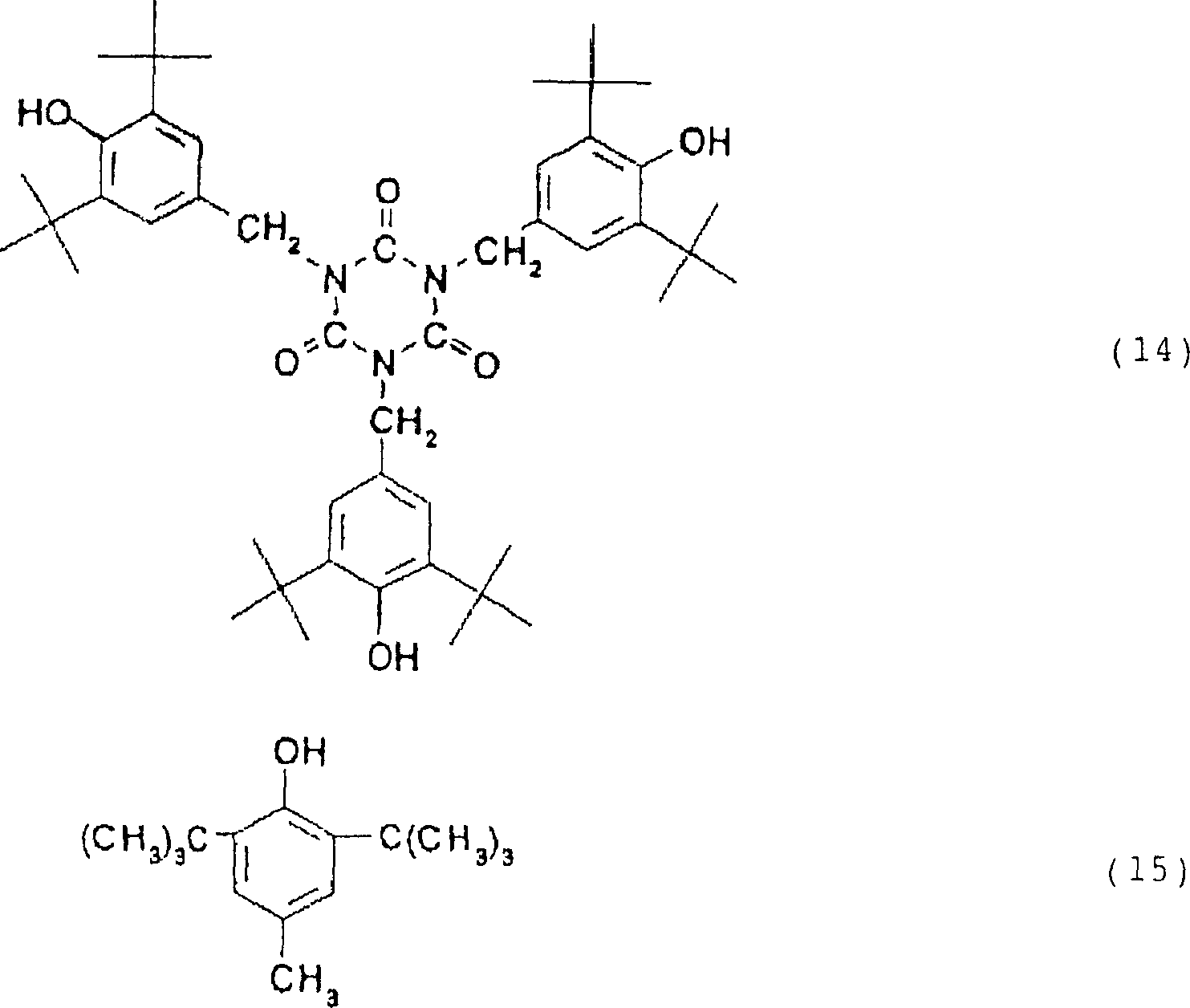


以下详细描述本发明(III)。The present invention (III) is described in detail below.
本发明(III)涉及包含本发明(I)的至少一种可聚合化合物作为必要组分的可聚合组合物。The present invention (III) relates to a polymerizable composition comprising at least one polymerizable compound of the present invention (I) as an essential component.
本发明(III)的可聚合组合物可以通过将如果需要的各种可聚合单体、溶剂、光聚合增感剂等与本发明(I)的可聚合化合物混合来获得。The polymerizable composition of the present invention (III) can be obtained by mixing various polymerizable monomers, solvents, photopolymerization sensitizers, etc., if necessary, with the polymerizable compound of the present invention (I).
本发明(III)的可聚合组合物可以含有可聚合单体。可以使用的可聚合单体不是特别限制的,只要它具有可聚合性即可,它们的例子可以包括丙烯酸,丙烯酸甲酯,丙烯酸乙酯,甲基丙烯酸,甲基丙烯酸甲酯,甲基丙烯酸乙酯,苯乙烯,马来酸单烯丙酯,富马酸单烯丙酯,马来酸二烯丙酯,富马酸二烯丙酯,马来酸单(烯丙基氧基乙基)酯,富马酸单(烯丙基氧基乙基)酯,马来酸双(烯丙基氧基乙基)酯和富马酸双(烯丙基氧基乙基)酯。这些可聚合单体可以单独使用,或以它们的两种或多种的组合来使用。The polymerizable composition of the present invention (III) may contain a polymerizable monomer. The polymerizable monomer that can be used is not particularly limited as long as it has polymerizability, and their examples may include acrylic acid, methyl acrylate, ethyl acrylate, methacrylic acid, methyl methacrylate, ethyl methacrylate Esters, Styrene, Monoallyl Maleate, Monoallyl Fumarate, Diallyl Maleate, Diallyl Fumarate, Mono(allyloxyethyl) Maleate ester, mono(allyloxyethyl) fumarate, bis(allyloxyethyl)maleate and bis(allyloxyethyl)fumarate. These polymerizable monomers may be used alone, or in combination of two or more thereof.
本发明(III)的可聚合组合物可以含有溶剂,以便控制粘度。可以使用的溶剂不是特别限制的,只要它是通常使用的溶剂即可,它们的例子可以包括乙酸甲酯,乙酸乙酯,乙酸丙酯,乙酸丁酯,甲基乙基酮,甲苯和二甲苯。这些溶剂可以单独使用,或以它们的两种或多种的组合来使用。The polymerizable composition of the present invention (III) may contain a solvent in order to control viscosity. The solvent that can be used is not particularly limited as long as it is a commonly used solvent, and their examples may include methyl acetate, ethyl acetate, propyl acetate, butyl acetate, methyl ethyl ketone, toluene, and xylene . These solvents may be used alone or in combination of two or more thereof.
还有,本发明(III)的可聚合组合物可以含有光聚合增感剂。可以使用的光聚合增感剂不是特别限制的,只要它是通常使用的光聚合增感剂即可,它们的例子可以包括噻喃鎓盐,部花青,喹啉,芪喹啉(stilquinoline),芳基酮类,芳族酮类和苯并二氢呋喃酮类。Also, the polymerizable composition of the present invention (III) may contain a photopolymerization sensitizer. The photopolymerization sensitizer that can be used is not particularly limited as long as it is a commonly used photopolymerization sensitizer, and their examples may include thiopyllium salts, merocyanines, quinoline, stilquinoline (stilquinoline) , aryl ketones, aromatic ketones and chromanones.
本发明(III)的可聚合组合物可以通过热、电子束或γ射线来固化,不需使用催化剂。尤其,在热固化的情况下,优选使用热聚合引发剂,以降低固化温度或增加固化速度。The polymerizable composition of the present invention (III) can be cured by heat, electron beams or gamma rays without using a catalyst. In particular, in the case of thermal curing, it is preferable to use a thermal polymerization initiator in order to lower the curing temperature or increase the curing speed.
以下详细描述本发明(IV)。The present invention (IV) is described in detail below.
本发明(IV)涉及本发明(III)的可聚合组合物,它含有0.1-10质量份的至少一种自由基聚合引发剂/100质量份的在可聚合组合物中的所有固化性组分。The present invention (IV) relates to the polymerizable composition of the present invention (III), which contains 0.1 to 10 parts by mass of at least one radical polymerization initiator per 100 parts by mass of all curable components in the polymerizable composition .
用于本发明(IV)的自由基聚合引发剂不是特别限制的,只要它是通常使用的自由基聚合引发剂即可。The radical polymerization initiator used in the present invention (IV) is not particularly limited as long as it is a generally used radical polymerization initiator.
在热聚合引发剂的情况下,它们的实例可以包括偶氮类引发剂如2,2’-偶氮二异丁腈和2,2’-偶氮二异戊腈;酮过氧化物类如过氧化甲基乙基酮,过氧化甲基异丁基酮和过氧化环己酮;二酰基过氧化物类如过氧化苯甲酰,过氧化月桂酰和过氧化癸酰;过氧酮缩醇如1,1-二叔丁基过氧环己烷和2,2-二-(叔丁基过氧)丁烷;烷基过酯如过新戊酸叔丁酯,过氧基-2-乙基己酸叔丁酯,过异丁酸叔丁酯,过六氢对苯二甲酸二叔丁酯,过壬二酸二叔丁酯,过-3,5,5-三甲基己酸叔丁酯,过乙酸叔丁酯,过苯甲酸叔丁酯和过氧基三甲基己二酸二叔丁酯;和过碳酸酯如过二碳酸二异丙酯,过二碳酸二仲丁酯和过氧基异丙基碳酸叔丁酯。这些热聚合引发剂可以单独使用,或以它们的两种或多种的组合使用。In the case of thermal polymerization initiators, examples thereof may include azo initiators such as 2,2'-azobisisobutyronitrile and 2,2'-azobisisobutyronitrile; ketone peroxides such as Methyl ethyl ketone peroxide, methyl isobutyl ketone peroxide and cyclohexanone peroxide; diacyl peroxides such as benzoyl peroxide, lauroyl peroxide and decanoyl peroxide; peroxyketal Alcohols such as 1,1-di-tert-butylperoxycyclohexane and 2,2-di-(tert-butylperoxy)butane; alkyl peresters such as tert-butyl perpivalate, peroxy-2 - tert-butyl ethylhexanoate, tert-butyl perisobutyrate, di-tert-butyl perhexahydroterephthalate, di-tert-butyl perazelaate, per-3,5,5-trimethylhexyl tert-butyl peroxyacetate, tert-butyl perbenzoate, and di-tert-butyl peroxytrimethyladipate; and percarbonates such as diisopropyl peroxydicarbonate, di-secondary peroxydicarbonate Butyl ester and tert-butyl peroxyisopropyl carbonate. These thermal polymerization initiators may be used alone, or in combination of two or more thereof.
当使用氧化还原聚合引发剂时,聚合可以在常温附近进行。可以使用的氧化还原聚合引发剂的例子包括酮过氧化物与金属的有机酸盐的组合,如过氧化甲基乙基酮与环烷酸钴的组合,过氧化枯烯与环烷酸锰的组合,过氧化苯甲酰与环烷酸钴的组合,过氧化乙酰乙酸酯与环烷酸钴的组合;以及过氧化物与芳族叔胺的组合,如过氧化苯甲酰与N,N-二甲基苯胺的组合,氢过氧化叔丁基与N,N-二甲基-对甲苯胺的组合,和过氧化二苯甲酰与N,N-二甲基苯胺的组合。When a redox polymerization initiator is used, polymerization can be performed around normal temperature. Examples of redox polymerization initiators that can be used include combinations of ketone peroxides and organic acid salts of metals, such as combinations of methyl ethyl ketone peroxide and cobalt naphthenate, cumene peroxide and manganese naphthenate. combinations, combinations of benzoyl peroxide and cobalt naphthenate, acetoacetate peroxide and cobalt naphthenate; and combinations of peroxides and aromatic tertiary amines, such as benzoyl peroxide and N, A combination of N-dimethylaniline, a combination of tert-butyl hydroperoxide and N,N-dimethyl-p-toluidine, and a combination of dibenzoyl peroxide and N,N-dimethylaniline.
活性能量射线的实例可以包括近红外射线,可见射线,紫外线,真空红外射线,X射线,γ射线和电子束。Examples of active energy rays may include near-infrared rays, visible rays, ultraviolet rays, vacuum infrared rays, X-rays, γ-rays, and electron beams.
用于通过照射可见射线或紫外线来聚合的自由基聚合引发剂的特定例子可以包括乙酰苯及其衍生物,如乙酰苯,2,2-二甲氧基-2-苯基乙酰苯,二乙氧基乙酰苯,1-羟基环己基苯基酮,2-甲基-1-[4-(甲基硫基)苯基]-2-吗啉基丙-1-酮,1,2-苄基-2-甲基氨基-1-(4-吗啉基苯酚)丁酮,1,2-羟基-2-甲基-1-苯基丙-1-酮;二苯甲酮及其衍生物,如二苯甲酮,4,4’-双(二甲基氨基)二苯甲酮,4-三甲基甲硅烷基二苯甲酮和4-苯甲酰基-4’-甲基二苯基硫;苯偶姻及其衍生物,如苯偶姻,苯偶姻乙醚,苯偶姻丙基醚,苯偶姻异丁基醚和苯偶姻异丙基醚;乙醛酸甲基苯基酯,苯偶姻二甲基酮缩醇,氧化2,4,6-三甲基苯甲酰基二苯基膦,氧化双(2,6-二氯苯甲酰基)-苯基膦,氧化双(2,6-二氯苯甲酰基)-2,5-二甲基苯基膦,氧化双(2,6-二氯苯甲酰基)-4-乙氧基苯基膦,氧化双(2,6-二氯苯甲酰基)-4-联苯基膦,氧化双(2,6-二氯苯甲酰基)-4-丙基苯基膦,氧化双(2,6-二氯苯甲酰基)-2-萘基膦,氧化双(2,6-二氯苯甲酰基)-1-萘基膦,氧化双(2,6-二氯苯甲酰基)-4-氯苯基膦,氧化双(2,6-二氯苯甲酰基)-2,4-二甲氧基苯基膦,氧化双(2,6-二氯苯甲酰基)-癸基膦,氧化双(2,6-二氯苯甲酰基)-4-辛基苯基膦,氧化双(2,6-二氯苯甲酰基)-2,5-二甲基苯基膦,氧化双(2,6-二氯苯甲酰基)-苯基膦,氧化双(2,4,6-三甲基苯甲酰基)-2,5-二甲基苯基膦,氧化双(2,6-二氯-3,4,5-三甲氧基苯甲酰基)-2,5-二甲基苯基膦,氧化双(2,6-二氯-3,4,5-三甲氧基苯甲酰基)-4-乙氧基苯基膦,氧化双(2-甲基-1-萘甲酰基)-2,5-二甲基苯基膦,氧化双(2-甲基-1-萘甲酰基)-2,5-苯基膦,氧化双(2-甲基-1-萘甲酰基)-4-联苯基膦,氧化双(2-甲基-1-萘甲酰基)-4-乙氧基联苯基膦,氧化双(2-甲基-1-萘甲酰基)-2-萘基膦,氧化双(2-甲基-1-萘甲酰基)-4-丙基苯基膦,氧化双(2-甲氧基-1-萘甲酰基)-2,5-二甲基苯基膦,氧化双(2-甲氧基-1-萘甲酰基)-4-甲氧基苯基膦,氧化双(2-甲氧基-1-萘甲酰基)-4-联苯基膦,氧化双(2-氯-1-萘甲酰基)-2,5-二甲基苯基膦和氧化双(2,6-二甲氧基苯甲酰基)-2,4,6-三甲基戊基膦。Specific examples of radical polymerization initiators for polymerization by irradiating visible rays or ultraviolet rays may include acetophenone and its derivatives such as acetophenone, 2,2-dimethoxy-2-phenylacetophenone, diethyl Oxyacetophenone, 1-hydroxycyclohexyl phenyl ketone, 2-methyl-1-[4-(methylthio)phenyl]-2-morpholinopropan-1-one, 1,2-benzyl 2-methylamino-1-(4-morpholinophenol) butanone, 1,2-hydroxy-2-methyl-1-phenylpropan-1-one; benzophenone and its derivatives , such as benzophenone, 4,4'-bis(dimethylamino)benzophenone, 4-trimethylsilylbenzophenone and 4-benzoyl-4'-methylbenzophenone benzoin and its derivatives such as benzoin, benzoin ethyl ether, benzoin propyl ether, benzoin isobutyl ether and benzoin isopropyl ether; methylbenzene glyoxylate base ester, benzoin dimethyl ketal, 2,4,6-trimethylbenzoyldiphenylphosphine oxide, bis(2,6-dichlorobenzoyl)-phenylphosphine oxide, Bis(2,6-dichlorobenzoyl)-2,5-dimethylphenylphosphine, bis(2,6-dichlorobenzoyl)-4-ethoxyphenylphosphine oxide, bis( 2,6-dichlorobenzoyl)-4-biphenylphosphine, bis(2,6-dichlorobenzoyl)-4-propylphenylphosphine oxide, bis(2,6-dichlorobenzene Formyl)-2-naphthylphosphine, bis(2,6-dichlorobenzoyl)-1-naphthylphosphine oxide, bis(2,6-dichlorobenzoyl)-4-chlorophenylphosphine oxide , bis(2,6-dichlorobenzoyl)-2,4-dimethoxyphenylphosphine oxide, bis(2,6-dichlorobenzoyl)-decylphosphine oxide, bis(2, 6-dichlorobenzoyl)-4-octylphenylphosphine, bis(2,6-dichlorobenzoyl)-2,5-dimethylphenylphosphine oxide, bis(2,6-bis Chlorobenzoyl)-phenylphosphine, bis(2,4,6-trimethylbenzoyl)-2,5-dimethylphenylphosphine oxide, bis(2,6-dichloro-3, 4,5-trimethoxybenzoyl)-2,5-dimethylphenylphosphine, bis(2,6-dichloro-3,4,5-trimethoxybenzoyl)-4-ethyl oxide Oxyphenylphosphine, bis(2-methyl-1-naphthoyl)-2,5-dimethylphenylphosphine oxide, bis(2-methyl-1-naphthoyl)-2,5 oxide -Phenylphosphine, bis(2-methyl-1-naphthoyl)-4-biphenylphosphine oxide, bis(2-methyl-1-naphthoyl)-4-ethoxybiphenylphosphine oxide Phosphine, bis(2-methyl-1-naphthoyl)-2-naphthylphosphine oxide, bis(2-methyl-1-naphthoyl)-4-propylphenylphosphine oxide, bis(2-naphthoyl)oxide -Methoxy-1-naphthoyl)-2,5-dimethylphenylphosphine, bis(2-methoxy-1-naphthoyl)-4-methoxyphenylphosphine oxide, bis(2-methoxy-1-naphthoyl)-4-methoxyphenylphosphine oxide (2-methoxy-1-naphthoyl)-4-biphenylphosphine, bis(2-chloro-1-naphthoyl)-2,5-dimethylphenylphosphine oxide and bis(2 , 6-dimethoxybenzoyl)-2,4,6-trimethylpentylphosphine.
对可见射线敏感的聚合引发剂的特定例子可以包括双(η5-2,4-环戊二烯-1-基)-双(2,6-二氟-3-(1H-吡咯-1-基)-苯基)-合钛(商品名IIRGACURE 784,Ciba Specialty Chemicals K.K.)。Specific examples of polymerization initiators sensitive to visible rays may include bis(η 5 -2,4-cyclopentadien-1-yl)-bis(2,6-difluoro-3-(1H-pyrrole-1-yl) base)-phenyl)-titanium (trade name IIRGACURE 784, Ciba Specialty Chemicals KK).
对可见射线和/或近红外射线敏感的聚合引发剂的特定例子可以包括在可见光或近红外光区具有感光性的用下式(24)表示的可见光和/或近红外光吸收性阳离子染料和用下式(25)表示的硼化合物的组合:Specific examples of the polymerization initiator sensitive to visible rays and/or near-infrared rays may include visible and/or near-infrared light-absorbing cationic dyes represented by the following formula (24) and A combination of boron compounds represented by the following formula (25):
D+·A- (24)D + A - (24)
其中D+表示在近红外光区具有吸收性的的阳离子染料,A-表示各种阴离子;Among them, D + represents a cationic dye with absorption in the near-infrared region, and A - represents various anions;
其中Z+表示任意阳离子,以及R7-R10各自独立地表示烷基,芳基,烯丙基,芳烷基,链烯基,炔基,甲硅烷基,杂环基团,卤素原子,取代烷基,取代芳基,取代烯丙基,取代芳烷基,取代链烯基,取代炔基或取代甲硅烷基。wherein Z + represents any cation, and R 7 -R 10 each independently represent an alkyl group, an aryl group, an allyl group, an aralkyl group, an alkenyl group, an alkynyl group, a silyl group, a heterocyclic group, a halogen atom, Substituted alkyl, substituted aryl, substituted allyl, substituted aralkyl, substituted alkenyl, substituted alkynyl or substituted silyl.
用式(24)表示的阳离子染料特别是在通常400-2000nm、优选500-1500nm范围内的任意波长区域具有吸收性的染料。The cationic dye represented by the formula (24) is, in particular, a dye having absorption in any wavelength region within the range of usually 400-2000 nm, preferably 500-1500 nm.
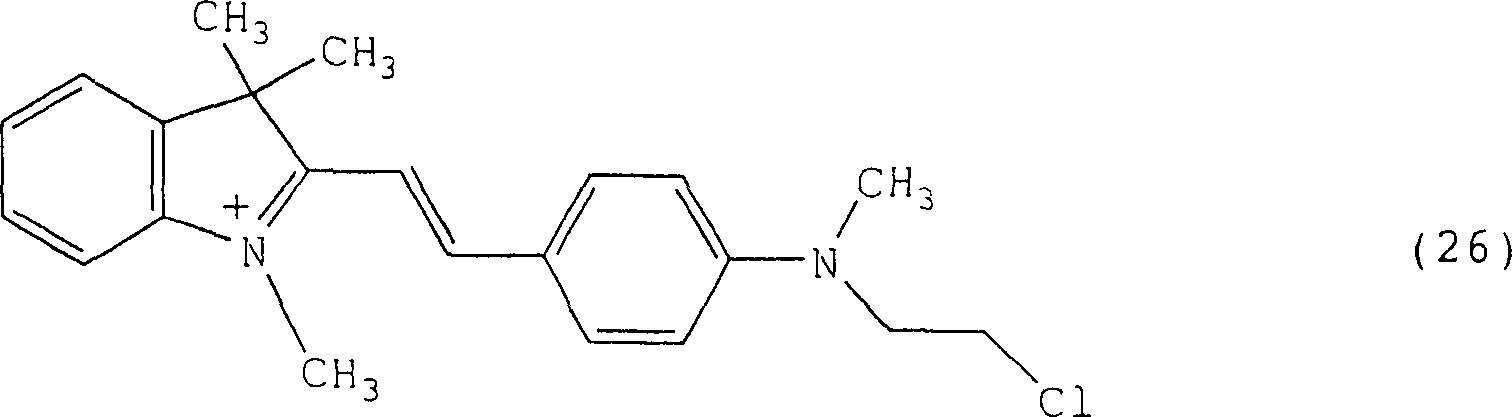
用于本发明的阳离子(D+)的优选例子可以包括次甲基、多次甲基、二氢吲哚、花青、呫吨,噁嗪、噻嗪,二芳基甲烷,三芳基甲烷和吡喃鎓系列阳离子染料的阳离子。阳离子染料的代表性实例可以包括用以下结构式(26)-(39)表示的阳离子。Preferable examples of the cation (D + ) used in the present invention may include methine, polymethyl, indoline, cyanine, xanthene, oxazine, thiazine, diarylmethane, triarylmethane and The cation of pyrylium series cationic dyes. Representative examples of cationic dyes may include cations represented by the following structural formulas (26) to (39).

抗衡阴离子A-是任意阴离子,但优选是用下式(40)表示的4-配位硼酸根阴离子:The counteranion A - is any anion, but is preferably a 4-coordinating borate anion represented by the following formula (40):

其中R11-R14各自独立地表示烷基,芳基,烯丙基,芳烷基,链烯基,炔基,甲硅烷基,杂环基团,卤素原子,取代烷基,取代芳基,取代烯丙基,取代芳烷基,取代链烯基,取代炔基或取代甲硅烷基。wherein R11 - R14 each independently represent an alkyl group, an aryl group, an allyl group, an aralkyl group, an alkenyl group, an alkynyl group, a silyl group, a heterocyclic group, a halogen atom, a substituted alkyl group, a substituted aryl group , substituted allyl, substituted aralkyl, substituted alkenyl, substituted alkynyl or substituted silyl.
它们的特定例子可以包括正丁基三苯基硼酸根离子,正辛基三苯基硼酸根离子,三苯基甲硅烷基三苯基硼酸根离子,二正十二烷基二苯基硼酸根离子,四苯基硼酸根离子和三正丁基(二甲基苯基甲硅烷基)硼酸根离子。它们的更特定的例子包括在日本未审查专利出版物No.6-75374(JP-A-6-75374)中所述的阴离子。Specific examples thereof may include n-butyltriphenylborate, n-octyltriphenylborate, triphenylsilyltriphenylborate, di-n-dodecyldiphenylborate ions, tetraphenylborate ion and tri-n-butyl(dimethylphenylsilyl)borate ion. More specific examples thereof include anions described in Japanese Unexamined Patent Publication No. 6-75374 (JP-A-6-75374).
在用式(25)表示的含硼催化剂中,作为阴离子的4-配位硼酸根离子的特定例子可以包括正丁基三苯基硼酸根离子,正辛基三苯基硼酸根离子,三苯基甲硅烷基三苯基硼酸根离子,正丁基三茴香基硼酸根离子,正丁基三(对氟苯基)硼酸根离子,正丁基三(对三氟甲基苯基)硼酸根离子,二正十二烷基二苯基硼酸根离子,四苯基硼酸根离子,三苯基萘基硼酸根离子,四丁基硼酸根离子和三正丁基(二甲基苯基甲硅烷基)硼酸根离子。In the boron-containing catalyst represented by the formula (25), specific examples of the 4-coordinated borate ion as an anion may include n-butyltriphenylborate ion, n-octyltriphenylborate ion, triphenyl Sylsilyltriphenylborate ion, n-butyltrianisylborate ion, n-butyltris(p-fluorophenyl)borate ion, n-butyltris(p-trifluoromethylphenyl)borate ion ions, di-n-dodecyl diphenyl borate ion, tetraphenyl borate ion, triphenylnaphthyl borate ion, tetrabutyl borate ion and tri-n-butyl (dimethylphenylsilyl base) borate ion.
在该式中的阳离子(Z+)的实例可以包括用下式(41)表示的季铵阳离子,季吡啶鎓阳离子,季喹啉鎓阳离子,重氮阳离子,四唑鎓阳离子,磷鎓阳离子,(氧)锍阳离子,金属阳离子如钠,钾,锂,镁和钙,有机酸阳离子如黄羊盐和吡喃鎓盐,碳阳离子如卓鎓和环丙基阳离子,卤鎓阳离子如碘鎓,以及金属化合物如砷、钴、铬、钯、钛、锡和锑的阳离子。它们更详细描述在JP-A-6-75374中。这些阳离子染料和含硼催化剂可以单独使用,或者以它们的两种或多种的组合来使用。Examples of the cation (Z + ) in this formula may include quaternary ammonium cations represented by the following formula (41), quaternary pyridinium cations, quaternary quinolinium cations, diazonium cations, tetrazolium cations, phosphonium cations, (Oxygen) sulfonium cations, metal cations such as sodium, potassium, lithium, magnesium and calcium, organic acid cations such as capric acid cations and pyrylium salts, carbocations such as zirconium and cyclopropyl cations, halide cations such as iodonium, and cations of metal compounds such as arsenic, cobalt, chromium, palladium, titanium, tin and antimony. They are described in JP-A-6-75374 in more detail. These cationic dyes and boron-containing catalysts may be used alone or in combination of two or more thereof.
其中R15-R18各自独立地表示氢原子,烷基,芳基,烯丙基,芳烷基,链烯基,炔基,杂环基团,取代烷基,取代芳基,取代烯丙基,取代芳烷基,取代链烯基或取代炔基。wherein R 15 -R 18 each independently represent a hydrogen atom, alkyl, aryl, allyl, aralkyl, alkenyl, alkynyl, heterocyclic group, substituted alkyl, substituted aryl, substituted allyl radical, substituted aralkyl, substituted alkenyl or substituted alkynyl.
用于通过近红外射线、可见射线或紫外线来聚合的这些自由基聚合引发剂可以单独使用,或者以它们的两种或多种的组合来使用。These radical polymerization initiators for polymerization by near-infrared rays, visible rays or ultraviolet rays may be used alone or in combination of two or more thereof.
还有,对紫外线、可见射线或近红外射线敏感的热聚合引发剂、氧化还原聚合引发剂和自由基聚合引发剂可以作为混合物使用。Also, thermal polymerization initiators, redox polymerization initiators and radical polymerization initiators sensitive to ultraviolet rays, visible rays or near infrared rays may be used as a mixture.
自由基聚合引发剂可以优选以0.1-10质量份、更优选0.3-7质量份、尤其优选0.5-5质量份/100质量份的在可聚合组合物中的所有固化性组分的量引入。如果该量少于0.1质量份,则组合物的固化可能是不充分的。以超过10质量份的量添加在经济上是不利的。The radical polymerization initiator may preferably be introduced in an amount of 0.1-10 parts by mass, more preferably 0.3-7 parts by mass, especially preferably 0.5-5 parts by mass per 100 parts by mass of all curable components in the polymerizable composition. If the amount is less than 0.1 parts by mass, curing of the composition may be insufficient. It is economically disadvantageous to add in an amount exceeding 10 parts by mass.
本发明(V)涉及通过将本发明(III)或(IV)的可聚合组合物固化获得的固化产物,以及该固化产物的生产方法。The present invention (V) relates to a cured product obtained by curing the polymerizable composition of the present invention (III) or (IV), and a method for producing the cured product.
即,本发明(V)的固化产物可以通过本发明(III)或(IV)的可聚合组合物的自由基聚合或类似聚合来获得。That is, the cured product of the present invention (V) can be obtained by radical polymerization or similar polymerization of the polymerizable composition of the present invention (III) or (IV).
在本发明(V)中的固化包括热固化和/或用活性能量射线的固化。尤其,热固化和/或用近红外射线、可见射线、紫外线或电子束的固化是优选的,以及热固化和/或用可见射线或紫外线的固化是更优选的。固化产物还可以通过结合使用两种或多种不同固化方法来获得。Curing in the present invention (V) includes thermal curing and/or curing with active energy rays. In particular, thermal curing and/or curing with near-infrared rays, visible rays, ultraviolet rays, or electron beams is preferable, and thermal curing and/or curing with visible rays or ultraviolet rays is more preferable. Cured products can also be obtained by using two or more different curing methods in combination.
在热固化不含自由基聚合引发剂的组合物中,反应温度通常可以是50-300℃,优选100-250℃。如果反应温度低于50℃,固化可能很难进行,而如果温度超过300℃,聚合组合物和固化产物会分解。In thermally curing the radical polymerization initiator-free composition, the reaction temperature may be generally 50-300°C, preferably 100-250°C. If the reaction temperature is lower than 50°C, curing may be difficult to proceed, while if the temperature exceeds 300°C, the polymer composition and cured product may decompose.
在用热聚合引发剂或氧化还原聚合引发剂的固化中,固化的最佳温度通过其中产生自由基的温度来控制。In curing with a thermal polymerization initiator or a redox polymerization initiator, the optimum temperature for curing is controlled by the temperature at which radicals are generated.
在活性能量射线当中,可以用于通过可见射线或紫外线固化的光源的实例可以包括低压汞灯,高压汞灯,超高压汞灯,氘灯,金属卤化物灯,卤素灯,氙灯,钨灯,镓灯,炭弧灯,白炽灯,荧光灯,受激准分子灯和激光器。在这些光源当中,高压汞灯和金属卤化物灯是优选的。Among active energy rays, examples of light sources that can be used for curing by visible rays or ultraviolet rays may include low-pressure mercury lamps, high-pressure mercury lamps, ultra-high-pressure mercury lamps, deuterium lamps, metal halide lamps, halogen lamps, xenon lamps, tungsten lamps, Gallium lamps, carbon arc lamps, incandescent lamps, fluorescent lamps, excimer lamps and lasers. Among these light sources, high-pressure mercury lamps and metal halide lamps are preferable.
用于通过可见射线或紫外线固化的光源的波长通常可以是200-750nm,优选200-450nm,以及照射量通常是10-1,000mJ/cm2,优选100-700mJ/cm2。The wavelength of the light source for curing by visible rays or ultraviolet rays may be generally 200-750 nm, preferably 200-450 nm, and the irradiation amount is usually 10-1,000 mJ/cm 2 , preferably 100-700 mJ/cm 2 .
在使用电子束的固化中,照射系统的实例可以包括扫描系统,宽射束系统,幕射束系统和离子等离子体系统。照射量通常是0.1Gy至200kGy,优选1Gy至100kGy。In curing using an electron beam, examples of the irradiation system may include a scanning system, a broad beam system, a curtain beam system, and an ion plasma system. The irradiation dose is usually 0.1 Gy to 200 kGy, preferably 1 Gy to 100 kGy.
以下参照实施例来进一步举例说明本发明,然而,本发明不限于这些The present invention is further illustrated below with reference to examples, however, the present invention is not limited to these
实施例。Example.
如下所示测量各种物理性能。Various physical properties were measured as shown below.
1、折光指数(nD)1. Refractive index (n D )
折光指数(nD)使用由Atago K.K.制造的“Abbe Refractometer 1T”在室温下测量。The refractive index (n D ) is measured at room temperature using "Abbe Refractometer 1T" manufactured by Atago KK.
2、酸值2. Acid value
酸值通过在JIS K0070中所述的酸值测试方法来测量。The acid value is measured by the acid value test method described in JIS K0070.
反应的转化率、收率和纯度通过使用高效液相色谱仪根据绝对校准方法定量测定各组分来由预先制备的校准曲线来决定。所用柱子是Showdex(注册商标)F-411A(由Showa Denko K.K.生产),溶剂是1wt%磷酸水溶液/甲醇(7/3),流速是1.0ml/分钟,检测器是SPD-10AVvP(由ShimadzuCorporation制造),以及在210nm检测各组分的峰。The conversion, yield and purity of the reaction were determined from a pre-prepared calibration curve by quantifying the components using a high performance liquid chromatograph according to the absolute calibration method. The column used was Showdex (registered trademark) F-411A (manufactured by Showa Denko K.K.), the solvent was 1 wt % aqueous phosphoric acid/methanol (7/3), the flow rate was 1.0 ml/min, and the detector was SPD-10AVvP (manufactured by Shimadzu Corporation ), and detect the peaks of each component at 210nm.
制备实施例1Preparation Example 1
富马酸单烯丙酯的合成(下文称之为“H-DAF”)Synthesis of monoallyl fumarate (hereinafter referred to as "H-DAF")
在2L烧瓶中加入474.25g(4.837mol)的马来酸酐,260.69g(4.833mol)的烯丙醇和500ml的甲苯。在氮气流下,在用磁力搅拌器搅拌的同时,将反应溶液在油浴中加热到60℃。在14小时之后,停止加热,再冷却烧瓶。向所得反应剂添加500ml的甲苯和1L的水,以使液体分离,用蒸发器浓缩甲苯层,获得了279.01g的目标马来酸单烯丙酯(下文称之为“H-DAM”)。收率是37.0%。474.25g (4.837mol) of maleic anhydride, 260.69g (4.833mol) of allyl alcohol and 500ml of toluene were added to a 2L flask. Under nitrogen flow, the reaction solution was heated to 60° C. in an oil bath while stirring with a magnetic stirrer. After 14 hours, the heating was turned off and the flask was cooled again. To the obtained reactant, 500 ml of toluene and 1 L of water were added to separate the liquid, and the toluene layer was concentrated by an evaporator to obtain 279.01 g of the target monoallyl maleate (hereinafter referred to as "H-DAM"). The yield was 37.0%.
向装有回流装置的300ml烧瓶添加100.04g(0.64mol)的以上合成的H-DAM,50.00g的甲苯,1.01g(1质量%,基于H-DAM)的浓盐酸和0.01g的氢醌单甲基醚。在氮气流下,在用磁力搅拌器搅拌的同时将反应溶液在油浴中加热到140℃,以使甲苯回流。在4小时之后,停止加热,冷却烧瓶。向所得反应剂添加200ml的甲苯,过滤出晶体,再用100ml甲苯将晶体洗涤2次。将晶体溶解在150ml的乙酸乙酯中,再通过过滤除去不溶物质。用蒸发器浓缩滤液,获得了38.39g的目标H-DAF。收率是38.4%。To a 300ml flask equipped with a reflux device, add 100.04g (0.64mol) of the above-synthesized H-DAM, 50.00g of toluene, 1.01g (1% by mass, based on H-DAM) of concentrated hydrochloric acid and 0.01g of hydroquinone mono methyl ether. Under nitrogen flow, the reaction solution was heated to 140° C. in an oil bath while being stirred with a magnetic stirrer to reflux toluene. After 4 hours, the heating was turned off and the flask was cooled. 200 ml of toluene was added to the obtained reactant, the crystals were filtered out, and the crystals were washed twice with 100 ml of toluene. The crystals were dissolved in 150 ml of ethyl acetate, and insoluble materials were removed by filtration. The filtrate was concentrated with an evaporator to obtain 38.39 g of the target H-DAF. The yield is 38.4%.
制备实施例2Preparation Example 2
富马酸单烯丙氧基乙酯的合成(下文称之为“H-BAF”)Synthesis of monoallyloxyethyl fumarate (hereinafter referred to as "H-BAF")
在2L烧瓶中加入500g(5.10mol)的马来酸酐,573g(5.61mol)的乙二醇单烯丙基醚和0.05g的氢醌单甲基醚。在氮气流下,在用磁力搅拌器搅拌的同时,将反应溶液在油浴中加热到50℃。在24小时之后,停止加热,再冷却烧瓶。所得反应剂通过高效液相色谱仪来分析。结果,马来酸酐的转化率是95%。500 g (5.10 mol) of maleic anhydride, 573 g (5.61 mol) of ethylene glycol monoallyl ether and 0.05 g of hydroquinone monomethyl ether were added to a 2 L flask. Under nitrogen flow, the reaction solution was heated to 50° C. in an oil bath while stirring with a magnetic stirrer. After 24 hours, the heating was turned off and the flask was cooled again. The resulting reactants were analyzed by high performance liquid chromatography. As a result, the conversion rate of maleic anhydride was 95%.
向装有回流装置的2L烧瓶添加499.54g的以上制备的反应溶液,215.07g的甲苯,4.99g(1质量%,基于原料)的浓盐酸和0.25g的氢醌单甲基醚。在氮气流下,在用磁力搅拌器搅拌的同时将反应溶液在油浴中加热到140℃,以使甲苯回流。在3小时之后,停止加热,冷却烧瓶。向所得反应剂添加500ml的甲苯,过滤所得溶液,以除去不溶性物质。向该滤液添加500ml的水,以脱除盐酸,用分离漏斗进行液体分离。用蒸发器浓缩甲苯层,获得了428g的目标H-BAF。收率是90%,基于马来酸酐计。To a 2 L flask equipped with a reflux device, 499.54 g of the reaction solution prepared above, 215.07 g of toluene, 4.99 g (1% by mass, based on the raw material) of concentrated hydrochloric acid and 0.25 g of hydroquinone monomethyl ether were added. Under nitrogen flow, the reaction solution was heated to 140° C. in an oil bath while being stirred with a magnetic stirrer to reflux toluene. After 3 hours, the heating was turned off and the flask was cooled. To the resulting reactant was added 500 ml of toluene, and the resulting solution was filtered to remove insoluble matter. 500 ml of water was added to the filtrate to remove hydrochloric acid, and the liquid was separated with a separating funnel. The toluene layer was concentrated with an evaporator to obtain 428 g of the target H-BAF. The yield is 90%, based on maleic anhydride.
实施例1Example 1
在1L烧瓶中加入4004.4g(2.0mol)的H-BAF,374.0g的ADECARESIN(注册商标)EP-4100G(双酚A二缩水甘油醚,环氧当量:185,由Asahi Denka Kogyo K.K.生产),5.73g的TPP-Zc(氯化苄基三苯基磷鎓,由Hokko Kagaku Kogyo K.K.生产)和0.4g的IRGANOX(注册商标)1010(四[3-(3,5-二叔丁基-4-羟苯基)丙酸]季戊四醇基酯,由CibaSpecialty Chemicals K.K.生产)。在氮气流下,在用磁力搅拌器搅拌的同时,将反应混合物在油浴中加热到100℃。所得反应产物被命名为“样品A”。样品A具有1.544的折光指数和1.7的酸值。Into a 1 L flask were charged 4004.4 g (2.0 mol) of H-BAF, 374.0 g of ADECARESIN (registered trademark) EP-4100G (bisphenol A diglycidyl ether, epoxy equivalent: 185, produced by Asahi Denka Kogyo K.K.), 5.73 g of TPP-Zc (benzyltriphenylphosphonium chloride, produced by Hokko Kagaku Kogyo K.K.) and 0.4 g of IRGANOX (registered trademark) 1010 (tetrakis[3-(3,5-di-tert-butyl-4 -Hydroxyphenyl)propionate]pentaerythritolyl ester, produced by Ciba Specialty Chemicals K.K.). Under nitrogen flow, the reaction mixture was heated to 100°C in an oil bath while stirring with a magnetic stirrer. The resulting reaction product was named "Sample A". Sample A has a refractive index of 1.544 and an acid number of 1.7.
样品A的1H-NMR谱图和IR谱图分别表示在图1和2中。The 1 H-NMR spectrum and IR spectrum of sample A are shown in Figs. 1 and 2, respectively.
实施例2Example 2
在1L烧瓶中加入4004.4g(2.0mol)的H-BAF,307.6g的ADECAGLYCILOL(注册商标)ED-505(三羟甲基丙烷三缩水甘油醚,环氧当量:153,由Asahi Denka Kogyo K.K.生产),4.25g的TPP-Zc(氯化苄基三苯基磷鎓,由Hokko Kagaku Kogyo K.K.生产)和0.42g的IRGANOX(注册商标)1010(四[3-(3,5-二叔丁基-4-羟苯基)丙酸]季戊四醇基酯,由Ciba Specialty Chemicals K.K.生产)。在氮气流下,在用磁力搅拌器搅拌的同时,将反应混合物在油浴中加热到100℃。所得反应产物被命名为“样品B”。样品B具有1.500的折光指数和17.4的酸值。Into a 1 L flask were charged 4004.4 g (2.0 mol) of H-BAF, 307.6 g of ADECAGLYCILOL (registered trademark) ED-505 (trimethylolpropane triglycidyl ether, epoxy equivalent: 153, produced by Asahi Denka Kogyo K.K. ), 4.25 g of TPP-Zc (benzyltriphenylphosphonium chloride, produced by Hokko Kagaku Kogyo K.K.) and 0.42 g of IRGANOX (registered trademark) 1010 (tetrakis[3-(3,5-di-tert-butyl -4-hydroxyphenyl)propionic acid]pentaerythritolyl ester, produced by Ciba Specialty Chemicals K.K.). Under nitrogen flow, the reaction mixture was heated to 100°C in an oil bath while stirring with a magnetic stirrer. The resulting reaction product was named "Sample B". Sample B has a refractive index of 1.500 and an acid number of 17.4.
样品B的1H-NMR谱图和IR谱图分别表示在图3和4中。The 1 H-NMR spectrum and IR spectrum of Sample B are shown in Figs. 3 and 4, respectively.
实施例3Example 3
在1L烧瓶中加入4004.4g(2.0mol)的H-BAF,446.0g的ADECARESIN(注册商标)EP-4080E(氢化双酚A二缩水甘油醚,环氧当量:214,由Asahi Denka Kogyo K.K.生产),6.26g的TPP-Zc(氯化苄基三苯基磷鎓,由Hokko Kagaku Kogyo K.K.生产)和0.4g的IRGANOX(注册商标)1010(四[3-(3,5-二叔丁基-4-羟基苯基)丙酸]季戊四醇基酯,由Ciba Specialty Chemicals K.K.生产)。在氮气流下,在用磁力搅拌器搅拌的同时,将反应混合物在油浴中加热到100℃。所得反应产物被命名为“样品C”。样品C具有1.507的折光指数和0.7的酸值。Into a 1 L flask were charged 4004.4 g (2.0 mol) of H-BAF, 446.0 g of ADECARESIN (registered trademark) EP-4080E (hydrogenated bisphenol A diglycidyl ether, epoxy equivalent: 214, produced by Asahi Denka Kogyo K.K.) , 6.26 g of TPP-Zc (benzyltriphenylphosphonium chloride, produced by Hokko Kagaku Kogyo K.K.) and 0.4 g of IRGANOX (registered trademark) 1010 (tetrakis[3-(3,5-di-tert-butyl- 4-hydroxyphenyl)propionic acid]pentaerythritolyl ester, produced by Ciba Specialty Chemicals K.K.). Under nitrogen flow, the reaction mixture was heated to 100°C in an oil bath while stirring with a magnetic stirrer. The resulting reaction product was named "Sample C". Sample C has a refractive index of 1.507 and an acid number of 0.7.
实施例4Example 4
在1L烧瓶中加入4004.4g(2.0mol)的H-BAF,446.0g的ADECARESIN(注册商标)EP-4088S(三环[5.2.1.02.6]癸烷二甲醇二缩水甘油醚,环氧当量:178,由Asahi Denka Kogyo K.K.生产),6.26g的TPP-Zc(氯化苄基三苯基磷鎓,由Hokko Kagaku Kogyo K.K.生产)和0.4g的IRGANOX(注册商标)1010(四[3-(3,5-二叔丁基-4-羟基苯基)丙酸]季戊四醇基酯,由Ciba Specialty Chemicals K.K.生产)。在氮气流下,在用磁力搅拌器搅拌的同时,将反应混合物在油浴中加热到100℃。所得反应产物被命名为“样品D”。样品D具有1.511的折光指数和12.3的酸值。In a 1L flask, add 4004.4g (2.0mol) of H-BAF, 446.0g of ADECARESIN (registered trademark) EP-4088S (tricyclic [5.2.1.0 2.6 ] decane dimethanol diglycidyl ether, epoxy equivalent: 178 , produced by Asahi Denka Kogyo KK), 6.26 g of TPP-Zc (benzyltriphenylphosphonium chloride, produced by Hokko Kagaku Kogyo KK) and 0.4 g of IRGANOX (registered trademark) 1010 (tetrakis[3-(3 , 5-di-tert-butyl-4-hydroxyphenyl) propionate] pentaerythritolyl ester, produced by Ciba Specialty Chemicals KK). Under nitrogen flow, the reaction mixture was heated to 100°C in an oil bath while stirring with a magnetic stirrer. The resulting reaction product was named "Sample D". Sample D has a refractive index of 1.511 and an acid number of 12.3.
样品D的1H-NMR谱图和IR谱图分别表示在图5和6中。The 1 H-NMR spectrum and IR spectrum of sample D are shown in Figs. 5 and 6, respectively.
实施例5Example 5
在1L烧瓶中加入4004.4g(2.0mol)的H-BAF,292.0g的ADECARESIN(注册商标)EP-4085S(1,4-环己烷二甲醇二缩水甘油醚,环氧当量:146,由Asahi Denka Kogyo K.K.生产),5.12g的TPP-Zc(氯化苄基三苯基磷鎓,由Hokko Kagaku Kogyo K.K.生产)和0.4g的IRGANOX(注册商标)1010(四[3-(3,5-二叔丁基-4-羟基苯基)丙酸]季戊四醇基酯,由Ciba Specialty Chemicals K.K.生产)。在氮气流下,在用磁力搅拌器搅拌的同时,将反应混合物在油浴中加热到100℃。所得反应产物被命名为“样品E”。样品E具有1.511的折光指数和12.3的酸值。In a 1L flask, add 4004.4g (2.0mol) of H-BAF, 292.0g of ADECARESIN (registered trademark) EP-4085S (1,4-cyclohexanedimethanol diglycidyl ether, epoxy equivalent: 146, by Asahi Denka Kogyo K.K.), 5.12 g of TPP-Zc (benzyltriphenylphosphonium chloride, produced by Hokko Kagaku Kogyo K.K.) and 0.4 g of IRGANOX (registered trademark) 1010 (tetrakis[3-(3,5- Di-tert-butyl-4-hydroxyphenyl) propionate] pentaerythritolyl ester, produced by Ciba Specialty Chemicals K.K.). Under nitrogen flow, the reaction mixture was heated to 100°C in an oil bath while stirring with a magnetic stirrer. The resulting reaction product was named "Sample E". Sample E has a refractive index of 1.511 and an acid number of 12.3.
样品E的1H-NMR谱图和IR谱图分别表示在图7和8中。The 1 H-NMR spectrum and IR spectrum of sample E are shown in Figs. 7 and 8, respectively.
实施例6Example 6
在300ml烧瓶中加入48.39g(0.242mol)的H-BAF,51.70g的ARALDITE ECN(注册商标)1273(甲酚-线型酚醛环氧树脂,环氧当量:214,由Asahi Chiba K.K.生产),43.42g的甲苯,0.50g的DMP-30(2,4,6-三(二甲基氨基甲基)酚,由Wako Pure Chemical Industries,Ltd.生产)和0.02g的氢醌单甲基醚。在氮气流下,在用磁力搅拌器搅拌的同时,将反应混合物在油浴中加热到100℃。在22小时之后,停止加热,冷却烧瓶。所得反应混合物通过高效液相色谱仪来分析,结果,0.92g的原料H-BAF保留,H-BAF的转化率是98.1%。该产物被命名为“样品F”。In a 300ml flask, add 48.39g (0.242mol) of H-BAF, 51.70g of ARALDITE ECN (registered trademark) 1273 (cresol-novolac epoxy resin, epoxy equivalent: 214, produced by Asahi Chiba K.K.), 43.42 g of toluene, 0.50 g of DMP-30 (2,4,6-tris(dimethylaminomethyl)phenol, produced by Wako Pure Chemical Industries, Ltd.) and 0.02 g of hydroquinone monomethyl ether. Under nitrogen flow, the reaction mixture was heated to 100°C in an oil bath while stirring with a magnetic stirrer. After 22 hours, the heat was turned off and the flask was cooled. The resulting reaction mixture was analyzed by high performance liquid chromatography, and as a result, 0.92 g of the raw material H-BAF remained, and the conversion rate of H-BAF was 98.1%. This product was designated "Sample F".
实施例7Example 7
在300ml烧瓶中加入12.90g(0.064mol)的H-BAF,4.62g(0.064mol)的丙烯酸,22.91g的ARALDITE EPN(注册商标)1180(线型酚醛环氧树脂,环氧当量:179,由Asahi Chiba K.K.生产),48.24g的甲苯,0.49g的DMP-30(2,4,6-三(二甲基氨基甲基)苯酚,由Wako Pure ChemicalIndustries,Ltd.生产)和0.02g的氢醌单甲基醚。在氮气流下,在用磁力搅拌器搅拌的同时,将反应混合物在油浴中加热到100℃。在13小时之后,停止加热,冷却烧瓶。所得反应混合物通过高效液相色谱仪来分析,结果,0.06g的原料H-BAF和1.21g的丙烯酸保留,H-BAF的转化率是99.5%,丙烯酸的转化率是76.0%。该产物被命名为“样品G”。Add the H-BAF of 12.90g (0.064mol) in the 300ml flask, the acrylic acid of 4.62g (0.064mol), the ARALDITE EPN (registered trademark) 1180 (novolac epoxy resin of 22.91g, epoxy equivalent: 179, by Asahi Chiba K.K.), 48.24 g of toluene, 0.49 g of DMP-30 (2,4,6-tris(dimethylaminomethyl)phenol, produced by Wako Pure Chemical Industries, Ltd.) and 0.02 g of hydroquinone monomethyl ether. Under nitrogen flow, the reaction mixture was heated to 100°C in an oil bath while stirring with a magnetic stirrer. After 13 hours, the heating was turned off and the flask was cooled. The resulting reaction mixture was analyzed by high performance liquid chromatography. As a result, 0.06 g of raw material H-BAF and 1.21 g of acrylic acid remained, and the conversion rate of H-BAF was 99.5%, and the conversion rate of acrylic acid was 76.0%. This product was designated "Sample G".
实施例8Example 8
在300ml烧瓶中加入12.90g(0.064mol)的H-BAF,4.63g(0.064mol)的丙烯酸,30.75g的ARALDITE ECN(注册商标)1273(甲酚-线型酚醛环氧树脂,环氧当量:214,由Asahi Chiba K.K.生产),48.24g的甲苯,0.49g的DMP-30(2,4,6-三(二甲基氨基甲基)苯酚,由Wako Pure ChemicalIndustries,Ltd.生产)和0.02g的氢醌单甲基醚。在氮气流下,在用磁力搅拌器搅拌的同时,将反应混合物在油浴中加热到100℃。在13小时之后,停止加热,冷却烧瓶。所得反应混合物通过高效液相色谱仪来分析,结果,0.06g的原料H-BAF和1.21g的丙烯酸保留,H-BAF的转化率是99.5%,丙烯酸的转化率是76.0%。该产物被命名为“样品H”。In the 300ml flask, add the H-BAF of 12.90g (0.064mol), the acrylic acid of 4.63g (0.064mol), the ARALDITE ECN (registered trademark) 1273 (cresol-novolak epoxy resin) of 30.75g, epoxy equivalent: 214, produced by Asahi Chiba K.K.), 48.24 g of toluene, 0.49 g of DMP-30 (2,4,6-tris(dimethylaminomethyl)phenol, produced by Wako Pure Chemical Industries, Ltd.) and 0.02 g of hydroquinone monomethyl ether. Under nitrogen flow, the reaction mixture was heated to 100°C in an oil bath while stirring with a magnetic stirrer. After 13 hours, the heating was turned off and the flask was cooled. The resulting reaction mixture was analyzed by high performance liquid chromatography. As a result, 0.06 g of raw material H-BAF and 1.21 g of acrylic acid remained, and the conversion rate of H-BAF was 99.5%, and the conversion rate of acrylic acid was 76.0%. This product was named "Sample H".
实施例9Example 9
在300ml烧瓶中加入58.10g(0.290mol)的H-BAF,42.02g的ADECAGLYCILOL ED-507(甘油三缩水甘油醚,环氧当量:145,由AsahiDenka Kogyo K.K.生产),0.50g的DMP-30(2,4,6-三(二甲基氨基甲基)苯酚,由Wako Pure Chemical Industries,Ltd.生产)和0.02g的氢醌单甲基醚。在氮气流下,在用磁力搅拌器搅拌的同时,将反应混合物在油浴中加热到100℃。在20小时之后,停止加热,冷却烧瓶。所得产物被命名为“样品I”。样品I具有1.497的折光指数和2.14的酸值。In a 300 ml flask, 58.10 g (0.290 mol) of H-BAF, 42.02 g of ADECAGLYCILOL ED-507 (glycerol triglycidyl ether, epoxy equivalent: 145, produced by AsahiDenka Kogyo K.K.), 0.50 g of DMP-30 ( 2,4,6-tris(dimethylaminomethyl)phenol, produced by Wako Pure Chemical Industries, Ltd.) and 0.02 g of hydroquinone monomethyl ether. Under nitrogen flow, the reaction mixture was heated to 100°C in an oil bath while stirring with a magnetic stirrer. After 20 hours, the heat was turned off and the flask was cooled. The resulting product was named "Sample I". Sample I has a refractive index of 1.497 and an acid number of 2.14.
实施例10Example 10
在300ml烧瓶中加入31.28g(0.156mol)的H-BAF,11.28g(0.156mol)的丙烯酸,57.68g的ARALDITE AER(注册商标)2502(二缩水甘油基双酚A,环氧当量:185,由Asahi Chiba K.K.生产),0.50g的DMP-30(2,4,6-三(二甲基氨基甲基)苯酚,由Wako Pure Chemical Industries,Ltd.生产)和0.02g的氢醌单甲基醚。在氮气流下,在用磁力搅拌器搅拌的同时,将反应混合物在油浴中加热到100℃。在11小时之后,停止加热,冷却烧瓶。所得反应混合物通过高效液相色谱仪来分析,结果,原料H-BAF没有保留,但1.21g的丙烯酸保留下来,H-BAF的转化率是100%,丙烯酸的转化率是89.3%。该产物被命名为“样品J”。“样品J”具有1.546的折光指数和1.72的酸值。In the 300ml flask, add the H-BAF of 31.28g (0.156mol), the acrylic acid of 11.28g (0.156mol), the ARALDITE AER (registered trademark) 2502 (diglycidyl bisphenol A of 57.68g, epoxy equivalent: 185, Produced by Asahi Chiba K.K.), 0.50 g of DMP-30 (2,4,6-tris(dimethylaminomethyl)phenol, produced by Wako Pure Chemical Industries, Ltd.) and 0.02 g of hydroquinone monomethyl ether. Under nitrogen flow, the reaction mixture was heated to 100°C in an oil bath while stirring with a magnetic stirrer. After 11 hours, the heat was turned off and the flask was cooled. The resulting reaction mixture was analyzed by high performance liquid chromatography. As a result, the raw material H-BAF did not remain, but 1.21 g of acrylic acid remained. The conversion rate of H-BAF was 100%, and the conversion rate of acrylic acid was 89.3%. This product was designated "Sample J". "Sample J" has a refractive index of 1.546 and an acid number of 1.72.
实施例11Example 11
在1L烧瓶中加入400.4g(2.0mol)的H-BAF,374.0g的ADECARESIN(注册商标)EP-4100G(双酚A二缩水甘油醚,环氧当量:185,由Asahi Denka Kogyo K.K.生产),8.00g的甲基丙烯酸N,N-二甲基氨基乙酯(由Kyoeisha Kagaku K.K.生产)和0.4g的IRGANOX(注册商标)1010(四[3-(3,5-二叔丁基-4-羟基苯基)丙酸]季戊四醇基酯,由CibaSpecialty Chemicals K.K.生产)。在氮气流下,在用磁力搅拌器搅拌的同时,将反应混合物在油浴中加热到110℃。在6小时之后,停止加热和冷却烧瓶。所得反应产物被命名为“样品K”。样品K具有1.544的折光指数和6.5的酸值。In a 1 L flask were charged 400.4 g (2.0 mol) of H-BAF, 374.0 g of ADECARESIN (registered trademark) EP-4100G (bisphenol A diglycidyl ether, epoxy equivalent: 185, produced by Asahi Denka Kogyo K.K.), 8.00 g of N,N-dimethylaminoethyl methacrylate (produced by Kyoeisha Kagaku K.K.) and 0.4 g of IRGANOX (registered trademark) 1010 (tetrakis[3-(3,5-di-tert-butyl-4- hydroxyphenyl)propionate]pentaerythritolyl ester, produced by Ciba Specialty Chemicals K.K.). Under nitrogen flow, the reaction mixture was heated to 110° C. in an oil bath while stirring with a magnetic stirrer. After 6 hours, the heating was turned off and the flask was cooled. The resulting reaction product was named "Sample K". Sample K has a refractive index of 1.544 and an acid number of 6.5.
实施例12Example 12
在1L烧瓶中加入400.4g(2.0mol)的H-BAF,374.0g的ADECARESIN(注册商标)EP-4100G(双酚A二缩水甘油醚,环氧当量:185,由Asahi Denka Kogyo K.K.生产),8.00g的氯化三甲基甲基丙烯酰氧基乙基铵(由Kyoeisha Kagaku K.K.生产)和0.4g的IRGANOX(注册商标)1010(四[3-(3,5-二叔丁基-4-羟基苯基)丙酸]季戊四醇基酯,由Ciba Specialty Chemicals K.K.生产)。在氮气流下,在用磁力搅拌器搅拌的同时,将反应混合物在油浴中加热到110℃。在7小时之后,停止加热和冷却烧瓶。所得反应产物被命名为“样品L”。样品L具有1.544的折光指数和6.5的酸值。In a 1 L flask were charged 400.4 g (2.0 mol) of H-BAF, 374.0 g of ADECARESIN (registered trademark) EP-4100G (bisphenol A diglycidyl ether, epoxy equivalent: 185, produced by Asahi Denka Kogyo K.K.), 8.00 g of trimethylmethacryloxyethylammonium chloride (produced by Kyoeisha Kagaku K.K.) and 0.4 g of IRGANOX (registered trademark) 1010 (tetrakis[3-(3,5-di-tert-butyl-4 -Hydroxyphenyl)propionic acid]pentaerythritolyl ester, produced by Ciba Specialty Chemicals K.K.). Under nitrogen flow, the reaction mixture was heated to 110° C. in an oil bath while stirring with a magnetic stirrer. After 7 hours, the heating was turned off and the flask was cooled. The resulting reaction product was named "Sample L". Sample L has a refractive index of 1.544 and an acid number of 6.5.
实施例13Example 13
在1L烧瓶中加入400.4g(2.0mol)的H-BAF,374.0g的ADECARESIN(注册商标)EP-4100G(双酚A二缩水甘油醚,环氧当量:185,由Asahi Denka Kogyo K.K.生产),0.50g的CMP-30(2,4,6-三(二甲基氨基甲基)苯酚,由Wako Pure Chemical Industries,Ltd.生产)和0.4g的IRGANOX(注册商标)1010(四[3-(3,5-二叔丁基-4-羟基苯基)丙酸]季戊四醇基酯,由Ciba Specialty Chemicals K.K.生产)。在氮气流下,在用磁力搅拌器搅拌的同时,将反应混合物在油浴中加热到110℃。在6小时之后,停止加热和冷却烧瓶。所得反应产物被命名为“样品M”。样品M具有1.544的折光指数和1.7的酸值。In a 1 L flask were charged 400.4 g (2.0 mol) of H-BAF, 374.0 g of ADECARESIN (registered trademark) EP-4100G (bisphenol A diglycidyl ether, epoxy equivalent: 185, produced by Asahi Denka Kogyo K.K.), 0.50 g of CMP-30 (2,4,6-tris(dimethylaminomethyl)phenol, produced by Wako Pure Chemical Industries, Ltd.) and 0.4 g of IRGANOX (registered trademark) 1010 (tetrakis[3-( 3,5-di-tert-butyl-4-hydroxyphenyl) propionate] pentaerythritolyl ester, produced by Ciba Specialty Chemicals K.K.). Under nitrogen flow, the reaction mixture was heated to 110° C. in an oil bath while stirring with a magnetic stirrer. After 6 hours, the heating was turned off and the flask was cooled. The resulting reaction product was named "Sample M". Sample M has a refractive index of 1.544 and an acid number of 1.7.
对比实施例1Comparative Example 1
在200ml烧瓶中加入7.24g(0.100mol)的丙烯酸,18.53g的ARALDITEAER(注册商标)2502(二缩水甘油基双酚A,环氧当量:185,由AsahiChiba K.K.生产),0.14g的DMP-30(2,4,6-三(二甲基氨基甲基)苯酚,由Wako Pure Chemical Industries,Ltd.生产)和5mg的氢醌单甲基醚。在氮气流下,在用磁力搅拌器搅拌的同时,将反应混合物在油浴中加热到100℃。在6小时之后,停止加热,冷却烧瓶。所得反应混合物通过高效液相色谱仪来分析,结果,0.15g的原料丙烯酸保留下来,丙烯酸的转化率是98.0%。该反应产物被命名为“样品P”。In a 200 ml flask were charged 7.24 g (0.100 mol) of acrylic acid, 18.53 g of ARALDITEAER (registered trademark) 2502 (diglycidyl bisphenol A, epoxy equivalent: 185, produced by AsahiChiba K.K.), 0.14 g of DMP-30 (2,4,6-tris(dimethylaminomethyl)phenol, produced by Wako Pure Chemical Industries, Ltd.) and 5 mg of hydroquinone monomethyl ether. Under nitrogen flow, the reaction mixture was heated to 100°C in an oil bath while stirring with a magnetic stirrer. After 6 hours, the heating was turned off and the flask was cooled. The obtained reaction mixture was analyzed by high-performance liquid chromatography, and as a result, 0.15 g of raw material acrylic acid remained, and the conversion rate of acrylic acid was 98.0%. The reaction product was named "Sample P".
对比实施例2Comparative Example 2
在200ml烧瓶中加入8.60g(0.100mol)的甲基丙烯酸,18.54g的ARALDITE AER(注册商标)2502(二缩水甘油基双酚A,环氧当量:185,由Asahi Chiba K.K.生产),0.14g的DMP-30(2,4,6-三(二甲基氨基甲基)苯酚,由Wako Pure Chemical Industries,Ltd.生产)和5mg的氢醌单甲基醚。在氮气流下,在用磁力搅拌器搅拌的同时,将反应混合物在油浴中加热到100℃。在10小时之后,停止加热,冷却烧瓶。所得反应混合物通过高效液相色谱仪来分析,结果,0.43g的原料丙烯酸保留下来,甲基丙烯酸的转化率是95.0%。该反应产物被命名为“样品Q”。In a 200 ml flask, 8.60 g (0.100 mol) of methacrylic acid, 18.54 g of ARALDITE AER (registered trademark) 2502 (diglycidyl bisphenol A, epoxy equivalent: 185, produced by Asahi Chiba K.K.), 0.14 g were added. DMP-30 (2,4,6-tris(dimethylaminomethyl)phenol, produced by Wako Pure Chemical Industries, Ltd.) and 5 mg of hydroquinone monomethyl ether. Under nitrogen flow, the reaction mixture was heated to 100°C in an oil bath while stirring with a magnetic stirrer. After 10 hours, the heating was turned off and the flask was cooled. The obtained reaction mixture was analyzed by high performance liquid chromatography, and as a result, 0.43 g of raw material acrylic acid remained, and the conversion rate of methacrylic acid was 95.0%. The reaction product was named "Sample Q".
固化试验1(无催化剂热固化)Curing test 1 (heat curing without catalyst)
用注射器在玻璃板上滴下各几滴的样品A、B、C、D、E、F、G、H、I、J、K、L、M、P和Q,并在齿轮烘箱(gear oven)(Perfect Oven PV-110,由TABAI ESPEC K.K.制造)中加热1小时,试图进行无催化剂热固化。结果表示在表1中。Use a syringe to drop a few drops of samples A, B, C, D, E, F, G, H, I, J, K, L, M, P, and Q on a glass plate, and place them in a gear oven (gear oven) (Perfect Oven PV-110, manufactured by TABAI ESPEC K.K.) for 1 hour in an attempt to perform catalyst-free thermal curing. The results are shown in Table 1.
表1
○:固化,×:未固化○: cured, ×: not cured
使用在PET上的涂层的试验Tests using coatings on PET
称量各1g的样品A、B、E、F、G和H,季戊四醇三丙烯酸酯(下文称之为“PETA”)和季戊四醇四丙烯酸酯(下文称之为“PETEA”),再用甲苯稀释至具有50质量%的甲苯含量。向该混合物添加和溶解Irgacure(注册商标)184(1-羟基环己基苯基酮,由Ciba SpecialtyChemicals生产)至5质量%,基于各样品计。用注射器在玻璃板上滴下各几滴的每一种甲苯溶液,再使用紫外线照射装置TOSCURE 401(由Toshiba K.K.制造)固化。该UV照射持续到样品不能通过用手指刮除剥离为止,以获得固化产物样品。固化产物样品进行如在以下表2中列举的各种试验。Weigh 1 g each of samples A, B, E, F, G and H, pentaerythritol triacrylate (hereinafter referred to as "PETA") and pentaerythritol tetraacrylate (hereinafter referred to as "PETEA"), and then dilute with toluene to have a toluene content of 50% by mass. To the mixture, Irgacure (registered trademark) 184 (1-hydroxycyclohexyl phenyl ketone, produced by Ciba Specialty Chemicals) was added and dissolved to 5% by mass based on each sample. A few drops of each toluene solution was dropped on a glass plate with a syringe, and cured using an ultraviolet ray irradiation device TOSCURE 401 (manufactured by Toshiba K.K.). This UV irradiation was continued until the sample could not be peeled off by scraping with fingers to obtain a cured product sample. Cured product samples were subjected to various tests as listed in Table 2 below.
结果在表2中给出。The results are given in Table 2.
表2
表2的结果可以证明,根据本发明的化合物表现了对PET薄膜的良好粘合力和形成了具有良好拉伸强度和伸长率的薄膜。The results in Table 2 demonstrate that the compounds according to the invention exhibit good adhesion to PET films and form films with good tensile strength and elongation.
浇铸产品的试验Testing of cast products
以基于各树脂计的2质量%的量将过氧化二枯基溶解在样品A、B、C和D以及质量比为70∶30的乙烯基酯(VE)树脂(商品名:Ripoxy VR-77,由Showa Highpolymer K.K.生产)和苯乙烯的混合物的每一种中,再将混合物各自浇铸到由PET制成和具有4mm厚度的模具内。然后,将含有样品A-D的混合物在100℃/0.5小时+130℃/1小时+160℃/1小时的条件下固化。含有VE树脂和苯乙烯的混合物的液体在130℃/1小时+160℃/1小时的条件下固化。Dicumyl peroxide was dissolved in Samples A, B, C and D and vinyl ester (VE) resin (trade name: Ripoxy VR-77 , produced by Showa Highpolymer K.K.) and styrene, each of the mixtures was cast into a mold made of PET and having a thickness of 4 mm. Then, the mixture containing samples A-D was cured under the conditions of 100°C/0.5 hour+130°C/1 hour+160°C/1 hour. The liquid containing the mixture of VE resin and styrene was cured under the conditions of 130° C./1 hour + 160° C./1 hour.
此外,以基于树脂计的2质量%的量将过氧化二枯基溶解在不饱和聚酯(UP)树脂(商品名:Upika 6424,由Nippon Upika K.K.生产)中,再将混合物浇铸到具有4mm厚度的由玻璃制成的模具内。然后,将混合物在60℃/1小时+160℃/1小时的条件下固化。In addition, dicumyl peroxide was dissolved in an unsaturated polyester (UP) resin (trade name: Upika 6424, produced by Nippon Upika K.K.) in an amount of 2% by mass based on the resin, and the mixture was cast to a thickness of 4 mm. Thickness of the mold made of glass. Then, the mixture was cured under the conditions of 60° C./1 hour + 160° C./1 hour.
所得固化产物进行机械性能、热性能、电性能、光学性能等的评价。结果在以下表3中给出。The obtained cured products were evaluated for mechanical properties, thermal properties, electrical properties, optical properties, and the like. The results are given in Table 3 below.
表3
表3中的结果证明,根据本发明的固化产物具有优异的机械性能,尤其优异的抗冲击性。The results in Table 3 demonstrate that the cured products according to the invention have excellent mechanical properties, especially excellent impact resistance.
浇铸产品的试验Testing of cast products
将过氧化二枯基以基于各树脂计2质量%的量溶解在样品K、L和M的每一种中,再将混合物各自浇铸到由玻璃制成和具有4mm厚度的模具内。然后,将混合物在120℃/5小时+130℃/5小时+140℃/5小时+150℃/5小时+160℃/2小时的条件下固化。Dicumyl peroxide was dissolved in each of the samples K, L, and M in an amount of 2% by mass based on each resin, and the mixtures were each cast into molds made of glass and having a thickness of 4 mm. Then, the mixture was cured under the conditions of 120°C/5 hours+130°C/5 hours+140°C/5 hours+150°C/5 hours+160°C/2 hours.
将所得样品K、L和M的固化产物切割成10mm×10mm×4mm的试件,将每一种产物的5件样品各自引入到装有回流冷凝器的300ml茄形烧瓶内。然后将150ml的氯仿引入到烧瓶内,再加热和回流3小时。然后,冷却混合物,通过凝胶渗透色谱法分析是否存在萃取到氯仿中的催化剂(柱子:F801,由Showa Denko K.K.制造,洗脱剂:氯仿,检测器:RI检测器)。在用于萃取样品K和L的固化产物的各试件的氯仿中没有检测到催化剂,但在用于萃取样品M的固化产物的试件的氯仿中检测到了催化剂2,4,6-三(二甲基氨基甲基)苯酚。The obtained cured products of samples K, L and M were cut into test pieces of 10 mm x 10 mm x 4 mm, and 5 samples of each product were each introduced into a 300 ml eggplant-shaped flask equipped with a reflux condenser. Then 150 ml of chloroform was introduced into the flask, followed by heating and reflux for 3 hours. Then, the mixture was cooled, and analyzed for the presence or absence of the catalyst extracted into chloroform by gel permeation chromatography (column: F801, manufactured by Showa Denko K.K., eluent: chloroform, detector: RI detector). No catalyst was detected in the chloroform of the samples used to extract the cured product of samples K and L, but the
以上结果证实,通过使用带有自由基聚合官能团的催化剂生产可聚合组合物,催化剂没有从通过固化可聚合组合物获得的固化产物中泄露出来。The above results confirmed that by producing a polymerizable composition using a catalyst having a radical polymerization functional group, the catalyst did not leak out from the cured product obtained by curing the polymerizable composition.
工业应用性Industrial applicability
根据本发明,可以提供对基材如PET基材表现良好粘合性能和具有可自由基聚合性、从而能进行热固化和/或活性能量射线固化的可聚合化合物,以及可以提供该可聚合化合物的制备方法,使用该可聚合化合物的组合物,通过固化该组合物获得的固化产物和固化产物的生产方法。According to the present invention, it is possible to provide a polymerizable compound that exhibits good adhesive properties to substrates such as PET substrates and has radical polymerizability so that thermal curing and/or active energy ray curing can be performed, and the polymerizable compound can be provided A production method, a composition using the polymerizable compound, a cured product obtained by curing the composition, and a production method of the cured product.
Claims (17)






Applications Claiming Priority (8)
| Application Number | Priority Date | Filing Date | Title |
|---|---|---|---|
| JP2001226909 | 2001-07-27 | ||
| JP226909/2001 | 2001-07-27 | ||
| US30886201P | 2001-08-01 | 2001-08-01 | |
| US60/308,862 | 2001-08-01 | ||
| JP354305/2001 | 2001-11-20 | ||
| JP2001354305 | 2001-11-20 | ||
| JP2002189063A JP4068406B2 (en) | 2001-07-27 | 2002-06-28 | Polymerizable compound, method for producing the compound, polymerizable composition containing the compound, cured product obtained by curing the composition, and method for producing the cured product |
| JP189063/2002 | 2002-06-28 |
Publications (2)
| Publication Number | Publication Date |
|---|---|
| CN1533373A CN1533373A (en) | 2004-09-29 |
| CN1275932C true CN1275932C (en) | 2006-09-20 |
Family
ID=27482459
Family Applications (1)
| Application Number | Title | Priority Date | Filing Date |
|---|---|---|---|
| CNB02814533XA Expired - Fee Related CN1275932C (en) | 2001-07-27 | 2002-07-25 | Polymerizable compound, polymerizable composition and cured product containing the compound |
Country Status (3)
| Country | Link |
|---|---|
| US (1) | US7049350B2 (en) |
| CN (1) | CN1275932C (en) |
| WO (1) | WO2003010124A1 (en) |
Families Citing this family (11)
| Publication number | Priority date | Publication date | Assignee | Title |
|---|---|---|---|---|
| JP2005008857A (en) | 2003-05-28 | 2005-01-13 | Showa Denko Kk | Curable polymer compound |
| US20100094560A1 (en) * | 2006-08-15 | 2010-04-15 | Prometheus Laboratories Inc. | Methods for diagnosing irritable bowel syndrome |
| US20120295999A1 (en) * | 2011-05-16 | 2012-11-22 | Deepak Shukla | Photoinitiator and photocurable compositions and uses |
| CN103044658B (en) * | 2012-12-31 | 2016-09-21 | 东莞英铭化工有限公司 | A kind of synthetic method of terephthalic vinylite |
| AR098786A1 (en) * | 2013-12-17 | 2016-06-15 | Lubrizol Advanced Mat Inc | EMULSION POLYMERIZED MICROGELS RESPONDING TO TENSIANS |
| CN107804857B (en) * | 2016-09-08 | 2020-06-09 | 中国石油化工股份有限公司 | Preparation method of mesoporous ZSM-5 zeolite |
| US10882972B2 (en) * | 2017-12-21 | 2021-01-05 | Palo Alto Research Center Incorporated | Functionalized graphene oxide curable formulations |
| CN110483743A (en) * | 2019-06-28 | 2019-11-22 | 广东博兴新材料科技有限公司 | A kind of modified epoxy acrylic ester resin, preparation method and its preparing the application in conductive adhesive |
| EP4205867A4 (en) * | 2020-08-28 | 2024-07-31 | Chugoku Marine Paints, Ltd. | PAINT COMPOSITION, COATING FILM, BASE MATERIAL WITH THE COATING FILM AND METHOD FOR PRODUCING THE SAME |
| CN112062675A (en) * | 2020-09-15 | 2020-12-11 | 常州速固得感光新材料有限公司 | Monomer with free radical and cation dual curing functions, preparation method and radiation curing gravure ink |
| CN121343583B (en) * | 2025-12-17 | 2026-03-17 | 四川雷驰力奥石油科技有限公司 | A low-damage fracturing fluid for coal and rock gas wells and its preparation method |
Family Cites Families (4)
| Publication number | Priority date | Publication date | Assignee | Title |
|---|---|---|---|---|
| US2514786A (en) * | 1947-08-20 | 1950-07-11 | Rohm & Haas | Diallyloxyalkyl maleates |
| SU1155584A1 (en) * | 1982-02-12 | 1985-05-15 | Azerb Inzh Str Inst | Unsaturated oxyesters as accelerators of epoxy composition hot hardening |
| SU1178755A1 (en) * | 1984-02-10 | 1985-09-15 | Предприятие П/Я В-2304 | Adhesive composition |
| JPH08184961A (en) * | 1994-11-02 | 1996-07-16 | Toray Ind Inc | Waterless planographic printing plate |
-
2002
- 2002-07-25 CN CNB02814533XA patent/CN1275932C/en not_active Expired - Fee Related
- 2002-07-25 WO PCT/JP2002/007569 patent/WO2003010124A1/en not_active Ceased
- 2002-07-25 US US10/484,877 patent/US7049350B2/en not_active Expired - Fee Related
Also Published As
| Publication number | Publication date |
|---|---|
| US7049350B2 (en) | 2006-05-23 |
| CN1533373A (en) | 2004-09-29 |
| US20040235980A1 (en) | 2004-11-25 |
| WO2003010124A1 (en) | 2003-02-06 |
Similar Documents
| Publication | Publication Date | Title |
|---|---|---|
| CN1708401A (en) | Liquid uncrosslinked michael addition oligomers prepared in the presence of a catalyst having both an epoxy moiety and a quaternary salt | |
| CN1279073C (en) | Reactive diluent composition and curable resin composition | |
| CN101512421B (en) | Liquid crystal sealing agent, method of manufacturing liquid crystal display panel using same, and liquid crystal display panel | |
| CN1240725C (en) | Branched polymer synthesis | |
| CN1275932C (en) | Polymerizable compound, polymerizable composition and cured product containing the compound | |
| CN1414903A (en) | Multilayer material | |
| CN101044187A (en) | Functionalized poly(arylene ether) compositions and methods | |
| CN1125460A (en) | Stabilized curable adhesives | |
| CN112004843B (en) | Composition having excellent curability | |
| CN1890206A (en) | Multifunctional (meth)acrylate and method for producing same | |
| CN101027326A (en) | Radiation curable michael addition resins having built-in photoinitiators | |
| CN101061148A (en) | Curable formulations, cured compositions, and articles derived therefrom | |
| CN1303874A (en) | Composition of aqueous emulsion and adhesive composition | |
| CN1198750A (en) | Process for the preparation of telechelic oligomers of 1,3-dienes by controlled free-radical polymerization of 1,3-dienes in the presence of stable free radicals | |
| CN1189149A (en) | Fluorine-containing multifunctional (meth)acrylate, fluorine-containing monomer composition, low refractive index material, and antireflection film | |
| CN1087442C (en) | Energy ray hardened resin composition and its preparing method | |
| CN1276936C (en) | Styrene resin composition and preparation method thereof | |
| JPH09241340A (en) | Acrylate resin for optical material and optical material using the same | |
| CN1824640A (en) | Method for preparing hydroxyalkyl acrylate using lewis acid catalyst | |
| CN1258517C (en) | Process for preparing acrylic ester (methacrylic) | |
| JP3906122B2 (en) | Vinyl ester resin composition for artificial marble with excellent storage stability | |
| JP4068406B2 (en) | Polymerizable compound, method for producing the compound, polymerizable composition containing the compound, cured product obtained by curing the composition, and method for producing the cured product | |
| JP4125805B2 (en) | Active energy ray-curable powder coating composition | |
| CN1930213A (en) | Oxetane compound and hardenable composition containing the same | |
| CN1109704C (en) | Polymerizable unsaturated compound, curable resin compositions containing the same, and products of curing thereof |
Legal Events
| Date | Code | Title | Description |
|---|---|---|---|
| C06 | Publication | ||
| PB01 | Publication | ||
| C10 | Entry into substantive examination | ||
| SE01 | Entry into force of request for substantive examination | ||
| C14 | Grant of patent or utility model | ||
| GR01 | Patent grant | ||
| C17 | Cessation of patent right | ||
| CF01 | Termination of patent right due to non-payment of annual fee |
Granted publication date: 20060920 Termination date: 20110725 |