CN1275979A - Isoquinoline compounds useful as urokinase inhibitors - Google Patents
Isoquinoline compounds useful as urokinase inhibitors Download PDFInfo
- Publication number
- CN1275979A CN1275979A CN98810108A CN98810108A CN1275979A CN 1275979 A CN1275979 A CN 1275979A CN 98810108 A CN98810108 A CN 98810108A CN 98810108 A CN98810108 A CN 98810108A CN 1275979 A CN1275979 A CN 1275979A
- Authority
- CN
- China
- Prior art keywords
- alkylene
- optionally substituted
- compound
- salt
- halogen
- Prior art date
- Legal status (The legal status is an assumption and is not a legal conclusion. Google has not performed a legal analysis and makes no representation as to the accuracy of the status listed.)
- Pending
Links
Classifications
-
- C—CHEMISTRY; METALLURGY
- C07—ORGANIC CHEMISTRY
- C07D—HETEROCYCLIC COMPOUNDS
- C07D231/00—Heterocyclic compounds containing 1,2-diazole or hydrogenated 1,2-diazole rings
- C07D231/02—Heterocyclic compounds containing 1,2-diazole or hydrogenated 1,2-diazole rings not condensed with other rings
- C07D231/10—Heterocyclic compounds containing 1,2-diazole or hydrogenated 1,2-diazole rings not condensed with other rings having two or three double bonds between ring members or between ring members and non-ring members
- C07D231/12—Heterocyclic compounds containing 1,2-diazole or hydrogenated 1,2-diazole rings not condensed with other rings having two or three double bonds between ring members or between ring members and non-ring members with only hydrogen atoms, hydrocarbon or substituted hydrocarbon radicals, directly attached to ring carbon atoms
-
- A—HUMAN NECESSITIES
- A61—MEDICAL OR VETERINARY SCIENCE; HYGIENE
- A61K—PREPARATIONS FOR MEDICAL, DENTAL OR TOILETRY PURPOSES
- A61K31/00—Medicinal preparations containing organic active ingredients
- A61K31/33—Heterocyclic compounds
- A61K31/395—Heterocyclic compounds having nitrogen as a ring hetero atom, e.g. guanethidine or rifamycins
- A61K31/435—Heterocyclic compounds having nitrogen as a ring hetero atom, e.g. guanethidine or rifamycins having six-membered rings with one nitrogen as the only ring hetero atom
- A61K31/47—Quinolines; Isoquinolines
- A61K31/472—Non-condensed isoquinolines, e.g. papaverine
-
- A—HUMAN NECESSITIES
- A61—MEDICAL OR VETERINARY SCIENCE; HYGIENE
- A61K—PREPARATIONS FOR MEDICAL, DENTAL OR TOILETRY PURPOSES
- A61K31/00—Medicinal preparations containing organic active ingredients
- A61K31/33—Heterocyclic compounds
- A61K31/395—Heterocyclic compounds having nitrogen as a ring hetero atom, e.g. guanethidine or rifamycins
- A61K31/435—Heterocyclic compounds having nitrogen as a ring hetero atom, e.g. guanethidine or rifamycins having six-membered rings with one nitrogen as the only ring hetero atom
- A61K31/47—Quinolines; Isoquinolines
- A61K31/472—Non-condensed isoquinolines, e.g. papaverine
- A61K31/4725—Non-condensed isoquinolines, e.g. papaverine containing further heterocyclic rings
-
- A—HUMAN NECESSITIES
- A61—MEDICAL OR VETERINARY SCIENCE; HYGIENE
- A61P—SPECIFIC THERAPEUTIC ACTIVITY OF CHEMICAL COMPOUNDS OR MEDICINAL PREPARATIONS
- A61P15/00—Drugs for genital or sexual disorders; Contraceptives
- A61P15/08—Drugs for genital or sexual disorders; Contraceptives for gonadal disorders or for enhancing fertility, e.g. inducers of ovulation or of spermatogenesis
-
- A—HUMAN NECESSITIES
- A61—MEDICAL OR VETERINARY SCIENCE; HYGIENE
- A61P—SPECIFIC THERAPEUTIC ACTIVITY OF CHEMICAL COMPOUNDS OR MEDICINAL PREPARATIONS
- A61P17/00—Drugs for dermatological disorders
- A61P17/02—Drugs for dermatological disorders for treating wounds, ulcers, burns, scars, keloids, or the like
-
- A—HUMAN NECESSITIES
- A61—MEDICAL OR VETERINARY SCIENCE; HYGIENE
- A61P—SPECIFIC THERAPEUTIC ACTIVITY OF CHEMICAL COMPOUNDS OR MEDICINAL PREPARATIONS
- A61P19/00—Drugs for skeletal disorders
-
- A—HUMAN NECESSITIES
- A61—MEDICAL OR VETERINARY SCIENCE; HYGIENE
- A61P—SPECIFIC THERAPEUTIC ACTIVITY OF CHEMICAL COMPOUNDS OR MEDICINAL PREPARATIONS
- A61P19/00—Drugs for skeletal disorders
- A61P19/02—Drugs for skeletal disorders for joint disorders, e.g. arthritis, arthrosis
-
- A—HUMAN NECESSITIES
- A61—MEDICAL OR VETERINARY SCIENCE; HYGIENE
- A61P—SPECIFIC THERAPEUTIC ACTIVITY OF CHEMICAL COMPOUNDS OR MEDICINAL PREPARATIONS
- A61P29/00—Non-central analgesic, antipyretic or antiinflammatory agents, e.g. antirheumatic agents; Non-steroidal antiinflammatory drugs [NSAID]
-
- A—HUMAN NECESSITIES
- A61—MEDICAL OR VETERINARY SCIENCE; HYGIENE
- A61P—SPECIFIC THERAPEUTIC ACTIVITY OF CHEMICAL COMPOUNDS OR MEDICINAL PREPARATIONS
- A61P35/00—Antineoplastic agents
- A61P35/04—Antineoplastic agents specific for metastasis
-
- A—HUMAN NECESSITIES
- A61—MEDICAL OR VETERINARY SCIENCE; HYGIENE
- A61P—SPECIFIC THERAPEUTIC ACTIVITY OF CHEMICAL COMPOUNDS OR MEDICINAL PREPARATIONS
- A61P43/00—Drugs for specific purposes, not provided for in groups A61P1/00-A61P41/00
-
- C—CHEMISTRY; METALLURGY
- C07—ORGANIC CHEMISTRY
- C07D—HETEROCYCLIC COMPOUNDS
- C07D207/00—Heterocyclic compounds containing five-membered rings not condensed with other rings, with one nitrogen atom as the only ring hetero atom
- C07D207/46—Heterocyclic compounds containing five-membered rings not condensed with other rings, with one nitrogen atom as the only ring hetero atom with hetero atoms directly attached to the ring nitrogen atom
- C07D207/48—Sulfur atoms
-
- C—CHEMISTRY; METALLURGY
- C07—ORGANIC CHEMISTRY
- C07D—HETEROCYCLIC COMPOUNDS
- C07D217/00—Heterocyclic compounds containing isoquinoline or hydrogenated isoquinoline ring systems
- C07D217/12—Heterocyclic compounds containing isoquinoline or hydrogenated isoquinoline ring systems with radicals, substituted by hetero atoms, attached to carbon atoms of the nitrogen-containing ring
- C07D217/14—Heterocyclic compounds containing isoquinoline or hydrogenated isoquinoline ring systems with radicals, substituted by hetero atoms, attached to carbon atoms of the nitrogen-containing ring other than aralkyl radicals
- C07D217/16—Heterocyclic compounds containing isoquinoline or hydrogenated isoquinoline ring systems with radicals, substituted by hetero atoms, attached to carbon atoms of the nitrogen-containing ring other than aralkyl radicals substituted by oxygen atoms
-
- C—CHEMISTRY; METALLURGY
- C07—ORGANIC CHEMISTRY
- C07D—HETEROCYCLIC COMPOUNDS
- C07D217/00—Heterocyclic compounds containing isoquinoline or hydrogenated isoquinoline ring systems
- C07D217/22—Heterocyclic compounds containing isoquinoline or hydrogenated isoquinoline ring systems with hetero atoms or with carbon atoms having three bonds to hetero atoms with at the most one bond to halogen, e.g. ester or nitrile radicals, directly attached to carbon atoms of the nitrogen-containing ring
-
- C—CHEMISTRY; METALLURGY
- C07—ORGANIC CHEMISTRY
- C07D—HETEROCYCLIC COMPOUNDS
- C07D217/00—Heterocyclic compounds containing isoquinoline or hydrogenated isoquinoline ring systems
- C07D217/22—Heterocyclic compounds containing isoquinoline or hydrogenated isoquinoline ring systems with hetero atoms or with carbon atoms having three bonds to hetero atoms with at the most one bond to halogen, e.g. ester or nitrile radicals, directly attached to carbon atoms of the nitrogen-containing ring
- C07D217/24—Oxygen atoms
-
- C—CHEMISTRY; METALLURGY
- C07—ORGANIC CHEMISTRY
- C07D—HETEROCYCLIC COMPOUNDS
- C07D217/00—Heterocyclic compounds containing isoquinoline or hydrogenated isoquinoline ring systems
- C07D217/22—Heterocyclic compounds containing isoquinoline or hydrogenated isoquinoline ring systems with hetero atoms or with carbon atoms having three bonds to hetero atoms with at the most one bond to halogen, e.g. ester or nitrile radicals, directly attached to carbon atoms of the nitrogen-containing ring
- C07D217/26—Carbon atoms having three bonds to hetero atoms with at the most one bond to halogen
-
- C—CHEMISTRY; METALLURGY
- C07—ORGANIC CHEMISTRY
- C07D—HETEROCYCLIC COMPOUNDS
- C07D233/00—Heterocyclic compounds containing 1,3-diazole or hydrogenated 1,3-diazole rings, not condensed with other rings
- C07D233/54—Heterocyclic compounds containing 1,3-diazole or hydrogenated 1,3-diazole rings, not condensed with other rings having two double bonds between ring members or between ring members and non-ring members
- C07D233/56—Heterocyclic compounds containing 1,3-diazole or hydrogenated 1,3-diazole rings, not condensed with other rings having two double bonds between ring members or between ring members and non-ring members with only hydrogen atoms or radicals containing only hydrogen and carbon atoms, attached to ring carbon atoms
-
- C—CHEMISTRY; METALLURGY
- C07—ORGANIC CHEMISTRY
- C07D—HETEROCYCLIC COMPOUNDS
- C07D249/00—Heterocyclic compounds containing five-membered rings having three nitrogen atoms as the only ring hetero atoms
- C07D249/02—Heterocyclic compounds containing five-membered rings having three nitrogen atoms as the only ring hetero atoms not condensed with other rings
- C07D249/08—1,2,4-Triazoles; Hydrogenated 1,2,4-triazoles
-
- C—CHEMISTRY; METALLURGY
- C07—ORGANIC CHEMISTRY
- C07D—HETEROCYCLIC COMPOUNDS
- C07D295/00—Heterocyclic compounds containing polymethylene-imine rings with at least five ring members, 3-azabicyclo [3.2.2] nonane, piperazine, morpholine or thiomorpholine rings, having only hydrogen atoms directly attached to the ring carbon atoms
- C07D295/22—Heterocyclic compounds containing polymethylene-imine rings with at least five ring members, 3-azabicyclo [3.2.2] nonane, piperazine, morpholine or thiomorpholine rings, having only hydrogen atoms directly attached to the ring carbon atoms with hetero atoms directly attached to ring nitrogen atoms
- C07D295/26—Sulfur atoms
-
- C—CHEMISTRY; METALLURGY
- C07—ORGANIC CHEMISTRY
- C07D—HETEROCYCLIC COMPOUNDS
- C07D401/00—Heterocyclic compounds containing two or more hetero rings, having nitrogen atoms as the only ring hetero atoms, at least one ring being a six-membered ring with only one nitrogen atom
- C07D401/02—Heterocyclic compounds containing two or more hetero rings, having nitrogen atoms as the only ring hetero atoms, at least one ring being a six-membered ring with only one nitrogen atom containing two hetero rings
- C07D401/04—Heterocyclic compounds containing two or more hetero rings, having nitrogen atoms as the only ring hetero atoms, at least one ring being a six-membered ring with only one nitrogen atom containing two hetero rings directly linked by a ring-member-to-ring-member bond
-
- C—CHEMISTRY; METALLURGY
- C07—ORGANIC CHEMISTRY
- C07D—HETEROCYCLIC COMPOUNDS
- C07D401/00—Heterocyclic compounds containing two or more hetero rings, having nitrogen atoms as the only ring hetero atoms, at least one ring being a six-membered ring with only one nitrogen atom
- C07D401/02—Heterocyclic compounds containing two or more hetero rings, having nitrogen atoms as the only ring hetero atoms, at least one ring being a six-membered ring with only one nitrogen atom containing two hetero rings
- C07D401/12—Heterocyclic compounds containing two or more hetero rings, having nitrogen atoms as the only ring hetero atoms, at least one ring being a six-membered ring with only one nitrogen atom containing two hetero rings linked by a chain containing hetero atoms as chain links
-
- C—CHEMISTRY; METALLURGY
- C07—ORGANIC CHEMISTRY
- C07D—HETEROCYCLIC COMPOUNDS
- C07D405/00—Heterocyclic compounds containing both one or more hetero rings having oxygen atoms as the only ring hetero atoms, and one or more rings having nitrogen as the only ring hetero atom
- C07D405/02—Heterocyclic compounds containing both one or more hetero rings having oxygen atoms as the only ring hetero atoms, and one or more rings having nitrogen as the only ring hetero atom containing two hetero rings
- C07D405/04—Heterocyclic compounds containing both one or more hetero rings having oxygen atoms as the only ring hetero atoms, and one or more rings having nitrogen as the only ring hetero atom containing two hetero rings directly linked by a ring-member-to-ring-member bond
-
- C—CHEMISTRY; METALLURGY
- C07—ORGANIC CHEMISTRY
- C07D—HETEROCYCLIC COMPOUNDS
- C07D409/00—Heterocyclic compounds containing two or more hetero rings, at least one ring having sulfur atoms as the only ring hetero atoms
- C07D409/02—Heterocyclic compounds containing two or more hetero rings, at least one ring having sulfur atoms as the only ring hetero atoms containing two hetero rings
- C07D409/04—Heterocyclic compounds containing two or more hetero rings, at least one ring having sulfur atoms as the only ring hetero atoms containing two hetero rings directly linked by a ring-member-to-ring-member bond
-
- C—CHEMISTRY; METALLURGY
- C07—ORGANIC CHEMISTRY
- C07D—HETEROCYCLIC COMPOUNDS
- C07D413/00—Heterocyclic compounds containing two or more hetero rings, at least one ring having nitrogen and oxygen atoms as the only ring hetero atoms
- C07D413/02—Heterocyclic compounds containing two or more hetero rings, at least one ring having nitrogen and oxygen atoms as the only ring hetero atoms containing two hetero rings
- C07D413/12—Heterocyclic compounds containing two or more hetero rings, at least one ring having nitrogen and oxygen atoms as the only ring hetero atoms containing two hetero rings linked by a chain containing hetero atoms as chain links
-
- C—CHEMISTRY; METALLURGY
- C07—ORGANIC CHEMISTRY
- C07D—HETEROCYCLIC COMPOUNDS
- C07D491/00—Heterocyclic compounds containing in the condensed ring system both one or more rings having oxygen atoms as the only ring hetero atoms and one or more rings having nitrogen atoms as the only ring hetero atoms, not provided for by groups C07D451/00 - C07D459/00, C07D463/00, C07D477/00 or C07D489/00
- C07D491/02—Heterocyclic compounds containing in the condensed ring system both one or more rings having oxygen atoms as the only ring hetero atoms and one or more rings having nitrogen atoms as the only ring hetero atoms, not provided for by groups C07D451/00 - C07D459/00, C07D463/00, C07D477/00 or C07D489/00 in which the condensed system contains two hetero rings
- C07D491/04—Ortho-condensed systems
Landscapes
- Chemical & Material Sciences (AREA)
- Organic Chemistry (AREA)
- Health & Medical Sciences (AREA)
- Medicinal Chemistry (AREA)
- Veterinary Medicine (AREA)
- Public Health (AREA)
- General Health & Medical Sciences (AREA)
- Animal Behavior & Ethology (AREA)
- Life Sciences & Earth Sciences (AREA)
- Pharmacology & Pharmacy (AREA)
- Nuclear Medicine, Radiotherapy & Molecular Imaging (AREA)
- General Chemical & Material Sciences (AREA)
- Chemical Kinetics & Catalysis (AREA)
- Bioinformatics & Cheminformatics (AREA)
- Engineering & Computer Science (AREA)
- Physical Education & Sports Medicine (AREA)
- Reproductive Health (AREA)
- Rheumatology (AREA)
- Epidemiology (AREA)
- Endocrinology (AREA)
- Dermatology (AREA)
- Immunology (AREA)
- Orthopedic Medicine & Surgery (AREA)
- Pregnancy & Childbirth (AREA)
- Pain & Pain Management (AREA)
- Oncology (AREA)
- Gynecology & Obstetrics (AREA)
- Pharmaceuticals Containing Other Organic And Inorganic Compounds (AREA)
- Plural Heterocyclic Compounds (AREA)
- Other In-Based Heterocyclic Compounds (AREA)
- Nitrogen Condensed Heterocyclic Rings (AREA)
- Acyclic And Carbocyclic Compounds In Medicinal Compositions (AREA)
Abstract
The present invention discloses compounds of formula and pharmaceutically acceptable salts thereof, wherein R1And R2One is H and the other is N = C (NH)2)2Or NHC (= NH) NH2And the other substituents are as defined herein, which compounds are urokinase (uPA) inhibitors.
Description
The present invention relates to isoquinoline compound, in particular as the isoquinolyl guanidine compound of urokinase inhibitors as urokinase inhibitors.
Urokinase (urine type plasminogen activator or uPA; The classification number EC.3.4.21.31 of International Union of Biochemistry) is the serine protease that produces by multiple different cell type (smooth muscle cell, inoblast, endotheliocyte, scavenger cell and tumour cell).It plays an important role in cell intrusion and organization restructuring's type (remodelling) by inference.The main substrate of uPA is a Profibrinolysin, and Profibrinolysin can be transformed generation serine protease plasmin by cell surface bonded uPA.The plasmin of the local high density that produces can be invaded by decomposing the extracellular matrix mediated cell.The significant process that relates to cell intrusion and organization restructuring's type comprises the diffusion of reparation, bone remodelling type, vasculogenesis, tumor invasion power and the metastasis of wound.
Confirmed the beneficial effect of urokinase inhibitors by antiurokinase monoclonal antibody and some other known urokinase inhibitors.For example, reported that the antiurokinase monoclonal antibody can be at extracorporeal blocking invasion by tumor cells power (W.Hollas etc., cancer research (Cancer Res.) 51:3690; A.Meissauer etc., experimental cell research (Exp.Cell Res.) 192:453 (1991)); Block metastases and intrusion (L.Ossowski, cytobiology magazine (J.Cell Biol.) 107:2437 (1988) in vivo; L.Ossowski etc., cancer research, 51:274 (1991)) and block vasculogenesis (J.A.Jerdan etc., cytobiology magazine, 115[3 Pt 2] " 402a (1991)) in vivo.In addition, also reported guanamprazine (Amiloride
TMA kind of known urokinase inhibitors that middle equivalent force is only arranged) can suppress metastases (J.A.Kellen etc. in vivo, anticancer research (Anticancer Res.), 8:1373 (1988)) and at the formation (M.A.Alliegro etc. of vitro inhibition vasculogenesis/capillary network, the cytobiology magazine, 115[3 Pt 2]: 402a).
Be particularly suitable for comprising chronic skin ulcer (comprising varicose ulcer, diabetic ulcer and bedsore) with the illness of urokinase inhibitors treatment, these diseases are major causes of elderly population morbidity, and cause serious economical load can for the health care system.The feature of chronic skin ulcer is to cause ulcer expansion, functional substrate molecule (for example fibronectin) to reduce and epithelium formation and the slow proteolytic degradation effect excessive out of control of ulcer healing.The enzyme that can cause the wound circumference excessive degradation has been studied by many research groups, wherein lay special stress on the effect of plasminogen activator (M.C.Stacey etc., Britain's surgery magazine (Br.J.Surgery), 80,596; M.Palolahti etc., experimental dermatology (Exp.Dermatol.), 2,29,1993; A.A.Rogers etc., wound repair and regeneration (Wound Repair and Regen.), 3,273,1995).The concentration of the plasminogen activator in the normal human skin is very low, and plasminogen activator concentrates in the blood vessel and is called as tissue plasminogen activator (tPA).On the contrary, chronic ulcer around the whole ulcer and injury region the urokinase type plasminogen activator (uPA) of high density is all arranged, and be easy in wound liquid, detect.
UPA can make the healing of wound in several ways.Activate the decomposition that the plasmin that is produced can cause extracellular matrix by indirect (by activating matrix metalloproteinase) and direct dual mode by Profibrinolysin.Confirm the plasmin various kinds of cell epimatrix composition of can degrading, comprised gelatin, fibronectin, its main substrate scleroproein of protein polyose core protein bletilla.Although matrix metalloproteinase (MMPs) can be activated by multiple inflammatory cell proteolytic enzyme (for example elastoser and cathepsin G), because that the cascade of uPA/ plasmin and the original position of MMPs activate is relevant, so all the components that can the degradation of cell epimatrix.In addition, except the generation that can influence plasmin, uPA can also the catalysis fibronectin directly degrades and produces the anti proliferative peptide.Therefore, uPA promotes substrate degradation out of control and suppresses tissue repair in the overexpression meeting of wound circumference.Therefore, the inhibitor of this enzyme has the potentiality that promote the chronic wounds healing.
Many involved enzyme such as tPA (this enzyme also works by the generation of plasmin) play an important role in scleroproein decomposition cascade reaction.Because for tPA and plasmin, uPA is had enough effectiveness with inhibitor and selectivity is very important, decompose the possibility of side effect to avoid antifibrin.
Because urokinase can mediate multiple invasive biological procedures, so these the potent and purposes selectivity urokinase inhibitors are obviously.These processes include but are not limited to, wound healing, vasculogenesis dependent form illness such as retinopathy, bone reconstruct, embryo implantation, immunocyte in uterus soak into organization restructuring's type, fibrosis, tumour cell part in inflammation part, ovulation, spermatogeny, wound healing and the organ atomization invade close on position, tumour cell from former position to the transfer at secondary position and the disorganization the sacroiliitis.
Reported that multiple aromatic series amidine compound can suppress uPA (J.D.Geratz, M.C.-F.Cheng, Thromb.Diathes.haemorrh. (Stuttg.), 33,230,1975; J.Sturzebecher, F.Markwardt, Pharmazie, 33,599,1978; J.D.Geratz etc., Thromb, Res., 24,73,1981).With respect to other relevant serine protease, the compound of being reported in these documents is more weak relatively and/or be nonselective to the activity of uPA usually.EP 0568289 A2 disclose a series of for tPA and plasmin, render a service and obvious stronger benzo [b] thiophene-2-formamidine compound of selectivity (referring to M.J.Towle etc., cancer research, 53,2553,1993; A.J.Bridges etc., bioorganic pesticide thing chemistry (Bioorg.Med.Chem.), 1,403,1993).
Have on a small quantity about report as the guanidine derivative of uPA inhibitor.Guanamprazine TM (as follows) is a kind of weak but uPA inhibitor (J.-D.Vassalli optionally, D.Belin, FEBSLetters, 214,187,1987), the guanidines compound of also having reported various replacements has similar effectiveness (H.Yang etc., pharmaceutical chemistry magazine (J.Med.Chem.), 33,2956,1990).
The described compound of the application is the potent reversibility competitive inhibitor of urokinase enzymic activity, with respect to some other important protein enzyme, comprise that for fibrinolytic enzyme tissue plasminogen activator (tPA) and the plasmin, this compound has selectivity to urokinase.
Not suppressing other proteolytic enzyme such as tPA and plasmin and their restraining effect because compound of the present invention can optionally suppress urokinase is reversible, so these compounds can not cause thrombosis.
Therefore, the invention provides isoquinolyl guanidine derivative or its pharmacologically acceptable salt of formula (I):

Wherein:
R
1And R
2One of be H, another is N=C (NH
2)
2Or NHC (=NH) NH
2,
R
3The C that is H, halogen, is replaced by one or more halogen selectivity
1-6Alkyl or the C that is replaced by one or more halogen selectivity
1-6Alkoxyl group,
R
4, R
5, R
6And R
7The C that are H, OH, halogen independently of one another, replaced by one or more substituting group selectivity that are independently from each other halogen and OH
1-6Alkyl, the C that is replaced by one or more halogen selectivity
1-6Alkoxyl group, CN, CO are (by the C of one or more halogen selectivity replacements
1-6Alkyl), (C
m-alkylidene group) CO
2R
8, (C
n-alkylidene group) CN, O (C
n-alkylidene group) CN, O (C
n-alkylidene group) CO
2R
8, (C
m-alkylidene group) CONR
9R
10, (C
m-alkylidene group) NR
9COR
10, O (C
n-alkylidene group) CONR
9R
10, (C
m-alkylidene group) NR
9SO
2R
11, (C
m-alkylidene group) S (O)
pR
11, (C
m-alkylidene group) SO
2NR
9R
10, CH=CHCOR
8, CH=CHCONR
9R
10, CH=CHSO
2R
8, CH=CHSO
2NR
9R
10, CH=CHSO
2Aryl or
The group of formula X-aryl or X-het,
Perhaps, work as R
4, R
5, R
6And R
7In have two to be that they can lump together formation-O (C when being connected on the adjacent carbon atom
n-alkylidene group) O-part,
R
8The C that is H, is replaced by one or more halogen selectivity
1-6Alkyl or aryl (C
1-6Alkylidene group),
R
9And R
10The C that is H independently of one another, is replaced by one or more halogen selectivity
1-6Alkyl, aryl (C
1-6Alkylidene group), aryl, heteroaryl or heteroaryl (C
1-6Alkylidene group),
Perhaps R
9And R
10Can link together by alkylene moiety, the atom that is connected with them lumps together and forms 4-7 unit ring, optionally contains in the described ring to be selected from O or S atom or NR
12Other heteroatoms of group,
R
11Be aryl, heteroaryl or the C that replaced by one or more halogen selectivity
1-6Alkyl,
R
12The C that is H, is replaced by one or more halogen selectivity
1-6Alkyl or CO are (by the C of one or more halogen selectivity replacements
1-6Alkyl),
X is direct bond, C
n-alkylidene group, O, (C
n-alkylidene group) O, O (C
n-alkylidene group), CH (OH), C (C
1-6Alkyl) OH, CO, S (O)
p(C
m-alkylidene group), (C
m-alkylidene group) S (O)
p, CH=CH or C ≡ C,
The C that the phenyl or naphthyl that " aryl " replaced by one or more substituting group selectivity, described substituting group are independently from each other halogen, are replaced by one or more substituting group selectivity that are independently from each other halogen and OH
1-6Alkyl, the C that is replaced by one or more halogen selectivity
1-6Alkoxyl group, CN, O (C
n-alkylidene group) CN, (C
n-alkylidene group) CN, CO are (by the C of one or more halogen selectivity replacements
1-6Alkyl), (C
m-alkylidene group) CO
2R
13, O (C
n-alkylidene group) CO
2R
13, (C
m-alkylidene group) CONR
14R
15, (C
m-alkylidene group) NR
14COR
15, O (C
n-alkylidene group) CONR
14R
15, (C
m-alkylidene group) S (O)
pR
13, (C
m-alkylidene group) SO
2NR
14R
15, (C
m-alkylidene group) NR
14SO
2R
16, CH=CHSO
2R
13, CH=CHSO
2NR
14R
15, CH=CHSO
2Aryl
1, CH=CHCOR
13And CH=CHCONR
14R
15,
" heteroaryl " be optionally with phenyl ring condensed 5 or 6 yuan of heterocyclic groups, this group is gone up any available atom by heterocycle or benzo ring (if any) and is connected, described heterocyclic group is selected from dioxolyl, furyl, thienyl, pyrryl, oxazolyl, thiazolyl, isoxazolyl, isothiazolyl, imidazolyl, pyrazolyl, oxadiazole base, thiadiazolyl group, triazolyl, tetrazyl, pyridyl, pyrimidyl, pyridazinyl, pyrazinyl and pyranyl
Described " heteroaryl " optionally replaced by one or more substituting group, the C that described substituting group is independently from each other halogen, is replaced by one or more substituting group selectivity that are independently from each other halogen and OH
1-6Alkyl, the C that is replaced by one or more halogen selectivity
1-6Alkoxyl group, CN, O (C
n-alkylidene group) CN, (C
n-alkylidene group) CN, CO are (by the C of one or more halogen selectivity replacements
1-6Alkyl), (C
m-alkylidene group) CO
2R
13, O (C
n-alkylidene group) CO
2R
13, (C
m-alkylidene group) CONR
14R
15, (C
m-alkylidene group) NR
14COR
15, O (C
n-alkylidene group) CONR
14R
15, (C
m-alkylidene group) NR
14SO
2R
16, (C
m-alkylidene group) S (O)
pR
13, (C
m-alkylidene group) SO
2NR
14R
15, CH=CHCOR
13, CH=CHCONR
14R
15, CH=CHSO
2R
13, CH=CHSO
2NR
14R
15Or CH=CHSO
2Aryl
1,
" het " be optionally with phenyl ring condensed 5 or 6 yuan of heterocyclic groups, this group is gone up any available atom by heterocycle or benzo ring (if any) and is connected with " X " part, described heterocyclic group is selected from dioxolyl, dioxolanyl, furyl, thienyl, pyrryl oxazolyl oxazinyl, thiazinyl, thiazolyl isoxazolyl, isothiazolyl, imidazolyl, pyrazolyl oxadiazole base, thiadiazolyl group, triazolyl, tetrazyl, pyridyl, pyrimidyl, pyridazinyl, pyrazinyl and pyranyl, or theirs is unsaturated fully, partially or completely saturated analogue
Replaced to described " het " group selectivity the C that described substituting group is independently from each other halogen, is replaced by one or more substituting group selectivity that are independently from each other halogen and OH by one or more substituting group
1-6Alkyl, the C that is replaced by one or more halogen selectivity
1-6Alkoxyl group, CN, O (C
n-alkylidene group) CN, (C
n-alkylidene group) CN, CO are (by the C of one or more halogen selectivity replacements
1-6Alkyl), (C
m-alkylidene group) CO
2R
13, O (C
n-alkylidene group) CO
2R
13, (C
m-alkylidene group) CONR
14R
15, (C
m-alkylidene group) NR
14COR
15, O (C
n-alkylidene group) CONR
14R
15, (C
m-alkylidene group) NR
14SO
2R
16, (C
m-alkylidene group) S (O)
pR
13, (C
m-alkylidene group) SO
2NR
14R
15, CH=CHCOR
13, CH=CHCONR
14R
15, CH=CHSO
2R
13, CH=CHSO
2NR
14R
15And CH=CHSO
2Aryl
1,
" aryl
1" phenyl or naphthyl that replaced by one or more substituting group selectivity, the C that described substituting group is independently from each other halogen, is replaced by one or more substituting group selectivity that are independently from each other halogen or OH
1-6Alkyl, the C that is replaced by one or more halogen selectivity
1-6Alkoxyl group, CN, O (C
n-alkylidene group) CN, (C
n-alkylidene group) CN, CO are (by the C of one or more halogen selectivity replacements
1-6Alkyl), (C
m-alkylidene group) CO
2R
13, O (C
n-alkylidene group) CO
2R
13, (C
m-alkylidene group) CONR
14R
15, (C
m-alkylidene group) NR
14COR
15, O (C
n-alkylidene group) CONR
14R
15, (C
m-alkylidene group) S (O)
pR
13, (C
m-alkylidene group) SO
2NR
14R
15, (C
m-alkylidene group) NR
14SO
2R
16, CH=CHSO
2R
13, CH=CHSO
2NR
14R
15, CH=CHCOR
13And CH=CHCONR
14R
15,
R
13The C that is H, is replaced by one or more halogen selectivity
1-6Alkyl or aryl
2(C
1-6Alkylidene group),
R
14And R
15The C that is H independently of one another, is replaced by one or more halogen selectivity
1-6Alkyl, aryl
2(C
1-6Alkylidene group), aryl
2, heteroaryl
1Or heteroaryl
1(C
1-6Alkylidene group),
Perhaps R
14And R
15Can link together by alkylene moiety, the atom that is connected with them lumps together and forms 4-7 unit ring, optionally contains in the described ring to be selected from O or S atom or NR
12Other heteroatoms of group,
R
16It is aryl
2, heteroaryl
1Or by the C of one or more halogen selectivity replacements
1-6Alkyl,
" aryl
2" phenyl or naphthyl that replaced by one or more substituting group selectivity, the C that described substituting group is independently from each other halogen, is replaced by one or more substituting group selectivity that are independently from each other halogen or OH
1-6Alkyl, the C that is replaced by one or more halogen selectivity
1-6Alkoxyl group, CN, O (C
n-alkylidene group) CN, (C
n-alkylidene group) CN or CO are (by the C of one or more halogen selectivity replacements
1-6Alkyl),
" heteroaryl
1" be optionally with phenyl ring condensed 5 or 6 yuan of heterocyclic groups; this group is gone up any available atom by heterocycle or benzo ring (if any) and is connected; described heterocyclic group is selected from dioxolyl, furyl, thienyl, pyrryl, oxazolyl, thiazolyl, isoxazolyl, isothiazolyl, imidazolyl, pyrazolyl, oxadiazole base, thiadiazolyl group, triazolyl, tetrazyl, pyridyl, pyrimidyl, pyridazinyl, pyrazinyl and pyranyl
Described " heteroaryl " optionally replaced by one or more substituting group, the C that described substituting group is independently from each other halogen, is replaced by one or more substituting group selectivity that are independently from each other halogen or OH
1-6Alkyl, the C that is replaced by one or more halogen selectivity
1-6Alkoxyl group, CN, O (C
n-alkylidene group) CN, (C
n-alkylidene group) CN or CO are (by the C of one or more halogen selectivity replacements
1-6Alkyl),
Wherein, more than " C-alkylidene group " linking group in the definition is a straight or branched, and by one or more (C that replaced by one or more halogen selectivity
1-6Alkyl) group selectivity ground replaces,
M is the integer of 0-3,
N is the integer of 1-3,
P is the integer of 0-2.
Pharmacologically acceptable salt is well known by persons skilled in the art, comprises for example Berge etc., pharmaceutical journal (J.Pharm.Sci.), 66, those that mentioned among the 1-19 (1977).Suitable acid salt is formed by the acid that can form non-toxic salt, comprise hydrochloride, hydrobromate, hydriodate, nitrate, vitriol, hydrosulfate, phosphoric acid salt, hydrophosphate, acetate, trifluoroacetate, gluconate, lactic acid salt, salicylate, Citrate trianion, tartrate, ascorbate salt, succinate, maleate, fumarate, gluconate, formate, benzoate, mesylate, esilate, benzene sulfonate and tosilate.
When the one or more substituting groups on formula (I) compound contain acidic moiety, can form suitable pharmaceutically acceptable base addition salt with the alkali that can form non-toxic salt, for example ammonium salt, calcium salt, lithium salts, magnesium salts, sylvite, sodium salt, zinc salt, and the salt of the amine of pharmaceutical activity such as diethanolamine.
Alkyl comprises the moieties of alkoxyl group, can be straight or branched, when carbonatoms allows, can be cyclic perhaps.
" halogen " refers to fluorine, chlorine, bromine and iodine.
Some formula (I) compound can exist with the form of geometrical isomer.Some formula (I) compound can exist with the form of tautomer.Formula (I) compound can contain one or more asymmetric centers, thereby exists with the form of two or more steric isomers.The present invention includes all independent tautomers, steric isomer and geometrical isomer of formula (I) compound and composition thereof.
Preferred R
1Be N=C (NH
2)
2Or NHC (=NH) NH
2, R
2Be H.
Preferred R
4, R
5, R
6And R
7In have at least two to be H.
Preferred R
3Be H, halogen or the C that replaced by one or more halogen selectivity
1-6Alkyl.
More preferably R
3Be H, Cl, Br or the methyl that replaced by one or more halogen selectivity.
First-selected R
3Be H, Cl, Br or methyl.
Preferred R
4The C that are H, OH, halogen, replaced by one or more substituting group selectivity that are independently from each other halogen or OH
1-6Alkyl, the C that is replaced by one or more halogen selectivity
1-6Alkoxyl group, CN, (C
m-alkylidene group) CONR
9R
10, O (C
n-alkylidene group) CONR
9R
10, (C
m-alkylidene group) SO
2NR
9R
10,
The group of formula X-aryl or X-het.
More preferably R
4Be H, Br, OH, CN, C
1-6Alkoxyl group, the C that is replaced by one or more OH selectivity
1-6Alkyl, SO
2NR
9R
10, CONR
9R
10, OCH
2CONR
9R
10, OCH
2Aryl, het or aryl.
More preferably R again
4Be H, Br, OH, CN, C
1-6Alkoxyl group, the C that is replaced by one or more OH selectivity
1-6Alkyl, SO
2NR
9R
10, CONH (aryl (C
1-6Alkyl)) CONH,
2, OCH
2CONR
9R
10, OCH
2Aryl, phenyl or naphthyl.
First-selected R
4Be H, Br, CN, OCH
3, SO
2NH
2, CH
2OH, CONH
2, OCH
2ONH
2, CONHBn, OBn, OH or Ph.
Preferred R
5Be H, halogen or the C that replaced by one or more substituting group selectivity that are independently from each other halogen or OH
1-6Alkyl.
More preferably R
5Be H, Br or the methyl that replaced by one or more halogen selectivity.
First-selected R
5Be H, Br or methyl.
Preferred R
6The C that are H, halogen, replaced by one or more substituting group selectivity that are independently from each other halogen or OH
1-6Alkyl, the C that is replaced by one or more halogen selectivity
1-6Alkoxyl group, CN, O (C
n-alkylidene group) CN, (C
n-alkylidene group) CN, (C
m-alkylidene group) CONR
9R
10, (C
m-alkylidene group) CO
2R
8, (C
m-alkylidene group) SO
2NR
9R
10, (C
m-alkylidene group) S (O)
pR
11Or the group of formula X-aryl or X-het.
More preferably R
6The C that is H, Cl, Br, is replaced by one or more OH selectivity
1-6Alkyl, C
1-6Alkoxyl group, CN, (C
m-alkylidene group) CONR
9R
10, (C
m-alkylidene group) CO
2R
8, (C
m-alkylidene group) S (O)
pR
11, (C
m-alkylidene group) SO
2NR
9R
10Or the group of formula X-aryl or X-het, wherein X is direct bond, CH=CH, CH (OH), CO, OCH
2, CH
2O or CH
2
More preferably R again
6The methyl that is H, Br, is replaced by the OH selectivity, the ethyl that is replaced by the OH selectivity, the cyclopentyl that is replaced by the OH selectivity, the cyclohexyl, the C that are replaced by the OH selectivity
1-6Alkoxyl group, CN, O (C
n-alkylidene group) CN, (C
n-alkylidene group) CN, SO
2R
11, SR
11, CONR
9R
10, CO
2R
8, SO
2NR
9R
10, formula X-(selectivity replace phenyl) or X-het
1Group,
Wherein X is direct bond, CH=CH, CH (OH), CO, OCH
2, CH
2O or CH
2,
The C that optionally optionally replaces of the phenyl moiety that connects by X wherein by one or more halogens, by one or more substituting groups that are independently from each other halogen and OH
1-6Alkyl, the C that is optionally replaced by one or more halogens
1-6Alkoxyl group or by CO
2R
13Replace,
" het wherein
1" be optionally with phenyl ring condensed dioxolyl, furyl, thienyl, imidazolyl or its partially or completely saturated analogue, and the described " het that connects by X
1" group selectivity ground is by one or more (optionally being replaced by one or more substituting groups that are independently from each other halogen and OH) C
1-6Alkyl replaces.
More preferably R
6Be H, Br, CO
2H, (E) CH=CHPh, Ph, OCH
3, 1,3-benzo [d] dioxole-5-base, CN, CH
2OH, CONHBn, 4-p-methoxy-phenyl, 1-hydroxy-cyclohexyl, 1-hydroxycyclopent base, COPh, CH (OH) CH
3, CH (OH) Ph, CCH
3(OH) Ph, OCH
2Ph, SO
2Ph, SPh, CH
2OPh, SO
2NH
2, SO
2NHPh, SO
2NH (cyclopentyl), SO
2(pyrrolidino), SO
2(morpholino), SO
2(N methyl piperazine base), (glyoxal ethyline-1-yl) methyl, (2-tolimidazole-1-yl) methyl, cumarone-2-base, thiene-3-yl-, thiophene-2-base, 4-aminomethyl phenyl, 2-p-methoxy-phenyl, 3-p-methoxy-phenyl, 3,5-Dimethoxyphenyl, 2,6-Dimethoxyphenyl, 3-carboxyl phenyl, 3-cyano-phenyl or 3-chloro-phenyl-.
First-selected R
6Be CH (OH) Ph, 2-p-methoxy-phenyl, 3-p-methoxy-phenyl, 4-p-methoxy-phenyl, 2,6-Dimethoxyphenyl, SO
2NH
2, SO
2NHPh, SO
2NH (cyclopentyl), SO
2(pyrrolidino), SO
2(morpholino), SO
2Ph, SPh, SO
2(N methyl piperazine base) or 3-carboxyl phenyl.
Preferred R
7Be H.
One group of preferred compound is, wherein R
1Be N=C (NH
2)
2Or NH (C (=NH) NH
2, R
2, R
4, R
5And R
7All are H, R
3Be Br or Cl, R
6Be 2-p-methoxy-phenyl, 4-p-methoxy-phenyl, CH (OH) Ph, SO
2Ph, SPh, 3-carboxyl phenyl or 3-p-methoxy-phenyl.
Another organizes preferred compound, wherein R
4, R
5, R
6And R
7In have two to be to be connected on the adjacent carbon atom and to lump together to form OCH
2The O part.
Another preferred compound is compound and the salt thereof of embodiment.
First-selected compound is selected from:
(4-chloro-7-(2-p-methoxy-phenyl) isoquinolyl-1) guanidine;
(4-chloro-7-(3-p-methoxy-phenyl) isoquinolyl-1) guanidine;
(4-chloro-7-(4-p-methoxy-phenyl) isoquinolyl-1) guanidine;
(4-chloro-7-(2, the 6-Dimethoxyphenyl) isoquinolyl-1) guanidine;
(4-bromo-7-(3-p-methoxy-phenyl) isoquinolyl-1) guanidine;
(4-bromo-7-(4-p-methoxy-phenyl) isoquinolyl-1) guanidine;
(4-chloro-7-(Alpha-hydroxy benzyl) isoquinolyl-1) guanidine;
(4-chloro-7-(3-carboxyl phenyl) isoquinolyl-1) guanidine;
1-guanidine radicals-7-sulfamyl isoquinoline 99.9;
1-guanidine radicals-7-phenyl sulfamoyl base isoquinoline 99.9;
4-chloro-1-guanidine radicals-7-sulfamyl isoquinoline 99.9;
4-chloro-7-cyclopentyl sulfamyl-1-guanidine radicals isoquinoline 99.9;
4-chloro-1-guanidine radicals-7-(1-pyrrolidyl alkylsulfonyl) isoquinoline hydrochloride;
4-chloro-1-guanidine radicals-7-morpholino alkylsulfonyl isoquinoline hydrochloride;
4-chloro-1-guanidine radicals-7-[(N-methylpiperazine base) alkylsulfonyl] isoquinoline 99.9;
4-chloro-1-guanidine radicals-7-(thiophenyl) isoquinoline 99.9;
4-chloro-1-guanidine radicals-7-(phenyl sulfonyl) isoquinoline 99.9;
And salt.
Another aspect of the present invention relates to the compound or its salt that contains above definition and the pharmaceutical composition of pharmaceutically acceptable assistant agent, carrier or thinner.
Another aspect of the present invention relates to the compound or its salt of above definition as medicine.
The compound or its salt that another aspect of the present invention relates to above definition is used for the treatment of by the purposes in the medicine of the disease of uPA mediation or process in production, described disease or process be, for example chronic skin ulcer, vasculogenesis (neovascularity generation), bone reconstruct, embryo's implantation, immunocyte in uterus soak into organization restructuring's type, fibrosis, tumor by local in inflammation part, ovulation, spermatogeny, wound healing and the organ atomization invade close on position, tumour cell from former position to the transfer at secondary position, the disorganization the sacroiliitis.
On the other hand, the present invention relates to treat by the disease of uPA mediation or the method for process, described disease or process are, chronic skin ulcer for example, vasculogenesis (neovascularity generation), bone reconstruct, embryo's implantation in uterus, immunocyte soaks into inflammation part, ovulation, spermatogeny, organization restructuring's type in wound healing and the organ atomization, fibrosis, tumor by local invades and closes on the position, tumour cell is from the transfer of former position to the secondary position, disorganization in the sacroiliitis, this method comprises, the compound of the above definition of administering therapeutic amount or salt or composition.
Should be appreciated that the disease symptoms that described treatment comprises prevention and alleviates fixed uPA-mediation.
The present invention also provides the method for producing The compounds of this invention, has described this method below with among the embodiment.It will be appreciated by those skilled in the art that, compound of the present invention can be by except that method described herein other method, be prepared with the method for the present invention described in the lower section and/or its modification and methods known in the art by modification.
In following method, if not otherwise stated, substituting group is as to be defined in following formula (I) compound.
Method 1
Formula (I) compound can be from corresponding 1-or 3-aminoisoquinoline derivatives (II):
By with cyanamide (NH
2CN) or can be used as " NHC
+=NH " reagent react of synthon obtains; and described reagent is; carboxamidine derivatives 1H-pyrazoles-1-carbonamidine (M.S.Bernatowicz; Y.Wu; G.R.Matsueda; organic chemistry magazine, 1992,57 for example for example, 2497), they are 3 years old, the similar thing of 5-dimethyl pyrazole (M.A.Brimble etc., J.Chem.Soc.Perkin Trans.I (1990) 311), simple O-alkyl thiourea salt or S alkyl isothiourea salt such as O-methyl-isothiourea (F.El-Fehail etc., pharmaceutical chemistry magazine (J.Med.Chem.) (1986), 29,984), S-methyl-isourea (S.Botros etc., pharmaceutical chemistry magazine (1986) 29,874; P.S.Chauhan etc., India's The Chemicals (Ind.J.Chem.), 1993,32B, 858) or S-Ethyl isothiuronium bromide (M.L.Pedersen etc., organic chemistry magazine (1993) 58,6966).Also can use amino imino methyl-sulfinic acid or amino imino methylsulphonic acid (A.E.Miller etc., synthetic (Synthesis) (1986) 777; K.Kim etc., tetrahedron communication (Tet.Lett.) (1988) 29,3183).
Other method that is used for this conversion reaction be well known by persons skilled in the art (referring to, for example " comprehensive the conversion reaction of organic functions base ", 1995, Pergamon Press, the 6th volume, 639 pages, T.L.Gilchrist (Ed.); Patai ' s " functional group chemistry ", the 2nd volume " amidine compound and imidate compound chemistry ", 1991,488).
Aminoisoquinoline compound (II) can by conventional method preparation (referring to, " chemistry of heterocyclic compound " 38 volume part 2s for example, John Wiley ﹠amp; Sons compiles F.G.Kathawala, and G.M.Coppolq H.F.Schuster), for example resets corresponding carboxy derivatives (Hoffmann, Curtius, Lossen, the rearrangement reaction of Schmidt-type) deprotection then.
Aminoisoquinoline compound (II) can also be by making with normal condition deprotection well known in the art with suitable amine (for example benzylamine) direct replacement leaving group such as Cl or Br with nitrogen nucleophile such as trinitride (reducing subsequently) or ammonia or under palladium catalysis then.
1-(chlorine or bromine) isoquinoline compound can be by using POCl respectively with the N-oxide compound of corresponding formula (III)
3Or POBr
3In inert solvent such as methylene dichloride, under refluxing, handle and make.

The halo isoquinoline compound can buy or can make by several different methods, the method for describing in for example following document: Goldschmidt, and Chem.Ber. (1895) 28, and 1532; Brown and Plasz, heterocyclic chemistry magazine (J.Het.Chem.) (1971) 6,303; United States Patent (USP) 3,930,837; Hall etc., Canadian Journal of Chemistry (Can.J.Chem.) (1966) 44,2473; White, organic chemistry magazine (1967) 32,2689; Ban, chemicals communication (Chem.Pharm.Bull.) (1964) 12,1296.
1,4-(two chloro-or dibromo) isoquinoline compound can be according to M.Robison etc., organic chemistry magazine (1958) 23, and the method for describing in 1071 is by with corresponding isoquinolone (isocarbostyryl) compound and PCl
5Or PBR
5Reaction makes.
Method 2
Formula (I) compound can be from above method 1 defined corresponding aminoisoquinoline derivatives (II), by with the reagent that works amidine (2+) synthon (IV) effect of having protected, for example Compound P NHC (=X) NHP
1, PN=CXNHP
1Or PNHCX=NP
1Make Deng reaction,

Wherein X is leaving group such as Cl, Br, I, methanesulfonate, tosylate, alkoxyl group etc., P wherein and P
1Can be identical or different, be respectively N-protected base well known in the art, for example tertbutyloxycarbonyl, carbobenzoxy-(Cbz), aryl sulfonyl such as tosyl group, nitro etc.
The reagent that can be used as synthon (IV) comprises, N for example, N '-protection-S-alkyl thiourea derivative, N for example, N '-two (tertbutyloxycarbonyl)-S-Me-isothiourea, N, N '-two (carbobenzoxy-(Cbz))-S-methyl-isothiourea or its sulfonic acid (organic chemistry magazine 1986,51,1882); Or S-aryl thiourea derivative such as N, N '-two (tertbutyloxycarbonyl)-S-(2, the 4-dinitrobenzene) (S.G.Lammin, B.L.Pedgrift, A.J.Ratcliffe, tetrahedron communication (Tet.Lett.) 1996,37,6815); Or the analogue of single protection is as [(4-methoxyl group-2,3, the 6-trimethylphenyl) alkylsulfonyl]-imino-thiol Urethylane or corresponding 2,2,5,7,8-pentamethyl-benzo dihydropyrane-6-alkylsulfonyl analogue (D.R.Kent, W.L.Cody, A.M.Doherty, tetrahedron communication 1996,37,8711); Or S-methyl-N-nitro isothiourea (L.Fishbein etc., JACS (J.Am.Chem.Soc.) (1954) 76,1877) or the thiocarbamide of various replacements such as N, N '-two (tertbutyloxycarbonyl) thiocarbamide (C.Levallet, J.Lerpiniere, S.Y.Ko, Tet.1997,53,5291), this reaction can exist or not exist promotor such as Mukaiyama ' s reagent (Yong, Y.F.; Kowalski, J.A.; Lipton, M.A. organic chemistry magazine, 1997,62,1540), carry out under the condition of copper, mercury or silver salt, particularly mercury chloride (II).Also can use the O-alkyl isothiourea compound of suitable N-protected such as O-methyl-N-nitro isothiourea (N.Heyboer etc., Rec.Chim.Trav.Pays-Bas (1962) 81,69).Perhaps, also can use other amidination reagent well known by persons skilled in the art such as 1-H-pyrazoles-1-[N, N '-two (tertbutyloxycarbonyl)] carbonamidine, corresponding two-Cbz derivative (M.S.Bematowicz, Y.Wu, G.R.Matsueda, tetrahedron communication 1993,34,3389) or single Boc or list-Cbz derivative (B.Drake. synthetic 1994,579; M.S.Bernatowicz. the tetrahedron communication 1993,34, and 3389).Equally, also can use 3,5-dimethyl-1-nitro-guanyl pyrazoles (T.Wakayima etc., tetrahedron communication (1986) 29,2143).
Reaction can be with The suitable solvent such as methylene dichloride, N, and dinethylformamide (DMF), methyl alcohol carry out easily.
Can also by to aminoisoquinoline (II) and (IV) the type thiourea derivative in suitable alkali/solvent mixture such as the mixture in triethylamine/methylene dichloride, add mercury chloride (II) and react easily.
The product of this reaction is the isoquinolyl guanidine of having protected (V), its deprotection can be generated (I) or its salt.For example, if protecting group P and/or P
1Be tertbutyloxycarbonyl, can use two (trifluoroacetic acid) salt of acid deprotection generation (I) in The suitable solvent such as methylene dichloride as trifluoroacetic acid (TFA) or hydrochloric acid.
If P and/or P
1But be the group such as the carbobenzoxy-(Cbz) of hydrogenolysis, then can carry out deprotection by hydrogenolysis.
Other protection/deprotection scheme comprises:
Nitro (K.Suzuki etc., chemicals communication (1985) 33,1528; Nencioni etc., pharmaceutical chemistry magazine (1991) 34,3373; B.T.Golding etc., J.C.S.Chem.Comm. (1994) 2613;
P-toluenesulfonyl (J.F.Callaghan etc., tetrahedron (1993) 49 3479;
2,4, and 6-Three methyl Benzene alkylsulfonyl (Shiori etc., chemicals communication (1987) 35,2698, the same, (1987) 35,2561, the same (1989) 37,3432, the same (1987) 35,3880, the same (1987) 35,1076;
2-Buddha's warrior attendant carbalkoxy (Iuchi etc., the same, (1987) 35,4307;
Methylsulfonyl ethoxycarbonyl (Filippov etc., synthesising communication (Syn.Lett.) (1994) 922)
It will be appreciated by those skilled in the art that, other protection and the deprotection scheme subsequently of carrying out in the process of synthetic The compounds of this invention can be finished by ordinary method, referring to, for example " protecting group in the organic synthesis ", T W Greene and P G M Wuts, John Wiley and SonsInc. (1991); P.J.Kocienski, " protecting group ", Georg Thieme Verlag (1994).
Method 3
R wherein
1Be guanidine radicals and R
2Be H, or R
1Be H and R
2Formula (I) compound that is guanidine radicals can make by replacing leaving group with the guanidine free alkali from formula (VI) compound,
Wherein Z is connected 1-or 3-position and is leaving group such as Cl, Br or the OPh that suits.
The guanidine free alkali can generate by suitable salt example hydrochloric acid salt, carbonate, nitrate or vitriol are handled on the spot with suitable alkali such as sodium hydride, potassium hydride KH or other alkali metal base, this reaction is preferably at exsiccant aprotic solvent such as tetrahydrofuran (THF) (THF), DMSO, N, carry out in dinethylformamide (DMF), glycol dimethyl ether (DME), N,N-dimethylacetamide (DMA), toluene or its mixture.Perhaps, can be by suitable salt be handled generation with alkoxide in alcoholic solvent (for example t-butanol solution of potassium tert.-butoxide) or above-mentioned aprotic solvent.
The free guanidine that forms can be combined with 1-or 3-isoquinilone derivatives, the reaction that forms formula (I) compound can be in room temperature to 200 ℃, preferably preferably carried out 4 hours to 6 days under about 50 ℃-150 ℃ temperature.
Method 4
Work as R
4-7In to have one or more are hydroxyls or when containing hydroxyl, formula (I) compound can be from suitably " protection " hydroxy derivatives preparation, i.e. R wherein
4-7In to have one or more are " OP
2" or contain " OP
2" formula (I) compound, P wherein
2Be suitable O-protecting group such as O-benzyl.Can remove benzyl by for example catalytic hydrogenation or other known deprotection method, described catalytic hydrogenation with palladium carbon catalyst in The suitable solvent such as ethanol, under the condition that has excessive acid such as HCl or acetate or TFA under about 20 ℃ and the elevated pressure, in selectivity, carry out.
Suitable O-protecting group and protection/deprotection reaction can be referring to the articles of Greene and Wuts and Kocienski, and be the same.
Method 5
R wherein
4-R
7Be carboxyl or formamyl or contain carboxyl or the The compounds of this invention of formamyl can be that the respective compound of nitrile makes by hydrolysis wholly or in part from substituting group wherein.R wherein
4-R
7Be that carboxyl or the The compounds of this invention that contains carboxyl can be that the respective compound of formamyl makes by hydrolysis from substituting group wherein.Hydrolysis can be undertaken by ordinary method well known in the art, " Advanced Organic Chemistry " J.March for example, the method for mentioning in the 3rd edition (Wiley-Interscience) 6-5 chapter and the reference wherein.Usually, hydrolysis is carried out at elevated temperatures with concentrated hydrochloric acid, and product forms hydrochloride.
Method 6
Need or in case of necessity, formula (I) compound can be transformed into its pharmacologically acceptable salt.The pharmacologically acceptable salt of formula (I) compound can mix easily by the solution with the solution of formula (I) compound and required acid or alkali and make.Salt can precipitate from solution and collect by filtering, and perhaps, can for example steam the method that desolventizes by other method and collect.
The general method of mutual conversion
Can incite somebody to action wherein R by hydrogenolysis
3-R
7In one or more Cl of being or Br or contain Cl or the formula of Br (I) compound dehalogenation generates the hydrogen compound of corresponding formula (I), this reaction uses palladium carbon catalyst in The suitable solvent such as ethanol, carry out under about 20 ℃ and elevated pressure.
R wherein
1Be guanidine radicals and R
4-R
7In to have one or more be that carboxyl or the formula that contains carboxyl (I) compound can be from having the compound that hydrolyzable generates the group of carboxyl, for example corresponding nitrile or ester are by hydrolysis, for example make with concentrated hydrochloric acid acid hydrolysis under backflow.Other method for hydrolysis is known in the art.
R
4-R
7In have one or more formula (I) compounds that contain amide moieties can by with selective protection corresponding carboxylic compound react and make; can with described carboxylic compound directly with selected amine coupling; also can at first form corresponding acyl chlorides and react with amine then, remove protection then as required.Described conversion reaction is well known in the art.
Some is connected with formula (I) compound of electrophilic group on aromatic ring can be by making the reaction of corresponding hydrogen compound and electrophilic reagent.
For example, use conventional reagent and method for example oleum aromatic ring is carried out sulfonylation can generate corresponding sulfonic acid.Optionally be converted into corresponding sulphonamide then, for example at first be transformed into SULPHURYL CHLORIDE and react with amine then by methods known in the art.
Some compound of the present invention can make by the method for cross-coupling, for example will contain the compound and for example boric acid derivatives, alkene or tin derivative (for example method of describing in following some preparation example) reaction by means commonly known in the art that are connected the bromine substituent on the aromatic ring.
Some The compounds of this invention that has the electrophilic substitution base can pass through halogen/metal exchange, makes with the electrophilic reagent reaction then.For example, bromine substituent and lithiation reagent such as n-Butyl Lithium can be reacted, then with electrophilic reagent such as CO
2, aldehydes or ketones reaction generates corresponding acid or pure.
Compound of the present invention can be by this paper " method " and the method described in " embodiment " or utilize the appropriate change form of means known in the art to make.Should be appreciated that synthetic conversion method mentioned in this article can be undertaken by various order, so that collect required compound effectively.The technician of chemical field can determine the most effective reaction sequence of synthetic given compound.
It will be understood by those skilled in the art that in the process of synthetic The compounds of this invention, need protect and deprotection the functional group of sensitivity.This can be undertaken by the method for routine, for example " protecting group in the organic synthesis ", T W Greene and P G M Wuts, John Wiley andSons Inc. (1991); P.J.Kocienski, " protecting group ", the method described in the Georg Thieme Verlag (1994).
Compound of the present invention can separate and purifying by conventional method with salt.
The separation of diastereomer can be finished by ordinary method, and for example, the salt that formula (I) compound or its is suitable or the stereoisomer mixture of derivative carry out fractional crystallization, chromatographic separation or HPLC.The single enantiomer of formula (I) compound also can be from corresponding optical purity intermediate preparation, or, for example split corresponding racemic modification with suitable chiral support or by corresponding racemic modification and the suitable optically active acid or the fractional crystallization of the formed diastereoisomeric salt of alkali reaction are made by HPLC by splitting.
Use for the mankind, can formula (I) compound or its salt is individually dosed, but normally with the form administration of the mixture of pharmaceutically acceptable assistant agent, diluent or carrier, described assistant agent, diluent or carrier are to select according to required route of administration and conventional medicinal practice.For example, can it is oral (comprising the hypogloeeis) administration, form of medication can be the tablet that contains vehicle such as starch or lactose; The capsule or the avette preparation that contain the mixture of compound itself or itself and other vehicle; The form that contains elixir, solution or the suspension of correctives or tinting material.Also it can be carried out the parenteral injection, for example intravenously, intramuscular or subcutaneous injection.For parenteral admin, preferably its form with aseptic aqueous solution or suspension is used, wherein also can contain other material, for example can make the salt or the glucose of solution and the isoosmotic q.s of blood.Also can be with its form topical with aseptic creme, gel, suspension, lotion, ointment, pulvis, sprays, pastille dressing or skin patch.For example, compound can be incorporated in the creme of forming by the water-based or the oily emulsion of polyoxyethylene glycol or whiteruss; Perhaps, it can be incorporated into by in the substrate composed ointment of Chinese wax soft wax; The perhaps hydrogel that forms with Mierocrystalline cellulose or polyacrylic acid ester derivative or other viscosity modifier; Or the form of dry powder or liquid spray or the aerosol that forms with butane/propane, HFA or CFC propellent; Or the form of pastille dressing, this pastille dressing can be tulle dressing, with gauze dressing or hydrogel, hydro-colloid, alginate or the film dressing of paraffinum molle alba or polyoxyethylene glycol infiltration.Also can be with compound of the present invention or salt form eye drops with collyrium, described collyrium can contain suitable buffer reagent, viscosity modifier (for example derivatived cellulose), sanitas (for example Zephiran chloride (BZK)) and osmotic pressure regulator (for example sodium-chlor).
All these preparations all can contain suitable stablizer and sanitas.
For the oral and parenteral admin of human patients, dosage every day of formula (I) compound or its salt is 0.001-20, preferred 0.01-20, more preferably 0.1-10, first-selected 0.5-5mg/kg (single-dose or administration several times).Therefore, the tablet of compound or capsule can contain 0.1-500, preferred 50-200mg active compound, 1 of each administration, or two or many of each as required administrations.
Under any circumstance, all should be determined to be suitable for most concrete patient's actual dose by the doctor, this dosage changes with concrete patient's age, body weight and reaction.Above-mentioned dosage is illustrating general case; Some patient can need higher or lower dosage, and these dosage also within the scope of the invention.
Should be appreciated that described treatment comprises prevention and the symptom of alleviating fixed disease to be treated.
Test method
Adopt with Yang etc., the pharmaceutical chemistry magazine, the essentially identical method of describing in (1990) 33,2961 of method, detection compound suppresses the ability of human urokinase, buman tPA and Fibrinolysin (human).Carry out the urokinase test with S-2444 (Quadratech 820357) as substrate, used urokinase is HMWT human urokinase (Calbiochem 672081).Carry out the tPA test with S-2288 (Quadratech 820832) as the tPA substrate, as the tPA stimulator, used tPA is buman tPA (Quadratech 881157) with Quadratech 321116.The plasmin test is carried out with Fibrinolysin (human) (Quadratech 810665), uses Chromozym-PL (Boehringer 378461) as substrate.
As follows, material of the present invention is a uPA inhibitor optionally: embodiment K
iUPA (nM) to tPA* to plasmin * 15 249 380 20,419 400 88 6,835 63>1,000 286
* selectivity numerical value
Compounds more of the present invention are named with guanidine derivative, and what have then names with isoquinilone derivatives.
Embodiment and preparation example
Fusing point is measured with Gallenkamp fusing point instrument, does not proofread and correct.Nuclear magnetic resonance data records with VarianUnity 300 or Varian Inova 400 spectrographs, and to depart from 1,000,000/(ppm) reports of tetramethylsilane.Mass-spectrometric data records on Finnigan Mat.TSQ 7000 or FisonsInstruments Trio 1000.The ion with observing of the calculating of being reported is meant the isotopics of minimum quality.If not otherwise stated, " ether " mentioned in this part refers in particular to ether." Ph " represents phenyl, and " Bn " represents benzyl, and " Me " represents methyl." TLC " represents thin-layer chromatography, and " TFA " represents trifluoroacetic acid.
Embodiment 1:1-isoquinolyl guanidine

Under nitrogen atmosphere and the room temperature, (192mg, 60% mineral oil dispersion liquid 4.8mmol) disposablely join Guanidinium hydrochloride in the stirring (465mg, in DMSO 4.9mmol) (6.0mL) solution, stirring the mixture then to overflow until hydrogen stop with sodium hydride.(300mg 1.83mmol) and with mixture heated 3 days in 100 ℃ to add 1-chlorine isoquinoline 99.9.Vacuum is steamed and to be desolventized and resistates is directly carried out purifying by silica gel column chromatography, uses methylene dichloride: methyl alcohol: 0.88 ammonia (95: 5: 0.5 to 90: 10: 1) wash-out obtain white solid 1-isoquinolyl guanidine (195mg, 1.0mmol).
M.P.163-5℃;
1H?NMR(δ,DMSO-d
6,400MHz)6.95(1H,d),7.4(1H,dd),7.55(1H,dd),7.65(1H,d),7.85(1H,d),8.55(1H,d);LRMS?187(MH),373(M
2H);
Ultimate analysis: measured value: C, 61.66; H, 5.37; N, 29.10.Calculated value (C
10H
10N
4+ 0.45H
2O): C, 61.81; H, 5.65; N, 28.83.
Following table 1 has been listed with suitable raw material other compound by the same procedure preparation.
Embodiment 2 and 3 characteristics are corresponding hydrochloride, and they are to join in the solution of free alkali and be evaporated to drying by the diethyl ether solution with hydrogenchloride.
Embodiment 28 and 29 characteristics are trifluoroacetate, and they are by being dissolved in free alkali in the trifluoroacetic acid and being evaporated to drying.Table 1 (annotate: if having explanation is not arranged in addition, substituting group is H)

| ?Ex. | R 3 | R 4-7 | Reaction conditions (a) | Mp ℃ | Ultimate analysis | LRMS | 1H,δ |
| ?2 (c) | Cl | - | t- BuOH, 60℃, 4h | 131-3 | - | 221,223 (MH) | (DMSO-d 6+TFAD,300MHz)7.85(1H, dd),8.0(1H,dd),8.15(1H,d),8.25(1H,s), 8.5(1H,d),14.5-15.0(4H,br?s) |
| ?3 (d) | Br | - | t- BuOH, 90℃, 4h | 165.5 -168 | Measured value C, 39.41; H, 3.12; N, 18.16. calculated value C 10H 9BrN 4.HCl+0.2 H 2O:C,39.36;H,3.43;N, 18.36. | 265,267 (MH) | (DMSO-d 6,400MHz)7.1-7.5(4H,br?s),7.6 (1H,dd),7.8(1H,dd),7.85(1H,d),8.1(1H, s),8.7(1H,d) |
| ?4 (e) | Me | - | 100 ℃, 5 days | 46-47 | - | 201 (MH) | (DMSO-d 6,300MHz)2.4(3H,s),6.9-7.45 (4H,br?s),7.45(1H,dd),7.65(1H,dd),7.75 (1H,d),7.8(1H,s),8.65(1H,d) |
| ?5 (f) | - | 5-Br | T-BuOH refluxes 4 days | - | Measured value: C, 44.35; H, 3.31; N, 20.68. calculated value C 10H 9BrN 4+0.1CH 2Cl 2: C,44.34;H,3.39:N, 20.48. | 265,267 (MH) | (CDCl 3,300MHz)5.5-6.6(4H,br?s),7.35 (1H,dd),7.45(1H,d),7.85(1H,d),8.15 (1H,d),8.7(1H,d) |
| ?6 (g) | - | 5-OMe | 100 ℃, 3.5 days | 182-4 | Measured value: C, 60.07; H, 5.49; N, 25.27. calculated value C 11H 12N 4O+0.2H 2O+ 0.02CH 2Cl 2:C,59,80;H, 5.66;N,25.32. | 217 (MH) | (CDCl 3,400MHz)3.95(3H,s),6.9(1H,d), 7.35(1H,dd),7.45(1H,d),8.0(1H,d),8.25 (1H,d) |
| 7 | - | ?5-OBn | 100 ℃, 2.5 days | 208- 210 | Measured value: C, 61.77; H, 5.17; N, 16.93. calculated value C 17H 16N 4O+0.2H 2O+ 0.5CH 2Cl 2:C,62.11;H, 5.18;N,16.56 | 293 (MH) | (DMSO-d 6,400MHz)5.3(2H,s),7.3-7.4 (4H,m),7.5(2H,d),7.65(1H,dd),7.75(1H, d),8.15(1H,d),8.3(1H,d) |
| 8 | - | ?5-OCH 2- ?CONH 2 | Reflux 4 days | >200 | - | 260 (MH) | (DMSO-d 6,400MHz)4.55(2H,s),7.0(1H, d),7.2-7.8(8H,br?m),7.95(1H,d),8.2(1H, d) |
| 9 | - | ?5-CH 2OH | 100 ℃, 3.5 days | 177-9 | Measured value: C, 56.84; H, 5.23; N, 23.28. calculated value C 11H 12N 4O+0.44H 2O+ 0.15CH 2Cl 2:C,56,53;H, 5.61;N,23.65 | 217 (MH) | (DMSO-d 6,400MHz)4.8(2H,s),5.2(1H, br?s),7.0-7.65(4H,br?m),7.65(1H,d),7.95 (1H,d),8.5(1H,d) |
| 10 | - | ?5-CONH 2 | 100 ℃, 3.5 days | 198 | Measured value: C, 50.28; H, 4.91; N, 26.50. calculated value C 11H 11N 5O+1.3H 2O+ 0.16CH 2Cl 2:C,50.34;H, 5.27;N,26.30 | 230 (MH), 459 (M 2H) | (MeOH-d 4,400MHz)6.1(1H,dd),6.15(1H, d),6.35(1H,d),6.6(1H,d),7.05(1H,d) |
| 11 | - | ?5-Ph | 100 ℃, 3.5 days | 73-5 | Measured value: C, 69.58; H, 5.35; N, 20.46. calculated value C 16H 14N 4+0.7H 2O+ 0.02CH 2Cl 2;C,69.56;H, 5.63;N,20.25. | 263 (MH), 525 (M 2H) | (DMSO-d 6,400MHz)6.85(1H,d),7.0-7.6 (11H,m),7.85(1H,d),8.65(1H,d) |
| 12 | - | ?5-SO 2NH 2 | 100 ℃, 3 days | >220 | Measured value: C, 44.78; H, 4.13; N, 25.42. calculated value C 10H 11N 5O 2S+0.25H 2O +0.06MeOH:C,44.47;H, 4.36;N,25.77. | 266 (MH) | (DMSO-d 6,400MHz)7.0-7.4(4H,br?s), 7.45-7.5(3H,m),7.55(1H,d),8.0(1H,d), 8.1(1H,d),8.9(1H,d) |
| ??13 | - | 6-Br | 100 ℃, 3 days | 144-6 | Measured value: C, 44.15; H, 3.48; N, 20.01. calculated value C 10H 9BRN 4+0.3H 2O+ 0.05CH 2Cl 2:C,43.93;H, 3.56;N,20.39. | 265,267 (MH) | ??(DMSO-d 6,300MHz)6.95(1H,d),6.95-7.4 ??(4H,br?s),7.55(1H,d),7.9-8.0(2H,m),8.5 ??(1H,d) |
| ??14 | - | 6-Me | 120 ℃, 6 days | 80 dec. | - | 201 (MH) | ??(DMSO-d 6,300MHz)7.1(1H,d),7.4(1H, ??d),7.55(1H,s),7.0-8.4(4H,br?s),7.95(1H, ??d),8.55(1H,d) |
| ??15 | - | 7-Br | Reflux 3 days | 198- 200 | Measured value: C, 44.29; H, 3.29; N, 20.42. calculated value C 10H 9BrN 4+0.1CH 2Cl 2: C,44.34;H,3.39;N, 20.48. | 265 (MH) | ??(CDCl 3,400MHz)5.3-6.8(4H,br?s),7.05 ??(1H,d),7.5(1H,d),7.65(1H,d),8.05(1H, ??d),8.9(1H,s) |
| ??16(h) | - | 7-OMe | 95 ℃, 2 days | - | - | 217 (MH), 433 (M 2H) | ??(DMSO-d 6,300MHz)3.8(3H,s),7.0-7.5 ??(6H,m),7.6(1H,d),7.8(1H,d),8.0(1H,s) |
| ??17 | - | 7-Ph | ??100℃, ??50h | - | - | 263 (MH) | ??(DMSO-d 6,400MHz)7.0-7.45(6H,br?m), ??7.45-7.55(2H,m),7.7-7.8(3H,m),7.9-8.0 ??(2H,m),8.95(1H,s) |
| ??18 | - | 7-(3,4- OCH 2O- Ph) | ??90℃, ??40h | - | - | 307 (MH), 613 (M 2H) | ??(DMSO-d 6,400MHz)6.0(2H,s),7.0(2H, ??m),7.2(1H,d),7.25(1H,s),7.65-7.75(1H, ??m),7.8-7.9(2H,m),8.75(1H,s) |
| ??19 | - | 7-E-styryl | 100 ℃, 5 days | 211-3 | Measured value: C, 72.63; H, 5.66; N, 18.62. calculated value C 18H 16N 4+0.5H 2O:C, 72.71;H,5.76;N,18.84. | 289 (MH) | ??(DMSO-d 6,300MHz)7.0-7.45(10H,m), ??7.6-7.75(3H,m),7.85-8.0(2H,m),8.65(1H, ??s) |
| 20 | - | 7-OBn | 100 ℃, 5 days | 203-7 | - | 293 (MH) | (MeOH-d 4,300MHz)5.3(2H,s),7.3-7.4 (3H,m),7.5-7.6(4H,m),7.8-7.95(2H,m), 8.1(1H,d) |
| 21 | - | 7-CN | 100℃, 17h | 204-5 | Measured value: C, 59.13; H, 4.18; N, 30.25. calculated value C 11H 9N 5+0.21CH 2Cl 2: C,58,78;H,4.15;N, 30.57. | 212 (MH) | (DMSO-d 6,400MHz)7.0(1H,d),7.0-7.5 (4H,br?s),7.75(1H,d),7.8(1H,d),8.0(1H, d),8.95(1H,s) |
| 22 | - | 7-CH 2OH | 100℃, 48h | >220 | - | 217 (MH) | (DMSO-d 6,300MHz)4.7(2H,d),5.25(1H, t),7.6(1H,d),7.85(1H,d),8.0(1H,d),8.0- 9.4(4H,br?s),8.15(1H,d),8.65(1H,s) |
| 23 | - | 7-CH 2OPh | 80℃, 17h | <60 | - | 293 (MH) | (DMSO-d 6,300MHz)5.3(2H,s),6.95(1H, dd),7.1(2H,d),7.25(2H,dd),7.6(1H,d), 7.9(1H,d),8.05(1H,d),8.15(1H,d),8.9 (1H,s),8.2-9.2(4H,br?s) |
| 24 | - | 7-CH 2-(2-Me-1-H-imidazoles-1-yl) | 80℃, 28h | 232-4 | Measured value: C, 63.10; H, 5.67; N, 28.85. calculated value C 15H 16N 6+0.4H 2O:C, 62.66;H,5.89;N,29.23. | 281 (MH) | (DMSO-d 6+TFAD,400MHz)2.6(3H,s), 5.5(2H,s),7.55-7.65(3H,m),7.7(1H,d), 8.0(1H,d),8,15(1H,d),8.4(1H,s) |
| 25 | - | 7-CH 2-(2-Me-1-H-benzoglyoxaline-1-yl) | 95℃, 26h | 245-7 | Measured value: C, 66.63; H, 6.19; N, 22.37. calculated value C 19H 18N 6+0.5H 2O+0.6 i-PrOH:C,66.54;H,6.39; N,22.38. | 331 (MH), 661 (M 2H) | (DMSO-d 6,400MHz)2.9(3H,s),5.85(2H, s),7.4-7.6(3H,m),7.65(1H,d),7.7-7.8(2H, m),7.95(1H,d),8,15(1H,d),8.55(1H,s) |
| 26 | - | 7-CONHBn | 100 ℃, 2 days | 148- 151 | - | 320 (MH) | (MeOH-d 4,300MHz)4.65(2H,s),4.8(5H, br?s),7.2-7.45(6H,m),7.8(1H,dd),8.0-8.15 (2H,m),9.0(1H,s) |
| ??27 | - | ??7- ??CH(OH)- ??Ph | ??94℃, ??8.5h | ??163-5 | Measured value: C, 63.43; H, 5.39; N, 17.49. calculated value C 17H 16N 4O+0.37 ??CH 2Cl 2+0.2H 2O;C, ??63.73;H,5.28;N,17.11. | ??293 ??(MH) | ??(MeOH-d 4,400MHz)5.9(1H,s),7.1-7.3 ??(4H,m),7.35(2H,d),7.6(1H,d),7.65(1H, ??d),8.0(1H,d),8.5(1H,s) |
| ??28 | - | ??7- ??CH(OH)- ??Me | 95 ℃, 2.5 days | ??- | Measured value C, 47.78; H, 4.21; N, 15.94. calculated value C 12H 14N 4O+1.1TFA): ??C,47.95;H,4.28;N, ??15.75. | ??231 ??(MH) | ??(TFAD,400MHz)1.4(3H,d),4.9(1H,m), ??7.55(1H,d),7.8(1H,d),7.9(1H,d),8.1 ??(1H,d),8.3(1H,s) |
| ??29 (b) | - | ??7-COPh | 94 ℃, 3 days | 108 decompose | Measured value: C, 55.22; H, 4.15; N, 13.36. calculated value C 17H 14N 4O+0.5H 2O ??+TFA:C,55.21;H,3.90; ??N,13.55. | ??291 ??(MH) | ??(TFAD,400MHz)7.2(2H,dd),7.7(1H,dd), ??7.75(2H,d),8.15(1H,d),8.25(1H,d),8.35 ??(1H,d),8.45(1H,d),8.9(1H,s) |
| ??30 | - | ??7- ??C(Me)OH- ??Ph | 95 ℃, 2.5 days | 118 decompose | Measured value: C, 63.82; H, 5.80; N, 16.31. calculated value C 18H 18N 4O+0.48 ??CH 2Cl 2:C,63.94;H,5.57; ??N,16.14. | ??307 ??(MH) | ??(MeOH-d 4,400MHz)2.0(3H,s),4.8(5H,br ??s),7.0-7.3(4H,m),7.4(2H,d),7.55(1H,d), ??7.6(1H,d),8.0(1H,d),8.6(1H,s) |
| ??31 | - | 7-(1-hydroxycyclopent base) | ??100℃, ??14h | ??197-8 | ??- | ??271 ??(MH) | ??(MeOH-d 4,300MHz)0.4-0.8(8H,m),5.8 ??(1H,d),6.3(1H,d),6.4(1H,d),6.55(1H,d), ??7.1(1H,s) |
| 32 | ??- | 7-(1-hydroxy-cyclohexyl) | 100℃, 16h | 186.5 -188 | Measured value: C, 55.64; H, 6.08; N, 15.25. calculated value C 16H 20N 4O+1CH 2Cl 2: C,55.29;H,6.00;N, 15.17. | 285 (MH) | (MeOH-d 4,300MHz)1.2-2.0(10H,m),7.15 (1H,d),7.7(1H,d),7.85(1H,d),8.0(1H,d), 8.6(1H,s) |
| 33 | ?Cl | ??7-Br | 100℃, 18h | 218- 220 dec. | Measured value: C, 40.02; H, 2.75; N, 17.78. calculated value C 10H 8BrClN 4+0.3 MeOH:C,40.01;H,3.00; N,18.12. | 299,301 (MH) | (DMSO-d 6,300MHz)6.8-7.4(4H,br?s), 7.75(1H,d),7.85(1H,d),8.0(1H,s),8.8 (1H,s) |
| 34 | ?Cl | ??7-(4-Me- ??Ph) | 100 ℃, 4 days | 198- 200 | Measured value: C, 61.38; H, 4.59; N, 16.74. calculated value C 17H 15ClN 4+0.34 CH 2Cl 2:C,61.32;H,4.65; N,16.49. | 311,313 (MH) | (DMSO-d 6,300MHz)2.35(3H,s),6.9-7.3 (4H,br?s),7.3(2H,d),7.65(2H,d),7.9(1H, d),7.95(1H,s),8.05(1H,d),8.95(1H,s) |
| 35 | ?Cl | ??7-(2-MeO- ??Ph | 100℃, 40h | - | - | ?327,329 (MH) | (DMSO-d 6,300MHz)3.75(3H,s),7.0-7.45 (8H,m),7.85(2H,br?s),8.0(1H,s),8.7(1H, s) |
| 36 | ?Cl | ??7-(3-MeO- ??Ph | 100℃, 40h | 155-6 | Measured value: C, 59.83; H, 4.45; N, 16.63. calculated value C 17H 15ClN 4O+0.6H 2O+ 0.05CH 2Cl 2:C,59.91;H, 4.81;N,16.39. | 327,301 (MH) | (DMSO-d 6,300MHz)3.8(3H,s),7.0(1H, d),7.15-7.4(4H,br?s),7.25(1H,s),?7.3(1H, d),7.45(1H,dd),7.95(1H,d),8.0(1H,s), 8.1(1H,d),8.95(1H,s) |
| 37 | ?Cl | ??7-(4-MeO- ??Ph | 100 ℃, 2.5 days | 192-4 | Measured value: C, 60.94; H, 4.51; N, 16.72. calculated value C 17H 15ClN 4O+0.4H 2O: C,61.14;H,4.77;N, 16.77. | 327,329 (MH) | (DMSO-d 6,400MHz)3.75(3H,s),7.0(2H, d),7.0-7.4(4H,br?s),7.65(2H,d),7.85(1H, d),7.9(1H,s),8.0(1H,d),8.85(1H,s) |
| ??38 | ??Cl | 7-(3,5-dimethoxy-Ph | ??100℃, ??18h | 210- 212 | Measured value: C, 59.98; H, 4.73; N, 15.53. calculated value C 18H 17ClN 4O 2+0.02 ??MeOH+0.02CH 2Cl 2:C, ??60.33;H,4.80;N,15.60. | ??357,359 ??(MH) | (DMSO-d 6,400MHz)3.8(6H,s),6.5(1H, s),6.8(2H,s),6.9-7.4(4H,br?s),7.85(1H, d),7.9(1H,s),8.05(1H,d),8.9(1H,s) |
| ??39 | ??Cl | 7-(2,6-dimethoxy-Ph | ??90℃, ??18h | 130- 136 | Measured value C, 57.84; H, 5.14; N, 14.46. calculated value C 18H 17ClN 4O 2+ 0.25 ether+water: C, 58.02; H, 5.51; N, 14.24 | ??357,359 ??(MH) | (DMSO-d 6,300MHz)8.5(1H,s),8.15-7.8 (2H,m),7.8-7.0(5H,m),7.35(1H,t),6.75 (2H,d),3.6(6H,s) |
| ??40 | ??Cl | 7-(3,4- OCH 2O- Ph) | ??90℃, ??19h | - | Measured value: C, 55.32; H, 3.89; N, 14.90. calculated value C 17H 13ClN 4O 2+0.5H 2O ??+0.3CH 2Cl 2:C,55.37;H, ??3.92;N,14.93. | ??341,343 ??(MH) | (MeOH-d 4,300MHz)4.6(2H,s),5.5(1H, d),5.8-5.9(2H,m),6.5-6.65(3H,m),7.3 (1H,s) |
| ??41 | ??Cl | 7-(3-CN- Ph) | ??100℃, ??18h | >220 ℃ | Measured value C, 59.85; H, 3.90; N, 19.94. calculated value C 17H 12ClN 5+ 0.8 water+0.1CH 2Cl 2:C,59.59;H, ??4.04;N,20.32 | ??322 ??(MH), ??339 ??(M+NH 4) | (DMSO-d 6,300MHz)8.95(1H,s),8.15 (1H,s),8.1(1H,d),8.05(1H,d),7.95(1H, s),7.9(1H,d),7.85(1H,d),7.7(1H,t) |
| ??42 | ??Cl | 7-(3-thienyl) | 100 ℃, 2.5 days | 211-3 | Measured value: C, 54.21; H, 3.66; N, 17.73. calculated value C 14H 11ClN 4S+0.3MeOH ??+0.07CH 2Cl 2:C,54.22; ??H,3.91;N,17.60. | ??303,305 ??(MH) | (DMSO-d 6,400MHz)6.9-7.3(4H,br?s),7.5- 7.7(2H,m),7.8-8.0(3H,m),8.05(1H,d), 8.9(1H,s) |
| 43 | ?Cl | 7-(2-benzofuryl) | 100℃, 18h | >220 | Measured value: C, 62.94; H, 3.78; N, 16.20. calculated value C 18H 13ClN 4O+0.3H 2O+ 0.03CH 2Cl 2:C,62.82;H, 3.99;N,16.25. | 337,339 (MH) | (DMSO-d 6,400MHz)7.0-7.4(4H,br?s), 7.25(1H,dd),7.3(1H,dd),7,45(1H,s),7.6 (1H,d),7.65(1H,d),7.9(1H,d),7.95(1H, s),8.25(1H,d),9.1(1H,s) |
| 44 | ?Cl | 7- CH(OH)- Ph | 100℃, 8h | 221.5 -223 | Measured value: C, 60.87; H, 4.83; N, 16.01. calculated value C 17H 15ClN 4O+0.6H 2O+ 0.1i-Pr 2O:C,60.78;H, 5.10;N,16.11. | 327,329 (MH) | (MeOH-d 4,300MHz)5.95(1H,s),7.2-7.35 (3H,m),7.4(2H,d),7.7(1H,d),7.95(1H, d),8.0(1H,s),8.65(1H,s) |
| 45 | ?Br | 7-Br | 100 ℃, 2 days | - | Measured value: C, 34.88; H, 2.27; N, 16.01. calculated value C 10H 8Br 2N 4+0.06 CH 2Cl 2:C,34.61;H,2.34; N,16.05. | 345 (MH) | (DMSO-d 6,400MHz)6.8-7.4(4H,br?s),7.7 (1H,d),7.85(1H,d),8.05(1H,s),8.8(1H,s) |
| 46 | ?Br | 7-Ph | 100 ℃, 3 days | 205-7 | Measured value: C, 55.43; H, 3.73; N, 16.01. calculated value C 16H 13BrN 4+0.1 CH 2Cl 2:C,55.30;H,3.80; N,16.02. | 342 (MH) | (DMSO-d 6,300MHz)7.0-7.4(4H,br?s),7.4 (1H,dd),7.5(2H,dd),7.75(2H,d),7.85 (1H,d),8.0(1H,d),8.05(1H,s),8.95(1H,s) |
| 47 | ?Br | 7-(4-Me- Ph) | 100℃, 18h | 203-5 | Measured value: C, 55.09; H, 4.11; N, 14.79. calculated value C 17H 15BrN 4+0.5H 2O+ 0.11CH 2Cl 2:C,55.01;H, 4.38;N,15.00. | 355,357 (MH), 711 (M 2H) | (DMSO-d 6,400MHz)2.3(3H,s),6.8-7.4 (6H,m),7.6(2H,d),7.8(1H,d),8.0-8.05 (2H,m),8.9(1H,s) |
| 48 | Br | 7-(3-MeO- Ph) | 100℃, 18h | 148- 150 | Measured value: C, 53.29; H, 3.99; N, 14.33. calculated value C 17H 15BrN 4O+0.2 CH 2Cl 2:C,53.21;H,4.00; N,14.43. | 371,373 (MH) | (DMSO-d 6,400MHz)3.8(3H,s),6.95(1H, d),7.0-7.3(4H,br?s),7.2(1H,s),7.25(1H, d),7.4(1H,dd),7.8(1H,d),8.0-8.05(2H, m),8.9(1H,s) |
| 49 | Br | 7-(4-MeO- Ph) | 100℃, 18h | 195-7 | Measured value: C, 53.89; H, 3.98; N, 14.59. calculated value C 17H 15BrN 4O+0.1H 2O+ 0.1CH 2Cl 2:C,53.83;H, 4.07;N,14.68. | 371,373 (MH) | (DMSO-d 6,400MHz)3.75(3H,s),7.05(2H, d),6.9-7.3(4H,br?s),7.65(2H,d),7.8(1H, d),8.0(1H,d),8.0(1H,s),8.85(1H,s) |
| 50 | Br | 7-(3-Cl- Ph) | 100℃, 18h | 183-5 | Measured value: C, 50.56; H, 3.21; N, 14.41. calculated value C 16H 12BrClN 4+0.1 EtOAc+0.06CH 2Cl 2:C, 50.75;H,3.34;N,14.38. | 375,377, 379 (MH) | (DMSO-d 6,300MHz)7.0-7.3(4H,br?s), 7.45(1H,d),7.5(1H,dd),7.7(1H,d),7.75 (1H,s),7.8(1H,d),8.05(1H,d),8.1(1H,s), 8.95(1H,s) |
| 51 | - | 6,7- OCH 2O- | 100 ℃, 5 days | 171 dec | - | 231 (MH) | (DMSO-d 6,300MHz)6.1(2H,s),7.0(1H, d),7.1(1H,s),7.0-7.5(4H,br?s),7.8(1H,d), 7.9(1H,s) |
(a) if not otherwise stated, solvent is DMSO.
(b) isolated by product in the preparation process of embodiment 27.
[reference (c) relates to the preparation of raw material to (h)]
(c) Robison, M.M.; Robison, B.L. organic chemistry magazine, 1958,23,1071.
(d)Sanders,G.M.;van?Dijk,M;den?Hertog,H.J.Recl.Trav.Chim.Pays-Bas.1974,93,298。
(e)Eloy,F.;Deryckere?Helv.Chim?Acta.1969,52,1755。
(f) Braye, R.; Eloy, F.; Hoogzand, C.; Lenaers, R. Europe pharmaceutical chemistry magazine, chemotherapy (Eur.J.Med.Chem., Chim Therap.) 1974,9,197.
(g)Copp,F.C.;Franzmann,K.W.;Grundy,J.;Whalley,W.B.J.Chem.Soc,Perkin?Trans.I,1985,2455。
(h) Bevis, M.J.; Forbes, E.J.; Naik, N.N.; Uff, B.C. tetrahedron, 1971,27,1253.
Embodiment 52:3-isoquinolyl guanidine and two (trifluoroacetic acid) salt thereof
Under nitrogen atmosphere and 23 ℃, with mercury chloride (II) (192mg, 0.707mmol) disposable join 3-aminoisoquinoline in the stirring (84.5mg, 0.586mmol), N, N '-two tertbutyloxycarbonyls-S-methyl-isothiourea (Bergeron, R.J.; McManis, J.S. organic chemistry magazine, 1987,52,1700-1703) (204mg, 0.703mmol) and triethylamine (250 μ L are 1.79mmol) in the mixture in methylene dichloride (3.0mL).Mixture was stirred 26 hours, then directly by silica gel chromatography, with hexane-ethyl acetate (98: 2-95: 5) wash-out obtain white solid 3-(N ', N " two tertbutyloxycarbonyls-N-guanidine radicals) isoquinoline 99.9 (189.4mg, 0.492mmol).
1H?NMR(δ,CDCl
3,300MHz)1.55(18,s),7.45(1H,dd),7.65(1H,dd),7.85-7.9(2H,m),8.7(1H,br?s),9.0(1H,s),10.5(1H,br?s),11.6(1H,br?s);LRMS?387(MH).
With trifluoroacetic acid (2.5mL) join 3-(N ', N " two tertbutyloxycarbonyls-N-guanidine radicals) (181mg is in methylene dichloride 0.468mmol) (1.5mL) solution and with this mixture stirring at room 2 hours for isoquinoline 99.9.With mixture with methylene dichloride (5mL) dilution and vacuum steam desolventize obtain white solid 3-isoquinolyl guanidine two (trifluoroacetic acid) salt (186.9mg, 0.449mmol).
1H?NMR(δ,MeOH-d
4,400MHz)4.8-5.0(4H,br?s),7.4(1H,s),7.6(1H,dd),7.75(1H,dd),7.85(1H,d),8.05(1H,d),9.1(1H,s);LRMS?187(MH);
Ultimate analysis: measured value: C, 40.46; H, 2.77; N, 13.36.Calculated value (C
10H
10N
4+ 2TFA): C, 40.59; H, 2.92; N, 13.52.
Embodiment 53:(5-hydroxyl isoquinolyl-1) guanidine
((290mg, ethanol 1.0mmol) (10mL) solution stirred 3 days in 60 ℃ under nitrogen atmosphere (4 normal atmosphere) (5-benzyloxy isoquinolyl-1) guanidine 3.0mmol) for 1.5mL, 2M will to contain 10%Pd-C (60mg) and dilute hydrochloric acid.Add catalyzer (30mg) and hydrochloric acid (0.5mL) and continued hydrogenation 3 days.Mixture is filtered with Arbocel, use alcohol flushing, pass through silica gel chromatography with filtrate vacuum-evaporation and with resistates, use methylene dichloride: methyl alcohol: 0.88 ammonia (90: 10: 1 to 84: 14: 2) wash-out obtain white solid (5-hydroxyl isoquinolyl-1) guanidine (66mg, 0.33mmol).
M.P.>150 ℃ (decomposition);
1H NMR (δ, DMSO-d
6, 400MHz) 3.0-3.4 (1H, br s), 7.05 (1H, d), 7.35 (1H, dd), 7.4-8.4 (3H, br s), 7.45 (1H, brs), 7.95 (1H, d), 8.1 (1H, d), 10.5-11.0 (1H, br s); LRMS 203 (MH);
Ultimate analysis: measured value: C, 52.00; H, 5.35; N, 23.00.Calculated value (C
10H
10N
4O+0.66H
2O+0.3CH
2Cl
2): C, 51.64; H, 5.01; N, 23.38.
Embodiment 54:(7-(4-p-methoxy-phenyl) isoquinolyl-1) guanidine
(38mg, 0.1mmol) solution in containing methanol industry alcohol (2.0mL) stirred 3 days in 23 ℃ under nitrogen atmosphere (3.5 normal atmosphere) will to contain (4-bromo-7-(4-p-methoxy-phenyl) isoquinolyl-1) guanidine of 5%Pd-C (10mg).With mixture Arbocel
TMFilter, use alcohol flushing, with filtrate vacuum-evaporation and with resistates by silica gel chromatography, use methylene dichloride: methyl alcohol: 0.88 ammonia (97: 3: 0.3) wash-out obtain white solid (7-(4-p-methoxy-phenyl) isoquinolyl-1) guanidine (24mg, 0.08mmol).M.Pt.174℃;
1H?NMR(δ,DMSO-d
6,400MHz)3.25(4H,br?s,exchangable),3.8(3H,br?s),7.05(2H,d),7.5-7.6(1H,m)7.85(2H,d),8.0(1H,d),8.05-8.15(2H,m),8.75(1H,s);LRMS?293(MH).
Embodiment 55:(7-(3-carboxyl phenyl)-4-chlorine isoquinolyl-1) guanidinesalt hydrochlorate
With (4-chloro-7-(cyano-phenyl) isoquinolyl-1) guanidine (69mg, concentrated hydrochloric acid 0.21mmol) (10mL) vlil 20 hours.After the cooling, leach precipitation, wash with water and in 80 ℃ of following high vacuum dry obtain cream-coloured powder shape title salt (55mg, 0.16mmol).M.Pt.312-316℃;
1H?NMR(δ,DMSO-d
6,300MHz)13.4-11.2(1H,br?s),9.4-7.8(5H,br?s),9.2(1H,s),8.45-8.1(5H,m),8.0(1H,d),7.65(1H,t);LRMS?341,343(MH);
Ultimate analysis: measured value: C, 53.25; H, 3.80; N, 14.28.Calculated value (C
17H
14Cl
2N
4O
2+ 0.33H
2O): C, 53.29; H, 3.86; N, 14.62.
Embodiment 56:(i) 1-guanidine radicals-7-sulfamyl isoquinoline 99.9

With Guanidinium hydrochloride (42mg, 0.44mmol) disposable join sodium hydride (13mg, 80wt% mineral oil dispersion liquid, in DMSO 0.43mmol) (1.5mL) suspension and with mixture under nitrogen atmosphere in 60 ℃ the heating 30 minutes.(37mg 0.152mmol) and with mixture heated 24 hours in 100 ℃ to add 1-chloro-7-isoquinoline sulfonaide.Vacuum steam desolventize and with resistates by silica gel chromatography, use methylene dichloride: methyl alcohol: 0.88 ammonia (97: 3: 0.3 to 90: 10: 1) wash-out obtain beige solid shape title compound (34mg, 0.13mmol).
1H(DMSO-d
6,400MHz)δ7.0(1H,d),7.1-7.4(4H,br?s),7.3(2H,s),7.8(1H,d),7.9(1H,d),8.0(1H,d),9.1(1H,s)ppm.LRMS?266(MH
+).
Ultimate analysis: measured value: C, 41.38; H, 3.97; N, 24.09.Calculated value (C
10H
11N
5O
2S0.05CH
2Cl
21.1H
2O): C, 41.72; H, 4.63; N, 24.20.
(ii) 1-guanidine radicals-7-sulfamyl isoquinoline 99.9 dihydrochloride
(12mg 0.045mmol) is dissolved in in saturated ethanolic soln (1.0mL) solution of hydrogen chloride gas and with this mixture stirring at room 1 hour with 1-guanidine radicals-7-sulfamyl isoquinoline 99.9.Vacuum steam desolventize and with resistates and methylene dichloride azeotropic obtain white solid 1-guanidine radicals-7-sulfamyl isoquinoline 99.9 dihydrochloride (13mg, 0.043mmol).
1H(DMSO-d
6,400MHz)δ7.6(2H,s),7.7(1H,d),8.2(1H,s),8.2(1H,d),8.3(1H,d),8.4-9.0(4H,br?s),9.1(1H,d),11.0(1H,s)ppm.
Measured value: C, 34.80; H, 3.85; N, 19.68.Calculated value (C
10H
11N
5O
2S2HCl0.5H
2O0.1EtOH): C, 34.82; H, 4.18; N, 19.91.
Embodiment 57:1-guanidine radicals-7-phenyl sulfamoyl base isoquinoline 99.9
With Guanidinium hydrochloride (100mg, 1.05mmol) disposable join sodium hydride (30mg, 80wt% mineral oil dispersion liquid, methyl-sulphoxide 1.0mmol) (DMSO) (3.5mL) in the suspension and with mixture under nitrogen atmosphere in 60 ℃ of heating 30 minutes.(110mg 0.345mmol) and with mixture heated 3 days in 100 ℃ to add 1-chloro-7-phenyl sulfamoyl base isoquinoline 99.9.Vacuum steam desolventize and with resistates by silica gel chromatography, use methylene dichloride: methyl alcohol: 0.88 ammonia (97: 3: 0.3 to 90: 10: 1) wash-out obtain beige solid shape 1-guanidine radicals-7-phenyl sulfamoyl base isoquinoline 99.9 (16mg, 0.047mmol).
1H(DMSO-d
6,400MHz)δ6.95(2H,d),7.05(2H,d),7.1-7.3(4H,br?s)7.15-7.2(2H,m),7.7(1H,d),7.75(1H,d),8.0(1H,d),9.0(1H,s),10.2(1H,s)ppm.
LRMS?341(MH
+)
Measured value: C, 51.44; H, 4.14; N, 19.50.Calculated value (C
16H
15N
5O
2S0.1CH
2Cl
21.2H
2O): C, 52.05; H, 4.78; N, 18.85.
Embodiment 58:(i) 4-chloro-1-guanidine radicals-7-sulfamyl isoquinoline 99.9

With Guanidinium hydrochloride (70mg, 0.73mmol) disposable join sodium hydride (21mg, 80wt% mineral oil dispersion liquid, in DMSO 0.66mmol) (2.0mL) suspension and with mixture under nitrogen atmosphere in 50 ℃ the heating 30 minutes.Add 1, (70mg 0.25mmol) and with mixture heated 18 hours in 90 ℃ 4-two chloro-7-sulfamyl isoquinoline 99.9.Cooled mixture is distributed between ethyl acetate and water, with organic phase salt water washing, dry (sal epsom) and vacuum-evaporation.Resistates by silica gel chromatography, is used methylene dichloride: methyl alcohol: 0.88 ammonia (95: 5: 0.5 to 90: 10: 1) wash-out obtain white solid 4-chloro-1-guanidine radicals-7-sulfamyl isoquinoline 99.9 (50mg, 0.167mmol).
M.P.230 ℃ (decomposition)
1H (DMSO-d
6, 300MHz) δ 7.1-7.5 (4H, br s), 7.4 (2H, br s), 8.0 (1H, d), 8.1 (1H, s), 8.15 (1H, d), 9.1 (1H, s) ppm.LRMS 300,302 (MH
+), 599 (M
2H
+).
Measured value: C, 39.49; H, 3.37; N, 22.63.Calculated value (C
10H
10ClN
5O
2S0.25H
2O): C, 39.48; H, 3.48; N, 23.02.
(ii) 4-chloro-1-guanidine radicals-7-sulfamyl isoquinoline hydrochloride
(30mg 0.10mmol) is dissolved in in saturated ethanolic soln (2.0mL) solution of hydrogen chloride gas and with this mixture stirring at room 1 hour with 4-chloro-1-guanidine radicals-7-sulfamyl isoquinoline 99.9.Vacuum steam desolventize and with resistates and methylene dichloride azeotropic obtain white solid 4-chloro-1-guanidine radicals-7-isoquinoline sulfonaide hydrochloride (32mg, 0.095mmol).
M.P.296 ℃ (decomposition)
1H (DMSO-d
6, 400MHz) δ 7.6 (2H, s), 7.7 (1H, d), 8.2 (1H, s), 8.2 (1H, d), 8.3 (1H, d), 8.4-9.0 (4H, br s), 9.1 (1H, d), 11.0 (1H, s) ppm. LRMS 300,302 (MH
+), 599 (M
2H
+).
Measured value: C, 35.55; H, 3.26; N, 20.13.Calculated value (C
10H
10ClN
5O
2S1.0HCl0.05CH
2Cl
2): C, 35.46; H, 3.29; N, 20.57.
Embodiment 59:4-chloro-7-cyclopentyl sulfamyl-1-guanidine radicals isoquinoline 99.9

Title compound is by the method preparation identical with embodiment 56.
M.P.>250 ℃ (decomposition)
1H (DMSO-d
6, 400MHz) δ 1.2-1.4 (4H, m), 1.4-1.6 (4H, m), 3.4 (1H, m), 7.7-7.8 (1H, br d), 8.0-8.2 (2H, m), 9.1 (1H, s) ppm.LRMS 368 (MH
+).
Measured value: C, 48.23; H, 4.97; N, 18.44.Calculated value (C
15H
18ClN
5O
2S0.1CH
2Cl
2): C, 48.19; H, 4.87; N, 18.61.
Embodiment 60:4-chloro-1-guanidine radicals-7-(1-pyrrolidyl alkylsulfonyl) isoquinoline hydrochloride

Title compound is by the method preparation identical with embodiment 56.mp?299-300℃.
1H(DMSO-d
6,300MHz)δ1.6-1.7(4H,m),3.2-3.3(4H,m),8.2-8.9(4H,br?s),8.3(1H,d),8.4(1H,d),8.5(1H,s),9.1(1H,s)ppm.LRMS?354(MH
+).
Measured value: C, 43.71; H, 4.69; N, 16.67.Calculated value (C
14H
16ClN
5O
2SHCl0.3EtOAc): C, 43.81; H, 4.69; N, 16.81.
Embodiment 61:4-chloro-1-guanidine radicals-7-morpholino alkylsulfonyl isoquinoline hydrochloride
 Title compound is by the method preparation identical with embodiment 56.M.P.285 ℃ (decomposition)
1H (trifluoroacetic acid-d, 400MHz) δ 3.4 (4H, s), 4.1 (4H, s), 8.3 (1H, d), 8.5 (1H, s), 8.65 (1H, d), 9.1 (1H, s) ppm.LRMS 370,372 (MH
+).
Title compound is by the method preparation identical with embodiment 56.M.P.285 ℃ (decomposition)
1H (trifluoroacetic acid-d, 400MHz) δ 3.4 (4H, s), 4.1 (4H, s), 8.3 (1H, d), 8.5 (1H, s), 8.65 (1H, d), 9.1 (1H, s) ppm.LRMS 370,372 (MH
+).
Measured value: C, 41.69; H, 4.32; N, 16.17.Calculated value (C
14H
16ClN
5O
3SHCl0.5MeOH): C, 41.24; H, 4.53; N, 16.58.
Embodiment 62:4-chloro-1-guanidine radicals-7-[(N-methylpiperazine subbase) alkylsulfonyl] isoquinoline 99.9

Title compound is by the method preparation identical with embodiment 56.
M.P.262-263 ℃ (decomposition)
1H (trifluoroacetic acid-d, 400MHz) δ 3.1 (3H, s), 3.3 (2H, m), 3.4 (2H, m), 3.9 (2H, m), 4.2 (2H, s), 8.3 (1H, d), 8.5 (1H, s), 8.7 (1H, d), 9.0 (1H, s) ppm.LRMS 383,385 (MH
+).
Measured value: C, 46.70; H, 4.99; N, 21.62.Calculated value (C
15H
19ClN
6O
2S0.25MeOH): C, 46.86; H, 5.16; N, 21.50.
Embodiment 63:4-chloro-1-guanidine radicals-7-(thiophenyl) isoquinoline 99.9

With sodium hydride (13.6mg, 80wt% mineral oil dispersion liquid, 0.45mmol) disposable join Guanidinium hydrochloride (44mg, in DMSO 0.46mmol) (2mL) solution and with this mixture under nitrogen atmosphere in 80 ℃ the heating 10 minutes.Add 1, (60mg 0.195mmol) and with mixture heated 1 hour in 80 ℃ 4-two chloro-7-(thiophenyl) isoquinoline 99.9.Cooled mixture is poured in the water (20mL) also with ethyl acetate (3 * 15mL) extractions.With the organic extract liquid salt water washing that merges, dry (sal epsom) and vacuum-evaporation.Resistates is extracted with hexane-isopropyl ether, and inclining this organic solution, and the diethyl ether solution with hydrogenchloride stirs the formation precipitation then.Filter to collect all solids and vacuum-drying obtain 4-chloro-1-guanidine radicals-7-(thiophenyl) isoquinoline 99.9 (51mg, 0.13mmol).
1H(DMSO-d
6,300MHz)δ7.3-7.5(5H,m),7.7(1H,d),8.1-9.2(4H,br?s),8.1(1H,d),8.3(1H,s),9.0(1H,s),11.3(1H,s)ppm.LRMS?329(MH
+).
Ultimate analysis measured value: C, 50.54; H, 3.95; N, 14.81.Calculated value (C
16H
13ClN
4SHCl0.75H
2O): C, 50.73; H, 4.12; N, 14.79.
Embodiment 64:4-chloro-1-guanidine radicals-7-(benzenesulfonyl) isoquinoline 99.9

With sodium hydride (18mg, 80wt% mineral oil dispersion liquid, 0.60mmol) disposable join Guanidinium hydrochloride (90mg, in DMSO 0.94mmol) (2mL) solution and with this mixture under nitrogen atmosphere in 50 ℃ the heating 30 minutes.Add 1, (80mg 0.236mmol) and with mixture heated 0.5 hour in 50-60 ℃ 4-two chloro-7-(benzenesulfonyl) isoquinoline 99.9.Cooled mixture is poured in the water (30mL) also with ethyl acetate (3 * 20mL) extractions.With the organic extract liquid salt water washing that merges, dry (sal epsom) and vacuum-evaporation.The diethyl ether solution (1M) that resistates is dissolved in ethyl acetate and adds hydrogenchloride forms precipitation.Vacuum steam desolventize and with resistates with the ethyl acetate development obtain yellow solid shape 4-chloro-1-guanidine radicals-7-(benzenesulfonyl) isoquinoline 99.9 (65mg, 0.18mmol).
1H(DMSO-d
6,400MHz)δ7.6-7.75(3H,m),8.1-9.2(4H,br?s),8.2(2H,d),8.35(1H,d),8.4(1H,d),8.45(1H,s),9.5(1H,s),11.7(1H,s)ppm.LRMS?361(MH
+).
Ultimate analysis measured value: C, 48.17; H, 3.75; N, 13.16.Calculated value (C
16H
13ClN
4O
2SHCl0.25H
2O0.2EtOAc): C, 48.11; H, 3.87; N, 13.36.
Preparation example 1:4,7-two bromo-isoquinolines
With bromine (2.77mL, 53.8mmol) in 20 minutes, be added drop-wise to 5-in the stirring and 7-bromo-isoquinoline hydrochloride 1: 1 mixture (by with dimethyl (3-bromine benzylidene) aminoacetal according to F.T.Tyson JACS 1939,61, the method cyclisation of 183-5 makes) (11.43g heated 5 hours in 170 ℃ in oil of mirbane 48.2mmol) (12.5mL) suspension and with this mixture.Mixture is cooled to 80 ℃, forms precipitation, it is spent the night in 23 ℃ of placements with toluene (50mL) dilution back.Incline and mother liquor and wash (2 * 20mL) with toluene.With solid aqueous sodium hydroxide solution (100mL, 1M) in digestion, with extracted with diethyl ether (3 * 100mL) and ether used dried over mgso, vacuum concentration then mutually.Resistates by silica gel chromatography, is obtained white solid 4 with hexane-ethyl acetate (96: 4 to 80: 20) wash-out, and 7-two bromo-isoquinolines (5.91g, 20.6mmol).M.Pt.107-110℃;
1H?NMR(δ,CDCl
3,300MHz)7.9(1H,d),8.05(1H,d),8.15(1H,s),8.75(1H,s),9.1(1H,s);LRMS?285,287(MH);
Ultimate analysis: measured value: C, 37.90; H, 1.67; N, 4.83.Calculated value (C
9H
5Br
2N): C, 37.67; H, 1.76; N, 4.88.
Preparation example 2:4-bromo-7-phenyl isoquinolin quinoline
Under the nitrogen atmosphere, with 4,7-two bromo-isoquinoline (556mg, 1.93mmol), four (triphenyl phosphine) palladium (O) (73mg, 3mol%), phenyl-boron dihydroxide (238mg, 1.95mmol) and aqueous sodium carbonate (3.9mL, 1.0M, the reflux 20 hours in DME (12mL) of mixture 3.9mmol).Mixture is diluted with ethyl acetate (100mL), and water (30mL) washing is with dried over mgso and vacuum-evaporation.With resistates by silica gel chromatography, with hexane-ethyl acetate (95: 5 to 80: 20) wash-out obtain the faint yellow solid shape 4-bromo-7-phenyl isoquinolin quinoline (389mg, 1.37mmol).
1H(δ,CDCl
3,300MHz)7.4-7.6(3H,m),7.65-7.75(2H,m),8.1(1H,d),8.15(1H,s),8.2(1H,d),8.7(1H,s),9.2(1H,s);LRMS?283,284,286.
Preparation example 3:7-bromo-1,4-dichloro isoquinoline 99.9
(i) with 4-bromo-cinnamic acid (5.03g, thionyl chloride (SOCl 22.2mmol)
2) (15mL) solution was in 23 ℃ of stirrings 16 hours, reflux is 2 hours then.Vacuum is steamed and is desolventized, and resistates and methylbenzene azeotropic (3 times) are obtained orange-brown solid state 4-cinnamyl bromide acyl chlorides with quantitative yield.
1H?NMR(δ,CDCl
3,300MHz)6.65(1H,d),7.4(2H,d),7.6(2H,d),7.8(1H,d).
(ii)-10 ℃, with sodiumazide (NaN
3) (2.2g, water 33.8mmol) (7.5mL) solution were added drop-wise in 5 minutes in acetone (22mL) solution of the 4-cinnamyl bromide acyl chlorides (22.2mmol) in the stirring.Multiphase mixture was stirred water (25mL) dilution then 1 hour in 0 ℃.Filter collecting precipitation, with five phosphorus oxide (P
2O
5) vacuum-drying obtain golden solid state 4-cinnamyl bromide acyl group trinitride (5.22g, 20.7mmol).
1H?NMR(δ,CDCl
3,300MHz)6.4(1H,d),7.4(2H,d),7.5(2H,d),7.65(1H,d).
(iii) [annotate: this step has the possibility of blast, take care and use anti-explosion cover]
With warm 4-cinnamyl bromide acyl group trinitride (5.22g, diphenyl ether (Ph 20.7mmol)
2O) (25mL) solution was added drop-wise to 270 ℃ Ph in the stirring in 15 minutes
2Among the O (10mL).Mixture in 270 ℃ of heating 1.5 hours, is cooled to 23 ℃, pours into then in the hexane (400mL).Filter collecting precipitation, with the hexane flushing (2 * 100mL) and by silica gel chromatography, with hexane-ethyl acetate (6: 4 to 100% ethyl acetate) wash-out obtain white solid 7-bromo-isoquinoline ketone (1.64g, 7.3mmol).
1H?NMR(δ,DMSO-d
6,300MHz)6.55(1H,d),7.25-7.15(1H,m),7.6(1H,d),7.8(1H,d),8.25(1H,s),11.4(1H,br?s).
(iv) with 7-bromo-isoquinoline ketone (1.28g, 5.69mmol) and PCl
5(2.04g, mixture 9.80mmol) was in 140 ℃ of heating 5 hours.The refrigerative mixture is become alkalescence with icing (50g) quenching and adding 0.880 ammonia until litmus paper.With aqueous mixture with dichloromethane extraction (3 * 50mL), with the organic phase that merges with dried over mgso and vacuum concentration.Resistates by silica gel chromatography, is obtained white solid 7-bromo-1 with hexane-ethyl acetate (97: 3 to 95: 5) wash-out, and 4-dichloro isoquinoline 99.9 (1.13g, 4.08mmol).M.Pt.133.5-135℃;
1H(δ,CDCl
3,300MHz)7.9(1H,d),8.1(1H,d),8.35(1H,s),8.5(1H,s);LRMS?276,278(MH);
Ultimate analysis: measured value: C, 39.04; H, 1.32; N, 5.06.Calculated value (C
9H
4BrCl
2N): C, 39.03; H, 1.46; N, 5.06.
Preparation example 4:6-bromo-isoquinoline N-oxide compound
Acetate (8mL) and 30% hydrogen peroxide (4mL) were heated 1 hour in 80 ℃.With the refrigerative peracetic acid soln join 6-bromo-isoquinoline (Tyson, F.T., JACS, 1939,61,183) (0.389g, 1.87mmol) in, then with this mixture in 80 ℃ the heating 18 hours.With mixture water (15mL) dilution, vacuum concentration to volume approximately reduces half then, with resistates dichloromethane extraction (2 * 25mL).The organic phase that merges is washed with saturated sodium bicarbonate aqueous solution (25mL), obtain oil with dried over mgso and evaporation.With itself and methylbenzene azeotropic (3 times), then with methylene dichloride azeotropic (3 times) obtain Off-white solid shape 6-bromo-isoquinoline N-oxide compound (0.420g, quantitatively).
1H(δ,CDCl
3,300MHz)7.6-7.65(2H,m),7.77(1H,dd),8.0(1H,s),8.2(1H,dd),8.85(1H,s);LRMS?223,226(MH).
The compound of following preparation example 5-8 prepares in a comparable manner:
Preparation example 5:(i) 5-bromo-isoquinoline N-oxide compound and (ii) 7-bromo-isoquinoline N-oxide compound
Title compound (1: 1 mixture) makes from 1: 1 mixture of 5-bromo-isoquinoline and 7-bromo-isoquinoline, is white powder.M.Pt.149-151℃;
1H?NMR(δ,CDCl
3,300MHz)7.5(1H,dd),7.6-7.7(4H,m),7.85(1H,d),7.9(1H,s),8.05(1H,d),8.1(1H,dd),8.2(1H,dd),8.7(1H,s),8.75(1H,s);LRMS?224(MH).
Preparation example 6:(i) 5-Cyanoisoquinoline N-oxide compound and (ii) 7-Cyanoisoquinoline N-oxide compound
Title compound (1: 1 mixture) makes from 1: 1 the mixture (Tyson, F.T., JACS, 1939,61,183) of 5-Cyanoisoquinoline and 7-Cyanoisoquinoline, is pale yellow powder.
1H?NMR(δ,DMSO-d
6,300MHz)7.8(1H,dd),7.85(1H,d),7.95(1H,d),8.05(1H,d),8.1(1H,d),8.15(1H,s),8.2(1H,s),8.25-8.35(2H,m),8.45(1H,s),9.0(1H,s),9.1(1H,s);LRMS?171(MH),341(M
2H).
Preparation example 7:4,7-two bromo-isoquinoline N-oxide compounds
Title compound is from 4, and 7-two bromo-isoquinolines make.
1H(δ,DMSO-d
6,300MHz)7.85(1H,d),7.9(1H,d),8.25(1H,s),8.65(1H,s),8.95(1H,s);LRMS?302,303,305,306(MH).
Preparation example 8:4-bromo-7-phenyl isoquinolin quinoline N-oxide compound
Title compound makes from 4-bromo-7-phenyl isoquinolin quinoline, is lemon yellow solid.
1H?NMR(δ,DMSO-d
6,300MHz)7.4-7.6(3H,d),7.75-7.85(2H,m),8.05(2H,s),8.25(1H,s),8.6(1H,s),9.0(1H,s);LRMS?299,301(MH).
Preparation example 9:7-benzyloxy isoquinoline 99.9 N-oxide compound
(0.50g, (1.1g 3.19mmol) at room temperature stirred 2.5 hours together for (20mL) solution of methylene dichloride 2.13mmol) and 3-chlorine peroxybenzoic acid (mCPBA) with 7-benzyloxy isoquinoline 99.9 (International Patent Application Publication No. WO94/20459).Mixture is diluted with methylene dichloride, use hyposulfite sodium (1M), salt of wormwood (1M) and salt water washing then.With organic layer with dried over mgso and vacuum concentration obtain off-white powder shape 7-benzyloxy isoquinoline 99.9 N-oxide compound (0.521g, 2.09mmol).
1H(δ,CDCl
3,400MHz)5.15(2H,s),7.25(1H,d),7.3-7.5(5H,m),7.55(1H,d),7.65(1H,d),8.0(1H,d),8.6(1H,s);LRMS?252(MH).
The compound of following preparation example 10-14 prepares in a comparable manner:
Preparation example 10:5-(ethoxycarbonyl methoxyl group) isoquinoline 99.9 N-oxide compound
Title compound makes from 5-(ethoxycarbonyl methoxyl group) isoquinoline 99.9 (referring to UK Patent Application publication number GB 2065121A), is brown solid.
1H?NMR(δ,CDCl
3,400MHz)1.3(3H,t),4.2(2H,q),4.8(2H,s),6.8(1H,d),7.3(1H,d),7.4(1H,dd),8.05-8.15(2H,m),8.7(1H,s);LRMS?248(MH).
Preparation example 11:5-benzyloxy isoquinoline 99.9 N-oxide compound
Title compound makes from 5-benzyloxy isoquinoline 99.9 (referring to Japanese patent application JP51070772), is yellow solid.
1H(δ,CDCl
3,400MHz)5.2(2H,s),6.95(1H,d),7.25(1H,d),7.3-7.5(6H,m),8.1(2H,s),8.7(1H,s);LRMS?252(MH).
Preparation example 12:5-phenyl isoquinolin quinoline N-oxide compound
Title compound makes from 5-phenyl isoquinolin quinoline (Pridgen, L.N. heterocyclic chemistry magazine, 1980,17,1289), is yellow thickness oily matter.
1H?NMR(δ,DMSO-d
6,400MHz)7.4-7.5(6H,m),7.6(1H,d),7.7(1H,dd),7.9(1H,d),8.1(1H,d),9.0(1H,s);LRMS?222(MH).
Preparation example 13:6-methylisoquinolinium N-oxide compound
Title compound makes from 6-methylisoquinolinium (Brown, E.V. organic chemistry magazine, 1977,42,3208), is beige solid.
1H(δ,DMSO-d
6,300MHz)2.5(3H,s),7.5(1H,d),7.7(1H,s),7.75-7.85(2H,m),8.1(1H,d),8.85(1H,s);LRMS?160(MH),319(M
2H).
Preparation example 14:6,7-(methylene-dioxy) isoquinoline 99.9 N-oxide compound
Title compound is from 6, and 7-(methylene-dioxy) isoquinoline 99.9 (P.Fritsch, Ann.1895,286,1) makes, and is Off-white solid.
1H(δ,DMSO-d
6,400MHz)6.1(2H,s),7.05(1H,s),7.15(1H,s),7.7(1H,d),8.0(1H,d),8.7(1H,s);LRMS?190(MH),379(M
2H).
Preparation example 15:6-bromo-1-chlorine isoquinoline 99.9
(0.60mL 6.44mmol) disposablely joins 6-bromo-isoquinoline N-oxide compound in the stirring (409mg refluxed 6 hours in methylene dichloride 1.83mmol) (10mL) solution and with this mixture heating up with phosphorus oxychloride.Vacuum is steamed and is removed excessive solvent, and resistates is suspended in the water (10mL) also with 0.880 ammonia alkaliization.With this mixture with dichloromethane extraction (2 * 25mL), the organic layer that merges is obtained crude product with dried over mgso and vacuum-evaporation.By silica gel chromatography, with hexane-ethyl acetate (90: 10) wash-out obtain Off-white solid shape 6-bromo-1-chlorine isoquinoline 99.9 (215mg, 0.86mmol).M.Pt.105-107℃;
1H(δ,CDCl
3,300MHz)7.5(1H,d),7.75(1H,dd),8.05(1H,d),8.2(1H,d),8.3(1H,d);LRMS?244(MH);
Ultimate analysis: measured value: C, 44.50; H, 1.98; N, 5.73.Calculated value (C
9H
5BrClN): C, 44.58; H, 2.08; N, 5.78.
The compound of following preparation example 16-25 is according to preparing from corresponding N-oxide compound with preparation example 15 similar modes:
Preparation example 16:1-chloro-5-(ethoxycarbonyl methoxyl group) isoquinoline 99.9
Title compound is white solid from the preparation of 5-(ethoxycarbonyl methoxyl group) isoquinoline 99.9 N-oxide compound.M.Pt.52-4℃;
1H?NMR(δ,CDCl
3,300MHz)1.3(3H,t),4.3(2H,q),4.8(2H,s),7.0(1H,d),7.65(1H,dd),7.9(1H,d),8.1(1H,d),8.3(1H,d);LRMS?265(MH);
Ultimate analysis: measured value: C, 58.70; H, 4.48; N, 5.18.Calculated value (C
13H
12ClNO
3): C, 58.77; H, 4.48; N, 5.18.
Preparation example 17:5-benzyloxy-1-chlorine isoquinoline 99.9
Title compound is white solid from the preparation of 5-benzyloxy isoquinoline 99.9 N-oxide compound.M.Pt.95-96℃;
1H(δ,CDCl
3,300MHz)5.2(2H,s),7.1(1H,d),7.3-7.5(5H,m),7.55(1H,dd),7.85(1H,d),8.0(1H,d),8.2(1H,d);LRMS?270,272(MH);
Ultimate analysis: measured value: C, 71.18; H, 4.43; N, 5.09.Calculated value (C
16H
12ClNO): C, 71.25; H, 4.48; N, 5.19.
Preparation example 18:1-chloro-5-phenyl isoquinolin quinoline
Title compound is oily matter from the preparation of 5-phenyl isoquinolin quinoline N-oxide compound.
1H?NMR(CDCl
3,400MHz)7.35-7.55(5H,m),7.6-7.75(3H,m),8.2(1H,d),8.35(1H,d);LRMS?240,242(MH);
Ultimate analysis: measured value: C, 74.66; H, 4.17; N, 5.81.Calculated value (C
15H
10ClN+0.1H
2O): C, 74.66; H, 4.26; N, 5.80.
Preparation example 19:1-chloro-6-methylisoquinolinium
Title compound is faint yellow solid from the preparation of 6-methylisoquinolinium N-oxide compound.
1H?NMR(δ,CDCl
3,300MHz)2.6(3H,s),7.45-7.6(2H,m),7.6(1H,s),8.2-8.3(2H,m);LRMS?178,180(MH).
Preparation example 20:7-bromo-1-chlorine isoquinoline 99.9
Title compound separates with 5-bromo-1-chlorine isoquinoline 99.9 with the preparation of 7-bromo-isoquinoline N-hopcalite and by chromatography from 5-, obtains white solid.
1H(δ,CDCl
3,300MHz)7.5(1H,d),7.7(1H,d),7.8(1H,d),8.3(1H,d),8.5(1H,s);LRMS?244,246(MH).
Preparation example 21:1-chloro-7-Cyanoisoquinoline
Title compound separates with 1-chloro-5-Cyanoisoquinoline with the preparation of 7-Cyanoisoquinoline N-hopcalite and by chromatography from 5-, obtains white powder.
1H(δ,CDCl
3,400MHz)7.7(1H,d),7.9(1H,d),7.95(1H,d),8.45(1H,d),8.75(1H,s);LRMS?189(MH).
Preparation example 22:7-benzyloxy-1-chlorine isoquinoline 99.9
Title compound obtains white powder from the preparation of 7-benzylisoquinoline N-oxide compound.M.Pt.128-31℃;
1H(δ,CDCl
3,400MHz)5.2(2H,s),7.3-7.5(7H,m),7.65(1H,s),7.75(1H,d),8.35(1H,d);LRMS?270,272(MH);
Ultimate analysis: measured value: C, 71.04; H, 4.47; N, 5.12.Calculated value (C
16H
12ClNO): C, 71.25; H, 4.48; N, 5.19.
Preparation example 23:1-chloro-4.7-two bromo-isoquinolines
Title compound is from 4, and the preparation of 7-two bromo-isoquinoline N-oxide compounds is white solid.
1H(δ,CDCl
3,400MHz)7.9(1H,dd),8.05(1H,d),8.45(1H,s),8.5(1H,d);LRMS?321(MH).
Preparation example 24:4-bromo-1-chloro-7-phenyl isoquinolin quinoline
Title compound is white solid from the preparation of 4-bromo-7-phenyl isoquinolin quinoline N-oxide compound.M.Pt.144-7℃;
1H(δ,CDCl
3,300MHz)7.4-7.6(3H,m),7.7-7.75(2H,m),8.1(1H,d),8.25(1H,d),8.45(1H,s),8.5(1H,s);LRMS?321(MH);
Ultimate analysis: measured value: C, 56.71; H, 2.89; N, 4.30.Calculated value (C
15H
9BrClN): C, 56.55; H, 2.85; N, 4.40.
Preparation example 25:1-chloro-6,7-(methylene-dioxy) isoquinoline 99.9
Title compound is from 6, and the preparation of 7-(methylene-dioxy) isoquinoline 99.9 N-oxide compound is Off-white solid.
1H?NMR(δ,CDCl
3,300MHz)6.15(2H,s),7.05(1H,s),7.4(1H,d),7.6(1H,s),8.1(1H,d);LRMS?207,210(MH).
Preparation example 26:3,5-dimethoxy benzene ylboronic acid
Under nitrogen atmosphere reaches-70 ℃, to 1-bromo-3,5-dimethoxy benzene (1.4g, 6.45mmol) (Dean, N.B.; Whalley, W.B. chemistry can will, 1954,4638) add n-Butyl Lithium (2.6mL, the hexane solution of 2.5M) in THF (60mL) solution.After 10 minutes, (1.5mL, (2mL) solution-treated of THF 13.2mmol) also stirred 1 hour, made it be warming up to room temperature and water (10mL) termination reaction in 3 hours with trimethyl borate with yellow transparent solution.After water (50mL) dilution, with mixture dichloromethane extraction (2 times).With the organic layer that merges with salt water washing and the concentrated beige solid that obtains, with its with the ether recrystallization obtain white solid (400mg, 2.2mmol).M.Pt.195-7℃;
1H?NMR(δ,DMSO-d
6,400MHz)3.7(3H,s),3.75(3H,s),6.45-6.5(1H,m),6.85-6.95(2H,m);LRMS?183(MH).
Preparation example 27:1,4-two chloro-7-(4-aminomethyl phenyl) isoquinoline 99.9
Under the nitrogen atmosphere, with 7-bromo-1,4-dichloro isoquinoline 99.9 (276mg, 1.0mmol), four (triphenyl phosphine) palladium (O) (60mg, 5mol%), 4-aminomethyl phenyl boric acid (137mg, 1.00mmol) and aqueous sodium carbonate (2.0mL, 1.0M, mixture 2.0mmol) reflux 20 hours in DME (6mL).Mixture is diluted with ethyl acetate (100mL), and water (30mL) washing is with dried over mgso and vacuum-evaporation.Resistates by silica gel chromatography, is obtained solid state 1 with hexane-ethyl acetate (99: 1 to 97: 3) wash-out, and 4-two chloro-7-(4-aminomethyl phenyl) isoquinoline 99.9 (139mg, 0.48mmol).
1H(δ,CDCl
3,300MHz)2.45(3H,s),7.35(2H,d),7.65(2H,d),8.1(1H,dd),8.25(1H,d),8.3(1H,s),8.5(1H,d);LRMS?288,290,292(MH).
The compound of following preparation example 28-41 prepares according to similar mode:
Preparation example 28:1-chloro-7-phenyl isoquinolin quinoline
Title compound is oily matter from 7-bromo-1-chlorine isoquinoline 99.9 and phenyl-boron dihydroxide preparation.
1H(δ,CDCl
3,400MHz)7.4-7.55(3H,m),7.65(1H,d),7.75(2H,d),7.9(1H,d),8.05(1H,d),8.3(1H,d),8.55(1H,s);LRMS?240(MH).
Preparation example 29:1-chloro-7-(3, the 4-methylenedioxyphenyl) isoquinoline 99.9
Title compound is from 7-bromo-1-chlorine isoquinoline 99.9 and 3,4-methylenedioxyphenyl boric acid (Banwell, M.G.; Cowden, C.J. Australia's chemistry meeting will (Aust.J.Chem.) 1994,47,2235) preparation, be white powder.
1H(δ,CDCl
3,400MHz)6.1(2H,s),7.05(1H,d),7.3(1H,d),7.4(1H,s),7.9(1H,d),8.1(1H,d),8.15(1H,d),8.25(1H,d),8.3(1H,s);LRMS?284,286(MH);
Ultimate analysis: measured value: C, 67.54; H, 3.51; N, 4.87.Calculated value (C
16H
10ClNO
2): C, 67.74; H, 3.55; N, 4.94.
Preparation example 30:7-(2-benzofuryl)-1,4-dichloro isoquinoline 99.9
Title compound is from 7-bromo-1, and the preparation of 4-dichloro isoquinoline 99.9 and benzo [b] FURAN-2-BORONIC ACID is yellow solid.M.Pt.162℃;
1H(δ,CDCl
3,400MHz)7.25-7.3(2H,m),7.3(1H,dd),7.55-7.65(2H,m),8.25(2H,d),8.3(1H,d),8.75(1H,s);LRMS?316(MH);
Ultimate analysis: measured value: C, 62.93; H, 2.79; N, 4.33.Calculated value (C
17H
9Cl
2NO): C, 63.21; H, 2.79; N, 4.32.
Preparation example 31:1,4-two chloro-7-(3-thienyl) isoquinoline 99.9
Title compound is from 7-bromo-1, and 4-dichloro isoquinoline 99.9 and thiophene-3-boric acid preparation is yellow solid.M.Pt.109℃;
1H(δ,CDCl
3,400MHz)7.45(1H,d),7.5(1H,d),7.7(1H,s),8.1(1H,d),8.2(1H,d),8.3(1H,s),8.45(1H,s);LRMS?280,282(MH).
Preparation example 32:1,4-two chloro-7-(2-p-methoxy-phenyl) isoquinoline 99.9
Title compound is from 7-bromo-1, and 4-dichloro isoquinoline 99.9 and the preparation of 2-anisole ylboronic acid are shallow Off-white solid.
1H(δ,CDCl
3,400MHz)3.8(3H,s),7.05(1H,d),7.1(1H,dd),7.35-7.45(2H,m),8.05(1H,d),8.2(1H,d),8.3(1H,s),8.4(1H,s);LRMS?304,306(MH).
Preparation example 33:1,4-two chloro-7-(3-p-methoxy-phenyl) isoquinoline 99.9
Title compound is from 7-bromo-1, and 4-dichloro isoquinoline 99.9 and the preparation of 3-anisole ylboronic acid are shallow Off-white solid.
1H(δ,CDCl
3,300MHz)3.95(3H,s),7.0(1H,d),7.25(1H,s),7.3(1H,d),7.45(1H,dd),8.1(1H,dd),8.25(1H,d),8.35(1H,s),8.5(1H,s);LRMS?304,306,308(MH).
Preparation example 34:1,4-two chloro-7-(4-p-methoxy-phenyl) isoquinoline 99.9
Title compound is from 7-bromo-1, and 4-dichloro isoquinoline 99.9 and the preparation of 4-anisole ylboronic acid are light yellow solid.M.Pt.124-6℃;
1H(δ,CDCl
3,400MHz)3.9(3H,s),7.05(2H,d),7.7(2H,d),8.1(1H,d),8.25(1H,d),8.3(1H,s),8.45(1H,s);LRMS?304,306,308(MH);
Ultimate analysis: measured value: C, 62.28; H, 3.56; N, 4.46.Calculated value (C
16H
11Cl
2NO+0.05CH
2Cl
2): C, 62.50; H, 3.63; N, 4.54.
Preparation example 35:1,4-two chloro-7-(3, the 4-methylenedioxyphenyl) isoquinoline 99.9
Title compound is from 7-bromo-1,4-dichloro isoquinoline 99.9 and 3, and the preparation of 4-methylenedioxyphenyl boric acid is solid state.
1H(δ,DMSO-d
6,300MHz)6.1(2H,s),7.1(1H,d),7.35(1H,d),7.45(1H,s),8.25(1H,d),8.35(1H,d),8.4(1H,s),8.45(1H,s);LRMS?318,320(MH).
Preparation example 36:1,4-two chloro-7-(3, the 5-Dimethoxyphenyl) isoquinoline 99.9
Title compound is from 7-bromo-1,4-dichloro isoquinoline 99.9 and 3, and the preparation of 5-dimethoxy benzene ylboronic acid is beige solid.M.Pt.140-2℃;
1H(δ,CDCl
3,400MHz)3.85(6H,s),6.55(1H,s),6.8(2H,s),8.1(1H,d),8.25(1H,d),8.3(1H,s),8.5(1H,s);LRMS?333,335,337(MH);
Ultimate analysis: measured value: C, 61.17; H, 4.05; N, 3.78.Calculated value (C
17H
13Cl
2NO
2+ 0.14EtOAc): C, 60.86; H, 4.11; N, 4.04.
Preparation example 37:7-(3-cyano-phenyl)-1,4-dichloro isoquinoline 99.9
Title compound is according to the mode similar to preparation example 42, and from 7-bromo-1,4-dichloro isoquinoline 99.9 and 3-cyano-phenyl boric acid (International Patent Application Publication No. WO94/11372) preparation are white solid.M.Pt.197-199℃;
1H?NMR(δ,CDCl
3,300MHz)8.5(1H,s),8.4(1H,s),8.3(1H,d),8.1(1H,d),8.0(1H,s),7.95(1H,d),7.7(1H,d),7.65(1H,d);LRMS?298,300;
Ultimate analysis: measured value: C, 64.01; H, 2.67; N, 9.20.Calculated value (C
16H
8Cl
2N
2): C, 64.24; H, 2.70; N, 9.36.
Preparation example 38:4-bromo-1-chloro-7-(3-chloro-phenyl-) isoquinoline 99.9
Title compound is according to the mode similar to preparation example 42, and from 1-chloro-4,7-two bromo-isoquinolines and the preparation of 3-chlorophenylboronic acid are white solid.M.Pt.140-2℃;
1H(δ,CDCl
3,300MHz)7.4-7.55(2H,m),7.6(1H,d),7.75(1H,s),8.1(1H,d),8.3(1H,d),8.5(2H,s);LRMS?352,354,356(MH);
Ultimate analysis: measured value: C, 50.38; H, 2.20; N, 3.93.Calculated value (C
15H
8BrCl
2N): C, 50.60; H, 2.33; N, 3.93.
Preparation example 39:4-bromo-1-chloro-7-(4-aminomethyl phenyl) isoquinoline 99.9
Title compound is according to the mode similar to preparation example 42, and from 1-chloro-4,7-two bromo-isoquinolines and the preparation of 4-aminomethyl phenyl boric acid are solid state.M.Pt.108-110℃;
1H(δ,CDCl
3,400MHz)2.4(3H,s),7.3(2H,d),7.6(2H,d),8.1(1H,d),8.2(1H,d),8.4(1H,s),8.45(1H,s);LRMS?332,334,336(MH).
Preparation example 40:4-bromo-1-chloro-7-(4-p-methoxy-phenyl) isoquinoline 99.9
Title compound is according to the mode similar to preparation example 42, and from 1-chloro-4,7-two bromo-isoquinolines and the preparation of 4-anisole ylboronic acid are white solid.M.Pt.94-96℃;
1H(δ,CDCl
3,400MHz)3.85(3H,s),7.0(2H,d),7.65(2H,d),8.05(1H,d),8.15(1H,d),8.4(2H,s);LRMS?348,350,352(MH);
Ultimate analysis: measured value: C, 55.16; H, 3.13; N, 4.02.Calculated value (C
16H
11BrClNO): C, 55.12; H, 3.18; N, 4.02.
Preparation example 41:4-bromo-1-chloro-7-(3-p-methoxy-phenyl) isoquinoline 99.9
Title compound is according to the mode similar to preparation example 42, and from 1-chloro-4,7-two bromo-isoquinolines and the preparation of 3-anisole ylboronic acid are white solid.
1H(δ,CDCl
3,400MHz)3.9(3H,s),6.9-7.05(2H,m),7.3(1H,d),7.4(1H,d),8.1(1H,d),8.2(1H,d),8.45(1H,s),8.5(1H,s);LRMS?347,349,351(MH);
Ultimate analysis: measured value: C, 55.49; H, 3.20; N, 3.94.Calculated value (C
16H
11BrClNO): C, 55.12; H, 3.18; N, 4.02.
Preparation example 42:1,4-two chloro-7-(2, the 6-Dimethoxyphenyl) isoquinoline 99.9
With 7-bromo-1,4-dichloro isoquinoline 99.9 (396mg, 1.42mmol) and 2,6-dimethoxy benzene ylboronic acid (261mg, 1.43mmol) (chemistry meeting will, chemical communication (J.Chem.Soc., Chem.Commun.) 1995,1085) anhydrous DME (10mL) solution with four (triphenyl phosphine) palladium (O) (38mg, 19mol%) and cesium fluoride (485mg 3.19mmol) handles and with the mixture that forms reflux 16 hours under nitrogen atmosphere.Reaction mixture is cooled to room temperature, between ethyl acetate (35mL) and water (10mL), distribute, dry and evaporation obtains solid, this solid is passed through silica gel chromatography, with hexane-ethyl acetate (99: 1 to 96: 4) wash-out obtain beige solid shape title compound (120.6mg, 0.36mmol).
1H(δ,CDCl
3,300MHz)8.35(1H,s),8.3(1H,s),8.2(1H,d),7.85(1H,d),7.35(1H,t),6.7(2H,d),3.75(6H,s);LRMS?334,336,338(MH).
Preparation example 43:1-chloro-7-(2-phenyl-E-vinyl) isoquinoline 99.9
With 7-bromo-1-chlorine isoquinoline 99.9 (200mg, 0.80mmol), vinylbenzene (94mg, 0.90mmol), three-o-tolyl phosphine (30mg, 12mol%), acid chloride (II) (Pa (OAc)
2) (10mg, 5mol%) and triethylamine (0.34mL, DMF 2.5mmol) (0.75mL) solution places MOS-2000
TM(650W) in the microwave oven and with 7 * 40 seconds (by the TLC monitoring reaction) of full power irradiation.Pour into mixture in the water and use ethyl acetate extraction.With the organic layer dried over mgso that merges, vacuum-evaporation is also passed through silica gel chromatography with resistates, with hexane-ethyl acetate (100: 0 to 95: 5) wash-out obtain yellow solid shape 1-chloro-(2-phenyl ethene-1-yl) isoquinoline 99.9 (135mg, 0.508mmol).M.Pt.118-121℃;
1H(δ,CDCl
3,300MHz)7.3-7.35(3H,m),7.44(2H,dd),7.55-7.65(3H,m),7.8(1H,d),8.0(1H,d),8.25(1H,d),8.3(1H,s);LRMS?266,268(MH);
Ultimate analysis: measured value: C, 76.87; H, 4.61; N, 5.18.Calculated value (C
17H
12ClN): C, 76.84; H, 4.55; N, 5.27.
Preparation example 44:1-chloro-5-isoquinoline 99.9 formaldehyde
Under-78 ℃ and the nitrogen atmosphere, (1.76mL, the hexane solution of 2.5M 4.4mmol) join 5-bromo-1-chlorine isoquinoline 99.9 (Braye, E. in the stirring with the solution of n-Butyl Lithium; Eloy, F.; Hoogzand, C.; Lenaers, R., European pharmaceutical chemistry magazine, chemotherapy 1974,9,197) (1.0g is in THF-ether 4.12mmol) (36mL, 1: the 1) solution.After 20 minutes, add DMF (0.66mL, 8.5mmol), continue-78 ℃ stir 30 minutes down after, with ethanol (3mL) termination reaction and be warming up to room temperature.Mixture with ether (150mL) dilution, with saturated ammonium chloride (50mL) and salt water washing, is used dried over mgso, then vacuum-evaporation.With resistates by silica gel chromatography, with hexane-ethyl acetate (95: 5 to 50: 50) wash-out obtain white solid 1-chloro-5-isoquinoline 99.9 formaldehyde (308mg, 1.61mmol).
1H(δ,CDCl
3,400MHz)7.9(1H,dd),8.25(1H,d),8.5(1H,d),8.7(1H,d),9.0(1H,d),10.4(1H,s);LRMS?192,194(MH).
Preparation example 45:1-chloro-7-isoquinoline 99.9 formaldehyde
Title compound according to preparation example 44 similar methods, make from 7-bromo-1-chlorine isoquinoline 99.9, be white solid.
1H(δ,DMSO-d
6,300MHz)7.95(1H,d),8.2(2H,s),8.4(1H,d),8.85(1H,s),10.2(1H,s).LRMS?192,194(MH).
Preparation example 46:7-carboxyl-1-chlorine isoquinoline hydrochloride
Under-78 ℃ and the nitrogen atmosphere, ((0.64g is in THF 2.64mmol) (10ml) and ether (10mL) solution 3.0mmol) to be added drop-wise to 7-bromo-1-chlorine isoquinoline 99.9 in the stirring for 1.2mL, the hexane solution of 2.5M with the solution of n-Butyl Lithium.After 20 minutes, the solid CO of disposable adding crushing
2(excessive) is warming up to room temperature with mixture then.Vacuum is steamed and is desolventized, and (20mL 0.5M) and between the ether (50mL) distributes at aqueous sodium hydroxide solution with resistates.With water concentrated hydrochloric acid acidifying, with ethyl acetate extraction (3 * 50mL), with the organic extract liquid that merges with dried over mgso and evaporation obtain beige solid shape 7-carboxyl-1-chlorine isoquinoline hydrochloride (0.277g, 1.13mmol).
1H(δ,DMSO-d
6,300MHz)7.95(1H,d),8.15(1H,d),8.3(1H,d),8.4(1H,d),8.8(1H,s),13.5(1H,br?s);LRMS?208,210(MH).
Preparation example 47:1-chloro-7-(1-hydroxyl hexamethylene-1-yl) isoquinoline 99.9
Under-78 ℃, with 7-bromo-1-chlorine isoquinoline 99.9 (200mg, the s-butyl lithium (cyclohexane solution of 1.3M of anhydrous THF (4mL) solution 0.82mmol), 0.7mL 0.91mmol) processing obtains dark green solution, after 4 minutes, with pimelinketone (100mL, 0.96mmol) termination reaction.Remove cooling bath, reaction mixture is warming up to room temperature, stirred 20 minutes, add 1 stopped reaction that drips then.Vacuum is steamed and is removed THF, adds entry (5mL) and it is used ethyl acetate extraction (3 * 10mL) in resistates.With organic extract liquid water (5mL) and salt solution (5mL) washing that merges, then with dried over mgso and be concentrated on the silica gel (1g), it is passed through silica gel (15g) column chromatography purifying, with hexane-ethyl acetate (100: 15 to 100: 20) wash-out obtain the white solid title compound (83mg, 0.32mmol).M.Pt.109.5-111℃;
1H(δ,CDCl
3,300MHz)1.3-2.1(11H,m),7.55(1H,d),7.85(1H,d),7.95(1H,d),8.25(1H,d),8.45(1H,s);LRMS?262,264(MH).
The compound of following preparation example 48-51 prepares according to similar mode:
Preparation example 48:1-chloro-7-(1-hydroxycyclopent-1-yl) isoquinoline 99.9
Title compound is from 7-bromo-1-chlorine isoquinoline 99.9 preparation, obtains yellow solid with the anionic reactive of cyclopentanone and formation.
1H(δ,CDCl
3,300MHz)1.5-2.2(9H,m),7.6(1H,d),7.8(1H,d),7.9(1H,d),8.25(1H,d),8.45(1H,s);LRMS?248,250(MH).
Preparation example 49:1-chloro-7-(1-hydroxyl-styroyl) isoquinoline 99.9
Title compound is from 7-bromo-1-chlorine isoquinoline 99.9 preparation, obtains Off-white solid with the anionic reactive of methyl phenyl ketone and formation.M.Pt.134-5℃;
1H(δ,CDCl
3,400MHz)2.0(3H,m),2.3(1H,br?s),7.2-7.35(3H,m),7.35-7.45(2H,m),7.5(1H,d),7.65(1H,d),7.7(1H,d),8,2(1H,d),8.45(1H,s);LRMS?284,286(MH);
Ultimate analysis: measured value: C, 71.49; H, 5.06; N, 4.90.Calculated value (C
17H
14ClNO+0.08EtOAc): C, 71.54; H, 5.07; N, 4.82.
Preparation example 50:1-chloro-7-(Alpha-hydroxy benzyl) isoquinoline 99.9
Title compound is from 7-bromo-1-chlorine isoquinoline 99.9 preparation, obtains white solid with the anionic reactive of phenyl aldehyde and formation.
1H(δ,CDCl
3,300MHz)2.45(1H,d),6.05(1H,d),7.2-7.45(5H,m),7.55(1H,d),7.7(1H,d),7.75(1H,d),8.15(1H,d),8.4(1H,s);LRMS?270,272(MH);
Ultimate analysis: measured value: C, 70.11; H, 4.63; N, 4.85.Calculated value (C
16H
12ClN+0.2EtOAc): C, 70.22; H, 4.77; N, 4.87.
Preparation example 51:1.4-two chloro-7-(Alpha-hydroxy benzyl) isoquinoline 99.9
Title compound is from 7-bromo-1, and the preparation of 4-chlorine isoquinoline 99.9 obtains white solid with the anionic reactive of phenyl aldehyde and formation.M.Pt.121-122℃;
1H(δ,CDCl
3,300MHz)2.3-2.6(1H,br?s),6.1(1H,s),7.25-7.5(5H,m),7.85(1H,d),8.15(1H,d),8.3(1H,s),8.45(1H,s);LRMS?304,306(MH);
Ultimate analysis: measured value: C, 62.55; H, 3.45; N, 4.61.Calculated value (C
16H
11Cl
2NO+0.2H
2O): C, 62.44; H, 3.73; N, 4.55.
Preparation example 52:1-chloro-7-(1-hydroxyethyl) isoquinoline 99.9
Under-78 ℃, (148mg, 0.78mmol) (1.0M THF solution, 0.86mL 0.86mmol) handled 30 minutes the slurries in anhydrous THF (8mL) with lithium methide with 1-chloro-7-isoquinoline 99.9 formaldehyde.After 15 minutes, solution is warming up to 0 ℃ also continues to stir 1 hour.Then, reaction mixture with ethyl acetate (30mL) dilution, with saturated ammonium chloride solution (20mL) and salt solution (20mL) washing, is concentrated the oil that obtains orange/brown with dried over mgso then.By silica gel (25g) column chromatography purifying, with hexane-ethyl acetate (10: 3) wash-out obtain white oily title compound (85mg, 0.41mmol).
1H(δ,CDCl
3,400MHz)1.55(3H,d),2.15(1H,s),5.1(1H,q),7.55(1H,d),7.7-7.8(2H,m),8.2(1H,d),8.25(1H,d);LRMS?208,210(MH).
Preparation example 53:1-chloro-5-hydroxymethyl isoquinoline 99.9
With 1-chloro-5-isoquinoline 99.9 formaldehyde (308mg, 1.6mmol) and sodium borohydride (NaBH
4) (68mg, methyl alcohol 1.8mmol) (6mL) solution stirring at room 2 hours.Water (2mL) termination reaction and vacuum concentration.Resistates is suspended in the methylene dichloride, and water and salt water washing are then with dried over mgso and evaporation.With resistates by silica gel chromatography, with hexane-ethyl acetate (80: 20 to 50: 50) wash-out obtain white solid 1-chloro-5-(hydroxymethyl) isoquinoline 99.9 (240mg, 1.23mmol).
1H(δ,CDCl
3,400MHz)2.0(1H,br?s),5.15(2H,s),7.7(1H,dd),7.8(1H,d),7.9(1H,d),8.35(2H,m);LRMS?193(MH),387(M
2H).
Preparation example 54:1-chloro-7-hydroxymethyl isoquinoline 99.9
Title compound from 1-chlorine isoquinoline 99.9-7-prepared formaldehyde, obtains white powder according to the mode similar to preparation example 53.M.Pt.118-121℃;
1H(δ,DMSO-d
6,300MHz)4.7(2H,d),5.5(1H,t),7.8(1H,d),7.85(1H,d),8.0(1H,d),8.2(1H,s),8.25(1H,d);LRMS?194,196(MH);
Ultimate analysis: measured value: C, 62.24; H, 4.34; N, 7.01.Calculated value (C
10H
8ClNO): C, 62.01; H, 4.16; N, 7.23.
Preparation example 55:1-chloro-7-chloromethyl isoquinoline hydrochloride
Under the room temperature, (510mg 2.63mmol) slowly joins in the thionyl chloride (4mL) and the mixture that forms is stirred and formed solution in 1.5 hours with 1-chloro-7-(hydroxymethyl)-isoquinoline 99.9.Vacuum is steamed and is removed thionyl chloride and add methylene dichloride (20mL).The white precipitate that filtering separation forms and with methylene dichloride (20mL) washing, then vacuum-drying obtain title compound (400mg, 1.61mmol).Steam to remove methylene dichloride and with the development of ether/methylene dichloride obtain second batch of product (112mg, 0.45mmol).M.Pt.138-140℃;
1H(δ,DMSO-d
6,300MHz)5.0(2H,s),7.8-7.95(2H,m),8.05(1H,d),8.25-8.35(2H,m);
Ultimate analysis: measured value: C, 47.98; H, 3.17; N, 5.58.Calculated value (C
10H
8Cl
3N): C, 48.32; H, 3.24; N, 5.64.
Preparation example 56:1-chloro-7-[(2-methyl isophthalic acid H-imidazoles-1-yl) methyl] isoquinoline 99.9
With sodium hydride (60% oily dispersion liquid, 48mg, 1.2mmol) join glyoxal ethyline (100mg, in dry DMF 1.2mmol) (2mL) solution and stirring at room overflow until hydrogen and stop, add then 1-chloro-7-(chloromethyl)-isoquinoline hydrochloride (150mg, 0.6mmol).Reaction mixture was stirred 3 hours, pour in the water (10mL) also with ethyl acetate (3 * 10mL) extractions.Merge organic extract liquid, with dried over mgso and be condensed into oil, then should oil add in the Di Iso Propyl Ether and make its crystallization.The filtering separation solid obtain white crystals shape title compound (70mg, 0.27mmol).Obtain after mother liquor concentrated second batch of product (70mg, 0.27mmol).
1H(δ,CDCl
3,400MHz)2.35(3H,s),5.2(2H,s),6.85(1H,s),7.95(1H,s),7.35(1H,d),7.55(1H,d),7,8(1H,d),8.0(1H,s),8.15(1H,d);LRMS?258,260(MH);
Ultimate analysis: measured value: C, 65.14; H, 4.66; N, 16.28.Calculated value (C
14H
12ClN
3): C, 65.24; H, 4.69; N, 16.31.
Preparation example 57 prepares according to similar mode with 58 compound:
Preparation example 57:1-chloro-7-[(2-methyl isophthalic acid H-benzo [d] imidazoles-1-yl) methyl] isoquinoline 99.9
Title compound obtains Off-white solid from the preparation of 2-tolimidazole.M.Pt.245-7℃;
1H(δ,CDCl
3,400MHz)2.6(3H,s),6,6(2H,s),7.1-7.25(3H,m),7.3(1H,d),7.5(1H,d),7.7-7.8(2H,m),8.15(1H,s),8.25(1H,d);LRMS?308,310(MH);
Ultimate analysis: measured value: C, 70.16; H, 4.55; N, 13.54.Calculated value (C
18H
14ClN
3): C, 70.24; H, 4.59; N, 13.65.
Preparation example 58:1-chloro-7-(phenoxymethyl) isoquinoline 99.9
Title compound prepares from phenol, the not purified direct use of the beige solid that obtains.
M.Pt.<60℃;
LRMS?270,272(MH)。
Preparation example 59:5-carboxyl-1-chlorine isoquinoline hydrochloride
With 5-ethoxycarbonyl-1-chlorine isoquinoline 99.9 (German patent DE 2816863) (1.75g, 7.4mmol) and sodium hydroxide (0.8g, methanol-water 20mmol) (50mL, 4: 1) solution stirred 5 hours in 23 ℃.The vacuum steaming desolventizes and resistates is distributed between methylene dichloride and aqueous sodium hydroxide solution (2M).Use the concentrated hydrochloric acid acidifying also with a large amount of ethyl acetate extractions (4 times) water.With the organic layer salt water washing that merges, with dried over mgso and vacuum concentration obtain white solid 5-carboxyl-1-chlorine isoquinoline hydrochloride (1.8g, 7.4mmol).
1H(δ,DMSO-d
6,300MHz)7.8(1H,dd),8.4(1H,d),8.5(1H,d),8.6(1H,d),8.7(1H,d),13.6.(1H,br?s);LRMS?208,210(MH).
Preparation example 60:5-carboxyl methoxyl group-1-chlorine isoquinoline hydrochloride
Title compound from 5-(ethoxycarbonyl methoxyl group)-1-chlorine isoquinoline 99.9 preparation, obtains white solid according to the mode similar to preparation example 59.M.Pt.>200℃;
1H(δ,DMSO-d
6,300MHz)4.9(2H,s),7.2(1H,d),7.7(1H,dd),7.8(1H,d),8.0(1H,d),8.3(1H,d),12.6(1H,br?s);LRMS?238(MH).
Preparation example 61:5-formamido group-1-chlorine isoquinoline 99.9
5-carboxyl-1-chlorine isoquinoline hydrochloride (395mg, SOCl 1.62mmol) that will contain DMF (1)
2(5mL) solution reflux 2 hours under nitrogen atmosphere.The vacuum steaming desolventizes and resistates is obtained beige solid shape 1-chloro-5-isoquinoline 99.9 acyl chloride hydrochloride (1.62mmol) with the toluene azeotropic.The not purified or directly application of evaluation of this acyl chlorides.
With 1-chloro-5-isoquinoline 99.9 acyl chloride hydrochloride (1.62mmol) at NH
3Solution in the saturated methylene dichloride (25mL) stirred 18 hours in 23 ℃.Vacuum is steamed and is desolventized, and resistates is dissolved in methylene dichloride and water and salt water washing again.Organic phase is obtained crude product with dried over mgso and vacuum concentration, with its with ether development obtain white solid 5-formamido group-1-chlorine isoquinoline 99.9 (92mg, 0.45mmol).
1H(δ,DMSO-d
6,400MHz)7.7(1H,br?s),7.8(1H,dd),8.0(1H,d),8.1(1H,br?s),8.2(1H,d),8.3(1H,d),8.4(1H,d);LRMS?206,209(MH);
Ultimate analysis: measured value: C, 57.61; H, 3.33; N, 13.30.Calculated value (C
10H
7ClN
2O+0.04CH
2Cl
2): C, 57.42; H, 3.40; N, 13.34.
Preparation example 62 prepares according to similar mode with 63 compound:
Preparation example 62:5-(carbamyl ylmethoxy)-1-chlorine isoquinoline 99.9
Title compound is white powder from 5-carboxyl methoxyl group-1-chlorine isoquinoline hydrochloride preparation.M.Pt.163-6℃;
1H(δ,DMSO-d
6,400MHz)4.6(2H,s),7.2(1H,d),7.45(1H,br?s),7.65(1H,br?s),7.7(1H,dd),7.8(1H,d),8.25-8.2(2H,m);LRMS?237,239(MH);
Ultimate analysis: measured value: C, 51.83; H, 4.13; N, 11.07.Calculated value (C
11H
9ClN
2O
2+ H
2O): C, 51.88; H, 4.35; N, 11.00.
Preparation example 63:7-N-benzylamino formyl radical-1-chlorine isoquinoline 99.9
Title compound obtains brown solid from 7-carboxyl-1-chlorine isoquinoline hydrochloride and benzylamine preparation.
M.P.144-5℃
1H(δ,CDCl
3,400MHz)4.7(2H,d),6.7(1H,br?s),7.45-7.25(5H,m),7.6(1H,d),7.85(1H,d),8.15(1H,d),8.3(1H,d),8.65(1H,s);LRMS?297(MH),593(M
2H).
Preparation example 64:1-chloro-5-sulfamyl isoquinoline 99.9
Stir down, to ice-cold oleum (20%SO
3, 2mL) add in the solution in batches 1-chlorine isoquinoline 99.9 (1.0g, 6.1mmol).After the stirring at room 3 hours, reaction solution in 80 ℃ of stirrings 18 hours, is cooled off in ice bath then, be poured on the ice (70g), with ether washing, vacuum concentration then.Resistates handled obtaining white solid with Virahol, filter obtain 1-chloro-5-isoquinoline 99.9 sulfonic acid (1.16g, 4.77mmol).
1H(δ,D
2O,400MHz)7.6(1H,t),8.10.84(4H,m);LRMS?244(MH).
(1.14g, 4.68mmol) (0.3mL, 3.9mmol) the suspension reflux in is 3 hours at thionyl chloride (13mL) and DMF with 1-chloro-5-isoquinoline 99.9 sulfonic acid.Vacuum concentration also obtains beige solid shape 1-chloro-5-chlorosulfonyl isoquino with its direct application with methylbenzene azeotropic.
With 1-chloro-5-chlorosulfonyl isoquinoline 99.9 (613mg; 2.34mmol) solution stirring at room in the saturated methylene dichloride of ammonia (20mL) 18 hours; vacuum concentration obtains white solid; by silica gel (preadsorption) column chromatography purifying; with ethyl acetate-hexane (1: 1) wash-out obtain white solid 1-chloro-5-sulfamyl isoquinoline 99.9 (206mg, 0.85mmol).M.Pt.216-8℃;
1H(δ,DMSO-d
6,400MHz)7.8(1H,s),7.9(1H,t),8.4(1H,d),8.45(1H,s),8.5(1H,d);LRMS?243,245(MH);
Measured value: C, 44.46; H, 3.01; N, 11.49.Calculated value (C
9H
7ClN
2O
2S): C, 44.54; H, 2.91; N, 11.54.
Preparation example 65:1-chloro-7-sulfamyl isoquinoline 99.9

Under nitrogen atmosphere and-78 ℃, (0.35mL, the hexane solution of 2.5M 0.875mmol) are added drop-wise to 7-bromo-1-chlorine isoquinoline 99.9 (200mg, tetrahydrofuran (THF)-ether (THF-Et 0.825mmol) in the stirring with n-Butyl Lithium
2O) in (2.0mL, 1: 1) solution.After 5 minutes, this mixture is joined sulfuryl chloride (SO under-25 ℃ and nitrogen atmosphere
2Cl
2) (0.14mL in hexane 1.74mmol) (2.0mL) solution, is warming up to mixture 23 ℃ and stirred 3 hours then.Adding strong aqua (3.0mL, 0.880) vacuum then steams except that all solvents.Resistates is suspended in the ethyl acetate, with hydrochloric acid (2M) and salt water washing, vacuum-evaporation then.With resistates by silica gel chromatography, with hexane-ethyl acetate (50: 50 to 30: 70) wash-out obtain the white solid title compound (37mg, 0.152mmol).m.p.220-222℃.
1H(CD
3OD,400MHz)δ7.9(1H,d),8.2(1H,d),8.3(1H,d),8.4(1H,d),8.9(1H,s)ppm.LRMS?243,245(MH
+).
Preparation example 66:1-chloro-7-phenyl sulfamoyl base isoquinoline 99.9
Under nitrogen atmosphere and-78 ℃, ((500mg is in THF-ether 2.06mmol) (10mL, 1: the 1) solution 2.2mmol) to be added drop-wise to 7-bromo-1-chlorine isoquinoline 99.9 in the stirring for 0.88mL, the hexane solution of 2.5M with n-Butyl Lithium.After 5 minutes, this mixture is joined SO under-25 ℃ and nitrogen atmosphere
2Cl
2(0.35mL in hexane 4.36mmol) (10mL) solution, is warming up to mixture 23 ℃ and stirred 4.5 hours then.Vacuum is steamed and to be desolventized, with methylbenzene azeotropic, with resistates be suspended in add then in the methylene dichloride (12mL) aniline (0.25mL, 2.74mmol) and triethylamine (1.15mL, 8.25mmol).With the mixture stirred overnight at room temperature, with hydrochloric acid (2M) and salt water washing, vacuum-evaporation then.With resistates by silica gel chromatography, with hexane-ethyl acetate (80: 20 to 50: 50) wash-out obtain beige solid shape title compound (116mg, 0.36mmol).
1H(CD
3OD,400MHz)δ7.0-7.15(3H,m),7.2-7.25(2H,m),7.8(1H,d),8.1(2H,2xd),8.4(1H,d),8.7(1H,s)ppm.LRMS?319,321(MH
+).
Preparation example 67:7-chlorosulfonyl-1,4-dichloro isoquinoline 99.9
(i)
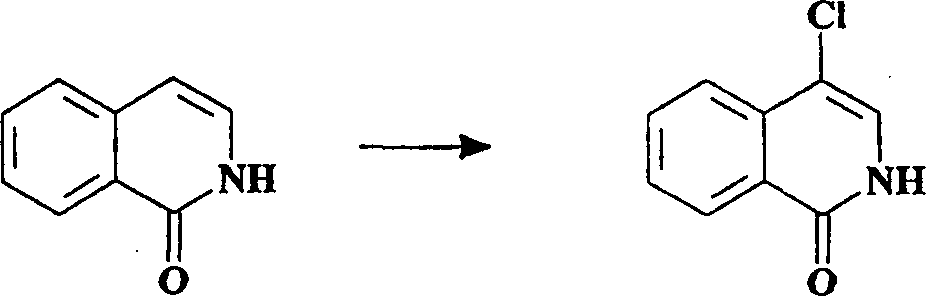
With N-chlorosuccinimide (9.66g, acetonitrile 72mmol) (MeCN) (80mL) drips of solution be added in the stirring, the 1-of reflux (2H)-isoquinolines (10g is in acetonitrile 69mmol) (250mL) solution.Mixture is continued reflux 1.5 hours, be cooled to room temperature then.Filter to collect formed precipitation, with the acetonitrile flushing, then vacuum-drying obtain lightpink solid state 4-chloro-1 (2H)-isoquinolines (11.3g, 62.9mmol).
1H(DMSO-d
6,300MHz)δ7.5(1H,s),7.6(1H,dd),7.8-7.9(2H,m),8.25(1H,d),11.5(1H,br?s),ppm.LRMS?180,182(MH
+),359,361,363(M
2H
+).
(ii)
Under 0 ℃, with 4-chloro-1 (2H)-isoquinolines (20.62g, 115mmol) join in batches chlorsulfonic acid under stirring (61mL, 918mmol) in.This mixture in 100 ℃ of heating 3.5 days, is cooled to room temperature then.It is [careful to divide aliquot to join in the frozen water reaction mixture! ] and filter and collect formed precipitation.Solid is washed with water, with acetonitrile develop vacuum-drying then obtain Off-white solid shape 4-chloro-7-chlorosulfonyl-1 (2H)-isoquinolines (1 8.75g, 67.4mmol).
1H(DMSO-d
6,400MHz)δ7.45(1H,s),7.8(1H,d),8.0(1H,d),8.5(1H,s),11.5(1H,br?s)ppm.
Measured value: C, 39.37; H, 2.09; N, 4.94.Calculated value (C
9H
5Cl
2NO
3S): C, 38.87; H, 1.81; N, 5.04.
(iii)
Under the room temperature, with phosphorus oxychloride (POCl
3) (9.65mL, (22.1g in acetonitrile 79.6mmol) (500mL) suspension, refluxes mixture heating up 15 hours then 103.5mmol) to join 4-chloro-7-chlorosulfonyl-1-(2H)-isoquinolines in the stirring.After the cooling, acetonitrile solution is separated with insoluble precipitate and vacuum-evaporation by decantation.Resistates is obtained solid with hot ethyl acetate extraction and evaporation, this solid is at room temperature stirred with ether (1.2L) spend the night.By decantation with diethyl ether solution separate with insolubles and vacuum-evaporation obtain light yellow solid shape 7-chlorosulfonyl-1,4-dichloro isoquinoline 99.9 (20g, 67mmol).
1H(DMSO-d
6,400MHz)δ8.2(2H,s),8.5(1H,s),8.55(1H,s)ppm.
Ultimate analysis: measured value: C, 37.19; H, 1.34; N, 4.77.Calculated value (C
9H
4Cl
3NO
2S): C, 36.45; H, 1.36; N, 4.72.
Preparation example 68:1,4-two chloro-7-sulfamyl isoquinoline 99.9
With 7-chlorosulfonyl-1, (110mg 0.37mmol) is dissolved in saturated methanol ammonia (NH to 4-dichloro isoquinoline 99.9
3) in the solution (10mL) and with this solution stirring at room 1.5 hours.The vacuum steaming desolventizes and with resistates and methylene dichloride azeotropic, distributes between ethyl acetate and water then.With organic phase salt water washing, dry (sal epsom) and vacuum-evaporation obtain white solid 1, and 4-two chloro-7-sulfamyl isoquinoline 99.9 (98mg, 0.35mmol).
1H(DMSO-d
6,400MHz)δ7.8(2H,s),8.35(1H,d),8.45(1H,d),8.6(1H,s),8.75(1H,s)ppm.LRMS?276,278(MH
+).
Preparation example 69:7-cyclopentyl sulfamyl-1,4-two chloro-isoquinoline 99.9

With cyclopentyl amine (0.10mL, 1.0mmol), (0.17mL, 1.2mmol) and 7-chlorosulfonyl-1, (250mg, 0.84mmol) mixture in methylene dichloride (15mL) stirred 18 hours in 23 ℃ 4-dichloro isoquinoline 99.9 triethylamine.Mixture with methylene dichloride (30mL) dilution, is used dilute hydrochloric acid (2M), saturated sodium bicarbonate (NaHCO
3) aqueous solution and salt water washing, dry (sal epsom) and vacuum-evaporation obtain the white solid title compound (250mg, 0.72mmol).
M.P.165-167 ℃ (decomposition)
1H (CDCl
3, 300MHz) δ 1.3-1.95 (8H, m), 3.75 (1H, sextet), 4.6 (1H, d), 8.2 (1H, d), 8.4 (1H, d), 8.5 (1H, s), 8.9 (1H, s) ppm.LRMS 346 (MH
+).
Ultimate analysis: measured value: C, 48.76; H, 4.04; N, 7.98.Calculated value (C
14H
14Cl
2N
2O
2S): C, 48.71; H, 4.09; N, 8.11.
Preparation example 70:1,4-two chloro-7-pyrrolidyl alkylsulfonyl-isoquinoline 99.9

Title compound is according to preparing with preparation example 69 similar methods.mp?197-199℃.
1H(CDCl
3,300MHz)δ1.8(4H,m),3.4(4H,m),8.2(1H,d),8.4(1H,d),8.5(1H,s),8.8(1H,s)ppm.LRMS?331,333(MH
+).
Ultimate analysis: measured value: C, 47.23; H, 3.60; N, 8.32.Calculated value (C
13H
12Cl
2N
2O
2S): C, 47.14; H, 3.65; N, 8.46.
Preparation example 71:1.4-two chloro-7-morpholino alkylsulfonyl isoquinoline 99.9

Title compound is according to preparing with preparation example 69 similar methods.mp?170-171℃.
1H(CDCl
3,400MHz)δ3.1(4H,s),3.8(4H,s),8.1(1H,d),8.4(1H,s),8.5(1H,d),8.8(1H,s)ppm.LRMS?347,349(MH
+).
Ultimate analysis: measured value: C, 44.90; H, 3.43; N, 7.83.Calculated value (C
13H
12Cl
2N
2O
3S): C, 44.97; H, 3.48; N, 8.07.Preparation example 72:1,4-two chloro-7-(N methyl piperazine base) alkylsulfonyl isoquinoline hydrochloride

The salt of title is according to preparing with preparation example 69 similar methods.mp?260.5-261.5℃.
1H(CDCl
3,400MHz)δ2.8(3H,s),3.1(2H,br?s),3.5(4H,br?m),4.0(2H,br?d),8.1(1H,d),8.4(1H,d),8.5(1H,s),8.8(1H,s),13.5(1H,br?s)ppm.LRMS?360,362(MH
+).
Ultimate analysis: measured value: C, 41.93; H, 4.15; N, 10.08.Calculated value (C
14H
15Cl
2N
3O
2SHCl0.4H
2O): C, 41.63; H, 4.19; N, 10.40.
Preparation example 73:7-bromo-4-chloro-1 (2H)-isoquinolines

(4.13g, acetonitrile 31mmol) (50mL) drips of solution is added to 7-bromo-1 in the stirring, reflux (2H)-isoquinolines, and (6.6g is in acetonitrile 29.5mmol) (150mL) solution with N-chlorosuccinimide.This mixture is continued reflux 3 hours, be cooled to room temperature then.Filter to collect formed precipitation, with the acetonitrile flushing, then vacuum-drying obtain white solid 7-bromo-4-chloro-1 (2H)-isoquinolines (6.72g, 26.0mmol).
mp?241-243℃.
1H(DMSO-d
6,300MHz)δ7.5(1H,s),7.73(1H,d),7.8(1H,dd),8.3(1H,s)ppm.
LRMS?259(MH
+),517(M
2H
+).
Ultimate analysis: measured value: C, 41.69; H, 1.90; N, 5.37.Calculated value (C
9H
5BrClNO): C, 41.80; H, 1.95; N, 5.42.
Preparation example 74:4-chloro-7-(thiophenyl)-1 (2H)-isoquinolines

Under nitrogen atmosphere and 0 ℃, with sodium hydride (45mg, 80% mineral oil dispersion liquid, (390mg stirs in THF 1.5mmol) (15mL) solution and with this mixture and obtained transparent orange solution in 5-10 minute 1.5mmol) to join 7-bromo-4-chloro-1 (2H)-isoquinolines in the stirring.This solution is cooled to-78 ℃, and (1.5mmol) solution also continues this solution to stir 15 minutes for 0.60mL, the hexane solution of 2.5M to drip n-butyllithium solution.Add S-phenyl benzene sulfo-iodate (PhSO
2SPh) (378mg, THF 1.5mmol) (5mL) solution in-70 ℃ of stirrings 10 minutes, slowly are warming up to room temperature with this solution then.Add entry (30mL) and with mixture with ethyl acetate extraction (3 * 20mL).With organic extract liquid water and the salt water washing that merges, dry (sodium sulfate) and vacuum-evaporation.Resistates by silica gel chromatography, is used methylene chloride-methanol-0.880NH
3(95: 5: 0.5) wash-out, then with re-crystallizing in ethyl acetate obtain white solid 4-chloro-7-(thiophenyl)-1 (2H)-isoquinolines (186mg, 0.64mmol).From mother liquor, reclaim obtain second batch of product (40mg, 0.14mmol).
1H(DMSO-d
6,300MHz)δ7.35-7.5(6H,m),7.7(1H,d),7.8(1H,d),8.0(1H,s)ppm.LRMS?288,290(MH
+),575(M
2H
+).
Ultimate analysis: measured value: C, 61.85; H, 3.48; N, 4.81.Calculated value (C
15H
10ClNOS0.25H
2O): C, 61.64; H, 3.62; N, 4.79.Preparation example 75:1.4-two chloro-7-(thiophenyl) isoquinoline 99.9

With POCl
3(46 μ L, (120mg in acetonitrile 0.42mmol) (2mL) suspension, refluxes mixture heating up then and obtained clear solution in 1.5 hours 0.50mmol) to join 4-chloro-7-(thiophenyl)-1-(2H)-isoquinolines in the stirring under 23 ℃.Cooled solution is poured in the water (20mL), then with mixture ethyl acetate extraction (3 times).With the organic extract liquid salt water washing that merges, dry (sodium sulfate) and vacuum-evaporation.Resistates by silica gel chromatography, is obtained buttery 1 with hexane-ethyl acetate (90: 10) wash-out, and (92mg, 0.30mmol), this oily matter solidifies when placing 4-two chloro-7-(thiophenyl)-isoquinoline 99.9.
1H(CDCl
3,300MHz)δ7.45(3H,m),7.55(2H,m),7.65(1H,dd),8.1(1H,d),8.1(1H,s),8.3(1H,s)ppm.
LRMS?306,308(MH
+)。
Ultimate analysis: measured value: C, 57.90; H, 2.99; N, 4.67.Calculated value (C
15H
9Cl
2NS0.25H
2O): C, 57.98; H, 3.08; N, 4.51.
Preparation example 76:1,4-two chloro-7-(phenyl sulfonyl) isoquinoline 99.9
(270mg, 50-55wt% 0.78mmol) join 1 in the stirring under 23 ℃, (120mg stirred 4 hours in methylene dichloride 0.39mmol) (20mL) solution and with this mixture 4-two chloro-7-(thiophenyl)-isoquinoline 99.9 with mCPBA.With solution sodium bicarbonate aqueous solution (3 times, 10%) and salt water washing, dry (sodium sulfate) and vacuum-evaporation.Resistates by silica gel chromatography, is obtained white solid 1 with methylene dichloride-isopropyl ether crystallization then with hexane-ethyl acetate (70: 30) wash-out, and 4-two chloro-7-(phenyl sulfonyl)-isoquinoline 99.9 (87mg, 0.25mmol).
1H(CDCl
3,300MHz)δ7.5-7.7(3H,m),8.05(2H,d),8.15(1H,d),8.35(1H,d),8.5(1H,s),9.05(1H,s)ppm.LRMS?338,340(MH
+).
Ultimate analysis: measured value: C, 52.55; H, 2.59; N, 4.10.Calculated value (C
15H
9Cl
2NO
2S0.25H
2O): C, 52.56; H, 2.79; N, 4.09.
Claims (32)


Applications Claiming Priority (2)
| Application Number | Priority Date | Filing Date | Title |
|---|---|---|---|
| GB9721964.6 | 1997-10-16 | ||
| GBGB9721964.6A GB9721964D0 (en) | 1997-10-16 | 1997-10-16 | Isoquinolines |
Publications (1)
| Publication Number | Publication Date |
|---|---|
| CN1275979A true CN1275979A (en) | 2000-12-06 |
Family
ID=10820680
Family Applications (1)
| Application Number | Title | Priority Date | Filing Date |
|---|---|---|---|
| CN98810108A Pending CN1275979A (en) | 1997-10-16 | 1998-10-05 | Isoquinoline compounds useful as urokinase inhibitors |
Country Status (41)
| Country | Link |
|---|---|
| US (1) | US6248738B1 (en) |
| EP (1) | EP1023268B1 (en) |
| JP (1) | JP3600794B2 (en) |
| KR (1) | KR20010031163A (en) |
| CN (1) | CN1275979A (en) |
| AP (1) | AP959A (en) |
| AR (1) | AR015964A1 (en) |
| AT (1) | ATE240943T1 (en) |
| AU (1) | AU727315B2 (en) |
| BG (1) | BG104328A (en) |
| BR (1) | BR9812922A (en) |
| CA (1) | CA2306782C (en) |
| CO (1) | CO4990959A1 (en) |
| DE (1) | DE69814894T2 (en) |
| DK (1) | DK1023268T3 (en) |
| DZ (1) | DZ2624A1 (en) |
| EA (1) | EA002632B1 (en) |
| ES (1) | ES2197514T3 (en) |
| GB (1) | GB9721964D0 (en) |
| GT (1) | GT199800159A (en) |
| HN (1) | HN1998000158A (en) |
| HR (1) | HRP20000217A2 (en) |
| HU (1) | HUP0004491A3 (en) |
| ID (1) | ID23913A (en) |
| IL (1) | IL135122A0 (en) |
| IS (1) | IS5412A (en) |
| MA (1) | MA26552A1 (en) |
| NO (1) | NO20001924L (en) |
| NZ (1) | NZ503390A (en) |
| OA (1) | OA11348A (en) |
| PA (1) | PA8461601A1 (en) |
| PE (1) | PE121299A1 (en) |
| PL (1) | PL340035A1 (en) |
| PT (1) | PT1023268E (en) |
| SK (1) | SK4872000A3 (en) |
| TN (1) | TNSN98185A1 (en) |
| TR (1) | TR200001010T2 (en) |
| UY (2) | UY25211A1 (en) |
| WO (1) | WO1999020608A1 (en) |
| YU (1) | YU21100A (en) |
| ZA (1) | ZA989412B (en) |
Cited By (4)
| Publication number | Priority date | Publication date | Assignee | Title |
|---|---|---|---|---|
| CN106831575A (en) * | 2017-02-13 | 2017-06-13 | 北京六合宁远科技有限公司 | A kind of preparation method of the methyl alcohol of 1 aminoisoquinoline 6 |
| CN110214136A (en) * | 2016-12-21 | 2019-09-06 | 詹森药业有限公司 | Pyrazole derivatives as MALT1 inhibitor |
| CN113877483A (en) * | 2021-07-20 | 2022-01-04 | 烟台宁远药业有限公司 | Low-temperature continuous synthesis device and method for pharmaceutical intermediate halogenated isoquinoline boric acid |
| CN115286573A (en) * | 2022-08-04 | 2022-11-04 | 常州工程职业技术学院 | A kind of green synthesis method of 1-alkoxy isoquinoline compound |
Families Citing this family (14)
| Publication number | Priority date | Publication date | Assignee | Title |
|---|---|---|---|---|
| WO2000005214A2 (en) * | 1998-07-24 | 2000-02-03 | Pfizer Inc. | Isoquinolines as urokinase inhibitors |
| DE19940389A1 (en) * | 1999-08-25 | 2001-03-01 | Wilex Biotechnology Gmbh | Selective inhibitors of the urokinase plasminogen activator |
| ES2172376B1 (en) * | 2000-01-28 | 2003-11-16 | Servier Lab | NEW DERIVATIVES OF ISOQUINOLEINS, ITS PREPARATION PROCEDURE AND THE PHARMACEUTICAL COMPOSITIONS CONTAINING THEM. |
| DE10013715A1 (en) | 2000-03-20 | 2001-09-27 | Wilex Biotechnology Gmbh | New aryl-guanidines with side-chains comprising hydrogen bond donor and acceptor groups, are selective urokinase plasminogen activator inhibitors useful for treating tumors or tumor metastasis |
| GB0026490D0 (en) * | 2000-10-30 | 2000-12-13 | Pfizer Ltd | Process |
| EP2036891A3 (en) * | 2001-06-11 | 2009-03-25 | Vertex Pharmaceuticals Incorporated | Isoquinoline inhibitors of P38 |
| RU2359967C2 (en) | 2002-05-28 | 2009-06-27 | Джонсон энд Джонсон Фамэсьютикэл Рисеч энд Дивелопмент, эЛ.эЛ.Си | Derivatives of thiophen and pharmaceutical composiiton (versions) |
| WO2004046115A1 (en) * | 2002-11-20 | 2004-06-03 | Japan Tobacco Inc. | 4-oxoquinoline compounds and utilization thereof as hiv integrase inhibitors |
| GB0326964D0 (en) * | 2003-11-19 | 2003-12-24 | Glaxo Group Ltd | Chemical compounds |
| WO2005113509A1 (en) * | 2004-05-20 | 2005-12-01 | Japan Tobacco Inc. | Novel 4-oxoquinoline compound and use thereof as hiv integrase inhibitor |
| MY134672A (en) * | 2004-05-20 | 2007-12-31 | Japan Tobacco Inc | Stable crystal of 4-oxoquinoline compound |
| JP5066443B2 (en) * | 2005-02-25 | 2012-11-07 | 興和株式会社 | Process for producing 4-fluoroisoquinoline-5-sulfonyl halide or a salt thereof |
| EP2087885A1 (en) | 2005-06-24 | 2009-08-12 | Wilex AG | Use of urokinase inhibitors for the treatment and /or prevention of neuropathological diseases |
| KR101023635B1 (en) * | 2006-03-06 | 2011-03-22 | 니뽄 다바코 산교 가부시키가이샤 | Method for preparing 4-oxoquinoline compound |
-
1997
- 1997-10-16 GB GBGB9721964.6A patent/GB9721964D0/en not_active Ceased
-
1998
- 1998-10-05 YU YU21100A patent/YU21100A/en unknown
- 1998-10-05 AT AT98954357T patent/ATE240943T1/en not_active IP Right Cessation
- 1998-10-05 EP EP98954357A patent/EP1023268B1/en not_active Expired - Lifetime
- 1998-10-05 HR HR20000217A patent/HRP20000217A2/en not_active Application Discontinuation
- 1998-10-05 NZ NZ503390A patent/NZ503390A/en unknown
- 1998-10-05 PL PL98340035A patent/PL340035A1/en unknown
- 1998-10-05 US US09/424,497 patent/US6248738B1/en not_active Expired - Fee Related
- 1998-10-05 DE DE69814894T patent/DE69814894T2/en not_active Expired - Fee Related
- 1998-10-05 ID IDW20000691A patent/ID23913A/en unknown
- 1998-10-05 HU HU0004491A patent/HUP0004491A3/en unknown
- 1998-10-05 WO PCT/EP1998/006353 patent/WO1999020608A1/en not_active Ceased
- 1998-10-05 KR KR1020007004083A patent/KR20010031163A/en not_active Abandoned
- 1998-10-05 DK DK98954357T patent/DK1023268T3/en active
- 1998-10-05 PT PT98954357T patent/PT1023268E/en unknown
- 1998-10-05 TR TR2000/01010T patent/TR200001010T2/en unknown
- 1998-10-05 SK SK487-2000A patent/SK4872000A3/en unknown
- 1998-10-05 EA EA200000320A patent/EA002632B1/en not_active IP Right Cessation
- 1998-10-05 ES ES98954357T patent/ES2197514T3/en not_active Expired - Lifetime
- 1998-10-05 IL IL13512298A patent/IL135122A0/en unknown
- 1998-10-05 CN CN98810108A patent/CN1275979A/en active Pending
- 1998-10-05 BR BR9812922-8A patent/BR9812922A/en not_active Application Discontinuation
- 1998-10-05 JP JP2000516950A patent/JP3600794B2/en not_active Expired - Fee Related
- 1998-10-05 CA CA002306782A patent/CA2306782C/en not_active Expired - Fee Related
- 1998-10-05 AU AU11508/99A patent/AU727315B2/en not_active Ceased
- 1998-10-08 HN HN1998000158A patent/HN1998000158A/en unknown
- 1998-10-09 GT GT199800159A patent/GT199800159A/en unknown
- 1998-10-12 PA PA19988461601A patent/PA8461601A1/en unknown
- 1998-10-14 DZ DZ980234A patent/DZ2624A1/en active
- 1998-10-14 TN TNTNSN98185A patent/TNSN98185A1/en unknown
- 1998-10-14 MA MA25298A patent/MA26552A1/en unknown
- 1998-10-14 AR ARP980105113A patent/AR015964A1/en not_active Application Discontinuation
- 1998-10-15 UY UY25211A patent/UY25211A1/en unknown
- 1998-10-15 PE PE1998000973A patent/PE121299A1/en not_active Application Discontinuation
- 1998-10-15 ZA ZA9809412A patent/ZA989412B/en unknown
- 1998-10-16 CO CO98060365A patent/CO4990959A1/en unknown
- 1998-10-19 AP APAP/P/1998/001366A patent/AP959A/en active
- 1998-12-08 UY UY25291A patent/UY25291A1/en not_active IP Right Cessation
-
2000
- 2000-03-21 IS IS5412A patent/IS5412A/en unknown
- 2000-04-07 OA OA1200000102A patent/OA11348A/en unknown
- 2000-04-11 BG BG104328A patent/BG104328A/en unknown
- 2000-04-13 NO NO20001924A patent/NO20001924L/en unknown
Cited By (7)
| Publication number | Priority date | Publication date | Assignee | Title |
|---|---|---|---|---|
| CN110214136A (en) * | 2016-12-21 | 2019-09-06 | 詹森药业有限公司 | Pyrazole derivatives as MALT1 inhibitor |
| US12077521B2 (en) | 2016-12-21 | 2024-09-03 | Janssen Pharmaceutica Nv | Pyrazole derivatives as MALT1 inhibitors |
| CN106831575A (en) * | 2017-02-13 | 2017-06-13 | 北京六合宁远科技有限公司 | A kind of preparation method of the methyl alcohol of 1 aminoisoquinoline 6 |
| CN106831575B (en) * | 2017-02-13 | 2019-04-16 | 北京六合宁远科技有限公司 | A kind of preparation method of 1- aminoisoquinoline -6- methanol |
| CN113877483A (en) * | 2021-07-20 | 2022-01-04 | 烟台宁远药业有限公司 | Low-temperature continuous synthesis device and method for pharmaceutical intermediate halogenated isoquinoline boric acid |
| CN113877483B (en) * | 2021-07-20 | 2023-11-24 | 烟台宁远药业有限公司 | Low-temperature continuous synthesis device and method for pharmaceutical intermediate halogenated isoquinoline boric acid |
| CN115286573A (en) * | 2022-08-04 | 2022-11-04 | 常州工程职业技术学院 | A kind of green synthesis method of 1-alkoxy isoquinoline compound |
Also Published As
Similar Documents
| Publication | Publication Date | Title |
|---|---|---|
| CN1207289C (en) | Metalloprotease inhibitors, pharmaceutical compositions containing them and their pharmaceutical use, preparation methods and intermediates thereof | |
| CN1183119C (en) | Arylpiperazines as metalloproteinase inhibitors (MMPs) and their use | |
| CN1274676C (en) | Quinoline and quinazoline derivatives | |
| CN1168721C (en) | 5-cyano-2-aminopyrimidine derivatives | |
| CN1184208C (en) | Substituted benzimidazoles and their preparation and use | |
| CN1115336C (en) | 1-phenyl-benzimidazole compounds and their use as BAGA-A receptor modulator | |
| CN1310907C (en) | Heterocyclic compound and antitumour agent containing the same as active ingredient | |
| CN1093125C (en) | Sulfamide-metalloprotease inhibitors | |
| CN1396833A (en) | Integrin expression inhibitors | |
| CN1454211A (en) | Nitrogen containing heterobicycles as factor xa inhibitors | |
| CN1543346A (en) | new compound | |
| CN1230187A (en) | Bicyclic heteroaromatic compounds as protein tyrosine kinase inhibitors | |
| CN1353695A (en) | Heterocyclically substituted benzimidazoles, production and application thereof | |
| CN1237961A (en) | Aminoguanidines and alkoxyguanidines as protease inhibitors | |
| CN1636992A (en) | Process for producing quinazoline ditosylate salt compounds | |
| CN1134148A (en) | Antithrombotic derivatives of amidinophenylalanine and amidinopyridinealanine | |
| CN1260781A (en) | Indole derivatives having combined 5HT1A, 5HT1B and 5HT1D receptor antagoinist activity | |
| CN1070173C (en) | Benzoylguanidine derivatives used as medicines | |
| CN1140709A (en) | Substituted N-(indole-2-carbonyl)-β-alaninamides and their derivatives as antidiabetic agents | |
| CN1290264A (en) | Triazine angiogenesis inhibitors | |
| CN1127498C (en) | Pyridine derivatives, process for preparing the same, and intermediate therefor | |
| CN1138581A (en) | Substituted biphenylsulfonamide endothelin antagonists | |
| CN1960979A (en) | Triazolone derivatives as MMP inhibitors for the treatment of asthma and copd | |
| CN1098260C (en) | 2,4-diaminopyrimidine derivatives | |
| CN1531537A (en) | Novel tricyclic pyridyl benzazepine carboxyamides and derivatives their tocolytic oxytocin leceptor antagonists |
Legal Events
| Date | Code | Title | Description |
|---|---|---|---|
| C06 | Publication | ||
| PB01 | Publication | ||
| C10 | Entry into substantive examination | ||
| SE01 | Entry into force of request for substantive examination | ||
| C02 | Deemed withdrawal of patent application after publication (patent law 2001) | ||
| WD01 | Invention patent application deemed withdrawn after publication | ||
| REG | Reference to a national code |
Ref country code: HK Ref legal event code: WD Ref document number: 1033130 Country of ref document: HK |