CN1286663A - Load leveling yarns and webbings - Google Patents
Load leveling yarns and webbings Download PDFInfo
- Publication number
- CN1286663A CN1286663A CN97182175A CN97182175A CN1286663A CN 1286663 A CN1286663 A CN 1286663A CN 97182175 A CN97182175 A CN 97182175A CN 97182175 A CN97182175 A CN 97182175A CN 1286663 A CN1286663 A CN 1286663A
- Authority
- CN
- China
- Prior art keywords
- yarn
- dawn
- fabric
- gram
- pet
- Prior art date
- Legal status (The legal status is an assumption and is not a legal conclusion. Google has not performed a legal analysis and makes no representation as to the accuracy of the status listed.)
- Granted
Links
Images


Classifications
-
- D—TEXTILES; PAPER
- D03—WEAVING
- D03D—WOVEN FABRICS; METHODS OF WEAVING; LOOMS
- D03D1/00—Woven fabrics designed to make specified articles
-
- D—TEXTILES; PAPER
- D01—NATURAL OR MAN-MADE THREADS OR FIBRES; SPINNING
- D01F—CHEMICAL FEATURES IN THE MANUFACTURE OF ARTIFICIAL FILAMENTS, THREADS, FIBRES, BRISTLES OR RIBBONS; APPARATUS SPECIALLY ADAPTED FOR THE MANUFACTURE OF CARBON FILAMENTS
- D01F6/00—Monocomponent artificial filaments or the like of synthetic polymers; Manufacture thereof
- D01F6/78—Monocomponent artificial filaments or the like of synthetic polymers; Manufacture thereof from copolycondensation products
- D01F6/84—Monocomponent artificial filaments or the like of synthetic polymers; Manufacture thereof from copolycondensation products from copolyesters
-
- B—PERFORMING OPERATIONS; TRANSPORTING
- B60—VEHICLES IN GENERAL
- B60R—VEHICLES, VEHICLE FITTINGS, OR VEHICLE PARTS, NOT OTHERWISE PROVIDED FOR
- B60R22/00—Safety belts or body harnesses in vehicles
- B60R22/12—Construction of belts or harnesses
-
- D—TEXTILES; PAPER
- D02—YARNS; MECHANICAL FINISHING OF YARNS OR ROPES; WARPING OR BEAMING
- D02J—FINISHING OR DRESSING OF FILAMENTS, YARNS, THREADS, CORDS, ROPES OR THE LIKE
- D02J1/00—Modifying the structure or properties resulting from a particular structure; Modifying, retaining, or restoring the physical form or cross-sectional shape, e.g. by use of dies or squeeze rollers
- D02J1/22—Stretching or tensioning, shrinking or relaxing, e.g. by use of overfeed and underfeed apparatus, or preventing stretch
-
- D—TEXTILES; PAPER
- D03—WEAVING
- D03D—WOVEN FABRICS; METHODS OF WEAVING; LOOMS
- D03D1/00—Woven fabrics designed to make specified articles
- D03D1/0005—Woven fabrics for safety belts
-
- D—TEXTILES; PAPER
- D03—WEAVING
- D03D—WOVEN FABRICS; METHODS OF WEAVING; LOOMS
- D03D15/00—Woven fabrics characterised by the material, structure or properties of the fibres, filaments, yarns, threads or other warp or weft elements used
- D03D15/20—Woven fabrics characterised by the material, structure or properties of the fibres, filaments, yarns, threads or other warp or weft elements used characterised by the material of the fibres or filaments constituting the yarns or threads
- D03D15/283—Woven fabrics characterised by the material, structure or properties of the fibres, filaments, yarns, threads or other warp or weft elements used characterised by the material of the fibres or filaments constituting the yarns or threads synthetic polymer-based, e.g. polyamide or polyester fibres
-
- D—TEXTILES; PAPER
- D03—WEAVING
- D03D—WOVEN FABRICS; METHODS OF WEAVING; LOOMS
- D03D15/00—Woven fabrics characterised by the material, structure or properties of the fibres, filaments, yarns, threads or other warp or weft elements used
- D03D15/50—Woven fabrics characterised by the material, structure or properties of the fibres, filaments, yarns, threads or other warp or weft elements used characterised by the properties of the yarns or threads
- D03D15/573—Tensile strength
-
- D—TEXTILES; PAPER
- D10—INDEXING SCHEME ASSOCIATED WITH SUBLASSES OF SECTION D, RELATING TO TEXTILES
- D10B—INDEXING SCHEME ASSOCIATED WITH SUBLASSES OF SECTION D, RELATING TO TEXTILES
- D10B2331/00—Fibres made from polymers obtained otherwise than by reactions only involving carbon-to-carbon unsaturated bonds, e.g. polycondensation products
- D10B2331/04—Fibres made from polymers obtained otherwise than by reactions only involving carbon-to-carbon unsaturated bonds, e.g. polycondensation products polyesters, e.g. polyethylene terephthalate [PET]
-
- D—TEXTILES; PAPER
- D10—INDEXING SCHEME ASSOCIATED WITH SUBLASSES OF SECTION D, RELATING TO TEXTILES
- D10B—INDEXING SCHEME ASSOCIATED WITH SUBLASSES OF SECTION D, RELATING TO TEXTILES
- D10B2331/00—Fibres made from polymers obtained otherwise than by reactions only involving carbon-to-carbon unsaturated bonds, e.g. polycondensation products
- D10B2331/04—Fibres made from polymers obtained otherwise than by reactions only involving carbon-to-carbon unsaturated bonds, e.g. polycondensation products polyesters, e.g. polyethylene terephthalate [PET]
- D10B2331/041—Fibres made from polymers obtained otherwise than by reactions only involving carbon-to-carbon unsaturated bonds, e.g. polycondensation products polyesters, e.g. polyethylene terephthalate [PET] derived from hydroxy-carboxylic acids, e.g. lactones
-
- D—TEXTILES; PAPER
- D10—INDEXING SCHEME ASSOCIATED WITH SUBLASSES OF SECTION D, RELATING TO TEXTILES
- D10B—INDEXING SCHEME ASSOCIATED WITH SUBLASSES OF SECTION D, RELATING TO TEXTILES
- D10B2331/00—Fibres made from polymers obtained otherwise than by reactions only involving carbon-to-carbon unsaturated bonds, e.g. polycondensation products
- D10B2331/04—Fibres made from polymers obtained otherwise than by reactions only involving carbon-to-carbon unsaturated bonds, e.g. polycondensation products polyesters, e.g. polyethylene terephthalate [PET]
- D10B2331/042—Fibres made from polymers obtained otherwise than by reactions only involving carbon-to-carbon unsaturated bonds, e.g. polycondensation products polyesters, e.g. polyethylene terephthalate [PET] aromatic polyesters, e.g. vectran
-
- Y—GENERAL TAGGING OF NEW TECHNOLOGICAL DEVELOPMENTS; GENERAL TAGGING OF CROSS-SECTIONAL TECHNOLOGIES SPANNING OVER SEVERAL SECTIONS OF THE IPC; TECHNICAL SUBJECTS COVERED BY FORMER USPC CROSS-REFERENCE ART COLLECTIONS [XRACs] AND DIGESTS
- Y10—TECHNICAL SUBJECTS COVERED BY FORMER USPC
- Y10T—TECHNICAL SUBJECTS COVERED BY FORMER US CLASSIFICATION
- Y10T428/00—Stock material or miscellaneous articles
- Y10T428/29—Coated or structually defined flake, particle, cell, strand, strand portion, rod, filament, macroscopic fiber or mass thereof
-
- Y—GENERAL TAGGING OF NEW TECHNOLOGICAL DEVELOPMENTS; GENERAL TAGGING OF CROSS-SECTIONAL TECHNOLOGIES SPANNING OVER SEVERAL SECTIONS OF THE IPC; TECHNICAL SUBJECTS COVERED BY FORMER USPC CROSS-REFERENCE ART COLLECTIONS [XRACs] AND DIGESTS
- Y10—TECHNICAL SUBJECTS COVERED BY FORMER USPC
- Y10T—TECHNICAL SUBJECTS COVERED BY FORMER US CLASSIFICATION
- Y10T428/00—Stock material or miscellaneous articles
- Y10T428/29—Coated or structually defined flake, particle, cell, strand, strand portion, rod, filament, macroscopic fiber or mass thereof
- Y10T428/2913—Rod, strand, filament or fiber
-
- Y—GENERAL TAGGING OF NEW TECHNOLOGICAL DEVELOPMENTS; GENERAL TAGGING OF CROSS-SECTIONAL TECHNOLOGIES SPANNING OVER SEVERAL SECTIONS OF THE IPC; TECHNICAL SUBJECTS COVERED BY FORMER USPC CROSS-REFERENCE ART COLLECTIONS [XRACs] AND DIGESTS
- Y10—TECHNICAL SUBJECTS COVERED BY FORMER USPC
- Y10T—TECHNICAL SUBJECTS COVERED BY FORMER US CLASSIFICATION
- Y10T428/00—Stock material or miscellaneous articles
- Y10T428/29—Coated or structually defined flake, particle, cell, strand, strand portion, rod, filament, macroscopic fiber or mass thereof
- Y10T428/2913—Rod, strand, filament or fiber
- Y10T428/2915—Rod, strand, filament or fiber including textile, cloth or fabric
-
- Y—GENERAL TAGGING OF NEW TECHNOLOGICAL DEVELOPMENTS; GENERAL TAGGING OF CROSS-SECTIONAL TECHNOLOGIES SPANNING OVER SEVERAL SECTIONS OF THE IPC; TECHNICAL SUBJECTS COVERED BY FORMER USPC CROSS-REFERENCE ART COLLECTIONS [XRACs] AND DIGESTS
- Y10—TECHNICAL SUBJECTS COVERED BY FORMER USPC
- Y10T—TECHNICAL SUBJECTS COVERED BY FORMER US CLASSIFICATION
- Y10T442/00—Fabric [woven, knitted, or nonwoven textile or cloth, etc.]
- Y10T442/30—Woven fabric [i.e., woven strand or strip material]
- Y10T442/3179—Woven fabric is characterized by a particular or differential weave other than fabric in which the strand denier or warp/weft pick count is specified
- Y10T442/322—Warp differs from weft
- Y10T442/3228—Materials differ
- Y10T442/326—Including synthetic polymeric strand material
- Y10T442/3285—Including polyester strand material
Landscapes
- Engineering & Computer Science (AREA)
- Textile Engineering (AREA)
- Mechanical Engineering (AREA)
- Chemical & Material Sciences (AREA)
- Chemical Kinetics & Catalysis (AREA)
- General Chemical & Material Sciences (AREA)
- Artificial Filaments (AREA)
- Woven Fabrics (AREA)
- Yarns And Mechanical Finishing Of Yarns Or Ropes (AREA)
- Emergency Lowering Means (AREA)
- Automotive Seat Belt Assembly (AREA)
Abstract
本发明提供了包括经纱的负荷平衡和冲击能量吸收织物。如果将所述织物用于安全带,当发生撞车时,该织物能提供大约450磅(约2000牛顿)—大约1800磅(约8000牛顿)的负荷平衡能力。所述经纱包括若干纤维,所述所有的经纱都具有大体上相同的力转移曲线,所述纤维是由玻璃化温度为大约-40℃至大约+70℃的聚合物制成,而不是由聚对苯二甲酸丁二醇酯同聚物制成。
This invention provides a load-balancing and impact-absorbing fabric comprising warp yarns. When used in seatbelts, this fabric provides a load-balancing capacity of approximately 450 pounds (about 2000 Newtons) to approximately 1800 pounds (about 8000 Newtons) in the event of a crash. The warp yarns comprise a plurality of fibers, all of which have substantially the same force transfer profile, and are made from a polymer with a glass transition temperature of approximately -40°C to approximately +70°C, rather than from a polybutylene terephthalate homopolymer.
Description
本发明背景Background of the invention
典型的车用安全带系统被设计成当车辆经历突然的、急剧减速时,能限制乘员相对该乘员在车内的乘座位置的运动。参见共同转让的US3,322,163。一个典型的安全带系统具有三个主要部分:伸缩带、躯干带、和膝带,而每一个安全带可以力转移曲线为特征。位于所述力转移曲线下面的部分被视为由所述安全限制所吸收的能量。Typical vehicle seat belt systems are designed to restrict the movement of an occupant relative to the occupant's seating position within the vehicle when the vehicle experiences a sudden, sharp deceleration. See commonly assigned US 3,322,163. A typical harness system has three main parts: stretch straps, torso straps, and lap straps, and each harness can be characterized by a force transfer curve. The portion lying below the force transfer curve is considered to be the energy absorbed by the safety limit.
现有的车辆安全带是由充分拉伸的聚对苯二甲酸乙二醇酯(“PET”)纤维制成,这种纤维可部分放松(2.7%),其韧度为至少7.5克/旦,断裂伸长量为14%。不过,现有的PET纤维安全带存在着问题。撞车研究表明,在起始的车辆碰撞发生之后,例如(速度大约为35英里/小时),乘员偏向于由其乘座的位置向前移动,直到所系的安全带上产生约束力。如图1所示,由PET纤维制成的刚性较大的安全带,能在乘员身上产生至少2000磅(大约9000牛顿)的负荷,从而在所述安全带的躯干部位对乘员的胸部和胸廓产生伤害,而且,当乘员被重捆绑并且碰撞到座位装置的背部结构时,还会造成颈部和背部的伤害。Existing vehicle seat belts are made of fully stretched polyethylene terephthalate ("PET") fibers that are partially relaxed (2.7%) and have a tenacity of at least 7.5 g/denier , The elongation at break was 14%. However, existing PET fiber safety belts have problems. Crash studies have shown that after an initial vehicle crash, for example (at a speed of about 35 mph), occupants tend to move forward from their seated position until restraint occurs on the worn seat belt. As shown in Figure 1, a relatively rigid seat belt made of PET fibers can generate a load of at least 2,000 pounds (about 9,000 Newtons) on the occupant, thereby exerting pressure on the occupant's chest and thorax at the torso of the seat belt. Injuries, and also neck and back injuries can result when the occupant is heavily strapped and hits the back structure of the seating arrangement.
美国政府的规定,要求安全带必须能承受高达6000磅的负荷。当汽车以35英里/小时的速度撞车时,车中普通体型的人所受到的由躯干带产生的冲击能量至少为500焦耳。尽管现有的PET纤维能够吸收所述冲击能量,但由于不希望的力转移曲线仍然会对车辆乘员造成伤害。如图1所示,在70毫秒时间内,普通体型的乘客会经历高达2000磅(大约9000牛顿)的大力。U.S. government regulations require that seat belts must be able to withstand loads of up to 6,000 pounds. When a car crashes at 35 mph, an average-sized person in the car experiences at least 500 joules of impact energy from the torso belt. Although existing PET fibers are able to absorb said impact energy, injuries to vehicle occupants can still occur due to the undesired force transfer curve. As shown in Figure 1, an average sized passenger experiences a force of up to 2,000 pounds (approximately 9,000 Newtons) within 70 milliseconds.
为了吸收所述冲击能量,并降低作用于车辆乘员的安全带负荷,美国专利US3,550,957披露了一种安全肩带,该肩带具有由所述织物制成的缝合的两部分,这两部分被设置在乘员的肩部,以便所述线迹容许所述织物在预定约束力的影响下以控制的速度由原始长度向最终长度拉伸。不过,所述缝合部分不能产生所需要量的能量吸收,不能提供均匀的反应,并且不能再利用。同样参见US4,138,157。In order to absorb the impact energy and reduce the seat belt load on the vehicle occupant, US Pat. The two parts are positioned at the occupant's shoulders so that the stitches allow the fabric to stretch from an original length to a final length at a controlled rate under the influence of a predetermined restraining force. However, the stitched portion does not produce the required amount of energy absorption, does not provide a uniform response, and cannot be reused. See also US 4,138,157.
US3,530,904披露了一种纺织物,它是通过将具有不同物理特性和能量吸收能力的两种纱线交织在一起而制成的。美国专利US3,296,062;US3,464,459;US3,756,288;US3,823,748;US3,872,895;US3,926,227;US4,228,829;US5,376,440;和日本专利4-257336还披露了由多种具有不同韧度和断裂伸长量的经纱制成的织物。该织物具有多级松弛和冲击吸收特性。本技术领域的技术人员业已认识到使用至少两种不同类型纱线的缺陷,正如前面的参考文献所披露的。US4,710,423和昭开298209(1989年12月1日公开)(“公开298209”)披露,当使用至少两种不同类型的纱线时,能量吸收以阶梯方式进行,因此,该织物不能连续而又平滑的吸收能量。因此,在一种类型的经纱吸收一部分冲击能量之后,在另一种类型的经纱吸收另一部分冲击能量之前,人体会受到不希望的冲击。另外,这种类型的安全带不能重新利用。US 3,530,904 discloses a textile made by interweaving two yarns with different physical properties and energy absorption capabilities. US3,296,062; US3,464,459; US3,756,288; US3,823,748; US3,872,895; US3,926,227; US4,228,829; US5,376,440; and Japanese Patent No. 4-257336 also discloses fabrics made from a variety of warp yarns having different tenacities and elongations at break. The fabric has multi-level relaxation and impact absorption properties. Those skilled in the art have recognized the disadvantages of using at least two different types of yarns, as disclosed in the preceding references. US4,710,423 and Zhaokai 298209 (published on December 1, 1989) ("publication 298209") disclose that when at least two different types of yarns are used, energy absorption is performed in a stepwise manner, therefore, the fabric cannot Continuous and smooth absorption of energy. Thus, after one type of warp yarn absorbs a portion of the impact energy, and before the other type of warp yarn absorbs another portion of the impact energy, the body is subjected to an undesired impact. Additionally, this type of seat belt cannot be reused.
US3,486,791披露了诸如卷绕装置的能量吸收装置,该装置通过夹紧装置将安全带的缓冲部分与拉紧身体的限制部分分开,所述夹紧装置在预定约束力的作用下逐渐放出所述缓冲部分,以使所述拉紧部分伸长,使得受到约束的身体以控制的速度移动。该参考文献还披露了一种装置,该装置通过一个与安全带连接的固定件将安全带固定在车辆上,并且被埋入固体塑料能量吸收器中。这种类型的机械装置昂贵而且不能再利用,产生很小的能量吸收作用,并且难于控制。在普通转让的US5,547,143中披露了对上述装置的改进,该专利披露了一种负荷吸收伸缩器,它包括:一个旋转卷筒或卷轴,安全带织物就固定在该卷轴上。以及至少一个可移动的套环,该套环可相应在出现撞车时产生的负荷而运动,使所述卷轴的一部分发生变形,并在这一过程中消散一定量的能量。US3,486,791 discloses an energy absorbing device such as a winding device, which separates the cushioning part of the safety belt from the restricting part of the body by a clamping device, which gradually The cushioning portion is released to elongate the tensioning portion, allowing the constrained body to move at a controlled speed. This reference also discloses a device which secures the seat belt to the vehicle by means of a fastener connected to the seat belt and which is embedded in a solid plastic energy absorber. Mechanisms of this type are expensive, non-recyclable, produce little energy absorption, and are difficult to control. An improvement to the above arrangement is disclosed in commonly assigned US 5,547,143 which discloses a load absorbing retractor comprising: a rotating drum or reel on which the webbing is secured. and at least one movable collar which is movable in response to loads in the event of a crash to deform a portion of said spool and dissipate a certain amount of energy in the process.
US4,710,423和昭开298209披露了由PET纱线组成的织物,所述纱线的韧度至少为4克/旦,最大拉伸量为50%-80%。由于PET纱线所固有的物理特性,这些例子表明当伸长量为50%,负荷就已达到700kg(大约1500磅以上)。安全带对乘员的伤害仍然存在,因此,需要对安全带作进一步的改进。以上两件专利中的例子还表明,如果PET纱线过分松弛,其韧度会下降到2.3克/旦。US 4,710,423 and Zhaokai 298209 disclose fabrics composed of PET yarns having a tenacity of at least 4 g/denier and a maximum stretch of 50%-80%. Due to the inherent physical properties of PET yarns, these examples show a load of 700 kg (approximately over 1500 lbs) at an elongation of 50%. Seat belt still exists to the injury of occupant, therefore, need to do further improvement to safety belt. The examples in the above two patents also show that if the PET yarn relaxes too much, its tenacity will drop to 2.3 g/denier.
于1995年4月4日公开的昭开90717披露了基于高强度聚对苯二甲酸丁二醇酯同聚物(“PBT”)纤维的能量吸收织物。这种纤维的韧度超过5.8克/旦,断裂伸长量超过18.0%,而在10%伸长量时的张力低于3.0g/d。不过,该参考文献未能披露PBT纤维具有起始张力要求,该张力能结合安全带以保护乘员,并且没有披露控制所述起始张力保护的方法。Zhao Kai 90717, published April 4, 1995, discloses energy absorbing fabrics based on high strength polybutylene terephthalate homopolymer ("PBT") fibers. The tenacity of this fiber exceeds 5.8 g/d, the elongation at break exceeds 18.0%, and the tension at 10% elongation is less than 3.0 g/d. However, this reference fails to disclose that PBT fibers have an initial tension requirement that can be incorporated into a seat belt for occupant protection, and does not disclose a method of controlling said initial tension protection.
需要提供一种改进的能量吸收安全带,该安全带与用已知的缝合织物制成的安全带或至少两种不同纤维的已知用途相比具有更平滑的性能,而且与已知的夹紧方法不同,可以再利用,并具有控制起始保护张力和冲击能量吸收能力。There is a need to provide an improved energy absorbing safety belt which has a smoother performance than safety belts made from known stitched fabrics or known uses of at least two different fibers, and which has a smoother performance than known clips. Tightening method is different, can be reused, and has the ability to control the initial protection tension and impact energy absorption.
本发明概述SUMMARY OF THE INVENTION
我们业已开发出了针对本领域的上述需要的织物。该织物如果用于安全带,会在撞车时表现出从大约450磅(约2000牛顿)至大约1800磅(约8000牛顿)的不同负荷平衡能力。为了满足以上要求,构成该织物的经纱具有一定的力转移曲线,其特征为:(a)当所述纱线受到大约0.2克/旦至小于或等于大约1.4克/旦的起始保护应力时,纱线的伸长量低于3%,而起始模量的范围为大约20克/旦至大约150克/旦;(b)当所述纱线受到大于所述起始保护应力而小于或等于1.8克/旦的力时,该纱线会进一步伸长至少大约10%,而由0到伸长量为1.8克/旦时所吸收的能量至少是0.0008焦耳/旦·米;和(c)当所述纱线承受大于1.8克/旦的应力时,所述模量急剧增加,而所述纱线进一步伸长,直到该纱线在抗拉强度至少为大约5克/旦时断裂,其中,所述纱线包括若干纤维,所述所有经纱都具有大体上相同的力转移曲线,由玻璃化温度为大约-40℃至大约+70℃的聚合物制成,而不是由聚对苯二甲酸丁二醇酯同聚物制成。We have developed fabrics that address the above needs in the art. The fabric, if used in a seatbelt, would exhibit varying load balancing capabilities in a crash from about 450 pounds (about 2000 Newtons) to about 1800 pounds (about 8000 Newtons). In order to meet the above requirements, the warp yarns constituting the fabric have a certain force transfer curve, characterized by: (a) when said yarns are subjected to an initial protective stress of about 0.2 g/denier to less than or equal to about 1.4 g/denier , the yarn has an elongation of less than 3% and an initial modulus in the range of about 20 g/denier to about 150 g/denier; (b) when said yarn is subjected to a stress greater than said initial protective stress but less than or at a force equal to 1.8 g/denier, the yarn further elongates by at least about 10%, and the energy absorbed from zero to an elongation of 1.8 g/denier is at least 0.0008 J/dm; and ( c) when the yarn is subjected to a stress of greater than 1.8 g/denier, the modulus increases sharply and the yarn elongates further until the yarn breaks at a tensile strength of at least about 5 g/denier , wherein the yarn comprises several fibers, all of the warp yarns have substantially the same force transfer curve, are made of a polymer having a glass transition temperature of about -40°C to about +70°C, rather than being made of poly Made of butylene phthalate homopolymer.
本文所说的“模量”一词是指所述力转移曲线的斜率。The term "modulus" as used herein refers to the slope of the force transfer curve.
图2表示本发明纱线和织物之一的力转移曲线。所述起始保护应力在图2中用IBS表示。本发明织物的优点在于,与现有的缝合织物方法或已知的至少两种不同纤维的用途相比,它具有更好的冲击能量吸收和更平滑的性能,它与已知的夹紧方法不同,可以再利用,并且,还具有控制起始保护应力和冲击能量吸收的能力。Figure 2 shows the force transfer curve for one of the yarns and fabrics of the present invention. The initial protective stress is represented by IBS in FIG. 2 . The advantage of the fabric of the present invention is that it has better impact energy absorption and smoother properties than existing methods of seaming fabrics or the known use of at least two different fibers, compared to known methods of clamping Different, can be reused, and also has the ability to control the initial protection stress and impact energy absorption.
通过阅读下面的说明书、附图、和所附权利要求书,可以了解本发明的其它优点。Other advantages of the present invention will be apparent from a reading of the following specification, drawings, and appended claims.
附图的简要说明Brief description of the drawings
图1表示位于躯干部位的已知PET安全带的性能。Figure 1 shows the performance of a known PET safety belt in the torso region.
图2表示本发明纱线和织物之一的力转移曲线。Figure 2 shows the force transfer curve for one of the yarns and fabrics of the present invention.
图3表示本发明例3纱线的力转移曲线。Figure 3 shows the force transfer curve for the Example 3 yarn of the present invention.
图4表示本发明例4纱线的力转移曲线。Figure 4 shows the force transfer curve for the Example 4 yarn of the present invention.
图5表示本发明例5纱线的力转移曲线。Figure 5 shows the force transfer curve for the Example 5 yarn of the present invention.
图6表示本发明例6的0.5英寸的织物在进行高速Instron测试时的力-转移-能量曲线。Figure 6 shows the force-transfer-energy curves for a 0.5 inch fabric of Example 6 of the present invention when subjected to a high speed Instron test.
图6表示本发明例7的0.5英寸的织物在进行高速Instron测试时的力-转移-能量曲线。Figure 6 shows the force-transfer-energy curves for a 0.5 inch fabric of Example 7 of the present invention when subjected to a high speed Instron test.
图8表示位于躯干部位的本发明例8的织物的性能。Figure 8 shows the performance of the inventive fabric of Example 8 in the torso region.
图9表示位于躯干部位的本发明例9的织物的性能。Figure 9 shows the performance of the inventive fabric of Example 9 in the torso region.
优选实施方案的详细说明Detailed Description of the Preferred Embodiment
本发明的纱线具有以下力转移特性。The yarns of the present invention have the following force transfer properties.
(a)当所述纱线受到大约0.2克/旦至小于或等于大约1.4克/旦的起始保护应力时,纱线的伸长量低于3%,而起始模量为大约20克/旦至大约150克/旦。需要高的起始模量,以接合所述安全带,而所述起始保护应力的高度能确保所有的乘员碰撞能量会在随后的力转移曲线的负荷平衡部分的下部被吸收。(a) The yarn has an elongation of less than 3% and an initial modulus of about 20 grams when said yarn is subjected to an initial protective stress of from about 0.2 grams per denier to less than or equal to about 1.4 grams per denier /denier to about 150 g/denier. A high initial modulus is required to engage the seat belt, while the height of the initial protective stress ensures that all occupant impact energy will be absorbed in the lower part of the load balance portion of the subsequent force transfer curve.
(b)当所述纱线受到大于所述起始保护应力而小于或等于1.8克/旦的力时,该纱线会进一步伸长至少大约10%,而所吸收的能量由0提高到伸长量为1.8克/旦时的至少0.0008焦耳/旦·米。所述力转移曲线的这一部分是纤维负荷平衡部分,它能避免乘员经历过大的负荷。(b) when said yarn is subjected to a force greater than said initial protective stress but less than or equal to 1.8 g/denier, said yarn further elongates by at least about 10% and the energy absorbed increases from 0 to elongation At least 0.0008 J/dm at a length of 1.8 g/d. This portion of the force transfer curve is the fiber load balancing portion which avoids excessive loads experienced by the occupant.
(c)当所述纱线承受大于1.8克/旦的应力时,所述模量急剧增加,而所述纱线进一步伸长,一直到该纱线抗拉强度至少为大约5克/旦时断裂。在包括上述纱线的安全带组件中,即使撞车速度为35英里/小时,乘员躯干部位的负荷也可以降低到450磅(大约2000牛顿)。力的减弱可以减轻或消除乘员的潜在危害。(c) when said yarn is subjected to a stress greater than 1.8 g/denier, said modulus increases sharply and said yarn further elongates until the yarn has a tensile strength of at least about 5 g/denier fracture. In a seat belt assembly including the above yarn, the load on the occupant's torso can be reduced to 450 lbs (approximately 2000 Newtons) even at a crash speed of 35 mph. The reduction in force can reduce or eliminate potential hazards to occupants.
所述纱线是由一种聚合物制成,该聚合物的玻璃化温度为大约-40℃-大约+70℃,优选大约-20℃-大约+60℃,更优选大约-10℃-大约+40℃。所述聚合物可以是同聚物、无规共聚物、二嵌段共聚物、三嵌段共聚物、或嵌段共聚物。优选同聚物的例子包括聚对苯二甲酸亚丙基酯;聚对苯二甲酸异丁基酯;和长链聚对苯二酸亚烃酯和萘二酸亚烃酯聚合物。The yarn is made of a polymer having a glass transition temperature of about -40°C to about +70°C, preferably about -20°C to about +60°C, more preferably about -10°C to about +40°C. The polymers may be homopolymers, random copolymers, diblock copolymers, triblock copolymers, or block copolymers. Examples of preferred homopolymers include polytrimethylene terephthalate; polyisobutyl terephthalate; and long chain polyalkylene terephthalate and naphthalate polymers.
优选无规共聚多酯的例子包括这样的共聚多酯,它除了对苯二酸乙二醇酯之外,该含有己二酸乙酯、癸二酸乙酯、或其它长链对苯二酸亚烃酯单位的成分。该成分的含量优选大于10%。Examples of preferred random copolyesters include copolyesters containing, in addition to ethylene terephthalate, ethyl adipate, ethyl sebacate, or other long chain terephthalic acid Constituents of alkylene ester units. The content of this ingredient is preferably greater than 10%.
优选嵌段共聚物的例子包括二嵌段、三嵌段、和嵌段结构。嵌段共聚物包括至少一种硬的结晶芳族聚酯嵌段和至少一种软的非晶形脂族聚酯嵌段。所述晶形芳族聚酯包括同聚物(如聚对苯二甲酸乙二醇酯;聚对苯二甲酸亚丙基酯;聚对苯二甲酸丁二醇酯;聚对苯二甲酸异丁基酯;聚(2,2-二甲基对苯二甲酸丙二醇酯);聚[二-(羟甲基)对苯二甲酸环己基酯];聚萘二酸乙二醇酯;聚萘二酸丁二醇酯;聚[二-(羟甲基)萘二酸环己基酯];其它聚萘二酸亚烃或环亚烃酯和混合的聚酯,该聚酯除了所述对苯二甲酸乙二醇酯之外,还含有诸如间苯二酸乙二醇酯;己二酸乙二醇酯,癸二酸乙二醇酯;1,4-环己基对苯二甲酸二甲酯;或其它长链对苯二甲酸亚烃酯单位的成分。还可以使用芳族聚酯的混合物。更优选的芳族聚酯包括PET和PEN。对于非晶形芳族聚酯嵌段来说,它是由内酯单体制成,ε-己内酯是最优选的。另外,还可以使用丙醇酸内酯、丁内酯、戊内酯、高级环内酯,以及两种或两种以上类型的内酯。在使用PBT时,所述非晶形脂族聚酯嵌段的用量大于10%。Examples of preferred block copolymers include diblock, triblock, and block structures. The block copolymers comprise at least one hard crystalline aromatic polyester block and at least one soft amorphous aliphatic polyester block. The crystalline aromatic polyesters include homopolymers (such as polyethylene terephthalate; polytrimethylene terephthalate; polybutylene terephthalate; polyisobutylene terephthalate poly(2,2-dimethyltrimethylene terephthalate); poly[di-(hydroxymethyl)cyclohexyl terephthalate]; polyethylene naphthalate; polyethylene naphthalate butylene glycol esters; poly[bis-(hydroxymethyl)cyclohexyl naphthalate]; other polyalkylene or cycloalkylene naphthalates and mixed polyesters other than said terephthalate In addition to ethylene glycol formate, it also contains ethylene glycol isophthalate; ethylene adipate, ethylene sebacate; dimethyl 1,4-cyclohexyl terephthalate; or other long chain alkylene terephthalate units. Mixtures of aromatic polyesters may also be used. More preferred aromatic polyesters include PET and PEN. For amorphous aromatic polyester blocks, it Made from lactone monomers, ε-caprolactone is the most preferred. In addition, propiolactone, butyrolactone, valerolactone, higher cyclic lactone, and two or more Type of lactone. When using PBT, the amount of the amorphous aliphatic polyester block is greater than 10%.
申请日为1997年1月22日的普通转让的待批专利申请流水号08/788,895(题为二嵌段聚酯共聚物及其生产方法)和申请日为1997年3月18日(与本申请的申请日相同)的普通转让的部分后续待批专利申请流水号——(题为二嵌段聚酯共聚物及其生产方法)所披露的内容被收作本文的参考文献。Commonly assigned pending patent application serial number 08/788,895, filed January 22, 1997, entitled Diblock Polyester Copolymers and Processes for Making Same, and filed March 18, 1997 ( The disclosure in part of commonly assigned successor-pending patent application Serial No. - (entitled Diblock Polyester Copolymers and Process for Making Same) commonly assigned on the same filing date as the present application is incorporated herein by reference.
优选的二嵌段共聚物的例子包括这样的共聚物,它包括(a)由聚酯组成的第一种嵌段,其中所述第一种嵌段是由芳族聚酯组成,和(b)由聚酯组成的第二种嵌段,其中所述第二种嵌段是由内酯单体组成。更优选地,所述芳族聚酯具有:(ⅰ)用重量比为60/40的苯酚和四氯乙烷混合物测定的内在稠度为至少大约0.6分升/克,和(ⅱ)在280℃下的牛顿熔化稠度至少大约为7000泊。优选芳族聚酯的例子包括聚对苯二甲酸乙二醇酯(“PET”);聚萘二酸乙二醇酯(“PEN”);聚对苯二甲酸丁二醇酯(“PBT”);聚萘二酸丁二醇酯;聚[二-(羟甲基)对苯二甲酸环己基酯];聚[二-(羟甲基)萘二酸环己基酯];聚对苯二甲酸亚丙基酯;聚对苯二甲酸异丁基酯;聚(2,2-二甲基对苯二甲酸丙二醇酯);其它聚萘二酸亚烃或环亚烃酯和混合的聚酯,该混合聚酯除了对苯二甲酸乙二醇酯单位之外,还含有诸如间苯二酸乙二醇酯;己二酸乙二醇酯,癸二酸乙二醇酯;1,4-环己基对苯二甲酸二甲酯;或其它长链对苯二甲酸亚烃酯单位的成分。还可以使用芳族聚酯的混合物。还可以使用市售芳族聚酯。更优选的芳族聚酯包括PET和PEN。用重量比为60/40的苯酚和四氯乙烷混合物测定的优选芳族聚酯的内在稠度对PET来说大约为0.8,而对于PEN来说大约为0.6。对于PET的更优选Ⅳ来说是0.9,而对于PEN来说是0.7。优选的内酯包括ε-己内酯,丙醇酸内酯,丁内酯,戊内酯,和高级环内酯。可以同时使用两种或两种以上类型的内酯。Examples of preferred diblock copolymers include copolymers comprising (a) a first block consisting of a polyester, wherein the first block is composed of an aromatic polyester, and (b ) a second block consisting of polyester, wherein said second block is composed of lactone monomers. More preferably, the aromatic polyester has: (i) an intrinsic consistency of at least about 0.6 deciliters per gram as measured with a 60/40 by weight mixture of phenol and tetrachloroethane, and (ii) The lower Newtonian melting consistency is at least about 7000 poise. Examples of preferred aromatic polyesters include polyethylene terephthalate ("PET"); polyethylene naphthalate ("PEN"); polybutylene terephthalate ("PBT" ); Polybutylene naphthalate; Poly[bis-(hydroxymethyl)cyclohexyl terephthalate]; Poly[bis-(hydroxymethyl)cyclohexyl naphthalate]; Polyethylene terephthalate Trimethylene formate; Polyisobutyl terephthalate; Poly(
为了用于负荷平衡安全带,所述PET-聚己内酯二嵌段共聚物的聚己内酯的浓度优选为大约10%-大约45%,更优选大约20%-大约30%的重量百分比。在二嵌段共聚物中,所述聚己内酯的浓度可以改变,以便获得需要的起始保护应力和冲击能量吸收,并具有负荷平衡性能。For use in load-balancing safety belts, the polycaprolactone concentration of the PET-polycaprolactone diblock copolymer is preferably from about 10% to about 45%, more preferably from about 20% to about 30% by weight . In diblock copolymers, the concentration of the polycaprolactone can be varied to obtain the desired initial protection stress and impact energy absorption with load balancing properties.
用于内酯聚合的催化剂可用于所述二嵌段的共聚化。优选的催化剂是基于以下金属的有机金属,如锂、钠、钾、铷、铯、镁,无机酸盐,氧化有机酸盐和钙、钡、锶、锌、锂、钛、钴、锗、锡、铅、锑、砷、铈、硼、镉和锰的醇盐;及其有机金属复合物。更优选的催化剂是锡、铝和钛的有机酸盐和有机金属化合物。最优选的催化剂是二酰化锡、四酰化锡、氧化二丁基锡、二丁基二月桂酸锡、辛酸锡、四乙酸锡、三异丁基锂、四丁基钛、二氧化锗、三氧化锑,这些金属的卟啉和酞菁复合物。可以同时使用两种或两种以上类型的催化剂。有用的催化剂可以通过商业渠道获得。Catalysts for the polymerization of lactones can be used for the copolymerization of the diblocks. Preferred catalysts are organometallics based on metals such as lithium, sodium, potassium, rubidium, cesium, magnesium, salts of inorganic acids, salts of oxidized organic acids and calcium, barium, strontium, zinc, lithium, titanium, cobalt, germanium, tin , lead, antimony, arsenic, cerium, boron, cadmium and manganese alkoxides; and their organometallic complexes. More preferred catalysts are organic acid salts and organometallic compounds of tin, aluminum and titanium. The most preferred catalysts are tin diacylate, tin tetraacylate, dibutyltin oxide, dibutyltin dilaurate, tin octoate, tin tetraacetate, triisobutyllithium, tetrabutyltitanium, germanium dioxide, Antimony oxide, porphyrin and phthalocyanine complexes of these metals. Two or more types of catalysts may be used simultaneously. Useful catalysts are commercially available.
优选地,所使用的催化剂的用量占芳族聚酯和内酯单体组合重量的百分比为大约0.01%-大约0.2%。Preferably, the catalyst is used in an amount of from about 0.01% to about 0.2% by weight of the combined aromatic polyester and lactone monomers.
将所述芳族聚酯加入压出机。可以将所述芳族聚酯熔化然后再加入所述压出机,或者先将芳族聚酯加入所述压出机,然后再在压出机中熔化。我们已发现优选的压出机是双螺杆压出机,因此,使得该聚合熔融物与具有很大稠度差别的材料的混合和反应变得较容易。有用的双螺杆压出机可以通过商业渠道获得。The aromatic polyester is fed into the extruder. The aromatic polyester can be melted and then fed to the extruder, or the aromatic polyester can be fed to the extruder first and then melted in the extruder. We have found that the preferred extruder is a twin-screw extruder, thus allowing easier mixing and reaction of the polymer melt with materials of widely varying consistency. Useful twin screw extruders are commercially available.
优选的双螺杆压出机是反转双螺杆压出机,它具有一个反向的模,因此,与其它压出机相比,它具有良好的分散混合,紧凑的驻留时间分布,和有效的脱挥发分作用。该螺杆的特征被设计成能输入聚酯颗粒、聚酯颗粒熔化、内酯单体注射、混合、反应、脱挥发分作用、和最终的丸化或纺丝。所述压出机的设计还能输送所述原始芳族聚酯熔融物。最有效的分散和分布混合必须发生在所述内酯单体注入该聚酯熔融物的部位。The preferred twin-screw extruder is the counter-rotating twin-screw extruder, which has a counter-rotating die, thus, compared to other extruders, it has good dispersive mixing, tight residence time distribution, and efficient of devolatilization. The screw features are designed to enable input of polyester pellets, melting of polyester pellets, injection of lactone monomer, mixing, reaction, devolatilization, and final pelletization or spinning. The extruder design is also capable of conveying the virgin aromatic polyester melt. The most efficient dispersive and distributive mixing must occur at the point where the lactone monomer is injected into the polyester melt.
起始的压出温度超过所使用的芳族聚酯的熔点(该熔点是通过在20℃下用Perkin-Elmer示差量热计(DSC)扫描2mg样品每分钟所产生的最大吸热值测定的)。优选芳族聚酯PET的熔点为250℃,而PEN的熔点为266℃。优选的起始压出区间温度至少比所述芳族聚酯熔点高出大约30℃。因此,PET的优选起始压出温度至少为大约280℃,而PEN的优选起始压出温度至少为大约296℃。为了促进二嵌段共聚物的形成并减少酯基转移作用的发生,驻留时间和压出温度曲线是很重要的。The onset extrusion temperature exceeds the melting point of the aromatic polyester used (the melting point is determined by the maximum endotherm produced by scanning a 2 mg sample per minute with a Perkin-Elmer differential calorimeter (DSC) at 20°C ). Preferably the aromatic polyester PET has a melting point of 250°C and PEN has a melting point of 266°C. The preferred initial extrusion zone temperature is at least about 30°C above the melting point of the aromatic polyester. Thus, PET has a preferred initial extrusion temperature of at least about 280°C, and PEN has a preferred initial extrusion temperature of at least about 296°C. To promote the formation of diblock copolymers and reduce the occurrence of transesterification, the residence time and extrusion temperature profile are important.
在所述芳族聚酯熔化之后,由于与注入的内酯单体和催化剂的混合而使其熔化温度下降优选至少大约20℃,更优选至少大约50℃。优选地,将催化剂加入室温下的ε-己内酯单体中,并将该ε-己内酯单体/催化剂混合物注入熔化的芳族聚酯中。因此,PET的反应压出温度优选为大约260℃,更优选为大约230-大约260℃,而PEN的反应压出温度优选为大约276℃,更优选为大约246-大约276℃。After the aromatic polyester is melted, its melting temperature is preferably at least about 20°C, more preferably at least about 50°C, lowered due to mixing with the injected lactone monomer and catalyst. Preferably, the catalyst is added to the ε-caprolactone monomer at room temperature and the ε-caprolactone monomer/catalyst mixture is injected into the molten aromatic polyester. Therefore, the reaction extrusion temperature of PET is preferably about 260°C, more preferably about 230-about 260°C, and the reaction extrusion temperature of PEN is preferably about 276°C, more preferably about 246-about 276°C.
本文所说的压出机上的“驻留时间”是指压出机的体积除以输出速度。所述芳族聚酯和内酯是以低于大约30分钟的驻留时间,并在足于形成二嵌段共聚物的温度下压出的。优选的驻留时间低于大约15分钟。更优选的驻留时间低于大约10分钟,最优选驻留时间低于大约5分钟。短的驻留时间可减少酯基转移作用,同时能确保充分的聚合化,所述聚合化是指将ε-己内酯单体嫁接到PET链的末端形成嵌段,并充分消耗注入的ε-己内酯单体。将涡流器用于提高压出机体积,而又不会损害其通过量,并能控制驻留反应时间。为了确定驻留分布,我们加入了有色颗粒,这些颗粒起着所述聚酯颗粒的标记物作用。“分布时间”一词是指从颜色出现开始到颜色消失结束的时间。正如本领域技术人员所了解的,随着分布时间的减少,产品的均匀性提高。因此,优选的分布时间低于大约10分钟。分布时间更优选低于大约2分钟,最优选低于大约1分钟。"Dwell time" on an extruder as used herein refers to the volume of the extruder divided by the output speed. The aromatic polyesters and lactones are extruded with a residence time of less than about 30 minutes and at a temperature sufficient to form a diblock copolymer. A preferred residence time is less than about 15 minutes. A more preferred dwell time is less than about 10 minutes, and most preferred is a dwell time of less than about 5 minutes. Short residence times reduce transesterification while ensuring sufficient polymerization, which refers to the grafting of ε-caprolactone monomers to the ends of PET chains to form blocks, and sufficient consumption of injected ε - caprolactone monomer. Vortexers are used to increase extruder volume without compromising its throughput and to control residence reaction time. To determine the resident distribution, we added colored particles, which acted as markers for the polyester particles. The term "distribution time" refers to the time from the beginning of the appearance of the color to the end of the disappearance of the color. As is understood by those skilled in the art, as the dispensing time decreases, the uniformity of the product increases. Therefore, a preferred dispensing time is less than about 10 minutes. More preferably, the dispensing time is less than about 2 minutes, most preferably less than about 1 minute.
通过直接从双螺杆压出机中纺丝或分别从单螺杆压出机中纺丝实现纤维的形成。以上两种方法均包括压出、纺丝、拉伸和放松步骤。在双螺旋压出机中,可以由适当的螺杆形状和加工条件在聚合物熔融物中进行反应和化合。在单螺杆压出机中,所述聚合物颗粒可以用适当的螺杆设计和加工条件输入并熔化。然后将均相熔融物输入纺丝箱,该纺丝箱包括一个过滤网组件和一个喷丝板。压出的长丝通过一个加热的套管,由环境空气冷却,并由导丝辊卷绕。然后将纺成的纱线充分拉伸到其最大拉伸比例,以获得最大强度。所述松弛步骤可以使所述纱线收缩,并产生一种具有需要的应力-应变曲线的纱线。纤维松弛可以影响乘员在撞车时所经历的最大负荷。例如,使用PET/25%聚己内酯二嵌段共聚物,当完全拉伸的纤维从5%放松到15%时,乘员所经历的负荷由大约1500磅变成大约900磅。Fiber formation was achieved by spinning directly from a twin-screw extruder or separately from a single-screw extruder. Both of the above methods include extrusion, spinning, stretching and relaxation steps. In a twin-screw extruder, the reaction and compounding can be carried out in the polymer melt by appropriate screw shape and processing conditions. In a single screw extruder, the polymer particles can be fed and melted with appropriate screw design and processing conditions. The homogeneous melt was then fed into a spin beam consisting of a screen pack and a spinneret. The extruded filaments pass through a heated thimble, are cooled by ambient air, and are wound up by godet rolls. The spun yarn is then fully stretched to its maximum draw ratio for maximum strength. The relaxing step shrinks the yarn and produces a yarn with a desired stress-strain curve. Fiber slack can affect the maximum load an occupant experiences in a crash. For example, using a PET/25% polycaprolactone diblock copolymer, the load experienced by the occupant changes from about 1500 pounds to about 900 pounds when the fully stretched fiber relaxes from 5% to 15%.
根据本发明织物的预期用途,可将诸如UV稳定剂的添加剂用于所述纤维中。Depending on the intended use of the fabric of the invention, additives such as UV stabilizers may be used in the fibers.
本文所说的“若干纤维”是指对于安全带来说至少具有纱线的两个末端,优选至少大约342个末端。"Fibers" as used herein means at least two ends of the yarn for a safety belt, preferably at least about 342 ends.
安全带通常是用大约1000-1500旦而断裂强度至少为大约5克/旦的经纱和旦尼尔数大约为500-900而断裂强度至少为大约5克/旦的纬纱交织而成。选择交织条件,以便安全带能保留所述纱线的应力/应变特性,并保持所述织物的强度。我们的结果表明,用于能量吸收的最佳交织方式是2×2斜纹织物。Seat belts are generally interlaced with warp yarns of about 1000-1500 denier and a breaking tenacity of at least about 5 g/d and weft yarns of about 500-900 denier and a breaking tenacity of at least about 5 g/d. The interweaving conditions are selected so that the belt retains the stress/strain properties of the yarns and maintains the strength of the fabric. Our results show that the best interweaving pattern for energy absorption is a 2×2 twill weave.
本发明的织物能在缺少诸如由US3,486,791披露的夹紧装置、由US3,550,957披露的线迹、和诸如由普通转让的美国专利US5,547,143披露的恒定力伸缩器的机械能量吸收装置的情况下,提供需要的负荷平衡特性。本发明的织物和纱线能提供所需要的负荷平衡特性,并且是由不同于公开90717披露的PBT同聚物的材料制成。本发明的织物通过使用具有大体上相同的力转移曲线的经纱代替由US3,756,288、3,823,748、3,872,895、4,288,829、和5,376,440所披露的若干经纱力转移曲线,提供所需要的负荷平衡特性。本发明的纱线具有所需要的负荷平衡特性,并且是由不同于US4,710,423和公开298209披露的PET同聚物的聚合物制成。The fabric of the present invention can be used in the absence of clamping devices such as those disclosed by US 3,486,791, stitches such as those disclosed by US 3,550,957, and constant force stretchers such as those disclosed by commonly assigned US Patent 5,547,143. Provides the required load balancing characteristics in the case of mechanical energy absorbing devices. The fabrics and yarns of the present invention provide the desired load balancing properties and are made of materials other than the PBT homopolymers disclosed in publication 90717. The fabric of the present invention replaces those disclosed by US 3,756,288, 3,823,748, 3,872,895, 4,288,829, and 5,376,440 by using warp yarns having substantially the same force transfer curve. Several warp force transfer curves provide the required load balancing characteristics. The yarns of the present invention have the desired load balancing properties and are made of polymers other than the PET homopolymers disclosed in US 4,710,423 and publication 298,209.
本发明的织物可用于安全带,降落伞背带和绳,肩部安全带、货物装卸、安全网、蹦床、用于高空作业工人的安全带或吊带、用于飞机减速的军用阻拦带、滑雪牵引索、并用于诸如游艇用系留索或井架系留索的索具用途。The fabric of the present invention can be used in safety belts, parachute harnesses and ropes, shoulder safety belts, cargo handling, safety nets, trampolines, safety belts or harnesses for workers at heights, military arresting belts for aircraft deceleration, ski towing ropes , and for rigging purposes such as yacht mooring lines or derrick mooring lines.
测试程序:test program:
韧度是在一台Instron仪上测定的,该仪器上装有两个夹爪,所述夹爪以10英寸的计示长度固定纱线。然后以10英寸/分钟的应变速度拉伸该纱线,由一个负荷仪记录数据,并获得应力-应变曲线。韧度为断裂强度(以克计)除以纱线的旦数。Tenacity was measured on an Instron instrument equipped with two jaws holding the yarn at 10 inch gauge lengths. The yarn was then stretched at a strain rate of 10 inches/minute, data was recorded by a load cell, and a stress-strain curve was obtained. Tenacity is the tenacity at break (in grams) divided by the denier of the yarn.
以下实施例是说明性的而不是限定性的。The following examples are illustrative rather than limiting.
本发明实施例1:Embodiment 1 of the present invention:
以12磅/小时的速度将干燥的PET颗粒(IV=0.9;在280℃下MV=15,000泊)输入反向转动的双螺杆压出机(直径=27mm,长度=1404mm)。一个区间的长度大约为所述螺杆直径的4倍。所述颗粒开始熔化,并由一个泵送元件向前推进。在PET熔化之后,用活塞泵以4磅/小时的速度将预先混合的ε-己内酯和催化剂(辛酸锡,0.09wt%的PET-己内酯)注入所述压出机中的熔融物中。将一个正向混合器安装在所述注入点的下部。通过分布和分散混合器使注入的液体与PET熔融物快速混合。然后将PET和ε-己内酯的混合物向前推进到反应区,并用3.7分钟的驻留时间完成反应。在聚合结束时,通过抽真空将该熔融物脱挥发。压出条件如表Ⅰ所示。然后将聚合物熔融物(PET(75%)-聚己内酯(25%))输入包括一个纺丝板的纺丝箱,以制成纤维,或通过三孔模压出,在水中冷却,并切割成颗粒。熔点为231℃,IV=0.98的二嵌段共聚物被证实为PET与ε-己内酯的共聚物。Dried PET pellets (IV = 0.9; MV = 15,000 poise at 280°C) were fed into a counter-rotating twin-screw extruder (diameter = 27 mm, length = 1404 mm) at a rate of 12 lb/hr. The length of a zone is approximately 4 times the diameter of the screw. The particles start to melt and are propelled forward by a pumping element. After the PET was melted, premixed ε-caprolactone and catalyst (tin octoate, 0.09 wt% PET-caprolactone) were injected into the melt in the extruder at a rate of 4 lb/hr with a piston pump middle. A forward mixer was installed below the injection point. The injected liquid is rapidly mixed with the PET melt by means of a distributing and dispersing mixer. The mixture of PET and ε-caprolactone was then advanced into the reaction zone and completed with a residence time of 3.7 minutes. At the end of the polymerization, the melt was devolatilized by evacuation. The extrusion conditions are shown in Table I. The polymer melt (PET (75%)-polycaprolactone (25%)) is then fed into a spinneret comprising a spinneret to make fibers, or extruded through a three-hole die, cooled in water, and Cut into pellets. The diblock copolymer with a melting point of 231°C and IV=0.98 was confirmed to be a copolymer of PET and ε-caprolactone.
表Ⅰ区间1 区间2 区间3 区间4 区间5 区间6 区间7 区间8 区间9 区间10 区间11 区间12 区间13(℃) (℃) (℃) (℃) (℃) (℃) (℃) (℃) (℃) (℃) (℃) (℃) (℃)1 292 290 255 255 245 240 240 235 235 235 235 235 2352 292 290 260 250 250 245 245 240 240 240 252 242 240螺杆速度(RPM) 扭矩 熔点(℃) 熔融物 真空度 通过量 驻留时间 驻留时间Table Ⅰ Interval 1
压力(泊) (毫巴) (磅//小时) (分钟) 分布(分钟)Pressure (poise) (mbar) (lb/h) (min) distribution (min)
150 48 256 60 -1000 16 3.7 1150 48 256 60 -1000 16 3.7 1
150 55 264 90 -750 5 12 未测定150 55 264 90 -750 5 12 Not determined
区间温度具有可忽略的相对设定点的偏差Interval temperature has negligible deviation from set point
表Ⅱ
本发明实施例2:
以4.26磅/小时的速度将干燥的PET颗粒(IV=0.9;在280℃下MV=15,000泊)输入反向转动的双螺杆压出机(直径=27mm,长度=1404mm)。所述颗粒开始熔化,并由一个泵送元件向前推进。Dried PET pellets (IV = 0.9; MV = 15,000 poise at 280°C) were fed into a counter-rotating twin-screw extruder (diameter = 27 mm, length = 1404 mm) at a rate of 4.26 lb/hr. The particles start to melt and are propelled forward by a pumping element.
在PET熔化之后,用活塞泵以0.75磅/1小时的速度将预先混合的ε-己内酯和催化剂(辛酸锡,0.03wt%的PET-己内酯)注入所述压出机中的熔融物中。ε-己内酯在PET中的量占重量的15%。通过安装在所述注入口下部的分布和分散混合器将注入的液体与PET熔融物快速向后和向前混合。ε-己内酯能溶解所述PET熔融物,并将PET的熔点降低到225℃。After the PET is melted, premixed ε-caprolactone and catalyst (tin octoate, 0.03 wt% PET-caprolactone) are injected into the melt in the extruder with a piston pump at a rate of 0.75 lb/1 hour. in things. The amount of ε-caprolactone in PET is 15% by weight. The injected liquid was rapidly mixed back and forward with the PET melt by means of a distribution and dispersion mixer installed at the lower part of the injection port. ε-caprolactone can dissolve the PET melt and lower the melting point of PET to 225°C.
将PET和ε-己内酯的混合物正向推进到反应区。位于该反应区的湍流器占湍流器和桶之间的压出体积的61%。压出的总体积和通过速度(5.01/小时)表明驻留时间大约为12分钟。在聚合过程中,所述熔融物处于交叉的湍流器的连续搅拌之下,并被匀化。The mixture of PET and ε-caprolactone is pushed forward into the reaction zone. The turbulator located in this reaction zone accounts for 61% of the extruded volume between the turbulator and the barrel. The total volume extruded and the throughput rate (5.0 l/hr) indicated a residence time of approximately 12 minutes. During the polymerization, the melt was under continuous agitation by crossed turbulators and homogenized.
在聚合结束时,将PET-聚己内酯共聚物熔融物输入处于真空(-750毫巴)的脱挥发区。压出条件如表Ⅰ所示。然后通过三孔模将聚合物(PET(85%)-聚己内酯(15%)压出,在水中冷却,并切割成颗粒。熔点为227℃,和IV=0.94的二嵌段共聚物被证实为PET与ε-己内酯的共聚物。At the end of the polymerization, the PET-polycaprolactone copolymer melt was fed into a devolatilization zone under vacuum (-750 mbar). The extrusion conditions are shown in Table I. The polymer (PET (85%)-polycaprolactone (15%) was then extruded through a three-hole die, cooled in water, and cut into pellets. Diblock copolymer with a melting point of 227°C and IV=0.94 Proven to be a copolymer of PET and ε-caprolactone.
对于下面的每一个实施例来说,PET/聚己内酯纤维的形成是通过用单一的螺杆压出机纺丝而实现的。该方法包括压出、纺丝、拉伸、和松弛步骤。将所述聚合物颗粒输入1英寸的MPM单螺杆压出机(L/D=30∶1),该压出机装配有一个长的计量区的螺杆,以稳定该压出机末端的熔融物压力。选择一个反向温度曲线,其目的是为了在第一和第二区充分熔化所述颗粒,降低熔化温度,并提高熔融物被泵送到纺丝箱中之前的稠度。该纺丝箱包括一个过滤网组件和一个带有25个圆形孔(0.024英寸×0.072英寸)的纺丝板。压出的长丝通过一个加热的套管,并由环境空气冷却成5米长的堆积层。然后在纺丝管中用纺丝涂饰剂涂敷所述纱线,并用一个导纱盘以一定速度卷绕成一个包装。然后在不同的条件下将纺成的纱线充分拉伸到其最大拉伸比。然后在高温下让充分拉伸的纱线松弛,以产生具有需要的应力-应变曲线的纤维。For each of the following examples, PET/polycaprolactone fibers were formed by spinning with a single screw extruder. The method includes extrusion, spinning, drawing, and relaxing steps. The polymer pellets were fed into a 1 inch MPM single screw extruder (L/D=30:1) equipped with a long metering zone screw to stabilize the melt at the end of the extruder pressure. An inverse temperature profile is chosen in order to fully melt the pellets in the first and second zones, lower the melting temperature and increase the consistency of the melt before it is pumped into the spin beam. The spin beam consisted of a screen pack and a spinnerette with 25 circular holes (0.024 inches by 0.072 inches). The extruded filaments pass through a heated thimble and are cooled by ambient air into a 5-meter-long stack. The yarn is then coated with a spin finish in a spinning tube and wound into a package at speed using a guide disc. The spun yarn is then fully drawn to its maximum draw ratio under different conditions. The fully drawn yarn is then allowed to relax at elevated temperatures to produce fibers with the desired stress-strain curve.
本发明实施例3:
干燥所述聚合物颗粒(本发明实施例1,PET/25%聚己内酯),并以46RPM的螺杆速度将其输送到具有表Ⅲ所示温度曲线的压出机中。压出条件为分别能产生1200泊和500泊的桶内压力和纺丝箱压力。所纺成的纱线具有25根长丝和1650旦尼尔,在表IV所示条件下进行拉伸,并具有7.8克/旦的韧度。充分拉伸的纱线为200旦,其熔点为224℃。然后以300米/分钟的速度将充分拉伸的纱线输送到处于室温下的第一辊上,转移到135℃下的第二辊上,有1秒钟的接触时间,并收缩15%,在一个室温辊上冷却,并输送到一个卷绕器。松弛的纱线为230旦。The polymer pellets (inventive example 1, PET/25% polycaprolactone) were dried and conveyed at a screw speed of 46 RPM into an extruder having the temperature profile shown in Table III. The extrusion conditions were such that the pressure in the barrel and the spinneret could generate 1200 poise and 500 poise, respectively. The spun yarn had 25 filaments and a denier of 1650, was drawn under the conditions shown in Table IV, and had a tenacity of 7.8 g/denier. The fully drawn yarn is 200 denier and has a melting point of 224°C. The fully drawn yarn is then conveyed at a speed of 300 m/min onto a first roll at room temperature, transferred to a second roll at 135°C, with a contact time of 1 second, and shrunk by 15%, Cool on a room temperature roll and convey to a winder. The relaxed yarn was 230 denier.
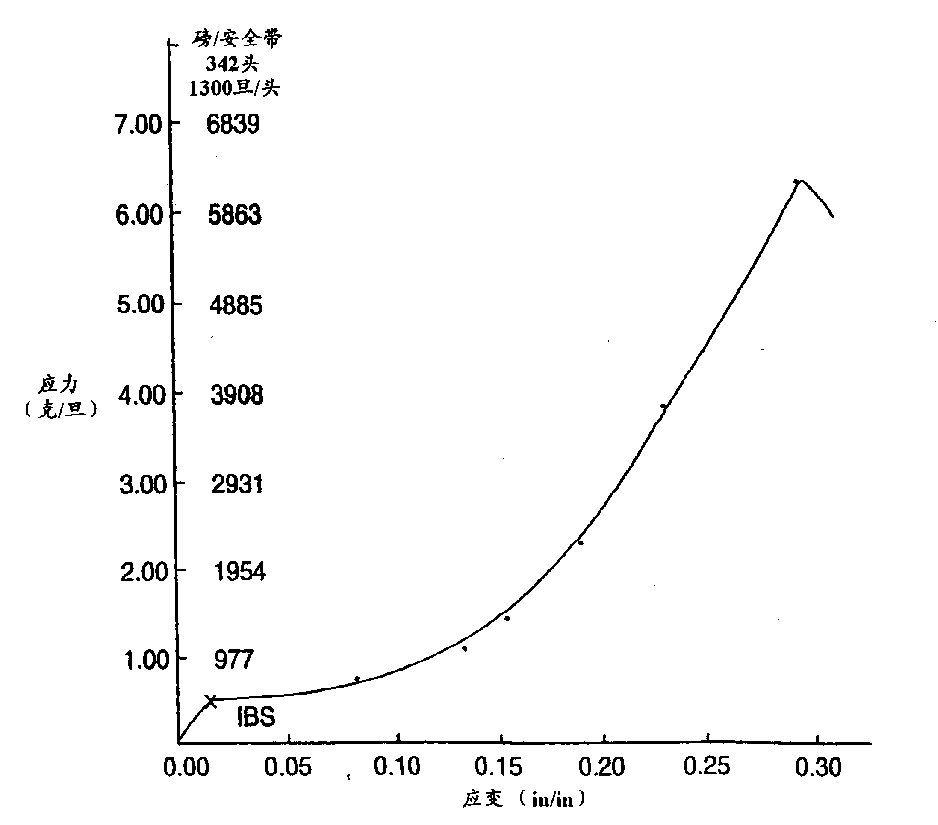
所述纱线(PET/25%聚己内酯)的应力-应变曲线如图Ⅲ所示。当该纱线所遇到的起始保护应力为0.6克/旦时,纱线的伸长量低于2%,而起始模量为52克/旦。当作用于该纱线的应力由0.6克/旦改变成1.8克/旦时,纱线的伸长量由2%提高到20%,而能量的吸收由0提高到20%,为0.00174焦耳/旦·米。当所述纱线遇到大于1.8克/旦的应力时,所述模量急剧提高,而所述纱线的伸长量由20%提高到31%,直到该纱线断裂,断裂时的抗拉强度为5.8克/旦。The stress-strain curve of the yarn (PET/25% polycaprolactone) is shown in Fig. III. When the yarn was subjected to an initial protective stress of 0.6 g/denier, the yarn had an elongation of less than 2% and an initial modulus of 52 g/denier. When the stress acting on the yarn is changed from 0.6 g/denier to 1.8 g/denier, the elongation of the yarn is increased from 2% to 20%, while the energy absorption is increased from 0 to 20%, which is 0.00174 joules/denier Dan M. When the yarn encounters a stress greater than 1.8 g/denier, the modulus increases sharply, and the elongation of the yarn increases from 20% to 31%, until the yarn breaks, and the resistance at breakage The tensile strength was 5.8 g/denier.
本发明实施例4:
干燥所述聚合物颗粒(本发明实施例2,PET/15%聚己内酯),并以40RPM的螺杆速度将其输送到具有表Ⅲ所示温度曲线的压出机中。压出条件为分别能产生800泊和400泊的桶内压力和纺丝箱压力。在表IV所示条件b下拉伸所纺成的纱线,得到韧度为6.5克/旦的纤维。充分拉伸的纱线为259旦,其熔点为220℃。以300米/分钟的速度将上述充分拉伸的纱线输送到处于室温下的第一辊上,转移到150℃下的第二辊上,有1秒钟的接触时间,并收缩10%,在室温辊上冷却,并输送到一个卷绕器。The polymer pellets (inventive example 2, PET/15% polycaprolactone) were dried and conveyed at a screw speed of 40 RPM into an extruder having the temperature profile shown in Table III. Extrusion conditions were such that barrel pressure and spinneret pressure of 800 poise and 400 poise could be generated, respectively. The spun yarns were drawn under conditions b shown in Table IV to obtain fibers having a tenacity of 6.5 g/denier. The fully drawn yarn was 259 denier and had a melting point of 220°C. The above fully drawn yarn is conveyed at a speed of 300 m/min onto a first roll at room temperature, transferred to a second roll at 150°C, with a contact time of 1 second, and shrunk by 10%, Cool on room temperature rolls and convey to a winder.
参见图4中的纱线(PET/15%聚己内酯)的应力-应变曲线。图4表示需要的起始保护应力。如果所述纤维进一步松弛总计达15%,则可以获得其它希望的本发明纤维特性。See Figure 4 for the stress-strain curve of the yarn (PET/15% polycaprolactone). Figure 4 shows the required initial protective stress. Other desirable properties of the fibers of the present invention can be obtained if the fibers are further relaxed by a total of 15%.
本发明实施例5:
用上述类似方法制备一种二嵌段聚合物(PET(70%)-聚己内酯(30%))。干燥所述聚合物颗粒(PET/30%聚己内酯),并以42 RPM的螺杆速度将其输送到具有表Ⅲ所示温度曲线的压出机中。压出条件为分别能产生900泊和500泊的桶内压力和纺丝箱压力。然后在表IV所示条件c下拉伸纺成的纱线,产生韧度为5.9克/旦的纤维。充分拉伸的纱线为271旦,其熔点为220℃。以300米/分钟的速度将充分拉伸的纱线输送到处于室温下的第一辊上,转移到150℃下的第二辊上,有1秒钟的接触时间,并收缩10%,在一个室温辊上冷却,并输送到一个卷绕器。A diblock polymer (PET (70%)-polycaprolactone (30%)) was prepared in a similar manner to the above. The polymer pellets (PET/30% polycaprolactone) were dried and conveyed at a screw speed of 42 RPM into an extruder having the temperature profile shown in Table III. Extrusion conditions were such that barrel pressure and spinning beam pressure of 900 poise and 500 poise could be generated, respectively. The spun yarn was then stretched under condition c shown in Table IV to produce fibers having a tenacity of 5.9 g/denier. The fully drawn yarn has a denier of 271 and a melting point of 220°C. The fully drawn yarn is conveyed at a speed of 300 m/min onto a first roll at room temperature, transferred to a second roll at 150°C, with a contact time of 1 second, and shrunk by 10%, at It is cooled on a room temperature roll and conveyed to a winder.
在图5中示出了该纱线(PET/30%聚己内酯)的应力-应变曲线。当该纱线遇到0.2克/旦的起始保护应力时,纱线的伸长量低于2%,而起始模量为20克/旦。当纱线所承受的应力从0.2克/旦提高到低于或等于1.8克/旦时,纱线的伸长量由2%提高到14%,能量吸收由0提高到14%,为0.00096焦耳/旦·米。当所述纱线遇到大于1.8克/旦的应力时,所述模量急剧提高,而所述纱线的伸长量由14%提高到26%,直到该纱线断裂,断裂时的抗拉强度为5克/旦。The stress-strain curve of this yarn (PET/30% polycaprolactone) is shown in FIG. 5 . When the yarn was subjected to an initial protective stress of 0.2 g/denier, the yarn elongation was less than 2% and the initial modulus was 20 g/denier. When the stress on the yarn increases from 0.2 g/denier to less than or equal to 1.8 g/denier, the elongation of the yarn increases from 2% to 14%, and the energy absorption increases from 0 to 14%, which is 0.00096 joules / Dan m. When the yarn encounters a stress greater than 1.8 grams per denier, the modulus increases sharply, and the elongation of the yarn increases from 14% to 26%, until the yarn breaks, and the resistance at breakage The tensile strength was 5 g/denier.
表Ⅲ例 区间1 区间2 区间3 区间4 嵌段温度 纺丝温度 通过量 套管温 卷绕速度Table Ⅲ Example Interval 1
(℃) (℃) (℃) (℃) (℃) (℃) (g/分钟/孔) 度(℃) (米/分钟)3 277 277 277 270 260 260 2 185 2804 304 293 293 288 271 271 1.6 200 1805 260 260 260 254 260 260 1.6 200 180(℃) (℃) (℃) (℃) (℃) (℃) (g/minute/hole) degree (℃) (meter/minute) 3 277 277 270 260 260 2804 304 293 288 271 271 271 1.6 200 1805 260 260 260 254 260 260 1.6 200 180
表Ⅳ例 第一辊 经纱 导纱板 第二辊 经纱 拉伸比
温度(℃) (℃) 温度(℃) 温度a 40 7 140 140 10 8.4b 40 7 150 90 10 7.7c 30 7 160 160 10 7.4Temperature (℃) (℃) Temperature (℃) Temperature A 40 7 140 10 8.4B 40 7 150 10 7.7C 30 7 160 160 10 7.4
本发明实施例6:
根据2×2斜纹编织图案的选择,将来自本发明实施例3的1400旦的91头PET/25%聚己内酯经纱与840旦的PET/25%聚己内酯纬纱编织成1/2英寸的布条。在一台高速Instron仪上测试该样品,加载速度为2200英寸/分钟,计示长度为3英寸。这相当于汽车以35英里/小时的速度撞车。图6表明在高达250磅的负荷下,所述织物拉伸到应变的20%,所吸收的能量为11.4焦耳。这相当于在作用于乘员身体上的负荷提高到1000磅之前有663焦耳的能量被躯干安全带(50英寸长,2英寸宽)吸收。91 ends of 1400 denier PET/25% polycaprolactone warp from Inventive Example 3 were woven 1/2 with 840 denier PET/25% polycaprolactone weft according to the selection of the 2×2 twill weave pattern inch strips. The sample was tested on a high speed Instron with a loading speed of 2200 inches per minute and a gauge length of 3 inches. That's the equivalent of a car crashing at 35 mph. Figure 6 shows that at loads up to 250 lbs, the fabric was stretched to 20% of the strain with an absorbed energy of 11.4 joules. This equates to 663 joules of energy being absorbed by the torso harness (50 inches long and 2 inches wide) before the load on the occupant's body increases to 1000 pounds.
本发明实施例7:Embodiment 7 of the present invention:
将安装在一个支架上的来自本发明实施例6的一个12英寸长的PET/25%聚己内酯织物(1/2英寸宽)放在红色浴液中浸泡10分钟。该织物的湿重量增加30%,然后在110℃下预干燥3分钟,并在120℃下再干燥3分钟。最后,将染色过的织物冷却到室温。在光学显微镜下分析从所述织物的经纱和纬纱中抽出的纤维。可以清楚的看出,经纱和纬纱纤维均被均匀地、深深地染色。发现了相对原始尺寸的最低收缩量(<2%)。对染色织物的高速Instron测试如图7所示,并与未染色的样品进行比较。结果表明,所述负荷平衡能力在该染色过程中得到保留。A 12 inch long PET/25% polycaprolactone fabric (1/2 inch wide) from Example 6 of the present invention mounted on a stand was placed in the red bath for 10 minutes. The wet weight of the fabric was increased by 30%, then pre-dried at 110°C for 3 minutes, and then dried at 120°C for 3 minutes. Finally, the dyed fabric is cooled to room temperature. Fibers drawn from the warp and weft of the fabric were analyzed under an optical microscope. It can be clearly seen that both warp and weft fibers are evenly and deeply dyed. Minimal shrinkage (<2%) relative to original size was found. A high-speed Instron test on a dyed fabric is shown in Figure 7 and compared to an undyed sample. The results show that the load balancing ability is preserved during this dyeing process.
在滑动试验中,将完整尺寸的织物安全带(2英寸宽)组装成具有安全带卷绕和锁定功能的盒。然后,将该组件安装到车内,并安装一个负荷测定仪,以测定作用在该安全带上的力。In the slide test, full-size fabric seat belts (2 inches wide) are assembled into a box with belt winding and locking capabilities. The assembly is then installed in the vehicle and a load cell is installed to measure the force acting on the seat belt.
比较实施例A:Comparative Example A:
为了建立在35英里/小时下进行的测试的基线,用2英寸宽的PET安全带捆住一个假人(混合百分比为50)。在滑动测试的模拟事故出现时,在发生撞车之后70毫秒,作用在安全带上的负荷达到最大值。如图1所示,记录到的作用在躯干部位的最大力为9200N(2070磅)。To establish a baseline for the tests conducted at 35 mph, a dummy (percent blend 50) was strapped with 2-inch wide PET harnesses. In the simulated accident of the sliding test, the load on the seat belt reaches its maximum value 70 milliseconds after the crash. As shown in Figure 1, the maximum force recorded on the torso was 9200 N (2070 lbs).
本发明实施例8:Embodiment 8 of the present invention:
将来自本发明实施例3的1500旦的342头PET/25%聚己内酯经纱与来自本发明实施例3的500旦的PET/25%聚己内酯纬纱以2×2的斜纹图案交织成2英寸宽的安全带。用一个假人(混合百分比为50)试验该安全带。在35英里/小时的速度下,所述力达到最大值的时间推迟到撞车之后100毫秒。测定到的作用于躯干部位的最大力为5700N(1280磅)。如图8所示,这种新型织物在5,700N的力下表现良好,并具有负荷平衡能力,这与图1中比较实施例A的不理想的性能形成了鲜明的对照。342 ends of 1500 denier PET/25% polycaprolactone warp yarns from Inventive Example 3 were interwoven with 500 denier PET/25% Polycaprolactone weft yarns from Inventive Example 3 in a 2 x 2 twill pattern into a 2-inch wide seat belt. The seat belt was tested with a dummy (mixing percentage 50). At 35 mph, the force reaches its maximum value delayed until 100 milliseconds after the crash. The maximum force measured on the torso area was 5700N (1280 lbs). As shown in Figure 8, the novel fabric performed well at a force of 5,700 N and had load balancing capabilities, in sharp contrast to the unsatisfactory performance of Comparative Example A in Figure 1.
本发明实施例9:Embodiment 9 of the present invention:
将来自本发明实施例3的1500旦的342头PET/25%聚己内酯经纱与来自本发明实施例3的500旦的PET/25%聚己内酯纬纱以2×2的斜纹图案交织成2英寸宽的安全带。将这种新型织物裁剪成具有伸缩器和躯干长度,并与PET膝带缝合在一起。然后捆绑一个超大型的假人(混合百分比为95)进行滑动试验。在35英里/小时的速度下,作用在躯干部位的力达到最大值的时间推迟到撞车之后100毫秒。测定到的作用于躯干部位的最大力为6800N(1530磅)。如图9所示,这种新型织物在6,800N的力下表现良好,并具有负荷平衡能力,这与图1中比较实施例A的不理想的性能形成了鲜明的对照。342 ends of 1500 denier PET/25% polycaprolactone warp yarns from Inventive Example 3 were interwoven with 500 denier PET/25% Polycaprolactone weft yarns from Inventive Example 3 in a 2 x 2 twill pattern into a 2-inch wide seat belt. This new fabric was cut to have stretchers and torso lengths and sewn together with PET knee straps. Then an extra-large dummy (mixed percentage 95) was tied for the sliding test. At 35 mph, the maximum force on the torso was delayed until 100 milliseconds after the crash. The maximum force measured on the torso was 6800N (1530 lbs). As shown in Figure 9, the new fabric performed well at a force of 6,800 N and had load balancing capabilities, in sharp contrast to the unsatisfactory performance of Comparative Example A in Figure 1.
Claims (10)
Applications Claiming Priority (3)
| Application Number | Priority Date | Filing Date | Title |
|---|---|---|---|
| US08/819931 | 1997-03-18 | ||
| US08/819,931 | 1997-03-18 | ||
| US08/819,931 US5830811A (en) | 1997-03-18 | 1997-03-18 | Load leveling yarns and webbings |
Publications (2)
| Publication Number | Publication Date |
|---|---|
| CN1286663A true CN1286663A (en) | 2001-03-07 |
| CN1134358C CN1134358C (en) | 2004-01-14 |
Family
ID=25229474
Family Applications (1)
| Application Number | Title | Priority Date | Filing Date |
|---|---|---|---|
| CNB971821755A Expired - Fee Related CN1134358C (en) | 1997-03-18 | 1997-12-17 | Load leveling yarns and webbings |
Country Status (16)
| Country | Link |
|---|---|
| US (4) | US5830811A (en) |
| EP (1) | EP0968106B1 (en) |
| JP (1) | JP2000510920A (en) |
| KR (1) | KR100497069B1 (en) |
| CN (1) | CN1134358C (en) |
| AR (1) | AR008556A1 (en) |
| AT (1) | ATE240227T1 (en) |
| AU (1) | AU731254B2 (en) |
| CA (1) | CA2284212C (en) |
| DE (2) | DE69722037T2 (en) |
| DK (1) | DK0968106T3 (en) |
| ES (1) | ES2143444T3 (en) |
| NZ (1) | NZ337768A (en) |
| PT (1) | PT968106E (en) |
| WO (1) | WO1998041427A1 (en) |
| ZA (1) | ZA9711513B (en) |
Cited By (3)
| Publication number | Priority date | Publication date | Assignee | Title |
|---|---|---|---|---|
| CN100341730C (en) * | 2002-01-17 | 2007-10-10 | 关键安全体系股份有限公司 | Multi-load limiting seat belt retractor |
| CN102264581A (en) * | 2008-12-22 | 2011-11-30 | 高田株式会社 | Seat belt device |
| CN104603338A (en) * | 2012-06-28 | 2015-05-06 | 可隆工业株式会社 | Polyester fiber for seat belts, and method for manufacturing same |
Families Citing this family (22)
| Publication number | Priority date | Publication date | Assignee | Title |
|---|---|---|---|---|
| US5830811A (en) * | 1997-03-18 | 1998-11-03 | Alliedsignal Inc. | Load leveling yarns and webbings |
| US6228488B1 (en) | 1998-05-22 | 2001-05-08 | Alliedsignal Inc. | Process for making load limiting yarn |
| US6071835A (en) * | 1998-06-16 | 2000-06-06 | Alliedsignal Inc. | Load limiting webbing |
| US20010029140A1 (en) * | 2000-03-09 | 2001-10-11 | Toray Industires, Inc. | Seat belt webbing and passenger-holding device using the same |
| AU2001270144A1 (en) * | 2000-06-26 | 2002-01-08 | Breed Automotive Technology, Inc. | Seat belt webbing and method of dyeing same |
| US6739427B2 (en) * | 2001-02-02 | 2004-05-25 | Bacou-Dalloz Fall Protection Investment, Inc. | Safety harness |
| EP1381429B1 (en) * | 2001-03-30 | 2007-02-14 | Cyden Ltd. | Therapeutic treatment device |
| US6949112B1 (en) | 2001-07-26 | 2005-09-27 | Advanced Cardiovascular Systems, Inc. | Medical device formed of polyester copolymer |
| MXPA04004258A (en) * | 2001-11-13 | 2004-09-08 | Honeywell Int Inc | High-molecular weight polymers and methods of manufacture. |
| US6794462B2 (en) * | 2001-11-14 | 2004-09-21 | Honeywell International Inc. | High-molecular weight polymers and methods of manufacture |
| US6991850B2 (en) * | 2004-01-09 | 2006-01-31 | Performance Fibers, Inc. | Load leveling yarns and webbings |
| US7240924B2 (en) * | 2004-07-29 | 2007-07-10 | Key Safety Systems, Inc. | Multilevel load limiting retractor with dual shifting mode |
| US7669794B2 (en) | 2004-09-01 | 2010-03-02 | Key Safety System, Inc | Seatbelt retractor with torsion bar |
| DE602006007157D1 (en) | 2006-11-29 | 2009-07-16 | Key Safety Systems Inc | Safety restraint system for a child |
| ATE555953T1 (en) * | 2007-10-03 | 2012-05-15 | Key Safety Systems Inc | SEAT BELT SYSTEM FOR CHILDREN AND ADULTS |
| DE102007051675B4 (en) * | 2007-10-26 | 2011-11-24 | Hoffmann Air Cargo Equipment Gmbh | Method of making seams on webbings for technical purposes |
| US8427356B1 (en) * | 2008-11-28 | 2013-04-23 | Uei Cayman Inc. | Automatic determination and retrieval of a favorite channel |
| DE202008016802U1 (en) | 2008-12-19 | 2009-04-02 | E. Oppermann, Einbeck, Mechanische Gurt- Und Bandweberei Gmbh | belt |
| EP2456839A1 (en) * | 2009-07-21 | 2012-05-30 | Mylan Inc. | Process for the continuous manufacture of a polyisobutylene based transdermal patch |
| US8434827B2 (en) * | 2010-07-26 | 2013-05-07 | Mattel, Inc. | Infant support structure with polymer coated restraint straps |
| KR20120083776A (en) * | 2011-01-18 | 2012-07-26 | 코오롱인더스트리 주식회사 | Polyester fiber and polyester fabric comprising the same |
| WO2013039745A1 (en) * | 2011-09-13 | 2013-03-21 | Livermore Instruments, Inc. | Creep-resistant high strength fiber-based assembly |
Family Cites Families (46)
| Publication number | Priority date | Publication date | Assignee | Title |
|---|---|---|---|---|
| US3322163A (en) * | 1965-02-25 | 1967-05-30 | Allied Chem | Low elongation seat belt webbing |
| US3296062A (en) * | 1965-06-24 | 1967-01-03 | Us Rubber Co | Belt fabric |
| US3486791A (en) * | 1967-07-21 | 1969-12-30 | Robbins Seat Belt Co | Energy absorbing means |
| US3530904A (en) * | 1967-10-02 | 1970-09-29 | Burlington Industries Inc | Energy absorbing fabric |
| US3464459A (en) * | 1968-01-17 | 1969-09-02 | Burlington Industries Inc | Webbings for safety restraint systems |
| US3550957A (en) * | 1969-05-16 | 1970-12-29 | Robbins Seat Belt Co | Shoulder harness with belt elongation means |
| US3872895A (en) * | 1970-10-07 | 1975-03-25 | Takatao Kojyo Co Ltd | Woven fabric for safety belts of high energy-absorbency |
| JPS5118843B2 (en) * | 1971-05-31 | 1976-06-12 | ||
| US3823748A (en) * | 1972-02-14 | 1974-07-16 | Celanese Corp | Energy absorbent textile structure |
| US3756288A (en) * | 1972-03-21 | 1973-09-04 | Hoshino Kogyo Kk | Webbing for use in seat belts |
| JPS484116A (en) * | 1972-04-18 | 1973-01-19 | ||
| US3927167A (en) * | 1972-09-26 | 1975-12-16 | Du Pont | Production of mixed shrinkage polyester yarn |
| JPS538780Y2 (en) * | 1972-12-28 | 1978-03-07 | ||
| US4045401A (en) * | 1973-01-17 | 1977-08-30 | Exxon Research & Engineering Co. | Mixing apparatus and method |
| JPS5645942B2 (en) * | 1973-01-18 | 1981-10-29 | ||
| US4031165A (en) * | 1974-09-30 | 1977-06-21 | Teijin Limited | Process for preparing polyester elastomers |
| JPS558023B2 (en) * | 1975-02-27 | 1980-03-01 | ||
| JPS5249037A (en) * | 1975-04-28 | 1977-04-19 | Canon Inc | Liquid development device |
| US4138157A (en) * | 1977-06-06 | 1979-02-06 | Allied Chemical Corporation | Energy absorbing seat belt webbing |
| US4228829A (en) * | 1979-03-30 | 1980-10-21 | Nsk-Warner K.K. | Webbing for seat belt |
| JPS58162654A (en) * | 1982-03-19 | 1983-09-27 | Toyobo Co Ltd | Polyester-type block copolymer composition |
| JPS58206662A (en) * | 1982-05-26 | 1983-12-01 | Toyobo Co Ltd | Polyester block copolymer composition |
| DE3380353D1 (en) * | 1983-02-18 | 1989-09-14 | Toyo Boseki | Improved polyester type block copolymer composition |
| JPS59153764A (en) | 1983-02-19 | 1984-09-01 | Ricoh Co Ltd | Sorter control device |
| JPS59157117A (en) * | 1983-02-25 | 1984-09-06 | Toyobo Co Ltd | Modification of crystalline aromatic polyester |
| JPS61111318A (en) * | 1984-11-06 | 1986-05-29 | Toyobo Co Ltd | Thermoplastic elastomer composition |
| JPH0618992B2 (en) * | 1984-11-07 | 1994-03-16 | 東洋紡績株式会社 | Polyester block copolymer composition |
| US4680345A (en) * | 1985-06-05 | 1987-07-14 | Toyo Boseki Kabushiki Kaisha | Continuous production of elastic polyesters |
| JPS62112572A (en) * | 1985-11-11 | 1987-05-23 | 帝人株式会社 | Webbing for seat belt |
| JPH01298209A (en) * | 1988-05-20 | 1989-12-01 | Teijin Ltd | Polyester yarn for webbing |
| JP2556359B2 (en) * | 1988-08-16 | 1996-11-20 | 邦彦 立川 | Method and apparatus for manufacturing synthetic resin porous tube |
| JPH03259918A (en) * | 1990-03-12 | 1991-11-20 | Kanegafuchi Chem Ind Co Ltd | Production of copolyester |
| JPH0427268A (en) * | 1990-05-22 | 1992-01-30 | Nec Corp | Facsimile equipment |
| JPH0472325A (en) * | 1990-07-12 | 1992-03-06 | Kanegafuchi Chem Ind Co Ltd | Production of polyester-ester block copolymer |
| JPH04264156A (en) * | 1991-02-18 | 1992-09-18 | Toray Ind Inc | Polyester-polyester block copolymer composition |
| JP2646889B2 (en) * | 1991-06-26 | 1997-08-27 | 松下電器産業株式会社 | Image processing device |
| US5397527A (en) * | 1991-12-30 | 1995-03-14 | Alliedsignal Inc. | High modulus polyester yarn for tire cords and composites |
| JPH06257062A (en) * | 1993-03-02 | 1994-09-13 | Teijin Ltd | Webbing for seat belt |
| US5376440A (en) * | 1993-03-31 | 1994-12-27 | Ikeda Bussan Co., Ltd. | Woven fabric for seat belt |
| JP3353412B2 (en) * | 1993-09-17 | 2002-12-03 | 東レ株式会社 | High strength polybutylene terephthalate fiber |
| US5645077A (en) * | 1994-06-16 | 1997-07-08 | Massachusetts Institute Of Technology | Inertial orientation tracker apparatus having automatic drift compensation for tracking human head and other similarly sized body |
| DE4429524C2 (en) * | 1994-08-19 | 1997-12-18 | Inventa Ag | Process for the preparation of linear copolyesters containing omega-hydroxycarboxylic acid units |
| US5547143A (en) * | 1994-08-24 | 1996-08-20 | Alliedsignal Inc. | Seat belt retractor with integrated load limiter |
| DE19513259A1 (en) * | 1995-04-07 | 1996-10-10 | Trw Repa Gmbh | Woven webbing for a vehicle occupant restraint system |
| DE19517350C2 (en) * | 1995-05-11 | 2001-08-09 | Inventa Ag | Process for the production of polyester bicomponent fibers and filaments and fibers and filaments which can be produced thereby |
| US5830811A (en) * | 1997-03-18 | 1998-11-03 | Alliedsignal Inc. | Load leveling yarns and webbings |
-
1997
- 1997-03-18 US US08/819,931 patent/US5830811A/en not_active Expired - Fee Related
- 1997-12-17 EP EP97952580A patent/EP0968106B1/en not_active Expired - Lifetime
- 1997-12-17 DE DE1997622037 patent/DE69722037T2/en not_active Expired - Fee Related
- 1997-12-17 AT AT97952580T patent/ATE240227T1/en not_active IP Right Cessation
- 1997-12-17 DK DK97952580T patent/DK0968106T3/en active
- 1997-12-17 AU AU56158/98A patent/AU731254B2/en not_active Ceased
- 1997-12-17 DE DE0968106T patent/DE968106T1/en active Pending
- 1997-12-17 CN CNB971821755A patent/CN1134358C/en not_active Expired - Fee Related
- 1997-12-17 KR KR10-1999-7008482A patent/KR100497069B1/en not_active Expired - Fee Related
- 1997-12-17 CA CA 2284212 patent/CA2284212C/en not_active Expired - Fee Related
- 1997-12-17 ES ES97952580T patent/ES2143444T3/en not_active Expired - Lifetime
- 1997-12-17 NZ NZ337768A patent/NZ337768A/en unknown
- 1997-12-17 WO PCT/US1997/023673 patent/WO1998041427A1/en not_active Ceased
- 1997-12-17 PT PT97952580T patent/PT968106E/en unknown
- 1997-12-17 JP JP54047798A patent/JP2000510920A/en active Pending
- 1997-12-22 ZA ZA9711513A patent/ZA9711513B/en unknown
-
1998
- 1998-01-15 AR ARP980100179 patent/AR008556A1/en active IP Right Grant
- 1998-03-13 US US09/042,158 patent/US6057252A/en not_active Expired - Lifetime
-
2000
- 2000-03-29 US US09/538,581 patent/US6312806B1/en not_active Expired - Fee Related
-
2001
- 2001-09-04 US US09/945,866 patent/US6492022B2/en not_active Expired - Fee Related
Cited By (5)
| Publication number | Priority date | Publication date | Assignee | Title |
|---|---|---|---|---|
| CN100341730C (en) * | 2002-01-17 | 2007-10-10 | 关键安全体系股份有限公司 | Multi-load limiting seat belt retractor |
| CN102264581A (en) * | 2008-12-22 | 2011-11-30 | 高田株式会社 | Seat belt device |
| CN102264581B (en) * | 2008-12-22 | 2013-05-29 | 高田株式会社 | Seat belt device |
| CN104603338A (en) * | 2012-06-28 | 2015-05-06 | 可隆工业株式会社 | Polyester fiber for seat belts, and method for manufacturing same |
| US9732447B2 (en) | 2012-06-28 | 2017-08-15 | Kolon Industries, Inc. | Method of preparing polyester fiber for seat belt |
Also Published As
| Publication number | Publication date |
|---|---|
| HK1035352A1 (en) | 2001-11-23 |
| AR008556A1 (en) | 2000-01-19 |
| DK0968106T3 (en) | 2003-08-04 |
| CN1134358C (en) | 2004-01-14 |
| DE968106T1 (en) | 2000-09-14 |
| PT968106E (en) | 2003-09-30 |
| ES2143444T3 (en) | 2003-12-16 |
| EP0968106B1 (en) | 2003-05-14 |
| ZA9711513B (en) | 1999-05-05 |
| US6312806B1 (en) | 2001-11-06 |
| AU731254B2 (en) | 2001-03-29 |
| NZ337768A (en) | 2001-11-30 |
| US6057252A (en) | 2000-05-02 |
| DE69722037D1 (en) | 2003-06-18 |
| ES2143444T1 (en) | 2000-05-16 |
| US5830811A (en) | 1998-11-03 |
| KR20000076380A (en) | 2000-12-26 |
| AU5615898A (en) | 1998-10-12 |
| KR100497069B1 (en) | 2005-06-23 |
| ATE240227T1 (en) | 2003-05-15 |
| US6492022B2 (en) | 2002-12-10 |
| DE69722037T2 (en) | 2004-02-26 |
| JP2000510920A (en) | 2000-08-22 |
| CA2284212A1 (en) | 1998-09-24 |
| WO1998041427A1 (en) | 1998-09-24 |
| US20020018894A1 (en) | 2002-02-14 |
| CA2284212C (en) | 2006-08-01 |
| EP0968106A1 (en) | 2000-01-05 |
Similar Documents
| Publication | Publication Date | Title |
|---|---|---|
| CN1134358C (en) | Load leveling yarns and webbings | |
| EP1080258B1 (en) | Process for making load limiting yarn | |
| EP1097066B1 (en) | Load limiting webbing | |
| US20010029140A1 (en) | Seat belt webbing and passenger-holding device using the same | |
| US6991850B2 (en) | Load leveling yarns and webbings | |
| HK1035352B (en) | Load leveling yarns and webbings | |
| MXPA99008518A (en) | Load leveling yarns and webbings | |
| MXPA00011399A (en) | Process for making load limiting yarn | |
| TW387022B (en) | Load leveling yarns, webbings, seat belt comprising web and use method of web | |
| JP2003064526A (en) | Energy absorbing polyester fiber | |
| JP2004291830A (en) | Fiber for seat belt with high light resistance and webbing for seat belt | |
| WO2014051384A1 (en) | High elongation polyester seat belt |
Legal Events
| Date | Code | Title | Description |
|---|---|---|---|
| C06 | Publication | ||
| PB01 | Publication | ||
| C10 | Entry into substantive examination | ||
| SE01 | Entry into force of request for substantive examination | ||
| C14 | Grant of patent or utility model | ||
| GR01 | Patent grant | ||
| ASS | Succession or assignment of patent right |
Owner name: PERFORMANCE QUALITY COMPANY Free format text: FORMER OWNER: HONEYWELL INT INC. Effective date: 20050909 |
|
| C41 | Transfer of patent application or patent right or utility model | ||
| C56 | Change in the name or address of the patentee |
Owner name: HONEYWELL INT INC. Free format text: FORMER NAME OR ADDRESS: COMBINE SIGNAL LTD. |
|
| CP01 | Change in the name or title of a patent holder |
Address after: New jersey, USA Patentee after: HONEYWELL INTERNATIONAL Inc. Address before: New jersey, USA Patentee before: ALLIEDSIGNAL Inc. |
|
| TR01 | Transfer of patent right |
Effective date of registration: 20050909 Address after: North Carolina Patentee after: Performance Fibers, Inc. Address before: New jersey, USA Patentee before: HONEYWELL INTERNATIONAL Inc. |
|
| C19 | Lapse of patent right due to non-payment of the annual fee | ||
| CF01 | Termination of patent right due to non-payment of annual fee |