CN1286681A - Cytostatic agents - Google Patents
Cytostatic agents Download PDFInfo
- Publication number
- CN1286681A CN1286681A CN98813847A CN98813847A CN1286681A CN 1286681 A CN1286681 A CN 1286681A CN 98813847 A CN98813847 A CN 98813847A CN 98813847 A CN98813847 A CN 98813847A CN 1286681 A CN1286681 A CN 1286681A
- Authority
- CN
- China
- Prior art keywords
- methyl
- amino
- hydroxyl
- isobutyl
- formyl radical
- Prior art date
- Legal status (The legal status is an assumption and is not a legal conclusion. Google has not performed a legal analysis and makes no representation as to the accuracy of the status listed.)
- Granted
Links
Classifications
-
- C—CHEMISTRY; METALLURGY
- C07—ORGANIC CHEMISTRY
- C07C—ACYCLIC OR CARBOCYCLIC COMPOUNDS
- C07C259/00—Compounds containing carboxyl groups, an oxygen atom of a carboxyl group being replaced by a nitrogen atom, this nitrogen atom being further bound to an oxygen atom and not being part of nitro or nitroso groups
- C07C259/04—Compounds containing carboxyl groups, an oxygen atom of a carboxyl group being replaced by a nitrogen atom, this nitrogen atom being further bound to an oxygen atom and not being part of nitro or nitroso groups without replacement of the other oxygen atom of the carboxyl group, e.g. hydroxamic acids
- C07C259/06—Compounds containing carboxyl groups, an oxygen atom of a carboxyl group being replaced by a nitrogen atom, this nitrogen atom being further bound to an oxygen atom and not being part of nitro or nitroso groups without replacement of the other oxygen atom of the carboxyl group, e.g. hydroxamic acids having carbon atoms of hydroxamic groups bound to hydrogen atoms or to acyclic carbon atoms
-
- A—HUMAN NECESSITIES
- A61—MEDICAL OR VETERINARY SCIENCE; HYGIENE
- A61P—SPECIFIC THERAPEUTIC ACTIVITY OF CHEMICAL COMPOUNDS OR MEDICINAL PREPARATIONS
- A61P35/00—Antineoplastic agents
-
- C—CHEMISTRY; METALLURGY
- C07—ORGANIC CHEMISTRY
- C07D—HETEROCYCLIC COMPOUNDS
- C07D333/00—Heterocyclic compounds containing five-membered rings having one sulfur atom as the only ring hetero atom
- C07D333/02—Heterocyclic compounds containing five-membered rings having one sulfur atom as the only ring hetero atom not condensed with other rings
- C07D333/04—Heterocyclic compounds containing five-membered rings having one sulfur atom as the only ring hetero atom not condensed with other rings not substituted on the ring sulphur atom
- C07D333/06—Heterocyclic compounds containing five-membered rings having one sulfur atom as the only ring hetero atom not condensed with other rings not substituted on the ring sulphur atom with only hydrogen atoms, hydrocarbon or substituted hydrocarbon radicals, directly attached to the ring carbon atoms
- C07D333/24—Radicals substituted by carbon atoms having three bonds to hetero atoms with at the most one bond to halogen, e.g. ester or nitrile radicals
-
- C—CHEMISTRY; METALLURGY
- C07—ORGANIC CHEMISTRY
- C07C—ACYCLIC OR CARBOCYCLIC COMPOUNDS
- C07C2601/00—Systems containing only non-condensed rings
- C07C2601/06—Systems containing only non-condensed rings with a five-membered ring
- C07C2601/08—Systems containing only non-condensed rings with a five-membered ring the ring being saturated
Landscapes
- Organic Chemistry (AREA)
- Chemical & Material Sciences (AREA)
- Health & Medical Sciences (AREA)
- Life Sciences & Earth Sciences (AREA)
- General Health & Medical Sciences (AREA)
- Nuclear Medicine, Radiotherapy & Molecular Imaging (AREA)
- General Chemical & Material Sciences (AREA)
- Pharmacology & Pharmacy (AREA)
- Chemical Kinetics & Catalysis (AREA)
- Animal Behavior & Ethology (AREA)
- Medicinal Chemistry (AREA)
- Public Health (AREA)
- Veterinary Medicine (AREA)
- Acyclic And Carbocyclic Compounds In Medicinal Compositions (AREA)
- Pharmaceuticals Containing Other Organic And Inorganic Compounds (AREA)
- Organic Low-Molecular-Weight Compounds And Preparation Thereof (AREA)
- Materials For Medical Uses (AREA)
- Medicinal Preparation (AREA)
- Heterocyclic Compounds Containing Sulfur Atoms (AREA)
Abstract
2(R or S)-[2R-(S-Hydroxy-hydroxycarbamoyl-methyl)-4-methyl-pentanoylamine]-2-phenyl-ethanoic acid cyclopentyl ester; 2(R or S)-(3S-Hydroxycarbamoyl-2R-isobuty]-hex-5-enoylamino)-2-phenylethanoic acid isopropyl ester; 2(R or S)-[2R-(S-Hydroxycarbamoyl-methoxy-methyl)-4-methyl-pentanoylamino]-3-phenylethanoic acid cyclopentyl ester; 2(R or S)-(3S-ydroxycarbamoyl-2R-isobutyl-hex-5-enoylamino)-2-(4-methoxyphenyl)ethanoic acid cyclopentyl ester; 2(R or S)-(3S-Hydroxycarbamoyl-2R-isobutyl-hex-5-enoylamino)-2-(thien-2-yl)ethanoic acid cyclopentyl ester; and 2(R or S)-(3S-Hydroxycarbamoyl-2R-isobutyl-hex-5-enoylamino)-2-(thien-3-yl)ethanoic acid cyclopentyl ester are cytostatic agents.
Description
The present invention relates to the ester and the monothioester of therapeutic activity, relate to their preparation method, relate to the pharmaceutical composition that contains described ester and monothioester, and the application of in medicine, using this compounds.Particularly, compound is the quick splitted tumour cell in the certain limit, as melanoma and/or the agent of lymphoma cell inhibition of proliferation.
Background of invention
Our International Patent Application PCT/GB 97/02398 has disclosed the method for tumor cell proliferation in the inhibition Mammals and it has been proposed claim, and this method comprises a certain amount of logical formula I compound or its pharmacy acceptable salt, hydrate or the solvate that the Mammals that suffers from this class propagation is enough to suppress this class propagation:
 Wherein
R is hydrogen or (C
1-C
6) alkyl;
R
1Be hydrogen;
(C
1-C
6) alkyl;
(C
2-C
6) alkenyl;
Phenyl or substituted-phenyl;
Phenyl (C
1-C
6) alkyl or substituted-phenyl (C
1-C
6) alkyl;
Phenyl (C
2-C
6) thiazolinyl or substituted-phenyl (C
2-C
6) thiazolinyl
Heterocyclic radical or substituted heterocyclic radical;
Heterocyclic radical (C
1-C
6) alkyl or substituted heterocyclic radical (C
1-C
6) alkyl;
Group B SO
nA-, wherein n is 0,1 or 2, B is hydrogen or (C
1-C
6) alkyl, phenyl, substituted-phenyl, the heterocyclic radical the heterocyclic radical, (C that replace
1-C
6) phenacyl of acyl group, phenacyl or replacement, A represents (C
1-C
6) alkylidene group;
Hydroxyl or (C
1-C
6) alkoxyl group;
Amino, protected amino, amido, (C
1-C
6) alkylamino or two-(C
1-C
6) alkylamino;
Sulfydryl or (C
1-C
6) alkylthio;
Amino (C
1-C
6) alkyl, (C
1-C
6) alkylamino (C
1-C
6) alkyl, two (C
1-C
6) alkylamino (C
1-C
6) alkyl, hydroxyl (C
1-C
6) alkyl, sulfydryl (C
1-C
6) alkyl or carboxyl (C
1-C
6) alkyl, wherein amino one, hydroxyl one, sulfydryl-or carboxyl-group randomly protected, or carboxyl-group is by amidation;
Low alkyl group, it is replaced by carbamyl, list (low alkyl group) carbamyl, two (low alkyl group) carbamyl, two (low alkyl group) amino or carboxyl-low-grade alkane acidyl amino; Or
Cycloalkyl, cycloalkenyl group or contain and be up to 3 heteroatomic non-aromatic heterocyclics, any group in them can (ⅰ) by one or more C that are selected from
1-C
6Alkyl, C
2-C
6Thiazolinyl, halogen, cyano group (CN) ,-CO
2H ,-CO
2R ,-CONH
2,-CONHR ,-CON (R)
2,-OH ,-OR, oxygen base-,-SH ,-SR ,-NHCOR and-NHCO
2The substituting group of R replaces, and wherein R is C
1-C
6Alkyl or benzyl and/or (ⅱ) and cycloalkyl or heterocyclic fused;
R
2Be C
1-C
12Alkyl,
C
2-C
12Thiazolinyl,
C
2-C
12Alkynyl,
Phenyl (C
1-C
6Alkyl)-,
Heteroaryl (C
1-C
6Alkyl)-,
Phenyl (C
2-C
6Thiazolinyl)-,
Heteroaryl (C
2-C
6Thiazolinyl)-,
Phenyl (C
2-C
6Alkynyl)-,
Heteroaryl (C
2-C
6Alkynyl)-,
Cycloalkyl (C
1-C
6Alkyl)-,
Cycloalkyl (C
2-C
6Thiazolinyl)-,
Cycloalkyl (C
2-C
6Alkynyl)-,
Cycloalkenyl group (C
1-C
6Alkyl)-,
Cycloalkenyl group (C
2-C
6Thiazolinyl)-,
Cycloalkenyl group (C
2-C
6Alkynyl)-,
Phenyl (C
1-C
6Alkyl) O (C
1-C
6Alkyl)-, or
Heteroaryl (C
1-C
6Alkyl) O (C
1-C
6Alkyl)-,
Any group in them can randomly be replaced by following substituting group:
C
1-C
6Alkyl,
C
1-C
6Alkoxyl group,
Halogen,
Cyano group (CN),
Phenyl, or
By C
1-C
6Alkyl,
C
1-C
6Alkoxyl group,
Halogen or the cyano group (CN) phenyl of Qu Daiing;
R
3Be natural or the characteristic group of non-natural alpha amino acid, functional group wherein can be protected; With
R
4Be ester or monothioester group,
Or its pharmacy acceptable salt, hydrate or solvate.
Summary of the invention
The present invention relates to specific compound as the mammalian tumor cell antiblastic.The compound that this paper discusses is not done special the announcement 97/02398 li of PCT/GB, as the tumour cell inhibitor, has valuable pharmacological and pharmacokinetic property.
Detailed Description Of The Invention
The invention provides the compound that is selected from down group and its pharmaceutically or beastly pharmacy acceptable salt, hydrate or solvate:
2 (R or S)-[2R-(S-hydroxyl-hydroxyl carbamyl-methyl)-4-methyl-pentanoyl amine]-2-phenyl-acetic acid cyclopentyl ester,
2 (R or S)-(3S-hydroxyl amino formyl radical-2R-isobutyl--oneself-5-enoyl-amino)-2-phenylacetic acid isopropyl esters,
2 (R or S)-[2R-(S-hydroxyl amino formyl radical-methoxyl group-methyl)-4-methyl-pentanoyl amino]-3-phenylacetic acid ring pentyl ester,
2 (R or S)-(3S-hydroxyl amino formyl radical-2R-isobutyl--oneself-5-enoyl-amino)-2-(4-p-methoxy-phenyl) acetic acid cyclopentyl ester,
2 (R or S)-(3S-hydroxyl amino formyl radical-2R-isobutyl--oneself-5-enoyl-amino)-2-(thiophene-2-yl) acetic acid cyclopentyl ester,
2 (R or S)-(3S-hydroxyl amino formyl radical-2R-isobutyl--oneself-5-enoyl-amino)-2-(thiene-3-yl-) acetic acid cyclopentyl ester.
The 2-S diastereomer of above-claimed cpd preferably.
The salt of The compounds of this invention comprises physiologically acceptable acid salt, example hydrochloric acid salt, hydrobromate, vitriol, mesylate, right-tosylate, phosphoric acid salt, acetate, Citrate trianion, succinate, lactic acid salt, tartrate, fumarate and maleate.Also available bases salify is as sodium salt, sylvite, magnesium salts and calcium salt.
On the one hand, the present invention includes the method that suppresses tumor cell proliferation in the Mammals, this method comprises is enough to suppress the above-claimed cpd of consumption of this class propagation or its pharmaceutically or beastly pharmacy acceptable salt, hydrate or solvate to the Mammals that suffers from this class propagation.
On the other hand, the present invention includes above-claimed cpd or its pharmaceutically or beastly pharmacy acceptable salt, hydrate or solvate be used for suppressing the application of the composition of mammalian tumor cell propagation in preparation.
The compounds of this invention can be used for people's medicine or veterinary drug, because they are the agent of cancer cell inhibition of proliferation.Therefore practicality of the present invention is to treat cancer, the cancer that causes as the hyper-proliferative by lymphoma, leukemia, myelomatosis, gland cancer, cancer, mesothelioma, lopsided cancer, choriocarcinoma, small cell carcinoma, large cell carcinoma, melanoma, retinoblastoma, fibrosarcoma, leiomyosarcoma, glioblastoma or endothelioma cell.Should be understood that the different compound of the present invention has different effectiveness as antiblastic according to the cancer types of being treated.The specific compound of any the present invention is to the inhibition of proliferation activity of any particular cell types method of available standards all, as is similar to the described method of this paper biological Examples and carries out conventional determining.
Of the present inventionly on the one hand provide medicine or animal medicinal composition again, comprised compound of the present invention and pharmaceutically or beastly pharmaceutically acceptable vehicle or carrier.One or more compound of the present invention can be present in the composition with one or more vehicle or carrier.
The formulation of composition for oral administration is tablet, capsule, powder agent, granule, lozenge, liquid or gel preparation, as oral, local or aseptic parenteral route solution or suspension.The tablet and the capsule of oral administration can be unit dosage, can contain the conventional excipients such as tackiness agent, as syrup, gum arabic, gelatin, sorbyl alcohol, tragacanth gum or polyvinyl-pyrrolidone; Filler is as lactose, sugar, W-Gum, calcium phosphate, sorbyl alcohol or glycine; Tablet lubricants is as Magnesium Stearate, talcum powder, polyoxyethylene glycol or silicon-dioxide; Disintegrating agent, as potato starch, or acceptable wetting agent, as sodium lauryl sulphate.Tablet can carry out dressing according to known method in the normal pharmacy practice.Oral liquid can be moisture or oily suspension, solution, emulsion, syrup or elixir, or can be anhydrous product, rebuilds with water or other suitable vehicle before use.This class I liquid I preparation can contain the conventional additives such as suspension agent, for example sorbyl alcohol, syrup, methylcellulose gum, dextrose syrup, gelatin, the edible fat of hydrogenant; Emulsifying agent is as Yelkin TTS, single oleic acid sorbitan ester or gum arabic; Non-aqueous vehicle (but can comprise edible oil), for example Prunus amygdalus oil, fractionated Oleum Cocois, oily ester are as glycerine, glycerol or ethanol; Sanitas as right-methyl hydroxybenzoate or propyl ester or Sorbic Acid, when needing, also has conventional seasonings or tinting material.
For being locally applied to skin, medicine can be made into creme, lotion or ointment.Creme or ointment are the pharmaceutical preparations of routine well-known in the art, as what disclosed in the pharmacy manual of standards such as British Pharmacopoeia.
Active ingredient also can parenteral route ground administration in sterile media.According to used vehicle and concentration, medicine can suspend or be dissolved in this vehicle.Advantageously, the adjuvant such as local anesthetic, sanitas and buffer reagent dissolves in vehicle.
Be understood that, will be for the given dose level of any given patient according to various factors, comprise used specific compound activity, decided by the severity of curer's age, body weight, general health level, sex, diet, administration time, route of administration, discharge rate, drug regimen and the specified disease of being treated.
With with our International Application PCT/GB 97/02398 in embodiment 8,16,3 and 41 similarity methods that disclose prepare The compounds of this invention (embodiment 1-6).These embodiment are called preparation embodiment A-D below successively.The product that obtains as non-enantiomer mixture separates by reversed-phase HPLC.Used following initialism in an embodiment:
The DCM-methylene dichloride
DMF-N, dinethylformamide
The NMM-N-methylmorpholine
The TFA-trifluoroacetic acid
The HOBT-1-hydroxybenzotriazole
Column chromatography carries out with quick level silica gel.On Bruker AC 250E spectrometer, respectively 250.1 and 62.9MHz under record
1H-NMR and
13C-NMR.CDCl
3Methyl alcohol-d
4And methyl-sulphoxide-d
6(DMSO-d
6) as solvent and internal standard substance, spectrum is registered as the δ ppm apart from TMS.The preparation embodiment A
2S-[2R-(S-hydroxyl-hydroxyl amino formyl radical-methyl)-4-methyl-pentanoyl amine]-3-phenyl-propionic acid isopropyl esters
(a) 2S-[2R-(2,2-dimethyl-5-oxygen base-[1,3-dioxolane-4S-yl)-4-methyl-pentanoyl amino]-3-phenylpropionic acid isopropyl esters.
Allow 2R-(2,2-dimethyl-5-oxygen base-[1,3-dioxolane-4S-yl)-4-methyl-valeric acid pentafluorophenyl group ester (WO95/19956) (2.87g 7.3 mmoles) and the solution of L-phenylalanine isopropyl esters (1.5g, 7.3 mmoles) in DCM at room temperature left standstill 96 hours.Reaction mixture dilutes with DCM, with 1M aqueous sodium carbonate, 1M hydrochloric acid and salt water washing, uses dried over mgso then, filters concentrating under reduced pressure.Product ethyl acetate/hexane recrystallization obtains 2S-[2R-(2,2-dimethyl-5-oxygen base-[1,3]-dioxolane-4S-yl)-4-methyl-pentanoyl amino]-the white needle (810 milligrams, 29%) of 3-phenylpropionic acid isopropyl esters.
(b) 2S-[2R-(S-hydroxyl-hydroxyl amino formyl radical-methyl)-4-methyl-pentanoyl amine]-3-phenyl-propionic acid isopropyl esters.
First sodium oxide (325 milligrams, 6.1 mmoles) and the solution of hydrochloric acid oxyamine (396 milligrams, 6.1 mmoles) in methyl alcohol (15 milliliters) lining were at room temperature stirred 2 hours.Then this solution is filtered into 2S-[2R-(2,2-dimethyl-5-oxygen base-[1,3]-dioxolane-4S-yl)-4-methyl-pentanoyl amino]-3-phenylpropionic acid isopropyl esters (800 milligrams, 2.1 milliliters) is in the solution of methyl alcohol (10 milliliters) lining.Allow be reflected under the room temperature and placed 18 hours.The concentrating under reduced pressure reaction mixture, residue distributes between ethyl acetate and water.Wash organic layer with water, use dried over mgso, filter concentrating under reduced pressure.Use re-crystallizing in ethyl acetate, obtain 2S-[2R-(S-hydroxyl-hydroxyl amino formyl radical-methyl)-4-methyl-pentanoyl amine]-white crystal of 3-phenyl-propionic acid isopropyl esters, it is through vacuum-drying (465 milligrams, 58%).
The preparation Embodiment B
2S-[2R-(S-hydroxyl amino formyl radical-methoxyl group-methyl)-4-methyl-pentanoyl amino]-3-phenyl-propionic acid isopropyl esters.

(a) 2R-(S-benzyl oxygen base formamyl-methoxyl group-methyl)-4-methyl-valeric acid.
Make 3R-isobutyl--4S-methoxyl group-dihydrofuran-2,5-diketone (WO97/02239) (609 milligrams, 3.27 mmoles) and the solution of O-benzyl oxyamine (403 milligrams, 3.27 mmoles) in ethyl acetate (5 milliliters) lining at room temperature stirred 1 hour.The vacuum concentration reaction mixture obtains the white foam (1.01 gram, 100%) of 2R-(S-benzyloxy formamyl-methoxyl group-methyl)-4-methyl-valeric acid.
(b) 2S-[2R-(S-benzyloxy formamyl-methoxyl group-methyl)-4-methyl-pentanoyl amino]-3-phenyl-propionic acid isopropyl esters.
Under 0 ℃; with (810 milligrams of L-phenylalanine isopropyl esters; 3.9 mmole) and N-(3-dimethylamino-propyl)-(750 milligrams of N '-ethyl-carbodiimide hydrochlorides; 3.9 mmole) handle the solution of 2R-(S-benzyl oxygen base formamyl-methoxyl group-methyl)-4-methyl-valeric acid (1.01g, 3.3 mmoles) in tetrahydrofuran (THF) (15 milliliters) lining.Allow reaction mixture be warming to room temperature, stirred 18 hours.Decompression concentrated solution, residue is dissolved in DCM.This solution is with 1M hydrochloric acid, saturated sodium bicarbonate and salt water washing.The organic phase dried over sodium sulfate is filtered concentrating under reduced pressure.Product is through column chromatography purification, with 2% methyl alcohol/DCM wash-out.Merge the component contain product, concentrating under reduced pressure obtains 2S-[2R-(S-benzyloxy formamyl-methoxyl group-methyl)-4-methyl-pentanoyl amino]-white solid (1.39g, 85%) of 3-phenyl-propionic acid isopropyl esters.
(c) 2S-[2R-(S-hydroxyl amino formyl radical-methoxyl group-methyl)-4-methyl-pentanoyl amino]-3-phenyl-propionic acid isopropyl esters.
Be used in (274 milligrams of the palladium catalysts of ethyl acetate (5 milliliters) lining; 10%Pd/ carbon) soup compound is handled 2S-[2R-(S-benzyloxy formamyl-methoxyl group-methyl)-4-methyl-pentanoyl amino]-solution of 3-phenyl-propionic acid isopropyl esters (1.37 grams, 2.8 mmoles) in ethanol (30 milliliters).Logical hydrogen reaches 2 hours in suspension.Filter reaction mixture, concentrating under reduced pressure.Product ethyl acetate/hexane recrystallization obtains 2S-[2R-(S-hydroxyl amino formyl radical-methoxyl group-methyl)-4-methyl-pentanoyl amino]-white solid (778 milligrams, 70%) of 3-phenyl-propionic acid isopropyl esters.
The preparation Embodiment C
2S-(3S-hydroxyl amino formyl radical-2R-isobutyl--oneself-5-enoyl-amino)-3-phenylpropionic acid isopropyl esters.
(a) 2S-(3S-tert-butoxycarbonyl-2R-isobutyl--own-5-enoyl-amino)-3-phenylpropionic acid isopropyl esters.
The solution of L-phenylalanine isopropyl esters (3.9 grams, 18.8 mmoles) in DMF (15 milliliters) is cooled off in ice bath, handle with 3S-tert-butoxycarbonyl-2R-isobutyl--own-5-olefin(e) acid pentafluorophenyl group ester (9.03 grams, 20.7 mmoles).Allow reactant be warmed to room temperature, and stir and spend the night.The concentrating under reduced pressure reaction mixture.Residue is dissolved in ethyl acetate, with 1M hydrochloric acid, 1M yellow soda ash and salt water washing.Use dried over sodium sulfate solution, filter concentrating under reduced pressure.Product carries out gradient elution with 100%DCM to 10% methyl alcohol/DCM through column chromatography purification.Merge the component that contains product, remove and desolvate, obtain the yellow solid (3.5 grams, 41%) of 2S-(3S-tert-butoxycarbonyl-2R-isobutyl--own-5-enoyl-amino)-3-phenylpropionic acid isopropyl esters.
(b) 2S-(3S-hydroxycarbonyl group-2R-isobutyl--own-5-alkene amido)-3-phenylpropionic acid isopropyl esters.
Allow 2S-(3S-tert-butoxycarbonyl-2R-isobutyl--own-5-enoyl-amino)-solution of 3-phenylpropionic acid isopropyl esters (3.5 grams, 7.6 mmoles) in TFA and DCM mixed solution (1: 1,10 milliliters) 5 ℃ of following standing over night.The concentrating under reduced pressure reaction mixture.In residue, add ether, obtain the white solid (261 milligrams, 8%) of 2S-(3S-hydroxycarbonyl group-2R-isobutyl--own-5-enoyl-amino)-3-phenylpropionic acid isopropyl esters.
(c) 2S-(3S-hydroxyl amino formyl radical-2R-isobutyl--own-5-enoyl-amino)-3-phenyl propyl acid isopropyl esters.
2S-(3S-hydroxycarbonyl group-2R-isobutyl--own-5-enoyl-amino)-solution of 3-phenylpropionic acid isopropyl esters (260 milligrams, 0.64 mmole) in DMF (10 milliliters) is cooled off in ice-water bath.Stir and add N-(3-dimethylamino-propyl)-N '-ethyl-carbodiimide hydrochloride (148 milligrams, 0.77 mmole) and HOBT (104 milligrams, 0.77 mmole) down.Allow reactant be warming to room temperature, add hydroxy amine hydrochloric acid salt (67 milligrams, 0.96 mmole) and the solution of NMM (0.1 milliliter, 0.96 mmole) in DMF (5 milliliters) after 2 hours.After the reaction mixture stirring is spent the night, the concentrating under reduced pressure reaction mixture, the chromatography purification product on the silica gel of acid elution is with the methanol-eluted fractions of 5-10% in DCM.Use the ethyl acetate/hexane recrystallization, obtain the white solid (12 milligrams, 4%) of 2S-(3S-hydroxyl amino formyl radical-2R-isobutyl--own-5-enoyl-amino)-3-phenylpropionic acid isopropyl esters.
Preparation embodiment D
2S-(3S-hydroxyl amino formyl radical-2R-isobutyl--oneself-5-enoyl-amino)-2-phenylacetic acid ring pentyl ester.

Replace L-phenylalanine isopropyl esters with L-phenylglycocoll ring pentyl ester, prepare title compound by the described similar approach of preparation Embodiment C.
Embodiment 1
2-[2R-(S-hydroxyl-hydroxyl amino formyl radical-methyl)-4-methyl-pentanoyl amine]-2-phenyl-acetic acid cyclopentyl ester.
Similarity method by the preparation embodiment A discloses prepares with phenylglycocoll ring pentyl ester.
Diastereomer A
1H-NMR; δ (MeOD), 7.4-7.29 (5H, m), 5.43 (1H, s), 5.2-5.14 (1H, m), 4.02 (1H, d, J=6.9Hz), 2.94-2.85 (1H, m), 1.91-1.34 (10H, bm), 1.25-1.14 (1H, m) and 0.86 (6H, dd, J=6.5,11.5Hz).
13C-NMR; δ (MeOD), 175.6,171.8,171.4,137.8,129.8,129.4,128.6,80.0,73.2,58.5,49.2,39.1,33.3,33.3,26.8,24.5,24.4,23.7 and 22.1.
Diastereomer B
1H-NMR; δ (MeOD), 7.33-7.19 (5H, m), 5.3 (1H, s), 5.11-5.06 (1H, m), 3.81 (1H, d, J=7.3Hz), 2.83-2.74 (1H, m), 1.83-1.45 (10H, bm), 1.12-1.03 (1H, m) and 0.88-0.81 (6H, dd, J=6.4,12.3Hz).
13C-NMR; δ (MeOD), 175.8,171.8,171.5,137.3,129.8,129.5,128.8,79.9,73.3,58.7,48.9,39.2,33.3,33.3,26.7,24.5,24.5,24.0 and 22.2.
Embodiment 2
2-(3S-hydroxyl amino formyl radical-2R-isobutyl--oneself-5-enoyl-amino)-2-phenylacetic acid isopropyl esters.

With with preparation embodiment D described similar methods, use the phenylglycocoll isopropyl esters to be prepared.
Diastereomer A
1H-NMR; δ (MeOD), and 7.34-7.24 (5H, m), 5.59-5.42 (1H, m), 5.36 (1H, s), 5.02-4.77 (3H, m), 2.63-2.53 (1H, m), and 2.17-2.02 (2H, m), 1.89-1.78 (1H, m), 1.63-1.45 (2H, m), 1.18 (3H, d, J=6.3Hz), 1.05 (3H, d, J=6.2Hz), 1.00-0.93 (1H, m), 0.88 (3H, d, J=6.5Hz) and 0.81 (3H, d, J=6.5Hz).
13C-NMR; δ (MeOD), 176.2,172.4,171.3,137.6,136.0,129.9,129.6,129.0,117.4,70.5,58.7,47.4,41.5,36.0,26.7,24.5,21.9,21.7 and 21.7.
Diastereomer B
1H-NMR; δ (MeOD), and 7.4-7.34 (5H, m), 5.77-5.61 (1H, m), 5.42 (1H, s), 5.1-4.98 (3H, m), 2.7-2.6 (1H, m), and 2.44-2.17 (3H, m), 1.61-1.5 (1H, m), 1.42-1.29 (1H, m), 1.25 (3H, d, J=6.3Hz), 1.13 (3H, d, J=6.2Hz), 1.09-1.00 (1H, m) and 0.81 (6H, d, J=6.4Hz).
13C-NMR; δ (MeOD), 176.4,172.5,171.5,137.2,136.4,129.9,129.6,129.0,117.5,70.5,58.8,48.4,47.4,41.3,36.0,27.1,24.3,21.9,21.8 and 21.6.
Embodiment 3
2-[2R-(S-hydroxyl amino formyl radical-methoxyl group-methyl)-4-methyl-pentanoyl amino]-3-phenylacetic acid ring pentyl ester.
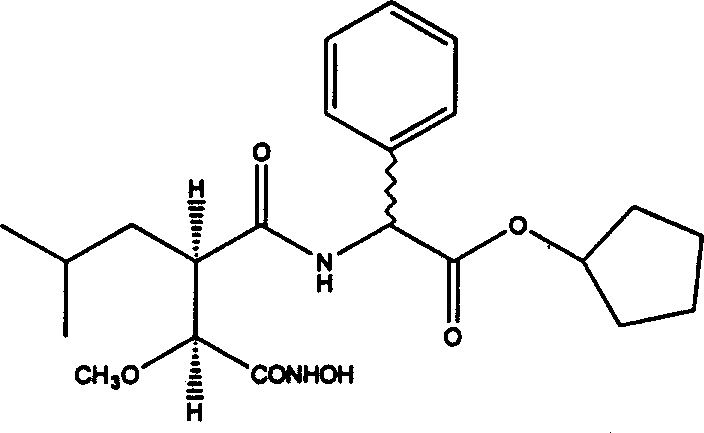
With preparation Embodiment B similar methods, use phenylglycocoll ring pentyl ester to be prepared.
Diastereomer A
1H-NMR; δ (MeOD), 8.83 (1H, d, J=6.6Hz), 7.48-7.29 (5H, m), and 5.44-5.42 (1H, m), 5.20-5.16 (1H, m), 3.53 (1H, d, J=9.7Hz), 3.17 (3H, s), and 2.89-2.79 (1H, m), 1.90-1.54 (10H, bm), and 1.06-0.99 (1H, m), 0.95 (3H, d, J=6.5Hz) and 0.90 (3H, d, J=6.4Hz).
13C-NMR; δ (MeOD), 175.3,171.6,169.4,137.5,129.7,129.4,128.7,83.1,79.9,58.7,58.1,48.5,38.4,33.4,33.3,26.7,24.6,24.5,24.3 and 21.8.
Diastereomer B
1H-NMR; δ (MeOD), 7.39-7.30 (5H, m), 5.45 (1H, s), 5.21-5.15 (1H, m), 3.59 (1H, d, J=9.4Hz), 3.29 (3H, s), 2.89-2.79 (1H, m), 1.93-1.49 (9H, bm), and 1.42-1.21 (1H, m), 1.01 (1H, ddd, J=3.7,9.9,13.3Hz), 0.83 (3H, d, J=6.5Hz) and 0.79 (3H, d, J=6.6Hz).
13C-NMR; δ (MeOD), 175.1,171.5,169.5,137.9,129.7,129.4,128.7,83.0,79.8,58.5,58.3,48.6,38.5,33.3,27.8,24.5,24.4,24.1 and 21.7.
Embodiment 4
2-(3S-hydroxyl amino formyl radical-2R-isobutyl--oneself-5-enoyl-amino)-2-(4-p-methoxy-phenyl) acetic acid cyclopentyl ester.

Press similar methods, use 4-p-methoxy-phenyl glycine ring pentyl ester to be prepared with preparation embodiment D.
Diastereomer A
1H-NMR; δ (MeOD), 8.94 (1H, d, J=6.4Hz), 7.32 (2H, d, J=8.7Hz), 6.93 (2H, d, J=8.7Hz), 5.67-5.50 (1H, m), 5.36-5.33 (1H, m), 5.20-5.14 (1H, m), 4.93-4.87 (2H, m), 3.79 (3H, s), 2.68-2.59 (1H, m), 2.24-2.09 (2H, m), and 1.97-1.55 (11H, bm), 1.11-1.00 (1H, m), 0.95 (3H, d, J=6.5Hz) and 0.88 (3H, d, J=6.5Hz).
13C-NMR; δ (MeOD), 176.2,172.4,171.9,161.4,136.0,130.2,129.4,117.4,115.2,79.7,58.2,55.8,48.3,47.3,41.5,36.0,33.4,33.3,26.7,24.6,24.5 and 21.7.
Diastereomer B
1H-NMR; δ (MeOD), 8.96 (1H, d, J=6.7Hz), 7.29 (2H, d, J=8.7Hz), 6.93 (2H, d, J=8.7Hz), 5.77-5.61 (1H, m), 5.32 (1H, s), 5.20-5.15 (1H, m), 5.09-4.97 (2H, m), 3.80 (3H, s), 2.64 (1H, dt, J=3.3,11.4,13.5Hz), 2.43-2.16 (3H, m), and 1.91-1.49 (9H, bm), 1.42-1.29 (1H, m), 1.05 (1H, ddd, J=3.3,10.1,13.2Hz) and 0.81 (6H, d, J=6.5Hz).
13C-NMR; δ (MeOD), 176.3,172.5,172.0,161.4,136.4,130.2,129.0,117.5,115.2,79.8,58.2,55.8,48.4,47.4,41.3,36.1,33.4,27.1,24.5,24.3 and 21.6.
Embodiment 5
2-(3S-hydroxyl amino formyl radical-21R-isobutyl--oneself-5-enoyl-amino)-2-(thiophene-2-yl) acetic acid cyclopentyl ester

Press similar methods, use thiophene-2-base glycine ring pentyl ester to be prepared with preparation embodiment D.
Diastereomer A
1H-NMR; δ (MeOD), 7.41 (1H, dd, J=5.1,1.2Hz), 7.12 (1H, d, J=3.5Hz), 7.01 (1H, dd, J=5.1,3.5Hz), 5.72 (1H, s), 5.69-5.52 (1H, m), 5.26-5.18 (1H, m), 5.00-4.89 (2H, m), 2.70-2.59 (1H, m), 2.28-2.13 (2H, m), 2.09-1.50 (11H, m), 1.05 (1H, ddd, J=13.8,11.0,2.9Hz), 0.93 (3H, d, J=6.4Hz) and 0.87 (3H, d, J=6.5Hz).
13C-NMR; δ (MeOD), 176.5,172.7,171.1,139.5,136.4,128.4,128.3,127.7,117.9,80.7,54.1,48.7,47.7,41.9,36.5,33.8,33.7,27.2,25.1,25.0,24.9 and 22.1.
Diastereomer B
1H-NMR; δ (MeOD), 7.42 (1H, dd, J=5.0,0.7Hz), 7.10 (1H, d, J=3.6Hz), 7.01 (1H, dd, J=5.0,3.6Hz), 5.79-5.59 (2H, m), 5.28-5.19 (1H, m), 5.10-4.94 (2H, m), 2.71-2.59 (1H, m), 2.36-2.16 (3H, m), and 1.97-1.34 (10H, m), 1.13-1.00 (1H, m), 0.86 (3H, d, J=6.2Hz) and 0.84 (3H, d, J=6.3Hz).
13C-NMR; δ (MeOD), 176.7,172.8,171.2,139.3,136.7,128.3,128.2,127.6,117.9,80.7,54.2,48.8,47.8,41.7,36.4,33.8,27.5,25.1,25.0,24.8 and 22.1.
Embodiment 6
2-(3S-hydroxyl amino formyl radical-2R-isobutyl--oneself-5-enoyl-amino)-2-(thiene-3-yl-) acetic acid cyclopentyl ester

Press similar methods, be prepared with thiene-3-yl-glycine ring pentyl ester with preparation embodiment D.
Diastereomer A
1H-NMR; δ (MeOD), and 7.48-7.42 (2H, m), 7.13 (1H, dd, J=4.2,2.0Hz), 5.69-5.52 (2H, m), 5.21-5.16 (1H, m), and 4.98-4.90 (2H, m), 2.71-2.59 (1H, m), and 2.28-2.11 (2H, m), 2.00-1.50 (11H, m), and 1.12-0.98 (1H, m), 0.94 (3H, d, J=6.4Hz) and 0.88 (3H, d, J=6.5Hz).
13C-NMR; δ (MeOD), 176.6,172.8,171.8,137.8,136.4,128.3,128.0,125.2,117.9,80.3,54.6,41.9,36.5,33.8,33.8,27.1,25.0,24.9 and 22.1.
Diastereomer B
1H-NMR; δ (MeOD), 7.45 (1H, dd, J=4.9,3.0Hz), 7.43-7.40 (1H, m), 7.12 (1H, dd, J=5.0,1.3Hz), 5.68 (1H, ddt, J=17.0,10.1,6.8Hz), 5.53 (1H, s), 5.23-5.17 (1H, m), 5.10-4.96 (2H, m), and 2.70-2.60 (1H, m), 2.41-2.16 (3H, m), 1.94-1.49 (9H, m), 1.44-1.29 (1H, m), 1.05 (1H, ddd, J=12.9,10.3,3.3Hz), 0.84 (3H, d, J=6.5Hz) and 0.83 (3H, d, J=6.5Hz).
Biological Examples
The compound of embodiment 1-6 is tested in following cell proliferation test, with measure they separately in question cell type inhibition of proliferation ability.
The human cell line, promptly histiocytic lymphoma (U937) is with 250 cell/millimeters
2Density be inoculated into 30 millimeters that replenish in the 10% foetal calf serum appropriate incubation medium
2Tissue culture hole in.After 6 hours, in identical developing medium, test compound is added in the cell, its ultimate density is 6 μ M.Identical substratum is supplied with in celliferous contrast hole, and it contains the equivalent drug excipient, is DMSO in this test, and its ultimate density is 0.08%.In substratum, after 72 hours, use [methyl-
3[H] thymidine] (2 μ Ci/ milliliter) pair cell pulse 3 hours, on filter pad, collect then, the radioactivity that DNA is relevant is counted.Results expression is contrast
3[H] thymidine is in conjunction with percentage ratio (n=6 ± 1 standard error).In all test compounds, all observe inhibition of proliferation.
Claims (6)
1. compound, it is selected from following compound:
2 (R or S)-[2R-(S-hydroxyl-hydroxyl carbamyl-methyl)-4-methyl-pentanoyl amine]-2-phenyl-acetic acid cyclopentyl ester,
2 (R or S)-(3S-hydroxyl amino formyl radical-2R-isobutyl--oneself-5-enoyl-amino)-2-phenylacetic acid isopropyl esters,
2 (R or S)-[2R-(S-hydroxyl amino formyl radical-methoxyl group-methyl)-4-methyl-pentanoyl amino-3-phenylacetic acid ring pentyl ester,
2 (R or S)-(3S-hydroxyl amino formyl radical-2R-isobutyl--oneself-5-enoyl-amino)-2-(4-p-methoxy-phenyl) acetic acid cyclopentyl ester,
2 (R or S)-(3S-hydroxyl amino formyl radical-2R-isobutyl--oneself-5-enoyl-amino)-2-(thiophene-2-yl) acetic acid cyclopentyl ester,
2 (R or S)-(3S-hydroxyl amino formyl radical-2R-isobutyl--oneself-5-enoyl-amino)-2-(thiene-3-yl-) acetic acid cyclopentyl ester,
With they pharmaceutically or beastly pharmaceutically acceptable ester.
2. compound according to claim 1, it is the 2-S diastereomer.
3. pharmaceutical composition or animal medicinal composition comprise compound as claimed in claim 1 or 2 and pharmaceutically or beastly pharmaceutically acceptable vehicle or carrier.
4. a method that suppresses mammalian tumor cell propagation comprises the claim 1 or the 2 described compounds that the Mammals that suffers from this class propagation are enough to suppress this class proliferative amount.
5. method according to claim 4, wherein the cell proliferation of being treated is the hyper-proliferative of lymphoma, leukemia, myelomatosis, gland cancer, cancer, mesothelioma, lopsided cancer, choriocarcinoma, small cell carcinoma, large cell carcinoma, melanoma, retinoblastoma, fibrosarcoma, leiomyosarcoma, glioblastoma or endothelioma cell.
6. the application of compound as claimed in claim 1 or 2 in the composition of preparation inhibition mammalian tumor cell propagation.
Applications Claiming Priority (1)
| Application Number | Priority Date | Filing Date | Title |
|---|---|---|---|
| PCT/GB1998/000754 WO1999046241A1 (en) | 1998-03-12 | 1998-03-12 | Cytostatic agents |
Publications (2)
| Publication Number | Publication Date |
|---|---|
| CN1286681A true CN1286681A (en) | 2001-03-07 |
| CN1141292C CN1141292C (en) | 2004-03-10 |
Family
ID=10825272
Family Applications (1)
| Application Number | Title | Priority Date | Filing Date |
|---|---|---|---|
| CNB988138476A Expired - Lifetime CN1141292C (en) | 1998-03-12 | 1998-03-12 | Cytostatic agents |
Country Status (17)
| Country | Link |
|---|---|
| EP (1) | EP1062202B1 (en) |
| JP (1) | JP4324324B2 (en) |
| KR (1) | KR20010041661A (en) |
| CN (1) | CN1141292C (en) |
| AT (1) | ATE231122T1 (en) |
| AU (1) | AU747977B2 (en) |
| BR (1) | BR9815717A (en) |
| CA (1) | CA2323414C (en) |
| CZ (1) | CZ299610B6 (en) |
| DE (1) | DE69810817T2 (en) |
| GB (1) | GB2349149A (en) |
| HU (1) | HUP0100999A2 (en) |
| IL (2) | IL137774A0 (en) |
| NO (1) | NO20004528L (en) |
| NZ (1) | NZ506293A (en) |
| PL (1) | PL190637B1 (en) |
| WO (1) | WO1999046241A1 (en) |
Families Citing this family (3)
| Publication number | Priority date | Publication date | Assignee | Title |
|---|---|---|---|---|
| GB9901863D0 (en) * | 1999-01-29 | 1999-03-17 | British Biotech Pharm | Antibacterial agents |
| WO2019039937A1 (en) | 2017-08-21 | 2019-02-28 | Stichting Vumc | Therapeutic combination for cancer treatment |
| US10925851B2 (en) | 2018-03-15 | 2021-02-23 | Regents Of The University Of Minnesota | Use of Tosedostat and related compounds as analgesics |
Family Cites Families (4)
| Publication number | Priority date | Publication date | Assignee | Title |
|---|---|---|---|---|
| WO1993021942A2 (en) * | 1992-05-01 | 1993-11-11 | British Biotech Pharmaceuticals Limited | Use of mmp inhibitors |
| GB9215665D0 (en) * | 1992-07-23 | 1992-09-09 | British Bio Technology | Compounds |
| US5691381A (en) * | 1995-04-18 | 1997-11-25 | The Dupont Merck Pharmaceutical Company | Hydroxamic and carbocyclic acids as metalloprotease inhibitors |
| BR9712019A (en) * | 1996-09-10 | 1999-08-24 | British Biotech Pharm | Derivatives of cytostatic hyroxamic acids |
-
1998
- 1998-03-12 BR BR9815717-5A patent/BR9815717A/en unknown
- 1998-03-12 HU HU0100999A patent/HUP0100999A2/en unknown
- 1998-03-12 GB GB0019414A patent/GB2349149A/en not_active Withdrawn
- 1998-03-12 KR KR1020007009865A patent/KR20010041661A/en not_active Withdrawn
- 1998-03-12 CA CA002323414A patent/CA2323414C/en not_active Expired - Lifetime
- 1998-03-12 EP EP98909620A patent/EP1062202B1/en not_active Expired - Lifetime
- 1998-03-12 WO PCT/GB1998/000754 patent/WO1999046241A1/en not_active Ceased
- 1998-03-12 JP JP2000535622A patent/JP4324324B2/en not_active Expired - Lifetime
- 1998-03-12 AU AU64106/98A patent/AU747977B2/en not_active Expired
- 1998-03-12 PL PL98342811A patent/PL190637B1/en unknown
- 1998-03-12 CN CNB988138476A patent/CN1141292C/en not_active Expired - Lifetime
- 1998-03-12 NZ NZ506293A patent/NZ506293A/en not_active IP Right Cessation
- 1998-03-12 DE DE69810817T patent/DE69810817T2/en not_active Expired - Lifetime
- 1998-03-12 CZ CZ20003317A patent/CZ299610B6/en not_active IP Right Cessation
- 1998-03-12 AT AT98909620T patent/ATE231122T1/en not_active IP Right Cessation
- 1998-03-12 IL IL13777498A patent/IL137774A0/en active IP Right Grant
-
2000
- 2000-08-09 IL IL137774A patent/IL137774A/en not_active IP Right Cessation
- 2000-09-11 NO NO20004528A patent/NO20004528L/en unknown
Also Published As
| Publication number | Publication date |
|---|---|
| GB0019414D0 (en) | 2000-09-27 |
| CZ299610B6 (en) | 2008-09-17 |
| PL190637B1 (en) | 2005-12-30 |
| BR9815717A (en) | 2000-11-07 |
| AU747977B2 (en) | 2002-05-30 |
| DE69810817T2 (en) | 2003-11-20 |
| HUP0100999A2 (en) | 2001-08-28 |
| EP1062202B1 (en) | 2003-01-15 |
| ATE231122T1 (en) | 2003-02-15 |
| NO20004528D0 (en) | 2000-09-11 |
| PL342811A1 (en) | 2001-07-02 |
| CZ20003317A3 (en) | 2001-03-14 |
| JP4324324B2 (en) | 2009-09-02 |
| CN1141292C (en) | 2004-03-10 |
| KR20010041661A (en) | 2001-05-25 |
| DE69810817D1 (en) | 2003-02-20 |
| EP1062202A1 (en) | 2000-12-27 |
| CA2323414A1 (en) | 1999-09-16 |
| CA2323414C (en) | 2008-05-13 |
| IL137774A0 (en) | 2001-10-31 |
| GB2349149A (en) | 2000-10-25 |
| JP2002506057A (en) | 2002-02-26 |
| AU6410698A (en) | 1999-09-27 |
| NO20004528L (en) | 2000-09-11 |
| WO1999046241A1 (en) | 1999-09-16 |
| NZ506293A (en) | 2003-05-30 |
| IL137774A (en) | 2006-07-05 |
Similar Documents
| Publication | Publication Date | Title |
|---|---|---|
| CN1196488C (en) | Use of 3-hydroxy-3-methylglutaryl coenzym a reductase inhibitors for the manufacture of a medicament for the treatment of diabetic neuropathy | |
| CN1137898C (en) | Analogs of parathyroid hormone | |
| CN1158073C (en) | Application of protein kinase C inhibitor in preparation of medicine | |
| CN1615134A (en) | Pharmaceutical composition containing valsartan and NEP inhibitor | |
| CN1148338A (en) | Raising fetal hemoglobin levels with hydroxyesters | |
| CN1694867A (en) | Crystal for oral solid drug and oral solid drug for dysuria treatment containing the same | |
| CN1221426A (en) | Leptin (ebi-peptide) fragments | |
| CN1420878A (en) | Compounds with growth hormone-releasing properties | |
| CN1345238A (en) | Method for treatment of neurological or neuropsychiatric disorders | |
| CN1382131A (en) | Substituted benzylthiazolidine-2,4-dione derivatives | |
| CN1436179A (en) | Oxadiazole derivs. having anticancer effects | |
| CA2818161A1 (en) | Novel compound and medical use thereof | |
| CN1507437A (en) | Aralkylpiperazines with serotonin 5-HTIA activity | |
| CN1599748A (en) | Novel peptides and medicinal uses thereof | |
| CN1286681A (en) | Cytostatic agents | |
| CN1347325A (en) | Novel amide derivs. as growth hormone secretagogues | |
| CN1382046A (en) | Heteroatom Intercalating Analogs of 15-Hydroxyeicosatetraenoic Acid and Methods of Use | |
| CN101076328A (en) | Preventive or therapeutic agent for sleep disorder | |
| CN1340043A (en) | Phenylalaninol derivatives | |
| CN1384742A (en) | Use of bis-sulfonamides for producing medicaments used for preventing or treating hyperlipidaemia | |
| CN1070190A (en) | The quinolylmethoxy-phenylacetamides of heterocyclic substituted | |
| CN1196681A (en) | Ophthalmic preparations | |
| CN1229339C (en) | Inhibiting angiogenesis and tumor growth | |
| CN1093090A (en) | Cyclic peptide | |
| CN1254243C (en) | Pharmaceutical compositions comprising chelidonine or derivatives thereof |
Legal Events
| Date | Code | Title | Description |
|---|---|---|---|
| C06 | Publication | ||
| PB01 | Publication | ||
| C10 | Entry into substantive examination | ||
| SE01 | Entry into force of request for substantive examination | ||
| C14 | Grant of patent or utility model | ||
| GR01 | Patent grant | ||
| CX01 | Expiry of patent term |
Granted publication date: 20040310 |
|
| CX01 | Expiry of patent term |