CN1286685A - Heterocyclic cytotoxic agents - Google Patents
Heterocyclic cytotoxic agents Download PDFInfo
- Publication number
- CN1286685A CN1286685A CN98813518A CN98813518A CN1286685A CN 1286685 A CN1286685 A CN 1286685A CN 98813518 A CN98813518 A CN 98813518A CN 98813518 A CN98813518 A CN 98813518A CN 1286685 A CN1286685 A CN 1286685A
- Authority
- CN
- China
- Prior art keywords
- alkyl
- compound
- hydrogen
- hydroxyl
- alkoxyl group
- Prior art date
- Legal status (The legal status is an assumption and is not a legal conclusion. Google has not performed a legal analysis and makes no representation as to the accuracy of the status listed.)
- Pending
Links
Images


Classifications
-
- C—CHEMISTRY; METALLURGY
- C07—ORGANIC CHEMISTRY
- C07D—HETEROCYCLIC COMPOUNDS
- C07D491/00—Heterocyclic compounds containing in the condensed ring system both one or more rings having oxygen atoms as the only ring hetero atoms and one or more rings having nitrogen atoms as the only ring hetero atoms, not provided for by groups C07D451/00 - C07D459/00, C07D463/00, C07D477/00 or C07D489/00
- C07D491/02—Heterocyclic compounds containing in the condensed ring system both one or more rings having oxygen atoms as the only ring hetero atoms and one or more rings having nitrogen atoms as the only ring hetero atoms, not provided for by groups C07D451/00 - C07D459/00, C07D463/00, C07D477/00 or C07D489/00 in which the condensed system contains two hetero rings
- C07D491/04—Ortho-condensed systems
-
- A—HUMAN NECESSITIES
- A61—MEDICAL OR VETERINARY SCIENCE; HYGIENE
- A61P—SPECIFIC THERAPEUTIC ACTIVITY OF CHEMICAL COMPOUNDS OR MEDICINAL PREPARATIONS
- A61P35/00—Antineoplastic agents
-
- C—CHEMISTRY; METALLURGY
- C07—ORGANIC CHEMISTRY
- C07D—HETEROCYCLIC COMPOUNDS
- C07D221/00—Heterocyclic compounds containing six-membered rings having one nitrogen atom as the only ring hetero atom, not provided for by groups C07D211/00 - C07D219/00
- C07D221/02—Heterocyclic compounds containing six-membered rings having one nitrogen atom as the only ring hetero atom, not provided for by groups C07D211/00 - C07D219/00 condensed with carbocyclic rings or ring systems
- C07D221/04—Ortho- or peri-condensed ring systems
- C07D221/18—Ring systems of four or more rings
Landscapes
- Chemical & Material Sciences (AREA)
- Organic Chemistry (AREA)
- Health & Medical Sciences (AREA)
- Life Sciences & Earth Sciences (AREA)
- General Health & Medical Sciences (AREA)
- Medicinal Chemistry (AREA)
- Nuclear Medicine, Radiotherapy & Molecular Imaging (AREA)
- Pharmacology & Pharmacy (AREA)
- Chemical Kinetics & Catalysis (AREA)
- Animal Behavior & Ethology (AREA)
- General Chemical & Material Sciences (AREA)
- Public Health (AREA)
- Veterinary Medicine (AREA)
- Pharmaceuticals Containing Other Organic And Inorganic Compounds (AREA)
- Nitrogen Condensed Heterocyclic Rings (AREA)
- Plural Heterocyclic Compounds (AREA)
- Other In-Based Heterocyclic Compounds (AREA)
- Nitrogen And Oxygen Or Sulfur-Condensed Heterocyclic Ring Systems (AREA)
Abstract
本发明提供式(Ⅰ)化合物及其药学上可接受的盐,其中R1-R8和X以及Y为说明书中定义的任一含义。本发明还提供含一种式(Ⅰ)化合物的药用组合物、可用于制备式(Ⅰ)化合物的方法、用于制备式(Ⅰ)化合物的中间体以及用式(Ⅰ)化合物治疗癌症的治疗方法。

This invention provides compounds of formula (I) and pharmaceutically acceptable salts thereof, wherein R1 - R8 and X and Y have any meaning as defined in the specification. This invention also provides pharmaceutical compositions comprising a compound of formula (I), methods for preparing compounds of formula (I), intermediates for preparing compounds of formula (I), and methods for treating cancer with compounds of formula (I).
Description
政府基金
本文所述发明在国立癌症研究所(National Cancer Institute)授予的资助CA 39662下获得政府支持。美国政府在本发明中拥有一定权益。The invention described herein was made with government support under grant CA 39662 awarded by the National Cancer Institute. The US Government has certain rights in this invention.
发明背景Background of the Invention
DNA拓扑异构酶是一种存在于细胞核的催化DNA链的断裂和重接的酶,它控制DNA的拓扑状态。新近的研究认为,拓扑异构酶也参与调节RNA转录期间的模板超螺旋。哺乳动物拓扑异构酶有两种主要类型。DNA拓扑异构酶Ⅰ通过进行瞬时单链断裂-连接循环来催化双链DNA的拓扑状态的改变。相反,哺乳动物拓扑异构酶Ⅱ通过引起瞬时酶桥接的双链断裂、接着链通过并再连接从而改变DNA的拓扑结构。哺乳动物拓扑异构酶Ⅱ又分为Ⅱα型和Ⅱβ型。与是拓扑异构酶毒物的药剂有关的抗肿瘤活性与其稳定酶-DNA可切割复合物的能力有关。这种药物诱导的酶-DNA可切割复合物在稳定作用有效地将该酶转化为细胞毒物。DNA topoisomerase is an enzyme present in the nucleus that catalyzes the breaking and rejoining of DNA strands, and it controls the topological state of DNA. Recent studies suggest that topoisomerases are also involved in the regulation of template supercoiling during RNA transcription. There are two main types of mammalian topoisomerases. DNA topoisomerase I catalyzes changes in the topological state of double-stranded DNA by performing a transient single-strand break-ligation cycle. In contrast, mammalian topoisomerase II alters the topology of DNA by causing transient enzymatically bridged double-strand breaks followed by strand passage and religation. Mammalian topoisomerase II is further divided into type IIα and type IIβ. Antitumor activity associated with agents that are topoisomerase poisons is related to their ability to stabilize the enzyme-DNA cleavable complex. This drug-induced enzyme-DNA cleavage complex effectively converts the enzyme into a cytotoxic agent upon stabilization.
几种临床应用中的抗肿瘤剂具有作为哺乳动物拓扑异构酶Ⅱ毒物的强活性。这些抗肿瘤剂包括阿霉素、放线菌素D、道诺霉素、VP-16和VM-26(替尼泊苷或表鬼臼脂素)。与用作拓扑异构酶Ⅱ毒物的临床和实验药物数量相比,目前仅有有限数目的药剂被鉴定为拓扑异构酶Ⅰ毒物。喜树碱和其结构相关的类似物是其中最为广泛研究的拓扑异构酶Ⅰ毒物。近来,二苯并咪唑和三苯并咪唑(terbenzimidazoles)(Chen等,癌症研究1993,53,1332-1335;Sun等,医用化学杂志,1995,38,3638-3644;Kim等,医用化学杂志,1996,39,992-998)、某些苯并[c]菲啶和原小檗碱生物碱及其合成类似物(Makhey等,医用化学研究1995,5,1-12;Janin等,J.Med.Chem 1975,18,708-713;Makhey等,Bioorg. & Med.Chem.1996,4,781-791)以及真菌代谢产物、bulgarein(Fujii等,生物化学杂志1993,268,13160-13165)和saintopin(Yamashita等,Biochemistry 1991,30,5838-5845)和吲哚并咔唑(Yamashita等,Biochemistry 1992,31,12069-12075)已经鉴定为拓扑异构酶Ⅰ毒物。Several antineoplastic agents in clinical use have potent activity as mammalian topoisomerase II poisons. These antineoplastic agents include doxorubicin, actinomycin D, daunomycin, VP-16 and VM-26 (teniposide or epipodophyllotoxin). Compared to the number of clinical and experimental drugs used as topoisomerase II poisons, currently only a limited number of agents have been identified as topoisomerase I poisons. Camptothecin and its structurally related analogs are among the most extensively studied topoisomerase I poisons. Recently, dibenzimidazoles and tribenzimidazoles (terbenzimidazoles) (Chen et al., Cancer Research 1993, 53, 1332-1335; Sun et al., Journal of Medicinal Chemistry, 1995, 38, 3638-3644; Kim et al., Journal of Medicinal Chemistry, 1996, 39, 992-998), certain benzo[c]phenanthridine and protoberberine alkaloids and their synthetic analogues (Makhey et al., Medicinal Chemistry Research 1995, 5, 1-12; Janin et al., J. Med.Chem 1975, 18, 708-713; Makhey et al., Bioorg. & Med.Chem.1996, 4, 781-791) and fungal metabolites, bulgarein (Fujii et al., Biochemical Journal 1993, 268, 13160-13165) and saintopin (Yamashita et al., Biochemistry 1991, 30, 5838-5845) and indolocarbazole (Yamashita et al., Biochemistry 1992, 31, 12069-12075) have been identified as topoisomerase I poisons.
用Coralyne、两面针碱、5,6-二氢-8-去甲基Coralyne和相关的类似物观察到的例外的拓扑异构酶中毒推动了数个关于与其特别用作拓扑异构酶Ⅰ或拓扑异构酶Ⅱ毒物的能力有关的结构特征的近期研究(Gatto等,癌症研究1996,56,2795-2800;Wang等,Chem.Res.Toxicol.1996,9,75-83;Wang等,Chem.Res.Toxicol.,1993,6,813-818)。与所有这三种药剂有关的共同特征是在其结构中存在3-苯基异喹啉鎓(sioquinolinium)部分。The exceptional topoisomerase intoxication observed with Coralyne, valine, 5,6-dihydro-8-desmethylCoralyne, and related analogues has prompted several discussions about their use specifically as topoisomerase I or Recent studies of structural features related to the ability of topoisomerase II poisons (Gatto et al., Cancer Research 1996, 56, 2795-2800; Wang et al., Chem. Res. Toxicol. 1996, 9, 75-83; . Res. Toxicol., 1993, 6, 813-818). A common feature associated with all three agents is the presence of a 3-phenylisoquinolinium moiety in their structure.
尽管观察到几种这样的化合物与喜树碱作为拓扑异构酶Ⅰ毒物相似的效力或者与VM-26作为拓扑异构酶Ⅱ毒物相似的效力,但是它们仅具有中等的细胞毒活性。与其拓扑异构酶毒物效力不存在更直接相关的部分原因可能是这些药剂不可能如喜树碱或VM-26一样有效地吸收入细胞中。季铵基团的存在最可能影响细胞摄取。据推测,诸如coralyne和两面针碱(nitidine)的药剂可能需要经过水解才能有效转运,随后脱水或环化脱水重新形成季铵母体化合物。这可以解释用诸如coralyne和两面针碱的药剂在体内观察到相对低的抗肿瘤活性的原因。Although similar potency to camptothecin as a topoisomerase I poison or to VM-26 as a topoisomerase II poison was observed for several of these compounds, they had only moderate cytotoxic activity. Part of the reason for the lack of a more direct correlation to their topoisomerase poison potency may be that these agents are not as efficiently taken up into cells as camptothecin or VM-26. The presence of quaternary ammonium groups most likely affects cellular uptake. It has been speculated that agents such as coralyne and nitidine may require hydrolysis for efficient transport followed by dehydration or cyclodehydration to reform the quaternary ammonium parent compound. This may explain the relatively low antitumor activity observed in vivo with agents such as coralyne and limpet.
目前,与现存药剂相比,需要新的抗癌药物、活性改善的抗癌药物和副作用较小或选择性改进的抗癌药物。Currently, there is a need for new anticancer drugs, anticancer drugs with improved activity, and anticancer drugs with fewer side effects or improved selectivity compared to existing agents.
发明概述Invention Summary
本发明提供显示对拓扑异构酶Ⅰ和/或拓扑异构酶Ⅱ抑制活性的化合物,以及提供抗癌细胞包括药物抗性癌细胞的有效细胞毒性剂的化合物。因此,本发明提供为式Ⅰ的化合物的本发明化合物或其药学上可接受的盐: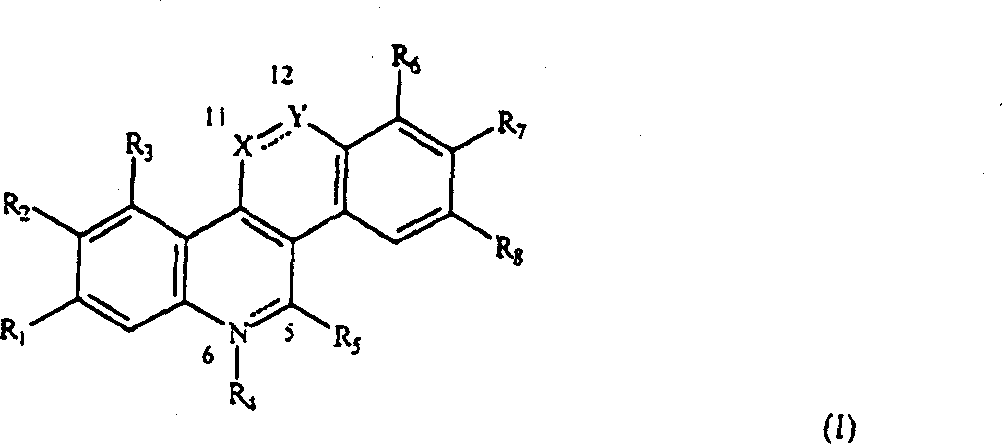
R1、R2和R3每一个单独是氢、(C1-C6)烷基、(C3-C6)环烷基、(C1-C6)烷氧基、硝基、羟基、NRgRh、COORk、ORm或卤代;或者R1和R2一起为亚甲基二氧基而R3是氢、(C1-C6)烷基、(C3-C6)环烷基、(C1-C6)烷氧基、硝基、羟基、NRgRh、COORk、ORm或卤代;或者R2和R3一起为亚甲基二氧基而R1是氢、(C1-C6)烷基、(C3-C6)环烷基、(C1-C6)烷氧基、硝基、羟基、NRgRh、COORk、ORm或卤代;R 1 , R 2 and R 3 are each independently hydrogen, (C 1 -C 6 )alkyl, (C 3 -C 6 )cycloalkyl, (C 1 -C 6 )alkoxy, nitro, hydroxyl , NR g R h , COOR k , OR m or halo; or R 1 and R 2 together are methylenedioxy and R 3 is hydrogen, (C 1 -C 6 )alkyl, (C 3 -C 6 ) Cycloalkyl, (C 1 -C 6 ) alkoxy, nitro, hydroxyl, NR g R h , COOR k , OR m or halo; or R 2 and R 3 together are methylenedioxy while R 1 is hydrogen, (C 1 -C 6 )alkyl, (C 3 -C 6 )cycloalkyl, (C 1 -C 6 )alkoxy, nitro, hydroxyl, NR g R h , COOR k , OR m or halogenated;
R4是氧基、(C1-C6)烷基或不存在;R 4 is oxy, (C 1 -C 6 )alkyl or absent;
R5是氢、羟基或(C1-C6)烷基;R 5 is hydrogen, hydroxyl or (C 1 -C 6 ) alkyl;
R6、R7和Rg每一个单独是氢、(C1-C6)烷基、(C3-C6)环烷基、(C1-C6)烷氧基、硝基、羟基、NRgRh、COORk、ORm或卤代;或者R6和R7一起为亚甲基二氧基而R8是氢、(C1-C6)烷基、(C3-C6)环烷基、(C1-C6)烷氧基、硝基、羟基、NRgRh、COORk、ORm或卤代;或者R7和R8一起为亚甲基二氧基而R6是氢、(C1-C6)烷基、(C3-C6)环烷基、(C1-C6)烷氧基、硝基、羟基、NRgRh、C(=O)Rk、COORk、ORm或卤代;R 6 , R 7 and R g are each independently hydrogen, (C 1 -C 6 )alkyl, (C 3 -C 6 )cycloalkyl, (C 1 -C 6 )alkoxy, nitro, hydroxyl , NR g R h , COOR k , OR m or halo; or R 6 and R 7 together are methylenedioxy and R 8 is hydrogen, (C 1 -C 6 )alkyl, (C 3 -C 6 ) Cycloalkyl, (C 1 -C 6 ) alkoxy, nitro, hydroxyl, NR g R h , COOR k , OR m or halo; or R 7 and R 8 together are methylenedioxy And R 6 is hydrogen, (C 1 -C 6 ) alkyl, (C 3 -C 6 ) cycloalkyl, (C 1 -C 6 ) alkoxy, nitro, hydroxyl, NR g R h , C( =0) R k , COOR k , OR m or halo;
用……表示的每个键单独存在或不存在;each key denoted by ... is individually present or absent;
X是C(Rg)(Rb)和NRc;X is C( Rg )( Rb ) and NRc ;
Y是C(Rd)(Re)和NRf;Y is C(R d )(R e ) and NR f ;
如果……表示的11位和12位之间的键不存在,假如存在Ra和Rb则每一个单独是氢或(C1-C6)烷基;或者如果……表示的11位和12位之间的键存在,则Ra是氢或(C1-C6)烷基而Rb不存在;If the bond between
如果……表示的11位和12位之间的键不存在,假如存在Rc和Rf则每一个单独是氢或(C1-C6)烷基;或者如果……表示的11位和12位之间的键存在,则Rc和Rf每一个单独是(C1-C6)烷基或不存在;If the bond between
如果……表示的11位和12位之间的键不存在,假如存在Rd和Re则每一个单独是氢或(C1-C6)烷基;或者如果……表示的11位和12位之间的键存在,则Rd是氢和(C1-C6)烷基而Re不存在;If the bond between
每一个Rg和Rb独立是氢、(C1-C6)烷基、(C3-C6)环烷基、(C1-C6)烷氧基、(C1-C6)链烷酰基、芳基、芳基(C1-C6)烷基、芳氧基或芳基(C1-C6)烷氧基;或者Rg和Rh与它们连接的氮一起为吡咯烷基、哌啶子基、吗啉代或硫代吗啉代;Each of R g and R b is independently hydrogen, (C 1 -C 6 ) alkyl, (C 3 -C 6 ) cycloalkyl, (C 1 -C 6 ) alkoxy, (C 1 -C 6 ) alkanoyl, aryl, aryl(C 1 -C 6 )alkyl, aryloxy or aryl(C 1 -C 6 )alkoxy; or R g and Rh taken together with the nitrogen to which they are attached are pyrrole Alkyl, piperidino, morpholino or thiomorpholino;
每个Rk独立为氢或(C1-C6)烷基;和each R is independently hydrogen or (C 1 -C 6 )alkyl; and
每个Rm独立为(C1-C6)烷酰基、芳基、芳基(C1-C6)烷基;Each R m is independently (C 1 -C 6 )alkanoyl, aryl, aryl(C 1 -C 6 )alkyl;
其中R1、R2、R3、R6、R7、R8或Rk的任何(C1-C6)烷基、(C3-C6)环烷基或(C1-C6)烷氧基在碳上被1、2或3个独立选自羟基、卤代、NRnRp、(C3-C6)环烷基或(C1-C6)烷氧基的取代基任选取代;其中每个Rn和Rp独立为氢、(C1-C6)烷基、(C3-C6)环烷基、(C1-C6)烷氧基或(C1-C6)链烷酰基;或者Rn和Rp与它们连接的氮一起为吡咯烷基、哌啶子基、吗啉代或硫代吗啉代; Any (C 1 -C 6 ) alkyl , (C 3 -C 6 ) cycloalkyl or (C 1 -C 6 )alkoxy is substituted on carbon by 1, 2 or 3 independently selected from hydroxyl, halo, NR n R p , (C 3 -C 6 )cycloalkyl or (C 1 -C 6 )alkoxy wherein each R n and R p is independently hydrogen, (C 1 -C 6 ) alkyl, (C 3 -C 6 ) cycloalkyl, (C 1 -C 6 ) alkoxy or ( C 1 -C 6 ) alkanoyl; or R n and R p together with the nitrogen to which they are attached are pyrrolidinyl, piperidino, morpholino or thiomorpholino;
其中任一芳基被1、2或3个独立选自羟基、卤代、硝基、三氟甲基、三氟甲氧基、羧基、氨基、(C1-C6)烷基、(C3-C6)环烷基或(C1-C6)烷氧基的取代基任选取代;Any aryl group is replaced by 1, 2 or 3 independently selected from hydroxyl, halo, nitro, trifluoromethyl, trifluoromethoxy, carboxyl, amino, (C 1 -C 6 ) alkyl, (C 3 - C 6 ) cycloalkyl or (C 1 -C 6 ) alkoxy substituents are optionally substituted;
条件是R2和R8中至少一个是氢、甲基、硝基、羟基、氨基、氟代或氯代;或者R2和R8中至少一个构成亚甲基二氧基的部分;和with the proviso that at least one of R and R is hydrogen, methyl, nitro, hydroxyl, amino, fluoro or chloro; or at least one of R and R constitutes a moiety of methylenedioxy; and
条件是R1-R3和R6-R8不全是氢。Provided that R 1 -R 3 and R 6 -R 8 are not all hydrogen.
本发明还提供药用组合物,它包括有效量的式Ⅰ化合物或其药学上可接受的盐以及药学上可接受的稀释剂或载体。The present invention also provides a pharmaceutical composition, which comprises an effective amount of the compound of formula I or a pharmaceutically acceptable salt thereof and a pharmaceutically acceptable diluent or carrier.
本发明还提供抑制癌细胞生长的方法,包括给予患有癌症的哺乳动物抑制所述癌细胞生长有效量的式Ⅰ化合物。The present invention also provides a method for inhibiting the growth of cancer cells, comprising administering to a mammal suffering from cancer an amount of the compound of formula I effective for inhibiting the growth of said cancer cells.
本发明还提供一种方法,包括使所述癌细胞在体外或体内接触抑制所述癌细胞生长有效量的权利要求1的化合物,从而抑制癌细胞生长。The present invention also provides a method, comprising contacting the cancer cell with the compound of
本发明还提供用于医学治疗(优选用于治疗癌症如实体瘤)的式Ⅰ化合物以及式Ⅰ化合物在生产用于治疗癌症如实体瘤的药物的用途。The present invention also provides the compound of formula I for medical treatment (preferably for treating cancer such as solid tumor) and the use of the compound of formula I in the production of a medicament for treating cancer such as solid tumor.
本发明还提供可用于制备本发明化合物的本文公开的方法和新的中间体。某些式Ⅰ化合物可用来制备其它式Ⅰ化合物。The present invention also provides the methods and novel intermediates disclosed herein that can be used to prepare the compounds of the present invention. Certain compounds of formula I can be used to prepare other compounds of formula I.
附图简述Brief description of the drawings
图1图示本发明典型化合物(6、7、27、28)和其它化合物(4和5)的结构。Figure 1 illustrates the structures of typical compounds (6, 7, 27, 28) and other compounds (4 and 5) of the present invention.
图2图示本发明化合物的合成。Figure 2 illustrates the synthesis of compounds of the invention.
图3图示本发明化合物的合成。Figure 3 illustrates the synthesis of compounds of the invention.
图4图示中间体化合物9的合成。Figure 4 illustrates the synthesis of
图5图示中间体化合物22的合成。Figure 5 illustrates the synthesis of
图6图示其中X是CRa和Y是CRd的本发明化合物的合成。Figure 6 illustrates the synthesis of compounds of the invention wherein X is CR a and Y is CR d .
图7图示其中X是CRa、Y是CRd和R5是烷基的本发明化合物的合成。Figure 7 illustrates the synthesis of compounds of the invention wherein X is CR a , Y is CR d and R 5 is alkyl.
发明详述 Invention Details
除非另有说明,使用以下定义:卤代是氟代、氯代、溴代或碘代。烷基、烷氧基、链烯基、炔基等是指直链和支链两种基团;但是指单独的基团如“丙基”时仅包括直链基团,支链异构体如“并丙基”特别指出。芳基是指苯基基团或其中至少一个环是芳香环的具有约9-10环原子的单边稠双环碳环基团。Unless otherwise stated, the following definitions apply: halo is fluoro, chloro, bromo or iodo. Alkyl, alkoxy, alkenyl, alkynyl, etc. refer to both straight-chain and branched-chain groups; however, when referring to a single group such as "propyl", only straight-chain groups and branched-chain isomers are included. As specifically indicated by "parapropyl". Aryl refers to a phenyl group or a unilaterally fused bicyclic carbocyclic group having about 9-10 ring atoms in which at least one ring is aromatic.
本领域技术人员应该认识到,具有手性中心的本发明化合物可以以旋光型和消旋型存在和分离。某些化合物可以表现出多晶现象。应该理解的是,本发明包括任何消旋型、旋光型、多晶型或立体异构型或其混合物的本发明化合物,这些化合物具有本文所述的应用特性,如何制备旋光型(如用重结晶技术拆分消旋型、由旋光原料合成、手性合成或用手性固定相层析分离)和如何用本文所述标准试验或用其它本领域众所周知的类似试验测定拓扑异构酶中毒活性或细胞毒活性是本领域众所周知的。Those skilled in the art will recognize that compounds of the present invention having chiral centers can exist and be isolated in optically active and racemic forms. Certain compounds can exhibit polymorphism. It should be understood that the present invention includes any racemic, optically active, polymorphic or stereoisomeric compounds of the present invention or mixtures thereof, these compounds have the application properties described herein, how to prepare the optically active form (such as using heavy Resolution of racemic forms by crystallization techniques, synthesis from optically active starting materials, chiral synthesis or separation by chiral stationary phase chromatography) and how to measure topoisomerase poisoning activity using standard assays described herein or other similar assays well known in the art Or cytotoxic activity is well known in the art.
以下所列基团、取代基的具体值和范围仅仅是为了说明;它们不排除其它限定值或在基团和取代基限定范围内的其它值。Specific values and ranges for radicals and substituents listed below are for illustration only; they do not exclude other defined values or other values within defined ranges for the radicals and substituents.
具体来说,(C1-C6)烷基可以是甲基、乙基、丙基、异丙基、丁基、异丁基、仲丁基、戊基、3-戊基或己基;(C3-C6)环烷基可以是环丙基、环丁基、环戊基或环己基;(C1-C6)烷氧基可以是甲氧基、乙氧基、丙氧基、异丙氧基、丁氧基、异丁氧基、仲丁氧基、戊氧基、3-戊氧基或己氧基;(C1-C6)链烷酰基可以是乙酰基、丙酰基、丁酰基、戊酰基或己酰基;和芳基可以是苯基、茚基或萘基;Specifically, (C 1 -C 6 )alkyl may be methyl, ethyl, propyl, isopropyl, butyl, isobutyl, sec-butyl, pentyl, 3-pentyl or hexyl; ( C 3 -C 6 )cycloalkyl can be cyclopropyl, cyclobutyl, cyclopentyl or cyclohexyl; (C 1 -C 6 )alkoxy can be methoxy, ethoxy, propoxy, Isopropoxy, butoxy, isobutoxy, sec-butoxy, pentyloxy, 3-pentyloxy or hexyloxy; (C 1 -C 6 )alkanoyl can be acetyl, propionyl , butyryl, valeryl or hexanoyl; and aryl may be phenyl, indenyl or naphthyl;
具体来说,R2或R7可以是羟基、甲氧基、苄氧基、氨基、羟甲基、氨甲基、氨基羰基、甲氧基羰基、三氟甲基、3-氨基丙氧基羰基或2-羟乙基。Specifically, R or R can be hydroxyl, methoxy, benzyloxy, amino, hydroxymethyl, aminomethyl, aminocarbonyl, methoxycarbonyl, trifluoromethyl, 3-aminopropoxy carbonyl or 2-hydroxyethyl.
特别是,R3可以是氢。In particular, R3 may be hydrogen.
特别是,R4可以不存在;或R4可以是(C1-C6)烷基。In particular, R 4 may be absent; or R 4 may be (C 1 -C 6 )alkyl.
特别是,R5可以是甲基或氢。In particular, R5 may be methyl or hydrogen.
一组特别的化合物是其中R1、R2和R3每一个独立为氢或(C1-C6)烷氧基的式Ⅰ化合物;或者R1和R2一起为亚甲基二氧基(-OCH2O-)而R3是氢或(C1-C6)烷氧基的式Ⅰ化合物,或其药学上可接受的盐。A particular group of compounds are compounds of formula I wherein R 1 , R 2 and R 3 are each independently hydrogen or (C 1 -C 6 )alkoxy; or R 1 and R 2 together are methylenedioxy (-OCH 2 O-) and a compound of formula I wherein R 3 is hydrogen or (C 1 -C 6 )alkoxy, or a pharmaceutically acceptable salt thereof.
另一组特别的化合物是这样的式Ⅰ的化合物或其药学上可接受的盐,其中:R1、R2和R3每一个独立为氢、(C1-C6)烷基、(C3-C6)环烷基、(C1-C6)烷氧基、硝基、羟基、NRgRh、COORk、ORm或卤代;或者R1和R2一起为亚甲基二氧基而R3是氢、(C1-C6)烷基、(C3-C6)环烷基、(C1-C6)烷氧基、硝基、羟基、NRgRh、COORk、ORm或卤代;或者R2和R3一起为亚甲基二氧基而R1是氢、(C1-C6)烷基、(C3-C6)环烷基、(C1-C6)烷氧基、硝基、羟基、NRgRh、COORk、ORm或卤代;R4是氧基、(C1-C6)烷基或不存在;R5是氢、羟基或(C1-C6)烷基;R6、R7和R8每一个单独是氢、(C1-C6)烷基、(C3-C6)环烷基、(C1-C6)烷氧基、硝基、羟基、NRgRh、COORk、ORm或卤代;或者R6和R7一起为亚甲基二氧基而R8是氢、(C1-C6)烷基、(C3-C6)环烷基、(C1-C6)烷氧基、硝基、羟基、NRgRh、COORk、ORm或卤代;或者R7和R8一起为亚甲基二氧基而R6是氢、(C1-C6)烷基、(C3-C6)环烷基、(C1-C6)烷氧基、硝基、羟基、NRgRh、COORk、ORm或卤代;用……表示的每个键单独存在或不存在;X是C(Ra)(Rb)和NRc;Y是C(Rd)(Re)和NRf;如果……表示的11位和12位之间的键不存在,假如存在Ra和Rb则每一个单独是氢或(C1-C6)烷基;或者如果……表示的11位和12位之间的键存在,则Ra是氢或(C1-C6)烷基而Rb不存在;如果……表示的11位和12位之间的键不存在,假如存在Rc和Rf则每一个单独是氢或(C1-C6)烷基;或者如果……表示的11位和12位之间的键存在,则Rc和Rf每一个单独是(C1-C6)烷基或不存在;如果……表示的11位和12位之间的键不存在,假如存在Rd和Re则每一个单独是氢或(C1-C6)烷基;或者如果……表示的11位和12位之间的键存在,则Rd是氢或(C1-C6)烷基而Re不存在;每一个Rg和Rh独立是氢、(C1-C6)烷基、(C3-C6)环烷基、(C1-C6)烷氧基、(C1-C6)链烷酰基、芳基、芳基(C1-C6)烷基、芳氧基或芳基(C1-C6)烷氧基;或者Rg和Rh与它们连接的氮一起形成吡咯烷基、哌啶子基、吗啉代或硫代吗啉代;每个Rk各自独立为氢或(C1-C6)烷基;和每个Rm各自独立为(C1-C6)链烷酰基、芳基、芳基(C1-C6)烷基;条件是R2和R8中至少一个是氢、甲基、硝基、羟基、氨基、氟代或氯代;或者R2和R8中至少一个构成亚甲基二氧基的部分;和条件是R1-R3和R6-R8不全是氢。Another particular group of compounds are those compounds of formula I, or pharmaceutically acceptable salts thereof, wherein: R 1 , R 2 and R 3 are each independently hydrogen, (C 1 -C 6 )alkyl, (C 3 -C 6 )cycloalkyl, (C 1 -C 6 )alkoxy, nitro, hydroxyl, NR g R h , COOR k , OR m or halo; or R 1 and R 2 together are methylene Dioxy and R 3 is hydrogen, (C 1 -C 6 )alkyl, (C 3 -C 6 )cycloalkyl, (C 1 -C 6 )alkoxy, nitro, hydroxyl, NR g R h , COOR k , OR m or halo; or R 2 and R 3 together are methylenedioxy and R 1 is hydrogen, (C 1 -C 6 )alkyl, (C 3 -C 6 )cycloalkyl , (C 1 -C 6 ) alkoxy, nitro, hydroxyl, NR g R h , COOR k , OR m or halo; R 4 is oxy, (C 1 -C 6 ) alkyl or absent; R 5 is hydrogen, hydroxyl, or (C 1 -C 6 )alkyl; R 6 , R 7 and R 8 are each independently hydrogen, (C 1 -C 6 )alkyl, (C 3 -C 6 )cycloalkane radical, (C 1 -C 6 )alkoxy, nitro, hydroxyl, NR g R h , COOR k , OR m or halo; or R 6 and R 7 together are methylenedioxy and R 8 is Hydrogen, (C 1 -C 6 )alkyl, (C 3 -C 6 )cycloalkyl, (C 1 -C 6 )alkoxy, nitro, hydroxyl, NR g R h , COOR k , OR m or Halo; or R 7 and R 8 together are methylenedioxy and R 6 is hydrogen, (C 1 -C 6 )alkyl, (C 3 -C 6 )cycloalkyl, (C 1 -C 6 ) alkoxy, nitro, hydroxyl, NR g R h , COOR k , OR m or halo; each bond represented by ... is alone or absent; X is C(R a )(R b ) and NR c ; Y is C(R d )(R e ) and NR f ; if the bond between positions 11 and 12 represented by ... is absent, R a and R b are each individually hydrogen or ( C 1 -C 6 )alkyl; or if a bond between positions 11 and 12 represented by ... is present, R a is hydrogen or (C 1 -C 6 )alkyl and R b is absent; if ... The bond between positions 11 and 12 indicated is absent, if present Rc and Rf are each independently hydrogen or (C 1 -C 6 )alkyl; or if ... between positions 11 and 12 indicated The bond between R c and R f is each alone (C 1 -C 6 ) alkyl or absent; if the bond between the 11 and 12 positions represented by ... does not exist, if there is R d and R e is each independently hydrogen or (C 1 -C 6 ) alkyl; or if a bond exists between the 11 and 12 positions represented by ..., then R d is hydrogen or (C 1 -C 6 ) alkyl and R e is absent; each R g and R h is independently hydrogen, (C 1 -C 6 ) alkyl, (C 3 -C 6 ) cycloalkyl, (C 1 -C 6 ) alkoxy, (C 1 -C 6 )alkanoyl, aryl, aryl(C 1 -C 6 )alkyl, aryloxy or aryl(C 1 -C 6 )alkoxy; or R g and R h with The nitrogens to which they are attached together form pyrrolidinyl, piperidino, morpholino, or thiomorpholino; each R k is independently hydrogen or (C 1 -C 6 )alkyl; and each R m is independently independently (C 1 -C 6 )alkanoyl, aryl, aryl(C 1 -C 6 )alkyl; with the proviso that at least one of R 2 and R 8 is hydrogen, methyl, nitro, hydroxyl, amino , fluoro or chloro; or at least one of R 2 and R 8 constitutes a moiety of methylenedioxy; and with the proviso that R 1 -R 3 and R 6 -R 8 are not all hydrogen.
另一组具体的化合物是这样的式Ⅰ的化合物或其药学上可接受的盐,其中R7或R8是(C1-C6)烷氧基;或R7和R8一起为亚甲基二氧基。Another specific group of compounds are compounds of formula I, or pharmaceutically acceptable salts thereof, wherein R 7 or R 8 is (C 1 -C 6 )alkoxy; or R 7 and R 8 together are methylene base dioxy.
又一组具体的化合物是这样的式Ⅰ的化合物或其药学上可接受的盐,其中R7和R8一起为亚甲基二氧基。Yet another specific group of compounds are those compounds of formula I, or a pharmaceutically acceptable salt thereof, wherein R7 and R8 together are methylenedioxy.
再一组具体化合物是这样的式Ⅰ的化合物或其药学上可接受的盐,其中……表示的两个键均存在。A further specific group of compounds are those compounds of formula I, or a pharmaceutically acceptable salt thereof, wherein both bonds represented by ... are present.
再一组具体的化合物是这样的式Ⅰ的化合物或其药学上可接受的盐,其中……表示的5和6位之间的键不存在。A further specific group of compounds are those compounds of formula I, or a pharmaceutically acceptable salt thereof, wherein the bond between the 5 and 6 positions represented by ... is absent.
再一组具体的化合物是这样的式I的化合物或其药学上可接受的盐,其中……表示的11和12位之间的键不存在。A further specific group of compounds are those compounds of formula I, or a pharmaceutically acceptable salt thereof, wherein the bond between the 11 and 12 positions represented by ... is absent.
再一组具体的化合物是这样的式I的化合物或其药学上可接受的盐,其中……表示的两个键均不存在。A further specific group of compounds are those compounds of formula I, or a pharmaceutically acceptable salt thereof, wherein both bonds represented by ... are absent.
再一组具体的化合物是这样的式Ⅰ的化合物或其药学上可接受的盐,其中X是NRc;Y是NRf;和如果……表示的11位和12位之间的键不存在,则Rc和Rf每一个单独是氢或(C1-C6)烷基;或者如果-…表示的11位和12位之间的键存在,则Rc和Rf每一个是(C1-C6)烷基或不存在;或其药学上可接受的盐。Another specific group of compounds is a compound of formula I, or a pharmaceutically acceptable salt thereof, wherein X is NR c ; Y is NR f ; and if the bond between the 11 and 12 positions represented by... , then R c and R f are each independently hydrogen or (C 1 -C 6 ) alkyl; or if the bond between the 11 and 12 positions represented by -... is present, then R c and R f are each ( C 1 -C 6 ) alkyl or absent; or a pharmaceutically acceptable salt thereof.
另一组具体的式Ⅰ的化合物是式Ⅲ的化合物:其中Another specific group of compounds of formula I are compounds of formula III: in
R1-R8定义为上述式Ⅰ化合物中的相应基团;每个……表示的键单独存在或不存在;和如果……表示的11和12位之间的键不存在,则Rf是氢或(C1-C6)烷基;或如果……表示的11和12位之间的键存在,则Rf是(C1-C6)烷基或不存在;或其药学上可接受的盐。R 1 -R 8 are defined as the corresponding groups in the above-mentioned compounds of formula I; each bond represented by ... is present alone or absent; and if the bond between the 11 and 12 positions represented by ... does not exist, then R f is hydrogen or (C 1 -C 6 ) alkyl; or R f is (C 1 -C 6 ) alkyl or absent if a bond between the 11 and 12 positions represented by ... exists; or its pharmaceutical acceptable salt.
另一组具体的式Ⅰ化合物是式Ⅳ的化合物:其中R1-R8定义为上述式Ⅰ化合物中的相应基团;每个……表示的键单独存在或不存在;和如果……表示的11和12位之间的键不存在,则Rc是氢或(C1-C6)烷基;或如果……表示的11和12位之间的键存在,则Rc是(C1-C6)烷基或不存在;或其药学上可接受的盐。Another specific group of compounds of formula I are compounds of formula IV: Wherein R 1 -R 8 are defined as the corresponding groups in the above-mentioned formula I compound; Each bond represented by ... exists alone or does not exist; and if the bond between the 11 and 12 positions represented by ... does not exist, then R c is hydrogen or (C 1 -C 6 ) alkyl; or R c is (C 1 -C 6 ) alkyl or absent if a bond between the 11 and 12 positions represented by ... is present; or its pharmaceutical acceptable salt.
再一组具体的化合物是这样的式Ⅰ的化合物或其药学上可接受的盐,其中R1是(C1-C6)烷氧基、硝基、羟基或卤代;或R1和R2一起为亚甲基二氧基。Another specific group of compounds is a compound of formula I or a pharmaceutically acceptable salt thereof, wherein R 1 is (C 1 -C 6 )alkoxy, nitro, hydroxyl or halo; or R 1 and R 2 together are methylenedioxy.
再一组具体的化合物是这样的式Ⅰ的化合物或其药学上可接受的盐,其中R2是(C1-C6)烷氧基、硝基、羟基或卤代。A further specific group of compounds are those compounds of formula I, or a pharmaceutically acceptable salt thereof, wherein R 2 is (C 1 -C 6 )alkoxy, nitro, hydroxy or halo.
再一组具体的化合物是这样的式Ⅰ的化合物或其药学上可接受的盐,其中R3是(C1-C6)烷氧基、硝基、羟基或卤代;或R2和R3一起为亚甲基二氧基。Another specific group of compounds is a compound of formula I or a pharmaceutically acceptable salt thereof, wherein R 3 is (C 1 -C 6 )alkoxy, nitro, hydroxyl or halo; or R 2 and R 3 together are methylenedioxy.
再一组具体的化合物是这样的式Ⅰ的化合物或其药学上可接受的盐,其中R8是(C1-C6)烷氧基、硝基、羟基或卤代;或R7和R8一起为亚甲基二氧基。Another specific group of compounds is a compound of formula I or a pharmaceutically acceptable salt thereof, wherein R 8 is (C 1 -C 6 )alkoxy, nitro, hydroxyl or halo; or R 7 and R 8 together are methylenedioxy.
再一组具体的化合物是这样的式Ⅰ的化合物或其药学上可接受的盐,其中R7是(C1-C6)烷氧基、硝基、羟基或卤代。A further specific group of compounds are those compounds of formula I, or a pharmaceutically acceptable salt thereof, wherein R 7 is (C 1 -C 6 )alkoxy, nitro, hydroxy or halo.
再一组具体的化合物是这样的式Ⅰ的化合物或其药学上可接受的盐,其中R6是(C1-C6)烷氧基、硝基、羟基或卤代;或R6和R7一起为亚甲基二氧基。Another specific group of compounds is a compound of formula I or a pharmaceutically acceptable salt thereof, wherein R 6 is (C 1 -C 6 )alkoxy, nitro, hydroxyl or halo; or R 6 and R 7 together are methylenedioxy.
一种优选的本发明化合物是式Ⅰ的化合物或其药学上可接受的盐:其中A preferred compound of the present invention is a compound of formula I or a pharmaceutically acceptable salt thereof: in
R1、R2和R3每一个单独是氢、(C1-C6)烷基、(C3-C6)环烷基、(C1-C6)烷氧基、硝基、羟基或卤代;或者R1和R2一起为亚甲基二氧基(-OCH2O-)而R3是氢、(C1-C6)烷基、(C3-C6)环烷基、(C1-C6)烷氧基、硝基、羟基或卤代;或者R2和R3一起为亚甲基二氧基(-OCH2O-)而R1是氢、(C1-C6)烷基、(C3-C6)环烷基、(C1-C6)烷氧基、硝基、羟基、或卤代;R 1 , R 2 and R 3 are each independently hydrogen, (C 1 -C 6 )alkyl, (C 3 -C 6 )cycloalkyl, (C 1 -C 6 )alkoxy, nitro, hydroxyl or halo; or R 1 and R 2 together are methylenedioxy (-OCH 2 O-) and R 3 is hydrogen, (C 1 -C 6 ) alkyl, (C 3 -C 6 ) cycloalkane radical, (C 1 -C 6 )alkoxy, nitro, hydroxyl or halo; or R 2 and R 3 together are methylenedioxy (-OCH 2 O-) and R 1 is hydrogen, (C 1 -C 6 )alkyl, (C 3 -C 6 )cycloalkyl, (C 1 -C 6 )alkoxy, nitro, hydroxyl, or halo;
R4是氧基(形成氧化胺)、(C1-C6)烷基或不存在;R 4 is oxy (forming an amine oxide), (C 1 -C 6 )alkyl or absent;
R5是氢、羟基或(C1-C6)烷基;R 5 is hydrogen, hydroxyl or (C 1 -C 6 ) alkyl;
R6、R7和R8每一个单独是氢、(C1-C6)烷基、(C3-C6)环烷基、(C1-C6)烷氧基、硝基、羟基或卤代;或者R6和R7一起为亚甲基二氧基(-OCH2O-)而R8是氢、(C1-C6)烷基、(C3-C6)环烷基、(C1-C6)烷氧基、硝基、羟基或卤代;或者R7和R8一起为亚甲基二氧基(-OCH2O-)而R6是氢、(C1-C6)烷基、(C3-C6)环烷基、(C1-C6)烷氧基、硝基、羟基或卤代;R 6 , R 7 and R 8 are each independently hydrogen, (C 1 -C 6 )alkyl, (C 3 -C 6 )cycloalkyl, (C 1 -C 6 )alkoxy, nitro, hydroxyl or halo; or R 6 and R 7 together are methylenedioxy (-OCH 2 O-) and R 8 is hydrogen, (C 1 -C 6 ) alkyl, (C 3 -C 6 ) cycloalkane radical, (C 1 -C 6 )alkoxy, nitro, hydroxyl or halo; or R 7 and R 8 together are methylenedioxy (-OCH 2 O-) and R 6 is hydrogen, (C 1 -C 6 )alkyl, (C 3 -C 6 )cycloalkyl, (C 1 -C 6 )alkoxy, nitro, hydroxyl or halo;
用……表示的每个键单独存在或不存在;each key denoted by ... is individually present or absent;
X是C(Ra)(Rb)或NRc;X is C(R a )(R b ) or NR c ;
Y是C(Rd)(Re)或NRf;Y is C(R d )(R e ) or NR f ;
如果……表示的11位和12位之间的键不存在,假如存在Ra和Rb则每一个单独是氢或(C1-C6)烷基;或者如果……表示的11位和12位之间的键存在,则Ra是氢或(C1-C6)烷基而Rb不存在;If the bond between
如果……表示的11位和12位之间的键不存在,假如存在Rc和Rf则每一个单独是氢或(C1-C6)烷基;或者如果……表示的11位和12位之间的键存在,则Rc和Rf每一个单独是(C1-C6)烷基或不存在;If the bond between
如果……表示的11位和12位之间的键不存在,假如存在Rd和Re则每一个单独是氢或(C1-C6)烷基;或者如果……表示的11位和12位之间的键存在,则Rd是氢或(C1-C6)烷基而Re不存在;If the bond between
条件是R2和R8两个均不是(C1-C6)烷氧基;和with the proviso that both R and R are not (C 1 -C 6 )alkoxy; and
条件是R1-R3和R6-R8不全是氢。Provided that R 1 -R 3 and R 6 -R 8 are not all hydrogen.
另一种优选的式(Ⅰ)化合物是式(Ⅴ)的化合物:
其中R1-R8定义为上述式Ⅰ化合物中的相应基团;每个……表示的键单独存在或不存在;或其药学上可接受的盐。Wherein R 1 -R 8 are defined as the corresponding groups in the compound of formula I above; each bond represented by ... exists alone or not; or a pharmaceutically acceptable salt thereof.
一种本发明的优选的化合物是2,3-亚甲基二氧基-8,9-二甲氧基苯并[i]菲啶;或其药学上可接受的盐。A preferred compound of the present invention is 2,3-methylenedioxy-8,9-dimethoxybenzo[i]phenanthridine; or a pharmaceutically acceptable salt thereof.
在得到亚胺环闭合产物的条件下还原式Ⅱ化合物的硝基基团来制备式Ⅰ化合物:The compound of formula I is prepared by reducing the nitro group of the compound of formula II under the conditions of obtaining the imine ring closure product:

其中R1-R3、R6-R8、X和Y定义同式Ⅰ化合物的定义。适合还原硝基基团的条件是本领域众所周知的。例如在类似于实施例1中所述的条件下,用乙酸中的锌可以方便地进行水解。wherein R 1 -R 3 , R 6 -R 8 , X and Y are as defined for the compounds of formula I. Conditions suitable for reducing a nitro group are well known in the art. The hydrolysis is conveniently carried out, for example, with zinc in acetic acid under conditions similar to those described in Example 1.
适用于制备式Ⅰ化合物的中间体是式Ⅱ的化合物。式Ⅱ的化合物(例如化合物17或18)可以用类似于图2中所述方法和实施例1和3的下属部分中所述的方法制备。用二甲基甲酰胺和三溴化磷处理6,7-二甲氧基-β-四氢萘酮(8)和6,7-亚甲基二氧基-β-四氢萘酮(9)得到相应的3,4-二氢-2-溴萘醛衍生物,收率约70%,该衍生物用甲苯中的DDQ定量地氧化成相应的溴萘醛10和11。在存在催化量的对甲苯磺酸情况下用乙二醇处理相应的溴萘醛获得缩醛12和13,收率95%。Dean-Stark装置用来去除反应期间产生的水。用丁基锂处理缩醛12和13,然后用硼酸三甲酯猝灭,从而进行锂-卤素交换。反应产物的酸化使得分别形成硼酸衍生物14和15。钯(O)催化化合物14和15与邻溴硝基苯衍生物16偶联使得以分别形成2-苯基萘衍生物17和18,收率约80%。硝基基团17和18的还原和伴随的环化作用分别产生所需要的苯比[i]菲啶,收率约70%。Intermediates suitable for the preparation of compounds of formula I are compounds of formula II. Compounds of formula II (such as compounds 17 or 18) can be prepared by methods analogous to those described in Figure 2 and in the subsections of Examples 1 and 3. Treatment of 6,7-dimethoxy-β-tetralone (8) and 6,7-methylenedioxy-β-tetralone (9) with dimethylformamide and phosphorus tribromide ) to obtain the corresponding 3,4-dihydro-2-bromonaphthalene derivatives with a yield of about 70%, which were quantitatively oxidized to the corresponding bromonaphthaldehydes 10 and 11 with DDQ in toluene. Treatment of the corresponding bromonalphals with ethylene glycol in the presence of catalytic amounts of p-toluenesulfonic acid gave
式Ⅱ的化合物(例如化合物25或26)也可以用与图3中所述方法和实施例2和4下属部分中所述方法类似的方法制备。格利雅反应在分别的萘醛10和11上与甲基溴化镁进行,接着用氯铬酸吡啶鎓氧化获得的醇,分别形成酮23和24。然后这些酮直接与锡化合物(22)偶联分别获得2-苯基萘25和26。在用乙酸中的锌处理后使得25和26还原和伴随的环化分别获得所需要的5-甲基取代的苯比[i]啡啶5和7。Compounds of formula II (eg, compounds 25 or 26) can also be prepared in a manner similar to that described in Figure 3 and in Examples 2 and 4, subsections. Grignard reactions were performed on
另一种可用于制备本发明化合物的中间体是β-四氢萘酮9,该中间体可按图4说明制备。酯化3,4-亚甲基二氧基-苯丙酸产生乙酯19。用硫酸二甲基酯的阴离子处理19形成β-酮亚砜20,β-酮亚砜20在用三氟乙酸处理后环化为1-甲硫基-β-四氢萘酮21。21还原性脱硫得到6,7-亚甲基二氧基β-四氢萘酮9。Another useful intermediate for the preparation of compounds of the present invention is β-
另一个可用于制备本发明化合物的中间体为可按图5所述制备的化合物22。硝化4-溴-1,2-二甲氧基苯得到化合物16,用六甲基二锡处理化合物16得到锡化合物22。Another intermediate useful in the preparation of compounds of the present invention is compound 22 which can be prepared as described in Figure 5 . Nitration of 4-bromo-1,2-dimethoxybenzene gives
如图6图解所述,可用类似于本文所述的方法制备其中X为CRa和Y为CRd的式(Ⅰ)化合物。As shown schematically in Figure 6, compounds of formula (I) wherein X is CR a and Y is CR d can be prepared by methods analogous to those described herein.
如图7图解所述,可用类似于本文所述的方法制备其中X为CRa、Y为CRd和R5为烷基的式(Ⅰ)化合物。As shown schematically in Figure 7, compounds of formula (I) wherein X is CR a , Y is CR d and R 5 is alkyl can be prepared using methods similar to those described herein.
可用类似于以下文献所述的技术制备其中X和/或Y为氮的式(Ⅰ)化合物,所述文献是:M.J.S.Dewar和W.H.Poesche,多环苯并肉啉的新方法,J.Chem.Soc.,2201-2203,1963;R.S.W.Braithwaite和G.K.Robinson,不对称多核肉啉衍生物,第Ⅰ部分,某些环己烷-1,2-二酮1-芳基腙的环化,J.Chem.Soc.,3671-3676,1962;J.F.Corbett abd P.F.Holt,多环肉啉衍生物,第Ⅴⅲ部分,肉啉和其N-氧化物以及oo’-二氨基二芳基衍生物,J.Chem.Soc.,3695-3699,1961。Compounds of formula (I) wherein X and/or Y are nitrogen can be prepared using techniques analogous to those described in: M.J.S. Dewar and W.H. Poesche, New methods of polycyclic benzocinnolines, J.Chem. Soc., 2201-2203, 1963; R.S.W. Braithwaite and G.K. Robinson, Unsymmetrical polynuclear cinnoline derivatives, Part I, Cyclization of certain cyclohexane-1,2-diketone 1-aryl hydrazones, J. Chem.Soc., 3671-3676, 1962; J.F.Corbett abd P.F.Holt, polycyclic cinnoline derivatives, part Viii, cinnoline and its N-oxide and oo'-diaminodiaryl derivatives, J. Chem. Soc., 3695-3699, 1961.
按A.R.Surrey,Org.Syn.,coll.第3卷,第753-756,1955在焦花青(pyrocyanine)的制备中所述(见下文),在密封试管中存在硫酸二甲基酯下加热所述化合物核可形成苯并[i]菲啶季氮四甲基化类似物。Heating in the presence of dimethyl sulfate in a sealed test tube as described in the preparation of pyrocyanine (see below) by A.R. Surrey, Org. Syn., coll. Vol. 3, pp. 753-756, 1955 The compound core can form a quaternary nitrogen tetramethylated analog of benzo[i]phenanthridine.
在化合物的酸性或碱性足以形成稳定的无毒酸式盐或碱式盐的情况下,所述化合物以其盐给予可能是合适的。药学上可接受的盐的实例是与形成生理可接受阴离子的酸形成的有机酸加成盐如甲基磺酸盐、甲磺酸盐、乙酸盐、柠檬酸盐、丙二酸盐、酒石酸盐、琥珀酸盐、苯甲酸盐、抗坏血酸盐、α-酮基戊二酸盐和α-甘油基磷酸盐。也可以形成合适的无机盐,包括盐酸盐、硫酸盐、硝酸盐、碳酸氢盐和碳酸盐。In cases where the compound is sufficiently acidic or basic to form a stable non-toxic acid or base salt, administration of the compound as a salt thereof may be appropriate. Examples of pharmaceutically acceptable salts are organic acid addition salts with acids forming physiologically acceptable anions such as methanesulfonate, methanesulfonate, acetate, citrate, malonate, tartaric acid salt, succinate, benzoate, ascorbate, alpha-ketoglutarate and alpha-glycerophosphate. Suitable inorganic salts may also be formed, including hydrochlorides, sulfates, nitrates, bicarbonates and carbonates.
药学上可接受的盐可用本领域众所周知的标准方法获得,例如使足够碱的化合物如胺与提供生理可接受阴离子的合适的酸反应。也可以制得碱金属(如钠、钾或锂)或碱土金属(如钙)的羧酸盐。Pharmaceutically acceptable salts can be obtained by standard methods well known in the art, for example by reacting a sufficiently basic compound such as an amine with a suitable acid affording a physiologically acceptable anion. Carboxylates of alkali metals (such as sodium, potassium or lithium) or alkaline earth metals (such as calcium) can also be prepared.
式Ⅰ化合物可以配制成药用组合物并以适合选定给药途径(即口服、胃肠外、静脉内、肌肉内、局部应用或皮下途径)的各种形式给予哺乳动物宿主如病人。The compounds of formula I can be formulated as pharmaceutical compositions and administered to a mammalian host such as a patient in various forms suitable for the selected route of administration (ie, oral, parenteral, intravenous, intramuscular, topical or subcutaneous).
因此,本发明化合物可以与药学上可接受的载体如惰性稀释剂或可同化的食用载体组合进行系统给予,例如口服。它们可以装入硬壳或软壳明胶胶囊中、可以压成片或者可以直接掺入病人食谱食品中。对于口服治疗给予,所述活性化合物可以与一种或多种赋形剂结合,并可以以摄食片、含片、锭剂、胶囊剂、酏剂、悬浮剂、糖浆剂、糯米纸囊剂等剂型使用。这类组合物和制剂应该含有至少0.1%活性化合物。当然,组合物和制剂的该百分率可能是不同的,但是可以方便地为特定单位剂型重量的约2%-约60%之间。活性化合物在这类治疗用组合物中的量使得获得有效剂量水平。Thus, the compounds of the present invention may be administered systemically, eg orally, in combination with a pharmaceutically acceptable carrier such as an inert diluent or an assimilable edible carrier. They can be enclosed in hard or soft shell gelatin capsules, can be compressed into tablets, or can be incorporated directly into patient diets. For oral therapeutic administration, the active compound may be combined with one or more excipients and presented as ingestible tablets, troches, lozenges, capsules, elixirs, suspensions, syrups, wafers, etc. dosage form use. Such compositions and preparations should contain at least 0.1% active compound. This percentage may, of course, vary from composition to formulation, but may conveniently be between about 2% and about 60% by weight of a particular unit dosage form. The amount of active compound in such therapeutic compositions is such that an effective dosage level will be obtained.
片剂、锭剂、丸剂、胶囊剂等还可以包括以下组分:粘合剂如西黄蓍胶、金合欢、玉米淀粉或明胶;赋形剂如磷酸二钙;崩解剂如玉米淀粉、马铃薯淀粉、藻酸等;润滑剂如硬脂酸镁;和增甜剂如蔗糖、果糖、乳糖和天冬甜二肽;或者可以加入增香剂如薄荷、冬青油或樱桃香料。当单位剂型是胶囊时,除了上述类型物质以外,它还可以含有液体载体如植物油和聚乙二醇。各种其它物质可以以包衣存在或者另外改进固体单位剂型的外观。例如,片剂、丸剂或胶囊剂可以用明胶、蜡、虫胶和糖类等包衣。糖浆剂或酏剂可以含有活性化合物、作为增甜剂的蔗糖或果糖、作为防腐剂的对羟基苯甲酸甲酯和对羟基苯甲酸丙酯、颜料和香料如樱桃香精或橙香精。当然,用于制备任何单位剂型的任何物质应该都是药学上可接受的并且在使用量内基本上是无毒的。此外,活性化合物可以加入缓释制剂和装置中。Tablets, lozenges, pills, capsules, etc. may also include the following components: binders such as tragacanth, acacia, corn starch or gelatin; excipients such as dicalcium phosphate; disintegrants such as corn starch, Potato starch, alginic acid, etc.; lubricants such as magnesium stearate; and sweeteners such as sucrose, fructose, lactose and aspartame dipeptide; or flavor enhancers such as peppermint, oil of wintergreen or cherry flavoring may be added. When the unit dosage form is a capsule, it may contain, in addition to materials of the above type, liquid carriers such as vegetable oil and polyethylene glycol. Various other materials may be present as coatings or to otherwise modify the appearance of the solid unit dosage form. For example, tablets, pills or capsules may be coated with gelatin, wax, shellac, sugar and the like. A syrup or elixir may contain the active compound, sucrose or fructose as a sweetening agent, methyl and propylparabens as preservatives, a color and flavoring such as cherry or orange flavor. Of course, any material used to prepare any unit dosage form should be pharmaceutically acceptable and substantially nontoxic in the amounts employed. Additionally, the active compound can be incorporated into sustained release formulations and devices.
所述活性化合物也可以通过静脉内或腹膜内输注或注射给予。活性化合物或其盐的溶液可以用水制备,任选地与无毒表面活性剂混合。分散也可以在甘油、液体聚乙二醇、三醋精和它们的混合物以及在油中进行。在一般贮藏和使用条件下,这些制剂含有防腐剂以防止微生物生长。The active compound may also be administered by intravenous or intraperitoneal infusion or injection. Solutions of the active compounds or their salts can be prepared in water, optionally mixed with a nontoxic surfactant. Dispersions can also be carried out in glycerol, liquid polyethylene glycols, triacetin, and mixtures thereof and in oils. Under ordinary conditions of storage and use, these preparations contain a preservative to prevent the growth of microorganisms.
适合注射或输注的药物剂型可以包括含活性成分的无菌水溶液剂或分散剂或无菌粉剂,它们适宜临时配制成无菌注射或输注溶液剂或分散剂,任选包囊于脂质体中。在所有情况下,在生产和贮藏条件下最终剂型必须是无菌、流体和稳定的。液体载体和媒介物可以是溶剂或液体分散介质,包括例如水、乙醇、多元醇(例如甘油、丙二醇、液体聚乙二醇等)、植物油、无毒甘油酯和其合适的混合物。例如通过形成脂质体、在分散剂的情况下维持所需要的颗粒大小、或使用表面活性剂可以保持合适的流动性。各种抗菌剂和抗真菌剂可以达到防止微生物的作用,例如对羟基苯甲酸酯类、氯代丁醇、苯酚、山梨酸、乙基汞硫代水杨酸钠等。在许多情况下,最好是包括等渗剂如糖类、缓冲剂或氯化钠。在组合物中使用延长吸收的组分如单硬脂酸铝和明胶可以达到延长注射组合物的吸收。Pharmaceutical dosage forms suitable for injection or infusion may include sterile aqueous solutions or dispersions or sterile powders containing the active ingredient, suitable for the extemporaneous formulation of sterile injectable or infusion solutions or dispersion, optionally encapsulated in a lipid body. In all cases, the ultimate dosage form must be sterile, fluid and stable under the conditions of manufacture and storage. The liquid carrier and vehicle can be a solvent or liquid dispersion medium including, for example, water, ethanol, polyol (eg, glycerol, propylene glycol, liquid polyethylene glycol, and the like), vegetable oil, nontoxic glycerides, and suitable mixtures thereof. Proper fluidity can be maintained, for example, by forming liposomes, maintaining the required particle size in the case of dispersions, or by the use of surfactants. Protection against microorganisms is achieved by various antibacterial and antifungal agents, such as parabens, chlorobutanol, phenol, sorbic acid, thimerosal, and others. In many cases, it will be desirable to include isotonic agents, such as sugars, buffers or sodium chloride. Prolonged absorption of the injectable compositions can be brought about by using in the compositions ingredients which prolong the absorption, for example, aluminum monostearate and gelatin.
必要时,将活性化合物以需要量加入含有各种其它以上列举成分的合适溶剂中,然后过滤除菌,从而制备无菌注射液。在用于制备无菌注射液的无菌粉的情况下,优选的制备方法是真空干燥和冷冻干燥技术,它产生活性成分加任何其它存在于前述无菌过滤溶液中的需要组分的粉末。Sterile injectable solutions are prepared by incorporating the active compound in the required amount in an appropriate solvent containing various other ingredients enumerated above, as necessary, followed by filtered sterilization. In the case of sterile powders for the preparation of sterile injectable solutions, the preferred methods of preparation are vacuum drying and the freeze-drying technique which yield a powder of the active ingredient plus any other desired ingredient from a previously sterile-filtered solution thereof.
对于局部给予,本发明化合物可以以纯净形式应用,即当它们是液体时。然而,一般来说最理想的是将其以与皮肤病学上可接受的载体结合的组合物或制剂给予到皮肤,它可以是固体或液体。For topical administration, the compounds of the invention may be used in neat form, ie when they are liquids. However, it is generally most desirable to administer it to the skin in a composition or formulation, which may be solid or liquid, in association with a dermatologically acceptable carrier.
有用的固体载体包括细分散的固体如滑石粉、粘土、微晶纤维素、二氧化硅、氧化铝等。有用的液体载体包括水、醇或二元醇或水-醇/二元醇混合物,其中本发明化合物以有效水平溶解或分散,任选借助于无毒表面活性剂。添加剂如香料和另外的抗微生物剂可以加入以优化特定用途的性能。所得的液体组合物可以由吸收垫片来使用、用来浸渍绷带和其它敷料或用泵型喷雾器或气溶胶喷雾器喷雾到受影响的区域。Useful solid carriers include finely divided solids such as talc, clays, microcrystalline cellulose, silica, alumina, and the like. Useful liquid carriers include water, alcohols or glycols or water-alcohol/glycol mixtures in which the compounds of the invention are dissolved or dispersed at effective levels, optionally with the aid of nontoxic surfactants. Additives such as fragrances and additional antimicrobial agents may be added to optimize performance for a particular application. The resulting liquid compositions can be applied from absorbent pads, used to impregnate bandages and other dressings or sprayed onto the affected area with a pump sprayer or aerosol sprayer.
增稠剂如合成聚合物、脂肪酸、脂肪酸盐和酯、脂肪醇、改性的纤维素或改性的矿物质也可以与液体载体一起应用以形成可涂布的直接用于使用者皮肤的糊、凝胶、软膏、皂等。Thickeners such as synthetic polymers, fatty acids, fatty acid salts and esters, fatty alcohols, modified celluloses, or modified minerals can also be applied with a liquid carrier to form a spreadable, direct-to-skin application to the user's skin. Pastes, gels, ointments, soaps, etc.
可用来将式Ⅰ的化合物传递到皮肤的有用的皮肤病用组合物的实例是本领域已知的;例如,参见Jacquet等(美国专利第4,608,392号)、Geria(美国专利第4,992,478号)、Smith等(美国专利第4,559,157号)和Wortzman(美国专利第4,820,508号)。Examples of useful dermatological compositions that can be used to deliver compounds of formula I to the skin are known in the art; see, for example, Jacquet et al. (U.S. Patent No. 4,608,392), Geria (U.S. Patent , 992,478), Smith et al. (US Patent No. 4,559,157) and Wortzman (US Patent No. 4,820,508).
通过比较式Ⅰ的化合物在动物模型的体外活性和体内活性可以确定其有用剂量。把小鼠和其它动物的有效剂量外推到人类的方法是本领域已知的;例如,参见美国专利第4,938,949号。Useful doses of compounds of formula I can be determined by comparing their in vitro and in vivo activity in animal models. Methods for extrapolating effective doses in mice and other animals to humans are known in the art; see, eg, U.S. Patent No. 4,938,949.
一般来说,式Ⅰ的化合物在液体组合物如洗剂中的浓度约0.1-25wt-%,优选约0.5-10wt-%。在半固体或固体如凝胶或粉剂中的浓度约0.1-5wt-%,优选约0.5-2.5wt-%。Generally, the concentration of the compound of formula I in liquid compositions such as lotions is about 0.1-25 wt-%, preferably about 0.5-10 wt-%. The concentration in semi-solid or solid such as gel or powder is about 0.1-5 wt-%, preferably about 0.5-2.5 wt-%.
所述化合物或其活性盐或其衍生物用于治疗所需要的量不仅随选定的具体盐而变化,而且随给药途径、所治疗病症的性质和病人的年龄和状况而变化,但是最终由主治医师或临床医师确定。The amount of said compound or active salt or derivative thereof required for treatment will vary not only with the particular salt selected, but also with the route of administration, the nature of the condition to be treated and the age and condition of the patient, but ultimately To be determined by the attending physician or clinician.
然而,一般来说,合适的剂量范围为约0.5至约100mg/kg,例如每天每公斤体重约10至约75mg,例如每天每公斤接受者体重3至约50mg,优选范围为6-90mg/kg/天,最优选范围为15-60mg/kg/天。In general, however, a suitable dosage range is from about 0.5 to about 100 mg/kg, such as from about 10 to about 75 mg per kilogram of body weight per day, such as from 3 to about 50 mg per kilogram of body weight of the recipient per day, preferably in the range of 6-90 mg/kg /day, the most preferred range is 15-60mg/kg/day.
所述化合物可以方便地以单位剂型给予;例如每单位剂型含有活性成分5-1000mg,方便为10-750mg,最方便为50-500mg。The compounds may conveniently be administered in unit dosage form; for example, each unit dosage form contains 5-1000 mg, conveniently 10-750 mg, most conveniently 50-500 mg, of the active ingredient.
理想的是,应该给予所述活性成分以达到所述活性化合物的血浆峰浓度为约0.5至约75μM,优选约1-50μM,最优选约2至约30μM。这可以实现,例如通过静脉内注射0.05-5%活性成分(任选在盐溶液中的)溶液或以含约1-100mg活性成分的大丸剂口服给予。通过连续输注提供约0.01-5.0mg/kg/hr或间断输注约0.4-15mg/kg活性成分来维持需要的血液水平。Ideally, the active ingredient should be administered to achieve a peak plasma concentration of the active compound of about 0.5 to about 75 [mu]M, preferably about 1-50 [mu]M, most preferably about 2 to about 30 [mu]M. This can be accomplished, for example, by intravenous injection of a 0.05-5% solution of the active ingredient, optionally in saline, or by oral administration as a bolus containing about 1-100 mg of the active ingredient. Desired blood levels are maintained by continuous infusion providing about 0.01-5.0 mg/kg/hr or intermittent infusion of about 0.4-15 mg/kg active ingredient.
需要剂量可以方便地以单一剂量给予,或以合适间隔分次多剂量给予,例如每天2、3、4或更多次的分剂量给予。所述分次剂量本身可以再分,例如再分为离散的不严格间隔的给药如由吹入器多次吸入或将数滴药液滴入眼内。The required dose may conveniently be administered in a single dose, or in divided doses at appropriate intervals, for example in 2, 3, 4 or more divided doses per day. The divided dose may itself be subdivided, for example into discrete loosely spaced administrations such as multiple inhalations from an insufflator or the instillation of several drops into the eye.
采用本领域众所周知的药理模型例如类似以下所述试验A的模型,可以确定本发明化合物影响拓扑异构酶Ⅰ或Ⅱ介导的DNA切割的能力。试验A.拓扑异构酶Ⅰ和拓扑异构酶Ⅱ切割检测The ability of the compounds of the invention to affect topoisomerase I or II mediated DNA cleavage can be determined using pharmacological models well known in the art, eg, a model similar to Test A described below. test a. Topoisomerase I and Topoisomerase II Cleavage Detection
在重组拓扑异构酶Ⅰ和小牛胸腺拓扑异构酶Ⅰ和Ⅱ的切割检测中评价本发明的典型化合物。按B.Gatto等,癌症研究,1996,56,2795-2800中所述进行这些分析。分离人拓扑异构酶Ⅰ作为采用T7表达系统的重组融合蛋白。按Halligan,B.D.;Edwards,K.A.;Lir,L.F.“从小牛胸腺纯化和特征鉴定Ⅱ型DNA拓扑异构酶”,生物化学杂志1985,260,2475中的报道从小牛胸腺纯化DNA拓扑异构酶Ⅱ。按Maniatis,T.;Fritsch,E.F.;Sambrook,J.Molecular Cloning,aLaboratory Manual;Cold Spring Harbor Laboratory;Cold Spring Harbor,NY 1982;第149-185页中所述,碱裂解法后苯酚去蛋白以及CsCl/乙啶等密度离心来纯化质粒YEpG。按先前由Liu,L.F.;Rowe,T.C.;Yang,L.;Tewey,K.M.;Chen,G.L.“用哺乳动物拓扑异构酶Ⅱ切割DNA”,生物化学杂志1983,258,15365中所述,用限制酶消化后用Klenow聚合酶把末端补平(end-filling)来完成所述质粒的末端标记。Representative compounds of the invention were evaluated in the cleavage assay of recombinant topoisomerase I and calf thymus topoisomerase I and II. These analyzes were performed as described in B. Gatto et al., Cancer Res. 1996, 56, 2795-2800. Human topoisomerase I was isolated as a recombinant fusion protein using the T7 expression system. Purification of DNA topoisomerase II from calf thymus as reported in Halligan, B.D.; Edwards, K.A.; Lir, L.F. . Phenol deproteinization and CsCl following alkaline lysis as described in Maniatis, T.; Fritsch, E.F.; / Ethidine isopycnic centrifugation to purify plasmid YEpG. Rowe, T.C.; Yang, L.; Tewey, K.M.; Chen, G.L. "DNA Cleavage with Mammalian Topoisomerase II", J. End-labeling of the plasmid was accomplished by end-filling with Klenow polymerase after enzyme digestion.
采用本领域已知的药理模型如用类似下述试验B的模型,可以确定本发明化合物的细胞毒效应。试验B.细胞毒性检测The cytotoxic effect of the compounds of the present invention can be determined using pharmacological models known in the art, eg, using a model similar to Test B described below. test B. Cytotoxicity Assay
用MTT微量滴定板四唑鎓(tetrazolinium)细胞毒性检测(MTA)(参见Chen A.Y.等,癌症研究1993,53,1332;Mosmann,T.J.,J.Immunol.Methods 1983,65,55;和Carmichael,J.等,癌症研究1987,47,936)检测细胞毒性。人原淋巴细胞RPMI 8402和其喜树碱抗性变异体细胞系CPT-K5由Toshiwo Andoh博士(Aichi Cancer Center ResearchInstitute,Nagoya,Japan)提供(参见Andoh,T.;Okada,K“拓扑异构酶Ⅰ药物的药物抗性机制”,Adv.In Pharmacology 1994,29B,93)。用96孔微量滴定板进行细胞毒性检测。细胞于37℃在5%CO2中悬浮生长并在添加10%热灭活胎牛血清、L-谷胺酰胺(2mM)、青霉素(100U/mL)和链霉素(0.1mg/mL)的RPMI培养基中常规传代维持。为了测定IC50细胞与不同浓度的药物持续接触,在第四天结束时进行MTT检测。表1.本发明化合物的药理活性
式Ⅰ的某些化合物是强力拓扑异构酶Ⅰ毒物。另外,式Ⅰ的化合物一般具有抗RPMI 8402癌细胞和喜树碱抗性CPT-K5细胞的细胞毒活性。因此,式Ⅰ的化合物可以用作治疗癌症尤其是实体哺乳动物瘤或血液恶性肿瘤的细胞毒性剂。此外,本发明化合物可以用作药理学工具以进一步研究拓扑异构酶功能。Certain compounds of formula I are potent topoisomerase I poisons. In addition, compounds of formula I generally have cytotoxic activity against RPMI 8402 cancer cells and camptothecin-resistant CPT-K5 cells. The compounds of formula I are therefore useful as cytotoxic agents for the treatment of cancer, especially solid mammalian tumors or hematological malignancies. In addition, the compounds of the invention can be used as pharmacological tools to further study topoisomerase function.
本文所用的术语“实体哺乳动物瘤”包括头颈部癌、肺癌、间皮瘤、纵膈癌、食管癌、胃癌、胰腺癌、肝胆管系统癌、小肠癌、结肠癌、直肠癌、肛门癌、肾癌、输尿管癌、膀胱癌、前列腺癌、尿道癌、阴茎癌、睾丸癌、妇科器官癌、卵巢癌、乳腺癌、内分泌系统癌、皮肤中枢神经系统癌;软组织肉瘤和骨瘤;和皮肤黑色素瘤以及眼内来源的黑色素瘤。术语“血液恶性肿瘤”包括儿童白血病和淋巴瘤、霍奇金氏病、淋巴细胞来源的淋巴瘤和皮肤来源的淋巴瘤、急性和慢性白血病、浆细胞瘤和与AIDS有关的癌症。优选治疗的哺乳动物物种是人类和家畜。The term "solid mammalian tumor" as used herein includes head and neck cancer, lung cancer, mesothelioma, mediastinal cancer, esophageal cancer, gastric cancer, pancreatic cancer, hepatobiliary system cancer, small bowel cancer, colon cancer, rectal cancer, anal cancer , kidney cancer, ureter cancer, bladder cancer, prostate cancer, urethral cancer, penile cancer, testicular cancer, gynecological organ cancer, ovarian cancer, breast cancer, endocrine system cancer, skin central nervous system cancer; soft tissue sarcomas and bone tumors; and skin Melanoma and melanoma of intraocular origin. The term "hematologic malignancies" includes childhood leukemias and lymphomas, Hodgkin's disease, lymphomas of lymphocyte origin and lymphomas of cutaneous origin, acute and chronic leukemias, plasmacytomas, and cancers associated with AIDS. Preferred mammalian species for treatment are humans and domestic animals.
化合物6和7显示拓扑异构酶Ⅰ毒物强活性。认为其部分原因是亚甲基二氧基基团的有利取代所致。化合物4和5显示拓扑异构酶Ⅰ中毒活性显著降低。认为这是因为在(R8)3位存在甲氧基。基于这种原因,鉴于在3位上有甲氧基的事实,可以预期化合物28也应该具有减小的拓扑异构酶Ⅰ中毒活性。然而,化合物28显示强拓扑异构酶中毒活性。
这种明显的反常可以用来解释的事实是,如果化合物28(如图1所示)垂直反转(flipped)180度,然后水平反转180度,则产生以下结构。This apparent anomaly can be explained by the fact that if compound 28 (as shown in Figure 1) is flipped 180 degrees vertically and then flipped 180 degrees horizontally, the following structure results.
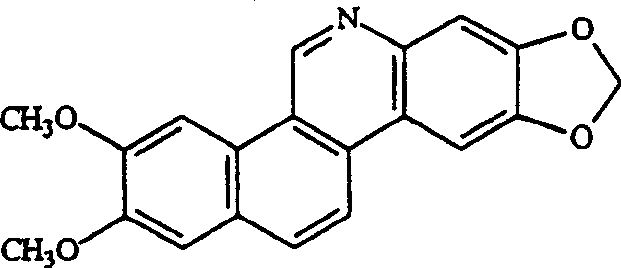
该结构在式Ⅰ的化合物的R7和R8对应位上具有亚甲基二氧基取代基。这提示在3或9位上具有烷氧基取代基的苯并[i]菲啶应该保持良好拓扑异构酶中毒活性,而这些在3位和9位均具有烷氧基取代基的化合物的活性减小。这也提示在12位上具有氮的化合物应该保持拓扑异构酶中毒活性。This structure has methylenedioxy substituents at the positions corresponding to R7 and R8 of the compound of formula I. This suggests that benzo[i]phenanthridines with alkoxy substituents at the 3 or 9 positions should maintain good topoisomerase poisoning activity, while those compounds with alkoxy substituents at the 3 and 9 positions activity decreased. This also suggests that compounds with nitrogen at
除非另有说明,以下非限制性实施例来说明本发明:用Thomas-Hoover Unimelt毛细管熔点仪检测熔点;柱层析是指用所述溶剂系统在SiliTech 32-63μm(ICN Biomedicals,Eschwegge,Ger.)上进行的快速层析;在Perkin-Elmer 1600 Fourier转换分光光度计获得红外光谱数据并以cm-1报告;在Varian Gemini-200 Fourier转换分光计上记录质子(1H NMR)和碳(13C NMR)核磁共振;在用化学位移表示的氚化溶剂中记录NMR波谱(200 MHz 1H和50 MHz 13C),化学位移以四甲基硅(TMS)的δ单位低磁场报告;偶合常数以赫兹(Hz)报告;质谱得自华盛顿大学(Washington University,St.Louis,MO)化学系中的Washington University Resource for Biomedical and Bio-organic MassSpectcometry;和燃烧分析由 Atlantic Microlabs,Inc.,Norcross,GA进行,分析值在理论值±0.4%范围内。Unless otherwise stated, the following non-limiting examples illustrate the present invention: detect melting point with Thomas-Hoover Unimelt capillary melting point apparatus; ) on a Perkin-Elmer 1600 Fourier-transition spectrophotometer and reported in cm -1 ; proton ( 1H NMR) and carbon ( 13 C NMR) nuclear magnetic resonance; NMR spectra (200 MHz 1 H and 50 MHz 13 C) recorded in tritiated solvents expressed as chemical shifts reported in delta units of tetramethylsilane (TMS) downfield; coupling constants Reported in hertz (Hz); mass spectra were obtained from the Washington University Resource for Biomedical and Bio-organic Mass Spectcometry in the Department of Chemistry, Washington University (Washington University, St. Louis, MO); and combustion analyzes were obtained from Atlantic Microlabs, Inc., Norcross, GA The analytical value was within ±0.4% of the theoretical value.
实施例实施例1. 2,3,8,9-四甲氧基苯并[i]菲啶(4)
将化合物17(100mg,0.52mmol)溶解于冰醋酸(8mL)中,与锌粉(200mg,3.2mmol)加热回流4小时。真空蒸发醋酸,残留物用氯仿提取。氯仿溶液通过硅藻土床过滤。过滤物用饱和碳酸氢钠液和盐水连续洗涤并蒸发至干。残留物用己烷∶乙酸乙酯(1∶1)作洗脱剂层析(二氧化硅)纯化得到标题化合物,收率为54%;mp=267-268℃;IR(Nujol)1621,1513,1282;1H NMRδ4.04(3H,s),4.06(3H,s),4.10(3H,s),4.13(3H,s),7.22(1H,s),7.55(1H,s),7.74(1H,s),7.89(1H,d,J=8.8),8.05(1H,s),8.18(1H,d,J=8.8),9.82(1H,s);13C NMRδ56.4,56.6,102.0,102.3,108.5,109.9,118.3,118.4,120.7,120.8,125.7,127.5,130.7,141.5,145.9,150.0,150.1,150.9,151.4;C21H19NO4的HRMS计算值:349.1314;实测值:349.1321。Compound 17 (100 mg, 0.52 mmol) was dissolved in glacial acetic acid (8 mL), and heated to reflux with zinc powder (200 mg, 3.2 mmol) for 4 hours. Acetic acid was evaporated in vacuo and the residue was extracted with chloroform. The chloroform solution was filtered through a bed of celite. The filtrate was washed successively with saturated sodium bicarbonate solution and brine and evaporated to dryness. The residue was purified by chromatography (silica) using hexane:ethyl acetate (1:1) as eluent to give the title compound in 54% yield; mp=267-268°C; IR (Nujol) 1621, 1513 , 1282; 1 H NMRδ4.04(3H, s), 4.06(3H, s), 4.10(3H, s), 4.13(3H, s), 7.22(1H, s), 7.55(1H, s), 7.74 (1H, s), 7.89 (1H, d, J=8.8), 8.05 (1H, s), 8.18 (1H, d, J=8.8), 9.82 (1H, s); 13 C NMRδ56.4, 56.6, 102.0, 102.3, 108.5, 109.9, 118.3, 118.4, 120.7, 120.8, 125.7, 127.5, 130.7 , 141.5 , 145.9, 150.0, 150.1, 150.9, 151.4; HRMS calculated for C21H19NO4 : 1449.13; found 349.1321.
如下制备中间体化合物17。a.2-溴-6,7-二甲氧基-1-萘醛(10)将二甲基甲酰胺(3.0g,41mmol)于0℃滴加到三溴化磷(3.3mL,35mmol)的无水氯仿(50mL)溶液中。该混合物于0℃搅拌1小时得到浅黄色悬浮液。将化合物8(2.0g,9.7mmol)的氯仿溶液加到所述黄色悬浮液中,该混合物加热回流1小时。将反应混合物冷却至0℃并滴加饱和含水碳酸氢钠液直到无泡腾产生。生成的混合物用二氯甲烷提取,干燥(NaSO4),蒸发得到相应的为黄色固体的2-溴-3,4-二氢-1-萘醛衍生物。每种2-溴-3,4-二氢-1-萘醛衍生物在硅胶上用己烷∶乙酸乙酯的3∶1混合物作为洗脱剂层析得到2-溴-3,4-二氢-1-萘醛,收率为87%。使2-溴-3,4-二氢-1-萘醛(2.4g,8.1mmol)和DDQ(2.2g,97mmol)在甲苯(50mL)中回流15小时。冷却至室温后,该混合物通过硅藻土床过滤,蒸发滤液至干。所得残留物在75g硅胶上用己烷:乙酸乙酯的3∶1混合物作为洗脱剂层析得到2-溴-1-萘醛,收率为95%;1H NMRδ4.00(3H,s),4.05(3H,s),7.07(1H,s),7.54(1H,d,J=8.5),7.79(1H,d,J=8.5),8.71(1H,s)、10.74(1H,s);13C NMRδ56.3,56.6,104.2,107.0,126.5,128.8,129.4,129.8,129.9,134.3,150.4,153.1,195.9;C13H11O3Br的HRMS分析计算值:293.9891;实测值:293.9896。b.2-溴-6,7-二甲氧基萘醛-1-乙缩醛(napthaldehyde-1-ethylacetal)(12)将化合物10(540mg,1.95mmol),乙二醇(0.7mL)和对甲苯磺酸(10mg)溶解于30mL无水甲苯中。该反应混合物在连接到Dean-Stark装置的烧瓶中在氮气下回流去除在缩醛形成期间产生的水。在反应(15h)结束时,真空蒸发冷却的反应混合物中的溶剂,将获得的残留物溶解于50mL乙酸乙酯中。所述乙酸乙酯溶液用碳酸氢钠饱和溶液洗涤,干燥,去除溶剂得到粗制缩醛。用乙酸乙酯∶己烷的3∶17混合物在硅胶上层析得到纯净缩醛的透明粘性液体,收率为95%;IR(Nujol)1660,1635;1H NMRδ4.02(3H,s),4.06(3H,s),4.13-4.19(2H,m),4.38-4.48(2H,m),7.09(1H,s),7.54-7.68(2H,m),7.72(1H,s),7.78(1H,s);13C NMRδ56.2,56.6,65.7,102.8,104.6,106.5,122.9,128.4,129.1,130.5,131.2,131.3,148.0,148.5;C15H15O4Br的分析计算值:C,53.11,H,4.48;实测值:C,52.93,H,4.51。c.1-甲酰基-6,7-二甲氧基萘-2-基硼酸(14)将缩醛12(1.4mmol)溶解于10mL无水四氢呋喃中。该溶液于-78℃在氮下搅拌。缓慢加入正丁基锂(1.2mL,2.8mmol)的己烷溶液,于-78℃搅拌该反应混合物30分钟。得到浅黄棕色溶液。于该黄色反应混合物中加入硼酸三甲基酯(0.5mL,4.2mmol),生成的混合物在使其升至室温前于-78℃搅拌1小时。将5%盐酸溶液(20mL)加入反应混合物中并在室温下搅拌30分钟。真空蒸发四氢呋喃,水相层用二氯甲烷提取。混合的有机层用盐水洗涤一次,干燥,蒸发得到硼酸衍生物14,它用于以下步骤而不需要进一步纯化。d.2-(3,4-二甲氧基-6-硝基苯基)-6,7-二甲氧基-1-萘醛(17)将化合物16(876mg,3.34mmol,在以下e部分中制备)和在20mL二甲氧基乙烷中的四(三苯膦)钯(O)430mg放入一个三颈烧瓶中,生成的溶液于室温在氮下搅拌30分钟。溶液颜色从棕色变为黄色。将化合物14(1.1mmol)在5mL二甲氧基乙烷中的溶液加到所述反应混合物中,然后加入5mL 2M碳酸钠溶液。回流该反应混合物18小时。让该反应混合物回至室温,将该反应混合物通过硅藻土床过滤。蒸发滤液至干,所得残留物用乙酸乙酯∶己烷的1∶9混合物在75g硅胶上进行柱层析。收集从所述柱洗脱的第四种化合物,将合并的馏分真空蒸发得到2-苯基-1-萘醛衍生物17,收率为22%(基于缩醛计);mp=228-230;IR (Nujol)1676,1513,1259。该化合物用于合成化合物4而不需要进一步鉴定。Intermediate compound 17 was prepared as follows. a. 2-Bromo-6,7-dimethoxy-1-naphthalene aldehyde (10) was added dropwise to dimethylformamide (3.0 g, 41 mmol) at 0° C. into a solution of phosphorus tribromide (3.3 mL, 35 mmol) without water in chloroform (50 mL) solution. The mixture was stirred at 0°C for 1 hour to give a pale yellow suspension. A chloroform solution of compound 8 (2.0 g, 9.7 mmol) was added to the yellow suspension, and the mixture was heated to reflux for 1 hour. The reaction mixture was cooled to 0°C and saturated aqueous sodium bicarbonate was added dropwise until effervescence ceased. The resulting mixture was extracted with dichloromethane, dried ( NaSO4 ) and evaporated to give the corresponding 2-bromo-3,4-dihydro-1-naphthaldehyde derivative as a yellow solid. Chromatography of each 2-bromo-3,4-dihydro-1-naphthaldehyde derivative on silica gel using a 3:1 mixture of hexane:ethyl acetate as eluent afforded 2-bromo-3,4-di Hydrogen-1-naphthaldehyde, the yield is 87%. 2-Bromo-3,4-dihydro-1-naphthaldehyde (2.4 g, 8.1 mmol) and DDQ (2.2 g, 97 mmol) were refluxed in toluene (50 mL) for 15 hours. After cooling to room temperature, the mixture was filtered through a bed of celite and the filtrate was evaporated to dryness. The resulting residue was chromatographed on 75 g of silica gel using a 3:1 mixture of hexane: ethyl acetate as the eluent to obtain 2-bromo-1-naphthaldehyde in a yield of 95%; 1 H NMR δ 4.00 (3H, s ), 4.05(3H, s), 7.07(1H, s), 7.54(1H, d, J=8.5), 7.79(1H, d, J=8.5), 8.71(1H, s), 10.74(1H, s ); 13 C NMR δ 56.3, 56.6, 104.2, 107.0, 126.5, 128.8, 129.4, 129.8, 129.9, 134.3, 150.4, 153.1, 195.9; Calculated by HRMS analysis for C 13 H 11 O 3 Br: 293.9891; Found: 293.9896. b. 2-Bromo-6,7-dimethoxynaphthaldehyde-1-acetal (napthaldehyde-1-ethylacetal) (12) compound 10 (540mg, 1.95mmol), ethylene glycol (0.7mL) and p-toluene Sulfonic acid (10 mg) was dissolved in 30 mL of anhydrous toluene. The reaction mixture was refluxed under nitrogen in a flask connected to a Dean-Stark apparatus to remove water generated during acetal formation. At the end of the reaction (15 h), the solvent in the cooled reaction mixture was evaporated in vacuo and the residue obtained was dissolved in 50 mL of ethyl acetate. The ethyl acetate solution was washed with saturated sodium bicarbonate solution, dried, and the solvent was removed to obtain crude acetal. Chromatography on silica gel with a 3:17 mixture of ethyl acetate: hexane gave pure acetal as a transparent viscous liquid with a yield of 95%; IR (Nujol) 1660, 1635; 1 H NMR δ 4.02 (3H, s) , 4.06(3H, s), 4.13-4.19(2H, m), 4.38-4.48(2H, m), 7.09(1H, s), 7.54-7.68(2H, m), 7.72(1H, s), 7.78 (1H, s); 13 C NMR δ 56.2, 56.6, 65.7, 102.8, 104.6, 106.5, 122.9, 128.4, 129.1, 130.5, 131.2, 131.3, 148.0, 148.5; Anal. Calcd. for C 15 H 15 O 4 Br: C, 53.11, H, 4.48; Found: C, 52.93, H, 4.51. c. 1-Formyl-6,7-dimethoxynaphthalen-2-ylboronic acid (14) Acetal 12 (1.4 mmol) was dissolved in 10 mL of anhydrous THF. The solution was stirred at -78°C under nitrogen. A solution of n-butyllithium (1.2 mL, 2.8 mmol) in hexane was added slowly, and the reaction mixture was stirred at -78°C for 30 minutes. A pale yellow-brown solution was obtained. To the yellow reaction mixture was added trimethyl borate (0.5 mL, 4.2 mmol), and the resulting mixture was stirred at -78°C for 1 hour before being allowed to warm to room temperature. 5% Hydrochloric acid solution (20 mL) was added to the reaction mixture and stirred at room temperature for 30 minutes. The tetrahydrofuran was evaporated in vacuo and the aqueous layer was extracted with dichloromethane. The combined organic layers were washed once with brine, dried and evaporated to give
如下制备在实施例1的d部分中使用的中间体化合物16。e.3,4-二甲氧基-6-硝基-溴苯(16)将3,4-二甲氧基溴苯(5g,23mmol)缓慢加入保持于10℃的35mL浓硝酸和105mL冰醋酸的搅拌溶液中。该反应混合物于15℃搅拌1小时,然后用200mL冰水稀释。生成的混合物用200mL乙醚提取,重复2次。干燥并真空蒸发合并的有机相。所述粗制品从乙醇中重结晶得到化合物16的浅黄色针状晶体,收率为92%;mp=122-124℃;IR (Nujol) 1510,1312;1H NMRδ3.94(3H,s),3.97(3H,s),7.12(1H,s),7.57(1H,s);13C NMRδ56.9,57.2,108.0,109.5,117.0,148.7,153.3;C8H8NO4Br的分析计算值:C,36.72,H,3.14,N,5.30;实测值:C,36.70,H,3.13,N,5.29。实施例2.5-甲基-2,3,8,9-四甲氧基苯并[i]菲啶(5)
用类似于实施例1中所述的方法,只是用化合物25替代其中所用的化合物17,以60%收率制得标题化合物;mp=255-257℃;IR(Nujol) 1620,1513,1209;1H NMRδ3.42(3H,s),4.08(6H,s),4.13(6H,s),7.33(1H,s),7.52(1H,s),7.82(1H,s),7.98(1H,d,J=8.8),8.32(1H,s),8.35(1H,d,J=8.8);13C NMRδ31.6,56.4,56.5,56.6,102.1,108.7,108.8,108.9,118.6,119.0,122.2,126.5,129.0,130.9,132.6,140.4,149.1,149.6,149.7,151.7,154.9;C22H21NO4的HRMS分析计算值:363.1470;实测值:363.1471。Using a method similar to that described in Example 1, except that
如下制备中间体化合物25。a.1-乙酰基-2-溴-6,7-二甲氧基萘(23)将在四氢呋喃(16.8mL,16.8mmol)中的1.4M甲基溴化镁溶液于0℃在氮气下加到在20mL无水四氢呋喃中的萘醛10溶液中。该反应混合物于0℃搅拌1小时。通过滴加100mL水猝灭该反应后,快速加入50mL的0.1N盐酸。该反应混合物用乙酸乙酯提取,干燥,真空干燥溶剂得到油性残留物。该油用氯仿研磨得到为白色针状结晶固体的醇,收率为95%。将氯代铬酸吡啶鎓(857mg,3.98mmol)悬浮于10mL无水二氯甲烷中。将醇(2.49mmol)加入该悬浮液中,生成的混合物于室温在氮气下搅拌6小时。将乙醚(100mL)加入到该反应混合物中,所得悬浮液通过硅藻土床过滤。蒸发滤液至干,所得残留物用乙酸乙酯∶己烷的1∶9混合物在75g硅胶上层析得到松软浅白色针状的1-乙酰基-2-溴萘衍生物23,收率为85%;mp=102-103℃;IR (Nijol)1693;1H NMRδ2.70(3H,s),3.95(3H,s),3.99(3H,s),6.84(1H,s),7.10(1H,s),7.43(1H,d,J=8.4),7.56(1H,d,J=8.4);13C NMRδ32.4,56.4,103.1,107.2,113.3,126.3,128.2,128.7,129.1,139.0,150.4,151.4,205.5;C14H13O3Br的HRMS分析计算值:308.0048;实测值:308.0059。b.1-乙酰基-2-(3,4-二甲氧基-6-硝基苯基)-6,7-二甲氧基萘(25)将含化合物22(0.98mmol)、1-乙酰基-2-溴萘23(0.89mmol)、(Ph3P)4Pd(106mg)和氰化铜(17mg)的混合物在20mL甲苯中回流20-24小时。冷却至室温后,将乙酸乙酯(20mL)加入到该反应混合物中,将有机层倾入分液漏斗。将有机层用20mL蒸馏水洗涤。尽可能使所述两相分开,弃含水层。使剩下的乳液通过硅藻土床过滤。有机层与过滤物分开并蒸发至干。所得残留物用己烷∶乙酸乙酯的3∶2混合物在75g硅胶上层析得到1-乙酰基-2-(3,4-二甲氧基-6-硝基苯基)萘衍生物25,收率为30%;mp=185-187℃;IR (Nujol)1689,1503,1260;1H NMRδ2.25(3H,s),3.90(3H,s),3.98(3H,s),4.02(3H,s),4.03(3H,s),6.76(1H,s),7.08(1H,d,J=8.4),7.12(1H,s),7.18(1H,s),7.70(1H,s),7.71(1H,d,J=8.4);13C NMRδ32.7,56.4,56.9,57.0,57.1,103.8,107.2,108.5,115.7,124.9,125.1,128.2,129.5,130.1,131.6,136.9,141.1,149.0,150.5,151.2,152.8,208.0;C21H19NO7-C2H3O的HRMS分析计算值:368.1134;实测值:368.1135。
如下制备在b部分中使用的中间体化合物22。c.3,4-二甲氧基-6-硝基苯基-三甲基锡烷(22)将六甲基二锡(2.0g,6.1mmol)、化合物16(1.56g,6.0mmol)和Pd(PPh3)4(163mg,0.14mmol)在甲苯中的混合物在氮下加热回流10小时。冷却后,剧烈搅拌下加入7 M KF水溶液(1mL)。该混合物通过硅藻土床过滤,过滤物蒸发至干。残留物用己烷∶乙酸乙酯(5∶1)作洗脱剂在75g硅胶上进行层析。合并相关的馏分,真空蒸发得到1.2g化合物22,收率为58%;mp=115℃;1H NMRδ0.32(9H,s),3.94(3H,s),3.99(3H,s),7.03(1H,s),7.88(1H,s);13C NMRδ-7.2,56.7,107.7,117.3,134.0,146.8,149.8,1 54.1;C11H17NO4Sn-CH3的HRMS分析计算值:329.9937;实测值:329.9939。实施例3.2,3-亚甲基二氧基-8,9-二甲氧基苯并[i]菲啶(6)The
用类似于实施例1中所述的方法,只是用化合物18替代其中所用的化合物17,以60%收率制得标题化合物;mp>250℃;IR (Nijol)1680;UV(CHCl3)285,360,380nm(logε=3.01,2.21,2.47);1H NMRδ4.10(3H,s),4.14(3H,s),6.15(2H,s),7.28(1H,s),7.68(1H,s),7.83(1H,s),7.97(1H,d,J=9.2),8.16(1H,s),8.28(1H,d,J=9.2),9.85(1H,s);13CNMRδ56.7,100.3,102.1,102.2,106.1,109.2,118.4,127.5,128.9,131.2,131.7,140.8,145.6,145.7,148.4,149.9,150.4,151.7,176.1;C20H15NO4的HRMS分析计算值:333.1001;实测值:333.0999。The title compound was obtained in 60% yield by a procedure similar to that described in Example 1, except that compound 18 was substituted for compound 17 used therein; mp >250°C; IR (Nijol) 1680; UV (CHCl 3 ) 285 , 360, 380nm (logε=3.01, 2.21, 2.47); 1 H NMRδ4.10 (3H, s), 4.14 (3H, s), 6.15 (2H, s), 7.28 (1H, s), 7.68 (1H, s), 7.83(1H, s), 7.97(1H, d, J=9.2), 8.16(1H, s), 8.28(1H, d, J=9.2), 9.85(1H, s); 13 CNMRδ56.7 , 100.3, 102.1, 102.2, 106.1, 109.2, 118.4, 127.5, 128.9, 131.2, 131.7, 140.8, 145.6, 145.7, 148.4, 149.9, 150.4, 151.7, 176.1; 303MS analysis calculated for C 20 H 15 NO 1 . ;Measured value: 333.0999.
如下制备中间体化合物18。a.乙基-3,4-(亚甲基二氧基)二氢肉桂酸酯(19)将三甲基甲硅烷基氯2.5mL(18.2mmol)加到1.5g(7.7mmol)3,4-(亚甲基二氧基)二氢肉桂酸在70mL无水乙醇中的溶液中,该混合物于室温在氮气下搅拌12小时。真空蒸发过量的乙醇,所得残留物用乙酸乙酯∶己烷的1∶9混合物在100g硅胶上层析得到定量产率的作为无色液体的酯(19);1HNMRδ1.21(3H,t),260(2H,t),2.87(2H,t),4.08(2H,q,J=14.1,7.3),5.90(2H,s)、6.56-6.69(3H,m);13C NMRδ14.5,25.1,34.2,60.7,100.8,106.9,121.8,122.2,122.5,145.3,147.1,173.2;C12H14O4的HRMS分析计算值:222.0892;实测值:222.0895。b.3,4-(亚甲基二氧基)苯乙基甲基亚磺酰甲基酮(20)通过将6.0mL无水二甲基亚砜加入到600mg氢化钠并于70-75℃在氮气下加热该混合物45分钟制备二甲基亚砜阴离子。使该反应混合物冷却至室温,然后转移到保持于5-10℃的水浴中。在15分钟内,将化合物19在6.0mL无水二甲基亚砜中的溶液滴加到前面产生的二甲基亚砜阴离子中。使该反应混合物缓慢下降至室温并搅拌2小时。将该反应混合物倒入100mL冷水中,用1.2N盐酸酸化至pH 3-4,用40mL氯仿提取5次。用100mL蒸馏水洗涤混合的有机层二次,在无水硫酸钠上干燥,过滤,真空蒸发得到定量产率、低熔点、浅黄色固体的20。发现化合物20用硅胶进行柱层析是不稳定的,然而,粗制化合物的1H NMR表明,它可用于合成21而不需要再纯化;mp=60-62℃;1H NMRδ2.55(3H,s),2.75-2.82(4H,m),3.56-3.76(2H,q,J1=13.8,J2=34.3),5.82(2H,S),6.53-6.65(3H,m);3C NMRδ29.3,41.4,47.4,64.4,101.3,108.7,109.3,121.6,134.4,146.4,148.1,201.1。c.1,2,3,4-四氢-1-甲硫基-6,7-亚甲基二氧基-2(1H)-萘酮(21)将三氟乙酸(0.3mL,3.7mmol)溶解于25mL苯中,加入到装有470mg(1.85mmol)化合物20的反应瓶中。加热回流反应混合物1.5小时。冷却至室温后,将反应混合物转移到分液漏斗并用10mL饱和碳酸氢钠洗涤两次。苯层在无水硫酸钠上干燥,过滤,真空蒸发得到红色浆液,用乙酸乙酯和己烷的1∶9混合物在100g硅胶上层析得到21,收率为60%;mp=52℃;1H NMRδ2.05(3H,s),2.70-3.10(4H,m),4.02(1H,s),5.85(1H,s),6.65(1H,d,J=8.1),6.72(1H,d,J=8.1);13C NMRδ16.3,21.1,34.2,54.1,101.6,107.9,118.5,123.0,127.6,145.1,147.3,203.5;C12H12O3S的HRMS分析计算值:236.0507;实测值:236.0505。d.6,7-亚甲基二氧基-2-四氢萘酮(9)将21(669mg,2.83mmol)在10mL冰醋酸中的溶液置入氢化瓶中。向该混合物加入460mg 10% Pd-C,生成的混合物在40磅/平方英寸氢气Parr装置中振摇40小时。该反应混合物通过硅藻土床过滤并用5mL冰醋酸洗涤3次。旋转蒸发冰醋酸得到粗制四氢萘酮9。然后用亚硫酸氢钠处理粗制四氢萘酮,将其转化为更稳定的亚硫酸加合物。用10%碳酸氢钠液处理后用二氯甲烷按需要从其亚硫酸加合物中产生纯净四氢萘酮;mp=91-92℃(lit144=88-91℃);IR(Nujol)1727;1H NMRδ2.51(2H,t),2.97(2H,t),3.48(2H,s),5.92(2H,s),6.58(1H,s),6.69(1H,s);13C NMRδ21.5,37.7,45.1,101.4,107.5,118.5,121.0,127.8,144.2,146.4,211.5;C11H10O3的分析计算值:C,69.46,H,5.30;实测值:C,69.40,H,5.29。e.2-溴-6,7-亚甲基二氧基-1-萘醛(11) 用类似于实施例1的a部分中所述方法,只是用化合物9代替化合物8,以96%收率制得化合物11;mp=165-166℃;IR (Nujol)1680;1H NMRδ6.09(2H,s),7.05(1H,s),7.51(1H,d,J=8.7),7.63(1H,d,J=8.7),8.60(1H,s),10.68(1H,s);13C NMRδ102.1,102.3,104.6,127.4,129.5,129.6,130.1,131.1,134.6,148.6,151.7,195.5;C12H7O3Br的分析计算值:C,51.60,H,2.51;实测值:C,51.98,H,2.48。f.2-溴-6,7-亚甲基二氧基萘醛-1-乙缩醛(13)用类似于实施例1的b部分中所述方法,只是用化合物11代替其中使用的化合物10,以95%收率制得化合物13;IR(Nujol)1665,1617;1H NMRδ4.11-4.18(2H,m),4.36-4.43(2H,m),6.03(2H,s),6.56(1H,s),7.05(1H,s),7.41-7.48(2H,m),7.73(1H,s);13C NMRδ65.6,101.8,102.6,104.8,106.3,123.0,128.0,129.3,130.4,131.1,131.5,147.9,148.6;C14H11O4Br的分析计算值:C,52.10,H,3.41;实测值:C,52.52,H,3.48。g.1-甲酰基-6,7-亚甲基二氧基萘-2-基硼酸(15)将乙缩醛13(1.4mmol)溶解于10mL无水四氢呋喃中。该溶液于-78℃在氮下搅拌。缓慢加入正丁基锂(1.2mL,2.8mmol)的己烷溶液,该反应混合物于-78℃搅拌30分钟。获得浅黄棕色溶液。向该黄色反应混合物中加入硼酸三甲基酯(0.5mL,4.2mmol),生成的混合物在使其回到室温前于-78℃搅拌1小时。将5%盐酸溶液(20mL)加入反应混合物中并于室温搅拌30分钟。真空蒸发四氢呋喃,水相层用二氯甲烷提取。用盐水洗涤混合的有机层一次,干燥,蒸发得到硼酸衍生物15,它用于以下步骤而不需要进一步纯化。h.2-(3,4-二甲氧基-6-硝基苯基)-6,7-亚甲基二氧基-1-萘醛(18)用类似于实施例1的d部分中所述方法,只是用化合物15代替其中使用的化合物14,以25%收率制得化合物18;mp=255℃;IR(Nujol)1670,1515,1309;1H NMRδ3.92(3H,s),4.04(3H,s),6.13(2H,s),6.74(1H,s),7.13(1H,d,J=8.3),7.18(1H,s),7.77(1H,s),7.87(1H,d,J=8.3),8.76(1H,s),10.14(1H,s);13C NMRδ57.0,57.1,102.1,103.1,104.7,108.2,114.9,125.7,127.9,128.8,129.5,131.5,133.6,141.2,144.1,148.6,149.2,151.6,152.9,193.6。实施例4.8,9-二甲氧基-5-甲基-2,3-亚甲基二氧基苯并[i]菲啶(7)Intermediate compound 18 was prepared as follows. a. Ethyl-3,4-(methylenedioxy)dihydrocinnamate (19) was added to 1.5 g (7.7 mmol) of trimethylsilyl chloride 2.5 mL (18.2 mmol) of 3,4-( methylenedioxy)dihydrocinnamic acid in 70 mL of absolute ethanol, and the mixture was stirred at room temperature under nitrogen for 12 hours. Excess ethanol was evaporated in vacuo and the resulting residue was chromatographed on 100 g of silica gel with a 1:9 mixture of ethyl acetate:hexane to give the ester (19) in quantitative yield as a colorless liquid; 1 HNMR δ 1.21 (3H, t), 260(2H, t), 2.87(2H, t), 4.08(2H, q, J=14.1, 7.3), 5.90(2H, s), 6.56-6.69(3H, m); 13 C NMRδ14. 5, 25.1 , 34.2, 60.7, 100.8 , 106.9, 121.8, 122.2, 122.5, 145.3, 147.1, 173.2; Calculated for HRMS analysis for C12H14O4 : 222.0892; Found: 222.0895. b. 3,4-(methylenedioxy)phenethylmethylsulfinylmethyl ketone (20) was prepared by adding 6.0mL of anhydrous dimethyl sulfoxide to 600mg of sodium hydride and at 70-75°C under nitrogen The mixture was heated at 0°C for 45 minutes to prepare the dimethylsulfoxide anion. The reaction mixture was allowed to cool to room temperature, then transferred to a water bath maintained at 5-10 °C. A solution of compound 19 in 6.0 mL of anhydrous DMSO was added dropwise to the previously generated DMSO anion over 15 min. The reaction mixture was allowed to come down to room temperature slowly and stirred for 2 hours. The reaction mixture was poured into 100 mL of cold water, acidified to pH 3-4 with 1.2N hydrochloric acid, and extracted 5 times with 40 mL of chloroform. The combined organic layers were washed twice with 100 mL of distilled water, dried over anhydrous sodium sulfate, filtered, and evaporated in vacuo to give 20 in quantitative yield as a low melting, pale yellow solid. Compound 20 was found to be unstable by column chromatography on silica gel, however, 1 H NMR of the crude compound showed that it could be used to synthesize 21 without further purification; mp=60-62°C; 1 H NMRδ2.55 (3H , s), 2.75-2.82 (4H, m), 3.56-3.76 (2H, q, J 1 =13.8, J 2 =34.3), 5.82 (2H, S), 6.53-6.65 (3H, m); 3 C NMR δ 29.3, 41.4, 47.4, 64.4, 101.3, 108.7, 109.3, 121.6, 134.4, 146.4, 148.1, 201.1. c. 1,2,3,4-Tetrahydro-1-methylthio-6,7-methylenedioxy-2(1H)-naphthalenone (21) was dissolved in trifluoroacetic acid (0.3 mL, 3.7 mmol) In 25mL of benzene, it was added into a reaction flask containing 470mg (1.85mmol) of compound 20. The reaction mixture was heated to reflux for 1.5 hours. After cooling to room temperature, the reaction mixture was transferred to a separatory funnel and washed twice with 10 mL of saturated sodium bicarbonate. The benzene layer was dried over anhydrous sodium sulfate, filtered, and evaporated in vacuo to obtain a red slurry, which was chromatographed on 100 g of silica gel with a 1:9 mixture of ethyl acetate and hexane to obtain 21 with a yield of 60%; mp=52°C; 1 H NMRδ2.05(3H, s), 2.70-3.10(4H, m), 4.02(1H, s), 5.85(1H, s), 6.65(1H, d, J=8.1), 6.72(1H, d, J=8.1); 13 C NMR δ16.3, 21.1, 34.2, 54.1, 101.6, 107.9, 118.5, 123.0, 127.6, 145.1, 147.3, 203.5; HRMS analysis calculated value of C 12 H 12 O 3 S: 236.0507; measured value : 236.0505. d. 6,7-Methylenedioxy-2-tetralone (9) A solution of 21 (669 mg, 2.83 mmol) in 10 mL of glacial acetic acid was placed in a hydrogenation flask. To this mixture was added 460 mg of 10% Pd-C and the resulting mixture was shaken in a 40 psig hydrogen Parr apparatus for 40 hours. The reaction mixture was filtered through a bed of celite and washed 3 times with 5 mL of glacial acetic acid. Rotary evaporation of glacial acetic acid afforded
用类似于实施例1中所述方法,只是用化合物26代替其中使用的化合物17,以63%收率制得标题化合物;mp>250℃;IR(Nujol)1685;UV(CHCl3)280,365,385mm(logε=2.79,1.90,2.03);1H NMRδ3.36(3H,s),4.08(3H,s),4.13(3H,s),6.15(2H,s),7.31(1H,s),7.51(1H,s),7.80(1H,s),7.93(1H,d,J=9.1),8.29-8.35(2H,m);13C NMRδ31.7,56.6,102.1,105.8,106.3,108.8,118.5,119.1,122.9,127.9,130.2,131.3,132.7,137.1,140.3,147.3,148.8,149.7,151.7,155.2;C21H17NO4的HRMS分析计算值:347.1158;实侧值:347.1156。Using a method similar to that described in Example 1, except that compound 26 was used instead of compound 17 used therein, the title compound was obtained in 63% yield; mp > 250 °C; IR (Nujol) 1685; UV (CHCl 3 ) 280, 365, 385mm (logε=2.79, 1.90, 2.03); 1H NMRδ3.36(3H, s), 4.08(3H, s), 4.13(3H, s), 6.15(2H, s), 7.31(1H, s ), 7.51(1H, s), 7.80(1H, s), 7.93(1H, d, J=9.1), 8.29-8.35(2H, m); 13 C NMRδ31.7, 56.6, 102.1, 105.8, 106.3, 108.8, 118.5, 119.1, 122.9, 127.9, 130.2, 131.3, 132.7, 137.1, 140.3, 147.3 , 148.8 , 149.7, 151.7, 155.2; HRMS analysis calculated for C21H17NO4 : 347.1158;
如下制备中间体化合物26。a.1-乙酰基-2-溴-6,7-亚甲基二氧基萘(24)用类似于实施例3的a部分中所述的方法,只是用化合物11代替其中使用的化合物10,以90%收率制得化合物24;mp=138℃;IR(Nujol) 1695;1H NMRδ2.67(3H,s),6.06(2H,s),6.89(1H,s),7.09(1H,s),7.41(1H,d,J=8.8),7.56(1H,d,J=8.8);13C NMRδ32.4,101.0,102.1,104.9,113.6,127.6,128.4,129.6,130.1,139.8,148.6,149.7,205.2;C13H9O3Br的HRMS分析计算值:291.9735;实测值:291.9730。b.1-乙酰基-2-(3,4-二甲氧基-6-硝基苯基)-6,7-亚甲基二氧基-萘(26)用类似于实施例3的b部分中所述的方法,只是用化合物24代替其中使用的化合物23,以20%收率制得化合物26;mp=190-192℃;IR(Nujol)1680,1523,1300;1H NMRδ2.23(3H,s),3.89,(3H,s),4.01(3H,s),6.07(2H,s),6.75(1H,s),7.06(1H,d,J=8.4),7.10(1H,s),7.16(1H,s),7.66(2H,m);13C NMRδ32.6,56.9,57.1,101.7,102,6,105.0,108.4,115.6,125.1,126.0,128.7,129.5,130.8,131.5,133.8,144.5,149.6,150.5,150.7,152.8,207.6。实施例5.2,3-二甲氧基-9-苯氧基苯并[i]菲啶(30)Intermediate compound 26 was prepared as follows. a. 1-Acetyl-2-bromo-6,7-methylenedioxynaphthalene (24) is similar to the method described in part a of Example 3, except that the
将2-(4-苯氧基-6-硝基苯基)-6,7-二甲氧基-1-萘醛(100mg,0.23mmol)溶解于冰醋酸(15mL)中并与锌粉(163mg,2.5mmol)加热回流3.5小时。真空蒸发乙酸,将残留物溶解于氯仿中。溶液通过硅藻土床过滤,过滤物用饱和碳酸氢钠液和盐水连续洗涤。将有机层在无水硫酸钠上干燥,过滤,真空蒸发。残留物用己烷和乙酸乙酯的1∶2混合物在50g硅胶上层析得到为白色固体的标题化合物,收率为56%;1H NMR(CDCl3)δ4.08(3H,s),4.18(3H,s),5.29(2H,s),7.33(1H,s),7.42(5H,m),7.52(1H,d,J=8.9),7.72(1H,d,J=2.6),8.02(1H,d,J=8.9),8.17(1H,s),8.39(1H,d,J=8.9),8.52(1H,d,J=8.9),10.04(1H,s);13C NMR(CDCl3)δ56.5,56.6,70.8,102.3,108.6,110.9,112.8,118.4,119.6,120.7,124.2,125.8,127.7,128.2,128.6,129.2,131.4,131.7,137.1,146.8,148.6,150.1,151.2,159.5;C26H21NO3的HRMS分析计算值,395.1521,实测值:395.1522。2-(4-Phenoxy-6-nitrophenyl)-6,7-dimethoxy-1-naphthaldehyde (100 mg, 0.23 mmol) was dissolved in glacial acetic acid (15 mL) and mixed with zinc powder ( 163mg, 2.5mmol) was heated to reflux for 3.5 hours. Acetic acid was evaporated in vacuo and the residue was dissolved in chloroform. The solution was filtered through a bed of celite, and the filtrate was washed successively with saturated sodium bicarbonate solution and brine. The organic layer was dried over anhydrous sodium sulfate, filtered and evaporated in vacuo. The residue was chromatographed on 50 g of silica gel with a 1:2 mixture of hexane and ethyl acetate to give the title compound as a white solid in 56% yield; 1 H NMR (CDCl 3 ) δ 4.08 (3H, s), 4.18(3H, s), 5.29(2H, s), 7.33(1H, s), 7.42(5H, m), 7.52(1H, d, J=8.9), 7.72(1H, d, J=2.6), 8.02(1H, d, J=8.9), 8.17(1H, s), 8.39(1H, d, J=8.9), 8.52 ( 1H, d, J=8.9), 10.04(1H, s); (CDCl 3 )δ56.5, 56.6, 70.8, 102.3, 108.6, 110.9, 112.8, 118.4, 119.6, 120.7, 124.2, 125.8, 127.7, 128.2, 128.6, 129.2, 131.4, 131.7, 137.1, 1486.8, 15 151.2 , 159.5; HRMS Anal. Calcd. for C26H21NO3 , 395.1521 , found: 395.1522.
如下制备中间体硝基醛。a.2-溴-3,4-二氢-6,7-二甲氧基-1-萘醛The intermediate nitroaldehyde was prepared as follows. a. 2-Bromo-3,4-dihydro-6,7-dimethoxy-1-naphthaldehyde
将二甲基甲酰胺(1.6mL,20mmol)于0℃滴加至三溴化磷(1.6mL,17mmol)在无水氯仿(25mL)中的溶液中。该混合物于0℃搅拌1小时得到浅黄色悬浮液。将6,7-二甲氧基-2-四氢萘酮(1.0g,4.9mmol)在无水氯仿(20mL)中的溶液加至所述悬浮液中,混合物加热回流1小时。使该反应混合物冷却至0℃,滴加饱和碳酸氢钠直到无泡腾产生。生成的混合物用二氯甲烷提取,在无水硫酸钠中干燥,过滤,真空蒸发。残留物用己烷和乙酸乙酯的3∶1混合物在100g上层析得到溴醛,收率为80%;1H NMR(CDCl3)δ2.83(2H,t,J=8.0),3.88(3H,s),3.89(3H,s),6.66(1H,s),7.71(1H,s),10.31(1H,s);13C NMR(CDCl3)δ28.9,38.5,56.4,56.5,110.0,111.1,123.0,128.0 132.7,144.2,147.7,149.1,193.6。b.2-溴-6,7-二甲氧基-1-萘醛 将2-溴-3,4-二氢-6,7-二甲氧基-1-萘醛(960mg,3.23mmol)和DDQ(880mg,3.88mmol)在甲苯(45mL)中回流12小时。冷却至室温后,使混合物通过硅藻土床过滤,过滤物蒸发至干。残留物在100g硅胶上用己烷和乙酸乙酯的3∶1混合物层析得到芳香簇化合物,收率为95%;IR(KBr)1671;1H NMR(CDCl3)δ4.00(3H,s),4.05(3H,s),7.07(1H,s),7.54(1H,d,J=8.5),7.79(1H,d,J=8.5),8.71(1H,s),10.74(1H,s);13C NMR(CDCl3)δ56.3,56.6,104.2,107.0,126.5,128.8,129.4,129.8,129.9,134.3,150.4,153.1,195.9;C13H11O3Br的HRMS分析计算值:293.9891;实测值:293.9896。c.4-溴-3-硝基酚将4-溴-3-硝基茴香醚(2.32g,10mmol)溶解于25mL二氯甲烷中,于-78℃在氮下的丙酮-干冰浴中冷却。滴加BBr(在二氯甲烷中的1.0M)(25mL,k25mmol)溶液。逐渐升高湿度至20℃,搅拌30小时。该混合物冷却至0℃,滴加蒸馏水(30mL)。水层用乙酸乙酯(30mL×2)提取。混合的有机层用饱和碳酸氢钠液(30mL×2)连续洗涤。有机层在无水硫酸钠上干燥,过滤,真空蒸发。残留物在100g硅胶上用己烷和乙酸乙酯的3∶1混合物层析得到酚,收率为70%;1H NMR(CDCl3)δ6.92(1H,dd,J1=2.9,J2=8.8),7.36(1H,d,J=2.9),7.56(1H,d,J=8.8);13C NMR(CDCl3)δ105.2,113.4,116.4,121.4,136.3,155.9;C6H4NO3Br的HRMS分析计算值:216.9374,实测值:216.9375。d.5-苄氧基-2-溴硝基苯 4-溴-3-硝基酚(1.0g,4.6mmol)和苄基溴(0.82mL,7mmol)在乙腈(30mL)和丙酮(15mL)中的溶液用K2CO3(970mg,7mmol)处理。生成的混合物在氮下加热回流17小时。反应混合物真空蒸发,将残留物溶解于40mL乙酸乙酯中。溶液真空过滤,然后过滤物用蒸馏水(30mL)、1M HCl溶液(30mL×3)、盐水(30mL)连续洗涤。有机层经无水硫酸钠干燥,过滤并真空蒸发。残留物在100g硅胶上用己烷和乙酸乙酯的3∶1混合物层析得到苄基醇,收率为95%;1H NMR(CDCl3)δ5.11(2H,s),7.02(1H,dd,J1=2.9,J2=8.9),7.41(5H,m),7.46(1H,d,J=2.9),7.60(1H,d,J=8.9);13CNMR(CDCl3)δ71.4,105.4,112.4,121.1,128.1,128.9,129.1,129.3,129.5,135.8,136.0,138.2,158.7;C13H10NO3Br的HRMS分析计算值:306.9844;实测值:306.9846。e.4-苄氧基-2-硝基苯基-三甲基锡烷 将六甲基二锡(1.0g,3mmol)、5-苄氧基-2-溴硝基苯(462mg,1.5mmol)和Pd(PPh3)4(70mg)在无水THF(25mL)中的混合物在氮下加热回流18小时。冷却至室温后,蒸发THF,将二氯甲烷(30ml)加至残留物中。剧烈搅拌下向该混合物中滴加氟化钾溶液(7M,2mL)。混合物通过硅藻土床,过滤物用盐水洗涤。二氯甲烷层在无水硫酸钠上干燥,过滤并真空蒸发。残留物在100g硅胶上用己烷和乙酸乙酯的6∶1混合物层析得到锡烷,收率为70%;1H NMR(CDCl3)δ0.32(9H,s),5.16(2H,s),7.24(1H,dd,J1=2.5,J2=8.1),7.42(5H,m),7.56(1H,d,J=8.1),7.95(1H,d,J=2.5);13C NMR(CDCl3)δ-7.3,70.9,110.4,121.8,128.0,128,8,129.2,130.7,136.4,138.2,154.6,160.3。f.2-(4-苄氧基-6-硝基苯基)-6,7-二甲氧基-1-萘醛 将Pd(PPh3)4(60mg,0.07mmol)和CuBr(10mg,0.07mmol)加至化合物2-溴-6,7-二甲氧基-1-萘醛(204mg,0.69mmol)和4-苄氧基-2-硝基苯基-三甲基锡烷(320mg,0.82mmol)在THF(20mL)中的溶液中。生成的混合物在氮下回流6小时。冷却至室温后,蒸发THF,将乙酸乙酯(30ml)加至残留物中。所得溶液用蒸馏水(20mL)洗涤。尽可能分开两相,丢弃水层。残留物通过硅藻土床。分离的有机层用盐水洗涤。有机层在无水硫酸钠上干燥,过滤并真空蒸发。残留物在75g硅胶上用己烷和乙酸乙酯的3∶1混合物层析得到为浅黄色固体的硝基醛,收率为92%;1H NMR(CDCl3)δ4.05(3H,s),4.09(3H,s),5.21(2H,s),7.12(1H,d,J=8.3),7.18(1H,s),7.28(1H,d,J=2.3),7.30(1H,s),7.45(5H,m),7.72(1H,d,J=2.3),7.88(1H,d,J=8.3),8.86(1H,s),10.18(1H,s);13CNMR(CDCl3)δ56.3,56.6,71.4,105.2,107.1,110.9,114.1,120.0,123.9,125.8,126.4,127.1,127.4,128.1,129.0,129.4,130.3,133.2,134.7,135.9,150.3,150.9,168.8,193.9;C26H21NO6的HRMS分析计算值:443.1369,实测值:443.1370。实施例6.2,3-二甲氧基-9-氨基苯并[i]菲啶(31)Dimethylformamide (1.6 mL, 20 mmol) was added dropwise to a solution of phosphorus tribromide (1.6 mL, 17 mmol) in anhydrous chloroform (25 mL) at 0°C. The mixture was stirred at 0°C for 1 hour to give a pale yellow suspension. A solution of 6,7-dimethoxy-2-tetralone (1.0 g, 4.9 mmol) in anhydrous chloroform (20 mL) was added to the suspension, and the mixture was heated to reflux for 1 hour. The reaction mixture was cooled to 0°C and saturated sodium bicarbonate was added dropwise until effervescence ceased. The resulting mixture was extracted with dichloromethane, dried over anhydrous sodium sulfate, filtered and evaporated in vacuo. The residue was chromatographed on 100 g with a 3:1 mixture of hexane and ethyl acetate to obtain bromoaldehyde with a yield of 80%; 1 H NMR (CDCl 3 ) δ2.83 (2H, t, J=8.0), 3.88 (3H, s), 3.89 (3H, s), 6.66 (1H, s), 7.71 (1H, s), 10.31 (1H, s); 13 C NMR (CDCl 3 ) δ28.9, 38.5, 56.4, 56.5 , 110.0, 111.1, 123.0, 128.0 132.7, 144.2, 147.7, 149.1, 193.6. b. 2-bromo-6,7-dimethoxy-1-naphthaldehyde 2-bromo-3,4-dihydro-6,7-dimethoxy-1-naphthaldehyde (960mg, 3.23mmol) and DDQ (880 mg, 3.88 mmol) was refluxed in toluene (45 mL) for 12 hours. After cooling to room temperature, the mixture was filtered through a bed of celite and the filter evaporated to dryness. The residue was chromatographed on 100 g of silica gel with a 3:1 mixture of hexane and ethyl acetate to obtain an aromatic cluster compound with a yield of 95%; IR (KBr) 1671; 1 H NMR (CDCl 3 ) δ4.00 (3H, s), 4.05(3H, s), 7.07(1H, s), 7.54(1H, d, J=8.5), 7.79(1H, d, J=8.5), 8.71(1H, s), 10.74(1H, s); 13 C NMR (CDCl 3 ) δ 56.3, 56.6, 104.2, 107.0, 126.5, 128.8, 129.4, 129.8, 129.9, 134.3, 150.4, 153.1, 195.9; HRMS analysis calculated for C 13 H 11 O 3 Br : 293.9891; measured value: 293.9896. c. 4-Bromo-3-nitrophenol 4-Bromo-3-nitroanisole (2.32 g, 10 mmol) was dissolved in 25 mL of dichloromethane and cooled at -78°C in an acetone-dry ice bath under nitrogen. A solution of BBr (1.0 M in dichloromethane) (25 mL, k 25 mmol) was added dropwise. Gradually increase the humidity to 20°C and stir for 30 hours. The mixture was cooled to 0°C, and distilled water (30 mL) was added dropwise. The aqueous layer was extracted with ethyl acetate (30 mL×2). The combined organic layers were successively washed with saturated sodium bicarbonate solution (30 mL×2). The organic layer was dried over anhydrous sodium sulfate, filtered and evaporated in vacuo. The residue was chromatographed on 100 g of silica gel with a 3:1 mixture of hexane and ethyl acetate to give phenol in a yield of 70%; 1 H NMR (CDCl 3 ) δ6.92 (1H, dd, J 1 =2.9, J 2 =8.8), 7.36 (1H, d, J=2.9), 7.56 (1H, d, J=8.8); 13 C NMR (CDCl 3 ) δ105.2, 113.4, 116.4, 121.4, 136.3, 155.9; C 6 HRMS Anal. Calcd. for H4NO3Br : 216.9374, found: 216.9375. d. 5-Benzyloxy-2-bromonitrobenzene 4-bromo-3-nitrophenol (1.0 g, 4.6 mmol) and benzyl bromide (0.82 mL, 7 mmol) in acetonitrile (30 mL) and acetone (15 mL) The solution was treated with K2CO3 (970 mg , 7 mmol). The resulting mixture was heated to reflux under nitrogen for 17 hours. The reaction mixture was evaporated in vacuo and the residue was dissolved in 40 mL ethyl acetate. The solution was vacuum filtered, and the filtrate was washed successively with distilled water (30 mL), 1M HCl solution (30 mL×3), brine (30 mL). The organic layer was dried over anhydrous sodium sulfate, filtered and evaporated in vacuo. The residue was chromatographed on 100 g of silica gel with a 3:1 mixture of hexane and ethyl acetate to give benzyl alcohol in a yield of 95%; 1 H NMR (CDCl 3 ) δ 5.11 (2H, s), 7.02 (1H , dd, J 1 =2.9, J 2 =8.9), 7.41(5H, m), 7.46(1H, d, J=2.9), 7.60(1H, d, J=8.9); 13 CNMR(CDCl 3 )δ71 .4, 105.4, 112.4, 121.1 , 128.1, 128.9, 129.1, 129.3, 129.5, 135.8, 136.0 , 138.2, 158.7; Calculated by HRMS analysis for C13H10NO3Br : 306.9844; Found: 306.9846. e. 4-Benzyloxy-2-nitrophenyl-trimethylstannane Hexamethylditin (1.0g, 3mmol), 5-benzyloxy-2-bromonitrobenzene (462mg, 1.5mmol) and A mixture of Pd( PPh3 ) 4 (70 mg) in anhydrous THF (25 mL) was heated at reflux under nitrogen for 18 hours. After cooling to room temperature, THF was evaporated and dichloromethane (30ml) was added to the residue. To this mixture was added dropwise potassium fluoride solution (7M, 2 mL) with vigorous stirring. The mixture was passed through a bed of celite and the filter was washed with brine. The dichloromethane layer was dried over anhydrous sodium sulfate, filtered and evaporated in vacuo. The residue was chromatographed on 100 g of silica gel with a 6:1 mixture of hexane and ethyl acetate to give stannane in a yield of 70%; 1 H NMR (CDCl 3 ) δ 0.32 (9H, s), 5.16 (2H, s), 7.24 (1H, dd, J 1 =2.5, J 2 =8.1), 7.42 (5H, m), 7.56 (1H, d, J=8.1), 7.95 (1H, d, J=2.5); 13 C NMR ( CDCl3 ) δ - 7.3, 70.9, 110.4, 121.8, 128.0, 128, 8, 129.2, 130.7, 136.4, 138.2, 154.6, 160.3. f. 2-(4-benzyloxy-6-nitrophenyl)-6,7-dimethoxy-1-naphthaldehyde Pd(PPh 3 ) 4 (60mg, 0.07mmol) and CuBr (10mg, 0.07mmol ) was added to compound 2-bromo-6,7-dimethoxy-1-naphthaldehyde (204mg, 0.69mmol) and 4-benzyloxy-2-nitrophenyl-trimethylstannane (320mg, 0.82 mmol) in THF (20 mL). The resulting mixture was refluxed under nitrogen for 6 hours. After cooling to room temperature, THF was evaporated and ethyl acetate (30ml) was added to the residue. The resulting solution was washed with distilled water (20 mL). The two phases were separated as much as possible and the aqueous layer was discarded. The residue was passed through a bed of celite. The separated organic layer was washed with brine. The organic layer was dried over anhydrous sodium sulfate, filtered and evaporated in vacuo. The residue was chromatographed on 75 g of silica gel with a 3:1 mixture of hexane and ethyl acetate to give the nitroaldehyde as a pale yellow solid in 92% yield; 1 H NMR (CDCl 3 ) δ 4.05 (3H, s ), 4.09(3H, s), 5.21(2H, s), 7.12(1H, d, J=8.3), 7.18(1H, s), 7.28(1H, d, J=2.3), 7.30(1H, s ), 7.45(5H, m), 7.72(1H, d, J=2.3), 7.88(1H, d, J=8.3), 8.86(1H, s), 10.18(1H, s); 13 CNMR (CDCl 3 )δ56.3, 56.6, 71.4, 105.2, 107.1, 110.9, 114.1, 120.0, 123.9, 125.8, 126.4, 127.1, 127.4, 128.1, 129.0, 129.4, 130.3, 133.2, 134.7, 135.9, 1580.9, 1930.9, ; HRMS Anal. Calcd. for C26H21NO6 : 443.1369, found: 443.1370 . Example 6. 2,3-Dimethoxy-9-aminobenzo[i]phenanthridine (31)
将2-(4,6-二硝基苯基)-6,7-二甲氧基-1-萘醛(100mg,0.26mmol)溶解于冰醋酸中并与锌粉(180mg,2.7mmol)加热回流3小时。真空蒸发乙酸,将残留物溶解于氯仿中。将该溶液通过硅藻土床,残留物用饱和碳酸氢钠液和盐水连续洗涤。有机层在无水硫酸钠中干燥,过滤并真空蒸发。残留物在50g硅胶上用乙酸乙酯和甲醇的8∶1混合物层析得到为桔黄色固体的标题化合物,收率为30%;1H NMR(CD3OD)δ3.95(3H,s),4.04(3H,s),7.12(1H,dd,J1=8.8,J2=2.3),7.22(1H,d,J=2.3),7.26(1H,s),7.86(1H,d,J=9.0),7.98(1H,s),8.17(1H,d,J=9.0),8.29(1H,d,J=8.8),9.68(1H,s);13C NMR(CD3OD)δ59.3,59.5,105.0,112.4,112.9,120.9,121.4,122.6,123.2,127.7,129.7,131.2,135.7,136.2,149.5,151.3,153.5,153.7,155.1;C19H16N2O2的HRMS分析计算值:304.1212,实测值:304.1212。2-(4,6-Dinitrophenyl)-6,7-dimethoxy-1-naphthaldehyde (100 mg, 0.26 mmol) was dissolved in glacial acetic acid and heated with zinc powder (180 mg, 2.7 mmol) Reflux for 3 hours. Acetic acid was evaporated in vacuo and the residue was dissolved in chloroform. The solution was passed through a bed of celite and the residue was washed successively with saturated sodium bicarbonate solution and brine. The organic layer was dried over anhydrous sodium sulfate, filtered and evaporated in vacuo. The residue was chromatographed on 50 g of silica gel with a 8:1 mixture of ethyl acetate and methanol to give the title compound as an orange solid in 30% yield; 1 H NMR (CD 3 OD) δ 3.95 (3H, s) , 4.04(3H, s), 7.12(1H, dd, J 1 =8.8, J 2 =2.3), 7.22(1H, d, J=2.3), 7.26(1H, s), 7.86(1H, d, J =9.0), 7.98(1H, s), 8.17(1H, d, J=9.0), 8.29(1H, d, J=8.8), 9.68(1H, s); 13 C NMR (CD 3 OD) δ59. 3, 59.5, 105.0, 112.4, 112.9, 120.9, 121.4, 122.6, 123.2, 127.7, 129.7, 131.2, 135.7, 136.2, 149.5, 151.3, 153.5, 153.7, 155.1; calculated for C 19 H 16 NHRMS 2 O 2 Value: 304.1212, Found: 304.1212.
如下制备中间体硝基醛。a.2,4-二硝基-三甲基锡烷 将六甲基二锡(1.0g,3.0mmol)和2,4-二硝基碘代苯(588mg,2.0mmol)和Pd(PPh3)4(95mg)在无水THF(25mL)中的混合物在氮下加热回流18小时。冷却至室温后,蒸发THF,向残留物中加入二氯甲烷(30mL)。剧烈搅拌下向该混合物滴加氟化钾溶液(7M,2mL)。混合物通过硅藻土床,过滤物用盐水洗涤。二氯甲烷层在无水硫酸钠上干燥,过滤并真空蒸发。残留物在100g硅胶上用己烷和乙酸乙酯的6∶1混合物层析得到为光亮黄色晶体的锡烷,收率为53%;1H NMR(CDCl3)δ0.43(9H,s),7.93(1H,d,J=8.0),8.42(1H,dd,J1=8.0,J2=2.1),9.11(1H,d,J=2.1);13C NMR(CDCl3)δ-6.9,119.2,127.2,139.0,149.4,150.0,154.1;C9H12N2O4Sn-CH3的HRMS分析计算值:316.9584;实测值:316.9584。b.2-(4,6-二硝基苯基)-6,7-二甲氧烷-1-萘醛 将Pd(PPh3)4(60mg,0.07mmol)和CuBr(10mg,0.07mmol)加至化合物2-溴-6,7-二甲氧基-1-萘醛(186mg,0.63mmol)和化合物2,4-二硝基三甲基锡烷(250mg,0.76mmol)在THF(20mL)中的溶液中。生成的混合物在氮下回流6小时。冷却至室温后,蒸发THF,将乙酸乙酯(30ml)加至残留物中。所得溶液用蒸馏水(20mL)洗涤。尽可能分开两相,丢弃水层。残留物通过硅藻土床。分离的有机层用盐水洗涤。有机层在无水硫酸钠上干燥,过滤并真空蒸发。残留物在75g硅胶上用己烷和乙酸乙酯的3∶1混合物层析得到为黄色固体的硝基醛,收率为95%;1H NMR(CDCl3)δ4.06(3H,s),4.10(3H,s),7.10(1H,d,J=8.3),7.22(1H,s),7.64(1H,d,J=8.3),7.95(1H,d,J=8.3),8.50(1H,d,J1=8.3,J2=2.3),8.63(1H,s),8.96(1H,d,J=2.3),10.30(1H,s);13C NMR(CDCl3)δ56.4,56.7,104.3,107.1,120.5,124.5,126.9,128.0,131.0,133.4,134.7,139.3,142.2,148.0,149.3,151.0,153.4,191.9;C19H14N2O7的HRMS分析计算值:382.0801,实测值:382.0801。实施例7.2,3,8,9-二亚甲基二氧基苯并[i]菲啶(29)The intermediate nitroaldehyde was prepared as follows. a. 2,4-Dinitro-trimethylstannane Hexamethylditin (1.0g, 3.0mmol) and 2,4-dinitroiodobenzene (588mg, 2.0mmol) and Pd(PPh 3 ) 4 (95 mg) in anhydrous THF (25 mL) was heated to reflux under nitrogen for 18 hours. After cooling to room temperature, THF was evaporated and dichloromethane (30 mL) was added to the residue. To this mixture was added dropwise potassium fluoride solution (7M, 2 mL) with vigorous stirring. The mixture was passed through a bed of celite and the filter was washed with brine. The dichloromethane layer was dried over anhydrous sodium sulfate, filtered and evaporated in vacuo. The residue was chromatographed on 100 g of silica gel with a 6:1 mixture of hexane and ethyl acetate to give stannane as bright yellow crystals with a yield of 53%; 1 H NMR (CDCl 3 ) δ 0.43 (9H, s) , 7.93 (1H, d, J=8.0), 8.42 (1H, dd, J 1 =8.0, J 2 =2.1), 9.11 (1H, d, J=2.1); 13 C NMR (CDCl 3 ) δ-6.9 , 119.2, 127.2 , 139.0 , 149.4 , 150.0, 154.1; HRMS Anal. Calcd. for C9H12N2O4Sn - CH3 : 316.9584; found: 316.9584. b. 2-(4,6-Dinitrophenyl)-6,7-dimethoxane-1-naphthaldehyde Pd( PPh3 ) 4 (60 mg, 0.07 mmol) and CuBr (10 mg, 0.07 mmol) were added to Compound 2-bromo-6,7-dimethoxy-1-naphthaldehyde (186 mg, 0.63 mmol) and compound 2,4-dinitrotrimethylstannane (250 mg, 0.76 mmol) in THF (20 mL) in the solution. The resulting mixture was refluxed under nitrogen for 6 hours. After cooling to room temperature, THF was evaporated and ethyl acetate (30ml) was added to the residue. The resulting solution was washed with distilled water (20 mL). The two phases were separated as much as possible and the aqueous layer was discarded. The residue was passed through a bed of celite. The separated organic layer was washed with brine. The organic layer was dried over anhydrous sodium sulfate, filtered and evaporated in vacuo. Chromatography of the residue on 75 g of silica gel with a 3:1 mixture of hexane and ethyl acetate afforded the nitroaldehyde as a yellow solid in 95% yield; 1 H NMR (CDCl 3 ) δ 4.06 (3H, s) , 4.10(3H, s), 7.10(1H, d, J=8.3), 7.22(1H, s), 7.64(1H, d, J=8.3), 7.95(1H, d, J=8.3), 8.50( 1H, d, J 1 =8.3, J 2 =2.3), 8.63 (1H, s), 8.96 (1H, d, J=2.3), 10.30 (1H, s); 13 C NMR (CDCl 3 ) δ56.4 , 56.7, 104.3, 107.1, 120.5, 124.5, 126.9, 128.0, 131.0, 133.4, 134.7, 139.3, 142.2, 148.0, 149.3, 151.0, 153.4, 191.9; HRMS analysis calculated for C 19 H 14 N 2 O 0 : 382 , measured value: 382.0801. Example 7. 2,3,8,9-Dimethylenedioxybenzo[i]phenanthridine (29)
将化合物2-(3,4-亚甲基二氧基-6-硝基苯基)-6,7-亚甲基二氧基-1-萘醛(100mg,0.30mmol)溶解于冰醋酸(20mL)中并与锌粉(200mg,3.2mmol)加热回流3小时。真空蒸发乙酸,将残留物溶解于氯仿中。溶液通过硅藻土床过滤,过滤物用饱和碳酸氢钠和盐水连续洗涤。有机层在无水硫酸钠上干燥,过滤,真空蒸发。残留物用己烷和乙酸乙酯的1∶1混合物在75g硅胶上层析得到标题化合物,收率为40%;1H NMR(CDCl3)δ6.17(2H,s),6.18(2H,s),7.31(1H,s),7.58(1H,s),7.92(1H,s),7.96(1H,d,J=9.2),8.20(1H,s),8.25(1H,d,J=9.2),9.88(1H,s);13C NMR(CDCl3)δ99.8,100.4,102.1,102.3,106.2,107.7,118.8,123.9,127.0,127.9,130.9,131.3,146.2,148.3,149.7,151.3,152.0,152.9,154.4;C19H11NO4的HRMS分析计算值:317.0688,实测值:317.0688。The compound 2-(3,4-methylenedioxy-6-nitrophenyl)-6,7-methylenedioxy-1-naphthaldehyde (100 mg, 0.30 mmol) was dissolved in glacial acetic acid ( 20mL) and heated to reflux with zinc powder (200mg, 3.2mmol) for 3 hours. Acetic acid was evaporated in vacuo and the residue was dissolved in chloroform. The solution was filtered through a bed of celite, and the filtrate was washed successively with saturated sodium bicarbonate and brine. The organic layer was dried over anhydrous sodium sulfate, filtered and evaporated in vacuo. The residue was chromatographed on 75 g of silica gel with a 1:1 mixture of hexane and ethyl acetate to obtain the title compound in a yield of 40%; 1 H NMR (CDCl 3 ) δ6.17 (2H, s), 6.18 (2H, s), 7.31(1H, s), 7.58(1H, s), 7.92(1H, s), 7.96(1H, d, J=9.2), 8.20(1H, s), 8.25(1H, d, J= 9.2), 9.88 (1H, s); 13 C NMR (CDCl 3 ) δ99.8, 100.4, 102.1, 102.3, 106.2, 107.7, 118.8, 123.9, 127.0, 127.9, 130.9, 131.3, 146.2, 148.3, 149.7, 151.3 , 152.0 , 152.9, 154.4 ; HRMS Anal. Calcd. for C19H11NO4 : 317.0688, found: 317.0688.
如下制备中间体硝基醛。a.3-(3,4-亚甲基二氧基苯基)丙酰氯 将3-(3,4-亚甲基二氧基苯基)丙酸(600mg,3.0mmol)悬浮于二氯甲烷(10mL),加入催化量的吡啶(1滴)。然后滴加亚硫酰氯(0.27mL,3.6mmol),该混合物于室温在氮下充分搅拌20小时。反应完成后(用TLC监测),真空蒸发反应混合物得到定量得率的为黄色油的酰氯,它可应用而不需要进一步纯化。1H NMR(CDCl3)δ2.93(2H,t,J=7.3),3.16(2H,t,J=7.3),5.94(2H,s),6.63(1H,d,J=7.7),6.68(1H,s),6.73(1H,d,J=7.7);13C NMR(CDCl3)δ31.3,40.3,101.5,108.9,109.2,121.8,132.8,146.9,148.3,173.5。b.1-[2-(重氮甲基羰基)乙基]-3,4-亚甲基二氧基苯 于0℃向TMSCHN2(3mL,6mmol,在己烷中2M)在5mL THF-乙腈(1∶1)中的溶液中滴加化合物3-(3,4-亚甲基二氧基苯基)-丙酰氯(600mg,3mmol)的5mL THF-乙腈(1∶1)中的溶液。生成的混合物于0℃搅拌4小时。在反应完成后,反应混合物真空蒸发得到为红色粘性油的重氮化合物,收率为95%,可以直接使用而不需要进一步纯化。c.6,7-亚甲基二氧基-2-四氢萘酮 向乙酸铑(Ⅱ)在二氯甲烷(15mL)中的溶液滴加化合物1-[2-(重氮甲基羰基)乙基]-3,4-亚甲基二氧基苯的二氯甲烷溶液。所生成的混合物在氮下回流1小时。然后真空蒸发该反应混合物得到为深黄色晶体的四氢萘酮,可以直接使用而不需要进一步纯化,收率为90%。mp=91-92℃IR(Nujol) 1727;1HNMR(CDCl3)δ2.52(2H,t,J=6.9),2.96(2H,t,J=6.9),3.48(2H,s),5.93(2H,s),6.60(1H,s),6.71(1H,s);13C NMR(CDCl3)δ28.7,38.7,45.4,101.4,108.7,108.9,121.7,126.6,130.3,147.0,210.9;C11H10O3的分析计算值:C,69.46 H,5.30;实测值:C,69.40,H,5.29。d.2-溴-3,4-二氢-6,7-亚甲基二氧基-1-萘醛 将二甲基甲酰胺(0.8mL,10mmol)于0℃滴加到三溴化磷(0.8mL,8.5mmol)的无水氯仿溶液(20mL)中。该混合物于0℃搅拌1小时得到浅黄色悬浮液。将化合物6,7-亚甲基二氧基-2-四氢萘酮(500mg,2.6mmol)的无水氯仿(20mL)溶液加到所述黄色悬浮液中,加热回流该混合物1小时。将反应混合物冷却至0℃并滴加饱和碳酸氢钠水溶液直到无泡腾产生。生成的混合物用二氯甲烷提取,在无水硫酸钠中干燥,过滤并真空蒸发。残留物在100g硅胶上用己烷∶乙酸乙酯的3∶1混合物层析得到醛,收率为60%;1H NMR(CDCl3)δ2.80(2H,t,J=7.8),2.98(2H,t,J=7.8),5.93(2H,s),6.64(1H,s),7.57(1H,s),10.28(1H,s);13C NMR(CDCl3)δ29.3,30.4,101.6,107.3,108.6,124.0,129.7,132.7,114.0,146.7,147.7,193.2。e.2-溴-6,7-亚甲基二氧基-1-萘醛 2-溴-3,4-二氢-6,7亚甲基二氧基-1-萘醛(160mg,0.57mmol)和DDQ(154mg,0.68mmol)在甲苯(20mL)中回流12小时。冷却至室温后,该混合物通过硅藻土床过滤,蒸发过滤物至干。所得残留物在75g硅胶上用己烷和乙酸乙酯的3∶1混合物层析得到芳香醛,收率为90%;1H NMR(CDCl3)δ6.11(2H,s),7.10(1H,s),7.53(1H,d,J=8.5),7.67(1H,d,J=8.5),8.65(1H,s),10.73(1H,s);13C NMR(CDCl3)δ102.1,102.3,104.7,127.4,129.5,129.7,130.2,131.2,134.7,148.6,151.7,195.6;C12H7O3Br的分析计算值:C,51.60,H,2.51;实测值:C,51.98,H,2.48。f.2-(3,4-亚甲基二氧基-6-硝基苯基)-6,7-亚甲基二氧基-1-萘醛 将Pd(PPh3)4(60mg)和CuBr(10mg)加至化合物2-溴-6,7-亚甲基二氧基-1-萘醛(176mg,0.63mmol)和化合物3,4-亚甲基二氧基-6-硝基苯基-三甲基锡烷(251mg,0.76mmol)在THF(20mL)中的溶液中。生成的混合物在氮下回流12小时。冷却至室温后,蒸发THF,将乙酸乙酯(30mL)加至残留物中。所得溶液用蒸馏水(20mL)洗涤。尽可能分开两相,丢弃水层。残留物通过硅藻土床。分离的有机层用盐水洗涤。有机层在无水硫酸钠上干燥,过滤并真空蒸发。残留物在75g硅胶上用己烷和乙酸乙酯的3∶1混合物层析得到硝基醛,收率为70%;1H NMR(CDCl3)δ6.12(2H,s),6.21(2H,s),6.76(1H,s),7.09(1H,d,J=8.4),7.18(1H,s),7.66(1H,s),7.84(1H,d,J=8.4),8.74(1H,s),10.19(1H,s);13C NMR(CDCl3)δ102.2,103.0,113.8,104.7,105.9,112.2,124.4,125.5,127.7,128.8,131.4,131.6,133.7,143.6,148.6,151.7,156.3,163.5,193.3。The intermediate nitroaldehyde was prepared as follows. a. 3-(3,4-Methylenedioxyphenyl)propionyl chloride Suspend 3-(3,4-methylenedioxyphenyl)propanoic acid (600 mg, 3.0 mmol) in dichloromethane (10 mL ), a catalytic amount of pyridine (1 drop) was added. Thionyl chloride (0.27 mL, 3.6 mmol) was then added dropwise, and the mixture was stirred well at room temperature under nitrogen for 20 hours. After completion of the reaction (monitored by TLC), the reaction mixture was evaporated in vacuo to give the acid chloride as a yellow oil in quantitative yield, which was used without further purification. 1 H NMR (CDCl 3 ) δ2.93(2H, t, J=7.3), 3.16(2H, t, J=7.3), 5.94(2H, s), 6.63(1H, d, J=7.7), 6.68 (1H, s), 6.73 (1H, d, J=7.7); 13 C NMR (CDCl 3 ) δ 31.3, 40.3, 101.5, 108.9, 109.2, 121.8, 132.8, 146.9, 148.3, 173.5. b. 1-[2-(Diazomethylcarbonyl)ethyl] -3,4 -methylenedioxybenzene was dissolved in 5 mL THF-acetonitrile ( A solution of compound 3-(3,4-methylenedioxyphenyl)-propionyl chloride (600 mg, 3 mmol) in 5 mL THF-acetonitrile (1:1) was added dropwise to the solution in 1:1). The resulting mixture was stirred at 0°C for 4 hours. After completion of the reaction, the reaction mixture was evaporated in vacuo to give the diazo compound as a red viscous oil in 95% yield, which was used directly without further purification. c. 6,7-Methylenedioxy-2-tetralone To a solution of rhodium (II) acetate in dichloromethane (15 mL) was added dropwise the compound 1-[2-(diazomethylcarbonyl) ethyl ]-3,4-methylenedioxybenzene in dichloromethane. The resulting mixture was refluxed under nitrogen for 1 hour. The reaction mixture was then evaporated in vacuo to afford tetralone as dark yellow crystals which were used without further purification in 90% yield. mp=91-92℃IR(Nujol) 1727; 1 HNMR(CDCl 3 )δ2.52(2H, t, J=6.9), 2.96(2H, t, J=6.9), 3.48(2H, s), 5.93 (2H, s), 6.60 (1H, s), 6.71 (1H, s); 13 C NMR (CDCl 3 ) δ28.7, 38.7, 45.4, 101.4, 108.7, 108.9, 121.7, 126.6, 130.3, 147.0, 210.9 ; Anal. Calcd. for C11H10O3 : C, 69.46 H, 5.30 ; Found: C, 69.40, H, 5.29. d. 2-Bromo-3,4-dihydro-6,7-methylenedioxy-1-naphthaldehyde Dimethylformamide (0.8mL, 10mmol) was added dropwise to phosphorus tribromide (0.8 mL, 8.5mmol) in anhydrous chloroform solution (20mL). The mixture was stirred at 0°C for 1 hour to give a pale yellow suspension. A solution of
如下制备在f部分中使用的中间体锡烷。g.3,4-亚甲基二氧基-2-溴硝基苯 将3,4-亚甲基二氧基-溴代苯(5g,23mmol)缓慢加入保持于10℃的35mL浓硝酸和105mL冰醋酸的搅拌溶液中。该反应混合物于15℃搅拌1小时,然后用200mL冰水稀释。生成的混合物用200mL乙醚提取2次。干燥并真空蒸发合并的有机相。粗制品从乙醇重结晶得到浅黄色针状晶体的硝基化合物,收率为90%;mp=87-89℃;IR(KBr) 1528,1333;1H NMR(CDCl3)δ6.14(2H,s),7.12(1H,s),7.45(1H,s);13C NMR(CDCl3)δ104.0,107.0,109.0,114.3,146.2,148.0,152.1;C7H4BrNO4的HRMS分析计算值:244.9323;实测值:244.9324。h.3,4-亚甲基二氧基-6-硝基苯基-1-三甲基锡烷 将六甲基二锡(3g,10mmol)、得自g部分的化合物(1.6g,6.9mmol)和Pd(PPh3)4(200mg)在无水THF(30mL)中的混合物在氮气下加热回流7小时。冷却至室温后,蒸发THF,将二氯甲烷(30ml)加至残留物中。剧烈搅拌下向该混合物中滴加氟化钾溶液(7M,2mL)。混合物通过硅藻土床,过滤物用盐水洗涤。二氯甲烷层在无水硫酸钠上干燥,过滤并真空蒸发。残留物在100g硅胶上用己烷和乙酸乙酯的6∶1混合物层析得到锡烷,收率为60%;1H NMR(CDCl3)δ0.32(9H,s),6.12(2H,s),7.03(1H,s),7.80(1H,s);13C NMR(CDCl3)δ-6.9,103.3,105.9,114.7,137.2,147.9,149.4,153.4;C10H13NO4Sn-CH3的HRMS分析计算值:315.9632,实测值:315.9638。实施例8.2,8,9-三甲氧基苯并[i]菲啶。The intermediate stannane used in part f was prepared as follows. g. 3,4-Methylenedioxy-2-
将在冰醋酸(4mL)中的2-(3,4-二甲氧基苯基)-6-甲氧基-1-萘醛(46mg,0.12mmol)和锌粉(100mg,1.5mmol)的混合物加热回流4小时。真空蒸发乙酸,将残留物用氯仿提取。氯仿溶液通过硅藻土床过滤。过滤物用饱和碳酸氢钠溶液和盐水连续洗涤并蒸发至干。将所得残留物用己烷和乙酸乙酯的1∶1混合物作洗脱剂在75g硅胶上层析得到标题化合物(27mg,68%);mp 207-209℃ IR(KBr)1620,1487,1215;1H NMR(CDCl3)δ4.00(3H,s),4.09(3H,s),4.14(3H,s),7.33(1H,d,J=2.6),7.40(1H,d,J=9.2,2.6),7.62(1H,s),7.85(1H,s),8.03(1 H,d,J=9.0),8.41(1H,d,J=9.0),8.77(1H,d,J=9.2),9.99(1H,s);13H NMR(CDCl3)·55.3,56.6,101.9,108.8,110.0,119.6,120.8,121.7,124.0,125.2,130.4,131.3,133.6,141.8,145.9,150.3,151.5,158.8;C20H17NO3+H的HRMS分析计算值:320.1287;实测值:320.1288。A solution of 2-(3,4-dimethoxyphenyl)-6-methoxy-1-naphthaldehyde (46 mg, 0.12 mmol) and zinc powder (100 mg, 1.5 mmol) in glacial acetic acid (4 mL) The mixture was heated to reflux for 4 hours. Acetic acid was evaporated in vacuo, and the residue was extracted with chloroform. The chloroform solution was filtered through a bed of celite. The filtrate was washed successively with saturated sodium bicarbonate solution and brine and evaporated to dryness. The resulting residue was chromatographed on 75 g of silica gel using a 1:1 mixture of hexane and ethyl acetate as eluent to give the title compound (27 mg, 68%); mp 207-209 °C IR (KBr) 1620, 1487, 1215 ; 1 H NMR (CDCl 3 ) δ4.00(3H, s), 4.09(3H, s), 4.14(3H, s), 7.33(1H, d, J=2.6), 7.40(1H, d, J= 9.2, 2.6), 7.62 (1H, s), 7.85 (1H, s), 8.03 (1H, d, J=9.0), 8.41 (1H, d, J=9.0), 8.77 (1H, d, J= 9.2), 9.99 (1H, s); 13H NMR (CDCl 3 ) 55.3, 56.6, 101.9, 108.8, 110.0, 119.6, 120.8, 121.7, 124.0, 125.2, 130.4, 131.3, 133.6, 141.8, 145.9, 110.3, 15 , 158.8; HRMS Anal. Calcd. for C20H17NO3 + H: 320.1287; found : 320.1288.
如下制备中间体硝基醛。a.2-(3,4-二甲氧基-6-硝基苯基)-6-甲氧基-1-萘醛The intermediate nitroaldehyde was prepared as follows. a. 2-(3,4-Dimethoxy-6-nitrophenyl)-6-methoxy-1-naphthaldehyde
用类似于实施例7的f部分中所述的方法制备硝基醛,只是用必要的化合物代替其中使用的萘基溴和锡烷;mp 158-160℃;IR(KBr)1677,1518,1328;1H NMR(CDCl3)δ3.92(3H,s),3.97(3H,s),4.05(3H,s),6.74(1H,s),7.20(1H,d,J=2.7),7.25(1H,d,J=8.4),7.35(1H,dd,J=9.2,2.7),7.77(1H,s),7.94(1H,d,J=8.4),9.15(1H,d,J=9.2),10.20(1H,s);13C NMR(CDCl3)δ55.8,57.1,107.0,108.3,115.0,122.,126.4,127.7,127.9,128.7,129.4,133.5,135.5,141.2,143.0,149.3,153.0,158.7,193.6;C20H17NO6+H的HRMS分析计算值;368.1134;实测值:367.1129。实施例9.2,3,8-三甲氧基苯并[i]菲啶。The nitroaldehyde was prepared in a manner similar to that described in part f of Example 7, except that the necessary compounds were substituted for the naphthyl bromide and stannane used therein; mp 158-160°C; IR(KBr) 1677, 1518, 1328 ; 1 H NMR (CDCl 3 ) δ3.92(3H, s), 3.97(3H, s), 4.05(3H, s), 6.74(1H, s), 7.20(1H, d, J=2.7), 7.25 (1H, d, J=8.4), 7.35 (1H, dd, J=9.2, 2.7), 7.77 (1H, s), 7.94 (1H, d, J=8.4), 9.15 (1H, d, J=9.2 ), 10.20 (1H, s); 13 C NMR (CDCl 3 ) δ55.8, 57.1, 107.0, 108.3, 115.0, 122., 126.4, 127.7, 127.9, 128.7, 129.4, 133.5, 135.5, 141.2, 143.0, 149.3 , 153.0, 158.7, 193.6; HRMS Anal. Calcd. for C20H17NO6 +H; 368.1134 ; found: 367.1129. Example 9. 2,3,8-Trimethoxybenzo[i]phenanthridine.
将在冰醋酸(3mL)中的2-(4-甲氧基-6-硝基苯基)-6,7-二甲氧基-1-萘醛(30mg,0.81mmol)和锌粉(100mg,1.5mmol)的混合物加热回流3小时。真空蒸发乙酸,将残留物用氯仿提取。氯仿溶液通过硅藻土床过滤,过滤物用饱和碳酸氢钠溶液和盐水连续洗涤并蒸发至干。将所得残留物用己烷和乙酸乙酯的1∶1混合物作洗脱剂在75g硅胶上层析得到标题化合物(20mg,77%);IR(KBr) 1615,1518,1272;1HNMR(CDCl3)δ4.02(3H,s),4.08(3H,s),4.18(3H,s),7.33(1H,s),7.37(1H,dd,J=9.1,2.6Hz),7.54(1H,d,J=2.6),8.05(1H,d,J=8.7),8.42(1H,d,J=8.7),8.56(1H,d,J=9.1),10.05(1H,s);13C NMRδ56.1,56.5,56.6,102.2,108.6,109.5,119.0,119.2,119.3,120.6,124.1,125.8,127.6,131.4,131.7,146.7,148.4,150.1,151.1,160.3,;C20H17NO3的HRMS分析计算值:319.1208;实测值:319.1209。2-(4-Methoxy-6-nitrophenyl)-6,7-dimethoxy-1-naphthalene (30 mg, 0.81 mmol) and zinc powder (100 mg , 1.5 mmol) the mixture was heated to reflux for 3 hours. Acetic acid was evaporated in vacuo, and the residue was extracted with chloroform. The chloroform solution was filtered through a bed of celite, the filtrate was washed successively with saturated sodium bicarbonate solution and brine and evaporated to dryness. The resulting residue was chromatographed on 75 g of silica gel using a 1:1 mixture of hexane and ethyl acetate as the eluent to obtain the title compound (20 mg, 77%); IR (KBr) 1615, 1518, 1272; 1 HNMR (CDCl 3 ) δ4.02(3H, s), 4.08(3H, s), 4.18(3H, s), 7.33(1H, s), 7.37(1H, dd, J=9.1, 2.6Hz), 7.54(1H, d, J=2.6), 8.05(1H, d, J=8.7), 8.42(1H, d, J=8.7), 8.56(1H, d, J=9.1), 10.05(1H, s); 13 C NMRδ56 .1, 56.5, 56.6, 102.2, 108.6, 109.5, 119.0, 119.2, 119.3, 120.6, 124.1, 125.8, 127.6, 131.4, 131.7, 146.7, 148.4, 150.1, 151.1, 160.3, MS of C 20 H 3 17 HR Analytical calculated: 319.1208; found: 319.1209.
如下制备中间体硝基醛。a.2-(4-甲氧基-6-硝基苯基)-6,7-二甲氧基-1-萘醛(23a)The intermediate nitroaldehyde was prepared as follows. a. 2-(4-methoxy-6-nitrophenyl)-6,7-dimethoxy-1-naphthaldehyde (23a)
用类似于实施例7的f部分中所述的方法制备硝基醛,只是用必要的化合物代替其中使用的萘基溴和锡烷;mp 200-202℃;IR(KBr)1672,1523,1256;1H NMR(CDCl3)δ3.96(3H,s),4.04(3H,s),4.09(3H,s),7.14(1H,d,J=8.1),7.18(1H,s),7.20(1H,s),7.20(1H,dd,J=8.3,2.6),7.32(1H,d,J=8.3),7.83(1H,d,J=2.9),7.90(1H,d,J=8.1),8.87(1H,s),10.17(1H,s);13C NMR(CDCl3)δ56.3,56.6,106.2,107.0,109.8,119.4,1125.9,126.8,127.5,130.3,133.2,134.7,143.2,149.8,150.4,153.1,160.4,194.0;C20H17NO6的HRMS分析计算值:367.1056;实测值:367.1050。实施例10.2,3-二甲氧基-8,9-亚甲基二氧基苯并[i]菲啶。The nitroaldehyde was prepared in a manner similar to that described in part f of Example 7, except that the necessary compounds were substituted for the naphthyl bromide and stannane used therein; mp 200-202°C; IR(KBr) 1672, 1523, 1256 ; 1 H NMR (CDCl 3 ) δ3.96(3H, s), 4.04(3H, s), 4.09(3H, s), 7.14(1H, d, J=8.1), 7.18(1H, s), 7.20 (1H, s), 7.20 (1H, dd, J=8.3, 2.6), 7.32 (1H, d, J=8.3), 7.83 (1H, d, J=2.9), 7.90 (1H, d, J=8.1 ), 8.87 (1H, s), 10.17 (1H, s); 13 C NMR (CDCl 3 ) δ56.3, 56.6, 106.2, 107.0, 109.8, 119.4, 1125.9, 126.8, 127.5, 130.3, 133.2, 134.7, 143.2 , 149.8 , 150.4, 153.1, 160.4 , 194.0; HRMS Anal. Calcd. for C20H17NO6 : 367.1056; found: 367.1050. Example 10. 2,3-Dimethoxy-8,9-methylenedioxybenzo[i]phenanthridine.
将在冰醋酸(3mL)中的2-(3,4-亚甲基二氧基-6-硝基苯基)-6,7-二甲氧基-1-萘醛(46mg,0.12mmol)和锌粉(100mg,1.5mmol)的混合物加热回流3小时。真空蒸发乙酸,将残留物用氯仿提取。氯仿溶液通过硅藻土床过滤。过滤物用饱和碳酸氢钠溶液和盐水连续洗涤并蒸发至干。将所得残留物用己烷和乙酸乙酯的1∶1混合物作洗脱剂在75g硅胶上层析得到标题化合物(32mg,80%);mp 171-171℃ IR(KBr) 1610,1461,1277;1H NMR(CDCl3)δ4.06(3H,s),4.15(3H,s),6.15(2H,s),7.27(1H,s),7.54(1H,s),7,85(1H,s),7.94(1H,d,J=8.7),8.09(1H,s),8.15(1H,d,J=8.7),9.88(1H,s);13C NMR(CDCl3)δ56.4,56.6,99.7,102.3,102.4,107.7,108.5,118.5,21.0,121.2,125.6,127.7,130.8,131.2,142.8,145.9,148.8,149.7,150.1;C20H15NO4+H的HRMS分析计算值:334,.1079。2-(3,4-Methylenedioxy-6-nitrophenyl)-6,7-dimethoxy-1-naphthaldehyde (46 mg, 0.12 mmol) in glacial acetic acid (3 mL) The mixture with zinc powder (100 mg, 1.5 mmol) was heated at reflux for 3 hours. Acetic acid was evaporated in vacuo, and the residue was extracted with chloroform. The chloroform solution was filtered through a bed of celite. The filtrate was washed successively with saturated sodium bicarbonate solution and brine and evaporated to dryness. The resulting residue was chromatographed on 75 g of silica gel using a 1:1 mixture of hexane and ethyl acetate as eluent to give the title compound (32 mg, 80%); mp 171-171 °C IR (KBr) 1610, 1461, 1277 ; 1 H NMR (CDCl 3 ) δ4.06(3H, s), 4.15(3H, s), 6.15(2H, s), 7.27(1H, s), 7.54(1H, s), 7, 85(1H , s), 7.94 (1H, d, J=8.7), 8.09 (1H, s), 8.15 (1H, d, J=8.7), 9.88 (1H, s); 13 C NMR (CDCl 3 ) δ56.4 , 56.6, 99.7, 102.3, 102.4, 107.7, 108.5, 118.5, 21.0, 121.2, 125.6, 127.7, 130.8, 131.2, 142.8, 145.9, 148.8, 149.7, 150.1; HRMS analysis calculated for C 20 H 15 NO 4 +H :334, .1079.
如下制备中间体硝基醛。a.2-(3,4-亚甲基二氧基-6-硝基苯基)-6,7-二甲氧基-1-萘醛The intermediate nitroaldehyde was prepared as follows. a. 2-(3,4-Methylenedioxy-6-nitrophenyl)-6,7-dimethoxy-1-naphthaldehyde
用类似于实施例7的f部分中所述的方法制备硝基醛,只是用必要的化合物代替其中使用的萘基溴和锡烷;mp 223-225℃;IR(KBr)1677,1502,1256;1H NMR(CDCl3)δ(3H,s),4.09(3H,s),6.21(2H,s),6.78(1H,s),7.13(1H,d,J=8.4),7.18(1H.S),7.66(1H,s),7.91(1H,d,J=8.4),8.84(1H,s),10.22(1H,s);13C NMR(CDCl3)δ56.3,56.6,103.9,105.2,107.1,112.3,125.4,127.0,127.5,130.4,131.6,133.3,143.8,148.5,150.1,151.7,153.1,193.6;C20H15NO7+H的HRMS分析计算值:382.0927;实测值:382.0927。The nitroaldehyde was prepared in a manner similar to that described in part f of Example 7, except that the necessary compounds were substituted for the naphthyl bromide and stannane used therein; mp 223-225°C; IR(KBr) 1677, 1502, 1256 ; 1 H NMR (CDCl 3 ) δ(3H, s), 4.09(3H, s), 6.21(2H, s), 6.78(1H, s), 7.13(1H, d, J=8.4), 7.18(1H .S), 7.66 (1H, s), 7.91 (1H, d, J=8.4), 8.84 (1H, s), 10.22 (1H, s); 13 C NMR (CDCl 3 ) δ56.3, 56.6, 103.9 , 105.2, 107.1, 112.3, 125.4, 127.0, 127.5, 130.4, 131.6, 133.3, 143.8, 148.5, 150.1, 151.7, 153.1, 193.6; HRMS analysis calculated value for C 20 H 15 NO 7 +H: 382.0927; found value: 382.0927.
对于实施例8-10的a部分,可以用类似于实施例7的a-d部分中所述的顺序步骤由市售原料制得必需的中间体萘基溴;而必需的中间体锡烷可以用类似于实施例7的g和h部分中所述的顺序步骤由市售原料制得。实施例11.以下举例说明用于人的治疗或预防用途的含式Ⅰ的化合物(‘化合物X’)的典型药物剂型。(ⅰ)片剂1 mg/片‘化合物X’ 100.0乳糖 77.5聚乙烯吡咯烷酮 15.0Croscarmellose sodium 12.0微晶纤维素 92.5硬脂酸镁 3.0For part a of Examples 8-10, the necessary intermediate naphthyl bromide can be prepared from commercially available starting materials using sequential steps similar to those described in parts a-d of Example 7; and the necessary intermediate stannane can be obtained using similar The sequential steps described in Example 7, parts g and h, were prepared from commercially available starting materials.
300.0(ⅱ)片剂2 mg/片‘化合物X’ 20.0微晶纤维素 410.0淀粉 50.0淀粉羟基乙酸钠 15.0硬脂酸镁 5.0300.0 (Ⅱ) Tablet 2 mg/tablet ‘compound x’ 20.0 microcrystalline cellulose 410.0 starch 50.0 starch hydroxyl acetate 15.0 magnesium magnesium 5.0
500.0(ⅲ)胶囊剂 mg/胶囊‘化合物X’ 10.0胶体二氧化硅 1.5乳糖 465.5预胶化的淀粉 120.0硬脂酸镁 3.0500.0 (III) Capsule Mg/Capsule ‘Compound X’ 10.0 Elastic Silicon Voltage 1.5 Lactan 465.5 Pre -glue starch 120.0 Magnesium Magnesium 3.0
600.0(ⅳ)注射剂1(1mg/mL) mg/mL‘化合物X’(游离酸形式) 1.0磷酸氢二钠 12.0磷酸氢一钠 0.7氯化钠 4.51.0N氢氧化钠溶液(pH调节至7.0-7.5) 适量注射用水 加至1mL(ⅴ)注射剂2(10mg/mL) mg/mL‘化合物X’(游离酸形式) 10.0磷酸氢一钠 0.3磷酸氢二钠 1.1聚乙二醇400 200.00.1N氢氧化钠溶液(pH调节至7.0-7.5) 适量注射用水 加至1mL(ⅵ)气溶胶剂 mg/罐‘化合物X’ 20.0油酸 10.0三氯一氟甲烷 5,000.0二氯二氟甲烷 10,000.0二氯四氟乙烷 5,000.0600.0 (射) injection 1 (1 mg/ml) mg/ml 'compound x' (free acid form) 1.0 hydrogen phosphate di-phosphate 12.0 hydrogen phosphate 0.7 sodium chloride 4.51.0N sodium hydroxide solution (pH adjustment to 7.0-- 7.5) Add an appropriate amount of injection water to 1ml (ⅴ) injection 2 (10 mg/ml) mg/ml 'compound x' (free acid form) 10.0
上面的制剂可通过制药领域熟知的常规方法获得。The above formulations can be obtained by conventional methods well known in the field of pharmacy.
所有出版物、专利和专利文献通过引用结合到本文中,恰如各个单独的文献引用结合。已经参照各个具体和优选的实施方案以及技术描述了本发明。然而,应该理解的是,可以进行许多仍在本发明精神和范畴内的改变和改进。All publications, patents, and patent documents are herein incorporated by reference as if each individual document was incorporated by reference. The invention has been described with reference to various specific and preferred embodiments and techniques. However, it should be understood that many changes and modifications can be made while remaining within the spirit and scope of the invention.
Claims (28)


Applications Claiming Priority (2)
| Application Number | Priority Date | Filing Date | Title |
|---|---|---|---|
| US08/989,576 | 1997-12-12 | ||
| US08/989,576 US6140328A (en) | 1997-12-12 | 1997-12-12 | Heterocyclic cytotoxic agents |
Publications (1)
| Publication Number | Publication Date |
|---|---|
| CN1286685A true CN1286685A (en) | 2001-03-07 |
Family
ID=25535240
Family Applications (1)
| Application Number | Title | Priority Date | Filing Date |
|---|---|---|---|
| CN98813518A Pending CN1286685A (en) | 1997-12-12 | 1998-12-11 | Heterocyclic cytotoxic agents |
Country Status (12)
| Country | Link |
|---|---|
| US (2) | US6140328A (en) |
| EP (1) | EP1042294B1 (en) |
| JP (1) | JP2002508359A (en) |
| CN (1) | CN1286685A (en) |
| AT (1) | ATE273281T1 (en) |
| AU (1) | AU748624B2 (en) |
| CA (1) | CA2313797A1 (en) |
| CZ (1) | CZ20002176A3 (en) |
| DE (1) | DE69825626D1 (en) |
| IL (1) | IL136558A0 (en) |
| PL (1) | PL341050A1 (en) |
| WO (1) | WO1999031067A1 (en) |
Families Citing this family (19)
| Publication number | Priority date | Publication date | Assignee | Title |
|---|---|---|---|---|
| US6140328A (en) * | 1997-12-12 | 2000-10-31 | Rutgers, The State University Of New Jersey | Heterocyclic cytotoxic agents |
| US6833373B1 (en) | 1998-12-23 | 2004-12-21 | G.D. Searle & Co. | Method of using an integrin antagonist and one or more antineoplastic agents as a combination therapy in the treatment of neoplasia |
| US6858598B1 (en) | 1998-12-23 | 2005-02-22 | G. D. Searle & Co. | Method of using a matrix metalloproteinase inhibitor and one or more antineoplastic agents as a combination therapy in the treatment of neoplasia |
| US6740650B2 (en) * | 1999-10-29 | 2004-05-25 | Rutgers, The State University Of New Jersey | Heterocyclic cytotoxic agents |
| DE60225943T2 (en) * | 2001-11-14 | 2009-01-29 | Rutgers, The State University | Topoisomerase GIFT FUNDS |
| ATE405568T1 (en) * | 2001-11-14 | 2008-09-15 | Univ Rutgers | CYTOTOXIC AGENTS |
| AU2002363658B2 (en) * | 2001-11-14 | 2008-09-11 | Rutgers, The State University | Solubilized topoisomerase poisons |
| CA2467279A1 (en) * | 2001-11-14 | 2003-06-26 | Edmond J. Lavoie | Solubilized topoisomerase poison agents |
| AU2003268075A1 (en) * | 2002-08-09 | 2004-02-25 | Edmond J. Lavoie | Nitro and amino substituted dibenzonaphthyridines as topoisomerase agents |
| US6989387B2 (en) * | 2002-08-09 | 2006-01-24 | Rutgers, The State University Of New Jersey | Nitro and amino substituted topoisomerase agents |
| US6992088B2 (en) * | 2002-08-09 | 2006-01-31 | Rutgers, The State University Of New Jersey | Nitro and amino substituted heterocycles as topoisomerase I targeting agents |
| AU2003290818A1 (en) * | 2002-11-12 | 2004-06-03 | Edmond J. Lavoie | Topoisomerase-targeting agents |
| ES2872962T3 (en) | 2005-02-16 | 2021-11-03 | Anacor Pharmaceuticals Inc | Boronophthalides for therapeutic use |
| US7767657B2 (en) | 2005-02-16 | 2010-08-03 | Anacor Pharmaceuticals, Inc. | Boron-containing small molecules |
| MX335993B (en) * | 2005-12-30 | 2016-01-07 | Anacor Pharmaceuticals Inc | Boron-containing small molecules. |
| TW201038578A (en) | 2009-01-30 | 2010-11-01 | Univ Rutgers | Methods to treat cancer |
| JP5773888B2 (en) | 2009-03-06 | 2015-09-02 | ラットガーズ,ザ・ステート・ユニバーシティ・オブ・ニュージャージー | Methylenedioxybenzo[i]phenanthridine derivatives for use in cancer treatment |
| WO2010127363A1 (en) | 2009-05-01 | 2010-11-04 | Rutgers, The State University Of New Jersey | Toposiomerase inhibitors |
| EP3442979A4 (en) | 2016-04-04 | 2019-12-18 | Rutgers, the State University of New Jersey | TOPOISOMERASE POISONS |
Family Cites Families (20)
| Publication number | Priority date | Publication date | Assignee | Title |
|---|---|---|---|---|
| US26065A (en) * | 1859-11-08 | Improvement in cotton-gins | ||
| USRE26065E (en) | 1966-07-19 | Folybenzimidazoles and their preparation | ||
| US2985661A (en) * | 1956-02-06 | 1961-05-23 | American Cyanamid Co | Preparation of 2(omicron-aminophenyl)-benzimidazole |
| CH420045A (en) * | 1964-09-01 | 1967-03-15 | Ciba Geigy | Use of new polyazoles as optical brightening agents for textile organic materials |
| DE1670684A1 (en) * | 1966-04-01 | 1970-12-03 | Hoechst Ag | Process for the preparation of basic substituted bis-benzimidazole derivatives |
| US3912740A (en) * | 1974-02-28 | 1975-10-14 | Us Health | Method for the preparation of oxygenated benzo{8 c{9 phenanthridine compounds |
| PT73763B (en) * | 1981-10-01 | 1983-10-26 | Quatrum Empresa Nacional De Qu | PROCESS FOR THE PREPARATION OF NOVEL EPOXIDES OF BENZOFENANTRIDINE ALKALOIDS AND PHARMACEUTICAL COMPOSITIONS CONTAINING THEM |
| US5153178A (en) | 1982-05-14 | 1992-10-06 | Maroko Peter R | Compositions and method of treatment for improving circulatory performance |
| US4749708A (en) | 1982-05-14 | 1988-06-07 | Maroko Peter R | Composition for improving circulatory performance |
| US4761417A (en) | 1982-05-14 | 1988-08-02 | Maroko Peter R | Compounds, compositions and method of treatments for improving circulatory performance |
| JPS5970688A (en) * | 1982-10-08 | 1984-04-21 | カトラム−エンプレサ・ナシヨナル・ド・キミカ・オルガニカ・エス・エ−・ア−ル・エル | Manufacture of novel epoxide of benzophenane thridine alkal-oid, manufacture and medicinal composition |
| US5244903A (en) * | 1987-03-31 | 1993-09-14 | Research Triangle Institute | Camptothecin analogs as potent inhibitors of topoisomerase I |
| JP2700475B2 (en) * | 1988-07-30 | 1998-01-21 | コニカ株式会社 | Nonlinear optical materials and elements |
| US4938949A (en) * | 1988-09-12 | 1990-07-03 | University Of New York | Treatment of damaged bone marrow and dosage units therefor |
| US5106863A (en) * | 1990-03-26 | 1992-04-21 | Ortho Pharmaceutical Corporation | Substituted imidazole and pyridine derivatives |
| US5126351A (en) * | 1991-01-24 | 1992-06-30 | Glaxo Inc. | Antitumor compounds |
| US5223506A (en) * | 1991-06-04 | 1993-06-29 | Glaxo Inc. | Cyclic antitumor compounds |
| JP3465420B2 (en) * | 1995-07-07 | 2003-11-10 | 東洋インキ製造株式会社 | Organic electroluminescent device material and organic electroluminescent device using the same |
| PL328402A1 (en) * | 1996-02-12 | 1999-01-18 | Rutgers | Analoques of coralline as inhibitors of topoisomerase |
| US6140328A (en) * | 1997-12-12 | 2000-10-31 | Rutgers, The State University Of New Jersey | Heterocyclic cytotoxic agents |
-
1997
- 1997-12-12 US US08/989,576 patent/US6140328A/en not_active Expired - Lifetime
-
1998
- 1998-12-11 CZ CZ20002176A patent/CZ20002176A3/en unknown
- 1998-12-11 DE DE69825626T patent/DE69825626D1/en not_active Expired - Lifetime
- 1998-12-11 AU AU19091/99A patent/AU748624B2/en not_active Ceased
- 1998-12-11 JP JP2000538994A patent/JP2002508359A/en active Pending
- 1998-12-11 EP EP98963852A patent/EP1042294B1/en not_active Expired - Lifetime
- 1998-12-11 AT AT98963852T patent/ATE273281T1/en not_active IP Right Cessation
- 1998-12-11 IL IL13655898A patent/IL136558A0/en unknown
- 1998-12-11 CA CA002313797A patent/CA2313797A1/en not_active Abandoned
- 1998-12-11 PL PL98341050A patent/PL341050A1/en unknown
- 1998-12-11 US US09/581,365 patent/US6486167B1/en not_active Expired - Fee Related
- 1998-12-11 WO PCT/US1998/026292 patent/WO1999031067A1/en not_active Ceased
- 1998-12-11 CN CN98813518A patent/CN1286685A/en active Pending
Also Published As
| Publication number | Publication date |
|---|---|
| IL136558A0 (en) | 2001-06-14 |
| US6486167B1 (en) | 2002-11-26 |
| JP2002508359A (en) | 2002-03-19 |
| ATE273281T1 (en) | 2004-08-15 |
| WO1999031067A1 (en) | 1999-06-24 |
| CA2313797A1 (en) | 1999-06-24 |
| EP1042294B1 (en) | 2004-08-11 |
| DE69825626D1 (en) | 2004-09-16 |
| AU1909199A (en) | 1999-07-05 |
| PL341050A1 (en) | 2001-03-26 |
| US6140328A (en) | 2000-10-31 |
| CZ20002176A3 (en) | 2001-11-14 |
| AU748624B2 (en) | 2002-06-06 |
| EP1042294A1 (en) | 2000-10-11 |
Similar Documents
| Publication | Publication Date | Title |
|---|---|---|
| DE69713294T3 (en) | Tricyclic compounds with binding affinity for melatonin receptors, their production and use | |
| EP0995743B1 (en) | Derivatives of dihydro- and tetrahydrochinoline as a medicinal antioxydans | |
| AU748624B2 (en) | Heterocyclic cytotoxic agents | |
| CN1211252A (en) | Coralyne analogs as topoisomerase inhibitors | |
| US6740650B2 (en) | Heterocyclic cytotoxic agents | |
| WO2003047581A1 (en) | Acetylene derivatives having mglur 5 antagonistic activity | |
| US7858627B2 (en) | Topoisomerase-targeting agents | |
| CN112939943A (en) | Benzimidazole compound, preparation method thereof and application of benzimidazole compound in preparation of iron death inhibitor | |
| US6989387B2 (en) | Nitro and amino substituted topoisomerase agents | |
| JP2003513079A (en) | Heterocyclic cytotoxic agent | |
| US20070191417A1 (en) | Quinoline 3-amino chroman derivatives | |
| WO2004014906A2 (en) | Nitro and amino substituted dibenzonaphthyridines as topoisomerase agents | |
| WO2001055117A1 (en) | Novel isoquinoline derivatives, preparation method and pharmaceutical compositions containing them | |
| HU211554A9 (en) | Circulation-active dibenzo/1,5/dioxocin-5-ones | |
| EP1561753A2 (en) | Benzo[b]chromenonapthyridin-7-one and pyrano[2',3':7,8]quino[2,3-b]Quinoxalin-7-one derivatives, process of synthesis, pharmaceutical compositions and their antitumoral properties for the treatment of cancer |
Legal Events
| Date | Code | Title | Description |
|---|---|---|---|
| C06 | Publication | ||
| PB01 | Publication | ||
| C10 | Entry into substantive examination | ||
| SE01 | Entry into force of request for substantive examination | ||
| C02 | Deemed withdrawal of patent application after publication (patent law 2001) | ||
| WD01 | Invention patent application deemed withdrawn after publication |