CN1286879C - Method of making block copolymers by solid state polymerization - Google Patents
Method of making block copolymers by solid state polymerization Download PDFInfo
- Publication number
- CN1286879C CN1286879C CN02825545.3A CN02825545A CN1286879C CN 1286879 C CN1286879 C CN 1286879C CN 02825545 A CN02825545 A CN 02825545A CN 1286879 C CN1286879 C CN 1286879C
- Authority
- CN
- China
- Prior art keywords
- polycarbonate
- raw material
- aryl
- polyester
- group
- Prior art date
- Legal status (The legal status is an assumption and is not a legal conclusion. Google has not performed a legal analysis and makes no representation as to the accuracy of the status listed.)
- Expired - Fee Related
Links
Classifications
-
- C—CHEMISTRY; METALLURGY
- C08—ORGANIC MACROMOLECULAR COMPOUNDS; THEIR PREPARATION OR CHEMICAL WORKING-UP; COMPOSITIONS BASED THEREON
- C08G—MACROMOLECULAR COMPOUNDS OBTAINED OTHERWISE THAN BY REACTIONS ONLY INVOLVING UNSATURATED CARBON-TO-CARBON BONDS
- C08G63/00—Macromolecular compounds obtained by reactions forming a carboxylic ester link in the main chain of the macromolecule
- C08G63/64—Polyesters containing both carboxylic ester groups and carbonate groups
-
- C—CHEMISTRY; METALLURGY
- C08—ORGANIC MACROMOLECULAR COMPOUNDS; THEIR PREPARATION OR CHEMICAL WORKING-UP; COMPOSITIONS BASED THEREON
- C08G—MACROMOLECULAR COMPOUNDS OBTAINED OTHERWISE THAN BY REACTIONS ONLY INVOLVING UNSATURATED CARBON-TO-CARBON BONDS
- C08G63/00—Macromolecular compounds obtained by reactions forming a carboxylic ester link in the main chain of the macromolecule
- C08G63/78—Preparation processes
- C08G63/80—Solid-state polycondensation
Landscapes
- Chemical & Material Sciences (AREA)
- Health & Medical Sciences (AREA)
- Chemical Kinetics & Catalysis (AREA)
- Medicinal Chemistry (AREA)
- Polymers & Plastics (AREA)
- Organic Chemistry (AREA)
- Polyesters Or Polycarbonates (AREA)
- Graft Or Block Polymers (AREA)
- Other Resins Obtained By Reactions Not Involving Carbon-To-Carbon Unsaturated Bonds (AREA)
- Compositions Of Macromolecular Compounds (AREA)
Abstract
Description
发明背景Background of the Invention
本发明涉及通过固相聚合制备共聚物的方法。更具体地,本发明涉及通过固相聚合引入聚碳酸酯和聚酯结构单元而制备嵌段共聚物的方法。The present invention relates to a process for the preparation of copolymers by solid state polymerization. More specifically, the present invention relates to a method for preparing block copolymers by introducing polycarbonate and polyester structural units by solid state polymerization.
聚合物的物理性质由聚合物的结构决定的程度,使嵌段共聚物受到重视。可以通过调整构成嵌段的单体、嵌段的长度和每共聚物分子的嵌段的数量而改变嵌段共聚物结构。从两种不同的二官能相互反应的低聚物例如低聚的二酰氯和低聚的二醇制备的嵌段共聚物,称作多嵌段共聚物,并具有其中存在包含第一低聚物的结构单元与包含第二低聚物的结构单元的嵌段相互交替的多嵌段结构。多嵌段共聚物的物理性质可以通过仔细控制起始低聚物的嵌段长度和合成方法的选择而调整,其中合成方法在最终的多嵌段共聚物中保留了起始低聚物的嵌段长度。The extent to which a polymer's physical properties are determined by its structure has drawn attention to block copolymers. The block copolymer structure can be varied by adjusting the monomers making up the blocks, the length of the blocks, and the number of blocks per copolymer molecule. Block copolymers prepared from two different difunctionally-interactive oligomers, such as oligomeric diacid chlorides and oligomeric diols, are called multi-block copolymers and have the presence of a first oligomer containing A multi-block structure in which the structural units of and blocks comprising the structural units of the second oligomer alternate with each other. The physical properties of multiblock copolymers can be tuned by careful control of the block lengths of the starting oligomers and the choice of a synthetic method that preserves the block length of the starting oligomers in the final multiblock copolymers. segment length.
引入聚碳酸酯和聚酯结构单元的嵌段共聚物(嵌段共聚酯碳酸酯)已经证明了作为抗UV的热塑性塑料的效果,并且在用于需要对元素的耐性的应用中,保持作为“耐候性”的塑料材料的前景。制备嵌段共聚酯碳酸酯典型地在水和溶剂例如二氯甲烷、酸受体例如氢氧化钠和胺催化剂例如三乙胺存在下,通过至少一种芳族二羟基化合物与至少一种芳族二羧酸二氯化物的反应,制备羟基封端的低聚的聚酯。然后在至少一种二羟基芳族化合物存在下,在与制备聚碳酸酯例如双酚A聚碳酸酯中使用的条件相似的界面条件下,羟基封端的低聚的聚酯再与附加的碳酸酯单元原料例如光气反应。制备了具有聚酯嵌段和聚碳酸酯嵌段的嵌段共聚酯碳酸酯。Block copolymers incorporating polycarbonate and polyester structural units (block copolyestercarbonates) have proven effective as UV-resistant thermoplastics and remain as effective in applications requiring resistance to the elements. The promise of "weather-resistant" plastic materials. Block copolyestercarbonates are typically prepared by combining at least one aromatic dihydroxy compound with at least one aromatic Hydroxy-terminated oligomeric polyesters are prepared by the reaction of a group of dicarboxylic acid dichlorides. The hydroxyl-terminated oligomeric polyester is then combined with additional carbonate in the presence of at least one dihydroxyaromatic compound under interfacial conditions similar to those used in the preparation of polycarbonates such as bisphenol A polycarbonate. Unit feedstocks such as phosgene react. Block copolyestercarbonates having polyester blocks and polycarbonate blocks were prepared.
目前制备嵌段共聚酯碳酸酯(copolyester carbonate)的方法的内在缺点在于使用高毒性的化学品例如光气。而且,在制备羟基封端的低聚的聚酯过程中和羟基封端的低聚的聚酯与光气和至少一种二羟基芳族化合物的反应过程中使用的一种或多种溶剂,要求必须采取步骤以防止工艺溶剂从使用的设备中泄漏。防止工艺溶剂泄漏的控制措施增加了制备工艺的成本和复杂性。提供一种不依赖于光气并使有机溶剂的使用最小化的制备共聚酯碳酸酯的方法是所希望的。An inherent disadvantage of current methods of making block copolyester carbonates is the use of highly toxic chemicals such as phosgene. Furthermore, the solvent or solvents used during the preparation of the hydroxy-terminated oligomeric polyester and during the reaction of the hydroxy-terminated oligomeric polyester with phosgene and at least one dihydroxyaromatic compound require that Take steps to prevent leakage of process solvents from equipment in use. Control measures to prevent leakage of process solvents add cost and complexity to the manufacturing process. It would be desirable to provide a process for preparing copolyestercarbonates that does not rely on phosgene and minimizes the use of organic solvents.
对于嵌段共聚酯碳酸酯的制造,可替换的与聚碳酸酯的熔体制备相似的工艺是不切实际的,因为在反应条件下结构单元倾向于无规分布。因此,在高温下,熔体中,在存在催化剂例如氢氧化钠下处理一种或多种二羟基芳族化合物与酯单元例如对苯二甲酸二苯酯的原料、碳酸酯单元例如碳酸二苯酯的原料的混合物,得到了无规的共聚酯碳酸酯,因为在熔融聚合条件下,共聚酯碳酸酯结构单元倾向于沿聚合物链达到统计学分布。For the manufacture of block copolyestercarbonates, an alternative process similar to the melt preparation of polycarbonates is impractical because of the tendency for the structural units to be randomly distributed under the reaction conditions. Thus, a feedstock of one or more dihydroxyaromatic compounds with ester units such as diphenyl terephthalate, carbonate units such as diphenyl carbonate is treated in the melt at elevated temperature in the presence of a catalyst such as sodium hydroxide A mixture of ester raw materials results in a random copolyestercarbonate, since under melt polymerization conditions the copolyestercarbonate structural units tend to achieve a statistical distribution along the polymer chain.
尝试在用于制备熔融聚碳酸酯的条件下,通过所述羟基封端的低聚的聚酯与碳酸酯单元来源例如碳酸二苯酯和二羟基芳族化合物反应,来将羟基封端的低聚的聚酯完整地引入聚碳酸酯链中,同样地得到了无规的共聚酯碳酸酯,因为当聚合进行时聚酯嵌段无规分布的倾向。除了得到无规共聚酯碳酸酯,虽然避免了光气和有机溶剂例如二氯甲烷的需要,“熔体”法需要高温和较长的反应时间。结果,在高温下有可能形成副产物,例如由碳酸酯和沿着增长的聚合物链的酯单元的弗利斯重排反应生成的产物。弗利斯重排反应导致不可控制的聚合物支化,这对聚合物的流动性和性能具有不利影响。而且,弗利斯重排反应可能导致产品共聚酯碳酸酯的“黄化”。因此,提供制备引入聚碳酸酯和聚酯结构单元的嵌段共聚物,而无需使用高温并使弗利斯产物的形成最小化的方法是所希望的。Attempts were made to synthesize hydroxy-terminated oligomeric polyesters by reacting said hydroxy-terminated oligomeric polyesters with a source of carbonate units such as diphenyl carbonate and dihydroxyaromatic compounds under conditions used to prepare molten polycarbonates. The complete incorporation of the polyester into the polycarbonate chain also results in a random copolyestercarbonate because of the tendency for the polyester blocks to be randomly distributed as the polymerization proceeds. In addition to obtaining random copolyestercarbonates, while avoiding the need for phosgene and organic solvents such as dichloromethane, the "melt" process requires high temperatures and long reaction times. As a result, by-products, such as those resulting from the Fries rearrangement of carbonates and ester units along the growing polymer chain, may form at high temperatures. Fries rearrangement reactions lead to uncontrollable polymer branching, which has an adverse effect on polymer flow and properties. Furthermore, the Fries rearrangement reaction may lead to "yellowing" of the product copolyestercarbonate. Accordingly, it would be desirable to provide a method of preparing block copolymers incorporating polycarbonate and polyester structural units without the use of high temperatures and minimizing the formation of Fries products.
已经使用固相聚合(SSP)制备了聚碳酸酯和共聚酯碳酸酯。SSP提供了优于熔融相和界面缩聚工艺的许多优点。SSP不需要使用构成界面工艺的重要元素的光气。另外与通过碳酸二芳基酯例如碳酸二苯酯和二酚例如双酚A的熔融聚合制备高分子量聚碳酸酯所需要的温度相比,SSP使用了大大降低的温度。而且与熔融相工艺不同,SSP工艺不需要在高温下处理高粘的聚合物熔体,而且进行SSP工艺,不需要熔融工艺中所需要的能够在真空和高温下混合聚合物熔体的特殊设备。Polycarbonates and copolyestercarbonates have been prepared using solid state polymerization (SSP). SSP offers many advantages over melt-phase and interfacial polycondensation processes. SSP does not require the use of phosgene, which constitutes an important element of the interface process. In addition, SSP uses much lower temperatures than those required to prepare high molecular weight polycarbonates by melt polymerization of diaryl carbonates such as diphenyl carbonate and diphenols such as bisphenol A. Moreover, unlike the melt phase process, the SSP process does not need to process high-viscosity polymer melts at high temperatures, and the SSP process does not require special equipment that can mix polymer melts under vacuum and high temperature required in the melt process .
在固相聚合工艺中,通过熔融反应碳酸二芳基酯例如碳酸二苯酯与双酚例如双酚A,制备了聚碳酸酯前体(典型的相对地分子量的低聚的聚碳酸酯)。在制备双酚A聚碳酸酯低聚物中,在存在催化剂例如氢氧化钠,同时除去苯酚下,碳酸二芳基酯例如碳酸二苯酯与双酚A一起加热。苯酚作为增长的聚合物链的酚基和碳酸二苯酯或碳酸苯酯聚合物链端基的酯交换反应的副产物而产生。典型地在减压以促进酚副产物的有序除去下,进行此低聚合反应。当已经达到了理想的低聚合水平,中止反应,分离低聚的聚碳酸酯产物。这样制备的低聚的聚碳酸酯是无定形的,并且必须部分结晶以便适于固相聚合。In a solid state polymerization process, polycarbonate precursors (typically oligomeric polycarbonates of relatively molecular weight) are prepared by melt reaction of a diaryl carbonate such as diphenyl carbonate with a bisphenol such as bisphenol A. In the preparation of bisphenol A polycarbonate oligomers, a diaryl carbonate such as diphenyl carbonate is heated with bisphenol A in the presence of a catalyst such as sodium hydroxide while removing phenol. Phenol is produced as a by-product of the transesterification reaction of the phenolic groups of the growing polymer chain with the diphenyl carbonate or phenyl carbonate polymer chain end groups. This oligomerization is typically carried out under reduced pressure to facilitate the orderly removal of the phenolic by-products. When the desired level of oligomerization has been reached, the reaction is stopped and the oligomerized polycarbonate product is isolated. The oligomeric polycarbonates thus prepared are amorphous and must be partially crystalline in order to be suitable for solid state polymerization.
可以通过许多方法中的一种使低聚的聚碳酸酯部分结晶,例如将粉状的或粒状的低聚物暴露于热溶剂蒸汽中,或将无定形低聚物溶解于溶剂例如二氯甲烷中,然后加入溶剂例如甲醇或乙酸乙酯来沉淀结晶的低聚的聚碳酸酯。典型地,通过差示扫描量热法,这样的溶剂蒸汽或液体溶剂结晶法导致部分结晶的低聚的聚碳酸酯,具有20~40%的百分比结晶度。在该范围的结晶度百分比通常足以对低聚的聚碳酸酯进行固相聚合,而不熔化进行SSP工艺的粒料或粉末。除了溶剂引起结晶外,通过将碳酸二苯酯溶于熔融的无定形聚碳酸酯低聚物中,接着冷却混合物到环境温度以获得作为与碳酸二苯酯的混合物的部分结晶的聚碳酸酯,而结晶低聚的双酚A聚碳酸酯。最后在低于部分结晶的聚碳酸酯的熔点下,长时间加热而结晶无定形的低聚的聚碳酸酯。但是,这种热引发的(thermally induced)结晶相对于上述结晶方法非常慢。Oligomeric polycarbonates can be partially crystallized by one of a number of methods, such as exposing powdered or granular oligomers to hot solvent vapors, or dissolving amorphous oligomers in a solvent such as methylene chloride , a solvent such as methanol or ethyl acetate is then added to precipitate crystalline oligomeric polycarbonate. Typically, such solvent vapor or liquid solvent crystallization methods result in partially crystalline oligomeric polycarbonates with a percent crystallinity of 20-40% by differential scanning calorimetry. A percent crystallinity in this range is generally sufficient to solid state polymerize the oligomeric polycarbonate without melting the pellets or powder for the SSP process. In addition to solvent-induced crystallization, partially crystalline polycarbonate is obtained as a mixture with diphenyl carbonate by dissolving diphenyl carbonate in molten amorphous polycarbonate oligomer, followed by cooling the mixture to ambient temperature, And crystalline oligomeric bisphenol A polycarbonate. Finally, the amorphous oligomeric polycarbonate is crystallized by prolonged heating below the melting point of the partially crystalline polycarbonate. However, this thermally induced crystallization is very slow relative to the crystallization methods described above.
然后,在固相聚合条件下,在温度低于低聚的聚碳酸酯的粘附温度或熔点,但高于部分结晶的低聚的聚碳酸酯的玻璃化转变温度下,加热固体形式例如粉末、颗粒或片状的部分结晶的低聚的聚碳酸酯,而除去在链增长发生时形成的挥发性副产物(苯酚、碳酸二苯酯等)。在固相和这些条件下,实施了将低分子量低聚物转变为高聚合物的缩聚反应。The solid form, such as a powder, is then heated under solid state polymerization conditions at a temperature below the sticking temperature or melting point of the oligomeric polycarbonate, but above the glass transition temperature of the partially crystalline oligomeric polycarbonate Partially crystalline, oligomeric polycarbonates in the form of particles or flakes, while removing volatile by-products (phenol, diphenyl carbonate, etc.) formed when chain growth occurs. In the solid phase and under these conditions, a polycondensation reaction that transforms low molecular weight oligomers into high polymers is carried out.
虽然对熔融和界面共聚酯碳酸酯合成,现代固相聚合法提供了有价值的选择方法,固相聚合法有若干缺点。代表性的,部分结晶的聚碳酸酯前体和部分结晶的低聚聚酯前体需要两个步骤来制备:低聚步骤和结晶步骤。而且,固相聚合工艺本身相对较慢,并在产物共聚酯碳酸酯中得到无规分布的酯和碳酸酯结构单元。因此,非常希望发现改进,其提供更高的部分结晶聚碳酸酯前体的制备效率,使用无定形或结晶的低聚的聚酯前体,并提高固相聚合速度,使得与酯和碳酸酯结构单元随机化的过程相比,聚合物链增长进行得更快。通过聚酯和聚碳酸酯嵌段长度的显著降低,此随机化过程典型地呈现了。Although modern solid state polymerization methods offer valuable alternative methods for melt and interfacial copolyestercarbonate synthesis, solid state polymerization methods have several disadvantages. Typically, partially crystalline polycarbonate precursors and partially crystalline oligomeric polyester precursors require two steps to prepare: an oligomerization step and a crystallization step. Furthermore, the solid state polymerization process itself is relatively slow and results in a random distribution of ester and carbonate structural units in the product copolyestercarbonate. Therefore, it would be highly desirable to find improvements that provide higher production efficiencies of partially crystalline polycarbonate precursors, use of amorphous or crystalline oligomeric polyester precursors, and increase the rate of solid-state polymerization such that ester and carbonate Compared with the process of randomization of structural units, polymer chain growth proceeds faster. This randomization process is typically manifested by a significant reduction in polyester and polycarbonate block length.
发明简述Brief description of the invention
一方面,本发明提供一种制备嵌段共聚物的方法,该方法包括在固相聚合条件下,使含有活化端芳氧基的部分结晶的聚碳酸酯原料(A)与至少一种含有活性端羟基的聚合物质(B)接触,以得到嵌段共聚物产物。在本发明的一方面,所述嵌段共聚物为多嵌段的共聚酯碳酸酯。On the one hand, the present invention provides a kind of method for preparing block copolymer, and this method comprises under solid state polymerization condition, make the polycarbonate raw material (A) of partial crystallization containing activated terminal aryloxy group and at least one kind containing active The hydroxyl-terminated polymeric species (B) are contacted to obtain a block copolymer product. In one aspect of the invention, the block copolymer is a multi-block copolyestercarbonate.
发明详述 Invention Details
参考下面有关本发明优选实施方案及本文中所包括的实施例的详细说明,可以更容易地理解本发明。在本说明书及后面的权利要求书中将要涉及许多术语,这些术语的定义如下。The present invention may be understood more readily by reference to the following detailed description of preferred embodiments of the invention and the Examples included therein. Throughout this specification and the following claims there will be referred to a number of terms which are defined below.
单数形式“一”、“该”包括复数对象,除非上下文中另外清楚地说明。The singular forms "a", "the" include plural referents unless the context clearly dictates otherwise.
“任选的”或“任选地”是指接下来描述的事件或情形可能发生,也可能不发生,而且还意味着本说明书包括此事件发生的情形和不发生的情形。"Optional" or "optionally" means that the next described event or circumstance may or may not occur, and also means that the description includes situations where the event occurs and situations where it does not occur.
本文所用术语“聚碳酸酯”是指引入了源于一种或多种二羟基芳族化合物的结构单元的聚碳酸酯,包括共聚碳酸酯和聚酯碳酸酯。The term "polycarbonate" as used herein refers to polycarbonates incorporating structural units derived from one or more dihydroxyaromatic compounds, including copolycarbonates and polyestercarbonates.
本文所用术语“熔融聚碳酸酯”是指通过至少一种二芳基碳酸酯和至少一种二羟基芳族化合物的酯交换而制备的聚碳酸酯。As used herein, the term "melt polycarbonate" refers to a polycarbonate prepared by transesterification of at least one diaryl carbonate and at least one dihydroxyaromatic compound.
本文中,定义“BPA”为双酚A,也称之为2,2-二(4-羟苯基)丙烷,4,4′-亚异丙基二酚和p,p-BPA。Herein, "BPA" is defined as bisphenol A, also known as 2,2-bis(4-hydroxyphenyl)propane, 4,4'-isopropylidene diphenol and p,p-BPA.
本文所用术语“双酚A聚碳酸酯”是指其中基本上所有重复单元均包含双酚A残基的聚碳酸酯。As used herein, the term "bisphenol A polycarbonate" refers to a polycarbonate in which substantially all of the repeat units comprise bisphenol A residues.
本文所用术语“包含活化端芳氧基的部分结晶的聚碳酸酯原料(A)”与术语“部分结晶的聚碳酸酯原料(A)”和“原料(A)”可互换使用。所述术语各自指包含活化端芳氧基的部分结晶的聚碳酸。As used herein, the term "partially crystalline polycarbonate raw material (A) comprising activated terminal aryloxy groups" is used interchangeably with the terms "partially crystalline polycarbonate raw material (A)" and "raw material (A)". Each of the terms refers to a partially crystalline polycarbonic acid comprising activated terminal aryloxy groups.
本文所用术语“包含活性端羟基的聚合物质(B)”与术语“聚合物质(B)”和“原料(B)”可互换使用,所述术语各自表示包含活性端羟基的聚合物质。The term "polymeric substance (B) containing reactive terminal hydroxyl groups" as used herein is used interchangeably with the terms "polymeric substance (B)" and "raw material (B)", each of which means a polymeric substance containing reactive terminal hydroxyl groups.
本文所用术语“部分结晶的聚碳酸酯原料”指部分结晶的任何分子量的聚碳酸酯,其用作固相聚合反应中的反应物。As used herein, the term "partially crystalline polycarbonate feedstock" refers to partially crystalline polycarbonate of any molecular weight, which is used as a reactant in a solid state polymerization reaction.
本文所用术语“聚合物质”包含聚合物和低聚物。聚合物被定义为具有大于15000道尔顿的重均分子量Mw,低聚物被定义为具有小于15000道尔顿的重均分子量Mw。The term "polymeric substance" as used herein includes polymers and oligomers. A polymer is defined as having a weight average molecular weight Mw greater than 15000 Daltons and an oligomer is defined as having a weight average molecular weight Mw less than 15000 Daltons.
术语“部分结晶的聚碳酸酯前体”是指基于差示扫描量热法的重均分子量小于15000道尔顿,且结晶度百分比至少约15%的低聚聚碳酸酯。The term "partially crystalline polycarbonate precursor" refers to an oligomeric polycarbonate having a weight average molecular weight based on differential scanning calorimetry of less than 15,000 Daltons and a percent crystallinity of at least about 15%.
术语“部分结晶的聚碳酸酯前体”与“部分结晶的低聚聚碳酸酯”可互换使用。The term "partially crystalline polycarbonate precursor" is used interchangeably with "partially crystalline oligomeric polycarbonate".
本文所用术语“聚酯”包括脂族和芳族聚酯。因此,本文所用术语“聚酯”包含有时称作“多芳基化合物”的芳族聚酯。The term "polyester" as used herein includes both aliphatic and aromatic polyesters. Thus, the term "polyester" as used herein includes aromatic polyesters which are sometimes referred to as "polyarylates".
本文所用术语“低聚的羟基封端的聚酯”包括脂族和芳族低聚的羟基封端的聚酯。因此,术语“低聚的羟基封端的聚酯”包含低聚的羟基封端的多芳基化合物。The term "oligomeric hydroxy-terminated polyester" as used herein includes both aliphatic and aromatic oligomeric hydroxy-terminated polyesters. Thus, the term "oligomeric hydroxy-terminated polyester" encompasses oligomeric hydroxy-terminated polyarylates.
本文所用术语“低聚的羟基封端的聚酯”是指重均分子量(Mw)小于15000且其链端具有约50%或更多羟基的低聚聚酯。例如,通过过量间苯二酚与1∶1的间苯二甲酸二苯酯和对苯二甲酸二苯酯的混合物的熔融反应制备的聚酯,其重均分子量为9000道尔顿,且80%的链端为羟基、20%的链端为苯氧基,其代表低聚的羟基封端的聚酯。As used herein, the term "oligomeric hydroxyl-terminated polyester" refers to an oligomeric polyester having a weight average molecular weight ( Mw ) of less than 15,000 and having about 50% or more hydroxyl groups at the chain ends. For example, a polyester prepared by melt reaction of excess resorcinol with a 1:1 mixture of diphenyl isophthalate and diphenyl terephthalate has a weight average molecular weight of 9000 Daltons and 80 % of the chain ends are hydroxyl groups and 20% of the chain ends are phenoxy groups, which represent oligomeric hydroxyl terminated polyesters.
本文所用术语“活性端羟基”代表位于聚合物质的链末端的羟基,例如在10摩尔%过量的双酚A与间苯二甲酰二氯界面反应而制备的低聚物链端基中的羟基。The term "reactive terminal hydroxyl group" as used herein denotes a hydroxyl group located at the chain end of a polymeric substance, such as the hydroxyl group at the end of an oligomer chain prepared by the interfacial reaction of a 10 mole percent excess of bisphenol A with isophthaloyl dichloride .
本文所用术语二(甲基水杨基)碳酸酯和二(2-甲氧基羰基苯基)碳酸酯具有相同的含义,并可以互换使用。As used herein, the terms bis(methylsalicyl)carbonate and bis(2-methoxycarbonylphenyl)carbonate have the same meaning and can be used interchangeably.
本文所用术语“封端比例”是指链端不是羟基的聚碳酸酯的比例。对于由碳酸二苯酯和双酚A制备的双酚A聚碳酸酯,大约75%的“封端比例”是指所有聚碳酸酯链端基的大约75%为苯氧基,而大约25%的所述链端基为羟基。术语“封端比例”和“封端的比例”可以互换使用。As used herein, the term "capped ratio" refers to the ratio of polycarbonate whose chain ends are not hydroxyl groups. For bisphenol A polycarbonate prepared from diphenyl carbonate and bisphenol A, an "end cap ratio" of about 75% means that about 75% of all polycarbonate chain end groups are phenoxy groups, while about 25% The terminal group of said chain is a hydroxyl group. The terms "capped ratio" and "capped ratio" are used interchangeably.
本文所用术语“芳基”指至少一价且包含至少一个芳环的基团。芳基的实例包括苯基、吡啶基、呋喃基、噻吩基、萘基、亚苯基和联苯基。该术语包括含有芳族和脂族组成部分的基团,例如苄基。The term "aryl" as used herein refers to a group having a valence of at least one and comprising at least one aromatic ring. Examples of aryl groups include phenyl, pyridyl, furyl, thienyl, naphthyl, phenylene and biphenylyl. The term includes groups containing aromatic and aliphatic moieties such as benzyl.
本文所用术语“脂基”是指至少一价且由直链或支链的非环状原子排列构成的基团。该排列可以包含诸如氮、硫、氧等杂原子,也可以排他性地包含碳和氢。脂基的实例包括甲基、亚甲基、乙基、亚乙基、己基、1,6-亚己基等。The term "aliphatic group" as used herein refers to a group having at least one valence and consisting of a linear or branched acyclic arrangement of atoms. The arrangement can contain heteroatoms such as nitrogen, sulfur, oxygen, etc., or it can contain exclusively carbon and hydrogen. Examples of aliphatic groups include methyl, methylene, ethyl, ethylene, hexyl, 1,6-hexylene and the like.
本文所用术语“脂环基”是指至少一价且包括环状但非芳香性的原子排列的基团,其不再含有芳环。该排列可以包含诸如氮、硫、氧等杂原子,也可以排他性地包含碳和氢。脂环基的实例包括环丙基、环戊基、环己基、2-环己基乙-1-基、四氢呋喃基等。The term "alicyclic group" as used herein refers to a group having a valency of at least one and comprising a cyclic but non-aromatic arrangement of atoms which no longer contains an aromatic ring. The arrangement can contain heteroatoms such as nitrogen, sulfur, oxygen, etc., or it can contain exclusively carbon and hydrogen. Examples of the alicyclic group include cyclopropyl, cyclopentyl, cyclohexyl, 2-cyclohexyleth-1-yl, tetrahydrofuranyl and the like.
本文所用术语“多层制品”指包括至少两层的制品。The term "multilayer article" as used herein refers to an article comprising at least two layers.
本发明涉及制备嵌段共聚物的方法,所述方法包括在固相聚合条件下,将含有活化端芳氧基的部分结晶的聚碳酸酯原料(A)与至少一种含有活性端羟基的聚合物质(B)接触,以得到嵌段共聚物产物。在本发明的一方面,嵌段共聚物为多嵌段的共聚酯碳酸酯。The present invention relates to a process for the preparation of block copolymers, which comprises, under solid-state polymerization conditions, combining a partially crystalline polycarbonate raw material (A) containing activated terminal aryloxy groups with at least one polycarbonate containing reactive terminal hydroxyl groups. Substance (B) is contacted to obtain a block copolymer product. In one aspect of the invention, the block copolymer is a multi-block copolyestercarbonate.
根据本发明的方法的部分结晶的聚碳酸酯原料(A)包含具有结构I的活化端芳氧基:The partially crystalline polycarbonate starting material (A) according to the process of the invention comprises activated terminal aryloxy groups having the structure I:
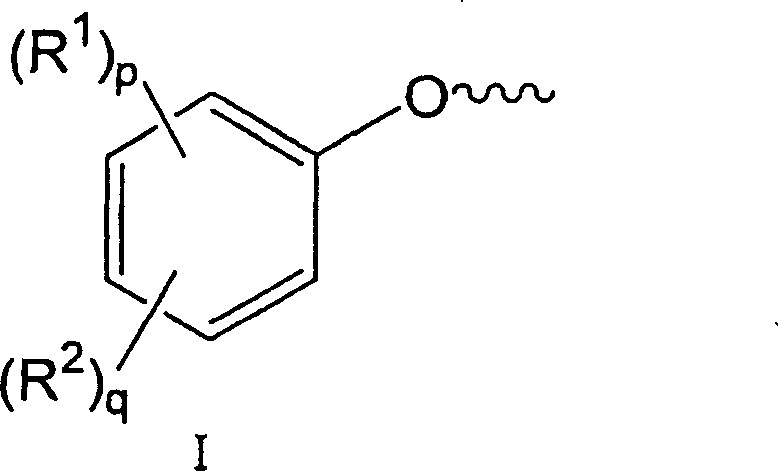
其中R1在每种情况下,独立地为C1~C20脂基、C4-C20脂环基、C4-C20芳基;R2每次出现时均独立地为卤原子、硝基、氰基、C1~C20烷氧基羰基、C1~C20酰基、C4-C20环烷氧基羰基、C6-C20芳氧基羰基、C1~C20烷基氨基羰基、C2~C40二烷基氨基羰基或C1~C20全氟烷基;p为0~4的整数,q为1~5的整数。wherein R 1 in each case is independently a C 1 -C 20 aliphatic group, a C 4 -C 20 alicyclic group, a C 4 -C 20 aryl group; each occurrence of R 2 is independently a halogen atom, Nitro, cyano, C 1 -C 20 alkoxycarbonyl, C 1 -C 20 acyl, C 4 -C 20 cycloalkoxycarbonyl, C 6 -C 20 aryloxycarbonyl, C 1 -C 20 alkane An aminocarbonyl group, a C 2 -C 40 dialkylaminocarbonyl group or a C 1 -C 20 perfluoroalkyl group; p is an integer of 0-4, and q is an integer of 1-5.
可以例举的具有结构I的端基包括:2-甲氧基羰基苯氧基、2-氰基苯氧基、2-乙酰基苯氧基、2-硝基苯氧基、4-硝基苯氧基和2,4,6-三氟苯氧基。Exemplary end groups having structure I include: 2-methoxycarbonylphenoxy, 2-cyanophenoxy, 2-acetylphenoxy, 2-nitrophenoxy, 4-nitro Phenoxy and 2,4,6-trifluorophenoxy.
在本发明的一个实施方式中,包含活化端芳氧基的部分结晶的聚碳酸酯原料(A)是通过至少一种二羟基芳族化合物与至少一种碳酸二芳酯的熔融反应提供无定形聚碳酸酯,然后在第二步将其结晶而制备的。在某些情况下,包含活化端芳氧基的部分结晶的聚碳酸酯原料(A)可以在促进聚碳酸酯产物结晶的反应条件下,直接通过二羟基芳族化合物与碳酸二芳酯的反应获得,例如双酚A与二(甲基水杨基)碳酸酯的反应。或者,包含活化端芳氧基的部分结晶的聚碳酸酯原料(A)可以在存在有酸受体和羟基芳族化合物链增长中止剂下,通过光气与至少一种二羟基芳族化合物的界面反应获得,所述链增长中止剂包含至少一种“活性取代基”。活性取代基包含烷氧基羰基例如甲氧基羰基、氰基、硝基和卤原子。引入至少一种活性取代基的链增长中止剂可以列举水杨酸甲酯、2-氰基酚、2,4,6-三氟化酚等。In one embodiment of the present invention, the partially crystalline polycarbonate starting material (A) comprising activated aryl-terminated groups is obtained by melting reaction of at least one dihydroxyaromatic compound with at least one diaryl carbonate to provide an amorphous Polycarbonate is then prepared by crystallizing it in a second step. In some cases, the partially crystalline polycarbonate starting material (A) containing activated terminal aryloxy groups can be obtained directly by reacting a dihydroxyaromatic compound with a diaryl carbonate under reaction conditions that promote crystallization of the polycarbonate product. Obtained, for example, by the reaction of bisphenol A with bis(methylsalicyl)carbonate. Alternatively, the partially crystalline polycarbonate starting material (A) comprising activated terminal aryloxy groups can be reacted by combining phosgene with at least one dihydroxyaromatic compound in the presence of an acid acceptor and a hydroxyaromatic compound chain-growth stopper. Interfacial reactions result in the chain-growth stopper comprising at least one "active substituent". Reactive substituents include alkoxycarbonyl groups such as methoxycarbonyl, cyano, nitro and halogen atoms. Examples of chain extension stoppers that introduce at least one active substituent include methyl salicylate, 2-cyanophenol, 2,4,6-trifluorophenol, and the like.
在本发明的再一个实施方式中,包含活化端芳氧基的部分结晶的聚碳酸酯原料(A)是通过包含在熔融反应条件下,处理包含活性端羟基的聚碳酸酯与包含活性取代基的碳酸二芳酯,例如具有结构II的碳酸二芳酯的方法而制备的。因此,包含活性端羟基的聚碳酸酯(所述聚碳酸酯已经制备或者通过熔融聚合或者界面聚合而制备)可以与包含活性取代基的碳酸二芳酯进一步反应,由此转化所有或部分所述活性端羟基为包含活化端芳氧基的端基,并获得包含所述活化端芳氧基的聚碳酸酯。结晶所述包含活化端芳氧基的聚碳酸酯获得原料(A)。In yet another embodiment of the present invention, the partially crystalline polycarbonate raw material (A) containing activated terminal aryloxy groups is obtained by treating polycarbonate containing reactive terminal hydroxyl groups with reactive substituents under melt reaction conditions. A diaryl carbonate, such as a diaryl carbonate having structure II, is prepared. Thus, a polycarbonate containing reactive terminal hydroxyl groups (which has been prepared or prepared by melt polymerization or interfacial polymerization) can be further reacted with a diaryl carbonate containing reactive substituents, thereby converting all or part of the The active terminal hydroxyl group is a terminal group comprising an activated terminal aryloxy group, and a polycarbonate comprising the activated terminal aryloxy group is obtained. The raw material (A) is obtained by crystallizing the polycarbonate containing activated terminal aryloxy groups.
术语“熔融聚合条件”应理解为在催化剂和任选的助催化剂存在下,实施碳酸二芳酯和二羟基芳族化合物间的反应的必需条件。催化剂可以为大量酯交换催化剂中的任何一种,例如碱金属氢氧化物、碱土氢氧化物及其混合物。助催化剂包括氢氧化四烷基铵例如氢氧化四甲基铵,四烷基鏻氢氧化物例如四丁基鏻氢氧化物,羧酸四烷基鏻例如醋酸四烷基鏻。反应温度典型为大约100~350℃,更优选约180~310℃。压力可以为大气压、超大气压或在反应初始阶段压力为大气压至大约15托,在后面的降压阶段为例如大约0.2~15托。反应时间通常为大约0.1~10小时。The term "melt polymerization conditions" is understood to mean the conditions necessary to carry out the reaction between the diaryl carbonate and the dihydroxyaromatic compound in the presence of a catalyst and optionally a cocatalyst. The catalyst can be any of a number of transesterification catalysts, such as alkali metal hydroxides, alkaline earth hydroxides, and mixtures thereof. Cocatalysts include tetraalkylammonium hydroxides such as tetramethylammonium hydroxide, tetraalkylphosphonium hydroxides such as tetrabutylphosphonium hydroxide, tetraalkylphosphonium carboxylates such as tetraalkylphosphonium acetate. The reaction temperature is typically about 100 to 350°C, more preferably about 180 to 310°C. The pressure may be atmospheric pressure, superatmospheric pressure or a pressure ranging from atmospheric pressure to about 15 torr in the initial stage of the reaction and, for example, from about 0.2 to 15 torr in the subsequent depressurization stage. The reaction time is usually about 0.1 to 10 hours.
在本发明的一个实施方式中,部分结晶的聚碳酸酯原料(A)是通过包含在熔融聚合反应条件下,反应至少一种二羟基芳族化合物与至少一种碳酸二芳酯II的方法制备的In one embodiment of the invention, the partially crystalline polycarbonate raw material (A) is prepared by a process comprising reacting at least one dihydroxyaromatic compound with at least one diaryl carbonate II under melt polymerization conditions of

其中R1、R2、p和q定义同结构I。Wherein R 1 , R 2 , p and q are as defined in structure I.
可以例举的碳酸二芳酯II包括:二(2-甲氧基羰基苯基)碳酸酯、二(4-氯-2-甲氧基羰基苯基)碳酸酯、二(2-乙氧基羰基苯基)碳酸酯、二(2-丁氧基羰基苯基)碳酸酯、二(2,4,6-三氟苯基)碳酸酯、二(2-硝基苯基)碳酸酯和二(2-氰基苯基)碳酸酯。Examples of diaryl carbonate II include: bis(2-methoxycarbonylphenyl)carbonate, bis(4-chloro-2-methoxycarbonylphenyl)carbonate, bis(2-ethoxy Carbonylphenyl)carbonate, bis(2-butoxycarbonylphenyl)carbonate, bis(2,4,6-trifluorophenyl)carbonate, bis(2-nitrophenyl)carbonate and di (2-cyanophenyl)carbonate.
可以用于制备所述部分结晶的聚碳酸酯原料(A)的二羟基芳族化合物包括双酚IIIDihydroxyaromatic compounds that can be used to prepare the partially crystalline polycarbonate starting material (A) include bisphenol III
其中R3每次出现时均独立地为卤原子、硝基、氰基、C1-C20烷基、C4-C20环烷基或C6-C20芳基;n和m独立地为0~4的整数;W为化学键、氧原子、硫原子、SO2基、C1-C20脂基、C6-C20芳基、C6-C20脂环基或下面的基团Wherein R 3 is independently a halogen atom, a nitro group, a cyano group, a C 1 -C 20 alkyl group, a C 4 -C 20 cycloalkyl group or a C 6 -C 20 aryl group at each occurrence; n and m are independently is an integer from 0 to 4; W is a chemical bond, oxygen atom, sulfur atom, SO 2 group, C 1 -C 20 aliphatic group, C 6 -C 20 aryl group, C 6 -C 20 alicyclic group or the following groups
其中R4和R5独立地为氢原子、C1-C20烷基、C4-C20环烷基或C6-C20芳基;或R4和R5一起形成C4-C20脂环,其可以任选地由一个或多个C1-C20烷基、C6-C20芳基、C5-C21芳烷基、C5-C20环烷基或其组合所取代。Wherein R 4 and R 5 are independently hydrogen atom, C 1 -C 20 alkyl, C 4 -C 20 cycloalkyl or C 6 -C 20 aryl; or R 4 and R 5 together form C 4 -C 20 Alicyclic ring, which can optionally be composed of one or more C 1 -C 20 alkyl groups, C 6 -C 20 aryl groups, C 5 -C 21 aralkyl groups, C 5 -C 20 cycloalkyl groups, or combinations thereof replace.
可例举的具有结构III的双酚包括:双酚A、2,2-二(4-羟基-3-甲苯基)丙烷、2,2-二(4-羟基-2-甲苯基)丙烷、2,2-二(3-氯-4-羟基苯基)丙烷、2,2-二(3-溴-4-羟基苯基)丙烷、2,2-二(4-羟基-3-异丙基苯基)丙烷、1,1-二(4-羟基苯基)环己烷、1,1-二(4-羟基-3-甲苯基)环己烷、1,1-二(4-羟基苯基)-3,3,5-三甲基环己烷、4,4′-二羟基-1,1-联苯、4,4′-二羟基-3,3′-二甲基-1,1-联苯、4,4′-二羟基-3,3′-二辛基-1,1-联苯、4,4′-二羟基二苯醚、4,4′-二羟基二苯硫醚、1,3-二(2-(4-羟苯基)-2-丙基)苯、1,3-二(2-(4-羟基-3-甲基苯基)-2-丙基)苯、1,4-二(2-(4-羟基苯基)-2-丙基)苯和1,4-二(2-(4-羟基-3-甲基苯基)-2-丙基)苯。Exemplary bisphenols having structure III include: bisphenol A, 2,2-bis(4-hydroxy-3-tolyl)propane, 2,2-bis(4-hydroxy-2-tolyl)propane, 2,2-bis(3-chloro-4-hydroxyphenyl)propane, 2,2-bis(3-bromo-4-hydroxyphenyl)propane, 2,2-bis(4-hydroxy-3-isopropane phenyl) propane, 1,1-bis(4-hydroxyphenyl)cyclohexane, 1,1-bis(4-hydroxy-3-tolyl)cyclohexane, 1,1-bis(4-hydroxy Phenyl)-3,3,5-trimethylcyclohexane, 4,4′-dihydroxy-1,1-biphenyl, 4,4′-dihydroxy-3,3′-dimethyl-1 , 1-biphenyl, 4,4'-dihydroxy-3,3'-dioctyl-1,1-biphenyl, 4,4'-dihydroxydiphenyl ether, 4,4'-dihydroxydiphenyl Thioether, 1,3-bis(2-(4-hydroxyphenyl)-2-propyl)benzene, 1,3-bis(2-(4-hydroxy-3-methylphenyl)-2-propane base) benzene, 1,4-bis(2-(4-hydroxyphenyl)-2-propyl)benzene and 1,4-bis(2-(4-hydroxy-3-methylphenyl)-2- Propyl) benzene.
本发明的一个实施方式中,部分结晶的聚碳酸酯原料(A)包含衍生于双酚A和2-甲氧基羰基苯氧基IV的重复单元,所述基团IV包含活性端羟基。In one embodiment of the present invention, the partially crystalline polycarbonate raw material (A) comprises recurring units derived from bisphenol A and 2-methoxycarbonylphenoxy groups IV comprising reactive terminal hydroxyl groups.
典型地,部分结晶的聚碳酸酯原料(A)将具有大约50~100%的封端比例,通过差示扫描量热法测量的结晶度为大约15~40%。典型地,原料(A)的重均分子量将为大约1000~30000道尔顿。Typically, the partially crystalline polycarbonate raw material (A) will have a capping ratio of about 50-100% and a degree of crystallinity as measured by differential scanning calorimetry of about 15-40%. Typically, the weight average molecular weight of starting material (A) will be from about 1000 to 30000 Daltons.
在本发明的一个实施方式中,部分结晶的聚碳酸酯原料(A)为如在此定义的“部分结晶的聚碳酸酯前体”,所述“部分结晶的聚碳酸酯前体的重均分子量小于15000道尔顿,优选大约1000~14000道尔顿。In one embodiment of the present invention, the partially crystalline polycarbonate raw material (A) is a "partially crystalline polycarbonate precursor" as defined herein, said "partially crystalline polycarbonate precursor having a weight average The molecular weight is less than 15000 Daltons, preferably about 1000-14000 Daltons.
包含活性端羟基的聚合物质(B)可以为至少一种聚酯、聚碳酸酯、聚醚、聚醚酮、聚醚砜、聚醚酰亚胺及其混合物。The polymeric substance (B) containing reactive terminal hydroxyl groups may be at least one of polyesters, polycarbonates, polyethers, polyetherketones, polyethersulfones, polyetherimides and mixtures thereof.
本发明的一个实施方式中,包含活性端羟基的聚合物质(B)包含选自下列基团的结构单元:In one embodiment of the present invention, the polymeric substance (B) comprising active terminal hydroxyl groups comprises structural units selected from the following groups:
(1)与结构V相应的聚酯结构单元(1) Polyester structural unit corresponding to structure V
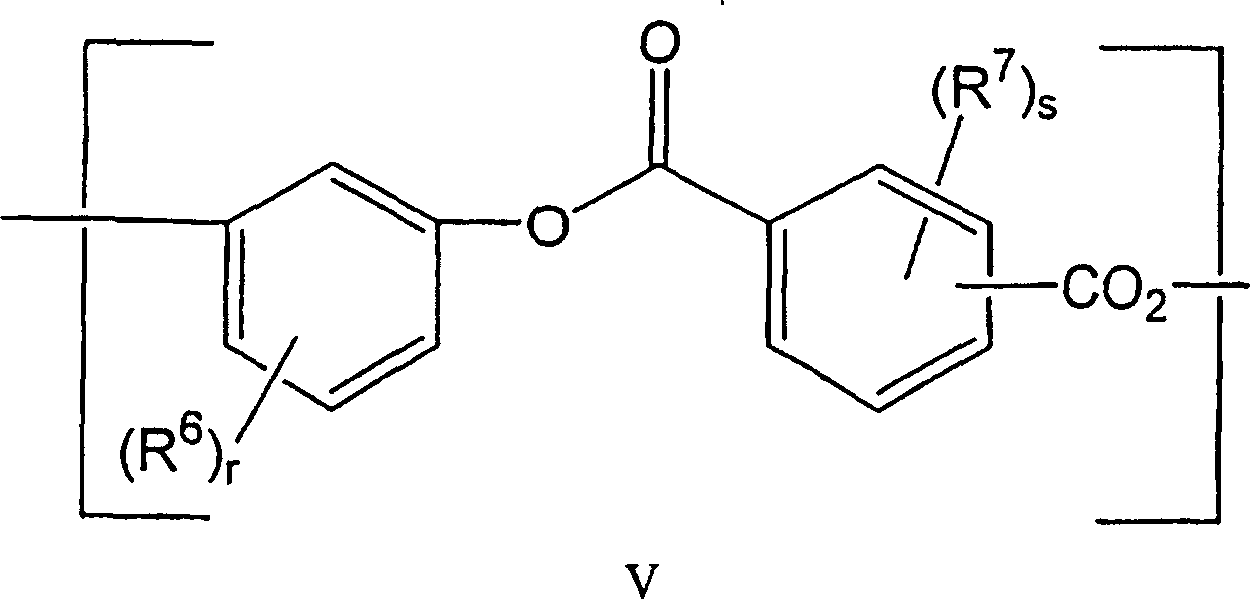
其中R6和R7每次出现时均独立地为卤原子、C1~C20脂基、C4-C20脂环基或C4-C20芳基;r和s独立地为0~4的整数;和Wherein R 6 and R 7 are independently halogen atoms, C 1 -C 20 aliphatic groups, C 4 -C 20 alicyclic groups or C 4 -C 20 aryl groups when they appear each time; r and s are independently 0-C 20 aryl groups; an integer of 4; and
(2)与结构VI相应的聚碳酸酯结构单元(2) Polycarbonate structural unit corresponding to structure VI
其中R3、n、m和W如结构III中所定义。wherein R3 , n, m and W are as defined in Structure III.
在本发明的再一个实施方式中,包含活性端羟基的聚合物质(B)为包含结构单元VII的低聚的聚酯,且聚合度至少大约4。In yet another embodiment of the present invention, the polymeric substance (B) comprising reactive terminal hydroxyl groups is an oligomeric polyester comprising structural unit VII, and has a degree of polymerization of at least about 4.
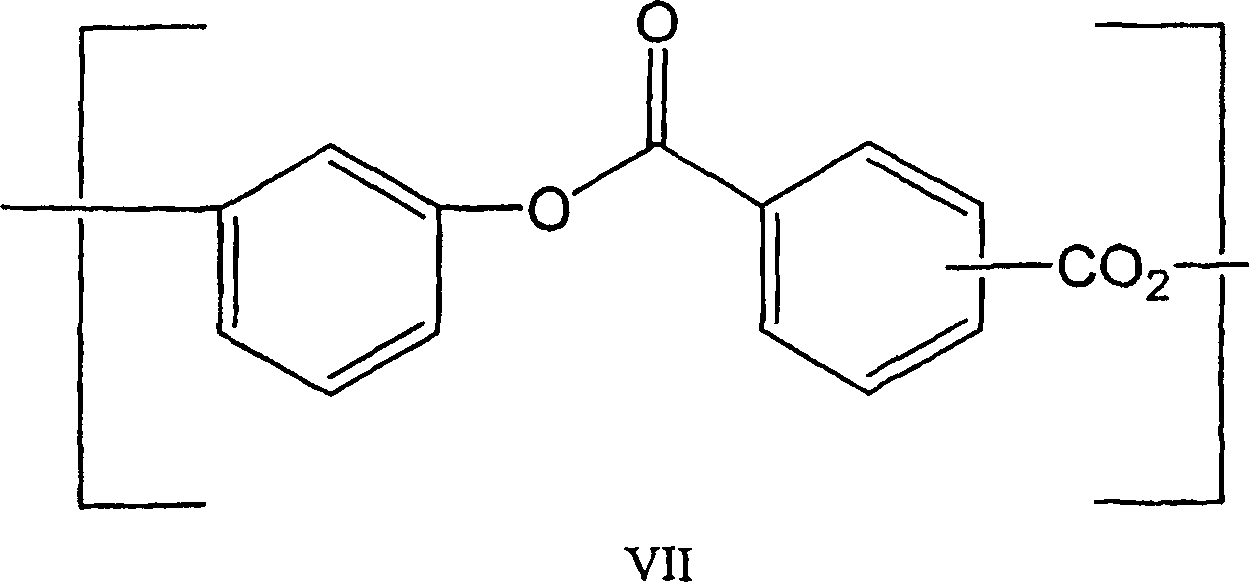
包含具有结构V的重复单元的聚酯可以通过多种已知方法制备,包括在酸受体和胺催化剂例如三乙胺存在下,一种或多种二酰氯例如对苯二甲酰二氯和间苯二甲酰二氯,与一种或多种二羟基芳族化合物例如间苯二酚的界面反应。Polyesters comprising repeating units of structure V can be prepared by a variety of known methods, including one or more diacid chlorides such as terephthaloyl dichloride and Isophthaloyl dichloride, interfacial reaction with one or more dihydroxyaromatic compounds such as resorcinol.
在一个实施方式中,在界面条件下使得间苯二酚与对苯二甲酰二氯和间苯二甲酰二氯的总摩尔数的摩尔比为大约1.01~1.5,对苯二甲酰二氯与间苯二甲酰二氯的摩尔比为大约1∶10~10∶1下,间苯二酚与对苯二甲酰二氯和间苯二甲酰二氯的混合物反应。In one embodiment, under interfacial conditions such that the molar ratio of resorcinol to the total moles of terephthaloyl dichloride and isophthaloyl dichloride is about 1.01 to 1.5, terephthaloyl dichloride Resorcinol is reacted with a mixture of terephthaloyl dichloride and isophthaloyl dichloride at a molar ratio of chlorine to isophthaloyl dichloride of about 1:10 to 10:1.
包含具有结构V的重复单元的聚酯也可以通过在熔融聚合条件下,在酯交换催化剂例如碱金属氢氧化物和助催化剂例如氢氧化四烷基铵存在下,一种或多种二羟基芳族化合物例如间苯二酚和氢醌与一种或多种二芳基酯例如对苯二甲酸二苯酯和间苯二甲酸二苯酯的接触而制备。过量二羟基芳族化合物的使用有利于形成羟基封端的聚合物质。Polyesters comprising repeating units of structure V can also be prepared by reacting, under melt polymerization conditions, one or more dihydroxyaryl It is prepared by contacting compounds such as resorcinol and hydroquinone with one or more diaryl esters such as diphenyl terephthalate and diphenyl isophthalate. The use of an excess of dihydroxyaromatic compounds favors the formation of hydroxyl terminated polymeric species.
在本发明的一个实施方式中,聚合物质(B)为包含重复单元VII并进一步包含活性端羟基的聚酯,其是在熔融聚合条件下,在酯交换催化剂存在下,反应间苯二酚与对苯二甲酸二苯酯和间苯二甲酸二苯酯的混合物而制备的。进行反应使得间苯二酚与对苯二甲酸二苯酯和间苯二甲酸二苯酯的总摩尔数的摩尔比为大约1.01~1.5,对苯二甲酸二苯酯与间苯二甲酸二苯酯的摩尔比为大约1∶10~10∶1。In one embodiment of the present invention, the polymer substance (B) is a polyester comprising repeating unit VII and further comprising active terminal hydroxyl groups, which is obtained by reacting resorcinol with Prepared from a mixture of diphenyl terephthalate and diphenyl isophthalate. The reaction is carried out so that the molar ratio of resorcinol to the total moles of diphenyl terephthalate and diphenyl isophthalate is about 1.01 to 1.5, and diphenyl terephthalate and diphenyl isophthalate The molar ratio of the esters is about 1:10 to 10:1.
在本发明的可替换的实施方式中,包含重复单元VII并还包含活性端羟基的聚合物质(B)是通过在熔融聚合条件和没有加入任何催化剂下,反应间苯二酚与对苯二甲酸二苯酯与间苯二甲酸二苯酯的混合物而制备的。进行反应,使得间苯二酚与对苯二甲酰二氯和间苯二甲酰二氯的结合摩尔数的摩尔比为大约1.01~1.5,对苯二甲酰二氯对间苯二甲酰二氯的摩尔比为大约1∶10~10∶1。In an alternative embodiment of the present invention, the polymeric substance (B) comprising repeating unit VII and further comprising reactive terminal hydroxyl groups is obtained by reacting resorcinol with terephthalic acid under melt polymerization conditions without adding any catalyst A mixture of diphenyl ester and diphenyl isophthalate. The reaction is carried out so that the molar ratio of resorcinol to the combined moles of terephthaloyl dichloride and isophthaloyl dichloride is about 1.01 to 1.5, and terephthaloyl dichloride terephthaloyl dichloride The molar ratio of dichlorine is about 1:10 to 10:1.
根据本发明的方法,嵌段共聚物通过在固相聚合条件下,接触部分结晶的包含活化端芳氧基的聚碳酸酯原料(A)与至少一种包含活性端羟基的聚合物质(B)而制备。原料(A)可以为如这里定义的部分结晶的“聚合材料”,即重均分子量大于15000道尔顿的聚碳酸酯。或者部分结晶的聚碳酸酯原料(A)可以为Mw<15000道尔顿的部分结晶的低聚的聚碳酸酯。According to the method of the present invention, the block copolymer is obtained by contacting a partially crystallized polycarbonate raw material (A) containing an activated terminal aryloxy group (A) with at least one polymer substance (B) containing an activated terminal hydroxyl group under solid-state polymerization conditions. while preparing. The starting material (A) may be a partially crystalline "polymeric material" as defined herein, ie polycarbonate having a weight average molecular weight greater than 15,000 Daltons. Alternatively the partially crystalline polycarbonate starting material (A) may be a partially crystalline oligomeric polycarbonate with Mw < 15000 Daltons.
在固相聚合条件下,部分结晶的包含活化端芳氧基的聚碳酸酯原料(A)与至少一种包含活性端羟基的聚合物质(B)的接触可以通过形成原料(A)和(B)的混合物,并将该混合物经受固相聚合条件而进行。该混合物可以通过混合粉末形式的部分结晶的聚碳酸酯原料(A)与粉末形式的聚合物质(B)形成。可以通过使用多种机械装置例如开炼机或Henschel混合器而完成此混合。Under solid state polymerization conditions, the contact of partially crystalline polycarbonate raw material (A) containing activated terminal aryloxy groups with at least one polymeric substance (B) containing reactive terminal hydroxyl groups can be achieved by forming raw materials (A) and (B) ) and subjecting the mixture to solid phase polymerization conditions. The mixture may be formed by mixing the partially crystalline polycarbonate raw material (A) in powder form with the polymeric substance (B) in powder form. This mixing can be accomplished by using various mechanical devices such as open mills or Henschel mixers.
典型地,结晶的聚碳酸酯原料(A)与至少一种聚合物质(B)一起混合,使得原料(A)与原料(B)的重量比为大约0.01∶100~100∶0.01。例如原料(A)和(B)以重量比0.01~100克原料(A)/克原料(B)的比例混合。更典型地,原料(A)与原料(B)的重量比为大约1∶5~5∶1。如果原料(A)是部分结晶的而原料(B)是无定形的,则优选原料(A)为混合物的主要组分。Typically, the crystalline polycarbonate material (A) is mixed with at least one polymeric material (B) such that the weight ratio of material (A) to material (B) is from about 0.01:100 to 100:0.01. For example, raw materials (A) and (B) are mixed at a weight ratio of 0.01 to 100 g of raw material (A)/g of raw material (B). More typically, the weight ratio of starting material (A) to starting material (B) is about 1:5 to 5:1. If starting material (A) is partially crystalline and starting material (B) is amorphous, it is preferred that starting material (A) is the main component of the mixture.
在某些情况下,聚合物质(B)可以为部分结晶的材料,也可以是无定形材料。例如,当聚合物质(B)为羟基封端的聚酯如聚对苯二甲酸乙二醇酯或聚对苯二甲酸丁二醇酯时,其可以为部分结晶材料。可供选择的是,当聚合物质(B)为羟基封端的包含源于间苯二酚、对苯二甲酸二苯酯和间苯二甲酸二苯酯的结构单元的多芳基化合物时,其将通常为无定形材料。In some cases, the polymeric substance (B) may be a partially crystalline material or an amorphous material. For example, when the polymeric substance (B) is a hydroxyl-terminated polyester such as polyethylene terephthalate or polybutylene terephthalate, it may be a partially crystalline material. Alternatively, when the polymeric substance (B) is a hydroxyl-terminated polyarylate comprising structural units derived from resorcinol, diphenyl terephthalate and diphenyl isophthalate, its Will generally be an amorphous material.
可供选择的制备原料(A)和(B)的混合物的方法包括:制备包含具有活化端芳氧基的聚碳酸酯原料和聚合物质(B)的溶液,及加入逆溶剂(anti solvent)沉淀这两种材料的混合物。合适的溶剂包括卤代溶剂如二氯甲烷。逆溶剂包括醇如甲醇,酮如丙酮,及酯如乙酸乙酯。沉淀物包含与部分结晶的聚碳酸酯原料(A)的掺混的聚合物质(B)。An alternative method for preparing a mixture of raw materials (A) and (B) includes: preparing a solution comprising a polycarbonate raw material having an activated terminal aryloxy group and a polymeric substance (B), and adding an anti solvent (anti solvent) to precipitate A mixture of these two materials. Suitable solvents include halogenated solvents such as dichloromethane. Antisolvents include alcohols such as methanol, ketones such as acetone, and esters such as ethyl acetate. The precipitate comprises polymeric material (B) admixed with partially crystalline polycarbonate raw material (A).
在本发明的一个实施方式中,粉末形式的部分结晶的聚碳酸酯前体(A)与至少两种聚合物质(B)例如粉末形式的对苯二甲酸乙二醇酯和包含结构单元VII的多芳基化合物低聚物混合,然后粉末的混合物在固相聚合条件下聚合而得到嵌段共聚酯碳酸酯。In one embodiment of the invention, the partially crystalline polycarbonate precursor (A) in powder form is combined with at least two polymeric substances (B) such as ethylene terephthalate in powder form and The polyarylate oligomers are mixed, and the mixture of powders is polymerized under solid state polymerization conditions to obtain block copolyestercarbonates.
根据本发明的方法使用的固相聚合条件包括在大约100~240℃下,将部分结晶的聚碳酸酯原料(A)和至少一种聚合物质(B)的混合物加热大约0.5~10小时,优选大约140~220℃下加热大约2~9小时。固相聚合可以在适于使惰性气体蒸气和进行固相聚合的固体接触的任何反应容器中进行,然后除去固相聚合副产物。固相聚合的副产物基本为包含至少一种活性取代基的羟基芳族化合物,例如水杨酸甲酯。羟基芳族化合物副产物在链增长阶段,例如当原料(B)的活性羟基与原料(A)的活性端基反应时形成。固相聚合的副产物也可以包括碳酸二芳酯例如II和混合的碳酸酯例如碳酸苯基水杨基酯。混合的碳酸酯与酚可以存在于固相聚合的副产物中,当原料(A)包含活化端芳氧基而原料(B)包含端苯氧基时,当原料(B)由一种或多种二苯基酯与摩尔过量的二羟基芳族化合物熔融反应形成时,也是如此。The solid state polymerization conditions used according to the method of the present invention include heating the mixture of partially crystalline polycarbonate raw material (A) and at least one polymeric substance (B) at about 100 to 240° C. for about 0.5 to 10 hours, preferably Heat at about 140-220°C for about 2-9 hours. Solid phase polymerization can be carried out in any reaction vessel suitable for contacting an inert gas vapor with a solid undergoing solid phase polymerization, followed by removal of solid phase polymerization by-products. By-products of solid state polymerization are essentially hydroxyaromatic compounds containing at least one reactive substituent, such as methyl salicylate. Hydroxyaromatic by-products are formed during the chain extension stage, for example, when reactive hydroxyl groups of starting material (B) react with reactive end groups of starting material (A). By-products of solid state polymerization may also include diaryl carbonates such as II and mixed carbonates such as phenyl salicyl carbonate. Mixed carbonates and phenols can be present in the by-products of solid state polymerization when starting material (A) contains activated terminal aryloxy groups and starting material (B) contains terminal phenoxy groups, when starting material (B) is composed of one or more The same is true when a diphenyl ester is formed by the melt reaction with a molar excess of a dihydroxyaromatic compound.
固相聚合工艺可以在间歇或连续模式下进行。在本发明的一个实施方式中,进行固相聚合的固体混合物被配置成具有惰性气体流经的固定床。Solid phase polymerization processes can be performed in batch or continuous mode. In one embodiment of the present invention, the solid mixture undergoing solid phase polymerization is configured as a fixed bed with an inert gas flowing through it.
由本发明的方法制备的嵌段共聚物产物典型地为多嵌段共聚物。在某些情况下,原料(A)和原料(B)含有受到活性羟基的进攻的内部官能团,例如原料(A)的内碳酸酯基或当原料(B)为低聚的聚酯时,存在的内酯键。在端活性羟基和内官能团间的反应导致存在于嵌段共聚物产物中的一种或多种嵌段的平均嵌段长度(block length)减小。在特定条件下,可以获得存在于嵌段共聚物产物中的完全无规分布的重复单元。本发明方法的重要特征为控制和限制存在于嵌段共聚物中的结构单元的随机化的能力。这可以通过基于增强原料(A)中端基的活性,有助于原料(A)和原料(B)间键形成的过程而达到。因此,与其中缺乏活性端烷氧基I的部分结晶的聚碳酸酯的其它固相聚合方法相比,本发明的方法在更大的程度上保存了原料的嵌段长度。通过将嵌段共聚物产物中的嵌段长度与如果共聚物的结构单元沿聚合物链无规分布而可以预期的嵌段长度相比,该嵌段长度的保存可量化。在本发明的一个实施方式中,在同样组成的共聚物中,嵌段共聚物产物的嵌段长度比相应无规分布的结构单元长至少50~大约90%,优选至少60~大约90%。The block copolymer products prepared by the process of the present invention are typically multi-block copolymers. In some cases, starting material (A) and starting material (B) contain internal functional groups that are attacked by active hydroxyl groups, such as internal carbonate groups of starting material (A) or when starting material (B) is an oligomeric polyester, the presence of the lactone bond. The reaction between the terminal reactive hydroxyl groups and the internal functional groups results in a decrease in the average block length of one or more blocks present in the block copolymer product. Under certain conditions, it is possible to obtain a completely random distribution of repeat units present in the block copolymer product. An important feature of the method of the invention is the ability to control and limit the randomization of the structural units present in the block copolymers. This can be achieved by a process that favors bond formation between starting material (A) and starting material (B) based on enhancing the reactivity of the terminal groups in starting material (A). Thus, the process of the present invention preserves the block length of the starting material to a greater extent than other solid state polymerization processes in which partially crystalline polycarbonates lack reactive terminal alkoxy I groups. The preservation of block length can be quantified by comparing the block length in the block copolymer product to the block length that would be expected if the structural units of the copolymer were distributed randomly along the polymer chain. In one embodiment of the invention, the block copolymer product has a block length that is at least 50 to about 90%, preferably at least 60 to about 90%, longer than the corresponding randomly distributed structural units in a copolymer of the same composition.
通过本发明的方法制备的嵌段共聚物可以任选地与任何常规添加剂混合,包括但不限于染料、UV稳定剂、抗氧剂、热稳定剂和脱模剂以形成成型制品。具体而言,优选形成嵌段共聚物和添加剂的共混物,该添加剂有助于加工共混物形成所希望的成型制品。该共混物可以任选地包含大约0.0001~10%重量,更优选大约0.0001~1.0%重量所需的添加剂。The block copolymers prepared by the process of the present invention may optionally be mixed with any conventional additives, including but not limited to dyes, UV stabilizers, antioxidants, heat stabilizers, and mold release agents, to form shaped articles. In particular, it is preferred to form a blend of block copolymers and additives that aid in processing the blend to form the desired shaped article. The blend may optionally contain from about 0.0001 to 10% by weight, more preferably from about 0.0001 to 1.0% by weight of the desired additives.
可以加入到本发明的嵌段共聚物中的物质或添加剂包含但不限于耐热稳定剂、UV吸收剂、脱模剂、抗静电剂、滑爽剂、防结块剂、润滑剂、防雾剂、着色剂、天然油、合成油、蜡、有机填料、无机填料及其混合物。Substances or additives that can be added to the block copolymer of the present invention include but are not limited to heat-resistant stabilizers, UV absorbers, mold release agents, antistatic agents, slip agents, anti-blocking agents, lubricants, anti-fog additives, colorants, natural oils, synthetic oils, waxes, organic fillers, inorganic fillers and mixtures thereof.
上述耐热稳定剂的实例包括但不限于酚稳定剂、有机硫醚稳定剂、有机磷化物稳定剂、受阻胺稳定剂、环氧化物稳定剂及其混合物。耐热稳定剂可以以固体或液体的形式加入。Examples of the aforementioned heat-resistant stabilizers include, but are not limited to, phenol stabilizers, organic thioether stabilizers, organophosphide stabilizers, hindered amine stabilizers, epoxy stabilizers, and mixtures thereof. Heat-resistant stabilizers can be added in solid or liquid form.
UV吸收剂的实例包括但不限于水杨酸UV吸收剂、二苯酮UV吸收剂、苯并三唑UV吸收剂、氰基丙烯酸酯UV吸收剂及其混合物。Examples of UV absorbers include, but are not limited to, salicylic acid UV absorbers, benzophenone UV absorbers, benzotriazole UV absorbers, cyanoacrylate UV absorbers, and mixtures thereof.
脱模剂的实例包括但不限于天然和合成的石蜡、聚乙烯蜡、氟碳化合物和其它烃脱模剂;硬脂酸、羟基硬脂酸和其它更高级脂肪酸、羟基脂肪酸和其它脂肪酸脱模剂;硬脂酸酰胺、二硬脂酸乙二酰胺和其它脂肪酸酰胺、亚烷基二脂肪酸酰胺和其它脂肪酸酰胺脱模剂;十八烷醇、十六烷醇和其它脂肪醇;多元醇、聚乙二醇、聚甘油和其它醇类脱模剂;硬脂酸丁酯、四硬脂酸季戊四醇酯和其它脂肪酸的低级醇酯;脂肪酸的多元醇酯、脂肪酸的聚乙二醇酯和其它脂肪酸酯脱模剂;硅油或其它有机硅脱模剂及其上述的任何混合物。Examples of mold release agents include, but are not limited to, natural and synthetic paraffin waxes, polyethylene waxes, fluorocarbons, and other hydrocarbon mold release agents; stearic acid, hydroxystearic acid, and other higher fatty acids, hydroxy fatty acids, and other fatty acid mold release agents stearic acid amide, distearic acid oxamide and other fatty acid amides, alkylene difatty acid amides and other fatty acid amide release agents; stearyl alcohol, cetyl alcohol and other fatty alcohols; polyols, poly Ethylene glycol, polyglycerin and other alcohol release agents; butyl stearate, pentaerythritol tetrastearate and other lower alcohol esters of fatty acids; polyol esters of fatty acids, polyethylene glycol esters of fatty acids and other fats Ester release agents; silicone oils or other silicone release agents and any mixtures thereof.
着色剂可以为染料或颜料。无机着色剂和有机着色剂可以单独使用或结合使用。Colorants can be dyes or pigments. Inorganic colorants and organic colorants may be used alone or in combination.
可以通过模塑该嵌段共聚物,或嵌段共聚物与第二聚合物例如双酚A聚碳酸酯的共混物,通过注塑、压塑、挤出法和溶液流延法,将根据本发明的方法制备的嵌段共聚物转变为所需的制品。注塑为形成制品的更优选的方法。在一个实施方式中,形成自本发明的方法制备的嵌段共聚物的成型制品为多层制品。由包含结构单元V和VI的嵌段共聚物制备的多层制品特别适用于这样的多种户外应用中例如户外车辆的主体部分等,所述嵌段共聚物由本发明的方法制备。By molding the block copolymer, or a blend of the block copolymer with a second polymer such as bisphenol A polycarbonate, by injection molding, compression molding, extrusion and solution casting, the The block copolymers prepared by the inventive process are converted into desired articles. Injection molding is a more preferred method of forming articles. In one embodiment, the shaped article formed from the block copolymer prepared by the process of the present invention is a multilayer article. Multilayer articles prepared from block copolymers comprising structural units V and VI prepared by the process of the present invention are particularly useful in such a variety of outdoor applications such as outdoor vehicle body parts and the like.
实施例Example
对本领域的普通技术人员,提供下面的实施例以及对这里要求的方法是如何进行和评价的详细描述,但并不是要限制发明人认为其发明的范围。除非另外指明,份为重量份,温度为℃。The following examples, together with a detailed description of how the methods claimed herein were performed and evaluated, are provided to those of ordinary skill in the art, but are not intended to limit the scope of what the inventors believe to be their invention. Parts are parts by weight and temperatures are in °C unless otherwise indicated.
分子量作为数均分子量(Mn)或重均分子量(Mw)来报告,并使用凝胶气相色谱(GPC)来确定。使用两种GPC校准法。第一种方法使用聚碳酸酯分子量标准物,来制定确定聚合物分子量的宽标准校对曲线。如这里描述的,使用该校准方法来确定水杨酸甲酯封端的聚碳酸酯低聚物的分子量,该低聚物用于制备嵌段的共聚碳酸酯。第二种GPC校准法依赖于一系列的已知分子量的聚苯乙烯标准物,其用于制定确定产物共聚碳酸酯的分子量的校对曲线。如这里描述的,该第二种GPC校准法用于确定低聚的聚酯的分子量。当用GPC描述聚碳酸酯时,人们通常相信使用聚碳酸酯标准物获得的分子量比使用聚苯乙烯标准物获得的那些更精确。通常,基于GPC法,使用聚苯乙烯标准物确定的聚碳酸酯分子量具有Mn和Mw值,其比使用聚碳酸酯标准物测得的相同值大1.5~2.5倍。整个本发明中,使用NMR获得聚碳酸酯和聚酯低聚物的聚合度(DP)。使用NMR得到的聚碳酸酯低聚物的聚合度通常与使用聚碳酸酯分子量标准物的GPC获得的Mn值很好地相关。进行凝胶汽相色谱,使得柱温为大约25℃且移动相为氯仿。Molecular weights are reported as number average molecular weight (M n ) or weight average molecular weight (M w ) and determined using gel gas chromatography (GPC). Two GPC calibration methods were used. The first method uses polycarbonate molecular weight standards to develop a broad standard calibration curve for determining polymer molecular weight. As described herein, this calibration method was used to determine the molecular weight of methyl salicylate terminated polycarbonate oligomers used to prepare block copolycarbonates. The second GPC calibration method relies on a series of polystyrene standards of known molecular weight, which are used to develop a calibration curve to determine the molecular weight of the product copolycarbonate. As described herein, this second GPC calibration method was used to determine the molecular weight of oligomeric polyesters. When GPC is used to describe polycarbonates, it is generally believed that molecular weights obtained using polycarbonate standards are more accurate than those obtained using polystyrene standards. Generally, based on the GPC method, the molecular weight of polycarbonate determined using polystyrene standards has M n and M w values that are 1.5 to 2.5 times greater than the same values measured using polycarbonate standards. Throughout the present invention, NMR is used to obtain the degree of polymerization (DP) of polycarbonate and polyester oligomers. The degree of polymerization of polycarbonate oligomers using NMR generally correlates well with Mn values obtained by GPC using polycarbonate molecular weight standards. Gel gas chromatography was performed such that the column temperature was about 25°C and the mobile phase was chloroform.
固相聚合进行如下。进行“固相聚合条件下加热步骤”的大约1克材料放入位于对流烘箱中的10毫升烧结漏斗(fritted funnel)中。烘箱的基础配备氮气入口。通过经过对流烘箱中的大约16米长的铜管而预热的氮气流经漏斗的基础,经过进行固相聚合的材料,并从漏斗顶部流出。氮气流速为大约2.5升/分钟。典型地,在固相聚合反应过程中,温度从最初的大约140℃,一步或多步而升到大约165~220℃的最终温度。固相聚合反应的过程后,对烧结漏斗中材料周期性取样,并使材料进行差示扫描量热法(DSC)。固相聚合的共聚酯碳酸酯产物用DSC描述,以确定玻璃化转变温度,使用聚苯乙烯标准物的GPC确定Mn和Mw值,和使用NMR评价产物共聚酯碳酸酯的组成和嵌段(blockiness)。产物共聚碳酸酯为“多嵌段共聚酯碳酸酯”,为方便起见,简单地称其为“嵌段共聚碳酸酯”。Solid phase polymerization was carried out as follows. Approximately 1 gram of material subjected to the "heating step under solid state polymerization conditions" was placed in a 10 mL fritted funnel placed in a convection oven. The base of the oven is equipped with a nitrogen inlet. Nitrogen, preheated by passing about 16 meters of copper tubing in a convection oven, flows through the base of the funnel, past the material undergoing solid state polymerization, and out the top of the funnel. The nitrogen flow rate was approximately 2.5 liters/minute. Typically, during solid state polymerization, the temperature is raised from an initial temperature of about 140°C in one or more steps to a final temperature of about 165-220°C. Following the course of the solid state polymerization, the material in the sintered funnel was periodically sampled and the material was subjected to differential scanning calorimetry (DSC). The solid-phase polymerized copolyestercarbonate products were characterized by DSC to determine the glass transition temperature, GPC using polystyrene standards to determine Mn and Mw values, and NMR to evaluate the composition and blockiness. The product copolycarbonate is "multi-block copolyestercarbonate", and for convenience, it is simply called "block copolycarbonate".
水杨酸甲酯封端的聚碳酸酯低聚物的制备Preparation of Methyl Salicylate Terminated Polycarbonate Oligomer
二(甲基水杨基)碳酸酯与双酚A的熔融反应在500毫升或1000升的玻璃间歇反应器中进行,该反应器配备螺旋搅拌器、蒸馏头和有刻度的接收容器。为从反应器的玻璃壁上除去任何外来的钠,将反应器在3当量HCl中浸湿至少12小时,接着在去离子水(18莫姆)中漂洗和浸渍至少12小时。然后在使用前,在烘箱中干燥反应器一整夜。用具有PID控制器的流化的砂浴(fluidized sand bathhours)加热反应器。浴温在反应器和砂浴的接触面测量。反应器的压力通过接受瓶的氮气向下游流出而控制。用MKS皮拉尼压力计(pirani gauge)测量压力。The melt reaction of bis(methylsalicyl)carbonate with bisphenol A was carried out in a 500 ml or 1000 liter glass batch reactor equipped with a helical stirrer, a distillation head and a graduated receiving vessel. To remove any extraneous sodium from the glass walls of the reactor, the reactor was soaked in 3 N HCl for at least 12 hours, followed by rinsing and soaking in deionized water (18 moms) for at least 12 hours. The reactor was then dried overnight in an oven before use. The reactor was heated with fluidized sand bathhours with a PID controller. The bath temperature is measured at the interface between the reactor and the sand bath. Reactor pressure was controlled by nitrogen flowing downstream from the receiving bottle. Pressure was measured with a MKS pirani gauge.
实施例1Example 1
无定形的甲基水杨基封端的聚碳酸酯制备如下。用150克(0.6571摩尔)固体双酚-A(BPA)和243.6克(0.7368摩尔)固体二(甲基水杨基)碳酸酯(BMSC)装填反应器,使得在反应开始BMSC与BPA的摩尔比为大约1.12。以相应于2.5×10⁻⁴摩尔助催化剂/摩尔BPA的加入量加入乙酸四丁基鏻助催化剂。以相应于1.0×10-6摩尔催化剂/摩尔BPA的加入量加入EDTA镁二钠盐催化剂。密封反应器并用氮气交换空气三次。接着最后的氮气交换,使反应器中的压力为大约5~15mmHg。在第一阶段,将反应器浸没于170℃的流化砂中。5分钟后,以60rpm的速度开始搅拌。在另外的10~15分钟后,反应物的混合物完全熔融,而搅拌器的速度增加到200rpm。搅拌并加热反应混合物,同时在接收容器中收集释放出的水杨酸甲酯。在170℃除去水杨酸甲酯副产物的理论量(基于BPA和BMSC完全反应)的大约90~95%。浴温然后通过一系列的温度阶段210、240和270℃升高,反应混合物在每个阶段搅拌20分钟。在最后的两个阶段过程中(240、270℃),反应混合物的压力降到大约1托或更低。然后将反应容器从砂浴上移除,并用氮气轻轻地吹扫。回收无定形低聚的产物,并由GPC使用聚碳酸酯分子量标准物确定Mw=4820和Mn=2138。封端比例为99%。Amorphous methyl salicyl terminated polycarbonate was prepared as follows. The reactor was charged with 150 g (0.6571 mol) of solid bisphenol-A (BPA) and 243.6 g (0.7368 mol) of solid bis(methylsalicyl) carbonate (BMSC) such that at the start of the reaction the molar ratio of BMSC to BPA is about 1.12. The tetrabutylphosphonium acetate cocatalyst was added in an amount corresponding to 2.5 x 10 -4 moles of cocatalyst per mole of BPA. EDTA magnesium disodium salt catalyst was added in an amount corresponding to 1.0 x 10 -6 mol catalyst/mol BPA. The reactor was sealed and the air was exchanged three times with nitrogen. A final nitrogen exchange was followed to bring the pressure in the reactor to about 5-15 mmHg. In the first stage, the reactor was immersed in fluidized sand at 170°C. After 5 minutes, start stirring at a speed of 60 rpm. After an additional 10-15 minutes, the mixture of reactants was completely molten and the speed of the stirrer was increased to 200 rpm. The reaction mixture was stirred and heated while collecting the liberated methyl salicylate in a receiving vessel. About 90-95% of the theoretical amount of methyl salicylate by-product (based on complete reaction of BPA and BMSC) was removed at 170°C. The bath temperature was then raised through a series of temperature stages 210, 240 and 270°C, with the reaction mixture stirred for 20 minutes at each stage. During the last two stages (240, 270°C), the pressure of the reaction mixture drops to about 1 Torr or less. The reaction vessel was then removed from the sand bath and purged gently with nitrogen. The amorphous oligomeric product was recovered and determined to have Mw = 4820 and Mn = 2138 by GPC using polycarbonate molecular weight standards. The capping ratio is 99%.
实施例2-6代表无定形甲基水杨基封端的聚碳酸酯低聚物的相似制备。Examples 2-6 represent similar preparations of amorphous methyl salicyl terminated polycarbonate oligomers.
实施例2-6的低聚的聚碳酸酯的数据总结于表1。The data for the oligomeric polycarbonates of Examples 2-6 are summarized in Table 1.
表1无定形甲基水杨基封端低聚物
实施例7-10类似地制备了引入甲基水杨基端基的结晶的低聚的聚碳酸酯。用固体BPA(150g或300g,0.6571或1.3141摩尔)和固体BMSC充填反应器,使得在反应的开始BMSC与BPA的摩尔比为大约1.00~1.15。催化剂类型和用量与实施例1中使用的相同。密封反应器并用氮气交换空气三次。接着最后的氮气交换,使反应器中的压力为大约5~15mmHg。在第一阶段,将反应器浸没于170℃的流化砂中。5分钟后,以60rpm的速度开始搅拌。在另外的10~15分钟后,反应物完全熔融,而搅拌器的速度增加到200rpm。搅拌并加热反应混合物,同时在接收容器中收集释放出的水杨酸甲酯。为获得较低分子量的结晶低聚物,水杨酸甲酯从反应容器中蒸馏出来,直至除去理论量(基于BPA和BMSC完全反应)的大约90~95%的水杨酸甲酯副产物。然后将反应容器从砂浴上移除,并用氮气轻轻地吹扫。冷却时,观察到结晶低聚的产物浓缩和断裂。冷却的结晶产物很容易从反应器中倒出。通过此方法制备的结晶甲基水杨基封端的聚碳酸酯低聚物的数据总结于表2。Examples 7-10 A crystalline oligomeric polycarbonate incorporating methylsalicyl end groups was prepared analogously. The reactor was charged with solid BPA (150 g or 300 g, 0.6571 or 1.3141 moles) and solid BMSC such that the molar ratio of BMSC to BPA was about 1.00-1.15 at the beginning of the reaction. The catalyst type and amount were the same as those used in Example 1. The reactor was sealed and the air was exchanged three times with nitrogen. A final nitrogen exchange was followed to bring the pressure in the reactor to about 5-15 mmHg. In the first stage, the reactor was immersed in fluidized sand at 170°C. After 5 minutes, start stirring at a speed of 60 rpm. After an additional 10-15 minutes, the reactants were completely molten and the stirrer speed was increased to 200 rpm. The reaction mixture was stirred and heated while collecting the liberated methyl salicylate in a receiving vessel. To obtain lower molecular weight crystalline oligomers, methyl salicylate was distilled from the reaction vessel until approximately 90-95% of the theoretical amount (based on complete reaction of BPA and BMSC) of the methyl salicylate by-product was removed. The reaction vessel was then removed from the sand bath and purged gently with nitrogen. On cooling, condensation and fragmentation of the crystalline oligomerized product was observed. The cooled crystalline product was easily poured from the reactor. Data for crystalline methylsalicyl-terminated polycarbonate oligomers prepared by this method are summarized in Table 2.
表2结晶甲基水杨基封端低聚物
在表1和2中,“BMSC/BPA”的比例代表使用的二(甲基水杨基)碳酸酯与双酚A的摩尔比。符号“[OH]”以每百万份表示(ppm)并代表在产物聚碳酸酯中发现的自由羟基的浓度。自由羟基浓度由定量的红外光谱确定。“EC(%)”表示不以羟基中止的聚合物链端基。水杨基端基在产物溶剂分解后由HPLC分析确定。术语“%Cryst”代表产物聚碳酸酯的结晶度百分比,并由差示扫描量热法确定。In Tables 1 and 2, the ratio "BMSC/BPA" represents the molar ratio of bis(methylsalicyl)carbonate to bisphenol A used. The symbol "[OH]" is expressed in parts per million (ppm) and represents the concentration of free hydroxyl groups found in the product polycarbonate. Free hydroxyl concentration was determined by quantitative infrared spectroscopy. "EC (%)" denotes polymer chain end groups not terminated with hydroxyl groups. Salicyl end groups were determined by HPLC analysis after solvolysis of the product. The term "% Cryst" represents the percent crystallinity of the product polycarbonate and is determined by differential scanning calorimetry.
制备羟基封端的聚酯低聚物Preparation of hydroxyl-terminated polyester oligomers
实施例11Example 11
在配备有机械搅拌器、具有Vigreux柱的笛安-斯达克榻分水器和真空附件的玻璃反应器中,加入间苯二酚(3.03克,0.0275摩尔)、间苯二甲酸二苯酯(3.98克,0.0125摩尔)、对苯二甲酸二苯酯(3.98克,0.0125摩尔)、氢氧化锂(2.2毫克[mg])和氢氧化四甲铵(10毫升25重量%的溶液)。建立氮气氛(3次真空吹扫),并开始低速搅拌。将反应器降入控制在大约200℃的砂浴中。15分钟后,压力降低至100托。保持此压力和温度45分钟,在此过程中收集到1毫升苯酚。然后压力降低至50托,并保持60分钟,获得另外的1.毫升苯酚。然后温度升至220℃,60分钟后获得另外的1.2毫升苯酚。在接下来的30分钟中,将反应器保持在220℃和25托。最后,将温度升高至240℃,并施加完全真空45分钟。苯酚最终的量为大约3.5毫升(80%理论值)。将粘稠琥珀色的材料倾倒在铝盘上,得到4.5克产物低聚的羟基封端的聚酯。GPC分析指出Mw为8026。该材料的Tg为112℃。包含衍生于间苯二酚、间苯二甲酸和间苯二甲酸或其衍生物的结构单元的低聚的羟基封端的聚酯被称作“ITR低聚物”。In a glass reactor equipped with a mechanical stirrer, a Dean-Stark trap with a Vigreux column, and a vacuum attachment, resorcinol (3.03 g, 0.0275 mol), diphenyl isophthalate (3.98 grams, 0.0125 moles), diphenyl terephthalate (3.98 grams, 0.0125 moles), lithium hydroxide (2.2 milligrams [mg]) and tetramethylammonium hydroxide (10 mL of a 25% by weight solution). A nitrogen atmosphere was established (3 vacuum purges) and stirring started at low speed. The reactor was lowered into a sand bath controlled at approximately 200°C. After 15 minutes, the pressure was reduced to 100 Torr. This pressure and temperature were maintained for 45 minutes during which time 1 ml of phenol was collected. The pressure was then reduced to 50 Torr and held for 60 minutes to obtain an additional 1.0 ml of phenol. The temperature was then raised to 220°C and an additional 1.2 ml of phenol was obtained after 60 minutes. The reactor was maintained at 220°C and 25 Torr for the next 30 minutes. Finally, the temperature was raised to 240°C and full vacuum was applied for 45 minutes. The final amount of phenol was about 3.5 ml (80% of theory). The viscous amber material was poured onto an aluminum pan to yield 4.5 grams of product oligomeric hydroxyl terminated polyester. GPC analysis indicated a Mw of 8026. The Tg of this material is 112°C. Oligomeric hydroxyl-terminated polyesters comprising structural units derived from resorcinol, isophthalic acid and isophthalic acid or derivatives thereof are referred to as "ITR oligomers".
根据本发明描述于实施例11的方法,通过间苯二酚与1∶1的间苯二甲酸二苯酯和对苯二甲酸二苯酯的混合物的熔融反应制备一系列含实施例12-19的低聚的羟基封端的聚酯。实施例11-19的低聚的羟基封端的聚酯的数据总结于表3。重均分子量Mw由使用聚苯乙烯分子量标准物的GPC确定。According to the method of the present invention described in Example 11, a series of compounds containing Examples 12-19 were prepared by the melt reaction of resorcinol with a 1:1 mixture of diphenyl isophthalate and diphenyl terephthalate. oligomeric hydroxyl-terminated polyesters. The data for the oligomeric hydroxy-terminated polyesters of Examples 11-19 are summarized in Table 3. The weight average molecular weight Mw is determined by GPC using polystyrene molecular weight standards.
表3羟基封端的聚酯低聚物
a使用聚苯乙烯标准物的GPC确定的Mw a Mw determined by GPC using polystyrene standards
通过固相聚合的嵌段共聚物Block Copolymers by Solid State Polymerization
实施例20Example 20
由实施例1制备的聚合度大约8.4的1.0克无定形水杨酸甲酯封端的聚碳酸酯低聚物(Mw=4820,Mn=2138),和实施例11中制备的2克ITR低聚物(用二氧磷杂茂烷(dioxaphospholane)衍生物的定量的13C-NMR和/31P-NMR确定聚合度(DP)大约9.2)制备的混合物溶解于二氯甲烷中。加入大约两倍的二氯甲烷量的乙酸乙酯,使低聚物的混合物结晶并从溶液中沉淀出来。如此沉淀的材料从液相中通过过滤分离出来。然后将液相蒸发并干燥,而残余物与从过滤回收的固体合并在一起。在真空烘箱中大约60℃下干燥一整夜后,得到的粉末用差示扫描量热法(DSC)描述,其指出玻璃化转变温度(Tg)为大约100℃,与熔点相应的两个宽峰分别在大约148℃和200℃。保存部分结晶的甲基水杨基封端的聚碳酸酯低聚物和ITR低聚物的混合物的一部分以用于实施例21。然后粉末的第二部分进行在固相聚合条件下的加热步骤。
固相聚合后,用DSC分析产物嵌段共聚酯碳酸酯,并表明Tg为大约129℃,与熔点相应的两个宽峰分别在大约187℃和208℃。GPC显示使用聚苯乙烯标准物,Mw=28000道尔顿和Mn=9540道尔顿的单峰。定量的13C-NMR指出嵌段的共聚物平均聚碳酸酯嵌段长度为大约4.05和平均聚酯嵌段长度为大约7。After solid state polymerization, the product block copolyestercarbonate was analyzed by DSC and showed a Tg of about 129°C with two broad peaks corresponding to melting points at about 187°C and 208°C, respectively. GPC showed a single peak with Mw = 28000 Daltons and Mn = 9540 Daltons using polystyrene standards. Quantitative13C -NMR indicated that the block copolymers had an average polycarbonate block length of about 4.05 and an average polyester block length of about 7.
实施例21Example 21
保存用于以后应用的实施例20的一步份粉末在固相聚合条件下进行下面加热步骤。
使用聚苯乙烯标准物的产物共聚酯碳酸酯的GPC分析显示Mw=18880和Mn=9230的单窄峰。定量的13C-NMR指出平均聚碳酸酯嵌段长度为大约4.15而平均聚酯嵌段长度为大约8.9的嵌段共聚物。GPC analysis of the product copolyestercarbonate using polystyrene standards showed a single narrow peak with Mw = 18880 and Mn = 9230. Quantitative13C -NMR indicated a block copolymer with an average polycarbonate block length of about 4.15 and an average polyester block length of about 8.9.
实施例22Example 22
在实施例1制备的水杨酸甲酯封端的聚碳酸酯低聚物(Mw=4820,Mn=2138,DP大约8.4)溶解于二氯甲烷中,接着加入大约5倍二氯甲烷用量的乙酸乙酯沉淀。沉淀物从液相中过滤出来。然后蒸发液相以获得固体残余。然后合并沉淀物和来自液相的固体残余以形成沉淀物和从液相蒸发获得的固体残余的混合物。研磨混合物,然后机械振动以获得基本包含部分结晶的甲基水杨基封端的聚碳酸酯低聚物的粉末。然后部分结晶的甲基水杨基封端的聚碳酸酯低聚物与等量的低聚的羟基封端的聚酯细粒(使用实施例11的操作和比例;使用聚苯乙烯标准物Mw=8845,DP=大约9.2)在实验室研磨混合机(laboratory mill mixer)中研磨并混合多次。在用DSC分析时,低聚物的混合物的Tg为大约105℃,并具有大约170℃的与熔点相对应的宽峰。保留一部分以便在实施例23和24中应用。混合物的第二部分在固相聚合条件下进行下列加热步骤。
产物共聚酯碳酸酯的Tg为大约135℃,并具有大约169℃和221℃的分别与熔点相对应的宽峰。使用聚苯乙烯标准物的产物的GPC分析显示具有Mw=79830和Mn=21720的宽峰。定量的13C-NMR表明平均聚碳酸酯链端长度为大约6.7而评价聚酯嵌段长度为大约8.6的嵌段共聚物。The product copolyestercarbonate had a Tg of about 135°C with broad peaks corresponding to melting points at about 169°C and 221°C, respectively. GPC analysis of the product using polystyrene standards showed a broad peak with Mw = 79830 and Mn = 21720. Quantitative13C -NMR indicated a block copolymer with an average polycarbonate chain end length of about 6.7 and a polyester block length of about 8.6.
实施例23Example 23
实施例22制备的部分结晶的混合物的一部分在固相聚合条件下,进行下列加热步骤。
产物共聚酯碳酸酯的Tg为大约143℃,大约在130℃、161℃和243℃的分别与熔点相对应的三个宽峰。使用聚苯乙烯标准物的产物GPC分析显示具有Mw=73540和Mn=24000的宽峰。定量的13C-NMR指出嵌段的共聚物的平均聚碳酸酯嵌段长度为大约4.25而平均聚酯嵌段的长度为大约6.4。The Tg of the product copolyestercarbonate was about 143°C, with three broad peaks at about 130°C, 161°C and 243°C corresponding to melting points, respectively. GPC analysis of the product using polystyrene standards showed a broad peak with Mw = 73540 and Mn = 24000. Quantitative13C -NMR indicated that the block copolymer had an average polycarbonate block length of about 4.25 and an average polyester block length of about 6.4.
实施例24Example 24
固相聚合条件下,实施例22制备的部分结晶的混合物的一部分进行下列加热步骤。
产物共聚酯碳酸酯的Tg为大约133℃,并具有大约在162℃、221℃的分别与熔点相对应的两个宽峰。使用聚苯乙烯标准物的产物GPC分析显示具有Mw=41250和Mn=14020的宽峰。定量的13C-NMR显示平均聚碳酸酯嵌段长度为大约5.65而平均聚酯嵌段的长度为大约7的嵌段的共聚物。The product copolyestercarbonate had a Tg of about 133°C and had two broad peaks at about 162°C and 221°C corresponding to melting points, respectively. GPC analysis of the product using polystyrene standards showed a broad peak with Mw = 41250 and Mn = 14020. Quantitative13C -NMR showed a block copolymer with an average polycarbonate block length of about 5.65 and an average polyester block length of about 7.
对比例1Comparative example 1
按照描述于美国专利6031063中的方法,用异丙醇蒸气结晶由双酚A和碳酸二苯酯的熔融聚合制备的无定形低聚的双酚A聚碳酸酯样品粉末(重均分子量(Mw)大约5600道尔顿,数均分子量(Mn)大约2300道尔顿,DP大约9.1)。获得了部分结晶的低聚的聚碳酸酯粉末。部分结晶的低聚的聚碳酸酯的封端比例为大约60%,即60%的低聚物链端基为衍生于碳酸二苯酯的苯氧基,而大约40%的链端基为羟基。一部分部分结晶的低聚的聚碳酸酯与等量的低聚的羟基封端聚酯(DP=大约9.2,用13C-NMR)细粉末(按实施例11的工艺和比例制备的)一起在实验室研磨混合机中混合几分钟。然后将混合物在固相聚合条件下进行下列加热步骤。
得自固相聚合的产物使用聚苯乙烯标准物进行GPC分析,该分析显示具有Mw=13020和Mn=5080的宽峰。定量的13C-NMR显示平均聚碳酸酯嵌段长度为大约2.35而平均聚酯嵌段长度为大约4.3的嵌段的共聚物。GPC analysis of the product from solid phase polymerization using polystyrene standards showed broad peaks with Mw = 13020 and Mn = 5080. Quantitative13C -NMR showed a block copolymer with an average polycarbonate block length of about 2.35 and an average polyester block length of about 4.3.
实施例20-24列出的数据解释了本发明的方法,其在温和条件下获得了共聚酯碳酸酯。对比1解释了用于制备共聚酯碳酸酯的传统固相聚合技术的局限。实施例20-24和对比例1的数据示于表4。The data presented in Examples 20-24 illustrate the process of the present invention, which leads to copolyestercarbonates under mild conditions. Comparison 1 illustrates the limitations of conventional solid state polymerization techniques for the preparation of copolyestercarbonates. The data of Examples 20-24 and Comparative Example 1 are shown in Table 4.
表4通过SSP得到的嵌段共聚酯碳酸酯
a使用聚苯乙烯标准物的GPC确定的重均分子量, a Weight average molecular weight determined by GPC using polystyrene standards,
b由13C-NMR确定的嵌段长度, b block length determined by 13 C-NMR,
c嵌段长度保留率,共聚酯碳酸酯产物中的聚碳酸酯或聚酯嵌段的平均DP与起始低聚物的DP之比。 c block length retention, the ratio of the average DP of the polycarbonate or polyester blocks in the copolyestercarbonate product to the DP of the starting oligomer.
在实施例20-24中,大约70~97%的初始聚酯嵌段长度保留在产物共聚酯碳酸酯中。例如在实施例20中,羟基封端的ITR低聚物的平均嵌段长度,也称作其聚合度(DP)为大约9.2。固相聚合后,产物共聚酯碳酸酯包含平均嵌段长度为大约7的聚酯嵌段(ITR嵌段)。因此大约76%的初始聚酯嵌段长度保留在产物共聚酯碳酸酯中。实施例20~24与对比例1(CE-1)的比较表明,不但更完全地保留了低聚物原料(聚碳酸酯和聚酯)的嵌段长度,而且分子量增加更快。因此,本发明的方法提供具有基本分子量(Mw为大约19000~79000道尔顿)的嵌段共聚碳酸酯,而利用常规固相聚合技术(对比例1)所得到的共聚酯碳酸酯更无规,且分子量低(Mw<15000道尔顿)。In Examples 20-24, approximately 70-97% of the original polyester block length remained in the product copolyestercarbonate. For example, in Example 20, the average block length, also referred to as its degree of polymerization (DP), of the hydroxyl terminated ITR oligomer was about 9.2. After solid state polymerization, the product copolyestercarbonate comprises polyester blocks with an average block length of about 7 (ITR blocks). Thus approximately 76% of the original polyester block length remained in the product copolyestercarbonate. The comparison of Examples 20-24 with Comparative Example 1 (CE-1) shows that not only the block length of the oligomer raw materials (polycarbonate and polyester) is more completely preserved, but also the molecular weight increases faster. Therefore, the method of the present invention provides block copolycarbonate with basic molecular weight ( Mw is about 19000~79000 Dalton), and the copolyestercarbonate obtained by conventional solid state polymerization technique (comparative example 1) is more Random and low molecular weight (M w <15000 Daltons).
具体参考优选实施方式,详细描述了本发明,但是本领域普通技术人员应该理解可以进行变化和改进而不脱离本发明的精神和实质。The present invention has been described in detail with reference to preferred embodiments, but those skilled in the art should understand that changes and improvements can be made without departing from the spirit and essence of the present invention.
Claims (37)


Applications Claiming Priority (2)
| Application Number | Priority Date | Filing Date | Title |
|---|---|---|---|
| US10/000913 | 2001-11-02 | ||
| US10/000,913 US20030139529A1 (en) | 2001-11-02 | 2001-11-02 | Method of making block copolymers by solid state polymerization |
Publications (2)
| Publication Number | Publication Date |
|---|---|
| CN1606583A CN1606583A (en) | 2005-04-13 |
| CN1286879C true CN1286879C (en) | 2006-11-29 |
Family
ID=21693540
Family Applications (1)
| Application Number | Title | Priority Date | Filing Date |
|---|---|---|---|
| CN02825545.3A Expired - Fee Related CN1286879C (en) | 2001-11-02 | 2002-10-07 | Method of making block copolymers by solid state polymerization |
Country Status (7)
| Country | Link |
|---|---|
| US (2) | US20030139529A1 (en) |
| EP (1) | EP1444288B1 (en) |
| JP (1) | JP2005508419A (en) |
| CN (1) | CN1286879C (en) |
| AT (1) | ATE328934T1 (en) |
| DE (1) | DE60212172T2 (en) |
| WO (1) | WO2003040208A1 (en) |
Cited By (1)
| Publication number | Priority date | Publication date | Assignee | Title |
|---|---|---|---|---|
| CN109328206A (en) * | 2016-06-27 | 2019-02-12 | 帝斯曼知识产权资产管理有限公司 | Method for producing thermoplastic elastomer and thermoplastic elastomer |
Families Citing this family (44)
| Publication number | Priority date | Publication date | Assignee | Title |
|---|---|---|---|---|
| US6870025B2 (en) | 2001-07-24 | 2005-03-22 | General Electric Company | Method of polycarbonate preparation |
| US20050048401A1 (en) * | 2003-08-29 | 2005-03-03 | Chisholm Bret Ja | Methods of photoaddressing a polymer composition and the articles derived therefrom |
| US7041775B2 (en) | 2004-04-20 | 2006-05-09 | General Electric Company | Method for preparing a polycarbonate oligomer mixture at low temperature for manufacturing polycarbonate |
| US7312352B2 (en) | 2004-08-02 | 2007-12-25 | Paul William Buckley | Method of preparing ester-substituted diaryl carbonates |
| US7105626B2 (en) | 2004-09-10 | 2006-09-12 | General Electric Company | Method for incorporating alkyl ester endgroups to improve the release properties of melt polycarbonate |
| US7132498B2 (en) | 2004-09-27 | 2006-11-07 | General Electric Company | Process to make polycarbonate from bismethylsalicylcarbonate (BMSC) |
| US20080014446A1 (en) * | 2004-10-07 | 2008-01-17 | General Electric Company | Window shade and a multi-layered article, and methods of making the same |
| US7230066B2 (en) | 2004-12-16 | 2007-06-12 | General Electric Company | Polycarbonate—ultem block copolymers |
| US7557153B2 (en) * | 2005-10-31 | 2009-07-07 | Sabic Innovative Plastics Ip Bv | Ionizing radiation stable thermoplastic composition, method of making, and articles formed therefrom |
| US7528212B2 (en) * | 2005-11-18 | 2009-05-05 | Sabic Innovative Plastics Ip B.V. | Ionizing radiation stable thermoplastic composition, method of making, and articles formed therefrom |
| US7365149B2 (en) * | 2005-12-12 | 2008-04-29 | Hans-Peter Brack | Equipment cleaning in the manufacture of polycarbonates |
| US7485695B2 (en) | 2005-12-21 | 2009-02-03 | Sabic Innovative Plastics Ip B.V | Polycarbonates containing low levels of methyl salicylate prepared by a melt polymerization in a reactive extruder |
| US7485694B2 (en) | 2005-12-21 | 2009-02-03 | Sabic Innovative Plastics Ip B.V. | Polycarbonates containing low levels of methyl salicylate prepared by a melt polymerization in a reactive extruder |
| US7498399B2 (en) | 2006-05-31 | 2009-03-03 | Sabic Innovative Plastics Ip B.V. | Method of preparing ester-substituted diaryl carbonates |
| US7495064B2 (en) | 2006-06-26 | 2009-02-24 | Sabic Innovative Plastics Ip Bv | Manufacture of polycarbonates |
| US7645851B2 (en) * | 2006-06-30 | 2010-01-12 | Sabic Innovative Plastics Ip B.V. | Polycarbonate with reduced color |
| US7482423B2 (en) * | 2006-06-30 | 2009-01-27 | Sabic Innovative Plastics Ip B.V. | Polycarbonates and method of preparing same |
| US7498400B2 (en) * | 2006-06-30 | 2009-03-03 | Sabic Innovative Plastics Ip B.V. | Method of preparing polycarbonate |
| US7541420B2 (en) * | 2006-06-30 | 2009-06-02 | Sabic Innovative Plastics Ip B.V. | Method for making molded polycarbonate articles with improved color |
| US20080081892A1 (en) * | 2006-09-29 | 2008-04-03 | General Electric Company | Thermoplastic compositions, methods of making, and articles formed therefrom |
| US7557175B2 (en) * | 2007-05-03 | 2009-07-07 | Sabic Innovative Plastics Ip B.V. | Poly(carbonate-co-urea) copolymers and melt transesterification method of preparing these copolymers |
| US7666977B2 (en) * | 2007-05-03 | 2010-02-23 | Sabic Innovative Plastics Ip B.V. | Poly(carbonate-co-urea) copolymers and melt transesterification method of preparing these copolymers |
| US7999041B2 (en) * | 2007-05-07 | 2011-08-16 | Sabic Innovative Plastics Ip B.V. | Neutral static polycarbonates, methods of making, and articles formed therefrom |
| US20080287640A1 (en) * | 2007-05-15 | 2008-11-20 | General Electric Company | Process for the production of polycarbonate using an ester substituted diaryl carbonate |
| US7601794B2 (en) | 2007-09-28 | 2009-10-13 | Sabic Innovative Plastics Ip B.V. | Monomer solution for producing polycarbonate |
| US7619053B2 (en) | 2007-09-28 | 2009-11-17 | Sabic Innovative Plastics Ip B.V. | Monomer solution for producing polycarbonate |
| US7632913B2 (en) | 2007-09-28 | 2009-12-15 | Sabic Innovative Plastics Ip B.V. | Method of producing polycarbonate in a flash devolatilization system |
| US7615605B2 (en) | 2008-03-26 | 2009-11-10 | Sabic Innovative Plastics Ip B.V. | Monomer solution for producing polycarbonate |
| US7671165B2 (en) * | 2008-05-16 | 2010-03-02 | Sabic Innovative Plastics Ip B.V. | Method of forming polycarbonate |
| US7674872B2 (en) | 2008-06-17 | 2010-03-09 | Sabic Innovative Plastics Ip B.V. | Method of producing high molecular weight polymer |
| US7547799B1 (en) | 2008-06-20 | 2009-06-16 | Sabic Innovative Plastics Ip B.V. | Method for producing phenolic compound |
| US8445568B2 (en) * | 2008-09-25 | 2013-05-21 | Sabic Innovative Plastics Ip B.V. | Flame retardant thermoplastic composition and articles formed therefrom |
| US8771829B2 (en) * | 2008-09-25 | 2014-07-08 | Sabic Innovative Plastics Ip B.V. | Flame retardant thermoplastic polymer composition, method of manufacture, and articles formed therefrom |
| US20100280159A1 (en) * | 2008-09-25 | 2010-11-04 | Christianus Johannes Jacobus Maas | Flame retardant thermoplastic composition and articles formed therefrom |
| US8058469B2 (en) * | 2008-11-03 | 2011-11-15 | Sabic Innovative Plastics Ip B.V. | Method for making carbamates, ureas and isocyanates |
| US7977447B2 (en) * | 2008-11-18 | 2011-07-12 | Sabic Innovative Plastics Ip B.V. | Method for making carbonates and esters |
| US7659359B1 (en) | 2008-11-18 | 2010-02-09 | Sabic Innovative Plastics Ip B.V. | Stabilization of isosorbide-based polycarbonate |
| US8343608B2 (en) | 2010-08-31 | 2013-01-01 | General Electric Company | Use of appended dyes in optical data storage media |
| WO2012071187A1 (en) | 2010-11-22 | 2012-05-31 | E. I. Du Pont De Nemours And Company | Improved solid state polymerizations of polyester elastomers |
| CN105121505B (en) * | 2013-04-16 | 2017-03-08 | 旭硝子株式会社 | The manufacture method of Merlon and Merlon |
| WO2016136922A1 (en) * | 2015-02-25 | 2016-09-01 | 出光興産株式会社 | Polycarbonate resin, and coating fluid, electrophotographic photoreceptor, and electrophotographic device all including said polycarbonate resin, process for producing polycarbonate resin, polycarbonate/polyester copolymer resin, and process for producing polycarbonate/polyester copolymer resin |
| KR20240021176A (en) * | 2021-06-15 | 2024-02-16 | 코베스트로 도이칠란트 아게 | Oligoesters comprising resorcinol and iso- and/or terephthalic acid, corresponding polyester carbonates and their preparation |
| CN117500859A (en) | 2021-06-15 | 2024-02-02 | 科思创德国股份有限公司 | Oligomeric esters containing resorcinol and isophthalic acid and/or terephthalic acid, corresponding polyester carbonates and their preparation |
| CN120965980B (en) * | 2025-10-21 | 2026-02-06 | 东华大学 | Preparation method of block polyester-polycarbonate |
Family Cites Families (12)
| Publication number | Priority date | Publication date | Assignee | Title |
|---|---|---|---|---|
| DE2919629A1 (en) * | 1979-05-16 | 1980-11-20 | Basf Ag | Thermoplastic polyester polycarbonate block copolymer prepn. - by heating melt mixt. below polyester m.pt. in oxygen-free atmos. |
| US4323668A (en) * | 1980-12-03 | 1982-04-06 | General Electric Company | (Ortho-alkoxycarbonyaryl)-carbonate transesterification |
| DE4032924A1 (en) * | 1990-10-17 | 1992-04-23 | Bayer Ag | METHOD FOR PRODUCING SOLVENT-FREE POLYCARBONATE |
| US5717056A (en) * | 1996-05-24 | 1998-02-10 | General Electric Company | Method for preparing polycarbonate by solid state polymerization |
| ES2198544T3 (en) * | 1997-09-16 | 2004-02-01 | Council Of Scientific And Industrial Research | PROCEDURE FOR THE PREPARATION OF POLI (CARBON ESTERES). |
| US5905135A (en) * | 1997-12-08 | 1999-05-18 | General Electric Company | Method of preparing polycarbonates by solid state polymerization |
| CN1262572C (en) * | 1998-10-29 | 2006-07-05 | 通用电气公司 | Weather resistant block copolycarbonate and blends containing it |
| US6031063A (en) * | 1999-08-09 | 2000-02-29 | General Electric Company | Method for enhancing crystallinity of polycarbonates |
| US6143859A (en) * | 1999-08-09 | 2000-11-07 | General Electric Company | Copolycarbonate preparation by solid state polymerization |
| US6518391B1 (en) * | 2001-07-24 | 2003-02-11 | General Electric Company | Method of polycarbonate preparation by solid state polymerization |
| US6548623B2 (en) * | 2001-07-24 | 2003-04-15 | General Electric Company | Method of polycarbonate preparation |
| US6538065B1 (en) * | 2001-07-26 | 2003-03-25 | General Electric Company | Method for preparing copolyestercarbonates and articles therefrom |
-
2001
- 2001-11-02 US US10/000,913 patent/US20030139529A1/en not_active Abandoned
-
2002
- 2002-10-07 DE DE60212172T patent/DE60212172T2/en not_active Expired - Lifetime
- 2002-10-07 WO PCT/US2002/032085 patent/WO2003040208A1/en not_active Ceased
- 2002-10-07 EP EP02778466A patent/EP1444288B1/en not_active Expired - Lifetime
- 2002-10-07 CN CN02825545.3A patent/CN1286879C/en not_active Expired - Fee Related
- 2002-10-07 AT AT02778466T patent/ATE328934T1/en not_active IP Right Cessation
- 2002-10-07 JP JP2003542251A patent/JP2005508419A/en not_active Ceased
-
2003
- 2003-12-22 US US10/743,241 patent/US6960641B2/en not_active Expired - Lifetime
Cited By (2)
| Publication number | Priority date | Publication date | Assignee | Title |
|---|---|---|---|---|
| CN109328206A (en) * | 2016-06-27 | 2019-02-12 | 帝斯曼知识产权资产管理有限公司 | Method for producing thermoplastic elastomer and thermoplastic elastomer |
| CN109328206B (en) * | 2016-06-27 | 2021-09-28 | 帝斯曼知识产权资产管理有限公司 | Process for producing thermoplastic elastomer and thermoplastic elastomer |
Also Published As
| Publication number | Publication date |
|---|---|
| US20040138383A1 (en) | 2004-07-15 |
| WO2003040208A1 (en) | 2003-05-15 |
| CN1606583A (en) | 2005-04-13 |
| US20030139529A1 (en) | 2003-07-24 |
| DE60212172D1 (en) | 2006-07-20 |
| JP2005508419A (en) | 2005-03-31 |
| EP1444288A1 (en) | 2004-08-11 |
| EP1444288B1 (en) | 2006-06-07 |
| US6960641B2 (en) | 2005-11-01 |
| DE60212172T2 (en) | 2007-03-29 |
| ATE328934T1 (en) | 2006-06-15 |
Similar Documents
| Publication | Publication Date | Title |
|---|---|---|
| CN1286879C (en) | Method of making block copolymers by solid state polymerization | |
| CN1308370C (en) | Method for end-capping polycarbonate resins and composition for use in same | |
| CN100347219C (en) | Process for preparing branched aromatic polycarbonates | |
| CN1285641C (en) | Solid state polymerization preparation method of polycarbonate | |
| CN1244609C (en) | Method for preparing high molecular weight polycarbonate | |
| CN100343303C (en) | Method of polycarbonate preparation | |
| CN100349952C (en) | Method for producing polycarbonate | |
| CN1300215C (en) | Method of polycarbonate preparation | |
| CN1745121A (en) | Method of polycarbonate preparation | |
| CN1620473A (en) | Process for the production of branched melt polycarbonate by late addition of fries-inducing catalyst | |
| CN1098419A (en) | Preparation method of polycarbonate | |
| CN1914248A (en) | Process for the production of copolycarbonates with reduced color | |
| CN1289568C (en) | Process for preparing polycarbonate | |
| CN1666004A (en) | Method for preparing high molecular weight polycarbonate | |
| CN1164643C (en) | Process for producing polycarbonate | |
| CN1930212A (en) | Method for preparing polycarbonate resin | |
| JP2006502276A (en) | Polycarbonate manufacturing method | |
| JP2004505103A (en) | Method for synthesizing diaryl esters of dicarboxylic acids | |
| CN1153799C (en) | Method of crystallizing low-molecular polycarbonate and process for producing polycarbonate resin from the same | |
| JPH10158381A (en) | Orthoesters as BPA scavengers in polycarbonate products | |
| CN1240653C (en) | Process for neutralization of residual acid species in crude dihydric phenols | |
| CN1934162A (en) | Process for production of copolycarbonates with reduced color | |
| CN1187390C (en) | Wholly aromatic polyester carbonate and process for producing same | |
| CN1174021C (en) | Process for producing aromatic polycarbonate | |
| HK1064109A (en) | Process for the production of polycarbonate |
Legal Events
| Date | Code | Title | Description |
|---|---|---|---|
| C06 | Publication | ||
| PB01 | Publication | ||
| C10 | Entry into substantive examination | ||
| SE01 | Entry into force of request for substantive examination | ||
| C14 | Grant of patent or utility model | ||
| GR01 | Patent grant | ||
| ASS | Succession or assignment of patent right |
Owner name: SAUDI ARABIA BASE CREATION PLASTICS IP PRIVATE CO Free format text: FORMER OWNER: GENERAL ELECTRIC CO. Effective date: 20080822 |
|
| C41 | Transfer of patent application or patent right or utility model | ||
| TR01 | Transfer of patent right |
Effective date of registration: 20080822 Address after: Holland city Aupu zoom Bergen Patentee after: Sabic Innovative Plastics IP Address before: American New York Patentee before: General Electric Company |
|
| C56 | Change in the name or address of the patentee | ||
| CP03 | Change of name, title or address |
Address after: Bergen Op Zoom Holland Patentee after: Sabic Innovative Plastics Ip Address before: Holland city Aupu zoom Bergen Patentee before: Sabic Innovative Plastics IP |
|
| C56 | Change in the name or address of the patentee |
Owner name: SHABO BASE CREATION PLASTICS INTELLECTUAL PROPERTY Free format text: FORMER NAME: SAUDI ARABIA BASE CREATION PLASTICS IP PRIVATE CO., LTD. |
|
| C56 | Change in the name or address of the patentee | ||
| CP01 | Change in the name or title of a patent holder |
Address after: Bergen Op Zoom Holland Patentee after: Sabic Innovative Plastics IP Address before: Bergen Op Zoom Holland Patentee before: Sabic Innovative Plastics Ip |
|
| CF01 | Termination of patent right due to non-payment of annual fee | ||
| CF01 | Termination of patent right due to non-payment of annual fee |
Granted publication date: 20061129 Termination date: 20201007 |