CN1302002C - Hydroxylamine esters as polymerization initiators - Google Patents
Hydroxylamine esters as polymerization initiators Download PDFInfo
- Publication number
- CN1302002C CN1302002C CNB018097340A CN01809734A CN1302002C CN 1302002 C CN1302002 C CN 1302002C CN B018097340 A CNB018097340 A CN B018097340A CN 01809734 A CN01809734 A CN 01809734A CN 1302002 C CN1302002 C CN 1302002C
- Authority
- CN
- China
- Prior art keywords
- alkyl
- aryl
- tert
- group
- butyl
- Prior art date
- Legal status (The legal status is an assumption and is not a legal conclusion. Google has not performed a legal analysis and makes no representation as to the accuracy of the status listed.)
- Expired - Lifetime
Links
Classifications
-
- C—CHEMISTRY; METALLURGY
- C07—ORGANIC CHEMISTRY
- C07D—HETEROCYCLIC COMPOUNDS
- C07D491/00—Heterocyclic compounds containing in the condensed ring system both one or more rings having oxygen atoms as the only ring hetero atoms and one or more rings having nitrogen atoms as the only ring hetero atoms, not provided for by groups C07D451/00 - C07D459/00, C07D463/00, C07D477/00 or C07D489/00
- C07D491/02—Heterocyclic compounds containing in the condensed ring system both one or more rings having oxygen atoms as the only ring hetero atoms and one or more rings having nitrogen atoms as the only ring hetero atoms, not provided for by groups C07D451/00 - C07D459/00, C07D463/00, C07D477/00 or C07D489/00 in which the condensed system contains two hetero rings
- C07D491/10—Spiro-condensed systems
-
- C—CHEMISTRY; METALLURGY
- C07—ORGANIC CHEMISTRY
- C07C—ACYCLIC OR CARBOCYCLIC COMPOUNDS
- C07C239/00—Compounds containing nitrogen-to-halogen bonds; Hydroxylamino compounds or ethers or esters thereof
- C07C239/08—Hydroxylamino compounds or their ethers or esters
- C07C239/22—Hydroxylamino compounds or their ethers or esters having oxygen atoms of hydroxylamino groups esterified
-
- C—CHEMISTRY; METALLURGY
- C07—ORGANIC CHEMISTRY
- C07D—HETEROCYCLIC COMPOUNDS
- C07D209/00—Heterocyclic compounds containing five-membered rings, condensed with other rings, with one nitrogen atom as the only ring hetero atom
- C07D209/02—Heterocyclic compounds containing five-membered rings, condensed with other rings, with one nitrogen atom as the only ring hetero atom condensed with one carbocyclic ring
- C07D209/44—Iso-indoles; Hydrogenated iso-indoles
-
- C—CHEMISTRY; METALLURGY
- C07—ORGANIC CHEMISTRY
- C07D—HETEROCYCLIC COMPOUNDS
- C07D211/00—Heterocyclic compounds containing hydrogenated pyridine rings, not condensed with other rings
- C07D211/92—Heterocyclic compounds containing hydrogenated pyridine rings, not condensed with other rings with a hetero atom directly attached to the ring nitrogen atom
- C07D211/94—Oxygen atom, e.g. piperidine N-oxide
-
- C—CHEMISTRY; METALLURGY
- C07—ORGANIC CHEMISTRY
- C07D—HETEROCYCLIC COMPOUNDS
- C07D233/00—Heterocyclic compounds containing 1,3-diazole or hydrogenated 1,3-diazole rings, not condensed with other rings
- C07D233/04—Heterocyclic compounds containing 1,3-diazole or hydrogenated 1,3-diazole rings, not condensed with other rings having one double bond between ring members or between a ring member and a non-ring member
- C07D233/28—Heterocyclic compounds containing 1,3-diazole or hydrogenated 1,3-diazole rings, not condensed with other rings having one double bond between ring members or between a ring member and a non-ring member with hetero atoms or with carbon atoms having three bonds to hetero atoms with at the most one bond to halogen, e.g. ester or nitrile radicals, directly attached to ring carbon atoms
- C07D233/30—Oxygen or sulfur atoms
- C07D233/32—One oxygen atom
-
- C—CHEMISTRY; METALLURGY
- C07—ORGANIC CHEMISTRY
- C07D—HETEROCYCLIC COMPOUNDS
- C07D233/00—Heterocyclic compounds containing 1,3-diazole or hydrogenated 1,3-diazole rings, not condensed with other rings
- C07D233/04—Heterocyclic compounds containing 1,3-diazole or hydrogenated 1,3-diazole rings, not condensed with other rings having one double bond between ring members or between a ring member and a non-ring member
- C07D233/28—Heterocyclic compounds containing 1,3-diazole or hydrogenated 1,3-diazole rings, not condensed with other rings having one double bond between ring members or between a ring member and a non-ring member with hetero atoms or with carbon atoms having three bonds to hetero atoms with at the most one bond to halogen, e.g. ester or nitrile radicals, directly attached to ring carbon atoms
- C07D233/30—Oxygen or sulfur atoms
- C07D233/32—One oxygen atom
- C07D233/38—One oxygen atom with acyl radicals or hetero atoms directly attached to ring nitrogen atoms
-
- C—CHEMISTRY; METALLURGY
- C07—ORGANIC CHEMISTRY
- C07D—HETEROCYCLIC COMPOUNDS
- C07D241/00—Heterocyclic compounds containing 1,4-diazine or hydrogenated 1,4-diazine rings
- C07D241/02—Heterocyclic compounds containing 1,4-diazine or hydrogenated 1,4-diazine rings not condensed with other rings
- C07D241/06—Heterocyclic compounds containing 1,4-diazine or hydrogenated 1,4-diazine rings not condensed with other rings having one or two double bonds between ring members or between ring members and non-ring members
- C07D241/08—Heterocyclic compounds containing 1,4-diazine or hydrogenated 1,4-diazine rings not condensed with other rings having one or two double bonds between ring members or between ring members and non-ring members with oxygen atoms directly attached to ring carbon atoms
-
- C—CHEMISTRY; METALLURGY
- C07—ORGANIC CHEMISTRY
- C07D—HETEROCYCLIC COMPOUNDS
- C07D295/00—Heterocyclic compounds containing polymethylene-imine rings with at least five ring members, 3-azabicyclo [3.2.2] nonane, piperazine, morpholine or thiomorpholine rings, having only hydrogen atoms directly attached to the ring carbon atoms
- C07D295/22—Heterocyclic compounds containing polymethylene-imine rings with at least five ring members, 3-azabicyclo [3.2.2] nonane, piperazine, morpholine or thiomorpholine rings, having only hydrogen atoms directly attached to the ring carbon atoms with hetero atoms directly attached to ring nitrogen atoms
- C07D295/24—Oxygen atoms
-
- C—CHEMISTRY; METALLURGY
- C07—ORGANIC CHEMISTRY
- C07D—HETEROCYCLIC COMPOUNDS
- C07D401/00—Heterocyclic compounds containing two or more hetero rings, having nitrogen atoms as the only ring hetero atoms, at least one ring being a six-membered ring with only one nitrogen atom
- C07D401/14—Heterocyclic compounds containing two or more hetero rings, having nitrogen atoms as the only ring hetero atoms, at least one ring being a six-membered ring with only one nitrogen atom containing three or more hetero rings
-
- C—CHEMISTRY; METALLURGY
- C07—ORGANIC CHEMISTRY
- C07D—HETEROCYCLIC COMPOUNDS
- C07D487/00—Heterocyclic compounds containing nitrogen atoms as the only ring hetero atoms in the condensed system, not provided for by groups C07D451/00 - C07D477/00
- C07D487/02—Heterocyclic compounds containing nitrogen atoms as the only ring hetero atoms in the condensed system, not provided for by groups C07D451/00 - C07D477/00 in which the condensed system contains two hetero rings
- C07D487/10—Spiro-condensed systems
-
- C—CHEMISTRY; METALLURGY
- C07—ORGANIC CHEMISTRY
- C07F—ACYCLIC, CARBOCYCLIC OR HETEROCYCLIC COMPOUNDS CONTAINING ELEMENTS OTHER THAN CARBON, HYDROGEN, HALOGEN, OXYGEN, NITROGEN, SULFUR, SELENIUM OR TELLURIUM
- C07F9/00—Compounds containing elements of Groups 5 or 15 of the Periodic Table
- C07F9/02—Phosphorus compounds
- C07F9/547—Heterocyclic compounds, e.g. containing phosphorus as a ring hetero atom
- C07F9/553—Heterocyclic compounds, e.g. containing phosphorus as a ring hetero atom having one nitrogen atom as the only ring hetero atom
- C07F9/576—Six-membered rings
- C07F9/59—Hydrogenated pyridine rings
-
- C—CHEMISTRY; METALLURGY
- C08—ORGANIC MACROMOLECULAR COMPOUNDS; THEIR PREPARATION OR CHEMICAL WORKING-UP; COMPOSITIONS BASED THEREON
- C08F—MACROMOLECULAR COMPOUNDS OBTAINED BY REACTIONS ONLY INVOLVING CARBON-TO-CARBON UNSATURATED BONDS
- C08F110/00—Homopolymers of unsaturated aliphatic hydrocarbons having only one carbon-to-carbon double bond
- C08F110/02—Ethene
-
- C—CHEMISTRY; METALLURGY
- C08—ORGANIC MACROMOLECULAR COMPOUNDS; THEIR PREPARATION OR CHEMICAL WORKING-UP; COMPOSITIONS BASED THEREON
- C08F—MACROMOLECULAR COMPOUNDS OBTAINED BY REACTIONS ONLY INVOLVING CARBON-TO-CARBON UNSATURATED BONDS
- C08F110/00—Homopolymers of unsaturated aliphatic hydrocarbons having only one carbon-to-carbon double bond
- C08F110/04—Monomers containing three or four carbon atoms
- C08F110/06—Propene
-
- C—CHEMISTRY; METALLURGY
- C08—ORGANIC MACROMOLECULAR COMPOUNDS; THEIR PREPARATION OR CHEMICAL WORKING-UP; COMPOSITIONS BASED THEREON
- C08F—MACROMOLECULAR COMPOUNDS OBTAINED BY REACTIONS ONLY INVOLVING CARBON-TO-CARBON UNSATURATED BONDS
- C08F2/00—Processes of polymerisation
- C08F2/38—Polymerisation using regulators, e.g. chain terminating agents, e.g. telomerisation
-
- C—CHEMISTRY; METALLURGY
- C08—ORGANIC MACROMOLECULAR COMPOUNDS; THEIR PREPARATION OR CHEMICAL WORKING-UP; COMPOSITIONS BASED THEREON
- C08F—MACROMOLECULAR COMPOUNDS OBTAINED BY REACTIONS ONLY INVOLVING CARBON-TO-CARBON UNSATURATED BONDS
- C08F4/00—Polymerisation catalysts
-
- C—CHEMISTRY; METALLURGY
- C08—ORGANIC MACROMOLECULAR COMPOUNDS; THEIR PREPARATION OR CHEMICAL WORKING-UP; COMPOSITIONS BASED THEREON
- C08F—MACROMOLECULAR COMPOUNDS OBTAINED BY REACTIONS ONLY INVOLVING CARBON-TO-CARBON UNSATURATED BONDS
- C08F8/00—Chemical modification by after-treatment
- C08F8/30—Introducing nitrogen atoms or nitrogen-containing groups
-
- C—CHEMISTRY; METALLURGY
- C08—ORGANIC MACROMOLECULAR COMPOUNDS; THEIR PREPARATION OR CHEMICAL WORKING-UP; COMPOSITIONS BASED THEREON
- C08F—MACROMOLECULAR COMPOUNDS OBTAINED BY REACTIONS ONLY INVOLVING CARBON-TO-CARBON UNSATURATED BONDS
- C08F8/00—Chemical modification by after-treatment
- C08F8/50—Partial depolymerisation
-
- C—CHEMISTRY; METALLURGY
- C08—ORGANIC MACROMOLECULAR COMPOUNDS; THEIR PREPARATION OR CHEMICAL WORKING-UP; COMPOSITIONS BASED THEREON
- C08L—COMPOSITIONS OF MACROMOLECULAR COMPOUNDS
- C08L23/00—Compositions of homopolymers or copolymers of unsaturated aliphatic hydrocarbons having only one carbon-to-carbon double bond; Compositions of derivatives of such polymers
- C08L23/02—Compositions of homopolymers or copolymers of unsaturated aliphatic hydrocarbons having only one carbon-to-carbon double bond; Compositions of derivatives of such polymers not modified by chemical after-treatment
- C08L23/04—Homopolymers or copolymers of ethene
- C08L23/06—Polyethylene
-
- C—CHEMISTRY; METALLURGY
- C08—ORGANIC MACROMOLECULAR COMPOUNDS; THEIR PREPARATION OR CHEMICAL WORKING-UP; COMPOSITIONS BASED THEREON
- C08L—COMPOSITIONS OF MACROMOLECULAR COMPOUNDS
- C08L23/00—Compositions of homopolymers or copolymers of unsaturated aliphatic hydrocarbons having only one carbon-to-carbon double bond; Compositions of derivatives of such polymers
- C08L23/02—Compositions of homopolymers or copolymers of unsaturated aliphatic hydrocarbons having only one carbon-to-carbon double bond; Compositions of derivatives of such polymers not modified by chemical after-treatment
- C08L23/10—Homopolymers or copolymers of propene
-
- C—CHEMISTRY; METALLURGY
- C08—ORGANIC MACROMOLECULAR COMPOUNDS; THEIR PREPARATION OR CHEMICAL WORKING-UP; COMPOSITIONS BASED THEREON
- C08K—Use of inorganic or non-macromolecular organic substances as compounding ingredients
- C08K5/00—Use of organic ingredients
- C08K5/16—Nitrogen-containing compounds
- C08K5/34—Heterocyclic compounds having nitrogen in the ring
- C08K5/3412—Heterocyclic compounds having nitrogen in the ring having one nitrogen atom in the ring
- C08K5/3432—Six-membered rings
- C08K5/3435—Piperidines
-
- C—CHEMISTRY; METALLURGY
- C08—ORGANIC MACROMOLECULAR COMPOUNDS; THEIR PREPARATION OR CHEMICAL WORKING-UP; COMPOSITIONS BASED THEREON
- C08L—COMPOSITIONS OF MACROMOLECULAR COMPOUNDS
- C08L23/00—Compositions of homopolymers or copolymers of unsaturated aliphatic hydrocarbons having only one carbon-to-carbon double bond; Compositions of derivatives of such polymers
- C08L23/26—Compositions of homopolymers or copolymers of unsaturated aliphatic hydrocarbons having only one carbon-to-carbon double bond; Compositions of derivatives of such polymers modified by chemical after-treatment
- C08L2023/40—Compositions of homopolymers or copolymers of unsaturated aliphatic hydrocarbons having only one carbon-to-carbon double bond; Compositions of derivatives of such polymers modified by chemical after-treatment by reaction with compounds changing molecular weight
- C08L2023/44—Coupling; Molecular weight increase
-
- C—CHEMISTRY; METALLURGY
- C08—ORGANIC MACROMOLECULAR COMPOUNDS; THEIR PREPARATION OR CHEMICAL WORKING-UP; COMPOSITIONS BASED THEREON
- C08L—COMPOSITIONS OF MACROMOLECULAR COMPOUNDS
- C08L2205/00—Polymer mixtures characterised by other features
- C08L2205/02—Polymer mixtures characterised by other features containing two or more polymers of the same C08L -group
-
- C—CHEMISTRY; METALLURGY
- C08—ORGANIC MACROMOLECULAR COMPOUNDS; THEIR PREPARATION OR CHEMICAL WORKING-UP; COMPOSITIONS BASED THEREON
- C08L—COMPOSITIONS OF MACROMOLECULAR COMPOUNDS
- C08L2666/00—Composition of polymers characterized by a further compound in the blend, being organic macromolecular compounds, natural resins, waxes or and bituminous materials, non-macromolecular organic substances, inorganic substances or characterized by their function in the composition
- C08L2666/02—Organic macromolecular compounds, natural resins, waxes or and bituminous materials
- C08L2666/04—Macromolecular compounds according to groups C08L7/00 - C08L49/00, or C08L55/00 - C08L57/00; Derivatives thereof
- C08L2666/06—Homopolymers or copolymers of unsaturated hydrocarbons; Derivatives thereof
Landscapes
- Chemical & Material Sciences (AREA)
- Organic Chemistry (AREA)
- Health & Medical Sciences (AREA)
- Polymers & Plastics (AREA)
- Chemical Kinetics & Catalysis (AREA)
- Medicinal Chemistry (AREA)
- General Chemical & Material Sciences (AREA)
- General Health & Medical Sciences (AREA)
- Life Sciences & Earth Sciences (AREA)
- Biochemistry (AREA)
- Molecular Biology (AREA)
- Materials Engineering (AREA)
- Engineering & Computer Science (AREA)
- Organic Low-Molecular-Weight Compounds And Preparation Thereof (AREA)
- Compositions Of Macromolecular Compounds (AREA)
- Pharmaceuticals Containing Other Organic And Inorganic Compounds (AREA)
- Polymerization Catalysts (AREA)
- Hydrogenated Pyridines (AREA)
- Nitrogen Condensed Heterocyclic Rings (AREA)
- Polymerisation Methods In General (AREA)
- Addition Polymer Or Copolymer, Post-Treatments, Or Chemical Modifications (AREA)
- Plural Heterocyclic Compounds (AREA)
- Indole Compounds (AREA)
Abstract
本发明涉及新型环状和开链羟胺酯类和包括这些羟胺酯类和烯属不饱和单体或低聚物的可聚合的组合物。本发明还涉及作为聚合引发剂的用途和涉及选自HALS化合物的已知羟胺酯类和该新型羟胺酯类用于聚丙烯的控制降解和实现聚乙烯的分子量的控制提高的用途。This invention relates to novel cyclic and open-chain hydroxylamine esters and polymerizable compositions comprising these hydroxylamine esters and olefinically unsaturated monomers or oligomers. The invention also relates to their use as polymerization initiators and to the use of known hydroxylamine esters selected from HALS compounds and these novel hydroxylamine esters for the controlled degradation of polypropylene and for achieving controlled increases in the molecular weight of polyethylene.
Description
本发明涉及新型羟胺酯类和包括这些羟胺酯类和烯属不饱和单体或低聚物的可聚合的组合物。本发明进一步涉及羟胺酯类作为聚合引发剂的用途和涉及羟胺酯类用于聚丙烯的控制降解和用于聚乙烯的分子量或交联的控制增长的用途。This invention relates to novel hydroxylamine esters and polymerizable compositions comprising these hydroxylamine esters and ethylenically unsaturated monomers or oligomers. The invention further relates to the use of hydroxylamine esters as polymerization initiators and to the use of hydroxylamine esters for controlled degradation of polypropylene and for controlled growth of molecular weight or crosslinking of polyethylene.
自由基聚合是增长构造较长碳链的最重要方法之一。它在生产工艺中用于制备工业上重要的聚合物如聚苯乙烯,PVC,聚丙烯酸酯类,聚甲基丙烯酸酯,PAN和其它聚合物。对于技术上的细节,可参考相关的标准著作G.Odian,Principles of Polymerization,McGraw-HillNew York 1970,和参考H.-G.Elias,Makromoleküle,第六版,I卷,Wiley-VCH,DE-Weinheim 1999,ISBN 3-527-29872-X;K Hatada,T.Kitayama,O.Vogl,Macromolecular Design of PolymericMaterials,Marcel Dekker New York 1997,ISBN,0-8247-9465-6;M.K.Mishra,Y.Yagci,Handbook of Radical VinylPolymerization,Marcel Dekker New York 1998,ISBN 0-8247-9464-8。Free radical polymerization is one of the most important methods for the growth and construction of longer carbon chains. It is used in production processes for the preparation of industrially important polymers such as polystyrene, PVC, polyacrylates, polymethacrylates, PAN and other polymers. For technical details, reference is made to the relevant standard work G. Odian, Principles of Polymerization, McGraw-Hill New York 1970, and references to H.-G. Elias, Makromoleküle, Sixth Edition, Vol. I, Wiley-VCH, DE- Weinheim 1999, ISBN 3-527-29872-X; K Hatada, T. Kitayama, O. Vogl, Macromolecular Design of Polymeric Materials, Marcel Dekker New York 1997, ISBN, 0-8247-9465-6; M.K. Mishra, Y. Yagci , Handbook of Radical Vinyl Polymerization, Marcel Dekker New York 1998, ISBN 0-8247-9464-8.
自由基聚合使用引发剂来启动。在加工技术中常用的引发剂是偶氮化合物,二烷基过氧化物,二酰基过氧化物,氢过氧化物,不耐热的C-C-二聚体,氧化还原体系和光引发剂。Free radical polymerization is initiated using an initiator. Commonly used initiators in processing technology are azo compounds, dialkyl peroxides, diacyl peroxides, hydroperoxides, thermolabile C-C-dimers, redox systems and photoinitiators.
尽管它们已广泛应用,这些引发剂具有各种缺点。因此,例如,过氧化物是极其容易点着并持续着火的。其它种类的物质是潜在的爆炸危险品,使得它们的使用,贮存和运输不得不包括费用大的安全预防措施。Despite their widespread use, these initiators suffer from various disadvantages. Thus, for example, peroxides are extremely ignitable and sustainably ignited. Other classes of substances are potentially explosive hazards such that their use, storage and transport have to include costly safety precautions.
所以仍然普遍需要理想的引发剂用于加工技术中,它对于自由基聚合方法具有令人满意的安全因素。EP-A-735 052描述了制备具有低的多分散性的热塑性聚合物的方法,它包括将常规自由基引发剂与作为聚合调节剂的稳定自由基结合在一起加入到单体中的自由基聚合反应。WO98/30601描述了基于咪唑啉酮和从烷氧基胺衍生的硝酰基团(>N-O·化合物)和它们作为聚合引发剂的用途。WO98/44008同样描述了基于吗啉酮、哌嗪酮和哌嗪二酮的硝酰基。WO 00/07981描述开链烷氧基胺和它们作为聚合引发剂的用途。已公布的德国专利申请19949 352.9描述了其它5-和6-员杂环烷氧基胺类,它们在一个或两个α-位置上被取代并且由于这些取代基的尺寸而显示出位阻现象。There is therefore still a general need for ideal initiators for use in process technology which have a satisfactory safety factor for free-radical polymerization processes. EP-A-735 052 describes a process for the preparation of thermoplastic polymers with low polydispersity, which involves the addition of conventional free-radical initiators in combination with stable free-radicals as polymerization regulators. Polymerization. WO 98/30601 describes nitroxyl groups (>N—O·compounds) based on imidazolinones and derived from alkoxyamines and their use as polymerization initiators. WO 98/44008 likewise describes nitroxyl groups based on morpholinones, piperazinones and piperazinediones. WO 00/07981 describes open-chain alkoxyamines and their use as polymerization initiators. Published German patent application 19949 352.9 describes other 5- and 6-membered heterocycloalkoxyamines which are substituted in one or two α-positions and which show steric hindrance due to the size of these substituents .
不管这些为了改进自由基聚合的程序的建议的可能性(它们是现有技术的代表性选择),仍然需要安全使用和允许有可控反应的新聚合引发剂。Despite the possibilities of these proposals for improving the procedure of free-radical polymerization, which are representative choices of the prior art, there is still a need for new polymerization initiators which are safe to use and which allow a controlled reaction.
已惊人地发现,各种结构的开链和环状羟胺特别合适作为聚合引发剂,如果它们被酰基加以酯化的话。It has surprisingly been found that open-chain and cyclic hydroxylamines of various structures are particularly suitable as polymerization initiators if they are esterified with acyl groups.
本发明提供化合物The present invention provides compounds
a)具有以下通式:a) have the following general formula:
其中in
Ra是选自以下这些的酰基:-C(=O)-H,-C(=O)-C1-C19烷基,-C(=O)-C2-C19链烯基,-C(=O)-C2-C4链烯基-C6-C10芳基,-C(=O)-C6-C10芳基,-C(=O)-O-C1-C6烷基,-C(=O)-O-C6-C10芳基,-C(=O)-NH-C1-C6烷基,-C(=O)-NH-C6-C10芳基和-C(=O)-N(C1-C6烷基)2;Ra is an acyl group selected from the group consisting of: -C(=O)-H, -C(=O)-C 1 -C 19 alkyl, -C(=O)-C 2 -C 19 alkenyl, - C(=O)-C 2 -C 4 alkenyl-C 6 -C 10 aryl, -C(=O)-C 6 -C 10 aryl, -C(=O)-OC 1 -C 6 Alkyl, -C(=O)-OC 6 -C 10 aryl, -C(=O)-NH-C 1 -C 6 alkyl, -C(=O)-NH-C 6 -C 10 aryl and -C(=O)-N(C 1 -C 6 alkyl) 2 ;
R1-R4各自是C1-C6烷基;R 1 -R 4 are each C 1 -C 6 alkyl;
R5和R6彼此独立地是氢,C1-C6烷基或C6-C10芳基;或R 5 and R 6 are independently hydrogen, C 1 -C 6 alkyl or C 6 -C 10 aryl; or
R5和R6一起是氧; R and R together are oxygen;
Q是直接的键或二价基团-(CR7R8)-或-(CR7R8-CR9R10)-,其中Q is a direct bond or a divalent group -(CR 7 R 8 )- or -(CR 7 R 8 -CR 9 R 10 )-, where
R7,R8,R9和R10各自独立地是氢或C1-C6烷基;和R 7 , R 8 , R 9 and R 10 are each independently hydrogen or C 1 -C 6 alkyl; and
Z1是氧或二价基团-NR11-,其中Z 1 is oxygen or a divalent group -NR 11 -, wherein
R11是氢,C1-C6烷基,C6-C10芳基或具有前述意义中的一个的酰基Ra;或R 11 is hydrogen, C 1 -C 6 alkyl, C 6 -C 10 aryl or acyl R having one of the preceding meanings; or
b)具有通式Ia,其中b) has the general formula Ia, wherein
Ra是选自以下的酰基:-P(=O)-C1-C19烷基,-P(=O)2-C1-C19烷基,-P(=O)-C6-C10芳基,-P=O(-C1-C19烷基)2,-P=O(-C6-C10芳基)2,-P(=O)-O-C1-C6烷基,-P(=O)-O-C6-C10芳基,-P=O(-O-C1-C6烷基)2,-P=O(-O-C6-C10芳基)2,-P(-O-C1-C6烷基)2和-P(-O-C6-C10芳基)2;Ra is an acyl group selected from: -P(=O)-C 1 -C 19 alkyl, -P(=O) 2 -C 1 -C 19 alkyl, -P(=O)-C 6 -C 10 aryl, -P=O(-C 1 -C 19 alkyl) 2 , -P=O(-C 6 -C 10 aryl) 2 , -P(=O)-OC 1 -C 6 alkyl , -P(=O)-OC 6 -C 10 aryl, -P=O(-OC 1 -C 6 alkyl) 2 , -P=O(-OC 6 -C 10 aryl) 2 , -P (-OC 1 -C 6 alkyl) 2 and -P(-OC 6 -C 10 aryl) 2 ;
R1-R4各自是C1-C6烷基;R 1 -R 4 are each C 1 -C 6 alkyl;
R5和R6彼此独立地是氢,C1-C6烷基或C6-C10芳基;或R 5 and R 6 are independently hydrogen, C 1 -C 6 alkyl or C 6 -C 10 aryl; or
R5和R6一起是氧; R and R together are oxygen;
Q是直接的键或二价基团-(CR7R8)-或-(CR7R8-CR9R10)-,其中Q is a direct bond or a divalent group -(CR 7 R 8 )- or -(CR 7 R 8 -CR 9 R 10 )-, where
R7,R8,R9和R10各自独立地是氢或C1-C6烷基;和R 7 , R 8 , R 9 and R 10 are each independently hydrogen or C 1 -C 6 alkyl; and
Z1是氧或二价基团-NR11-或-(CR12R13)-,其中Z 1 is oxygen or a divalent group -NR 11 - or -(CR 12 R 13 )-, wherein
R11是氢,C1-C6烷基或C6-C10芳基或,彼此独立地,R 11 is hydrogen, C 1 -C 6 alkyl or C 6 -C 10 aryl or, independently of each other,
基团R12和R13中的一个是氢或C1-C6烷基和另一个是C1-C6烷基,C1-C6烷氧基,C6-C10芳氧基,选自-O-C(=O)-H,-O-C(=O)-C1-C19烷基,-O-C(=O)-C1-C54链烯基,-O-C(=O)-C6-C10芳基,-O-C(=O)-C1-C36链烯基-C6-C10芳基,-O-C(=O)-O-C1-C19烷基,-O-C(=O)-O-C6-C10芳基,-O-C(=O)-NH-C1-C6烷基,-O-C(=O)-NH-C6-C10芳基和-O-C(=O)-N(C1-C6烷基)2中的酰氧基,C1-C6烷基氨基,二-C1-C6烷基氨基,C6-C10芳基氨基,选自-NH-C(=O)-H,-NH-C(=O)-C1-C19烷基,-NH-C(=O)-C1-C54链烯基,-NH-C(=O)-C6-C10芳基,-NH-C(=O)-C1-C36链烯基-C6-C10芳基,-NH-C(=O)-O-C1-C19烷基,-NH-C(=O)-O-C6-C10芳基,-NH-C(=O)-NH-C1-C6烷基,-NH-C(=O)-NH-C6-C10芳基和-NH-C(=O)-N(C1-C6烷基)2中的酰氨基,选自-N[-C(=O)-C1-C19烷基]2和-N[-C(=O)-C6-C10芳基]2中的二酰基氨基,或N-酰基-N-C1-C6烷基氨基;或One of the groups R 12 and R 13 is hydrogen or C 1 -C 6 alkyl and the other is C 1 -C 6 alkyl, C 1 -C 6 alkoxy, C 6 -C 10 aryloxy, selected from -OC(=O)-H, -OC(=O)-C 1 -C 19 alkyl, -OC(=O)-C 1 -C 54 alkenyl, -OC(=O)-C 6 -C 10 aryl, -OC(=O)-C 1 -C 36 alkenyl-C 6 -C 10 aryl, -OC(=O)-OC 1 -C 19 alkyl, -OC(= O)-OC 6 -C 10 aryl, -OC(=O)-NH-C 1 -C 6 alkyl, -OC(=O)-NH-C 6 -C 10 aryl and -OC(=O Acyloxy in )-N(C 1 -C 6 alkyl) 2 , C 1 -C 6 alkylamino, di-C 1 -C 6 alkylamino, C 6 -C 10 arylamino, selected from -NH-C(=O)-H, -NH-C(=O)-C 1 -C 19 alkyl, -NH-C(=O)-C 1 -C 54 alkenyl, -NH-C (=O)-C 6 -C 10 aryl, -NH-C(=O)-C 1 -C 36 alkenyl-C 6 -C 10 aryl, -NH-C(=O)-OC 1 -C 19 alkyl, -NH-C(=O)-OC 6 -C 10 aryl, -NH-C(=O)-NH-C 1 -C 6 alkyl, -NH-C(=O) -NH-C 6 -C 10 aryl and -NH-C(=O)-N(C 1 -C 6 alkyl) 2 amido, selected from -N[-C(=O)-C 1 -C 19 alkyl] 2 and diacylamino in -N[-C(=O)-C 6 -C 10 aryl] 2 , or N-acyl-NC 1 -C 6 alkylamino; or
两基团R12和R13一起是氧代;或Both groups R 12 and R 13 together are oxo; or
c)具有以下通式:c) have the following general formula:
其中in
Ra是选自以下这些的酰基:-C(=O)-H,-C(=O)-C1-C19烷基,-C(=O)-C2-C19链烯基,-C(=O)-C2-C4链烯基-C6-C10芳基,-C(=O)-C6-C10芳基,-C(=O)-O-C1-C6烷基,-C(=O)-O-C6-C10芳基,-C(=O)-NH-C1-C6烷基,-C(=O)-NH-C6-C10芳基和-C(=O)-N(C1-C6烷基)2;Ra is an acyl group selected from the group consisting of: -C(=O)-H, -C(=O)-C 1 -C 19 alkyl, -C(=O)-C 2 -C 19 alkenyl, - C(=O)-C 2 -C 4 alkenyl-C 6 -C 10 aryl, -C(=O)-C 6 -C 10 aryl, -C(=O)-OC 1 -C 6 Alkyl, -C(=O)-OC 6 -C 10 aryl, -C(=O)-NH-C 1 -C 6 alkyl, -C(=O)-NH-C 6 -C 10 aryl and -C(=O)-N(C 1 -C 6 alkyl) 2 ;
R1-R4各自是C1-C6烷基;R 1 -R 4 are each C 1 -C 6 alkyl;
A是苯基环上的取代基;和A is a substituent on the phenyl ring; and
m是零或一到四的整数;或m is zero or an integer from one to four; or
d)具有以下通式:d) have the following general formula:

其中in
Ra是选自以下的酰基:-C(=O)-H,-C(=O)-C1-C19烷基,-C(=O)-C2-C19链烯基,-C(=O)-C2-C4链烯基-C6-C10芳基,-C(=O)-C6-C10芳基,-C(=O)-O-C1-C6烷基,-C(=O)-O-C6-C10芳基,-C(=O)-NH-C1-C6烷基,-C(=O)-NH-C6-C10芳基,-C(=O)-N(C1-C6烷基)2,-P(=O)-C1-C19烷基,-P(=O)2-C1-C19烷基,-P(=O)-C6-C10芳基,-P=O(-C1-C19烷基)2,-P=O(-C6-C10芳基)2,-P(=O)-O-C1-C6烷基,-P(=O)-O-C6-C10芳基,-P=O(-O-C1-C6烷基)2,-P=O(-O-C6-C10芳基)2,-P(-O-C1-C6烷基)2和-P(-O-C6-C10芳基)2;Ra is an acyl group selected from: -C(=O)-H, -C(=O)-C 1 -C 19 alkyl, -C(=O)-C 2 -C 19 alkenyl, -C (=O)-C 2 -C 4 alkenyl-C 6 -C 10 aryl, -C(=O)-C 6 -C 10 aryl, -C(=O)-OC 1 -C 6 alkane radical, -C(=O)-OC 6 -C 10 aryl, -C(=O)-NH-C 1 -C 6 alkyl, -C(=O)-NH-C 6 -C 10 aryl , -C(=O)-N(C 1 -C 6 alkyl) 2 , -P(=O)-C 1 -C 19 alkyl, -P(=O) 2 -C 1 -C 19 alkyl , -P(=O)-C 6 -C 10 aryl, -P=O(-C 1 -C 19 alkyl) 2 , -P=O(-C 6 -C 10 aryl) 2 , -P (=O)-OC 1 -C 6 alkyl, -P(=O)-OC 6 -C 10 aryl, -P=O(-OC 1 -C 6 alkyl) 2 , -P=O(- OC 6 -C 10 aryl) 2 , -P(-OC 1 -C 6 alkyl) 2 and -P(-OC 6 -C 10 aryl) 2 ;
Rb与Ra定义相同或是氨基甲酰基,C1-C6烷基氨基甲酰基或二-C1-C6烷基氨基甲酰基;Rb has the same definition as Ra or carbamoyl, C 1 -C 6 alkylcarbamoyl or di-C 1 -C 6 alkylcarbamoyl;
Rc和Rd彼此独立地是氢,C1-C6烷基或C6-C10芳基;和Rc and Rd are independently of each other hydrogen, C 1 -C 6 alkyl or C 6 -C 10 aryl; and
R1-R3各自独立地是C1-C6烷基或C6-C10芳基。R 1 -R 3 are each independently C 1 -C 6 alkyl or C 6 -C 10 aryl.
这些化合物适合作为聚合引发剂,特别可用于聚合过程,因为它们导致形成特别纯的聚合物和共聚物。These compounds are suitable as polymerization initiators and are particularly useful in polymerization processes, since they lead to the formation of particularly pure polymers and copolymers.
术语聚合物包括低聚物,共低聚物,聚合物和共聚物,例如无规嵌段,多嵌段,星形或组成梯度共聚物。The term polymer includes oligomers, co-oligomers, polymers and copolymers such as random block, multiblock, star or compositional gradient copolymers.
该新型化合物在加工技术中的其它理想性质是它们在降低聚合物(尤其聚丙烯)的分子量的过程中,和在实现聚乙烯的分子量或交联的受控提高的过程中作为添加剂的适合性。Other desirable properties of the new compounds in processing technology are their suitability as additives in reducing the molecular weight of polymers, especially polypropylene, and in achieving a controlled increase in the molecular weight or crosslinking of polyethylene .
在本发明的说明书中使用的术语和表述优选具有下面的意义:The terms and expressions used in the description of the present invention preferably have the following meanings:
在实施方案a)中,在羟胺酯类(Ia)中的C1-C19烷基是,例如,C1-C6烷基,例如甲基,乙基,正丙基或异丙基或正-,仲-或叔丁基或直链或支化戊基或己基,或C7-C19烷基,例如直链或支化庚基,辛基,异辛基,壬基,叔壬基,癸基或十一烷基,或直链C11-C19烷基,它与-(C=O)-基团一起形成具有偶数个C原子的C14-C20-烷酰基,例如月桂酰基(C12),十四酰基(C14),棕榈酰基(C16)或硬脂酰基(C18)。In embodiment a), C 1 -C 19 alkyl in hydroxylamine esters (Ia) is, for example, C 1 -C 6 alkyl, for example methyl, ethyl, n-propyl or isopropyl or n-, sec- or tert-butyl or straight-chain or branched pentyl or hexyl, or C 7 -C 19 alkyl, e.g. straight-chain or branched heptyl, octyl, isooctyl, nonyl, tert-nonyl decyl or undecyl, or straight-chain C 11 -C 19 alkyl, which together with a -(C=O)- group forms a C 14 -C 20 -alkanoyl group with an even number of C atoms, e.g. Lauroyl (C 12 ), Myristyl (C 14 ), Palmitoyl (C 16 ) or Stearoyl (C 18 ).
C6-C10芳基是,例如,碳环单芳基或二芳基,优选单芳基,例如苯基,它可以被合适的取代基单取代或二取代,该取代基是例如C1-C4烷基,例如甲基,乙基或叔丁基,C1-C4烷氧基,例如甲氧基或乙氧基,或卤素,例如氯。对于双取代,2-和6-位是优选的。C 6 -C 10 aryl is, for example, a carbocyclic monoaryl or diaryl group, preferably a monoaryl group such as phenyl, which may be monosubstituted or disubstituted by suitable substituents such as C 1 -C 4 alkyl, such as methyl, ethyl or tert-butyl, C 1 -C 4 alkoxy, such as methoxy or ethoxy, or halogen, such as chlorine. For disubstitution, the 2- and 6-positions are preferred.
选自-C(=O)-H,-C(=O)-C1-C19烷基,-C(=O)-C2-C19链烯基,-C(=O)-C2-C4链烯基-C6-C10芳基,-C(=O)-C6-C10芳基,-C(=O)-O-C1-C6烷基,-C(=O)-O-C6-C10芳基,-C(=O)-NH-C1-C6烷基,-C(=O)-NH-C6-C10芳基和-C(=O)-N(C1-C6烷基)2中的该酰基Ra可以在自由价上被合适的取代基取代,例如氟或氯,并且优选是甲酰基,乙酰基,三氟乙酰基,新戊酰基,丙烯酰基,甲基丙烯酰基,油酰基,肉桂酰基,苯甲酰基,2,6-二甲苯酰基,叔丁氧基羰基,乙基氨基甲酰基或苯氨基甲酰基。selected from -C(=O)-H, -C(=O)-C 1 -C 19 alkyl, -C(=O)-C 2 -C 19 alkenyl, -C(=O)-C 2 -C 4 alkenyl-C 6 -C 10 aryl, -C(=O)-C 6 -C 10 aryl, -C(=O)-OC 1 -C 6 alkyl, -C(= O)-OC 6 -C 10 aryl, -C(=O)-NH-C 1 -C 6 alkyl, -C(=O)-NH-C 6 -C 10 aryl and -C(=O The acyl group Ra in )-N(C 1 -C 6 alkyl) 2 may be substituted at the free valence by a suitable substituent, such as fluorine or chlorine, and is preferably formyl, acetyl, trifluoroacetyl, neo Valeroyl, acryloyl, methacryloyl, oleoyl, cinnamoyl, benzoyl, 2,6-ditoluoyl, tert-butoxycarbonyl, ethylcarbamoyl, or phenylcarbamoyl.
作为R1-R4的C1-C6烷基优选是C1-C4烷基,尤其C1-C2烷基,例如甲基或乙基。C 1 -C 6 -alkyl as R 1 -R 4 is preferably C 1 -C 4 -alkyl, especially C 1 -C 2 -alkyl, eg methyl or ethyl.
在优选实施方案中,R1-R4是甲基或乙基。作为选择,一到三个取代基R1-R4是乙基。剩余取代基则是甲基。In a preferred embodiment, R1 - R4 are methyl or ethyl. Alternatively, one to three substituents R 1 -R 4 are ethyl. The remaining substituents are methyl groups.
R5和R6优选是氢。作为R5和R6的C1-C6烷基或C6-C10芳基优选是甲基或苯基。 R5 and R6 are preferably hydrogen. C 1 -C 6 alkyl or C 6 -C 10 aryl as R 5 and R 6 is preferably methyl or phenyl.
R5和R6优选是氧,当Z是二价基团-NR11-(R11=H或C1-C4烷基)时。R 5 and R 6 are preferably oxygen when Z is a divalent group -NR 11 - (R 11 =H or C 1 -C 4 alkyl).
Q则是直接的键(五员环)或二价基团-(CR7R8)-(六员环)。Q is then a direct bond (five-membered ring) or a divalent group -(CR 7 R 8 )- (six-membered ring).
在二价基团-(CR7R8)-或-(CR7R8-CR9R10)-中的R7,R8,R9和R10优选是氢,但也可以是如以上所定义的C1-C4烷基,例如甲基。R 7 , R 8 , R 9 and R 10 in the divalent group -(CR 7 R 8 )- or -(CR 7 R 8 -CR 9 R 10 )- are preferably hydrogen, but may also be as above C 1 -C 4 alkyl as defined, for example methyl.
在二价基团-NR11-中,R11是氢,如以上所定义的C1-C6烷基,尤其甲基或叔丁基,芳基,例如苯基,或如以上所定义的酰基Ra,尤其甲酰基,乙酰基,三氟乙酰基,新戊酰基,苯甲酰基,2,6-二甲苯酰基,叔丁氧基羰基,乙基氨基甲酰基或苯氨基甲酰基。In the divalent group -NR 11 -, R 11 is hydrogen, C 1 -C 6 alkyl as defined above, especially methyl or tert-butyl, aryl, such as phenyl, or as defined above Acyl Ra, especially formyl, acetyl, trifluoroacetyl, pivaloyl, benzoyl, 2,6-ditoluoyl, tert-butoxycarbonyl, ethylcarbamoyl or phenylcarbamoyl.
在实施方案b)中,在羟胺酯(Ia)中的酰基Ra是选自-P(=O)-C1-C19烷基,-P(=O)2-C1-C19烷基,-P(=O)-C6-C10芳基,-P=O(-C1-C19烷基)2,-P=O(-C6-C10芳基)2,-P(=O)-O-C1-C6烷基,-P(=O)-O-C6-C10芳基,-P=O(-O-C1-C6烷基)2,-P=O(-O-C6-C10芳基)2,-P(-O-C1-C6烷基)2和-P(-O-C6-C10芳基)2。C1-C19烷基和C6-C10芳基如以上a)中所定义,例如甲基或苯基。In embodiment b), the acyl group Ra in hydroxylamine ester (Ia) is selected from -P(=O)-C 1 -C 19 alkyl, -P(=O) 2 -C 1 -C 19 alkyl , -P(=O)-C 6 -C 10 aryl, -P=O(-C 1 -C 19 alkyl) 2 , -P=O(-C 6 -C 10 aryl) 2 , -P (=O)-OC 1 -C 6 alkyl, -P(=O)-OC 6 -C 10 aryl, -P=O(-OC 1 -C 6 alkyl) 2 , -P=O(- OC 6 -C 10 aryl) 2 , -P(-OC 1 -C 6 alkyl) 2 and -P(-OC 6 -C 10 aryl) 2 . C 1 -C 19 alkyl and C 6 -C 10 aryl are as defined in a) above, eg methyl or phenyl.
R1-R4如以上a)中所定义。R 1 -R 4 are as defined in a) above.
同样地,R5,R6,Q,R7,R8,R9和R10如以上a)中所定义。Likewise, R 5 , R 6 , Q, R 7 , R 8 , R 9 and R 10 are as defined in a) above.
在实施方案b)和实施方案a)中的Z1可以是氧或二价基团-NR11-。作为选择,在该实施方案b)中Z1也能够是二价基团-(CR12R13)-,其中基团R12和R13中的一个是氢或C1-C6烷基和另一个是C1-C6烷基,C1-C6烷氧基,例如甲氧基,乙氧基或正丙氧基,C6-C10芳氧基,选自-O-C(=O)-H,-O-C(=O)-C1-C19烷基,-O-C(=O)-C1-C54链烯基,-O-C(=O)-C6-C10芳基,-O-C(=O)-C1-C36链烯基-C6-C10芳基,-O-C(=O)-O-C1-C6烷基,-O-C(=O)-O-C6-C10芳基,-O-C(=O)-NH-C1-C6烷基,-O-C(=O)-NH-C6-C10芳基和-O-C(=O)-N(C1-C6烷基)2中的酰氧基,C1-C6烷基氨基,二-C1-C6烷基氨基,C6-C10芳基氨基,选自-NH-C(=O)-H,-NH-C(=O)-C1-C19烷基,-NH-C(=O)-C1-C54链烯基,-NH-C(=O)-C6-C10-芳基,-NH-C(=O)-C1-C36链烯基-C6-C10芳基,-NH-C(=O)-O-C1-C19烷基,-NH-C(=O)-O-C6-C10芳基,-NH-C(=O)-NH-C1-C6烷基,-NH-C(=O)-NH-C6-C10芳基和-NH-C(=O)-N(C1-C6烷基)2中的酰基氨基,选自-N[-C(=O)-C1-C19烷基]2和-N[-C(=O)-C6-C10芳基]2或N-酰基-N-C1-C6烷基氨基中的二酰基氨基。Z 1 in embodiment b) and embodiment a) may be oxygen or a divalent group -NR 11 -. Alternatively, in this embodiment b) Z 1 can also be a divalent group -(CR 12 R 13 )-, wherein one of the groups R 12 and R 13 is hydrogen or C 1 -C 6 alkyl and The other is C 1 -C 6 alkyl, C 1 -C 6 alkoxy, such as methoxy, ethoxy or n-propoxy, C 6 -C 10 aryloxy, selected from -OC(=O )-H, -OC(=O)-C 1 -C 19 alkyl, -OC(=O)-C 1 -C 54 alkenyl, -OC(=O)-C 6 -C 10 aryl, -OC(=O)-C 1 -C 36 alkenyl-C 6 -C 10 aryl, -OC(=O)-OC 1 -C 6 alkyl, -OC(=O)-OC 6 -C 10 aryl, -OC(=O)-NH-C 1 -C 6 alkyl, -OC(=O)-NH-C 6 -C 10 aryl and -OC(=O)-N(C 1 - C 6 alkyl) acyloxy in 2 , C 1 -C 6 alkylamino, di-C 1 -C 6 alkylamino, C 6 -C 10 arylamino, selected from -NH-C(=O )-H, -NH-C(=O)-C 1 -C 19 alkyl, -NH-C(=O)-C 1 -C 54 alkenyl, -NH-C(=O)-C 6 -C 10 -aryl, -NH-C(=O)-C 1 -C 36 alkenyl-C 6 -C 10 aryl, -NH-C(=O)-OC 1 -C 19 alkyl, -NH-C(=O)-OC 6 -C 10 aryl, -NH-C(=O)-NH-C 1 -C 6 alkyl, -NH-C(=O)-NH-C 6 - C 10 aryl and acylamino in -NH-C(=O)-N(C 1 -C 6 alkyl) 2 , selected from -N[-C(=O)-C 1 -C 19 alkyl] 2 and diacylamino in -N[-C(=O)-C 6 -C 10 aryl] 2 or N-acyl-NC 1 -C 6 alkylamino.
酰氧基的例子是甲酰氧基,乙酰氧基,三氟乙酰氧基,新戊酰氧基,苯甲酰氧基,2,6-二甲苯酰氧基,叔丁氧基羰氧基,乙基氨基甲酰氧基或苯基氨基甲酰氧基。Examples of acyloxy groups are formyloxy, acetoxy, trifluoroacetoxy, pivaloyloxy, benzoyloxy, 2,6-xyloxy, tert-butoxycarbonyloxy , ethylcarbamoyloxy or phenylcarbamoyloxy.
-O-C(=O)-C1-C54链烯基或-O-C(=O)-C1-C36链烯基-C6-C10芳基的例子是从具有很多C原子的不饱和二聚或三聚酸(例如具有以下通式)衍生的酸基:Examples of -OC(=O)-C 1 -C 54 alkenyl or -OC(=O)-C 1 -C 36 alkenyl-C 6 -C 10 aryl are derived from unsaturated Acid radicals derived from dimerized or trimerized acids, for example of the general formula:
酰氨基的例子是乙酰氨基,新戊酰氨基和叔丁氧基羰基氨基。Examples of amido groups are acetylamino, pivalylamino and tert-butoxycarbonylamino.
二酰基氨基的例子是N-乙酰基-N-新戊酰氨基和二乙酰基氨基。Examples of diacylamino groups are N-acetyl-N-pivalylamino and diacetylamino.
在实施方案c)中,在羟胺酯(Ib)中的酰基Ra是选自-C(=O)-H,-C(=O)-C1-C19烷基,-C(=O)-C2-C19链烯基,-C(=O)-C2-C4链烯基-C6-C10芳基,-C(=O)-C6-C10芳基,-C(=O)-O-C1-C6烷基,-C(=O)-O-C6-C10芳基,-C(=O)-NH-C1-C6烷基,-C(=O)-NH-C6-C10芳基和-C(=O)-N(C1-C6烷基)2。这些意义对应于在实施方案a)中酰基Ra的定义。该酰基Ra能够在它的自由价上被合适取代基所取代,例如氟或氯,并且优选是甲酰基,乙酰基,三氟乙酰基,新戊酰基,苯甲酰基,2,6-二甲苯酰基,叔丁氧基羰基,乙基氨基甲酰基或苯氨基甲酰基。In embodiment c), the acyl group Ra in hydroxylamine ester (Ib) is selected from -C(=O)-H, -C(=O)-C 1 -C 19 alkyl, -C(=O) -C 2 -C 19 alkenyl, -C(=O)-C 2 -C 4 alkenyl-C 6 -C 10 aryl, -C(=O)-C 6 -C 10 aryl, - C(=O)-OC 1 -C 6 alkyl, -C(=O)-OC 6 -C 10 aryl, -C(=O)-NH-C 1 -C 6 alkyl, -C(= O)-NH-C 6 -C 10 aryl and -C(=O)-N(C 1 -C 6 alkyl) 2 . These meanings correspond to the definitions of the acyl Ra group in embodiment a). The acyl group R can be substituted at its free valence by a suitable substituent, such as fluorine or chlorine, and is preferably formyl, acetyl, trifluoroacetyl, pivaloyl, benzoyl, 2,6-xylene Acyl, tert-butoxycarbonyl, ethylcarbamoyl or phenylcarbamoyl.
作为R1-R4的C1-C6烷基是,与实施方案a)中一样,优选C1-C4烷基,尤其甲基或乙基。C 1 -C 6 -alkyl as R 1 -R 4 is, as in embodiment a), preferably C 1 -C 4 -alkyl, especially methyl or ethyl.
该苯基环优选是未被取代的(m=0)。当该苯基环被取代时,在苯基环上的合适取代基是,尤其,选自氨基,C1-C4烷基氨基(例如甲基氨基或乙基氨基),C1-C4-二烷基氨基(例如二甲基氨基或二乙基氨基),羟基,氧代,硫基,-NO2,羧基和卤素中的官能团或是选自如以上所定义的C1-C20烷基和C2-C20链烯基(例如乙烯基或烯丙基)的取代基。The phenyl ring is preferably unsubstituted (m=0). When the phenyl ring is substituted, suitable substituents on the phenyl ring are, inter alia, selected from amino, C 1 -C 4 alkylamino (eg methylamino or ethylamino), C 1 -C 4 - dialkylamino (eg dimethylamino or diethylamino), hydroxyl, oxo, thio, -NO 2 , carboxyl and halogen functional groups or C 1 -C 20 alkane as defined above and C 2 -C 20 alkenyl (eg vinyl or allyl) substituents.
实施方案d)包括开链羟胺酯类(Ic),其中Ra是选自以下这些的酰基:-C(=O)-H,-C(=O)-C1-C19烷基,-C(=O)-C2-C19链烯基,-C(=O)-C2-C4链烯基-C6-C10芳基,-C(=O)-C6-C10芳基,-C(=O)-O-C1-C6烷基,-C(=O)-O-C6-C10芳基,-C(=O)-NH-C1-C6烷基,-C(=O)-NH-C6-C10芳基和-C(=O)-N(C1-C6烷基)2。这些意义对应于在实施方案a)中酰基Ra的定义。在优选的实施方案中,Ra是选自以下这些的酰基:-P(=O)-C1-C19烷基,-P(=O)2-C1-C19烷基,-P(=O)-C6-C10芳基,-P=O(-C1-C19烷基)2,-P=O(-C6-C10芳基)2,-P(=O)-O-C1-C6烷基,-P(=O)-O-C6-C10芳基,-P=O(-O-C1-C6烷基)2,-P=O(-O-C6-C10芳基)2,-P(-O-C1-C6烷基)2和-P(-O-C6-C10芳基)2。这些意义对应于在实施方案b)中针对含磷的酰基中的酰基Ra的定义。Embodiment d) includes open-chain hydroxylamine esters (Ic), wherein Ra is an acyl group selected from the group consisting of: -C(=O)-H, -C(=O)-C 1 -C 19 alkyl, -C (=O)-C 2 -C 19 alkenyl, -C(=O)-C 2 -C 4 alkenyl-C 6 -C 10 aryl, -C(=O)-C 6 -C 10 Aryl, -C(=O)-OC 1 -C 6 alkyl, -C(=O)-OC 6 -C 10 aryl, -C(=O)-NH-C 1 -C 6 alkyl, -C(=O)-NH-C 6 -C 10 aryl and -C(=O)-N(C 1 -C 6 alkyl) 2 . These meanings correspond to the definitions of the acyl Ra group in embodiment a). In a preferred embodiment, Ra is an acyl group selected from the group consisting of -P(=O)-C 1 -C 19 alkyl, -P(=O) 2 -C 1 -C 19 alkyl, -P( =O)-C 6 -C 10 aryl, -P=O(-C 1 -C 19 alkyl) 2 , -P=O(-C 6 -C 10 aryl) 2 , -P(=O) -OC 1 -C 6 alkyl, -P(=O)-OC 6 -C 10 aryl, -P=O(-OC 1 -C 6 alkyl) 2 , -P=O(-OC 6 -C 10 aryl) 2 , -P(-OC 1 -C 6 alkyl) 2 and -P(-OC 6 -C 10 aryl) 2 . These meanings correspond to the definitions in embodiment b) for the acyl group Ra in phosphorus-containing acyl groups.
Rc和Rd以及C1-C6烷基或C6-C10芳基R1-R3是,例如,甲基,乙基,正丙基或异丙基,正丁基,异丁基,叔丁基,苯基或萘基。Rc and Rd and C 1 -C 6 alkyl or C 6 -C 10 aryl R 1 -R 3 are, for example, methyl, ethyl, n-propyl or isopropyl, n-butyl, isobutyl, tert-butyl, phenyl or naphthyl.
本发明的优选实施方案提供化合物A preferred embodiment of the present invention provides compounds
a)具有通式Ia,其中a) has the general formula Ia, wherein
Ra是选自-C(=O)-C1-C19烷基,-C(=O)-C2-C19链烯基,-C(=O)-C2-C4链烯基-C6-C10芳基,-C(=O)-C6-C10芳基,-C(=O)-O-C1-C6烷基,-C(=O)-NH-C1-C6烷基,-C(=O)-NH-C6-C10芳基和-C(=O)-N(C1-C6烷基)2中的酰基;Ra is selected from -C(=O)-C 1 -C 19 alkyl, -C(=O)-C 2 -C 19 alkenyl, -C(=O)-C 2 -C 4 alkenyl -C 6 -C 10 aryl, -C(=O)-C 6 -C 10 aryl, -C(=O)-OC 1 -C 6 alkyl, -C(=O)-NH-C 1 -C 6 alkyl, -C(=O)-NH-C 6 -C 10 aryl and -C(=O)-N(C 1 -C 6 alkyl) acyl in 2 ;
R1-R4各自是C1-C2烷基;R 1 -R 4 are each C 1 -C 2 alkyl;
R5和R6各自独立地是氢或C1-C6烷基或R5和R6一起是氧;R 5 and R 6 are each independently hydrogen or C 1 -C 6 alkyl or R 5 and R 6 together are oxygen;
Q是单键或二价基团-(CR7R8)-或-(CR7R8-CR9R10)-,其中Q is a single bond or a divalent group -(CR 7 R 8 )- or -(CR 7 R 8 -CR 9 R 10 )-, wherein
R7,R8,R9和R10各自是氢;和R 7 , R 8 , R 9 and R 10 are each hydrogen; and
Z1是氧或二价基团-NR11-,其中Z 1 is oxygen or a divalent group -NR 11 -, wherein
R11是氢,C1-C6烷基或C6-C10芳基;R 11 is hydrogen, C 1 -C 6 alkyl or C 6 -C 10 aryl;
或b)具有通式Ia,其中or b) has general formula Ia, wherein
Ra是选自-P(=O)-C1-C19烷基,-P(=O)2-C1-C19烷基,-P(=O)-C6-C10芳基,-P=O(-C1-C19烷基)2和-P=O(-C6-C10芳基)2中的酰基;Ra is selected from -P(=O)-C 1 -C 19 alkyl, -P(=O) 2 -C 1 -C 19 alkyl, -P(=O)-C 6 -C 10 aryl, Acyl in -P=O(-C 1 -C 19 alkyl) 2 and -P=O(-C 6 -C 10 aryl) 2 ;
R1-R4各自是C1-C2烷基;R 1 -R 4 are each C 1 -C 2 alkyl;
R5和R6各自独立地是氢,C1-C6烷基或R5和R6一起是氧;R 5 and R 6 are each independently hydrogen, C 1 -C 6 alkyl or R 5 and R 6 together are oxygen;
Q是单键或二价基团-(CR7R8)-或-(CR7R8-CR9R10)-,其中Q is a single bond or a divalent group -(CR 7 R 8 )- or -(CR 7 R 8 -CR 9 R 10 )-, wherein
R7,R8,R9和R10各自是氢;和R 7 , R 8 , R 9 and R 10 are each hydrogen; and
Z1是氧或二价基团-NR11-或-(CR12R13)-,其中Z 1 is oxygen or a divalent group -NR 11 - or -(CR 12 R 13 )-, wherein
R11是氢,C1-C6烷基或C6-C10芳基或,彼此独立地,R 11 is hydrogen, C 1 -C 6 alkyl or C 6 -C 10 aryl or, independently of each other,
基团R12和R13中的一个是氢和另一个是选自-O-C(=O)-C1-C19烷基,-O-C(=O)-C6-C10芳基,-O-C(=O)-O-C1-C6烷基,-O-C(=O)-O-C6-C10芳基,-O-C(=O)-NH-C1-C6烷基,-O-C(=O)-NH-C6-C10芳基和-O-C(=O)-N(C1-C6烷基)2中的酰氧基;或One of the groups R 12 and R 13 is hydrogen and the other is selected from -OC(=O)-C 1 -C 19 alkyl, -OC(=O)-C 6 -C 10 aryl, -OC (=O)-OC 1 -C 6 alkyl, -OC(=O)-OC 6 -C 10 aryl, -OC(=O)-NH-C 1 -C 6 alkyl, -OC(=O )-NH-C 6 -C 10 aryl and -OC(=O)-N(C 1 -C 6 alkyl) acyloxy in 2 ; or
c)具有通式1b,其中c) has the general formula 1b, wherein
Ra是选自-C(=O)-C1-C19烷基,-C(=O)-C6-C10芳基,-C(=O)-O-C1-C6烷基,-C(=O)-NH-C1-C6烷基,-C(=O)-NH-C6-C10芳基和-C(=O)-N(C1-C6烷基)2中的酰基;Ra is selected from -C(=O)-C 1 -C 19 alkyl, -C(=O)-C 6 -C 10 aryl, -C(=O)-OC 1 -C 6 alkyl, - C(=O)-NH-C 1 -C 6 alkyl, -C(=O)-NH-C 6 -C 10 aryl and -C(=O)-N(C 1 -C 6 alkyl) Acyl in 2 ;
R1-R4各自是C1-C2烷基;和R 1 -R 4 are each C 1 -C 2 alkyl; and
m是零;或m is zero; or
d)具有通式Ic,其中d) has the general formula Ic, wherein
Ra是选自-C(=O)-C1-C19烷基,-C(=O)-C6-C10芳基,-C(=O)-O-C1-C6烷基,-C(=O)-NH-C1-C6烷基,-C(=O)-NH-C6-C10芳基和-C(=O)-N(C1-C6烷基)2,-P(=O)-C1-C19烷基,-P(=O)2-C1-C19烷基,-P(=O)-C6-C10芳基,-P=O(-C1-C19烷基)2,-P=O(-C6-C10芳基)2,-P(=O)-O-C1-C6烷基,-P(=O)-O-C6-C10芳基,-P=O(-O-C1-C6烷基)2,-P=O(-O-C6-C10芳基)2,-P(-O-C1-C6烷基)2和-P(-O-C6-C10芳基)2中的酰基;Ra is selected from -C(=O)-C 1 -C 19 alkyl, -C(=O)-C 6 -C 10 aryl, -C(=O)-OC 1 -C 6 alkyl, - C(=O)-NH-C 1 -C 6 alkyl, -C(=O)-NH-C 6 -C 10 aryl and -C(=O)-N(C 1 -C 6 alkyl) 2 , -P(=O)-C 1 -C 19 alkyl, -P(=O) 2 -C 1 -C 19 alkyl, -P(=O)-C 6 -C 10 aryl, -P =O(-C 1 -C 19 alkyl) 2 , -P=O(-C 6 -C 10 aryl) 2 , -P(=O)-OC 1 -C 6 alkyl, -P(=O )-OC 6 -C 10 aryl, -P=O(-OC 1 -C 6 alkyl) 2 , -P=O(-OC 6 -C 10 aryl) 2 , -P(-OC 1 -C 6 alkyl) 2 and the acyl group in -P(-OC 6 -C 10 aryl) 2 ;
Rb与Ra定义相同或是氨基甲酰基,C1-C6烷基氨基甲酰基或二-C1-C6烷基氨基甲酰基;Rb has the same definition as Ra or carbamoyl, C 1 -C 6 alkylcarbamoyl or di-C 1 -C 6 alkylcarbamoyl;
Rc和Rd各自独立地是氢,C1-C6烷基或C6-C10芳基;Rc and Rd are each independently hydrogen, C 1 -C 6 alkyl or C 6 -C 10 aryl;
和and
R1-R3各自是C1-C2烷基或C6-C10芳基。R 1 -R 3 are each C 1 -C 2 alkyl or C 6 -C 10 aryl.
本发明的特别优选的实施方案提供化合物A particularly preferred embodiment of the invention provides the compound
a)具有通式Ia,其中a) has the general formula Ia, wherein
Ra是选自-C(=O)-C1-C19烷基,苯甲酰基和-C(=O)-O-C1-C6烷基的酰基;Ra is an acyl group selected from -C(=O)-C 1 -C 19 alkyl, benzoyl and -C(=O)-OC 1 -C 6 alkyl;
R1-R4各自是C1-C2烷基;R 1 -R 4 are each C 1 -C 2 alkyl;
R5和R6各自独立地是氢或甲基或R5和R6一起是氧;R and R are each independently hydrogen or methyl or R and R together are oxygen;
Q是直接的键或二价基团-(CR7R8)-或-(CR7R8-CR9R10)-,其中Q is a direct bond or a divalent group -(CR 7 R 8 )- or -(CR 7 R 8 -CR 9 R 10 )-, where
R7,R8,R9和R10各自是氢;和R 7 , R 8 , R 9 and R 10 are each hydrogen; and
Z1是氧或二价基团-NR11-,其中Z 1 is oxygen or a divalent group -NR 11 -, wherein
R11是氢,C1-C6烷基或C6-C10芳基;R 11 is hydrogen, C 1 -C 6 alkyl or C 6 -C 10 aryl;
或b)具有通式Ia,其中or b) has general formula Ia, wherein
Ra是选自-P(=O)2-C1-C19烷基,-P=O(-C1-C19烷基)2和-P=O(-C6-C10芳基)2中的酰基;Ra is selected from -P(=O) 2 -C 1 -C 19 alkyl, -P=O(-C 1 -C 19 alkyl) 2 and -P=O(-C 6 -C 10 aryl) Acyl in 2 ;
R1-R4各自是C1-C2烷基;R 1 -R 4 are each C 1 -C 2 alkyl;
R5和R6各自独立地是氢,C1-C6烷基或R5和R6一起是氧;R 5 and R 6 are each independently hydrogen, C 1 -C 6 alkyl or R 5 and R 6 together are oxygen;
Q是直接的键或二价基团-(CR7R8)-或-(CR7R8-CR9R10)-,其中Q is a direct bond or a divalent group -(CR 7 R 8 )- or -(CR 7 R 8 -CR 9 R 10 )-, where
R7,R8,R9和R10各自是氢;和R 7 , R 8 , R 9 and R 10 are each hydrogen; and
Z1是氧或二价基团-NR11-或-(CR12R13)-,其中Z 1 is oxygen or a divalent group -NR 11 - or -(CR 12 R 13 )-, wherein
R11是氢,C1-C6烷基或C6-C10芳基或,彼此独立地,R 11 is hydrogen, C 1 -C 6 alkyl or C 6 -C 10 aryl or, independently of each other,
基团R12和R13中一个是氢和另一个是选自-O-C(=O)-C1-C19烷基,苯甲酰基,-O-C(=O)-O-C1-C6烷基和苄氧基羰氧基中的酰氧基;或One of the groups R 12 and R 13 is hydrogen and the other is selected from -OC(=O)-C 1 -C 19 alkyl, benzoyl, -OC(=O)-OC 1 -C 6 alkyl and acyloxy in benzyloxycarbonyloxy; or
c)具有通式Ib,其中c) has the general formula Ib, wherein
Ra是选自-C(=O)-C1-C19烷基,苯甲酰基和-C(=O)-O-C1-C6烷基的酰基;Ra is an acyl group selected from -C(=O)-C 1 -C 19 alkyl, benzoyl and -C(=O)-OC 1 -C 6 alkyl;
R1-R4各自是C1-C2烷基;和R 1 -R 4 are each C 1 -C 2 alkyl; and
m是零;或m is zero; or
d)具有通式Ic,其中d) has the general formula Ic, wherein
Ra是选自-C(=O)-C1-C19烷基,苯甲酰基,-C(=O)-O-C1-C6烷基,-P(=O)2-C1-C19烷基,-P=O(-C1-C19烷基)2和-P=O(-C6-C10芳基)2中的酰基;Ra is selected from -C(=O)-C 1 -C 19 alkyl, benzoyl, -C(=O)-OC 1 -C 6 alkyl, -P(=O) 2 -C 1 -C 19 alkyl, acyl in -P=O(-C 1 -C 19 alkyl) 2 and -P=O(-C 6 -C 10 aryl) 2 ;
Rb与Ra定义相同或是氨基甲酰基,C1-C6烷基氨基甲酰基或二-C1-C6烷基氨基甲酰基;Rb has the same definition as Ra or carbamoyl, C 1 -C 6 alkylcarbamoyl or di-C 1 -C 6 alkylcarbamoyl;
Rc和Rd彼此独立地是氢,C1-C6烷基或C6-C10芳基;和Rc and Rd are independently of each other hydrogen, C 1 -C 6 alkyl or C 6 -C 10 aryl; and
R1-R3各自独立地是C1-C2烷基或C6-C10芳基。R 1 -R 3 are each independently C 1 -C 2 alkyl or C 6 -C 10 aryl.
根据实施方案a)-d)的上述化合物是新型的和能够通过本身已知的方法制备。这些化合物是作为聚合助剂或聚合引发剂存在于可聚合的组合物中,后者包括至少一种烯属不饱和的可聚合的单体或低聚物和根据上述实施方案a)到d)中一种的化合物。The aforementioned compounds according to embodiments a) to d) are novel and can be prepared by methods known per se. These compounds are present in polymerizable compositions as polymerization aids or polymerization initiators, the latter comprising at least one ethylenically unsaturated polymerizable monomer or oligomer and One of the compounds.
本发明因此进一步提供一种组合物,它包括The present invention therefore further provides a composition comprising
A)至少一种烯属不饱和的可聚合的单体或低聚物;和A) at least one ethylenically unsaturated polymerizable monomer or oligomer; and
B)上述化合物a)-d)中的至少一种。B) At least one of the compounds a)-d) above.
合适的烯属不饱和单体或低聚物能够使用自由基聚合方法按本身已知的方式聚合。Suitable ethylenically unsaturated monomers or oligomers can be polymerized in a manner known per se using free-radical polymerization methods.
适合于自由基聚合的单体是,例如,烯属不饱和的可聚合的单体,其选自烯烃,共轭二烯,苯乙烯类,丙烯醛,乙酸乙烯酯,乙烯基吡硌烷酮,乙烯基咪唑,马来酸酐,丙烯酸,丙烯酸衍生物,卤乙烯和偏二卤乙烯。Monomers suitable for free-radical polymerization are, for example, ethylenically unsaturated polymerizable monomers selected from the group consisting of olefins, conjugated dienes, styrenics, acrolein, vinyl acetate, vinylpyrrolidone , vinylimidazole, maleic anhydride, acrylic acid, acrylic acid derivatives, vinyl halides and vinylidene halides.
烯烃和共轭烯烃的例子是乙烯,异戊二烯,1,3-丁二烯和α-C5-C18链烯烃。Examples of olefins and conjugated olefins are ethylene, isoprene, 1,3-butadiene and α-C 5 -C 18 alkenes.
合适的苯乙烯可以在苯基上被选自以下这些的一个至三个取代基所取代:羟基,C1-C4烷氧基,例如甲氧基或乙氧基,卤素,例如氯,氨基和C-C4烷基,例如甲基或乙基。Suitable styrenes may be substituted on the phenyl group with one to three substituents selected from the group consisting of: hydroxyl, C1 - C4 alkoxy, such as methoxy or ethoxy, halogen, such as chlorine, amino and CC 4 alkyl such as methyl or ethyl.
合适的丙烯酸衍生物例如选自C1-C4烷基丙烯酸,丙烯酸和C1-C4烷基丙烯酸的酰胺,腈,酸酐以及盐,丙烯酸C1-C24烷基酯和C1-C4烷基丙烯酸C1-C24烷基酯。Suitable acrylic acid derivatives are selected, for example, from C 1 -C 4 alkylacrylic acid, amides, nitriles, anhydrides and salts of acrylic acid and C 1 -C 4 alkylacrylic acid, C 1 -C 24 alkyl acrylate and C 1 -C 4 4 C 1 -C 24 Alkyl Acrylates.
特别优选的丙烯酸衍生物是甲基丙烯酸或它的盐,丙烯酸酐和甲基丙烯酸酐,C1-C24烷基的丙烯酸酯和甲基丙烯酸酯,单或二-C1-C4烷基氨基-C2-C4烷基的丙烯酸酯和甲基丙烯酸酯,羟基-C2-C4烷基的丙烯酸酯和甲基丙烯酸酯,(C1-C4烷基)3甲硅烷基氧基-C2-C4烷基的丙烯酸酯和甲基丙烯酸酯,(C1-C4烷基)3甲硅烷基-C2-C4烷基的丙烯酸酯和甲基丙烯酸酯,杂环基-C2-C4烷基的丙烯酸酯和甲基丙烯酸酯,具有聚C2-C4亚烷基二醇酯基团(它们进而被取代C1-C24烷氧基所酯化)的丙烯酸酯和甲基丙烯酸酯,丙烯酰胺和甲基丙烯酰胺,丙烯酸和甲基丙烯酸的单或二-C1-C4烷基酰胺,丙烯酸和甲基丙烯酸的氨基-C2-C4烷基酰胺和丙烯腈。Particularly preferred acrylic acid derivatives are methacrylic acid or its salts, acrylic and methacrylic anhydrides, acrylates and methacrylates of C 1 -C 24 alkyl, mono- or di- C 1 -C 4 alkyl Amino-C 2 -C 4 Alkyl Acrylates and Methacrylates, Hydroxy-C 2 -C 4 Alkyl Acrylates and Methacrylates, (C 1 -C 4 Alkyl) 3 Silyloxy Acrylates and methacrylates of C 2 -C 4 alkyl, (C 1 -C 4 alkyl) 3 silyl -C 2 -C 4 alkyl acrylates and methacrylates, heterocyclic Acrylates and methacrylates of C 2 -C 4 alkyl groups with poly C 2 -C 4 alkylene glycol ester groups (they are in turn esterified with substituted C 1 -C 24 alkoxy groups) Acrylates and methacrylates, acrylamides and methacrylamides, mono- or di-C 1 -C 4 -alkylamides of acrylic and methacrylic acids, amino-C 2 -C 4 -alkanes of acrylic and methacrylic acids amide and acrylonitrile.
丙烯酸或甲基丙烯酸的合适盐是,例如,(C1-C4烷基)4铵或(C1-C4烷基)3NH盐,例如四甲铵,四乙铵,三甲基铵盐或三乙基铵盐,三甲基-2-羟乙基铵盐或三乙基-2-羟乙基铵盐,二甲基-2-羟乙基铵盐或二乙基-2-羟乙基铵盐。Suitable salts of acrylic acid or methacrylic acid are, for example, (C 1 -C 4 alkyl) 4 ammonium or (C 1 -C 4 alkyl) 3 NH salts, such as tetramethylammonium, tetraethylammonium, trimethylammonium salt or triethylammonium salt, trimethyl-2-hydroxyethylammonium salt or triethyl-2-hydroxyethylammonium salt, dimethyl-2-hydroxyethylammonium salt or diethyl-2- Hydroxyethylammonium salt.
合适的C1-C24烷基的丙烯酸酯和甲基丙烯酸酯可被例如甲基,乙基,正丁基,异丁基,叔丁基,2-乙基己基,异冰片基,异癸基,月桂基,肉豆蔻基,硬脂基或二十二烷基所酯化。Suitable C 1 -C 24 alkyl acrylates and methacrylates may be, for example, methyl, ethyl, n-butyl, isobutyl, tert-butyl, 2-ethylhexyl, isobornyl, isodecyl base, lauryl, myristyl, stearyl or behenyl esterified.
单或二-C1-C4烷基氨基-C2-C4烷基的丙烯酸酯和甲基丙烯酸酯的例子是2-单甲基氨基乙基的丙烯酸酯或甲基丙烯酸酯,2-二甲基氨基乙基的丙烯酸酯或甲基丙烯酸酯和相应的2-单乙基氨基乙基或2-二乙基氨基乙基酯类以及2-叔丁基氨基乙基的丙烯酸酯或甲基丙烯酸酯。Examples of mono- or di-C 1 -C 4 alkylamino-C 2 -C 4 alkyl acrylates and methacrylates are 2-monomethylaminoethyl acrylates or methacrylates, 2- Dimethylaminoethyl acrylate or methacrylate and the corresponding 2-monoethylaminoethyl or 2-diethylaminoethyl esters and 2-tert-butylaminoethyl acrylate or methacrylate base acrylate.
羟基-C2-C4烷基的丙烯酸酯和甲基丙烯酸酯的例子是2-羟乙基丙烯酸酯或甲基丙烯酸酯(HEA,HEMA)和2-羟丙基丙烯酸酯或甲基丙烯酸酯(HPA,HPMA)。Examples of acrylates and methacrylates of hydroxy-C 2 -C 4 alkyl are 2-hydroxyethyl acrylate or methacrylate (HEA, HEMA) and 2-hydroxypropyl acrylate or methacrylate (HPA, HPMA).
甲硅烷基氧基-C2-C4烷基的丙烯酸酯和甲基丙烯酸酯的例子是2-三甲基甲硅烷基氧基乙基的丙烯酸酯或甲基丙烯酸酯(TMS-HEA,TMS-HEMA)。(C1-C4烷基)3甲硅烷基-C2-C4烷基的丙烯酸酯和甲基丙烯酸酯的例子是2-三甲基甲硅烷基乙基的丙烯酸酯或甲基丙烯酸酯和3-三甲基甲硅烷基正丙基的丙烯酸酯或甲基丙烯酸酯。Examples of silyloxy-C 2 -C 4 alkyl acrylates and methacrylates are 2-trimethylsilyloxyethyl acrylates or methacrylates (TMS-HEA, TMS -HEMA). Examples of (C 1 -C 4 alkyl) 3 silyl-C 2 -C 4 alkyl acrylates and methacrylates are 2-trimethylsilylethyl acrylate or methacrylate and 3-trimethylsilyl n-propyl acrylate or methacrylate.
具有进而被取代C1-C24烷氧基所酯化的聚C2-C4亚烷基二醇酯基团的丙烯酸或甲基丙烯酸酯具有以下通式:Acrylic or methacrylic acid esters having poly C 2 -C 4 alkylene glycol ester groups which in turn are esterified by substituted C 1 -C 24 alkoxy groups have the general formula:
其中R1和R2各自独立地是氢或甲基和R3是C1-C24烷基,例如甲基,乙基,正丙基或异丙基,正丁基,异丁基或叔丁基,正戊基或新戊基,月桂基,肉豆蔻基或硬脂基,或芳基C1-C24烷基,例如苄基或苯基-正壬基,或C1-C24烷基芳基或C1-C24烷基芳基-C1-C24烷基。wherein R1 and R2 are each independently hydrogen or methyl and R3 is C1 - C24 alkyl, such as methyl, ethyl, n-propyl or isopropyl, n-butyl, isobutyl or tert Butyl, n-pentyl or neopentyl, lauryl, myristyl or stearyl, or aryl C 1 -C 24 alkyl, such as benzyl or phenyl-n-nonyl, or C 1 -C 24 Alkylaryl or C 1 -C 24 alkylaryl-C 1 -C 24 alkyl.
杂环基-C2-C4烷基的丙烯酸酯和甲基丙烯酸酯的例子是2-(N-吗啉基,-2-吡啶基,-1-咪唑基,-2-氧代-1-吡咯烷基,-4-甲基哌啶-1-基或-2-氧代咪唑烷-1-基)丙烯酸乙酯或甲基丙烯酸酯。Examples of acrylate and methacrylate esters of heterocyclyl-C 2 -C 4 alkyl are 2-(N-morpholinyl, -2-pyridyl, -1-imidazolyl, -2-oxo-1 -pyrrolidinyl, -4-methylpiperidin-1-yl or -2-oxoimidazolidin-1-yl) ethyl acrylate or methacrylate.
丙烯酸和甲基丙烯酸的上述单或二-C1-C4烷基酰胺,丙烯酸和甲基丙烯酸的二-C1-C4烷基氨基-C2-C4烷基酰胺或丙烯酸和甲基丙烯酸的氨基-C2-C4烷基酰胺的例子是N,N-二甲基丙烯酰胺,N,N-二甲基(甲基)丙烯酰胺,2-(N,N-二甲基氨基乙基)丙烯酰胺,2-(N,N-二甲基氨基乙基)甲基丙烯酰胺,2-氨基乙基丙烯酰胺和2-氨基乙基甲基丙烯酰胺。The aforementioned mono- or di-C 1 -C 4 -alkyl amides of acrylic and methacrylic acid, the di-C 1 -C 4 -alkylamino-C 2 -C 4 -alkyl amides of acrylic and methacrylic acid or acrylic and methacrylic acid Examples of amino-C 2 -C 4 alkyl amides of acrylic acid are N,N-dimethylacrylamide, N,N-dimethyl(meth)acrylamide, 2-(N,N-dimethylamino Ethyl)acrylamide, 2-(N,N-dimethylaminoethyl)methacrylamide, 2-aminoethylacrylamide and 2-aminoethylmethacrylamide.
上述的丙烯酸衍生物作为单体或与丙烯酸混合存在于可聚合的组合物中。The above-mentioned acrylic acid derivatives are present in the polymerizable composition as a monomer or mixed with acrylic acid.
在该组合物中,该组分B)以相对于组分A)的比率0.01-30mol%,优选0.05-10mol%,特别优选0.1-1.0mol%存在。In the composition, this component B) is present in a ratio of 0.01-30 mol %, preferably 0.05-10 mol %, particularly preferably 0.1-1.0 mol %, relative to component A).
根据本发明的优选的组合物是包括以下组分的组合物A preferred composition according to the invention is a composition comprising
A)至少一种烯属不饱和的可聚合单体或低聚物,其选自单体或低聚的烯烃类,苯乙烯类,共轭二烯类,丙烯醛,乙酸乙烯酯,乙烯基吡硌烷酮,乙烯基咪唑,马来酸酐,丙烯酸,C1-C4烷基丙烯酸,丙烯酸和C1-C4烷基丙烯酸的酰胺,腈,酸酐和盐,丙烯酸C1-C24烷基酯,C1-C4烷基丙烯酸C1-C24烷基酯,卤乙烯和偏二卤乙烯;和A) At least one ethylenically unsaturated polymerizable monomer or oligomer selected from monomeric or oligomeric olefins, styrenes, conjugated dienes, acrolein, vinyl acetate, vinyl Pyrrolidone, vinylimidazole, maleic anhydride, acrylic acid, C 1 -C 4 alkylacrylic acid, amides, nitriles, anhydrides and salts of acrylic acid and C 1 -C 4 alkylacrylic acid, acrylic acid C 1 -C 24 alkyl alkyl esters, C 1 -C 4 alkyl acrylates, C 1 -C 24 alkyl esters, vinyl halides and vinylidene halides; and
B)上述化合物a)-d)中的至少一种。B) At least one of the compounds a)-d) above.
上述组合物可进一步包括通常的添加剂,作为供选择的方案,它可在聚合之后添加。此类添加剂能够以少量添加,例如UV-吸收剂或光稳定剂,例如选自羟苯基苯并三唑类,羟苯基二苯甲酮类,草酰胺和羟苯基-s-三嗪类中的化合物。特别合适的光稳定剂是选自位阻胺类(HALS),例如选自2-(2-羟苯基)-1,3,5-三嗪或2-羟苯基-2H-苯并三唑类型的那些。2-(2-羟苯基)-1,3,5-三嗪类型的光稳定剂的例子可从专利文献中获知,例如US-A-4,619,956,EP-A-434608,US-A-5,198,498,US-A-5,322,868,US-A-5,369,140,US-A-5,298,067,WO-94/18278,EP-A-704 437,GB-A-2,297,091或WO-96/28431。The above composition may further include usual additives, which may optionally be added after polymerization. Such additives can be added in small amounts, such as UV-absorbers or light stabilizers, for example selected from the group consisting of hydroxyphenylbenzotriazoles, hydroxyphenylbenzophenones, oxamides and hydroxyphenyl-s-triazines compounds in the class. Particularly suitable light stabilizers are those selected from hindered amines (HALS), for example from 2-(2-hydroxyphenyl)-1,3,5-triazine or 2-hydroxyphenyl-2H-benzotriazine Those of the azole type. Examples of light stabilizers of the 2-(2-hydroxyphenyl)-1,3,5-triazine type are known from the patent literature, for example US-A-4,619,956, EP-A-434608, US-A-5,198,498 , US-A-5,322,868, US-A-5,369,140, US-A-5,298,067, WO-94/18278, EP-A-704 437, GB-A-2,297,091 or WO-96/28431.
该组合物可以进一步包括其它通常的添加剂,例如填料如碳酸钙,硅酸盐,玻璃或玻璃纤维材料,滑石,高岭土,云母,硫酸钡,金属氧化物和氢氧化物,炭黑,石墨,粉碎的木材和从其它天然产品获得的粉碎的或纤维状的材料,合成纤维,增塑剂,润滑剂,乳化剂,颜料,流化剂,催化剂,荧光增白剂,阻燃剂,抗静电剂或发泡剂。The composition may further comprise other usual additives such as fillers such as calcium carbonate, silicates, glass or glass fiber materials, talc, kaolin, mica, barium sulfate, metal oxides and hydroxides, carbon black, graphite, pulverized Wood and other crushed or fibrous materials obtained from natural products, synthetic fibers, plasticizers, lubricants, emulsifiers, pigments, fluidizers, catalysts, optical brighteners, flame retardants, antistatic agents or blowing agent.
该上述聚合物能够以基于组合物单体含量的大约0.01-99.0wt%,优选0.1-95wt%,特别优选1.0-90.0wt%,尤其优选5.0-80.0wt%的量存在于组合物中。The aforementioned polymers can be present in the composition in an amount of about 0.01-99.0 wt%, preferably 0.1-95 wt%, particularly preferably 1.0-90.0 wt%, especially preferably 5.0-80.0 wt%, based on the monomer content of the composition.
本发明进一步提供了通过使用根据实施方案a)-d)的上述新型化合物或其中羟基被所定义的酰基Ra酯化的已知羟胺,由自由基聚合反应制备上述低聚物,共低聚物,聚合物或共聚物的方法。The invention further provides for the preparation of the above-mentioned oligomers, co-oligomers, by free-radical polymerization using the above-mentioned novel compounds according to embodiments a)-d) or known hydroxylamines in which the hydroxyl group is esterified with the defined acyl group Ra , polymer or copolymer method.
优选的实施方案提供了由自由基聚合反应制备低聚物,共低聚物,聚合物或共聚物的方法,其特征在于包括A preferred embodiment provides a process for the preparation of oligomers, co-oligomers, polymers or copolymers by free radical polymerization, characterized in that it comprises
α)至少一种烯属不饱和的可聚合的单体或低聚物;和α) at least one ethylenically unsaturated polymerizable monomer or oligomer; and
β)以上所定义新型化合物a)-d)中的一种的组合物经历自由基聚合的反应条件。β) A composition of one of the novel compounds a)-d) as defined above is subjected to reaction conditions for free-radical polymerization.
本发明同样地提供由自由基聚合反应制备低聚物,共低聚物,聚合物或共聚物的方法,其特征在于包括以下组分的一种组合物The present invention likewise provides a process for the preparation of oligomers, co-oligomers, polymers or copolymers by free radical polymerization, characterized in that it comprises a composition of
α)烯属不饱和的可聚合单体或低聚物;和α) an ethylenically unsaturated polymerizable monomer or oligomer; and
β)通式Ia的至少一种化合物,其中β) at least one compound of general formula Ia, wherein
Ra是选自-C(=O)-H,-C(=O)-C1-C19烷基,-C(=O)-C2-C19链烯基,-C(=O)-C2-C4链烯基-C6-C10芳基,-C(=O)-C6-C10芳基,-C(=O)-O-C1-C6烷基,-C(=O)-O-C6-C10芳基,-C(=O)-NH-C1-C6烷基,-C(=O)-NH-C6-C10芳基,-C(=O)-N(C1-C6烷基)2,-P(=O)-C1-C19烷基,-P(=O)2-C1-C19烷基,-P(=O)-C6-C10芳基,-P=O(-C1-C19烷基)2,-P=O(-C6-C10芳基)2,-P(=O)-O-C1-C6烷基,-P(=O)-O-C6-C10芳基,-P=O(-O-C1-C6烷基)2,-P=O(-O-C6-C10芳基)2,-P(-O-C1-C6烷基)2和-P(-O-C6-C10芳基)2中的酰基;Ra is selected from -C(=O)-H, -C(=O)-C 1 -C 19 alkyl, -C(=O)-C 2 -C 19 alkenyl, -C(=O) -C 2 -C 4 alkenyl -C 6 -C 10 aryl, -C(=O)-C 6 -C 10 aryl, -C(=O)-OC 1 -C 6 alkyl, -C (=O)-OC 6 -C 10 aryl, -C(=O)-NH-C 1 -C 6 alkyl, -C(=O)-NH-C 6 -C 10 aryl, -C( =O)-N(C 1 -C 6 alkyl) 2 , -P(=O)-C 1 -C 19 alkyl, -P(=O) 2 -C 1 -C 19 alkyl, -P( =O)-C 6 -C 10 aryl, -P=O(-C 1 -C 19 alkyl) 2 , -P=O(-C 6 -C 10 aryl) 2 , -P(=O) -OC 1 -C 6 alkyl, -P(=O)-OC 6 -C 10 aryl, -P=O(-OC 1 -C 6 alkyl) 2 , -P=O(-OC 6 -C 10 aryl) 2 , the acyl group in -P(-OC 1 -C 6 alkyl) 2 and -P (-OC 6 -C 10 aryl) 2 ;
R1-R4各自是C1-C6烷基;R 1 -R 4 are each C 1 -C 6 alkyl;
R5和R6彼此独立地是氢,C1-C6烷基或C6-C10芳基;或R 5 and R 6 are independently hydrogen, C 1 -C 6 alkyl or C 6 -C 10 aryl; or
R5和R6一起是氧; R and R together are oxygen;
Q是直接的键或二价基团-(CR7R8)-或-(CR7R8-CR9R10)-,其中Q is a direct bond or a divalent group -(CR 7 R 8 )- or -(CR 7 R 8 -CR 9 R 10 )-, where
R7,R8 R9和R10各自独立地是氢或C1-C6烷基;和R 7 , R 8 R 9 and R 10 are each independently hydrogen or C 1 -C 6 alkyl; and
Z1是氧或二价基团-NR11-或-(CR12R13)-,其中Z 1 is oxygen or a divalent group -NR 11 - or -(CR 12 R 13 )-, wherein
R11是氢,C1-C6烷基,C6-C10芳基或具有上述意义的酰基Ra;或,彼此无关地,R 11 is hydrogen, C 1 -C 6 alkyl, C 6 -C 10 aryl or acyl R having the above meanings; or, independently of each other,
R12和R13各自是氢或C1-C6烷基;或R 12 and R 13 are each hydrogen or C 1 -C 6 alkyl; or
基团R12和R13中的一个是氢或C1-C6烷基和另一个是C1-C6烷基,C1-C6烷氧基,芳氧基,选自-O-C(=O)-H,-O-C(=O)-C1-C19烷基,-O-C(=O)-C1-C54链烯基,-O-C(=O)-C6-C10芳基,-O-C(=O)-C1-C36链烯基-C6-C10芳基,-O-C(=O)-O-C1-C6烷基,-O-C(=O)-O-C6-C10芳基,-O-C(=O)-NH-C1-C6烷基,-O-C(=O)-NH-C6-C10芳基和-O-C(=O)-N(C1-C6烷基)2中的酰氧基,C1-C6烷基氨基,二-C1-C6烷基氨基,C6-C10芳基氨基,选自-NH-C(=O)-H,-NH-C(=O)-C1-C19烷基,-NH-C(=O)-C1-C54链烯基,-NH-C(=O)-C6-C10芳基,-NH-C(=O)-C1-C36链烯基-C6-C10芳基,-NH-C(=O)-O-C1-C19烷基,-NH-C(=O)-O-C6-C10芳基,-NH-C(=O)-NH-C1-C6烷基,-NH-C(=O)-NH-C6-C10芳基和-NH-C(=O)-N(C1-C6烷基)2中的酰氨基,选自-N[-C(=O)-C1-C19烷基]2,-N[-C(=O)-C6-C10芳基]2,-N[-C(=O)-C1-C6亚烷基-C(=O)-],-N[-C(=O)-C2-C6亚链烯基-C(=O)-]和邻苯二甲酰亚氨基中的二酰基氨基或N-酰基-N-C1-C6烷基氨基;One of the groups R 12 and R 13 is hydrogen or C 1 -C 6 alkyl and the other is C 1 -C 6 alkyl, C 1 -C 6 alkoxy, aryloxy, selected from -OC( =O)-H, -OC(=O)-C 1 -C 19 alkyl, -OC(=O)-C 1 -C 54 alkenyl, -OC(=O)-C 6 -C 10 aryl Base, -OC(=O)-C 1 -C 36 alkenyl-C 6 -C 10 aryl, -OC(=O)-OC 1 -C 6 alkyl, -OC(=O)-OC 6 -C 10 aryl, -OC(=O)-NH-C 1 -C 6 alkyl, -OC(=O)-NH-C 6 -C 10 aryl and -OC(=O)-N(C 1 -C 6 alkyl) acyloxy in 2 , C 1 -C 6 alkylamino, di-C 1 -C 6 alkylamino, C 6 -C 10 arylamino, selected from -NH-C( =O)-H, -NH-C(=O)-C 1 -C 19 alkyl, -NH-C(=O)-C 1 -C 54 alkenyl, -NH-C(=O)- C 6 -C 10 aryl, -NH-C(=O)-C 1 -C 36 alkenyl-C 6 -C 10 aryl, -NH-C(=O)-OC 1 -C 19 alkyl , -NH-C(=O)-OC 6 -C 10 aryl, -NH-C(=O)-NH-C 1 -C 6 alkyl, -NH-C(=O)-NH-C 6 -C 10 aryl and amido in -NH-C(=O)-N(C 1 -C 6 alkyl) 2 , selected from -N[-C(=O)-C 1 -C 19 alkyl ] 2 , -N[-C(=O)-C 6 -C 10 aryl] 2 , -N[-C(=O)-C 1 -C 6 alkylene-C(=O)-], -N[-C(=O)-C 2 -C 6 alkenylene-C(=O)-] and diacylamino in phthalimido or N-acyl-NC 1 -C 6 Alkylamino;
或两基团R12和R13一起是氧代;或or both groups R 12 and R 13 together are oxo; or
具有通式Ib,其中has the general formula Ib, where
Ra是选自-C(=O)-H,-C(=O)-C1-C19烷基,-C(=O)-C6-C10芳基,-C(=O)-O-C1-C6烷基,-C(=O)-O-C6-C10芳基,-C(=O)-NH-C1-C6烷基,-C(=O)-NH-C6-C10芳基和-C(=O)-N(C1-C6烷基)2中的酰基;Ra is selected from -C(=O)-H, -C(=O)-C 1 -C 19 alkyl, -C(=O)-C 6 -C 10 aryl, -C(=O)- OC 1 -C 6 alkyl, -C(=O)-OC 6 -C 10 aryl, -C(=O)-NH-C 1 -C 6 alkyl, -C(=O)-NH-C 6 -C 10 aryl and -C (=O)-N (C 1 -C 6 alkyl) acyl in 2 ;
R1-R4各自是C1-C6烷基;R 1 -R 4 are each C 1 -C 6 alkyl;
A是苯基环上的取代基;和A is a substituent on the phenyl ring; and
m是一到四的整数;或m is an integer from one to four; or
具有通式Ic,其中has the general formula Ic, where
Ra是选自-C(=O)-H,-C(=O)-C1-C19烷基,-C(=O)-C2-C19链烯基,-C(=O)-C2-C4链烯基-C6-C10芳基,-C(=O)-C6-C10芳基,-C(=O)-O-C1-C6烷基,-C(=O)-O-C6-C10芳基,-C(=O)-NH-C1-C6烷基,-C(=O)-NH-C6-C10芳基,-C(=O)-N(C1-C6烷基)2,-P(=O)-C1-C19烷基,-P(=O)2-C1-C19烷基,-P(=O)-C6-C10芳基,-P=O(-C1-C19烷基)2,-P=O(-C6-C10芳基)2,-P(=O)-O-C1-C6烷基,-P(=O)-O-C6-C10芳基,-P=O(-O-C1-C6烷基)2,-P=O(-O-C6-C10芳基)2,-P(-O-C1-C6烷基)2和-P(-O-C6-C10芳基)2中的酰基;Ra is selected from -C(=O)-H, -C(=O)-C 1 -C 19 alkyl, -C(=O)-C 2 -C 19 alkenyl, -C(=O) -C 2 -C 4 alkenyl -C 6 -C 10 aryl, -C(=O)-C 6 -C 10 aryl, -C(=O)-OC 1 -C 6 alkyl, -C (=O)-OC 6 -C 10 aryl, -C(=O)-NH-C 1 -C 6 alkyl, -C(=O)-NH-C 6 -C 10 aryl, -C( =O)-N(C 1 -C 6 alkyl) 2 , -P(=O)-C 1 -C 19 alkyl, -P(=O) 2 -C 1 -C 19 alkyl, -P( =O)-C 6 -C 10 aryl, -P=O(-C 1 -C 19 alkyl) 2 , -P=O(-C 6 -C 10 aryl) 2 , -P(=O) -OC 1 -C 6 alkyl, -P(=O)-OC 6 -C 10 aryl, -P=O(-OC 1 -C 6 alkyl) 2 , -P=O(-OC 6 -C 10 aryl) 2 , the acyl group in -P(-OC 1 -C 6 alkyl) 2 and -P (-OC 6 -C 10 aryl) 2 ;
Rb是氢,氨基甲酰基,C1-C6烷基氨基甲酰基,二-C1-C6烷基氨基甲酰基或与Ra定义相同;Rb is hydrogen, carbamoyl, C 1 -C 6 alkylcarbamoyl, di-C 1 -C 6 alkylcarbamoyl or the same definition as Ra;
Rc和Rd各自独立地是氢,C1-C20烷基或C6-C10芳基;和Rc and Rd are each independently hydrogen, C 1 -C 20 alkyl or C 6 -C 10 aryl; and
R1-R3各自独立地是氢或C1-C6烷基或C6-C10芳基;R 1 -R 3 are each independently hydrogen or C 1 -C 6 alkyl or C 6 -C 10 aryl;
经历自由基聚合的反应条件。undergo reaction conditions for free radical polymerization.
在羟胺酯类(Ia)中,作为R12或R13的二酰基氨基是,例如,-N[-C(=O)-C1-C6亚烷基-C(=O)-],例如具有部分通式:In hydroxylamine esters (Ia), the diacylamino group as R 12 or R 13 is, for example, -N[-C(=O)-C 1 -C 6 alkylene-C(=O)-], For example with a partial general formula:
或-N[-C(=O)-C2-C6亚链烯基-C(=O)-],例如具有部分通式:or -N[-C(=O) -C2 - C6alkenylene -C(=O)-], for example of partial general formula:

或邻苯二甲酰亚氨基:or phthalimido:

该自由基聚合可通过用超声波,加热或在γ-射线到微波范围内的电磁辐射作用处理,使以上所定义的引发剂解离来进行。该引发剂优选进行热离解,优选在50℃到160℃,尤其80℃到150℃的温度下。在聚合步骤结束之后,反应混合物能够冷却到低于60℃的温度,优选室温。The free-radical polymerization can be carried out by dissociation of the initiators defined above by treatment with ultrasound, heat or the action of electromagnetic radiation in the range of gamma-rays to microwaves. The initiator is preferably subjected to thermal dissociation, preferably at a temperature of from 50°C to 160°C, especially from 80°C to 150°C. After the end of the polymerization step, the reaction mixture can be cooled to a temperature below 60°C, preferably room temperature.
在该方法的另一供选择的实施方案中,在提供大约800-1200nm的近红外范围(NIR)内的光的能量密集型光源存在下进行聚合。此类光源可从AdPhos商购(参见www.adphos.de)。此类光源的高热能特别适合于在以上所定义的聚合引发剂存在下热可固化漆(尤其粉末涂料或粘合剂)的制备。在这些漆中的附加组分是通常用于制备清漆或颜料涂料的那些。In another alternative embodiment of the method, the polymerization is carried out in the presence of an energy intensive light source providing light in the near infrared range (NIR) of about 800-1200 nm. Such light sources are commercially available from AdPhos (see www.adphos.de). The high thermal energy of such light sources is particularly suitable for the production of thermally curable lacquers, especially powder coatings or adhesives, in the presence of the above-defined polymerization initiators. Additional components in these paints are those normally used in the preparation of varnishes or pigmented coatings.
该聚合方法能够在水或有机溶剂或它们的混合物中进行。有可能向反应混合物中添加附加的助溶剂或表面活性剂,例如二醇类或羧酸类的铵盐。上述单体或低聚物能够以基于聚合物单体含量的1.0-99.9wt%,优选5.0-99.9wt%,特别优选50.0-99.9wt%的浓度存在于反应混合物中。合适的有机溶剂是链烷烃类(己烷,庚烷,辛烷,异辛烷),烃类(苯,甲苯,二甲苯),卤代烃类(氯苯),链烷醇(甲醇,乙醇,乙二醇,乙二醇单甲醚),酯类(乙酸乙酯)或醚类(乙醚,二丁基醚,乙二醇二甲醚,四氢呋喃)或它们的混合物。The polymerization process can be carried out in water or organic solvents or mixtures thereof. It is possible to add additional co-solvents or surfactants to the reaction mixture, for example ammonium salts of glycols or carboxylic acids. The aforementioned monomers or oligomers can be present in the reaction mixture in a concentration of 1.0-99.9 wt%, preferably 5.0-99.9 wt%, particularly preferably 50.0-99.9 wt%, based on the monomer content of the polymer. Suitable organic solvents are paraffins (hexane, heptane, octane, isooctane), hydrocarbons (benzene, toluene, xylene), halogenated hydrocarbons (chlorobenzene), alkanols (methanol, ethanol , ethylene glycol, ethylene glycol monomethyl ether), esters (ethyl acetate) or ethers (diethyl ether, dibutyl ether, ethylene glycol dimethyl ether, tetrahydrofuran) or mixtures thereof.
当水用作溶剂时,水可混溶的或亲水性的溶剂能够加入到反应混合物中。应该注意确保反应混合物在聚合反应中保持为单一均相而且不发生沉淀或相分离。合适的助溶剂能够选自脂族醇,二醇类,醚类,二醇醚,吡咯烷,N-烷基吡咯烷酮类,聚乙二醇,聚丙二醇,酰胺,羧酸类和它们的盐,酯类,有机硫化物,亚砜,砜类,醇衍生物,羟基醚衍生物,例如丁基卡必醇或溶纤剂,氨基醇,酮,它们的衍生物和混合物,例如甲醇,乙醇,丙醇,二烷,乙二醇,丙二醇,二甘醇,甘油,一缩二丙二醇,四氢呋喃或其它水溶性或水混溶性溶剂或它们的混合物。When water is used as solvent, a water-miscible or hydrophilic solvent can be added to the reaction mixture. Care should be taken to ensure that the reaction mixture remains a single homogeneous phase and that no precipitation or phase separation occurs during the polymerization. Suitable co-solvents can be selected from aliphatic alcohols, glycols, ethers, glycol ethers, pyrrolidines, N-alkylpyrrolidones, polyethylene glycols, polypropylene glycols, amides, carboxylic acids and their salts, Esters, organosulfides, sulfoxides, sulfones, alcohol derivatives, hydroxyether derivatives, such as butyl carbitol or cellosolve, aminoalcohols, ketones, their derivatives and mixtures, such as methanol, ethanol, Propanol, dioxane, ethylene glycol, propylene glycol, diethylene glycol, glycerin, dipropylene glycol, tetrahydrofuran or other water-soluble or water-miscible solvents or mixtures thereof.
亲水性的单体,聚合物和共聚物能够使用常规方法例如通过蒸馏,沉淀,萃取,改变pH或其它通常的分离方法来从反应混合物中分离。Hydrophilic monomers, polymers and copolymers can be isolated from the reaction mixture using conventional methods such as by distillation, precipitation, extraction, pH change or other usual separation methods.
由本发明方法制备的聚合物具有1000-400 000g/mol,优选2000到250 000g/mol和特别优选2 000到200 000g/mol的数均分子量。该数均分子量能够通过凝胶渗透色谱法(GPC),基质-辅助的LASER解吸/电离质谱法(MALDI-MS)或,当引发剂携带不同于单体的基团时,通过核磁共振谱或其它常规方法来测定。The polymers produced by the process according to the invention have a number-average molecular weight of 1000-400 000 g/mol, preferably 2000-250 000 g/mol and particularly preferably 2 000-200 000 g/mol. The number average molecular weight can be determined by gel permeation chromatography (GPC), matrix-assisted LASER desorption/ionization mass spectrometry (MALDI-MS) or, when the initiator carries a group different from the monomer, by nuclear magnetic resonance spectroscopy or determined by other conventional methods.
由此本发明还提供了制备新型低聚物,共低聚物,聚合物或共聚物,例如无规嵌段,多嵌段,星形或梯度共聚物。The present invention thus also provides for the preparation of novel oligomers, co-oligomers, polymers or copolymers, such as random block, multiblock, star or gradient copolymers.
由本发明方法制备的聚合物和本发明的组合物能够用于在加工技术中的许多应用中,例如作为粘合剂,洗衣用洗涤剂助剂,洗涤剂,分散剂,乳化剂,表面活性剂,防沫剂,粘合增进剂,防腐剂,粘度改进剂,润滑剂,流动改进剂,增稠剂,交联剂,作为水处理、电子材料、漆料和清漆、涂料、墨水、显影剂、超吸收剂、化妆品、防腐剂的添加剂或作为沥青、纺织品、陶瓷和木材的杀生物剂或改性剂和助剂。The polymers prepared by the process according to the invention and the compositions according to the invention can be used in numerous applications in processing technology, for example as adhesives, laundry detergent builders, detergents, dispersants, emulsifiers, surfactants , antifoaming agent, adhesion promoter, preservative, viscosity improver, lubricant, flow improver, thickener, crosslinking agent, used as water treatment, electronic materials, paints and varnishes, coatings, inks, developers , superabsorbents, cosmetics, preservative additives or as a biocide or modifier and auxiliary for asphalt, textiles, ceramics and wood.
本发明进一步提供了通过使用上述新型化合物或其中羟基被所定义的酰基Ra酯化的已知羟胺酯类来降低聚丙烯、丙烯共聚物或聚丙烯共混物的分子量的通常可应用的、富有创造性的方法。The present invention further provides generally applicable, rich in molecular weight reduction of polypropylene, propylene copolymers or polypropylene blends by using the novel compounds described above or known hydroxylamine esters in which the hydroxyl group is esterified with the defined acyl group Ra. creative approach.
利用常规配混方法,例如通过挤出或注塑方法,各聚烯烃级别(具有不同分子量、熔体粘度、密度、分子量分布等的聚合物类型)的控制制备是聚合物制造商和聚合物加工者/配混设计者使用的方法。The controlled preparation of individual polyolefin grades (polymer types with different molecular weights, melt viscosities, densities, molecular weight distributions, etc.) using conventional compounding methods, such as by extrusion or injection molding methods, is a key step for polymer manufacturers and polymer processors / The method used by the compound designer.
利用这一聚合物加工步骤,对所需参数例如熔体粘度的设定关键取决于所用添加剂的控制反应性和作用方式。With this polymer processing step, the setting of desired parameters such as melt viscosity depends critically on the controlled reactivity and mode of action of the additives used.
使用用于改进聚烯烃类的熔体粘度(流变性)的自由基形成剂是通常已知的方法。或者它导致分子量的降低(降解)或者分子量的提高(交联)主要取决于聚烯烃的化学结构。The use of free radical formers for modifying the melt viscosity (rheology) of polyolefins is a generally known method. Either it leads to a decrease in molecular weight (degradation) or an increase in molecular weight (crosslinking) depending mainly on the chemical structure of the polyolefin.
在聚合物加工过程中聚丙烯型的聚合物与自由基形成剂的反应一般导致聚合物降解,而聚乙烯型的聚合物倾向于交联。这里可提及的例子是利用Philips催化剂(LDPE)或金属茂催化剂(LLDPE)可获得的聚乙烯类。例外的是通过齐格勒方法制备的聚乙烯类,当在自由基形成剂存在下加工时它同样倾向于链降解。The reaction of polypropylene-type polymers with free radical formers during polymer processing generally leads to polymer degradation, while polyethylene-type polymers tend to crosslink. Examples that may be mentioned here are the polyethylenes obtainable with Philips catalysts (LDPE) or metallocene catalysts (LLDPE). The exception is polyethylenes prepared by the Ziegler process, which likewise tend to chain degradation when processed in the presence of free radical formers.
对于共聚物和三元共聚物或共聚物共混物,高比例的丙烯将获得聚丙烯状的性质,而高比例的乙烯导致聚乙烯状性质。如果上述共聚物和三元共聚物或共聚物共混物包括一定比例的多样不饱和烯烃,则交联的可能性随游离双键的浓度下降而下降。For copolymers and terpolymers or copolymer blends, high proportions of propylene will give polypropylene-like properties, while high proportions of ethylene will result in polyethylene-like properties. If the aforementioned copolymers and terpolymers or copolymer blends comprise a proportion of polyunsaturated olefins, the possibility of crosslinking decreases with decreasing concentration of free double bonds.
可得到具有较低分子量和较窄分子量分布的产物的聚丙烯(PP)控制降解是生产“控制流变性质”聚丙烯(CR-PP)的工业上重要的方法。尽管特定的PP品级(“反应器品级”)可通过优化合成方法或催化剂体系(金属茂催化剂,齐格勒催化剂)来获得,但是标准的PP品级常常利用在合成之后的处理步骤在加工技术中进行改性。Controlled degradation of polypropylene (PP) leading to products with lower molecular weight and narrower molecular weight distribution is an industrially important process for the production of "controlled rheology" polypropylene (CR-PP). Although specific PP grades ("reactor grades") can be obtained by optimizing the synthesis method or catalyst system (metallocene catalysts, Ziegler catalysts), standard PP grades are often used in processing technology after synthesis. Make modifications.
已知的降解方法或通过加热,尤其在高于280℃的温度下,或在自由基产生剂存在下进行。在加工技术中,自由基诱导的过程是在高于180℃的温度下在挤出机或注塑机中进行。所使用的自由基产生剂是有机过氧化物,它在加工步骤中以稀释形式(PP Mastermix,稀释在油中,在无机载体上稳定化)或直接作为液体来添加。在给定的加工条件下,过氧化物分裂成自由基,后者引发链断裂反应和形成具有所需流变性质(熔体粘度)的聚合物。形成具有较低分子量(较高熔体流速(MFR))的产物的PP降解一般称作粘度-断裂(breaking)或减粘-断裂过程。Known degradation methods are carried out either by heating, especially at temperatures above 280° C., or in the presence of free radical generators. In processing technology, radical-induced processes are carried out at temperatures above 180° C. in extruders or injection molding machines. The free radical generators used are organic peroxides, which are added in diluted form (PP Mastermix, diluted in oil, stabilized on an inorganic carrier) during the processing step or directly as a liquid. Under the given processing conditions, the peroxide splits into free radicals, which initiate chain scission reactions and the formation of polymers with the desired rheological properties (melt viscosity). The degradation of PP to form products with lower molecular weight (higher melt flow rate (MFR)) is generally referred to as the viscosity-breaking or visbreaking-breaking process.
CR-PP品级主要用于纤维应用和注塑应用,其中低熔体粘度是经济的加工过程的先决条件。宽范围的熔体粘度或分子量现在是加工技术中所需要的。CR-PP grades are mainly used in fiber applications and injection molding applications where low melt viscosity is a prerequisite for economical processing. A wide range of melt viscosities or molecular weights is now required in processing technology.
除了分子量外,影响聚合物的加工性能的其它参数是分子量分布(MWD)。尽管具有宽MWD的各聚合物品级在纤维纺丝过程中在低拉出速度下显示出改进的聚合物链的取向行为,在高拉出速度和宽MWD下的情况相反。因此之故,为了在纺丝过程中获得改进的连续性,窄MWD在高的拉出速度下是重要的。In addition to molecular weight, another parameter affecting the processability of polymers is the molecular weight distribution (MWD). Although the respective polymer grades with broad MWD showed improved orientation behavior of the polymer chains during fiber spinning at low withdrawal speeds, the opposite was the case at high withdrawal speeds and broad MWDs. Therefore, a narrow MWD is important at high withdrawal speeds in order to obtain improved continuity during spinning.
使用过氧化物的一个缺点是,因为由于它们的分解温度而仅仅获得有限的“加工温度窗口”,该分解温度一般低于聚合物加工的常用温度。另外,在过氧化物的贮存、装卸运输和加工过程中需要严格的安全规则。过氧化物的另一缺点是不可能与聚合物进行无分解的熔体配混。A disadvantage of using peroxides is that only a limited "processing temperature window" is obtained because of their decomposition temperature, which is generally lower than the usual temperatures for polymer processing. In addition, strict safety rules are required during the storage, handling, transportation and processing of peroxides. A further disadvantage of peroxides is that decomposition-free melt compounding with polymers is not possible.
除过氧化物外,自由基的其它来源也是已知的,例如基于枯基体系的C-基团产生剂,但这些仅仅在高于280℃的温度下使用。WO97/49737描述了使用含有以下基团的NOR-HALS化合物在高于280℃的温度下降低聚合物的分子量的方法:Besides peroxides, other sources of free radicals are also known, such as C-group generators based on cumyl systems, but these are only used at temperatures above 280°C. WO97/49737 describes a method for reducing the molecular weight of polymers at temperatures above 280°C using NOR-HALS compounds containing the following groups:
其中G是氢或甲基和G1和G2各自是氢,甲基或一起是氧代。这些已知的NOR-HALS化合物仅仅在高于280℃的温度下导致值得注意的聚合物降解。因为大多数的聚合物在低于这一温度的160-280℃下加工,所以特别需要在相应较低温度下使用的化合物。where G is hydrogen or methyl and G and G are each hydrogen, methyl or together are oxo. These known NOR-HALS compounds lead to notable polymer degradation only at temperatures above 280°C. Since most polymers are processed at 160-280°C below this temperature, there is a particular need for compounds that are used at correspondingly lower temperatures.
因此本发明的目的是提供一些化合物,它适合于制备CR-PP的方法,它解决了与过高的加工温度或过氧化物的使用有关的问题,例如安全问题。It was therefore an object of the present invention to provide compounds which are suitable for a process for the preparation of CR-PP which solve the problems associated with excessively high processing temperatures or the use of peroxides, for example safety concerns.
现已惊奇地发现,各种结构的开链和环状羟胺特别适合用作自由基形成剂,如果它们在>NO-H基上被酰基酯化的话。It has now surprisingly been found that open-chain and cyclic hydroxylamines of various structures are particularly suitable as free-radical formers if they are acyl-esterified on >NO—H groups.
本发明还涉及降低聚丙烯,丙烯共聚物或聚丙烯共混物的分子量的方法,其特征在于:具有下式的至少一种羟胺酯或羟胺酯的聚合物:The present invention also relates to a method for reducing the molecular weight of polypropylene, propylene copolymers or polypropylene blends, characterized in that at least one hydroxylamine ester or polymer of hydroxylamine esters has the formula:
其中in
Ra′是单酰基或二酰基;Ra' is monoacyl or diacyl;
R1-R4各自是C1-C6烷基;和R 1 -R 4 are each C 1 -C 6 alkyl; and
R5和R6各自独立地是氢,C1-C6烷基或C6-C10芳基;或R 5 and R 6 are each independently hydrogen, C 1 -C 6 alkyl or C 6 -C 10 aryl; or
R5和R6一起是氧, R5 and R6 together are oxygen,
被加入到需要降解的聚丙烯,丙烯共聚物或聚丙烯共混物中,然后加热该混合物。It is added to the polypropylene, propylene copolymer or polypropylene blend that needs to be degraded, and then the mixture is heated.
优选的是使用化合物(I)的方法,其中Ra是C2-C18链烷酰基或C3-C6链烯酰基。Preferred is the method using compound (I), wherein Ra is C 2 -C 18 alkanoyl or C 3 -C 6 alkenoyl.
单酰基基团Ra′可以是,例如,从包括C基和酸官能团的一元有机酸衍生的酰基,例如具有部分通式-C(=O)-H,-C(=O)-C1-C19烷基,-C(=O)-C2-C19链烯基,-C(=O)-C2-C4链烯基-C6-C10芳基,-C(=O)-C6-C10芳基,-C(=O)-O-C1-C6烷基,-C(=O)-O-C6-C10芳基,-C(=O)-NH-C1-C6烷基,-C(=O)-NH-C6-C10芳基和-C(=O)-N(C1-C6烷基)2的以上所定义酰基中的一种。The monoacyl group Ra' can be, for example, an acyl group derived from a monobasic organic acid comprising a C group and an acid function, for example having the partial general formula -C(=O)-H,-C(=O)-C 1 - C 19 alkyl, -C(=O)-C 2 -C 19 alkenyl, -C(=O)-C 2 -C 4 alkenyl-C 6 -C 10 aryl, -C(=O )-C 6 -C 10 aryl, -C(=O)-OC 1 -C 6 alkyl, -C(=O)-OC 6 -C 10 aryl, -C(=O)-NH-C 1 -C 6 alkyl, -C(=O)-NH-C 6 -C 10 aryl and -C(=O)-N(C 1 -C 6 alkyl) 2 in one of the acyl groups defined above kind.
当Ra′是单酰基基团时,羟胺酯类(I)是单体或二聚的结构。因此,二聚结构在4-位上具有合适的二价取代基和这些进而在末端位置上被化合物(I)经它们的4-位(α,ω-取代)取代。When Ra' is a monoacyl group, the hydroxylamine esters (I) are monomeric or dimeric structures. Thus, the dimeric structure has suitable divalent substituents at the 4-position and these are in turn substituted by compounds (I) via their 4-position (α,ω-substitution) at the terminal position.
术语羟胺酯包括单体和低聚化合物以及由通式I的化合物形成的聚合物。The term hydroxylamine esters includes monomeric and oligomeric compounds as well as polymers formed from compounds of general formula I.
二酰基基团Ra′可以是,例如,从具有C基和两个酸官能团的一元有机酸衍生的二酰基基团,例如从脂肪族,芳族或环脂族二羧酸衍生的二酰基基团。The diacyl group Ra' can be, for example, a diacyl group derived from a monobasic organic acid having a C group and two acid functional groups, such as a diacyl group derived from an aliphatic, aromatic or cycloaliphatic dicarboxylic acid group.
合适的脂族二羧酸有2-40个C-原子,例如草酸,丙二酸,二甲基丙二酸,琥珀酸,庚二酸,己二酸,三甲基己二酸,癸二酸,壬二酸和二聚酸(不饱和脂族羧酸如油酸的二聚产物),烷基化丙二酸和琥珀酸,例如十八烷基琥珀酸。Suitable aliphatic dicarboxylic acids have 2-40 C-atoms, such as oxalic acid, malonic acid, dimethylmalonic acid, succinic acid, pimelic acid, adipic acid, trimethyladipic acid, decane Acids, azelaic acid and dimer acids (dimerization products of unsaturated aliphatic carboxylic acids such as oleic acid), alkylated malonic acid and succinic acid such as octadecyl succinic acid.
合适的环脂族二羧酸是,例如,1,3-环丁烷二羧酸,1,3-环戊烷二羧酸,1,3-和1,4-环己烷二羧酸,1,3-和1,4-(二羧基甲基)环己烷或4,4′-二环己基二羧酸。Suitable cycloaliphatic dicarboxylic acids are, for example, 1,3-cyclobutanedicarboxylic acid, 1,3-cyclopentanedicarboxylic acid, 1,3- and 1,4-cyclohexanedicarboxylic acid, 1,3- and 1,4-(dicarboxymethyl)cyclohexane or 4,4'-dicyclohexyldicarboxylic acid.
合适的芳族二羧酸是,例如,对苯二甲酸,间苯二酸,邻苯二甲酸,和1,3-,1,4-,2,6-或2,7-萘二羧酸,4,4′-二苯基二羧酸,双(4-羧基苯基)砜,4,4′-二苯甲酮二羧酸,1,1,3-三甲基-5-羧基-3-(对-羧基苯基)茚满,双(4-羧基苯基)醚,双(对-羧基苯基)甲烷或双(对-羧基苯基)乙烷。Suitable aromatic dicarboxylic acids are, for example, terephthalic acid, isophthalic acid, phthalic acid, and 1,3-, 1,4-, 2,6- or 2,7-naphthalene dicarboxylic acids , 4,4'-diphenyl dicarboxylic acid, bis(4-carboxyphenyl)sulfone, 4,4'-benzophenone dicarboxylic acid, 1,1,3-trimethyl-5-carboxy- 3-(p-carboxyphenyl)indan, bis(4-carboxyphenyl)ether, bis(p-carboxyphenyl)methane or bis(p-carboxyphenyl)ethane.
优选的是芳族二羧酸,尤其对苯二甲酸,间苯二酸和2,6-萘二羧酸。Preference is given to aromatic dicarboxylic acids, especially terephthalic acid, isophthalic acid and 2,6-naphthalene dicarboxylic acid.
其它合适的二羧酸是含有-CO-NH-基的那些。这些描述在DE-A-2,414,349中。也合适的是含有N-杂环的二羧酸,例如从羧烷基化,羧苯基化或羧苄基化单胺-s-三嗪二羧酸(参见DE-A-2,121,184和2,533,675),单乙内酰脲或双乙内酰脲,卤代或非卤代苯并咪唑或仲班酸衍生的那些。羧基烷基可含有3-20个C-原子。Other suitable dicarboxylic acids are those containing -CO-NH- groups. These are described in DE-A-2,414,349. Also suitable are dicarboxylic acids containing N-heterocycles, for example from carboxyalkylated, carboxyphenylated or carboxybenzylated monoamine-s-triazine dicarboxylic acids (cf. DE-A-2,121,184 and 2,533,675) , monohydantoin or dihydantoin, halogenated or non-halogenated benzimidazoles or those derived from parasbanic acid. Carboxyalkyl can contain 3-20 C-atoms.
当Ra′是二酰基基团以及合适的官能团例如羟基或氨基存在于该4-位时,通式I的化合物是聚合物结构,例如聚酯,聚酰胺酯,聚氨酯类,聚碳酸酯或聚酰亚胺酯。When Ra' is a diacyl group and a suitable functional group such as hydroxyl or amino is present at the 4-position, the compound of formula I is a polymeric structure such as polyester, polyesteramide, polyurethane, polycarbonate or poly imide ester.
当使用属于位阻胺衍生物的那一类中的化合物(I)(例如下式的化合物)时,这一方法是特别重要的:This approach is particularly important when using compounds (I) belonging to the class of hindered amine derivatives, such as compounds of the formula:

其中n是1到4的整数,Ra是酰基和R1′,R2′和R3′各自独立地是氢或甲基;和wherein n is an integer from 1 to 4, Ra is acyl and R 1 ', R 2 ' and R 3 ' are each independently hydrogen or methyl; and
G具有下面的意义:G has the following meanings:
当n=1时,When n=1,
氢,C1-C18烷基(它可被插入一个或多个氧原子),2-氰基乙基,苄基,缩水甘油基,脂肪族、环脂族、芳脂族、不饱和的或芳族的羧酸,氨基甲酸或含磷酸的一价基团,或一价甲硅烷基,优选具有2-18个C-原子的脂族羧酸、具有7-15个C-原子的环脂族羧酸、具有3-5个C-原子的α,β-不饱和羧酸或具有7-15个C-原子的芳族羧酸的酰基,其中羧酸可以在脂族、环脂族或芳族部分上被1-3个-COOZ1基团取代,其中Z1是氢,C1-C20烷基,C3-C12链烯基,C5-C7环烷基,苯基或苄基;或Hydrogen, C 1 -C 18 alkyl (which may be inserted by one or more oxygen atoms), 2-cyanoethyl, benzyl, glycidyl, aliphatic, cycloaliphatic, araliphatic, unsaturated Or aromatic carboxylic acid, carbamic acid or phosphoric acid-containing monovalent group, or monovalent silyl group, preferably aliphatic carboxylic acid with 2-18 C-atoms, ring with 7-15 C-atoms Acyl groups of aliphatic carboxylic acids, α,β-unsaturated carboxylic acids with 3-5 C-atoms or aromatic carboxylic acids with 7-15 C-atoms, where the carboxylic acid can be in the aliphatic, cycloaliphatic or substituted on the aromatic part by 1-3 -COOZ 1 groups, where Z 1 is hydrogen, C 1 -C 20 alkyl, C 3 -C 12 alkenyl, C 5 -C 7 cycloalkyl, benzene benzyl or benzyl; or
当n=2时,When n=2,
C2-C12亚烷基,C4-C12亚链烯基,亚二甲苯基,脂肪族、环脂族、芳脂族或芳族二羧酸、二氨基甲酸或含磷酸的二价酸根,或二价甲硅烷基,优选具有2-36个C-原子的脂族二羧酸的,具有8-14个C-原子的环脂族或芳族二羧酸的或具有8-14个C-原子的脂肪族、环脂族或芳族二氨基甲酸的酰基,其中二羧酸可以在脂肪族,环脂族或芳族部分上被1或2个-COOZ1基团所取代,其中Z1如以上所定义;或C 2 -C 12 alkylene, C 4 -C 12 alkenylene, xylylene, aliphatic, cycloaliphatic, araliphatic or aromatic dicarboxylic acid, dicarbamic acid or phosphoric acid containing divalent Acid radicals, or divalent silyl groups, preferably of aliphatic dicarboxylic acids with 2-36 C-atoms, of cycloaliphatic or aromatic dicarboxylic acids with 8-14 C-atoms or with 8-14 acyl groups of C-atom aliphatic, cycloaliphatic or aromatic dicarbamic acids, where the dicarboxylic acid may be substituted on the aliphatic, cycloaliphatic or aromatic moiety by 1 or 2 -COOZ 1 groups, wherein Z 1 is as defined above; or
当n=3时,When n=3,
脂肪族,环脂族或芳族三羧酸的三价酸根,其中该基团可以在脂肪族,环脂族或芳族部分上被-COOZ1取代,其中Z1如以上所定义,或芳族三氨基甲酸或含磷酸的三价酸根,或三价甲硅烷基;或,Tribasic acid radicals of aliphatic, cycloaliphatic or aromatic tricarboxylic acids, wherein this group may be substituted on the aliphatic, cycloaliphatic or aromatic moiety by -COOZ 1 , wherein Z 1 is as defined above, or aromatic Tribasic tricarbamic acid or tribasic acid group containing phosphoric acid, or trivalent silyl group; or,
当n=4时,When n=4,
脂肪族,环脂族或芳族四羧酸的四价酸根。Tetrabasic acid radicals of aliphatic, cycloaliphatic or aromatic tetracarboxylic acids.
被定义为C1-C18烷基的G,例如,具有以上指出的对于烷基的意义和另外可以是,例如,正十三烷基,正十四烷基,正十六烷基或正十八烷基。G defined as C 1 -C 18 alkyl, for example, has the meanings indicated above for alkyl and may additionally be, for example, n-tridecyl, n-tetradecyl, n-hexadecyl or n- Octadecyl.
作为G的羧酸的一价酰基可以是,例如,乙酸,己酸,硬脂酸,丙烯酸,甲基丙烯酸,苯甲酸或β-(3,5-二-叔丁基-4-羟苯基)丙酸的酰基;优选硬脂酸,丙烯酸或甲基丙烯酸的酰基。The monovalent acyl group of the carboxylic acid as G can be, for example, acetic acid, hexanoic acid, stearic acid, acrylic acid, methacrylic acid, benzoic acid or β-(3,5-di-tert-butyl-4-hydroxyphenyl ) the acyl group of propionic acid; preferably the acyl group of stearic acid, acrylic acid or methacrylic acid.
一价甲硅烷基G可以是,例如,基团-(CnH2n)-Si(Z′)2Z″,其中n是2到5的整数和Z′和Z″各自独立地是C1-C4烷基或C1-C4烷氧基。The monovalent silyl group G can be, for example, the group -(C n H 2n )-Si(Z') 2 Z", wherein n is an integer from 2 to 5 and Z' and Z" are each independently C 1 -C 4 alkyl or C 1 -C 4 alkoxy.
作为G的二羧酸的二价酸根可以是,例如,丙二酸,琥珀酸,戊二酸,己二酸,辛二酸,癸二酸,马来酸,衣康酸,邻苯二甲酸,二丁基丙二酸,二苄基丙二酸,丁基(3,5-二-叔丁基-4-羟基苄基)丙二酸或双环庚烯二羧酸的酸根。Dibasic acid groups of dicarboxylic acids as G may be, for example, malonic acid, succinic acid, glutaric acid, adipic acid, suberic acid, sebacic acid, maleic acid, itaconic acid, phthalic acid , dibutylmalonic acid, dibenzylmalonic acid, butyl (3,5-di-tert-butyl-4-hydroxybenzyl) malonic acid or bicycloheptenedicarboxylic acid.
作为G的三羧酸的三价基可以是,例如,偏苯三酸,柠檬酸或次氮基三乙酸的酸根。The trivalent group of tricarboxylic acid as G may be, for example, an acid group of trimellitic acid, citric acid or nitrilotriacetic acid.
作为G的四羧酸的四价基团可以是,例如,丁烷-1,2,3,4-四羧酸或苯均四酸的四价酸根。The tetravalent group of tetracarboxylic acid as G may be, for example, butane-1,2,3,4-tetracarboxylic acid or tetravalent acid group of pyromellitic acid.
作为G的二氨基甲酸的二价基可以是,例如,六亚甲基二氨基甲酸根或2,4-亚甲苯基二氨基甲酸根。The divalent group of dicarbamic acid as G may be, for example, hexamethylene dicarbamate or 2,4-tolylylene dicarbamate.
优选的化合物是化合物(IA),其中n是1或2,R1′,R2′和R3′各自是氢和Ra是C2-C18链烷酰基或C3-C6链烯酰基和G是具有12到18个C-原子的脂肪族单羧酸的酰基或具有4到12个C-原子的脂族二羧酸的二酰基基团。A preferred compound is compound (IA) wherein n is 1 or 2, R 1 ', R 2 ' and R 3 ' are each hydrogen and Ra is C 2 -C 18 alkanoyl or C 3 -C 6 alkenoyl and G is an acyl group of an aliphatic monocarboxylic acid having 12 to 18 C-atoms or a diacyl group of an aliphatic dicarboxylic acid having 4 to 12 C-atoms.
其它位阻胺衍生物是下式的化合物:Other hindered amine derivatives are compounds of the formula:

其中n是1或2和Ra,R1′,R2′和R3′与通式IA下的定义相同;wherein n is 1 or 2 and Ra, R 1 ', R 2 ' and R 3 ' are the same as defined under general formula IA;
G1是氢,C1-C12烷基,C2-C5羟烷基,C5-C7环烷基,C7-C8芳烷基,C2-C18链烷酰基,C3-C5链烯酰基或苯甲酰基或以下基团:G 1 is hydrogen, C 1 -C 12 alkyl, C 2 -C 5 hydroxyalkyl, C 5 -C 7 cycloalkyl, C 7 -C 8 aralkyl, C 2 -C 18 alkanoyl, C 3 -C 5 -alkenoyl or benzoyl or the following groups:

其中Ra,R1′,R2′和R3′如以上所定义;和wherein Ra, R 1 ', R 2 ' and R 3 ' are as defined above; and
G2具有下面的意义:G 2 has the following meanings:
当n=1时,When n=1,
氢,C1-C18烷基,C3-C8链烯基,C5-C7环烷基,携带作为取代基的羟基、氰基、烷氧基羰基或脲基的C1-C4烷基,缩水甘油基或基团-CH2-CH(OH)-Z或CONH-Z,其中Z是氢,甲基或苯基;或Hydrogen, C 1 -C 18 alkyl, C 3 -C 8 alkenyl, C 5 -C 7 cycloalkyl, C 1 -C carrying as substituent a hydroxyl, cyano, alkoxycarbonyl or ureido group 4 Alkyl, glycidyl or the group -CH2 -CH(OH)-Z or CONH-Z, where Z is hydrogen, methyl or phenyl; or
当n=2时,When n=2,
C2-C12亚烷基,C6-C12亚芳基,亚二甲苯基或-CH2CH(OH)-CH2-或-CH2-CH(OH)-CH2-O-D-O-基,其中D是C2-C10亚烷基,C6-C15亚芳基,C6-C12亚环烷基;C 2 -C 12 alkylene, C 6 -C 12 arylene, xylylene or -CH 2 CH(OH)-CH 2 - or -CH 2 -CH(OH)-CH 2 -ODO- , wherein D is C 2 -C 10 alkylene, C 6 -C 15 arylene, C 6 -C 12 cycloalkylene;
或,假如G1不是链烷酰基,链烯酰基或苯甲酰基,则G2也可以是1-氧代-C2-C12亚烷基,脂肪族、环脂族或芳族二羧酸或二氨基甲酸的二价基团或-CO-基团;或,Or, if G is not alkanoyl, alkenoyl or benzoyl, G can also be 1-oxo- C2 - C12 alkylene, aliphatic, cycloaliphatic or aromatic dicarboxylic acid or a divalent group of dicarbamic acid or a -CO- group; or,
当n=1时,G1和G2可以一起是脂肪族,环脂族或芳族1,2-二羧酸或1,3-二羧酸的二价基。When n=1, G 1 and G 2 can together be a divalent radical of an aliphatic, cycloaliphatic or aromatic 1,2-dicarboxylic acid or 1,3-dicarboxylic acid.
C1-C12烷基和C1-C18烷基取代基与以上通式(IA)中定义相同。The C 1 -C 12 alkyl and C 1 -C 18 alkyl substituents are the same as defined in the above general formula (IA).
C5-C7环烷基优选是环己基。C 5 -C 7 cycloalkyl is preferably cyclohexyl.
C7-C8芳烷基G1优选是2-苯基乙基或苄基。C 7 -C 8 aralkyl G 1 is preferably 2-phenylethyl or benzyl.
C2-C5羟烷基G1优选是2-羟乙基或2-或3-羟丙基。C 2 -C 5 hydroxyalkyl G 1 is preferably 2-hydroxyethyl or 2- or 3-hydroxypropyl.
C2-C18链烷酰基G1可以是,例如,丙酰基,丁酰基,辛酰基,十二烷酰基,十六烷酰基,十八烷酰基,优选乙酰基。C 2 -C 18 alkanoyl G 1 may be, for example, propionyl, butanoyl, octanoyl, dodecanoyl, hexadecanoyl, octadecanoyl, preferably acetyl.
C3-C5链烯酰基G1优选是丙烯酰基。C 3 -C 5 alkenoyl G 1 is preferably acryloyl.
C2-C8链烯基G2可以是,例如,烯丙基,甲基烯丙基,2-丁烯基,2-戊烯基,2-己烯基或2-辛烯基。C 2 -C 8 alkenyl G 2 can be, for example, allyl, methallyl, 2-butenyl, 2-pentenyl, 2-hexenyl or 2-octenyl.
羟基-,氰基-,烷氧基羰基-或脲基取代的C1-C4烷基G2可以是,例如,2-羟乙基,2-羟丙基,2-氰基乙基,甲氧基羰基甲基,2-乙氧基羰基乙基,2-氨基羰基丙基或2-(二甲基氨基羰基)乙基。The hydroxy-, cyano-, alkoxycarbonyl- or ureido-substituted C 1 -C 4 alkyl G can be, for example, 2- hydroxyethyl , 2-hydroxypropyl, 2-cyanoethyl, Methoxycarbonylmethyl, 2-ethoxycarbonylethyl, 2-aminocarbonylpropyl or 2-(dimethylaminocarbonyl)ethyl.
C2-C12亚烷基G2可以是,例如,亚乙基,亚丙基,2,2-二甲基亚丙基,四亚甲基,六亚甲基,八亚辛基,十亚甲基或十二亚甲基。C 2 -C 12 alkylene G 2 can be, for example, ethylene, propylene, 2,2-dimethylpropylene, tetramethylene, hexamethylene, octactylene, deca methylene or dodecamethylene.
C6-C15亚芳基G2可以是,例如,o-,m-或p-亚苯基,1,4-亚萘基或4,4′-亚联苯基。C 6 -C 15 arylene G 2 can be, for example, o-, m- or p-phenylene, 1,4-naphthylene or 4,4′-biphenylene.
C6-C12-亚环烷基G2优选是亚环己基。C 6 -C 12 -cycloalkylene G 2 is preferably cyclohexylene.
其它位阻胺衍生物是下式的化合物:Other hindered amine derivatives are compounds of the formula:
其中n是1或2和Ra,R1′,R2′和R3′与通式IA下定义相同;和wherein n is 1 or 2 and Ra, R 1 ', R 2 ' and R 3 ' are as defined under general formula IA; and
G3是C2-C8亚烷基,C2-C8羟基亚烷基或C4-C22酰氧基亚烷基,当n=1时,或是基团(-CH2)2C(CH2-)2,当n=2时。G 3 is C 2 -C 8 alkylene, C 2 -C 8 hydroxyalkylene or C 4 -C 22 acyloxyalkylene, when n=1, or a group (-CH 2 ) 2 C(CH 2 −) 2 , when n=2.
C2-C8亚烷基或C2-C8羟基亚烷基G3可以是,例如,亚乙基,1-甲基-亚乙基,亚丙基,2-乙基亚丙基或2-乙基-2-羟基甲基亚丙基。C 2 -C 8 alkylene or C 2 -C 8 hydroxyalkylene G 3 can be, for example, ethylene, 1-methyl-ethylene, propylene, 2-ethylpropylene or 2-Ethyl-2-hydroxymethylpropylene.
C4-C22-酰氧基亚烷基G3可以是,例如,2-乙基-2-乙酰氧基甲基亚丙基。C 4 -C 22 -acyloxyalkylene G 3 may be, for example, 2-ethyl-2-acetoxymethylpropylene.
其它位阻胺衍生物是下式的化合物:Other hindered amine derivatives are compounds of the formula:
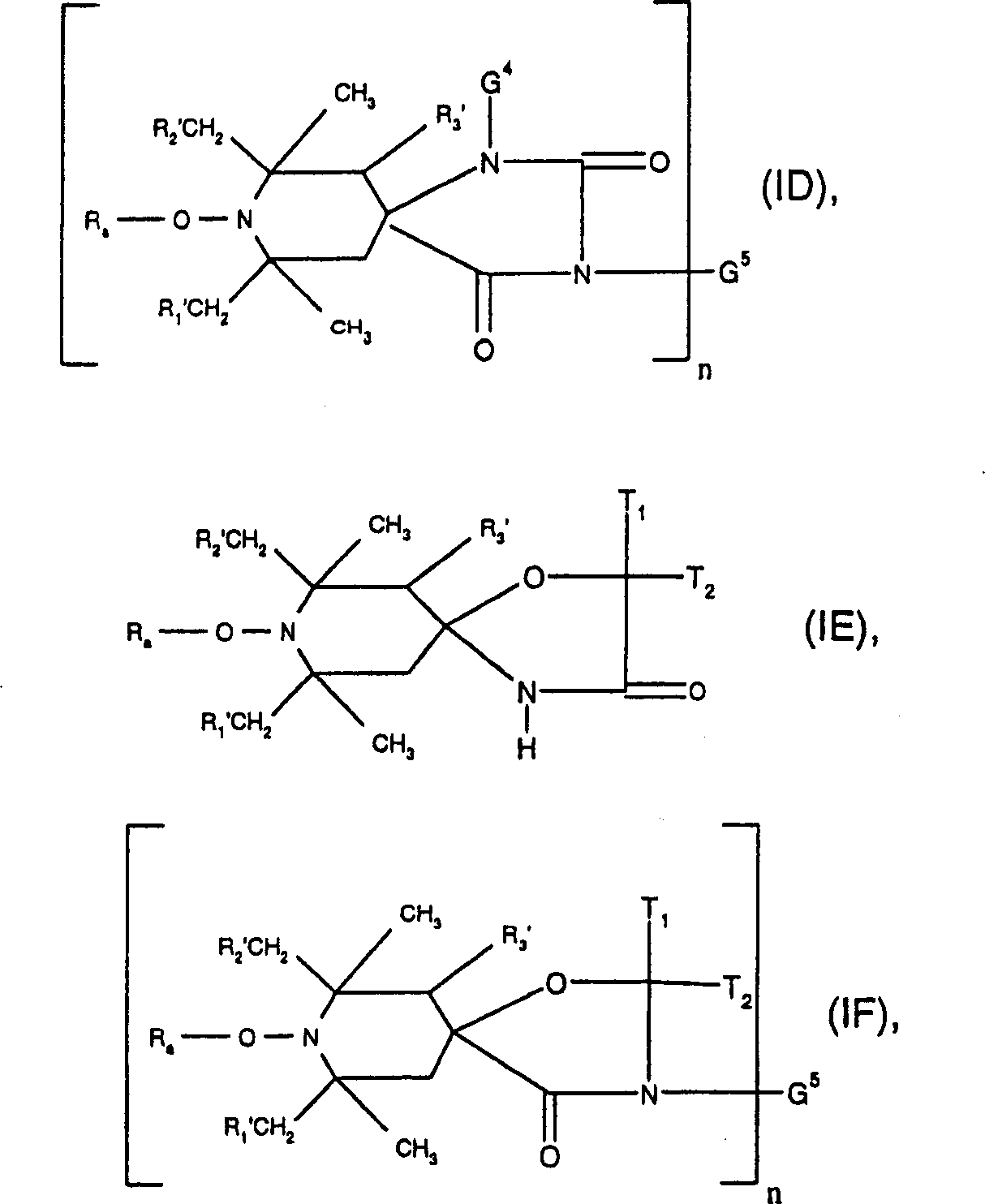
其中n是1或2和Ra,R1′,R2′和R3′与通式IA下定义相同;和wherein n is 1 or 2 and Ra, R 1 ', R 2 ' and R 3 ' are as defined under general formula IA; and
G4是氢,C1-C12烷基,烯丙基,苄基,缩水甘油基或C2-C6烷氧基烷基;和 G is hydrogen, C 1 -C 12 alkyl, allyl, benzyl, glycidyl or C 2 -C 6 alkoxyalkyl; and
G5具有下面的意义:G 5 has the following meanings:
当n=1时,When n=1,
氢,C1-C12烷基,C3-C5链烯基,C7-C9芳烷基,C5-C7环烷基,C2-C4羟基烷基,C2-C6烷氧基烷基,C6-C10芳基,缩水甘油基或基团:-(CH2)p-COO-Q或-(CH2)p-O-CO-Q,其中p是1或2和Q是C1-C4烷基或苯基;或Hydrogen, C 1 -C 12 alkyl, C 3 -C 5 alkenyl, C 7 -C 9 aralkyl, C 5 -C 7 cycloalkyl, C 2 -C 4 hydroxyalkyl, C 2 -C 6 alkoxyalkyl, C 6 -C 10 aryl, glycidyl or groups: -(CH 2 )p-COO-Q or -(CH 2 )pO-CO-Q, where p is 1 or 2 and Q is C 1 -C 4 alkyl or phenyl; or
当n=2时,When n=2,
C2-C12亚烷基,C4-C12亚链烯基,C6-C12亚芳基,基团-CH2-CH(OH)-CH2-O-D-O-CH2-CH(OH)-CH2-,其中D是C2-C10-亚烷基,C6-C15亚芳基或C6-C12-亚环烷基,或基团-CH2CH(OZ′)CH2-(OCH2-CH(OZ′)CH2)2-,其中Z′是氢,C1-C18烷基,烯丙基,苄基,C2-C12-链烷酰基或苯甲酰基。C 2 -C 12 alkylene, C 4 -C 12 alkenylene, C 6 -C 12 arylene, group -CH 2 -CH(OH)-CH 2 -ODO-CH 2 -CH(OH )-CH 2 -, wherein D is C 2 -C 10 -alkylene, C 6 -C 15 arylene or C 6 -C 12 -cycloalkylene, or the group -CH 2 CH(OZ') CH 2 -(OCH 2 -CH(OZ')CH 2 ) 2 -, where Z' is hydrogen, C 1 -C 18 alkyl, allyl, benzyl, C 2 -C 12 -alkanoyl or benzene formyl.
T1和T2各自独立地是氢,C1-C18烷基,C6-C10芳基或C7-C9芳烷基,其中每一个可被卤素或C1-C4-烷基取代,或T 1 and T 2 are each independently hydrogen, C 1 -C 18 alkyl, C 6 -C 10 aryl or C 7 -C 9 aralkyl, each of which may be replaced by halogen or C 1 -C 4 -alk radical substitution, or
T1和T2与连接它们的碳原子一起形成C5-C14环烷烃环。T 1 and T 2 together with the carbon atoms connecting them form a C 5 -C 14 cycloalkane ring.
该取代基C1-C12烷基是,例如,甲基,乙基,正丙基,异丙基,正丁基,仲丁基,叔丁基,正己基,正辛基,2-乙基己基,正壬基,正癸基,正十一烷基或正十二烷基。The substituent C 1 -C 12 alkyl is, for example, methyl, ethyl, n-propyl, isopropyl, n-butyl, sec-butyl, tert-butyl, n-hexyl, n-octyl, 2-ethyl ylhexyl, n-nonyl, n-decyl, n-undecyl or n-dodecyl.
定义为C1-C18-烷基的取代基可以是,例如,上述基团或,例如,正十三烷基,正十四烷基,正十六烷基或正十八烷基。Substituents defined as C 1 -C 18 -alkyl may be, for example, the abovementioned groups or, for example, n-tridecyl, n-tetradecyl, n-hexadecyl or n-octadecyl.
C2-C6烷氧基烷基是,例如,甲氧基甲基,乙氧基甲基,丙氧基甲基,叔丁氧基-甲基,2-乙氧基乙基,2-或3-乙氧基-正丙基,2-正丁氧基乙基,2-叔丁氧基乙基,2-异丙氧基乙基或2-或3-正丙氧基正丙基。C 2 -C 6 alkoxyalkyl is, for example, methoxymethyl, ethoxymethyl, propoxymethyl, tert-butoxy-methyl, 2-ethoxyethyl, 2- or 3-ethoxy-n-propyl, 2-n-butoxyethyl, 2-tert-butoxyethyl, 2-isopropoxyethyl or 2- or 3-n-propoxy-n-propyl .
C3-C5链烯基G5可以是,例如,1-丙烯基,烯丙基,甲基烯丙基,2-丁烯基或2-戊烯基。C 3 -C 5 alkenyl G 5 may be, for example, 1-propenyl, allyl, methallyl, 2-butenyl or 2-pentenyl.
C7-C9芳烷基G5,T1和T2优选是2-苯乙基或苄基。当T1和T2与碳原子一起形成环烷烃环时,该环可以是例如环戊烷,环己烷,环辛烷或环十二烷环。C 7 -C 9 aralkyl G 5 , T 1 and T 2 are preferably 2-phenethyl or benzyl. When T1 and T2 together with carbon atoms form a cycloalkane ring, the ring may be, for example, a cyclopentane, cyclohexane, cyclooctane or cyclododecane ring.
C2-C4羟基烷基G5可以是例如2-羟乙基,2-或3-羟基正丙基或2-,3-或4-羟基正丁基。C 2 -C 4 hydroxyalkyl G 5 may be, for example, 2-hydroxyethyl, 2- or 3-hydroxy-n-propyl or 2-, 3- or 4-hydroxy-n-butyl.
C6-C10芳基G5,T1和T2优选是苯基或α-或β-萘基,其中每一个可以被卤素或C1-C4烷基取代。C 6 -C 10 aryl G 5 , T 1 and T 2 are preferably phenyl or α- or β-naphthyl, each of which may be substituted by halogen or C 1 -C 4 alkyl.
C2-C12亚烷基G5可以是,例如,亚乙基,亚丙基,2,2-二甲基亚丙基,四亚甲基,六亚甲基,八亚甲基,十亚甲基或十二亚甲基。C 2 -C 12 Alkylene G 5 can be, for example, ethylene, propylene, 2,2-dimethylpropylene, tetramethylene, hexamethylene, octamethylene, deca methylene or dodecamethylene.
C4-C12亚链烯基G5优选是2-亚丁烯基,2-亚戊烯基或3-亚己烯基。C 4 -C 12 alkenylene G 5 is preferably 2-butenylene, 2-pentenylene or 3-hexenylene.
C6-C12亚芳基G5可以是,例如,o-,m-或p-亚苯基,1,4-亚萘基或4,4′-亚联苯基。C 6 -C 12 arylene G 5 can be, for example, o-, m- or p-phenylene, 1,4-naphthylene or 4,4′-biphenylene.
C2-12链烷酰基Z1是,例如,优选乙酰基和也可以是丙酰基,丁酰基,正辛酰基或正十二烷酰基。C 2-12 alkanoyl Z 1 is, for example, preferably acetyl and also propionyl, butyryl, n-octanoyl or n-dodecanoyl.
C2-C10亚烷基,C6-C15亚芳基和C6-C12亚环烷基D与以上通式IB中定义相同。The C 2 -C 10 alkylene group, C 6 -C 15 arylene group and C 6 -C 12 cycloalkylene group D are the same as defined in the above general formula IB.
其它位阻胺衍生物是下式的化合物:Other hindered amine derivatives are compounds of the formula:

其中n=1或2和G6是基团:where n=1 or 2 and G is a group:
其中Ra,R1′,R2′和R3′与通式IA中相同定义,并且R3′和R4′各自是氢或甲基或一起形成取代基=O;wherein Ra, R 1 ', R 2 ' and R 3 ' are as defined in general formula IA, and R 3 ' and R 4 ' are each hydrogen or methyl or together form a substituent =O;
E是-O-或-NG1-,其中G1与通式IB中定义相同;E is -O- or -NG 1 -, wherein G 1 is the same as defined in the general formula IB;
A是C2-C6-亚烷基或-(CH2)3-O-,和x是0或1;A is C 2 -C 6 -alkylene or -(CH 2 ) 3 -O-, and x is 0 or 1;
G1优选是氢,C1-C12烷基,C2-C5羟烷基或C5-C7环烷基;G is preferably hydrogen, C 1 -C 12 alkyl , C 2 -C 5 hydroxyalkyl or C 5 -C 7 cycloalkyl;
G7等同于G6或是基团-NG9G10,-OG11,-NHCH2OG11或-N(CH2OG11)2中的一个;G 7 is equivalent to G 6 or one of the groups -NG 9 G 10 , -OG 11 , -NHCH 2 OG 11 or -N(CH 2 OG 11 ) 2 ;
当n=1时,G8等同于G6或G7;和When n=1, G 8 is equivalent to G 6 or G 7 ; and
当n=2时,G8是基团-E-B-E-,其中B是C2-C8-亚烷基或被1或2个-NG9-基团插入的C2-C8-亚烷基,和G9是C1-C12烷基,环己基,苄基或C1-C4羟基烷基或基团:When n=2, G 8 is a group -EBE-, where B is C 2 -C 8 -alkylene or C 2 -C 8 -alkylene inserted by 1 or 2 -NG 9 -groups , and G 9 is C 1 -C 12 alkyl, cyclohexyl, benzyl or C 1 -C 4 hydroxyalkyl or groups:
G10是C1-C12-烷基,环己基,苄基或C1-C4-羟烷基,和G11是氢,C1-C12-烷基或苯基;和G 10 is C 1 -C 12 -alkyl, cyclohexyl, benzyl or C 1 -C 4 -hydroxyalkyl, and G 11 is hydrogen, C 1 -C 12 -alkyl or phenyl; and
G9和G10一起是,例如,C4-C5-亚烷基,C4-C5氧杂亚烷基,例如四亚甲基,五亚甲基或3-氧杂五亚甲基,或相应的C4-C5硫杂亚烷基,例如基团G 9 and G 10 together are, for example, C 4 -C 5 -alkylene, C 4 -C 5 oxaalkylene, for example tetramethylene, pentamethylene or 3-oxapentamethylene , or the corresponding C 4 -C 5 thiaalkylene, such as the group

C1-C12烷基是,例如,甲基,乙基,正丙基,正丁基,仲丁基,叔丁基,正己基,正辛基,2-乙基己基,正壬基,正癸基,正十一烷基或正十二烷基。C 1 -C 12 Alkyl is, for example, methyl, ethyl, n-propyl, n-butyl, sec-butyl, tert-butyl, n-hexyl, n-octyl, 2-ethylhexyl, n-nonyl, n-decyl, n-undecyl or n-dodecyl.
C1-C4羟基烷基是,例如,2-羟乙基,2-或3-羟丙基或2-,3-或4-羟基-正丁基。C 1 -C 4 hydroxyalkyl is, for example, 2-hydroxyethyl, 2- or 3-hydroxypropyl or 2-, 3- or 4-hydroxy-n-butyl.
C2-C6亚烷基团A,可以是例如亚乙基,亚丙基,2,2-二甲基亚丙基,四亚甲基或六亚甲基。The C 2 -C 6 alkylene group A, may be, for example, ethylene, propylene, 2,2-dimethylpropylene, tetramethylene or hexamethylene.
聚酯(I)是,例如,以下通式的化合物:Polyesters (I) are, for example, compounds of the general formula:

其中n是大于2的整数和R1′,R2′和R3′与通式IA中定义相同;和wherein n is an integer greater than 2 and R 1 ', R 2 ' and R 3 ' are the same as defined in formula IA; and
B是二价取代基,例如C1-C12亚烷基,例如亚甲基,亚乙基,亚丙基,2,2-二甲基亚丙基或四亚甲基,六亚甲基,八亚甲基,十亚甲基或十二亚甲基,C6-C15亚芳基,例如基团:B is a divalent substituent, such as C 1 -C 12 alkylene, such as methylene, ethylene, propylene, 2,2-dimethylpropylene or tetramethylene, hexamethylene , octamethylene, decamethylene or dodecamethylene, C 6 -C 15 arylene, for example the group:

其中X是二价取代基,例如以上所定义的C1-C12亚烷基,-O-,-(C=O)-,-S-或-S(=O)2-。wherein X is a divalent substituent, such as C 1 -C 12 alkylene, -O-, -(C=O)-, -S- or -S(=O) 2 - as defined above.
通式I的化合物的聚酯也可以是,例如,聚酯(IH)的共聚物,其中基团:Polyesters of compounds of general formula I may also be, for example, copolymers of polyester (IH), wherein the groups:
部分地被合适的二醇类替代,它们例如从脂肪族,环脂族和芳族二醇类衍生。Some are replaced by suitable diols, which are derived, for example, from aliphatic, cycloaliphatic and aromatic diols.
该脂肪族二醇类可以含有2到12个C-原子,该环脂族二醇类可以含有5到8个C-原子和该芳族二醇类可以含有6到15个C-原子。The aliphatic diols may contain 2 to 12 C-atoms, the cycloaliphatic diols may contain 5 to 8 C-atoms and the aromatic diols may contain 6 to 15 C-atoms.
具有在150到40000范围内的分子量的聚亚氧烷基二醇也是可能的。Polyoxyalkylene glycols having a molecular weight in the range of 150 to 40,000 are also possible.
芳族二醇类是其中两个羟基键接于一个芳族烃基团上或键接于不同的芳族烃基团上的化合物。Aromatic diols are compounds in which two hydroxyl groups are bonded to one aromatic hydrocarbon group or to different aromatic hydrocarbon groups.
该聚酯还有可能被少量(例如0.1-3mol%,基于所存在的二羧酸)的2个以上官能团的单体(例如季戊四醇,偏苯三酸,1,3,5-三(羟苯基)苯,2,4-二羟基苯甲酸或2-(4-羟苯基)-2-(2,4-二羟苯基)丙烷)所支化。The polyester may also be mixed with a small amount (e.g. 0.1-3 mol%, based on the dicarboxylic acid present) of monomers with more than 2 functional groups (e.g. pentaerythritol, trimellitic acid, 1,3,5-tris(hydroxybenzene) base) benzene, 2,4-dihydroxybenzoic acid or 2-(4-hydroxyphenyl)-2-(2,4-dihydroxyphenyl)propane).
合适的脂肪族二醇类是线性和支化脂肪族二醇类,尤其在分子中具有2到12个,优选2到6个C-原子的那些,例如乙二醇,1,2-和1,3-丙二醇,1,2-,1,3-,2,3-或1,4-丁二醇,戊二醇,新戊二醇,1,6-己二醇,1,12-十二烷二醇。Suitable aliphatic diols are linear and branched aliphatic diols, especially those with 2 to 12, preferably 2 to 6 C-atoms in the molecule, such as ethylene glycol, 1, 2- and 1 , 3-propanediol, 1,2-, 1,3-, 2,3- or 1,4-butanediol, pentanediol, neopentyl glycol, 1,6-hexanediol, 1,12-deca dioxane diol.
合适的环脂族二醇是,例如,1,4-二羟基环己烷。其它合适的二醇类是,例如,1,4-双(羟甲基)环己烷,芳族-脂肪族二醇类如对-苯二甲醇或2,5-二氯-对-苯二甲醇,2,2-(β-羟基乙氧基苯基)丙烷以及聚亚氧烷基二醇如二甘醇,三甘醇,聚乙二醇或聚丙二醇。亚烷基二醇优选是线性的和含有,尤其,2到4个C-原子。A suitable cycloaliphatic diol is, for example, 1,4-dihydroxycyclohexane. Other suitable diols are, for example, 1,4-bis(hydroxymethyl)cyclohexane, aromatic-aliphatic diols such as p-benzenedimethanol or 2,5-dichloro-p-benzenediol Methanol, 2,2-(β-hydroxyethoxyphenyl)propane and polyoxyalkylene glycols such as diethylene glycol, triethylene glycol, polyethylene glycol or polypropylene glycol. The alkylene glycols are preferably linear and contain, inter alia, 2 to 4 C-atoms.
优选的二醇类是亚烷基二醇类,1,4-二羟基环己烷和1,4-双(羟甲基)环己烷。特别优选的是乙二醇,1,4-丁二醇和1,2-和1,3-丙二醇。Preferred diols are alkylene glycols, 1,4-dihydroxycyclohexane and 1,4-bis(hydroxymethyl)cyclohexane. Particularly preferred are ethylene glycol, 1,4-butanediol and 1,2- and 1,3-propanediol.
其它合适的脂肪族二醇类是β-羟基烷基化,尤其β-羟基乙基化,双酚类如2,2-双[4′-(β-羟基乙氧基)苯基]丙烷。Other suitable aliphatic diols are β-hydroxyalkylated, especially β-hydroxyethylated, bisphenols such as 2,2-bis[4'-(β-hydroxyethoxy)phenyl]propane.
另一组的合适脂肪族二醇类由描述在IDE-A 1,812,003,2,342,432,2,342,372和2,453,326中的杂环二醇类组成。例子是:N,N′-双(β-羟乙基)-5,5-二甲基乙内酰脲,N,N′-双(β-羟丙基)-5,5-二甲基乙内酰脲,亚甲基双[N-(β-羟乙基)-5-甲基-5-乙基乙内酰脲],亚甲基双[N-(β-羟乙基)-5,5-二甲基乙内酰脲],N,N′-双(β-羟乙基)苯并咪唑酮,N,N′-双(β-羟基-乙基)(四氯)苯并咪唑酮或N,N′-双(β-羟乙基)(四溴)苯并咪唑酮。Another group of suitable aliphatic diols consists of the heterocyclic diols described in IDE-A 1,812,003, 2,342,432, 2,342,372 and 2,453,326. Examples are: N,N'-bis(β-hydroxyethyl)-5,5-dimethylhydantoin, N,N'-bis(β-hydroxypropyl)-5,5-dimethyl Hydantoin, methylenebis[N-(β-hydroxyethyl)-5-methyl-5-ethylhydantoin], methylenebis[N-(β-hydroxyethyl)- 5,5-Dimethylhydantoin], N,N'-bis(β-hydroxyethyl)benzimidazolone, N,N'-bis(β-hydroxy-ethyl)(tetrachloro)benzene imidazolone or N,N'-bis(β-hydroxyethyl)(tetrabromo)benzimidazolone.
合适的芳族二醇类是具有一个芳族单元的二苯酚,尤其具有两个芳族单元且在各芳族单元上携带一个羟基的二醇类。芳族单元被理解为指芳族烃基如亚苯基或亚萘基。除了例如氢醌,间苯二酚或1,5-,2,6-和2,7-二羟基萘之外,特别可提及由下式表示的双苯酚类:Suitable aromatic diols are diphenols having one aromatic unit, especially diols having two aromatic units and carrying one hydroxyl group on each aromatic unit. Aromatic units are understood to mean aromatic hydrocarbon groups such as phenylene or naphthylene. Apart from, for example, hydroquinone, resorcinol or 1,5-, 2,6- and 2,7-dihydroxynaphthalene, mention may especially be made of bisphenols represented by the formula:
该羟基能够位于间位上,但特别位于对位上;在这些通式中的R′和R″能够是具有1到6个C-原子的烷基,卤素如氯或溴和尤其氢原子。A能够是直接的键或-O-,-S-,-S(=O)2-,-C(=O)-,-[P(=O)C1-C20-烷基]-,取代或未被取代的烷叉基,环烷叉基或亚烷基。The hydroxyl group can be in the meta position, but especially in the para position; R' and R" in the general formulas can be an alkyl group having 1 to 6 C-atoms, a halogen such as chlorine or bromine and especially a hydrogen atom. A can be a direct bond or -O-, -S-, -S(=O) 2 -, -C(=O)-, -[P(=O)C 1 -C 20 -alkyl]-, Substituted or unsubstituted alkylidene, cycloalkylidene or alkylene.
取代或未被取代的烷叉基的例子是:乙叉基,1,1-或2,2-丙叉基,2,2-丁叉基,1,1-异丁叉基,戊叉基,己叉基,庚叉基,辛叉基,二氯乙叉基,三氯乙叉基。Examples of substituted or unsubstituted alkylidene groups are: ethylidene, 1,1- or 2,2-propylidene, 2,2-butylidene, 1,1-isobutylidene, pentylidene , Hexylidene, Heptylidene, Octylidene, Dichloroethylidene, Trichloroethylidene.
取代或未被取代的亚烷基的例子是亚甲基,亚乙基,苯基亚甲基,二苯基亚甲基和甲基苯基亚甲基。环烷叉基的例子是环戊叉基,环己叉基,环庚叉基和环辛叉基。Examples of substituted or unsubstituted alkylene groups are methylene, ethylene, phenylmethylene, diphenylmethylene and methylphenylmethylene. Examples of cycloalkylidene groups are cyclopentylidene, cyclohexylidene, cycloheptylidene and cyclooctylidene.
双酚类的例子是:双(对-羟苯基)醚或硫醚,双(对-羟苯基)砜,双(对-羟苯基)甲烷,2,2′-双(4-羟苯基)联苯,苯基氢醌,1,2-双(对-羟苯基)乙烷,1-苯基双(对-羟苯基)甲烷,二苯基双(对-羟苯基)甲烷,二苯基双(对-羟苯基)乙烷,双(3,5-二甲基-4-羟苯基)砜,双(3,5-二甲基-4-羟苯基)-对-二异丙基苯,双(3,5-二甲基-4-羟苯基)-间-二异丙基苯,2,2-双(3′,5′-二甲基-4′-羟苯基)丙烷,1,1-或2,2-双(对-羟苯基)丁烷,2,2-双(对-羟苯基)六氟丙烷,1,1-二氯-或1,1,1-三氯-2,2-双(对-羟苯基)乙烷,1,1-双(对-羟苯基)环戊烷和尤其2,2-双(对-羟苯基)丙烷(双酚A)和1,1-双(对-羟苯基)环己烷(双酚C)。Examples of bisphenols are: bis(p-hydroxyphenyl) ether or thioether, bis(p-hydroxyphenyl)sulfone, bis(p-hydroxyphenyl)methane, 2,2'-bis(4-hydroxy Phenyl)biphenyl, phenylhydroquinone, 1,2-bis(p-hydroxyphenyl)ethane, 1-phenylbis(p-hydroxyphenyl)methane, diphenylbis(p-hydroxyphenyl) ) methane, diphenylbis(p-hydroxyphenyl)ethane, bis(3,5-dimethyl-4-hydroxyphenyl)sulfone, bis(3,5-dimethyl-4-hydroxyphenyl) )-p-diisopropylbenzene, bis(3,5-dimethyl-4-hydroxyphenyl)-m-diisopropylbenzene, 2,2-bis(3′,5′-dimethyl -4'-hydroxyphenyl) propane, 1,1- or 2,2-bis(p-hydroxyphenyl)butane, 2,2-bis(p-hydroxyphenyl)hexafluoropropane, 1,1- Dichloro- or 1,1,1-trichloro-2,2-bis(p-hydroxyphenyl)ethane, 1,1-bis(p-hydroxyphenyl)cyclopentane and especially 2,2-bis (p-hydroxyphenyl)propane (bisphenol A) and 1,1-bis(p-hydroxyphenyl)cyclohexane (bisphenol C).
通式I的化合物的聚酯酰胺是例如下式的化合物:Polyester amides of compounds of the general formula I are, for example, compounds of the formula:
其中n是大于2的数和R1′,R2′和R3′与通式IA中定义相同;和B是具有在通式IH中所规定的意义的二价取代基。wherein n is a number greater than 2 and R1 ', R2 ' and R3 ' are as defined in general formula IA; and B is a divalent substituent having the meanings specified in general formula IH.
通式I的化合物的聚酯酰胺也包括,例如,共聚物,其中基团:Polyester amides of compounds of general formula I also include, for example, copolymers in which the group:

被上述二醇或被合适的二胺类部分替代,后者例如通过用氨基代替羟基从上述脂肪族,环脂族或芳族二醇类衍生而来。Partial replacement by the abovementioned diols or by suitable diamines derived, for example, from the abovementioned aliphatic, cycloaliphatic or aromatic diols by substituting amino groups for hydroxyl groups.
通式I的化合物的聚氨酯例如是以下通式的化合物:Polyurethanes of compounds of the general formula I are, for example, compounds of the general formula:

其中n是大于2的整数和R1′,R2′和R3′与通式IA中定义相同;和B是具有在通式IH中规定的意义的二价取代基。wherein n is an integer greater than 2 and R1 ', R2 ' and R3 ' are as defined in general formula IA; and B is a divalent substituent having the meanings specified in general formula IH.
通式I的化合物的聚氨酯类还包括,例如,共聚物,其中基团Polyurethanes of compounds of general formula I also include, for example, copolymers in which the group

被合适的二醇类(例如上述二醇类)或二胺类部分地替代,后者例如通过用氨基替代羟基从上述脂肪族,环脂族或芳族二醇类衍生而来。Partial replacement by suitable diols (such as the abovementioned diols) or diamines derived, for example, from the abovementioned aliphatic, cycloaliphatic or aromatic diols by substituting amino groups for hydroxyl groups.
聚氨酯类能够按照本身已知的方式,通过在4-位上具有羟基的上述环状羟胺与其中羧基被异氰酸酯基替代的二羧酸反应来制备。Polyurethanes can be prepared in a manner known per se by reacting the aforementioned cyclic hydroxylamines having a hydroxyl group in the 4-position with dicarboxylic acids in which the carboxyl groups are replaced by isocyanate groups.
通式I的化合物的聚碳酸酯是,例如,以下通式的化合物:Polycarbonates of compounds of the general formula I are, for example, compounds of the following general formula:
其中n是大于2的整数和R1′,R2′和R3′与通式IA中定义相同。wherein n is an integer greater than 2 and R 1 ', R 2 ' and R 3 ' are as defined in general formula IA.
聚碳酸酯能够按照本身已知的方式,通过在4-位上具有羟基的上述环状羟胺与光气或碳酸酯例如碳酸二乙酯或碳酸二苯酯反应来制备。Polycarbonates can be prepared in a manner known per se by reacting the aforementioned cyclic hydroxylamines having a hydroxyl group in the 4-position with phosgene or carbonates such as diethyl carbonate or diphenyl carbonate.
通式I的化合物的聚氨酯类还包括,例如,共聚物,其中基团Polyurethanes of compounds of general formula I also include, for example, copolymers in which the group

被合适的二醇类,例如上述二醇类部分地替代。Partly replaced by suitable diols, such as the diols mentioned above.
通式I的化合物的聚酰亚胺酯是,例如,以下通式的化合物:Polyimide esters of compounds of general formula I are, for example, compounds of general formula:

其中n是大于2的整数和R1′,R2′和R3′与通式IA中定义相同。芳族基连结单元 具有,例如,下列结构中的一种:wherein n is an integer greater than 2 and R 1 ', R 2 ' and R 3 ' are as defined in general formula IA. Aromatic linking unit Has, for example, one of the following structures:

其中X是例如-O-,-C(=O)-,-S-,-S(=O)2-或C1-C4亚烷基。聚酰亚胺酯能够按照本身已知的方法通过上述环状羟胺与四羧酸酐反应来制备。wherein X is, for example, -O-, -C(=O)-, -S-, -S(=O) 2 - or C 1 -C 4 alkylene. Polyimide esters can be prepared by reacting the above-mentioned cyclic hydroxylamines with tetracarboxylic anhydrides in a manner known per se.
本发明提供,尤其,降低聚丙烯,丙烯共聚物或聚丙烯共混物的分子量的方法,其特征在于:具有通式Ia的至少一种化合物,其中The present invention provides, inter alia, a process for reducing the molecular weight of polypropylene, propylene copolymers or polypropylene blends, characterized in that at least one compound has the general formula Ia, wherein
Ra是选自以下的酰基:-C(=O)-H,-C(=O)-C1-C19烷基,-C(=O)-C2-C19链烯基,-C(=O)-C2-C4链烯基-C6-C10芳基,-C(=O)-C6-C10芳基,-C(=O)-O-C1-C6烷基,-C(=O)-O-C6-C10芳基,-C(=O)-NH-C1-C6烷基,-C(=O)-NH-C6-C10芳基,-C(=O)-N(C1-C6烷基)2,-P(=O)-C1-C19烷基,-P(=O)2-C1-C19烷基,-P(=O)-C6-C10芳基,-P=O(-C1-C19烷基)2,-P=O(-C6-C10芳基)2,-P(=O)-O-C1-C6烷基,-P(=O)-O-C6-C10芳基,-P=O(-O-C1-C6烷基)2,-P=O(-O-C6-C10芳基)2,-P(-O-C1-C6烷基)2和-P(-O-C6-C10芳基)2;Ra is an acyl group selected from: -C(=O)-H, -C(=O)-C 1 -C 19 alkyl, -C(=O)-C 2 -C 19 alkenyl, -C (=O)-C 2 -C 4 alkenyl-C 6 -C 10 aryl, -C(=O)-C 6 -C 10 aryl, -C(=O)-OC 1 -C 6 alkane radical, -C(=O)-OC 6 -C 10 aryl, -C(=O)-NH-C 1 -C 6 alkyl, -C(=O)-NH-C 6 -C 10 aryl , -C(=O)-N(C 1 -C 6 alkyl) 2 , -P(=O)-C 1 -C 19 alkyl, -P(=O) 2 -C 1 -C 19 alkyl , -P(=O)-C 6 -C 10 aryl, -P=O(-C 1 -C 19 alkyl) 2 , -P=O(-C 6 -C 10 aryl) 2 , -P (=O)-OC 1 -C 6 alkyl, -P(=O)-OC 6 -C 10 aryl, -P=O(-OC 1 -C 6 alkyl) 2 , -P=O(- OC 6 -C 10 aryl) 2 , -P(-OC 1 -C 6 alkyl) 2 and -P(-OC 6 -C 10 aryl) 2 ;
R1-R4各自是C1-C6烷基;R 1 -R 4 are each C 1 -C 6 alkyl;
R5和R6彼此独立地是氢,C1-C6烷基或C6-C10芳基;或R 5 and R 6 are independently hydrogen, C 1 -C 6 alkyl or C 6 -C 10 aryl; or
R5和R6一起是氧; R and R together are oxygen;
Q是直接的键或二价基团-(CR7R8)-或-(CR7R8-CR9R10)-,其中Q is a direct bond or a divalent group -(CR 7 R 8 )- or -(CR 7 R 8 -CR 9 R 10 )-, where
R7,R8,R9和R10各自独立地是氢或C1-C6烷基;和R 7 , R 8 , R 9 and R 10 are each independently hydrogen or C 1 -C 6 alkyl; and
Z1是氧或二价基团-NR11-或-(CR12R13)-,其中Z 1 is oxygen or a divalent group -NR 11 - or -(CR 12 R 13 )-, wherein
R11是氢,C1-C6烷基,C6-C10芳基或如以上所定义的酰基Ra;或,彼此独立地,R 11 is hydrogen, C 1 -C 6 alkyl, C 6 -C 10 aryl or acyl R as defined above; or, independently of each other,
R12和R13各自是氢或C1-C6烷基,或R 12 and R 13 are each hydrogen or C 1 -C 6 alkyl, or
基团R12和R13中的一个是氢或C1-C6烷基和另一个是C1-C6烷基,C1-C6烷氧基,C6-C10芳氧基,选自-O-C(=O)-H,-O-C(=O)-C1-C19烷基,-O-C(=O)-C1-C54链烯基,-O-C(=O)-C6-C10芳基,-O-C(=O)-C1-C36链烯基-C6-C10芳基,-O-C(=O)-OC1-C6烷基,-O-C(=O)-O-C6-C10芳基,-O-C(=O)-NH-C1-C6烷基,-O-C(=O)-NH-C6-C10芳基和-O-C(=O)-N(C1-C6烷基)2中的酰氧基,C1-C6烷基氨基,二-C1-C5烷基氨基,C6-C10芳基氨基,选自-NH-C(=O)-H,-NH-C(=O)-C1-C19烷基,-NH-C(=O)-C1-C54链烯基,-NH-C(=O)-C6-C10芳基,-NH-C(=O)-C1-C36链烯基-C6-C10芳基,-NH-C(=O)-O-C1-C19烷基,-NH-C(=O)-O-C6-C10芳基,-NH-C(=O)-NH-C1-C6烷基,-NH-C(=O)-NH-C6-C10芳基和-NH-C(=O)-N(C1-C6烷基)2中的酰氨基,选自-N[-C(=O)-C1-C19烷基]2,-N[-C(=O)-C6-C10芳基]2,-N[-C(=O)-C1-C6亚烷基-C(=O)-],-N[-C(=O)-C2-C6亚链烯基-C(=O)-]和苯二甲酰亚氨基中的二酰基氨基或N-酰基-N-C1-C6烷基氨基;One of the groups R 12 and R 13 is hydrogen or C 1 -C 6 alkyl and the other is C 1 -C 6 alkyl, C 1 -C 6 alkoxy, C 6 -C 10 aryloxy, selected from -OC(=O)-H, -OC(=O)-C 1 -C 19 alkyl, -OC(=O)-C 1 -C 54 alkenyl, -OC(=O)-C 6 -C 10 aryl, -OC(=O)-C 1 -C 36 alkenyl-C 6 -C 10 aryl, -OC(=O)-OC 1 -C 6 alkyl, -OC(= O)-OC 6 -C 10 aryl, -OC(=O)-NH-C 1 -C 6 alkyl, -OC(=O)-NH-C 6 -C 10 aryl and -OC(=O Acyloxy in )-N(C 1 -C 6 alkyl) 2 , C 1 -C 6 alkylamino, di- C 1 -C 5 alkylamino, C 6 -C 10 arylamino, selected from -NH-C(=O)-H, -NH-C(=O)-C 1 -C 19 alkyl, -NH-C(=O)-C 1 -C 54 alkenyl, -NH-C (=O)-C 6 -C 10 aryl, -NH-C(=O)-C 1 -C 36 alkenyl-C 6 -C 10 aryl, -NH-C(=O)-OC 1 -C 19 alkyl, -NH-C(=O)-OC 6 -C 10 aryl, -NH-C(=O)-NH-C 1 -C 6 alkyl, -NH-C(=O) -NH-C 6 -C 10 aryl and -NH-C(=O)-N(C 1 -C 6 alkyl) 2 amido, selected from -N[-C(=O)-C 1 -C 19 alkyl] 2 , -N[-C(=O)-C 6 -C 10 aryl] 2 , -N[-C(=O)-C 1 -C 6 alkylene-C(= O)-], -N[-C(=O)-C 2 -C 6 alkenylene-C(=O)-] and diacylamino or N-acyl-NC in phthalimido 1 -C 6 alkylamino;
或两基团R12和R13一起是氧代;或or both groups R 12 and R 13 together are oxo; or
通式Ib的化合物,其中A compound of general formula Ib, wherein
Ra是选自-C(=O)-H,-C(=O)-C1-C19烷基,-C(=O)-C2-C19链烯基,-C(=O)-C2-C4链烯基-C6-C10芳基,-C(=O)C6-C10芳基,-C(=O)-O-C1-C6烷基,-C(=O)-O-C6-C10芳基,-C(=O)-NH-C1-C6烷基,-C(=O)-NH-C6-C10芳基和-C(=O)-N(C1-C6烷基)2中的酰基;Ra is selected from -C(=O)-H, -C(=O)-C 1 -C 19 alkyl, -C(=O)-C 2 -C 19 alkenyl, -C(=O) -C 2 -C 4 alkenyl -C 6 -C 10 aryl, -C(=O)C 6 -C 10 aryl, -C(=O)-OC 1 -C 6 alkyl, -C( =O)-OC 6 -C 10 aryl, -C(=O)-NH-C 1 -C 6 alkyl, -C(=O)-NH-C 6 -C 10 aryl and -C(= Acyl in O)-N(C 1 -C 6 alkyl) 2 ;
R1-R4各自是C1-C6烷基;R 1 -R 4 are each C 1 -C 6 alkyl;
A是在该苯基环上的取代基;和A is a substituent on the phenyl ring; and
m是一到四的整数;或m is an integer from one to four; or
通式Ic的化合物,其中A compound of general formula Ic, wherein
Ra是选自-C(=O)-H,-C(=O)-C1-C19烷基,-C(=O)-C2-C19链烯基,-C(=O)-C2-C4链烯基-C6-C10芳基,-C(=O)-C6-C10芳基,-C(=O)-O-C1-C6烷基,-C(=O)-O-C6-C10芳基,-C(=O)-NH-C1-C6烷基,-C(=O)-NH-C6-C10芳基,-C(=O)-N(C1-C6烷基)2,-P(=O)-C1-C19烷基,-P(=O)2-C1-C19烷基,-P(=O)-C6-C10芳基,-P=O(-C1-C19烷基)2,-P=O(-C6-C10芳基)2,-P(=O)-O-C1-C6烷基,-P(=O)-O-C6-C10芳基,-P=O(-O-C1-C6烷基)2,-P=O(-O-C6-C10芳基)2,-P(-O-C1-C6烷基)2和-P(-O-C6-C10芳基)2中的酰基;Ra is selected from -C(=O)-H, -C(=O)-C 1 -C 19 alkyl, -C(=O)-C 2 -C 19 alkenyl, -C(=O) -C 2 -C 4 alkenyl -C 6 -C 10 aryl, -C(=O)-C 6 -C 10 aryl, -C(=O)-OC 1 -C 6 alkyl, -C (=O)-OC 6 -C 10 aryl, -C(=O)-NH-C 1 -C 6 alkyl, -C(=O)-NH-C 6 -C 10 aryl, -C( =O)-N(C 1 -C 6 alkyl) 2 , -P(=O)-C 1 -C 19 alkyl, -P(=O) 2 -C 1 -C 19 alkyl, -P( =O)-C 6 -C 10 aryl, -P=O(-C 1 -C 19 alkyl) 2 , -P=O(-C 6 -C 10 aryl) 2 , -P(=O) -OC 1 -C 6 alkyl, -P(=O)-OC 6 -C 10 aryl, -P=O(-OC 1 -C 6 alkyl) 2 , -P=O(-OC 6 -C 10 aryl) 2 , the acyl group in -P(-OC 1 -C 6 alkyl) 2 and -P (-OC 6 -C 10 aryl) 2 ;
Rb是氢,氨基甲酰基,C1-C6烷基氨基甲酰基,二-C1-C6烷基氨基甲酰基或与Ra定义相同;Rb is hydrogen, carbamoyl, C 1 -C 6 alkylcarbamoyl, di-C 1 -C 6 alkylcarbamoyl or the same definition as Ra;
Rc和Rd各自独立地是氢,C1-C20烷基或C6-C10芳基;和Rc and Rd are each independently hydrogen, C 1 -C 20 alkyl or C 6 -C 10 aryl; and
R1-R3各自是C1-C6烷基或C6-C10芳基;或R 1 -R 3 are each C 1 -C 6 alkyl or C 6 -C 10 aryl; or
以下通式的化合物:Compounds of the general formula:

其中in
n是2;n is 2;
X是直接的键或C1-C18亚烷基桥的一价基团;X is a direct bond or a monovalent group of C 1 -C 18 alkylene bridge;
R1-R4各自是C1-C6烷基;R 1 -R 4 are each C 1 -C 6 alkyl;
R5和R6彼此独立地是氢,C1-C6烷基或C6-C10芳基;或R 5 and R 6 are independently hydrogen, C 1 -C 6 alkyl or C 6 -C 10 aryl; or
R5和R6一起是氧; R and R together are oxygen;
Q是直接的键或二价基团-(CR7R8)-或-(CR7R8-CR9R10)-,其中Q is a direct bond or a divalent group -(CR 7 R 8 )- or -(CR 7 R 8 -CR 9 R 10 )-, where
R7,R8,R9和R10各自独立地是氢或C1-C6烷基;和R 7 , R 8 , R 9 and R 10 are each independently hydrogen or C 1 -C 6 alkyl; and
Z1是氧或二价基团-NR11-或-(CR12R13)-,其中Z 1 is oxygen or a divalent group -NR 11 - or -(CR 12 R 13 )-, wherein
R11是氢,C6-C10芳基或C1-C6烷基或,彼此独立地,R 11 is hydrogen, C 6 -C 10 aryl or C 1 -C 6 alkyl or, independently of each other,
基团R12和R13中的一个是氢或C1-C6烷基和另一个是C1-C6烷基,C1-C6烷氧基,C6-C10芳氧基,选自-O-C(=O)-H,-O-C(=O)-C1-C19烷基,-O-C(=O)-C1-C54链烯基,-O-C(=O)-C6-C10芳基,-O-C(=O)-C1-C36链烯基-C6-C10芳基,-O-C(=O)-O-C1-C6烷基,-O-C(=O)-O-C6-C10芳基,-O-C(=O)-NH-C1-C6烷基,-O-C(=O)-NH-C6-C10芳基和-O-C(=O)-N(C1-C6烷基)2中的酰氧基,C1-C6烷基氨基,二-C1-C6烷基氨基,C6-C10芳基氨基,选自-NH-C(=O)-H,-NH-C(=O)-C1-C19烷基,-NH-C(=O)-C1-C54链烯基,-NH-C(=O)-C6-C10芳基,-NH-C(=O)-C1-C36链烯基-C6-C10芳基,-NH-C(=O)-O-C1-C19烷基,-NH-C(=O)-O-C6-C10芳基,-NH-C(=O)-NH-C1-C6烷基,-NH-C(=O)-NH-C6-C10芳基和-NH-C(=O)-N(C1-C6烷基)2中的酰氨基,选自-N[-C(=O)-C1-C19烷基]2,-N[-C(=O)-C6-C10芳基]2,-N[-C(=O)-C1-C6亚烷基-C(=O)-],-N[-C(=O)-C2-C6亚链烯基-C(=O)-]和苯二甲酰亚氨基中的二酰氨基或N-酰基-N-C1-C6烷基氨基;One of the groups R 12 and R 13 is hydrogen or C 1 -C 6 alkyl and the other is C 1 -C 6 alkyl, C 1 -C 6 alkoxy, C 6 -C 10 aryloxy, selected from -OC(=O)-H, -OC(=O)-C 1 -C 19 alkyl, -OC(=O)-C 1 -C 54 alkenyl, -OC(=O)-C 6 -C 10 aryl, -OC(=O)-C 1 -C 36 alkenyl-C 6 -C 10 aryl, -OC(=O)-OC 1 -C 6 alkyl, -OC(= O)-OC 6 -C 10 aryl, -OC(=O)-NH-C 1 -C 6 alkyl, -OC(=O)-NH-C 6 -C 10 aryl and -OC(=O Acyloxy in )-N(C 1 -C 6 alkyl) 2 , C 1 -C 6 alkylamino, di-C 1 -C 6 alkylamino, C 6 -C 10 arylamino, selected from -NH-C(=O)-H, -NH-C(=O)-C 1 -C 19 alkyl, -NH-C(=O)-C 1 -C 54 alkenyl, -NH-C (=O)-C 6 -C 10 aryl, -NH-C(=O)-C 1 -C 36 alkenyl-C 6 -C 10 aryl, -NH-C(=O)-OC 1 -C 19 alkyl, -NH-C(=O)-OC 6 -C 10 aryl, -NH-C(=O)-NH-C 1 -C 6 alkyl, -NH-C(=O) -NH-C 6 -C 10 aryl and -NH-C(=O)-N(C 1 -C 6 alkyl) 2 amido, selected from -N[-C(=O)-C 1 -C 19 alkyl] 2 , -N[-C(=O)-C 6 -C 10 aryl] 2 , -N[-C(=O)-C 1 -C 6 alkylene-C(= O)-], -N[-C(=O)-C 2 -C 6 alkenylene-C(=O)-] and diamido or N-acyl-NC in phthalimide 1 -C 6 alkylamino;
或两基团R12和R13一起是氧代;或or both groups R 12 and R 13 together are oxo; or
以下通式的化合物:Compounds of the general formula:

其中in
n是2n is 2
Ra是选自-C(=O)-H,-C(=O)-C1-C19烷基,-C(=O)-C2-C19链烯基,-C(=O)-C2-C4链烯基-C6-C10芳基,-C(=O)-C6-C10芳基,-C(=O)-O-C1-C6烷基,-C(=O)-O-C6-C10芳基,-C(=O)-NH-C1-C6烷基,-C(=O)-NH-C6-C10芳基和-C(=O)-N(C1-C6烷基)2中的酰基;Ra is selected from -C(=O)-H, -C(=O)-C 1 -C 19 alkyl, -C(=O)-C 2 -C 19 alkenyl, -C(=O) -C 2 -C 4 alkenyl -C 6 -C 10 aryl, -C(=O)-C 6 -C 10 aryl, -C(=O)-OC 1 -C 6 alkyl, -C (=O)-OC 6 -C 10 aryl, -C(=O)-NH-C 1 -C 6 alkyl, -C(=O)-NH-C 6 -C 10 aryl and -C( Acyl in =O)-N(C 1 -C 6 alkyl) 2 ;
X是直接的键或C1-C18亚烷基桥的一价基团;X is a direct bond or a monovalent group of C 1 -C 18 alkylene bridge;
R1-R4各自是C1-C6烷基;R 1 -R 4 are each C 1 -C 6 alkyl;
R5和R6各自独立地是氢,C1-C6烷基或C6-C10芳基;或R 5 and R 6 are each independently hydrogen, C 1 -C 6 alkyl or C 6 -C 10 aryl; or
R5和R6一起是氧;和R and R together are oxygen; and
Q是直接的键或二价基团-(CR7R8)-或-(CR7R8-CR9R10)-,其中Q is a direct bond or a divalent group -(CR 7 R 8 )- or -(CR 7 R 8 -CR 9 R 10 )-, where
R7,R8,R9和R10各自独立地是氢或C1-C6烷基;R 7 , R 8 , R 9 and R 10 are each independently hydrogen or C 1 -C 6 alkyl;
被加入到需要降解的聚丙烯,聚丙烯共聚物或聚丙烯共混物中,然后加热该混合物。It is added to the polypropylene, polypropylene copolymer or polypropylene blend that needs to be degraded, and then the mixture is heated.
通式Id)表示双环化合物,其中两半被二价桥基X所连接。当X是直接的键时,该双环化合物具有以下通式The general formula Id) represents a bicyclic compound in which the two halves are connected by a divalent bridging group X. When X is a direct bond, the bicyclic compound has the general formula
该化合物是草酸的羟胺二酯。当X是C1-C18亚烷基桥基的一价基团时,双环化合物是丙二酸,琥珀酸或高级二羧酸的羟胺二酯。This compound is a hydroxylamine diester of oxalic acid. When X is a monovalent group of a C 1 -C 18 alkylene bridging group, the bicyclic compound is a hydroxylamine diester of malonic acid, succinic acid or a higher dicarboxylic acid.
R1-R4如以上所定义。R 1 -R 4 are as defined above.
同样地,R5,R6,Q,R7,R8,R9和R10如以上所定义。Likewise, R 5 , R 6 , Q, R 7 , R 8 , R 9 and R 10 are as defined above.
Z1可以是氧或二价基团-NR11-或-(CR12R13)-,其中Z 1 can be oxygen or a divalent group -NR 11 - or -(CR 12 R 13 )-, wherein
R11是氢,芳基,C1-C6烷基或,各自独立地,R 11 is hydrogen, aryl, C 1 -C 6 alkyl or, each independently,
基团R12和R13中一个是氢或C1-C6烷基和另一个是C1-C6烷基,C1-C6烷氧基,C6-C10芳氧基,选自-O-C(=O)-H,-O-C(=O)-C1-C19烷基,-O-C(=O)-C1-C54链烯基,-O-C(=O)-C6-C10芳基,-O-C(=O)-C1-C36链烯基-C6-C10芳基,-O-C(=O)-O-C1-C19烷基,-O-C(=O)-O-C6-C10芳基,-O-C(=O)-NH-C1-C6烷基,-O-C(=O)-NH-C6-C10芳基和-O-C(=O)-N(C1-C6烷基)2中的酰氧基,C1-C6烷基氨基,二-C1-C6烷基氨基,C6-C10芳基氨基,选自-NH-C(=O)-H,-NH-C(=O)-C1-C19烷基,-NH-C(=O)-C1-C54链烯基,-NH-C(=O)-C6-C10芳基,-NH-C(=O)-C1-C36链烯基-C6-C10芳基,-NH-C(=O)-O-C1-C19烷基,-NH-C(=O)-O-C6-C10芳基,-NH-C(=O)-NH-C1-C6烷基,-NH-C(=O)-NH-C6-C10芳基和-NH-C(=O)-N(C1-C6烷基)2中的酰氨基,选自-N[-C(=O)-C1-C19烷基]2,-N[-C(=O)-C6-C10芳基]2,-N[-C(=O)-C1-C6亚烷基-C(=O)-],-N[-C(=O)-C2-C6亚链烯基-C(=O)-]和苯二甲酰亚氨基中的二酰基氨基或N-酰基-N-C1-C6烷基氨基,如以上所定义;或该两基团R12和R13一起是氧代。One of the groups R 12 and R 13 is hydrogen or C 1 -C 6 alkyl and the other is C 1 -C 6 alkyl, C 1 -C 6 alkoxy, C 6 -C 10 aryloxy, selected From -OC(=O)-H, -OC(=O)-C 1 -C 19 alkyl, -OC(=O)-C 1 -C 54 alkenyl, -OC(=O)-C 6 -C 10 aryl, -OC(=O)-C 1 -C 36 alkenyl-C 6 -C 10 aryl, -OC(=O)-OC 1 -C 19 alkyl, -OC(=O )-OC 6 -C 10 aryl, -OC(=O)-NH-C 1 -C 6 alkyl, -OC(=O)-NH-C 6 -C 10 aryl and -OC(=O) -Acyloxy in N(C 1 -C 6 alkyl) 2 , C 1 -C 6 alkylamino, di-C 1 -C 6 alkylamino, C 6 -C 10 arylamino, selected from - NH-C(=O)-H, -NH-C(=O)-C 1 -C 19 alkyl, -NH-C(=O)-C 1 -C 54 alkenyl, -NH-C( =O)-C 6 -C 10 aryl, -NH-C(=O)-C 1 -C 36 alkenyl-C 6 -C 10 aryl, -NH-C(=O)-OC 1 - C 19 alkyl, -NH-C(=O)-OC 6 -C 10 aryl, -NH-C(=O)-NH-C 1 -C 6 alkyl, -NH-C(=O)- NH-C 6 -C 10 aryl and the amido group in -NH-C(=O)-N(C 1 -C 6 alkyl) 2 are selected from -N[-C(=O)-C 1 - C 19 alkyl] 2 , -N[-C(=O)-C 6 -C 10 aryl] 2 , -N[-C(=O)-C 1 -C 6 alkylene-C(=O )-], -N[-C(=O)-C 2 -C 6 alkenylene-C(=O)-] and diacylamino or N-acyl- NC in phthalimido -C 6 alkylamino, as defined above; or the two groups R 12 and R 13 together are oxo.
向丙烯聚合物中的添加能够在所有常规的混合机中进行,在其中聚合物熔化并与添加剂混合。合适的机器是本技术领域中那些技术人员已知的那些。它们主要是混合器,捏合机和挤出机。The addition to the propylene polymer can be done in all conventional mixers, in which the polymer is melted and mixed with the additives. Suitable machines are those known to those skilled in the art. They are mainly mixers, kneaders and extruders.
该方法优选通过在加工过程中引入添加剂,在挤出机中进行。The process is preferably carried out in an extruder by introducing additives during processing.
特别优选的加工机器是单螺杆挤出机,逆向和同向双螺杆挤出机,行星-齿轮式挤出机,环挤出机或共捏合机。还有可能使用提供了至少一个除气腔室的加工机器,在该腔室中可以施加真空。Particularly preferred processing machines are single-screw extruders, counter-rotating and co-rotating twin-screw extruders, planetary-gear extruders, ring extruders or co-kneaders. It is also possible to use processing machines provided with at least one degassing chamber in which a vacuum can be applied.
合适的挤出机和捏合机描述在例如Handbuch derKunststoffextrusion,1卷Grundlagen,编者F.Hensen,W.Knappe,H.Potente,1989,3-7页,ISBN:3-446-14339-4(2卷Extrusionsanlagen 1986,ISBN 3-446-14329-7)中。Suitable extruders and kneaders are described, for example, in Handbuch der Kunststoffextrusion, vol. 1 Grundlagen, ed. F. Hensen, W. Knappe, H. Potente, 1989, pp. 3-7, ISBN: 3-446-14339-4 (2 vol. Extrusionsanlagen 1986, ISBN 3-446-14329-7).
例如,该螺杆长度是1-60倍螺杆直径,优选35-48倍螺杆直径。螺杆的转速优选是10-600每分钟转数(rpm),特别优选25-300rpm。For example, the screw length is 1-60 times the screw diameter, preferably 35-48 times the screw diameter. The rotational speed of the screw is preferably 10-600 revolutions per minute (rpm), particularly preferably 25-300 rpm.
最大输出量取决于螺杆直径,转速和驱动力。本发明的方法也能够通过改变所提及的参数或使用称量机送入一定剂量,在低于最大生产量的水平下进行。Maximum output depends on screw diameter, rotational speed and driving force. The method of the invention can also be carried out at a level below the maximum throughput by varying the mentioned parameters or by feeding in a certain dose using a weighing machine.
如果添加多种组分,这些能够预先混合或分别添加。If multiple components are added, these can be premixed or added separately.
该聚合物需要经历高温达足够的时间,以使得发生所希望的降解。该温度通常是高于聚合物的软化点。The polymer needs to be subjected to high temperature for a sufficient time so that the desired degradation occurs. This temperature is generally above the softening point of the polymer.
在本发明的方法的优选实施方案中,使用低于280℃的温度范围,特别是大约160℃到280℃。在特别优选的方法变型中,使用约200℃到270℃的温度范围。In a preferred embodiment of the method of the invention, a temperature range below 280°C is used, in particular about 160°C to 280°C. In a particularly preferred process variant, a temperature range of about 200° C. to 270° C. is used.
降解所需要的时间能够根据温度,所要降解的材料的量和例如所用挤出机的类型来变化。它通常是大约10秒到20分钟,尤其20秒到10分钟。The time required for degradation can vary depending on the temperature, the amount of material to be degraded and, for example, the type of extruder used. It is usually about 10 seconds to 20 minutes, especially 20 seconds to 10 minutes.
上述羟胺酯类(I)适合于在配混过程中降低聚丙烯,丙烯共聚物和聚丙烯共混物的分子量,它们在其中与现有技术通常使用的过氧化物一样进行聚合物链的降解。The above-mentioned hydroxylamine esters (I) are suitable for reducing the molecular weight of polypropylene, propylene copolymers and polypropylene blends during the compounding process, where they carry out degradation of the polymer chains like the peroxides usually used in the prior art .
在降低分子量的过程(降解过程)中,上述羟胺酯类(I)是以,基于所要降解的聚合物量,大约0.001-5.0wt%,尤其0.01-2.0wt%和特别优选0.02-1.0wt%的浓度存在。该羟胺酯类(I)能够作为单种化合物或作为混合物被加入到需要降解的聚合物中。In the process of reducing the molecular weight (degradation process), the above-mentioned hydroxylamine esters (I) are, based on the amount of polymer to be degraded, about 0.001-5.0 wt%, especially 0.01-2.0 wt% and particularly preferably 0.02-1.0 wt%. concentration exists. The hydroxylamine esters (I) can be added to the polymer to be degraded as a single compound or as a mixture.
需要降解的聚丙烯型聚合物能够包括丙烯均聚物,丙烯共聚物和聚丙烯共混物。丙烯共聚物可以含有至多90%,优选至多50%的各种比例的共聚用单体。共聚用单体的例子是:烯烃如1-烯烃,例如乙烯,1-丁烯,1-戊烯,1-己烯,1-庚烯或1-辛烯,异丁烯,环烯烃,例如环戊烯,环己烯,降冰片烯或乙叉基降冰片烯,二烯类如丁二烯,异戊二烯,1,4-己二烯,环戊二烯,双环戊二烯或降冰片二烯;以及丙烯酸衍生物和不饱和羧酸酐如马来酸酐。Polypropylene-type polymers requiring degradation can include propylene homopolymers, propylene copolymers and polypropylene blends. The propylene copolymer may contain comonomers in various proportions up to 90%, preferably up to 50%. Examples of comonomers are: olefins such as 1-olefins, e.g. ethylene, 1-butene, 1-pentene, 1-hexene, 1-heptene or 1-octene, isobutene, cycloolefins, e.g. cyclopentene alkenes, cyclohexene, norbornene or ethylidene norbornene, dienes such as butadiene, isoprene, 1,4-hexadiene, cyclopentadiene, dicyclopentadiene or norbornene dienes; and acrylic acid derivatives and unsaturated carboxylic acid anhydrides such as maleic anhydride.
可使用的聚丙烯共混物是聚丙烯与聚烯烃类的混合物。例子是聚丙烯与选自以下这些的聚乙烯的共混物:高密度聚乙烯(HDPE),高分子量高密度聚乙烯(HMW HDPE),超高分子量高密度聚乙烯(UHMWHDPE),中密度聚乙烯(MDPE),低密度聚乙烯(LDPE),线性低密度聚乙烯(LLDPE),支化低密度聚乙烯(BLDPE)和含有小比例二烯烃的乙烯-丙烯-二烯烃三元共聚物(EPDM)。Polypropylene blends that can be used are mixtures of polypropylene and polyolefins. Examples are blends of polypropylene with polyethylene selected from the group consisting of high density polyethylene (HDPE), high molecular weight high density polyethylene (HMW HDPE), ultra high molecular weight high density polyethylene (UHMWHDPE), medium density polyethylene Ethylene (MDPE), low-density polyethylene (LDPE), linear low-density polyethylene (LLDPE), branched low-density polyethylene (BLDPE) and ethylene-propylene-diene terpolymers (EPDM) containing a small proportion of dienes ).
尽管有时候过氧化物的挥发性分解产物(烟雾)能够导致降解聚合物的变色或气味,但对于利用羟胺酯类(I)来降解的聚合物则产生非常小的变色和气味。Very little discoloration and odor are produced for polymers degraded with hydroxylamine esters (I), although volatile decomposition products (fume) of peroxides can sometimes cause discoloration or odor of the degraded polymer.
引入到聚合物的过程能够例如通过使用在加工技术中常用的方法将上述羟胺酯类(I)或其混合物和,如果需要,其它添加剂混入聚合物中来进行。The incorporation into the polymer can be carried out, for example, by incorporating the abovementioned hydroxylamine esters (I) or mixtures thereof and, if desired, further additives into the polymer using methods customary in processing technology.
作为选择,该引入过程也能够在不引起聚合物分解(潜在的化合物)的温度下进行。以这种方式制得的聚合物能够随后再次加热并经历高温达足够的时间,以发生所希望的聚合物降解。Alternatively, the introduction process can also be carried out at a temperature which does not cause decomposition of the polymer (potential compound). The polymer produced in this manner can then be reheated and subjected to elevated temperatures for a sufficient time for the desired degradation of the polymer to occur.
NOR-化合物(I)也能够以母料形式加入到所要降解的聚合物中,在该母料中这些化合物例如以大约1-25wt%的浓度存在。能够在不引起本发明的化合物分解的温度下生产母料(浓缩物)。The NOR-compounds (I) can also be added to the polymer to be degraded in the form of a masterbatch in which these compounds are present, for example, in a concentration of about 1-25% by weight. The masterbatch (concentrate) can be produced at a temperature that does not cause decomposition of the compound of the present invention.
这将提供一种产物,它被限定了特定的剂量并可与其它添加剂配混。母料然后能够在高于羟胺酯(I)的分解温度的一种温度下与所要降解的聚合物进行配混。This will provide a product which can be dosed and compounded with other additives. The masterbatch can then be compounded with the polymer to be degraded at a temperature above the decomposition temperature of the hydroxylamine ester (I).
本发明因此进一步提供了浓缩物,在其中本发明的化合物以1-25wt%的浓度存在和它们被加入到所要降解的聚合物中。因此在有利的两阶段的方法中获得了想望产物。The invention thus further provides concentrates in which the compounds according to the invention are present in a concentration of 1 to 25% by weight and which are added to the polymer to be degraded. The desired product is thus obtained in an advantageous two-stage process.
在特定的实施方案中,合适的添加剂,例如酸性泥土(例如属于Fulcat类型),沸石类,水滑石或金属盐(例如Ca、Fe、Zn或Cu的盐)可加入到所要降解的聚合物中。In particular embodiments, suitable additives, such as acidic earths (e.g. of the Fulcat (R) type), zeolites, hydrotalcites or metal salts (e.g. salts of Ca, Fe, Zn or Cu) can be added to the polymer to be degraded middle.
已经惊人地发现,处于氧化态II下的金属的氧化物,氢氧化物和碳酸盐有助于降解作用。所以优选的是一种组合物,除了上述NOR-化合物(I)外,它进一步包括0.1-10份金属盐/每份NOR-化合物(I)。特别优选的浓度是0.5-10份的选自CaO、CaCO3、ZnO、ZnCO3、MgO、MgCO3或Mg(OH)2的金属盐/每份NOR-化合物(I)。It has surprisingly been found that oxides, hydroxides and carbonates of metals in oxidation state II contribute to the degradation. So preferred is a composition which further comprises 0.1 to 10 parts of metal salt per part of NOR-compound (I) in addition to the aforementioned NOR-compound (I). A particularly preferred concentration is 0.5-10 parts of a metal salt selected from CaO, CaCO 3 , ZnO, ZnCO 3 , MgO, MgCO 3 or Mg(OH) 2 per part of NOR-compound (I).
除该羟胺酯类外,其它添加剂也可以存在于该聚合物中,例如可从专利文献中获知的2-(2-羟苯基)-1,3,5-三嗪类型的光稳定剂,该文献例如有US-A-4,619,956,EP-A-434 608,US-A-5,198,498,US-A-5,322,868,US-A-5,369,140,US-A-5,298,067,WO-94/18278,EP-A-704 437,GB-A-2,297,091或WO96/28431。In addition to the hydroxylamine esters, other additives may also be present in the polymer, for example light stabilizers of the 2-(2-hydroxyphenyl)-1,3,5-triazine type known from the patent literature, This document has for example US-A-4,619,956, EP-A-434 608, US-A-5,198,498, US-A-5,322,868, US-A-5,369,140, US-A-5,298,067, WO-94/18278, EP-A -704 437, GB-A-2,297,091 or WO96/28431.
添加剂的其它例子在下面给出:Other examples of additives are given below:
1、抗氧化剂1. Antioxidant
1.1、烷基化一元酚类,例如,2,6-二叔丁基-4-甲基苯酚,2-丁基-4,6-二甲基苯酚,2,6-二叔丁基-4-乙基苯酚,2,6-二叔丁基-4-正丁基苯酚,2,6-二叔丁基-4-异丁基苯酚,2,6-二环戊基-4-甲基苯酚,2-(α-甲基环己基)-4,6-二甲基苯酚,2,6-双十八烷基-4-甲基苯酚,2,4,6-三环己基苯酚,2,6-二叔丁基-4-甲氧基甲基苯酚;壬基苯酚类,它是线性的或在侧链上支化,例如2,6-二壬基-4-甲基苯酚,2,4-二甲基-6-(1′-甲基十一烷-1′-基)苯酚,2,4-二甲基-6-(1′-甲基十七烷-1′-基)苯酚,2,4-二甲基-6-(1′-甲基十三烷-1′-基)苯酚;以及它们的混合物。1.1. Alkylated monohydric phenols, for example, 2,6-di-tert-butyl-4-methylphenol, 2-butyl-4,6-dimethylphenol, 2,6-di-tert-butyl-4 -Ethylphenol, 2,6-di-tert-butyl-4-n-butylphenol, 2,6-di-tert-butyl-4-isobutylphenol, 2,6-dicyclopentyl-4-methyl Phenol, 2-(α-methylcyclohexyl)-4,6-dimethylphenol, 2,6-dioctadecyl-4-methylphenol, 2,4,6-tricyclohexylphenol, 2 , 6-di-tert-butyl-4-methoxymethylphenol; nonylphenols, which are linear or branched on the side chain, such as 2,6-dinonyl-4-methylphenol, 2 , 4-Dimethyl-6-(1′-methylundecane-1′-yl)phenol, 2,4-dimethyl-6-(1′-methylheptadecan-1′-yl ) phenol, 2,4-dimethyl-6-(1'-methyltridecyl-1'-yl)phenol; and mixtures thereof.
1.2、烷基硫代甲基酚类,例如2,4-二辛基硫代甲基-6-叔丁基苯酚,2,4-二辛基硫代甲基-6-甲基苯酚,2,4-二辛基硫代甲基-6-乙基苯酚,2,6-双十二烷基硫代甲基-4-壬基苯酚。1.2. Alkylthiomethylphenols, such as 2,4-dioctylthiomethyl-6-tert-butylphenol, 2,4-dioctylthiomethyl-6-methylphenol, 2 , 4-Dioctylthiomethyl-6-ethylphenol, 2,6-Didodecylthiomethyl-4-nonylphenol.
1.3、氢醌类或烷基化氢醌类,例如,2,6-二叔丁基-4-甲氧基苯酚,2,5-二叔丁基氢醌,2,5-二叔戊基氢醌,2,6-二苯基-4-十八烷氧基苯酚,2,6-二叔丁基氢醌,2,5-二叔丁基-4-羟基苯甲醚,3,5-二叔丁基-4-羟基苯甲醚,硬脂酸3,5-二叔丁基-4-羟基苯基酯,己二酸双(3,5-二叔丁基-4-羟基苯基)酯。1.3. Hydroquinones or alkylated hydroquinones, for example, 2,6-di-tert-butyl-4-methoxyphenol, 2,5-di-tert-butylhydroquinone, 2,5-di-tert-amylhydroquinone , 2,6-diphenyl-4-octadecyloxyphenol, 2,6-di-tert-butyl hydroquinone, 2,5-di-tert-butyl-4-hydroxyanisole, 3,5-di-tert-butyl -4-hydroxyanisole, 3,5-di-tert-butyl-4-hydroxyphenyl stearate, bis(3,5-di-tert-butyl-4-hydroxyphenyl) adipate.
1.4、生育酚,例如α-,β-,γ-和δ-生育酚。1.4. Tocopherols, such as α-, β-, γ- and δ-tocopherols.
1.5、羟基化二苯基硫醚类,例如,双(3-叔丁基-5-甲基-2-羟基苯基)硫醚,双(5-辛基-2-羟基苯基)硫醚,双(5-叔丁基-2-甲基-4-羟基苯基)硫醚,双(5-叔丁基-3-甲基-4-羟基苯基)硫醚,双(2,5-二仲戊基-4-羟基苯基)硫醚,双(2,6-二甲基-4-羟基苯基)二硫化物。1.5. Hydroxylated diphenyl sulfides, for example, bis(3-tert-butyl-5-methyl-2-hydroxyphenyl) sulfide, bis(5-octyl-2-hydroxyphenyl) sulfide , bis(5-tert-butyl-2-methyl-4-hydroxyphenyl) sulfide, bis(5-tert-butyl-3-methyl-4-hydroxyphenyl) sulfide, bis(2,5 - Di-sec-pentyl-4-hydroxyphenyl) sulfide, bis(2,6-dimethyl-4-hydroxyphenyl) disulfide.
1.6、亚烷基双酚类,例如,2,2′-亚甲基双(6-叔丁基-4-甲基苯酚),2,2′-亚甲基双(6-叔丁基-4-乙基苯酚),2,2′-亚甲基双[4-甲基-6-(α-甲基环己基)苯酚],2,2′-亚甲基双(4-甲基-6-环己基苯酚),2,2′-亚甲基双(6-壬基-4-甲基苯酚),2,2′-亚甲基双(4,6-二叔丁基苯酚),2,2′-亚乙基双(4,6-二叔丁基苯酚),2,2′-亚乙基双(6-叔丁基-4-异丁基苯酚),2,2′-亚甲基双[6-(α-甲基苄基)-4-壬基苯酚],2,2′-亚甲基双[6-(α,α-二甲基苄基)-4-壬基苯酚],4,4′-亚甲基双(2,6-二叔丁基苯酚),4,4′-亚甲基双(6-叔丁基-2-甲基苯酚),1,1′-双(5-叔丁基-4-羟基-2-甲基苯基)丁烷,2,6-双(3-叔丁基-5-甲基-2-羟基苄基)-4-甲基苯酚,1,1,3-三(5-叔丁基-4-羟基-2-甲基苯基)丁烷,1,1-双(5-叔丁基-4-羟基-2-甲基苯基)-3-正十二烷基巯基丁烷,双[3,3-双(3′-叔丁基-4′-羟基苯基)丁酸]乙二醇酯,双(3-叔丁基-4-羟基-5-甲基-苯基)二环戊二烯,对苯二甲酸双[2-(3′-叔丁基-2′-羟基-5′-甲基苄基)-6-叔丁基-4-甲基苯基]酯,1,1-双-(3,5-二甲基-2-羟基苯基)丁烷,2,2-双(3,5-二叔丁基-4-羟基苯基)丙烷,2,2-双-(5-叔丁基-4-羟基-2-甲基苯基)-4-正十二烷基巯基丁烷,1,1,5,5-四-(5-叔丁基-4-羟基-2-甲基苯基)戊烷。1.6. Alkylene bisphenols, for example, 2,2'-methylenebis(6-tert-butyl-4-methylphenol), 2,2'-methylenebis(6-tert-butyl- 4-ethylphenol), 2,2′-methylenebis[4-methyl-6-(α-methylcyclohexyl)phenol], 2,2′-methylenebis(4-methyl- 6-cyclohexylphenol), 2,2'-methylenebis(6-nonyl-4-methylphenol), 2,2'-methylenebis(4,6-di-tert-butylphenol), 2,2'-Ethylenebis(4,6-di-tert-butylphenol), 2,2'-Ethylenebis(6-tert-butyl-4-isobutylphenol), 2,2'- Methylenebis[6-(α-methylbenzyl)-4-nonylphenol], 2,2′-methylenebis[6-(α,α-dimethylbenzyl)-4-nonylphenol phenylphenol], 4,4'-methylenebis(2,6-di-tert-butylphenol), 4,4'-methylenebis(6-tert-butyl-2-methylphenol), 1, 1'-bis(5-tert-butyl-4-hydroxy-2-methylphenyl)butane, 2,6-bis(3-tert-butyl-5-methyl-2-hydroxybenzyl)-4 -methylphenol, 1,1,3-tris(5-tert-butyl-4-hydroxy-2-methylphenyl)butane, 1,1-bis(5-tert-butyl-4-hydroxy-2 -methylphenyl)-3-n-dodecylmercaptobutane, bis[3,3-bis(3'-tert-butyl-4'-hydroxyphenyl)butanoic acid]ethylene glycol ester, bis( 3-tert-butyl-4-hydroxy-5-methyl-phenyl)dicyclopentadiene, bis[2-(3'-tert-butyl-2'-hydroxy-5'-methyl terephthalate Benzyl)-6-tert-butyl-4-methylphenyl] ester, 1,1-bis-(3,5-dimethyl-2-hydroxyphenyl)butane, 2,2-bis(3 , 5-di-tert-butyl-4-hydroxyphenyl) propane, 2,2-bis-(5-tert-butyl-4-hydroxy-2-methylphenyl)-4-n-dodecylmercaptobutyl Alkane, 1,1,5,5-tetrakis-(5-tert-butyl-4-hydroxy-2-methylphenyl)pentane.
1.7.O-,N-和S-苄基化合物类,例如双(3,5-二叔丁基-4-羟基苄基)醚,4-羟基-3,5-二甲基苄基巯基乙酸十八烷基酯,4-羟基-3,5-二叔丁基苄基巯基乙酸十三烷基酯,三(3,5-二叔丁基-4-羟基苄基)胺,二硫代对苯二甲酸双(4-叔丁基-3-羟基-2,6-二甲基苄基)酯,双(3,5-二叔丁基-4-羟基苄基)硫醚,3,5-二叔丁基-4-羟基苄基巯基乙酸异辛基酯。1.7. O-, N- and S-benzyl compounds, such as bis(3,5-di-tert-butyl-4-hydroxybenzyl)ether, 4-hydroxy-3,5-dimethylbenzylthioglycolic acid Octadecyl ester, tridecyl 4-hydroxy-3,5-di-tert-butylbenzyl mercaptoacetate, tris(3,5-di-tert-butyl-4-hydroxybenzyl)amine, dithio Bis(4-tert-butyl-3-hydroxy-2,6-dimethylbenzyl) terephthalate, bis(3,5-di-tert-butyl-4-hydroxybenzyl) sulfide, 3, Isooctyl 5-di-tert-butyl-4-hydroxybenzylthioglycolate.
1.8、羟苄基化丙二酸酯类,例如,2,2-双-(3,5-二叔丁基-2-羟基苄基)丙二酸二(十八烷基)酯,2-(3-叔丁基-4-羟基-5-甲基苄基)丙二酸二(十八烷基)酯,2,2-双(3,5-二叔丁基-4-羟基苄基)丙二酸二(十二烷基巯基乙基)酯,2,2-双(3,5-二叔丁基-4-羟基苄基)丙二酸二[4-(1,1,3,3-四甲基丁基)苯基]酯。1.8. Hydroxybenzylated malonates, for example, 2,2-bis-(3,5-di-tert-butyl-2-hydroxybenzyl)dioctadecyl malonate, 2- (3-tert-butyl-4-hydroxy-5-methylbenzyl)di(octadecyl)malonate, 2,2-bis(3,5-di-tert-butyl-4-hydroxybenzyl) ) bis(dodecylmercaptoethyl) malonate, 2,2-bis(3,5-di-tert-butyl-4-hydroxybenzyl)malonate bis[4-(1,1,3 , 3-Tetramethylbutyl) phenyl] ester.
1.9、羟苄基芳族化合物类,例如1,3,5-三(3,5-二叔丁基-4-羟基苄基)-2,4,6-三甲基苯,1,4-双(3,5-二叔丁基-4-羟基苄基)-2,3,5,6-四甲基苯,2,4,6-三(3,5-二叔丁基-4-羟基苄基)苯酚。1.9. Hydroxybenzyl aromatic compounds, such as 1,3,5-tris(3,5-di-tert-butyl-4-hydroxybenzyl)-2,4,6-trimethylbenzene, 1,4- Bis(3,5-di-tert-butyl-4-hydroxybenzyl)-2,3,5,6-tetramethylbenzene, 2,4,6-tris(3,5-di-tert-butyl-4- hydroxybenzyl)phenol.
1.10、三嗪化合物类,例如2,4-双(辛基巯基)-6-(3,5-二叔丁基-4-羟基苯胺基)-1,3,5-三嗪,2-辛基巯基-4,6-双(3,5-二叔丁基-4-羟基苯胺基)-1,3,5-三嗪,2-辛基巯基-4,6-双(3,5-二叔丁基-4-羟基苯氧基)-1,3,5-三嗪,2,4,6-三(3,5-二叔丁基-4-羟基苯氧基)-1,2,3-三嗪,1,3,5-三(3,5-二叔丁基-4-羟基苄基)异氰脲酸酯,1,3,5-三(4-叔丁基-3-羟基-2,6-二甲基苄基)-异氰脲酸酯,2,4,6-三(3,5-二叔丁基-4-羟基苯基乙基)-1,3,5-三嗪,1,3,5-三(3,5-二叔丁基-4-羟基苯基丙酰基)-六氢-1,3,5-三嗪,1,3,5-三(3,5-二环己基-4-羟基苄基)异氰脲酸酯。1.10. Triazine compounds, such as 2,4-bis(octylmercapto)-6-(3,5-di-tert-butyl-4-hydroxyanilino)-1,3,5-triazine, 2-octyl Mercapto-4,6-bis(3,5-di-tert-butyl-4-hydroxyanilino)-1,3,5-triazine, 2-octylmercapto-4,6-bis(3,5- Di-tert-butyl-4-hydroxyphenoxy)-1,3,5-triazine, 2,4,6-tris(3,5-di-tert-butyl-4-hydroxyphenoxy)-1,2 , 3-triazine, 1,3,5-tris(3,5-di-tert-butyl-4-hydroxybenzyl) isocyanurate, 1,3,5-tris(4-tert-butyl-3 -Hydroxy-2,6-dimethylbenzyl)-isocyanurate, 2,4,6-tris(3,5-di-tert-butyl-4-hydroxyphenylethyl)-1,3, 5-triazine, 1,3,5-tris(3,5-di-tert-butyl-4-hydroxyphenylpropionyl)-hexahydro-1,3,5-triazine, 1,3,5-tri (3,5-Dicyclohexyl-4-hydroxybenzyl)isocyanurate.
1.11、酰基氨基酚类,例如4-羟基月桂酰苯胺,4-羟基硬脂酰苯胺,N-(3,5-二叔丁基-4-羟基苯基)氨基甲酸辛酯。1.11. Acylaminophenols, such as 4-hydroxylauroanilide, 4-hydroxystearanilide, octyl N-(3,5-di-tert-butyl-4-hydroxyphenyl)carbamate.
1.12、β-(3,5-二叔丁基-4-羟基苯基)丙酸的酯类,构成酯基的是单羟基或多羟基醇类,例如甲醇,乙醇,正辛醇,异辛醇,十八烷醇,1,6-己二醇,1,9-壬二醇,乙二醇,1,2-丙二醇,新戊二醇,硫代二甘醇,二甘醇,三甘醇,季戊四醇,异氰脲酸三(羟基乙基)酯,N,N′-双(羟乙基)草酰胺,3-硫代十一烷醇,3-硫代十五烷醇,三甲基己二醇,三羟甲基丙烷,4-羟甲基-1-磷杂-2,6,7-三氧杂双环[2.2.2]辛烷。1.12. Esters of β-(3,5-di-tert-butyl-4-hydroxyphenyl)propionic acid, the ester groups are monohydric or polyhydric alcohols, such as methanol, ethanol, n-octanol, isooctyl Alcohol, stearyl alcohol, 1,6-hexanediol, 1,9-nonanediol, ethylene glycol, 1,2-propanediol, neopentyl glycol, thiodiglycol, diethylene glycol, triethylene glycol Alcohol, pentaerythritol, tris(hydroxyethyl) isocyanurate, N,N'-bis(hydroxyethyl)oxalamide, 3-thioundecanol, 3-thiopentadecanol, trimethyl ethylene glycol, trimethylolpropane, 4-hydroxymethyl-1-phospha-2,6,7-trioxabicyclo[2.2.2]octane.
1.13、β-(5-叔丁基-4-羟基-3-甲基苯基)丙酸的酯类,构成酯基的是单羟基或多羟基醇类,例如甲醇,乙醇,正辛醇,异辛醇,十八烷醇,1,6-己二醇,1,9-壬二醇,乙二醇,1,2-丙二醇,新戊二醇,硫代二甘醇,二甘醇,三甘醇,季戊四醇,异氰脲酸三(羟基乙基)酯,N,N′-双(羟乙基)草酰胺,3-硫代十一烷醇,3-硫代十五烷醇,三甲基己二醇,三羟甲基丙烷,4-羟甲基-1-磷杂-2,6,7-三氧杂双环[2.2.2]辛烷。1.13. Esters of β-(5-tert-butyl-4-hydroxy-3-methylphenyl)propionic acid, the ester groups are monohydric or polyhydric alcohols, such as methanol, ethanol, n-octanol, Isooctyl alcohol, stearyl alcohol, 1,6-hexanediol, 1,9-nonanediol, ethylene glycol, 1,2-propanediol, neopentyl glycol, thiodiglycol, diethylene glycol, Triethylene glycol, pentaerythritol, tris(hydroxyethyl) isocyanurate, N,N'-bis(hydroxyethyl)oxalamide, 3-thioundecanol, 3-thiopentadecanol, Trimethylhexanediol, trimethylolpropane, 4-hydroxymethyl-1-phospha-2,6,7-trioxabicyclo[2.2.2]octane.
1.14、β-(3,5-二环己基-4-羟基苯基)丙酸的酯类,构成酯基的是单羟基或多羟基醇类,例如甲醇,乙醇,辛醇,十八烷醇,1,6-己二醇,1,9-壬二醇,乙二醇,1,2-丙二醇,新戊二醇,硫代二甘醇,二甘醇,三甘醇,季戊四醇,异氰脲酸三(羟基乙基)酯,N,N′-双(羟乙基)草酰胺,3-硫代十一烷醇,3-硫代十五烷醇,三甲基己二醇,三羟甲基丙烷,4-羟甲基-1-磷杂-2,6,7-三氧杂双环[2.2.2]辛烷。1.14. Esters of β-(3,5-dicyclohexyl-4-hydroxyphenyl)propionic acid, the ester groups are monohydric or polyhydric alcohols, such as methanol, ethanol, octanol, stearyl alcohol , 1,6-hexanediol, 1,9-nonanediol, ethylene glycol, 1,2-propanediol, neopentyl glycol, thiodiethylene glycol, diethylene glycol, triethylene glycol, pentaerythritol, isocyanide Tris(hydroxyethyl)uric acid, N,N'-bis(hydroxyethyl)oxalamide, 3-thioundecanol, 3-thiopentadecanol, trimethylhexanediol, tri Methylolpropane, 4-Hydroxymethyl-1-phospha-2,6,7-trioxabicyclo[2.2.2]octane.
1.15、3,5-二叔丁基-4-羟基苯基乙酸的酯类,构成酯基的是单羟基或多羟基醇类,例如甲醇,乙醇,辛醇,十八烷醇,1,6-己二醇,1,9-壬二醇,乙二醇,1,2-丙二醇,新戊二醇,硫代二甘醇,二甘醇,三甘醇,季戊四醇,异氰脲酸三(羟基乙基)酯,N,N′-双(羟乙基)草酰胺,3-硫代十一烷醇,3-硫代十五烷醇,三甲基己二醇,三羟甲基丙烷,4-羟甲基-1-磷杂-2,6,7-三氧杂双环[2.2.2]辛烷。1.15, Esters of 3,5-di-tert-butyl-4-hydroxyphenylacetic acid, the ester groups are monohydric or polyhydric alcohols, such as methanol, ethanol, octanol, stearyl alcohol, 1,6 -Hexanediol, 1,9-nonanediol, ethylene glycol, 1,2-propanediol, neopentyl glycol, thiodiethylene glycol, diethylene glycol, triethylene glycol, pentaerythritol, isocyanurate tri( Hydroxyethyl) ester, N,N'-bis(hydroxyethyl)oxalamide, 3-thioundecanol, 3-thiopentadecanol, trimethylhexanediol, trimethylolpropane , 4-Hydroxymethyl-1-phospha-2,6,7-trioxabicyclo[2.2.2]octane.
1.16、β-(3,5-二叔丁基-4-羟基苯基)丙酸的酰胺类,例如N,N′-双(3,5-二叔丁基-4-羟基苯基丙酰基)六亚甲基二胺,N,N′-双(3,5-二叔丁基-4-羟基苯基丙酰基)三亚甲基二胺,N,N′-双(3,5-二叔丁基-4-羟基苯基丙酰基)肼,N,N’-双[2-(3-[3,5-二叔丁基-4-羟基苯基]丙酰氧基)乙基]草酰胺(NaugardXL-1,由Uniroyal提供)。1.16. Amides of β-(3,5-di-tert-butyl-4-hydroxyphenyl)propionic acid, such as N,N'-bis(3,5-di-tert-butyl-4-hydroxyphenylpropionyl) ) hexamethylenediamine, N,N'-bis(3,5-di-tert-butyl-4-hydroxyphenylpropionyl)trimethylenediamine, N,N'-bis(3,5-di tert-butyl-4-hydroxyphenylpropionyl)hydrazine, N,N'-bis[2-(3-[3,5-di-tert-butyl-4-hydroxyphenyl]propionyloxy)ethyl] Oxamide (Naugard(R) XL-1 supplied by Uniroyal).
1.17、抗坏血酸(维生素C)1.17. Ascorbic acid (vitamin C)
1.18、胺类抗氧化剂,例如N,N′-二异丙基-对-亚苯基二胺,N,N′-二仲丁基-对-亚苯基二胺,N,N′-双(1,4-二甲基戊基)-对-亚苯基二胺,N,N′-双(1-乙基-3-甲基戊基)-对-亚苯基二胺,N,N’-双(1-甲基庚基)-对亚苯基二胺,N,N’-二环己基-对亚苯基二胺,N,N′-二苯基-对-亚苯基二胺,N,N′-双(2-萘基)-对-亚苯基二胺,N-异丙基-N′-苯基-对-亚苯基二胺,N-(1,3-二甲基丁基)-N′-苯基-对-亚苯基二胺,N-(1-甲基庚基)-N′-苯基-对-亚苯基二胺,N-环己基-N′-苯基-对-亚苯基二胺,4-(对甲苯亚磺酰氨基)二苯胺,N,N′-二甲基-N,N′-二仲丁基-对亚苯基二胺,二苯胺,N-烯丙基二苯胺,4-异丙氧基-二苯胺,N-苯基-1-萘基胺,N-(4-叔辛基苯基)-1-萘基胺,N-苯基-2-萘胺,辛基化二苯胺(例如p,p′-二叔辛基二苯胺),4-正丁基氨基苯酚,4-丁酰氨基苯酚,4-壬酰氨基苯酚,4-十二酰氨基苯酚,4-十八酰氨基苯酚,双(4-甲氧基苯基)胺,2,6-二叔丁基-4-二甲基氨基甲基苯酚,2,4′-二氨基二苯基甲烷,4,4′-二氨基二苯基甲烷,N,N,N′,N′-四甲基-4,4′-二氨基二苯基甲烷,1,2-双[(2-甲基苯基)氨基]乙烷,1,2-双(苯基氨基)丙烷,(邻甲苯基)双胍,双[4-(1′,3′-二甲基丁基)苯基]胺,叔辛基化N-苯基-1-萘基胺,单和二烷基化叔丁基/叔辛基二苯基胺类的混合物,单和二烷基化壬基二苯基胺类的混合物,单和二烷基化十二烷基二苯基胺类的混合物,单和二烷基化异丙基/异己基二苯基胺类的混合物,单和二烷基化叔丁基二苯基胺类的混合物,2,3-二氢-3,3-二甲基-4H-1,4-苯并噻嗪,吩噻嗪,单和二烷基化叔丁基/叔辛基吩噻嗪的混合物,单和二烷基化叔辛基吩噻嗪的混合物,N-烯丙基吩噻嗪,N,N,N′,N′-四苯基-1,4-二氨基丁-2-烯,N,N-双(2,2,6,6-四甲基-哌啶-4-基)六亚甲基二胺,双(2,2,6,6-四甲基-哌啶-4-基)癸二酸酯,2,2,6,6-四甲基哌啶-4-酮,2,2,6,6-四甲基哌啶-4-醇。1.18. Amine antioxidants, such as N,N'-diisopropyl-p-phenylenediamine, N,N'-di-sec-butyl-p-phenylenediamine, N,N'-bis (1,4-Dimethylpentyl)-p-phenylenediamine, N,N'-bis(1-ethyl-3-methylpentyl)-p-phenylenediamine, N, N'-bis(1-methylheptyl)-p-phenylenediamine, N,N'-dicyclohexyl-p-phenylenediamine, N,N'-diphenyl-p-phenylenediamine Diamine, N, N'-bis(2-naphthyl)-p-phenylenediamine, N-isopropyl-N'-phenyl-p-phenylenediamine, N-(1,3 -Dimethylbutyl)-N'-phenyl-p-phenylenediamine, N-(1-methylheptyl)-N'-phenyl-p-phenylenediamine, N-ring Hexyl-N'-phenyl-p-phenylenediamine, 4-(p-toluenesulfonamido)diphenylamine, N,N'-dimethyl-N,N'-di-sec-butyl-p-phenylene Phenyldiamine, diphenylamine, N-allyldiphenylamine, 4-isopropoxy-diphenylamine, N-phenyl-1-naphthylamine, N-(4-tert-octylphenyl)-1 -naphthylamine, N-phenyl-2-naphthylamine, octylated diphenylamine (e.g. p,p'-di-tert-octyldiphenylamine), 4-n-butylaminophenol, 4-butyrylaminophenol, 4-nonanoylaminophenol, 4-dodecanoylaminophenol, 4-octadecanoylaminophenol, bis(4-methoxyphenyl)amine, 2,6-di-tert-butyl-4-dimethylamino Methylphenol, 2,4'-diaminodiphenylmethane, 4,4'-diaminodiphenylmethane, N,N,N',N'-tetramethyl-4,4'-diaminobis Phenylmethane, 1,2-bis[(2-methylphenyl)amino]ethane, 1,2-bis(phenylamino)propane, (o-tolyl)biguanide, bis[4-(1′, 3′-Dimethylbutyl)phenyl]amine, tert-octylated N-phenyl-1-naphthylamine, mixtures of mono- and dialkylated tert-butyl/tert-octyldiphenylamines, Mixtures of mono- and dialkylated nonyldiphenylamines, mixtures of mono- and dialkylated dodecyldiphenylamines, mono- and dialkylated isopropyl/isohexyldiphenylamines Mixture of species, mixture of mono- and dialkylated tert-butyldiphenylamines, 2,3-dihydro-3,3-dimethyl-4H-1,4-benzothiazine, phenothiazine , a mixture of mono- and dialkylated tert-butyl/tert-octylphenothiazines, a mixture of mono- and dialkylated tert-octylphenothiazines, N-allylphenothiazine, N, N, N' , N'-tetraphenyl-1,4-diaminobut-2-ene, N,N-bis(2,2,6,6-tetramethyl-piperidin-4-yl)hexamethylene di Amine, bis(2,2,6,6-tetramethyl-piperidin-4-yl) sebacate, 2,2,6,6-tetramethylpiperidin-4-one, 2,2, 6,6-Tetramethylpiperidin-4-ol.
2.UV吸收剂和光稳定剂2.UV absorber and light stabilizer
2.1、2-(2′-羟基苯基)苯并三唑类,例如2-(2′-羟基-5′-甲基苯基)苯并三唑,2-(3′,5′-二叔丁基-2′-羟基苯基)苯并三唑,2-(5′-叔丁基-2′-羟基苯基)苯并三唑,2-(2′-羟基-5′-(1,1,3,3-四甲基丁基)苯基)苯并三唑,2-(3′,5′-二叔丁基-2′-羟基苯基)-5-氯-苯并三唑,2-(3′-叔丁基-2′-羟基-5′-甲基苯基)-5-氯-苯并三唑,2-(3′-仲丁基-5′-叔丁基-2′-羟基苯基)苯并三唑,2-(2′-羟基-4′-辛氧基苯基)苯并三唑,2-(3′,5′-二叔戊基-2′-羟基苯基)苯并三唑,2-(3′,5′-双-(α,α-二甲基苄基)-2′-羟基苯基)苯并三唑,2-(3′-叔丁基-2′-羟基-5′-(2-辛氧基羰基乙基)苯基)-5-氯-苯并三唑,2-(3′-叔丁基-5′-[2-(2-乙基己氧基)-羰基乙基]-2′-羟基苯基)-5-氯-苯并三唑,2-(3′-叔丁基-2′-羟基-5′-(2-甲氧基羰基乙基)苯基)-5-氯-苯并三唑,2-(3′-叔丁基-2′-羟基-5′-(2-甲氧基羰基乙基)苯基)苯并三唑,2-(3′-叔丁基-2′-羟基-5′-(2-辛氧基羰基乙基)苯基)苯并三唑,2-(3′-叔丁基-5′-[2-(2-乙基己氧基)羰基乙基]-2′-羟基苯基)苯并三唑,2-(3′-十二烷基-2′-羟基-5′-甲基苯基)苯并三唑,2-(3′-叔丁基-2′-羟基-5′-(2-异辛氧基羰基乙基)苯基苯并三唑,2,2′-亚甲基-双[4-(1,1,3,3-四甲基丁基)-6-苯并三唑-2-基苯酚];2-[3′-叔丁基-5′-(2-甲氧基羰基乙基)-2′-羟基苯基]苯并三唑与聚乙二醇300的酯基转移产物;[R-CH2CH2-COO-CH2CH2-]2-其中R=3′-叔丁基-4′-羟基-5′-2H-苯并三唑-2-基苯基,2-[2’-羟基-3’-(α,α-二甲基苄基)-5’-(1,1,3,3-四甲基丁基)苯基]苯并三唑;2-[2’-羟基-3’-(1,1,3,3-四甲基丁基)-5’-(α,α-二甲基苄基)苯基]苯并三唑。2.1, 2-(2'-hydroxyphenyl)benzotriazoles, such as 2-(2'-hydroxy-5'-methylphenyl)benzotriazole, 2-(3',5'-di tert-butyl-2'-hydroxyphenyl)benzotriazole, 2-(5'-tert-butyl-2'-hydroxyphenyl)benzotriazole, 2-(2'-hydroxyl-5'-( 1,1,3,3-Tetramethylbutyl)phenyl)benzotriazole, 2-(3′,5′-di-tert-butyl-2′-hydroxyphenyl)-5-chloro-benzo Triazole, 2-(3′-tert-butyl-2′-hydroxy-5′-methylphenyl)-5-chloro-benzotriazole, 2-(3′-sec-butyl-5′-tert Butyl-2'-hydroxyphenyl)benzotriazole, 2-(2'-hydroxy-4'-octyloxyphenyl)benzotriazole, 2-(3',5'-di-tert-amyl -2'-hydroxyphenyl)benzotriazole, 2-(3',5'-bis-(α,α-dimethylbenzyl)-2'-hydroxyphenyl)benzotriazole, 2- (3'-tert-butyl-2'-hydroxy-5'-(2-octyloxycarbonylethyl)phenyl)-5-chloro-benzotriazole, 2-(3'-tert-butyl-5 '-[2-(2-Ethylhexyloxy)-carbonylethyl]-2'-hydroxyphenyl)-5-chloro-benzotriazole, 2-(3'-tert-butyl-2'- Hydroxy-5'-(2-methoxycarbonylethyl)phenyl)-5-chloro-benzotriazole, 2-(3'-tert-butyl-2'-hydroxy-5'-(2-methyl Oxycarbonylethyl)phenyl)benzotriazole, 2-(3'-tert-butyl-2'-hydroxy-5'-(2-octyloxycarbonylethyl)phenyl)benzotriazole, 2-(3'-tert-butyl-5'-[2-(2-ethylhexyloxy)carbonylethyl]-2'-hydroxyphenyl)benzotriazole, 2-(3'-dodeca Alkyl-2'-hydroxy-5'-methylphenyl)benzotriazole, 2-(3'-tert-butyl-2'-hydroxy-5'-(2-isooctyloxycarbonylethyl) Phenylbenzotriazole, 2,2'-methylene-bis[4-(1,1,3,3-tetramethylbutyl)-6-benzotriazol-2-ylphenol]; 2 -[3'-tert-butyl-5'-(2-methoxycarbonylethyl)-2'-hydroxyphenyl]benzotriazole and polyethylene glycol 300 transesterification product; [R-CH 2 CH 2 -COO-CH 2 CH 2 -] 2 -wherein R=3'-tert-butyl-4'-hydroxyl-5'-2H-benzotriazol-2-ylphenyl, 2-[2'-Hydroxy-3'-(α,α-dimethylbenzyl)-5'-(1,1,3,3-tetramethylbutyl)phenyl]benzotriazole;2-[2'-Hydroxy-3'-(1,1,3,3-tetramethylbutyl)-5'-(α,α-dimethylbenzyl)phenyl]benzotriazole.
2.2、2-羟基二苯甲酮类,例如4-羟基,4-甲氧基,4-辛氧基,4-癸氧基,4-十二烷氧基,4-苄氧基,4,2′,4′-三羟基和2′-羟基-4,4′-二甲氧基衍生物。2.2. 2-Hydroxybenzophenones, such as 4-hydroxy, 4-methoxy, 4-octyloxy, 4-decyloxy, 4-dodecyloxy, 4-benzyloxy, 4, 2',4'-Trihydroxy and 2'-hydroxy-4,4'-dimethoxy derivatives.
2.3、取代的和未取代的苯甲酸的酯类,例如水杨酸4-叔丁基-苯基酯,水杨酸苯酯,水杨酸辛基苯酯,二苯甲酰基间苯二酚,双(4-叔丁基苯甲酰基)间苯二酚,苯甲酰基间苯二酚,3,5-二叔丁基-4-羟基苯甲酸2,4-二叔丁基苯基酯,3,5-二叔丁基-4-羟基苯甲酸十六烷基酯,3,5-二叔丁基-4-羟基苯甲酸十八烷基酯,3,5-二叔丁基-4-羟基苯甲酸2-甲基-4,6-二叔丁基苯基酯。2.3. Esters of substituted and unsubstituted benzoic acids, such as 4-tert-butyl-phenyl salicylate, phenyl salicylate, octylphenyl salicylate, dibenzoylresorcinol, Bis(4-tert-butylbenzoyl)resorcinol, benzoylresorcinol, 2,4-di-tert-butylphenyl 3,5-di-tert-butyl-4-hydroxybenzoate, 3,5-di-tert-butyl-4-hydroxybenzoic acid hexadecyl ester, 3,5-di-tert-butyl-4-hydroxybenzoic acid octadecyl ester, 3,5-di-tert-butyl-4 -2-Methyl-4,6-di-tert-butylphenyl hydroxybenzoate.
2.4、丙烯酸酯类,例如α-氰基-β,β-二苯基丙烯酸的乙基或异辛基酯,α-甲酯基肉桂酸甲酯,α-氰基-β-甲基-对甲氧基肉桂酸的甲基或丁基酯,α-甲酯基-对甲氧基肉桂酸甲酯和N-(β-甲酯基-β-氰基乙烯基)-2-甲基二氢吲哚。2.4. Acrylic esters, such as α-cyano-β, ethyl or isooctyl ester of β-diphenylacrylate, α-methoxymethyl cinnamate, α-cyano-β-methyl-p- Methyl or butyl esters of methoxycinnamic acid, methyl α-carbomethoxy-p-methoxycinnamate and N-(β-carbomethoxy-β-cyanoethenyl)-2-methylbis Indoline.
2.5、镍化合物类,例如双[5-(1,1,3,3-四甲基丁基)-2-羟基苯基]硫醚的镍配合物,如1∶1或1∶2配合比,有或没有附加的配位体如正丁基胺,三乙醇胺或N-环己基二乙醇胺,二丁基二硫代氨基甲酸镍,4-羟基-3,5-二叔丁基苄基膦酸的单烷基酯(例如甲酯或乙酯)类的镍盐,酮肟例如2-羟基-4-甲基苯基十一烷基酮肟的镍配合物类,1-苯基-4-月桂酰基-5-羟基吡唑的镍配合物,有或没有附加的配位体。2.5. Nickel compounds, such as nickel complexes of bis[5-(1,1,3,3-tetramethylbutyl)-2-hydroxyphenyl]sulfide, such as 1:1 or 1:2 ratio , with or without additional ligands such as n-butylamine, triethanolamine or N-cyclohexyldiethanolamine, nickel dibutyldithiocarbamate, 4-hydroxy-3,5-di-tert-butylbenzylphosphine Nickel salts of monoalkyl esters of acids such as methyl or ethyl esters, nickel complexes of ketoximes such as 2-hydroxy-4-methylphenylundecylketoxime, 1-phenyl-4 - Nickel complexes of lauroyl-5-hydroxypyrazole with or without additional ligands.
2.6、空间位阻胺;例如癸二酸双(2,2,6,6-四甲基哌啶-4-基)酯,琥珀酸双(2,2,6,6-四甲基哌啶-4-基)酯,癸二酸双(1,2,2,6,6-五甲基哌啶-4-基)酯,癸二酸双(1-辛氧基-2,2,6,6-四甲基哌啶-4-基)酯,双(1,2,2,6,6-五甲基哌啶基)正丁基-3,5-二叔丁基-4-羟基苄基丙二酸酯,1-羟乙基-2,2,6,6-四甲基-4-羟基哌啶和琥珀酸的缩合物,N,N′-双(2,2,6,6-四甲基-4-哌啶基)六亚甲基二胺和4-叔辛基氨基-2,6-二氯-1,3,5-S-三嗪的线性或环状缩合物,次氮基三乙酸三(2,2,6,6-四甲基-4-哌啶基)酯,1,2,3,4-丁烷四羧酸四(2,2,6,6-四甲基-4-哌啶基)酯,1,1′-(1,2-亚乙基)双(3,3,5,5-四甲基哌嗪酮),4-苯甲酰基-2,2,6,6-四甲基哌啶,4-硬脂酰氧基-2,2,6,6-四甲基哌啶,双(1,2,2,6,6-五甲基哌啶基)-2-正丁基-2-(2-羟基-3,5-二叔丁基苄基)丙二酸酯,3-正辛基-7,7,9,9-四甲基-1,3,8-三氮杂螺[4.5]癸烷-2,4-二酮,双(1-辛基氧基-2,2,6,6-四甲基哌啶基)癸二酸酯,双(1-辛基氧基-2,2,6,6-四甲基哌啶基)琥珀酸酯,N,N′-双-(2,2,6,6-四甲基-4-哌啶基)六亚甲基二胺和4-吗啉代-2,6-二氯-1,3,5-三嗪的线性或环状缩合物,2-氯-4,6-二(4-正丁基氨基-2,2,6,6-四甲基哌啶基)-1,3,5-三嗪和1,2-双(3-氨基丙基氨基)乙烷的缩合物,2-氯-4,6-二(4-正丁基氨基-1,2,2,6,6-五甲基哌啶基)-1,3,5-三嗪和1,2-双(3-氨基丙基氨基)乙烷的缩合物,8-乙酰基-3-十二烷基-7,7,9,9-四甲基-1,3,8-三氮杂螺[4.5]癸烷-2,4-二酮,3-十二烷基-1-(2,2,6,6-四甲基-4-哌啶基)吡咯烷-2,5-二酮,3-十二烷基-1-(1,2,2,6,6-五甲基-4-哌啶基)吡咯烷-2,5-二酮,4-十六烷氧基-和4-硬脂基氧基-2,2,6,6-四甲基哌啶的混合物,N,N′-双(2,2,6,6-四甲基-4-哌啶基)六亚甲基二胺和4-环己基氨基-2,6-二氯-1,3,5-三嗪的缩合物,1,2-双(3-氨基-丙基氨基)乙烷和2,4,6-三氯-1,3,5-三嗪的缩合物,以及4-丁基氨基-2,2,6,6-四甲基哌啶(CAS登记号[136504-96-6]);N-(2,2,6,6-四甲基-4-哌啶基)正十二烷基琥珀酰亚胺,N-(1,2,2,6,6-五甲基-4-哌啶基)正十二烷基琥珀酰亚胺,2-十一烷基-7,7,9,9-四甲基-1-氧杂-3,8-二氮杂-4-氧代-螺[4.5]癸烷,7,7,9,9-四甲基-2-环十一烷基-1-氧杂-3,8-二氮杂-4-氧代螺[4.5]癸烷和表氯醇的反应产物,1,1-双(1,2,2,6,6-五甲基-4-哌啶基氧基羰基)-2-(4-甲氧基苯基)乙烯,N,N’-双甲酰基-N,N’-双(2,2,6,6-四甲基-4-哌啶基)六亚甲基二胺,4-甲氧基-亚甲基-丙二酸与1,2,2,6,6-五甲基-4-羟基哌啶的二酯,聚[甲基丙基-3-氧基-4-(2,2,6,6-四甲基-4-哌啶基)]硅氧烷,马来酸酐-α-烯烃共聚物与2,2,6,6-四甲基-4-氨基哌啶或1,2,2,6,6-五甲基-4-氨基哌啶的反应产物。2.6. Sterically hindered amines; such as bis(2,2,6,6-tetramethylpiperidin-4-yl) sebacate, bis(2,2,6,6-tetramethylpiperidine succinate) -4-yl) ester, bis(1,2,2,6,6-pentamethylpiperidin-4-yl) sebacate, bis(1-octyloxy-2,2,6 , 6-tetramethylpiperidin-4-yl) ester, bis(1,2,2,6,6-pentamethylpiperidinyl) n-butyl-3,5-di-tert-butyl-4-hydroxy Benzylmalonate, condensate of 1-hydroxyethyl-2,2,6,6-tetramethyl-4-hydroxypiperidine and succinic acid, N,N'-bis(2,2,6, Linear or cyclic condensates of 6-tetramethyl-4-piperidinyl)hexamethylenediamine and 4-tert-octylamino-2,6-dichloro-1,3,5-S-triazine , Nitrilotriacetic acid tris(2,2,6,6-tetramethyl-4-piperidinyl) ester, 1,2,3,4-butane tetracarboxylic acid tetrakis(2,2,6,6 -Tetramethyl-4-piperidinyl) ester, 1,1'-(1,2-ethylene)bis(3,3,5,5-tetramethylpiperazinone), 4-benzoyl -2,2,6,6-tetramethylpiperidine, 4-stearyloxy-2,2,6,6-tetramethylpiperidine, bis(1,2,2,6,6-penta Methylpiperidinyl)-2-n-butyl-2-(2-hydroxy-3,5-di-tert-butylbenzyl)malonate, 3-n-octyl-7,7,9,9- Tetramethyl-1,3,8-triazaspiro[4.5]decane-2,4-dione, bis(1-octyloxy-2,2,6,6-tetramethylpiperidinyl ) sebacate, bis(1-octyloxy-2,2,6,6-tetramethylpiperidinyl)succinate, N,N'-bis-(2,2,6,6- Linear or cyclic condensates of tetramethyl-4-piperidinyl) hexamethylenediamine and 4-morpholino-2,6-dichloro-1,3,5-triazine, 2-chloro- 4,6-bis(4-n-butylamino-2,2,6,6-tetramethylpiperidinyl)-1,3,5-triazine and 1,2-bis(3-aminopropylamino ) Condensate of ethane, 2-chloro-4,6-bis(4-n-butylamino-1,2,2,6,6-pentamethylpiperidinyl)-1,3,5-triazine Condensate of 1,2-bis(3-aminopropylamino)ethane, 8-acetyl-3-dodecyl-7,7,9,9-tetramethyl-1,3,8- Triazaspiro[4.5]decane-2,4-dione, 3-dodecyl-1-(2,2,6,6-tetramethyl-4-piperidinyl)pyrrolidine-2, 5-diketone, 3-dodecyl-1-(1,2,2,6,6-pentamethyl-4-piperidinyl)pyrrolidine-2,5-dione, 4-hexadecane Oxy- and 4-stearyloxy-2,2,6,6-tetramethylpiperidine mixture, N,N'-bis(2,2,6,6-tetramethyl-4-piperidine The condensate of pyridyl) hexamethylenediamine and 4-cyclohexylamino-2,6-dichloro-1,3,5-triazine, 1,2-bis(3-amino-propylamino)ethyl Condensates of alkanes and 2,4,6-trichloro-1,3,5-triazine, and 4-butylamino-2,2,6,6-tetramethylpiperidine (CAS registry number [136504- 96-6]); N-(2,2,6,6-tetramethyl-4-piperidinyl) n-dodecylsuccinimide, N-(1,2,2,6,6- Pentamethyl-4-piperidinyl)n-dodecylsuccinimide, 2-undecyl-7,7,9,9-tetramethyl-1-oxa-3,8-diaze Hetero-4-oxo-spiro[4.5]decane, 7,7,9,9-tetramethyl-2-cycloundecyl-1-oxa-3,8-diaza-4-oxo The reaction product of spiro[4.5]decane and epichlorohydrin, 1,1-bis(1,2,2,6,6-pentamethyl-4-piperidinyloxycarbonyl)-2-(4- Methoxyphenyl)ethylene, N,N'-bisformyl-N,N'-bis(2,2,6,6-tetramethyl-4-piperidinyl)hexamethylenediamine, 4 Diester of -methoxy-methylene-malonic acid with 1,2,2,6,6-pentamethyl-4-hydroxypiperidine, poly[methylpropyl-3-oxy-4- (2,2,6,6-tetramethyl-4-piperidinyl)]siloxane, maleic anhydride-α-olefin copolymer and 2,2,6,6-tetramethyl-4-aminopiper Pyridine or the reaction product of 1,2,2,6,6-pentamethyl-4-aminopiperidine.
2.7、草酰胺类,例如4,4′-二辛氧基N,N′-草酰二苯胺,2,2′-二乙氧基N,N’-草酰二苯胺,2,2′-二辛氧基-5,5’-二叔丁基N,N’-草酰二苯胺,2,2’-二(十二烷氧基)-5,5’-二叔丁基N,N’-草酰二苯胺,2-乙氧基-2′-乙基N,N’-草酰二苯胺,N,N′-双(3-二甲氨基丙基)草酰胺,2-乙氧基-5-叔丁基-2′-乙基N,N’-草酰二苯胺和它与2-乙氧基-2′-乙基-5,4′-二叔丁基N,N’-草酰二苯胺的混合物,以及邻-和对-甲氧基双取代的N,N’-草酰二苯胺类的混合物,和邻-和对-乙氧基-二取代的N,N’-草酰二苯胺类的混合物。2.7. Oxalamides, such as 4,4'-dioctyloxy N,N'-oxalyl dianilide, 2,2'-diethoxy N,N'-oxalyl dianilide, 2,2'- Dioctyloxy-5,5'-di-tert-butyl N,N'-oxalanilide, 2,2'-bis(dodecyloxy)-5,5'-di-tert-butyl N,N '-Oxalyl dianilide, 2-ethoxy-2'-ethyl N,N'-oxalyl dianilide, N,N'-bis(3-dimethylaminopropyl) oxalamide, 2-ethoxy Base-5-tert-butyl-2'-ethyl N,N'-oxalanilide and its combination with 2-ethoxy-2'-ethyl-5,4'-di-tert-butyl N,N' - Mixtures of oxanilides, and mixtures of o- and p-methoxydisubstituted N,N'-oxanilides, and o- and p-ethoxy-disubstituted N,N' - Mixtures of oxanilides.
2.8、2-(2-羟基苯基)-1,3,5-三嗪类,例如2,4,6-三(2-羟基-4-辛氧基苯基)-1,3,5-三嗪,2-(2-羟基-4-辛氧基苯基)-4,6-双(2,4-二甲基苯基)-1,3,5-三嗪,2-(2,4-二羟基苯基)-4,6-双(2,4-二甲基苯基)-1,3,5-三嗪,2,4-双(2-羟基-4-丙氧基苯基)-6-(2,4-二甲基苯基)-1,3,5-三嗪,2-(2-羟基-4-辛氧基苯基)-4,6-双(4-甲基苯基)-1,3,5-三嗪,2-(2-羟基-4-十二烷氧基苯基)-4,6-双(2,4-二甲基苯基)-1,3,5-三嗪,2-(2-羟基-4-十三烷氧基苯基)-4,6-双(2,4-二甲基苯基)-1,3,5-三嗪,2-[2-羟基-4-(2-羟基-3-丁氧基-丙氧基)苯基]-4,6-双(2,4-二甲基苯基)-1,3,5-三嗪,2-[2-羟基-4-(2-羟基-3-辛氧基-丙氧基)苯基]-4,6-双(2,4-二甲基苯基)-1,3,5-三嗪,2-[4-(十二烷氧基/十三烷氧基-2-羟基丙氧基)-2-羟基苯基]-4,6-双(2,4-二甲基苯基)-1,3,5-三嗪,2-[2-羟基-4-(2-羟基-3-十二烷氧基丙氧基)苯基]-4,6-双(2,4-二甲基苯基)-1,3,5-三嗪,2-(2-羟基-4-己氧基)苯基-4,6-二苯基-1,3,5-三嗪,2-(2-羟基-4-甲氧基苯基)-4,6-二苯基-1,3,5-三嗪,2,4,6-三[2-羟基-4-(3-丁氧基-2-羟基丙氧基)苯基]-1,3,5-三嗪,2-(2-羟基苯基)-4-(4-甲氧基苯基)-6-苯基-1,3,5-三嗪,2{2-羟基-4-[3-(2-乙基己基-1-氧基)-2-羟基丙氧基]苯基}-4,6-双(2,4-二甲基苯基)-1,3,5-三嗪。2.8. 2-(2-Hydroxyphenyl)-1,3,5-triazines, such as 2,4,6-tris(2-hydroxy-4-octyloxyphenyl)-1,3,5- Triazine, 2-(2-hydroxy-4-octyloxyphenyl)-4,6-bis(2,4-dimethylphenyl)-1,3,5-triazine, 2-(2, 4-dihydroxyphenyl)-4,6-bis(2,4-dimethylphenyl)-1,3,5-triazine, 2,4-bis(2-hydroxy-4-propoxybenzene Base)-6-(2,4-dimethylphenyl)-1,3,5-triazine, 2-(2-hydroxy-4-octyloxyphenyl)-4,6-bis(4- Methylphenyl)-1,3,5-triazine, 2-(2-hydroxy-4-dodecyloxyphenyl)-4,6-bis(2,4-dimethylphenyl)- 1,3,5-triazine, 2-(2-hydroxy-4-tridecyloxyphenyl)-4,6-bis(2,4-dimethylphenyl)-1,3,5- Triazine, 2-[2-hydroxy-4-(2-hydroxy-3-butoxy-propoxy)phenyl]-4,6-bis(2,4-dimethylphenyl)-1, 3,5-triazine, 2-[2-hydroxy-4-(2-hydroxy-3-octyloxy-propoxy)phenyl]-4,6-bis(2,4-dimethylphenyl )-1,3,5-triazine, 2-[4-(dodecyloxy/tridecyloxy-2-hydroxypropoxy)-2-hydroxyphenyl]-4,6-bis( 2,4-Dimethylphenyl)-1,3,5-triazine, 2-[2-hydroxy-4-(2-hydroxy-3-dodecyloxypropoxy)phenyl]-4 , 6-bis(2,4-dimethylphenyl)-1,3,5-triazine, 2-(2-hydroxy-4-hexyloxy)phenyl-4,6-diphenyl-1 , 3,5-triazine, 2-(2-hydroxy-4-methoxyphenyl)-4,6-diphenyl-1,3,5-triazine, 2,4,6-tris[2 -Hydroxy-4-(3-butoxy-2-hydroxypropoxy)phenyl]-1,3,5-triazine, 2-(2-hydroxyphenyl)-4-(4-methoxy Phenyl)-6-phenyl-1,3,5-triazine, 2{2-hydroxy-4-[3-(2-ethylhexyl-1-oxyl)-2-hydroxypropoxy]benzene base}-4,6-bis(2,4-dimethylphenyl)-1,3,5-triazine.
3.金属减活剂类,例如N,N′-二苯基草酰胺,N-水杨醛-N′-水杨酰基肼,N,N′-双(水杨酰基)肼,N,N′-双(3,5-二叔丁基-4-羟基苯基丙酰基)肼,3-水杨酰基氨基-1,2,4-三唑,草酰双(苄叉基肼),N,N’-草酰二苯胺,间苯二甲酰二肼,癸二酰双(苯基肼),己二酰N,N′-二乙酰基肼,草酰N,N′-双(水杨酰基肼),硫代丙酰N,N′-双(水杨酰肼)。3. Metal deactivators, such as N, N'-diphenyl oxalamide, N-salicylaldehyde-N'-salicyloyl hydrazine, N, N'-bis(salicyloyl) hydrazine, N, N '-bis(3,5-di-tert-butyl-4-hydroxyphenylpropionyl)hydrazine, 3-salicyloylamino-1,2,4-triazole, oxalylbis(benzylidenehydrazine), N , N'-oxalyl dianilide, isophthalic dihydrazide, sebacyl bis(phenylhydrazine), adipyl N,N'-diacetylhydrazine, oxalyl N,N'-bis(water Salicylhydrazine), Thiopropionyl N,N'-bis(salicylhydrazide).
4.亚磷酸酯类和亚膦酸酯类,例如亚磷酸三苯酯,亚磷酸二苯基烷基酯,亚磷酸苯基二烷基酯,亚磷酸三(壬基苯基)酯,亚磷酸三月桂基酯,亚磷酸三(十八烷基)酯,亚磷酸二硬脂基季戊四醇酯,亚磷酸三(2,4-二叔丁基苯基)酯,二亚磷酸二异癸基季戊四醇酯,二亚磷酸双(2,4-二叔丁基苯基)季戊四醇酯,二亚磷酸双(2,6-二叔丁基-4-甲基苯基)-季戊四醇酯,二亚磷酸双异癸氧基季戊四醇酯,二亚磷酸双(2,4-二叔丁基-6-甲基苯基)季戊四醇酯,二亚磷酸双(2,4,6-三叔丁基苯基)季戊四醇酯,三亚磷酸三硬脂基山梨糖醇酯,二亚膦酸四(2,4-二叔丁基苯基)4,4′-双亚苯基酯,6-异辛氧基-2,4,8,10-四叔丁基-12H-二苯并[d,g]-1,3,2-dioxaphosphocin,6-氟-2,4,8,10-四-叔丁基-12-甲基-二苯并[d,g]-1,3,2-dioxaphosphocin,亚磷酸双(2,4-二叔丁基-6-甲基苯基)甲基酯,亚磷酸双(2,4-二叔丁基-6-甲基苯基)乙基酯,2,2′,2″-次氮基[三乙基三(3,3’,5,5’-四叔丁基-1,1’-二苯基-2,2’-二基)亚磷酸酯],亚磷酸2-乙基己基(3,3’,5,5’-四叔丁基-1,1’-二苯基-2,2’-二基)酯。4. Phosphites and phosphonites, such as triphenyl phosphite, diphenylalkyl phosphite, phenyldialkyl phosphite, tris(nonylphenyl) phosphite, Trilauryl phosphate, trioctadecyl phosphite, distearyl pentaerythritol phosphite, tris(2,4-di-tert-butylphenyl) phosphite, diisodecyl diphosphite Pentaerythritol ester, bis(2,4-di-tert-butylphenyl)pentaerythritol diphosphite, bis(2,6-di-tert-butyl-4-methylphenyl)-pentaerythritol diphosphite, diphosphorous acid Bis-isodecyloxy pentaerythritol ester, bis(2,4-di-tert-butyl-6-methylphenyl) pentaerythritol diphosphite, bis(2,4,6-tri-tert-butylphenyl) diphosphite Pentaerythritol ester, tristearyl sorbitan triphosphite, tetrakis(2,4-di-tert-butylphenyl) 4,4′-bisphenylene diphosphinate, 6-isooctyloxy-2 , 4,8,10-tetra-tert-butyl-12H-dibenzo[d,g]-1,3,2-dioxaphosphocin, 6-fluoro-2,4,8,10-tetra-tert-butyl-12 -Methyl-dibenzo[d,g]-1,3,2-dioxaphosphocin, bis(2,4-di-tert-butyl-6-methylphenyl)methyl phosphite, bis(2 , 4-di-tert-butyl-6-methylphenyl) ethyl ester, 2,2', 2"-nitrilo[triethyl tri(3,3',5,5'-tetra-tert-butyl -1,1'-diphenyl-2,2'-diyl)phosphite], phosphite 2-ethylhexyl (3,3',5,5'-tetra-tert-butyl-1,1' -diphenyl-2,2'-diyl) ester.
5.羟基胺类,例如N,N-二苄基羟基胺,N,N-二乙基羟基胺,N,N-二辛基羟基胺,N,N-二月桂基羟基胺,N,N-二(十四烷基)羟基胺,N,N-二(十六烷基)羟基胺,N,N-二(十八烷基)羟基胺,N-十六烷基-N-十八烷基羟基胺,N-十七烷基-N-十八烷基羟基胺,从氢化牛油脂肪胺得到的N,N-二烷基羟基胺。5. Hydroxylamines, such as N,N-dibenzylhydroxylamine, N,N-diethylhydroxylamine, N,N-dioctylhydroxylamine, N,N-dilaurylhydroxylamine, N,N -Di(tetradecyl)hydroxylamine, N,N-di(hexadecyl)hydroxylamine, N,N-di(octadecyl)hydroxylamine, N-hexadecyl-N-octadecyl Alkylhydroxylamine, N-heptadecyl-N-octadecylhydroxylamine, N,N-dialkylhydroxylamine obtained from hydrogenated tallow amine.
6.硝酮类,例如N-苄基-α-苯基-硝酮,N-乙基-α-甲基-硝酮,N-辛基-α-庚基-硝酮,N-月桂基-α-十一烷基-硝酮,N-十四烷基-α-十三烷基-硝酮,N-十六烷基-α-十五烷基-硝酮,N-十八烷基-α-十七烷基-硝酮,N-十六烷基-α-十七烷基-硝酮,N-十八烷基-α-十五烷基-硝酮,N-十七烷基-α-十七烷基-硝酮,N-十八烷基-α-十六烷基-硝酮,从氢化牛油脂肪胺制备的N,N-二烷基羟基胺衍生的硝酮。6. Nitrones, such as N-benzyl-α-phenyl-nitrone, N-ethyl-α-methyl-nitrone, N-octyl-α-heptyl-nitrone, N-lauryl -α-Undecyl-nitrone, N-tetradecyl-α-tridecyl-nitrone, N-hexadecyl-α-pentadecyl-nitrone, N-octadecyl yl-α-heptadecyl-nitrone, N-hexadecyl-α-heptadecyl-nitrone, N-octadecyl-α-pentadecyl-nitrone, N-heptadecyl-nitrone Alkyl-α-heptadecyl-nitrones, N-octadecyl-α-hexadecyl-nitrones, N,N-dialkylhydroxylamine-derived nitrates prepared from hydrogenated tallow amine ketone.
7.硫代协合剂,例如硫代二丙酸二月桂基酯或硫代二丙酸二硬脂基酯。7. Thio-synergists, for example dilauryl thiodipropionate or distearyl thiodipropionate.
8.聚酰胺稳定剂,例如铜盐与碘化物和/或磷化合物的混合物,和二价锰的盐。8. Polyamide stabilizers, for example mixtures of copper salts with iodides and/or phosphorus compounds, and salts of divalent manganese.
9.碱性助稳定剂,例如三聚氰胺,聚乙烯基吡咯烷酮,双氰胺,三烯丙基氰脲酸酯,脲衍生物,肼衍生物,胺类,聚酰胺类,聚氨酯类,高级脂肪酸的碱金属盐和碱土金属盐,例如硬脂酸钙,硬脂酸锌,二十二烷酸镁,硬脂酸镁,蓖麻酸钠,棕榈酸钾,邻苯二酚锑或邻苯二酚锌。9. Alkaline co-stabilizers, such as melamine, polyvinylpyrrolidone, dicyandiamide, triallyl cyanurate, urea derivatives, hydrazine derivatives, amines, polyamides, polyurethanes, higher fatty acids Alkali and alkaline earth metal salts such as calcium stearate, zinc stearate, magnesium behenate, magnesium stearate, sodium ricinoleate, potassium palmitate, antimony catechol or catechol zinc.
10.成核剂类,例如,无机物质,如滑石,金属氧化物类如二氧化钛或氧化镁,优选碱土金属的磷酸盐、碳酸盐或硫酸盐;有机化合物如单或多羧酸类和它们的盐类,例如4-叔丁基苯甲酸,己二酸,二苯基乙酸,琥珀酸钠或苯甲酸钠;聚合化合物如离子共聚物(“离聚物”)。10. Nucleating agents, for example, inorganic substances such as talc, metal oxides such as titanium dioxide or magnesium oxide, preferably phosphates, carbonates or sulfates of alkaline earth metals; organic compounds such as mono- or polycarboxylic acids and their salts such as 4-tert-butylbenzoic acid, adipic acid, diphenylacetic acid, sodium succinate or sodium benzoate; polymeric compounds such as ionic copolymers ("ionomers").
11.填料和增强剂,例如碳酸钙,硅酸盐,玻璃纤维,玻璃珠,滑石,高岭土,云母,硫酸钡,金属氧化物和氢氧化物,炭黑,石墨,木粉和其它天然产物的粉末或纤维,合成纤维。11. Fillers and reinforcing agents such as calcium carbonate, silicates, glass fibers, glass beads, talc, kaolin, mica, barium sulfate, metal oxides and hydroxides, carbon black, graphite, wood flour and other natural products Powder or fibres, synthetic fibres.
12.其它添加剂,例如增塑剂,润滑剂,乳化剂,颜料,流变添加剂,催化剂,流平剂,荧光增白剂,阻燃剂,抗静电剂和发泡剂。12. Other additives, such as plasticizers, lubricants, emulsifiers, pigments, rheological additives, catalysts, leveling agents, fluorescent whitening agents, flame retardants, antistatic agents and foaming agents.
13.苯并呋喃酮类和二氢吲哚酮类,例如在US-A-4,325,863,US-A-4,338,244,US-A-5,175,312,US-A-5,216,052,US-A-5,252,643,DE-A-4,316,611,DE-A-4,316,622,DE-A-4,316,876;EP-A-0589 839或EP-A-0591 102中公开的那些,或3-[4-(2-乙酰氧基乙氧基)苯基]-5,7-二叔丁基-苯并呋喃-2-酮,5,7-二叔丁基-3-[4-(2-硬脂酰氧基乙氧基)苯基]苯并呋喃-2-酮,3,3′-双[5,7-二叔丁基-3-(4-[2-羟基乙氧基]苯基)苯并呋喃-2-酮],5,7-二叔丁基-3-(4-乙氧基苯基)苯并呋喃-2-酮,3-(4-乙酰氧基-3,5-二甲基苯基)-5,7-二叔丁基-苯并呋喃-2-酮,3-(3,5-二甲基-4-新戊酰氧基苯基)-5,7-二叔丁基-苯并呋喃-2-酮,3-(3,4-二甲基苯基)-5,7-二叔丁基-苯并呋喃-2-酮,3-(2,3-二甲基苯基)-5,7-二叔丁基-苯并呋喃-2-酮。13. Benzofuranones and indolinones, for example in US-A-4,325,863, US-A-4,338,244, US-A-5,175,312, US-A-5,216,052, US-A-5,252,643, DE-A - 4,316,611, DE-A-4,316,622, DE-A-4,316,876; those disclosed in EP-A-0589 839 or EP-A-0591 102, or 3-[4-(2-acetoxyethoxy)benzene Base]-5,7-di-tert-butyl-benzofuran-2-one, 5,7-di-tert-butyl-3-[4-(2-stearyloxyethoxy)phenyl]benzene Furan-2-one, 3,3'-bis[5,7-di-tert-butyl-3-(4-[2-hydroxyethoxy]phenyl)benzofuran-2-one], 5, 7-di-tert-butyl-3-(4-ethoxyphenyl)benzofuran-2-one, 3-(4-acetoxy-3,5-dimethylphenyl)-5,7- Di-tert-butyl-benzofuran-2-one, 3-(3,5-dimethyl-4-pivaloyloxyphenyl)-5,7-di-tert-butyl-benzofuran-2- Ketone, 3-(3,4-dimethylphenyl)-5,7-di-tert-butyl-benzofuran-2-one, 3-(2,3-dimethylphenyl)-5,7 - Di-tert-butyl-benzofuran-2-one.
在本发明的特定实施方案中,需要降解的聚合物是通过将上述羟胺酯类(I)与所选择的抗氧化剂和加工稳定剂或这些的混合物一起添加来制备。优选化合物的例子是:四(3-(3,5-二-叔丁基-4-羟苯基)丙酸)季戊四醇酯(Irganox1010),3-(3,5-二叔丁基-4-羟苯基)丙酸酯十八烷基酯(IRGANOX 1076),3,3′,3′,5,5′,5′-六叔丁基-α,α′,α′-(均三甲苯-2,4,6-三基)三-对甲酚(IRGANOX 1330),双(((3,5-双(1,1-二甲基乙基)-4-羟苯基)甲基)膦酸)钙二乙基酯(IRGANOX 1425),1,3,5-三(3,5-二-叔丁基-4-羟基苄基)-1,3,5-三嗪-2,4,6(1H,3H,5H)三酮(IRGANOX 3114);In a particular embodiment of the invention, the polymer to be degraded is prepared by adding the abovementioned hydroxylamine esters (I) together with selected antioxidants and processing stabilizers or mixtures of these. Examples of preferred compounds are: tetrakis(3-(3,5-di-tert-butyl-4-hydroxyphenyl)propionate) pentaerythritol ester (Irganox(R) 1010), 3-(3,5-di-tert-butyl- 4-Hydroxyphenyl)propionate octadecyl ester (IRGANOX 1076), 3,3',3',5,5',5'-hexa-tert-butyl-α,α',α'-(all Trimethylbenzene-2,4,6-triyl)tri-p-cresol (IRGANOX 1330), bis(((3,5-bis(1,1-dimethylethyl)-4-hydroxyphenyl)methyl base) phosphonate) calcium diethyl ester (IRGANOX 1425), 1,3,5-tris(3,5-di-tert-butyl-4-hydroxybenzyl)-1,3,5-triazine-2 , 4,6 (1H, 3H, 5H) triketone (IRGANOX 3114);
亚磷酸三(2,4-二-叔丁基苯基)酯(Irgafos168),亚磷酸三(壬基苯基)酯,[1,1-二苯基]-4,4′-二基双膦酸四(2,4-二-叔丁基苯基)酯(IRGANOX P-EPQ),以及具有以下结构的亚磷酸酯:Tris(2,4-di-tert-butylphenyl)phosphite (Irgafos(R) 168), Tris(nonylphenyl)phosphite, [1,1-diphenyl]-4,4'-di Tetrakis(2,4-di-tert-butylphenyl)-based bisphosphonate (IRGANOX P-EPQ), and phosphites with the following structures:
3,3′-硫代二丙酸双十二烷基酯(IRGANOX PS 800);3,3′-硫代二丙酸双十八烷基酯(IRGANOX PS 802);3,3′-Didodecyl Thiodipropionate (IRGANOX PS 800); 3,3′-Dioctadecyl Thiodipropionate (IRGANOX PS 802);
5,7-二-叔丁基-3-(3,4-二甲基苯基)-3H-苯并呋喃-2-酮(IRGANOX HP 136)和二硬脂酰基羟胺(IrgastabFS 042)。5,7-Di-tert-butyl-3-(3,4-dimethylphenyl)-3H-benzofuran-2-one (IRGANOX HP 136) and distearyl hydroxylamine (Irgastab(R) FS 042) .
可提及的其它添加剂是抗酸剂如硬脂酸钙或硬脂酸锌,水滑石或乳酸钙,从Patco获得的乳酰乳酸钙(calcium lactylate)(商品名Pationic)。Other additives that may be mentioned are antacids such as calcium stearate or zinc stearate, hydrotalcite or calcium lactate, calcium lactylate available from Patco (trade name Patic).
在特定的实施方案中,除了羟胺酯类(I)外,其它自由基源例如合适的双偶氮化合物,过氧化物或氢过氧化物,也能够加入到所要降解的聚合物中。In a particular embodiment, in addition to the hydroxylamine esters (I), other sources of free radicals, such as suitable disazo compounds, peroxides or hydroperoxides, can also be added to the polymer to be degraded.
合适的双偶氮化合物可以从市场上买到,例如2,2′-偶氮二异丁腈,2,2′-偶氮双(2-甲基丁腈),2,2′-偶氮双(2,4-二甲基戊腈),2,2′-偶氮双(4-甲氧基-2,4-二甲基戊腈),1,1′-偶氮双(1-环己烷甲腈),2,2′-偶氮双(异丁酰胺)二水合物,2-苯基偶氮基-2,4-二甲基-4-甲氧基戊腈,2,2′-偶氮双异丁酸二甲基酯,2-(氨基甲酰基偶氮)异丁腈,2,2′-偶氮双(2,4,4-三甲基戊烷),2,2′-偶氮双(2-甲基丙烷),作为游离碱或盐酸盐形式的2,2′-偶氮双(N,N′-二亚甲基异丁脒),作为游离碱或盐酸盐形式的2,2′-偶氮双(2-脒基丙烷),2,2′-偶氮双(2-甲基-N-[1,1-双(羟甲基)乙基]丙酰胺)或2,2′-偶氮双(2-甲基-N-[1,1-双(羟甲基)-2-羟乙基]丙酰胺}。Suitable disazo compounds are commercially available, such as 2,2'-azobisisobutyronitrile, 2,2'-azobis(2-methylbutyronitrile), 2,2'-azobis Bis(2,4-dimethylvaleronitrile), 2,2'-azobis(4-methoxy-2,4-dimethylvaleronitrile), 1,1'-azobis(1- Cyclohexanecarbonitrile), 2,2'-azobis(isobutyramide) dihydrate, 2-phenylazo-2,4-dimethyl-4-methoxyvaleronitrile, 2, 2′-Dimethyl azobisisobutyrate, 2-(carbamoylazo)isobutyronitrile, 2,2′-azobis(2,4,4-trimethylpentane), 2 , 2′-Azobis(2-methylpropane), as free base or 2,2′-Azobis(N,N′-dimethyleneisobutyramide), as free base or 2,2′-azobis(2-amidinopropane), 2,2′-azobis(2-methyl-N-[1,1-bis(hydroxymethyl)ethane) in the form of hydrochloride base] propionamide) or 2,2'-azobis(2-methyl-N-[1,1-bis(hydroxymethyl)-2-hydroxyethyl]propionamide}.
合适的过氧化物和氢过氧化物可从市场上买到,例如乙酰基环己烷磺酰基过氧化物,过氧化二碳酸二异丙基酯,过新癸酸叔戊基酯,过新癸酸叔丁基酯,过新戊酸叔丁基酯,过新戊酸叔戊基酯,双(2,4-二氯苯甲酰基)过氧化物,二异壬酰基过氧化物,二癸酰基过氧化物,二辛酰基过氧化物,二月桂酰基过氧化物,双(2-甲基苯甲酰基)过氧化物,二琥珀酰基过氧化物,过氧化二乙酰,过氧化二苯甲酰,过2-乙基己酸叔丁基酯,双(4-氯苯甲酰基)过氧化物,过异丁酸叔丁基酯,过马来酸叔丁基酯,1,1-双(叔丁基过氧)-3,5,5-三甲基环己烷,1,1-双(叔丁基过氧)环己烷,碳酸(叔丁基)(过氧基异丙基)酯,过异壬酸叔丁基酯,2,5-二甲基己烷2,5-二苯甲酸酯,过乙酸叔丁基酯,过苯甲酸叔戊基酯,过苯甲酸叔丁基酯,2,2-双(叔丁基过氧)丁烷,2,2-双(叔丁基过氧)丙烷,过氧化二枯基,2,5-二甲基己烷2,5-二叔丁基过氧化物,3-叔丁基过氧-3-苯基邻苯二甲酸,二叔戊基过氧化物,α,α′-双(叔丁基过氧化异丙基)苯,3,5-双(叔丁基过氧)-3,5-二甲基-1,2-二氧戊环,二叔丁基过氧化物,2,5-二甲基己炔2,5-二叔丁基过氧化物,3,3,6,6,9,9-六甲基-1,2,4,5-四氧杂环壬烷,萜烷氢过氧化物,蒎烷氢过氧化物,二异丙苯单-α-氢过氧化物,异丙基苯过氧化氢或叔丁基氢过氧化物。Suitable peroxides and hydroperoxides are commercially available, e.g. acetylcyclohexanesulfonyl peroxide, diisopropyl peroxydicarbonate, tert-amyl perneodecanoate, peroxide tert-butyl caprate, tert-butyl perpivalate, tert-amyl perpivalate, bis(2,4-dichlorobenzoyl) peroxide, diisononanoyl peroxide, di Capryl Peroxide, Dicapryl Peroxide, Dilauroyl Peroxide, Bis(2-Methylbenzoyl) Peroxide, Disuccinyl Peroxide, Diacetyl Peroxide, Diphenyl Peroxide Formyl, tert-butyl per2-ethylhexanoate, bis(4-chlorobenzoyl) peroxide, tert-butyl perisobutyrate, tert-butyl permaleate, 1,1- Bis(tert-butylperoxy)-3,5,5-trimethylcyclohexane, 1,1-bis(tert-butylperoxy)cyclohexane, (tert-butyl)carbonate (isopropyl peroxy base) ester, tert-butyl perisononanoate, 2,5-dimethylhexane 2,5-dibenzoate, tert-butyl peracetate, tert-amyl perbenzoate, perbenzoic acid tert-butyl ester, 2,2-bis(tert-butylperoxy)butane, 2,2-bis(tert-butylperoxy)propane, dicumyl peroxide, 2,5-dimethylhexane2 , 5-di-tert-butyl peroxide, 3-tert-butyl peroxy-3-phenylphthalic acid, di-tert-amyl peroxide, α,α'-bis(tert-butyl peroxyisopropyl base) benzene, 3,5-bis(tert-butylperoxy)-3,5-dimethyl-1,2-dioxolane, di-tert-butyl peroxide, 2,5-dimethylhexyl Alkyne 2,5-di-tert-butyl peroxide, 3,3,6,6,9,9-hexamethyl-1,2,4,5-tetraoxacyclononane, terpane hydroperoxide , pinane hydroperoxide, dicumyl mono-alpha-hydroperoxide, cumene hydroperoxide or tert-butyl hydroperoxide.
上述双偶氮化合物,过氧化物或氢过氧化物以一定用量被加入到所要降解的聚合物中,该用量小于当它们在现有技术的方法中单独使用时常用的那些量。The above-mentioned disazo compounds, peroxides or hydroperoxides are added to the polymer to be degraded in amounts smaller than those conventionally used when they are used alone in the prior art process.
在本发明的再一个优选实施方案中,使用具有不同分解温度的至少2种自由基引发剂,以使聚合物的降解在2个阶段中进行。这一方法也被称作顺序的降解。In yet another preferred embodiment of the present invention, at least 2 radical initiators with different decomposition temperatures are used so that the degradation of the polymer takes place in 2 stages. This method is also called sequential degradation.
合适的组合物包括,例如,本发明的自由基引发剂和上述过氧化物,或在WO97/49737中描述的NOR-化合物和上述羟胺酯类(I)的组合。Suitable compositions include, for example, the combination of the free-radical initiators according to the invention and the peroxides described above, or the NOR-compounds described in WO 97/49737 and the hydroxylamine esters (I) described above.
重要的是两分解温度应该足够地分开以便进行2-阶段方法。例如,分解温度在大约180-220℃范围内的过氧化物能够与分解温度在大约240-280℃范围内的羟胺酯(I)相结合或分解温度在大约240-280℃范围内的羟胺酯(I)能够与具有高于300℃的分解温度的在WO97/49737中描述的NOR-化合物相结合。It is important that the two decomposition temperatures should be sufficiently separated for a 2-stage process. For example, a peroxide having a decomposition temperature in the range of about 180-220°C can be combined with a hydroxylamine ester (I) having a decomposition temperature in the range of about 240-280°C or a hydroxylamine ester having a decomposition temperature in the range of about 240-280°C (I) Can be combined with the NOR-compounds described in WO97/49737 which have a decomposition temperature above 300°C.
已惊人地发现,该降解有利地在少量的游离硝酰基存在下进行。实现了聚合物的更容易控制的降解,它导致更恒定的熔融性质。合适的硝酰基是已知的和描述在US-A-4,581,429或EP-A-621 878中。开链结构被描述在WO99/03894和WO00/07981中。此外,哌啶类型的NO-衍生物被描述在WO99/67298中和在英国专利说明书2,335,190中。杂环化合物的其它NO-衍生物被描述在英国专利说明书2,342,649中。It has surprisingly been found that this degradation advantageously takes place in the presence of small amounts of free nitroxyl groups. A more easily controlled degradation of the polymer is achieved, which leads to more constant melting properties. Suitable nitroxyl groups are known and described in US-A-4,581,429 or EP-A-621878. Open chain structures are described in WO99/03894 and WO00/07981. Furthermore, NO-derivatives of the piperidine type are described in WO 99/67298 and in British Patent Specification 2,335,190. Other NO-derivatives of heterocyclic compounds are described in British Patent Specification 2,342,649.
当然还有可能在该方法中使用具有不同分解温度的自由基产生剂的混合物。It is of course also possible to use mixtures of free-radical generators with different decomposition temperatures in the process.
本发明的优选的实施方案涉及一种方法,在该方法中添加羟胺酯(Ia),其中A preferred embodiment of the invention relates to a process in which hydroxylamine ester (Ia) is added, wherein
Ra是选自-C(=O)-C1-C19烷基,三氟乙酰基,苯甲酰基,-C(=O)-O-C1-C6烷基,C1-C6烷基氨基甲酰基和苯基氨基甲酰基中的酰基;Ra is selected from -C(=O)-C 1 -C 19 alkyl, trifluoroacetyl, benzoyl, -C(=O)-OC 1 -C 6 alkyl, C 1 -C 6 alkyl Acyl in carbamoyl and phenylcarbamoyl;
R1-R4各自是C1-C6烷基;R 1 -R 4 are each C 1 -C 6 alkyl;
R5和R6各自独立地是氢或C1-C6烷基;R 5 and R 6 are each independently hydrogen or C 1 -C 6 alkyl;
Q是二价基团-(CR7R8)-,其中R7和R8各自是氢;和Q is a divalent group -(CR 7 R 8 )-, wherein R 7 and R 8 are each hydrogen; and
Z1是二价基团-(CR12R13)-,其中,各自独立地,基团R12和R13中的一个是氢和另一个是选自C1-C6烷氧基,苯甲酰氧基,-O-C(=O)-C1-C19烷基,三氟乙酰氧基,C1-C6烷基氨基甲酰氧基和苯基氨基甲酰氧基中的醚化或酯化羟基。Z 1 is a divalent group -(CR 12 R 13 )-, wherein, each independently, one of the groups R 12 and R 13 is hydrogen and the other is selected from C 1 -C 6 alkoxy, benzene Etherification in formyloxy, -OC(=O)-C 1 -C 19 alkyl, trifluoroacetoxy, C 1 -C 6 alkylcarbamoyloxy and phenylcarbamoyloxy or esterified hydroxyl groups.
在这一优选的实施方案中,R1-R4各自是C1-C6烷基,优选甲基或乙基。In this preferred embodiment, R 1 -R 4 are each C 1 -C 6 alkyl, preferably methyl or ethyl.
R5和R6具有以上在a)中规定的意义。R 5 and R 6 have the meanings defined above in a).
Q是二价基团-(CR7R8)-,其中氢作为R7和R8。Q is a divalent group -(CR 7 R 8 )- with hydrogen as R 7 and R 8 .
Z1是二价基团-(CR12R13)-,其中基团R12和R13中一个是氢和另一个是选自C1-C6烷氧基,例如甲氧基,乙氧基或正丙氧基,苯甲酰氧基,-O-C(=O)-C1-C19烷基,例如叔丁氧基羰基氧基,三氟乙酰氧基,C1-C6烷基氨基甲酰氧基和苯基氨基甲酰氧基中的醚化或酯化羟基。Z 1 is a divalent group -(CR 12 R 13 )-, wherein one of the groups R 12 and R 13 is hydrogen and the other is selected from C 1 -C 6 alkoxy, such as methoxy, ethoxy or n-propoxy, benzoyloxy, -OC(=O)-C 1 -C 19 alkyl, such as tert-butoxycarbonyloxy, trifluoroacetoxy, C 1 -C 6 alkyl Etherified or esterified hydroxyl groups in carbamoyloxy and phenylcarbamoyloxy groups.
这一优选的实施方案以使用羟胺酯类(Ia)的方法为基础,其中Ra尤其是选自-C(=O)-C1-C19烷基,例如乙酰基,新戊酰基或硬脂酰基,三氟乙酰基,苯甲酰基,-C(=O)-O-C1-C6烷基,例如叔丁氧基羰基,C1-C6烷基氨基甲酰基,例如乙基氨基甲酰基,和苯基氨基甲酰基中的酰基。This preferred embodiment is based on the use of hydroxylamine esters (Ia) in which Ra is especially selected from -C(=O)-C 1 -C 19 alkyl, such as acetyl, pivaloyl or stearyl Acyl, trifluoroacetyl, benzoyl, -C(=O)-OC 1 -C 6 alkyl, e.g. tert-butoxycarbonyl, C 1 -C 6 alkylcarbamoyl, e.g. ethylcarbamoyl , and the acyl group in the phenylcarbamoyl group.
在该方法的又一个优选的实施方案中,使用上述通式IC的化合物,其中n=1:In yet another preferred embodiment of the method, a compound of the general formula IC above, wherein n=1 is used:
其中Ra,R1′,R2′和R3′与通式IA中定义相同,和G3是C2-C8亚烷基,例如亚乙基或2,2-二甲基亚丙基或2,2-二乙基亚丙基或C4-C22酰氧基亚烷基,例如1-乙酰氧基-2,3-亚丙基,2-C2-C18链烷酰氧基甲基-2-乙基亚丙基,例如2-乙酰氧基甲基-2-乙基亚丙基或2-棕榈酰氧基甲基-2-乙基亚丙基。通式IC′的合适化合物具有以下结构式:wherein Ra, R 1 ', R 2 ' and R 3 ' are as defined in general formula IA, and G 3 is C 2 -C 8 alkylene, such as ethylene or 2,2-dimethylpropylene or 2,2-diethylpropylene or C 4 -C 22 acyloxyalkylene, such as 1-acetoxy-2,3-propylene, 2-C 2 -C 18 alkanoyloxy methyl-2-ethylpropylene, for example 2-acetoxymethyl-2-ethylpropylene or 2-palmitoyloxymethyl-2-ethylpropylene. Suitable compounds of general formula IC' have the following structural formula:

特别优选的实施方案涉及将聚丙烯,丙烯共聚物或聚丙烯共混物的分子量降低的方法,其中至少一种上述新型化合物a)-d)被加入到这些物质中,混合物然后被加热至低于280℃的温度。A particularly preferred embodiment relates to a process for reducing the molecular weight of polypropylene, propylene copolymers or polypropylene blends, wherein at least one of the aforementioned novel compounds a)-d) is added to these substances and the mixture is then heated to low at a temperature of 280°C.
本发明进一步提供了实现聚乙烯,例如低密度聚乙烯(LDPE),中密度聚乙烯(MDPE),线性低密度聚乙烯(LLDPE),支化低密度聚乙烯(BLDPE)或使用Phillips催化剂生产的聚乙烯,或聚乙烯与聚丙烯、丙烯共聚物或聚丙烯共混物的共混物的分子量或交联的控制增长的方法,其中既使用上述新型化合物也使用已知的羟胺酯类(I),其中羟基被以上所定义的酰基Ra酯化。The present invention further provides the realization of polyethylene, such as low density polyethylene (LDPE), medium density polyethylene (MDPE), linear low density polyethylene (LLDPE), branched low density polyethylene (BLDPE) or produced using Phillips catalyst Process for controlled growth of molecular weight or crosslinking of polyethylene, or blends of polyethylene with polypropylene, propylene copolymers or polypropylene blends, using both the above-mentioned novel compounds and the known hydroxylamine esters (I ), wherein the hydroxyl group is esterified by the acyl Ra defined above.
在加工技术中使用的羟胺酯类(I)的其它有利的性质是它们适合用于交联聚乙烯。管道和电缆生产所需要的高分子量聚烯烃品级主要通过使用过氧化物进行交联来合成[H.Domininghaus,DieKunststoffe und ihre Eigenschaften,Springer-Verlag,Berlin,第五版,1998,2.1.1章,156-159页],例如Engel方法:添加过氧化物的RAM挤出;Sioplas方法:过氧化物引发的乙烯基硅烷的接枝和随后利用水的交联。如果所需要的参数例如熔体粘度通过聚合物加工步骤来设定,则所添加的添加剂/添加剂体系的控制反应性和作用方式对于成功的反应来说是重要的。尽管加工助剂例如聚乙烯蜡,氟化聚合物,金属皂,脂肪酸酯等,和填料没有显著地影响分子量和因此没有影响聚合物的加工性能,但使用过氧化物、多不饱和烯烃或不饱和聚合物的交联反应一般会出现加工问题,例如非常高的熔体粘度,凝胶形成,等等,参见上文。此外,过氧化物的反应产物和过氧化物残余物能够引起聚合物的长期稳定性的恶化。在添加过氧化物的聚合物加工中的安全方面也起重要作用。A further advantageous property of the hydroxylamine esters (I) used in processing technology is that they are suitable for crosslinking polyethylene. The high molecular weight polyolefin grades required for pipe and cable production are mainly synthesized by crosslinking with peroxides [H. Domininghaus, Die Kunststoffe und ihre Eigenschaften, Springer-Verlag, Berlin, 5th edition, 1998, chapter 2.1.1, pp. 156-159], eg the Engel method: RAM extrusion with peroxide addition; the Sioplas method: peroxide-initiated grafting of vinylsilanes and subsequent crosslinking with water. If the required parameters, such as melt viscosity, are set by polymer processing steps, the controlled reactivity and mode of action of the added additive/additive system is important for a successful reaction. Although processing aids such as polyethylene waxes, fluorinated polymers, metallic soaps, fatty acid esters, etc., and fillers do not significantly affect the molecular weight and thus the processability of the polymer, the use of peroxides, polyunsaturated olefins or Crosslinking reactions of unsaturated polymers generally present processing problems such as very high melt viscosities, gel formation, etc., see above. Furthermore, peroxide reaction products and peroxide residues can cause deterioration of the long-term stability of the polymer. It also plays an important role in the safety aspects of polymer processing with added peroxides.
所以需要简单装卸处置的高效添加剂体系,它允许在聚合物加工过程中受控制的交联(例如作为分子量的量度的熔体粘度的目标设定),它解决了与过氧化物用作自由基产生剂时有关的问题。There is therefore a need for an efficient additive system with simple handling, which allows controlled crosslinking during polymer processing (eg target setting of melt viscosity as a measure of molecular weight), which resolves the problem with peroxides acting as free radicals. Issues related to generating agents.
已惊人地发现,上述新型化合物以及其中羟基被所定义的酰基Ra酯化的已知羟胺酯类(I)两者都适合于实现聚乙烯,例如低密度聚乙烯(LDPE),中密度聚乙烯(MDPE),线性低密度聚乙烯(LLDPE),支化低密度聚乙烯(BLDPE)或使用Philips催化剂制备的聚乙烯或聚乙烯共混物的分子量/交联的控制增长。Surprisingly it has been found that both the abovementioned novel compounds and the known hydroxylamine esters (I) in which the hydroxyl group is esterified by the defined acyl group Ra are suitable for the realization of polyethylene, e.g. low density polyethylene (LDPE), medium density polyethylene (MDPE), Linear Low Density Polyethylene (LLDPE), Branched Low Density Polyethylene (BLDPE) or polyethylene or polyethylene blends prepared using Philips catalysts Controlled growth of molecular weight/crosslinking.
对于共聚物和三元共聚物或共聚物共混物,高比例的乙烯导致聚乙烯状性能,而高比例的丙烯导致聚丙烯状性能。如果该上述的共聚物和三元共聚物或共聚物共混物含有一定比例的多不饱和烯烃,则交联的可能性随游离双键的浓度提高而增加。For copolymers and terpolymers or copolymer blends, high proportions of ethylene lead to polyethylene-like properties, while high proportions of propylene lead to polypropylene-like properties. If the aforementioned copolymers and terpolymers or copolymer blends contain a proportion of polyunsaturated olefins, the possibility of crosslinking increases with the concentration of free double bonds.
聚乙烯的交联度首先取决于聚合物的性质和其次取决于加工条件(温度)或所使用添加剂的浓度。较高浓度的添加剂导致较高交联度。The degree of crosslinking of polyethylene depends firstly on the nature of the polymer and secondly on the processing conditions (temperature) or the concentration of additives used. Higher concentrations of additives lead to higher degrees of crosslinking.
实现聚乙烯的分子量的控制提高的方法,其特征在于:如以上所定义的化合物I,尤其化合物(Ia),其中A method for achieving a controlled increase in the molecular weight of polyethylene, characterized by compound I as defined above, especially compound (Ia), wherein
Ra是选自-C(=O)-H,-C(=O)-C1-C19烷基,-C(=O)-C2-C19链烯基,-C(=O)-C2-C4链烯基-C6-C10芳基,-C(=O)-C6-C10芳基,-C(=O)-O-C1-C6烷基,-C(=O)-O-C6-C10芳基,-C(=O)-NH-C1-C6烷基,-C(=O)-NH-C6-C10芳基,-C(=O)-N(C1-C6烷基)2,-P(=O)-C1-C19烷基,-P(=O)2-C1-C19烷基,-P(=O)-C6-C10芳基,-P=O(-C1-C19烷基)2,-P=O(-C6-C10芳基)2,-P(=O)-O-C1-C6烷基,-P(=O)-O-C6-C10芳基,-P=O(-O-C1-C6烷基)2,-P=O(-O-C6-C10芳基)2,-P(-O-C1-C6烷基)2和-P(-O-C6-C10芳基)2中的酰基;Ra is selected from -C(=O)-H, -C(=O)-C 1 -C 19 alkyl, -C(=O)-C 2 -C 19 alkenyl, -C(=O) -C 2 -C 4 alkenyl -C 6 -C 10 aryl, -C(=O)-C 6 -C 10 aryl, -C(=O)-OC 1 -C 6 alkyl, -C (=O)-OC 6 -C 10 aryl, -C(=O)-NH-C 1 -C 6 alkyl, -C(=O)-NH-C 6 -C 10 aryl, -C( =O)-N(C 1 -C 6 alkyl) 2 , -P(=O)-C 1 -C 19 alkyl, -P(=O) 2 -C 1 -C 19 alkyl, -P( =O)-C 6 -C 10 aryl, -P=O(-C 1 -C 19 alkyl) 2 , -P=O(-C 6 -C 10 aryl) 2 , -P(=O) -OC 1 -C 6 alkyl, -P(=O)-OC 6 -C 10 aryl, -P=O(-OC 1 -C 6 alkyl) 2 , -P=O(-OC 6 -C 10 aryl) 2 , the acyl group in -P(-OC 1 -C 6 alkyl) 2 and -P (-OC 6 -C 10 aryl) 2 ;
R1-R4各自是C1-C6烷基;R 1 -R 4 are each C 1 -C 6 alkyl;
R5和R6彼此独立地是氢,C1-C6烷基或C6-C10芳基;或R 5 and R 6 are independently hydrogen, C 1 -C 6 alkyl or C 6 -C 10 aryl; or
R5和R6一起是氧; R and R together are oxygen;
Q是直接的键或二价基团-(CR7R8)-或-(CR7R8-CR9R10)-,其中Q is a direct bond or a divalent group -(CR 7 R 8 )- or -(CR 7 R 8 -CR 9 R 10 )-, where
R7,R8,R9和R10各自独立地是氢或C1-C6烷基;和R 7 , R 8 , R 9 and R 10 are each independently hydrogen or C 1 -C 6 alkyl; and
Z1是氧或二价基团-NR11-或-(CR12R13)-,其中Z 1 is oxygen or a divalent group -NR 11 - or -(CR 12 R 13 )-, wherein
R11是氢,C1-C6烷基,C6-C10芳基或具有上述意义的酰基Ra;或,各自独立地,R 11 is hydrogen, C 1 -C 6 alkyl, C 6 -C 10 aryl or acyl R having the above meanings; or, each independently,
R12和R13各自是氢或C1-C6烷基,或R 12 and R 13 are each hydrogen or C 1 -C 6 alkyl, or
R12和R13中一个是氢或C1-C6烷基和另一个是C1-C6烷基,C1-C6烷氧基,芳氧基,选自-O-C(=O)-H,-O-C(=O)-C1-C19烷基,-O-C(=O)-C6-C10芳基,-O-C(=O)-O-C1-C6烷基,-O-C(=O)-O-C6-C10芳基,-O-C(=O)-NH-C1-C6烷基,-O-C(=O)-NH-C6-C10芳基和-O-C(=O)-N(C1-C6烷基)2中的酰氧基,C1-C6烷基氨基,二-C1-C6烷基氨基,C6-C10芳基氨基,选自-NH-C(=O)-H,-NH-C(=O)-C1-C19烷基,-NH-C(=O)-C6-C10芳基,-NH-C(=O)-O-C1-C6烷基,-NH-C(=O)-O-C6-C10芳基,-NH-C(=O)-NH-C1-C6烷基,-NH-C(=O)-NH-C6-C10芳基和-NH-C(=O)-N(C1-C6烷基)2中的酰氨基,选自-N[-C(=O)-C1-C19烷基]2,-N[-C(=O)-C6-C10芳基]2,-N[-C(=O)-C1-C6亚烷基-C(=O)-],-N[-C(=O)-C2-C6亚链烯基-C(=O)-]和苯二甲酰亚氨基中的二酰基氨基或N-酰基-N-C1-C6烷基氨基;One of R 12 and R 13 is hydrogen or C 1 -C 6 alkyl and the other is C 1 -C 6 alkyl, C 1 -C 6 alkoxy, aryloxy, selected from -OC(=O) -H, -OC(=O)-C 1 -C 19 alkyl, -OC(=O)-C 6 -C 10 aryl, -OC(=O)-OC 1 -C 6 alkyl, -OC (=O)-OC 6 -C 10 aryl, -OC(=O)-NH-C 1 -C 6 alkyl, -OC(=O)-NH-C 6 -C 10 aryl and -OC( Acyloxy in =O)-N(C 1 -C 6 alkyl) 2 , C 1 -C 6 alkylamino, di-C 1 -C 6 alkylamino, C 6 -C 10 arylamino, selected from -NH-C(=O)-H, -NH-C(=O)-C 1 -C 19 alkyl, -NH-C(=O)-C 6 -C 10 aryl, -NH- C(=O)-OC 1 -C 6 alkyl, -NH-C(=O)-OC 6 -C 10 aryl, -NH-C(=O)-NH-C 1 -C 6 alkyl, The amido group in -NH-C(=O)-NH-C 6 -C 10 aryl and -NH-C(=O)-N(C 1 -C 6 alkyl) 2 is selected from -N[- C(=O)-C 1 -C 19 alkyl] 2 , -N[-C(=O)-C 6 -C 10 aryl] 2 , -N[-C(=O)-C 1 -C 6 Alkylene-C(=O)-], -N[-C(=O)-C 2 -C 6 Alkenylene-C(=O)-] and two of phthalimide Acylamino or N-acyl-NC 1 -C 6 alkylamino;
或该两基团R12和R13一起是氧代;or the two groups R 12 and R 13 together are oxo;
被加入到分子量需要提高的聚乙烯或聚乙烯共混物中。To be added to polyethylene or polyethylene blends where increased molecular weight is desired.
羟胺酯类(I),包括以上所定义的化合物IA-IN,在乙烯聚合物中的添加能够在全部常用混合机中进行,其中聚合物熔化并与添加剂混合。合适的机器是本技术领域中那些技术人员已知的那些。这些是混合器,捏合机和挤出机。该方法优选通过在挤出机上的加工过程中添加添加剂来进行。The addition of the hydroxylamine esters (I), including the compounds IA-IN defined above, to the ethylene polymer can be carried out in all usual mixers, where the polymer is melted and mixed with the additive. Suitable machines are those known to those skilled in the art. These are mixers, kneaders and extruders. The method is preferably carried out by adding additives during processing on the extruder.
特别优选的加工机器是单螺杆挤出机,同向和逆向双螺杆挤出机,行星齿轮挤出机,环挤出机或提供了至少一个除气腔室的共捏合机,在该腔室中施加真空。Particularly preferred processing machines are single-screw extruders, co-rotating and counter-rotating twin-screw extruders, planetary gear extruders, ring extruders or co-kneaders provided with at least one degassing chamber in which Apply vacuum.
合适的挤出机和捏合机尤其描述在上述Handbuch derKunststoffextrusion,1卷,3-7页中。Suitable extruders and kneaders are described inter alia in the aforementioned Handbuch der Kunststoffextrusion, Volume 1, pages 3-7.
如果添加多种组分,这些能够预先混合或分别添加。If multiple components are added, these can be premixed or added separately.
该聚合物经历高温达足够的时间,以发生所希望的降解。在本发明方法的优选实施方案中,使用大约160℃到300℃的温度范围。在特别优选的方法变型中,使用大约170℃到280℃,尤其大约180-240℃的温度范围。The polymer is subjected to the elevated temperature for a sufficient time for the desired degradation to occur. In a preferred embodiment of the method of the invention, a temperature range of about 160°C to 300°C is used. In a particularly preferred process variant, a temperature range of approximately 170° C. to 280° C., especially approximately 180-240° C. is used.
提高分子量或增加交联所需要的时间能够随温度,分子量需要提高的材料的量和所用任何挤出机的类型来变化。它通常是大约10秒到20分钟,尤其20秒到10分钟。The time required to increase molecular weight or increase crosslinking can vary with temperature, the amount of material whose molecular weight needs to be increased and the type of any extruder used. It is usually about 10 seconds to 20 minutes, especially 20 seconds to 10 minutes.
上述羟胺酯类(I)适合于在配混过程中提高支化聚乙烯和聚乙烯共混物的分子量,与现有技术中常用的过氧化物一样,它们使聚合物链发生交联。The abovementioned hydroxylamine esters (I) are suitable for increasing the molecular weight of branched polyethylene and polyethylene blends during compounding, and like peroxides commonly used in the prior art, they crosslink the polymer chains.
在提高聚乙烯的分子量(交联)的方法中,该羟胺酯类(I)以大约0.01-10.0wt%,尤其0.1-5.0wt%,优选0.2-3.0wt%和特别优选0.1-2.0wt%的浓度存在,基于需要提高分子量的聚合物的量。In the method for increasing the molecular weight (crosslinking) of polyethylene, the hydroxylamine esters (I) are used in an amount of about 0.01-10.0 wt%, especially 0.1-5.0 wt%, preferably 0.2-3.0 wt% and particularly preferably 0.1-2.0 wt% The concentration is present, based on the amount of polymer needed to increase the molecular weight.
聚乙烯类型的合适聚合物是,例如,高密度聚乙烯(HDPE),高分子量高密度聚乙烯(HMW HDPE),超高分子量高密度聚乙烯(UHMWHDPE),中密度聚乙烯(MDPE),低密度聚乙烯(LDPE),线性低密度聚乙烯(LLDPE),支化低密度聚乙烯(BLDPE)或使用Philips催化剂制备的聚乙烯和乙烯共聚物,和聚乙烯共混物。乙烯共聚物能够在这种情况下含有不同比例的共聚用单体。可提及的例子是:1-烯烃如丙烯,1-丁烯,1-戊烯,1-己烯,1-庚烯,1-辛烯或异丁烯,苯乙烯,环烯比如环戊烯,环己烯或降冰片烯或二烯烃类如丁二烯,异戊二烯,1,4-己二烯,环戊二烯,双环戊二烯,降冰片二烯或乙叉基降冰片烯。Suitable polymers of the polyethylene type are, for example, high density polyethylene (HDPE), high molecular weight high density polyethylene (HMW HDPE), ultra high molecular weight high density polyethylene (UHMWHDPE), medium density polyethylene (MDPE), low Density polyethylene (LDPE), linear low density polyethylene (LLDPE), branched low density polyethylene (BLDPE) or polyethylene and ethylene copolymers prepared using Philips catalysts, and polyethylene blends. The ethylene copolymers can in this case contain different proportions of comonomers. Examples that may be mentioned are: 1-alkenes such as propene, 1-butene, 1-pentene, 1-hexene, 1-heptene, 1-octene or isobutene, styrene, cycloalkenes such as cyclopentene, Cyclohexene or norbornene or dienes such as butadiene, isoprene, 1,4-hexadiene, cyclopentadiene, dicyclopentadiene, norbornadiene or ethylidene norbornene .
聚乙烯共混物是聚乙烯与聚烯烃类的混合物。例子是与聚丙烯(PP)的混合物,与各种PE类型的混合物,例如与:高密度聚乙烯(HDPE),高分子量高密度聚乙烯(HMW HDPE),超高分子量高密度聚乙烯(UHMWHDPE),中密度聚乙烯(MDPE),低密度聚乙烯(LDPE),线性低密度聚乙烯(LLDPE),支化低密度聚乙烯(BLDPE)和,尤其,含有高比例的二烯烃的乙烯-丙烯-二烯三元共聚物(EPDM)。Polyethylene blends are mixtures of polyethylene and polyolefins. Examples are blends with polypropylene (PP), blends with various PE types, for example with: High Density Polyethylene (HDPE), High Molecular Weight High Density Polyethylene (HMW HDPE), Ultra High Molecular Weight High Density Polyethylene (UHMWHDPE) ), medium density polyethylene (MDPE), low density polyethylene (LDPE), linear low density polyethylene (LLDPE), branched low density polyethylene (BLDPE) and, especially, ethylene-propylene with a high proportion of dienes - Diene terpolymers (EPDM).
引入到聚合物中的过程能够例如通过使用在加工技术中常用的方法,混入上述新型或已知的羟胺酯类(I)或它们的混合物和,如果需要的话,其它添加剂来进行。The incorporation into the polymer can be carried out, for example, by mixing in the abovementioned new or known hydroxylamine esters (I) or their mixtures and, if desired, further additives, using methods customary in processing technology.
作为选择,引入过程能够在不引起本发明所使用的化合物(潜在化合物)分解的温度下进行。以这种方式制备的聚合物随后再次加热和经历升高的温度达足够的时间,以发生所希望的聚合物分子量的提高(交联)。Alternatively, the introduction process can be performed at a temperature that does not cause decomposition of the compound (potential compound) used in the present invention. The polymer prepared in this manner is then reheated and subjected to elevated temperature for a sufficient time for the desired increase in polymer molecular weight (crosslinking) to occur.
这些化合物也能够以母料形式添加,该母料含有浓度相当于所要提高分子量的聚合物的例如大约1-25wt%的这些化合物。母料(浓缩物)能够在不引起本发明所用化合物的交联的温度下制备。These compounds can also be added in the form of a masterbatch containing these compounds in a concentration, eg, about 1-25% by weight, of the polymer whose molecular weight is to be increased. Masterbatches (concentrates) can be prepared at temperatures that do not cause crosslinking of the compounds used in the present invention.
在特定的实施方案中,以上对于降解聚丙烯的方法所描述的同样的添加剂和/或稳定剂能够加入到需要提高分子量的聚合物中。In a particular embodiment, the same additives and/or stabilizers as described above for the method of degrading polypropylene can be added to the polymer where molecular weight increase is desired.
在再一个特定的实施方案中,除了上述羟胺酯类(I)以外,自由基源,例如双偶氮化合物,过氧化物或氢过氧化物,与以上关于降解聚丙烯的方法所述相同,也能够加入到需要提高分子量的聚合物中。In yet another particular embodiment, in addition to the above-mentioned hydroxylamine esters (I), the source of free radicals, such as disazo compounds, peroxides or hydroperoxides, is the same as described above for the method of degrading polypropylene, It can also be added to polymers that need to increase the molecular weight.
所提及的双偶氮化合物,过氧化物或氢过氧化物以一定用量加入到需要提高分子量的聚合物中,该用量低于当它们根据现有技术的方法来单独使用时的那些用量。The mentioned disazo compounds, peroxides or hydroperoxides, are added to the polymers whose molecular weight is desired to be increased in amounts which are lower than those when they are used alone according to the methods of the prior art.
上述新型化合物能够按本身已知的方法制备。这些化合物的制备同样是本发明的主题,并能够例如通过具有下式的合适羟胺:The above-mentioned novel compounds can be prepared by methods known per se. The preparation of these compounds is likewise a subject-matter of the present invention and can be achieved, for example, via suitable hydroxylamines of the formula:
在通常的酯化反应中与酸Ra-H,或它的反应活性官能性衍生物例如酰卤Ra-X(例如酰氯)或酸酐(例如(Ra)2O)反应来进行,该Ra-H引入基团Ra和对应于选自例如下列这些的酰基:-C(=O)-H,-C(=O)-C1-C19烷基,-C(=O)-C2-C19链烯基,-C(=O)-C2-C4链烯基-C6-C10芳基,-C(=O)-C6-C10芳基,-C(=O)-O-C1-C6烷基,-C(=O)-O-C6-C10芳基,-C(=O)-NH-C1-C6烷基,-C(=O)-NH-C6-C10芳基和-C(=O)-N(C1-C6烷基)2。In the usual esterification reaction with acid Ra-H, or its reactive functional derivatives such as acid halide Ra-X (such as acid chloride) or acid anhydride (such as (Ra) 2 O) reaction, the Ra-H Introducing the group Ra and corresponding to an acyl group selected from, for example, the following: -C(=O)-H, -C(=O)-C 1 -C 19 alkyl, -C(=O)-C 2 -C 19 alkenyl, -C(=O)-C 2 -C 4 alkenyl - C 6 -C 10 aryl, -C(=O)-C 6 -C 10 aryl, -C(=O) -OC 1 -C 6 alkyl, -C(=O)-OC 6 -C 10 aryl, -C(=O)-NH-C 1 -C 6 alkyl, -C(=O)-NH- C 6 -C 10 aryl and -C(=O)-N(C 1 -C 6 alkyl) 2 .
其中Ra是选自-P(=O)-C1-C19烷基,-P(=O)-C6-C10芳基,-P(=O)2-C6-C10芳基,-P=O(-C1-C19烷基)2,-P=O(-C6-C10芳基)2,-P(=O)-O-C1-C6烷基,-P(=O)-O-C6-C10芳基,-P=O(-O-C1-C6烷基)2,-P=O(-O-C6-C10芳基)2,-P(-O-C1-C6烷基)2和-P(-O-C6-C10芳基)2中的酰基的化合物(Ia)能够同样地通过用相应含磷酸的反应活性官能性衍生物例如酰卤使羟胺发生酯化来制备。Wherein Ra is selected from -P(=O)-C 1 -C 19 alkyl, -P(=O)-C 6 -C 10 aryl, -P(=O) 2 -C 6 -C 10 aryl , -P=O(-C 1 -C 19 alkyl) 2 , -P=O(-C 6 -C 10 aryl) 2 , -P(=O)-OC 1 -C 6 alkyl, -P (=O)-OC 6 -C 10 aryl, -P=O(-OC 1 -C 6 alkyl) 2 , -P=O(-OC 6 -C 10 aryl) 2 , -P(-OC Compounds (Ia) with acyl groups in 1 -C 6 alkyl) 2 and -P(-OC 6 -C 10 aryl) 2 can likewise be converted to hydroxylamine by using corresponding phosphoric acid-containing reactive functional derivatives such as acyl halides. Produced by esterification.
双环化合物Id)能够例如通过羟胺(IIa)与二羧酸(HOOC)2X的能够引入以下基团的官能性衍生物反应来制备:Bicyclic compounds Id) can be prepared, for example, by reaction of hydroxylamine (IIa) with functional derivatives of dicarboxylic acids (HOOC) 2 X capable of introducing the following groups:
该衍生物例如是二卤化物(XOC)2X,例如草酰氯(X=0,直接的键)或己二酰二氯(X=4)。Such derivatives are, for example, dihalides (XOC) 2X , such as oxalyl chloride (X=0, direct bond) or adipyl dichloride (X=4).
用于制备该新型化合物的上述起始原料是已知的。The above-mentioned starting materials for the preparation of the novel compounds are known.
能够用于通过自由基聚合制备低聚物、共低聚物、聚合物或共聚物的已知羟胺酯类(Ia)的制备描述在例如US专利4,590,231,5,300,647,4,831,134,5,204,473,5,004,770,5,096,950,5,021,478,5,118,736,5,021,480,5,015,683,5,021,481,5,019,613,5,021,486,5,021,483,5,145,893,5,286,865,5,359,069,4,983,737,5,047,489,5,077,340,5,021,577,5,189,086,5,015,682,5,015,678,5,051,511,5,140,081,5,204,422,5,026,750,5,185,448,5,180,829,5,262,538,5,371,125,5,216,156,5,300,544中。The preparation of known hydroxylamine esters (Ia) which can be used to prepare oligomers, co-oligomers, polymers or copolymers by free-radical polymerization is described, for example, in US patents 4,590,231, 5,300,647, 4,831,134, 5,204,473, 5,004,770, 5,096,950, 5,021,478,5,118,736,5,021,480,5,015,683,5,021,481,5,019,613,5,021,486,5,021,483,5,145,893,5,286,865,5,359,069,4,983,737,5,047,489,5,077,340,5,021,577,5,189,086,5,015,682,5,015,678,5,051,511,5,140,081,5,204,422,5,026,750,5,185,448,5,180,829,5,262,538, 5,371,125, 5,216,156, 5,300,544.
具体实施方式Detailed ways
下列实施例用于说明本发明的上述主题。The following examples serve to illustrate the above-mentioned subject matter of the invention.
实施例Example
A)化合物的制备A) Preparation of Compounds
A1:乙酸的N-叔丁基-N-(1-叔丁基氨基羰基-1-甲基乙基)羟胺酯(101)A1: N-tert-butyl-N-(1-tert-butylaminocarbonyl-1-methylethyl)hydroxylamine ester of acetic acid (101)
在冷却的同时,将5.2ml(0.055mol)的乙酸酐滴加到11.5g(0.05mol)的N-叔丁基-N-(1-叔丁基氨基羰基-1-甲基乙基)羟胺)(它的制备被描述在WO00/07891的实施例A2中)和0.5g的4-二甲基氨基吡啶在50ml吡啶中的溶液里。混合物在室温下搅拌另外18小时,然后用500ml的水稀释和用2×50ml叔丁基甲基醚萃取。有机相用5%HCl和水洗涤,在MgSO4上干燥。While cooling, add 5.2 ml (0.055 mol) of acetic anhydride dropwise to 11.5 g (0.05 mol) of N-tert-butyl-N-(1-tert-butylaminocarbonyl-1-methylethyl) hydroxylamine ) (its preparation is described in Example A2 of WO00/07891) and a solution of 0.5 g of 4-dimethylaminopyridine in 50 ml of pyridine. The mixture was stirred at room temperature for a further 18 hours, then diluted with 500 ml of water and extracted with 2 x 50 ml tert-butyl methyl ether. The organic phase was washed with 5% HCl and water, dried over MgSO4 .
在旋转蒸发器上蒸馏出溶剂得到25.3g(93%)的化合物101,它是无色液体形式。The solvent was distilled off on a rotary evaporator to yield 25.3 g (93%) of compound 101 in the form of a colorless liquid.
对于C14H28N2O3的计算值:61.73%C,10.36%H,10.28%N;实测值:61.65%C,10.37%H,10.14%N。Calculated for C14H28N2O3 : 61.73 % C, 10.36% H, 10.28% N; found: 61.65 % C, 10.37% H, 10.14% N.
A2:苯甲酸的N-叔丁基-N-(1-叔丁基氨基羰基-1-甲基乙基)羟胺酯(102)A2: N-tert-butyl-N-(1-tert-butylaminocarbonyl-1-methylethyl)hydroxylamine ester of benzoic acid (102)
使用苯甲酰氯,重复实施例A1的程序,得到80%产率的化合物102,它以无色晶体形式获得;熔点:61-64℃(己烷)。Using benzoyl chloride, the procedure of Example A1 was repeated to obtain compound 102 in 80% yield as colorless crystals; melting point: 61-64°C (hexane).
1H-NMR(CDCl3,300MHz):1.27s(t-Bu),1.29s(Me),1.39s(t-Bu),1.49s(Me),7.45-8.08m(5ArH),7.79bs(NH)。 1 H-NMR (CDCl 3 , 300MHz): 1.27s(t-Bu), 1.29s(Me), 1.39s(t-Bu), 1.49s(Me), 7.45-8.08m(5ArH), 7.79bs( NH).
A3:2,2,5,5-四甲基-4-氧代-咪唑烷-1-基乙酸酯(103)A3: 2,2,5,5-Tetramethyl-4-oxo-imidazolidin-1-yl acetate (103)
在冰中冷却的同时,将44.7g(0.23mol)的39%过乙酸滴加到28.2g(0.2mol)的2,2,5,5-四甲基-4-氧代咪唑烷(根据T.Toda等人:Bull.Chem.Soc.Japan 44,3345(1971)描述的方法制备)在200ml乙酸乙酯中的悬浮液里。该悬浮液在室温下搅拌另外20小时,然后过滤。该滤饼用少量乙酸乙酯洗涤和干燥。这得到白色粉末形式的18.9g的1-羟基-2,2,5,5-四甲基-4-氧代咪唑烷;熔点:240-245℃;MS(El):m/e=158(M+)。While cooling in ice, 44.7 g (0.23 mol) of 39% peracetic acid was added dropwise to 28.2 g (0.2 mol) of 2,2,5,5-tetramethyl-4-oxoimidazolidine (according to T . Toda et al.: Prepared by the method described in Bull. Chem. Soc. Japan 44, 3345 (1971)) in suspension in 200 ml of ethyl acetate. The suspension was stirred at room temperature for another 20 hours, then filtered. The filter cake was washed with a little ethyl acetate and dried. This gave 18.9 g of 1-hydroxy-2,2,5,5-tetramethyl-4-oxoimidazolidine in the form of a white powder; melting point: 240-245° C.; MS (El): m/e=158 ( M+).
在与化合物101的制备类似的程序中使用该羟胺化合物可得到84%产率的标题化合物103,它以无色晶体形式获得;熔点:188-190℃(二氯甲烷/己烷)。Using this hydroxylamine compound in an analogous procedure to the preparation of compound 101 afforded the title compound 103 in 84% yield as colorless crystals; melting point: 188-190° C. (dichloromethane/hexane).
对于C9H16N2O3计算值:53.99%C,8.05%H,13.99%N;实测值:54.37%C,7.90%H,13.90%N。Calculated for C9H16N2O3 : 53.99% C, 8.05% H, 13.99 % N; found: 54.37% C, 7.90% H, 13.90% N.
A4:2,4,6-三甲基苯甲酸1,1,3,3-四甲基-1,3-二氢异吲哚-2-基酯(104)A4: 1,1,3,3-tetramethyl-1,3-dihydroisoindol-2-yl 2,4,6-trimethylbenzoate (104)
6.6g(0.035mol)的1,1,3,3-四甲基-1,3-二氢异吲哚N-氧化物在大气压力下在66ml乙醇中在0.12g PtO2上被氢化到饱和。该催化剂被滤出和在旋转蒸发器上蒸发掉溶剂,在此之后晶体残留物从少量二氯甲烷中重结晶。这得到5.2g(78%)的N-羟基-1,1,3,3-四甲基-1,3-二氢异吲哚,它以无色晶体形式获得;熔点:128-130℃。6.6 g (0.035 mol) of 1,1,3,3-tetramethyl-1,3-dihydroisoindole N-oxide was hydrogenated to saturation in 66 ml ethanol at atmospheric pressure over 0.12 g PtO . The catalyst was filtered off and the solvent was evaporated on a rotary evaporator, after which the crystalline residue was recrystallized from a little dichloromethane. This gave 5.2 g (78%) of N-hydroxy-1,1,3,3-tetramethyl-1,3-dihydroisoindole, which was obtained as colorless crystals; melting point: 128-130° C.
对于C12H17NO计算值:75.35%C,8.96%H,7.32%N;实测值:75.19%C,8.95%H,7.23%N。Calculated for C12H17NO : 75.35% C, 8.96% H, 7.32% N; found: 75.19% C, 8.95% H , 7.23% N.
在与制备化合物101的方法类似的程序中使用该羟胺化合物和2,4,6-三甲基苯甲酰氯可得到92%产率的化合物104,它以无色晶体形式获得;熔点:181-183℃(二氯甲烷/甲醇)。Using this hydroxylamine compound and 2,4,6-trimethylbenzoyl chloride in a procedure similar to the method for the preparation of compound 101 afforded compound 104 in 92% yield as colorless crystals; melting point: 181- 183°C (dichloromethane/methanol).
对于C22H27NO2计算值:78.30%C,8.06%H,4.15%N;实测值:78.46%C,8.12%H,4.02%N。Calculated for C22H27NO2 : 78.30% C, 8.06% H , 4.15% N; found: 78.46% C , 8.12% H, 4.02% N.
A5:苯甲酸1-乙酰氧基-2,2,6,6-四甲基哌啶-4-基酯(105)A5: 1-Acetoxy-2,2,6,6-tetramethylpiperidin-4-yl benzoate (105)
在与制备化合物101的方法类似的程序中使用1-羟基-4-苯甲酰氧基-2,2,6,6-四甲基哌啶(按照T.Kurumada等人所述方法制备,J.Polym.Sci.,Polym.Chem.Ed.(1984),22(1),277-81)可得到90%产率的化合物105,它以无色晶体形式获得;熔点:110-112℃(乙腈)。1-Hydroxy-4-benzoyloxy-2,2,6,6-tetramethylpiperidine (prepared as described by T.Kurumada et al., J .Polym.Sci., Polym.Chem.Ed.(1984), 22 (1), 277-81) can obtain the compound 105 of 90% yield, it obtains with colorless crystal form; Melting point: 110-112 ℃ ( acetonitrile).
对于C18H25NO4计算值:67.69%C,7.89%H,4.39%N;实测值:67.61%C,7.77%H,4.38%N。Calculated for C18H25NO4 : 67.69% C, 7.89% H, 4.39% N; found: 67.61% C, 7.77% H , 4.38% N.
A6:乙酸4-乙酰氧基-2,2,6,6-四甲基哌啶-1-基酯(106)A6: 4-Acetoxy-2,2,6,6-tetramethylpiperidin-1-yl acetate (106)
在与化合物101的制备方法类型的程序中使用1,4-二羟基-2,2,6,6-四甲基哌啶(按照Paleos C.M.等人,J.Chem.Soc.,Chem.Commun.(1977),(10),345-6中所述制备)可得到40%产率的化合物106,它以无色晶体形式获得;熔点:70-73℃(乙腈)。1,4-Dihydroxy-2,2,6,6-tetramethylpiperidine was used in a procedure of the type used for the preparation of compound 101 (according to Paleos C.M. et al., J.Chem.Soc., Chem.Commun. (1977), (10), 345-6) gave compound 106 in 40% yield as colorless crystals; melting point: 70-73°C (acetonitrile).
1H-NMR(300MHz,CDCl3):5.13-5.03m(1H),2.11s(CH3),2.04s(CH3),1.95-1.74m(4H),1.25s(2×CH3),1.11s(2×CH3)。 1 H-NMR (300MHz, CDCl 3 ): 5.13-5.03m(1H), 2.11s(CH 3 ), 2.04s(CH 3 ), 1.95-1.74m(4H), 1.25s(2×CH 3 ), 1.11s (2×CH 3 ).
A7:苯甲酸1-(2,2-二甲基丙酰氧基)-2,2,6,6-四甲基哌啶-4-基酯(107)A7: 1-(2,2-dimethylpropionyloxy)-2,2,6,6-tetramethylpiperidin-4-yl benzoate (107)
在与化合物101的制备方法类似的程序中使用1-羟基-4-苯甲酰氧基-2,2,6,6-四甲基哌啶(按照Kurumada T.等人的以上引用的文献中所述制备)和新戊酰氯可得到70%产率的化合物107,它以无色晶体形式获得;熔点:107-110℃(己烷)。1-Hydroxy-4-benzoyloxy-2,2,6,6-tetramethylpiperidine was used in a procedure similar to the preparation method of compound 101 (according to the above-cited literature by Kurumada T. et al. Preparation as described) and pivaloyl chloride gave compound 107 in 70% yield as colorless crystals; melting point: 107-110° C. (hexane).
对于C21H31NO4计算值:69.78%C,8.64%H,3.8%N;实测值:69.69%C,8.54%H,3.86%N。Calculated for C21H31NO4 : 69.78% C, 8.64% H, 3.8% N; found: 69.69% C, 8.54% H , 3.86% N.
A8:2,2-二甲基丙酸4-(2,2-二甲基丙酰氧基)-2,2,6,6-四甲基哌啶-1-基酯(108)A8: 4-(2,2-dimethylpropionyloxy)-2,2,6,6-tetramethylpiperidin-1-yl 2,2-dimethylpropanoate (108)
在与化合物101的制备方法类似的程序中使用1,4-二羟基-2,2,6,6-四甲基哌啶(由Paleos C.M.等人,在以上引用文献中所述方法制备)和新戊酰基氯得到67%产率的化合物108,它以无色晶体形式获得;熔点:43-46℃(戊烷)。1,4-dihydroxy-2,2,6,6-tetramethylpiperidine (prepared by Paleos C.M. et al., prepared by the method described in the above cited literature) and Pivaloyl chloride gave compound 108 in 67% yield as colorless crystals; melting point: 43-46° C. (pentane).
1H-NMR(300MHz,CDCl3):5.09-5.01m(1H),1.92-1.74m(4H),1.28s(t-Bu),1.26s(2×CH3),1.18s(t-Bu),1.08s(2×CH3)。 1 H-NMR (300MHz, CDCl 3 ): 5.09-5.01m(1H), 1.92-1.74m(4H), 1.28s(t-Bu), 1.26s(2×CH 3 ), 1.18s(t-Bu ), 1.08s (2×CH 3 ).
A9:苯甲酸2,2,6,6-四甲基-1-十八烷酰氧基哌啶-4-基酯(109)A9: 2,2,6,6-tetramethyl-1-octadecanoyloxypiperidin-4-yl benzoate (109)
在与化合物101的制备方法类似的程序中使用1-羟基-4-苯甲酰氧基-2,2,6,6-四甲基哌啶(按照Kurumada T.等人的以上引用的文献中所述制备)和硬脂酰氯可得到60%产率的化合物109,它以无色晶体形式获得;熔点:85-89℃(乙腈)。1-Hydroxy-4-benzoyloxy-2,2,6,6-tetramethylpiperidine was used in a procedure similar to the preparation method of compound 101 (according to the above-cited literature by Kurumada T. et al. Preparation as described) and stearyl chloride gave compound 109 in 60% yield as colorless crystals; melting point: 85-89°C (acetonitrile).
对于C34H57NO4计算值:75.09%C,10.56%H,2.58%N;实测值:75.00%C,10.22%H,2.57%N。Calculated for C34H57NO4 : 75.09% C, 10.56% H , 2.58 % N; found: 75.00% C, 10.22% H, 2.57% N.
A10:2,2-二甲基丙酸2,2,6,6-四甲基-4-丙氧基哌啶-1-基酯(110)A10: 2,2,6,6-tetramethyl-4-propoxypiperidin-1-yl 2,2-dimethylpropanoate (110)
21.4g(0.1mol)的4-丙氧基-2,2,6,6-四甲基哌啶N-氧化物(对于制备,参见DE-A-4 219 459)在20ml甲苯中使用0.05g铂(10%在碳上)在4巴下被氢化至饱和。该催化剂被滤出和在氮气氛围中将13g(0.108mol)的新戊酰基氯缓慢滴加到无色滤液中。在轻微的放热反应已经缓解之后,混合物在室温下被搅拌另外1小时,然后用20ml水稀释。有机相用4% NaOH溶液洗涤,在MgSO4上干燥和在旋转蒸发器上脱除甲苯。这得到13.5g(45%)无色油形式的化合物110。21.4 g (0.1 mol) of 4-propoxy-2,2,6,6-tetramethylpiperidine N-oxide (for preparation see DE-A-4 219 459) in 20 ml toluene use 0.05 g Platinum (10% on carbon) was hydrogenated to saturation at 4 bar. The catalyst was filtered off and 13 g (0.108 mol) of pivaloyl chloride were slowly added dropwise to the colorless filtrate under nitrogen atmosphere. After the slightly exothermic reaction had subsided, the mixture was stirred at room temperature for a further 1 hour, then diluted with 20 ml of water. The organic phase was washed with 4% NaOH solution, dried over MgSO4 and the toluene was removed on a rotary evaporator. This afforded 13.5 g (45%) of compound 110 as a colorless oil.
1H-NMR(300MHz,CDCl3):3.63-3.54m(1H),3.38t(CH2),1.92-1.48m(6H),1.27s(t-Bu),1.23s(2×CH3),0.93s(2×CH3),0.90t(CH3)。 1 H-NMR (300MHz, CDCl 3 ): 3.63-3.54m(1H), 3.38t(CH 2 ), 1.92-1.48m(6H), 1.27s(t-Bu), 1.23s(2×CH 3 ) , 0.93s(2×CH 3 ), 0.90t(CH 3 ).
A11:苯甲酸1-苯甲酰氧基-2,2,6,6-四甲基哌啶-4-基酯(111)A11: 1-benzoyloxy-2,2,6,6-tetramethylpiperidin-4-yl benzoate (111)
在与制备化合物101的方法类似的程序中使用1-羟基-4-苯甲酰氧基-2,2,6,6-四甲基哌啶(根据Kurumada T.等人在以上所引用文献中所述制备)和苯甲酰氯可得到83%产率的化合物111,它以无色晶体形式获得;熔点138-140℃(甲苯/己烷)。1-Hydroxy-4-benzoyloxy-2,2,6,6-tetramethylpiperidine was used in a procedure similar to the method for the preparation of compound 101 (according to Kurumada T. et al., cited above). Preparation as described) and benzoyl chloride gave compound 111 in 83% yield as colorless crystals; mp 138-140°C (toluene/hexane).
对于C23H27NO4计算值:72.42%C,7.13%H,3.67%N;实测值:72.28%C,7.20%H,3.70%N。Calculated for C23H27NO4 : 72.42% C, 7.13% H, 3.67% N; found: 72.28% C, 7.20% H , 3.70% N.
A12:乙酸2,2,6,6-四甲基-4-丙氧基哌啶-1-基酯(112)A12: 2,2,6,6-tetramethyl-4-propoxypiperidin-1-yl acetate (112)
21.4g(0.1mol)的4-丙氧基-2,2,6,6-四甲基哌啶N-氧化物(对于制备,参见DE-A-4 219 459)和11g(0.108mol)的乙酸酐的混合物在4巴下利用0.15g的铂(10%在碳上)氢化到饱和。该催化剂被滤出和该滤液用50ml的叔丁基甲醚稀释,用冷12%NaOH溶液,5%HCl和最后用水进行洗涤,在MgSO4上干燥和在旋转蒸发器上脱除溶剂。这得到18.1g(70%)无色油形式的化合物112。21.4 g (0.1 mol) of 4-propoxy-2,2,6,6-tetramethylpiperidine N-oxide (for preparation see DE-A-4 219 459) and 11 g (0.108 mol) of The mixture of acetic anhydride was hydrogenated to saturation at 4 bar with 0.15 g of platinum (10% on carbon). The catalyst was filtered off and the filtrate was diluted with 50 ml of tert-butyl methyl ether, washed with cold 12% NaOH solution, 5% HCl and finally water, dried over MgSO4 and freed of the solvent on a rotary evaporator. This afforded 18.1 g (70%) of compound 112 as a colorless oil.
1H-NMR(300MHz,CDCl3):3.60-3.50m(1H),3.34t(CH2),2.05s(CH3CO),1.90-1.49m(6H),1.15s(2×CH3),1.05s(2×CH3),0.87t(CH3)。 1 H-NMR (300MHz, CDCl 3 ): 3.60-3.50m(1H), 3.34t(CH 2 ), 2.05s(CH 3 CO), 1.90-1.49m(6H), 1.15s(2×CH 3 ) , 1.05s (2×CH 3 ), 0.87t (CH 3 ).
A13:己烷二羧酸双(4-苯甲酰氧基-2,2,6,6-四甲基哌啶-1-基)酯(113)A13: Bis(4-benzoyloxy-2,2,6,6-tetramethylpiperidin-1-yl) hexanedicarboxylate (113)
在与制备化合物101的方法类似的程序中使用1-羟基-4-苯甲酰氧基-2,2,6,6-四甲基哌啶(根据Kurumada T.等人在以上所引用文献中所述制备)和己二酰二氯可得到81%产率的化合物113,它以无色晶体形式获得;熔点130-135℃(二氯甲烷/乙腈)。1-Hydroxy-4-benzoyloxy-2,2,6,6-tetramethylpiperidine was used in a procedure similar to the method for the preparation of compound 101 (according to Kurumada T. et al., cited above). Preparation as described) and adipoyl dichloride gave compound 113 in 81% yield as colorless crystals; mp 130-135° C. (dichloromethane/acetonitrile).
对于C38H52N2O8计算值:68.65%C,7.88%H,4.21%N;实测值:68.58%C,8.07%H,4.34%N。Calculated for C38H52N2O8 : 68.65% C, 7.88% H, 4.21% N; found: 68.58 % C, 8.07% H , 4.34% N.
A14:草酸双(4-苯甲酰氧基-2,2,6,6-四甲基哌啶-1-基)酯(114)A14: bis(4-benzoyloxy-2,2,6,6-tetramethylpiperidin-1-yl) oxalate (114)
在与制备化合物101的方法类似的程序中使用1-羟基-4-苯甲酰氧基-2,2,6,6-四甲基哌啶(根据Kurumada T.等人在以上所引用文献中所述制备)和草酰氯可得到70%产率的化合物114,它以无色晶体形式获得;熔点211-215℃(二氯甲烷/己烷)。1-Hydroxy-4-benzoyloxy-2,2,6,6-tetramethylpiperidine was used in a procedure similar to the method for the preparation of compound 101 (according to Kurumada T. et al., cited above). Preparation as described) and oxalyl chloride gave compound 114 in 70% yield as colorless crystals; mp 211-215°C (dichloromethane/hexane).
对于C33H44N2O8计算值:67.09%C,7.29%H,4.60%N;实测值:66.89%C,7.22%H,4.56%N。Calculated for C33H44N2O8 : 67.09% C, 7.29% H, 4.60% N ; found: 66.89% C, 7.22% H, 4.56% N.
A15:苯甲酸1-叔丁氧基羰氧基-2,2,6,6-四甲基哌啶-4-基酯(115)A15: 1-tert-butoxycarbonyloxy-2,2,6,6-tetramethylpiperidin-4-yl benzoate (115)
6.95g(0.025mol)的1-羟基-4-苯甲酰氧基-2,2,6,6-四甲基哌啶(根据T.Kurumada等人在以上引用的文献中所述的方法制备),0.15g的4-二甲基氨基吡啶和9.5g(0.043mol)的二碳酸二叔丁基酯在30ml THF中在45℃下搅拌30小时。反应混合物在旋转蒸发器上蒸干。残留物在硅胶上进行色谱分析,使用己烷∶乙酸乙酯比为9∶1,得到6.2g(66%)的化合物115,在从二氯甲烷/己烷中重结晶后,在109-111℃下熔化。6.95 g (0.025 mol) of 1-hydroxyl-4-benzoyloxy-2,2,6,6-tetramethylpiperidine (prepared according to the method described by T.Kurumada et al. in the literature cited above ), 0.15g of 4-dimethylaminopyridine and 9.5g (0.043mol) of di-tert-butyl dicarbonate were stirred at 45°C for 30 hours in 30ml THF. The reaction mixture was evaporated to dryness on a rotary evaporator. Chromatography of the residue on silica gel using a hexane:ethyl acetate ratio of 9:1 afforded 6.2 g (66%) of compound 115 at 109-111 after recrystallization from dichloromethane/hexane Melting at °C.
对于C21H31NO5计算值:66.82%C,8.28%H,3.71%N;实测值:66.83%C,7.96%H,3.65%N。Calculated for C21H31NO5 : 66.82% C, 8.28% H , 3.71% N; found: 66.83% C, 7.96% H, 3.65% N.
A16:苯甲酸1-二苯基膦酰氧基-2,2,6,6-四甲基哌啶-4-基酯(116)A16: 1-diphenylphosphonooxy-2,2,6,6-tetramethylpiperidin-4-yl benzoate (116)
在与制备化合物101的方法类似的程序中使用1-羟基-4-苯甲酰氧基-2,2,6,6-四甲基哌啶(根据Kurumada T.等人在以上所引用文献中所述制备)和二苯基次膦酰氯可得到84%产率的化合物116,它以无色晶体形式获得;熔点169-173℃(二氯甲烷/己烷)。1-Hydroxy-4-benzoyloxy-2,2,6,6-tetramethylpiperidine was used in a procedure similar to the method for the preparation of compound 101 (according to Kurumada T. et al., cited above). Preparation as described) and diphenylphosphinyl chloride afforded compound 116 in 84% yield as colorless crystals; mp 169-173°C (dichloromethane/hexane).
对于C28H32NO4P计算值:70.43%C,6.75%H,2.93%N;实测值:70.25%C,6.67%H,2.79%N。 Calculated for C28H32NO4P : 70.43% C, 6.75% H, 2.93% N; found: 70.25% C, 6.67% H, 2.79% N.
A17:乙基氨基甲酸1-乙基氨基甲酰氧基-2,2,6,6-四甲基哌啶-4-基酯(117)A17: 1-ethylcarbamoyloxy-2,2,6,6-tetramethylpiperidin-4-yl ethyl carbamate (117)
在氮气氛围中将20ml(0.26mol)的乙基异氰酸酯滴加到10.0g(0.058mol)的1,4-二羟基-2,2,6,6-四甲基哌啶(根据Paleos C.M.等在以上引用的文献中描述的方法制备)在100ml的1,2-二氯乙烷中的溶液里。混合物在70℃下搅拌30小时,然后在旋转蒸发器上蒸干。残留物从二甲苯中重结晶而得到14.4g(77%)的化合物117,为无色晶体;熔点:149-151℃。In a nitrogen atmosphere, 20ml (0.26mol) of ethyl isocyanate was added dropwise to 10.0g (0.058mol) of 1,4-dihydroxy-2,2,6,6-tetramethylpiperidine (according to Paleos C.M. et al. prepared by the method described in the literature cited above) in a solution in 100 ml of 1,2-dichloroethane. The mixture was stirred at 70°C for 30 hours, then evaporated to dryness on a rotary evaporator. The residue was recrystallized from xylene to give 14.4 g (77%) of compound 117 as colorless crystals; melting point: 149-151°C.
对于C15H29N3O4计算值:57.12%C,9.27%H,13.32%N;实测值:57.42%C,9.28%H,13.02%N。Calculated for C15H29N3O4 : 57.12% C , 9.27% H, 13.32% N; found : 57.42% C, 9.28% H, 13.02% N.
A18:苯基氨基甲酸1-苯基氨基甲酰氧基-2,2,6,6-四甲基哌啶-4-基酯(118)A18: 1-phenylcarbamoyloxy-2,2,6,6-tetramethylpiperidin-4-yl phenylcarbamate (118)
在与制备化合物117的方法类似的程序中使用苯基异氰酸酯制备化合物118,并以64%产率作为无色晶体获得;熔点:188-190℃。Compound 118 was prepared using phenylisocyanate in a procedure similar to that of compound 117 and was obtained as colorless crystals in 64% yield; melting point: 188-190°C.
1H-NMR(300MHz,CDCl3):8.7bs(NH),7.49-7.08m(10 ArH),6.63bs(NH),5.20-5.10m(1H),2.33-1.72m(4H),1.42s(2×CH3),1.27s(2×CH3)。 1 H-NMR (300MHz, CDCl 3 ): 8.7bs(NH), 7.49-7.08m(10ArH), 6.63bs(NH), 5.20-5.10m(1H), 2.33-1.72m(4H), 1.42s (2×CH 3 ), 1.27s (2×CH 3 ).
A19:乙酸1-乙酰氧基-2,2-二乙基-6,6-二甲基哌啶-4-基酯(119)A19: 1-Acetoxy-2,2-diethyl-6,6-dimethylpiperidin-4-yl acetate (119)
2,2-二乙基-6,6-二甲基-4-羟基哌啶N-氧化物(对于制备,参见德国专利申请199 49 352.9)通过使用与实施例A10类似的方法氢化,得到相应的羟胺。粗的羟胺使用与实施例A1类似的方法,利用乙酸酐乙酰化。化合物119是以62%产率,作为黄色油形式获得。The corresponding of hydroxylamine. Crude hydroxylamine was acetylated with acetic anhydride using a procedure similar to Example Al. Compound 119 was obtained in 62% yield as a yellow oil.
1H-NMR(300MHz,CDCl3):5.10-5.0m(1H),2.05s(CH3CO),2.03s(CH3CO),1.95-1.52m(8H),1.28s(CH3),1.10s(CH3),0.98-0.83m(2×CH3)。 1 H-NMR (300MHz, CDCl 3 ): 5.10-5.0m(1H), 2.05s(CH 3 CO), 2.03s(CH 3 CO), 1.95-1.52m(8H), 1.28s(CH 3 ), 1.10s (CH 3 ), 0.98-0.83m (2×CH 3 ).
A20:乙酸4-乙酰氧基-2,6-二乙基-2,3,6-三甲基哌啶-1-基酯(120)A20: 4-Acetoxy-2,6-diethyl-2,3,6-trimethylpiperidin-1-yl acetate (120)
化合物120是通过使用与实施例A19类似的方法,从2,6-二乙基-2,3,6-三甲基-4-羟基哌啶N-氧化物制备,为浅黄色油。Compound 120 was prepared from 2,6-diethyl-2,3,6-trimethyl-4-hydroxypiperidine N-oxide by using a method similar to Example A19 as a pale yellow oil.
1H-NMR(300MHz,CDCl3):5.40-4.85m(1H),2.23-0.8m(28H)。 1 H-NMR (300 MHz, CDCl 3 ): 5.40-4.85m (1H), 2.23-0.8m (28H).
A21:2,2-二甲基丙酸4-乙酰氧基-2,6-二乙基-2,3,6-三甲基哌啶-1-基酯(121)A21: 4-acetoxy-2,6-diethyl-2,3,6-trimethylpiperidin-1-yl 2,2-dimethylpropanoate (121)
2,6-二乙基-2,3,6-三甲基-4-羟基哌啶N-氧化物(对于制备,参见德国专利申请199 49 352.9)通过使用与实施例A1类似的方法乙酰化并通过与实施例A10类似的方法转化成化合物121,它以无色油形式获得。2,6-Diethyl-2,3,6-trimethyl-4-hydroxypiperidine N-oxide (for preparation see German Patent Application 199 49 352.9) was acetylated by using a method analogous to Example A1 And converted to compound 121 by a method similar to Example A10, which was obtained as a colorless oil.
1H-NMR(300MHz,CDCl3):5.36-4.83m(1H),2.20-0.77m(34H)。 1 H-NMR (300 MHz, CDCl 3 ): 5.36-4.83m (1H), 2.20-0.77m (34H).
A22:乙酸4-叔丁基-2,2-二乙基-6,6-二甲基-3-氧代哌嗪-1-基酯(122)A22: 4-tert-butyl-2,2-diethyl-6,6-dimethyl-3-oxopiperazin-1-yl acetate (122)
4-叔丁基-2,2-二乙基-6,6-二甲基哌嗪-3-酮N-氧化物(对于制备,参见德国专利申请199 49 352.9)通过使用与实施例A10类似的方法还原成相应羟胺并使用与实施例1类似的方法通过乙酰化转化成油状化合物122。4-tert-butyl-2,2-diethyl-6,6-dimethylpiperazin-3-one N-oxide (for preparation, see German Patent Application 199 49 352.9) analogously to Example A10 by using The method was reduced to the corresponding hydroxylamine and converted to oily compound 122 by acetylation using a method similar to Example 1.
1H-NMR(300MHz,CDCl3):3.24-3.15m(2H),2.04s(CH3CO),2.04-1.72m(2×CH2),1.40s(t-Bu),1.19s(CH3),1.12s(CH3),0.99-0.91m(2CH3)。 1 H-NMR (300MHz, CDCl 3 ): 3.24-3.15m(2H), 2.04s(CH 3 CO), 2.04-1.72m(2×CH 2 ), 1.40s(t-Bu), 1.19s(CH 3 ), 1.12s (CH 3 ), 0.99-0.91m (2CH 3 ).
A23:乙酸4-叔丁基-2,2,6,6-四乙基-3-氧代哌嗪-1-基酯(123)A23: 4-tert-butyl-2,2,6,6-tetraethyl-3-oxopiperazin-1-yl acetate (123)
4-叔丁基-2,2,6,6-四乙基哌嗪-3-酮N-氧化物(对于制备,参见德国专利申请199 49 352.9)通过与实施例A22类似的方法转化成油状化合物123。4-tert-butyl-2,2,6,6-tetraethylpiperazin-3-one N-oxide (for preparation, see German Patent Application 199 49 352.9) was converted into an oil by a method analogous to Example A22 Compound 123.
1H-NMR(300MHz,CDCl3):3.21-3.16m(2H),2.05s(CH3CO),2.05-1.46m(4×CH2),1.43s(t-Bu),1.00-0.87m(4×CH3)。 1 H-NMR (300MHz, CDCl 3 ): 3.21-3.16m (2H), 2.05s (CH 3 CO), 2.05-1.46m (4×CH 2 ), 1.43s (t-Bu), 1.00-0.87m (4×CH 3 ).
A24:苯甲酸4-叔丁基-2,2,6,6-四乙基-3-氧代哌嗪-1-基酯(124)A24: 4-tert-butyl-2,2,6,6-tetraethyl-3-oxopiperazin-1-yl benzoate (124)
使用苯甲酰氯重复实施例A23的程序,得到化合物124,它以无色晶体形式获得;熔点:91-93℃。The procedure of Example A23 was repeated using benzoyl chloride to give compound 124, which was obtained as colorless crystals; melting point: 91-93°C.
对于C23H36N2O3计算值:71.10%C,9.34%H,7.21%N;实测值:71.12%C,9.42%H,7.18%N。Calculated for C23H36N2O3 : 71.10% C, 9.34% H, 7.21% N; found : 71.12% C, 9.42% H , 7.18% N.
A25:2,2-二甲基丙酸4-叔丁基-2,2,6,6-四乙基-3-氧代哌嗪-1-基酯(125)A25: 4-tert-butyl-2,2,6,6-tetraethyl-3-oxopiperazin-1-yl 2,2-dimethylpropanoate (125)
使用新戊酰基氯重复实施例A23的程序,得到化合物125,它以无色晶体形式获得;熔点:58-60℃。The procedure of Example A23 was repeated using pivaloyl chloride to give compound 125, which was obtained as colorless crystals; melting point: 58-60°C.
对于C21H40N2O3计算值:68.44%C,10.94%H,7.60%N;实测值:68.29%C,10.43%H,7.49%N。Calculated for C21H40N2O3 : 68.44% C , 10.94% H, 7.60% N; found : 68.29% C, 10.43% H, 7.49% N.
A26:三氟乙酸2,2,6,6-四甲基-4-(2,2,2-三氟乙酰氧基)-哌啶-1-基酯(126)A26: 2,2,6,6-tetramethyl-4-(2,2,2-trifluoroacetoxy)-piperidin-1-yl trifluoroacetic acid ester (126)
使用三氟乙酸酐重复实施例A6的程序,得到化合物126,以无色晶体形式获得。The procedure of Example A6 was repeated using trifluoroacetic anhydride to afford compound 126 as colorless crystals.
1H-NMR(300MHz,CDCl3):5.34-5.24m(1H),2.31-1.87m(4H),1.33s(2×CH3),1.19s(2×CH3)。 1 H-NMR (300MHz, CDCl 3 ): 5.34-5.24m (1H), 2.31-1.87m (4H), 1.33s (2×CH 3 ), 1.19s (2×CH 3 ).
A27:1-三氟乙酰氧基-4-叔丁基-2,2-二乙基-6,6-二甲基哌嗪-3-酮(127)A27: 1-trifluoroacetoxy-4-tert-butyl-2,2-diethyl-6,6-dimethylpiperazin-3-one (127)
使用三氟乙酸酐重复实施例A22的程序,得到化合物127,它以无色油形式获得。The procedure of Example A22 was repeated using trifluoroacetic anhydride to afford compound 127 as a colorless oil.
1H-NMR(300MHz,CDCl3):3.27-3.14m(2H),2.20-0.95m(16H),1.46s(t-Bu)。 1 H-NMR (300MHz, CDCl 3 ): 3.27-3.14m (2H), 2.20-0.95m (16H), 1.46s (t-Bu).
A28:2,2-二甲基丙酸4-(N-乙酰基-N-2,2-二甲基丙酰基氨基)-2,2,6,6-四甲基哌啶-1-基酯(128)A28: 2,2-dimethylpropanoic acid 4-(N-acetyl-N-2,2-dimethylpropionylamino)-2,2,6,6-tetramethylpiperidin-1-yl Esters(128)
21g(0.098mol)的1-乙酰基氨基四甲基哌啶1-氧化物(Fluka)在170ml的THF中的溶液在室温和3巴下利用0.5g的铂催化剂(5%在碳上)氢化,至不再吸收氢为止。该催化剂被滤出和该滤液在旋转蒸发器上蒸发。无色、晶体残留物溶于100ml的吡啶中,与13.7ml(0.11mol)的新戊酰氯混合。在室温下搅拌1小时后,混合物被倾倒在250ml的冰水中,所形成的沉淀物被抽吸过滤,然后从乙腈中重结晶。这得到4.6g无色晶体形式的标题化合物(128);熔点:169-173℃。A solution of 21 g (0.098 mol) of 1-acetylaminotetramethylpiperidine 1-oxide (Fluka) in 170 ml of THF was hydrogenated at room temperature and 3 bar using 0.5 g of platinum catalyst (5% on carbon) , until no more hydrogen is absorbed. The catalyst was filtered off and the filtrate was evaporated on a rotary evaporator. The colorless, crystalline residue was dissolved in 100 ml of pyridine and mixed with 13.7 ml (0.11 mol) of pivaloyl chloride. After stirring for 1 hour at room temperature, the mixture was poured into 250 ml of ice water, the precipitate formed was filtered off with suction and then recrystallized from acetonitrile. This gave 4.6 g of the title compound (128) in the form of colorless crystals; melting point: 169-173°C.
1H-NMR(300MHz,CDCl3):4.04-3.96m(1H),2.32-2.24m(2H),2.16s(COCH3),1.65-1.60(m,2H),1.28s(t-Bu),1.27s(t-Bu),1.25s(2×CH3),1.20s(2×CH3)。 1 H-NMR (300MHz, CDCl 3 ): 4.04-3.96m(1H), 2.32-2.24m(2H), 2.16s(COCH 3 ), 1.65-1.60(m, 2H), 1.28s(t-Bu) , 1.27s (t-Bu), 1.25s (2×CH 3 ), 1.20s (2×CH 3 ).
A29:2,2-二甲基丙酸4-乙酰氨基-2,2,6,6-四甲基哌啶-1-基酯(129)A29: 4-Acetamido-2,2,6,6-tetramethylpiperidin-1-yl 2,2-dimethylpropanoate (129)
在分离出实施例28的化合物128之后,含水的滤液用100ml二氯甲烷萃取3次。萃取液用20ml水洗涤8次,然后在旋转蒸发器上蒸发。该残留物溶于20ml二氯甲烷中,用10ml的10%NaOH洗涤和再次蒸发。残留物从甲苯/己烷中重结晶得到4.68的标题化合物129;熔点:128-135℃。After isolation of compound 128 of Example 28, the aqueous filtrate was extracted 3 times with 100 ml of dichloromethane. The extract was washed 8 times with 20 ml of water and evaporated on a rotary evaporator. The residue was dissolved in 20 ml of dichloromethane, washed with 10 ml of 10% NaOH and evaporated again. The residue was recrystallized from toluene/hexane to give the title compound 129 in 4.6 g; mp 128-135°C.
1H-NMR(300MHz,CDCl3):5.92bs(NH),4.29-4.18m(1H),1.96s(COCH3),1.89-1.83m(2H),1.67-1.59(m,2H),1.28s(t-Bu),1.27s(2×CH3),1.06s(2×CH3)。 1 H-NMR (300MHz, CDCl 3 ): 5.92bs(NH), 4.29-4.18m(1H), 1.96s(COCH 3 ), 1.89-1.83m(2H), 1.67-1.59(m, 2H), 1.28 s(t-Bu), 1.27s (2×CH 3 ), 1.06s (2×CH 3 ).
A30:乙酸4-乙酰氨基-2,2,6,6-四甲基哌啶-1-基酯(130)A30: 4-acetylamino-2,2,6,6-tetramethylpiperidin-1-yl acetate (130)
21.4g(0.1mol)的4-乙酰基氨基四甲基哌啶1-氧化物(Fluka)和0.1g的4-二甲基氨基吡啶在150ml乙酸酐中的溶液在室温和3巴下利用0.5g的铂催化剂(5%在碳上)氢化,至不再吸收氢为止。该催化剂被滤出和该滤液在旋转蒸发器上蒸发。残留物从乙腈中重结晶得到8.85g的标题化合物130,为无色晶体;熔点:129-132℃。A solution of 21.4 g (0.1 mol) of 4-acetylaminotetramethylpiperidine 1-oxide (Fluka) and 0.1 g of 4-dimethylaminopyridine in 150 ml of acetic anhydride was used at room temperature and 3 bar using 0.5 g of platinum catalyst (5% on carbon) was hydrogenated until no more hydrogen was taken up. The catalyst was filtered off and the filtrate was evaporated on a rotary evaporator. The residue was recrystallized from acetonitrile to give 8.85 g of the title compound 130 as colorless crystals; melting point: 129-132°C.
1H-NMR(300MHz,CDCl3):5.66bs(NH),4.29-4.16m(1H),2.10s(COCH3),1.96s(COCH3),1.89-1.84m(2H),1.62-1.54(m,2H),1.25s(2×CH3),1.08s(2×CH3)。 1 H-NMR (300MHz, CDCl 3 ): 5.66bs(NH), 4.29-4.16m(1H), 2.10s(COCH 3 ), 1.96s(COCH 3 ), 1.89-1.84m(2H), 1.62-1.54 (m, 2H), 1.25s (2×CH 3 ), 1.08s (2×CH 3 ).
A31:癸烷二酸双[1-(2,2-二甲基丙酰氧基)-2,2,6,6-四甲基哌啶-4-基]酯(131)A31: Bis[1-(2,2-dimethylpropionyloxy)-2,2,6,6-tetramethylpiperidin-4-yl]decanedioate (131)
15.3g(0.03mol)的癸二酸双(2,2,6,6-四甲基-1-氧基哌啶-4-基)酯(根据Polym.Degrad.Stab.(1982),4(1),1-16中所述方法制备)通过与实施例A28类似的方法转化成16.8g的标题化合物131;熔点:93-97℃。15.3 g (0.03 mol) of bis(2,2,6,6-tetramethyl-1-oxypiperidin-4-yl) sebacate (according to Polym.Degrad.Stab.(1982), 4( 1), prepared by the method described in 1-16) was converted into 16.8 g of the title compound 131 by a method similar to Example A28; melting point: 93-97°C.
1H-NMR(300MHz,CDCl3):5.12-5.03m(2H),2.29-1.92m(4H),1.91-1.57(14H),1.32-1.23(36H),1.08s(12H)。 1 H-NMR (300MHz, CDCl 3 ): 5.12-5.03m (2H), 2.29-1.92m (4H), 1.91-1.57 (14H), 1.32-1.23 (36H), 1.08s (12H).
A32:2,2-二甲基丙酸4-(N-乙酰基-N-正丁基氨基)-2,2,6,6-四甲基哌啶-1-基酯(132)A32: 4-(N-acetyl-N-n-butylamino)-2,2,6,6-tetramethylpiperidin-1-yl 2,2-dimethylpropanoate (132)
26.95g(0.1mol)的4-(N-乙酰基-N-正丁基氨基)-2,2,6,6-四甲基哌啶1-氧化物(根据WO00/03965所述制备)通过类似于实施例A28的方法转化成26g的标题化合物132,它以无色晶体形式获得;熔点:81-94℃。26.95 g (0.1 mol) of 4-(N-acetyl-N-n-butylamino)-2,2,6,6-tetramethylpiperidine 1-oxide (prepared as described in WO00/03965) was obtained by Conversion in analogy to Example A28 gave 26 g of the title compound 132, which was obtained as colorless crystals; melting point: 81-94°C.
对于C20H38N2O3计算值:67.75%C,10.80%H,7.90%N;实测值67.74%C,10.78%H,7.87%N。Calculated for C20H38N2O3 : 67.75% C , 10.80% H, 7.90% N; found 67.74% C, 10.78% H, 7.87% N.
A33:乙酸2,6-二乙基-2,3,6-三甲基-4-氧代哌啶-1-基酯(133)A33: 2,6-diethyl-2,3,6-trimethyl-4-oxopiperidin-1-yl acetate (133)
10.95g(0.052mol)的2,6-二乙基-2,3,6-三甲基-4-氧代哌啶1-氧化物(对于制备,参见DE-A 19909767)通过类似于实施例A30的方法转化成标题化合物(133),它以无色油形式获得,产量:11.9g。10.95 g (0.052 mol) of 2,6-diethyl-2,3,6-trimethyl-4-oxopiperidine 1-oxide (for preparation see DE-A 19909767) by analogy to Example The method of A30 converted to the title compound (133), which was obtained as a colorless oil, yield: 11.9 g.
对于C14H25NO3计算值:65.85%C,9.87%H,5.49%N;实测值65.71%C,9.64%H,5.39%N。Calculated for C14H25NO3 : 65.85% C, 9.87% H, 5.49% N; found 65.71% C, 9.64% H , 5.39% N.
A34:乙酸2,2,6,6-四甲基-4-氧代哌啶-1-基酯(134)A34: 2,2,6,6-tetramethyl-4-oxopiperidin-1-yl acetate (134)
标题化合物通过在J.Chem.Soc.Perkin Trans.1,9,2243(1991)中给出的方法制备。The title compound was prepared by the method given in J. Chem. Soc. Perkin Trans. 1, 9, 2243 (1991).
A35:苯基氨基甲酸4-叔丁基-2,2-二乙基-6,6-二甲基-3-氧代哌嗪-1-基酯(135)A35: 4-tert-butyl-2,2-diethyl-6,6-dimethyl-3-oxopiperazin-1-yl phenylcarbamate (135)
4-叔丁基-2,2-二乙基-6,6-二甲基哌嗪-3-酮N-氧化物(对于制备,参见德国专利申请199 49 352.9)通过类似于实施例A10的方法还原成相应的羟胺并使用苯基异氰酸酯通过类似于实施例A18的方法转化成化合物135,它以无色晶体形式获得;熔点:160-163℃。4-tert-butyl-2,2-diethyl-6,6-dimethylpiperazin-3-one N-oxide (for preparation, see German patent application 199 49 352.9) by analogy to Example A10 Process Reduction to the corresponding hydroxylamine and conversion to compound 135 using phenylisocyanate analogously to example A18 was obtained as colorless crystals; melting point: 160-163°C.
对于C21H33N3O3计算值:67.17%C,8.86%H,11.19%N;实测值67.21%C,8.84%H,11.06%N。 Calculated for C21H33N3O3 : 67.17% C, 8.86% H, 11.19% N ; found 67.21% C, 8.84% H, 11.06% N.
A36:二苯基乙酸4-叔丁基-2,2-二乙基-6,6-二甲基-3-氧代哌嗪-1-基酯(136)A36: 4-tert-butyl-2,2-diethyl-6,6-dimethyl-3-oxopiperazin-1-yl diphenylacetate (136)
4-叔丁基-2,2-二乙基-6,6-二甲基哌嗪-3-酮N-氧化物(对于制备,参见德国专利申请199 49 352.9)通过类似于实施例10的方法还原成相应的羟胺并使用二苯基乙酰氯通过类似于实施例25的方法转化成化合物136,它以无色晶体形式获得;熔点:大约109℃。4-tert-butyl-2,2-diethyl-6,6-dimethylpiperazin-3-one N-oxide (for preparation see German Patent Application 199 49 352.9) by analogy to Example 10 Methods Reduction to the corresponding hydroxylamine and conversion to compound 136 using diphenylacetyl chloride by a method analogous to Example 25 was obtained as colorless crystals; melting point: ca. 109°C.
1H-NMR(300MHz,CDCl3):7.38-7.26m(10H),5.0s(1H),3.22-3.00m(2H),1.93-1.61m(4H),1.40s(9H),1.12s(3H),0.98s(3H),0.97-0.81m(6H)。 1 H-NMR (300MHz, CDCl 3 ): 7.38-7.26m (10H), 5.0s (1H), 3.22-3.00m (2H), 1.93-1.61m (4H), 1.40s (9H), 1.12s ( 3H), 0.98s (3H), 0.97-0.81m (6H).
A37:乙酸2,6-二乙基-2,3,6-三甲基哌啶-1-基酯(137)A37: 2,6-diethyl-2,3,6-trimethylpiperidin-1-yl acetate (137)
2,6-二乙基-2,3,6-三甲基哌啶1-氧化物(对于制备,参见US4,131,599)通过类似于实施例A30的方法转化成化合物137,它以无色油形式获得。2,6-diethyl-2,3,6-trimethylpiperidine 1-oxide (for preparation, see US4,131,599) was converted into compound 137 by a method analogous to Example A30, which was obtained as a colorless oil form obtained.
1H-NMR(300MHz,CDCl3):2.05s(3H),2.0-0.79m(24H)。 1 H-NMR (300MHz, CDCl 3 ): 2.05s (3H), 2.0-0.79m (24H).
A38:硬脂酸2,6-二乙基-2,3,6-三甲基哌啶-1-基酯(138)A38: 2,6-diethyl-2,3,6-trimethylpiperidin-1-yl stearate (138)
2,6-二乙基-2,3,6-三甲基哌啶1-氧化物(对于制备,参见US4,131,599)通过类似于实施例A30的方法使用硬脂酰氯转化成化合物137,它以无色油形式获得。2,6-Diethyl-2,3,6-trimethylpiperidine 1-oxide (for preparation, see US 4,131,599) was converted to compound 137 by a method analogous to Example A30 using stearyl chloride, which Obtained as a colorless oil.
1H-NMR(300MHz,CDCl3):2.29t(2H),1.81-0.78m(57H)。 1 H-NMR (300 MHz, CDCl 3 ): 2.29t (2H), 1.81-0.78m (57H).
A39:乙酸3,3,8,8,10,10-六甲基-1,5-二氧杂-9-氮杂螺[5.5]十一烷-9-基酯(139)A39: 3,3,8,8,10,10-hexamethyl-1,5-dioxa-9-azaspiro[5.5]undecane-9-yl acetate (139)
3,3,8,8,10,10-六甲基-1,5-二氧杂-9-氮杂螺[5.5]十一烷-9-氧化物(对于制备,参见EP-A-574 666)通过类似于实施例A30的方法转化成化合物139,它以无色晶体形式获得;熔点:109-111℃。3,3,8,8,10,10-hexamethyl-1,5-dioxa-9-azaspiro[5.5]undecane-9-oxide (for preparation see EP-A-574 666) was converted to compound 139 by a method analogous to Example A30, which was obtained as colorless crystals; melting point: 109-111°C.
1H-NMR(300MHz,CDCl3):3.48bs(4H),2.26d(2H),2.1s(3H),1.8d(2H),1.29s(6H),1.09s(6H),0.97s(6H)。 1 H-NMR (300MHz, CDCl 3 ): 3.48bs(4H), 2.26d(2H), 2.1s(3H), 1.8d(2H), 1.29s(6H), 1.09s(6H), 0.97s( 6H).
A40:乙酸7,9-二乙基-6,7,9-三甲基-1,4-二氧杂-8-氮杂螺[4.5]癸-8-基酯(140)A40: 7,9-diethyl-6,7,9-trimethyl-1,4-dioxa-8-azaspiro[4.5]dec-8-yl acetate (140)
7,9-二乙基-6,7,9-三甲基-1,4-二氧杂-8-氮杂螺[4.5]癸烷8-氧化物(对于制备,参见US4,105,626)通过类似于实施例A30的方法转化成化合物140,它以无色油形式获得。7,9-diethyl-6,7,9-trimethyl-1,4-dioxa-8-azaspiro[4.5]decane 8-oxide (for preparation see US4,105,626) by Conversion to compound 140 was obtained analogously to Example A30 as a colorless oil.
1H-NMR(300MHz,CDCl3):4.09-3.76m(4H),2.25-0.79m(22H),2.04s(3H)。 1 H-NMR (300MHz, CDCl 3 ): 4.09-3.76m (4H), 2.25-0.79m (22H), 2.04s (3H).
A41:乙酸8-乙酰氧基-7,9-二乙基-6,7,9-三甲基-1,4-二氧杂-8-氮杂螺[4.5]癸-2-基甲基酯(141)A41: 8-Acetoxy-7,9-diethyl-6,7,9-trimethyl-1,4-dioxa-8-azaspiro[4.5]dec-2-ylmethyl acetate Esters(141)
10.25g(0.035mol)的7,9-二乙基-6,7,9-三甲基-1,4-二氧杂-8-氮杂螺[4.5]癸-2-基)甲醇8-氧化物(对于制备,参见US4,105,626)的溶液与20g的抗坏血酸钠在40ml水中的溶液一起在氮气下搅拌4小时。分离出无色有机相,然后在旋转蒸发器上蒸发。以这种方式获得的羟胺衍生物通过类似于实施例A1的方法使用乙酸酐转化成化合物141,它以无色油形式获得。10.25g (0.035mol) of 7,9-diethyl-6,7,9-trimethyl-1,4-dioxa-8-azaspiro[4.5]dec-2-yl)methanol 8- A solution of the oxide (for preparation see US 4,105,626) was stirred with a solution of 20 g of sodium ascorbate in 40 ml of water under nitrogen for 4 hours. The colorless organic phase was separated off and evaporated on a rotary evaporator. The hydroxylamine derivative obtained in this way was converted into compound 141 by a method analogous to Example A1 using acetic anhydride, which was obtained as a colorless oil.
1H-NMR(300MHz,CDCl3):4.39-3.21m(5H),2.16-0.83m(28H)。 1 H-NMR (300MHz, CDCl 3 ): 4.39-3.21m (5H), 2.16-0.83m (28H).
A42:乙酸8,10-二乙基-3,3,7,8,10-五甲基-1,5-二氧杂-9-氮杂螺[5.5]十一烷-9-基酯(142)A42: 8,10-diethyl-3,3,7,8,10-pentamethyl-1,5-dioxa-9-azaspiro[5.5]undecyl-9-yl acetate ( 142)
8,10-二乙基-3,3,7,8,10-五甲基-1,5-二氧杂-9-氮杂螺[5.5]十一烷9-氧化物(对于制备,参见US4,105,626)通过类似于实施例A30的方法被转化成化合物142,它以无色油形式获得。8,10-diethyl-3,3,7,8,10-pentamethyl-1,5-dioxa-9-azaspiro[5.5]undecane 9-oxide (for preparation, see US 4,105,626) was converted to compound 142 by a method analogous to Example A30, which was obtained as a colorless oil.
1H-NMR(300MHz,CDCl3):3.74-2.58m(4H),2.04s(3H),1.96-0.68m(28H)。 1 H-NMR (300MHz, CDCl 3 ): 3.74-2.58m (4H), 2.04s (3H), 1.96-0.68m (28H).
A43:乙酸3-乙酰氧基甲基-3,8,10-三乙基-7,8,10-三甲基-1,5-二氧杂-9-氮杂螺[5.5]十一烷-9-基酯(143)A43: 3-Acetoxymethyl-3,8,10-triethyl-7,8,10-trimethyl-1,5-dioxa-9-azaspiro[5.5]undecane -9-yl ester(143)
3,8,10-三乙基-7,8,10-三甲基-1,5-二氧杂-9-氮杂螺[5.5]十一烷-3-基甲醇(对于制备,参见US4,105,626)通过类似于实施例A30的方法被转化成化合物143,它以无色油形式获得。3,8,10-triethyl-7,8,10-trimethyl-1,5-dioxa-9-azaspiro[5.5]undec-3-ylmethanol (for preparation, see US4 , 105, 626) was converted into compound 143 by a method analogous to Example A30, which was obtained as a colorless oil.
1H-NMR(300MHz,CDCl3):4.37-2.58m(6H),2.04s(3H),2.08-0.81m(30H)。 1 H-NMR (300MHz, CDCl 3 ): 4.37-2.58m (6H), 2.04s (3H), 2.08-0.81m (30H).
A44:硬脂酸9-乙酰氧基-3,8,10-三乙基-7,8,10-三甲基-1,5-二氧杂-9-氮杂螺[5.5]十一烷-3-基甲基酯(144)A44: 9-Acetoxy-3,8,10-triethyl-7,8,10-trimethyl-1,5-dioxa-9-azaspiro[5.5]undecane stearate -3-ylmethyl ester (144)
将12g(0.037mol)的3,8,10-三乙基-7,8,10-三甲基-1,5-二氧杂-9-氮杂螺[5.5]十一烷-3-基甲醇(对于制备,参见US4,105,626)溶于40ml吡啶中并与11.7g(0.039mol)的硬脂酰氯混合。在室温下搅拌18小时后,反应混合物用200ml水稀释和用2×50ml甲基叔丁基醚萃取。在馏出溶剂后,所获得的硬脂酰基硝基氧化物通过类似于实施例A30的方法转化成化合物144,它以无色油形式获得。12g (0.037mol) of 3,8,10-triethyl-7,8,10-trimethyl-1,5-dioxa-9-azaspiro[5.5]undecane-3-yl Methanol (for preparation see US 4,105,626) was dissolved in 40 ml of pyridine and mixed with 11.7 g (0.039 mol) of stearyl chloride. After stirring at room temperature for 18 hours, the reaction mixture was diluted with 200 ml of water and extracted with 2 x 50 ml of methyl tert-butyl ether. After distilling off the solvent, the stearyl nitroxide obtained was converted into compound 144 by a method analogous to Example A30, which was obtained as a colorless oil.
1H-NMR(300MHz,CDCl3):4.39-2.58m(6H),2.32t(2H),2.04s(3H),1.91-0.80m(62H)。 1 H-NMR (300 MHz, CDCl 3 ): 4.39-2.58m (6H), 2.32t (2H), 2.04s (3H), 1.91-0.80m (62H).
A45:硬脂酸1-乙酰氧基-2,2,6,6-四甲基哌啶-4-基酯(145)A45: 1-Acetoxy-2,2,6,6-tetramethylpiperidin-4-yl stearate (145)
硬脂酸2,2,6,6-四甲基哌啶-4-基酯1-氧化物(对于制备,参见WO99/67298)通过类似于实施例A30的方法转化成化合物145,它以无色晶体形式获得,熔点:63-70℃。2,2,6,6-Tetramethylpiperidin-4-yl ester 1-oxide (for preparation, see WO99/67298) was converted to compound 145 by a method analogous to Example A30, which was obtained in the absence of Obtained in the form of colored crystals, melting point: 63-70°C.
1H-NMR(300MHz,CDCl3):5.12-5.03m(1H),2.29-2.22t(2H),2.06s(3H),1.93-0.84m(49H)。 1 H-NMR (300MHz, CDCl 3 ): 5.12-5.03m (1H), 2.29-2.22t (2H), 2.06s (3H), 1.93-0.84m (49H).
A46:硬脂酸1-乙酰氧基-2,6-二乙基-2,3,6-三甲基哌啶-4-基酯(146)A46: 1-Acetoxy-2,6-diethyl-2,3,6-trimethylpiperidin-4-yl stearate (146)
硬脂酸2,6-二乙基-2,3,6-三甲基哌啶-4-基酯1-氧化物(对于制备,参见DE-A-199 49 352.9)通过类似于实施例A30的方法转化成化合物146,它以无色油形式获得。2,6-Diethyl-2,3,6-trimethylpiperidin-4-yl ester 1-oxide (for preparation, see DE-A-199 49 352.9) was obtained analogously to Example A30 converted to compound 146, which was obtained as a colorless oil.
对于C32H61NO4计算值:73.37%C,11.74%H,2.67%N;实测值:73.39%C,11.58%H,2.58%N。Calculated for C32H61NO4 : 73.37% C, 11.74% H, 2.67% N ; found: 73.39% C, 11.58% H , 2.58% N.
A47:癸烷二羧酸双(1-乙酰氧基-2,2,6,6-四甲基哌啶-4-基)酯(147)A47: Bis(1-acetoxy-2,2,6,6-tetramethylpiperidin-4-yl)decanedicarboxylate (147)
癸烷二羧酸(2,2,6,6-四甲基哌啶-4-基1-氧化物)二酯(对于制备,参见WO99/05108)通过类似于实施例A30的方法转化成化合物147,它以无色晶体形式获得;熔点:81-94℃。Decanedicarboxylic acid (2,2,6,6-tetramethylpiperidin-4-yl 1-oxide) diester (for preparation see WO99/05108) was converted into the compound by a method analogous to Example A30 147, which was obtained as colorless crystals; melting point: 81-94°C.
对于C32H56N2O8计算值:64.40%C,9.46%H,4.69%N;实测值:64.18%C,9.44%H,4.61%N。Calculated for C32H56N2O8 : 64.40% C, 9.46% H, 4.69% N; found: 64.18% C , 9.44% H, 4.61% N.
A48:对苯二甲酸双(1-乙酰氧基-2,2,6,6-四甲基哌啶-4-基)酯(148)A48: Bis(1-acetoxy-2,2,6,6-tetramethylpiperidin-4-yl)terephthalate (148)
对苯二甲酸(2,2,6,6-四甲基哌啶-4-基1-氧化物)二酯(对于制备,参见Z.Naturforsch.,B:Chem.Sci.55(7),567-575(2000))通过类似于实施例A30的方法转化成化合物148,它以无色晶体形式获得;熔点:206-212℃。Terephthalic acid (2,2,6,6-tetramethylpiperidin-4-yl 1-oxide) diester (for preparation see Z. Naturforsch., B: Chem. Sci. 55(7), 567-575 (2000)) was converted into compound 148 by a method analogous to Example A30, which was obtained as colorless crystals; melting point: 206-212°C.
对于C30H44N2O8计算值:64.27%C,7.91%H,5.00%N;实测值:63.79%C,7.93%H,4.87%N。Calculated for C30H44N2O8 : 64.27% C, 7.91% H, 5.00 % N; found: 63.79% C , 7.93% H, 4.87% N.
A49:乙酸4-{[4,6-双(1-乙酰氧基-2,2,6,6-四甲基哌啶-4-基)丁基氨基[1,3,5]三嗪-2-基]丁基氨基}-2,2,6,6-四甲基哌啶-1-基酯(149)A49: 4-{[4,6-bis(1-acetoxy-2,2,6,6-tetramethylpiperidin-4-yl)butylamino[1,3,5]triazine- 2-yl]butylamino}-2,2,6,6-tetramethylpiperidin-1-yl ester (149)
18.5ml的过乙酸(40%在乙酸中)被滴加到12.85g(0.018mol)的N,N′,N″-三丁基-N,N′,N″-三-(2,2,6,6-四甲基哌啶-4-基)[1,3,5]三嗪-2,4,6-三胺(对于制备,参见EP-A-107,615)在95ml二氯甲烷中的溶液里。溶液被搅拌20小时,用水和10%NaHCO3溶液洗涤和蒸发。将25ml的四氢呋喃,7.2ml的乙酸酐和2.8g的铂催化剂(5%在碳上)加入到残留物中,混合物在4巴的氢气压力下被氢化至饱和。该催化剂被滤出和该滤液在旋转蒸发器上蒸发。该残留物在30ml乙腈中制成淤浆,过滤和干燥。这得到10.3g的化合物149,为无色粉末;熔点:232-244℃。18.5ml of peracetic acid (40% in acetic acid) was added dropwise to 12.85g (0.018mol) of N,N',N"-tributyl-N,N',N"-tri-(2,2, 6,6-tetramethylpiperidin-4-yl)[1,3,5]triazine-2,4,6-triamine (for preparation see EP-A-107,615) in 95 ml dichloromethane solution. The solution was stirred for 20 hours, washed with water and 10% NaHCO3 solution and evaporated. 25 ml of tetrahydrofuran, 7.2 ml of acetic anhydride and 2.8 g of platinum catalyst (5% on carbon) were added to the residue and the mixture was hydrogenated to saturation at a hydrogen pressure of 4 bar. The catalyst was filtered off and the filtrate was evaporated on a rotary evaporator. The residue was slurried in 30 mL of acetonitrile, filtered and dried. This gave 10.3 g of compound 149 as a colorless powder; melting point: 232-244°C.
1H-NMR(300MHz,CDCl3):5.37-5.29m(3H),3.32-3.29m(6H),2.08s(9H),1.96-1.87t(6H),1.61-1.49m(18H),1.28s(18H),1.11s(18H),0.92-0.87t(9H)。 1 H-NMR (300MHz, CDCl 3 ): 5.37-5.29m(3H), 3.32-3.29m(6H), 2.08s(9H), 1.96-1.87t(6H), 1.61-1.49m(18H), 1.28 s(18H), 1.11s(18H), 0.92-0.87t(9H).
A50:以下化合物的聚合物(150):A50: Polymer (150) of the following compounds:
a)2,4,6-三氯-1,3,5-三嗪a) 2,4,6-trichloro-1,3,5-triazine
b)2,2-二甲基丙酸4-{6-[1-(2,2-二甲基丙酰氧基)-2,2,6,6-四甲基哌啶-4-基氨基]己基氨基}-2,2,6,6-四甲基哌啶-1-基酯b) 2,2-dimethylpropanoic acid 4-{6-[1-(2,2-dimethylpropionyloxy)-2,2,6,6-tetramethylpiperidin-4-yl Amino]hexylamino}-2,2,6,6-tetramethylpiperidin-1-yl ester
c)2,2-二甲基丙酸4-丁基氨基-2,2,6,6-四甲基哌啶-1-基酯c) 4-butylamino-2,2,6,6-tetramethylpiperidin-1-yl 2,2-dimethylpropanoate
d)二丁胺。d) Dibutylamine.
25g的CHIMASSORB2020(制造商:Ciba SC)通过使用类似于实施例A49的方法,使用新戊酰氯转化成19g的聚合物150,它以无色粉末形式获得;熔点:140-160℃。25 g of CHIMASSORB(R) 2020 (manufacturer: Ciba SC) were converted into 19 g of polymer 150, which was obtained as a colorless powder, by using a method analogous to Example A49 using pivaloyl chloride; melting point: 140-160°C.
1H-NMR(300MHz,CDCl3):5.06-4.25m,3.1-2.9m,1.95-0.58m 1 H-NMR (300MHz, CDCl 3 ): 5.06-4.25m, 3.1-2.9m, 1.95-0.58m
A51:以下化合物的聚合物(151):A51: Polymers of the following compounds (151):
a)2,4,6-三氯-1,3,5-三嗪a) 2,4,6-trichloro-1,3,5-triazine
b)乙酸4-[6-(1-乙酰氧基-2,2,6,6-四甲基哌啶-4-基氨基)己基氨基]-2,2,6,6-四甲基-哌啶-1-基酯b) acetic acid 4-[6-(1-acetoxy-2,2,6,6-tetramethylpiperidin-4-ylamino)hexylamino]-2,2,6,6-tetramethyl- piperidin-1-yl ester
c)乙酸4-丁基氨基-2,2,6,6-四甲基哌啶-1-基酯c) 4-butylamino-2,2,6,6-tetramethylpiperidin-1-yl acetate
d)二丁胺。d) Dibutylamine.
25g的CHIMASSORB2020(制造商:Ciba SC)通过使用类似于实施例A49的方法,使用乙酸酐转化成25.3g的聚合物151,它以无色粉末形式获得;熔点:154-164℃。25 g of CHIMASSORB(R) 2020 (manufacturer: Ciba SC) were converted into 25.3 g of polymer 151, obtained as a colorless powder, by using a method analogous to Example A49 using acetic anhydride; melting point: 154-164°C.
元素分析:64.48%C,9.81%H,15.19%N。Elemental analysis: 64.48% C, 9.81% H, 15.19% N.
A52:以下化合物的聚合物(152):A52: Polymers of the following compounds (152):
a)2,6-二乙基-2,3,6-三甲基哌啶-1,4-二醇a) 2,6-diethyl-2,3,6-trimethylpiperidine-1,4-diol
b)对苯二甲酸。b) Terephthalic acid.
2,6-二乙基-2,3,6-三甲基-4-羟基哌啶N-氧化物(对于制备,参见德国专利申请199 49 352.9)通过使用类似于实施例A10的方法氢化成相应的羟胺。将10.7g(0.05mol)的该羟胺溶于100ml吡啶中,然后将10.15g(0.05mol)的对苯二甲酰氯缓慢滴加到该溶液中。混合物在氮气氛围中于30℃搅拌20小时。添加1.9ml的乙酸酐,和在1小时后混合物用500ml水稀释。所形成的沉淀物通过抽吸过滤,用水洗涤和干燥。这得到17.8g的聚合物152,以无色粉末形式获得;熔点:190-210℃。2,6-Diethyl-2,3,6-trimethyl-4-hydroxypiperidine N-oxide (for preparation, see German Patent Application 199 49 352.9) is obtained by hydrogenation using a method analogous to Example A10 to The corresponding hydroxylamine. 10.7 g (0.05 mol) of this hydroxylamine was dissolved in 100 ml of pyridine, and then 10.15 g (0.05 mol) of terephthaloyl chloride was slowly added dropwise to the solution. The mixture was stirred at 30°C for 20 hours under nitrogen atmosphere. 1.9 ml of acetic anhydride were added, and after 1 hour the mixture was diluted with 500 ml of water. The precipitate formed was filtered off with suction, washed with water and dried. This gave 17.8 g of polymer 152, obtained as a colorless powder; melting point: 190-210°C.
元素分析:65.17%C,7.71%H,3.45%N。Elemental analysis: 65.17% C, 7.71% H, 3.45% N.
A53:以下化合物的聚合物(153):A53: Polymers of the following compounds (153):
a)2,6-二乙基-2,3,6-三甲基哌啶-1,4-二醇a) 2,6-diethyl-2,3,6-trimethylpiperidine-1,4-diol
b)间苯二酸。b) Isophthalic acid.
使用类似于实施例A52的方法,将11.8g(0.055mol)的2,6-二乙基-2,3,6-三甲基-1,4-二羟基哌啶和11.15g(0.055mol)的间苯二酰氯转化成19.55g的聚合物153,它以无色粉末形式获得;熔点:206-215℃。Using a method similar to Example A52, 11.8 g (0.055 mol) of 2,6-diethyl-2,3,6-trimethyl-1,4-dihydroxypiperidine and 11.15 g (0.055 mol) The isophthaloyl chloride was converted to 19.55 g of polymer 153, which was obtained as a colorless powder; melting point: 206-215°C.
1H-NMR(300MHz,CDCl3):8.73bs,8.72bs,5.65-5.17m,2.59-0.64m。 1 H-NMR (300MHz, CDCl 3 ): 8.73bs, 8.72bs, 5.65-5.17m, 2.59-0.64m.
A54:以下化合物的聚合物(154):A54: Polymers of the following compounds (154):
a)2,6-二乙基-2,3,6-三甲基哌啶-1,4-二醇a) 2,6-diethyl-2,3,6-trimethylpiperidine-1,4-diol
b)间苯二甲酸b) Isophthalic acid
c)对苯二甲酸。c) Terephthalic acid.
使用类似于实施例A49的方法,将11.8g(0.055mol)的2,6-二乙基-2,3,6-三甲基-1,4-二羟基哌啶,5.57g(0.0275mol)的对苯二甲酰氯和5.57g(0.0275mol)的间苯二甲酰氯转化成16.85g的聚合物154,它以无色粉末形式获得;熔点:212-218℃。Using a method similar to Example A49, 11.8 g (0.055 mol) of 2,6-diethyl-2,3,6-trimethyl-1,4-dihydroxypiperidine, 5.57 g (0.0275 mol) Terephthaloyl chloride and 5.57 g (0.0275 mol) of isophthaloyl chloride were converted to 16.85 g of polymer 154, which was obtained as a colorless powder; melting point: 212-218°C.
1H-NMR(300MHz,CDCl3):8.74bs,8.28bs,8.16bs,7.62bs,5.64-5.05m,2.68-0.74m。 1 H-NMR (300MHz, CDCl 3 ): 8.74bs, 8.28bs, 8.16bs, 7.62bs, 5.64-5.05m, 2.68-0.74m.
A-55:以下化合物的聚合物(155):A-55: Polymer (155) of:
a)2,6-二乙基-2,3,6-三甲基哌啶-1,4-二醇a) 2,6-diethyl-2,3,6-trimethylpiperidine-1,4-diol
b)己二酸。b) Adipic acid.
使用类似于实施例A49的方法,将11.8g(0.055mol)的2,6-二乙基-2,3,6-三甲基-1,4-二羟基哌啶和10.08g(0.055mol)的己二酰二氯转化成16.1g的聚合物155,以无色、粘性油形式获得。Using a method similar to Example A49, 11.8 g (0.055 mol) of 2,6-diethyl-2,3,6-trimethyl-1,4-dihydroxypiperidine and 10.08 g (0.055 mol) The adipyl dichloride was converted to 16.1 g of polymer 155, obtained as a colorless, viscous oil.
1H-NMR(300MHz,CDCl3):5.29-4.80m,4.28-3.91m,2.55-0.77m。 1 H-NMR (300MHz, CDCl 3 ): 5.29-4.80m, 4.28-3.91m, 2.55-0.77m.
A-56:以下化合物的聚合物(156):A-56: Polymer (156) of:
a)2,6-二乙基-2,3,6-三甲基哌啶-1,4-二醇a) 2,6-diethyl-2,3,6-trimethylpiperidine-1,4-diol
b)己二酸b) Adipic acid
c)对苯二甲酸。c) Terephthalic acid.
使用类似于实施例A-49的方法,将11.8g(0.055mol)的2,6-二乙基-2,3,6-三甲基-1,4-二羟基哌啶,5.57g(0.0275mol)的对苯二甲酰氯和5.03g(0.0275mol)的己二酰二氯转化成15.1g的聚合物156,它以无色、无定形固体形式获得;熔点:112-120℃。Using a method similar to Example A-49, 11.8 g (0.055 mol) of 2,6-diethyl-2,3,6-trimethyl-1,4-dihydroxypiperidine, 5.57 g (0.0275 mol) of terephthaloyl chloride and 5.03 g (0.0275 mol) of adipyl dichloride were converted to 15.1 g of polymer 156, which was obtained as a colorless, amorphous solid; melting point: 112-120°C.
1H-NMR(300MHz,CDCl3):8.13m,5.66-4.88m,2.37-0.77m。 1 H-NMR (300MHz, CDCl 3 ): 8.13m, 5.66-4.88m, 2.37-0.77m.
A-57:乙酸4-乙酰氧基亚氨基-2,6-二乙基-2,3,6-三甲基哌啶-1-基酯(157)A-57: 4-Acetoxyimino-2,6-diethyl-2,3,6-trimethylpiperidin-1-yl acetate (157)
39.5g(0.2mol)的2,6-二乙基-2,3,6-三甲基-4-氧代哌啶(对于制备,参见US4,131,599)在40ml的甲醇中的溶液与14.55g的50%羟胺水溶液一起在50℃下加热4小时。混合物在旋转蒸发器上蒸发,将残留物溶于100ml的甲苯中和用3×50ml水洗涤。随后添加0.2g的4-二甲基氨基吡啶和20.8ml(0.22mol)的乙酸酐,混合物在30℃下搅拌2小时。它然后用NaHCO3水溶液洗涤,在硫酸镁上干燥和蒸发。这得到34.95g的2,6-二乙基-2,3,6-三甲基-4-乙酰氧基亚氨基哌啶。A solution of 39.5 g (0.2 mol) of 2,6-diethyl-2,3,6-trimethyl-4-oxopiperidine (for preparation, see US 4,131,599) in 40 ml of methanol and 14.55 g 50% aqueous hydroxylamine solution was heated at 50 °C for 4 hours. The mixture was evaporated on a rotary evaporator, the residue was dissolved in 100 ml of toluene and washed 3 x 50 ml with water. Then 0.2 g of 4-dimethylaminopyridine and 20.8 ml (0.22 mol) of acetic anhydride are added, and the mixture is stirred at 30° C. for 2 hours. It was then washed with aqueous NaHCO 3 , dried over magnesium sulfate and evaporated. This gave 34.95 g of 2,6-diethyl-2,3,6-trimethyl-4-acetoxyiminopiperidine.
将25.45g(0.1mol)的该化合物溶于100ml的乙酸乙酯中和慢慢滴加到29.9ml的40%过乙酸(40%在乙酸中)中。在室温下搅拌21小时后,混合物用水和NaHCO3水溶液洗涤,在硫酸镁上干燥和蒸发。这得到25.7g的2,6-二乙基-2,3,6-三甲基-4-乙酰氧基亚氨基哌啶1-氧化物,它通过类似于实施例30的方法转化成化合物157,它以无色油形式获得。25.45 g (0.1 mol) of this compound were dissolved in 100 ml of ethyl acetate and slowly added dropwise to 29.9 ml of 40% peracetic acid (40% in acetic acid). After stirring at room temperature for 21 h, the mixture was washed with water and aqueous NaHCO 3 , dried over magnesium sulfate and evaporated. This gave 25.7 g of 2,6-diethyl-2,3,6-trimethyl-4-acetoxyiminopiperidine 1-oxide, which was converted to compound 157 by a method analogous to Example 30 , which is obtained as a colorless oil.
对于C6H28N2O4的CI-MS(312.41):实测值MH+:313。CI-MS for C6H28N2O4 ( 312.41 ): found MH + : 313 .
A-58:硬脂酸4-乙酰氧基-2,2,6,6-四甲基哌啶-1-基酯(158)A-58: 4-Acetoxy-2,2,6,6-tetramethylpiperidin-1-yl stearate (158)
乙酸2,2,6,6-四甲基哌啶-4-基酯1-氧化物(对于制备,参见DE-A-4,219,459)通过使用类似于实施例A-10的方法还原成羟胺衍生物。通过类似于实施例A-1的方法用硬脂酰氯进行酰化,得到标题化合物,它以无色晶体形式获得;熔点:55-58℃。2,2,6,6-Tetramethylpiperidin-4-yl acetate 1-oxide (for preparation see DE-A-4,219,459) is reduced to a hydroxylamine derivative by using a method analogous to Example A-10 . Acylation with stearyl chloride by a method similar to that of Example A-1 gave the title compound, which was obtained as colorless crystals; melting point: 55-58°C.
1H-NMR(CDCl3,300MHz):5.11-5.04m(1H),2.37-2.32t(2H),2.03s(Me),1.94-0.86m(49H)。 1 H-NMR (CDCl 3 , 300 MHz): 5.11-5.04m (1H), 2.37-2.32t (2H), 2.03s (Me), 1.94-0.86m (49H).
A-59:硬脂酸2,2,6,6-四甲基-1-硬脂酰氧基哌啶-4-基酯(159)A-59: 2,2,6,6-tetramethyl-1-stearyloxypiperidin-4-yl stearate (159)
硬脂酸2,2,6,6-四甲基哌啶-4-基酯1-氧化物(对于制备,参见WO99/67298)通过类似于实施例A-69的方法被转化成化合物159,它以无色晶体形式获得,熔点:62-65℃。2,2,6,6-tetramethylpiperidin-4-yl ester 1-oxide (for preparation see WO99/67298) was converted to compound 159 by a method analogous to Example A-69, It is obtained as colorless crystals, melting point: 62-65°C.
1H-NMR(CDCl3,300MHz):5.09-5.05m(1H),2.36-2.32t(2H),2.28-2.24t(2H),1.92-0.86m(82H)。 1 H-NMR (CDCl 3 , 300MHz): 5.09-5.05m (1H), 2.36-2.32t (2H), 2.28-2.24t (2H), 1.92-0.86m (82H).
A-60:3-苯基丙烯酸4-乙酰氧基-2,2,6,6-四甲基哌啶-1-基酯(160)A-60: 4-Acetoxy-2,2,6,6-tetramethylpiperidin-1-yl 3-phenylacrylate (160)
乙酸2,2,6,6-四甲基哌啶-4-基酯1-氧化物(对于制备,参见DE-A-4,219,459)通过使用类似于实施例A-10的方法还原成羟胺衍生物。通过使用类似于实施例A-1的方法用肉桂酰氯进行酰化,得到标题化合物,它以无色晶体形式获得;熔点:130-132℃。2,2,6,6-Tetramethylpiperidin-4-yl acetate 1-oxide (for preparation see DE-A-4,219,459) is reduced to a hydroxylamine derivative by using a method analogous to Example A-10 . By acylation with cinnamoyl chloride using a method similar to that of Example A-1, the title compound was obtained as colorless crystals; melting point: 130-132°C.
1H-NMR(CDCl3,300MHz):7.79-7.74d(1H),7.58-7.55m(2H),7.44-7.40m(3H),6.51-6.46d(1H),5.17-5.07m(1H),2.03s(Me),1.98-1.77m(4H),1.31s(2×Me),1.5s(2×Me)。 1 H-NMR (CDCl 3 , 300MHz): 7.79-7.74d(1H), 7.58-7.55m(2H), 7.44-7.40m(3H), 6.51-6.46d(1H), 5.17-5.07m(1H) , 2.03s (Me), 1.98-1.77m (4H), 1.31s (2×Me), 1.5s (2×Me).
A-61:金刚烷-1-羧酸4-乙酰氧基-2,2,6,6-四甲基哌啶-1-基酯(161)A-61: Adamantane-1-carboxylic acid 4-acetoxy-2,2,6,6-tetramethylpiperidin-1-yl ester (161)
乙酸2,2,6,6-四甲基哌啶-4-基酯1-氧化物(对于制备,参见DE-A-4,219,459)通过使用类似于实施例10的方法还原成羟胺衍生物。通过类似于实施例A-1的方法用金刚烷-1-羧酰氯进行酰化,得到标题化合物(161),它以无色晶体形式获得;熔点:132-134℃。2,2,6,6-Tetramethylpiperidin-4-yl acetate 1-oxide (for preparation see DE-A-4,219,459) is reduced to the hydroxylamine derivative by using a method analogous to Example 10. Acylation with adamantane-1-carboxylic acid chloride by a method similar to Example A-1 gave the title compound (161), which was obtained as colorless crystals; melting point: 132-134°C.
1H-NMR(CDCl3,300MHz):5.13-5.02m(1H),2.35-1.70m(19H),2.03s(Me),1.26s(2×Me),1.06s(2×Me)。 1 H-NMR (CDCl 3 , 300MHz): 5.13-5.02m (1H), 2.35-1.70m (19H), 2.03s (Me), 1.26s (2×Me), 1.06s (2×Me).
A-62:硬脂酸1-乙酰氧基-2,2-二乙基-6,6-二甲基哌啶-4-基酯(162)A-62: 1-Acetoxy-2,2-diethyl-6,6-dimethylpiperidin-4-yl stearate (162)
2,2-二乙基-6,6-二甲基-4-羟基哌啶N-氧化物(对于制备,参见德国专利申请199 49 352.9)通过使用类似于实施例A-1的方法用硬脂酰氯加以酯化并使用类似于实施例A10的方法氢化成相应羟胺。该粗的羟胺通过使用类似于实施例A1的方法通过酰化转化成标题化合物,它以无色晶体形式获得;熔点:41-44℃。2,2-Diethyl-6,6-dimethyl-4-hydroxypiperidine N-oxide (for preparation, see German Patent Application 199 49 352.9) was prepared by using a method analogous to Example A-1 with hard The fatty acid chlorides are esterified and hydrogenated to the corresponding hydroxylamines using methods analogous to Example A10. The crude hydroxylamine was converted to the title compound by acylation using a method analogous to Example A1, which was obtained as colorless crystals; melting point: 41-44°C.
1H-NMR(CDCl3,300MHz):5.10-5.02m(1H),2.30-2.25t(2H),2.06s(Me),1.98-0.86m(53H)。 1 H-NMR (CDCl 3 , 300 MHz): 5.10-5.02m (1H), 2.30-2.25t (2H), 2.06s (Me), 1.98-0.86m (53H).
A-63:9,10-二壬基-十八烷二酸双(1-乙酰氧基-2,2,6,6-四甲基-哌啶-4-基)酯(163)A-63: 9,10-Dinonyl-octadecanedioic acid bis(1-acetoxy-2,2,6,6-tetramethyl-piperidin-4-yl) ester (163)
由114g(0.2mol)9,10-二壬基-十八烷二酸,44ml(0.4mol)亚硫酰氯和0.1ml DMF组成的混合物慢慢地被加热到65℃并在这一温度下搅拌,直至放出气体的速度减慢为止(3-4小时)。添加300ml甲苯。在100毫巴的减压下除去100ml甲苯和和过量亚硫酰氯。获得292.1g的棕色溶液,它含有0.2mol的9,10-二壬基-十八烷二酰二氯。A mixture of 114g (0.2mol) 9,10-dinonyl-octadecanedioic acid, 44ml (0.4mol) thionyl chloride and 0.1ml DMF was slowly heated to 65°C and stirred at this temperature , until the rate of gas evolution slows down (3-4 hours). Add 300ml of toluene. 100 ml of toluene and excess thionyl chloride were removed under reduced pressure of 100 mbar. 292.1 g of a brown solution containing 0.2 mol of 9,10-dinonyl-octadecanedioyl dichloride are obtained.
在碱吡啶存在下用以上酰氯将4-羟基-2,2,6,6-四甲基-哌啶-1-氧化物转化成二酯。该二酯然后根据实施例A-10的方法通过水合转化成羟胺。粗的羟胺通过酰化转化成标题化合物,其作为黄色油状液体被分离。4-Hydroxy-2,2,6,6-tetramethyl-piperidine-1-oxide was converted to the diester with the above acid chloride in the presence of the base pyridine. The diester was then converted to hydroxylamine by hydration according to the method of Example A-10. The crude hydroxylamine was converted by acylation to the title compound which was isolated as a yellow oily liquid.
1H-NMR(CDCl3,300MHz):5.12-5.04m(2H),2.28-2.25t(4H),2.1s(6H),2.04-0.83m(96H)。 1 H-NMR (CDCl 3 , 300MHz): 5.12-5.04m (2H), 2.28-2.25t (4H), 2.1s (6H), 2.04-0.83m (96H).
A-64:9,10-二壬基-十八烷二酸双(1-乙酰氧基-2,6-二乙基-2,3,6-三甲基-哌啶-4-基)酯(164)A-64: 9,10-dinonyl-octadecanedioic acid bis(1-acetoxy-2,6-diethyl-2,3,6-trimethyl-piperidin-4-yl) Esters(164)
按照与实施例A-63类似的方法从2,6-二乙基-4-羟基-2,3,6-三甲基哌啶N-氧化物获得标题化合物,其作为黄色油状液体分离。The title compound was obtained from 2,6-diethyl-4-hydroxy-2,3,6-trimethylpiperidine N-oxide in a similar manner to Example A-63, which was isolated as a yellow oily liquid.
1H-NMR(CDCl3,300MHz):5.32-4.91m(2H),2.32-0.83m(118H)。 1 H-NMR (CDCl 3 , 300MHz): 5.32-4.91m (2H), 2.32-0.83m (118H).
这些化合物的结构式示于下表1中:The structural formulas of these compounds are shown in Table 1 below:
表1Table 1


应用实施例Application example
B)使用表1的所选择化合物的聚合实施例B) Polymerization examples using selected compounds of Table 1
原料和方法:Ingredients and Methods:
·全部溶剂和单体在使用之前不久经Vi-greux柱在氩气氛围中或在减压下蒸馏。• All solvents and monomers were distilled over a Vi-greux column under argon atmosphere or under reduced pressure shortly before use.
·在聚合之前全部反应混合物通过使用冷冻/融化技术用氩气吹扫除去氧,随后保持在氩气氛围中。• All reaction mixtures were freed of oxygen by purging with argon using a freeze/thaw technique prior to polymerization and then maintained under an argon atmosphere.
·在开始聚合反应之前反应剂是透明均匀溶液。• The reactants are clear homogeneous solutions before starting the polymerization reaction.
·在80℃和0.27毫巴下蒸发未反应单体20小时之后和在所用引发剂消耗之后,通过称重残留物来测定单体转化率。• The monomer conversion is determined by weighing the residue after evaporation of the unreacted monomer at 80° C. and 0.27 mbar for 20 hours and after consumption of the initiator used.
·该聚合物由GPC(凝胶渗透色谱法)和/或MALDI-MS(基质辅助的激光器解吸离子化质谱学)表征。• The polymer is characterized by GPC (Gel Permeation Chromatography) and/or MALDI-MS (Matrix Assisted Laser Desorption Ionization Mass Spectrometry).
·GPC:使用FLUX INSTRUMENTS(以Ercatech AG,Bern,Switzerland为代表)的双活塞生产模型泵RHEOS 4000。泵排量是1ml/min。在THF中于40℃下在串联的两个Plgel 5μm混合-C色谱柱(购自POLYMER INSTRUMENTS,Shropshire UK)中进行色谱分析。这些色谱柱通过使用Mn值在200-2 000 000范围内的聚苯乙烯来校正。在30℃下通过使用ERCATECH AG的RI检测器ERC-7515A来测量各级分。GPC: use the double piston production model pump RHEOS 4000 of FLUX INSTRUMENTS (represented by Ercatech AG, Bern, Switzerland). The pump displacement is 1 ml/min. Chromatography was carried out in THF at 40°C on two Plgel 5μm Mix-C columns (purchased from POLYMER INSTRUMENTS, Shropshire UK) connected in series. These columns are calibrated using polystyrene with Mn values in the range of 200-2 000 000. Fractions were measured at 30°C by using an RI detector ERC-7515A from ERCATECH AG.
·MALDI-MS:在Linear Scientific Inc.,Reno,USA的线性TOF(飞行时间)MALDI-MS LDI-1700上进行测量。所使用的基质是2,5-二羟基苯甲酸,和激光波长是33纳米。MALDI-MS: Measurements were performed on a linear TOF (time-of-flight) MALDI-MS LDI-1700 from Linear Scientific Inc., Reno, USA. The substrate used is 2,5-dihydroxybenzoic acid, and the laser wavelength is 33 nm.
B1:在145℃下使用化合物101来进行的丙烯酸正丁酯的聚合B1: Polymerization of n-butyl acrylate using compound 101 at 145 °C
将319mg(1.17mmol)的化合物101和10g(78mmol)的丙烯酸正丁酯放入50ml装有温度计、冷凝器和磁力搅拌器的三颈圆底烧瓶中,然后混合物被脱气。透明溶液在氩气中被加热至145。它在145℃下搅拌另外1小时,冷却至60℃,然后在高真空下蒸发掉残留单体。在4g(40%)的单体已转化后,获得清澈,无色,粘性的液体。GPC:Mn=70000,Mw=182 000,PD=2.6。319 mg (1.17 mmol) of compound 101 and 10 g (78 mmol) of n-butyl acrylate were put into a 50 ml three-necked round bottom flask equipped with a thermometer, a condenser and a magnetic stirrer, and then the mixture was degassed. The clear solution was heated to 145 under argon. It was stirred at 145°C for an additional hour, cooled to 60°C, and residual monomer was evaporated under high vacuum. After 4 g (40%) of the monomer had been converted, a clear, colorless, viscous liquid was obtained. GPC: Mn = 70000, Mw = 182 000, PD = 2.6.
B2:在120℃下使用化合物101来进行的丙烯酸正丁酯的聚合B2: Polymerization of n-butyl acrylate using compound 101 at 120 °C
起始混合物:参见实施例B1。Starting mixture: see Example B1.
该透明溶液在氩气气氛中被加热至120℃。混合物在120℃下被搅拌另外2小时,冷却到60℃和在高真空下蒸发掉剩余单体。在5g(50%)的单体的转化后,获得清澈,无色,粘性的液体。GPC:Mn=91 000,Mw=500 500,PD=5.5。The clear solution was heated to 120°C in an argon atmosphere. The mixture was stirred at 120°C for another 2 hours, cooled to 60°C and the remaining monomers were evaporated under high vacuum. After conversion of 5 g (50%) of monomer, a clear, colorless, viscous liquid was obtained. GPC: Mn=91 000, Mw=500 500, PD=5.5.
B3:在145℃下使用化合物102来进行的丙烯酸正丁酯的聚合B3: Polymerization of n-butyl acrylate using compound 102 at 145°C
将391mg(1.17mmol)的化合物102和10g(78mmol)的丙烯酸正丁酯放入50ml装有温度计、冷凝器和磁力搅拌器的三颈圆底烧瓶中,然后混合物被脱气。透明溶液在氩气中被加热至145℃。它在145℃下搅拌另外2小时,冷却至60℃,然后在高真空下蒸发掉残留单体。在5.9g(5.90%)的单体的转化后,获得清澈,无色,粘性的液体。GPC:Mn=184 300,Mw=681 900,PD=3.7。391 mg (1.17 mmol) of compound 102 and 10 g (78 mmol) of n-butyl acrylate were put into a 50 ml three-neck round bottom flask equipped with a thermometer, a condenser and a magnetic stirrer, and then the mixture was degassed. The clear solution was heated to 145°C under argon. It was stirred at 145°C for another 2 hours, cooled to 60°C, and residual monomer was evaporated under high vacuum. After conversion of 5.9 g (5.90%) of monomer, a clear, colorless, viscous liquid was obtained. GPC: Mn=184 300, Mw=681 900, PD=3.7.
B4:在130℃下使用化合物123来进行的丙烯酸正丁酯的聚合B4: Polymerization of n-butyl acrylate using compound 123 at 130 °C
将382mg(1.17mmol)的化合物123和10g(78mmol)的丙烯酸正丁酯放入50ml装有温度计、冷凝器和磁力搅拌器的三颈圆底烧瓶中,然后混合物被脱气。该透明溶液在氩气气氛中被加热至130℃。它在130℃下搅拌另外5小时,冷却至60℃,然后在高真空下蒸发掉残留单体。在4.0g(4.00%)的单体已转化后,获得清澈,无色,粘性的液体。GPC:Mn=41 000,Mw=492 000,PD=12.0。382 mg (1.17 mmol) of compound 123 and 10 g (78 mmol) of n-butyl acrylate were put into a 50 ml three-neck round bottom flask equipped with a thermometer, a condenser and a magnetic stirrer, and then the mixture was degassed. The clear solution was heated to 130°C in an argon atmosphere. It was stirred at 130°C for another 5 hours, cooled to 60°C, and residual monomers were evaporated under high vacuum. After 4.0 g (4.00%) of the monomer had been converted, a clear, colorless, viscous liquid was obtained. GPC: Mn=41 000, Mw=492 000, PD=12.0.
B5:在110℃下使用化合物124来进行的丙烯酸正丁酯的聚合B5: Polymerization of n-butyl acrylate using compound 124 at 110 °C
将455mg(1.17mmol)的化合物124和10g(78mmol)的丙烯酸正丁酯放入50ml装有温度计、冷凝器和磁力搅拌器的三颈圆底烧瓶中,然后混合物被脱气。该透明溶液在氩气气氛中被加热至110℃。它在110℃下搅拌另外2.5小时,冷却至60℃,然后在高真空下蒸发掉残留单体。在4.5g(40%)的单体已转化后,获得清澈,无色,粘性的液体。GPC:Mn=160 000,Mw=560 000,PD=3.5。455 mg (1.17 mmol) of compound 124 and 10 g (78 mmol) of n-butyl acrylate were put into a 50 ml three-neck round bottom flask equipped with a thermometer, a condenser and a magnetic stirrer, and then the mixture was degassed. The clear solution was heated to 110°C under an argon atmosphere. It was stirred at 110°C for an additional 2.5 hours, cooled to 60°C, and residual monomers were evaporated under high vacuum. After 4.5 g (40%) of the monomer had been converted, a clear, colorless, viscous liquid was obtained. GPC: Mn=160 000, Mw=560 000, PD=3.5.
B6:在100℃下使用化合物125来进行的丙烯酸正丁酯的聚合B6: Polymerization of n-butyl acrylate using compound 125 at 100°C
将431mg(1.17mmol)的化合物125和10g(78mmol)的丙烯酸正丁酯放入50ml装有温度计、冷凝器和磁力搅拌器的三颈圆底烧瓶中,然后混合物被脱气。该透明溶液在氩气气氛中被加热至100℃。它在100℃下搅拌另外3小时,冷却至60℃,然后在高真空下蒸发掉残留单体。在8.0g(80%)的单体已转化后,获得清澈,无色,粘性的液体。GPC:Mn=7 500,Mw=157 500,PD=21.0。431 mg (1.17 mmol) of compound 125 and 10 g (78 mmol) of n-butyl acrylate were put into a 50 ml three-necked round bottom flask equipped with a thermometer, a condenser and a magnetic stirrer, and then the mixture was degassed. The clear solution was heated to 100°C under an argon atmosphere. It was stirred at 100°C for a further 3 hours, cooled to 60°C, and residual monomers were evaporated under high vacuum. After 8.0 g (80%) of the monomer had been converted, a clear, colorless, viscous liquid was obtained. GPC: Mn=7500, Mw=157500, PD=21.0.
B7在145℃下使用化合物152来进行的丙烯酸正丁酯的聚合B7 Polymerization of n-Butyl Acrylate Using Compound 152 at 145°C
起始混合物:在丙烯酸正丁基酯中1.5mol%化合物152(本体)Starting mixture: 1.5 mol% compound 152 in n-butyl acrylate (bulk)
透明溶液在氩气中被加热至145℃。观察到立即的,强烈的放热反应。在68.5%的单体的转化后,获得清澈,无色,粘性的液体。GPC:Mn=28 525,PD=3.55。The clear solution was heated to 145°C under argon. An immediate, strongly exothermic reaction was observed. After a conversion of 68.5% of the monomer, a clear, colorless, viscous liquid was obtained. GPC: Mn=28525, PD=3.55.
B7在100℃下使用化合物152来进行的丙烯酸正丁酯的聚合B7 Polymerization of n-Butyl Acrylate Using Compound 152 at 100°C
起始混合物:在丙烯酸正丁基酯中1.5mol%化合物152(本体)Starting mixture: 1.5 mol% compound 152 in n-butyl acrylate (bulk)
该透明溶液在氩气气氛中被加热至100℃。在5小时内的5%的单体的转化后,获得清澈,无色,粘性的液体。GPC:Mn=3550,PD=1.5。The clear solution was heated to 100°C under an argon atmosphere. After a conversion of 5% of the monomer within 5 hours, a clear, colorless, viscous liquid was obtained. GPC: Mn = 3550, PD = 1.5.
B7在145℃下使用化合物139来进行的丙烯酸正丁酯的聚合B7 Polymerization of n-Butyl Acrylate Using Compound 139 at 145°C
起始混合物:在丙烯酸正丁基酯中1.5mol%化合物152(本体)Starting mixture: 1.5 mol% compound 152 in n-butyl acrylate (bulk)
透明溶液在氩气中被加热至145℃。在3小时内的32%的单体的转化后,获得清澈,无色,粘性的液体。GPC:Mn=76 830,PD=4.7。The clear solution was heated to 145°C under argon. After a conversion of 32% of the monomer within 3 hours, a clear, colorless, viscous liquid was obtained. GPC: Mn=76830, PD=4.7.
C)聚丙烯利用NOR化合物的控制降解C) Controlled degradation of polypropylene using NOR compounds
一般程序General procedure
除非另有说明,商品聚丙烯(Profax6501,制造商:Montell)在werner & Pfleiderer的双螺杆挤出机ZSK 25上在Tmax=270℃的温度(加热段1-6),4kg/h的产量和100rpm下被挤出,添加表1-13中指定的基本水平的稳定剂和添加剂,在水浴中造粒。根据ISO1133测定熔体粘度(MFR)。熔体流动速率的大量增加表明有显著的链降解。Unless otherwise stated, commercial polypropylene (Profax(R) 6501, manufacturer: Montell) was run on a twin-screw extruder ZSK 25 from Werner & Pfleiderer at a temperature of Tmax=270° C. (heating sections 1-6), 4 kg/h The throughput was extruded at 100 rpm, the base levels of stabilizers and additives specified in Tables 1-13 were added, and the pellets were pelletized in a water bath. Melt viscosity (MFR) was determined according to ISO1133. A large increase in melt flow rate indicates significant chain degradation.
在指明的加工条件下,NOR化合物的添加导致所使用的PP有增加的降解,这反映在与起始聚合物(或对比实施例)相比的较高MFR值。与烷基化羟胺相反,根据本发明使用的羟胺酯类在同样的使用浓度下产生大得多的聚合物降解(更高MFR值)。除非另有说明,添加剂是由试验化合物和在所有情况下0.1%的IRGANOX B 225,和0.05%的硬脂酸钙组成。IRGANOX B 225是Irgafos168和IRGANOX 1010的1∶1混合物。Under the indicated processing conditions, the addition of NOR compounds leads to increased degradation of the PP used, which is reflected in higher MFR values compared to the starting polymers (or comparative examples). In contrast to alkylated hydroxylamines, the hydroxylamine esters used according to the invention lead to much greater degradation of the polymer (higher MFR values) at the same concentration used. Unless otherwise stated, the additive consisted of the test compound and in all cases 0.1% of IRGANOX B 225, and 0.05% of calcium stearate. IRGANOX B 225 is a 1:1 mixture of Irgafos(R) 168 and IRGANOX 1010.
表2
*)对比;聚合物:密度=0.79克/厘米3;MFR230/2.16=6.4g/10min在表2中列出的用于对比实验的现有技术的化合物: *) Comparative; Polymer: Density = 0.79 g/cm 3 ; MFR 230/2.16 = 6.4 g/10 min Compounds of the prior art listed in Table 2 for comparative experiments:

表3
聚合物:密度=0.79g/cm3;MFR230/2.16=7.1g/10min。Polymer: Density = 0.79 g/cm 3 ; MFR 230/2.16 = 7.1 g/10min.
表4
聚合物:密度=0.79g/cm3;MFR230/2.16=6.8g/10minPolymer: Density = 0.79 g/cm 3 ; MFR 230/2.16 = 6.8 g/10min
表5
聚合物:密度=0.79g/cm3;MFR230/2.16=6.1g/10minPolymer: Density = 0.79 g/cm 3 ; MFR 230/2.16 = 6.1 g/10min
表6:在250℃下利用NOR-化合物进行的聚丙烯降解
聚合物:密度=0.79g/cm3;MFR230/2.16=6.1g/10minPolymer: Density = 0.79 g/cm 3 ; MFR 230/2.16 = 6.1 g/10min
浓缩物的制备Preparation of concentrate
浓缩物的合成和后续的降解Synthesis and subsequent degradation of concentrates
在挤出过程中的步骤与一般程序中相同(区段1=35℃,区段2=130℃,区段3=170℃,区段4=170℃,区段5=170℃,区段6=165℃;聚丙烯Profax6501,Montell)。矿物油(白油)的添加是改进添加剂的均化的一般方法。The steps in the extrusion process are the same as in the general procedure (section 1 = 35°C, section 2 = 130°C, section 3 = 170°C, section 4 = 170°C, section 5 = 170°C, section 6 = 165°C; polypropylene Profax(R) 6501, Montell). The addition of mineral oil (white oil) is a common method to improve the homogenization of additives.
表7
聚合物降解polymer degradation
在挤出中的步骤与一般程序相同(加热区段1-6,Tmax:250℃;聚丙烯Profax6501,Montell)。The steps in extrusion are the same as the general procedure (heating zones 1-6, Tmax: 250° C.; polypropylene Profax(R) 6501, Montell).
表8
聚丙烯的顺序降解Sequential degradation of polypropylene
在挤出中的步骤与一般程序中相同。在第一挤出步骤中,该聚合物在230℃下挤出(加热区段1-6,Tmax=230℃)和造粒。挤出物随后再次在270℃下挤出(加热区段1-6,Tmax:270℃;聚丙烯Profax6501,Montell)。在两个挤出步骤之后熔体粘度列于表9中。The steps in extrusion are the same as in the general procedure. In the first extrusion step, the polymer was extruded at 230°C (heating zones 1-6, Tmax=230°C) and pelletized. The extrudate was then extruded again at 270° C. (heating zones 1-6, Tmax: 270° C.; polypropylene Profax(R) 6501, Montell). The melt viscosities are listed in Table 9 after the two extrusion steps.
表9
1)在第一次挤出之后;2)在第二次挤出之后;3)DTBPH:2,5-双叔丁基过氧基-2,5-二甲基己烷 1) After the first extrusion; 2) After the second extrusion; 3) DTBPH: 2,5-bis-tert-butylperoxy-2,5-dimethylhexane
聚丙烯的顺序降解Sequential degradation of polypropylene
在挤出中的步骤与一般程序相同(加热区段1-6,Tmax:250℃;聚丙烯Profax6501,Montell)。该羟胺酯是作为在矿物油中的混合物被添加的。The steps in extrusion are the same as the general procedure (heating zones 1-6, Tmax: 250° C.; polypropylene Profax(R) 6501, Montell). The hydroxylamine ester is added as a mixture in mineral oil.
表10
使用其它NOR化合物的控制降解Controlled degradation using other NOR compounds
在挤出中的步骤与一般程序相同(加热区段1-6,Tmax:250℃;聚丙烯Profax6501,Montell)。不同量的添加剂被混入导致了考虑不同分子量的校正因数。The steps in extrusion are the same as the general procedure (heating zones 1-6, Tmax: 250° C.; polypropylene Profax(R) 6501, Montell). Different amounts of additives were mixed in resulting in correction factors that accounted for different molecular weights.
表11
金属盐的添加Addition of metal salt
在挤出中的步骤与一般程序相同(加热区段1-6,Tmax:250℃;聚丙烯Profax6501,Montell)。金属盐的添加导致了在较低挤出温度下的改进的MFR值。The steps in extrusion are the same as the general procedure (heating zones 1-6, Tmax: 250° C.; polypropylene Profax(R) 6501, Montell). Addition of metal salts resulted in improved MFR values at lower extrusion temperatures.
表12
硝酰基化合物的添加Addition of nitroxyl compounds
在挤出中的步骤与一般程序相同(加热区段1-6,Tmax:250℃;Targor的聚丙烯Novolen)。金属盐的添加轻微地降低了降解速率并得到了具有改进的熔体性质的聚合物。The steps in extrusion are identical to the general procedure (heating zones 1-6, Tmax: 250° C.; polypropylene Novolen(R) from Targor). Addition of metal salts slightly reduces the degradation rate and results in polymers with improved melt properties.
表13
硝酰基A:癸烷二酸双(1-氧基-2,2,6,6-四甲基哌啶-4-基)酯,Prostab5415(Ciba SC)Nitroxyl A: bis(1-oxyl-2,2,6,6-tetramethylpiperidin-4-yl)decanedioate, Prostab(R) 5415 (Ciba SC)
D:聚乙烯分子量的控制增长D: Controlled Growth of Polyethylene Molecular Weight
一般程序General procedure
36g的聚乙烯(Lupolen1812E,Elenac GmbH)在保持于220℃的Brabender混合器W50(40rpm)中在氮气氛中捏合10分钟。在开始,该添加剂与聚乙烯一起被引入到混合室中。在10分钟的反应时间后,停止混合,该聚合物组合物从混合室中排出,并在大约50KN下和220℃下预压制1分钟。在粉碎样品后,根据ISO 1133测定熔体粘度(MFR)。36 g of polyethylene (Lupolen(R) 1812E, Elenac GmbH) were kneaded for 10 minutes under a nitrogen atmosphere in a Brabender mixer W50 (40 rpm) maintained at 220°C. At the beginning, the additive is introduced into the mixing chamber together with the polyethylene. After a reaction time of 10 minutes, the mixing was stopped, the polymer composition was discharged from the mixing chamber and pre-compacted for 1 minute at about 50 KN and 220°C. Melt viscosity (MFR) was determined according to ISO 1133 after crushing the samples.
所使用的聚合物在工艺操作条件(没有添加剂,实施例D1)下遇到了分子量下降(比起始原料RY 653有更大的MFR)。与对比实施例相反,在根据本发明的实施例(D2)中分子量增加,由MFR值降低可表明。The polymer used experienced a decrease in molecular weight (greater MFR than the starting material RY 653) at process operating conditions (no additives, example D1). In contrast to the comparative examples, the molecular weight increases in the examples according to the invention (D2), as evidenced by a decrease in the MFR value.
表14:聚乙烯分子量的增加
*聚合物:密度=0.77g/cm3;MFR190/21.6=34g/10min*Polymer: Density = 0.77g/cm 3 ; MFR 190/21.6 = 34g/10min
挤出extrude
商品聚乙烯(HostalenGB7250,Hoechst)在werner &Pfleiderer的双螺杆挤出机ZSK 25上在Tmax:270℃的温度(加热段1-6),4kg/h的产量和100rpm下被挤出,添加所指定的添加剂,在水浴中造粒,根据ISO 1133测定熔体粘度(MFR)。熔体流动速率的下降表明链长度的增加(分子量的增加)。Commercial polyethylene (Hostalen(R) GB7250, Hoechst) was extruded on a twin-screw extruder ZSK 25 from Werner & Pfleiderer at a temperature of Tmax: 270° C. (heating sections 1-6), output of 4 kg/h and 100 rpm, adding The specified additives are pelletized in a water bath and the melt viscosity (MFR) is determined according to ISO 1133. A decrease in melt flow rate indicates an increase in chain length (increase in molecular weight).
在所使用的加工条件下,由于羟胺酯的添加,所使用的HDPE经历了分子量的增加,这反映在与对比实施例相比较低的MFR值。Under the processing conditions used, the HDPE used experienced an increase in molecular weight due to the addition of the hydroxylamine ester, which is reflected in a lower MFR value compared to the comparative example.
表15
*聚合物:密度=0.77g/cm3;MFR190/21.6=34g/10min*Polymer: Density = 0.77g/cm 3 ; MFR 190/21.6 = 34g/10min
Claims (4)


Applications Claiming Priority (2)
| Application Number | Priority Date | Filing Date | Title |
|---|---|---|---|
| EP00810443.2 | 2000-05-19 | ||
| EP00810443 | 2000-05-19 |
Publications (2)
| Publication Number | Publication Date |
|---|---|
| CN1429229A CN1429229A (en) | 2003-07-09 |
| CN1302002C true CN1302002C (en) | 2007-02-28 |
Family
ID=8174712
Family Applications (1)
| Application Number | Title | Priority Date | Filing Date |
|---|---|---|---|
| CNB018097340A Expired - Lifetime CN1302002C (en) | 2000-05-19 | 2001-05-14 | Hydroxylamine esters as polymerization initiators |
Country Status (21)
| Country | Link |
|---|---|
| US (2) | US7358365B2 (en) |
| EP (2) | EP1655303B1 (en) |
| JP (2) | JP5274743B2 (en) |
| KR (2) | KR100783605B1 (en) |
| CN (1) | CN1302002C (en) |
| AR (2) | AR034254A1 (en) |
| AT (2) | ATE499375T1 (en) |
| AU (1) | AU784955B2 (en) |
| BR (1) | BR0110854B1 (en) |
| CA (1) | CA2406255C (en) |
| CZ (1) | CZ304440B6 (en) |
| DE (2) | DE60119509T2 (en) |
| DK (1) | DK1282630T3 (en) |
| ES (2) | ES2361171T3 (en) |
| MX (1) | MXPA02011344A (en) |
| NO (1) | NO331942B1 (en) |
| PT (1) | PT1282630E (en) |
| RU (1) | RU2298563C2 (en) |
| TW (1) | TWI249539B (en) |
| WO (1) | WO2001090113A1 (en) |
| ZA (1) | ZA200209397B (en) |
Cited By (1)
| Publication number | Priority date | Publication date | Assignee | Title |
|---|---|---|---|---|
| CN109196155A (en) * | 2016-05-31 | 2019-01-11 | 巴斯夫欧洲公司 | Nonwovens made from bicomponent fibers |
Families Citing this family (53)
| Publication number | Priority date | Publication date | Assignee | Title |
|---|---|---|---|---|
| JP4324940B2 (en) * | 2002-04-17 | 2009-09-02 | チバ ホールディング インコーポレーテッド | Flame retardant polymer composition containing hydroxylamine ester |
| JP4563177B2 (en) * | 2002-09-23 | 2010-10-13 | チバ ホールディング インコーポレーテッド | Polymeric alkoxyamines produced by atom transfer radical addition polymerization (ATRA) |
| WO2004081100A1 (en) * | 2003-03-12 | 2004-09-23 | Ciba Specialty Chemicals Holding Inc. | Coating composition comprising hydroxylamine esters |
| US20100210800A1 (en) | 2004-03-24 | 2010-08-19 | Ciba Corporation | Method of preparing ethylene polymers by controlled high pressure polymerization |
| CA2558370C (en) * | 2004-03-24 | 2012-11-20 | Ciba Specialty Chemicals Holding Inc. | Method of preparing ethylene polymers by controlled high pressure polymerization |
| US7956109B2 (en) | 2004-09-09 | 2011-06-07 | Basf Se | Degradation of polypropylene with hydroxylamine ester compositions |
| FR2877003B1 (en) * | 2004-10-26 | 2007-01-05 | Arkema Sa | IMPROVED PROCESS FOR THE MANUFACTURE OF (METH) ACRYLIC ANHYDRIDE |
| EP1866346B1 (en) * | 2005-04-06 | 2014-05-07 | Basf Se | Azo compounds for polypropylene degradation |
| WO2007126994A1 (en) * | 2006-04-26 | 2007-11-08 | Exxonmobil Chemical Patents Inc., A Corporation Of The State Of Delaware | Pelletized polymer for non-woven filter elements |
| FR2908864B1 (en) * | 2006-11-22 | 2013-04-26 | Cedric Brochier Soieries | VERRIER LIGHTING COMPLEX |
| US8349923B2 (en) * | 2007-12-21 | 2013-01-08 | Basf Se | Flame retardant compositions comprising sterically hindered amines |
| CA2748912C (en) * | 2009-01-08 | 2014-02-25 | Basf Se | Polymerisation initiator |
| JP5642150B2 (en) * | 2009-03-23 | 2014-12-17 | ビーエーエスエフ ソシエタス・ヨーロピアBasf Se | Photoresist composition |
| WO2010112410A1 (en) | 2009-03-30 | 2010-10-07 | Basf Se | Polymerizable compositions |
| WO2010123810A2 (en) * | 2009-04-21 | 2010-10-28 | Basf Performance Products Llc | Rotomolding process for polyethylene articles |
| WO2010128062A1 (en) * | 2009-05-07 | 2010-11-11 | Basf Se | O-imino-iso-urea compounds and polymerizable compositions thereof |
| JP5631392B2 (en) | 2009-07-06 | 2014-11-26 | ビーエーエスエフ ソシエタス・ヨーロピアBasf Se | Phenylphosphonate flame retardant composition |
| CN102010519B (en) * | 2009-09-07 | 2012-09-12 | 中国石油化工股份有限公司 | Polypropylene powder composite master batch for degradation |
| KR200458226Y1 (en) * | 2009-09-30 | 2012-01-30 | 주식회사 바스존 | Slippers for Bathrooms with Protruding Patterns |
| US8653196B2 (en) | 2010-01-11 | 2014-02-18 | Dow Global Technologies, Llc | Method for preparing polyethylene with high melt strength |
| JP5631414B2 (en) | 2010-01-15 | 2014-11-26 | ビーエーエスエフ ソシエタス・ヨーロピアBasf Se | Phospho-substituted alkoxyamine compounds |
| CN102834445A (en) | 2010-03-25 | 2012-12-19 | 巴斯夫欧洲公司 | Flame retardant compositions of phosphinates and nitroxyl derivatives |
| US8729163B2 (en) | 2010-07-28 | 2014-05-20 | Basf Se | Phosphinic acid hydrazide flame retardant compositions |
| WO2012013565A1 (en) | 2010-07-29 | 2012-02-02 | Basf Se | Phosphinic acid hydrazide flame retardant compositions |
| WO2013006409A1 (en) * | 2011-07-06 | 2013-01-10 | Dow Global Technologies Llc | Polyethylene with high melt strength for use in extrusion coating |
| BR112014000232A8 (en) * | 2011-07-07 | 2018-07-10 | Dow Brasil Industria E Comercio De Produtos Quim Ltda | first composition, second composition and article |
| BR112014005397B1 (en) * | 2011-09-09 | 2021-08-24 | Chevron Phillips Chemical Company Lp | POLYETHYLENE TUBE AND ITS PRODUCTION METHOD |
| US9255217B2 (en) | 2012-10-23 | 2016-02-09 | Basf Se | Iminoxytriazines as radical generators |
| EP2945976B1 (en) | 2013-01-18 | 2016-12-21 | Basf Se | Block copolymers having a polydimethylsiloxane block |
| JP6530410B2 (en) | 2013-09-10 | 2019-06-12 | ビーエーエスエフ ソシエタス・ヨーロピアBasf Se | Oxime ester photoinitiator |
| BR112016020481A2 (en) * | 2014-03-07 | 2018-06-05 | Basf Se | Process for polymerization of a vinyl monomer, first polymer, block polymer, composition, and compound |
| JP6323151B2 (en) * | 2014-05-09 | 2018-05-16 | 三菱ケミカル株式会社 | Method for producing N-oxyl compound |
| CN104201164B (en) * | 2014-08-27 | 2019-01-15 | 佳禾智能科技股份有限公司 | A kind of 3-D integrated circuit assembly and preparation method thereof |
| DE102014218811A1 (en) | 2014-09-18 | 2016-03-24 | Fraunhofer-Gesellschaft zur Förderung der angewandten Forschung e.V. | Use of phosphorus-containing organic oxyimides as flame retardants, free radical generators and / or as stabilizers for plastics, flame-retardant plastic composition, processes for their preparation and moldings, lacquers and coatings |
| DK3034552T4 (en) * | 2014-12-15 | 2024-09-16 | Borealis Ag | Synergistic visbreaking composition of peroxide and hydroxylamine ester to increase visbreaking effectiveness |
| ES2720781T3 (en) | 2014-12-15 | 2019-07-24 | Borealis Ag | Use of a polypropylene composition |
| KR101859813B1 (en) * | 2016-03-14 | 2018-05-18 | 한국화학연구원 | Dual cross-linkable low temperature cure blocked isocyanates and composition comprising the same |
| KR102285438B1 (en) * | 2018-11-27 | 2021-08-02 | 주식회사 엘지화학 | Preparation method of acrylic acid ester compound |
| US20220121113A1 (en) | 2019-01-23 | 2022-04-21 | Basf Se | Oxime ester photoinitiators having a special aroyl chromophore |
| CN112126060B (en) * | 2019-06-25 | 2022-05-31 | 北京天罡助剂有限责任公司 | A kind of polymeric polymer sterically hindered amine and preparation method thereof |
| US12571144B2 (en) | 2019-12-04 | 2026-03-10 | Borealis Ag | Light weight melt blown webs with improved barrier properties |
| EP4069896A1 (en) | 2019-12-04 | 2022-10-12 | Borealis AG | Filtration media made from melt-blown fibers with improved filtration properties |
| EP4110767B1 (en) * | 2020-02-26 | 2025-07-02 | Basf Se | Additive mixtures for rheology modification of polymers |
| EP4114825B1 (en) | 2020-03-04 | 2024-11-20 | Basf Se | Oxime ester photoinitiators |
| EP3925986A1 (en) | 2020-06-15 | 2021-12-22 | Borealis AG | Production of polypropylene with low volatiles |
| RU2748797C1 (en) * | 2020-09-10 | 2021-05-31 | Общество с ограниченной ответственностью "Радуга" | Method for modifying polypropylene |
| EP4222183A1 (en) | 2020-09-30 | 2023-08-09 | Borealis AG | Process for recycling propylene-ethylene copolymers |
| EP4251665B1 (en) | 2020-11-30 | 2025-01-08 | Basf Se | Process of producing polymer dispersions |
| JP2026503407A (en) | 2022-12-21 | 2026-01-29 | ビーエーエスエフ ソシエタス・ヨーロピア | Methods for improving polyethylene processing. |
| KR20260035964A (en) | 2023-07-10 | 2026-03-13 | 바스프 에스이 | Photocurable and thermocurable compositions suitable for low-temperature curing |
| CN117247346A (en) * | 2023-09-20 | 2023-12-19 | 杭州润禾材料研究院有限公司 | MS glue, MS glue additive and preparation method thereof |
| WO2025067782A1 (en) | 2023-09-27 | 2025-04-03 | Geneuschem Ag | Preparation of n-alkoxyamine hals from corresponding hydroxylamines |
| WO2025131861A1 (en) | 2023-12-18 | 2025-06-26 | Sabic Global Technologies B.V. | Spun bond nonwoven fabric |
Citations (7)
| Publication number | Priority date | Publication date | Assignee | Title |
|---|---|---|---|---|
| EP0135280A2 (en) * | 1983-07-11 | 1985-03-27 | Commonwealth Scientific And Industrial Research Organisation | New polymerization process and polymers produced thereby |
| US5004770A (en) * | 1988-10-19 | 1991-04-02 | Ciba-Geigy Corporation | Polymeric substrates stabilized with N-substituted hindered amines |
| WO1997049737A1 (en) * | 1996-06-26 | 1997-12-31 | Ciba Specialty Chemicals Holding Inc. | Decomposing polymers using nor-hals compounds |
| WO1998031739A1 (en) * | 1997-01-15 | 1998-07-23 | The University Of Melbourne | A process for preparing polymeric microgels |
| WO2000007981A1 (en) * | 1998-07-31 | 2000-02-17 | Ciba Specialty Chemicals Holding Inc. | Open chain alkoxyamine compounds and their use as polymerization regulators |
| DE19949352A1 (en) * | 1998-10-16 | 2000-04-20 | Ciba Sc Holding Ag | Heterocyclic alkoxyamine polymerization composition useful as regulator in free-radical polymerization to obtain low-polydispersity polymeric resins |
| CN1357011A (en) * | 1999-04-19 | 2002-07-03 | 阿托菲纳公司 | Method for prodn. of controlled rheological polypropylene resin |
Family Cites Families (51)
| Publication number | Priority date | Publication date | Assignee | Title |
|---|---|---|---|---|
| CH521997A (en) * | 1969-04-02 | 1972-04-30 | Ciba Geigy Ag | Process for the preparation of phosphoric acid and phosphonic acid esters |
| US3697520A (en) | 1970-04-30 | 1972-10-10 | Ciba Geigy Ag | Triazine carboxylic acids and esters |
| CH576495A5 (en) | 1973-03-27 | 1976-06-15 | Ciba Geigy Ag | |
| CH597274A5 (en) | 1974-07-30 | 1978-03-31 | Ciba Geigy Ag | |
| GB1496844A (en) | 1975-05-28 | 1978-01-05 | Ciba Geigy Ag | Stabilization of polymers |
| GB1478261A (en) | 1975-05-28 | 1977-06-29 | Ciba Geigy Ag | Derivatives of 4-oxopiperidines |
| JPS5266551A (en) * | 1975-12-01 | 1977-06-02 | Adeka Argus Chem Co Ltd | Stabilizer for plastics |
| US4118369A (en) * | 1976-07-28 | 1978-10-03 | Argus Chemical Corporation | 2,2,6,6-Tetrasubstituted-4-piperidyl carboxy heterocyclic compounds as stabilizers for synthetic polymers |
| GB2042562B (en) | 1979-02-05 | 1983-05-11 | Sandoz Ltd | Stabilising polymers |
| DE3382687D1 (en) | 1982-09-30 | 1993-07-01 | Ciba Geigy Ag | POLYOLEFINS STABILIZED WITH BIS- (POLYALKYLPIPERIDINYL-AMINO) -1,3,5-TRIAZINE. |
| FR2562546B1 (en) * | 1984-04-09 | 1987-01-23 | Bp Chimie Sa | PROCESS FOR THE TREATMENT OF LOW LINEAR DENSITY POLYETHYLENE FOR THE MANUFACTURE BY EXTRUSION OF HOLLOW BODIES, TUBES AND DUCTS |
| US4680325A (en) * | 1985-01-17 | 1987-07-14 | Mallinckrodt, Inc. | Anti-oxidant isocyanurate ester of thioamidophenol and polyolefins stabilized therewith |
| US4619956A (en) | 1985-05-03 | 1986-10-28 | American Cyanamid Co. | Stabilization of high solids coatings with synergistic combinations |
| EP0365481A1 (en) * | 1988-10-19 | 1990-04-25 | Ciba-Geigy Ag | Polymeric substrates stabilized with N-substituted hindered amines |
| US5175312A (en) | 1989-08-31 | 1992-12-29 | Ciba-Geigy Corporation | 3-phenylbenzofuran-2-ones |
| ATE151097T1 (en) | 1989-12-05 | 1997-04-15 | Ciba Geigy | STABILIZED ORGANIC MATERIAL |
| US5198498A (en) | 1990-02-06 | 1993-03-30 | Ciba-Geigy Corporation | Light-stabilized binders for coating compositions |
| DE59106390D1 (en) | 1990-02-16 | 1995-10-12 | Ciba Geigy Ag | Coating agents stabilized against damage by light, heat and oxygen. |
| DE59107294D1 (en) | 1990-05-10 | 1996-03-07 | Ciba Geigy Ag | Radiation curable light stabilized compositions |
| KR100187320B1 (en) | 1991-02-21 | 1999-04-01 | 월터 클리웨인 | Coating compositions resistant to light deterioration |
| US5252643A (en) | 1991-07-01 | 1993-10-12 | Ciba-Geigy Corporation | Thiomethylated benzofuran-2-ones |
| TW206220B (en) | 1991-07-01 | 1993-05-21 | Ciba Geigy Ag | |
| TW260686B (en) | 1992-05-22 | 1995-10-21 | Ciba Geigy | |
| NL9300801A (en) | 1992-05-22 | 1993-12-16 | Ciba Geigy | 3- (ACYLOXYPHENYL) BENZOFURAN-2-ON AS STABILIZERS. |
| GB2267490B (en) | 1992-05-22 | 1995-08-09 | Ciba Geigy Ag | 3-(Carboxymethoxyphenyl)benzofuran-2-one stabilisers |
| DE4219471A1 (en) | 1992-06-13 | 1993-12-16 | Huels Chemische Werke Ag | N-oxyl derivatives of 2,2,6,6-tetramethylpiperidine and their preparation |
| DE4219459A1 (en) | 1992-06-13 | 1993-12-16 | Huels Chemische Werke Ag | Process for the preparation of 2,2,6,6-tetramethylpiperidine-N-oxyl and its derivatives substituted in the 4-position |
| MX9305489A (en) | 1992-09-23 | 1994-03-31 | Ciba Geigy Ag | 3- (DIHIDROBENZOFURAN-5-IL) BENZOFURAN-2-ONAS, STABILIZERS. |
| TW255902B (en) | 1992-09-23 | 1995-09-01 | Ciba Geigy | |
| US5322912A (en) | 1992-11-16 | 1994-06-21 | Xerox Corporation | Polymerization processes and toner compositions therefrom |
| DE4244390A1 (en) * | 1992-12-29 | 1994-06-30 | Basf Ag | Process for the preparation of oximino derivatives and new oximino derivatives |
| US5354794A (en) | 1993-02-03 | 1994-10-11 | Ciba-Geigy Corporation | Electro coat/base coat/clear coat finishes stabilized with S-triazine UV absorbers |
| AT403581B (en) * | 1993-06-07 | 1998-03-25 | Danubia Petrochem Polymere | METHOD FOR PRODUCING NEW POLYPROPYLENE BY CHEMICAL DEGRADING |
| ATE177118T1 (en) * | 1994-07-21 | 1999-03-15 | Akzo Nobel Nv | MODIFICATION OF (CO)POLYMERS WITH CYCLIC KETONE PEROXIDES |
| US5556973A (en) | 1994-07-27 | 1996-09-17 | Ciba-Geigy Corporation | Red-shifted tris-aryl-s-triazines and compositions stabilized therewith |
| TW308601B (en) | 1995-01-18 | 1997-06-21 | Ciba Sc Holding Ag | |
| JP4114176B2 (en) | 1995-03-15 | 2008-07-09 | チバ スペシャルティ ケミカルズ ホールディング インコーポレーテッド | Triazines substituted with biphenyl groups as light stabilizers |
| IT1273607B (en) * | 1995-04-26 | 1997-07-08 | Ciba Geigy Spa | COMBINATION OF STABILIZERS FOR ORGANIC SYNTHETIC POLYMERS |
| US5910549A (en) * | 1996-08-22 | 1999-06-08 | Carnegie-Mellon University | Method for preparation of alkoxyamines from nitroxyl radicals |
| DE69708896T2 (en) * | 1996-09-25 | 2002-06-20 | Akzo Nobel N.V., Arnheim/Arnhem | NITROSO CONNECTIONS TO PSEUDO-LIVING RADICAL POLYMERIZATION |
| US6281311B1 (en) | 1997-03-31 | 2001-08-28 | Pmd Holdings Corp. | Controlled free radical polymerization process |
| DE19727502A1 (en) * | 1997-06-27 | 1999-01-07 | Basf Ag | Radical emulsion polymerisation of ethylenic monomers in presence of N-oxyl radicals |
| RU2223985C2 (en) | 1997-07-23 | 2004-02-20 | Циба Спешиалти Кемикалз Холдинг Инк. | Inhibition of cellulose and paper yellowing by the use of nitroxides and other simultaneously introduced additives |
| SG82601A1 (en) | 1998-03-09 | 2001-08-21 | Ciba Sc Holding Ag | 1-alkoxy-polyalkyl-piperidine derivatives and their use as polymerization regulators |
| TWI246519B (en) | 1998-06-25 | 2006-01-01 | Ciba Sc Holding Ag | Use of 2,2,6,6 tetraalkylpiperidine-N-oxyl radicals having long alkyl chains as polymerization regulators |
| KR20010106405A (en) | 1998-07-14 | 2001-11-29 | 시바 스폐셜티 케미칼스 홀딩 인코포레이티드 | Derivatives of 1-Oxyl-4-Hydroxy- Or 4-Amino-2,2,6,6-Tetramethylpiperidine As Polymerization Inhibitors For (Meth)Acrylate Monomers |
| JP2000053126A (en) | 1998-08-05 | 2000-02-22 | Nihon Tetra Pak Kk | Packaging container |
| WO2000020469A1 (en) * | 1998-10-06 | 2000-04-13 | Atofina | Method for controlled free radical polymerisation or copolymerisation of ethylene under high pressure in the presence of an initiator-controller |
| US6797375B1 (en) * | 1998-11-12 | 2004-09-28 | 3M Innovative Properties Company | Oriented polypropylene films for adhesive tape |
| JP4873782B2 (en) | 1998-12-23 | 2012-02-08 | チバ ホールディング インコーポレーテッド | Polymeric stabilizer with low polydispersity |
| MXPA02001952A (en) * | 1999-09-15 | 2002-08-20 | Ciba Sc Holding Ag | Chlorohydrin and cationic compounds having high affinity for pulp or paper. |
-
2001
- 2001-05-14 EP EP06100223A patent/EP1655303B1/en not_active Expired - Lifetime
- 2001-05-14 BR BRPI0110854A patent/BR0110854B1/en active IP Right Grant
- 2001-05-14 ES ES06100223T patent/ES2361171T3/en not_active Expired - Lifetime
- 2001-05-14 DK DK01931694T patent/DK1282630T3/en active
- 2001-05-14 CN CNB018097340A patent/CN1302002C/en not_active Expired - Lifetime
- 2001-05-14 PT PT01931694T patent/PT1282630E/en unknown
- 2001-05-14 ES ES01931694T patent/ES2262647T3/en not_active Expired - Lifetime
- 2001-05-14 EP EP01931694A patent/EP1282630B1/en not_active Expired - Lifetime
- 2001-05-14 WO PCT/EP2001/005447 patent/WO2001090113A1/en not_active Ceased
- 2001-05-14 JP JP2001586300A patent/JP5274743B2/en not_active Expired - Lifetime
- 2001-05-14 AU AU58398/01A patent/AU784955B2/en not_active Expired
- 2001-05-14 CZ CZ2002-4062A patent/CZ304440B6/en not_active IP Right Cessation
- 2001-05-14 MX MXPA02011344A patent/MXPA02011344A/en active IP Right Grant
- 2001-05-14 KR KR1020027014001A patent/KR100783605B1/en not_active Expired - Lifetime
- 2001-05-14 CA CA2406255A patent/CA2406255C/en not_active Expired - Lifetime
- 2001-05-14 RU RU2002133442/04A patent/RU2298563C2/en active
- 2001-05-14 KR KR1020077014491A patent/KR100842407B1/en not_active Expired - Lifetime
- 2001-05-14 AT AT06100223T patent/ATE499375T1/en active
- 2001-05-14 DE DE60119509T patent/DE60119509T2/en not_active Expired - Lifetime
- 2001-05-14 AT AT01931694T patent/ATE325801T1/en active
- 2001-05-14 DE DE60144122T patent/DE60144122D1/en not_active Expired - Lifetime
- 2001-05-15 TW TW090111569A patent/TWI249539B/en not_active IP Right Cessation
- 2001-05-17 AR ARP010102349A patent/AR034254A1/en active IP Right Grant
-
2002
- 2002-11-18 NO NO20025532A patent/NO331942B1/en not_active IP Right Cessation
- 2002-11-19 ZA ZA200209397A patent/ZA200209397B/en unknown
-
2006
- 2006-01-25 US US11/339,214 patent/US7358365B2/en not_active Expired - Lifetime
-
2008
- 2008-02-12 US US12/069,641 patent/US7579411B2/en not_active Expired - Lifetime
-
2010
- 2010-12-20 AR ARP100104779A patent/AR079557A2/en active IP Right Grant
-
2012
- 2012-11-22 JP JP2012256439A patent/JP5504325B2/en not_active Expired - Lifetime
Patent Citations (7)
| Publication number | Priority date | Publication date | Assignee | Title |
|---|---|---|---|---|
| EP0135280A2 (en) * | 1983-07-11 | 1985-03-27 | Commonwealth Scientific And Industrial Research Organisation | New polymerization process and polymers produced thereby |
| US5004770A (en) * | 1988-10-19 | 1991-04-02 | Ciba-Geigy Corporation | Polymeric substrates stabilized with N-substituted hindered amines |
| WO1997049737A1 (en) * | 1996-06-26 | 1997-12-31 | Ciba Specialty Chemicals Holding Inc. | Decomposing polymers using nor-hals compounds |
| WO1998031739A1 (en) * | 1997-01-15 | 1998-07-23 | The University Of Melbourne | A process for preparing polymeric microgels |
| WO2000007981A1 (en) * | 1998-07-31 | 2000-02-17 | Ciba Specialty Chemicals Holding Inc. | Open chain alkoxyamine compounds and their use as polymerization regulators |
| DE19949352A1 (en) * | 1998-10-16 | 2000-04-20 | Ciba Sc Holding Ag | Heterocyclic alkoxyamine polymerization composition useful as regulator in free-radical polymerization to obtain low-polydispersity polymeric resins |
| CN1357011A (en) * | 1999-04-19 | 2002-07-03 | 阿托菲纳公司 | Method for prodn. of controlled rheological polypropylene resin |
Cited By (1)
| Publication number | Priority date | Publication date | Assignee | Title |
|---|---|---|---|---|
| CN109196155A (en) * | 2016-05-31 | 2019-01-11 | 巴斯夫欧洲公司 | Nonwovens made from bicomponent fibers |
Also Published As
Similar Documents
| Publication | Publication Date | Title |
|---|---|---|
| CN1302002C (en) | Hydroxylamine esters as polymerization initiators | |
| US7030196B2 (en) | Process for reducing the molecular weight of polypropylene | |
| CN100343285C (en) | Heterocyclic alkoxyl amine as regulator in controlled free radical polymerization method | |
| CN1074014C (en) | Stabilizing agent mixture for syntehsizing organic polymer | |
| CN1202085C (en) | Preparation of sterically hindered amine ethers | |
| CN1670066A (en) | Flame Retardant Polyolefins for Improved Weatherability | |
| CN1809612A (en) | Acrylic Dispersants in Nanocomposites | |
| CN1067083C (en) | Modification of (co)polymers with cyclic ketone peroxides | |
| CN1041765A (en) | Graft copolymer and its blend with polyolefin | |
| CN1860167A (en) | Stabilization of photochromic systems | |
| CN1497012A (en) | Composite and method for increasing greenhouse biological yield | |
| CN1860165A (en) | Flame retardant compositions | |
| CN1222565C (en) | Stabilizer mixtures | |
| CN1714121A (en) | Use of polymer powder containing UV absorber for the stabilisation of polymers against the effects of UV radiation | |
| CN1269860C (en) | Method of grafting ethylenically unsaturated carboxylic acid derivatives onto thermoplastic polymers using hydroxylamine | |
| CN1235959C (en) | Stabilizer mixture | |
| CN1541246A (en) | Stabilized Metallocene Polyolefins | |
| CN1214028C (en) | Block oligomers containing 1-alkoxy-2,2,6,6-tetramethyl-4-piperidinyl groups useful as stabilizers for organic materials | |
| CN1094938C (en) | Block oligomers containing 1-hydrocarbyloxy-2,2,6,6-tetramethyl-4-piperidyl groups as stabilizer for organic materials | |
| CN1420871A (en) | 4-formyl amino-N- methylpiperidine derivs., use thereof as stabilisers and organic material stabilised therewith | |
| CN1106397C (en) | Block oligomers containing 1-hydrocarbyloxy-2,2,6,6-tetramethyl-4-piperidyl groups as stabilizers for organic materials |
Legal Events
| Date | Code | Title | Description |
|---|---|---|---|
| C06 | Publication | ||
| PB01 | Publication | ||
| C10 | Entry into substantive examination | ||
| SE01 | Entry into force of request for substantive examination | ||
| C14 | Grant of patent or utility model | ||
| GR01 | Patent grant | ||
| CX01 | Expiry of patent term | ||
| CX01 | Expiry of patent term |
Granted publication date: 20070228 |