CN1310929C - -Cyclopentadienyl complexes with fused heterocycles - Google Patents
-Cyclopentadienyl complexes with fused heterocycles Download PDFInfo
- Publication number
- CN1310929C CN1310929C CNB028223411A CN02822341A CN1310929C CN 1310929 C CN1310929 C CN 1310929C CN B028223411 A CNB028223411 A CN B028223411A CN 02822341 A CN02822341 A CN 02822341A CN 1310929 C CN1310929 C CN 1310929C
- Authority
- CN
- China
- Prior art keywords
- alkyl
- aryl
- carbon atoms
- alkylaryl
- ring
- Prior art date
- Legal status (The legal status is an assumption and is not a legal conclusion. Google has not performed a legal analysis and makes no representation as to the accuracy of the status listed.)
- Expired - Fee Related
Links
Classifications
-
- C—CHEMISTRY; METALLURGY
- C07—ORGANIC CHEMISTRY
- C07F—ACYCLIC, CARBOCYCLIC OR HETEROCYCLIC COMPOUNDS CONTAINING ELEMENTS OTHER THAN CARBON, HYDROGEN, HALOGEN, OXYGEN, NITROGEN, SULFUR, SELENIUM OR TELLURIUM
- C07F11/00—Compounds containing elements of Groups 6 or 16 of the Periodic Table
-
- C—CHEMISTRY; METALLURGY
- C08—ORGANIC MACROMOLECULAR COMPOUNDS; THEIR PREPARATION OR CHEMICAL WORKING-UP; COMPOSITIONS BASED THEREON
- C08F—MACROMOLECULAR COMPOUNDS OBTAINED BY REACTIONS ONLY INVOLVING CARBON-TO-CARBON UNSATURATED BONDS
- C08F4/00—Polymerisation catalysts
- C08F4/42—Metals; Metal hydrides; Metallo-organic compounds; Use thereof as catalyst precursors
- C08F4/44—Metals; Metal hydrides; Metallo-organic compounds; Use thereof as catalyst precursors selected from light metals, zinc, cadmium, mercury, copper, silver, gold, boron, gallium, indium, thallium, rare earths or actinides
- C08F4/60—Metals; Metal hydrides; Metallo-organic compounds; Use thereof as catalyst precursors selected from light metals, zinc, cadmium, mercury, copper, silver, gold, boron, gallium, indium, thallium, rare earths or actinides together with refractory metals, iron group metals, platinum group metals, manganese, rhenium technetium or compounds thereof
- C08F4/62—Refractory metals or compounds thereof
- C08F4/639—Component covered by group C08F4/62 containing a transition metal-carbon bond
- C08F4/6392—Component covered by group C08F4/62 containing a transition metal-carbon bond containing at least one cyclopentadienyl ring, condensed or not, e.g. an indenyl or a fluorenyl ring
-
- C—CHEMISTRY; METALLURGY
- C07—ORGANIC CHEMISTRY
- C07F—ACYCLIC, CARBOCYCLIC OR HETEROCYCLIC COMPOUNDS CONTAINING ELEMENTS OTHER THAN CARBON, HYDROGEN, HALOGEN, OXYGEN, NITROGEN, SULFUR, SELENIUM OR TELLURIUM
- C07F17/00—Metallocenes
-
- C—CHEMISTRY; METALLURGY
- C08—ORGANIC MACROMOLECULAR COMPOUNDS; THEIR PREPARATION OR CHEMICAL WORKING-UP; COMPOSITIONS BASED THEREON
- C08F—MACROMOLECULAR COMPOUNDS OBTAINED BY REACTIONS ONLY INVOLVING CARBON-TO-CARBON UNSATURATED BONDS
- C08F110/00—Homopolymers of unsaturated aliphatic hydrocarbons having only one carbon-to-carbon double bond
- C08F110/02—Ethene
-
- C—CHEMISTRY; METALLURGY
- C08—ORGANIC MACROMOLECULAR COMPOUNDS; THEIR PREPARATION OR CHEMICAL WORKING-UP; COMPOSITIONS BASED THEREON
- C08F—MACROMOLECULAR COMPOUNDS OBTAINED BY REACTIONS ONLY INVOLVING CARBON-TO-CARBON UNSATURATED BONDS
- C08F4/00—Polymerisation catalysts
- C08F4/42—Metals; Metal hydrides; Metallo-organic compounds; Use thereof as catalyst precursors
- C08F4/44—Metals; Metal hydrides; Metallo-organic compounds; Use thereof as catalyst precursors selected from light metals, zinc, cadmium, mercury, copper, silver, gold, boron, gallium, indium, thallium, rare earths or actinides
- C08F4/60—Metals; Metal hydrides; Metallo-organic compounds; Use thereof as catalyst precursors selected from light metals, zinc, cadmium, mercury, copper, silver, gold, boron, gallium, indium, thallium, rare earths or actinides together with refractory metals, iron group metals, platinum group metals, manganese, rhenium technetium or compounds thereof
- C08F4/62—Refractory metals or compounds thereof
- C08F4/639—Component covered by group C08F4/62 containing a transition metal-carbon bond
- C08F4/63912—Component covered by group C08F4/62 containing a transition metal-carbon bond in combination with an organoaluminium compound
-
- C—CHEMISTRY; METALLURGY
- C08—ORGANIC MACROMOLECULAR COMPOUNDS; THEIR PREPARATION OR CHEMICAL WORKING-UP; COMPOSITIONS BASED THEREON
- C08F—MACROMOLECULAR COMPOUNDS OBTAINED BY REACTIONS ONLY INVOLVING CARBON-TO-CARBON UNSATURATED BONDS
- C08F4/00—Polymerisation catalysts
- C08F4/42—Metals; Metal hydrides; Metallo-organic compounds; Use thereof as catalyst precursors
- C08F4/44—Metals; Metal hydrides; Metallo-organic compounds; Use thereof as catalyst precursors selected from light metals, zinc, cadmium, mercury, copper, silver, gold, boron, gallium, indium, thallium, rare earths or actinides
- C08F4/60—Metals; Metal hydrides; Metallo-organic compounds; Use thereof as catalyst precursors selected from light metals, zinc, cadmium, mercury, copper, silver, gold, boron, gallium, indium, thallium, rare earths or actinides together with refractory metals, iron group metals, platinum group metals, manganese, rhenium technetium or compounds thereof
- C08F4/62—Refractory metals or compounds thereof
- C08F4/639—Component covered by group C08F4/62 containing a transition metal-carbon bond
- C08F4/63916—Component covered by group C08F4/62 containing a transition metal-carbon bond supported on a carrier, e.g. silica, MgCl2, polymer
Landscapes
- Chemical & Material Sciences (AREA)
- Organic Chemistry (AREA)
- Health & Medical Sciences (AREA)
- Chemical Kinetics & Catalysis (AREA)
- Medicinal Chemistry (AREA)
- Polymers & Plastics (AREA)
- Crystallography & Structural Chemistry (AREA)
- Engineering & Computer Science (AREA)
- Materials Engineering (AREA)
- Transition And Organic Metals Composition Catalysts For Addition Polymerization (AREA)
Abstract
本发明涉及包含环戊二烯基体系的一环戊二烯基配合物,其包含至少一个稠合的杂环和至少一个中性的给体并涉及含有至少一种所述一环戊二烯基配合物的催化剂体系。本发明还涉及该催化剂体系用于烯烃聚合或共聚的用途,在该催化剂体系存在下通过烯烃聚合或共聚制备聚烯烃的方法和由此得到的聚合物。The present invention relates to a monocyclopentadienyl complex comprising a cyclopentadienyl system, comprising at least one fused heterocycle and at least one neutral donor, and to a catalyst system containing at least one such monocyclopentadienyl complex. The invention also relates to the use of the catalyst system for the polymerization or copolymerization of olefins, a process for preparing polyolefins by polymerization or copolymerization of olefins in the presence of the catalyst system, and the polymers obtained thereby.
Description
本发明涉及一环戊二烯基配合物,其中该环戊二烯基体系含有至少一个稠合的杂环和至少一个中性的给体并且涉及含有至少一种所述一环戊二烯基配合物的催化剂体系。The present invention relates to a cyclopentadienyl complex, wherein the cyclopentadienyl system contains at least one fused heterocycle and at least one neutral donor and to compounds containing at least one said cyclopentadienyl complex catalyst system.
此外,本发明涉及所述催化剂体系用于烯烃聚合或共聚的应用以及通过烯烃在该催化剂体系存在下聚合或共聚制备聚烯烃的方法和由此得到的聚合物。Furthermore, the invention relates to the use of said catalyst system for the polymerization or copolymerization of olefins as well as to a process for the preparation of polyolefins by polymerization or copolymerization of olefins in the presence of said catalyst system and to the polymers obtained therefrom.
有机过渡金属化合物如金属茂配合物作为用于烯烃聚合的催化剂引起人们很大兴趣,因为用它们可以合成用常规Ziegler-Natta-催化剂不能得到的聚烯烃。例如这类单位点催化剂导致聚合物具有窄的分子量分布和均一的共聚单体连接。除了二(环戊二烯基)化合物外,也应用所谓的“几何受限(constrained geometry)”催化剂。这常常是以4价氧化态形式的只具有一个环戊二烯基体系的钛配合物,其中它是通过一个桥与阴离子氨化物连接,该氨化物同样连接在钛中心上。Organotransition metal compounds such as metallocene complexes are of great interest as catalysts for the polymerization of olefins, since with them polyolefins which cannot be obtained with conventional Ziegler-Natta catalysts can be synthesized. For example such single site catalysts lead to polymers with narrow molecular weight distribution and uniform comonomer attachment. In addition to bis(cyclopentadienyl) compounds, so-called "constrained geometry" catalysts are also used. This is often a titanium complex in the 4-valent oxidation state with only one cyclopentadienyl system, which is linked via a bridge to the anionic amide, which is likewise linked to the titanium center.
WO 98/22486公开了二(环戊二烯基)配合物,其中一个或两个环戊二烯基体系含有一个或多个稠合的杂环。WO 98/22486 discloses bis(cyclopentadienyl) complexes wherein one or both cyclopentadienyl systems contain one or more fused heterocycles.
WO 98/37106公开了含有过渡金属配合物的催化剂体系,该配合物具有至少一个环戊二烯基配体,该配体含有稠合的杂环和另一个环戊二烯基配体或者阴离子给体。WO 98/37106 discloses catalyst systems containing transition metal complexes having at least one cyclopentadienyl ligand containing a fused heterocycle and another cyclopentadienyl ligand or anion donor.
Fu等在J.Org.Chem.1996,61,7230-7231描述了二茂铁配合物,其中一个环戊二烯基环含有稠合的吡啶环。Fu et al. in J. Org. Chem. 1996, 61, 7230-7231 describe ferrocene complexes in which one cyclopentadienyl ring contains a fused pyridine ring.
本发明的目的是发现适于烯烃聚合的基于环戊二烯基配体的过渡金属配合物,该配体含有稠合的杂环。It was an object of the present invention to find transition metal complexes suitable for the polymerization of olefins based on cyclopentadienyl ligands containing fused heterocycles.
因此,本发明的发明人发现了一环戊二烯基配合物,其含有通式(HCp)YnM的下述特征,其中的可变部分具有下述含义:Accordingly, the inventors of the present invention have found a cyclopentadienyl complex comprising the following features of the general formula (HCp) YnM , wherein the variable moieties have the following meanings:
HCp表示具有至少一个稠合的杂环的环戊二烯基-体系,HCp represents a cyclopentadienyl-system with at least one fused heterocyclic ring,
Y是与HCp连接的取代基,包含至少一个含有周期表第15或16族的原子的中性的给体,Y is a substituent attached to HCp comprising at least one neutral donor comprising an atom of Group 15 or 16 of the Periodic Table,
M表示周期表第3、4、5、6、7、8、9或10族的金属,和n表示1、2或3。M represents a metal of Group 3, 4, 5, 6, 7, 8, 9 or 10 of the periodic table, and n represents 1, 2 or 3.
此外,发现含有一环戊二烯基配合物的本发明催化剂体系,该催化剂体系用于烯烃聚合或共聚的应用和在该催化剂体系存在下通过烯烃聚合或共聚制备聚烯烃的方法以及由此得到的聚合物。Furthermore, it was found that the catalyst system according to the invention comprising a cyclopentadienyl complex, the use of the catalyst system for the polymerization or copolymerization of olefins and the process for the preparation of polyolefins by the polymerization or copolymerization of olefins in the presence of the catalyst system and the resulting of polymers.
本发明的一环戊二烯基配合物含有(HCp)YnM作为结构单元,其中的可变基团具有上述含义。因此,金属原子M还可与其它配体连接。其它配体的数目例如取决于金属原子的氧化态。其它可能的配体不包括环戊二烯基-体系。合适的单-和二阴离子配体例如对X所述。此外,路易斯碱如胺、醚、酮、醛、酯、硫化物或膦也可与金属中心M连接。The monocyclopentadienyl complexes of the present invention contain (HCp)Y n M as a structural unit, wherein the variable groups have the above-mentioned meanings. Thus, the metal atom M can also be linked to other ligands. The number of other ligands depends, for example, on the oxidation state of the metal atom. Other possible ligands do not include cyclopentadienyl-systems. Suitable mono- and dianionic ligands are described, for example, for X. Furthermore, Lewis bases such as amines, ethers, ketones, aldehydes, esters, sulfides or phosphines can also be attached to the metal center M.
HCp是具有至少一个稠合的杂环的环戊二烯基-体系。在下文中,环戊二烯基是具有6π电子的C5-环体系,其中一个碳原子也可被氮或磷,优选磷替代。优选应用不被杂原子替代的C5-环体系。至少一个杂环与环戊二烯基-骨架稠合,该杂环含有至少一个周期表第15或16族的原子。在本文中,稠合表示该杂环与环戊二烯基骨架共用两个原子,优选碳原子。优选式(F-I)的环戊二烯基体系HCpHCp is a cyclopentadienyl-system with at least one fused heterocyclic ring. In the following, cyclopentadienyl is a C 5 -ring system with 6π electrons, in which one carbon atom can also be replaced by nitrogen or phosphorus, preferably phosphorus. Preference is given to using C 5 -ring systems which are not replaced by heteroatoms. At least one heterocycle containing at least one atom of group 15 or 16 of the Periodic Table is fused to the cyclopentadienyl backbone. In this context, fused means that the heterocycle shares two atoms, preferably carbon atoms, with the cyclopentadienyl backbone. The cyclopentadienyl system Hc of formula (FI) is preferred
其中可变部分具有下述含义:The variable parts have the following meanings:
E1A-E5A各为碳或至多E1A-E5A中一个是磷或氮,优选为磷,Each of E 1A -E 5A is carbon or at most one of E 1A -E 5A is phosphorus or nitrogen, preferably phosphorus,
R1A-R5A相互独立为氢、C1-C20-烷基、C2-C20-烯基、C6-C20-芳基、在烷基中具有1至10个碳原子和在芳基中具有6至20个碳原子的烷基芳基、SiR6A 3,其中有机基团R1A-R5A也可被卤素取代并且每两个邻位的R1A-R5A也可连接形成五-或六元环,条件是,至少两个邻位的基团R1A-R5A连接形成杂环,该杂环含有至少一个周期表第15或16族的原子,并且R1A-R5A之一可以是Y,和R 1A -R 5A are independently of each other hydrogen, C 1 -C 20 -alkyl, C 2 -C 20 -alkenyl, C 6 -C 20 -aryl, with 1 to 10 carbon atoms in the alkyl group and in An alkylaryl group with 6 to 20 carbon atoms in the aryl group, SiR 6A 3 , wherein the organic group R 1A -R 5A can also be substituted by halogen and every two ortho-positions R 1A -R 5A can also be connected to form Five- or six-membered rings, provided that at least two ortho radicals R 1A -R 5A are joined to form a heterocycle containing at least one atom of Group 15 or 16 of the Periodic Table, and R 1A -R 5A one of which can be Y, and
R6A互独立为氢、C1-C20-烷基、C2-C20-烯基、C6-C20-芳基、在烷基中R 6A are independently hydrogen, C 1 -C 20 -alkyl, C 2 -C 20 -alkenyl, C 6 -C 20 -aryl, in alkyl
具有1至10个碳原子和在芳基中具有6至20个碳原子的烷基芳基,并且每两个成对的基团R6A也可连接形成五-或六元环。An alkylaryl group having 1 to 10 carbon atoms and 6 to 20 carbon atoms in the aryl group, and every two paired groups R 6A can also be linked to form a five- or six-membered ring.
在优选的环戊二烯基体系HCp中,R1A-R5A都是碳。In the preferred cyclopentadienyl system HCp, R 1A - R 5A are all carbons.
至少两个邻位基团R1A-R5A形成杂环,其含有至少一个周期表第15或16族的原子,优选氮、磷、氧和/或硫,特别优选氮和/或硫。优选环大小为具有5或6个环原子的杂环。除了碳原子外,可含有1至4个氮原子和/或一个硫-或氧原子的5-元环的实例是呋喃、噻吩、吡咯、异唑、3-异噻唑、吡唑、唑、噻唑、咪唑、1,2,4-二唑、1,2,5-二唑、1,3,4-二唑、1,2,3-三唑或1,2,4-三唑。可含有1至4个氮原子和/或一个磷原子的6-元杂芳基的实例是吡啶、磷杂苯(Phosphabenzol)、哒嗪、嘧啶、吡嗪、1,3,5-三嗪、1,2,4-三嗪或1,2,3-三嗪。所述5-元和6-元杂环也可被C1-C10-烷基、C6-C10-芳基、在烷基中具有1至10个碳原子和在芳基中具有6-10个碳原子的烷基芳基、三烷基甲硅烷基或卤素,如氟、氯或溴取代或与一个或多个芳基或杂芳基稠合。苯并稠合的5-元杂芳基的实例是吲哚、吲唑、苯并呋喃、苯并噻吩、苯并噻唑、苯并唑或苯并咪唑。苯并稠合的6-元杂芳基的实例是苯并二氢吡喃、苯并吡喃、喹啉、异喹啉、1,2-二氮杂萘、2,3-二氮杂萘、喹唑啉、喹喔啉、1,10-菲咯啉或喹嗪。杂环的命名和编号取自Lettau,Chemieder Heterocyclen,第1版,VEB,WeinheimAt least two ortho radicals R 1A - R 5A form a heterocycle which contains at least one atom of Group 15 or 16 of the Periodic Table, preferably nitrogen, phosphorus, oxygen and/or sulfur, particularly preferably nitrogen and/or sulfur. Preferred ring sizes are heterocycles with 5 or 6 ring atoms. Examples of 5-membered rings which may contain, in addition to carbon atoms, 1 to 4 nitrogen atoms and/or one sulfur- or oxygen atom are furan, thiophene, pyrrole, isoxazole, 3-isothiazole, pyrazole, oxazole , thiazole, imidazole, 1,2,4-oxadiazole, 1,2,5-oxadiazole, 1,3,4-oxadiazole, 1,2,3-triazole or 1,2,4- triazole. Examples of 6-membered heteroaryl groups which may contain 1 to 4 nitrogen atoms and/or one phosphorus atom are pyridine, phosphabenzene (Phosphabenzol), pyridazine, pyrimidine, pyrazine, 1,3,5-triazine, 1,2,4-triazine or 1,2,3-triazine. The 5-membered and 6-membered heterocycles can also be represented by C 1 -C 10 -alkyl, C 6 -C 10 -aryl, with 1 to 10 carbon atoms in the alkyl group and 6 in the aryl group - an alkylaryl group of 10 carbon atoms, a trialkylsilyl group or a halogen such as fluorine, chlorine or bromine substituted or fused to one or more aryl or heteroaryl groups. Examples of benzo-fused 5-membered heteroaryl groups are indole, indazole, benzofuran, benzothiophene, benzothiazole, benzoxazole or benzimidazole. Examples of benzo-fused 6-membered heteroaryl groups are chroman, chroman, quinoline, isoquinoline, 1,2-naphthyridine, 2,3-naphthyridine , quinazoline, quinoxaline, 1,10-phenanthroline or quinozine. Nomenclature and numbering of heterocycles are taken from Lettau, Chemieder Heterocyclen, 1st edition, VEB, Weinheim
1979。所述杂环优选通过杂环的C-C双键与环戊二烯基骨架稠合。含有杂原子的杂环优选2,3-或b-稠合。1979. The heterocycle is preferably fused to the cyclopentadienyl skeleton via a C-C double bond of the heterocycle. Heterocycles containing heteroatoms are preferably 2,3- or b-fused.
通过不形成杂环的取代基R1A-R5A的变化同样可以影响本发明一环戊二烯基配合物的聚合行为和溶解性。通过取代基的数目和种类可以影响要发生聚合的烯烃与金属原子M的接近。由此可以改进催化剂对各种单体,尤其是位阻大的单体的活性和选择性。由于取代基也可影响增长的聚合物链终止反应的速度,由此,也可改变生成的聚合物的分子量。因此,取代基R1A-R5A的化学结构可在较宽的范围内变化,以达到希望的效果并得到特定的催化剂体系。作为C-有机取代基R1A-R5A可能的实例是:C1-C20-烷基,其中该烷基可以是直链的或支链的,如甲基、乙基、正丙基、异丙基、正丁基、异丁基、叔丁基、正戊基、正己基、正庚基、正辛基、正壬基、正癸基或正十二烷基;5-至7-元环烷基,其本身可带有一个C6-C10-芳基作为取代基,如环丙烷、环丁烷、环戊烷、环己烷、环庚烷、环辛烷、环壬烷或环十二烷;C2-C20-烯基,其中该烯基可以是直链的、环状的或支链的并且其双键可以是内双键或端双键,如乙烯基、1-烯丙基、2-烯丙基、3-烯丙基、丁烯基、戊烯基、己烯基、环戊烯基、环己烯基、环辛烯基或环辛二烯基;C6-C20-芳基,其中该芳基可被其它烷基取代,如苯基、萘基、联苯基、蒽基、邻-、间-、对-甲基苯基、2,3-、2,4-、2,5-或2,6-二甲基苯基、2,3,4-、2,3,5-、2,3,6-、2,4,5-、2,4,6-或3,4,5-三甲基苯基;或芳基烷基,其中芳基烷基可被其它烷基取代,如苄基、邻-、间-、对-甲基苄基、1-或2-乙基苯基,其中两个R1A-R5A也可任选连接形成5-或6-元环并且有机基团R1A-R5A也可被卤素,如氟、氯或溴取代。可能的Si-有机取代基SiR6A3可带有基团R6A,它与上述对R1A-R5A的描述相同,其中两个R6A也可任选连接形成5-或6-元环,如三甲基甲硅烷基、三乙基甲硅烷基、丁基二甲基甲硅烷基、三丁基甲硅烷基、三烯丙基甲硅烷基、三苯基甲硅烷基或二甲基苯基甲硅烷基。优选的基团R1A-R5A是氢、甲基、乙基、正丙基、异丙基、正丁基、异丁基、叔丁基、正戊基、正己基、正庚基、正辛基、乙烯基、烯丙基、苄基、苯基、邻二烷基-或邻二氯取代的苯基、三烷基-或三氯取代的苯基、萘基、联苯基和蒽基。作为Si-有机取代基特别是在烷基中具有1至10个碳原子的三烷基甲硅烷基,特别是三甲基甲硅烷基。此外,也优选这样的化合物,其中两个邻位的基团R1A-R5A形成一个环状稠合的环体系,即与E1A-E5A,优选C5-环戊二烯基骨架例如形成未被取代的或被取代的茚基-、苯并茚基-或四氢茚基体系。The polymerization behavior and the solubility of the monocyclopentadienyl complexes according to the invention can likewise be influenced by varying the non-heterocycle-forming substituents R 1A to R 5A . The proximity of the olefin to be polymerized to the metal atom M can be influenced by the number and type of substituents. As a result, the activity and selectivity of the catalyst towards various monomers, especially sterically hindered monomers, can be improved. Since substituents can also affect the rate of chain termination of the growing polymer, and thus, the molecular weight of the resulting polymer can also be altered. Therefore, the chemical structure of the substituents R 1A -R 5A can be varied within a wide range to achieve the desired effect and obtain a specific catalyst system. Possible examples as C-organic substituents R 1A -R 5A are: C 1 -C 20 -alkyl, where the alkyl can be linear or branched, such as methyl, ethyl, n-propyl, isopropyl, n-butyl, isobutyl, tert-butyl, n-pentyl, n-hexyl, n-heptyl, n-octyl, n-nonyl, n-decyl or n-dodecyl; 5- to 7- Membered cycloalkyl groups, which may themselves have a C 6 -C 10 -aryl group as a substituent, e.g. cyclopropane, cyclobutane, cyclopentane, cyclohexane, cycloheptane, cyclooctane, cyclononane or cyclododecane; C 2 -C 20 -alkenyl, wherein the alkenyl can be linear, cyclic or branched and its double bond can be internal or terminal, such as vinyl, 1-allyl, 2-allyl, 3-allyl, butenyl, pentenyl, hexenyl, cyclopentenyl, cyclohexenyl, cyclooctenyl or cyclooctadienyl ; C 6 -C 20 -aryl, wherein the aryl may be substituted by other alkyl groups, such as phenyl, naphthyl, biphenyl, anthracenyl, o-, m-, p-methylphenyl, 2, 3-, 2,4-, 2,5- or 2,6-dimethylphenyl, 2,3,4-, 2,3,5-, 2,3,6-, 2,4,5- , 2,4,6- or 3,4,5-trimethylphenyl; or arylalkyl, where arylalkyl can be substituted by other alkyl groups, such as benzyl, o-, m-, p- Methylbenzyl, 1- or 2-ethylphenyl, wherein two R 1A -R 5A can also optionally be linked to form a 5- or 6-membered ring and the organic group R 1A -R 5A can also be halogenated, Such as fluorine, chlorine or bromine substitution. Possible Si-organic substituents SiR 6 A 3 can carry a group R 6A which is the same as described above for R 1A - R 5A , where two R 6A can also optionally be linked to form a 5- or 6-membered ring , such as trimethylsilyl, triethylsilyl, butyldimethylsilyl, tributylsilyl, triallylsilyl, triphenylsilyl or dimethylphenyl Silyl. Preferred groups R1A - R5A are hydrogen, methyl, ethyl, n-propyl, isopropyl, n-butyl, isobutyl, tert-butyl, n-pentyl, n-hexyl, n-heptyl, n- Octyl, vinyl, allyl, benzyl, phenyl, o-dialkyl- or o-dichloro-substituted phenyl, trialkyl- or trichloro-substituted phenyl, naphthyl, biphenyl and anthracene base. As Si-organic substituents are in particular trialkylsilyl groups having 1 to 10 carbon atoms in the alkyl group, especially trimethylsilyl groups. Furthermore, preference is also given to compounds in which the two ortho radicals R 1A -R 5A form a cyclically fused ring system, i.e. with E 1A -E 5A , preferably a C 5 -cyclopentadienyl backbone such as Unsubstituted or substituted indenyl-, benzindenyl- or tetrahydroindenyl systems are formed.
具有稠合的杂环的环戊二烯基系HCp的实例例如是硫杂并环戊二烯(Thiapentalen)、2-甲基硫杂并环戊二烯、2-乙基硫杂并环戊二烯、2-异丙基硫杂并环戊二烯、2-正丁基硫杂并环戊二烯、2-叔丁基硫杂并环戊二烯、2-三甲基甲硅烷基硫杂并环戊二烯、2-苯基硫杂并环戊二烯、2-萘基硫杂并环戊二烯、3-甲基硫代并环戊二烯(Thiopentalen)、4-苯基-2,6-二甲基-1-硫代并环戊二烯、4-苯基-2,6-二乙基-1-硫代并环戊二烯、4-苯基-2,6-二异丙基-1-硫代并环戊二烯、4-苯基-2,6-二-正丁基-1-硫代并环戊二烯、4-苯基-2,6-二-三甲基甲硅烷基-1-硫代并环戊二烯、氮杂并环戊二烯、2-甲基氮杂并环戊二烯、2-乙基氮杂并环戊二烯、2-异丙基氮杂并环戊二烯、2-正丁基氮杂并环戊二烯、2-三甲基甲硅烷基氮杂并环戊二烯、2-苯基氮杂并环戊二烯、2-萘基氮杂并环戊二烯、1-苯基-2,5-二甲基-1-氮杂并环戊二烯、1-苯基-2,5-二乙基-1-氮杂并环戊二烯、1-苯基-2,5-二-正丁基-1-氮杂并环戊二烯、1-苯基-2,5-二-叔丁基-1-氮杂并环戊二烯、1-苯基-2,5-二-三甲基甲硅烷基-1-氮杂并环戊二烯、1-叔丁基-2,5-二甲基-1-氮杂并环戊二烯、氧杂并环戊二烯、磷杂并环戊二烯(Phosphapentalen)、1-苯基-2,5-二甲基-1-磷杂并环戊二烯、1-苯基-2,5-二乙基-1-磷杂并环戊二烯、1-苯基-2,5-二-正丁基-1-磷杂并环戊二烯、1-苯基-2,5-二-叔丁基-1-磷杂并环戊二烯、1-苯基-2,5-二-三甲基甲硅烷基-1-磷杂并环戊二烯、1-甲基-2,5-二甲基-1-磷杂并环戊二烯、1-叔丁基-2,5-二甲基-1-磷杂并环戊二烯、7-环戊二烯并[1,2]噻吩[3,4]环戊二烯或7-环戊二烯并[1,2]吡咯[3,4]环戊二烯。Examples of cyclopentadienyl-based HCp with fused heterocycles are, for example, Thiapentalen, 2-methylthiapentalen, 2-ethylthiapentalen Diene, 2-isopropylthiapentadiene, 2-n-butylthiapentadiene, 2-tert-butylthiapentadiene, 2-trimethylsilyl Thiopentadiene, 2-Phenylthiapentadiene, 2-Naphthylthiapentadiene, 3-Methylthiopentalen (Thiopentalen), 4-Benzene Base-2,6-dimethyl-1-thiopentadiene, 4-phenyl-2,6-diethyl-1-thiopentadiene, 4-phenyl-2, 6-Diisopropyl-1-thiopentadiene, 4-phenyl-2,6-di-n-butyl-1-thiopentadiene, 4-phenyl-2,6 -Di-trimethylsilyl-1-thiopentalene, azapentadiene, 2-methylazopentadiene, 2-ethylazopentadiene ene, 2-isopropylazopentadiene, 2-n-butylazepine, 2-trimethylsilylazepine, 2-phenylazepine Pentalene, 2-naphthylazopentadiene, 1-phenyl-2,5-dimethyl-1-azopentadiene, 1-phenyl-2,5- Diethyl-1-azapentadiene, 1-phenyl-2,5-di-n-butyl-1-azapentadiene, 1-phenyl-2,5-di- tert-butyl-1-azapentadiene, 1-phenyl-2,5-bis-trimethylsilyl-1-azapentadiene, 1-tert-butyl-2, 5-Dimethyl-1-azopentadiene, oxacyclopentadiene, phosphapentadiene (Phosphapentalen), 1-phenyl-2,5-dimethyl-1- Phosphopentadiene, 1-phenyl-2,5-diethyl-1-phosphapentadiene, 1-phenyl-2,5-di-n-butyl-1-phospha Pentalene, 1-phenyl-2,5-di-tert-butyl-1-phosphapentadiene, 1-phenyl-2,5-di-trimethylsilyl-1 -Phosphopentadiene, 1-methyl-2,5-dimethyl-1-phosphapentadiene, 1-tert-butyl-2,5-dimethyl-1-phospha Pentalene, 7-cyclopentadiene[1,2]thiophene[3,4]cyclopentadiene or 7-cyclopentadiene[1,2]pyrrole[3,4]cyclopentadiene alkene.
在另一优选的环戊二烯基系HCp中,基团R1A-R5A中的四个,即两对邻位基团一起形成两个杂环。该杂环体系与上述详细描述的相同。具有两个稠合的杂环的环戊二烯基系HCp例如是7-环戊二烯并二噻吩、7-环戊二烯并二吡咯或7-环戊二烯并二phosphol。In another preferred cyclopentadienyl system HCp, four of the groups R 1A to R 5A , ie two pairs of ortho groups, together form two heterocycles. The heterocyclic ring system is the same as described in detail above. A cyclopentadienyl-based HCp having two fused heterocycles is, for example, 7-cyclopentadithiophene, 7-cyclopentadipyrrole or 7-cyclopentadiphosphol.
这种环戊二烯基系HCp的合成例如描述于开始提到的WO98/22486中。在Ewen等的“metalorganic catalysts forsynthesis and Polymerisation”,Springer出版社,1999,第150页起进一步描述了环戊二烯基系HCp的合成。The synthesis of such cyclopentadienyl-based HCp is described, for example, in WO 98/22486 mentioned at the outset. The synthesis of cyclopentadienyl-based HCp is further described in "metalorganic catalysts for synthesis and Polymerisation" by Ewen et al., Springer Press, 1999, p. 150 et al.
如在金属茂中那样,本发明的一环戊二烯基配合物是手性的。因此,环戊二烯基-基本骨架的取代基R1A-R5A之一可具有一个或多个手性中心,或该环戊二烯基体系HCp本身是对映异构的,从而只有其结合到过渡金属M上才产生手性(环戊二烯基化合物中手性的形式参见R.Halterman,Chem.Rev.92,(1992),965-994)。As in metallocenes, the monocyclopentadienyl complexes of the present invention are chiral. Thus, one of the substituents R 1A - R 5A of the cyclopentadienyl-basic backbone may have one or more chiral centers, or the cyclopentadienyl system HCp is itself enantiomeric such that only its Chirality is produced only by binding to the transition metal M (for the form of chirality in cyclopentadienyl compounds, see R. Halterman, Chem. Rev. 92, (1992), 965-994).
Y是连接在HCp上的取代基,其包含至少一个中性给体,该给体含有元素周期表第15或16族的原子。取代基Y可以连接在环戊二烯基-基本骨架或连接在杂环上。优选Y连接在环戊二烯基-基本骨架上并替代取代基R1A-R5A之一,十分特别优选Y连接在邻近稠合的杂环处的环戊二烯基的基本骨架上。因此,如果杂环与环戊二烯基本骨架的2,3-位稠合,那么Y优选在环戊二烯基本骨架的1-或4-位。Y中的给体可以通过分子间或分子内结合在金属M上。优选Y中的给体分子内结合在M上。给体可以是中性官能团,其含有元素周期表第15或16族的原子,例如胺、亚胺、酰胺、羧酸酯、酮(氧代)、醚、硫酮、膦、亚磷酸酯、氧化膦、磺酰基、磺酰胺或未被取代的、被取代的或稠合的杂环体系。Y与给体的连接例如可以类似于M.Enders等在Chem.Ber.(1996),129,459-463或P.Jutzi和U.Siemeling在J.Orgmet.Chem.(1995),500,175-185描述的方法进行。Y is a substituent attached to HCp comprising at least one neutral donor comprising an atom of group 15 or 16 of the periodic table. The substituent Y can be attached to the cyclopentadienyl-basic skeleton or to the heterocycle. Preferably Y is attached to the cyclopentadienyl basic skeleton and replaces one of the substituents R 1A to R 5A , very particularly preferably Y is attached to the cyclopentadienyl basic skeleton adjacent to the fused heterocycle. Therefore, if the heterocyclic ring is fused to the 2,3-position of the cyclopentadiene basic skeleton, Y is preferably at the 1- or 4-position of the cyclopentadiene basic skeleton. The donor in Y can bind to the metal M via intermolecular or intramolecular binding. Preferably the donor in Y is bound to M intramolecularly. Donors can be neutral functional groups containing atoms from Group 15 or 16 of the Periodic Table, such as amines, imines, amides, carboxylates, ketones (oxo), ethers, thiones, phosphines, phosphites, Phosphine oxide, sulfonyl, sulfonamide or unsubstituted, substituted or fused heterocyclic ring systems. The connection of Y to the donor can for example be analogous to M. Enders et al. in Chem. Ber. (1996), 129, 459-463 or P. Jutzi and U. Siemeling in J. Orgmet. Chem. (1995), 500, 175 -185 described method.
M是周期表第3、4、5、6、7、8、9或10族的金属,优选周期表第3、4、5或6族的金属,如钪、镱、钛、锆、铪、钒、钼、钽、铬、钼或钨。十分特别优选M是钛或铬。金属配合物,特别是铬配合物,可通过简单方式得到,例如通过相应的金属盐如金属氯化物与配体阴离子反应得到(例如类似于DE 197 10615的实施例的方法)。M is a metal of group 3, 4, 5, 6, 7, 8, 9 or 10 of the periodic table, preferably a metal of group 3, 4, 5 or 6 of the periodic table, such as scandium, ytterbium, titanium, zirconium, hafnium, Vanadium, molybdenum, tantalum, chromium, molybdenum or tungsten. Very particularly preferably M is titanium or chromium. Metal complexes, especially chromium complexes, can be obtained in a simple manner, for example by reacting corresponding metal salts, such as metal chlorides, with ligand anions (for example analogously to the examples of DE 197 10615).
在本发明的一环戊二烯基配合物中,优选通式(HCp)YMXk这样的一环戊二烯基配合物,其中可变部分具有下述含义:Among the monocyclopentadienyl complexes of the present invention, such monocyclopentadienyl complexes of the general formula (HCp)YMX k are preferred, wherein the variable moieties have the following meanings:
HCp是具有至少一个稠合的杂环的环戊二烯基-体系,HCp is a cyclopentadienyl-system with at least one fused heterocycle,
Y是连接在HCp上的取代基,其包含至少一个含有周期表第14或15族的原子的中性给体,Y is a substituent attached to HCp comprising at least one neutral donor comprising an atom of Group 14 or 15 of the Periodic Table,
M是周期表第3、4、5或6族的金属,M is a metal of Group 3, 4, 5 or 6 of the Periodic Table,
X相互独立为氟、氯、溴、碘、氢、C1-C10-烷基、C2-C10-烯基、C6-C20-芳基、在烷基中具有1至10个碳原子和在芳基部分具有6至20个碳原子的烷基芳基、NR1R2、OR1、SR1、SO3R1、OC(O)R1、CN、SCN、β-二酮合配体(Diketonat)、CO、BF4 -、PF6 -或位阻大的非配位阴离子,X are independently of each other fluorine, chlorine, bromine, iodine, hydrogen, C 1 -C 10 -alkyl, C 2 -C 10 -alkenyl, C 6 -C 20 -aryl, with 1 to 10 in the alkyl carbon atoms and alkylaryl groups having 6 to 20 carbon atoms in the aryl moiety, NR 1 R 2 , OR 1 , SR 1 , SO 3 R 1 , OC(O)R 1 , CN, SCN, β-di Ketoligand (Diketonat), CO, BF 4 - , PF 6 - or non-coordinating anions with large steric hindrance,
R1-R2相互独立为氢、C1-C20-烷基、C2-C20-烯基、C6-C20-芳基、在烷基中具有1至10个碳原子和在芳基部分具有6至20个碳原子的烷基芳基、SiR3 3,其中有机基团R1-R2也可被卤素取代并且每两个基团R1-R2也可连接形成五-或六元环,R 1 -R 2 independently of each other are hydrogen, C 1 -C 20 -alkyl, C 2 -C 20 -alkenyl, C 6 -C 20 -aryl, with 1 to 10 carbon atoms in the alkyl group and in An alkylaryl group having 6 to 20 carbon atoms in the aryl moiety, SiR 3 3 , wherein the organic radicals R 1 -R 2 may also be substituted by halogen and every two radicals R 1 -R 2 may also be linked to form five - or a six-membered ring,
R3相互独立氢、C1-C20-烷基、C2-C20-烯基、C6-C20-芳基、在烷基中具有1至10个碳原子和在芳基部分具有6至20个碳原子的烷基芳基,R 3 independently of each other hydrogen, C 1 -C 20 -alkyl, C 2 -C 20 -alkenyl, C 6 -C 20 -aryl, having 1 to 10 carbon atoms in the alkyl and having in the aryl part alkylaryl of 6 to 20 carbon atoms,
并且两个基团R3也可连接形成五-或六元环,和k为1、2或3。And also two groups R3 can be connected to form a five- or six-membered ring, and k is 1, 2 or 3.
上述对HCp和Y列出的方案和优选方案也适合于那些优选的一环戊二烯基配合物。The schemes and preferences listed above for HCp and Y also apply to those preferred monocyclopentadienyl complexes.
M是周期表第3、4、5或6族的金属,优选是周期表第4、5或6族的金属,如钛、锆、铪、钒、钼、钽、铬、钼或钨。十分特别优选M是氧化态为3的钛或铬,特别是氧化态是3或4的铬。M is a metal of Group 3, 4, 5 or 6 of the Periodic Table, preferably a metal of Group 4, 5 or 6 of the Periodic Table, such as titanium, zirconium, hafnium, vanadium, molybdenum, tantalum, chromium, molybdenum or tungsten. Very particularly preferably M is titanium or chromium in oxidation state 3, in particular chromium in oxidation state 3 or 4.
配体X例如通过选择用于合成一环戊二烯基配合物的相应的金属原料确定,但也可随后改变。可能的配体X特别是卤素如氟、氯、溴或碘,并且其中特别是氯。烷基,如甲基、乙基、丙基、丁基、乙烯基、烯丙基、苯基或苄基也是有利的配体X。其它举例但非限制性的可提及的配体X是三氟乙酸根、BF4 -、PF6 -以及弱的或非配位的阴离子(参见例如S.Strauss的Chem.Rev.1993,93,927-942)如B(C6F5)4 -。The ligand X is determined, for example, by the choice of the corresponding metal starting material for the synthesis of the monocyclopentadienyl complex, but can also be changed subsequently. Possible ligands X are especially halogens such as fluorine, chlorine, bromine or iodine, and among these especially chlorine. Alkyl groups such as methyl, ethyl, propyl, butyl, vinyl, allyl, phenyl or benzyl are also advantageous ligands X. Other exemplary but non-limiting ligands X that may be mentioned are trifluoroacetate, BF 4 − , PF 6 − and weak or non-coordinating anions (see e.g. Chem. Rev. 1993, 93 by S. Strauss , 927-942) such as B(C 6 F 5 ) 4 - .
氨化物(Amide)、醇盐、磺酸盐、羧酸盐以及β-二酮合配体是特别合适的配体X。通过基团R1和R2的变化例如可精细调节物理性能如溶解性。可能的C-有机取代基R1-R2是例如下列基团:C1-C20-烷基,其中该烷基可以是直链的或支链的,如甲基、乙基、正丙基、异丙基、正丁基、异丁基、叔丁基、正戊基、正己基、正庚基、正辛基、正壬基、正癸基或正十二烷基、5-至7-元环烷基,其本身可带有C6-C10-芳基作为取代基,如环丙烷、环丁烷、环戊烷、环己烷、环庚烷、环辛烷、环壬烷或环十二烷、C2-C20-烯基,其中该烯基是直链的、环状的或支链的并且其双键可以是内双键或端双键,如乙烯基、1-烯丙基、2-烯丙基、3-烯丙基、丁烯基、戊烯基、己烯基、环戊烯基、环己烯基、环辛烯基或环辛二烯基、C6-C20-芳基,其中该芳基可被其它的烷基取代,如苯基、萘基、联苯基、蒽基、邻-、间-、对-甲基苯基、2,3-、2,4-、2,5-或2,6-二甲基苯基、2,3,4-、2,3,5-、2,3,6-、2,4,5-、2,4,6-或3,4,5-三甲基苯基,或芳基烷基,其中该芳基烷基可被其它的烷基取代,如苄基、邻-、间-、对-甲基苄基、1-或2-乙基苯基,其中R1任选可与R2连接形成5-或6-元环,并且有机基团R1-R2也可被卤素,如氟、氯或溴取代。有机取代基SiR3 3中的R3可以是相同或不同的基团,如上面对于R1-R2所详述,其中也任选两个R3连接形成5-或6-元环,如三甲基甲硅烷基、三乙基甲硅烷基、丁基二甲基甲硅烷基、三丁基甲硅烷基、三烯丙基甲硅烷基、三苯基甲硅烷基或二甲基苯基甲硅烷基。优选应用C1-C10-烷基如甲基、乙基、正丙基、正丁基、叔丁基、正戊基、正己基、正庚基、正辛基以及乙烯基、烯丙基、苄基和苯基作为基团R1和R2。十分特别优选应用某些被取代的配体X,因为它们是由便宜且容易获得的原料得到的。因此,特别优选的实施方案是X为二甲基氨化物、甲醇盐、乙醇盐、异丙醇盐、苯酚盐、萘酚盐、三氟甲磺酸盐(Triflat)、对甲苯磺酸盐、乙酸盐或乙酰基丙酮化物。Amides, alkoxides, sulfonates, carboxylates and β-diketone ligands are particularly suitable ligands X. By varying the radicals R1 and R2 , for example, physical properties such as solubility can be fine-tuned. Possible C-organic substituents R 1 -R 2 are for example the following groups: C 1 -C 20 -alkyl, where the alkyl group can be straight-chain or branched, such as methyl, ethyl, n-propyl Base, isopropyl, n-butyl, isobutyl, tert-butyl, n-pentyl, n-hexyl, n-heptyl, n-octyl, n-nonyl, n-decyl or n-dodecyl, 5-to 7-membered cycloalkyl, which itself may carry C 6 -C 10 -aryl as substituents, such as cyclopropane, cyclobutane, cyclopentane, cyclohexane, cycloheptane, cyclooctane, cyclononane Alkane or cyclododecane, C 2 -C 20 -alkenyl, wherein the alkenyl is linear, cyclic or branched and its double bond may be internal or terminal, such as vinyl, 1-allyl, 2-allyl, 3-allyl, butenyl, pentenyl, hexenyl, cyclopentenyl, cyclohexenyl, cyclooctenyl or cyclooctadienyl , C 6 -C 20 -aryl, wherein the aryl can be substituted by other alkyl groups, such as phenyl, naphthyl, biphenyl, anthracenyl, o-, m-, p-methylphenyl, 2 , 3-, 2,4-, 2,5- or 2,6-dimethylphenyl, 2,3,4-, 2,3,5-, 2,3,6-, 2,4,5 -, 2,4,6- or 3,4,5-trimethylphenyl, or arylalkyl, wherein the arylalkyl can be substituted by other alkyl, such as benzyl, o-, m- , p-methylbenzyl, 1- or 2-ethylphenyl, wherein R 1 can optionally be connected with R 2 to form a 5- or 6-membered ring, and the organic group R 1 -R 2 can also be halogenated , such as fluorine, chlorine or bromine substitution. The R 3 in the organic substituent SiR 3 3 can be the same or different groups, as detailed above for R 1 -R 2 , wherein also optionally two R 3 are connected to form a 5- or 6-membered ring, such as Trimethylsilyl, Triethylsilyl, Butyldimethylsilyl, Tributylsilyl, Triallylsilyl, Triphenylsilyl, or Dimethylphenylsilyl base. Preference is given to using C 1 -C 10 -alkyl groups such as methyl, ethyl, n-propyl, n-butyl, tert-butyl, n-pentyl, n-hexyl, n-heptyl, n-octyl as well as vinyl, allyl , benzyl and phenyl as groups R 1 and R 2 . Very particular preference is given to using certain substituted ligands X, since they are obtained from inexpensive and readily available starting materials. Therefore, a particularly preferred embodiment is that X is dimethylamide, methoxide, ethanolate, isopropoxide, phenoxide, naphtholate, triflate (Triflat), p-toluenesulfonate, Acetate or acetylacetonate.
配体X的数目k取决于过渡金属M的氧化态。因此数字k一般不能给出。催化活性的配合物中过渡金属M的氧化态多数是本领域技术人员已知的。铬、钼和钨特别常见的氧化态是+3。也可以应用其氧化态不相应于活性催化剂的氧化态的配合物。然后,可以通过合适的活化物对这样的配合物进行相应的氧化或还原。优选应用氧化态+3或+4的铬配合物和氧化态+3或+4的钛配合物。The number k of ligands X depends on the oxidation state of the transition metal M. Therefore the number k cannot generally be given. The oxidation states of the transition metals M in catalytically active complexes are mostly known to those skilled in the art. A particularly common oxidation state for chromium, molybdenum and tungsten is +3. It is also possible to use complexes whose oxidation state does not correspond to that of the active catalyst. Such complexes can then be oxidized or reduced accordingly by suitable activators. Preference is given to using chromium complexes in oxidation state +3 or +4 and titanium complexes in oxidation state +3 or +4.
在优选的一环戊二烯基配合物中,该环戊二烯基体系HCp和Y形成式II的配体(HCp-Y):In a preferred monocyclopentadienyl complex, the cyclopentadienyl systems HCp and Y form a ligand of formula II (HCp-Y):
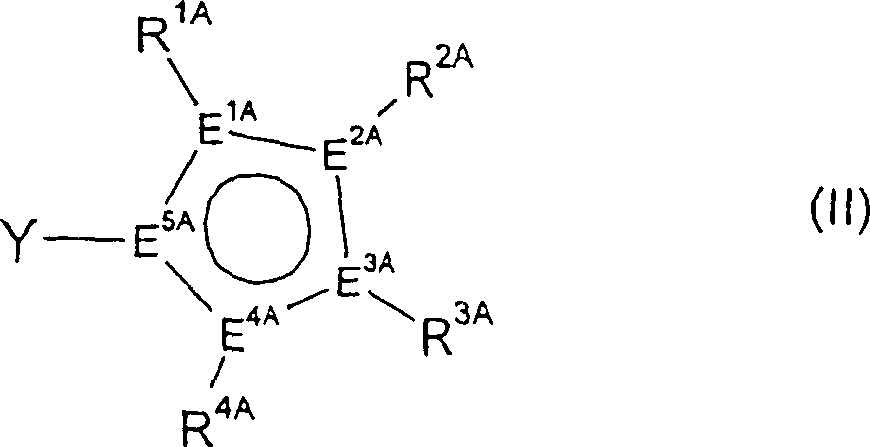
其中变量Y、E1A-E5A和R6A具有上述含义,其优选含义在这里也是优选的并且wherein the variables Y, E 1A - E 5A and R 6A have the above-mentioned meanings, their preferred meanings are also preferred here and
R1A-R4A相互独立表示氢、C1-C20-烷基、C2-C20-烯基、C6-C20-芳基、在烷基具有1至10个碳原子和在芳基中具有6至20个碳原子的烷基芳基、SiR6A 3,其中有机基团R1A-R4A也可被卤素取代并且每两个邻位的基团R1A-R4A也可连接形成五-或六元环,条件是,至少两个邻位基团R1A-R4A连接形成含有至少一个周期表第15或16族的原子的杂环。R 1A -R 4A represent independently of each other hydrogen, C 1 -C 20 -alkyl, C 2 -C 20 -alkenyl, C 6 -C 20 -aryl, having 1 to 10 carbon atoms in the alkyl group and in the aryl group Alkylaryl groups with 6 to 20 carbon atoms in the group, SiR 6A 3 , wherein the organic groups R 1A -R 4A can also be substituted by halogen and every two ortho groups R 1A -R 4A can also be connected A five- or six-membered ring is formed, provided that at least two ortho groups R 1A - R 4A are joined to form a heterocycle containing at least one atom of group 15 or 16 of the Periodic Table.
上述方案和优选方案同样适合于R1A-R4A。The above schemes and preferred schemes also apply to R 1A - R 4A .
在特别优选的一环戊二烯基配合物中,Y表示通式-Zm-A的取代基,其中的变量具有下述含义:In particularly preferred monocyclopentadienyl complexes, Y represents a substituent of the general formula -Zm -A, wherein the variables have the following meanings:
Z表示A和HCp之间的二价桥,Z represents a bivalent bridge between A and HCp,
A表示NR4R5、PR4R5、OR4、SR4或未被取代的、被取代的或稠合的杂环环体系,A represents NR 4 R 5 , PR 4 R 5 , OR 4 , SR 4 or an unsubstituted, substituted or fused heterocyclic ring system,
R4-R5相互独立表示氢、C1-C20-烷基、C2-C20-烯基、C6-C20-芳基、在烷基中具有1至10个碳原子和在芳基中具有6至20个碳原子的烷基芳基、SiR6 3,其中有机基团R4-R5也可被卤素取代并且每两个基团R4-R5也可连接形成五-或六元环,R 4 -R 5 represent independently of each other hydrogen, C 1 -C 20 -alkyl, C 2 -C 20 -alkenyl, C 6 -C 20 -aryl, with 1 to 10 carbon atoms in the alkyl group and in the An alkylaryl group having 6 to 20 carbon atoms in the aryl group, SiR 6 3 , wherein the organic groups R 4 -R 5 can also be substituted by halogen and every two groups R 4 -R 5 can also be connected to form five - or a six-membered ring,
R6相互独立表示氢、C1-C20-烷基、C2-C20-烯基、C6-C20-芳基、在烷基中具有1至10个碳原子和在芳基中具有6至20个碳原子的烷基芳基,并且每两个R6也可连接形成五-或六元环,和R 6 represent independently of each other hydrogen, C 1 -C 20 -alkyl, C 2 -C 20 -alkenyl, C 6 -C 20 -aryl, in alkyl having 1 to 10 carbon atoms and in aryl Alkylaryl having 6 to 20 carbon atoms, and every two R 6 may also be connected to form a five- or six-membered ring, and
m为1,或当A是未被取代的、被取代的或稠合的杂芳环体系时,也可以是0。m is 1, or 0 when A is an unsubstituted, substituted or fused heteroaromatic ring system.
A可以例如与桥Z一起形成胺、醚、硫醚或膦。A也可表示未被取代的、被取代的或稠合的杂环,优选杂芳香环体系,其中除了碳环成员外还可含有选自氧、硫、氮和磷的杂原子。除了碳原子外,可含有1至4个氮原子或一至三个氮原子和/或一个硫-或氧原子作为环单元的5-元环杂芳基的实例2-呋喃基、2-噻吩基、2-吡咯基、3-异唑基、5-异唑基、3-异噻唑基、5-异噻唑基、1-吡唑基、3-吡唑基、5-吡唑基、2-唑基、4-唑基、5-唑基、2-噻唑基、4-噻唑基、5-噻唑基、2-咪唑基、4-咪唑基、5-咪唑基、1,2,4-二唑-3-基、1,2,4-二唑-5-基、1,3,4-二唑-2-基或1,2,4-三唑-3-基。含有1至4个氮原子和/或一个磷原子的6-元杂芳基的实例是2-吡啶基、2-磷杂苯基(2-Phosphabenzolyl)、3-哒嗪基、2-嘧啶基、4-嘧啶基、2-吡嗪基、1,3,5-三嗪-2-基和1,2,4-三嗪-3-基、1,2,4-三嗪-5-基或1,2,4-三嗪-6-基。这些5-环和6-环杂芳基也可被C1-C10-烷基、C6-C10-芳基、在烷基具有1至10个碳原子和在芳基中具有6至10个碳原子的烷基芳基、三烷基甲硅烷基或卤素,如氟、氯或溴取代或与一个或多个芳环或杂芳环稠合。苯并稠合的5-元杂芳基的实例是2-吲哚基、7-吲哚基、2-苯并呋喃基、7-苯并呋喃基、2-硫茚基、7-硫茚基、3-吲唑基、7-吲唑基、2-苯并咪唑基或7-苯并咪唑基。苯并稠合的6-元杂芳基的实例是2-喹啉基、8-喹啉基、3-噌啉基(Cinnolyl)、8-噌啉基、2,3-二氮杂萘-1-基、2-喹唑啉基、4-喹唑啉基、8-喹唑啉基、5-喹喔啉基、4-吖啶基、1-菲啶基或1-吩嗪基。这些杂芳族体系中特别优选被取代的和未被取代的2-吡啶基和8-喹啉基。A can, for example, together with the bridge Z form an amine, ether, thioether or phosphine. A may also represent an unsubstituted, substituted or fused heterocycle, preferably a heteroaromatic ring system, which, in addition to carbon ring members, may also contain heteroatoms selected from the group consisting of oxygen, sulfur, nitrogen and phosphorus. Examples of 5-membered ring heteroaryl groups which may contain, in addition to carbon atoms, 1 to 4 nitrogen atoms or one to three nitrogen atoms and/or one sulfur- or oxygen atom as ring elements 2-furyl, 2-thienyl , 2-pyrrolyl, 3-isoxazolyl, 5-isoxazolyl, 3-isothiazolyl, 5-isothiazolyl, 1-pyrazolyl, 3-pyrazolyl, 5-pyrazolyl, 2-oxazolyl, 4-oxazolyl, 5-oxazolyl, 2-thiazolyl, 4-thiazolyl, 5-thiazolyl, 2-imidazolyl, 4-imidazolyl, 5-imidazolyl, 1, 2,4-oxadiazol-3-yl, 1,2,4-oxadiazol-5-yl, 1,3,4-oxadiazol-2-yl or 1,2,4-triazol-3 -base. Examples of 6-membered heteroaryl groups containing 1 to 4 nitrogen atoms and/or one phosphorus atom are 2-pyridyl, 2-phosphabenzolyl, 3-pyridazinyl, 2-pyrimidinyl , 4-pyrimidinyl, 2-pyrazinyl, 1,3,5-triazin-2-yl and 1,2,4-triazin-3-yl, 1,2,4-triazin-5-yl or 1,2,4-triazin-6-yl. These 5-ring and 6-ring heteroaryl groups may also be represented by C 1 -C 10 -alkyl, C 6 -C 10 -aryl, having 1 to 10 carbon atoms in the alkyl group and 6 to 10 carbon atoms in the aryl group An alkylaryl group of 10 carbon atoms, a trialkylsilyl group or a halogen such as fluorine, chlorine or bromine is substituted or fused to one or more aromatic or heteroaromatic rings. Examples of benzo-fused 5-membered heteroaryl groups are 2-indolyl, 7-indolyl, 2-benzofuryl, 7-benzofuryl, 2-thiadenyl, 7-thiadenyl , 3-indazolyl, 7-indazolyl, 2-benzimidazolyl or 7-benzimidazolyl. Examples of benzo-fused 6-membered heteroaryl groups are 2-quinolyl, 8-quinolyl, 3-cinnolyl, 8-cinnolinyl, 2,3-naphthyridine- 1-yl, 2-quinazolinyl, 4-quinazolinyl, 8-quinazolinyl, 5-quinoxalinyl, 4-acridinyl, 1-phenanthridinyl or 1-phenazinyl. Particular preference is given to substituted and unsubstituted 2-pyridyl and 8-quinolyl among these heteroaromatic systems.
通过合适地选择R4至R5同样可以影响催化剂的活性和生成的聚合物的分子量。可能的取代基R4至R5与对R1-R2描述的基团相同,其中两个邻位的基团R4-R5也可优选连接形成5-或6-元环并且也可被卤素如氟、氯或溴取代。优选的基团R4至R5是氢、甲基、乙基、正丙基、异丙基、正丁基、叔丁基、正戊基、正己基、正庚基、正辛基、乙烯基、烯丙基、苄基、苯基、萘基、联苯基和蒽基。同样优选其中R4至R5与其连接的杂原子形成杂环的结构,如吡咯烷或哌啶。可能的Si-有机取代基特别是在烷基具有1至10个碳原子的三烷基甲硅烷基,特别是三甲基甲硅烷基。The activity of the catalysts and the molecular weight of the resulting polymers can likewise be influenced by suitable selection of R 4 to R 5 . Possible substituents R 4 to R 5 are the same as described for R 1 -R 2 , where the two ortho radicals R 4 -R 5 can also preferably be linked to form a 5- or 6-membered ring and can also Substituted by halogen such as fluorine, chlorine or bromine. Preferred radicals R to R are hydrogen, methyl, ethyl, n-propyl, isopropyl, n-butyl, tert-butyl, n-pentyl, n-hexyl, n-heptyl, n-octyl, ethylene phenyl, allyl, benzyl, phenyl, naphthyl, biphenyl and anthracenyl. Also preferred are structures in which R4 to R5 form a heterocyclic ring with the heteroatoms to which they are attached, such as pyrrolidine or piperidine. Possible Si-organic substituents are especially trialkylsilyl groups having 1 to 10 carbon atoms in the alkyl group, especially trimethylsilyl groups.
环戊二烯基体系HCp和官能团A之间的桥Z是有机二价基团,包含链长1至5的碳和/或硅单元。对此,Z可以连接在环戊二烯基-基本骨架或杂环上,优选Z与环戊二烯基-基本骨架相连。通过改变环戊二烯基体系和杂原子给体A之间的连接长度可以影响催化剂的活性。优选Z是The bridge Z between the cyclopentadienyl system HCp and the functional group A is an organic divalent group comprising carbon and/or silicon units with a chain length of 1 to 5. For this purpose, Z can be attached to the cyclopentadienyl-basic skeleton or to a heterocycle, preferably Z is attached to the cyclopentadienyl-basic skeleton. The activity of the catalyst can be influenced by changing the link length between the cyclopentadienyl system and the heteroatom donor A. Preferably Z is
=BR1B、=BNR1BR2B、=AlR1B、-Ge-、-Sn-、-O-、-S-、=SO、=SO2、=NR1B、=CO、=PR1B或=P(O)R1B,其中=BR 1B , =BNR 1B R 2B , =AlR 1B , -Ge-, -Sn-, -O-, -S-, =SO, =SO 2 , =NR 1B , =CO, =PR 1B or =P (O)R 1B , where
R1B-R6B相互独立为氢、C1-C20-烷基、C2-C20-烯基、C6-C20-芳基、在烷基中具有1至10个碳原子和在芳基中具有6至20个碳原子的烷基芳基、SiR7B 3,其中有机基团R1B-R6B也可被卤素取代并且每两个基团R1B-R6B也可连接形成五-或六元环,R 1B -R 6B are independently of each other hydrogen, C 1 -C 20 -alkyl, C 2 -C 20 -alkenyl, C 6 -C 20 -aryl, with 1 to 10 carbon atoms in the alkyl group and in An alkylaryl group having 6 to 20 carbon atoms in the aryl group, SiR 7B 3 , wherein the organic groups R 1B -R 6B can also be substituted by halogen and every two groups R 1B -R 6B can also be connected to form five - or a six-membered ring,
R7B相互独立为氢、C1-C20-烷基、C2-C20-烯基、C6-C20-芳基、在烷基中具有1至10个碳原子和在芳基中具有6至20个碳原子的烷基芳基并且每两个基团R7B也可连接形成五-或六元环,和R 7B are independently of each other hydrogen, C 1 -C 20 -alkyl, C 2 -C 20 -alkenyl, C 6 -C 20 -aryl, in alkyl having 1 to 10 carbon atoms and in aryl Alkylaryl having 6 to 20 carbon atoms and every two radicals R 7B can also be connected to form a five- or six-membered ring, and
L1B是碳、硅或锗,优选为碳或硅。L 1B is carbon, silicon or germanium, preferably carbon or silicon.
可能的取代基R1B至R6B与对于R1-R2所述相同,其中两个成对或邻位的基团R1B-R6B也可连接形成5-或6元环并且也可被卤素如氟、氯或溴取代。优选的基团R1B至R6B是氢、甲基、乙基、正丙基、异丙基、正丁基、叔丁基、正戊基、正己基、正庚基、正辛基、乙烯基、烯丙基、苄基、苯基、萘基、联苯基和蒽基。可能的Si-有机取代基特别是烷基中具有1至10个碳原子的三烷基甲硅烷基,特别是三甲基甲硅烷基。Possible substituents R 1B to R 6B are the same as described for R 1 -R 2 , where two pairs or ortho groups R 1B -R 6B can also be joined to form a 5- or 6-membered ring and can also be replaced by Halogen such as fluorine, chlorine or bromine is substituted. Preferred groups R1B to R6B are hydrogen, methyl, ethyl, n-propyl, isopropyl, n-butyl, tert-butyl, n-pentyl, n-hexyl, n-heptyl, n-octyl, ethylene phenyl, allyl, benzyl, phenyl, naphthyl, biphenyl and anthracenyl. Possible Si-organic substituents are especially trialkylsilyl groups having 1 to 10 carbon atoms in the alkyl group, especially trimethylsilyl groups.
在优选的一环戊二烯基配合物中,环戊二烯基体系HCp和-Z-A-形成式III的配体(Cp-Z-A):In a preferred monocyclopentadienyl complex, the cyclopentadienyl systems HCp and -Z-A- form a ligand of formula III (Cp-Z-A):
其中变量A、Z、E1A至E5A和R6A具有上述含义并且它们优选的方案在此也是优选的,和wherein the variables A, Z, E 1A to E 5A and R 6A have the above-mentioned meanings and their preferred variants are also preferred here, and
R1A-R4A相互独立表示氢、C1-C20-烷基、C2-C20-烯基、C6-C20-芳基、在烷基中具有1至10个碳原子和在芳基中具有6至20个碳原子的烷基芳基、SiR6A 3,其中有机基团R1A-R4A也可被卤素取代并且每两个邻位的基团R1A-R4A也可连接形成五-或六元环,条件是,至少两个邻位基团R1A-R4A连接形成含有至少一个周期表第15或16族的原子的杂环。R 1A -R 4A represent independently of each other hydrogen, C 1 -C 20 -alkyl, C 2 -C 20 -alkenyl, C 6 -C 20 -aryl, with 1 to 10 carbon atoms in the alkyl group and in the An alkylaryl group having 6 to 20 carbon atoms in the aryl group, SiR 6A 3 , wherein the organic groups R 1A -R 4A can also be substituted by halogen and every two ortho groups R 1A -R 4A can also be Linkage to form a five- or six-membered ring, with the proviso that at least two vicinal groups R 1A - R 4A are linked to form a heterocycle containing at least one atom of Group 15 or 16 of the Periodic Table.
上述方案和优选方案同样适合于R1A-R4A。The above schemes and preferred schemes also apply to R 1A - R 4A .
在这些一环戊二烯基配合物中,特别优选这样一些,其中m是1,和Among these cyclopentadienyl complexes, those in which m is 1 are particularly preferred, and
A是NR4R5、PR4R5、OR4或SR4,优选是NR4R5或PR4R5,和A is NR 4 R 5 , PR 4 R 5 , OR 4 or SR 4 , preferably NR 4 R 5 or PR 4 R 5 , and
Z是选自下述基团的二价桥Z is a divalent bridge selected from the following groups
其中L2B相互独立为碳或硅,where L 2B are mutually independently carbon or silicon,
R1B-R6B相互独立为氢、C1-C20-烷基、C2-C20-烯基、C6-C20-芳基、在烷基中具有1至10个碳原子和在芳基中具有6至20个碳原子的烷基芳基或SiR7B 3,其中有机基团R1B-R6B也可被卤素取代并且每两个成对或邻位的基团R1B-R6B也可连接形成五-或六元环,和R 1B -R 6B are independently of each other hydrogen, C 1 -C 20 -alkyl, C 2 -C 20 -alkenyl, C 6 -C 20 -aryl, with 1 to 10 carbon atoms in the alkyl group and in An alkylaryl group with 6 to 20 carbon atoms in the aryl group or SiR 7B 3 , where the organic group R 1B -R 6B can also be substituted by halogen and every two pairs or ortho groups R 1B -R 6B can also be linked to form a five- or six-membered ring, and
R7B相互独立为氢、C1-C20-烷基、C2-C20-烯基、C6-C20-芳基或在烷基中具有1至10个碳原子和在芳基中具有6至20个碳原子的烷基芳基并且每两个基团R7B也可连接形成五-或六元环。R 7B are independently of each other hydrogen, C 1 -C 20 -alkyl, C 2 -C 20 -alkenyl, C 6 -C 20 -aryl or in alkyl having 1 to 10 carbon atoms and in aryl An alkylaryl group having 6 to 20 carbon atoms and every two radicals R 7B can also be linked to form a five- or six-membered ring.
上述对于R1B-R7B提到的方案和优选方案也适合于这些优选的一环戊二烯基配合物。由于易于制备的原因,优选Z=CH2、SiMe2、CH=CH或1,2-亚苯基与A=NR4R5或PR4R5的组合。The variants and preferences mentioned above for R 1B to R 7B also apply to these preferred monocyclopentadienyl complexes. For reasons of ease of preparation, combinations of Z=CH 2 , SiMe 2 , CH=CH or 1,2-phenylene with A=NR 4 R 5 or PR 4 R 5 are preferred.
进一步优选的是一环戊二烯基配合物,其中Further preferred is a cyclopentadienyl complex, wherein
A表示未被取代的、被取代的或稠合的杂芳香环体系,和A represents an unsubstituted, substituted or fused heteroaromatic ring system, and
Z是Z is
其中in
L3B相互独立为碳或硅,L 3B are independently carbon or silicon,
R1B-R2B相互独立为氢、C1-C20-烷基、C2-C20-烯基、C6-C20-芳基、在烷基中具有1至10个碳原子和在芳基中具有6至20个碳原子的烷基芳基或SiR7B 3,其中有机基团R1B-R2B也可被卤素取代并且每两个基团R1B-R2B也可连接形成五-或六元环,和R 1B -R 2B are independently hydrogen, C 1 -C 20 -alkyl, C 2 -C 20 -alkenyl, C 6 -C 20 -aryl, having 1 to 10 carbon atoms in the alkyl group and in An alkylaryl group with 6 to 20 carbon atoms in the aryl group or SiR 7B 3 , wherein the organic groups R 1B -R 2B can also be substituted by halogen and every two groups R 1B -R 2B can also be connected to form five - or a six-membered ring, and
R7B相互独立为氢、C1-C20-烷基、C2-C20-烯基、C6-C20-芳基或在烷基中具有1至10个碳原子和在芳基中具有6至20个碳原子的烷基芳基并且每两个基团R7B也可连接形成五-或六元环,和R 7B are independently of each other hydrogen, C 1 -C 20 -alkyl, C 2 -C 20 -alkenyl, C 6 -C 20 -aryl or in alkyl having 1 to 10 carbon atoms and in aryl Alkylaryl having 6 to 20 carbon atoms and every two radicals R 7B can also be connected to form a five- or six-membered ring, and
m为0或1。m is 0 or 1.
上述对于R1B-R2B和R7B提到的方案和优选方案也适合于这些优选的一环戊二烯基配合物。The variants and preferences mentioned above for R 1B -R 2B and R 7B also apply to these preferred monocyclopentadienyl complexes.
在这些优选的方案中,A是未被取代的、被取代的或稠合的杂芳香环体系。其中优选容易得到并且便宜的体系,选自:In these preferred embodiments, A is an unsubstituted, substituted or fused heteroaromatic ring system. Among them, readily available and inexpensive systems are preferred, selected from:
2-吡啶基 8-喹啉基2-pyridyl 8-quinolinyl
R1C-R10C相互独立为氢、C1-C20-烷基、C2-C20-烯基、C6-C20-芳基、在烷基中具有1至10个碳原子和在芳基中具有6至20个碳原子的烷基芳基或SiR11C 3,其中有机基团R1C-R10C也可被卤素取代并且每两个邻位的基团R1c-R10c也可连接形成五-或六元环,和R 1C -R 10C independently of each other are hydrogen, C 1 -C 20 -alkyl, C 2 -C 20 -alkenyl, C 6 -C 20 -aryl, with 1 to 10 carbon atoms in the alkyl group and in An alkylaryl group having 6 to 20 carbon atoms in the aryl group or SiR 11C 3 , wherein the organic groups R 1C - R 10C can also be substituted by halogen and every two ortho groups R 1c - R 10c can also be connected to form a five- or six-membered ring, and
R11C相互独立为氢、C1-C20-烷基、C2-C20-烯基、C6-C20-芳基或在烷基中具有1至10个碳原子和在芳基中具有6至20个碳原子的烷基芳基并且每两个基团R11C也可连接形成五-或六元环。R 11C are independently of each other hydrogen, C 1 -C 20 -alkyl, C 2 -C 20 -alkenyl, C 6 -C 20 -aryl or in alkyl having 1 to 10 carbon atoms and in aryl An alkylaryl group having 6 to 20 carbon atoms and every two radicals R 11C can also be linked to form a five- or six-membered ring.
可能的取代基R1c至R10C是与对于R1-R2所述的相同的基团,其中两个邻位基团R1C至R10C也任选连接形成5-或6-元环并且也可被卤素如氟、氯或溴取代。优选的基团R1C至R10C是氢、甲基、乙基、正丙基、异丙基、正丁基、叔丁基、正戊基、正己基、正庚基、正辛基、苄基、苯基、萘基、联苯基和蒽基。可能的Si-有机取代基特别是在烷基中具有1至10个碳原子的三烷基甲硅烷基,特别是三甲基甲硅烷基。Possible substituents R 1c to R 10C are the same groups as described for R 1 -R 2 , wherein two ortho groups R 1c to R 10C are also optionally connected to form a 5- or 6-membered ring and It can also be substituted by halogen such as fluorine, chlorine or bromine. Preferred groups R 1C to R 10C are hydrogen, methyl, ethyl, n-propyl, isopropyl, n-butyl, tert-butyl, n-pentyl, n-hexyl, n-heptyl, n-octyl, benzyl phenyl, naphthyl, biphenyl and anthracenyl. Possible Si-organic substituents are especially trialkylsilyl groups having 1 to 10 carbon atoms in the alkyl group, especially trimethylsilyl groups.
优选的Z和A的组合是A表示未被取代的或被取代的2-吡啶基,m等于1和Z等于CH2、CMe2或SiMe2。A preferred combination of Z and A is that A represents unsubstituted or substituted 2-pyridyl, m equals 1 and Z equals CH2 , CMe2 or SiMe2 .
十分特别容易得到并因此是优选的一环戊二烯基配合物还有没有桥Z的那些,其中m等于0和A是未被取代的或被取代的8-喹啉基。在这些配合物中,R5C-R10C优选等于氢、或R5C-R9C为氢和R10C为甲基、乙基、正丙基、异丙基、正丁基、叔丁基、正戊基、正己基、正庚基、正辛基、苄基、苯基、萘基、联苯基或蒽基。这些制备简单同时提供很好活性。Very particularly readily available and therefore preferred monocyclopentadienyl complexes are also those without bridge Z, in which m is equal to 0 and A is unsubstituted or substituted 8-quinolinyl. In these complexes, R 5C -R 10C is preferably equal to hydrogen, or R 5C -R 9C is hydrogen and R 10C is methyl, ethyl, n-propyl, isopropyl, n-butyl, tert-butyl, n- Pentyl, n-hexyl, n-heptyl, n-octyl, benzyl, phenyl, naphthyl, biphenyl, or anthracenyl. These are simple to prepare while providing very good activity.
本发明的一环戊二烯基配合物可以单独或者与其它组分一起作为催化剂体系用于烯烃聚合。此外,已发现用于烯烃聚合的催化剂体系,其中包含The monocyclopentadienyl complexes of the present invention can be used alone or together with other components as catalyst systems for the polymerization of olefins. In addition, catalyst systems have been found for the polymerization of olefins comprising
A)至少一种本发明的一环戊二烯基配合物A) At least one monocyclopentadienyl complex according to the invention
B)任选的有机或无机载体,B) optional organic or inorganic carrier,
C)任选一种或多种形成阳离子的化合物,C) optionally one or more cation-forming compounds,
D)任选一种或多种适合于烯烃聚合的催化剂,和D) optionally one or more catalysts suitable for the polymerization of olefins, and
E)任选一种或多种周期表第1、2或13族的金属化合物。E) Optionally one or more metal compounds from Group 1, 2 or 13 of the Periodic Table.
因此,可将多于一种本发明的一环戊二烯基配合物同时与一种或多种要聚合的烯烃接触。这样的优点是可以制备宽范围的聚合物。利用这种方法例如合成双峰产物。Thus, more than one monocyclopentadienyl complex of the invention can be contacted simultaneously with one or more olefins to be polymerized. This has the advantage that a wide range of polymers can be prepared. This method is used, for example, to synthesize bimodal products.
为了使本发明的一环戊二烯基配合物在气相或悬浮聚合中应用,常常有利的是以固体形式应用金属茂,即将其负载于固体载体B)上。此外,负载的一环戊二烯基配合物表现出高产率。因此,也可任选将本发明的一环戊二烯基配合物固定化在有机或无机载体B)上并以负载的形式用于聚合。这是避免在反应器中沉积并能控制聚合物形态的常规方法。作为载体材料优选应用硅胶、氯化镁、氧化铝、中孔性的材料、硅铝酸盐、水滑石和有机聚合物如聚乙烯、聚丙烯或聚苯乙烯。For the use of the monocyclopentadienyl complexes according to the invention in gas-phase or suspension polymerizations, it is often advantageous to apply the metallocenes in solid form, ie supported on solid supports B). In addition, the supported monocyclopentadienyl complexes exhibit high yields. Accordingly, the monocyclopentadienyl complexes according to the invention can optionally also be immobilized on organic or inorganic supports B) and used in supported form for the polymerization. This is a conventional method to avoid deposition in the reactor and allow control of polymer morphology. As carrier materials preferably used are silica gels, magnesium chloride, aluminum oxide, mesoporous materials, aluminosilicates, hydrotalcites and organic polymers such as polyethylene, polypropylene or polystyrene.
作为用于烯烃聚合的催化剂的固体载体材料B)优选应用硅胶,因为由这种材料可以生产出适合于烯烃聚合的大小和结构的载体颗粒。已发现,通过喷雾干燥由小颗粒,即一次颗粒形成的球形附聚体特别有用。这种硅胶可在应用前干燥和/或煅烧。As solid support material B) for the catalysts for the polymerization of olefins preferably silica gel is used, since from this material support particles of a size and structure suitable for the polymerization of olefins can be produced. It has been found particularly useful to spray dry spherical agglomerates formed from small particles, ie primary particles. This silica gel can be dried and/or calcined prior to application.
同样优选的载体B)是水滑石和煅烧的水滑石。在矿物学中,水滑石是一种天然的矿物,其理想分子式为Likewise preferred supports B) are hydrotalcites and calcined hydrotalcites. In mineralogy, hydrotalcite is a natural mineral whose ideal molecular formula is
Mg6Al2(OH)16CO3·4H2OMg 6 Al 2 (OH) 16 CO 3 4H 2 O
其结构衍生于水镁石Mg(OH)2。水镁石以层状结构结晶,其中金属离子位于两层紧密排列的氢氧根离子的八面体孔中,其中只有八面体孔的每个第二层被占据。在水滑石中,一些镁离子被铝离子置换,由此该层状包带有正电荷。该电荷被于层状之间与结晶水一起存在的阴离子补偿。Its structure is derived from brucite Mg(OH) 2 . Brucite crystallizes in a layered structure in which metal ions are located in two layers of closely packed octahedral pores of hydroxide ions, of which only each second layer of octahedral pores is occupied. In hydrotalcite, some of the magnesium ions are replaced by aluminum ions, whereby the lamellar envelope is positively charged. This charge is compensated by the anions present together with the water of crystallization between the layers.
相应的层状结构不仅在镁-铝-氢氧化物中,而且常常存在于具有层状结构的下述通式的混合金属氢氧化物中Corresponding layered structures are not only found in magnesium-aluminum-hydroxides, but also frequently in mixed metal hydroxides having a layered structure of the general formula
M(II)2x 2+M(III)2 3+(OH)4x+4·A2/n n-·zH2OM(II) 2x 2+ M(III) 2 3+ (OH) 4x+4 A 2/n n- zH 2 O
其中M(II)是二价金属如Mg、Zn、Cu、Ni、Co、Mn、Ca和/或Fe和M(III)是三价金属如Al、Fe、Co、Mn、La、Ce和/或Cr,x表示0.5至10的数字,变化间隔0.5,A表示填隙阴离子和n表示填隙阴离子的电荷,可以是1至8,通常为1至4,和z为1至6的整数,特别是2至4的整数。可能的填隙阴离子是有机阴离子如醇盐阴离子、烷基醚硫酸根、芳基醚硫酸根或乙二醇醚硫酸根,无机阴离子如特别是碳酸根、碳酸氢根、硝酸根、氯化物、硫酸根或B(OH)4 -或多氧金属阴离子如Mo7O24 6-或V10O28 6-。然而,也可以是多种这些阴离子的混合物。where M(II) is a divalent metal such as Mg, Zn, Cu, Ni, Co, Mn, Ca and/or Fe and M(III) is a trivalent metal such as Al, Fe, Co, Mn, La, Ce and/or or Cr, x represents a number from 0.5 to 10, varying at an interval of 0.5, A represents an interstitial anion and n represents the charge of an interstitial anion, which can be from 1 to 8, usually from 1 to 4, and z is an integer from 1 to 6, Especially integers from 2 to 4. Possible interstitial anions are organic anions such as alkoxide anion, alkyl ether sulfate, aryl ether sulfate or glycol ether sulfate, inorganic anions such as especially carbonate, bicarbonate, nitrate, chloride, Sulfate or B(OH) 4 - or polyoxometallic anions such as Mo 7 O 24 6- or V 10 O 28 6- . However, mixtures of a plurality of these anions are also possible.
因此,在本发明范围内应将所有这类层状结构的混合金属氧化物理解为水滑石。All layered mixed metal oxides of this type are therefore to be understood as hydrotalcites within the scope of the present invention.
通过煅烧,即加热可由水滑石制备煅烧所谓的水滑石,由此可特别地调节至希望的羟基含量。此外,也改变了晶体结构。本发明应用的煅烧的水滑石的制备通常在高于180℃进行。优选在250℃至1000℃并且特别是在400℃至700℃煅烧3至24小时。同时通入空气或惰性气体或者施加真空均可。Calcined so-called hydrotalcites can be produced from hydrotalcites by calcination, ie heating, whereby the desired hydroxyl content can be adjusted in particular. In addition, the crystal structure is also changed. The preparation of the calcined hydrotalcites used according to the invention is generally carried out at temperatures above 180°C. Preference is given to calcining at 250°C to 1000°C and especially at 400°C to 700°C for 3 to 24 hours. At the same time, air or inert gas or vacuum can be applied.
加热过程中,天然或合成的水滑石首先释放出水,即进行干燥。在进一步加热,即真正的煅烧过程中金属氢氧化物消去羟基和填隙阴离子转化成金属氧化物,其中在煅烧的水滑石中还可存在OH-基或填隙阴离子如碳酸根。其量度是烧失量。这是样品经历的重量损失,在两步中加热进行的,第一步是在干燥箱中于200℃加热30分钟,然后在Muffe炉中于950℃加热1小时。During heating, natural or synthetic hydrotalcites first release water, ie dry. During further heating, ie the actual calcination, the metal hydroxides are converted into metal oxides by elimination of hydroxyl groups and interstitial anions, wherein OH-groups or interstitial anions such as carbonates may also be present in the calcined hydrotalcite. Its measure is loss on ignition. This is the weight loss experienced by the sample, heated in two steps, the first being 30 minutes at 200°C in a drybox, followed by 1 hour at 950°C in a Muffe oven.
因此,作为组分B)应用的煅烧的水滑石是二价-和三价金属M(II)和M(III)的混合氧化物,其中M(II)与M(III)的摩尔比一般为0.5至10,优选0.75至8并且特别是1至4。此外,还可存在通常水平的杂质,如Si、Fe、Na、Ca或Ti和氯化物和硫酸盐。Calcined hydrotalcites used as component B) are therefore mixed oxides of divalent- and trivalent metals M(II) and M(III), where the molar ratio of M(II) to M(III) is generally 0.5 to 10, preferably 0.75 to 8 and especially 1 to 4. In addition, usual levels of impurities such as Si, Fe, Na, Ca or Ti and chlorides and sulfates may also be present.
优选的煅烧的水滑石B)是其中M(II)为镁和M(III)为铝的混合氧化物。相应的铝-镁-混合氧化物可从Condea Chemie GmbH公司,Hamburg以商品名Puralox Mg得到。Preferred calcined hydrotalcites B) are mixed oxides in which M(II) is magnesium and M(III) is aluminium. Corresponding aluminum-magnesium mixed oxides are available under the trade name Puralox Mg from the company Condea Chemie GmbH, Hamburg.
此外优选其中的结构转变完全或几乎完全的煅烧的水滑石。煅烧,即结构转化可例如通过X-射线衍射谱确定。Preference is furthermore given to calcined hydrotalcites in which the structural transformation is complete or almost complete. Calcination, ie structural transformation, can be determined, for example, by X-ray diffraction spectroscopy.
所用的水滑石、煅烧的水滑石或硅胶一般作为细分散的粉末形式应用,其平均粒径d50为5至200μm,优选10至150μm,特别优选15至100μm并且特别是20至70μm,并且通常具有0.1至10cm3/g,优选0.2至5cm3/g的孔体积,以及30至1000m2/g,优选50至800m2/g并且特别是100至600m2/g的比表面。本发明的一环戊二烯基配合物优选的用量是使一环戊二烯基配合物在成品催化剂体系中的浓度为每克载体B)10至200μmol,优选20至100μmol并且特别优选25至70μmol。The hydrotalcites, calcined hydrotalcites or silica gels used are generally applied as finely divided powders with a mean particle size d50 of 5 to 200 μm, preferably 10 to 150 μm, particularly preferably 15 to 100 μm and especially 20 to 70 μm, and generally It has a pore volume of 0.1 to 10 cm 3 /g, preferably 0.2 to 5 cm 3 /g, and a specific surface of 30 to 1000 m 2 /g, preferably 50 to 800 m 2 /g and especially 100 to 600 m 2 /g. The monocyclopentadienyl complex according to the invention is preferably used in such an amount that the concentration of the monocyclopentadienyl complex in the finished catalyst system is 10 to 200 μmol, preferably 20 to 100 μmol and particularly preferably 25 to 20 μmol per gram of support B). 70 μmol.
一些本发明的一环戊二烯基配合物仅有低的聚合活性,因此为了发挥良好的聚合活性将其与活化剂组分C)接触。因此,该催化剂体系任选含有作为组分C)的一种或多种形成阳离子的化合物,优选至少一种形成阳离子的化合物C)。Some of the monocyclopentadienyl complexes according to the invention have only low polymerization activity and are therefore contacted with activator component C) in order to develop good polymerization activity. Accordingly, the catalyst system optionally contains as component C) one or more cation-forming compounds, preferably at least one cation-forming compound C).
能够与一环戊二烯基配合物A)反应将其转化为阳离子化合物的合适的形成阳离子的化合物C例如是铝氧烷(Aluminoxans)类化合物、强的中性路易斯酸、具有路易斯酸阳离子的离子化合物或具有布朗斯台德酸阳离子的离子化合物。Suitable cation-forming compounds C which are able to react with the monocyclopentadienyl complex A) to convert it into a cationic compound are, for example, aluminoxanes (Aluminoxans), strong neutral Lewis acids, compounds with Lewis acid cations Ionic compounds or ionic compounds with Bronsted acid cations.
可应用的铝氧烷例如是公开于WO 00/31090中的化合物。特别合适的是通式(FX)或(FXI)的开链或环状的铝氧烷化合物Applicable aluminoxanes are, for example, the compounds disclosed in WO 00/31090. Particularly suitable are open-chain or cyclic aluminoxane compounds of the general formula (FX) or (FXI)
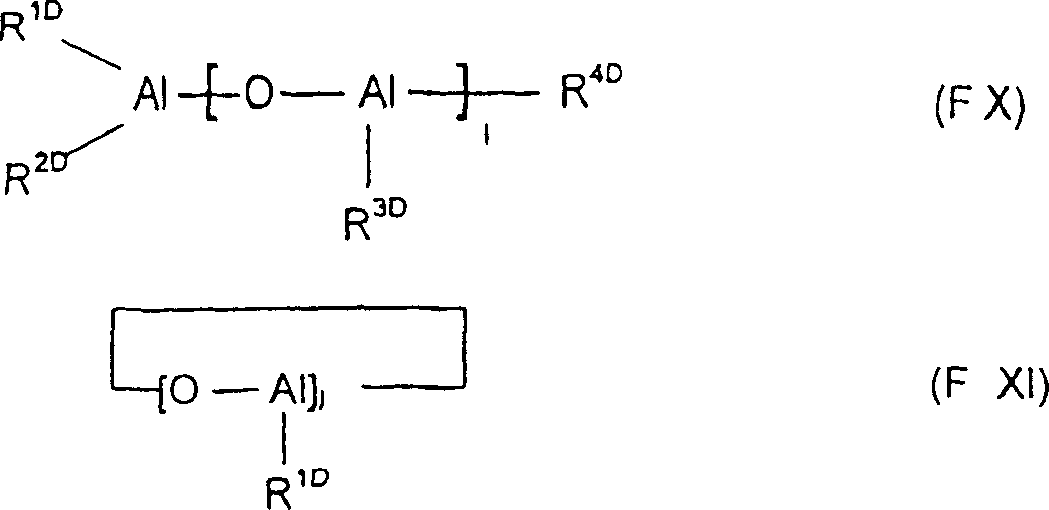
其中R1D-R4D相互独立为C1-C6-烷基,优选甲基、乙基、丁基或异丁基,和wherein R 1D - R 4D are independently of one another C 1 -C 6 -alkyl, preferably methyl, ethyl, butyl or isobutyl, and
l表示1至30的整数,优选5至25的整数。l represents an integer of 1 to 30, preferably an integer of 5 to 25.
特别合适的铝氧烷化合物是甲基铝氧烷。A particularly suitable aluminoxane compound is methylaluminoxane.
这些低聚铝氧烷化合物的制备一般通过三烷基铝溶液与水控制性反应。一般情况下,由此得到的低聚铝氧烷化合物为不同链长的混合物,这些分子可以是直链的或者环状的,所以1为平均值。铝氧烷化合物也可与其它金属烷基化物,通常与烷基铝混合存在。作为组分C)合适的铝氧烷制品是可商购的。These oligomeric aluminoxane compounds are generally prepared by controlled reaction of trialkylaluminum solutions with water. Generally, the resulting oligoaluminoxane compound is a mixture of different chain lengths, and these molecules can be linear or cyclic, so 1 is the average value. Aluminoxane compounds can also be present in admixture with other metal alkyls, usually with aluminum alkyls. Suitable aluminoxane preparations as component C) are commercially available.
此外,代替通式(FX)或(FXI)的铝氧烷化合物,也可应用修饰的铝氧烷作为组分C),其中部分烃基被氢原子、烷氧基、芳基氧基、甲硅烷氧基或酰胺基代替。In addition, instead of the aluminoxane compounds of the general formula (FX) or (FXI), modified aluminoxanes can also be used as component C), wherein part of the hydrocarbon group is replaced by a hydrogen atom, an alkoxy group, an aryloxy group, a silane Oxygen or amido instead.
已经证明一环戊二烯基配合物A)和铝氧烷化合物以下述量应用是有利的:铝氧烷化合物中的铝,包括任何仍以烷基铝形式存在的,与一环戊二烯基配合物A)中的过渡金属的原子比例为10∶1至1000∶1,优选20∶1至500∶1和特别是30∶1至400∶1。It has proved to be advantageous to use the monocyclopentadienyl complex A) and the aluminoxane compound in the following amounts: the aluminum in the aluminoxane compound, including any still present in the form of the alkylaluminum, and the monocyclopentadiene The atomic ratio of the transition metals in the radical complex A) is from 10:1 to 1000:1, preferably from 20:1 to 500:1 and in particular from 30:1 to 400:1.
强的中性路易斯酸优选是通式(FXII)的化合物Strong neutral Lewis acids are preferably compounds of general formula (FXII)
M2DX1DX2DX3D (FXII)M 2D X 1D X 2D X 3D (FXII)
其中in
M2D是周期表第13族的元素,特别是B、Al或Ga,优选B,M 2D is an element of group 13 of the periodic table, especially B, Al or Ga, preferably B,
X1D、X2D和X3D表示氢、C1-C10-烷基、C6-C15-芳基、在烷基中各具有1至10个碳原子和在芳基中各具有6至20个碳原子的烷基芳基、芳基烷基、卤代烷基或卤代芳基或氟、氯、溴或碘,特别是卤代芳基,优选表示五氟苯基。X 1D , X 2D and X 3D represent hydrogen, C 1 -C 10 -alkyl, C 6 -C 15 -aryl, each having 1 to 10 carbon atoms in the alkyl group and 6 to 10 carbon atoms in the aryl group Alkylaryl, arylalkyl, haloalkyl or haloaryl of 20 carbon atoms or fluorine, chlorine, bromine or iodine, especially haloaryl, preferably denotes pentafluorophenyl.
其它强的中性路易斯酸的实例公开于WO 00/31090中。Examples of other strong neutral Lewis acids are disclosed in WO 00/31090.
特别适合作为组分C)的是甲硼烷和环硼氧烷,如三烷基甲硼烷、三芳基甲硼烷或三甲基环硼氧烷。特别优选应用带有至少两个全氟代芳基的甲硼烷。特别优选通式(FXII)化合物,其中X1D、X2D和X3D相同,优选三(五氟苯基)甲硼烷。Particularly suitable as component C) are boranes and boroxines, such as trialkylboranes, triarylboranes or trimethylboroxines. Particular preference is given to using boranes which carry at least two perfluoroaryl groups. Particular preference is given to compounds of general formula (FXII), wherein X 1D , X 2D and X 3D are the same, preferably tris(pentafluorophenyl)borane.
适合作为形成阳离子的化合物C)的强的中性路易斯酸还包括硼酸与两当量三烷基铝的反应产物或三烷基铝与两当量酸性氟代的,特别是全氟代的碳化合物如五氟苯酚或双-(五氟苯基)-硼酸(borinsure)的反应产物。Strong neutral Lewis acids suitable as cation-forming compounds C) also include reaction products of boric acid with two equivalents of trialkylaluminum or trialkylaluminum with two equivalents of acidic fluorinated, especially perfluorinated carbon compounds such as Pentafluorophenol or bis-(pentafluorophenyl)-boronic acid (borinsure) reaction product.
具有路易斯酸阳离子的离子化合物合适的是通式(FXIII)的阳离子的盐类化合物Ionic compounds with Lewis acid cations are suitably salt compounds of cations of general formula (FXIII)
[((M3D)a+)Q1Q2...Qz]d+ (FXIII)[((M 3D ) a+ )Q 1 Q 2 ...Q z ] d+ (FXIII)
其中in
M3D表示元素周期表第1至16族的元素,M 3D represents an element of Groups 1 to 16 of the Periodic Table of Elements,
Q1至Qz表示带负电的简单基团,如C1-C28-烷基、C6-C15-芳基、在芳基中各具有6至20个碳原子和在烷基中各具有1至28个碳原子的烷基芳基、芳基烷基、卤代烷基、卤代芳基、C3-C10-环烷基,其可任选被C1-C10-烷基取代、卤素、C1-C28-烷氧基、C6-C15-芳基氧基、甲硅烷基或巯基,Q 1 to Q z represent negatively charged simple groups such as C 1 -C 28 -alkyl, C 6 -C 15 -aryl, each having 6 to 20 carbon atoms in aryl and each in alkyl Alkylaryl, arylalkyl, haloalkyl, haloaryl, C 3 -C 10 -cycloalkyl having 1 to 28 carbon atoms, which may optionally be substituted by C 1 -C 10 -alkyl , halogen, C 1 -C 28 -alkoxy, C 6 -C 15 -aryloxy, silyl or mercapto,
a表示1至6的整数,和a represents an integer from 1 to 6, and
z表示0至5的整数,z represents an integer from 0 to 5,
d表示a-z之差,但是d大于或等于1。d represents the difference between a-z, but d is greater than or equal to 1.
特别合适的阳离子是碳阳离子、氧阳离子和锍阳离子以及阳离子过渡金属配合物。特别可提及三苯基甲基阳离子、银阳离子和1,1′-二甲基二茂铁基阳离子。优选的是它们具有非配位的反离子,特别是硼化合物如在WO 91/09882中提及的,优选四(五氟苯基)硼酸根。Particularly suitable cations are carbenium, oxonium and sulfonium cations and cationic transition metal complexes. Particular mention may be made of the triphenylmethyl cation, the silver cation and the 1,1'-dimethylferrocenyl cation. It is preferred that they have non-coordinating counterions, especially boron compounds as mentioned in WO 91/09882, preferably tetrakis(pentafluorophenyl)borate.
具有非配位阴离子的盐也可通过混合硼化合物或铝化合物,例如烷基铝,和通过与硼化合物或铝化合物反应连接两个或多个硼-或铝原子的第二化合物,例如水,和与硼-或铝化合物形成离子化的离子化合物的第三化合物,例如三苯基氯甲烷制备。此外可加入同样与硼-或铝化合物反应的第四化合物,例如五氟苯酚。Salts with non-coordinating anions can also be obtained by mixing a boron or aluminum compound, such as an aluminum alkyl, and a second compound that links two or more boron- or aluminum atoms, such as water, by reaction with the boron or aluminum compound, and a third compound that forms an ionized ionic compound with a boron- or aluminum compound, such as triphenylchloromethane. In addition, a fourth compound which likewise reacts with boron- or aluminum compounds, such as pentafluorophenol, can be added.
具有布朗斯台德酸作为阳离子的离子化合物同样优选具有非配位的反离子。作为布朗斯台德酸特别优选质子化的胺-或苯胺衍生物。优选的阳离子是N,N-二甲基苯铵、N,N-二甲基环己基铵和N,N-二甲基苄基铵以及后两者的衍生物。Ionic compounds having Bronsted acids as cations likewise preferably have non-coordinating counterions. Protonated amine or aniline derivatives are particularly preferred as Bronsted acids. Preferred cations are N,N-dimethylanilinium, N,N-dimethylcyclohexylammonium and N,N-dimethylbenzylammonium and derivatives of the latter two.
具有阴离子性硼杂环的化合物,如WO 9736937公开的也适合于作为组分C),特别是二甲基苯铵boratabenzole或三苯甲游基boratabenzole。Also suitable as component C) are compounds having anionic boracyclic rings, as disclosed in WO 9736937, in particular dimethylanilinium boratabenzole or trityl boratabenzole.
优选的离子化合物C)包含具有至少两个全氟代芳基的硼酸盐。特别优选N,N-二甲基苯铵四-(五氟苯基)硼酸盐和特别是N,N-二甲基-环己基铵四(五氟苯基)硼酸盐、N,N-二甲基苄基铵四(五氟苯基)硼酸盐或三苯甲游基四(五氟苯基)硼酸盐。Preferred ionic compounds C) comprise borate salts having at least two perfluoroaryl groups. Particular preference is given to N,N-dimethylanilinium tetrakis-(pentafluorophenyl)borate and especially N,N-dimethyl-cyclohexylammonium tetrakis(pentafluorophenyl)borate, N,N -Dimethylbenzylammonium tetrakis(pentafluorophenyl)borate or trityltetrakis(pentafluorophenyl)borate.
两个或多个硼酸根阴离子也可相互连接,如在二阴离子[(C6F5)2B-C6F4-B(C6F5)2]2-中或硼酸根阴离子可通过一个含有合适官能团的桥连接在载体表面上。Two or more borate anions may also be linked to each other, as in the dianion [(C 6 F 5 ) 2 BC 6 F 4 -B(C 6 F 5 ) 2 ] 2- or the borate anion may be via a Bridges of suitable functional groups are attached to the surface of the support.
其它合适的形成阳离子的化合物C)列于WO 00/31090中。Further suitable cation-forming compounds C) are listed in WO 00/31090.
强的中性路易斯酸、具有路易斯酸阳离子的离子化合物或者具有布朗斯台德-酸作为阳离子的离子化合物的用量优选0.1至20当量,优选1至10当量,基于一环戊二烯基配合物A)计。Strong neutral Lewis acids, ionic compounds with Lewis acid cations or ionic compounds with Bronsted-acids as cations are preferably used in amounts of 0.1 to 20 equivalents, preferably 1 to 10 equivalents, based on the monocyclopentadienyl complex A) Count.
合适的形成阳离子的化合物C)还有硼-铝-化合物,如二[双(五氟苯基硼氧基)]甲基铝烷。相应的硼-铝-化合物例如公开于WO 99/06414中。Suitable cation-forming compounds C) are also boron-aluminum compounds, such as bis[bis(pentafluorophenylboroxy)]methylalane. Corresponding boron-aluminum compounds are disclosed, for example, in WO 99/06414.
也可应用上述形成阳离子的化合物C)的混合物。优选的混合物包含铝氧烷,特别是甲基铝氧烷,和离子化合物,特别是含有四(五氟苯基)硼酸盐-阴离子的化合物和/或强中性路易斯酸,特别是三(五氟苯基)甲硼烷。It is also possible to use mixtures of the abovementioned cation-forming compounds C). A preferred mixture comprises an aluminoxane, especially methylaluminoxane, and an ionic compound, especially a compound containing a tetrakis(pentafluorophenyl) borate-anion and/or a strong neutral Lewis acid, especially a tris( Pentafluorophenyl)borane.
优选一环戊二烯基配合物A)和形成阳离子的化合物C)都在溶剂中应用,其中优选具有6至20个碳原子的芳香烃,特别是二甲苯、甲苯、戊烷、己烷、庚烷或它们的混合物。Preferably both the monocyclopentadienyl complex A) and the cation-forming compound C) are used in a solvent, where preference is given to aromatic hydrocarbons having 6 to 20 carbon atoms, in particular xylene, toluene, pentane, hexane, Heptane or mixtures thereof.
同样宽的产品特性(pektrum)可以通过应用本发明的一环戊二烯基配合物A)与至少一种另外的适合于烯烃聚合的催化剂D)联合达到。因此,在催化剂体系中可以应用一种或多种适合于烯烃聚合的催化剂作为任选组分D)。可能的催化剂D)特别是基于钛的经典的Ziegler-Natta催化剂和基于铬氧化物的经典的Philips催化剂。A similarly broad product profile (pektrum) can be achieved by using the monocyclopentadienyl complexes A) according to the invention in combination with at least one further catalyst D) suitable for the polymerization of olefins. Thus, one or more catalysts suitable for the polymerization of olefins may be employed as optional component D) in the catalyst system. Possible catalysts D) are in particular the classic Ziegler-Natta catalysts based on titanium and the classic Philips catalysts based on chromium oxide.
可能的组分D)原则上是所有含有有机基团的周期表第3至12族的过渡金属或镧系化合物,优选在A)和任选的B)和/或E)存在下与组分C)反应后形成对于烯烃聚合活性的催化剂。一般地,它们是其中至少一个单齿或多齿配体经Sigma-或Pi-键结合在中心原子上的化合物。合适的配体包括含有环戊二烯基的那些和不含环戊二烯基的那些。在Chem.Rev.2000,Vol.100,Nr.4描述了许多适合于烯烃聚合的化合物B)。此外,多环环戊二烯基配合物也适合于烯烃聚合。Possible components D) are in principle all transition metals or lanthanide compounds of groups 3 to 12 of the Periodic Table containing organic groups, preferably in the presence of A) and optionally B) and/or E) in combination with the components C) Formation of a catalyst active for the polymerization of olefins after the reaction. In general, they are compounds in which at least one monodentate or polydentate ligand is bound via a Sigma- or Pi-bond to a central atom. Suitable ligands include those containing cyclopentadienyl groups and those not containing cyclopentadienyl groups. In Chem. Rev. 2000, Vol. 100, Nr. 4 a number of compounds B) suitable for the polymerization of olefins are described. In addition, polycyclopentadienyl complexes are also suitable for olefin polymerization.
特别合适的组分D)还有含有至少一个环戊二烯基型-配体的那些,其一般被称为金属茂配合物。对此,特别适合的是通式(FXIV)的金属茂配合物Particularly suitable components D) are also those which contain at least one ligand of the cyclopentadienyl type, which are generally referred to as metallocene complexes. Particularly suitable for this are metallocene complexes of the general formula (FXIV)

其中取代基和符号具有下述含义:Wherein the substituents and symbols have the following meanings:
M1E是钛、锆、铪、钒、铌、钽、铬、钼或钨以及周期表第3族和镧系的元素,M 1E is titanium, zirconium, hafnium, vanadium, niobium, tantalum, chromium, molybdenum or tungsten and elements of group 3 of the periodic table and the lanthanide series,
XE表示氟、氯、溴、碘、氢、C1-C10-烷基、C2-C10-烯基、C6-C15-芳基、在烷基中具有1至10个碳原子和在芳基中具有6至20个碳原子的烷基芳基、-OR6E或-NR6ER7E,或两个基团XE形成被取代的或未被取代的二烯配体,特别是1,3-二烯配体,和X E stands for fluorine, chlorine, bromine, iodine, hydrogen, C 1 -C 10 -alkyl, C 2 -C 10 -alkenyl, C 6 -C 15 -aryl, with 1 to 10 carbons in the alkyl atom and an alkylaryl group having 6 to 20 carbon atoms in the aryl group, -OR 6E or -NR 6E R 7E , or two groups X E form a substituted or unsubstituted diene ligand, In particular 1,3-diene ligands, and
t为1、2或3,并且t相应于M1E的价键取值,使通式(FXIV)的金属茂配合物不带电荷,t is 1, 2 or 3, and t corresponds to the value of the valence bond of M 1E , making the metallocene complex of general formula (FXIV) uncharged,
其中in
R6E和R7E分别表示C1-C10-烷基、C6-C15-芳基、在烷基中各具有1至10个碳原子和在芳基中各具有6至20个碳原子的烷基芳基、芳基烷基、氟代烷基或氟代芳基,和R 6E and R 7E respectively represent C 1 -C 10 -alkyl, C 6 -C 15 -aryl, each having 1 to 10 carbon atoms in the alkyl group and 6 to 20 carbon atoms in the aryl group Alkylaryl, arylalkyl, fluoroalkyl or fluoroaryl of , and
基团XE相同或不同并可任选相互连接,The radicals X E are identical or different and optionally connected to each other,
R1E至R5E表示氢、C1-C22-烷基、5-至7-元环烷基或环烯基,其本身可被C1-C10-烷基取代、C2-C22-烯基、C6-C22-芳基、烷基芳基或芳基烷基,其中两个邻位的基团也可一起表示4至44个碳原子的饱和或不饱和的环状基团,或Si(R8E)3,其中R 1E to R 5E represent hydrogen, C 1 -C 22 -alkyl, 5- to 7-membered cycloalkyl or cycloalkenyl, which may itself be substituted by C 1 -C 10 -alkyl, C 2 -C 22 -alkenyl, C 6 -C 22 -aryl, alkylaryl or arylalkyl, where the two ortho groups together can also represent a saturated or unsaturated cyclic group of 4 to 44 carbon atoms group, or Si(R 8E ) 3 , where
R8E可相同或不同,表示C1-C10-烷、C3-C10-环烷基、C6-C15-芳基、C1-C4-烷氧基或C6-C10-芳基氧基,和R 8E can be the same or different and represents C 1 -C 10 -alkane, C 3 -C 10 -cycloalkyl, C 6 -C 15 -aryl, C 1 -C 4 -alkoxy or C 6 -C 10 - aryloxy, and
Z1E表示XE或Z 1E means X E or
其中基团Which group
R9E至R13E分别表示氢、C1-C22-烷基、5-至7-元环烷基或环烯基,其本身可被C1-C10-烷基取代、C2-C22-烯基、C6-C22-芳基、烷基芳基或芳基烷基,其中两个邻位的基团也可一起形成含有4至44个碳原子的饱和或不饱和的环状基团,或Si(R14E)3,其中R 9E to R 13E represent hydrogen, C 1 -C 22 -alkyl, 5- to 7-membered cycloalkyl or cycloalkenyl, which themselves may be substituted by C 1 -C 10 -alkyl, C 2 -C 22 -Alkenyl, C 6 -C 22 -aryl, alkylaryl or arylalkyl, where the two ortho radicals can also form together a saturated or unsaturated ring containing 4 to 44 carbon atoms Like group, or Si(R 14E ) 3 , where
R14E相同或不同,分别表示C1-C10-烷基、C3-C10-环烷基、C6-C15-芳基、C1-C4-烷氧基或C6-C10-芳基氧基,R 14E are identical or different and represent C 1 -C 10 -alkyl, C 3 -C 10 -cycloalkyl, C 6 -C 15 -aryl, C 1 -C 4 -alkoxy or C 6 -C 10 -aryloxy,
或其中基团R4E和Z1E一起形成基团-R15E v-A1E-,其中or wherein the groups R 4E and Z 1E together form a group -R 15E v -A 1E -, wherein
R15E表示 R 15E said
=BR16E、=BNR16ER17E、=AlR16E、-Ge-、-Sn-、-O-、-S-、=SO、=SO2、=NR116E、=CO、=PR16E或=P(O)R16E,其中=BR 16E , =BNR 16E R 17E , =AlR 16E , -Ge-, -Sn-, -O-, -S-, =SO, =SO 2 , =NR 116E , =CO, =PR 16E or =P (O)R 16E , where
R16E、R17E和R18E相同或不同并且各自表示氢原子、卤素原子、三甲基甲硅烷基、C1-C10-烷基、C1-C10-氟代烷基、C6-C10-氟代芳基、C6-C10-芳基、C1-C10-烷氧基、C7-C15-烷基芳基氧基、C2-C10-烯基、C7-C40-芳基烷基、C8-C40-芳基烯基或C7-C40-烷基芳基,或其中各两个邻位的基团与它们连接的原子一起形成具有4至15个碳原子的饱和或不饱和环,和R 16E , R 17E and R 18E are the same or different and each represent a hydrogen atom, a halogen atom, a trimethylsilyl group, a C 1 -C 10 -alkyl group, a C 1 -C 10 -fluoroalkyl group, a C 6 - C 10 -fluoroaryl, C 6 -C 10 -aryl, C 1 -C 10 -alkoxy, C 7 -C 15 -alkylaryloxy, C 2 -C 10 -alkenyl, C 7 -C 40 -arylalkyl, C 8 -C 40 -arylalkenyl or C 7 -C 40 -alkylaryl, or wherein each two ortho radicals together with the atoms to which they are attached form a a saturated or unsaturated ring of 4 to 15 carbon atoms, and
M2E表示硅、锗或锡,优选硅,M 2E represents silicon, germanium or tin, preferably silicon,
A1E表示A 1E means

-PR19E 2或未被取代的、被取代的或稠合的杂环环体系,其中R19E相互独立分别表示C1-C10-烷基、C6-C15-芳基、C3-C10-环烷基、C7-C18-烷基芳基或Si(R20E)3,-PR 19E 2 or unsubstituted, substituted or fused heterocyclic ring system, wherein R 19E independently represent C 1 -C 10 -alkyl, C 6 -C 15 -aryl, C 3 - C 10 -cycloalkyl, C 7 -C 18 -alkylaryl or Si(R 20E ) 3 ,
R20E表示氢、C1-C10-烷基、C6-C15-芳基,其本身可被C1-C4-烷基取代或C3-C10-环烷基,R 20E represents hydrogen, C 1 -C 10 -alkyl, C 6 -C 15 -aryl, which may itself be substituted by C 1 -C 4 -alkyl or C 3 -C 10 -cycloalkyl,
v表示1或在A1E表示未被取代的、被取代的或稠合的杂环环体系时,也可为0,v represents 1 or 0 when A 1E represents an unsubstituted, substituted or fused heterocyclic ring system,
或者其中基团R4E和R12E一起形成基团-R15E-。Or wherein the groups R 4E and R 12E together form a group -R 15E -.
优选通式(FXIV)中的基团XE相同并且优选为氟、氯、溴、C1-C7-烷基或芳烷基,特别是氯、甲基或苄基。The radicals X E in the general formula (FXIV) are preferably identical and are preferably fluorine, chlorine, bromine, C 1 -C 7 -alkyl or aralkyl, especially chlorine, methyl or benzyl.
这类配合物的合成可以按照本身已知的方法进行,优选相应的取代的环烃阴离子与钛、锆、铪或铬的卤化物反应。The synthesis of such complexes can be carried out according to methods known per se, preferably by reacting the corresponding substituted cyclic hydrocarbon anions with halides of titanium, zirconium, hafnium or chromium.
特别合适的化合物D)的实例尤其是:二氯·二(环戊二烯基)合锆、二氯·二(五甲基环戊二烯基)合锆、二氯·二(甲基环戊二烯基)合锆、二氯二(乙基环戊二烯基)合锆、二氯·二(正丁基环戊二烯基)合锆、二氯·二(1-正丁基-3-甲基环戊二烯基)-合锆、二氯·二(茚基)合锆、二氯·二(四氢茚基)合锆和二氯·二(三甲基甲硅烷基环戊二烯基)合锆以及相应的二甲基合锆化合物。Examples of particularly suitable compounds D) are inter alia: bis(cyclopentadienyl)zirconium dichloride, bis(pentamethylcyclopentadienyl)zirconium dichloride, bis(methylcyclopentadienyl)zirconium dichloride, bis(methylcyclopentadienyl)zirconium dichloride, Pentadienyl) zirconium, dichlorobis(ethylcyclopentadienyl)zirconium, dichlorobis(n-butylcyclopentadienyl)zirconium, dichlorobis(1-n-butyl-3 -methylcyclopentadienyl)-zirconium, dichlorobis(indenyl)zirconium, dichlorobis(tetrahydroindenyl)zirconium and dichlorobis(trimethylsilylcyclopenta Dienyl) zirconium and the corresponding dimethyl zirconium compounds.
此外,优选以外消旋或者假外消旋形式的桥接的双-茚基-配合物作为组分D),其中假外消旋形式是指这样的配合物,其中当不考虑配合物的其它所有取代基时,两个茚基-配体相互之间以外消旋排列。Furthermore, preference is given as component D) to bridged bis-indenyl complexes in racemic or pseudo-racemic form, wherein pseudo-racemic form refers to complexes in which all other components of the complex are disregarded When a substituent is used, the two indenyl-ligands are arranged racemicly with respect to each other.
特别合适的催化剂D)的其它实例特别是二氯·二甲基硅烷二基二(环戊二烯基)合锆、二氯·二甲基硅烷二基二(茚基)合锆、二氯·二甲基硅烷二基二(四氢茚基)合锆、二氯·亚乙基二(环戊二烯基)合锆、二氯·亚乙基二(茚基)合锆、二氯·亚乙基二(四氢茚基)合锆、二氯·四甲基亚乙基-9-芴基环戊二烯基合锆、二氯·二甲基硅烷二基二(3-叔丁基-5-甲基环戊二烯基)合锆、二氯·二甲基硅烷二基二(3-叔丁基-5-乙基环戊二烯基)合锆、二氯·二甲基硅烷二基二(2-甲基茚基)合锆、二氯·二甲基硅烷二基二(3-甲基-5-甲基环戊二烯基)合锆、二氯·二甲基硅烷二基二(3-乙基-5-异丙基环戊二烯基)合锆、二氯·二甲基硅烷二基二(2-乙基茚基)合锆、二氯·二甲基硅烷二基二(2-甲基-4,5-苯并茚基)合锆、二氯·二甲基硅烷二基二(2-乙基-4,5-苯并茚基)合锆、二氯·甲基苯基硅烷二基二(2-甲基-4,5-苯并茚基)合锆、二氯·甲基苯基硅烷二基二(2-乙基-4,5-苯并茚基)合锆、二氯·二苯基硅烷二基二(2-甲基-4,5-苯并茚基)合锆、二氯·二甲基硅烷二基二(2-甲基-4-苯基-茚基)合锆、二氯·二甲基硅烷二基二(2-乙基-4-苯基-茚基)合锆、二氯·二甲基硅烷二基二(2-甲基-4-(1-萘基)-茚基)-合锆、二氯·二甲基硅烷二基二(2-乙基-4-(1-萘基)-茚基)合锆、二氯·二甲基硅烷二基二(2-丙基-4-(1-萘基)茚基)合锆和二氯·二甲基硅烷二基二(2-异丁基-4-(1-萘基)-茚基)合锆,其中这些配合物优选以外消旋形式应用。Further examples of particularly suitable catalysts D) are in particular dichlorodimethylsilanediylbis(cyclopentadienyl)zirconium dichloride, dichlorodimethylsilanediylbis(indenyl)zirconium dichloride, Dimethylsilanediylbis(tetrahydroindenyl)zirconium, dichloroethylenebis(cyclopentadienyl)zirconium, dichloroethylenebis(indenyl)zirconium, dichloroethylenebis(indenyl)zirconium, dichloroethylene Ethylenebis(tetrahydroindenyl)zirconium, dichlorotetramethylethylene-9-fluorenylcyclopentadienylzirconium, dichlorodimethylsilanediylbis(3-tert Butyl-5-methylcyclopentadienyl) zirconium, dichloro-dimethylsilanediyl bis(3-tert-butyl-5-ethylcyclopentadienyl) zirconium, dichloro-di Methylsilanediylbis(2-methylindenyl)zirconium, dichlorodimethylsilanediylbis(3-methyl-5-methylcyclopentadienyl)zirconium, dichlorobisyl Methylsilanediylbis(3-ethyl-5-isopropylcyclopentadienyl)zirconium, dichlorodimethylsilanediylbis(2-ethylindenyl)zirconium, dichlorodimethylsilanediylbis(2-ethylindenyl)zirconium, dichloro Dimethylsilanediylbis(2-methyl-4,5-benzindenyl)zirconium, dichlorodimethylsilanediylbis(2-ethyl-4,5-benzindenyl) Zirconium, dichloromethylphenylsilanediylbis(2-methyl-4,5-benzindenyl)zirconium, dichloromethylphenylsilanediylbis(2-ethyl-4 , 5-benzindenyl) zirconium, dichloro-diphenylsilanediyl bis(2-methyl-4,5-benzindenyl)zirconium, dichloro-dimethylsilanediyl bis( 2-methyl-4-phenyl-indenyl) zirconium, dichloro-dimethylsilanediylbis(2-ethyl-4-phenyl-indenyl) zirconium, dichloro-dimethylsilane Diylbis(2-methyl-4-(1-naphthyl)-indenyl)-zirconium, dichlorodimethylsilanediylbis(2-ethyl-4-(1-naphthyl)- Indenyl)zirconium, dichlorodimethylsilanediylbis(2-propyl-4-(1-naphthyl)indenyl)zirconium and dichlorodimethylsilanediylbis(2-iso Butyl-4-(1-naphthyl)-indenyl)zirconium, wherein these complexes are preferably used in racemic form.
相应的制备方法特别是描述于Journal of OrganometallicChemistry,369(1989),359-370中。Corresponding preparations are described inter alia in the Journal of Organometallic Chemistry, 369 (1989), 359-370.
此外,优选的组分D)是其中的基团R4E和Z18一起形成基团-R15E-A1E-的那些。Furthermore, preferred components D) are those in which the radicals R 4E and Z 18 together form a radical -R 15E -A 1E -.
在A1E表示-O-、-S-、-NR19E-和-PR19E-时,M1E优选是钛,特别优选其中氧化态为+4的钛。对此,特别合适的配合物D)是二氯·二甲基硅烷二基-(四甲基环戊二烯基)(苄基氨基)合钛、二氯·二甲基硅烷二基(四甲基-环戊二烯基)(叔丁基-氨基)合钛、二氯·二甲基硅烷二基-(四甲基环戊二烯基)-(金刚烷基)合钛或二氯·二甲基硅烷二基(茚基)(叔丁基-氨基)合钛。Where A 1E represents -O-, -S-, -NR 19E - and -PR 19E -, M 1E is preferably titanium, particularly preferably titanium in which the oxidation state is +4. Particularly suitable complexes D) for this purpose are dichlorodimethylsilanediyl-(tetramethylcyclopentadienyl)(benzylamino)titanium, dichlorodimethylsilanediyl(tetramethylcyclopentadienyl) Methyl-cyclopentadienyl)(tert-butyl-amino)titanium, dichlorodimethylsilanediyl-(tetramethylcyclopentadienyl)-(adamantyl)titanium or dichloro • Dimethylsilanediyl(indenyl)(tert-butyl-amino)titanium.
当A1E为-O-R19E、-NR19E 2、-PR19E 2或未被取代、被取代或稠合的杂环或杂芳环体系时,M1E优选钛或铬,其中特别优选氧化态+3或+4的钛和优选氧化态+3的铬。When A 1E is -OR 19E , -NR 19E 2 , -PR 19E 2 or an unsubstituted, substituted or fused heterocyclic or heteroaromatic ring system, M 1E is preferably titanium or chromium, wherein the oxidation state + 3 or +4 titanium and preferably chromium in oxidation state +3.
在优选的实施方案中,A1E为未被取代的、被取代的或稠合的杂芳香环体系和M1E为铬。十分特别优选A1E为未被取代的或被取代的,例如被烷基取代的,特别是在8-位连接的喹啉基,例如8-喹啉基、8-(2-甲基喹啉基)、8-(2,3,4-三甲基喹啉基)、8-(2,3,4,5,6,7-六甲基喹啉基,v为0和M1E为铬。优选的这类催化剂D)是二氯·1-(8-喹啉基)-2-甲基-4-甲基环戊二烯基合铬(III)、二氯·1-(8-喹啉基)-3-异丙基-5-甲基环戊二烯基合铬(III)、二氯·1-(8-喹啉基基)-3-叔丁基-5-甲基环戊二烯基合铬(III)、二氯·1-(8-喹啉基)-2,3,4,5-四甲基环戊二烯基合铬(III)、二氯·1-(8-喹啉基)四氢茚基合铬(III)、二氯·1-(8-喹啉基)茚基合铬(III)、二氯·1-(8-喹啉基)-2-甲基茚基合铬(III)、二氯·1-(8-喹啉基)-2-异丙基茚基合铬(III)、二氯·1-(8-喹啉基)-2-乙基茚基合铬(III)、二氯·1-(8-喹啉基)-2-叔丁基茚基合铬(III)、二氯·1-(8-喹啉基)苯并茚基合铬(III)、二氯·1-(8-喹啉基)-2-甲基苯并茚基合铬(III)、二氯·1-(8-(2-甲基喹啉基))-2-甲基-4-甲基环戊二烯基合铬(III)、二氯·1-(8-(2-甲基喹啉基))-2,3,4,5-四甲基环戊二烯基合铬(III)、二氯·1-(8-(2-甲基-喹啉基))四氢茚基合铬(III)、二氯·1-(8-(2-甲基喹啉基))茚基合铬(III)、二氯·1-(8-(2-甲基喹啉基))-2-甲基茚基合铬(III)、二氯·1-(8-(2-甲基喹啉基))-2-异丙基-茚基合铬(III)、二氯·1-(8-(2-甲基喹啉基))-2-乙基茚基合铬(III)、二氯·1-(8-(甲基喹啉基))-2-叔丁基茚基合铬(III)、二氯·1-(8-(2-甲基喹啉基))-苯并茚基-合铬(III)或二氯·1-(8-(2-甲基喹啉基))-2-甲基苯并茚基合铬(III)。In a preferred embodiment, A 1E is an unsubstituted, substituted or fused heteroaromatic ring system and M 1E is chromium. Very particularly preferably A 1E is unsubstituted or substituted, for example substituted by alkyl, especially quinolinyl attached at the 8-position, for example 8-quinolyl, 8-(2-methylquinoline base), 8-(2,3,4-trimethylquinolinyl), 8-(2,3,4,5,6,7-hexamethylquinolinyl, v is 0 and M 1E is chromium Preferred catalysts of this type D) are dichloro 1-(8-quinolyl)-2-methyl-4-methylcyclopentadienyl chromium(III), dichloro 1-(8- Quinolinyl)-3-isopropyl-5-methylcyclopentadienyl chromium (III), dichloro 1-(8-quinolyl)-3-tert-butyl-5-methyl Cyclopentadienyl chromium (III), dichloro 1-(8-quinolyl)-2,3,4,5-tetramethylcyclopentadienyl chromium (III), dichloro 1 -(8-quinolyl)tetrahydroindenyl chromium (III), dichloro 1-(8-quinolyl) indenyl chromium (III), dichloro 1-(8-quinolyl) -2-methylindenyl chromium (III), dichloro 1-(8-quinolyl)-2-isopropylindenyl chromium (III), dichloro 1-(8-quinolyl )-2-ethylindenyl chromium (III), dichloro 1-(8-quinolyl)-2-tert-butylindenyl chromium (III), dichloro 1-(8-quinoline Base) benzindenyl chromium (III), dichloro 1-(8-quinolyl)-2-methylbenzindenyl chromium (III), dichloro 1-(8-(2- Methylquinolyl))-2-methyl-4-methylcyclopentadienyl chromium (III), dichloro 1-(8-(2-methylquinolyl))-2,3 , 4,5-tetramethylcyclopentadienyl chromium (III), dichloro 1-(8-(2-methyl-quinolyl)) tetrahydroindenyl chromium (III), dichloro 1-(8-(2-methylquinolyl))indenyl chromium (III), dichloro 1-(8-(2-methylquinolyl))-2-methylindenyl Chromium (III), dichloro 1-(8-(2-methylquinolyl))-2-isopropyl-indenyl chromium (III), dichloro 1-(8-(2-methyl Quinolinyl))-2-ethylindenyl chromium (III), dichloro 1-(8-(methylquinolyl))-2-tert-butylindenyl chromium (III), di Chlorine 1-(8-(2-methylquinolyl))-benzindenyl-chromium (III) or dichloro 1-(8-(2-methylquinolyl))-2- Methylbenzindenyl chromium(III).
这类官能的环戊二烯基-配体的制备是很久以来已知的。这些配体的各种合成路线例如描述于M.Enders等的Chem.Ber.(1996),129,459-463或P.Jutzi和U.Siemeling的J.Orgmet.Chem.(1995),500,175-185中。The preparation of such functional cyclopentadienyl ligands has been known for a long time. Various synthetic routes of these ligands are described, for example, in Chem. Ber. (1996) by M. Enders et al., 129, 459-463 or in J. Orgmet. Chem. (1995), 500, by P. Jutzi and U. Siemeling. 175-185 in.
所述金属配合物,特别是铬配合物可通过简单方式由相应的金属盐如金属氯化物与配体阴离子反应制备(例如类似于DE-A-19710615的实施例)。The metal complexes, in particular chromium complexes, can be prepared in a simple manner by reacting corresponding metal salts, such as metal chlorides, with ligand anions (eg analogously to the examples of DE-A-19710615).
此外,合适的催化剂D)是具有至少一个配体的金属茂,所述配体由环戊二烯基或具有稠合的杂环的杂环戊二烯基形成,其中杂环优选是芳香性的并含有氮和/或硫。这类化合物例如描述于WO 98/22486中。它们尤其是二氯·二甲基硅烷二基-(2-甲基-4-苯基-茚基)-(2,5-二甲基-N-苯基-4-氮杂-并环戊二烯)合锆、二氯·二甲基硅烷二基二(2-甲基-4-苯基-4-氢薁基(hydroazulenyl))合锆或二氯·二甲基硅烷二基二(2-乙基-4-苯基-4-氢薁基)合锆。Furthermore, suitable catalysts D) are metallocenes having at least one ligand formed from a cyclopentadienyl group or a heterocyclopentadienyl group with a fused heterocycle, wherein the heterocycle is preferably aromatic and contain nitrogen and/or sulfur. Such compounds are described, for example, in WO 98/22486. They are especially dichlorodimethylsilanediyl-(2-methyl-4-phenyl-indenyl)-(2,5-dimethyl-N-phenyl-4-aza-pentacyclopentyl Diene) zirconium, dichloro-dimethylsilanediyl bis(2-methyl-4-phenyl-4-hydroazulenyl) zirconium or dichlorodimethylsilanediyl bis( 2-Ethyl-4-phenyl-4-hydroazulene) zirconium.
此外,合适的催化剂D)是亚氨基铬化合物,其中作为结构特征,铬带有至少一个亚氨基。这些化合物和其制备例如描述于WO 01/09148中。Furthermore, suitable catalysts D) are imidochromium compounds in which, as a structural feature, the chromium bears at least one imino group. These compounds and their preparation are described, for example, in WO 01/09148.
其它合适的组分D)是过渡金属配合物,其具有三齿大环配体,特别是被取代的和未被取代的1,3,5-三氮杂环己烷类和1,4,7-三氮杂环壬烷类。在这种类型的催化剂中,优选的同样是铬配合物。优选的这类催化剂是三氯·[1,3,5-三(甲基)-1,3,5-三氮杂环己烷]合铬、三氯·[1,3,5-三(乙基)-1,3,5-三氮杂环己烷]合铬、三氯·[1,3,5-三(辛基)-1,3,5-三氮杂环己烷]合铬、三氯·[1,3,5-三(十二烷基)-1,3,5-三氮杂环己烷]-合铬和三氯·[1,3,5-三(苄基)-1,3,5-三氮杂环己烷]合铬。Further suitable components D) are transition metal complexes with tridentate macrocyclic ligands, especially substituted and unsubstituted 1,3,5-triazacyclohexanes and 1,4, 7-Triazacyclononanes. Among catalysts of this type, preference is likewise given to chromium complexes. Preferred catalysts of this type are trichloro[1,3,5-tris(methyl)-1,3,5-triazacyclohexane]chromium, trichloro[1,3,5-tris( Ethyl)-1,3,5-triazacyclohexane] chromium, trichloro[1,3,5-tri(octyl)-1,3,5-triazacyclohexane] Chromium, trichloro[1,3,5-tri(dodecyl)-1,3,5-triazacyclohexane]-chromium and trichloro[1,3,5-tri(benzyl base)-1,3,5-triazacyclohexane] chromium.
此外,合适的催化剂D)例如是具有至少一个通式FXV至FXIX的配体的过渡金属配合物Furthermore, suitable catalysts D) are, for example, transition metal complexes having at least one ligand of the general formulas FXV to FXIX

其中过渡金属选自Ti、Zr、Hf、Sc、V、Nb、Ta、Cr、Mo、W、Fe、Co、Ni、Pd、Pt或稀土金属元素。优选具有镍、铁、钴和钯作为中心金属的化合物。Wherein the transition metal is selected from Ti, Zr, Hf, Sc, V, Nb, Ta, Cr, Mo, W, Fe, Co, Ni, Pd, Pt or rare earth metal elements. Preference is given to compounds having nickel, iron, cobalt and palladium as central metals.
EF是元素周期表第15族的化合物,优选N或P,其中特别优选N。分子中的两个或三个原子EF可以相同或不同。 EF is a compound of group 15 of the periodic table, preferably N or P, wherein N is particularly preferred. Two or three atoms E F in the molecule may be the same or different.
基团R1F至R25F,它们在配体体系F-XV至F-XIX中可以相同或不同,并且是下述基团:The groups R 1F to R 25F , which may be identical or different in the ligand systems F-XV to F-XIX, are the following groups:
R1F和R4F相互独立表示烃基或被取代的烃基,优选其中与元素EF邻位的碳原子至少与两个碳原子相连的烃基,R 1F and R 4F independently represent a hydrocarbon group or a substituted hydrocarbon group, preferably wherein the carbon atom adjacent to the element E F is connected to at least two carbon atoms,
R2F和R3F相互独立表示氢、烃基或被取代的烃基,其中R2F和R3F也可一起形成环体系,其中也可存在一个或多个杂原子,R 2F and R 3F independently represent hydrogen, hydrocarbyl or substituted hydrocarbyl, wherein R 2F and R 3F can also form a ring system together, wherein one or more heteroatoms can also be present,
R6F和R8F相互独立表示烃基或被取代的烃基,R 6F and R 8F independently represent a hydrocarbon group or a substituted hydrocarbon group,
R5F和R9F相互独立表示氢、烃基或被取代的烃基,R 5F and R 9F independently represent hydrogen, hydrocarbyl or substituted hydrocarbyl,
其中R6F和R5F或R8F和R9F也可一起形成环体系,Wherein R 6F and R 5F or R 8F and R 9F can also form a ring system together,
R7F相互独立表示氢、烃基或被取代的烃基,其中两个R7F也可一起形成环体系,R 7F independently represent hydrogen, hydrocarbyl or substituted hydrocarbyl, wherein two R 7F can also form a ring system together,
R10F和R14F相互独立表示烃基或被取代的烃基,R 10F and R 14F independently represent a hydrocarbon group or a substituted hydrocarbon group,
R11F、R12F、R12F′和R13F相互独立表示氢、烃基或被取代的烃基,其中两个或多对成对或邻位的基团R11A、R12A、R12A′和R13A也可一起形成环体系,R 11F , R 12F , R 12F′ and R 13F independently represent hydrogen, hydrocarbon group or substituted hydrocarbon group, wherein two or more pairs or ortho groups R 11A , R 12A , R 12A′ and R 13A can also form a ring system together.
R15F和R18F相互独立表示氢、烃基或被取代的烃基,R 15F and R 18F independently represent hydrogen, hydrocarbyl or substituted hydrocarbyl,
R16F和R17F相互独立表示氢、烃基或被取代的烃基,R 16F and R 17F independently represent hydrogen, hydrocarbyl or substituted hydrocarbyl,
R19F和R25F相互独立表示C2-C20-烯基、C6-C20-芳基、在烷基中具有1至10个碳原子和在芳基中具有6至20个碳原子的烷基芳基,其中有机基团R19F和R25F也可被卤素取代,R 19F and R 25F represent independently of each other C 2 -C 20 -alkenyl, C 6 -C 20 -aryl, with 1 to 10 carbon atoms in the alkyl group and 6 to 20 carbon atoms in the aryl group Alkylaryl, where the organic radicals R19F and R25F may also be substituted by halogen,
R20F-R24F相互独立为氢、C1-C20-烷基、C2-C20-烯基、C6-C20-芳基、在烷基中具有1至10个碳原子和在芳基中具有6至20个碳原子的烷基芳基、或SiR26F 3,其中有机基团R20F-R24F也可被卤素取代并且每两个邻位的基团R20F-R24F也可连接形成五-或六元环,和R 20F -R 24F are independently of each other hydrogen, C 1 -C 20 -alkyl, C 2 -C 20 -alkenyl, C 6 -C 20 -aryl, having 1 to 10 carbon atoms in the alkyl group and in An alkylaryl group having 6 to 20 carbon atoms in the aryl group, or SiR 26F 3 , wherein the organic groups R 20F -R 24F may also be substituted by halogen and every two ortho groups R 20F -R 24F are also can be linked to form five- or six-membered rings, and
R26F相互独立为氢、C1-C20-烷基、C2-C20-烯基、C6-C20-芳基或在烷基中具有1至10个碳原子和在芳基中具有6至20个碳原子的烷基芳基并且每两个基团R26F也可连接形成五-或六元环,R 26F are independently of each other hydrogen, C 1 -C 20 -alkyl, C 2 -C 20 -alkenyl, C 6 -C 20 -aryl or in alkyl having 1 to 10 carbon atoms and in aryl Alkylaryl having 6 to 20 carbon atoms and every two radicals R 26F may also be linked to form a five- or six-membered ring,
x表示0或1,当x表示0时,F-XVI带负电,和x represents 0 or 1, when x represents 0, F-XVI is negatively charged, and
y表示1-4的整数,优选2或3。y represents an integer of 1-4, preferably 2 or 3.
特别合适的是具有Fe、Co、Ni、Pd或Pt作为中心金属和式F-XV配体的过渡金属配合物。特别优选Ni或Pd的二亚胺配合物,例如:二氯·二(2,6-二-异丙基-苯基)-2,3-二甲基-二氮杂丁二烯-合钯、二氯·二(二-异丙基-苯基)-2,3-二甲基-二氮杂丁二烯-合镍、二甲基·二(2,6-二-异丙基-苯基)-二甲基二氮杂丁二烯--合钯、二甲基·二(2,6-二-异丙基-苯基)-2,3-二甲基-二氮杂丁二烯-合镍、二氯·二(2,6-二甲基-苯基)-2,3-二甲基-二氮杂丁二烯-合钯、二氯·二(2,6-二甲基-苯基)-2,3-二甲基-二氮杂丁二烯-合镍、二甲基·二(2,6-二甲基-苯基)-2,3-二甲基二氮杂丁二烯-合钯、二甲基·二(2,6-二甲基-苯基)-2,3-二甲基-二氮杂丁二烯-合镍、二氯·二(2-甲基-苯基)-2,3-二甲基-二氮杂丁二烯-合钯、二氯·二(2-甲基苯基)-2,3-二甲基-二氮杂丁二烯-合镍、二甲基·二(2-甲基-苯基)-2,3-二甲基二氮杂丁二烯-合钯、二甲基·二(2-甲基-苯基)-2,3-二甲基-二氮杂丁二烯-合镍、二氯·二苯基-2,3-二甲基-二氮杂丁二烯-合钯、二氯·二苯基-2,3-二甲基二氮杂丁二烯-合镍、二甲基·二苯基-2,3-二甲基-二氮杂丁二烯-合钯、二甲基·二苯基-2,3-二甲基-二氮杂丁二烯-合镍、二氯·二(2,6-二甲基-苯基)-氮杂环烷(azanaphten)合钯、二氯·二(2,6-二甲基-苯基)-氮杂环烷-合镍、二甲基·二(2,6-二甲基苯基)-氮杂环烷-合钯、二甲基·二(2,6-二甲基-苯基)-氮杂环烷-合镍、二甲基·二(2,6-二甲基-苯基)-氮杂环烷-合镍、二氯·1,1′-联吡啶基-合钯、二氯·1,1′-联吡啶基-合镍、二甲基·1,1′-联吡啶基-合钯、二甲基·1,1′-联吡啶基-合镍。Particularly suitable are transition metal complexes having Fe, Co, Ni, Pd or Pt as central metal and ligands of the formula F-XV. Diimine complexes of Ni or Pd are particularly preferred, for example: dichlorobis(2,6-di-isopropyl-phenyl)-2,3-dimethyl-diazebutadiene-palladium , Dichloro·bis(di-isopropyl-phenyl)-2,3-dimethyl-diazebutadiene-nickel, dimethyl·bis(2,6-di-isopropyl- Phenyl)-dimethyldiazetidine--palladium, dimethyl bis(2,6-di-isopropyl-phenyl)-2,3-dimethyl-diazetidine Diene-nickel, dichlorobis(2,6-dimethyl-phenyl)-2,3-dimethyl-diazebutadiene-palladium, dichlorobis(2,6- Dimethyl-phenyl)-2,3-dimethyl-diazebutadiene-nickel, dimethyl bis(2,6-dimethyl-phenyl)-2,3-dimethyl Diazepine-palladium, dimethyl bis(2,6-dimethyl-phenyl)-2,3-dimethyl-diazebutadiene-nickel, dichloro Bis(2-methyl-phenyl)-2,3-dimethyl-diazebutadiene-palladium, dichlorobis(2-methylphenyl)-2,3-dimethyl- Diazebutadiene-nickel, dimethyl bis(2-methyl-phenyl)-2,3-dimethyldiazebutadiene-palladium, dimethyl bis(2- Methyl-phenyl)-2,3-dimethyl-diazebutadiene-nickel, dichlorodiphenyl-2,3-dimethyl-diazebutadiene-palladium, Dichloro-diphenyl-2,3-dimethyldiazebutadiene-nickel, dimethyl-diphenyl-2,3-dimethyl-diazebutadiene-palladium, Dimethyl-diphenyl-2,3-dimethyl-diazebutadiene-nickel, dichlorobis(2,6-dimethyl-phenyl)-azanaphten Palladium, dichlorobis(2,6-dimethyl-phenyl)-azacyclone-nickel, dimethylbis(2,6-dimethylphenyl)-azacyclone- Palladium, dimethyl·bis(2,6-dimethyl-phenyl)-azacyclone-nickel, dimethyl·bis(2,6-dimethyl-phenyl)-azacyclone Alkane-nickel, dichloro-1,1'-bipyridyl-palladium, dichloro-1,1'-bipyridyl-nickel, dimethyl-1,1'-bipyridyl-palladium , Dimethyl·1,1'-bipyridyl-nickel.
特别合适的化合物F-XIX描述于J.Am.Chem.Soc.120,4049页开始(1998),J.Chem.Soc.,Chem.Commun.1998,849和WO98/27124中的那些。在F-XIX中R19F和R25F优选是苯基、萘基、联苯基、蒽基、邻-、间-、对甲基苯基、2,3-、2,4-、2,5-或2,6-二甲基苯基、-二氯苯基、或-二溴苯基、2-氯-6-甲基苯基、2,3,4-、2,3,5-、2,3,6-、2,4,5-、2,4,6-或3,4,5-三甲基苯基,特别是2,3-或2,6-二甲基苯基、-二异丙基苯基、-二氯苯基、或-二溴苯基和2,4,6-三甲基苯基。同时R20F和R24F优选是氢、甲基、乙基、正丙基、异丙基、正丁基、叔丁基、正戊基、正己基、正庚基、正辛基、苄基或苯基,特别是氢或甲基。R21F和R23F优选是氢和R22F优选是氢、甲基、乙基或苯基,特别是氢。优选配体F-XIX与过渡金属Fe、Co或Ni,特别是Fe的配合物。特别优选二氯·2,6-二乙酰基吡啶二(2,4-二甲基苯基亚胺)合铁、二氯·2,6-二乙酰基吡啶二(2,4,6-三甲基苯基亚胺)合铁、二氯·2,6-二乙酰基吡啶二(2-氯-6-甲基苯基)合铁、二氯·2,6-二乙酰基吡啶二(2,6-二异丙基苯基亚胺)合铁、二氯·2,6-二乙酰基吡啶二(2,6-二氯苯基亚胺)合铁、二氯·2,6-吡啶二甲醛二(2,6-二异丙基苯基亚胺)合铁、二氯·2,6-二乙酰基吡啶二(2,4-二甲基苯基亚胺)合钴、二氯·2,6-二乙酰基吡啶二(2,4,6-三甲基苯基亚胺)合钴、二氯·2,6-二乙酰基吡啶二(2-氯-6-甲基苯基)合钴、二氯·2,6-二乙酰基吡啶二(2,6-二异丙基苯基亚胺)合钴、二氯·2,6-二乙酰基吡啶二(2,6-二氯苯基亚胺)合钴和二氯·2,6-吡啶二甲醛二(2,6-二异丙基苯基亚胺)合钴。Particularly suitable compounds F-XIX are described in J. Am. Chem. Soc. 120, beginning at page 4049 (1998), J. Chem. Soc., Chem. Commun. 1998, 849 and those in WO 98/27124. In F-XIX R 19F and R 25F are preferably phenyl, naphthyl, biphenyl, anthracenyl, o-, m-, p-methylphenyl, 2,3-, 2,4-, 2,5 - or 2,6-dimethylphenyl, -dichlorophenyl, or -dibromophenyl, 2-chloro-6-methylphenyl, 2,3,4-, 2,3,5-, 2,3,6-, 2,4,5-, 2,4,6- or 3,4,5-trimethylphenyl, especially 2,3- or 2,6-dimethylphenyl, -diisopropylphenyl, -dichlorophenyl, or -dibromophenyl and 2,4,6-trimethylphenyl. At the same time R 20F and R 24F are preferably hydrogen, methyl, ethyl, n-propyl, isopropyl, n-butyl, tert-butyl, n-pentyl, n-hexyl, n-heptyl, n-octyl, benzyl or Phenyl, especially hydrogen or methyl. R 21F and R 23F are preferably hydrogen and R 22F is preferably hydrogen, methyl, ethyl or phenyl, especially hydrogen. Preference is given to complexes of the ligand F-XIX with the transition metals Fe, Co or Ni, especially Fe. Particularly preferred are dichloro-2,6-diacetylpyridine bis(2,4-dimethylphenylimine)iron, dichloro-2,6-diacetylpyridine bis(2,4,6-tris Methylphenylimine)iron, dichloro-2,6-diacetylpyridine bis(2-chloro-6-methylphenyl)iron, dichloro-2,6-diacetylpyridine bis( 2,6-diisopropylphenylimine)iron, dichloro-2,6-diacetylpyridine bis(2,6-dichlorophenylimine)iron, dichloro-2,6- Pyridinedicarbaldehyde bis(2,6-diisopropylphenylimine)iron, dichloro-2,6-diacetylpyridine bis(2,4-dimethylphenylimine)cobalt, Chlorine 2,6-diacetylpyridine bis(2,4,6-trimethylphenylimine) cobalt, dichloro 2,6-diacetylpyridine bis(2-chloro-6-methyl Phenyl) cobalt, dichloro-2,6-diacetylpyridine bis(2,6-diisopropylphenylimine) cobalt, dichloro-2,6-diacetylpyridine bis(2, 6-dichlorophenylimine) cobalt and dichloro-2,6-pyridinedicarbaldehyde bis(2,6-diisopropylphenylimine)cobalt.
也可应用亚氨基酚盐-配合物作为催化剂D),其中的配体例如由被取代的或未被取代的水杨醛和伯胺,特别是被取代的或未被取代的芳基胺反应制备。具有Pi-配体的过渡金属配合物也可用作催化剂D),其中在Pi-体系中含有一个或多个杂原子,如boratabenzol配体,吡咯基阴离子或Phospholyl阴离子。It is also possible to use iminophenate complexes as catalysts D), where the ligands are reacted, for example, from substituted or unsubstituted salicylaldehyde and primary amines, in particular substituted or unsubstituted arylamines preparation. Transition metal complexes with Pi-ligands, which contain one or more heteroatoms in the Pi-system, such as boratabenzol ligands, pyrrolyl anions or phospholyl anions, can also be used as catalysts D).
通过这类组分A)和D)的组合,可以例如制备双峰产物或就地产生共聚单体。对此优选在至少一种用于烯烃聚合的常规催化剂D)和任选一种或多种形成阳离子的化合物C)存在下应用至少一环戊二烯基配合物A)。取决于催化剂组合A)和D),一种或多种形成阳离子的化合物是有利的。聚合催化剂D)同样可以被负载并且可同时应用或者以任意顺序与本发明的配合物A)一起应用。作为组分D)也可应用各种催化剂的混合物。By means of such a combination of components A) and D), it is possible, for example, to prepare bimodal products or to generate comonomers in situ. Preference is given to using at least one cyclopentadienyl complex A) for this purpose in the presence of at least one conventional catalyst D) for the polymerization of olefins and optionally one or more cation-forming compounds C). Depending on the catalyst combination A) and D), one or more cation-forming compounds are advantageous. The polymerization catalysts D) can likewise be supported and can be used simultaneously or in any order together with the complexes A) according to the invention. As component D) it is also possible to use mixtures of various catalysts.
此外,所述催化剂体系还可以含有通式(F-XX)的金属化合物作为附加组分E)Furthermore, the catalyst system can also contain metal compounds of the general formula (F-XX) as additional component E)
MG(R1G)rG(R2G)sG(R3G)tG (F-XX)M G (R 1G ) r G(R 2G ) s G(R 3G ) t G (F-XX)
其中in
MG表示Li、Na、K、Be、Mg、Ca、Sr、Ba、硼、铝、镓、铟或铊,R1G表示氢、C1-C10-烷基、C6-C15-芳基、在烷基中各具有1至10个碳原子和在芳基中各具有6至20个碳原子的烷基芳基或芳基烷基,M G represents Li, Na, K, Be, Mg, Ca, Sr, Ba, boron, aluminum, gallium, indium or thallium, R 1G represents hydrogen, C 1 -C 10 -alkyl, C 6 -C 15 -aryl radical, alkylaryl or arylalkyl each having 1 to 10 carbon atoms in the alkyl group and 6 to 20 carbon atoms in the aryl group,
R2G和R3G表示氢、卤素、C1-C10-烷基、C6-C15-芳基、在烷基中各具有1至10个碳原子和在芳基中各具有6至20个碳原子的烷基芳基、芳基烷基或烷氧基,R 2G and R 3G represent hydrogen, halogen, C 1 -C 10 -alkyl, C 6 -C 15 -aryl, each having 1 to 10 carbon atoms in the alkyl group and 6 to 20 carbon atoms in the aryl group alkylaryl, arylalkyl or alkoxy groups of carbon atoms,
rG表示1至3的整数,和r G represents an integer from 1 to 3, and
sG和tG表示0至2的整数,其中rG+sG+tG之和相应于MG的化合价,s G and t G represent integers from 0 to 2, where the sum of r G +s G +t G corresponds to the valence of M G ,
其中组分E)与组分C)不同。也可应用各种式(F-XX)金属化合物的混合物。wherein component E) is different from component C). Mixtures of various metal compounds of formula (F-XX) may also be used.
通式(F-XX)金属化合物中优选这样的化合物,其中Preferred among the metal compounds of general formula (F-XX) are those in which
MG为锂、镁或铝,和M G is lithium, magnesium or aluminum, and
R2G和R3G表示C1-C20-烷基。R 2G and R 3G represent C 1 -C 20 -alkyl.
特别优选的式(F-XX)金属化合物是甲基锂、乙基锂、正丁基锂、氯化甲基镁、溴化甲基镁、氯化乙基镁、溴化乙基镁、氯化丁基镁、二甲基镁、二乙基镁、二丁基镁、正丁基-正辛基镁、正丁基-正庚基-镁,特别是正丁基-正辛基镁、三-正己基-铝、三-异丁基-铝、三-正丁基铝、三乙基铝、氯化二甲基铝、氟化二甲基铝、二氯化甲基铝、倍半氯化甲基铝、氯化二乙基铝和三甲基铝和它们的混合物。也可应用烷基铝化物与醇的部分水解产物。Particularly preferred metal compounds of formula (F-XX) are methyllithium, ethyllithium, n-butyllithium, methylmagnesium chloride, methylmagnesium bromide, ethylmagnesium chloride, ethylmagnesium bromide, chloride Butylmagnesium, dimethylmagnesium, diethylmagnesium, dibutylmagnesium, n-butyl-n-octylmagnesium, n-butyl-n-heptyl-magnesium, especially n-butyl-n-octylmagnesium, tri -n-hexyl-aluminum, tri-isobutyl-aluminum, tri-n-butylaluminum, triethylaluminum, dimethylaluminum chloride, dimethylaluminum fluoride, methylaluminum dichloride, sesquichloride Methylaluminum, diethylaluminum chloride and trimethylaluminum and mixtures thereof. Partial hydrolysis products of alkylaluminum compounds with alcohols may also be used.
如果应用金属化合物E),其在催化剂体系中的优选用量为使来自式(F-XX)的MG与来自一环戊二烯基化合物A)的过渡金属的摩尔比为2000∶1至0.1∶1,优选800∶1至0.2∶1和特别优选100∶1至1∶1。If metal compound E) is used, it is preferably used in the catalyst system in such an amount that the molar ratio of M G from formula (F-XX) to transition metal from monocyclopentadienyl compound A) is 2000:1 to 0.1 :1, preferably 800:1 to 0.2:1 and particularly preferably 100:1 to 1:1.
为了制备本发明的催化剂体系,优选通过物理吸附或化学反应,即通过反应基团将组分共价结合在载体表面上,在载体B)上固定至少一种组分A)以及C)。载体组分B)、组分A)和任选组分C)的加入顺序是任意的。组分A)和C)可相互独立或者同时或者以预混物的形式加到B)中。在各个步骤之后,可用合适的惰性溶剂如脂肪或芳香烃洗涤固体。To prepare the catalyst system according to the invention, at least one of the components A) and C) is immobilized on the support B), preferably by physical adsorption or chemical reaction, ie covalent bonding of the components to the surface of the support via reactive groups. The order of addition of carrier component B), component A) and optionally component C) is arbitrary. Components A) and C) can be added to B) independently of one another or simultaneously or in the form of a premix. After each step, the solid can be washed with a suitable inert solvent, such as an aliphatic or aromatic hydrocarbon.
在优选的实施方案中,将一环戊二烯基配合物A)在合适的溶剂中与形成阳离子的化合物C)接触,常常得到可溶性的反应产物、加合物或混合物。然后将如此得到的制品与任选预处理的载体B)接触并部分或全部除去溶剂。这样优选得到自由流动的粉末形式的固体。上述方法的工业应用的实例描述于WO 96/00243、WO 98/40419或WO 00/05277中。另一优选的实施方案包括首先将形成阳离子的化合物C)负载于载体B)上,然后将该负载的形成阳离子的化合物与一环戊二烯基配合物A)接触。In a preferred embodiment, the monocyclopentadienyl complex A) is brought into contact with the cation-forming compound C) in a suitable solvent, often resulting in a soluble reaction product, adduct or mixture. The preparation thus obtained is then brought into contact with the optionally pretreated support B) and the solvent is partially or completely removed. This preferably results in a solid in the form of a free-flowing powder. Examples of industrial applications of the above methods are described in WO 96/00243, WO 98/40419 or WO 00/05277. Another preferred embodiment consists in first loading the cation-forming compound C) on the carrier B) and then contacting the loaded cation-forming compound with the monocyclopentadienyl complex A).
同样可以任意的顺序将组分D)与组分A)和任选的B)、C)和E)反应。优选先将D)与组分C)接触,然后如上述方法与组分A)和B)和可能的其它的C)接触。在另一优选的实施方案中,如上述由组分A)、B)和C)制备催化剂固体并在开始或者聚合前不久与组分E)接触。优选先将E)与待聚合的α-烯烃接触,然后加入如上述由组分A)、B)和C)制备的催化剂固体。It is likewise possible to react component D) with components A) and optionally B), C) and E) in any order. Preference is given to first contacting D) with component C) and then with components A) and B) and possibly further C) as described above. In another preferred embodiment, the catalyst solid is prepared as described above from components A), B) and C) and brought into contact with component E) at the start or shortly before the polymerization. Preference is given to first contacting E) with the alpha-olefin to be polymerized and then adding the catalyst solid prepared as described above from components A), B) and C).
对此,可将一环戊二烯基配合物A)在与待聚合的烯烃接触前或后与组分C)和/或D)接触。在与烯烃混合前用一种或多种组分C)预活化和在该混合物与烯烃接触后再加入相同或其它的组分C)和/或D)都是可以的。预活化一般在10-100℃,优选20-80℃温度下进行。For this purpose, the monocyclopentadienyl complex A) can be contacted with components C) and/or D) before or after contacting with the olefin to be polymerized. It is both possible to preactivate with one or more components C) before mixing with the olefin and to add the same or other components C) and/or D) after the mixture has been contacted with the olefin. Preactivation is generally carried out at a temperature of 10-100°C, preferably 20-80°C.
此外,也可以首先使催化剂体系与α-烯烃,优选直链C2-C10-1-烯烃并且特别是与乙烯或丙烯预聚合,在真正的聚合中应用得到的预聚合的催化剂固体。在预聚合中应用的催化剂固体与待聚单体的重量比一般为1∶0.1至1∶1000,优选1∶1至1∶200。Furthermore, it is also possible first to prepolymerize the catalyst system with α-olefins, preferably linear C 2 -C 10 -1-olefins and in particular with ethylene or propylene, using the resulting prepolymerized catalyst solid in the actual polymerization. The weight ratio of catalyst solids to monomers to be polymerized used in the prepolymerization is generally 1:0.1 to 1:1000, preferably 1:1 to 1:200.
此外,在制备催化剂体系过程中或在制备之后,可加入少量烯烃,优选α-烯烃,例如乙烯基环己烷、苯乙烯或苯基二甲基乙烯基硅烷作为改性组分、抗静电剂或合适的惰性化合物如蜡或油作为添加剂。添加剂与过渡金属化合物B)的摩尔比一般为1∶1000至1000∶1,优选1∶5至20∶1。In addition, during or after the preparation of the catalyst system, small amounts of olefins, preferably alpha-olefins, such as vinylcyclohexane, styrene or phenyldimethylvinylsilane, can be added as modifying components, antistatic agents or suitable inert compounds such as waxes or oils as additives. The molar ratio of additive to transition metal compound B) is generally from 1:1000 to 1000:1, preferably from 1:5 to 20:1.
本发明的催化剂体系适合用于烯烃聚合并且特别是用于α-烯烃,即具有端双键的烃的聚合。合适的单体可包括官能化的烯属不饱和化合物如丙烯醛、丙烯酸或甲基丙烯酸的酯-或酰胺衍生物,例如丙烯酸酯、甲基丙烯酸酯或丙烯腈或乙烯基酯,例如乙酸乙烯酯。优选应用非极性的烯属化合物,其中可包括被芳基取代的α-烯烃。特别优选的α-烯烃是直链或支化的C2-C12-1-烯烃,特别是直链C2-C10-1-烯烃,如乙烯、丙烯、1-丁烯、1-戊烯、1-己烯、1-庚烯、1-辛烯、1-癸烯或支化的C2-C10-1-烯烃,如4-甲基-1-戊烯,共轭的和非共轭的二烯烃如1,3-丁二烯、1,5-己二烯或1,7-辛二烯或乙烯基芳族化合物如苯乙烯或被取代的苯乙烯。也可聚合各种不同α-烯烃的混合物。优选聚合至少一种选自乙烯、丙烯、1-丁烯、1-戊烯、1-己烯、1-庚烯、1-辛烯和1-癸烯的烯烃。The catalyst system of the invention is suitable for the polymerization of olefins and in particular for the polymerization of alpha-olefins, ie hydrocarbons having terminal double bonds. Suitable monomers may include functionalized ethylenically unsaturated compounds such as acrolein, ester- or amide derivatives of acrylic acid or methacrylic acid, for example acrylates, methacrylates or acrylonitrile or vinyl esters, for example vinyl acetate ester. Preference is given to using nonpolar olefinic compounds, which may include aryl-substituted alpha-olefins. Particularly preferred α-olefins are linear or branched C 2 -C 12 -1-olefins, especially linear C 2 -C 10 -1-olefins, such as ethylene, propylene, 1-butene, 1-pentene ene, 1-hexene, 1-heptene, 1-octene, 1-decene or branched C 2 -C 10 -1-alkenes such as 4-methyl-1-pentene, conjugated and Non-conjugated dienes such as 1,3-butadiene, 1,5-hexadiene or 1,7-octadiene or vinylaromatics such as styrene or substituted styrenes. Mixtures of various alpha-olefins can also be polymerized. Preference is given to polymerizing at least one olefin selected from the group consisting of ethylene, propylene, 1-butene, 1-pentene, 1-hexene, 1-heptene, 1-octene and 1-decene.
合适的烯烃还包括其中的双键是环结构的一部分的那些,并且含有一个或多个环体系。对此的实例是环戊烯、环己烯、降冰片烯、四环十二烯或甲基降冰片烯或二烯烃如5-乙亚基-2降冰片烯、降冰片二烯或乙基降冰片二烯。Suitable alkenes also include those in which the double bond is part of a ring structure, and contain one or more ring systems. Examples for this are cyclopentene, cyclohexene, norbornene, tetracyclododecene or methylnorbornene or dienes such as 5-ethylidene-2 norbornene, norbornadiene or ethyl Norbornadiene.
也可以聚合两种或多种烯烃的混合物。与某些已知的铁-和钴配合物相反,本发明的一环戊二烯基配合物即使对较高级α-烯烃也表现出良好的聚合活性,因此特别强调其对于共聚的适用性。特别是本发明的一环戊二烯基配合物可用于乙烯或丙烯的聚合或共聚。作为乙烯聚合的共聚单体,优选应用C3-C8-α-烯烃,特别是1-丁烯、1-戊烯、1-己烯和/或1-辛烯。优选应用具有至少50mol-%乙烯单体的混合物。优选在丙烯聚合中的共聚单体是乙烯和/或丁烯。It is also possible to polymerize mixtures of two or more olefins. In contrast to certain known iron- and cobalt complexes, the monocyclopentadienyl complexes according to the invention exhibit good polymerization activity even with higher alpha-olefins, so that particular emphasis is placed on their suitability for copolymerization. In particular the monocyclopentadienyl complexes of the present invention are useful in the polymerization or copolymerization of ethylene or propylene. As comonomers for the ethylene polymerization, preference is given to using C 3 -C 8 -α-olefins, in particular 1-butene, 1-pentene, 1-hexene and/or 1-octene. Preference is given to using mixtures with at least 50 mol-% ethylene monomer. Preferably the comonomers in the polymerization of propylene are ethylene and/or butene.
所述聚合可按照已知方式在用于烯烃聚合的常规反应器中,在本体中、在悬浮体中、在气相中或在超临界介质中进行。可以在一个或多个步骤中分批进行或优选连续进行。在管式反应器或高压釜中的高压聚合方法、溶液方法、悬浮体方法、搅拌下的气相方法或气相硫化床方法也是可能的。The polymerisation can be carried out in a known manner in conventional reactors for the polymerisation of olefins, in bulk, in suspension, in the gas phase or in a supercritical medium. It can be carried out batchwise or preferably continuously in one or more steps. High-pressure polymerization processes in tubular reactors or autoclaves, solution processes, suspension processes, gas-phase processes with stirring or gas-phase fluidized-bed processes are also possible.
所述聚合通常在-60至350℃温度和0.5至4000bar压力下进行,平均停留时间0.5至5小时,优选0.5至3小时。实施聚合有利的压力和温度范围很大程度上取决于聚合方法。在通常压力为1000-4000bar,特别是2000-3500bar的高压聚合方法中,一般也设置高的聚合温度。对于这种高压聚合方法有利的温度为200-320℃,特别是220-290℃。在低压聚合方法中,一般将温度设定为至少低于聚合物软化点数度。在这种聚合方法中,特别是将聚合温度设定为50-180℃,优选70-120℃。在悬浮聚合中,聚合通常在悬浮介质中进行,介质优选为惰性烃,如异丁烷或也可为单体本身。聚合温度一般为-20至115℃,压力一般为1至100bar。悬浮体的固体含量一般为10至80%。既可不连续进行,例如在搅拌压热釜中,也可连续进行,例如在管式反应器,优选在环管反应器(Schleifenreaktoren)中进行。特别是可按照Phillips-PF-方法,如在US-A 3 242 150和US-A 3 248 179中所述进行。气相聚合一般在30至125℃进行。The polymerization is usually carried out at a temperature of -60 to 350°C and a pressure of 0.5 to 4000 bar, with an average residence time of 0.5 to 5 hours, preferably 0.5 to 3 hours. The advantageous pressure and temperature ranges for carrying out the polymerization depend largely on the polymerization method. In high-pressure polymerization processes, generally at pressures of 1000-4000 bar, especially 2000-3500 bar, high polymerization temperatures are generally also provided. Advantageous temperatures for this high-pressure polymerization process are 200-320°C, especially 220-290°C. In low pressure polymerization processes, the temperature is generally set at least a few degrees below the softening point of the polymer. In this polymerization method, in particular, the polymerization temperature is set at 50-180°C, preferably 70-120°C. In suspension polymerization, the polymerization is generally carried out in a suspension medium, preferably an inert hydrocarbon such as isobutane or also the monomers themselves. The polymerization temperature is generally -20 to 115°C, and the pressure is generally 1 to 100 bar. The solids content of the suspension is generally from 10 to 80%. It can be carried out both discontinuously, for example in stirred autoclaves, and continuously, for example in tubular reactors, preferably in loop reactors. In particular, it can be carried out according to the Phillips-PF method, as described in US-A 3 242 150 and US-A 3 248 179. Gas phase polymerizations are generally carried out at temperatures from 30 to 125°C.
在上述聚合方法中,优选气相聚合,特别是在气相硫化床反应器中,溶液聚合以及悬浮聚合,特别是在环管反应器和搅拌釜反应器中。气相聚合也可以所谓的冷凝(condensed)或超冷凝模式进行,其中部分循环气体被冷却至露点以下并作为两相混合物返回反应器中。各种聚合方法或者同种聚合方法也可选择性相互串接并因此形成聚合级联。此外,在聚合过程中也可应用分子量调节剂,例如氢或常规添加剂如抗静电剂。Among the above-mentioned polymerization methods, preference is given to gas phase polymerization, especially in gas phase fluidized bed reactors, solution polymerization and suspension polymerization, especially in loop reactors and stirred tank reactors. Gas phase polymerizations can also be carried out in so-called condensed or supercondensed mode, where part of the cycle gas is cooled below the dew point and returned to the reactor as a two-phase mixture. Various polymerization methods or polymerization methods of the same kind can also optionally be connected in series with one another and thus form polymerization cascades. In addition, molecular weight regulators such as hydrogen or customary additives such as antistatics can also be used during the polymerization.
通过本发明的方法可以制备烯烃聚合物。本文所用术语聚合既包括聚合也包括低聚,即通过这些方法可以制备分子量Mw为约56至3000000的低聚物和聚合物。Olefin polymers can be prepared by the process of the present invention. The term polymerization as used herein includes both polymerization and oligomerization, ie oligomers and polymers having a molecular weight Mw of about 56 to 3,000,000 can be prepared by these processes.
由于其良好的机械性能,应用本发明的催化剂体系制备的烯烃聚合物特别适合用于制备薄膜、纤维和模制体。Owing to their good mechanical properties, the olefin polymers produced using the catalyst system according to the invention are particularly suitable for the production of films, fibers and molded bodies.
本发明的催化剂体系的特征在于它们在烯烃聚合中具有很高的产率,在聚合后的聚合物后处理中具有优势并且在聚合物中明显少地出现与催化剂残留有关的问题。应用本发明的催化剂体系制备的聚合物优选适用于需要高纯度产品的领域。此外,本发明的催化剂体系还在铝氧烷与有机过渡金属化合物的比例相当低的情况下具有很好的活性。The catalyst systems according to the invention are characterized by their high productivity in the polymerization of olefins, their advantages in the after-treatment of the polymer after the polymerization and the occurrence of significantly fewer problems with catalyst residues in the polymer. The polymers prepared using the catalyst system of the present invention are preferably suitable for applications requiring high purity products. Furthermore, the catalyst system according to the invention is also very active at relatively low ratios of aluminoxane to organotransition metal compound.
实施例Example
实施例1Example 1
1-吡咯烷-2-[(2,5-二甲基-噻吩并[3′,2′:3,4]环戊二烯并[1,2-b]噻吩-7-基)乙烷]二氯合铬1-Pyrrolidine-2-[(2,5-Dimethyl-thieno[3′,2′:3,4]cyclopentadieno[1,2-b]thiophen-7-yl)ethane ] Chromium dichloride
a)配体体系1-吡咯烷-2-[(2,5-二甲基-7H-噻吩并[3′,2′:4,5]环戊二烯并[b]噻吩]乙烷的制备a) Ligand system 1-pyrrolidine-2-[(2,5-dimethyl-7H-thieno[3′,2′:4,5]cyclopentadieno[b]thiophene]ethane preparation
将0.95g(4.5mmol)2,5-二甲基-7H-噻吩并[3′,2′:3,4]环戊二烯并[1,2-b]噻吩在50ml乙醚中的溶液冷却至-78℃并在该温度下与2.8ml(4.5mmol)1.6M正丁基锂的己烷溶液混合,慢慢将如此得到的悬浮体温热至室温并在室温下继续搅拌45分钟。然后再将反应混合物冷却至-78℃并在该温度下滴加0.6g(4.5mmol)1-氯-2-(1-吡咯基)乙烷在20ml乙醚中的溶液,然后慢慢将如此得到的反应混合物温热至室温并在室温下继续搅拌12小时。A solution of 0.95 g (4.5 mmol) 2,5-dimethyl-7H-thieno[3′,2′:3,4]cyclopentadieno[1,2-b]thiophene in 50 ml ether was cooled to -78°C and mixed at this temperature with 2.8 ml (4.5 mmol) of a 1.6M solution of n-butyllithium in hexane, the suspension thus obtained was slowly warmed to room temperature and stirring was continued at room temperature for 45 minutes. Then the reaction mixture was cooled to -78°C and a solution of 0.6g (4.5mmol) 1-chloro-2-(1-pyrrolyl)ethane in 20ml of ether was added dropwise at this temperature, and then the thus obtained The reaction mixture was warmed to room temperature and stirring was continued at room temperature for 12 hours.
在室温下,向如此得到的悬浮体中加入2.8ml 1.6M正丁基锂的己烷溶液(相当于4.5mmol正丁基锂),由此形成沉淀。将沉淀分离出,用己烷洗涤两次。其可直接用于与三氯化铬反应或水解得到配体。对此,将该沉淀与30ml氯化铵水溶液混合,向该混合物中加入50ml乙醚并分出有机相。水相再各用50ml乙醚萃取两次并合并有机相。用50ml水洗涤合并的有机相,经硫酸镁干燥,然后经短的硅胶柱过滤。除去溶剂并在真空下干燥得到1.14g(收率84%)的配体,为红棕色油状物。To the suspension thus obtained was added 2.8 ml of a 1.6 M hexane solution of n-butyllithium (corresponding to 4.5 mmol of n-butyllithium) at room temperature, whereby a precipitate was formed. The precipitate was separated and washed twice with hexane. It can be directly used to react with chromium trichloride or hydrolyzed to obtain ligands. For this, the precipitate is mixed with 30 ml of aqueous ammonium chloride solution, 50 ml of diethyl ether are added to the mixture and the organic phase is separated off. The aqueous phase was extracted twice more with 50 ml of ether each and the organic phases were combined. The combined organic phases were washed with 50 ml of water, dried over magnesium sulfate and filtered through a short plug of silica gel. Removal of the solvent and drying under vacuum afforded 1.14 g (84% yield) of the ligand as a reddish-brown oil.
1-吡咯烷-2-[(2,5-二甲基-7H-噻吩并[3′,2′:4,5]环戊二烯并[b]噻吩]-乙烷的NMR-数据NMR-data of 1-pyrrolidine-2-[(2,5-dimethyl-7H-thieno[3',2':4,5]cyclopentadieno[b]thiophene]-ethane
1H-NMR(CDCl3,25℃,δ):6.76(q,2H),3.95(t,1H),2.68(m,2H),2.62(m,4H),2.55(s,6H),2.10(q,2H),1.83(m,4H)。 1 H-NMR (CDCl 3 , 25°C, δ): 6.76(q, 2H), 3.95(t, 1H), 2.68(m, 2H), 2.62(m, 4H), 2.55(s, 6H), 2.10 (q, 2H), 1.83 (m, 4H).
b)二氯·2-吡咯烷-1-[2-(2,5-二甲基-噻吩并[3′,2′:4,5]环戊二烯并[b]噻吩-7-基)乙烷]合铬制备b) Dichloro-2-pyrrolidine-1-[2-(2,5-dimethyl-thieno[3′,2′:4,5]cyclopentadien[b]thiophen-7-yl ) ethane] chromium synthesis preparation
在-78℃下,向1.0g(3.3mmol)1-吡咯烷-2-[(2,5-二甲基-7H-噻吩并[3′,2′:4,5]环戊二烯并[b]噻吩-7-基)乙烷在50ml甲苯中的溶液中加入2.1ml 1.6M正丁基锂的己烷溶液。然后慢慢将如此得到的反应混合物温热至室温并在室温下继续搅拌5小时。再将反应混合物冷却至-78℃并滴加1.3g(3.3mmol)CrCl3x3THF。慢慢将如此得到的反混合物温热至室温并在室温下继续搅拌1小时,然后在50℃搅拌1小时。过滤该溶液除去不溶性成分并除去溶剂直至体积剩下10ml。将该浓溶液冷却至-30℃,1天后过滤形成的沉淀,用冷的甲苯洗涤并干燥,分离出0.61g铬配合物。At -78°C, 1.0 g (3.3 mmol) of 1-pyrrolidine-2-[(2,5-dimethyl-7H-thieno[3′,2′:4,5]cyclopentadiene [b] To a solution of thiophen-7-yl)ethane in 50 ml of toluene was added 2.1 ml of a 1.6 M solution of n-butyllithium in hexane. The reaction mixture thus obtained was then slowly warmed to room temperature and stirring was continued at room temperature for 5 hours. The reaction mixture was then cooled to -78°C and 1.3 g (3.3 mmol) CrCl 3 x3THF were added dropwise. The reaction mixture thus obtained was slowly warmed to room temperature and stirring was continued for 1 hour at room temperature and then for 1 hour at 50°C. The solution was filtered to remove insoluble components and the solvent was removed until a volume of 10 ml remained. The concentrated solution was cooled to -30°C and after 1 day the precipitate formed was filtered, washed with cold toluene and dried, 0.61 g of the chromium complex was isolated.
实施例2Example 2
二氯·6-(8-喹啉基)-2,5-二甲基-3-苯基-[环戊二烯并[b]噻吩]合铬的制备Preparation of dichloro-6-(8-quinolyl)-2,5-dimethyl-3-phenyl-[cyclopentadieno[b]thiophene]chromium
a)配体6-(8-喹啉基)-2,5-二甲基-3-苯基-[4-H-环戊二烯并[b]噻吩]的制备a) Preparation of ligand 6-(8-quinolyl)-2,5-dimethyl-3-phenyl-[4-H-cyclopentadiene[b]thiophene]
将1.16g 8-溴喹啉(5.6mmol)在15ml THF中的溶液冷却至-80℃并与3.5ml 1.6M正丁基锂的己烷溶液(5.6mmol)混合,然后在-80℃继续搅拌该形成的反应混合物20分钟,然后加入1.35g4,5-二氢-2,5-二甲基-2-苯基-(环戊二烯并[b]噻吩-6-酮)(5.6mmol)在5ml THF中的溶液。慢慢将如此得到的反应混合物温热至室温并在室温下继续搅拌10小时。将如此得到的混合物倒入冰水中,水相用30ml二氯甲烷萃取,经硫酸镁干燥,然后除去溶剂,得到1.1g棕色油状物(一种醇)。将该油状物与0.3g碘和50ml苯混合,将如此得到的混合物加热回流0.5小时,冷却至室温后用碳酸钠溶液洗涤该混合物,经硫酸镁干燥并除去溶剂,将该产物进行硅胶柱色谱纯化,用甲苯/乙酸乙酯1/1洗脱,得到0.96g配体(基于8-溴喹啉收率为48%)。A solution of 1.16 g of 8-bromoquinoline (5.6 mmol) in 15 ml of THF was cooled to -80 °C and mixed with 3.5 ml of a 1.6 M solution of n-butyllithium in hexane (5.6 mmol), then continued stirring at -80 °C The resulting reaction mixture was added for 20 minutes, then 1.35 g of 4,5-dihydro-2,5-dimethyl-2-phenyl-(cyclopenta[b]thiophen-6-one) (5.6 mmol) were added Solution in 5ml THF. The reaction mixture thus obtained was slowly warmed to room temperature and stirring was continued at room temperature for 10 hours. The mixture thus obtained was poured into ice water, the aqueous phase was extracted with 30 ml of dichloromethane, dried over magnesium sulfate and the solvent was removed to give 1.1 g of a brown oil (an alcohol). The oil was mixed with 0.3 g of iodine and 50 ml of benzene, the mixture thus obtained was heated to reflux for 0.5 h, after cooling to room temperature the mixture was washed with sodium carbonate solution, dried over magnesium sulfate and the solvent was removed, the product was subjected to silica gel column chromatography Purification, eluting with toluene/ethyl acetate 1/1, afforded 0.96 g of ligand (48% yield based on 8-bromoquinoline).
配体的1H-NMR(CDCl3):9.03(m,1H);8.26(m,1H);7.98(m,1H);7.81(m,1H);7.65(m,1H);7.50-7.30(m,6H);3.48(s,2H);2.50(s,3H);2.17(s,3H)。 1 H-NMR of the ligand (CDCl 3 ): 9.03 (m, 1H); 8.26 (m, 1H); 7.98 (m, 1H); 7.81 (m, 1H); 7.65 (m, 1H); 7.50-7.30 (m, 6H); 3.48 (s, 2H); 2.50 (s, 3H); 2.17 (s, 3H).
b)二氯·6-(8-喹啉基)-2,5-二甲基-3-苯基-[环戊二烯并[b]噻吩]合铬的制备b) Preparation of dichloro-6-(8-quinolyl)-2,5-dimethyl-3-phenyl-[cyclopentadiene[b]thiophene]chromium
在-30℃下,向0.73g(2.1mmol)6-(8-喹啉基)-2,5-二甲基-3-苯基-[4-H-环戊二烯并[b]噻吩]在20ml乙醚中的溶液中加入1.4ml 1.6M甲基锂的乙醚溶液。然后慢慢将如此得到的反应混合物温热至室温并在室温下继续搅拌1小时。将反应混合物冷却至-70℃,加入0.86g(2.3mmol)CrCl3x3THF。慢慢将如此得到的反应混合物温热至室温并在室温下继续搅拌6小时,然后加入50ml二氯甲烷。过滤该溶液除去不溶性成分并除去溶剂直至体积剩下3ml。将该浓溶液冷却至-30℃,1天后过滤形成的沉淀,用冷的乙醚洗涤并干燥,分离出0.22g铬配合物(21%)。At -30°C, to 0.73g (2.1mmol) 6-(8-quinolyl)-2,5-dimethyl-3-phenyl-[4-H-cyclopentadiene[b]thiophene ] Add 1.4ml of 1.6M methyllithium in ether to a solution in 20ml of ether. The reaction mixture thus obtained was then slowly warmed to room temperature and stirring was continued for 1 hour at room temperature. The reaction mixture was cooled to -70°C, and 0.86 g (2.3 mmol) CrCl 3 x3THF was added. The reaction mixture thus obtained was slowly warmed to room temperature and stirring was continued at room temperature for 6 hours, after which 50 ml of dichloromethane were added. The solution was filtered to remove insoluble components and the solvent was removed until a volume of 3 ml remained. The concentrated solution was cooled to -30°C and after 1 day the precipitate formed was filtered, washed with cold diethyl ether and dried, 0.22 g of chromium complexes (21%) were isolated.
实施例3Example 3
二氯·4-(8-喹啉基)-2,5-二甲基-1-苯基-[环戊二烯并[b]吡咯]合铬的制备Preparation of dichloro-4-(8-quinolyl)-2,5-dimethyl-1-phenyl-[cyclopentadieno[b]pyrrole]chromium
a)配体体系4-(8-喹啉基)-2,5-二甲基-7-H-1-苯基-[环戊二烯并[b]吡咯]的制备a) Preparation of ligand system 4-(8-quinolyl)-2,5-dimethyl-7-H-1-phenyl-[cyclopentadieno[b]pyrrole]
将10.4g 8-溴喹啉(50mmol)在100ml THF中的溶液冷却至-80℃并与20ml 2.5M正丁基锂的己烷溶液(50mmol)混合,然后在-80℃继续搅拌该形成的反应混合物15分钟,然后加入11.3g5,6-二氢-2,5-二甲基-1-苯基-(环戊二烯并[b]吡咯-4-酮)(50mmol)在30ml THF中的溶液。慢慢将如此得到的反应混合物温热至室温,然后加热回流3小时。将如此得到的混合物冷却至室温,然后与冰混合,用盐酸调节pH至约1,分出有机相,水相用氨溶液调至pH约9,用乙醚萃取,合并的有机相经硫酸镁干燥,然后除去溶剂。将如此得到的产物与盐酸混合至pH 0,加热混合物回流2小时。中和并经后处理得到10.9g配体。A solution of 10.4 g of 8-bromoquinoline (50 mmol) in 100 ml of THF was cooled to -80 °C and mixed with 20 ml of 2.5 M n-butyllithium in hexane (50 mmol), then continued to stir the resulting mixture at -80 °C. The reaction mixture was 15 minutes, then 11.3 g of 5,6-dihydro-2,5-dimethyl-1-phenyl-(cyclopenta[b]pyrrol-4-one) (50 mmol) in 30 ml THF were added The solution. The reaction mixture thus obtained was slowly warmed to room temperature and then heated to reflux for 3 hours. The mixture thus obtained was cooled to room temperature, then mixed with ice, the pH was adjusted to about 1 with hydrochloric acid, the organic phase was separated, the aqueous phase was adjusted to pH about 9 with ammonia solution, extracted with ether, and the combined organic phases were dried over magnesium sulfate , and then remove the solvent. The product thus obtained was mixed with hydrochloric acid to pH 0, and the mixture was heated to reflux for 2 hours. Neutralization and workup yielded 10.9 g of ligand.
b)二氯·4-(8-喹啉基)-2,5-二甲基-1-苯基-[环戊二烯并[b]吡咯]合铬的制备b) Preparation of dichloro-4-(8-quinolyl)-2,5-dimethyl-1-phenyl-[cyclopentadiene[b]pyrrole]chromium
向存在于60ml THF中的0.13g(3.1mmol)氢化钾中加入1.0g(3mmol)4-(8-喹啉基)-2,5-二甲基-7-H-1-苯基-[环戊二烯并[b]吡咯,然后在室温下继续搅拌该混合物1小时,加入1.12g(3mmol)CrCl3x3THF,继续在室温下搅拌该混合物15小时,然后加入50ml二氯甲烷,从该溶液中除去溶剂,残余物用二氯甲烷处理并过滤从所得到的溶液中除去不溶性成分,除去溶剂后得到0.84g铬配合物(61%)。To 0.13 g (3.1 mmol) potassium hydride in 60 ml THF was added 1.0 g (3 mmol) 4-(8-quinolinyl)-2,5-dimethyl-7-H-1-phenyl-[ Cyclopenta[b]pyrrole, then continue stirring the mixture at room temperature for 1 hour, add 1.12 g (3 mmol) CrCl x 3THF, continue stirring the mixture at room temperature for 15 hours, then add 50 ml of dichloromethane, from the The solvent was removed from the solution, and the residue was treated with dichloromethane and filtered to remove insoluble components from the resulting solution. After removal of the solvent, 0.84 g of the chromium complex (61%) was obtained.
实施例4Example 4
a)载体的预处理a) Pretreatment of the carrier
将100g ES 70 X,一种得自Crosfield公司的喷雾干燥的硅胶在130℃减压加热6小时。100 g of ES 70 X, a spray-dried silica gel from Crosfield, was heated at 130° C. under reduced pressure for 6 hours.
b)负载b) load
将35mg实施例1的配合物(82.1mmol)与得自Albemarle公司的4.32ml 4.75M MAO的甲苯溶液混合并搅拌15分钟。在10分钟内将所得溶液加到2g实施例4a)的载体材料ES 70 X中并继续搅拌60分钟。然后在10-3mbar、室温下干燥该催化剂。35 mg of the complex of Example 1 (82.1 mmol) were mixed with 4.32 ml of a 4.75M solution of MAO in toluene from Albemarle and stirred for 15 minutes. The resulting solution was added to 2 g of the support material ES 70 X from example 4 a) within 10 minutes and stirring was continued for 60 minutes. The catalyst is then dried at 10 −3 mbar at room temperature.
实施例5Example 5
聚合polymerization
在1升用氩气惰性化的压热釜中加入400ml异丁烷和2ml三异戊二烯基铝的庚烷溶液(相当于75mg三异戊二烯基铝),然后计量加入13.8mg实施例4b)得到的催化剂固体。在40bar乙烯压力和70℃聚合60分钟,通过释压终止聚合并通过底伐卸料产物,得到72g聚乙烯。In a 1 liter autoclave inertized with argon, 400 ml of isobutane and 2 ml of a heptane solution of triprenylaluminum (corresponding to 75 mg of triprenylaluminum) were charged, followed by metering in of 13.8 mg Example 4b) Catalyst solid obtained. Polymerization was carried out at 40 bar ethylene pressure and 70°C for 60 minutes, the polymerization was terminated by pressure release and the product was discharged by bottom felling, yielding 72 g of polyethylene.
产率:520g PE/g催化剂固体Yield: 520g PE/g catalyst solid
Claims (12)

Applications Claiming Priority (2)
| Application Number | Priority Date | Filing Date | Title |
|---|---|---|---|
| DE10145453A DE10145453A1 (en) | 2001-09-14 | 2001-09-14 | Monocyclopentadienyl complexes with a condensed heterocycle |
| DE10145453.8 | 2001-09-14 |
Publications (2)
| Publication Number | Publication Date |
|---|---|
| CN1610689A CN1610689A (en) | 2005-04-27 |
| CN1310929C true CN1310929C (en) | 2007-04-18 |
Family
ID=7699108
Family Applications (1)
| Application Number | Title | Priority Date | Filing Date |
|---|---|---|---|
| CNB028223411A Expired - Fee Related CN1310929C (en) | 2001-09-14 | 2002-09-10 | -Cyclopentadienyl complexes with fused heterocycles |
Country Status (10)
| Country | Link |
|---|---|
| US (1) | US7619090B2 (en) |
| EP (1) | EP1425288B1 (en) |
| JP (1) | JP4249619B2 (en) |
| KR (1) | KR20040035789A (en) |
| CN (1) | CN1310929C (en) |
| AT (1) | ATE290010T1 (en) |
| BR (1) | BR0212520A (en) |
| DE (2) | DE10145453A1 (en) |
| ES (1) | ES2239254T3 (en) |
| WO (1) | WO2003024982A1 (en) |
Families Citing this family (16)
| Publication number | Priority date | Publication date | Assignee | Title |
|---|---|---|---|---|
| US6995267B2 (en) * | 2001-03-20 | 2006-02-07 | Basell Polyolefine Gmbh | Method for producing cyclopentadiene compounds |
| ATE412016T1 (en) * | 2001-09-14 | 2008-11-15 | Basell Polyolefine Gmbh | METHOD FOR POLYMERIZING OLEFINS |
| JP2006511607A (en) * | 2002-12-20 | 2006-04-06 | バーゼル、ポリオレフィン、ゲゼルシャフト、ミット、ベシュレンクテル、ハフツング | Monocyclopentadienyl complex |
| US7544826B2 (en) * | 2003-12-16 | 2009-06-09 | Basell Polyolefine Gmbh | Monocyclopentadienyl complexes |
| WO2005058983A2 (en) * | 2003-12-19 | 2005-06-30 | Basell Polyolefine Gmbh | Monocyclopentadienyl complexes |
| DE102005014395A1 (en) | 2005-03-24 | 2006-09-28 | Basell Polyolefine Gmbh | Monocyclopentadienyl complex used in catalyst system for olefin polymerization, comprises component of specific formula having cyclopentadienyl ligands bearing bridged donor, i.e. bridged keto, thioketo, imino, and/or phosphino group |
| US20110213107A1 (en) * | 2010-03-01 | 2011-09-01 | Sandor Nagy | Activation of monocyclopentadienyl group 6 complexes |
| KR100986301B1 (en) | 2010-04-12 | 2010-10-07 | 아주대학교산학협력단 | Group 4 metal complexes of thiophene-fused cyclopentadienyl ligand derived from tetrahydroquinoline derivatives and olefin polymerizations therewith |
| CN102858808B (en) * | 2010-04-12 | 2015-04-01 | 乐天化学株式会社 | Supported catalyst for polymerizing olefin and method for preparing polyolefin using same |
| EP2559710B1 (en) * | 2010-04-12 | 2016-07-13 | Lotte Chemical Corporation | Catalyst composition for polymerizing olefin and method for preparing polyolefin using same |
| WO2011129594A2 (en) | 2010-04-12 | 2011-10-20 | 호남석유화학 주식회사 | Method for preparing olefin-diene copolymer using transition metal compound including thiophene-condensed ring cyclopentadienyl ligand |
| KR101384450B1 (en) | 2010-04-12 | 2014-04-25 | 롯데케미칼 주식회사 | Process for preparing olefin-diene copolymer using transition metal compound comprising thiophene-fused cyclopentadienyl ligand |
| KR101731177B1 (en) | 2014-12-24 | 2017-04-27 | 주식회사 엘지화학 | Transition metal compound having hetero atom, catalystic composition comprising the same, and methode for preparing polymers using the same |
| WO2016105170A1 (en) * | 2014-12-24 | 2016-06-30 | 주식회사 엘지화학 | Transition metal compound having heteroatoms, catalyst composition containing transition metal compound, and polymer preparation method using catalyst composition |
| KR101917911B1 (en) | 2015-07-02 | 2018-11-12 | 주식회사 엘지화학 | Transition metal compound and catalystic composition comprising the same |
| EP3424937B1 (en) * | 2016-03-04 | 2020-06-10 | Japan Polyethylene Corporation | Metallocene compound, catalyst component for olefin polymerization including same, catalyst for olefin polymerization including metallocene compound, and method for producing olefin polymer by using catalyst for olefin polymerization |
Citations (8)
| Publication number | Priority date | Publication date | Assignee | Title |
|---|---|---|---|---|
| WO1998004570A1 (en) * | 1996-07-30 | 1998-02-05 | Studiengesellschaft Kohle Mbh | Catalysts containing organochromium compounds and their use for polymerising alkenes |
| WO1998022468A1 (en) * | 1996-11-22 | 1998-05-28 | Ohio State Research Foundation | Psoralen sensitizers for viral inactivation |
| WO1998037106A1 (en) * | 1997-02-25 | 1998-08-27 | Exxon Chemical Patents Inc. | Polymerization catalyst systems comprising heterocyclic fused cyclopentadienide ligands |
| WO1999024446A1 (en) * | 1997-11-12 | 1999-05-20 | Montell Technology Company B.V. | Metallocenes and catalysts for olefin-polymerisation |
| WO2001012641A1 (en) * | 1999-08-13 | 2001-02-22 | Basell Polyolefine Gmbh | Monocyclopentadienyl complexes of chromium, molybdenum or tungsten with a donor bridge |
| WO2001044318A1 (en) * | 1999-12-15 | 2001-06-21 | Basell Technology Company B.V. | Metallocene compounds, process for their preparation and their use in catalytic systems for the polymerization of olefins |
| WO2001047939A1 (en) * | 1999-12-28 | 2001-07-05 | Basell Technology Company B.V. | Heterocyclic metallocene compounds and use thereof in catalyst systems for producing olefin polymers |
| WO2001053360A1 (en) * | 2000-01-18 | 2001-07-26 | Basell Technology Company B.V. | Process for producing substantially amorphous propylene-based polymers |
Family Cites Families (33)
| Publication number | Priority date | Publication date | Assignee | Title |
|---|---|---|---|---|
| US3242150A (en) * | 1960-03-31 | 1966-03-22 | Phillips Petroleum Co | Method and apparatus for the recovery of solid olefin polymer from a continuous path reaction zone |
| US3248179A (en) * | 1962-02-26 | 1966-04-26 | Phillips Petroleum Co | Method and apparatus for the production of solid polymers of olefins |
| US5068489A (en) * | 1989-12-28 | 1991-11-26 | Union Carbide Chemicals And Plastics Technology Corporation | Preparation of very low molecular weight polyethylene in a fluidized bed |
| IL96810A0 (en) | 1990-01-02 | 1991-09-16 | Exxon Chemical Patents Inc | Supported ionic metallocene catalysts for olefin polymerization and methods for the preparation thereof |
| US5506184A (en) * | 1994-06-22 | 1996-04-09 | Mobil Oil Corporation | Olefin polymerization catalyst system |
| ES2143636T3 (en) | 1994-06-24 | 2000-05-16 | Exxon Chemical Patents Inc | POLYMERIZATION CATALYST SYSTEMS, THEIR PRODUCTION AND USE. |
| US5637660A (en) * | 1995-04-17 | 1997-06-10 | Lyondell Petrochemical Company | Polymerization of α-olefins with transition metal catalysts based on bidentate ligands containing pyridine or quinoline moiety |
| ES2152653T3 (en) | 1996-03-29 | 2001-02-01 | Dow Chemical Co | METALOCENE COCATALIZER. |
| DE19710615A1 (en) | 1997-03-14 | 1998-09-17 | Studiengesellschaft Kohle Mbh | New catalysts for polymerisation of alkene |
| TR199901635T2 (en) | 1996-11-15 | 2000-02-21 | Montell Technology Company Bv | Heterocyclic metallocenes and polymerization catalysts. |
| IL129929A0 (en) | 1996-12-17 | 2000-02-29 | Du Pont | Polymerization of ethylene with specific iron or cobalt complexes novel pyridinebis (imines) and novel complexes of pyridinebis(imines) with iron and cobalt |
| DE19703478A1 (en) * | 1997-01-31 | 1998-08-06 | Hoechst Ag | Process for the preparation of a matallocene catalyst system |
| EP0931099A1 (en) | 1997-03-07 | 1999-07-28 | Basell Polyolefine GmbH | Method for producing olefin polymers with a higher melting point |
| DE19733017A1 (en) | 1997-07-31 | 1999-02-04 | Hoechst Ag | Chemical compound |
| FI981148A7 (en) * | 1998-05-25 | 1999-11-26 | Borealis As | New activator systems for metallocene compounds |
| DE19833170A1 (en) | 1998-07-23 | 2000-01-27 | Targor Gmbh | Metal containing catalyst support, especially for metallocene catalysts, useful for attachment of carbon-carbon or carbon-heteroatom covalent bonds obtained by streaming steeping solution containing metal through the support material |
| AU1272100A (en) | 1998-11-25 | 2000-06-13 | Targor Gmbh | Metallocene monohalogenides |
| KR20010092241A (en) | 1999-01-22 | 2001-10-24 | 나까니시 히로유끼 | Process for producing olefin polymer and olfin polymer |
| EP1178997B1 (en) * | 1999-05-13 | 2003-03-05 | Dow Global Technologies Inc. | Di-and tri-heteroatom substituted indenyl metal complexes |
| KR20020009617A (en) * | 1999-05-21 | 2002-02-01 | 스타르크, 카르크 | Method of Producing Rubber Compositions in Styrene Solutions with Sterically Superior Chelate Catalysts |
| US6211311B1 (en) * | 1999-05-25 | 2001-04-03 | Equistar Chemicals, L.P. | Supported olefin polymerization catalysts |
| US6291386B1 (en) * | 1999-05-25 | 2001-09-18 | Equistar Chemicals, Lp | Process for the in-situ preparation of single-site transition metal catalysts and polymerization process |
| DE19935592A1 (en) | 1999-08-02 | 2001-02-08 | Elenac Gmbh | Imidochrome compounds in catalyst systems for olefin polymerization |
| US6399722B1 (en) | 1999-12-01 | 2002-06-04 | Univation Technologies, Llc | Solution feed of multiple catalysts |
| DE19960123A1 (en) * | 1999-12-13 | 2001-06-21 | Basf Ag | Process for the homogeneous catalytic production of highly branched amorphous polyolefins |
| AU1776301A (en) | 1999-12-27 | 2001-07-09 | Compu Tools Corporation | Biomechanical workstation |
| DE10017660A1 (en) | 2000-04-08 | 2001-10-11 | Basf Ag | Process for the preparation of a catalyst system for the polymerization of olefins |
| DE10028432A1 (en) * | 2000-06-13 | 2001-12-20 | Basell Polyolefine Gmbh | High-activity olefin polymerization catalysts leaving little or no particulate residue in the polymer comprise calcined hydrotalcite carrier and organo-transition metal compound |
| GB0020613D0 (en) * | 2000-08-21 | 2000-10-11 | Borealis Tech Oy | Catalysts |
| US7259216B2 (en) * | 2000-09-28 | 2007-08-21 | Basell Polyolefine Gmbh | Method for producing highly branched ethylene polymers |
| JP2005501841A (en) | 2001-08-01 | 2005-01-20 | バセル ポリオレフィン ジーエムビーエイチ | Method for producing heterocyclic pentalene derivative |
| US7087686B2 (en) * | 2001-08-06 | 2006-08-08 | Bp Chemicals Limited | Chain growth reaction process |
| DE10156202A1 (en) | 2001-11-15 | 2003-06-05 | Basell Polyolefine Gmbh | Continuous gas phase polymerization process |
-
2001
- 2001-09-14 DE DE10145453A patent/DE10145453A1/en not_active Withdrawn
-
2002
- 2002-09-10 EP EP02777051A patent/EP1425288B1/en not_active Expired - Lifetime
- 2002-09-10 WO PCT/EP2002/010117 patent/WO2003024982A1/en not_active Ceased
- 2002-09-10 CN CNB028223411A patent/CN1310929C/en not_active Expired - Fee Related
- 2002-09-10 ES ES02777051T patent/ES2239254T3/en not_active Expired - Lifetime
- 2002-09-10 DE DE50202392T patent/DE50202392D1/en not_active Expired - Lifetime
- 2002-09-10 KR KR10-2004-7003805A patent/KR20040035789A/en not_active Abandoned
- 2002-09-10 BR BR0212520-0A patent/BR0212520A/en not_active IP Right Cessation
- 2002-09-10 US US10/489,023 patent/US7619090B2/en not_active Expired - Lifetime
- 2002-09-10 JP JP2003528829A patent/JP4249619B2/en not_active Expired - Fee Related
- 2002-09-10 AT AT02777051T patent/ATE290010T1/en not_active IP Right Cessation
Patent Citations (8)
| Publication number | Priority date | Publication date | Assignee | Title |
|---|---|---|---|---|
| WO1998004570A1 (en) * | 1996-07-30 | 1998-02-05 | Studiengesellschaft Kohle Mbh | Catalysts containing organochromium compounds and their use for polymerising alkenes |
| WO1998022468A1 (en) * | 1996-11-22 | 1998-05-28 | Ohio State Research Foundation | Psoralen sensitizers for viral inactivation |
| WO1998037106A1 (en) * | 1997-02-25 | 1998-08-27 | Exxon Chemical Patents Inc. | Polymerization catalyst systems comprising heterocyclic fused cyclopentadienide ligands |
| WO1999024446A1 (en) * | 1997-11-12 | 1999-05-20 | Montell Technology Company B.V. | Metallocenes and catalysts for olefin-polymerisation |
| WO2001012641A1 (en) * | 1999-08-13 | 2001-02-22 | Basell Polyolefine Gmbh | Monocyclopentadienyl complexes of chromium, molybdenum or tungsten with a donor bridge |
| WO2001044318A1 (en) * | 1999-12-15 | 2001-06-21 | Basell Technology Company B.V. | Metallocene compounds, process for their preparation and their use in catalytic systems for the polymerization of olefins |
| WO2001047939A1 (en) * | 1999-12-28 | 2001-07-05 | Basell Technology Company B.V. | Heterocyclic metallocene compounds and use thereof in catalyst systems for producing olefin polymers |
| WO2001053360A1 (en) * | 2000-01-18 | 2001-07-26 | Basell Technology Company B.V. | Process for producing substantially amorphous propylene-based polymers |
Non-Patent Citations (2)
| Title |
|---|
| chiral pi complexes of tete rocycles with transition metals aversatile new family of nucleophilic catalysts ruble j c et al,journal of organic chemist ry,Vol.61 1996 * |
| donor ligand substitutedc yclopentadienylchromium iii complexes a catalyst 1 amino substituted system s doehring et al,organometalics,Vol.19 No.4 2000 * |
Also Published As
| Publication number | Publication date |
|---|---|
| US7619090B2 (en) | 2009-11-17 |
| US20040242880A1 (en) | 2004-12-02 |
| EP1425288B1 (en) | 2005-03-02 |
| DE10145453A1 (en) | 2003-06-05 |
| DE50202392D1 (en) | 2005-04-07 |
| ES2239254T3 (en) | 2005-09-16 |
| JP2006502076A (en) | 2006-01-19 |
| BR0212520A (en) | 2004-08-24 |
| JP4249619B2 (en) | 2009-04-02 |
| KR20040035789A (en) | 2004-04-29 |
| CN1610689A (en) | 2005-04-27 |
| ATE290010T1 (en) | 2005-03-15 |
| EP1425288A1 (en) | 2004-06-09 |
| WO2003024982A1 (en) | 2003-03-27 |
Similar Documents
| Publication | Publication Date | Title |
|---|---|---|
| CN1310929C (en) | -Cyclopentadienyl complexes with fused heterocycles | |
| CN1224632C (en) | Polymerisation catalysts | |
| CN1273499C (en) | Catalytic solid supported on calcined hydrotalcite for olefine polymerisation | |
| CN1154668C (en) | Dicyclopentadienyl Diene Complex | |
| CN1399640A (en) | Monocyclopentadienyl complexes of chromium, molybdenum or tungsten with donor bridge | |
| CN1894267A (en) | Monocyclopentadienyl complexes | |
| CN1805977A (en) | Polymerization process using a metallocene catalyst system | |
| CN1269855C (en) | Metallocene catalysts containing idenyl moiety substituted at the 4-5-6-or 7-position by siloxy or germyloxy group | |
| CN1432027A (en) | Polymerization of olefins | |
| CN107531822B (en) | Method for synthesizing monocyclopentadienyl complexes of zirconium and hafnium | |
| CN1692129A (en) | Catalyst system and its use in a polymerization process | |
| CN1589284A (en) | Imino-amide catalyst compositions for the polymerization of olefins | |
| CN1612881A (en) | Polymerization catalyst activator and its use in a polymerization process | |
| CN1288161C (en) | Linked metallocene complexes, catalyst systems, and olefin polymerization processes | |
| JP2015524870A (en) | Method for producing catalyst for polyolefin polymerization and method for producing polyolefin | |
| CN1518556A (en) | Non-metallocenes, their preparation methods and their use in olefin polymerization | |
| CN1675226A (en) | Use of non-covalently interacting polyolefin catalyst components | |
| CN1205235C (en) | Functionalized catalyst supports and supported catalyst system | |
| CN1481280A (en) | Method for supporting catalyst and polymerization using supported catalyst | |
| CN1545523A (en) | Low comonomer-introduced metallocene catalyst compound | |
| CN101065410A (en) | Catalyst systems for the polymerization of olefins, their preparation and use | |
| CN1525976A (en) | Non-metallocenes, methods for their production and their use in the polymerization of olefins | |
| JP2007513990A (en) | Monocyclopentadienyl complex | |
| CN1527842A (en) | Catalyst system and its use in a polymerization process | |
| JP2008524143A (en) | Monocyclopentadienyl complex |
Legal Events
| Date | Code | Title | Description |
|---|---|---|---|
| C06 | Publication | ||
| PB01 | Publication | ||
| C10 | Entry into substantive examination | ||
| SE01 | Entry into force of request for substantive examination | ||
| C14 | Grant of patent or utility model | ||
| GR01 | Patent grant | ||
| C17 | Cessation of patent right | ||
| CF01 | Termination of patent right due to non-payment of annual fee |
Granted publication date: 20070418 Termination date: 20091012 |