The objective of the invention is deleterious oxidized byproduct is dropped to minimum, thereby improve terephthalic acid and/or dimethyl terephthalate (DMT) production.Another object of the present invention is, eliminates the required purification processing of p-Xylol, and p-Xylol will be used for the production of terephthalic acid and/or dimethyl terephthalate (DMT).
According to the present invention, the preparation method of terephthalic acid and/or dimethyl terephthalate (DMT) is provided, its step comprises:
(a) under the toluene disproportionation condition, will contain the toluene reactant flow and contact with first catalyzer, wherein this first catalyzer comprises a kind of crystal molecule sieve, and this sieve has the o-Xylol diffusion time greater than 50 minutes, and the p-Xylol product is made in described first contact, and
(b) allow the product of step (a) under oxidizing condition, contact, make terephthalic acid and/or dimethyl terephthalate (DMT) with second catalyzer.
In the methods of the invention, first contact procedure is made a kind of intermediate product stream, and it contains p-Xylol, and can ignore or essentially no o-Xylol and can ignoring or essentially no ethylbenzene (EB).With during second of second catalyzer contacts, the intermediate product stream that will contain p-Xylol is oxidized to terephthalic acid.Need not purification intermediate product stream in order to remove o-Xylol or ethylbenzene.Second catalyzer is any catalyzer that the p-Xylol catalyzed oxidation is become terephthalic acid, for example heavy metal catalyst such as cobalt and/or manganese, and it can comprise at random that esterification becomes the used catalyzer of dimethyl terephthalate (DMT).
Advantageously, the dimethylbenzene separating step that cost is high is exempted, and the product stream of first contact can directly merge with the oxidizing process that obtains pure terephthalic acid (PTA) or dimethyl terephthalate (DMT).
Catalyst system
The catalyzer that is used for the p-Xylol manufacturing among the present invention can comprise the crystal molecule sieve, and this molecular sieve has the o-Xylol rate of diffusion of regulation, for example zeolite, ALPO
4' s, SAPO ' s or their mixture.
The example that is used for crystal molecule sieve of the present invention comprises the zeolite ZSM-5 (US3702886 and Re29948) of medium hole dimension; ZSM-11 (US3709979); ZSM-12 (US3832449); ZSM-22 (US4556477); ZSM-23 (US4076842); ZSM-35 (US4016245); ZSM-48 (US4397827); ZSM-57 (US4046685) and ZSM-58 (US4417780).Also of great use be silicon aluminium phosphate (SAPO ' s), especially SAPO-5 and SAPO-11 (US4440871) and aluminum phosphate (ALPO
4' s), ALPO especially
4-5 and ALPO
4-11 (US4310440).The zeolite of medium hole dimension has the restricted index (Constraint Index) (for example hole dimension is less than the zeolite of 7 dusts, as the zeolite of 5-less than 7 dusts) in about 1-12 scope usually.Preferred medium hole zeolite comprises ZSM-5, ZSM-11, ZSM-12, ZSM-35 and MCM-22, most preferably ZSM-5.
When ZSM-5 was used as the catalyzer of toluene conversion of the present invention, it can contain medium or big crystalline size.If the catalyzer that another interstitial hole size zeolites transforms as toluene for the optimum performance performance, may need to regulate crystalline size by above-mentioned those.
Can by in conjunction with or not combining form use the crystal molecule sieve, but preferred and silica bonded mode.In addition, this catalyzer can be the silicon of that imparts selective of ex situ dipping or multiple dipping method or original position smoothing technique (trim) that imparts selective method, the perhaps coke of that imparts selective, perhaps their combination is so that obtain required o-Xylol rate of diffusion.
Preparation process in conjunction with the ZSM-5 of silica has been described in U.S. Pat 4582815,5053374 and 5182242.ZSM-5 and silica tackiness agent bonded concrete steps are related to extrusion method.This catalyzer can be the zeolite bound zeolite as described in US5665325.
There is the whole bag of tricks to increase the selectivity of zeolite catalyst.One of method is, by with that imparts selective reagent (selectivating agent) " handle and make this catalyst modification.For example US5173461,4950835,4927979,4465886,4477583,4379761,4145315,4127616,4100215,4090981,4060568 and 3698157 disclosed concrete grammars make catalyzer contact with siliceous that imparts selective reagent (" silicon compound ").In addition, U.S. Pat 5367099,5382737,5365004,5403800,5406015 and 5476823 discloses the silicon that imparts selective method of catalyzer and these Application of Catalyst in toluene and ethylbenzene disproportionation.
According to giving optionally one of method (first method), multiple pickling process is carried out the one or many processing with the liquid organosilicon compound that is in the liquid carrier, makes this catalyzer have selectivity.After each the processing, then the material of handling is for example calcined in the air at oxygen-containing atmosphere.Especially, for example, through reference above-mentioned steps (ⅰ)-(ⅲ), this first process for selective can relate to following additional step:
(ⅳ) under the condition that is enough to described organosilicon that imparts selective reagent merged in this extrudate, burnt step (ⅲ) extrudate is contacted with the liquid that contains liquid carrier and at least a organosilicon that imparts selective reagent, and this organosilicon that imparts selective reagent has at least two Siliciumatoms for every mole.
(ⅴ) be enough to described organosilicon that imparts selective reagent decomposition and be enough to from described extrudate, remove under the condition of any described liquid carrier residue the extrudate of calcining step (ⅳ); And at random,
(ⅵ) repeat the step (ⅳ) of that imparts selective and (ⅴ) at least once.
Give the another kind of method (second method) of catalyst selectivity, smoothing technique that imparts selective method (trim-selectivation), relate to being enough to residue with silicoorganic compound and depositing under the condition on this ZSM-5, with hydrogeneous and aromatic compound (for example, toluene) or paraffinic hydrocarbons (for example, hexane or decane) and the incoming flow of silicoorganic compound flow through HZSM-5, for example, silica bonded ZSM-5.
The above-mentioned optionally first method of zeolite of giving, this zeolite wherein, for example HZSM-5 uses multiple dip treating, is called multiple dipping method at this.The above-mentioned optionally second method of zeolite of giving, this zeolite wherein, for example HZSM-5 handles under smoothing technique that imparts selective method condition, is called smoothing technique that imparts selective method at this.The optionally another kind of method of zeolite (the third method) of giving described herein, it comprises on the decomposition zeolite and the organic compound in the zeolite, is called coking that imparts selective method at this.Any or merging of available above-mentioned that imparts selective method uses more than one that imparts selective methods with catalyzer that imparts selective of the present invention.
According to multiple pickling process, zeolite, HZSM-5 for example handles at least once with the liquid medium that contains liquid carrier and at least a liquid organosilicon compound, and for example at least twice, for example three times or more times, for example 4 to 6 times.These silicoorganic compound can be dissolved in the solute form in this liquid carrier or exist with the emulsification droplet form in this liquid carrier.For goal of the invention disclosed in this invention, should be understood that conventional SOLID ORGANIC silicon compound will be counted as a kind of liquid (that is being liquid) when dissolving or emulsification in liquid medium.This liquid vehicle can be the mixture of water, organic liquid or water and organic liquid.Particularly when this liquid medium contained the water miscible liquid of these silicoorganic compound, this liquid medium also can comprise a kind of emulsifying agent, for example tensio-active agent.As above-mentioned, this zeolite can before that imparts selective, afterwards or continuing between that imparts selective coating in conjunction with silica.
The silicoorganic compound that are used for to this zeolite that imparts selective can be (gathering) siloxanes, siloxanes or silane.(gathering) siloxanes is defined herein as wherein those compounds of the mutual bonding of Siliciumatom process Sauerstoffatom.Silane is defined herein as wherein those compounds of the directly mutual bonding of Siliciumatom.The pre-that imparts selective reagent of silicoorganic compound can be for example (to gather) siloxanes, siloxanes, silane or their mixture.These silicoorganic compound per molecules have at least 2 Siliciumatoms.These silicoorganic compound can be solid when pure state, as long as they are soluble when combining with liquid carrier medium or can change liquid form into.Can be between 80-20000 as the molecular weight of (gather) siloxanes, siloxanes or the silane compound of pre-that imparts selective reagent, and preferred scope at about 150-10000.
Enter zeolite pore for fear of that imparts selective reagent, and avoid any accompaniment to reduce the inside activity of zeolite, the kinetic diameter of preferred that imparts selective reagent is greater than the bore dia of zeolite.Can be used to make zeolite of the present invention selectively (to gather) silicone compounds, it can think to be constituted with the end capped siloxy-skeleton structure of end group.This siloxy-skeleton structure can be the chain-like structure of following formula representative:
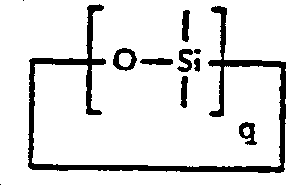
Wherein p is 1-100, for example 1-25, for example 1-9.This siloxy-skeleton structure also can be the ring texture of following formula representative:
Wherein q is 2-10.The siloxy-main chain that is somebody's turn to do (gathering) siloxanes that imparts selective reagent also can be the combination of branched structure and chain/ring structure.
Can have 1-10 carbon atom to the end capped alkyl of the existing key of siloxy-skeleton.The example of this class alkyl is methyl and phenyl.
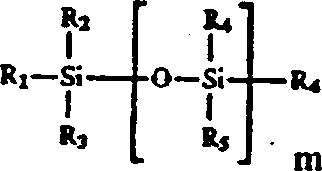
Example with (gathering) silicone compounds of chain siloxy-skeleton structure comprise as shown in the formula those:
Wherein, R
1And R
6Be hydrogen, methyl or phenyl independently; R
2, R
3, R
4And R
5Be methyl or phenyl independently; And m is 1-100, for example 1-25, for example 1-10, for example 1-4.Preferably, binding is to no more than one of the phenyl of each Siliciumatom.This specific examples with (gathering) silicone compounds of chain siloxy-skeleton structure comprises: hexamethyldisiloxane, decamethyl tetrasiloxane and phenylbenzene tetramethyl disiloxane.Specific examples with (gathering) silicone compounds of ring-type siloxy-skeleton structure comprises: octamethylcyclotetrasiloxane and decamethylcyclopentaandoxane.Specific examples with (gathering) silicone compounds of ramose siloxy-skeleton structure is: three-(trimethylsiloxy)-phenyl silane and three-(trimethylsiloxy)-silane.
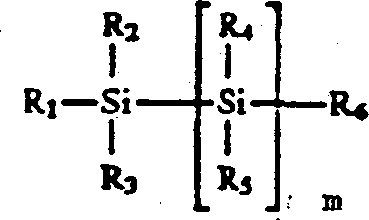
Can have structure as the silane compound of that imparts selective reagent in the inventive method, wherein the direct binding rather than pass through Sauerstoffatom mutually of Siliciumatom corresponding to above-mentioned (gather) silicone compounds.Example with silane of chain-like skeletal structure comprise as shown in the formula those:
Wherein, R
1And R
6Be hydrogen, methyl or phenyl independently; R
2, R
3, R
4And R
5Be methyl or phenyl independently; And m is 1-100, for example 1-25, for example 1-10, for example 1-4.An example of this silane compound is: hexamethyldisilane.
(gathering) silicone compounds of representative pre-that imparts selective comprises: dimethyl (gathering) siloxanes, diethyl (gathering) siloxanes, phenyl methyl (gathering) siloxanes, methyl hydrogen (gathering) siloxanes, ethyl hydrogen (gathering) siloxanes, phenyl hydrogen (gathering) siloxanes, methylethyl (gathering) siloxanes, phenylethyl (gathering) siloxanes, phenylbenzene (gathering) siloxanes, methyl trifluoro propyl (gathering) siloxanes, ethyl trifluoro propyl (gathering) siloxanes, polydimethylsiloxane, tetrachlorobenzene ylmethyl (gathering) siloxanes, tetrachloro phenylethyl (gathering) siloxanes, tetrachloro phenyl hydrogen (gathering) siloxanes, tetrachloro phenyl (gathering) siloxanes, methyl ethylene (gathering) siloxanes, and ethyl vinyl (gathering) siloxanes.It is linear that (gathering) siloxanes, siloxanes or the silane compound of pre-that imparts selective need not, and can be cyclic, for example, and hexamethyl cyclotrisiloxane, octamethylcyclotetrasiloxane, hexaphenyl cyclotrisiloxane and octaphenyl cyclotetrasiloxane.The mixture of these compounds also can be used as pre-that imparts selective reagent, as being (gathering) siloxanes with other functional group.
Especially when this pre-that imparts selective agent dissolves in organic carrier or in aqueous carrier during emulsification, the preferred pre-that imparts selective reagent of organosilicon comprises 3,5-dimethylphenyl methyl polysiloxane (for example Dow-550) and phenyl methyl polysiloxane (for example Dow-710).Dow-550 and Dow-710 can be from Dow Chemical Co., Midland, and MI. obtains.
When the pre-that imparts selective reagent of organosilicon existed with the water-soluble cpds form in the aqueous solution, this organosilicon can replace with one or more hydrophilic functional groups or part, and their effect is promote these silicoorganic compound always water-soluble.These hydrophilic functional groups can comprise one or more organic amine groups, for example-and N (CH
3)
3,-N (C
2H
5)
3With-N (C
3H
7)
3The pre-that imparts selective reagent of a kind of preferred water-soluble organic silicon is Tri N-Propyl Amine silane, can obtain with Hydrosil2627 from Huls America.Concrete water-soluble organic silicon compounds, the multiple dipping that it can be used for catalyzer of the present invention is called the aminosilane polymkeric substance in US5371312.As mentioned above, the silicoorganic compound water miscible liquid that contains tensio-active agent can be used for the dipping of catalyzer of the present invention.The stable aqueous emulsions (for example silicone oil) of silicoorganic compound has been described in US5726114.
Available more than one that imparts selective method makes first catalyzer have selectivity.Especially, before being used for the inventive method, the crystal molecule sieve can be contacted with silicoorganic compound earlier, then in oxygen-containing atmosphere, calcine.This pre-treatment of molecular sieve also can be referred to as pre-that imparts selective in this article and handle.
According to an example of preselected property method, this catalyzer is right after after each processing by the pre-that imparts selective with the single or multiple processing of liquid organosilicon compound in the liquid carrier, for example calcines handled material in the air at oxygen-containing atmosphere.
When making this catalyzer by single or multiple dipping technique, at this catalyzer of each dipping back calcining, so that remove carrier and change the liquid silicone compound into its solid residue by pre-that imparts selective.At this, this solid residue is referred to as the silicon-containing solid material, and this material it is believed that it is a base polymer that has high silicon atom content in its various structures.But this silicon-containing solid residue also can comprise carbon atom in its structure, and it is derived from the remnants of the organic moiety of the silicoorganic compound that are used for impregnated catalyst.
Follow closely after each dipping, speed that can 0.2 ℃/minute to 5 ℃/minute is brought up to temperature greater than 200 ℃ but is lower than the temperature that the degree of crystallinity to the crystal molecule sieve has a negative impact, and calcines this catalyzer.This calcining temperature can be lower than 700 ℃, for example, and in about 350 ℃ of-550 ℃ of scopes.Can be 1-24 hour, for example 2-6 hour in the lasting incinerating time of calcining temperature.
Can in inertia or oxidizing atmosphere, calcine the catalyzer of dipping.An example of this inert atmosphere is that nitrogen is N
2Atmosphere.An example of oxidizing atmosphere is an oxygen-containing atmosphere.Air for example.Calcining can be at first at rare gas element N for example
2Take place in the atmosphere, subsequently for example air or air and N in oxygen-containing atmosphere
2Gas mixture in calcine.Calcining should be in atmosphere be carried out under the condition of essentially no water vapor, to avoid worthless Catalyst Steam out of control.After each dipping, this catalyzer can be calcined once or more than once.Needn't be identical with the various calcinings behind each dipping, and can change incinerating temperature, temperature rise rate, atmosphere and time length.
Be deposited on the siliceous residue on molecular sieve or the binding molecule sieve, its amount depends on many factors, comprise the dipping and the temperature of calcining step, in mounting medium the concentration, catalyzer of silicoorganic compound with the used atmosphere of the degree, the calcining that have been dried before silicoorganic compound contacts and calcine the lasting time.Disregard in this tackiness agent or the silica percentage ratio in this crystal molecule sieve itself, the appropriate amount of silicon is greater than 9 weight % (wt.%), for example greater than 12wt.% on the catalyzer.
According to smoothing technique that imparts selective method as herein described, under suitable smoothing technique that imparts selective condition, first catalyzer can be contacted with incoming flow, generally comprise hydrogen and contact with silicoorganic compound with aromatic compound (for example toluene) or paraffin compound (for example hexane or decane).These conditions can comprise 100 ℃-600 ℃ of temperature ranges, for example, and 300 ℃-500 ℃, pressure range 0-2000psig, 15-800psig for example, hydrogen is to the mol ratio 0.1-20 of hydrocarbon (for example toluene), 0.25-10 for example, for example 1-4, and weight hourly space velocity (WHSV) 0.1-100 hour
-1, for example 0.1-10 hour
-1Toluene can contain 50 weight %-100 weight %, for example hydrocarbon of at least 80 weight % in charging.Also can contain other hydrocarbon in the charging of the method for smoothing technique that imparts selective, for example benzene, dimethylbenzene and trimethylbenzene.
In that imparts selective process, exist the hydrogen of q.s to help to prevent the rapid ageing of this catalyzer in the charging of smoothing technique that imparts selective, on this catalyzer, can form a spot of carbonaceous sediment.The consequence of this carbonaceous sediment is, can show carbon content significantly greater than the carbon content of new controlling catalyst to the ultimate analysis of the catalyzer of smoothing technique that imparts selective, and this new controlling catalyst is with multiple immersion process for preparing as herein described.Through ultimate analysis, the catalyzer of this smoothing technique that imparts selective especially can contain at least 2 weight %, the carbon of at least 4 weight % for example, and can contain the carbon that is lower than 0.5 weight % by determination of elemental analysis through multiple catalyst prepared.These weight percentage are based on that the weight of whole catalyzer (comprising for example hydrogenation/dehydrogenation component of crystal molecule sieve, tackiness agent and optional components) represents.
First catalyzer also can carry out controlled coking.This controlled coking step is also referred to as coking that imparts selective method herein.This optional coking that imparts selective method can be included in and surpass described compound decomposition temperature but be lower than under the high temperature of the temperature that zeolite crystallinity is had a negative impact, and catalyzer is contacted with heat decomposable organic compound.This contact temperature can be, and for example is lower than 650 ℃.This catalyzer can carry out coking transforming in used different reactor or other container with toluene, carries this coking catalyst subsequently in the toluene conversion reactor.
The organic materials that can be used for this coking that imparts selective method comprises many kinds of compounds, for example comprises: hydro carbons such as paraffinic hydrocarbons, naphthenic hydrocarbon, alkene, cycloolefin and aromatic hydrocarbon; Oxygen-containing organic compound, for example alcohol, aldehyde, ether, ketone and phenol; And heterocyclic such as furans, thiophene, pyrroles and pyridine.Co-fed hydrogen can be used to stop excessive formation coke.The more details of the technology of relevant coking that imparts selective are provided in U.S. Pat 4117026 and US5476823.Randomly, can be included in the used organic matter raw material of coking that imparts selective a kind of organosilicon is co-fed.This organosilicon material can be selected from the above-mentioned silicoorganic compound that are used for the catalyzer that imparts selective.
Though do not want to be subjected to the constraint of any concrete theory, might obtain selectivity of catalyst of the present invention by changing the diffusion of zeolite, it promotes the reaction that needs and suppresses unwanted reaction.
The catalyzer crystal molecule screen banks that is suitable for use as first catalyzer divides and can be characterized by different dimethylbenzene diffusions or dimethylbenzene absorption property.Particularly, have been found that, for when the suitable toluene conversion, obtain the p-Xylol selectivity of desired level, first catalyzer should to can be to,, ortho position dimethylbenzene or their mixture, common is p-Xylol, has balanced loading capacity, and it is the shortest that reason is that this isomer reaches balance time; Under 120 ℃ and 4.5+0.8 mmhg dimethylbenzene pressure, requirement records per 100 gram zeolites at least 1 grams, and with regard to the dimethylbenzene loading capacity 30% with regard to, the o-Xylol adsorption time is greater than 50, be preferably greater than 200, more preferably greater than 1200 (under identical temperature and pressure conditions).Can under thermal equilibrium, adsorb measurement with gravity method.
The p-Xylol selectivity that has been found that zeolite is very high, and the time that the while o-Xylol is grown because of needs very much reaches minimum, and this time preferably reaches and surpasses 1200 minutes, so that to account for the amount absorption o-Xylol of whole dimethylbenzene loading capacities 30%.For these materials, way is more easily: measure the adsorption time of the absorption of low degree more, and for example 5% of capacity, 10% or 20%, then,, estimate the time of 30% absorption by adopting following magnification factor F, be adsorbed as example with 5% it is illustrated as:
t
0.3=F·t
0.05
The time of percentage ratio factor F estimation 30% absorption of loading capacity, t
0.3
5 36
10 9
20 2.25
In addition, can utilize following relation, other adsorption time when being less than dimethylbenzene capacity 30% calculates t
0.3:
t
0.3=t
0.x(0.3/0.x)
2
Wherein
t
0.330% adsorption time of-total xylene capacity
t
0.xThe adsorption time of the x% of-total xylene capacity
The mark of the relative total xylene capacity of O.x-o-Xylol
According to the present invention, influence catalyzer crystal molecule screen banks that toluene transforms and divide to have and surpass 50, for example greater than 200, for example greater than 1200 minutes t to o-Xylol
0.3Value (unit minute).
Toluene disproportionation
Under the condition of effective disproportionation, first catalyzer can be contacted with toluene feed.The condition for validity of realizing high p-Xylol selectivity and admissible toluene level of conversion comprises: reactor inlet temperature is 200 ℃ (392 °F)-550 ℃ (1022 °F), preferred 312 ℃ (600 °F)-532 ℃ (1000 °F); Pressure is normal atmosphere-5000psi, preferred 20-1000psig; WHSV is 0.1-20, preferred 0.5-10; And H
2The mol ratio of/hydrocarbon is 0-20, preferred 0-10.This method can be carried out with continuous flow, intermittence or fluidized-bed mode of operation.
Can further improve this catalyzer, so that reduce worthless by-product volume, ethylbenzene particularly, method is to introduce the hydrogenation/dehydrogenation function in catalyzer, for example by adding other metal of 4-13 family in metallic compound such as the platinum or the periodic table of elements, as platinum, palladium, silver, gold, copper, zinc, nickel, gallium, cobalt, molybdenum, rhodium, ruthenium, manganese, rhenium, tungsten, chromium, iridium, osmium, iron, cadmium and composition thereof (binding substances).Can add this metal by cationic exchange or by dipping by known method, addition is 0.01%-10%, is generally 0.05%-10%.
Show selectivity with the toluene disproportionation of the catalyzer of this that imparts selective for high purity p-Xylol and m-xylene.This might obtain in fact not have the dimethylbenzene product of o-Xylol up to 27% toluene conversion the time.Can under no o-Xylol condition, make a kind of C
8Stream to reduce o-Xylol, perhaps can obtain a kind of logistics so that the unitary C of preparation purification of terephthalic acid through the o-Xylol splitter with its blend
8Charging.This dimethylbenzene product does not comprise substantially that preferably o-Xylol maybe can ignore o-Xylol.What is called can be ignored and is meant and is less than 0.2%, preferably is less than 0.1%, more preferably less than 0.05%.Have been found that and such dimethylbenzene product directly can be fed in the Production of Terephthalic Acid step and need not intermediate purification.
Production of Terephthalic Acid
There are many methods to be used for the commercial production of terephthalic acid.A kind of is the Amoco process of for example describing in the U.S. Pat 2833816 (Amoco process).This method relates to the liquid phase air oxidation of p-Xylol, its in acetate solvate, use multivalence (weight) metal particularly cobalt and manganese as catalyzer and with bromine as renewable radical source.For example reclaim the terephthalic acid product crystal by centrifugation, and by with this dissolution of crystals in the water with hydrogenation catalyst for example the carbon precious metal of making carrier contact and purify, and reclaim this crystal once more.By terephthalic acid and the liquid phase esterification of excessive methanol greatly, can make dimethyl terephthalate (DMT), it uses metal catalyst, for example zinc, molybdenum, antimony and tin.
In other method, with 4 steps, alternating oxidation and esterification prepare dimethyl terephthalate (DMT), for example described in the british patent specification 727989 and 809730.At first, at heavy metal catalyst for example in the presence of cobalt, manganese or the two mixture, in liquid phase,,, PTA is used methanol esterification so that make methyl paratolunitrile ester (MPT) so that produce paratolunitrile (PTA) with gas (air) oxidation of p-xylene of molecule-containing keto.With the molecular oxygen secondary oxidation MPT that produces in same catalyst and the liquid phase, obtain the terephthalic acid monomethyl ester, its esterified one-tenth diester dimethyl terephthalate (DMT).
Terephthalic acid and dimethyl terephthalate (DMT) all can by with glycol ethylene glycol or 1 for example, the reaction of 4-butyleneglycol is used for producing polyethylene terephthalate (PET) or other polyester.