CN1319087A - Preparation of quinonediimines from phenylenediamines using oxygen and metal or metal salt catalyst - Google Patents
Preparation of quinonediimines from phenylenediamines using oxygen and metal or metal salt catalyst Download PDFInfo
- Publication number
- CN1319087A CN1319087A CN99807960A CN99807960A CN1319087A CN 1319087 A CN1319087 A CN 1319087A CN 99807960 A CN99807960 A CN 99807960A CN 99807960 A CN99807960 A CN 99807960A CN 1319087 A CN1319087 A CN 1319087A
- Authority
- CN
- China
- Prior art keywords
- reaction
- metal catalyst
- water
- phenylenediamine
- solvent
- Prior art date
- Legal status (The legal status is an assumption and is not a legal conclusion. Google has not performed a legal analysis and makes no representation as to the accuracy of the status listed.)
- Granted
Links
Classifications
-
- C—CHEMISTRY; METALLURGY
- C07—ORGANIC CHEMISTRY
- C07C—ACYCLIC OR CARBOCYCLIC COMPOUNDS
- C07C249/00—Preparation of compounds containing nitrogen atoms doubly-bound to a carbon skeleton
- C07C249/02—Preparation of compounds containing nitrogen atoms doubly-bound to a carbon skeleton of compounds containing imino groups
Landscapes
- Chemical & Material Sciences (AREA)
- Organic Chemistry (AREA)
- Organic Low-Molecular-Weight Compounds And Preparation Thereof (AREA)
- Low-Molecular Organic Synthesis Reactions Using Catalysts (AREA)
- Catalysts (AREA)
Abstract
A phenylenediamine compound can be converted, with high selectivity, into its corresponding quinonediimine by reacting the phenylenediamine with oxygen and a metal catalyst or a salt thereof.
Description
This application requires the right of priority of the U.S. Provisional Application 60/,087 754 of submission on June 2nd, 1998.
Invention field
The present invention relates to use oxygen and metal catalyst or metal salt catalyst to prepare the method for quinondiimine class by corresponding phenylenediamine.
Background of invention
This class material of annulenones is that organic chemistry filed is known.The most known example of annulenones (cyclicenones) is a quinones, such as for example benzoquinones, naphthoquinones, anthraquinone, phenanthrenequione etc.Usually with 1, the 4-benzoquinones is called quinone.Quinones generally is the compound of bright color, has been widely used as the redox material in chemosynthesis, biologic applications and industry.Chemistry and application for quinones have some summary documents, for example " Kirk-0thmer chemical technology complete works (Encyclopedia of Chemical Technology) ", the 3rd edition, 19 volumes, 572-605 page or leaf, John Wiley ﹠amp; Sons, New York, 1982.Synthesizing of quinones also by wide coverage.See, for example, J.Cason, " benzoquinones oxidation synthesis method " (Synthesis ofBenzoquinones by Oxidation) ", " organic synthesis " (Organic Synthesis), IV volume, 305 pages, John Wiley ﹠amp; Sons, New York (1948).Usually prepare quinones by the suitable dibasic arene derivatives of oxidation, substituting group is at the ortho position or contraposition hydroxyl or amino.For example, 1, the 4-benzoquinones can prepare by oxidation quinhydrones/p-aminophenol or Ursol D or by quinic acid.The reagent that is generally used for oxidation is dichromate/sulfuric acid mixture, iron(ic) chloride, silver suboxide (II) or ceric ammonium nitrate.In these examples, the oxidation of amino aromatic compound is accompanied by the hydrolysis of corresponding quinone.In order to finish reaction, some technologies can need a few hours.
Therefore, the existing technology of some of this area uses catalyzer to realize acceptable response, although other technologies do not use catalyzer to carry out.The method according to this invention is used metal or metal-salt oxide catalyst, for the preparation quinondiimine provides high conversion and speed of reaction.
A kind of prior art of catalyzer of using when preparing the quinonimine compound is disclosed in people's such as Desmurs the U.S. Patent No. 5189218.People's such as Desmurs the method that N-(4-hydroxy phenyl) aniline is converted into N-phenyl benzoquinone imine uses manganese, copper, cobalt and/or nickel compound as catalyzer in the oxidized form reaction.Although people such as Desmurs disclose N-phenyl benzoquinone imine is converted into N-phenyl-N' cycloalkyl-2,5-encircles dihexyl-1, the 4-diimine, but people such as Desmurs do not recognize oxide catalyst be used for this conversion, more do not use the metal oxidation catalyst of using among the present invention.People such as Desmurs have confirmed this point in the suggestion that the 5th hurdle 14-22 exercises with hydrogenation catalyst.
Other known method is to use oxygenant that phenylenediamine is converted into their corresponding quinondiimine classes.For example described by oxidation diamines in alkali/alcoholic solution the EP 708 081 (people such as Bernhardt) that phenylenediamine is converted into the benzene diimine has been carried out general description to these class methods in its background.The EP'081 method is subjected to the puzzlement of various defectives, comprises very long reaction times and low-yield.
In the U.S. Patent No. 5 118 807 of Wheeler, people's such as GB1 267 635, Hass EP 708 080, another kind of method of oxidative conversion has been described.But, wherein do not have suggestion in the conversion of phenylenediamine compound, oxygen and metal catalyst or metal salt catalyst to be used together with highly selective and generate the quinondiimine compound.
The present invention itself based on problem provide a kind of simple and economical method and be used for high yield high purity ground preparation quinondiimine.
Summary of the invention
Have been found that by the reaction of diamines and metal catalyst or metal salt catalyst in the presence of oxygen, but the phenylenediamine compound highly selective is converted into corresponding quinondiimine.The condition that obtains near quantitative production is disclosed.
Against existing technologies, advantage of the present invention is almost quantitatively phenylenediamine to be converted into corresponding quinondiimine.Therefore, reaction does not almost have waste residuum when finishing.
Another advantage is that metal as described herein or metal salt catalyst provide transformation efficiency, highly selective and the faster more completely reaction higher than existing method.
After reading and understanding hereinafter detailed description of the preferred embodiments, those skilled in the art can clear and definite other advantage of the present invention.Detailed description of the present invention
The purpose of this invention is to provide a kind of effective ways that phenylenediamine are converted into its corresponding quinondiimine.
According to purpose of the present invention, react in the presence of metal catalyst or its salt according to the phenylenediamine (ortho position or contraposition) of formula I a or I b and oxygen,
 Formula I a
 Formula I b is R wherein
1And R
2Be independently selected from hydrogen, hydroxyl, alkyl, alkoxyl group, aryloxy, alkenyl, cycloalkyl, aryl, aralkyl, alkaryl, alkylamino, virtue amino, heterocyclic radical, acyl group, formyl radical, aroyl, cyano group, halogen, sulfydryl, alkylthio, arylthio, amino, nitro, sulfonate group, alkyl sulphonyl, aryl sulfonyl, amino-sulfonyl, hydroxycarbonyl group, alkoxy carbonyl and aryloxycarbonyl, wherein R
1And R
2The moieties of group can be a straight or branched, each R
1And R
2Group can further be substituted; R wherein in addition
3, R
4, R
5And R
6Identical or different; be selected from hydrogen, hydroxyl, alkyl, alkoxyl group, aryloxy, alkenyl, cycloalkyl, aryl, aralkyl, alkaryl, alkylamino, virtue amino, heterocyclic radical, acyl group, aroyl, cyano group, halogen, sulfydryl, alkylthio, arylthio, amino, nitro, sulfonate group, alkyl sulphonyl, aryl sulfonyl, amino-sulfonyl, hydroxycarbonyl group, alkoxy carbonyl and aryloxycarbonyl, wherein R
3, R
4, R
5And R
6The moieties of group can be a straight or branched, each R
3, R
4, R
5And R
6Group can further be substituted in the position that is fit to.
Formula I b is R wherein
1And R
2Be independently selected from hydrogen, hydroxyl, alkyl, alkoxyl group, aryloxy, alkenyl, cycloalkyl, aryl, aralkyl, alkaryl, alkylamino, virtue amino, heterocyclic radical, acyl group, formyl radical, aroyl, cyano group, halogen, sulfydryl, alkylthio, arylthio, amino, nitro, sulfonate group, alkyl sulphonyl, aryl sulfonyl, amino-sulfonyl, hydroxycarbonyl group, alkoxy carbonyl and aryloxycarbonyl, wherein R
1And R
2The moieties of group can be a straight or branched, each R
1And R
2Group can further be substituted; R wherein in addition
3, R
4, R
5And R
6Identical or different; be selected from hydrogen, hydroxyl, alkyl, alkoxyl group, aryloxy, alkenyl, cycloalkyl, aryl, aralkyl, alkaryl, alkylamino, virtue amino, heterocyclic radical, acyl group, aroyl, cyano group, halogen, sulfydryl, alkylthio, arylthio, amino, nitro, sulfonate group, alkyl sulphonyl, aryl sulfonyl, amino-sulfonyl, hydroxycarbonyl group, alkoxy carbonyl and aryloxycarbonyl, wherein R
3, R
4, R
5And R
6The moieties of group can be a straight or branched, each R
3, R
4, R
5And R
6Group can further be substituted in the position that is fit to.
Reaction production II a or the corresponding quinondiimine of II b:
 Formula II a
 Formula II b is R wherein
1, R
2, R
3, R
4, R
5And R
6The definition with formula I a or I b compound in identical.
Formula II b is R wherein
1, R
2, R
3, R
4, R
5And R
6The definition with formula I a or I b compound in identical.
Reaction is expressed as follows: reaction process 1

More particularly, R
1And R
2Variable group is selected from hydrogen; hydroxyl; the C1-C50 alkyl; the C1-C50 alkoxyl group; the C6-C40 aryloxy; the C2-C50 alkenyl; the C3-C20 cycloalkyl; the C6-C40 aryl, the C7-C50 aralkyl; the C7-C50 alkaryl; C1-C20 alkylamino and dialkyl amido; C6-C40 virtue amino and ammonia diaryl base; C3-C30 contains one or more N; O; the heterocyclic radical of S or P atom; the C2-C50 acyl group; formyl radical; the C7-C40 aroyl; cyano group; such as F; Br; the halogen of I or C1; sulfydryl; the C1-C50 alkylthio; the C6-C40 arylthio; amino; nitro; wherein X is selected from sodium; the formula SO of C1-C50 alkyl or C6-C40 aryl
3The sulfonate base of X, alkyl sulphonyl, aryl sulfonyl, amino-sulfonyl, hydroxycarbonyl group, C1-C50 alkoxy carbonyl and C6-C40 aryloxycarbonyl, wherein R
1The moieties of group can be a straight or branched, each R
1Group can further be replaced by suitable group; In addition, R
3, R
4, R
5And R
6Identical or different; be selected from hydrogen; hydroxyl; the C1-C50 alkyl; the C1-C50 alkoxyl group; the C6-C40 aryloxy; the C2-C50 alkenyl; the C3-C20 cycloalkyl; the C6-C40 aryl; the C7-C50 aralkyl; the C7-C50 alkaryl; Cl-C20 alkylamino and dialkyl amido; C6-C40 virtue amino and ammonia diaryl base; C3-C30 contains one or more N; O; the heterocyclic radical of S or P atom; the C2-C50 acyl group; formyl radical; aroyl; cyano group; such as F; Br; the halogen of I or Cl; sulfydryl; the C1-C50 alkylthio; the C6-C40 arylthio; amino; nitro; wherein X is selected from sodium; the sulfonate base of the formula SO3X of C1-C50 alkyl or C6-C40 aryl; alkyl sulphonyl; aryl sulfonyl; amino-sulfonyl; hydroxycarbonyl group; C1-C50 alkoxy carbonyl and C6-C40 aryloxycarbonyl, wherein R
3, R
4, R
5And R
6The moieties of group can be a straight or branched, each R
3, R
4, R
5And R
6Group can further be substituted in the position that is fit to.
Preferred R
1And R
2Be C1-C20 alkyl, C6-C20 aryl, C7-C20 alkaryl, C3-C10 cycloalkyl, C2-C20 alkenyl, C3-C20 heterocyclic radical, C2-C20 acyl group and C7-C20 aroyl.Be suitable as R
1, R
2, R
3, R
4, R
5And R
6The example of group is the alkyl of straight or branched, such as methyl, ethyl, propyl group, butyl, amyl group, hexyl, heptyl, octyl group, nonyl, decyl, dodecyl, 1,3-dimethylbutyl, 1,4-dimethyl amyl group, sec.-propyl, sec-butyl, 1-ethyl-3-methyl amyl, 1-methylheptyl etc.; Aryl is such as phenyl, naphthyl, anthryl, tolyl, ethylbenzene base etc.; Cycloalkyl is such as cyclobutyl, cyclopentyl, cyclohexyl, ring octyl group etc.Other example comprises hydrogen, allyl group and isobutenyl; 1; 3; 5-connection triazinyl, 2-[4-morpholinodithio base, 2-benzimidazolyl-, 2-benzoxazolyl, 2-pyridyl, 2-pyrimidyl, 2,5-thiadiazolyl group, 2-pyrazinyl, adipoyl, glutaryl-, succinyl, malonyl, ethanoyl, propenyl, methylpropenyl, caproyl, 3-mercapto radical propionyl group, benzoyl, phthaloyl, terephthaloyl, aminocarboxyl, ethoxy carbonyl, formyl radical etc.These only are used to exemplify group, scope of the present invention are not construed as limiting.
In reaction, according to the present invention, metal catalyst is generally the transition metal of I B, II B, V B, VI B, VII B and the VIII family of the periodic table of elements.Metal can be the form of its ionic state or metal-salt.Can be used alone or as a mixture catalyzer.Typical metal comprises V, Nb, Ta, Cr, Mo, W, Mn, Tc, Re, Fe, Ru, Os, Co, Rh, Ir, Ni, Pd, Pt, Cu, Ag, Au, Zn, Cd, Hg and its salt.The catalyzer that also comprises load is such as Pd/C, Pt/C, Ni/Al, Ru/C, Rh/C etc.Some example indefiniteness ground of preferred catalyzer comprise Pt/C, Pd/C, Rh/C, Ru/C, nickel oxide (II), load on phthalocyanine cobalt and silver suboxide on the carbon.
Based on the weight of phenylenediamine starting raw material, the general consumption of catalyzer is that about 0.1% weight is to about 20.0% weight in the present invention.
Catalyzer of the present invention causes the conversion reaction in the method according to this invention.Advantageously used solid catalyst in reaction according to the present invention, because reclaim solid catalyst easily after filtration, and solid catalyst can be used for technical process once more.From the environment protection angle also is favourable, littler by the possibility of catalyst contamination in final quinondiimine separates.In addition, catalyzer provides high conversion and fabulous selectivity.
According to the present invention, be reflected in homogeneous phase or the two phase solvent system and carry out.The organic solvent of water soluble is used for homogeneous reaction, and water-insoluble organic hydrocarbon solvent produces two-phase system.Also comprise water in the two-phase system.The two-phase oxidation system makes organic composition (quinondiimine and solvent) separate from the waterbearing stratum of losing efficacy easily.The organic sprotic solvent that can be used in the inventive method comprises ketone without limitation, such as pimelinketone, 4-methyl-2 pentanone (methyl iso-butyl ketone (MIBK)), 5 methy 12 hexanone, methyl ethyl ketone; Aliphatic series and aromatic hydrocarbons are such as hexane, heptane, toluene, dimethylbenzene; Nitrile is such as acetonitrile; Halogenated solvent is such as chloroform, methylene dichloride, tetracol phenixin; The solvent of water soluble is such as dimethyl sulfoxide (DMSO), N-N-methyl-2-2-pyrrolidone N-, tetramethylene sulfone, dimethyl formamide; The ester class is such as ethyl acetate; Ethers, such as 1, the 4-diox; Alcohols is such as methyl alcohol; With their mixture.
As catalyzer, to reclaim the back from product capable of circulation and be used for once more reacting when solvent.When having water in reaction, based on the weight of total reaction mixture, the general water yield is 75% weight at the most.Water can be used as independent solvent and exists, or can be with other water-soluble or water-insoluble organic solvents exist jointly.
When using the water-soluble salt of metal catalyst in reaction according to the present invention, using two phase solvent system is ideal.Use two phase solvent system with water soluble metal catalyst catalyzer easily to be separated from the end product of needs, because end product is present in organic phase, and catalyzer is present in water.Catalyzer and water-containing solvent can be circulated again in the reaction.
Initial phenylenediamine concentration range can be for about 1% to 100%w/v.The concentration range of preferred initial phenylenediamine is about 25% to about 60%w/v.
The present invention's reaction can be carried out about 0 ℃-Yue 150 ℃ temperature, preferred about 25 ℃-Yue 70 ℃.
Phase-transfer catalyst can be used for quickening the speed of the catalytic reaction of above-mentioned metal catalyst.When making the immiscible solvent of water, the speed of using phase-transfer catalyst to quicken the reaction of the inventive method is favourable.The example indefiniteness ground that is used for the phase-transfer catalyst of the inventive method comprises quaternary ammonium salt, such as Tetramethylammonium hydroxide, quaternary alkylammonium halides, four-N-butyl brometo de amonio, four-N-butyl ammonium chloride, benzyltriethylammoinium chloride; Phosphonium salt is such as chlorination two [three (dimethylamino) phosphine] imonium (iminium); Crown ether-like and polyoxyethylene glycol.
Phase-transfer catalyst directly can be joined in the reaction mixture, maybe it can be dissolved in one of reaction reagent, such as being dissolved in the phenylenediamine.Also can before the solvent that is used for this method or water join reactive material, phase-transfer catalyst be dissolved in wherein.
Another method that can improve speed of reaction is stirring or the mixing velocity that improves in the reaction.Stir or mixing by increasing, when needs, can effectively speed of reaction be adjusted to faster rate and carry out.
Other method that improves speed of reaction comprises the raising temperature of reaction, improves the pressure that reacts and improves catalyst consumption.
In addition, add the alkaline pH conditioning agent,, can improve speed of reaction, can also improve the selectivity of required quinondiimine end product such as triethylamine.
In addition, reaction can be used more than a kind of blended phenylenediamine starting raw material, and preparation contains the product of quinondiimine mixture.
Also have, reaction can stop before finishing, thereby preparation contains the product of phenylenediamine and quinondiimine mixture.For example, the amount by oxygen in the amount of regulating catalyzer, the amount of regulating the pH regulator agent and/or the conditioned reaction can obtain the very specific phenylenediamine and the mixture of quinondiimine.Based on the specific end use of product, this class mixture has than the better effect of the product of high quinondiimine content.
The present invention more clearly explains by the following example.
Embodiment 1
N-1,3-dimethylbutyl-N '-phenyl-Ursol D (Santoflex
6PPD, 5g, 0.019mole), methyl alcohol (200ml), triethylamine (2ml), water (2ml) and mixture of catalysts place autoclave.Stirred reaction mixture purifies autoclave with oxygen, feeds 30psig oxygen at 20-25 ℃ then.Reaction mixture is heated to 50 ℃, remains on 50 ℃ and finishes up to reaction.When reaction was carried out, oxygen pressure descended.When pressure was reduced to about 20psig, aerating oxygen again in reactor made pressure get back to 30psig.Begin to feed the autoclave calculating reacting time from oxygen.Very little or when not absorbing, filtering mixt is isolated catalyzer when the oxygen absorption that can survey.
The product component of the mixture of reaction times and generation is as shown in the table.In most of the cases, obtain N-1,3-dimethylbutyl-N '-phenyl is to the high conversion of the quinondiimine product of the needs of benzene diimine (6QDI).In some reactions, reaction not exclusively, so mixture shows and contains unreacted starting raw material Santoflex
6PPD.Further continue reaction simply and can finish these reactions.When catalyzer is heterogenetic, but filter reaction mixture is with product and catalyst separating.Filtering reaction mixture concentrated can very high productive rate obtain the product 6QDI that needs.
In following table among the listed embodiment, when no longer including oxygen depletion or considerably less oxygen absorption is only arranged, show that reaction finishes, but this moment analyze reaction mixture.But the method that this judgement reaction is finished is always not believable.Therefore, in some reactions, there is unreacted starting raw material.Simultaneously, when reaction when all finishing, the actual reaction times may be than listed low of table 1.
Analysis revealed Santoflex
Exhaust and the highly selective of 6PPD have generated corresponding quinondiimine.HPLC area % analytical results is summarized in following table 1.
The catalyzer that is used to be numbered 1-4 contains 50% the water of having an appointment.Therefore, based on dry weight, the weight of catalyzer probably is half value.For example 0.5g should convert and be 0.25g etc.
Various isolation technique well known in the art can be used for the separation according to product of the present invention, and these isolation technique comprise without limitation to be filtered and concentrate.The catalyzer that reclaims from reaction and solvent is capable of circulation and be used for follow-up reaction once more.
Table 1
| ?No. | The catalyzer that uses | Catalyzer | The Rxn time | HPLC area % | HPLC area % |
| Weight | Hour | Product | Starting raw material | ||
| 6QDI | ?Santoflex?6PPD | ||||
| ?l | 3% platinum carbon | 0.5g | ?2.8 | ?92.3 | ?3 |
| ?2 | 3% palladium carbon | 1.5g | ?3.5 | ?97.6 | ?0 |
| ?3 | 5% rhodium carbon | 1.3g | ?1.6 | ?97.1 | ?0 |
| ?4 | 5% ruthenium carbon | 1.2g | ?2.7 | ?82.2 | ?14.9 |
| ?5 | Nickel oxide (II) | 0.5g | ?2.3 | ?87 | ?11.9 |
| ?6 | Cobalt oxide (III) | 0.5g | ?2.1 | ?97.9 | ?0.6 |
| ?7 | 5wt% is carried on the phthalocyanine cobalt on the carbon | 0.5g | ?2.1 | ?91.5 | ?2.8 |
| ?8 | Silver suboxide | 0.5g | ?3.3 | ?91.7 | ?3.3 |
Comparison shows that of following three embodiment adds that pH regulator agent such as triethylamine helps speed of reaction and to the selectivity of required product 6QDI.In the following example, the weight of the catalyzer that uses is weight in wet base, contains 50% water of having an appointment.Therefore the dry weight of the catalyzer that uses should be half value.For example, under the situation of the heavy 0.500g of catalyzer, the dry weight of catalyzer should be 0.25g etc.
These embodiment carry out under identical condition, use in responding identical raw material with the variation between avoiding batch and be beneficial to better comparison.Reaction does not proceed to all to be finished, so the HPLC analysis revealed has unreacted starting raw material Santoflex
6PPD exists.Proceed reaction simply and can finish these reactions.
Embodiment 2
This embodiment points out that triethylamine is to improving the effect of speed of reaction and the better choice that obtains required quinondiimine product.
According to embodiment 1 described step, N-1,3-dimethylbutyl-N '-phenyl-Ursol D (Santoflex
6PPD, 10g, 0.038mole), methyl alcohol (200ml), triethylamine (2ml) and 3%Pt/C (0.500g) mixture of catalysts place autoclave.By regular sampling and with HPLC assay products 6QDI and starting raw material Santoflex
6PPD monitoring reaction process.The results are summarized in following table 2.
Table 2
| Sample | Time | HPLC area % | HPLC area % |
| ????No. | Hour | Product | Starting raw material |
| ????6QDI | ?Santoflex??6PPD | ||
| ????1 | ????0.5 | ????9.9 | ????89.7 |
| ????2 | ????1 | ????18.1 | ????81.7 |
| ????3 | ????1.5 | ????41.6 | ????58 |
| ????4 | ????3.25 | ????56.6 | ????42.6 |
| ????5 | ????5.5 | ????65.6 | ????32.9 |
| ????6 | ????6.5 | ????66.8 | ????31.8 |
The adding of triethylamine is helpful, because the selectivity of required product 6QDI is very high, speed of reaction is also high especially.
Embodiment 3
This embodiment points out that triethylamine and water are to improving the effect of speed of reaction and the better choice that obtains required quinondiimine product.
According to embodiment 1 described step, N-1,3-dimethylbutyl-N '-phenyl-Ursol D (Santoflex
6PPD, 10g, 0.038mole), methyl alcohol (200ml), triethylamine (2ml), water (2ml) and 3%Pt/C (0.500g) mixture of catalysts place autoclave.By regular sampling HPLC assay products 6QDI and starting raw material Stantoflex
6PPD monitoring reaction process.The results are summarized in following table 3.
Table 3
| Sample | Time | HPLC area % | HPLC area % |
| ????No. | Hour | Product | Starting raw material |
| ????6QDI | ?Santoflex??6PPD | ||
| ????1 | ????0.5 | ????25.5 | ????68.6 |
| ????2 | ????1 | ????38.5 | ????61.3 |
| ????3 | ????1.5 | ????38.2 | ????59.8 |
| ????4 | ????2 | ????47.9 | ????49.4 |
| ????5 | ????3 | ????57.1 | ????42.5 |
| ????6 | ????4 | ????58 | ????36.7 |
| ????7 | ????5 | ????69.1 | ????30.1 |
| ????8 | ????6 | ????74.2 | ????24 |
The adding of triethylamine and water is helpful, because the selectivity of required product 6QDI is very high, speed of reaction is also high especially.The water that this embodiment is further illustrated in the reaction does not have disadvantageous effect to reaction.
Embodiment 4
Shown in following embodiment, be reflected under the condition that does not have the pH regulator agent and carry out.So, can prepare the product of the mixture that contains phenylenediamine and quinondiimine, or if desired, reaction can proceed to fully.
According to embodiment 1 described step, N-1,3-dimethylbutyl-N '-phenyl-Ursol D (Santoflex
6PPD, 10g, 0.038mole), methyl alcohol (200ml) and 3%Pt/C (0.500g) mixture of catalysts place autoclave.By regular sampling HPLC assay products 6QDI and starting raw material Santoflex
6PPD monitoring reaction process.The results are summarized in following table 4.
Table 4
| Sample | Time | HPLC area % | HPLC area % |
| ?No. | Hour | Product | Starting raw material |
| ????6QDI | ?Santoflex?6PPD | ||
| ??1 | ????1 | ????7.6 | ????86.1 |
| ??2 | ????2 | ????27 | ????65.6 |
| ??3 | ????3 | ????33.7 | ????53.2 |
| ??4 | ????4 | ????39.1 | ????49.2 |
| ??5 | ????5 | ????46.4 | ????37.5 |
| ??6 | ????5.6 | ????46.9 | ????35.1 |
| ??7 | ????7 | ????49 | ????24.2 |
In this experiment, the HPLC analysis revealed removes starting raw material Santoflex
Formed new peak seldom beyond 6PPD and product quinondiimine (6QDI) compound.Therefore, the generation of undesirable by product has reduced the selectivity that forms required product 6QDI.
Even it is under the condition that does not have triethylamine, reaction is also carried out, although low when there is triethylamine in the speed of reaction ratio.
The pH regulator agent that adding such as triethylamine relatively has been described in further detail of following two embodiment is to the optionally benefit of speed of reaction and required product 6QDI.In the following example, the weight of the catalyzer that uses is weight in wet base, contains 50% water of having an appointment.Therefore the dry weight of the catalyzer that uses should be half value.For example, be under the situation of 1.550g in catalyst weight, the dry weight of catalyzer should be 0.775g etc.
Embodiment 5
According to embodiment 1 described step, N-1,3-dimethylbutyl-N '-phenyl-Ursol D (Santoflex
6PPD, 5.0g, 0.019mole), methyl alcohol (200ml), triethylamine (2ml), water (2ml) and 3%Pt/C (1.550g) mixture of catalysts place autoclave.By regular sampling HPLC assay products 6QDI and starting raw material Stantoflex
6PPD monitoring reaction process.First sample that took out after 0.5 hour is carried out HPLC area % analyze, draw and contain 99.3%6QDI.Second sample that takes out after 1 hour reaction times contains 99.4%6QDI with HPLC area % analysis revealed.This clearly illustrates that to react and has finished.Filter reaction mixture is removed catalyzer, and concentrated filtrate is removed volatile matter.Confirm that the dark red liquid that obtains is a corresponding N-1,3-dimethylbutyl-N '-phenyl-quinondiimine (6QDI) almost separates with quantitative output.
Embodiment 6
According to embodiment 1 described step, except not adding triethylamine and water, under the condition identical, carry out this experiment with embodiment 5.N-1,3-dimethylbutyl-N '-phenyl-Ursol D (Santoflex
6PPD, 5.0g, 0.019mole), methyl alcohol (200ml) and 3%Pt/C (1.550g) mixture of catalysts place autoclave.By regular sampling HPLC assay products 6QDI and starting raw material Santoflex
6PPD monitoring reaction process.Following table 5 has been summed up HPLC area % analytical results.These results clearly illustrate that the use triethylamine that the reaction of not using triethylamine and water is finished than 30 minutes shown in the embodiment 5 and the sluggish of water.
Table 5
| Sample | Time | HPLC area % | HPLC area % |
| ??No. | Hour | Product | Starting raw material |
| ????6QDI | Santoflex??6PPD | ||
| ???1 | ????0.5 | ????69.9 | ????23.9 |
| ???2 | ????1 | ????85.1 | ????11.3 |
| ???3 | ????1.5 | ????91.6 | ????5.3 |
Increased the amount of catalyzer in the method for embodiment 6, as seen it has produced the speed of reaction that improves than embodiment 4.
The quinondiimine of the inventive method preparation shows multiple activity in vulcanized elastomer.These activity comprise the performance of secular antioxidant activity and antiozonidate.In fact, the antioxidant ability of these anti degradants even still reservation after vulcanized rubber is by solvent extraction.In addition, the quinondiimine class is the not negative impact aspect scorching when these performances are provided, and scorching is relevant with the Ursol D anti degradant in industry usually.Can find the active summary (people such as Cain.M.E, " rubber industry " (Rubber Industry) 216-226,1975) of these compounds in rubber in the literature.
The present invention has been described with reference to embodiment preferred.Obviously, reading and understanding variant and the alternative plan that to expect other on the basis of above-detailed.The present invention should comprise all these variants and alternative plan, and they are included in the scope of appended claim or equivalent description.
Claims (12)
1. the method for preparing quinondiimine in the presence of metal catalyst or its salt, makes the reaction of corresponding phenylenediamine and oxygen.
2. the process of claim 1 wherein that metal catalyst is metal catalyst, transition-metal catalyst, the salt of transition-metal catalyst or their mixture of load.
3. claim 1 or 2 method, wherein based on the weight of phenylenediamine starting raw material, the consumption of metal catalyst is that about 0.1% weight is to about 20.0% weight.
4. each method among the claim 1-3, wherein phenylenediamine is ortho position or the paraphenylenediamine of formula I a or I b:
Formula I a
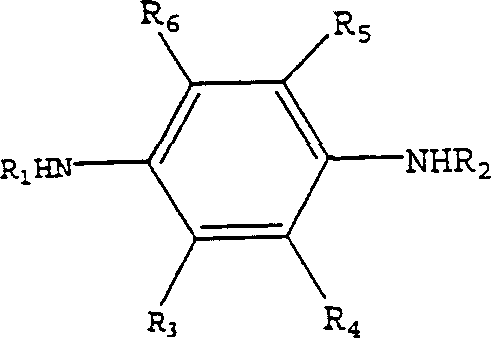 Formula I b
R wherein
1, R
2, R
3, R
4, R
5And R
6Be independently selected from phenyl, tolyl, naphthyl, 1 respectively, 2-dimethylbutyl, 1,4-dimethyl amyl group, sec.-propyl, sec-butyl, cyclohexyl, 1-ethyl-3-methyl amyl, 1-methylheptyl and hydrogen and R
3-R
6Be hydrogen.
5. each method of claim 1-4, it further is included in and adds the alkaline pH conditioning agent in the reaction.
6. the method for claim 5, wherein the alkaline pH conditioning agent is a triethylamine.
7. each method of claim 1-6, wherein reaction further comprises water.
8. each method of claim 1-7 wherein is reflected under the existence of solvent and carries out.
9. the method for claim 8 wherein is reflected in the homogeneous solvent system and carries out, and solvent is selected from the organic solvent of water soluble.
10. the method for claim 9, wherein the organic solvent of water soluble is an alcohol.
11. the method for claim 8 wherein is reflected in the two phase solvent system that contains insoluble organic solvent of water and water and carries out.
12. the method for claim 11 wherein further is included in the reaction and adds phase-transfer catalyst to improve speed of reaction.
Applications Claiming Priority (4)
| Application Number | Priority Date | Filing Date | Title |
|---|---|---|---|
| US8775498P | 1998-06-02 | 1998-06-02 | |
| US60/087,754 | 1998-06-02 | ||
| US09/322,820 | 1999-05-28 | ||
| US09/322,820 US6025508A (en) | 1998-06-02 | 1999-05-28 | Preparation of quinonediimines from phenylenediamines using oxygen and a metal or metal salt catalyst |
Publications (2)
| Publication Number | Publication Date |
|---|---|
| CN1319087A true CN1319087A (en) | 2001-10-24 |
| CN1136190C CN1136190C (en) | 2004-01-28 |
Family
ID=26777354
Family Applications (1)
| Application Number | Title | Priority Date | Filing Date |
|---|---|---|---|
| CNB99807960XA Expired - Fee Related CN1136190C (en) | 1998-06-02 | 1999-05-28 | Preparation of quinonediimines from phenylenediamines using oxygen and a metal or metal salt catalyst |
Country Status (11)
| Country | Link |
|---|---|
| US (1) | US6025508A (en) |
| EP (1) | EP1091931B1 (en) |
| JP (1) | JP2003520757A (en) |
| KR (1) | KR100604550B1 (en) |
| CN (1) | CN1136190C (en) |
| AU (1) | AU4319099A (en) |
| BR (1) | BR9910878A (en) |
| CA (1) | CA2333665A1 (en) |
| DE (1) | DE69907189T2 (en) |
| ES (1) | ES2197690T3 (en) |
| WO (1) | WO1999062868A1 (en) |
Cited By (1)
| Publication number | Priority date | Publication date | Assignee | Title |
|---|---|---|---|---|
| CN104821375A (en) * | 2007-04-12 | 2015-08-05 | 日产化学工业株式会社 | Oligoaniline compound |
Families Citing this family (1)
| Publication number | Priority date | Publication date | Assignee | Title |
|---|---|---|---|---|
| US7718722B2 (en) * | 2000-11-21 | 2010-05-18 | Flexsys America L.P. | Alkylthio- and aryl(heteroyl)thio-substituted p-phenylenediamines, their manufacture and their use in rubber |
Family Cites Families (6)
| Publication number | Priority date | Publication date | Assignee | Title |
|---|---|---|---|---|
| SU950706A1 (en) * | 1980-12-11 | 1982-08-15 | Институт неорганической и физической химии АН АзССР | Process for producing butenes |
| US5091545A (en) * | 1990-03-02 | 1992-02-25 | The Goodyear Tire & Rubber Company | Catalytic oxidation of hydroxy containing aromatic compounds |
| US5053540A (en) * | 1990-03-08 | 1991-10-01 | The Goodyear Tire & Rubber Company | Preparation of a para-aminodiphenylamine |
| FR2659652B1 (en) * | 1990-03-13 | 1992-07-03 | Rhone Poulenc Chimie | PROCESS FOR THE PREPARATION OF N-PHENYL BENZOQUINONE-IMINE. |
| DE19543862A1 (en) * | 1995-11-24 | 1997-05-28 | Bayer Ag | Hexa:methylene di:isocyanate preparation from technical raw material |
| US5959126A (en) * | 1997-10-29 | 1999-09-28 | Flexsys America L. P. | Formation of quinonedimines from phenylenediamines by catalytic oxidation |
-
1999
- 1999-05-28 WO PCT/US1999/011868 patent/WO1999062868A1/en not_active Ceased
- 1999-05-28 AU AU43190/99A patent/AU4319099A/en not_active Abandoned
- 1999-05-28 EP EP99955264A patent/EP1091931B1/en not_active Expired - Lifetime
- 1999-05-28 US US09/322,820 patent/US6025508A/en not_active Expired - Lifetime
- 1999-05-28 JP JP2000552081A patent/JP2003520757A/en not_active Withdrawn
- 1999-05-28 ES ES99955264T patent/ES2197690T3/en not_active Expired - Lifetime
- 1999-05-28 KR KR1020007013580A patent/KR100604550B1/en not_active Expired - Fee Related
- 1999-05-28 CN CNB99807960XA patent/CN1136190C/en not_active Expired - Fee Related
- 1999-05-28 BR BR9910878-0A patent/BR9910878A/en not_active IP Right Cessation
- 1999-05-28 DE DE69907189T patent/DE69907189T2/en not_active Expired - Fee Related
- 1999-05-28 CA CA002333665A patent/CA2333665A1/en not_active Abandoned
Cited By (2)
| Publication number | Priority date | Publication date | Assignee | Title |
|---|---|---|---|---|
| CN104821375A (en) * | 2007-04-12 | 2015-08-05 | 日产化学工业株式会社 | Oligoaniline compound |
| CN104821375B (en) * | 2007-04-12 | 2018-03-02 | 日产化学工业株式会社 | Oligoaniline compound |
Also Published As
| Publication number | Publication date |
|---|---|
| KR100604550B1 (en) | 2006-07-28 |
| JP2003520757A (en) | 2003-07-08 |
| EP1091931B1 (en) | 2003-04-23 |
| DE69907189T2 (en) | 2004-03-04 |
| ES2197690T3 (en) | 2004-01-01 |
| CN1136190C (en) | 2004-01-28 |
| WO1999062868A1 (en) | 1999-12-09 |
| DE69907189D1 (en) | 2003-05-28 |
| EP1091931A1 (en) | 2001-04-18 |
| AU4319099A (en) | 1999-12-20 |
| CA2333665A1 (en) | 1999-12-09 |
| US6025508A (en) | 2000-02-15 |
| KR20010071365A (en) | 2001-07-28 |
| BR9910878A (en) | 2001-03-06 |
Similar Documents
| Publication | Publication Date | Title |
|---|---|---|
| DE60316502T2 (en) | Zinc-modified Pd / Ni catalysts | |
| EP0846669B1 (en) | Process for the hydrogenation of aromatic compounds in the presence of supported catalysts | |
| CN1270161A (en) | Preparation of amine | |
| EP2130583A1 (en) | Method for producing carbonyl compound | |
| CN1136190C (en) | Preparation of quinonediimines from phenylenediamines using oxygen and a metal or metal salt catalyst | |
| CN106957231B (en) | The preparation method of N,N'-bis(alkyl)-p-phenylenediamine | |
| CN1185192C (en) | Preparation method of oxoisophorone | |
| CN1599644A (en) | Method for isomerizing allyl alcohols | |
| US6271420B1 (en) | Preparation of quinonediimines from phenylenediamines using hydrogen peroxide and a catalyst | |
| CN1158216C (en) | Preparation of substd. aromatic amine | |
| CN1125041C (en) | Formation of quinonediimines from phenylenediamines by catalytic oxidation | |
| EP1068177B1 (en) | Preparation of quinoneimines from hydroxyphenylamines using a hypochlorite as an oxidation agent | |
| CN1280563A (en) | Preparation of quinonediimines from phenylenediamines using a hydrochlorite as an oxidation agent | |
| EP2951154A1 (en) | 2,6-bis-(aminomethyl)piperidine derivates | |
| CN1222513A (en) | Process for preparation of formylimidazoles | |
| CN112439454A (en) | RT base condensation catalyst and preparation method thereof | |
| JPH09234368A (en) | Novel solid catalyst containing ruthenium and tin and preparation of aryl alkyl alcohol using the same | |
| CN1111615A (en) | Process for the preparation of 2-nitrobenzaldehydes | |
| MXPA00011832A (en) | Preparation of quinonediimines from phenylenediamines using oxygen and a metal or metal salt catalyst | |
| JPH0320238A (en) | Production of m-hydroxybenzaldehyde |
Legal Events
| Date | Code | Title | Description |
|---|---|---|---|
| C06 | Publication | ||
| PB01 | Publication | ||
| C10 | Entry into substantive examination | ||
| SE01 | Entry into force of request for substantive examination | ||
| C14 | Grant of patent or utility model | ||
| GR01 | Patent grant | ||
| CF01 | Termination of patent right due to non-payment of annual fee |
Granted publication date: 20040128 Termination date: 20170528 |
|
| CF01 | Termination of patent right due to non-payment of annual fee |