CN1368942A - UV-curing of optical fiber coatings using lasers - Google Patents
UV-curing of optical fiber coatings using lasers Download PDFInfo
- Publication number
- CN1368942A CN1368942A CN00811455.2A CN00811455A CN1368942A CN 1368942 A CN1368942 A CN 1368942A CN 00811455 A CN00811455 A CN 00811455A CN 1368942 A CN1368942 A CN 1368942A
- Authority
- CN
- China
- Prior art keywords
- fiber
- laser
- lens
- laser beam
- laser source
- Prior art date
- Legal status (The legal status is an assumption and is not a legal conclusion. Google has not performed a legal analysis and makes no representation as to the accuracy of the status listed.)
- Granted
Links
Images
Classifications
-
- C—CHEMISTRY; METALLURGY
- C03—GLASS; MINERAL OR SLAG WOOL
- C03C—CHEMICAL COMPOSITION OF GLASSES, GLAZES OR VITREOUS ENAMELS; SURFACE TREATMENT OF GLASS; SURFACE TREATMENT OF FIBRES OR FILAMENTS MADE FROM GLASS, MINERALS OR SLAGS; JOINING GLASS TO GLASS OR OTHER MATERIALS
- C03C25/00—Surface treatment of fibres or filaments made from glass, minerals or slags
- C03C25/10—Coating
- C03C25/12—General methods of coating; Devices therefor
Landscapes
- Life Sciences & Earth Sciences (AREA)
- Chemical & Material Sciences (AREA)
- General Life Sciences & Earth Sciences (AREA)
- Engineering & Computer Science (AREA)
- Chemical Kinetics & Catalysis (AREA)
- General Chemical & Material Sciences (AREA)
- Geochemistry & Mineralogy (AREA)
- Materials Engineering (AREA)
- Organic Chemistry (AREA)
- Surface Treatment Of Glass Fibres Or Filaments (AREA)
- Optical Fibers, Optical Fiber Cores, And Optical Fiber Bundles (AREA)
Abstract
Description
本发明的领域Field of the invention
本发明涉及一种使用能够增加光学纤维拉伸速率的连续波(cw)或脉冲激光固化光学纤维上保护涂层的有效方法。尤其是,该方法涉及在拉伸光学纤维上对准激光束以进行均匀照射并固化位于该纤维上的涂层。The present invention relates to an efficient method for curing protective coatings on optical fibers using continuous wave (cw) or pulsed lasers capable of increasing the draw rate of the optical fibers. In particular, the method involves directing a laser beam over a drawn optical fiber to uniformly illuminate and cure a coating on the fiber.
相关技术的描述Description of related technologies
在制造光学纤维时,玻璃预成型棒以受控速率在炉中运动。该炉软化预成型品,这样光学纤维可通过卷筒由预成型棒的熔融端拉伸。In the manufacture of optical fibers, a glass preform rod moves at a controlled rate in a furnace. The oven softens the preform so that the optical fiber can be drawn from the molten end of the preform rod through the mandrel.
因为拉伸光学纤维易于受损,光学纤维在由预成型棒拉伸之后但在接触另一表面之前必须涂覆上涂层。为了提供这种保护涂层,将一种必须在该拉伸纤维到达卷筒之前凝固的材料施用到纤维上。凝固通过固化技术来辅助。湿碰湿拉伸技术包括,将第一涂层施用到纤维上并在第一涂层仍处于粘稠形式时将第二涂层施用到纤维上。第一和第二涂层都随后固化。其它技术也是已知的,如施用第一涂层,随后固化第一涂层,然后施用第二涂层并固化该第二涂层。该第二技术需要在拉伸塔中包括附加设备,但比需要在粘稠形式下处理第一涂层的湿碰湿拉伸技术简单。也可采用其它技术,且本发明并不限于所用技术的种类。Because drawn optical fibers are susceptible to damage, optical fibers must be coated after being drawn from a preform rod but before contacting another surface. To provide this protective coating, a material is applied to the fiber which must solidify before the drawn fiber reaches the roll. Solidification is assisted by curing techniques. The wet-on-wet drawing technique involves applying a first coating to the fiber and applying a second coating to the fiber while the first coating is still in viscous form. Both the first and second coatings are subsequently cured. Other techniques are also known, such as applying a first coating, then curing the first coating, then applying a second coating and curing the second coating. This second technique requires the inclusion of additional equipment in the stretching tower, but is simpler than the wet-on-wet stretching technique which requires processing the first coating in viscous form. Other techniques may also be used, and the invention is not limited to the kind of technique used.
用于固化光学纤维涂层的常规技术包括使用微波动力灯如Fusion灯照射涂层。常用的Fusion灯包括直径为9、11或13毫米的H-电灯泡、D-电灯泡和H-电灯泡。但可以将显著量的灯光聚焦到窄纤维上。实际上,可以仅将Fusion灯的百分之一至百分之几聚焦到所要涂层的纤维元件上。此外,热Fusion灯的能量不能充分定向,难以以均匀方式涂覆该纤维。过度的热效应和由Fusion灯带来的红外辐射也会降低涂层材料的特性。Conventional techniques for curing optical fiber coatings include irradiating the coating with microwave powered lamps such as Fusion lamps. Commonly used Fusion lamps include H-bulbs, D-bulbs and H-bulbs with a diameter of 9, 11 or 13 mm. But it is possible to focus a significant amount of light onto narrow fibers. In practice, only one to a few percent of the Fusion lamp can be focused on the fiber element to be coated. Furthermore, the energy of the hot Fusion lamps is not sufficiently directed to coat the fibers in a uniform manner. Excessive thermal effects and infrared radiation from Fusion lamps can also degrade the properties of the coating material.
磁场的应用通常促进纤维涂层的聚合反应,例如讨论于美国专利5000772(Petisce)。但Fusion灯体使得这种磁场难以施加到纤维上。为了得到强度足以在Fusion灯排列中影响固化速率的磁场,需要磁场如此之强以能够降低Fusion灯的微波排放。灯的强度被减弱,因此难以提供足够的强度以固化该涂层。因此,使用磁场增加固化速率的技术在使用Fusion灯时并不实际或方便。The application of a magnetic field generally promotes the polymerization of the fiber coating, as discussed, for example, in US Patent 5,000,772 (Petisce). But the Fusion lamp body makes it difficult to apply this magnetic field to the fibers. In order to have a magnetic field strong enough to affect the curing rate in a Fusion lamp arrangement, the magnetic field needs to be strong enough to reduce the microwave emissions from the Fusion lamps. The intensity of the lamp is reduced, so it is difficult to provide sufficient intensity to cure the coating. Therefore, the technique of using a magnetic field to increase the rate of cure is not practical or convenient when using Fusion lamps.
为了提高固化过程的效率,可以使用激光替代微波灯。美国专利4812150公开了激光的应用,其中使用激光作为热源来固化涂层。但激光提供局部加热,造成纤维弯成弓形,因为在纤维一侧上的固化大于另一侧。另外,可能优于激光束的局部聚焦而产生过热,导致具有非所需模量的涂层。应用激光进行光固化的其它已知方法,例如美国专利4227907和美国专利5761367由于缺乏赋予激光束的方向性而存在类似缺陷。To increase the efficiency of the curing process, lasers can be used instead of microwave lamps. US Patent 4812150 discloses the use of lasers in which a laser is used as a heat source to cure a coating. But the laser provides localized heating that causes the fiber to bow because curing is greater on one side of the fiber than the other. In addition, local focusing of the laser beam may be superior to overheating, resulting in a coating with an undesirable modulus. Other known methods of photocuring using lasers, such as US Patent 4,227,907 and US Patent 5,761,367 suffer from similar drawbacks due to the lack of directionality imparted to the laser beam.
本发明的综述Summary of the invention
本发明通过使用激光源引发涂层中的光化学过程,并通过使用能够产生固化用准直激光束的光学设备来克服以上缺陷。在这种布置下,可以用移离目标纤维的激光源固化纤维涂层。光源和目标纤维之间的移动减缓了在固化过程中对涂层的热和红外损害。该光学设备进一步在目标纤维周围传播激光以获得用于固化的均匀能量分布。通过光束扩展器和平凹透镜提供的伸长束能够使目标纤维涂层的较大部分同时固化。由于激光源移离纤维,可以实际地将磁场作用到具有可固化涂层的目标纤维上,这样进一步增加固化速率20-40%。I.V.Khudyakov等人的“用固化监控器和光DSC研究的丙烯酸酯光聚合反应的动力学”,SPIE会议论文集,3848卷,1999,151-156页。这能够进一步增加光学纤维的拉伸速率。The present invention overcomes the above drawbacks by using a laser source to initiate photochemical processes in the coating and by using an optical device capable of generating a collimated laser beam for curing. In this arrangement, the fiber coating can be cured with a laser source that is moved away from the target fiber. Movement between the light source and the target fiber slows down thermal and infrared damage to the coating during curing. The optics further spread the laser light around the target fiber to obtain a uniform energy distribution for curing. The elongated beam delivered by the beam expander and the plano-convex lens enables simultaneous curing of a larger portion of the targeted fiber coating. As the laser source is moved away from the fiber, it is practical to apply a magnetic field to the target fiber with the curable coating, which further increases the curing rate by 20-40%. I.V. Khudyakov et al., "Kinetics of Acrylate Photopolymerization by Curing Monitor and Photo-DSC", SPIE Conference Proceedings, Vol. 3848, 1999, pp. 151-156. This can further increase the draw rate of the optical fiber.
激光束波长选择使得激光能被涂层中的光引发剂吸收。在一个优选实施方案中,该涂层具有两种光引发剂,其中一种的最大吸收在约300纳米处且一种在约400纳米处。使用两种光引发剂对湿碰湿拉伸技术是重要的。The wavelength of the laser beam is selected such that the laser energy is absorbed by the photoinitiator in the coating. In a preferred embodiment, the coating has two photoinitiators, one with an absorption maximum at about 300 nanometers and one at about 400 nanometers. The use of two photoinitiators is important for the wet-on-wet stretching technique.
优选实施方案的描述Description of the preferred embodiment
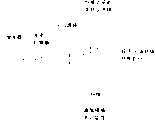
以下根据唯一的附图来详细描述一个优选实施方案,该图说明了用于在目标纤维周围将准直激光束均匀定向的布置。A preferred embodiment is described in detail below with reference to the only drawing, which illustrates an arrangement for uniformly directing a collimated laser beam around a target fiber.
参考附图,目标纤维1由预成型品(未示)拉伸并经受一个环境以开始涂覆过程。本发明可应用于任何标准固化环境,包括用于施用一级和二级涂层。例如,可以使用包括光引发剂2-羟基-2-甲基-1-苯基丙-1-酮或2,4,6-三甲基苯甲酰基氧化膦(或其组合)的环境。Referring to the drawings, a target fiber 1 is drawn from a preform (not shown) and subjected to an environment to start the coating process. The present invention can be applied in any standard curing environment, including for the application of primary and secondary coatings. For example, an environment comprising the photoinitiator 2-hydroxy-2-methyl-1-phenylpropan-1-one or 2,4,6-trimethylbenzoylphosphine oxide (or a combination thereof) may be used.
目标纤维1距激光2一段距离设置。示例性的距离为约10英尺。这种移动比使用Fusion灯的常规技术更远并通过降低照射到目标纤维上的损害性红外热的量而产生益处。激光源2可选自多种连续和脉冲激光。连续波激光的一个例子包括由Spectra-Physics制造的Beamlok Ar+。这种激光可操作释放在紫外线范围内的λ=333-351纳米的许多波长。Ar+激光适用于工业应用,具有约7瓦的功率输出。示例性的脉冲激光包括来自Spectron Laser System的Nd:YAG。Nd:YAG激光的第三谐波的波长λ为355纳米,最适用于纤维涂层的固化。但其它谐波也可用于固化。输出功率为5瓦,频率为10千赫。任何高频UV脉冲激光都是合适的。另一可接受的激光是λ=308纳米的紫外线受激准分子XeCl激光,由Lambda Physik制造。The target fiber 1 is set at a certain distance from the
具有上述波长的光被常用于涂层材料的大多数光引发剂吸收。但某些光引发剂能够吸收可见光范围(如400-800纳米)内的能量,因此也可使用发出在该范围内的能量的激光。例如,发光在可见范围内的激光二极管也可用于引发聚合反应。该过程可通过向纤维涂层中加入能够吸收该范围光的染料而辅助。Ar+激光可用于同时激发两种最大吸收在紫外线区的光引发剂。一种光引发剂的最大吸收靠近300纳米,另一种光引发剂的最大值靠近400纳米。Light with the aforementioned wavelengths is absorbed by most photoinitiators commonly used in coating materials. However, certain photoinitiators are capable of absorbing energy in the visible range (eg, 400-800 nm), so lasers emitting energy in this range can also be used. For example, laser diodes emitting in the visible range can also be used to initiate polymerization. This process can be aided by adding dyes to the fiber coating that absorb light in this range. An Ar + laser can be used to simultaneously excite two photoinitiators whose absorption maxima are in the ultraviolet region. One photoinitiator has an absorption maximum near 300 nm and the other photoinitiator has a maximum near 400 nm.
激光束源的使用也可通过更窄波长(如,±0.5纳米)内的单色光来激发光引发剂。这种选择性有可能引发和控制涂层材料的聚合反应。相反,在宽波长范围(约100纳米)内无差别地激发的Fusion灯不可能有这种选择性或控制作用。Fusion灯不可控制地激发包括在光学纤维涂层中的物质如染料或颜料。The use of a laser beam source can also excite photoinitiators with monochromatic light within a narrower wavelength (eg, ±0.5 nanometers). This selectivity makes it possible to initiate and control the polymerization of coating materials. In contrast, Fusion lamps, which excite indiscriminately over a broad wavelength range (approximately 100 nanometers), are unlikely to have such selectivity or control. Fusion lamps uncontrollably excite substances such as dyes or pigments included in optical fiber coatings.
参考附图,在光束扩展器3的方向上照射激光。激光的准直光束为强点的形式。如果该点用于固化,其强度可如常规体系那样可能损害目标纤维。因此,光束扩展器4用于将具有约2毫米小直径的准直光束分布成一至几个英寸的较大直径。这种扩展光束进一步经过一个平凹透镜和圆柱状透镜5,将激光聚焦成为约3-4英寸且直径为几个目标纤维直径的长度。这种斑纹光束的直径范围例如为1-3毫米。在纤维另一侧,与圆柱状透镜相对的是成型为圆柱状的镜子6。该镜子有助于将光均匀分布到目标纤维周围。Referring to the drawing, laser light is irradiated in the direction of the
激光源和目标纤维之间的移动可由于激光的准直作用和由光学元件提供的聚焦作用而包括大距离。超过2米的移动是可允许的。除了减缓外来热效应,这种移动的附加益处是,磁场发生器(未示)具有位置以包括在该固化布置中。磁场的应用可通过已知的机理来提供,因此本说明书省略其细节。The movement between the laser source and the target fiber can involve large distances due to the collimation of the laser and the focusing provided by the optical elements. Movement of more than 2 meters is permitted. An added benefit of this movement, in addition to mitigating extraneous thermal effects, is that a magnetic field generator (not shown) has a location to be included in the curing arrangement. The application of the magnetic field may be provided by known mechanisms, so details of which are omitted from this description.
通过将一个或多个附加激光器源放置在目标纤维周围以提供对称照明,本发明还可在没有镜子6的情况下实施。例如,两个激光器可放置围绕目标纤维以180度间隔放置,或3个激光可以120度间隔放置。采用几个激光源可增加强度(瓦/厘米2)以及光束照射量(焦耳/厘米2)。但由于激光源昂贵,采用半圆柱状镜子6有助于尽量降低固化装置的成本。The invention can also be practiced without
通过使用激光和基本光学设备,激光能可在拉伸纤维上均匀地精确聚焦。这样能够有效地使用固化能并增加拉伸纤维的速率。利用上述布置,可获得超过1000米/分钟的拉伸速率。By using a laser and basic optics, the laser energy can be precisely focused uniformly on the drawn fiber. This enables efficient use of curing energy and increases the rate at which fibers are drawn. With the above arrangement, stretching rates in excess of 1000 m/min can be obtained.
尽管以上已讨论了本发明的一个优选实施方案,但本领域熟练技术人员可以背离特定的公开内容而仍在本发明的主旨和范围内。Although a preferred embodiment of the present invention has been discussed above, those skilled in the art can deviate from the specific disclosure and still remain within the spirit and scope of the present invention.
Claims (20)
Applications Claiming Priority (1)
| Application Number | Priority Date | Filing Date | Title |
|---|---|---|---|
| PCT/US2000/011879 WO2001098223A1 (en) | 2000-06-16 | 2000-06-16 | Uv-cure of coatings for an optical fiber with a laser |
Publications (2)
| Publication Number | Publication Date |
|---|---|
| CN1368942A true CN1368942A (en) | 2002-09-11 |
| CN1197661C CN1197661C (en) | 2005-04-20 |
Family
ID=21741342
Family Applications (1)
| Application Number | Title | Priority Date | Filing Date |
|---|---|---|---|
| CN00811455.2A Expired - Fee Related CN1197661C (en) | 2000-06-16 | 2000-06-16 | UV-curing of optical fiber coatings using lasers |
Country Status (6)
| Country | Link |
|---|---|
| EP (1) | EP1250297B1 (en) |
| JP (1) | JP4554154B2 (en) |
| CN (1) | CN1197661C (en) |
| AT (1) | ATE307785T1 (en) |
| DE (1) | DE60023558T2 (en) |
| WO (1) | WO2001098223A1 (en) |
Cited By (4)
| Publication number | Priority date | Publication date | Assignee | Title |
|---|---|---|---|---|
| CN102205304A (en) * | 2011-05-10 | 2011-10-05 | 华中科技大学 | Dacromet sintering and curing method |
| CN103319100A (en) * | 2013-06-19 | 2013-09-25 | 长飞光纤光缆有限公司 | Ultraviolet curing equipment and method for optical fiber coating |
| CN104012171A (en) * | 2011-10-26 | 2014-08-27 | 矢崎总业株式会社 | Ultraviolet ray radiation apparatus and method for curing photo-curable composition |
| CN105797931A (en) * | 2014-12-31 | 2016-07-27 | 联华电子股份有限公司 | Optical curing system |
Families Citing this family (6)
| Publication number | Priority date | Publication date | Assignee | Title |
|---|---|---|---|---|
| US8314408B2 (en) | 2008-12-31 | 2012-11-20 | Draka Comteq, B.V. | UVLED apparatus for curing glass-fiber coatings |
| DK2388239T3 (en) | 2010-05-20 | 2017-04-24 | Draka Comteq Bv | Curing apparatus using angled UV LEDs |
| US8871311B2 (en) | 2010-06-03 | 2014-10-28 | Draka Comteq, B.V. | Curing method employing UV sources that emit differing ranges of UV radiation |
| DK2418183T3 (en) | 2010-08-10 | 2018-11-12 | Draka Comteq Bv | Method of curing coated glass fibers which provides increased UVLED intensity |
| JP6729036B2 (en) * | 2016-06-16 | 2020-07-22 | 住友電気工業株式会社 | Optical fiber manufacturing method |
| CN115648665A (en) * | 2022-10-24 | 2023-01-31 | 吉林大学 | Laser heating method for pultrusion composite material production line and implementation device |
Family Cites Families (7)
| Publication number | Priority date | Publication date | Assignee | Title |
|---|---|---|---|---|
| GB2150858B (en) * | 1983-12-06 | 1986-11-26 | Standard Telephones Cables Ltd | Optical fibres |
| NL8402124A (en) * | 1984-07-04 | 1986-02-03 | Philips Nv | DEVICE FOR EXPOSING A UV-CURING LAYER ON A WIRE-BODY. |
| GB2166975B (en) * | 1984-11-16 | 1988-06-02 | Stc Plc | Optical fibres |
| EP0202803A3 (en) * | 1985-05-14 | 1987-06-03 | Commonwealth Of Australia Department Of Industry Technology And Commerce | Laser curing of coatings and inks |
| NZ215951A (en) * | 1985-05-14 | 1988-10-28 | Commw Of Australia | Curing polymeric coating film with uv radiation |
| NL8601197A (en) * | 1986-05-13 | 1987-12-01 | Philips Nv | IRRADIATION DEVICE, APPARATUS AND METHOD FOR CLADING A WIRE-BODY. |
| JP2547793B2 (en) * | 1987-09-29 | 1996-10-23 | 住友電気工業株式会社 | Optical fiber coating resin curing method |
-
2000
- 2000-06-16 DE DE60023558T patent/DE60023558T2/en not_active Expired - Lifetime
- 2000-06-16 EP EP00942631A patent/EP1250297B1/en not_active Expired - Lifetime
- 2000-06-16 AT AT00942631T patent/ATE307785T1/en not_active IP Right Cessation
- 2000-06-16 CN CN00811455.2A patent/CN1197661C/en not_active Expired - Fee Related
- 2000-06-16 JP JP2002503666A patent/JP4554154B2/en not_active Expired - Fee Related
- 2000-06-16 WO PCT/US2000/011879 patent/WO2001098223A1/en not_active Ceased
Cited By (5)
| Publication number | Priority date | Publication date | Assignee | Title |
|---|---|---|---|---|
| CN102205304A (en) * | 2011-05-10 | 2011-10-05 | 华中科技大学 | Dacromet sintering and curing method |
| CN104012171A (en) * | 2011-10-26 | 2014-08-27 | 矢崎总业株式会社 | Ultraviolet ray radiation apparatus and method for curing photo-curable composition |
| CN103319100A (en) * | 2013-06-19 | 2013-09-25 | 长飞光纤光缆有限公司 | Ultraviolet curing equipment and method for optical fiber coating |
| CN103319100B (en) * | 2013-06-19 | 2015-04-08 | 长飞光纤光缆股份有限公司 | Ultraviolet curing equipment and method for optical fiber coating |
| CN105797931A (en) * | 2014-12-31 | 2016-07-27 | 联华电子股份有限公司 | Optical curing system |
Also Published As
| Publication number | Publication date |
|---|---|
| DE60023558D1 (en) | 2005-12-01 |
| WO2001098223A1 (en) | 2001-12-27 |
| EP1250297B1 (en) | 2005-10-26 |
| ATE307785T1 (en) | 2005-11-15 |
| JP4554154B2 (en) | 2010-09-29 |
| DE60023558T2 (en) | 2006-07-27 |
| CN1197661C (en) | 2005-04-20 |
| JP2003535806A (en) | 2003-12-02 |
| EP1250297A1 (en) | 2002-10-23 |
Similar Documents
| Publication | Publication Date | Title |
|---|---|---|
| EP2418183B1 (en) | Method for curing coated glass fibres providing increased UVLED intensitiy | |
| EP1138642B1 (en) | Laser photocuring system | |
| EP2388239B1 (en) | Curing apparatus employing angled UV-LEDs | |
| US7322122B2 (en) | Method and apparatus for curing a fiber having at least two fiber coating curing stages | |
| US6626561B2 (en) | Lamp structure, having elliptical reflectors, for uniformly irradiating surfaces of optical fiber and method of use thereof | |
| CN1197661C (en) | UV-curing of optical fiber coatings using lasers | |
| EP3060844B1 (en) | Apparatus for radiant energy curing of coating | |
| CN1294433C (en) | Fiber splicer | |
| US7022382B1 (en) | UV-cure of coatings for an optical fiber with a laser | |
| US10059624B2 (en) | System and method for laser-based, non-evaporative repair of damage sites in the surfaces of fused silica optics | |
| Şimşek et al. | CO2 laser polishing of conical shaped optical fiber deflectors | |
| JP2010184245A (en) | Coated film peeling apparatus | |
| JP2547793B2 (en) | Optical fiber coating resin curing method | |
| CN107056090B (en) | Fiber coating device, fiber coating method and fiber | |
| JP7736253B2 (en) | Laser hardening of liners | |
| NL2026720B1 (en) | Reflector for curing optical fibers and methods of using the same | |
| JP2007145930A (en) | Curing method for photocurable adhesive and light irradiation device for curing adhesive | |
| JP6729036B2 (en) | Optical fiber manufacturing method |
Legal Events
| Date | Code | Title | Description |
|---|---|---|---|
| C10 | Entry into substantive examination | ||
| SE01 | Entry into force of request for substantive examination | ||
| C06 | Publication | ||
| PB01 | Publication | ||
| C10 | Entry into substantive examination | ||
| SE01 | Entry into force of request for substantive examination | ||
| C14 | Grant of patent or utility model | ||
| GR01 | Patent grant | ||
| C17 | Cessation of patent right | ||
| CF01 | Termination of patent right due to non-payment of annual fee |
Granted publication date: 20050420 Termination date: 20120616 |