CN1429221A - 2-phenylpyran-4-one derivatives - Google Patents
2-phenylpyran-4-one derivatives Download PDFInfo
- Publication number
- CN1429221A CN1429221A CN01809447A CN01809447A CN1429221A CN 1429221 A CN1429221 A CN 1429221A CN 01809447 A CN01809447 A CN 01809447A CN 01809447 A CN01809447 A CN 01809447A CN 1429221 A CN1429221 A CN 1429221A
- Authority
- CN
- China
- Prior art keywords
- methyl
- alkyl
- group
- phenyl
- pyrans
- Prior art date
- Legal status (The legal status is an assumption and is not a legal conclusion. Google has not performed a legal analysis and makes no representation as to the accuracy of the status listed.)
- Pending
Links
Classifications
-
- C—CHEMISTRY; METALLURGY
- C07—ORGANIC CHEMISTRY
- C07D—HETEROCYCLIC COMPOUNDS
- C07D405/00—Heterocyclic compounds containing both one or more hetero rings having oxygen atoms as the only ring hetero atoms, and one or more rings having nitrogen as the only ring hetero atom
- C07D405/02—Heterocyclic compounds containing both one or more hetero rings having oxygen atoms as the only ring hetero atoms, and one or more rings having nitrogen as the only ring hetero atom containing two hetero rings
- C07D405/12—Heterocyclic compounds containing both one or more hetero rings having oxygen atoms as the only ring hetero atoms, and one or more rings having nitrogen as the only ring hetero atom containing two hetero rings linked by a chain containing hetero atoms as chain links
-
- A—HUMAN NECESSITIES
- A61—MEDICAL OR VETERINARY SCIENCE; HYGIENE
- A61P—SPECIFIC THERAPEUTIC ACTIVITY OF CHEMICAL COMPOUNDS OR MEDICINAL PREPARATIONS
- A61P25/00—Drugs for disorders of the nervous system
- A61P25/04—Centrally acting analgesics, e.g. opioids
-
- A—HUMAN NECESSITIES
- A61—MEDICAL OR VETERINARY SCIENCE; HYGIENE
- A61P—SPECIFIC THERAPEUTIC ACTIVITY OF CHEMICAL COMPOUNDS OR MEDICINAL PREPARATIONS
- A61P25/00—Drugs for disorders of the nervous system
- A61P25/28—Drugs for disorders of the nervous system for treating neurodegenerative disorders of the central nervous system, e.g. nootropic agents, cognition enhancers, drugs for treating Alzheimer's disease or other forms of dementia
-
- A—HUMAN NECESSITIES
- A61—MEDICAL OR VETERINARY SCIENCE; HYGIENE
- A61P—SPECIFIC THERAPEUTIC ACTIVITY OF CHEMICAL COMPOUNDS OR MEDICINAL PREPARATIONS
- A61P29/00—Non-central analgesic, antipyretic or antiinflammatory agents, e.g. antirheumatic agents; Non-steroidal antiinflammatory drugs [NSAID]
-
- A—HUMAN NECESSITIES
- A61—MEDICAL OR VETERINARY SCIENCE; HYGIENE
- A61P—SPECIFIC THERAPEUTIC ACTIVITY OF CHEMICAL COMPOUNDS OR MEDICINAL PREPARATIONS
- A61P29/00—Non-central analgesic, antipyretic or antiinflammatory agents, e.g. antirheumatic agents; Non-steroidal antiinflammatory drugs [NSAID]
- A61P29/02—Non-central analgesic, antipyretic or antiinflammatory agents, e.g. antirheumatic agents; Non-steroidal antiinflammatory drugs [NSAID] without antiinflammatory effect
-
- A—HUMAN NECESSITIES
- A61—MEDICAL OR VETERINARY SCIENCE; HYGIENE
- A61P—SPECIFIC THERAPEUTIC ACTIVITY OF CHEMICAL COMPOUNDS OR MEDICINAL PREPARATIONS
- A61P35/00—Antineoplastic agents
-
- A—HUMAN NECESSITIES
- A61—MEDICAL OR VETERINARY SCIENCE; HYGIENE
- A61P—SPECIFIC THERAPEUTIC ACTIVITY OF CHEMICAL COMPOUNDS OR MEDICINAL PREPARATIONS
- A61P43/00—Drugs for specific purposes, not provided for in groups A61P1/00-A61P41/00
-
- C—CHEMISTRY; METALLURGY
- C07—ORGANIC CHEMISTRY
- C07D—HETEROCYCLIC COMPOUNDS
- C07D309/00—Heterocyclic compounds containing six-membered rings having one oxygen atom as the only ring hetero atom, not condensed with other rings
- C07D309/34—Heterocyclic compounds containing six-membered rings having one oxygen atom as the only ring hetero atom, not condensed with other rings having three or more double bonds between ring members or between ring members and non-ring members
- C07D309/36—Heterocyclic compounds containing six-membered rings having one oxygen atom as the only ring hetero atom, not condensed with other rings having three or more double bonds between ring members or between ring members and non-ring members with oxygen atoms directly attached to ring carbon atoms
- C07D309/38—Heterocyclic compounds containing six-membered rings having one oxygen atom as the only ring hetero atom, not condensed with other rings having three or more double bonds between ring members or between ring members and non-ring members with oxygen atoms directly attached to ring carbon atoms one oxygen atom in position 2 or 4, e.g. pyrones
-
- C—CHEMISTRY; METALLURGY
- C07—ORGANIC CHEMISTRY
- C07D—HETEROCYCLIC COMPOUNDS
- C07D309/00—Heterocyclic compounds containing six-membered rings having one oxygen atom as the only ring hetero atom, not condensed with other rings
- C07D309/34—Heterocyclic compounds containing six-membered rings having one oxygen atom as the only ring hetero atom, not condensed with other rings having three or more double bonds between ring members or between ring members and non-ring members
- C07D309/36—Heterocyclic compounds containing six-membered rings having one oxygen atom as the only ring hetero atom, not condensed with other rings having three or more double bonds between ring members or between ring members and non-ring members with oxygen atoms directly attached to ring carbon atoms
- C07D309/40—Oxygen atoms attached in positions 3 and 4, e.g. maltol
Landscapes
- Chemical & Material Sciences (AREA)
- Organic Chemistry (AREA)
- Health & Medical Sciences (AREA)
- General Health & Medical Sciences (AREA)
- Veterinary Medicine (AREA)
- General Chemical & Material Sciences (AREA)
- Medicinal Chemistry (AREA)
- Nuclear Medicine, Radiotherapy & Molecular Imaging (AREA)
- Chemical Kinetics & Catalysis (AREA)
- Pharmacology & Pharmacy (AREA)
- Life Sciences & Earth Sciences (AREA)
- Animal Behavior & Ethology (AREA)
- Public Health (AREA)
- Engineering & Computer Science (AREA)
- Bioinformatics & Cheminformatics (AREA)
- Pain & Pain Management (AREA)
- Biomedical Technology (AREA)
- Neurology (AREA)
- Neurosurgery (AREA)
- Rheumatology (AREA)
- Hospice & Palliative Care (AREA)
- Psychiatry (AREA)
- Pharmaceuticals Containing Other Organic And Inorganic Compounds (AREA)
- Organic Low-Molecular-Weight Compounds And Preparation Thereof (AREA)
- Acyclic And Carbocyclic Compounds In Medicinal Compositions (AREA)
- Pyrane Compounds (AREA)
Abstract
Description
本发明涉及新的治疗上有用的2-苯基吡喃-4-酮衍生物、其制备方法和包含所述衍生物的药用组合物。The present invention relates to novel therapeutically useful 2-phenylpyran-4-one derivatives, processes for their preparation and pharmaceutical compositions comprising said derivatives.
已知环加氧酶(COX)的非选择性抑制防止过量产生由环加氧酶-2(COX-2)介导的、与炎症相关的前列腺素,但是同时,使组织缺乏主要由环加氧酶-1(COX-1)介导的某些组织健康状态所必需的基础水平的前列腺素。非甾体消炎药是COX的非选择性抑制剂,为此,具有以下副作用:减少肾脏血流量、降低血小板功能、消化不良和胃溃疡。Non-selective inhibition of cyclooxygenase (COX) is known to prevent the overproduction of prostaglandins associated with inflammation, mediated by cyclooxygenase-2 (COX-2), but at the same time, starve the tissue Basal levels of prostaglandins necessary for certain tissue health states mediated by oxygenase-1 (COX-1). NSAIDs are non-selective inhibitors of COX and, for this reason, have the following side effects: reduced renal blood flow, decreased platelet function, dyspepsia and gastric ulcers.
现在,我们发现某些2-苯基吡喃-4-酮衍生物优先于COX-1选择性地抑制COX-2,从而可用于治疗COX-2介导的疾病,例如炎症、疼痛、发热和哮喘,而副作用较小。Now, we have found that certain 2-phenylpyran-4-one derivatives selectively inhibit COX-2 in preference to COX-1, and thus can be used in the treatment of COX-2-mediated diseases, such as inflammation, pain, fever and Asthma with less side effects.
因此,本发明提供一种下式(I)的2-苯基吡喃-4-酮化合物或其药学上可接受的盐:
R1代表烷基或-NR5R6基团,其中R5和R6各自独立地代表氢原子或烷基;R 1 represents an alkyl group or -NR 5 R 6 group, wherein R 5 and R 6 each independently represent a hydrogen atom or an alkyl group;
R2代表烷基、C3-C7环烷基、吡啶基、噻吩基、萘基、四氢萘基或茚满基、或可以是未取代的或被一个或多个卤素原子或烷基、三氟甲基、羟基、烷氧基、甲硫基、氨基、一烷基氨基或二烷基氨基、羟烷基或羟羰基取代的苯基;R 2 represents alkyl, C 3 -C 7 cycloalkyl, pyridyl, thienyl, naphthyl, tetrahydronaphthyl or indanyl, or may be unsubstituted or replaced by one or more halogen atoms or alkyl , trifluoromethyl, hydroxyl, alkoxy, methylthio, amino, monoalkylamino or dialkylamino, hydroxyalkyl or hydroxycarbonyl substituted phenyl;
R3代表烷基、羟甲基、烷氧基甲基、链烯氧基甲基、C3-C7环烷氧基甲基、C3-C7环烷基甲氧基甲基、苄氧基甲基、羟羰基、腈、三氟甲基或二氟甲基或R7-COO-CH2-基团,其中R7代表烷基或苯基;R 3 represents alkyl, hydroxymethyl, alkoxymethyl, alkenyloxymethyl, C 3 -C 7 cycloalkoxymethyl, C 3 -C 7 cycloalkylmethoxymethyl, benzyl Oxymethyl, hydroxycarbonyl, nitrile, trifluoromethyl or difluoromethyl or R 7 -COO-CH 2 -group, wherein R 7 represents alkyl or phenyl;
R4代表氢原子、或烷基、链烯基或链炔基或卤素原子;和 R represents a hydrogen atom, or an alkyl, alkenyl or alkynyl group or a halogen atom; and
X代表单键、氧原子、硫原子或亚甲基。X represents a single bond, an oxygen atom, a sulfur atom or a methylene group.
在式(I)化合物中,当R3是链烯氧基甲基时,它通常是链烯基甲氧基甲基。In compounds of formula (I), when R3 is alkenyloxymethyl it is usually alkenylmethoxymethyl.
在一个优选实施方案中,本发明提供一种以下的式(I)化合物或其药学上可接受的盐:
R1代表烷基或-NR5R6基团,其中R5和R6各自独立地代表氢原子或烷基;R 1 represents an alkyl group or -NR 5 R 6 group, wherein R 5 and R 6 each independently represent a hydrogen atom or an alkyl group;
R2代表烷基、C3-C7环烷基、吡啶基、噻吩基、萘基、四氢萘基或茚满基、或可以是未取代的或被一个或多个卤素原子或烷基、三氟甲基、羟基、烷氧基、甲硫基、氨基、一烷基氨基或二烷基氨基、羟烷基或羟羰基取代的苯基;R 2 represents alkyl, C 3 -C 7 cycloalkyl, pyridyl, thienyl, naphthyl, tetrahydronaphthyl or indanyl, or may be unsubstituted or replaced by one or more halogen atoms or alkyl , trifluoromethyl, hydroxyl, alkoxy, methylthio, amino, monoalkylamino or dialkylamino, hydroxyalkyl or hydroxycarbonyl substituted phenyl;
R3代表烷基、羟甲基、烷氧基甲基、链烯氧基甲基、C3-C7环烷氧基甲基、C3-C7环烷基甲氧基甲基、苄氧基甲基、羟羰基、腈、三氟甲基或二氟甲基或R7-COO-CH2-基团,其中R7代表烷基或苯基;R 3 represents alkyl, hydroxymethyl, alkoxymethyl, alkenyloxymethyl, C 3 -C 7 cycloalkoxymethyl, C 3 -C 7 cycloalkylmethoxymethyl, benzyl Oxymethyl, hydroxycarbonyl, nitrile, trifluoromethyl or difluoromethyl or R 7 -COO-CH 2 -group, wherein R 7 represents alkyl or phenyl;
R4代表氢原子、或烷基、链烯基或链炔基或卤素原子;和 R represents a hydrogen atom, or an alkyl, alkenyl or alkynyl group or a halogen atom; and
X代表单键、氧原子、硫原子或亚甲基;条件是当R4是氢原子时,R3是链烯基甲氧基甲基、C3-C7环烷基甲氧基甲基或R7-COO-CH2-基团,其中R7代表烷基或苯基。X represents a single bond, an oxygen atom, a sulfur atom or a methylene group; provided that when R4 is a hydrogen atom, R3 is alkenylmethoxymethyl, C3 - C7cycloalkylmethoxymethyl or a R 7 -COO-CH 2 - group, wherein R 7 represents an alkyl group or a phenyl group.
在该优选的实施方案中,当R3是链烯氧基甲基时,它通常是链烯基甲氧基甲基。In this preferred embodiment, when R3 is alkenyloxymethyl it is usually alkenylmethoxymethyl.
在另一个优选的实施方案中,本发明提供一种以下的式(I)化合物或其药学上可接受的盐:其中:In another preferred embodiment, the present invention provides a compound of the following formula (I) or a pharmaceutically acceptable salt thereof: in:
R1代表烷基或-NR5R6基团,其中R5和R6各自独立地代表氢原子或烷基;R 1 represents an alkyl group or -NR 5 R 6 group, wherein R 5 and R 6 each independently represent a hydrogen atom or an alkyl group;
R2代表烷基、C3-C7环烷基、吡啶基、噻吩基、萘基、四氢萘基或茚满基、或可以是未取代的或被一个或多个卤素原子或烷基、三氟甲基、羟基、烷氧基、甲硫基、氨基、一烷基氨基或二烷基氨基、羟烷基或羟羰基取代的苯基;R 2 represents alkyl, C 3 -C 7 cycloalkyl, pyridyl, thienyl, naphthyl, tetrahydronaphthyl or indanyl, or may be unsubstituted or replaced by one or more halogen atoms or alkyl , trifluoromethyl, hydroxyl, alkoxy, methylthio, amino, monoalkylamino or dialkylamino, hydroxyalkyl or hydroxycarbonyl substituted phenyl;
R3代表烷基、羟甲基、烷氧基甲基、链烯氧基甲基、C3-C7环烷氧基甲基、C3-C7环烷基甲氧基甲基、苄氧基甲基、羟羰基、腈、三氟甲基或二氟甲基或R7-COO-CH2-基团,其中R7代表烷基或苯基;R 3 represents alkyl, hydroxymethyl, alkoxymethyl, alkenyloxymethyl, C 3 -C 7 cycloalkoxymethyl, C 3 -C 7 cycloalkylmethoxymethyl, benzyl Oxymethyl, hydroxycarbonyl, nitrile, trifluoromethyl or difluoromethyl or R 7 -COO-CH 2 -group, wherein R 7 represents alkyl or phenyl;
R4代表烷基、链烯基或链炔基或卤素原子;和R 4 represents an alkyl, alkenyl or alkynyl group or a halogen atom; and
X代表单键、氧原子、硫原子或亚甲基。X represents a single bond, an oxygen atom, a sulfur atom or a methylene group.
在该再一优选的实施方案中,当R3是链烯氧基甲基时,它通常是链烯基甲氧基甲基。In this yet another preferred embodiment, when R3 is alkenyloxymethyl, it is usually alkenylmethoxymethyl.
在另一个优选的实施方案中,本发明提供一种以下的式(I)化合物或其药学上可接受的盐: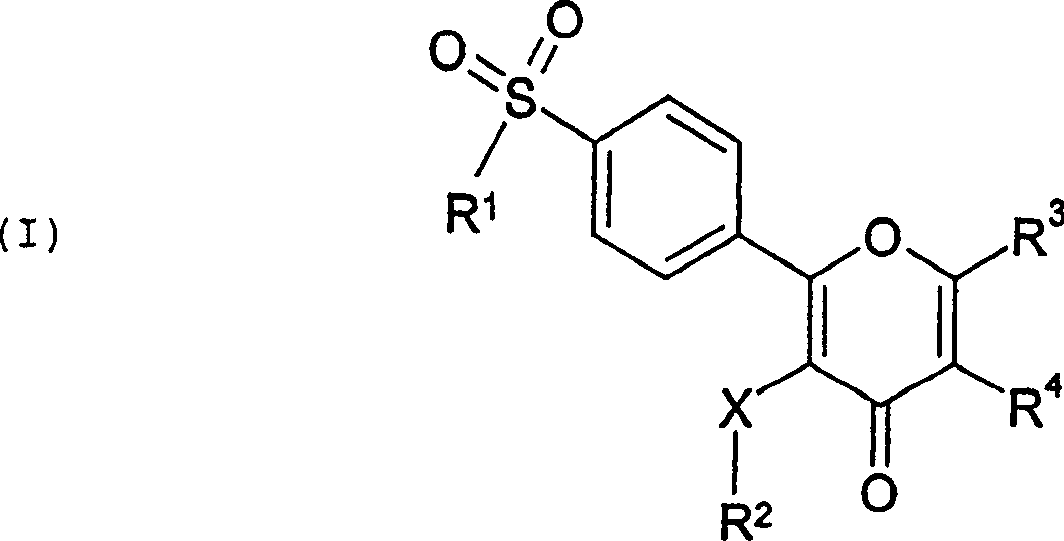
R1代表烷基或-NR5R6基团,其中R5和R6各自独立地代表氢原子或烷基;R 1 represents an alkyl group or -NR 5 R 6 group, wherein R 5 and R 6 each independently represent a hydrogen atom or an alkyl group;
R2代表烷基、C3-C7环烷基、吡啶基、噻吩基、萘基、四氢萘基或茚满基、或可以是未取代的或被一个或多个卤素原子或烷基、三氟甲基、羟基、烷氧基、甲硫基、氨基、一烷基氨基或二烷基氨基、羟烷基或羟羰基取代的苯基;R 2 represents alkyl, C 3 -C 7 cycloalkyl, pyridyl, thienyl, naphthyl, tetrahydronaphthyl or indanyl, or may be unsubstituted or replaced by one or more halogen atoms or alkyl , trifluoromethyl, hydroxyl, alkoxy, methylthio, amino, monoalkylamino or dialkylamino, hydroxyalkyl or hydroxycarbonyl substituted phenyl;
R3代表链烯氧基甲基或C3-C7环烷基甲氧基甲基或R7-COO-CH2-基团,其中R7代表烷基或苯基;R 3 represents alkenyloxymethyl or C 3 -C 7 cycloalkylmethoxymethyl or R 7 -COO-CH 2 -group, wherein R 7 represents alkyl or phenyl;
R4代表氢原子;和 R represents a hydrogen atom; and
X代表单键、氧原子、硫原子或亚甲基。X represents a single bond, an oxygen atom, a sulfur atom or a methylene group.
在该再一优选的实施方案中,当R3是链烯氧基甲基时,它通常是链烯基甲氧基甲基。In this yet another preferred embodiment, when R3 is alkenyloxymethyl, it is usually alkenylmethoxymethyl.
在另一个优选的实施方案中,本发明提供一种以下的式(IA)化合物或其药学上可接受的盐:
R1代表甲基或乙基;R 1 represents methyl or ethyl;
R2代表可以是未取代的或被一个或多个选自卤素原子或烷基、三氟甲基、羟基、烷氧基、甲硫基、氨基、一烷基氨基或二烷基氨基、羟烷基或羟羰基的取代基取代的苯基;R 2 can be unsubstituted or replaced by one or more halogen atoms or alkyl, trifluoromethyl, hydroxyl, alkoxy, methylthio, amino, monoalkylamino or dialkylamino, hydroxyl Phenyl substituted with substituents of alkyl or hydroxycarbonyl;
R3代表烷基、羟甲基、烷氧基甲基、C3-C7环烷氧基甲基、苄氧基甲基、羟羰基、腈、三氟甲基或二氟甲基;R represents alkyl, hydroxymethyl, alkoxymethyl, C 3 -C 7 cycloalkoxymethyl , benzyloxymethyl, hydroxycarbonyl, nitrile, trifluoromethyl or difluoromethyl;
条件是当R3是甲基时,R2或者是(a)具有至少一个选自以下取代基的苯基:三氟甲基、羟基、烷氧基、甲硫基、氨基、一烷基氨基或二烷基氨基、羟烷基或羟羰基;(b)在3位具有一个卤素原子或一个烷基或者在2位1具有一个溴原子或一个烷基的单取代苯基;或者是(c)具有两个或两个以上取代基的苯基,其中至少一个取代基是溴原子或其中在2位或4位存在一个烷基;或者是(d)3-甲基-4-氟-苯基。with the proviso that when R3 is methyl, R2 is either (a) phenyl having at least one substituent selected from the group consisting of trifluoromethyl, hydroxy, alkoxy, methylthio, amino, monoalkylamino or dialkylamino, hydroxyalkyl or hydroxycarbonyl; (b) a monosubstituted phenyl group having a halogen atom or an alkyl group at the 3-position or a bromine atom or an alkyl group at the 2-position 1; or (c ) a phenyl group having two or more substituents, at least one of which is a bromine atom or an alkyl group in the 2- or 4-position; or (d) 3-methyl-4-fluoro-benzene base.
在式(IA)化合物中,R1通常是甲基。此外,当R3是甲基时,R2通常是具有至少一个选自以下的取代基的苯基:三氟甲基、羟基、烷氧基、甲硫基、氨基、一烷基氨基或二烷基氨基、羟烷基或羟羰基;其中所述取代基最好是选自羟基、烷氧基、甲硫基、氨基、一烷基氨基或二烷基氨基、羟烷基或羟羰基。In compounds of formula (IA), R 1 is typically methyl. Furthermore, when R3 is methyl, R2 is typically phenyl with at least one substituent selected from trifluoromethyl, hydroxy, alkoxy, methylthio, amino, monoalkylamino or di Alkylamino, hydroxyalkyl or hydroxycarbonyl; wherein the substituent is preferably selected from hydroxy, alkoxy, methylthio, amino, monoalkylamino or dialkylamino, hydroxyalkyl or hydroxycarbonyl.
本发明还提供以下的式(IB)化合物或其药学上可接受的盐:
R2代表可以是未取代的或被一个或多个卤素原子或烷基、三氟甲基、羟基、烷氧基、甲硫基、氨基、一烷基氨基或二烷基氨基、羟烷基或羟羰基取代的苯基;R 2 can be unsubstituted or replaced by one or more halogen atoms or alkyl, trifluoromethyl, hydroxyl, alkoxy, methylthio, amino, monoalkylamino or dialkylamino, hydroxyalkyl or phenyl substituted with hydroxycarbonyl;
R3代表烷基、羟甲基、烷氧基甲基、C3-C7环烷氧基甲基、苄氧基甲基、羟羰基、腈、三氟甲基或二氟甲基。R 3 represents alkyl, hydroxymethyl, alkoxymethyl, C 3 -C 7 cycloalkoxymethyl, benzyloxymethyl, hydroxycarbonyl, nitrile, trifluoromethyl or difluoromethyl.
在式(IA)和式(IB)中,R3通常是羟甲基、甲氧基甲基、乙氧基甲基、丙氧基甲基、异丙氧基甲基、二氟甲基、羟羰基、环丙氧基甲基或环丁氧基甲基。In formula (IA) and formula (IB), R is usually hydroxymethyl , methoxymethyl, ethoxymethyl, propoxymethyl, isopropoxymethyl, difluoromethyl, Hydroxycarbonyl, cyclopropoxymethyl or cyclobutoxymethyl.
所述烷基和烷基部分,例如在所述烷氧基、羟烷基、一烷基氨基或二烷基氨基中存在、与基团R1-R7相关列举的烷基和烷基部分通常是“低级”烷基,也就是含有1-6个、特别是1-4个碳原子的烷基,所述烃链是支链或直链。优选的烷基以及其中有关的烷基部分包括甲基、乙基、丙基(包括异丙基)和丁基(包括正丁基、叔丁基和仲丁基)。The alkyl groups and alkyl moieties, such as those present in the alkoxy, hydroxyalkyl, monoalkylamino or dialkylamino groups, listed in relation to the groups R1 - R7 Typically a "lower" alkyl group, that is, an alkyl group containing 1 to 6, especially 1 to 4 carbon atoms, the hydrocarbon chain being branched or straight. Preferred alkyl groups and alkyl moieties associated therein include methyl, ethyl, propyl (including isopropyl) and butyl (including n-butyl, tert-butyl and sec-butyl).
在一个被一个或多个卤素原子或烷基、三氟烷基、羟基、烷氧基、甲硫基、氨基、一烷基氨基或二烷基氨基、羟烷基或羟羰基取代的苯基中,所述苯环可以被1个、2个、3个、4个或5个取代基、优选1个、2个或3个取代基取代,每个取代基独立地选自上述可能的取代基。也就是说,所述苯基(通过其1位连接与X或吡喃-4-酮环)可以在任一其余的位置上被取代,也就是说,在2位、3位、4位、5位或6位被取代。具有一个以上取代基的苯基可以在任何组合的位置上被取代。例如具有两个取代基的苯基可以在2位和3位、2位和4位、2位和5位、2位和6位、3位和4位或者3位和5位上被取代。A phenyl group substituted by one or more halogen atoms or alkyl, trifluoroalkyl, hydroxyl, alkoxy, methylthio, amino, monoalkylamino or dialkylamino, hydroxyalkyl or hydroxycarbonyl In, the benzene ring can be substituted by 1, 2, 3, 4 or 5 substituents, preferably 1, 2 or 3 substituents, each substituent independently selected from the above possible substituents base. That is, the phenyl group (attached to X or the pyran-4-one ring via its 1-position) may be substituted at any of the remaining positions, that is, at the 2-position, 3-position, 4-position, 5-position bit or 6 bits are replaced. A phenyl group having more than one substituent may be substituted at any combination of positions. For example, a phenyl group having two substituents may be substituted at the 2-position and 3-position, 2-position and 4-position, 2-position and 5-position, 2-position and 6-position, 3-position and 4-position or 3-position and 5-position.
具体地说,优选的是R2代表支链烷基、C3-C7(最好是C3、C5或C6)环烷基、萘基、四氢萘基或茚满基、未取代的苯基或被一个或多个卤素原子、烷基(最好是甲基)和/或烷氧基(最好是甲氧基)取代的苯基。卤素原子最好选自氟原子、氯原子或溴原子。Specifically, it is preferred that R 2 represents branched chain alkyl, C 3 -C 7 (preferably C 3 , C 5 or C 6 ) cycloalkyl, naphthyl, tetrahydronaphthyl or indanyl, not Substituted phenyl or phenyl substituted by one or more halogen atoms, alkyl (preferably methyl) and/or alkoxy (preferably methoxy). The halogen atoms are preferably selected from fluorine, chlorine or bromine atoms.
R2优选是未取代的或具有1个、2个或3个取代基、更优选1个或2个取代基的苯基。最好是所述取代基独立地选自甲基和氯原子、溴原子和氟原子。当R2是被一个或多个卤素原子和/或烷基取代的苯基时,最好是其中一个取代基是在苯基的2位或3位上。 R2 is preferably unsubstituted or phenyl with 1, 2 or 3 substituents, more preferably 1 or 2 substituents. Preferably, the substituents are independently selected from methyl groups and chlorine atoms, bromine atoms and fluorine atoms. When R2 is phenyl substituted by one or more halogen atoms and/or alkyl, preferably one of the substituents is at the 2- or 3-position of the phenyl.
在一组优选的化合物中,R2是未取代的苯基或被一个选自氟、氯或溴的卤素原子、一个甲基或两个相同或不同、选自氟、氯或溴的卤素原子取代的苯基。In a preferred group of compounds, R is unsubstituted phenyl or is replaced by a halogen atom selected from fluorine, chlorine or bromine, a methyl group or two identical or different halogen atoms selected from fluorine, chlorine or bromine Substituted phenyl.
优选的是R1独立地代表未取代的烷基,例如甲基、乙基、丙基或丁基,最好是甲基或NH2基团(即在上述结构式中R5和R6均独立地代表H原子)。It is preferred that R independently represents an unsubstituted alkyl group, such as methyl, ethyl, propyl or butyl, preferably methyl or NH 2 groups (i.e. in the above structural formula R 5 and R 6 are all independently to represent the H atom).
另外优选的是R3独立地代表未取代的C1-3烷基,例如甲基、乙基或正丙基或异丙基、腈基、羟甲基、甲氧基甲基、乙氧基甲基、丙氧基甲基、异丙氧基甲基、二氟甲基、丙烯氧基甲基、羟羰基、环丙氧基甲基、环丁氧基甲基、环丙基甲氧基甲基、环丁基甲氧基甲基或CH3-COO-CH2-基团。It is also preferred that R independently represents unsubstituted C 1-3 alkyl, such as methyl, ethyl or n-propyl or isopropyl, nitrile, hydroxymethyl, methoxymethyl, ethoxy Methyl, propoxymethyl, isopropoxymethyl, difluoromethyl, propenyloxymethyl, hydroxycarbonyl, cyclopropoxymethyl, cyclobutoxymethyl, cyclopropylmethoxy Methyl, cyclobutylmethoxymethyl or a CH3 - COO- CH2- group.
优选的是R4代表烷基(例如甲基或乙基)、链烯基(例如乙烯基)、链炔基(例如乙炔基)、卤素原子(例如氯原子或溴原子)或氢原子。It is preferred that R 4 represents an alkyl group (eg methyl or ethyl group), alkenyl group (eg vinyl group), alkynyl group (eg ethynyl group), a halogen atom (eg chlorine atom or bromine atom) or a hydrogen atom.
优选的是X独立地代表单键、氧原子或亚甲基、更优选是单键或氧原子、最优选是氧原子。It is preferred that X independently represents a single bond, an oxygen atom or a methylene group, more preferably a single bond or an oxygen atom, most preferably an oxygen atom.
本发明的2-苯基吡喃-4-酮衍生物的具体实施包括以下化合物及其药学上可接受的盐:
其中特别感兴趣的是以下化合物及其药学上可接受的盐:3-(4-氟-2-甲基苯氧基)-2-(4-甲磺酰基苯基)-6-甲基吡喃-4-酮;3-(4-氯-2-甲基苯氧基)-2-(4-甲磺酰基苯基)-6-甲基吡喃-4-酮;3-(2-氯-4-甲基苯氧基)-2-(4-甲磺酰基苯基)-6-甲基吡喃-4-酮;3-(2-溴苯氧基)-2-(4-甲磺酰基苯基)-6-甲基吡喃-4-酮;3-(3-溴苯氧基)-2-(4-甲磺酰基苯基)-6-甲基吡喃-4-酮;3-(4-溴-2-氟苯氧基)-2-(4-甲磺酰基苯基)-6-甲基吡喃-4-酮;3-(4-溴-2-氯苯氧基)-2-(4-甲磺酰基苯基)-6-甲基吡喃-4-酮;3-(2,4-二溴苯氧基)-2-(4-甲磺酰基苯基)-6-甲基吡喃-4-酮;3-(2,4-二氟苯氧基)-2-(4-乙磺酰基苯基)-6-甲基吡喃-4-酮;2-(4-甲磺酰基苯基)-6-甲基-3-(2-甲基苯氧基)吡喃-4-酮;2-(4-甲磺酰基苯基)-6-甲基-3-(3-甲基苯氧基)吡喃-4-酮;3-(2-氟-4-甲基苯氧基)-2-(4-甲磺酰基苯基)-6-甲基吡喃-4-酮;3-(2,4-二氟苯氧基)-6-乙基-2-(4-甲磺酰基苯基)-5-甲基吡喃-4-酮;3-氯-5-(2,4-二氟苯氧基)-6-(4-甲磺酰基苯基)-2-甲基吡喃-4-酮;3-氯-5-(4-氟苯氧基)-6-(4-甲磺酰基苯基)-2-甲基吡喃-4-酮;3-氯-5-(4-氯苯氧基)-6-(4-甲磺酰基苯基)-2-甲基吡喃-4-酮;3-溴-5-(2,4-二氟苯氧基)-6-(4-甲磺酰基苯基)-2-甲基吡喃-4-酮;3-溴-5-(4-氯苯氧基)-6-(4-甲磺酰基苯基)-2-甲基吡喃-4-酮;3-(2,4-二氟苯氧基)-5,6-二甲基-2-(4-甲磺酰基苯基)吡喃-4-酮;3-(2,4-二氟苯氧基)-2-(4-甲磺酰基苯基)-6-甲基-5-乙烯基吡喃-4-酮;3-(2,4-二氟苯氧基)-5-乙基-2-(4-甲磺酰基苯基)-6-甲基吡喃-4-酮;3-(2,4-二氟苯氧基)-6-羟甲基-2-(4-甲磺酰基苯基)吡喃-4-酮;3-(4-氟苯氧基)-6-羟甲基-2-(4-甲磺酰基苯基)吡喃-4-酮;3-(4-氯苯氧基)-6-羟甲基-2-(4-甲磺酰基苯基)吡喃4-酮;3-(2-氟-4-溴苯氧基)-6-羟甲基-2-(4-甲磺酰基苯基)吡喃-4-酮;3-(2,4-二氟苯氧基)-2-(4-甲磺酰基苯基)-6-甲氧基甲基吡喃-4-酮;3-(4-氟苯氧基)-2-(4-甲磺酰基苯基)-6-甲氧基甲基吡喃-4-酮;3-(4-氯苯氧基)-2-(4-甲磺酰基苯基)-6-甲氧基甲基吡喃-4-酮;乙酸[5-(2,4-二氟苯氧基)-6-(4-甲磺酰基苯基)-4-氧代-4H-吡喃-2-基]甲酯;乙酸[5-(4-氟苯氧基)-6-(4-甲磺酰基苯基)-4-氧代-4H-吡喃-2-基]甲酯;乙酸[5-(4-氯苯氧基)-6-(4-甲磺酰基苯基)-4-氧代-4H-吡喃-2-基]甲酯;5-(2,4-二氟苯氧基)-6-(4-甲磺酰基苯基)-4-氧代-4H-吡喃-2-羧酸;5-(4-氯苯氧基)-6-(4-甲磺酰基苯基)-4-氧代-4H-吡喃-2-羧酸;6-(1,1-二氟甲基)-3-(2,4-二氟苯氧基)-2-(4-甲磺酰基苯基)吡喃-4-酮;6-(1,1-二氟甲基)-3-(4-溴苯氧基)-2-(4-甲磺酰基苯基)吡喃-4-酮;6-(1,1-二氟甲基)-2-(4-甲磺酰基苯基)-3-(4-甲基苯氧基)吡喃-4-酮;3-溴-2-(1,1-二氟甲基)-5-(2,4-二氟苯氧基)-6-(4-甲磺酰基苯基)吡喃-4-酮;2-(1,1-二氟甲基)-5-(2,4-二氟苯氧基)-6-(4-甲磺酰基苯基)-3-甲基吡喃-4-酮。Of particular interest are the following compounds and their pharmaceutically acceptable salts: 3-(4-fluoro-2-methylphenoxy)-2-(4-methylsulfonylphenyl)-6-methylpyridine Pyran-4-one; 3-(4-chloro-2-methylphenoxy)-2-(4-methylsulfonylphenyl)-6-methylpyran-4-one; 3-(2- Chloro-4-methylphenoxy)-2-(4-methylsulfonylphenyl)-6-methylpyran-4-one; 3-(2-bromophenoxy)-2-(4- Methanesulfonylphenyl)-6-methylpyran-4-one; 3-(3-bromophenoxy)-2-(4-methylsulfonylphenyl)-6-methylpyran-4- Ketone; 3-(4-bromo-2-fluorophenoxy)-2-(4-methylsulfonylphenyl)-6-methylpyran-4-one; 3-(4-bromo-2-chloro Phenoxy)-2-(4-methylsulfonylphenyl)-6-methylpyran-4-one; 3-(2,4-dibromophenoxy)-2-(4-methylsulfonyl Phenyl)-6-methylpyran-4-one; 3-(2,4-difluorophenoxy)-2-(4-ethanesulfonylphenyl)-6-methylpyran-4- Ketone; 2-(4-methylsulfonylphenyl)-6-methyl-3-(2-methylphenoxy)pyran-4-one; 2-(4-methylsulfonylphenyl)-6 -Methyl-3-(3-methylphenoxy)pyran-4-one; 3-(2-fluoro-4-methylphenoxy)-2-(4-methylsulfonylphenyl)- 6-methylpyran-4-one; 3-(2,4-difluorophenoxy)-6-ethyl-2-(4-methylsulfonylphenyl)-5-methylpyran-4 -ketone; 3-chloro-5-(2,4-difluorophenoxy)-6-(4-methylsulfonylphenyl)-2-methylpyran-4-one; 3-chloro-5- (4-fluorophenoxy)-6-(4-methylsulfonylphenyl)-2-methylpyran-4-one; 3-chloro-5-(4-chlorophenoxy)-6-( 4-methylsulfonylphenyl)-2-methylpyran-4-one; 3-bromo-5-(2,4-difluorophenoxy)-6-(4-methylsulfonylphenyl)- 2-methylpyran-4-one; 3-bromo-5-(4-chlorophenoxy)-6-(4-methylsulfonylphenyl)-2-methylpyran-4-one; 3 -(2,4-difluorophenoxy)-5,6-dimethyl-2-(4-methylsulfonylphenyl)pyran-4-one; 3-(2,4-difluorophenoxy Base)-2-(4-methylsulfonylphenyl)-6-methyl-5-vinylpyran-4-one; 3-(2,4-difluorophenoxy)-5-ethyl- 2-(4-methylsulfonylphenyl)-6-methylpyran-4-one; 3-(2,4-difluorophenoxy)-6-hydroxymethyl-2-(4-methanesulfonate Acylphenyl)pyran-4-one; 3-(4-fluorophenoxy)-6-hydroxymethyl-2-(4-methylsulfonylphenyl)pyran-4-one; 3-(4 -Chlorophenoxy)-6-hydroxymethyl-2-(4-methylsulfonylphenyl)pyran 4-one; 3-(2-fluoro-4-bromophenoxy)-6-hydroxymethyl -2-(4-methylsulfonylphenyl)pyran-4-one; 3-(2,4-difluorophenoxy)-2-(4-methylsulfonylphenyl)-6-methoxy Methylpyran-4-one; 3-(4-fluorophenoxy)-2-(4-methylsulfonylphenyl)-6-methoxymethylpyran-4-one; 3-(4 -Chlorophenoxy)-2-(4-methylsulfonylphenyl)-6-methoxymethylpyran-4-one; Acetic acid [5-(2,4-difluorophenoxy)-6 -(4-Methanesulfonylphenyl)-4-oxo-4H-pyran-2-yl]methyl ester; [5-(4-fluorophenoxy)-6-(4-methylsulfonylbenzene) acetate base)-4-oxo-4H-pyran-2-yl]methyl ester; acetate [5-(4-chlorophenoxy)-6-(4-methylsulfonylphenyl)-4-oxo- 4H-pyran-2-yl]methyl ester; 5-(2,4-difluorophenoxy)-6-(4-methylsulfonylphenyl)-4-oxo-4H-pyran-2- Carboxylic acid; 5-(4-chlorophenoxy)-6-(4-methylsulfonylphenyl)-4-oxo-4H-pyran-2-carboxylic acid; 6-(1,1-difluoro Methyl)-3-(2,4-difluorophenoxy)-2-(4-methylsulfonylphenyl)pyran-4-one; 6-(1,1-difluoromethyl)-3 -(4-bromophenoxy)-2-(4-methylsulfonylphenyl)pyran-4-one; 6-(1,1-difluoromethyl)-2-(4-methylsulfonylbenzene Base)-3-(4-methylphenoxy)pyran-4-one; 3-bromo-2-(1,1-difluoromethyl)-5-(2,4-difluorophenoxy )-6-(4-methylsulfonylphenyl)pyran-4-one; 2-(1,1-difluoromethyl)-5-(2,4-difluorophenoxy)-6-( 4-Methanesulfonylphenyl)-3-methylpyran-4-one.
本发明也提供根据R3和R4定义的式(I)化合物的制备方法。当R3是烷基而R4是氢原子或烷基时,式(I)化合物依照R1的定义来制备。因此,其中R3是烷基、R4是氢原子、R1是烷基或-NR5R6基团(其中R5和R6是烷基)的式(I)化合物-即以下式(II)的2-苯基吡喃-4-酮衍生物:

也可以通过将以下式(IV)的乙烯基衍生物:
可以通过将式(III)的羰基衍生物与乙酸酐和甲磺酸在50℃-100℃的温度下反应,获得式(IV)的乙烯基衍生物。Vinyl derivatives of formula (IV) can be obtained by reacting carbonyl derivatives of formula (III) with acetic anhydride and methanesulfonic acid at a temperature of 50°C to 100°C.
可以通过文献中众所周知的方法(EP-A-714883、WO 96/06840、WO 96/31509和DE-2064520),或当X代表氧原子或硫原子时,通过将以下式(V)的苯甲酰甲基衍生物:其中R1a如上定义,Y代表氯原子或溴原子,与以下式(VI)的羟基或巯基衍生物反应获得式(III)的羰基衍生物:It can be obtained by methods well known in the literature (EP-A-714883, WO 96/06840, WO 96/31509 and DE-2064520), or when X represents an oxygen atom or a sulfur atom, by adding a benzyl compound of the following formula (V) Acylmethyl Derivatives: Wherein R 1a is as defined above, Y represents a chlorine atom or a bromine atom, reacts with a hydroxy or mercapto derivative of the following formula (VI) to obtain a carbonyl derivative of the formula (III):
(VI) HXa-R2其中R2如上定义,Xa是氧原子或硫原子。(VI) HX a -R 2 wherein R 2 is as defined above, and X a is an oxygen atom or a sulfur atom.
式(V)的苯甲酰甲基衍生物和式(VI)的醇或硫醇之间的反应可以如下进行:通过将这两种原料的混合物,任选在二氯甲烷、苯或甲苯和水的溶剂混合物中,在15℃-30℃的温度下并且在诸如苄基三乙基氯化铵的相转移催化剂存在下加热。The reaction between phenacyl derivatives of formula (V) and alcohols or thiols of formula (VI) can be carried out by mixing a mixture of these two starting materials, optionally in dichloromethane, benzene or toluene and in a solvent mixture of water at a temperature of 15°C to 30°C and heated in the presence of a phase transfer catalyst such as benzyltriethylammonium chloride.
也可以将以下式(VII)的硫代衍生物:其中R1a和R2如上定义,而Xb是单键、氧原子或亚甲基,与氧化剂、最好是单过氧邻苯二甲酸镁或3-氯过氧苯甲酸反应,制备其中X不是硫原子的式(III)的羰基衍生物。所述反应最好在有机溶剂例如二氯甲烷与甲醇或乙醇的混合物中在10℃-40℃的温度下进行。Thio derivatives of the following formula (VII) can also be used: wherein R 1a and R 2 are as defined above, and X b is a single bond, an oxygen atom or a methylene group, reacted with an oxidizing agent, preferably magnesium monoperoxyphthalate or 3-chloroperoxybenzoic acid, to prepare wherein X Carbonyl derivatives of formula (III) which are not sulfur atoms. The reaction is best carried out in an organic solvent such as a mixture of dichloromethane and methanol or ethanol at a temperature of 10°C to 40°C.
本发明也提供其中R3和R4是烷基、R1是烷基或-NR5R6基团(其中R5和R6是烷基)的式(I)化合物-即以下式(VIII)的2-苯基吡喃-4-酮衍生物的制备方法: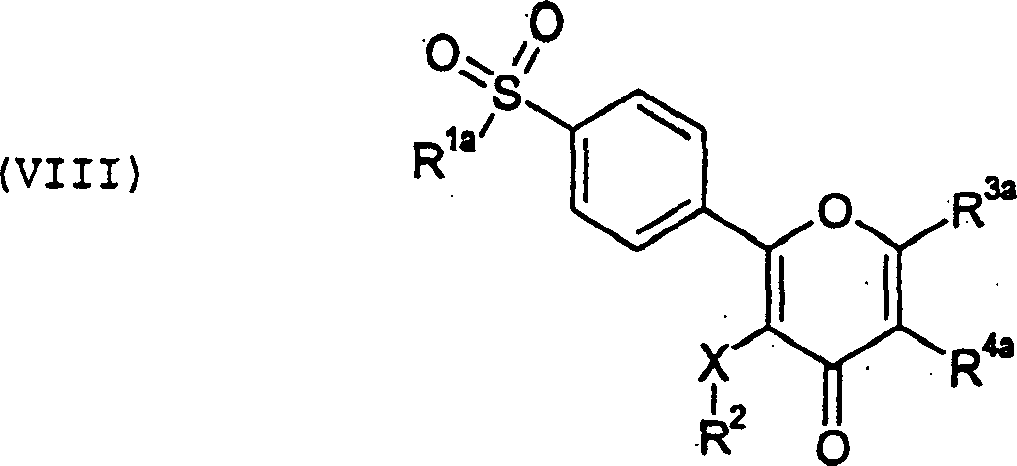
(IX) (R4aCH2CO)2O或以下式(X)的羧酸:(IX) (R 4a CH 2 CO) 2 O or a carboxylic acid of the following formula (X):
(X) R4aCH2COOH和多磷酸在90℃-150℃的温度下反应。(X) R 4a CH 2 COOH and polyphosphoric acid are reacted at a temperature of 90°C-150°C.
也可以通过将以下式(XI)的乙烯基衍生物:其中R1a、R2、R4a和X如上定义,与过量的式(IX)的酐和多磷酸在90℃-150℃的温度下反应,获得式(VIII)化合物。可以通过将式(III)的羰基衍生物与式(IX)的酐和甲磺酸在50℃-100℃的温度下反应,制备式(XI)的乙烯基衍生物。It can also be obtained by combining the following vinyl derivatives of formula (XI): wherein R 1a , R 2 , R 4a and X are as defined above, react with excess anhydride of formula (IX) and polyphosphoric acid at a temperature of 90°C-150°C to obtain compound of formula (VIII). Vinyl derivatives of formula (XI) can be prepared by reacting carbonyl derivatives of formula (III) with anhydrides of formula (IX) and methanesulfonic acid at temperatures ranging from 50°C to 100°C.
本发明也提供其中R3是烷基、R4是氢原子或烷基、R1是烷基、而X不是硫原子的式(I)化合物-即以下式(XII)的2-苯基吡喃-4-酮衍生物的制备方法:其中R1b是烷基,R3b是甲基或R4bCH2基团,R4b是氢原子或烷基,R2和Xb如上定义,即通过将以下式(XIII)的巯基衍生物与氧化剂、最好是与单过氧邻苯二甲酸镁或3-氯过氧苯甲酸反应:其中R1b、R3b、R4b、R2和Xb如上定义。The present invention also provides compounds of formula ( I ) wherein R is an alkyl group, R is a hydrogen atom or an alkyl group, R is an alkyl group, and X is not a sulfur atom - that is, a 2-phenylpyridine of the following formula (XII) The preparation method of pyran-4-one derivatives: Wherein R 1b is an alkyl group, R 3b is a methyl group or R 4b CH 2 group, R 4b is a hydrogen atom or an alkyl group, R 2 and X b are as defined above, that is, by combining a mercapto derivative of the following formula (XIII) with Oxidizing agents, preferably magnesium monoperoxyphthalate or 3-chloroperoxybenzoic acid: wherein R 1b , R 3b , R 4b , R 2 and X b are as defined above.
式(XIII)的巯基衍生物和所述氧化剂之间的反应最好依照先前公开的用于式(VII)化合物的方法在有机溶剂例如二氯甲烷与甲醇或乙醇的混合物中在10℃-40℃的温度下进行。The reaction between the mercapto derivative of formula (XIII) and the oxidizing agent is preferably carried out in an organic solvent such as a mixture of dichloromethane and methanol or ethanol at 10° C. to 40° C. at a temperature of °C.
本发明也提供其中R1是-NR5R6基团、R3是烷基、R4是氢原子或烷基的式(I)化合物-即以下式(XIV)的2-苯基吡喃-4-酮衍生物的制备方法:
(XVI) R5-NH-R6其中R5和R6如上定义。(XVI) R 5 -NH-R 6 wherein R 5 and R 6 are as defined above.
该反应最好在10℃-40℃的温度下进行。The reaction is preferably carried out at a temperature of 10°C to 40°C.
通过将以下的式(XVII)化合物:其中R2、R3b、R4b和X如上定义,与氯磺酸、最好在80℃-120℃的温度下反应,可以例如制备式(XV)的氯磺酰基衍生物。By adding the following compound of formula (XVII): Where R 2 , R 3b , R 4b and X are as defined above, reaction with chlorosulfonic acid, preferably at a temperature of 80°C to 120°C, can for example prepare chlorosulfonyl derivatives of formula (XV).
本发明还提供其中R3是烷基、R4是氢原子或烷基、R1是-NR5R6基团(其中R5和R6是氢)的式(I)化合物-即以下式(XVIII)的2-苯基吡喃-4-酮衍生物的制备方法: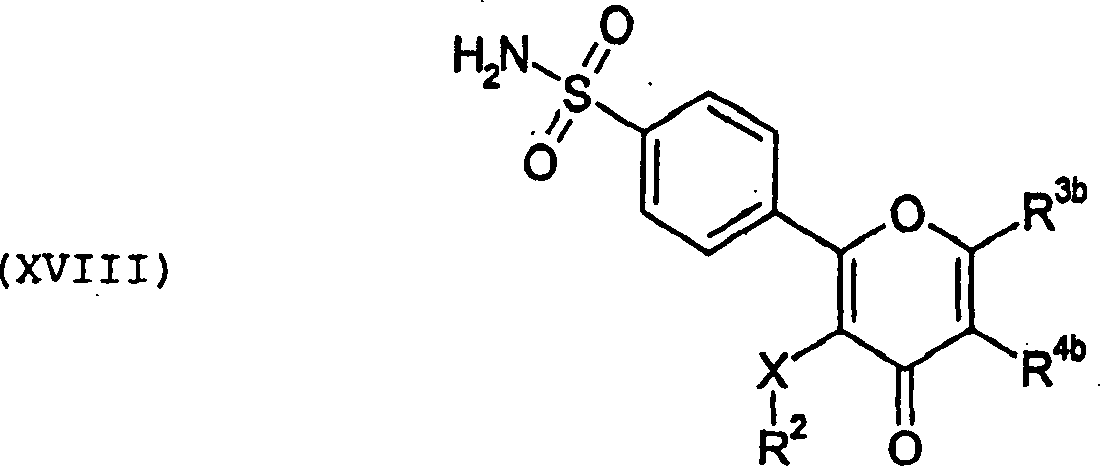
该脱苄基反应最好用过量的三氟乙酸、硫酸或甲磺酸在0℃-120℃的温度下进行。The debenzylation reaction is preferably carried out with an excess of trifluoroacetic acid, sulfuric acid or methanesulfonic acid at a temperature of 0°C to 120°C.
按照上述方法,使用其中R5和R6(或者R5a和R6a)均代表苄基的合适的原料,可以制备式(XIX)的中间体。Intermediates of formula (XIX) can be prepared as described above using suitable starting materials wherein R5 and R6 (or R5a and R6a ) both represent benzyl.
通过文献例如在M.F.Saettone,J.Org.Chem.31,第1959页(1966)和WO 96/06840中公开的方法,可以制备在本发明化合物的制备中所用的式(V)和式(VII)的中间体。Formula (V) and formula (VII) used in the preparation of the compounds of the present invention can be prepared by methods disclosed in literature such as M.F.Saettone, J.Org.Chem.31, p. 1959 (1966) and WO 96/06840 ) intermediates.
通过所公开的用于制备式(II)化合物和式(VIII)化合物的相同方法,用合适的原料可以制备式(XIII)和式(XVII)的中间体化合物。Intermediate compounds of formula (XIII) and formula (XVII) can be prepared by the same methods disclosed for the preparation of compounds of formula (II) and formula (VIII), using appropriate starting materials.
其中R3不是烷基、R4是氢原子的式(I)的2-苯基吡喃-4-酮衍生物-即以下式(XX)的2-苯基吡喃-4-酮衍生物:其中R3c是羟甲基、烷氧基甲基、C3-C7环烷氧基甲基、链烯基甲氧基甲基、C3-C7环烷基甲氧基甲基、苄氧基甲基、羟羰基、腈、三氟甲基、二氟甲基或CH2OCOR7基团,其中R7是烷基或苯基,R1、X和R2如上定义,可以通过以下流程中所示的方法制备: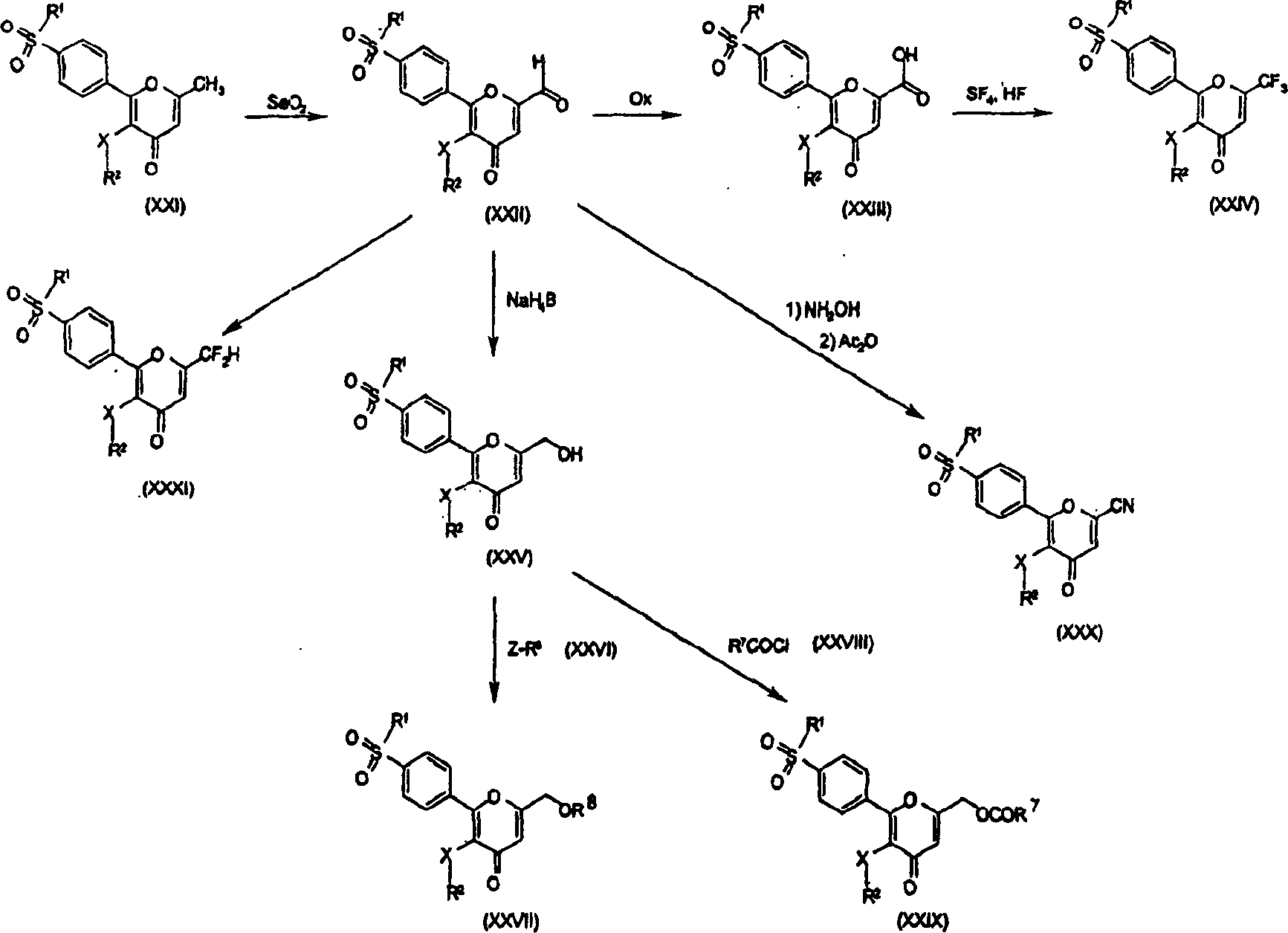
正如所述流程中所观察到的,可以从其中R3是甲基、R4是氢原子的式(I)化合物-即式(XXI)化合物制备通式(XX)的2-苯基吡喃-4-酮衍生物,所述制备方法上文已公开。在第一阶段中,将式(XXI)化合物在有机溶剂如四氢呋喃或二噁烷中,在压力容器中,在100℃-190℃的温度下用氧化剂如二氧化硒处理。得到式(XXII)的相应醛,将其用作获得通式(XX)化合物的原料。As observed in the scheme, 2-phenylpyrans of general formula (XX) can be prepared from compounds of formula (I) in which R is methyl and R is a hydrogen atom - ie compounds of formula (XXI) -4-one derivatives, the preparation method of which has been disclosed above. In the first stage, a compound of formula (XXI) is treated with an oxidizing agent such as selenium dioxide in an organic solvent such as tetrahydrofuran or dioxane in a pressure vessel at a temperature between 100°C and 190°C. The corresponding aldehydes of formula (XXII) are obtained, which are used as starting materials for obtaining compounds of general formula (XX).
从相应的醛(XXII)制备其中R3c是羟羰基的式(XX)化合物-即式(XXIII)化合物,即通过将所述醛与氧化剂如重铬酸吡啶鎓或氧化铬(IV)在有机溶剂例如N,N-二甲基甲酰胺、乙醇或丙酮/硫酸中在-5℃至35℃的温度下反应。用所得的化合物(XXIII)作为获得其中R3c是三氟甲基的式(I)化合物-即式(XXIV)化合物的原料。所述反应通过将化合物(XXIII)与四氟化硫和氟化氢的混合物,任选在有机溶剂例如二氯甲烷存在下,在压力容器中,在20℃-140℃的温度下进行。Compounds of formula (XX) wherein R 3c is hydroxycarbonyl - ie compounds of formula (XXIII) are prepared from the corresponding aldehyde (XXII) by reacting the aldehyde with an oxidizing agent such as pyridinium dichromate or chromium (IV) in an organic The reaction is carried out at a temperature of -5°C to 35°C in a solvent such as N,N-dimethylformamide, ethanol or acetone/sulfuric acid. The obtained compound (XXIII) is used as a starting material to obtain a compound of formula (I) wherein R 3c is trifluoromethyl - ie a compound of formula (XXIV). The reaction is carried out by making a mixture of compound (XXIII) and sulfur tetrafluoride and hydrogen fluoride, optionally in the presence of an organic solvent such as dichloromethane, in a pressure vessel at a temperature of 20°C to 140°C.
通过将式(XXII)化合物在诸如甲醇或乙醇的溶剂中,在10℃-40℃的温度下,用氢化硼或氢化铝、最好是用硼氢化钠还原,制备其中R3c代表羟甲基的式(XX)化合物-即式(XXV)化合物。将式(XXV)化合物与以下式(XXVI)的合适卤化物进行进一步反应:Prepared by reducing a compound of formula (XXII) with boron hydride or aluminum hydride, preferably sodium borohydride, in a solvent such as methanol or ethanol at a temperature of 10°C to 40°C, wherein R 3c represents hydroxymethyl A compound of formula (XX) - ie a compound of formula (XXV). A compound of formula (XXV) is further reacted with a suitable halide of formula (XXVI):
(XXVI) Z-R8其中Z代表氯原子、溴原子或碘原子,R8代表烷基、C3-C7环烷基、链烯基甲基、C3-C7环烷基甲基或苄基,得到式(XX)化合物,其中R3c是烷氧基甲基、C3-C7环烷氧基甲基、链烯基甲氧基甲基、C3-C7环烷基甲氧基甲基或苄氧基甲基,即式(XXVII)化合物。所述反应在有机溶剂如丙酮、N,N-二甲基甲酰胺或四氢呋喃中,在氢化钠或氢化钾或酰胺存在下,在20℃-120℃的温度下进行。(XXVI) ZR 8 wherein Z represents chlorine atom, bromine atom or iodine atom, R 8 represents alkyl, C 3 -C 7 cycloalkyl, alkenylmethyl, C 3 -C 7 cycloalkylmethyl or benzyl , to obtain compounds of formula (XX), wherein R 3c is alkoxymethyl, C 3 -C 7 cycloalkoxymethyl, alkenyl methoxymethyl, C 3 -C 7 cycloalkylmethoxy Benzyloxymethyl or benzyloxymethyl, namely the compound of formula (XXVII). The reaction is carried out in an organic solvent such as acetone, N,N-dimethylformamide or tetrahydrofuran in the presence of sodium hydride or potassium hydride or amides at a temperature of 20°C-120°C.
再者,将式(XXV)化合物与以下式(XXVIII)的合适酰基卤反应:Alternatively, a compound of formula (XXV) is reacted with a suitable acid halide of formula (XXVIII):
(XXVIII) R7COCl其中R7代表烷基或苯基,得到式(XXIX)化合物。所述反应在有机溶剂如四氢呋喃、二氯甲烷、氯仿或二噁烷中,在叔胺例如三乙胺存在下,在20℃至所述溶剂沸点的温度下进行。(XXVIII) R 7 COCl wherein R 7 represents alkyl or phenyl gives compounds of formula (XXIX). The reaction is carried out in an organic solvent such as tetrahydrofuran, dichloromethane, chloroform or dioxane in the presence of a tertiary amine such as triethylamine at a temperature ranging from 20°C to the boiling point of the solvent.
另外,也用式(XXII)的醛作为获得其中R3c是腈基的式(XX)化合物-即式(XXX)化合物的原料。所述反应如下进行;在第一阶段中,用盐酸羟胺和甲酸在80℃-120℃的温度下处理醛(XXII)。分离所得的肟衍生物,并与过量的乙酸酐在100℃-180℃的温度下加热。Additionally, aldehydes of formula (XXII) are also used as starting materials for obtaining compounds of formula (XX) wherein R 3c is nitrile - ie compounds of formula (XXX). The reaction is carried out as follows; in the first stage, the aldehyde (XXII) is treated with hydroxylamine hydrochloride and formic acid at a temperature between 80°C and 120°C. The resulting oxime derivative is isolated and heated at a temperature of 100°C to 180°C with excess acetic anhydride.
从式(XXII)的醛制备其中R3c代表二氟甲基的式(XX)化合物,-即式(XXXI)化合物,即通过将所述醛与氟化试剂如二乙基氨基三氟化硫或四氟化硫-氟化氢的混合物,任选在有机溶剂例如二氯甲烷、苯或甲苯存在下,在0℃-130℃的温度下反应。From the aldehyde of formula (XXII), the compound of formula (XX) wherein R 3c represents difluoromethyl, - that is, the compound of formula (XXXI) is prepared by combining said aldehyde with a fluorinating reagent such as diethylaminosulfur trifluoride Or a mixture of sulfur tetrafluoride-hydrogen fluoride, optionally in the presence of an organic solvent such as dichloromethane, benzene or toluene, at a temperature of 0°C to 130°C.
本发明也提供其中R4不是氢原子的式(I)化合物,即以下式(XXXII)的2-苯基吡喃-4-酮衍生物的制备方法:
(XXXIV) R4cSn(R9)3其中R4c如上定义,R9是烷基。所述反应在诸如二甲基甲酰胺、四氢呋喃或二噁烷的溶剂中,在叔胺例如三乙胺的存在下,与三邻甲苯基膦和乙酸钯(II)在20℃-150℃的温度下进行。(XXXIV) R 4c Sn(R 9 ) 3 wherein R 4c is as defined above and R 9 is an alkyl group. The reaction is carried out in a solvent such as dimethylformamide, tetrahydrofuran or dioxane, in the presence of a tertiary amine such as triethylamine, with tri-o-tolylphosphine and palladium(II) acetate at 20°C-150°C temperature.
通过将式(XX)的衍生物或式(XXI)的衍生物与溴或三溴化吡啶鎓在有机溶剂例如1,1,2,2-四氯乙烷、二氯甲烷或氯仿中,在压力容器中,在20℃-180℃的温度下反应,可以获得式(XXXIII)的衍生物,其中R4d最好是溴原子。By the derivative of formula (XX) or the derivative of formula (XXI) and bromine or tribromide pyridinium in organic solvent such as 1,1,2,2-tetrachloroethane, dichloromethane or chloroform, in In a pressure vessel, react at a temperature of 20°C-180°C to obtain a derivative of formula (XXXIII), wherein R 4d is preferably a bromine atom.
通过本领域已知的方法,通过用有机酸或无机酸如富马酸、酒石酸、琥珀酸或盐酸处理,可以将其中有碱性基团存在的式(I)的2-苯基吡喃-4-酮衍生物转变成药学上可接受的盐、最好是酸加成盐。另外,可以将其中R3代表羟羰基的式(I)的2-苯基吡喃-4-酮衍生物通过与碱金属氢氧化物反应,转变成具有例如碱金属例如钠或钾的药理学上可接受的盐。2-Phenylpyrans of formula (I) in which a basic group is present can be treated with organic or inorganic acids such as fumaric acid, tartaric acid, succinic acid or hydrochloric acid by methods known in the art. The 4-keto derivatives are converted into pharmaceutically acceptable salts, preferably acid addition salts. In addition, 2-phenylpyran- 4 -one derivatives of the formula (I) in which R represents hydroxycarbonyl can be converted into pharmacological compounds with e.g. alkali metals such as sodium or potassium by reaction with alkali metal hydroxides. acceptable salt.
下面的生物学试验和数据进一步说明本发明。The following biological tests and data further illustrate the invention.
人全血中的COX-1和COX-2活性COX-1 and COX-2 activity in human whole blood
将抽血前至少7天未服用过任何非甾体消炎药的健康自愿者的新鲜全血收集到加有肝素的试管(20单位肝素/ml)中。对于COX-1活性的测定,将500μl等份的血液与或者5μl溶媒(二甲亚砜)或者5μl试验化合物一起于37℃孵育1小时。在终止所述孵育之前20分钟,加入钙离子载体A23187(25μM)。血浆通过离心分离(13000rpm,10分钟),在使用酶免疫测定试剂盒(ELISA)测量TXB2水平之前将其一直在-30℃保存。Fresh whole blood was collected in heparinized tubes (20 units heparin/ml) from healthy volunteers who had not taken any NSAIDs for at least 7 days prior to blood draw. For the determination of COX-1 activity, 500 μl aliquots of blood were incubated with either 5 μl of vehicle (dimethylsulfoxide) or 5 μl of test compound at 37° C. for 1 hour. Twenty minutes before terminating the incubation, the calcium ionophore A23187 (25 μΜ) was added. Plasma was separated by centrifugation (13000 rpm, 10 minutes) and stored at -30°C until TXB 2 levels were measured using an enzyme immunoassay kit (ELISA).
用三个复份测定,在5-6个不同的浓度下,孵育每种化合物,评价所述化合物的效应。在IBM计算机上,运用InPlot,GraphPad软件,通过非线性回归获得IC50值。Each compound was incubated in triplicate at 5-6 different concentrations to evaluate the effect of the compound. IC50 values were obtained by nonlinear regression on an IBM computer using InPlot, GraphPad software.
对于COX-2活性的测定,将500μl等份的血液在LPS(10μg/ml)存在下于37℃孵育24小时,以诱导COX-2表达(Patriagnani等,J.Pharm.Exper.Ther.271;1705-1712(1994))。血浆通过离心分离(13000rpm,10分钟),在使用酶免疫测定试剂盒(ELISA)测量PGE2水平之前将其一直在-30℃保存。通过用三个复份测定,在5-6个不同的浓度下,在LPS存在下,孵育每种化合物(5μl等份样品)达24小时,研究抑制剂的效应。在IBM计算机上,运用InPlot,GraphPad软件,通过非线性回归获得IC50值。For the determination of COX-2 activity, 500 μl aliquots of blood were incubated at 37° C. for 24 hours in the presence of LPS (10 μg/ml) to induce COX-2 expression (Patriagnani et al., J.Pharm.Exper.Ther. 271; 1705-1712 (1994)). Plasma was separated by centrifugation (13000 rpm, 10 minutes) and stored at -30°C until PGE2 levels were measured using an enzyme immunoassay kit (ELISA). Inhibitor effects were studied by incubating each compound (5 μl aliquots) in the presence of LPS for 24 hours at 5-6 different concentrations in triplicate assays. IC50 values were obtained by nonlinear regression on an IBM computer using InPlot, GraphPad software.
由所述生物测定获得的结果示于表1中。表1:COX-1和COX-2抑制
如表1中所示,式(I)的2-苯基吡喃-4-酮衍生物是有效的选择性COX-2抑制剂,而参比化合物吲哚美辛与COX-2和COX-1抑制剂等效。因此,本发明化合物最好是哺乳动物COX-2(例如人COX-2)的选择性抑制剂。As shown in Table 1, the 2-phenylpyran-4-one derivatives of formula (I) are potent and selective COX-2 inhibitors, while the reference compound indomethacin interacts with COX-2 and COX- 1 Inhibitor equivalent. Accordingly, the compounds of the invention are preferably selective inhibitors of mammalian COX-2 (eg, human COX-2).
本发明化合物也最好是对哺乳动物COX-1(例如人COX-1)的抑制活性低。抑制活性通常可以通过体外测定,例如如上所述的体外测定来测定。Compounds of the invention also preferably have low inhibitory activity against mammalian COX-1 (eg, human COX-1). Inhibitory activity can generally be determined by in vitro assays, such as those described above.
本发明的优选化合物对COX-2的IC50值低于5μM、优选低于3μM、更优选低于2.5μM。另外,本发明的优选化合物对COX-1的IC50值高于10μM、优选高于20μM。作为对COX-2的抑制高于COX-1的选择性指标,COX-1/COX-2的IC50值比率优选高于20、30或50,更优选高于60、100或200。Preferred compounds of the invention have IC50 values for COX-2 below 5 μM, preferably below 3 μM, more preferably below 2.5 μM. In addition, preferred compounds of the invention have IC50 values for COX-1 above 10 [mu]M, preferably above 20 [mu]M. As an indicator of selectivity for inhibition of COX-2 over COX-1, the ratio of IC50 values of COX-1/COX-2 is preferably higher than 20, 30 or 50, more preferably higher than 60, 100 or 200.
本发明还提供可供在通过治疗法治疗人体或动物体的方法中使用的式(I)化合物,具体来说,所述化合物用来治疗疼痛、发热或炎症,抑制前列腺素类诱导的平滑肌收缩或者预防或治疗结肠直肠癌或神经变性性疾病,例如早老性痴呆(Alzheimer disease)。The present invention also provides a compound of formula (I) that can be used in a method for treating the human or animal body by therapy, specifically, the compound is used to treat pain, fever or inflammation, and inhibit prostaglandin-induced smooth muscle contraction Or prevent or treat colorectal cancer or neurodegenerative diseases, such as Alzheimer disease.
本发明还提供式(I)化合物在生产治疗疼痛、发热或炎症、抑制前列腺素类诱导的平滑肌收缩或者预防或治疗结肠直肠癌的药物方面的应用。The present invention also provides the use of the compound of formula (I) in the production of drugs for treating pain, fever or inflammation, inhibiting prostaglandin-induced smooth muscle contraction, or preventing or treating colorectal cancer.
式(I)化合物可用来缓解各种病症、外科手术和牙科手术后和关节炎的疼痛、发热和炎症,所述病症包括风温热、与流感或其它病毒感染相关的症状、感冒、腰背疼和颈疼、痛经、头痛、牙痛、扭伤和劳损、肌炎、神经痛、滑膜炎、粘液囊炎、腱炎、损伤,所述关节炎包括类风湿性关节炎、骨关节炎、痛风性关节炎、脊椎关节病、系统性红斑狼疮和青少年关节炎。它们也可以用来治疗皮肤炎症性疾病,例如牛皮癣、湿疹、烧伤和皮炎。另外,这类化合物可以用来预防或治疗结肠直肠癌或神经变性性疾病,例如早老性痴呆。Compounds of formula (I) can be used to relieve pain, fever and inflammation in various conditions, including wind-warm-heat, symptoms associated with influenza or other viral infections, colds, low back pain, post-surgical and dental procedures and arthritis. Pain and neck pain, dysmenorrhea, headache, toothache, sprains and strains, myositis, neuralgia, synovitis, bursitis, tendonitis, injuries, including rheumatoid arthritis, osteoarthritis, gout arthritis, spondyloarthropathy, systemic lupus erythematosus, and juvenile arthritis. They can also be used to treat inflammatory skin conditions such as psoriasis, eczema, burns, and dermatitis. In addition, such compounds can be used to prevent or treat colorectal cancer or neurodegenerative diseases, such as Alzheimer's disease.
式(I)化合物也会抑制前列腺素类诱导的平滑肌收缩,因此可用来治疗痛经、早产、哮喘和支气管炎。Compounds of formula (I) also inhibit prostanoid-induced smooth muscle contraction and are therefore useful in the treatment of dysmenorrhea, premature labor, asthma and bronchitis.
可以将式(I)化合物用作常规的非甾体消炎药的替代药物,尤其是当这类非甾体消炎药可能被禁忌时,例如治疗患有胃肠道疾病、肾病(例如肾功能减低)的患者、手术或服用抗凝药之前的患者以及对非甾体消炎药诱导的哮喘敏感的患者,所述胃肠道疾病包括消化性溃疡、胃炎、局限性回肠炎、溃疡性结肠炎、憩室炎、节段性回肠炎(Crohn’sdisease)、炎性大肠综合征和过敏性肠综合征、胃肠道出血和凝血障碍。The compounds of formula (I) can be used as an alternative to conventional NSAIDs, especially when such NSAIDs may be contraindicated, e.g. in the treatment of patients with gastrointestinal disorders, renal disorders (e.g. reduced renal function ), patients before surgery or taking anticoagulants, and patients sensitive to NSAID-induced asthma, the gastrointestinal diseases include peptic ulcer, gastritis, Crohn's disease, ulcerative colitis, Diverticulitis, Crohn's disease, inflammatory bowel syndrome and irritable bowel syndrome, gastrointestinal bleeding, and coagulation disorders.
所述化合物还可以用来治疗以下疾病中的炎症:例如血管疾病、偏头痛、结节性动脉外膜炎、甲状腺炎、再生障碍性贫血、霍奇森病(Hodgkin’s disease)、硬皮病、I型糖尿病、重症肌无力、结节病、肾病变综合征、贝赫切特综合征(Behcet’s syndrome)、多发性肌炎、过敏反应、结膜炎、龈炎和心肌缺血。The compounds can also be used to treat inflammation in diseases such as vascular disease, migraine, adventitia nodosa, thyroiditis, aplastic anemia, Hodgkin's disease, scleroderma, type I Diabetes mellitus, myasthenia gravis, sarcoidosis, nephrotic syndrome, Behcet's syndrome, polymyositis, anaphylaxis, conjunctivitis, gingivitis, and myocardial ischemia.
本发明化合物是环加氧酶-2的抑制剂,从而可用来治疗以上列举的环加氧酶-2介导的疾病。The compounds of the present invention are inhibitors of cyclooxygenase-2 and thus are useful in the treatment of the cyclooxygenase-2 mediated diseases listed above.
因此,式(I)的2-苯基吡喃-4-酮衍生物及其药学上可接受的盐和包含这类化合物和/或其盐的药用组合物,可以用于治疗人体疾病的方法中,所述方法包括给予需要所述治疗的患者有效量的式(I)的2-苯基吡喃-4-酮衍生物或其药学上可接受的盐。Therefore, 2-phenylpyran-4-one derivatives of formula (I) and pharmaceutically acceptable salts thereof and pharmaceutical compositions comprising such compounds and/or salts thereof can be used for the treatment of human diseases In the method, the method comprises administering an effective amount of a 2-phenylpyran-4-one derivative of formula (I) or a pharmaceutically acceptable salt thereof to a patient in need of said treatment.
本发明也提供药用组合物,所述药用组合物包含作为有效成分的至少一种式(I)的2-苯基吡喃-4-酮衍生物或其药学上可接受的盐以及药学上可接受的赋形剂(例如载体或稀释剂)。根据所述制剂的性质以及是否在临用前进行进一步稀释,所述有效成分可以占所述组合物的0.001%-99%(重量)、优选0.01%-90%(重量)。The present invention also provides a pharmaceutical composition comprising at least one 2-phenylpyran-4-one derivative of formula (I) or a pharmaceutically acceptable salt thereof as an active ingredient and a pharmaceutical An acceptable excipient (such as a carrier or diluent). According to the nature of the preparation and whether it is further diluted just before use, the active ingredient may account for 0.001%-99% (weight), preferably 0.01%-90% (weight) of the composition.
优选将所述组合物制成适合于口服给药、局部给药、鼻腔给药、吸入给药、直肠给药、经皮给药或注射给药的形式。Preferably the composition is formulated for oral, topical, nasal, inhalational, rectal, transdermal or parenteral administration.
与所述活性化合物或这种化合物的盐混合以形成本发明组合物的药学上可接受的赋形剂本身是众所周知的,所用的实际赋形剂尤其取决于计划给予所述组合物的方法。The pharmaceutically acceptable excipients with which the active compounds or salts of such compounds are mixed to form the compositions of the invention are well known per se, the actual excipients used depending inter alia on the method by which the composition is intended to be administered.
本发明的组合物最好适合于注射给药和口服给药。在这种情况下,对于口服给药,所述组合物可以采用以下形式:片剂、延迟片剂、舌下片、胶囊剂或液体制剂,例如合剂、酏剂、糖浆剂或混悬剂,所有形式都含有本发明化合物;这类制剂可以通过本领域众所周知的方法制备。The compositions of the present invention are preferably suitable for parenteral administration and oral administration. In this case, for oral administration, the composition may take the form of tablets, delayed tablets, sublingual tablets, capsules or liquid preparations such as mixtures, elixirs, syrups or suspensions, All forms contain a compound of the invention; such formulations can be prepared by methods well known in the art.
可以用来制备所述组合物的稀释剂包括与所述有效成分相容的那些液体稀释剂和固体稀释剂,如果需要,可以与着色剂或矫味剂一起使用。片剂或胶囊剂可以常规含有2-500mg有效成分或其等同量的盐。Diluents which may be used to prepare the compositions include those liquid and solid diluents which are compatible with the active ingredient, along with coloring or flavoring agents, if desired. Tablets or capsules may conventionally contain 2-500 mg of the active ingredient or an equivalent amount of a salt thereof.
适合于口服使用的液体组合物可以为溶液剂或混悬剂形式。所述溶液剂可以是所述活性化合物的可溶性盐或其它衍生物与例如蔗糖结合的水溶液,以形成糖浆剂。所述混悬剂可以包含不溶性的本发明活性化合物或其药学上可接受的盐和水以及悬浮剂或矫味剂。Liquid compositions suitable for oral use may be in the form of solutions or suspensions. Such solutions may be aqueous solutions of soluble salts or other derivatives of the active compound in combination with, for example, sucrose, to form a syrup. The suspension may contain an insoluble active compound of the present invention or a pharmaceutically acceptable salt thereof and water and a suspending agent or flavoring agent.
用于胃肠外注射的组合物可以从可溶性盐制备,所述组合物可以被冻干或不冻干,以及可以将所述组合物溶于无热原水性介质或其它合适的胃肠外注射液中。Compositions for parenteral injection may be prepared from soluble salts, which may or may not be lyophilized, and which may be dissolved in a pyrogen-free aqueous medium or other suitable parenteral injection in the liquid.
有效剂量的范围通常是每天10-600mg有效成分。日用剂量可以每天给予一次或多次、最好是每天给予1-4次。Effective dosages generally range from 10-600 mg of active ingredient per day. The daily dose can be administered one or more times per day, preferably 1-4 times per day.
通过以下制备和实施例说明本发明,所述制备和实施例不以任何方式限制本发明的范围。制备12-(2,4-二氟苯氧基)-1-(4-甲磺酰基苯基)乙酮The invention is illustrated by the following Preparations and Examples, which do not limit the scope of the invention in any way. Preparation of 12-(2,4-difluorophenoxy)-1-(4-methylsulfonylphenyl)ethanone
a)向2,4-二氟苯酚(3.71g;29mmol)和2-溴-1-(4-甲磺酰基苯基)乙酮(7.00g;29mmol)的二氯甲烷(50ml)溶液加入碳酸钾(5.91g;43mmol)和四丁基硫酸氢铵(0.48g;1.4mmol)的水(20ml)溶液。将混合物在室温下搅拌16小时。加入水(100ml),倾析有机相,碱性相用二氯甲烷(2×100ml)萃取。将有机溶液干燥(Na2SO4),减压除去溶剂。所得的固体用乙醚洗涤。得到为灰白色固体的2-(2,4-二氟苯氧基)-1-(4-甲基硫烷基苯基)乙酮(6.60g,76%)。a) To a solution of 2,4-difluorophenol (3.71 g; 29 mmol) and 2-bromo-1-(4-methylsulfonylphenyl)ethanone (7.00 g; 29 mmol) in dichloromethane (50 ml) was added carbonic acid A solution of potassium (5.91 g; 43 mmol) and tetrabutylammonium bisulfate (0.48 g; 1.4 mmol) in water (20 ml). The mixture was stirred at room temperature for 16 hours. Water (100ml) was added, the organic phase was decanted and the basic phase was extracted with dichloromethane (2 x 100ml). The organic solution was dried ( Na2SO4 ) and the solvent was removed under reduced pressure. The resulting solid was washed with ether. 2-(2,4-Difluorophenoxy)-1-(4-methylsulfanylphenyl)ethanone (6.60 g, 76%) was obtained as an off-white solid.
b)将80%单过氧邻苯二甲酸镁六水合物(15.26g;25mmol)的水(20ml)溶液加入到以上化合物(6.60g;22mmol)的二氯甲烷(100ml)溶液中。将混合物在室温下搅拌16小时。将反应物倾至饱和碳酸氢钠溶液(200ml)中,然后用二氯甲烷(3×100ml)萃取。将有机相干燥(Na2SO4),减压除去溶剂。得到为灰白色固体的2-(2,4-二氟苯氧基)-1-(4-甲磺酰基苯基)乙酮(4.97g,89%)。b) A solution of 80% magnesium monoperoxyphthalate hexahydrate (15.26 g; 25 mmol) in water (20 ml) was added to a solution of the above compound (6.60 g; 22 mmol) in dichloromethane (100 ml). The mixture was stirred at room temperature for 16 hours. The reaction was poured into saturated sodium bicarbonate solution (200ml), then extracted with dichloromethane (3 x 100ml). The organic phase was dried ( Na2SO4 ) and the solvent was removed under reduced pressure. 2-(2,4-Difluorophenoxy)-1-(4-methanesulfonylphenyl)ethanone (4.97 g, 89%) was obtained as an off-white solid.
δ(DMSO):3.31(s,3H),5.72(s,2H),6.93-7.05(m,1H),7.15-7.36(m,2H),8.12(d,J=8.5Hz,2H),8.22(d,J=8.5Hz,2H)。制备22-(4-氟苯氧基)-1-(4-甲磺酰基苯基)乙酮δ(DMSO): 3.31(s, 3H), 5.72(s, 2H), 6.93-7.05(m, 1H), 7.15-7.36(m, 2H), 8.12(d, J=8.5Hz, 2H), 8.22 (d, J=8.5Hz, 2H). Preparation of 22-(4-fluorophenoxy)-1-(4-methylsulfonylphenyl)ethanone
通过制备1中所述的方法,从2-溴-1-(4-甲基硫烷基苯基)乙酮和4-氟苯酚获得为灰白色固体的标题化合物(72%,总收率)。The title compound was obtained as an off-white solid from 2-bromo-1-(4-methylsulfanylphenyl)ethanone and 4-fluorophenol by the method described in Preparation 1 (72%, overall yield).
δ(DMSO):3.32(s,3H),5.62(s,2H),7.01-7.04(m,2H),7.05-7.17(m,2H),8.13(d,J=8.0Hz,2H),8.25(d,J=8.0Hz,2H)。制备32-(4-氯苯氧基)-1-(4-甲磺酰基苯基)乙酮δ(DMSO): 3.32(s, 3H), 5.62(s, 2H), 7.01-7.04(m, 2H), 7.05-7.17(m, 2H), 8.13(d, J=8.0Hz, 2H), 8.25 (d, J = 8.0 Hz, 2H). Preparation of 32-(4-chlorophenoxy)-1-(4-methylsulfonylphenyl)ethanone
通过制备1中所述的方法,从2-溴-1-(4-甲基硫烷基苯基)乙酮和4-氯苯酚获得为灰白色固体的标题化合物(89%,总收率)。The title compound was obtained as an off-white solid from 2-bromo-1-(4-methylsulfanylphenyl)ethanone and 4-chlorophenol by the method described in Preparation 1 (89%, overall yield).
δ(DMSO):3.30(s,3H),5.65(s,2H),7.03(d,J=8.5Hz,2H),7.32(d,J=8.5Hz,2H),8.12(d,J=8.5Hz,2H),8.24(d,J=8.5Hz,2H)。制备42-(4-氟-2-甲基苯氧基)-1-(4-甲磺酰基苯基)乙酮δ(DMSO): 3.30(s, 3H), 5.65(s, 2H), 7.03(d, J=8.5Hz, 2H), 7.32(d, J=8.5Hz, 2H), 8.12(d, J=8.5 Hz, 2H), 8.24 (d, J=8.5Hz, 2H). Preparation of 42-(4-fluoro-2-methylphenoxy)-1-(4-methylsulfonylphenyl)ethanone
通过制备1中所述的方法,从2-溴-1-(4-甲基硫烷基苯基)乙酮和4-氟-2-甲基苯酚获得为灰白色固体的标题化合物(75%,总收率)。The title compound was obtained as an off-white solid (75%, total yield).
δ(DMSO):2.22(s,3H),3.30(s,3H),5.63(s,2H),6.89-7.06(m,3H),8.08(d,J=8.0Hz,2H),8.21(d,J=8.0Hz,2H)。制备52-(4-氯-2-甲基苯氧基)-1-(4-甲磺酰基苯基)乙酮δ(DMSO): 2.22(s, 3H), 3.30(s, 3H), 5.63(s, 2H), 6.89-7.06(m, 3H), 8.08(d, J=8.0Hz, 2H), 8.21(d , J=8.0Hz, 2H). Preparation of 52-(4-chloro-2-methylphenoxy)-1-(4-methylsulfonylphenyl)ethanone
通过制备1中所述的方法,从2-溴-1-(4-甲基硫烷基苯基)乙酮和4-氯-2-甲基苯酚获得为灰白色固体的标题化合物(77%,总收率)。The title compound was obtained as an off-white solid (77%, total yield).
δ(DMSO):2.23(s,3H),3.31(s,3H),5.68(s,2H),6.96(d,J=8.5Hz,1H),7.15(d,J=8.5Hz,1H),7.25(s,1H),8.12(d,J=8.5Hz,2H),8.24(d,J=8.5Hz,2H)。制备62-(2-氯-4-甲基苯氧基)-1-(4-甲磺酰基苯基)乙酮δ(DMSO): 2.23(s, 3H), 3.31(s, 3H), 5.68(s, 2H), 6.96(d, J=8.5Hz, 1H), 7.15(d, J=8.5Hz, 1H), 7.25 (s, 1H), 8.12 (d, J=8.5Hz, 2H), 8.24 (d, J=8.5Hz, 2H). Preparation of 62-(2-chloro-4-methylphenoxy)-1-(4-methylsulfonylphenyl)ethanone
通过制备1中所述的方法,从2-溴-1-(4-甲基硫烷基苯基)乙酮和2-氯-4-甲基苯酚获得为灰白色固体的标题化合物(84%,总收率)。The title compound was obtained as an off-white solid (84%, total yield).
δ(DMSO):2.23(s,1H),3.32(s,3H),5.74(s,2H),7.02-7.04(m,2H),7.24(s,H),8.12(d,J=8.1Hz,2H),8.22(d,J=8.1Hz,2H)。制备72-(4-溴苯氧基)-1-(4-甲磺酰基苯基)乙酮δ(DMSO): 2.23(s, 1H), 3.32(s, 3H), 5.74(s, 2H), 7.02-7.04(m, 2H), 7.24(s, H), 8.12(d, J=8.1Hz , 2H), 8.22 (d, J = 8.1 Hz, 2H). Preparation of 72-(4-bromophenoxy)-1-(4-methylsulfonylphenyl)ethanone
通过制备1中所述的方法,从2-溴-1-(4-甲基硫烷基苯基)乙酮和2-溴苯酚获得为灰白色固体的标题化合物(72%,总收率)。The title compound was obtained as an off-white solid from 2-bromo-1-(4-methylsulfanylphenyl)ethanone and 2-bromophenol by the method described in Preparation 1 (72%, overall yield).
δ(CDCl3):3.07(s,3H),5.30(s,2H),6.80-6.94(m,2H),7.20-7.26(m,1H),7.53(d,J=7.5Hz,1H),8.08(d,J=9.0Hz,2H),8.23(d,J=9.0Hz,2H)。制备82-(3-溴苯氧基)-1-(4-甲磺酰基苯基)乙酮δ(CDCl 3 ): 3.07(s, 3H), 5.30(s, 2H), 6.80-6.94(m, 2H), 7.20-7.26(m, 1H), 7.53(d, J=7.5Hz, 1H), 8.08 (d, J=9.0 Hz, 2H), 8.23 (d, J=9.0 Hz, 2H). Preparation of 2-(3-bromophenoxy)-1-(4-methylsulfonylphenyl)ethanone
通过制备1中所述的方法,从2-溴-1-(4-甲基硫烷基苯基)乙酮和3-溴苯酚获得为灰白色固体的标题化合物(57%,总收率)。The title compound was obtained as an off-white solid from 2-bromo-1-(4-methylsulfanylphenyl)ethanone and 3-bromophenol by the method described in Preparation 1 (57%, overall yield).
δ(DMSO):3.33(s,3H),5.72(s,2H),7.03-7.06(m,1H),7.17(d,J=8.0Hz,1H),7.25(d,J=8.0Hz,1H),7.32(s,1H),8.13(d,J=8.0Hz,2H),8.24(d,J=8.0Hz,2H)。制备92-(4-溴苯氧基)-1-(4-甲磺酰基苯基)乙酮δ(DMSO): 3.33(s, 3H), 5.72(s, 2H), 7.03-7.06(m, 1H), 7.17(d, J=8.0Hz, 1H), 7.25(d, J=8.0Hz, 1H ), 7.32 (s, 1H), 8.13 (d, J=8.0Hz, 2H), 8.24 (d, J=8.0Hz, 2H). Preparation of 92-(4-bromophenoxy)-1-(4-methylsulfonylphenyl)ethanone
通过制备1中所述的方法,从2-溴-1-(4-甲基硫烷基苯基)乙酮和4-溴苯酚获得为灰白色固体的标题化合物(81%,总收率)。The title compound was obtained as an off-white solid from 2-bromo-1-(4-methylsulfanylphenyl)ethanone and 4-bromophenol by the method described in Preparation 1 (81%, overall yield).
δ(CDCl3):3.33(s,3H),5.66(s,2H),7.00(d,J=9.0Hz,2H),7.46(d,J=9.0Hz,2H),8.12(d,J=9.0Hz,2H),8.24(d,J=9.0Hz,2H)。制备102-(4-溴-2-氟苯氧基)-1-(4-甲磺酰基苯基)乙酮δ(CDCl 3 ): 3.33(s, 3H), 5.66(s, 2H), 7.00(d, J=9.0Hz, 2H), 7.46(d, J=9.0Hz, 2H), 8.12(d, J= 9.0 Hz, 2H), 8.24 (d, J = 9.0 Hz, 2H). Preparation of 10 2-(4-bromo-2-fluorophenoxy)-1-(4-methylsulfonylphenyl)ethanone
通过制备1中所述的方法,从2-溴-1-(4-甲基硫烷基苯基)乙酮和4-溴-2-氟苯酚获得为灰白色固体的标题化合物(78%,总收率)。The title compound was obtained as an off-white solid (78%, total yield).
δ(DMSO):3.32(s,3H),5.80(s,2H),7.10(t,J=7.5Hz,1H),7.37(t,J=7.5Hz,1H),7.60(d,J=7.5Hz,1H),8.13(d,J=9.0Hz,2H),8.24(d,J=9.0Hz,2H)。制备112-(4-溴-2-氯苯氧基)-1-(4-甲磺酰基苯基)乙酮δ(DMSO): 3.32(s, 3H), 5.80(s, 2H), 7.10(t, J=7.5Hz, 1H), 7.37(t, J=7.5Hz, 1H), 7.60(d, J=7.5 Hz, 1H), 8.13 (d, J = 9.0 Hz, 2H), 8.24 (d, J = 9.0 Hz, 2H). Preparation of 112-(4-bromo-2-chlorophenoxy)-1-(4-methylsulfonylphenyl)ethanone
通过制备1中所述的方法,从2-溴-1-(4-甲基硫烷基苯基)乙酮和4-溴-2-氯苯酚获得为灰白色固体的标题化合物(68%,总收率)。The title compound was obtained as an off-white solid (68%, total yield).
δ(CDCl3):3.13(s,3H),5.32(s,2H),6.77(d,J=9.0Hz,1H),7.32(d,J=9.0Hz,1H),7.56(s,1H),8.12(d,J=7.5Hz,2H),8.24(d,J=7.5Hz,2H)。制备122-(2,4-二溴苯氧基)-1-(4-甲磺酰基苯基)乙酮δ(CDCl 3 ): 3.13(s, 3H), 5.32(s, 2H), 6.77(d, J=9.0Hz, 1H), 7.32(d, J=9.0Hz, 1H), 7.56(s, 1H) , 8.12 (d, J=7.5Hz, 2H), 8.24 (d, J=7.5Hz, 2H). Preparation of 122-(2,4-dibromophenoxy)-1-(4-methylsulfonylphenyl)ethanone
通过制备1中所述的方法,从2-溴-1-(4-甲基硫烷基苯基)乙酮和2,4-二溴苯酚获得为灰白色固体的标题化合物(85%,总收率)。The title compound was obtained as an off-white solid from 2-bromo-1-(4-methylsulfanylphenyl)ethanone and 2,4-dibromophenol by the method described in Preparation 1 (85%, total Rate).
δ(CDCl3):3.09(s,3H),5.31(s,2H),6.73(d,J=9.0Hz,1H),7.36(d,J=9.0Hz,1H),7.69(s,1H),8.08(d,J=7.5Hz,2H),8.23(d,J=7.5Hz,2H)。制备132-(2,4-二氟苯氧基)-1-(4-乙磺酰基苯基)乙酮δ(CDCl 3 ): 3.09(s, 3H), 5.31(s, 2H), 6.73(d, J=9.0Hz, 1H), 7.36(d, J=9.0Hz, 1H), 7.69(s, 1H) , 8.08 (d, J=7.5Hz, 2H), 8.23 (d, J=7.5Hz, 2H). Preparation of 132-(2,4-difluorophenoxy)-1-(4-ethylsulfonylphenyl)ethanone
通过制备1中所述的方法,从2-溴-1-(4-乙基硫烷基苯基)乙酮和2,4-二氟苯酚获得为灰白色固体的标题化合物(69%,总收率)。The title compound was obtained as an off-white solid from 2-bromo-1-(4-ethylsulfanylphenyl)ethanone and 2,4-difluorophenol by the method described in Preparation 1 (69%, total yield Rate).
δ(CDCl3):1.31(t,J=9.0Hz,3H),3.15(q,J=9.0Hz,2H),5.31(s,2H),6.70-7.03(m,3H),8.03(d,J=8.0Hz,2H),8.20(d,J=8.0Hz,2H)。制备143-(4-氟苯氧基)-2-(4-甲磺酰基苯基)-6-甲基吡喃-4-酮δ(CDCl 3 ): 1.31(t, J=9.0Hz, 3H), 3.15(q, J=9.0Hz, 2H), 5.31(s, 2H), 6.70-7.03(m, 3H), 8.03(d, J=8.0Hz, 2H), 8.20(d, J=8.0Hz, 2H). Preparation of 14 3-(4-fluorophenoxy)-2-(4-methylsulfonylphenyl)-6-methylpyran-4-one
将制备2的标题化合物(0.75g,2.43mmol)加入到多磷酸(7.5g)的乙酸(11ml)悬浮液中,于95-100℃预热。将混合物于140℃加热4小时。冷却后,将反应物倾至冰水中,用乙酸乙酯(2×100ml)萃取,将有机溶液干燥(Na2SO4),减压除去溶剂。将残留的油状物通过硅胶柱层析并且用乙酸乙酯/正己烷(1∶1)作为洗脱液进行纯化。得到为灰白色固体的3-(4-氟苯氧基)-2-(4-甲磺酰基苯基)-6-甲基吡喃-4-酮(0.26g,11%)。The title compound of Preparation 2 (0.75g, 2.43mmol) was added to a suspension of polyphosphoric acid (7.5g) in acetic acid (11ml) and preheated at 95-100°C. The mixture was heated at 140°C for 4 hours. After cooling, the reaction was poured into ice water, extracted with ethyl acetate (2 x 100ml), the organic solution was dried ( Na2SO4 ), and the solvent was removed under reduced pressure . The residual oil was purified by silica gel column chromatography using ethyl acetate/n-hexane (1:1) as eluent. 3-(4-Fluorophenoxy)-2-(4-methanesulfonylphenyl)-6-methylpyran-4-one (0.26 g, 11%) was obtained as an off-white solid.
δ(DMSO):2.40(s,3H),3.27(s,3H),6.42(s,1H),6.94-7.04(m,2H),7.06-7.14(m,2H),8.04(s,4H)。制备153-(4-溴苯氧基)-2-(4-甲磺酰基苯基)-6-甲基吡喃-4-酮δ(DMSO): 2.40(s, 3H), 3.27(s, 3H), 6.42(s, 1H), 6.94-7.04(m, 2H), 7.06-7.14(m, 2H), 8.04(s, 4H) . Preparation of 15 3-(4-bromophenoxy)-2-(4-methylsulfonylphenyl)-6-methylpyran-4-one
通过制备14中所述的方法,从制备9的标题化合物和乙酸获得为灰白色固体的标题化合物(19%)。The title compound (19%) was obtained from the title compound of Preparation 9 and acetic acid by the method described in Preparation 14 as an off-white solid.
δ(CDCl3):2.44(s,3H),3.06(s,3H),6.36(s,1H),6.89(d,J=9.0Hz,2H),7.20(d,J=9.0Hz,2H),8.00(d,J=9.0Hz,2H),8.07(d,J=9.0Hz,2H)。制备16乙酸2-(2,4-二氟苯氧基)-1-(4-甲磺酰基苯基)乙烯基酯δ(CDCl 3 ): 2.44(s, 3H), 3.06(s, 3H), 6.36(s, 1H), 6.89(d, J=9.0Hz, 2H), 7.20(d, J=9.0Hz, 2H) , 8.00 (d, J=9.0 Hz, 2H), 8.07 (d, J=9.0 Hz, 2H). Preparation of 16 2-(2,4-difluorophenoxy)-1-(4-methylsulfonylphenyl)vinyl acetate
将甲磺酸(7.41g,77mmol)加入到制备1的标题化合物(10.0g,30.7mmol)和乙酸酐(20.0g,0.196mol)的混合物中,于80℃预热。2小时后,让反应物冷却,慢慢地加入水(50ml),使温度保持在30℃以下。将混合物搅拌30分钟。所得的固体用水洗涤,于45℃减压干燥。得到为白色固体的乙酸2-(2,4-二氟苯氧基)-1-(4-甲磺酰基苯基)乙烯基酯(10.2g,90%)。Add methanesulfonic acid (7.41 g, 77 mmol) into the mixture of the title compound (10.0 g, 30.7 mmol) and acetic anhydride (20.0 g, 0.196 mol) in Preparation 1, and preheat at 80°C. After 2 hours, the reaction was allowed to cool and water (50ml) was added slowly, keeping the temperature below 30°C. The mixture was stirred for 30 minutes. The resulting solid was washed with water and dried at 45°C under reduced pressure. 2-(2,4-Difluorophenoxy)-1-(4-methanesulfonylphenyl)vinyl acetate was obtained as a white solid (10.2 g, 90%).
δ(DMSO):2.33(s,3H),3.20(s,3H),7.08-7.16(m,1H),7.40-7.57(m,2H),7.77(d,J=8.7Hz,2H),7.88(d,J=8.7Hz,2H),7.89(s,1H)。制备17乙酸2-(4-氯苯氧基)-1-(4-甲磺酰基苯基)乙烯基酯δ(DMSO): 2.33(s, 3H), 3.20(s, 3H), 7.08-7.16(m, 1H), 7.40-7.57(m, 2H), 7.77(d, J=8.7Hz, 2H), 7.88 (d, J=8.7Hz, 2H), 7.89 (s, 1H). Preparation 17 2-(4-Chlorophenoxy)-1-(4-methylsulfonylphenyl)vinyl acetate
通过制备16中所述的方法,从制备3的标题化合物和乙酸酐获得为灰白色固体的标题化合物(49%)。The title compound (49%) was obtained as an off-white solid from the title compound of Preparation 3 and acetic anhydride by the method described in Preparation 16.
δ(DMSO):2.37(s,3H),3.24(s,3H),7.29(d,J=9.0Hz,2H),7.47(d,J=9.0Hz,2H),7.82(d,J=8.7Hz,2H),7.91(d,J=8.7Hz,2H),7.94(s,1H)。制备18丙酸2-(2,4-二氟苯氧基)-1-(4-甲磺酰基苯基)乙烯基酯δ(DMSO): 2.37(s, 3H), 3.24(s, 3H), 7.29(d, J=9.0Hz, 2H), 7.47(d, J=9.0Hz, 2H), 7.82(d, J=8.7 Hz, 2H), 7.91 (d, J = 8.7 Hz, 2H), 7.94 (s, 1H). Preparation of 18 2-(2,4-difluorophenoxy)-1-(4-methylsulfonylphenyl)vinyl propionate
通过制备16中所述的方法,从制备1的标题化合物和丙酸酐获得为白色固体的标题化合物(55%)。The title compound (55%) was obtained as a white solid from the title compound of Preparation 1 and propionic anhydride by the method described in Preparation 16.
δ(CDCl3):1.31(t,J=7.5Hz,3H),2.69(q,J=7.5Hz,2H),6.87-6.97(m,2H),7.04(s,1H),7.14-7.24(m,1H),7.56(d,J=8.0Hz,2H),7.92(d,J=8.0Hz,2H)。制备193-(2,4-二氟苯氧基)-2-(4-甲磺酰基苯基)-6-甲基吡喃-4-酮δ(CDCl 3 ): 1.31(t, J=7.5Hz, 3H), 2.69(q, J=7.5Hz, 2H), 6.87-6.97(m, 2H), 7.04(s, 1H), 7.14-7.24( m, 1H), 7.56 (d, J=8.0 Hz, 2H), 7.92 (d, J=8.0 Hz, 2H). Preparation of 193-(2,4-difluorophenoxy)-2-(4-methylsulfonylphenyl)-6-methylpyran-4-one
将制备16的标题化合物(10.0g,27mmol)加入到多磷酸(75g)的乙酸酐(10.0g,98mmol)溶液中,于95-100℃预热。40分钟后,让反应物于40-50℃冷却。加入甲醇/水(1∶2)(113ml),使温度保持在80℃以下,将混合物搅拌16小时。将所得的固体过滤,在甲醇(45ml)中回流2小时。冷却后,将固体过滤并从甲乙酮中重结晶,得到为灰白色固体的3-(2,4-二氟苯氧基)-2-(4-甲磺酰基苯基)-6-甲基吡喃-4-酮(3.86,36%)。Add the title compound of Preparation 16 (10.0 g, 27 mmol) into a solution of polyphosphoric acid (75 g) in acetic anhydride (10.0 g, 98 mmol), and preheat at 95-100°C. After 40 minutes, the reaction was allowed to cool at 40-50°C. Methanol/water (1:2) (113 ml) was added, keeping the temperature below 80°C, and the mixture was stirred for 16 hours. The resulting solid was filtered and refluxed in methanol (45ml) for 2 hours. After cooling, the solid was filtered and recrystallized from methyl ethyl ketone to afford 3-(2,4-difluorophenoxy)-2-(4-methanesulfonylphenyl)-6-methylpyran as an off-white solid -4-one (3.86, 36%).
δ(DMSO):2.44(s,3H),3.26(s,3H),6.48(s,1H),6.89-6.98(m,1H),7.04-7.14(m,1H),7.34-7.44(m,1H),8.09(s,4H)。制备203-(4-氯苯氧基)-2-(4-甲磺酰基苯基)-6-甲基吡喃-4-酮δ(DMSO): 2.44(s, 3H), 3.26(s, 3H), 6.48(s, 1H), 6.89-6.98(m, 1H), 7.04-7.14(m, 1H), 7.34-7.44(m, 1H), 8.09(s, 4H). Preparation of 203-(4-chlorophenoxy)-2-(4-methylsulfonylphenyl)-6-methylpyran-4-one
通过制备19中所述的方法,从制备17的标题化合物和乙酸酐获得标题化合物。通过硅胶柱层析并用乙酸乙酯/正己烷(3∶2)作为洗脱液进行纯化。得到为灰白色固体的3-(4-氯苯氧基)-2-(4-甲磺酰基苯基)-6-甲基吡喃-4-酮(32%)。By the method described in Preparation 19, the title compound was obtained from the title compound of Preparation 17 and acetic anhydride. Purification was performed by silica gel column chromatography using ethyl acetate/n-hexane (3:2) as eluent. 3-(4-Chlorophenoxy)-2-(4-methanesulfonylphenyl)-6-methylpyran-4-one (32%) was obtained as an off-white solid.
δ(DMSO):2.44(s,3H),3.26(s,3H),6.48(s,1H),7.20(d,J=9.0Hz,2H),7.34(d,J=9.0Hz,2H),8.06(s,4H)。制备215-(2,4-二氟苯氧基)-6-(4-甲磺酰基苯基)-4-氧代-4H-吡喃-2-甲醛(carbaldehyde)δ(DMSO): 2.44(s, 3H), 3.26(s, 3H), 6.48(s, 1H), 7.20(d, J=9.0Hz, 2H), 7.34(d, J=9.0Hz, 2H), 8.06(s, 4H). Preparation of 215-(2,4-difluorophenoxy)-6-(4-methylsulfonylphenyl)-4-oxo-4H-pyran-2-carbaldehyde
将二氧化硒(7.0g,63mmol)加入到制备19的标题化合物(5.0g,12.7mmol)的二噁烷(55ml)溶液中,将混合物在密封试管中于180℃加热60分钟。冷却后,粗物质通过Celite过滤,减压除去溶剂。所得的油状物通过硅胶柱层析并用乙酸乙酯/正己烷(2∶1)作为洗脱液进行纯化。得到为灰白色固体的5-(2,4-二氟苯氧基)-6-(4-甲磺酰基苯基)-4-氧代-4H-吡喃-2-甲醛(2.93g,57%)。Selenium dioxide (7.0 g, 63 mmol) was added to a solution of the title compound of Preparation 19 (5.0 g, 12.7 mmol) in dioxane (55 ml) and the mixture was heated at 180° C. for 60 minutes in a sealed test tube. After cooling, the crude material was filtered through Celite(R) and the solvent was removed under reduced pressure. The resulting oil was purified by silica gel column chromatography using ethyl acetate/n-hexane (2:1) as eluent. 5-(2,4-Difluorophenoxy)-6-(4-methanesulfonylphenyl)-4-oxo-4H-pyran-2-carbaldehyde (2.93 g, 57% ).
δ(CDCl3):3.09(s,3H),6.72-6.83(m,1H),6.88-6.96(m,2H),7.11(s,1H),8.11(d,J=8.0Hz,2H),8.27(d,J=8.0Hz,2H),9.80(s,1H)。制备225-(4-氟苯氧基)-6-(4-甲磺酰基苯基)-4-氧代-4H-吡喃-2-甲醛δ(CDCl 3 ): 3.09(s, 3H), 6.72-6.83(m, 1H), 6.88-6.96(m, 2H), 7.11(s, 1H), 8.11(d, J=8.0Hz, 2H), 8.27 (d, J=8.0Hz, 2H), 9.80 (s, 1H). Preparation of 225-(4-fluorophenoxy)-6-(4-methylsulfonylphenyl)-4-oxo-4H-pyran-2-carbaldehyde
通过制备21中所述的方法,从制备14的标题化合物获得为褐色油状物的标题化合物(纯度70%,不需要进一步纯化就可用于下一步骤)。The title compound was obtained from the title compound of Preparation 14 as a brown oil by the method described in Preparation 21 (purity 70%, used in the next step without further purification).
δ(CDCl3):3.09(s,3H),6.90-6.98(m,4H),7.01(s,1H),8.07(d,J=8.5Hz,2H),8.22(d,J=8.5Hz,2H),9.82(s,1H)。制备235-(4-氯苯氧基)-6-(4-甲磺酰基苯基)-4-氧代-4H-吡喃-2-甲醛δ(CDCl 3 ): 3.09(s, 3H), 6.90-6.98(m, 4H), 7.01(s, 1H), 8.07(d, J=8.5Hz, 2H), 8.22(d, J=8.5Hz, 2H), 9.82 (s, 1H). Preparation of 235-(4-chlorophenoxy)-6-(4-methylsulfonylphenyl)-4-oxo-4H-pyran-2-carbaldehyde
通过制备21中所述的方法,从制备20的标题化合物获得为褐色油状物的标题化合物(纯度70%,不需要进一步纯化就可用于下一步骤)。The title compound was obtained from the title compound of Preparation 20 as a brown oil by the method described in Preparation 21 (purity 70%, used in the next step without further purification).
δ(CDCl3):3.09(s,3H),6.91(d,J=8.0Hz,2H),7.15(s,1H),7.29(d,J=8.0Hz,2H),8.07(d,J=8.0Hz,2H),8.10(d,J=8.0Hz,2H),9.83(s,1H)。制备245-(4-溴苯氧基)-6-(4-甲磺酰基苯基)-4-氧代-4H-吡喃-2-甲醛δ(CDCl 3 ): 3.09(s, 3H), 6.91(d, J=8.0Hz, 2H), 7.15(s, 1H), 7.29(d, J=8.0Hz, 2H), 8.07(d, J= 8.0 Hz, 2H), 8.10 (d, J = 8.0 Hz, 2H), 9.83 (s, 1H). Preparation of 24 5-(4-bromophenoxy)-6-(4-methylsulfonylphenyl)-4-oxo-4H-pyran-2-carbaldehyde
通过制备21中所述的方法,从制备15的标题化合物获得为褐色油状物的标题化合物(纯度80%,不需要进一步纯化就可用于下一步骤)。The title compound was obtained from the title compound of Preparation 15 by the method described in Preparation 21 as a brown oil (80% pure, used in the next step without further purification).
δ(CDCl3):3.71(s,3H),6.92(d,J=9.0Hz,2H),7.16(s,1H),7.44(d,J=9.0Hz,2H),8.05(d,J=9.0Hz,2H),8.20(d,J=9.0Hz,2H),9.80(s,1H)。制备255-(2-氟-4-溴苯氧基)-6-(4-甲磺酰基苯基)-4-氧代-4H-吡喃-2-甲醛δ(CDCl 3 ): 3.71(s, 3H), 6.92(d, J=9.0Hz, 2H), 7.16(s, 1H), 7.44(d, J=9.0Hz, 2H), 8.05(d, J= 9.0 Hz, 2H), 8.20 (d, J = 9.0 Hz, 2H), 9.80 (s, 1H). Preparation of 25 5-(2-fluoro-4-bromophenoxy)-6-(4-methylsulfonylphenyl)-4-oxo-4H-pyran-2-carbaldehyde
通过制备21中所述的方法,从实施例6的标题化合物获得为褐色油状物的标题化合物(纯度65%,不需要进一步纯化就可用于下一步骤)。The title compound was obtained from the title compound of Example 6 as a brown oil by the method described in Preparation 21 (purity 65%, used in the next step without further purification).
δ(CDCl3):3.09(s,3H),6.80(t,J=12.0Hz,1H),7.08-7.20(m,1H),7.11(s,1H),7.25-7.36(m,1H),8.09(d,J=9.0Hz,2H),8.22(d,J=9.0Hz,2H),9.80(s,1H)。实施例13-(4-氟-2-甲基苯氧基)-2-(4-甲磺酰基苯基)-6-甲基吡喃-4-酮δ(CDCl 3 ): 3.09(s, 3H), 6.80(t, J=12.0Hz, 1H), 7.08-7.20(m, 1H), 7.11(s, 1H), 7.25-7.36(m, 1H), 8.09 (d, J=9.0 Hz, 2H), 8.22 (d, J=9.0 Hz, 2H), 9.80 (s, 1H). Example 13-(4-fluoro-2-methylphenoxy)-2-(4-methylsulfonylphenyl)-6-methylpyran-4-one
将制备4的标题化合物(11.15g,35mmol)加入到多磷酸(115g)的乙酸酐(48.7g,0.48mol)溶液中,于95-100℃预热。将混合物在相同温度下加热1.5小时。冷却后,将反应物倾至冰水中,用乙酸乙酯(3×200ml)萃取,将有机溶液干燥(Na2SO4),减压除去溶剂。将残留的油状物通过硅胶柱层析并用乙酸乙酯/正己烷(3∶1)作为洗脱液进行纯化。得到为灰白色固体的3-(4-氟-2-甲基苯氧基)-2-(4-甲磺酰基苯基)-6-甲基吡喃-4-酮(2.29g,17%)。Add the title compound of Preparation 4 (11.15g, 35mmol) into a solution of polyphosphoric acid (115g) in acetic anhydride (48.7g, 0.48mol), and preheat at 95-100°C. The mixture was heated at the same temperature for 1.5 hours. After cooling, the reaction was poured into ice water, extracted with ethyl acetate (3 x 200ml), the organic solution was dried ( Na2SO4 ), and the solvent was removed under reduced pressure . The residual oil was purified by silica gel column chromatography using ethyl acetate/n-hexane (3:1) as eluent. 3-(4-Fluoro-2-methylphenoxy)-2-(4-methylsulfonylphenyl)-6-methylpyran-4-one was obtained as an off-white solid (2.29 g, 17%) .
m.p.:146℃m.p.: 146°C
δ(DMSO):2.32(s,3H),2.43(s,3H),3.27(s,3H),6.46(s,1H),6.69-6.72(m,1H),6.83-6.86(m,1H),7.10-7.13(m,1H),8.09(s,4H)。实施例23-(4-氯-2-甲基苯氧基)-2-(4-甲磺酰基苯基)-6-甲基吡喃-4-酮δ(DMSO): 2.32(s, 3H), 2.43(s, 3H), 3.27(s, 3H), 6.46(s, 1H), 6.69-6.72(m, 1H), 6.83-6.86(m, 1H) , 7.10-7.13 (m, 1H), 8.09 (s, 4H). Example 23-(4-chloro-2-methylphenoxy)-2-(4-methylsulfonylphenyl)-6-methylpyran-4-one
通过实施例1中所述的方法,从制备5的标题化合物和乙酸酐获得为灰白色固体的标题化合物(15%)。The title compound (15%) was obtained as an off-white solid from the title compound of Preparation 5 and acetic anhydride by the method described in Example 1 .
m.p.:198℃m.p.: 198°C
δ(DMSO):2.31(s,3H),2.44(s,3H),3.27(s,3H),6.47(s,1H),6.72(d,J=9.0Hz,1H),7.07(t,J=9.0Hz,1H),7.32(s,1H),8.08(s,4H)。实施例33-(2-氯-4-甲基苯氧基)-2-(4-甲磺酰基苯基)-6-甲基吡喃-4-酮δ(DMSO): 2.31(s, 3H), 2.44(s, 3H), 3.27(s, 3H), 6.47(s, 1H), 6.72(d, J=9.0Hz, 1H), 7.07(t, J =9.0Hz, 1H), 7.32(s, 1H), 8.08(s, 4H). Example 33-(2-Chloro-4-methylphenoxy)-2-(4-methylsulfonylphenyl)-6-methylpyran-4-one
通过实施例1中所述的方法,从制备6的标题化合物和乙酸酐获得为灰白色固体的标题化合物(28%)。The title compound (28%) was obtained from the title compound of Preparation 6 and acetic anhydride by the method described in Example 1 as an off-white solid.
m.p.:159℃m.p.: 159°C
δ(DMSO):2.23(s,3H),2.44(s,3H),3.27(s,3H),6.48(s,1H),6.81(d,J=8.7Hz,1H),6.98(d,J=8.7Hz,1H),7.32(s,1H),8.07(s,4H)。实施例43-(2-溴苯氧基)-2-(4-甲磺酰基苯基)-6-甲基吡喃-4-酮δ(DMSO): 2.23(s, 3H), 2.44(s, 3H), 3.27(s, 3H), 6.48(s, 1H), 6.81(d, J=8.7Hz, 1H), 6.98(d, J =8.7Hz, 1H), 7.32(s, 1H), 8.07(s, 4H). Example 43-(2-bromophenoxy)-2-(4-methylsulfonylphenyl)-6-methylpyran-4-one
通过实施例1中所述的方法,从制备7的标题化合物和乙酸酐获得为灰白色固体的标题化合物(32%)。The title compound (32%) was obtained from the title compound of Preparation 7 and acetic anhydride by the method described in Example 1 as an off-white solid.
m.p.:197-199℃m.p.: 197-199°C
δ(CDCl3):2.46(s,3H),3.11(s,3H),6.43(s,1H),6.67(d,J=7.5Hz,1H),6.92(t,J=7.5Hz,1H),7.18(t,J=7.5Hz,1H),7.62(t,J=7.5Hz,1H),8.04(d,J=9.0Hz,2H),8.18(d,J=9.0Hz,2H)。实施例53-(3-溴苯氧基)-2-(4-甲磺酰基苯基)-6-甲基吡喃-4-酮δ(CDCl 3 ): 2.46(s, 3H), 3.11(s, 3H), 6.43(s, 1H), 6.67(d, J=7.5Hz, 1H), 6.92(t, J=7.5Hz, 1H) , 7.18(t, J=7.5Hz, 1H), 7.62(t, J=7.5Hz, 1H), 8.04(d, J=9.0Hz, 2H), 8.18(d, J=9.0Hz, 2H). Example 5 3-(3-bromophenoxy)-2-(4-methylsulfonylphenyl)-6-methylpyran-4-one
通过实施例1中所述的方法,从制备8的标题化合物和乙酸酐获得为灰白色固体的标题化合物(15%)。The title compound (15%) was obtained from the title compound of Preparation 8 and acetic anhydride by the method described in Example 1 as an off-white solid.
LRMS:m/z 434(M+1)+。LRMS: m/z 434 (M+1) + .
δ(CDCl3):2.45(s,3H),3.09(s,3H),6.40(s,1H),6.91-6.93(m,1H),7.08(s,1H),7.15-7.20(m,2H),8.03(d,J=8.5Hz,2H),8.07(d,J=8.5Hz,2H)。实施例63-(4-溴-2-氟苯氧基)-2-(4-甲磺酰基苯基)-6-甲基吡喃-4-酮δ(CDCl 3 ): 2.45(s, 3H), 3.09(s, 3H), 6.40(s, 1H), 6.91-6.93(m, 1H), 7.08(s, 1H), 7.15-7.20(m, 2H ), 8.03 (d, J=8.5Hz, 2H), 8.07 (d, J=8.5Hz, 2H). Example 63-(4-bromo-2-fluorophenoxy)-2-(4-methylsulfonylphenyl)-6-methylpyran-4-one
通过实施例1中所述的方法,从制备10的标题化合物和乙酸酐获得为灰白色固体的标题化合物(31%)。The title compound (31%) was obtained from the title compound of Preparation 10 and acetic anhydride by the method described in Example 1 as an off-white solid.
m.p.:215℃m.p.: 215°C
δ(CDCl3):2.45(s,3H),3.08(s,3H),6.34(s,1H),6.74(t,J=9.0Hz,1H),7.12(d,J=9.0Hz,1H),7.29(d,J=9.0Hz,1H),8.04(d,J=9.0Hz,2H),8.10(d,J=9.0Hz,2H)。实施例73-(4-溴-2-氯苯氧基)-2-(4-甲磺酰基苯基)-6-甲基吡喃-4-酮δ(CDCl 3 ): 2.45(s, 3H), 3.08(s, 3H), 6.34(s, 1H), 6.74(t, J=9.0Hz, 1H), 7.12(d, J=9.0Hz, 1H) , 7.29 (d, J=9.0Hz, 1H), 8.04 (d, J=9.0Hz, 2H), 8.10 (d, J=9.0Hz, 2H). Example 7 3-(4-bromo-2-chlorophenoxy)-2-(4-methylsulfonylphenyl)-6-methylpyran-4-one
通过实施例1中所述的方法,从制备11的标题化合物和乙酸酐获得为灰白色固体的标题化合物(43%)。The title compound (43%) was obtained as an off-white solid from the title compound of Preparation 11 and acetic anhydride by the method described in Example 1 .
m.p.:214-215℃m.p.: 214-215°C
δ(CDCl3):2.47(s,3H),3.08(s,3H),6.37(s,1H),6.58(d,J=8.5Hz,1H),7.20(d,J=8.5Hz,1H),7.56(s,1H),8.03(d,J=7.5Hz,2H),8.12(d,J=7.5Hz,2H)。实施例83-(2,4-二溴苯氧基)-2-(4-甲磺酰基苯基)-6-甲基-吡喃-4-酮δ(CDCl 3 ): 2.47(s, 3H), 3.08(s, 3H), 6.37(s, 1H), 6.58(d, J=8.5Hz, 1H), 7.20(d, J=8.5Hz, 1H) , 7.56 (s, 1H), 8.03 (d, J=7.5Hz, 2H), 8.12 (d, J=7.5Hz, 2H). Example 83-(2,4-Dibromophenoxy)-2-(4-methylsulfonylphenyl)-6-methyl-pyran-4-one
通过实施例1中所述的方法,从制备12的标题化合物和乙酸酐获得为灰白色固体的标题化合物(17%)。The title compound (17%) was obtained from the title compound of Preparation 12 and acetic anhydride by the method described in Example 1 as an off-white solid.
m.p.:231℃m.p.: 231°C
δ(CDCl3):2.46(s,3H),3.08(s,3H),6.37(s,1H),6.55(d,J=9.0Hz,1H),7.25(d,J=9.0Hz,1H),7.73(s,1H),8.03(d,J=7.5Hz,2H),8.13(d,J=7.5Hz,2H)。实施例93-(2,4-二氟苯氧基)-2-(4-乙磺酰基苯基)-6-甲基-吡喃-4-酮δ(CDCl 3 ): 2.46(s, 3H), 3.08(s, 3H), 6.37(s, 1H), 6.55(d, J=9.0Hz, 1H), 7.25(d, J=9.0Hz, 1H) , 7.73 (s, 1H), 8.03 (d, J=7.5Hz, 2H), 8.13 (d, J=7.5Hz, 2H). Example 9 3-(2,4-difluorophenoxy)-2-(4-ethanesulfonylphenyl)-6-methyl-pyran-4-one
通过实施例1中所述的方法,从制备13的标题化合物和乙酸酐获得为灰白色固体的标题化合物(18%)。The title compound (18%) was obtained from the title compound of Preparation 13 and acetic anhydride by the method described in Example 1 as an off-white solid.
m.p.:154-155℃m.p.: 154-155°C
δ(CDCl3):1.30(t,J=7.5Hz,3H),2.45(s,3H),3.15(q,J=7.5Hz,2H),6.33(s,1H),6.69-6.76(m,1H),6.81-6.93(m,2H),8.00(d,J=8.7Hz,2H),8.12(d,J=8.7Hz,2H)。实施例102-(4-甲磺酰基苯基)-6-甲基-3-(2-甲基苯氧基)吡喃-4-酮δ(CDCl 3 ): 1.30(t, J=7.5Hz, 3H), 2.45(s, 3H), 3.15(q, J=7.5Hz, 2H), 6.33(s, 1H), 6.69-6.76(m, 1H), 6.81-6.93 (m, 2H), 8.00 (d, J=8.7Hz, 2H), 8.12 (d, J=8.7Hz, 2H). Example 102-(4-methylsulfonylphenyl)-6-methyl-3-(2-methylphenoxy)pyran-4-one
向实施例4的标题化合物(1.40g,3.21mmol)的二甲基甲酰胺(16ml)溶液加入四甲基锡(2.40ml,17.3mmol)、三邻甲苯基膦(0.23g,0.77mmol)、乙酸钯(0.043g,0.19mmol)和三乙胺(1.45ml,10.3mmol)。将混合物于105℃加热90小时。冷却后,粗物质通过Celite过滤,减压除去溶剂。将所得的油状物溶于乙酸乙酯(50ml)中。将有机溶液用水(2×50ml)洗涤,干燥(Na2SO4),减压除去溶剂。所得的油状物通过硅胶柱层析并用乙酸乙酯/正己烷(2∶1)作为洗脱液进行纯化。得到为灰白色固体的2-(4-甲磺酰基苯基)-6-甲基-3-(2-甲基苯氧基)吡喃-4-酮(0.77g,65%)。Add tetramethyltin (2.40ml, 17.3mmol), tri-o-tolylphosphine (0.23g, 0.77mmol) to a solution of the title compound of Example 4 (1.40g, 3.21mmol) in dimethylformamide (16ml), Palladium acetate (0.043g, 0.19mmol) and triethylamine (1.45ml, 10.3mmol). The mixture was heated at 105°C for 90 hours. After cooling, the crude material was filtered through Celite(R) and the solvent was removed under reduced pressure. The resulting oil was dissolved in ethyl acetate (50ml). The organic solution was washed with water (2 x 50ml), dried ( Na2SO4 ) and the solvent was removed under reduced pressure. The resulting oil was purified by silica gel column chromatography using ethyl acetate/n-hexane (2:1) as eluent. 2-(4-Methanesulfonylphenyl)-6-methyl-3-(2-methylphenoxy)pyran-4-one (0.77 g, 65%) was obtained as an off-white solid.
m.p.:168℃m.p.: 168°C
δ(DMSO):2.32(s,3H),2.44(s,3H),3.26(s,3H),6.46(s,1H),6.65(d,J=7.5Hz,1H),6.89-6.94(m,1H),6.99-7.02(m,1H),7.22(d,J=7.5Hz,1H),8.06(d,J=9.0Hz,2H),8.11(d,J=9.0Hz,2H)。实施例112-(4-甲磺酰基苯基)-6-甲基-3-(3-甲基苯氧基)吡喃-4-酮δ(DMSO): 2.32(s, 3H), 2.44(s, 3H), 3.26(s, 3H), 6.46(s, 1H), 6.65(d, J=7.5Hz, 1H), 6.89-6.94(m , 1H), 6.99-7.02 (m, 1H), 7.22 (d, J=7.5Hz, 1H), 8.06 (d, J=9.0Hz, 2H), 8.11 (d, J=9.0Hz, 2H). Example 11 2-(4-methylsulfonylphenyl)-6-methyl-3-(3-methylphenoxy)pyran-4-one
通过实施例10中所述的方法,从实施例5的标题化合物获得所述标题化合物。从乙醇/水(1∶2)中重结晶,得到为灰白色固体的2-(4-甲磺酰基苯基)-6-甲基-3-(3-甲基苯氧基)吡喃-4-酮(0.28g,29%)。The title compound was obtained from the title compound of Example 5 by the method described in Example 10. Recrystallization from ethanol/water (1:2) gave 2-(4-methylsulfonylphenyl)-6-methyl-3-(3-methylphenoxy)pyran-4 as an off-white solid - Ketone (0.28 g, 29%).
m.p.:162℃m.p.: 162°C
δ(DMSO):2.25(s,3H),2.44(s,3H),3.26(s,3H),6.46(s,1H),6.73-6.85(m,3H),7.13-7.19(m,1H),8.07(s,4H)。实施例123-(2-氟-4-甲基苯氧基)-2-(4-甲磺酰基苯基)-6-甲基吡喃-4-酮δ(DMSO): 2.25(s, 3H), 2.44(s, 3H), 3.26(s, 3H), 6.46(s, 1H), 6.73-6.85(m, 3H), 7.13-7.19(m, 1H) , 8.07(s, 4H). Example 12 3-(2-fluoro-4-methylphenoxy)-2-(4-methylsulfonylphenyl)-6-methylpyran-4-one
通过实施例10中所述的方法,从实施例6的标题化合物获得所述标题化合物。通过硅胶柱层析并用乙酸乙酯/正己烷(3∶2)作为洗脱液进行纯化,得到为白色固体的3-(2-氟-4-甲基苯氧基)-2-(4-甲磺酰基苯基)-6-甲基吡喃-4-酮(64%)。The title compound was obtained from the title compound of Example 6 by the method described in Example 10. Purification by silica gel column chromatography using ethyl acetate/n-hexane (3:2) as eluent gave 3-(2-fluoro-4-methylphenoxy)-2-(4- Methanesulfonylphenyl)-6-methylpyran-4-one (64%).
m.p.:171℃m.p.: 171°C
δ(DMSO):2.24(s,3H),2.43(s,3H),3.27(s,3H),6.47(s,1H),6.83-6.90(m,2H),7.12(d,J=12.0Hz,1H),8.08(s,4H)。实施例133-(2,4-二氟苯氧基)-6-乙基-2-(4-甲磺酰基苯基)-5-甲基吡喃-4-酮δ(DMSO): 2.24(s, 3H), 2.43(s, 3H), 3.27(s, 3H), 6.47(s, 1H), 6.83-6.90(m, 2H), 7.12(d, J=12.0Hz , 1H), 8.08(s, 4H). Example 13 3-(2,4-difluorophenoxy)-6-ethyl-2-(4-methylsulfonylphenyl)-5-methylpyran-4-one
通过制备19中所述的方法,从制备18的标题化合物和丙酸酐获得标题化合物。通过硅胶柱层析并用乙酸乙酯/正己烷(1∶2)作为洗脱液进行纯化,得到为灰白色固体的3-(2,4-二氟苯氧基)-6-乙基-2-(4-甲磺酰基苯基)-5-甲基吡喃-4-酮(21%)。The title compound was obtained from the title compound of Preparation 18 and propionic anhydride by the method described in Preparation 19. Purification by silica gel column chromatography using ethyl acetate/n-hexane (1:2) as eluent afforded 3-(2,4-difluorophenoxy)-6-ethyl-2- (4-Methanesulfonylphenyl)-5-methylpyran-4-one (21%).
m.p.:200℃m.p.: 200°C
δ(DMSO):1.29(t,J=7.5Hz,3H),1.92(s,3H),2.81(q,J=7.5Hz,2H),3.27(s,3H),6.90-6.96(m,1H),7.02-7.08(m,1H),7.37-7.44(m,1H),8.10(s,4H)。实施例143-氯-5-(2,4-二氟苯氧基)-6-(4-甲磺酰基苯基)-2-甲基吡喃-4-酮δ(DMSO): 1.29(t, J=7.5Hz, 3H), 1.92(s, 3H), 2.81(q, J=7.5Hz, 2H), 3.27(s, 3H), 6.90-6.96(m, 1H ), 7.02-7.08 (m, 1H), 7.37-7.44 (m, 1H), 8.10 (s, 4H). Example 143-Chloro-5-(2,4-difluorophenoxy)-6-(4-methylsulfonylphenyl)-2-methylpyran-4-one
向制备19的标题化合物(0.5g,1.28mmol)的干燥吡啶(10ml)溶液滴加硫酰氯(0.21ml,2.56mmol)。将混合物在室温下搅拌过夜。将粗反应物倾至冰/2N盐酸(75ml),用乙酸乙酯(2×100ml)萃取。有机相用水(2×50ml)洗涤,干燥(Na2SO4)。减压除去溶剂,残余物通过硅胶柱层析并用乙酸乙酯/正己烷(1∶2)作为洗脱液进行纯化。得到为白色固体的3-氯-5-(2,4-二氟苯氧基)-6-(4-甲磺酰基苯基)-2-甲基吡喃-4-酮(0.22g,40%)。To a solution of the title compound of Preparation 19 (0.5 g, 1.28 mmol) in dry pyridine (10 ml) was added sulfuryl chloride (0.21 ml, 2.56 mmol) dropwise. The mixture was stirred overnight at room temperature. The crude reaction was poured into ice/2N hydrochloric acid (75ml) and extracted with ethyl acetate (2x100ml). The organic phase was washed with water (2 x 50ml) and dried ( Na2SO4 ). The solvent was removed under reduced pressure, and the residue was purified by silica gel column chromatography using ethyl acetate/n-hexane (1:2) as eluent. 3-Chloro-5-(2,4-difluorophenoxy)-6-(4-methylsulfonylphenyl)-2-methylpyran-4-one was obtained as a white solid (0.22 g, 40 %).
m.p.:210℃m.p.: 210°C
δ(DMSO):2.62(s,3H),3.28(s,3H),6.93-6.99(m,1H),7.17-7.22(m,1H),7.39-7.46(m,1H),8.06-8.10(m,4H)。实施例153-氯-5-(4-氟苯氧基)-6-(4-甲磺酰基苯基)-2-甲基吡喃-4-酮δ(DMSO): 2.62(s, 3H), 3.28(s, 3H), 6.93-6.99(m, 1H), 7.17-7.22(m, 1H), 7.39-7.46(m, 1H), 8.06-8.10( m, 4H). Example 15 3-Chloro-5-(4-fluorophenoxy)-6-(4-methylsulfonylphenyl)-2-methylpyran-4-one
通过实施例14中所述的方法,从制备14的标题化合物获得所述标题化合物。通过硅胶柱层析并用二氯甲烷/乙酸乙酯(9∶1)作为洗脱液进行纯化,得到为灰白色固体的3-氯-5-(4-氟苯氧基)-6-(4-甲磺酰基苯基)-2-甲基吡喃-4-酮(20%)。The title compound was obtained from the title compound of Preparation 14 by the method described in Example 14. Purification by silica gel column chromatography using dichloromethane/ethyl acetate (9:1) as eluent afforded 3-chloro-5-(4-fluorophenoxy)-6-(4- Methanesulfonylphenyl)-2-methylpyran-4-one (20%).
m.p.:279℃m.p.: 279°C
δ(DMSO):2.62(s,3H),3.27(s,3H),7.05-7.17(m,4H),8.08(s,4H)。实施例163-氯-5-(4-氯苯氧基)-6-(4-甲磺酰基苯基)-2-甲基吡喃-4-酮δ(DMSO): 2.62 (s, 3H), 3.27 (s, 3H), 7.05-7.17 (m, 4H), 8.08 (s, 4H). Example 16 3-Chloro-5-(4-chlorophenoxy)-6-(4-methylsulfonylphenyl)-2-methylpyran-4-one
通过实施例14中所述的方法,从制备20的标题化合物获得所述标题化合物。从乙醇中重结晶,得到为白色固体的3-氯-5-(4-氯苯氧基)-6-(4-甲磺酰基苯基)-2-甲基吡喃-4-酮(45%)。The title compound was obtained from the title compound of Preparation 20 by the method described in Example 14. Recrystallization from ethanol afforded 3-chloro-5-(4-chlorophenoxy)-6-(4-methylsulfonylphenyl)-2-methylpyran-4-one (45 %).
m.p.:274℃m.p.: 274°C
δ(DMSO):2.62(s,3H),3.27(s,3H),7.09(d,J=6.7Hz,2H),7.36(d,J=6.7Hz,2H),8.07(s,4H)。实施例173-溴-5-(2,4-二氟苯氧基)-6-(4-甲磺酰基苯基)-2-甲基吡喃-4-酮δ(DMSO): 2.62(s, 3H), 3.27(s, 3H), 7.09(d, J=6.7Hz, 2H), 7.36(d, J=6.7Hz, 2H), 8.07(s, 4H). Example 17 3-Bromo-5-(2,4-difluorophenoxy)-6-(4-methylsulfonylphenyl)-2-methylpyran-4-one
向制备19的标题化合物(5.0g,12.7mmol)的氯仿(100ml)溶液加入吡啶(1.10g,14.0mmol)和三溴化吡啶鎓(10.0g,28.0mmol)。将混合物在室温下搅拌30分钟,然后回流92小时。将粗反应物用氯仿(100ml)稀释,用2N盐(2×75ml)和水(2×75ml)洗涤,干燥(Na2SO4)。减压除去溶剂,残余物通过硅胶柱层析并用乙酸乙酯/正己烷(1∶1)作为洗脱液进行纯化。得到为白色固体的3-溴-5-(2,4-二氟苯氧基)-6-(4-甲磺酰基苯基)-6-甲基吡喃-4-酮(1.10g,18%)。To a solution of the title compound of Preparation 19 (5.0 g, 12.7 mmol) in chloroform (100 ml) was added pyridine (1.10 g, 14.0 mmol) and pyridinium tribromide (10.0 g, 28.0 mmol). The mixture was stirred at room temperature for 30 minutes, then refluxed for 92 hours. The crude reaction was diluted with chloroform (100ml), washed with 2N salt (2x75ml) and water (2x75ml), dried ( Na2SO4 ). The solvent was removed under reduced pressure, and the residue was purified by silica gel column chromatography using ethyl acetate/n-hexane (1:1) as eluent. 3-Bromo-5-(2,4-difluorophenoxy)-6-(4-methylsulfonylphenyl)-6-methylpyran-4-one (1.10 g, 18 %).
m.p.:230℃m.p.: 230°C
δ(DMSO):2.67(s,3H),3.28(s,3H),6.92-6.99(m,1H),7.12-7.19(m,1H),7.38-7.46(m,1H),8.07(m,4H)。实施例183-溴-5-(4-氯苯氧基)-6-(4-甲磺酰基苯基)-2-甲基吡喃-4-酮δ(DMSO): 2.67(s, 3H), 3.28(s, 3H), 6.92-6.99(m, 1H), 7.12-7.19(m, 1H), 7.38-7.46(m, 1H), 8.07(m, 4H). Example 183-Bromo-5-(4-chlorophenoxy)-6-(4-methylsulfonylphenyl)-2-methylpyran-4-one
通过实施例17中所述的方法,从制备20的标题化合物获得所述标题化合物。通过硅胶柱层析并用乙酸乙酯/正己烷(2∶1)作为洗脱液进行纯化,得到为灰白色固体的3-溴-5-(4-氯苯氧基)-6-(4-甲磺酰基苯基)-2-甲基吡喃-4-酮(10%)。The title compound was obtained from the title compound of Preparation 20 by the method described in Example 17. Purification by silica gel column chromatography using ethyl acetate/n-hexane (2:1) as eluent afforded 3-bromo-5-(4-chlorophenoxy)-6-(4-methanol as an off-white solid Sulfonylphenyl)-2-methylpyran-4-one (10%).
m.p.:251℃m.p.: 251°C
δ(DMSO):2.67(s,3H),3.27(s,3H),7.08(d,J=9.0Hz,2H),7.35(d,J=9.0Hz,2H),8.07(s,4H)。实施例193-(2,4-二氟苯氧基)-5,6-二甲基-2-(4-甲磺酰基苯基)吡喃-4-酮δ(DMSO): 2.67(s, 3H), 3.27(s, 3H), 7.08(d, J=9.0Hz, 2H), 7.35(d, J=9.0Hz, 2H), 8.07(s, 4H). Example 19 3-(2,4-difluorophenoxy)-5,6-dimethyl-2-(4-methylsulfonylphenyl)pyran-4-one
向实施例17的标题化合物(0.50g,1.1mmol)的二甲基甲酰胺(10ml)溶液加入四甲基锡(0.87ml,6.3mmol)、三邻甲苯基膦(0.20g,0.68mmol)、乙酸钯(0.038g,0.17mmol)和三乙胺(0.30ml,2.2mmol)。将混合物于100℃加热120小时。冷却后,粗物质通过Celite过滤,减压除去溶剂。将所得的油状物溶于乙酸乙酯(50ml)中。将有机溶液用2N盐酸(2×50ml)和水(2×50ml)洗涤,干燥(Na2SO4),减压除去溶剂。所得的残余物通过从异丙醚中结晶进行纯化。得到为灰白色固体的3-(2,4-二氟苯氧基)-5,6-二甲基-2-(4-甲磺酰基苯基)吡喃-4-酮(0.25g,58%)。Add tetramethyltin (0.87ml, 6.3mmol), tri-o-tolylphosphine (0.20g, 0.68mmol) to a solution of the title compound of Example 17 (0.50g, 1.1mmol) in dimethylformamide (10ml), Palladium acetate (0.038g, 0.17mmol) and triethylamine (0.30ml, 2.2mmol). The mixture was heated at 100°C for 120 hours. After cooling, the crude material was filtered through Celite(R) and the solvent was removed under reduced pressure. The resulting oil was dissolved in ethyl acetate (50ml). The organic solution was washed with 2N hydrochloric acid (2x50ml) and water (2x50ml), dried ( Na2SO4 ) and the solvent was removed under reduced pressure . The resulting residue was purified by crystallization from isopropyl ether. 3-(2,4-Difluorophenoxy)-5,6-dimethyl-2-(4-methylsulfonylphenyl)pyran-4-one was obtained as an off-white solid (0.25 g, 58% ).
m.p.:192℃m.p.: 192°C
δ(DMSO):1.90(s,3H),2.47(s,3H),3.27(s,3H),6.89-6.94(m,1H),7.00-7.08(m,1H),7.37-7.43(m,1H),8.09(s,4H)。实施例203-(2,4-氟苯氧基)-2-(4-甲磺酰基苯基)-6-甲基-5-乙烯基吡喃-4-酮δ(DMSO): 1.90(s, 3H), 2.47(s, 3H), 3.27(s, 3H), 6.89-6.94(m, 1H), 7.00-7.08(m, 1H), 7.37-7.43(m, 1H), 8.09(s, 4H). Example 20 3-(2,4-fluorophenoxy)-2-(4-methylsulfonylphenyl)-6-methyl-5-vinylpyran-4-one
向实施例17的标题化合物(0.50g,1.1mmol)的二甲基甲酰胺(10ml)溶液加入三丁基乙烯基锡(1.24ml,4.24mmol)、三邻甲苯基膦(0.10g,0.34mmol)、乙酸钯(0.019g,0.084mmol)和三乙胺(0.15ml,1.1mmol)。将混合物于100℃加热过夜。冷却后,粗物质通过Celite过滤,用乙酸乙酯(50ml)稀释。将有机溶液用2N盐酸(2×50ml)和水(2×50ml)洗涤,干燥(Na2SO4),减压除去溶剂。所得的残余物通过硅胶柱层析并用乙酸乙酯/正己烷(2∶3)作为洗脱液进行纯化。得到为白色固体的3-(2,4-二氟苯氧基)-2-(4-甲磺酰基苯基)-6-甲基-5-乙烯基吡喃-4-酮(0.25g,57%)。Add tributylvinyltin (1.24ml, 4.24mmol), tri-o-tolylphosphine (0.10g, 0.34mmol) to a solution of the title compound of Example 17 (0.50g, 1.1mmol) in dimethylformamide (10ml) ), palladium acetate (0.019g, 0.084mmol) and triethylamine (0.15ml, 1.1mmol). The mixture was heated at 100°C overnight. After cooling, the crude material was filtered through Celite(R) and diluted with ethyl acetate (50ml). The organic solution was washed with 2N hydrochloric acid (2x50ml) and water (2x50ml), dried ( Na2SO4 ) and the solvent was removed under reduced pressure . The resulting residue was purified by silica gel column chromatography using ethyl acetate/n-hexane (2:3) as eluent. 3-(2,4-Difluorophenoxy)-2-(4-methanesulfonylphenyl)-6-methyl-5-vinylpyran-4-one was obtained as a white solid (0.25 g, 57%).
m.p.:184℃m.p.: 184°C
δ(DMSO):2.58(s,3H),3.27(s,3H),5.50(dd,J=2.4Hz,J=12.0Hz,1H),6.24(dd,J=2.4Hz,J=17.7Hz,1H),6.54(dd,J=12.0Hz,J=17.7Hz,1H),6.90-6.96(m,1H),7.10-7.15(m,1H),7.34-7.43(m,1H),8.07-8.13(m,4H)。实施例213-(2,4-二氟苯氧基)-5-乙基-2-(4-甲磺酰基苯基)-6-甲基吡喃-4-酮δ(DMSO): 2.58(s, 3H), 3.27(s, 3H), 5.50(dd, J=2.4Hz, J=12.0Hz, 1H), 6.24(dd, J=2.4Hz, J=17.7Hz, 1H), 6.54(dd, J=12.0Hz, J=17.7Hz, 1H), 6.90-6.96(m, 1H), 7.10-7.15(m, 1H), 7.34-7.43(m, 1H), 8.07-8.13 (m, 4H). Example 21 3-(2,4-difluorophenoxy)-5-ethyl-2-(4-methylsulfonylphenyl)-6-methylpyran-4-one
向实施例20的标题化合物(0.14g,0.33mmol)的乙酸乙酯(25ml)和甲醇(50ml)溶液加入披钯活性炭(14mg,10%)。将混合物在室温和30磅/平方英寸(psi)下氢化1小时。粗物质通过Celite过滤,减压除去溶剂。所得的残余物通过硅胶柱层析并用乙酸乙酯/正己烷(2∶3)作为洗脱液进行纯化。得到为灰白色固体的3-(2,4-二氟苯氧基)-5-乙基-2-(4-甲磺酰基苯基)-6-甲基吡喃-4-酮(0.063g,45%)。To a solution of the title compound of Example 20 (0.14 g, 0.33 mmol) in ethyl acetate (25 ml) and methanol (50 ml) was added palladium on activated carbon (14 mg, 10%). The mixture was hydrogenated at room temperature and 30 pounds per square inch (psi) for 1 hour. The crude material was filtered through Celite(R) and the solvent was removed under reduced pressure. The resulting residue was purified by silica gel column chromatography using ethyl acetate/n-hexane (2:3) as eluent. 3-(2,4-Difluorophenoxy)-5-ethyl-2-(4-methylsulfonylphenyl)-6-methylpyran-4-one was obtained as an off-white solid (0.063 g, 45%).
m.p.:173℃m.p.: 173°C
δ(CDCl3):1.09(t,J=7.5Hz,3H),2.47(s,3H),2.49(q,J=7.5Hz,2H),3.09(s,3H),6.72-6.75(m,1H),6.81-6.91(m,2H),8.03(d,J=8.5Hz,2H),8.14(d,J=8.5Hz,2H)。实施例223-(2,4-二氟苯氧基)-6-羟甲基-2-(4-甲磺酰基苯基)吡喃-4-酮δ(CDCl 3 ): 1.09(t, J=7.5Hz, 3H), 2.47(s, 3H), 2.49(q, J=7.5Hz, 2H), 3.09(s, 3H), 6.72-6.75(m, 1H), 6.81-6.91 (m, 2H), 8.03 (d, J=8.5Hz, 2H), 8.14 (d, J=8.5Hz, 2H). Example 22 3-(2,4-difluorophenoxy)-6-hydroxymethyl-2-(4-methylsulfonylphenyl)pyran-4-one
向制备21的标题化合物(1.36g,3.3mmol)的甲醇(20ml)溶液于0℃慢慢地加入硼氢化钠(0.19g,5.2mmol)。将所得的混合物在室温下搅拌30分钟。将反应混合物浓缩,残余物溶于乙酸乙酯中。将有机溶液用水洗涤,干燥(Na2SO4),减压除去溶剂。所得的残余物通过硅胶柱层析并用乙酸乙酯/正己烷(2∶1)作为洗脱液进行纯化。得到为白色固体的3-(2,4-二氟苯氧基)-6-羟甲基-2-(4-甲磺酰基苯基)吡喃-4-酮(0.65g,48%)。To a solution of the title compound of Preparation 21 (1.36 g, 3.3 mmol) in methanol (20 ml) was slowly added sodium borohydride (0.19 g, 5.2 mmol) at 0°C. The resulting mixture was stirred at room temperature for 30 minutes. The reaction mixture was concentrated, and the residue was dissolved in ethyl acetate. The organic solution was washed with water , dried ( Na2SO4 ), and the solvent was removed under reduced pressure. The resulting residue was purified by silica gel column chromatography using ethyl acetate/n-hexane (2:1) as eluent. 3-(2,4-Difluorophenoxy)-6-hydroxymethyl-2-(4-methylsulfonylphenyl)pyran-4-one (0.65 g, 48%) was obtained as a white solid.
m.p.:205℃m.p.: 205°C
δ(DMSO):3.27(s,3H),4.50(d,J=6.0Hz,2H),5.90(t,J=6.0Hz,1H),6.52(s,1H),6.61-6.67(m,1H),7.07-7.14(m,1H),7.37-7.43(m,1H),8.09(s,4H)。实施例233-(4-氟苯氧基)-6-羟甲基-2-(4-甲磺酰基苯基)吡喃-4-酮δ(DMSO): 3.27(s, 3H), 4.50(d, J=6.0Hz, 2H), 5.90(t, J=6.0Hz, 1H), 6.52(s, 1H), 6.61-6.67(m, 1H ), 7.07-7.14 (m, 1H), 7.37-7.43 (m, 1H), 8.09 (s, 4H). Example 23 3-(4-fluorophenoxy)-6-hydroxymethyl-2-(4-methylsulfonylphenyl)pyran-4-one
通过实施例22中所述的方法,从制备22的标题化合物获得所述标题化合物。从乙醇中重结晶,得到为灰白色固体的3-(4-氟苯氧基)-6-羟甲基-2-(4-甲磺酰基苯基)吡喃-4-酮(30%)。The title compound was obtained from the title compound of Preparation 22 by the method described in Example 22. Recrystallization from ethanol afforded 3-(4-fluorophenoxy)-6-hydroxymethyl-2-(4-methanesulfonylphenyl)pyran-4-one (30%) as an off-white solid.
m.p.:206℃m.p.: 206°C
δ(DMSO):3.27(s,3H),4.50(d,J=6.0Hz,2H),5.91(t,J=6.0Hz,1H),6.52(s,1H),6.98-7.04(m,2H),7.10-7.16(m,2H),8.06(d,J=8.0Hz,2H),8.10(d,J=8.0Hz,2H)。实施例243-(4-氯苯氧基)-6-羟甲基-2-(4-甲磺酰基苯基)吡喃-4-酮δ(DMSO): 3.27(s, 3H), 4.50(d, J=6.0Hz, 2H), 5.91(t, J=6.0Hz, 1H), 6.52(s, 1H), 6.98-7.04(m, 2H ), 7.10-7.16 (m, 2H), 8.06 (d, J=8.0Hz, 2H), 8.10 (d, J=8.0Hz, 2H). Example 24 3-(4-chlorophenoxy)-6-hydroxymethyl-2-(4-methylsulfonylphenyl)pyran-4-one
通过实施例22中所述的方法,从制备23的标题化合物获得所述标题化合物。从乙醇中重结晶,得到为灰白色固体的3-(4-氯苯氧基)-6-羟甲基-2-(4-甲磺酰基苯基)吡喃-4-酮(49%)。The title compound was obtained from the title compound of Preparation 23 by the method described in Example 22. Recrystallization from ethanol afforded 3-(4-chlorophenoxy)-6-hydroxymethyl-2-(4-methylsulfonylphenyl)pyran-4-one (49%) as an off-white solid.
m.p.:227℃m.p.: 227°C
δ(DMSO):3.26(s,3H),4.50(d,J=6.0Hz,2H),5.91(t,J=6.0Hz,1H),6.53(s,1H),7.04(d,J=7.0Hz,2H),7.34(d,J=7.0Hz,2H),8.07(s,4H)。实施例253-(2-氟-4-溴苯氧基)-6-羟甲基-2-(4-甲磺酰基苯基)吡喃-4-酮δ(DMSO): 3.26(s, 3H), 4.50(d, J=6.0Hz, 2H), 5.91(t, J=6.0Hz, 1H), 6.53(s, 1H), 7.04(d, J=7.0 Hz, 2H), 7.34 (d, J = 7.0 Hz, 2H), 8.07 (s, 4H). Example 25 3-(2-fluoro-4-bromophenoxy)-6-hydroxymethyl-2-(4-methylsulfonylphenyl)pyran-4-one
通过实施例22中所述的方法,从制备24的标题化合物获得所述标题化合物。通过硅胶柱层析并用乙酸乙酯纯化,得到为灰白色固体的3-(2-氟-4-溴苯氧基)-6-羟甲基-2-(4-甲磺酰基苯基)吡喃-4-酮(34%)。The title compound was obtained from the title compound of Preparation 24 by the method described in Example 22. Purification by silica gel column chromatography with ethyl acetate afforded 3-(2-fluoro-4-bromophenoxy)-6-hydroxymethyl-2-(4-methylsulfonylphenyl)pyran as an off-white solid -4-one (34%).
m.p.:202-203℃m.p.: 202-203°C
δ(CDCl3):3.08(s,3H),4.64(s,2H),6.62(s,1H),6.74(t,J=8.9Hz,1H),7.12(dd,J=1.5Hz,J=8.9Hz,1H),7.29(dd,J=2.4Hz,J=10.5Hz,1H),8.02(d,J=8.9Hz,2H),8.08(d,J=8.9Hz,2H)。实施例263-(2,4-二氟苯氧基)-2-(4-甲磺酰基苯基)-6-甲氧基甲基吡喃-4-酮δ(CDCl 3 ): 3.08(s, 3H), 4.64(s, 2H), 6.62(s, 1H), 6.74(t, J=8.9Hz, 1H), 7.12(dd, J=1.5Hz, J= 8.9Hz, 1H), 7.29(dd, J=2.4Hz, J=10.5Hz, 1H), 8.02(d, J=8.9Hz, 2H), 8.08(d, J=8.9Hz, 2H). Example 26 3-(2,4-difluorophenoxy)-2-(4-methylsulfonylphenyl)-6-methoxymethylpyran-4-one
向实施例22的标题化合物(0.64g,1.6mmol)的二氯甲烷(30ml))和四氢呋喃(20ml)溶液加入甲基碘(0.29ml,4.7mmol)以及氢氧化钠(0.50g,12.5mmol)和四丁基氯化铵(50mg)的水(1ml)溶液。将反应混合物在室温下搅拌18小时。将有机层用二氯甲烷(30ml)稀释,用水洗涤,干燥(Na2SO4),减压除去溶剂。所得的固体通过硅胶柱层析并用二氯甲烷/乙酸乙酯/乙酸(78∶10∶1)作为洗脱液进行纯化。得到为灰白色固体的3-(2,4-二氟苯氧基)-2-(4-甲磺酰基苯基)-6-甲氧基甲基吡喃-4-酮(0.09g,14%)。Add methyl iodide (0.29ml, 4.7mmol) and sodium hydroxide (0.50g, 12.5mmol) to a solution of the title compound of Example 22 (0.64g, 1.6mmol) in dichloromethane (30ml)) and tetrahydrofuran (20ml) and tetrabutylammonium chloride (50mg) in water (1ml). The reaction mixture was stirred at room temperature for 18 hours. The organic layer was diluted with dichloromethane (30ml), washed with water, dried ( Na2SO4 ) and the solvent was removed under reduced pressure. The resulting solid was purified by column chromatography on silica gel using dichloromethane/ethyl acetate/acetic acid (78:10:1) as eluent. 3-(2,4-Difluorophenoxy)-2-(4-methanesulfonylphenyl)-6-methoxymethylpyran-4-one was obtained as an off-white solid (0.09 g, 14% ).
m.p.:124℃m.p.: 124°C
δ(DMSO):3.27(s,3H),3.43(s,3H),4.47(s,2H),6.57(s,1H),6.70-6.94(m,1H),7.10-7.18(m,1H),7.39-7.43(m,1H),8.06(d,J=9.0Hz,2H),8.11(d,J=9.0Hz,2H)。实施例273-(4-氟苯氧基)-2-(4-甲磺酰基苯基)-6-甲氧基甲基吡喃-4-酮δ(DMSO): 3.27(s, 3H), 3.43(s, 3H), 4.47(s, 2H), 6.57(s, 1H), 6.70-6.94(m, 1H), 7.10-7.18(m, 1H) , 7.39-7.43 (m, 1H), 8.06 (d, J=9.0Hz, 2H), 8.11 (d, J=9.0Hz, 2H). Example 27 3-(4-fluorophenoxy)-2-(4-methylsulfonylphenyl)-6-methoxymethylpyran-4-one
向实施例23的标题化合物(0.74g,0.9mmol)的甲醇(50ml)溶液加入甲基碘(0.36ml,5.8mmol)和新鲜制备的氧化银(1.75g,7.59mmol)。将反应混合物在室温下搅拌18小时。粗物质通过Celite过滤,用甲醇(3×25ml)洗涤。将有机溶液用稀氢氧化铵(2×50ml)和水(2×50ml)洗涤,干燥(Na2SO4),减压除去溶剂。所得的残余物通过硅胶柱层析并用二氯甲烷/乙酸乙酯/乙酸(78∶10∶1)作为洗脱液进行纯化。得到为白色固体的3-(4-氟苯氧基)-2-(4-甲磺酰基苯基)-6-甲氧基甲基吡喃-4-酮(0.40g,52%)。To a solution of the title compound of Example 23 (0.74 g, 0.9 mmol) in methanol (50 ml) was added methyl iodide (0.36 ml, 5.8 mmol) and freshly prepared silver oxide (1.75 g, 7.59 mmol). The reaction mixture was stirred at room temperature for 18 hours. The crude material was filtered through Celite(R), washing with methanol (3 x 25ml). The organic solution was washed with dilute ammonium hydroxide (2x50ml) and water (2x50ml), dried ( Na2SO4 ) and the solvent was removed under reduced pressure . The resulting residue was purified by column chromatography on silica gel using dichloromethane/ethyl acetate/acetic acid (78:10:1) as eluent. 3-(4-Fluorophenoxy)-2-(4-methanesulfonylphenyl)-6-methoxymethylpyran-4-one (0.40 g, 52%) was obtained as a white solid.
m.p.:165℃m.p.: 165°C
δ(DMSO):3.27(s,3H),3.43(s,3H),4.48(s,2H),6.57(s,1H),7.05-7.13(m,4H),8.07(s,4H)。实施例283-(4-氯苯氧基)-2-(4-甲磺酰基苯基)-6-甲氧基甲基吡喃-4-酮δ(DMSO): 3.27 (s, 3H), 3.43 (s, 3H), 4.48 (s, 2H), 6.57 (s, 1H), 7.05-7.13 (m, 4H), 8.07 (s, 4H). Example 28 3-(4-chlorophenoxy)-2-(4-methylsulfonylphenyl)-6-methoxymethylpyran-4-one
通过实施例27中所述的方法,从实施例24的标题化合物获得所述标题化合物。通过硅胶柱层析并用二氯甲烷/乙醇/氢氧化铵(100∶8∶1)作为洗脱液进行纯化,得到为灰白色固体的3-(4-氯苯氧基)-2-(4-甲磺酰基苯基)-6-甲氧基甲基吡喃-4-酮(49%)。The title compound was obtained from the title compound of Example 24 by the method described in Example 27. Purification by silica gel column chromatography using dichloromethane/ethanol/ammonium hydroxide (100:8:1) as eluent afforded 3-(4-chlorophenoxy)-2-(4- Methanesulfonylphenyl)-6-methoxymethylpyran-4-one (49%).
m.p.:156℃m.p.: 156°C
δ(DMSO):3.26(s,3H),3.42(s,3H),4.47(s,2H),6.58(s,1H),7.05(d,J=7.5Hz,2H),7.35(d,J=7.5Hz,2H),8.04(d,J=9.0Hz,2H),8.08(d,J=9.0Hz,2H)。实施例29乙酸[5-(2,4-二氟苯氧基)-6-(4-甲磺酰基苯基)-4-氧代-4H-吡喃-2-基]甲酯δ(DMSO): 3.26(s, 3H), 3.42(s, 3H), 4.47(s, 2H), 6.58(s, 1H), 7.05(d, J=7.5Hz, 2H), 7.35(d, J =7.5Hz, 2H), 8.04(d, J=9.0Hz, 2H), 8.08(d, J=9.0Hz, 2H). Example 29 [5-(2,4-difluorophenoxy)-6-(4-methylsulfonylphenyl)-4-oxo-4H-pyran-2-yl]methyl acetate
向实施例22的标题化合物(0.75g,1.8mmol)的二氯甲烷(10ml)溶液加入三乙胺(0.28ml,2.0mmol)和乙酰氯(0.14ml,2.02mmol)。将混合物在室温下搅拌4小时。将粗物质倾至冰中,用二氯甲烷(50ml)稀释。将有机溶液用碳酸氢钠(4%,2×50ml)和水(2×50ml)洗涤,干燥(Na2SO4),减压除去溶剂。所得的残余物通过硅胶柱层析并用乙酸乙酯/正己烷(2∶1)作为洗脱液进行纯化。得到为白色固体的乙酸[5-(2,4-二氟苯氧基)-6-(4-甲磺酰基苯基)-4-氧代-4H-吡喃-2-基]甲酯(0.39g,47%)。To a solution of the title compound of Example 22 (0.75 g, 1.8 mmol) in dichloromethane (10 ml) was added triethylamine (0.28 ml, 2.0 mmol) and acetyl chloride (0.14 ml, 2.02 mmol). The mixture was stirred at room temperature for 4 hours. The crude material was poured onto ice and diluted with dichloromethane (50ml). The organic solution was washed with sodium bicarbonate (4%, 2 x 50ml) and water (2 x 50ml), dried ( Na2SO4 ) and the solvent was removed under reduced pressure . The resulting residue was purified by silica gel column chromatography using ethyl acetate/n-hexane (2:1) as eluent. [5-(2,4-Difluorophenoxy)-6-(4-methanesulfonylphenyl)-4-oxo-4H-pyran-2-yl]methyl acetate was obtained as a white solid ( 0.39 g, 47%).
m.p.:175℃m.p.: 175°C
δ(DMSO):2.17(s,3H),3.28(s,3H),5.14(s,2H),6.68(s,1H),6.94-6.97(m,1H),7.09-7.16(m,1H),7.36-7.44(m,1H),8.06-8.12(m,4H)。实施例30乙酸[5-(4-氟苯氧基)-6-(4-甲磺酰基苯基)-4-氧代-4H-吡喃-2-基]甲酯δ(DMSO): 2.17(s, 3H), 3.28(s, 3H), 5.14(s, 2H), 6.68(s, 1H), 6.94-6.97(m, 1H), 7.09-7.16(m, 1H) , 7.36-7.44 (m, 1H), 8.06-8.12 (m, 4H). Example 30 [5-(4-fluorophenoxy)-6-(4-methylsulfonylphenyl)-4-oxo-4H-pyran-2-yl]methyl acetate
通过实施例29中所述的方法,从实施例23的标题化合物获得所述标题化合物。通过硅胶柱层析并用乙酸乙酯/正己烷(3∶2)作为洗脱液进行纯化,得到为灰白色固体的乙酸[5-(4-氟苯氧基)-6-(4-甲磺酰基苯基)-4-氧代-4H-吡喃-2-基]甲酯(47%)。The title compound was obtained from the title compound of Example 23 by the method described in Example 29. Purification by silica gel column chromatography using ethyl acetate/n-hexane (3:2) as eluent afforded [5-(4-fluorophenoxy)-6-(4-methanesulfonyl acetate) as an off-white solid Phenyl)-4-oxo-4H-pyran-2-yl]methyl ester (47%).
m.p.:180℃m.p.: 180°C
δ(DMSO):2.17(s,3H),3.27(s,3H),5.14(s,2H),6.69(s,1H),7.01-7.06(m,2H),7.10-7.16(m,2H),8.08(s,4H)。实施例31乙酸[5-(4-氯苯氧基)-6-(4-甲磺酰基苯基)-4-氧代-4H-吡喃-2-基]甲酯δ(DMSO): 2.17(s, 3H), 3.27(s, 3H), 5.14(s, 2H), 6.69(s, 1H), 7.01-7.06(m, 2H), 7.10-7.16(m, 2H) , 8.08(s, 4H). Example 31 [5-(4-chlorophenoxy)-6-(4-methylsulfonylphenyl)-4-oxo-4H-pyran-2-yl]methyl acetate
通过实施例29中所述的方法,从实施例24的标题化合物获得所述标题化合物。通过硅胶柱层析并用乙酸乙酯/正己烷(1∶1)作为洗脱液进行纯化,得到为灰白色固体的乙酸[5-(4-氯苯氧基)-6-(4-甲磺酰基苯基)-4-氧代-4H-吡喃-2-基]甲酯(47%)。The title compound was obtained from the title compound of Example 24 by the method described in Example 29. Purification by silica gel column chromatography using ethyl acetate/n-hexane (1:1) as eluent gave [5-(4-chlorophenoxy)-6-(4-methanesulfonyl acetate as an off-white solid Phenyl)-4-oxo-4H-pyran-2-yl]methyl ester (47%).
m.p.:115℃m.p.: 115°C
δ(DMSO):2.17(s,3H),3.27(s,3H),5.15(s,2H),6.69(s,1H),7.05(d,J=9.0Hz,2H),7.35(d,J=9.0Hz,2H),8.07(s,4H)。实施例325-(2,4-二氟苯氧基)-6-(4-甲磺酰基苯基)-4-氧代-4H-吡喃-2-羧酸δ(DMSO): 2.17(s, 3H), 3.27(s, 3H), 5.15(s, 2H), 6.69(s, 1H), 7.05(d, J=9.0Hz, 2H), 7.35(d, J =9.0Hz, 2H), 8.07(s, 4H). Example 325-(2,4-difluorophenoxy)-6-(4-methylsulfonylphenyl)-4-oxo-4H-pyran-2-carboxylic acid
向制备21的标题化合物(1.50g,3.69mmol)的丙酮(6ml)的冷却的溶液加入氧化铬(VI)(0.41g,4.1mmol)和硫酸(3.5ml)的水(3ml)溶液。将混合物于0℃搅拌1小时,然后在室温下搅拌16小时。减压除去溶剂,将残余物溶于乙酸乙酯(50ml)中。有机溶液用水和2N氢氧化钠(2×50ml)洗涤。碱性相用2N盐酸酸化,用乙酸乙酯(2×50ml)萃取。合并的有机萃取液用水(2×50ml)洗涤,干燥(Na2SO4),减压除去溶剂。所得的固体从乙醇中重结晶,得到为白色固体的5-(2,4-二氟苯氧基)-6-(4-甲磺酰基苯基)-4-氧代-4H-吡喃-2-羧酸(0.20g,13%)。To a cooled solution of the title compound of Preparation 21 (1.50 g, 3.69 mmol) in acetone (6 ml) was added a solution of chromium(VI) oxide (0.41 g, 4.1 mmol) and sulfuric acid (3.5 ml) in water (3 ml). The mixture was stirred at 0°C for 1 hour, then at room temperature for 16 hours. The solvent was removed under reduced pressure and the residue was dissolved in ethyl acetate (50ml). The organic solution was washed with water and 2N sodium hydroxide (2 x 50ml). The basic phase was acidified with 2N hydrochloric acid and extracted with ethyl acetate (2 x 50ml). The combined organic extracts were washed with water (2 x 50ml), dried ( Na2SO4 ) and the solvent was removed under reduced pressure . The resulting solid was recrystallized from ethanol to afford 5-(2,4-difluorophenoxy)-6-(4-methanesulfonylphenyl)-4-oxo-4H-pyran- 2-Carboxylic acid (0.20 g, 13%).
m.p.:245℃m.p.: 245°C
δ(DMSO):3.28(s,3H),6.93-6.98(m,1H),7.12(s,1H),7.14-7.24(m,1H),7.39-7.46(m,1H),8.09(d,J=8.5Hz,2H),8.14(d,J=8.5Hz,2H)。实施例335-(4-氯苯氧基)-6-(4-甲磺酰基苯基)-4-氧代-4H-吡喃-2-羧酸δ(DMSO): 3.28(s, 3H), 6.93-6.98(m, 1H), 7.12(s, 1H), 7.14-7.24(m, 1H), 7.39-7.46(m, 1H), 8.09(d, J=8.5Hz, 2H), 8.14(d, J=8.5Hz, 2H). Example 33 5-(4-chlorophenoxy)-6-(4-methylsulfonylphenyl)-4-oxo-4H-pyran-2-carboxylic acid
通过实施例32中所述的方法,从制备23的标题化合物获得所述标题化合物。从乙酸乙酯中重结晶,得到为灰白色固体的5-(4-氯苯氧基)-6-(4-甲磺酰基苯基)-4-氧代-4H-吡喃-2-羧酸(25%)。The title compound was obtained from that of Preparation 23 by the method described in Example 32. Recrystallization from ethyl acetate afforded 5-(4-chlorophenoxy)-6-(4-methylsulfonylphenyl)-4-oxo-4H-pyran-2-carboxylic acid as an off-white solid (25%).
m.p.:263℃m.p.: 263°C
δ(DMSO):3.27(s,3H),7.11(d,J=9.0Hz,2H),7.12(s,1H),7.35(d,J=9.0Hz,2H),8.05-8.10(m,4H)。实施例346-(1,1-二氟甲基)-3-(2,4-二氟苯氧基)-2-(4-甲磺酰基苯基)吡喃-4-酮δ(DMSO): 3.27(s, 3H), 7.11(d, J=9.0Hz, 2H), 7.12(s, 1H), 7.35(d, J=9.0Hz, 2H), 8.05-8.10(m, 4H ). Example 346-(1,1-difluoromethyl)-3-(2,4-difluorophenoxy)-2-(4-methylsulfonylphenyl)pyran-4-one
向制备21的标题化合物(1.0g,2.5mmol)的二氯甲烷(15ml))的冷却的溶液加入(二乙基氨基)三氟化硫(0.39ml,2.9mmol)。将混合物于0℃搅拌1小时,然后在室温下搅拌16小时。混合物用二氯甲烷(50ml)稀释。有机溶液用水(2×50ml)洗涤,干燥(Na2SO4),减压除去溶剂。所得的残余物通过硅胶柱层析并用乙酸乙酯/正己烷(2∶3)作为洗脱液进行纯化。得到为灰白色固体的6-(1,1-二氟甲基)-3-(2,4-二氟苯氧基)-2-(4-甲磺酰基苯基)吡喃-4-酮(0.20g,18%)。To a cooled solution of the title compound of Preparation 21 (1.0 g, 2.5 mmol) in dichloromethane (15 ml) was added (diethylamino)sulfur trifluoride (0.39 ml, 2.9 mmol). The mixture was stirred at 0°C for 1 hour, then at room temperature for 16 hours. The mixture was diluted with dichloromethane (50ml). The organic solution was washed with water (2 x 50ml), dried ( Na2SO4 ) and the solvent was removed under reduced pressure. The resulting residue was purified by silica gel column chromatography using ethyl acetate/n-hexane (2:3) as eluent. 6-(1,1-Difluoromethyl)-3-(2,4-difluorophenoxy)-2-(4-methylsulfonylphenyl)pyran-4-one was obtained as an off-white solid ( 0.20 g, 18%).
m.p.:156℃m.p.: 156°C
δ(DMSO):3.28(s,3H),6.93-6.99(m,1H),7.00(s,1H),7.12(t,JF- H=54Hz,1H),7.22-7.30(m,1H),7.38-7.46(m,1H),8.07(d,J=9.0Hz,2H),8.12(d,J=9.0Hz,2H)。实施例356-(1,1-二氟甲基)-3-(4-溴苯氧基)-2-(4-甲磺酰基苯基)吡喃-4-酮δ(DMSO): 3.28(s, 3H), 6.93-6.99(m, 1H), 7.00(s, 1H), 7.12(t, J F-H = 54Hz, 1H), 7.22-7.30(m, 1H) , 7.38-7.46 (m, 1H), 8.07 (d, J=9.0Hz, 2H), 8.12 (d, J=9.0Hz, 2H). Example 356-(1,1-difluoromethyl)-3-(4-bromophenoxy)-2-(4-methylsulfonylphenyl)pyran-4-one
通过实施例34中所述的方法,从制备24的标题化合物获得所述标题化合物。通过硅胶柱层析并用乙酸乙酯/正己烷(1∶1)作为洗脱液进行纯化,得到为灰白色固体的6-(1,1-二氟甲基)-3-(4-溴苯氧基)-2-(4-甲磺酰基苯基)吡喃-4-酮(0.58,48%)。The title compound was obtained from that of Preparation 24 by the method described in Example 34. Purification by silica gel column chromatography using ethyl acetate/n-hexane (1:1) as eluent afforded 6-(1,1-difluoromethyl)-3-(4-bromophenoxy as an off-white solid yl)-2-(4-methylsulfonylphenyl)pyran-4-one (0.58, 48%).
LRMS:m/z 471(M+1)+。LRMS: m/z 471 (M+1) + .
δ(CDCl3):3.08(s,3H),6.53(t,JF-H=78Hz,1H),6.85(d,J=9.0Hz,2H),7.40(d,J=9.0Hz,2H),8.00-8.11(m,4H)。实施例366-(1,1-二氟甲基)-2-(4-甲磺酰基苯基)-3-(4-甲基苯氧基)吡喃-4-酮δ(CDCl 3 ): 3.08 (s, 3H), 6.53 (t, J FH = 78Hz, 1H), 6.85 (d, J = 9.0Hz, 2H), 7.40 (d, J = 9.0Hz, 2H), 8.00 -8.11 (m, 4H). Example 366-(1,1-difluoromethyl)-2-(4-methylsulfonylphenyl)-3-(4-methylphenoxy)pyran-4-one
通过实施例10中所述的方法,从实施例35的标题化合物获得所述标题化合物。通过硅胶柱层析并用乙酸乙酯/正己烷(2∶3)作为洗脱液进行纯化,得到为灰白色固体的6-(1,1-二氟甲基)-2-(4-甲磺酰基苯基)-3-(4-甲基苯氧基)吡喃-4-酮(0.20g,18)。The title compound was obtained from the title compound of Example 35 by the method described in Example 10. Purification by column chromatography on silica gel using ethyl acetate/n-hexane (2:3) as eluent afforded 6-(1,1-difluoromethyl)-2-(4-methanesulfonyl as an off-white solid Phenyl)-3-(4-methylphenoxy)pyran-4-one (0.20 g, 18).
m.p.:160℃m.p.: 160°C
δ(DMSO):2.23(s,3H),3.26(s,3H),6.93(d,J=9.0Hz,2H),6.98(s,1H),7.09(d,J=9.0Hz,2H),7.11(t,JF-H=54Hz,1H),8.04-8.11(m,4H)。实施例373-溴-2-(1,1-二氟甲基)-5-(2,4-二氟苯氧基)-6-(4-甲磺酰基苯基)吡喃-4-酮δ(DMSO): 2.23(s, 3H), 3.26(s, 3H), 6.93(d, J=9.0Hz, 2H), 6.98(s, 1H), 7.09(d, J=9.0Hz, 2H), 7.11 (t, JFH = 54Hz, 1H), 8.04-8.11 (m, 4H). Example 373-Bromo-2-(1,1-difluoromethyl)-5-(2,4-difluorophenoxy)-6-(4-methylsulfonylphenyl)pyran-4-one
通过实施例17中所述的方法,从实施例34的标题化合物获得所述标题化合物。通过硅胶柱层析并用乙酸乙酯/正己烷(1∶2)作为洗脱液进行纯化,得到为灰白色固体的3-溴-2-(1,1-二氟甲基)-5-(2,4-二氟苯氧基)-6-(4-甲磺酰基苯基)吡喃-4-酮(13%)。The title compound was obtained from the title compound of Example 34 by the method described in Example 17. Purification by silica gel column chromatography using ethyl acetate/n-hexane (1:2) as eluent afforded 3-bromo-2-(1,1-difluoromethyl)-5-(2 , 4-Difluorophenoxy)-6-(4-methanesulfonylphenyl)pyran-4-one (13%).
LRMS:m/z 507(M+1)+。LRMS: m/z 507 (M+1) + .
δ(DMSO):3.13(s,3H),6.71-7.13(m,4H),8.11(d,J=9.0Hz,2H),8.25(d,J=9.0Hz,2H)。实施例382-(1,1-二氟甲基)-5-(2,4-二氟苯氧基)-6-(4-甲磺酰基苯基)-3-甲基吡喃-4-酮δ(DMSO): 3.13 (s, 3H), 6.71-7.13 (m, 4H), 8.11 (d, J=9.0 Hz, 2H), 8.25 (d, J=9.0 Hz, 2H). Example 38 2-(1,1-difluoromethyl)-5-(2,4-difluorophenoxy)-6-(4-methylsulfonylphenyl)-3-methylpyran-4- ketone
通过实施例19中所述的方法,从实施例37的标题化合物获得所述标题化合物。从乙醇中重结晶,得到为灰白色固体的2-(1,1-二氟甲基)-5-(2,4-二氟苯氧基)-6-(4-甲磺酰基苯基)-3-甲基吡喃-4-酮(86%)。The title compound was obtained from the title compound of Example 37 by the method described in Example 19. Recrystallization from ethanol afforded 2-(1,1-difluoromethyl)-5-(2,4-difluorophenoxy)-6-(4-methanesulfonylphenyl)- 3-Methylpyran-4-one (86%).
m.p.:187.8-188.6℃m.p.: 187.8-188.6°C
δ(CDCl3):2.14(s,3H),3.09(s,3H),6.56-6.93(m,4H),8.07(d,J=8.7Hz,2H),8.19(d,J=8.7Hz,2H)。δ(CDCl 3 ): 2.14(s, 3H), 3.09(s, 3H), 6.56-6.93(m, 4H), 8.07(d, J=8.7Hz, 2H), 8.19(d, J=8.7Hz, 2H).
实施例39和实施例40说明按照本发明的药用组合物及其制备方法。实施例39胶囊剂Example 39 and Example 40 illustrate pharmaceutical compositions and methods for their preparation according to the invention. Embodiment 39 capsules
按照以下配方,制备25,000粒胶囊剂,每粒含有100mg 3-(4-氟-2-甲基苯氧基)-2-(4-甲磺酰基苯基)-6-甲基吡喃-4-酮(有效成分):有效成分 2.5Kg乳糖一水合物 5Kg胶态二氧化硅 0.05Kg玉米淀粉 0.5Kg硬脂酸镁 0.1Kg方法According to the following formulation, 25,000 capsules were prepared, each containing 100 mg of 3-(4-fluoro-2-methylphenoxy)-2-(4-methylsulfonylphenyl)-6-methylpyran-4 - Ketone (active ingredient): active ingredient 2.5Kg lactose monohydrate 5Kg colloidal silicon dioxide 0.05Kg cornstarch 0.5Kg magnesium stearate 1 K g 0 method
上述有效成分通过60目筛网过筛,加到合适的搅拌机中,填充至25,000粒明胶胶囊中。实施例40片剂The above active ingredients were sieved through a 60-mesh sieve, added to a suitable blender, and filled into 25,000 gelatin capsules. Example 40 Tablets
按照以下配方,制备100,000片片剂,每片含有50mg 3-(2,4-二氟苯氧基)-6-羟甲基-2-(4-甲磺酰基苯基)吡喃-4-酮(有效成分):有效成分 5Kg喷雾干燥的乳糖 19.9Kg微晶纤维素 3.9Kg硬脂酰富马酸钠 0.2Kg胶态二氧化硅 0.2Kg羧甲基淀粉 0.8Kg方法According to the following formula, 100,000 tablets were prepared, each containing 50 mg of 3-(2,4-difluorophenoxy)-6-hydroxymethyl-2-(4-methylsulfonylphenyl)pyran-4- Ketone (effective ingredients): Effective ingredients 5kg spray dry lactose 19.9kg microcrystalline cellulose 3.9kg of sodium sodium hydrocal gel 0.2kg glue silica 0.2kg carboxylite starch 0.8kg method
将所有所述粉末通过0.6mm孔径的筛网,然后在合适的搅拌机中混合20分钟,用9mm圆盘(disc)和平面倾斜型冲头(flat bevelledpunches)挤压成300mg片剂。所述片剂的崩解时间约为3分钟。All said powders were passed through a 0.6 mm pore size sieve, then blended in a suitable blender for 20 minutes and compressed into 300 mg tablets using 9 mm discs and flat beveled punches. The disintegration time of the tablet is about 3 minutes.
Claims (27)


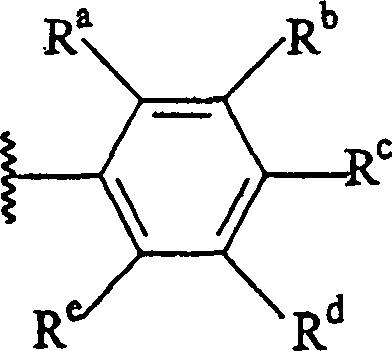


Applications Claiming Priority (2)
| Application Number | Priority Date | Filing Date | Title |
|---|---|---|---|
| ES200000637 | 2000-03-16 | ||
| ES200000637 | 2000-03-16 |
Publications (1)
| Publication Number | Publication Date |
|---|---|
| CN1429221A true CN1429221A (en) | 2003-07-09 |
Family
ID=8492732
Family Applications (1)
| Application Number | Title | Priority Date | Filing Date |
|---|---|---|---|
| CN01809447A Pending CN1429221A (en) | 2000-03-16 | 2001-03-16 | 2-phenylpyran-4-one derivatives |
Country Status (27)
| Country | Link |
|---|---|
| US (1) | US7354936B2 (en) |
| EP (1) | EP1263751B1 (en) |
| JP (1) | JP2003527389A (en) |
| KR (1) | KR20030005221A (en) |
| CN (1) | CN1429221A (en) |
| AR (1) | AR030410A1 (en) |
| AT (1) | ATE269316T1 (en) |
| AU (1) | AU2001254692A1 (en) |
| BG (1) | BG107101A (en) |
| BR (1) | BR0109252A (en) |
| CA (1) | CA2403149A1 (en) |
| CZ (1) | CZ20023058A3 (en) |
| DE (1) | DE60103859T2 (en) |
| EE (1) | EE200200528A (en) |
| ES (1) | ES2223830T3 (en) |
| HK (1) | HK1048117A1 (en) |
| HU (1) | HUP0301696A2 (en) |
| IL (1) | IL151598A0 (en) |
| MX (1) | MXPA02009016A (en) |
| NO (1) | NO20024393L (en) |
| NZ (1) | NZ521187A (en) |
| PE (1) | PE20011333A1 (en) |
| PL (1) | PL358062A1 (en) |
| RU (1) | RU2002127728A (en) |
| SK (1) | SK12832002A3 (en) |
| WO (1) | WO2001068633A1 (en) |
| ZA (1) | ZA200207184B (en) |
Cited By (1)
| Publication number | Priority date | Publication date | Assignee | Title |
|---|---|---|---|---|
| CN102731456A (en) * | 2011-04-01 | 2012-10-17 | 华中科技大学 | Antitumor compound, its preparation method and application |
Families Citing this family (2)
| Publication number | Priority date | Publication date | Assignee | Title |
|---|---|---|---|---|
| US6465509B2 (en) | 2000-06-30 | 2002-10-15 | Merck Frosst Canada & Co. | Pyrones as inhibitors of cyclooxygenase-2 |
| ES2213485B1 (en) * | 2003-02-13 | 2005-12-16 | Almirall Prodesfarma, S.A. | DERIVATIVES OF 2-FENILPIRAN-4-ONA. |
Family Cites Families (11)
| Publication number | Priority date | Publication date | Assignee | Title |
|---|---|---|---|---|
| CH524614A (en) * | 1969-12-31 | 1972-06-30 | Ciba Geigy Ag | 2-substd-4,5-bis(substd-phenyl) imidazole - analgesics |
| US3901908A (en) * | 1970-12-28 | 1975-08-26 | Ciba Geigy Corp | 2-alkyl- and 2-cycloalkyl-4,5-bis-phenyl-imidazoles |
| US4304728A (en) * | 1979-04-05 | 1981-12-08 | Lilly Industries Limited | 6-Substituted pyranone compounds and their use as pharmaceuticals |
| ES8104268A1 (en) | 1979-04-05 | 1981-04-01 | Lilly Industries Ltd | 5-Substituted pyranone compounds and their use as pharmaceuticals to treat an immediate hypersensitivity condition |
| US6048850A (en) * | 1992-09-22 | 2000-04-11 | Young; Donald A. | Method of inhibiting prostaglandin synthesis in a human host |
| JPH09505295A (en) * | 1993-11-19 | 1997-05-27 | パーク・デイビス・アンド・カンパニー | Pyrone derivatives as protease inhibitors and antiviral agents |
| US5521213A (en) | 1994-08-29 | 1996-05-28 | Merck Frosst Canada, Inc. | Diaryl bicyclic heterocycles as inhibitors of cyclooxygenase-2 |
| US5541204A (en) | 1994-12-02 | 1996-07-30 | Bristol-Myers Squibb Company | Aryloxypropanolamine β 3 adrenergic agonists |
| CN1186492A (en) | 1995-04-04 | 1998-07-01 | 葛兰素集团有限公司 | Imidazo [1, 2-alpha] pyridine derivatives |
| US6348468B1 (en) | 1997-11-19 | 2002-02-19 | Kowa Co., Ltd. | Pyridazine compounds and compositions containing the same |
| TW587079B (en) * | 1998-09-25 | 2004-05-11 | Almirall Prodesfarma Ag | 2-phenylpyran-4-one derivatives |
-
2001
- 2001-03-13 PE PE2001000241A patent/PE20011333A1/en not_active Application Discontinuation
- 2001-03-15 AR ARP010101221A patent/AR030410A1/en not_active Application Discontinuation
- 2001-03-16 CN CN01809447A patent/CN1429221A/en active Pending
- 2001-03-16 RU RU2002127728/04A patent/RU2002127728A/en not_active Application Discontinuation
- 2001-03-16 CZ CZ20023058A patent/CZ20023058A3/en unknown
- 2001-03-16 SK SK1283-2002A patent/SK12832002A3/en unknown
- 2001-03-16 EP EP01927742A patent/EP1263751B1/en not_active Expired - Lifetime
- 2001-03-16 EE EEP200200528A patent/EE200200528A/en unknown
- 2001-03-16 JP JP2001567725A patent/JP2003527389A/en not_active Withdrawn
- 2001-03-16 HU HU0301696A patent/HUP0301696A2/en unknown
- 2001-03-16 CA CA002403149A patent/CA2403149A1/en not_active Abandoned
- 2001-03-16 PL PL01358062A patent/PL358062A1/en not_active Application Discontinuation
- 2001-03-16 BR BR0109252-9A patent/BR0109252A/en not_active IP Right Cessation
- 2001-03-16 AT AT01927742T patent/ATE269316T1/en not_active IP Right Cessation
- 2001-03-16 DE DE60103859T patent/DE60103859T2/en not_active Expired - Lifetime
- 2001-03-16 KR KR1020027011875A patent/KR20030005221A/en not_active Withdrawn
- 2001-03-16 WO PCT/EP2001/003042 patent/WO2001068633A1/en not_active Ceased
- 2001-03-16 MX MXPA02009016A patent/MXPA02009016A/en unknown
- 2001-03-16 ES ES01927742T patent/ES2223830T3/en not_active Expired - Lifetime
- 2001-03-16 IL IL15159801A patent/IL151598A0/en unknown
- 2001-03-16 HK HK03100285.1A patent/HK1048117A1/en unknown
- 2001-03-16 NZ NZ521187A patent/NZ521187A/en unknown
- 2001-03-16 AU AU2001254692A patent/AU2001254692A1/en not_active Abandoned
-
2002
- 2002-09-06 ZA ZA200207184A patent/ZA200207184B/en unknown
- 2002-09-13 NO NO20024393A patent/NO20024393L/en not_active Application Discontinuation
- 2002-09-13 BG BG107101A patent/BG107101A/en unknown
- 2002-09-16 US US10/245,873 patent/US7354936B2/en not_active Expired - Fee Related
Cited By (2)
| Publication number | Priority date | Publication date | Assignee | Title |
|---|---|---|---|---|
| CN102731456A (en) * | 2011-04-01 | 2012-10-17 | 华中科技大学 | Antitumor compound, its preparation method and application |
| CN102731456B (en) * | 2011-04-01 | 2014-07-09 | 华中科技大学 | Antitumor compound, its preparation method and application |
Also Published As
| Publication number | Publication date |
|---|---|
| NZ521187A (en) | 2004-03-26 |
| IL151598A0 (en) | 2003-04-10 |
| ZA200207184B (en) | 2003-12-08 |
| WO2001068633A1 (en) | 2001-09-20 |
| RU2002127728A (en) | 2004-03-20 |
| NO20024393L (en) | 2002-11-13 |
| DE60103859T2 (en) | 2005-07-21 |
| CA2403149A1 (en) | 2001-09-20 |
| EE200200528A (en) | 2004-04-15 |
| HK1048117A1 (en) | 2003-03-21 |
| US7354936B2 (en) | 2008-04-08 |
| MXPA02009016A (en) | 2004-10-15 |
| BR0109252A (en) | 2002-12-24 |
| ATE269316T1 (en) | 2004-07-15 |
| EP1263751A1 (en) | 2002-12-11 |
| BG107101A (en) | 2003-07-31 |
| US20030232880A1 (en) | 2003-12-18 |
| EP1263751B1 (en) | 2004-06-16 |
| JP2003527389A (en) | 2003-09-16 |
| HUP0301696A2 (en) | 2003-09-29 |
| NO20024393D0 (en) | 2002-09-13 |
| AU2001254692A1 (en) | 2001-09-24 |
| PE20011333A1 (en) | 2002-01-16 |
| KR20030005221A (en) | 2003-01-17 |
| ES2223830T3 (en) | 2005-03-01 |
| CZ20023058A3 (en) | 2004-01-14 |
| AR030410A1 (en) | 2003-08-20 |
| PL358062A1 (en) | 2004-08-09 |
| DE60103859D1 (en) | 2004-07-22 |
| SK12832002A3 (en) | 2003-11-04 |
Similar Documents
| Publication | Publication Date | Title |
|---|---|---|
| CN1036920C (en) | Heterocyclic carbonic acid derivatives | |
| CN1031266C (en) | Preparation method of nitrogen-containing six-membered or ten-membered heterocyclic ring | |
| CN1150180C (en) | Diarylbenzopyran derivatives as cyclooxygenase-2 inhibitors | |
| CN1198807C (en) | 5-aryl-1H-1,2,4-triazole compounds as cyclooxygenase-2 inhibitors and pharmaceutical compositions containing them | |
| CN1444570A (en) | Non-steroidal anti-inflammatory drugs | |
| CN1006792B (en) | Process for the preparation of hydroxy, alkoxy and phenoxypyrimidines | |
| CN1007248B (en) | Process for manufacturing of flood sugar reducing medicine-thiazolidinedions | |
| CN1200119A (en) | (Methylsulfonyl)phenyl-2-(5H)-furanone as a cyclooxygenase-2 inhibitor | |
| CN1026234C (en) | Preparation method of thiazolidinedione derivatives for lowering blood sugar | |
| CN1441800A (en) | beta3 adrenergic agonists | |
| CN1681507A (en) | Novel spiro-fused quinazolones and their use as phosphodiesterase inhibitors | |
| CN1138581A (en) | Substituted biphenylsulfonamide endothelin antagonists | |
| CN1061408A (en) | Saturated hydroxyalkyl quinolinic acids as leukotriene antagonists | |
| CN1131865C (en) | Substituted imidazo[1,2a]azines as selective COX-2 inhibitors | |
| CN1206407A (en) | Substituted vinylpyridine derivatives and medicaments containing them | |
| CN1202104C (en) | 2-phenylpyran-4-one derivatives | |
| CN1214048A (en) | Benzopyran derivatives having leukotriene-antagonistic action | |
| CN1642918A (en) | Novel hererocyclic compound and preparation thereof and medicine composition containing same and use thereof in medicine | |
| CN1024663C (en) | Preparation method of substituted tetrahydronaphthalene compounds for treating asthma | |
| CN1148593A (en) | Production method for chromone derivative and its medicinal composition | |
| CN1050022A (en) | Preparation method of dehydrocyclanthamide derivatives | |
| CN1942437A (en) | Substituted azetidine compounds as cyclooxygenase-1-cyclooxygenase-2 inhibitors, and their preparation and use as medicaments | |
| CN1429221A (en) | 2-phenylpyran-4-one derivatives | |
| CN1228082A (en) | Synthesis of Bisindolylmaleimide | |
| CN1107843A (en) | Indane derivative, processes for preparing the same and synthetic intermediate of the same |
Legal Events
| Date | Code | Title | Description |
|---|---|---|---|
| C06 | Publication | ||
| PB01 | Publication | ||
| C10 | Entry into substantive examination | ||
| SE01 | Entry into force of request for substantive examination | ||
| C02 | Deemed withdrawal of patent application after publication (patent law 2001) | ||
| WD01 | Invention patent application deemed withdrawn after publication |