CN1432011A - Benzoamide piperidine compounds as substance P antagonists - Google Patents
Benzoamide piperidine compounds as substance P antagonists Download PDFInfo
- Publication number
- CN1432011A CN1432011A CN01807882A CN01807882A CN1432011A CN 1432011 A CN1432011 A CN 1432011A CN 01807882 A CN01807882 A CN 01807882A CN 01807882 A CN01807882 A CN 01807882A CN 1432011 A CN1432011 A CN 1432011A
- Authority
- CN
- China
- Prior art keywords
- methyl
- base
- phenylpiperidine
- methoxyl group
- amino
- Prior art date
- Legal status (The legal status is an assumption and is not a legal conclusion. Google has not performed a legal analysis and makes no representation as to the accuracy of the status listed.)
- Pending
Links
Classifications
-
- C—CHEMISTRY; METALLURGY
- C07—ORGANIC CHEMISTRY
- C07D—HETEROCYCLIC COMPOUNDS
- C07D401/00—Heterocyclic compounds containing two or more hetero rings, having nitrogen atoms as the only ring hetero atoms, at least one ring being a six-membered ring with only one nitrogen atom
- C07D401/02—Heterocyclic compounds containing two or more hetero rings, having nitrogen atoms as the only ring hetero atoms, at least one ring being a six-membered ring with only one nitrogen atom containing two hetero rings
- C07D401/12—Heterocyclic compounds containing two or more hetero rings, having nitrogen atoms as the only ring hetero atoms, at least one ring being a six-membered ring with only one nitrogen atom containing two hetero rings linked by a chain containing hetero atoms as chain links
-
- A—HUMAN NECESSITIES
- A61—MEDICAL OR VETERINARY SCIENCE; HYGIENE
- A61P—SPECIFIC THERAPEUTIC ACTIVITY OF CHEMICAL COMPOUNDS OR MEDICINAL PREPARATIONS
- A61P1/00—Drugs for disorders of the alimentary tract or the digestive system
-
- A—HUMAN NECESSITIES
- A61—MEDICAL OR VETERINARY SCIENCE; HYGIENE
- A61P—SPECIFIC THERAPEUTIC ACTIVITY OF CHEMICAL COMPOUNDS OR MEDICINAL PREPARATIONS
- A61P1/00—Drugs for disorders of the alimentary tract or the digestive system
- A61P1/04—Drugs for disorders of the alimentary tract or the digestive system for ulcers, gastritis or reflux esophagitis, e.g. antacids, inhibitors of acid secretion, mucosal protectants
-
- A—HUMAN NECESSITIES
- A61—MEDICAL OR VETERINARY SCIENCE; HYGIENE
- A61P—SPECIFIC THERAPEUTIC ACTIVITY OF CHEMICAL COMPOUNDS OR MEDICINAL PREPARATIONS
- A61P1/00—Drugs for disorders of the alimentary tract or the digestive system
- A61P1/14—Prodigestives, e.g. acids, enzymes, appetite stimulants, antidyspeptics, tonics, antiflatulents
-
- A—HUMAN NECESSITIES
- A61—MEDICAL OR VETERINARY SCIENCE; HYGIENE
- A61P—SPECIFIC THERAPEUTIC ACTIVITY OF CHEMICAL COMPOUNDS OR MEDICINAL PREPARATIONS
- A61P1/00—Drugs for disorders of the alimentary tract or the digestive system
- A61P1/16—Drugs for disorders of the alimentary tract or the digestive system for liver or gallbladder disorders, e.g. hepatoprotective agents, cholagogues, litholytics
-
- A—HUMAN NECESSITIES
- A61—MEDICAL OR VETERINARY SCIENCE; HYGIENE
- A61P—SPECIFIC THERAPEUTIC ACTIVITY OF CHEMICAL COMPOUNDS OR MEDICINAL PREPARATIONS
- A61P11/00—Drugs for disorders of the respiratory system
-
- A—HUMAN NECESSITIES
- A61—MEDICAL OR VETERINARY SCIENCE; HYGIENE
- A61P—SPECIFIC THERAPEUTIC ACTIVITY OF CHEMICAL COMPOUNDS OR MEDICINAL PREPARATIONS
- A61P11/00—Drugs for disorders of the respiratory system
- A61P11/02—Nasal agents, e.g. decongestants
-
- A—HUMAN NECESSITIES
- A61—MEDICAL OR VETERINARY SCIENCE; HYGIENE
- A61P—SPECIFIC THERAPEUTIC ACTIVITY OF CHEMICAL COMPOUNDS OR MEDICINAL PREPARATIONS
- A61P11/00—Drugs for disorders of the respiratory system
- A61P11/06—Antiasthmatics
-
- A—HUMAN NECESSITIES
- A61—MEDICAL OR VETERINARY SCIENCE; HYGIENE
- A61P—SPECIFIC THERAPEUTIC ACTIVITY OF CHEMICAL COMPOUNDS OR MEDICINAL PREPARATIONS
- A61P13/00—Drugs for disorders of the urinary system
- A61P13/02—Drugs for disorders of the urinary system of urine or of the urinary tract, e.g. urine acidifiers
-
- A—HUMAN NECESSITIES
- A61—MEDICAL OR VETERINARY SCIENCE; HYGIENE
- A61P—SPECIFIC THERAPEUTIC ACTIVITY OF CHEMICAL COMPOUNDS OR MEDICINAL PREPARATIONS
- A61P13/00—Drugs for disorders of the urinary system
- A61P13/10—Drugs for disorders of the urinary system of the bladder
-
- A—HUMAN NECESSITIES
- A61—MEDICAL OR VETERINARY SCIENCE; HYGIENE
- A61P—SPECIFIC THERAPEUTIC ACTIVITY OF CHEMICAL COMPOUNDS OR MEDICINAL PREPARATIONS
- A61P17/00—Drugs for dermatological disorders
- A61P17/04—Antipruritics
-
- A—HUMAN NECESSITIES
- A61—MEDICAL OR VETERINARY SCIENCE; HYGIENE
- A61P—SPECIFIC THERAPEUTIC ACTIVITY OF CHEMICAL COMPOUNDS OR MEDICINAL PREPARATIONS
- A61P17/00—Drugs for dermatological disorders
- A61P17/06—Antipsoriatics
-
- A—HUMAN NECESSITIES
- A61—MEDICAL OR VETERINARY SCIENCE; HYGIENE
- A61P—SPECIFIC THERAPEUTIC ACTIVITY OF CHEMICAL COMPOUNDS OR MEDICINAL PREPARATIONS
- A61P17/00—Drugs for dermatological disorders
- A61P17/16—Emollients or protectives, e.g. against radiation
-
- A—HUMAN NECESSITIES
- A61—MEDICAL OR VETERINARY SCIENCE; HYGIENE
- A61P—SPECIFIC THERAPEUTIC ACTIVITY OF CHEMICAL COMPOUNDS OR MEDICINAL PREPARATIONS
- A61P19/00—Drugs for skeletal disorders
- A61P19/02—Drugs for skeletal disorders for joint disorders, e.g. arthritis, arthrosis
-
- A—HUMAN NECESSITIES
- A61—MEDICAL OR VETERINARY SCIENCE; HYGIENE
- A61P—SPECIFIC THERAPEUTIC ACTIVITY OF CHEMICAL COMPOUNDS OR MEDICINAL PREPARATIONS
- A61P21/00—Drugs for disorders of the muscular or neuromuscular system
- A61P21/04—Drugs for disorders of the muscular or neuromuscular system for myasthenia gravis
-
- A—HUMAN NECESSITIES
- A61—MEDICAL OR VETERINARY SCIENCE; HYGIENE
- A61P—SPECIFIC THERAPEUTIC ACTIVITY OF CHEMICAL COMPOUNDS OR MEDICINAL PREPARATIONS
- A61P25/00—Drugs for disorders of the nervous system
-
- A—HUMAN NECESSITIES
- A61—MEDICAL OR VETERINARY SCIENCE; HYGIENE
- A61P—SPECIFIC THERAPEUTIC ACTIVITY OF CHEMICAL COMPOUNDS OR MEDICINAL PREPARATIONS
- A61P25/00—Drugs for disorders of the nervous system
- A61P25/04—Centrally acting analgesics, e.g. opioids
-
- A—HUMAN NECESSITIES
- A61—MEDICAL OR VETERINARY SCIENCE; HYGIENE
- A61P—SPECIFIC THERAPEUTIC ACTIVITY OF CHEMICAL COMPOUNDS OR MEDICINAL PREPARATIONS
- A61P25/00—Drugs for disorders of the nervous system
- A61P25/08—Antiepileptics; Anticonvulsants
-
- A—HUMAN NECESSITIES
- A61—MEDICAL OR VETERINARY SCIENCE; HYGIENE
- A61P—SPECIFIC THERAPEUTIC ACTIVITY OF CHEMICAL COMPOUNDS OR MEDICINAL PREPARATIONS
- A61P25/00—Drugs for disorders of the nervous system
- A61P25/14—Drugs for disorders of the nervous system for treating abnormal movements, e.g. chorea, dyskinesia
-
- A—HUMAN NECESSITIES
- A61—MEDICAL OR VETERINARY SCIENCE; HYGIENE
- A61P—SPECIFIC THERAPEUTIC ACTIVITY OF CHEMICAL COMPOUNDS OR MEDICINAL PREPARATIONS
- A61P25/00—Drugs for disorders of the nervous system
- A61P25/14—Drugs for disorders of the nervous system for treating abnormal movements, e.g. chorea, dyskinesia
- A61P25/16—Anti-Parkinson drugs
-
- A—HUMAN NECESSITIES
- A61—MEDICAL OR VETERINARY SCIENCE; HYGIENE
- A61P—SPECIFIC THERAPEUTIC ACTIVITY OF CHEMICAL COMPOUNDS OR MEDICINAL PREPARATIONS
- A61P25/00—Drugs for disorders of the nervous system
- A61P25/18—Antipsychotics, i.e. neuroleptics; Drugs for mania or schizophrenia
-
- A—HUMAN NECESSITIES
- A61—MEDICAL OR VETERINARY SCIENCE; HYGIENE
- A61P—SPECIFIC THERAPEUTIC ACTIVITY OF CHEMICAL COMPOUNDS OR MEDICINAL PREPARATIONS
- A61P25/00—Drugs for disorders of the nervous system
- A61P25/20—Hypnotics; Sedatives
-
- A—HUMAN NECESSITIES
- A61—MEDICAL OR VETERINARY SCIENCE; HYGIENE
- A61P—SPECIFIC THERAPEUTIC ACTIVITY OF CHEMICAL COMPOUNDS OR MEDICINAL PREPARATIONS
- A61P25/00—Drugs for disorders of the nervous system
- A61P25/22—Anxiolytics
-
- A—HUMAN NECESSITIES
- A61—MEDICAL OR VETERINARY SCIENCE; HYGIENE
- A61P—SPECIFIC THERAPEUTIC ACTIVITY OF CHEMICAL COMPOUNDS OR MEDICINAL PREPARATIONS
- A61P25/00—Drugs for disorders of the nervous system
- A61P25/24—Antidepressants
-
- A—HUMAN NECESSITIES
- A61—MEDICAL OR VETERINARY SCIENCE; HYGIENE
- A61P—SPECIFIC THERAPEUTIC ACTIVITY OF CHEMICAL COMPOUNDS OR MEDICINAL PREPARATIONS
- A61P25/00—Drugs for disorders of the nervous system
- A61P25/28—Drugs for disorders of the nervous system for treating neurodegenerative disorders of the central nervous system, e.g. nootropic agents, cognition enhancers, drugs for treating Alzheimer's disease or other forms of dementia
-
- A—HUMAN NECESSITIES
- A61—MEDICAL OR VETERINARY SCIENCE; HYGIENE
- A61P—SPECIFIC THERAPEUTIC ACTIVITY OF CHEMICAL COMPOUNDS OR MEDICINAL PREPARATIONS
- A61P25/00—Drugs for disorders of the nervous system
- A61P25/30—Drugs for disorders of the nervous system for treating abuse or dependence
-
- A—HUMAN NECESSITIES
- A61—MEDICAL OR VETERINARY SCIENCE; HYGIENE
- A61P—SPECIFIC THERAPEUTIC ACTIVITY OF CHEMICAL COMPOUNDS OR MEDICINAL PREPARATIONS
- A61P25/00—Drugs for disorders of the nervous system
- A61P25/30—Drugs for disorders of the nervous system for treating abuse or dependence
- A61P25/32—Alcohol-abuse
-
- A—HUMAN NECESSITIES
- A61—MEDICAL OR VETERINARY SCIENCE; HYGIENE
- A61P—SPECIFIC THERAPEUTIC ACTIVITY OF CHEMICAL COMPOUNDS OR MEDICINAL PREPARATIONS
- A61P25/00—Drugs for disorders of the nervous system
- A61P25/30—Drugs for disorders of the nervous system for treating abuse or dependence
- A61P25/36—Opioid-abuse
-
- A—HUMAN NECESSITIES
- A61—MEDICAL OR VETERINARY SCIENCE; HYGIENE
- A61P—SPECIFIC THERAPEUTIC ACTIVITY OF CHEMICAL COMPOUNDS OR MEDICINAL PREPARATIONS
- A61P27/00—Drugs for disorders of the senses
- A61P27/02—Ophthalmic agents
-
- A—HUMAN NECESSITIES
- A61—MEDICAL OR VETERINARY SCIENCE; HYGIENE
- A61P—SPECIFIC THERAPEUTIC ACTIVITY OF CHEMICAL COMPOUNDS OR MEDICINAL PREPARATIONS
- A61P29/00—Non-central analgesic, antipyretic or antiinflammatory agents, e.g. antirheumatic agents; Non-steroidal antiinflammatory drugs [NSAID]
-
- A—HUMAN NECESSITIES
- A61—MEDICAL OR VETERINARY SCIENCE; HYGIENE
- A61P—SPECIFIC THERAPEUTIC ACTIVITY OF CHEMICAL COMPOUNDS OR MEDICINAL PREPARATIONS
- A61P3/00—Drugs for disorders of the metabolism
- A61P3/04—Anorexiants; Antiobesity agents
-
- A—HUMAN NECESSITIES
- A61—MEDICAL OR VETERINARY SCIENCE; HYGIENE
- A61P—SPECIFIC THERAPEUTIC ACTIVITY OF CHEMICAL COMPOUNDS OR MEDICINAL PREPARATIONS
- A61P31/00—Antiinfectives, i.e. antibiotics, antiseptics, chemotherapeutics
- A61P31/04—Antibacterial agents
-
- A—HUMAN NECESSITIES
- A61—MEDICAL OR VETERINARY SCIENCE; HYGIENE
- A61P—SPECIFIC THERAPEUTIC ACTIVITY OF CHEMICAL COMPOUNDS OR MEDICINAL PREPARATIONS
- A61P31/00—Antiinfectives, i.e. antibiotics, antiseptics, chemotherapeutics
- A61P31/12—Antivirals
- A61P31/14—Antivirals for RNA viruses
- A61P31/18—Antivirals for RNA viruses for HIV
-
- A—HUMAN NECESSITIES
- A61—MEDICAL OR VETERINARY SCIENCE; HYGIENE
- A61P—SPECIFIC THERAPEUTIC ACTIVITY OF CHEMICAL COMPOUNDS OR MEDICINAL PREPARATIONS
- A61P35/00—Antineoplastic agents
-
- A—HUMAN NECESSITIES
- A61—MEDICAL OR VETERINARY SCIENCE; HYGIENE
- A61P—SPECIFIC THERAPEUTIC ACTIVITY OF CHEMICAL COMPOUNDS OR MEDICINAL PREPARATIONS
- A61P37/00—Drugs for immunological or allergic disorders
- A61P37/02—Immunomodulators
- A61P37/06—Immunosuppressants, e.g. drugs for graft rejection
-
- A—HUMAN NECESSITIES
- A61—MEDICAL OR VETERINARY SCIENCE; HYGIENE
- A61P—SPECIFIC THERAPEUTIC ACTIVITY OF CHEMICAL COMPOUNDS OR MEDICINAL PREPARATIONS
- A61P37/00—Drugs for immunological or allergic disorders
- A61P37/08—Antiallergic agents
-
- A—HUMAN NECESSITIES
- A61—MEDICAL OR VETERINARY SCIENCE; HYGIENE
- A61P—SPECIFIC THERAPEUTIC ACTIVITY OF CHEMICAL COMPOUNDS OR MEDICINAL PREPARATIONS
- A61P43/00—Drugs for specific purposes, not provided for in groups A61P1/00-A61P41/00
-
- A—HUMAN NECESSITIES
- A61—MEDICAL OR VETERINARY SCIENCE; HYGIENE
- A61P—SPECIFIC THERAPEUTIC ACTIVITY OF CHEMICAL COMPOUNDS OR MEDICINAL PREPARATIONS
- A61P9/00—Drugs for disorders of the cardiovascular system
-
- A—HUMAN NECESSITIES
- A61—MEDICAL OR VETERINARY SCIENCE; HYGIENE
- A61P—SPECIFIC THERAPEUTIC ACTIVITY OF CHEMICAL COMPOUNDS OR MEDICINAL PREPARATIONS
- A61P9/00—Drugs for disorders of the cardiovascular system
- A61P9/10—Drugs for disorders of the cardiovascular system for treating ischaemic or atherosclerotic diseases, e.g. antianginal drugs, coronary vasodilators, drugs for myocardial infarction, retinopathy, cerebrovascula insufficiency, renal arteriosclerosis
-
- C—CHEMISTRY; METALLURGY
- C07—ORGANIC CHEMISTRY
- C07D—HETEROCYCLIC COMPOUNDS
- C07D401/00—Heterocyclic compounds containing two or more hetero rings, having nitrogen atoms as the only ring hetero atoms, at least one ring being a six-membered ring with only one nitrogen atom
- C07D401/14—Heterocyclic compounds containing two or more hetero rings, having nitrogen atoms as the only ring hetero atoms, at least one ring being a six-membered ring with only one nitrogen atom containing three or more hetero rings
-
- C—CHEMISTRY; METALLURGY
- C07—ORGANIC CHEMISTRY
- C07D—HETEROCYCLIC COMPOUNDS
- C07D405/00—Heterocyclic compounds containing both one or more hetero rings having oxygen atoms as the only ring hetero atoms, and one or more rings having nitrogen as the only ring hetero atom
- C07D405/14—Heterocyclic compounds containing both one or more hetero rings having oxygen atoms as the only ring hetero atoms, and one or more rings having nitrogen as the only ring hetero atom containing three or more hetero rings
-
- C—CHEMISTRY; METALLURGY
- C07—ORGANIC CHEMISTRY
- C07D—HETEROCYCLIC COMPOUNDS
- C07D413/00—Heterocyclic compounds containing two or more hetero rings, at least one ring having nitrogen and oxygen atoms as the only ring hetero atoms
- C07D413/14—Heterocyclic compounds containing two or more hetero rings, at least one ring having nitrogen and oxygen atoms as the only ring hetero atoms containing three or more hetero rings
-
- C—CHEMISTRY; METALLURGY
- C07—ORGANIC CHEMISTRY
- C07D—HETEROCYCLIC COMPOUNDS
- C07D471/00—Heterocyclic compounds containing nitrogen atoms as the only ring hetero atoms in the condensed system, at least one ring being a six-membered ring with one nitrogen atom, not provided for by groups C07D451/00 - C07D463/00
- C07D471/02—Heterocyclic compounds containing nitrogen atoms as the only ring hetero atoms in the condensed system, at least one ring being a six-membered ring with one nitrogen atom, not provided for by groups C07D451/00 - C07D463/00 in which the condensed system contains two hetero rings
- C07D471/10—Spiro-condensed systems
-
- C—CHEMISTRY; METALLURGY
- C07—ORGANIC CHEMISTRY
- C07D—HETEROCYCLIC COMPOUNDS
- C07D491/00—Heterocyclic compounds containing in the condensed ring system both one or more rings having oxygen atoms as the only ring hetero atoms and one or more rings having nitrogen atoms as the only ring hetero atoms, not provided for by groups C07D451/00 - C07D459/00, C07D463/00, C07D477/00 or C07D489/00
- C07D491/02—Heterocyclic compounds containing in the condensed ring system both one or more rings having oxygen atoms as the only ring hetero atoms and one or more rings having nitrogen atoms as the only ring hetero atoms, not provided for by groups C07D451/00 - C07D459/00, C07D463/00, C07D477/00 or C07D489/00 in which the condensed system contains two hetero rings
- C07D491/10—Spiro-condensed systems
Landscapes
- Health & Medical Sciences (AREA)
- Organic Chemistry (AREA)
- Chemical & Material Sciences (AREA)
- Life Sciences & Earth Sciences (AREA)
- Bioinformatics & Cheminformatics (AREA)
- Engineering & Computer Science (AREA)
- Chemical Kinetics & Catalysis (AREA)
- Nuclear Medicine, Radiotherapy & Molecular Imaging (AREA)
- Medicinal Chemistry (AREA)
- Pharmacology & Pharmacy (AREA)
- General Chemical & Material Sciences (AREA)
- Animal Behavior & Ethology (AREA)
- General Health & Medical Sciences (AREA)
- Public Health (AREA)
- Veterinary Medicine (AREA)
- Neurology (AREA)
- Neurosurgery (AREA)
- Biomedical Technology (AREA)
- Psychiatry (AREA)
- Pulmonology (AREA)
- Immunology (AREA)
- Addiction (AREA)
- Pain & Pain Management (AREA)
- Urology & Nephrology (AREA)
- Dermatology (AREA)
- Physical Education & Sports Medicine (AREA)
- Heart & Thoracic Surgery (AREA)
- Orthopedic Medicine & Surgery (AREA)
- Psychology (AREA)
- Virology (AREA)
- Communicable Diseases (AREA)
- Oncology (AREA)
- Cardiology (AREA)
- Rheumatology (AREA)
- Hospice & Palliative Care (AREA)
- Tropical Medicine & Parasitology (AREA)
- Diabetes (AREA)
- Child & Adolescent Psychology (AREA)
- Ophthalmology & Optometry (AREA)
- Obesity (AREA)
Abstract
本发明涉及显示出作为NK-1受体拮抗剂(例如,物质P受体拮抗剂)的活性的某些含有苯并酰胺哌啶的化合物和相关的化合物,含有它们的药物组合物,和它们在治疗和预防中枢神经系统病症、炎性的病症、心血管病症、眼科病症、胃肠机能紊乱、由幽门螺杆菌所引起的病症、免疫系统的病症、尿失禁、疼痛、偏头痛、呕吐、血管生成及其它病症中的用途。The present invention relates to certain benzamide piperidine-containing compounds and related compounds exhibiting activity as NK-1 receptor antagonists (e.g., substance P receptor antagonists), pharmaceutical compositions containing them, and their In the treatment and prevention of central nervous system disorders, inflammatory disorders, cardiovascular disorders, ophthalmic disorders, gastrointestinal disorders, disorders caused by Helicobacter pylori, immune system disorders, urinary incontinence, pain, migraine, vomiting, Use in angiogenesis and other disorders.
Description
本发明涉及某些含有苯并酰胺哌啶的化合物和相关的化合物,它们显示出作为NK-1受体拮抗剂(例如,物质P受体拮抗剂)的活性,含有它们的药物组合物,和它们在治疗和预防中枢神经系统病症、炎性的病症、心血管病症、眼科病症、胃肠机能紊乱、由幽门螺杆菌所引起的病症、免疫系统的病症、尿失禁、疼痛、偏头痛、呕吐、血管生成及其它病症中的用途。The present invention relates to certain benzoamide piperidine-containing compounds and related compounds which exhibit activity as NK-1 receptor antagonists (e.g., Substance P receptor antagonists), pharmaceutical compositions containing them, and They are useful in the treatment and prevention of central nervous system disorders, inflammatory disorders, cardiovascular disorders, ophthalmic disorders, gastrointestinal disorders, disorders caused by Helicobacter pylori, immune system disorders, urinary incontinence, pain, migraine, vomiting , angiogenesis and other diseases.
物质P是天然存在的属于速激肽系列的十一肽,速激肽之所以被如此命名是由于它们对平滑肌组织的迅速的刺激作用。更特别地,物质P是一种在哺乳动物中产生的(最初是由内脏中分离的)药物活性的神经肽,具有由D.F.Veber等人在US Pat.4,680,283中阐述的特征氨基酸序列。在本领域已经充分证明了物质P及其它速激肽广泛地涉及许多疾病的病理生理学。Substance P is a naturally occurring undecapeptide belonging to the series of tachykinins, so named for their rapid stimulating action on smooth muscle tissue. More particularly, Substance P is a pharmacologically active neuropeptide produced in mammals (originally isolated from guts) having the characteristic amino acid sequence set forth in US Pat. 4,680,283 by D.F. Veber et al. It has been well documented in the art that substance P and other tachykinins are broadly involved in the pathophysiology of many diseases.
于1997年1月30日公开的世界专利申请WO 97/03066,和于1996年5月9日申请的美国专利申请08/98004,提到了显示物质P受体拮抗剂活性的取代的苯并内酰胺和环硫酰胺化合物。其它含有稠合双环部分的物质P受体拮抗剂参见下面的文献:美国专利申请09/011,271,申请于1996年6月10日;美国临时专利申请60/132,858,申请于1999年5月6日;美国专利申请09/402,630,申请于1998年10月26日;和世界专利申请WO 99/13663,公开于1994年6月23日。World patent application WO 97/03066, published on January 30, 1997, and U.S. patent application 08/98004, filed on May 9, 1996, refer to substituted benzoendides exhibiting substance P receptor antagonist activity. Amide and cyclic sulfamide compounds. For other Substance P receptor antagonists containing fused bicyclic moieties see the following documents: U.S. Patent Application 09/011,271, filed June 10, 1996; U.S. Provisional Patent Application 60/132,858, filed May 6, 1999 ; U.S. Patent Application 09/402,630, filed October 26, 1998; and World Patent Application WO 99/13663, published June 23, 1994.
上述专利申请在此全部引入作为参考。The aforementioned patent applications are hereby incorporated by reference in their entirety.
本发明概述Summary of the invention
本发明涉及下式的化合物,和这些化合物的药学可接受的盐:
其中Q为C=NH,C=CH2,C=S,C=O,SO或SO2;Wherein Q is C=NH, C= CH2 , C=S, C=O, SO or SO2 ;
A为CH,CH2,C(C1-C6)烷基,CH(C1-C6)烷基,C(CF3)或CH(CF3),条件为当存在B时,A必须是CH,C(C1-C6)烷基或C(CF3)之一;A is CH, CH 2 , C(C 1 -C 6 )alkyl, CH(C 1 -C 6 )alkyl, C(CF 3 ) or CH(CF 3 ), with the proviso that when B is present, A must is one of CH, C(C 1 -C 6 )alkyl or C(CF 3 );
B不存在或是亚甲基或亚乙基;B is absent or is methylene or ethylene;
每个Y和Z是N或CH,条件是Y和Z不能都是N;each Y and Z is N or CH, with the proviso that Y and Z cannot both be N;
G是NH(CH2)q,S(CH2)q或O(CH2)q,其中q是0或1;条件是当q是0时,G是NH2,SH或OH;G is NH(CH 2 ) q , S(CH 2 ) q or O(CH 2 ) q , wherein q is 0 or 1; with the proviso that when q is 0, G is NH 2 , SH or OH;
W是一个碳的连接基(即亚甲基)或饱和或不饱和的两或三个碳的连接基,其中每个上述W基团任选地被一个取代基R7或两个取代基R7和R6所取代,或者W是可与2,3,4或5个碳的链分别形成3,4,5或6元螺环的一个碳的连接基;W is a one-carbon linker (i.e., methylene) or a saturated or unsaturated two- or three-carbon linker, wherein each of the aforementioned W groups is optionally replaced by one substituent R or two substituents R 7 and R 6 are substituted, or W is a linking group of one carbon that can form a 3, 4, 5 or 6-membered spiro ring with a chain of 2, 3, 4 or 5 carbons, respectively;
或者W是可与另外的1,2或3个碳的链分别形成稠合的3,4或5元环的两个碳链的饱和连接基;Or W is a saturated linking group of two carbon chains that can form a fused 3, 4 or 5 membered ring with another 1, 2 or 3 carbon chain, respectively;
或者W是两个碳链的饱和连接基,其中碳链中的两碳之一可与另外的2,3,4或5个碳的链分别形成3,4,5或6元螺环;Or W is a saturated linking group of two carbon chains, wherein one of the two carbons in the carbon chain can form a 3, 4, 5 or 6-membered spiro ring with another chain of 2, 3, 4 or 5 carbons, respectively;
p是0、1或2;p is 0, 1 or 2;
R3选自氢,COR9,CO2R9,任选取代的苯基,任选取代的杂环,和任选取代的(C1-C8)烷基,其中所述(C1-C8)烷基的一个CH2基团可以任选地被硫,氧或羰基替代,且其中所述(C1-C8)烷基可以任选地被一到三个取代基取代,优选有零个取代基或一个取代基,取代基独立地选自羟基,氧代,苯基-(C1-C3)烷氧基,苯基,氰基,卤素,任选取代的杂环,NR9COR10,NR9CO2R10,CONR9R10,COR9,CO2R9,NR9R10,和任选被一到七个氟原子,优选被零到三个氟原子取代的(C1-C6)烷氧基;R 3 is selected from hydrogen, COR 9 , CO 2 R 9 , optionally substituted phenyl, optionally substituted heterocycle, and optionally substituted (C 1 -C 8 )alkyl, wherein the (C 1 - One CH 2 group of C 8 ) alkyl can be optionally replaced by sulfur, oxygen or carbonyl, and wherein said (C 1 -C 8 ) alkyl can be optionally substituted by one to three substituents, preferably has zero substituents or one substituent independently selected from hydroxy, oxo, phenyl-(C 1 -C 3 )alkoxy, phenyl, cyano, halogen, optionally substituted heterocycle, NR 9 COR 10 , NR 9 CO 2 R 10 , CONR 9 R 10 , COR 9 , CO 2 R 9 , NR 9 R 10 , and optionally substituted by one to seven fluorine atoms, preferably zero to three fluorine atoms (C 1 -C 6 )alkoxy;
且其中R3的杂环和R3的烷基上的杂环取代基独立地选自含有1到4个环杂原子的3到7元饱和或不饱和的单环,和含有1到4个环杂原子的8到12元饱和或不饱和的双环,其中所述杂原子独立地选自氧、氮和硫,条件是在单环或双环杂环中不能有两个相邻的环氧原子或两个相邻的环硫原子,且条件是由NR9R10或CONR9R10形成的杂环必须含有至少一个氮原子;And wherein the heterocyclic substituent on the heterocyclic ring of R and the alkyl group of R is independently selected from 3 to 7 membered saturated or unsaturated monocyclic rings containing 1 to 4 ring heteroatoms, and containing 1 to 4 8 to 12 membered saturated or unsaturated bicyclic rings with ring heteroatoms, wherein said heteroatoms are independently selected from oxygen, nitrogen and sulfur, with the proviso that there cannot be two adjacent epoxy atoms in the monocyclic or bicyclic heterocyclic ring or two adjacent ring sulfur atoms, provided that the heterocycle formed by NR 9 R 10 or CONR 9 R 10 must contain at least one nitrogen atom;
且其中R3的杂环和R3的烷基上的杂环取代基可以任选地被一个或多个取代基,优选0、1或2个取代基取代,取代基独立地选自氧代,羟基,硫代,卤素,氰基,苯基,(CH2)mNR9R10,NR9COR10,(CH2)mOR9,其中m为0、1或2,和任选被独立地选自卤素,CF3,甲氧基和苯基的一个或多个取代基,优选零到两个取代基取代的(C1-C6)烷基;And wherein the heterocyclic substituent on the heterocycle of R and the alkyl group of R can be optionally substituted by one or more substituents, preferably 0, 1 or 2 substituents, the substituents are independently selected from oxo , hydroxy, thio, halogen, cyano, phenyl, (CH 2 ) m NR 9 R 10 , NR 9 COR 10 , (CH 2 ) m OR 9 , wherein m is 0, 1 or 2, and is optionally One or more substituents independently selected from halogen, CF 3 , methoxy and phenyl, preferably zero to two substituents (C 1 -C 6 )alkyl;
且其中R3的苯基和R3的烷基中的苯基取代基可以任选地被一个或多个取代基取代,优选被零到两个取代基取代,取代基独立地选自:卤素,氰基,硝基,CF3,(CH2)mNR9R10,其中m为零、一或二,NR9COR10,NR9CO2R10,CONR9R10,CO2NR9R10,COR9,CO2R9,任选被一到七个氟原子,优选被零到三个氟原子取代的(C1-C6)烷基,任选被一到七个氟原子,优选被零到三个氟原子取代的(C1-C6)烷氧基,任选被一到七个氟原子,优选被零到三个氟原子取代的(C2-C6)烯基;And wherein the phenyl substituent in the phenyl of R and the alkyl of R can be optionally substituted by one or more substituents, preferably zero to two substituents, the substituents are independently selected from: halogen , cyano, nitro, CF 3 , (CH 2 ) m NR 9 R 10 , where m is zero, one or two, NR 9 COR 10 , NR 9 CO 2 R 10 , CONR 9 R 10 , CO 2 NR 9 R 10 , COR 9 , CO 2 R 9 , (C 1 -C 6 )alkyl optionally substituted by one to seven fluorine atoms, preferably zero to three fluorine atoms, optionally one to seven fluorine atoms , preferably (C 1 -C 6 )alkoxy substituted by zero to three fluorine atoms, optionally (C 2 -C 6 )alkene substituted by one to seven fluorine atoms, preferably zero to three fluorine atoms base;
每个R1,R2,R11,R12和R13独立地选自氢和任选被一个或多个取代基,优选被零、一或二个取代基取代的(C1-C6)烷基,取代基独立地选自羟基,氧代,(C1-C6)烷氧基和氰基;Each R 1 , R 2 , R 11 , R 12 and R 13 are independently selected from hydrogen and optionally substituted by one or more substituents, preferably zero, one or two substituents (C 1 -C 6 ) alkyl, the substituents are independently selected from hydroxyl, oxo, (C 1 -C 6 ) alkoxy and cyano;
或R1和R2与它们所连接的碳原子一起,或R2和R3与它们所连接的碳和氮原子一起,分别形成含有一或二个独立地选自氮,氧和硫的杂原子的5或6元饱和杂环,条件是所述环不能含有两个相邻的氧原子或两个相邻的硫原子;或R1和R2与它们所连接的碳一起,形成5或6元饱和或不饱和的碳环,且其中所述由R1和R2或R2和R3形成的杂环和碳环可以被一个或多个取代基取代,优选被零个或一个取代基取代,取代基独立地选自卤素,氧代,NR9R10,任选被一到七个氟原子,优选被零到三个氟原子取代的(C1-C6)烷基,以及任选被一到七个氟原子,优选被零到三个氟原子取代的(C1-C6)烷氧基;Or R 1 and R 2 together with the carbon atoms they are connected to, or R 2 and R 3 together with the carbon and nitrogen atoms they are connected to form a heterogeneous compound containing one or two independently selected from nitrogen, oxygen and sulfur 5- or 6-membered saturated heterocyclic ring with the proviso that the ring cannot contain two adjacent oxygen atoms or two adjacent sulfur atoms; or R and R, taken together with the carbon to which they are attached, form 5 or 6-membered saturated or unsaturated carbocycle, and wherein said heterocycle and carbocycle formed by R1 and R2 or R2 and R3 may be substituted by one or more substituents, preferably zero or one Substituents are independently selected from halogen, oxo, NR 9 R 10 , (C 1 -C 6 )alkyl optionally substituted by one to seven fluorine atoms, preferably zero to three fluorine atoms, and (C 1 -C 6 )alkoxy optionally substituted by one to seven fluorine atoms, preferably zero to three fluorine atoms;
或R12和R13与它们所连接的碳原子一起,形成含有一或二个独立地选自氮、氧和硫的杂原子的5或6元饱和杂环,条件是所述环不能含有两个相邻的氧原子或两个相邻的硫原子,或R12和R13与它们所连接的碳一起,形成5或6元饱和或不饱和的碳环,且其中所述由R12和R13形成的杂环和碳环可以被一个或多个取代基取代,优选被零个或一个取代基取代,取代基独立地选自NR9R10,卤素,苯基-S-,苯基-SO-,苯基-SO2-,氧代,任选被一到七个氟原子,优选被零到三个氟原子取代的(C1-C6)烷氧基,以及任选被一到七个氟原子,优选被零到三个氟原子取代的(C1-C6)烷基;or R and R together with the carbon atoms to which they are attached form a 5- or 6-membered saturated heterocyclic ring containing one or two heteroatoms independently selected from nitrogen, oxygen and sulfur, provided that the ring cannot contain two Adjacent oxygen atoms or two adjacent sulfur atoms, or R 12 and R 13 together with the carbon they are attached to form a 5 or 6-membered saturated or unsaturated carbocyclic ring, and wherein said by R 12 and The heterocycle and carbocycle formed by R 13 may be substituted by one or more substituents, preferably zero or one substituent, the substituents are independently selected from NR 9 R 10 , halogen, phenyl-S-, phenyl -SO-, phenyl-SO 2 -, oxo, (C 1 -C 6 )alkoxy optionally substituted by one to seven fluorine atoms, preferably zero to three fluorine atoms, and optionally one Up to seven fluorine atoms, preferably (C 1 -C 6 )alkyl substituted by zero to three fluorine atoms;
条件是R1和R2,R2和R3,以及R12和R13中的至多一组可以形成环;with the proviso that at most one group of R 1 and R 2 , R 2 and R 3 , and R 12 and R 13 can form a ring;
R4选自苯基,2-、3-或4-吡啶基,2-或3-噻吩基和嘧啶基,其中R4可以任选地被一个或多个取代基取代,优选被零个或一个取代基取代,取代基独立地选自卤素、任选被一到七个氟原子,优选被零到三个氟原子取代的(C1-C6)烷基、任选被一到七个氟原子,优选被零到三个氟原子取代的(C1-C6)烷氧基和任选被一到七个氟原子,优选被零到三个氟原子取代的(C2-C6)烯基;R is selected from phenyl, 2-, 3- or 4-pyridyl, 2- or 3-thienyl and pyrimidinyl, wherein R can be optionally substituted by one or more substituents, preferably zero or Substituted by one substituent, the substituents are independently selected from halogen, (C 1 -C 6 )alkyl optionally substituted by one to seven fluorine atoms, preferably zero to three fluorine atoms, optionally one to seven Fluorine atoms, preferably (C 1 -C 6 )alkoxy substituted by zero to three fluorine atoms and (C 2 -C 6 ) optionally substituted by one to seven fluorine atoms, preferably zero to three fluorine atoms ) alkenyl;
R5和R8独立地选自氢、-SO(C1-C6)烷基、-SO2-(C1-C6)烷基、-SO-芳基、-SO2-芳基、CF3、卤素、苯基、苯基-(C1-C2)烷基、羟基、芳氧基、杂芳氧基、吡啶基、四唑基、噁唑基、噻唑基、任选被一到七个氟原子,优选被零到三个氟原子取代的(C1-C6)烷氧基、任选被一到七个氟原子,优选被零到三个氟原子取代的(C1-C6)烷基,以及被一个或多个,优选被零到两个独立地选自羟基、氧代、(C1-C6)烷氧基、苯基-(C1-C3)烷氧基、苯基、氰基、氯、溴、碘、NR9R10、NR9COR10、NR9CO2R10、CONR9R10、COR9和CO2R9的取代基取代的(C1-C6)烷基;R 5 and R 8 are independently selected from hydrogen, -SO(C 1 -C 6 )alkyl, -SO 2 -(C 1 -C 6 )alkyl, -SO-aryl, -SO 2 -aryl, CF 3 , halogen, phenyl, phenyl-(C 1 -C 2 ) alkyl, hydroxy, aryloxy, heteroaryloxy, pyridyl, tetrazolyl, oxazolyl, thiazolyl, optionally (C 1 -C 6 )alkoxy substituted with up to seven fluorine atoms, preferably zero to three fluorine atoms, (C 1 -C 6 ) optionally substituted with one to seven fluorine atoms, preferably zero to three fluorine atoms -C 6 )alkyl, and one or more, preferably zero to two, independently selected from hydroxyl, oxo, (C 1 -C 6 )alkoxy, phenyl-(C 1 -C 3 ) Substituents of alkoxy, phenyl, cyano, chlorine, bromine, iodine, NR 9 R 10 , NR 9 COR 10 , NR 9 CO 2 R 10 , CONR 9 R 10 , COR 9 and CO 2 R 9 (C 1 -C 6 )alkyl;
R6和R7独立地选自-SO(C1-C6)烷基、-SO2-(C1-C6)烷基、-SO-芳基、-SO2-芳基、CF3、卤素、苯基、苯基-(C1-C2)烷基、羟基、芳氧基、杂芳氧基、吡啶基、四唑基、噁唑基、噻唑基、任选被一到七个氟原子,优选被零到三个氟原子取代的(C1-C6)烷氧基、任选被一到七个氟原子,优选被零到三个氟原子取代的(C1-C6)烷基,以及被一个或多个,优选被零到两个独立地选自羟基、氧代、(C1-C6)烷氧基、苯基-(C1-C3)烷氧基、苯基、氰基、氯、溴、碘、NR9R10、NR9COR10、NR9CO2R10、CONR9R10、COR9和CO2R9的取代基取代的(C1-C6)烷基;R 6 and R 7 are independently selected from -SO(C 1 -C 6 )alkyl, -SO 2 -(C 1 -C 6 )alkyl, -SO-aryl, -SO 2 -aryl, CF 3 , halogen, phenyl, phenyl-(C 1 -C 2 ) alkyl, hydroxyl, aryloxy, heteroaryloxy, pyridyl, tetrazolyl, oxazolyl, thiazolyl, optionally one to seven fluorine atoms, preferably (C 1 -C 6 )alkoxy substituted by zero to three fluorine atoms, (C 1 -C ) optionally substituted by one to seven fluorine atoms, preferably zero to three fluorine atoms 6 ) Alkyl, and one or more, preferably zero to two, independently selected from hydroxyl, oxo, (C 1 -C 6 ) alkoxy, phenyl-(C 1 -C 3 ) alkoxy substituted by substituents of radical, phenyl, cyano, chlorine, bromine, iodine, NR 9 R 10 , NR 9 COR 10 , NR 9 CO 2 R 10 , CONR 9 R 10 , COR 9 and CO 2 R 9 (C 1 -C 6 ) alkyl;
每个R9和每个R10独立地选自氢、(C1-C6)烷基、羟基(C1-C6)烷基、苯基和CF3;each R 9 and each R 10 is independently selected from hydrogen, (C 1 -C 6 )alkyl, hydroxy(C 1 -C 6 )alkyl, phenyl, and CF 3 ;
或当R3为NR9R10或CONR9R10时,R9和R10可以与它们所连接的氮原子一起形成任选被取代的含有至少一个氮原子的杂环;Or when R 3 is NR 9 R 10 or CONR 9 R 10 , R 9 and R 10 can form an optionally substituted heterocyclic ring containing at least one nitrogen atom together with the nitrogen atom to which they are attached;
且其中在R5,R6,R7和R8定义中的苯基和在R5,R6,R7和R8定义中的苯基(C1-C2)烷基的苯基部分可以任选地被一个或多个取代基,优选被零到两个取代基取代,取代基独立地选自卤素、羟基、任选被一到七个氟原子,优选被零到三个氟原子取代的(C1-C6)烷氧基和任选被一到七个氟原子,优选被零到三个氟原子取代的(C1-C6)烷基;and wherein the phenyl moiety of phenyl in the definitions of R 5 , R 6 , R 7 and R 8 and phenyl(C 1 -C 2 )alkyl in the definitions of R 5 , R 6 , R 7 and R 8 Can be optionally substituted by one or more substituents, preferably zero to two substituents independently selected from halogen, hydroxyl, optionally one to seven fluorine atoms, preferably zero to three fluorine atoms Substituted (C 1 -C 6 )alkoxy and (C 1 -C 6 )alkyl optionally substituted by one to seven fluorine atoms, preferably zero to three fluorine atoms;
条件是:(a)R8不能是卤素,羟基,氰基,芳氧基,杂芳氧基,取代或未取代的(C1-C6)烷氧基或被1-3个氟原子取代的甲基;和(b)当Q为C=O或C=S,Y和Z两个都是碳,且W为任选被(C1-C6)烷基或氟取代的(C1-C6)烷基所取代的亚甲基,亚乙基或亚丙基,R1,R2,R11,R12和R13都为氢,且R5,R6,R7和R8选自氢,卤素,任选被1到7个氟原子取代的(C1-C6)烷基,任选被1到7个氟原子取代的(C1-C6)烷氧基时,则R3不能是氢。Provided that: (a) R8 cannot be halogen, hydroxy, cyano, aryloxy, heteroaryloxy, substituted or unsubstituted (C 1 -C 6 )alkoxy or substituted by 1-3 fluorine atoms and (b ) when Q is C=O or C=S , both Y and Z are carbon, and W is (C 1 -C 6 ) methylene, ethylene or propylene substituted by alkyl, R 1 , R 2 , R 11 , R 12 and R 13 are all hydrogen, and R 5 , R 6 , R 7 and R 8 is selected from hydrogen, halogen, (C 1 -C 6 )alkyl optionally substituted by 1 to 7 fluorine atoms, (C 1 -C 6 )alkoxy optionally substituted by 1 to 7 fluorine atoms , then R3 cannot be hydrogen.
R3的任选被取代的杂环和在R3的烷基上的任选被取代的杂环取代基的例子如下:嘧啶基,苯并噁唑基,2,3-二氢-3-氧代苯并异磺唑-2-基,吗啉-1-基,硫吗啉-1-基,苯并呋喃基,苯并噻吩基,吲哚基,异氮杂茚基,异喹啉基,呋喃基,吡啶基,异噻唑基,噁唑基,三唑基,四唑基,喹啉基,噻唑基和噻吩基,及下式的基团:和 Examples of the optionally substituted heterocycle for R and the optionally substituted heterocycle substituents on the alkyl group for R are as follows: pyrimidinyl, benzoxazolyl, 2,3 - dihydro-3- Oxobenzoisosulfazol-2-yl, morpholin-1-yl, thiomorpholin-1-yl, benzofuryl, benzothienyl, indolyl, isoazepinyl, isoquinoline radical, furyl, pyridyl, isothiazolyl, oxazolyl, triazolyl, tetrazolyl, quinolinyl, thiazolyl and thienyl, and groups of the formula: and
其中B2和D选自碳、氧和氮,且B2和D中至少一个不是碳;E为碳或氮;q为1到5的整数;所述(CH2)q和(CH2)q+1的任何一个碳原子可以任选被(C1-C6)烷基或(C1-C6)螺烷基取代;并且所述(CH2)q和(CH2)q+1的任何一对碳原子可以通过一或二个碳原子的连接基桥联,或所述(CH2)q和(CH2)q+1的任何一对相邻碳原子可以与一到三个不是含有羰基的环成员的碳原子一起形成(C3-C5)稠合碳环。Wherein B 2 and D are selected from carbon, oxygen and nitrogen, and at least one of B 2 and D is not carbon; E is carbon or nitrogen; q is an integer from 1 to 5; the (CH 2 ) q and (CH 2 ) Any carbon atom of q+1 may be optionally substituted by (C 1 -C 6 ) alkyl or (C 1 -C 6 ) spiroalkyl; and said (CH 2 ) q and (CH 2 ) q+1 Any pair of carbon atoms in can be bridged by a linker of one or two carbon atoms, or any pair of adjacent carbon atoms in (CH 2 ) q and (CH 2 ) q+1 can be connected with one to three Carbon atoms that are not members of a carbonyl-containing ring are taken together to form a ( C3 - C5 )fused carbocycle.
式I的化合物可能含有手性中心,因此可以以不同的对映体和非对映体形式存在。本发明涉及以这些化合物的外消旋混合物和单独的对映体和非对映体形式存在的式I化合物的所有光学异构体和所有立体异构体,和它们的混合物,以及分别含有或使用它们的所有药物组合物和上述定义的治疗方法。Compounds of formula I may contain chiral centers and thus exist in different enantiomeric and diastereomeric forms. The present invention relates to all optical isomers and all stereoisomers of the compounds of formula I in the form of racemic mixtures and individual enantiomers and diastereomers of these compounds, and their mixtures, as well as containing or All of their pharmaceutical compositions and methods of treatment as defined above are used.
由于本发明式I的化合物具有至少两个不对称中心,它们可以以各种立体异构的形式或构型存在。因此,这些化合物可以以单独的(+)-和(-)-旋光体,以及它们的混合物形式存在。本发明的范围包括所有这些形式。可以通过已知的方法,例如在最终产物或其中间体的制备中的旋光拆分,光学选择性反应,或色谱分离得到单独的异构体。Since the compounds of formula I of the present invention possess at least two asymmetric centers, they may exist in various stereoisomeric forms or configurations. Therefore, these compounds may exist as individual (+)- and (-)-optical forms, as well as mixtures thereof. The scope of the present invention includes all such forms. Individual isomers can be obtained by known methods such as optical resolution in the preparation of final products or intermediates thereof, optically selective reactions, or chromatographic separation.
由于本发明式I的化合物是碱性化合物,它们全部可以与各种无机和有机酸形成各种不同的盐。尽管这样的盐必须是动物给药的药学可接受的盐,但实际上经常需要最初从反应混合物中以药学上不能接受的盐形式分离出碱性化合物,而后通过用碱性试剂处理简单地转换到游离碱化合物,此后将游离碱转化为药学可接受的酸加成盐。本发明的碱性化合物的酸加成盐,可以容易地通过在含水溶剂或适宜的有机溶剂例如甲醇或乙醇中,用基本上等当量的所选定的无机或有机酸处理碱性化合物制备。小心地蒸发溶剂可容易地得到需要的固体盐。用于制备本发明的前述碱性化合物的药学可接受的酸加成盐的酸,为那些可形成无毒的酸加成盐,即含有药学可接受的阴离子的盐的酸,例如盐酸盐,氢溴酸盐,氢碘酸盐,硝酸盐,硫酸盐或硫酸氢盐,磷酸盐或酸式磷酸盐,乙酸盐,乳酸盐,柠檬酸盐或酸性柠檬酸盐,酒石酸盐或酒石酸氢盐,琥珀酸盐,马来酸盐,富马酸盐,葡糖酸盐,蔗糖酸盐,苯甲酸盐,甲磺酸盐,乙磺酸盐,苯磺酸盐,对-甲苯磺酸盐和双羟萘酸盐[即,1,1’-亚甲基-双-(2-羟基-3-萘甲酸盐)]。Since the compounds of the formula I according to the invention are basic compounds, they can all form various salts with various inorganic and organic acids. Although such salts must be pharmaceutically acceptable for animal administration, in practice it is often necessary to initially isolate the basic compound from the reaction mixture as a pharmaceutically unacceptable salt, which is then simply converted by treatment with a basic reagent. to the free base compound, after which the free base is converted into a pharmaceutically acceptable acid addition salt. The acid addition salts of basic compounds of this invention can be readily prepared by treating the basic compound with a substantially equivalent amount of the selected inorganic or organic acid in aqueous solvent or a suitable organic solvent such as methanol or ethanol. Careful evaporation of the solvent readily yields the desired solid salt. Acids useful in the preparation of pharmaceutically acceptable acid addition salts of the aforementioned basic compounds of the present invention are those acids which form non-toxic acid addition salts, i.e. salts containing pharmaceutically acceptable anions, such as hydrochloride , hydrobromide, hydroiodide, nitrate, sulfate or hydrogensulfate, phosphate or acid phosphate, acetate, lactate, citrate or acid citrate, tartrate or tartaric acid Hydrogen salt, succinate, maleate, fumarate, gluconate, sucrose, benzoate, mesylate, ethanesulfonate, benzenesulfonate, p-toluenesulfonate salts and pamoates [i.e., 1,1'-methylene-bis-(2-hydroxy-3-naphthoate)].
式I化合物的单独的对映体与这些化合物的外消旋混合物比较起来在治疗各种疾病或状况中可能具有有益之处。例如,优选由2S-苯基-哌啶-3S-基氨基模板制备的化合物。Individual enantiomers of compounds of formula I may be of benefit in the treatment of various diseases or conditions as compared to racemic mixtures of these compounds. For example, compounds prepared from 2S-phenyl-piperidin-3S-ylamino templates are preferred.
本发明还包括与式I中所述那些化合物相同,但事实上一个或多个原子被具有原子质量或质量数不同于自然界中通常发现的原子质量或质量数的原子所替代的同位素标记的化合物。可以结合进本发明的化合物的同位素的例子包括氢,碳,氮,氧,磷,硫,氟和氯的同位素,例如分别是2H,3H,13C,11C,14C,15N,18O,17O,31P,32P,35S,18F,和36Cl。含有前述的同位素和/或其它原子的其它同位素的本发明的化合物,它们的前体药物,和所述化合物或所述前体药物的药学可接受的盐都在本发明的范围内。本发明的某些同位素标记的化合物,例如那些其中结合了放射性同位素例如3H和14C的化合物在药物和/或底物组织分布试验中是有用的。特别优选氚化的同位素,即,3H,和碳-14,即14C同位素,因为它们容易制备和被检测。此外,重同位素例如氘,即2H的取代,可产生某些由于具有更大的代谢稳定性而产生的治疗上的优势,例如增加体内半衰期或减少所需要的剂量,因此,在一些情况下可能是优选的。同位素标记的本发明式I化合物及其前体药物通常可以由以下的反应路线和/或实施例和制剂中公开的方法,通过将非同位素标记的试剂替代为容易得到的同位素标记的试剂进行制备。The invention also includes isotopically labeled compounds identical to those described in formula I, but in which one or more atoms are replaced by atoms having an atomic mass or mass number different from that normally found in nature . Examples of isotopes that may be incorporated into the compounds of the present invention include isotopes of hydrogen, carbon, nitrogen, oxygen, phosphorus, sulfur, fluorine and chlorine, such as 2 H, 3 H, 13 C, 11 C, 14 C, 15 N, respectively. , 18 O, 17 O, 31 P, 32 P, 35 S, 18 F, and 36 Cl. Compounds of the present invention containing the aforementioned isotopes and/or other isotopes of other atoms, their prodrugs, and pharmaceutically acceptable salts of said compounds or said prodrugs are within the scope of this invention. Certain isotopically-labeled compounds of the invention, eg, those into which radioactive isotopes such as3H and14C are incorporated, are useful in drug and/or substrate tissue distribution assays. Tritiated isotopes, ie, 3H , and carbon-14, ie, 14C isotopes are particularly preferred because of their ease of preparation and detection. In addition, substitution of heavy isotopes such as deuterium, i.e. 2 H, may confer certain therapeutic advantages due to greater metabolic stability, such as increased in vivo half-life or reduced dosage required, thus, in some cases Might be preferable. Isotope-labeled compounds of formula I of the present invention and their prodrugs can generally be prepared by replacing non-isotope-labeled reagents with readily available isotope-labeled reagents by the methods disclosed in the following reaction schemes and/or examples and preparations .
在此使用的术语“烷基”,除非另有陈述,包括具有直链,支链或环状部分或它们的组合的饱和一价烃基。“烷基”的例子包括,但不局限于,甲基,乙基,丙基,异丙基,丁基,异、仲和叔丁基,戊基,己基,庚基,3-乙基丁基,环丙基,环丁基,环戊基,环己基,环庚基,降冰片基,等等。The term "alkyl" as used herein, unless otherwise stated, includes saturated monovalent hydrocarbon radicals having linear, branched or cyclic moieties or combinations thereof. Examples of "alkyl" include, but are not limited to, methyl, ethyl, propyl, isopropyl, butyl, iso, sec and tert-butyl, pentyl, hexyl, heptyl, 3-ethylbutyl radical, cyclopropyl, cyclobutyl, cyclopentyl, cyclohexyl, cycloheptyl, norbornyl, etc.
在此使用的术语“烷氧基”,除非另有陈述,是指“烷基-O- ,其中“烷基”如以上所定义。“烷氧基”的例子包括但不局限于,甲氧基,乙氧基,丙氧基,丁氧基和戊氧基。As used herein, the term "alkoxy", unless otherwise stated, refers to "alkyl-O-", wherein "alkyl" is as defined above. Examples of "alkoxy" include, but are not limited to, methoxy ethoxy, propoxy, butoxy and pentoxy.
在此使用的术语“烯基”,除非另有陈述,包括具有一个或多个连接两个碳原子的双键的不饱和烃基团,其中所述烃基团可能具有直链,支链或环状部分或它们的组合。“烯基”的例子包括但不局限于,乙烯基,丙烯基,丁烯基,戊烯基,和二甲基戊基(dimethylpentyl),且包括E和Z形式(当可应用该分类时)。The term "alkenyl" as used herein, unless otherwise stated, includes unsaturated hydrocarbon groups having one or more double bonds connecting two carbon atoms, wherein the hydrocarbon groups may have straight-chain, branched-chain or cyclic parts or a combination of them. Examples of "alkenyl" include, but are not limited to, ethenyl, propenyl, butenyl, pentenyl, and dimethylpentyl, and include the E and Z forms (where the classification is applicable) .
在此使用的术语“芳基”,除非另有陈述,包括没有杂原子的芳香环体系,该芳香环体系可以是未取代的或被一,二或三个取代基取代的,取代基选自:卤素,任选被一到三个氟原子取代的(C1-C4)烷基和任选被一到三个氟原子取代的(C1-C4)烷氧基。The term "aryl" as used herein, unless otherwise stated, includes heteroatom-free aromatic ring systems which may be unsubstituted or substituted with one, two or three substituents selected from : halogen, (C 1 -C 4 )alkyl optionally substituted by one to three fluorine atoms and (C 1 -C 4 )alkoxy optionally substituted by one to three fluorine atoms.
在此使用的术语“芳氧基”,除非另有陈述,是指“芳基-O-”,其中“芳基”如以上所定义。As used herein, the term "aryloxy", unless otherwise stated, refers to "aryl-O-", wherein "aryl" is as defined above.
在此使用的术语“杂芳基”,除非另有陈述,包括含有五或六个环成员的芳香杂环,其中1到4个成员可以是独立地选自N,S和O的杂原子,且该环可以是未取代的,或被独立地选自以下基团的取代基单取代的或双取代的:卤素,任选被一到三个氟原子取代的(C1-C4)烷基和(C1-C4)烷氧基;The term "heteroaryl" as used herein, unless otherwise stated, includes aromatic heterocycles containing five or six ring members, of which 1 to 4 members may be heteroatoms independently selected from N, S and O, And the ring may be unsubstituted, or monosubstituted or disubstituted with substituents independently selected from the following groups: halogen, (C 1 -C 4 )alkane optionally substituted with one to three fluorine atoms and (C 1 -C 4 )alkoxy;
在此使用的术语“杂芳氧基”,除非另有陈述,是指“杂芳基-O-”,其中“杂芳基”如以上所定义。As used herein, the term "heteroaryloxy", unless otherwise stated, refers to "heteroaryl-O-", wherein "heteroaryl" is as defined above.
在此使用的术语“一个或多个取代基”,是指取代基的数目等于一到基于可用的键位置数目的、取代基可能的最大数目。As used herein, the term "one or more substituents" refers to a number of substituents equal to one to the maximum possible number of substituents based on the number of bond positions available.
在此使用的术语“卤”和“卤素”,除非另有陈述,包括氟,氯,溴和碘。The terms "halo" and "halogen" as used herein, unless otherwise stated, include fluorine, chlorine, bromine and iodine.
在此使用的术语“治疗(treating)”是指逆转,减轻,抑制该术语所应用的疾病或状况的进程,或预防该术语所应用的疾病或状况,或预防一种或多种这样的状况或疾病的症状。在此使用的术语“治疗(treatment)”,是指治疗(treating)的行为,“治疗(treating)”为以上刚定义的。The term "treating" as used herein means reversing, alleviating, inhibiting the progress of, or preventing the disease or condition to which the term applies, or preventing one or more of such conditions or symptoms of disease. The term "treatment" as used herein refers to the act of treating, "treating" being defined immediately above.
在此使用的术语“亚甲基”是指-CH2-。The term "methylene" as used herein refers to -CH2- .
在此使用的术语“亚乙基”是指-CH2CH2-。The term "ethylene" as used herein refers to -CH2CH2- .
在此使用的术语“亚丙基”是指-CH2CH2CH2-。 The term "propylene" as used herein refers to -CH2CH2CH2- .
本发明更具体的实施方案包括其中B不存在且A是CH2的式I化合物。A more specific embodiment of the invention includes compounds of formula I wherein B is absent and A is CH2 .
其它本发明更具体的实施方案包括其中Q是羰基的式I化合物。Other more specific embodiments of the invention include compounds of formula I wherein Q is carbonyl.
其它本发明更具体的实施方案包括其中Y和Z两个都是CH的式I化合物。Other more specific embodiments of the invention include compounds of formula I wherein Y and Z are both CH.
其它本发明更具体的实施方案包括其中B是亚乙基,A是CH且G是NHCH2的式I化合物。Other more specific embodiments of the invention include compounds of formula I wherein B is ethylene, A is CH and G is NHCH2 .
其它本发明更具体的实施方案包括其中B是亚乙基,A是CH且G是SCH2的式I化合物。Other more specific embodiments of the invention include compounds of formula I wherein B is ethylene, A is CH and G is SCH2 .
其它本发明更具体的实施方案包括其中R3是氢的式I化合物。Other more specific embodiments of the invention include compounds of formula I wherein R3 is hydrogen.
其它本发明更具体的实施方案包括其中B是亚乙基,A是CH且G是NHCH2的式I化合物。Other more specific embodiments of the invention include compounds of formula I wherein B is ethylene, A is CH and G is NHCH2 .
其它本发明更具体的实施方案包括其中R3是CO2R9的式I化合物。Other more specific embodiments of the invention include compounds of formula I wherein R3 is CO2R9 .
其它本发明更具体的实施方案包括其中B不存在,G是NH且A是CH2的式I化合物。Other more specific embodiments of the invention include compounds of formula I wherein B is absent, G is NH and A is CH2 .
其它本发明更具体的实施方案包括其中W是亚乙基的式I化合物。Other more specific embodiments of the invention include compounds of formula I wherein W is ethylene.
其它本发明更具体的实施方案包括其中R4是苯基的式I化合物。Other more specific embodiments of the invention include compounds of formula I wherein R4 is phenyl.
其它本发明更具体的实施方案包括其中R4是苯基且R8是氢的式I化合物。Other more specific embodiments of the invention include compounds of formula I wherein R4 is phenyl and R8 is hydrogen.
其它本发明更具体的实施方案包括其中R4是苯基且R8是甲基的式I化合物。Other more specific embodiments of the invention include compounds of formula I wherein R4 is phenyl and R8 is methyl.
其它本发明更具体的实施方案包括其中p是1的式I化合物。Other more specific embodiments of the invention include compounds of formula I wherein p is 1 .
其它本发明更具体的实施方案包括其中R2是(C1-C6)烷基的式I化合物。Other more specific embodiments of the invention include compounds of formula I wherein R 2 is (C 1 -C 6 )alkyl.
其它本发明更具体的实施方案包括其中R2是(C1-C6)烷基,其中R2所连接的手性碳的立体化学构型是“S”的式I化合物。Other more specific embodiments of the invention include compounds of formula I wherein R2 is ( C1 - C6 )alkyl, wherein the stereochemical configuration of the chiral carbon to which R2 is attached is "S".
其它本发明更具体的实施方案包括其中R4是2-,3-或4-吡啶基的式I化合物。Other more specific embodiments of the invention include compounds of formula I, wherein R4 is 2-, 3- or 4-pyridyl.
其它本发明更具体的实施方案包括其中R2和R12独立地选自氢,甲基,乙基和丙基的式I化合物。Other more specific embodiments of the invention include compounds of formula I wherein R2 and R12 are independently selected from hydrogen, methyl, ethyl and propyl.
其它本发明更具体的实施方案包括其中R2和R12两者都不是氢的式I化合物。Other more specific embodiments of the invention include compounds of formula I wherein neither R2 nor R12 is hydrogen.
其它本发明更具体的实施方案包括其中Y是CH的式I化合物。Other more specific embodiments of the invention include compounds of formula I wherein Y is CH.
其它本发明更具体的实施方案包括其中Y是CH且Z是CH的式I化合物。Other more specific embodiments of the invention include compounds of formula I wherein Y is CH and Z is CH.
其它本发明更具体的实施方案包括其中Y是CH且Z是氮的式I化合物。Other more specific embodiments of the invention include compounds of formula I wherein Y is CH and Z is nitrogen.
其它本发明更具体的实施方案包括其中Q是C=O且W是任选被一或二个独立地选自(C1-C6)烷基和CF3的取代基取代的亚甲基的式I化合物。Other more specific embodiments of the invention include those wherein Q is C=O and W is methylene optionally substituted with one or two substituents independently selected from (C 1 -C 6 )alkyl and CF 3 Compound of formula I.
其它本发明更具体的实施方案包括其中Q是C=O且W是任选被一或二个独立地选自(C1-C6)烷基和CF3的取代基取代的亚乙基的式I化合物。Other more specific embodiments of the invention include those wherein Q is C=O and W is ethylene optionally substituted with one or two substituents independently selected from (C 1 -C 6 )alkyl and CF 3 Compound of formula I.
其它本发明更具体的实施方案包括其中Q是SO的式I化合物。Other more specific embodiments of the invention include compounds of formula I wherein Q is SO.
其它本发明更具体的实施方案包括其中Q是SO2的式I化合物。Other more specific embodiments of the invention include compounds of formula I wherein Q is SO2 .
其它本发明更具体的实施方案包括其中Y是氮且Z是CH的式I化合物。Other more specific embodiments of the invention include compounds of formula I wherein Y is nitrogen and Z is CH.
其它本发明更具体的实施方案包括其中Q是C=S的式I化合物。Other more specific embodiments of the invention include compounds of formula I wherein Q is C=S.
其它本发明更具体的实施方案包括其中R8是氢的式I化合物。Other more specific embodiments of the invention include compounds of formula I wherein R8 is hydrogen.
其它本发明更具体的实施方案包括其中R8是甲基的式I化合物。Other more specific embodiments of the invention include compounds of formula I wherein R8 is methyl.
其它本发明更具体的实施方案包括其中R3是杂环的式I化合物。Other more specific embodiments of the invention include compounds of formula I wherein R3 is heterocycle.
其它本发明更具体的实施方案包括其中R3是被杂环取代的烷基的式I化合物。Other more specific embodiments of the invention include compounds of formula I, wherein R3 is alkyl substituted by heterocycle.
其它本发明更具体的实施方案包括其中R3是被杂环取代的烷基的式I化合物,杂环选自:咪唑基,5-氧代-4,5-二氢-1H-[1,2,4]三唑-3-基,苯并噁唑-2-基,和5-氧代-吡咯烷-2-基。Other more specific embodiments of the invention include compounds of formula I wherein R is alkyl substituted by a heterocycle selected from the group consisting of: imidazolyl, 5-oxo-4,5-dihydro-1H-[1, 2,4] Triazol-3-yl, benzoxazol-2-yl, and 5-oxo-pyrrolidin-2-yl.
其它本发明更具体的实施方案包括其中R8是环烷基的式I化合物。Other more specific embodiments of the invention include compounds of formula I, wherein R 8 is cycloalkyl.
其它本发明更具体的实施方案包括其中R8是环丙基的式I化合物。Other more specific embodiments of the invention include compounds of formula I, wherein R 8 is cyclopropyl.
本发明优选的化合物包括其中R4是任选被取代的吡啶基的式I化合物。Preferred compounds of the invention include compounds of formula I wherein R4 is optionally substituted pyridyl.
其它本发明优选的化合物包括其中R2和R12选自(C1-C3)烷基的式I化合物。Other preferred compounds of the invention include compounds of formula I wherein R 2 and R 12 are selected from (C 1 -C 3 )alkyl.
本发明优选的化合物的例子是下面的化合物的异构体,这些化合物具有结构式I中描述的立体化学,以及它们的药物可接受的盐:Examples of preferred compounds of the invention are isomers of the following compounds having the stereochemistry depicted in Formula I, and their pharmaceutically acceptable salts:
7-[(1-二甲基氨基乙酰基-2-苯基-哌啶-3-基氨基)-甲基]-6-甲氧基-1-甲基-3,4-二氢-1H-喹啉-2-酮;7-[(1-Dimethylaminoacetyl-2-phenyl-piperidin-3-ylamino)-methyl]-6-methoxy-1-methyl-3,4-dihydro-1H - quinolin-2-one;
6-甲氧基-1-甲基-7-{[2-苯基-1-(吡啶-2-基-乙酰基)-哌啶-3-基氨基]-甲基}-3,4-二氢-1H-喹啉-2-酮;6-methoxy-1-methyl-7-{[2-phenyl-1-(pyridin-2-yl-acetyl)-piperidin-3-ylamino]-methyl}-3,4- Dihydro-1H-quinolin-2-one;
6-甲氧基-1-甲基-7-{[2-苯基-1-(吡啶-3-基-乙酰基)-哌啶-3-基氨基]-甲基}-3,4-二氢-1H-喹啉-2-酮;6-methoxy-1-methyl-7-{[2-phenyl-1-(pyridin-3-yl-acetyl)-piperidin-3-ylamino]-methyl}-3,4- Dihydro-1H-quinolin-2-one;
6-甲氧基-1-甲基-7-{[2-苯基-1-(吡啶-4-基-乙酰基)-哌啶-3-基氨基]-甲基}-3,4-二氢-1H-喹啉-2-酮;6-methoxy-1-methyl-7-{[2-phenyl-1-(pyridin-4-yl-acetyl)-piperidin-3-ylamino]-methyl}-3,4- Dihydro-1H-quinolin-2-one;
6-环丙氧基-1-甲基-7-[(2-苯基-哌啶-3-基氨基)-甲基]-3,4-二氢-1H-喹啉-2-酮;6-cyclopropoxy-1-methyl-7-[(2-phenyl-piperidin-3-ylamino)-methyl]-3,4-dihydro-1H-quinolin-2-one;
(5-氯-2-甲氧基-苄基)-(2-苯基-八氢-环戊并[b]吡咯-3-基)-胺;(5-Chloro-2-methoxy-benzyl)-(2-phenyl-octahydro-cyclopenta[b]pyrrol-3-yl)-amine;
6-甲氧基-1-甲基-7-[(1-[1,2,4]噁二唑-3-基甲基-2-苯基-哌啶-3-基氨基)甲基]-3,4-二氢-1H-喹啉-2-酮;6-methoxy-1-methyl-7-[(1-[1,2,4]oxadiazol-3-ylmethyl-2-phenyl-piperidin-3-ylamino)methyl] -3,4-dihydro-1H-quinolin-2-one;
7-{[1-(咪唑-1-基-乙酰基)-2-苯基-哌啶-3-基氨基]-甲基}-6-甲氧基-1-甲基-3,4-二氢-1H-喹啉-2-酮;7-{[1-(imidazol-1-yl-acetyl)-2-phenyl-piperidin-3-ylamino]-methyl}-6-methoxy-1-methyl-3,4- Dihydro-1H-quinolin-2-one;
1-[3-(2-甲氧基-5-三氟甲氧基-苄基氨基)-2-苯基-哌啶-1-基]-2-吡啶-2-基-乙酮;1-[3-(2-Methoxy-5-trifluoromethoxy-benzylamino)-2-phenyl-piperidin-1-yl]-2-pyridin-2-yl-ethanone;
1-[3-(2-甲氧基-5-三氟甲氧基-苄基氨基)-2-苯基-哌啶-1-基]-2-吡啶-3-基-乙酮;1-[3-(2-methoxy-5-trifluoromethoxy-benzylamino)-2-phenyl-piperidin-1-yl]-2-pyridin-3-yl-ethanone;
1-[3-(2-甲氧基-5-三氟甲氧基-苄基氨基)-2-苯基-哌啶-1-基]-2-吡啶-4-基-乙酮;1-[3-(2-Methoxy-5-trifluoromethoxy-benzylamino)-2-phenyl-piperidin-1-yl]-2-pyridin-4-yl-ethanone;
2-咪唑-1-基-1-[3-(2-甲氧基-5-三氟甲氧基-苄基氨基)-2-苯基-哌啶-1-基]-乙酮;2-imidazol-1-yl-1-[3-(2-methoxy-5-trifluoromethoxy-benzylamino)-2-phenyl-piperidin-1-yl]-ethanone;
2-二甲基氨基-1-[3-(2-甲氧基-5-三氟甲氧基-苄基氨基)-2-苯基-哌啶-1-基]-乙酮;2-Dimethylamino-1-[3-(2-methoxy-5-trifluoromethoxy-benzylamino)-2-phenyl-piperidin-1-yl]-ethanone;
3-(2-苄氧基-5-三氟甲氧基-苯基)-6-苯基-1-氧杂-7-氮杂-螺[4.5]癸烷;3-(2-Benzyloxy-5-trifluoromethoxy-phenyl)-6-phenyl-1-oxa-7-aza-spiro[4.5]decane;
1-[3-(2-甲氧基-5-三氟甲氧基-苄基氨基)-2-苯基-哌啶-1-基]-2-吡咯烷-1-基-乙酮;1-[3-(2-Methoxy-5-trifluoromethoxy-benzylamino)-2-phenyl-piperidin-1-yl]-2-pyrrolidin-1-yl-ethanone;
(2-甲氧基-5-三氟甲氧基-苄基)-(1-[1,2,4]噁二唑-3-基甲基-2-苯基哌啶-3-基)-胺;(2-Methoxy-5-trifluoromethoxy-benzyl)-(1-[1,2,4]oxadiazol-3-ylmethyl-2-phenylpiperidin-3-yl) -amine;
7-{[2-(4-氟-苯基)-哌啶-3-基氨基]-甲基}-6-甲氧基-1-甲基-3,4-二氢-1H-喹啉-2-酮;7-{[2-(4-fluoro-phenyl)-piperidin-3-ylamino]-methyl}-6-methoxy-1-methyl-3,4-dihydro-1H-quinoline -2-one;
[1-(2-咪唑-1-基-乙基)-2-苯基-哌啶-3-基]-(2-甲氧基-5-三氟甲氧基苄基)-胺;[1-(2-Imidazol-1-yl-ethyl)-2-phenyl-piperidin-3-yl]-(2-methoxy-5-trifluoromethoxybenzyl)-amine;
7-{[1-(2-二甲基氨基-乙基)-2-苯基-哌啶-3-基氨基]-甲基}-6-甲氧基-1-甲基-3,4-二氢-1H-喹啉-2-酮;7-{[1-(2-Dimethylamino-ethyl)-2-phenyl-piperidin-3-ylamino]-methyl}-6-methoxy-1-methyl-3,4 - dihydro-1H-quinolin-2-one;
(5-氯-2-乙氧基-吡啶-3-基甲基)-(2-苯基-哌啶-3-基)-胺;(5-Chloro-2-ethoxy-pyridin-3-ylmethyl)-(2-phenyl-piperidin-3-yl)-amine;
(5-氯-2-甲氧基-吡啶-3-基甲基)-(2-苯基-哌啶-3-基)-胺;(5-Chloro-2-methoxy-pyridin-3-ylmethyl)-(2-phenyl-piperidin-3-yl)-amine;
二苯并呋喃-2-基甲基-(2-苯基-哌啶-3-基)-胺;Dibenzofuran-2-ylmethyl-(2-phenyl-piperidin-3-yl)-amine;
[3-(茚-2-基氧基)-4-甲氧基-苄基]-(2-苯基-哌啶-3-基)-胺;[3-(inden-2-yloxy)-4-methoxy-benzyl]-(2-phenyl-piperidin-3-yl)-amine;
6-[(2-苯基-哌啶-3-基氨基)-甲基]-苯并二氢吡喃-4-酮;6-[(2-Phenyl-piperidin-3-ylamino)-methyl]-chroman-4-one;
(5-甲基-苯并[b]噻吩-3-基甲基)-(2-苯基-哌啶-3-基)-胺;(5-Methyl-benzo[b]thiophen-3-ylmethyl)-(2-phenyl-piperidin-3-yl)-amine;
(2,2-二甲基-苯并二氢吡喃-6-基甲基)-(2-苯基-哌啶-3-基)-胺;(2,2-Dimethyl-chroman-6-ylmethyl)-(2-phenyl-piperidin-3-yl)-amine;
(1H-苯并咪唑-5-基甲基)-(2-苯基-哌啶-3-基)-胺;(1H-benzimidazol-5-ylmethyl)-(2-phenyl-piperidin-3-yl)-amine;
1-{2-[(2-苯基-哌啶-3-基氨基)-甲基]-苯基}-吡咯烷-2-酮;1-{2-[(2-Phenyl-piperidin-3-ylamino)-methyl]-phenyl}-pyrrolidin-2-one;
(2-苯基-哌啶-3-基)-[3-(吡啶-2-基氧基)-苄基]-胺;(2-Phenyl-piperidin-3-yl)-[3-(pyridin-2-yloxy)-benzyl]-amine;
[3-(4-甲氧基-苯氧基)-苄基]-(2-苯基-哌啶-3-基)-胺;[3-(4-Methoxy-phenoxy)-benzyl]-(2-phenyl-piperidin-3-yl)-amine;
(4-苯氧基苄基)-(2-苯基-哌啶-3-基)胺;(4-phenoxybenzyl)-(2-phenyl-piperidin-3-yl)amine;
(2-苯基-哌啶-3-基)-噻吩-2-基甲基-胺;(2-Phenyl-piperidin-3-yl)-thiophen-2-ylmethyl-amine;
呋喃-2-基甲基-(2-苯基-哌啶-3-基)-胺;Furan-2-ylmethyl-(2-phenyl-piperidin-3-yl)-amine;
(5-甲基-呋喃-2-基甲基)-(2-苯基-哌啶-3-基)-胺;(5-Methyl-furan-2-ylmethyl)-(2-phenyl-piperidin-3-yl)-amine;
(3-甲基-噻吩-2-基甲基)-(2-苯基-哌啶-3-基)-胺;(3-Methyl-thiophen-2-ylmethyl)-(2-phenyl-piperidin-3-yl)-amine;
(2-苯基-哌啶-3-基)-噻吩-3-基甲基-胺;(2-Phenyl-piperidin-3-yl)-thiophen-3-ylmethyl-amine;
(3-甲基-苯并[b]噻吩-2-基甲基)-(2-苯基-哌啶-3-基)-胺;(3-Methyl-benzo[b]thiophen-2-ylmethyl)-(2-phenyl-piperidin-3-yl)-amine;
苯并呋喃-2-基甲基-(2-苯基-哌啶-3-基)-胺;Benzofuran-2-ylmethyl-(2-phenyl-piperidin-3-yl)-amine;
(5-乙基-呋喃-2-基甲基)-(2-苯基-哌啶-3-基)-胺;(5-Ethyl-furan-2-ylmethyl)-(2-phenyl-piperidin-3-yl)-amine;
(5-氯-3-甲基-1-苯基-1H-吡唑-4-基甲基)-(2-苯基-哌啶-3-基)-胺;(5-Chloro-3-methyl-1-phenyl-1H-pyrazol-4-ylmethyl)-(2-phenyl-piperidin-3-yl)-amine;
6-甲氧基-7-{[1-(2-甲氧基-乙基)-2-苯基-哌啶-3-基氨基]-甲基}-1-甲基-3,4-二氢-1H-喹啉-2-酮;6-methoxy-7-{[1-(2-methoxy-ethyl)-2-phenyl-piperidin-3-ylamino]-methyl}-1-methyl-3,4- Dihydro-1H-quinolin-2-one;
(5-甲基-3-苯基-异噁唑-4-基甲基)-(2-苯基-哌啶-3-基)-胺;(5-Methyl-3-phenyl-isoxazol-4-ylmethyl)-(2-phenyl-piperidin-3-yl)-amine;
(3-苯氧基苄基)-(2-苯基-哌啶-3-基)-胺;(3-phenoxybenzyl)-(2-phenyl-piperidin-3-yl)-amine;
呋喃-3-基甲基-(2-苯基-哌啶-3-基)-胺;Furan-3-ylmethyl-(2-phenyl-piperidin-3-yl)-amine;
(3,5-二甲基-1-苯基-1H-吡唑-4-基甲基)-(2-苯基-哌啶-3-基)-胺;(3,5-Dimethyl-1-phenyl-1H-pyrazol-4-ylmethyl)-(2-phenyl-piperidin-3-yl)-amine;
(5,7-二甲氧基-1H-吲哚-4-基甲基)-(2-苯基-哌啶-3-基)-胺;(5,7-Dimethoxy-1H-indol-4-ylmethyl)-(2-phenyl-piperidin-3-yl)-amine;
(5-甲氧基-1H-吲哚-3-基甲基)-(2-苯基-哌啶-3-基)-胺;(5-methoxy-1H-indol-3-ylmethyl)-(2-phenyl-piperidin-3-yl)-amine;
(4-氧代-喹喔啉-2-基甲基)-(2-苯基-哌啶-3-基)-胺;(4-oxo-quinoxalin-2-ylmethyl)-(2-phenyl-piperidin-3-yl)-amine;
(2-苯基-哌啶-3-基)-喹喔啉-2-基甲基-胺;(2-Phenyl-piperidin-3-yl)-quinoxalin-2-ylmethyl-amine;
7-{(1-(2,3-二羟基-丙基)-2-苯基-哌啶-3-基氨基]-甲基}-6-甲氧基-1-甲基-3,4-二氢-1H-喹啉-2-酮;7-{(1-(2,3-dihydroxy-propyl)-2-phenyl-piperidin-3-ylamino]-methyl}-6-methoxy-1-methyl-3,4 - dihydro-1H-quinolin-2-one;
(2-甲氧基-5-三氟甲氧基-苄基)-[2-苯基-1-(2-吡咯烷-1-基-乙基)-哌啶-3-基]-胺;(2-Methoxy-5-trifluoromethoxy-benzyl)-[2-phenyl-1-(2-pyrrolidin-1-yl-ethyl)-piperidin-3-yl]-amine ;
6-乙氧基-1-甲基-7-[(2-苯基-哌啶-3-基氨基)-甲基]-3,4-二氢-1H-喹啉-2-酮;6-ethoxy-1-methyl-7-[(2-phenyl-piperidin-3-ylamino)-methyl]-3,4-dihydro-1H-quinolin-2-one;
[1-(2-二甲基氨基-乙基)-2-苯基-哌啶-3-基]-(2-甲氧基-5-三氟甲氧基-苄基)-胺;[1-(2-Dimethylamino-ethyl)-2-phenyl-piperidin-3-yl]-(2-methoxy-5-trifluoromethoxy-benzyl)-amine;
3-(2-环丙氧基-5-三氟甲氧基-苯基)-6-苯基-1-氧杂-7-氮杂-螺[4.5]癸烷;3-(2-Cyclopropoxy-5-trifluoromethoxy-phenyl)-6-phenyl-1-oxa-7-aza-spiro[4.5]decane;
[1-(2-甲氧基-乙基)-2-苯基-哌啶-3-基]-(2-甲氧基-5-三氟甲氧基-苄基)-胺;[1-(2-Methoxy-ethyl)-2-phenyl-piperidin-3-yl]-(2-methoxy-5-trifluoromethoxy-benzyl)-amine;
6-羟基-1-甲基-7-[(2-苯基-哌啶-3-基氨基)-甲基]-3,4-二氢-1H-喹啉-2-酮;6-Hydroxy-1-methyl-7-[(2-phenyl-piperidin-3-ylamino)-methyl]-3,4-dihydro-1H-quinolin-2-one;
6-甲氧基-1-甲基-7-[(2-苯基-八氢-环戊并[b]吡咯-3-基氨基)-甲基]-3,4-二氢-1H-喹啉-2-酮;6-Methoxy-1-methyl-7-[(2-phenyl-octahydro-cyclopenta[b]pyrrol-3-ylamino)-methyl]-3,4-dihydro-1H- Quinolin-2-one;
7-{[2-(4-氟-苯基)-哌啶-3-基氨基]-甲基}-6-甲氧基-3,4-二氢-1H-喹啉-2-酮;7-{[2-(4-fluoro-phenyl)-piperidin-3-ylamino]-methyl}-6-methoxy-3,4-dihydro-1H-quinolin-2-one;
6-甲氧基-1-甲基-7-(6-苯基-1-氧杂-7-氮杂-螺[4.5]癸-3-基)-3,4-二氢-1H-喹啉-2-酮;6-methoxy-1-methyl-7-(6-phenyl-1-oxa-7-aza-spiro[4.5]dec-3-yl)-3,4-dihydro-1H-quinone Lin-2-one;
6-甲氧基-1,3,3-三甲基-5-[(2-苯基-八氢-环戊并[b]吡咯-3-基氨基)-甲基]-1,3-二氢-吲哚-2-酮;6-Methoxy-1,3,3-trimethyl-5-[(2-phenyl-octahydro-cyclopenta[b]pyrrol-3-ylamino)-methyl]-1,3- Dihydro-indol-2-one;
[3-氯-2-(4-氟-苯氧基)-吡啶-4-基甲基]-(2-苯基-哌啶-3-基)-胺;[3-Chloro-2-(4-fluoro-phenoxy)-pyridin-4-ylmethyl]-(2-phenyl-piperidin-3-yl)-amine;
6-乙氧基-1,3,3-三甲基-5-[(2-苯基-哌啶-3-基氨基)-甲基]-1,3-二氢-吲哚-2-酮;6-Ethoxy-1,3,3-trimethyl-5-[(2-phenyl-piperidin-3-ylamino)-methyl]-1,3-dihydro-indole-2- ketone;
6-乙氧基-1,3,3-三甲基-5-[(2-苯基-八氢-环戊并[b]吡咯-3-基氨基)-甲基]-1,3-二氢-吲哚-2-酮;6-ethoxy-1,3,3-trimethyl-5-[(2-phenyl-octahydro-cyclopenta[b]pyrrol-3-ylamino)-methyl]-1,3- Dihydro-indol-2-one;
6-异丙氧基-1,3,3-三甲基-5-[(2-苯基-哌啶-3-基氨基)-甲基]-1,3-二氢-吲哚-2-酮;6-isopropoxy-1,3,3-trimethyl-5-[(2-phenyl-piperidin-3-ylamino)-methyl]-1,3-dihydro-indole-2 -ketone;
6-异丙氧基-1,3,3-三甲基-5-[(2-苯基-八氢-环戊并[b]吡咯-3-基氨基)-甲基]-1,3-二氢-吲哚-2-酮;6-isopropoxy-1,3,3-trimethyl-5-[(2-phenyl-octahydro-cyclopenta[b]pyrrol-3-ylamino)-methyl]-1,3 - dihydro-indol-2-one;
6-乙氧基-1,3,3-三甲基-5-[(2-苯基-八氢-环戊并[b]吡咯-3-基氨基)甲基]-1,3-二氢-吲哚-2-酮;6-ethoxy-1,3,3-trimethyl-5-[(2-phenyl-octahydro-cyclopenta[b]pyrrol-3-ylamino)methyl]-1,3-di Hydro-indol-2-one;
6-异丙氧基-1,3,3-三甲基-5-[(2-苯基-八氢-环戊并[b]吡咯-3-基氨基)-甲基]-1,3-二氢-吲哚-2-酮;6-isopropoxy-1,3,3-trimethyl-5-[(2-phenyl-octahydro-cyclopenta[b]pyrrol-3-ylamino)-methyl]-1,3 - dihydro-indol-2-one;
7-异丙氧基-1-甲基-6-[(2-苯基-哌啶-3-基氨基)-甲基]-3,4-二氢-1H-喹啉-2-酮;7-isopropoxy-1-methyl-6-[(2-phenyl-piperidin-3-ylamino)-methyl]-3,4-dihydro-1H-quinolin-2-one;
6-甲氧基-1-甲基-7-[(6-甲基-2-苯基-哌啶-3-基氨基)-甲基]-3,4-二氢-1H-喹啉-2-酮;6-methoxy-1-methyl-7-[(6-methyl-2-phenyl-piperidin-3-ylamino)-methyl]-3,4-dihydro-1H-quinoline- 2-keto;
6-甲氧基-1,3,3-三甲基-7-[(2-苯基-哌啶-3-基氨基)-甲基]-3,4-二氢-1H-喹啉-2-酮;6-Methoxy-1,3,3-trimethyl-7-[(2-phenyl-piperidin-3-ylamino)-methyl]-3,4-dihydro-1H-quinoline- 2-keto;
6-甲氧基-1,3-二甲基-7-[(2-苯基-哌啶-3-基氨基)-甲基]-3,4-二氢-1H-喹啉-2-酮;6-Methoxy-1,3-dimethyl-7-[(2-phenyl-piperidin-3-ylamino)-methyl]-3,4-dihydro-1H-quinoline-2- ketone;
6-甲氧基-1,3-二甲基-5-[(2-苯基-哌啶-3-基氨基)-甲基]-1,3-二氢-吲哚-2-酮;6-methoxy-1,3-dimethyl-5-[(2-phenyl-piperidin-3-ylamino)-methyl]-1,3-dihydro-indol-2-one;
6-甲氧基-1-甲基-5-[(2-苯基-哌啶-3-基氨基)-甲基]-1,3-二氢-吲哚-2-酮;6-methoxy-1-methyl-5-[(2-phenyl-piperidin-3-ylamino)-methyl]-1,3-dihydro-indol-2-one;
5-[(1-异丙基-2-苯基-哌啶-3-基氨基)-甲基]-6-甲氧基-1,3,3-三甲基-1,3-二氢-吲哚-2-酮;5-[(1-isopropyl-2-phenyl-piperidin-3-ylamino)-methyl]-6-methoxy-1,3,3-trimethyl-1,3-dihydro - indol-2-one;
6-甲氧基-1-甲基-7-[(2-苯基-1-丙基-哌啶-3-基氨基)-甲基]-3,4-二氢-1H-喹啉-2-酮;6-Methoxy-1-methyl-7-[(2-phenyl-1-propyl-piperidin-3-ylamino)-methyl]-3,4-dihydro-1H-quinoline- 2-keto;
6-甲氧基-1-甲基-7-{[1-(5-甲基-3H-咪唑-4-基甲基)-2-苯基-哌啶-3-基氨基]-甲基}-3,4-二氢-1H-喹啉-2-酮;6-Methoxy-1-methyl-7-{[1-(5-methyl-3H-imidazol-4-ylmethyl)-2-phenyl-piperidin-3-ylamino]-methyl }-3,4-dihydro-1H-quinolin-2-one;
7-{[1-(1H-咪唑-4-基甲基)-2-苯基-哌啶-3-基氨基]-甲基}-6-甲氧基-1-甲基-3,4-二氢-1H-喹啉-2-酮;7-{[1-(1H-imidazol-4-ylmethyl)-2-phenyl-piperidin-3-ylamino]-methyl}-6-methoxy-1-methyl-3,4 - dihydro-1H-quinolin-2-one;
7-[(1-异丙基-2-苯基-哌啶-3-基氨基)-甲基]-6-甲氧基-1-甲基-3,4-二氢-1H-喹啉-2-酮;7-[(1-isopropyl-2-phenyl-piperidin-3-ylamino)-methyl]-6-methoxy-1-methyl-3,4-dihydro-1H-quinoline -2-one;
6-甲氧基-1,3-二甲基-7-[(1-甲基-2-苯基-哌啶-3-基氨基)-甲基]-3,4-二氢-1H-喹啉-2-酮;6-methoxy-1,3-dimethyl-7-[(1-methyl-2-phenyl-piperidin-3-ylamino)-methyl]-3,4-dihydro-1H- Quinolin-2-one;
5-[(1-异丙基-2-苯基-哌啶-3-基氨基)-甲基]-6-甲氧基-1,3,3-三甲基-1,3-二氢-吲哚-2-酮5-[(1-isopropyl-2-phenyl-piperidin-3-ylamino)-methyl]-6-methoxy-1,3,3-trimethyl-1,3-dihydro -Indol-2-one
6-甲氧基-1-甲基-7-{[1-(5-氧代-2,5-二氢-1H-[1,2,4]三唑-3-基甲基)-2-苯基哌啶-3-基氨基]-甲基}-3,4-二氢-1H-喹啉-2-酮;6-methoxy-1-methyl-7-{[1-(5-oxo-2,5-dihydro-1H-[1,2,4]triazol-3-ylmethyl)-2 -Phenylpiperidin-3-ylamino]-methyl}-3,4-dihydro-1H-quinolin-2-one;
6-甲氧基-7-[(2-苯基-哌啶-3-基氨基)-甲基]-3,4-二氢-1H-喹啉-2-酮;6-methoxy-7-[(2-phenyl-piperidin-3-ylamino)-methyl]-3,4-dihydro-1H-quinolin-2-one;
1-乙基-6-甲氧基-7-[(2-苯基-哌啶-3-基氨基)-甲基]-3,4-二氢-1H-喹啉2-酮;1-Ethyl-6-methoxy-7-[(2-phenyl-piperidin-3-ylamino)-methyl]-3,4-dihydro-1H-quinolin 2-one;
1-甲磺酰基-6-甲氧基-7-[(2-苯基-哌啶-3-基氨基)-甲基]-3,4-二氢-1H-喹啉-2-酮;1-Methanesulfonyl-6-methoxy-7-[(2-phenyl-piperidin-3-ylamino)-methyl]-3,4-dihydro-1H-quinolin-2-one;
6-甲氧基-1,4,4-三甲基-7-[(2-苯基-哌啶-3-基氨基)-甲基]-3,4-二氢-1H-喹啉-2-酮;6-Methoxy-1,4,4-trimethyl-7-[(2-phenyl-piperidin-3-ylamino)-methyl]-3,4-dihydro-1H-quinoline- 2-keto;
8-氟-6-甲氧基-1,4,4-三甲基-7-[(2-苯基-哌啶-3-基氨基)-甲基]-3,4-二氢-1H-喹啉-2-酮;8-fluoro-6-methoxy-1,4,4-trimethyl-7-[(2-phenyl-piperidin-3-ylamino)-methyl]-3,4-dihydro-1H - quinolin-2-one;
6-甲氧基-1-甲基-7-[(2-苯基-哌啶-3-基氨基)-甲基]-3,4-二氢-1H-喹啉-2-酮;6-methoxy-1-methyl-7-[(2-phenyl-piperidin-3-ylamino)-methyl]-3,4-dihydro-1H-quinolin-2-one;
6-甲氧基-1,4-二甲基-7-[(2-苯基-哌啶-3-基氨基)-甲基]-3,4-二氢-1H-喹啉-2-酮;6-methoxy-1,4-dimethyl-7-[(2-phenyl-piperidin-3-ylamino)-methyl]-3,4-dihydro-1H-quinoline-2- ketone;
6-甲氧基-2-甲基-7-[(2-苯基-哌啶-3-基氨基)-甲基]-3,4-二氢-2H-异喹啉-1-酮;6-methoxy-2-methyl-7-[(2-phenyl-piperidin-3-ylamino)-methyl]-3,4-dihydro-2H-isoquinolin-1-one;
6-甲氧基-3-甲基-5-[(2-苯基-哌啶-3-基氨基)-甲基]-1,1a,3,7b-四氢-3-氮杂-环丙烷并[a]萘-2-酮;6-Methoxy-3-methyl-5-[(2-phenyl-piperidin-3-ylamino)-methyl]-1,1a,3,7b-tetrahydro-3-aza-cyclo Propano[a]naphthalen-2-one;
6-甲氧基-1-甲基-3,3-环丙基-5-[(2-苯基-哌啶-3-基氨基)-甲基]-1,3-二氢-吲哚-2-酮;6-Methoxy-1-methyl-3,3-cyclopropyl-5-[(2-phenyl-piperidin-3-ylamino)-methyl]-1,3-dihydro-indole -2-one;
5-甲氧基-1-甲基-3,3-环丙基-6-[(2-苯基-哌啶-3-基氨基)-甲基]-1,3-二氢-吲哚-2-酮;5-Methoxy-1-methyl-3,3-cyclopropyl-6-[(2-phenyl-piperidin-3-ylamino)-methyl]-1,3-dihydro-indole -2-one;
6-甲氧基-1-甲基-(6-苯基-1,7-二氮杂-螺[4.5]癸-3-基)-3,4-二氢-1H-喹啉-2-酮;6-methoxy-1-methyl-(6-phenyl-1,7-diaza-spiro[4.5]dec-3-yl)-3,4-dihydro-1H-quinoline-2- ketone;
6-甲氧基-1-甲基-7-苯基-1,7-二氮杂-螺[4.5]癸-3-基)-3,4-二氢-1H-喹啉-2-酮;6-methoxy-1-methyl-7-phenyl-1,7-diaza-spiro[4.5]dec-3-yl)-3,4-dihydro-1H-quinolin-2-one ;
6-甲氧基-3-甲基-5-[(1-苯基-8-氮杂-二环[3.2.1]辛-2-基氨基)-甲基]-1,1a,3,7b-四氢-3-氮杂-环丙烷并[a]萘-2-酮;6-methoxy-3-methyl-5-[(1-phenyl-8-aza-bicyclo[3.2.1]oct-2-ylamino)-methyl]-1,1a,3, 7b-tetrahydro-3-aza-cyclopropano[a]naphthalen-2-one;
(6-甲氧基-1-甲基-2,2-二氧代-1,2,3,4-四氢-2-硫苯并[c[1,2]噻嗪-7-基甲基)-(2-苯基-哌啶-3-基)-胺;(6-Methoxy-1-methyl-2,2-dioxo-1,2,3,4-tetrahydro-2-thiobenzo[c[1,2]thiazin-7-ylmethyl Base)-(2-phenyl-piperidin-3-yl)-amine;
6-甲氧基-3-甲基-5-[(6-甲基-2-苯基-哌啶-3-基氨基)-甲基]-1,1a,3,7b-四氢-3-氮杂-环丙烷并[a]萘-2-酮;6-methoxy-3-methyl-5-[(6-methyl-2-phenyl-piperidin-3-ylamino)-methyl]-1,1a,3,7b-tetrahydro-3 -Aza-cyclopropano[a]naphthalen-2-one;
6-甲氧基-1-甲基-7-(6-苯基-1,7-二氮杂-螺[4.5]癸-3-基)-3,4-二氢-1H-喹啉-2-酮;6-methoxy-1-methyl-7-(6-phenyl-1,7-diaza-spiro[4.5]dec-3-yl)-3,4-dihydro-1H-quinoline- 2-keto;
6-甲氧基-1,3,3-三甲基-5-[(2-苯基-哌啶-3-基氨基)-甲基]-1,3-二氢-吡咯并[2,3-b]吡啶-2-酮;6-methoxy-1,3,3-trimethyl-5-[(2-phenyl-piperidin-3-ylamino)-methyl]-1,3-dihydro-pyrrolo[2, 3-b] pyridin-2-one;
5-甲氧基-1,3,3-三甲基-6-[(2-苯基-哌啶-3-基氨基)-甲基]-1,3-二氢-吡咯并[3,2-b]吡啶-2-酮;5-methoxy-1,3,3-trimethyl-6-[(2-phenyl-piperidin-3-ylamino)-methyl]-1,3-dihydro-pyrrolo[3, 2-b] pyridin-2-one;
6-甲氧基-1-甲基-7-[(2-苯基-哌啶-3-基氨基)-甲基]-3,4-二氢-1H-[1,5]二氮杂萘-2-酮;6-Methoxy-1-methyl-7-[(2-phenyl-piperidin-3-ylamino)-methyl]-3,4-dihydro-1H-[1,5]diazepine Naphthalene-2-one;
7-[(6-乙基-2-苯基-哌啶-3-基氨基)-甲基]-6-甲氧基-1-甲基-3,4-二氢-1H-喹啉-2-酮;7-[(6-Ethyl-2-phenyl-piperidin-3-ylamino)-methyl]-6-methoxy-1-methyl-3,4-dihydro-1H-quinoline- 2-keto;
5-[(6-乙基-2-苯基-哌啶-3-基氨基)-甲基]-6-甲氧基-1,3,3-三甲基-1,3-二氢-吲哚-2-酮;5-[(6-Ethyl-2-phenyl-piperidin-3-ylamino)-methyl]-6-methoxy-1,3,3-trimethyl-1,3-dihydro- Indol-2-one;
6-甲氧基-1,3,3-三甲基-5-[(2-苯基-哌啶-3-基氨基)-甲基]-1,3-二氢-吡咯并[2,3-b]吡啶-2-酮;6-methoxy-1,3,3-trimethyl-5-[(2-phenyl-piperidin-3-ylamino)-methyl]-1,3-dihydro-pyrrolo[2, 3-b] pyridin-2-one;
5-甲氧基-1,3,3-三甲基-6-[(2-苯基-哌啶-3-基氨基)-甲基]-1,3-二氢-吡咯并[3,2-b]吡啶-2-酮;5-methoxy-1,3,3-trimethyl-6-[(2-phenyl-piperidin-3-ylamino)-methyl]-1,3-dihydro-pyrrolo[3, 2-b] pyridin-2-one;
6-甲氧基-1-甲基-7-[(2-苯基-哌啶-3-基氨基)-甲基]-3,4-二氢-1H-[1,5]二氮杂萘-2-酮;6-Methoxy-1-methyl-7-[(2-phenyl-piperidin-3-ylamino)-methyl]-3,4-dihydro-1H-[1,5]diazepine Naphthalene-2-one;
6-甲氧基-1-甲基-7-[(6-甲基-2-苯基-哌啶-3-基氨基)-甲基]-3,4-二氢-1H-[1,5]二氮杂萘-2-酮;6-methoxy-1-methyl-7-[(6-methyl-2-phenyl-piperidin-3-ylamino)-methyl]-3,4-dihydro-1H-[1, 5] naphthyridine-2-one;
7-[(6-乙基-2-苯基-哌啶-3-基氨基)-甲基]-6-甲氧基-1-甲基-3,4-二氢-1H-[1,5]二氮杂萘-2-酮;7-[(6-Ethyl-2-phenyl-piperidin-3-ylamino)-methyl]-6-methoxy-1-methyl-3,4-dihydro-1H-[1, 5] naphthyridine-2-one;
6-甲氧基-1-甲基-7-[(2-苯基-6-丙基-哌啶-3-基氨基)-甲基]-3,4-二氢-1H-[1,5]二氮杂萘-2-酮;6-methoxy-1-methyl-7-[(2-phenyl-6-propyl-piperidin-3-ylamino)-methyl]-3,4-dihydro-1H-[1, 5] naphthyridine-2-one;
6-甲氧基-3-甲基-5-[(6-甲基-2-苯基-哌啶-3-基氨基)-甲基]-1,1a,3,7b-四氢-3-氮杂-环丙烷并[a]萘-2-酮;6-methoxy-3-methyl-5-[(6-methyl-2-phenyl-piperidin-3-ylamino)-methyl]-1,1a,3,7b-tetrahydro-3 -Aza-cyclopropano[a]naphthalen-2-one;
和6-甲氧基-1-甲基-7-(6-苯基-1,7-二氮杂-螺[4.5]癸-3-基)-3,4-二氢-1H-喹啉-2-酮。and 6-methoxy-1-methyl-7-(6-phenyl-1,7-diaza-spiro[4.5]dec-3-yl)-3,4-dihydro-1H-quinoline -2-one.
其它本发明优选的化合物的例子是下面的式I化合物以及它们的药学可接受的盐:Examples of other preferred compounds of the invention are the following compounds of formula I and their pharmaceutically acceptable salts:
5-[(6-乙基-2-苯基-哌啶-3-基氨基)-甲基]-6-甲氧基-3-甲基-1,1a,3,7b-四氢-3-氮杂-环丙烷并[a]萘-2-酮;5-[(6-Ethyl-2-phenyl-piperidin-3-ylamino)-methyl]-6-methoxy-3-methyl-1,1a,3,7b-tetrahydro-3 -Aza-cyclopropano[a]naphthalen-2-one;
(1S,1aR)-5-[(2S,3S,6S)-(6-乙基-2-苯基-哌啶-3-基氨基)-甲基]-6-甲氧基-3-甲基-1,1a,3,7b-四氢-3-氮杂-环丙烷并[a]萘-2-酮;(1S, 1aR)-5-[(2S, 3S, 6S)-(6-ethyl-2-phenyl-piperidin-3-ylamino)-methyl]-6-methoxy-3-methyl Base-1,1a,3,7b-tetrahydro-3-aza-cyclopropane[a]naphthalen-2-one;
(1R,1aS)-5-[(2R,3R,6R)-(6-乙基-2-苯基-哌啶-3-基氨基)-甲基]-6-甲氧基-3-甲基-1,1a,3,7b-四氢-3-氮杂-环丙烷并[a]萘-2-酮;(1R, 1aS)-5-[(2R, 3R, 6R)-(6-ethyl-2-phenyl-piperidin-3-ylamino)-methyl]-6-methoxy-3-methyl Base-1,1a,3,7b-tetrahydro-3-aza-cyclopropane[a]naphthalen-2-one;
(1R,1aS)-5-[(2S,3S,6S)-(6-乙基-2-苯基-哌啶-3-基氨基)-甲基]-6-甲氧基-3-甲基-1,1a,3,7b-四氢-3-氮杂-环丙烷并[a]萘-2-酮;(1R, 1aS)-5-[(2S, 3S, 6S)-(6-ethyl-2-phenyl-piperidin-3-ylamino)-methyl]-6-methoxy-3-methyl Base-1,1a,3,7b-tetrahydro-3-aza-cyclopropane[a]naphthalen-2-one;
(1S,1aR)-5-[(2R,3R,6R)-(6-乙基-2-苯基-哌啶-3-基氨基)-甲基]-6-甲氧基-3-甲基-1,1a,3,7b-四氢-3-氮杂-环丙烷并[a]萘-2-酮;(1S, 1aR)-5-[(2R, 3R, 6R)-(6-ethyl-2-phenyl-piperidin-3-ylamino)-methyl]-6-methoxy-3-methyl Base-1,1a,3,7b-tetrahydro-3-aza-cyclopropane[a]naphthalen-2-one;
6-甲氧基-3-甲基-5-[(6-甲基-2-苯基-哌啶-3-基氨基)-甲基]-1,1a,3,7b-四氢-3-氮杂-环丙烷并[a]萘-2-酮;6-methoxy-3-methyl-5-[(6-methyl-2-phenyl-piperidin-3-ylamino)-methyl]-1,1a,3,7b-tetrahydro-3 -Aza-cyclopropano[a]naphthalen-2-one;
(1S,1aR)-6-甲氧基-3-甲基-5-[(2S,3S,6S)-(6-甲基-2-苯基-哌啶-3-基氨基)甲基]-1,1a,3,7b-四氢-3-氮杂-环丙烷并[a]萘-2-酮;(1S,1aR)-6-methoxy-3-methyl-5-[(2S,3S,6S)-(6-methyl-2-phenyl-piperidin-3-ylamino)methyl] -1,1a,3,7b-tetrahydro-3-aza-cyclopropano[a]naphthalen-2-one;
(1R,1aS)-6-甲氧基-3-甲基-5-[(2R,3R,6R)-(6-甲基-2-苯基-哌啶-3-基氨基)甲基]-1,1a,3,7b-四氢-3-氮杂-环丙烷并[a]萘-2-酮;(1R, 1aS)-6-methoxy-3-methyl-5-[(2R, 3R, 6R)-(6-methyl-2-phenyl-piperidin-3-ylamino)methyl] -1,1a,3,7b-tetrahydro-3-aza-cyclopropano[a]naphthalen-2-one;
(1R,1aS)-6-甲氧基-3-甲基-5-[(2S,3S,6S)-(6-甲基-2-苯基-哌啶-3-基氨基)甲基]-1,1a,3,7b-四氢-3-氮杂-环丙烷并[a]萘-2-酮;(1R,1aS)-6-methoxy-3-methyl-5-[(2S,3S,6S)-(6-methyl-2-phenyl-piperidin-3-ylamino)methyl] -1,1a,3,7b-tetrahydro-3-aza-cyclopropano[a]naphthalen-2-one;
(1S,1aR)-6-甲氧基-3-甲基-5-[(2R,3R,6R)-(6-甲基-2-苯基-哌啶-3-基氨基)-甲基]-1,1a,3,7b-四氢-3-氮杂-环丙烷并[a]萘-2-酮;(1S, 1aR)-6-methoxy-3-methyl-5-[(2R, 3R, 6R)-(6-methyl-2-phenyl-piperidin-3-ylamino)-methyl ]-1,1a,3,7b-tetrahydro-3-aza-cyclopropane[a]naphthalen-2-one;
6-甲氧基-3-甲基-5-[(2-苯基-6-丙基-哌啶-3-基氨基)-甲基]-1,1a,3,7b-四氢-3-氮杂-环丙烷并[a]萘-2-酮;6-methoxy-3-methyl-5-[(2-phenyl-6-propyl-piperidin-3-ylamino)-methyl]-1,1a,3,7b-tetrahydro-3 -Aza-cyclopropano[a]naphthalen-2-one;
6-甲氧基-1-甲基-7-[(2-苯基-6-丙基-哌啶-3-基氨基)-甲基]-3,4-二氢-1 H-喹啉-2-酮;6-Methoxy-1-methyl-7-[(2-phenyl-6-propyl-piperidin-3-ylamino)-methyl]-3,4-dihydro-1 H-quinoline -2-one;
7-[(6-乙基-2-苯基-哌啶-3-基氨基)-甲基]-6-甲氧基-1-甲基-3,4-二氢-1H-喹啉-2-酮;7-[(6-Ethyl-2-phenyl-piperidin-3-ylamino)-methyl]-6-methoxy-1-methyl-3,4-dihydro-1H-quinoline- 2-keto;
6-甲氧基-1-甲基-7-[(6-甲基-2-苯基-哌啶-3-基氨基)-甲基]-3,4-二氢-1H-喹啉-2-酮;6-methoxy-1-methyl-7-[(6-methyl-2-phenyl-piperidin-3-ylamino)-methyl]-3,4-dihydro-1H-quinoline- 2-keto;
7-[((2S,3S,6S)-6-异丙基-2-苯基-哌啶-3-基氨基)-甲基]-6-甲氧基-1-甲基-3,4-二氢-1H-喹啉-2-酮;7-[((2S,3S,6S)-6-isopropyl-2-phenyl-piperidin-3-ylamino)-methyl]-6-methoxy-1-methyl-3,4 - dihydro-1H-quinolin-2-one;
7-[(6,6-二甲基-2-苯基-哌啶-3-基氨基)-甲基]-6-甲氧基-1-甲基-3,4-二氢-1H-喹啉-2-酮;7-[(6,6-Dimethyl-2-phenyl-piperidin-3-ylamino)-methyl]-6-methoxy-1-methyl-3,4-dihydro-1H- Quinolin-2-one;
7-[((2S,3S,6S)-6-异丙基-2-苯基-哌啶-3-基氨基)-甲基]-6-甲氧基-1-甲基-3,4-二氢-1H-[1,5]萘啶-2-酮;7-[((2S,3S,6S)-6-isopropyl-2-phenyl-piperidin-3-ylamino)-methyl]-6-methoxy-1-methyl-3,4 - Dihydro-1H-[1,5]naphthyridin-2-one;
5-[(5-乙基-2-苯基-哌啶-3-基氨基)-甲基]-6-甲氧基-3-甲基-1,1a,3,7b-四氢-3-氮杂-环丙烷并[a]萘-2-酮;5-[(5-Ethyl-2-phenyl-piperidin-3-ylamino)-methyl]-6-methoxy-3-methyl-1,1a,3,7b-tetrahydro-3 -Aza-cyclopropano[a]naphthalen-2-one;
6-甲氧基-3-甲基-5-[(5-甲基-2-苯基-哌啶-3-基氨基)-甲基]-1,1a,3,7b-四氢-3-氮杂-环丙烷并[a]萘-2-酮;6-methoxy-3-methyl-5-[(5-methyl-2-phenyl-piperidin-3-ylamino)-methyl]-1,1a,3,7b-tetrahydro-3 -Aza-cyclopropano[a]naphthalen-2-one;
6-甲氧基-3-甲基-5-[(2-苯基-5-丙基-哌啶-3-基氨基)-甲基]-1,1a,3,7b-四氢-3-氮杂-环丙烷并[a]萘-2-酮;6-methoxy-3-methyl-5-[(2-phenyl-5-propyl-piperidin-3-ylamino)-methyl]-1,1a,3,7b-tetrahydro-3 -Aza-cyclopropano[a]naphthalen-2-one;
(6-甲氧基-1-甲基-2,2-二氧代-1,2,3,4-四氢-26-苯并[c][1,2]噻嗪-7-基甲基)(2-苯基-哌啶-3-基)-胺;(6-Methoxy-1-methyl-2,2-dioxo-1,2,3,4-tetrahydro-26-benzo[c][1,2]thiazin-7-ylmethyl Base) (2-phenyl-piperidin-3-yl)-amine;
6-甲氧基-1-甲基-,3,3-螺环丙基-5-[(2-苯基-哌啶-3-基氨基)-甲基]-1,3-二氢-吲哚-2-酮;6-methoxy-1-methyl-, 3,3-spirocyclopropyl-5-[(2-phenyl-piperidin-3-ylamino)-methyl]-1,3-dihydro- Indol-2-one;
5-甲氧基-1-甲基-,3,3-螺环丙基-6-[(2-苯基-哌啶-3-基氨基)-甲基]-1,3-二氢-吲哚-2-酮;5-methoxy-1-methyl-, 3,3-spirocyclopropyl-6-[(2-phenyl-piperidin-3-ylamino)-methyl]-1,3-dihydro- Indol-2-one;
5-甲氧基-1-甲基-,3,3-环丁基-6-[(2-苯基-哌啶-3-基氨基)-甲基]-1,3-二氢-吲哚-2-酮;5-methoxy-1-methyl-, 3,3-cyclobutyl-6-[(2-phenyl-piperidin-3-ylamino)-methyl]-1,3-dihydro-ind Indol-2-one;
6-甲氧基-1-甲基-,3,3-环戊基-5-[(2-苯基-哌啶-3-基氨基)-甲基]-1,3-二氢-吲哚-2-酮;6-Methoxy-1-methyl-, 3,3-cyclopentyl-5-[(2-phenyl-piperidin-3-ylamino)-methyl]-1,3-dihydro-indole Indol-2-one;
6-甲氧基-1-甲基-,3,3-环己基-5-[(2-苯基-哌啶-3-基氨基)-甲基]-1,3-二氢-吲哚-2-酮;6-Methoxy-1-methyl-, 3,3-cyclohexyl-5-[(2-phenyl-piperidin-3-ylamino)-methyl]-1,3-dihydro-indole -2-one;
(1S,1aR)-6-甲氧基-3-甲基-5-[(1S,2S,5R)-(1-苯基-8-氮杂-二环[3.2.1]辛-2-基氨基)-甲基]-1,1 a,3,7b-四氢-3-氮杂-环丙烷并[a]萘-2-酮;(1S, 1aR)-6-methoxy-3-methyl-5-[(1S, 2S, 5R)-(1-phenyl-8-aza-bicyclo[3.2.1]oct-2- Amino)-methyl]-1,1a,3,7b-tetrahydro-3-aza-cyclopropane[a]naphthalen-2-one;
(1R,1aS)-6-甲氧基-3-甲基-5-[(1R,2R,5S)-(1-苯基-8-氮杂-二环[3.2.1]辛-2-基氨基)-甲基]-1,1 a,3,7b-四氢-3-氮杂-环丙烷并[a]萘-2-酮;(1R, 1aS)-6-methoxy-3-methyl-5-[(1R, 2R, 5S)-(1-phenyl-8-aza-bicyclo[3.2.1]oct-2- Amino)-methyl]-1,1a,3,7b-tetrahydro-3-aza-cyclopropane[a]naphthalen-2-one;
(2-甲氧基-5-三氟甲氧基-苄基)-((1S,2S,5R)1-苯基-8-氮杂双环[3.2.1]辛-2-基)-胺;(2-Methoxy-5-trifluoromethoxy-benzyl)-((1S,2S,5R)1-phenyl-8-azabicyclo[3.2.1]oct-2-yl)-amine ;
(2-甲氧基-5-三氟甲氧基-苄基)-((1R,2R,5S)1-苯基-8-氮杂双环[3.2.1]辛-2-基)-胺;(2-Methoxy-5-trifluoromethoxy-benzyl)-((1R,2R,5S)1-phenyl-8-azabicyclo[3.2.1]oct-2-yl)-amine ;
5-甲氧基-1-甲基-3,3-环丙基-6-[(1S,2S,5R)-(1-苯基-8-氮杂双环[3.2.1]辛-2-基)-胺)-甲基]-1,3-二氢-吲哚-2-酮;和5-methoxy-1-methyl-3,3-cyclopropyl-6-[(1S,2S,5R)-(1-phenyl-8-azabicyclo[3.2.1]oct-2- base)-amine)-methyl]-1,3-dihydro-indol-2-one; and
(6-甲氧基-1-甲基-2,2-二氧代-1,2,3,4-四氢-26-苯并[c][1,2]噻嗪-7-基甲基)(2-苯基-哌啶-3-基)-胺。(6-Methoxy-1-methyl-2,2-dioxo-1,2,3,4-tetrahydro-26-benzo[c][1,2]thiazin-7-ylmethyl base) (2-phenyl-piperidin-3-yl)-amine.
其它本发明优选的化合物的例子是:Examples of other preferred compounds of the invention are:
5-[(6-乙基-2-苯基-哌啶-3-基氨基)-甲基]-6-甲氧基-3-甲基-1,1a,3,7b-四氢-3-氮杂-环丙烷并[a]萘-2-酮单盐酸盐;5-[(6-Ethyl-2-phenyl-piperidin-3-ylamino)-methyl]-6-methoxy-3-methyl-1,1a,3,7b-tetrahydro-3 - Aza-cyclopropano[a]naphthalen-2-one monohydrochloride;
(1S,1aR)-5-[(2S,3S,6S)-(6-乙基-2-苯基-哌啶-3-基氨基)-甲基]-6-甲氧基-3-甲基-1,1a,3,7b-四氢-3-氮杂-环丙烷并[a]萘-2-酮单盐酸盐;(1S, 1aR)-5-[(2S, 3S, 6S)-(6-ethyl-2-phenyl-piperidin-3-ylamino)-methyl]-6-methoxy-3-methyl Base-1,1a,3,7b-tetrahydro-3-aza-cyclopropano[a]naphthalen-2-one monohydrochloride;
(1R,1aS)-5-[(2R,3R,6R)-(6-乙基-2-苯基-哌啶-3-基氨基)-甲基]-6-甲氧基-3-甲基-1,1a,3,7b-四氢-3-氮杂-环丙烷并[a]萘-2-酮单盐酸盐;(1R, 1aS)-5-[(2R, 3R, 6R)-(6-ethyl-2-phenyl-piperidin-3-ylamino)-methyl]-6-methoxy-3-methyl Base-1,1a,3,7b-tetrahydro-3-aza-cyclopropano[a]naphthalen-2-one monohydrochloride;
(1R,1aS)-5-[(2S,3S,6S)-(6-乙基-2-苯基-哌啶-3-基氨基)-甲基]-6-甲氧基-3-甲基-1,1a,3,7b-四氢-3-氮杂-环丙烷并[a]萘-2-酮单盐酸盐;(1R, 1aS)-5-[(2S, 3S, 6S)-(6-ethyl-2-phenyl-piperidin-3-ylamino)-methyl]-6-methoxy-3-methyl Base-1,1a,3,7b-tetrahydro-3-aza-cyclopropano[a]naphthalen-2-one monohydrochloride;
(1S,1aR)-5-[(2R,3R,6R)-(6-乙基-2-苯基-哌啶-3-基氨基)-甲基]-6-甲氧基-3-甲基-1,1a,3,7b-四氢-3-氮杂-环丙烷并[a]萘-2-酮单盐酸盐;(1S, 1aR)-5-[(2R, 3R, 6R)-(6-ethyl-2-phenyl-piperidin-3-ylamino)-methyl]-6-methoxy-3-methyl Base-1,1a,3,7b-tetrahydro-3-aza-cyclopropano[a]naphthalen-2-one monohydrochloride;
6-甲氧基-3-甲基-5-[(6-甲基-2-苯基-哌啶-3-基氨基)-甲基]-1,1a,3,7b-四氢-3-氮杂-环丙烷并[a]萘-2-酮单盐酸盐;6-methoxy-3-methyl-5-[(6-methyl-2-phenyl-piperidin-3-ylamino)-methyl]-1,1a,3,7b-tetrahydro-3 - Aza-cyclopropano[a]naphthalen-2-one monohydrochloride;
(1S,1aR)-6-甲氧基-3-甲基-5-[(2S,3S,6S)-(6-甲基-2-苯基-哌啶-3-基氨基)-甲基]-1,1a,3,7b-四氢-3-氮杂-环丙烷并[a]萘-2-酮单盐酸盐;(1S, 1aR)-6-methoxy-3-methyl-5-[(2S, 3S, 6S)-(6-methyl-2-phenyl-piperidin-3-ylamino)-methyl ]-1,1a,3,7b-tetrahydro-3-aza-cyclopropano[a]naphthalen-2-one monohydrochloride;
(1R,1aS)-6-甲氧基-3-甲基-5-[(2R,3R,6R)-(6-甲基-2-苯基-哌啶-3-基氨基)-甲基]-1,1a,3,7b-四氢-3-氮杂-环丙烷并[a]萘-2-酮单盐酸盐;(1R, 1aS)-6-methoxy-3-methyl-5-[(2R, 3R, 6R)-(6-methyl-2-phenyl-piperidin-3-ylamino)-methyl ]-1,1a,3,7b-tetrahydro-3-aza-cyclopropano[a]naphthalen-2-one monohydrochloride;
(1R,1aS)-6-甲氧基-3-甲基-5[(2S,3S,6S)-(6-甲基-2-苯基-哌啶-3-基氨基)-甲基]-1,1a,3,7b-四氢-3-氮杂-环丙烷并[a]萘-2-酮单盐酸盐;(1R,1aS)-6-methoxy-3-methyl-5[(2S,3S,6S)-(6-methyl-2-phenyl-piperidin-3-ylamino)-methyl] - 1,1a,3,7b-tetrahydro-3-aza-cyclopropano[a]naphthalen-2-one monohydrochloride;
(1S,1aR)-6-甲氧基-3-甲基-5[(2R,3R,6R)-(6-甲基-2-苯基-哌啶-3-基氨基)甲基]-1,1a,3,7b-四氢-3-氮杂-环丙烷并[a]萘-2-酮单盐酸盐;(1S, 1aR)-6-methoxy-3-methyl-5[(2R, 3R, 6R)-(6-methyl-2-phenyl-piperidin-3-ylamino)methyl]- 1,1a,3,7b-tetrahydro-3-aza-cyclopropano[a]naphthalen-2-one monohydrochloride;
6-甲氧基-3-甲基-5-[(2-苯基-6-丙基-哌啶-3-基氨基)-甲基]-1,1a,3,7b-四氢-3-氮杂-环丙烷并[a]萘-2-酮单盐酸盐;6-methoxy-3-methyl-5-[(2-phenyl-6-propyl-piperidin-3-ylamino)-methyl]-1,1a,3,7b-tetrahydro-3 - Aza-cyclopropano[a]naphthalen-2-one monohydrochloride;
6-甲氧基-1-甲基-7-[(2-苯基-6-丙基-哌啶-3-基氨基)-甲基]-3,4-二氢-1H-喹啉-2-酮单盐酸盐;6-methoxy-1-methyl-7-[(2-phenyl-6-propyl-piperidin-3-ylamino)-methyl]-3,4-dihydro-1H-quinoline- 2-ketomonohydrochloride;
7-[(6-乙基-2-苯基-哌啶-3-基氨基)-甲基]-6-甲氧基-1-甲基-3,4-二氢-1H-喹啉-2-酮单盐酸盐;7-[(6-Ethyl-2-phenyl-piperidin-3-ylamino)-methyl]-6-methoxy-1-methyl-3,4-dihydro-1H-quinoline- 2-ketomonohydrochloride;
6-甲氧基-1-甲基-7-[(6-甲基-2-苯基-哌啶-3-基氨基)-甲基]-3,4-二氢-1H-喹啉-2-酮单盐酸盐;6-methoxy-1-methyl-7-[(6-methyl-2-phenyl-piperidin-3-ylamino)-methyl]-3,4-dihydro-1H-quinoline- 2-ketomonohydrochloride;
5-[(5-乙基-2-苯基-哌啶-3-基氨基)-甲基]-6-甲氧基-3-甲基-1,1a,3,7b-四氢-3-氮杂-环丙烷并[a]萘-2-酮单盐酸盐;5-[(5-Ethyl-2-phenyl-piperidin-3-ylamino)-methyl]-6-methoxy-3-methyl-1,1a,3,7b-tetrahydro-3 - Aza-cyclopropano[a]naphthalen-2-one monohydrochloride;
6-甲氧基-3-甲基-5-[(5-甲基-2-苯基-哌啶-3-基氨基)-甲基]-1,1a,3,7b-四氢-3-氮杂-环丙烷并[a]萘-2-酮单盐酸盐;和6-methoxy-3-methyl-5-[(5-methyl-2-phenyl-piperidin-3-ylamino)-methyl]-1,1a,3,7b-tetrahydro-3 - aza-cyclopropano[a]naphthalen-2-one monohydrochloride; and
6-甲氧基-3-甲基-5-[(2-苯基-5-丙基-哌啶-3-基氨基)-甲基1,1a,3,7b-四氢-3-氮杂-环丙烷并[a]萘-2-酮单盐酸盐。6-methoxy-3-methyl-5-[(2-phenyl-5-propyl-piperidin-3-ylamino)-methyl 1,1a,3,7b-tetrahydro-3-nitrogen Hetero-cyclopropano[a]naphthalen-2-one monohydrochloride.
其它本发明优选的化合物的例子是:Examples of other preferred compounds of the invention are:
5-[(6-乙基-2-苯基-哌啶-3-基氨基)-甲基]-6-甲氧基-3-甲基-1,1a,3,7b-四氢-3-氮杂-环丙烷并[a]萘-2-酮单(D)-乳酸盐;5-[(6-Ethyl-2-phenyl-piperidin-3-ylamino)-methyl]-6-methoxy-3-methyl-1,1a,3,7b-tetrahydro-3 - Aza-cyclopropano[a]naphthalen-2-one mono(D)-lactate;
(1S,1aR)-5-[(2S,3S,6S)-(6-乙基-2-苯基-哌啶-3-基氨基)-甲基]-6-甲氧基-3-甲基-1,1a,3,7b-四氢-3-氮杂-环丙烷并[a]萘-2-酮单(D)-乳酸盐;(1S, 1aR)-5-[(2S, 3S, 6S)-(6-ethyl-2-phenyl-piperidin-3-ylamino)-methyl]-6-methoxy-3-methyl yl-1,1a,3,7b-tetrahydro-3-aza-cyclopropano[a]naphthalen-2-one mono(D)-lactate;
(1R,1aS)-5-[(2R,3R,6R)-(6-乙基-2-苯基-哌啶-3-基氨基)-甲基]-6-甲氧基-3-甲基-1,1a,3,7b-四氢-3-氮杂-环丙烷并[a]萘-2-酮单(D)-乳酸盐;(1R, 1aS)-5-[(2R, 3R, 6R)-(6-ethyl-2-phenyl-piperidin-3-ylamino)-methyl]-6-methoxy-3-methyl yl-1,1a,3,7b-tetrahydro-3-aza-cyclopropano[a]naphthalen-2-one mono(D)-lactate;
(1R,1aS)-5-[(2S 3S,6S)-(6-乙基-2-苯基-哌啶-3-基氨基)-甲基]-6-甲氧基-3-甲基-1,1a,3,7b-四氢-3-氮杂-环丙烷并[a]萘-2-酮单(D)-乳酸盐;(1R, 1aS)-5-[(2S 3S, 6S)-(6-ethyl-2-phenyl-piperidin-3-ylamino)-methyl]-6-methoxy-3-methyl - 1,1a,3,7b-tetrahydro-3-aza-cyclopropano[a]naphthalen-2-one mono(D)-lactate;
(1S,1aR)-5-[(2R,3R,6R)-(6-乙基-2-苯基-哌啶-3-基氨基)-甲基]-6-甲氧基-3-甲基-1,1a,3,7b-四氢-3-氮杂-环丙烷并[a]萘-2-酮单(D)-乳酸盐;(1S, 1aR)-5-[(2R, 3R, 6R)-(6-ethyl-2-phenyl-piperidin-3-ylamino)-methyl]-6-methoxy-3-methyl yl-1,1a,3,7b-tetrahydro-3-aza-cyclopropano[a]naphthalen-2-one mono(D)-lactate;
6-甲氧基-3-甲基-5-[(6-甲基-2-苯基-哌啶-3-基氨基)-甲基]-1,1a,3,7b-四氢-3-氮杂-环丙烷并[a]萘-2-酮单(D)-乳酸盐;6-methoxy-3-methyl-5-[(6-methyl-2-phenyl-piperidin-3-ylamino)-methyl]-1,1a,3,7b-tetrahydro-3 - Aza-cyclopropano[a]naphthalen-2-one mono(D)-lactate;
(1S,1aR)-6-甲氧基-3-甲基-5-[(2S,3S,6S)-(6-甲基-2-苯基-哌啶-3-基氨基)甲基]-1,1a,3,7b-四氢-3-氮杂-环丙烷并[a]萘-2-酮单(D)-乳酸盐;(1S,1aR)-6-methoxy-3-methyl-5-[(2S,3S,6S)-(6-methyl-2-phenyl-piperidin-3-ylamino)methyl] - 1,1a,3,7b-tetrahydro-3-aza-cyclopropano[a]naphthalen-2-one mono(D)-lactate;
(1R,1aS)-6-甲氧基-3-甲基-5-[(2R,3R,6R)-(6-甲基-2-苯基-哌啶-3-基氨基)-甲基]-1,1a,3,7b-四氢-3-氮杂-环丙烷并[a]萘-2-酮单(D)-乳酸盐;(1R, 1aS)-6-methoxy-3-methyl-5-[(2R, 3R, 6R)-(6-methyl-2-phenyl-piperidin-3-ylamino)-methyl ]-1,1a,3,7b-tetrahydro-3-aza-cyclopropano[a]naphthalen-2-one mono(D)-lactate;
(1R,1aS)-6-甲氧基-3-甲基-5-[(2S,3S,6S)-(6-甲基-2-苯基-哌啶-3-基氨基)甲基]-1,1a,3,7b-四氢-3-氮杂-环丙烷并[a]萘-2-酮单(D)-乳酸盐;(1R,1aS)-6-methoxy-3-methyl-5-[(2S,3S,6S)-(6-methyl-2-phenyl-piperidin-3-ylamino)methyl] - 1,1a,3,7b-tetrahydro-3-aza-cyclopropano[a]naphthalen-2-one mono(D)-lactate;
(1S,1aR)-6-甲氧基-3-甲基-5-[(2R,3R,6R)-(6-甲基-2-苯基-哌啶-3-基氨基)甲基]-1,1a,3,7b-四氢-3-氮杂-环丙烷并[a]萘-2-酮单(D)-乳酸盐;(1S, 1aR)-6-methoxy-3-methyl-5-[(2R, 3R, 6R)-(6-methyl-2-phenyl-piperidin-3-ylamino)methyl] - 1,1a,3,7b-tetrahydro-3-aza-cyclopropano[a]naphthalen-2-one mono(D)-lactate;
6-甲氧基-3-甲基-5-[(2-苯基-6-丙基-哌啶-3-基氨基)-甲基]-1,1a,3,7b-四氢-3-氮杂-环丙烷并[a]萘-2-酮单(D)-乳酸盐;6-methoxy-3-methyl-5-[(2-phenyl-6-propyl-piperidin-3-ylamino)-methyl]-1,1a,3,7b-tetrahydro-3 - Aza-cyclopropano[a]naphthalen-2-one mono(D)-lactate;
6-甲氧基-1-甲基-7-[(2-苯基-6-丙基-哌啶-3-基氨基)-甲基]-3,4-二氢-1H-喹啉-2-酮单(D)-乳酸盐;6-methoxy-1-methyl-7-[(2-phenyl-6-propyl-piperidin-3-ylamino)-methyl]-3,4-dihydro-1H-quinoline- 2-ketomono(D)-lactate;
7-[(6-乙基-2-苯基-哌啶-3-基氨基)-甲基]-6-甲氧基-1-甲基-3,4-二氢-1H-喹啉-2-酮单(D)-乳酸盐;7-[(6-Ethyl-2-phenyl-piperidin-3-ylamino)-methyl]-6-methoxy-1-methyl-3,4-dihydro-1H-quinoline- 2-ketomono(D)-lactate;
6-甲氧基-1-甲基-7-[(6-甲基-2-苯基-哌啶-3-基氨基)-甲基]-3,4-二氢-1H-喹啉-2-酮单(D)-乳酸盐;6-methoxy-1-methyl-7-[(6-methyl-2-phenyl-piperidin-3-ylamino)-methyl]-3,4-dihydro-1H-quinoline- 2-ketomono(D)-lactate;
5-[(5-乙基-2-苯基-哌啶-3-基氨基)-甲基]-6-甲氧基-3-甲基-1,1a,3,7b-四氢-3-氮杂-环丙烷并[a]萘-2-酮单(D)-乳酸盐;5-[(5-Ethyl-2-phenyl-piperidin-3-ylamino)-methyl]-6-methoxy-3-methyl-1,1a,3,7b-tetrahydro-3 - Aza-cyclopropano[a]naphthalen-2-one mono(D)-lactate;
6-甲氧基-3-甲基-5-[(5-甲基-2-苯基-哌啶-3-基氨基)-甲基]-1,1a,3,7b-四氢-3-氮杂-环丙烷并[a]萘-2-酮单(D)-乳酸盐;和6-methoxy-3-methyl-5-[(5-methyl-2-phenyl-piperidin-3-ylamino)-methyl]-1,1a,3,7b-tetrahydro-3 - aza-cyclopropano[a]naphthalen-2-one mono(D)-lactate; and
6-甲氧基-3-甲基-5-[(2-苯基-5-丙基-哌啶-3-基氨基)-甲基]-1,1a,3,7b-四氢-3-氮杂-环丙烷并[a]萘-2-酮单(D)-乳酸盐。6-methoxy-3-methyl-5-[(2-phenyl-5-propyl-piperidin-3-ylamino)-methyl]-1,1a,3,7b-tetrahydro-3 - Aza-cyclopropano[a]naphthalen-2-one mono(D)-lactate.
其它本发明优选的化合物的例子是:Examples of other preferred compounds of the invention are:
5-[(6-乙基-2-苯基-哌啶-3-基氨基)-甲基]-6-甲氧基-3-甲基-1,1a,3,7b-四氢-3-氮杂-环丙烷并[a]萘-2-酮单-(L)-乳酸盐;5-[(6-Ethyl-2-phenyl-piperidin-3-ylamino)-methyl]-6-methoxy-3-methyl-1,1a,3,7b-tetrahydro-3 - Aza-cyclopropano[a]naphthalen-2-one mono-(L)-lactate;
(1S,1aR)-5-[(2S,3S,6S)-(6-乙基-2-苯基-哌啶-3-基氨基)-甲基]-6-甲氧基-3-甲基-1,1a,3,7b-四氢-3-氮杂-环丙烷并[a]萘-2-酮单-(L)-乳酸盐;(1S, 1aR)-5-[(2S, 3S, 6S)-(6-ethyl-2-phenyl-piperidin-3-ylamino)-methyl]-6-methoxy-3-methyl yl-1,1a,3,7b-tetrahydro-3-aza-cyclopropano[a]naphthalen-2-one mono-(L)-lactate;
(1R,1aS)-5[(2R,3R,6R)-(6-乙基-2-苯基-哌啶-3-基氨基)-甲基]-6-甲氧基-3-甲基-1,1a,3,7b-四氢-3-氮杂-环丙烷并[a]萘-2-酮单-(L)-乳酸盐;(1R, 1aS)-5[(2R, 3R, 6R)-(6-ethyl-2-phenyl-piperidin-3-ylamino)-methyl]-6-methoxy-3-methyl - 1,1a,3,7b-tetrahydro-3-aza-cyclopropano[a]naphthalen-2-one mono-(L)-lactate;
(1R,1aS)-5-[(2S,3S,6S)-(6-乙基-2-苯基-哌啶-3-基氨基)-甲基]-6-甲氧基-3-甲基-1,1a,3,7b-四氢-3-氮杂-环丙烷并[a]萘-2-酮单-(L)-乳酸盐;(1R, 1aS)-5-[(2S, 3S, 6S)-(6-ethyl-2-phenyl-piperidin-3-ylamino)-methyl]-6-methoxy-3-methyl yl-1,1a,3,7b-tetrahydro-3-aza-cyclopropano[a]naphthalen-2-one mono-(L)-lactate;
(1S,1aR)-5-[(2R,3R,6R)-(6-乙基-2-苯基-哌啶-3-基氨基)-甲基]-6-甲氧基-3-甲基-1,1a,3,7b-四氢-3-氮杂-环丙烷并[a]萘-2-酮单-(L)-乳酸盐;(1S, 1aR)-5-[(2R, 3R, 6R)-(6-ethyl-2-phenyl-piperidin-3-ylamino)-methyl]-6-methoxy-3-methyl yl-1,1a,3,7b-tetrahydro-3-aza-cyclopropano[a]naphthalen-2-one mono-(L)-lactate;
6-甲氧基-3-甲基-5-[(6-甲基-2-苯基-哌啶-3-基氨基)-甲基]-1,1a,3,7b-四氢-3-氮杂-环丙烷并[a]萘-2-酮单-(L)-乳酸盐;6-methoxy-3-methyl-5-[(6-methyl-2-phenyl-piperidin-3-ylamino)-methyl]-1,1a,3,7b-tetrahydro-3 - Aza-cyclopropano[a]naphthalen-2-one mono-(L)-lactate;
(1S,1aR)-6-甲氧基-3-甲基-5-[(2S,3S,6S)-(6-甲基-2-苯基-哌啶-3-基氨基)-甲基]-1,1a,3,7b-四氢-3-氮杂-环丙烷并[a]萘-2-酮单-(L)-乳酸盐;(1S, 1aR)-6-methoxy-3-methyl-5-[(2S, 3S, 6S)-(6-methyl-2-phenyl-piperidin-3-ylamino)-methyl ]-1,1a,3,7b-tetrahydro-3-aza-cyclopropano[a]naphthalen-2-one mono-(L)-lactate;
(1R,1aS)-6-甲氧基-3-甲基-5-[(2R,3R,6R)-(6-甲基-2-苯基-哌啶-3-基氨基)-甲基]-1,1a,3,7b-四氢-3-氮杂-环丙烷并[a]萘-2-酮单-(L)-乳酸盐;(1R, 1aS)-6-methoxy-3-methyl-5-[(2R, 3R, 6R)-(6-methyl-2-phenyl-piperidin-3-ylamino)-methyl ]-1,1a,3,7b-tetrahydro-3-aza-cyclopropano[a]naphthalen-2-one mono-(L)-lactate;
(1R,1aS)-6-甲氧基-3-甲基-5-[(2S,3S,6S)-(6-甲基-2-苯基-哌啶-3-基氨基)甲基]-1,1a,3,7b-四氢-3-氮杂-环丙烷并[a]萘-2-酮单-(L)-乳酸盐;(1R,1aS)-6-methoxy-3-methyl-5-[(2S,3S,6S)-(6-methyl-2-phenyl-piperidin-3-ylamino)methyl] - 1,1a,3,7b-tetrahydro-3-aza-cyclopropano[a]naphthalen-2-one mono-(L)-lactate;
(1S,1aR)-6-甲氧基-3-甲基-5-[(2R,3R,6R)-(6-甲基-2-苯基-哌啶-3-基氨基)甲基]-1,1a,3,7b-四氢-3-氮杂-环丙烷并[a]萘-2-酮单-(L)-乳酸盐;(1S, 1aR)-6-methoxy-3-methyl-5-[(2R, 3R, 6R)-(6-methyl-2-phenyl-piperidin-3-ylamino)methyl] - 1,1a,3,7b-tetrahydro-3-aza-cyclopropano[a]naphthalen-2-one mono-(L)-lactate;
6-甲氧基-3-甲基-5-[(2-苯基-6-丙基-哌啶-3-基氨基)-甲基]-1,1a,3,7b-四氢-3-氮杂-环丙烷并[a]萘-2-酮单-(L)-乳酸盐;6-methoxy-3-methyl-5-[(2-phenyl-6-propyl-piperidin-3-ylamino)-methyl]-1,1a,3,7b-tetrahydro-3 - Aza-cyclopropano[a]naphthalen-2-one mono-(L)-lactate;
6-甲氧基-1-甲基-7-[(2-苯基-6-丙基-哌啶-3-基氨基)-甲基]-3,4-二氢-1 H-喹啉-2-酮单-(L)-乳酸盐;6-Methoxy-1-methyl-7-[(2-phenyl-6-propyl-piperidin-3-ylamino)-methyl]-3,4-dihydro-1 H-quinoline - 2-ketomono-(L)-lactate;
7-[(6-乙基-2-苯基-哌啶-3-基氨基)-甲基]-6-甲氧基-1-甲基-3,4-二氢-1H-喹啉-2-酮单-(L)-乳酸盐;7-[(6-Ethyl-2-phenyl-piperidin-3-ylamino)-methyl]-6-methoxy-1-methyl-3,4-dihydro-1H-quinoline- 2-ketomono-(L)-lactate;
6-甲氧基-1-甲基-7-[(6-甲基-2-苯基-哌啶-3-基氨基)-甲基]-3,4-二氢-1H-喹啉-2-酮单-(L)-乳酸盐;6-methoxy-1-methyl-7-[(6-methyl-2-phenyl-piperidin-3-ylamino)-methyl]-3,4-dihydro-1H-quinoline- 2-ketomono-(L)-lactate;
5-[(5-乙基-2-苯基-哌啶-3-基氨基)-甲基]-6-甲氧基-3-甲基-1,1a,3,7b-四氢-3-氮杂-环丙烷并[a]萘-2-酮单-(L)-乳酸盐;5-[(5-Ethyl-2-phenyl-piperidin-3-ylamino)-methyl]-6-methoxy-3-methyl-1,1a,3,7b-tetrahydro-3 - Aza-cyclopropano[a]naphthalen-2-one mono-(L)-lactate;
6-甲氧基-3-甲基-5-[(5-甲基-2-苯基-哌啶-3-基氨基)-甲基]-1,1a,3,7b-四氢-3-氮杂-环丙烷并[a]萘-2-酮单-(L)-乳酸盐;和6-methoxy-3-methyl-5-[(5-methyl-2-phenyl-piperidin-3-ylamino)-methyl]-1,1a,3,7b-tetrahydro-3 - aza-cyclopropano[a]naphthalen-2-one mono-(L)-lactate; and
6-甲氧基-3-甲基-5-[(2-苯基-5-丙基-哌啶-3-基氨基)-甲基]-1,1a,3,7b-四氢-3-氮杂-环丙烷并[a]萘-2-酮单-(L)-乳酸盐。6-methoxy-3-methyl-5-[(2-phenyl-5-propyl-piperidin-3-ylamino)-methyl]-1,1a,3,7b-tetrahydro-3 - Aza-cyclopropano[a]naphthalen-2-one mono-(L)-lactate.
其它本发明化合物的例子是下面的化合物以及它们的药学可接受的盐:Examples of other compounds of the invention are the following compounds and their pharmaceutically acceptable salts:
6-甲氧基-1-甲基-7-[(2-苯基-6-丙基-哌啶-3-基氨基)-甲基]-3,4-二氢-1H-喹啉-2-酮;6-methoxy-1-methyl-7-[(2-phenyl-6-propyl-piperidin-3-ylamino)-methyl]-3,4-dihydro-1H-quinoline- 2-keto;
7-[(6-异丙基-2-苯基-哌啶-3-基氨基)甲基]-6-甲氧基-1-甲基-3,4-二氢-1H-喹啉-2-酮;7-[(6-isopropyl-2-phenyl-piperidin-3-ylamino)methyl]-6-methoxy-1-methyl-3,4-dihydro-1H-quinoline- 2-keto;
7-[(6-叔丁基-2-苯基-哌啶-3-基氨基)-甲基]-6-甲氧基-1-甲基-3,4-二氢-1H-喹啉-2-酮;7-[(6-tert-butyl-2-phenyl-piperidin-3-ylamino)-methyl]-6-methoxy-1-methyl-3,4-dihydro-1H-quinoline -2-one;
7-[(6-异丁基-2-苯基-哌啶-3-基氨基)-甲基]-6-甲氧基-1-甲基-3,4-二氢-1H-喹啉-2-酮;7-[(6-isobutyl-2-phenyl-piperidin-3-ylamino)-methyl]-6-methoxy-1-methyl-3,4-dihydro-1H-quinoline -2-one;
7-[(1,2,3,4,5,6-六氢化[2,3’]联吡啶基-3-基氨基)-甲基]-6-甲氧基-1-甲基-3,4-二氢-1H-喹啉-2-酮;7-[(1,2,3,4,5,6-hexahydro[2,3']bipyridyl-3-ylamino)-methyl]-6-methoxy-1-methyl-3 , 4-dihydro-1H-quinolin-2-one;
7-[(1,2,3,4,5,6-六氢化[2,4’]联吡啶基-3-基氨基)-甲基]-6-甲氧基-1-甲基-3,4-二氢-1H-喹啉-2-酮;7-[(1,2,3,4,5,6-hexahydro[2,4']bipyridyl-3-ylamino)-methyl]-6-methoxy-1-methyl-3 , 4-dihydro-1H-quinolin-2-one;
(6-甲氧基-1-甲基-2,2-二氧代-1,2,3,4-四氢-2-硫苯并[c[1,2]噻嗪-7-基甲基)-(2-苯基-哌啶-3-基)-胺;(6-Methoxy-1-methyl-2,2-dioxo-1,2,3,4-tetrahydro-2-thiobenzo[c[1,2]thiazin-7-ylmethyl Base)-(2-phenyl-piperidin-3-yl)-amine;
6-甲氧基-3-甲基-5-[(6-甲基-2-苯基-哌啶-3-基氨基)-甲基]-1,1a,3,7b-四氢-3-氮杂-环丙烷并[a]萘-2-酮;6-methoxy-3-methyl-5-[(6-methyl-2-phenyl-piperidin-3-ylamino)-methyl]-1,1a,3,7b-tetrahydro-3 -Aza-cyclopropano[a]naphthalen-2-one;
6-甲氧基-1-甲基-,3,3-环丙基-5-[(6-甲基-2-苯基-哌啶-3-基氨基)甲基]-1,3-二氢-吲哚-2-酮;6-Methoxy-1-methyl-, 3,3-cyclopropyl-5-[(6-methyl-2-phenyl-piperidin-3-ylamino)methyl]-1,3- Dihydro-indol-2-one;
5-甲氧基-1-甲基-,3,3-环丙基-6-[(1-苯基-8-氮杂-二环[3.2.1]辛-2-基氨基)甲基]-1,3-二氢-吲哚-2-酮;5-methoxy-1-methyl-, 3,3-cyclopropyl-6-[(1-phenyl-8-aza-bicyclo[3.2.1]oct-2-ylamino)methyl ]-1,3-dihydro-indol-2-one;
6-甲氧基-]-甲基-,3,3-环己烷-5-[(2-苯基-哌啶-3-基氨基)-甲基]-1,3-二氢-吲哚-2-酮;6-methoxy-]-methyl-, 3,3-cyclohexane-5-[(2-phenyl-piperidin-3-ylamino)-methyl]-1,3-dihydro-ind Indol-2-one;
6-甲氧基-]-甲基-,3,3-环戊基-5-[(2-苯基-哌啶-3-基氨基)-甲基]-1,3-二氢-吲哚-2-酮;6-methoxy-]-methyl-, 3,3-cyclopentyl-5-[(2-phenyl-piperidin-3-ylamino)-methyl]-1,3-dihydro-ind Indol-2-one;
6-甲氧基-1-甲基-,3,3-环丙基-5-[(2-(4-氟苯基)-哌啶-3-基氨基)-甲基]-1,3-二氢-吲哚-2-酮;6-Methoxy-1-methyl-, 3,3-cyclopropyl-5-[(2-(4-fluorophenyl)-piperidin-3-ylamino)-methyl]-1,3 - dihydro-indol-2-one;
6-甲氧基-1-甲基-,3,3-环丁基-5-[(2-苯基-哌啶-3-基氨基)-甲基]-1,3-二氢-吲哚-2-酮;6-methoxy-1-methyl-, 3,3-cyclobutyl-5-[(2-phenyl-piperidin-3-ylamino)-methyl]-1,3-dihydro-ind Indol-2-one;
5-甲氧基-1-甲基-,3,3-环丁基-6-[(2-苯基-哌啶-3-基氨基)-甲基]-1,3-二氢-吲哚-2-酮;5-methoxy-1-methyl-, 3,3-cyclobutyl-6-[(2-phenyl-piperidin-3-ylamino)-methyl]-1,3-dihydro-ind Indol-2-one;
5-甲氧基-1-甲基-,3,3-环丙基-6-[(6-甲基-2-苯基-哌啶-3-基氨基)-甲基]-1,3-二氢-吲哚-2-酮;5-methoxy-1-methyl-, 3,3-cyclopropyl-6-[(6-methyl-2-phenyl-piperidin-3-ylamino)-methyl]-1,3 - dihydro-indol-2-one;
6-甲氧基-1,3-二甲基-5-[(2-苯基-哌啶-3-基氨基)-甲基]-1,1a,3,7b-四氢-3-氮杂-环丙烷并[a]萘-2-酮;6-methoxy-1,3-dimethyl-5-[(2-phenyl-piperidin-3-ylamino)-methyl]-1,1a,3,7b-tetrahydro-3-nitrogen Hetero-cyclopropano[a]naphthalen-2-ones;
7-[(1,2,3,4,5,6-六氢化[2,2’]联吡啶基-3-基氨基)-甲基]-6-甲氧基-1-甲基-3,4-二氢-1H-喹啉-2-酮;和7-[(1,2,3,4,5,6-hexahydro[2,2']bipyridyl-3-ylamino)-methyl]-6-methoxy-1-methyl-3 , 4-dihydro-1H-quinolin-2-one; and
6-[(6-乙基-2-苯基-哌啶-3-基氨基)-甲基]-5-甲氧基-1,1-二甲基-茚-2-酮。6-[(6-Ethyl-2-phenyl-piperidin-3-ylamino)-methyl]-5-methoxy-1,1-dimethyl-inden-2-one.
本发明的式I化合物具有有用的药学的和医学的性质。本发明的式I化合物显示出显著的物质P受体-结合活性,因此在治疗以速激肽特别是物质P活性过量存在为特征的各种各样的临床状况中是十分有价值的。因此,举例来说,速激肽特别是物质P活性的过量,是和许多中枢神经系统的失调有牵连的。这样的失调包括,但不局限于以下段落中所枚举那些。The compounds of formula I according to the invention have useful pharmaceutical and medical properties. The compounds of the formula I according to the invention display a pronounced substance P receptor-binding activity and are therefore of great value in the treatment of a wide variety of clinical conditions characterized by the presence of an excess of tachykinins, especially substance P activity. Thus, for example, excess activity of tachykinins, especially substance P, has been implicated in a number of disorders of the central nervous system. Such disorders include, but are not limited to, those enumerated in the following paragraphs.
本发明还涉及治疗哺乳动物包括人的选自下面的失调或状况的方法:情绪失调,例如抑郁症,或更特别地,抑郁病症,例如,单纯的阵发性或复发性的成年人抑郁病症,心境恶劣,精神抑郁症和神经官能性抑郁症,忧郁抑郁症,包括厌食,体重减轻,失眠,清晨早醒和精神性运动阻滞,非典型的抑郁症(或反应性抑郁),包括食欲增强,睡眠过度,精神运动的激越或应激性,季节性的情感障碍和小儿科的抑郁症;或双极障碍或狂躁的抑郁症,例如,双极I失调,双极II失调和躁郁循环病症;行为障碍和分裂性行为失常;焦虑症,例如有或者没有广场恐怖的恐慌症,没有恐慌症史的广场恐怖症,具体恐怖症,例如具体动物恐怖症,社交焦虑,社交恐怖症,强迫性的-强制症,紧张症,包括外伤后的紧张症和急性紧张症,以及一般的焦虑症;边缘人格障碍;精神分裂症及其它精神病,例如,精神分裂症样的病症,分裂情感性病症,妄想的病症,短暂的精神障碍,共享精神病,带有错觉或幻觉的精神病,焦虑的精神发作,与精神病相联系的焦虑,精神病人情绪障碍例如严重的成年人抑郁症;与精神障碍相联系的情绪障碍例如急性躁狂以及与双极障碍相联系的抑郁症,与精神分裂症相联系的情绪障碍;与智力迟钝相联系的行为紊乱,孤独症,以及行为病症,该方法包括给予所述哺乳动物可有效治疗这样的病症或状况的量的式I化合物,或其药学可接受的盐。The present invention also relates to a method of treating a disorder or condition in a mammal, including a human, selected from a mood disorder, such as depression, or more particularly, a depressive disorder, e.g., a simple episodic or recurrent adult depressive disorder , dysthymia, psychotic and neurotic depression, melancholic depression, including anorexia, weight loss, insomnia, early morning awakening and psychomotor block, atypical depression (or reactive depression), including appetite Hypersomnia, hypersomnia, psychomotor agitation or irritability, seasonal affective disorder, and pediatric depression; or bipolar disorder or manic depression, eg, bipolar I disorder, bipolar II disorder, and bipolar cycle Disorders; conduct disorders and dissociative behavior disorders; anxiety disorders such as panic disorder with or without agoraphobia, agoraphobia without history of panic disorder, specific phobias such as specific animal phobia, social anxiety, social phobia, obsessive-compulsive disorder Sexual - obsessive-compulsive disorder, catatonia, including post-traumatic and acute catatonia, and anxiety disorders in general; borderline personality disorder; schizophrenia and other psychotic disorders, e.g., schizophrenia-like disorders, schizoaffective disorder , delusional disorder, transient psychotic disorder, shared psychosis, psychosis with delusions or hallucinations, anxious psychosis, anxiety associated with psychosis, psychotic mood disorders such as severe adult depression; associated with psychosis Mood disorders such as acute mania and depression associated with bipolar disorder, mood disorders associated with schizophrenia; behavioral disorders associated with mental retardation, autism, and behavioral disorders, the method comprising administering said An amount of a compound of formula I, or a pharmaceutically acceptable salt thereof, effective to treat such a disorder or condition in a mammal.
本发明还涉及治疗在哺乳动物包括人中的选自下面的病症或状况的方法:delerium,痴呆,和健忘症及其它认知的或神经变性的病症,例如帕金森氏症(PD),亨廷顿氏症(HD),阿尔茨海默氏病,老年性痴呆,阿尔茨海默型痴呆,记忆障碍,血管痴呆,及其它痴呆,例如,由于HIV病,头部外伤,帕金森氏症,亨廷顿氏病,皮克氏病,克罗伊茨费尔特-雅各布氏病(Creutzfeldt-Jakob disease),或由于多病原的痴呆;运动障碍例如运动不能症,运动障碍,包括家族性的突发性运动障碍,痉挛状态,图雷特综合症,斯科特综合症,麻痹和僵硬的运动不能综合症;锥体束外的运动障碍例如药物诱导的运动障碍,例如,安定药诱导的帕金森病,安定的恶性综合征,安定药-诱导的急性肌张力障碍,安定药-诱导的急性静坐不能,安定药-诱导的迟发性运动障碍和药物-诱导的姿势颤抖;由于使用酒精,安非他明(或安非他明类物质),咖啡因,大麻,古柯碱,致幻物,吸入剂和气雾剂抛射剂,烟碱,鸦片样物质,苯基glycidine衍生物,镇静剂,安眠药,和抗焦虑药产生的与物质有关的障碍,其中与物质有关的障碍包括依赖和滥用,中毒,戒除,中毒delerium和戒除delerium;成瘾行为例如赌博;癫痫;唐氏综合症;剧痛,慢性疼痛和偏头痛;脱髓鞘疾病例如多发性硬化(MS)和淀粉侧(amylolateral)硬化(ALS),周围神经病,例如糖尿病和化学疗法诱导的神经病,以及带状疱疹后的神经痛,三叉神经痛,节段性或肋间神经痛及其它神经痛;以及由于急性或慢性脑血管损伤导致的脑血管障碍,例如脑梗塞,蛛网膜下出血或脑水肿,该方法包括给予所述哺乳动物可有效治疗这样的病症或状况的量的式I化合物,或其药学可接受的盐。The present invention also relates to a method of treating a disorder or condition selected from delerium, dementia, and amnesia and other cognitive or neurodegenerative disorders in mammals, including humans, such as Parkinson's disease (PD), Huntington's Alzheimer's disease (HD), Alzheimer's disease, senile dementia, Alzheimer's type dementia, memory impairment, vascular dementia, and other dementias, for example, due to HIV disease, head trauma, Parkinson's disease, Huntington's disease Dementia, Pick's disease, Creutzfeldt-Jakob disease, or dementia due to multiple etiologies; movement disorders such as akinesia, movement disorders, including familial Paroxysmal dyskinesias, spasticity, Tourette's syndrome, Scott's syndrome, paralytic and rigid akinetic syndromes; extrapyramidal dyskinesias such as drug-induced dyskinesias, e.g. Kinson's disease, Valium malignant syndrome, Valium-induced acute dystonia, Valium-induced acute akathisia, Valium-induced tardive dyskinesia, and Drug-induced postural tremor; due to alcohol use, Amphetamines (or amphetamine-like substances), caffeine, cannabis, cocaine, hallucinogens, inhalants and aerosol propellants, nicotine, opioids, phenyl glycidine derivatives, sedatives, Hypnotics, and anxiolytics Substance-related disorders including dependence and abuse, intoxication, withdrawal, intoxication delerium, and withdrawal delerium; addictive behavior such as gambling; epilepsy; Down syndrome; severe pain , chronic pain and migraine; demyelinating diseases such as multiple sclerosis (MS) and amylolateral sclerosis (ALS), peripheral neuropathies such as diabetes and chemotherapy-induced neuropathy, and postherpetic neuralgia, Trigeminal neuralgia, segmental or intercostal neuralgia and other neuralgia; and cerebrovascular disorders due to acute or chronic cerebrovascular injury, such as cerebral infarction, subarachnoid hemorrhage or cerebral edema, the method comprising administering said breastfeeding An amount of a compound of formula I, or a pharmaceutically acceptable salt thereof, effective to treat such a disorder or condition in an animal.
用本发明的式I化合物和它们的药学可接受的盐治疗的疼痛的类型的例子包括由软组织和周围损伤,例如急性外伤产生的疼痛,与骨关节炎和类风湿性关节炎相联系的疼痛,肌肉-骨骼的疼痛,例如外伤后所经历的疼痛;脊椎痛,牙痛,肌筋膜疼痛综合症,会阴切开术疼痛,和由烧伤产生的疼痛;深处和内脏疼痛,例如心脏痛,肌肉痛,眼痛,口脸部(orofacial)疼痛,例如,牙痛,腹痛,妇科疼痛,例如,痛经,劳动疼痛和与子宫内膜异位症相联系的疼痛;与神经和根损伤相联系的疼痛,例如与周围神经疾病相联系的疼痛,例如,压迫性损害和臂丛撕脱,切断术,周围神经病,三叉神经痛(ticdouloureux),非典型的面痛,神经根损伤,三叉神经痛,神经性下背痛,与HIV有关的神经痛,与癌症有关的神经性疼痛,糖尿病的神经痛,和蛛网膜炎;与恶性肿瘤有关的神经病的和非神经病的疼痛,经常被称为癌症的疼痛;中枢神经系统痛,例如由于脊髓或者脑干损伤导致的疼痛;下背痛;坐骨神经痛;假肢痛,头痛,包括偏头痛及其他血管头痛,急性或者慢性紧张性头痛,群集性头痛,限制性下颌骨痛和上颌窦痛;由于强直性脊椎炎和痛风引起的疼痛;由增加的刀口收缩所引起的疼痛;手术后疼痛;疤痛;和慢性非神经病的疼痛例如与纤维肌痛有关的疼痛,HIV,类风湿病和骨关节炎,anthralgia和肌痛,扭伤,过劳和外伤例如断骨;和外科手术后的疼痛。Examples of types of pain to be treated with compounds of formula I of the present invention and their pharmaceutically acceptable salts include pain resulting from soft tissue and surrounding injuries, such as acute trauma, pain associated with osteoarthritis and rheumatoid arthritis , musculoskeletal pain, such as pain experienced after trauma; spinal pain, dental pain, myofascial pain syndrome, episiotomy pain, and pain resulting from burns; deep and visceral pain, such as heart pain, Myalgia, eye pain, orofacial (orofacial) pain, e.g., toothache, abdominal pain, gynecological pain, e.g., dysmenorrhea, labor pain, and pain associated with endometriosis; associated with nerve and root damage Pain, e.g. associated with peripheral neuropathy, e.g., compressive lesions and avulsions of the brachial plexus, amputation, peripheral neuropathy, trigeminal neuralgia (ticdouloureux), atypical facial pain, nerve root injuries, trigeminal neuralgia, Neuropathic low back pain, HIV-associated neuralgia, cancer-associated neuropathic pain, diabetic neuralgia, and arachnoiditis; neuropathic and non-neuropathic pain associated with malignancy, often referred to as cancer Pain; central nervous system pain, such as pain due to spinal cord or brainstem injury; low back pain; sciatica; prosthetic pain, headache, including migraine and other vascular headache, acute or chronic tension headache, cluster headache, confinement pain due to ankylosing spondylitis and gout; pain due to increased incision retraction; postoperative pain; scar pain; and chronic non-neuropathic pain such as that associated with fibromyalgia Pain, HIV, rheumatoid and osteoarthritis, anthralgia and myalgia, sprains, strain and trauma such as broken bones; and post-surgical pain.
本发明还涉及治疗哺乳动物包括人的选自下面的病症或状况的方法:呼吸系统疾病,特别是与粘液分泌过度有关的呼吸系统疾病,例如慢性阻塞性气道疾病,支气管肺炎,慢性支气管炎,囊性纤维化,成人呼吸窘迫综合征和支气管痉挛;炎症性的疾病例如炎症性肠病,牛皮癣,瑞特氏综合征,雷诺氏综合征,anthropathies,纤维组织炎,骨关节炎,类风湿性关节炎,牛皮癣关节炎,哮喘,搔痒症和晒斑;人类免疫缺陷病毒(HIV)感染;过敏症例如湿疹和鼻炎,及其他过敏症;超敏性病症例如毒葛;眼科的疾病例如结膜炎,春季结膜炎,等等;与细胞增殖有关的眼科状况例如增殖性玻璃体视网膜病变;皮肤的疾病例如接触性皮炎,特异反应性皮炎,荨麻疹,及其他湿疹样皮炎,该方法包括给予所述哺乳动物治疗这样的病症或状况有效量的式I化合物或其药学可接受的盐。The present invention also relates to a method of treating a disorder or condition in a mammal, including a human, selected from the group consisting of respiratory diseases, especially respiratory diseases associated with mucus hypersecretion, such as chronic obstructive airway disease, bronchopneumonia, chronic bronchitis , cystic fibrosis, adult respiratory distress syndrome and bronchospasm; inflammatory diseases such as inflammatory bowel disease, psoriasis, Reiter's syndrome, Raynaud's syndrome, anthropathies, fibrositis, osteoarthritis, rheumatoid Arthritis, psoriatic arthritis, asthma, pruritus, and sunburn; human immunodeficiency virus (HIV) infection; allergies such as eczema and rhinitis, and other allergies; hypersensitivity conditions such as poison ivy; ophthalmic conditions such as conjunctiva ophthalmic conditions associated with cell proliferation such as proliferative vitreoretinopathy; skin diseases such as contact dermatitis, atopic dermatitis, urticaria, and other eczematoid dermatitis, the method comprising administering the A compound of formula I, or a pharmaceutically acceptable salt thereof, in an amount effective to treat such a disorder or condition in said mammal.
本发明还涉及治疗哺乳动物包括人的选自下面的病症或状况的方法:赘生物,包括乳房肿瘤,胃癌,胃淋巴瘤,成神经节细胞瘤和小细胞恶性肿瘤例如小细胞肺癌,该方法包括给予所述哺乳动物治疗这样的病症或状况有效量的式I化合物或其药学可接受的盐。The present invention also relates to a method of treating a mammal, including a human, selected from a disorder or condition selected from neoplasms, including breast tumors, gastric cancer, gastric lymphoma, ganglioneuroblastoma and small cell malignancies such as small cell lung cancer, the method including administering to said mammal an amount of a compound of formula I or a pharmaceutically acceptable salt thereof effective to treat such a disorder or condition.
本发明还涉及治疗哺乳动物包括人的选自下面的病症或状况的方法:胃肠的(GI)病症,包括炎症性的胃肠机能紊乱例如炎症肠疾病,由幽门螺杆菌所引起病症和胃肠道疾病例如胃炎,胃十二指肠溃疡,与内脏的神经元控制有关的病症,溃疡性结肠炎,克罗恩氏病,过敏性肠综合征和呕吐,包括手术后恶心和手术后呕吐,并包括急性的,迟发的或预期的呕吐,该方法包括给予所述哺乳动物治疗这样的病症或状况有效量的式I化合物或其药学可接受的盐。The invention also relates to a method of treating a disorder or condition in a mammal, including a human, selected from the group consisting of gastrointestinal (GI) disorders, including inflammatory gastrointestinal disorders such as inflammatory bowel disease, disorders caused by Helicobacter pylori, and gastric Intestinal disorders such as gastritis, gastroduodenal ulcer, conditions related to the neuronal control of the viscera, ulcerative colitis, Crohn's disease, irritable bowel syndrome and vomiting, including postoperative nausea and postoperative vomiting , and includes acute, delayed or anticipated emesis, the method comprising administering to said mammal a compound of formula I or a pharmaceutically acceptable salt thereof in an amount effective to treat such disorder or condition.
上面所指的呕吐,包括由化学疗法,辐射,毒素,病毒或细菌感染,怀孕,前庭障碍,例如,运动病,眩晕,头晕和美尼尔氏病,外科手术,偏头痛,头盖内压力的变化,胃-食管逆流疾病,酸性消化不良,食物或饮料的过度沉溺,胃酸过多,胃灼热或反胃逆流,胃灼热(常伴胃食管反流),例如,阵发性,夜间的或膳食诱导的胃灼热,以及消化不良所引起的呕吐。Vomiting referred to above, including those caused by chemotherapy, radiation, toxins, viral or bacterial infections, pregnancy, vestibular disorders such as motion sickness, vertigo, dizziness and Meniere's disease, surgery, migraines, intracranial pressure Changes, gastroesophageal reflux disease, acid dyspepsia, overindulgence of food or drink, hyperacidity, heartburn or regurgitation, heartburn (often with gastroesophageal reflux), eg, paroxysmal, nocturnal or meal Induced heartburn, and vomiting from indigestion.
本发明还涉及治疗哺乳动物包括人的选自下面的病症或状况的方法:与紧张有关的身体异常;反射交感性营养不良例如肩部/手综合症;相反的免疫反应例如移植的组织的排异反应和与免疫增强或抑制有关的病症例如系统性红斑狼疮;由细胞活素化学疗法产生的血浆外渗;膀胱功能异常例如膀胱炎,膀胱逼尿肌过反射,尿路的炎症和失禁,包括尿冲动失禁,活动过度的膀胱,压力性尿失禁和混合失禁;纤维组织形成和胶原病例如硬皮病和嗜酸性片吸虫病;由血管舒张引起的血流量异常和血管痉挛的疾病例如咽峡炎和Reynaud’s病;血管生成;心血管异常;进食紊乱,例如神经性厌食症和神经性食欲过盛;注意力缺乏,活动过度病症;慢性疲劳综合症;性机能障碍包括早泄和男性勃起机能障碍;经期前综合征和经前烦躁不安症;纤维肌痛;以及风湿病例如纤维组织炎,该方法包括给予所述哺乳动物治疗这样的病症或状况有效量的式I化合物或其药学可接受的盐。The present invention also relates to a method of treating a disorder or condition in a mammal, including a human, selected from: physical abnormalities associated with stress; reflex sympathetic dystrophy such as shoulder/hand syndrome; adverse immune responses such as rejection of transplanted tissue Dysreactions and conditions related to immune enhancement or suppression such as systemic lupus erythematosus; plasma extravasation produced by cytokine chemotherapy; abnormal bladder function such as cystitis, bladder detrusor hyperreflexia, urinary tract inflammation and incontinence, Includes urinary urge incontinence, overactive bladder, stress incontinence, and mixed incontinence; fibrotic and collagenous disorders such as scleroderma and eosinophilic fascioliasis; disorders of abnormal blood flow and vasospasm caused by vasodilation such as pharynx Angina and Reynaud's disease; angiogenesis; cardiovascular abnormalities; eating disorders such as anorexia nervosa and bulimia nervosa; attention deficit, hyperactivity disorders; chronic fatigue syndrome; sexual dysfunction including premature ejaculation and male erectile dysfunction disorders; premenstrual syndrome and premenstrual dysphoric disorder; fibromyalgia; and rheumatism such as fibrositis, the method comprising administering to said mammal an effective amount of a compound of formula I or a pharmaceutically acceptable amount thereof for the treatment of such disorder or condition of salt.
式I的化合物在治疗以上所述状况的组合状况中,特别在治疗组合的手术后疼痛和手术后恶心及呕吐中也是有价值的。Compounds of formula I are also of value in the treatment of combinations of the above conditions, particularly in the treatment of combined postoperative pain and postoperative nausea and vomiting.
式I的化合物特别可用于治疗呕吐,包括急性的,迟发的或预期的呕吐,其中催吐剂或条件是化学疗法,辐射,毒素,怀孕,前庭障碍,运动,外科手术,偏头痛,头盖内压力变化,或任何其他的催吐剂或条件。更特别地,式I的化合物可用于治疗由抗肿瘤的(细胞毒素的)药剂引起的呕吐,包括通常用于癌症化学疗法中的那些抗肿瘤药,以及由其它药理学的试剂,例如,咯利普兰(环戊氧基甲氧苯基吡咯烷酮)引起的呕吐。这样的化疗剂的例子包括烷化剂,例如氮芥,乙撑亚胺化合物,烷基磺酸盐及其他具有烷基化作用的化合物例如亚硝基脲,顺铂和氮烯咪胺;抗代谢物,例如,叶酸,嘌呤或嘧啶拮抗剂;有丝分裂抑制剂,例如长春花生物碱和鬼臼毒素衍生物;和细胞毒素抗生素。化疗剂的具体实例描述在例如D.J.Stewart在Nausea and Vomiting:RecentResearch and Clinical Advances,由J.Kucharczyk等人编,CRC PressInc.,Boca Raton,Florida,USA(1991)第177-203页,特别是第188页中。通常使用的化疗剂包括顺铂,氮烯咪胺(DTIC),更生霉素,甲二氯二乙胺(氮芥),链脲霉素,环磷酰胺,亚硝脲氮芥(BCNU),环己亚硝脲(CCNU),阿霉素(亚德里亚霉素),柔红霉素,甲基苄肼,丝裂霉素,阿糖胞苷,依托泊甙,甲氨喋呤,5-氟尿嘧啶,长春花碱,长春新碱,争光霉素以及苯丁酸氮芥(R.J.Gralla等人,Cancer TreatmentReports(1984)68(1),163-172)。式I的化合物还可用于治疗由辐射,包括放射治疗例如在癌症的治疗中,或辐射病引起的呕吐;且可用于治疗手术后恶心和呕吐。应当理解的是式I的化合物可以与另一种治疗剂以组合制剂形式一起出现,用于同时,分别或相继地减轻呕吐。这样的组合制剂可能是,例如以成对包装的形式。Compounds of formula I are particularly useful in the treatment of emesis, including acute, delayed or anticipated emesis, wherein the emetic or condition is chemotherapy, radiation, toxins, pregnancy, vestibular disorders, exercise, surgery, migraine, craniocerebral Changes in internal pressure, or any other emetic or condition. More particularly, the compounds of formula I are useful in the treatment of emesis induced by antineoplastic (cytotoxic) agents, including those commonly used in cancer chemotherapy, as well as by other pharmacological agents, e.g. Vomiting induced by Lipran (cyclopentyloxymethoxyphenylpyrrolidone). Examples of such chemotherapeutic agents include alkylating agents such as nitrogen mustards, ethyleneimine compounds, alkylsulfonates and other alkylating compounds such as nitrosoureas, cisplatin and dacarbazine; Metabolites, eg, folic acid, purine or pyrimidine antagonists; mitotic inhibitors, eg vinca alkaloids and podophyllotoxin derivatives; and cytotoxic antibiotics. Specific examples of chemotherapeutic agents are described, for example, in D.J.Stewart in Nausea and Vomiting: Recent Research and Clinical Advances, edited by J. Kucharczyk et al., CRC Press Inc., Boca Raton, Florida, USA (1991) pp. 177-203, especially p. 188 pages. Commonly used chemotherapeutic agents include cisplatin, dacarbazine (DTIC), dactinomycin, medichlorodiethylamine (nitrogen mustard), streptozotocin, cyclophosphamide, and nitrogen mustard (BCNU), Cyclohexylnitrosourea (CCNU), Adriamycin (Adriamycin), Daunorubicin, Procarbazine, Mitomycin, Cytarabine, Etoposide, Methotrexate, 5 - Fluorouracil, vinblastine, vincristine, bleomycin and chlorambucil (R.J. Gralla et al., Cancer Treatment Reports (1984) 68(1), 163-172). Compounds of formula I are also useful in the treatment of emesis induced by radiation, including radiation therapy eg in the treatment of cancer, or radiation sickness; and in the treatment of postoperative nausea and vomiting. It should be understood that a compound of formula I may be present in a combined preparation with another therapeutic agent for simultaneous, separate or sequential relief of emesis. Such combined preparations may be, for example, packaged in pairs.
本发明还涉及包含治疗有效量的式I化合物或其药学可接受的盐和药学可接受的载体的药物组合物。The present invention also relates to a pharmaceutical composition comprising a therapeutically effective amount of a compound of formula I or a pharmaceutically acceptable salt thereof and a pharmaceutically acceptable carrier.
本发明还涉及治疗选自下面的病症或状况的药物组合物:情绪失调,例如抑郁症,或更特别地,抑郁病症,例如,单纯的阵发性或复发性的成年人抑郁病症,心境恶劣,精神抑郁症和神经官能性抑郁症,忧郁抑郁症,包括厌食,重量减轻,失眠,清晨早醒和精神性运动阻滞,非典型的抑郁症(或反应性抑郁),包括食欲增强,睡眠过度,精神运动的激越或应激性,季节性的情感障碍和小儿科的抑郁症;或双极障碍或狂躁的抑郁症,例如,双极I失调,双极II失调和躁郁循环症;行为障碍和分裂性行为失常;焦虑症,例如有或者没有广场恐怖的恐慌症,没有恐慌症史的广场恐怖症,具体恐怖症,例如具体动物恐怖症,社交焦虑,社交恐怖症,强迫性的强制症,紧张症,包括外伤后的紧张症和急性紧张症,以及一般的焦虑症;边缘人格障碍;精神分裂症及其它精神病,例如,精神分裂症样的病症,分裂情感性病症,妄想的病症,短暂的精神障碍,共享精神病,带有错觉或幻觉的精神病,焦虑的精神发作,与精神病相联系的焦虑,精神病人情绪障碍例如严重的成年人抑郁症;与精神障碍相联系的情绪障碍例如急性躁狂以及与双极障碍相联系的抑郁症,与精神分裂症相联系的情绪障碍;与智力迟钝有关的行为障碍,孤独症,以及行为障碍,该组合物包含治疗有效量的式I化合物或其药学可接受的盐和药学可接受的载体。The present invention also relates to a pharmaceutical composition for the treatment of a disorder or condition selected from the group consisting of mood disorders, such as depression, or more particularly, depressive disorders, such as simple episodic or recurrent adult depressive disorders, dysthymia , psychotic and neurotic depression, melancholic depression, including anorexia, weight loss, insomnia, early morning awakening and psychomotor block, atypical depression (or reactive depression), including increased appetite, sleep Hyperactivity, psychomotor agitation or irritability, seasonal affective disorder, and pediatric depression; or bipolar disorder or manic depression, eg, bipolar I disorder, bipolar II disorder, and bipolar cycle disorder; behavior Disorders and dissociative behavior disorders; anxiety disorders such as panic disorder with or without agoraphobia, agoraphobia without history of panic disorder, specific phobias such as specific animal phobia, social anxiety, social phobia, compulsive compulsion catatonia, including post-traumatic and acute catatonia, and general anxiety disorders; borderline personality disorder; schizophrenia and other psychotic disorders, e.g., schizophrenia-like disorders, schizoaffective disorders, delusional disorders , transient psychosis, shared psychosis, psychosis with delusions or hallucinations, anxious psychotic episodes, anxiety associated with psychosis, psychotic mood disorders such as major adult depression; mood disorders associated with psychotic disorders such as Acute mania and depression associated with bipolar disorder, mood disorders associated with schizophrenia; behavioral disorders associated with mental retardation, autism, and behavioral disorders, the composition comprising a therapeutically effective amount of a compound of formula I or a pharmaceutically acceptable salt thereof and a pharmaceutically acceptable carrier.
本发明还涉及治疗选自下面的病症或状况的药物组合物:delerium,痴呆,和健忘症及其它认知的或神经变性的病症,例如帕金森氏症(PD),亨廷顿氏症(HD),阿尔茨海默氏病,老年性痴呆,阿尔茨海默型痴呆,记忆障碍,血管痴呆,及其它痴呆,例如,由于HIV病,头部外伤,帕金森氏症,亨廷顿氏病,皮克氏病,克罗伊茨费尔特-雅各布氏病,或由于多病原的痴呆;运动障碍例如运动不能症,运动障碍,包括家族性的突发性运动障碍,痉挛状态,图雷特综合症,斯科特综合症,麻痹和僵硬的运动不能综合症;锥体束外的运动障碍例如药物诱导的运动障碍,例如,安定药诱导的帕金森病,安定的恶性综合征,安定药-诱导的急性肌张力障碍,安定药-诱导的急性静坐不能,安定药-诱导的迟发性运动障碍和药物-诱导的姿势颤抖;由于使用酒精,安非他明(或安非他明类物质),咖啡因,大麻,古柯碱,致幻物,吸入剂和气雾剂抛射剂,烟碱,鸦片类物质,phenylglycidine衍生物,镇静剂,安眠药,和抗焦虑药产生的与物质有关的障碍,其中与物质有关的障碍包括依赖和滥用,中毒,戒除,中毒delerium和戒除delerium;成瘾行为例如赌博;癫痫;唐氏综合症;剧痛,慢性疼痛和偏头痛;脱髓鞘疾病例如多发性硬化(MS)和淀粉侧硬化(ALS),周围神经病,例如糖尿病和化学疗法诱导的神经病,以及带状疱疹后的神经痛,三叉神经痛,节段性或肋间神经痛及其它神经痛;以及由于急性或慢性脑血管损伤导致的脑血管障碍,例如脑梗塞,蛛网膜下出血或脑水肿,该组合物包括治疗有效量的式I化合物或其药学可接受的盐和药学可接受的载体。The present invention also relates to a pharmaceutical composition for the treatment of a disorder or condition selected from delerium, dementia, and amnesia and other cognitive or neurodegenerative disorders, such as Parkinson's disease (PD), Huntington's disease (HD) , Alzheimer's disease, senile dementia, Alzheimer's dementia, memory impairment, vascular dementia, and other dementias, for example, due to HIV disease, head trauma, Parkinson's disease, Huntington's disease, Pick Dementia, Creutzfeldt-Jakob disease, or dementia due to multiple etiologies; movement disorders such as akinesia, movement disorders including familial paroxysmal dyskinesias, spasticity, Tourette Syndrome, Scott syndrome, paralytic and rigid akinetic syndrome; extrapyramidal dyskinesias such as drug-induced dyskinesias, e.g., Valium-induced Parkinsonism, Valium-induced malignant syndrome, Valium --induced acute dystonia, tranquillizer-induced acute akathisia, tranquillizer-induced tardive dyskinesia, and drug-induced postural tremor; due to use of alcohol, amphetamine (or amphetamine-type substances), caffeine, marijuana, cocaine, hallucinogens, inhalants and aerosol propellants, nicotine, opioids, phenylglycidine derivatives, sedatives, hypnotics, and anxiolytics for substance-related disorders , where substance-related disorders include dependence and abuse, intoxication, withdrawal, intoxication delerium, and withdrawal delerium; addictive behaviors such as gambling; epilepsy; Down syndrome; severe pain, chronic pain, and migraine; demyelinating disorders such as multiple Sexual sclerosis (MS) and amyloid lateral sclerosis (ALS), peripheral neuropathies such as those induced by diabetes and chemotherapy, and postherpetic neuralgia, trigeminal neuralgia, segmental or intercostal neuralgia and other neuralgia and cerebrovascular disorders due to acute or chronic cerebrovascular injury, such as cerebral infarction, subarachnoid hemorrhage or cerebral edema, the composition includes a therapeutically effective amount of a compound of formula I or a pharmaceutically acceptable salt thereof and a pharmaceutically acceptable carrier.
本发明还涉及治疗选自下面的病症或状况的药物组合物:呼吸系统疾病,特别是与粘液分泌过度有关的呼吸系统疾病,例如慢性阻塞性气道疾病,支气管肺炎,慢性支气管炎,囊性纤维化,成人呼吸窘迫综合征和支气管痉挛;炎症性的疾病例如炎症性肠病,牛皮癣,瑞特氏综合征,雷诺氏综合征,anthropathies,纤维组织炎,骨关节炎,类风湿性关节炎,牛皮癣关节炎,哮喘,搔痒症和晒斑;人类免疫缺陷病毒(HIV)感染;过敏症例如湿疹和鼻炎,及其他过敏症;超敏性病症例如毒葛;眼科的疾病例如结膜炎,春季结膜炎,等等;与细胞增殖有关的眼科状况例如增殖性玻璃体视网膜病变;皮肤病例如接触性皮炎,特异反应性皮炎,荨麻疹,及其他湿疹样皮炎,该组合物包括治疗有效量的式I化合物或其药学可接受的盐和药学可接受的载体。The invention also relates to a pharmaceutical composition for the treatment of a disorder or condition selected from the group consisting of respiratory diseases, especially those associated with mucus hypersecretion, such as chronic obstructive airway disease, bronchopneumonia, chronic bronchitis, cystic Fibrosis, adult respiratory distress syndrome and bronchospasm; inflammatory diseases such as inflammatory bowel disease, psoriasis, Rett's syndrome, Raynaud's syndrome, anthropathies, fibrositis, osteoarthritis, rheumatoid arthritis , psoriatic arthritis, asthma, pruritus and sunburn; human immunodeficiency virus (HIV) infection; allergies such as eczema and rhinitis, and other allergies; hypersensitivity conditions such as poison ivy; ophthalmic diseases such as conjunctivitis, spring Conjunctivitis, etc.; ophthalmic conditions related to cell proliferation such as proliferative vitreoretinopathy; skin diseases such as contact dermatitis, atopic dermatitis, urticaria, and other eczema-like dermatitis, the composition comprising a therapeutically effective amount of the formula Compound I or a pharmaceutically acceptable salt thereof and a pharmaceutically acceptable carrier.
本发明还涉及治疗选自下面的病症或状况的药物组合物:赘生物,包括乳房肿瘤,胃癌,胃淋巴瘤,成神经节细胞瘤以及小细胞癌例如小细胞肺癌,该组合物包括治疗有效量的式I化合物或其药学可接受的盐和药学可接受的载体。The present invention also relates to a pharmaceutical composition for the treatment of a disorder or condition selected from neoplasms, including breast tumors, gastric cancer, gastric lymphoma, ganglioneuroma, and small cell carcinomas such as small cell lung cancer, the composition comprising a therapeutically effective Amount of compound of formula I or a pharmaceutically acceptable salt thereof and a pharmaceutically acceptable carrier.
本发明还涉及治疗选自下面的病症或状况的药物组合物:胃肠的(GI)病症,包括炎症性的胃肠机能紊乱例如炎症肠疾病,由幽门螺杆菌所引起病症和胃肠道疾病例如胃炎,胃十二指肠溃疡,与内脏的神经元控制有关的病症,溃疡性结肠炎,克罗恩氏病,过敏性肠综合征和呕吐,包括手术后恶心和手术后呕吐,并包括急性的,迟发的或预期的呕吐,该组合物包括治疗有效量的式I化合物或其药学可接受的盐和药学可接受的载体。The present invention also relates to a pharmaceutical composition for the treatment of a disorder or condition selected from the group consisting of gastrointestinal (GI) disorders, including inflammatory gastrointestinal disorders such as inflammatory bowel disease, disorders caused by Helicobacter pylori, and gastrointestinal disorders Examples include gastritis, gastroduodenal ulcer, conditions related to the neuronal control of the viscera, ulcerative colitis, Crohn's disease, irritable bowel syndrome, and vomiting, including postoperative nausea and postoperative vomiting, and including For acute, delayed or expected emesis, the composition comprises a therapeutically effective amount of a compound of formula I or a pharmaceutically acceptable salt thereof and a pharmaceutically acceptable carrier.
本发明还涉及治疗选自下面的病症或状况的药物组合物:与紧张有关的身体异常;反射交感性营养不良例如肩部/手综合症;相反的免疫反应例如移植的组织的排异反应和与免疫增强或抑制有关的病症例如系统性红斑狼疮;由细胞活素化学疗法产生的血浆外渗;膀胱功能异常例如膀胱炎,膀胱逼尿肌过反射,尿路的炎症和失禁,包括尿冲动失禁,活动过度的膀胱,压力性尿失禁和混合失禁;纤维组织形成和胶原病例如硬皮病和嗜酸性片吸虫病;由血管舒张引起的血流量异常和血管痉挛的疾病例如咽峡炎和Reynaud’s病;血管生成;心血管异常;进食紊乱,例如神经性厌食症和神经性食欲过盛;注意力缺乏,活动过度病症;慢性疲劳综合症;性机能障碍包括早泄和男性勃起机能障碍;经期前综合征和经前烦躁不安症;纤维肌痛;以及风湿病例如纤维组织炎,该组合物包括治疗有效量的式I化合物或其药学可接受的盐和药学可接受的载体。The present invention also relates to a pharmaceutical composition for the treatment of a disorder or condition selected from: physical abnormalities associated with stress; reflex sympathetic dystrophies such as shoulder/hand syndrome; opposing immune responses such as rejection of transplanted tissue and Conditions associated with immune enhancement or suppression such as systemic lupus erythematosus; plasma extravasation resulting from cytokine chemotherapy; bladder dysfunction such as cystitis, bladder detrusor hyperreflexia, inflammation of the urinary tract, and incontinence, including urinary urgency Incontinence, overactive bladder, stress incontinence and mixed incontinence; fibrotic and collagenous diseases such as scleroderma and eosinophilic fascioliasis; disorders of abnormal blood flow and vasospasm caused by vasodilation such as angina and Reynaud's disease; angiogenesis; cardiovascular abnormalities; eating disorders such as anorexia nervosa and bulimia nervosa; attention deficit, hyperactivity disorders; chronic fatigue syndrome; sexual dysfunction including premature ejaculation and male erectile dysfunction; menstruation Presyndrome and premenstrual dysphoric disorder; fibromyalgia; and rheumatic diseases such as fibrositis, the composition comprises a therapeutically effective amount of a compound of formula I or a pharmaceutically acceptable salt thereof and a pharmaceutically acceptable carrier.
本发明还涉及下式的化合物,和这些化合物的药学可接受的盐:
其中Q为C=NH,C=CH2,C=S,C=O,SO或SO2;Wherein Q is C=NH, C= CH2 , C=S, C=O, SO or SO2 ;
每个Y和Z是N或CH,条件是Y和Z不能都为N;each Y and Z is N or CH, with the proviso that Y and Z cannot both be N;
W是一个碳的连接基(即亚甲基)或饱和或不饱和的两或三个碳的连接基,其中每个上述W基团可以任选地被一个取代基R7或两个取代基R7和R6所取代,或者W是可与2,3,4或5个碳的链分别形成3,4,5或6元螺环的一个碳的连接基;W is a one-carbon linker (i.e., methylene) or a saturated or unsaturated two- or three-carbon linker, wherein each of the aforementioned W groups can optionally be substituent R7 or two substituents R 7 and R 6 are substituted, or W is a carbon linking group that can form a 3, 4, 5 or 6-membered spiro ring with a chain of 2, 3, 4 or 5 carbons, respectively;
或者W是可与另外的1,2或3个碳的链分别形成稠合的3,4或5元环的两个碳链的饱和连接基;Or W is a saturated linking group of two carbon chains that can form a fused 3, 4 or 5 membered ring with another 1, 2 or 3 carbon chain, respectively;
或者W是两个碳链的饱和连接基,其中碳链中的两碳之一可与另外的2,3,4或5个碳的链分别形成3,4,5或6元螺环;Or W is a saturated linking group of two carbon chains, wherein one of the two carbons in the carbon chain can form a 3, 4, 5 or 6-membered spiro ring with another chain of 2, 3, 4 or 5 carbons, respectively;
R5和R8独立地选自氢,-SO(C1-C6)烷基,-SO2-(C1-C6)烷基,-SO-芳基,-SO2-芳基,CF3,卤素,苯基,苯基-(C1-C2)烷基,羟基,芳氧基,杂芳氧基,吡啶基,四唑基,噁唑基,噻唑基,任选被一到七个氟原子,优选被零到三个氟原子取代的(C1-C6)烷氧基,任选被一到七个氟原子,优选被零到三个氟原子取代的(C1-C6)烷基,以及被一个或多个,优选被零到两个独立地选自羟基,氧代,(C1-C6)烷氧基,苯基-(C1-C3)烷氧基,苯基,氰基,氯,溴,碘,NR9R10,NR9COR10,NR9CO2R10,CONR9R10,COR9和CO2R9的取代基取代的(C1-C6)烷基;R 5 and R 8 are independently selected from hydrogen, -SO(C 1 -C 6 )alkyl, -SO 2 -(C 1 -C 6 )alkyl, -SO-aryl, -SO 2 -aryl, CF 3 , halogen, phenyl, phenyl-(C 1 -C 2 ) alkyl, hydroxy, aryloxy, heteroaryloxy, pyridyl, tetrazolyl, oxazolyl, thiazolyl, optionally selected by one (C 1 -C 6 )alkoxy substituted with up to seven fluorine atoms, preferably zero to three fluorine atoms, (C 1 -C 6 )alkoxy optionally substituted with one to seven fluorine atoms, preferably zero to three fluorine atoms -C 6 )alkyl, and one or more, preferably zero to two, independently selected from hydroxyl, oxo, (C 1 -C 6 )alkoxy, phenyl-(C 1 -C 3 ) Substituents of alkoxy, phenyl, cyano, chlorine, bromine, iodine, NR 9 R 10 , NR 9 COR 10 , NR 9 CO 2 R 10 , CONR 9 R 10 , COR 9 and CO 2 R 9 (C 1 -C 6 )alkyl;
R6和R7独立地选自-SO(C1-C6)烷基,-SO2-(C1-C6)烷基,-SO-芳基,-SO2-芳基,CF3,卤素,苯基,苯基-(C1-C2)烷基,羟基,芳氧基,杂芳氧基,吡啶基,四唑基,噁唑基,噻唑基,任选被一到七个氟原子,优选被零到三个氟原子取代的(C1-C6)烷氧基,任选被一到七个氟原子,优选被零到三个氟原子取代的(C1-C6)烷基,以及被一个或多个,优选被零到两个独立地选自羟基,氧代,(C1-C6)烷氧基,苯基-(C1-C3)烷氧基,苯基,氰基,氯,溴,碘,NR9R10,NR9COR10,NR9CO2R10,CONR9R10,COR9和CO2R9的取代基取代的(C1-C6)烷基;R 6 and R 7 are independently selected from -SO(C 1 -C 6 )alkyl, -SO 2 -(C 1 -C 6 )alkyl, -SO-aryl, -SO 2 -aryl, CF 3 , halogen, phenyl, phenyl-(C 1 -C 2 )alkyl, hydroxyl, aryloxy, heteroaryloxy, pyridyl, tetrazolyl, oxazolyl, thiazolyl, optionally by one to seven fluorine atoms, preferably (C 1 -C 6 )alkoxy substituted by zero to three fluorine atoms, optionally substituted by one to seven fluorine atoms, preferably (C 1 -C ) substituted by zero to three fluorine atoms 6 ) Alkyl, and one or more, preferably zero to two, independently selected from hydroxyl, oxo, (C 1 -C 6 ) alkoxy, phenyl-(C 1 -C 3 ) alkoxy Substituents of phenyl, cyano, chlorine, bromine, iodine, NR 9 R 10 , NR 9 COR 10 , NR 9 CO 2 R 10 , CONR 9 R 10 , COR 9 and CO 2 R 9 (C 1 -C 6 ) alkyl;
每个R9和每个R10独立地选自氢,(C1-C6)烷基,羟基(C1-C6)烷基,苯基和CF3;Each R 9 and each R 10 are independently selected from hydrogen, (C 1 -C 6 ) alkyl, hydroxy (C 1 -C 6 ) alkyl, phenyl and CF 3 ;
且其中在R5,R6,R7和R8定义中的苯基和在R5,R6,R7和R8定义中的苯基(C1-C2)烷基的苯基部分可以任选地带有一个或多个取代基,优选带有零到两个取代基,取代基独立地选自卤素,羟基,任选被一到七个氟原子,优选被零到三个氟原子取代的(C1-C6)烷氧基,以及任选被一到七个氟原子,优选被零到三个氟原子取代的(C1-C6)烷基;且and wherein the phenyl moiety of phenyl in the definitions of R 5 , R 6 , R 7 and R 8 and phenyl(C 1 -C 2 )alkyl in the definitions of R 5 , R 6 , R 7 and R 8 Can optionally bear one or more substituents, preferably zero to two substituents independently selected from halogen, hydroxyl, optionally replaced by one to seven fluorine atoms, preferably zero to three fluorine atoms substituted (C 1 -C 6 )alkoxy, and (C 1 -C 6 )alkyl optionally substituted by one to seven fluorine atoms, preferably zero to three fluorine atoms; and
R14是氢,(C1-C6)烷基或CF3;R 14 is hydrogen, (C 1 -C 6 )alkyl or CF 3 ;
条件是:(a)R8不能是卤素,羟基,氰基,芳氧基,杂芳氧基,取代或未取代的(C1-C6)烷氧基或被1-3个氟原子取代的甲基。Provided that: (a) R8 cannot be halogen, hydroxy, cyano, aryloxy, heteroaryloxy, substituted or unsubstituted (C 1 -C 6 )alkoxy or substituted by 1-3 fluorine atoms of methyl.
式II的化合物可用作制备式I的化合物的中间体。Compounds of formula II are useful as intermediates in the preparation of compounds of formula I.
式II的化合物可能包含手性中心,因此可以以不同的对映体和非对映体形式存在。本发明涉及式II化合物的全部光学异构体和全部立体异构体,两者以这些化合物的外消旋混合物形式和以单独的对映体和非对映异构体,及其混合物的形式存在。Compounds of formula II may contain chiral centers and thus exist in different enantiomeric and diastereomeric forms. The present invention relates to all optical isomers and all stereoisomers of the compounds of formula II, both in the form of racemic mixtures of these compounds and in the form of individual enantiomers and diastereoisomers, and mixtures thereof exist.
其它本发明优选的化合物的例子是下列式II的化合物及其药学可接受的盐:Examples of other preferred compounds of the invention are the following compounds of formula II and pharmaceutically acceptable salts thereof:
5-二甲氧基甲基-6-甲氧基-3-甲基-1,1a,3,7b-四氢-3-氮杂-环丙烷并[a]萘-2酮;5-Dimethoxymethyl-6-methoxy-3-methyl-1,1a,3,7b-tetrahydro-3-aza-cyclopropano[a]naphthalen-2-one;
(1S,1aR)-5-二甲氧基甲基-6-甲氧基-3-甲基-1,1a,3,7b-四氢-3-氮杂-环丙烷并[a]萘-2酮;(1S,1aR)-5-Dimethoxymethyl-6-methoxy-3-methyl-1,1a,3,7b-tetrahydro-3-aza-cyclopropano[a]naphthalene- 2 ketones;
(1R,1aS)-5-二甲氧基甲基-6-甲氧基-3-甲基-1,1a,3,7b-四氢-3-氮杂-环丙烷并[a]萘-2酮;(1R,1aS)-5-Dimethoxymethyl-6-methoxy-3-methyl-1,1a,3,7b-tetrahydro-3-aza-cyclopropano[a]naphthalene- 2 ketones;
6-甲氧基-3-甲基-2-氧代-1a,2,3,7b-四氢-1H-3-氮杂-环丙烷并[a]萘-5-甲醛;6-methoxy-3-methyl-2-oxo-1a,2,3,7b-tetrahydro-1H-3-aza-cyclopropano[a]naphthalene-5-carbaldehyde;
(1S,1aR)-6-甲氧基-3-甲基-2-氧代-1a,2,3,7b-四氢-1H-3-氮杂-环丙烷并[a]萘-5-甲醛;(1S,1aR)-6-Methoxy-3-methyl-2-oxo-1a,2,3,7b-tetrahydro-1H-3-aza-cyclopropano[a]naphthalene-5- formaldehyde;
(1R,1aS)-6-甲氧基-3-甲基-2-氧代-1a,2,3,7b-四氢-1H-3-氮杂-环丙烷并[a]萘-5-甲醛;(1R,1aS)-6-Methoxy-3-methyl-2-oxo-1a,2,3,7b-tetrahydro-1H-3-aza-cyclopropane[a]naphthalene-5- formaldehyde;
5-甲氧基-1,3,3-三甲基-2-氧代-2,3-二氢-1H-吡咯并[3,2-b]吡啶-6-甲醛;5-methoxy-1,3,3-trimethyl-2-oxo-2,3-dihydro-1H-pyrrolo[3,2-b]pyridine-6-carbaldehyde;
6-甲氧基-1,3,3-三甲基-2-氧代-2,3-二氢-1H-吡咯并[2,3-b]吡啶-5-甲醛;6-methoxy-1,3,3-trimethyl-2-oxo-2,3-dihydro-1H-pyrrolo[2,3-b]pyridine-5-carbaldehyde;
3-甲氧基-8-甲基-7-氧代-5,6,7,8-四氢-[1,8]萘啶-2-甲醛;以及3-methoxy-8-methyl-7-oxo-5,6,7,8-tetrahydro-[1,8]naphthyridine-2-carbaldehyde; and
2-甲氧基-5-甲基-6-氧代-5,6,7,8-四氢-[1,5]萘啶-3-甲醛。2-methoxy-5-methyl-6-oxo-5,6,7,8-tetrahydro-[1,5]naphthyridine-3-carbaldehyde.
本发明还涉及式T-NH2的化合物,其中T-NH2是:
且其中p为0、1或2;and where p is 0, 1 or 2;
R3选自氢,COR9,CO2R9,任选被取代的苯基,任选被取代的杂环,和任选被取代的(C1-C8)烷基,其中所述(C1-C8)烷基的一个CH2基团可以任选地被硫、氧或羰基替代,且其中所述(C1-C8)烷基可以任选地被一到三个取代基取代,优选被零个取代基或一个取代基取代,取代基独立地选自羟基,氧代,苯基-(C1-C3)烷氧基,苯基,氰基,卤素,任选被取代的杂环,NR9COR10,NR9CO2R10,CONR9R10,COR9,CO2R9,NR9R10,和任选被一到七个氟原子,优选被零到三个氟原子取代的(C1-C6)烷氧基;R 3 is selected from hydrogen, COR 9 , CO 2 R 9 , optionally substituted phenyl, optionally substituted heterocycle, and optionally substituted (C 1 -C 8 )alkyl, wherein ( One CH 2 group of C 1 -C 8 )alkyl group can be optionally replaced by sulfur, oxygen or carbonyl, and wherein said (C 1 -C 8 )alkyl group can be optionally replaced by one to three substituents Substituted, preferably by zero substituents or by one substituent independently selected from hydroxy, oxo, phenyl-(C 1 -C 3 )alkoxy, phenyl, cyano, halogen, optionally substituted by Substituted heterocycle, NR 9 COR 10 , NR 9 CO 2 R 10 , CONR 9 R 10 , COR 9 , CO 2 R 9 , NR 9 R 10 , and optionally one to seven fluorine atoms, preferably zero to (C 1 -C 6 )alkoxy substituted by three fluorine atoms;
且其中R3的杂环和R3的烷基上的杂环取代基独立地选自含有1到4个环杂原子的3到7元饱和或不饱和的单环,和含有1到4个环杂原子的8到12元饱和或不饱和的双环,其中所述杂原子独立地选自氧,氮和硫,条件是在单环的或双环的杂环中不能有两个相邻的环氧原子或两个相邻的环硫原子,且条件还是由NR9R10或CONR9R10形成的杂环必须含有至少一个氮原子;And wherein the heterocyclic substituent on the heterocyclic ring of R and the alkyl group of R is independently selected from 3 to 7 membered saturated or unsaturated monocyclic rings containing 1 to 4 ring heteroatoms, and containing 1 to 4 8- to 12-membered saturated or unsaturated bicyclic rings of ring heteroatoms, wherein said heteroatoms are independently selected from oxygen, nitrogen and sulfur, with the proviso that there cannot be two adjacent rings in the monocyclic or bicyclic heterocyclic ring Oxygen atom or two adjacent ring sulfur atoms, and the condition is also that the heterocycle formed by NR 9 R 10 or CONR 9 R 10 must contain at least one nitrogen atom;
且其中R3的杂环和R3的烷基上的杂环取代基可以任选地被一个或多个取代基,优选0、1或2个取代基取代,取代基独立地选自氧代,羟基,硫代,卤素,氰基,苯基,(CH2)mNR9R10,NR9COR10,(CH2)mOR9,其中m为零、一或二,和任选被独立地选自卤素,CF3,甲氧基和苯基的一个或多个取代基,优选零到两个取代基取代的(C1-C6)烷基;And wherein the heterocyclic substituent on the heterocycle of R and the alkyl group of R can be optionally substituted by one or more substituents, preferably 0, 1 or 2 substituents, the substituents are independently selected from oxo , hydroxy, thio, halogen, cyano, phenyl, (CH 2 ) m NR 9 R 10 , NR 9 COR 10 , (CH 2 ) m OR 9 , wherein m is zero, one or two, and is optionally One or more substituents independently selected from halogen, CF 3 , methoxy and phenyl, preferably zero to two substituents (C 1 -C 6 )alkyl;
且其中R3的苯基和R3的烷基上的苯基取代基可以任选地被一个或多个取代基取代,优选被零到两个取代基取代,取代基独立地选自:卤素,氰基,硝基,CF3,(CH2)mNR9R10,其中m为零、一或二,NR9COR10,NR9CO2R10,CONR9R10,CO2NR9R10,COR9,CO2R9,任选被一到七个氟原子,优选被零到三个氟原子取代的(C1-C6)烷基,任选被一到七个氟原子,优选被零到三个氟原子取代的(C1-C6)烷氧基和任选被一到七个氟原子,优选被零到三个氟原子取代的(C2-C6)烯基;And wherein the phenyl substituent on the phenyl group of R3 and the alkyl group of R3 can be optionally substituted by one or more substituents, preferably from zero to two substituents, the substituents are independently selected from: halogen , cyano, nitro, CF 3 , (CH 2 ) m NR 9 R 10 , where m is zero, one or two, NR 9 COR 10 , NR 9 CO 2 R 10 , CONR 9 R 10 , CO 2 NR 9 R 10 , COR 9 , CO 2 R 9 , (C 1 -C 6 )alkyl optionally substituted by one to seven fluorine atoms, preferably zero to three fluorine atoms, optionally one to seven fluorine atoms , preferably (C 1 -C 6 )alkoxy substituted by zero to three fluorine atoms and (C 2 -C 6 )alkene optionally substituted by one to seven fluorine atoms, preferably zero to three fluorine atoms base;
每个R1,R2,R11,R12和R13独立地选自氢和任选被一个或多个取代基,优选被零、一或二个取代基取代的(C1-C6)烷基,取代基独立地选自羟基,氧代,(C1-C6)烷氧基和氰基;Each R 1 , R 2 , R 11 , R 12 and R 13 are independently selected from hydrogen and optionally substituted by one or more substituents, preferably zero, one or two substituents (C 1 -C 6 ) alkyl, the substituents are independently selected from hydroxyl, oxo, (C 1 -C 6 ) alkoxy and cyano;
或R1和R2与它们所连接的碳原子一起,或R2和R3与它们所连接的碳和氮一起,分别形成含有一或二个独立地选自氮,氧和硫的杂原子的5或6元饱和杂环,条件是所述环不能含有两个相邻的氧原子或两个相邻的硫原子;或R1和R2与它们所连接的碳一起,形成5或6元饱和或不饱和的碳环,且其中所述由R1和R2或R2和R3形成的杂环和碳环可以被一个或多个取代基取代,优选被零个或一个取代基取代,取代基独立地选自卤素,氧代,NR9R10,任选被一到七个氟原子,优选被零到三个氟原子取代的(C1-C6)烷基,以及任选被一到七个氟原子,优选被零到三个氟原子取代的(C1-C6)烷氧基;Or R 1 and R 2 together with the carbon atoms they are connected to, or R 2 and R 3 together with the carbon and nitrogen they are connected to form a heteroatom containing one or two independently selected from nitrogen, oxygen and sulfur 5- or 6-membered saturated heterocyclic ring, provided that the ring cannot contain two adjacent oxygen atoms or two adjacent sulfur atoms; or R and R, taken together with the carbon to which they are attached, form 5 or 6 A saturated or unsaturated carbocycle, and wherein said heterocycle and carbocycle formed by R 1 and R 2 or R 2 and R 3 may be substituted by one or more substituents, preferably zero or one substituent Substituted, the substituents are independently selected from halogen, oxo, NR 9 R 10 , (C 1 -C 6 )alkyl optionally substituted by one to seven fluorine atoms, preferably zero to three fluorine atoms, and any (C 1 -C 6 )alkoxy substituted by one to seven fluorine atoms, preferably zero to three fluorine atoms;
或R12和R13与它们所连接的碳原子一起,形成含有一或二个独立地选自氮,氧和硫的杂原子的5或6元饱和杂环,条件是所述环不能含有两个相邻的氧原子或两个相邻的硫原子,或R12和R13与它们所连接的碳一起,形成5或6元饱和或不饱和的碳环,且其中所述由R12和R13形成的杂环和碳环可以被一个或多个取代基取代,优选被零个或一个取代基取代,取代基独立地选自NR9R10,卤素,苯基-S-,苯基-SO-,苯基-SO2-,氧代,任选被一到七个氟原子,优选被零到三个氟原子取代的(C1-C6)烷氧基,以及任选被一到七个氟原子,优选被零到三个氟原子取代的(C1-C6)烷基;or R and R together with the carbon atoms to which they are attached form a 5- or 6-membered saturated heterocyclic ring containing one or two heteroatoms independently selected from nitrogen, oxygen and sulfur, provided that the ring cannot contain two Adjacent oxygen atoms or two adjacent sulfur atoms, or R 12 and R 13 together with the carbon they are attached to form a 5 or 6-membered saturated or unsaturated carbocyclic ring, and wherein said by R 12 and The heterocycle and carbocycle formed by R 13 may be substituted by one or more substituents, preferably zero or one substituent, the substituents are independently selected from NR 9 R 10 , halogen, phenyl-S-, phenyl -SO-, phenyl-SO 2 -, oxo, (C 1 -C 6 )alkoxy optionally substituted by one to seven fluorine atoms, preferably zero to three fluorine atoms, and optionally one Up to seven fluorine atoms, preferably (C 1 -C 6 )alkyl substituted by zero to three fluorine atoms;
条件是R1和R2,R2和R3,以及R12和R13中的至多一组可以形成环;with the proviso that at most one group of R 1 and R 2 , R 2 and R 3 , and R 12 and R 13 may form a ring;
R4选自苯基,2-,3-或4-吡啶基,2-或3-噻吩基,和嘧啶基,其中R4可以任选地被一个或多个取代基取代,优选被零个或一个取代基取代,取代基独立地选自卤素,任选被一到七个氟原子,优选被零到三个氟原子取代的(C1-C6)烷基,任选被一到七个氟原子,优选被零到三个氟原子取代的(C1-C6)烷氧基,以及任选被一到七个氟原子,优选被零到三个氟原子取代的(C2-C6)烯基;R is selected from phenyl, 2-, 3- or 4-pyridyl, 2- or 3-thienyl, and pyrimidinyl, wherein R can be optionally substituted by one or more substituents, preferably zero or a substituent, the substituents are independently selected from halogen, (C 1 -C 6 )alkyl optionally substituted by one to seven fluorine atoms, preferably zero to three fluorine atoms, optionally one to seven fluorine atoms, preferably (C 1 -C 6 )alkoxy substituted by zero to three fluorine atoms, and (C 2 - C 6 ) alkenyl;
每个R9和每个R10独立地选自氢,(C1-C6)烷基,羟基(C1-C6)烷基,苯基和CF3;Each R 9 and each R 10 are independently selected from hydrogen, (C 1 -C 6 ) alkyl, hydroxy (C 1 -C 6 ) alkyl, phenyl and CF 3 ;
或当R3为NR9R10或CONR9R10时,R9和R10可以与它们所连接的氮原子一起形成任选被取代的含有至少一个氮原子的杂环;Or when R 3 is NR 9 R 10 or CONR 9 R 10 , R 9 and R 10 can form an optionally substituted heterocyclic ring containing at least one nitrogen atom together with the nitrogen atom to which they are attached;
以及这些化合物的药学可接受的盐。and pharmaceutically acceptable salts of these compounds.
以上定义的式T-NH2的化合物可用作制备式I化合物的中间体。Compounds of formula T- NH2 as defined above are useful as intermediates for the preparation of compounds of formula I.
以上定义的式T-NH2的化合物可能包含手性中心,因此可以以不同的对映体和非对映体形式存在。本发明涉及以上定义的式T-NH2化合物的全部光学异构体和全部立体异构体,两者都可以这些化合物的外消旋混合物形式和以单独的对映体和非对映异构体及其混合物的形式存在。The compounds of formula T- NH2 as defined above may contain chiral centers and thus exist in different enantiomeric and diastereomeric forms. The present invention relates to all optical isomers and all stereoisomers of the compounds of formula T- NH2 as defined above, both in the form of racemic mixtures of these compounds and as individual enantiomers and diastereomers bodies and mixtures thereof.
其它本发明优选的化合物的例子是以下的式T-NH2的化合物及其药学可接受的盐:Examples of other preferred compounds of the invention are the following compounds of formula T- NH and pharmaceutically acceptable salts thereof:
6-甲基-2-苯基-哌啶-3-基胺;6-Methyl-2-phenyl-piperidin-3-ylamine;
(2S,3S,6S)-6-甲基-2-苯基-哌啶-3-基胺;(2S, 3S, 6S)-6-methyl-2-phenyl-piperidin-3-ylamine;
(2R,3R,6R)-6-甲基-2-苯基-哌啶-3-基胺;(2R, 3R, 6R)-6-methyl-2-phenyl-piperidin-3-ylamine;
6-乙基-2-苯基-哌啶-3-基胺;6-Ethyl-2-phenyl-piperidin-3-ylamine;
(2S,3S,6S)-6-乙基-2-苯基-哌啶-3-基胺;(2S, 3S, 6S)-6-ethyl-2-phenyl-piperidin-3-ylamine;
(2R,3R,6R)-6-乙基-2-苯基-哌啶-3-基胺;(2R, 3R, 6R)-6-ethyl-2-phenyl-piperidin-3-ylamine;
5-甲基-2-苯基-哌啶-3-基胺;5-Methyl-2-phenyl-piperidin-3-ylamine;
5-乙基-2-苯基-哌啶-3-基胺;5-Ethyl-2-phenyl-piperidin-3-ylamine;
5-丙基-2-苯基-哌啶-3-基胺;5-Propyl-2-phenyl-piperidin-3-ylamine;
5,5-二乙基-2-苯基-哌啶-3-基胺;5,5-diethyl-2-phenyl-piperidin-3-ylamine;
5,5-二甲基-2-苯基-哌啶-3-基胺;5,5-Dimethyl-2-phenyl-piperidin-3-ylamine;
6,6-二甲基-2-苯基-哌啶-3-基胺;6,6-Dimethyl-2-phenyl-piperidin-3-ylamine;
8-苄基-1-苯基-8-氮杂-二环[3.2.1]辛-2-基胺;以及(1S,2S,5R)或(1R,2R,5S)1-苯基-8-氮杂-二环[3.2.1]辛-2-基胺。8-benzyl-1-phenyl-8-aza-bicyclo[3.2.1]oct-2-ylamine; and (1S, 2S, 5R) or (1R, 2R, 5S) 1-phenyl- 8-Aza-bicyclo[3.2.1]oct-2-ylamine.
本发明的更进一步的方面包括式I的化合物与5-HT3拮抗剂例如奥丹西龙,格拉司琼或托烷司琼,或其它止吐药,例如,多巴胺拮抗剂例如灭吐灵或多潘立酮,或GABA-B受体激动剂例如氯苯氨丁酸的组合。另外,既可单独也可与一种或多种其它止吐药治疗剂联合的式I的化合物,可以与抗炎的皮质类甾,例如地塞米松,倍他米松,去炎松,曲安奈德,氟尼缩松,布地奈德,或其它例如在U.S.专利号2,789,118;2,990,401;3,048,581;3,126,375;3,929,768;3,996,359;3,928,326;和3,749,712中公开的那些皮质类甾联合用药。地塞米松(DecadronTM)是特别优选的。而且,式I的化合物可以与化疗剂例如如上所述的烷化剂,抗代谢物,有丝分裂抑制剂或细胞毒素抗生素联合给药。一般说来,已知的治疗剂的现有剂型对于此类组合应用将是适宜的。当进行如F.D.Tattersall等人在Eur.J.Pharmacol.,(1993)250,R5-R6中所描述的顺铂诱导呕吐的白鼬模型试验时,发现本发明的化合物可减轻由顺铂引起的干呕和呕吐。A still further aspect of the invention comprises a compound of formula I in combination with a 5- HT antagonist such as ondansetron, granisetron or tropisetron, or another antiemetic, for example a dopamine antagonist such as metoclopramide or Domperidone, or a combination of GABA-B receptor agonists such as chlorphenamine. In addition, the compound of formula I, either alone or in combination with one or more other antiemetic therapeutic agents, can be combined with anti-inflammatory corticosteroids, such as dexamethasone, betamethasone, triamcinolone, triamcinolone 3,929,768; 3,996,359; 3,928,326; and 3,749,712. Dexamethasone (Decadron ™ ) is particularly preferred. Furthermore, the compounds of formula I may be administered in combination with chemotherapeutic agents such as alkylating agents, antimetabolites, mitotic inhibitors or cytotoxic antibiotics as described above. In general, existing dosage forms of known therapeutic agents will be suitable for such combination use. Compounds of the invention were found to alleviate cisplatin-induced dryness when tested in a ferret model of cisplatin-induced emesis as described by FD Tattersall et al. in Eur. J. Pharmacol., (1993) 250, R5-R6. gag and vomit.
对于某些条件的治疗,也许使用本发明的化合物与另一个药理学活化剂同时使用是可取的。例如,对于治疗呼吸疾病例如哮喘,可以将式I的化合物与支气管扩张药例如α2-肾上腺素能受体激动剂或作用于NK-2受体的速激肽拮抗剂联合使用。式I的化合物和支气管扩张药可以同时地,顺序地或联合对病人给药。同样地,本发明的化合物可以与白细胞三烯拮抗剂,例如白细胞三烯D4拮抗剂如选自欧洲专利申请0 480 717和0 604 114以及US专利4,859,692和5,210,324中公开的那些化合物一起使用。这种联合特别有效用于治疗呼吸疾病例如哮喘,慢性支气管炎和咳嗽。For the treatment of certain conditions, it may be advisable to use a compound of the invention concomitantly with another pharmacologically active agent. For example, for the treatment of respiratory diseases such as asthma, compounds of formula I may be used in combination with bronchodilators such as α 2 -adrenergic receptor agonists or tachykinin antagonists acting on NK-2 receptors. The compound of formula I and the bronchodilator may be administered to the patient simultaneously, sequentially or in combination. Likewise, the compounds of the invention may be used together with leukotriene antagonists, for example leukotriene D4 antagonists such as those disclosed in European Patent Applications 0 480 717 and 0 604 114 and US Patents 4,859,692 and 5,210,324. This combination is particularly effective in the treatment of respiratory conditions such as asthma, chronic bronchitis and cough.
因此本发明提供了一种治疗呼吸疾病例如哮喘的方法,该方法包括给予需要治疗的病人有效量的式I化合物和有效量的支气管扩张药。本发明还提供了一种包括式I化合物,支气管扩张药和药学可接受的载体的组合物。The present invention therefore provides a method of treating a respiratory disorder such as asthma which comprises administering to a patient in need thereof an effective amount of a compound of formula I and an effective amount of a bronchodilator. The present invention also provides a composition comprising a compound of formula I, a bronchodilator and a pharmaceutically acceptable carrier.
应当理解的是对于治疗或预防偏头痛,本发明的化合物可以与其它抗偏头痛试剂,例如麦角胺或5-HT1激动剂,特别是舒马曲坦,naratriptan,zolmatriptan或rizatriptan结合使用。同样地,对于治疗行为性痛觉过敏,本发明的化合物可以与N-甲基-D-天冬氨酸(NMDA)拮抗剂,例如dizocilpine结合使用。It will be appreciated that for the treatment or prevention of migraine, the compounds of the invention may be used in combination with other anti-migraine agents such as ergotamine or 5- HT1 agonists, especially sumatriptan, naratriptan, zolmatriptan or rizatriptan. Likewise, for the treatment of behavioral hyperalgesia, the compounds of the invention may be used in combination with N-methyl-D-aspartate (NMDA) antagonists, such as dizocilpine.
对于治疗或预防下尿路的炎症性状况,特别是膀胱炎,本发明的化合物可以与抗炎药,例如缓激肽受体拮抗体结合使用。具体的抗炎药包括双氯芬酸,布洛芬,消炎痛,酮洛芬,萘普生,吡罗昔康和舒林酸。For the treatment or prevention of inflammatory conditions of the lower urinary tract, especially cystitis, the compounds of the invention may be used in combination with anti-inflammatory agents, such as bradykinin receptor antagonists. Specific anti-inflammatory drugs include diclofenac, ibuprofen, indomethacin, ketoprofen, naproxen, piroxicam, and sulindac.
应当理解的是对于治疗或预防疼痛或痛觉,本发明的化合物可以与其它镇痛药,例如对乙酰氨基酚(扑热息痛),阿斯匹林及其他NSAIDs以及特别是类鸦片止痛剂尤其是吗啡结合使用。可与本发明的化合物同时使用的适宜的类鸦片止痛剂包括吗啡,可待因,二氢可待因,二乙酰吗啡,二氢可待因酮,氢化吗啡酮,左吗喃,羟氢吗啡酮,阿芬他尼,丁丙诺啡,布托啡诺,芬太尼,舒芬太尼,哌替啶,美沙酮,纳布啡,丙氧芬和镇痛新,或其药学可接受的盐。优选的这些类鸦片止痛剂的盐包括吗啡硫酸盐,盐酸吗啡,酒石酸吗啡,磷酸可待因,可待因硫酸盐,二氢可待因酒石酸氢盐,盐酸二乙酰吗啡,二氢可待因酮酒石酸氢盐,盐酸氢化吗啡酮,酒石酸羟甲左吗喃,羟氢吗啡酮盐酸盐,阿芬他尼盐酸盐,丁丙诺啡盐酸盐,酒石酸布托啡诺,枸橼酸芬太尼,盐酸哌替啶,美沙酮盐酸盐,纳布啡盐酸盐,丙氧芬盐酸盐,丙氧芬萘磺酸盐(2-萘磺酸(1∶1)一水化物),和镇痛新盐酸盐。It will be appreciated that for the treatment or prevention of pain or pain sensation, the compounds of the invention may be combined with other analgesics such as acetaminophen (paracetamol), aspirin and other NSAIDs and especially opioid analgesics especially morphine use. Suitable opioid analgesics which may be used concomitantly with the compounds of this invention include morphine, codeine, dihydrocodeine, diacetylmorphine, hydrocodone, hydromorphone, levomorphan, oxyhydromorphine Ketone, alfentanil, buprenorphine, butorphanol, fentanyl, sufentanil, pethidine, methadone, nalbuphine, propoxyphene, and analgesic, or their pharmaceutically acceptable Salt. Preferred salts of these opioid analgesics include morphine sulfate, morphine hydrochloride, morphine tartrate, codeine phosphate, codeine sulfate, dihydrocodeine bitartrate, diacetylmorphine hydrochloride, dihydrocodeine Ketone bitartrate, hydromorphone hydrochloride, oxymethylene tartrate, oxymorphone hydrochloride, alfentanil hydrochloride, buprenorphine hydrochloride, butorphanol tartrate, citric acid Fentanyl, pethidine hydrochloride, methadone hydrochloride, nalbuphine hydrochloride, propoxyphene hydrochloride, propoxyphene naphthalenesulfonate (2-naphthalenesulfonic acid (1:1) monohydrate) , and analgesic neohydrochloride.
因此,在本发明的更进一步的方面,提供了一种包括本发明的化合物和止痛剂,及至少一种药学可接受的载体或赋形剂的药物组合物。在本发明的更进一步的或作为替换的方面,提供了一种包括本发明的化合物和止痛剂的产品,以联合制剂形式,同时、分别或相继地用于治疗或预防疼痛或痛觉。Therefore, in a further aspect of the present invention, there is provided a pharmaceutical composition comprising a compound of the present invention and an analgesic, and at least one pharmaceutically acceptable carrier or excipient. In a further or alternative aspect of the present invention there is provided a product comprising a compound of the present invention and an analgesic in the form of a combined preparation for simultaneous, separate or sequential use in the treatment or prevention of pain or pain sensation.
应当理解的是对于治疗抑郁或焦虑,本发明的化合物可以与其它抗抑郁药或抗焦虑药结合使用。适宜的抗抑郁药种类包括去甲肾上腺素再摄取抑制剂,选择性血清素再摄取抑制剂(SSRIs),单胺氧化酶抑制剂(MAOIs),单胺氧化酶的可逆抑制剂(RIMAs),血清素和去甲肾上腺素再摄取抑制剂(SNRIs),促肾上腺皮质激素释放因子(CRF)拮抗剂,α-肾上腺素受体拮抗剂和非典型的抗抑郁药。适宜的去甲肾上腺素再摄取抑制剂包括叔胺三环和仲胺三环。适宜的叔胺三环的例子包括阿米替林,氯米帕明,多虑平,丙咪嗪和三甲丙咪嗪,和其药学可接受的盐。适宜的仲胺三环的例子包括阿莫沙平,去甲丙咪嗪,马普替林,去甲替林和普罗替林,和其药学可接受的盐。适宜的选择性血清素再摄取抑制剂的例子包括氟西汀,氟伏沙明,帕罗西汀和舍曲林,和其药学可接受的盐。适宜的单胺氧化酶抑制剂包括异唑肼,苯乙肼,反苯环丙胺和司来吉兰,和其药学可接受的盐。适宜的单胺氧化酶可逆抑制剂包括吗氯贝胺,和其药学可接受的盐。用于本发明的适宜的血清素和去甲肾上腺素再摄取抑制剂包括文拉法辛,和其药学可接受的盐。适宜的CRF拮抗剂包括那些在国际专利申请WO 94/13643,WO 94/13644,WO 94/13661,WO 94/13676和WO 94/13677中所述的化合物。适宜的非典型抗抑郁药包括安非他酮,锂,奈法唑酮(nefazodone),曲唑酮和乙氧苯氧甲基吗啉,和其药学可接受的盐。适宜的抗焦虑剂种类包括苯并二氮卓类和5-HTIA激动剂或拮抗剂,特别是5-HTIA部分激动剂,和促肾上腺皮质激素释放因子(CRF)拮抗剂。适宜的苯并二氮卓类包括阿普唑仑,利眠宁,氯硝安定,氯氮卓盐(chlorazepate),安定,哈拉西泮,氯羟去甲安定,去甲羟安定,和普拉西泮,和其药学可接受的盐。适宜的5-HTIA受体激动剂或拮抗剂特别包括5-HTIA受体部分激动剂丁螺环酮,flesinoxan,吉吡隆(gepirone)和伊沙匹隆(ipsapirone),和其药学可接受的盐。It should be understood that for the treatment of depression or anxiety, the compounds of the present invention may be used in combination with other antidepressants or anxiolytics. Suitable classes of antidepressants include norepinephrine reuptake inhibitors, selective serotonin reuptake inhibitors (SSRIs), monoamine oxidase inhibitors (MAOIs), reversible inhibitors of monoamine oxidase (RIMAs), serotonin and norepinephrine SNRIs, corticotropin-releasing factor (CRF) antagonists, alpha-adrenoceptor antagonists, and atypical antidepressants. Suitable norepinephrine reuptake inhibitors include tertiary and secondary amine tricycles. Examples of suitable tertiary amine tricycles include amitriptyline, clomipramine, doxepin, imipramine and trimipramine, and pharmaceutically acceptable salts thereof. Examples of suitable secondary amine tricycles include amoxapine, desipramine, maprotiline, nortriptyline and protriptyline, and pharmaceutically acceptable salts thereof. Examples of suitable selective serotonin reuptake inhibitors include fluoxetine, fluvoxamine, paroxetine and sertraline, and pharmaceutically acceptable salts thereof. Suitable monoamine oxidase inhibitors include isofaziraz, phenelzine, tranylcypromine and selegiline, and pharmaceutically acceptable salts thereof. Suitable reversible inhibitors of monoamine oxidase include moclobemide, and pharmaceutically acceptable salts thereof. Suitable serotonin and norepinephrine reuptake inhibitors for use in the present invention include venlafaxine, and pharmaceutically acceptable salts thereof. Suitable CRF antagonists include those compounds described in International Patent Applications WO 94/13643, WO 94/13644, WO 94/13661, WO 94/13676 and WO 94/13677. Suitable atypical antidepressants include bupropion, lithium, nefazodone, trazodone and ethoxyphenoxymethylmorpholine, and pharmaceutically acceptable salts thereof. Suitable classes of anxiolytics include benzodiazepines and 5- HTIA agonists or antagonists, especially 5-HTIA partial agonists, and corticotropin releasing factor (CRF) antagonists. Suitable benzodiazepines include alprazolam, chlordiazepoxide, clonazepam, chlorazepate, diazepam, halazepam, lorazepam, norazepam, and Lazepam, and its pharmaceutically acceptable salts. Suitable 5- HTIA receptor agonists or antagonists include in particular the 5- HTIA receptor partial agonists buspirone, flesinoxan, gepirone and ipsapirone, and pharmaceutically acceptable Accepted salt.
因此,在本发明的更进一步的方面,提供了一种包括本发明的化合物和抗抑郁药或抗焦虑药,及至少一种药学可接受的载体或赋形剂的药物组合物。在本发明的更进一步的或作为替换的方面,提供了一种包括本发明的化合物和抗抑郁剂或抗焦虑剂的产品,以联合制剂形式,同时、分别或相继地用于治疗或预防抑郁和/或焦虑。Therefore, in a further aspect of the present invention, there is provided a pharmaceutical composition comprising a compound of the present invention and an antidepressant or anxiolytic, and at least one pharmaceutically acceptable carrier or excipient. In a further or alternative aspect of the present invention there is provided a product comprising a compound of the present invention and an antidepressant or an anxiolytic in the form of a combined preparation for simultaneous, separate or sequential use in the treatment or prevention of depression and/or anxiety.
应当理解,对于治疗或预防进食障碍,包括肥胖,神经性贪食症和强迫进食障碍,本发明的化合物可以与其它厌食药剂结合使用。因此本发明提供了式I的化合物和厌食药剂在制造治疗或预防进食障碍的药物中的用途。还本发明提供了一种治疗或预防进食障碍的方法,该方法包括给予需要治疗的病人一定量的式I化合物和一定量的厌食药剂,以使他们共同给与有效的救济。在本发明的更进一步的方面,提供了一种包括式I的化合物和厌食药剂,及至少一种药学可接受的载体或赋形剂的药物组合物。应当理解的是式I的化合物和厌食药剂可以以联合制剂的形式存在,同时,分别或连续地用于治疗或预防进食障碍。这样的联合制剂可能是,例如以成对包装的形式。在本发明的更进一步的或可选择的方面,因此提供了一种包括式I的化合物和厌食药剂的产品,以联合制剂形式,同时,分别或连续地用于治疗或预防进食障碍。It will be appreciated that the compounds of the present invention may be used in combination with other anorectic agents for the treatment or prevention of eating disorders, including obesity, bulimia nervosa and compulsive eating disorders. The present invention therefore provides the use of a compound of formula I and an anorectic agent in the manufacture of a medicament for the treatment or prevention of eating disorders. The present invention also provides a method of treating or preventing eating disorders, which method comprises administering to a patient in need thereof an amount of a compound of formula I and an amount of an anorectic agent such that together they provide effective relief. In a further aspect of the present invention, there is provided a pharmaceutical composition comprising a compound of formula I and an anorectic agent, and at least one pharmaceutically acceptable carrier or excipient. It should be understood that the compound of formula I and an anorectic agent may be present in the form of a combined preparation for simultaneous, separate or sequential use in the treatment or prevention of eating disorders. Such combination preparations may be, for example, packaged in pairs. In a further or alternative aspect of the present invention, there is therefore provided a product comprising a compound of formula I and an anorectic agent, in the form of a combined preparation, for simultaneous, separate or sequential use in the treatment or prevention of eating disorders.
在本发明的一个更进一步的实施方案中,提供了式I的化合物和厌食药剂在制造治疗或预防肥胖的药物中的用途。本发明还提供了一种治疗或预防肥胖的方法,该方法包括给予需要治疗的病人一定量的式I化合物和一定量的厌食药剂,以使他们共同给与有效的救济。In a further embodiment of the present invention, there is provided the use of the compound of formula I and an anorectic agent in the manufacture of a medicament for treating or preventing obesity. The present invention also provides a method for treating or preventing obesity, which comprises administering a certain amount of the compound of formula I and a certain amount of anorexia agent to a patient in need of treatment, so that they jointly provide effective relief.
在本发明的一个可选择的实施方案中,提供了式I的化合物和厌食药剂在制造治疗或预防神经性贪食症的药物中的用途。本发明还提供了一种治疗或预防神经性贪食症的方法,该方法包括给予需要治疗的病人一定量的式I化合物和一定量的厌食药剂,以使他们共同给与有效的救济。In an alternative embodiment of the present invention, there is provided the use of the compound of formula I and an anorectic agent in the manufacture of a medicament for treating or preventing bulimia nervosa. The present invention also provides a method for treating or preventing bulimia nervosa, which method comprises administering a certain amount of the compound of formula I and a certain amount of anorexia agent to a patient in need of treatment, so that they can jointly provide effective relief.
在本发明的一个更进一步的实施方案中,提供了式I的化合物和厌食的药剂在制造治疗或预防强迫进食障碍的药物中的用途。本发明还提供了一种治疗或预防强迫进食障碍的方法,该方法包括给予需要治疗的病人一定量的式I化合物和一定量的厌食药剂,以使他们共同给与有效的救济。In a further embodiment of the present invention, there is provided the use of the compound of formula I and an anorectic agent in the manufacture of a medicament for treating or preventing compulsive eating disorder. The present invention also provides a method for treating or preventing compulsive eating disorder, which method comprises administering a certain amount of the compound of formula I and a certain amount of anorexia agent to a patient in need of treatment, so that they jointly provide effective relief.
在本发明的一个可选择的实施方案中,提供了式I的化合物和厌食药剂在制造用于减轻肥胖的哺乳动物,特别是人类身体脂肪总质量的药物中的用途。本发明还提供了一种减少肥胖的哺乳动物,特别是人类的身体脂肪总质量的方法,该方法包括给予需要治疗的病人一定量的式I化合物和一定量的厌食药剂,以使他们共同给与有效的救济。In an alternative embodiment of the present invention, there is provided the use of a compound of formula I and an anorectic agent in the manufacture of a medicament for reducing the total body fat mass of an obese mammal, especially a human. The present invention also provides a method for reducing the total body fat mass of obese mammals, especially human beings, the method comprising administering a certain amount of the compound of formula I and a certain amount of anorectic agent to patients in need of treatment, so that they can be administered together with effective relief.
用于与本发明的化合物联合使用的适宜的厌食药剂包括,但是不局限于,阿米雷司,胺非氯醛(amphechloral),苯丙胺,苄非他明(benzphetamine),对氯苯丁胺,氯苄雷司,氯福雷司,氯氨雷司,邻氯苯丁胺,环己异丙甲胺(cyclexedrine),右氟苯丙胺,右旋苯丙胺,二乙胺苯丙酮,二苯甲哌啶乙醇(diphemethoxidine),N-乙基苯丙胺,芬布酯,芬氟拉明,非尼雷司,芬普雷司,氟多雷司,氟氨雷司,呋喃甲基苯丙胺,左旋苯丙胺,左芬氟拉明(levophacetoperane),氯苯咪吲哚,美芬雷司,metamfepramone,脱氧麻黄碱,去甲伪麻黄碱,喷托雷司,苯二甲吗啉,苯甲吗啉,芬特明,苯丙醇胺,匹西雷司和西布曲明,和其药学可接受的盐。特别优选的厌食药剂包括苯丙胺和其衍生物例如苯丙胺,苄非他明,对氯苯丁胺,氯苄雷司,氯福雷司,邻氯苯丁胺,右氟苯丙胺,右旋苯丙胺,二乙胺苯丙酮,N-乙基苯丙胺,芬氟拉明,芬普雷司,呋喃甲基苯丙胺,左旋苯丙胺,美芬雷司,metamfepramone,脱氧麻黄碱,去甲伪麻黄碱,喷托雷司,苯二甲吗啉,苯甲吗啉,芬特明,苯丙醇胺,匹西雷司和西布曲明,和其药学可接受的盐。特别适宜的厌食药剂的种类是卤化的苯丙胺衍生物,包括对氯苯丁胺,氯福雷司,邻氯苯丁胺,右氟苯丙胺,芬氟拉明,匹西雷司和西布曲明,和其药学可接受的盐。与本发明的化合物联合使用的特别优选的卤化的苯丙胺衍生物包括芬氟拉明和右氟苯丙胺,和其药学可接受的盐。Suitable anorectic agents for use in combination with the compounds of the invention include, but are not limited to, amirex, amphechloral, amphetamine, benzphetamine, chlorphentermine, Clobenzyl, cloforex, chloramine, o-clophentermine, cycloxedrine, dexfenfluramine, dextroamphetamine, diethylpropion, diphenhydramine Ethanol (diphemethoxide), N-ethylamphetamine, fenbuxate, fenfluramine, phenirex, fenprex, fludorex, fluramine, furylmethamphetamine, levoamphetamine, levophen Fluoramine (levophacetoperane), mazindol, mefenex, metamfepramone, methamphetamine, norpseudoephedrine, pentorex, phendimetholone, phenmetrazine, phentermine, phenylpropanoid Alcoholamine, picirex and sibutramine, and pharmaceutically acceptable salts thereof. Particularly preferred anorectic agents include amphetamine and its derivatives such as amphetamine, benzphetamine, p-chlorphentermine, clobenzylex, cloforex, o-clophentermine, dexfenfluramine, dextroamphetamine, diphenhydramine, Ethamphetamine, N-ethylamphetamine, fenfluramine, fenprox, furanmethamphetamine, levamphetamine, mefenex, metamfepramone, methamphetamine, norpseudoephedrine, pentorex, benzene Dimethomorph, phenmetholone, phentermine, phenylpropanolamine, picirex, and sibutramine, and pharmaceutically acceptable salts thereof. A particularly suitable class of anorectic agents are the halogenated amphetamine derivatives, including chlorphentermine, cloforex, o-clophentermine, dexfenfluramine, fenfluramine, picirex and sibutramine , and pharmaceutically acceptable salts thereof. Particularly preferred halogenated amphetamine derivatives for use in combination with the compounds of this invention include fenfluramine and dexfenfluramine, and pharmaceutically acceptable salts thereof.
应当理解的是对于治疗或预防肥胖,本发明的化合物还可以与选择性的血清素再摄取抑制剂(SSRI)联合使用。因此本发明提供了式I的化合物和SSRI在制造治疗或预防肥胖的药物中的用途。本发明还提供了一种治疗或预防肥胖的方法,该方法包括给予需要治疗的病人一定量的式I化合物和一定量的SSRI,以使它们共同给与有效的救济。在本发明的更进一步的方面,提供了一种用于治疗或预防肥胖的包括式I的化合物和SSRI,与至少一种药学可接受的载体或赋形剂的药物组合物。应当理解的是式I的化合物和SSRI可以以联合制剂的形式存在,同时,分别或相继地用于治疗或预防肥胖。这样的联合制剂可能是,例如以成对包装的形式。在本发明的更进一步的或可选择的方面,因此提供了一种包括式I的化合物和SSRI联合制剂形式的产品,同时,分别或相继地用于治疗或预防肥胖。It should be understood that for the treatment or prevention of obesity, the compounds of the present invention may also be used in combination with selective serotonin reuptake inhibitors (SSRIs). Therefore the present invention provides the use of the compound of formula I and SSRI in the manufacture of a medicament for treating or preventing obesity. The present invention also provides a method for treating or preventing obesity, which method comprises administering to a patient in need of treatment an amount of the compound of formula I and an amount of SSRI so that they together provide effective relief. In a further aspect of the present invention, there is provided a pharmaceutical composition comprising a compound of formula I and an SSRI, and at least one pharmaceutically acceptable carrier or excipient for treating or preventing obesity. It should be understood that the compound of formula I and the SSRI may be present in the form of a combined preparation for simultaneous, separate or sequential use in the treatment or prevention of obesity. Such combination preparations may be, for example, packaged in pairs. In a further or alternative aspect of the present invention, there is therefore provided a product in the form of a combined preparation comprising a compound of formula I and an SSRI for simultaneous, separate or sequential use in the treatment or prevention of obesity.
在本发明的一个可供选择的实施方案中,提供了式I的化合物和SSRI在制造用于减少肥胖的哺乳动物,特别是人类身体脂肪总质量的药物中的用途。本发明还提供了一种减少肥胖的哺乳动物,特别是人类的身体脂肪总质量的方法,该方法包括给予哺乳动物一定量的式I化合物和一定量的SSRI,以使它们共同给与有效的救济。在本发明的更进一步的方面中,提供了一种用于减少肥胖的哺乳动物,特别是人类身体脂肪总质量的,包括式I的化合物和SSRI,及至少一种药学可接受的载体或赋形剂的药物组合物。适宜的用于与本发明的化合物联合使用的选择性血清素再摄取抑制剂包括氟西汀,氟伏沙明,帕罗西汀和舍曲林,和其药学可接受的盐。In an alternative embodiment of the present invention, there is provided the use of a compound of formula I and an SSRI in the manufacture of a medicament for reducing the total body fat mass of an obese mammal, especially a human. The present invention also provides a method for reducing the total body fat mass of obese mammals, especially humans, the method comprising administering a certain amount of the compound of formula I and a certain amount of SSRI to the mammal so that they jointly give an effective relief. In a further aspect of the present invention, there is provided a method for reducing the total body fat mass of obese mammals, especially humans, comprising a compound of formula I and SSRI, and at least one pharmaceutically acceptable carrier or excipient Formulation of pharmaceutical compositions. Suitable selective serotonin reuptake inhibitors for use in combination with the compounds of the invention include fluoxetine, fluvoxamine, paroxetine and sertraline, and pharmaceutically acceptable salts thereof.
在这里使用的“肥胖”是指一种状态,其中哺乳动物具有至少25.9的体重指数(BMI),该指数是以每单位身长的平方的重量(kg/m2)计算的。通常,具有正常重量的那些人,BMI为19.9到小于25.9。在这里肥胖可以是由任何原因导致的,无论遗传的还是环境的原因。可以导致肥胖或为肥胖的起因的病症的例子包括吃得太饱和贪食症,卵巢多囊病,颅咽管瘤,普威综合症,弗赫利希综合征,II型糖尿病,生长激素缺乏患者,正常的变异矮身材,特纳氏综合征,及其他显示代谢活动减少或以总的不含脂肪物质的百分数表示的静止能量消耗减少的病理学状况,例如,患有急性淋巴母细胞性白血病的孩子。(肥胖)的“治疗”是指将哺乳动物的BMI减至小于约25.9,并维持该重量至少6个月。适当地,治疗导致哺乳动物食物或热量摄入的减少。(肥胖)的“预防”是指预防肥胖的发生,如果是在肥胖的状况发病前给药治疗。此外,如果开始治疗已经肥胖的患者,这样的治疗期望会预防肥胖的医学后遗症,或预防肥胖的医学后遗症的发展,例如动脉硬化,II型糖尿病,卵巢多囊病,心血管疾病,骨关节炎,皮肤病,高血压,胰岛素耐性,血胆脂醇过多,高甘油三酯血症和胆石病。因而,在一方面,本发明涉及在肥胖(即为人类和动物肥胖的主要特征之一的脂肪细胞中的脂质的过度累积)的哺乳动物中脂肪生成的抑制和/或完全抑制,以及总体重的减少。在另一方面,本发明可改善作为这样的疾病的结果的状况,例如预防或阻止卵巢多囊病的进展以便病人不再无生殖力,并增加胰岛素感受性和/或减少或消除糖尿病患者,例如成人发病的糖尿病或II型糖尿病患者的胰岛素的需求或使用。"Obesity" as used herein refers to a state in which a mammal has a body mass index (BMI), calculated as weight per unit length squared (kg/ m2 ), of at least 25.9. Typically, those of normal weight have a BMI of 19.9 to less than 25.9. Obesity here can be caused by any cause, whether genetic or environmental. Examples of conditions that can lead to or be a cause of obesity include overeating bulimia, polycystic ovary disease, craniopharyngioma, Purdett syndrome, Feuerlich syndrome, type II diabetes, growth hormone deficiency Patients, normal variant short stature, Turner syndrome, and other pathological conditions showing reduced metabolic activity or reduced resting energy expenditure as a percentage of total fat-free mass, for example, with acute lymphoblastic Child with leukemia. "Treatment" (of obesity) means reducing the BMI of a mammal to less than about 25.9 and maintaining that weight for at least 6 months. Suitably, the treatment results in a reduction in the mammal's food or caloric intake. "Prevention" (of obesity) refers to preventing the onset of obesity, if the treatment is administered before the onset of the obese condition. Furthermore, if treatment is initiated in an already obese patient, such treatment is expected to prevent the medical sequelae of obesity, or prevent the development of medical sequelae of obesity, such as arteriosclerosis, type II diabetes, polycystic ovarian disease, cardiovascular disease, osteoarthritis , skin diseases, high blood pressure, insulin resistance, hypercholesterolemia, hypertriglyceridemia and cholelithiasis. Thus, in one aspect, the present invention relates to the inhibition and/or complete inhibition of lipogenesis in mammals that are obese (i.e. excessive accumulation of lipids in adipocytes, one of the main characteristics of obesity in humans and animals), and in general Weight loss. In another aspect, the present invention can improve conditions as a result of such diseases, such as preventing or arresting the progression of polycystic ovarian disease so that the patient is no longer sterile, and increasing insulin sensitivity and/or reducing or eliminating diabetes, such as Insulin requirements or use in adults with adult-onset diabetes or type 2 diabetes.
在本发明的另一个实施方案中,提供了式I的化合物和烟碱受体部分激动剂在治疗慢性疼痛,神经性疼痛和偏头痛中的用途。可用于本发明这样的实施方案中的烟碱受体部分激动剂包括,但是不局限于,那些分别公开于1998年5月7日,1999年11月4日和1999年7月15日的世界专利申请WO 98/18798,WO 99/55680和WO 99/35131,以及于1998年4月29日提出的美国临时申请60/083,556中提及的烟碱受体部分激动剂。In another embodiment of the present invention, there is provided the use of a compound of formula I and a partial agonist of nicotinic receptors in the treatment of chronic pain, neuropathic pain and migraine. Nicotinic receptor partial agonists that may be used in such embodiments of the invention include, but are not limited to, those disclosed in the Worldwide Publications of May 7, 1998, November 4, 1999, and July 15, 1999, respectively. Partial agonists of the nicotinic receptors are mentioned in patent applications WO 98/18798, WO 99/55680 and WO 99/35131, as well as in US provisional application 60/083,556, filed April 29, 1998.
发明的详细说明Detailed Description of the Invention
本发明的式I化合物可以如以下反应方案描述的方法制备。除非另有陈述,在下述的反应路线中,R1到R12,Q,Z,G,B,B2,A,W,E,D和Y如以上所定义。Compounds of formula I of the present invention can be prepared as described in the following reaction schemes. Unless otherwise stated, in the following reaction schemes, R 1 to R 12 , Q, Z, G, B, B 2 , A, W, E, D and Y are as defined above.
反应路线A-I
反应路线A-I说明了一种通过式(II)化合物与式T-NH2化合物的还原胺化制备其中A为CH2,B不存在且G为NH的式(I)的化合物的方法,其中T-NH2为
且R14为氢,(C1-C6)烷基或CF3。And R 14 is hydrogen, (C 1 -C 6 )alkyl or CF 3 .
可以在一个容器中不经分离亚胺中间体进行上述反应,或可以将T-NH2和(II)在惰性溶剂例如二氯甲烷,二氯乙烷,甲苯或苯中,在室温下或在溶剂的回流温度下混合,用或者不用除去产物中的水,形成亚胺,然后将亚胺还原。还原可以通过催化氢化进行,或用若干氢化物试剂在反应惰性的溶剂中进行。催化氢化可以在金属催化剂例如钯或兰尼镍的存在下进行。适宜的氢化物试剂包括硼氢化物例如硼氢化钠(NaBH4),氰基硼氢化钠(NaBH3CN)和三乙酰氧基硼氢化钠(NaB(OAc)3H),甲硼烷,铝基试剂和三烷基硅烷。The above reaction can be carried out in one vessel without isolating the imine intermediate, or the T- NH2 and (II) can be combined in an inert solvent such as dichloromethane, dichloroethane, toluene or benzene at room temperature or in Mixing at the reflux temperature of the solvent, with or without removal of water from the product, forms the imine, which is then reduced. The reduction can be carried out by catalytic hydrogenation, or with several hydride reagents in reaction-inert solvents. Catalytic hydrogenation can be carried out in the presence of metal catalysts such as palladium or Raney nickel. Suitable hydride reagents include borohydrides such as sodium borohydride ( NaBH4 ), sodium cyanoborohydride ( NaBH3CN ) and sodium triacetoxyborohydride (NaB(OAc) 3H ), borane, aluminum base reagents and trialkylsilanes.
适宜的溶剂包括极性溶剂例如甲醇,乙醇,二氯甲烷,二氯乙烷,四氢呋喃(THF),二氧六环,甲苯,苯和乙酸乙酯。该反应一般在温度从约-78℃到约溶剂回流的温度,优选在约0℃到约25℃下,进行约5分钟到约48小时,优选进行0.5到16小时。Suitable solvents include polar solvents such as methanol, ethanol, dichloromethane, dichloroethane, tetrahydrofuran (THF), dioxane, toluene, benzene and ethyl acetate. The reaction is generally carried out at a temperature from about -78°C to about the reflux temperature of the solvent, preferably at about 0°C to about 25°C, for about 5 minutes to about 48 hours, preferably 0.5 to 16 hours.
或者,本发明的式(I)化合物可以如下面的反应路线A-II所示制备。Alternatively, compounds of formula (I) of the present invention can be prepared as shown in Scheme A-II below.
反应路线A-II Reaction Scheme A-II
(其中LG为离去基团,例如卤素或磺酸酯,包括甲苯磺酸酯,三氟甲磺酸酯或甲磺酸酯)(where LG is a leaving group such as a halogen or a sulfonate, including tosylate, triflate or mesylate)
参照反应路线A-II,其中B不存在且G为NH的式(I)的化合物可以通过式(III)的化合物与式T-NH2的化合物反应制备,其中T-NH2如先前所定义。将式(III)的化合物用T-NH2在碱(例如,K2CO3或Na2CO3)的存在下,在极性溶剂(例如,甲醇,乙醇,异丙醇,THF,二氧六环,二甲基甲酰胺(DMF)或二甲亚砜(DMSO))中处理。该反应通常在温度从约-78℃到约溶剂回流的温度,优选在约0℃到约25℃下进行约5分钟到约48小时,优选进行0.5到16小时。With reference to reaction scheme A-II, the compound of formula (I) wherein B does not exist and G is NH can be prepared by reacting a compound of formula (III) with a compound of formula T-NH 2 , wherein T-NH 2 is as previously defined . The compound of formula (III) was treated with T-NH 2 in the presence of a base (for example, K 2 CO 3 or Na 2 CO 3 ), in a polar solvent (for example, methanol, ethanol, isopropanol, THF, dioxygen Hexacyclic, dimethylformamide (DMF) or dimethylsulfoxide (DMSO)). The reaction is usually carried out at a temperature from about -78°C to about the reflux temperature of the solvent, preferably at about 0°C to about 25°C, for about 5 minutes to about 48 hours, preferably for 0.5 to 16 hours.
式(III)的化合物可以通过还原式(II)的醛,而后将得到的化合物的羟基转化为离去基团,即LG(例如,卤素例如氯,溴,碘或氟,或磺酸酯包括对甲磺酸酯或甲磺酸酯)制备。可以用各种还原剂在反应惰性的溶剂中实现式(II)的醛的还原。适宜的还原剂/溶剂体系包括硼氢化钠(NaBH4)和甲醇或乙醇;硼氢化锂(LiBH4)和THF或乙醚;四氢化铝锂(LiAlH4),三乙氧基氢化铝锂(LiAl(OEt)3H),叔丁氧基氢化铝锂(LiAl(OBut)3H)或三氢化铝(AlH3)和THF或乙醚;以及异丁基氢化铝(i-BuAlH2)或二异丙基氢化铝(DIBAL-H)和二氯甲烷,THF或正己烷。反应通常在约-20℃到约25℃的温度下进行约5分钟到约12小时。然后,将得到的化合物的羟基用本领域技术人员所熟知的方法转变为离去基团LG。例如,当LG为磺酸酯例如甲苯磺酸酯或甲磺酸酯时,将羟基化合物与磺酰氯在吡啶或三乙胺的存在下在二氯甲烷中反应。当LG为卤素例如氯或溴时,将羟基化合物用SOX2(其中X为Cl或Br)在吡啶的存在下处理。Compounds of formula (III) can be obtained by reducing the aldehyde of formula (II) and then converting the hydroxyl group of the resulting compound into a leaving group, i.e. LG (for example, a halogen such as chlorine, bromine, iodine or fluorine, or a sulfonate including p-mesylate or mesylate) preparation. The reduction of aldehydes of formula (II) can be accomplished with various reducing agents in reaction-inert solvents. Suitable reducing agent/solvent systems include sodium borohydride (NaBH 4 ) and methanol or ethanol; lithium borohydride (LiBH 4 ) and THF or diethyl ether; lithium aluminum tetrahydride (LiAlH 4 ), lithium triethoxy aluminum hydride (LiAl (OEt) 3 H), lithium tert-butoxyaluminum hydride (LiAl(OBut) 3 H) or aluminum trihydride (AlH 3 ) and THF or diethyl ether; and isobutylaluminum hydride (i-BuAlH 2 ) or diiso Propylaluminum hydride (DIBAL-H) and dichloromethane, THF or n-hexane. The reaction is usually carried out at a temperature of about -20°C to about 25°C for about 5 minutes to about 12 hours. The hydroxyl group of the resulting compound is then converted to a leaving group LG by methods well known to those skilled in the art. For example, when LG is a sulfonate such as tosylate or mesylate, the hydroxy compound is reacted with sulfonyl chloride in dichloromethane in the presence of pyridine or triethylamine. When LG is a halogen such as chlorine or bromine, the hydroxy compound is treated with SOX2 (where X is Cl or Br) in the presence of pyridine.
式(II)的化合物可以如下面的反应路线B所示制备。Compounds of formula (II) can be prepared as shown in Scheme B below.
反应路线R Reaction scheme R
式(II)的化合物可以通过式(IV)化合物的直接或间接甲酰化制备。可以使用本领域技术人员已知的任何甲酰化方法在苯环中引入甲酰基。例如,直接甲酰化可以通过将式(IV)的化合物与适宜的甲酰化试剂在适宜的催化剂存在下接触来实现。适宜的甲酰化试剂/催化剂体系包括二氯甲基甲醚/氯化钛(IV)(Cl2CHOCH3/TiCl4),二氯甲基甲醚/氯化铝(Cl2CHOCH3/AlCl3),二氯甲基甲醚/氯化锡(IV)(Cl2CHOCH3/SnCl4),二氯甲基甲醚/三氟化硼乙醚络合物(Cl2CHOCH3/BF3-OEt),三氟乙酸(CF3CO2H)/六亚甲基四胺(改进的Duff’s条件)和三氯氧磷(POCl3)/DMF(Vilsmeier’s条件)。间接的甲酰化可以通过卤化式(IV)的化合物,将引入的卤素原子用氰基置换,而后将得到的氰基取代的化合物还原实现。或者,卤素可以用丁基锂进行卤素金属交换反应。然后可以将锂中间体用二甲基甲酰胺处理得到式(II)的化合物。在此使用的卤化作用可以根据G.A.Olah等人,在J.Org Chem,58,3194(1993)中报道的方法进行。用氰基置换卤素原子可以按照D.M.Tschaem等人,在J.Synth Commun,24,887(1994)中,和K.Takagi等人在64 Bull Chem.Soc.Jpn.64,1118(1991)中报道的方法进行。还原可以在二异丙基氢化铝(DIBAL-H)的存在下在二氯甲烷中进行,或在兰尼镍存在下在甲酸中进行。Compounds of formula (II) can be prepared by direct or indirect formylation of compounds of formula (IV). Formyl groups can be introduced into the benzene ring using any formylation method known to those skilled in the art. For example, direct formylation can be achieved by contacting a compound of formula (IV) with a suitable formylation reagent in the presence of a suitable catalyst. Suitable formylating reagent/catalyst systems include dichloromethyl methyl ether/titanium (IV) chloride (Cl 2 CHOCH 3 /TiCl 4 ), dichloromethyl methyl ether/aluminum chloride (Cl 2 CHOCH 3 /AlCl 3 ), dichloromethyl methyl ether/tin(IV) chloride (Cl 2 CHOCH 3 /SnCl 4 ), dichloromethyl methyl ether/boron trifluoride etherate complex (Cl 2 CHOCH 3 /BF 3 - OEt), trifluoroacetic acid (CF 3 CO 2 H)/hexamethylenetetramine (modified Duff's conditions) and phosphorus oxychloride (POCl 3 )/DMF (Vilsmeier's conditions). Indirect formylation can be achieved by halogenating a compound of formula (IV), replacing the introduced halogen atom with a cyano group, followed by reduction of the resulting cyano-substituted compound. Alternatively, the halogen can be subjected to a halide metal exchange reaction with butyllithium. The lithium intermediate can then be treated with dimethylformamide to provide compounds of formula (II). The halogenation used here can be carried out according to the method reported by GAOlah et al., in J. Org Chem, 58, 3194 (1993). Replacement of a halogen atom with a cyano group can be performed as reported by DMTschaem et al., in J. Synth Commun, 24, 887 (1994), and K. Takagi et al., in 64 Bull Chem. Soc. Jpn. 64, 1118 (1991) method to proceed. The reduction can be performed in dichloromethane in the presence of diisopropylaluminum hydride (DIBAL-H), or in formic acid in the presence of Raney nickel.
另外,其中W为亚乙烯基的式(II)的化合物可以通过类似的其中W为亚乙基的式(II)化合物在适宜的溶剂例如二氧六环中脱氢制备。Alternatively, compounds of formula (II) wherein W is vinylidene may be prepared by similar dehydrogenation of compounds of formula (II) wherein W is ethylene in a suitable solvent such as dioxane.
式(IV)的起始原料既可以是可商购的已知化合物,也可以通过已知的方法制备得到。例如,其中R1为烷基的式(IV)的化合物可以通过其中R1为氢的相应的化合物(IV)在碱(例如,NaH或KH)的存在下,在适宜的溶剂(例如,DMSO,DMF和THF)中N-烷基化制备。其中R2或R3不是氢的式(IV)化合物,也可以从相应的其中R2或R3分别为氢的式(IV)化合物用如上所述类似的方法制备。式(IV)的化合物还可以通过其它方法制备,如以下文献中所描述的方法:欧洲专利385662和C.Crestini等人,Synth.Commun.24 2853(1994)和G.W.Rewcastle等人,J.Med Chem,37,2033(1994)。其中Q为S的式(IV)的化合物可以通过相应的其中Q为O的式(IV)化合物的硫化作用制备。适宜的硫化作用试剂为Lawesson’s试剂(Tetrahedron,41,5061(1985))和P4S10(Chem.Pharm.Bull.,10,647(1962))。The starting materials of formula (IV) can be commercially available known compounds, or can be prepared by known methods. For example, a compound of formula (IV) wherein R 1 is alkyl can be prepared by the corresponding compound (IV) wherein R 1 is hydrogen in the presence of a base (for example, NaH or KH) in a suitable solvent (for example, DMSO , DMF and THF) in N-alkylation preparation. Compounds of formula (IV), wherein R 2 or R 3 are other than hydrogen, can also be prepared from the corresponding compounds of formula (IV), wherein R 2 or R 3 are hydrogen, respectively, using methods analogous to those described above. Compounds of formula (IV) can also be prepared by other methods, as described in European Patent 385662 and C.Crestini et al., Synth.Commun.24 2853 (1994) and GW Rewcastle et al., J.Med Chem , 37, 2033 (1994). Compounds of formula (IV) wherein Q is S may be prepared by sulfidation of the corresponding compounds of formula (IV) wherein Q is O. Suitable sulfidation reagents are Lawesson's reagent (Tetrahedron, 41, 5061 (1985)) and P4S10 (Chem. Pharm. Bull., 10, 647 (1962)).
或者,其中B不存在G,为NH且A为CH2的式(I)化合物可以如下面的反应路线A-III所示制备。Alternatively, compounds of formula (I) wherein B, in the absence of G, is NH and A is CH2 can be prepared as shown in Schemes A-III below.
反应路线A-III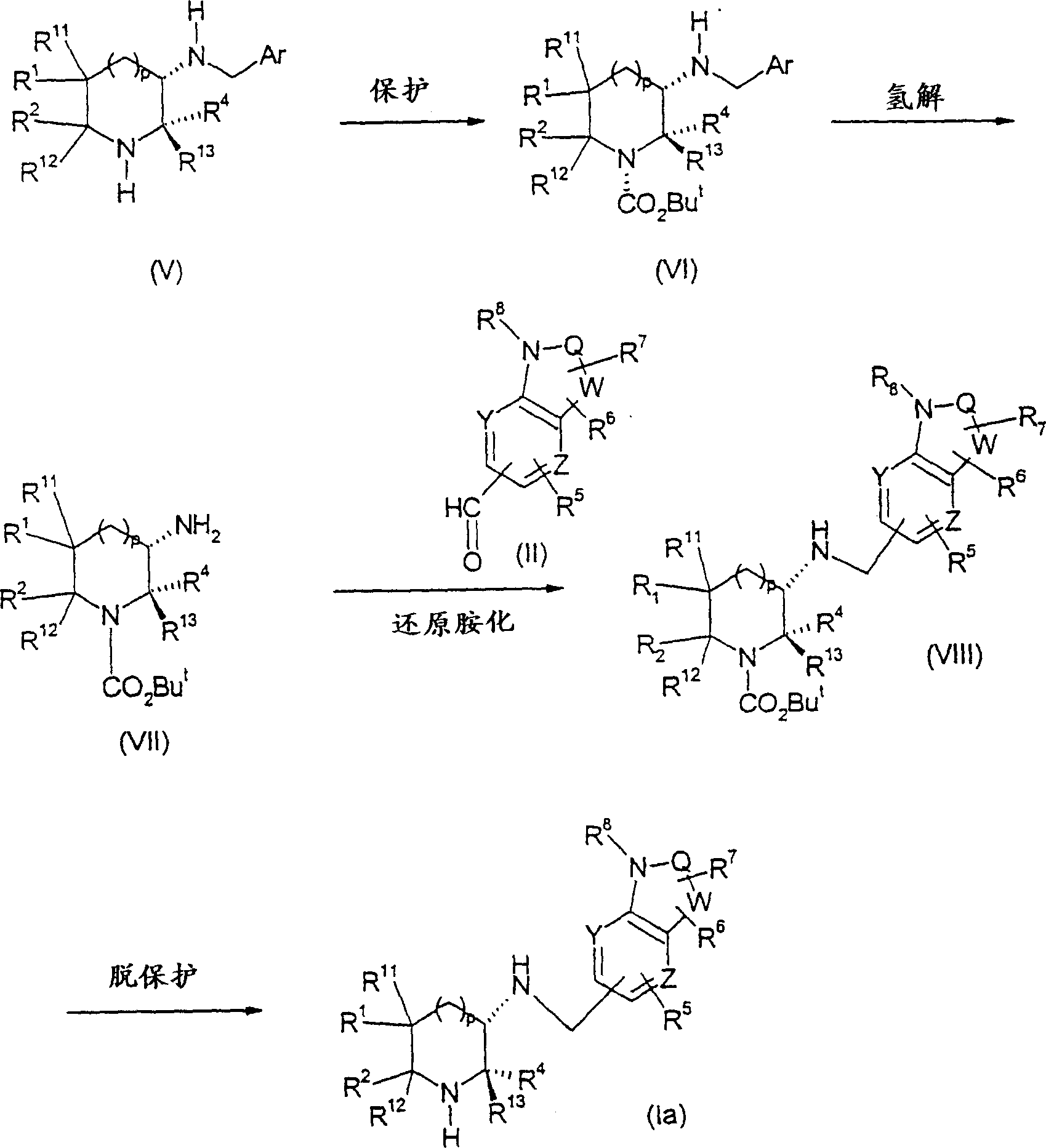
反应路线A-III说明了式(Ia)的化合物(该化合物为其中T为2-苯基哌啶基的式(I)化合物)的制备。Scheme A-III illustrates the preparation of compounds of formula (Ia), which are compounds of formula (I) wherein T is 2-phenylpiperidinyl.
参照反应路线A-III,可以通过用(t-BuOCO)2O(Boc2O)在碱例如碳酸氢钠(NaHCO3)或三乙胺(Et3N)的存在下处理,来进行式(V)化合物(Ar为苯基或类似的基团)的N-保护,以得到式(VI)的化合物。还可以使用其它本领域技术人员熟知的氮原子保护基,例如,FMOC(通过与FMOC-Cl反应),苄基(通过与苄基氯反应),三氟乙酰基(通过与三氟乙酸酐反应)及苯甲酰基(通过与苯甲酰氯反应)。对于这样的保护基和加上和除去它们的方法的记述见Greene,Theodora W.和Wiuts,Peter G.M.,有机合成中的保护基,第二版,John Wiley & Sons,Inc.,New York,199l。将式(VI)的化合物氢解得到式(VII)的化合物。一种供选择的式(V)的化合物的N-保护路线可以通过用苄酯基氯(Cbz-Cl)在碱例如碳酸氢钠(NaHCO3)或三乙胺(Et3N)存在下处理式(V)的化合物来进行。氢解可以通过用H2或甲酸铵(HCO2NH4)在金属催化剂例如钯/碳(例如20%钯/碳)存在下,在适宜的溶剂中处理进行。然后,将式(VII)的化合物如反应路线A-I所述进行还原胺化,形成对应的式(VIII)化合物,然后通过用酸催化剂例如氯化氢(HCl)甲醇溶液,浓HCl乙酸乙酯溶液或CF3CO2H二氯乙烷溶液处理将其转变为式(Ia)的化合物。Referring to Reaction Scheme A -III, the formula ( V) N-protection of compounds (Ar is phenyl or similar) to give compounds of formula (VI). Other nitrogen atom protecting groups known to those skilled in the art can also be used, for example, FMOC (by reacting with FMOC-Cl), benzyl (by reacting with benzyl chloride), trifluoroacetyl (by reacting with trifluoroacetic anhydride ) and benzoyl (by reaction with benzoyl chloride). For a description of such protecting groups and methods of adding and removing them see Greene, Theodora W. and Wiuts, Peter GM, Protecting Groups in Organic Synthesis, Second Edition, John Wiley & Sons, Inc., New York, 1991 . Hydrogenolysis of compounds of formula (VI) affords compounds of formula (VII). An alternative N-protection route for compounds of formula (V) can be achieved by treatment with carbobenzyl chloride (Cbz-Cl) in the presence of a base such as sodium bicarbonate (NaHCO 3 ) or triethylamine (Et 3 N) compound of formula (V). Hydrogenolysis can be performed by treatment with H2 or ammonium formate ( HCO2NH4 ) in a suitable solvent in the presence of a metal catalyst such as palladium on carbon (eg 20% palladium on carbon). The compound of formula (VII) is then subjected to reductive amination as described in Scheme AI to form the corresponding compound of formula (VIII), which is then reacted with an acid catalyst such as hydrogen chloride (HCl) in methanol, concentrated HCl in ethyl acetate or CF Treatment with 3 CO 2 H in dichloroethane converts it to the compound of formula (Ia).
可以通过常规方法,例如重结晶或色谱分离法分离并提纯式(I)的化合物和上述反应流程中所示的中间体。The compound of formula (I) and the intermediates shown in the above reaction schemes can be isolated and purified by conventional methods such as recrystallization or chromatography.
在反应路线B中被描述为化合物IV的选择的中间体,可以通过反应路线C和D中所描述的转化制备。Selected intermediates depicted in Scheme B as compound IV can be prepared by the transformations depicted in Schemes C and D.
反应路线C
用酰化试剂例如乙酸酐,乙酰溴,乙酰氯,乙酰基磺酸盐,乙酰磷酸或乙酸和氯甲酸苯基或烷基酯的混合酐酰化式IX的苯胺,提供式XIII的化合物。一般地,该转化是在惰性溶剂或混合溶剂例如二氯甲烷,二氯乙烷,甲苯,乙醚,苯,四氢呋喃,二氧己环,水或氯仿,或任何惰性溶剂中,在碱例如碳酸氢盐或碳酸盐或三乙基胺存在下,在温度从约-50℃到约溶剂的回流温度下,进行约15分钟到约24小时。优选通过与乙酸酐在二氯甲烷中,使用三乙胺作为碱,在约0℃反应约2小时,生成式XIII的化合物。Acylation of anilines of formula IX with an acylating reagent such as acetic anhydride, acetyl bromide, acetyl chloride, acetyl sulfonate, acetyl phosphoric acid or a mixed anhydride of acetic acid and phenyl or alkyl chloroformate provides compounds of formula XIII. Generally, the conversion is carried out in an inert solvent or mixed solvent such as dichloromethane, dichloroethane, toluene, diethyl ether, benzene, tetrahydrofuran, dioxane, water or chloroform, or any inert solvent, in a base such as bicarbonate in the presence of salt or carbonate or triethylamine at a temperature from about -50°C to about the reflux temperature of the solvent for about 15 minutes to about 24 hours. Compounds of formula XIII are preferably formed by reaction with acetic anhydride in dichloromethane using triethylamine as base at about 0°C for about 2 hours.
其中R8=H的式XIII化合物可以用适宜的选自碘甲烷,硫酸二甲酯和三氟甲磺酸甲酯的亲电试剂烷基化。该反应可在碱例如叔丁醇钠或钾或氢化钠或钾存在下进行。可以使用适宜的惰性溶剂例如THF,乙醚或乙二醇二甲醚。反应可方便地在从约-50℃到约环境温度的温度下进行。优选的条件包括使用硫酸二甲酯在THF中在叔丁醇钾存在下,在0℃到环境温度反应16小时。Compounds of formula XIII wherein R 8 =H may be alkylated with a suitable electrophile selected from iodomethane, dimethyl sulfate and methyl triflate. The reaction can be carried out in the presence of a base such as sodium or potassium tert-butoxide or sodium or potassium hydride. Suitable inert solvents such as THF, diethyl ether or ethylene glycol dimethyl ether may be used. The reaction is conveniently carried out at a temperature of from about -50°C to about ambient temperature. Preferred conditions include the use of dimethyl sulfate in THF in the presence of potassium tert-butoxide at 0°C to ambient temperature for 16 hours.
或者,当R8是氢时,在用适宜的碱(例如,氢化钠或钾,碳酸钠或钾,或叔丁醇钠或钾)在溶剂例如DMF,THF,N-甲基吡咯烷,二氯乙烷或二氯甲烷中处理式XIII的化合物之后,用磺酰或亚硫酰卤或酐(例如,甲磺酰氯或溴或酐,三氟甲磺酸酐,苯基磺酰氯或溴或酐,或甲苯磺酰氯或酐)酰化式XIII的化合物。优选地,反应用甲磺酰氯作为反应物,使用DMF作为溶剂和氢化钠作为碱。Alternatively, when R 8 is hydrogen, in a solvent such as DMF, THF, N-methylpyrrolidine, di After treatment of the compound of formula XIII in ethyl chloride or dichloromethane, treatment with a sulfonyl or thionyl halide or anhydride (for example, methanesulfonyl chloride or bromine or anhydride, trifluoromethanesulfonic anhydride, phenylsulfonyl chloride or bromine or anhydride , or tosyl chloride or anhydride) to acylate the compound of formula XIII. Preferably, the reaction uses methanesulfonyl chloride as reactant, DMF as solvent and sodium hydride as base.
式XIV的化合物可以从相应的式XIII的化合物,通过与适宜的碱例如二异丙基氨基锂,六甲基二硅氮烷钠,锂或钾或叔丁醇钾,在溶剂例如THF或乙二醇二甲醚中,在从约-100℃到约-25℃的温度下,用约15分钟到约5小时的时间形成烯醇盐制备。适宜的亲电试剂包括丙酮,乙醛,苯甲醛,甲醛,环戊酮和环己酮。该转化的优选条件包括使用二异丙基氨基锂在THF中,在约-78℃下用丙酮或乙醛作为亲电试剂,转化约2小时。The compound of formula XIV can be obtained from the corresponding compound of formula XIII by reacting with a suitable base such as lithium diisopropylamide, sodium hexamethyldisilazane, lithium or potassium or potassium tert-butoxide in a solvent such as THF or ethyl Preparation of enolate in dimethyl ether at a temperature from about -100°C to about -25°C over a period of about 15 minutes to about 5 hours. Suitable electrophiles include acetone, acetaldehyde, benzaldehyde, formaldehyde, cyclopentanone and cyclohexanone. Preferred conditions for this transformation include the use of lithium diisopropylamide in THF at about -78°C with acetone or acetaldehyde as the electrophile for about 2 hours.
式XII的化合物可以从相应的式XIV的化合物,在酸例如硫酸,磷酸,三氟甲磺酸,氢氟酸或多聚磷酸中,在有或者没有额外的惰性溶剂情况下,在从约50℃到约150℃的温度下,用约5分钟到约2小时的时间形成。优选的条件包括在纯的多聚磷酸中,将式XIV的化合物在约100℃下加热约15分钟。The compound of formula XII can be obtained from the corresponding compound of formula XIV in an acid such as sulfuric acid, phosphoric acid, trifluoromethanesulfonic acid, hydrofluoric acid or polyphosphoric acid, with or without additional inert solvent, at from about 50 °C to about 150 °C for a period of about 5 minutes to about 2 hours. Preferred conditions include heating the compound of formula XIV in neat polyphosphoric acid at about 100°C for about 15 minutes.
式X的化合物可以通过式IX的苯胺与酰化试剂例如3-氯丙酰氯或氯乙酰氯的酰化形成。典型地,该转化是在惰性溶剂或溶剂混合物例如二氯甲烷,二氯乙烷,甲苯,乙醚,苯,四氢呋喃,二氧己环,水或氯仿,或任何惰性溶剂中,在碱例如碳酸氢盐、碳酸盐或三乙基胺存在下,在约-50℃到约溶剂的回流温度下,进行约15分钟到约24小时。优选通过与3-氯丙酰氯在二氯甲烷/水中,使用碳酸氢钠作为碱,在约环境温度下反应约16小时生成式X的化合物。式XI的化合物可以通过使相应的式X的化合物与路易斯酸例如氯化铝,氯化锡,氯化亚锡或氯化钛,以纯的形式或在惰性溶剂例如二氯甲烷,二氯乙烷,氯仿,苯或甲苯中,在从约环境温度到约300℃的温度下,反应约5分钟到约2小时而形成。优选通过使相应的式X的化合物与纯的氯化铝,在约210℃下反应约10分钟生成式XI的化合物。Compounds of formula X can be formed by acylation of anilines of formula IX with an acylating reagent such as 3-chloropropionyl chloride or chloroacetyl chloride. Typically, the transformation is in an inert solvent or solvent mixture such as dichloromethane, dichloroethane, toluene, diethyl ether, benzene, tetrahydrofuran, dioxane, water or chloroform, or any inert solvent, in a base such as bicarbonate in the presence of salt, carbonate or triethylamine at about -50°C to about the reflux temperature of the solvent for about 15 minutes to about 24 hours. Compounds of formula X are preferably formed by reaction with 3-chloropropionyl chloride in dichloromethane/water using sodium bicarbonate as base at about ambient temperature for about 16 hours. Compounds of formula XI can be obtained by reacting the corresponding compound of formula X with a Lewis acid such as aluminum chloride, tin chloride, stannous chloride or titanium chloride, in pure form or in an inert solvent such as dichloromethane, dichloroethane , chloroform, benzene, or toluene at a temperature from about ambient temperature to about 300° C. for about 5 minutes to about 2 hours. Compounds of formula XI are preferably formed by reacting the corresponding compound of formula X with pure aluminum chloride at about 210°C for about 10 minutes.
其中R5是羟基和/或R8是氢的式XI化合物,可以通过用适宜的选自碘甲烷,硫酸二甲酯和三氟甲磺酸甲酯的亲电试剂与它们反应,转化为相应的其中R5或R8分别是烷氧基或烷基的化合物。该反应可在碱,例如叔丁醇钠或钾,或氢化钠或钾存在下进行。可以使用适宜的惰性溶剂,例如THF,乙醚或乙二醇二甲醚。反应可方便地在从约-50℃到约环境温度的温度下进行。优选的条件包括使用碘甲烷在THF中在叔丁醇钾存在下,在约0℃到约环境温度的温度下反应约16小时。Compounds of formula XI wherein R is hydroxyl and/or R is hydrogen can be converted to the corresponding A compound wherein R5 or R8 is alkoxy or alkyl, respectively. The reaction can be carried out in the presence of a base such as sodium or potassium tert-butoxide, or sodium or potassium hydride. Suitable inert solvents such as THF, diethyl ether or ethylene glycol dimethyl ether can be used. The reaction is conveniently carried out at a temperature of from about -50°C to about ambient temperature. Preferred conditions include the use of iodomethane in THF in the presence of potassium tert-butoxide at a temperature of from about 0°C to about ambient temperature for about 16 hours.
反应路线D Reaction Scheme D
化合物XVI和XVIII可以如反应路线D所示,用Bernard等人在CAN67:120195中所描述的条件制备。反应可以用三甲基碘化、氯化或溴化锍,在溶剂例如DMSO,THF,DME,乙醚或DMF中,使用碱例如氢化钠或钾,丁基或己基锂,在从约0℃到约200℃的温度下进行约1小时到约2天。优选的条件包括在二甲亚砜中,使用三甲基氯化锍与氢化钠,在约100℃的温度下加热约1星期。更优选的条件包括使用三甲基碘化锍,在THF中与己基锂在约0℃到溶剂的回流温度下反应约1.5小时。然后化合物XVI和XVIII可以如上所述转化为式II的化合物(见反应路线B),并进一步转化为式I的化合物(见反应路线A-I和A-III)。Compounds XVI and XVIII can be prepared as shown in Scheme D using the conditions described by Bernard et al. in CAN 67:120195. The reaction can be carried out with trimethyl iodide, chloride or sulfonium bromide, in a solvent such as DMSO, THF, DME, ether or DMF, using a base such as sodium or potassium hydride, butyl or hexyl lithium, at from about 0°C to at a temperature of about 200°C for about 1 hour to about 2 days. Preferred conditions include heating with trimethylsulfonium chloride and sodium hydride in dimethyl sulfoxide at a temperature of about 100°C for about 1 week. More preferred conditions include the use of trimethylsulfonium iodide with hexyllithium in THF at about 0°C to the reflux temperature of the solvent for about 1.5 hours. Compounds XVI and XVIII can then be converted to compounds of formula II (see Scheme B) and further converted to compounds of formula I (see Schemes A-I and A-III) as described above.
反应路线E Reaction Scheme E
式XVIII的化合物优选直接从相应的式XIX化合物,通过使用适宜的碱和烷基化剂在惰性溶剂中制备。适宜的碱包括,但不局限于氢化钠、钾或锂,和二烷基氨基锂例如二异丙基氨基锂,六甲基二硅氮烷锂,六甲基二硅氮烷钠或六甲基二硅氮烷钾。适宜的烷基化剂包括二溴乙烷,碘溴乙烷,二甲磺酸乙二醇酯或二甲苯磺酸乙二醇酯,碘氯乙烷等等。适宜的惰性溶剂包括THF,乙醚,乙二醇二甲醚和DMF。反应可在从约0℃到约溶剂的回流温度下进行。最优选的条件包括底物XIX在DMF中与作为碱的氢化钠和作为烷基化剂的二溴乙烷,在约室温下反应约4小时。Compounds of formula XVIII are preferably prepared directly from the corresponding compounds of formula XIX by using a suitable base and alkylating agent in an inert solvent. Suitable bases include, but are not limited to, sodium, potassium or lithium hydride, and lithium dialkylamides such as lithium diisopropylamide, lithium hexamethyldisilazane, sodium hexamethyldisilazane or hexamethyldisilazane Potassium disilazane. Suitable alkylating agents include dibromoethane, iodobromoethane, ethylene glycol dimesylate or xylene sulfonate, iodochloroethane, and the like. Suitable inert solvents include THF, diethyl ether, ethylene glycol dimethyl ether and DMF. The reaction can be performed at from about 0°C to about the reflux temperature of the solvent. The most preferred conditions involve the reaction of substrate XIX in DMF with sodium hydride as the base and dibromoethane as the alkylating agent at about room temperature for about 4 hours.
反应路线F
反应路线F中描述的螺环化合物可以使用以下一般的反应顺序制备。将起始的式II(a)的醛,在从约-50℃到约50℃的温度下,优选在约室温下溶于非极性溶剂中,优选乙酸乙酯,然后向该溶液中加入亚硫酸氢钠水溶液,接着加入氰化钠(NaCN)水溶液。将混合物搅拌约1到约24小时,优选约4小时,加入第二份NaCN水溶液,然后继续搅拌约18小时。将得到的式XX的羟腈分离,并溶于用氯化氢(HCl)气体饱和的甲醇中。然后将得到的溶液回流约3小时。从该溶液中分离出所要的式XX的羟基酯。The spiro compounds depicted in Scheme F can be prepared using the following general reaction sequence. The starting aldehyde of formula II(a) is dissolved in a non-polar solvent, preferably ethyl acetate, at a temperature from about -50°C to about 50°C, preferably at about room temperature, and then added to the solution Aqueous sodium bisulfite, followed by aqueous sodium cyanide (NaCN). The mixture is stirred for about 1 to about 24 hours, preferably about 4 hours, a second portion of aqueous NaCN is added, and stirring is continued for about 18 hours. The resulting cyanohydrin of formula XX is isolated and dissolved in methanol saturated with hydrogen chloride (HCl) gas. The resulting solution was then refluxed for about 3 hours. The desired hydroxyester of formula XX is isolated from this solution.
可以使用各种氧化剂(优选CrO3/H2SO4;琼斯试剂)在非质子溶剂中,优选在丙酮中将式XXI的羟基酯氧化为相应的酮酯。然后使用标准的维悌希条件(n-BuLi/THF;约-20℃到约室温),将酮酸与甲基-三苯基溴化鏻反应,得到式XXII的不饱和的酯衍生物。然后将式XXII的不饱和酯衍生物与式XXIII的化合物在非极性溶剂,优选四氢呋喃(THF)中混合,并用非水溶液的碱,优选1,8-二氮杂双环[5.4.0]十一-7-烯(DBU)处理。然后将反应加热回流约4到约36小时,优选约18小时。然后可以将得到的式XXIV的酯加合物使用各种已知的还原剂,优选LiBH4,在非质子醚溶剂中,优选在乙醚中还原,得到式XXV的硝基乙醇衍生物。Hydroxy esters of formula XXI can be oxidized to the corresponding ketoesters using various oxidizing agents (preferably CrO3 / H2SO4 ; Jones' reagent) in aprotic solvents, preferably in acetone. The keto acid is then reacted with methyl-triphenylphosphonium bromide using standard Wittig conditions (n-BuLi/THF; about -20°C to about room temperature) to give unsaturated ester derivatives of formula XXII. Then the unsaturated ester derivative of formula XXII is mixed with the compound of formula XXIII in a non-polar solvent, preferably tetrahydrofuran (THF), and with a non-aqueous base, preferably 1,8-diazabicyclo[5.4.0]deca One-7-ene (DBU) treatment. The reaction is then heated to reflux for about 4 to about 36 hours, preferably about 18 hours. The resulting ester adducts of formula XXIV can then be reduced using various known reducing agents, preferably LiBH4 , in an aprotic ethereal solvent, preferably diethyl ether, to give nitroethanol derivatives of formula XXV.
硝基的还原可以使用标准的工艺完成,优选使用兰尼镍催化剂在乙醇中氢化,环化成螺环的反应可通过乙醇的活化,优选使用甲磺酰氯在二氯甲烷中,在约-20到约40℃,优选约5℃下完成。得到的对映体通过手性色谱的分离是本领域技术人员已知的标准方法。使用标准条件,优选二噁烷/HCl,最后除去氮保护基,得到式I(b)的最终产品。Reduction of the nitro group can be accomplished using standard procedures, preferably hydrogenation in ethanol using a Raney nickel catalyst, and cyclization to the spiro can be achieved by activation with ethanol, preferably using methanesulfonyl chloride in dichloromethane at about -20 to This is done at about 40°C, preferably at about 5°C. The separation of the resulting enantiomers by chiral chromatography is a standard procedure known to those skilled in the art. Final removal of the nitrogen protecting group using standard conditions, preferably dioxane/HCl, yields the final product of formula I(b).
其中B为CH2,A为CH且G为OCH2的式I化合物可以用反应路线G中所图解的方法制备。可以用以上反应路线B中定义的适当的式IV的化合物代替式QQ的化合物,以得到具有所需要的Q,W,Y,Z,R5,R6,R7和R8定义的式I化合物。Compounds of formula I wherein B is CH2 , A is CH and G is OCH2 can be prepared by the method illustrated in Scheme G. Compounds of formula QQ can be replaced by appropriate compounds of formula IV as defined in Scheme B above to obtain formula I with the desired definitions of Q, W, Y, Z, R5 , R6 , R7 and R8 compound.
反应路线G
反应路线G(续) Reaction Scheme G (continued)
反应路线H图解了向其中R3为氢的类似的式I化合物中增添作为取代基R3的Het-CH2-C(=O)-基团的方法。(Het为如以上定义的R3上的杂环取代基的定义,条件是Het必须包含一个仲胺)。将Het-H与溴乙酸甲氧基酯或溴乙酸乙氧基酯,在叔胺盐酸盐碱催化剂例如二乙基苄胺,吡啶鎓盐酸盐,或二异丙基乙胺盐酸盐存在下,在从约0℃到约环境温度的温度下缩合。该酯与碳酸钾在氢氧化钾水溶液中的淤浆在从约0℃到约回流温度下进行水解,进行约16小时到约48小时。将取代的乙酸和哌啶I(d)用任何标准的肽偶联剂例如Bop(苯并三唑-1-基氧基三(二甲基氨基)鏻六氟磷酸盐),Py-Brop(溴代-三-吡咯烷鏻六氟磷酸盐)或T3P(1-丙烷膦酸环酐),在约0℃到约环境温度下偶合,进行约1小时到约24小时,形成最终产物。 Scheme H illustrates the addition of a Het- CH2 -C(=O)- group as substituent R3 to a similar compound of formula I wherein R3 is hydrogen. (Het is the definition of a heterocyclic substituent on R3 as defined above, with the proviso that Het must contain a secondary amine). Het-H with methoxy bromoacetate or ethoxy bromoacetate, in a tertiary amine hydrochloride base catalyst such as diethylbenzylamine, pyridinium hydrochloride, or diisopropylethylamine hydrochloride In the presence, condensation occurs at a temperature from about 0°C to about ambient temperature. A slurry of the ester and potassium carbonate in aqueous potassium hydroxide is hydrolyzed at a temperature from about 0°C to about reflux for about 16 hours to about 48 hours. Substituted acetic acid and piperidine I(d) are coupled with any standard peptide coupling reagent such as Bop (benzotriazol-1-yloxytris(dimethylamino)phosphonium hexafluorophosphate), Py-Brop ( Bromo-tris-pyrrolidinophosphonium hexafluorophosphate) or T3P (1-propanephosphonic acid cyclic anhydride), coupling is performed at about 0°C to about ambient temperature for about 1 hour to about 24 hours to form the final product.
反应路线J说明了其中R2为烷基的某些式I化合物的合成。Scheme J illustrates the synthesis of certain compounds of formula I wherein R2 is alkyl.
在此反应路线中所使用的起始原料(式XXXII的化合物)可以通过市售的烷基乙烯基酮与硝基甲烷反应制备,反应在适宜的碱例如醇钠或钾,三乙胺,二异丙基乙基胺,N-甲基吗啉,或碳酸钠和钾存在下,在有机溶剂例如甲醇,乙醇,丙醇,异丙醇,叔丁醇,二氯甲烷,氯仿,甲苯,THF,DMF,DMSO,乙醚,或乙酸乙酯中,在从约-78℃到约100℃的温度下进行。(J.Am.Chem.Soc.,74,3664-3668(1952))。优选在约-30℃到约0℃的温度下,使用在甲醇中的硝基甲烷与作为碱的甲醇钠,和作为亲电试剂的甲基乙烯基酮进行反应。或者,该反应可以在中性的水溶液条件下进行,如以下文献中所描述,例如,Tetrahedron Lett.1929-1932(1982)。The starting material (compound of formula XXXII) used in this reaction scheme can be prepared by reacting a commercially available alkyl vinyl ketone with nitromethane in a suitable base such as sodium or potassium alkoxide, triethylamine, di In the presence of isopropylethylamine, N-methylmorpholine, or sodium and potassium carbonate, in organic solvents such as methanol, ethanol, propanol, isopropanol, tert-butanol, methylene chloride, chloroform, toluene, THF , DMF, DMSO, diethyl ether, or ethyl acetate at temperatures from about -78°C to about 100°C. (J. Am. Chem. Soc., 74, 3664-3668 (1952)). The reaction is carried out using nitromethane in methanol with sodium methoxide as the base, and methyl vinyl ketone as the electrophile, preferably at a temperature of from about -30°C to about 0°C. Alternatively, the reaction can be carried out under neutral aqueous conditions, as described in, for example, Tetrahedron Lett. 1929-1932 (1982).
式XXXIII的化合物可以使用改进的亨利反应制备,该反应缩合得到取代的环亚胺。首先,通过使用无机酸例如盐酸,硫酸和硝酸或催化的有机酸例如樟脑磺酸或甲苯磺酸,在醇溶剂例如甲醇,乙醇,丙醇或乙二醇中,用水清除剂例如原甲酸三甲基酯,原甲酸三乙酯,硫酸镁或分子筛,在从约0℃到约75℃的温度下,将酮以缩酮的形式保护。然后,将硝基缩醛与亚胺在从约0℃到约75℃的温度下原位缩合,亚胺是由胺源例如乙酸铵,氯化铵或甲酸铵与醛例如各种取代的芳醛之一产生的。然后通过加入无机酸例如盐酸,硫酸或硝酸的水溶液,在从约0℃到约75℃的温度下(该温度引起环化作用的发生),将缩醛转变为酮,得到化合物XXXIII。优选将硝基酮在约室温下与催化量的樟脑磺酸和原甲酸三甲基酯一起溶于甲醇。然后加入甲酸铵,接着加入苯甲醛。加入硫酸水溶液并搅拌,得到环亚胺XXXIII。Compounds of formula XXXIII can be prepared using a modified Henry reaction which condenses to give substituted cyclic imines. First, by using mineral acids such as hydrochloric acid, sulfuric acid and nitric acid or catalyzed organic acids such as camphorsulfonic acid or toluenesulfonic acid, in an alcoholic solvent such as methanol, ethanol, propanol or ethylene glycol, a water scavenger such as trimethylorthoformate ketones, triethyl orthoformate, magnesium sulfate, or molecular sieves, at temperatures from about 0°C to about 75°C, protect the ketones as ketals. The nitroacetal is then condensed in situ with an imine formed from an amine source such as ammonium acetate, ammonium chloride or ammonium formate and an aldehyde such as various substituted aromatic compounds at temperatures from about 0°C to about 75°C. One of the aldehydes produced. The acetal is then converted to the ketone by addition of an aqueous solution of a mineral acid such as hydrochloric acid, sulfuric acid or nitric acid at a temperature from about 0°C to about 75°C which causes cyclization to occur to give compound XXXIII. Preferably, the nitroketone is dissolved in methanol at about room temperature together with catalytic amounts of camphorsulfonic acid and trimethyl orthoformate. Ammonium formate was then added followed by benzaldehyde. Addition of aqueous sulfuric acid and stirring affords the cyclic imine XXXIII.
将得到的式XXXIII的化合物溶于醇溶剂例如甲醇,乙醇,丙醇,异丙醇或叔丁醇及其锂,钠或钾的碱中,然后在从约-30℃到约75℃的温度下,将其与水清除剂例如原甲酸三甲酯,原甲酸三乙酯,硫酸镁或分子筛加入到无机酸例如盐酸,硫酸或硝酸的醇溶液中。该反应产生相应的式XXXIV的化合物。优选地,将硝基亚胺溶于甲醇钠的甲醇溶液中,然后将其加入到0℃的硫酸和原甲酸三甲酯的甲醇溶液中。The obtained compound of formula XXXIII is dissolved in an alcohol solvent such as methanol, ethanol, propanol, isopropanol or tert-butanol and a base of lithium, sodium or potassium, and then heated at a temperature from about -30°C to about 75°C In this case, it is added together with a water scavenger such as trimethyl orthoformate, triethyl orthoformate, magnesium sulfate or molecular sieves to an alcoholic solution of a mineral acid such as hydrochloric acid, sulfuric acid or nitric acid. This reaction produces the corresponding compound of formula XXXIV. Preferably, the nitroimine is dissolved in sodium methoxide in methanol and then added to sulfuric acid and trimethyl orthoformate in methanol at 0°C.
相应的式XXXV-a的化合物由式XXXIV的亚胺的立体选择性还原制备。用路易斯酸例如三甲基铝,三乙基铝和三氯化铝及氢化物源例如氢化铝锂或二异丁基氢化铝还原亚胺。一般地,在有机溶剂例如THF,乙醚或甘醇二甲醚中,在约0℃到约-78℃的温度下进行反应。优选地,将亚胺用三乙基铝和氢化铝锂在THF中,在约-78℃下还原。The corresponding compounds of formula XXXV-a are prepared by stereoselective reduction of imines of formula XXXIV. The imine is reduced with a Lewis acid such as trimethylaluminum, triethylaluminum and aluminum trichloride and a hydride source such as lithium aluminum hydride or diisobutylaluminum hydride. Generally, the reaction is carried out in an organic solvent such as THF, diethyl ether or glyme at a temperature of from about 0°C to about -78°C. Preferably, the imine is reduced with triethylaluminum and lithium aluminum hydride in THF at about -78°C.
可通过将缩醛转化为肟然后还原成胺,将式XXXV-a的化合物转变为相应的式XXXVI-a的化合物。在从约0℃到约100℃的温度下,将缩醛在水和有机助溶剂例如THF中,与无机酸例如盐酸,硫酸或硝酸,羟胺,和缓冲剂例如乙酸铵或氯化铵一起搅拌。在从约室温到约60℃的温度下,在有机溶剂例如甲醇,乙醇,乙酸乙酯或乙酸中,使用催化剂例如兰尼镍,铂或钯,在约1到约50psi的氢气压力下完成肟的还原。优选将式XXXV-a的化合物和盐酸羟胺溶于水,THF和浓盐酸,然后在约室温下加入乙酸铵。然后用兰尼镍,在乙醇中,在40psi氢气压力下,在约室温下还原肟。Compounds of formula XXXV-a can be converted to the corresponding compounds of formula XXXVI-a by conversion of the acetal to the oxime followed by reduction to the amine. Stir the acetal in water and an organic co-solvent such as THF with a mineral acid such as hydrochloric acid, sulfuric acid or nitric acid, hydroxylamine, and a buffer such as ammonium acetate or ammonium chloride at a temperature from about 0°C to about 100°C . Oxime is accomplished at a temperature from about room temperature to about 60°C, in an organic solvent such as methanol, ethanol, ethyl acetate or acetic acid, using a catalyst such as Raney nickel, platinum or palladium, under a hydrogen pressure of about 1 to about 50 psi restoration. Preferably, the compound of formula XXXV-a and hydroxylamine hydrochloride are dissolved in water, THF and concentrated hydrochloric acid, and ammonium acetate is added at about room temperature. The oxime was then reduced with Raney nickel in ethanol under 40 psi hydrogen pressure at about room temperature.
式XXXVII-a的最终产物是通过相应的式XXXVI-a的化合物的还原胺化制备的,反应使用适当的醛,酸例如乙酸,盐酸,硫酸,樟脑磺酸或甲苯磺酸,和氢化物源例如硼氢化钠,氰基硼氢化钠,或三乙酰氧基硼氢化钠,在有机溶剂例如甲醇,乙醇或四氢呋喃中,在从约0℃到约75℃的温度下进行。优选将式XXXVI-a的化合物,适当的芳醛,乙酸和氰基硼氢化钠在约室温下,在甲醇中搅拌,得到所需要的式XXXVII-a的产物。The final product of formula XXXVII-a is prepared by reductive amination of the corresponding compound of formula XXXVI-a using an appropriate aldehyde, an acid such as acetic acid, hydrochloric acid, sulfuric acid, camphorsulfonic acid or toluenesulfonic acid, and a source of hydride For example sodium borohydride, sodium cyanoborohydride, or sodium triacetoxyborohydride, in an organic solvent such as methanol, ethanol or tetrahydrofuran at a temperature from about 0°C to about 75°C. Preferably, a compound of formula XXXVI-a, the appropriate aromatic aldehyde, acetic acid and sodium cyanoborohydride are stirred in methanol at about room temperature to give the desired product of formula XXXVII-a.
在R2位置具有与式XXXVII-a的化合物相反的立体化学的式XXXVII-b类型的起始原料,可以通过相似的反应顺序制备,唯一的变化是亚胺还原所使用的条件不同。例如,用NaBH3CN/MeOH替换三乙基铝/LiAlH4产生化合物XXXV-b。许多其它还原方法可有效用于该转化,且这些还原方法是本领域技术人员公知的。优选的条件包括用在醇或醚溶剂中的NaBH4还原,或用NaBHOAc3,在酸例如乙酸存在下,在氯化溶剂例如CH2Cl2或CHCl3中或在其它惰性溶剂例如苯,甲苯,乙醚,THF或甘醇二甲醚中还原。还可以在没有三乙基铝的情况下,使用在乙醚,THF或甘醇二甲醚中的LiAl4。这些还原通常在从约-78℃到约100℃,优选从约0℃到约60℃的温度下进行。生产式XXXVII-b化合物的随后的反应顺序可在与生产式XXXVII-a的化合物的反应顺序一样的条件下进行。Starting materials of the type XXXVII-b, having the opposite stereochemistry at the R2 position to compounds of formula XXXVII-a, can be prepared by a similar sequence of reactions, the only change being the conditions used for the reduction of the imine. For example, substitution of NaBH3CN /MeOH for triethylaluminum/ LiAlH4 yields compound XXXV-b. Many other reduction methods are effective for this transformation and are well known to those skilled in the art. Preferred conditions include reduction with NaBH4 in an alcoholic or ethereal solvent, or with NaBHOAc3 , in the presence of an acid such as acetic acid, in a chlorinated solvent such as CH2Cl2 or CHCl3 or in other inert solvents such as benzene, toluene , ether, THF or glyme for reduction. It is also possible to use LiAl4 in diethyl ether, THF or glyme without triethylaluminum. These reductions are generally carried out at temperatures from about -78°C to about 100°C, preferably from about 0°C to about 60°C. The subsequent reaction sequence to produce the compound of formula XXXVII-b can be carried out under the same conditions as the reaction sequence to produce the compound of formula XXXVII-a.
反应路线J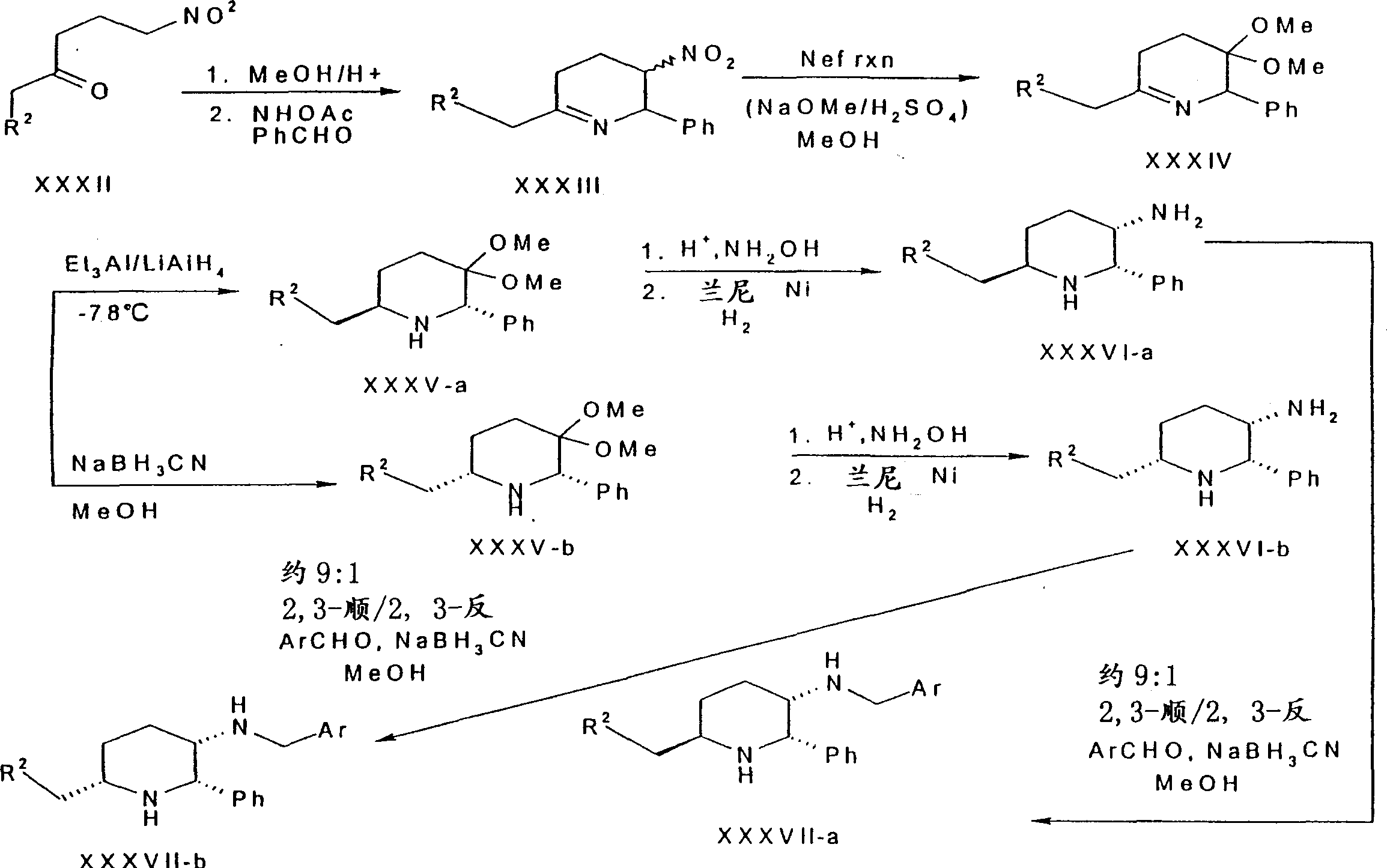
反应路线K说明了其中Q为SO2和W为亚乙基的某些式I化合物的合成。Scheme K illustrates the synthesis of certain compounds of formula I wherein Q is SO2 and W is ethylene.
在此反应路线中所使用的原料(化合物XXXVIII)可以从市售的4-甲氧基-2-甲基苯胺,通过与甲磺酰氯(或溴)或甲磺酸酐反应制备,反应在适宜的碱例如吡啶,三乙胺,二异丙基乙基胺,N-甲基吗啉,或碳酸钠和钾或碳酸氢钠或钾存在下,在有机溶剂例如二氯甲烷,二氯乙烷,甲苯,乙醚,乙酸乙酯,四氯化碳或氯仿中进行。优选在二氯甲烷中在吡啶存在下与甲磺酰氯进行反应。将得到的磺酰胺在溶剂例如二甲基甲酰胺,N-甲基吡咯烷酮(N-methylpyrrolidinone),二甲基乙酰胺,THF或DMSO中用适宜的碱例如氢化钠或钾或叔丁醇钠或钾处理。将得到的盐与碘甲烷或硫酸二甲酯反应形成式XXXVIII的化合物。优选在DMF中,在环境温度下使用碘甲烷,用氢化钠作为碱进行反应。将式XXXVIII的化合物在四氯化碳或二氯乙烷中,与N-溴代琥珀酰亚胺或二溴二甲基乙内酰脲,二溴二苯基乙内酰脲或元素溴,在有或者没有泛光灯照射下,在接近溶剂的回流点的温度下反应,得到式XXXIX的溴化物。优选在四氯化碳中,在回流下,在高强度可见光存在下与N-溴代琥珀酰亚胺进行反应。The starting material (compound XXXVIII) used in this reaction scheme can be prepared from commercially available 4-methoxy-2-methylaniline by reacting with methanesulfonyl chloride (or bromine) or methanesulfonic anhydride in a suitable In the presence of a base such as pyridine, triethylamine, diisopropylethylamine, N-methylmorpholine, or sodium and potassium carbonate or sodium bicarbonate or potassium, in an organic solvent such as dichloromethane, dichloroethane, Toluene, ether, ethyl acetate, carbon tetrachloride or chloroform. The reaction with methanesulfonyl chloride is preferably carried out in dichloromethane in the presence of pyridine. The resulting sulfonamide is dissolved in a solvent such as dimethylformamide, N-methylpyrrolidinone (N-methylpyrrolidinone), dimethylacetamide, THF or DMSO with a suitable base such as sodium or potassium hydride or sodium tert-butoxide or Potassium treatment. The resulting salt is reacted with iodomethane or dimethyl sulfate to form compounds of formula XXXVIII. The reaction is preferably carried out in DMF using iodomethane at ambient temperature with sodium hydride as base. Compound of formula XXXVIII in carbon tetrachloride or dichloroethane, with N-bromosuccinimide or dibromodimethylhydantoin, dibromodiphenylhydantoin or elemental bromine, Reaction at temperatures near the reflux point of the solvent with or without floodlight irradiation affords bromides of formula XXXIX. The reaction with N-bromosuccinimide is preferably carried out in carbon tetrachloride at reflux in the presence of high intensity visible light.
然后将式XXXIX的溴化物环化形成如下的式XL的磺内酰胺。在溶剂例如DMF,N-甲基吡咯烷酮,二甲基乙酰胺,THF或DMSO中,与碱例如氢化钠或钾或叔丁醇钠或钾形成阴离子,产生磺内酰胺中间体,该中间体具有与化合物XL相同的结构,除了化合物XL的醛被替换为氢原子。直接或间接甲酰化这样的磺内酰胺中间体产生式XL的化合物。可以使用本领域技术人员所知的任何甲酰化方法来在苯环上引入甲酰基。例如,可以通过将该式的化合物与适宜的甲酰化试剂在适宜的催化剂存在下接触完成直接甲酰化。适宜的甲酰化试剂/催化剂体系包括二氯甲基甲醚/氯化钛(IV)(Cl2CHOCH3/TiCl4),二氯甲基甲醚/氯化铝(Cl2CHOCH3/AlCl3),二氯甲基甲醚/氯化锡(IV)(Cl2CHOCH3/SnCl4),二氯甲基甲醚/三氟化硼乙醚络合物(Cl2CHOCH3/BF3-OEt),三氟乙酸(CF3CO2H)/六亚甲基四胺(改进的Duff’s条件)和三氯化氧磷(POCl3)/DMF(Vilsmeier’s条件)。The bromide of formula XXXIX is then cyclized to form the sultam of formula XL below. Anion formation with a base such as sodium or potassium hydride or sodium or potassium tert-butoxide in a solvent such as DMF, N-methylpyrrolidone, dimethylacetamide, THF or DMSO yields a sulphonactam intermediate with Same structure as compound XL, except that the aldehyde of compound XL is replaced by a hydrogen atom. Direct or indirect formylation of such sultam intermediates yields compounds of formula XL. Formyl groups can be introduced on the benzene ring using any formylation method known to those skilled in the art. For example, direct formylation can be accomplished by contacting a compound of formula with a suitable formylating agent in the presence of a suitable catalyst. Suitable formylating reagent/catalyst systems include dichloromethyl methyl ether/titanium (IV) chloride (Cl 2 CHOCH 3 /TiCl 4 ), dichloromethyl methyl ether/aluminum chloride (Cl 2 CHOCH 3 /AlCl 3 ), dichloromethyl methyl ether/tin(IV) chloride (Cl 2 CHOCH 3 /SnCl 4 ), dichloromethyl methyl ether/boron trifluoride etherate complex (Cl 2 CHOCH 3 /BF 3 - OEt), trifluoroacetic acid (CF 3 CO 2 H)/hexamethylenetetramine (modified Duff's conditions) and phosphorus oxychloride (POCl 3 )/DMF (Vilsmeier's conditions).
间接的甲酰化可以通过卤化上述磺内酰胺中间体,将卤原子用氰基基团置换,然后将生成的氰基取代的化合物还原来实现。或者,卤素可以与丁基锂进行卤素金属交换反应。然后将锂中间体用二甲基甲酰胺处理得到II。卤化可以根据G.A.Olah等人在J.Org Chem,58,3194(1993)中报告的方法进行。卤素原子与氰基的置换可以根据D.M.Tschaem等人在Synth Commun,24,887(1994)中和K.Takagi等人在64 Bull Chem.Soc.Jpn.64,1118(1991)中报告的方法进行。还原可以在二氯甲烷中,在二异丙基氢化铝(DIBAL-H)存在下,或在甲酸中,在兰尼镍存在下进行。然后将式XL的醛与适当的式T-NH2的化合物如反应路线A-I到A-III所述偶合,式T-NH2的化合物除了R3为BOC外如以上反应路线A-I所定义。Indirect formylation can be achieved by halogenating the above-mentioned sultone intermediate, replacing the halogen atom with a cyano group, and then reducing the resulting cyano-substituted compound. Alternatively, the halogen can undergo a halide metal exchange reaction with butyllithium. The lithium intermediate is then treated with dimethylformamide to afford II. Halogenation can be carried out according to the method reported by GAOlah et al. in J. Org Chem, 58, 3194 (1993). The substitution of a halogen atom with a cyano group can be carried out according to the methods reported by DMTschaem et al. in Synth Commun, 24, 887 (1994) and K. Takagi et al. in 64 Bull Chem. Soc. Jpn. 64, 1118 (1991). The reduction can be performed in dichloromethane in the presence of diisopropylaluminum hydride (DIBAL-H), or in formic acid in the presence of Raney nickel. The aldehyde of formula XL is then coupled with the appropriate compound of formula T- NH2 as defined in Scheme AI above except that R3 is BOC as described in Schemes AI to A-III.
反应路线K
反应路线L说明了其中R3为苄基和其中R12和R13与它们所连接的碳原子一起形成环的式I化合物的制备方法。Scheme L illustrates the preparation of compounds of formula I wherein R3 is benzyl and wherein R12 and R13 together with the carbon atoms to which they are attached form a ring.
反应路线L的起始原料可以从2-溴-3-羟基吡啶,或以类似的方式,从2-碘代-3-羟基吡啶制备。可以使用这些起始原料中的一种和亲核试剂,例如苯基(或取代的苯基)硼酸或另一个芳基取代的硼酸酯或苯基烷基甲硼烷和/或芳基(或取代的芳基)氢化锡,例如苯基三正丁基氢化锡或苯基三甲基氢化锡进行反应。通常使用钯催化剂。钯催化剂既可以是带有各种膦配体的钯(O)源,包括但不限于四[三苯基膦]钯,也可以是非膦的钯源例如二亚苄基丙酮钯(dba)或钯(II)源例如醋酸钯或二氯化双三苯基膦钯。可以在各种溶剂或溶剂的混合物例如乙酸乙酯,二氯甲烷,二氯乙烷,甲苯,苯,乙醚,THF或DMF和水中,在从环境温度到约溶剂的回流温度下,在适宜的碱例如碳酸钠或钾或碳酸氢钠或钾存在下进行反应。优选使用2-溴代-3-羟基吡啶和苯基硼酸,用四(三苯基膦)钯作为催化剂,在苯、水和碳酸钠的混合物中反应。The starting material in Scheme L can be prepared from 2-bromo-3-hydroxypyridine, or in an analogous manner, from 2-iodo-3-hydroxypyridine. One of these starting materials and a nucleophile such as phenyl (or substituted phenyl) boronic acid or another aryl substituted boronate or phenylalkylborane and/or aryl (or Substituted aryl) tin hydrides such as phenyltri-n-butyltin hydride or phenyltrimethyltin hydride. Typically a palladium catalyst is used. The palladium catalyst can be either a palladium (O) source with various phosphine ligands, including but not limited to tetrakis[triphenylphosphine] palladium, or a non-phosphine palladium source such as palladium dibenzylideneacetone (dba) or A source of palladium(II) such as palladium acetate or palladium bistriphenylphosphine dichloride. Can be in various solvents or mixtures of solvents such as ethyl acetate, dichloromethane, dichloroethane, toluene, benzene, diethyl ether, THF or DMF and water, from ambient temperature to about the reflux temperature of the solvent, at suitable The reaction is carried out in the presence of a base such as sodium or potassium carbonate or sodium or potassium bicarbonate. Preference is given to using 2-bromo-3-hydroxypyridine and phenylboronic acid with tetrakis(triphenylphosphine)palladium as catalyst in a mixture of benzene, water and sodium carbonate.
将由此步骤得到的产物(式XLII的化合物)在从约环境温度到约溶剂的回流点的温度下,用苄基溴,苄基氯,甲磺酸苄酯,三氟甲磺酸苄酯或苄基碘或取代的苄基溴,在各种溶剂例如乙腈,乙醇,甲醇或水中的一种中进行烷基化。该反应的产物为一种吡啶盐(式XLIII的盐)。最优选的条件包括使用乙腈,在回流下,用苄基溴烷基化以形成溴化吡啶鎓。可将得到的式XLIII的盐用适宜的碱,或者通过一个单独的步骤,或者在原位通过以下的反应转化为甜菜碱。典型地,在约环境温度下,用amberliteTM或其它类型的碱性离子交换树脂或三乙胺,二异丙基乙基胺,氢氧化钠,碳酸钠或碳酸氢钠处理吡啶鎓盐。最优选的条件包括使用amberliteTM,即一种强碱性的离子交换树脂。然后使甜菜碱与乙烯基砜例如苯基乙烯基砜或取代的苯基乙烯基砜在惰性溶剂例如乙酸乙酯,二氯甲烷,二氯乙烷,甲苯,苯,乙醚,THF或DMF中,在约溶剂的回流温度下进行反应。典型地,加入游离基抑制剂例如对苯二酚或有关的抑制剂以防止乙烯基砜的自由基聚合。最优选在甲苯回流下,使用苯基乙烯基砜与对苯二酚。The product obtained from this step (compound of formula XLII) is treated with benzyl bromide, benzyl chloride, benzyl methanesulfonate, benzyl triflate or benzyl triflate at a temperature from about ambient temperature to about the reflux point of the solvent Benzyl iodide or substituted benzyl bromide, for alkylation in one of various solvents such as acetonitrile, ethanol, methanol or water. The product of this reaction is a pyridinium salt (salt of formula XLIII). Most preferred conditions include alkylation with benzyl bromide at reflux using acetonitrile to form pyridinium bromide. The resulting salt of formula XLIII can be converted to betaine with a suitable base, either in a separate step, or in situ by the following reaction. Typically, the pyridinium salt is treated with amberlite( TM) or other type of basic ion exchange resin or triethylamine, diisopropylethylamine, sodium hydroxide, sodium carbonate or sodium bicarbonate at about ambient temperature. The most preferred conditions involve the use of amberlite( TM) , a strongly basic ion exchange resin. Betaine is then reacted with a vinyl sulfone such as phenyl vinyl sulfone or substituted phenyl vinyl sulfone in an inert solvent such as ethyl acetate, dichloromethane, dichloroethane, toluene, benzene, diethyl ether, THF or DMF, The reaction is carried out at about the reflux temperature of the solvent. Typically, a free radical inhibitor such as hydroquinone or related inhibitors is added to prevent free radical polymerization of the vinyl sulfone. Most preferably, phenylvinylsulfone and hydroquinone are used under reflux of toluene.
得到的产物是一种烯酮(式XLIV的化合物),包含一个碳碳双键,该双键可以在1-110psi氢压下使用适宜的催化剂例如钯-碳,氢氧化钯,氧化铂或铂-碳还原。可以在溶剂例如甲醇,乙醇或水中,在从约环境温度到约溶剂的回流点的温度下进行该反应。或者,该反应可以使用甲酸铵或作为氢源的另一种甲酸盐进行。优选在回流下用甲酸铵在甲醇中与Pd(OH)2/C一起还原。将得到的酮使用羟胺甲醚或乙基醚或苄基醚以及羟胺本身,转化为肟醚或肟。可以在选自乙酸乙酯,二氯甲烷,二氯乙烷,甲苯,苯,乙醚,THF,DMF,甲醇,乙醇和水或其混合物的溶剂或溶剂混合物中,在从环境温度到约溶剂的回流温度下,用适宜的缓冲剂例如乙酸钠或钾进行反应。最优选的条件包括使用二氯甲烷,甲醇和水与羟胺甲醚和乙酸钠的回流混合物。得到的肟甲醚(式XLV的化合物)可以用适宜的还原剂,例如氰基硼氢化钠或三乙酰氧基硼氢化钠或三乙基甲硅烷,在溶剂中在酸性条件下选择性还原。适宜的溶剂包括乙酸,甲酸和三氟乙酸。反应通常在约环境温度下进行。最优选在乙酸中使用氰基硼氢化钠以得到式I(g)的化合物。The product obtained is an enone (compound of formula XLIV) containing a carbon-carbon double bond which can be reacted under a hydrogen pressure of 1-110 psi using a suitable catalyst such as palladium-carbon, palladium hydroxide, platinum oxide or platinum - Carbon reduction. The reaction can be carried out in a solvent such as methanol, ethanol or water at a temperature from about ambient temperature to about the reflux point of the solvent. Alternatively, the reaction can be performed using ammonium formate or another formate salt as a source of hydrogen. Preference is given to reduction with ammonium formate in methanol at reflux with Pd(OH) 2 /C. The resulting ketone is converted to an oxime ether or oxime using hydroxylamine methyl ether or ethyl ether or benzyl ether and hydroxylamine itself. can be selected from ethyl acetate, dichloromethane, dichloroethane, toluene, benzene, diethyl ether, THF, DMF, methanol, ethanol and water or mixtures thereof in a solvent or solvent mixture at from ambient temperature to about The reaction is carried out at reflux temperature with a suitable buffer such as sodium or potassium acetate. The most preferred conditions involve the use of a refluxing mixture of dichloromethane, methanol and water with methylhydroxylamine ether and sodium acetate. The resulting oxime methyl ether (compound of formula XLV) can be selectively reduced with a suitable reducing agent such as sodium cyanoborohydride or sodium triacetoxyborohydride or triethylsilane in a solvent under acidic conditions. Suitable solvents include acetic acid, formic acid and trifluoroacetic acid. The reactions are usually carried out at about ambient temperature. Most preferably sodium cyanoborohydride is used in acetic acid to give compounds of formula I(g).
羟胺醚的还原可以与二苯砜官能团的除去一起进行。还原剂典型地为钠,锂或钾金属,或钠汞齐,铝汞齐或二碘化钐。可以在选自液态氨,乙醇,甲醇,甲苯,THF,叔丁醇和类似的溶剂的溶剂或溶剂混合物中进行该反应。通常反应可在从约-33℃到约环境温度或约溶剂的回流温度下进行。最优选的条件包括使用金属钠在液态氨/THF中,在回流下得到式XLVI的化合物。N-苄基保护基的除去可以在1-110psi氢压下,使用适宜的催化剂例如钯/碳或氢氧化钯完成。可以在溶剂例如甲醇,乙醇或水中,在从约环境温度到约溶剂的回流点的温度下进行该反应。或者,该反应可以使用甲酸铵或作为氢源的另一种甲酸盐进行。优选使用在甲醇中的甲酸铵,以碳上的氢氧化钯作为催化剂,在溶剂的回流温度下进行该反应。在最后一步,将式XLVII的醛与式XLVI的二氮杂二环[3.2.1]辛烷(其中已经除去N-苄基保护基Bn),在如上面反应路线A-I到A-III所述的条件下偶合在一起。The reduction of the hydroxylamine ether can be performed together with the removal of the diphenylsulfone functionality. The reducing agent is typically sodium, lithium or potassium metal, or sodium amalgam, aluminum amalgam or samarium diiodide. The reaction can be carried out in a solvent or solvent mixture selected from liquid ammonia, ethanol, methanol, toluene, THF, t-butanol and similar solvents. Typically the reaction can be carried out at from about -33°C to about ambient temperature or about the reflux temperature of the solvent. The most preferred conditions involve the use of sodium metal in liquid ammonia/THF at reflux to give compounds of formula XLVI. Removal of the N-benzyl protecting group can be accomplished under hydrogen pressure of 1-110 psi using a suitable catalyst such as palladium on carbon or palladium hydroxide. The reaction can be carried out in a solvent such as methanol, ethanol or water at a temperature from about ambient temperature to about the reflux point of the solvent. Alternatively, the reaction can be performed using ammonium formate or another formate salt as a source of hydrogen. The reaction is preferably carried out at the reflux temperature of the solvent using ammonium formate in methanol with palladium hydroxide on carbon as catalyst. In the final step, an aldehyde of formula XLVII is combined with a diazabicyclo[3.2.1]octane of formula XLVI (wherein the N-benzyl protecting group Bn has been removed), as described in Schemes A-I to A-III above Coupled together under the conditions.
反应路线L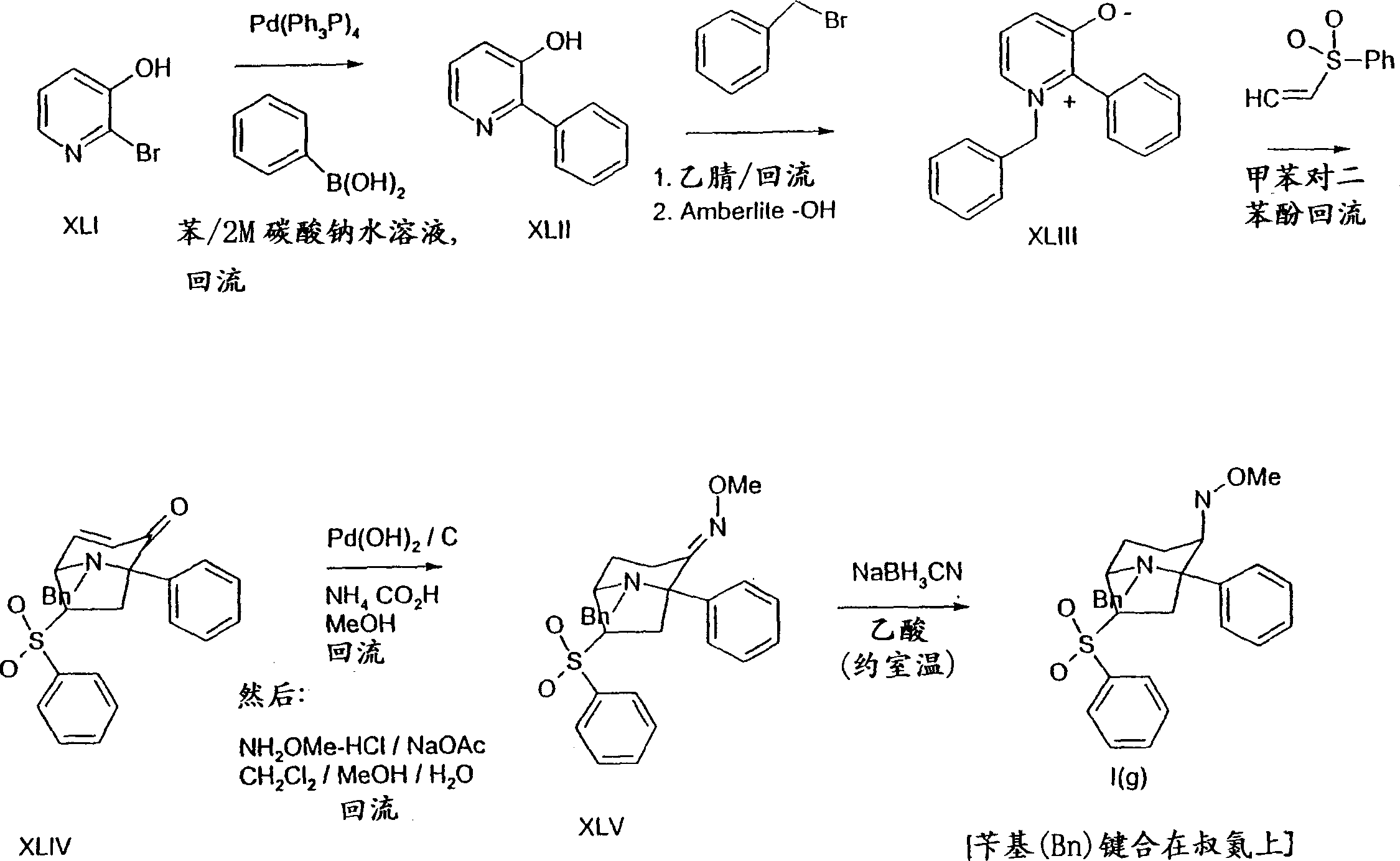
反应路线L(续) Reaction scheme L (continued)
反应路线M Reaction scheme M
参见反应路线M,在约环境温度下,用1.4当量的间氯过苯甲酸在二氯乙烷中处理7-氮杂吲哚(式XLVII)(Aldrich)约4小时。分离上述反应的产物,将其溶于THF中,然后在约环境温度下用1当量的六甲基二硅烷和2.5当量的氯甲酸甲酯处理约16小时。该反应产生式XLVIII的氯化化合物。在甲醇/水中,在约环境温度下氢氧化钠水解约2小时,得到6-氯-7-氮杂吲哚(式XLIX)。在约环境温度下,连续用溴化吡啶鎓过溴化物在叔丁醇(t-BuOH)中的溶液处理该中间体约16小时,然后用Zn/乙酸(HOAc)在约环境温度下处理约20分钟,得到6-氯-7-氮杂吲哚-2-酮(化合物LI)。然后将式LI的化合物用碘甲烷/叔丁醇钾在约环境温度下全甲基化约16小时,然后使用甲醇钠(NaOMe)在DMF中的溶液和碘化亚铜(I)(CuI)催化剂,在约145℃下反应约6小时,转化为式LII的6-甲氧基衍生物。然后由式LII的化合物与四氯化钛(TiCl4)/α,α-二氯甲基甲醚在约环境温度下反应约16小时形成式LIII的醛。使用标准的还原胺化条件偶联式LIII化合物与适当的式T-NH2的化合物,将得到所需要的式I(h)的最终产物。See Scheme M, 7-azaindole (Formula XLVII) (Aldrich) is treated with 1.4 equivalents of m-chloroperbenzoic acid in dichloroethane at about ambient temperature for about 4 hours. The product of the above reaction was isolated, dissolved in THF, and treated with 1 equivalent of hexamethyldisilane and 2.5 equivalents of methyl chloroformate at about ambient temperature for about 16 hours. This reaction produces chlorinated compounds of formula XLVIII. Hydrolysis with sodium hydroxide in methanol/water for about 2 hours at about ambient temperature affords 6-chloro-7-azaindole (Formula XLIX). Treatment of this intermediate with a solution of pyridinium bromide perbromide in tert-butanol (t-BuOH) was continued for about 16 h at about ambient temperature, followed by treatment with Zn/acetic acid (HOAc) at about ambient temperature for about After 20 minutes, 6-chloro-7-azaindol-2-one (Compound LI) was obtained. The compound of formula LI was then permethylated with methyl iodide/potassium tert-butoxide at about ambient temperature for about 16 hours, followed by sodium methoxide (NaOMe) in DMF and copper(I) iodide (CuI) Catalyst, reacted at about 145°C for about 6 hours, converted to the 6-methoxy derivative of formula LII. The aldehyde of formula LIII is then formed from the reaction of the compound of formula LII with titanium tetrachloride ( TiCl4 )/[alpha],[alpha]-dichloromethyl methyl ether at about ambient temperature for about 16 hours. Coupling a compound of formula LIII with the appropriate compound of formula T- NH2 using standard reductive amination conditions will give the desired final product of formula I(h).
反应路线N Reaction route N
参照反应路线N,可以根据文献制备4-氮杂-5-甲氧基-羟吲哚中间体(LX)(见Robinson等人,J.Het.Chem.,1996,33,287-293)。将其用碘甲烷/叔丁醇钾在约环境温度下全甲基化约16小时,然后在约60℃下溴化约1小时(使用液溴(Br2)和乙酸)。用三-正丁基-乙烯基锡,六甲基磷酰胺(HMPA)和(Ph3P)2PdCl2催化剂,在约65℃下反应约14小时,实现式LXII的化合物的乙烯化。在二氯甲烷中臭氧分解乙烯基约5分钟,得到式LXIV的醛衍生物。使用标准的还原胺化条件与适当的式T-NH2的化合物,如以上反应路线A-I~A-III所述,形成所需要的式I(j)的最终产物。Referring to Scheme N, 4-aza-5-methoxy-oxindole intermediate (LX) can be prepared according to the literature (see Robinson et al., J. Het. Chem., 1996, 33, 287-293). This was permethylated with methyl iodide/potassium tert-butoxide at about ambient temperature for about 16 hours, followed by bromination at about 60°C for about 1 hour using liquid bromine ( Br2 ) and acetic acid. Vinylation of the compound of formula LXII is achieved using tri-n-butyl-vinyltin, hexamethylphosphoramide (HMPA) and (Ph 3 P) 2 PdCl 2 catalyst at about 65°C for about 14 hours. Ozonolysis of the vinyl group in dichloromethane for about 5 minutes affords the aldehyde derivative of formula LXIV. Using standard reductive amination conditions with the appropriate compound of formula T- NH2 , as described above in Schemes AI-A-III, the desired final product of formula I(j) is formed.
反应路线O
反应路线O(续)
参照反应路线O,通过使2-甲氧基-5-硝基吡啶(式LXV)与叔丁醇钾在DMF中在约环境温度下反应约16小时,将其转化为式LXVII的苯砜衍生物。然后将后者用溴乙酸乙酯在DMF中,在碳酸钾(K2CO3)存在下,在约45℃下烷基化约2小时。氢化约18小时(使用约40psi的氢气,钯/碳催化剂和乙醇溶剂)得到环化的式LXX的产物。然后将式LXX的化合物与碘甲烷在约0℃下,在DMF中,在有机碱,优选叔丁醇钾存在下反应约1到约4小时。反应物在约0℃下混合后,允许反应混合物升温至环境温度。用液溴和乙酸在约60℃下溴化得到的中间体约1小时,得到式LXXI的化合物。然后用三-正丁基-乙烯基锡,六甲基磷酰胺(HMPA)和(Ph3P)2PdCl2催化剂,在约65℃下进行乙烯化约14小时,得到式LXXII的化合物。在二氯甲烷中臭氧分解乙烯基约5分钟,得到式LXXIII的醛衍生物。使用标准的还原胺化条件与适当的式T-NH2的化合物,如以上反应路线A-I~A-III所述,形成所需要的式I(k)的最终产物。Referring to Scheme O, 2-methoxy-5-nitropyridine (formula LXV) is converted to the phenylsulfone derivative of formula LXVII by reacting it with potassium tert-butoxide in DMF at about ambient temperature for about 16 hours thing. The latter was then alkylated with ethyl bromoacetate in DMF in the presence of potassium carbonate (K 2 CO 3 ) at about 45° C. for about 2 hours. Hydrogenation for about 18 hours (using about 40 psi of hydrogen, palladium on carbon catalyst and ethanol solvent) afforded the cyclized product of formula LXX. The compound of formula LXX is then reacted with methyl iodide at about 0°C in DMF in the presence of an organic base, preferably potassium tert-butoxide, for about 1 to about 4 hours. After the reactants were mixed at about 0°C, the reaction mixture was allowed to warm to ambient temperature. Bromination of the resulting intermediate with liquid bromine and acetic acid at about 60°C for about 1 hour affords compounds of formula LXXI. Vinylation is then carried out at about 65° C. for about 14 hours using tri-n-butyl-vinyltin, hexamethylphosphoramide (HMPA) and (Ph 3 P) 2 PdCl 2 catalysts to give compounds of formula LXXII. Ozonolysis of the vinyl group in dichloromethane for about 5 minutes affords the aldehyde derivative of formula LXXIII. Using standard reductive amination conditions with the appropriate compound of formula T- NH2 , as described above in Schemes AI-A-III, the desired final product of formula I(k) is formed.
反应路线P
参照反应路线P,通过与吡啶-3-甲醛在氨源例如乙酸铵,氯化铵或甲酸铵存在下反应,将4-硝基丁酸甲酯转化为式LXXIV的硝基吡啶基衍生物。可以在醇溶剂例如甲醇或乙醇中,在从约-78℃到约回流温度的温度下进行该反应,优选温度为回流温度。通过早先描述的内夫反应条件,将硝基转化为二甲醇缩醛。还原酰胺基产生哌啶化合物。可以通过本领域技术人员已知的众多条件完成该还原。优选的条件包括LiAlH4或甲硼烷-二甲基硫醚在惰性溶剂例如乙醚或THF中还原。该反应后,接着通过早先描述的标准流程进行N-Boc保护,产生式LXXV的化合物。在酸性条件,用无机酸例如HCl,HBr,HNO3或H2SO4,或有机酸例如羧酸或磺酸催化,在从约-78℃到约100℃的温度下,进行式LXXV的缩醛到肟的转化。适宜的溶剂包括水或水与各种有机溶剂例如THF,乙醚,甲苯,DMF,乙醇和甲醇的混合物。优选的条件为在约室温下,在水/THF或水/乙醇中进行HCl-催化的水解。通过用盐酸羟胺和乙酸铵在约室温下处理,将最初形成的酮转化为肟。通过早先描述的催化氢化还原肟。优选的肟还原条件为用兰尼镍在甲醇或乙醇中,在52psi氢气压力下处理。通过在以前描述的标准条件下的还原胺化,将合成的式LXXVI的胺转化为苄胺衍生物。在如早先所描述的标准条件下切掉N-Boc基团,产生式LXXVII的化合物。Referring to Scheme P, methyl 4-nitrobutyrate is converted to nitropyridyl derivatives of formula LXXIV by reaction with pyridine-3-carbaldehyde in the presence of an ammonia source such as ammonium acetate, ammonium chloride or ammonium formate. The reaction can be carried out in an alcoholic solvent such as methanol or ethanol at a temperature from about -78°C to about reflux temperature, preferably at reflux temperature. The nitro group was converted to the dimethyl acetal by the Neff reaction conditions described earlier. Reduction of the amide group yields the piperidine compound. This reduction can be accomplished by numerous conditions known to those skilled in the art. Preferred conditions include reduction of LiAlH4 or borane-dimethylsulfide in an inert solvent such as diethyl ether or THF. This reaction, followed by N-Boc protection by the standard procedure described earlier, yields compounds of formula LXXV. Under acidic conditions, catalyzed with mineral acids such as HCl, HBr, HNO 3 or H 2 SO 4 , or organic acids such as carboxylic acids or sulfonic acids, the condensation of formula LXXV is carried out at temperatures from about -78°C to about 100°C Conversion of aldehydes to oximes. Suitable solvents include water or mixtures of water with various organic solvents such as THF, diethyl ether, toluene, DMF, ethanol and methanol. Preferred conditions are HCl-catalyzed hydrolysis in water/THF or water/ethanol at about room temperature. The initially formed ketone is converted to the oxime by treatment with hydroxylamine hydrochloride and ammonium acetate at about room temperature. The oxime was reduced by catalytic hydrogenation as described earlier. Preferred oxime reduction conditions are treatment with Raney nickel in methanol or ethanol under 52 psi hydrogen pressure. The synthesized amines of formula LXXVI were converted to benzylamine derivatives by reductive amination under standard conditions previously described. Cleavage of the N-Boc group under standard conditions as described earlier yields compounds of formula LXXVII.
反应路线R
参照反应路线R,将3-苄基氨基-3-甲基丁酸在为本领域技术人员所知的标准条件下还原成相应N-Boc氨基醇。优选用甲硼烷或甲硼烷-二甲基硫醚复合物在THF或乙醚中进行羧酸的还原,完成该系列反应。该反应后,接着用钯/碳催化剂在乙醇或甲醇中,在约室温下,在一大气压的氢气压力下进行N-苯甲基的氢解。可供选择的氢源包括甲酸铵或环己烯。用二叔丁基二碳酸酯在THF/水或二氧六环/水中,在碳酸盐碱例如NaHCO3或K2CO3存在下,在标准条件下接上Boc基团。或者,可以在CH2Cl2,CHCl3,THF,乙醚,甲苯或有关的溶剂中,在三乙胺或其它的胺类碱存在下安装该基团。在与使用Dess-Martin高碘化,Swern氧化或MnO2氧化相对应的标准条件下实现醇氧化为醛的反应。这些方法是本领域技术人员所熟知的。通过用硝基甲烷和适宜的碱处理该醛完成亨利反应,产生式LXXXII的硝基链烯。典型的条件包括醇溶剂例如甲醇或乙醇,以及醇盐碱例如甲醇钠或乙醇钠。可选择的条件包括CH2Cl2,CHCl3,THF或乙醚溶剂,以及胺类碱例如三乙胺。这些条件提供了硝基醇中间体,该中间体可以通过在碱存在下醇的活化转化为硝基链烯。该脱水反应是本领域技术人员通常所知的。优选的转化方法包括用甲磺酰氯或甲苯磺酰氯在三乙胺存在下活化醇。将合成的硝基链烯在标准条件下还原成硝基烷。该转化优选的条件包括用NaBH4或LiBH4在醇溶剂例如甲醇或乙醇中处理。也可以使用THF。反应可以在约-78℃至约88℃的温度下进行,优选在约0℃到约环境温度的温度下进行。通过与芳基醛例如苯甲醛在催化剂例如乙酸铵或氯化铵存在下缩合实现环化作用,得到2,3-反式哌啶环。该转化优选的溶剂为醇溶剂例如甲醇或乙醇,该转化的典型的温度为约-20℃至约100℃。或者,可以在CH2Cl2,CHCl3,THF,乙醚,甲苯,乙酸乙酯或有关的溶剂中,在有或者没有酸或碱催化剂存在下完成该转化。通过用碱处理反式哌啶,随后以动力学方式,通过向过量的酸溶液中加入氮酸酯溶液进行淬灭得到2,3-顺式哌啶环。典型的碱选自在醇溶液中的金属醇盐或氢氧化物,胺类碱例如三乙胺或Hunig’s碱,以及在有机溶剂例如CH2Cl2,CHCl3,THF,乙醚,甲苯或乙酸乙酯中的LHMDS,KHMDS,NaHMDS。替换的碱包括在THF或乙醚溶液中的丁基锂。该转化的温度可以介于约-78℃至约100℃范围内。可根据各种为本领域技术人员所知的可能的方法,通过还原将硝基哌啶转变成氨基哌啶。优选的方法包括锌/HCl,锌/乙酸,或铁/HCl在适宜的溶剂包括水,THF/水,或水/乙醇混合物中的还原。适宜的温度为从约-20℃到约118℃。还原也可以通过在醇溶剂中,或水/乙醇混合物中,在一大气压氢气下的兰尼镍还原来实现。典型的反应温度为从约0℃到约100℃。将生成的胺按照以前所述的条件还原胺化以提供需要的化合物。Referring to Scheme R, 3-benzylamino-3-methylbutanoic acid is reduced to the corresponding N-Boc aminoalcohol under standard conditions known to those skilled in the art. This series of reactions is preferably accomplished by reduction of the carboxylic acid with borane or borane-dimethylsulfide complex in THF or diethyl ether. This reaction is followed by the hydrogenolysis of the N-benzyl group under a hydrogen pressure of atmospheric pressure at about room temperature in ethanol or methanol over a palladium/carbon catalyst. Alternative hydrogen sources include ammonium formate or cyclohexene. The Boc group is attached under standard conditions using di - tert-butyl dicarbonate in THF/water or dioxane/water in the presence of a carbonate base such as NaHCO3 or K2CO3 . Alternatively, the group can be installed in CH2Cl2 , CHCl3 , THF, ether, toluene or related solvents in the presence of triethylamine or other amine bases. Oxidation of alcohols to aldehydes was achieved under standard conditions corresponding to periodination using Dess-Martin, Swern oxidation or MnO2 oxidation. These methods are well known to those skilled in the art. The Henry reaction is accomplished by treating the aldehyde with nitromethane and a suitable base to yield the nitroalkene of formula LXXXII. Typical conditions include alcoholic solvents such as methanol or ethanol, and alkoxide bases such as sodium methoxide or sodium ethoxide. Alternative conditions include CH2Cl2 , CHCl3 , THF or ether solvents , and amine bases such as triethylamine. These conditions provide a nitroalcohol intermediate that can be converted to a nitroalkene by activation of the alcohol in the presence of a base. This dehydration reaction is generally known to those skilled in the art. A preferred method of transformation involves activation of the alcohol with methanesulfonyl chloride or toluenesulfonyl chloride in the presence of triethylamine. The synthesized nitroalkenes were reduced to nitroalkanes under standard conditions. Preferred conditions for this transformation include treatment with NaBH4 or LiBH4 in an alcoholic solvent such as methanol or ethanol. THF can also be used. The reaction may be carried out at a temperature of about -78°C to about 88°C, preferably at a temperature of about 0°C to about ambient temperature. Cyclization is achieved by condensation with an aryl aldehyde such as benzaldehyde in the presence of a catalyst such as ammonium acetate or ammonium chloride to give the 2,3-trans piperidine ring. The preferred solvent for this transformation is an alcoholic solvent such as methanol or ethanol, and the typical temperature for this transformation is from about -20°C to about 100°C. Alternatively, the transformation can be accomplished in CH2Cl2 , CHCl3 , THF, diethyl ether, toluene, ethyl acetate or related solvents with or without the presence of acid or base catalysts. The 2,3-cis-piperidine ring is obtained by treatment of trans-piperidine with base followed by kinetic quenching by addition of nitric acid ester solution to excess acid solution. Typical bases are selected from metal alkoxides or hydroxides in alcoholic solutions, amine bases such as triethylamine or Hunig's base, and organic solvents such as CH2Cl2 , CHCl3 , THF, diethyl ether, toluene or ethyl acetate LHMDS, KHMDS, NaHMDS in esters. Alternative bases include butyllithium in THF or ether. The temperature for this transformation may range from about -78°C to about 100°C. Nitropiperidines can be converted to aminopiperidines by reduction according to various possible methods known to those skilled in the art. A preferred method involves the reduction of zinc/HCl, zinc/acetic acid, or iron/HCl in a suitable solvent including water, THF/water, or water/ethanol mixtures. A suitable temperature is from about -20°C to about 118°C. Reduction can also be achieved by Raney nickel reduction in alcoholic solvents, or in water/ethanol mixtures, under atmospheric pressure of hydrogen. Typical reaction temperatures are from about 0°C to about 100°C. The resulting amine is reductively aminated following conditions described previously to provide the desired compound.
反应路线S
可以通过碱诱导的差向异构作用将式LXXXV-a/LXXXV-b(反应路线J中制备的式XXXIII的化合物)的顺式和反式硝基亚胺的混合物转化为单一的非对映体LXXXV-a。在此方法中可使用各种碱,包括但不限于二异丙基氨基化锂,六甲基二硅氮烷钠、锂或钾,或叔丁醇钾,氢化钾或钠,二氮杂二环十一烯(DBU),二氮杂二环壬烷(DBN),四甲基胍,三乙胺,二异丙基乙胺,碳酸钠或钾或锂,在有或者没有18-冠-6或15-冠-5,12-冠-4,仲丁基硼氢化锂(L-取向)存在下,在溶剂例如四氢呋喃,乙醚或乙二醇二甲醚中,在从约-100℃到约-25℃的温度下,反应约15分钟到约5小时。然后将反应混合物在适宜的酸试剂中淬灭,酸试剂或者悬浮在惰性溶剂中或者溶于惰性溶剂中,得到所需要的非对映体LXXXV-a。适宜的淬灭剂包括硅胶,氧化铝,水合硫酸钠,对甲苯磺酸吡啶鎓盐(PPTS),硼酸,氯化氢,氯化氢水溶液或者硫酸水溶液,nafion树脂,分子筛,酸性离子交换树脂等等。优选的条件使用六甲基二硅氮烷锂,在THF中在约-78℃下反应,随后在硅胶在THF中的悬浮液中淬灭。A mixture of cis and trans nitroimines of formula LXXXV-a/LXXXV-b (compound of formula XXXIII prepared in Scheme J) can be converted to the single diastereomeric Body LXXXV-a. Various bases can be used in this method, including but not limited to lithium diisopropylamide, sodium, lithium or potassium hexamethyldisilazane, or potassium tert-butoxide, potassium hydride or sodium, diazepine Cycloundecene (DBU), diazabicyclononane (DBN), tetramethylguanidine, triethylamine, diisopropylethylamine, sodium or potassium carbonate or lithium, with or without 18-crown- 6 or 15-crown-5, 12-crown-4, in the presence of sec-butyl lithium borohydride (L-orientation), in solvents such as tetrahydrofuran, diethyl ether or ethylene glycol dimethyl ether, from about -100 ° C to The reaction time is about 15 minutes to about 5 hours at a temperature of about -25°C. The reaction mixture is then quenched in a suitable acid reagent either suspended or dissolved in an inert solvent to afford the desired diastereomer LXXXV-a. Suitable quenchers include silica gel, alumina, sodium sulfate hydrate, pyridinium p-toluenesulfonate (PPTS), boric acid, hydrogen chloride, aqueous hydrogen chloride or sulfuric acid, nafion resin, molecular sieves, acidic ion exchange resins, and the like. Preferred conditions use lithium hexamethyldisilazane in THF at about -78°C followed by quenching in a suspension of silica gel in THF.
可以通过使用还原剂和任选的路易斯酸活化剂,实现式LXXXV-a的亚胺的还原,以提供式LXXXV-c/LXXXV-d的混合物,更有利地是提供非对映体之一。因而亚胺可以被氢化锂铝在有或者没有加入三乙基或者三甲基铝的情况下还原。可以使用其它铝试剂,例如二乙基氯化铝或二氯化乙基铝。其它还原剂包括VitrideTM或红-铝(red-Al)或二异丁基氢化铝,以及有或者没有三氟化硼醚合物的硼氢化钠,氰基硼氢化钠和三乙酰氧基硼氢化钠,仲-丁基硼氢化锂(L-取向,L-selectride)和/或在三氟化硼醚合物存在下的硼氢化锂。该转化期间可使用适宜的惰性溶剂,而且惰性溶剂可以选自THF,乙醚,乙二醇二甲醚,甲苯,己烷,二氯甲烷或其它适宜的溶剂。反应通常在低于室温的从约-78℃到约0℃的温度下进行。最优选的条件是使用氢化锂铝,在THF中,在约-78℃下及三乙基铝存在下还原。Reduction of imines of formula LXXXV-a can be achieved by using a reducing agent and optionally a Lewis acid activator to provide a mixture of formula LXXXV-c/LXXXV-d, more advantageously one of the diastereomers. Thus imines can be reduced by lithium aluminum hydride with or without the addition of triethyl or trimethylaluminum. Other aluminum reagents can be used, such as diethylaluminum chloride or ethylaluminum dichloride. Other reducing agents include Vitride ™ or red-aluminum (red-Al) or diisobutylaluminum hydride, and sodium borohydride with or without boron trifluoride etherates, sodium cyanoborohydride and triacetoxyborohydride Sodium hydride, lithium sec-butyl borohydride (L-orientation, L-selectride) and/or lithium borohydride in the presence of boron trifluoride etherate. Suitable inert solvents may be used during this transformation and may be selected from THF, diethyl ether, ethylene glycol dimethyl ether, toluene, hexane, dichloromethane or other suitable solvents. The reaction is generally carried out at a temperature below room temperature from about -78°C to about 0°C. The most preferred conditions are reduction using lithium aluminum hydride in THF at about -78°C in the presence of triethylaluminum.
可以将得到的式LXXXV-c或LXXXV-d的亚胺,或式LXXXV-c/LXXXV-d化合物的混合物,用适宜的还原剂还原成式LXXXVI-a的化合物或者式LXXXVI-b的化合物,或式LXXXVI-a/LXXXVI-b化合物的混合物。能还原式LXXXV-c/LXXXV-d的化合物的试剂包括,但不局限于,锌,锡,氯化亚锡,锌汞齐,钯/碳,氢氧化钯,氧化铂,铂/碳和兰尼镍,有或没有1-1000psi氢压存在下,在适宜的溶剂例如盐酸(水溶液),水,甲醇,乙醇,异丙醇,乙酸乙酯或类似的惰性溶剂中。最优选的条件包括在从约室温到约溶剂的回流温度下,使用锌金属在盐酸水溶液中进行反应。The obtained imine of the formula LXXXV-c or LXXXV-d, or the mixture of the compound of the formula LXXXV-c/LXXXV-d can be reduced to a compound of the formula LXXXVI-a or a compound of the formula LXXXVI-b with a suitable reducing agent, Or mixtures of compounds of formula LXXXVI-a/LXXXVI-b. Reagents capable of reducing compounds of formula LXXXV-c/LXXXV-d include, but are not limited to, zinc, tin, stannous chloride, zinc amalgam, palladium on carbon, palladium hydroxide, platinum oxide, platinum on carbon and blue Nickel, with or without hydrogen pressure of 1-1000 psi, in a suitable solvent such as hydrochloric acid (aq), water, methanol, ethanol, isopropanol, ethyl acetate or similar inert solvent. The most preferred conditions include the reaction using zinc metal in aqueous hydrochloric acid at from about room temperature to about the reflux temperature of the solvent.
反应路线T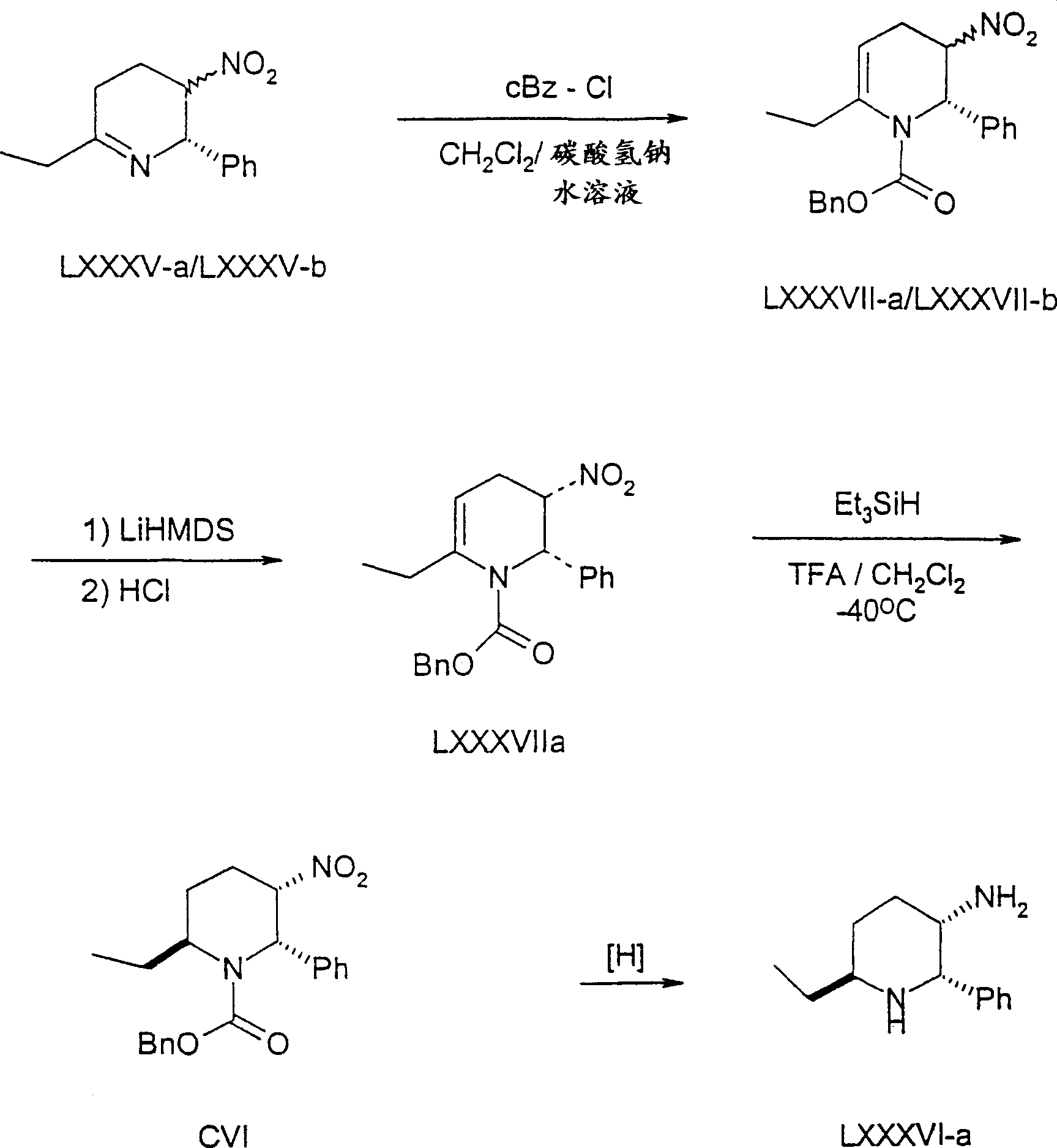
或者,根据反应路线T,式LXXXVI-a的化合物也可以从式LXXXV-a/LXXXV-b的化合物以直接的方式制备。可以将以上制备的式LXXXV-a/LXXXV-b的亚胺,通过与活化的酰基化合物例如,但不限于,苄氧羰基氯甲酸酯(cBz-Cl)苯甲酰氯,9-芴甲基氯甲基酸酯(FMOC-Cl),叔丁氧基氯甲酸酯,氯甲酸苯基酯,硝基和二硝基苯基氯甲酸酯,氯甲酸甲酯,乙酯和异丙酯,在惰性溶剂中和在适宜的碱存在下反应,转变为式LXXXVII-a/LXXXVII-b的烯胺。适宜的溶剂包括二氯甲烷,氯仿,二氯乙烷,苯,甲苯,水,乙酸乙酯,二氧六环及其他适宜的有机溶剂。典型的碱包括碳酸钠、锂和钾或碳酸氢钠、锂和钾水溶液,吡啶,三乙胺,二异丙基乙胺,二甲基吡啶,三甲基吡啶及其他适宜的碱。该反应可以在约室温直到约溶剂的回流温度下进行。最优选的条件包括将式LXXXV-a/LXXXV-b的化合物与cBz-Cl在二氯甲烷和碳酸氢钠水溶液中,在约溶剂混合物的回流温度下反应。Alternatively, according to Scheme T, compounds of formula LXXXVI-a can also be prepared in a straightforward manner from compounds of formula LXXXV-a/LXXXV-b. The imines of formula LXXXV-a/LXXXV-b prepared above can be synthesized by reacting with activated acyl compounds such as, but not limited to, benzyloxycarbonyl chloroformate (cBz-Cl) benzoyl chloride, 9-fluorenylmethyl Chloroformate (FMOC-Cl), tert-butoxy chloroformate, phenyl chloroformate, nitro and dinitrophenyl chloroformate, methyl, ethyl and isopropyl chloroformate , react in an inert solvent and in the presence of a suitable base to convert to enamines of formula LXXXVII-a/LXXXVII-b. Suitable solvents include dichloromethane, chloroform, dichloroethane, benzene, toluene, water, ethyl acetate, dioxane and other suitable organic solvents. Typical bases include sodium carbonate, lithium and potassium or aqueous sodium bicarbonate, lithium and potassium, pyridine, triethylamine, diisopropylethylamine, lutidine, collidine and other suitable bases. The reaction can be performed at about room temperature up to about the reflux temperature of the solvent. The most preferred conditions involve reacting a compound of formula LXXXV-a/LXXXV-b with cBz-Cl in dichloromethane and aqueous sodium bicarbonate at about the reflux temperature of the solvent mixture.
所需要的式LXXXVII-a的顺式异构体可以直接从上述反应,通过用适宜的溶剂例如二乙醚或二异丙醚将粗品直接结晶得到。或者,可以将式LXXXVII-a/LXXXVII-b的顺反异构体的混合物,通过用适宜的碱例如双(三甲基甲硅烷基)氨化锂或钠,二异丙基氨化锂,DBU,碳酸钠或钾,在合适的溶剂例如四氢呋喃或DME中,在约-78℃到约环境温度的温度下处理,随后在适宜的酸水溶液例如稀盐酸水溶液或稀乙酸水溶液中淬灭,转变为大部分为式LXXXVII-a的顺式异构体。最优选的条件包括将式LXXXVII-a/LXXXVII-b的化合物与双(三甲基甲硅烷基)氨化锂在THF中在约-78℃下反应,随后在1N HCl水溶液中淬灭。The desired cis isomer of formula LXXXVII-a can be obtained directly from the above reaction by direct crystallization of the crude product from a suitable solvent such as diethyl ether or diisopropyl ether. Alternatively, a mixture of cis-trans isomers of formula LXXXVII-a/LXXXVII-b can be reacted with a suitable base such as lithium or sodium bis(trimethylsilyl)amide, lithium diisopropylamide, DBU, sodium or potassium carbonate, treated in a suitable solvent such as tetrahydrofuran or DME at a temperature from about -78°C to about ambient temperature, followed by quenching in a suitable aqueous acid such as dilute aqueous hydrochloric acid or dilute aqueous acetic acid, transforms For the majority of the cis isomers of formula LXXXVII-a. The most preferred conditions include reacting a compound of formula LXXXVII-a/LXXXVII-b with lithium bis(trimethylsilyl)amide in THF at about -78°C, followed by quenching in 1N aqueous HCl.
可以以几种方法进行式LXXXVII-a的化合物的还原,以形成式CVI的化合物。可以在酸性或中性条件下,在惰性溶剂中,在约-78℃到约室温的温度进行还原。适宜的还原剂包括1-1000psi氢气,甲酸铵,氰基硼氢化钠,三乙酰氧基硼氢化钠,三乙酰氧基硼氢化四丁铵,三乙基硅烷,多羟基硅烷和硼氢化钠和锂。如果反应需要适宜的酸,则可以加入乙酸或三氟乙酸。另外,可以使用盐酸,三氟甲磺酸或硫酸。典型的溶剂包括二氯甲烷,二氯乙烷,氯仿,甲醇,乙醇,甲苯,二氧六环和水。最优选的条件包括将式LXXXVII-a的化合物与氰基硼氢化钠在含有三氟乙酸的二氯甲烷中,在约-40℃下反应。同样优选的条件包括将式LXXXVII-a的化合物与三乙基硅烷在含有三氟乙酸的二氯甲烷中,在约-40℃下反应。The reduction of compounds of formula LXXXVII-a to form compounds of formula CVI can be carried out in several ways. The reduction can be performed under acidic or neutral conditions in an inert solvent at a temperature from about -78°C to about room temperature. Suitable reducing agents include hydrogen gas at 1-1000 psi, ammonium formate, sodium cyanoborohydride, sodium triacetoxyborohydride, tetrabutylammonium triacetoxyborohydride, triethylsilane, polyhydroxysilane and sodium borohydride and lithium. Acetic acid or trifluoroacetic acid can be added if the reaction requires a suitable acid. Alternatively, hydrochloric acid, trifluoromethanesulfonic acid or sulfuric acid may be used. Typical solvents include dichloromethane, dichloroethane, chloroform, methanol, ethanol, toluene, dioxane and water. The most preferred conditions involve reacting a compound of formula LXXXVII-a with sodium cyanoborohydride in dichloromethane containing trifluoroacetic acid at about -40°C. Also preferred conditions include reacting a compound of formula LXXXVII-a with triethylsilane in dichloromethane containing trifluoroacetic acid at about -40°C.
可以以任何一个顺序进行酰基脱保护和还原硝基为式LXXXVI-a化合物的胺的反应。例如,硝基的还原可以用试剂例如锌,锡,氯化亚锡,锌汞齐,钯/碳,氢氧化钯,氧化铂,铂/碳或兰尼镍,在或不在1-1000psi氢压下,在适宜的溶剂例如盐酸(水溶液),水,甲醇,乙醇,异丙醇,乙酸乙酯或类似的惰性溶剂中进行。最优选的条件包括在从约室温到约溶剂的回流温度下,使用锌金属在盐酸水溶液中进行反应。可以以各种方法进行酰基的除去。如果酰基为cBz-,则使用催化氢化可奏效,且可以与或不与硝基的还原结合进行。一般条件包括用1-1000psi氢气,在钯/碳或氢氧化钯或氧化钯上,在甲醇或乙醇中氢化。或者,可以在催化剂例如钯/碳或氢氧化钯或氧化钯上,用甲酸铵或环己烯在甲醇或乙醇中回流氢解。切断cBz的替换的方法是用HBr在乙酸或丙酸溶液中处理。对于其它酰基基团,例如叔丁氧基-(t-BOC),用强酸简单处理即可以,而对于其它酰基基团,需要用氢氧化钠水溶液在从环境温度到约溶剂的回流温度下处理。或者,cBz或t-BOC基团可以通过用HBr/乙酸处理除去。The reactions of deprotecting the acyl group and reducing the nitro group to the amine of the compound of formula LXXXVI-a can be performed in either order. For example, nitro groups can be reduced with reagents such as zinc, tin, stannous chloride, zinc amalgam, palladium on carbon, palladium hydroxide, platinum oxide, platinum on carbon or Raney nickel, with or without hydrogen pressure of 1-1000 psi in a suitable solvent such as hydrochloric acid (aq), water, methanol, ethanol, isopropanol, ethyl acetate or similar inert solvents. The most preferred conditions include the reaction using zinc metal in aqueous hydrochloric acid at from about room temperature to about the reflux temperature of the solvent. Removal of the acyl group can be carried out in various ways. If the acyl group is cBz-, using catalytic hydrogenation can work, and can be done with or without reduction of the nitro group. General conditions include hydrogenation in methanol or ethanol with 1-1000 psi hydrogen on palladium on carbon or palladium hydroxide or palladium oxide. Alternatively, hydrogenolysis can be carried out with ammonium formate or cyclohexene at reflux in methanol or ethanol over a catalyst such as palladium on carbon or palladium hydroxide or palladium oxide. An alternative method to cleave cBz is treatment with HBr in acetic or propionic acid solution. For other acyl groups, such as tert-butoxy-(t-BOC), simple treatment with strong acid will suffice, while others require treatment with aqueous sodium hydroxide at ambient temperature to about the reflux temperature of the solvent . Alternatively, the cBz or t-BOC groups can be removed by treatment with HBr/acetic acid.
反应路线U Reaction route U
或者,式LXLI的化合物可以通过在反应路线U中图示的反应顺序制备。可以将4-硝基丁酸甲酯或4-硝基丁酸乙酯还原成醛,而所述醛以式LXXXVIII的硝基缩醛形式被保护。可以通过在甲苯,己烷或二氯甲烷中在约-78℃下与二异丁基氢化铝的反应一步还原4-硝基丁酸甲酯。或者,该还原可以经由两步进行,通过在THF或乙醚中在约0℃到约环境温度下,通过使用在THF中的氢化锂铝,硼氢化锂或甲硼烷还原4-硝基丁酸甲酯。然后通过在二氯甲烷中的Swern氧化或Dess-Martin氧化将得到的硝基醇氧化到醛。通过使用无机酸例如盐酸,硫酸和硝酸,或催化的有机酸例如樟脑磺酸或甲苯磺酸,在醇溶剂例如甲醇,乙醇,丙醇或乙二醇中,用水清除剂例如原甲酸三甲基酯,原甲酸三乙酯,硫酸镁或分子筛,在从约0℃到约75℃的温度下,将醛以式LXXXVIII的硝基缩醛的形式保护。Alternatively, compounds of formula LXLI can be prepared by the reaction sequence illustrated in Scheme U. Methyl 4-nitrobutyrate or ethyl 4-nitrobutyrate can be reduced to the aldehyde, which is protected as a nitroacetal of formula LXXXVIII. Methyl 4-nitrobutyrate can be reduced in one step by reaction with diisobutylaluminum hydride in toluene, hexane or dichloromethane at about -78 °C. Alternatively, the reduction can be performed via two steps by reduction of 4-nitrobutyric acid in THF or diethyl ether at about 0°C to about ambient temperature by using lithium aluminum hydride, lithium borohydride or borane in THF methyl ester. The resulting nitroalcohols are then oxidized to aldehydes by Swern oxidation or Dess-Martin oxidation in dichloromethane. By using mineral acids such as hydrochloric acid, sulfuric acid and nitric acid, or catalyzed organic acids such as camphorsulfonic acid or toluenesulfonic acid, in alcoholic solvents such as methanol, ethanol, propanol or ethylene glycol, water scavengers such as trimethyl orthoformate Esters, triethyl orthoformate, magnesium sulfate or molecular sieves, at temperatures from about 0°C to about 75°C, protect the aldehyde as a nitro acetal of formula LXXXVIII.
式LXL的化合物可以使用改进的亨利反应制备,该反应缩合得到取代的环亚胺。将式LXXXVIII的硝基缩醛与亚胺在从约0℃到约75℃的温度下原位缩合,亚胺是由胺源例如乙酸铵,氯化铵或甲酸铵与醛例如不同取代的芳醛之一产生的。然后将式LXXXIX的缩醛通过加入无机酸例如盐酸,硫酸,或硝酸的水溶液,在从约0℃到约75℃的温度下(该温度引起环化作用的发生)转化为硝基醛,得到式LXL的化合物。优选将硝基醛在约室温下与催化量的樟脑磺酸和原甲酸三甲酯一起溶于甲醇。然后加入甲酸铵,接着加入苯甲醛。加入盐酸水溶液并搅拌,以得到式LXL的环亚胺。Compounds of formula LXL can be prepared using a modified Henry reaction which condenses to give substituted cyclic imines. The nitroacetal of formula LXXXVIII is condensed in situ with an imine formed from an amine source such as ammonium acetate, ammonium chloride or ammonium formate and an aldehyde such as a differently substituted aromatic compound at a temperature from about 0°C to about 75°C. One of the aldehydes produced. The acetal of formula LXXXIX is then converted to the nitroaldehyde by the addition of an aqueous mineral acid such as hydrochloric acid, sulfuric acid, or nitric acid at a temperature from about 0°C to about 75°C, which causes cyclization to occur, to give A compound of formula LXL. The nitroaldehyde is preferably dissolved in methanol at about room temperature together with catalytic amounts of camphorsulfonic acid and trimethyl orthoformate. Ammonium formate was then added followed by benzaldehyde. Add aqueous hydrochloric acid and stir to give the cyclic imine of formula LXL.
可以通过使用有机金属化合物将式LXL的亚胺转化为式LXLI的化合物。例如,在从约-78℃到约0℃的温度下,在溶剂例如四氢呋喃或乙醚,甲苯或乙二醇二甲醚中,加入乙基锂,乙基溴化镁,二乙基镁,二乙基锌,乙基氯化锌,二乙基铜酸盐或其它铜酸盐试剂例如高级铜酸盐。或者,在两步的方法中,可以在从约-78℃到约0℃的温度下,在溶剂例如THF或乙醚,甲苯或乙二醇二甲醚中,加入乙烯基锂,乙烯基溴化镁,二乙烯基镁,二乙烯基锌,乙烯基氯化锌,二乙烯基铜酸盐或其它铜酸盐试剂例如高级铜酸盐。一旦加料完成,将得到的产物在1-1000psi氢压下,在钯/碳,氢氧化钯,氧化铂,铂/碳或兰尼镍上氢化。或者,在另一个两步的方法中,可以在与以上所列的那些关于乙烯基化合物的条件相似的条件下加入炔锂。该方法也随后进行氢化。任选地,可以在上述亚胺加成中包括一种路易斯酸。典型的路易斯酸包括三氟化硼乙醚络合物,氯化锌和三甲基或三乙基铝。Imines of formula LXL can be converted to compounds of formula LXLI by using organometallic compounds. For example, ethyllithium, ethylmagnesium bromide, diethylmagnesium, di Ethyl zinc, ethyl zinc chloride, diethyl cuprate or other cuprate reagents such as higher cuprates. Alternatively, in a two-step process, vinyl lithium, vinyl bromide can be added at temperatures from about -78°C to about 0°C in a solvent such as THF or diethyl ether, toluene or ethylene glycol dimethyl ether Magnesium, divinylmagnesium, divinylzinc, vinylzinc chloride, divinylcuprate or other cuprate reagents such as higher cuprates. Once the addition is complete, the resulting product is hydrogenated over palladium on carbon, palladium hydroxide, platinum oxide, platinum on carbon or Raney nickel under a hydrogen pressure of 1-1000 psi. Alternatively, in another two-step process, the lithium alkyne can be added under conditions similar to those listed above for the vinyl compound. This process is also followed by hydrogenation. Optionally, a Lewis acid may be included in the imine addition described above. Typical Lewis acids include boron trifluoride etherate, zinc chloride and trimethyl or triethylaluminum.
可以用适宜的还原剂将得到的式LXLI的胺还原成式LXXXVI-a的化合物(反应路线T)。能还原式LXLI的试剂包括,但不局限于,锌,锡,氯化亚锡,锌汞齐,钯/碳,氢氧化钯,氧化铂,铂/碳和兰尼镍,在或不在1-1000psi氢压下,在适宜的溶剂例如盐酸(水溶液),水,甲醇,乙醇,异丙醇,乙酸乙酯或类似的惰性溶剂中。最优选的条件包括在从约室温到约溶剂的回流温度下使用锌金属在盐酸水溶液中进行反应。The resulting amines of formula LXLI can be reduced to compounds of formula LXXXVI-a using a suitable reducing agent (Scheme T). Reagents capable of reducing formula LXLI include, but are not limited to, zinc, tin, stannous chloride, zinc amalgam, palladium on carbon, palladium hydroxide, platinum oxide, platinum on carbon and Raney nickel, with or without the presence of 1- 1000 psi hydrogen pressure in a suitable solvent such as hydrochloric acid (aq), water, methanol, ethanol, isopropanol, ethyl acetate or similar inert solvent. Most preferred conditions include the reaction using zinc metal in aqueous hydrochloric acid at from about room temperature to about the reflux temperature of the solvent.
反应路线V Reaction Scheme V
或者,式LXXXVI-a的化合物可以通过在反应路线V中所示的反应程序制备。可以将以上制备的1-硝基己-4酮(式LXLII的化合物),通过与任何一种构型的苯基甘氨醇在适宜的溶剂例如苯,甲苯,二氯乙烷,甲醇或乙醇中反应,形成式LXLIII的半缩醛,任选通过分子筛或通过使用Dean Stark脱水器在回流下除去水。式LXLIV的化合物可以使用改进的亨利反应制备,该反应缩合产生式LXLV的取代的环状缩醛。将式LXLV的环状缩醛与亚胺在从约0℃到约75℃的温度下原位缩合,亚胺是由胺源例如乙酸铵,氯化铵或甲酸铵与醛例如苯甲醛或不同取代的芳醛之一产生的。大多数情况下,可以不分离式LXLIV的化合物,直接环化为式LXLV的化合物。Alternatively, compounds of formula LXXXVI-a can be prepared by the reaction procedure shown in Scheme V. The above-prepared 1-nitrohexan-4-ketone (compound of formula LXLII) can be mixed with any configuration of phenylglycinol in a suitable solvent such as benzene, toluene, ethylene dichloride, methanol or ethanol React in , forming the hemiacetal of formula LXLIII, optionally passing molecular sieves or by using a Dean Stark dehydrator to remove water at reflux. Compounds of formula LXLIV can be prepared using a modified Henry's reaction which condenses to produce substituted cyclic acetals of formula LXLV. The cyclic acetal of formula LXLV is condensed in situ with an imine formed from an amine source such as ammonium acetate, ammonium chloride or ammonium formate with an aldehyde such as benzaldehyde or a different produced by one of the substituted aromatic aldehydes. In most cases, the compound of formula LXLIV can be directly cyclized to the compound of formula LXLV without isolation.
可以以几种方法进行式LXLV的化合物的还原以形成式LXLVI的化合物。可以在酸性或中性条件下在惰性溶剂中,在约-78℃到室温的温度下进行还原。适宜的还原剂包括1-1000psi氢气,甲酸铵,氰基硼氢化钠,三乙酰氧基硼氢化钠,三乙酰氧基硼氢化四丁铵,三乙基硅烷,多羟基硅烷和硼氢化钠和锂。如果反应需要适宜的酸,则可以加入乙酸或三氟乙酸以及三氟化硼乙醚络合物或三甲基铝。另外,可以使用盐酸,三氟甲磺酸或硫酸。典型的溶剂包括二氯甲烷,二氯乙烷,氯仿,甲醇,乙醇,甲苯,二氧六环和水。The reduction of compounds of formula LXLV to form compounds of formula LXLVI can be performed in several ways. The reduction can be performed under acidic or neutral conditions in an inert solvent at a temperature from about -78°C to room temperature. Suitable reducing agents include hydrogen gas at 1-1000 psi, ammonium formate, sodium cyanoborohydride, sodium triacetoxyborohydride, tetrabutylammonium triacetoxyborohydride, triethylsilane, polyhydroxysilane and sodium borohydride and lithium. If the reaction requires a suitable acid, acetic acid or trifluoroacetic acid can be added as well as boron trifluoride etherate or trimethylaluminum. Alternatively, hydrochloric acid, trifluoromethanesulfonic acid or sulfuric acid may be used. Typical solvents include dichloromethane, dichloroethane, chloroform, methanol, ethanol, toluene, dioxane and water.
可以通过氢解将式LXLVI的化合物脱保护。典型地,在该方法中也可将硝基还原成式LXXXVI-a的胺。一般条件包括用1-1000psi氢气,在钯/碳或氢氧化钯或氧化钯上,在甲醇或乙醇中氢化。或者,可以在催化剂例如钯/碳或氢氧化钯或氧化钯上,用甲酸铵或环己烯在甲醇或乙醇中回流氢解。如果硝基在氢解之前要被除去,则适宜的反应条件包括下列条件。硝基官能团可以用试剂还原,所述试剂包括但不局限于锌,锡,氯化亚锡,锌汞齐,钯/碳,氢氧化钯,氧化铂,铂/碳和兰尼镍,在或不在1-1000psi氢压下,在适宜的溶剂例如盐酸(水溶液),水,甲醇,乙醇,异丙醇,乙酸乙酯或类似的惰性溶剂中。最优选的条件包括在从约室温到约溶剂的回流温度下,使用锌金属在盐酸水溶液中进行反应。Compounds of formula LXLVI can be deprotected by hydrogenolysis. Typically, the nitro group is also reduced to the amine of formula LXXXVI-a in this method. General conditions include hydrogenation in methanol or ethanol with 1-1000 psi hydrogen on palladium on carbon or palladium hydroxide or palladium oxide. Alternatively, hydrogenolysis can be carried out with ammonium formate or cyclohexene at reflux in methanol or ethanol over a catalyst such as palladium on carbon or palladium hydroxide or palladium oxide. If the nitro group is to be removed prior to hydrogenolysis, suitable reaction conditions include the following. Nitro functional groups can be reduced with reagents including, but not limited to, zinc, tin, stannous chloride, zinc amalgam, palladium on carbon, palladium hydroxide, platinum oxide, platinum on carbon, and Raney nickel, on or Not under a hydrogen pressure of 1-1000 psi, in a suitable solvent such as hydrochloric acid (aq), water, methanol, ethanol, isopropanol, ethyl acetate or a similar inert solvent. The most preferred conditions include the reaction using zinc metal in aqueous hydrochloric acid at from about room temperature to about the reflux temperature of the solvent.
反应路线W Reaction route W
使用两步程序将2-溴代-3-甲氧基-5-硝基吡啶(J.Lombardino,J.Med.Chem.1981,24,39-42)转变为式LXLIX的2-醛衍生物。用三正丁基-乙烯基锡处理式LXLVII的化合物,使用催化量的双(三苯基膦)-钯(II)氯化物,在非质子溶剂(优选甲苯)中,在约室温到约150℃(优选111℃)处理约1小时到约24小时(优选2小时)。将反应混合物色谱分离得到式LXLVIII的乙烯基化合物。将式LXLVIII的乙烯基化合物用臭氧在约-100℃到约0℃(优选-78℃)下,在二氯甲烷中处理,然后用甲硫醚淬灭,得到式LXLIX的醛。将式LXLIX的醛用本领域技术人员熟知的方法保护,例如在苯中,在催化量的酸(优选对甲苯磺酸)存在下与乙二醇反应,得到式C的缩醛。将式C的吡啶衍生物与苄基磺酰氯,在非质子溶剂(优选THF和DMF的混合物)中使用强碱(优选叔丁醇钾)反应,得到式CI的砜衍生物。可以将式CI的砜的亚甲基用溴乙酸乙酯,在质子溶剂(优选乙醇)中使用强碱(优选叔丁醇钾)烷基化。在这些反应过程中,苯磺酸被消除,形成式CII的酯。将式CII的酯在质子溶剂(优选乙醇)中,使用金属催化剂(优选10%钯/碳),在约大气压力到约50PSI(优选50PSI)的压力下进行氢化。在此反应期间,硝基被还原成胺,双键被还原,而且实现了到6-元环的酰胺的环化,得到式CIII的酰胺。使用强碱(优选叔丁醇钾),在非质子溶剂(优选四氢呋喃)中,将式CIII的酰胺用碘甲烷烷基化,得到式CIV的酰胺。使用酸(优选对甲苯磺酸)在非质子溶剂(优选丙酮)中,将式CIV的酰胺中的醛去保护,得到式CV的醛。如反应路线A-1所述,用氨基哌啶T-NH2还原胺化,得到式I(m)的产物。2-Bromo-3-methoxy-5-nitropyridine (J. Lombardino, J. Med. Chem. 1981, 24, 39-42) was converted to the 2-aldehyde derivative of formula LXLIX using a two-step procedure . The compound of formula LXLVII is treated with tri-n-butyl-vinyltin using a catalytic amount of bis(triphenylphosphine)-palladium(II) chloride in an aprotic solvent (preferably toluene) at about room temperature to about 150 °C (preferably 111 °C) for about 1 hour to about 24 hours (preferably 2 hours). Chromatography of the reaction mixture affords the vinyl compound of formula LXLVIII. Treatment of the vinyl compound of formula LXLVIII with ozone in dichloromethane at about -100°C to about 0°C (preferably -78°C) followed by quenching with dimethylsulfide affords the aldehyde of formula LXLIX. Aldehydes of formula LXLIX are protected by methods well known to those skilled in the art, for example reacting with ethylene glycol in the presence of a catalytic amount of acid (preferably p-toluenesulfonic acid) in benzene to give acetals of formula C. Reaction of pyridine derivatives of formula C with benzylsulfonyl chloride in an aprotic solvent (preferably a mixture of THF and DMF) using a strong base (preferably potassium tert-butoxide) affords sulfone derivatives of formula CI. The methylene group of the sulfone of formula CI can be alkylated with ethyl bromoacetate in a protic solvent (preferably ethanol) using a strong base (preferably potassium tert-butoxide). During these reactions, benzenesulfonic acid is eliminated to form esters of formula CII. The ester of formula CII is hydrogenated in a protic solvent (preferably ethanol) using a metal catalyst (preferably 10% palladium on carbon) at a pressure from about atmospheric pressure to about 50 PSI (preferably 50 PSI). During this reaction, the nitro group is reduced to the amine, the double bond is reduced, and cyclization of the amide to the 6-membered ring is achieved to give the amide of formula CIII. Amides of formula CIII are alkylated with methyl iodide using a strong base (preferably potassium tert-butoxide) in an aprotic solvent (preferably tetrahydrofuran) to give amides of formula CIV. Deprotection of the aldehyde in the amide of formula CIV using an acid (preferably p-toluenesulfonic acid) in an aprotic solvent (preferably acetone) affords the aldehyde of formula CV. Reductive amination with aminopiperidine T-NH 2 as described in Scheme A-1 affords products of formula I(m).
在上述实验部分没有具体描述的式I的其它化合物的制备,可以使用如上所述的反应的组合实现,这对本领域技术人员是显而易见的。The preparation of other compounds of formula I not specifically described in the experimental section above can be achieved using combinations of reactions as described above, as will be apparent to those skilled in the art.
在以上论述或说明的每种反应中,压力没有严格限制,除非另有陈述。从约0.5大气压到约5大气压的压力通常是可接受的,且为了方便起见优选环境压力,即约1大气压。In each of the reactions discussed or illustrated above, pressure is not critical unless otherwise stated. Pressures from about 0.5 atmosphere to about 5 atmospheres are generally acceptable, and ambient pressure, ie, about 1 atmosphere, is preferred for convenience.
可以将以上反应流程中所示的式I化合物及中间体通过常规方法,例如重结晶或色谱分离法分离和提纯。The compounds of formula I and intermediates shown in the above reaction schemes can be isolated and purified by conventional methods, such as recrystallization or chromatographic separation.
式I的化合物和它们的药学可接受的盐可以通过口服的,肠胃外的(例如皮下的,静脉内的,肌内的,胸骨内的和输液技术),直肠的,鼻内的或局部的途径对哺乳动物给药。一般说来,这些化合物最优选以每天约0.01到约1500毫克的剂量以单一或分开的剂量(即,每天1到4剂)给药,尽管有必要根据治疗对象的种类,重量和条件以及具体选择的给药途径发生变化。然而更优选采用每天每公斤体重约0.5毫克到约500毫克的剂量水平。然而,可以根据被治疗动物的种类和其对所述药物的反应以及所选择的药物制剂的种类和进行给药的周期和间隔而发生变化。在有些情况下,低于上述范围的下限的剂量水平可能是超过必要量的,而在其它情况下可以使用较大的剂量而没有导致任何有害的副作用,条件是这样的较高剂量水平在整天内被首先分成几个小剂量给药。The compounds of formula I and their pharmaceutically acceptable salts can be administered orally, parenterally (e.g. subcutaneously, intravenously, intramuscularly, intrasternally and infusion techniques), rectally, intranasally or topically. route of administration to mammals. In general, these compounds are most preferably administered in single or divided doses (i.e., 1 to 4 doses per day) at a dose of about 0.01 to about 1500 mg per day, although it may be necessary to vary the dose depending on the type, weight and condition of the subject and the specific The chosen route of administration changes. More preferably, however, dosage levels of from about 0.5 milligrams to about 500 milligrams per kilogram of body weight per day are employed. However, variations may occur depending on the species of animal being treated and its response to the drug, as well as the type of pharmaceutical formulation chosen and the period and interval at which administration is performed. Dosage levels below the lower limit of the above range may be more than necessary in some cases, while in other cases larger doses may be used without causing any deleterious side effects, provided that such higher dose levels are used throughout Days are first divided into several small doses of administration.
本发明的化合物可以通过前述的任何途径单独或以与药物可接受的载体或稀释剂组合的形式给药,且这种给药可以以单一或多剂量进行。更特别地,本发明的新的治疗剂可以以各种不同的剂型给药,即它们可以以片剂,胶囊,糖锭,锭剂,硬糖,粉末,喷雾剂,乳膏剂,油膏剂,栓剂,胶冻,凝胶剂,糊剂,洗剂,油膏,水悬剂,可注射的溶液,酏剂,糖浆等等的形式与各种药学可接受的惰性载体结合。这样的载体包括固体稀释剂或填料,无菌的水介质和各种无毒的有机溶剂等等。此外,口服的药物组合物可以适当地加糖和/或加香。一般说来,本发明的治疗有效的化合物在这样的剂型中的浓度为按重量计算约5.0%到约70%。The compounds of the present invention may be administered alone or in combination with pharmaceutically acceptable carriers or diluents by any of the aforementioned routes, and such administration may be performed in single or multiple doses. More particularly, the novel therapeutic agents of the present invention may be administered in a variety of different dosage forms, i.e. they may be presented as tablets, capsules, troches, lozenges, hard lozenges, powders, sprays, creams, ointments, Suppositories, jellies, gels, pastes, lotions, ointments, aqueous suspensions, injectable solutions, elixirs, syrups and the like are in combination with various pharmaceutically acceptable inert carriers. Such carriers include solid diluents or fillers, sterile aqueous media and various nontoxic organic solvents and the like. In addition, pharmaceutical compositions for oral administration may be suitably sweetened and/or flavored. In general, the concentration of the therapeutically effective compounds of this invention in such dosage forms will be from about 5.0% to about 70% by weight.
对于口服给药,可以将包含各种赋形剂例如微晶纤维素,柠檬酸钠,碳酸钙,磷酸二钙和甘氨酸的片剂与各种崩解剂例如淀粉(优选玉米,马铃薯或木薯淀粉),褐藻酸和某些复合硅酸盐,以及造粒粘合剂如聚乙烯吡咯烷酮,蔗糖,明胶和阿拉伯胶一起使用。另外,为了压片的目的经常使用润滑剂例如硬脂酸镁,十二烷基硫酸钠和滑石。也可以使用类似类型的固体组分作为明胶胶囊的填料;在这方面优选的原料也包括乳糖或奶糖以及高分子量聚乙二醇。当想要以水悬剂和/或酏剂口服给药时,可以将活性成分与各种甜味剂或调味剂,色素或染料,以及如果需要,也可与乳化剂和/或悬浮剂结合,与稀释剂例如水,乙醇,丙二醇,甘油和各种其类似的组合物一起使用。For oral administration, tablets containing various excipients such as microcrystalline cellulose, sodium citrate, calcium carbonate, dicalcium phosphate and glycine can be combined with various disintegrants such as starch (preferably corn, potato or tapioca starch) ), alginic acid and certain complex silicates, and granulation binders such as polyvinylpyrrolidone, sucrose, gelatin and acacia. Additionally, lubricating agents such as magnesium stearate, sodium lauryl sulfate and talc are often used for tabletting purposes. Solid compositions of a similar type may also be employed as fillers in gelatin capsules; preferred materials in this regard also include lactose or milk sugar and high molecular weight polyethylene glycols. When intended for oral administration as aqueous suspensions and/or elixirs, the active ingredient may be combined with various sweetening or flavoring agents, coloring or dyeing agents and, if desired, emulsifying and/or suspending agents. , for use with diluents such as water, ethanol, propylene glycol, glycerin, and various similar compositions thereof.
对于肠胃外给药,可以使用本发明的化合物在芝麻油或花生油或丙二醇水溶液中任何一种的溶液。如有必要,水溶液应该适当地被缓冲(优选pH大于8),且液体首先应进行等渗稀释。这些水溶液适合于静脉注射的目的。油溶液适合于关节内,肌肉内以及皮下注射的目的。所有这些在无菌条件下的溶液的制剂可以通过本领域技术人员熟知的标准药物技术容易地实现。For parenteral administration, a solution of a compound of the invention in either sesame or peanut oil or aqueous propylene glycol may be employed. Aqueous solutions should be suitably buffered (preferably pH greater than 8) if necessary and the liquid first subjected to isotonic dilution. These aqueous solutions are suitable for intravenous injection purposes. Oily solutions are suitable for intra-articular, intramuscular and subcutaneous injection purposes. The formulation of all such solutions under sterile conditions is readily accomplished by standard pharmaceutical techniques well known to those skilled in the art.
另外,当治疗炎症性的皮肤疾病时也可以将本发明的化合物局部给药,且这种给药可通过乳膏剂,胶冻,凝胶剂,糊剂,贴片,软膏剂等等按照标准药物实践进行。In addition, the compounds of the present invention may also be administered topically when treating inflammatory skin disorders, and such administration may be via creams, jellies, gels, pastes, patches, ointments, etc. according to standard Drug practice conducted.
本发明的化合物作为物质P拮抗剂的活性可通过它们抑制物质P在IM-9细胞中的其受体部位的结合能力测定,使用放射性的配体进行测试。在此描述的化合物的物质P拮抗剂活性是通过使用标准的试验方法评价的,如D.G.Payan等人,在The Journal of Immunology,133,3260(1984)中所描述。该方法基本上包括测定在所述分离的母牛组织或IM-9细胞中,在受体部位上减少50%放射性标记的物质P配基所需要的各化合物的浓度,由此得到每个试验化合物的特征的IC50值。更具体地说,通过化合物对[3H]SP与人类IM-9细胞结合的抑制,是在试验缓冲液(50mMTris-HCl(pH值7.4),1 mM MnCl2,0.02%牛血清蛋白,杆菌肽(40μg/毫升),亮肽素(4μg/毫升),胰凝乳蛋白酶抑制剂(2μg/毫升)以及磷酰胺素(30μg/毫升))中测定的。该反应通过将细胞加入到包含0.56nM[3H]SP和各种浓度的化合物的试验缓冲液(总体积0.5毫升)开始,然后在4℃下孵化120分钟。通过在GF/B过滤器(在0.1%聚乙烯胺中预浸2小时)上过滤终止孵化。在1μMSP情况下的放射性残存定义为非特异性的结合。将过滤器放入管中,并使用液体闪烁计数器计数。The activity of the compounds of the invention as substance P antagonists can be determined by their ability to inhibit the binding of substance P at its receptor site in IM-9 cells, tested using radioactive ligands. The substance P antagonist activity of the compounds described herein is assessed by using standard assay methods as described by DG Payan et al., The Journal of Immunology, 133, 3260 (1984). The method essentially consists in determining the concentration of each compound required for a 50% reduction of the radiolabeled substance P ligand at the receptor site in said isolated cow tissue or IM-9 cells, thereby obtaining the concentration for each test Characteristic IC50 values of the compounds. More specifically, the inhibition of [ 3 H]SP binding to human IM-9 cells by compounds was determined in assay buffer (50 mM Tris-HCl (pH 7.4), 1 mM MnCl 2 , 0.02% bovine serum albumin, Bacillus peptide (40 μg/ml), leupeptin (4 μg/ml), chymotrypsin inhibitor (2 μg/ml) and phosphoramidine (30 μg/ml)). The reaction was initiated by adding cells to assay buffer (total volume 0.5 ml) containing 0.56 nM [ 3 H]SP and various concentrations of compounds, followed by incubation at 4° C. for 120 minutes. Incubation was terminated by filtration on GF/B filters (presoaked in 0.1% polyvinylamine for 2 hours). The residual radioactivity in the case of 1 μM SP was defined as non-specific binding. Place the filter in the tube and count using a liquid scintillation counter.
测试全部实施例的标题化合物,每个这样的化合物的至少一种立体异构体显示出结合亲合性,测量出Ki为至少600nM。The title compounds of all examples were tested and at least one stereoisomer of each such compound exhibited a binding affinity with a measured Ki of at least 600 nM.
本发明的化合物对广义的焦虑病症的活性可以通过沙土鼠中GR73632-诱导的轻叩试验的抑制来测定。更具体地说,将沙土鼠用乙醚稍微麻醉,并将头骨表面暴露出来。通过25口径的针插入前囟下4.5毫米将GR73632或载体(PBS,5μl)直接给药到侧脑室中(首先用拮抗剂预处理,0.1-32.0毫克/公斤,s.c.或p.o.)。注射后,将每个沙土鼠置于1L烧杯中,并监测后爪轻叩的重复。将下面的实施例中制备的一些化合物按照这些试验方法试验。结果发现本发明的化合物具有对物质P好的拮抗活性,特别是对CNS病症具有好的活性并具有较低的副作用。The activity of the compounds of the invention against generalized anxiety disorders can be determined by inhibition of the GR73632-induced tapping test in gerbils. More specifically, gerbils were lightly anesthetized with ether and the surface of the skull was exposed. GR73632 or vehicle (PBS, 5 μl) was administered directly into the lateral ventricle (first pretreated with antagonist, 0.1-32.0 mg/kg, s.c. or p.o.) via a 25-gauge needle inserted 4.5 mm below bregma. After injection, place each gerbil in a 1 L beaker and monitor repetitions of hind paw taps. Some of the compounds prepared in the following examples were tested according to these test methods. As a result, it was found that the compounds according to the invention have good antagonistic activity against substance P, especially against CNS disorders and have relatively low side effects.
本发明将通过以下实施例举例说明。然而应当理解,本发明并不局限于这些实施例的具体细节。熔点未校正。质子核磁共振波谱(1H NMR)和13C核磁共振波谱是以氘代氯仿(CDCl3)或CD3OD或CD3SOCD3的溶液测定的,且峰位置以从低磁场的四甲基硅烷(TMS)的百万分数(ppm)表示。峰形状如下标示:s,单峰;d,双峰;t,三重峰;q,四重峰;m,多重峰;b,宽峰。The invention will be illustrated by the following examples. It should be understood, however, that the invention is not limited to the specific details of these examples. Melting points are uncorrected. The proton nuclear magnetic resonance spectrum ( 1 H NMR) and 13 C nuclear magnetic resonance spectrum were measured with solutions of deuterated chloroform (CDCl 3 ) or CD 3 OD or CD 3 SOCD 3 , and the peak positions were obtained from tetramethylsilane in a low magnetic field. (TMS) in parts per million (ppm). Peak shapes are indicated as follows: s, singlet; d, doublet; t, triplet; q, quartet; m, multiplet; b, broad.
实验方法experimental method
制备例1Preparation Example 1
6-羟基-2-氧代-1,2,3,4-四氢喹啉6-Hydroxy-2-oxo-1,2,3,4-tetrahydroquinoline
将对氨基苯酚[0.5克(4.58mmol)]溶于二氯甲烷和饱和碳酸氢盐水溶液各30毫升中,并在环境温度下搅拌5分钟。用10分钟加入3-氯丙酰氯[0.49毫升(5.04mmol)]。然后将反应混合物在环境温度下搅拌4小时。观察到大量沉淀。过滤固体并干燥,得到0.82克(90%)灰白色固体。MS APCIm/e200(p+1)。p-Aminophenol [0.5 g (4.58 mmol)] was dissolved in 30 mL each of dichloromethane and saturated aqueous bicarbonate solution and stirred at ambient temperature for 5 minutes. 3-Chloropropionyl chloride [0.49 mL (5.04 mmol)] was added over 10 minutes. The reaction mixture was then stirred at ambient temperature for 4 hours. A large amount of precipitation was observed. The solid was filtered and dried to yield 0.82 g (90%) of an off-white solid. MS APCIm/e200 (p+1).
以固体混合物形式混合0.82克(4.1mmol)和1.6克(12.3mmol)氯化铝。然后在油浴中加热混合物,在210℃下加热10分钟或直到气体逸出结束。然后冷却反应混合物到环境温度,而后在冰/水混合物中淬灭。用乙酸乙酯提取分离的水相,用硫酸钠干燥,并在真空中蒸干得到浅棕色固体0.58克(87%)。MS APCI m/e164(p+1)。0.82 grams (4.1 mmol) and 1.6 grams (12.3 mmol) of aluminum chloride were mixed as a solid mixture. The mixture was then heated in an oil bath at 210°C for 10 minutes or until gas evolution ceased. The reaction mixture was then cooled to ambient temperature and then quenched in an ice/water mixture. The separated aqueous phase was extracted with ethyl acetate, dried over sodium sulfate and evaporated down in vacuo to give 0.58 g (87%) of a light brown solid. MS APCI m/e164(p+1).
制备例2Preparation example 2
6-甲氧基-2-氧代-1,2,3,4-四氢喹啉6-methoxy-2-oxo-1,2,3,4-tetrahydroquinoline
制备0.58克(3.56mmol)6-羟基-2-氧代-1,2,3,4-四氢喹啉在10毫升丙酮中的溶液,而后加入1.46克(10.58mmol)碳酸钾和0.51毫升(5.36mmol)硫酸二甲酯。将反应混合物在环境温度下搅拌16小时,然后在真空中蒸干。将残余物在饱和碳酸氢盐水溶液和二氯甲烷之间分配。将有机相用硫酸钠干燥并蒸干。将残余物用硅胶色谱纯化,用96/4二氯甲烷/甲醇洗脱,得到0.53克(85%)所需要的白色固体产物。MS APCIm/e178(p+1)。A solution of 0.58 g (3.56 mmol) of 6-hydroxy-2-oxo-1,2,3,4-tetrahydroquinoline in 10 ml of acetone was prepared, followed by the addition of 1.46 g (10.58 mmol) of potassium carbonate and 0.51 ml of ( 5.36 mmol) dimethyl sulfate. The reaction mixture was stirred at ambient temperature for 16 hours, then evaporated to dryness in vacuo. The residue was partitioned between saturated aqueous bicarbonate and dichloromethane. The organic phase was dried over sodium sulfate and evaporated to dryness. The residue was chromatographed on silica gel, eluting with 96/4 dichloromethane/methanol, to give 0.53 g (85%) of the desired product as a white solid. MS APCIm/e178(p+1).
制备例3Preparation example 3
6-甲氧基-2-氧代-1,2,3,4-四氢喹啉-7-甲醛6-methoxy-2-oxo-1,2,3,4-tetrahydroquinoline-7-carbaldehyde
在氮气下准备0.29克(2.19mmol)氯化铝在5毫升二氯甲烷中的混合物,搅拌15分钟,而后冷却到0℃。将该混合物用0.2克(1.13mmol)6-甲氧基-3,4-二氢-1H-喹啉-2-酮的5毫升二氯甲烷溶液处理。将反应混合物在此温度搅拌10分钟,而后冷却到-5℃。用5分钟时间加入α,α-二氯甲基甲基醚0.28毫升(3.07mmol),然后将绿色的反应混合物慢慢地升温到室温,搅拌6小时。将反应混合物用2N HCl稀释并用二氯甲烷(4×10毫升)提取。将合并的有机物用硫酸钠干燥,过滤并浓缩,得到灰白色固体。将粗产品在硅胶上色谱纯化,用7/3乙酸乙酯/己烷洗脱。得到125毫克(54%)的灰白色固体。MS APCI m/e 206(p+1)。A mixture of 0.29 g (2.19 mmol) of aluminum chloride in 5 mL of dichloromethane was prepared under nitrogen, stirred for 15 minutes, then cooled to 0°C. The mixture was treated with a solution of 0.2 g (1.13 mmol) 6-methoxy-3,4-dihydro-1H-quinolin-2-one in 5 mL dichloromethane. The reaction mixture was stirred at this temperature for 10 minutes and then cooled to -5°C. 0.28 ml (3.07 mmol) of α,α-dichloromethyl methyl ether was added over 5 minutes, and then the green reaction mixture was slowly warmed to room temperature and stirred for 6 hours. The reaction mixture was diluted with 2N HCl and extracted with dichloromethane (4 x 10 mL). The combined organics were dried over sodium sulfate, filtered and concentrated to an off-white solid. The crude product was chromatographed on silica gel, eluting with 7/3 ethyl acetate/hexane. Obtained 125 mg (54%) of an off-white solid. MS APCI m/e 206 (p+1).
实施例1Example 1
6-甲氧基-7-[(2-苯基哌啶-3-基氨基)-甲基]-3,4-二氢-1H-喹啉6-Methoxy-7-[(2-phenylpiperidin-3-ylamino)-methyl]-3,4-dihydro-1H-quinoline -2-酮-2-one
向火焰干燥的装有迪安-斯达克分水器,冷凝器和氮气氛保护的圆底烧瓶中装入:在含有3_分子筛的15毫升甲苯中的66毫克(0.37mmol)顺式(2S,3S)-3-氨基,2-苯基哌啶和77毫克(0.37mmol)6-甲氧基-2-氧代-1,2,3,4-四氢喹啉-7-甲醛。将反应混合物加热回流6小时,并通过质谱分析监测亚胺中间体的存在。将反应混合物冷却到环境温度,而后在真空中蒸干。将残余物吸收在大约15毫升二氯乙烷中,然后用102毫克(0.48mmol)三乙酰氧基硼氢化钠处理,而后在氮气下在环境温度下搅拌16小时。然后将反应混合物用饱和碳酸氢钠水溶液洗涤,用盐水洗涤,而后干燥并在真空中蒸发。将残余物在硅胶柱色谱上纯化,用含有3滴浓NH4OH溶液的95/5 CHCl3/MeOH洗脱。得到100毫克游离碱(75%),将其通过下面的方法转变为以上命名的产物的盐酸盐。用3当量(53μl,0.82mmol)乙酰氯处理甲醇得到甲醇的氢氯酸(HCl)溶液,将其搅拌10分钟。将游离碱加入到甲醇中,并将混合物再搅拌10分钟,而后在真空中蒸发。将残余物吸收在最低量的甲醇中,用乙醚处理直到浑浊的沉淀形成。静置得到二-HCl盐,总收率46%(75毫克)。Mp 233-235℃ MS,APCIm/e 366(p+1)。Into a flame-dried round-bottomed flask equipped with a Dean-Stark trap, condenser, and nitrogen atmosphere: 66 mg (0.37 mmol) of cis( 2S,3S)-3-amino,2-phenylpiperidine and 77 mg (0.37 mmol) of 6-methoxy-2-oxo-1,2,3,4-tetrahydroquinoline-7-carbaldehyde. The reaction mixture was heated to reflux for 6 hours and monitored by mass spectrometry for the presence of the imine intermediate. The reaction mixture was cooled to ambient temperature and then evaporated to dryness in vacuo. The residue was taken up in about 15 ml of dichloroethane, then treated with 102 mg (0.48 mmol) of sodium triacetoxyborohydride and stirred at ambient temperature under nitrogen for 16 hours. The reaction mixture was then washed with saturated aqueous sodium bicarbonate, washed with brine, then dried and evaporated in vacuo. The residue was purified by column chromatography on silica gel, eluting with 95/5 CHCl3 /MeOH containing 3 drops of concentrated NH4OH solution. This gave 100 mg of the free base (75%) which was converted to the hydrochloride salt of the above named product by the following procedure. Methanol was treated with 3 equivalents (53 μl, 0.82 mmol) of acetyl chloride to give a solution of methanol in hydrochloric acid (HCl), which was stirred for 10 minutes. The free base was added to methanol, and the mixture was stirred for a further 10 minutes, then evaporated in vacuo. The residue was taken up in a minimum amount of methanol and treated with ether until a cloudy precipitate formed. After standing still, the di-HCl salt was obtained in a total yield of 46% (75 mg). Mp 233-235°C MS, APCIm/e 366 (p+1).
制备例4Preparation Example 4
1-乙基-6-甲氧基-2-氧代-1,2,3,4-四氢喹啉-7-甲醛1-Ethyl-6-methoxy-2-oxo-1,2,3,4-tetrahydroquinoline-7-carbaldehyde
将60毫克(0.293mmol)6-甲氧基-2-氧代-1,2,3,4-四氢喹啉-7-甲(制备例3)溶于5毫升无水THF中,并将该溶液冷却到0℃。用33毫(0.293mmol)叔丁醇钾处理反应混合物,混合物马上开始变成黄色。搅30分钟后,将混合物用23μl(0.293mmol)碘乙烷处理,并慢慢地升温室温,同时搅拌16小时(h)。将反应混合物用饱和碳酸氢钠水溶液稀释并用乙酸乙酯提取。将有机相用硫酸钠干燥并浓缩至油状物。将残余用硅胶色谱纯化,用6/4乙酸乙酯/己烷洗脱,得到34毫克(40%)白固体。MS APCI m/e 234(p+1)60 mg (0.293 mmol) of 6-methoxy-2-oxo-1,2,3,4-tetrahydroquinoline-7-methanone (Preparation Example 3) was dissolved in 5 ml of anhydrous THF, and The solution was cooled to 0°C. The reaction mixture was treated with 33 milligrams (0.293 mmol) of potassium tert-butoxide and the mixture immediately began to turn yellow. After stirring for 30 minutes, the mixture was treated with 23 μl (0.293 mmol) ethyl iodide and slowly warmed to room temperature while stirring for 16 hours (h). The reaction mixture was diluted with saturated aqueous sodium bicarbonate and extracted with ethyl acetate. The organic phase was dried over sodium sulfate and concentrated to an oil. The residue was chromatographed on silica gel, eluting with 6/4 ethyl acetate/hexanes, to afford 34 mg (40%) of a white solid. MS APCI m/e 234(p+1)
制备例5Preparation Example 5
1-甲基-6-甲氧基-2-氧代-1,2,3,4-四氢喹啉-7-甲醛1-methyl-6-methoxy-2-oxo-1,2,3,4-tetrahydroquinoline-7-carbaldehyde
将30毫克(0.146mmol)6-甲氧基-2-氧代-1,2,3,4-四氢喹啉-7-甲醛溶于5毫升无水THF中,并将该溶液冷却到0℃。用16毫克(0.146mmol)叔丁醇钾处理反应混合物,混合物马上开始变成黄色。搅拌30分钟后,将混合物用14μl(0.146mmol)硫酸二甲酯处理,并慢慢地升温到室温,同时搅拌16小时。将反应混合物用饱和碳酸氢钠水溶液稀释,并用乙酸乙酯提取。将有机相用硫酸钠干燥并浓缩至油状物。将残余物用硅胶色谱纯化,用6/4乙酸乙酯/己烷洗脱,得到16毫克(50%)白色固体。MS APCIm/e 220(p+1)30 mg (0.146 mmol) of 6-methoxy-2-oxo-1,2,3,4-tetrahydroquinoline-7-carbaldehyde was dissolved in 5 mL of anhydrous THF, and the solution was cooled to 0 ℃. The reaction mixture was treated with 16 mg (0.146 mmol) of potassium tert-butoxide and the mixture immediately started to turn yellow. After stirring for 30 minutes, the mixture was treated with 14 μl (0.146 mmol) of dimethyl sulfate and slowly warmed to room temperature while stirring for 16 hours. The reaction mixture was diluted with saturated aqueous sodium bicarbonate, and extracted with ethyl acetate. The organic phase was dried over sodium sulfate and concentrated to an oil. The residue was chromatographed on silica gel, eluting with 6/4 ethyl acetate/hexanes, to afford 16 mg (50%) of a white solid. MS APCIm/e 220(p+1)
实施例2Example 2
1-乙基-6-甲氧基-7-[(2-苯基哌啶-3-基氨基)-甲基]-3,4-二氢1-Ethyl-6-methoxy-7-[(2-phenylpiperidin-3-ylamino)-methyl]-3,4-dihydro -1H-喹啉-2-酮-1H-quinolin-2-one
向装有迪安-斯达克分水器,冷凝器,和氮气保护的50毫升圆底烧瓶中装入在含有3_分子筛的10毫升甲苯中的0.027克(0.151mmol)顺式-(2S,3S)-3-氨基,2-苯基哌啶和0.033克(0.151mmol)1-乙基-6-甲氧基-2-氧代-1,2,3,4-四氢喹啉-7-甲醛(制备例5)。将反应混合物加热回流18小时。然后将溶液冷却到室温,而后在真空中蒸发。将残余物吸收在25毫升二氯乙烷中,然后用0.048克(0.229mmol)三乙酰氧基硼氢化钠处理,并将溶液在环境温度下搅拌16小时。然后将反应物在饱和碳酸氢盐水溶液和二氯甲烷之间分配。将有机相用饱和盐水洗涤,用硫酸钠干燥,而后在真空中蒸发。将粗产品在硅胶色谱上纯化,用95份CHCl3,4份MeOH,1份NH4OH洗脱。将得到的油状物吸收在预先用17.5μl乙酰氯处理的甲醇中。将溶液在真空中蒸发,通过从甲醇-乙醚中重结晶得到所需要的产物的二盐酸盐;33毫克(47%)。Mp253-255℃;MS,APCI m/e394(p+1)。Charge 0.027 g (0.151 mmol) cis-(2S , 3S)-3-amino, 2-phenylpiperidine and 0.033 g (0.151 mmol) 1-ethyl-6-methoxy-2-oxo-1,2,3,4-tetrahydroquinoline- 7-Formaldehyde (Preparation Example 5). The reaction mixture was heated to reflux for 18 hours. The solution was then cooled to room temperature and evaporated in vacuo. The residue was taken up in 25 ml of dichloroethane, then treated with 0.048 g (0.229 mmol) of sodium triacetoxyborohydride, and the solution was stirred at ambient temperature for 16 hours. The reaction was then partitioned between saturated aqueous bicarbonate and dichloromethane. The organic phase was washed with saturated brine, dried over sodium sulfate and evaporated in vacuo. The crude product was purified on silica gel chromatography eluting with 95 parts CHCl3 , 4 parts MeOH, 1 part NH4OH . The resulting oil was taken up in methanol previously treated with 17.5 μl of acetyl chloride. The solution was evaporated in vacuo and the dihydrochloride salt of the desired product was obtained by recrystallization from methanol-ether; 33 mg (47%). Mp253-255°C; MS, APCI m/e394 (p+1).
制备例6Preparation Example 6
1-甲基磺酰基-6-甲氧基-3,4-二氢-1H-喹啉-2-酮1-Methylsulfonyl-6-methoxy-3,4-dihydro-1H-quinolin-2-one
向火焰干燥的有氮气保护的圆底烧瓶中装入87毫克(2.17mmol)在矿物油中的60%氢化钠和15毫升二甲基甲酰胺(DMF)。将混合物冷却到0℃,并用溶于最低量的DMF的350毫克(1.97mmol)的6-甲氧基-2-氧代-1,2,3,4-四氢喹啉(制备例2)处理。将反应混合物在0℃下搅拌0.5小时,然后用226毫克(1.97mmol)甲磺酰氯处理。将混合物慢慢地升温至室温,并搅拌16小时。通过加入30毫升饱和碳酸氢钠水溶液淬灭反应混合物,然后用二氯甲烷(3×30毫升)提取混合物。将合并的有机物用盐水洗涤,用硫酸钠干燥,并在真空中蒸发。将粗品油状物用硅胶色谱法纯化,用1/1乙酸乙酯/己烷洗脱,得到浅黄色油状物(177毫克),收率35%。质谱APCI m/e 256(p+1)。A flame-dried nitrogen-protected round bottom flask was charged with 87 mg (2.17 mmol) of 60% sodium hydride in mineral oil and 15 mL of dimethylformamide (DMF). The mixture was cooled to 0 °C and treated with 350 mg (1.97 mmol) of 6-methoxy-2-oxo-1,2,3,4-tetrahydroquinoline (Preparation 2) dissolved in a minimum amount of DMF deal with. The reaction mixture was stirred at 0°C for 0.5 hours, then treated with 226 mg (1.97 mmol) of methanesulfonyl chloride. The mixture was slowly warmed to room temperature and stirred for 16 hours. The reaction mixture was quenched by adding 30 mL of saturated aqueous sodium bicarbonate solution, then the mixture was extracted with dichloromethane (3 x 30 mL). The combined organics were washed with brine, dried over sodium sulfate, and evaporated in vacuo. The crude oil was purified by silica gel chromatography eluting with 1/1 ethyl acetate/hexanes to give a pale yellow oil (177 mg), 35% yield. Mass Spectrum APCI m/e 256 (p+1).
制备例7Preparation Example 7
1-甲基磺酰基-6-甲氧基-2-氧代-1,2,3,4-四氢喹啉-7-甲醛1-Methylsulfonyl-6-methoxy-2-oxo-1,2,3,4-tetrahydroquinoline-7-carbaldehyde
向有氮气保护的火焰干燥的圆底烧瓶中加入180毫克(1.35mmol)氯化铝和10毫升二氯甲烷。将混合物在环境温度下搅拌0.25小时,而后冷却到0℃,接着加入177毫克(0.69mmol)1-甲基磺酰基-6-甲氧基-3,4-二氢-1H-喹啉-2-酮。将反应混合物在此温度下搅拌10分钟,然后用171μl(1.89mmol)α,α-二氯甲基甲基醚处理,然后将反应用16小时慢慢地升温到室温。将反应混合物用30毫升2MHCl淬灭并用乙酸乙酯(3×30毫升)提取。将合并的有机物用饱和碳酸氢盐水溶液和盐水洗涤,而后用硫酸钠干燥并在真空中蒸发。将粗品残余物在硅胶上纯化,用95/5二氯甲烷/甲醇洗脱,得到灰白色固体(130毫克),收率66%。质谱APCIm/e 284(p+1)。Add 180 mg (1.35 mmol) of aluminum chloride and 10 mL of dichloromethane to a flame-dried round bottom flask under nitrogen. The mixture was stirred at ambient temperature for 0.25 hours, then cooled to 0° C., followed by the addition of 177 mg (0.69 mmol) of 1-methylsulfonyl-6-methoxy-3,4-dihydro-1H-quinoline-2 -ketone. The reaction mixture was stirred at this temperature for 10 minutes, then treated with 171 [mu]l (1.89 mmol) [alpha],[alpha]-dichloromethyl methyl ether, and the reaction was allowed to warm slowly to room temperature over 16 hours. The reaction mixture was quenched with 30 mL 2M HCl and extracted with ethyl acetate (3 x 30 mL). The combined organics were washed with saturated aqueous bicarbonate and brine, then dried over sodium sulfate and evaporated in vacuo. The crude residue was purified on silica gel eluting with 95/5 dichloromethane/methanol to afford an off-white solid (130 mg), 66% yield. Mass spectrum APCIm/e 284 (p+1).
实施例3Example 3
1-甲基磺酰基-6-甲氧基-7-[(2-苯基哌啶-3-基氨基)-甲基]-3,4-1-methylsulfonyl-6-methoxy-7-[(2-phenylpiperidin-3-ylamino)-methyl]-3,4- 二氢-1H-喹啉-2-酮Dihydro-1H-quinolin-2-one
通过类似于先前的实施例1和2的方法,将81毫克(0.46mmol)顺式-(2S,3S)-3-氨基-2-苯基哌啶和130毫克(0.46mmol)1-甲基磺酰基-6-甲氧基-2-氧代-1,2,3,4-四氢喹啉-7-甲醛转变为以上命名的产物的盐酸盐,总收率6%(12.5毫克)。Mp 237-241℃。MS,APCI m/e 444(p+1)。By a method similar to the previous examples 1 and 2, 81 mg (0.46 mmol) of cis-(2S, 3S)-3-amino-2-phenylpiperidine and 130 mg (0.46 mmol) of 1-methyl Sulfonyl-6-methoxy-2-oxo-1,2,3,4-tetrahydroquinoline-7-carbaldehyde was converted to the hydrochloride salt of the above-named product in an overall yield of 6% (12.5 mg) . Mp 237-241°C. MS, APCI m/e 444 (p+1).
制备例8Preparation example 8
4-甲氧基-N-甲基乙酰苯胺4-Methoxy-N-methylacetanilide
向有氮气保护的火焰干燥的圆底烧瓶中加入1.0克(6.05mmol)4-甲氧基乙酰苯胺和20毫升THF。将溶液冷却到0℃,用1M的680毫克(6.05mmol)叔丁醇钾(K-O-t-Bu)的四氢呋喃(THF)溶液处理,并搅拌30分钟。将反应混合物用滴加加入的570μl(6.05mmol)硫酸二甲酯处理,而后用16小时慢慢的升温至环境温度。在此过程中清澈的反应混合物变成浑浊的混合物。将反应混合物用饱和碳酸氢钠水溶液淬灭并用氯仿(3x30毫升)提取。将合并的提取液用盐水洗涤,用硫酸钠干燥,并在真空中蒸发。将残余物用石油醚研碎,并将得到的固体除去,因为该固体经测定是未反应的原料。将母液浓缩至油状物,780毫克(72%),得到以上命名的产物。质谱APCI m/e 180(p+1)。1.0 g (6.05 mmol) of 4-methoxyacetanilide and 20 mL of THF were added to a flame-dried round bottom flask protected by nitrogen. The solution was cooled to 0° C., treated with a 1 M solution of 680 mg (6.05 mmol) potassium tert-butoxide (K-O-t-Bu) in tetrahydrofuran (THF), and stirred for 30 minutes. The reaction mixture was treated with 570 [mu]l (6.05 mmol) dimethyl sulfate added dropwise and then slowly warmed to ambient temperature over 16 hours. During this process the clear reaction mixture turned into a cloudy mixture. The reaction mixture was quenched with saturated aqueous sodium bicarbonate and extracted with chloroform (3x30 mL). The combined extracts were washed with brine, dried over sodium sulfate and evaporated in vacuo. The residue was triturated with petroleum ether and the resulting solid was removed as it was determined to be unreacted starting material. The mother liquor was concentrated to an oil, 780 mg (72%) to afford the above named product. Mass Spectrum APCI m/e 180 (p+1).
制备例9Preparation Example 9
3-羟基-N-(4-甲氧基苯基)-3,N-二甲基丁酰胺3-Hydroxy-N-(4-methoxyphenyl)-3,N-dimethylbutanamide
向有氮气保护的火焰干燥的圆底烧瓶中加入10毫升无水THF,而后加入390μl(2.79mmol)二异丙基胺。将溶液冷却到-78℃,而后滴加加入1.1毫升(2.79mmol)2.5 M的正丁基锂己烷溶液。将反应混合物在此温度搅拌0.5小时,而后短暂升温到-50℃,然后再一次冷却到-78℃。将0.5克(2.79mmol)4-甲氧基-N-甲基乙酰苯胺在5毫升无水THF中的溶液加入到此碱溶液中,并将反应混合物在-78℃下搅拌1小时。然后滴加加入丙酮(205μl(2.79mmol)),并将反应混合物用1小时慢慢地升温到环境温度。将反应混合物用饱和碳酸氢钠水溶液淬灭,而后用氯仿(CHCl3)(3×30ml)提取。将合并的有机物用盐水洗涤,用硫酸钠干燥,并在真空中蒸发。将粗品残余物在硅胶上纯化,用乙酸乙酯/己烷1/1洗脱,得到375毫克(57%)所需要的产物。质谱APCI m/e 238(p+1)。To a flame-dried round-bottomed flask under nitrogen, 10 mL of anhydrous THF was added, followed by 390 μL (2.79 mmol) of diisopropylamine. The solution was cooled to -78°C, and then 1.1 mL (2.79 mmol) of a 2.5 M n-butyllithium hexane solution was added dropwise. The reaction mixture was stirred at this temperature for 0.5 hours, then warmed briefly to -50°C and then cooled again to -78°C. A solution of 0.5 g (2.79 mmol) of 4-methoxy-N-methylacetanilide in 5 ml of anhydrous THF was added to this basic solution, and the reaction mixture was stirred at -78°C for 1 hour. Acetone (205 [mu]l (2.79 mmol)) was then added dropwise and the reaction mixture was slowly warmed to ambient temperature over 1 hour. The reaction mixture was quenched with saturated aqueous sodium bicarbonate, then extracted with chloroform ( CHCl3 ) (3 x 30ml). The combined organics were washed with brine, dried over sodium sulfate, and evaporated in vacuo. The crude residue was purified on silica gel eluting with ethyl acetate/hexane 1/1 to afford 375 mg (57%) of the desired product. Mass Spectrum APCI m/e 238 (p+1).
制备例10Preparation Example 10
6-甲氧基-1,4,4-三甲基-3,4-二氢-1H-喹啉-2-酮6-methoxy-1,4,4-trimethyl-3,4-dihydro-1H-quinolin-2-one
向0.2克(0.84mmol)3-羟基-N-(4-甲氧基苯基)-3,N-二甲基丁酰胺中加入大约5毫升多磷酸,然后将混合物加热到150℃维持15分钟。然后将反应混合物倾倒在冰/水上并搅拌15分钟,而后用氯仿(2×20毫升)萃取。将合并的有机物用盐水洗涤,用硫酸钠干燥,并在真空中蒸发。残余物重158毫克(85%),并确定是所需要的产物。质谱APCI m/e220(p+1)。Add approximately 5 ml of polyphosphoric acid to 0.2 g (0.84 mmol) of 3-hydroxy-N-(4-methoxyphenyl)-3,N-dimethylbutyramide, then heat the mixture to 150° C. for 15 minutes . The reaction mixture was then poured onto ice/water and stirred for 15 minutes before being extracted with chloroform (2 x 20 mL). The combined organics were washed with brine, dried over sodium sulfate, and evaporated in vacuo. The residue weighed 158 mg (85%) and was confirmed to be the desired product. Mass Spectrum APCI m/e220 (p+1).
制备例11Preparation Example 11
6-甲氧基-1,4,4-三甲基-3,4-二氢-1H-喹啉-2-酮-7-甲醛6-Methoxy-1,4,4-trimethyl-3,4-dihydro-1H-quinolin-2-one-7-carbaldehyde
向有氮气保护的火焰干燥的圆底烧瓶中加入89毫克(66mmol)氯化铝和5毫升二氯甲烷(CH2Cl2)。将混合物在环境温度下搅拌0.25小时,而后冷却到0℃,接着加入75毫克(0.34mmol)6-甲氧基-1,4,4-三甲基-3,4-二氢-1H-喹啉-2-酮。将反应混合物在此温度下搅拌10分钟,然后用84μl(0.93mmol)α,α-二氯甲基甲基醚处理,然后将反应用16小时慢慢地升温到室温。将反应混合物用30毫升2M HCl淬灭并用乙酸乙酯(3x30ml)提取。将合并的有机物用饱和碳酸氢盐水溶液和盐水洗涤,而后用硫酸钠干燥并在真空中蒸发。将粗品残余物在硅胶上纯化,用1∶1乙酸乙酯/己烷洗脱,得到两个产物。极性大的物质被确定是所需要的产物:质谱APCI m/e 248(p+1)。极性较小的产物被确定是7-二氯甲基-6-甲氧基-1-甲基-3,4-二氢-1H-喹啉-2-酮(质谱APCI m/e 302(p+1)),在pH值7的磷酸盐缓冲液中短暂的搅拌后从中分离出所需要的产物。总收率56毫克(66%)。Into a flame-dried round bottom flask under a nitrogen blanket were added 89 mg (66 mmol) of aluminum chloride and 5 mL of dichloromethane (CH 2 Cl 2 ). The mixture was stirred at ambient temperature for 0.25 hours, then cooled to 0 °C, followed by the addition of 75 mg (0.34 mmol) of 6-methoxy-1,4,4-trimethyl-3,4-dihydro-1H-quinone Lin-2-one. The reaction mixture was stirred at this temperature for 10 minutes, then treated with 84 [mu]l (0.93 mmol) [alpha],[alpha]-dichloromethyl methyl ether, and the reaction was allowed to warm slowly to room temperature over 16 hours. The reaction mixture was quenched with 30ml 2M HCl and extracted with ethyl acetate (3x30ml). The combined organics were washed with saturated aqueous bicarbonate and brine, then dried over sodium sulfate and evaporated in vacuo. The crude residue was purified on silica gel eluting with 1:1 ethyl acetate/hexanes to give two products. The more polar material was identified as the desired product: mass spectrum APCI m/e 248 (p+1). The less polar product was identified as 7-dichloromethyl-6-methoxy-1-methyl-3,4-dihydro-1H-quinolin-2-one (mass spectrum APCI m/e 302( p+1)), from which the desired product was isolated after brief stirring in pH 7 phosphate buffer. Overall yield 56 mg (66%).
制备例12Preparation Example 12
6-甲氧基-1,4,4-三甲基-3,4-二氢-1H-喹啉-2-酮-7-甲醛6-Methoxy-1,4,4-trimethyl-3,4-dihydro-1H-quinolin-2-one-7-carbaldehyde
向有氮气保护的火焰干燥的圆底烧瓶中加入83毫克(0.38mmol)6-甲氧基-1,4,4-三甲基-3,4-二氢-1H-喹啉-2-酮,3毫升三氟乙酸和53毫克(0.38mmol)六亚甲基四胺。将混合物在回流下搅拌1.5小时,而后冷却到环境温度。将反应混合物用30毫升饱和碳酸氢盐水溶液淬灭并用乙酸乙酯(3×30ml)提取。然后将合并的有机物用盐水洗涤,用硫酸钠干燥,并在真空中蒸发。将粗残余物(64毫克;68%)直接在下面步骤使用。质谱APCI m/e 248(p+1)。Add 83 mg (0.38 mmol) of 6-methoxy-1,4,4-trimethyl-3,4-dihydro-1H-quinolin-2-one to a flame-dried round-bottomed flask protected by nitrogen , 3 mL of trifluoroacetic acid and 53 mg (0.38 mmol) of hexamethylenetetramine. The mixture was stirred at reflux for 1.5 hours, then cooled to ambient temperature. The reaction mixture was quenched with 30 mL of saturated aqueous bicarbonate solution and extracted with ethyl acetate (3 x 30 mL). The combined organics were then washed with brine, dried over sodium sulfate, and evaporated in vacuo. The crude residue (64 mg; 68%) was used directly in the next step. Mass Spectrum APCI m/e 248 (p+1).
实施例4Example 4
6-甲氧基-1,4,4-三甲基-7-[(2苯基哌啶-3-基氨基)-甲基]-3,4-6-Methoxy-1,4,4-trimethyl-7-[(2-phenylpiperidin-3-ylamino)-methyl]-3,4- 二氢-1H-喹啉-2-酮Dihydro-1H-quinolin-2-one
通过类似于先前的实施例1和2的方法,将86毫克(0.49mmol)顺式-(2S,3S)-3-氨基,2-苯基哌啶和120毫克(0.49mmol)6-甲氧基-1,4,4-三甲基-3,4-二氢-1H-喹啉-2-酮-7-甲醛转变为以上命名的产物的盐酸盐,总收率29%(68毫克)。熔点>280℃;MS,APCI m/e 408(p+1)。By a method similar to the previous examples 1 and 2, 86 mg (0.49 mmol) of cis-(2S, 3S)-3-amino, 2-phenylpiperidine and 120 mg (0.49 mmol) of 6-methoxy Base-1,4,4-trimethyl-3,4-dihydro-1H-quinolin-2-one-7-carbaldehyde was converted to the hydrochloride salt of the above-named product in a total yield of 29% (68 mg ). Melting point >280°C; MS, APCI m/e 408 (p+1).
制备例13Preparation Example 13
2-氟-4-甲氧基-N-甲基乙酰苯胺2-Fluoro-4-methoxy-N-methylacetanilide
向有氮气保护的火焰干燥的圆底烧瓶中加入4克(24.46mmol)2-氟-4-羟基苯胺和200毫升二氯甲烷。将溶液用10.25毫升(73.39mmol)三乙基胺和4.62毫升(48.92mmol)乙酸酐处理,并在室温下搅拌16小时。将反应混合物用饱和碳酸氢钠水溶液淬灭并用二氯甲烷(3×30毫升)提取。将合并的提取液用盐水洗涤,用硫酸钠(Na2SO4)干燥,并在真空中蒸干,得到灰白色固体(4.82克)(93%)。质谱APCI m/e 212(p+1)。2-氟-4-乙酰氧基乙酰苯胺直接在下面的制备中使用。Into a flame-dried round-bottomed flask under a nitrogen blanket were added 4 g (24.46 mmol) of 2-fluoro-4-hydroxyaniline and 200 ml of dichloromethane. The solution was treated with 10.25 mL (73.39 mmol) of triethylamine and 4.62 mL (48.92 mmol) of acetic anhydride and stirred at room temperature for 16 hours. The reaction mixture was quenched with saturated aqueous sodium bicarbonate and extracted with dichloromethane (3 x 30 mL). The combined extracts were washed with brine , dried over sodium sulfate ( Na2SO4 ), and evaporated to dryness in vacuo to give an off-white solid (4.82 g) (93%). Mass Spectrum APCI m/e 212 (p+1). 2-Fluoro-4-acetoxyacetanilide was used directly in the following preparation.
向有氮气保护的火焰干燥的圆底烧瓶中加入1.75克(8.29mmol)先前的产物和100毫升甲醇。将溶液用1.1克(8.29mmol)碳酸钾处理,并将反应混合物在室温下搅拌16小时。过滤混合物,并真空浓缩,得到发粘的固体1.4克(100%),该固体可直接用于下一步。To a flame-dried round bottom flask under a nitrogen blanket was added 1.75 g (8.29 mmol) of the previous product and 100 mL of methanol. The solution was treated with 1.1 g (8.29 mmol) potassium carbonate, and the reaction mixture was stirred at room temperature for 16 hours. The mixture was filtered and concentrated in vacuo to give 1.4 g (100%) of a sticky solid which was used directly in the next step.
向有氮气保护的火焰干燥的圆底烧瓶中加入663毫克(16.57mmol)在矿物油中的60%氢化钠和10毫升DMF。将该混合物用溶于最低量的DMF中的1.4克(8.28mmol)2-氟-4-羟基乙酰苯胺处理,而后在环境温度下搅拌1小时。将混合物用1.03毫升(16.57mmol)碘甲烷处理,并在室温下搅拌16小时。将反应混合物用饱和碳酸氢钠水溶液淬灭并用氯仿(3×30ml)提取。将合并的提取液用盐水洗涤,用硫酸钠干燥,并在真空中蒸发。将粗品残余物在硅胶上纯化,用乙酸乙酯/己烷3/7到乙酸乙酯/己烷1/1梯度洗脱,得到510毫克(32%)所需要的产物。质谱APCI m/e 198(p+1)。To a flame-dried round bottom flask under a nitrogen blanket was added 663 mg (16.57 mmol) of 60% sodium hydride in mineral oil and 10 mL of DMF. The mixture was treated with 1.4 g (8.28 mmol) of 2-fluoro-4-hydroxyacetanilide dissolved in a minimum amount of DMF and stirred at ambient temperature for 1 hour. The mixture was treated with 1.03 mL (16.57 mmol) iodomethane and stirred at room temperature for 16 hours. The reaction mixture was quenched with saturated aqueous sodium bicarbonate and extracted with chloroform (3 x 30ml). The combined extracts were washed with brine, dried over sodium sulfate and evaporated in vacuo. The crude residue was purified on silica gel with a gradient of ethyl acetate/hexane 3/7 to ethyl acetate/hexane 1/1 to afford 510 mg (32%) of the desired product. Mass Spectrum APCI m/e 198 (p+1).
制备例14Preparation Example 14
3-羟基-N-(2-氟-4-甲氧基苯基)-3,N-二甲基丁酰胺3-Hydroxy-N-(2-fluoro-4-methoxyphenyl)-3,N-dimethylbutanamide
向有氮气保护的火焰干燥的圆底烧瓶中加入10毫升无水THF,而后加入360μl(2.58mmol)二异丙基胺。将溶液冷却到-78℃,而后滴加加入1.03毫升(2.58mmol)2.5 M的正丁基锂的己烷溶液。将反应混合物在此温度搅拌0.5小时,而后短暂升温到-50℃,并再一次冷却到-78℃。将0.51克(2.58mmol)2-氟-4-甲氧基-N-甲基乙酰苯胺在5毫升无水THF中的溶液加入到此碱溶液中,并将反应混合物在-78℃下搅拌1.5小时。然后滴加加入丙酮(200μl(2.58mmol)),并将反应混合物用1小时慢慢地升温到环境温度。将反应混合物用饱和碳酸氢钠水溶液淬灭,而后用氯仿提取(3×30ml)。将合并的有机物用盐水洗涤,用硫酸钠干燥,并在真空中蒸发。将粗品残余物在硅胶上纯化,用乙酸乙酯/己烷3/7洗脱,得到315毫克(48%)所需要的产物。质谱APCI m/e 255(p+1)。To a flame-dried round-bottomed flask under nitrogen, 10 mL of anhydrous THF was added, followed by 360 μL (2.58 mmol) of diisopropylamine. The solution was cooled to -78°C, and then 1.03 ml (2.58 mmol) of a 2.5 M n-butyllithium solution in hexane was added dropwise. The reaction mixture was stirred at this temperature for 0.5 h, then briefly warmed to -50°C and cooled again to -78°C. A solution of 0.51 g (2.58 mmol) of 2-fluoro-4-methoxy-N-methylacetanilide in 5 mL of anhydrous THF was added to this basic solution, and the reaction mixture was stirred at -78 °C for 1.5 Hour. Acetone (200 [mu]l (2.58 mmol)) was then added dropwise and the reaction mixture was slowly warmed to ambient temperature over 1 hour. The reaction mixture was quenched with saturated aqueous sodium bicarbonate and extracted with chloroform (3 x 30ml). The combined organics were washed with brine, dried over sodium sulfate, and evaporated in vacuo. The crude residue was purified on silica gel eluting with ethyl acetate/hexane 3/7 to afford 315 mg (48%) of the desired product. Mass Spectrum APCI m/e 255 (p+1).
制备例15Preparation Example 15
8-氟-6-甲氧基-1,4,4-三甲基-3,4-二氢-1H-喹啉-2-酮8-fluoro-6-methoxy-1,4,4-trimethyl-3,4-dihydro-1H-quinolin-2-one
向0.11克(0.43mmol)3-羟基-N-(2-氟-4-甲氧基苯基)-3,N-二甲基丁酰胺中加入大约5毫升多磷酸,然后将混合物加热到110℃维持1小时。然后将反应混合物倾倒在冰/水上并搅拌15分钟,而后用氯仿(3×30毫升)萃取。将合并的有机物用盐水洗涤,用硫酸钠干燥,并在真空中蒸发。残余物重93毫克。将粗产品在硅胶上纯化,用乙酸乙酯/己烷2/8洗脱,得到84毫克(82%)所需要的产物。质谱APCI m/e 238(p+1)。To 0.11 g (0.43 mmol) 3-hydroxyl-N-(2-fluoro-4-methoxyphenyl)-3, N-dimethylbutyramide was added about 5 ml polyphosphoric acid, then the mixture was heated to 110 °C was maintained for 1 hour. The reaction mixture was then poured on ice/water and stirred for 15 minutes before being extracted with chloroform (3 x 30 mL). The combined organics were washed with brine, dried over sodium sulfate, and evaporated in vacuo. The residue weighed 93 mg. The crude product was purified on silica gel eluting with ethyl acetate/hexane 2/8 to afford 84 mg (82%) of the desired product. Mass Spectrum APCI m/e 238 (p+1).
制备例16Preparation Example 16
8-氟-6-甲氧基-1,4,4-三甲基-3,4-二氢-1H-喹啉-2-酮-7-甲醛8-fluoro-6-methoxy-1,4,4-trimethyl-3,4-dihydro-1H-quinolin-2-one-7-carbaldehyde
向有氮气保护的火焰干燥的圆底烧瓶中加入74毫克(0.312mmol)8-氟-6-甲氧基-1,4,4-三甲基-3,4-二氢-1H-喹啉-2-酮,3毫升三氟乙酸和53毫克(0.38mmol)六亚甲基四胺。将混合物在回流下搅拌16小时,而后冷却到环境温度。将反应混合物首先用水而后用30毫升饱和碳酸氢盐水溶液淬灭并用乙酸乙酯(3×30ml)提取。然后将合并的有机物用盐水洗涤,而后用硫酸钠干燥,并在真空中蒸发。将粗产品在硅胶上纯化,用乙酸乙酯洗脱,得到43毫克(52%)所需要的产物。质谱APCI m/e 266(p+1)。Add 74 mg (0.312 mmol) of 8-fluoro-6-methoxy-1,4,4-trimethyl-3,4-dihydro-1H-quinoline to a flame-dried round bottom flask protected by nitrogen -2-one, 3 mL of trifluoroacetic acid and 53 mg (0.38 mmol) of hexamethylenetetramine. The mixture was stirred at reflux for 16 hours, then cooled to ambient temperature. The reaction mixture was quenched first with water and then with 30 mL of saturated aqueous bicarbonate solution and extracted with ethyl acetate (3 x 30 mL). The combined organics were then washed with brine, then dried over sodium sulfate and evaporated in vacuo. The crude product was purified on silica gel eluting with ethyl acetate to afford 43 mg (52%) of the desired product. Mass Spectrum APCI m/e 266 (p+1).
实施例5Example 5
8-氟-6-甲氧基-1,4,4-三甲基-7-[(2-苯基哌啶-3-基氨基)-甲8-fluoro-6-methoxy-1,4,4-trimethyl-7-[(2-phenylpiperidin-3-ylamino)-methyl 基]-3,4-二氢-1H-喹啉-2-酮Base]-3,4-dihydro-1H-quinolin-2-one
通过类似于先前的实施例1和2的方法,将27毫克(0.151mmol)顺式-(2S,3S)-3-氨基-2-苯基哌啶和40毫克(0.151mmol)8-氟-6-甲氧基-1,4,4-三甲基-2-氧代-1,2,3,4-四氢喹啉-7-甲醛转变为以上命名的产物的盐酸盐,总收率46%(35毫克)。Mp>270℃;MS,APCI m/e 426(p+1)。By a method similar to the previous examples 1 and 2, 27 mg (0.151 mmol) of cis-(2S, 3S)-3-amino-2-phenylpiperidine and 40 mg (0.151 mmol) of 8-fluoro- Conversion of 6-methoxy-1,4,4-trimethyl-2-oxo-1,2,3,4-tetrahydroquinoline-7-carbaldehyde to the hydrochloride salt of the above-named product, proceeds Rate 46% (35 mg). Mp>270°C; MS, APCI m/e 426 (p+1).
实施例6Example 6
6-甲氧基-1-甲基-7-[顺式-(2R,3R)(2-苯基哌啶-3-基氨基)-甲6-Methoxy-1-methyl-7-[cis-(2R,3R)(2-phenylpiperidin-3-ylamino)-methyl 基]-3,4-二氢-1H-喹啉-2-酮Base]-3,4-dihydro-1H-quinolin-2-one
通过类似于先前的实施例1和2的方法,将355毫克(2.02mmol)顺式-(2R,3R)-3-氨基-2-苯基哌啶和420毫克(1.92mmol)6-甲氧基-1-甲基-2-氧代-1,2,3,4-四氢喹啉-7-甲醛转变为以上命名的产物的二盐酸盐,总收率24%(210毫克)。熔点>270℃;MS,APCI m/e 380(p+1)。By a method similar to the previous examples 1 and 2, 355 mg (2.02 mmol) of cis-(2R, 3R)-3-amino-2-phenylpiperidine and 420 mg (1.92 mmol) of 6-methoxy Ethyl-1-methyl-2-oxo-1,2,3,4-tetrahydroquinoline-7-carbaldehyde was converted to the dihydrochloride salt of the above named product in 24% overall yield (210 mg). Melting point >270°C; MS, APCI m/e 380 (p+1).
制备例17Preparation Example 17
3-羟基-N-(4-甲氧基-苯基)-N-甲基-丁酰胺3-Hydroxy-N-(4-methoxy-phenyl)-N-methyl-butanamide
向有氮气保护的火焰干燥的圆底烧瓶中加入5毫升无水THF,而后加入230μl(1.68mmol)二异丙基胺。将溶液冷却到-78℃,而后滴加加入0.67毫升(1.68mmol)2.5 M的正丁基锂(nBuLi)己烷溶液。将反应混合物在此温度搅拌0.5小时,而后短暂升温到-50℃,而后再一次冷却到-78℃。将0.3克(1.68mmol)4-甲氧基-N-甲基乙酰苯胺在5毫升无水THF中的溶液加入到此碱溶液中,并将反应混合物在-78℃下搅拌1小时。然后滴加加入乙醛(94μl(1.68mmol)),并将反应混合物用16小时慢慢地升温到环境温度。将反应混合物用饱和碳酸氢钠水溶液淬灭,而后用氯仿(3×30ml)提取。将合并的有机物用盐水洗涤,用硫酸钠干燥,并在真空中蒸发。将粗品残余物在硅胶上纯化,用乙酸乙酯/己烷1/1洗脱,得到201毫克(54%)所需要的产物。质谱APCI m/e 223(p+1)。To a flame-dried round-bottomed flask under nitrogen, 5 mL of anhydrous THF was added, followed by 230 μL (1.68 mmol) of diisopropylamine. The solution was cooled to -78°C, and then 0.67 ml (1.68 mmol) of a 2.5 M n-butyllithium (nBuLi) hexane solution was added dropwise. The reaction mixture was stirred at this temperature for 0.5 h, then warmed briefly to -50°C and then cooled again to -78°C. A solution of 0.3 g (1.68 mmol) of 4-methoxy-N-methylacetanilide in 5 ml of anhydrous THF was added to this basic solution, and the reaction mixture was stirred at -78°C for 1 hour. Acetaldehyde (94 [mu]l (1.68 mmol)) was then added dropwise and the reaction mixture was slowly warmed to ambient temperature over 16 hours. The reaction mixture was quenched with saturated aqueous sodium bicarbonate and extracted with chloroform (3 x 30ml). The combined organics were washed with brine, dried over sodium sulfate, and evaporated in vacuo. The crude residue was purified on silica gel eluting with ethyl acetate/hexane 1/1 to afford 201 mg (54%) of the desired product. Mass Spectrum APCI m/e 223 (p+1).
制备例18Preparation Example 18
6-甲氧基-1,4-二甲基-3,4-二氢-1H-喹啉-2-酮6-methoxy-1,4-dimethyl-3,4-dihydro-1H-quinolin-2-one
向0.201克(0.91mmol)3-羟基-N-(4-甲氧基苯基)-N-甲基丁酰胺中加入大约5毫升多磷酸,然后将混合物加热到110℃维持1小时。然后将反应混合物倾倒在冰/水上并搅拌15分钟,而后用氯仿(2×20毫升)萃取。将合并的有机物用盐水洗涤,用硫酸钠干燥,并在真空中蒸发。残余物重110毫克(60%),并确定是所需要的产物。质谱APCI m/e 206(p+1)。To 0.201 g (0.91 mmol) of 3-hydroxy-N-(4-methoxyphenyl)-N-methylbutanamide was added approximately 5 mL of polyphosphoric acid, and the mixture was heated to 110° C. for 1 hour. The reaction mixture was then poured onto ice/water and stirred for 15 minutes before being extracted with chloroform (2 x 20 mL). The combined organics were washed with brine, dried over sodium sulfate, and evaporated in vacuo. The residue weighed 110 mg (60%) and was confirmed to be the desired product. Mass Spectrum APCI m/e 206 (p+1).
制备例19Preparation Example 19
6-甲氧基-1,4-二甲基-3,4-二氢-1H-喹啉-2-酮-7-甲醛6-methoxy-1,4-dimethyl-3,4-dihydro-1H-quinolin-2-one-7-carbaldehyde
向有氮气保护的火焰干燥的圆底烧瓶中加入110毫克(0.54mmol)6-甲氧基-1,4-二甲基-3,4-二氢-1H-喹啉-2-酮,3毫升三氟乙酸和90毫克(0.64mmol)六亚甲基四胺。将混合物在回流下搅拌1.5小时,而后冷却到环境温度。将反应混合物首先用水而后用30毫升饱和碳酸氢盐水溶液淬灭并用氯仿(3×30ml)提取。然后将合并的有机物用盐水洗涤,而后用硫酸钠干燥,并在真空中蒸发。将重72毫克的粗残余物用硅胶色谱纯化,用4/6乙酸乙酯/己烷洗脱,得到50毫克(40%)黄色固体,可将其直接用于下面的步骤。质谱APCI m/e 234(p+1)。在Chiralpak AD柱上,用含有1%二乙胺的9/1己烷/乙醇(EtOH)洗脱完成对映体的分离。保留时间分别为12分钟和13.8分钟。Add 110 mg (0.54 mmol) of 6-methoxy-1,4-dimethyl-3,4-dihydro-1H-quinolin-2-one in a flame-dried round-bottomed flask protected by nitrogen, 3 mL of trifluoroacetic acid and 90 mg (0.64 mmol) of hexamethylenetetramine. The mixture was stirred at reflux for 1.5 hours, then cooled to ambient temperature. The reaction mixture was quenched first with water and then with 30 mL of saturated aqueous bicarbonate solution and extracted with chloroform (3 x 30 mL). The combined organics were then washed with brine, then dried over sodium sulfate and evaporated in vacuo. The crude residue, weighing 72 mg, was purified by silica gel chromatography eluting with 4/6 ethyl acetate/hexanes to afford 50 mg (40%) of a yellow solid which was used directly in the next step. Mass Spectrum APCI m/e 234 (p+1). Separation of the enantiomers was accomplished on a Chiralpak AD column eluting with 9/1 hexane/ethanol (EtOH) containing 1% diethylamine. The retention times were 12 minutes and 13.8 minutes, respectively.
实施例7Example 7
6-甲氧基-1,4-二甲基-7-[(2-苯基哌啶-3-基氨基)-甲基]-3,4-二6-methoxy-1,4-dimethyl-7-[(2-phenylpiperidin-3-ylamino)-methyl]-3,4-di 氢-1H-喹啉-2-酮Hydrogen-1H-quinolin-2-one
通过类似于先前的实施例1和2的方法,将30毫克(0.172mmol)顺式-(2S,3S)-3-氨基,2-苯基哌啶和40毫克(0.172mmol)6-甲氧基-1,4-二甲基-3,4-二氢-1H-喹啉-2-酮-7-甲醛转变为以上命名的产物,总收率31%(21毫克)。MS,APCI m/e 394(p+1)。在Chiralcel OD柱上,用含有1%二乙胺的9/1 Hex/EtOH洗脱完成非对映体的分离。保留时间分别为14.7分钟和16.2分钟。By a method similar to the previous examples 1 and 2, 30 mg (0.172 mmol) of cis-(2S, 3S)-3-amino, 2-phenylpiperidine and 40 mg (0.172 mmol) of 6-methoxy Dimethyl-1,4-dimethyl-3,4-dihydro-1H-quinolin-2-one-7-carbaldehyde was converted to the above named product in 31% overall yield (21 mg). MS, APCI m/e 394 (p+1). Separation of the diastereomers was accomplished on a Chiralcel OD column eluting with 9/1 Hex/EtOH containing 1% diethylamine. The retention times were 14.7 minutes and 16.2 minutes, respectively.
实施例8Example 8
6-甲氧基-2-甲基-7-[(2-苯基哌啶-3-基氨基)-甲基]-3,4-二氢-6-methoxy-2-methyl-7-[(2-phenylpiperidin-3-ylamino)-methyl]-3,4-dihydro- 2H-异喹啉-1-酮:2H-isoquinolin-1-one:
通过类似于先前的实施例1和2的方法,将80毫克(0.456mmol)顺式-(2S,3S)-3-氨基,2-苯基哌啶和100毫克(0.456mmol)6-甲氧基-2-甲基-1-氧代-1,2,3,4-四氢异喹啉-7-甲醛转变为以上命名的产物,总收率6%(12.5毫克)。MS,APCI m/e 379(p+1)。By a method similar to the previous examples 1 and 2, 80 mg (0.456 mmol) of cis-(2S, 3S)-3-amino, 2-phenylpiperidine and 100 mg (0.456 mmol) of 6-methoxy Ethyl-2-methyl-1-oxo-1,2,3,4-tetrahydroisoquinoline-7-carbaldehyde was converted to the above named product in 6% overall yield (12.5 mg). MS, APCI m/e 379 (p+1).
制备例20Preparation Example 20
6-甲氧基-1-甲基-1H-喹啉-2-酮6-methoxy-1-methyl-1H-quinolin-2-one
将10克(63mmol)6-甲氧基喹啉在150毫升丙酮中的溶液用4.4毫升(70mmol)碘甲烷处理,并加热回流4.5小时,而后在环境温度下搅拌16小时。通过过滤溶液得到所需要的产物。[14克(74%)]。将该材料悬浮在360毫升水中,并冷却到5℃。以分批形式用1小时,将混合物用90克(0.273摩尔)铁氰化钾处理。将混合物在5℃下保持30分钟,然后用30分钟,用预先在冰浴中冷却的31克(0.56摩尔)KOH在65毫升水中的溶液处理。混合物变得非常非常稠。加入250毫升甲苯,然后在水浴中加热到40℃维持30分钟。分离有机层,并将水相以相同的形式提取两次以上。将合并的有机相液用盐水洗涤,用硫酸钠干燥,并在真空中蒸发,得到8.2克所需要的产物。质谱APCI m/e 190(p+1)。A solution of 10 g (63 mmol) 6-methoxyquinoline in 150 mL acetone was treated with 4.4 mL (70 mmol) iodomethane and heated to reflux for 4.5 hours and then stirred at ambient temperature for 16 hours. The desired product was obtained by filtering the solution. [14 g (74%)]. The material was suspended in 360 ml of water and cooled to 5°C. In batches for 1 hour, the mixture was treated with 90 g (0.273 mol) of potassium ferricyanide. The mixture was kept at 5°C for 30 min and then treated with a solution of 31 g (0.56 mol) KOH in 65 mL of water, previously cooled in an ice bath, over 30 min. The mixture gets very, very thick. 250 ml of toluene was added, followed by heating to 40°C in a water bath for 30 minutes. The organic layer was separated and the aqueous phase was extracted twice more in the same form. The combined organic phases were washed with brine, dried over sodium sulfate and evaporated in vacuo to give 8.2 g of the desired product. Mass Spectrum APCI m/e 190 (p+1).
制备例20APreparation 20A
6-甲氧基-1-甲基-1H-喹啉-2-酮6-methoxy-1-methyl-1H-quinolin-2-one
将50克(314.1mmol)6-甲氧基喹啉在650毫升丙酮中的溶液用21.5毫升(345.5mmol)碘甲烷处理,并加热回流6小时,而后在环境温度下搅拌16小时。通过过滤溶液得到所需要的产物。[81.4克(91%)]。将该材料(285.4mmol)悬浮在2000毫升水中,并冷却到5℃。以分批的形式用1小时,将混合物用552.6克(1.68摩尔)铁氰化钾处理。将混合物在5℃下保持30分钟,然后用30分钟时间,用预先在冰浴中冷却的191.8克(3.43摩尔)KOH在400毫升水中的溶液处理。混合物变得非常非常稠。加入250毫升甲苯,然后在水浴中加热到45℃维持45分钟。将反应混合物用100毫升饱和硫代硫酸钠水溶液处理。分离有机层并将水相以相同的形式用乙酸乙酯提取两次以上。将合并的有机相液用盐水洗涤,用硫酸钠干燥,并在真空中蒸发,得到48.9克所需要的产物(91%)。质谱APCIm/e 190(p+1)。A solution of 50 g (314.1 mmol) of 6-methoxyquinoline in 650 mL of acetone was treated with 21.5 mL (345.5 mmol) of methyl iodide and heated to reflux for 6 hours and then stirred at ambient temperature for 16 hours. The desired product was obtained by filtering the solution. [81.4 g (91%)]. This material (285.4 mmol) was suspended in 2000 mL of water and cooled to 5°C. In batches for 1 hour, the mixture was treated with 552.6 g (1.68 mol) of potassium ferricyanide. The mixture was maintained at 5°C for 30 minutes and then treated over 30 minutes with a solution of 191.8 g (3.43 mol) KOH in 400 mL of water, previously cooled in an ice bath. The mixture gets very, very thick. 250 ml of toluene was added, followed by heating to 45°C in a water bath for 45 minutes. The reaction mixture was treated with 100 mL of saturated aqueous sodium thiosulfate. The organic layer was separated and the aqueous phase was extracted twice more with ethyl acetate in the same manner. The combined organic phases were washed with brine, dried over sodium sulfate and evaporated in vacuo to yield 48.9 g of the desired product (91%). Mass spectrum APCIm/e 190 (p+1).
制备例21Preparation 21
6-甲氧基-3-甲基-1.1a,3,7b-四氢-3-氮杂环丙烷并[a]萘-2-酮6-Methoxy-3-methyl-1.1a,3,7b-tetrahydro-3-aziridine[a]naphthalen-2-one
将7.0克(42.0mmol)碘化钾和4.89克(38.0mmol)三甲基氧化锍氯化物在30毫升DMSO中的悬浮液,在氮气下,用1.69克(42.0mmol)在矿物油中的60%氢化钠分批处理。将混合物搅拌一小时,而后用2.0克(11.0mmol)6-甲氧基-1-甲基-1H-喹啉-2-酮处理,而后在环境温度下搅拌0.5小时,并在90℃下搅拌4天。冷却反应混合物到环境温度,而后在冰中淬灭,接着在乙醚中萃取。将乙醚层用盐水洗涤,用硫酸钠干燥,并蒸发。将残余物在乙腈和戊烷之间分配。浓缩乙腈层。将残余物在1∶1己烷/乙酸乙酯和50%饱和盐水溶液之间分配。将有机层用饱和盐水洗涤,用硫酸钠干燥,并在真空中蒸发,得到1.6克所需要的产物和原料的混合物。将残余物用硅胶色谱法纯化,用7/3己烷/乙酸乙酯洗脱,得到972毫克(44%)。质谱APCI m/e 204(p+1)。A suspension of 7.0 g (42.0 mmol) of potassium iodide and 4.89 g (38.0 mmol) of trimethylsulfoxonium chloride in 30 mL of DMSO was hydrogenated with 1.69 g (42.0 mmol) of 60% in mineral oil under nitrogen Sodium in batches. The mixture was stirred for one hour, then treated with 2.0 g (11.0 mmol) of 6-methoxy-1-methyl-1H-quinolin-2-one, then stirred at ambient temperature for 0.5 h and at 90 °C 4 days. The reaction mixture was cooled to ambient temperature, then quenched in ice, followed by extraction in diethyl ether. The ether layer was washed with brine, dried over sodium sulfate, and evaporated. The residue was partitioned between acetonitrile and pentane. The acetonitrile layer was concentrated. The residue was partitioned between 1:1 hexane/ethyl acetate and 50% saturated brine solution. The organic layer was washed with saturated brine, dried over sodium sulfate, and evaporated in vacuo to give 1.6 g of a mixture of desired product and starting material. The residue was chromatographed on silica gel, eluting with 7/3 hexanes/ethyl acetate, to yield 972 mg (44%). Mass Spectrum APCI m/e 204 (p+1).
制备例21APreparation 21A
6-甲氧基-3-甲基-1,1a,3,7b-四氢-3-氮杂环丙烷并[a]萘-2-酮6-Methoxy-3-methyl-1,1a,3,7b-tetrahydro-3-aziridine[a]naphthalen-2-one
将3.35克(15.1mmol)三甲基氧化锍碘化物在10毫升THF中的悬浮液,在氮气下,用5.8毫升(14.6mmol)2.5M的正己基锂庚烷溶液于30分钟内分批处理。将混合物在0℃下搅拌30分钟,而后用1.0克(5.02mmol)6-甲氧基-1-甲基-1H-喹啉-2-酮处理,接着加热回流1.5小时。冷却反应混合物到环境温度,而后用35毫升水淬灭,接着萃取到乙酸乙酯中。将有机层液用盐水洗涤,用硫酸钠干燥并蒸发,得到1.1克所需要的产物。质谱APCI m/e 204(p+1)。A suspension of 3.35 g (15.1 mmol) of trimethylsulfoxonium iodide in 10 mL of THF was treated in batches with 5.8 mL (14.6 mmol) of a 2.5 M solution of n-hexyllithium in heptane under nitrogen over 30 min. . The mixture was stirred at 0°C for 30 minutes, then treated with 1.0 g (5.02 mmol) of 6-methoxy-1-methyl-1H-quinolin-2-one and heated at reflux for 1.5 hours. The reaction mixture was cooled to ambient temperature, then quenched with 35 mL of water, followed by extraction into ethyl acetate. The organic layer was washed with brine, dried over sodium sulfate and evaporated to give 1.1 g of the desired product. Mass Spectrum APCI m/e 204 (p+1).
制备例22Preparation 22
6-甲氧基-3-甲基-2-氧代-1a,2,3,7b-四氢-1H-3-氮杂环丙烷并[a]6-methoxy-3-methyl-2-oxo-1a,2,3,7b-tetrahydro-1H-3-aziridine[a] 萘-5-甲醛Naphthalene-5-carbaldehyde
向有氮气保护的火焰干燥的圆底烧瓶中加入972毫克(4.8mmol)6-甲氧基-3-甲基-1,1a,3,7b-四氢-3-氮杂环丙烷并[a]萘-2-酮,40毫升三氟乙酸和806毫克(5.7mmol)六亚甲基四胺。将混合物在回流下搅拌1.5小时,而后冷却到环境温度。将反应混合物在200毫升冰中淬灭,而后用碳酸钠固体处理,直到pH值达到9。将水相用氯仿(3×30ml)提取。然后将合并的有机物用盐水洗涤,而后用硫酸钠干燥,并在真空中蒸发。将粗残余物吸收在乙酸乙酯中,由此形成结晶。四批总计得到373毫克。将母液用硅胶柱色谱纯化,用1/1乙酸乙酯/己烷洗脱,得到另外的98毫克(总收率42%)白色固体,可将其直接用于下面的步骤。质谱APCI m/e232(p+1)。Add 972 mg (4.8 mmol) of 6-methoxy-3-methyl-1,1a,3,7b-tetrahydro-3-aziridine to a nitrogen-protected flame-dried round-bottomed flask ] naphthalen-2-one, 40 ml of trifluoroacetic acid and 806 mg (5.7 mmol) of hexamethylenetetramine. The mixture was stirred at reflux for 1.5 hours, then cooled to ambient temperature. The reaction mixture was quenched into 200 mL of ice and then treated with solid sodium carbonate until pH 9 was reached. The aqueous phase was extracted with chloroform (3 x 30ml). The combined organics were then washed with brine, then dried over sodium sulfate and evaporated in vacuo. The crude residue was taken up in ethyl acetate, whereupon crystals formed. The four batches yielded a total of 373 mg. The mother liquor was purified by column chromatography on silica gel, eluting with 1/1 ethyl acetate/hexanes, to afford an additional 98 mg (42% overall yield) of a white solid, which was used directly in the next step. Mass Spectrum APCI m/e232 (p+1).
制备例22APreparation 22A
6-甲氧基-3-甲基-2-氧代-1a,2,3,7b-四氢-1H-3-氮杂环丙烷并[a]6-methoxy-3-methyl-2-oxo-1a,2,3,7b-tetrahydro-1H-3-aziridine[a] 萘-5-甲醛Naphthalene-5-carbaldehyde
向有氮气保护的火焰干燥的圆底烧瓶中加入935毫克(4.6mmol)6-甲氧基-3-甲基-1,1a,3,7b-四氢-3-氮杂环丙烷并[a]萘-2-酮和40毫升二氯甲烷。将溶液冷却到0℃,并加入46.1毫升(46.1mmol)1.0M的四氯化钛。加入二氯甲基甲基醚(2.09毫升(23.05mmol)),并将反应混合物在室温下搅拌过夜。将反应混合物在100毫升冰/1N HCl中淬灭。将水相用氯仿(3×30ml)提取。然后将合并的有机物用饱和碳酸氢盐水溶液而后用盐水洗涤,接着用硫酸钠干燥并在真空中蒸发。将粗残余物吸收在乙酸乙酯中,由此形成结晶。四批总计得到902毫克。质谱APCI m/e232(p+1)。Add 935 mg (4.6 mmol) of 6-methoxy-3-methyl-1,1a,3,7b-tetrahydro-3-aziridine to [a ] naphthalen-2-one and 40 ml dichloromethane. The solution was cooled to 0°C, and 46.1 mL (46.1 mmol) of 1.0 M titanium tetrachloride was added. Dichloromethyl methyl ether (2.09 mL (23.05 mmol)) was added, and the reaction mixture was stirred at room temperature overnight. The reaction mixture was quenched in 100 mL ice/1N HCl. The aqueous phase was extracted with chloroform (3 x 30ml). The combined organics were then washed with saturated aqueous bicarbonate solution and then brine, then dried over sodium sulfate and evaporated in vacuo. The crude residue was taken up in ethyl acetate, whereupon crystals formed. The four batches yielded a total of 902 mg. Mass Spectrum APCI m/e232 (p+1).
制备例22BPreparation 22B
对映体的分离:6-甲氧基-3-甲基-2-氧代-1a,2,3,7b-四氢-1H-3-Separation of enantiomers: 6-Methoxy-3-methyl-2-oxo-1a,2,3,7b-tetrahydro-1H-3- 氮杂环丙烷并[a]萘-5-甲醛Azirido[a]naphthalene-5-carbaldehyde
在氮气氛下向火焰干燥的圆底烧瓶中引入7.5克(32.5mmol)6-甲氧基-3-甲基-2-氧代-1a,2,3,7b-四氢-1H-3-氮杂环丙烷并[a]萘-5-甲醛和150毫升甲醇。将溶液用催化剂量的甲苯磺酸和4.26毫升(38.9mmol)原甲酸三甲酯处理。将反应搅拌1.5小时,然后用少量固体碳酸氢钠处理。将反应混合物用经过中性或碱性的氧化铝填料的氯仿稀释,并过滤使溶液澄清。真空浓缩滤液,得到8.0克。通过手性HPLC色谱法,在Chiralpak AS 10cm×50cm柱上分离缩醛,用60∶40/庚烷∶乙醇以流速200毫升/分钟洗脱。所需要的异构体(4.13克)具有4.5分钟的保留时间,且被测定为100%ee。将此材料吸收在100氯仿和5滴1N HCl中。将混合物在室温下搅拌16小时,而后用硫酸钠干燥。减压除去溶剂,得到3.6克醛的单一对映体。Into a flame-dried round bottom flask was introduced 7.5 g (32.5 mmol) of 6-methoxy-3-methyl-2-oxo-1a,2,3,7b-tetrahydro-1H-3- Azirido[a]naphthalene-5-carbaldehyde and 150 ml methanol. The solution was treated with a catalytic amount of toluenesulfonic acid and 4.26 mL (38.9 mmol) of trimethylorthoformate. The reaction was stirred for 1.5 hours, then treated with a small amount of solid sodium bicarbonate. The reaction mixture was diluted with chloroform through a neutral or basic alumina pad, and the solution was clarified by filtration. The filtrate was concentrated in vacuo to yield 8.0 g. The acetals were separated by chiral HPLC chromatography on a Chiralpak AS 10 cm x 50 cm column, eluting with 60:40/heptane:ethanol at a flow rate of 200 ml/min. The desired isomer (4.13 g) had a retention time of 4.5 minutes and was determined to be 100% ee. Take up this material in 100 chloroform and 5 drops of 1N HCl. The mixture was stirred at room temperature for 16 hours, then dried over sodium sulfate. The solvent was removed under reduced pressure to yield 3.6 g of the single enantiomer of the aldehyde.
实施例9Example 9
6-甲氧基-3-甲基-5-[(-2-苯基哌啶-3-基氨基)-甲基]-1,1a,3,7b6-methoxy-3-methyl-5-[(-2-phenylpiperidin-3-ylamino)-methyl]-1,1a,3,7b -四氢-3-氮杂环丙烷并[a]萘-2-酮-Tetrahydro-3-aziridine[a]naphthalen-2-one
通过类似于先前的实施例1和2的方法,将331毫克(1.88mmo1顺式-(2S,3S)-3-氨基,2-苯基哌啶和443毫克(1.92mmol)6-甲氧基-3-甲基-2-氧代-1a,2,3,7b-四氢-1H-3-氮杂环丙烷并[a]萘-5-甲醛在100毫升甲苯中混合,并于迪安-斯达克分水器下加热回流4小时。在真空中蒸发粗品亚胺(MS APCI m/e=390p+1)溶液,然后再溶解在100毫升二氯乙烷中。将该溶液用528毫克(2.49mmol)三乙酰氧基硼氢化钠处理,并在室温下搅拌16小时。将反应混合物用饱和碳酸氢盐水溶液接着用盐水洗涤,而后用硫酸钠干燥。将溶于二氯乙烷中的产物(MS,APCIm/e392(p+1))用392μl(2.8mmol)三乙胺和541毫克(2.48mmol)t-BOC碳酸酯处理,然后将反应混合物在环境温度下搅拌24小时。将反应混合物用饱和碳酸氢盐水溶液接着用盐水洗涤,而后用硫酸钠干燥。蒸发后,将粗残余物在硅胶上色谱分离,用98/2/1二氯甲烷,甲醇(CH3OH),氢氧化铵(NH4OH)洗脱,得到780毫克N-1氮上带有叔丁氧羰基基团(t-BOC)保护的所需要的产物,收率84%(MS,APCI m/e 492(p+1)。在ChiripakAD柱上,用8/2己烷/IPA洗脱完成非对映体的分离。保留时间分别为7.0分钟和10.8分钟。通过将每个底物在65℃下,暴露于十摩尔当量的三氟乙酸的二氯乙烷溶液中5小时,接着用饱和碳酸盐溶液和盐水洗涤实现t-BOC保护基的除去。在硅胶色谱分离,用含有氢氧化铵的95∶5二氯甲烷∶甲醇洗脱,得到上述标题产物,收率62和86%。(MS,APCI m/e392(p+1)。By a method similar to the previous examples 1 and 2, 331 mg (1.88 mmol) cis-(2S, 3S)-3-amino, 2-phenylpiperidine and 443 mg (1.92 mmol) 6-methoxy -3-Methyl-2-oxo-1a,2,3,7b-tetrahydro-1H-3-azirino[a]naphthalene-5-carbaldehyde was mixed in 100 ml of toluene and dissolved in Dean Heated to reflux under the Stark trap for 4 hours. Evaporate the crude product imine (MS APCI m/e=390p+1) solution in vacuo, then redissolve in 100 ml of dichloroethane. The solution was washed with 528 Milligrams (2.49 mmol) of sodium triacetoxyborohydride were treated and stirred at room temperature for 16 hours. The reaction mixture was washed with saturated aqueous bicarbonate solution followed by brine, then dried over sodium sulfate. Dissolved in dichloroethane The product (MS, APCIm/e392(p+1)) was treated with 392 μl (2.8 mmol) triethylamine and 541 mg (2.48 mmol) t-BOC carbonate, and the reaction mixture was stirred at ambient temperature for 24 hours. The The reaction mixture was washed with saturated aqueous bicarbonate solution followed by brine and dried over sodium sulfate. After evaporation, the crude residue was chromatographed on silica gel with 98/2/1 dichloromethane, methanol (CH 3 OH), hydrogen Elution with ammonium oxide (NH 4 OH) afforded 780 mg of the desired product protected with a tert-butoxycarbonyl group (t-BOC) on the N-1 nitrogen in 84% yield (MS, APCI m/e 492 (p+1). On the ChiripakAD column, complete the separation of diastereomers by eluting with 8/2 hexane/IPA. Retention times were 7.0 minutes and 10.8 minutes. By placing each substrate at 65°C, Be exposed to the dichloroethane solution of the trifluoroacetic acid of ten molar equivalents in 5 hours, then realize the removal of t-BOC protecting group with saturated carbonate solution and brine washing.In silica gel chromatography, use the 95 that contains ammonium hydroxide :5 dichloromethane:methanol to give the above title product in 62 and 86% yield. (MS, APCI m/e 392 (p+1).
实施例9AExample 9A
6-甲氧基-3-甲基-5-[(-2-苯基哌啶-3-基氨基)-甲基]1,1a,3,7b6-methoxy-3-methyl-5-[(-2-phenylpiperidin-3-ylamino)-methyl]1,1a,3,7b -四氢-3-氮杂环丙烷并[a]萘-2-酮-Tetrahydro-3-aziridine[a]naphthalen-2-one
通过类似于先前的实施例1和2的方法,将331毫克(1.88mmol)顺式-(2S,3S)-3-氨基,2-苯基哌啶和443毫克(1.92mmol)对映体纯的6-甲氧基-3-甲基-2-氧代-1a,2,3,7b-四氢-1H-3-氮杂环丙烷并[a]萘-5-甲醛在100毫升甲苯中混合,并于迪安-斯达克分水器下加热回流4小时。在真空中蒸发粗品亚胺(MS APCI m/e=390 p+1)溶液,然后再溶解在100毫升二氯乙烷中。将溶液用528毫克(2.49mmol)三乙酰氧基硼氢化钠处理,并在室温下搅拌16小时。将反应混合物用饱和碳酸氢盐水溶液接着用盐水洗涤,而后用硫酸钠干燥。在硅胶上色谱分离,用含有氢氧化铵的95∶5的二氯甲烷∶甲醇洗脱,得到上述标题产物(550毫克),收率75%。(MS,APCI m/e 392(p+1)。By a method similar to the previous examples 1 and 2, 331 mg (1.88 mmol) of cis-(2S, 3S)-3-amino, 2-phenylpiperidine and 443 mg (1.92 mmol) of enantiomerically pure 6-Methoxy-3-methyl-2-oxo-1a,2,3,7b-tetrahydro-1H-3-azirino[a]naphthalene-5-carbaldehyde in 100 ml of toluene Mix and heat to reflux for 4 hours under a Dean-Stark trap. The crude imine (MS APCI m/e = 390 p+1) solution was evaporated in vacuo and then redissolved in 100 mL dichloroethane. The solution was treated with 528 mg (2.49 mmol) of sodium triacetoxyborohydride and stirred at room temperature for 16 hours. The reaction mixture was washed with saturated aqueous bicarbonate solution followed by brine, then dried over sodium sulfate. Chromatography on silica gel eluting with 95:5 dichloromethane:methanol containing ammonium hydroxide gave the above title product (550 mg) in 75% yield. (MS, APCI m/e 392(p+1).
实施例10Example 10
6-甲氧基-1-甲基-7-[(2S,3S)-(2-苯基-1-三氟乙酰基-哌啶-3-基6-methoxy-1-methyl-7-[(2S,3S)-(2-phenyl-1-trifluoroacetyl-piperidin-3-yl 氨基)-甲基]-3,4-二氢-1H-喹啉-2-酮Amino)-methyl]-3,4-dihydro-1H-quinolin-2-one
在室温下向313毫克(0.825mmol)6-甲氧基-1-甲基-7-[(2-苯基哌啶-3-基氨基)-甲基]-3,4-二氢-1H-喹啉-2-酮的CH2Cl2溶液中,迅速地滴加加入208毫克(0.99mmol)三氟乙酸酐。5分钟后,将混合物在水(5毫升)和CHCl3(5毫升)之间分配。将有机层用5毫升饱和碳酸氢钠(NaHCO3)洗涤,通过棉花填料过滤干燥,然后浓缩。将残余物色谱分离(10∶90EtOAc/己烷),得到250毫克(89%)标题化合物的游离胺,为无色油状物。1H NMR(主要异构体(major rotomer),400MHz,CDCl3)δ7.60(d,J=6.8,2H),7.20-7.40(m,3H),6.82(s,1H),6.61(s,1H),6.00(d,J=5.6,1H),3.82(s,3H),3.19(dt,J=2.4,14.4,1H),3.19(dt,J=2.4,14.4,1H),3.06-3.12(m,1H),2.80-2.86(m,2H),2.57-2.62(m,2H),1.60-2.10(comp,5H)。将残余物溶于甲醇(4毫升),并用3.3毫升0.5M的HCl甲醇溶液处理。真空浓缩得到盐酸盐白色粉末(熔点222-224℃(分解));质谱m/e计算值:M+H=476.2,测定值:476.4。To 313 mg (0.825 mmol) of 6-methoxy-1-methyl-7-[(2-phenylpiperidin-3-ylamino)-methyl]-3,4-dihydro-1H at room temperature To the CH 2 Cl 2 solution of -quinolin-2-one, 208 mg (0.99 mmol) of trifluoroacetic anhydride was rapidly added dropwise. After 5 minutes, the mixture was partitioned between water (5 mL) and CHCl3 (5 mL). The organic layer was washed with 5 mL of saturated sodium bicarbonate (NaHCO 3 ), dried by filtration through a cotton plug, and concentrated. The residue was chromatographed (10:90 EtOAc/hexanes) to afford 250 mg (89%) of the free amine of the title compound as a colorless oil. 1 H NMR (major rotomer, 400 MHz, CDCl 3 ) δ7.60 (d, J=6.8, 2H), 7.20-7.40 (m, 3H), 6.82 (s, 1H), 6.61 (s , 1H), 6.00(d, J=5.6, 1H), 3.82(s, 3H), 3.19(dt, J=2.4, 14.4, 1H), 3.19(dt, J=2.4, 14.4, 1H), 3.06- 3.12 (m, 1H), 2.80-2.86 (m, 2H), 2.57-2.62 (m, 2H), 1.60-2.10 (comp, 5H). The residue was dissolved in methanol (4 mL) and treated with 3.3 mL of 0.5M methanolic HCl. Concentration in vacuo gave the hydrochloride salt as a white powder (melting point 222-224° C. (decomposition)); mass spectrometry m/e calculated value: M+H=476.2, measured value: 476.4.
制备例23Preparation Example 23
6-甲氧基-1,3,3-三甲基-1,3-二氢吲哚-2-酮6-methoxy-1,3,3-trimethyl-1,3-dihydroindolin-2-one
向搅拌着的冰冷的氢化钠(60%在矿物油中,3.9克,98.1mmol)在50毫升干燥DMF中的悬浮液中,用10分钟分批加入固体6-甲氧基-1,3-二氢吲哚-2-酮(4.00克,24.5mmol)。向得到的灰色混合物中滴加加入MeI(2.68克,98.1mmol)。将混合物升温到室温并搅拌45分钟,而后冷却到0℃并用90毫升水淬灭。将混合物用乙酸乙酯(EtOAc)/甲苯混合物(2∶1)提取,用硫酸镁(MgSO4)干燥提取物,用活性炭处理,过滤并浓缩,得到红色糖浆。硅胶色谱(1∶10 EtOAc/己烷)纯化,得到4.16克(83%)标题化合物白色固体(熔点67-69℃)。质谱m/e计算值:M+H=234.1。测定值:234.2。To a stirred suspension of ice-cold sodium hydride (60% in mineral oil, 3.9 g, 98.1 mmol) in 50 mL of dry DMF, solid 6-methoxy-1,3- Indolin-2-one (4.00 g, 24.5 mmol). To the resulting gray mixture was added MeI (2.68 g, 98.1 mmol) dropwise. The mixture was warmed to room temperature and stirred for 45 minutes, then cooled to 0 °C and quenched with 90 mL of water. The mixture was extracted with ethyl acetate (EtOAc)/toluene mixture (2:1), the extract was dried over magnesium sulfate ( MgSO4 ), treated with charcoal, filtered and concentrated to give a red syrup. Silica gel chromatography (1:10 EtOAc/hexanes) afforded 4.16 g (83%) of the title compound as a white solid (mp 67-69°C). Mass spec m/e calculated: M+H = 234.1. Measured value: 234.2.
制备例24Preparation Example 24
6-甲氧基-1,3,3-三甲基-2-氧代-2,3-二氢-1H-吲哚-5-甲醛6-Methoxy-1,3,3-trimethyl-2-oxo-2,3-dihydro-1H-indole-5-carbaldehyde
向搅拌着的冰冷的6-甲氧基-1,3,3-三甲基-1,3-二氢吲哚-2-酮(1.0克,4.87mmol)在30毫升CH2Cl2中的溶液中,加入TiCl4(4.80毫升,43.8mmol),接着加入α,α-二氯甲基甲基醚(1.98毫升,21.9mmol)。将反应在室温下搅拌过夜,然后用20毫升水淬灭。将水层用CH2Cl2(2×20毫升)提取,并将合并的有机部分依次用饱和NaHCO3,盐水和水洗涤,用Na2SO4干燥并浓缩。将粗产品用异丙醇/异丙醚重结晶,得到680毫克(60%)白色固体(熔点192-194℃)。第二次得到另外的213毫克产物,总收率78%。To stirred ice - cold 6-methoxy-1,3,3-trimethyl-1,3-indolin-2-one (1.0 g, 4.87 mmol) in 30 mL CH2Cl2 To the solution, TiCl4 (4.80 mL, 43.8 mmol) was added, followed by α,α-dichloromethyl methyl ether (1.98 mL, 21.9 mmol). The reaction was stirred overnight at room temperature, then quenched with 20 mL of water. The aqueous layer was extracted with CH2Cl2 (2 x 20 mL), and the combined organic fractions were washed successively with saturated NaHCO3 , brine and water , dried over Na2SO4 and concentrated. The crude product was recrystallized from isopropanol/isopropyl ether to give 680 mg (60%) of a white solid (mp 192-194°C). An additional 213 mg of product was obtained a second time for an overall yield of 78%.
制备例24APreparation 24A
(2S,3S)-6-甲氧基-1,3,3-三甲基-5-[(2-苯基哌啶-3-基氨基)-甲(2S,3S)-6-methoxy-1,3,3-trimethyl-5-[(2-phenylpiperidin-3-ylamino)-methyl 基]-1,3-二氢吲哚-2-酮Base]-1,3-dihydroindolin-2-one
向6-甲氧基-1,3,3-三甲基-2-氧代-2,3-二氢-1H-吲哚-5-甲醛(936毫克,4.0mmol)在50毫升甲苯中的溶液中,加入(2S,3S)-2-苯基哌啶-3-基胺(1.0克,4.0mmol)和3毫升甲醇。加热回流溶液并共沸脱水,进行48h。然后浓缩溶液,并将残余物溶于CH2Cl2中。加入三乙酰氧基硼氢化钠(1.0克,4.7mmol)并将反应混合物搅拌过夜。然后将混合物用饱和NaHCO3淬灭,分离各层。用CH2Cl2(2×20毫升)提取水溶液部分。将合并的有机部分依次用盐水和水洗涤,然后浓缩。硅胶色谱(10∶1 EtOAc/甲醇)纯化,得到1.27克(81%)标题化合物橙色油状物。用醚-HCl处理该油状物,得到1.44克二盐酸盐的灰白色固体。To 6-methoxy-1,3,3-trimethyl-2-oxo-2,3-dihydro-1H-indole-5-carbaldehyde (936 mg, 4.0 mmol) in 50 ml of toluene To the solution, (2S,3S)-2-phenylpiperidin-3-ylamine (1.0 g, 4.0 mmol) and 3 mL of methanol were added. The solution was heated to reflux and azeotropic dehydration for 48h. The solution was then concentrated, and the residue was dissolved in CH2Cl2 . Sodium triacetoxyborohydride (1.0 g, 4.7 mmol) was added and the reaction mixture was stirred overnight. The mixture was then quenched with saturated NaHCO 3 and the layers were separated. The aqueous portion was extracted with CH2Cl2 (2 x 20 mL). The combined organic fractions were washed sequentially with brine and water, then concentrated. Silica gel chromatography (10:1 EtOAc/methanol) afforded 1.27 g (81%) of the title compound as an orange oil. Treatment of the oil with ethereal-HCl afforded 1.44 g of the dihydrochloride salt as an off-white solid.
制备例25Preparation 25
6-甲氧基-1,3,3-三甲基-3,4-二氢-1H-喹啉-2-酮6-methoxy-1,3,3-trimethyl-3,4-dihydro-1H-quinolin-2-one
在室温下向6-甲氧基-1-甲基-3,4-二氢-1H-喹啉-2-酮(1.00克,5.23mmol)在30毫升THF中的溶液中,加入KHMDS(0.5M甲苯溶液;22.0毫升,10.9mmol)。15分钟后,加入碘甲烷(1.55克,10.9mmol),并将反应搅拌过夜。在第二天早上再次加入KHMDS/MeI,搅拌数小时后将混合物用水淬灭,然后用乙酸乙酯提取两次。将提取液依次用水和盐水洗涤,用硫酸钠干燥,然后浓缩。硅胶色谱(3∶1己烷/EtOAc)纯化,得到356毫克(31%)标题化合物黄色油状物。To a solution of 6-methoxy-1-methyl-3,4-dihydro-1H-quinolin-2-one (1.00 g, 5.23 mmol) in 30 mL of THF was added KHMDS (0.5 M solution in toluene; 22.0 mL, 10.9 mmol). After 15 minutes, iodomethane (1.55 g, 10.9 mmol) was added and the reaction was stirred overnight. The next morning KHMDS/MeI was added again and after stirring for several hours the mixture was quenched with water and extracted twice with ethyl acetate. The extract was washed successively with water and brine, dried over sodium sulfate, and concentrated. Silica gel chromatography (3:1 hexanes/EtOAc) afforded 356 mg (31%) of the title compound as a yellow oil.
制备例26Preparation Example 26
6-甲氧基-1,3,3-三甲基-2-氧代-1,2,3,4-四氢喹啉-7-甲醛6-methoxy-1,3,3-trimethyl-2-oxo-1,2,3,4-tetrahydroquinoline-7-carbaldehyde
向6-甲氧基-1,3,3-三甲基-3,4-二氢-1H-喹啉-2-酮(350毫克,1.50mmol)在20毫升CH2Cl2中的溶液中,加入TiCl4(1.0M的CH2Cl2溶液;15毫升,15mmol)和α,α-二氯甲基甲基醚(862毫克,7.5mmol)。在室温下搅拌过夜后,将反应用水淬灭,并用CH2Cl2提取。将合并的有机提取液依次用饱和NaHCO3,水和盐水洗涤,用Na2SO4干燥并浓缩。硅胶色谱(1∶1己烷/EtOAc)纯化,提供162毫克(43%)标题化合物无色油状物。To a solution of 6-methoxy-1,3,3-trimethyl-3,4-dihydro-1H-quinolin-2-one (350 mg, 1.50 mmol) in 20 mL CH2Cl2 , TiCl4 (1.0 M in CH2Cl2 ; 15 mL, 15 mmol) and α,α-dichloromethylmethyl ether (862 mg, 7.5 mmol) were added. After stirring overnight at room temperature, the reaction was quenched with water and extracted with CH2Cl2 . The combined organic extracts were washed successively with saturated NaHCO3 , water and brine, dried over Na2SO4 and concentrated . Silica gel chromatography (1:1 hexanes/EtOAc) provided 162 mg (43%) of the title compound as a colorless oil.
[实施例11,删除][Example 11, deleted]
实施例12Example 12
(2S,3S)-6-甲氧基-1,3,3-三甲基-7-[(2-苯基哌啶-3-基氨基)-甲(2S,3S)-6-methoxy-1,3,3-trimethyl-7-[(2-phenylpiperidin-3-ylamino)-methyl 基]-3,4-二氢-1H-喹啉-2-酮Base]-3,4-dihydro-1H-quinolin-2-one
向6-甲氧基-1,3,3-三甲基-2-氧代-1,2,3,4-四氢喹啉-7-甲醛(150毫克,0.6mmol)在15毫升甲苯和2毫升甲醇中的溶液中,加入三乙胺(134毫克,1.32mmol)和(2S,3S)-3-氨基-2-苯基哌啶二盐酸盐(150毫克,0.60mmol)。加热回流24小时后浓缩,将残余物溶于CH2Cl2,然后用三乙酰氧基硼氢化钠(200毫克)处理。将反应在室温下搅拌过夜,然后用饱和NaHCO3淬灭。用CH2Cl2提取水溶液部分,然后将合并的有机相依次用水和盐水洗涤,用Na2SO4干燥,然后浓缩。硅胶色谱(90∶9∶1 EtOAc/MeOH/NH4OH)纯化,得到52毫克(23%)无色油状物。用过量的醚-HCl处理并浓缩,得到67毫克二盐酸盐白色固体。To 6-methoxy-1,3,3-trimethyl-2-oxo-1,2,3,4-tetrahydroquinoline-7-carbaldehyde (150 mg, 0.6 mmol) in 15 ml of toluene and To a solution in 2 mL of methanol were added triethylamine (134 mg, 1.32 mmol) and (2S,3S)-3-amino-2-phenylpiperidine dihydrochloride (150 mg, 0.60 mmol). After heating to reflux for 24 hours and concentration , the residue was dissolved in CH2Cl2 and treated with sodium triacetoxyborohydride (200 mg). The reaction was stirred overnight at room temperature, then quenched with saturated NaHCO 3 . The aqueous portion was extracted with CH2Cl2 , and the combined organic phases were washed successively with water and brine, dried over Na2SO4 , and concentrated . Silica gel chromatography (90:9:1 EtOAc/MeOH/ NH4OH ) afforded 52 mg (23%) of a colorless oil. Treatment with excess ether-HCl and concentration afforded 67 mg of the dihydrochloride salt as a white solid.
实施例13Example 13
5-[{(2S,3S)-1-异丙基-2-苯基哌啶-3-基氨基}-甲基]-6-甲氧基5-[{(2S,3S)-1-isopropyl-2-phenylpiperidin-3-ylamino}-methyl]-6-methoxy -1,3,3-三甲基-1,3-二氢吲哚-2-酮-1,3,3-Trimethyl-1,3-dihydroindolin-2-one
向6-甲氧基-1,3,3-三甲基-5-[{(2S,3S)-2-苯基哌啶-3-基氨基)-甲基]-1,3-二氢吲哚-2-酮(102毫克,0.260mmol)在3毫升CH3CN中的溶液中,加入三乙胺(108毫克,1.04mmol)和异丙基碘(87毫克,0.52mmol)。将混合物加热到60℃过夜,而后用CH2Cl2稀释并用饱和NaHCO3洗涤。将有机部分用MgSO4干燥,浓缩并色谱分离(5∶95 MeOH/EtOAc),得到浅黄色油状物。质谱m/e计算值:M+H=436.3,测定值:436.3。用过量乙醚中的HCl浓缩,得到二盐酸盐白色固体。To 6-methoxy-1,3,3-trimethyl-5-[{(2S,3S)-2-phenylpiperidin-3-ylamino)-methyl]-1,3-dihydro To a solution of indol-2-one (102 mg, 0.260 mmol) in 3 mL of CH3CN was added triethylamine (108 mg, 1.04 mmol) and isopropyl iodide (87 mg, 0.52 mmol). The mixture was heated to 60° C. overnight, then diluted with CH 2 Cl 2 and washed with sat. NaHCO 3 . The organic portion was dried over MgSO4 , concentrated and chromatographed (5:95 MeOH/EtOAc) to give a light yellow oil. Mass spec m/e calculated: M+H = 436.3, found: 436.3. Concentration with excess HCl in ether afforded the dihydrochloride salt as a white solid.
实施例14Example 14
5-[{(2S,3S)-1-甲基-2-苯基哌啶-3-基氨基}-甲基]-6-甲氧基5-[{(2S,3S)-1-methyl-2-phenylpiperidin-3-ylamino}-methyl]-6-methoxy -1,3,3-三甲基-1,3-二氢吲哚-2-酮-1,3,3-Trimethyl-1,3-dihydroindolin-2-one
向6-甲氧基-1,3,3-三甲基-5-[{(2S,3S)-2-苯基哌啶-3-基氨基)-甲基]-1,3-二氢吲哚-2-酮(102毫克,0.26mmol)和三乙胺(150毫克,1.04mmol)在3毫升乙腈中的溶液中加入碘甲烷。将溶液搅拌48小时,而后在饱和NaHCO3和CH2Cl2之间分配。将有机部分用盐水洗涤,用Na2SO4干燥,然后浓缩。色谱(5∶95甲醇/EtOAc)分离,得到标题化合物的浅黄色油状物。质谱m/e计算值:M+H=408.2,测定值:408.2。通过用在乙醚中的过量HCl处理,接着减压浓缩产生固体二盐酸盐[熔点>250℃(分解)]。To 6-methoxy-1,3,3-trimethyl-5-[{(2S,3S)-2-phenylpiperidin-3-ylamino)-methyl]-1,3-dihydro To a solution of indol-2-one (102 mg, 0.26 mmol) and triethylamine (150 mg, 1.04 mmol) in 3 mL of acetonitrile was added iodomethane. The solution was stirred for 48 hours, then partitioned between saturated NaHCO3 and CH2Cl2 . The organic portion was washed with brine, dried over Na2SO4 , and concentrated. Chromatography (5:95 methanol/EtOAc) afforded the title compound as a pale yellow oil. Mass spec m/e calculated: M+H = 408.2, found: 408.2. Treatment with excess HCl in ether followed by concentration under reduced pressure yielded the solid dihydrochloride salt [mp > 250°C (dec.)].
实施例15Example 15
(2S,3S)-6-甲氧基-1-甲基-5-[(2-苯基哌啶-3-基氨基)-甲(2S, 3S)-6-methoxy-1-methyl-5-[(2-phenylpiperidin-3-ylamino)-methyl 基]-1,3-二氢吲哚-2-酮Base]-1,3-dihydroindolin-2-one
向(2S,3S)-2-苯基哌啶-3-基胺丙二酸氢盐(1.26克,2.6mmol)和6-甲氧基-1-甲基-2-氧代-2,3-二氢-1H-吲哚-5-甲醛在15毫升CH2Cl2中的淤浆中,一次加入三乙酰氧基硼氢化钠(1.01克,4.8mmol)。30分钟后,用10毫升水稀释混合物,而后用3N NaOH碱化至pH值大约为11。分离各层,并将水溶液部分用CH2Cl2提取一次。将合并的有机液依次用1N NaOH和水洗涤,然后用Na2SO4干燥,并浓缩。硅胶色谱(90∶9∶1 EtOAc/MeOH/NH4OH)纯化,得到127毫克(14%)标题化合物白色固体。质谱m/e计算值:M+H=366.2,测定值:366.0。通过用在乙醚中的过量HCl处理,接着减压浓缩产生固体二盐酸盐。To (2S,3S)-2-phenylpiperidin-3-ylamine hydrogen malonate (1.26 g, 2.6 mmol) and 6-methoxy-1-methyl-2-oxo-2,3 - To a slurry of dihydro-1H-indole-5-carbaldehyde in 15 mL CH2Cl2 , sodium triacetoxyborohydride (1.01 g, 4.8 mmol ) was added in one portion. After 30 minutes, the mixture was diluted with 10 mL of water and then basified to a pH of approximately 11 with 3N NaOH. The layers were separated, and the aqueous portion was extracted once with CH2Cl2 . The combined organics were washed sequentially with 1N NaOH and water, then dried over Na2SO4 , and concentrated . Silica gel chromatography (90:9:1 EtOAc/MeOH/ NH4OH ) afforded 127 mg (14%) of the title compound as a white solid. Mass m/e calculated: M+H = 366.2, found: 366.0. Solid dihydrochloride salt was produced by treatment with excess HCl in ether followed by concentration under reduced pressure.
[实施例16,删除][Example 16, deleted]
实施例17Example 17
(3S)-和(3R)-6-甲氧基-1,3-二甲基-5-{[(2S,3S)-2-苯基哌啶-3-(3S)- and (3R)-6-methoxy-1,3-dimethyl-5-{[(2S,3S)-2-phenylpiperidine-3- 基氨基]-甲基}1,3-二氢吲哚-2-酮Amino]-methyl}1,3-dihydroindolin-2-one
(两个非对映体的混合物):向(+/-)-6-甲氧基-1,3-二甲基-2-氧代-2,3-二氢-1H-吲哚-5-甲醛(220毫克,1.0mmol)和(2S,3S)-2-苯基哌啶-3-基胺二盐酸盐(249毫克,1.0mmol)在甲苯(20毫升)和甲醇(2毫升)中的溶液中,加入三乙胺(222毫克,2.2mmol)。加热回流溶液并共沸脱水,进行72小时。浓缩得到的混合物,并将残余物悬浮在10毫升CH2Cl2中。加入三乙酰氧基硼氢化钠(1.8mmol,1.8毫升1M的CH2Cl2溶液),然后将混合物在室温下搅拌30分钟。然后用饱和NaHCO3淬灭混合物,并用CH2Cl2提取两次。将合并的有机材料用盐水洗涤,用NaHCO3干燥并浓缩。硅胶色谱(90∶9∶1 EtOAc/MeOH/NH4OH)纯化,得到109毫克(29%)标题化合物的1∶1混合物的浅黄色油状物。通过用在乙醚中的过量HCl处理,接着减压浓缩产生固体二盐酸盐。(mixture of two diastereomers): to (+/-)-6-methoxy-1,3-dimethyl-2-oxo-2,3-dihydro-1H-indole-5 - Formaldehyde (220 mg, 1.0 mmol) and (2S,3S)-2-phenylpiperidin-3-ylamine dihydrochloride (249 mg, 1.0 mmol) in toluene (20 mL) and methanol (2 mL) To the solution in , triethylamine (222 mg, 2.2 mmol) was added. The solution was heated to reflux and dehydrated azeotropically for 72 hours. The resulting mixture was concentrated, and the residue was suspended in 10 mL CH2Cl2 . Sodium triacetoxyborohydride (1.8 mmol, 1.8 mL of 1M in CH2Cl2 ) was added and the mixture was stirred at room temperature for 30 minutes. The mixture was then quenched with saturated NaHCO3 and extracted twice with CH2Cl2 . The combined organic materials were washed with brine, dried over NaHCO 3 and concentrated. Silica gel chromatography (90:9:1 EtOAc/MeOH/ NH4OH ) afforded 109 mg (29%) of a 1:1 mixture of the title compound as a pale yellow oil. Solid dihydrochloride salt was produced by treatment with excess HCl in ether followed by concentration under reduced pressure.
实施例18Example 18
6-甲氧基-1,3,3-三甲基-5-{[(2S,3S)-1-(5-氧代-4,5-二氢6-methoxy-1,3,3-trimethyl-5-{[(2S,3S)-1-(5-oxo-4,5-dihydro -1H-[1,2,4]三唑-3-基甲基)-2-苯基哌啶-3-基氨基]-甲基}-1,3-二氢-1H-[1,2,4]triazol-3-ylmethyl)-2-phenylpiperidin-3-ylamino]-methyl}-1,3-dihydro 吲哚-2-酮Indol-2-one
向(2S,3S)-5-甲氧基-1,3,3-三甲基-6-[(2-苯基哌啶-3-基氨基)-甲基]-1,3-二氢吲哚-2-酮和N’-(2-氯-1-亚氨基-乙基)-肼羧酸甲酯和5毫升DMF中,加入K2CO3(280毫克,2.0mmol)。将混合物加热到70℃维持18小时,而后将温度升至140℃以实现环的闭合。将混合物在EtOAc和水之间分配。用另一部分EtOAc提取水层,然后将合并的有机层用盐水洗涤,用Na2SO4干燥并浓缩。硅胶色谱(EtOAc/甲醇)纯化,得到27毫克(9%)灰白色固体[熔点>250℃(分解)]。质谱m/e:计算值:M+H=491.5,测定值:491.5。To (2S, 3S)-5-methoxy-1,3,3-trimethyl-6-[(2-phenylpiperidin-3-ylamino)-methyl]-1,3-dihydro Indol-2-one and methyl N'-(2-chloro-1 - imino-ethyl)-hydrazinecarboxylate and 5 mL DMF were added K2CO3 (280 mg, 2.0 mmol). The mixture was heated to 70°C for 18 hours, then the temperature was raised to 140°C to achieve ring closure. The mixture was partitioned between EtOAc and water. The aqueous layer was extracted with another portion of EtOAc, then the combined organic layers were washed with brine, dried over Na2SO4 and concentrated. Silica gel chromatography (EtOAc/methanol) afforded 27 mg (9%) of an off-white solid [mp > 250°C (dec.)]. Mass Spectrum m/e: Calculated: M+H = 491.5, Found: 491.5.
实施例19Example 19
6-甲氧基-1-甲基-7-{[1-(5-氧代-2,5-二氢-1H-[1,2,4]三唑-3-基6-methoxy-1-methyl-7-{[1-(5-oxo-2,5-dihydro-1H-[1,2,4]triazol-3-yl 甲基)-2-苯基哌啶-3-基氨基]-甲基}-3,4-二氢-1H-喹啉-2-酮Methyl)-2-phenylpiperidin-3-ylamino]-methyl}-3,4-dihydro-1H-quinolin-2-one
类似地制备:Prepare similarly:
NMR(CDCl3)δ1.50(m,2H),1.9-2.2(m,4H),2.50(m,2H),2.6-2.8(m,4H),3.05(m,1H),3.15(s,3H),3.22(s,3H),3.35-3.5(m,2H),3.6-3.8(m,2H),6.4(s,1H),6.7(s,1H),7.25(m,2H),7.38(m,3H),7.4-7.8(br,s,2H)。质谱:M/e=477.1(p+1)。TLC(10/1CHCl3/CH3OH Rf=0.7。NMR(CDCl 3 )δ1.50(m, 2H), 1.9-2.2(m, 4H), 2.50(m, 2H), 2.6-2.8(m, 4H), 3.05(m, 1H), 3.15(s, 3H), 3.22(s, 3H), 3.35-3.5(m, 2H), 3.6-3.8(m, 2H), 6.4(s, 1H), 6.7(s, 1H), 7.25(m, 2H), 7.38 (m, 3H), 7.4-7.8 (br, s, 2H). Mass spectrum: M/e = 477.1 (p+1). TLC (10/1 CHCl 3 /CH 3 OH Rf=0.7.
制备例27Preparation Example 27
(+/-)-3-(3-溴丁基)-1-(叔丁基二甲基硅烷基)-4-苯基-氮杂环丁(+/-)-3-(3-Bromobutyl)-1-(tert-butyldimethylsilyl)-4-phenyl-azetidine -2-酮-2-one
在0℃下,向二乙胺(4.32克,59.0mmol)在22毫升THF中的溶液中,加入nBuLi(2.5M的己烷溶液;50.6mmol,20.2毫升)。15分钟后,通过插管将溶液加入到-50℃的1-(叔丁基二甲基硅烷基)-4-苯基-氮杂环丁-2-酮(11.0克,42.2mmol)在110毫升THF中的溶液中。搅拌20分钟后,加入1,3-二溴丁烷,将溶液搅拌1小时。加入饱和NH4Cl水溶液,将混合物升温到室温并用乙醚提取一次。将提取物用MgSO4干燥,浓缩并色谱分离(9∶1己烷/EtOAc),得到11.4克(68%)标题化合物的浅黄色油状物。1H NMR(400MHz,CDCl3)δcomp,10H),4.21(d,J=2.5Hz,1H),4.16(d,J=2.5Hz,1H),4.08(m,1H),3.02(m,1H),1.80-2.10(comp,4H),1.67(d,J=6.6 Hz,3H),0.90(s,9H),0.18(s,3H),-0.22(s,3H);质谱m/e计算值:M+H=396.2,测定值:396.0(基峰),316。To a solution of diethylamine (4.32 g, 59.0 mmol) in 22 mL of THF was added nBuLi (2.5 M in hexane; 50.6 mmol, 20.2 mL) at 0°C. After 15 minutes, the solution was added to 1-(tert-butyldimethylsilyl)-4-phenyl-azetidin-2-one (11.0 g, 42.2 mmol) at -50 °C via cannula at 110 °C. solution in ml THF. After stirring for 20 minutes, 1,3-dibromobutane was added and the solution was stirred for 1 hour. Saturated aqueous NH4Cl was added, the mixture was allowed to warm to room temperature and extracted once with ether. The extract was dried over MgSO4 , concentrated and chromatographed (9:1 hexanes/EtOAc) to afford 11.4 g (68%) of the title compound as a pale yellow oil. 1 H NMR (400MHz, CDCl 3 ) δcomp, 10H), 4.21(d, J=2.5Hz, 1H), 4.16(d, J=2.5Hz, 1H), 4.08(m, 1H), 3.02(m, 1H ), 1.80-2.10 (comp, 4H), 1.67 (d, J=6.6 Hz, 3H), 0.90 (s, 9H), 0.18 (s, 3H), -0.22 (s, 3H); mass spectrum m/e calculation Value: M+H=396.2, found: 396.0 (base peak), 316.
制备例28Preparation Example 28
(2R,5R)-,(2R,5S),(2S,5R)-和(2S,5S)-2-(氨基-苯基-甲基)-5-(2R,5R)-, (2R,5S), (2S,5R)- and (2S,5S)-2-(amino-phenyl-methyl)-5- 溴己酸甲酯Methyl bromohexanoate
(两个非对映体和它们的对映体的混合物):将3-(3-溴丁基)-1-(叔丁基二甲基硅烷基)-4-苯基-氮杂环丁-2-酮在75毫升的5%硫酸甲醇溶液中回流24小时。将该酸用固体NaHCO3中和,然后将混合物真空浓缩,得到2.6克标题化合物浅黄色油状物,该油状物可不用提纯用于下一步。(mixture of two diastereomers and their enantiomers): 3-(3-bromobutyl)-1-(tert-butyldimethylsilyl)-4-phenyl-azetidinium The -2-one was refluxed in 75 ml of 5% methanolic sulfuric acid for 24 hours. The acid was neutralized with solid NaHCO3 and the mixture was concentrated in vacuo to give 2.6 g of the title compound as a light yellow oil which was used in the next step without purification.
制备例29Preparation Example 29
(2S,3S,6R),(2R,3R,6S),(2S,3S,6S),和(2R,3R,6R)-6-甲基-2-(2S, 3S, 6R), (2R, 3R, 6S), (2S, 3S, 6S), and (2R, 3R, 6R)-6-methyl-2- 苯基哌啶-3-羧酸甲酯Methyl phenylpiperidine-3-carboxylate
(两个非对映体和它们的对映体的混合物):向2-(氨基-苯基-甲基)-5-溴-己酸甲酯的DMF溶液中,加入NaI和NaHCO3。将得到的混合物在100℃下在DMF中搅拌1小时,而后冷却到室温,并在乙醚和水之间分配。将有机层用盐水洗涤,用MgSO4干燥,过滤并浓缩。硅胶色谱(97∶3CHCl3/MeOH)纯化,得到1.63克(90%)产物,为不可分离的两个非对映体的混合物。1H NMR(400MHz,CDCl3)δ7.17-7.32(comp,10H,两个非对映体),4.47(d,J=5.0Hz,1H),3.97(d,J=3.5Hz,1H),3.45(s,3H),3.38(s,3H),3.02-3.08(m,1H),2.92-2.99(m,1H),2.75-2.85(comp,2H),2.0-2.2(comp,2H),1.80-2.00(comp,3H),1.40-1.60(comp,2H),1.20-1.30(m,1H),1.20(d,J=6.4Hz,3H),1.07(d,J=6.4Hz,3H);质谱m/e计算值:M+H=234.1,测定值:234.2。(Mixture of two diastereomers and their enantiomers): To a solution of methyl 2-(amino-phenyl-methyl)-5-bromo-hexanoate in DMF, NaI and NaHCO3 were added. The resulting mixture was stirred at 100° C. in DMF for 1 hour, then cooled to room temperature and partitioned between diethyl ether and water. The organic layer was washed with brine, dried over MgSO4 , filtered and concentrated. Silica gel chromatography (97:3 CHCl3 /MeOH) afforded 1.63 g (90%) of product as an inseparable mixture of two diastereomers. 1 H NMR (400MHz, CDCl 3 ) δ7.17-7.32 (comp, 10H, two diastereomers), 4.47 (d, J=5.0Hz, 1H), 3.97 (d, J=3.5Hz, 1H) , 3.45(s, 3H), 3.38(s, 3H), 3.02-3.08(m, 1H), 2.92-2.99(m, 1H), 2.75-2.85(comp, 2H), 2.0-2.2(comp, 2H) , 1.80-2.00(comp, 3H), 1.40-1.60(comp, 2H), 1.20-1.30(m, 1H), 1.20(d, J=6.4Hz, 3H), 1.07(d, J=6.4Hz, 3H ); mass spec m/e calculated: M+H = 234.1, found: 234.2.
制备例30Preparation 30
(2S,3S,6R),(2R,3R,6S),(2S,3S,6S),和(2R,3R,6R)-6-甲基-2-(2S, 3S, 6R), (2R, 3R, 6S), (2S, 3S, 6S), and (2R, 3R, 6R)-6-methyl-2- 苯基哌啶-1,3-二羧酸1-苄基酯3-甲酯Phenylpiperidine-1,3-dicarboxylate 1-benzyl ester 3-methyl ester
(两个非对映体和它们的对映体的混合物):在0℃下,向6-甲基-2-苯基哌啶-3-羧酸甲酯(1.63克,7.0mmol)在20毫升10%NaHCO3水溶液中,加入氯甲酸苄酯(1.25克,7.35mmol)。将混合物在0℃下搅拌45分钟,而后升温到室温并再搅拌30分钟。将混合物用乙醚分配,有机相用MgSO4干燥,然后浓缩。硅胶色谱(9∶1己烷/EtOAc)纯化,得到1.62克(63%)标题化合物,为无色油状物。1H NMR(400MHz,CDCl3)δ7.1-7.4(comp,20H,两个非对映体),6.1(br,1H,次要的非对映体),5.74(d,J=3.6,1H,主要的非对映体),5.05-5.26(comp,8H,两个非对映体),4.67(d,J=6.0Hz,1H,主要的非对映体),4.57(m,1H,次要的非对映体),4.10-4.20(m,2H,主要的非对映体),3.70(s,3H,主要的非对映体),3.59(s,3H,主要的非对映体),3.29(近似的dt,J=4.5,9.4Hz,1H,主要的非对映体),2.85(m,1H,次要的非对映体),2.27(近似的dq,J=4.1,13.7 Hz,次要的非对映体),1.85-2.15(comp,4H,两个非对映体),1.55-1.80(comp,3H,两个非对映体),1.34(d,J=6.8 Hz,3H,主要的非对映体),0.37(d,J=7.1Hz,3H,次要的非对映体);13C NMR(100MHz)δ172.8,140.0,136.7,128.5,128.4,128.2,128.0,127.8,127.7,127.6,127.2,127.1,127.0,126.9,126.4,67.5,66.9,65.3,56.4,52.0,47.5,46.6,44.3,42.6,30.2,25.6,22.1,19.8,17.2,16.0;质谱m/e计算值:M+H=368.2,测定值:368.2,324.2(基峰)。(Mixture of two diastereomers and their enantiomers): 6-Methyl-2-phenylpiperidine-3-carboxylic acid methyl ester (1.63 g, 7.0 mmol) was prepared at 0° C. at 20 To mL of 10% NaHCO 3 aqueous solution, benzyl chloroformate (1.25 g, 7.35 mmol) was added. The mixture was stirred at 0°C for 45 minutes, then allowed to warm to room temperature and stirred for an additional 30 minutes. The mixture was partitioned with ether, and the organic phase was dried over MgSO 4 and concentrated. Silica gel chromatography (9:1 hexanes/EtOAc) afforded 1.62 g (63%) of the title compound as a colorless oil. 1 H NMR (400 MHz, CDCl 3 ) δ 7.1-7.4 (comp, 20H, both diastereomers), 6.1 (br, 1H, minor diastereomer), 5.74 (d, J=3.6, 1H, the main diastereomer), 5.05-5.26 (comp, 8H, two diastereomers), 4.67 (d, J=6.0Hz, 1H, the main diastereomer), 4.57 (m, 1H , minor diastereomer), 4.10-4.20 (m, 2H, major diastereomer), 3.70 (s, 3H, major diastereomer), 3.59 (s, 3H, major diastereomer enantiomer), 3.29 (approximate dt, J=4.5, 9.4Hz, 1H, major diastereomer), 2.85 (m, 1H, minor diastereomer), 2.27 (approximate dq, J= 4.1, 13.7 Hz, minor diastereomer), 1.85-2.15 (comp, 4H, two diastereomers), 1.55-1.80 (comp, 3H, two diastereomers), 1.34 (d, J = 6.8 Hz, 3H, major diastereomer), 0.37 (d, J = 7.1 Hz, 3H, minor diastereomer); 13 C NMR (100 MHz) δ 172.8, 140.0, 136.7, 128.5 , 128.4, 128.2, 128.0, 127.8, 127.7, 127.6, 127.2, 127.1, 127.0, 126.9, 126.4, 67.5, 66.9, 65.3, 56.4, 52.0, 47.5, 46.6, 44.3, 42.6, 30.2, 71.6, 22.8 , 16.0; Mass m/e calculated: M+H = 368.2, found: 368.2, 324.2 (base peak).
制备例31Preparation Example 31
(2S,3S,6R),(2R,3R,6S),(2S,3S,6S),和(2R,3R,6R)-3-氨(2S, 3S, 6R), (2R, 3R, 6S), (2S, 3S, 6S), and (2R, 3R, 6R)-3-ammonia 甲酰基-6-甲基-2-苯基哌啶-1-羧酸苄基酯Formyl-6-methyl-2-phenylpiperidine-1-carboxylate benzyl ester
(两个非对映体和它们的对映体的混合物):在0℃下向氯化铵(1.18克,22.1mmol)和20毫升苯中加入三甲基铝(22.1mmol,11.0毫升2.0M的甲苯溶液)。将得到的混合物在0℃下搅拌30分钟,而后升温到室温并再搅拌30分钟。然后向混合物中加入6-甲基-2-苯基哌啶-1,3-二羧酸1-苄基酯3-甲酯在20毫升苯中的溶液,然后得到的混合物加热回流6小时。然后将反应冷却到0℃,然后小心地用10毫升1M HCl淬灭。将混合物搅拌30分钟,通过硅藻土过滤,而后将滤垫用CH2Cl2冲洗。将滤液浓缩并将残余物溶于EtOAc,用饱和NaHCO3洗涤,用MgSO4干燥,然后浓缩。硅胶色谱(用CHCl3洗脱非极性材料,接着用95∶5 CHCl3/MeOH洗脱产物)纯化,得到560毫克(36%)标题化合物的混合物,为白色泡沫。1H NMR(400MHz,CDCl3)δ7.10-7.42(comp,20H,两个非对映体),5.99(d,J=5.1Hz,1H),5.68-5.90(br,2H,两个非对映体),5.67(d,J=4.3Hz,1H),5.00-5.26(comp,4H,两个非对映体),4.53(m,1H),4.17(br,1H),3.15(m,1H),2.75(m,1H),2.28(app dq,J=4.1,13.2Hz,1H),1.9-2.08(m,2H),1.50-1.90(comp,5H),1.34(d,J=6.6Hz,3H),0.68(d,J=7.1Hz,3H);13C NMR(100MHz)δ174.2,128.6,128.4,128.3,128.2,128.1,127.8,127.6,127.2,127.1,126.7,67.6,67.1,56.9,52.8,47.4,46.6,30.2,25.5,22.3,19.8,16.3;质谱m/e计算值:M+H=353.2,测定值:353.0,309.1,219.0(基峰)。(Mixture of two diastereomers and their enantiomers): To ammonium chloride (1.18 g, 22.1 mmol) and 20 mL of benzene was added trimethylaluminum (22.1 mmol, 11.0 mL of 2.0M solution in toluene). The resulting mixture was stirred at 0 °C for 30 minutes, then allowed to warm to room temperature and stirred for an additional 30 minutes. A solution of 1-benzyl 6-methyl-2-phenylpiperidine-1,3-dicarboxylate, 3-methyl ester, in 20 ml of benzene was then added to the mixture, and the resulting mixture was heated under reflux for 6 hours. The reaction was then cooled to 0 °C and then carefully quenched with 10 mL of 1M HCl. The mixture was stirred for 30 minutes, filtered through celite, and the filter pad was rinsed with CH2Cl2 . The filtrate was concentrated and the residue was dissolved in EtOAc, washed with saturated NaHCO 3 , dried over MgSO 4 , and concentrated. Silica gel chromatography (eluting non-polar material with CHCl3 , followed by 95:5 CHCl3 /MeOH to elute the product) afforded 560 mg (36%) of a mixture of title compounds as white foams. 1 H NMR (400MHz, CDCl 3 ) δ7.10-7.42 (comp, 20H, two diastereomers), 5.99 (d, J=5.1Hz, 1H), 5.68-5.90 (br, 2H, two diastereomers enantiomer), 5.67 (d, J=4.3Hz, 1H), 5.00-5.26 (comp, 4H, two diastereomers), 4.53 (m, 1H), 4.17 (br, 1H), 3.15 (m , 1H), 2.75(m, 1H), 2.28(app dq, J=4.1, 13.2Hz, 1H), 1.9-2.08(m, 2H), 1.50-1.90(comp, 5H), 1.34(d, J= 6.6Hz, 3H), 0.68 (d, J=7.1Hz, 3H); 13 C NMR (100MHz) δ174.2, 128.6, 128.4, 128.3, 128.2, 128.1, 127.8, 127.6, 127.2, 127.1, 126.7, 67.6, 67.1, 56.9, 52.8, 47.4, 46.6, 30.2, 25.5, 22.3, 19.8, 16.3; mass spectrum m/e calculated: M+H = 353.2, found: 353.0, 309.1, 219.0 (base peak).
制备例32Preparation 32
(2S,3S,6R),(2R,3R,6S),(2S,3S,6S),和(2R,3R,6R)-3-氨(2S, 3S, 6R), (2R, 3R, 6S), (2S, 3S, 6S), and (2R, 3R, 6R)-3-ammonia 基-6-甲基-2-苯基哌啶-1-羧酸苄基酯Benzyl-6-methyl-2-phenylpiperidine-1-carboxylate
(两个非对映体和它们的对映体的混合物):将3-氨甲酰基-6-甲基-2-苯基哌啶-1-羧酸苄基酯(525毫克,1.49mmol)和乙酸铅(IV)(2.18克,4.92mmol)在叔丁醇中回流19小时。将反应混合物倒入冰冷的1M HCl和EtOAc的混合物中,并搅拌45分钟。然后将混合物通过硅藻土过滤,将有机层用饱和NaHCO3洗涤,用MgSO4干燥并浓缩,得到598毫克黄色固体。将固体溶于CHCl3和2M HCl的乙醚溶液,然后搅拌2小时。将混合物浓缩,然后将残余物在CHCl3和饱和NaHCO3之间分配。将有机相用MgSO4干燥,过滤并浓缩。硅胶色谱(3∶1 EtOAc/己烷)纯化,得到169毫克(35%)标题化合物的混合物,为无色油状物。1H NMR(400MHz,CDCl3)δ7.1-7.6(comp,20H,两个非对映体),5.36(d,J=6.6Hz,1H),4.90-5.19(comp,5H),4.40-4.50(m,1H),4.32-4.40(m,1H),3.58-3.61(m,1H),3.19-3.22(m,1H)2.20-2.30(m,1H),1.80-2.10(comp,3H,两个非对映体),1.60-1.75(m,2H),1.35(d,J=6.6Hz,3H),1.07(d,J=7.1Hz,3H)。13C NMR(100MHz)δ156.0,155.7,139.8,139.0,136.7,136.7,129.4,128.4,128.2,128.1,128.07,127.9,127.83,127.81,127.7,127.6,127.4,127.1,127.0,77.4,77.2,76.9,67.2,66.7,62.2,59.2,51.4,47.7,46.5,46.0,29.8,25.4,25.3,24.0,23.2,21.1。(Mixture of two diastereomers and their enantiomers): Benzyl 3-carbamoyl-6-methyl-2-phenylpiperidine-1-carboxylate (525 mg, 1.49 mmol) Reflux with lead(IV) acetate (2.18 g, 4.92 mmol) in tert-butanol for 19 hours. The reaction mixture was poured into an ice-cold mixture of 1M HCl and EtOAc and stirred for 45 minutes. The mixture was then filtered through celite, the organic layer was washed with saturated NaHCO 3 , dried over MgSO 4 and concentrated to give 598 mg of a yellow solid. The solid was dissolved in CHCl3 and 2M HCl in ether and stirred for 2 hours. The mixture was concentrated, and the residue was partitioned between CHCl 3 and saturated NaHCO 3 . The organic phase was dried over MgSO4 , filtered and concentrated. Silica gel chromatography (3:1 EtOAc/hexanes) afforded 169 mg (35%) of a mixture of title compounds as colorless oils. 1 H NMR (400MHz, CDCl 3 ) δ 7.1-7.6 (comp, 20H, two diastereomers), 5.36 (d, J=6.6Hz, 1H), 4.90-5.19 (comp, 5H), 4.40- 4.50(m, 1H), 4.32-4.40(m, 1H), 3.58-3.61(m, 1H), 3.19-3.22(m, 1H), 2.20-2.30(m, 1H), 1.80-2.10(comp, 3H, two diastereomers), 1.60-1.75 (m, 2H), 1.35 (d, J = 6.6 Hz, 3H), 1.07 (d, J = 7.1 Hz, 3H). 13 C NMR (100MHz) δ156.0, 155.7, 139.8, 139.0, 136.7, 136.7, 129.4, 128.4, 128.2, 128.1, 128.07, 127.9, 127.83, 127.81, 127.7, 127.6, 127.4, 2, 124.07, 7.7 76.9, 67.2, 66.7, 62.2, 59.2, 51.4, 47.7, 46.5, 46.0, 29.8, 25.4, 25.3, 24.0, 23.2, 21.1.
制备例33Preparation 33
3-[(6-甲氧基-1-甲基-2-氧代-1,2,3,4-四氢喹啉-7-基甲基)-氨3-[(6-Methoxy-1-methyl-2-oxo-1,2,3,4-tetrahydroquinolin-7-ylmethyl)-ammonia 基]-6-甲基-2-苯基哌啶-1-羧酸苄基酯Base]-6-methyl-2-phenylpiperidine-1-carboxylate benzyl ester
向3-氨基-6-甲基-2-苯基哌啶-1-羧酸苄基酯和6-甲氧基-1-甲基-2-氧代-1,2,3,4-四氢喹啉-7-甲醛在5毫升甲醇中的溶液中,加入NaBH3CN(3.13mmol,3.13毫升1.0M的THF溶液)和250μl乙酸。将混合物加热到50℃保持3天。将混合物用CH2Cl2稀释,用饱和NaHCO3洗涤,用MgSO4干燥,并浓缩。硅胶色谱(1∶1己烷/EtOAc)纯化,得到315毫克白色固体,由不可分离的标题化合物和还原的醛的混合物组成。将此混合物不经进一步提纯用于下一步。To 3-amino-6-methyl-2-phenylpiperidine-1-carboxylate benzyl ester and 6-methoxy-1-methyl-2-oxo-1,2,3,4-tetra To a solution of hydroquinoline-7-carbaldehyde in 5 mL of methanol, NaBH 3 CN (3.13 mmol, 3.13 mL of 1.0 M in THF) and 250 μl of acetic acid were added. The mixture was heated to 50°C for 3 days. The mixture was diluted with CH2Cl2 , washed with saturated NaHCO3 , dried over MgSO4 , and concentrated . Silica gel chromatography (1:1 hexanes/EtOAc) afforded 315 mg of a white solid consisting of an inseparable mixture of the title compound and reduced aldehyde. This mixture was used in the next step without further purification.
实施例20-23Examples 20-23
6-甲氧基-1-甲基-7-[(2R,3R,6R,)-(6-甲基-2-苯基哌啶-3-基6-methoxy-1-methyl-7-[(2R,3R,6R,)-(6-methyl-2-phenylpiperidin-3-yl 氨基)-甲基]-3,4-二氢-1H-喹啉-2-酮,6-甲氧基-1-甲基-7-[(2S,3S,Amino)-methyl]-3,4-dihydro-1H-quinolin-2-one, 6-methoxy-1-methyl-7-[(2S, 3S, 6S)-(6-甲基-2-苯基哌啶-3-基氨基)-甲基]-3,4-二氢-1H-喹啉-2-酮,6S)-(6-methyl-2-phenylpiperidin-3-ylamino)-methyl]-3,4-dihydro-1H-quinolin-2-one, 6-甲氧基-1-甲基-7-[(2S,3S,6R)-(6-甲基-2-苯基哌啶-3-基氨基)-甲6-Methoxy-1-methyl-7-[(2S, 3S, 6R)-(6-methyl-2-phenylpiperidin-3-ylamino)-methyl 基]-3,4-二氢-1H-喹啉-2-酮,和6-甲氧基-1-甲基-7-[(2R,3R,6S)-(6-base]-3,4-dihydro-1H-quinolin-2-one, and 6-methoxy-1-methyl-7-[(2R,3R,6S)-(6- 甲基-2-苯基哌啶-3-基氨基)-甲基]-3,4-二氢-1H-喹啉-2-酮Methyl-2-phenylpiperidin-3-ylamino)-methyl]-3,4-dihydro-1H-quinolin-2-one
向3-[(6-甲氧基-1-甲基-2-氧代-1,2,3,4-四氢喹啉-7-基甲基)-氨基]-6-甲基-2-苯基哌啶-1-羧酸苄基酯(275毫克,0.52mmol)和10%Pd-C(25毫克)及10毫升EtOH中,加入甲酸铵(164毫克,2.60mmol)。将混合物回流2小时,然后冷却到室温并通过硅藻土过滤。将滤液浓缩,然后色谱分离残余物(9∶1∶0.05 EtOAc/甲醇/饱和NH4OH),得到消旋体形式的标题化合物,其中48毫克(23%)2,5-顺式异构体,和88毫克(43%)2,5-反式异构体。将每个样品通过HPLC手性拆分(chiralcel OD 2.1厘米×25厘米柱,90∶10∶0.025己烷/异丙醇/二乙胺),得到4.3毫克(2S,3S,6R)-异构体,20毫克(2S,3S,6S)-异构体,25毫克(2R,3R,6R)-异构体,和4.0毫克(2R,3R,6S)-异构体。To 3-[(6-methoxy-1-methyl-2-oxo-1,2,3,4-tetrahydroquinolin-7-ylmethyl)-amino]-6-methyl-2 -Benzyl phenylpiperidine-1-carboxylate (275 mg, 0.52 mmol) and 10% Pd-C (25 mg) and 10 mL of EtOH were added ammonium formate (164 mg, 2.60 mmol). The mixture was refluxed for 2 hours, then cooled to room temperature and filtered through celite. The filtrate was concentrated and the residue was chromatographed (9:1:0.05 EtOAc/methanol/sat. NH4OH ) to give the title compound as a racemate with 48 mg (23%) of the 2,5-cis isomer , and 88 mg (43%) of the 2,5-trans isomer. Chiral resolution of each sample by HPLC (chiralcel OD 2.1 cm x 25 cm column, 90:10:0.025 hexane/isopropanol/diethylamine) afforded 4.3 mg of (2S,3S,6R)-isomeric 20 mg (2S, 3S, 6S)-isomer, 25 mg (2R, 3R, 6R)-isomer, and 4.0 mg (2R, 3R, 6S)-isomer.
(2R,3R,6R)-和(2S,3S,6S)-对映体:1H NMR(400 MHz,CDCl3)δ7.2-7.4(comp,5 H),6.64(s,1H),6.49(s,1H),4.23(d,1H,J=3.2Hz),3.62(d,1H,J=13.8 Hz),3.49(s,3H),3.45(d,1H,J=13.8Hz),3.36-3.40(m,1H),3.19(s,3H),2.84(m,1H),2.78(m1H),2.56(m,1H),2.01-2.09(m,1H),1.81-1.90(m,2H),1.64-1.80(m,2H),1.20-1.24(m,1H),1.17(d,3H,J=6.8Hz)。13C NMR(100MHz)δ170.0,153.0,142.6,133.5,128.2,127.3,126.7,125.3,116.3,109.9,57.0,55.5,55.4,46.8,46.1,31.8,29.6,26.2,25.5,24.0,19.0。(2R,3R,6R)- and (2S,3S,6S)-enantiomers: 1 H NMR (400 MHz, CDCl 3 ) δ 7.2-7.4 (comp, 5 H), 6.64 (s, 1H), 6.49(s, 1H), 4.23(d, 1H, J=3.2Hz), 3.62(d, 1H, J=13.8Hz), 3.49(s, 3H), 3.45(d, 1H, J=13.8Hz), 3.36-3.40(m, 1H), 3.19(s, 3H), 2.84(m, 1H), 2.78(m1H), 2.56(m, 1H), 2.01-2.09(m, 1H), 1.81-1.90(m, 2H), 1.64-1.80 (m, 2H), 1.20-1.24 (m, 1H), 1.17 (d, 3H, J=6.8Hz). 13 C NMR (100MHz) δ170.0, 153.0, 142.6, 133.5, 128.2, 127.3, 126.7, 125.3, 116.3, 109.9, 57.0, 55.5, 55.4, 46.8, 46.1, 31.8, 29.6, 26.2, 25.5, 24.0, 19.
(2S,3S,6R)-和(2R,3R,6S)-对映体:13C NMR(100MHz)δ170.0,153.0,142.7,133.4,128.1,127.3,126.6,125.1,116.2,125.1,116.2,109.8,64.5,55.4,54.4,53.4,45.8,31.8,29.6,28.3,28.2,25.5,22.9;1HNMR(400MHz,CDCl3)δ7.18-7.32(m,7H),6.62(s,1H),6.48(s,1H),3.92(s,1H),3.60(d,J=14.0 Hz,1H),3.48s,3H),3.38(d,J=14.0Hz,1H),3.16(s,3H),2.70-2.83(comp,4H),2.50-2.60(m,2H),2.08(m,1H),1.7(br,2H),1.58(m,1H),1.40-1.53(comp,2H),1.14(d,J=6.4Hz,3H)。(2S, 3S, 6R)- and (2R, 3R, 6S)-enantiomers: 13 C NMR (100 MHz) δ 170.0, 153.0, 142.7, 133.4, 128.1, 127.3, 126.6, 125.1, 116.2, 125.1, 116.2 , 109.8, 64.5, 55.4, 54.4, 53.4, 45.8, 31.8, 29.6, 28.3, 28.2, 25.5, 22.9; 1 HNMR (400MHz, CDCl 3 ) δ7.18-7.32 (m, 7H), 6.62 (s, 1H) , 6.48(s, 1H), 3.92(s, 1H), 3.60(d, J=14.0 Hz, 1H), 3.48s, 3H), 3.38(d, J=14.0Hz, 1H), 3.16(s, 3H ), 2.70-2.83(comp, 4H), 2.50-2.60(m, 2H), 2.08(m, 1H), 1.7(br, 2H), 1.58(m, 1H), 1.40-1.53(comp, 2H), 1.14 (d, J=6.4Hz, 3H).
实施例24(方法A)Example 24 (Method A)
(2S,3S)-6-甲氧基-1-甲基-7-{[1-(5-甲基-3H-咪唑-4-基甲基)-2-(2S,3S)-6-methoxy-1-methyl-7-{[1-(5-methyl-3H-imidazol-4-ylmethyl)-2- 苯基哌啶-3-基氨基]-甲基}-3,4-二氢-1H-喹啉-2-酮Phenylpiperidin-3-ylamino]-methyl}-3,4-dihydro-1H-quinolin-2-one
在室温下,向6-甲氧基-1-甲基-7-[(2S,3S)-(2-苯基哌啶-3-基氨基)-甲基]-3,4-二氢-1H-喹啉-2-酮(100毫克,0.26mmo1),4-甲基-5-咪唑甲醛(116毫克,1.06mmol)和5滴乙酸在2毫升甲醇中的溶液中,加入1.58毫升(1.58mmol)1.0M的氰基硼氢化钠的THF溶液。将得到的混合物在室温下搅拌1小时,而后在50℃下搅拌3天。然后将反应用二氯甲烷稀释,用饱和NaHCO3洗涤一次,用MgSO4干燥,过滤,并浓缩。硅胶色谱(9∶1乙酸乙酯/甲醇)纯化,得到83毫克(66%)标题化合物白色泡沫。Rf=0.05(9∶1乙酸乙酯/甲醇)。MS(M+H)+474.2;1H NMR(400MHz,CDCl3):δ1.35-1.45(m,2H),1.85-1.95(bd,1H),1.99(s,3H),1.99-2.15(m,2H),2.45-2.55(t,J=7.4Hz,2H),2.62-2.65(bs,1H),2.70-2.80(t,J=7.4Hz,2H),2.90-2.95(d,J=13.9Hz,1H),3.00-3.05(d,J=10.7Hz,1H),3.10(s,3H),3.35-3.40(m,2H),3.47(s,3H),3.60-3.65(d,J=14.3 Hz,2H),6.46(s,1H),6.60(s,1H),7.15-7.30(m,3H),7.35-7.45(m,2H);13C NMR(100MHz,CDCl3):δ11.4,20.1,25.5,27.4,29.6,31.8,45.3,50.3,53.7,55.5,56.2,71.8,109.8,116.1,125.2,127.1,128.2,128.8,133.2,133.4,141.2,152.9,170.0。通过向产物的乙酸乙酯溶液中加入2M HCl的乙醚溶液制备二盐酸盐。浓缩得到白色固体(熔点=225-229℃)。At room temperature, to 6-methoxy-1-methyl-7-[(2S,3S)-(2-phenylpiperidin-3-ylamino)-methyl]-3,4-dihydro- 1H-quinolin-2-one (100 mg, 0.26 mmol), 4-methyl-5-imidazole formaldehyde (116 mg, 1.06 mmol) and 5 drops of acetic acid in 2 ml of methanol solution, add 1.58 ml (1.58 mmol) 1.0 M sodium cyanoborohydride in THF. The resulting mixture was stirred at room temperature for 1 hour and then at 50°C for 3 days. The reaction was then diluted with dichloromethane, washed once with saturated NaHCO 3 , dried over MgSO 4 , filtered, and concentrated. Silica gel chromatography (9:1 ethyl acetate/methanol) afforded 83 mg (66%) of the title compound as a white foam. Rf = 0.05 (9:1 ethyl acetate/methanol). MS (M+H) + 474.2; 1 H NMR (400MHz, CDCl 3 ): δ1.35-1.45 (m, 2H), 1.85-1.95 (bd, 1H), 1.99 (s, 3H), 1.99-2.15 ( m, 2H), 2.45-2.55(t, J=7.4Hz, 2H), 2.62-2.65(bs, 1H), 2.70-2.80(t, J=7.4Hz, 2H), 2.90-2.95(d, J= 13.9Hz, 1H), 3.00-3.05(d, J=10.7Hz, 1H), 3.10(s, 3H), 3.35-3.40(m, 2H), 3.47(s, 3H), 3.60-3.65(d, J =14.3 Hz, 2H), 6.46(s, 1H), 6.60(s, 1H), 7.15-7.30(m, 3H), 7.35-7.45(m, 2H); 13 C NMR (100MHz, CDCl 3 ): δ11 .4, 20.1, 25.5, 27.4, 29.6, 31.8, 45.3, 50.3, 53.7, 55.5, 56.2, 71.8, 109.8, 116.1, 125.2, 127.1, 128.2, 128.8, 133.2, 133.4, 141.2, 152.9, 170.0. The dihydrochloride salt was prepared by adding 2M HCl in ether to a solution of the product in ethyl acetate. Concentration afforded a white solid (mp = 225-229°C).
实施例25Example 25
7-{[1-(3H-咪唑-4-基甲基)-(2S,3S)-2-苯基哌啶-3-基氨基]-甲7-{[1-(3H-imidazol-4-ylmethyl)-(2S,3S)-2-phenylpiperidin-3-ylamino]-methyl 基}-6-甲氧基-1-甲基-3,4-二氢-1H-喹啉-2-酮Base}-6-methoxy-1-methyl-3,4-dihydro-1H-quinolin-2-one
该化合物按照方法A制备,用4(5)-咪唑甲醛替代4-甲基-5-咪唑甲醛。硅胶色谱(9∶1乙酸乙酯/甲醇)纯化,得到65毫克(54%)标题化合物,为白色泡沫。Rf=0.10(9∶1乙酸乙酯/甲醇)。MS(M+H)+=460.2;1H NMR(400MHz,CDCl3):δ1.40-1.50(m,2H),1.85-1.95(m,1H),1.99-2.15(m,3H),2.50-2.55(t,J=7.3Hz,2H),2.62-2.65(bs,1H),2.70-2.80(t,J=7.3Hz,2H),3.00-3.05(d,J=14.3Hz,1H),3.13(s,3H),3.35-3.45(m,2H),3.42(s,3H),3.60-3.75(dd,J=20.1Hz,14.3Hz,2H),6.46(s,1H),6.57(s,1H),6.68(s,1H),7.20-7.30(m,3H),7.35-7.40(m,2H),7.42(s,1H);13C NMR(100MHz,CDCl3):δ20.0,25.5,27.2,29.6,31.7,45.7,51.9,53.8,55.4,56.3,109.9,116.3,125.8,126.2,127.1,128.3,128.6,133.8,134.8,141.0,153.0,170.1。通过向产物的乙酸乙酯溶液中加入2M HCl的乙醚溶液制备二盐酸盐。浓缩得到白色固体。This compound was prepared according to Method A substituting 4(5)-imidazolecarbaldehyde for 4-methyl-5-imidazolecarbaldehyde. Silica gel chromatography (9:1 ethyl acetate/methanol) afforded 65 mg (54%) of the title compound as a white foam. Rf = 0.10 (9:1 ethyl acetate/methanol). MS (M+H) + = 460.2; 1 H NMR (400MHz, CDCl 3 ): δ1.40-1.50 (m, 2H), 1.85-1.95 (m, 1H), 1.99-2.15 (m, 3H), 2.50 -2.55(t, J=7.3Hz, 2H), 2.62-2.65(bs, 1H), 2.70-2.80(t, J=7.3Hz, 2H), 3.00-3.05(d, J=14.3Hz, 1H), 3.13(s, 3H), 3.35-3.45(m, 2H), 3.42(s, 3H), 3.60-3.75(dd, J=20.1Hz, 14.3Hz, 2H), 6.46(s, 1H), 6.57(s , 1H), 6.68(s, 1H), 7.20-7.30(m, 3H), 7.35-7.40(m, 2H), 7.42(s, 1H); 13 C NMR (100MHz, CDCl 3 ): δ20.0, 25.5, 27.2, 29.6, 31.7, 45.7, 51.9, 53.8, 55.4, 56.3, 109.9, 116.3, 125.8, 126.2, 127.1, 128.3, 128.6, 133.8, 134.8, 141.0, 153.0, 170.1. The dihydrochloride salt was prepared by adding 2M HCl in ether to a solution of the product in ethyl acetate. Concentration gave a white solid.
制备例34Preparation Example 34
3,5-二甲基-3H-咪唑-4-甲醛(carbaldehyde)和1,5-二甲基-1H-3,5-Dimethyl-3H-imidazole-4-carbaldehyde (carbaldehyde) and 1,5-dimethyl-1H- 咪唑-4-甲醛Imidazole-4-carbaldehyde
向5-甲基-3H-咪唑-4-甲醛(5.00克,45.4mmol)在50毫升THF中的溶液中加入DBU(6.91克,45.4mmol)和MeI(6.45克,45.4mmol)。将溶液搅拌过夜,而后在100毫升EtOAc和100毫升水之间分配。将水溶液部分用2-丁醇(3×100毫升)提取,并将合并的提取用盐水洗涤,用Na2SO4干燥并浓缩。色谱分离(1∶99的MeOH/CHCl3),得到1.03克(23%)44015-106-1(Rf=0.58,12∶78的MeOH/CH2Cl2)和1.26克(18%)44015-106-2(Rf=0.5,12∶78的MeOH/CH2Cl2)。To a solution of 5-methyl-3H-imidazole-4-carbaldehyde (5.00 g, 45.4 mmol) in 50 mL of THF was added DBU (6.91 g, 45.4 mmol) and MeI (6.45 g, 45.4 mmol). The solution was stirred overnight, then partitioned between 100 mL EtOAc and 100 mL water. The aqueous portion was extracted with 2-butanol (3 x 100 mL), and the combined extracts were washed with brine, dried over Na2SO4 and concentrated. Chromatography (1:99 MeOH/CHCl 3 ) yielded 1.03 g (23%) 44015-106-1 (Rf=0.58, 12:78 MeOH/CH 2 Cl 2 ) and 1.26 g (18%) 44015-106-1 106-2 (Rf = 0.5, 12:78 MeOH/ CH2Cl2 ).
实施例26Example 26
7-{[1-(1,5-二甲基-1H-咪唑-4-基甲基)-(2S,3S)-2-苯基哌啶-3-7-{[1-(1,5-Dimethyl-1H-imidazol-4-ylmethyl)-(2S,3S)-2-phenylpiperidine-3- 基氨基]-甲基}-6-甲氧基-1-甲基-3,4-二氢-1H-喹啉-2-酮:Amino]-methyl}-6-methoxy-1-methyl-3,4-dihydro-1H-quinolin-2-one:
该化合物按照方法A制备,用1,5-二甲基-1H-咪唑-4-甲醛(如上所述合成)替代4-甲基-5-咪唑甲醛。硅胶色谱(9∶1乙酸乙酯/甲醇)纯化,得到90毫克(70%)标题化合物白色泡沫。Rf=0.09(9∶1乙酸乙酯/甲醇)。MS(M+H)+=488.2;1H NMR(400MHz,CDCl3):δ1.37-1.46(m,2H),1.87(s,3H),1.88-1.92(m,1H),1.98-2.03(m,1H),2.22-2.28(t,J=11.5Hz,1H),2.50-2.53(t,J=7.3Hz,2H),2.68(s,1H),2.72-2.75(t,J=7.3Hz,2H),2.89-2.92(d,J=6.9Hz,1H),3.09(s,3H),3.20-3.22(d,J=10.6Hz,1H),3.33-3.38(m,2H),3.40(s,3H),3.52(s,3H),3.59-3.62(d,J=14.1Hz,2H),6.46(s,1H),6.66(s,1H),7.17-7.29(m,4H),7.43-7.45(m,2H)。13C NMR(100MHz,CDCl3):δ8.1,20.0,25.4,27.5,29.5,31.2,31.7,44.7,52.2,53.6,55.4,56.4,71.9,109.7,115.8,124.7,126.6,127.7,129.0,133.4,135.6,141.6,152.7,169.9。通过向产物的乙酸乙酯溶液中加入2M HCl的乙醚溶液制备二盐酸盐。浓缩得到白色固体。This compound was prepared according to Method A substituting 1,5-dimethyl-1H-imidazole-4-carbaldehyde (synthesized as described above) for 4-methyl-5-imidazolecarbaldehyde. Silica gel chromatography (9:1 ethyl acetate/methanol) afforded 90 mg (70%) of the title compound as a white foam. Rf = 0.09 (9:1 ethyl acetate/methanol). MS (M+H) + = 488.2; 1 H NMR (400MHz, CDCl 3 ): δ1.37-1.46 (m, 2H), 1.87 (s, 3H), 1.88-1.92 (m, 1H), 1.98-2.03 (m, 1H), 2.22-2.28(t, J=11.5Hz, 1H), 2.50-2.53(t, J=7.3Hz, 2H), 2.68(s, 1H), 2.72-2.75(t, J=7.3 Hz, 2H), 2.89-2.92(d, J=6.9Hz, 1H), 3.09(s, 3H), 3.20-3.22(d, J=10.6Hz, 1H), 3.33-3.38(m, 2H), 3.40 (s, 3H), 3.52(s, 3H), 3.59-3.62(d, J=14.1Hz, 2H), 6.46(s, 1H), 6.66(s, 1H), 7.17-7.29(m, 4H), 7.43-7.45 (m, 2H). 13 C NMR (100MHz, CDCl 3 ): δ8.1, 20.0, 25.4, 27.5, 29.5, 31.2, 31.7, 44.7, 52.2, 53.6, 55.4, 56.4, 71.9, 109.7, 115.8, 124.7, 126.6, 127.7, 129.0, 133.4, 135.6, 141.6, 152.7, 169.9. The dihydrochloride salt was prepared by adding 2M HCl in ether to a solution of the product in ethyl acetate. Concentration gave a white solid.
实施例27Example 27
6-甲氧基-1-甲基-7-[(2S,3S)-(2-苯基-1-丙基哌啶-3-基氨基)-甲6-methoxy-1-methyl-7-[(2S,3S)-(2-phenyl-1-propylpiperidin-3-ylamino)-methyl 基]-3,4-二氢-1H-喹啉-2-酮Base]-3,4-dihydro-1H-quinolin-2-one
将2-咪唑烷硫酮(10克,97.89mmol)和碘甲烷(6.70毫升,107.67mmol)在20毫升无水乙醇中搅拌回流2小时。冷却反应,并加入等体积的乙醚。过滤悬浮液,得到22.9克(96%)的2-甲硫烷基-4,5-二氢-1H-咪唑碘化氢灰白色固体,将其用于下一步反应。将6-甲氧基-1-甲基-7-[(2S,3S)-(2-苯基哌啶-3-基氨基)-甲基]-3,4-二氢-1H-喹啉-2-酮(500毫克,1.32mmol)和2-甲硫烷基-4,5-二氢-1H-咪唑碘化氢(402毫克,1.65mmol)在5毫升正丙醇中搅拌回流2天。将反应物用乙酸乙酯稀释,用饱和K2CO3洗涤一次,用MgSO4干燥,过滤,并浓缩。硅胶色谱(95∶5乙酸乙酯/甲醇)纯化,得到123毫克(21%)标题化合物浅黄色油状物。Rf=0.12(9∶1乙酸乙酯/甲醇)。1H NMR(400MHz,CDCl3):δ0.67-0.70(t,J=7.4Hz,3H),1.36-1.49(m,4H),1.72-1.79(m,1H),1.92-2.04(m,3H),2.39-2.43(m,1H),2.51-2.55(t,J=7.3Hz,2H),2.63(s,1H),2.73-2.78(t,J=7.3Hz,2H),3.12(s,3H),3.16-3.19(m,1H),3.30(s,1H),3.34-3.38(d,J=14.4Hz,1H),3.49(s,3H),3.60-3.64(d,J=14.4Hz,1H),6.46(s,1H),6.60(s,1H),7.15-7.32(m,5H)。13CNMR(100MHz,CDCl3):δ11.8,19.3,20.3,25.4,27.5,29.5,31.7,45.1,53.4,55.4,56.2,57.9,72.1,109.7,115.9,124.8,126.5,127.7,128.7,133.3,141.7,152.8,169.9。通过向产物的乙酸乙酯溶液中加入2M HCl的乙醚溶液制备二盐酸盐。浓缩得到白色固体。2-Imidazolidinethione (10 g, 97.89 mmol) and iodomethane (6.70 mL, 107.67 mmol) were stirred and refluxed in 20 mL of absolute ethanol for 2 hours. The reaction was cooled and an equal volume of diethyl ether was added. The suspension was filtered to obtain 22.9 g (96%) of 2-methylsulfanyl-4,5-dihydro-1H-imidazolium hydrogen iodide as an off-white solid, which was used in the next reaction. 6-methoxy-1-methyl-7-[(2S,3S)-(2-phenylpiperidin-3-ylamino)-methyl]-3,4-dihydro-1H-quinoline -2-Kone (500 mg, 1.32 mmol) and 2-methylsulfanyl-4,5-dihydro-1H-imidazolium hydrogen iodide (402 mg, 1.65 mmol) were stirred at reflux in 5 mL of n-propanol for 2 days . The reaction was diluted with ethyl acetate, washed once with saturated K2CO3 , dried over MgSO4 , filtered , and concentrated. Silica gel chromatography (95:5 ethyl acetate/methanol) afforded 123 mg (21%) of the title compound as a pale yellow oil. Rf = 0.12 (9:1 ethyl acetate/methanol). 1 H NMR (400MHz, CDCl 3 ): δ0.67-0.70(t, J=7.4Hz, 3H), 1.36-1.49(m, 4H), 1.72-1.79(m, 1H), 1.92-2.04(m, 3H), 2.39-2.43(m, 1H), 2.51-2.55(t, J=7.3Hz, 2H), 2.63(s, 1H), 2.73-2.78(t, J=7.3Hz, 2H), 3.12(s , 3H), 3.16-3.19(m, 1H), 3.30(s, 1H), 3.34-3.38(d, J=14.4Hz, 1H), 3.49(s, 3H), 3.60-3.64(d, J=14.4 Hz, 1H), 6.46 (s, 1H), 6.60 (s, 1H), 7.15-7.32 (m, 5H). 13 CNMR (100MHz, CDCl 3 ): δ11.8, 19.3, 20.3, 25.4, 27.5, 29.5, 31.7, 45.1, 53.4, 55.4, 56.2, 57.9, 72.1, 109.7, 115.9, 124.8, 126.5, 127.7, 128.7, 133.3 , 141.7, 152.8, 169.9. The dihydrochloride salt was prepared by adding 2M HCl in ether to a solution of the product in ethyl acetate. Concentration gave a white solid.
实施例28Example 28
7-[(2S,3S)-(1-苯并噁唑-2-基-2-苯基哌啶-3-基氨基)-甲基]-6-7-[(2S,3S)-(1-Benzoxazol-2-yl-2-phenylpiperidin-3-ylamino)-methyl]-6- 甲氧基-1-甲基-3,4-二氢-1H-喹啉-2-酮Methoxy-1-methyl-3,4-dihydro-1H-quinolin-2-one
向6-甲氧基-1-甲基-7-[(2S,3S)-(2-苯基哌啶-3-基氨基)-甲基]-3,4-二氢-1H-喹啉-2-酮二盐酸盐(50毫克,0.11mmol),新鲜研磨的碳酸钾(61毫克,0.44mmol),和催化剂KI及3毫升1,4-二氧六环中,加入2-氯苯并噁唑(126毫克,0.11mmol)。加热回流5天后,将反应冷却,并在乙酸乙酯和水之间分配。分离有机部分,用MgSO4干燥,过滤并浓缩。硅胶色谱(99∶1氯仿/甲醇,接着3∶1乙酸乙酯/己烷)纯化,得到31毫克(56%)标题化合物,为浅棕色油状物。MS(M+H)+=497.2;1HNMR(400MHz,CDCl3):δ1.75-1.85(m,1H),1.85-1.95(m,3H),2.55-2.60(t,J=7Hz,2H),2.80-2.85(t,J=7Hz,2H),3.15-3.25(m,1H),3.30(s,3H),3.30-3.40(t,J=13Hz,1H),3.71(s,3H),3.82-3.92(q,J=13.5Hz,2H),4.16-4.21(dd,J=13Hz,3.8Hz,1H),5.74-5.76(d,J=5.6Hz,1H),6.62(s,1H),6.90(s,1H),6.95-6.99(t,J=8.5Hz,1H),7.10-7.14(t,J=8.5Hz,1H),7.19-7.21(d,J=7.9Hz,1H),7.24-7.28(m,4H),7.68-7.70(d,J=7.5Hz,2H);13C NMR(100MHz,CDCl3):δ24.2,25.5,26.8,29.6,31.7,41.4,46.0,55.5,56.9,58.5,108.5,110.2,116.0,116.4,120.3,123.8,125.7,126.8,127.5,128.3,129.3,133.7,137.7,143.2,148.5,152.9,162.3,169.9。通过向产物的乙酸乙酯溶液中加入2M HCl的乙醚溶液制备二盐酸盐。浓缩得到白色固体(熔点=181-183℃)。To 6-methoxy-1-methyl-7-[(2S,3S)-(2-phenylpiperidin-3-ylamino)-methyl]-3,4-dihydro-1H-quinoline -2-one dihydrochloride (50 mg, 0.11 mmol), freshly ground potassium carbonate (61 mg, 0.44 mmol), and catalyst KI and 3 ml of 1,4-dioxane, add 2-chlorobenzene Oxazole (126 mg, 0.11 mmol). After heating to reflux for 5 days, the reaction was cooled and partitioned between ethyl acetate and water. The organic portion was separated, dried over MgSO4 , filtered and concentrated. Silica gel chromatography (99:1 chloroform/methanol followed by 3:1 ethyl acetate/hexanes) afforded 31 mg (56%) of the title compound as a light brown oil. MS(M+H) + =497.2; 1 HNMR(400MHz, CDCl 3 ): δ1.75-1.85(m, 1H), 1.85-1.95(m, 3H), 2.55-2.60(t, J=7Hz, 2H ), 2.80-2.85(t, J=7Hz, 2H), 3.15-3.25(m, 1H), 3.30(s, 3H), 3.30-3.40(t, J=13Hz, 1H), 3.71(s, 3H) , 3.82-3.92(q, J=13.5Hz, 2H), 4.16-4.21(dd, J=13Hz, 3.8Hz, 1H), 5.74-5.76(d, J=5.6Hz, 1H), 6.62(s, 1H ), 6.90(s, 1H), 6.95-6.99(t, J=8.5Hz, 1H), 7.10-7.14(t, J=8.5Hz, 1H), 7.19-7.21(d, J=7.9Hz, 1H) , 7.24-7.28 (m, 4H), 7.68-7.70 (d, J=7.5Hz, 2H); 13 C NMR (100MHz, CDCl 3 ): δ24.2, 25.5, 26.8, 29.6, 31.7, 41.4, 46.0, 55.5, 56.9, 58.5, 108.5, 110.2, 116.0, 116.4, 120.3, 123.8, 125.7, 126.8, 127.5, 128.3, 129.3, 133.7, 137.7, 143.2, 148.5, 152.9, 162.3, 169.9. The dihydrochloride salt was prepared by adding 2M HCl in ether to a solution of the product in ethyl acetate. Concentration afforded a white solid (mp = 181-183°C).
实施例29Example 29
6-甲氧基-1-甲基-7-{[1-((2S)-5-氧代-吡咯烷-2-基甲6-Methoxy-1-methyl-7-{[1-((2S)-5-oxo-pyrrolidin-2-ylmethyl 基)-(2S,3S)-2-苯基哌啶-3基氨基]-甲基}-3,4-二氢-1H-喹啉-2-酮Base)-(2S,3S)-2-phenylpiperidin-3-ylamino]-methyl}-3,4-dihydro-1H-quinolin-2-one
向(S)-(+)-5-(羟甲基)-2-吡咯烷酮(1.0克8.69mmol)和三乙胺(1.21毫升,8.69mmol)在50毫升二氯甲烷中的溶液中,加入1.66克(8.69mmol)对甲苯磺酰氯。将得到的溶液在室温下搅拌3天。有机溶液用水洗涤一次,用MgSO4干燥,过滤并浓缩。硅胶色谱(95∶5乙酸乙酯/甲醇)分离,得到1.65g(71%)甲苯-4-磺酸(5-氧代-吡咯烷-2-基甲基)酯的白色粉末,将其用于下一步。Rf=0.29(95∶5乙酸乙酯/甲醇)。1HNMR(400MHz,CDCl3):δ1.65-1.80(m,1H),2.15-2.35(m,3H),2.42(s,3H),3.80-3.90(m,2H),3.95-4.05(m,1H),6.53(bs,1H),7.30-7.35(d,J=8.4Hz,2H),7.74-7.76(d,J=8.4Hz,2H);13C NMR(100MHz,CDCl3):δ21.7,22.8,29.3,52.6,72.0,127.9,130.1,132.4,145.4,178.0。向150毫克(0.40mmol)6-甲氧基-1-甲基-7-[(2S,3S)-(2-苯基哌啶-3-基氨基)-甲基]-3,4-二氢-1H-喹啉-2-酮,碳酸钾(55毫克,0.40mmol)和催化剂KI及4毫升DMF中,加入甲苯-4-磺酸(5-氧代-吡咯烷-2-基甲基)酯(107毫克,0.40mmol)。将悬浮液加热到60℃保持16小时。将反应物用二氯甲烷稀释,用水洗涤3次,用盐水洗涤2次,用MgSO4干燥,过滤,并浓缩。硅胶色谱(85∶15乙酸乙酯/甲醇)纯化,得到19毫克(10%)标题化合物,为白色泡沫。Rf=0.10(85∶15乙酸乙酯/甲醇)。MS(M+H)+=477.2;1H NMR(400MHz,CDCl3):δ1.30-1.60(m,3H),1.78-1.82(dd,J=12.6,3.0 Hz,1H),1.98-2.16(m,6H),2.20-2.30(m,1H),2.50-2.52(dd,J=12.6,11.0Hz,1H),2.54-2.58(t,J=7.4Hz,2H),2.68(bs,1H),2.76-2.80(t,J=7.4Hz,2H),3.14(s,3H),3.25-3.29(m,1H),3.30(bs,1H),3.37-3.40(d,J=13.9Hz,1H),3.49(s,3H),3.62-3.66(d,J=13.9Hz,1H),3.86-3.91(m,1H),6.49(s,1H),6.50-6.55(bs,1H),6.60(s,1H),7.20-7.30(m,5H);13CNMR(100MHz,CDCl3):δ20.1,25.0,25.5,27.3,29.6,29.9,31.8,45.6,50.8,53.7,55.5,56.3,61.1,72.4,109.9,116.28,127.1,128.3,128.9,133.6,140.6,152.9,170.0,177.5.通过向产物的乙酸乙酯溶液中加入2M HCl的乙醚溶液制备二盐酸盐。浓缩得到白色固体(熔点=203-207℃)。To a solution of (S)-(+)-5-(hydroxymethyl)-2-pyrrolidone (1.0 g, 8.69 mmol) and triethylamine (1.21 mL, 8.69 mmol) in 50 mL of dichloromethane was added 1.66 Grams (8.69 mmol) p-toluenesulfonyl chloride. The resulting solution was stirred at room temperature for 3 days. The organic solution was washed once with water, dried over MgSO4 , filtered and concentrated. Silica gel chromatography (95:5 ethyl acetate/methanol) gave 1.65 g (71%) of toluene-4-sulfonic acid (5-oxo-pyrrolidin-2-ylmethyl)ester as a white powder, which was washed with in the next step. Rf = 0.29 (95:5 ethyl acetate/methanol). 1 HNMR (400MHz, CDCl 3 ): δ1.65-1.80(m, 1H), 2.15-2.35(m, 3H), 2.42(s, 3H), 3.80-3.90(m, 2H), 3.95-4.05(m , 1H), 6.53 (bs, 1H), 7.30-7.35 (d, J=8.4Hz, 2H), 7.74-7.76 (d, J=8.4Hz, 2H); 13 C NMR (100MHz, CDCl 3 ): δ21 .7, 22.8, 29.3, 52.6, 72.0, 127.9, 130.1, 132.4, 145.4, 178.0. To 150 mg (0.40 mmol) of 6-methoxy-1-methyl-7-[(2S,3S)-(2-phenylpiperidin-3-ylamino)-methyl]-3,4-di In hydrogen-1H-quinolin-2-one, potassium carbonate (55 mg, 0.40 mmol) and catalyst KI and 4 ml of DMF, add toluene-4-sulfonic acid (5-oxo-pyrrolidin-2-ylmethyl ) ester (107 mg, 0.40 mmol). The suspension was heated to 60°C for 16 hours. The reaction was diluted with dichloromethane, washed 3 times with water, 2 times with brine, dried over MgSO 4 , filtered, and concentrated. Silica gel chromatography (85:15 ethyl acetate/methanol) afforded 19 mg (10%) of the title compound as a white foam. Rf = 0.10 (85:15 ethyl acetate/methanol). MS (M+H) + = 477.2; 1 H NMR (400MHz, CDCl 3 ): δ1.30-1.60 (m, 3H), 1.78-1.82 (dd, J = 12.6, 3.0 Hz, 1H), 1.98-2.16 (m, 6H), 2.20-2.30(m, 1H), 2.50-2.52(dd, J=12.6, 11.0Hz, 1H), 2.54-2.58(t, J=7.4Hz, 2H), 2.68(bs, 1H ), 2.76-2.80(t, J=7.4Hz, 2H), 3.14(s, 3H), 3.25-3.29(m, 1H), 3.30(bs, 1H), 3.37-3.40(d, J=13.9Hz, 1H), 3.49(s, 3H), 3.62-3.66(d, J=13.9Hz, 1H), 3.86-3.91(m, 1H), 6.49(s, 1H), 6.50-6.55(bs, 1H), 6.60 (s, 1H), 7.20-7.30 (m, 5H); 13 CNMR (100MHz, CDCl 3 ): δ20.1, 25.0, 25.5, 27.3, 29.6, 29.9, 31.8, 45.6, 50.8, 53.7, 55.5, 56.3, 61.1, 72.4, 109.9, 116.28, 127.1, 128.3, 128.9, 133.6, 140.6, 152.9, 170.0, 177.5. The dihydrochloride was prepared by adding 2M HCl in ether to a solution of the product in ethyl acetate. Concentration afforded a white solid (mp=203-207°C).
实施例30Example 30
6-甲氧基-1-甲基-7-{[1-((2R)-5-氧代-吡咯烷-2-基甲6-Methoxy-1-methyl-7-{[1-((2R)-5-oxo-pyrrolidin-2-ylmethyl 基)-(2S,3S)-2-苯基哌啶-3基氨基]-甲基}-3,4-二氢-1H-喹啉-2-酮Base)-(2S,3S)-2-phenylpiperidin-3-ylamino]-methyl}-3,4-dihydro-1H-quinolin-2-one
在0℃下,向1.0g(8.69mmol)(R)-(-)-5-(羟甲基)-2-吡咯烷酮和三乙胺(2.42毫升,17.37mmol)在80ml二氯甲烷中的溶液中加入1.01毫升(13.03mmol)甲磺酰氯。将得到的溶液在0℃下搅拌1小时。除去溶剂。硅胶色谱(10∶1乙酸乙酯/甲醇)分离,得到1.54g(92%)甲磺酸(5-氧代-吡咯烷-2-基甲基)酯的灰白色固体,将其用于下一步。Rf=0.21(10∶1乙酸乙酯/甲醇)。1H NMR(400MHz,CDCl3):δ1.82-1.88(m,1H),2.25-2.40(m,3H),3.06(s,3H),3.98-4.02(m,1H),4.05-4.09(dd,J=10.2,7.1Hz1H),4.22-4.25(dd,J=9.1,3.7Hz 1H),6.96(bs,1H)。向150毫克(0.40mmol)6-甲氧基-1-甲基-7-[(2S,3S)-(2-苯基哌啶-3-基氨基)-甲基]-3,4-二氢-1H-喹啉-2-酮,碳酸钾(55毫克,0.40mmol)和催化剂KI及5毫升DMF中,加入甲磺酸(5-氧代-吡咯烷-2-基甲基)酯(92毫克,0.47mmol)。将悬浮液加热到70℃保持16小时。将反应用二氯甲烷稀释,用水洗涤三次,用盐水洗涤两次,用MgSO4干燥,过滤,并浓缩。硅胶色谱(9∶1乙酸乙酯/甲醇)纯化,得到30毫克(16%)标题化合物,为白色泡沫。Rf=0.20(9∶1乙酸乙酯/甲醇)。MS(M+H)+=477.2;1H NMR(400MHz,CDCl3):δ1.45-1.60(m,2H),1.65-1.78(m,1H),1.90-2.15(m,5H),2.18-2.30(m,3H),2.36-2.41(dd,J=13.1,6.7Hz,1H),2.53-2.57(t,J=7.4Hz,2H),2.75-2.80(m,3H),3.03-3.06(m,1H),3.14(s,3H),3.45-3.49(m,2H),3.53(s,3H),3.67-3.75(m,2H),6.08(bs,1H),6.50(s,1H),6.66(s,1H),7.24-7.36(m,5H);13C NMR(100MHz,CDCl3):δ21.2,25.3,25.5,27.0,29.7,31.8,45.3,52.5,55.5,56.2,61.5,72.0,109.9,116.1,127.3,128.1,129.4,133.6,140.4,152.9,170.0,178.0。通过向产物的乙酸乙酯溶液中加入2M HCl的乙醚溶液制备二盐酸盐。浓缩得到白色固体。At 0°C, to a solution of 1.0g (8.69mmol) (R)-(-)-5-(hydroxymethyl)-2-pyrrolidone and triethylamine (2.42ml, 17.37mmol) in 80ml of dichloromethane 1.01 ml (13.03 mmol) of methanesulfonyl chloride was added. The resulting solution was stirred at 0 °C for 1 hour. Solvent was removed. Silica gel chromatography (10:1 ethyl acetate/methanol) afforded 1.54 g (92%) of (5-oxo-pyrrolidin-2-ylmethyl)methanesulfonate as an off-white solid which was used in the next step . Rf = 0.21 (10:1 ethyl acetate/methanol). 1 H NMR (400MHz, CDCl 3 ): δ1.82-1.88(m, 1H), 2.25-2.40(m, 3H), 3.06(s, 3H), 3.98-4.02(m, 1H), 4.05-4.09( dd, J=10.2, 7.1 Hz 1H), 4.22-4.25 (dd, J=9.1, 3.7 Hz 1H), 6.96 (bs, 1H). To 150 mg (0.40 mmol) of 6-methoxy-1-methyl-7-[(2S,3S)-(2-phenylpiperidin-3-ylamino)-methyl]-3,4-di In hydrogen-1H-quinolin-2-one, potassium carbonate (55 mg, 0.40 mmol) and catalyst KI and 5 ml of DMF, add (5-oxo-pyrrolidin-2-ylmethyl) methanesulfonate ( 92 mg, 0.47 mmol). The suspension was heated to 70°C for 16 hours. The reaction was diluted with dichloromethane, washed three times with water, twice with brine, dried over MgSO4 , filtered, and concentrated. Silica gel chromatography (9:1 ethyl acetate/methanol) afforded 30 mg (16%) of the title compound as a white foam. Rf = 0.20 (9:1 ethyl acetate/methanol). MS (M+H) + = 477.2; 1 H NMR (400MHz, CDCl 3 ): δ1.45-1.60 (m, 2H), 1.65-1.78 (m, 1H), 1.90-2.15 (m, 5H), 2.18 -2.30(m, 3H), 2.36-2.41(dd, J=13.1, 6.7Hz, 1H), 2.53-2.57(t, J=7.4Hz, 2H), 2.75-2.80(m, 3H), 3.03-3.06 (m, 1H), 3.14(s, 3H), 3.45-3.49(m, 2H), 3.53(s, 3H), 3.67-3.75(m, 2H), 6.08(bs, 1H), 6.50(s, 1H ), 6.66(s, 1H), 7.24-7.36(m, 5H); 13 C NMR (100MHz, CDCl 3 ): δ21.2, 25.3, 25.5, 27.0, 29.7, 31.8, 45.3, 52.5, 55.5, 56.2, 61.5, 72.0, 109.9, 116.1, 127.3, 128.1, 129.4, 133.6, 140.4, 152.9, 170.0, 178.0. The dihydrochloride salt was prepared by adding 2M HCl in ether to a solution of the product in ethyl acetate. Concentration gave a white solid.
实施例31Example 31
7-[(2S,3S)-(1-异丙基-2-苯基哌啶-3-基氨基)-甲基]-6-甲氧基7-[(2S,3S)-(1-isopropyl-2-phenylpiperidin-3-ylamino)-methyl]-6-methoxy -1-甲基-3,4-二氢-1H-喹啉-2-酮:-1-methyl-3,4-dihydro-1H-quinolin-2-one:
将6-甲氧基-1-甲基-7-[(2S,3S)-(2-苯基哌啶-3-基氨基)-甲基]-3,4-二氢-1H-喹啉-2-酮(100毫克,0.26mmol)和2-碘丙烷(0.058毫升,0.58mmol)在乙腈中于60℃下搅拌2天。将反应物用二氯甲烷稀释,用饱和NaHCO3洗涤一次,用MgSO4干燥,过滤,并浓缩。硅胶色谱(9∶1乙酸乙酯/甲醇)纯化,得到38毫克(34%)标题化合物,为黄色油状物。Rf=0.08(9∶1乙酸乙酯/甲醇)。MS(M+H)+=422.1;1H NMR(400MHz,CDCl3):δ0.66-0.68(d,J=6.5Hz,3H),1.00-1.02(d,J=6.5Hz,3H),1.35-1.42(m,1H),1.50-1.53(bd,J=13.0Hz,1H),1.91-1.97(m,1H),2.02-2.07(m,1H),2.22-2.28(t,J=11.5Hz,1H),2.53-2.57(t,J=7.4Hz,2H),2.64(s,1H),2.75-2.79(t,J=7.4Hz,2H),2.94-3.02(m,2H),3.12(s,3H),3.38-3.42(d,J=14.6Hz,1H),3.54(s,3H),3.60(s,1H),3.66-3.69(d,J=14.6Hz,1H),6.49(s,1H),6.66(s,1H),7.19-7.29(m,3H),7.36-7.38(m,2H)。13C NMR(100MHz,CDCl3):δ12.0,20.3,21.1,25.5,27.7,29.6,31.8,44.1,45.0,48.5,55.5,56.3,109.8,112.8,116.0,124.9,126.7,127.8,129.2,133.5,141.5,152.9,170.0。通过向产物的乙酸乙酯溶液中加入2M HCl的乙醚溶液制备二盐酸盐。浓缩得到白色固体。6-methoxy-1-methyl-7-[(2S,3S)-(2-phenylpiperidin-3-ylamino)-methyl]-3,4-dihydro-1H-quinoline -2-Kone (100 mg, 0.26 mmol) and 2-iodopropane (0.058 mL, 0.58 mmol) were stirred in acetonitrile at 60°C for 2 days. The reaction was diluted with dichloromethane, washed once with saturated NaHCO 3 , dried over MgSO 4 , filtered, and concentrated. Silica gel chromatography (9:1 ethyl acetate/methanol) afforded 38 mg (34%) of the title compound as a yellow oil. Rf = 0.08 (9:1 ethyl acetate/methanol). MS (M+H) + = 422.1; 1 H NMR (400MHz, CDCl 3 ): δ0.66-0.68 (d, J = 6.5Hz, 3H), 1.00-1.02 (d, J = 6.5Hz, 3H), 1.35-1.42(m, 1H), 1.50-1.53(bd, J=13.0Hz, 1H), 1.91-1.97(m, 1H), 2.02-2.07(m, 1H), 2.22-2.28(t, J=11.5 Hz, 1H), 2.53-2.57(t, J=7.4Hz, 2H), 2.64(s, 1H), 2.75-2.79(t, J=7.4Hz, 2H), 2.94-3.02(m, 2H), 3.12 (s, 3H), 3.38-3.42(d, J=14.6Hz, 1H), 3.54(s, 3H), 3.60(s, 1H), 3.66-3.69(d, J=14.6Hz, 1H), 6.49( s, 1H), 6.66 (s, 1H), 7.19-7.29 (m, 3H), 7.36-7.38 (m, 2H). 13 C NMR (100MHz, CDCl 3 ): δ12.0, 20.3, 21.1, 25.5, 27.7, 29.6, 31.8, 44.1, 45.0, 48.5, 55.5, 56.3, 109.8, 112.8, 116.0, 124.9, 126.7, 127.8, 129.2, 133.5, 141.5, 152.9, 170.0. The dihydrochloride salt was prepared by adding 2M HCl in ether to a solution of the product in ethyl acetate. Concentration gave a white solid.
实施例32和33Examples 32 and 33
(3R)-和(3S)-6-甲氧基-1,3-二甲基-7-[(2S,3S)-(1-甲基-2-苯基(3R)- and (3S)-6-methoxy-1,3-dimethyl-7-[(2S,3S)-(1-methyl-2-phenyl 哌啶-3-基氨基)-甲基]-3,4-二氢-1H-喹啉-2-酮(非对映体的混合物)Piperidin-3-ylamino)-methyl]-3,4-dihydro-1H-quinolin-2-one (mixture of diastereomers) 及(3R)-和(3S)-6-甲氧基-1,3-二甲基-7-[(2S,3S)-(2-苯基哌啶-3-基And (3R)- and (3S)-6-methoxy-1,3-dimethyl-7-[(2S,3S)-(2-phenylpiperidin-3-yl 氨基)-甲基]-3,4-二氢-1H-喹啉-2-酮(非对映体的混合物):Amino)-methyl]-3,4-dihydro-1H-quinolin-2-one (mixture of diastereomers):
在0℃下,向6-甲氧基-1-甲基-7-[(2S,3S)-(2-苯基哌啶-3-基氨基)-甲基]-3,4-二氢-1H-喹啉-2-酮(250毫克,0.66mmol)在10毫升THF中的溶液中,加入KHMDS(0.726mmol,1.45毫升0.5M的甲苯溶液),并将得到的溶液搅拌10分钟。然后加入碘甲烷(0.045毫升,0.726mmol),搅拌10分钟后,重复此程序,加入另外的KHMDS溶液(0.726mmol,1.45毫升)和碘甲烷(0.045毫升,0.726mmol)。将得到的溶液在0℃下搅拌10分钟,然后在室温下搅拌1小时。将溶液用水稀释,并用乙酸乙酯提取。用水洗涤有机部分一次,用MgSO4干燥,过滤并浓缩。硅胶色谱(9∶1乙酸乙酯/甲醇)分离,得到这两个标题化合物的混合物X(两个不可分离的非对映体,36毫克,收率13%)和Y(两个不可分离的非对映体,60毫克,收率22%)。At 0°C, to 6-methoxy-1-methyl-7-[(2S,3S)-(2-phenylpiperidin-3-ylamino)-methyl]-3,4-dihydro - To a solution of 1H-quinolin-2-one (250 mg, 0.66 mmol) in 10 mL of THF was added KHMDS (0.726 mmol, 1.45 mL of a 0.5M solution in toluene), and the resulting solution was stirred for 10 min. Iodomethane (0.045 mL, 0.726 mmol) was then added and after stirring for 10 minutes, the procedure was repeated adding additional KHMDS solution (0.726 mmol, 1.45 mL) and iodomethane (0.045 mL, 0.726 mmol). The resulting solution was stirred at 0°C for 10 minutes, then at room temperature for 1 hour. The solution was diluted with water and extracted with ethyl acetate. The organic portion was washed once with water, dried over MgSO4 , filtered and concentrated. Silica gel chromatography (9:1 ethyl acetate/methanol) afforded a mixture of these two title compounds X (two inseparable diastereomers, 36 mg, 13% yield) and Y (two inseparable diastereomers). Diastereomers, 60 mg, 22% yield).
X:Rf=0.26(9∶1乙酸乙酯/甲醇);1H NMR(400MHz,CDCl3):δ1.18-1.19(d,J=6.4Hz,3H),1.39-1.49(m,2H),2.03(s,3H),2.06-2.11(m,4H),2.49-2.62(m,3H),2.67(s,1H),2.79-2.81(d,J=9.8Hz,1H),3.04-3.07(m,2H),3.15(s,3H),3.36-3.39(d,J=14.2Hz,1H),3.49-3.51(d,J=6.4Hz,3H),3.62-3.67(d,J=14.2Hz,1H),6.47(s,1H),6.61-6.63(d,J=8.9Hz,1H),7.21-7.34(m,5H)。13C NMR(100MHz,CDCl3):δ15.6,20.1,27.3,29.8,33.3,35.5,45.0,45.5,55.4,56.1,57.5,74.0,109.9,115.8,124.4,126.7,127.8,128.6,133.2,141.5,152.8,172.6;MS(M+H)+=408.1X: Rf = 0.26 (9:1 ethyl acetate/methanol); 1 H NMR (400MHz, CDCl 3 ): δ1.18-1.19 (d, J = 6.4Hz, 3H), 1.39-1.49 (m, 2H) , 2.03(s, 3H), 2.06-2.11(m, 4H), 2.49-2.62(m, 3H), 2.67(s, 1H), 2.79-2.81(d, J=9.8Hz, 1H), 3.04-3.07 (m, 2H), 3.15(s, 3H), 3.36-3.39(d, J=14.2Hz, 1H), 3.49-3.51(d, J=6.4Hz, 3H), 3.62-3.67(d, J=14.2 Hz, 1H), 6.47 (s, 1H), 6.61-6.63 (d, J=8.9Hz, 1H), 7.21-7.34 (m, 5H). 13 C NMR (100MHz, CDCl 3 ): δ15.6, 20.1, 27.3, 29.8, 33.3, 35.5, 45.0, 45.5, 55.4, 56.1, 57.5, 74.0, 109.9, 115.8, 124.4, 126.7, 127.8, 128.6, 133.2, 141.5, 152.8, 172.6; MS(M+H) + = 408.1
Y:Rf=0.11(9∶1乙酸乙酯/甲醇);1H NMR(400MHz,CDCl3):δ1.18-1.20(d,J=6.4Hz,3H),1.39-1.42(m,1H), 1.58-1.62(m,1H),1.86-2.10(m,3H),2.10-2.13(d,J=12.6Hz,1H),2.54-2.63(m,2H),2.74-2.82(m,2H),3.18(s,3H),3.22-3.26(d,J=12.0Hz,1H),3.37-3.41(d,J=14.5Hz,1H),3.47-3.49(d,J=4.0Hz,3H),3.50-3.63(m,2H),3.86(s,1H),6.47(s,1H),6.60-6.61(d,J=5.8Hz,1H),7.19-7.28(m,5H)。13C NMR(100MHz,CDCl3):δ15.7,20.1,28.2,29.9,33.4,35.5,46.1,47.7,55.2,64.2,110.1,116.1,124.7,126.4,128.1,133.2,138.2,142.5,153.0,172.7。通过向产物的乙酸乙酯溶液中加入2M HCl的乙醚溶液制备每个化合物的二盐酸盐。各自浓缩得到白色固体。Y: Rf = 0.11 (9:1 ethyl acetate/methanol); 1 H NMR (400MHz, CDCl 3 ): δ1.18-1.20 (d, J = 6.4Hz, 3H), 1.39-1.42 (m, 1H) , 1.58-1.62(m, 1H), 1.86-2.10(m, 3H), 2.10-2.13(d, J=12.6Hz, 1H), 2.54-2.63(m, 2H), 2.74-2.82(m, 2H) , 3.18(s, 3H), 3.22-3.26(d, J=12.0Hz, 1H), 3.37-3.41(d, J=14.5Hz, 1H), 3.47-3.49(d, J=4.0Hz, 3H), 3.50-3.63 (m, 2H), 3.86 (s, 1H), 6.47 (s, 1H), 6.60-6.61 (d, J=5.8Hz, 1H), 7.19-7.28 (m, 5H). 13 C NMR (100MHz, CDCl 3 ): δ15.7, 20.1, 28.2, 29.9, 33.4, 35.5, 46.1, 47.7, 55.2, 64.2, 110.1, 116.1, 124.7, 126.4, 128.1, 133.2, 138.2, 142.5, 153.0, 172.7. The dihydrochloride salt of each compound was prepared by adding 2M HCl in ether to a solution of the product in ethyl acetate. Each was concentrated to give a white solid.
实施例34Example 34
7-{[1-(4,5-二氢-1H-咪唑-2-基)-(2S,3S)-2-苯基哌啶-3-基氨7-{[1-(4,5-dihydro-1H-imidazol-2-yl)-(2S,3S)-2-phenylpiperidin-3-ylamino 基]-甲基}-6-甲氧基-1-甲基-3,4-二氢-1H-喹啉-2-酮:Base]-methyl}-6-methoxy-1-methyl-3,4-dihydro-1H-quinolin-2-one:
步骤1:将6-甲氧基-1-甲基-7-[(2S,3S)-(2-苯基哌啶-3-基氨基)-甲基]-3,4-二氢-1H-喹啉-2-酮(750毫克,1.98mmol)和N-BOC-2-异硫氰酰基乙胺(400毫克,1.98mmol)在20毫升苯中于室温下搅拌16小时。将反应物用乙醚稀释,用水洗涤一次,用MgSO4干燥,过滤,并浓缩。硅胶色谱(6∶1乙酸乙酯/己烷)纯化,得到800毫克(收率70%)[2-({3-[(6-甲氧基-1-甲基-2-氧代-1,2,3,4-四氢喹啉-7-基甲基)-氨基]-2-苯基哌啶-1-硫代甲酰基}-氨基)-乙基]-氨基甲酸叔丁基酯。Rf=0.11(6∶1乙酸乙酯/己烷)。Step 1: Add 6-methoxy-1-methyl-7-[(2S,3S)-(2-phenylpiperidin-3-ylamino)-methyl]-3,4-dihydro-1H -Quinolin-2-one (750 mg, 1.98 mmol) and N-BOC-2-isothiocyanatoethylamine (400 mg, 1.98 mmol) were stirred in 20 mL of benzene at room temperature for 16 hours. The reaction was diluted with ether, washed once with water, dried over MgSO4 , filtered, and concentrated. Purification by silica gel chromatography (6:1 ethyl acetate/hexane) afforded 800 mg (70% yield) of [2-({3-[(6-methoxy-1-methyl-2-oxo-1 , 2,3,4-tetrahydroquinolin-7-ylmethyl)-amino]-2-phenylpiperidine-1-thioformyl}-amino)-ethyl]-carbamic acid tert-butyl ester . Rf = 0.11 (6:1 ethyl acetate/hexane).
步骤2:将[2-({3-[(6-甲氧基-1-甲基-2-氧代-1,2,3,4-四氢喹啉-7-基甲基)-氨基]-(2S,3S)-2-苯基哌啶-1-硫代甲酰基}-氨基)-乙基]-氨基甲酸叔丁基酯(800mg,1.38mmol)在30毫升二氯甲烷和10毫升三氟乙酸的混合物中于室温下搅拌4小时。除去溶剂,将残余物在乙酸乙酯和饱和K2CO3之间分配。分离有机物,用MgSO4干燥,过滤并浓缩,得到3-[(6-甲氧基-1-甲基-2-氧代-1,2,3,4-四氢喹啉-7-基甲基)-氨基]-2-苯基哌啶-1-硫代羧酸(2-氨基-乙基)-酰胺。R=0.18(90∶10∶1二氯甲烷/甲醇/饱和NH4OH水溶液)。Step 2: The [2-({3-[(6-methoxy-1-methyl-2-oxo-1,2,3,4-tetrahydroquinolin-7-ylmethyl)-amino ]-(2S, 3S)-2-phenylpiperidine-1-thioformyl}-amino)-ethyl]-carbamic acid tert-butyl ester (800mg, 1.38mmol) in 30ml of dichloromethane and 10 The mixture in mL of trifluoroacetic acid was stirred at room temperature for 4 hours. The solvent was removed and the residue was partitioned between ethyl acetate and saturated K2CO3 . The organics were separated, dried over MgSO, filtered and concentrated to give 3-[(6-methoxy-1-methyl-2-oxo-1,2,3,4-tetrahydroquinolin-7-ylmethyl base)-amino]-2-phenylpiperidine-1-thiocarboxylic acid (2-amino-ethyl)-amide. R = 0.18 (90:10:1 dichloromethane/methanol/saturated aqueous NH4OH ).
步骤3:将3-[(6-甲氧基-1-甲基-2-氧代-1,2,3,4-四氢喹啉-7-基甲基)-氨基]-(2S,3S)-2-苯基哌啶-1-硫代羧酸(2-氨基-乙基)-酰胺(660毫克,1.38mmol)和氧化汞(II)(600毫克,2.75mmol)在30毫升乙醇中搅拌回流4小时。将黑色反应物通过硅藻土过滤,并将滤液浓缩。硅胶色谱(9∶1氯仿/甲醇)纯化,得到225毫克(收率37%)标题化合物,为黄色油状物。Rf=0.06(9∶1氯仿/甲醇)。MS(M+H)+=448.2;1H NMR(400MHz,CD3OD):δ1.79-2.00(m,4H),2.49-2.53(t,J=7.2Hz,2H),2.80-2.84(t,J=7.2Hz,2H),3.19-3.23(m,1H),3.25(s,3H),3.28-3.31(m,1H),3.48-3.54(m,1H),3.61(bs,1H),3.66(s,3H),3.69(s,4H),3.75-3.89(m,4H),5.14-5.15(d,J=5.6Hz,1H),6.77(s,1H),6.97(s,1H),7.33-7.42(m,3H),7.57-7.59(d,J=7.3Hz,2H).13C NMR(100MHz,CD3OD):δ24.0,35.5,26.1,30.2,32.6,44.0,44.2,47.1,56.2,57.8,61.6,61.9,111.5,118.1,127.5,127.8,129.5,129.9,130.1,134.6,137.0,154.9,161.3,172.4。通过向产物的乙酸乙酯溶液中加入2M HCl的乙醚溶液制备二盐酸盐。浓缩得到白色固体。Step 3: 3-[(6-methoxy-1-methyl-2-oxo-1,2,3,4-tetrahydroquinolin-7-ylmethyl)-amino]-(2S, 3S)-2-phenylpiperidine-1-thiocarboxylic acid (2-amino-ethyl)-amide (660 mg, 1.38 mmol) and mercuric(II) oxide (600 mg, 2.75 mmol) in 30 mL of ethanol Stirred and refluxed for 4 hours. The black reaction was filtered through celite, and the filtrate was concentrated. Silica gel chromatography (9:1 chloroform/methanol) afforded 225 mg (37% yield) of the title compound as a yellow oil. Rf = 0.06 (9:1 chloroform/methanol). MS (M+H) + = 448.2; 1 H NMR (400MHz, CD 3 OD): δ1.79-2.00 (m, 4H), 2.49-2.53 (t, J = 7.2Hz, 2H), 2.80-2.84 ( t, J=7.2Hz, 2H), 3.19-3.23(m, 1H), 3.25(s, 3H), 3.28-3.31(m, 1H), 3.48-3.54(m, 1H), 3.61(bs, 1H) , 3.66(s, 3H), 3.69(s, 4H), 3.75-3.89(m, 4H), 5.14-5.15(d, J=5.6Hz, 1H), 6.77(s, 1H), 6.97(s, 1H ), 7.33-7.42 (m, 3H), 7.57-7.59 (d, J=7.3Hz, 2H).13C NMR (100MHz, CD 3 OD): δ24.0, 35.5, 26.1, 30.2, 32.6, 44.0, 44.2 , 47.1, 56.2, 57.8, 61.6, 61.9, 111.5, 118.1, 127.5, 127.8, 129.5, 129.9, 130.1, 134.6, 137.0, 154.9, 161.3, 172.4. The dihydrochloride salt was prepared by adding 2M HCl in ether to a solution of the product in ethyl acetate. Concentration gave a white solid.
实施例35Example 35
6-甲氧基-1-甲基-7-{[1-((2S)-1-甲基-5-氧代-吡咯烷-2-基甲6-methoxy-1-methyl-7-{[1-((2S)-1-methyl-5-oxo-pyrrolidin-2-ylmethyl 基)-(2S,3S)-2-苯基哌啶-3-基氨基]-甲基}-3,4-二氢-1H-喹啉-2-酮:Base)-(2S,3S)-2-phenylpiperidin-3-ylamino]-methyl}-3,4-dihydro-1H-quinolin-2-one:
在室温下,向6-甲氧基-1-甲基-7-{[1-(5-氧代-吡咯烷-2-基甲基)-(2S,3S)-2-苯基哌啶-3-基氨基]-甲基}-3,4-二氢-1H-喹啉-2-酮(194毫克,0.408mmol)在5毫升THF中的溶液中,加入18毫克(0.448mmol)60%悬浮在矿物油中的氢化钠,并搅拌20分钟。然后加入碘甲烷(0.028毫升,0.448mmol)并搅拌1小时,加入18毫克(0.448mmol)悬浮在矿物油中的60%氢化钠并搅拌过夜。加入少量水,然后减压除去溶剂。将残余物溶于乙酸乙酯,用水洗涤两次,用MgSO4干燥,过滤,并浓缩。硅胶色谱(用95∶5乙酸乙酯/甲醇为洗脱液)纯化,得到25毫克(13%)标题化合物,为浅黄色油状物。Rf=0.07(9∶1乙酸乙酯/甲醇)。MS(M+H)+=491.2;1H NMR(400MHz,CDCl3):δ1.42-1.60(m,3H),1.84-1.88(dd,J=13.4Hz,4.8Hz,1H),2.01-2.14(m,5H),2.17-2.24(m,2H),2.54-2.57(t,J=7.3Hz,3H),2.67-2.73(m,1H),2.76-2.78(t,J=7.3Hz,2H),2.88(s,3H),3.13(s,3H),3.21-3.24(d,J=10.9Hz,1H),3.32-3.33(d,J=3.0Hz,1H),3.36-3.40(d,J=14.3Hz,1H),3.56(s,3H),3.61-3.68(m,2H),6.49(s,1H),6.65(s,1H),7.18-7.34(m,5H)。13C NMR(100MHz,CDCl3):δ20.4,23.9,25.5,27.5,29.6,31.8,45.4,54.2,55.5,56.3,58.0,59.9,72.7,109.9,116.0,127.1,128.1,129.0,133.6,140.9,152.8,170.0,175.0。通过向产物的乙酸乙酯溶液中加入2M HCl的乙醚溶液制备二盐酸盐。浓缩得到白色固体。At room temperature, to 6-methoxy-1-methyl-7-{[1-(5-oxo-pyrrolidin-2-ylmethyl)-(2S,3S)-2-phenylpiperidine -3-ylamino]-methyl}-3,4-dihydro-1H-quinolin-2-one (194 mg, 0.408 mmol) in 5 mL of THF solution, add 18 mg (0.448 mmol) 60 % sodium hydride suspended in mineral oil and stirred for 20 min. Then iodomethane (0.028 mL, 0.448 mmol) was added and stirred for 1 hour, 18 mg (0.448 mmol) of 60% sodium hydride suspended in mineral oil was added and stirred overnight. A small amount of water was added and the solvent was removed under reduced pressure. The residue was dissolved in ethyl acetate, washed twice with water, dried over MgSO4 , filtered, and concentrated. Chromatography on silica gel (95:5 ethyl acetate/methanol) afforded 25 mg (13%) of the title compound as a pale yellow oil. Rf = 0.07 (9:1 ethyl acetate/methanol). MS (M+H) + = 491.2; 1 H NMR (400MHz, CDCl 3 ): δ1.42-1.60 (m, 3H), 1.84-1.88 (dd, J = 13.4Hz, 4.8Hz, 1H), 2.01- 2.14(m, 5H), 2.17-2.24(m, 2H), 2.54-2.57(t, J=7.3Hz, 3H), 2.67-2.73(m, 1H), 2.76-2.78(t, J=7.3Hz, 2H), 2.88(s, 3H), 3.13(s, 3H), 3.21-3.24(d, J=10.9Hz, 1H), 3.32-3.33(d, J=3.0Hz, 1H), 3.36-3.40(d , J=14.3Hz, 1H), 3.56(s, 3H), 3.61-3.68(m, 2H), 6.49(s, 1H), 6.65(s, 1H), 7.18-7.34(m, 5H). 13 C NMR (100MHz, CDCl 3 ): δ20.4, 23.9, 25.5, 27.5, 29.6, 31.8, 45.4, 54.2, 55.5, 56.3, 58.0, 59.9, 72.7, 109.9, 116.0, 127.1, 128.1, 129.0, 133.6, 140.9, 152.8, 170.0, 175.0. The dihydrochloride salt was prepared by adding 2M HCl in ether to a solution of the product in ethyl acetate. Concentration gave a white solid.
实施例36Example 36
6-甲氧基-1-甲基-7(R)(5(S)-6(R)-苯基-1,7-二氮杂螺[4,5]癸-3-6-methoxy-1-methyl-7(R)(5(S)-6(R)-phenyl-1,7-diazaspiro[4,5]decane-3- 基)-3,4-二氢-1H-喹啉-2-酮的制备base)-3, the preparation of 4-dihydro-1H-quinolin-2-one
步骤1:羟基-(6-甲氧基-1-甲基-2-氧代-1,2,3,4-四氢喹啉-7-基)Step 1: Hydroxy-(6-methoxy-1-methyl-2-oxo-1,2,3,4-tetrahydroquinolin-7-yl) 乙酸甲酯Methyl acetate
向2.0克(0.0091m)6-甲氧基-1-甲基-2-氧代-1,2,3,4-四氢喹啉-7-甲醛在200毫升乙酸乙酯的悬浮液中,加入15毫升(0.015m)1N亚硫酸氢钠溶液。形成两相溶液。向此混合物中加入0.6克(0.012m)氰化钠在10毫升水中的溶液。将反应在室温下搅拌四小时,这时加入溶解于10毫升水的另外0.2克(0.004m)氰化钠,然后将混合物在室温下搅拌18小时。从水层提取有机层,用饱和碳酸氢钠洗涤,用无水硫酸钠干燥,然后蒸发,得到粗品羟腈(通过NMR测定纯度87%),为褐色固体。将粗品羟腈在100毫升甲醇中搅拌,并将HCl气体鼓入混合物中,直到形成溶液。将混合物加热回流3小时。然后将混合物冷却到室温,并蒸发溶剂。将残余物用25毫升水研碎,并在室温下搅拌30分钟。将混合物用乙酸乙酯提取,乙酸乙酯相用硫酸钠干燥,然后蒸发。将残余物在硅胶色谱上纯化,用3/1二氯甲烷/乙酸乙酯作为洗脱剂。合并适当的部份,并蒸发得到1.2克(48%)羟基-(6-甲氧基-1-甲基-2-氧代-1,2,3,4-四氢喹啉-7-基)乙酸甲酯,为白色无定形固体。1H NMR(CDCl3)δ2.51(m,2H),2.80(m,2H),3.20(s,3H),3.66(s,3H),3.74(s,3H),5.25(s,1Hs),6.66(s,1H),6.87(s,1H)。质谱:m/e=280.0(p+1)。TLC(3/1氯仿/乙酸乙酯)Rf=0.3。To the suspension of 2.0 grams (0.0091m) of 6-methoxy-1-methyl-2-oxo-1,2,3,4-tetrahydroquinoline-7-carbaldehyde in 200 milliliters of ethyl acetate, 15 mL (0.015 m) of 1 N sodium bisulfite solution was added. A biphasic solution formed. To this mixture was added a solution of 0.6 g (0.012 m) of sodium cyanide in 10 ml of water. The reaction was stirred at room temperature for four hours at which time an additional 0.2 g (0.004 m) of sodium cyanide dissolved in 10 mL of water was added and the mixture was stirred at room temperature for 18 hours. The organic layer was extracted from the aqueous layer, washed with saturated sodium bicarbonate, dried over anhydrous sodium sulfate, and evaporated to give the crude cyanohydrin (87% pure by NMR) as a tan solid. The crude cyanohydrin was stirred in 100 mL of methanol and HCl gas was bubbled through the mixture until a solution formed. The mixture was heated to reflux for 3 hours. The mixture was then cooled to room temperature, and the solvent was evaporated. The residue was triturated with 25 mL of water and stirred at room temperature for 30 minutes. The mixture was extracted with ethyl acetate, the ethyl acetate phase was dried over sodium sulfate and evaporated. The residue was purified by chromatography on silica gel using 3/1 dichloromethane/ethyl acetate as eluent. Appropriate fractions were combined and evaporated to give 1.2 g (48%) of hydroxy-(6-methoxy-1-methyl-2-oxo-1,2,3,4-tetrahydroquinolin-7-yl ) methyl acetate as a white amorphous solid. 1 H NMR (CDCl 3 )δ2.51(m, 2H), 2.80(m, 2H), 3.20(s, 3H), 3.66(s, 3H), 3.74(s, 3H), 5.25(s, 1Hs) , 6.66(s, 1H), 6.87(s, 1H). Mass spectrum: m/e = 280.0 (p+1). TLC (3/1 chloroform/ethyl acetate) Rf = 0.3.
步骤2step 2
(6-甲氧基-1-甲基-2-氧代-1,2,3,4-四氢喹啉-7-基)-氧代乙酸甲(6-Methoxy-1-methyl-2-oxo-1,2,3,4-tetrahydroquinolin-7-yl)-oxoacetic acid methyl 酯ester
向1.2克(0.0043m)羟基-(6-甲氧基-1-甲基-2-氧代-1,2,3,4-四氢喹啉-7-基)乙酸甲酯溶于40毫升丙酮的溶液中,滴加加入1.6毫升2.67M的铬酸在硫酸/水中的溶液(琼斯试剂)。将混合物在室温下搅拌90分钟。从绿色的沉淀中倾析丙酮,并蒸发。将残余物溶于乙酸乙酯并用饱和碳酸氢钠洗涤。该乙酸乙酯溶液用硫酸钠干燥并蒸发,得到1.0克(84%)(6-甲氧基-1-甲基-2-氧代-1,2,3,4-四氢喹啉-7-基)-氧代乙酸,为黄色无定形固体。1H NMR(CDCl3)δ2.60(m,2H),2.90(m,2H),3.20(s,3H),3.80(s,3H),3.90(s,3H),6.80(s,1H),7.40(s,1H)。质谱:m/e=277.9(p+1)。TLC(3/1氯仿/乙酸乙酯)Rf=0.8。1.2 g (0.0043m) of methyl hydroxy-(6-methoxy-1-methyl-2-oxo-1,2,3,4-tetrahydroquinolin-7-yl)acetate was dissolved in 40 ml To the acetone solution, 1.6 ml of a 2.67 M solution of chromic acid in sulfuric acid/water (Jones reagent) was added dropwise. The mixture was stirred at room temperature for 90 minutes. Acetone was decanted from the green precipitate and evaporated. The residue was dissolved in ethyl acetate and washed with saturated sodium bicarbonate. The ethyl acetate solution was dried over sodium sulfate and evaporated to yield 1.0 g (84%) of (6-methoxy-1-methyl-2-oxo-1,2,3,4-tetrahydroquinoline-7 -yl)-oxoacetic acid as a yellow amorphous solid. 1 H NMR (CDCl 3 )δ2.60(m, 2H), 2.90(m, 2H), 3.20(s, 3H), 3.80(s, 3H), 3.90(s, 3H), 6.80(s, 1H) , 7.40 (s, 1H). Mass spectrum: m/e = 277.9 (p+1). TLC (3/1 chloroform/ethyl acetate) Rf = 0.8.
步骤3:Step 3:
2-(6-甲氧基-1-甲基-2-氧代-1,2,3,4-四氢喹啉-7-基)丙烯酸甲酯Methyl 2-(6-methoxy-1-methyl-2-oxo-1,2,3,4-tetrahydroquinolin-7-yl)acrylate
将3.1克(0.0087m)溴化甲基三苯基鏻在100毫升四氢呋喃中的悬浮液冷却到-20℃。向此悬浮液中滴加加入3.5毫升(0.0087m)2.5M的正丁基锂在四氢呋喃中的溶液。将混合物慢慢地升温至+5℃,此时形成黄色的溶液。将混合物冷却到-20℃并加入2.2克(0.0079m)(6-甲氧基-1-甲基-2-氧代-1,2,3,4-四氢喹啉-7-基)-氧代乙酸甲酯。将反应混合物升温至室温,并搅拌18小时。过滤反应混合物,然后蒸发滤液,得到棕色油状残余物。将此材料在75克硅胶上色谱分离,用氯仿作为洗脱剂。合并适当的部分,并蒸发得到1.8克(83%)2-(6-甲氧基-1-甲基-2-氧代-1,2,3,4-四氢喹啉-7-基)丙烯酸甲酯,为无定形固体。1H NMR(CDCl3)δ2.58(m,2H),2.82(m,2H),3.15(s,3H),3.70(s,6H),5.70(s,1H),6.25(s,1H),6.65(s,1H),6.80(s,1H)。质谱:m/e=276(p+1)。TLC(5/1二氯甲烷/乙酸乙酯)Rf=0.90。A suspension of 3.1 g (0.0087 m) of methyltriphenylphosphonium bromide in 100 ml of tetrahydrofuran was cooled to -20°C. To this suspension was added dropwise 3.5 ml (0.0087 m) of a 2.5 M solution of n-butyllithium in tetrahydrofuran. The mixture was slowly warmed to +5°C, at which point a yellow solution formed. The mixture was cooled to -20°C and 2.2 grams (0.0079m) of (6-methoxy-1-methyl-2-oxo-1,2,3,4-tetrahydroquinolin-7-yl)- Methyl oxoacetate. The reaction mixture was warmed to room temperature and stirred for 18 hours. The reaction mixture was filtered and the filtrate was evaporated to give a brown oily residue. This material was chromatographed on 75 g of silica gel using chloroform as eluent. Appropriate fractions were combined and evaporated to give 1.8 g (83%) of 2-(6-methoxy-1-methyl-2-oxo-1,2,3,4-tetrahydroquinolin-7-yl) Methyl acrylate, an amorphous solid. 1 H NMR (CDCl 3 )δ2.58(m, 2H), 2.82(m, 2H), 3.15(s, 3H), 3.70(s, 6H), 5.70(s, 1H), 6.25(s, 1H) , 6.65(s, 1H), 6.80(s, 1H). Mass spectrum: m/e = 276 (p+1). TLC (5/1 dichloromethane/ethyl acetate) Rf = 0.90.
步骤4step 4
反式-3-硝基-2-苯基哌啶-1-羧酸叔丁基酯tert-butyl trans-3-nitro-2-phenylpiperidine-1-carboxylate
将3.7克(0.018摩尔)反式-3-硝基-2-苯基哌啶和7.8克(0.036摩尔)N-叔丁氧羰基酐的混合物溶于50毫升二氯甲烷中。向此溶液中加入2.5毫升(0.018摩尔)三乙胺,并将混合物在室温下搅拌20小时。然后将反应混合物用20毫升水和20毫升2N HCl提取。有机层用硫酸钠干燥然后蒸发。将残余物在100克硅胶上色谱分离,用5/1己烷/二氯甲烷作为洗脱剂。合并适当的部分,得到2.8克(51%)反式-3-硝基-2-苯基哌啶-1-羧酸叔丁基酯,为黄色油状物。1H NMR(CDCl3)δ1.40(s,9H),1.45(m,1H),1.80(m,2H),2.45(m,1H),2.80(m,1H),4.10(d,1H),5.0(s,1H),6.22(s,1H),7.2-7.4(m,5H)。TLC(3/1氯仿/乙酸乙酯)Rf=0.65。A mixture of 3.7 g (0.018 mol) of trans-3-nitro-2-phenylpiperidine and 7.8 g (0.036 mol) of N-tert-butoxycarbonyl anhydride was dissolved in 50 ml of dichloromethane. To this solution was added 2.5 ml (0.018 mol) of triethylamine, and the mixture was stirred at room temperature for 20 hours. The reaction mixture was then extracted with 20 mL of water and 20 mL of 2N HCl. The organic layer was dried over sodium sulfate and evaporated. The residue was chromatographed on 100 g of silica gel using 5/1 hexane/dichloromethane as eluent. The appropriate fractions were combined to give 2.8 g (51%) of tert-butyl trans-3-nitro-2-phenylpiperidine-1-carboxylate as a yellow oil. 1 H NMR (CDCl 3 ) δ1.40(s, 9H), 1.45(m, 1H), 1.80(m, 2H), 2.45(m, 1H), 2.80(m, 1H), 4.10(d, 1H) , 5.0 (s, 1H), 6.22 (s, 1H), 7.2-7.4 (m, 5H). TLC (3/1 chloroform/ethyl acetate) Rf = 0.65.
步骤5step 5
3-[2-甲氧基羰基-2-(6-甲氧基-1-甲基-2-氧代-1,2,3,4-四氢喹啉3-[2-methoxycarbonyl-2-(6-methoxy-1-methyl-2-oxo-1,2,3,4-tetrahydroquinoline -7-基)-乙基]-顺式-3-硝基-2-苯基哌啶-1-羧酸叔丁基酯-7-yl)-ethyl]-cis-3-nitro-2-phenylpiperidine-1-carboxylic acid tert-butyl ester
将2.2克(0.0072摩尔)反式-3-硝基-2-苯基哌啶-1-羧酸叔丁基酯和1.8克(0.0065摩尔)2-(6-甲氧基-1-甲基-2-氧代-1,2,3,4-四氢喹啉-7-基)丙烯酸甲酯的混合物混合到20毫升四氢呋喃中。向该溶液中加入0.2毫升(0.0014摩尔)1,8-二氮杂双环[5.4.0]十一-7-烯(DBU),将混合物回流18小时。将反应混合物冷却到室温,并蒸发溶剂。将残余物溶于40毫升乙酸乙酯,并用20毫升1N盐酸洗涤。乙酸乙酯溶液用硫酸钠干燥然后蒸发。将残余物在50克硅胶上色谱分离,用氯仿作为洗脱剂。合并适当的部分,得到2.9克(77%)3-[2-甲氧基羰基-2-(6-甲氧基-1-甲基-2-氧代-1,2,3,4-四氢喹啉-7-基)-乙基]-顺式-3-硝基-2-苯基哌啶-1-羧酸叔丁基酯,为非对映体混合物的无定形固体。TLC(3/1氯甲烷/乙酸乙酯)Rf=0.45。质谱m/e=582(p+1),526(p-56),482(p-100)。2.2 grams (0.0072 moles) of trans-3-nitro-2-phenylpiperidine-1-carboxylic acid tert-butyl ester and 1.8 grams (0.0065 moles) of 2-(6-methoxy-1-methyl -2-Oxo-1,2,3,4-tetrahydroquinolin-7-yl)methyl acrylate mixture was mixed into 20 ml tetrahydrofuran. To this solution was added 0.2 ml (0.0014 mol) of 1,8-diazabicyclo[5.4.0]undec-7-ene (DBU), and the mixture was refluxed for 18 hours. The reaction mixture was cooled to room temperature, and the solvent was evaporated. The residue was dissolved in 40 ml of ethyl acetate and washed with 20 ml of 1N hydrochloric acid. The ethyl acetate solution was dried over sodium sulfate and evaporated. The residue was chromatographed on 50 g of silica gel using chloroform as eluent. The appropriate fractions were combined to give 2.9 g (77%) of 3-[2-methoxycarbonyl-2-(6-methoxy-1-methyl-2-oxo-1,2,3,4-tetra Hydroquinolin-7-yl)-ethyl]-cis-3-nitro-2-phenylpiperidine-1-carboxylic acid tert-butyl ester as an amorphous solid of a mixture of diastereomers. TLC (3/1 chloromethane/ethyl acetate) Rf = 0.45. Mass spectrum m/e = 582(p+1), 526(p-56), 482(p-100).
步骤6step 6
3-[3(R,S)一羟基-2-(6-甲氧基-1-甲基-2-氧代-1,2,3,4-四氢喹啉3-[3(R,S)-hydroxy-2-(6-methoxy-1-methyl-2-oxo-1,2,3,4-tetrahydroquinoline -7-基)-丙基-3(R)-硝基-2(S)-苯基哌啶-1-羧酸叔丁基酯和3-[3(R,S)--7-yl)-propyl-3(R)-nitro-2(S)-phenylpiperidine-1-carboxylic acid tert-butyl ester and 3-[3(R,S)- 羟基-2-(6-甲氧基-1-甲基-2-氧代-1,2,3,4-四氢喹啉-7-基)-丙基Hydroxy-2-(6-methoxy-1-methyl-2-oxo-1,2,3,4-tetrahydroquinolin-7-yl)-propyl -3(S)-硝基-2(R)-苯基哌啶-1-羧酸叔丁基酯-3(S)-nitro-2(R)-phenylpiperidine-1-carboxylic acid tert-butyl ester
向2.9克(0.005摩尔)3-[2-甲氧基羰基-2-(6-甲氧基-1-甲基-2-氧代-1,2,3,4-四氢喹啉-7-基)-乙基-顺式-3-硝基-2-苯基哌啶-1-羧酸叔丁基酯在200毫升乙醚中的溶液中,加入0.26克(0.012摩尔)硼氢化锂。形成白色固体沉淀。将混合物在室温下搅拌18小时。加入另外0.26克(0.012摩尔)硼氢化锂,然后将混合物再搅拌24小时。蒸发溶剂,然后将残余物溶于100毫升50/50乙酸乙酯/水混合物中,并搅拌0.5小时。然后将乙酸乙酯层与水层分离,用硫酸钠干燥并蒸发。将残余物在80克硅胶上色谱分离,用2/1二氯甲烷/乙酸乙酯作为洗脱剂。分离得到两个纯产物的无定形固体。根据最终产物的X射线分析确定,第一个产物(TLC Rf=0.41;1/1氯仿/乙酸乙酯)为3-[3(R,S)-羟基-2-(6-甲氧基-1-甲基-2-氧代-1,2,3,4-四氢喹啉-7-基)-丙基-3(R)-硝基-2(S)-苯基哌啶-1-羧酸叔丁基酯的非对映体的混合物。1H NMR(CDCl3)δ1.42(s,9H),1.42-1.6(m,2H),2.20(m,2H),2.4-2.9(m,9H),3.30(s,3H),3.50-3.90(m,3H),3.80(s,3H),6.65(s,1H),6.75(s,1H),7.20(s,5H)。根据最终产物的X射线分析确定,第二产物(TLC Rf=0.32)为3-[3(R,S)-羟基-2-(6-甲氧基-1-甲基-2-氧代-1,2,3,4-四氢喹啉-7-基)-丙基-3(S)-硝基-2(R)-苯基哌啶-1-羧酸叔丁基酯的非对映体的混合物。13C NMR(CDCl3)δ1.40(s,9H),1.5-2.0(m,4H),2.4-2.55(m,4H),2.55-3.0(m,5H),3.25(s,3H),3.35(m,1H),3.60-3.80(m,3H),3.80(s,3H),6.58(s,1H),6.60(s,1H),7.1-7.3(m,5H)。To 2.9 grams (0.005 mole) 3-[2-methoxycarbonyl-2-(6-methoxy-1-methyl-2-oxo-1,2,3,4-tetrahydroquinoline-7 To a solution of tert-butyl)-ethyl-cis-3-nitro-2-phenylpiperidine-1-carboxylate in 200 ml of diethyl ether, 0.26 g (0.012 mol) of lithium borohydride was added. A white solid precipitated. The mixture was stirred at room temperature for 18 hours. A further 0.26 g (0.012 mol) of lithium borohydride was added and the mixture was stirred for a further 24 hours. The solvent was evaporated and the residue was dissolved in 100 ml of a 50/50 ethyl acetate/water mixture and stirred for 0.5 hours. The ethyl acetate layer was then separated from the aqueous layer, dried over sodium sulfate and evaporated. The residue was chromatographed on 80 g of silica gel with 2/1 dichloromethane/ethyl acetate as eluent. Two pure products were isolated as amorphous solids. Based on X-ray analysis of the final product, the first product (TLC Rf=0.41; 1/1 chloroform/ethyl acetate) was 3-[3(R,S)-hydroxy-2-(6-methoxy- 1-methyl-2-oxo-1,2,3,4-tetrahydroquinolin-7-yl)-propyl-3(R)-nitro-2(S)-phenylpiperidine-1 - mixture of diastereomers of tert-butyl carboxylate. 1 H NMR (CDCl 3 ) δ1.42(s, 9H), 1.42-1.6(m, 2H), 2.20(m, 2H), 2.4-2.9(m, 9H), 3.30(s, 3H), 3.50- 3.90 (m, 3H), 3.80 (s, 3H), 6.65 (s, 1H), 6.75 (s, 1H), 7.20 (s, 5H). According to X-ray analysis of the final product, the second product (TLC Rf=0.32) was 3-[3(R,S)-hydroxy-2-(6-methoxy-1-methyl-2-oxo- 1,2,3,4-Tetrahydroquinolin-7-yl)-propyl-3(S)-nitro-2(R)-phenylpiperidine-1-carboxylic acid tert-butyl ester A mixture of enantiomers. 13 C NMR (CDCl 3 ) δ1.40(s, 9H), 1.5-2.0(m, 4H), 2.4-2.55(m, 4H), 2.55-3.0(m, 5H), 3.25(s, 3H), 3.35 (m, 1H), 3.60-3.80 (m, 3H), 3.80 (s, 3H), 6.58 (s, 1H), 6.60 (s, 1H), 7.1-7.3 (m, 5H).
步骤7step 7
3(S)-氨基-[3(R,S)-羟基-2-(6-甲氧基-1-甲基-2-氧代-1,2,3,4-3(S)-amino-[3(R,S)-hydroxy-2-(6-methoxy-1-methyl-2-oxo-1,2,3,4- 四氢喹啉-7-基)-丙基]-2(R)-苯基哌啶-1-羧酸叔丁基酯Tetrahydroquinolin-7-yl)-propyl]-2(R)-phenylpiperidine-1-carboxylic acid tert-butyl ester
向0.5克(0.0009摩尔)3-[3(R,S)-羟基-2-(6-甲氧基-1-甲基-2-氧代-1,2,3,4-四氢喹啉-7-基)-丙基-3(S)-硝基-2(R)-苯基哌啶-1-羧酸叔丁基酯在50毫升乙醇中的溶液中,加入大约500毫克兰尼镍,然后将混合物在50PSI(室温)下氢化18小时。将混合物过滤,并蒸发溶剂。将残余物溶于20毫升水/乙酸乙酯(50/50)中,并用1N HCl调节pH值到2.0。将乙酸乙酯提取物干燥并蒸发,得到0.23克起始的硝基醇。用1NNaOH调节水层的pH值至8.5,用乙酸乙酯萃取水层。合并乙酸乙酯提取液,用无水硫酸钠干燥并蒸发,得到0.22克3(S)-氨基-[3(R,S)-羟基-2-(6-甲氧基-1-甲基-2-氧代-1,2,3,4-四氢喹啉-7-基)-丙基]-2(R)-苯基哌啶-1-羧酸叔丁基酯无定形固体。1NMR(CDCl3)δ1.30(s,9H),1.65(m,1H),1.78(m,3H),2.0(m,1H),2.40(m,1H),2.60(t,2H),2.82(t,2H),3.20(m,1H),3.30(s,3H),3.60(m,1H),3.70(d,2H),3.80(s,3H),4.05(m,1H),5.38(s,1H),6.65(s,1H),6.80(s,1H),7.25(m,3H),7.35(m,2H)。质谱:m/e=524(p+1)。TLC(1/1二氯甲烷/己烷)Rf=0.05。To 0.5 g (0.0009 mol) 3-[3(R,S)-hydroxy-2-(6-methoxy-1-methyl-2-oxo-1,2,3,4-tetrahydroquinoline To a solution of tert-butyl-7-yl)-propyl-3(S)-nitro-2(R)-phenylpiperidine-1-carboxylate in 50 mL of ethanol, add approximately 500 mg of Raney Nickel, the mixture was then hydrogenated at 50 PSI (room temperature) for 18 hours. The mixture was filtered and the solvent was evaporated. The residue was dissolved in 20 mL of water/ethyl acetate (50/50) and the pH was adjusted to 2.0 with 1N HCl. The ethyl acetate extract was dried and evaporated to yield 0.23 g of the starting nitroalcohol. The pH of the aqueous layer was adjusted to 8.5 with 1N NaOH, and the aqueous layer was extracted with ethyl acetate. The ethyl acetate extracts were combined, dried over anhydrous sodium sulfate and evaporated to give 0.22 g of 3(S)-amino-[3(R,S)-hydroxy-2-(6-methoxy-1-methyl- tert-butyl 2-oxo-1,2,3,4-tetrahydroquinolin-7-yl)-propyl]-2(R)-phenylpiperidine-1-carboxylate amorphous solid. 1 NMR (CDCl 3 ) δ1.30(s, 9H), 1.65(m, 1H), 1.78(m, 3H), 2.0(m, 1H), 2.40(m, 1H), 2.60(t, 2H), 2.82(t, 2H), 3.20(m, 1H), 3.30(s, 3H), 3.60(m, 1H), 3.70(d, 2H), 3.80(s, 3H), 4.05(m, 1H), 5.38 (s, 1H), 6.65 (s, 1H), 6.80 (s, 1H), 7.25 (m, 3H), 7.35 (m, 2H). Mass spectrum: m/e = 524 (p+1). TLC (1/1 dichloromethane/hexane) Rf = 0.05.
步骤7A:Step 7A:
3(R)-氨基-[3-(R,S)-羟基-2-(6-甲氧基-1-甲基-2-氧代-1,2,3,4-3(R)-amino-[3-(R,S)-hydroxy-2-(6-methoxy-1-methyl-2-oxo-1,2,3,4- 四氢喹啉-7-基)-丙基]-2(S)-苯基哌啶-1-羧酸叔丁基酯Tetrahydroquinolin-7-yl)-propyl]-2(S)-phenylpiperidine-1-carboxylic acid tert-butyl ester
1H NMR(CDCl3)δ1.2(s,9H),1.6-1.8(m,5H),2.2(m,1H),2.4(m,1H),2.55(m,2H),2.8(m,2H),3.2(m,2H),3.25(s,3H),3.4(m,1H),3.55(m,1H),3.70(m,2H),3.75(s,3H),3.95(m,1H),4.65(s,1H),6.62(s,1H),6.68(s,1H),7.2-7.4(m,5H)。质谱m/e=524.1(p+1)。TLC(1/1乙酸乙酯/二氯甲烷)Rf=0.1。 1 H NMR (CDCl 3 ) δ1.2(s, 9H), 1.6-1.8(m, 5H), 2.2(m, 1H), 2.4(m, 1H), 2.55(m, 2H), 2.8(m, 2H), 3.2(m, 2H), 3.25(s, 3H), 3.4(m, 1H), 3.55(m, 1H), 3.70(m, 2H), 3.75(s, 3H), 3.95(m, 1H ), 4.65 (s, 1H), 6.62 (s, 1H), 6.68 (s, 1H), 7.2-7.4 (m, 5H). Mass spectrum m/e = 524.1 (p+1). TLC (1/1 ethyl acetate/dichloromethane) Rf = 0.1.
步骤8Step 8
3(R,S)-(1-甲基-2-氧代-1,2,3,4-四氢喹啉-7-基)-5(S)-6(R)-苯3(R,S)-(1-methyl-2-oxo-1,2,3,4-tetrahydroquinolin-7-yl)-5(S)-6(R)-benzene 基-1,7-二氮杂螺[4.5]癸烷-7-羧酸叔丁基酯tert-butyl-1,7-diazaspiro[4.5]decane-7-carboxylate
将0.22克(0.00042摩尔)3(S)-氨基-[3(R,S)-羟基-2-(6-甲氧基-1-甲基-2-氧代-1,2,3,4-四氢喹啉-7-基)-丙基]-2(R)-苯基哌啶-1-羧酸叔丁基酯在15毫升二氯甲烷中的溶液冷却到5℃。向此溶液中加入0.08毫升(0.0006摩尔)三乙胺和0.032毫升(0.00042摩尔)甲磺酰氯,并将反应混合物搅拌15分钟。反应混合物用稀碳酸氢钠洗涤,二氯甲烷提取液用无水硫酸钠干燥并蒸发,得到0.16克(75%)3(R,S)-(1-甲基-2-氧代-1,2,3,4-四氢喹啉-7-基)-5(S)-6(R)-苯基-1,7-二氮杂螺[4.5]癸烷-7-羧酸叔丁基酯,为非对映体的混合物。质谱:m/e=506.1(p+1)。0.22 g (0.00042 moles) of 3(S)-amino-[3(R,S)-hydroxy-2-(6-methoxy-1-methyl-2-oxo-1,2,3,4 A solution of -tetrahydroquinolin-7-yl)-propyl]-2(R)-phenylpiperidine-1-carboxylic acid tert-butyl ester in 15 ml of dichloromethane was cooled to 5°C. To this solution were added 0.08 mL (0.0006 mol) of triethylamine and 0.032 mL (0.00042 mol) of methanesulfonyl chloride, and the reaction mixture was stirred for 15 minutes. The reaction mixture was washed with dilute sodium bicarbonate and the dichloromethane extract was dried over anhydrous sodium sulfate and evaporated to give 0.16 g (75%) of 3(R,S)-(1-methyl-2-oxo-1, 2,3,4-tetrahydroquinolin-7-yl)-5(S)-6(R)-phenyl-1,7-diazaspiro[4.5]decane-7-carboxylic acid tert-butyl Esters are mixtures of diastereomers. Mass spectrum: m/e = 506.1 (p+1).
步骤8A:Step 8A:
3(R,S)-(1-甲基-2-氧代-1,2,3,4-四氢喹啉-7-基)-5(R)-6(S)-苯3(R,S)-(1-methyl-2-oxo-1,2,3,4-tetrahydroquinolin-7-yl)-5(R)-6(S)-benzene 基-1,7-二氮杂螺[4.5]癸烷-7-羧酸叔丁基酯的非对映体混合物Diastereomeric mixture of tert-butyl-1,7-diazaspiro[4.5]decane-7-carboxylate
质谱:m/e=506.1(p+1)。Mass spectrum: m/e = 506.1 (p+1).
3(S)-(6-甲氧基-1-甲基-2-氧代-1,2,3,4-四氢喹啉-7-基)-5(S)-6(R)-苯基-1,7-二氮杂螺[4.5]癸烷-7-羧酸叔丁基酯和3(R)-(6-甲氧基-1-甲基-2-氧代-1,2,3,4-四氢喹啉-7-基)-5(S)-6(R)-苯基-1,7-二氮杂螺[4.5]癸烷-7-羧酸叔丁基酯的分离3(S)-(6-methoxy-1-methyl-2-oxo-1,2,3,4-tetrahydroquinolin-7-yl)-5(S)-6(R)- tert-butyl phenyl-1,7-diazaspiro[4.5]decane-7-carboxylate and 3(R)-(6-methoxy-1-methyl-2-oxo-1, 2,3,4-tetrahydroquinolin-7-yl)-5(S)-6(R)-phenyl-1,7-diazaspiro[4.5]decane-7-carboxylic acid tert-butyl separation of esters
将200毫克步骤8中制备的非对映体混合物的样品在Chiralpak AD(5厘米×25厘米)柱上色谱分离,用含有0.1%二乙胺的90/10己烷/异丙醇混合物作为洗脱液。部分1(90毫克)在13.7分钟时洗脱,并确定为3(R)-(6-甲氧基-1-甲基-2-氧代-1,2,3,4-四氢喹啉-7-基)-5(S)-6(R)-苯基-1,7-二氮杂螺[4.5]癸烷-7-羧酸叔丁基酯。1H NMR(CDCl3)δ 1.40(s,9H),1.60-1.80(m,4H),2.20(m,1H),2.48(m,1H),2.60(m,2H),2.80(m,2H),2.85-3.0(m,2H),3.35(s,3H),3.38(m,1H),3.70(m,1H),3.80(s,3H),3.95(m,1H),5.20(s,1H),6.65(s,1H),6.88(s,1H),7.2-7.4(m,3H),7.6(m,2H).质谱:m/e=506.1(p+1)。部分2(90毫克)在21.3分钟时洗脱,并确定为3(S)-(6-甲氧基-1-甲基-2-氧代-1,2,3,4-四氢喹啉-7-基)-5(S)-6(R)-苯基-1,7-二氮杂螺[4.5]癸烷-7-羧酸叔丁基酯。13C NMR(CDCl3)δ1.40(s,9H),1.6-1.8(m,4H),2.25(m,1H),2.45(m,1H),2.60(m,2H),2.80(m,2H),2.90(m,2H),3.35(s,3H),3.38(m,1H),3.70(m,1H),3.80(s,3H),4.0(m,1H),5.2(s,1H),6.62(s,1H),6.82(s,1H),7.30(m,3H),7.58(m,2H)。质谱:m/e-506.1(p+1)。A 200 mg sample of the diastereomeric mixture prepared in step 8 was chromatographed on a Chiralpak AD (5 cm x 25 cm) column using a 90/10 hexane/isopropanol mixture containing 0.1% diethylamine as eluent. dehydration. Fraction 1 (90 mg) eluted at 13.7 minutes and was identified as 3(R)-(6-methoxy-1-methyl-2-oxo-1,2,3,4-tetrahydroquinoline -7-yl)-5(S)-6(R)-phenyl-1,7-diazaspiro[4.5]decane-7-carboxylic acid tert-butyl ester. 1 H NMR (CDCl 3 ) δ 1.40(s, 9H), 1.60-1.80(m, 4H), 2.20(m, 1H), 2.48(m, 1H), 2.60(m, 2H), 2.80(m, 2H ), 2.85-3.0(m, 2H), 3.35(s, 3H), 3.38(m, 1H), 3.70(m, 1H), 3.80(s, 3H), 3.95(m, 1H), 5.20(s, 1H), 6.65(s, 1H), 6.88(s, 1H), 7.2-7.4(m, 3H), 7.6(m, 2H). Mass spectrum: m/e=506.1(p+1). Fraction 2 (90 mg) eluted at 21.3 minutes and was identified as 3(S)-(6-methoxy-1-methyl-2-oxo-1,2,3,4-tetrahydroquinoline -7-yl)-5(S)-6(R)-phenyl-1,7-diazaspiro[4.5]decane-7-carboxylic acid tert-butyl ester. 13 C NMR (CDCl 3 ) δ1.40(s, 9H), 1.6-1.8(m, 4H), 2.25(m, 1H), 2.45(m, 1H), 2.60(m, 2H), 2.80(m, 2H), 2.90(m, 2H), 3.35(s, 3H), 3.38(m, 1H), 3.70(m, 1H), 3.80(s, 3H), 4.0(m, 1H), 5.2(s, 1H ), 6.62 (s, 1H), 6.82 (s, 1H), 7.30 (m, 3H), 7.58 (m, 2H). Mass spectrum: m/e - 506.1 (p+1).
步骤9step 9
6-甲氧基-1-甲基-7(R)-(5(S)-6(R)-苯基-1,7-二氮杂螺[4.5]癸3-6-methoxy-1-methyl-7(R)-(5(S)-6(R)-phenyl-1,7-diazaspiro[4.5]decane 3- 基]-3,4-二氢-1H-喹啉-2-酮盐酸盐Base]-3,4-dihydro-1H-quinolin-2-one hydrochloride
将100毫克(0.0002摩尔)3(R)-(6-甲氧基-1-甲基-2-氧代-1,2,3,4-四氢喹啉-7-基)-5(S)-6(R)-苯基-1,7-二氮杂螺[4.5]癸烷-7-羧酸叔丁基酯在10毫升二氧六环中的溶液用HCl气体饱和。将反应混合物在室温下搅拌18小时。蒸发溶剂,然后将残余物用甲醇/异丙醚研碎,得到28毫克6-甲氧基-1-甲基-7(R)-(5(S)-6(R)-苯基-1,7-二氮杂螺[4.5]癸-3-基]-3,4-二氢-1H-喹啉-2-酮盐酸盐褐色固体。质谱:m/e=406.0(p+1)。将10毫克上述盐酸盐溶于少量乙酸乙酯/水中,并调节pH值至9.5。将乙酸乙酯层用无水硫酸钠干燥并蒸发,得到6-甲氧基-1-甲基-7(R)-5(S)-6(R)-苯基-1,7-二氮杂螺[4.5]癸-3-基)-3,4-二氢-1H-喹啉-2-酮的游离碱。1H NMR(CDCl3)δ1.2-2.2(m,13H),2.55(m,2H),2.75(m,4H),2.90(m,1H),3.15(m,1H),3.22(s,3H),6.30(s,1H),6.62(s,1H),7.30(m,3H),7.50(m,2H)。100 mg (0.0002 moles) of 3(R)-(6-methoxy-1-methyl-2-oxo-1,2,3,4-tetrahydroquinolin-7-yl)-5(S A solution of tert-butyl )-6(R)-phenyl-1,7-diazaspiro[4.5]decane-7-carboxylate in 10 ml of dioxane was saturated with HCl gas. The reaction mixture was stirred at room temperature for 18 hours. The solvent was evaporated and the residue was triturated with methanol/isopropyl ether to give 28 mg of 6-methoxy-1-methyl-7(R)-(5(S)-6(R)-phenyl-1 , 7-diazaspiro[4.5]dec-3-yl]-3,4-dihydro-1H-quinolin-2-one hydrochloride brown solid. Mass Spectrum: m/e=406.0(p+1) .10 mg of the above hydrochloride was dissolved in a small amount of ethyl acetate/water and the pH was adjusted to 9.5. The ethyl acetate layer was dried over anhydrous sodium sulfate and evaporated to give 6-methoxy-1-methyl- 7(R)-5(S)-6(R)-phenyl-1,7-diazaspiro[4.5]dec-3-yl)-3,4-dihydro-1H-quinoline-2- The free base of ketones. 1 H NMR (CDCl 3 ) δ1.2-2.2 (m, 13H), 2.55 (m, 2H), 2.75 (m, 4H), 2.90 (m, 1H), 3.15 (m, 1H), 3.22 (s, 3H), 6.30 (s, 1H), 6.62 (s, 1H), 7.30 (m, 3H), 7.50 (m, 2H).
实施例37Example 37
6-甲氧基-1-甲基-7(S)-(5(S)-6(R)-苯基-1,7-二氮杂螺[4.5]癸6-Methoxy-1-methyl-7(S)-(5(S)-6(R)-phenyl-1,7-diazaspiro[4.5]decane -3-基]-3,4-二氢-1H-喹啉-2-酮盐酸盐-3-yl]-3,4-dihydro-1H-quinolin-2-one hydrochloride
质谱:m/e=406.1(p+1)。1H NMR(D6 DMSO)δ1.8-2.35(m,8H),2.4-2.6(m,4H),2.7(m,2H),3.1-3.3(m,3H),3.22(s,3H),3.3-3.5(m,3H),3.60(s,3H),4.8(brs,1H),6.75(s,1H),6.95(s,1H),7.6(s,3H),8.0(s,2H)。Mass spectrum: m/e = 406.1 (p+1). 1 H NMR (D 6 DMSO) δ1.8-2.35(m, 8H), 2.4-2.6(m, 4H), 2.7(m, 2H), 3.1-3.3(m, 3H), 3.22(s, 3H) , 3.3-3.5(m, 3H), 3.60(s, 3H), 4.8(brs, 1H), 6.75(s, 1H), 6.95(s, 1H), 7.6(s, 3H), 8.0(s, 2H ).
实施例38Example 38
6-甲氧基-1-甲基-7(R,S)-(5(R)-6(S)-苯基-1,7-二氮杂螺[4.5]癸6-Methoxy-1-methyl-7(R,S)-(5(R)-6(S)-phenyl-1,7-diazaspiro[4.5]decane -3-基]-3-4-二氢-1H-喹啉-2-酮盐酸盐-3-yl]-3-4-dihydro-1H-quinolin-2-one hydrochloride
质谱:m/e=406.1(p+1)。1H NMR(CDCl3;游离碱)δ1.5-2.1(m,6H),2.20(m,2H),2.80(m,4H),3.0(s,3H),3.1(m,1H),3.22(m,1H),3.65(s,3H),3.70(m,2H),5.95(s,1H),6.55(s,1H),7.30(m,3H),7.52(m,2H))。Mass spectrum: m/e = 406.1 (p+1). 1 H NMR (CDCl 3 ; free base) δ1.5-2.1 (m, 6H), 2.20 (m, 2H), 2.80 (m, 4H), 3.0 (s, 3H), 3.1 (m, 1H), 3.22 (m, 1H), 3.65(s, 3H), 3.70(m, 2H), 5.95(s, 1H), 6.55(s, 1H), 7.30(m, 3H), 7.52(m, 2H)).
制备例34Preparation Example 34
6-羟基-1-甲基-3,4-二氢-1H-喹啉-2-酮6-Hydroxy-1-methyl-3,4-dihydro-1H-quinolin-2-one
在氮气保护下,将5.74毫升1.0M的BBr3/CH2Cl2溶液加入到6-甲氧基-1-甲基-3,4-二氢-1H-喹啉-2-酮(500mg,2.62mmol)的干燥的CH2Cl2溶液中。将反应混合物搅拌2小时,倒入冰水中,然后用乙酸乙酯(150毫升)提取。将合并的提取液用盐水洗涤,干燥(MgSO4),并减压蒸发溶剂,得到标题化合物,为粉红色固体(392mg,93%)。1H NMR(400MHz,CD3OD)δ2.52-2.56(2H,m),2.77-2.81(2H,m),3.28(3H,s),6.62-6.67(2H,m),6.92(1H,d,J=8.72Hz)。m/z(APCI-)176(M-1)。HPLC(200Mm乙酸铵缓冲水溶液/乙腈梯度洗脱,3.0毫升/分钟,Hewlett Packard ODSHypersil 5μM,125×4mm柱),2.51分钟。Under nitrogen protection, 5.74 ml of 1.0M BBr 3 /CH 2 Cl 2 solution was added to 6-methoxy-1-methyl-3,4-dihydro-1H-quinolin-2-one (500 mg, 2.62 mmol) in dry CH 2 Cl 2 solution. The reaction mixture was stirred for 2 hours, poured into ice water, and extracted with ethyl acetate (150 mL). The combined extracts were washed with brine, dried ( MgSO4 ), and the solvent was evaporated under reduced pressure to give the title compound as a pink solid (392 mg, 93%). 1 H NMR (400MHz, CD 3 OD) δ2.52-2.56 (2H, m), 2.77-2.81 (2H, m), 3.28 (3H, s), 6.62-6.67 (2H, m), 6.92 (1H, d, J = 8.72 Hz). m/z (APCI - ) 176 (M-1). HPLC (200 Mm ammonium acetate buffered aqueous solution/acetonitrile gradient elution, 3.0 ml/min, Hewlett Packard ODS Hypersil 5 μM, 125×4 mm column), 2.51 minutes.
制备例35Preparation Example 35
1-甲基-6-(1-苯基硫烷基-环丙氧基)-3,4-二氢-1H-喹啉-2-酮1-methyl-6-(1-phenylsulfanyl-cyclopropoxy)-3,4-dihydro-1H-quinolin-2-one
在氮气保护下,向[1-碘代环丙基硫烷基]-苯(375mg,1.36mmol)的干燥甲苯溶液中,加入6-羟基-1-甲基-3,4-二氢-1H-喹啉-2-酮(200mg,1.13mmol)和碳酸银(312mg,1.13mmol),然后将反应混合物加热到55℃。需要另外加入3次试剂以使反应完成。将反应冷却到室温,过滤以除去碘化银,并减压浓缩得到粗品。用30%乙酸乙酯/己烷快速色谱,得到标题化合物稠油状物(64mg,收率17%)。1H NMR(400MHz,CDCl3)δ1.31-1.33(2H,m),1.41-1.43(2H,m),2.59-2.62(2H,m),2.83-2.87(2H,m),3.31(3H,s),6.86-6.98(4H,m),7.20-7.31(2H,m),7.44-7.47(2H,m).m/z(APCI+)326(M+1)。HPLC(200Mm乙酸铵缓冲水溶液/乙腈梯度洗脱,3.0毫升/分钟,Hewlett Packard ODS Hypersil 5μM,125×4mm柱),6.59分钟。Under nitrogen protection, to [1-iodocyclopropylsulfanyl]-benzene (375 mg, 1.36 mmol) in dry toluene solution, was added 6-hydroxy-1-methyl-3,4-dihydro-1H - Quinolin-2-one (200mg, 1.13mmol) and silver carbonate (312mg, 1.13mmol), then the reaction mixture was heated to 55°C. Three additional reagent additions were required to bring the reaction to completion. The reaction was cooled to room temperature, filtered to remove silver iodide, and concentrated under reduced pressure to give crude product. Flash chromatography with 30% ethyl acetate/hexane gave the title compound as a thick oil (64 mg, yield 17%). 1 H NMR (400MHz, CDCl 3 ) δ1.31-1.33 (2H, m), 1.41-1.43 (2H, m), 2.59-2.62 (2H, m), 2.83-2.87 (2H, m), 3.31 (3H , s), 6.86-6.98 (4H, m), 7.20-7.31 (2H, m), 7.44-7.47 (2H, m). m/z (APCI + ) 326 (M+1). HPLC (200 Mm ammonium acetate buffered aqueous solution/acetonitrile gradient elution, 3.0 ml/min, Hewlett Packard ODS Hypersil 5 μM, 125×4 mm column), 6.59 minutes.
制备例36:Preparation Example 36:
6-环丙氧基-1-甲基-3,4-二氢-1H-喹啉-2-酮6-cyclopropoxy-1-methyl-3,4-dihydro-1H-quinolin-2-one
在氮气保护下,将萘(1.0g,7.85mmol)溶于THF(7.5毫升),然后加入刚切割的金属锂(54mg,7.85mmol)。将混合物在室温下搅拌,直到得到深绿色的萘基锂溶液。将溶液冷却到-78℃,然后用1分钟时间加入1-甲基-6-(1-苯基硫烷基-环丙氧基)-3,4-二氢-1H-喹啉-2-酮(170mg,0.53mmol)的THF溶液。将反应物搅拌17分钟,而后加入水和乙酸乙酯。分离各层,并将水层用乙酸乙酯提取。将合并的有机提取液干燥(MgSO4),然后减压蒸发溶剂。将残余物用柱色谱纯化,使用30%乙酸乙酯/己烷洗脱,得到标题化合物(42mg,收率36%)。Under nitrogen, naphthalene (1.0 g, 7.85 mmol) was dissolved in THF (7.5 mL), then freshly cut lithium metal (54 mg, 7.85 mmol) was added. The mixture was stirred at room temperature until a dark green naphthyllithium solution was obtained. The solution was cooled to -78°C, then 1-methyl-6-(1-phenylsulfanyl-cyclopropoxy)-3,4-dihydro-1H-quinoline-2- Ketone (170 mg, 0.53 mmol) in THF. The reaction was stirred for 17 minutes before adding water and ethyl acetate. The layers were separated, and the aqueous layer was extracted with ethyl acetate. The combined organic extracts were dried ( MgSO4 ) and the solvent was evaporated under reduced pressure. The residue was purified by column chromatography using 30% ethyl acetate/hexane to afford the title compound (42 mg, 36% yield).
1H NMR(400MHz,CDCl3)δ0.72-0.75(4H,m),2.58-2.62(2H,m),2.82-2.86(2H,m),3.30(3H,s),3.66-3.70(1H,m),6.82-6.92(3H,m)。m/z(APCI+)218(M+1)。HPLC(200Mm乙酸铵缓冲水溶液/乙腈梯度洗脱,3.0毫升/分钟,Hewlett Packard ODS Hypersil 5μM,125×4mm柱),4.713分钟。 1 H NMR (400MHz, CDCl 3 ) δ0.72-0.75 (4H, m), 2.58-2.62 (2H, m), 2.82-2.86 (2H, m), 3.30 (3H, s), 3.66-3.70 (1H , m), 6.82-6.92 (3H, m). m/z (APCI + ) 218 (M + 1). HPLC (200 Mm ammonium acetate buffered aqueous solution/acetonitrile gradient elution, 3.0 ml/min, Hewlett Packard ODS Hypersil 5 μM, 125×4 mm column), 4.713 minutes.
制备例37:Preparation 37:
6-环丙氧基-1-甲基-2-氧代-1,2,3,4-四氢喹啉-7-甲醛6-cyclopropoxy-1-methyl-2-oxo-1,2,3,4-tetrahydroquinoline-7-carbaldehyde
在氮气下,将六亚甲基四胺(58mg,0.42mmol)在TFA(1.38ml)中的溶液加热到70℃保持1小时。然后在室温下向上述反应物中加入另外的6-环丙氧基-1-甲基-3,4-二氢-1H-喹啉-2-酮(30mg,0.138mmol)的TFA(0.69ml)溶液,将反应混合物加热到65℃过夜。然后将反应混合物冷却到室温,用水淬灭并用乙酸乙酯(30ml)提取。将合并的部分干燥(MgSO4),然后减压蒸发溶剂。将残余物色谱分离,用40%乙酸乙酯/己烷洗脱,得到标题化合物的固体(13mg,收率37%)。1H NMR(400MHz,CDCl3)δ0.84-0.87(4H,m),2.64-2.267(2H,m),2.94-2.98(2H,m),3.35(3H,s),3.80-3.85(1H,m),7.17(1H,s),7.39(1H,s),10.33(1H,s).m/z(APCl+)246(M+1)。HPLC(200Mm乙酸铵缓冲水溶液/乙腈梯度洗脱,3.0毫升/分钟,Hewlett Packard ODS Hypersil 5μM,125×4mm柱),4.454分钟。A solution of hexamethylenetetramine (58mg, 0.42mmol) in TFA (1.38ml) was heated to 70°C for 1 hour under nitrogen. To the above reaction was then added additional 6-cyclopropoxy-1-methyl-3,4-dihydro-1H-quinolin-2-one (30 mg, 0.138 mmol) in TFA (0.69 ml ) solution, the reaction mixture was heated to 65 °C overnight. The reaction mixture was then cooled to room temperature, quenched with water and extracted with ethyl acetate (30ml). The combined fractions were dried ( MgSO4 ) and the solvent was evaporated under reduced pressure. The residue was chromatographed eluting with 40% ethyl acetate/hexanes to afford the title compound as a solid (13 mg, 37% yield). 1 H NMR (400MHz, CDCl 3 ) δ0.84-0.87 (4H, m), 2.64-2.267 (2H, m), 2.94-2.98 (2H, m), 3.35 (3H, s), 3.80-3.85 (1H , m), 7.17 (1H, s), 7.39 (1H, s), 10.33 (1H, s). m/z (APCl + ) 246 (M+1). HPLC (200 Mm ammonium acetate buffered aqueous solution/acetonitrile gradient elution, 3.0 ml/min, Hewlett Packard ODS Hypersil 5 μM, 125×4 mm column), 4.454 minutes.
实施例39:Example 39:
6-环丙氧基-1-甲基-7-[(2S-苯基哌啶-3S-基氨基)-甲基]-3,4-二6-cyclopropoxy-1-methyl-7-[(2S-phenylpiperidin-3S-ylamino)-methyl]-3,4-di 氢-1H-喹啉-2-酮二盐酸盐Hydrogen-1H-quinolin-2-one dihydrochloride
将6-环丙氧基-1-甲基-2-氧代-1,2,3,4-四氢-7-甲醛(12.5mg,0.051mmol)和2(S)-苯基哌啶-3(S)-基胺(13.5mg,0.077mmol)的干燥甲苯(0.5毫升)溶液加热回流3小时。然后将反应混合物冷却到室温,加入三乙酰氧基硼氢化钠(32.4mg,0.153mmol),然后在室温下搅拌过夜。将反应物浓缩,残余物用5%甲醇/二氯甲烷色谱分离,得到标题化合物的游离碱(9mg,收率44%)。用1.0M的HCl/Et2O(45μl)制备二盐酸盐,得到标题化合物。1H NMR(游离碱,400MHz,CDCl3)δ0.66-0.89(4H,m),1.63-1.74(1H,m),1.98(1H,m),2.03-2.15(1H,m),2.21-2.23(1H,m),2.57-2.60(2H,m),2.76-2.82(2H,m),2.70-3.16(2H,m),3.29-3.32(1H,m),3.22(3H,s),3.51(2H,d,J=13.8Hz),3.63-3.66(1H,m),4.19(1H,s),6.65(1H,s),6.90(1H,s),7.19-7.35(5H,m)。m/z(APCI+)406(M+1)。HPLC(200Mm乙酸铵缓冲水溶液/乙腈梯度洗脱,3.0毫升/分钟,Hewlett Packard ODS Hypersil 5μM,125×4mm柱),4.701分钟。6-Cyclopropoxy-1-methyl-2-oxo-1,2,3,4-tetrahydro-7-carbaldehyde (12.5mg, 0.051mmol) and 2(S)-phenylpiperidine- A solution of 3(S)-ylamine (13.5 mg, 0.077 mmol) in dry toluene (0.5 mL) was heated at reflux for 3 hours. The reaction mixture was then cooled to room temperature, sodium triacetoxyborohydride (32.4 mg, 0.153 mmol) was added, and then stirred at room temperature overnight. The reaction was concentrated, and the residue was chromatographed with 5% methanol/dichloromethane to obtain the free base of the title compound (9 mg, yield 44%). The dihydrochloride salt was prepared with 1.0 M HCl/ Et2O (45 [mu]l) to afford the title compound. 1 H NMR (free base, 400MHz, CDCl 3 ) δ0.66-0.89 (4H, m), 1.63-1.74 (1H, m), 1.98 (1H, m), 2.03-2.15 (1H, m), 2.21- 2.23(1H,m), 2.57-2.60(2H,m), 2.76-2.82(2H,m), 2.70-3.16(2H,m), 3.29-3.32(1H,m), 3.22(3H,s), 3.51(2H, d, J=13.8Hz), 3.63-3.66(1H, m), 4.19(1H, s), 6.65(1H, s), 6.90(1H, s), 7.19-7.35(5H, m) . m/z (APCI + ) 406 (M+1). HPLC (200 Mm ammonium acetate buffered aqueous solution/acetonitrile gradient elution, 3.0 ml/min, Hewlett Packard ODS Hypersil 5 μM, 125×4 mm column), 4.701 minutes.
实施例40:Example 40:
7-{[2R,S-(4-氟苯基)-哌啶-3R,S-基氨基]-甲基}-6-甲氧基-1-甲7-{[2R, S-(4-fluorophenyl)-piperidine-3R, S-ylamino]-methyl}-6-methoxy-1-methyl 基-3,4-二氢-1H-喹啉-2-酮Base-3,4-dihydro-1H-quinolin-2-one
将6-甲氧基-1-甲基-2-氧代-1,2,3,4-四氢喹啉-7-甲醛(150mg,0.687mmol)和2R,S-(4-氟苯基)-哌啶-3R,S-基胺(200mg,1.03mmol)的干燥甲苯(5ml)溶液加热回流2小时,而后冷却到室温。加入三乙酰氧基硼氢化钠(437mg,2.06mmol)并将反应混合物搅拌过夜。将溶剂减压蒸发,残余物用2-10%甲醇/二氯甲烷洗脱进行色谱分离,得到标题化合物(218mg,收率80%)。1H NMR(400MHz,CDCl3)δ1.52-1.56(1H,m),1.62-1.69(1H,m),1.95-1.99(1H,m),2.02-2.12(1H,m),2.53-2.57(2H,m),2.76-2.79(2H,m),2.87-2.95(2H,m),3.20(3H,s),3.33-3.38(1H,m),3.40(1H,d,J=13.9Hz),3.46(3H,s),3.67(1H,d,J=13.9Hz),4.16(1H,d,J=1.7Hz),6.49(1H,s),6.62(1H,s),6.96-7.01(2H,m),7.23-7.27(2H,m)。m/z(APCI+)398(M+1)。HPLC(200Mm乙酸铵缓冲水溶液/乙腈梯度洗脱,3.0毫升/分钟,Hewlett Packard ODSHypersil 5μm,125×4mm柱),3.978分钟。用1.0M的HCl/Et2O制备二盐酸盐,得到固体。Mix 6-methoxy-1-methyl-2-oxo-1,2,3,4-tetrahydroquinoline-7-carbaldehyde (150 mg, 0.687 mmol) and 2R, S-(4-fluorophenyl A solution of )-piperidine-3R,S-ylamine (200mg, 1.03mmol) in dry toluene (5ml) was heated at reflux for 2 hours and then cooled to room temperature. Sodium triacetoxyborohydride (437 mg, 2.06 mmol) was added and the reaction mixture was stirred overnight. The solvent was evaporated under reduced pressure, and the residue was chromatographed eluting with 2-10% methanol/dichloromethane to obtain the title compound (218 mg, yield 80%). 1 H NMR (400MHz, CDCl 3 ) δ1.52-1.56 (1H, m), 1.62-1.69 (1H, m), 1.95-1.99 (1H, m), 2.02-2.12 (1H, m), 2.53-2.57 (2H, m), 2.76-2.79 (2H, m), 2.87-2.95 (2H, m), 3.20 (3H, s), 3.33-3.38 (1H, m), 3.40 (1H, d, J=13.9Hz ), 3.46(3H, s), 3.67(1H, d, J=13.9Hz), 4.16(1H, d, J=1.7Hz), 6.49(1H, s), 6.62(1H, s), 6.96-7.01 (2H, m), 7.23-7.27 (2H, m). m/z (APCI + ) 398 (M+1). HPLC (200 Mm ammonium acetate buffered aqueous solution/acetonitrile gradient elution, 3.0 ml/min, Hewlett Packard ODS Hypersil 5 μm, 125×4 mm column), 3.978 minutes. The dihydrochloride salt was prepared with 1.0M HCl/ Et2O to give a solid.
实施例41:Example 41:
6-甲氧基-1-甲基-7-[1-(2-氧代-6-甲氧基-1-甲基-3,4-二氢-1H-6-methoxy-1-methyl-7-[1-(2-oxo-6-methoxy-1-methyl-3,4-dihydro-1H- 喹啉)-7-基甲基-2-(4-氟苯基)-哌啶-3-基氨基]甲基-3,4-二氢-1H-喹Quinolin)-7-ylmethyl-2-(4-fluorophenyl)-piperidin-3-ylamino]methyl-3,4-dihydro-1H-quinolin 啉-2-酮Lin-2-one
制备7-{[2R,S-(4-氟苯基)-哌啶-3R,S-基氨基]-甲基}-6-甲氧基-1-甲基-3,4-二氢-1H-喹啉-2-酮的反应,还得到标题化合物(82mg,收率19%)。m/z(APCI+)601(M+1)。HPLC(200Mm乙酸铵缓冲水溶液/乙腈梯度洗脱,3.0毫升/分钟,Hewlett Packard ODS Hypersil 5μm,125×4mm柱),5.436分钟。Preparation of 7-{[2R,S-(4-fluorophenyl)-piperidine-3R,S-ylamino]-methyl}-6-methoxy-1-methyl-3,4-dihydro- The reaction of 1H-quinolin-2-one also gave the title compound (82 mg, yield 19%). m/z (APCI + ) 601 (M + 1). HPLC (200 Mm ammonium acetate buffered aqueous solution/acetonitrile gradient elution, 3.0 ml/min, Hewlett Packard ODS Hypersil 5 μm, 125×4 mm column), 5.436 minutes.
实施例42:Example 42:
7-{[2S-(4-氟苯基)-哌啶-3S-基氨基]-甲基}-6-甲氧基-1-甲基7-{[2S-(4-fluorophenyl)-piperidin-3S-ylamino]-methyl}-6-methoxy-1-methyl -3,4-二氢-1H-喹啉-2-酮-3,4-Dihydro-1H-quinolin-2-one
用制备性HPLC手性分离7-{[2R,S-(4-氟苯基)-哌啶-3R,S-基氨基]-甲基}-6-甲氧基-1-甲基-3,4-二氢-1H-喹啉-2-酮(200mg),得到标题化合物(72mg)。1H NMR(游离碱,400MHz,CDCl3)δ1.48-1.59(1H,m),1.61-1.66(1H,m),1.97-2.02(1H,m),2.10-2.14(1H,m),2.56-2.59(2H,m),2.78-2.83(2H,m),2.84-2.86(2H,m),3.23(3H,s),3.34(1H,m),3.41(1H,d,J=14.1Hz),3.51(3H,s),3.65(1H,d,J=14.1Hz),3.98(1H,d),6.51(1H,s),6.69(1H,s),6.97-7.01(2H,m),7.30-7.34(2H,m)。m/z(APCI+)398(M+1)。HPLC(200Mm乙酸铵缓冲水溶液/乙腈梯度洗脱,3.0毫升/分钟,Hewlett Packard ODS Hypersil5μm,125×4mm柱),4.221分钟。Chiral separation of 7-{[2R,S-(4-fluorophenyl)-piperidine-3R,S-ylamino]-methyl}-6-methoxy-1-methyl-3 by preparative HPLC , 4-Dihydro-1H-quinolin-2-one (200 mg) to give the title compound (72 mg). 1 H NMR (free base, 400MHz, CDCl 3 ) δ1.48-1.59 (1H, m), 1.61-1.66 (1H, m), 1.97-2.02 (1H, m), 2.10-2.14 (1H, m), 2.56-2.59(2H, m), 2.78-2.83(2H, m), 2.84-2.86(2H, m), 3.23(3H, s), 3.34(1H, m), 3.41(1H, d, J=14.1 Hz), 3.51(3H, s), 3.65(1H, d, J=14.1Hz), 3.98(1H, d), 6.51(1H, s), 6.69(1H, s), 6.97-7.01(2H, m ), 7.30-7.34 (2H, m). m/z (APCI + ) 398 (M+1). HPLC (200 Mm ammonium acetate buffered aqueous solution/acetonitrile gradient elution, 3.0 ml/min, Hewlett Packard ODS Hypersil 5 μm, 125×4 mm column), 4.221 minutes.
制备例38:Preparation Example 38:
6-乙氧基-1-甲基-3,4-二氢-1H-喹啉-2-酮6-ethoxy-1-methyl-3,4-dihydro-1H-quinolin-2-one
将1.0M的叔丁醇钾/THF(5.65ml,5.65mmol)加入到6-羟基-1-甲基-3,4-二氢-1H-喹啉-2-酮(200mg,1.13mmol)中,接着加入碘乙烷(452μl,5.65mmol)。将反应混合物在室温下搅拌2小时,然后加热到45℃过夜。滤出盐,用乙酸乙酯漂洗,然后将合并的滤液浓缩成残余物。将此残余物用1∶1乙酸乙酯/己烷洗脱进行色谱分离,得到标题化合物的白色固体(76mg,收率33%)。1H NMR(400MHz,CDCl3)δ1.36(3H,t,J=6.9Hz),2.58(2H,m),2.82(2H,m),3.29(3H,s),3.96(2H,q,J=7.0Hz),6.71(2H,m),6.84(1H,d,J=8.7Hz).m/z(APCI+)206(M+1).HPLC(200Mm乙酸铵缓冲水溶液/乙腈梯度洗脱,3.0毫升/分钟,Hewlett Packard ODSHypersil 5μM,125×4mm柱),4.453分钟。Add 1.0M potassium tert-butoxide/THF (5.65ml, 5.65mmol) to 6-hydroxy-1-methyl-3,4-dihydro-1H-quinolin-2-one (200mg, 1.13mmol) , followed by the addition of iodoethane (452 μl, 5.65 mmol). The reaction mixture was stirred at room temperature for 2 hours, then heated to 45 °C overnight. The salts were filtered off, rinsed with ethyl acetate, and the combined filtrates were concentrated to a residue. The residue was chromatographed eluting with 1:1 ethyl acetate/hexane to afford the title compound as a white solid (76 mg, 33% yield). 1 H NMR (400MHz, CDCl 3 ) δ1.36 (3H, t, J=6.9Hz), 2.58 (2H, m), 2.82 (2H, m), 3.29 (3H, s), 3.96 (2H, q, J=7.0Hz), 6.71 (2H, m), 6.84 (1H, d, J=8.7Hz).m/z (APCI + ) 206 (M+1).HPLC (200Mm ammonium acetate buffered aqueous solution/acetonitrile gradient washing Desorption, 3.0 ml/min, Hewlett Packard ODS Hypersil 5 μM, 125×4 mm column), 4.453 minutes.
制备例39:Preparation Example 39:
6-乙氧基-1-甲基-2-氧代-1,2,3,4-四氢喹啉-7-甲醛6-ethoxy-1-methyl-2-oxo-1,2,3,4-tetrahydroquinoline-7-carbaldehyde
按照制备6-环丙基-1-甲基-2-氧代-1,2,3,4-四氢喹啉-7-甲醛的方法制备标题化合物,为黄色固体。1H NMR(400MHz,CDCl3)δ1.47(3H,t,J=7.0Hz),2.65(2H,m),2.93(2H,m),3.36(3H,s),4.14(2H,q,7.1Hz),6.81(1H,s),7.42(1H,s),10.45(1H,s)。m/z(APCI+)233.9(M+1)。HPLC(200Mm乙酸铵缓冲水溶液/乙腈梯度,3.0毫升/分钟,HewlettPackard ODS Hypersil 5μM,125×4mm柱),4.167分钟。The title compound was prepared as a yellow solid following the procedure for 6-cyclopropyl-1-methyl-2-oxo-1,2,3,4-tetrahydroquinoline-7-carbaldehyde. 1 H NMR (400MHz, CDCl 3 ) δ1.47 (3H, t, J=7.0Hz), 2.65 (2H, m), 2.93 (2H, m), 3.36 (3H, s), 4.14 (2H, q, 7.1Hz), 6.81(1H, s), 7.42(1H, s), 10.45(1H, s). m/z (APCI + ) 233.9 (M+1). HPLC (200 Mm ammonium acetate buffer in water/acetonitrile gradient, 3.0 mL/min, Hewlett Packard ODS Hypersil 5 μM, 125 x 4 mm column), 4.167 min.
实施例43:Example 43:
6-乙氧基-1-甲基-7-[(2S-苯基哌啶-3S-基氨基)-甲基]-3,4-二氢6-ethoxy-1-methyl-7-[(2S-phenylpiperidin-3S-ylamino)-methyl]-3,4-dihydro -1H-喹啉-2-酮二盐酸盐-1H-quinolin-2-one dihydrochloride
将6-乙氧基-1-甲基-2-氧代-1,2,3,4-四氢喹啉-7-甲醛(90mg,0.386mmol)和2S-苯基哌啶-3S-基胺(102mg,0.579mmol)的干燥甲苯(3.86ml)溶液加热回流2小时,然后冷却到室温。然后加入三乙酰氧基硼氢化钠(245mg,1.158mmol)并将反应混合物搅拌过夜。将溶剂减压蒸发,然后将残余物用5-10%甲醇/二氯甲烷洗脱进行色谱分离,得到标题化合物的游离碱(122mg,收率81%),为粘稠的胶质。用1.0M的HCl/Et2O(620μl)并过滤沉淀,得到标题化合物。1H NMR(游离碱,400MHz,CDCl3)δ1.10(3H,t,7.0Hz),1.42-1.45(1H,m),1.88-1.95(1H,m),2.02-2.12(1H,m),2.53(2H,m),2.76(2H,m),2.84(2H,m),3.13(3H,s),3.27(1H,m),3.37(1H,d,J=13.9Hz),3.58(1H,d,J=13.9Hz),3.67(1H,m),3.73(1H,m),3.92(1H,d,J=2.1Hz),6.46(1H,s),6.57(1H,s),7.18-7.28(5H,m)。m/z(APCl+)394(M+1)。HPLC(200Mm乙酸铵缓冲水溶液/乙腈梯度洗脱,3.0毫升/分钟,Hewlett Packard ODSHypersil 5μM,125×4mm柱),4.436分钟。6-Ethoxy-1-methyl-2-oxo-1,2,3,4-tetrahydroquinoline-7-carbaldehyde (90 mg, 0.386 mmol) and 2S-phenylpiperidin-3S-yl A solution of the amine (102mg, 0.579mmol) in dry toluene (3.86ml) was heated at reflux for 2 hours and then cooled to room temperature. Sodium triacetoxyborohydride (245 mg, 1.158 mmol) was then added and the reaction mixture was stirred overnight. The solvent was evaporated under reduced pressure and the residue was chromatographed eluting with 5-10% methanol/dichloromethane to afford the free base of the title compound (122 mg, 81% yield) as a viscous gum. The title compound was obtained with 1.0 M HCl/ Et2O (620 [mu]l) and filtered the precipitate. 1 H NMR (free base, 400MHz, CDCl 3 ) δ1.10 (3H, t, 7.0Hz), 1.42-1.45 (1H, m), 1.88-1.95 (1H, m), 2.02-2.12 (1H, m) , 2.53(2H, m), 2.76(2H, m), 2.84(2H, m), 3.13(3H, s), 3.27(1H, m), 3.37(1H, d, J=13.9Hz), 3.58( 1H,d,J=13.9Hz), 3.67(1H,m), 3.73(1H,m), 3.92(1H,d,J=2.1Hz), 6.46(1H,s), 6.57(1H,s), 7.18-7.28 (5H, m). m/z (APCl + ) 394 (M+1). HPLC (200 Mm ammonium acetate buffered aqueous solution/acetonitrile gradient elution, 3.0 ml/min, Hewlett Packard ODS Hypersil 5 μM, 125×4 mm column), 4.436 minutes.
实施例44:Example 44:
6-羟基-1-甲基-7-[(2S-苯基哌啶-3S-基氨基)-甲基]-3,4-二氢6-Hydroxy-1-methyl-7-[(2S-phenylpiperidin-3S-ylamino)-methyl]-3,4-dihydro -1H-喹啉-2-酮二盐酸盐-1H-quinolin-2-one dihydrochloride
将6-羟基-1-甲基-2-氧代-1,2,3,4-四氢喹啉-7-甲醛(200mg,0.976mmol)和2S-苯基哌啶-3S-基胺(258mg,1.46mmol)的干燥甲苯(9.0ml)溶液加热回流2小时,然后冷却到室温。然后加入三乙酰氧基硼氢化钠(620mg,2.93mmol)并将反应混合物搅拌过夜。减压蒸发溶剂,然后将残余物再溶解于乙酸乙酯中并用稀碳酸氢钠洗涤一次。将有机层干燥(MgSO4),然后减压浓缩得到油状物。加入1.95ml 1.0M的HCl/Et2O,得到深色的固体,将其从异丙醇/异丙醚中结晶,得到标题化合物的黄色结晶(270毫克,收率63%)。1H NMR(400MHz,CD3OD)δ1.97-2.01(1H,m),2.28-2.32(1H,m),2.45-2.48(1H,m),2.49-2.52(1H,m),2.52-2.56(2H,m),2.79-2.82(2H,m),3.29(3H,s),3.34(1H,m),3.66(1H,m),3.86(1H,d,J=13.3Hz),4.03(1H,bs),4.12(1H,d,J=13.1Hz),5.01(1H,bs),6.62(1H,s),6.93(1H,s),7.53-7.55(3H,m),7.69-7.70(2H,m)。m/z(APCI+)366(M+1)。HPLC(200Mm乙酸铵缓冲水溶液/乙腈梯度洗脱,3.0毫升/分钟,Hewlett Packard ODS Hypersil5μM,125×4mm柱),3.006分钟。6-Hydroxy-1-methyl-2-oxo-1,2,3,4-tetrahydroquinoline-7-carbaldehyde (200 mg, 0.976 mmol) and 2S-phenylpiperidin-3S-ylamine ( A solution of 258mg, 1.46mmol) in dry toluene (9.0ml) was heated at reflux for 2 hours, then cooled to room temperature. Sodium triacetoxyborohydride (620 mg, 2.93 mmol) was then added and the reaction mixture was stirred overnight. The solvent was evaporated under reduced pressure, then the residue was redissolved in ethyl acetate and washed once with dilute sodium bicarbonate. The organic layer was dried ( MgSO4 ), then concentrated under reduced pressure to an oil. Addition of 1.95ml of 1.0M HCl/ Et2O gave a dark solid which was crystallized from isopropanol/isopropyl ether to give the title compound as yellow crystals (270 mg, 63% yield). 1 H NMR (400MHz, CD 3 OD) δ1.97-2.01 (1H, m), 2.28-2.32 (1H, m), 2.45-2.48 (1H, m), 2.49-2.52 (1H, m), 2.52- 2.56(2H, m), 2.79-2.82(2H, m), 3.29(3H, s), 3.34(1H, m), 3.66(1H, m), 3.86(1H, d, J=13.3Hz), 4.03 (1H, bs), 4.12 (1H, d, J=13.1Hz), 5.01 (1H, bs), 6.62 (1H, s), 6.93 (1H, s), 7.53-7.55 (3H, m), 7.69- 7.70 (2H, m). m/z (APCI + ) 366 (M + 1). HPLC (200 Mm ammonium acetate buffered aqueous solution/acetonitrile gradient elution, 3.0 ml/min, Hewlett Packard ODS Hypersil 5 μM, 125×4 mm column), 3.006 minutes.
实施例45:Example 45:
7-{[2R,S-(4-氟苯基)-哌啶-3R,S-基氨基]-甲基}-6-甲氧基-3,4-7-{[2R, S-(4-fluorophenyl)-piperidine-3R, S-ylamino]-methyl}-6-methoxy-3,4- 二氢-1H喹啉-2-酮二盐酸盐Dihydro-1H quinolin-2-one dihydrochloride
将6-甲氧基-2-氧代-1,2,3,4-四氢喹啉-7-甲醛(115毫克,0.561mmol)和2R,S-(4-氟苯基)-哌啶-3R,S-基胺(163毫克,0.841mmol)的干燥甲苯(5ml)溶液加热回流2小时,而后冷却到室温。加入三乙酰氧基硼氢化钠(357mg,1.68mmol)并将反应混合物搅拌过夜。将溶剂减压蒸发,残余物用5-15%甲醇/二氯甲烷洗脱进行色谱分离,得到标题化合物的游离碱(120mg,收率56%)。用1.0M的HCl/Et2O制备标题化合物,得到灰白色固体。1H NMR(游离碱,400MHz,CDCl3)δ1.50-1.54(1H,m),1.63-1.68(1H,m),1.97-2.01(1H,m),2.07-2.11(1H,m),2.52(2H,m),2.84(2H,m),2.91(2H,m),3.30(1H,d,J=14.1Hz),3.37(1H,m),3.47(3H,s),3.58(1H,d,J=14.1Hz),4.12(1H,d,J=1.5Hz),6.47(1H,s),6.64(1H,s),6.96-7.01(2H,m),7.23-7.28(2H,m)。m/z(APCl+)384(M+1)。HPLC(200Mm乙酸铵缓冲水溶液/乙腈梯度洗脱,3.0毫升/分钟,Hewlett Packard ODS Hypersil 5μM,125×4mm柱),3.592分钟。6-Methoxy-2-oxo-1,2,3,4-tetrahydroquinoline-7-carbaldehyde (115 mg, 0.561 mmol) and 2R, S-(4-fluorophenyl)-piperidine A solution of 3R,S-ylamine (163 mg, 0.841 mmol) in dry toluene (5 mL) was heated at reflux for 2 hours and then cooled to room temperature. Sodium triacetoxyborohydride (357 mg, 1.68 mmol) was added and the reaction mixture was stirred overnight. The solvent was evaporated under reduced pressure, and the residue was chromatographed eluting with 5-15% methanol/dichloromethane to obtain the free base of the title compound (120 mg, yield 56%). The title compound was prepared using 1.0M HCl/ Et2O to give an off-white solid. 1 H NMR (free base, 400MHz, CDCl 3 ) δ1.50-1.54 (1H, m), 1.63-1.68 (1H, m), 1.97-2.01 (1H, m), 2.07-2.11 (1H, m), 2.52(2H, m), 2.84(2H, m), 2.91(2H, m), 3.30(1H, d, J=14.1Hz), 3.37(1H, m), 3.47(3H, s), 3.58(1H , d, J=14.1Hz), 4.12(1H, d, J=1.5Hz), 6.47(1H, s), 6.64(1H, s), 6.96-7.01(2H, m), 7.23-7.28(2H, m). m/z (APCl + ) 384 (M+1). HPLC (200 Mm ammonium acetate buffered aqueous solution/acetonitrile gradient elution, 3.0 ml/min, Hewlett Packard ODS Hypersil 5 μM, 125×4 mm column), 3.592 minutes.
制备例40:Preparation 40:
7-磺代-6-甲氧基-1-甲基-3,4-二氢-1H-喹啉-2-酮7-sulfo-6-methoxy-1-methyl-3,4-dihydro-1H-quinolin-2-one
将三氟乙酸银(2.32克,10.48mmol)加入到6-甲氧基-1-甲基-3,4-二氢-1H-喹啉-2-酮(1.0克,5.24mmol)的干燥二氯甲烷(100毫升)溶液中,接着用15分钟滴加加入碘(1.33g,10.48mmol)的二氯甲烷(100毫升)溶液。将反应混合物物搅拌过夜,而后滤出沉淀的碘化银盐。将滤液浓缩得到残余物,将其用50%乙酸乙酯/己烷洗脱进行色谱分离,得到标题化合物(795mg,收率48%)。1H NMR(400MHz,CDCl3)δ2.57-2.61(2H,m),2.81-2.85(2H,m),3.27(3H,s),3.82(3H,s),6.62(1H,s),7.31(1H,s).m/z(APCI+)318(M+1).HPLC(200Mm乙酸铵缓冲水溶液/乙腈梯度洗脱,3.0毫升/分钟,Hewlett Packard ODS Hypersil 5μM,125×4mm柱),4.959分钟。Silver trifluoroacetate (2.32 g, 10.48 mmol) was added to a dry solution of 6-methoxy-1-methyl-3,4-dihydro-1H-quinolin-2-one (1.0 g, 5.24 mmol) A solution of iodine (1.33 g, 10.48 mmol) in dichloromethane (100 mL) was added dropwise over 15 minutes. The reaction mixture was stirred overnight, then the precipitated silver iodide salt was filtered off. The filtrate was concentrated to give a residue, which was chromatographed eluting with 50% ethyl acetate/hexane to afford the title compound (795 mg, 48% yield). 1 H NMR (400MHz, CDCl 3 ) δ2.57-2.61 (2H, m), 2.81-2.85 (2H, m), 3.27 (3H, s), 3.82 (3H, s), 6.62 (1H, s), 7.31(1H, s).m/z(APCI + )318(M+1).HPLC (200Mm ammonium acetate buffered aqueous solution/acetonitrile gradient elution, 3.0ml/min, Hewlett Packard ODS Hypersil 5μM, 125×4mm column) , 4.959 minutes.
制备例41:Preparation 41:
(3R,S-5R,S-6S)-3-(6-甲氧基-1-甲基-2-氧代-1,2,3,4-四氢喹啉(3R, S-5R, S-6S)-3-(6-methoxy-1-methyl-2-oxo-1,2,3,4-tetrahydroquinoline -7-基)-6-苯基-1-氧杂-7-(叔丁氧羰基)氮杂螺[4.5]癸烷-7-yl)-6-phenyl-1-oxa-7-(tert-butoxycarbonyl)azaspiro[4.5]decane
将(5R,S-6S)-6-苯基-1-氧杂-7-氮杂螺[4.5]癸-3-烯-7-羧酸叔丁基酯(1.0g,3.17mmol),7-碘代-6-甲氧基-1-甲基-3,4-二氢-1H-喹啉-2-酮(2.51g,7.93mmol),氯化四正丁基铵(0.88g,3.17mmol),氯化锂(14mg,0.032mmol)和甲酸钾(0.81g,9.61mmol)在二甲基甲酰胺(40ml)中的混合物脱气并保持在氮气氛下。加入乙酸钯(80mg,0.32mmol),然后将混合物脱气并在60℃下搅拌15小时,然后进一步地加入7-碘代-6-甲氧基-1-甲基-3,4-二氢-1H-喹啉-2-酮(0.5g,1.58mmol),甲酸钾(0.4g,4.8mmol)和乙酸钯(40毫克,0.16mmol)。将混合物在60℃下搅拌过夜,冷却并过滤。减压蒸发溶剂,加入水(100ml),然后将混合物用乙酸乙酯(2×100ml)提取。将合并的有机部份用盐水洗涤,干燥(MgSO4),然后减压蒸发溶剂。将残余物用快速硅胶柱色谱纯化,用35%乙酸乙酯/己烷洗脱,得到标题化合物白色固体(580mg,收率36%)。1H NMR(400MHz,CDCl3)δ1.44(9H,s),1.65(2H,m),1.75(1H,m),1.85(1H,m),2.20(1H,m),2.59(2H,m).2.70(1H,m),2.82(2H,m),3.32(3H,s),3.78(3Hm),3.83-3.85(2H,m),3.86(1H,m),4.26(1H,m),5.34(1H,s),6.66(1H,s),6.83(1H,s),7.22(1H,m),7.23-7.32(2H,m),7.57-7.60(2H,m)。m/z(APCI+)507.5(M+1)。HPLC(200Mm乙酸铵缓冲水溶液/乙腈梯度洗脱,3.0毫升/分钟,Hewlett Packard ODS Hypersil 5μM,125×4mm柱),7.414分钟。(5R, S-6S)-6-Phenyl-1-oxa-7-azaspiro[4.5]dec-3-ene-7-carboxylic acid tert-butyl ester (1.0 g, 3.17 mmol), 7 -Iodo-6-methoxy-1-methyl-3,4-dihydro-1H-quinolin-2-one (2.51g, 7.93mmol), tetra-n-butylammonium chloride (0.88g, 3.17 mmol), lithium chloride (14 mg, 0.032 mmol) and potassium formate (0.81 g, 9.61 mmol) in dimethylformamide (40 ml) was degassed and kept under nitrogen atmosphere. Palladium acetate (80mg, 0.32mmol) was added, then the mixture was degassed and stirred at 60°C for 15 hours, then 7-iodo-6-methoxy-1-methyl-3,4-dihydro was further added - 1H-quinolin-2-one (0.5 g, 1.58 mmol), potassium formate (0.4 g, 4.8 mmol) and palladium acetate (40 mg, 0.16 mmol). The mixture was stirred overnight at 60 °C, cooled and filtered. The solvent was evaporated under reduced pressure, water (100ml) was added and the mixture was extracted with ethyl acetate (2 x 100ml). The combined organic fractions were washed with brine, dried ( MgSO4 ), and the solvent was evaporated under reduced pressure. The residue was purified by flash silica gel column chromatography, eluting with 35% ethyl acetate/hexane, to give the title compound as a white solid (580 mg, yield 36%). 1 H NMR (400MHz, CDCl 3 ) δ1.44 (9H, s), 1.65 (2H, m), 1.75 (1H, m), 1.85 (1H, m), 2.20 (1H, m), 2.59 (2H, m).2.70(1H,m), 2.82(2H,m), 3.32(3H,s), 3.78(3Hm), 3.83-3.85(2H,m), 3.86(1H,m), 4.26(1H,m ), 5.34 (1H, s), 6.66 (1H, s), 6.83 (1H, s), 7.22 (1H, m), 7.23-7.32 (2H, m), 7.57-7.60 (2H, m). m/z (APCI + ) 507.5 (M+1). HPLC (200 Mm ammonium acetate buffered aqueous solution/acetonitrile gradient elution, 3.0 ml/min, Hewlett Packard ODS Hypersil 5 μM, 125×4 mm column), 7.414 minutes.
实施例46:Example 46:
(3R,S-6S-5R,S)3-(6-甲氧基-1-甲基-2-氧代-1,2,3,4-四氢喹啉(3R, S-6S-5R, S) 3-(6-methoxy-1-methyl-2-oxo-1,2,3,4-tetrahydroquinoline -7-基)-6-苯基-1-氧杂-7-氮杂螺[4.5]癸烷盐酸盐-7-yl)-6-phenyl-1-oxa-7-azaspiro[4.5]decane hydrochloride
向搅拌的、冷却(0℃)的(3R,S-5R,S-6S)-3-(6-甲氧基-1-甲基-2-氧代-1,2,3,4-四氢喹啉-7-基)-6-苯基-1-氧杂-7-(叔丁氧羰基)氮杂螺[4.5]癸烷(45毫克,0.89mmol)的二氯甲烷(8毫升)溶液中滴加加入三氟乙酸(0.230毫升),并将混合物在室温下搅拌过夜。将混合物倒入水(10毫升)中,用氢氧化钠水溶液(4M)调节pH值为10.0,然后将混合物用二氯甲烷(3×25ml)提取。将合并的有机部份干燥(MgSO4),然后减压蒸发溶剂。将残余物再溶解在乙酸乙酯中,用1.0M的HCl/乙醚(0.09ml)处理。将其再悬浮在异丙醇中并过滤,得到标题化合物固体(19mg,收率49%)。1H NMR(400MHz,CDCl3)δ1.60(2H,m),1.98(1H,m),2.16(1H,m),2.30(1H,m),2.58(2H,m),2.62(1H,m),2.80(2H,m),2.82(1H,m),3.20-3.23(2H,m),3.26(3H,s),3.52(1H,s),3.61(3H,s),3.70(1H,m),3.90(1H,m),6.53(1H,s),6.56(1H,s),7.28-7.34(3H,m),7.45-7.47(2H,m)。m/z(APCl+)407(M+1)。HPLC(200Mm乙酸铵缓冲水溶液/乙腈梯度洗脱,3.0毫升/分钟,Hewlett Packard ODS Hypersil 5μM,125×4mm柱),4.170分钟。To stirred, cooled (0°C) (3R, S-5R, S-6S)-3-(6-methoxy-1-methyl-2-oxo-1,2,3,4-tetra Hydroquinolin-7-yl)-6-phenyl-1-oxa-7-(tert-butoxycarbonyl)azaspiro[4.5]decane (45 mg, 0.89 mmol) in dichloromethane (8 mL) To the solution was added trifluoroacetic acid (0.230 ml) dropwise, and the mixture was stirred at room temperature overnight. The mixture was poured into water (10 mL), the pH was adjusted to 10.0 with aqueous sodium hydroxide (4M), and the mixture was extracted with dichloromethane (3 x 25 mL). The combined organic fractions were dried ( MgSO4 ) and the solvent was evaporated under reduced pressure. The residue was redissolved in ethyl acetate and treated with 1.0M HCl/ether (0.09ml). It was resuspended in isopropanol and filtered to give the title compound as a solid (19 mg, 49% yield). 1 H NMR (400MHz, CDCl 3 ) δ1.60 (2H, m), 1.98 (1H, m), 2.16 (1H, m), 2.30 (1H, m), 2.58 (2H, m), 2.62 (1H, m), 2.80(2H, m), 2.82(1H, m), 3.20-3.23(2H, m), 3.26(3H, s), 3.52(1H, s), 3.61(3H, s), 3.70(1H , m), 3.90 (1H, m), 6.53 (1H, s), 6.56 (1H, s), 7.28-7.34 (3H, m), 7.45-7.47 (2H, m). m/z (APCl + ) 407 (M+1). HPLC (200 Mm ammonium acetate buffered aqueous solution/acetonitrile gradient elution, 3.0 ml/min, Hewlett Packard ODS Hypersil 5 μM, 125×4 mm column), 4.170 minutes.
实施例47:Example 47:
S,S-7-[(1-二甲基氨基乙酰基-2-苯基哌啶-3-基氨基)-甲基]-6-甲S, S-7-[(1-Dimethylaminoacetyl-2-phenylpiperidin-3-ylamino)-methyl]-6-methyl 氧基-1-甲基-3,4-二氢-1H-喹啉-2-酮二盐酸盐Oxy-1-methyl-3,4-dihydro-1H-quinolin-2-one dihydrochloride
在氮气保护下,将95毫克S,S-6-甲氧基-1-甲基-7-[(2-苯基哌啶-3-基氨基)-甲基]-3,4-二氢-1H-喹啉-2-酮(0.25mmol)与26毫克N,N-二甲基氨基乙酸(0.25mmol)在670μlCH2Cl2中混合。加入139μl三乙胺(1.00mmol),接着加入59毫克双(2-氧代-3-噁唑烷基)膦酰氯(0.25mmol)。将此黄色溶液在室温下搅拌过夜。将反应物用CH2Cl2稀释,并与H2O分配。将水层用CH2Cl2提取一次。将合并的有机部份干燥(MgSO4),然后减压蒸发溶剂。将黄色的残余物首先通过色谱法在Biotage Flash 12上纯化,用9∶1 CH2Cl2/CH3OH洗脱,然后在230-400目硅胶上快速色谱,用95∶5到85∶15的CH2Cl2/CH3OH梯度洗脱,得到64毫克标题化合物(55%)。1H NMR(400MHz,CD3OD)δ1.65(1H,m),1.92(3H,m),2.23(6H,s),2.56(2H,t,J=7.24Hz),2.82(2H,t,J=7.24Hz),2.93(1H,m),3.10(1H,m),3.17(2H,d,J=4.2Hz),3.27(3H,s),3.62(3H,s),3.64(1H,d,J=15.76Hz),3.77(2H,m),5.98(1H,d,J=5.8Hz),6.75(1H,s),6.98(1H,s),7.27(3H,m),7.54(2H,d,J=7.3Hz)。M/z(APCI+)465(M+1)。HPLC(200Mm乙酸铵缓冲水溶液/乙腈梯度洗脱,3.0毫升/分钟,Hewlett Packard ODS Hypersil 5μM,125×4mm柱),3.080分钟。Under nitrogen protection, 95 mg of S, S-6-methoxy-1-methyl-7-[(2-phenylpiperidin-3-ylamino)-methyl]-3,4-dihydro - 1H-quinolin-2-one (0.25 mmol) was mixed with 26 mg N,N-dimethylglycine (0.25 mmol) in 670 μl CH 2 Cl 2 . 139 [mu]l of triethylamine (1.00 mmol) was added followed by 59 mg of bis(2-oxo-3-oxazolidinyl)phosphonyl chloride (0.25 mmol). The yellow solution was stirred overnight at room temperature. The reaction was diluted with CH2Cl2 and partitioned with H2O . The aqueous layer was extracted once with CH2Cl2 . The combined organic fractions were dried ( MgSO4 ) and the solvent was evaporated under reduced pressure. The yellow residue was first purified by chromatography on a Biotage Flash 12, eluting with 9:1 CH2Cl2 / CH3OH , followed by flash chromatography on 230-400 mesh silica gel with 95:5 to 85:15 Gradient elution of CH2Cl2 / CH3OH afforded 64 mg of the title compound (55%). 1 H NMR (400MHz, CD 3 OD) δ1.65 (1H, m), 1.92 (3H, m), 2.23 (6H, s), 2.56 (2H, t, J=7.24Hz), 2.82 (2H, t , J=7.24Hz), 2.93(1H, m), 3.10(1H, m), 3.17(2H, d, J=4.2Hz), 3.27(3H, s), 3.62(3H, s), 3.64(1H , d, J=15.76Hz), 3.77(2H, m), 5.98(1H, d, J=5.8Hz), 6.75(1H, s), 6.98(1H, s), 7.27(3H, m), 7.54 (2H, d, J = 7.3 Hz). M/z(APCI + )465(M+1). HPLC (200 Mm ammonium acetate buffered aqueous solution/acetonitrile gradient elution, 3.0 ml/min, Hewlett Packard ODS Hypersil 5 μM, 125×4 mm column), 3.080 minutes.
通过将产物溶解在CH3OH中,加入1毫升1.0M的HCl乙醚溶液,然后减压蒸发制备二盐酸盐。The dihydrochloride salt was prepared by dissolving the product in CH3OH , adding 1 mL of 1.0M HCl in ether, and evaporating under reduced pressure.
实施例48:Example 48:
S,S-6-甲氧基-1-甲基-7-{[2-苯基-1-(吡啶-2-基乙酰基)-哌啶-3-S, S-6-methoxy-1-methyl-7-{[2-phenyl-1-(pyridin-2-ylacetyl)-piperidine-3- 基氨基]-甲基}-3,4-二氢-1H-喹啉-2-酮二盐酸盐Amino]-methyl}-3,4-dihydro-1H-quinolin-2-one dihydrochloride
将95毫克S,S-6-甲氧基-1-甲基-7-[(2-苯基哌啶-3-基氨基)-甲基-3,4-二氢-1H-喹啉-2-酮(0.25mmol)与43毫克2-吡啶基乙酸(0.25mmol)在670μlCH2Cl2中混合。加入139μl三乙胺(1.00mmol),接着加入59毫克双(2-氧代-3-噁唑烷基)膦酰氯(0.25mmol)。将此黄色溶液在室温下摇动过夜。将反应物用CH2Cl2稀释,并与饱和NaHCO3分配。将水层用CH2Cl2提取两次。将合并的有机部份干燥(MgSO4),然后减压蒸发溶剂。将残余物在230-400目硅胶上用快速色谱纯化,用95∶5CH2Cl2/CH3OH洗脱,得到50毫克标题化合物(40%)。1H NMR(400MHz,CD3OD)δ1.86(3H,m),2.54(2H,t,J=8.05Hz),2.82(2H,t,J=8.05Hz),2.97(1H,m),3.14(1H,m),3.25(3H,s),3.63(3H,s),3.77(3H,m),3.89(1H,d,J=15.31Hz),3.96(1H,d,J=15.31Hz),6.02(1H,d,J=5.8Hz),6.73(1H,s),6.96(1H,s),7.32(5H,m),7.56(2H,m),7.72(1H,m),8.43(1H,m)。M/z(APCI+)499.1(M+1)。HPLC(200Mm乙酸铵缓冲水溶液/乙腈梯度洗脱,3.0毫升/分钟,Hewlett Packard ODS Hypersil 5μM,125×4mm柱),4.008。95 mg of S, S-6-methoxy-1-methyl-7-[(2-phenylpiperidin-3-ylamino)-methyl-3,4-dihydro-1H-quinoline- 2-Kone (0.25 mmol) was mixed with 43 mg of 2-pyridylacetic acid (0.25 mmol) in 670 μl CH2Cl2 . 139 [mu]l of triethylamine (1.00 mmol) was added followed by 59 mg of bis(2-oxo-3-oxazolidinyl)phosphonyl chloride (0.25 mmol). The yellow solution was shaken overnight at room temperature. The reaction was diluted with CH2Cl2 and partitioned with saturated NaHCO3 . The aqueous layer was extracted twice with CH2Cl2 . The combined organic fractions were dried ( MgSO4 ) and the solvent was evaporated under reduced pressure. The residue was purified by flash chromatography on 230-400 mesh silica gel eluting with 95: 5 CH2Cl2 / CH3OH to afford 50 mg of the title compound (40%). 1 H NMR (400MHz, CD 3 OD) δ1.86 (3H, m), 2.54 (2H, t, J = 8.05Hz), 2.82 (2H, t, J = 8.05Hz), 2.97 (1H, m), 3.14(1H, m), 3.25(3H, s), 3.63(3H, s), 3.77(3H, m), 3.89(1H, d, J=15.31Hz), 3.96(1H, d, J=15.31Hz ), 6.02(1H, d, J=5.8Hz), 6.73(1H, s), 6.96(1H, s), 7.32(5H, m), 7.56(2H, m), 7.72(1H, m), 8.43 (1H, m). M/z (APCI + ) 499.1 (M + 1). HPLC (200 Mm ammonium acetate buffered aqueous solution/acetonitrile gradient elution, 3.0 ml/min, Hewlett Packard ODS Hypersil 5 μM, 125×4 mm column), 4.008.
通过将产物溶解在CH3OH中,加入1毫升1.0M的HCl乙醚溶液,然后减压蒸发制备二盐酸盐。The dihydrochloride salt was prepared by dissolving the product in CH3OH , adding 1 mL of 1.0M HCl in ether, and evaporating under reduced pressure.
实施例49:Example 49:
S,S-6-甲氧基-1-甲基-7-{[2-苯基-1-(吡啶-3-基乙酰基)-哌啶-3-S, S-6-methoxy-1-methyl-7-{[2-phenyl-1-(pyridin-3-ylacetyl)-piperidine-3- 基氨基]-甲基}-3,4-二氢-1H-喹啉-2-酮二盐酸盐Amino]-methyl}-3,4-dihydro-1H-quinolin-2-one dihydrochloride
将95毫克S,S-6-甲氧基-1-甲基-7-[(2-苯基哌啶-3-基氨基)-甲基]-3,4-二氢-1H-喹啉-2-酮(0.25mmol)与43毫克3-吡啶基乙酸(0.25mmol)在670μl CH2Cl2中混合。加入139μl三乙胺(1.00mmol),接着加入59毫克双(2-氧代-3-噁唑烷基)膦酰氯(0.25mmol)。将此黄色溶液在室温下摇动过夜。将反应物用CH2Cl2稀释,并与饱和NaHCO3分配。将水层用CH2Cl2提取两次。将合并的有机部份干燥(MgSO4),然后减压蒸发溶剂。将残余物在230-400目硅胶上用快速色谱纯化,用95∶5CH2Cl2/CH3OH洗脱,得到66毫克标题化合物(53%)。1H NMR(400MHz,CD3OD)δ1.97(3H,m),2.53(2H,t,J=7.68Hz),2.82(2H,t,J=7.68Hz),2.99(1H,m),3.15(1H,m),3.25(3H,s),3.62(3H,s),3.64(1H,d,J=14.11Hz),3.81(4H,m),6.01(1H,d,J=5.60Hz),6.73(1H,s),6.95(1H,s),7.32(5H,m),7.53(2H,m),8.37(2H,m)。M/z(APCl+)499.1(M+1)。HPLC(200Mm乙酸铵缓冲水溶液/乙腈梯度洗脱,3.0毫升/分钟,HewlettPackard ODS Hypersil 5μM,125 ×4mm柱),3.690。95 mg of S, S-6-methoxy-1-methyl-7-[(2-phenylpiperidin-3-ylamino)-methyl]-3,4-dihydro-1H-quinoline -2-Kone (0.25 mmol) was mixed with 43 mg of 3-pyridylacetic acid (0.25 mmol) in 670 μl CH2Cl2 . 139 [mu]l of triethylamine (1.00 mmol) was added followed by 59 mg of bis(2-oxo-3-oxazolidinyl)phosphonyl chloride (0.25 mmol). The yellow solution was shaken overnight at room temperature. The reaction was diluted with CH2Cl2 and partitioned with saturated NaHCO3 . The aqueous layer was extracted twice with CH2Cl2 . The combined organic fractions were dried ( MgSO4 ) and the solvent was evaporated under reduced pressure. The residue was purified by flash chromatography on 230-400 mesh silica gel eluting with 95: 5 CH2Cl2 / CH3OH to afford 66 mg of the title compound (53%). 1 H NMR (400MHz, CD 3 OD) δ 1.97 (3H, m), 2.53 (2H, t, J = 7.68Hz), 2.82 (2H, t, J = 7.68Hz), 2.99 (1H, m), 3.15(1H, m), 3.25(3H, s), 3.62(3H, s), 3.64(1H, d, J=14.11Hz), 3.81(4H, m), 6.01(1H, d, J=5.60Hz ), 6.73 (1H, s), 6.95 (1H, s), 7.32 (5H, m), 7.53 (2H, m), 8.37 (2H, m). M/z (APCl + ) 499.1 (M+1). HPLC (200 Mm ammonium acetate buffered aqueous solution/acetonitrile gradient elution, 3.0 ml/min, Hewlett Packard ODS Hypersil 5 μM, 125×4 mm column), 3.690.
通过将产物溶解在CH3OH中,加入1毫升1.0M的HCl乙醚溶液,然后减压蒸发制备二盐酸盐。The dihydrochloride salt was prepared by dissolving the product in CH3OH , adding 1 mL of 1.0M HCl in ether, and evaporating under reduced pressure.
实施例50:Example 50:
S,S-6-甲氧基-1-甲基-7-{[2-苯基-1-(吡啶-4-基乙酰基)-哌啶-3-S, S-6-methoxy-1-methyl-7-{[2-phenyl-1-(pyridin-4-ylacetyl)-piperidine-3- 基氨基]-甲基}-3,4-二氢-1H-喹啉-2-酮二盐酸盐Amino]-methyl}-3,4-dihydro-1H-quinolin-2-one dihydrochloride
将95毫克S,S-6-甲氧基-1-甲基-7-[(2-苯基哌啶-3-基氨基)-甲基]-3,4-二氢-1H-喹啉-2-酮(0.25mmol)与43毫克4-吡啶基乙酸(0.25mmol)在670μlCH2Cl2中混合。加入139μl三乙胺(1.00mmol),接着加入59毫克双(2-氧代-3-噁唑烷基)膦酰氯(0.25mmol)。将此黄色溶液在室温下摇动过夜。将反应物用CH2Cl2稀释,并与饱和NaHCO3分配。将水层用CH2Cl2提取两次。将合并的有机部份干燥(MgSO4),然后减压蒸发溶剂。将残余物在230-400目硅胶上用快速色谱纯化,用95∶5CH2Cl2/CH3OH洗脱,得到51毫克标题化合物(41%)。1H NMR(400MHz,CD3OD)δ1.51(1H,m),1.88(3H,m),2.54(2H,t,J=7.89Hz),2.83(2H,t,J=7.89Hz),2.97(1H,m),3.17(1H,m),3.26(3H,s),3.63(3H,s),3.77(5H,m),6.01(1H,d,J=5.81Hz),6.74(1H,s),6.96(1H,s),7.18(2H,m),7.32(3H,m),7.53(2H,d),8.40(2H,d)。M/z(APCI+)499.1(M+1)。HPLC(200Mm乙酸铵缓冲水溶液/乙腈梯度洗脱,3.0毫升/分钟,Hewlett Packard ODS Hypersil 5μM,125×4mm柱),3.589。95 mg of S, S-6-methoxy-1-methyl-7-[(2-phenylpiperidin-3-ylamino)-methyl]-3,4-dihydro-1H-quinoline -2-Kone (0.25 mmol) was mixed with 43 mg 4-pyridylacetic acid (0.25 mmol) in 670 μl CH2Cl2 . 139 [mu]l of triethylamine (1.00 mmol) was added followed by 59 mg of bis(2-oxo-3-oxazolidinyl)phosphonyl chloride (0.25 mmol). The yellow solution was shaken overnight at room temperature. The reaction was diluted with CH2Cl2 and partitioned with saturated NaHCO3 . The aqueous layer was extracted twice with CH2Cl2 . The combined organic fractions were dried ( MgSO4 ) and the solvent was evaporated under reduced pressure. The residue was purified by flash chromatography on 230-400 mesh silica gel eluting with 95: 5 CH2Cl2 / CH3OH to afford 51 mg of the title compound (41%). 1 H NMR (400MHz, CD 3 OD) δ1.51 (1H, m), 1.88 (3H, m), 2.54 (2H, t, J=7.89Hz), 2.83 (2H, t, J=7.89Hz), 2.97(1H, m), 3.17(1H, m), 3.26(3H, s), 3.63(3H, s), 3.77(5H, m), 6.01(1H, d, J=5.81Hz), 6.74(1H , s), 6.96 (1H, s), 7.18 (2H, m), 7.32 (3H, m), 7.53 (2H, d), 8.40 (2H, d). M/z (APCI + ) 499.1 (M + 1). HPLC (200 Mm ammonium acetate buffered aqueous solution/acetonitrile gradient elution, 3.0 ml/min, Hewlett Packard ODS Hypersil 5 μM, 125×4 mm column), 3.589.
通过将产物溶解在CH3OH中,加入1毫升1.0M的HCl乙醚溶液,然后减压蒸发制备二盐酸盐。The dihydrochloride salt was prepared by dissolving the product in CH3OH , adding 1 mL of 1.0M HCl in ether, and evaporating under reduced pressure.
实施例51:Example 51:
S,S-7-{[1-(咪唑-1-基乙酰基)-2-苯基哌啶-3-基氨基]-甲基}-6-S, S-7-{[1-(imidazol-1-ylacetyl)-2-phenylpiperidin-3-ylamino]-methyl}-6- 甲氧基-1-甲基-3,4-二氢-1H-喹啉-2-酮二盐酸盐Methoxy-1-methyl-3,4-dihydro-1H-quinolin-2-one dihydrochloride
将95毫克S,S-6-甲氧基-1-甲基-7-[(2-苯基哌啶-3-基氨基)-甲基]-3,4-二氢-1H-喹啉-2-酮(0.25mmol)与31毫克咪唑-1-基乙酸(0.25mmol)在670μlCH2Cl2中混合。加入139μl三乙胺(NEt3)(1.00mmol),接着加入59毫克双(2-氧代-3-噁唑烷基)膦酰氯(0.25mmol)。将此黄色溶液在室温下摇动过夜。将反应物用CH2Cl2稀释,并用饱和NaHCO3分配两次。将有机层干燥(MgSO4),然后减压蒸发溶剂。将残余物在230-400目硅胶上用快速色谱纯化,用95∶5CH2Cl2/CH3OH洗脱,得到85毫克产物(70%)。1H NMR(400MHz,CD3OD)δ1.70(1H,m),1.96(3H,m),2.52(2H,t,J=7.66Hz),2.82(2H,t,J=7.66Hz),2.99(1H,m),3.24(3H,s),3.25(1H,m),3.61(3H,s),3.61(3H,m),4.96(1H,d,J=16.94Hz),5.07(1H,d,J=16.94Hz),5.92(1H,d,J=5.6Hz),6.75(1H,s),6.93(2H,d,J=3.9Hz),7.00(1H,s),7.34(3H,m),7.51(3H,m)。M/z(APCI+)488.1(M+1)。HPLC(200Mm乙酸铵缓冲水溶液/乙腈梯度洗脱,3.0毫升/分钟,Hewlett Packard ODS Hypersil 5μM,125×4mm柱),2.896。95 mg of S, S-6-methoxy-1-methyl-7-[(2-phenylpiperidin-3-ylamino)-methyl]-3,4-dihydro-1H-quinoline -2-one (0.25 mmol) was mixed with 31 mg imidazol-1 - ylacetic acid (0.25 mmol) in 670 μl CH2Cl2 . 139 μl of triethylamine (NEt 3 ) (1.00 mmol) was added, followed by 59 mg of bis(2-oxo-3-oxazolidinyl)phosphonyl chloride (0.25 mmol). The yellow solution was shaken overnight at room temperature. The reaction was diluted with CH2Cl2 and partitioned twice with saturated NaHCO3 . The organic layer was dried ( MgSO4 ), then the solvent was evaporated under reduced pressure. The residue was purified by flash chromatography on 230-400 mesh silica gel eluting with 95: 5 CH2Cl2 / CH3OH to afford 85 mg of product (70%). 1 H NMR (400MHz, CD 3 OD) δ1.70 (1H, m), 1.96 (3H, m), 2.52 (2H, t, J=7.66Hz), 2.82 (2H, t, J=7.66Hz), 2.99(1H, m), 3.24(3H, s), 3.25(1H, m), 3.61(3H, s), 3.61(3H, m), 4.96(1H, d, J=16.94Hz), 5.07(1H , d, J=16.94Hz), 5.92(1H, d, J=5.6Hz), 6.75(1H, s), 6.93(2H, d, J=3.9Hz), 7.00(1H, s), 7.34(3H , m), 7.51 (3H, m). M/z (APCI + ) 488.1 (M + 1). HPLC (200 Mm ammonium acetate buffered aqueous solution/acetonitrile gradient elution, 3.0 ml/min, Hewlett Packard ODS Hypersil 5 μM, 125×4 mm column), 2.896.
通过将产物溶解在CH3OH中,加入1毫升1.0M的HCl乙醚溶液,然后减压蒸发制备二盐酸盐。The dihydrochloride salt was prepared by dissolving the product in CH3OH , adding 1 mL of 1.0M HCl in ether, and evaporating under reduced pressure.
咪唑-1-基-乙酸甲酯Imidazol-1-yl-acetic acid methyl ester
在氮气保护下,将1.0克咪唑(14.7mmol)与824毫克氢氧化钾(14.7mmol),2.0克碳酸钾(14.7mmol)和82毫克氯化苄基三乙基铵(7.34mmol)在40毫升CH2Cl2中混合。加入695μl溴乙酸甲酯。将反应物在室温下搅拌3小时。滤出固体,用CH2Cl2漂洗,然后减压蒸发滤液,得到无色油状物。将产物在Biotage Flash 40上用快速色谱纯化(洗脱液:95∶5 CH2Cl2/CH3OH),得到300毫克白色固体(27%)。1H NMR(400MHz,CD3OD)δ3.75(3H,s),4.91(2H,s),6.96(1H,s),7.10(1H,s),7.64(1H,s)。Under nitrogen protection, 1.0 g of imidazole (14.7 mmol) was mixed with 824 mg of potassium hydroxide (14.7 mmol), 2.0 g of potassium carbonate (14.7 mmol) and 82 mg of benzyltriethylammonium chloride (7.34 mmol) in 40 ml CH2Cl2 mixed . Add 695 μl methyl bromoacetate. The reaction was stirred at room temperature for 3 hours. The solid was filtered off, rinsed with CH2Cl2 , and the filtrate was evaporated under reduced pressure to give a colorless oil. The product was purified by flash chromatography on a Biotage Flash 40 (eluent: 95 :5 CH2Cl2ZCH3OH ) to give 300 mg of a white solid (27%). 1 H NMR (400 MHz, CD 3 OD) δ 3.75 (3H, s), 4.91 (2H, s), 6.96 (1H, s), 7.10 (1H, s), 7.64 (1H, s).
咪唑-1-基乙酸imidazol-1-ylacetic acid
在氮气保护下,将300mg咪唑-1-基乙酸甲酯在12毫升H2O中回流6小时。冷却后减压蒸发,得到240毫克白色固体(97%)。1H NMR(400MHz,CD3OD)δ4.79(2H,s),7.41(1H,s),7.48(1H,s),8.70(1H,s)。Under nitrogen protection, 300 mg of methyl imidazol-1-yl acetate was refluxed in 12 ml of H 2 O for 6 hours. After cooling, evaporation under reduced pressure gave 240 mg of a white solid (97%). 1 H NMR (400 MHz, CD 3 OD) δ 4.79 (2H, s), 7.41 (1H, s), 7.48 (1H, s), 8.70 (1H, s).
实施例52:Example 52:
S,S-6-甲氧基-1-甲基-7-[(1-[1,2,4]噁二唑-3-基甲基-2-苯基哌S, S-6-methoxy-1-methyl-7-[(1-[1,2,4]oxadiazol-3-ylmethyl-2-phenylpiper 啶-3-基氨基)甲基]-3,4-二氢-1H-喹啉-2-酮二盐酸盐Pyridin-3-ylamino)methyl]-3,4-dihydro-1H-quinolin-2-one dihydrochloride
将95毫克S,S-6-甲氧基-1-甲基-7-[(2-苯基哌啶-3-基氨基)-甲基]-3,4-二氢-1H-喹啉-2-酮(0.25mmol)与30毫克3-(氯甲基)[1,2,4]噁二唑(0.25mmol),105微升二异丙胺和2毫升乙腈混合并摇动过夜。减压除去溶剂,将残余物在CH2Cl2和饱和NaHCO3之间分配两次。将有机层干燥(MgSO4),然后减压蒸发溶剂。将黄色胶质在230-400目硅胶上用快速色谱纯化,用95∶5 CH2Cl2/CH3OH洗脱,得到73毫克产物(63%)。1HNMR(400MHz,CD3OD)δ1.49(1H,m),2.03(2H,m),2.30(1H,m),2.52(2H,m),2.67(1H,s),2.80(2H,m),3.08(1H,d,J=11.0Hz),3.20(3H,s),3.33(3H,m),3.44(3H,s),3.59(1H,d,J=13.7Hz),3.63(1H,d,J=2.9Hz),3.81(1H,d,J=14.7),6.62(1H,s),6.74(1H,s),7.27(1H,t,J=7.3Hz),7.33(2H,m),7.41(2H,d,J=6.9Hz),9.10(1H,s)。M/z(APCI+)462.1(M+1)。HPLC(200Mm乙酸铵缓冲水溶液/乙腈梯度洗脱,3.0毫升/分钟,Hewlett Packard ODS Hypersil 5μM,125×4mm柱),4.461。95 mg of S, S-6-methoxy-1-methyl-7-[(2-phenylpiperidin-3-ylamino)-methyl]-3,4-dihydro-1H-quinoline -2-Kone (0.25 mmol) was mixed with 30 mg 3-(chloromethyl)[1,2,4]oxadiazole (0.25 mmol), 105 μl diisopropylamine and 2 ml acetonitrile and shaken overnight. The solvent was removed under reduced pressure and the residue was partitioned twice between CH2Cl2 and saturated NaHCO3 . The organic layer was dried ( MgSO4 ), then the solvent was evaporated under reduced pressure. The yellow gum was purified by flash chromatography on 230-400 mesh silica gel, eluting with 95: 5 CH2Cl2 / CH3OH , to give 73 mg of product (63%). 1 HNMR (400MHz, CD 3 OD) δ1.49 (1H, m), 2.03 (2H, m), 2.30 (1H, m), 2.52 (2H, m), 2.67 (1H, s), 2.80 (2H, m), 3.08(1H, d, J=11.0Hz), 3.20(3H, s), 3.33(3H, m), 3.44(3H, s), 3.59(1H, d, J=13.7Hz), 3.63( 1H, d, J = 2.9Hz), 3.81 (1H, d, J = 14.7), 6.62 (1H, s), 6.74 (1H, s), 7.27 (1H, t, J = 7.3Hz), 7.33 (2H , m), 7.41 (2H, d, J = 6.9 Hz), 9.10 (1H, s). M/z (APCI + ) 462.1 (M + 1). HPLC (200 Mm ammonium acetate buffered aqueous solution/acetonitrile gradient elution, 3.0 ml/min, Hewlett Packard ODS Hypersil 5 μM, 125×4 mm column), 4.461.
通过将产物溶解在CH3OH中,加入1毫升1.0M的HCl乙醚溶液,然后减压蒸发制备二盐酸盐。The dihydrochloride salt was prepared by dissolving the product in CH3OH , adding 1 mL of 1.0M HCl in ether, and evaporating under reduced pressure.
实施例53:Example 53:
S,S-6-甲氧基-7-{[1-(2-甲氧基-乙基)-2-苯基哌啶-3-基氨基]-S, S-6-methoxy-7-{[1-(2-methoxy-ethyl)-2-phenylpiperidin-3-ylamino]- 甲基)-1-甲基-3,4-二氢-1H-喹啉-2-酮二盐酸盐Methyl)-1-methyl-3,4-dihydro-1H-quinolin-2-one dihydrochloride
将23.5μl 2-溴乙基甲基醚(0.25mmol)溶解在2毫升乙腈中。加入95毫克S,S-6-甲氧基-1-甲基-7-[(2-苯基哌啶-3-基氨基)-甲基]-3,4-二氢-1H-喹啉-2-酮(0.25mmol)和105μl二异丙胺。摇动反应2天。减压除去溶剂,将残余物在CH2Cl2和饱和NaHCO3之间分配两次。将有机层干燥(MgSO4),然后减压蒸发溶剂。残余物首先通过在230-400目硅胶上快速色谱纯化,用9∶1,1%CH2Cl2/CH3OH/三乙胺洗脱,然后在230-400目硅胶上快速色谱纯化,用9∶1,0.1%CH2Cl2/CH3OH/三乙胺洗脱,得到26毫克产物(24%)。1H NMR(400MHz,CD3OD)δ1.54(2H,m),2.02(3H,m),2.20(1H,m),2.51(2H,m),2.70(2H,m),2.79(2H,m),3.20(3H,s),3.22(3H,s),3.23(1H,m),3.38(4H,m),3.43(3H,s),3.64(1H,d,J=13.7Hz),6.63(1H,s),6.75(1H,s),7.29(5H,m)。M/z(APCl+)438.3(M+1)。HPLC(200Mm乙酸铵缓冲水溶液/乙腈梯度洗脱,3.0毫升/分钟,Hewlett Packard ODS Hypersil 5μM,125×4mm柱),4.720。23.5 μl of 2-bromoethylmethyl ether (0.25 mmol) was dissolved in 2 ml of acetonitrile. Add 95 mg of S,S-6-methoxy-1-methyl-7-[(2-phenylpiperidin-3-ylamino)-methyl]-3,4-dihydro-1H-quinoline -2-Kone (0.25 mmol) and 105 μl of diisopropylamine. Shake the reaction for 2 days. The solvent was removed under reduced pressure and the residue was partitioned twice between CH2Cl2 and saturated NaHCO3 . The organic layer was dried ( MgSO4 ), then the solvent was evaporated under reduced pressure. The residue was purified first by flash chromatography on 230-400 mesh silica gel, eluting with 9:1, 1% CH2Cl2 / CH3OH /triethylamine, then by flash chromatography on 230-400 mesh silica gel with Elution with 9:1, 0.1% CH2Cl2 / CH3OH /triethylamine afforded 26 mg of product (24%). 1 H NMR (400MHz, CD 3 OD) δ1.54 (2H, m), 2.02 (3H, m), 2.20 (1H, m), 2.51 (2H, m), 2.70 (2H, m), 2.79 (2H , m), 3.20(3H, s), 3.22(3H, s), 3.23(1H, m), 3.38(4H, m), 3.43(3H, s), 3.64(1H, d, J=13.7Hz) , 6.63 (1H, s), 6.75 (1H, s), 7.29 (5H, m). M/z (APCl + ) 438.3 (M+1). HPLC (200 Mm ammonium acetate buffered aqueous solution/acetonitrile gradient elution, 3.0 ml/min, Hewlett Packard ODS Hypersil 5 μM, 125×4 mm column), 4.720.
通过将产物溶解在CH3OH中,加入1毫升1.0M的HCl乙醚溶液,然后减压蒸发制备二盐酸盐。The dihydrochloride salt was prepared by dissolving the product in CH3OH , adding 1 mL of 1.0M HCl in ether, and evaporating under reduced pressure.
实施例54:Example 54:
S,S-7-{[1-(2,3-二羟基丙基)-2-苯基哌啶-3-基氨基]-甲基]-6-甲S, S-7-{[1-(2,3-dihydroxypropyl)-2-phenylpiperidin-3-ylamino]-methyl]-6-methyl 氧基-1-甲基-3,4-二氢-1H-喹啉-2-酮二盐酸盐Oxy-1-methyl-3,4-dihydro-1H-quinolin-2-one dihydrochloride
将21.9μl 3-溴-1,2-丙二醇(0.25mmol)溶解在2毫升乙腈中。加入95毫克S,S-6-甲氧基-1-甲基-7-[(2-苯基哌啶-3-基氨基)-甲基]-3,4-二氢-1H-喹啉-2-酮(0.25mmol)和105μl二异丙胺。摇动反应2天。减压除去溶剂,将残余物在CH2Cl2和饱和NaHCO3之间分配两次。将有机层干燥(MgSO4),然后减压蒸发溶剂。残余物首先在230-400目硅胶上快速色谱纯化,用9∶1,0.1%CH2Cl2/CH3OH/三乙胺洗脱,然后在230-400目硅胶上快速色谱纯化,用98∶2,0.05%CH2Cl2/CH3OH/三乙胺洗脱,得到19毫克产物(17%)。1H NMR(400MHz,CD3OD)δ1.52(1H,m),1.79(1H,m),2.08(3H,m),2.51(2H,m),2.61(2H,m),2.80(2H,t,J=7.4Hz),3.20(3H,s),3.31(6H,m),3.35(3H,s),3.68(1H,d,J=13.1Hz),3.85(1H,m),6.64(1H,s),6.79(1H,s),7.30(5H,m)。M/z(APCI+)454.2(M+1)。HPLC(200Mm乙酸铵缓冲水溶液/乙腈梯度洗脱,3.0毫升/分钟,Hewlett Packard ODS Hypersil 5μM,125×4mm柱),3.608。21.9 μl of 3-bromo-1,2-propanediol (0.25 mmol) were dissolved in 2 ml of acetonitrile. Add 95 mg of S,S-6-methoxy-1-methyl-7-[(2-phenylpiperidin-3-ylamino)-methyl]-3,4-dihydro-1H-quinoline -2-ketone (0.25 mmol) and 105 μl diisopropylamine. Shake the reaction for 2 days. The solvent was removed under reduced pressure and the residue was partitioned twice between CH2Cl2 and saturated NaHCO3 . The organic layer was dried ( MgSO4 ), then the solvent was evaporated under reduced pressure. The residue was first flash chromatographed on 230-400 mesh silica gel , eluting with 9:1, 0.1% CH2Cl2 / CH3OH /triethylamine, then flash chromatographed on 230-400 mesh silica gel, eluting with 98 :2, 0.05% CH2Cl2 / CH3OH /triethylamine eluted to give 19 mg of product (17%) . 1 H NMR (400MHz, CD 3 OD) δ1.52 (1H, m), 1.79 (1H, m), 2.08 (3H, m), 2.51 (2H, m), 2.61 (2H, m), 2.80 (2H , t, J=7.4Hz), 3.20(3H, s), 3.31(6H, m), 3.35(3H, s), 3.68(1H, d, J=13.1Hz), 3.85(1H, m), 6.64 (1H, s), 6.79 (1H, s), 7.30 (5H, m). M/z (APCI + ) 454.2 (M + 1). HPLC (200 Mm ammonium acetate buffered aqueous solution/acetonitrile gradient elution, 3.0 ml/min, Hewlett Packard ODS Hypersil 5 μM, 125×4 mm column), 3.608.
通过将产物溶解在CH3OH中,加入1毫升1.0M的HCl乙醚溶液,然后减压蒸发制备二盐酸盐。The dihydrochloride salt was prepared by dissolving the product in CH3OH , adding 1 mL of 1.0M HCl in ether, and evaporating under reduced pressure.
实施例55:Example 55:
S,S-7-{[1-(2-二甲基氨基乙基)-2-基基哌啶-3-基氨基]-甲基)-6-S, S-7-{[1-(2-Dimethylaminoethyl)-2-ylpiperidin-3-ylamino]-methyl)-6- 甲氧基-1-甲基-3,4-二氢-1H-喹啉-2-酮二盐酸盐Methoxy-1-methyl-3,4-dihydro-1H-quinolin-2-one dihydrochloride
将36毫克2-(N,N-二甲基氨基)氯乙烷(0.25mmol)与95毫克S,S-6-甲氧基-1-甲基-7-[(2-苯基哌啶-3-基氨基)-甲基]-3,4-二氢-1H-喹啉-2-酮(0.25mmol)和105μl二异丙胺在2毫升乙腈中混合。摇动反应2天。减压除去溶剂,将残余物在CH2Cl2和饱和NaHCO3之间分配两次。将有机层干燥(MgSO4),然后减压蒸发溶剂。将残余物在230-400目硅胶上快速色谱纯化,用9∶1 CH2Cl2/CH3OH到8∶2 CH3OH/三乙胺梯度洗脱,得到24毫克产物(21%)。1H NMR(400MHz,CD3OD)δ1.51(2H,m),2.02(3H,m),2.10(6H,s),2.17(1H,m),2.50(4H,m),2.64(2H,m),2.81(2H,t,J=7.88Hz),3.18(1H,m),3.21(3H,s),3.36(1H,d,J=13.5Hz),3.44(3H,s),3.44(1H,m),3.62(1H,d,J=13.7Hz),6.63(1H,s),6.75(1H,s),7.30(5H,m)。M/z(APCI+)451.3(M+1)。HPLC(200Mm乙酸铵缓冲水溶液/乙腈梯度洗脱,3.0毫升/分钟,Hewlett Packard ODSHypersil 5μM,125×4mm柱),3.346。Mix 36 mg of 2-(N,N-dimethylamino)chloroethane (0.25 mmol) with 95 mg of S,S-6-methoxy-1-methyl-7-[(2-phenylpiperidine -3-ylamino)-methyl]-3,4-dihydro-1H-quinolin-2-one (0.25 mmol) and 105 μl of diisopropylamine were mixed in 2 ml of acetonitrile. Shake the reaction for 2 days. The solvent was removed under reduced pressure and the residue was partitioned twice between CH2Cl2 and saturated NaHCO3 . The organic layer was dried ( MgSO4 ), then the solvent was evaporated under reduced pressure. The residue was purified by flash chromatography on 230-400 mesh silica gel eluting with a gradient of 9: 1 CH2Cl2 / CH3OH to 8:2 CH3OH /triethylamine to afford 24 mg of product (21%). 1 H NMR (400MHz, CD 3 OD) δ1.51 (2H, m), 2.02 (3H, m), 2.10 (6H, s), 2.17 (1H, m), 2.50 (4H, m), 2.64 (2H , m), 2.81(2H, t, J=7.88Hz), 3.18(1H, m), 3.21(3H, s), 3.36(1H, d, J=13.5Hz), 3.44(3H, s), 3.44 (1H, m), 3.62 (1H, d, J = 13.7 Hz), 6.63 (1H, s), 6.75 (1H, s), 7.30 (5H, m). M/z (APCI + ) 451.3 (M+1). HPLC (200 Mm ammonium acetate buffered aqueous solution/acetonitrile gradient elution, 3.0 ml/min, Hewlett Packard ODS Hypersil 5 μM, 125×4 mm column), 3.346.
通过将产物溶解在CH3OH中,加入1毫升1.0M的HCl乙醚溶液,然后减压蒸发制备二盐酸盐。The dihydrochloride salt was prepared by dissolving the product in CH3OH , adding 1 mL of 1.0M HCl in ether, and evaporating under reduced pressure.
实施例56:Example 56:
6-甲氧基-1-甲基-7-[(2-苯基-八氢环戊烷并[b]吡咯-3-基氨基)-6-methoxy-1-methyl-7-[(2-phenyl-octahydrocyclopenta[b]pyrrol-3-ylamino)- 甲基]-3,4-二氢-1H-喹啉-2-酮二盐酸盐Methyl]-3,4-dihydro-1H-quinolin-2-one dihydrochloride
将441毫克3-[(6-甲氧基-1-甲基-2-氧代-1,2,3,4-四氢喹啉-7-基甲基)-氨基]-2-苯基-六氢-环戊烷并[b]吡咯-1-羧酸苄基酯(0.82mmol)溶解在40毫升EtOH中。加入55毫克10%钯/碳,然后在Parr振荡器上在45磅氢气下摇动4.25小时。用硅藻土过滤,用EtOH漂洗催化剂数次,然后减压蒸发滤液。将残余物在Biotage Flash 40上纯化,用96∶4 CH2Cl2/CH3OH洗脱,得到222毫克外消旋的产物(69%)。1H NMR(400MHz,CDCl3)δ1.35(2H,m),1.71(2H,m),1.94(2H,m),2.60(3H,m),2.82(2H,t,J=7.47Hz),2.95(1H,d,J=3.11Hz),3.26(3H,s),3.49(1H,d,J=7.68Hz),3.54(3H,s),3.73(1H,d,J=13.1Hz),4.05(1H,m),4.33(1H,d,J=4.6Hz),6.56(1H,s),6.65(1H,s),7.38(5H,m)。M/z(APCl+)406.2(M+1)。HPLC(200Mm乙酸铵缓冲水溶液/乙腈梯度洗脱,3.0毫升/分钟,Hewlett Packard ODS Hypersil 5μM,125×4mm柱),4.200。441 mg of 3-[(6-methoxy-1-methyl-2-oxo-1,2,3,4-tetrahydroquinolin-7-ylmethyl)-amino]-2-phenyl - Benzyl hexahydro-cyclopenta[b]pyrrole-1-carboxylate (0.82 mmol) was dissolved in 40 mL EtOH. Add 55 mg of 10% palladium on carbon, then shake on a Parr shaker under 45 lbs of hydrogen for 4.25 hours. Filter through celite, rinse the catalyst several times with EtOH, and evaporate the filtrate under reduced pressure. The residue was purified on a Biotage Flash 40 eluting with 96:4 CH2Cl2 / CH3OH to afford 222 mg of racemic product (69%). 1 H NMR (400MHz, CDCl 3 ) δ1.35 (2H, m), 1.71 (2H, m), 1.94 (2H, m), 2.60 (3H, m), 2.82 (2H, t, J=7.47Hz) , 2.95(1H, d, J=3.11Hz), 3.26(3H, s), 3.49(1H, d, J=7.68Hz), 3.54(3H, s), 3.73(1H, d, J=13.1Hz) , 4.05 (1H, m), 4.33 (1H, d, J=4.6Hz), 6.56 (1H, s), 6.65 (1H, s), 7.38 (5H, m). M/z (APCl + ) 406.2 (M+1). HPLC (200 Mm ammonium acetate buffered aqueous solution/acetonitrile gradient elution, 3.0 ml/min, Hewlett Packard ODS Hypersil 5 μM, 125×4 mm column), 4.200.
将对映体通过手性制备性HPLC(80/20/0.025%己烷/EtOH/二乙胺,75毫升/分钟,Chiralpak AD,5厘米×50厘米)分离,得到保留时间为6.512分钟的S,S-对映体和保留时间为12.078分钟的R,R-对映体。The enantiomers were separated by chiral preparative HPLC (80/20/0.025% hexane/EtOH/diethylamine, 75 mL/min, Chiralpak AD, 5 cm x 50 cm) to give S with a retention time of 6.512 min. , S-enantiomer and R,R-enantiomer with a retention time of 12.078 min.
通过将产物溶解在CH3OH中,加入1毫升1.0M的HCl乙醚溶液,然后减压蒸发制备二盐酸盐。The dihydrochloride salt was prepared by dissolving the product in CH3OH , adding 1 mL of 1.0M HCl in ether, and evaporating under reduced pressure.
制备例42:Preparation 42:
3-[(6-甲氧基-1-甲基-2-氧代-1,2,3,4-四氢喹啉-7-基甲基)-氨3-[(6-Methoxy-1-methyl-2-oxo-1,2,3,4-tetrahydroquinolin-7-ylmethyl)-ammonia 基]-2-苯基-六氢-环戊烷并[b]吡咯-1-羧酸苄基酯Benzyl]-2-phenyl-hexahydro-cyclopenta[b]pyrrole-1-carboxylate
在氮气保护下,将606毫克3-氨基-2-苯基-六氢-环戊烷并[b]吡咯-1-羧酸苄基酯(1.80mmol)与395毫克6-甲氧基-1-甲基-2-氧代-1,2,3,4-四氢喹啉-7-甲醛(1.80mmol)在10毫升CH2Cl2中混合并搅拌15分钟。加入1.15克三乙酰氧基硼氢化钠(5.40mmol)并搅拌过夜。将反应混合物用饱和NaHCO3洗涤三次。将有机层干燥(MgSO4),然后减压蒸发溶剂。将残余物在Biotage Flash 40上快速色谱纯化,首先用1∶1 EtOAc/己烷、然后用EtOAc洗脱,得到323毫克产物(33%)。第二次层析后分离出另一批产物(241毫克,25%)。M/z(APCI+)539.9(M+1)。HPLC(200Mm乙酸铵缓冲水溶液/乙腈梯度洗脱,3.0毫升/分钟,Hewlett Packard ODSHypersil 5μM,125×4mm柱),6.367。Under nitrogen protection, 606 mg of 3-amino-2-phenyl-hexahydro-cyclopenta[b]pyrrole-1-carboxylic acid benzyl ester (1.80 mmol) and 395 mg of 6-methoxy-1 -Methyl-2 - oxo-1,2,3,4-tetrahydroquinoline-7-carbaldehyde (1.80 mmol) was mixed in 10 mL CH2Cl2 and stirred for 15 minutes. Add 1.15 g of sodium triacetoxyborohydride (5.40 mmol) and stir overnight. The reaction mixture was washed three times with saturated NaHCO 3 . The organic layer was dried ( MgSO4 ), then the solvent was evaporated under reduced pressure. The residue was flash chromatographed on a Biotage Flash 40 eluting first with 1:1 EtOAc/Hexanes then EtOAc to afford 323 mg of product (33%). Another crop (241 mg, 25%) was isolated after a second chromatography. M/z (APCI + ) 539.9 (M+1). HPLC (200 Mm ammonium acetate buffered aqueous solution/acetonitrile gradient elution, 3.0 ml/min, Hewlett Packard ODS Hypersil 5 μM, 125×4 mm column), 6.367.
实施例57:Example 57:
6-甲氧基-1,3,3-三甲基-5-[(2-苯基-八氢-环戊烷并[b]吡咯-3-基6-Methoxy-1,3,3-trimethyl-5-[(2-phenyl-octahydro-cyclopenta[b]pyrrol-3-yl 氨基)-甲基]-1,3-二氢吲哚-2-酮二盐酸盐Amino)-methyl]-1,3-dihydroindolin-2-one dihydrochloride
将326毫克3-[(6-甲氧基-1,3,3-三甲基-2-氧代-2,3-二氢-1H-吲哚-5-基甲基)-氨基]-2-苯基-六氢-环戊烷并[b]吡咯-1-羧酸苯酯(0.59mmol)溶解在32毫升EtOH中。加入32毫克10%钯/碳,然后在Parr振荡器上在39磅氢气下摇动4.5小时。用硅藻土过滤,用EtOH漂洗催化剂数次,然后减压蒸发滤液。将残余物在Biotage Flash 40上纯化,用95∶5 CH2Cl2/CH3OH、然后用CH3OH洗脱,得到150毫克外消旋的产物(61%)。1H NMR(400MHz,CDCl3)δ1.27(6H,s),1.32(3H,m),1.68(1H,m),1.92(2H,m),2.62(1H,m),2.88(1H,m),3.16(3H,s),3.54(1H,d,J=13.53Hz),3.56(3H,s),3.72(1H,d,J=13.52Hz),4.04(1H,m),4.29(1H,d,J=4.6Hz),6.27(1H,s),6.81(1H,s),7.27(5H,m)。M/z(APCI+)420.4(M+1)。HPLC(200Mm乙酸铵缓冲水溶液/乙腈梯度洗脱,3.0毫升/分钟,Hewlett Packard ODS Hypersil 5μM,125×4mm柱),4.522。326 mg of 3-[(6-methoxy-1,3,3-trimethyl-2-oxo-2,3-dihydro-1H-indol-5-ylmethyl)-amino]- 2-Phenyl-hexahydro-cyclopenta[b]pyrrole-1-carboxylic acid phenyl ester (0.59 mmol) was dissolved in 32 mL EtOH. Add 32 mg of 10% palladium on carbon, then shake on a Parr shaker under 39 lbs of hydrogen for 4.5 hours. Filter through celite, rinse the catalyst several times with EtOH, and evaporate the filtrate under reduced pressure. The residue was purified on a Biotage Flash 40 eluting with 95 : 5 CH2Cl2 / CH3OH , then CH3OH to afford 150 mg of racemic product (61%). 1 H NMR (400MHz, CDCl 3 ) δ1.27 (6H, s), 1.32 (3H, m), 1.68 (1H, m), 1.92 (2H, m), 2.62 (1H, m), 2.88 (1H, m), 3.16(3H, s), 3.54(1H, d, J=13.53Hz), 3.56(3H, s), 3.72(1H, d, J=13.52Hz), 4.04(1H, m), 4.29( 1H, d, J = 4.6 Hz), 6.27 (1H, s), 6.81 (1H, s), 7.27 (5H, m). M/z (APCI + ) 420.4 (M + 1). HPLC (200 Mm ammonium acetate buffered aqueous solution/acetonitrile gradient elution, 3.0 ml/min, Hewlett Packard ODS Hypersil 5 μM, 125×4 mm column), 4.522.
将对映体通过手性制备性HPLC(85/15/0.025%己烷/异丙醇/二乙胺,80毫升/分钟,Chiralpak AD,5厘米×50厘米)分离,得到保留时间为9.358分钟的S,S-对映体和保留时间为13.946分钟的R,R-对映体。The enantiomers were separated by chiral preparative HPLC (85/15/0.025% hexane/isopropanol/diethylamine, 80 mL/min, Chiralpak AD, 5 cm x 50 cm) to give a retention time of 9.358 min The S, S-enantiomer and the R, R-enantiomer with a retention time of 13.946 minutes.
通过将产物溶解在CH3OH中,加入1毫升1.0M的HCl乙醚溶液,然后减压蒸发制备二盐酸盐。The dihydrochloride salt was prepared by dissolving the product in CH3OH , adding 1 mL of 1.0M HCl in ether, and evaporating under reduced pressure.
制备例43:Preparation 43:
6-甲氧基-1,3,3-三甲基-1,3-二氢吲哚-2-酮6-methoxy-1,3,3-trimethyl-1,3-dihydroindolin-2-one
在氮气保护下的火焰干燥的烧瓶中,将490毫克60%氢化钠(12.26mmol)与己烷匀浆三次,己烷通过注射器抽出。加入6.25毫升N,N-二甲基甲酰胺,接着加入500毫克6-甲氧基-1,3-二氢吲哚-2-酮(3.06mmol)并在室温下搅拌5分钟。在冰-水浴中冷却并滴加763μl碘甲烷(12.26mmol)。10分钟后,升温至室温,并搅拌1.5小时。在冰-水浴中冷却并滴加加入20毫升水。用2∶1 EtOAc/甲苯提取三次。将合并的有机物用硫代硫酸钠,水和盐水洗涤,干燥(MgSO4),并减压除去溶剂,得到粗品红色油状物。在Biotage Flash 40上纯化,用4∶1己烷/EtOAc洗脱,得到285毫克白色固体(45%)。1H NMR(400MHz,CDCl3)δ1.31(6H,s),3.16(3H,s),3.80(3H,s),6.41(1H,d,J=2.28Hz),6.53(1H,m),7.06(1H,d,J=8.1Hz).M/z(APCl+)206.0(M+1)。In a flame-dried flask under nitrogen, 490 mg of 60% sodium hydride (12.26 mmol) was homogenized three times with hexane, which was drawn off by syringe. 6.25 ml of N,N-dimethylformamide was added, followed by 500 mg of 6-methoxy-1,3-dihydroindol-2-one (3.06 mmol) and stirred at room temperature for 5 minutes. Cool in an ice-water bath and add 763 μl iodomethane (12.26 mmol) dropwise. After 10 minutes, warm to room temperature and stir for 1.5 hours. Cool in an ice-water bath and add 20 ml of water dropwise. Extracted three times with 2:1 EtOAc/toluene. The combined organics were washed with sodium thiosulfate, water and brine, dried ( MgSO4 ), and the solvent was removed under reduced pressure to give a crude magenta oil. Purification on Biotage Flash 40 eluting with 4:1 hexanes/EtOAc afforded 285 mg of white solid (45%). 1 H NMR (400MHz, CDCl 3 ) δ1.31(6H, s), 3.16(3H, s), 3.80(3H, s), 6.41(1H, d, J=2.28Hz), 6.53(1H, m) , 7.06 (1H, d, J=8.1 Hz). M/z (APCl + ) 206.0 (M+1).
制备例44:Preparation 44:
6-甲氧基-1,3,3-三甲基-2-氧代-2,3-二氢-1H-吲哚-5-甲醛6-Methoxy-1,3,3-trimethyl-2-oxo-2,3-dihydro-1H-indole-5-carbaldehyde
在氮气保护下,将282毫克6-甲氧基-1,3,3-三甲基-1,3-二氢吲哚-酮(1.37mmol)与10毫升CH2Cl2混合,然后在冰-水浴中冷却。滴加加入4.1毫升1.0M的四氯化钛CH2Cl2溶液(4.1mmol)。在冷却下搅拌1.5小时。加入186μlα,α-二氯甲基甲基醚(2.06mmol)并在冷却下搅拌15分钟,然后在室温下搅拌过夜。倾倒在冰-水上,用CH2Cl2提取三次。将合并的有机物用盐水,饱和NaHCO3,盐水提取,干燥(MgSO4),然后减压蒸发溶剂,得到289毫克绿色固体(91%)。1H NMR(400MHz,CDCl3)δ1.35(6H,s),3.25(3H,s),3.98(3H,s),6.42(1H,s),7.68(1H,s),10.35(1H,s)。M/z(APCI+)234.0(M+1)。Under nitrogen protection, 282 mg of 6-methoxy-1,3,3-trimethyl-1,3-indolin-one ( 1.37 mmol) was mixed with 10 mL of CH2Cl2 , and then - Cool in a water bath. 4.1 mL of a 1.0M solution of titanium tetrachloride in CH2Cl2 (4.1 mmol) was added dropwise. Stir under cooling for 1.5 hours. 186 μl of α,α-dichloromethyl methyl ether (2.06 mmol) was added and stirred under cooling for 15 minutes, then at room temperature overnight. Poured onto ice-water and extracted three times with CH2Cl2 . The combined organics were extracted with brine, saturated NaHCO3 , brine, dried ( MgSO4 ), and the solvent evaporated under reduced pressure to give 289 mg of a green solid (91%). 1 H NMR (400MHz, CDCl 3 ) δ1.35(6H, s), 3.25(3H, s), 3.98(3H, s), 6.42(1H, s), 7.68(1H, s), 10.35(1H, s). M/z(APCI + )234.0(M+1).
制备例45:Preparation 45:
3-[(6-甲氧基-1,3,3-三甲基-2-氧代-2,3-二氢-1H-吲哚-5-基甲3-[(6-methoxy-1,3,3-trimethyl-2-oxo-2,3-dihydro-1H-indol-5-ylmethyl 基)-氨基]-2-苯基六氢-环戊烷并[b]吡咯-1-羧酸苯酯Base)-amino]-2-phenylhexahydro-cyclopenta[b]pyrrole-1-carboxylic acid phenyl ester
在氮气保护下,将288毫克3-氨基-2-苯基-六氢-环戊烷并[b]吡咯-1-羧酸苄基酯(0.86mmol)与200毫克6-甲氧基-1,3,3-三甲基-2-氧代-2,3-二氢-1H-吲哚-5-甲醛(0.86mmol)在5毫升CH2Cl2中混合并搅拌10分钟。加入545毫克三乙酰氧基硼氢化钠(2.57mmol)并搅拌过夜。将反应混合物用饱和NaHCO3提取两次。将有机层干燥(MgSO4),然后减压蒸发溶剂。将残余物在Biotage Flash 40上快速色谱纯化,用1∶1 EtOAc/己烷洗脱,得到336毫克产物(71%)。M/z(APCI+)554.2(M+1)。HPLC(200mM乙酸铵缓冲水溶液/乙腈梯度洗脱,3.0毫升/分钟,Hewlett Packard ODSHypersil 5μM,125×4mm柱),6.531。Under nitrogen protection, 288 mg of 3-amino-2-phenyl-hexahydro-cyclopenta[b]pyrrole-1-carboxylic acid benzyl ester (0.86 mmol) and 200 mg of 6-methoxy-1 , 3,3-Trimethyl-2-oxo-2,3 - dihydro-1H-indole-5-carbaldehyde (0.86 mmol) was mixed in 5 mL CH2Cl2 and stirred for 10 minutes. Add 545 mg sodium triacetoxyborohydride (2.57 mmol) and stir overnight. The reaction mixture was extracted twice with saturated NaHCO 3 . The organic layer was dried ( MgSO4 ), then the solvent was evaporated under reduced pressure. The residue was flash chromatographed on a Biotage Flash 40 eluting with 1:1 EtOAc/hexanes to afford 336 mg of product (71%). M/z (APCI + ) 554.2 (M + 1). HPLC (200 mM ammonium acetate buffered aqueous solution/acetonitrile gradient elution, 3.0 ml/min, Hewlett Packard ODS Hypersil 5 μM, 125×4 mm column), 6.531.
实施例58:Example 58:
S,S-6-乙氧基-1,3,3-三甲基-5-[(2-苯基哌啶-3-基氨基)-甲S, S-6-ethoxy-1,3,3-trimethyl-5-[(2-phenylpiperidin-3-ylamino)-methyl 基]-1,3-二氢吲哚-2-酮二盐酸盐base]-1,3-dihydroindolin-2-one dihydrochloride
在氮气保护下,将50毫克S,S-2-苯基哌啶-3-基胺(0.20mmol)溶解在1.5毫升CH2Cl2和0.5毫升DMF中。加入49毫克6-乙氧基-1,3,3-三甲基-2-氧代-2,3-二氢-1H-吲哚-5-甲醛(0.20mmol)并搅拌45分钟。加入127毫克三乙酰氧基硼氢化钠(0.60mmol)并搅拌40小时。用CH2Cl2稀释然后用饱和NaHCO3提取,干燥(MgSO4),并减压除去溶剂。在BiotageFlash 40上色谱纯化,用95∶5 CH2Cl2/CH3OH,然后用85∶15 CH2Cl2/CH3OH洗脱,得到40毫克产物(49%)。1H NMR(400MHz,CD3OD)δ1.08(3H,t,J=7.05Hz),1.26(6H,d,J=8.3Hz),1.43(1H,d,J=13.28Hz),1.73(1H,m),1.87(1H,m),2.22(1H,d,J=13.49Hz),2.76(1H,m),2.86(1H,d,J=2.49Hz),3.17(3H,s),3.21(1H,m),3.36(1H,d,J=13.07Hz),3.65(1H,d,J=13.28Hz),3.77(2H,m),3.94(1H,d,J=2.07Hz),6.50(1H,s),6.93(1H,s),7.25(5H,m)。M/z(APCl+)408.3(M+1)。HPLC(200mM乙酸铵缓冲水溶液/乙腈梯度洗脱,3.0毫升/分钟,HewlettPackard ODS Hypersil 5μM,125×4mm柱),4.514。Under nitrogen, 50 mg of S,S-2-phenylpiperidin-3-ylamine (0.20 mmol) was dissolved in 1.5 mL of CH2Cl2 and 0.5 mL of DMF . Add 49 mg of 6-ethoxy-1,3,3-trimethyl-2-oxo-2,3-dihydro-1H-indole-5-carbaldehyde (0.20 mmol) and stir for 45 minutes. Add 127 mg sodium triacetoxyborohydride (0.60 mmol) and stir for 40 hours. Diluted with CH2Cl2 then extracted with saturated NaHCO3 , dried ( MgSO4 ), and the solvent was removed under reduced pressure. Chromatography on BiotageFlash 40 eluting with 95:5 CH2Cl2 / CH3OH , then 85:15 CH2Cl2 / CH3OH afforded 40 mg of product (49%). 1 H NMR (400MHz, CD 3 OD) δ 1.08 (3H, t, J = 7.05Hz), 1.26 (6H, d, J = 8.3Hz), 1.43 (1H, d, J = 13.28Hz), 1.73 ( 1H, m), 1.87(1H, m), 2.22(1H, d, J=13.49Hz), 2.76(1H, m), 2.86(1H, d, J=2.49Hz), 3.17(3H, s), 3.21(1H, m), 3.36(1H, d, J=13.07Hz), 3.65(1H, d, J=13.28Hz), 3.77(2H, m), 3.94(1H, d, J=2.07Hz), 6.50 (1H, s), 6.93 (1H, s), 7.25 (5H, m). M/z (APCl + ) 408.3 (M+1). HPLC (200 mM ammonium acetate buffered aqueous solution/acetonitrile gradient elution, 3.0 mL/min, Hewlett Packard ODS Hypersil 5 μM, 125×4 mm column), 4.514.
通过将产物溶解在CH3OH中,加入1毫升1.0M的HCl乙醚溶液,然后减压蒸发制备二盐酸盐。The dihydrochloride salt was prepared by dissolving the product in CH3OH , adding 1 mL of 1.0M HCl in ether, and evaporating under reduced pressure.
实施例59:Example 59:
6-乙氧基-1,3,3-三甲基-5-[(2-苯基-八氢-环戊烷并[b]吡咯-3-基6-ethoxy-1,3,3-trimethyl-5-[(2-phenyl-octahydro-cyclopenta[b]pyrrol-3-yl 氨基)-甲基]-1,3二氢吲哚-2-酮二盐酸盐Amino)-methyl]-1,3-indolin-2-one dihydrochloride
将279毫克3-[(6-乙氧基-1,3,3-三甲基-2-氧代-2,3-二氢-1H-吲哚-6-基甲基)-氨基]-2-苯基-六氢-环戊烷并[b]吡咯-1-羧酸苯酯(0.49mmol)溶解在28毫升EtOH中。加入28毫克10%钯/碳,然后在Parr振荡器上在52磅氢气下摇动过夜。通过硅藻土过滤,用EtOH漂洗催化剂数次,然后减压蒸发滤液。将残余物在Biotage Flash 40上纯化,用95∶5 CH2Cl2/CH3OH,然后用90∶10 CH2Cl2/CH3OH洗脱,得到92毫克外消旋的产物(43%)。1H NMR(400MHz,CDCl3)δ1.10(3H,t,J=6.85Hz),1.29(1H,m),1.45(2H,m),1.70(1H,m),1.96(2H,m),2.68(1H,q,J=8.1Hz),2.89(1H,q,J=4.4Hz),3.17(3H,s),3.53(1H,d,J=13.7Hz),3.83(3H,m),4.07(1H,q,J=7.9Hz),4.30(1H,d,J=4.4Hz),6.29(1H,s),6.84(1H,s),7.28(5H,m)。M/z(APCl+)434.3(M+1)。HPLC(200mM乙酸铵缓冲水溶液/乙腈梯度洗脱,3.0毫升/分钟,Hewlett Packard ODSHypersil 5μM,125×4mm柱)5.172。279 mg of 3-[(6-ethoxy-1,3,3-trimethyl-2-oxo-2,3-dihydro-1H-indol-6-ylmethyl)-amino]- 2-Phenyl-hexahydro-cyclopenta[b]pyrrole-1-carboxylic acid phenyl ester (0.49 mmol) was dissolved in 28 mL of EtOH. Add 28 mg of 10% palladium on carbon and shake overnight on a Parr shaker under 52 lbs of hydrogen. Filter through celite, rinse the catalyst several times with EtOH, and evaporate the filtrate under reduced pressure. The residue was purified on a Biotage Flash 40 eluting with 95:5 CH2Cl2 / CH3OH , then 90:10 CH2Cl2 / CH3OH to afford 92 mg of racemic product (43% ). 1 H NMR (400MHz, CDCl 3 ) δ1.10 (3H, t, J=6.85Hz), 1.29 (1H, m), 1.45 (2H, m), 1.70 (1H, m), 1.96 (2H, m) , 2.68(1H, q, J=8.1Hz), 2.89(1H, q, J=4.4Hz), 3.17(3H, s), 3.53(1H, d, J=13.7Hz), 3.83(3H, m) , 4.07 (1H, q, J = 7.9Hz), 4.30 (1H, d, J = 4.4Hz), 6.29 (1H, s), 6.84 (1H, s), 7.28 (5H, m). M/z (APCl + ) 434.3 (M+1). HPLC (200 mM ammonium acetate buffered aqueous solution/acetonitrile gradient elution, 3.0 ml/min, Hewlett Packard ODS Hypersil 5 μM, 125×4 mm column) 5.172.
将对映体通过手性制备性HPLC(90/10/0.025%己烷/异丙醇/二乙胺,45毫升/分钟,Chiralpak AD,5厘米×50厘米)分离,得到保留时间为12.915分钟的S,S-对映体和保留时间为15.159分钟的R,R-对映体。The enantiomers were separated by chiral preparative HPLC (90/10/0.025% hexane/isopropanol/diethylamine, 45 mL/min, Chiralpak AD, 5 cm x 50 cm) to give a retention time of 12.915 min The S,S-enantiomer and the R,R-enantiomer with a retention time of 15.159 min.
通过将产物溶解在CH3OH中,加入1毫升1.0M的HCl乙醚溶液,然后减压蒸发制备二盐酸盐。The dihydrochloride salt was prepared by dissolving the product in CH3OH , adding 1 mL of 1.0M HCl in ether, and evaporating under reduced pressure.
制备例46:Preparation 46:
6-羟基-1,3,3-三甲基-1,3-二氢吲哚-2-酮6-Hydroxy-1,3,3-trimethyl-1,3-dihydroindolin-2-one
在氮气保护下,将2.05克6-甲氧基-1,3,3-三甲基-1,3-二氢吲哚-2-酮(10.0mmol)与28毫升CH2Cl2混合。用10分钟滴加加入22毫升1.0M的三溴化硼CH2Cl2溶液。在室温下搅拌3.5小时。倾倒在冰-水上并过滤,得到2.32克米色固体。1H NMR(400MHz,CD3OD)δ1.25(6H,s),3.13(3H,s),6.42(1H,d,J=2.08Hz),6.45(1H,d,J=7.9Hz),7.02(1H,d,J=8.1Hz)。M/z(APCl+)192.1(M+1)。HPLC(200mM乙酸铵缓冲水溶液/乙腈梯度洗脱,3.0毫升/分钟,Hewlett Packard ODS Hypersil 5μM,125×4mm柱),3.262。Under nitrogen, 2.05 g of 6-methoxy-1,3,3-trimethyl-1,3-indolin-2-one ( 10.0 mmol) was mixed with 28 mL of CH2Cl2 . 22 ml of 1.0 M boron tribromide CH 2 Cl 2 solution was added dropwise over 10 minutes. Stir at room temperature for 3.5 hours. Poured over ice-water and filtered to give 2.32 g of beige solid. 1 H NMR (400MHz, CD 3 OD) δ1.25 (6H, s), 3.13 (3H, s), 6.42 (1H, d, J = 2.08Hz), 6.45 (1H, d, J = 7.9Hz), 7.02 (1H, d, J = 8.1 Hz). M/z (APCl + ) 192.1 (M+1). HPLC (200 mM ammonium acetate buffered aqueous solution/acetonitrile gradient elution, 3.0 ml/min, Hewlett Packard ODS Hypersil 5 μM, 125×4 mm column), 3.262.
制备例47:Preparation 47:
6-乙氧基-1,3,3-三甲基-1,3-二氢吲哚-2-酮6-ethoxy-1,3,3-trimethyl-1,3-dihydroindolin-2-one
在氮气保护下,将1.16克6-羟基-1,3,3-三甲基-1,3-二氢吲哚-2-酮(5.0mmol)与10毫升THF混合。加入2.8克叔丁醇钾(25.0mmol)并搅拌45分钟。加入2.0毫升碘乙烷(25.0mmol)并搅拌过夜。将反应混合物用EtOAc稀释,用水提取三次,将合并的有机物干燥(MgSO4),然后在减压下蒸发溶剂,得到864毫克黄色固体(78%)。1H NMR(400MHz,CDCl3)δ1.33(6H,s),1.41(3H,t,J=7.05Hz),3.17(3H,s),4.04(2H,q,J=7.06Hz),6.43(1H,d,J=2.07Hz),6.54(1H,d,J=8.3Hz),7.06(1H,d,J=8.3Hz)。M/z(APCI+)220.2(M+1)。HPLC(200mM乙酸铵缓冲水溶液/乙腈梯度洗脱,3.0毫升/分钟,Hewlett Packard ODS Hypersil 5μM,125×4mm柱)5.220。Under nitrogen protection, 1.16 g of 6-hydroxy-1,3,3-trimethyl-1,3-dihydroindolin-2-one (5.0 mmol) was mixed with 10 mL of THF. Add 2.8 grams of potassium tert-butoxide (25.0 mmol) and stir for 45 minutes. Add 2.0 mL iodoethane (25.0 mmol) and stir overnight. The reaction mixture was diluted with EtOAc, extracted three times with water, the combined organics were dried ( MgSO4 ), and the solvent was evaporated under reduced pressure to give 864 mg of a yellow solid (78%). 1 H NMR (400MHz, CDCl 3 ) δ1.33(6H, s), 1.41(3H, t, J=7.05Hz), 3.17(3H, s), 4.04(2H, q, J=7.06Hz), 6.43 (1H,d,J=2.07Hz), 6.54(1H,d,J=8.3Hz), 7.06(1H,d,J=8.3Hz). M/z (APCI + ) 220.2 (M + 1). HPLC (200 mM ammonium acetate buffered aqueous solution/acetonitrile gradient elution, 3.0 ml/min, Hewlett Packard ODS Hypersil 5 μM, 125×4 mm column) 5.220.
制备例48:Preparation 48:
6-乙氧基-1,3,3-三甲基-2-氧代-2,3-二氢-1H-吲哚-5-甲醛6-ethoxy-1,3,3-trimethyl-2-oxo-2,3-dihydro-1H-indole-5-carbaldehyde
在氮气保护下,向859毫克六亚甲基四胺(6.13mmol)中加入3.5毫升三氟乙酸,然后在70℃油浴中加热1小时。加入448毫克6-乙氧基-1,3,3-三甲基-1,3-二氢吲哚-2-酮溶于1.0毫升三氟乙酸的溶液。在70℃下加热4小时,然后在50℃下加热18小时。冷却到室温。加入4.0毫升水并用EtOAc提取三次。将合并的有机物干燥(MgSO4),然后在真空中蒸发,在Biotage Flash 40上色谱纯化,用2∶1己烷/EtOAc洗脱,得到335毫克绿色固体(66%)。1H NMR(400MHz,CDCl3)1.35(6H,s),1.50(3H,t,J=7.05Hz),3.24(3H,s),4.19(2H,q,J=7.06Hz),6.40(1H,s),7.68(1H,s),10.37(1H,s)。M/z(APCI+)248.1(M+1)。HPLC(200mM乙酸铵缓冲水溶液/乙腈梯度洗脱,3.0毫升/分钟,Hewlett Packard ODSHypersil 5μM,125×4mm柱)4.815。Under nitrogen protection, 3.5 ml of trifluoroacetic acid was added to 859 mg of hexamethylenetetramine (6.13 mmol), and then heated in an oil bath at 70° C. for 1 hour. A solution of 448 mg of 6-ethoxy-1,3,3-trimethyl-1,3-indolin-2-one dissolved in 1.0 ml of trifluoroacetic acid was added. Heat at 70°C for 4 hours, then at 50°C for 18 hours. Let cool to room temperature. Added 4.0 mL of water and extracted three times with EtOAc. The combined organics were dried ( MgSO4 ) then evaporated in vacuo and chromatographed on a Biotage Flash 40 eluting with 2:1 hexanes/EtOAc to afford 335 mg of a green solid (66%). 1 H NMR (400MHz, CDCl 3 ) 1.35 (6H, s), 1.50 (3H, t, J = 7.05Hz), 3.24 (3H, s), 4.19 (2H, q, J = 7.06Hz), 6.40 (1H , s), 7.68 (1H, s), 10.37 (1H, s). M/z (APCI + ) 248.1 (M + 1). HPLC (200 mM ammonium acetate buffered aqueous solution/acetonitrile gradient elution, 3.0 ml/min, Hewlett Packard ODS Hypersil 5 μM, 125×4 mm column) 4.815.
制备例49:Preparation 49:
3-[(6-乙氧基-1,3,3-三甲基-2-氧代-2,3-二氢-1H-吲哚-6-基甲3-[(6-ethoxy-1,3,3-trimethyl-2-oxo-2,3-dihydro-1H-indol-6-ylmethyl 基)-氨基]-2-苯基六氢-环戊烷并[b]吡咯-1-羧酸苯酯Base)-amino]-2-phenylhexahydro-cyclopenta[b]pyrrole-1-carboxylic acid phenyl ester
在氮气保护下,将202毫克3-氨基-2-苯基-六氢-环戊烷并[b]吡咯-1-羧酸苄基酯(0.60mmol)与148毫克6-乙氧基-1,3,3-三甲基-2-氧代-2,3-二氢-1H-吲哚-5-甲醛(0.60mmol)在5毫升CH2Cl2中混合并搅拌45分钟。加入381毫克三乙酰氧基硼氢化钠(1.80mmol)并搅拌40小时。将反应混合物用饱和NaHCO3提取。将有机层干燥(MgSO4),然后减压蒸发溶剂。将残余物在Biotage Flash 40上快速色谱纯化,用1∶2 EtOAc/己烷洗脱,得到279毫克产物(82%)。M/z(APCI+)568.3(M+1)。HPLC(200mM乙酸铵缓冲水溶液/乙腈梯度洗脱,3.0毫升/分钟,Hewlett Packard ODSHypersil 5uM,125×4mm柱)7.058。Under nitrogen protection, 202 mg of 3-amino-2-phenyl-hexahydro-cyclopenta[b]pyrrole-1-carboxylic acid benzyl ester (0.60 mmol) and 148 mg of 6-ethoxy-1 , 3,3-Trimethyl-2-oxo-2,3 - dihydro-1H-indole-5-carbaldehyde (0.60 mmol) was mixed in 5 mL CH2Cl2 and stirred for 45 minutes. Add 381 mg sodium triacetoxyborohydride (1.80 mmol) and stir for 40 hours. The reaction mixture was extracted with saturated NaHCO 3 . The organic layer was dried ( MgSO4 ), then the solvent was evaporated under reduced pressure. The residue was flash chromatographed on a Biotage Flash 40 eluting with 1:2 EtOAc/hexanes to afford 279 mg of product (82%). M/z (APCI + ) 568.3 (M + 1). HPLC (200mM ammonium acetate buffered aqueous solution/acetonitrile gradient elution, 3.0ml/min, Hewlett Packard ODS Hypersil 5uM, 125×4mm column) 7.058.
实施例60:Example 60:
S,S-6-异丙氧基-1,3,3-三甲基-5-[(2-苯基哌啶-3-基氨基)-甲S, S-6-isopropoxy-1,3,3-trimethyl-5-[(2-phenylpiperidin-3-ylamino)-methyl 基]-1,3-二氢吲哚-2-酮二盐酸盐base]-1,3-dihydroindolin-2-one dihydrochloride
在氮气保护下,将50毫克S,S-2-苯基哌啶-3-基胺(0.20mmol)溶解在1.5毫升CH2Cl2和0.5毫升DMF中。加入52毫克6-异丙氧基-1,3,3-三甲基-2-氧代-2,3-二氢-1H-吲哚-5-甲醛(0.20mmol)并搅拌1小时。加入127毫克三乙酰氧基硼氢化钠(0.60mmol)并搅拌过夜。用CH2Cl2稀释然后用饱和NaHCO3提取,干燥(MgSO4),并减压除去溶剂。在BiotageFlash 40上色谱纯化,用9∶1 CH2Cl2/CH3OH,然后用8∶2 CH2Cl2/CH3OH,最后用1∶1 CH2Cl2/CH3OH洗脱,得到40毫克产物(48%)。1H NMR(400MHz,CD3OD)δ1.03(6H,dd,J=6.02Hz),1.24(6H,d,J=3.11Hz),1.42(1H,m),1.80(2H,m),2.22(1H,m),2.75(1H,m),2.92(1H,m),3.14(3H,s),3.17(1H,m),3.34(1H,d,J=12.66Hz),3.54(1H,d,J=12.87Hz),3.93(1H,d,J=2.08Hz),4.64(1H,m),6.51(1H,s),6.92(1H,s),7.26(5H,m)。M/z(APCI+)422.4(M+1)。HPLC(200mM乙酸铵缓冲水溶液/乙腈梯度洗脱,3.0毫升/分钟,Hewlett Packard ODS Hypersil 5uM,125×4mm柱)5.053。Under nitrogen, 50 mg of S,S-2-phenylpiperidin-3-ylamine (0.20 mmol) was dissolved in 1.5 mL of CH2Cl2 and 0.5 mL of DMF . Add 52 mg of 6-isopropoxy-1,3,3-trimethyl-2-oxo-2,3-dihydro-1H-indole-5-carbaldehyde (0.20 mmol) and stir for 1 hour. Add 127 mg sodium triacetoxyborohydride (0.60 mmol) and stir overnight. Diluted with CH2Cl2 then extracted with saturated NaHCO3 , dried ( MgSO4 ), and the solvent was removed under reduced pressure. Chromatography on BiotageFlash 40 eluting with 9:1 CH2Cl2 / CH3OH , then 8: 2 CH2Cl2 / CH3OH and finally 1: 1 CH2Cl2 / CH3OH , 40 mg of product (48%) were obtained. 1 H NMR (400MHz, CD 3 OD) δ 1.03 (6H, dd, J = 6.02Hz), 1.24 (6H, d, J = 3.11Hz), 1.42 (1H, m), 1.80 (2H, m), 2.22(1H, m), 2.75(1H, m), 2.92(1H, m), 3.14(3H, s), 3.17(1H, m), 3.34(1H, d, J=12.66Hz), 3.54(1H , d, J = 12.87Hz), 3.93 (1H, d, J = 2.08Hz), 4.64 (1H, m), 6.51 (1H, s), 6.92 (1H, s), 7.26 (5H, m). M/z (APCI + ) 422.4 (M + 1). HPLC (200mM ammonium acetate buffered aqueous solution/acetonitrile gradient elution, 3.0ml/min, Hewlett Packard ODS Hypersil 5uM, 125×4mm column) 5.053.
通过将产物溶解在CH3OH中,加入1毫升1.0M的HCl乙醚溶液,然后减压蒸发制备二盐酸盐。The dihydrochloride salt was prepared by dissolving the product in CH3OH , adding 1 mL of 1.0M HCl in ether, and evaporating under reduced pressure.
实施例61:Example 61:
6-异丙氧基-1,3,3-三甲基-5-[(2-苯基-八氢-环戊烷并[b]吡咯-3-6-isopropoxy-1,3,3-trimethyl-5-[(2-phenyl-octahydro-cyclopenta[b]pyrrole-3- 基氨基)-甲基]-1,3-二氢吲哚-2-酮二盐酸盐Amino)-methyl]-1,3-dihydroindolin-2-one dihydrochloride
将307毫克3-[(6-异丙氧基-1,3,3-三甲基-2-氧代-2,3-二氢-1H-吲哚-6-基甲基)-氨基]-2-苯基-六氢-环戊烷并[b]吡咯-]-羧酸苯酯(0.53mmol)溶解在30毫升EtOH中。加入30毫克10%钯/碳,然后在Parr振荡器上在42磅氢气下摇动过夜。用硅藻土过滤,用EtOH漂洗催化剂数次,然后减压蒸发滤液。将残余物在Biotage Flash 40上纯化,用95∶5 CH2Cl2/CH3OH,然后用1∶1CH2Cl2/CH3OH洗脱,得到148毫克外消旋的产物(63%)。1H NMR(400MHz,CDCl3)δ1.08(6H,dd,J=19.5Hz),1.28(6H,s),1.36(1H,m),1.82(5H,m),2.63(1H,q,J=8.1Hz),2.90(1H,d,J=4.57Hz),3.13(3H,s),3.49(1H,d,J=13.29Hz),3.71(1H,d,J=13.7Hz),4.03(1H,m),4.26(1H,d,J=4.57Hz),4.37(1H,m),6.27(1H,s),6.82(1H,s),7.30(5H,m)。M/z(APCI+)448.2(M+1)。HPLC(200mM乙酸铵缓冲水溶液/乙腈梯度洗脱,3.0毫升/分钟,HewlettPackard ODS Hypersil 5uM,125×4mm柱)5.426。307 mg of 3-[(6-isopropoxy-1,3,3-trimethyl-2-oxo-2,3-dihydro-1H-indol-6-ylmethyl)-amino] -2-Phenyl-hexahydro-cyclopenta[b]pyrrole-]-carboxylic acid phenyl ester (0.53 mmol) was dissolved in 30 mL EtOH. Add 30 mg of 10% palladium on carbon and shake overnight on a Parr shaker under 42 lbs of hydrogen. Filter through celite, rinse the catalyst several times with EtOH, and evaporate the filtrate under reduced pressure. The residue was purified on Biotage Flash 40 eluting with 95: 5 CH2Cl2 / CH3OH then 1: 1 CH2Cl2 / CH3OH to give 148 mg of racemic product (63%) . 1 H NMR (400MHz, CDCl 3 ) δ1.08 (6H, dd, J=19.5Hz), 1.28 (6H, s), 1.36 (1H, m), 1.82 (5H, m), 2.63 (1H, q, J = 8.1Hz), 2.90 (1H, d, J = 4.57Hz), 3.13 (3H, s), 3.49 (1H, d, J = 13.29Hz), 3.71 (1H, d, J = 13.7Hz), 4.03 (1H, m), 4.26 (1H, d, J=4.57Hz), 4.37 (1H, m), 6.27 (1H, s), 6.82 (1H, s), 7.30 (5H, m). M/z (APCI + ) 448.2 (M + 1). HPLC (200mM ammonium acetate buffered aqueous solution/acetonitrile gradient elution, 3.0ml/min, HewlettPackard ODS Hypersil 5uM, 125×4mm column) 5.426.
将对映体通过手性制备HPLC(90/10/0.05%己烷/异丙醇/二乙胺,100毫升/分钟,Chiralpak AD,5厘米×50厘米)分离,得到保留时间为8.832分钟的S,S-对映体和保留时间为12.563分钟的R,R-对映体。The enantiomers were separated by chiral preparative HPLC (90/10/0.05% hexanes/isopropanol/diethylamine, 100 mL/min, Chiralpak AD, 5 cm x 50 cm) to give a retention time of 8.832 min. The S,S-enantiomer and the R,R-enantiomer with a retention time of 12.563 minutes.
通过将产物溶解在CH3OH中,加入1毫升1.0M HCl的乙醚溶液,然后减压蒸发制备二盐酸盐。The dihydrochloride salt was prepared by dissolving the product in CH3OH , adding 1 mL of 1.0M HCl in ether, and evaporating under reduced pressure.
制备例50:Preparation Example 50:
6-异丙氧基-1,3,3-三甲基-1,3-二氢吲哚-2-酮6-isopropoxy-1,3,3-trimethyl-1,3-dihydroindolin-2-one
在氮气保护下,将1.16克6-羟基-1,3,3-三甲基-1,3-二氢吲哚-2-酮(5.0mmol)与10毫升THF混合。加入2.8克叔丁醇钾(25.0mmol)并搅拌45分钟。加入2.5毫升2-碘丙烷(25.0mmol)并搅拌过夜。将反应混合物用EtOAc稀释,用水提取,将合并的有机物干燥(MgSO4),然后在减压下蒸发溶剂。在Biotage Flash 40上快速色谱纯化,用3∶1己烷/EtOAc洗脱,得到490毫克黄色固体(42%)。1H NMR(400MHz,CDCl3)δ1.34(12H,m),3.17(3H,s),4.54(1H,m),6.41(1H,d,J=2.28Hz),6.53(1H,d,J=8.1Hz),7.05(1H,d,J=8.1Hz)。M/z(APCI+)234.2(M+1)。HPLC(200mM乙酸铵缓冲水溶液/乙腈梯度洗脱,3.0毫升/分钟,Hewlett Packard ODSHypersil 5uM,125×4mm柱)5.648。Under nitrogen protection, 1.16 g of 6-hydroxy-1,3,3-trimethyl-1,3-dihydroindolin-2-one (5.0 mmol) was mixed with 10 mL of THF. Add 2.8 grams of potassium tert-butoxide (25.0 mmol) and stir for 45 minutes. Add 2.5 mL of 2-iodopropane (25.0 mmol) and stir overnight. The reaction mixture was diluted with EtOAc, extracted with water, the combined organics were dried ( MgSO4 ), and the solvent was evaporated under reduced pressure. Flash chromatography on Biotage Flash 40 eluting with 3:1 hexanes/EtOAc afforded 490 mg of a yellow solid (42%). 1 H NMR (400MHz, CDCl 3 ) δ1.34 (12H, m), 3.17 (3H, s), 4.54 (1H, m), 6.41 (1H, d, J=2.28Hz), 6.53 (1H, d, J=8.1 Hz), 7.05 (1H,d, J=8.1 Hz). M/z (APCI + ) 234.2 (M + 1). HPLC (200mM ammonium acetate buffered aqueous solution/acetonitrile gradient elution, 3.0ml/min, Hewlett Packard ODS Hypersil 5uM, 125×4mm column) 5.648.
制备例51:Preparation 51:
6-异丙氧基-1,3,3-三甲基-2-氧代-2,3-二氢-1H-吲哚-5-甲醛6-isopropoxy-1,3,3-trimethyl-2-oxo-2,3-dihydro-1H-indole-5-carbaldehyde
在氮气保护下,向880毫克六亚甲基四胺(6.30mmol)中加入3.5毫升三氟乙酸,然后在70℃沙浴中加热1小时。加入490毫克6-异丙氧基-1,3,3-三甲基-1,3-二氢吲哚-2-酮溶于1.5毫升三氟乙酸的溶液。在70℃下加热1小时,然后在50℃下加热18小时。冷却到室温。加入4.5毫升水并用EtOAc提取三次。将合并的有机物干燥(MgSO4),减压蒸发,然后在Biotage Flash 40上色谱纯化,用2∶1己烷/EtOAc洗脱,得到241毫克绿色固体(49%)。1H NMR(400MHz,CDCl3)δ1.33(6H,s),1.41(6H,d,J=6.22Hz),3.21(3H,s),4.68(1H,m),6.38(1H,s),7.66(1H,s),10.33(1H,s)。M/z(APCI+)262.2(M+1)。HPLC(200mM乙酸铵缓冲水溶液/乙腈梯度洗脱,3.0毫升/分钟,Hewlett Packard ODS Hypersil 5uM,125×4mm柱)5.050。Under nitrogen protection, 3.5 ml of trifluoroacetic acid was added to 880 mg of hexamethylenetetramine (6.30 mmol), and then heated in a sand bath at 70° C. for 1 hour. A solution of 490 mg of 6-isopropoxy-1,3,3-trimethyl-1,3-indolin-2-one dissolved in 1.5 ml of trifluoroacetic acid was added. Heat at 70°C for 1 hour, then at 50°C for 18 hours. Let cool to room temperature. Added 4.5 mL of water and extracted three times with EtOAc. The combined organics were dried ( MgSO4 ), evaporated under reduced pressure, then chromatographed on a Biotage Flash 40 eluting with 2:1 hexanes/EtOAc to afford 241 mg of a green solid (49%). 1 H NMR (400MHz, CDCl 3 ) δ1.33(6H, s), 1.41(6H, d, J=6.22Hz), 3.21(3H, s), 4.68(1H, m), 6.38(1H, s) , 7.66 (1H, s), 10.33 (1H, s). M/z (APCI + ) 262.2 (M + 1). HPLC (200mM ammonium acetate buffered aqueous solution/acetonitrile gradient elution, 3.0ml/min, Hewlett Packard ODS Hypersil 5uM, 125×4mm column) 5.050.
制备例52:Preparation 52:
3-[(6-异丙氧基-1,3,3-三甲基-2-氧代-2,3-二氢-1H-吲哚-6-基甲3-[(6-isopropoxy-1,3,3-trimethyl-2-oxo-2,3-dihydro-1H-indol-6-ylmethyl 基)-氨基]-2-苯基六氢-环戊烷并[b]吡咯-1-羧酸苯酯Base)-amino]-2-phenylhexahydro-cyclopenta[b]pyrrole-1-carboxylic acid phenyl ester
在氮气保护下,将202毫克3-氨基-2-苯基-六氢-环戊烷并[b]吡咯-1-羧酸苄基酯(0.60mmol)与157毫克6-异丙氧基-1,3,3-三甲基-2-氧代-2,3-二氢-1H-吲哚-5-甲醛(0.60mmol)在5毫升CH2Cl2中混合并搅拌1小时。加入381毫克三乙酰氧基硼氢化钠(1.80mmol)并搅拌1星期。在CH2Cl2和饱和NaHCO3之间分配。将有机层干燥(MgSO4),然后减压蒸发溶剂。将残余物在Biotage Flash 40上快速色谱纯化,用975/25 CH2Cl2/CH3OH洗脱,得到312毫克产物(89%)。HPLC(200mM乙酸铵缓冲水溶液/乙腈梯度洗脱,3.0毫升/分钟,Hewlett Packard ODS Hypersil 5uM,125×4mm柱)7.476。Under nitrogen protection, 202 mg of 3-amino-2-phenyl-hexahydro-cyclopenta[b]pyrrole-1-carboxylic acid benzyl ester (0.60 mmol) was mixed with 157 mg of 6-isopropoxy- 1,3,3-Trimethyl-2-oxo-2,3-dihydro-1H-indole-5-carbaldehyde (0.60 mmol) was mixed in 5 mL CH2Cl2 and stirred for 1 hour . Add 381 mg sodium triacetoxyborohydride (1.80 mmol) and stir for 1 week. Partitioned between CH2Cl2 and saturated NaHCO3 . The organic layer was dried ( MgSO4 ), then the solvent was evaporated under reduced pressure. The residue was flash chromatographed on Biotage Flash 40 eluting with 975/25 CH2Cl2 / CH3OH to give 312 mg of product (89%). HPLC (200mM ammonium acetate buffered aqueous solution/acetonitrile gradient elution, 3.0ml/min, Hewlett Packard ODS Hypersil 5uM, 125×4mm column) 7.476.
实施例62:Example 62:
S,S-7-异丙氧基-1-甲基-6-[(2-苯基哌啶-3-基氨基)-甲基]-3,4-S, S-7-isopropoxy-1-methyl-6-[(2-phenylpiperidin-3-ylamino)-methyl]-3,4- 二氢-1H-喹啉-2-酮二盐酸盐Dihydro-1H-quinolin-2-one dihydrochloride
在氮气保护下,将50毫克S,S-2-苯基哌啶-3-基胺(0.20mmol)与49毫克7-异丙氧基-1-甲基-2-氧代-1,2,3,4-四氢喹啉-6-甲醛(0.20mmol)在1.5毫升CH2Cl2和0.5毫升DMF中混合,然后在室温下搅拌15分钟。加入127毫克三乙酰氧基硼氢化钠(0.60mmol)并搅拌过夜。用CH2Cl2稀释反应,然后用饱和NaHCO3提取两次,干燥(MgSO4),并减压蒸发。将残余物在Biotage Flash 40上纯化,用9∶1 CH2Cl2/CH3OH洗脱,得到39毫克产物(48%)。1H NMR(400MHz,CD3OD)δ1.03(6H,dd,J=8.10Hz),1.42(1H,m),1.78(2H,m),2.19(1H,m),2.53(2H,m),2.74(3H,m),2.88(1H,d,J=2.7Hz),3.16(1H,m),3.27(3H,s),3.32(1H,d,J=13.08Hz),3.50(1H,d,J=13.08Hz),3.92(1H,d,J=2.3Hz),4.40(1H,m),6.51(1H,s),6.79(1H,s),7.25(5H,m)。M/z(APCI+)408.6(M+1)。HPLC(200mM乙酸铵缓冲水溶液/乙腈梯度洗脱,3.0毫升/分钟,HewlettPackard ODS Hypersil 5uM,125×4mm柱)4.147。Under nitrogen protection, 50 mg of S, S-2-phenylpiperidin-3-ylamine (0.20 mmol) was mixed with 49 mg of 7-isopropoxy-1-methyl-2-oxo-1,2 , 3,4 - Tetrahydroquinoline-6-carbaldehyde (0.20 mmol) was mixed in 1.5 mL CH2Cl2 and 0.5 mL DMF, then stirred at room temperature for 15 minutes. Add 127 mg sodium triacetoxyborohydride (0.60 mmol) and stir overnight. The reaction was diluted with CH2Cl2 , then extracted twice with saturated NaHCO3 , dried ( MgSO4 ), and evaporated under reduced pressure. The residue was purified on Biotage Flash 40 eluting with 9:1 CH2Cl2 / CH3OH to afford 39 mg of product (48%). 1 H NMR (400MHz, CD 3 OD) δ1.03 (6H, dd, J = 8.10Hz), 1.42 (1H, m), 1.78 (2H, m), 2.19 (1H, m), 2.53 (2H, m ), 2.74(3H, m), 2.88(1H, d, J=2.7Hz), 3.16(1H, m), 3.27(3H, s), 3.32(1H, d, J=13.08Hz), 3.50(1H , d, J = 13.08Hz), 3.92 (1H, d, J = 2.3Hz), 4.40 (1H, m), 6.51 (1H, s), 6.79 (1H, s), 7.25 (5H, m). M/z (APCI + ) 408.6 (M + 1). HPLC (200mM ammonium acetate buffered aqueous solution/acetonitrile gradient elution, 3.0ml/min, HewlettPackard ODS Hypersil 5uM, 125×4mm column) 4.147.
通过将产物溶解在CH3OH中,加入1毫升1.0M HCl的乙醚溶液,然后减压蒸发制备二盐酸盐。The dihydrochloride salt was prepared by dissolving the product in CH3OH , adding 1 mL of 1.0M HCl in ether, and evaporating under reduced pressure.
制备例53:Preparation 53:
3-氯-N-(3-甲氧基-苯基)-丙酰胺3-Chloro-N-(3-methoxy-phenyl)-propionamide
在氮气保护下,向剧烈搅拌的25毫升CH2Cl2和25毫升饱和NaHCO3的混合物中加入4.5毫升间茴香胺(0.04摩尔)。用15分钟,以防止回流的速度滴加加入3.82毫升的3-氯丙酰氯。加完后搅拌15分钟,分离各层,将水层用CH2Cl2提取,干燥合并的有机物(MgSO4),然后在减压下蒸除溶剂,得到7.93克褐色固体(93%)。1H NMR(400MHz,CDCl3)δ2.78(2H,t,J=6.23Hz),3.77(3H,s),3.85(2H,t,J=6.44Hz),6.65(1H,dd,J=8.30Hz),6.94(1H,d,J=7.89Hz),7.21(3H,m)。M/z(APCI+)215.9,213.9(M+1)。HPLC(200mM乙酸铵缓冲水溶液/乙腈梯度洗脱,3.0毫升/分钟,Hewlett Packard ODS Hypersil 5uM,125×4mm柱)4.131。To a vigorously stirred mixture of 25 mL CH2Cl2 and 25 mL saturated NaHCO3 was added 4.5 mL m-anisidine (0.04 mol ) under nitrogen. 3.82 ml of 3-chloropropionyl chloride were added dropwise over 15 minutes at such a rate as to prevent reflux. After addition was stirred for 15 minutes, the layers were separated, the aqueous layer was extracted with CH2Cl2, the combined organics were dried (MgSO4 ) , and the solvent was evaporated under reduced pressure to yield 7.93 g of a tan solid (93%). 1 H NMR (400MHz, CDCl 3 ) δ 2.78 (2H, t, J = 6.23Hz), 3.77 (3H, s), 3.85 (2H, t, J = 6.44Hz), 6.65 (1H, dd, J = 8.30 Hz), 6.94 (1H, d, J = 7.89 Hz), 7.21 (3H, m). M/z (APCI + ) 215.9, 213.9 (M+1). HPLC (200mM ammonium acetate buffered aqueous solution/acetonitrile gradient elution, 3.0ml/min, Hewlett Packard ODS Hypersil 5uM, 125×4mm column) 4.131.
制备例54:Preparation Example 54:
7-羟基-3,4-二氢-1H-喹啉-2-酮7-Hydroxy-3,4-dihydro-1H-quinolin-2-one
在氮气保护下,在通风柜后面带有出口的情况下,向7.93克3-氯-N-(3-甲氧基-苯基)-丙酰胺(0.037摩尔)中加入12.37氯化铝粉末(0.093摩尔)。放在预先加热到160℃的沙浴中,并加热4小时,将浴温升至200℃,直到再没有观察到HCl。冷却到室温,在冰浴中冷却并小心地加入冰-水。用EtOAc提取三次,干燥(MgSO4),并减压蒸发。在230-400目硅胶上快速色谱纯化,用1∶1 EtOAc/己烷洗脱,得到3.3克米色固体(55%)。1H NMR(400MHz,CDCl3)δ2.60(2H,q,J=6.23Hz),2.88(2H,t,J=6.85Hz),6.23(1H,d,J=2.49Hz),6.44(1H,q,J=2.49Hz),7.00(1H,d,J=8.09Hz)。M/z(APCI+)163.7(M+1)。To 7.93 g of 3-chloro-N-(3-methoxy-phenyl)-propionamide (0.037 mol) was added 12.37 g of aluminum chloride powder ( 0.093 mol). Place in a sand bath preheated to 160°C and heat for 4 hours, increasing the bath temperature to 200°C until no more HCl is observed. Cool to room temperature, cool in an ice bath and carefully add ice-water. Extracted three times with EtOAc, dried ( MgSO4 ), and evaporated under reduced pressure. Flash chromatography on 230-400 mesh silica gel eluting with 1:1 EtOAc/hexanes afforded 3.3 g of a beige solid (55%). 1 H NMR (400MHz, CDCl 3 ) δ 2.60 (2H, q, J = 6.23Hz), 2.88 (2H, t, J = 6.85Hz), 6.23 (1H, d, J = 2.49Hz), 6.44 (1H , q, J=2.49Hz), 7.00 (1H, d, J=8.09Hz). M/z (APCI + ) 163.7 (M+1).
制备例55:Preparation 55:
7-甲氧基-1-甲基-3,4-二氢-1H-喹啉-2-酮7-methoxy-1-methyl-3,4-dihydro-1H-quinolin-2-one
在氮气下,将3.2克7-羟基-3,4-二氢-1H-喹啉-2-酮(0.0196摩尔)与25毫升THF混合。加入5.1克叔丁醇钾(0.0451mol)并搅拌1.25小时。加入4.3毫升硫酸二甲酯(0.0451mol),接着加入10毫升THF并搅拌过夜。将反应混合物用EtOAc稀释,用水提取三次,干燥(MgSO4),然后在减压下蒸发。在Biotage Flash 40上色谱纯化,用3∶1己烷/EtOAc洗脱,得到1.7克白色固体(45%)。1HNMR(400MHz,CDCl3)δ2.62(2H,q,J=5.39Hz),2.83(2H,q,J=6.85Hz),3.32(3H,s),3.81(3H,s),6.53(1H,d,J=2.49Hz),6.54(1H,d,J=1.87Hz),7.05(1H,d,J=7.68Hz)。M/z(APCI+)192.1(M+1)。HPLC(200mM乙酸铵缓冲水溶液/乙腈梯度洗脱,3.0毫升/分钟,Hewlett Packard ODS Hypersil 5uM,125×4mm柱)4.068。Under nitrogen, 3.2 g of 7-hydroxy-3,4-dihydro-1H-quinolin-2-one (0.0196 mol) was mixed with 25 mL of THF. 5.1 g of potassium tert-butoxide (0.0451 mol) was added and stirred for 1.25 hours. 4.3 mL of dimethyl sulfate (0.0451 mol) was added, followed by 10 mL of THF and stirred overnight. The reaction mixture was diluted with EtOAc, extracted three times with water, dried ( MgSO4 ) and evaporated under reduced pressure. Chromatography on Biotage Flash 40 eluting with 3:1 hexanes/EtOAc afforded 1.7 g of white solid (45%). 1 HNMR (400MHz, CDCl 3 ) δ2.62 (2H, q, J = 5.39Hz), 2.83 (2H, q, J = 6.85Hz), 3.32 (3H, s), 3.81 (3H, s), 6.53 ( 1H,d,J=2.49Hz), 6.54(1H,d,J=1.87Hz), 7.05(1H,d,J=7.68Hz). M/z (APCI + ) 192.1 (M + 1). HPLC (200mM ammonium acetate buffered aqueous solution/acetonitrile gradient elution, 3.0ml/min, Hewlett Packard ODS Hypersil 5uM, 125×4mm column) 4.068.
制备例56:Preparation Example 56:
7-羟基-1-甲基-3,4-二氢-1H-喹啉-2-酮7-Hydroxy-1-methyl-3,4-dihydro-1H-quinolin-2-one
在氮气保护下,将1.3克7-甲氧基-1-甲基-3,4-二氢-1H-喹啉-2-酮(6.8mmol)与18毫升CH2Cl2混合。用3分钟滴加加入15毫升1.0M三溴化硼CH2Cl2溶液(15.0mmol)。搅拌反应5小时,倾倒在冰-水上,搅拌15分钟并过滤,得到818毫克灰白色固体(68%)。1H NMR(400MHz,CD3OD)δ2.56(2H,t,J=7.88Hz),2.78(2H,t,J=6.85Hz),3.29(3H,s),6.45(1H,d,J=8.09Hz),6.54(1H,d,J=2.07Hz),6.98(1H,d,J=8.09Hz)。M/z(APCI+)178.0(M+1)。HPLC(200mM乙酸铵缓冲水溶液/乙腈梯度洗脱,3.0毫升/分钟,Hewlett Packard ODS Hypersil 5uM,125×4mm柱)2.826。Under nitrogen, 1.3 g of 7-methoxy-1-methyl-3,4-dihydro-1H-quinolin-2-one (6.8 mmol) was mixed with 18 mL of CH2Cl2 . 15 mL of a 1.0 M boron tribromide CH2Cl2 solution (15.0 mmol) was added dropwise over 3 minutes. The reaction was stirred for 5 hours, poured onto ice-water, stirred for 15 minutes and filtered to afford 818 mg of an off-white solid (68%). 1 H NMR (400MHz, CD 3 OD) δ 2.56 (2H, t, J = 7.88Hz), 2.78 (2H, t, J = 6.85Hz), 3.29 (3H, s), 6.45 (1H, d, J = 8.09 Hz), 6.54 (1H, d, J = 2.07 Hz), 6.98 (1 H, d, J = 8.09 Hz). M/z (APCI + ) 178.0 (M + 1). HPLC (200mM ammonium acetate buffered aqueous solution/acetonitrile gradient elution, 3.0ml/min, Hewlett Packard ODS Hypersil 5uM, 125×4mm column) 2.826.
制备例57:Preparation Example 57:
7-异丙氧基-1-甲基-3,4-二氢-1H-喹啉-2-酮7-Isopropoxy-1-methyl-3,4-dihydro-1H-quinolin-2-one
在氮气保护下,将818毫克7-羟基-1-甲基-3,4-二氢-1H-喹啉-2-酮(4.62mmol)与7毫升THF混合。加入2.59克叔丁醇钾(23.1mmol)并将稠的悬浮液搅拌1小时。加入2.3毫升异丙基碘(23.1mmol)并搅拌9天。将反应混合物用EtOAc稀释,用水提取三次,干燥(MgSO4),然后在减压下蒸发。将残余物在Biotage Flash 40上色谱纯化,用3∶1己烷/EtOAc洗脱,得到408毫克无色油状物(41%)。1H NMR(400MHz,CDCl3)δ1.31(6H,d,J=6.02Hz),2.59(2H,m),2.79(2H,m),3.29(3H,s),4.51(1H,m),6.49(1H,d,J=2.49Hz),6.51(1H,d,J=1.87Hz),7.00(1H,m)。M/z(APCI+)220.2(M+1)。HPLC(200mM乙酸铵缓冲水溶液/乙腈梯度洗脱,3.0毫升/分钟,Hewlett Packard ODS Hypersil 5uM,125×4mm柱)5.044。Under nitrogen, 818 mg of 7-hydroxy-1-methyl-3,4-dihydro-1H-quinolin-2-one (4.62 mmol) was mixed with 7 mL of THF. 2.59 g of potassium tert-butoxide (23.1 mmol) were added and the thick suspension was stirred for 1 hour. 2.3 mL of isopropyl iodide (23.1 mmol) was added and stirred for 9 days. The reaction mixture was diluted with EtOAc, extracted three times with water, dried ( MgSO4 ) and evaporated under reduced pressure. The residue was chromatographed on Biotage Flash 40 eluting with 3:1 hexanes/EtOAc to afford 408 mg of a colorless oil (41%). 1 H NMR (400MHz, CDCl 3 ) δ1.31 (6H, d, J=6.02Hz), 2.59 (2H, m), 2.79 (2H, m), 3.29 (3H, s), 4.51 (1H, m) , 6.49 (1H, d, J = 2.49Hz), 6.51 (1H, d, J = 1.87Hz), 7.00 (1H, m). M/z (APCI + ) 220.2 (M + 1). HPLC (200mM ammonium acetate buffered aqueous solution/acetonitrile gradient elution, 3.0ml/min, Hewlett Packard ODS Hypersil 5uM, 125×4mm column) 5.044.
制备例58:Preparation Example 58:
7-异丙氧基-1-甲基-2-氧代-1,2,3,4-四氢喹啉-6-甲醛7-Isopropoxy-1-methyl-2-oxo-1,2,3,4-tetrahydroquinoline-6-carbaldehyde
在氮气保护下,向771毫克六亚甲基四胺(5.50mmol)中加入3.0毫升三氟乙酸,然后在70℃沙浴中加热1小时。加入402毫克7-异丙氧基-1-甲基-3,4-二氢-1H-喹啉-2-酮溶于1.0毫升三氟乙酸的溶液。在70℃下加热5小时,然后在50℃下加热过夜。冷却到室温,加入3.6毫升水。用EtOAc分配三次,干燥(MgSO4),并减压蒸发。将残余物在Biotageflash 40上快速色谱纯化,用1∶1 EtOAc/己烷洗脱,得到169毫克白色固体(37%)。1H NMR(400MHz,CDCl3)δ1.41(6H,d,J=6.02Hz),2.65(2H,t,J=7.88Hz),2.86(2H,t,J=6.85Hz),3.36(3H,s),4.66(1H,m),6.52(1H,s),7.62(1H,s),10.34(1H,s)。M/z(APCI+)248.1(M+1)。HPLC(200mM乙酸铵缓冲水溶液/乙腈梯度洗脱,3.0毫升/分钟,HewlettPackard ODS Hypersil 5uM,125×4mm柱)4.802。Under nitrogen protection, 3.0 ml of trifluoroacetic acid was added to 771 mg of hexamethylenetetramine (5.50 mmol), and then heated in a sand bath at 70° C. for 1 hour. A solution of 402 mg of 7-isopropoxy-1-methyl-3,4-dihydro-1H-quinolin-2-one dissolved in 1.0 ml of trifluoroacetic acid was added. Heat at 70°C for 5 hours, then at 50°C overnight. After cooling to room temperature, 3.6 ml of water were added. Partitioned three times with EtOAc, dried ( MgSO4 ), and evaporated under reduced pressure. The residue was flash chromatographed on Biotageflash 40 eluting with 1:1 EtOAc/hexanes to afford 169 mg of a white solid (37%). 1 H NMR (400MHz, CDCl 3 ) δ1.41 (6H, d, J = 6.02Hz), 2.65 (2H, t, J = 7.88Hz), 2.86 (2H, t, J = 6.85Hz), 3.36 (3H , s), 4.66 (1H, m), 6.52 (1H, s), 7.62 (1H, s), 10.34 (1H, s). M/z (APCI + ) 248.1 (M + 1). HPLC (200mM ammonium acetate buffered aqueous solution/acetonitrile gradient elution, 3.0ml/min, HewlettPackard ODS Hypersil 5uM, 125×4mm column) 4.802.
制备例59Preparation Example 59
6-甲氧基-1-甲基-3,3-螺环丙基-1,3-二氢吲哚-2-酮6-Methoxy-1-methyl-3,3-spirocyclopropyl-1,3-dihydroindolin-2-one
向搅拌着的冰冷的6-甲氧基羟吲哚(433毫克,2.6mmol)在12毫升干燥DMF中的溶液中加入氢化钠(60%在矿物油中,117毫克,2.92mmol)。将悬浮液搅拌10分钟。向得到的灰色混合物中滴加加入碘甲烷(414毫克,2.92mmol),然后将混合物升温到室温并搅拌3小时。将反应混合物冷却到0℃并用25毫升水淬灭。用饱和碳酸氢盐水溶液调节溶液的pH值,并将混合物用EtOAc提取,用盐水洗涤,并用Na2SO4干燥萃取液。将混合物过滤并浓缩,得到糖浆。硅胶色谱(1∶3 EtOAc/己烷)纯化,得到202毫克(51%)标题化合物。质谱 m/e M+H=178。To a stirred ice-cold solution of 6-methoxyoxindole (433 mg, 2.6 mmol) in 12 mL of dry DMF was added sodium hydride (60% in mineral oil, 117 mg, 2.92 mmol). The suspension was stirred for 10 minutes. To the resulting gray mixture was added dropwise methyl iodide (414 mg, 2.92 mmol), and then the mixture was warmed to room temperature and stirred for 3 hours. The reaction mixture was cooled to 0 °C and quenched with 25 mL of water. The pH of the solution was adjusted with saturated aqueous bicarbonate solution, and the mixture was extracted with EtOAc, washed with brine, and the extract was dried over Na2SO4 . The mixture was filtered and concentrated to a syrup. Silica gel chromatography (1:3 EtOAc/hexanes) afforded 202 mg (51%) of the title compound. Mass spectrum m/e M+H=178.
制备例59APreparation 59A
6-甲氧基-1-甲基-3,3-螺环丙基-1,3-二氢吲哚-2-酮6-Methoxy-1-methyl-3,3-spirocyclopropyl-1,3-dihydroindolin-2-one
向搅拌着的冰冷的6-甲氧基-1-甲基羟吲哚(1.97克,12.1mmol)在60毫升干燥DMF中的溶液中,加入氢化钠(60%在矿物油中,0.97克,24.4mmol)。将悬浮液搅拌10分钟。向得到的灰色混合物中滴加加入1,2-二溴乙烷(3.34克,17.7mmol),然后将混合物升温到室温并搅拌3小时。将反应混合物冷却到0℃并用25毫升水淬灭。用饱和碳酸氢盐水溶液调节溶液的pH值,并将混合物用EtOAc提取,用盐水洗涤,并用Na2SO4干燥萃取物。将混合物过滤并浓缩,得到糖浆。硅胶色谱(1∶3 EtOAc/己烷)纯化,得到1.5克(68%)标题化合物。质谱m/e M+H=204。To a stirred ice-cold solution of 6-methoxy-1-methyloxindole (1.97 g, 12.1 mmol) in 60 mL of dry DMF was added sodium hydride (60% in mineral oil, 0.97 g, 24.4 mmol). The suspension was stirred for 10 minutes. To the resulting gray mixture was added dropwise 1,2-dibromoethane (3.34 g, 17.7 mmol), and then the mixture was warmed to room temperature and stirred for 3 hours. The reaction mixture was cooled to 0 °C and quenched with 25 mL of water. The pH of the solution was adjusted with saturated aqueous bicarbonate solution, and the mixture was extracted with EtOAc, washed with brine, and the extract was dried over Na2SO4 . The mixture was filtered and concentrated to a syrup. Silica gel chromatography (1:3 EtOAc/hexanes) afforded 1.5 g (68%) of the title compound. Mass spectrum m/e M+H=204.
制备例60Preparation Example 60
6-甲氧基-1-甲基-3,3-螺环丙基-2-氧代-2,3-二氢-1H-吲哚-5-甲6-Methoxy-1-methyl-3,3-spirocyclopropyl-2-oxo-2,3-dihydro-1H-indole-5-methanol 醛aldehyde
向搅拌的冰冷的6-甲氧基-1-甲基-3,3-螺环丙基-1,3-二氢吲哚-2-酮(0.41克,2.0mmol)在60毫升CH2Cl2中的溶液中,加入TiCl4(20毫升1M的CH2Cl2溶液,20mmol),接着加入α,α-二氯甲基甲基醚(0.91毫升,10.1mmol)。将反应在室温下搅拌过夜,然后用20毫升水淬灭。将水层用CH2Cl2(2×20毫升)提取,并将合并的有机部分依次用饱和NaHCO3,盐水和水洗涤,用Na2SO4干燥并浓缩。将粗产品在硅胶上色谱分离,用50%乙酸乙酯的己烷溶液洗脱,得到450毫克(98%)所需要的产物,为黄色固体。质谱m/z 232 p+l。To stirred ice-cold 6-methoxy-1-methyl-3,3-spirocyclopropyl-1,3-dihydroindolin-2-one (0.41 g, 2.0 mmol) in 60 mL CH 2 Cl To the solution in 2 , TiCl4 (20 mL of 1M in CH2Cl2 , 20 mmol) was added followed by α,α-dichloromethyl methyl ether (0.91 mL, 10.1 mmol). The reaction was stirred overnight at room temperature, then quenched with 20 mL of water. The aqueous layer was extracted with CH2Cl2 (2 x 20 mL), and the combined organic fractions were washed successively with saturated NaHCO3 , brine and water , dried over Na2SO4 and concentrated. The crude product was chromatographed on silica gel eluting with 50% ethyl acetate in hexanes to afford 450 mg (98%) of the desired product as a yellow solid. Mass spectrum m/z 232 p+l.
实施例63Example 63
6-甲氧基-1-甲基-3,3-环丙基-5-[(2-苯基哌啶-3-基氨基)-甲6-methoxy-1-methyl-3,3-cyclopropyl-5-[(2-phenylpiperidin-3-ylamino)-methyl 基]-1,3-二氢吲哚-2-酮Base]-1,3-dihydroindolin-2-one
通过类似于先前的实施例1和2的方法,将352毫克(2.00mmol)顺式-(2S,3S)-3-氨基-2-苯基哌啶和455毫克(1.97mmol)6-甲氧基-1-甲基-3,3-螺环丙基-2-氧代-2,3-二氢-1H-吲哚-5-甲醛转变为以上命名的产物的盐酸盐,总收率33%(302毫克)。熔点244-246℃MS,APCI m/e392(p+1)。By a method similar to the previous examples 1 and 2, 352 mg (2.00 mmol) of cis-(2S, 3S)-3-amino-2-phenylpiperidine and 455 mg (1.97 mmol) of 6-methoxy Base-1-methyl-3,3-spirocyclopropyl-2-oxo-2,3-dihydro-1H-indole-5-carbaldehyde was converted to the hydrochloride salt of the above-named product in total yield 33% (302 mg). Melting point 244-246°C MS, APCI m/e 392(p+1).
制备例61Preparation Example 61
5-甲氧基-1-甲基-3,3-螺环丙基-2-氧代-2,3-二氢-1H-吲哚-6-甲5-methoxy-1-methyl-3,3-spirocyclopropyl-2-oxo-2,3-dihydro-1H-indole-6-methanol 醛aldehyde
通过类似于制备例59,59a和60的方法,从5-甲氧基羟吲哚开始,得到66毫克所需要的物质。质谱m/z 232 p+1。By a procedure analogous to Preparations 59, 59a and 60, starting from 5-methoxyoxindole, 66 mg of the desired material were obtained. Mass spectrum m/z 232 p+1.
实施例64Example 64
5-甲氧基-1-甲基-3,3-螺环丙基-6-[(2-苯基哌啶-3-基氨基)-甲5-methoxy-1-methyl-3,3-spirocyclopropyl-6-[(2-phenylpiperidin-3-ylamino)-methyl 基]-1,3-二氢吲哚-2-酮Base]-1,3-dihydroindolin-2-one
通过类似于先前的实施例1、2和63的方法,将389毫克(2.21mmol)顺式-(2S,3S)-3-氨基-2-苯基哌啶和485毫克(2.1mmol)5-甲氧基-1-甲基-3,3-螺环丙基-2-氧代-2,3-二氢-1H-吲哚-6-甲醛转变为以上命名的产物的盐酸盐,总收率67%(200毫克)。熔点:240℃分解。MS,APCI m/e392(p+1)。By a method similar to the previous examples 1, 2 and 63, 389 mg (2.21 mmol) of cis-(2S, 3S)-3-amino-2-phenylpiperidine and 485 mg (2.1 mmol) of 5- Conversion of methoxy-1-methyl-3,3-spirocyclopropyl-2-oxo-2,3-dihydro-1H-indole-6-carbaldehyde to the hydrochloride salt of the product named above, total Yield 67% (200 mg). Melting point: Decompose at 240°C. MS, APCI m/e392 (p+1).
制备例62Preparation Example 62
5-甲氧基-1-甲基-3,3-螺环丁烷-2-氧代-2,3-二氢-1H-吲哚-6-甲5-methoxy-1-methyl-3,3-spirobutane-2-oxo-2,3-dihydro-1H-indole-6-methanol 醛。aldehyde.
通过类似于制备例59,59A和60的方法,从5-甲氧基羟吲哚和1,3-二溴丙烷开始,得到570毫克所需要的物质。质谱m/z 246 p+l。By a procedure analogous to Preparations 59, 59A and 60, starting from 5-methoxyoxindole and 1,3-dibromopropane, 570 mg of the desired material were obtained. Mass spectrum m/z 246 p+l.
实施例65Example 65
5-甲氧基-1-甲基-3,3-环丁烷-6-[(2-苯基哌啶-3-基氨基)-甲5-methoxy-1-methyl-3,3-cyclobutane-6-[(2-phenylpiperidin-3-ylamino)-methyl 基]-1,3-二氢吲哚-2-酮Base]-1,3-dihydroindolin-2-one
通过类似于先前的实施例1、2和63的方法,将144毫克(0.82mmol)顺式-(2S,3S)-3-氨基-2-苯基哌啶和183毫克(0.75mmol)5-甲氧基-1-甲基-3,3-螺环丁基-2-氧代-2,3-二氢-1H-吲哚-6-甲醛转变为以上命名的产物的盐酸盐(143毫克)。熔点:285-288℃分解。MS,APCI m/e406(P+1)。By a method similar to the previous examples 1, 2 and 63, 144 mg (0.82 mmol) of cis-(2S, 3S)-3-amino-2-phenylpiperidine and 183 mg (0.75 mmol) of 5- Methoxy-1-methyl-3,3-spirocyclobutyl-2-oxo-2,3-dihydro-1H-indole-6-carbaldehyde was converted to the hydrochloride salt of the above named product (143 mg). Melting point: Decompose at 285-288°C. MS, APCI m/e406 (P+1).
制备例63Preparation Example 63
6-甲氧基-1-甲基-3,3-螺环戊基-2-氧代-2,3-二氢-1H-吲哚-5-甲6-methoxy-1-methyl-3,3-spirocyclopentyl-2-oxo-2,3-dihydro-1H-indole-5-methanol 醛aldehyde
通过类似于制备例59,59A和60的方法,从5-甲氧基羟吲哚和1,4-二溴丁烷开始,得到215毫克所需要的物质。质谱m/z 260 p+1。By a procedure analogous to Preparations 59, 59A and 60, starting from 5-methoxyoxindole and 1,4-dibromobutane, 215 mg of the desired material were obtained. Mass Spectrum m/z 260 p+1.
实施例66Example 66
6-甲氧基-1-甲基-3,3-环戊基-5-[(2-苯基哌啶-3-基氨基)-甲6-methoxy-1-methyl-3,3-cyclopentyl-5-[(2-phenylpiperidin-3-ylamino)-methyl 基]-1,3-二氢吲哚-2-酮Base]-1,3-dihydroindolin-2-one
通过类似于先前的实施例1、2和63的方法,将74毫克(0.42mmol)顺式-(2S,3S)-3-氨基-2-苯基哌啶和109毫克(0.42mmol)6-甲氧基-1-甲基-3,3-螺环戊基-2-氧代-2,3-二氢-1H-吲哚-5-甲醛转变为以上命名的产物的盐酸盐,总收率65%(133毫克)。熔点>300℃。MS,APCI m/e420(p+1)。By a method similar to the previous examples 1, 2 and 63, 74 mg (0.42 mmol) of cis-(2S, 3S)-3-amino-2-phenylpiperidine and 109 mg (0.42 mmol) of 6- Conversion of methoxy-1-methyl-3,3-spirocyclopentyl-2-oxo-2,3-dihydro-1H-indole-5-carbaldehyde to the hydrochloride salt of the product named above, total Yield 65% (133 mg). Melting point > 300°C. MS, APCI m/e420 (p+1).
制备例64Preparation Example 64
6-甲氧基-1-甲基-3,3-螺环己基-2-氧代-2,3-二氢-1H-吲哚-5-甲6-methoxy-1-methyl-3,3-spirocyclohexyl-2-oxo-2,3-dihydro-1H-indole-5-methanol 醛aldehyde
通过类似于制备例59,59A和60的方法,从5-甲氧基羟吲哚和1,5-二溴戊烷开始,得到260毫克所需要的物质。质谱m/z 274 p+1。By a procedure analogous to Preparations 59, 59A and 60, starting from 5-methoxyoxindole and 1,5-dibromopentane, 260 mg of the desired material were obtained. Mass spectrum m/z 274 p+1.
实施例67Example 67
6-甲氧基-1-甲基-3,3-环己基-5-[(2-苯基哌啶-3-基氨基)-甲6-methoxy-1-methyl-3,3-cyclohexyl-5-[(2-phenylpiperidin-3-ylamino)-methyl 基]-1,3-二氢吲哚-2-酮Base]-1,3-dihydroindolin-2-one
通过类似于先前的实施例1、2和63的方法,将79毫克(0.45mmol)顺式-(2S,3S)-3-氨基-2-苯基哌啶和125毫克(0.42mmol)6-甲氧基-1-甲基-3,3-螺环己基-2-氧代-2,3-二氢-1H-吲哚-5-甲醛转变为以上命名的产物的盐酸盐,总收率65%(147毫克)。熔点>300℃。MS,APCI m/e434(p+1)。By a method similar to the previous examples 1, 2 and 63, 79 mg (0.45 mmol) of cis-(2S, 3S)-3-amino-2-phenylpiperidine and 125 mg (0.42 mmol) of 6- Conversion of methoxy-1-methyl-3,3-spirocyclohexyl-2-oxo-2,3-dihydro-1H-indole-5-carbaldehyde to the hydrochloride salt of the above named product, total Rate 65% (147 mg). Melting point > 300°C. MS, APCI m/e434 (p+1).
制备例65Preparation Example 65
2-苯基-3-羟基吡啶2-Phenyl-3-hydroxypyridine
向装有氮气进口和冷凝器的1升圆底烧瓶中引入25克(143.68mmol)2-溴-3-羟基吡啶,19.27克(156mmol)苯基硼酸,5克(4.31mmol)四(三苯基膦)钯(O)。将所述内容物溶于300毫升苯和100毫升2M碳酸钠水溶液中。将反应混合物加热回流18小时。然后将反应混合物冷却到室温,并用乙酸乙酯(4×100ml)提取。将有机相用硫酸钠干燥并减压浓缩。将残余物吸收到氯仿中,接着用乙醚处理,得到固体沉淀。过滤,得到10.4克(42%)2-苯基-3-羟基吡啶。1H NMR(CDCl3,400MHz)δ8.22(d,1H),7.71(d,2H),7.51-7.40(m,2H),7.22(d,2H),7.15(m,1H)ppm。质谱APCI m/z 172(p+1)。Introduce 25 g (143.68 mmol) 2-bromo-3-hydroxypyridine, 19.27 g (156 mmol) phenylboronic acid, 5 g (4.31 mmol) tetrakis(triphenyl) into a 1 L round bottom flask equipped with nitrogen inlet and condenser Phosphine) palladium (O). The contents were dissolved in 300 ml of benzene and 100 ml of 2M aqueous sodium carbonate. The reaction mixture was heated to reflux for 18 hours. The reaction mixture was then cooled to room temperature and extracted with ethyl acetate (4 x 100ml). The organic phase was dried over sodium sulfate and concentrated under reduced pressure. The residue was taken up in chloroform, followed by treatment with diethyl ether, resulting in the precipitation of a solid. Filtration yielded 10.4 g (42%) of 2-phenyl-3-hydroxypyridine. 1 H NMR (CDCl 3 , 400 MHz) δ8.22 (d, 1H), 7.71 (d, 2H), 7.51-7.40 (m, 2H), 7.22 (d, 2H), 7.15 (m, 1H) ppm. Mass spectrum APCI m/z 172 (p+1).
制备例66Preparation Example 66
溴化1-苄基-3-羟基-2-苯基-吡啶鎓1-Benzyl-3-hydroxy-2-phenyl-pyridinium bromide
向装有氮气进口和冷凝器的火焰干燥过的圆底烧瓶中引入1.3克(7.59mmol)2-苯基-3-羟基吡啶,3.25克2.26毫升(18.96mmol)苄基溴。将所述内容物溶于30毫升乙腈,并将反应混合物加热回流18小时。将混合物冷却到室温,而后减压蒸发。将残余物吸收到氯仿中,接着用乙醚处理,得到固体沉淀。过滤,得到2.09克(81%)溴化1-苄基-2-苯基-3-羟基吡啶鎓盐。1H NMR(CDCl3,400MHz)δ8.70(d,1H),8.25(d,1H),7.50(m,2H),7.40(m,2H),7.30-7.20(m,5H),6.90(d,2H),5.60(s,-2H)ppm。质谱APCI m/z 262。Into a flame-dried round bottom flask equipped with a nitrogen inlet and a condenser was introduced 1.3 g (7.59 mmol) of 2-phenyl-3-hydroxypyridine, 3.25 g of 2.26 ml (18.96 mmol) of benzyl bromide. The contents were dissolved in 30 mL of acetonitrile, and the reaction mixture was heated to reflux for 18 hours. The mixture was cooled to room temperature, then evaporated under reduced pressure. The residue was taken up in chloroform, followed by treatment with diethyl ether, resulting in the precipitation of a solid. Filtration afforded 2.09 g (81%) of 1-benzyl-2-phenyl-3-hydroxypyridinium bromide salt. 1 H NMR (CDCl 3 , 400MHz) δ8.70(d, 1H), 8.25(d, 1H), 7.50(m, 2H), 7.40(m, 2H), 7.30-7.20(m, 5H), 6.90( d, 2H), 5.60 (s, -2H) ppm. Mass spectrum APCI m/z 262.
制备例67Preparation Example 67
6-苯磺酰基-8-苄基-1-苯基-8-氮杂二环[3.2.1]辛-3-烯-2-酮6-Benzenesulfonyl-8-benzyl-1-phenyl-8-azabicyclo[3.2.1]oct-3-en-2-one
向7.35克(21.5mmol)溴化1-苄基-2-苯基-3-羟基吡啶鎓盐在20毫升甲醇中的溶液中,加入8.69克Amberlyst AG1-X8树脂,-OH型,20-40目。将混合物搅拌一会儿,而后过滤,将树脂用甲醇洗涤。减压除去溶剂。将固体残余物吸收在甲苯(150毫升)中,并用50毫克对苯二酚和6.84克(37.1mmol)苯基乙烯基砜处理。将反应混合物加热回流18小时,而后冷却到室温。将溶剂减压除去,然后将残余物用硅胶色谱纯化,用8∶2/己烷∶乙酸乙酯洗脱,得到5.87克(64%)浅黄色固体。1H NMR(CDCl3,400MHz)δ7.71-7.61(m,5H),7.46(t,2H,J=8Hz),7.37-7.23(m,8H),6.84(dd,1H,J=9Hz,J=5Hz),6.20(d,1H,J=9Hz),4.22(d,1H,J=5Hz),3.63(d,1H,J=14Hz),3.54(dd,1H,J=9Hz,J=4Hz),3.40(d,1H,J=13Hz),2.80(dd,1H,J=15Hz,J=3Hz),2.53(dd,1H,J=15Hz,J=5Hz)ppm。13C NMR(CDCl3,125MHz)δ196.9,144.9,138.3,138.0,137.7,134.3,130.9,129.9,129.8,129.5,129.2,129.2,129.0,129.0,128.9,128.7,128.2,128.1,127.9,75.1,66.3,57.9,49.1,38.1ppm。质谱APCI m/z 430(p+1)。To a solution of 7.35 g (21.5 mmol) of 1-benzyl-2-phenyl-3-hydroxypyridinium bromide in 20 mL of methanol was added 8.69 g of Amberlyst AG1-X8 resin, -OH form, 20-40 head. The mixture was stirred for a while, then filtered and the resin was washed with methanol. The solvent was removed under reduced pressure. The solid residue was taken up in toluene (150 ml) and treated with 50 mg of hydroquinone and 6.84 g (37.1 mmol) of phenylvinylsulfone. The reaction mixture was heated to reflux for 18 hours and then cooled to room temperature. The solvent was removed under reduced pressure and the residue was chromatographed on silica gel eluting with 8:2/hexane:ethyl acetate to afford 5.87 g (64%) of a light yellow solid. 1 H NMR (CDCl 3 , 400MHz) δ7.71-7.61(m, 5H), 7.46(t, 2H, J=8Hz), 7.37-7.23(m, 8H), 6.84(dd, 1H, J=9Hz, J=5Hz), 6.20(d, 1H, J=9Hz), 4.22(d, 1H, J=5Hz), 3.63(d, 1H, J=14Hz), 3.54(dd, 1H, J=9Hz, J= 4Hz), 3.40 (d, 1H, J=13Hz), 2.80 (dd, 1H, J=15Hz, J=3Hz), 2.53 (dd, 1H, J=15Hz, J=5Hz) ppm. 13 C NMR (CDCl 3 , 125MHz) δ196.9, 144.9, 138.3, 138.0, 137.7, 134.3, 130.9, 129.9, 129.8, 129.5, 129.2, 129.2, 129.0, 129.0, 128.9, 128.7, 128.2, 1278.9, 1278.1 , 66.3, 57.9, 49.1, 38.1ppm. Mass spectrum APCI m/z 430 (p+1).
制备例68Preparation Example 68
6-苯磺酰基-8-苄基-1-苯基-8-氮杂二环[3.2.1]辛-2-酮6-Benzenesulfonyl-8-benzyl-1-phenyl-8-azabicyclo[3.2.1]oct-2-one
向装有氮气进口和冷凝器的500毫升圆底烧瓶中,加入5.87克(13.68mmol)6-苯磺酰基-8-苄基-1-苯基-8-氮杂二环[3.2.1]辛-3-烯-2-酮,17.25克(273.66mmol)甲酸铵和1.95克氢氧化钯及150毫升甲醇。将反应混合物加热回流1.5小时,而后冷却到室温。将悬浮液通过硅藻土层过滤,然后用甲醇洗涤硅藻土层。然后将合并的有机物减压蒸发,将残余物吸收在氯仿中,并用饱和碳酸氢盐水溶液分配。将有机物用饱和盐水洗涤,而后用硫酸钠层干燥。将混合物过滤,并减压蒸发滤液。将残余物用硅胶色谱分离,用8∶2/己烷∶乙酸乙酯洗脱,得到4.04克(68%)灰白色固体。1H NMR(CDCl3,400MHz)δ7.79(d,2H,J=7Hz),7.66(t,1H,J=7Hz),7.51(t,2H,J=8Hz),7.40-7.19(m,10H),3.93(br.s.,1H),3.70(d,1H,J=15Hz),3.62(t,1H,J=7Hz),3.35(d,1H,J=14Hz),2.70-2.5(m,4H),1.79-1.70(m,1H),1.55(br.s.,1H)ppm。质谱APCI m/z 432(p+1)。To a 500 mL round bottom flask equipped with a nitrogen inlet and a condenser, add 5.87 g (13.68 mmol) of 6-benzenesulfonyl-8-benzyl-1-phenyl-8-azabicyclo[3.2.1] Oct-3-en-2-one, 17.25 g (273.66 mmol) ammonium formate and 1.95 g palladium hydroxide and 150 ml methanol. The reaction mixture was heated to reflux for 1.5 hours and then cooled to room temperature. The suspension was filtered through a pad of celite, which was then washed with methanol. The combined organics were then evaporated under reduced pressure, the residue was taken up in chloroform and partitioned with saturated aqueous bicarbonate solution. The organic matter was washed with saturated brine, and dried over a sodium sulfate layer. The mixture was filtered, and the filtrate was evaporated under reduced pressure. The residue was chromatographed on silica gel eluting with 8:2/hexanes:ethyl acetate to afford 4.04 g (68%) of an off-white solid. 1 H NMR (CDCl 3 , 400MHz) δ7.79(d, 2H, J=7Hz), 7.66(t, 1H, J=7Hz), 7.51(t, 2H, J=8Hz), 7.40-7.19(m, 10H), 3.93(br.s., 1H), 3.70(d, 1H, J=15Hz), 3.62(t, 1H, J=7Hz), 3.35(d, 1H, J=14Hz), 2.70-2.5( m, 4H), 1.79-1.70 (m, 1H), 1.55 (br.s., 1H) ppm. Mass spectrum APCI m/z 432 (p+1).
制备例69Preparation Example 69
6-苯磺酰基-8-苄基-1-苯基-8-氮杂二环[3.2.1]辛-2-酮O-甲基- 肟 
向酮(4.04克;9.37mmol)在300毫升1∶1二氯甲烷/甲醇中的溶液中,加入2.94克(35.24mmol)甲氧胺盐酸盐和1.86克(22.68mmol)乙酸钠在30毫升水中的第二溶液。将反应混合物加热回流18小时。将反应混合物冷却,而后用100毫升水稀释。将水相用二氯甲烷提取,然后用盐水洗涤合并的有机物,用硫酸钠干燥并减压蒸发。将残余物用硅胶色谱分离,用8∶2/己烷∶乙酸乙酯洗脱,得到3.45克(80%)白色固体。1H NMR(CDCl3,400MHz)δ7.72(d,2H,J=7Hz),7.64(t,1H,J=8Hz),7.46(t,2H,J=7Hz),7.41(d,2H,J=9Hz),7.35(br.s.,4H),7.32-7.20(m,4H),3.85(br.s.,1H),3.78(s,3H),3.71(d,1H,J=14Hz),3.56(dd,1H,J=9Hz,J=6Hz),3.34(d,1H,J=14Hz),3.32(不明显的dd,1H,J=9Hz,J=7Hz),2.56(ddd,2H,J=15Hz,J=10Hz,J=6Hz),2.32-2.23(br.m.,1H),2.15-2.07(br.m.,1H),1.44(dd,1H,J=14Hz,J=7Hz)ppm。质谱APCI m/z 461(p+1)。To a solution of ketone (4.04 g; 9.37 mmol) in 300 ml of 1:1 dichloromethane/methanol, add 2.94 g (35.24 mmol) of methoxyamine hydrochloride and 1.86 g (22.68 mmol) of sodium acetate in 30 ml Second solution in water. The reaction mixture was heated to reflux for 18 hours. The reaction mixture was cooled, then diluted with 100 mL of water. The aqueous phase was extracted with dichloromethane, then the combined organics were washed with brine, dried over sodium sulfate and evaporated under reduced pressure. The residue was chromatographed on silica gel eluting with 8:2/hexane:ethyl acetate to afford 3.45 g (80%) of a white solid. 1 H NMR (CDCl 3 , 400MHz) δ7.72(d, 2H, J=7Hz), 7.64(t, 1H, J=8Hz), 7.46(t, 2H, J=7Hz), 7.41(d, 2H, J=9Hz), 7.35(br.s., 4H), 7.32-7.20(m, 4H), 3.85(br.s., 1H), 3.78(s, 3H), 3.71(d, 1H, J=14Hz ), 3.56 (dd, 1H, J=9Hz, J=6Hz), 3.34 (d, 1H, J=14Hz), 3.32 (insignificant dd, 1H, J=9Hz, J=7Hz), 2.56 (ddd, 2H, J=15Hz, J=10Hz, J=6Hz), 2.32-2.23(br.m., 1H), 2.15-2.07(br.m., 1H), 1.44(dd, 1H, J=14Hz, J = 7Hz) ppm. Mass spectrum APCI m/z 461 (p+1).
制备例70Preparation Example 70
N-(6-苯磺酰基-8-苄基-1-苯基-8-氮杂二环[3.2.1]辛-2-基)-O-甲 基羟胺 N-(6-Benzenesulfonyl-8-benzyl-1-phenyl-8-azabicyclo[3.2.1]oct-2-yl)-O- methylhydroxylamine
用0.71克(11.25mmol)氰基硼氢化钠处理肟(3.45克;7.5mmol)在80毫升乙酸中的溶液,将反应混合物在室温下搅拌2小时。将反应混合物在50毫升冰/水中淬灭,并搅拌。通过加入氢氧化钠水溶液,将混合物水溶液碱化至pH值10。明显有沉淀形成,过滤后,将得到的白色固体吸收在二氯甲烷中,并用硫酸钠干燥。减压蒸发有机相,得到3.01克(87%)白色固体。1H NMR(CDCl3,400MHz)δ7.62(d,2H,J=7Hz),7.54(t,1H,J=8Hz),7.46(d,4H,J=8Hz),7.39-7.32(m,6H),7.29-7.22(m,2H),4.03(d,1H,J=15Hz),3.80(br.s.,1H),3.56(d,1H,J=4Hz),3.53(s,3H),3.53-3.50(不明显的d,1H),3.46-3.43(br.m.,1H),2.34-2.26(br.m.,3H),2.11(dd,1H,J=15Hz,J=4Hz),2.05(s,1H),1.80-1.70(br.m.,1H),1.05-0.95(br.m.,1H)ppm。质谱APCIm/z 463(p+1)。A solution of the oxime (3.45 g; 7.5 mmol) in 80 mL of acetic acid was treated with 0.71 g (11.25 mmol) of sodium cyanoborohydride and the reaction mixture was stirred at room temperature for 2 hours. The reaction mixture was quenched in 50 mL ice/water and stirred. The aqueous mixture was basified to pH 10 by adding aqueous sodium hydroxide solution. Precipitation was evident and, after filtration, the resulting white solid was taken up in dichloromethane and dried over sodium sulfate. The organic phase was evaporated under reduced pressure to yield 3.01 g (87%) of a white solid. 1 H NMR (CDCl 3 , 400MHz) δ7.62(d, 2H, J=7Hz), 7.54(t, 1H, J=8Hz), 7.46(d, 4H, J=8Hz), 7.39-7.32(m, 6H), 7.29-7.22(m, 2H), 4.03(d, 1H, J=15Hz), 3.80(br.s., 1H), 3.56(d, 1H, J=4Hz), 3.53(s, 3H) , 3.53-3.50 (insignificant d, 1H), 3.46-3.43 (br.m., 1H), 2.34-2.26 (br.m., 3H), 2.11 (dd, 1H, J=15Hz, J=4Hz ), 2.05 (s, 1H), 1.80-1.70 (br.m., 1H), 1.05-0.95 (br.m., 1H) ppm. Mass spectrum APCI m/z 463 (p+1).
制备例71Preparation Example 71
8-苄基-1-苯基-8-氮杂二环[3.2.1]辛-2-基胺8-Benzyl-1-phenyl-8-azabicyclo[3.2.1]oct-2-ylamine
将装有NH3(气体)进口,干冰冷凝器和磁性搅拌条的火焰干燥的3口圆底烧瓶冷却到-78℃,引入氨气。加入464毫克(1.0mmol)N-(6-苯磺酰基-8-苄基-1-苯基-8-氮杂二环[3.2.1]辛-2-基)-O-甲基-羟胺在10毫升THF中的溶液,接着分批加入323毫克(14.05mmol)金属钠。明显观察到深蓝色,将反应混合物在-78℃下搅拌30分钟。通过加入固体氯化铵淬灭反应,蒸发掉氨气。将残余物吸收在水和二氯甲烷中。将水相再一次用二氯甲烷洗涤。将合并的有机层用盐水洗涤,硫酸钠干燥,并减压蒸发。得到203毫克(68%)的清澈的油状物。A flame-dried 3-neck round bottom flask equipped with NH 3 (gas) inlet, dry ice condenser and magnetic stir bar was cooled to -78°C and ammonia gas was introduced. Add 464 mg (1.0 mmol) of N-(6-benzenesulfonyl-8-benzyl-1-phenyl-8-azabicyclo[3.2.1]oct-2-yl)-O-methyl-hydroxylamine A solution in 10 mL of THF, followed by the portionwise addition of 323 mg (14.05 mmol) of sodium metal. A dark blue color was clearly observed and the reaction mixture was stirred at -78°C for 30 minutes. The reaction was quenched by the addition of solid ammonium chloride and the ammonia gas was evaporated. The residue was taken up in water and dichloromethane. The aqueous phase was washed once more with dichloromethane. The combined organic layers were washed with brine, dried over sodium sulfate, and evaporated under reduced pressure. Obtained 203 mg (68%) of a clear oil.
在5厘米×50厘米Chirlpak AS柱上,以25毫升/分钟的流速用含有0.025%二乙胺的93/7己烷/乙醇洗脱,完成对映体的分离。保留时间分别为4.6分钟和6.6分钟。1H NMR(CDCl3,400MHz)δ7.49-7.41(m,2H),7.37-7.27(br.m.,5H),7.24-7.18(br.m.,3H),3.97(d,1H,J=15Hz),3.26-3.24(br.s.,1H),2.97(d,1H,J=15Hz),2.54-2.53(br.s.,1H),2.40(br.s.,2H),2.33-2.15(br.m.,3H),2.03-1.86(br.m.,2H),1.72-1.64(br.m.,2H),1.33-1.28(br.m.,1H)ppm。质谱APCIm/z 293(p+1)。Separation of the enantiomers was accomplished on a 5 cm x 50 cm Chirlpak AS column at a flow rate of 25 mL/min eluting with 93/7 hexane/ethanol containing 0.025% diethylamine. The retention times were 4.6 minutes and 6.6 minutes, respectively. 1 H NMR (CDCl 3 , 400MHz) δ7.49-7.41(m, 2H), 7.37-7.27(br.m., 5H), 7.24-7.18(br.m., 3H), 3.97(d, 1H, J=15Hz), 3.26-3.24(br.s., 1H), 2.97(d, 1H, J=15Hz), 2.54-2.53(br.s., 1H), 2.40(br.s., 2H), 2.33-2.15 (br.m., 3H), 2.03-1.86 (br.m., 2H), 1.72-1.64 (br.m., 2H), 1.33-1.28 (br.m., 1H) ppm. Mass spectrum APCI m/z 293 (p+1).
制备例72Preparation Example 72
(1S,2S,5R)或(1R,2R,5S)1-苯基-8-氮杂二环[3.2.1]辛-2-基胺(1S, 2S, 5R) or (1R, 2R, 5S) 1-phenyl-8-azabicyclo[3.2.1]oct-2-ylamine
向装有氮气进口和冷凝器的25毫升圆底烧瓶中,与10毫升甲醇一起加入37毫克(0.127mmol)(1S,2S,5R)(或(1R,2R,5S))8-苄基-1-苯基-8-氮杂二环[3.2.1]辛-2-基胺,80毫克(1.27mmol)甲酸铵和12毫克氢氧化钯。用21μl浓HCl水溶液处理反应混合物,而后加热回流40分钟,而后冷却到室温。将悬浮液通过硅藻土层过滤,然后用甲醇洗涤硅藻土层。将合并的有机物减压蒸发,残余物吸收在氯仿中,并与饱和碳酸氢盐水溶液分配。将有机物用饱和盐水洗涤,而后用硫酸钠层干燥。过滤混合物,减压蒸发滤液,得到20毫克所需要的(1S,2S,5R)(或(1R,2R,5S))二胺。1H NMR(CDCl3,400MHz)δ7.31-7.16(br.m.,5H),3.64-3.63(br.s.,1H),2.95(dd,1H,J=5Hz,J=2Hz),2.25-2.19(br.m.,1H),2.03-1.89(br.m.,2H),1.87-1.78(br.m,5H),1.72-1.66(br.m.,1H),1.54-1.49(br.m.,1H),1.33-1.28(br.m.,1H)ppm。质谱APCI m/z203(p+1)。To a 25 mL round bottom flask equipped with nitrogen inlet and condenser, add 37 mg (0.127 mmol) (1S, 2S, 5R) (or (1R, 2R, 5S)) 8-benzyl- 1-Phenyl-8-azabicyclo[3.2.1]oct-2-ylamine, 80 mg (1.27 mmol) ammonium formate and 12 mg palladium hydroxide. The reaction mixture was treated with 21 [mu]l concentrated aqueous HCl, then heated to reflux for 40 minutes and then cooled to room temperature. The suspension was filtered through a pad of celite, which was then washed with methanol. The combined organics were evaporated under reduced pressure, the residue was taken up in chloroform and partitioned with saturated aqueous bicarbonate solution. The organic matter was washed with saturated brine, and dried over a sodium sulfate layer. The mixture was filtered and the filtrate was evaporated under reduced pressure to yield 20 mg of the desired (1S,2S,5R) (or (1R,2R,5S)) diamine. 1 H NMR (CDCl 3 , 400MHz) δ7.31-7.16 (br.m., 5H), 3.64-3.63 (br.s., 1H), 2.95 (dd, 1H, J=5Hz, J=2Hz), 2.25-2.19 (br.m., 1H), 2.03-1.89 (br.m., 2H), 1.87-1.78 (br.m., 5H), 1.72-1.66 (br.m., 1H), 1.54-1.49 (br.m., 1H), 1.33-1.28 (br.m., 1H) ppm. Mass Spectrum APCI m/z 203 (p+1).
实施例68Example 68
(1S,1aR)-6-甲氧基-3-甲基-5-[(1S,2S,5R)-(1-苯基-8-氮杂二环(1S, 1aR)-6-methoxy-3-methyl-5-[(1S, 2S, 5R)-(1-phenyl-8-azabicyclo [3.2.1]辛-2-基氨基)-甲基]-1,1a,3,7b-四氢-3-氮杂环丙烷并[a]萘[3.2.1] Oct-2-ylamino)-methyl]-1,1a,3,7b-tetrahydro-3-aziridine[a]naphthalene -2-酮或-2-one or
(1R,1aS)-6-氧基-3-甲基-5-[(1R,2R,5S)-(1-苯基-8-氮杂二环(1R, 1aS)-6-oxyl-3-methyl-5-[(1R, 2R, 5S)-(1-phenyl-8-azabicyclo [3.2.1]辛-2-基氨基)-甲基]-1,1a,3,7b-四氢-3-氮杂环丙烷并[a]萘[3.2.1] Oct-2-ylamino)-methyl]-1,1a,3,7b-tetrahydro-3-aziridine[a]naphthalene -2-酮-2-one
通过类似于先前的实施例1和2的方法,将20毫克(0.099mmol)(1S,2S,5R)(或(1R,2R,5S))1-苯基-8-氮杂二环[3.2.1]辛-2-基胺和23毫克(0.099mmol)(1S,1aR)(或(1R,1aS))-6-甲氧基-3-甲基-2-氧代-1a,2,3,7b-四氢-1H-3-氮杂环丙烷并[a]萘-5-甲醛在20毫升甲苯中混合,然后用迪安-斯达克分水器加热回流18小时。减压蒸发粗品亚胺(MSAPCI m/e=390p+1)溶液,然后再溶解在20毫升二氯乙烷中。将溶液用32毫克(0.148mmol)三乙酰氧基硼氢化钠处理,并在室温下搅拌16小时。将反应混合物用饱和碳酸氢盐水溶液洗涤,接着用盐水洗涤,而后用硫酸钠干燥。蒸发后,将粗品残余物在硅胶上色谱分离,用96/4/1二氯甲烷,甲醇,氢氧化铵(NH4OH)洗脱,得到20毫克所需要的产物。质谱APCI m/z 418(p+1)。By a method similar to the previous examples 1 and 2, 20 mg (0.099 mmol) (1S, 2S, 5R) (or (1R, 2R, 5S)) 1-phenyl-8-azabicyclo[3.2 .1] Oct-2-ylamine and 23 mg (0.099 mmol) of (1S, 1aR) (or (1R, 1aS))-6-methoxy-3-methyl-2-oxo-1a, 2, 3,7b-Tetrahydro-1H-3-azirino[a]naphthalene-5-carbaldehyde was mixed in 20 ml of toluene and heated to reflux for 18 hours using a Dean-Stark trap. The crude imine (MSAPCI m/e=390p+1) solution was evaporated under reduced pressure and then redissolved in 20 ml dichloroethane. The solution was treated with 32 mg (0.148 mmol) sodium triacetoxyborohydride and stirred at room temperature for 16 hours. The reaction mixture was washed with saturated aqueous bicarbonate solution, followed by brine, and dried over sodium sulfate. After evaporation, the crude residue was chromatographed on silica gel eluting with 96/4/1 dichloromethane, methanol, ammonium hydroxide ( NH4OH ) to give 20 mg of the desired product. Mass spectrum APCI m/z 418 (p+1).
实施例69Example 69
5-甲氧基-1-甲基-3,3-环丙基-6-[(1S,2S,5R)-(1-苯基-8-氮杂双5-methoxy-1-methyl-3,3-cyclopropyl-6-[(1S,2S,5R)-(1-phenyl-8-azabis 环[3.2.1]辛-2-基)胺)-甲基]-1,3-二氢吲哚-2-酮Cyclo[3.2.1]oct-2-yl)amine)-methyl]-1,3-dihydroindolin-2-one
通过类似于先前的实施例68的方法,得到以上命名的产物。质谱APCI m/z 418(p+1)。By a method analogous to the previous Example 68, the above named product was obtained. Mass Spectrum APCI m/z 418 (p+1).
制备例73Preparation Example 73
N-(4-甲氧基-2-甲基苯基)-甲磺酰胺N-(4-methoxy-2-methylphenyl)-methanesulfonamide
向6.85克(50mmol)4-甲氧基-2-甲基苯胺在70毫升二氯甲烷中的溶液中引入8.5克(毫升;mmol)吡啶,接着滴加加入6.87克(60mmol)甲磺酰氯。将反应混合物在室温下搅拌16小时。将反应混合物用1N HCl洗涤,接着用饱和盐水洗涤。用硫酸钠干燥有机物后减压蒸发。在乙醚中研碎残余物,得到7.5克(79%)浅紫色固体。质谱APCI(m/z)216(p+1)。To a solution of 6.85 g (50 mmol) of 4-methoxy-2-methylaniline in 70 ml of dichloromethane were introduced 8.5 g (ml; mmol) of pyridine, followed by the dropwise addition of 6.87 g (60 mmol) of methanesulfonyl chloride. The reaction mixture was stirred at room temperature for 16 hours. The reaction mixture was washed with 1N HCl, followed by saturated brine. The organics were dried over sodium sulfate and evaporated under reduced pressure. The residue was triturated in ether to afford 7.5 g (79%) of a light purple solid. Mass spectrum APCI (m/z) 216 (p+1).
制备例74Preparation Example 74
N-(4-甲氧基-2-甲基苯基)-N-甲基甲磺酰胺N-(4-methoxy-2-methylphenyl)-N-methylmethanesulfonamide
在环境温度下,向860毫克(4.0mmol)N-(4-甲氧基-2-甲基苯基)-甲磺酰胺在15毫升DMF中的溶液中加入192毫克(48mmol)60%氢化钠悬浮体,然后将得到的混合物用1.14克,0.5毫升(8.0mmol)碘甲烷处理。将反应混合物在室温下搅拌2小时,然后引入0.5毫升碘甲烷,将反应混合物在室温下搅拌16小时。将反应混合物用1N HCl稀释,而后用乙酸乙酯提取。将有机物用盐水洗涤,用硫酸钠干燥,而后减压蒸干,得到293毫克(X%)浅紫色固体。质谱APCI(m/z)230(p+1)。To a solution of 860 mg (4.0 mmol) of N-(4-methoxy-2-methylphenyl)-methanesulfonamide in 15 mL of DMF was added 192 mg (48 mmol) of 60% sodium hydride at ambient temperature suspension, and the resulting mixture was treated with 1.14 g, 0.5 mL (8.0 mmol) of iodomethane. The reaction mixture was stirred at room temperature for 2 hours, then 0.5 mL of iodomethane was introduced, and the reaction mixture was stirred at room temperature for 16 hours. The reaction mixture was diluted with 1N HCl, then extracted with ethyl acetate. The organics were washed with brine, dried over sodium sulfate, and evaporated to dryness under reduced pressure to yield 293 mg (X%) of a light purple solid. Mass spectrum APCI (m/z) 230 (p+1).
制备例75Preparation Example 75
N-(2-溴甲基-4-甲氧基苯基)-N-甲基甲磺酰胺N-(2-bromomethyl-4-methoxyphenyl)-N-methylmethanesulfonamide
用500毫克(2.79mmol)N-溴代琥珀酰亚胺和少量催化量的氮杂双异丁腈处理532毫克(2.33mmol)N-(4-甲氧基-2-甲基苯基)-N-甲基甲磺酰胺在20毫升四氯化碳中的溶液。将反应混合物加热回流16小时,同时用泛光灯照射。将反应混合物冷却到环境温度,并用乙酸乙酯稀释。将反应混合物通过硅藻土滤垫过滤,并将滤液减压蒸发。将残余物在硅胶上色谱分离,用70∶30/己烷∶乙酸乙酯洗脱,得到231毫克所需要的溴化物。质谱APCI(m/z)308,310(p+1)。532 mg (2.33 mmol) of N-(4-methoxy-2-methylphenyl)- A solution of N-methylmethanesulfonamide in 20 mL of carbon tetrachloride. The reaction mixture was heated to reflux for 16 hours while illuminating with a floodlight. The reaction mixture was cooled to ambient temperature and diluted with ethyl acetate. The reaction mixture was filtered through a pad of celite, and the filtrate was evaporated under reduced pressure. The residue was chromatographed on silica gel eluting with 70:30/hexane:ethyl acetate to afford 231 mg of the desired bromide. Mass spectrum APCI (m/z) 308, 310 (p+1).
制备例76Preparation Example 76
6-甲氧基-1-甲基-3,4-二氢-1H-苯并[c][1,2]噻嗪-2,2-二氧化物6-Methoxy-1-methyl-3,4-dihydro-1H-benzo[c][1,2]thiazine-2,2-dioxide
(6-甲氧基-1-甲基-2,2-二氧代-1,2,3,4-四氢-2λ(6-methoxy-1-methyl-2,2-dioxo-1,2,3,4-tetrahydro-2λ 66 -苯并[c][1,2]-Benzo[c][1,2] 噻嗪)Thiazide)
用45毫克(1.14mmol)60%NaH处理291毫克(0.95mmol)N-(2-溴甲基-4-甲氧基苯基)-N-甲基甲磺酰胺在15毫升DMF中的溶液,将反应混合物在75℃下搅拌4小时。将反应用水淬灭,并用乙酸乙酯提取。将有机层用硫酸钠干燥,并蒸发。使残余物通过短的硅胶塞,用25%乙酸乙酯的己烷溶液洗脱。得到123毫克(57%)所需要的产物。A solution of 291 mg (0.95 mmol) of N-(2-bromomethyl-4-methoxyphenyl)-N-methylmethanesulfonamide in 15 mL of DMF was treated with 45 mg (1.14 mmol) of 60% NaH, The reaction mixture was stirred at 75°C for 4 hours. The reaction was quenched with water and extracted with ethyl acetate. The organic layer was dried over sodium sulfate and evaporated. The residue was passed through a short plug of silica gel, eluting with 25% ethyl acetate in hexanes. 123 mg (57%) of the desired product were obtained.
质谱APCI(m/z)228(p+1)。Mass spectrum APCI (m/z) 228 (p+1).
制备例77Preparation Example 77
6-甲氧基-1-甲基-2,2-二氧代-1,2,3,4-四氢-2λ6-methoxy-1-methyl-2,2-dioxo-1,2,3,4-tetrahydro-2λ 66 -苯并[c][1,2]噻-Benzo[c][1,2]thiophene 嗪-7-甲醛Azine-7-carbaldehyde
在环境温度下,将萘-1,8-磺酸内酰胺(11毫克;0.04mmol)在3毫升二氯甲烷中的溶液用0.4毫升(0.4mmol)四氯化钛处理,并将溶液搅拌15分钟。在环境温度下向反应混合物中滴加加入二氯甲基甲基醚(23毫克;0.2mmol),然后将反应混合物搅拌16小时。将反应混合物用1N HCl稀释,而后用二氯甲烷提取。将有机物用盐水洗涤,用硫酸钠干燥,而后减压蒸发。将残余物用硅胶色谱纯化,用50∶50/己烷∶乙酸乙酯洗脱,得到6毫克醛。质谱APCI(m/z)256(p+1)。A solution of naphthalene-1,8-sulphonolactam (11 mg; 0.04 mmol) in 3 mL of dichloromethane was treated with 0.4 mL (0.4 mmol) of titanium tetrachloride at ambient temperature, and the solution was stirred for 15 minute. Dichloromethyl methyl ether (23 mg; 0.2 mmol) was added dropwise to the reaction mixture at ambient temperature, and the reaction mixture was stirred for 16 hours. The reaction mixture was diluted with 1N HCl, then extracted with dichloromethane. The organics were washed with brine, dried over sodium sulfate and evaporated under reduced pressure. The residue was chromatographed on silica gel eluting with 50:50/hexane:ethyl acetate to afford 6 mg of the aldehyde. Mass spectrum APCI (m/z) 256 (p+1).
实施例70Example 70
(6-甲氧基-1-甲基-2,2-二氧代-1,2,3,4-四氢-2λ(6-methoxy-1-methyl-2,2-dioxo-1,2,3,4-tetrahydro-2λ 66 -苯并[c][1,2]-Benzo[c][1,2] 噻嗪-7-基甲基)-(2-苯基哌啶-3-基)-胺Thiazin-7-ylmethyl)-(2-phenylpiperidin-3-yl)-amine
通过类似于先前的实施例1和2的方法,将65毫克(0.37mmol)2-苯基-3-氨基哌啶和92毫克(0.36mmol)磺内酰胺-7-甲醛在20毫升甲苯中混合,然后用迪安-斯达克分水器加热回流18小时。减压蒸发粗品亚胺(MS APCI m/e=414 p+1)溶液,然后再溶解在20毫升二氯乙烷中。将溶液用154毫克(0.72mmol)三乙酰氧基硼氢化钠处理,并在室温下搅拌16小时。将反应混合物用饱和碳酸氢盐水溶液洗涤,接着用盐水洗涤,而后用硫酸钠干燥。蒸发后,将粗品残余物在硅胶上色谱分离,用94/5/1二氯甲烷,甲醇,氢氧化铵(NH4OH)洗脱,得到95毫克所需要的产物。质谱APCI(m/z)416(p+1)。By a method similar to the previous examples 1 and 2, 65 mg (0.37 mmol) of 2-phenyl-3-aminopiperidine and 92 mg (0.36 mmol) of sultam-7-carbaldehyde were mixed in 20 ml of toluene , and then heated to reflux with a Dean-Stark trap for 18 hours. The crude imine (MS APCI m/e=414 p+1) solution was evaporated under reduced pressure and then redissolved in 20 ml dichloroethane. The solution was treated with 154 mg (0.72 mmol) of sodium triacetoxyborohydride and stirred at room temperature for 16 hours. The reaction mixture was washed with saturated aqueous bicarbonate solution, followed by brine, and dried over sodium sulfate. After evaporation, the crude residue was chromatographed on silica gel eluting with 94/5/1 dichloromethane, methanol, ammonium hydroxide ( NH4OH ) to give 95 mg of the desired product. Mass spectrum APCI (m/z) 416 (p+1).
实施例71Example 71
5-甲氧基-1,3,3-三甲基-6-[(2(S)-苯基哌啶-3(S)-基氨基)-甲5-methoxy-1,3,3-trimethyl-6-[(2(S)-phenylpiperidin-3(S)-ylamino)-methyl 基]-1,3-二氢吡咯并[3,2-b]吡啶-2-酮:Base]-1,3-dihydropyrrolo[3,2-b]pyridin-2-one:
步骤1step 1
5-甲氧基-1,3,3-三甲基-1,3-二氢吡咯并[3,2-b]吡啶-2-酮5-methoxy-1,3,3-trimethyl-1,3-dihydropyrrolo[3,2-b]pyridin-2-one
在氮气氛下,在火焰干燥的圆底烧瓶中,将0.2克(1.22mmol)5-甲氧基-1,3-二氢吡咯并[3,2-b]吡啶-2-酮(J.Het.Chem.1996,33,287-93)溶于10毫升DMF,然后冷却到0℃。向此溶液中加入4.02毫升1M叔丁醇钾的THF溶液(4.02mmol),并将溶液搅拌10分钟。向此溶液中滴加加入0.3毫升(4.88mmol)MeI,然后将反应在0℃下搅拌15分钟。将反应用水淬灭,然后用乙酸乙酯提取。将乙酸乙酯提取液干燥(Na2SO4)并蒸发。将残余物用6克硅胶进行色谱纯化,用3∶1己烷/乙酸乙酯作为洗脱剂。合并适当的部分并蒸发,得到0.14克5-甲氧基-1,3,3-三甲基-1,3-二氢吡咯并[3,2-b]吡啶-2-酮。1H NMR(CDCl3)δ7.02(d,1H),6.58(d,1H),3.90(s,3H),3.18(s,3H),1.38(s,6H)。质谱:m/e=207(P+1)。Under a nitrogen atmosphere, in a flame-dried round bottom flask, 0.2 g (1.22 mmol) of 5-methoxy-1,3-dihydropyrrolo[3,2-b]pyridin-2-one (J. Het.Chem.1996, 33, 287-93) was dissolved in 10 ml of DMF, then cooled to 0°C. To this solution was added 4.02 ml of a 1M solution of potassium tert-butoxide in THF (4.02 mmol), and the solution was stirred for 10 minutes. To this solution was added dropwise 0.3 mL (4.88 mmol) of MeI and the reaction was stirred at 0°C for 15 minutes. The reaction was quenched with water, then extracted with ethyl acetate. The ethyl acetate extracts were dried ( Na2SO4 ) and evaporated. The residue was chromatographed on 6 g of silica gel using 3:1 hexane/ethyl acetate as eluent. Appropriate fractions were combined and evaporated to yield 0.14 g of 5-methoxy-1,3,3-trimethyl-1,3-dihydropyrrolo[3,2-b]pyridin-2-one. 1 H NMR (CDCl 3 ) δ 7.02 (d, 1H), 6.58 (d, 1H), 3.90 (s, 3H), 3.18 (s, 3H), 1.38 (s, 6H). Mass spectrum: m/e = 207 (P+1).
步骤2step 2
5-甲氧基-6-溴-1,3,3-三甲基-1,3-二氢吡咯并[3,2-b]吡啶-2-酮5-methoxy-6-bromo-1,3,3-trimethyl-1,3-dihydropyrrolo[3,2-b]pyridin-2-one
向0.14克(0.853mmol)5-甲氧基-1,3,3-三甲基-1,3-二氢吡咯并[3,2-b]吡啶-2-酮溶于2毫升乙酸的溶液中加入0.136克(0.0853mmol)溴。将溶液加热到60℃保持1小时。将反应混合物冷却到室温,然后用5毫升水淬灭。调节pH值到7.5,然后将混合物用乙酸乙酯提取。将乙酸乙酯提取液合并,干燥(Na2SO4)并蒸发。将残余物用硅胶色谱分离,用氯仿作为洗脱剂。合并适当的部分并蒸发,得到138毫克5-甲氧基-6-溴-1,3,3-三甲基-1,3-二氢吡咯并[3,2-b]吡啶-2-酮。质谱:m/e=285,287。To a solution of 0.14 g (0.853 mmol) of 5-methoxy-1,3,3-trimethyl-1,3-dihydropyrrolo[3,2-b]pyridin-2-one dissolved in 2 ml of acetic acid 0.136 g (0.0853 mmol) of bromine was added. The solution was heated to 60°C for 1 hour. The reaction mixture was cooled to room temperature, then quenched with 5 mL of water. The pH was adjusted to 7.5, and the mixture was extracted with ethyl acetate. The ethyl acetate extracts were combined, dried ( Na2SO4 ) and evaporated. The residue was chromatographed on silica gel using chloroform as eluent. Appropriate fractions were combined and evaporated to give 138 mg of 5-methoxy-6-bromo-1,3,3-trimethyl-1,3-dihydropyrrolo[3,2-b]pyridin-2-one . Mass spectrum: m/e=285,287.
步骤3step 3
5-甲氧基-1,3,3-三甲基-6-乙烯基-1,3-二氢吡咯并[3,2-b]吡啶5-methoxy-1,3,3-trimethyl-6-vinyl-1,3-dihydropyrrolo[3,2-b]pyridine -2-酮-2-one
将138毫克(0.048mmol)5-甲氧基-6-溴-1,3,3-三甲基-1,3-二氢吡咯并[3,2-b]吡啶-2-酮,138毫克(0.48mmol)三正丁基乙烯基锡和15毫克双三苯膦-氯化钯(II)在1毫升HMPA中的混合物在氮气保护下加热到65℃维持14小时。将反应混合物冷却到室温并用水和乙酸乙酯稀释。将乙酸乙酯溶液用水洗涤数次。向此乙酸乙酯溶液中加入1毫升饱和KF,然后过滤混合物。将滤液干燥(Na2SO4),蒸发,然后将残余物用硅胶色谱分离,用1∶1乙酸乙酯/己烷作为洗脱剂。合并适当的部分并蒸发,得到82毫克5-甲氧基-1,3,3-三甲基-6-乙烯基-1,3-二氢吡咯并[3,2-b]吡啶-2-酮。1H NMR(CDCl3)δ6.90(d,d1H),5.75(d,1H),5.30(d,1H),3.95(s,3H),3.20(s,3H),1.40(s,6H)。138 mg (0.048 mmol) of 5-methoxy-6-bromo-1,3,3-trimethyl-1,3-dihydropyrrolo[3,2-b]pyridin-2-one, 138 mg A mixture of (0.48 mmol) tri-n-butylvinyltin and 15 mg bistriphenylphosphine-palladium(II) chloride in 1 mL HMPA was heated to 65° C. for 14 hours under nitrogen protection. The reaction mixture was cooled to room temperature and diluted with water and ethyl acetate. The ethyl acetate solution was washed several times with water. To this ethyl acetate solution was added 1 mL of saturated KF, and the mixture was filtered. The filtrate was dried ( Na2SO4 ), evaporated and the residue was chromatographed on silica gel using 1:1 ethyl acetate/hexanes as eluent. Appropriate fractions were combined and evaporated to yield 82 mg of 5-methoxy-1,3,3-trimethyl-6-vinyl-1,3-dihydropyrrolo[3,2-b]pyridine-2- ketone. 1 H NMR (CDCl 3 )δ6.90(d,d1H), 5.75(d,1H), 5.30(d,1H), 3.95(s,3H), 3.20(s,3H), 1.40(s,6H) .
步骤4step 4
5-甲氧基-1,3,3-三甲基-2-氧代-2,3-二氢-1H-吡咯并[3,2-b]吡啶5-methoxy-1,3,3-trimethyl-2-oxo-2,3-dihydro-1H-pyrrolo[3,2-b]pyridine -6-甲醛-6-Formaldehyde
将65毫克(0.28mmol)5-甲氧基-1,3,3-三甲基-6-乙烯基-1,3-二氢吡咯并[3,2-b]吡啶-2-酮在16毫升二氯甲烷和4毫升甲醇中的溶液冷却到-70℃。将臭氧(通过臭氧发生器)通入溶液中直到呈蓝色。将反应混合物在-70℃下搅拌30分钟,而后升温到室温。加入大约0.5毫升二甲硫醚并蒸发反应物。残余物(0.6克)可直接用于下一步。1H NMR(CDCl3)δ10.20(s,1H)。质谱:m/e=235(p+1)。65 mg (0.28 mmol) of 5-methoxy-1,3,3-trimethyl-6-vinyl-1,3-dihydropyrrolo[3,2-b]pyridin-2-one at 16 A solution in ml dichloromethane and 4 ml methanol was cooled to -70°C. Ozone (via an ozone generator) was bubbled through the solution until blue. The reaction mixture was stirred at -70°C for 30 minutes and then allowed to warm to room temperature. About 0.5 mL of dimethyl sulfide was added and the reaction was evaporated. The residue (0.6 g) was used directly in the next step. 1 H NMR (CDCl 3 ) δ 10.20 (s, 1H). Mass spectrum: m/e = 235 (p+1).
步骤5step 5
5-甲氧基-1,3,3-三甲基-6-[(2(S)-苯基哌啶-3(S)-基氨基)-甲5-methoxy-1,3,3-trimethyl-6-[(2(S)-phenylpiperidin-3(S)-ylamino)-methyl 基]-1,3二氢吡咯并[3,2-b]吡啶-2-酮Base]-1,3 dihydropyrrolo[3,2-b]pyridin-2-one
将步骤4制备的粗品5-甲氧基-1,3,3-三甲基-2-氧代-2,3-二氢-1H-吡咯并[3,2-b]吡啶-6-甲醛(0.6克;0.15mmol)溶于5毫升二氯乙烷。向其中加入0.05g(0.2mmol)2-(S)-苯基哌啶-3(S)-基胺和0.06毫升(0.4mmol)三乙胺,将混合物在室温下搅拌60分钟。向混合物中加入0.1g(0.5mmol)三乙酰氧基硼氢化钠,然后将反应混合物在室温下搅拌18小时。将反应用水淬灭,并在室温下搅拌30分钟。用1N HCl调节混合物的pH值到2,并用乙酸乙酯提取。用碳酸氢钠调节水层的pH值到7.0,然后用乙酸乙酯提取。将pH值=7的乙酸乙酯提取液合并,干燥(Na2SO4)并蒸发,得到50毫克黄色无定形固体。1H NMR(CDCl3)δ7.2-7.4(m,5H),6.75(s,1H),3.90(s,1H),3.65(s,3H),3.60,3.40,(d,d 2H),3.25(d,1H),3.05(s,3H),2.80(m,3H),2.10(m,1H),1.90(m,2H),1.60(m,1H),1.40(m,1H),1.28(s,3H),1.22(s,3H)。质谱:m/e=395(p+1)。TLC:Rf=0.2;(10∶1氯仿/甲醇)。The crude product 5-methoxy-1,3,3-trimethyl-2-oxo-2,3-dihydro-1H-pyrrolo[3,2-b]pyridine-6-carbaldehyde prepared in step 4 (0.6 g; 0.15 mmol) was dissolved in 5 mL of dichloroethane. Thereto were added 0.05 g (0.2 mmol) of 2-(S)-phenylpiperidin-3(S)-ylamine and 0.06 ml (0.4 mmol) of triethylamine, and the mixture was stirred at room temperature for 60 minutes. To the mixture was added 0.1 g (0.5 mmol) sodium triacetoxyborohydride, and the reaction mixture was stirred at room temperature for 18 hours. The reaction was quenched with water and stirred at room temperature for 30 minutes. The pH of the mixture was adjusted to 2 with 1N HCl, and extracted with ethyl acetate. The pH of the aqueous layer was adjusted to 7.0 with sodium bicarbonate, followed by extraction with ethyl acetate. The ethyl acetate extracts at pH=7 were combined, dried ( Na2SO4 ) and evaporated to give 50 mg of a yellow amorphous solid. 1 H NMR (CDCl 3 ) δ7.2-7.4 (m, 5H), 6.75 (s, 1H), 3.90 (s, 1H), 3.65 (s, 3H), 3.60, 3.40, (d, d 2H), 3.25(d, 1H), 3.05(s, 3H), 2.80(m, 3H), 2.10(m, 1H), 1.90(m, 2H), 1.60(m, 1H), 1.40(m, 1H), 1.28 (s,3H), 1.22(s,3H). Mass spectrum: m/e = 395 (p+1). TLC: Rf = 0.2; (10:1 chloroform/methanol).
实施例72Example 72
6-甲氧基-1,3,3-三甲基-5-[(2(S)-苯基哌啶-3(S)-基氨基)-甲6-Methoxy-1,3,3-trimethyl-5-[(2(S)-phenylpiperidin-3(S)-ylamino)-methyl 基]-1,3-二氢吡咯并[2,3-b]吡啶-2-酮:Base]-1,3-dihydropyrrolo[2,3-b]pyridin-2-one:
步骤1step 1
6-氯-1,3,3-三甲基-1,3-二氢吡咯并[2,3-b]吡啶-2-酮6-Chloro-1,3,3-trimethyl-1,3-dihydropyrrolo[2,3-b]pyridin-2-one
将0.25克(1.5mmol)6-氯-1,3-二氢吡咯并[2,3-b]吡啶-2-酮(WO9910349 A1)溶于5毫升DMF并冷却到5℃。向此溶液中加入4.5毫升(4.5mmol)叔丁醇钾(1M的THF溶液),接着加入0.37毫升(6.0mmol)碘甲烷。将反应混合物在5℃下搅拌1小时。将反应混合物倒入50毫升水中,然后用乙酸乙酯提取。乙酸乙酯提取液干燥(Na2SO4)并蒸发,得到0.25克6-氯-1,3,3-三甲基-1,3-二氢吡咯并[2,3-b]吡啶-2-酮的深色无定形固体。TLC:Rf=0.8(1∶1己烷/乙酸乙酯)。1H NMR(CDCl3)δ7.38(d,1H),6.95(d,1H),3.25(s,3H),1.38(s,3H)。质谱:m/e=211,213(p+1,p+3)。0.25 g (1.5 mmol) of 6-chloro-1,3-dihydropyrrolo[2,3-b]pyridin-2-one (WO9910349 A1) was dissolved in 5 ml of DMF and cooled to 5°C. To this solution was added 4.5 mL (4.5 mmol) of potassium tert-butoxide (1 M in THF), followed by 0.37 mL (6.0 mmol) of iodomethane. The reaction mixture was stirred at 5°C for 1 hour. The reaction mixture was poured into 50 ml of water, followed by extraction with ethyl acetate. The ethyl acetate extract was dried ( Na2SO4 ) and evaporated to yield 0.25 g of 6-chloro-1,3,3-trimethyl-1,3-dihydropyrrolo[2,3-b]pyridine-2 -Dark amorphous solid of ketone. TLC: Rf = 0.8 (1:1 hexane/ethyl acetate). 1 H NMR (CDCl 3 ) δ 7.38 (d, 1H), 6.95 (d, 1H), 3.25 (s, 3H), 1.38 (s, 3H). Mass spectrum: m/e = 211, 213 (p+1, p+3).
步骤2step 2
6-甲氧基-1,3,3-三甲基-1,3-二氢吡咯并[2,3-b]吡啶-2-酮6-Methoxy-1,3,3-trimethyl-1,3-dihydropyrrolo[2,3-b]pyridin-2-one
将0.3克(1.4mmol)6-氯-1,3,3-三甲基-1,3-二氢吡咯并[2,3-b]吡啶-2-酮,0.6毫升(2.8mmol)甲醇钠(4.6M的甲醇溶液),和1.2毫克CuI在6毫升DMF中的混合物加热到145℃保持18小时。将反应混合物冷却到室温,然后加到25毫升水中。混合物用乙酸乙酯提取。乙酸乙酯提取液用25毫升饱和亚硫酸氢钠洗涤,干燥(Na2SO4)并蒸发。将残余物用热的己烷研碎两次,然后将己烷倾析。残余物6-甲氧基-1,3,3-三甲基-1,3-二氢吡咯并[2,3-b]吡啶-2-酮(0.25克)可不须进一步提纯直接使用。TLC:Rf=0.7(5∶1己烷/乙酸乙酯)。1H NMR(CDCl3)δ7.35(d,1H),6.38(d,1H),3.92(s,3H),3.22(s,3H),1.33(s,3H)。质谱:m/e=207.3(p+1)。0.3 g (1.4 mmol) of 6-chloro-1,3,3-trimethyl-1,3-dihydropyrrolo[2,3-b]pyridin-2-one, 0.6 ml (2.8 mmol) of sodium methoxide (4.6 M in methanol), and a mixture of 1.2 mg CuI in 6 mL DMF was heated to 145° C. for 18 hours. The reaction mixture was cooled to room temperature and then added to 25 mL of water. The mixture was extracted with ethyl acetate. The ethyl acetate extract was washed with 25 mL of saturated sodium bisulfite, dried ( Na2SO4 ) and evaporated. The residue was triturated twice with hot hexane, then the hexane was decanted. The residue 6-methoxy-1,3,3-trimethyl-1,3-dihydropyrrolo[2,3-b]pyridin-2-one (0.25 g) was used without further purification. TLC: Rf = 0.7 (5:1 hexane/ethyl acetate). 1 H NMR (CDCl 3 ) δ 7.35 (d, 1H), 6.38 (d, 1H), 3.92 (s, 3H), 3.22 (s, 3H), 1.33 (s, 3H). Mass spectrum: m/e = 207.3 (p+1).
步骤3step 3
6-甲氧基-1,3,3-三甲基-2-氧代-2,3-二氢-1H-吡咯并[2,3-b]吡啶6-Methoxy-1,3,3-trimethyl-2-oxo-2,3-dihydro-1H-pyrrolo[2,3-b]pyridine -5-甲醛-5-Formaldehyde
将0.16克(0.8mmol)6-甲氧基-1,3,3-三甲基-1,3-二氢吡咯并[2,3-b]吡啶-2-酮在5毫升二氯甲烷中的溶液冷却到5℃。向此溶液中加入3.2毫升(3.2mmol)四氯化钛(1M的二氯甲烷溶液)。将反应混合物在5℃下搅拌90分钟。向该混合物中加入0.11(1.2mmol)1,1-二氯甲基甲基醚,然后将反应混合物在室温下搅拌48小时。将反应混合物用冰淬灭,并搅拌30分钟。将有机层干燥(Na2SO4)并蒸发,得到0.16克无定形的白色固体。质谱和NMR表明该固体为50/50所需要的6-甲氧基-1,3,3-三甲基-2-氧代-2,3-二氢-1H-吡咯并[2,3-b]吡啶-5-甲醛和起始原料6-甲氧基-1,3,3-三甲基-1,3-二氢吡咯并[2,3-b]吡啶-2-酮的混合物。1HNMR(CDCl3)δ10.12(s,1H).TLC:Rf=0.5(5∶1己烷/乙酸乙酯)。质谱:m/e=235(p+1)。该材料可直接用于下一步。0.16 g (0.8 mmol) of 6-methoxy-1,3,3-trimethyl-1,3-dihydropyrrolo[2,3-b]pyridin-2-one in 5 ml of dichloromethane The solution was cooled to 5 °C. To this solution was added 3.2 mL (3.2 mmol) of titanium tetrachloride (1M in dichloromethane). The reaction mixture was stirred at 5°C for 90 minutes. To this mixture was added 0.11 (1.2 mmol) of 1,1-dichloromethyl methyl ether, and the reaction mixture was stirred at room temperature for 48 hours. The reaction mixture was quenched with ice and stirred for 30 minutes. The organic layer was dried ( Na2SO4 ) and evaporated to give 0.16 g of an amorphous white solid. Mass spectroscopy and NMR indicated that the solid was the 50/50 desired 6-methoxy-1,3,3-trimethyl-2-oxo-2,3-dihydro-1H-pyrrolo[2,3- b] Mixture of pyridine-5-carbaldehyde and starting material 6-methoxy-1,3,3-trimethyl-1,3-dihydropyrrolo[2,3-b]pyridin-2-one. 1 HNMR (CDCl 3 ) δ 10.12 (s, 1H). TLC: Rf = 0.5 (5:1 hexane/ethyl acetate). Mass spectrum: m/e = 235 (p+1). This material can be used directly in the next step.
步骤4step 4
6-甲氧基-1,3,3-三甲基-5-[(2(S)-苯基哌啶-3(S)-基氨基)-甲6-Methoxy-1,3,3-trimethyl-5-[(2(S)-phenylpiperidin-3(S)-ylamino)-methyl 基]-1,3二氢吡咯并[2,3-b]吡啶-2-酮Base]-1,3 dihydropyrrolo[2,3-b]pyridin-2-one
将步骤3制备的粗品6-甲氧基-1,3,3-三甲基-2-氧代-2,3-二氢-1H-吡咯并[2,3-b]吡啶-5-甲醛(0.16克;0.34mmol)溶于5毫升二氯乙烷。向其中加入0.1g(0.4mmol)2-(S)-苯基哌啶-3(S)-基胺和0.11毫升(0.8mmol)三乙胺,将混合物在室温下搅拌60分钟。向该混合物中加入0.2g(1.0mmol)三乙酰氧基硼氢化钠,然后将反应混合物在室温下搅拌18小时。将反应用水淬灭,并在室温下搅拌30分钟。用1N HCl调节混合物的pH值到2,然后用乙酸乙酯提取。用碳酸氢钠调节水层的pH值到7.0,然后用乙酸乙酯提取。将pH值=7的乙酸乙酯提取液合并,干燥(Na2SO4)并蒸发,得到无定形固体。1H NMR(CDCl3)δ7.30(m,5H),7.0(s,1H),3.9(s,1H),3.65(s,3H)3.5,3.3(d,d,2H),3.25(d,1H),2.8(m,3H),2.1(d,1H),1.95(m,2H),1.6(m,1H),1.4(m,1H),1.22(s,3H),1.20(s,3H)。质谱:m/e=395.3(p+1)。将此无定形固体溶于异丙醇,并向此溶液中加入0.2毫升浓缩HCl。将混合物搅拌10分钟,而后蒸发溶剂,得到褐色固体。将该固体用异丙醚研碎,而后从异丙醇/甲醇中重结晶,得到75毫克白色固体。TLC:Rf=0.3(10∶1氯仿/甲醇)。质谱:m/e=395.3(p+1)。The crude product 6-methoxy-1,3,3-trimethyl-2-oxo-2,3-dihydro-1H-pyrrolo[2,3-b]pyridine-5-carbaldehyde prepared in step 3 (0.16 g; 0.34 mmol) was dissolved in 5 mL of dichloroethane. 0.1 g (0.4 mmol) of 2-(S)-phenylpiperidin-3(S)-ylamine and 0.11 ml (0.8 mmol) of triethylamine were added thereto, and the mixture was stirred at room temperature for 60 minutes. To this mixture was added 0.2 g (1.0 mmol) sodium triacetoxyborohydride, and the reaction mixture was stirred at room temperature for 18 hours. The reaction was quenched with water and stirred at room temperature for 30 minutes. The pH of the mixture was adjusted to 2 with 1N HCl, followed by extraction with ethyl acetate. The pH of the aqueous layer was adjusted to 7.0 with sodium bicarbonate, followed by extraction with ethyl acetate. The ethyl acetate extracts at pH=7 were combined, dried ( Na2SO4 ) and evaporated to give an amorphous solid. 1 H NMR (CDCl 3 ) δ7.30(m, 5H), 7.0(s, 1H), 3.9(s, 1H), 3.65(s, 3H) 3.5, 3.3(d, d, 2H), 3.25(d , 1H), 2.8(m, 3H), 2.1(d, 1H), 1.95(m, 2H), 1.6(m, 1H), 1.4(m, 1H), 1.22(s, 3H), 1.20(s, 3H). Mass spectrum: m/e = 395.3 (p+1). The amorphous solid was dissolved in isopropanol, and 0.2 mL of concentrated HCl was added to the solution. The mixture was stirred for 10 minutes, after which time the solvent was evaporated to give a tan solid. The solid was triturated with isopropyl ether and recrystallized from isopropanol/methanol to give 75 mg of a white solid. TLC: Rf = 0.3 (10:1 chloroform/methanol). Mass spectrum: m/e = 395.3 (p+1).
实施例73Example 73
6-甲氧基-1-甲基-7-[(2(S)-苯基哌啶-3(S)-基氨基)-甲基]-3,4-6-methoxy-1-methyl-7-[(2(S)-phenylpiperidin-3(S)-ylamino)-methyl]-3,4- 二氢-1H-[1,8]萘啶-2-酮:Dihydro-1H-[1,8]naphthyridin-2-one:
步骤1step 1
3-甲氧基-6-硝基-2-乙烯基吡啶3-methoxy-6-nitro-2-vinylpyridine
向1.0克(4.3mmol)2-溴-3-甲氧基-6-硝基吡啶(J.Lombardino,J.Med.Chem.1981,24,39-42)在25毫升甲苯中的溶液中,加入1.9毫升(6.4mmol)三正丁基乙烯基锡和催化剂量的双(三苯基膦)-氯化钯(II),然后在氮气氛下将反应回流2小时。将反应混合物冷却到室温,并蒸发溶剂。将残余物用硅胶色谱分离,用氯仿作为洗脱剂。合并适当的部分得到0.63克3-甲氧基-6-硝基-2-乙烯基吡啶,为油状物。TLC:Rf=0.5(5∶1己烷/乙酸乙酯)。1H NMR(CDCl3)δ8.15(d,1H),7.35(d,1H),7.10(m,1H),6.55(d,1H),5.65(d,1H),4.0(s,3H)。质谱:m/e=181.1(p+1)。To a solution of 1.0 gram (4.3 mmol) of 2-bromo-3-methoxy-6-nitropyridine (J.Lombardino, J.Med.Chem.1981, 24, 39-42) in 25 milliliters of toluene, 1.9 mL (6.4 mmol) of tri-n-butylvinyltin and a catalytic amount of bis(triphenylphosphine)-palladium(II) chloride were added and the reaction was refluxed for 2 hours under a nitrogen atmosphere. The reaction mixture was cooled to room temperature, and the solvent was evaporated. The residue was chromatographed on silica gel using chloroform as eluent. The appropriate fractions were combined to give 0.63 g of 3-methoxy-6-nitro-2-vinylpyridine as an oil. TLC: Rf = 0.5 (5:1 hexane/ethyl acetate). 1 H NMR (CDCl 3 ) δ8.15(d, 1H), 7.35(d, 1H), 7.10(m, 1H), 6.55(d, 1H), 5.65(d, 1H), 4.0(s, 3H) . Mass spectrum: m/e = 181.1 (p+1).
步骤2step 2
3-甲氧基-6-硝基吡啶-2-甲醛3-methoxy-6-nitropyridine-2-carbaldehyde
将0.63克(3.5mmol)3-甲氧基-6-硝基-2-乙烯基吡啶在50毫升CH2Cl2和10毫升甲醇中的溶液冷却到-70℃。将臭氧通入溶液中直到持续显蓝色。将反应混合物在-70℃下搅拌60分钟,而后用过量二甲硫醚淬灭。将反应升温到室温,并蒸发溶剂。将残余物溶于乙酸乙酯和水。用1N HCl调节溶液的pH值到2.0,然后将混合物搅拌30分钟。然后用1N NaOH调节溶液的pH值到8.0。将混合物用过量乙酸乙酯提取。合并乙酸乙酯提取液,干燥(Na2SO4)并蒸发,得到0.6克3-甲氧基-6-硝基吡啶-2-甲醛褐色固体。TLC:Rf=0.2(1∶1 乙酸乙酯/己烷)。1H NMR(CDCl3)δ10-1(s,1H),8.5(d,1H),7.85(d,1H),4.15(s,3H)。A solution of 0.63 g (3.5 mmol) 3-methoxy-6-nitro-2-vinylpyridine in 50 mL CH2Cl2 and 10 mL methanol was cooled to -70°C. Ozone was bubbled through the solution until a blue color persisted. The reaction mixture was stirred at -70°C for 60 min, then quenched with excess dimethyl sulfide. The reaction was warmed to room temperature, and the solvent was evaporated. The residue was dissolved in ethyl acetate and water. The pH of the solution was adjusted to 2.0 with 1N HCl, and the mixture was stirred for 30 minutes. The pH of the solution was then adjusted to 8.0 with 1N NaOH. The mixture was extracted with excess ethyl acetate. The ethyl acetate extracts were combined, dried ( Na2SO4 ) and evaporated to yield 0.6 g of 3-methoxy-6-nitropyridine-2-carbaldehyde as a brown solid. TLC: Rf = 0.2 (1:1 ethyl acetate/hexane). 1 H NMR (CDCl 3 ) δ10-1 (s, 1H), 8.5 (d, 1H), 7.85 (d, 1H), 4.15 (s, 3H).
步骤3step 3
2-[1,3]二氧戊环-2-基-3-甲氧基-6-硝基吡啶2-[1,3]dioxolan-2-yl-3-methoxy-6-nitropyridine
将0.55g(0.3mmol)3-甲氧基-6-硝基吡啶-2-甲醛,0.8毫升(15mmol)乙二醇,和10毫克(催化剂量)对甲苯磺酸的混合物在50毫升甲苯中回流,用迪安-斯达克分水器分水。90分钟后,将反应混合物冷却到室温,而后蒸发溶剂。将残余物用硅胶色谱纯化,用5∶1(氯仿/乙酸乙酯)作为洗脱剂。合并适当的部分并蒸发,得到0.6克2-[1,3]二氧戊环-2-基-3-甲氧基-6-硝基吡啶,为油状物。TLC:Rf=0.9(1∶1氯仿/乙酸乙酯)。1H NMR(CDCl3)δ8.25(d,1H),7.40(d,1H),6.30(s,1H),4.30(m,2H),4.10(m,2H),4.0(s,3H)。质谱:m/e=227.2(p+1)。A mixture of 0.55g (0.3mmol) 3-methoxyl-6-nitropyridine-2-carbaldehyde, 0.8ml (15mmol) ethylene glycol, and 10mg (catalytic amount) p-toluenesulfonic acid was dissolved in 50ml of toluene Return to flow, divert the water with a Dean-Stark trap. After 90 minutes, the reaction mixture was cooled to room temperature and the solvent was evaporated. The residue was purified by silica gel chromatography using 5:1 (chloroform/ethyl acetate) as eluent. Appropriate fractions were combined and evaporated to give 0.6 g of 2-[1,3]dioxolan-2-yl-3-methoxy-6-nitropyridine as an oil. TLC: Rf = 0.9 (1:1 chloroform/ethyl acetate). 1 H NMR (CDCl 3 )δ8.25(d, 1H), 7.40(d, 1H), 6.30(s, 1H), 4.30(m, 2H), 4.10(m, 2H), 4.0(s, 3H) . Mass spectrum: m/e = 227.2 (p+1).
步骤4step 4
3-苯磺酰基甲基-6-[1,3]二氧戊环-2-基-5-甲氧基-2-硝基吡啶3-Benzenesulfonylmethyl-6-[1,3]dioxolan-2-yl-5-methoxy-2-nitropyridine
在5℃下,将0.6克(2.6mmol)2-[1,3]二氧戊环-2-基-3-甲氧基-6-硝基吡啶,0.55g(2.9mmol)氯甲基苯基砜和2.9毫升(2.9mmol)叔丁氧基钾(1M的THF溶液)在5毫升DMF中混合,并在环境温度下搅拌18小时。将反应混合物用25毫升水淬灭,然后用乙酸乙酯提取。将乙酸乙酯提取液合并,干燥(Na2SO4)并蒸发。将残余物用硅胶色谱纯化,用5∶1氯仿/乙酸乙酯作为洗脱剂。合并适当的部分并蒸发,得到0.28克3-苯磺酰基甲基-6-[1,3]二氧戊环-2-基-5-甲氧基-2-硝基吡啶,为油状物。TLC:Rf=0.4(1∶1氯仿/乙酸乙酯)。1H NMR(CDCl3)δ7.7(m,3H),7.55(m,2H),7.42(s,1H),6.30(s,1H),4.90(s,2H),4.30(m,2H),4.10(m,2H),4.02(s,3H)。质谱:m/e=381.0(p+1)。At 5°C, 0.6 g (2.6 mmol) of 2-[1,3]dioxolane-2-yl-3-methoxy-6-nitropyridine, 0.55 g (2.9 mmol) of chloromethylbenzene sulfone and 2.9 mL (2.9 mmol) of potassium tert-butoxide (1M in THF) were mixed in 5 mL of DMF and stirred at ambient temperature for 18 hours. The reaction mixture was quenched with 25 mL of water, then extracted with ethyl acetate. The ethyl acetate extracts were combined, dried ( Na2SO4 ) and evaporated. The residue was purified by silica gel chromatography using 5:1 chloroform/ethyl acetate as eluent. Appropriate fractions were combined and evaporated to give 0.28 g of 3-benzenesulfonylmethyl-6-[1,3]dioxolan-2-yl-5-methoxy-2-nitropyridine as an oil. TLC: Rf = 0.4 (1:1 chloroform/ethyl acetate). 1 H NMR (CDCl 3 ) δ7.7(m, 3H), 7.55(m, 2H), 7.42(s, 1H), 6.30(s, 1H), 4.90(s, 2H), 4.30(m, 2H) , 4.10(m, 2H), 4.02(s, 3H). Mass spectrum: m/e = 381.0 (p+1).
步骤5step 5
3-(6-[1,3]二氧戊环-2-基-5-甲氧基-2-硝基吡啶-3-基)-丙烯酸乙3-(6-[1,3]dioxolan-2-yl-5-methoxy-2-nitropyridin-3-yl)-acrylic acid ethyl 酯ester
将0.28克(0.73mmol)3-苯磺酰基甲基-6-[1,3]二氧戊环-2-基-5-甲氧基-2-硝基吡啶和0.8毫升(0.73mmol)溴乙酸乙酯的混合物溶于10毫升乙醇。向此溶液中加入0.5毫升叔丁醇钾(1M的叔丁醇溶液),并将反应混合物在室温下搅拌1小时。蒸发溶剂,并将残余物加入到5毫升水中。将悬浮液用乙酸乙酯提取。将乙酸乙酯提取液干燥(Na2SO4)并蒸发,得到大约0.3克油状物。质谱:m/e=325.1(p+1)。该材料可直接用于步骤6中。0.28 g (0.73 mmol) of 3-benzenesulfonylmethyl-6-[1,3]dioxolan-2-yl-5-methoxy-2-nitropyridine and 0.8 ml (0.73 mmol) of bromine The ethyl acetate mixture was dissolved in 10 ml of ethanol. To this solution was added 0.5 mL of potassium tert-butoxide (1M in tert-butanol), and the reaction mixture was stirred at room temperature for 1 hour. The solvent was evaporated, and the residue was added to 5 ml of water. The suspension was extracted with ethyl acetate. The ethyl acetate extracts were dried ( Na2SO4 ) and evaporated to give ca. 0.3 g of an oil. Mass spectrum: m/e = 325.1 (p+1). This material can be used directly in Step 6.
步骤6step 6
7-[1,3]二氧戊环-2-基-6-甲氧基-3,4-二氢-1H-[1,8]萘啶-2-酮7-[1,3]dioxolan-2-yl-6-methoxy-3,4-dihydro-1H-[1,8]naphthyridin-2-one
将步骤5中分离的油状物溶于30毫升乙醇,在50PSI下用10%Pd/C作为催化剂氢化90分钟。过滤反应混合物并蒸发,得到中间体3-(2-氨基-6-[1,3]二氧戊环-2-基-5-甲氧基-吡啶-3-基)丙酸乙酯,为深色油状物。质谱:m/e=297.1(p+1)。将该材料溶于10毫升甲苯,然后加热回流4小时。将溶液冷却到室温并蒸发,得到0.1克7-[1,3]二氧戊环-2-基-6-甲氧基-3,4-二氢-1H-[1,8]萘啶-2-酮,为深色油状物。质谱:m/e=251(p+1)。1H NMR(CDCl3)δ7.10(s,1H),6.10(s,1H),4.30(m,2H),4.10(m,2H),3.90(s,3H),2.90(m,2H),2.75(m,2H)。此材料不经进一步提纯即用于步骤7中。The oil separated in step 5 was dissolved in 30 ml of ethanol and hydrogenated at 50 PSI using 10% Pd/C as a catalyst for 90 minutes. The reaction mixture was filtered and evaporated to give intermediate ethyl 3-(2-amino-6-[1,3]dioxolan-2-yl-5-methoxy-pyridin-3-yl)propanoate as DARK OIL. Mass spectrum: m/e = 297.1 (p+1). This material was dissolved in 10 mL of toluene and heated to reflux for 4 hours. The solution was cooled to room temperature and evaporated to give 0.1 g of 7-[1,3]dioxolan-2-yl-6-methoxy-3,4-dihydro-1H-[1,8]naphthyridine- 2-Keto, as a dark oil. Mass spectrum: m/e = 251 (p+1). 1 H NMR (CDCl 3 ) δ7.10(s, 1H), 6.10(s, 1H), 4.30(m, 2H), 4.10(m, 2H), 3.90(s, 3H), 2.90(m, 2H) , 2.75 (m, 2H). This material was used in step 7 without further purification.
步骤7step 7
3-甲氧基-8-甲基-7-氧代-5,6,7,8-四氢-[1,8]萘啶-2-甲醛3-methoxy-8-methyl-7-oxo-5,6,7,8-tetrahydro-[1,8]naphthyridine-2-carbaldehyde
向冷却到5℃的0.1克(0.4mmol)7-[1,3]二氧戊环-2-基-6-甲氧基-3,4-二氢-1H-[1,8]萘啶-2-酮在1毫升DMF中的溶液中,加入0.5毫升(0.5mmol)叔丁醇钾(1M的THF溶液)。将反应混合物搅拌30分钟。向混合物中加入0.06毫升(1mmol)碘甲烷,然后将反应物在环境温度下搅拌2小时。将反应混合物用5毫升水稀释,并用乙酸乙酯提取。乙酸乙酯提取物干燥(Na2SO4)并蒸发,得到中间体7-[1,3]二氧戊环-2-基-6-甲氧基-1-甲基-3,4-二氢-1H-[1,8]萘啶-2-酮的深色油状物。质谱:m/e=205.1(p+1)。将该材料溶于5毫升含有0.1克对甲苯磺酸的丙酮中,并回流2小时。将反应混合物蒸干,并将残余物用饱和NaHCO3研碎。用乙酸乙酯提取该混合物。乙酸乙酯提取液干燥(Na2SO4)并蒸发,然后将残余物用硅胶色谱分离,用3∶1氯仿/乙酸乙酯作为洗脱剂。合并适当的部分,得到12毫克3-甲氧基-8-甲基-7-氧代-5,6,7,8-四氢-[1,8]萘啶-2-甲醛的油状物。质谱:m/e=221.1(p+1)。1H NMR(CDCl3)δ10.1(s,1H),7.25(s,1H),3.95(s,3H),3.50(s,3H),3.0(m,2H),2.90(m,2H)。To 0.1 g (0.4 mmol) of 7-[1,3]dioxolan-2-yl-6-methoxy-3,4-dihydro-1H-[1,8]naphthyridine cooled to 5°C To a solution of the 2-one in 1 mL of DMF, 0.5 mL (0.5 mmol) of potassium tert-butoxide (1M in THF) was added. The reaction mixture was stirred for 30 minutes. To the mixture was added 0.06 mL (1 mmol) iodomethane, and the reaction was stirred at ambient temperature for 2 hours. The reaction mixture was diluted with 5 mL of water and extracted with ethyl acetate. The ethyl acetate extracts were dried ( Na2SO4 ) and evaporated to give the intermediate 7-[1,3]dioxolan-2-yl-6-methoxy-1-methyl-3,4-di Hydrogen-1H-[1,8]naphthyridin-2-one as dark oil. Mass spectrum: m/e = 205.1 (p+1). This material was dissolved in 5 ml of acetone containing 0.1 g of p-toluenesulfonic acid and refluxed for 2 hours. The reaction mixture was evaporated to dryness, and the residue was triturated with saturated NaHCO 3 . The mixture was extracted with ethyl acetate. The ethyl acetate extracts were dried ( Na2SO4 ) and evaporated, and the residue was chromatographed on silica gel using 3:1 chloroform/ethyl acetate as eluent. The appropriate fractions were combined to give 12 mg of 3-methoxy-8-methyl-7-oxo-5,6,7,8-tetrahydro-[1,8]naphthyridine-2-carbaldehyde as an oil. Mass spectrum: m/e = 221.1 (p+1). 1 H NMR (CDCl 3 ) δ10.1(s, 1H), 7.25(s, 1H), 3.95(s, 3H), 3.50(s, 3H), 3.0(m, 2H), 2.90(m, 2H) .
步骤8Step 8
6-甲氧基-1-甲基-7-[(2(S)-苯基哌啶-3(S)-基氨基)-甲基]-3,4-6-methoxy-1-methyl-7-[(2(S)-phenylpiperidin-3(S)-ylamino)-methyl]-3,4- 二氢-1H-[1,8]萘啶-2-酮Dihydro-1H-[1,8]naphthyridin-2-one
将步骤7中制备的3-甲氧基-8-甲基-7-氧代-5,6,7,8-四氢-[1,8]萘啶-2-甲醛(12毫克;0.05mmol)溶于3毫升二氯乙烷中。向其中加入25毫克(0.1mmol)2-(S)-苯基哌啶-3(S)-基胺和0.014毫升(0.1mmol)三乙胺,然后将混合物在室温下搅拌60分钟。向混合物中加入32毫克(0.15mmol)三乙酰氧基硼氢化钠,然后将反应混合物在室温下搅拌18小时。将反应用水淬灭,并在室温下搅拌30分钟。用1N HCl调节混合物的pH值到2,然后用乙酸乙酯提取。用碳酸氢钠调节水层的pH值到7.0,然后用乙酸乙酯提取。将pH值=7的乙酸乙酯提取液合并,干燥(Na2SO4)并蒸发,得到7毫克黄色无定形固体。1H NMR(CDCl3)δ7.2-7.4(m,5H),6.85(s,1H),3.95(s,1H),3.85(s,3H),3.62(d,d2H),3.30(d.1H),3.10(s,3H),3.0(s,1H),2.80(m,2H),2.60(m,2H),2.2-2.4(m,3H),1.9(m,2H),1.7(m,2H),1.4(m,1H)。质谱:m/e=381.1(p+1)。TLC:Rf=0.4(5∶1 氯仿/甲醇)。3-Methoxy-8-methyl-7-oxo-5,6,7,8-tetrahydro-[1,8]naphthyridine-2-carbaldehyde (12 mg; 0.05 mmol ) was dissolved in 3 ml of dichloroethane. 25 mg (0.1 mmol) of 2-(S)-phenylpiperidin-3(S)-ylamine and 0.014 ml (0.1 mmol) of triethylamine were added thereto, and the mixture was stirred at room temperature for 60 minutes. To the mixture was added 32 mg (0.15 mmol) sodium triacetoxyborohydride, and the reaction mixture was stirred at room temperature for 18 hours. The reaction was quenched with water and stirred at room temperature for 30 minutes. The pH of the mixture was adjusted to 2 with 1N HCl, followed by extraction with ethyl acetate. The pH of the aqueous layer was adjusted to 7.0 with sodium bicarbonate, followed by extraction with ethyl acetate. The ethyl acetate extracts at pH=7 were combined, dried ( Na2SO4 ) and evaporated to yield 7 mg of a yellow amorphous solid. 1 H NMR (CDCl 3 ) δ7.2-7.4 (m, 5H), 6.85 (s, 1H), 3.95 (s, 1H), 3.85 (s, 3H), 3.62 (d, d2H), 3.30 (d. 1H), 3.10(s, 3H), 3.0(s, 1H), 2.80(m, 2H), 2.60(m, 2H), 2.2-2.4(m, 3H), 1.9(m, 2H), 1.7(m , 2H), 1.4(m, 1H). Mass spectrum: m/e = 381.1 (p+1). TLC: Rf = 0.4 (5:1 chloroform/methanol).
实施例74Example 74
6-甲氧基-1-甲基-7-[(2(S)-苯基哌啶-3(S)-基氨基)-甲基]-3,4-6-methoxy-1-methyl-7-[(2(S)-phenylpiperidin-3(S)-ylamino)-methyl]-3,4- 二氢-1H-[1,5]萘啶-2-酮:Dihydro-1H-[1,5]naphthyridin-2-one:
步骤1step 1
6-甲氧基-3,4-二氢-1H-[1,5]萘啶-2-酮6-methoxy-3,4-dihydro-1H-[1,5]naphthyridin-2-one
将含有催化剂量的10%Pd/C的2.2克(8.7mmol)3-(6-甲氧基-3-硝基吡啶-2-基)-丙烯酸乙酯(M.Makosza,A.Tryula,Synthesis,1987,1142-1144)在50毫升乙醇中的溶液在50PSI下氢化2小时。将反应物过滤并将溶剂蒸干,得到粗品中间体3-(3-氨基-6-甲氧基吡啶-2-基)-丙酸乙酯。将该材料溶于5毫升乙酸,然后在蒸汽浴上加热30分钟。将溶液冷却到室温,而后将溶剂蒸干。将残余物溶于25毫升乙酸乙酯,并用饱和NaHCO3洗涤。将乙酸乙酯液液干燥(Na2SO4),然后蒸干,得到褐色固体残余物。将该材料用硅胶色谱纯化,用5∶1氯仿/乙酸乙酯作为洗脱剂。合并适当的部分并蒸干,得到1.2克6-甲氧基-3,4-二氢-1H-[1,5]萘啶-2-酮。TLC:Rf=0.55(5∶1乙酸乙酯∶己烷)。1H NMR(CDCl3)δ8.6(s,1H),7.1(d,1H),6.6(d,1H),3.9(s,3H),3.05(m,2H),2.7(m,2H)。质谱:m/e=179.2(p+1)。2.2 grams (8.7 mmol) of 3-(6-methoxy-3-nitropyridin-2-yl)-ethyl acrylate (M.Makosza, A.Tryula, Synthesis , 1987, 1142-1144) in 50 mL of ethanol was hydrogenated at 50 PSI for 2 hours. The reaction was filtered and the solvent was evaporated to dryness to give the crude intermediate 3-(3-amino-6-methoxypyridin-2-yl)-propionic acid ethyl ester. This material was dissolved in 5 mL of acetic acid and heated on a steam bath for 30 minutes. The solution was cooled to room temperature, and the solvent was evaporated to dryness. The residue was dissolved in 25 mL ethyl acetate and washed with saturated NaHCO 3 . The ethyl acetate was liquid-liquid dried ( Na2SO4 ) and evaporated to dryness to give a tan solid residue. This material was purified by silica gel chromatography using 5:1 chloroform/ethyl acetate as eluent. Appropriate fractions were combined and evaporated to dryness, yielding 1.2 g of 6-methoxy-3,4-dihydro-1H-[1,5]naphthyridin-2-one. TLC: Rf = 0.55 (5:1 ethyl acetate: hexane). 1 H NMR (CDCl 3 )δ8.6(s, 1H), 7.1(d, 1H), 6.6(d, 1H), 3.9(s, 3H), 3.05(m, 2H), 2.7(m, 2H) . Mass spectrum: m/e = 179.2 (p+1).
步骤2step 2
6-甲氧基-1-甲基-3,4-二氢-1H-[1,5]萘啶-2-酮6-methoxy-1-methyl-3,4-dihydro-1H-[1,5]naphthyridin-2-one
将1.2克(6.7mmol)6-甲氧基-3,4-二氢-1H-[1,5]萘啶-2-酮在15毫升DMF中的溶液冷却到5℃,向此溶液中慢慢地加入6.7毫升(6.7mmol)叔丁醇钾(1M的THF溶液)。将混合物搅拌10分钟,接着加入0.46毫升(7.4mmol)碘甲烷。加入完成后,将反应混合物在5℃下搅拌1小时。将反应混合物倒入饱和NaCl中。将混合物用乙酸乙酯提取。将乙酸乙酯提取液干燥(Na2SO4)并蒸发。将残余物用硅胶色谱纯化,用5∶1氯仿/乙酸乙酯作为洗脱剂。合并适当的部分并蒸干,得到0.83克6-甲氧基-1-甲基-3,4-二氢-1H-[1,5]萘啶-2-酮。TLC Rf=0.6(1∶10乙酸乙酯/氯仿)。1H NMR(CDCl3)δ7.2(d,1H),6.6(d,1H),3.9(s,3H),3.3(s,3H),3.0(m,2H),2.7(m,2H)。质谱:m/e=193.2(p+1)。A solution of 1.2 g (6.7 mmol) of 6-methoxy-3,4-dihydro-1H-[1,5]naphthyridin-2-one in 15 ml of DMF was cooled to 5° C. 6.7 mL (6.7 mmol) potassium tert-butoxide (1M in THF) was added slowly. The mixture was stirred for 10 minutes, then 0.46 mL (7.4 mmol) of iodomethane was added. After the addition was complete, the reaction mixture was stirred at 5°C for 1 hour. The reaction mixture was poured into saturated NaCl. The mixture was extracted with ethyl acetate. The ethyl acetate extracts were dried ( Na2SO4 ) and evaporated. The residue was purified by silica gel chromatography using 5:1 chloroform/ethyl acetate as eluent. Appropriate fractions were combined and evaporated to dryness to yield 0.83 g of 6-methoxy-1-methyl-3,4-dihydro-1H-[1,5]naphthyridin-2-one. TLC Rf = 0.6 (1:10 ethyl acetate/chloroform). 1 H NMR (CDCl 3 ) δ7.2(d, 1H), 6.6(d, 1H), 3.9(s, 3H), 3.3(s, 3H), 3.0(m, 2H), 2.7(m, 2H) . Mass spectrum: m/e = 193.2 (p+1).
步骤3step 3
7-溴-6-甲氧基-1-甲基-3,4-二氢-1H-[1,5]萘啶-2-酮7-Bromo-6-methoxy-1-methyl-3,4-dihydro-1H-[1,5]naphthyridin-2-one
向0.6克(3.1mmol)6-甲氧基-1-甲基-3,4-二氢-1H-[1,5]萘啶-2-酮在8毫升乙酸中的溶液中加入8毫升水。向混合物中加入0.32毫升(6.2mmol)溴。将反应混合物加热到60℃保持1小时。将反应混合物冷却到室温,然后倒入50毫升水中。将悬浮液用乙酸乙酯提取。将乙酸乙酯提取液干燥(Na2SO4)并蒸发。将残余物用硅胶色谱分离,用氯仿作为洗脱剂。合并适当的部分并蒸干,得到0.69克7-溴-6-甲氧基-1-甲基-3,4-二氢-1H-[1,5]萘啶-2-酮。TLC Rf=0.8(10∶1乙酸乙酯/氯仿)。1HNMR(CDCl3)δ7.42(s,1H),4.0(s,3H),3.3(s,3H),3.0(m,2H),2.7(m,2H)。质谱:m/e=271.2,273.2(p+1,3)。To a solution of 0.6 g (3.1 mmol) of 6-methoxy-1-methyl-3,4-dihydro-1H-[1,5]naphthyridin-2-one in 8 mL of acetic acid was added 8 mL of water . To the mixture was added 0.32 mL (6.2 mmol) of bromine. The reaction mixture was heated to 60 °C for 1 hour. The reaction mixture was cooled to room temperature, then poured into 50 mL of water. The suspension was extracted with ethyl acetate. The ethyl acetate extracts were dried ( Na2SO4 ) and evaporated. The residue was chromatographed on silica gel using chloroform as eluent. Appropriate fractions were combined and evaporated to dryness to yield 0.69 g of 7-bromo-6-methoxy-1-methyl-3,4-dihydro-1H-[1,5]naphthyridin-2-one. TLC Rf = 0.8 (10:1 ethyl acetate/chloroform). 1 H NMR (CDCl 3 ) δ 7.42 (s, 1H), 4.0 (s, 3H), 3.3 (s, 3H), 3.0 (m, 2H), 2.7 (m, 2H). Mass spectrum: m/e = 271.2, 273.2 (p+1, 3).
步骤4step 4
6-甲氧基-1-甲基-7-乙烯基-3,4-二氢-1H-[1,5]萘啶-2-酮6-methoxy-1-methyl-7-vinyl-3,4-dihydro-1H-[1,5]naphthyridin-2-one
将690毫克(2.5mmol)7-溴-6-甲氧基-1-甲基-3,4-二氢-1H-[1,5]萘啶-2-酮,0.8毫升(2.7mmol)三正丁基乙烯基锡和100毫克双(三苯基膦)-氯化钯(II)在20毫升二氧六环中的混合物,在氮气保护下加热到100℃保持6小时。将反应混合物冷却到室温并用水和乙酸乙酯稀释。将乙酸乙酯溶液用水洗涤数次。向此乙酸乙酯溶液中加入1毫升饱和KF,然后过滤混合物。将滤液干燥,蒸发,然后将残余物用硅胶色谱分离,用1∶5乙酸乙酯/己烷作为洗脱剂。合并适当的部分并蒸干,得到200毫克6-甲氧基-1-甲基-7-乙烯基-3,4-二氢-1H-[1,5]萘啶-2-酮。1HNMR(CDCl3)δ7.28(s,1H),6.90(d,d1H),5.75(d,1H),5.35(d,1H),3.95(s,3H),3.26(s,3H),3.0(m,2H),2.7(m,2H)。质谱:m/e=219.3(p+1)。690 mg (2.5 mmol) of 7-bromo-6-methoxy-1-methyl-3,4-dihydro-1H-[1,5]naphthyridin-2-one, 0.8 ml (2.7 mmol) of tri A mixture of n-butylvinyltin and 100 mg of bis(triphenylphosphine)-palladium(II) chloride in 20 ml of dioxane was heated to 100° C. for 6 hours under nitrogen protection. The reaction mixture was cooled to room temperature and diluted with water and ethyl acetate. The ethyl acetate solution was washed several times with water. To this ethyl acetate solution was added 1 mL of saturated KF, and the mixture was filtered. The filtrate was dried, evaporated and the residue was chromatographed on silica gel using 1:5 ethyl acetate/hexane as eluent. Appropriate fractions were combined and evaporated to dryness to give 200 mg of 6-methoxy-1-methyl-7-vinyl-3,4-dihydro-1H-[1,5]naphthyridin-2-one. 1 HNMR (CDCl 3 ) δ7.28(s, 1H), 6.90(d, d1H), 5.75(d, 1H), 5.35(d, 1H), 3.95(s, 3H), 3.26(s, 3H), 3.0(m,2H), 2.7(m,2H). Mass spectrum: m/e = 219.3 (p+1).
步骤5step 5
2-甲氧基-5-甲基-6-氧代-5,6,7,8-四氢-[1,5]萘啶-3-甲醛2-methoxy-5-methyl-6-oxo-5,6,7,8-tetrahydro-[1,5]naphthyridine-3-carbaldehyde
将1.1克(5.0mmol)6-甲氧基-1-甲基-7-乙烯基-3,4-二氢-1H-[1,5]萘啶-2-酮在50毫升二氯甲烷和10毫升甲醇中的溶液冷却到-70℃。将臭氧(通过臭氧发生器)通入溶液中直到反应物呈蓝色。将反应混合物在-70℃下搅拌30分钟,而后用4.0毫升二甲硫醚淬灭。反应混合物在室温下搅拌18小时。将反应混合物倒入50毫升水中。将有机层干燥(Na2SO4)并蒸发。将残余物用硅胶色谱纯化,用10∶1氯仿/乙酸乙酯作为洗脱剂。合并适当的部分,得到0.52克2-甲氧基-5-甲基-6-氧代-5,6,7,8-四氢-[1,5]萘啶-3-甲醛。TLC Rf=0.4(1∶1乙酸乙酯∶己烷)。1H NMR(CDCl3)δ10.18(s,1H),7.7.(s,1H),4.05(s,3H),3.3(s,3H),3.0(m,2H),2.7(m,2H)。质谱:m/e=221.1,(p+1)。1.1 g (5.0 mmol) of 6-methoxy-1-methyl-7-vinyl-3,4-dihydro-1H-[1,5]naphthyridin-2-one in 50 ml of dichloromethane and The solution in 10 ml of methanol was cooled to -70°C. Ozone (via an ozone generator) was bubbled through the solution until the reaction was blue. The reaction mixture was stirred at -70°C for 30 minutes, then quenched with 4.0 mL of dimethyl sulfide. The reaction mixture was stirred at room temperature for 18 hours. The reaction mixture was poured into 50 mL of water. The organic layer was dried (Na 2 SO 4 ) and evaporated. The residue was purified by silica gel chromatography using 10:1 chloroform/ethyl acetate as eluent. The appropriate fractions were combined to give 0.52 g of 2-methoxy-5-methyl-6-oxo-5,6,7,8-tetrahydro-[1,5]naphthyridine-3-carbaldehyde. TLC Rf = 0.4 (1:1 ethyl acetate:hexane). 1 H NMR (CDCl 3 ) δ10.18(s, 1H), 7.7.(s, 1H), 4.05(s, 3H), 3.3(s, 3H), 3.0(m, 2H), 2.7(m, 2H ). Mass spectrum: m/e=221.1, (p+1).
步骤6step 6
6-甲氧基-1-甲基-7-[(2(S)-苯基哌啶-3(S)-基氨基)-甲基]-3,4-6-methoxy-1-methyl-7-[(2(S)-phenylpiperidin-3(S)-ylamino)-methyl]-3,4- 二氢-1H-[1,5]萘啶-2-酮Dihydro-1H-[1,5]naphthyridin-2-one
将步骤5中制备的2-甲氧基-5-甲基-6-氧代-5,6,7,8-四氢-[1,5]萘啶-3-甲醛(0.35g;1.4mmol)溶于20毫升二氯乙烷中。向其中加入250毫克(1.1mmol)2-(S)-苯基哌啶-3(S)-基胺和0.4毫升(2.8mmol)三乙胺,然后将混合物在室温下搅拌60分钟。向混合物中加入0.7g(3.3mmol)三乙酰氧基硼氢化钠,然后将反应混合物在室温下搅拌18小时。将反应用水淬灭,并在室温下搅拌30分钟。用Na2CO3将混合物的pH值调节到8.5。将水层与有机层分离。将另外20毫升水加入到有机层中。用1N HCl调节混合物的pH值到2,然后用乙酸乙酯提取。用碳酸氢钠调节水层的pH值到7.5,然后用乙酸乙酯提取。合并pH值=7.5的乙酸乙酯提取液,干燥(Na2SO4),并蒸干,得到300毫克6-甲氧基-1-甲基-7-[(2(S)-苯基哌啶-3(S)-基氨基)-甲基]-3,4-二氢-1H-[1,5]萘啶-2-酮。1H NMR(CDCl3)δ7.2-7.4(m,5H),6.85(s,1H),3.90(s,1H),3.85(s,3H),3.60,3.38(d,d2H),3.30(d,1H),3.10(s,3H),3.0(s,1H),2.90(m,2H),2.80(m,2H),2.66(m,2H),2.0-2.2(m,3H),1.9(m,1H),1.6(m,1H),1.45(m,1H)。质谱:m/e=381.1(p+1)。TLC:Rf=0.5;(5∶1氯仿/甲醇)。The 2-methoxy-5-methyl-6-oxo-5,6,7,8-tetrahydro-[1,5]naphthyridine-3-carbaldehyde (0.35g; 1.4mmol ) was dissolved in 20 ml of dichloroethane. 250 mg (1.1 mmol) of 2-(S)-phenylpiperidin-3(S)-ylamine and 0.4 ml (2.8 mmol) of triethylamine were added thereto, and the mixture was stirred at room temperature for 60 minutes. To the mixture was added 0.7 g (3.3 mmol) sodium triacetoxyborohydride, and the reaction mixture was stirred at room temperature for 18 hours. The reaction was quenched with water and stirred at room temperature for 30 minutes. The pH of the mixture was adjusted to 8.5 with Na2CO3 . The aqueous layer was separated from the organic layer. Another 20 mL of water was added to the organic layer. The pH of the mixture was adjusted to 2 with 1N HCl, followed by extraction with ethyl acetate. The pH of the aqueous layer was adjusted to 7.5 with sodium bicarbonate, followed by extraction with ethyl acetate. The combined ethyl acetate extracts at pH = 7.5 were dried (Na 2 SO 4 ) and evaporated to dryness to give 300 mg of 6-methoxy-1-methyl-7-[(2(S)-phenylpiperidine Pyridine-3(S)-ylamino)-methyl]-3,4-dihydro-1H-[1,5]naphthyridin-2-one. 1 H NMR (CDCl 3 ) δ7.2-7.4 (m, 5H), 6.85 (s, 1H), 3.90 (s, 1H), 3.85 (s, 3H), 3.60, 3.38 (d, d2H), 3.30 ( d, 1H), 3.10(s, 3H), 3.0(s, 1H), 2.90(m, 2H), 2.80(m, 2H), 2.66(m, 2H), 2.0-2.2(m, 3H), 1.9 (m, 1H), 1.6(m, 1H), 1.45(m, 1H). Mass spectrum: m/e = 381.1 (p+1). TLC: Rf = 0.5; (5:1 chloroform/methanol).
实施例75Example 75
6-甲氧基-1-甲基-7-[(6(S)-甲基-2(S)-苯基哌啶-3(S)-基氨基)-6-methoxy-1-methyl-7-[(6(S)-methyl-2(S)-phenylpiperidin-3(S)-ylamino)- 甲基]-3,4二氢-1H-[1,5]萘啶-2-酮:Methyl]-3,4 dihydro-1H-[1,5]naphthyridin-2-one:
通过类似于先前的实施例74的方法,从6(S)-甲基-2(S)-苯基哌啶-3(S)-基胺(反应路线J)和2-甲氧基-5-甲基-6-氧代-5,6,7,8-四氢-[1,5]萘啶-3-甲醛(实施例74,步骤5)出发,用上述的偶合方法(实施例74,步骤6),得到6-甲氧基-1-甲基-7-[(6(S)-甲基-2(S)-苯基哌啶-3(S)-基氨基)-甲基]-3,4-二氢-1H-[1,5]萘啶-2-酮。1H NMR(CDCl3)δ7.2-7.4(m,5H),7.0(s,1H),4.28(s,1H),3.70(s,3H),3.60,3.42(d,d 2H),3.45(m,1H),3.15(s,3H),2.90(m,3H),2.60(m,2H),2.0-2.2(m,3H),1.85(m,3H),1.1(d,3H)。质谱:m/e=395.2(p+1)。TLC:Rf=0.55;(5∶1氯仿/甲醇)。[47595-203,276]From 6(S)-methyl-2(S)-phenylpiperidin-3(S)-ylamine (Scheme J) and 2-methoxy-5 -Methyl-6-oxo-5,6,7,8-tetrahydro-[1,5]naphthyridine-3-carbaldehyde (Example 74, step 5) set out, using the above-mentioned coupling method (Example 74 , step 6), to obtain 6-methoxy-1-methyl-7-[(6(S)-methyl-2(S)-phenylpiperidin-3(S)-ylamino)-methyl ]-3,4-Dihydro-1H-[1,5]naphthyridin-2-one. 1 H NMR (CDCl 3 ) δ7.2-7.4 (m, 5H), 7.0 (s, 1H), 4.28 (s, 1H), 3.70 (s, 3H), 3.60, 3.42 (d, d 2H), 3.45 (m, 1H), 3.15(s, 3H), 2.90(m, 3H), 2.60(m, 2H), 2.0-2.2(m, 3H), 1.85(m, 3H), 1.1(d, 3H). Mass spectrum: m/e = 395.2 (p+1). TLC: Rf = 0.55; (5:1 chloroform/methanol). [47595-203, 276]
实施例76Example 76
7-[(6(S)-乙基-2(S)-苯基哌啶-3(S)-基氨基)-甲基]-6-甲氧基-1-7-[(6(S)-ethyl-2(S)-phenylpiperidin-3(S)-ylamino)-methyl]-6-methoxy-1- 甲基-3,4二氢-1H-[1,5]萘啶-2-酮Methyl-3,4-dihydro-1H-[1,5]naphthyridin-2-one
通过类似于先前的实施例74的方法,从顺式2-苯基-3-氨基-反式-6-乙基哌啶(反应路线J)和2-甲氧基-5-甲基-6-氧代-5,6,7,8-四氢-[1,5]萘啶-3-甲醛(实施例74,步骤5)出发,用上述的偶合方法(实施例74,步骤6),得到7-[(6-乙基-2-苯基哌啶-3-基氨基)-甲基]-6-甲氧基-1-甲基-3,4-二氢-1H-[1,5]萘啶-2-酮。用CHIRALPAK AD(10×50厘米)和含有0.025%二乙基胺的95∶5庚烷/乙醇流动相(流速=275毫升/分钟),分离得到7-[(6(S)-乙基-2(S)-苯基哌啶-3(S)-基氨基)-甲基]-6-甲氧基-1-甲基-3,4-二氢-1H-[1,5]萘啶-2-酮(保留时间13.545分钟)的纯对映体。1H NMR(CDCl3)δ7.40(m,2H),7.35(m,2H),7.2(m,1H),4.20(s,1H),3.75(s,3H),2.82,2.42(d,d,2H),3.17(s,3H),3.08(m,1H),2.90(m,2H),2.85(m,1H),2.65(m,2H),1.8-2.2(m,6H),1.7(m,1H),1.55(m,1H),1.38(m,1H),0.9(t,3H)。质谱:m/e=409.2(p+1)。还分离出相应的7-[(6(R)-乙基-2(R)-苯基哌啶-3(R)-基氨基)-甲基]-6-甲氧基-1-甲基-3,4-二氢-1H-[1,5]萘啶-2-酮对映体(保留时间14.539分钟)。NMR和质谱与上述光谱相同。From cis-2-phenyl-3-amino-trans-6-ethylpiperidine (Scheme J) and 2-methoxy-5-methyl-6 by a method similar to the previous Example 74 -Oxo-5,6,7,8-tetrahydro-[1,5]naphthyridine-3-carbaldehyde (Example 74, Step 5), using the coupling method described above (Example 74, Step 6), 7-[(6-Ethyl-2-phenylpiperidin-3-ylamino)-methyl]-6-methoxy-1-methyl-3,4-dihydro-1H-[1, 5] Naphthyridin-2-one. 7-[(6(S)-ethyl- 2(S)-phenylpiperidin-3(S)-ylamino)-methyl]-6-methoxy-1-methyl-3,4-dihydro-1H-[1,5]naphthyridine Pure enantiomer of -2-one (retention time 13.545 minutes). 1 H NMR (CDCl 3 ) δ7.40(m, 2H), 7.35(m, 2H), 7.2(m, 1H), 4.20(s, 1H), 3.75(s, 3H), 2.82, 2.42(d, d, 2H), 3.17(s, 3H), 3.08(m, 1H), 2.90(m, 2H), 2.85(m, 1H), 2.65(m, 2H), 1.8-2.2(m, 6H), 1.7 (m, 1H), 1.55(m, 1H), 1.38(m, 1H), 0.9(t, 3H). Mass spectrum: m/e = 409.2 (p+1). The corresponding 7-[(6(R)-ethyl-2(R)-phenylpiperidin-3(R)-ylamino)-methyl]-6-methoxy-1-methyl was also isolated -3,4-Dihydro-1H-[1,5]naphthyridin-2-one enantiomer (retention time 14.539 minutes). NMR and mass spectra are the same as above.
实施例77Example 77
6-甲氧基-1-甲基-7-[(2-苯基-6-丙基哌啶-3-基氨基)-甲基]-3,4-6-methoxy-1-methyl-7-[(2-phenyl-6-propylpiperidin-3-ylamino)-methyl]-3,4- 二氢-1H-[1,5]萘啶-2-酮:Dihydro-1H-[1,5]naphthyridin-2-one:
通过类似于先前的实施例74的方法,从顺式2-苯基-3-氨基-反式-6-正丙基哌啶(反应路线J)和2-甲氧基-5-甲基-6-氧代-5,6,7,8-四氢-[1,5]萘啶-3-甲醛(实施例74,步骤5)出发,用上述的偶合方法(实施例74,步骤6),得到7-[(6-乙基-2-苯基哌啶-3-基氨基)-甲基]-6-甲氧基-1-甲基-3,4-二氢-1H-[1,5]萘啶-2-酮。用CHIRALPAK AD(10×50厘米)和含有0.025%二乙基胺的95∶5庚烷/乙醇流动相(流速=275毫升/分钟),分离得到6-甲氧基-1-甲基-7-[(2(S)-苯基-6(S)-丙基哌啶-3(S)-基氨基)-甲基]-3,4-二氢-1H-[1,5]萘啶-2-酮(保留时间11.479分钟)的纯对映体。1H NMR(CDCl3)δ7.40(m,2H),7.30(m,2H),7.22(m,1H),6.95(s,1H),4.20(s,1H),3.72(s,3H),3.80,3.62(d,d,2H),3.20(m,1H),3.10(s,3H),2.90(m,2H),2.85(m,1H),2.62(m,2H),2.10(m,2H),1.90(m,3H),1.70(m,1H),1.42(m,1H),1.30(m,3H),0.9(t,3H)。质谱:m/e=423.2(p+1)。还分离出相应的对映体6-甲氧基-1-甲基-7-[(2(R)-苯基-6(R)-丙基哌啶-3(R)-基氨基)-甲基]-3,4-二氢-1H-[1,5]萘啶-2-酮(保留时间11.592分钟)。NMR和质谱与上述光谱相同。From cis-2-phenyl-3-amino-trans-6-n-propylpiperidine (Scheme J) and 2-methoxy-5-methyl- Starting from 6-oxo-5,6,7,8-tetrahydro-[1,5]naphthyridine-3-carbaldehyde (Example 74, Step 5), use the coupling method described above (Example 74, Step 6) , to give 7-[(6-ethyl-2-phenylpiperidin-3-ylamino)-methyl]-6-methoxy-1-methyl-3,4-dihydro-1H-[1 , 5] Naphthyridin-2-one. 6-Methoxy-1-methyl-7 -[(2(S)-phenyl-6(S)-propylpiperidin-3(S)-ylamino)-methyl]-3,4-dihydro-1H-[1,5]naphthyridine Pure enantiomer of -2-one (retention time 11.479 minutes). 1 H NMR (CDCl 3 )δ7.40(m, 2H), 7.30(m, 2H), 7.22(m, 1H), 6.95(s, 1H), 4.20(s, 1H), 3.72(s, 3H) , 3.80, 3.62(d, d, 2H), 3.20(m, 1H), 3.10(s, 3H), 2.90(m, 2H), 2.85(m, 1H), 2.62(m, 2H), 2.10(m , 2H), 1.90(m, 3H), 1.70(m, 1H), 1.42(m, 1H), 1.30(m, 3H), 0.9(t, 3H). Mass spectrum: m/e = 423.2 (p+1). The corresponding enantiomer 6-methoxy-1-methyl-7-[(2(R)-phenyl-6(R)-propylpiperidin-3(R)-ylamino)- Methyl]-3,4-dihydro-1H-[1,5]naphthyridin-2-one (retention time 11.592 minutes). NMR and mass spectra are the same as above.
实施例78Example 78
6-甲氧基-1-甲基-3,3-螺环丙基-5-[(2R,S-(4-氟苯基)-哌啶6-Methoxy-1-methyl-3,3-spirocyclopropyl-5-[(2R,S-(4-fluorophenyl)-piperidine -3R,S-基氨基)-甲基]-1,3-二氢吲哚-2-酮-3R,S-ylamino)-methyl]-1,3-dihydroindolin-2-one
在氮气保护下,向搅拌着的2R,S-(4-氟苯基)-哌啶-3R,S-基胺(169毫克,0.63mmol)在2毫升二氯甲烷中的溶液中,加入6-甲氧基-1-甲基-3,3-螺环丙基-2-氧代-2,3-二氢-1H-吲哚-5-甲醛(146毫克,0.63mmol)(通过制备例60中描述的方法制备)。5分钟后,加入三乙酰氧基硼氢化钠(401毫克,1.9mmol),并在室温下搅拌过夜。将反应物用二氯甲烷稀释,并用饱和NaHCO3提取(3次)。有机物用无水MgSO4干燥,浓缩,并将残余物用0.1%三乙胺,5%甲醇/二氯甲烷洗脱液进行色谱分离,得到标题化合物(88毫克,收率34%)。1H NMR(400MHz,CDCl3)δ1.32-1.43(3H,m),1.54-1.67(3H,m),1.88-2.17(5H,m),2.74-2.81(2H,m),3.24(4H,s),3.35-3.38(1H,d),3.56(3H,s),3.62-3.66(1H,d),3.86(1H,s),6.31(1H,s),6.45(1H,s),6.95-6.99(2H,t),7.22-7.26(2H,m)。m/z(APCI+)410(M+1)。HPLC(200Mm乙酸铵缓冲水溶液/乙腈梯度洗脱,3.0毫升/分钟,Hewlett Packard ODSHypersil 5μM,125×4mm柱),4.24l。To a stirred solution of 2R,S-(4-fluorophenyl)-piperidin-3R,S-ylamine (169 mg, 0.63 mmol) in 2 mL of dichloromethane was added 6 -Methoxy-1-methyl-3,3-spirocyclopropyl-2-oxo-2,3-dihydro-1H-indole-5-carbaldehyde (146 mg, 0.63 mmol) (via Preparation prepared by the method described in 60). After 5 minutes, sodium triacetoxyborohydride (401 mg, 1.9 mmol) was added and stirred at room temperature overnight. The reaction was diluted with dichloromethane and extracted with saturated NaHCO 3 (3 times). The organics were dried over anhydrous MgSO4 , concentrated, and the residue was chromatographed with 0.1% triethylamine, 5% methanol/dichloromethane as eluent to afford the title compound (88 mg, 34% yield). 1 H NMR (400MHz, CDCl 3 ) δ1.32-1.43 (3H, m), 1.54-1.67 (3H, m), 1.88-2.17 (5H, m), 2.74-2.81 (2H, m), 3.24 (4H ,s), 3.35-3.38(1H,d), 3.56(3H,s), 3.62-3.66(1H,d), 3.86(1H,s), 6.31(1H,s), 6.45(1H,s), 6.95-6.99 (2H, t), 7.22-7.26 (2H, m). m/z (APCI + ) 410 (M+1). HPLC (200 Mm ammonium acetate buffered aqueous solution/acetonitrile gradient elution, 3.0 ml/min, Hewlett Packard ODS Hypersil 5 μM, 125×4 mm column), 4.24 l.
实施例79Example 79
6-甲氧基-1-甲基-3,3-螺环丙基-5-[(2R-(4-氟苯基)-哌啶-3R-基6-Methoxy-1-methyl-3,3-spirocyclopropyl-5-[(2R-(4-fluorophenyl)-piperidin-3R-yl 氨基)-甲基]-1,3-二氢吲哚-2-酮Amino)-methyl]-1,3-dihydroindolin-2-one
将6-甲氧基-1-甲基-3,3-螺环丙基-5-[(2R,S-(4-氟苯基)-哌啶-3R,S-基氨基)-甲基]-1,3-二氢吲哚-2-酮用制备HPLC手性分离(Chiralpak AD柱,5厘米×50厘米,洗脱液:85/15己烷/异丙醇,0.025%二乙胺,50毫升/分钟),得到标题化合物。(41毫克)。6-methoxy-1-methyl-3,3-spirocyclopropyl-5-[(2R,S-(4-fluorophenyl)-piperidine-3R,S-ylamino)-methyl ]-1,3-Indolin-2-one was chirally separated by preparative HPLC (Chiralpak AD column, 5 cm × 50 cm, eluent: 85/15 hexane/isopropanol, 0.025% diethylamine , 50 ml/min) to obtain the title compound. (41 mg).
实施例80Example 80
6-甲氧基-1-甲基-3,3-螺环丙基-5-[(2S-(4-氟苯基)-哌啶-3S-基6-Methoxy-1-methyl-3,3-spirocyclopropyl-5-[(2S-(4-fluorophenyl)-piperidin-3S-yl 氨基)-甲基]-1,3-二氢吲哚-2-酮Amino)-methyl]-1,3-dihydroindolin-2-one
将6-甲氧基-1-甲基-3,3-螺环丙基-5-[(2R,S-(4-氟苯基)-哌啶-3R,S-基氨基)-甲基]-1,3-二氢吲哚-2-酮用制备HPLC手性分离(Chiralpak AD柱,5厘米×50厘米,洗脱液:85/15己烷/异丙醇,0.025%二乙胺,50毫升/分钟),得到标题化合物。(43毫克)。6-methoxy-1-methyl-3,3-spirocyclopropyl-5-[(2R,S-(4-fluorophenyl)-piperidine-3R,S-ylamino)-methyl ]-1,3-Indolin-2-one was chirally separated by preparative HPLC (Chiralpak AD column, 5 cm × 50 cm, eluent: 85/15 hexane/isopropanol, 0.025% diethylamine , 50 ml/min) to obtain the title compound. (43 mg).
实施例81Example 81
5-甲氧基-1-甲基-3,3-螺环丙基-6-[(2S-(4-氟苯基)-哌啶-3S-基5-methoxy-1-methyl-3,3-spirocyclopropyl-6-[(2S-(4-fluorophenyl)-piperidin-3S-yl 氨基)-甲基]-1,3-二氢吲哚-2-酮Amino)-methyl]-1,3-dihydroindolin-2-one
在氮气保护下,向搅拌着的2S-(4-氟苯基)-哌啶-3S-基胺(39毫克,0.20mmol)在1毫升二氯甲烷中的溶液中,加入5-甲氧基-1-甲基-3,3-螺环丙基-2-氧代-2,3-二氢-1H-吲哚-6-甲醛(46毫克,0.20mmol)(通过制备例61中描述的方法制备)。5分钟后,加入三乙酰氧基硼氢化钠(127毫克,0.60mmol),并在室温下搅拌过夜。将反应物用二氯甲烷稀释,然后用饱和NaHCO3淬灭。调pH值得到标题化合物(16毫克)。1H NMR(400MHz,CDCl3)δ1.42-1.45(3H,m),1.60-1.74(4H,m),2.14-2.18(1H,d),2.80-2.87(3H,m),3.20(3H,s),3.32-3.35(1H,d),3.46-3.49(1H,d),3.49(3H,s),3.67-3.69(1H,d),3.94(1H,s),6.24(1H,s),6.62(1H,s),6.96-7.05(3H,m),7.30-7.32(2H,m)。m/z(APCl+)410(M+1)。HPLC(200Mm乙酸铵缓冲水溶液/乙腈梯度洗脱,3.0毫升/分钟,HewlettPackard ODS Hypersil 5μM,125×4mm柱),4.235。To a stirred solution of 2S-(4-fluorophenyl)-piperidin-3S-ylamine (39 mg, 0.20 mmol) in 1 mL of dichloromethane under nitrogen was added 5-methoxy -1-methyl-3,3-spirocyclopropyl-2-oxo-2,3-dihydro-1H-indole-6-carbaldehyde (46 mg, 0.20 mmol) (by the method described in Preparation 61 method of preparation). After 5 minutes, sodium triacetoxyborohydride (127 mg, 0.60 mmol) was added and stirred at room temperature overnight. The reaction was diluted with dichloromethane, then quenched with saturated NaHCO 3 . Adjustment of pH gave the title compound (16 mg). 1 H NMR (400MHz, CDCl 3 ) δ1.42-1.45 (3H, m), 1.60-1.74 (4H, m), 2.14-2.18 (1H, d), 2.80-2.87 (3H, m), 3.20 (3H ,s), 3.32-3.35(1H,d), 3.46-3.49(1H,d), 3.49(3H,s), 3.67-3.69(1H,d), 3.94(1H,s), 6.24(1H,s ), 6.62 (1H, s), 6.96-7.05 (3H, m), 7.30-7.32 (2H, m). m/z (APCl + ) 410 (M+1). HPLC (200 Mm ammonium acetate buffered aqueous solution/acetonitrile gradient elution, 3.0 ml/min, Hewlett Packard ODS Hypersil 5 μM, 125×4 mm column), 4.235.
实施例82Example 82
5-甲氧基-1-甲基-3,3-螺环丙基-6-[(2R-(4-氟苯基)-哌啶-3R-基5-methoxy-1-methyl-3,3-spirocyclopropyl-6-[(2R-(4-fluorophenyl)-piperidin-3R-yl 氨基)-甲基]-1,3-二氢吲哚-2-酮Amino)-methyl]-1,3-dihydroindolin-2-one
在氮气保护下,向搅拌着的2R-(4-氟苯基)-哌啶-3R-基胺(39毫克,0.20mmol)在1毫升二氯甲烷中的溶液中,加入5-甲氧基-1-甲基-3,3-螺环丙基-2-氧代-2,3-二氢-1H-吲哚-6-甲醛(46毫克,0.20mmol)(通过制备例61中描述的方法制备)。5分钟后,加入三乙酰氧基硼氢化钠(127毫克,0.60mmol),并在室温下搅拌过夜。将反应物用二氯甲烷稀释,然后用饱和NaHCO3淬灭。调pH值得到标题化合物(21毫克)。1H NMR(400MHz,CDCl3)δ1.42-1.45(3H,m),1.60-1.74(4H,m),2.14-2.18(1H,d),2.80-2.87(3H,m),3.20(3H,s),3.32-3.35(1H,d),3.46-3.49(1H,d),3.49(3H,s),3.67-3.69(1H,d),3.94(1H,s),6.24(1H,s),6.62(1H,s),6.96-7.05(3H,m),7.30-7.32(2H,m)。m/z(APCI+)410(M+1)。HPLC(200Mm乙酸铵缓冲水溶液/乙腈梯度洗脱,3.0毫升/分钟,HewlettPackard ODS Hypersil 5μM,125×4mm柱),4.314。To a stirred solution of 2R-(4-fluorophenyl)-piperidin-3R-ylamine (39 mg, 0.20 mmol) in 1 mL of dichloromethane under nitrogen was added 5-methoxy -1-methyl-3,3-spirocyclopropyl-2-oxo-2,3-dihydro-1H-indole-6-carbaldehyde (46 mg, 0.20 mmol) (by the method described in Preparation 61 method of preparation). After 5 minutes, sodium triacetoxyborohydride (127 mg, 0.60 mmol) was added and stirred at room temperature overnight. The reaction was diluted with dichloromethane, then quenched with saturated NaHCO 3 . Adjustment of pH gave the title compound (21 mg). 1 H NMR (400MHz, CDCl 3 ) δ1.42-1.45 (3H, m), 1.60-1.74 (4H, m), 2.14-2.18 (1H, d), 2.80-2.87 (3H, m), 3.20 (3H ,s), 3.32-3.35(1H,d), 3.46-3.49(1H,d), 3.49(3H,s), 3.67-3.69(1H,d), 3.94(1H,s), 6.24(1H,s ), 6.62 (1H, s), 6.96-7.05 (3H, m), 7.30-7.32 (2H, m). m/z (APCI + ) 410 (M+1). HPLC (200 Mm ammonium acetate buffered aqueous solution/acetonitrile gradient elution, 3.0 mL/min, Hewlett Packard ODS Hypersil 5 μM, 125×4 mm column), 4.314.
实施例83Example 83
5-{[2-(4-氟苯基)-哌啶-3-基氨基]-甲基}-6-甲氧基-3-甲基5-{[2-(4-fluorophenyl)-piperidin-3-ylamino]-methyl}-6-methoxy-3-methyl -1,1a,3,7b-四氢-3-氮杂环丙烷并[a]萘-2-酮-1,1a,3,7b-tetrahydro-3-aziridine[a]naphthalen-2-one
在氮气保护下,向搅拌着的2S-(4-氟苯基)-哌啶-3S-基胺(39毫克,0.20mmol)在1毫升二氯甲烷中的溶液中,加入6-甲氧基-3-甲基-2-氧代-1a,2,3,7b-四氢-1H-3-氮杂环丙烷并[a]萘-5-甲醛(46毫克,0.20mmol)(通过制备例22和/或22A和/或22B中描述的方法制备)。45分钟后,加入三乙酰氧基硼氢化钠(127毫克,0.60mmol),并在室温下搅拌过夜。将反应物用CH2Cl2稀释,然后用水淬灭。调pH值得到标题化合物(69毫克)。在异丙醇和浓盐酸中制备HCl盐,共沸脱水并从甲醇/异丙醇中重结晶。1H NMR(400MHz,CD3OD)δ0.50(1H,m),1.65(1H,m),2.0(1H,d),2.25(2H,m),2.45(2H,m),2.65(1H,m),3.65(1H,d),3.75(3H,s),3.85(1H,d),3.95(1H,s),4.2(1H,d),4.95(1H,s),7.05(2H,d),7.30(3H,m),7.75(2H,m)。m/z(APCI+)410(M+1)。HPLC(200Mm乙酸铵缓冲水溶液/乙腈梯度洗脱,3.0毫升/分钟,Hewlett Packard ODSHypersil 5μM,125×4mm柱),4.210。To a stirred solution of 2S-(4-fluorophenyl)-piperidin-3S-ylamine (39 mg, 0.20 mmol) in 1 mL of dichloromethane under nitrogen was added 6-methoxy -3-Methyl-2-oxo-1a,2,3,7b-tetrahydro-1H-3-azirino[a]naphthalene-5-carbaldehyde (46 mg, 0.20 mmol) (via Preparation 22 and/or 22A and/or the method described in 22B). After 45 minutes, sodium triacetoxyborohydride (127 mg, 0.60 mmol) was added and stirred at room temperature overnight. The reaction was diluted with CH2Cl2 , then quenched with water. Adjustment of pH gave the title compound (69 mg). The HCl salt was prepared in isopropanol and concentrated hydrochloric acid, azeotropically dehydrated and recrystallized from methanol/isopropanol. 1 H NMR (400MHz, CD 3 OD) δ0.50(1H, m), 1.65(1H, m), 2.0(1H, d), 2.25(2H, m), 2.45(2H, m), 2.65(1H , m), 3.65(1H, d), 3.75(3H, s), 3.85(1H, d), 3.95(1H, s), 4.2(1H, d), 4.95(1H, s), 7.05(2H, d), 7.30 (3H, m), 7.75 (2H, m). m/z (APCI + ) 410 (M+1). HPLC (200 Mm ammonium acetate buffered aqueous solution/acetonitrile gradient elution, 3.0 ml/min, Hewlett Packard ODS Hypersil 5 μM, 125×4 mm column), 4.210.
实施例84Example 84
5-{[2-(4-氟苯基)-哌啶-3-基氨基]-甲基}-6-甲氧基-3-甲基5-{[2-(4-fluorophenyl)-piperidin-3-ylamino]-methyl}-6-methoxy-3-methyl -1,1a,3,7b-四氢-3-氮杂环丙烷并[a]萘-2-酮-1,1a,3,7b-tetrahydro-3-aziridine[a]naphthalen-2-one
在氮气保护下,向搅拌着的2S-(4-氟苯基)-哌啶-3S-基胺(39毫克,0.20mmol)在1毫升二氯甲烷中的溶液中,加入6-甲氧基-3-甲基-2-氧代-1a,2,3,7b-四氢-1H-3-氮杂环丙烷并[a]萘-5-甲醛(46毫克,0.20mmol)(通过制备例22和/或22A和/或22B中描述的方法制备)。45分钟后,加入三乙酰氧基硼氢化钠(127毫克,0.60mmol),并在室温下搅拌过夜。将反应物用CH2Cl2稀释,然后用水淬灭。调pH值得到标题化合物(69毫克)。在异丙醇和浓盐酸中制备HCl盐,共沸脱水并从甲醇/异丙醇中重结晶。1H NMR(400MHz,CD3OD)δ0.50(1H,m),1.65(1H,m),2.0(1H,d),2.25(2H,m),2.45(2H,m),2.65(1H,m),3.65(1H,d),3.75(3H,s),3.85(1H,d),3.95(1H,s),4.2(1H,d),4.95(1H,s),7.05(2H,d),7.30(3H,m),7.75(2H,m)。m/z(APCl+)410(M+1)。HPLC(200Mm乙酸铵缓冲水溶液/乙腈梯度洗脱,3.0毫升/分钟,HewlettPackard ODS Hypersil 5μM,125×4mm柱),4.214。To a stirred solution of 2S-(4-fluorophenyl)-piperidin-3S-ylamine (39 mg, 0.20 mmol) in 1 mL of dichloromethane under nitrogen was added 6-methoxy -3-Methyl-2-oxo-1a,2,3,7b-tetrahydro-1H-3-azirino[a]naphthalene-5-carbaldehyde (46 mg, 0.20 mmol) (via Preparation 22 and/or 22A and/or the method described in 22B). After 45 minutes, sodium triacetoxyborohydride (127 mg, 0.60 mmol) was added and stirred at room temperature overnight. The reaction was diluted with CH2Cl2 , then quenched with water. Adjustment of pH gave the title compound (69 mg). The HCl salt was prepared in isopropanol and concentrated hydrochloric acid, azeotropically dehydrated and recrystallized from methanol/isopropanol. 1 H NMR (400MHz, CD 3 OD) δ0.50(1H, m), 1.65(1H, m), 2.0(1H, d), 2.25(2H, m), 2.45(2H, m), 2.65(1H , m), 3.65(1H, d), 3.75(3H, s), 3.85(1H, d), 3.95(1H, s), 4.2(1H, d), 4.95(1H, s), 7.05(2H, d), 7.30 (3H, m), 7.75 (2H, m). m/z (APCl + ) 410 (M+1). HPLC (200 Mm ammonium acetate buffered aqueous solution/acetonitrile gradient elution, 3.0 mL/min, Hewlett Packard ODS Hypersil 5 μM, 125×4 mm column), 4.214.
制备例78aPreparation 78a
1-硝基庚-4-酮1-nitroheptan-4-one
向53.4克(544mmol)的1-己烯-3-酮在250毫升甲醇和294毫升(5440mmol)硝基甲烷中的溶液中,以缓慢的稳恒流加入30毫升(136mmol)25%NaOMe的甲醇溶液。将得到的黄色溶液用1小时升温到-5℃,并在-5℃到-10℃之间再保持3小时。将溶液升温到0℃保持1小时,而后用250毫升饱和NH4Cl淬灭。将混合物用200毫升盐水稀释以有助分层,并用乙醚(2×250毫升)提取。将合并的乙醚提取物用盐水洗涤,用MgSO4干燥,过滤并浓缩,得到75.7克(88%)黄色液体。1H NMR显示存在约10%的由一摩尔当量的硝基甲烷与两摩尔当量的1-己烯-3-酮结合产生的7-硝基-十三碳-4,10-二酮。该产物无法通过硅胶色谱(EtOAc/己烷)分离,因此通常在没有提纯的情况下在下一步中使用此物质。标题化合物:质谱m/e=144(M-1)。To a solution of 53.4 g (544 mmol) of 1-hexen-3-one in 250 mL of methanol and 294 mL (5440 mmol) of nitromethane was added 30 mL (136 mmol) of 25% NaOMe in methanol at a slow steady flow. solution. The resulting yellow solution was warmed to -5°C over 1 hour and kept between -5°C and -10°C for an additional 3 hours. The solution was warmed to 0° C. for 1 h, then quenched with 250 mL of saturated NH 4 Cl. The mixture was diluted with 200 mL of brine to facilitate the separation and extracted with ether (2 x 250 mL). The combined ether extracts were washed with brine, dried over MgSO4 , filtered and concentrated to give 75.7 g (88%) of a yellow liquid. 1 H NMR showed the presence of about 10% of 7-nitro-trideca-4,10-dione resulting from the combination of one molar equivalent of nitromethane with two molar equivalents of 1-hexen-3-one. The product could not be isolated by silica gel chromatography (EtOAc/hexanes), so this material was generally used in the next step without purification. Title compound: mass spectrum m/e = 144 (M-1).
制备例79a-1Preparation 79a-1
1-硝基己-4-酮1-nitrohexan-4-one
在-40℃下,向乙基乙烯基酮(90.1克,1285mmol)在550毫升甲醇和556毫升(10282mmol)硝基甲烷中的溶液中,以稳恒流加入84毫升(大约386mmol)25%NaOMe的甲醇溶液。将得到的浅黄色淤浆用5小时升温至室温,然后搅拌过夜。将混合物用300毫升饱和NH4Cl,接着用250毫升水和250毫升盐水淬灭。然后用CH2Cl2(250毫升×4)提取混合物。将萃取液用MgSO4和脱色碳处理,过滤并浓缩,得到154克(92%)浅黄色液体:1H NMR:δ4.43(t,J=6.6Hz,2H),2.56(t,J=6.6Hz,2H),2.44(t,J=7.5Hz,2H),2.25(m,2H),1.06(t,J=7.5Hz,3H)。To a solution of ethyl vinyl ketone (90.1 g, 1285 mmol) in 550 ml of methanol and 556 ml (10282 mmol) of nitromethane at -40°C, 84 ml (approximately 386 mmol) of 25% NaOMe was added in a steady flow. methanol solution. The resulting pale yellow slurry was allowed to warm to room temperature over 5 hours, then stirred overnight. The mixture was quenched with 300 mL of saturated NH4Cl , followed by 250 mL of water and 250 mL of brine. The mixture was then extracted with CH2Cl2 (250 mL x 4). The extract was treated with MgSO 4 and decolorizing carbon, filtered and concentrated to give 154 g (92%) of a pale yellow liquid: 1 H NMR: δ 4.43 (t, J = 6.6 Hz, 2H), 2.56 (t, J = 6.6Hz, 2H), 2.44(t, J=7.5Hz, 2H), 2.25(m, 2H), 1.06(t, J=7.5Hz, 3H).
制备例79a-2Preparation 79a-2
1-硝基己-4-酮1-nitrohexan-4-one
向乙基乙烯基酮(41.4克,493mmol)的甲醇(150毫升)溶液和硝基甲烷(160毫升)中加入甲醇钠(大约123mmol;27毫升25%的甲醇溶液)。将混合物用30分钟升温到-10℃。在-10℃保持1.5小时后,将混合物用饱和NH4Cl(250毫升)和水(250毫升)淬灭。将混合物倒在分液漏斗中,并将下面的有机层分出。将水溶液部分用CH2Cl2(2×250毫升)提取,然后将合并的有机部分用MgSO4干燥并浓缩。将得到的液体从甲苯(2×250毫升)中再浓缩,接着从甲醇(1×250毫升)中再浓缩,得到所需要的物质。To a solution of ethyl vinyl ketone (41.4 g, 493 mmol) in methanol (150 mL) and nitromethane (160 mL) was added sodium methoxide (ca. 123 mmol; 27 mL of 25% in methanol). The mixture was warmed to -10°C over 30 minutes. After 1.5 h at -10 °C, the mixture was quenched with saturated NH4Cl (250 mL) and water (250 mL). The mixture was poured into a separatory funnel, and the lower organic layer was separated. The aqueous portion was extracted with CH2Cl2 (2 x 250 mL), then the combined organic portions were dried over MgSO4 and concentrated. The resulting liquid was reconcentrated from toluene (2 x 250 mL) followed by methanol (1 x 250 mL) to give the desired material.
制备例80aPreparation 80a
1-硝基戊-4-酮1-nitropentan-4-one
通过类似于制备例79a-1的方法制备。质谱m/e=130(M-1)。Prepared by a method similar to Preparation 79a-1. Mass spectrum m/e = 130 (M-1).
制备例81aPreparation 81a
6-乙基-3-硝基-2-苯基-2,3,4,5-四氢吡啶6-Ethyl-3-nitro-2-phenyl-2,3,4,5-tetrahydropyridine
然后将粗产品(1-硝基己-4-酮)溶于甲醇(90毫升)和原甲酸三甲酯(90毫升),并用樟脑磺酸(5.7克,24.7mmol)处理。30分钟后加入乙酸铵(75.9克,986mmol)和甲醇(200毫升),接着加入苯甲醛(110克,1035mmol)。将溶液搅拌7小时,而后加入晶种以诱导结晶。将得到的浆液搅拌过夜后,收集结晶并用300毫升冷甲醇漂洗,得到100克(53%)苯亚甲基-(5,5-二甲氧基-2-硝基-1-苯基庚基)-胺白色粉末。将该物质溶于EtOAc(300毫升),并向搅拌着的溶液中加入对甲苯磺酸(54.3克,286mmol)在300毫升温热的EtOAc中的溶液。将混合物搅拌过夜,并分离得到的结晶,用250毫升EtOAc接着用250毫升乙醚漂洗,得到92克(48%)标题化合物的白色粉末,由大约1∶1顺式/反式的混合物组成。质谱:计算值:C13H16N2O2(M-pTsO-)233,测定值:233。The crude product (1-nitrohexan-4-one) was then dissolved in methanol (90 mL) and trimethylorthoformate (90 mL) and treated with camphorsulfonic acid (5.7 g, 24.7 mmol). Ammonium acetate (75.9 g, 986 mmol) and methanol (200 mL) were added after 30 minutes, followed by benzaldehyde (110 g, 1035 mmol). The solution was stirred for 7 hours before seeding was added to induce crystallization. After stirring the resulting slurry overnight, the crystals were collected and rinsed with 300 mL of cold methanol to yield 100 g (53%) of benzylidene-(5,5-dimethoxy-2-nitro-1-phenylheptyl )-amine white powder. This material was dissolved in EtOAc (300 mL), and to the stirred solution was added p-toluenesulfonic acid (54.3 g, 286 mmol) in 300 mL of warm EtOAc. The mixture was stirred overnight and the resulting crystals were isolated and rinsed with 250 mL of EtOAc followed by 250 mL of ether to afford 92 g (48%) of the title compound as a white powder consisting of an approximately 1:1 cis/trans mixture. Mass Spectrum : Calcd.: 233 for C13H16N2O2 (M- pTsO- ), found : 233.
制备例82aPreparation 82a
6-甲基-3-硝基-2-苯基-2,3,4,5-四氢吡啶6-Methyl-3-nitro-2-phenyl-2,3,4,5-tetrahydropyridine
通过类似于制备例81a的方法制备。质谱m/e=219(M+1)。Prepared by a method analogous to Preparation 81a. Mass spectrum m/e = 219 (M+1).
制备例83aPreparation 83a
6-丙基-3-硝基-2-苯基-2,3,4,5-四氢吡啶6-Propyl-3-nitro-2-phenyl-2,3,4,5-tetrahydropyridine
通过类似于制备例81a的方法制备。质谱m/e=247(M+1)。Prepared by a method analogous to Preparation 81a. Mass spectrum m/e = 247 (M+1).
制备例84aPreparation 84a
6-乙基-3,3-二甲氧基-2-苯基-2,3,4,5-四氢吡啶樟脑磺酸盐6-Ethyl-3,3-dimethoxy-2-phenyl-2,3,4,5-tetrahydropyridine camphorsulfonate
向6-甲基-3-硝基-2-苯基-2,3,4,5-四氢吡啶(50.0克,216mmol)在180毫升甲醇中的溶液中,加入25%NaOMe/MeOH溶液(180毫升,大约864mmol)。将溶液在室温下搅拌25分钟,而后在0℃下用1小时滴加加入到2M的H2SO4甲醇溶液(1080毫升,2160mmol)中。将混合物升温至室温,并搅拌3.5小时。然后将混合物小心地倾倒在362克(4320mmol)NaHCO3在2L水中的溶液中。然后用2L乙醚和1L水稀释混合物,并较好地搅拌5分钟。分离各层并用乙醚(2×2L)提取水溶液部分。用5%HOAc(水溶液)(3×750毫升)提取乙醚部分。将HOAc提取物用500毫升饱和Na2CO3碱化,并用CH2Cl2(2×700毫升)提取。干燥(MgSO4)提取物并浓缩,得到33.2克粘稠的红色油状物。将该油状物溶于EtOAc(100毫升),并在强烈搅拌下,加入(+/-)樟脑磺酸(31.3克,13.5mmol)在50毫升温热的THF中的溶液。在30秒内形成沉淀。将得到的浓浆液用EtOAc(100毫升)稀释并在冰上冷却。1小时后通过过滤收集沉淀,并用EtOAc(200毫升)漂洗,接着用乙醚(200毫升)漂洗,得到48.0克(47%)灰白色粉末:1HNMR(300MHz,CDCl3)δ7.40-7.03(comp,3H),7.20-7.17(comp,2H),5.55(s,1H),3.4(s,3H),3.20(s,3H),3.11(d,J=14.6,1H),3.06-2.96(comp,3H),2.65(d,J=14.6,1H),2.54(ddd,J=4.2,12,15Hz,1H),2.38-2.22(comp,2H),2.08-2.16(m,1H),1.98(t,J=3.6Hz,1H),1.73-1.94(comp,3H),1.46(par模糊的m,1H),1.44(t,J=7.8,3H),1.19-1.28(m,1H),1.01(s,3H),0.74(s,3H)。To a solution of 6-methyl-3-nitro-2-phenyl-2,3,4,5-tetrahydropyridine (50.0 g, 216 mmol) in 180 mL of methanol was added 25% NaOMe/MeOH solution ( 180 ml, about 864 mmol). The solution was stirred at room temperature for 25 min, then added dropwise to 2M methanolic H2SO4 (1080 mL, 2160 mmol) at 0 °C over 1 h. The mixture was warmed to room temperature and stirred for 3.5 hours. The mixture was then carefully poured into a solution of 362 g (4320 mmol) NaHCO 3 in 2 L of water. The mixture was then diluted with 2 L of ether and 1 L of water and stirred well for 5 minutes. The layers were separated and the aqueous portion was extracted with diethyl ether (2 x 2 L). The ether fraction was extracted with 5% HOAc(aq) (3 x 750 mL). The HOAc extract was basified with 500 mL saturated Na2CO3 and extracted with CH2Cl2 (2 x 700 mL). The extract was dried ( MgSO4 ) and concentrated to give 33.2 g of a viscous red oil. This oil was dissolved in EtOAc (100 mL) and a solution of (+/-) camphorsulfonic acid (31.3 g, 13.5 mmol) in 50 mL of warm THF was added with vigorous stirring. A precipitate formed within 30 seconds. The resulting thick slurry was diluted with EtOAc (100 mL) and cooled on ice. After 1 h the precipitate was collected by filtration and rinsed with EtOAc (200 mL) followed by diethyl ether (200 mL) to give 48.0 g (47%) of an off-white powder: 1 HNMR (300 MHz, CDCl 3 ) δ 7.40-7.03 (comp , 3H), 7.20-7.17(comp, 2H), 5.55(s, 1H), 3.4(s, 3H), 3.20(s, 3H), 3.11(d, J=14.6, 1H), 3.06-2.96(comp , 3H), 2.65(d, J=14.6, 1H), 2.54(ddd, J=4.2, 12, 15Hz, 1H), 2.38-2.22(comp, 2H), 2.08-2.16(m, 1H), 1.98( t, J = 3.6Hz, 1H), 1.73-1.94 (comp, 3H), 1.46 (par blurred m, 1H), 1.44 (t, J = 7.8, 3H), 1.19-1.28 (m, 1H), 1.01 (s,3H), 0.74(s,3H).
制备例85aPreparation 85a
6-甲基-3,3-二甲氧基-2-苯基-2,3,4,5-四氢吡啶樟脑磺酸盐6-Methyl-3,3-dimethoxy-2-phenyl-2,3,4,5-tetrahydropyridine camphorsulfonate
通过类似于制备例84a的方法制备。Prepared by a method analogous to Preparation 84a.
制备例86aPreparation 86a
6-丙基-3,3-二甲氧基-2-苯基-2,3,4,5-四氢吡啶樟脑磺酸盐6-Propyl-3,3-dimethoxy-2-phenyl-2,3,4,5-tetrahydropyridine camphorsulfonate
通过类似于制备例84a的方法制备。Prepared by a method analogous to Preparation 84a.
制备例87aPreparation 87a
反式-6-乙基-3,3-二甲氧基-2-苯基哌啶trans-6-ethyl-3,3-dimethoxy-2-phenylpiperidine
将亚胺盐6-乙基-3,3-二甲氧基-2-苯基-2,3,4,5-四氢吡啶樟脑磺酸盐在饱和NaHCO3(1×100毫升)和乙醚(2×100毫升)之间分配。将提取物用盐水洗涤,用MgSO4干燥,然后浓缩。将得到的油状物溶于40毫升THF并冷却到-78℃。加入三乙基铝(35毫升,35mmol的1M庚烷溶液),然后将溶液搅拌10分钟。此后加入预冷却的LiAlH4(39毫升,39mmol的0.5M THF溶液),通过夹套式加入漏斗在-78℃迅速地加入。搅拌1小时后,将混合物小心地通过滴加加入2M的罗谢尔盐溶液淬灭。当剧烈的鼓泡停止时,将混合物用100毫升另外的2M的罗谢尔盐溶液稀释并搅拌过夜。然后将混合物用水稀释,并用乙醚提取一次。将提取物用盐水洗涤,用MgSO4干燥并浓缩,得到8.9克(99%)标题化合物,为无色油状物:δ7.78(d,J=7.5Hz,2H),7.25-7.40(comp,3H),4.15(s,1H),3.23(s,3H),3.19(s,3H),2.43(m,1H),1.91-2.10(comp,2H),1.68-1.74(m,1H),1.29-1.50(comp,3H),0.89(t,J=7.5,3H);质谱m/e=250(基峰)[C15H23NO2(M+1)应为 250],218。The imide salt 6-ethyl-3,3-dimethoxy-2-phenyl-2,3,4,5-tetrahydropyridine camphorsulfonate was dissolved in saturated NaHCO 3 (1×100 mL) and diethyl ether (2 x 100ml). The extracts were washed with brine, dried over MgSO4 , and concentrated. The resulting oil was dissolved in 40 mL THF and cooled to -78°C. Triethylaluminum (35 mL, 35 mmol of a 1M solution in heptane) was added and the solution was stirred for 10 minutes. After this time pre-cooled LiAlH4 (39 mL, 39 mmol in 0.5M THF) was added rapidly through a jacketed addition funnel at -78°C. After stirring for 1 hour, the mixture was carefully quenched by dropwise addition of a 2M solution of Rochelle's salt. When vigorous bubbling ceased, the mixture was diluted with 100 mL of additional 2M Rochelle's salt solution and stirred overnight. The mixture was then diluted with water and extracted once with ether. The extract was washed with brine, dried over MgSO4 and concentrated to give 8.9 g (99%) of the title compound as a colorless oil: δ 7.78 (d, J = 7.5 Hz, 2H), 7.25-7.40 (comp, 3H), 4.15(s, 1H), 3.23(s, 3H), 3.19(s, 3H), 2.43(m, 1H), 1.91-2.10(comp, 2H), 1.68-1.74(m, 1H), 1.29 -1.50 (comp , 3H), 0.89 (t, J=7.5, 3H); mass spectrum m/e=250 (base peak) [ C15H23NO2 (M+1) should be 250], 218.
制备例88aPreparation 88a
反式-6-甲基-3,3-二甲氧基-2-苯基哌啶trans-6-methyl-3,3-dimethoxy-2-phenylpiperidine
通过类似于制备例87a的方法制备。质谱m/e=236(基峰)[C15H23NO2(M+1)应为236],204。Prepared by a method analogous to Preparation 87a. Mass spectrum m/e = 236 (base peak) [ C15H23NO2 (M+1) should be 236 ] , 204.
制备例89aPreparation 89a
反式-6-丙基-3,3-二甲氧基-2-苯基哌啶trans-6-propyl-3,3-dimethoxy-2-phenylpiperidine
通过类似于制备例87a的方法制备。质谱m/e=264(基峰)[C15H23NO2(M+1)应为264],232。Prepared by a method analogous to Preparation 87a. Mass spectrum m/e = 264 (base peak) [ C15H23NO2 (M+1) should be 264 ] , 232.
制备例90aPreparation 90a
3,3-二甲氧基-1,2,3,4,5,6-六氢-[2,3’]联吡啶3,3-Dimethoxy-1,2,3,4,5,6-hexahydro-[2,3’]bipyridine
通过类似于制备例87a的方法制备。质谱m/e=223(M+1,基峰),191。Prepared by a method analogous to Preparation 87a. Mass spectrum m/e=223 (M+1, base peak), 191.
制备例91aPreparation 91a
6-乙基-2-苯基哌啶-3-酮肟6-Ethyl-2-phenylpiperidin-3-one oxime
向反式-6-乙基-3,3-二甲氧基-2-苯基哌啶(6.3克,25.3mmol)和17.5克(253mmol)盐酸羟胺在250毫升50%乙腈水溶液的混合物中,加入9.7毫升(126mmol)三氟乙酸。将得到的溶液加热到60℃保持3小时。将反应混合物冷却至5℃,然后用饱和碳酸氢钠调节pH值为7.0。将混合物用二氯甲烷提取。干燥(Na2SO4)二氯甲烷提取物并蒸发,得到5.1克深色油状物。将油状物溶于70毫升乙酸乙酯和30毫升水中,并用1N HCl调节pH值到3.4。水层用乙酸乙酯提取。然后将水层用等体积的乙酸乙酯稀释,并用饱和碳酸氢钠调节pH值为7.5。干燥(Na2SO4)乙酸乙酯层并蒸发,得到3.67克(66%)的产物,为顺式-和反式-肟异构体的混合物。NMR(CDCl3)δ7.2-7.4(m,5H),5.75,4.7(s,1H),1.1-3.4(m,8H),0.9(t.3H):质谱:m/e=219(基峰;m+1),20l。To a mixture of trans-6-ethyl-3,3-dimethoxy-2-phenylpiperidine (6.3 g, 25.3 mmol) and 17.5 g (253 mmol) of hydroxylamine hydrochloride in 250 ml of 50% aqueous acetonitrile, 9.7 ml (126 mmol) of trifluoroacetic acid were added. The resulting solution was heated to 60°C for 3 hours. The reaction mixture was cooled to 5°C, then adjusted to pH 7.0 with saturated sodium bicarbonate. The mixture was extracted with dichloromethane. The dichloromethane extracts were dried ( Na2SO4 ) and evaporated to give 5.1 g of a dark oil . The oil was dissolved in 70 mL ethyl acetate and 30 mL water, and the pH was adjusted to 3.4 with 1N HCl. The aqueous layer was extracted with ethyl acetate. The aqueous layer was then diluted with an equal volume of ethyl acetate and adjusted to pH 7.5 with saturated sodium bicarbonate. The ethyl acetate layer was dried ( Na2SO4 ) and evaporated to give 3.67 g (66%) of product as a mixture of cis- and trans-oxime isomers. NMR (CDCl 3 ) δ7.2-7.4 (m, 5H), 5.75, 4.7 (s, 1H), 1.1-3.4 (m, 8H), 0.9 (t.3H): mass spectrum: m/e=219 (base peak; m+1), 20 l.
制备例92aPreparation 92a
(+/-)-6-甲基-2-苯基哌啶-3-酮肟(+/-)-6-Methyl-2-phenylpiperidin-3-one oxime
通过类似于制备例91a的方法制备。质谱205(M+1,基峰),187。Prepared by a method analogous to Preparation 91a. Mass Spectrum 205 (M+1, base peak), 187.
制备例93aPreparation 93a
6-丙基-2-苯基哌啶-3-酮肟6-Propyl-2-phenylpiperidin-3-one oxime
通过类似于制备例91a的方法制备。质谱233(M+1,基峰),215。Prepared by a method analogous to Preparation 91a. Mass spectrum 233 (M+1, base peak), 215.
制备例94aPreparation 94a
1,4,5,6-四氢-2H-[2,3’]联吡啶-3-酮肟1,4,5,6-Tetrahydro-2H-[2,3’]bipyridin-3-one oxime
通过类似于制备例91a的方法制备。质谱191(M+1,基峰),173。Prepared by a method analogous to Preparation 91a. Mass Spectrum 191 (M+1, base peak), 173.
制备例95aPreparation 95a
6-乙基-2-苯基哌啶-3-基胺6-Ethyl-2-phenylpiperidin-3-ylamine
将6-乙基-2-苯基哌啶-3-酮肟溶于EtOH(20毫升),并在52psi压力下用刚制备的兰尼镍催化剂(6.0克湿浆液)催化氢化20小时。将混合物小心地通过硅藻土过滤,并浓缩。通过用对-甲苯磺酸(12.3克,65mmol)的MeOH/EtOAc溶液处理制备二甲苯磺酸盐,得到7.2克(40%)灰白色结晶。用异丙醇重结晶得到3.80克(21%)白色粉末:质谱205(基峰),188。6-Ethyl-2-phenylpiperidin-3-one oxime was dissolved in EtOH (20 mL) and catalytically hydrogenated at 52 psi over freshly prepared Raney nickel catalyst (6.0 g wet slurry) for 20 hours. The mixture was carefully filtered through celite and concentrated. The xylenesulfonate salt was prepared by treatment with p-toluenesulfonic acid (12.3 g, 65 mmol) in MeOH/EtOAc to afford 7.2 g (40%) of off-white crystals. Recrystallization from isopropanol gave 3.80 g (21%) of a white powder: mass spectrum 205 (base peak), 188.
制备例96aPreparation 96a
6-甲基-2-苯基哌啶-3-基胺6-Methyl-2-phenylpiperidin-3-ylamine
通过类似于制备例95a的方法制备。质谱(M+1)=191(基峰),174。Prepared by a method analogous to Preparation 95a. Mass spectrum (M+1) = 191 (base peak), 174.
制备例97aPreparation 97a
6-丙基-2-苯基哌啶-3-基胺6-Propyl-2-phenylpiperidin-3-ylamine
通过类似于制备例95a的方法制备。质谱(M+1)=219(基峰),202。Prepared by a method analogous to Preparation 95a. Mass spectrum (M+1) = 219 (base peak), 202.
制备例98aPreparation 98a
1,2,3,4,5,6-六氢-[2,3’]联吡啶-3-基胺1,2,3,4,5,6-Hexahydro-[2,3’]bipyridin-3-ylamine
通过类似于制备例95a的方法制备。质谱(M+1)=176。Prepared by a method analogous to Preparation 95a. Mass spectrum (M+1)=176.
制备例99aPreparation 99a
(+/-)-6-乙基-2-苯基哌啶-3-基胺的手性盐拆分Resolution of Chiral Salts of (+/-)-6-Ethyl-2-Phenylpiperidin-3-ylamine
(2S,3S,6S)-6-乙基-2-苯基哌啶-3-基胺二苯甲酰基-L-酒石酸盐(2S,3S,6S)-6-Ethyl-2-phenylpiperidin-3-ylamine dibenzoyl-L-tartrate
将(+/-)-6-乙基-2-苯基哌啶-3-基胺(102毫克,0.50mmol)和(-)二苯甲酰基酒石酸通过加热溶解在5毫升异丙醇和1毫升水中。得到的固体(26毫克,25%)经测定,是94%的富(2S,3S,6S)-对映体。Dissolve (+/-)-6-ethyl-2-phenylpiperidin-3-ylamine (102 mg, 0.50 mmol) and (-) dibenzoyl tartaric acid in 5 mL isopropanol and 1 mL in the water. The resulting solid (26 mg, 25%) was assayed to be 94% enriched in the (2S,3S,6S)-enantiomer.
制备例78bPreparation 78b
顺式-6-乙基-3-硝基-2-苯基-2,3,4,5-四氢吡啶cis-6-ethyl-3-nitro-2-phenyl-2,3,4,5-tetrahydropyridine
在氮气保护下,向火焰干燥过的圆底烧瓶中加入250毫克(1.07mmol)6-乙基-3-硝基-2-苯基-2,3,4,5-四氢吡啶的顺反异构体混合物和5毫升无水THF(TLC rf.=反式0.6;顺式0.4;洗脱溶剂:己烷∶乙酸乙酯/50∶50)。将反应混合物冷却到-78℃,并加入1.07毫升(1.07mmol)的1N双(三甲基甲硅烷基)氨基化锂的THF溶液。将反应混合物搅拌20分钟。而后直接在良好搅拌的2克Baker硅胶溶液中淬灭(40uM快速色谱填料)。过滤固体并将滤液真空浓缩,得到所需要的顺式异构体顺式-6-乙基-3-硝基-2-苯基-2,3,4,5-四氢吡啶的橙红色油状物,0.23克(92%)(TLC rf.=0.4,己烷∶乙酸乙酯/50∶50)。质谱APCI(m/z)233(p+1)。Under nitrogen protection, add 250 mg (1.07 mmol) cis-trans of 6-ethyl-3-nitro-2-phenyl-2,3,4,5-tetrahydropyridine to a flame-dried round bottom flask Isomer mixture and 5 ml dry THF (TLC rf. = trans 0.6; cis 0.4; elution solvent: hexane:ethyl acetate/50:50). The reaction mixture was cooled to -78°C, and 1.07 mL (1.07 mmol) of 1N lithium bis(trimethylsilyl)amide in THF was added. The reaction mixture was stirred for 20 minutes. It was then directly quenched in a well-stirred solution of 2 g of Baker's silica gel (40 uM flash chromatography packing). The solid was filtered and the filtrate was concentrated in vacuo to give the desired cis isomer cis-6-ethyl-3-nitro-2-phenyl-2,3,4,5-tetrahydropyridine as an orange-red oil Compound, 0.23 g (92%) (TLC rf. = 0.4, hexane:ethyl acetate/50:50). Mass spectrum APCI (m/z) 233 (p+1).
制备例79bPreparation 79b
(2S,3S,6S)-6-乙基-2-苯基哌啶-3-基胺(2S,3S,6S)-6-Ethyl-2-phenylpiperidin-3-ylamine
在-78℃下,向以上制备的顺式-6-乙基-3-硝基-2-苯基-2,3,4,5-四氢吡啶(322毫克;1.39mmol)在5毫升THF中的溶液中,加入1.39毫升(1.39mmol)1M的三乙基铝己烷溶液。将反应混合物搅拌5分钟,然后加入1.39毫升(1.39mmol)1M氢化铝锂在THF中的混合物,再搅拌5分钟。在-78℃下用5毫升6N HCl溶液直接处理反应混合物,然后升温至室温。将混合物用1.81克锌粉(27.7mmol)处理而后加热回流30分钟。将混合物冷却而后用20%氢氧化钠水溶液处理。将混合物用乙酸乙酯提取,用饱和盐水溶液洗涤,用硫酸钠干燥并减压蒸发,得到清澈的油状物。将该油状物溶于乙酸乙酯(25毫克/毫升)并用176mg(0.757mmol)樟脑磺酸处理,而后在室温下搅拌过夜。过滤得到的固体,得到70毫克主要为(2S,3S,6S)-6-乙基-2-苯基哌啶-3-基胺的樟脑磺酸盐。质谱APCI(m/z)204(p+1)。Add cis-6-ethyl-3-nitro-2-phenyl-2,3,4,5-tetrahydropyridine (322 mg; 1.39 mmol) prepared above in 5 ml THF at -78°C To the solution in , add 1.39 ml (1.39 mmol) of 1M triethylaluminum hexane solution. The reaction mixture was stirred for 5 minutes, then 1.39 mL (1.39 mmol) of 1M lithium aluminum hydride in THF was added and stirred for an additional 5 minutes. The reaction mixture was directly treated with 5 mL of 6N HCl solution at -78 °C and then allowed to warm to room temperature. The mixture was treated with 1.81 g of zinc dust (27.7 mmol) and then heated to reflux for 30 minutes. The mixture was cooled and treated with 20% aqueous sodium hydroxide. The mixture was extracted with ethyl acetate, washed with saturated brine solution, dried over sodium sulfate and evaporated under reduced pressure to give a clear oil. The oil was dissolved in ethyl acetate (25 mg/ml) and treated with 176 mg (0.757 mmol) of camphorsulfonic acid, then stirred at room temperature overnight. The resulting solid was filtered to yield 70 mg of the camphorsulfonate salt mainly of (2S,3S,6S)-6-ethyl-2-phenylpiperidin-3-ylamine. Mass spectrum APCI (m/z) 204 (p+1).
制备例78cPreparation 78c
顺式-6-乙基-3-硝基-2-苯基-1,2,3,4-四氢-2H-吡啶-1-羧酸苄基cis-6-ethyl-3-nitro-2-phenyl-1,2,3,4-tetrahydro-2H-pyridine-1-carboxylic acid benzyl 酯ester
用5.08毫升(35.6mmol)氯甲酸苄酯处理顺式-6-乙基-3-硝基-2-苯基-2,3,4,5-四氢吡啶(12克;29.7mmol)在饱和碳酸氢钠水溶液(50毫升)和二氯甲烷(100毫升)中的溶液。将混合物快速搅拌并加热到45℃,保持3小时,接着回到环境温度。分离各层,并将水层用二氯甲烷再洗涤一次。浓缩合并的有机层并将残余物用异丙醚(80毫升)处理。在这种情况下有固体沉淀出来。然而,如果没有沉淀出现,将混合物冷却到-78℃维持2小时。收集固体,得到第一批产物4.92克(45%)。从滤液中获得第二批产物1.18克(11%)。TLC和NMR确定此物质为顺式异构体:顺式-6-乙基-3-硝基-2-苯基-1,2,3,4-四氢-2H-吡啶-1-羧酸苄基酯。1NMR(CDCl3,400MHz)δ7.4-7.1(br.m,10H),6.22(d,1H,J=5Hz),5.25-5.05(br.m),4.96(br.t),4.90(m),2.8-2.5(m),1.0(t,3H)ppm。质谱m/z=367(p+1)。cis-6-ethyl-3-nitro-2-phenyl-2,3,4,5-tetrahydropyridine (12 g; 29.7 mmol) was treated with 5.08 ml (35.6 mmol) of benzyl chloroformate at saturated A solution in aqueous sodium bicarbonate (50 mL) and dichloromethane (100 mL). The mixture was stirred rapidly and heated to 45°C for 3 hours, then returned to ambient temperature. The layers were separated, and the aqueous layer was washed once more with dichloromethane. The combined organic layers were concentrated and the residue was treated with isopropyl ether (80 mL). In this case a solid precipitated out. However, if no precipitation occurred, the mixture was cooled to -78°C for 2 hours. The solid was collected to give a first crop of product 4.92 g (45%). A second crop of product 1.18 g (11%) was obtained from the filtrate. TLC and NMR identified this material as the cis isomer: cis-6-ethyl-3-nitro-2-phenyl-1,2,3,4-tetrahydro-2H-pyridine-1-carboxylic acid Benzyl esters. 1 NMR (CDCl 3 , 400MHz) δ7.4-7.1 (br.m, 10H), 6.22 (d, 1H, J=5Hz), 5.25-5.05 (br.m), 4.96 (br.t), 4.90 ( m), 2.8-2.5 (m), 1.0 (t, 3H) ppm. Mass spectrum m/z = 367 (p+1).
制备例79cPreparation 79c
(2S,3S,6S)-6-乙基-3-硝基-2-苯基哌啶-1-羧酸苄基酯(2S,3S,6S)-6-Ethyl-3-nitro-2-phenylpiperidine-1-carboxylate benzyl ester
向带有氮气进口,加入漏斗和磁性搅拌棒的三颈烧瓶中装入81ml(1.05摩尔)三氟乙酸(TFA)和80毫升二氯甲烷。将溶液冷却到-15℃,此时TFA经常以白色固体形式沉淀出来。在加入漏斗中装入38.75克(105.8mmol)顺式-6-乙基-3-硝基-2-苯基-1,2,3,4-四氢-2H-吡啶-1-羧酸苄基酯和46.4毫升(291.0mmol)三乙基硅烷在45毫升二氯甲烷中的溶液。用20分钟慢慢地向反应烧瓶中加入加料漏斗中的物料,然后继续搅拌15分钟。通过TLC判断反应完成,然后减压蒸发得到1,为稠的红色油状物。将此混合物直接用于下一步转换。1HNMR(CDCl3,400MHz)δ7.4-7.0(br.m,10H),5.95(d,1H,J=5Hz),5.30-4.95(br.m),3.85(br.t),4.90(m),2.3-2.0(m),2.0-1.75(m),1.5-1.4(m),0.95(t,3H)ppm。质谱m/z=369(p+1)。A three-necked flask with nitrogen inlet, addition funnel and magnetic stir bar was charged with 81 ml (1.05 moles) of trifluoroacetic acid (TFA) and 80 ml of dichloromethane. The solution was cooled to -15°C, at which point TFA often precipitated out as a white solid. Charge 38.75 g (105.8 mmol) cis-6-ethyl-3-nitro-2-phenyl-1,2,3,4-tetrahydro-2H-pyridine-1-carboxylic acid benzyl in the addition funnel A solution of the base ester and 46.4 mL (291.0 mmol) of triethylsilane in 45 mL of dichloromethane. The contents of the addition funnel were slowly added to the reaction flask over 20 minutes and stirring was continued for 15 minutes. The reaction was judged complete by TLC, then evaporated under reduced pressure to give 1 as a thick red oil. Use this mixture directly for the next transformation. 1 HNMR (CDCl 3 , 400MHz) δ7.4-7.0 (br.m, 10H), 5.95 (d, 1H, J=5Hz), 5.30-4.95 (br.m), 3.85 (br.t), 4.90 ( m), 2.3-2.0 (m), 2.0-1.75 (m), 1.5-1.4 (m), 0.95 (t, 3H) ppm. Mass spectrum m/z = 369 (p+1).
制备例80cPreparation 80c
(2S,3S,6S)-6-乙基-3-硝基-2-苯基哌啶(2S,3S,6S)-6-Ethyl-3-nitro-2-phenylpiperidine
在室温下将(2S,3S,6S)-6-乙基-3-硝基-2-苯基哌啶-1-羧酸苄基酯(40克;108mmol)溶于80毫升30%HBr的丙酸溶液中。有气体迅速放出,3-5分钟后所需要的产物沉淀出来。将反应混合物在室温下搅拌16小时。收集褐色固体,用乙醚洗涤并在真空中干燥,得到29克(2S,3S,6S)-6-乙基-3-硝基-2-苯基哌啶HBr盐。1H NMR(D2O,400MHz)δ7.4-7.2(br.m,5H),5.25(m,1H),4.95(d),3.65(br.m.),2.4-2.0(m),1.9-1.55(m),0.85(t,3H)ppm。质谱m/z=235(p+1)。(2S,3S,6S)-6-Ethyl-3-nitro-2-phenylpiperidine-1-carboxylic acid benzyl ester (40 g; 108 mmol) was dissolved in 80 mL of 30% HBr at room temperature in propionic acid solution. Gas evolved rapidly and the desired product precipitated out after 3-5 minutes. The reaction mixture was stirred at room temperature for 16 hours. The tan solid was collected, washed with ether and dried in vacuo to yield 29 g of (2S,3S,6S)-6-ethyl-3-nitro-2-phenylpiperidine HBr salt. 1 H NMR (D 2 O, 400MHz) δ7.4-7.2(br.m, 5H), 5.25(m, 1H), 4.95(d), 3.65(br.m.), 2.4-2.0(m), 1.9-1.55 (m), 0.85 (t, 3H) ppm. Mass spectrum m/z = 235 (p+1).
制备例81cPreparation 81c
(2S,3S,6S)-6-乙基-2-苯基哌啶-3-基胺(2S,3S,6S)-6-Ethyl-2-phenylpiperidin-3-ylamine
向250毫升Parr瓶中装入1克(3.18mmol)以上制备的(2S,3S,6S)-6-乙基-3-硝基-2-苯基哌啶HBr盐在60毫升甲醇中的溶液。向得到的溶液中加入过量的商品兰尼镍,该兰尼镍已经用去离子水彻底洗涤,直到上清液的pH值为7.00。将反应混合物置于50p.s.i.下的Parr氢化器中并摇动4小时。将反应混合物通过硅藻土过滤,并将滤液减压蒸发。将残余物在二氯甲烷和1N NaOH之间分配。将合并的有机物用盐水洗涤,而后干燥并蒸干,得到0.47(72%)粗品外消旋的6-乙基-2-苯基哌啶-3-基胺。通与(-)-O,O’-二苯甲酰基-L-酒石酸在异丙醇-水中形盐,将此消旋体拆分。1H NMR(CDCl3,400MHz)δ7.4-7.2(br.m,5H),4.05(d),3.0(br.t),2.90(m),1.98(m),1.75(m),1.6-1.4(m),0.80(t,3H)ppm。质谱m/z=205(p+1)。A 250 mL Parr bottle was charged with a solution of 1 g (3.18 mmol) of (2S,3S,6S)-6-ethyl-3-nitro-2-phenylpiperidine HBr salt prepared above in 60 mL of methanol . To the resulting solution was added an excess of commercial Raney nickel which had been thoroughly washed with deionized water until the pH of the supernatant was 7.00. The reaction mixture was placed in a Parr hydrogenator at 50 p.si and shaken for 4 hours. The reaction mixture was filtered through celite, and the filtrate was evaporated under reduced pressure. The residue was partitioned between dichloromethane and 1N NaOH. The combined organics were washed with brine, then dried and evaporated to dryness to afford 0.47 (72%) of crude racemic 6-ethyl-2-phenylpiperidin-3-ylamine. Through the formation of salts with (-)-O, O'-dibenzoyl-L-tartaric acid in isopropanol-water, the racemate was resolved. 1 H NMR (CDCl 3 , 400MHz) δ7.4-7.2 (br.m, 5H), 4.05(d), 3.0(br.t), 2.90(m), 1.98(m), 1.75(m), 1.6 -1.4(m), 0.80(t,3H)ppm. Mass Spectrum m/z = 205 (p+1).
实施例85Example 85
5-[(6-乙基-2-苯基哌啶-3-基氨基)-甲基]-6-甲氧基-3-甲基5-[(6-Ethyl-2-phenylpiperidin-3-ylamino)-methyl]-6-methoxy-3-methyl -1,1a,3,7b-四氢-3-氮杂环丙烷并[a]萘-2-酮-1,1a,3,7b-tetrahydro-3-aziridine[a]naphthalen-2-one
通过类似于先前的实施例9和9A的方法,通过将6-乙基-2-苯基哌啶-3-基胺[或(2S,3S,6S)-6-乙基-2-苯基哌啶-3-基胺或(2R,3R,6R)-6-乙基-2-苯基哌啶-3-基胺]与6-甲氧基-3-甲基-2-氧代-1a,2,3,7b-四氢-1H-3-氮杂环丙烷并[a]萘-5-甲醛[或(1S,1aR)-6-甲氧基-3-甲基-2-氧代-1a,2,3,7b-四氢-1H-3-氮杂环丙烷并[a]萘-5-甲醛或(1R,1aS)-6-甲氧基-3-甲基-2-氧代-1a,2,3,7b-四氢-1H-3-氮杂环丙烷并[a]萘-5-甲醛]反应制备。熔点:231-234℃(分解);1H-NMR(二盐酸盐,400MHz,CD3OD):δ0.48(近似的q,J=5.0Hz,1H),1.02(t,J=7.5Hz,3H),1.64(ddd,J=4.2,9.1,9.1Hz,1H),1.70-1.85(comp,3 H),2.21(ddd,J=5.0,7.5,9.5Hz,1H),2.35-2.50(comp,3H),2.61(ddd,J=8.3,8.3,5.5Hz,1H),3.28(s,3H),3.61(m,1H),3.71(s,3H),4.00(m,1H),4.14(abq,J=13.3,6.2Hz,2H),5.12(d,J=4.97Hz,1H),7.09(d,J=12.9Hz,2H),7.59-7.60(m,3H),7.80-7.82(m,2H)。质谱APCI(m/z)420(p+1)。By a method similar to the previous Examples 9 and 9A, by adding 6-ethyl-2-phenylpiperidin-3-ylamine [or (2S, 3S, 6S)-6-ethyl-2-phenyl Piperidin-3-ylamine or (2R, 3R, 6R)-6-ethyl-2-phenylpiperidin-3-ylamine] with 6-methoxy-3-methyl-2-oxo- 1a, 2, 3, 7b-tetrahydro-1H-3-azirido[a]naphthalene-5-carbaldehyde [or (1S, 1aR)-6-methoxy-3-methyl-2-oxo Generation-1a,2,3,7b-tetrahydro-1H-3-aziridine[a]naphthalene-5-carbaldehyde or (1R,1aS)-6-methoxy-3-methyl-2- Oxo-1a, 2,3,7b-tetrahydro-1H-3-aziridine [a] naphthalene-5-carbaldehyde] reaction preparation. Melting point: 231-234°C (decomposition); 1 H-NMR (dihydrochloride, 400MHz, CD 3 OD): δ0.48 (approx. q, J=5.0Hz, 1H), 1.02(t, J=7.5 Hz, 3H), 1.64(ddd, J=4.2, 9.1, 9.1Hz, 1H), 1.70-1.85(comp, 3H), 2.21(ddd, J=5.0, 7.5, 9.5Hz, 1H), 2.35-2.50 (comp, 3H), 2.61(ddd, J=8.3, 8.3, 5.5Hz, 1H), 3.28(s, 3H), 3.61(m, 1H), 3.71(s, 3H), 4.00(m, 1H), 4.14(abq, J=13.3, 6.2Hz, 2H), 5.12(d, J=4.97Hz, 1H), 7.09(d, J=12.9Hz, 2H), 7.59-7.60(m, 3H), 7.80-7.82 (m, 2H). Mass spectrum APCI (m/z) 420 (p+1).
实施例86Example 86
6-甲氧基-3-甲基-5-[(6-甲基-2-苯基哌啶-3-基氨基)-甲6-methoxy-3-methyl-5-[(6-methyl-2-phenylpiperidin-3-ylamino)-methyl 基]-1,1a,3,7b-四氢-3-氮杂环丙烷并[a]萘-2-酮Base]-1,1a,3,7b-tetrahydro-3-aziridine[a]naphthalen-2-one
通过方法类似于先前的实施例9和9A的方法,通过将6-甲基-2-苯基哌啶-3-基胺[或(2S,3S,6S)-6-甲基-2-苯基哌啶-3-胺或(2R,3R,6R)-6-甲基-2-苯基哌啶-3-基胺]与6-甲氧基-3-甲基-2-氧代-1a,2,3,7b-四氢-1H-3-氮杂环丙烷并[a]萘-5-甲醛[或(1S,1aR)-6-甲氧基-3-甲基-2-氧代-1a,2,3,7b-四氢-1H-3-氮杂环丙烷并[a]萘-5-甲醛或(1R,1aS)-6-甲氧基-3-甲基-2-氧代-1a,2,3,7b-四氢-1H-3-氮杂环丙烷并[a]萘-5-甲醛]反应制备。By a method similar to that of the previous examples 9 and 9A, by adding 6-methyl-2-phenylpiperidin-3-ylamine [or (2S, 3S, 6S)-6-methyl-2-benzene Basepiperidin-3-amine or (2R,3R,6R)-6-methyl-2-phenylpiperidin-3-ylamine] with 6-methoxy-3-methyl-2-oxo- 1a, 2, 3, 7b-tetrahydro-1H-3-azirido[a]naphthalene-5-carbaldehyde [or (1S, 1aR)-6-methoxy-3-methyl-2-oxo Generation-1a,2,3,7b-tetrahydro-1H-3-aziridine[a]naphthalene-5-carbaldehyde or (1R,1aS)-6-methoxy-3-methyl-2- Oxo-1a, 2,3,7b-tetrahydro-1H-3-aziridine [a] naphthalene-5-carbaldehyde] reaction preparation.
质谱APCI(m/z)406(p+1)。Mass spectrum APCI (m/z) 406 (p+1).
实施例87Example 87
6-甲氧基-3-甲基-5-[(2-苯基-6-丙基哌啶-3-基氨基)-甲6-methoxy-3-methyl-5-[(2-phenyl-6-propylpiperidin-3-ylamino)-methyl 基]-1,1a,3,7b-四氢-3-氮杂环丙烷并[a]萘-2-酮Base]-1,1a,3,7b-tetrahydro-3-aziridine[a]naphthalen-2-one
通过类似于先前的实施例9和9A的方法,通过使6-丙基-2-苯基哌啶-3-基胺[或(2S,3S,6S)-6-丙基-2-苯基哌啶-3-基胺或(2R,3R,6R)-6-丙基-2-苯基哌啶-3-基胺]与6-甲氧基-3-甲基-2-氧代-1a,2,3,7b-四氢-1H-3-氮杂环丙烷并[a]萘-5-甲醛[或(1S,1aR)-6-甲氧基-3-甲基-2-氧代-1a,2,3,7b-四氢-1H-3-氮杂环丙烷并[a]萘-5-甲醛或(1R,1aS)-6-甲氧基-3-甲基-2-氧代-1a,2,3,7b-四氢-1H-3-氮杂环丙烷并[a]萘-5-甲醛]反应制备。By a method similar to the previous Examples 9 and 9A, by making 6-propyl-2-phenylpiperidin-3-ylamine [or (2S, 3S, 6S)-6-propyl-2-phenyl Piperidin-3-ylamine or (2R, 3R, 6R)-6-propyl-2-phenylpiperidin-3-ylamine] with 6-methoxy-3-methyl-2-oxo- 1a, 2, 3, 7b-tetrahydro-1H-3-azirido[a]naphthalene-5-carbaldehyde [or (1S, 1aR)-6-methoxy-3-methyl-2-oxo Generation-1a,2,3,7b-tetrahydro-1H-3-aziridine[a]naphthalene-5-carbaldehyde or (1R,1aS)-6-methoxy-3-methyl-2- Oxo-1a, 2,3,7b-tetrahydro-1H-3-aziridine [a] naphthalene-5-carbaldehyde] reaction preparation.
质谱APCI(m/z)434(p+1)。Mass spectrum APCI (m/z) 434 (p+1).
实施例88Example 88
6-甲氧基-1-甲基-7-[(2-苯基-6-丙基哌啶-3-基氨基)-甲基]-3,4-6-methoxy-1-methyl-7-[(2-phenyl-6-propylpiperidin-3-ylamino)-methyl]-3,4- 二氢-1H-喹啉-2-酮Dihydro-1H-quinolin-2-one
通过类似于先前的实施例9和9A的方法,通过使6-丙基-2-苯基哌啶-3-基胺[或(2S,3S,6S)-6-丙基-2-苯基哌啶-3-基胺或(2R,3R,6R)-6-丙基-2-苯基哌啶-3-基胺]与6-甲氧基-1-甲基-2-氧代-1,2,3,4-四氢喹啉-7-甲醛反应制备。By a method similar to the previous Examples 9 and 9A, by making 6-propyl-2-phenylpiperidin-3-ylamine [or (2S, 3S, 6S)-6-propyl-2-phenyl Piperidin-3-ylamine or (2R, 3R, 6R)-6-propyl-2-phenylpiperidin-3-ylamine] with 6-methoxy-1-methyl-2-oxo- 1,2,3,4-tetrahydroquinoline-7-carbaldehyde reaction preparation.
质谱APCI(m/z)422(p+1)。Mass spectrum APCI (m/z) 422 (p+1).
实施例89Example 89
7-[(6-乙基-2-苯基哌啶-3-基氨基)-甲基]-6-甲氧基-1-甲基-3,4-7-[(6-Ethyl-2-phenylpiperidin-3-ylamino)-methyl]-6-methoxy-1-methyl-3,4- 二氢-1H-喹啉-2-酮Dihydro-1H-quinolin-2-one
通过类似于先前的实施例9和9A的方法,通过使6-乙基-2-苯基哌啶-3-基胺[或(2S,3S,6S)-6-乙基-2-苯基哌啶-3-基胺或(2R,3R,6R)-6-乙基-2-苯基哌啶-3-基胺]与6-甲氧基-1-甲基-2-氧代-1,2,3,4-四氢喹啉-7-甲醛反应制备。By a method similar to the previous Examples 9 and 9A, by making 6-ethyl-2-phenylpiperidin-3-ylamine [or (2S, 3S, 6S)-6-ethyl-2-phenyl Piperidin-3-ylamine or (2R, 3R, 6R)-6-ethyl-2-phenylpiperidin-3-ylamine] with 6-methoxy-1-methyl-2-oxo- 1,2,3,4-tetrahydroquinoline-7-carbaldehyde reaction preparation.
质谱APCI(m/z)408(p+1)。Mass spectrum APCI (m/z) 408 (p+1).
实施例90Example 90
6-甲氧基-1-甲基-7-[(6-甲基-2-苯基哌啶-3-基氨基)-甲基]-3,4-6-methoxy-1-methyl-7-[(6-methyl-2-phenylpiperidin-3-ylamino)-methyl]-3,4- 二氢-1H-喹啉-2-酮Dihydro-1H-quinolin-2-one
通过类似于先前的实施例9和9A的方法,通过使6-甲基-2-苯基哌啶-3-基胺[或(2S,3S,6S)-6-甲基-2-苯基哌啶-3-基胺或(2R,3R,6R)-6-甲基-2-苯基哌啶-3-基胺]与6-甲氧基-1-甲基-2-氧代-1,2,3,4-四氢喹啉-7-甲醛反应制备。By a method similar to the previous Examples 9 and 9A, by making 6-methyl-2-phenylpiperidin-3-ylamine [or (2S, 3S, 6S)-6-methyl-2-phenyl Piperidin-3-ylamine or (2R, 3R, 6R)-6-methyl-2-phenylpiperidin-3-ylamine] with 6-methoxy-1-methyl-2-oxo- 1,2,3,4-tetrahydroquinoline-7-carbaldehyde reaction preparation.
质谱APCI(m/z)394(p+1)。Mass spectrum APCI (m/z) 394 (p+1).
实施例91Example 91
7-[((2S,3S,6S)-6-异丙基-2-苯基哌啶-3-基氨基)-甲基]-6-甲氧7-[((2S,3S,6S)-6-isopropyl-2-phenylpiperidin-3-ylamino)-methyl]-6-methoxy 基-1-甲基-3,4-二氢-1H-喹啉-2-酮盐酸盐1-methyl-3,4-dihydro-1H-quinolin-2-one hydrochloride
通过类似于先前的实施例9和9A的方法,通过6-异丙基-2-苯基哌啶-3-基胺与6-甲氧基-1-甲基-2-氧代-1,2,3,4-四氢喹啉-7-甲醛反应制备。质谱:计算值:C26H36N3O2(M+1)423;测定值:423。By a method similar to the previous examples 9 and 9A, through 6-isopropyl-2-phenylpiperidin-3-ylamine with 6-methoxy-1-methyl-2-oxo-1, 2,3,4-Tetrahydroquinoline-7-carbaldehyde reaction preparation. Mass spectrum: Calculated: 423 for C26H36N3O2 (M+1) ; Found : 423 .
实施例92Example 92
7-[((2S,3S,6S)-6-异丙基-2-苯基哌啶-3-基氨基)-甲基]-6-甲氧7-[((2S,3S,6S)-6-isopropyl-2-phenylpiperidin-3-ylamino)-methyl]-6-methoxy 基-1-甲基-3,4-二氢-1H-[1,5]萘啶-2-酮Base-1-methyl-3,4-dihydro-1H-[1,5]naphthyridin-2-one
通过类似于先前的实施例9和9A的方法,通过6-异丙基-2-苯基哌啶-3-基胺与2-甲氧基-5-甲基-6-氧代-5,6,7,8-四氢-[1,5]萘啶-3-甲醛反应制备。质谱计算值:C25H34N4O2(M+1)423;测定值:423。By a method similar to the previous examples 9 and 9A, through 6-isopropyl-2-phenylpiperidin-3-ylamine with 2-methoxy-5-methyl-6-oxo-5, Preparation of 6,7,8-tetrahydro-[1,5]naphthyridine-3-carbaldehyde. Mass calculated: C25H34N4O2 (M+1) 423; found : 423 .
制备例100Preparation Example 100
3-苄基氨基-3-甲基丁-1-醇3-Benzylamino-3-methylbutan-1-ol
向3-苄基氨基-3-甲基丁酸(1.00克,4.83mmol)的THF浆液中加入甲硼烷(9.7mmol,9.7毫升1.0M的THF溶液)。搅拌1小时后,将混合物倾倒在1M HCl和碎冰的混合物中淬灭。将混合物用K2CO3中和,并用CHCl3提取一次。将该物质通过棉花干燥,并浓缩,得到441毫克(47%)标题化合物:Rf0.40(12:88 MeOH/CHCl3)。To a THF slurry of 3-benzylamino-3-methylbutanoic acid (1.00 g, 4.83 mmol) was added borane (9.7 mmol, 9.7 mL of a 1.0 M solution in THF). After stirring for 1 h, the mixture was quenched by pouring into a mixture of 1M HCl and crushed ice. The mixture was neutralized with K2CO3 and extracted once with CHCl3 . The material was dried through cotton and concentrated to give 441 mg (47%) of the title compound: Rf0.40 (12:88 MeOH/ CHCl3 ).
制备例101Preparation 101
(3-羟基-1,1-二甲基丙基)-氨基甲酸叔丁基酯(3-Hydroxy-1,1-dimethylpropyl)-tert-butyl carbamate
向在30毫升THF和76毫升水中的3-苄基氨基-3-甲基丁-1-醇(3.75克,36.0mmol)加入NaHCO3(4.0克,47.6mmol),接着加入碳酸二(叔丁)酯(7.8克,36mmol)。搅拌过夜后,将混合物用2M NaHSO4(3×30毫升)洗涤,接着用盐水洗涤。浓缩得到5.13克(70%)标题化合物,为无色油状物:质谱(M-100)=103。To 3-benzylamino-3-methylbutan-1-ol (3.75 g, 36.0 mmol) in 30 mL THF and 76 mL water was added NaHCO 3 (4.0 g, 47.6 mmol), followed by bis(tert-butylcarbonate) ) ester (7.8 g, 36 mmol). After stirring overnight, the mixture was washed with 2M NaHSO4 (3 x 30 mL), followed by brine. Concentration afforded 5.13 g (70%) of the title compound as a colorless oil: mass spectrum (M-100)=103.
制备例102Preparation Example 102
(1,1-二甲基-3-氧代丙基)-氨基甲酸叔丁酯(1,1-Dimethyl-3-oxopropyl)-tert-butyl carbamate
将(3-羟基-1,1-二甲基丙基)-氨基甲酸叔丁酯(6.0克,30mmol)溶于CH2Cl2(50毫升)中,并用Dess-Martin全碘烷(periodinane,20.0克,44mmol)处理。搅拌过夜后,加入50毫升水,接着加入NaHCO3和Na2S2O3。将得到的混合物剧烈搅拌30分钟,而后用CH2Cl2(3×50毫升)提取。用MgSO4干燥提取物并浓缩,得到3.26克(54%)橙色油状物。将此物质不经提纯用于下一步。(3-Hydroxy-1,1-dimethylpropyl)-tert-butyl carbamate (6.0 g, 30 mmol) was dissolved in CH 2 Cl 2 (50 mL) and washed with Dess-Martin periodinane, 20.0 g, 44 mmol) treatment. After stirring overnight, 50 mL of water was added, followed by NaHCO 3 and Na 2 S 2 O 3 . The resulting mixture was stirred vigorously for 30 min, then extracted with CH2Cl2 (3 x 50 mL). The extract was dried over MgSO4 and concentrated to give 3.26 g (54%) of an orange oil. This material was used in the next step without purification.
制备例103Preparation Example 103
(3-羟基-1,1-二甲基-4-硝基丁基)-氨基甲酸叔丁基酯(3-Hydroxy-1,1-dimethyl-4-nitrobutyl)-tert-butyl carbamate
将(1,1-二甲基-3-氧代丙基)-氨基甲酸叔丁基酯(3.20克,16mmol)溶于EtOH(10毫升)。加入硝基甲烷(976毫克,16mmol),接着滴加加入NaOH溶液(640毫克在1.6毫升水中)。用HOAc将溶液的pH值降低至大约6.0,然后将混合物用EtOAc(3×20毫升)提取。将提取物用盐水洗涤,用MgSO4干燥,然后浓缩。色谱(9∶1己烷/EtOAc)纯化,得到2.17克(52%)浅黄色油状物:质谱144。(1,1-Dimethyl-3-oxopropyl)-tert-butylcarbamate (3.20 g, 16 mmol) was dissolved in EtOH (10 mL). Nitromethane (976 mg, 16 mmol) was added followed by dropwise addition of NaOH solution (640 mg in 1.6 mL water). The pH of the solution was lowered to approximately 6.0 with HOAc, and the mixture was extracted with EtOAc (3 x 20 mL). The extracts were washed with brine, dried over MgSO4 , and concentrated. Chromatography (9:1 Hex/EtOAc) afforded 2.17 g (52%) of a light yellow oil: MS 144.
制备例104Preparation Example 104
(1,1-二甲基-4-硝基丁-3-烯基)-氨基甲酸叔丁基酯(1,1-Dimethyl-4-nitrobut-3-enyl)-tert-butyl carbamate
在-10℃下,用5分钟向(3-羟基-1,1-二甲基-4-硝基丁基)-氨基甲酸叔丁基酯(2.00克,7.6mmol)和三乙胺(2.73克,27.0mmol)在50毫升CH2Cl2中的溶液中,滴加加入甲磺酰氯。将混合物升温到室温保持1小时,而后用水稀释并用CH2Cl2(3×30毫升)提取。将提取液依次用1%HCl,水和盐水洗涤并用MgSO4干燥,然后浓缩。硅胶色谱(10∶1己烷/EtOAc)纯化,得到1.07克(60%)无色油状物:1H NMR(300MHz,CD3OD)δ7.1-7.4(comp,2H),2.72(d,2H,J=7.5Hz),1.46(s,9H),1.31(s,6H)。(3-Hydroxy-1,1-dimethyl-4-nitrobutyl)-tert-butyl carbamate (2.00 g, 7.6 mmol) and triethylamine (2.73 g, 27.0 mmol ) in 50 mL of CH2Cl2 , methanesulfonyl chloride was added dropwise. The mixture was warmed to room temperature for 1 h, then diluted with water and extracted with CH2Cl2 (3 x 30 mL). The extract was washed sequentially with 1% HCl, water and brine and dried over MgSO4 , then concentrated. Purification by silica gel chromatography (10:1 hexane/EtOAc) afforded 1.07 g (60%) of a colorless oil: 1 H NMR (300 MHz, CD 3 OD) δ 7.1-7.4 (comp, 2H), 2.72 (d, 2H, J=7.5Hz), 1.46(s, 9H), 1.31(s, 6H).
制备例105Preparation Example 105
(1,1-二甲基-4-硝基丁基)-氨基甲酸叔丁基酯(1,1-Dimethyl-4-nitrobutyl)-tert-butyl carbamate
向(1,1-二甲基-4-硝基丁-3-烯基)-氨基甲酸叔丁基酯(2.0克,8.2mmol)在20毫升EtOH中的溶液中加入NaBH4(500毫克,13.5mmol)。将混合物搅拌1小时,而后用饱和NH4Cl(40mL毫升)淬灭。用EtOAc(2×25毫升)提取溶液,用盐水洗涤提取物,用MgSO4干燥,然后浓缩。硅胶色谱(10∶1己烷/EtOAc)纯化,得到1.57克(78%)无色油状物:质谱m/e=147(M-100)。To a solution of tert-butyl (1,1-dimethyl-4-nitrobut-3-enyl)-carbamate (2.0 g, 8.2 mmol) in 20 mL of EtOH was added NaBH 4 (500 mg, 13.5 mmol). The mixture was stirred for 1 h, then quenched with saturated NH4Cl (40 mL). The solution was extracted with EtOAc (2 x 25 mL), the extract was washed with brine, dried over MgSO4 , and concentrated. Purification by silica gel chromatography (10:1 hexane/EtOAc) afforded 1.57 g (78%) of a colorless oil: mass spectrum m/e = 147 (M-100).
制备例106Preparation Example 106
1,1-二甲基-4-硝基丁胺三氟乙酸盐1,1-Dimethyl-4-nitrobutylamine trifluoroacetate
在-10℃下,向(1,1-二甲基-4-硝基丁基)-氨基甲酸叔丁基酯(1.0克,4.0mmol)在25毫升CH2Cl2中的溶液中加入2.5毫升三氟乙酸。将混合物升温至室温,并通过TLC监测。当通过TLC分析判断反应完成时,浓缩混合物,得到518毫克(88%)标题化合物,为橙色油状物:质谱m/e=147(M+1)。To a solution of (1,1-dimethyl-4-nitrobutyl)-carbamic acid tert-butyl ester (1.0 g, 4.0 mmol) in 25 mL CH2Cl2 was added 2.5 mL of trifluoroacetic acid. The mixture was warmed to room temperature and monitored by TLC. When the reaction was judged complete by TLC analysis, the mixture was concentrated to afford 518 mg (88%) of the title compound as an orange oil: mass spectrum m/e = 147 (M+1).
制备例107Preparation Example 107
反式-2,2-二甲基-5-硝基-6-苯基哌啶trans-2,2-Dimethyl-5-nitro-6-phenylpiperidine
向1,1-二甲基-4-硝基丁胺(0毫克,0.344mmol)在1毫升甲醇中的溶液中,加入NH4OAc(53毫克,0.69mmol)和苯甲醛(69毫克,0.688mmol)。将混合物在室温下搅拌过夜,用水稀释,并用CHCl3提取。将提取物通过棉花过滤干燥,然后浓缩。色谱(20∶1己烷/EtOAc)纯化,得到17毫克(21%)白色固体:质谱m/e=235(M+1)。To a solution of 1,1-dimethyl-4-nitrobutylamine (0 mg, 0.344 mmol) in 1 mL of methanol was added NH 4 OAc (53 mg, 0.69 mmol) and benzaldehyde (69 mg, 0.688 mmol). The mixture was stirred at room temperature overnight, diluted with water, and extracted with CHCl3 . The extract was dried by filtration through cotton and then concentrated. Chromatography (20:1 hexanes/EtOAc) afforded 17 mg (21%) of a white solid: mass spectrum m/e = 235 (M+1).
制备例108Preparation Example 108
顺式-2,2-二甲基-5-硝基-6-苯基哌啶cis-2,2-Dimethyl-5-nitro-6-phenylpiperidine
将反式硝基哌啶(500毫克,2.45mmol)溶于10毫升甲醇中,然后用4毫升25%NaOMe/MeOH溶液处理。搅拌30分钟后,将反应物滴加加入到5克硅胶在EtOAc中的浆液中。通过过滤除去硅胶,并将滤液浓缩。硅胶色谱(1∶9EtOAc/己烷)纯化,得到155克(32%)标题化合物和227毫克反式-原料。标题化合物:质谱m/e 205(M+1)。Trans-nitropiperidine (500 mg, 2.45 mmol) was dissolved in 10 mL of methanol and treated with 4 mL of 25% NaOMe/MeOH solution. After stirring for 30 minutes, the reaction was added dropwise to a slurry of 5 g of silica gel in EtOAc. The silica gel was removed by filtration, and the filtrate was concentrated. Silica gel chromatography (1:9 EtOAc/hexanes) afforded 155 g (32%) of the title compound and 227 mg of trans-starting material. Title compound: mass spectrum m/e 205 (M+1).
制备例109Preparation Example 109
6,6-二甲基-2-苯基哌啶-3-基胺6,6-Dimethyl-2-phenylpiperidin-3-ylamine
向2,2-二甲基-5-硝基-6-苯基哌啶在0.4毫升THF中的溶液中加入0.2毫升6M HCl和100毫克(1.5mmol)锌粉。将混合物在室温下搅拌,直到通过TLC分析反应完成。将混合物通过硅藻土过滤,用5毫升水漂洗。将水溶液用Et2O(3×5毫升)洗涤,然后用1N NaOH碱化至pH值=12。将混合物用CHCl3提取,并将提取物过滤通过棉花塞而干燥,浓缩,得到6毫克(69%)标题化合物,为无色油状物:质谱m/e=205(M+1)。To a solution of 2,2-dimethyl-5-nitro-6-phenylpiperidine in 0.4 mL of THF was added 0.2 mL of 6M HCl and 100 mg (1.5 mmol) of zinc powder. The mixture was stirred at room temperature until the reaction was complete by TLC analysis. The mixture was filtered through celite, rinsed with 5 mL of water. The aqueous solution was washed with Et2O (3 x 5 mL), then basified to pH = 12 with 1N NaOH. The mixture was extracted with CHCl 3 and the extract was dried by filtration through a cotton plug and concentrated to afford 6 mg (69%) of the title compound as a colorless oil: mass spectrum m/e = 205 (M+1).
实施例93Example 93
7-[(6,6-二甲基-2-苯基哌啶-3-基氨基)-甲基]-6-甲氧基-1-甲基7-[(6,6-Dimethyl-2-phenylpiperidin-3-ylamino)-methyl]-6-methoxy-1-methyl -3,4二氢-1H-喹啉-2-酮-3,4 Dihydro-1H-quinolin-2-one
通过类似于先前的实施例9和9A的方法,通过6,6-二甲基-2-苯基哌啶-3-基胺与6-甲氧基-1-甲基-2-氧代-1,2,3,4-四氢喹啉-7-甲醛反应制备。质谱:计算值:C25H34N3O2(M+1)408;测定值:408。By a method similar to the previous Examples 9 and 9A, 6,6-dimethyl-2-phenylpiperidin-3-ylamine was combined with 6-methoxy-1-methyl-2-oxo- 1,2,3,4-tetrahydroquinoline-7-carbaldehyde reaction preparation. Mass Spectrum: Calcd: 408 for C25H34N3O2 (M+1); Found : 408 .
制备例110Preparation 110
3-硝基-2,3,4,5-四氢-1H-[2,2’]联吡啶-6-酮3-Nitro-2,3,4,5-tetrahydro-1H-[2,2’]bipyridin-6-one
向4-硝基丁酸甲酯(29.4克,200mmol)在350毫升EtOH中的溶液中加入吡啶-3-甲醛(21.4克,200mmol)。将混合物回流过夜,而后冷却到冰浴的温度。过滤收集固体,用冷EtOH漂洗,接着用乙醚漂洗,得到36.8克(83%)浅黄色固体:质谱m/e=221(M+1)。To a solution of methyl 4-nitrobutyrate (29.4 g, 200 mmol) in 350 mL of EtOH was added pyridine-3-carbaldehyde (21.4 g, 200 mmol). The mixture was refluxed overnight and then cooled to ice bath temperature. The solid was collected by filtration and rinsed with cold EtOH followed by diethyl ether to afford 36.8 g (83%) of a light yellow solid: mass spectrum m/e = 221 (M+1).
制备例111Preparation 111
3,3-二甲氧基-2,3,4,5-四氢-1H-[2,3’]联吡啶-6-酮3,3-Dimethoxy-2,3,4,5-tetrahydro-1H-[2,3’]bipyridin-6-one
将内酰胺3-硝基-2,3,4,5-四氢-1H-[2,3’]联吡啶-6-酮溶于2.6M的甲醇钠甲醇溶液(160毫升)中,然后在室温下搅拌40分钟。然后在-10℃下将溶液滴加加入到4M的硫酸甲醇溶液(300毫升)中。将得到的绿色溶液升温至室温,并搅拌2小时。真空除去大部分甲醇,然后将剩下的粘稠液体用300毫升CH2Cl2稀释。在搅拌下,将混合物小心地用1L饱和的NaHCO3稀释。将得到的混合物用CH2Cl2(6×500毫升)提取,并使提取物通过棉花填料而干燥,然后浓缩。将残余物从250毫升EtOAc中再浓缩至接近干燥。过滤收集得到的沉淀,用冰冷的1∶1 Et2O/EtOAc洗涤,接着用乙醚洗涤,得到13.2克(41%)白色固体:质谱m/e=237(M+1),205。The lactam 3-nitro-2,3,4,5-tetrahydro-1H-[2,3']bipyridin-6-one was dissolved in 2.6M sodium methoxide methanol solution (160 ml), and then in Stir at room temperature for 40 minutes. The solution was then added dropwise to a 4M methanolic sulfuric acid solution (300 mL) at -10°C. The resulting green solution was warmed to room temperature and stirred for 2 hours. Most of the methanol was removed in vacuo, and the remaining viscous liquid was diluted with 300 mL of CH2Cl2 . With stirring, the mixture was carefully diluted with 1 L of saturated NaHCO 3 . The resulting mixture was extracted with CH2Cl2 (6 x 500 mL), and the extract was dried through a cotton pad and concentrated. The residue was reconcentrated from 250 mL EtOAc to near dryness. The resulting precipitate was collected by filtration and washed with ice-cold 1:1 Et2O /EtOAc followed by diethyl ether to afford 13.2 g (41%) of a white solid: mass spectrum m/e=237 (M+1),205.
制备例112Preparation 112
3,3-二甲氧基-1,2,3,4,5,6-六氢-[2,3’]联吡啶3,3-Dimethoxy-1,2,3,4,5,6-hexahydro-[2,3’]bipyridine
在0℃下,向3,3-二甲氧基-2,3,4,5-四氢-1H-[2,3’]联吡啶-6-酮(1.0克,421mmol)在3毫升THF中的溶液中,加入甲硼烷-二甲硫醚复合物(3.0毫升,6.0mmol 2M的THF溶液)。将溶液在室温下搅拌过夜,而后用甲醇淬灭并加热回流2小时。减压除去甲醇,将残余物在水和氯仿之间分配。将混合物酸化到pH=3,而后用CHCl3(3×10毫升)洗涤。然后将水溶液用固体NaHCO3碱化至pH值=8,而后用CHCl3(3×15毫升)提取。用MgSO4干燥提取物并浓缩,得到812毫克(86%)浅黄色油状物:质谱m/e=223。Add 3,3-dimethoxy-2,3,4,5-tetrahydro-1H-[2,3']bipyridin-6-one (1.0 g, 421 mmol) in 3 mL THF at 0°C To the solution in , was added borane-dimethyl sulfide complex (3.0 mL, 6.0 mmol 2M in THF). The solution was stirred overnight at room temperature, then quenched with methanol and heated to reflux for 2 hours. Methanol was removed under reduced pressure and the residue was partitioned between water and chloroform. The mixture was acidified to pH = 3, then washed with CHCl3 (3 x 10 mL). The aqueous solution was then basified to pH = 8 with solid NaHCO 3 and extracted with CHCl 3 (3×15 mL). The extract was dried over MgSO4 and concentrated to give 812 mg (86%) of a pale yellow oil: mass spectrum m/e=223.
Claims (79)
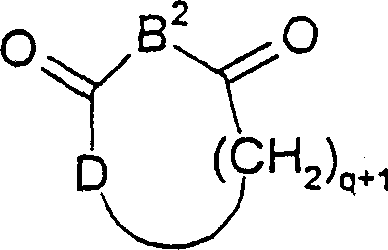

Applications Claiming Priority (4)
| Application Number | Priority Date | Filing Date | Title |
|---|---|---|---|
| US19592200P | 2000-04-10 | 2000-04-10 | |
| US60/195,922 | 2000-04-10 | ||
| US21292200P | 2000-06-20 | 2000-06-20 | |
| US60/212,922 | 2000-06-20 |
Publications (1)
| Publication Number | Publication Date |
|---|---|
| CN1432011A true CN1432011A (en) | 2003-07-23 |
Family
ID=26891472
Family Applications (1)
| Application Number | Title | Priority Date | Filing Date |
|---|---|---|---|
| CN01807882A Pending CN1432011A (en) | 2000-04-10 | 2001-04-06 | Benzoamide piperidine compounds as substance P antagonists |
Country Status (32)
| Country | Link |
|---|---|
| EP (1) | EP1272484B1 (en) |
| JP (1) | JP4001486B2 (en) |
| KR (1) | KR20020087134A (en) |
| CN (1) | CN1432011A (en) |
| AP (1) | AP2002002647A0 (en) |
| AR (2) | AR033976A1 (en) |
| AT (1) | ATE299875T1 (en) |
| AU (1) | AU2001246761A1 (en) |
| BG (1) | BG107135A (en) |
| BR (1) | BR0109936A (en) |
| CA (1) | CA2405089A1 (en) |
| CZ (1) | CZ20023213A3 (en) |
| DE (1) | DE60112064T2 (en) |
| EA (1) | EA005409B1 (en) |
| EE (1) | EE200200588A (en) |
| ES (1) | ES2244599T3 (en) |
| HR (1) | HRP20020808A2 (en) |
| HU (1) | HUP0300413A2 (en) |
| IL (1) | IL152209A0 (en) |
| IS (1) | IS6561A (en) |
| MA (1) | MA26891A1 (en) |
| MX (1) | MXPA02010029A (en) |
| NO (1) | NO20024874L (en) |
| NZ (1) | NZ521346A (en) |
| OA (1) | OA12245A (en) |
| PA (1) | PA8515101A1 (en) |
| PE (1) | PE20011311A1 (en) |
| PL (1) | PL358623A1 (en) |
| SK (1) | SK13942002A3 (en) |
| UY (1) | UY26662A1 (en) |
| WO (1) | WO2001077100A2 (en) |
| YU (1) | YU73902A (en) |
Families Citing this family (43)
| Publication number | Priority date | Publication date | Assignee | Title |
|---|---|---|---|---|
| GB0109871D0 (en) * | 2001-04-20 | 2001-06-13 | Glaxo Group Ltd | Metering method for particulate material |
| WO2003053929A1 (en) * | 2001-12-21 | 2003-07-03 | Toray Fine Chemicals Co., Ltd. | Process for production of optically active cis-piperidine derivatives |
| US20040006135A1 (en) * | 2002-06-19 | 2004-01-08 | Pfizer Inc. | Combination treatment for depression and anxiety |
| CN1665510A (en) | 2002-06-25 | 2005-09-07 | 惠氏公司 | Derivatives of cyclic thiocarbamate derivatives as PR modulators and their use for the treatment of skin diseases |
| RU2005101624A (en) | 2002-06-25 | 2005-06-27 | Уайт (Us) | APPLICATION OF THIOXINDOL DERIVATIVES IN THERAPY OF SKIN DISORDERS |
| AU2002334100A1 (en) * | 2002-10-04 | 2004-04-23 | Merck Sharp And Dohme Limited | Azabicyclic amine derivatives as nk-1 receptor antagonists |
| US7205328B2 (en) | 2002-10-21 | 2007-04-17 | Irm Llc | Oxindoles with anti-HIV activity |
| US6911544B2 (en) | 2002-10-23 | 2005-06-28 | Pfizer Inc. | Process for the preparation of (S,S)-cis-2-phenyl-3-aminopiperidine |
| US7022605B2 (en) * | 2002-11-12 | 2006-04-04 | Micron Technology, Inc. | Atomic layer deposition methods |
| CA2505797A1 (en) * | 2002-11-12 | 2004-05-27 | Pfizer Products Inc. | Process for converting a cis-trans mixture of substituted benzylidene amines into the pure cis isomer |
| AU2003902882A0 (en) * | 2003-06-10 | 2003-06-26 | Fujisawa Pharmaceutical Co., Ltd. | Piperidyl derivatives |
| ES2246687B2 (en) | 2004-02-11 | 2006-11-16 | Miguel Muñoz Saez | USE OF NON-PEPTIDIC ANTAGONISTS OF NK1 RECEPTORS FOR THE PRODUCTION OF APOPTOSIS IN TUMOR CELLS. |
| RU2387647C9 (en) * | 2004-08-20 | 2011-05-27 | Таргасепт, Инк. | Use of n-aryldiaza spirocyclic compounds for treating addictions |
| US20060281670A1 (en) * | 2005-06-10 | 2006-12-14 | Wisconsin Alumni Research Foundation (Warf) | Compositions and methods for modulating angiogenesis |
| TW200800959A (en) | 2005-06-10 | 2008-01-01 | Wyeth Corp | Piperazine-piperidine antagonists and agonists of the 5-HT1a receptor |
| US7507842B2 (en) | 2005-08-12 | 2009-03-24 | Radiorx, Inc. | Cyclic nitro compounds, pharmaceutical compositions thereof and uses thereof |
| US20070135380A1 (en) | 2005-08-12 | 2007-06-14 | Radiorx, Inc. | O-nitro compounds, pharmaceutical compositions thereof and uses thereof |
| DE102006033114A1 (en) | 2006-07-18 | 2008-01-24 | Grünenthal GmbH | Spirocyclic azaindole derivatives |
| TW200901974A (en) | 2007-01-16 | 2009-01-16 | Wyeth Corp | Compounds, compositions, and methods of making and using them |
| JP2010516731A (en) | 2007-01-24 | 2010-05-20 | グラクソ グループ リミテッド | Pharmaceutical composition comprising 2-methoxy-5- (5-trifluoromethyl-tetrazol-1-yl) -benzyl]-(2S-phenyl-piperidin-3S-yl) -amine |
| US8471041B2 (en) | 2010-02-09 | 2013-06-25 | Alliant Techsystems Inc. | Methods of synthesizing and isolating N-(bromoacetyl)-3,3-dinitroazetidine and a composition including the same |
| RS55856B1 (en) | 2010-07-14 | 2017-08-31 | Novartis Ag | HETEROCYCLIC UNITS OF IP RECEPTOR AGONISTS |
| ES2376564B1 (en) | 2010-08-12 | 2013-01-24 | Manuel Vicente Salinas Martín | USE OF ANTIBODIES AGAINST NK1, NK2 AND / OR NK3 RECEPTORS, TO PRODUCE APOPTOSIS IN TUMOR CELLS AND TO MODIFY STRAMA, IMMUNITY AND INTRA AND PERITUMORAL VASCULARIZATION, AS TREATMENT OF CANCER. |
| US8664247B2 (en) | 2011-08-26 | 2014-03-04 | Radiorx, Inc. | Acyclic organonitro compounds for use in treating cancer |
| US20140308260A1 (en) | 2011-10-07 | 2014-10-16 | Radiorx, Inc. | Methods and compositions comprising a nitrite-reductase promoter for treatment of medical disorders and preservation of blood products |
| JP6019126B2 (en) | 2011-10-07 | 2016-11-02 | エピセントアーレックス・インコーポレイテッドEpicentRx, Inc. | Organic nitrothioether compounds and their medical applications |
| EP2837381A4 (en) | 2011-12-13 | 2015-12-09 | Servicio Andaluz De Salud | USE OF AGENTS MODIFYING THE PERITUMORAL ENVIRONMENT FOR THE TREATMENT OF CANCER |
| WO2014078568A1 (en) | 2012-11-14 | 2014-05-22 | The Johns Hopkins University | Methods and compositions for treating schizophrenia |
| RU2506077C1 (en) * | 2013-01-25 | 2014-02-10 | Общество С Ограниченной Ответственностью "Валента-Интеллект" | Combination for prevention, correction and therapy of pain related to neurodegeneration or associated with somatoform disorders |
| ES2493693B1 (en) | 2013-02-11 | 2015-07-07 | Servicio Andaluz De Salud | Method to predict or predict the response of a human subject suffering from cancer to treatment with an NK1 receptor antagonist |
| EP2956455B1 (en) | 2013-02-13 | 2017-05-17 | Novartis AG | Ip receptor agonist heterocyclic compounds |
| ES2541870B1 (en) | 2013-12-27 | 2016-05-12 | Servicio Andaluz De Salud | Use of NK1 non-peptide antagonists in a given dose for cancer treatment |
| WO2016105448A1 (en) * | 2014-12-22 | 2016-06-30 | Darryl Rideout | Imidazoline receptor type 1 ligands for use as therapeutics |
| US10342778B1 (en) | 2015-10-20 | 2019-07-09 | Epicentrx, Inc. | Treatment of brain metastases using organonitro compound combination therapy |
| US9987270B1 (en) | 2015-10-29 | 2018-06-05 | Epicentrix, Inc. | Treatment of gliomas using organonitro compound combination therapy |
| SG11201805942UA (en) | 2016-01-11 | 2018-08-30 | Epicentrx Inc | Compositions and methods for intravenous administration of 2-bromo-1-(3,3-dinitroazetidin-1-yl)ethanone |
| RU2643091C2 (en) * | 2016-04-08 | 2018-01-31 | Федеральное государственное бюджетное научное учреждение "Научно-исследовательский институт фармакологии имени В.В. Закусова" | 4-benzoylpyridine oxime derivatives having anticonvulsant activity as agents for treatment of epilepsy and paroxysmal states |
| EA201990949A1 (en) | 2016-10-14 | 2019-10-31 | SULPHOXIALKYL ORGANIC NITRO COMPOUNDS AND RELATED COMPOUNDS AND PHARMACEUTICAL COMPOSITIONS FOR USE IN MEDICINE | |
| KR102869384B1 (en) | 2017-07-07 | 2025-10-15 | 에피센트알엑스, 인코포레이티드 | Composition for parenteral administration of therapeutic agents |
| WO2019164593A2 (en) | 2018-01-08 | 2019-08-29 | Epicentrx, Inc. | Methods and compositions utilizing rrx-001 combination therapy for radioprotection |
| WO2022040058A1 (en) * | 2020-08-18 | 2022-02-24 | Merck Sharp & Dohme Corp. | Cyclopentapyrrole orexin receptor agonists |
| CA3238595A1 (en) * | 2021-11-18 | 2023-05-25 | Wuhan Humanwell Innovative Drug Research and Development Center Limited Company | 15-pgdh inhibitor and use thereof |
| KR20240161147A (en) | 2022-03-14 | 2024-11-12 | 슬랩 파마슈티컬스 엘엘씨 | multicyclic compounds |
Family Cites Families (8)
| Publication number | Priority date | Publication date | Assignee | Title |
|---|---|---|---|---|
| US3539584A (en) * | 1967-11-14 | 1970-11-10 | Colgate Palmolive Co | 5-substituted-2,1-benzisothiazolines |
| US4581356A (en) * | 1983-03-22 | 1986-04-08 | Fujisawa Pharmaceutical Co., Ltd. | Triazine derivatives, and pharmaceutical compositions comprising the same |
| EP0550635B1 (en) * | 1990-09-28 | 1995-04-19 | Pfizer Inc. | Fused ring analogs of nitrogen containing nonaromatic heterocycles |
| TW202432B (en) * | 1991-06-21 | 1993-03-21 | Pfizer | |
| JP3042894B2 (en) * | 1995-07-07 | 2000-05-22 | ファイザー製薬株式会社 | Substituted benzolactam compounds as substance P antagonists |
| TWI220143B (en) * | 1998-05-13 | 2004-08-11 | Solvay Pharm Gmbh | Method for stereochemically controlled production of isomerically pure highly substituted azacyclic compounds and novel cyclic compounds, and intermediate products |
| WO2000073312A1 (en) * | 1999-05-26 | 2000-12-07 | Astrazeneca Ab | Compounds |
| SE9901901D0 (en) * | 1999-05-26 | 1999-05-26 | Astra Ab | Compounds |
-
2001
- 2001-04-06 OA OA1200200312A patent/OA12245A/en unknown
- 2001-04-06 PL PL01358623A patent/PL358623A1/en not_active Application Discontinuation
- 2001-04-06 AP APAP/P/2002/002647A patent/AP2002002647A0/en unknown
- 2001-04-06 MX MXPA02010029A patent/MXPA02010029A/en active IP Right Grant
- 2001-04-06 JP JP2001575573A patent/JP4001486B2/en not_active Expired - Fee Related
- 2001-04-06 HU HU0300413A patent/HUP0300413A2/en unknown
- 2001-04-06 BR BR0109936-1A patent/BR0109936A/en not_active IP Right Cessation
- 2001-04-06 HR HRP20020808 patent/HRP20020808A2/en not_active Application Discontinuation
- 2001-04-06 EA EA200200963A patent/EA005409B1/en not_active IP Right Cessation
- 2001-04-06 IL IL15220901A patent/IL152209A0/en unknown
- 2001-04-06 EE EEP200200588A patent/EE200200588A/en unknown
- 2001-04-06 EP EP01919702A patent/EP1272484B1/en not_active Expired - Lifetime
- 2001-04-06 KR KR1020027013582A patent/KR20020087134A/en not_active Ceased
- 2001-04-06 CN CN01807882A patent/CN1432011A/en active Pending
- 2001-04-06 AT AT01919702T patent/ATE299875T1/en not_active IP Right Cessation
- 2001-04-06 CA CA002405089A patent/CA2405089A1/en not_active Abandoned
- 2001-04-06 DE DE60112064T patent/DE60112064T2/en not_active Expired - Fee Related
- 2001-04-06 CZ CZ20023213A patent/CZ20023213A3/en unknown
- 2001-04-06 WO PCT/IB2001/000629 patent/WO2001077100A2/en not_active Ceased
- 2001-04-06 ES ES01919702T patent/ES2244599T3/en not_active Expired - Lifetime
- 2001-04-06 YU YU73902A patent/YU73902A/en unknown
- 2001-04-06 SK SK1394-2002A patent/SK13942002A3/en not_active Application Discontinuation
- 2001-04-06 AU AU2001246761A patent/AU2001246761A1/en not_active Abandoned
- 2001-04-06 NZ NZ521346A patent/NZ521346A/en unknown
- 2001-04-09 AR ARP010101678A patent/AR033976A1/en unknown
- 2001-04-10 UY UY26662A patent/UY26662A1/en not_active Application Discontinuation
- 2001-04-10 PE PE2001000329A patent/PE20011311A1/en not_active Application Discontinuation
- 2001-04-10 PA PA20018515101A patent/PA8515101A1/en unknown
-
2002
- 2002-09-20 IS IS6561A patent/IS6561A/en unknown
- 2002-09-23 BG BG107135A patent/BG107135A/en unknown
- 2002-10-02 MA MA26848A patent/MA26891A1/en unknown
- 2002-10-09 NO NO20024874A patent/NO20024874L/en not_active Application Discontinuation
-
2003
- 2003-06-26 AR ARP030102296A patent/AR040346A2/en unknown
Also Published As
Similar Documents
| Publication | Publication Date | Title |
|---|---|---|
| JP4001486B2 (en) | Benzamide piperidine-containing compounds and related compounds | |
| CN1277828C (en) | Piperzine devivs. | |
| CN1061041C (en) | Piperidine derivatives | |
| CN1053613A (en) | Nitrogen-containing spiro | |
| US7468437B2 (en) | Phenyl pyrrolidine ether tachykinin receptor antagonists | |
| CN1371374A (en) | Substituted heterocycle fused gamma-carbolines | |
| CN1361779A (en) | New compounds | |
| CN1620455A (en) | Azaindolylalkylamine derivatives as 5-hydroxytryptamine-6 ligands | |
| CN1809566A (en) | Cannabinoid receptor ligands and uses thereof | |
| CN1118467C (en) | 1,3,8-triaza-spiro [4,5] decan-4-on derivatives | |
| CN1946723A (en) | Substituted diaza-spiro-[4.5|-decane derivatives and their use as neurokinin antagonists | |
| CN1929737A (en) | HIV integrase inhibitors | |
| CN1942471A (en) | Substituted diaza-spiro-[5.5|-undecane derivatives and their use as neurokinin antagonists | |
| CN1107066C (en) | Diaza-spiro[3,5]nonane derivatives | |
| CN1129578C (en) | Tetrahydrobenzindole derivatives | |
| US7119207B2 (en) | Benzoamide piperidine containing compounds and related compounds | |
| CN1110497C (en) | Di- Or triaza-spiral [4,5] decane derivative | |
| CN1819995A (en) | Cyclic amine derivatives, processes for their preparation, and pharmaceutical compositions containing them | |
| CN101068787A (en) | 8-Phenyl-5,6,7,8-hydroquinoline tachykinin receptor antagonist | |
| HK1053656A (en) | Benzoamide piperidine containing compounds and related compounds | |
| CN1512883A (en) | CRF receptor antagonist | |
| CN1906169A (en) | Therapeutic agents I | |
| CN1878764A (en) | Beta-lactams for treatment of cns disorders | |
| HK1024471A (en) | Di-or triaza-spiro[4,5]decane derivatives | |
| HK1024234A (en) | Spiro[piperidine-4,1'-pyrrolo[3,4-c]pyrrole] |
Legal Events
| Date | Code | Title | Description |
|---|---|---|---|
| C06 | Publication | ||
| PB01 | Publication | ||
| C10 | Entry into substantive examination | ||
| SE01 | Entry into force of request for substantive examination | ||
| C02 | Deemed withdrawal of patent application after publication (patent law 2001) | ||
| WD01 | Invention patent application deemed withdrawn after publication | ||
| REG | Reference to a national code |
Ref country code: HK Ref legal event code: WD Ref document number: 1053656 Country of ref document: HK |