CN1491237A - Coordination compounds and their use in olefin polymerization - Google Patents
Coordination compounds and their use in olefin polymerization Download PDFInfo
- Publication number
- CN1491237A CN1491237A CNA028047885A CN02804788A CN1491237A CN 1491237 A CN1491237 A CN 1491237A CN A028047885 A CNA028047885 A CN A028047885A CN 02804788 A CN02804788 A CN 02804788A CN 1491237 A CN1491237 A CN 1491237A
- Authority
- CN
- China
- Prior art keywords
- substituted
- alkyl
- aryl
- cycloalkyl
- aralkyl
- Prior art date
- Legal status (The legal status is an assumption and is not a legal conclusion. Google has not performed a legal analysis and makes no representation as to the accuracy of the status listed.)
- Pending
Links
Classifications
-
- C—CHEMISTRY; METALLURGY
- C08—ORGANIC MACROMOLECULAR COMPOUNDS; THEIR PREPARATION OR CHEMICAL WORKING-UP; COMPOSITIONS BASED THEREON
- C08F—MACROMOLECULAR COMPOUNDS OBTAINED BY REACTIONS ONLY INVOLVING CARBON-TO-CARBON UNSATURATED BONDS
- C08F10/00—Homopolymers and copolymers of unsaturated aliphatic hydrocarbons having only one carbon-to-carbon double bond
- C08F10/02—Ethene
-
- C—CHEMISTRY; METALLURGY
- C07—ORGANIC CHEMISTRY
- C07F—ACYCLIC, CARBOCYCLIC OR HETEROCYCLIC COMPOUNDS CONTAINING ELEMENTS OTHER THAN CARBON, HYDROGEN, HALOGEN, OXYGEN, NITROGEN, SULFUR, SELENIUM OR TELLURIUM
- C07F7/00—Compounds containing elements of Groups 4 or 14 of the Periodic Table
- C07F7/003—Compounds containing elements of Groups 4 or 14 of the Periodic Table without C-Metal linkages
-
- C—CHEMISTRY; METALLURGY
- C07—ORGANIC CHEMISTRY
- C07F—ACYCLIC, CARBOCYCLIC OR HETEROCYCLIC COMPOUNDS CONTAINING ELEMENTS OTHER THAN CARBON, HYDROGEN, HALOGEN, OXYGEN, NITROGEN, SULFUR, SELENIUM OR TELLURIUM
- C07F9/00—Compounds containing elements of Groups 5 or 15 of the Periodic Table
- C07F9/005—Compounds of elements of Group 5 of the Periodic Table without metal-carbon linkages
-
- C—CHEMISTRY; METALLURGY
- C08—ORGANIC MACROMOLECULAR COMPOUNDS; THEIR PREPARATION OR CHEMICAL WORKING-UP; COMPOSITIONS BASED THEREON
- C08F—MACROMOLECULAR COMPOUNDS OBTAINED BY REACTIONS ONLY INVOLVING CARBON-TO-CARBON UNSATURATED BONDS
- C08F10/00—Homopolymers and copolymers of unsaturated aliphatic hydrocarbons having only one carbon-to-carbon double bond
-
- C—CHEMISTRY; METALLURGY
- C08—ORGANIC MACROMOLECULAR COMPOUNDS; THEIR PREPARATION OR CHEMICAL WORKING-UP; COMPOSITIONS BASED THEREON
- C08F—MACROMOLECULAR COMPOUNDS OBTAINED BY REACTIONS ONLY INVOLVING CARBON-TO-CARBON UNSATURATED BONDS
- C08F110/00—Homopolymers of unsaturated aliphatic hydrocarbons having only one carbon-to-carbon double bond
- C08F110/02—Ethene
-
- C—CHEMISTRY; METALLURGY
- C08—ORGANIC MACROMOLECULAR COMPOUNDS; THEIR PREPARATION OR CHEMICAL WORKING-UP; COMPOSITIONS BASED THEREON
- C08F—MACROMOLECULAR COMPOUNDS OBTAINED BY REACTIONS ONLY INVOLVING CARBON-TO-CARBON UNSATURATED BONDS
- C08F210/00—Copolymers of unsaturated aliphatic hydrocarbons having only one carbon-to-carbon double bond
- C08F210/16—Copolymers of ethene with alpha-alkenes, e.g. EP rubbers
Landscapes
- Chemical & Material Sciences (AREA)
- Organic Chemistry (AREA)
- Health & Medical Sciences (AREA)
- Chemical Kinetics & Catalysis (AREA)
- Medicinal Chemistry (AREA)
- Polymers & Plastics (AREA)
- Transition And Organic Metals Composition Catalysts For Addition Polymerization (AREA)
- Organic Low-Molecular-Weight Compounds And Preparation Thereof (AREA)
- Quinoline Compounds (AREA)
- Pyridine Compounds (AREA)
- Pyrrole Compounds (AREA)
Abstract
Description
本发明涉及式Ia和Ib的配合物,The present invention relates to complexes of formulas Ia and Ib,
其中各变量定义如下:The variables are defined as follows:
Nu选自O、S和N-R7;Nu is selected from O, S and NR 7 ;
M选自Ti、Zr、Hf、V、Nb和Ta;M is selected from Ti, Zr, Hf, V, Nb and Ta;
y对应于M的氧化态减1;y corresponds to the oxidation state of M minus 1;
z对应于M的氧化态减2;z corresponds to the oxidation state of M minus 2;
X相同或不同且选自卤素、C1-C8-烷基、C3-C12-环烷基、C7-C13-芳烷基和C6-C14-芳基;X is identical or different and is selected from halogen, C 1 -C 8 -alkyl, C 3 -C 12 -cycloalkyl, C 7 -C 13 -aralkyl and C 6 -C 14 -aryl;
R1-R7相同或不同且选自R 1 -R 7 are the same or different and selected from
氢,hydrogen,
C1-C18-烷基,其被取代或未被取代,C 1 -C 18 -Alkyl, which is substituted or unsubstituted,
C2-C18-链烯基,其被取代或未被取代且具有1-4条孤立或共轭双键,C 2 -C 18 -alkenyl, which is substituted or unsubstituted and has 1 to 4 isolated or conjugated double bonds,
C3-C12-环烷基,其被取代或未被取代,C 3 -C 12 -cycloalkyl, which is substituted or unsubstituted,
C7-C13-芳烷基,C 7 -C 13 -Aralkyl,
C6-C14-芳基,其未被取代或被一个或多个选自如下的相同或不同取代基取代:C 6 -C 14 -aryl, which is unsubstituted or substituted by one or more identical or different substituents selected from the group consisting of:
C1-C18-烷基,其被取代或未被取代,C 1 -C 18 -Alkyl, which is substituted or unsubstituted,
C2-C18-链烯基,其被取代或未被取代,C 2 -C 18 -alkenyl, which is substituted or unsubstituted,
C3-C12-环烷基,C 3 -C 12 -cycloalkyl,
C7-C13-芳烷基,C 7 -C 13 -Aralkyl,
C6-C14-芳基,C 6 -C 14 -aryl,
卤素,halogen,
C1-C6-烷氧基,其被取代或未被取代,C 1 -C 6 -alkoxy, which is substituted or unsubstituted,
C6-C14-芳氧基,C 6 -C 14 -aryloxy,
SiR8R9R10和O-SiR8R9R10;SiR 8 R 9 R 10 and O-SiR 8 R 9 R 10 ;
5-和6-元含氮杂芳基,其未被取代或被一个或多个选自如下的相同或不同取代基取代:5- and 6-membered nitrogen-containing heteroaryl groups, which are unsubstituted or substituted by one or more same or different substituents selected from the following:
C1-C18-烷基,其被取代或未被取代,C 1 -C 18 -Alkyl, which is substituted or unsubstituted,
C2-C18-链烯基,其被取代或未被取代,C 2 -C 18 -alkenyl, which is substituted or unsubstituted,
C3-C12-环烷基,C 3 -C 12 -cycloalkyl,
C7-C13-芳烷基,C 7 -C 13 -Aralkyl,
C6-C14-芳基,C 6 -C 14 -aryl,
卤素,halogen,
C1-C6-烷氧基,C 1 -C 6 -alkoxy,
C6-C14-芳氧基,C 6 -C 14 -aryloxy,
SiR8R9R10和O-SiR8R9R10;SiR 8 R 9 R 10 and O-SiR 8 R 9 R 10 ;
其中相邻基团R1-R6可以相互连接或与R7连接形成5-12元环,该环又可带有选自如下的取代基:取代或未取代的C1-C8-烷基,取代或未取代且具有1-4条孤立或共轭双键的C2-C8-链烯基,取代或未取代的C3-C12-环烷基,C7-C13-芳烷基和C6-C14-芳基;Wherein the adjacent groups R 1 -R 6 can be connected to each other or to R 7 to form a 5-12-membered ring, and the ring can have a substituent selected from the following: substituted or unsubstituted C 1 -C 8 -alkane substituted or unsubstituted C 2 -C 8 -alkenyl with 1-4 isolated or conjugated double bonds, substituted or unsubstituted C 3 -C 12 -cycloalkyl, C 7 -C 13 - Aralkyl and C 6 -C 14 -aryl;
R8-R10相同或不同且选自氢、C1-C8-烷基、C3-C12-环烷基、C7-C13-芳烷基和C6-C14-芳基。R 8 -R 10 are identical or different and are selected from hydrogen, C 1 -C 8 -alkyl, C 3 -C 12 -cycloalkyl, C 7 -C 13 -arylalkyl and C 6 -C 14 -aryl .
本发明还涉及一种使用式Ia和Ib的配合物聚合烯烃的方法。The invention also relates to a process for polymerizing olefins using the complexes of formulas Ia and Ib.
烯烃的聚合物和共聚物在经济上很重要,因为其单体可容易大量得到且聚合物可以通过改变制备方法或加工参数而在宽范围内变化。所用催化剂在制备聚合物的方法中具有特别的意义。除了Ziegler-Natta催化剂外,各种单点催化剂也日趋重要。在后者中,已经在一定程度上详细研究的中心原子不仅包括例如如在金属茂催化剂中的Zr(H.-H.Brintzinger等人,Angew.Chem.(应用化学)1995,107,1255),而且包括Ni或Pd(WO 96/23010)或Fe和Co(例如WO 98/27124)。Ni、Pd、Fe和Co的配合物也称为后过渡金属(Spter bergangsmetalle)的配合物。Polymers and copolymers of olefins are economically important because their monomers are readily available in large quantities and the polymers can be varied over a wide range by changing the preparation method or processing parameters. The catalysts used are of particular interest in the process for preparing polymers. In addition to Ziegler-Natta catalysts, various single-site catalysts are becoming increasingly important. In the latter, central atoms which have been studied in some detail include not only Zr, for example as in metallocene catalysts (H.-H. Brintzinger et al., Angew. Chem. (Applied Chemistry) 1995, 107, 1255) , and include Ni or Pd (WO 96/23010) or Fe and Co (eg WO 98/27124). The complexes of Ni, Pd, Fe and Co are also called late transition metal (Spterbergangsmetalle) complexes.
金属茂催化剂在工业应用中具有缺点。最常用的金属茂,即二茂锆和二茂铪对水解敏感。此外,大多数金属茂对许多催化剂毒物如醇类、醚类和CO敏感,这使得必须小心提纯单体。Metallocene catalysts have disadvantages in industrial applications. The most commonly used metallocenes, namely zirconocenes and hafnocenes, are sensitive to hydrolysis. Furthermore, most metallocenes are sensitive to many catalyst poisons such as alcohols, ethers, and CO, which necessitates careful purification of the monomers.
尽管Ni和Pd配合物(WO 96/23010)催化没有多少经济价值的高度支化聚合物的形成,但使用Fe或Co配合物导致形成含有非常低比例的共聚单体的高度线性聚乙烯。While Ni and Pd complexes (WO 96/23010) catalyze the formation of highly branched polymers of little economic value, the use of Fe or Co complexes leads to the formation of highly linear polyethylenes with very low proportions of comonomers.
EP-A 0 874 005公开了其它聚合活性配合物。这些配合物优选为具有水杨醛亚胺配体的Ti配合物。这些配合物在醛亚胺氮上还带有苯基取代基或取代的苯基取代基(第18-23页)或该醛亚胺氮引入6元环中(第31-32页)。然而,它们通常产生不是非常适合用作材料的低分子量聚乙烯。此外,EP-A0 874 005中公开的所有配体都含有作为酚体系的一部分的氧原子,这限制了易得原料的选择。EP-A 0 874 005 discloses other polymerization-active complexes. These complexes are preferably Ti complexes with salicylaldimine ligands. These complexes also bear a phenyl substituent or a substituted phenyl substituent on the aldimine nitrogen (pp. 18-23) or the aldimine nitrogen is introduced into a 6-membered ring (pp. 31-32). However, they generally yield low molecular weight polyethylene which is not very suitable as a material. Furthermore, all ligands disclosed in EP-A0 874 005 contain oxygen atoms as part of the phenolic system, which limits the choice of readily available starting materials.
如G.J.P.Britovsek等人在Angew.Chem.1999,111,448和Angew.Chem.Int.Ed.Engl.1999,38,428中所示,对用途非常广泛的聚合活性配合物的研究因聚烯烃的重大经济重要性而一直很重要。特别关注的是前过渡金属(frühen bergangsmetalle)与二齿配体的配合物,如式A配合物:As shown in G.J.P.Britovsek et al. in Angew.Chem.1999, 111, 448 and Angew.Chem.Int.Ed.Engl. has always been important because of its major economic importance. Of particular interest are complexes of early transition metals (frühen bergangsmetalle) with bidentate ligands, such as complexes of the formula A:

这些配合物已经由X.Bei等人在Organometallics(有机金属学)1997,16,3282中进行了研究。然而,其中M=Ti或Zr的配合物在乙烯聚合中的活性太低,因而这些配合物不具有经济价值。T.Tsukahara等人在Organometallics 1997,16,3303中以及I.Kim等人在Organometallics1997,16,3314中已经研究了式B的β-羟基吡啶基配合物:These complexes have been studied by X. Bei et al. in Organometallics 1997, 16, 3282. However, the activity of complexes in which M=Ti or Zr in ethylene polymerization is too low, so that these complexes are not of economic value. People such as T. Tsukahara in Organometallics 1997, 16, 3303 and I. Kim et al. in Organometallics 1997, 16, 3314 have studied the β-hydroxypyridyl complexes of formula B:
及其在乙烯聚合中的活性。如果例如R各自选自CH3和CF3且X为苄基或新戊基,则当该配合物用三-五氟苯基硼烷活化时仅对乙烯观察到极低的聚合活性(如果有的话)。另一方面,若R=对叔丁基苯基且X=苄基,则观察到低活性,但这对工业目的而言太低。此外,以此方式制备的聚合物具有的分子量Mn为6200g,这对材料而言太低。and its activity in ethylene polymerization. If, for example, R is each selected from CH and CF and X is benzyl or neopentyl, only very low polymerization activity is observed for ethylene when the complex is activated with tris-pentafluorophenylborane (if any if). On the other hand, if R = p-tert-butylphenyl and X = benzyl, low activity is observed, but this is too low for industrial purposes. Furthermore, the polymer prepared in this way has a molecular weight M n of 6200 g, which is too low for the material.
因此,本发明的目的是Therefore, the purpose of the present invention is to
-提供适于聚合烯烃得到高分子量聚合物的新配合物;- provide new complexes suitable for polymerizing olefins to obtain high molecular weight polymers;
-提供一种制备本发明的配合物的方法;- provide a method for preparing the complex of the present invention;
-提供一种使用本发明的配合物聚合或共聚合烯烃的方法;- provide a method for polymerizing or copolymerizing olefins using the complex of the present invention;
-提供用于聚合烯烃的负载催化剂以及一种使用本发明的配合物制备本发明的负载催化剂的方法;和- providing supported catalysts for polymerizing olefins and a process for preparing supported catalysts of the invention using complexes of the invention; and
-使用本发明的负载催化剂聚合和共聚合烯烃。- Polymerization and copolymerization of olefins using the supported catalyst of the invention.
我们发现该目的通过开头所定义的具有式Ia和Ib结构的配合物实现。We have found that this object is achieved by the complexes defined at the outset having the structures of the formulas Ia and Ib.
在式I中,各变量定义如下:In formula I, each variable is defined as follows:
Nu选自O、S和N-R7,优选氧;Nu is selected from O, S and NR 7 , preferably oxygen;
M选自氧化态为+3至+5的Ti、Zr、Hf、V、Nb和Ta;优选Ti或Zr;M is selected from Ti, Zr, Hf, V, Nb and Ta with an oxidation state of +3 to +5; preferably Ti or Zr;
特别优选Zr;Particular preference is given to Zr;
y对应于M的氧化态减1;y corresponds to the oxidation state of M minus 1;
z对应于M的氧化态减2,其中M可以为处于最高氧化态但不必一定呈最高氧化态的金属;z corresponds to the oxidation state of M minus 2, where M may be a metal in the highest oxidation state but need not be in the highest oxidation state;
X相同或不同且选自:X is the same or different and is selected from:
-卤素,如氟、氯、溴和碘;优选氯或溴;特别优选氯;- halogen, such as fluorine, chlorine, bromine and iodine; preferably chlorine or bromine; particularly preferably chlorine;
-C1-C8-烷基,如甲基、乙基、正丙基、异丙基、正丁基、异丁基、仲丁基、叔丁基、正戊基、异戊基、仲戊基、新戊基、1,2-二甲基丙基、异戊基、正己基、异己基、仲己基、正庚基、异庚基和正辛基;优选C1-C6-烷基,如甲基、乙基、正丙基、异丙基、正丁基、异丁基、仲丁基、叔丁基、正戊基、异戊基、仲戊基、新戊基、1,2-二甲基丙基、异戊基、正己基、异己基、仲己基;特别优选C1-C4-烷基,如甲基、乙基、正丙基、异丙基、正丁基、异丁基、仲丁基和叔丁基;-C 1 -C 8 -Alkyl, such as methyl, ethyl, n-propyl, isopropyl, n-butyl, isobutyl, sec-butyl, tert-butyl, n-pentyl, isopentyl, sec- Pentyl, neopentyl, 1,2-dimethylpropyl, isopentyl, n-hexyl, isohexyl, sec-hexyl, n-heptyl, isoheptyl and n-octyl; preferably C 1 -C 6 -alkyl , such as methyl, ethyl, n-propyl, isopropyl, n-butyl, isobutyl, sec-butyl, tert-butyl, n-pentyl, isopentyl, sec-pentyl, neopentyl, 1, 2-Dimethylpropyl, isopentyl, n-hexyl, isohexyl, sec-hexyl; particularly preferably C 1 -C 4 -alkyl, such as methyl, ethyl, n-propyl, isopropyl, n-butyl , isobutyl, sec-butyl and tert-butyl;
-C3-C12-环烷基,如环丙基、环丁基、环戊基、环己基、环庚基、环辛基、环壬基、环癸基、环十一烷基和环十二烷基;优选环戊基、环己基和环庚基;-C 3 -C 12 -Cycloalkyl, such as cyclopropyl, cyclobutyl, cyclopentyl, cyclohexyl, cycloheptyl, cyclooctyl, cyclononyl, cyclodecyl, cycloundecyl and cycloundecyl dodecyl; preferably cyclopentyl, cyclohexyl and cycloheptyl;
-C7-C13-芳烷基,优选C7-C12-苯基烷基,如苄基、1-苯基乙基、2-苯基乙基、1-苯基丙基、2-苯基丙基、3-苯基丙基、新苯基(1-甲基-1-苯基乙基)、1-苯基丁基、2-苯基丁基、3-苯基丁基和4-苯基丁基;特别优选苄基;以及-C 7 -C 13 -aralkyl, preferably C 7 -C 12 -phenylalkyl, such as benzyl, 1-phenylethyl, 2-phenylethyl, 1-phenylpropyl, 2- Phenylpropyl, 3-phenylpropyl, neophenyl(1-methyl-1-phenylethyl), 1-phenylbutyl, 2-phenylbutyl, 3-phenylbutyl and 4-phenylbutyl; especially preferably benzyl; and
-C6-C14-芳基,例如苯基、1-萘基、2-萘基、1-蒽基、2-蒽基、9-蒽基、1-菲基、2-菲基、3-菲基、4-菲基和9-菲基;优选苯基、1-萘基和2-萘基;特别优选苯基。-C 6 -C 14 -aryl, such as phenyl, 1-naphthyl, 2-naphthyl, 1-anthracenyl, 2-anthracenyl, 9-anthracenyl, 1-phenanthrenyl, 2-phenanthrenyl, 3 - phenanthrenyl, 4-phenanthrenyl and 9-phenanthryl; preferably phenyl, 1-naphthyl and 2-naphthyl; particularly preferably phenyl.
X优选为卤素。X is preferably halogen.
R1-R7相同或不同且选自R 1 -R 7 are the same or different and selected from
-氢,-hydrogen,
-C1-C18-烷基,如甲基、乙基、正丙基、异丙基、正丁基、异丁基、仲丁基、叔丁基、正戊基、异戊基、仲戊基、新戊基、1,2-二甲基丙基、异戊基、正己基、异己基、仲己基、正庚基、异庚基、正辛基、正癸基、正十二烷基和正十八烷基;优选C1-C12-烷基,如甲基、乙基、正丙基、异丙基、正丁基、异丁基、仲丁基、叔丁基、正戊基、异戊基、仲戊基、新戊基、1,2-二甲基丙基、异戊基、正己基、异己基、仲己基和正癸基;特别优选C1-C4-烷基,如甲基、乙基、正丙基、异丙基、正丁基、异丁基、仲丁基和叔丁基;-C 1 -C 18 -Alkyl, such as methyl, ethyl, n-propyl, isopropyl, n-butyl, isobutyl, sec-butyl, tert-butyl, n-pentyl, isopentyl, sec- Pentyl, neopentyl, 1,2-dimethylpropyl, isopentyl, n-hexyl, isohexyl, sec-hexyl, n-heptyl, isoheptyl, n-octyl, n-decyl, n-dodecyl and n-octadecyl; preferably C 1 -C 12 -alkyl, such as methyl, ethyl, n-propyl, isopropyl, n-butyl, isobutyl, sec-butyl, tert-butyl, n-pentyl radical, isopentyl, sec-pentyl, neopentyl, 1,2-dimethylpropyl, isopentyl, n-hexyl, isohexyl, sec-hexyl and n-decyl; particular preference is given to C 1 -C 4 -alkyl , such as methyl, ethyl, n-propyl, isopropyl, n-butyl, isobutyl, sec-butyl and tert-butyl;
-取代的C1-C18-烷基的实例是:单卤代或多卤代C1-C8-烷基,如氟甲基、二氟甲基、三氟甲基、氯甲基、二氯甲基、三氯甲基、溴甲基、二溴甲基、三溴甲基、五氟乙基、全氟丙基和全氟丁基;特别优选氟甲基、二氟甲基、三氟甲基和全氟丁基;-Examples of substituted C 1 -C 18 -alkyl are: monohalogenated or polyhalogenated C 1 -C 8 -alkyl, such as fluoromethyl, difluoromethyl, trifluoromethyl, chloromethyl, Dichloromethyl, trichloromethyl, bromomethyl, dibromomethyl, tribromomethyl, pentafluoroethyl, perfluoropropyl and perfluorobutyl; particularly preferred are fluoromethyl, difluoromethyl, Trifluoromethyl and perfluorobutyl;
-具有1-4条孤立或共轭双键的C2-C18-链烯基,例如乙烯基、1-烯丙基、3-烯丙基、ω-丁烯基、ω-戊烯基、ω-己烯基、1-顺式-丁-1,3-二烯基和1-顺式-己-1,5-二烯基;- C 2 -C 18 -alkenyl with 1 to 4 isolated or conjugated double bonds, for example vinyl, 1-allyl, 3-allyl, ω-butenyl, ω-pentenyl , ω-hexenyl, 1-cis-but-1,3-dienyl and 1-cis-hex-1,5-dienyl;
-取代的C2-C18-链烯基的实例是:异丙烯基、1-异戊二烯基、α-苯乙烯基、β-苯乙烯基、1-顺式-1,2-苯基乙烯基和1-反式-1,2-苯基乙烯基;-Examples of substituted C 2 -C 18 -alkenyl groups are: isopropenyl, 1-prenyl, α-styryl, β-styryl, 1-cis-1,2-benzene ylvinyl and 1-trans-1,2-phenylethenyl;
-C3-C12-环烷基,如环丙基、环丁基、环戊基、环己基、环庚基、环辛基、环壬基、环癸基、环十一烷基和环十二烷基;优选环戊基、环己基和环庚基;-C 3 -C 12 -Cycloalkyl, such as cyclopropyl, cyclobutyl, cyclopentyl, cyclohexyl, cycloheptyl, cyclooctyl, cyclononyl, cyclodecyl, cycloundecyl and cycloundecyl dodecyl; preferably cyclopentyl, cyclohexyl and cycloheptyl;
-取代的环烷基的实例是:2-甲基环戊基、3-甲基环戊基、顺式-2,4-二甲基环戊基、反式-2,4-二甲基环戊基、顺式-2,5-二甲基环戊基、反式-2,5-二甲基环戊基、2,2,5,5-四甲基环戊基、2-甲基环己基、3-甲基环己基、4-甲基环己基、顺式-2,6-二甲基环己基、反式-2,6-二甲基环己基、顺式-2,6-二异丙基环己基、反式-2,6-二异丙基环己基、2,2,6,6-四甲基环己基、2-甲氧基环戊基、2-甲氧基环己基、3-甲氧基环戊基、3-甲氧基环己基、2-氯环戊基、3-氯环戊基、2,4-二氯环戊基、2,2,4,4-四氯环戊基、2-氯环己基、3-氯环己基、4-氯环己基、2,5-二氯环己基、2,2,6,6-四氯环己基、2-硫甲基环戊基、2-硫甲基环己基、3-硫甲基环戊基、3-硫甲基环己基和其它衍生物;-Examples of substituted cycloalkyl groups are: 2-methylcyclopentyl, 3-methylcyclopentyl, cis-2,4-dimethylcyclopentyl, trans-2,4-dimethyl Cyclopentyl, cis-2,5-dimethylcyclopentyl, trans-2,5-dimethylcyclopentyl, 2,2,5,5-tetramethylcyclopentyl, 2-methylcyclopentyl Cyclohexyl, 3-methylcyclohexyl, 4-methylcyclohexyl, cis-2,6-dimethylcyclohexyl, trans-2,6-dimethylcyclohexyl, cis-2,6 -Diisopropylcyclohexyl, trans-2,6-diisopropylcyclohexyl, 2,2,6,6-tetramethylcyclohexyl, 2-methoxycyclopentyl, 2-methoxy Cyclohexyl, 3-methoxycyclopentyl, 3-methoxycyclohexyl, 2-chlorocyclopentyl, 3-chlorocyclopentyl, 2,4-dichlorocyclopentyl, 2,2,4, 4-tetrachlorocyclopentyl, 2-chlorocyclohexyl, 3-chlorocyclohexyl, 4-chlorocyclohexyl, 2,5-dichlorocyclohexyl, 2,2,6,6-tetrachlorocyclohexyl, 2- Thiomethylcyclopentyl, 2-thiomethylcyclohexyl, 3-thiomethylcyclopentyl, 3-thiomethylcyclohexyl and other derivatives;
-C7-C13-芳烷基,优选C7-C12-苯基烷基如苄基、1-苯基乙基、2-苯基乙基、1-苯基丙基、2-苯基丙基、3-苯基丙基、新苯基(1-甲基-1-苯基乙基)、1-苯基丁基、2-苯基丁基、3-苯基丁基和4-苯基丁基;特别优选苄基;-C 7 -C 13 -aralkyl, preferably C 7 -C 12 -phenylalkyl such as benzyl, 1-phenylethyl, 2-phenylethyl, 1-phenylpropyl, 2-benzene phenylpropyl, 3-phenylpropyl, neophenyl (1-methyl-1-phenylethyl), 1-phenylbutyl, 2-phenylbutyl, 3-phenylbutyl and 4 - phenylbutyl; particularly preferably benzyl;
-C6-C14-芳基,例如苯基、1-萘基、2-萘基、1-蒽基、2-蒽基、9-蒽基、1-菲基、2-菲基、3-菲基、4-菲基和9-菲基,优选苯基、1-萘基和2-萘基;特别优选苯基;-C 6 -C 14 -aryl, such as phenyl, 1-naphthyl, 2-naphthyl, 1-anthracenyl, 2-anthracenyl, 9-anthracenyl, 1-phenanthrenyl, 2-phenanthrenyl, 3 - phenanthrenyl, 4-phenanthrenyl and 9-phenanthrenyl, preferably phenyl, 1-naphthyl and 2-naphthyl; particularly preferably phenyl;
-C6-C14-芳基,如苯基、1-萘基、2-萘基、1-蒽基、2-蒽基、9-蒽基、1-菲基、2-菲基、3-菲基、4-菲基和9-菲基,其被一个或多个选自如下的相同或不同取代基取代:-C 6 -C 14 -aryl, such as phenyl, 1-naphthyl, 2-naphthyl, 1-anthracenyl, 2-anthracenyl, 9-anthracenyl, 1-phenanthrenyl, 2-phenanthrenyl, 3 - phenanthrenyl, 4-phenanthrenyl and 9-phenanthrenyl, which are substituted by one or more identical or different substituents selected from:
-C1-C18-烷基,如甲基、乙基、正丙基、异丙基、正丁基、异丁基、仲丁基、叔丁基、正戊基、异戊基、仲戊基、新戊基、1,2-二甲基丙基、异戊基、正己基、异己基、仲己基、正庚基、异庚基、正辛基、正癸基、正十二烷基和正十八烷基;优选C1-C12-烷基,如甲基、乙基、正丙基、异丙基、正丁基、异丁基、仲丁基、叔丁基、正戊基、异戊基、仲戊基、新戊基、1,2-二甲基丙基、异戊基、正己基、异己基、仲己基和正癸基;特别优选C1-C4-烷基,如甲基、乙基、正丙基、异丙基、正丁基、异丁基、仲丁基和叔丁基;-C 1 -C 18 -Alkyl, such as methyl, ethyl, n-propyl, isopropyl, n-butyl, isobutyl, sec-butyl, tert-butyl, n-pentyl, isopentyl, sec- Pentyl, neopentyl, 1,2-dimethylpropyl, isopentyl, n-hexyl, isohexyl, sec-hexyl, n-heptyl, isoheptyl, n-octyl, n-decyl, n-dodecyl and n-octadecyl; preferably C 1 -C 12 -alkyl, such as methyl, ethyl, n-propyl, isopropyl, n-butyl, isobutyl, sec-butyl, tert-butyl, n-pentyl radical, isopentyl, sec-pentyl, neopentyl, 1,2-dimethylpropyl, isopentyl, n-hexyl, isohexyl, sec-hexyl and n-decyl; particular preference is given to C 1 -C 4 -alkyl , such as methyl, ethyl, n-propyl, isopropyl, n-butyl, isobutyl, sec-butyl and tert-butyl;
-取代的C1-C8-烷基的实例是:单卤代或多卤代C1-C8-烷基,如氟甲基、二氟甲基、三氟甲基、氯甲基、二氯甲基、三氯甲基、溴甲基、二溴甲基、三溴甲基、五氟乙基、全氟丙基和全氟丁基;特别优选氟甲基、二氟甲基、三氟甲基和全氟丁基;-Examples of substituted C 1 -C 8 -alkyl are: monohalogenated or polyhalogenated C 1 -C 8 -alkyl, such as fluoromethyl, difluoromethyl, trifluoromethyl, chloromethyl, Dichloromethyl, trichloromethyl, bromomethyl, dibromomethyl, tribromomethyl, pentafluoroethyl, perfluoropropyl and perfluorobutyl; particularly preferred are fluoromethyl, difluoromethyl, Trifluoromethyl and perfluorobutyl;
-具有1-4条孤立或共轭双键的C2-C18-链烯基,例如乙烯基、1-烯丙基、3-烯丙基、ω-丁烯基、ω-戊烯基、ω-己烯基、1-顺式-丁-1,3-二烯基和1-顺式-己-1,5-二烯基;- C 2 -C 18 -alkenyl with 1 to 4 isolated or conjugated double bonds, for example vinyl, 1-allyl, 3-allyl, ω-butenyl, ω-pentenyl , ω-hexenyl, 1-cis-but-1,3-dienyl and 1-cis-hex-1,5-dienyl;
-取代的C2-C18-链烯基的实例是:异丙烯基、1-异戊二烯基、α-苯乙烯基、β-苯乙烯基、1-顺式-1,2-苯基乙烯基和1-反式-1,2-苯基乙烯基;-Examples of substituted C 2 -C 18 -alkenyl groups are: isopropenyl, 1-prenyl, α-styryl, β-styryl, 1-cis-1,2-benzene ylvinyl and 1-trans-1,2-phenylethenyl;
-C3-C12-环烷基,如环丙基、环丁基、环戊基、环己基、环庚基、环辛基、环壬基、环癸基、环十一烷基和环十二烷基;优选环戊基、环己基和环庚基;-C 3 -C 12 -Cycloalkyl, such as cyclopropyl, cyclobutyl, cyclopentyl, cyclohexyl, cycloheptyl, cyclooctyl, cyclononyl, cyclodecyl, cycloundecyl and cycloundecyl dodecyl; preferably cyclopentyl, cyclohexyl and cycloheptyl;
-C7-C13-芳烷基,优选C7-C12-苯基烷基,如苄基、1-苯基乙基、2-苯基乙基、1-苯基丙基、2-苯基丙基、3-苯基丙基、新苯基(1-甲基-1-苯基乙基)、1-苯基丁基、2-苯基丁基、3-苯基丁基和4-苯基丁基;特别优选苄基;-C 7 -C 13 -aralkyl, preferably C 7 -C 12 -phenylalkyl, such as benzyl, 1-phenylethyl, 2-phenylethyl, 1-phenylpropyl, 2- Phenylpropyl, 3-phenylpropyl, neophenyl(1-methyl-1-phenylethyl), 1-phenylbutyl, 2-phenylbutyl, 3-phenylbutyl and 4-phenylbutyl; especially preferred benzyl;
-C6-C14-芳基,例如苯基、1-萘基、2-萘基、1-蒽基、2-蒽基、9-蒽基、1-菲基、2-菲基、3-菲基、4-菲基和9-菲基;优选苯基、1-萘基和2-萘基;特别优选苯基;-C 6 -C 14 -aryl, such as phenyl, 1-naphthyl, 2-naphthyl, 1-anthracenyl, 2-anthracenyl, 9-anthracenyl, 1-phenanthrenyl, 2-phenanthrenyl, 3 - phenanthrenyl, 4-phenanthrenyl and 9-phenanthryl; preferably phenyl, 1-naphthyl and 2-naphthyl; particularly preferably phenyl;
-卤素,例如氟、氯、溴和碘;特别优选氟和氯;- halogens, such as fluorine, chlorine, bromine and iodine; particular preference is given to fluorine and chlorine;
-C1-C6-烷氧基,如甲氧基、乙氧基、正丙氧基、异丙氧基、正丁氧基、异丁氧基、仲丁氧基、叔丁氧基、正戊氧基、异戊氧基、正己氧基和异己氧基;特别优选甲氧基、乙氧基、正丙氧基和正丁氧基;-C 1 -C 6 -alkoxy, such as methoxy, ethoxy, n-propoxy, isopropoxy, n-butoxy, isobutoxy, sec-butoxy, tert-butoxy, n-pentoxy, isopentyloxy, n-hexyloxy and isohexyloxy; particular preference is given to methoxy, ethoxy, n-propoxy and n-butoxy;
-C6-C14-芳氧基,如苯氧基、邻甲苯氧基、间甲苯氧基、对甲苯氧基、α-萘氧基、β-萘氧基和9-蒽氧基;-C 6 -C 14 -aryloxy, such as phenoxy, o-tolyloxy, m-tolyloxy, p-tolyloxy, α-naphthyloxy, β-naphthyloxy and 9-anthracenyloxy;
-甲硅烷基SiR8R9R10,其中R8-R10独立地选自氢、C1-C8-烷基、苄基和C6-C14-芳基;优选三甲基甲硅烷基、三乙基甲硅烷基、三异丙基甲硅烷基、二乙基异丙基甲硅烷基、二甲基己基甲硅烷基、叔丁基二甲基甲硅烷基、叔丁基二苯基甲硅烷基、三苄基甲硅烷基、三苯基甲硅烷基和三对二甲苯基甲硅烷基;特别优选三甲基甲硅烷基和叔丁基二甲基甲硅烷基;- silyl SiR 8 R 9 R 10 , wherein R 8 -R 10 are independently selected from hydrogen, C 1 -C 8 -alkyl, benzyl and C 6 -C 14 -aryl; preferably trimethylsilyl base, triethylsilyl, triisopropylsilyl, diethylisopropylsilyl, dimethylhexylsilyl, tert-butyldimethylsilyl, tert-butyldiphenyl ylsilyl, tribenzylsilyl, triphenylsilyl and tri-p-xylylsilyl; particularly preferred are trimethylsilyl and tert-butyldimethylsilyl;
-甲硅烷氧基OSiR8R9R10,其中R8-R10独立地选自氢、C1-C8-烷基、苄基和C6-C14-芳基;优选三甲基甲硅烷氧基、三乙基甲硅烷氧基、三异丙基甲硅烷氧基、二乙基异丙基甲硅烷氧基、二甲基己基甲硅烷氧基、叔丁基二甲基甲硅烷氧基、叔丁基二苯基甲硅烷氧基、三苄基甲硅烷氧基、三苯基甲硅烷氧基和三对二甲苯基甲硅烷氧基;特别优选三甲基甲硅烷氧基和叔丁基二甲基甲硅烷氧基;- silyloxy OSiR 8 R 9 R 10 , wherein R 8 -R 10 are independently selected from hydrogen, C 1 -C 8 -alkyl, benzyl and C 6 -C 14 -aryl; preferably trimethylmethane Siloxy, Triethylsiloxy, Triisopropylsiloxy, Diethylisopropylsiloxy, Dimethylhexylsiloxy, tert-Butyldimethylsiloxy tert-butyldiphenylsilyloxy, tribenzylsilyloxy, triphenylsilyloxy and tri-p-xylylsilyloxy; trimethylsiloxy and tert- Butyldimethylsilyloxy;
-5-和6-元含氮杂芳基,如N-吡咯基、吡咯-2-基、吡咯-3-基、N-咪唑基、2-咪唑基、4-咪唑基、1,2,4-三唑-3-基、1,2,4-三唑-4-基、2-吡啶基、3-吡啶基、4-吡啶基、3-哒嗪基、4-哒嗪基、2-嘧啶基、4-嘧啶基、5-嘧啶基、N-吲哚基和N-咔唑基;-5- and 6-membered nitrogen-containing heteroaryl, such as N-pyrrolyl, pyrrol-2-yl, pyrrol-3-yl, N-imidazolyl, 2-imidazolyl, 4-imidazolyl, 1,2, 4-triazol-3-yl, 1,2,4-triazol-4-yl, 2-pyridyl, 3-pyridyl, 4-pyridyl, 3-pyridazinyl, 4-pyridazinyl, 2 -pyrimidinyl, 4-pyrimidinyl, 5-pyrimidinyl, N-indolyl and N-carbazolyl;
-5-和6-元含氮杂芳基,如N-吡咯基、吡咯-2-基、吡咯-3-基、N-咪唑基、2-咪唑基、4-咪唑基、1,2,4-三唑-3-基、1,2,4-三唑-4-基、2-吡啶基、3-吡啶基、4-吡啶基、3-哒嗪基、4-哒嗪基、2-嘧啶基、4-嘧啶基、5-嘧啶基、N-吲哚基和N-咔唑基,它们被一个或多个选自如下的相同或不同取代基取代:-5- and 6-membered nitrogen-containing heteroaryl, such as N-pyrrolyl, pyrrol-2-yl, pyrrol-3-yl, N-imidazolyl, 2-imidazolyl, 4-imidazolyl, 1,2, 4-triazol-3-yl, 1,2,4-triazol-4-yl, 2-pyridyl, 3-pyridyl, 4-pyridyl, 3-pyridazinyl, 4-pyridazinyl, 2 -pyrimidinyl, 4-pyrimidinyl, 5-pyrimidinyl, N-indolyl and N-carbazolyl, which are substituted by one or more identical or different substituents selected from the group consisting of:
-C1-C18-烷基,如甲基、乙基、正丙基、异丙基、正丁基、异丁基、仲丁基、叔丁基、正戊基、异戊基、仲戊基、新戊基、1,2-二甲基丙基、异戊基、正己基、异己基、仲己基、正庚基、异庚基、正辛基、正癸基、正十二烷基和正十八烷基;优选C1-C12-烷基,如甲基、乙基、正丙基、异丙基、正丁基、异丁基、仲丁基、叔丁基、正戊基、异戊基、仲戊基、新戊基、1,2-二甲基丙基、异戊基、正己基、异己基、仲己基和正癸基;特别优选C1-C4-烷基,如甲基、乙基、正丙基、异丙基、正丁基、异丁基、仲丁基和叔丁基;-C 1 -C 18 -Alkyl, such as methyl, ethyl, n-propyl, isopropyl, n-butyl, isobutyl, sec-butyl, tert-butyl, n-pentyl, isopentyl, sec- Pentyl, neopentyl, 1,2-dimethylpropyl, isopentyl, n-hexyl, isohexyl, sec-hexyl, n-heptyl, isoheptyl, n-octyl, n-decyl, n-dodecyl and n-octadecyl; preferably C 1 -C 12 -alkyl, such as methyl, ethyl, n-propyl, isopropyl, n-butyl, isobutyl, sec-butyl, tert-butyl, n-pentyl radical, isopentyl, sec-pentyl, neopentyl, 1,2-dimethylpropyl, isopentyl, n-hexyl, isohexyl, sec-hexyl and n-decyl; particular preference is given to C 1 -C 4 -alkyl , such as methyl, ethyl, n-propyl, isopropyl, n-butyl, isobutyl, sec-butyl and tert-butyl;
-取代的C1-C8-烷基的实例是:单卤代或多卤代C1-C8-烷基,如氟甲基、二氟甲基、三氟甲基、氯甲基、二氯甲基、三氯甲基、溴甲基、二溴甲基、三溴甲基、五氟乙基、全氟丙基和全氟丁基;特别优选氟甲基、二氟甲基、三氟甲基和全氟丁基;-Examples of substituted C 1 -C 8 -alkyl are: monohalogenated or polyhalogenated C 1 -C 8 -alkyl, such as fluoromethyl, difluoromethyl, trifluoromethyl, chloromethyl, Dichloromethyl, trichloromethyl, bromomethyl, dibromomethyl, tribromomethyl, pentafluoroethyl, perfluoropropyl and perfluorobutyl; particularly preferred are fluoromethyl, difluoromethyl, Trifluoromethyl and perfluorobutyl;
-具有1-4条孤立或共轭双键的C2-C18-链烯基,例如乙烯基、1-烯丙基、3-烯丙基、ω-丁烯基、ω-戊烯基、ω-己烯基、1-顺式-丁-1,3-二烯基和1-顺式-己-1,5-二烯基;- C 2 -C 18 -alkenyl with 1 to 4 isolated or conjugated double bonds, for example vinyl, 1-allyl, 3-allyl, ω-butenyl, ω-pentenyl , ω-hexenyl, 1-cis-but-1,3-dienyl and 1-cis-hex-1,5-dienyl;
-取代的C2-C18-链烯基的实例是:异丙烯基、1-异戊二烯基、α-苯乙烯基、β-苯乙烯基、1-顺式-1,2-苯基乙烯基和1-反式-1,2-苯基乙烯基;-Examples of substituted C 2 -C 18 -alkenyl groups are: isopropenyl, 1-prenyl, α-styryl, β-styryl, 1-cis-1,2-benzene ylvinyl and 1-trans-1,2-phenylethenyl;
-C3-C12-环烷基如环丙基、环丁基、环戊基、环己基、环庚基、环辛基、环壬基、环癸基、环十一烷基和环十二烷基;优选环戊基、环己基和环庚基;-C 3 -C 12 -cycloalkyl such as cyclopropyl, cyclobutyl, cyclopentyl, cyclohexyl, cycloheptyl, cyclooctyl, cyclononyl, cyclodecyl, cycloundecyl and cyclodecyl Dialkyl; preferably cyclopentyl, cyclohexyl and cycloheptyl;
-C7-C13-芳烷基,优选C7-C12-苯基烷基如苄基、1-苯基乙基、2-苯基乙基、1-苯基丙基、2-苯基丙基、3-苯基丙基、新苯基(1-甲基-1-苯基乙基)、1-苯基丁基、2-苯基丁基、3-苯基丁基和4-苯基丁基;特别优选苄基;-C 7 -C 13 -aralkyl, preferably C 7 -C 12 -phenylalkyl such as benzyl, 1-phenylethyl, 2-phenylethyl, 1-phenylpropyl, 2-benzene phenylpropyl, 3-phenylpropyl, neophenyl (1-methyl-1-phenylethyl), 1-phenylbutyl, 2-phenylbutyl, 3-phenylbutyl and 4 - phenylbutyl; particularly preferably benzyl;
-C6-C14-芳基,例如苯基、1-萘基、2-萘基、1-蒽基、2-蒽基、9-蒽基、1-菲基、2-菲基、3-菲基、4-菲基和9-菲基;优选苯基、1-萘基和2-萘基;特别优选苯基;-C 6 -C 14 -aryl, such as phenyl, 1-naphthyl, 2-naphthyl, 1-anthracenyl, 2-anthracenyl, 9-anthracenyl, 1-phenanthrenyl, 2-phenanthrenyl, 3 - phenanthrenyl, 4-phenanthrenyl and 9-phenanthryl; preferably phenyl, 1-naphthyl and 2-naphthyl; particularly preferably phenyl;
-卤素,例如氟、氯、溴和碘;特别优选氟和氯;- halogens, such as fluorine, chlorine, bromine and iodine; particular preference is given to fluorine and chlorine;
-C1-C6-烷氧基,如甲氧基、乙氧基、正丙氧基、异丙氧基、正丁氧基、异丁氧基、仲丁氧基、叔丁氧基、正戊氧基、异戊氧基、正己氧基和异己氧基;特别优选甲氧基、乙氧基、正丙氧基和正丁氧基;-C 1 -C 6 -alkoxy, such as methoxy, ethoxy, n-propoxy, isopropoxy, n-butoxy, isobutoxy, sec-butoxy, tert-butoxy, n-pentoxy, isopentyloxy, n-hexyloxy and isohexyloxy; particular preference is given to methoxy, ethoxy, n-propoxy and n-butoxy;
-C6-C14-芳氧基,如苯氧基、邻甲苯氧基、间甲苯氧基、对甲苯氧基、α-萘氧基、β-萘氧基和9-蒽氧基;-C 6 -C 14 -aryloxy, such as phenoxy, o-tolyloxy, m-tolyloxy, p-tolyloxy, α-naphthyloxy, β-naphthyloxy and 9-anthracenyloxy;
-甲硅烷基SiR8R9R10,其中R8-R10独立地选自氢、C1-C8-烷基、苄基和C6-C14-芳基;优选三甲基甲硅烷基、三乙基甲硅烷基、三异丙基甲硅烷基、二乙基异丙基甲硅烷基、二甲基己基甲硅烷基、叔丁基二甲基甲硅烷基、叔丁基二苯基甲硅烷基、三苄基甲硅烷基、三苯基甲硅烷基和三对二甲苯基甲硅烷基;特别优选三甲基甲硅烷基和叔丁基二甲基甲硅烷基;- silyl SiR 8 R 9 R 10 , wherein R 8 -R 10 are independently selected from hydrogen, C 1 -C 8 -alkyl, benzyl and C 6 -C 14 -aryl; preferably trimethylsilyl base, triethylsilyl, triisopropylsilyl, diethylisopropylsilyl, dimethylhexylsilyl, tert-butyldimethylsilyl, tert-butyldiphenyl ylsilyl, tribenzylsilyl, triphenylsilyl and tri-p-xylylsilyl; particularly preferred are trimethylsilyl and tert-butyldimethylsilyl;
-甲硅烷氧基OSiR8R9R10,其中R8-R10独立地选自氢、C1-C8-烷基、苄基和C6-C14-芳基;优选三甲基甲硅烷氧基、三乙基甲硅烷氧基、三异丙基甲硅烷氧基、二乙基异丙基甲硅烷氧基、二甲基己基甲硅烷氧基、叔丁基二甲基甲硅烷氧基、叔丁基二苯基甲硅烷氧基、三苄基甲硅烷氧基、三苯基甲硅烷氧基和三对二甲苯基甲硅烷氧基;特别优选三甲基甲硅烷氧基和叔丁基二甲基甲硅烷氧基。- silyloxy OSiR 8 R 9 R 10 , wherein R 8 -R 10 are independently selected from hydrogen, C 1 -C 8 -alkyl, benzyl and C 6 -C 14 -aryl; preferably trimethylmethane Siloxy, Triethylsiloxy, Triisopropylsiloxy, Diethylisopropylsiloxy, Dimethylhexylsiloxy, tert-Butyldimethylsiloxy tert-butyldiphenylsilyloxy, tribenzylsilyloxy, triphenylsilyloxy and tri-p-xylylsilyloxy; trimethylsiloxy and tert- Butyldimethylsilyloxy.
在特别优选的实施方案中,R2或R3不为氢。In particularly preferred embodiments, R2 or R3 is not hydrogen.
在特定的实施方案中,式Ia和Ib的配合物的相邻基团R1-R6可以相互连接或与R7连接形成5-12元环。例如R1和R2可以一起为:-(CH2)3-(三亚甲基)、-(CH2)4-(四亚甲基)、-(CH2)5-(五亚甲基)、-(CH2)6-(六亚甲基)、-CH2-CH=CH-、-CH2-CH=CH-CH2-、-CH=CH-CH=CH-、-O-CH2-O-、-O-CHMe-O-、-O-CH-(C6H5)-O-、-O-CH2-CH2-O-、-O-CMe2-O-、-NMe-CH2-CH2-NMe-、-NMe-CH2-NMe-或-O-SiMe2-O-,其中Me=CH3。在本发明的其它实施方案中,R1和R6相互连接形成5-12元环。在优选的实施方案中,R1和R6通过取代或未取代的-CH=CH-CH=CH-单元连接。In a particular embodiment, adjacent groups R 1 -R 6 of the complexes of formulas Ia and Ib may be linked to each other or to R 7 to form a 5-12 membered ring. For example R 1 and R 2 can be together: -(CH 2 ) 3 -(trimethylene), -(CH 2 ) 4 -(tetramethylene), -(CH 2 ) 5 -(pentamethylene) , -(CH 2 ) 6 -(hexamethylene), -CH 2 -CH=CH-, -CH 2 -CH=CH-CH 2 -, -CH=CH-CH=CH-, -O-CH 2 -O-, -O-CHMe-O-, -O-CH-(C 6 H 5 )-O-, -O-CH 2 -CH 2 -O-, -O-CMe 2 -O-, - NMe- CH2 - CH2 -NMe-, -NMe- CH2 -NMe- or -O- SiMe2- O-, where Me= CH3 . In other embodiments of the invention, R1 and R6 are connected to each other to form a 5-12 membered ring. In a preferred embodiment, R1 and R6 are linked by a substituted or unsubstituted -CH=CH-CH=CH- unit.
本发明方法所需的配合物可以容易地合成。The complexes required for the method of the invention can be easily synthesized.
式Ia和Ib的新配合物的合成通常由式II配体开始:The synthesis of new complexes of formula Ia and Ib generally starts with ligands of formula II:

其中各变量如上所定义。where each variable is as defined above.
式II配体首先借助碱脱质子并随后与式MXy+1的金属化合物反应。The ligand of the formula II is first deprotonated by means of a base and subsequently reacted with a metal compound of the formula MX y+1 .
可以使用的碱是常用于有机金属化学中的烷基金属,如甲基锂、乙基锂、正丁基锂、仲丁基锂、叔丁基锂或己基锂;Grinard化合物,如溴化乙基镁;还有氨基锂、氨基钠、氨基钾、氢化钾或二异丙基氨基锂(“LDA”)。已经发现有用的溶剂例如是甲苯、邻二甲苯、间二甲苯、对二甲苯、乙苯或其混合物,还有无环或环状醚如1,2-二甲氧基乙烷、四氢呋喃或乙醚。Bases that can be used are metal alkyls commonly used in organometallic chemistry, such as methyllithium, ethyllithium, n-butyllithium, sec-butyllithium, tert-butyllithium or hexyllithium; Grinard compounds such as ethyl bromide base magnesium; also lithium amide, sodium amide, potassium amide, potassium hydride, or lithium diisopropylamide ("LDA"). Solvents which have been found useful are, for example, toluene, o-xylene, m-xylene, p-xylene, ethylbenzene or mixtures thereof, but also acyclic or cyclic ethers such as 1,2-dimethoxyethane, tetrahydrofuran or diethyl ether .
该脱质子化通常在几个小时后完成;合适的反应时间为2-10小时,优选3-5小时。温度条件通常并不关键,但脱质子化的优选温度为-90℃至-20℃。The deprotonation is usually complete after a few hours; a suitable reaction time is 2-10 hours, preferably 3-5 hours. Temperature conditions are generally not critical, but the preferred temperature for deprotonation is -90°C to -20°C.
然后使脱质子的配体和式MXy+1的金属化合物相互反应。The deprotonated ligand and the metal compound of formula MX y+1 are then reacted with each other.
MXy+1可以任选由未带电配体来稳定。可能的未带电配体是配位化学中常见的配体,例如环状和无环醚类、胺类、二胺类、腈类、异腈类或膦类。特别优选乙醚、四氢呋喃、1,2-二甲氧基乙烷、四甲基乙二胺、乙腈或三苯膦。MX y+1 can optionally be stabilized by uncharged ligands. Possible uncharged ligands are the usual ligands in coordination chemistry, such as cyclic and acyclic ethers, amines, diamines, nitriles, isonitriles or phosphines. Particular preference is given to diethyl ether, tetrahydrofuran, 1,2-dimethoxyethane, tetramethylethylenediamine, acetonitrile or triphenylphosphine.
该反应的条件本身并不关键;通常将脱质子的配体II和MXy+1在合适溶剂如苯、甲苯、乙苯、邻二甲苯、间二甲苯或对二甲苯、氯苯、环己烷、二氯甲烷或其混合物中相互混合。温度可以为-100℃至+150℃,优选-78℃至+100℃。反应温度应不低于溶剂的熔点;可以在高压釜中达到高于所用溶剂的沸点的温度。重要的是该反应在没有氧气和水分存在下进行。The conditions of the reaction are not themselves critical; typically the deprotonated ligand II and MX y+1 are combined in a suitable solvent such as benzene, toluene, ethylbenzene, o-, m- or p-xylene, chlorobenzene, cyclohexane Alkanes, dichloromethane or mixtures thereof. The temperature may be from -100°C to +150°C, preferably from -78°C to +100°C. The reaction temperature should not be lower than the melting point of the solvent; temperatures above the boiling point of the solvent used can be reached in an autoclave. It is important that the reaction is carried out in the absence of oxygen and moisture.
配体与M的摩尔比可以为5∶1至1∶5。然而,由于式II配体比金属化合物更难得到,因此优选配体与M的摩尔比为1∶1至1∶3。特别优选化学计量比。The molar ratio of ligand to M may be from 5:1 to 1:5. However, since the ligand of formula II is more difficult to obtain than the metal compound, a molar ratio of ligand to M of 1:1 to 1:3 is preferred. Particular preference is given to stoichiometric ratios.
然而,若要得到式Ib化合物,则优选配体与M的摩尔比为2∶1至4∶1。However, if compounds of formula Ib are to be obtained, a molar ratio of ligand to M of 2:1 to 4:1 is preferred.
式Ia和Ib的新配合物可以通过有机金属化学中常用的方法提纯,特别优选结晶和沉淀。通过助滤剂如Celite过滤也是有用的。The new complexes of the formulas Ia and Ib can be purified by methods customary in organometallic chemistry, particularly preferably by crystallization and precipitation. Filtration through a filter aid such as Celite (R) is also useful.
式II配体通过使带有酸性α-H原子的式III亚胺脱质子:Ligands of formula II act by deprotonating imines of formula III bearing an acidic α-H atom:
并随后与式IV的亲电化合物反应而制备:and subsequently reacted with an electrophilic compound of formula IV to prepare:
其中化合物III和IV中的各变量如上所定义。wherein the variables in compounds III and IV are as defined above.
可以使用的碱是有机金属化学中常用的烷基金属,例如甲基锂、乙基锂、正丁基锂、仲丁基锂、叔丁基锂或己基锂;Grignard化合物,如溴化乙基镁;还有氨基锂、氨基钠、氨基钾、氢化钾或二异丙基氨基锂(“LDA”)。已经发现有用的溶剂例如是甲苯、邻二甲苯、间二甲苯、对二甲苯、乙苯或其混合物,还有无环或环状醚,如1,2-二甲氧基乙烷、四氢呋喃或乙醚。Bases that can be used are metal alkyls commonly used in organometallic chemistry, such as methyllithium, ethyllithium, n-butyllithium, sec-butyllithium, tert-butyllithium or hexyllithium; Grignard compounds such as ethyl bromide magnesium; also lithium amide, sodium amide, potassium amide, potassium hydride, or lithium diisopropylamide ("LDA"). Solvents which have been found useful are, for example, toluene, o-xylene, m-xylene, p-xylene, ethylbenzene or mixtures thereof, but also acyclic or cyclic ethers such as 1,2-dimethoxyethane, tetrahydrofuran or ether.
该脱质子化通常在几分钟至几小时后完成;合适的反应时间为30分钟至10小时,优选1-5小时。温度条件通常并不关键,但优选温度为-90℃至+30℃。The deprotonation is usually completed after a few minutes to a few hours; a suitable reaction time is 30 minutes to 10 hours, preferably 1-5 hours. The temperature conditions are generally not critical, but a temperature of -90°C to +30°C is preferred.
然后使脱质子的亚胺III与亲电化合物IV相互反应。The deprotonated imine III is then interacted with the electrophilic compound IV.
该反应的条件本身并不关键,通常将脱质子的亚胺III与亲电化合物IV在合适的溶剂如苯、甲苯、乙苯、邻二甲苯、间二甲苯或对二甲苯、氯苯、环己烷、二氯甲烷或其混合物中相互混合。温度可以为-100℃至+150℃,优选-78℃至+100℃。反应温度不应低于溶剂的熔点;可以在高压釜中达到高于所用溶剂的沸点的温度。重要的是该反应在没有氧气和水分存在下进行。The conditions of the reaction are not critical per se, usually the deprotonated imine III and the electrophilic compound IV in a suitable solvent such as benzene, toluene, ethylbenzene, o-xylene, m-xylene or p-xylene, chlorobenzene, cyclo hexane, dichloromethane or a mixture thereof. The temperature may be from -100°C to +150°C, preferably from -78°C to +100°C. The reaction temperature should not be lower than the melting point of the solvent; temperatures above the boiling point of the solvent used can be reached in autoclaves. It is important that the reaction is carried out in the absence of oxygen and moisture.
III与IV的摩尔比可以为5∶1至1∶5。优选III与IV的摩尔比为3∶1至1∶3,特别优选化学计量比。The molar ratio of III to IV may be from 5:1 to 1:5. Preferably the molar ratio of III to IV is from 3:1 to 1:3, particularly preferably a stoichiometric ratio.
式II亚胺的合成可以通过本身由文献已知的各种方法进行。可以提到的实例是:B.Bildstein等人,Synthesis(合成)1994,2,157;W.Flitsch等人,Chem.Ber.(化学报告)1969,102,3268;A.Cobas等人,J.Org.Chem.(有机化学杂志)1993,58,3113;M.Sato等人,Chem.Lett.(化学通讯)1992,3,485;Reddelien,Chem.Ber.1910,43,2478;P.Schnider等人,Chem.Eur.J.(欧洲化学杂志)1997,3,887。The synthesis of imines of the formula II can be carried out by various methods known per se from the literature. Examples that may be mentioned are: B. Bildstein et al., Synthesis (synthesis) 1994, 2, 157; W. Flitsch et al., Chem. Ber. (Chemical Reports) 1969, 102, 3268; A. Cobas et al., J .Org.Chem.(Journal of Organic Chemistry) 1993,58,3113; M.Sato et al., Chem.Lett.(Chemical Communications) 1992,3,485; Reddelien, Chem.Ber.1910,43,2478; P. Schnider et al., Chem. Eur. J. 1997, 3, 887.
已经发现式Ia和Ib的新配合物适于聚合烯烃。它们尤其可以用于聚合和共聚合乙烯和丙烯,以形成高分子量聚合物。式Ib配合物是手性的并可在丙烯的聚合中产生全同立构聚丙烯。The novel complexes of formula Ia and Ib have been found to be suitable for polymerizing olefins. They are especially useful for polymerizing and copolymerizing ethylene and propylene to form high molecular weight polymers. The complex of formula Ib is chiral and produces isotactic polypropylene in the polymerization of propylene.
为了使式Ia和Ib的新配合物具有催化活性,必须将它们进行活化。合适的活化剂选自带有吸电子基团的铝和硼化合物(例如三-五氟苯基硼烷、三-五氟苯基铝、四-五氟苯基硼酸N,N-二甲基苯胺盐、四-五氟苯基硼酸三正丁基铵、四(3,5-双全氟甲基)苯基硼酸N,N-二甲基苯胺盐、四(3,5-双全氟甲基)苯基硼酸三正丁基铵和四-五氟苯基硼酸三苯基碳鎓盐)。优选四-五氟苯基硼酸二甲基苯胺盐、四-五氟苯基硼酸三苯基碳鎓盐和三-五氟苯基硼烷。In order for the new complexes of the formulas Ia and Ib to be catalytically active, they must be activated. Suitable activators are selected from aluminum and boron compounds with electron-withdrawing groups (e.g., tris-pentafluorophenylborane, tris-pentafluorophenylaluminum, tetrakis-pentafluorophenylboronic acid N,N-dimethyl Aniline salt, tri-n-butylammonium tetrakis-pentafluorophenyl borate, N,N-dimethylaniline tetrakis(3,5-bisperfluoromethyl)phenylboronate, tetrakis(3,5-bisperfluoromethyl) ) tri-n-butylammonium phenyl borate and triphenylcarbenium tetrakis-pentafluorophenyl borate). Preferred are tetrakis-pentafluorophenylboronic acid dimethylanilinium salt, tetrakis-pentafluorophenylboronic acid triphenylcarbenium salt and tris-pentafluorophenylborane.
若将硼或铝化合物用作式Ia和Ib的新配合物的活化剂,则它们通常基于M以1∶10至10∶1的摩尔比使用;它们优选以1∶2至5∶1的比例使用,特别优选以化学计量比使用。If boron or aluminum compounds are used as activators for the new complexes of the formulas Ia and Ib, they are generally used, based on M, in a molar ratio of 1:10 to 10:1; they are preferably used in a ratio of 1:2 to 5:1 Use, particularly preferably in a stoichiometric ratio.
另一类合适的活化剂是铝氧烷。铝氧烷的结构并不准确知道。它们是通过使烷基铝小心地部分水解而得到的产物(参见DE-A 30 07 725)。这些产物并不呈纯净化合物的形式,而是呈VI a和VI b类型的开链和环状结构的混合物。这些混合物可能呈动态平衡。Another class of suitable activators is the aluminoxanes. The structure of aluminoxanes is not exactly known. They are products obtained by careful partial hydrolysis of aluminum alkyls (cf. DE-A 30 07 725). These products are not in the form of pure compounds, but mixtures of open-chain and cyclic structures of type VI a and VI b. These mixtures may be in dynamic equilibrium.
在式Va和Vb中,基团Rm各自独立地为:In formulas Va and Vb, the groups R m are each independently:
-C1-C12-烷基如甲基、乙基、正丙基、异丙基、正丁基、异丁基、仲丁基、叔丁基、正戊基、异戊基、仲戊基、新戊基、1,2-二甲基丙基、异戊基、正己基、异己基、仲己基、正庚基、异庚基、正辛基、正壬基、正癸基或正十二烷基;优选C1-C6-烷基如甲基、乙基、正丙基、异丙基、正丁基、异丁基、仲丁基、叔丁基、正戊基、异戊基、仲戊基、新戊基、1,2-二甲基丙基、异戊基、正己基、异己基、仲己基;特别优选甲基;-C 1 -C 12 -Alkyl such as methyl, ethyl, n-propyl, isopropyl, n-butyl, isobutyl, sec-butyl, tert-butyl, n-pentyl, isopentyl, sec-pentyl base, neopentyl, 1,2-dimethylpropyl, isopentyl, n-hexyl, isohexyl, sec-hexyl, n-heptyl, isoheptyl, n-octyl, n-nonyl, n-decyl or n- Dodecyl; preferably C 1 -C 6 -alkyl such as methyl, ethyl, n-propyl, isopropyl, n-butyl, isobutyl, sec-butyl, tert-butyl, n-pentyl, iso Pentyl, sec-pentyl, neopentyl, 1,2-dimethylpropyl, isopentyl, n-hexyl, isohexyl, sec-hexyl; particularly preferably methyl;
-C3-C12-环烷基如环丙基、环丁基、环戊基、环己基、环庚基、环辛基、环壬基、环癸基、环十一烷基或环十二烷基;优选环戊基、环己基或环庚基;-C 3 -C 12 -cycloalkyl such as cyclopropyl, cyclobutyl, cyclopentyl, cyclohexyl, cycloheptyl, cyclooctyl, cyclononyl, cyclodecyl, cycloundecyl or cyclodeca Dialkyl; preferably cyclopentyl, cyclohexyl or cycloheptyl;
-C7-C20-芳烷基,优选C7-C12-苯基烷基如苄基、1-苯基乙基、2-苯基乙基、1-苯基丙基、2-苯基丙基、3-苯基丙基、1-苯基丁基、2-苯基丁基、3-苯基丁基或4-苯基丁基;特别优选苄基,或-C 7 -C 20 -aralkyl, preferably C 7 -C 12 -phenylalkyl such as benzyl, 1-phenylethyl, 2-phenylethyl, 1-phenylpropyl, 2-benzene phenylpropyl, 3-phenylpropyl, 1-phenylbutyl, 2-phenylbutyl, 3-phenylbutyl or 4-phenylbutyl; particularly preferably benzyl, or
-C6-C14-芳基如苯基、1-萘基、2-萘基、1-蒽基、2-蒽基、9-蒽基、1-菲基、2-菲基、3-菲基、4-菲基或9-菲基;优选苯基、1-萘基或2-萘基;特别优选苯基;和-C 6 -C 14 -aryl such as phenyl, 1-naphthyl, 2-naphthyl, 1-anthracenyl, 2-anthracenyl, 9-anthracenyl, 1-phenanthrenyl, 2-phenanthryl, 3- phenanthrenyl, 4-phenanthrenyl or 9-phenanthryl; preferably phenyl, 1-naphthyl or 2-naphthyl; particularly preferably phenyl; and
n为0-40、优选1-25、特别优选2-22的整数。n is an integer of 0-40, preferably 1-25, particularly preferably 2-22.
铝氧烷的笼状结构也在文献中进行了讨论(Y.Koide,S.G.Bott,A.R.Barron,Organometallics 1996,15,2213-2226;A.R.Barron,Macromol.Symp.(大分子论丛)1995,97,15-25)。不管铝氧烷的实际结构如何,它们适于作为式Ia和Ib的新金属配合物的活化剂。The cage structure of aluminoxane has also been discussed in the literature (Y.Koide, S.G.Bott, A.R.Barron, Organometallics 1996,15,2213-2226; A.R.Barron, Macromol.Symp. (Macromolecule) 1995,97 , 15-25). Regardless of the actual structure of the aluminoxanes, they are suitable as activators for the new metal complexes of the formulas Ia and Ib.
当聚合在链烷烃如正庚烷或异十二烷中以溶液状态进行时,各种铝氧烷的混合物是特别优选的活化剂。特别优选的混合物是可购自WitcoGmbH的CoMAO,其具有式[(CH3)0.9(异C4H9)0.1AlO]n。Mixtures of various aluminoxanes are particularly preferred activators when the polymerization is carried out in solution in a paraffin such as n-heptane or isododecane. A particularly preferred mixture is CoMAO, commercially available from Witco GmbH, which has the formula [(CH 3 ) 0.9 (isoC 4 H 9 ) 0.1 AlO] n .
为了借助用铝氧烷活化式Ia和Ib的配合物,通常必须基于M使用过量铝氧烷。M∶Al的合适摩尔比为1∶10至1∶10000,优选1∶50至1∶1000,特别优选1∶100至1∶500。In order to activate the complexes of the formulas Ia and Ib by means of aluminoxane, it is generally necessary, based on M, to use an excess of aluminoxane. A suitable molar ratio of M:Al is 1:10 to 1:10000, preferably 1:50 to 1:1000, particularly preferably 1:100 to 1:500.
选定的式Ia或Ib的配合物和活化剂一起形成催化剂体系。A selected complex of formula Ia or Ib and an activator together form a catalyst system.
本发明催化剂体系的活性可以通过加入其它式Al(Rm)3的烷基铝或铝氧烷而增加;式Al(Rm)3的烷基铝或铝氧烷也可用作摩尔质量调节剂。另一有效的摩尔质量调节剂是氢气。摩尔质量尤其可以通过反应温度和压力而有效地调节。若使用上述硼化合物,则特别优选加入式Al(Rm)3的烷基铝。The activity of the catalyst system of the present invention can be increased by adding other aluminum alkyls or aluminoxanes of the formula Al(R m ) 3 ; aluminum alkyls or aluminoxanes of the formula Al(R m ) can also be used as molar mass regulators agent. Another effective molar mass regulator is hydrogen. The molar mass can be effectively adjusted in particular via the reaction temperature and pressure. If the aforementioned boron compounds are used, it is particularly preferred to add an aluminum alkyl of the formula Al(R m ) 3 .
聚合过程中的压力和温度条件可以在宽范围内进行选择。已经发现压力为0.5-4000巴是有用的;优选10-75巴或500-2500巴的高压条件。发现合适的温度范围为0-120℃,优选40-100℃,特别优选50-85℃。The pressure and temperature conditions during the polymerization can be selected within a wide range. Pressures of 0.5-4000 bar have been found useful; elevated conditions of 10-75 bar or 500-2500 bar are preferred. A suitable temperature range was found to be 0-120°C, preferably 40-100°C, particularly preferably 50-85°C.
作为单体,可以提到下列烯烃:乙烯、丙烯、1-丁烯、1-戊烯、1-己烯、1-辛烯、1-癸烯和1-十一碳烯;优选丙烯和乙烯;特别优选乙烯。As monomers, mention may be made of the following olefins: ethylene, propylene, 1-butene, 1-pentene, 1-hexene, 1-octene, 1-decene and 1-undecene; preferably propylene and ethylene ; Ethylene is particularly preferred.
合适的共聚单体是α-烯烃,例如0.1-20mol%的1-丁烯、1-戊烯、1-己烯、4-甲基-1-戊烯、1-辛烯、1-癸烯或1-十一碳烯。其它合适的共聚单体是异丁烯和苯乙烯,还有内烯烃如环戊烯、环己烯、降冰片烯和降冰片二烯。Suitable comonomers are alpha-olefins such as 0.1-20 mol% 1-butene, 1-pentene, 1-hexene, 4-methyl-1-pentene, 1-octene, 1-decene or 1-undecene. Further suitable comonomers are isobutene and styrene, but also internal olefins such as cyclopentene, cyclohexene, norbornene and norbornadiene.
已经发现合适的溶剂是甲苯、邻二甲苯、间二甲苯、对二甲苯、乙苯及其混合物,以及在高压条件下的超临界乙烯。Suitable solvents have been found to be toluene, o-xylene, m-xylene, p-xylene, ethylbenzene and mixtures thereof, as well as supercritical ethylene under high pressure conditions.
本发明的催化剂体系使烯烃聚合得到具有非常高分子量的聚烯烃。The catalyst system of the present invention polymerizes olefins to obtain polyolefins having very high molecular weights.
已经发现氢气在使用本发明的催化剂体系的聚合中是有效的链转移剂,即可通过本发明的催化剂体系得到的聚合物的分子量可以通过加入氢气而降低。若加入足够的氢气,则得到蜡。为此,所需氢气浓度尤其取决于所用聚合设备的类型。Hydrogen has been found to be an effective chain transfer agent in polymerizations using the catalyst system of the invention, ie the molecular weight of polymers obtainable by the catalyst system of the invention can be reduced by adding hydrogen. If enough hydrogen is added, a wax is obtained. For this purpose, the required hydrogen concentration depends inter alia on the type of polymerization plant used.
为了使本发明的催化剂体系能够用于现代聚合方法如悬浮法、本体聚合法或气相法中,必须将它们固定于固体载体上。否则,可能发生聚合物的相态问题(结块、在壁上沉积、在管道或热交换器中堵塞)并迫使关闭设备。该固定的催化剂体系将称为催化剂。In order for the catalyst systems according to the invention to be usable in modern polymerization processes such as suspension, bulk or gas phase processes, they must be immobilized on solid supports. Otherwise, phase problems of the polymer (caking, deposition on walls, clogging in pipes or heat exchangers) may occur and force shutdown of the equipment. This immobilized catalyst system will be referred to as catalyst.
可以使本发明的催化剂体系沉积在固体载体材料上。合适的载体材料例如是第2-14族金属的多孔金属氧化物或其混合物,还有片状硅酸盐和沸石。第2-14族金属氧化物的优选实例是SiO2、B2O3、Al2O3、MgO、CaO和ZnO。优选的片状硅酸盐是蒙脱土和膨润土;优选的沸石是MCM-41。The catalyst system of the invention can be deposited on a solid support material. Suitable support materials are, for example, porous metal oxides of metals of groups 2 to 14 or mixtures thereof, also sheet silicates and zeolites. Preferred examples of Group 2-14 metal oxides are SiO 2 , B 2 O 3 , Al 2 O 3 , MgO, CaO and ZnO. Preferred sheet silicates are montmorillonite and bentonite; preferred zeolite is MCM-41.
特别优选的载体材料是式SiO2·aAl2O3的球形硅胶和硅铝酸盐凝胶,其中a通常为0-2,优选0-0.5。该类硅胶可以市购,例如由W.R.Grace购得的硅胶SG 332、Sylopol948或952或S 2101或由Crosfield购得的ES 70X。Particularly preferred support materials are spherical silica gels and aluminosilicate gels of the formula SiO 2 ·aAl 2 O 3 , where a is generally 0-2, preferably 0-0.5. Such silica gels are commercially available, eg as silica gel SG 332, Sylopol (R) 948 or 952 or S 2101 from WR Grace or ES 70X from Crosfield.
对于载体材料的粒度,已经发现有用的平均粒径为1-300μm,优选20-80μm,由已知方法如筛分方法测定。这些载体的孔体积为1.0-3.0ml/g,优选1.6-2.2ml/g,特别优选1.7-1.9ml/g。BET表面积为200-750m2/g,优选250-400m2/g。As regards the particle size of the support material, it has been found useful to have an average particle size of 1-300 μm, preferably 20-80 μm, as determined by known methods such as sieving. The pore volume of these supports is 1.0-3.0 ml/g, preferably 1.6-2.2 ml/g, particularly preferably 1.7-1.9 ml/g. The BET surface area is 200-750 m 2 /g, preferably 250-400 m 2 /g.
为了除去粘附于载体材料上的杂质,尤其是水分,可以将载体材料在掺杂之前进行烘烤,温度以45-1000℃适宜。温度为100-750℃对硅胶和其它金属氧化物特别有用。该烘烤可以进行0.5-24小时,优选1-12小时。压力条件取决于所选择的方法;烘烤可以以固定床工艺、在搅拌容器中或以流化床工艺进行。烘烤通常可以在大气压力下进行。然而,0.1-500毫巴的减压是有利的,1-100毫巴的范围是特别有利的,而2-20毫巴的范围是非常特别有利的。另一方面,在流化床工艺的情况下,使用1.01-5巴、优选1.1-1.5巴的稍微超过大气压的压力是可取的。In order to remove impurities adhering to the carrier material, especially moisture, the carrier material can be baked before doping, at a suitable temperature of 45-1000°C. Temperatures of 100-750°C are particularly useful for silica gel and other metal oxides. The baking can be carried out for 0.5-24 hours, preferably 1-12 hours. The pressure conditions depend on the method chosen; toasting can be carried out in a fixed bed process, in a stirred vessel or in a fluidized bed process. Baking can generally be performed at atmospheric pressure. However, a reduced pressure of 0.1-500 mbar is advantageous, a range of 1-100 mbar is particularly advantageous and a range of 2-20 mbar is very particularly advantageous. On the other hand, in the case of a fluidized bed process, it is advisable to use a slightly superatmospheric pressure of 1.01-5 bar, preferably 1.1-1.5 bar.
同样也可用烷基化合物如烷基铝、烷基锂或铝氧烷对载体材料进行化学预处理。The support material can likewise be pretreated chemically with alkyl compounds such as aluminum alkyls, lithium alkyls or aluminoxanes.
在悬浮聚合法的情况下,使用其中所需聚合物不溶或仅轻微溶解的悬浮介质,因为否则的话会在将产物和悬浮介质分离的设备的部件中发生产物沉积,并迫使反复关闭和进行清洁操作。合适的悬浮介质是饱和烃如丙烷、正丁烷、异丁烷、正戊烷、异戊烷、正己烷、异己烷和环己烷,特别优选异丁烷。In the case of the suspension polymerization process, a suspension medium is used in which the desired polymer is insoluble or only slightly soluble, since otherwise product deposits can occur in the parts of the equipment separating the product from the suspension medium and necessitate repeated shutdowns and cleaning operate. Suitable suspension media are saturated hydrocarbons such as propane, n-butane, isobutane, n-pentane, isopentane, n-hexane, isohexane and cyclohexane, particularly preferably isobutane.
聚合过程中的压力和温度条件可以在宽范围内选择。已经发现合适的压力范围为0.5-150巴,优选10-75巴。已经发现合适的温度范围为0-120℃,优选40-100℃。The pressure and temperature conditions during the polymerization can be selected within wide ranges. A suitable pressure range has been found to be 0.5-150 bar, preferably 10-75 bar. A suitable temperature range has been found to be 0-120°C, preferably 40-100°C.
作为单体,可以提到下列烯烃:乙烯、丙烯、1-丁烯、1-戊烯、1-己烯、1-辛烯、1-癸烯和1-十一碳烯。As monomers, mention may be made of the following olefins: ethylene, propylene, 1-butene, 1-pentene, 1-hexene, 1-octene, 1-decene and 1-undecene.
合适的共聚单体是α-烯烃,例如0.1-20mol%的1-丁烯、1-戊烯、1-己烯、4-甲基-1-戊烯、1-辛烯、1-癸烯或1-十一碳烯。其它合适的共聚单体是异丁烯和苯乙烯,还有内烯烃如环戊烯、环己烯、降冰片烯和降冰片二烯。Suitable comonomers are alpha-olefins such as 0.1-20 mol% 1-butene, 1-pentene, 1-hexene, 4-methyl-1-pentene, 1-octene, 1-decene or 1-undecene. Further suitable comonomers are isobutene and styrene, but also internal olefins such as cyclopentene, cyclohexene, norbornene and norbornadiene.
此外,已经发现氢气在使用本发明的催化剂的聚合中是有效的链转移剂,即可通过本发明的催化剂得到的聚合物的分子量可以通过加入氢气而降低。若加入足够的氢气,则得到蜡。为此,所需氢气浓度尤其取决于所用聚合设备的类型。氢气的加入增加了本发明催化剂的活性。Furthermore, it has been found that hydrogen is an effective chain transfer agent in polymerizations using the catalysts of the invention, ie the molecular weight of the polymers obtainable by the catalysts of the invention can be lowered by adding hydrogen. If enough hydrogen is added, a wax is obtained. For this purpose, the required hydrogen concentration depends inter alia on the type of polymerization plant used. The addition of hydrogen increases the activity of the catalysts of the invention.
本发明的催化剂也可以与一种或多种其它本身已知的聚合催化剂一起使用。因此,它们可以与如下催化剂一起使用:The catalysts of the invention can also be used together with one or more other polymerization catalysts known per se. Therefore, they can be used with catalysts such as:
-Ziegler-Natta催化剂,-Ziegler-Natta Catalyst,
-含有元素周期表第4-6族过渡金属元素的负载金属茂催化剂,- supported metallocene catalysts containing transition metal elements of Groups 4-6 of the Periodic Table of the Elements,
-基于后过渡金属的催化剂(WO 96/23010),- Catalysts based on late transition metals (WO 96/23010),
-如WO 98/27124所公开的带有吡啶基二亚胺配体的Fe或Co配合物,或- Fe or Co complexes with pyridyldiimine ligands as disclosed in WO 98/27124, or
-Phillips型氧化铬催化剂。-Phillips type chromium oxide catalyst.
若使用多种催化剂,则可以将各种催化剂相互混合并将它们一起计量加入或使用在同一载体上的共负载配合物或在相同点或不同点将各催化剂单独计量加入聚合容器中。If several catalysts are used, it is possible to mix the individual catalysts with one another and meter them in together or to use co-supported complexes on the same support or to meter the catalysts individually into the polymerization vessel at the same or different points.
下列实施例说明本发明。The following examples illustrate the invention.
通用预先说明:General advance notes:
除非另有说明,所有操作都使用标准Schlenk技术在清除空气和水分的条件下进行。相应地准备设备和化学品。聚合物粘度按照ISO 1628-3测定。All manipulations were performed under air and moisture purged conditions using standard Schlenk techniques unless otherwise stated. Prepare equipment and chemicals accordingly. Polymer viscosity was determined according to ISO 1628-3.
1.配体的制备:1. Preparation of ligand:
1.1亚胺的制备1.1 Preparation of imines
取决于所用原料的反应性,亚胺通过3种方法制备:Depending on the reactivity of the starting materials used, imines are prepared by 3 methods:
第1种方法:将原料,即4.97g乙酰苯(41.4mmol)、7.33g 2,6-二异丙基苯胺(41.4mmol)置于装有分水器的250ml圆底烧瓶中,溶于70ml甲苯中,并在加入500mg对甲苯磺酸之后回流2小时。将橙色溶液用H2O洗涤2次,然后用10%NaHCO3溶液洗涤1次,以使其呈中性。有机相用Na2SO4干燥。在经旋转蒸发器除去溶剂之后,在105-115℃和高真空下除去痕量甲苯以及未反应的胺和酮。将油状亚胺结晶一夜。Method 1: Put raw materials, namely 4.97g acetophenone (41.4mmol) and 7.33g 2,6-diisopropylaniline (41.4mmol) in a 250ml round bottom flask equipped with a water separator, dissolve in 70ml in toluene, and refluxed for 2 hours after adding 500 mg p-toluenesulfonic acid. The orange solution was washed 2x with H2O and then 1x with 10% NaHCO3 solution to make it neutral. The organic phase was dried over Na2SO4 . After removal of solvent by rotary evaporator, traces of toluene and unreacted amine and ketone were removed under high vacuum at 105-115°C. The oily imine was crystallized overnight.
使用该方法制备:亚胺III.1Using this method to prepare: imine III.1
产率:84.6%;经验式:C20H25N;颜色:黄色;m.p.:68-69℃Yield: 84.6%; empirical formula: C 20 H 25 N; color: yellow; mp: 68-69°C
1H NMR(CDCl3):1.21(12H,m,4×CH3),2.16(3H,s,CH3),2.83(2H,sept.,CH),7.11-8.12(8H,m,苯基)1H NMR (CDCl 3 ): 1.21 (12H, m, 4×CH 3 ), 2.16 (3H, s, CH 3 ), 2.83 (2H, sept., CH), 7.11-8.12 (8H, m, phenyl)
13C NMR(CDCl3):18.0,22.9,23.2,28.2,122.9,123.3,127.1,128.4,130.3,136.0,139.1,146.7,164.7(C=N)13C NMR (CDCl 3 ): 18.0, 22.9, 23.2, 28.2, 122.9, 123.3, 127.1, 128.4, 130.3, 136.0, 139.1, 146.7, 164.7 (C=N)
IR(KBr,cm-1):3056(w),2958(m),2867(m),1630(s),1578(s),1449(s),1366(m),1289(s),1243(m),1192(m),1111(w),1044(w),1027(m),969(w),938(m),822(m),774(vs),760(vs),735(s),693(vs)IR (KBr, cm -1 ): 3056(w), 2958(m), 2867(m), 1630(s), 1578(s), 1449(s), 1366(m), 1289(s), 1243 (m), 1192(m), 1111(w), 1044(w), 1027(m), 969(w), 938(m), 822(m), 774(vs), 760(vs), 735 (s), 693 (vs)
M+=279,2m/eM + =279,2m/e
第2种方法:将原料,即0.19g N-氨基吡咯(2.3mmol)、0.28g乙酰苯(2.3mmol)置于50ml圆底烧瓶中,溶于1ml乙醇中,并在加入3滴甲酸后在室温下搅拌30分钟。蒸馏除去溶剂和甲酸,得到高纯度的白黄色亚胺。The second method: the raw materials, namely 0.19g N-aminopyrrole (2.3mmol), 0.28g acetophenone (2.3mmol) are placed in a 50ml round bottom flask, dissolved in 1ml ethanol, and after adding 3 drops of formic acid Stir at room temperature for 30 minutes. The solvent and formic acid were distilled off to obtain high-purity white-yellow imine.
使用该方法制备:亚胺III.2(如W.Flitsch等人,Chem.Ber.1969,102,3268-3276所述)。This method was used to prepare: Imine III.2 (as described by W. Flitsch et al., Chem. Ber. 1969, 102, 3268-3276).
产率:89%;经验式:C12H12N2;颜色:淡米色;m.p.:61℃Yield: 89%; empirical formula: C 12 H 12 N 2 ; color: light beige; mp: 61°C
1H NMR(CDCl3):2.43(3H,s,CH3);6.25-7.95(9H,m,苯基,吡咯基)1H NMR (CDCl 3 ): 2.43 (3H, s, CH 3 ); 6.25-7.95 (9H, m, phenyl, pyrrolyl)
13C NMR(CDCl3):16.7(CH3),106.8,118.2,127.0,128.5,130.7,137.3(苯基,吡咯基),166.5(C=N)13C NMR (CDCl 3 ): 16.7 (CH 3 ), 106.8, 118.2, 127.0, 128.5, 130.7, 137.3 (phenyl, pyrrolyl), 166.5 (C=N)
IR(KBr,cm-1):3132(w),1605(s),1573(m),1445(m),1306(s),1082(vs),1067(s),988(s),924(m),818(m),766(s),716(vs),688(vs)IR (KBr, cm -1 ): 3132(w), 1605(s), 1573(m), 1445(m), 1306(s), 1082(vs), 1067(s), 988(s), 924 (m), 818(m), 766(s), 716(vs), 688(vs)
第3种方法(参见B.Bildstein等人,Synthesis(合成)1994,2,157-160):将10.6ml 2,6-二异丙基苯胺(106mmol)置于已经用氩气吹洗的已烘烤的Schlenk管中,溶于50ml无水甲苯中。在加入三甲基铝(53ml,2.0M甲苯溶液,基于二异丙基苯胺为1当量)后,将起泡的溶液在80℃下搅拌90分钟。在不再观察到甲烷逸出之后,将该溶液冷却到室温并与6.2ml乙酰苯(53mmol)混合(颜色立即由浅黄变成黄色)。在室温下搅拌1/2小时后,将该溶液冷却到0℃并用少量水小心水解(一次一点点)。将白色Al(OH)3用3份5%KOH洗除。然后将有机相用H2O洗涤3次,分离并用Na2SO4干燥。通过过滤除去干燥剂后,经旋转蒸发器蒸馏除去溶剂,将黄色油状残余物与己烷混合并置于冷冻箱(-30℃)中。将该亚胺结晶一夜。The third method (see B.Bildstein et al., Synthesis (synthesis) 1994, 2, 157-160): 10.6ml of 2,6-diisopropylaniline (106mmol) was placed in an argon-purged In a baked Schlenk tube, dissolve in 50 ml of anhydrous toluene. After addition of trimethylaluminum (53 ml, 2.0 M solution in toluene, 1 equivalent based on diisopropylaniline), the bubbling solution was stirred at 80° C. for 90 minutes. After methane evolution was no longer observed, the solution was cooled to room temperature and admixed with 6.2 ml of acetophenone (53 mmol) (the color changed from light yellow to yellow immediately). After stirring for 1/2 hour at room temperature, the solution was cooled to 0°C and hydrolyzed carefully (a little at a time) with a small amount of water. The white Al(OH) 3 was washed off with 3 parts of 5% KOH. The organic phase was then washed 3 times with H2O , separated and dried over Na2SO4 . After removing the desiccant by filtration, the solvent was distilled off by rotary evaporator, and the yellow oily residue was mixed with hexane and placed in a freezer (-30°C). The imine was crystallized overnight.
使用该方法制备:亚胺III.3-III.6。This method was used to prepare: imines III.3-III.6.

亚胺III.3:产率:36%;经验式:C14H13N;颜色:黄色Imine III.3: yield: 36%; empirical formula: C 14 H 13 N; color: yellow
1H NMR(CDCl3):2.24(3H,s,CH3);6.81-8.02(10H,m,苯基)1H NMR (CDCl 3 ): 2.24 (3H, s, CH 3 ); 6.81-8.02 (10H, m, phenyl)
13C NMR(CDCl3):17.3(CH3);115.0,119.3,123.1,127.1,128.3,128.9,129.2,130.4,139.4,151.6(苯基);165.4(C=N)13C NMR (CDCl 3 ): 17.3 (CH 3 ); 115.0, 119.3, 123.1, 127.1, 128.3, 128.9, 129.2, 130.4, 139.4, 151.6 (phenyl); 165.4 (C=N)
IR(KBr,cm-1):1629(s),1592(s),1576(m),1447(m),1289(m),1214(s),1075(s),1025(s),909(m),812(m),783(s),760(vs),733(s),693(vs)IR (KBr, cm -1 ): 1629(s), 1592(s), 1576(m), 1447(m), 1289(m), 1214(s), 1075(s), 1025(s), 909 (m), 812(m), 783(s), 760(vs), 733(s), 693(vs)
数据与文献数据(A.Cobas等人,J.Org.Chem.(有机化学杂志)1993,58,3113-3117;M.Sato等人,Chem.Lett.1992,3,485;Reddelien,Chem.Ber.1910,43,2478)一致。Data and literature data (A.Cobas et al., J.Org.Chem. (Journal of Organic Chemistry) 1993,58,3113-3117; M.Sato et al., Chem.Lett.1992,3,485; Reddelien, Chem. Ber.1910, 43, 2478) consistent.
亚胺III.4:产率:73%;经验式:C26H29N;颜色:柠檬黄;m.p.:82-83℃Imine III.4: yield: 73%; empirical formula: C 26 H 29 N; color: lemon yellow; mp: 82-83°C
1H NMR(CDCl3):1.07(6H,d,CH3-苯基),1.04(6H,d,CH3-苯基),2.66(2H,sept,CH);3.84(2H,s,CH2);6.80-7.92(13H,m,苯基)1H NMR (CDCl 3 ): 1.07 (6H, d, CH 3 -phenyl), 1.04 (6H, d, CH 3 -phenyl), 2.66 (2H, sept, CH); 3.84 (2H, s, CH 2 ); 6.80-7.92 (13H, m, phenyl)
13C NMR(CDCl3):22.0,23.7,28.3,36.8,122.8,123.5,126.1,128.1,128.3,128.4,128.9,130.1,136.0,136.2,138.6,146.0(苯基),165.8(C=N)13C NMR (CDCl 3 ): 22.0, 23.7, 28.3, 36.8, 122.8, 123.5, 126.1, 128.1, 128.3, 128.4, 128.9, 130.1, 136.0, 136.2, 138.6, 146.0 (phenyl), 165.8 (C=N)
IR(KBr,cm-1):3066(m),3035(w),2962(m),2931(m),2867(m),1626(vs),1576(s),1497(m),1447(s),1431(s),1362(m),1297(m),1237(m),1192(s),1023(m),826(m),785(vs),768(vs),749(s),733(vs),698(vs)IR (KBr, cm -1 ): 3066(m), 3035(w), 2962(m), 2931(m), 2867(m), 1626(vs), 1576(s), 1497(m), 1447 (s), 1431(s), 1362(m), 1297(m), 1237(m), 1192(s), 1023(m), 826(m), 785(vs), 768(vs), 749 (s), 733(vs), 698(vs)
亚胺III.5:产率:42%;经验式:C16H17N;颜色:黄色Imine III.5: yield: 42%; empirical formula: C 16 H 17 N; color: yellow
1H NMR(CDCl3):1.96(6H,s,2×CH3);1.99(3H,s,CH3),6.82-7.97(8H,m,苯基)1H NMR (CDCl 3 ): 1.96 (6H, s, 2×CH 3 ); 1.99 (3H, s, CH 3 ), 6.82-7.97 (8H, m, phenyl)
13C NMR(CDCl3):17.4(CH3),17.9(2×CH3),117.9,121.5,122.7,125.6,127.0,127.7,128.1,128.3,130.4,139.0,148.9(苯基),165.1(C=N)13C NMR (CDCl 3 ): 17.4 (CH 3 ), 17.9 (2×CH 3 ), 117.9, 121.5, 122.7, 125.6, 127.0, 127.7, 128.1, 128.3, 130.4, 139.0, 148.9 (phenyl), 165.1 (C =N)
数据与文献数据(P.Schnider等人,Chem.Eur.J.1997,3,887)一致。The data are consistent with literature data (P. Schnider et al., Chem. Eur. J. 1997, 3, 887).
亚胺III.6:产率:51%;经验式:C20H17N;颜色:米色;m.p.:57-58℃Imine III.6: yield: 51%; empirical formula: C 20 H 17 N; color: beige; mp: 57-58°C
1H NMR(CDCl3):2.03(3H,s,CH3);6.86-7.50(14H,m,苯基)1H NMR (CDCl 3 ): 2.03 (3H, s, CH 3 ); 6.86-7.50 (14H, m, phenyl)
13C NMR(CDCl3):18.0(CH3),119.9,123.7,126.5,127.0,127.9,128.0,128.2,129.1,130.2,130.3,131.7,139.4,139.9,149.1(苯基),165.3(C=N)13C NMR (CDCl 3 ): 18.0 (CH 3 ), 119.9, 123.7, 126.5, 127.0, 127.9, 128.0, 128.2, 129.1, 130.2, 130.3, 131.7, 139.4, 139.9, 149.1 (phenyl), 165.3 (C=N )
IR(KBr,cm-1):3056(w),3018(w),1652(m),1636(vs),1596(m),1578(m),1472(s),1447(s),1432(m),1362(s),1291(s),1241(s),1113(m),1075(m),1025(m),920(m),824(m),787(m),776(m),760(vs),747(vs),702(vs),691(vs)IR (KBr, cm -1 ): 3056(w), 3018(w), 1652(m), 1636(vs), 1596(m), 1578(m), 1472(s), 1447(s), 1432 (m), 1362(s), 1291(s), 1241(s), 1113(m), 1075(m), 1025(m), 920(m), 824(m), 787(m), 776 (m), 760(vs), 747(vs), 702(vs), 691(vs)
M+=271.2m/eM + =271.2m/e
1.2.式II配体的合成1.2. Synthesis of Ligands of Formula II
使用配体II.1作为实例的通用程序General procedure using ligand II.1 as an example
将0.18ml二异丙基胺(1.3mmol)置于已经用氩气吹洗的已烘烤的Schlenk管中,溶于10ml THF(无水)中,并在-80℃下与n-BuLi(0.72ml,1.1当量,2.0M戊烷溶液)混合。除去冷却浴(EtOH,N2)后,将形成的LDA溶液在室温下搅拌1/2小时。0.18 ml of diisopropylamine (1.3 mmol) was placed in a baked Schlenk tube that had been purged with argon, dissolved in 10 ml of THF (anhydrous), and mixed with n-BuLi( 0.72ml, 1.1 equivalents, 2.0M pentane solution) mixed. After removing the cooling bath (EtOH, N2 ), the resulting LDA solution was stirred at room temperature for 1/2 hour.
在-80℃下将亚胺III.1(0.36g,1.30mmol)加入新制备的LDA溶液中。除去冷却浴后,将溶解的原料在室温下搅拌2小时,从而脱质子(颜色由黄色变成黄绿色)。Imine III.1 (0.36 g, 1.30 mmol) was added to the freshly prepared LDA solution at -80 °C. After removal of the cooling bath, the dissolved material was deprotonated (color change from yellow to yellow-green) by stirring at room temperature for 2 hours.
然后在室温下加入0.24g二苯甲酮(1.3mmol)并搅拌一夜。Then 0.24 g of benzophenone (1.3 mmol) was added at room temperature and stirred overnight.
然后将黄色THF溶液倾入100ml冰水中并用乙醚萃取3次,每次使用25ml乙醚。将合并的有机相用H2O洗涤,用Na2SO4干燥并经旋转蒸发器除去有机溶剂。黄色产物在2小时内结晶出来。随后用乙酸乙酯/己烷重结晶,得到纯净β-羟基亚胺。The yellow THF solution was then poured into 100 ml of ice water and extracted three times with 25 ml of ether. The combined organic phases were washed with H2O , dried over Na2SO4 and the organic solvent was removed by rotary evaporator. The yellow product crystallized out within 2 hours. Subsequent recrystallization from ethyl acetate/hexanes afforded pure β-hydroxyimine.
使用该方法制备下列β-羟基亚胺II.1-8:This method was used to prepare the following β-hydroxyimines II.1-8:
配体II.1Ligand II.1

产率:72%;经验式:C33H35NO;颜色:白黄色;m.p.:121-122℃Yield: 72%; empirical formula: C 33 H 35 NO; color: white yellow; mp: 121-122°C
1H NMR(CDCl3):0.61(6H,d,2×CH3),0.82(6H,d,2×CH3),2.19(2H,sept,CH),3.76(2H,s,CH2),6.80-7.51(19H,m,苯基,OH)1H NMR (CDCl 3 ): 0.61 (6H, d, 2×CH 3 ), 0.82 (6H, d, 2×CH 3 ), 2.19 (2H, sept, CH), 3.76 (2H, s, CH 2 ), 6.80-7.51 (19H, m, phenyl, OH)
13C NMR(CDCl3):22.0,24.5,27.9(CH3,CH),48.4(CH2),78.5(C-OH),122.9,124.2,126.0,126.7,127.0,128.1,128.2,128.3,129.5,130.0,132.4,136.8,137.6,143.6,147.4(苯基),170.4(C=N)13C NMR (CDCl 3 ): 22.0, 24.5, 27.9 (CH 3 , CH), 48.4 (CH 2 ), 78.5 (C-OH), 122.9, 124.2, 126.0, 126.7, 127.0, 128.1, 128.2, 128.3, 129.5, 130.0, 132.4, 136.8, 137.6, 143.6, 147.4 (phenyl), 170.4 (C=N)
IR(KBr,cm-1):3288(m,宽),3062(w),2962(m),2925(w),2867(m),1634(vs),1492(m),1453(vs),1343(m),1227(m),1065(m),1042(s),1015(s),942(s),917(m),899(s),805(m),749(vs),700(vs),637(s)IR (KBr, cm -1 ): 3288(m, wide), 3062(w), 2962(m), 2925(w), 2867(m), 1634(vs), 1492(m), 1453(vs) , 1343(m), 1227(m), 1065(m), 1042(s), 1015(s), 942(s), 917(m), 899(s), 805(m), 749(vs) , 700(vs), 637(s)
M+=461.3m/eM + =461.3m/e
配体II.2:Ligand II.2:

产率:96%;经验式:C33H33NO;颜色:浅黄色;m.p.:92-94℃Yield: 96%; empirical formula: C 33 H 33 NO; color: light yellow; mp: 92-94°C
1H NMR(CDCl3):0.76(3H,d,CH3),1.07(3H,d,CH3),1.09(3H,d,CH3),1.16(3H,s,CH3),2.69,2.85(2H,2×sept,2×CH),3.44(2H,s,CH2),6.85-7.98(16H,m,苯基,芴基)1H NMR (CDCl 3 ): 0.76 (3H, d, CH 3 ), 1.07 (3H, d, CH 3 ), 1.09 (3H, d, CH 3 ), 1.16 (3H, s, CH 3 ), 2.69, 2.85 (2H, 2×sept, 2×CH), 3.44 (2H, s, CH 2 ), 6.85-7.98 (16H, m, phenyl, fluorenyl)
13C NMR(CDCl3):22.3,22.9,23.2,24.8,28.2,28.3(2×CH,4×CH3),47.9(CH2),81.6(C-OH),119.9,120.2,122.9,123.2,123.3,124.2,124.5,124.6,127.1,127.7,128.0,128.4,128.8,129.0,129.4,130.3,134.6,136.0,136.8,139.4,149.3(苯基,芴基),170.0(C=N)13C NMR (CDCl 3 ): 22.3, 22.9, 23.2, 24.8, 28.2, 28.3 (2×CH, 4×CH 3 ), 47.9 (CH 2 ), 81.6 (C-OH), 119.9, 120.2, 122.9, 123.2, 123.3, 124.2, 124.5, 124.6, 127.1, 127.7, 128.0, 128.4, 128.8, 129.0, 129.4, 130.3, 134.6, 136.0, 136.8, 139.4, 149.3 (phenyl, fluorenyl), 170.0 (C=N)
IR(KBr,cm-1):3305(m,宽),3066(w),3022(w),2962(m),2925(m),2865(m),1646(s),1623(s),1589(m),1451(vs),1381(m),1360(m),1216(m),1069(m),1025(vs),1011(s),936(m),851(m),793(s),770(vs),762(vs),698(vs)IR (KBr, cm -1 ): 3305(m, width), 3066(w), 3022(w), 2962(m), 2925(m), 2865(m), 1646(s), 1623(s) , 1589(m), 1451(vs), 1381(m), 1360(m), 1216(m), 1069(m), 1025(vs), 1011(s), 936(m), 851(m) , 793(s), 770(vs), 762(vs), 698(vs)
配体II.3Ligand II.3

产率:59%;经验式:C27H31NO;颜色:白色;m.p.:69-71℃Yield: 59%; empirical formula: C 27 H 31 NO; color: white; mp: 69-71°C
1H NMR(CDCl3):0.67-1.20(m,4×CH3),2.60,2.88(2×sept,CH),6.58-7.70(m,苯基)1H NMR (CDCl 3 ): 0.67-1.20 (m, 4×CH 3 ), 2.60, 2.88 (2×sept, CH), 6.58-7.70 (m, phenyl)
IR(KBr,cm-1):3247(m,宽,OH),3064(w),3033(w),2958(s),1632(vs),1457(s),1320(m),1299(m),1184(m),1069(s),1025(m),822(s),764(s),700(vs)IR (KBr, cm -1 ): 3247(m, width, OH), 3064(w), 3033(w), 2958(s), 1632(vs), 1457(s), 1320(m), 1299( m), 1184(m), 1069(s), 1025(m), 822(s), 764(s), 700(vs)
M+=386.2m/eM + =386.2m/e
配体II.4Ligand II.4
产率:72%;经验式:C39H39NO;颜色:白色;m.p.:165℃Yield: 72%; empirical formula: C 39 H 39 NO; color: white; mp: 165°C
1H NMR(CDCl3):0.24(3H,d,CH3),0.76(3H,d,CH3),0.93(3H,d,CH3),1.04(3H,d,CH3),1.82(1H,sept,CH),2.48(1H,sept,CH),5.1(1H,s,CH-苯基),6.81-7.70(24H,m,苯基,OH)1H NMR (CDCl 3 ): 0.24 (3H, d, CH 3 ), 0.76 (3H, d, CH 3 ), 0.93 (3H, d, CH 3 ), 1.04 (3H, d, CH 3 ), 1.82 (1H , sept, CH), 2.48 (1H, sept, CH), 5.1 (1H, s, CH-phenyl), 6.81-7.70 (24H, m, phenyl, OH)
13C NMR(CDCl3):21.6,22.1,24.9,25.0(4×CH3),27.0,27.7(2×CH),61.1(CH-苯基),82.3(C-OH),122.5,123.6,124.4,125.9,126.0,126.9,127.0,127.1,127.2,127.5,128.0,128.1,129.1,131.0,135.5,136.1,138.9,139.4,143.1,145.1,148.5(苯基),173.8(C=N)13C NMR (CDCl 3 ): 21.6, 22.1, 24.9, 25.0 (4×CH 3 ), 27.0, 27.7 (2×CH), 61.1 (CH-phenyl), 82.3 (C-OH), 122.5, 123.6, 124.4 , 125.9, 126.0, 126.9, 127.0, 127.1, 127.2, 127.5, 128.0, 128.1, 129.1, 131.0, 135.5, 136.1, 138.9, 139.4, 143.1, 145.1, 148.5 (phenyl), 173.8 (C=N)
IR(KBr,cm-1):3305(m,宽),3058(w),3027(w),2983(m),2956(m),2927(w),2867(w),1632(vs),1600(m),1493(m),1451(s),1439(m),1383(m),1328(m),1252(m),1219(m),1177(m),1063(m),1042(m),803(m),780(m),768(s),749(s),729(s),698(vs)IR (KBr, cm -1 ): 3305(m, width), 3058(w), 3027(w), 2983(m), 2956(m), 2927(w), 2867(w), 1632(vs) , 1600(m), 1493(m), 1451(s), 1439(m), 1383(m), 1328(m), 1252(m), 1219(m), 1177(m), 1063(m) , 1042(m), 803(m), 780(m), 768(s), 749(s), 729(s), 698(vs)
配体II.5Ligand II.5

与通用程序不同的是,配体的THF溶液不用乙醚萃取,而是首先倾入冰中,然后用己烷溶解两次,每次使用5ml己烷,并回流10分钟。冷却后,配体以白黄色粉末沉淀。Unlike the general procedure, the THF solution of the ligand was not extracted with ether, but was first poured into ice and then dissolved in hexane twice, using 5 ml of hexane each time, and refluxed for 10 minutes. After cooling, the ligand precipitated as a white-yellow powder.
产率:55%;经验式:C25H22N2O;颜色:白黄色;m.p.:120-122℃Yield: 55%; empirical formula: C 25 H 22 N 2 O; color: white yellow; mp: 120-122°C
1H NMR(CDCl3):3.67(2H,s,CH2),5.92(2H,t,吡咯基),6.04(1H,s,OH),6.24(2H,t,吡咯基),7.0-7.54(15H,m,苯基)1H NMR (CDCl 3 ): 3.67 (2H, s, CH 2 ), 5.92 (2H, t, pyrrolyl), 6.04 (1H, s, OH), 6.24 (2H, t, pyrrolyl), 7.0-7.54 ( 15H, m, phenyl)
13C NMR(CDCl3):49.1(CH2),78.0(C-OH),106.8,118.6,125.9,126.0,126.8,128.1,129.0,129.6,136.6,146.5,164.6(C=N)13C NMR (CDCl 3 ): 49.1 (CH 2 ), 78.0 (C-OH), 106.8, 118.6, 125.9, 126.0, 126.8, 128.1, 129.0, 129.6, 136.6, 146.5, 164.6 (C=N)
IR(KBr,cm-1):3388(s),1611(m),1493(s),1464(s),1449(s),1400(s),1261(m),1246(s),1232(m),1178(m),1072(s),1014(m),964(m),939(m),904(m),772(s),766(s),754(s),727(s),698(s)IR (KBr, cm -1 ): 3388(s), 1611(m), 1493(s), 1464(s), 1449(s), 1400(s), 1261(m), 1246(s), 1232 (m), 1178(m), 1072(s), 1014(m), 964(m), 939(m), 904(m), 772(s), 766(s), 754(s), 727 (s), 698(s)
M+=366,2m/eM + =366,2m/e
配体II.6:Ligand II.6:
与通用程序不同的是,配体的THF溶液不用乙醚萃取,而是首先倾入冰中,然后用己烷溶解两次,每次使用5ml己烷,并回流10分钟。冷却后,配体以白黄色粉末沉淀。Unlike the general procedure, the THF solution of the ligand was not extracted with ether, but was first poured into ice and then dissolved in hexane twice, using 5 ml of hexane each time, and refluxed for 10 minutes. After cooling, the ligand precipitated as a white-yellow powder.
产率:57%;经验式:C27H23NO;颜色:白黄色Yield: 57%; empirical formula: C 27 H 23 NO; color: white yellow
1H NMR(CDCl3):3.72(2H,s,CH2),6.38-7.58(21H,m,苯基,OH)1H NMR (CDCl 3 ): 3.72 (2H, s, CH 2 ), 6.38-7.58 (21H, m, phenyl, OH)
13C NMR(CDCl3):49.3(CH2),78.3(C-OH),120.8,123.7,126.1,126.6,127.1,128.0,128.1,128.2,128.3,128.4,128.8,130.0,132.4,137.7,147.0,148.6(苯基),171.7(C=N)13C NMR (CDCl 3 ): 49.3 (CH 2 ), 78.3 (C-OH), 120.8, 123.7, 126.1, 126.6, 127.1, 128.0, 128.1, 128.2, 128.3, 128.4, 128.8, 130.0, 132.4, 137.7, 147.0, 148.6 (phenyl), 171.7 (C=N)
IR(KBr,cm-1):3234(宽),3083(w),3058(w),3031(w),1638(s),1591(s),1489(s),1453(s),1430(m),1337(m),1229(s),1189(m),1177(m),1079(m),1063(s),1023(m),1015(s),940(s),909(s),778(s),753(s),739(m),700(vs),631(s)IR (KBr, cm -1 ): 3234(width), 3083(w), 3058(w), 3031(w), 1638(s), 1591(s), 1489(s), 1453(s), 1430 (m), 1337(m), 1229(s), 1189(m), 1177(m), 1079(m), 1063(s), 1023(m), 1015(s), 940(s), 909 (s), 778(s), 753(s), 739(m), 700(vs), 631(s)
M+=377,2m/eM + =377,2m/e
配体II.7Ligand II.7

与通用方法不同的是,配体用乙醚重结晶。In a departure from the general method, the ligand was recrystallized from diethyl ether.
产率:88%;经验式:C29H27NO;颜色:白黄色;m.p.:104-105℃(Et2O)Yield: 88%; empirical formula: C 29 H 27 NO; color: white yellow; mp: 104-105°C (Et 2 O)
1H NMR(CDCl3):1.61(6H,s,CH3),3.81(2H,s,CH2),6.79-7.61(19H,m,苯基,OH)1H NMR (CDCl 3 ): 1.61 (6H, s, CH 3 ), 3.81 (2H, s, CH 2 ), 6.79-7.61 (19H, m, phenyl, OH)
13C NMR(CDCl3):17.8(CH3),48.6(CH2),78.3(C-OH),123.4,126.0,126.2,126.5,126.6,127.7,128.2,129.5,138.2,146.6,147.3(苯基),170.5(C=N)13C NMR (CDCl 3 ): 17.8 (CH 3 ), 48.6 (CH 2 ), 78.3 (C-OH), 123.4, 126.0, 126.2, 126.5, 126.6, 127.7, 128.2, 129.5, 138.2, 146.6, 147.3 (phenyl ), 170.5 (C=N)
IR(KBr,cm-1):3305(宽),3060(w),3027(w),2968(w),2943(w),1640(vs),1594(m),1493(m),1451(s),1378(m),1347(m),1225(m),1200(m),1183(m),1065(m),1044(m),1013(m),940(m),903(s),776(vs),747(s),700(vs),633(m)IR (KBr, cm -1 ): 3305(width), 3060(w), 3027(w), 2968(w), 2943(w), 1640(vs), 1594(m), 1493(m), 1451 (s), 1378(m), 1347(m), 1225(m), 1200(m), 1183(m), 1065(m), 1044(m), 1013(m), 940(m), 903 (s), 776(vs), 747(s), 700(vs), 633(m)
M+=405,54m/eM + =405,54m/e
配体II.8Ligand II.8
与通用方法不同的是,配体II.8用乙醚/己烷重结晶。In a departure from the general method, ligand II.8 was recrystallized from ether/hexane.
产率:61%;经验式:C33H27NO;棕色油。Yield: 61%; empirical formula : C33H27NO ; brown oil.
1H NMR(CDCl3):3.43(2H,s,CH2),6.27-7.73(25H,m,苯基+OH)1H NMR (CDCl 3 ): 3.43 (2H, s, CH 2 ), 6.27-7.73 (25H, m, phenyl+OH)
13C NMR(CDCl3):48.6(CH2),78.1(C-OH),121.6,124.3,126.0,126.5,127.0,127.5,127.8,127.9,128.1,128.2,128.6,128.9,129.1,130.0,132.4,132.5,137.9,139.4,146.3,147.1(苯基),171.9(C=N)13C NMR (CDCl 3 ): 48.6 (CH 2 ), 78.1 (C-OH), 121.6, 124.3, 126.0, 126.5, 127.0, 127.5, 127.8, 127.9, 128.1, 128.2, 128.6, 128.9, 129.1, 130.0, 132.4, 132.5, 137.9, 139.4, 146.3, 147.1 (phenyl), 171.9 (C=N)
表1:式II配体总览
缩写:Ph=苯基,(C3H8)2Ar=2,6-二异丙基苯基,Me2Ar=2,6-二甲基苯基,Biphen=邻联苯基Abbreviations: Ph = phenyl, (C 3 H 8 ) 2 Ar = 2,6-diisopropylphenyl, Me 2 Ar = 2,6-dimethylphenyl, Biphen = o-biphenyl
2.选定的式Ia和Ib的配合物的合成2. Synthesis of selected complexes of formula Ia and Ib
使用配合物I.b.1作为实例的通用程序:General procedure using complex I.b.1 as an example:
将配体II.1(1.07g,2.32mmol)置于已经用氩气吹洗的已烘烤的Schlenk管中,溶于20ml THF(无水)中,并在冷却浴(EtOH,N2)中冷却到-80℃的同时借助n-BuLi(1.2ml,2.4mmol,2.0M戊烷溶液)脱质子。除去冷却浴后,将溶液在室温下搅拌1小时(颜色由黄色变为淡红色)。Ligand II.1 (1.07 g, 2.32 mmol) was placed in a baked Schlenk tube that had been purged with argon, dissolved in 20 ml THF (anhydrous) and cooled in a cooling bath (EtOH, N 2 ) Deprotonation was performed with n-BuLi (1.2 ml, 2.4 mmol, 2.0 M in pentane) while cooling to -80°C. After removing the cooling bath, the solution was stirred at room temperature for 1 hour (color changed from yellow to reddish).
在于-80℃下加入过渡金属卤化物(ZrCl4,0.27g,1.12mmol,0.5当量)后,将该溶液在1小时内温热并变成深红色。将其搅拌18小时。After adding transition metal halide (ZrCl 4 , 0.27 g, 1.12 mmol, 0.5 equiv) at -80°C, the solution was warmed and turned deep red within 1 hour. It was stirred for 18 hours.
随后在高真空下蒸馏除去THF,并将橙-棕色残余物悬浮于50ml甲苯(无水)中。将反应中形成的LiCl通过过滤从悬浮液体除去。然后将溶液在高真空下蒸发至干,将残余物溶解,并用10ml己烷(无水)洗涤3次。吸除溶剂并将粉状的橙色配合物I.b.1在高真空下干燥。THF was then distilled off under high vacuum and the orange-brown residue was suspended in 50 ml of toluene (anhydrous). LiCl formed in the reaction was removed from the suspension by filtration. The solution was then evaporated to dryness under high vacuum, the residue was dissolved and washed 3 times with 10 ml hexane (anhydrous). The solvent was removed by suction and the powdery orange complex I.b.1 was dried under high vacuum.
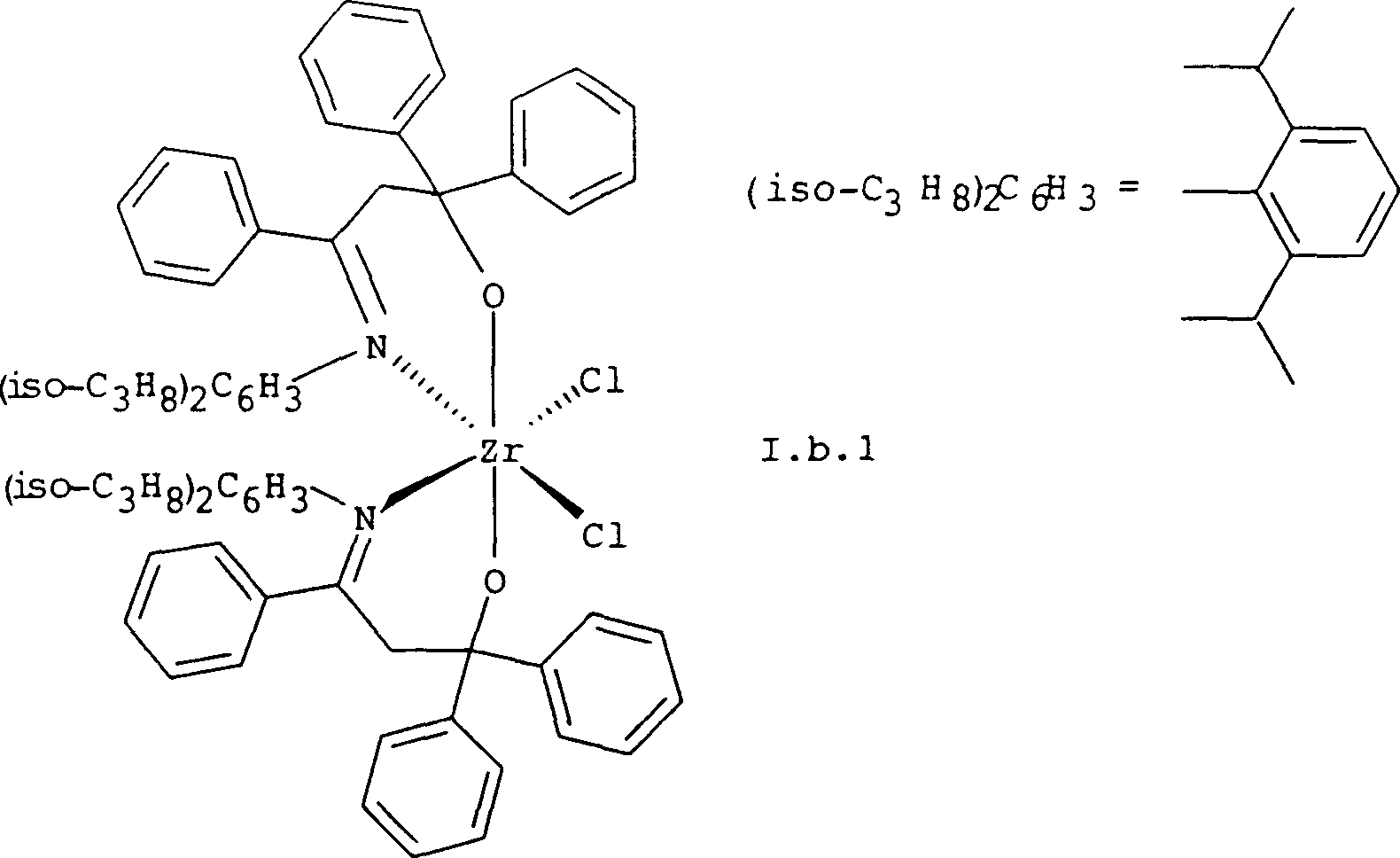
配合物I.b.1Complex I.b.1
产率:39%;经验式:C66H68Cl2N2O2Zr;颜色:橙色Yield: 39%; empirical formula: C 66 H 68 Cl 2 N 2 O 2 Zr; color: orange
1H NMR(d6-苯):1.11,1.29(12H,2×d,4×CH3,J=6.6 Hz),1.17,1.26(12H,2×d,4×CH3,J=7.4 Hz),1.80(4H,s,2×CH2),2.87,3.28(4H,2×sept,4×CH),6.71-8.02(36H,m,苯基)1H NMR (d 6 -benzene): 1.11, 1.29 (12H, 2×d, 4×CH 3 , J=6.6 Hz), 1.17, 1.26 (12H, 2×d, 4×CH 3 , J=7.4 Hz) , 1.80 (4H, s, 2×CH 2 ), 2.87, 3.28 (4H, 2×sept, 4×CH), 6.71-8.02 (36H, m, phenyl)
MS:(LH2 ++LH)-ZrCl2=923,7m/e,(LH2 ++LH-H2O)-ZrCl2=905,7m/e,L=配体MS: (LH 2 + +LH)-ZrCl 2 =923,7m/e, (LH 2 + +LH-H 2 O)-ZrCl 2 =905,7m/e, L=ligand
配合物I.a.1Complex I.a.1
通用说明:General instructions:
式Ia的各配合物基于式II配体使用1当量MCl4来合成。Each complex of formula Ia was synthesized based on the ligand of formula II using 1 equivalent of MCl4 .
产率:49%;经验式:C33H34Cl3NOZr;颜色:橙-棕色Yield: 49%; empirical formula: C 33 H 34 Cl 3 NOZr; color: orange-brown
1H NMR(d6-苯):1.10(3H,d,CH3,J=6.7 Hz),1.18(3H,d,CH3,J=7.1 Hz),1.21(3H,d,CH3,J=6.7 Hz),1.36(3H,d,CH3,J=6.4 Hz),1.85,2.10(2H,2×s,CH2,2个异构体),2.86,3.33(2H,2×sept,2×CH,2个异构体),6.57-8.08(18H,m,苯基)1H NMR (d 6 -benzene): 1.10 (3H, d, CH 3 , J = 6.7 Hz), 1.18 (3H, d, CH 3 , J = 7.1 Hz), 1.21 (3H, d, CH 3 , J = 7.1 Hz) 6.7 Hz), 1.36 (3H, d, CH 3 , J=6.4 Hz), 1.85, 2.10 (2H, 2×s, CH 2 , 2 isomers), 2.86, 3.33 (2H, 2×sept, 2 ×CH, 2 isomers), 6.57-8.08 (18H, m, phenyl)
配合物I.a.2Complex I.a.2

产率:67%;经验式:C33H32Cl3NOZr;颜色:黄色Yield: 67%; empirical formula: C 33 H 32 Cl 3 NOZr; color: yellow
1H NMR(d6-苯):0.90,1.12(6H,2×d,2×CH3,J=6.9 Hz),1.17,1.21(6H,2×d,2×CH3,J=7.1 Hz),1.85,2.10(2H,2×s,CH2,2个异构体,比例为1∶2),2.83,3.21(2H,2×sept,2×CH,2个异构体,比例为1∶2),6.68-8.28(16H,m,苯基)1H NMR (d 6 -benzene): 0.90, 1.12 (6H, 2×d, 2×CH 3 , J=6.9 Hz), 1.17, 1.21 (6H, 2×d, 2×CH 3 , J=7.1 Hz) , 1.85, 2.10 (2H, 2×s, CH 2 , 2 isomers, ratio 1:2), 2.83, 3.21 (2H, 2×sept, 2×CH, 2 isomers, ratio 1 : 2), 6.68-8.28 (16H, m, phenyl)
MS:(L+-H2O)=442.2m/e,L:配体MS: (L + -H 2 O) = 442.2m/e, L: Ligand
元素分析实测值(计算值):C 59.4(60.4);H 5.8(4.9);N 1.4(2.1)Elemental analysis measured value (calculated value): C 59.4 (60.4); H 5.8 (4.9); N 1.4 (2.1)
配合物I.a.3Complex I.a.3
产率:52%;经验式:C27H30Cl3NOZr;颜色:黄色Yield: 52%; empirical formula: C 27 H 30 Cl 3 NOZr; color: yellow
1H NMR(d6-苯):0.88-1.42(12H,4×d,4×CH3),1.80,2.10(2H,2×s,CH2,2个异构体),2.86-3.19(1H,m,CH-苯基),3.56(2H,CH2),6.81-8.02(13H,m,苯基)1H NMR (d 6 -benzene): 0.88-1.42 (12H, 4×d, 4×CH 3 ), 1.80, 2.10 (2H, 2×s, CH 2 , 2 isomers), 2.86-3.19 (1H , m, CH-phenyl), 3.56 (2H, CH 2 ), 6.81-8.02 (13H, m, phenyl)
MS:(L+-H2O)=368,3m/e,L:配体MS: (L + -H 2 O) = 368,3 m/e, L: Ligand
配合物I.a.4Complex I.a.4

产率:49%;经验式:C39H38Cl3NOZr;颜色:白黄色Yield: 49%; empirical formula: C 39 H 38 Cl 3 NOZr; color: white yellow
1H NMR(d6-苯):0.73-1.26(m),0.27(m),6.73-8.23(m)1H NMR (d 6 -benzene): 0.73-1.26(m), 0.27(m), 6.73-8.23(m)
配合物I.a.5Complex I.a.5
产率:50%;经验式:C25H21Cl3N2OZr;颜色:砖红色Yield: 50%; empirical formula: C 25 H 21 Cl 3 N 2 OZr; color: brick red
1H NMR(CD2Cl2):2.34,3.58(CH2,2个异构体),5.85(吡咯),6.19(吡咯),7.10-7.78(m,芳族)1H NMR (CD 2 Cl 2 ): 2.34, 3.58 (CH 2 , 2 isomers), 5.85 (pyrrole), 6.19 (pyrrole), 7.10-7.78 (m, aromatic)
MS:(L+-H2O)=349,2m/eMS: (L + -H 2 O) = 349,2m/e
元素分析实测值(计算值):C 54.6(53.3);H 4.6(3.8);N 4.1(5.0)Elemental analysis measured value (calculated value): C 54.6 (53.3); H 4.6 (3.8); N 4.1 (5.0)
配合物I.a.6Complex I.a.6
产率:82%;经验式:C27H22Cl3NOZr;颜色:黄色Yield: 82%; empirical formula: C 27 H 22 Cl 3 NOZr; color: yellow
1H NMR(CD2Cl2):2.29(CH2),6.70-8.03(m,苯基)1H NMR (CD 2 Cl 2 ): 2.29 (CH 2 ), 6.70-8.03 (m, phenyl)
MS:(L+-H2O)=360,2m/eMS: (L + -H 2 O) = 360,2m/e
配合物I.a.7Complex I.a.7
产率:63%;经验式:C29H26Cl3NOZr;颜色:黄色Yield: 63%; empirical formula: C 29 H 26 Cl 3 NOZr; color: yellow
1H NMR(CD2Cl2):2.08,2.23,2.39,6.41,6.99-8.14(m,苯基)1H NMR (CD 2 Cl 2 ): 2.08, 2.23, 2.39, 6.41, 6.99-8.14 (m, phenyl)
MS:(M+-ZrCl3)=406.3,(L+-H2O)=388.2m/eMS: (M + -ZrCl 3 ) = 406.3, (L + -H 2 O) = 388.2 m/e
配合物I.a.8Complex I.a.8

产率:71%;经验式:C33H26Cl3NOZr;颜色:黄色Yield: 71%; empirical formula: C 33 H 26 Cl 3 NOZr; color: yellow
1H NMR(CD2Cl2):3.67(2H,s,CH2),5.92-7.85(24H,m,苯基)1H NMR (CD 2 Cl 2 ): 3.67 (2H, s, CH 2 ), 5.92-7.85 (24H, m, phenyl)
MS:(L+-H2O)=463.25m/eMS: (L + -H 2 O) = 463.25m/e
配合物I.a.9Complex I.a.9

该配体通过Tilford,J.Am.Chem.Soc.(美国化学学会杂志)1954,76,2431和J.Am.Chem.Soc.1954,76,2436的方法合成。The ligand was synthesized by the method of Tilford, J.Am.Chem.Soc. (Journal of the American Chemical Society) 1954, 76, 2431 and J.Am.Chem.Soc.
产率:80%;经验式:C19H16Cl3NOZr;颜色:浅米色Yield: 80%; empirical formula: C 19 H 16 Cl 3 NOZr; color: light beige
1H NMR(CD2Cl2):2.33,6.73-7.59(m),9.18(d),9.40-9.46(m)1H NMR (CD 2 Cl 2 ): 2.33, 6.73-7.59(m), 9.18(d), 9.40-9.46(m)
配合物I.a.10Complex I.a.10
该配体通过Tilford,J.Am.Chem.Soc.1954,76,2431和J.Am.Chem.Soc.1954,76,2436的方法合成。The ligand was synthesized by the method of Tilford, J.Am.Chem.Soc.1954, 76, 2431 and J.Am.Chem.Soc.1954, 76, 2436.
产率:83%;经验式:C23H18Cl3NOZr;颜色:柠檬黄Yield: 83%; empirical formula: C 23 H 18 Cl 3 NOZr; color: lemon yellow
1H NMR(CD2Cl2):1.88(8H,s,4×CH2,2个配位的THF),3.79(10H,s,宽,4×CH2-O,2个配位的THF,CH2,配体),6.80-8.36(m,芳族)1H NMR (CD 2 Cl 2 ): 1.88 (8H, s, 4×CH 2 , 2 coordinated THF), 3.79 (10H, s, broad, 4×CH 2 -O, 2 coordinated THF, CH 2 , ligand), 6.80-8.36 (m, aromatic)
表2:式Ia配合物总览
配合物I.b.2:Complex I.b.2:
产率:51%;经验式:C66H64Cl2N2O2Zr;颜色:橙色Yield: 51%; empirical formula: C 66 H 64 Cl 2 N 2 O 2 Zr; color: orange
1H NMR(d6-苯):0.96,1.12(6H,2×d,2×CH3,J=6.8 Hz),0.99,1.20(6H,2×d,2×CH3),1.80(4H,s,2×CH2),2.87,3.20(4H,2×sept,4×CH),6.68-8.28(32H,m,苯基)1H NMR (d 6 -benzene): 0.96, 1.12 (6H, 2×d, 2×CH 3 , J=6.8 Hz), 0.99, 1.20 (6H, 2×d, 2×CH 3 ), 1.80 (4H, s, 2×CH 2 ), 2.87, 3.20 (4H, 2×sept, 4×CH), 6.68-8.28 (32H, m, phenyl)
MS:(L+-H2O)=441.2m/e,L:配体MS: (L + -H 2 O) = 441.2m/e, L: Ligand

配合物I.b.3Complex I.b.3
产率:67%;经验式:C54H60Cl2N2O2Zr;颜色:柠檬黄Yield: 67%; empirical formula: C 54 H 60 Cl 2 N 2 O 2 Zr; color: lemon yellow
1H NMR(d6-苯):1.19(d,CH3),1.23(d,CH3),3.19(sept,CH),6.79-8.11(m,苯基)1H NMR (d 6 -benzene): 1.19 (d, CH 3 ), 1.23 (d, CH 3 ), 3.19 (sept, CH), 6.79-8.11 (m, phenyl)
MS:(L+-H2O)=368.3m/e,L:配体MS: (L + -H 2 O) = 368.3m/e, L: Ligand
配合物I.b.4Complex I.b.4
产率86%;经验式:C38H32Cl2N2O2Zr;颜色:浅米色Yield 86%; empirical formula: C 38 H 32 Cl 2 N 2 O 2 Zr; color: light beige
1H NMR(CD2Cl2):2.36,6.71-7.38(m),8.54(m)。1H NMR (CD 2 Cl 2 ): 2.36, 6.71-7.38 (m), 8.54 (m).
配合物I.b.5Complex I.b.5
产率:48%;经验式:C46H36Cl2N2O2Zr;颜色:米色Yield: 48%; empirical formula: C 46 H 36 Cl 2 N 2 O 2 Zr; color: beige

1H NMR(CD2Cl2):1.81(4H,s,2×CH2,1个配位的THF),3.70(6H,s,2×CH2-O,1个配位的THF,CH2,配体),6.80-8.05(m,芳族)1H NMR (CD 2 Cl 2 ): 1.81 (4H, s, 2×CH 2 , 1 coordinated THF), 3.70 (6H, s, 2×CH 2 -O, 1 coordinated THF, CH 2 , ligand), 6.80-8.05 (m, aromatic)
配合物I.b.6Complex I.b.6
产率:71%;经验式:C46H36Cl2N2O2Ti;颜色:浅绿色Yield: 71%; empirical formula: C 46 H 36 Cl 2 N 2 O 2 Ti; color: light green
1H NMR(CD2Cl2):1.31(s),1.87(s,宽,THF),3.72(s,宽,THF),6.59-8.09(m,芳族)1H NMR (CD 2 Cl 2 ): 1.31(s), 1.87(s, broad, THF), 3.72(s, broad, THF), 6.59-8.09(m, aromatic)
配合物I.b.7Complex I.b.7
产率:53%;经验式:C46H36Cl2N2O2V;颜色:砖红色Yield: 53%; empirical formula: C 46 H 36 Cl 2 N 2 O 2 V; color: brick red
1H NMR(CD2Cl2):顺磁的,2.0(s,非常宽),7.5(s,非常宽)1H NMR (CD 2 Cl 2 ): Paramagnetic, 2.0(s, very broad), 7.5(s, very broad)
表3:式Ib配合物总览
3.聚合实验3. Polymerization experiment
3.1.在大气压力下的聚合3.1. Polymerization at atmospheric pressure
在呈惰性的Schlenk管中制备由20mg待研究配合物、1ml MAO的30重量%浓度甲苯溶液和50ml甲苯组成的溶液。除非另有说明,将该反应混合物在乙烯气氛和室温下搅拌90分钟。滤除沉淀的白色固体,用甲醇洗涤该固体并减压干燥。得到聚合物,为白色粉末。A solution consisting of 20 mg of the complex to be investigated, 1 ml of MAO in 30% strength by weight toluene and 50 ml of toluene was prepared in an inert Schlenk tube. The reaction mixture was stirred at room temperature for 90 minutes under an atmosphere of ethylene unless otherwise stated. The precipitated white solid was filtered off, washed with methanol and dried under reduced pressure. The polymer was obtained as a white powder.
3.2.在高压釜中的聚合3.2. Polymerization in an autoclave
将20mg待研究配合物、2ml MAO的30重量%浓度甲苯溶液和400ml甲苯置于呈惰性的1升钢制高压釜中。在70℃下,将该高压釜用乙烯加压至压力为40巴。通过引入额外的乙烯在90分钟的实验期间将该压力保持恒定。通过排气将反应停止并通过过滤将聚合物分离出来,随后用甲醇洗涤并减压干燥。20 mg of the complex to be investigated, 2 ml of a 30% strength by weight solution of MAO in toluene and 400 ml of toluene were placed in an inert 1-liter steel autoclave. The autoclave was pressurized with ethylene to a pressure of 40 bar at 70°C. This pressure was kept constant during the 90 minutes of the experiment by introducing additional ethylene. The reaction was stopped by venting and the polymer was isolated by filtration, washed with methanol and dried under reduced pressure.
3.3.乙烯/己烯的共聚合3.3. Copolymerization of ethylene/hexene
重复3.2.的程序,但在开始时将20ml 1-己烯与其它试剂一起置于高压釜中。Repeat the procedure of 3.2., but initially place 20 ml of 1-hexene in the autoclave along with the other reagents.
3.4.用氢气作为摩尔质量调节剂的聚合3.4. Polymerization with hydrogen as molar mass regulator
重复3.2.的程序,但在开始时将4升氢气(在STP下)引入高压釜中。The procedure of 3.2. was repeated, but initially 4 liters of hydrogen (at STP) were introduced into the autoclave.
结果总结于表4中。The results are summarized in Table 4.
表4:使用式I.a配合物得到的聚合结果
*聚合时间为120分钟 * Polymerization time is 120 minutes
表5:使用式I.b配合物的聚合结果
Claims (7)

Applications Claiming Priority (2)
| Application Number | Priority Date | Filing Date | Title |
|---|---|---|---|
| DE10107045A DE10107045A1 (en) | 2001-02-13 | 2001-02-13 | Process for the polymerization of olefins |
| DE10107045.4 | 2001-02-13 |
Publications (1)
| Publication Number | Publication Date |
|---|---|
| CN1491237A true CN1491237A (en) | 2004-04-21 |
Family
ID=7674142
Family Applications (1)
| Application Number | Title | Priority Date | Filing Date |
|---|---|---|---|
| CNA028047885A Pending CN1491237A (en) | 2001-02-13 | 2002-02-06 | Coordination compounds and their use in olefin polymerization |
Country Status (8)
| Country | Link |
|---|---|
| US (1) | US6946568B2 (en) |
| EP (1) | EP1368389B1 (en) |
| JP (1) | JP4125961B2 (en) |
| CN (1) | CN1491237A (en) |
| AT (1) | ATE338076T1 (en) |
| BR (1) | BR0207101A (en) |
| DE (2) | DE10107045A1 (en) |
| WO (1) | WO2002064644A1 (en) |
Families Citing this family (4)
| Publication number | Priority date | Publication date | Assignee | Title |
|---|---|---|---|---|
| DE102005014395A1 (en) | 2005-03-24 | 2006-09-28 | Basell Polyolefine Gmbh | Monocyclopentadienyl complex used in catalyst system for olefin polymerization, comprises component of specific formula having cyclopentadienyl ligands bearing bridged donor, i.e. bridged keto, thioketo, imino, and/or phosphino group |
| US7301040B2 (en) | 2005-08-18 | 2007-11-27 | Fina Technology, Inc. | Bidentate catalyst for olefin polymerization, methods of forming such and products therefrom |
| EP1900722A1 (en) | 2006-09-15 | 2008-03-19 | Total Petrochemicals Research Feluy | Fluorinated alkoxy-imino catalyst components |
| PL3237463T3 (en) * | 2014-12-23 | 2020-06-29 | Versalis S.P.A. | Oxo-nitrogenated vanadium complex, catalytic system comprising said oxo-nitrogenated vanadium complex and process for (co)polymerising conjugated dienes |
Family Cites Families (12)
| Publication number | Priority date | Publication date | Assignee | Title |
|---|---|---|---|---|
| EP0805826B1 (en) | 1995-01-24 | 2003-04-23 | E.I. Du Pont De Nemours And Company | Olefin polymers |
| DE19616523A1 (en) * | 1996-04-25 | 1997-11-06 | Basf Ag | Polymerization catalysts with beta-diketiminate ligands |
| IL129929A0 (en) | 1996-12-17 | 2000-02-29 | Du Pont | Polymerization of ethylene with specific iron or cobalt complexes novel pyridinebis (imines) and novel complexes of pyridinebis(imines) with iron and cobalt |
| TW420693B (en) * | 1997-04-25 | 2001-02-01 | Mitsui Chemicals Inc | Olefin polymerization catalysts, transition metal compounds, and <alpha>-olefin/conjugated diene copolymers |
| KR100368184B1 (en) * | 1998-12-11 | 2003-01-30 | 미쓰이 가가쿠 가부시키가이샤 | Olefin polymerization catalyst and process for olefin polymerization |
| JP2000230010A (en) * | 1999-02-12 | 2000-08-22 | Mitsui Chemicals Inc | Olefin polymerization catalyst and olefin polymerization method using same |
| JP2000351813A (en) * | 1999-04-09 | 2000-12-19 | Mitsui Chemicals Inc | Ethylene / α-olefin copolymer, method for producing the same and use thereof |
| JP2000313712A (en) * | 1999-04-28 | 2000-11-14 | Mitsui Chemicals Inc | Catalyst for polymerizing olefin and polymerization of olefin |
| DE10017663A1 (en) * | 2000-04-08 | 2001-10-11 | Basf Ag | Process for the preparation of a supported catalyst for the polymerization of olefins |
| DE50105207D1 (en) * | 2000-07-06 | 2005-03-03 | Basf Ag | METAL COMPOUNDS AND THEIR USE FOR THE POLYMERIZATION OF OLEFINES |
| DE10035654A1 (en) * | 2000-07-20 | 2002-01-31 | Basf Ag | Ligands, complexes and their use for the polymerization of olefins |
| DE10035700A1 (en) * | 2000-07-20 | 2002-01-31 | Basf Ag | Complex compounds and their use for the polymerization of olefins |
-
2001
- 2001-02-13 DE DE10107045A patent/DE10107045A1/en not_active Withdrawn
-
2002
- 2002-02-06 JP JP2002564972A patent/JP4125961B2/en not_active Expired - Fee Related
- 2002-02-06 AT AT02711834T patent/ATE338076T1/en not_active IP Right Cessation
- 2002-02-06 BR BR0207101-0A patent/BR0207101A/en not_active IP Right Cessation
- 2002-02-06 CN CNA028047885A patent/CN1491237A/en active Pending
- 2002-02-06 WO PCT/EP2002/001191 patent/WO2002064644A1/en not_active Ceased
- 2002-02-06 EP EP02711834A patent/EP1368389B1/en not_active Expired - Lifetime
- 2002-02-06 US US10/467,169 patent/US6946568B2/en not_active Expired - Fee Related
- 2002-02-06 DE DE50208000T patent/DE50208000D1/en not_active Expired - Lifetime
Also Published As
| Publication number | Publication date |
|---|---|
| WO2002064644A1 (en) | 2002-08-22 |
| DE10107045A1 (en) | 2002-08-14 |
| US6946568B2 (en) | 2005-09-20 |
| US20040077890A1 (en) | 2004-04-22 |
| EP1368389A1 (en) | 2003-12-10 |
| JP4125961B2 (en) | 2008-07-30 |
| DE50208000D1 (en) | 2006-10-12 |
| BR0207101A (en) | 2004-01-27 |
| ATE338076T1 (en) | 2006-09-15 |
| JP2004532818A (en) | 2004-10-28 |
| EP1368389B1 (en) | 2006-08-30 |
Similar Documents
| Publication | Publication Date | Title |
|---|---|---|
| CN100340568C (en) | metallocene halides | |
| CN1110467C (en) | Manufacture of alpha-olefins | |
| CN1208357C (en) | Olefin polymerization catalyst component and catalyst system and polymerization process using such catalyst system | |
| CN1246341C (en) | Polymerization catalysts | |
| CN1243519A (en) | Polymerization of olefins | |
| CN1240455A (en) | Ethylene Polymerization Using Iron or Cobalt Complexes, New Pyridine Bis(imines), and New Complexes of Pyridine Bis(imines) with Iron and Cobalt | |
| CN1347423A (en) | Catalyst contg. N-pyrrolyl substd. nitrogen donors | |
| CN1265663A (en) | Compounds containing boron and aluminium | |
| CN1108666A (en) | Process for preparing polyolefins | |
| CN1218970C (en) | New olefine polymerization catalyst | |
| CN1832970A (en) | Catalyst Systems for Olefin Polymerization | |
| CN1256351C (en) | Catalyst for polymerization and copolymerization of olefine and its synthesis and use | |
| CN1468205A (en) | Process for co-oligomerization of ethylene and alpha-olefins | |
| CN1890272A (en) | Organometallic transition metal compound, biscyclopentadienyl ligand system, catalyst system and preparation of polyolefins | |
| CN1146583C (en) | Supported bidentate and tridentate catalyst compositions and olefin polymerization using the same | |
| CN1835978A (en) | Catalytic system for the production of conjugated diene/mono-olefin copolymers and copolymers thereof | |
| CN1444593A (en) | Metallocenes with bridged 4-phenyl-indenyl-ligand for olefin polymerization | |
| CN1432027A (en) | Polymerization of olefins | |
| CN1612881A (en) | Polymerization catalyst activator and its use in a polymerization process | |
| CN1293676A (en) | Metallocene compounds as catalyst components for olefin polymerization | |
| CN1128539A (en) | catalyst composition | |
| CN1518556A (en) | Non-metallocenes, their preparation methods and their use in olefin polymerization | |
| CN1966535A (en) | Use of non-covalently interacting polyolefin catalyst components | |
| CN1214047C (en) | Salt-like compounds, their preparation and their use in the preparation of polyolefin catalyst systems | |
| CN1220694C (en) | Process for the selective preparation of racemic metallocene complexes |
Legal Events
| Date | Code | Title | Description |
|---|---|---|---|
| C06 | Publication | ||
| PB01 | Publication | ||
| C10 | Entry into substantive examination | ||
| SE01 | Entry into force of request for substantive examination | ||
| AD01 | Patent right deemed abandoned | ||
| C20 | Patent right or utility model deemed to be abandoned or is abandoned |