CN1518445A - Treatment of Sexual Dysfunction - Google Patents
Treatment of Sexual Dysfunction Download PDFInfo
- Publication number
- CN1518445A CN1518445A CNA018219519A CN01821951A CN1518445A CN 1518445 A CN1518445 A CN 1518445A CN A018219519 A CNA018219519 A CN A018219519A CN 01821951 A CN01821951 A CN 01821951A CN 1518445 A CN1518445 A CN 1518445A
- Authority
- CN
- China
- Prior art keywords
- methyl
- indol
- cyclohexylmethyl
- pyridin
- propionamide
- Prior art date
- Legal status (The legal status is an assumption and is not a legal conclusion. Google has not performed a legal analysis and makes no representation as to the accuracy of the status listed.)
- Pending
Links
Images





Classifications
-
- A—HUMAN NECESSITIES
- A61—MEDICAL OR VETERINARY SCIENCE; HYGIENE
- A61K—PREPARATIONS FOR MEDICAL, DENTAL OR TOILETRY PURPOSES
- A61K45/00—Medicinal preparations containing active ingredients not provided for in groups A61K31/00 - A61K41/00
- A61K45/06—Mixtures of active ingredients without chemical characterisation, e.g. antiphlogistics and cardiaca
-
- A—HUMAN NECESSITIES
- A61—MEDICAL OR VETERINARY SCIENCE; HYGIENE
- A61K—PREPARATIONS FOR MEDICAL, DENTAL OR TOILETRY PURPOSES
- A61K31/00—Medicinal preparations containing organic active ingredients
- A61K31/16—Amides, e.g. hydroxamic acids
- A61K31/165—Amides, e.g. hydroxamic acids having aromatic rings, e.g. colchicine, atenolol, progabide
-
- A—HUMAN NECESSITIES
- A61—MEDICAL OR VETERINARY SCIENCE; HYGIENE
- A61K—PREPARATIONS FOR MEDICAL, DENTAL OR TOILETRY PURPOSES
- A61K31/00—Medicinal preparations containing organic active ingredients
- A61K31/16—Amides, e.g. hydroxamic acids
- A61K31/17—Amides, e.g. hydroxamic acids having the group >N—C(O)—N< or >N—C(S)—N<, e.g. urea, thiourea, carmustine
-
- A—HUMAN NECESSITIES
- A61—MEDICAL OR VETERINARY SCIENCE; HYGIENE
- A61K—PREPARATIONS FOR MEDICAL, DENTAL OR TOILETRY PURPOSES
- A61K31/00—Medicinal preparations containing organic active ingredients
- A61K31/16—Amides, e.g. hydroxamic acids
- A61K31/18—Sulfonamides
-
- A—HUMAN NECESSITIES
- A61—MEDICAL OR VETERINARY SCIENCE; HYGIENE
- A61K—PREPARATIONS FOR MEDICAL, DENTAL OR TOILETRY PURPOSES
- A61K31/00—Medicinal preparations containing organic active ingredients
- A61K31/185—Acids; Anhydrides, halides or salts thereof, e.g. sulfur acids, imidic, hydrazonic or hydroximic acids
- A61K31/19—Carboxylic acids, e.g. valproic acid
- A61K31/195—Carboxylic acids, e.g. valproic acid having an amino group
- A61K31/196—Carboxylic acids, e.g. valproic acid having an amino group the amino group being directly attached to a ring, e.g. anthranilic acid, mefenamic acid, diclofenac, chlorambucil
-
- A—HUMAN NECESSITIES
- A61—MEDICAL OR VETERINARY SCIENCE; HYGIENE
- A61K—PREPARATIONS FOR MEDICAL, DENTAL OR TOILETRY PURPOSES
- A61K31/00—Medicinal preparations containing organic active ingredients
- A61K31/33—Heterocyclic compounds
- A61K31/395—Heterocyclic compounds having nitrogen as a ring hetero atom, e.g. guanethidine or rifamycins
-
- A—HUMAN NECESSITIES
- A61—MEDICAL OR VETERINARY SCIENCE; HYGIENE
- A61K—PREPARATIONS FOR MEDICAL, DENTAL OR TOILETRY PURPOSES
- A61K31/00—Medicinal preparations containing organic active ingredients
- A61K31/33—Heterocyclic compounds
- A61K31/395—Heterocyclic compounds having nitrogen as a ring hetero atom, e.g. guanethidine or rifamycins
- A61K31/40—Heterocyclic compounds having nitrogen as a ring hetero atom, e.g. guanethidine or rifamycins having five-membered rings with one nitrogen as the only ring hetero atom, e.g. sulpiride, succinimide, tolmetin, buflomedil
- A61K31/4015—Heterocyclic compounds having nitrogen as a ring hetero atom, e.g. guanethidine or rifamycins having five-membered rings with one nitrogen as the only ring hetero atom, e.g. sulpiride, succinimide, tolmetin, buflomedil having oxo groups directly attached to the heterocyclic ring, e.g. piracetam, ethosuximide
-
- A—HUMAN NECESSITIES
- A61—MEDICAL OR VETERINARY SCIENCE; HYGIENE
- A61K—PREPARATIONS FOR MEDICAL, DENTAL OR TOILETRY PURPOSES
- A61K31/00—Medicinal preparations containing organic active ingredients
- A61K31/33—Heterocyclic compounds
- A61K31/395—Heterocyclic compounds having nitrogen as a ring hetero atom, e.g. guanethidine or rifamycins
- A61K31/41—Heterocyclic compounds having nitrogen as a ring hetero atom, e.g. guanethidine or rifamycins having five-membered rings with two or more ring hetero atoms, at least one of which being nitrogen, e.g. tetrazole
- A61K31/433—Thidiazoles
-
- A—HUMAN NECESSITIES
- A61—MEDICAL OR VETERINARY SCIENCE; HYGIENE
- A61K—PREPARATIONS FOR MEDICAL, DENTAL OR TOILETRY PURPOSES
- A61K31/00—Medicinal preparations containing organic active ingredients
- A61K31/33—Heterocyclic compounds
- A61K31/395—Heterocyclic compounds having nitrogen as a ring hetero atom, e.g. guanethidine or rifamycins
- A61K31/435—Heterocyclic compounds having nitrogen as a ring hetero atom, e.g. guanethidine or rifamycins having six-membered rings with one nitrogen as the only ring hetero atom
- A61K31/44—Non condensed pyridines; Hydrogenated derivatives thereof
- A61K31/4412—Non condensed pyridines; Hydrogenated derivatives thereof having oxo groups directly attached to the heterocyclic ring
-
- A—HUMAN NECESSITIES
- A61—MEDICAL OR VETERINARY SCIENCE; HYGIENE
- A61K—PREPARATIONS FOR MEDICAL, DENTAL OR TOILETRY PURPOSES
- A61K31/00—Medicinal preparations containing organic active ingredients
- A61K31/33—Heterocyclic compounds
- A61K31/395—Heterocyclic compounds having nitrogen as a ring hetero atom, e.g. guanethidine or rifamycins
- A61K31/435—Heterocyclic compounds having nitrogen as a ring hetero atom, e.g. guanethidine or rifamycins having six-membered rings with one nitrogen as the only ring hetero atom
- A61K31/44—Non condensed pyridines; Hydrogenated derivatives thereof
- A61K31/445—Non condensed piperidines, e.g. piperocaine
- A61K31/4523—Non condensed piperidines, e.g. piperocaine containing further heterocyclic ring systems
- A61K31/454—Non condensed piperidines, e.g. piperocaine containing further heterocyclic ring systems containing a five-membered ring with nitrogen as a ring hetero atom, e.g. pimozide, domperidone
-
- A—HUMAN NECESSITIES
- A61—MEDICAL OR VETERINARY SCIENCE; HYGIENE
- A61P—SPECIFIC THERAPEUTIC ACTIVITY OF CHEMICAL COMPOUNDS OR MEDICINAL PREPARATIONS
- A61P15/00—Drugs for genital or sexual disorders; Contraceptives
- A61P15/10—Drugs for genital or sexual disorders; Contraceptives for impotence
-
- G—PHYSICS
- G01—MEASURING; TESTING
- G01N—INVESTIGATING OR ANALYSING MATERIALS BY DETERMINING THEIR CHEMICAL OR PHYSICAL PROPERTIES
- G01N2800/00—Detection or diagnosis of diseases
- G01N2800/34—Genitourinary disorders
- G01N2800/344—Disorders of the penis and the scrotum and erectile dysfuncrion
Landscapes
- Health & Medical Sciences (AREA)
- Pharmacology & Pharmacy (AREA)
- Veterinary Medicine (AREA)
- Public Health (AREA)
- General Health & Medical Sciences (AREA)
- Chemical & Material Sciences (AREA)
- Animal Behavior & Ethology (AREA)
- Life Sciences & Earth Sciences (AREA)
- Medicinal Chemistry (AREA)
- Epidemiology (AREA)
- Reproductive Health (AREA)
- Organic Chemistry (AREA)
- Nuclear Medicine, Radiotherapy & Molecular Imaging (AREA)
- General Chemical & Material Sciences (AREA)
- Chemical Kinetics & Catalysis (AREA)
- Endocrinology (AREA)
- Bioinformatics & Cheminformatics (AREA)
- Engineering & Computer Science (AREA)
- Gynecology & Obstetrics (AREA)
- Pharmaceuticals Containing Other Organic And Inorganic Compounds (AREA)
- Plural Heterocyclic Compounds (AREA)
- Indole Compounds (AREA)
- Acyclic And Carbocyclic Compounds In Medicinal Compositions (AREA)
Abstract
Bombesin receptor antagonists have been found to be useful in the treatment of sexual dysfunction in both males and females. They may be selective BB1 antagonists or mixed BB1/BB2 antagonists. Combinations are disclosed of bombesin receptor antagonists with a range of other active compounds, for example PDE5 inhibitors, NEP inhibitors and lasofoxifene.
Description
Technical field
The present invention relates to the handicapped method of therapeutic and relate to the pharmaceutical preparation that is used for the treatment of sexual dysfunction.
Background technology
Masculinity and femininity all may suffer from sexual dysfunction.Sexual dysfunction commonplace in masses (seeing O ' Donohue, 1997).This disease may relate to the acceptance behavior (property susceptibility (receptivity)) of seeking sexual behaviour (property proprioceptive sensibility (proceptivity)) and/or following libido to wake up.The property problem more general in the population that receives medicine, particularly antidepressants and antihypertensive.Needs for the pharmacotherapy of sexual dysfunction increase day by day, yet it is very little to be engaged in the research effort of exploring the handicapped medicine of therapeutic.
Sexual dysfunction comprises organic and psychogenic erection disturbance (Benet, 1995) and the sexual activity disease that goes down, and libido is waken obstacle up, and ahedonia and property pain disease (Berman, 1999, Urology).
In the male, sexual impotence can be defined as the erection or the ejaculation that can not realize penis.It is said that the sickness rate of sexual impotence in male's population is 2~7%, be increased to 50 along with the increase at age how old, and between 55 to 80 years old, reach 18~80%.For example only in the U.S., 1,000 ten thousand male that suffer from sexual impotence are just arranged according to estimates, and most of people's problem is organic rather than psychogenic.Though provided many different medicines of inducing erection, they only directly by being only effectively in the urethra for example or after (i.c.) injects penis in the spongy body, and ratify the dysfunction that is used to erect as yet.US-A-5576290 discloses and it is said the peptide that can induce erection, yet they undoubtedly are by subcutaneous, for example by drug administration by injection, and if excessive administration, they will produce the discomfort of excessive erectile response and stomach.By unexpectedly finding cGMP PDE inhibitor, for example pyrazolo [4,3-d] pyrimidin-7-ones can be treated erection disturbance, and impotence treatment has obtained revolutionary change, and can oral administration, thereby has eliminated the shortcoming relevant with the i.c. administration.One of this chemical compound of making at present is sldenafil (viagra).
30~50% American Women complaint sexual dysfunction.Aging, the decline of climacteric and estrogen cyclical level have increased the sickness rate of property disease significantly.People's such as Berman J.R. nearest publication (Int.J.Impot.Res., 1999,11:S31-38) in, physiology and the subjective factors of estimating women's reaction in clinical setting described and determine the age and the estrogen state to the method for its effect.Low or lack libido/hope and constitute modal problem (Laumann etc., 1999 JAMA 281:537-544) in the female population, however available without any therapy except psychotherapy or experimental technique.At another publication (Bonney R.C etc., Scrip ' s Complete Guide to Women ' s Healthcare, PJBPublications Ltd, London, 2000) in, the reason and the Therapeutic Method of female sexual disorder have been discussed, have been comprised and use the simulation estrogen action and reported desogestrel tibolone (Livial with gentle androgen character; And the use of testosterone Organon).
Up to now, the Ministry of Public Health of the Britain and the U.S. is not permitted the medicine of any treatment female sexual disorder, therefore, at female sexual disorder, particularly has the pharmaceutical requirements that is not met in the treatment of libido problem.
Summary of the invention
The present invention is based on the understanding of the material of bombesin receptor antagonist action, described bombesin receptor antagonist can be used for treating masculinity and femininity patient's sexual dysfunction, comprises its behavial factor.In other words, they can be organic and psychogenic erection disturbance and the sexual activity disease that goes down, and libido is waken obstacle up, and ahedonia and property pain disease provide treatment.
Therefore, the invention provides the handicapped method of therapeutic, comprise that Magainin (BB) receptor antagonist with effective dose delivers medicine to the patient who suffers from sexual dysfunction and needs treatment.
The present invention also provides the purposes of bombesin receptor antagonist in the medicine of preparation prevention or treatment male sexual disorder or female sexual disorder.
In addition, but chemical compound lot of the present invention have concurrently in conjunction with the character of bombesin receptor and the character of oral administration effective dose.
The Ki of the anti-bombesin receptor that the Magainin antagonist is had is preferably less than 1000nM, is more preferably less than 500nM, is more preferably less than 100nM, is more preferably less than 50nM, most preferably less than 10nM.Preferred Magainin antagonist and other bombesin receptor hypotype compare BB
1Be that optionally (preferred selectivity is greater than 10, and more preferably selectivity is greater than 30, and most preferably selectivity is greater than 100, and it can be at the external anti-BB that passes through separately
1And BB
2The ratio of the IC50 of receptor or Ki value is measured), and its anti-BB
1The Ki value of receptor preferably less than 500nM, is more preferably less than 100nM less than 1000nM, is more preferably less than 50nM, most preferably less than 10nm.Chemical compound with above-mentioned effect can be differentiated by following in-vitro screening method.
Therefore, the invention provides the method for the male sexual disorder (particularly being not only the dysfunction that antidepressants cause) that medicine causes, comprise Magainin BB effective dose
1Antagonist or blended BB
1/ BB
2Antagonist delivers medicine to the male who suffers from sexual dysfunction.
The present invention also provides the method for the female sexual disorder (particularly being not only the sexual dysfunction that antidepressants cause) that medicine causes, comprises the Magainin BB with effective dose
1Antagonist or blended BB
1/ BB
2Antagonist delivers medicine to the women who suffers from sexual dysfunction.
The present invention also provides the method for treatment male erectile dysfunction, comprises the Magainin BB with effective dose
1Antagonist or blended BB
1/ BB
2Antagonist delivers medicine to the male who suffers from erection disturbance.
The method that the present invention also provides the treatment sexual activity that female patient suffers to go down disease comprises the Magainin BB with effective dose
1Antagonist or blended BB
1/ BB
2Antagonist delivers medicine to this female patient.
The present invention also provides the treatment libido that female patient suffers to wake the method for obstacle and/or orgasm obstacle up, comprises the Magainin BB with effective dose
1Antagonist or blended BB
1/ BB
2Antagonist delivers medicine to this female patient.
In addition, the present invention includes the compositions of bombesin receptor antagonist (it can have one of above-mentioned preferred effect scope) and following one or more auxiliary activity agent, be used for the treatment of male sexual disorder as herein described (particularly male erectile dysfunction) and female sexual disorder (particularly female libido wakes obstacle or female libido disease up).Said composition is the sexual dysfunction of organic, nerve and/or psychological origin, and the sexual activity disease that goes down, and libido is waken obstacle up, and orgasm obstacle and property pain disease provide treatment.
Thereby, the present invention further provides according to bombesin receptor antagonist of the present invention and one or more and be selected from following (1) to the pharmaceutical composition of the material of (34) (be used for simultaneously, separately or administration successively):
(1) natural or synthetic prostaglandin or its ester;
(2) alpha-2-adrenoceptor antagonists chemical compound also is referred to as alpha-2-adrenoceptor antagonists or alpha-receptor antagonist or alpha block agent;
(3) NO-donor (NO-agonist) chemical compound;
(4) potassium channel openers or regulator;
(5) dopamine medicament;
(6) vasodilation;
(7) coagulation dioxane A2 agonist;
(8) CNS activating agent;
(9) peptide;
(10) regulate the chemical compound of urging the natriuretic factor effect;
(11) vasoconstriction hormone receptor antagonists such as Losartan;
(12) substrate of NO-synthase;
(13) calcium channel blocker;
(14) anticholesteremic agent;
(15) antiplatelet and anti-thrombosis drug;
(16) insulin sensitizer and hypoglycemia medicine;
(17) L-DOPA or carbidopa;
(18) acetylcholinesteraseinhibitors inhibitors;
(19) anti-inflammatory agent of steroid or on-steroidal;
(20) estrogenic agents and/or estrogen agonist and/or estrogen antagonist, and pharmaceutically acceptable salt;
(21) PDE inhibitor;
(22) NPY (neuropeptide tyrosine) inhibitor;
(23) nep inhibitor;
(24) vasoactive Erepsin (VIP), VIP analogies, VIP analog, VIP receptor stimulating agent or VIP analog or VIP fragment, the perhaps combination of alpha-2-adrenoceptor antagonists and VIP;
(25) casting skin matter hormone receptor agonists or regulator or casting skin matter hormone reinforcing agent;
(26) 5-hydroxytryptamine receptor agonist, antagonist or regulator;
(27) testosterone substituting agent, testosterone, dihydrotestosterone or testosterone implant;
(28) estrogen, estrogen and medroxyprogesterone or medroxyprogesterone acetas (MPA) (being a kind of compositions), perhaps estrogen and the agent of methyltestosterone hormone replacement therapy;
(29) norepinephrine, dopamine and/or 5-hydroxy tryptamine transmit the regulator of agent;
(30) purinergic receptor stimulating agent and/or regulator;
(31) neurokinin (NK) receptor antagonist;
(32) class Opium thing receptor stimulating agent, antagonist or regulator;
(33) agonist of oxytocin/vasopressin receptor or regulator; And
(34) regulator of Cannabined receptor.
Particularly, the present invention includes pharmaceutical composition or unit dosage form, it comprises the bombesin receptor antagonist of effective dose and any material that is selected from above-mentioned (1) to (34) of effective dose.
In said method, combinations thereof, compositions or dosage form, the anti-BB of described antagonist
1The Ki value less than 1000nM, preferably less than 500nM, be more preferably less than 100nM, be more preferably less than 50nM, most preferably less than 10nM, and/or to BB
1Other bombesin receptor hypotype of selectivity ratios big 10 times, more preferably big 30 times, most preferably big 100 times, it can be at external anti-BB by separately
1And BB
2The ratio of the IC50 of receptor or Ki value is measured.
Brief Description Of Drawings
Fig. 1: (S) 3-(1H-indol-3-yl)-N-[1-(5-methoxyl group-pyridine-2-yl)-cyclohexyl-methyl]-2-methyl-2-[3-(4-nitro-phenyl)-urea groups]-propionic acid amide. (chemical compound (1)) is to the influence of female rats proprioceptive sensibility.
Fig. 2: chemical compound (1) is to the influence of female rats susceptibility.
Fig. 3: repeat administration chemical compound (1) is to the influence of female rats proprioceptive sensibility.
Fig. 4: Intraventricular is given the influence of drug compound (1) to the female rats proprioceptive sensibility.
Fig. 5: NMB to the inhibitory action of female rats proprioceptive sensibility and chemical compound (1) to this inhibiting antagonism.
Fig. 6: show whether chemical compound (1) is the result of study that mediates by Progesterone to the influence of female sexual behaviour.
Fig. 7: show whether chemical compound (1) is the result of study that mediates by estradiol to the influence of female sexual behaviour.
Fig. 8: show whether chemical compound (1) is the result of study that mediates by prolactin antagonist to the influence of female sexual behaviour.
Fig. 9: show whether chemical compound (1) is the result of study that mediates by LH to the influence of female sexual behaviour.
Figure 10: show whether chemical compound (1) is the result of study that mediates by FSH to the influence of female sexual behaviour.
Figure 11: chemical compound (1) is to the normal male rat sexual behaviour influence of (mating reaction time).
Figure 12: chemical compound (1) is to the normal male rat sexual behaviour influence of (insertion reaction time).
Figure 13: chemical compound (1) is to the influence of normal male rat sexual behaviour (number of times of copulation+insertion).
Figure 14: chemical compound (1) is to the normal male rat sexual behaviour influence in (ejaculation response time).
Figure 15: chemical compound (1) is to the influence of normal male rat sexual behaviour (refractory stage).
Figure 16: chemical compound (1) is to the influence of the sexual behaviour (mating reaction time) of the male rat of suffering from sexual dysfunction.
Figure 17: chemical compound (1) is to the influence of the sexual behaviour (ejaculation response time) of the male rat of suffering from sexual dysfunction.
Figure 18: chemical compound (1) is to the influence of the sexual behaviour (the animal % of ejaculation) of the male rat of suffering from sexual dysfunction.
(S)-3-among Figure 19: the PEG 200 (1H-indol-3-yl)-N-[1-(5-methoxyl group-pyridine-2-yl)-cyclohexyl methyl]-2-methyl-2-[4-(4-nitro-phenyl)-oxazoles-2-base is amino]-propionic acid amide. (chemical compound (2)) is to the influence of female rats proprioceptive sensibility.
Figure 20: the chemical compound in the methylcellulose (2) is to the influence of female rats proprioceptive sensibility.
Chemical compound among Figure 21: the PEG 200 (2) is to the influence of female rats susceptibility.
Figure 22: chemical compound
1Anesthetized rabbit model based and pelvic nerve that female libido is waken up stimulate the influence that increases.
Figure 23: (2S)-N-{[1-(4-aminophenyl) cyclohexyl] methyl }-3-(1H-indol-3-yl)-2-methyl-2-{[(4-Nitrobenzol amido) carbonyl] amino } propionic acid amide. (chemical compound
3) anesthetized rabbit model based and pelvic nerve that female libido is waken up stimulate the influence that increases.
Figure 24: chemical compound
1Influence to the penis sponge internal pressure power of sentient male rat.
Figure 25: chemical compound
3Influence to the penis sponge internal pressure power of the male rat of sentient erection.
Figure 26: independent chemical compound
3And the increase that the anesthetized rabbit model based of erection and pelvic nerve is stimulated with phosphodiesterase 5 type inhibitor and the influence of penis sponge internal pressure power.
The explanation of preferred embodiment
Suitable patient
As previously mentioned, the invention provides combination, compositions and the method for treatment male sexual disorder or female sexual disorder.The inventor thinks, has common mechanism on the pathology of the psychological sexual dysfunction of men and women.
Male sexual disorder comprises male erectile dysfunction (MED).(embodiment 170 at the rat model of conscious erection, Figure 24 and 25) (embodiment 171 to reach pelvic nerve stimulation model in, Figure 26), adopted telemetry to confirm, the patient who suffers from slight or moderate MED should benefit from the Magainin antagonist for treating, the patient who suffers from serious MED also can respond the ability of Magainin antagonist, makes intracavernous pressure power be returned to normal level.Yet early stage research points out, suffers from the response speed bigger (see embodiment 171 and Figure 26) of the patient of slight, moderate and serious MED to Magainin antagonist/PDE5 inhibitor combination.Slightly, moderate and serious MED be the known term of those skilled in the art, its guide can be referring to The Journal ofUrology, vol 151,54-61 (Jan 1994).
Our research points out that following male sexual disorder/MED patient colony should benefit from Magainin antagonist and/or Magainin antagonist and phosphate 5 type inhibitor (PDE5i) or other combined therapy as herein described.These patient colonies are described in greater detail in Clinical Andrologyvol 23, no.4, p773-782, and in the chapter 3 (Mosby-Wolfe publication) of the book " ErectileDysfunction-Current Investigation and Management " that I.Eardley and K.Sethia showed, and be: psychogenic, incretion, neuropathic, hypersensitive, drug-induced sexual dysfunction and with cavernous body of penis factor, the especially relevant sexual dysfunction of veins reason.The present invention can be applicable in the following grouping population of suffering from sexual dysfunction/MED patient: youngster, wake decline above middle age comprising with old and feeble relevant property up.More specifically, the present invention can be applicable to suffer among the patient of male sexual disorder such as MED, and this sexual dysfunction results from:
(i) for example cardiovascular or atheromatosis of (vasculogenic) etiology of (the Arteriogenic)/vascular of arterialness, hypercholesterolemia, medicated cigarette sootiness, diabetes, hypertension, radiation and perineum wound, the traumatic injury of Iliohypogastric pudendum system.
(ii) neuropathic etiology such as spinal cord injury or central nervous system disease comprise multiple sclerosis, diabetes, Parkinsonism, cerebrovascular accident, peripheral neuropathy, the operation of wound or basic pelvis.
(iii) hormone/dysfunction of endocrine etiology such as hypothalamus/hypophysis/gonadal axis, the dysfunction of pancreas, the castrating of surgery or internal medicine, hypoandrogenism, high level circulation for example high prolactin antagonist disease, hyperthyroidism and the hypothyroidism of prolactin antagonist.
(iv) psychogenic etiology such as depression, anancastic unusual, anxiety, emotion and concern problem, the behavior worry, being discord of marriage, the dysfunction sexual stance, genophobia disease, religion is forbidden manufacture or traumatic experience.
(v) drug-induced sexual dysfunction results from treatment (SSRis) and other anti-depressant therapy (tricyclic antidepressants medicine and main tranquilizer) that adopts the selective serotonin reuptake inhibitor, antihypertensive therapy, and sympatholytic product.
Drug-induced male sexual dysfunction comprises that drug treating/treatment causes ejaculation delay/orgasm to postpone, and libido descends and/or erection disturbance.Magainin antagonist of the present invention (BB especially
1Antagonist) can extensive wilful ejaculation/orgasm, libido and erection function are to normal physiology " level ".This can obtain the support of experiment described in following embodiment 8 and Figure 16~18.
If erection disturbance is not drug-induced, Magainin antagonist (BB especially
1Antagonist) also can be used for the treatment of erection disturbance, by strengthening the normal endogenous erection mechanism of (in the normality stimulating course) male and in the sexual stimulus process, recovering erection function to normal level.Thereby, embodiment 170 hereinafter and 171 and Figure 24,25 and 26 illustrate, (the BB especially of Magainin antagonist in animal model
1Antagonist) or Magainin antagonist and phosphodiesterase 5 type inhibitor strengthen erection mechanism, by strengthening intracavernous pressure power and strengthening the effect that pelvic nerve stimulates inductive intracavernous pressure power to increase.
Early stage research also shows, is not under drug-induced (for example psychogenic) situation in the libido dysfunction, and the present invention helps extensive wilful male's libido/hope to normal level.
The psychological factor of male sexual disorder has been undertaken classifying (seeing SachsB.D. by NK of international sexual impotence research association (TheIntemational Society for Impotence Research), 2000), be divided into plain edition, showing as common reactionless or primary deficiency libido wakes up, and the property relevant with aging wake ability drop up, shows as general and suppress or the intimate chronic disease of property.
Chemical compound of the present invention can be used for treating male sexual disorder, particularly drug-induced male sexual disorder and with the reactionless relevant psychological male sexual disorder of general and with aging relevant property wake ability drop up.
Female sexual disorder can be divided into four types (Scrip ' s Complete Guide to Women ' sHealthcare, p.194-205,2000), and it comprises:
The sexual activity disease that goes down is characterized in that the shortage thought/illusion of persistent or recurrent, and sexual activity is lacked susceptibility, causes individual's misery.
Libido is waken obstacle up, it is characterized in that lasting or enough property excitements can not be realized or keep in recurrent ground, causes individual misery.Normal libido arousal reaction comprise a large amount of can be during the property excitement observed physiological reaction.These variations cause genital blood flow to increase as vagina, labia and clitoris hyperemia.Hyperemia makes the vaginal lubrication increase by the blood plasma exudate, makes the vagina compliance increase (loosening of vagina smooth muscle), and is that vagina and clitoris sensitivity increase.It is extremely universality disease that female libido wakes obstacle (FSAD) up, up to before 40% the menopause, between menopause and postmenopausal women ill (± HRT).The main consequence of FSAD is congested decline of genitals or swelling, itself shows to lack vaginal lubrication and lack happy genitals sensation.Second consequence is that libido reduces dyspareunia and inaccessible orgasm.The modal reason of FSAD is that the genital blood flow that reduces causes congested (Park, 1997 of reducing of vagina, labia and clitoris; Goldstein, 1998; Berman, 1999, Werbin, 1999).
The orgasm disease is characterized in that enough sexual stimuluses or wakes up being difficult to or postponing acquired climax lastingly or repeatedly afterwards, causes individual's misery.
The property pain disease; it is characterized in that dyspareunia (showing as the frequent or persistent genitals pain relevant) with sexual intercourse; vulvismus (shows as outer 1/3rd muscle spasm of frequent or persistent unconscious vagina; the permeability that this influences vagina causes individual's misery) and other pain disease (showing as the frequent or persistent genitals pain that the sexual stimulus of non-sexual intercourse causes).
Chemical compound of the present invention can be used for treating female sexual disorder (FSD), this comprises and the sexual activity disease that goes down, libido is waken obstacle up, and orgasm obstacle or ahedonia or property pain disease are before relevant menopause, between menopause and the female sexual disorder after menopause.
Early stage research points out that following female sexual disorder (FSD) patient colony can benefit from Magainin antagonist for treating or Magainin antagonist and PDE5i (or other combination as herein described) treatment.(Urology, 1999) such as Berman are seen in the more detailed description of these patient colonies.The present invention can be applicable in the following FSD of suffering from patient's the grouping population: youngster, (sexual dysfunction relevant) above middle age with aging, carry out or do not carry out menopause of hormone replacement therapy before, between menopause and the women after menopause.More specifically, the present invention can be applicable among the patient of the FSD that underlying cause causes:
(i) for example cardiovascular or atheromatosis of (vasculogenic) etiology of (the Arteriogenic)/vascular of arterialness, hypercholesterolemia, medicated cigarette sootiness, diabetes, hypertension, radiation and perineum wound, the traumatic injury of Iliohypogastric pudendum system.
(ii) neuropathic etiology such as spinal cord injury or central nervous system disease comprise multiple sclerosis, diabetes, Parkinsonism, cerebrovascular accident, peripheral neuropathy, the operation of wound or basic pelvis.
The (iii) dysfunction of hormone/endocrine etiology such as hypothalamus/hypophysis/gonadal axis, the perhaps dysfunction of ovary, the dysfunction of pancreas, surgery castrating or internal medicine, hypoandrogenism, for example high prolactin antagonist disease of high level circulation of prolactin antagonist, the menopause of nature, premature ovarian failure, hyperthyroidism and hypothyroidism.
(iv) psychogenic etiology such as depression, anancastic unusual, anxiety, posteriori depression/" Baby Blues ", emotion and concern problem, behavior worry, being discord of marriage, the dysfunction sexual stance, genophobia disease, religion is forbidden manufacture or traumatic experience.
(v) drug-induced sexual dysfunction, result from treatment (SSRis) and other anti-depressant therapy (tricyclic antidepressants medicine and main tranquilizer) that adopts the selective serotonin reuptake inhibitor, antihypertensive therapy, sympatholytic product, chronic oral contraceptive treatment.
We use drug-induced female sexual disorder to be meant to comprise drug treating/therapy to cause orgasm to postpone maybe can not come to orgasm, and libido descends and the situation of FSD.Magainin antagonist (BB especially
1Antagonist) help extensive wilful orgasm, libido and femal sexual function are to normal physiology " level ".And, because the Magainin antagonist demonstrated the intact and OO animal of ovary had useful effect, obvious Magainin antagonist (BB especially
1Antagonist) can also be used for the treatment of female libido and wake obstacle (FSAD) up, sexual activity go down disease (HSDD) and ahedonia (FOD) and property pain disease, particularly those libidos are waken the disease of obstacle secondary up.Particularly, embodiment 2 and Fig. 2 and 21, embodiment 169 and Figure 22 and 23 have set forth therapeutic combination of the present invention and Therapeutic Method respectively, and genital blood flow that it can be by increasing FSAD and FOD women and then raising susceptibility behavior and property are waken up.In addition, embodiment 1,4 and 5 and Fig. 1,3,4 and 5 illustrate, and combination of the present invention and Therapeutic Method can increase HSDD women's the behavior of property proprioception and extensive wilful normal hope/libido.
Bombesin receptor antagonist-summary
Bombesin receptor is present in the hypothalamus zone.We have found that they can apply the neuroregulation effect to sexual behaviour.
We have utilized meticulous improved animal model test bombesin receptor agonist compounds, and be sure of that they are reliable and proactive is particularly to women's anticipation ability.In Rodents, the behavior of property proprioception is under hormone control, and Progesterone is inductivity proprioception behavior indispensable (Johnson M, 1988) with estrogenic the combination.The evidence of the controlled proprioception behavior of hormone is a contradiction in Primates, but as a whole, estrogen and/or androgen appear to can raising property proprioception behavior (Baum M.J, 1983).In rat, the behavior of property proprioceptive sensibility performance comprises " jump and dart " motion, follows ear vibration rapidly simultaneously.Estimating the test of thirsting for seeking property contact (sexual stimulus) reported in the mode (Meyerson, 1973) of only tolerance proprioceptive sensibility.In rat, when presenting lordotic position, susceptibility is confirmed when female.This takes place when exert pressure in the female both sides of susceptibility when its forehoof of male usefulness when copulation.The neuronic main positions of controlling this behavior is the grey matter district (MCG) (referring to Wilson C.A., 1993) of ventromedial nucleus (VMN) and midbrain central authorities.
Magainin is 14 amino acid whose peptides, is (Anastasi A., 1971) of separating from the skin of European frog Bombina bombina at first.It belongs to the peptide class, and such peptide has structural homology (Dutta A.S., Small Peptides in the decapeptide district of its C-end; Chemistry, Biology, andClinical Studies).At present, identified the peptide of two kind mammal Magainin classes, the neuromedin B (NMB) of decapeptide and 23 remaining amino acids, Gastrin. release peptide (GRP).
Magainin evokes many central actions by the effect to heterogeneous receptor group.BB
1Receptor combines with neuromedin B (NMB), and its affinity is higher than peptide relevant with Gastrin. (GRP) and neuromedin C (NMC), BB
2Receptor combines with GRP and NMC with the affinity bigger than NMB.Recently, two have been obtained respectively by BB
3And BB
4The evidence of the receptor subtype of expression, however owing to pharmacological restriction, at present their function is almost known nothing.BB
1And BB
2Receptor has uneven distribution in the central nervous system, this endogenous ligands that shows these receptors can be regulated neurotransmission distinctively.In other zone, BB
1Receptor is present in (Ladenheim E.E, 1990) in the ventromedial hypothalamus.
In the mammal brain, detected the immunoreactivity of class Magainin and mRNA (Braun M., etc., Life.Sci., 1978; 23:2721) (Battey J., etc., TINS, 1991; 14:524).It is believed that NMB and GRP reconcile various biological agents (referring to WO98/07718).
Following patent application disclose can the antagonism bombesin receptor NMB and/or the chemical compound of the effect of GRP: CA 2030212, EP0309297, EP0315367, EP0339193, EP0345990, EP0402852, EP0428700, EP0438519, EP0468497, EP0559756, EP0737691, EP0835662, JP07258081, UK2231051, US4943561, US5019647, US5028692, US5047502, US5068222, US5084555, US5162497, US5244883, US5439884, US5620955, US5620959, US5650395, US5723578, US5750646, US5767236, US5877277, US5985834, WO88/07551, WO89/02897, WO89/09232, WO90/01037, WO90/03980, WO91/02746, WO91/04040, WO91/06563, WO92/02545, WO92/07830, WO92/09626, WO92/20363, WO92/20707, WO93/16105, WO94/02018, WO94/02163, WO94/21674, WO95/00542, WO96/17617, WO96/28214, WO97/09347, WO98/07718, WO00/09115, WO00/09116.We believe that disclosed chemical compound can be used for prevention or treatment male and/or female sexual disorder in these applications, and this is the not open also hint of aforementioned application, and in fact, the existing scientific publication does not all relate to bombesin receptor.
The applicable bombesin receptor antagonist of the present invention comprises non-peptide compound and peptide compounds.Preferably can be mixed with the oral administration (especially people's oral administration) and the chemical compound of the compositions of loss of activity not basically.The non-peptide compound that much has required character falls into this category.
A) non-peptide bombesin receptor antagonist
The bombesin receptor antagonist of facial (I) chemical compound and pharmaceutically acceptable salt thereof under one class chemical compound preferred for the present invention comprises

Wherein:
J is 0 or 1;
K is 0 or 1;
1 is 0,1,2 or 3;
M is 0 or 1;
N is 0,1 or 2;
Ar is a phenyl, and pyridine radicals or pyrimidine radicals, each group are unsubstituted or are selected from following substituent group by 1~3 and replace; Alkyl, halogen, alkoxyl, acetyl group, nitro, amino ,-CH
2NR
10R
11, cyano group ,-CF
3,-NHCONH
2, and-CO
2R
12
R
1For hydrogen or have the straight chain of 1~7 carbon atom, side chain or cyclic alkyl;
R
8Be hydrogen or and R
1Formation has the ring of 3~7 carbon atoms;
R
2For hydrogen or have the straight chain of 1~8 carbon atom, side chain or cyclic alkyl, it can also comprise 1 or 2 oxygen or nitrogen-atoms;
R
9Be hydrogen or and R
2Form the ring of 3~7 carbon atoms, it can comprise oxygen or nitrogen-atoms; Perhaps R
2And R
9Can be all carbonyl;
Ar
1Can be independently selected from Ar and can comprise pyridine radicals-N-oxide, indyl, imidazole radicals, and pyridine radicals;
R
4, R
5, R
6, and R
7Be selected from hydrogen and low alkyl group independently of one another; R
4Can also and R
5Form the covalently bound chain (covalent link) of 2~3 atoms, it can comprise oxygen or nitrogen-atoms;
R
3Ar be can be independently selected from or hydrogen, hydroxyl ,-NMe are
2, N-methyl-pyrrole radicals, imidazole radicals, N-methyl-imidazole radicals, tetrazole radical, N-methyl-tetrazole radical, thiazolyl ,-CONR
13R
14, alkoxyl,

Or

Wherein p is 0,1 or 2 and Ar
2Be phenyl or pyridine radicals;
R
10, R
11, R
12, R
13And R
14Be selected from hydrogen independently of one another or have straight chain, side chain or the cyclic alkyl of 1~7 carbon atom.
Preferred chemical compound is the chemical compound of following facial (Ia)

Wherein
Ar is a phenyl, and it is unsubstituted or is selected from isopropyl by 1 or 2, halogen, and nitro, and the substituent group of cyano group replaces;
R
4, R
5, and R
6Be hydrogen;
R
7Be methyl or hydrogen;
R
3Be 2-pyridine radicals or hydroxyl; And
Ar
1Be indyl, pyridine radicals, pyridine radicals-N-oxide, or imidazole radicals.
Other preferred chemical compound is the chemical compound of formula I, wherein
Ar is unsubstituted phenyl;
R
1Be the cyclopenta or the tert-butyl group;
R
4And R
5Be hydrogen;
R
7Be methyl;
R
6Be hydrogen;
R
3For having two substituent phenyl of isopropyl, unsubstituted phenyl, perhaps

Ar
1Be indyl.
Other preferred chemical compound is the chemical compound of formula I, wherein
Ar is 2,6-diisopropyl-phenyl, 4-nitro-phenyl, and 4-cyano group-phenyl;
R
4, R
5, and R
6Be hydrogen;
R
7Be methyl;
R
2Be hydrogen or cyclohexyl; And
R
3Be hydroxyl, pyridine radicals,
Or

At present, most preferred formula (I) chemical compound is (S) 3-(1H-indol-3-yl)-N-[1-(5-methoxyl group-pyridine-2-yl)-cyclohexyl methyl]-2-methyl-2-[3-(4-nitro-phenyl)-urea groups]-propionic acid amide. (also being referred to as chemical compound 1) and pharmaceutically acceptable salt thereof and (2S)-N-{[1-(4-aminophenyl) cyclohexyl] methyl }-3-(1H-indol-3-yl)-2-methyl-2-{[(4-Nitrobenzol amido)-carbonyl] amino } propionic acid amide. (also being referred to as chemical compound 3) and pharmaceutically acceptable salt thereof.
Other preferred formula (I) chemical compound is listed below, and comprises its pharmaceutically acceptable salt:
(S) N-cyclohexyl methyl-2-[3-(2,6-diisopropyl-phenyl)-urea groups]-3-(1H-indol-3-yl)-2-methyl-propionic acid amide.;
N-cyclohexyl methyl-2-[3-(2,6-diisopropyl-phenyl)-urea groups]-3-(1H-indol-3-yl)-N-methyl-propionic acid amide.;
N-cyclohexyl methyl-2-[3-(2,6-diisopropyl-phenyl)-1-methyl-urea groups]-3-(1H-indol-3-yl)-propionic acid amide.;
2-[3-(2,6-diisopropyl-phenyl)-urea groups]-2-methyl-3-(1-oxygen base-pyridine-2-yl)-N-(1-pyridine-2-base-cyclohexyl methyl)-propionic acid amide.;
2-[3-(2,6-diisopropyl-phenyl)-urea groups]-2-methyl-3-pyridine-2-base-N-(1-pyridine-2-base-cyclohexyl methyl)-propionic acid amide.;
2-[3-(the 2-tert-butyl group-phenyl)-urea groups]-N-cyclohexyl methyl-3-(1H-indol-3-yl)-2-methyl-propionic acid amide.;
N-cyclohexyl methyl-2-[3-(2,6-two chloro-phenyl) urea groups]-3-(1H-indol-3-yl)-2-methyl-propionic acid amide.;
N-cyclohexyl methyl-2-[3-(2,6-dimethoxy-phenyl) urea groups]-3-(1H-indol-3-yl)-2-methyl-propionic acid amide.;
N-cyclohexyl methyl-2-[3-(2,6-dimethylamino-phenyl)-urea groups]-3-(1H-indol-3-yl)-2-methyl-propionic acid amide.;
(S) N-cyclohexyl methyl-3-(1H-indol-3-yl)-2-methyl-2-[3-(4-nitro-phenyl)-urea groups]-propionic acid amide.;
N-cyclohexyl methyl-2-[3-(2,2-dimethyl-1-phenyl) propyl group)-urea groups]-3-(1H-indol-3-yl)-2-methyl-propionic acid amide.;
[S-(R
*, R
*)] 3-(1H-indol-3-yl)-2-methyl-2-{3-[1-(4-nitro-phenyl)-ethyl]-urea groups }-N-(1-pyridine-2-base-cyclohexyl methyl)-propionic acid amide.;
N-(2,2-dimethyl-4-phenyl-[1,3] diox-5-yl)-3-(1H-indol-3-yl)-2-methyl-2-[3-(1-phenyl-cyclopentyl-methyl) urea groups]-propionic acid amide.;
(S)-N-(2,6-diisopropyl-phenyl)-2-[3-(2,2-dimethyl-1-phenyl-propyl group)-urea groups]-3-(1H-indol-3-yl)-propionic acid amide.;
(R)-N-(2,6-diisopropyl-phenyl)-2-[3-(2,2-dimethyl-1-phenyl-propyl group)-urea groups]-3-(1H-indol-3-yl)-propionic acid amide.;
2-[3-(2,6-diisopropyl-phenyl)-urea groups]-N-(2,2-dimethyl-4-phenyl-[1,3] diox-5-yl)-3-(1H-indol-3-yl)-2-methyl-propionic acid amide.;
N-cyclohexyl-2-[3-(2,6-diisopropyl-phenyl)-urea groups]-3-(1H-indol-3-yl)-2-methyl-propionic acid amide.;
N-(2-cyclohexyl-ethyl)-2-[3-(2,6-diisopropyl-phenyl)-urea groups]-3-(1H-indol-3-yl)-2-methyl-propionic acid amide.;
2-[3-(2,6-diisopropyl-phenyl)-urea groups]-3-(1H-indol-3-yl)-2-methyl-propionic acid amide.;
2-[3-(2,6-diisopropyl-phenyl)-urea groups]-3-(1H-indol-3-yl)-2-methyl-N-(3-methyl-butyl)-propionic acid amide.;
2-[3-(2,6-diisopropyl-phenyl)-urea groups]-3-(1H-indol-3-yl)-2-methyl-N-(3-phenyl-propyl group)-propionic acid amide.;
2-[3-(2,6-diisopropyl-phenyl)-urea groups]-3-(1H-indol-3-yl)-2-methyl-N-(1,2,3,4-tetralin-1-yl)-propionic acid amide.;
2-[3-(2,6-diisopropyl-phenyl)-urea groups]-3-(1H-indol-3-yl)-2-methyl-N-(2-phenyl-cyclohexyl)-propionic acid amide.;
2-[3-(2,6-diisopropyl-phenyl)-urea groups]-N-indane-1-base-3-(1H-indol-3-yl)-2-methyl-propionic acid amide.;
2-[3-(2,6-diisopropyl-phenyl)-urea groups]-N-(1-hydroxyl-cyclohexyl methyl)-3-(1H-indol-3-yl)-2-methyl-propionic acid amide.;
2-[3-(2,6-diisopropyl-phenyl)-urea groups]-3-(1H-indol-3-yl)-2-methyl-N-(1-pyridine-2-base-cyclohexyl methyl)-propionic acid amide.;
2-[3-(2,6-diisopropyl-phenyl)-urea groups]-3-(1H-indol-3-yl)-2-methyl-N-(6,7,8,9-tetrahydrochysene-5H-benzocyclohepta alkene-5-yl)-propionic acid amide.;
2-[3-(2,6-diisopropyl-phenyl)-urea groups]-3-(1H-indol-3-yl)-2-methyl-N-phenyl-propionic acid amide.;
N-(1-hydroxyl-cyclohexyl methyl)-3-(1H-indol-3-yl)-2-methyl-2-[3-(4-nitro-phenyl)-urea groups]-propionic acid amide.;
2-[3-(4-cyano group-phenyl)-urea groups]-3-(1H-indol-3-yl)-2-methyl-N-(1-pyridine-2-base-cyclohexyl methyl)-propionic acid amide.;
(S) 3-(1H-indol-3-yl)-2-methyl-2-[3-(4-nitro-phenyl)-urea groups]-N-(1-pyridine-2-base-cyclohexyl methyl)-propionic acid amide.;
(S) 3-(1H-indol-3-yl)-2-methyl-N-(1-pyridine-2-base-cyclohexyl methyl)-2-[3-(4-trifluoromethyl-phenyl)-urea groups]-propionic acid amide.;
(S) 4-(3-{2-(1H-indol-3-yl)-1-methyl isophthalic acid-[(1-pyridine-2-base-cyclohexyl methyl)-carbamoyl]-ethyl }-urea groups)-ethyl benzoate;
2-[3-(2,6-diisopropyl-phenyl)-urea groups]-3-(1H-imidazol-4 yl)-N-(1-pyridine-2-base-cyclohexyl methyl)-propionic acid amide.;
2-[3-(2,6-diisopropyl-phenyl)-urea groups]-2-methyl-N-(1-pyridine-2-base-cyclohexyl methyl)-3-(2-trifluoromethyl-phenyl)-propionic acid amide.;
2-[3-(2,6-diisopropyl-phenyl)-urea groups]-2-methyl-3-(2-nitro-phenyl)-N-(1-pyridine-2-base-cyclohexyl methyl)-propionic acid amide.;
(S) 3-(1H-indol-3-yl)-N-[1-(5-methoxyl group-pyridine-2-yl)-cyclohexyl methyl]-2-methyl-2-[3-(4-nitro-phenyl)-urea groups]-propionic acid amide.; And
N-cyclohexyl methyl-2-[3-(2,6-diisopropyl-phenyl)-urea groups]-2-methyl-3-pyridine-2-base-propionic acid amide..
Another kind ofly preferably can be used for the chemical compound that chemical compound of the present invention is formula (II), and comprise its pharmaceutically acceptable salt:

Wherein:
J is 0,1 or 2;
K is 0 or 1;
1 is 0,1,2 or 3;
M is 0 or 1;
N is 0,1 or 2;
Q is 0 or 1;
R is 0 or 1; When r was 0, Ar was substituted by hydrogen;
Ar is a phenyl, pyridine radicals, pyrimidine radicals, thienyl, furyl, imidazole radicals; pyrrole radicals or thiazolyl, each group is by unsubstituted or replaced from following substituent group by 1~3 elder generation: acetyl group, alkoxyl, alkyl, amino, cyano group; halogen, hydroxyl, nitro, sulfamoyl, sulfonyl ,-CF
3,-OCF
3,-CO
2H ,-CH
2CN ,-SO
2CF
3,-CH
2CO
2H and-(CH
2)
sNR
7R
8, wherein s is 0,1,2 or 3, R
7And R
8Be selected from H independently of one another, up to the straight or branched alkyl of 6 carbon atoms, perhaps R
7And R
8Coupled nitrogen-atoms forms 5~7 Yuans alicyclic ring together, and it can comprise 1 or 2 oxygen atom;
R
1Be hydrogen, up to the cycloalkyl of straight or branched alkyl or 5~7 carbon atoms of 6 carbon atoms, it can comprise 1 or 2 nitrogen or oxygen atom;
R
6Be hydrogen, methyl is perhaps with R
1Form the alicyclic ring of 3~7 atoms together, it can comprise oxygen or nitrogen-atoms, perhaps with R
1Be all carbonyl together;
Ar
1Be independently selected from Ar or be indyl or pyridine radicals-N-oxide;
R
3, R
4, and R
5Be selected from hydrogen and low alkyl group independently of one another;
R
2Be independently selected from Ar or be hydrogen, hydroxyl, alkoxyl ,-NMe
2,-CONR
9R
10, R wherein
9And R
10Be selected from hydrogen independently of one another, up to the straight or branched alkyl of 6 carbon atoms, perhaps R
9And R
10The nitrogen-atoms that links to each other with them forms 5~7 Yuans alicyclic rings, and it can comprise 1 or 2 oxygen or nitrogen-atoms, perhaps R
2For


Wherein p is 0,1 or 2 and Ar
2Be phenyl or pyridine radicals;
X is by the deutero-divalent group of following any compound

Wherein can be connected with low alkyl group, R on the theheterocyclic nitrogen atom
11And R
12Be independently selected from H, halogen, hydroxyl, alkoxyl, acetyl group, nitro, cyano group, amino, CF
3With-(CH
2)
tNR
13R
14, t can be 0 or 1, R here
12And R
14Be selected from hydrogen independently of one another, up to the straight or branched alkyl of 6 carbon atoms, the perhaps cycloalkyl of 5~7 carbon atoms, it comprises nearly 2 oxygen or nitrogen-atoms.
At defined kind of apoplexy due to endogenous wind of formula (II), preferred classes of compounds is represented by formula (IIa), and is comprised its pharmaceutically acceptable salt:

Wherein:
N is 0 or 1;
Ar is phenyl or pyridine radicals, and it can be unsubstituted or is selected from halogen by 1~3, alkoxyl, and the substituent group of nitro and cyano group replaces;
Ar
1Be independently selected from Ar or be pyridine radicals-N-oxide or indyl;
R
6With R
1Form the alicyclic ring of 3~7 atoms, it can comprise oxygen atom or nitrogen-atoms, perhaps with R
1Be carbonyl together;
R
2Be independently selected from Ar or for hydrogen, hydroxyl, alkoxyl, dimethylamino, tetrazole radical or-CONR
9R
10, R wherein
9And R
10Be selected from hydrogen or methyl or R independently of one another
2Be any one following group
Or

Wherein p is 0,1 or 2 and Ar
2Be phenyl or pyridine radicals;
R
3, R
4And R
5Be selected from hydrogen and methyl independently of one another; And
X is selected from:

R
11And R
12Be independently selected from H, halogen, hydroxyl, alkoxyl, acetyl group, nitro, cyano group, amino, CF
3(CH
2)
tNR
13R
14, wherein t is 0 or 1, and R
13And R
14Be independently selected from hydrogen and methyl.
In general formula (II), the subclass of preferred compound has following formula (IIb) or (IIc):

Wherein Ar and R
2Represent phenyl or pyridine radicals independently, it can be unsubstituted or is selected from halogen by 1~3, alkoxyl, and the substituent group of nitro and cyano group replaces, and pharmaceutically acceptable salt.
The chemical compound of particularly preferred formula (II) is (S)-3-(1H-indol-3-yl)-N-[1-(5-methoxyl group-pyridine-2-yl)-cyclohexyl methyl]-2-methyl-2-[4-(4-nitro-phenyl)-oxazoles-2-base is amino]-propionic acid amide. (also is referred to as chemical compound
2) and pharmaceutically acceptable salt.
The embodiment 10~27 that the chemical compound of other preferred formula (II) is stated as follows, and be included in the present invention, also comprise its pharmaceutically acceptable salt.
The third bombesin receptor antagonist according to the present invention has following formula (III), and comprises its pharmaceutically acceptable salt:

Wherein:
K is 0,1 or 2;
1 is 0,1,2 or 3;
M is 0 or 1;
N is 0,1 or 2;
X is-CO-,-OCO ,-SO-and-SO
2-;
Ar is a benzimidazolyl, benzofuranyl, diazosulfide base, benzothiazolyl; benzothienyl, benzopyrazines base, benzotriazole base, Ben Bing oxadiazole base; furyl, imidazole radicals, indanyl, indyl; isoquinolyl , isoxazolyl, naphthyl , oxazolyl; phenyl, pyrazinyl, pyrazolyl, pyridine radicals; pyridazinyl, pyrimidine radicals, pyrrole radicals, quinolyl; the 1,2,3,4-tetralin base; tetrazole radical, thiazolyl, thienyl or triazolyl, each group are unsubstituted or are selected from following substituent group by 1~3 and replace: amino; acetyl group, alkyl (straight or branched, have 1~6 carbon atom), alkoxyl; cyano group, halogen, hydroxyl, nitro; phenyl, pyridine radicals, pyrrole radicals , isoxazolyl; phenoxy group, toloxyl ,-CF
3,-OCF
3,-SO
2CF
3,-NHCONH
2,-CO
2H ,-CH
2CO
2H ,-CH
2CN, SO
2Me, SO
2NH
2, SO
2Ph ,-(CH
2)
qNR
7R
8,-CONR
9R
10, and CO
2R
11, wherein q is 0,1 or 2, and R
7, R
8, R
9, R
10, R
11Be selected from hydrogen independently of one another or up to the straight or branched alkyl of 6 carbon atoms, the perhaps cycloalkyl of 5~7 atoms, it can comprise 1 or 2 oxygen or nitrogen-atoms, perhaps R
7And R
8Or R
9And R
10Can form 5~7 Yuans alicyclic rings with the nitrogen-atoms that it connected, it can comprise 1 or 2 oxygen or nitrogen-atoms;
Ar
1Be independently selected from Ar, and can be pyridine radicals-N-oxide;
R
1For hydrogen or up to the straight or branched alkyl of 6 carbon atoms or be the cycloalkyl of 5~7 atoms, it can comprise 1 or 2 oxygen or nitrogen-atoms;
R
2Be independently selected from Ar or be hydrogen, hydroxyl, alkoxyl ,-NMe
2,-CONR
12R
13,

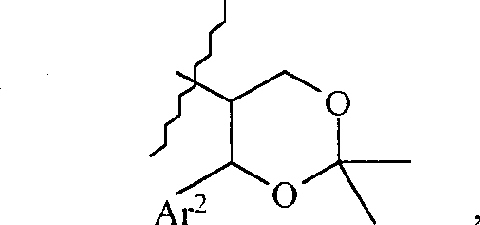
Wherein p is 0,1 or 2, Ar
2Be phenyl or pyridine radicals; And R
12And R
13Be selected from hydrogen independently of one another, up to the straight or branched alkyl of 6 carbon atoms, the perhaps cycloalkyl of 5~7 carbon atoms;
R
3, R
4And R
5Be selected from hydrogen and low alkyl group independently of one another; And
R
6Be hydrogen, methyl is perhaps with R
1Form the ring of 3~7 carbon atoms, it can comprise oxygen atom or nitrogen-atoms, perhaps R
1And R
6Can be carbonyl together.
In the preferred group of formula (III) chemical compound:
K is 0 or 1;
1 is 1;
M is 0 or 1;
N is 0 or 1;
X be C (O)-,-OC (O)-, perhaps-SO
2-;
Ar is a benzofuranyl, and furyl, indyl, isoquinolyl, naphthyl, phenyl, pyridine radicals, quinolyl or thienyl, each group are unsubstituted or are selected from alkoxyl, cyano group, halogen, nitro, phenyl, phenoxy group ,-CF by 1 or 2
3,-(CH
2)
qNR
7R
8Substituent group replace R wherein
7And R
8Can form the ring of 5~7 atoms, it can comprise 1 or 2 oxygen or nitrogen-atoms, perhaps R
7And R
8Can be independently selected from hydrogen, up to the cycloalkyl of straight or branched alkyl or 5 carbon atoms of 4 carbon atoms;
Ar
1Be independently selected from Ar, preferred indyl, and can be pyridine radicals-N-oxide;
R
1And R
6Can form the cycloalkyl of 5~7 carbon atoms, perhaps R
1And R
6Be carbonyl together;
R
2Be independently selected from the pyridine radicals that replaces or replace or be hydrogen, hydroxyl, alkoxyl ,-NMe
2,-CONR
12R
13, R wherein
12And R
13Be selected from H and CH independently of one another
3
R
3, R
4And R
5Be selected from hydrogen and methyl independently of one another.
In another preferred group of formula (III) chemical compound:
1 is 1;
M is 1;
N is 0;
R
2Be the 2-pyridine radicals;
R
6With R
1Form cyclohexyl.
Particularly preferred chemical compound group is the chemical compound group of formula (IIIa):
Identical among the Ar wherein, the meaning of k and X and first chemical compound, and pyridine ring is optional is replaced by 1 or 2 substituent groups, and R and R ' are independently selected from alkoxyl, cyano group, halogen, nitro, phenyl, phenoxy group ,-CF
3,-(CH
2)
qNR
7R
8, R wherein
7And R
8Coupled nitrogen-atoms can form 5~7 Yuans alicyclic rings together, and it can comprise 1 or 2 oxygen or nitrogen-atoms, perhaps R
7And R
8Can be independently selected from the cycloalkyl of hydrogen or 5~7 carbon atoms, and pharmaceutically acceptable salt.
In another group chemical compound (IIIa), Ar is a benzofuranyl, furyl, indyl, isoquinolyl, naphthyl, phenyl, pyridine radicals, quinolyl or thienyl, each group is unsubstituted or is selected from following substituent group by 1 or 2 and replaces: alkoxyl, cyano group, halogen, nitro, phenyl, phenoxy group ,-CF
3,-(CH
2)
qNR
7R
8, R wherein
7And R
8Can form the ring of 5~7 atoms, it can comprise 1 or 2 oxygen or nitrogen-atoms, perhaps R
7Or R
8Can be independently selected from the cycloalkyl of hydrogen or 5 carbon atoms, and X be-C (O)-,-OC (O)-or-SO
2
The amide derivatives of the N-end of preferred formula (III) chemical compound
The amide derivatives of N-end promptly wherein X be-C (O)-formula (III) chemical compound in, following compounds most preferably:
N-{ (S)-2-(1H-indol-3-yl)-1-methyl isophthalic acid-[(1-pyridine-2-base-cyclohexyl methyl)-carbamoyl]-ethyl }-4-nitro-Benzoylamide;
C-dimethylamino-N-{ (S)-2-(1H-indol-3-yl)-1-methyl isophthalic acid-[(1-pyridine-2-base-cyclohexyl methyl)-carbamoyl]-ethyl }-Benzoylamide;
The 1H-indole-2-carboxylic acid (S)-2-(1H-indol-3-yl)-1-methyl isophthalic acid-[(1-pyridine-2-base-cyclohexyl methyl)-carbamoyl]-ethyl }-amide;
Benzo [b] thiophene-2-carboxylic acid (S)-2-(1H-indol-3-yl)-1-methyl isophthalic acid-[(1-pyridine-2-base-cyclohexyl methyl)-carbamoyl]-ethyl }-amide;
N-{ (S)-2-(1H-indol-3-yl)-1-methyl isophthalic acid-[(1-pyridine-2-base-cyclohexyl methyl)-carbamoyl]-ethyl }-2-pyrroles-1-base-Benzoylamide
The 1H-indole-5-carboxylic acid (S)-2-(1H-indol-3-yl)-1-methyl isophthalic acid-[(1-pyridine-2-base-cyclohexyl methyl)-carbamoyl]-ethyl }-amide; And
The 1H-indole-2-carboxylic acid ((S)-2-(1H-indol-3-yl)-1-{[1-(5-methoxyl group-pyridine-2-yl)-cyclohexyl methyl]-carbamoyl }-1-methyl-ethyl)-amide.
The N-terminal amide derivant of other preferred formula (III) chemical compound comprises embodiment 32-35; 37-47; 49-60; 62-80, the chemical compound of 82-85 and N-{ (S)-2-(1H-indol-3-yl)-1-methyl isophthalic acid-[(1-pyridine-2-base-cyclohexyl methyl)-carbamoyl]-ethyl }-2-pyrroles-1-base-Benzoylamide.
The terminal urethane derivatives of the N-of preferred formula (III) chemical compound
The terminal urethane derivatives of N-promptly wherein X be-OC (=O)-the formula III chemical compound in, especially preferred following compounds:
(S)-2-(1H-indol-3-yl)-1-methyl isophthalic acid-[(1-pyridine-2-base-cyclohexyl methyl)-carbamoyl]-ethyl }-carbamic acid naphthalene-1-ylmethyl ester;
(S)-2-(1H-indol-3-yl)-1-methyl isophthalic acid-[(1-pyridine-2-base-cyclohexyl methyl)-carbamoyl]-ethyl }-carbamic acid 3,4-two chloro-benzyl esters;
(S)-2-(1H-indol-3-yl)-1-methyl isophthalic acid-[(1-pyridine-2-base-cyclohexyl methyl)-carbamoyl]-ethyl }-carbamic acid 4-nitro-benzyl ester;
(S)-2-(1H-indol-3-yl)-1-methyl isophthalic acid-[(1-pyridine-2-base-cyclohexyl methyl)-carbamoyl]-ethyl }-carbamic acid 3-nitro-benzyl ester;
(S)-2-(1H-indol-3-yl)-1-methyl isophthalic acid-[(1-pyridine-2-base-cyclohexyl methyl)-carbamoyl]-ethyl }-carbamic acid 3-cyano group-benzyl ester;
(S)-2-(1H-indol-3-yl)-1-methyl isophthalic acid-[(1-pyridine-2-base-cyclohexyl methyl)-carbamoyl]-ethyl }-carbamic acid 3-trifluoromethyl-benzyl ester;
(S)-2-(1H-indol-3-yl)-1-methyl isophthalic acid-[(1-pyridine-2-base-cyclohexyl methyl)-carbamoyl]-ethyl }-carbamic acid 2,3-two chloro-benzyl esters; And
(S)-2-(1H-indol-3-yl)-1-methyl isophthalic acid-[(1-pyridine-2-base-cyclohexyl methyl)-carbamoyl]-ethyl }-carbamic acid quinoline-6-ylmethyl ester.
The terminal urethane derivatives of the N-of other preferred formula (III) chemical compound comprises embodiment 88-90,92-95,97-98,100-102,104-106 and 108 chemical compound.
The terminal sulfamide derivative of the N-of preferred formula (III) chemical compound
(wherein X is-SO at formula (III) chemical compound
2-formula (III) chemical compound) the terminal sulfamide derivative of N-in, preferred especially following compounds:
(S)-3-(1H-indol-3-yl)-2-methyl-2-phenyl methanesulfonamide acyl amino-N-(1-pyridine-2-base-cyclohexyl methyl)-propionic acid amide.;
(S)-2-(2-chloro-benzenesulfonyl amino)-3-(1H-indol-3-yl)-2-methyl-N-(1-pyridine-2-base-cyclohexyl methyl)-propionic acid amide.;
(S)-3-(1H-indol-3-yl)-2-methyl-2-(naphthalene-1-sulfuryl amino)-N-(1-pyridine-2-base-cyclohexyl methyl)-propionic acid amide.;
(S)-3-(1H-indol-3-yl)-2-methyl-N-(1-pyridine-2-base-cyclohexyl methyl)-2-(quinoline-8-sulfuryl amino)-propionic acid amide.;
(S)-3-(1H-indol-3-yl)-2-methyl-N-(1-pyridine-2-base-cyclohexyl methyl)-2-(2-trifluoromethyl-benzenesulfonyl amino)-propionic acid amide.;
(S)-2-(biphenyl-2-sulfuryl amino)-3-(1H-indol-3-yl)-2-methyl-N-(1-pyridine-2-base-cyclohexyl methyl)-propionic acid amide.;
(S)-3-(1H-indol-3-yl)-2-methyl-2-(5-methyl-2-phenoxy group-benzenesulfonyl amino)-N-(1-pyridine-2-base-cyclohexyl methyl)-propionic acid amide.; And
(S)-3-(1H-indol-3-yl)-2-methyl-N-(1-pyridine-2-base-cyclohexyl methyl)-2-(2-is to toloxyl-benzenesulfonyl amino)-propionic acid amide..
The terminal sulfamide derivative of the N-of further preferred formula (III) chemical compound comprises embodiment 112,114,116-119, and 121-128,130-151, the chemical compound of 155-168 and following compounds:
(S)-3-(1H-indol-3-yl)-2-mesyl amino-2-methyl-N-(1-pyridine-2-base-cyclohexyl methyl)-propionic acid amide.; And
(S)-3-(1H-indol-3-yl)-2-methyl-N-(1-pyridine-2-base-cyclohexyl methyl)-2-(2,2,2-trifluoro ethylsulfonylamino)-propionic acid amide..
Above-mentioned general formula compound is optically-active.Therefore scope of the present invention also comprises:
All stereoisomers of above-mentioned general formula compound.
The solvate of above-mentioned general formula compound, hydrate and polymorph (different crystalline lattice descriptor).
Above-mentioned general formula compound pharmaceutical composition.
The prodrug of above-mentioned general formula compound can be thinkable as those skilled in the art; See (1987) such as Bundgaard for details.
The alkyl that the present invention relates to comprises the straight chain of 1~8 carbon atom, side chain, and perhaps cyclic carbochain, except as otherwise noted.Its representational example comprises methyl, ethyl, propyl group, isopropyl, n-pro-pyl, normal-butyl, isobutyl group, sec-butyl, the tert-butyl group, 2-methyl hexyl, n-pentyl, 1-methyl butyl, 2,2-dimethylbutyl, 2-methyl amyl, 2,2-dimethyl propyl, n-hexyl etc.
Low alkyl group comprises the carbochain that 6 carbon atoms are arranged at most.The cycloalkyl that the present invention relates to comprises that those have the cycloalkyl of 3~7 carbon atoms, comprise cyclopenta and cyclohexyl.They can be selected from halogen by 1~3, nitro, and alkyl, and the group of alkoxyl replaces.
The alkoxyl that the present invention relates to comprises straight chain and the side chain carbochain with 1~6 carbon atom, except as otherwise noted.Its representational example has methoxyl group, ethyoxyl, propoxyl group, isopropoxy, tert-butoxy, and hexyloxy.
Term " halogen " comprises fluorine, chlorine, bromine and iodine.
Term " amine " comprises free amine, alkylating amine, and the amine of acyl groupization.
Term " patient (subject) " comprises animal, particularly mammal, especially people.
Optical isomer and salt
According to its structure, all above-mentioned general formula compounds have at least one chiral centre, and some have a plurality of chiral centres.Particularly, chemical compound of the present invention can diastereomer, and the mixture of diastereomer is perhaps to mix or the form of independent optical antipode exists.The present invention includes all these compound forms.The mixture of diastereomer generally is to obtain by the following reaction that will describe in detail.Independent diastereomer can be separated from the mixture of diastereomer by routine techniques such as column chromatography or recrystallization.Independent enantiomer can separate by conventional method as known in the art, as optically-active compound is transformed salify, separates by chromatography or recrystallization then, and changes into salt-independent shape again.
If be fit to salify, then pharmaceutically acceptable salt comprises acetate, benzene sulfonate, benzoate, bicarbonate, biatrate, bromide, calcium acetate, d-camphorsulfonic acid salt, carbonate, chloride, citrate, dihydrochloride, edetate, ethanedisulphonate, Estolate, esilate, fumarate, gluceptate, gluconate, glutamate, Glu, the bismuth glycolyl arsanilate ester, hexylresorcinate breathes out amine, hydrobromate, hydrochlorate, Hydroxynaphthoate, iodide, isethionate, lactate, lactobionate, malate, maleate, mandelate, mesylate, methyl bromide, methyl nitrate, mucate, naphthalene sulfonate, nitrate, two hydrogen naphthoates, pantothenate, phosphate/diphosphate, Poly Gal A Galacturonan, Salicylate, stearate, subacetate, succinate, sulfate, tannate, tartrate, 8-Chlorotheophyline, triethyl group iodate thing, benzyl star, chloroprocaine, choline, diethanolamine, ethylenediamine, meglumine, procaine, aluminum, calcium, lithium, magnesium, potassium, sodium, and zinc.
Preferred salt is made by strong acid.This salt comprises hydrochlorate, mesylate, and sulfate.
Other non-peptide Magainin antagonist
Other is applicable to non-peptide Magainin antagonist of the present invention described in the following files and required for protection, and the content of these files is incorporated herein by reference: WO00/09115, WO00/09116, WO92/07830, JP07258081 and WO98/07718.
The preparation method of the chemical compound of formula (I)
The preparation of formula (I) chemical compound sees WO98/07718 for details, and its disclosure is incorporated herein by reference.
The relevant chemical compound of report recently
3(2S)-and N-{[1-(4-aminophenyl) cyclohexyl] methyl }-3-(1H-indol-3-yl)-2-methyl-2-{[(4-Nitrobenzol amido)-carbonyl] amino } preparation of analog of propionic acid amide. is referring to Ashwood, V.Brownhill, M.Higginbottom, D.C.Horwell, J.Hughes, R.A.Lewthwaite, A.T.McKnight, R.D.Pinnock, M.C.Pritchard, N.Suman-Chauhan, C.Webb and S.C.Williams.Bioorg.Med.Chem.Lett., 1998,8,2589-2594.; J.E.Eden, M.D.Hall, D.C.Horwell, W.Howson, J.Hughes, R.E.Jordan, R.A.Lewthwaite, K.Martin, A.T.McKnight, J.O ' Toole, R.D.Pinnock, M.C.Pritchard, N.Suman-Chauhan and S.C.Williams.Bioorg.Med.Chem.Lett., 1996,6,2617-2622.and in WO98/07718.Chemical compound
3Can adopt in the above-mentioned application disclosed method synthetic.

The preparation method of formula (II) chemical compound
In whole this application, the meaning of following abbreviation is listed below:
NEt
3Triethylamine
The THF oxolane
HBTU O-benzotriazole-1-base-N, N, N ', N '-tetramethylurea (uronium) hexafluorophosphate
DIPEA N, the N-diisopropylethylamine
DMF N, dinethylformamide
The TEBA benzyltriethylammoinium chloride
The BOC2O di-tert-butyl dicarbonate
The TFA trifluoroacetic acid
The DMA N,N-dimethylacetamide
The EtOAc ethyl acetate
MeOH methanol
The Trp tryptophan
The Ph phenyl
The HPLC high pressure liquid chromatography
The NP normal phase
The RP anti-phase
DMAP N, N-dimethyl-4-aminopyridine
The OAc acetate
The OB estradiol benzoate
The square case 1 of preparation of the formula of X Shi oxazolyl (II) chemical compound wherein, it has illustrated in four steps the method by the chemical compound of intermediate product 4a or the synthetic embodiment 9~12 of 4b.These steps are:
The generation of p-nitrophenyl methyl carbamate (intermediate product 1) and the follow-up ammonia treatment that obtains primary urea (intermediate product 2).
Primary urea and 2-bromo-1-(4-nitro-phenyl)-ethyl ketone cyclisation, Xing Cheng oxazole ring (intermediate product 3).
The hydrolysis of methyl ester-protecting group obtains intermediate product 4a or 4b.
Utilize HBTU to make intermediate product 4a or 4b and amine Z2 reaction, form amido link, obtain required chemical compound.
Scheme 1:
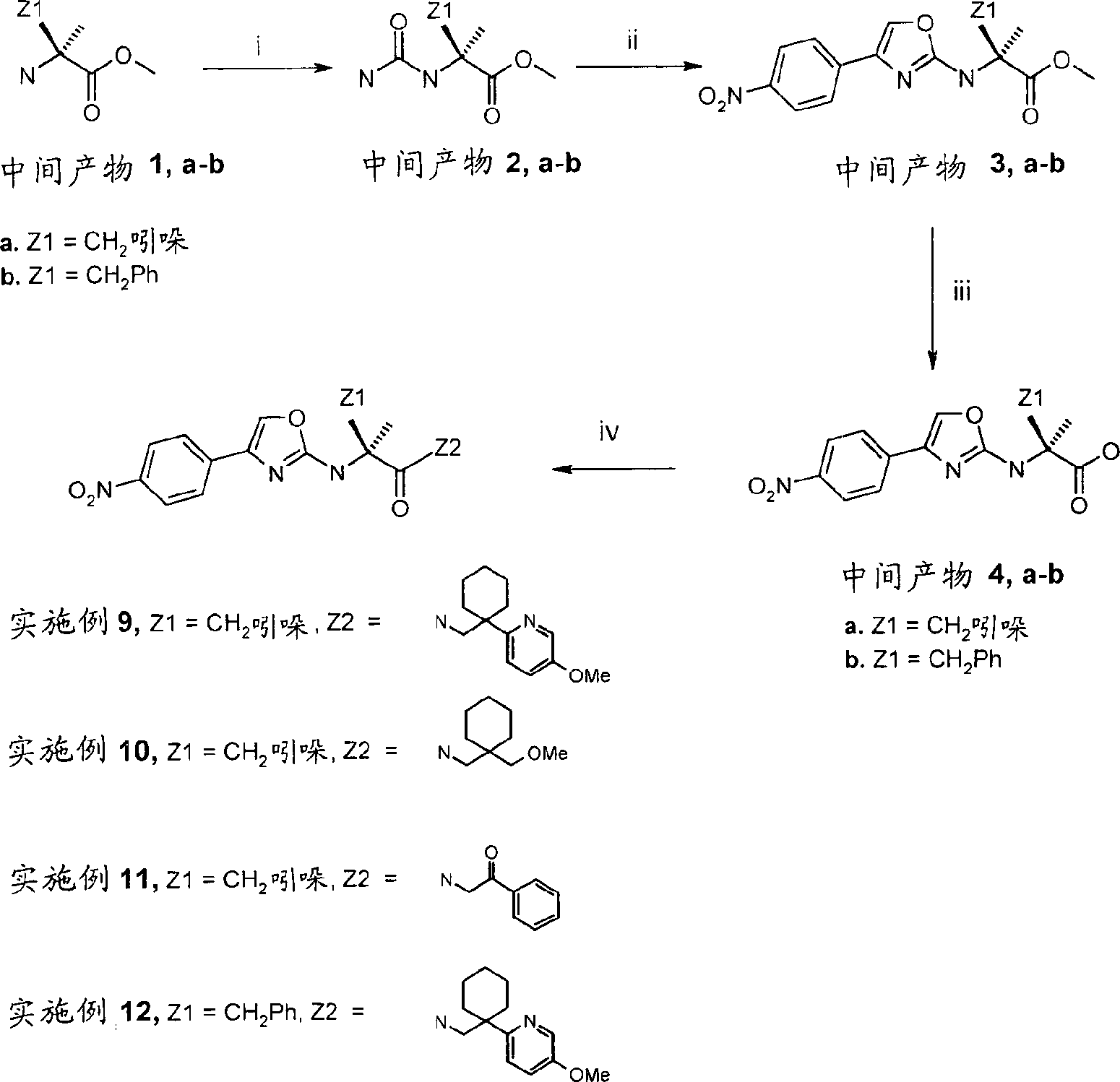
In such scheme:
I) a) chloro-carbonic acid 4-nitrobenzophenone ester, NEt
3, THFb) NH
3Water
Ii) 2-bromo-1-(4-nitro-phenyl)-ethyl ketone refluxes (3a) in toluene/diox or in 1, refluxes in the 2-dichloroethanes (3b)
Iii) LiOH , diox, H
2O
iv)HBTU,DIPEA,DMF,Z2
Primary urea 2a and the suitable bromomethyl ketone cyclisation that comprises the Z3 group, Xing Cheng oxazole ring (intermediate product 5).
Gained intermediate product 5a, the hydrolysis of the methyl ester protecting group of 5b or 5c obtains intermediate product 6a-c.
Intermediate product 6a, 6b or 6c and [1-(5-methoxyl group-2-pyridine radicals) cyclohexyl] methylamine react in the presence of HBTU, form amido link, obtain required chemical compound.
Scheme 2:

In such scheme:
I) DMF is in 30 ℃
Ii) LiOH , diox, H
2O
Iii) HBTU, DIPEA, DMF, [1-(5-methoxyl group-2-pyridine radicals) cyclohexyl] methylamine (seeing WO98/07718)
Utilize the copper catalytic reaction, shown in the aromatic ring of chemical compound Z5-Br or Z5-Cl is connected on the amino acid whose N-end.
In the presence of HBTU, between the acid of gained and [1-(5-methoxyl group-2-pyridine radicals) cyclohexyl] methylamine or [1-(2-pyridine radicals) cyclohexyl] methylamine, form amido link, obtain required chemical compound.
Scheme 3:

In such scheme:
i)a)10%CuI,K
2CO
3,DMF,130℃
B) HBTU, DIPEA, DMF, and [1-(5-methoxyl group-2-pyridine radicals) cyclohexyl]-methylamine (seeing WO98/07718) or [1-(2-pyridine radicals) cyclohexyl] methylamine (seeing WO98/07718)
Ii) a) 5-10%CuI, K
2CO
3, TEBA, Pd (P (o-tolyl)
3) Cl
2, DMF, 130 ℃
B) HBTU, DIPEA, DMF, and [1-(5-methoxyl group-2-pyridine radicals) cyclohexyl] methylamine (seeing WO98/07718) or [1-(2-pyridine radicals) cyclohexyl] methylamine (seeing WO98/07718)
*The expression junction point
Scheme 4 has been described the chemical compound of the synthetic embodiment 24 of two step one kettle ways
Utilizing the copper catalytic reaction that aromatic ring is connected to amino acid whose N-end (intermediate product 8), is HBTU amido link formation reaction on the spot then, obtains required chemical compound.
Scheme 4:
In such scheme:
i)10%CuI,K
2CO
3,DMA,90℃
Ii) HBTU, NEt
3, DMA, [1-(2-pyridine radicals) cyclohexyl] methylamine (seeing WO98/07718)
In such scheme:
i)10%CuI,K
2CO
3,DMA,90℃
Ii) HBTU, NEt
3, DMA, [1-(2-pyridine radicals) cyclohexyl] methylamine (seeing WO98/07718)
Amino acid whose N-BOC protection (intermediate product 7), it provides radicals R
5And Ar
1
Utilize HBTU, make aminoacid and radicals R is provided through protecting
1, R
2, R
4And R
6Amine reaction, form amido link, obtain intermediate product 9 thus.
The N-BOC of intermediate product 9 goes protection, obtains intermediate product 10.
The reduction amination of intermediate product 10 and suitable aldehyde Z6CHO obtains required compound.
Scheme 5:
In such scheme:
I) BOC
2O, K
2CO
3The , diox, water
Ii) HBTU, DIPEA, [1-(2-pyridine radicals) cyclohexyl] methylamine (seeing WO98/07718), DMF
iii)TFA,CH
2Cl
2
Iv) NaBH (OAc)
3, 1, the 2-dichloroethanes.
*The expression junction point
Scheme 6 has been described the synthetic of intermediate product 13.
Utilize sodium hydride that alcohol 11 is methylated.
Under nitrogen atmosphere, utilize of the nitrile reduction of Raney nickel with gained.
Scheme 6:

In such scheme:
i)NaH,CH
3I,THF
Ii) Raney nickel, cholamine solution (ethaholic ammonia), H
2, 345kPa
Intermediate product 13
C-(1-methoxy-cyclohexyl)-methylamine

Above-claimed cpd is by preparation shown in the scheme 6.
1. under 0 ℃ and argon atmospher, sodium hydride (60% in oil for 862mg, 21.5mmol) is dissolved among the THF (50ml).In 45 minutes, (1.34ml is 21.6mmol) with 1-hydroxyl-cyclohexane nitrile (1.0g, 7.18mmol to wherein dripping iodomethane; See J.Fr hlich etc., Heterocycles 1994,37,1879-91) solution in THF (30ml).After adding, reactant mixture at room temperature stirred spend the night, follow water (100ml) with isopropyl alcohol then and will react cancellation.(2 * 150ml) extract with dichloromethane with mixture then.With the organic facies drying (MgSO that merges
4), and in removal of solvent under reduced pressure.Residue carries out purification by chromatograph, uses heptane/ethyl acetate (4: 1) eluting.Under reduced pressure remove and desolvate, obtain 1-methoxy-cyclohexane nitrile (1.1g, 88%), it is flaxen grease.
IR (thin slice): 2934,2861,2832,2235,1476,1452,1385,1211,1187,1185,1126,1102,978,932,901,849cm
-1
1H?NMR(CDCl
3):δ=1.13-1.33(3H,m),1.57-1.78(5H,m),1.94-2.02(2H,m),3.36(1H,s),3.42(3H,s);
2. (add Raney Raney nickel (0.55g, water and ethanol prewashing) among the 1.1g, cholamine solution (60ml) 7.2mmol) to 1-methoxy-cyclohexane nitrile.Under 30 ℃ and nitrogen atmosphere (345kPa), reactant mixture was shaken 16 hours.Leach catalyst and use washing with alcohol by the minimum heart of Celite pad.Under reduced pressure remove and desolvate, obtain intermediate product 13 (1.12g, 99%), it is xanchromatic grease.
MS?m/e(ES+):158.2(M
++H,100%);
IR (thin slice): 2926,2857,1572,1452,1378,1316,1190,1140,966cm
-1
1H?NMR(CDCl
3):δ=1.20-1.60(12H,m),2.62(2H,s),3.23(2H,s),3.32(3H,s)
The preparation method of the chemical compound of formula (III)
Wherein X be-chemical compound of the formula (III) of CO-can be by the sour or derivatives thereof of shrinking type (III-1) in the sprotic polar solvent in the presence of suitable catalyst
Ar-(CH
2)
k-COOH??????(III-1)
With the derivant of the amine of formula (III-2) and prepare.
Substituent A r, Ar
1And R
1To R
6And parameter k to n is as the definition in the above-mentioned formula (III), and optional products therefrom changed into pharmaceutically acceptable salt.For example, condensation can utilize O-benzotriazole-1-base-N in dimethyl formamide, N, and N ', N '-tetramethylurea (uronium) hexafluorophosphate (HBTU) and N, N-diisopropyl-ethamine (DIPEA) carries out as catalyst.
Wherein X be-(chemical compound of=O) formula (III) can form carbonic ester by the alcohol by formula (III-3) to OC
Ar-(CH
2)
k-OH?????????(III-3)
And will be in the sprotic polar solvent of amine in the presence of alkali of this carbonic ester and formula (III-2) reaction and preparing

Substituent A r, Ar
1And R
1To R
6And parameter k to n is as the definition of above-mentioned formula (III), and optional products therefrom changed into pharmaceutically acceptable salt.For example, the chemical compound of formula (III-3) can react in dichloromethane with chloro-carbonic acid 4-nitrobenzophenone ester, adopt pyridine as catalyst, and the carbonic ester of gained can react with the amine of formula (III-2) in dimethyl formamide, adopt N, N-dimethyl-4-aminopyridine is as catalyst.
Wherein X is-SO
2-the chemical compound of formula (III) can be by the sulfonic acid chloride of facial (III-4) under the condensation in the sprotic polar solvent that has catalyst alkali
Ar-(CH
2)
k-SO
2Cl????(III-4)
With the amine preparation of facial (III-2) down
Substituent A r, Ar
1And R
1To R
6And the definition of parameter k to n is consistent with above-mentioned formula (III), and optional products therefrom is changed into pharmaceutically acceptable salt.For example, condensation can be at N, N-diisopropylethylamine and N, and N-dimethyl-4-aminopyridine carries out in dimethyl formamide under existing.
In said method, the amine of preferred formula (III-2) is the amine of the formula (III-5) of chirality
Wherein pyridine ring is optional is replaced by 1 or 2 substituent R and R ', and described substituent group is selected from alkoxyl, cyano group, halogen, nitro, phenyl, phenoxy group ,-CF
3,-(CH
2)
qNR
7R
8, R wherein
7And R
8Can form the ring of 5~7 atoms, it can comprise 1 or 2 oxygen or nitrogen-atoms, perhaps R
7And R
8Can be independently selected from hydrogen or have the cycloalkyl of 1~5 carbon atom, methoxyl group is particularly preferred substituent group, shown in the Chiral Amine of (III-6):

B) peptide bombesin receptor antagonist
This is as peptide and it is believed that and be applicable to that Magainin antagonist of the present invention illustrates that in the following files its content is incorporated herein by reference:
| Publication number | Publication number |
| ????WO97/09347 | ????EP0835662 |
| ????US5650395 | ????US5439884 |
| ????WO96/28214 | ????WO95/00542 |
| ????EP0737691 | ????US5620955 |
| ????US5767236 | ????WO92/02545 |
| ????WO91/04040 | ????EP0468497 |
| ????EP0309297 | ????CA2030212 |
| ????EP0438519 | ????WO92/20707 |
| ????EP0559756 | ????WO93/16105 |
| ????WO89/02897 | ????US4943561 |
| ????WO90/03980 | ????US5019647 |
| ????WO91/02746 | ????US5028692 |
| ????WO92/09626 | ????US5047502 |
| ????WO92/20363 | ????WO94/02018 |
| ????WO94/02163 | ????WO88/07551 |
| ????WO94/21674 | ????WO89/09232 |
| ????WO96/17617 | ????EP0315367 |
| ????US5084555 | ????EP0345990 |
| ????US5162497 | ????US5068222 |
| ????US5244883 | ????US5620959 |
| ????US5723578 | ????UK2231051 |
| ????US5750646 | ????EP0339193 |
| ????US5877277 | ????WO90/01037 |
| ????US5985834 | ????WO91/06563 |
| ????EP0428700 | ????EP0402852 |
Pharmaceutical composition
For by compound pharmaceutical composition of the present invention, inert, pharmaceutically acceptable carrier can be solid or liquid.The preparation of solid form comprises powder, tablet, dispersible granules, capsule, wafer (sachet), and suppository.
Solid carrier can be one or more materials that can also serve as diluent, flavoring agent, solubilizing agent, lubricant, suspending agent, binding agent or tablet disintegrant, and it can also be an encapsulating material.In powder, carrier is a solid in small, broken bits, and it is the mixture with active component in small, broken bits.In tablet, active component with have necessary fusible carrier and mix in the proper ratio, and be pressed into required shape and size.Powder and tablet preferably comprise 5% to about 70% active component.Suitable carriers is a magnesium carbonate, magnesium stearate, Talcum, lactose, sugar, pectin, dextrin, starch, Tragacanth, methylcellulose, sanlose, low melt wax, cocoa butter etc.
Liquid formulation comprises solution, suspension, and emulsion.As the example of the liquid preparation that is suitable for parenteral, can mention the sterilized water or the water-propylene glycol solution of active substance.The aqueous solution form preparation of all right Polyethylene Glycol of liquid preparation.Peroral administration aqueous solution can prepare by solubilization of active ingredient is also added suitable coloring agent, flavoring agent, stabilizing agent and thickening agent as required in water.The water slurry that per os uses can be by being scattered in active component in small, broken bits water and cohesive material such as natural paragutta, resin, and methylcellulose, sanlose reaches in the known suspending agent of other medicine formulation art and prepares.
Preferred drug substances is the preparation of unit dosage forms.In this dosage form, preparation is divided into the unit dose that comprises an amount of active component.Unit dosage forms can be the preparation of packing, and this packing contains the preparation of discrete magnitude, Bao Zhuan tablet for example, and capsule reaches the powder in bottle or the ampoule.Unit dosage forms can also be a capsule, bag agent or tablet itself, and it also can be any form of this packing of suitable number.
For the preparation of suppository, active component is scattered in wherein at first with low-melting wax (as the mixture of fatty glyceride and cocoa butter) fusing, and by for example stirring.Then the homogeneous mixture of fusing is poured in the mould of suitable size, and made it cooling curing.
This compositions that preferably is suitable for the compositions of oral administration in the people, particularly unit dosage forms.
Combined therapy
Do not want to be subjected to any specific theory or the constraint of theory, the inventor believes that the bombesin receptor antagonist can be used as a part and one or more vasodilations of medicine, and hormonal medicaments or neurotransmitter regulator are used in combination.This goods are used for or test treatment in sexual dysfunction.
The vasodilation for the treatment of the sexual dysfunction of organic (rather than psychological) origin influences penis, the excretory level of the regional flow of clitoris or vagina or lubricating fluid.Can be used for the handicapped vasodilation of therapeutic and comprise Alprostadil or phentolamine, NO (nitric oxide) hardening agent such as L-arginine, and PDE5 inhibitor such as sldenafil or its pharmaceutically acceptable salt (Scrip ' s Complete Guide toWomen ' s Healthcare, p.194-205,2000) (Sachs B.D., Neuroscience andBiobehavioral Review, 2000,24 541-560, Benet and Melman, 1995, Urol.Clin.N.Amer.22:699-709), VIP (blood vessel enteral peptide) hardening agent (Scrip ' s Complete Guide toWomen ' s Healthcare, p.194-205,2000) or angiotensin-2 receptor antagonist such as Losartan (American Heart Association meeting, New Orleans, 2000).
The hormonal medicaments that is used for the treatment of the sexual dysfunction of organic and spirituality origin comprises the steroid hormone regulator, steroid hormone or hormone goods (comprising synthetic hormone), it comprises estrogen (Scrip ' sComplete Guide to Women ' s Healthcare, p.194-205,2000) or androgen such as testosterone (Scrip ' s Complete Guide to Women ' s Healthcare, p.194-205,2000, Sachs B.D., 2000), it acts on libido and libido and wakes relevant CNS district (Wilson CA., 1993) up.
The neurotransmitter regulator that is used for the treatment of organic and psychogenic sexual dysfunction comprises neurotransmitter agonist and antagonist such as catecholamine agonist such as D
2The agonist quinoline comes Luo Lang, 5HT
2Antagonist such as ritanserin, the synthetic regulator of monoamine is as reducing the active therapeutic agent of endogenous 5HT, comprise and adopt fenclonine to suppress the synthetic of 5HT, suppress catecholamine metabolism and dissolved monoamine metabolism or dissolution regulator, as three ring antidepressants, imipramine (Wilson CA., 1993) for example.
The purposes of this combined therapy comprises the treatment preparation that allows two drug component administrations, i.e. bombesin receptor antagonist and vasodilation in the potion medicine, hormone therapy medicine or neurotransmitter regulator medicine.Preferred dosage form allows oral administration.Yet, also be a part of the present invention by suppository, emulsifiable paste, skin patch or injection administration.As selection, the inventor designed by with vasodilation, the approach that hormone therapy medicine or neurotransmitter regulator medicine separate is given and to be used the bombesin receptor antagonist.This approach can comprise that the oral administration of bombesin receptor antagonist for example and the skin patch of vasodilation use.So can provide a kind of test kit, wherein the vasodilation of the bombesin receptor antagonist of unit dose and unit dose, hormone therapy medicine or the coexistence of neurotransmitter regulator.For example, in such test kit, the bombesin receptor antagonist is mixed with peroral administration tablet capsule or other unit dosage form, vasodilation provides with the form of patch, two kinds of dosage forms can two row's tear tapes forms provide, the compartment that wherein comprises tablet etc. be positioned at comprise the patch compartment above.Wherein two kinds of dosage forms packing of other form of the patient being obtained easily jointly and reminding easily when finishing that spatially is associated those skilled in the art will find apparent that.When and how test kit also with the indication of administration of the individual components that comprises relevant test kit.
More widely, the invention provides bombesin receptor antagonist and one or more be selected from below (1) to the pharmaceutical composition of the material of (34) (be used for simultaneously, separately or administration successively):
(1) one or more natural existence or synthetic prostaglandin or its ester.Be suitable for prostaglandin of the present invention and comprise chemical compound such as Alprostadil, prostaglandin E
1, prostaglandin E
0, 13,14-dihydro prostaglandin E
1, prostaglandin E
2, eprostinol, natural synthetic and semisynthetic prostaglandin is derivant extremely, comprise among the US6037346 (all literary compositions are incorporated herein by reference) that issues in WO-00033825 and/or on March 14th, 2000 disclosed those, PGE
0, PGE
1, PGA
1, PGB
1, PGF
1α, 19-hydroxyl PGA
1, 19-hydroxyl-PGB
1, PGE
2, PGB
2, 19-hydroxyl-PGA
2, 19-hydroxyl-PGB
2, PGE
3α, Carboprost, trometamol, dinoprost, prostaglandin F2, Ilomedin, prostatitis formicester, metenoprost, sulprostune, tiaprost and moxisylate.
(2) one or more alpha-2-adrenoceptor antagonists chemical compounds also are referred to as alpha-2-adrenoceptor antagonists or alpha-receptor antagonist or alpha block agent.Being suitable for chemical compound of the present invention comprises: the alpha-2-adrenoceptor blocker, described in the PCT application WO99/30697 that published on June 14th, 1998, its open (being incorporated herein by reference) relates to alpha-2-adrenoceptor and comprises: selectivity α
1-adrenoceptor or α
2-adrenoceptor blocker and non-selective adrenoceptor blocker, suitable α
1-adrenoceptor blocker comprises: phentolamine, phentolamine mesylate, Desyrel, aldehydase matter, indoramin, naftopidil, his Suo Luoxin, the perprazole of rattling away, phenoxybenzamine, Asia reach azoles and loose, beneficial method Rosin, Yohimbine, rauwolfine, Recordati 15/2739, and SNAP 1069, SNAP5089, RS17053, SL89.0591, doxazosin, terazosin, abanoquil and furazosin; Derive from US6037346[2000 March 14] α
2-blocker dibenarnine, tolazoline, trimazosin and dibenamine; Alpha-2-adrenoceptor antagonists is as United States Patent (USP) 4,188,390; 4,026,894; 3,511,836; 4,315,007; 3,527,761; 3,997,666; 2,503,059; 4,703,063; 3,381,009; 4,252,721 and 2,599, described in 000, each patent all is incorporated herein by reference; α
2-adrenoceptor blocker comprises: clonidine, papaverine, papaverine hydrochlorate, optional cardiac tonic such as the pirxamine of existing.
(3) one or more NO-donors (NO-agonist) chemical compound.Be applicable to that NO-compound donator of the present invention comprises organic nitrate such as list, two or trinitrate or organic nitrates comprise glycerol trintrate (also being referred to as nitroglycerine), isosorbide 5-Mononitrate, Iso-bid, pentaerythritol tetranitrate, the erythrityl tetranitrate, sodium nitroprusside salt (SNP), 3-morpholinosydnonimine, molsidomine, S-nitroso-group-N-acetyl group penicillamine (SNAP), S-nitroso-group-N-glutathion (SNO-GLU), N-hydroxyl-L-arginine, amyl nitrate, linsidomine, linsidomine hydrochlorate, (SIN-1) S-nitroso-group-N-cysteine, diazenium diolates (NONOates), 1,5-pentanedinitrate, L-arginine, Radix Ginseng, zizphi fructus, molsidomine, Re-2047, nitrosation maxisylyte derivant such as NMI-678-11 and NMI-937 see the PCT application WO0012075 that has published; And/or
(4) one or more potassium channel openers or regulator.Be applicable to that potassium channel openers/regulator of the present invention comprises nicorandil, cromakalim, levcromakalim (rilmakalim), pinacidil, diazoxide, minoxidil, charybdotoxin, glyburide, 4-aminopyridine, BaCl
2
(5) one or more dopamine medicaments, preferably apomorphine or optionally D2, D3 or D2/D
3Agonist is as sending rummy Soviet Union and ropirinol (required for protection as WO-0023056), PNU95666 (required for protection as WO-0040226).
(6) one or more vasodilations.Be applicable to that vasodilation of the present invention comprises nimodipine, pinacidil, cyclandelate, isoxsuprine, chlorpromazine, haloperidol, Rec 15/2739, Desyrel.
(7) one or more TXA2. agonist.
(8) one or more CNS activating agents.
(9) one or more peptides.Be applicable to that peptide of the present invention sees the United States Patent (USP) 6037346 that on March 14th, 2000 issued, and comprise acetergamine, Ergota bromine nitrogen , bromerguride, Xia Nagaolin, delorgotrile, disulergine, ergometrine maleate, ergotamine tartrate, etisulergine, Lergotrile, LSD (lysergicaciddiethylamide), mesulergine, liserdol, metergotamine, nicergoline, pergolide, Propisergide general is studied carefully profit, terguride.
(10) one or more regulate the short natriuretic factor (also being referred to as anterior chamber's short natruresis peptide) of short natriuretic factor, particularly anterior chamber, the chemical compound of the short natriuretic factor effect of Type B and C type.
(11) one or more vasoconstriction hormone receptor antagonists such as Losartans.
(12) substrate of one or more NO-synthase such as L-arginine.
(13) one or more calcium channel blockers such as A Muluohe.
(14) one or more anticholesteremic agents such as statins (for example atorvastatin/profit general appropriate-trade mark) and fibrates.
(15) one or more antiplatelets and anti-thrombosis drug, tPA for example, uPA, warfarin, hirudin and other thrombin inhibitor, heparin, Thromboplastin activity factor inhibitor.
(16) one or more insulin sensitizers such as triglitazone (rezulin) and blood sugar lowering such as glipizide.
(17) L-DOPA or carbidopa.
(18) one or more acetylcholinesteraseinhibitors inhibitors such as donepezil (Ai Lisai).
(19) anti-inflammatory agent of one or more steroids or on-steroidal.
(20) one or more estrogenic agents (SERM) and/or estrogen agonist and/or estrogen antagonist, preferred raloxifene or lasofoxifene, (-)-cis-6-phenyl-5-[4-(2-pyrrolidine-1-base-ethyoxyl)-phenyl]-5,6,7,8-naphthane-2-alcohol and pharmaceutically acceptable salt thereof (following compd A), its preparation method sees WO96/21656 for details.

Compd A
(21) one or more PDE inhibitor, particularly PDE 2,5,7 or 8 inhibitor (being used for per os or topical), preferred PDE2 or PDE5 inhibitor, PDE5 inhibitor (seeing below) most preferably, the IC50 of the anti-enzyme separately of preferred described inhibitor is less than 100nM; And PDE 3,4 inhibitor of topical (for example injection in the spongy body).
(22) when compositions is used for the treatment of or prevent female sexual disorder, one or more NPY (neuropeptide tyrosine) inhibitor, particularly NPY1 or NPY5 inhibitor, preferred NPY1 inhibitor.Preferred described NPY inhibitor (comprising NPYY1 and NPYY5) has less than 100nM, is more preferably less than the IC50 of 50nM.
(23) one or more neutral endopeptidases (NEP) inhibitor preferably has IC50 less than 100nM to NEP.Preferred nep inhibitor is optionally to NEP and has than Endothelin converitin enzyme (ECE) and the big 100 times selectivity of angiotensin invertase (ACE).Yet blended/dual NEP/ECE and NEP/ACE inhibitor (as ompatrilat) still comprises within the scope of the invention.
(24) one or more vasoactive Erepsins (VIP), the VIP analogies, the VIP analog, particularly by one or more VIP receptor subtypes VPAC1, one or more VIP receptor stimulating agents that VPAC or PACAP (hypophysis cerebri adenylate cyclase activating polypeptide) have an effect or VIP analog (for example Ro-125-1553) or VIP fragment, the combination of one or more alpha-2-adrenoceptor antagonists and VIP is (as indenes Wei Kaopu, Aviptadil).
(25) one or more casting skin matter hormone receptor agonists or regulator or casting skin matter hormone intensifier; as melanotan II; PT-14, PT-141 or WO-09964002, WO-00074679; WO-09955679; WO-00105401, WO-00058361, WO-00114879; WO-00113112, claimed compounds among the WO-09954358.
(26) one or more 5-hydroxytryptamine receptor agonist, antagonist or regulator, 5HT1A (comprising VML 670) particularly, 5HT2A, 5HT2C, the agonist of 5HT3 and/or 5HT6 receptor, antagonist or regulator, comprise WO-09902159, those described in WO-00002550 and/or the WO-00028993.
(27) one or more testosterone substituting agents (comprising the dehydrogenation androstenedione), testosterone (Tostrelle), dihydrotestosterone or testosterone implant.
(28) one or more estrogen, estrogen and medroxyprogesterone or medroxyprogesterone acetas (MPA) (promptly as compositions), perhaps estrogen and the agent of methyltestosterone hormone replacement therapy (HRT for example, premarin particularly, Cenestin, Oestrofeminal, Equin, Estrace, Estrofem, EllesteSolo, Estring, Eastraderm TTS, Eastraderm Matrix, Dermestril, Premphase, Preempro, Prempak, Premique, Estratest, Estratest HS, Tibolone).
(29) regulator of one or more norepinephrine or transmission agent, dopamine and/or 5-hydroxy tryptamine, as BUP, GW-320659.
(30) one or more purinergic receptor stimulating agent and/or regulators.
(31) one or more neurokinins (NK) receptor antagonist comprises described in the WO-09964008 those.
(32) one or more class Opium thing receptor stimulating agents, antagonist or regulator, preferred ORL-1 receptor stimulating agent.
(33) agonist of one or more oxytocin/vasopressin receptors or regulator, preferably optionally oxytocin agonists or regulator.
(34) one or more Cannibinoid receptor modulators.
Adjuvant: PDE5 inhibitor (I:PDE5)
The PDE5 inhibitor
PDE5i ' the s that is applicable to pharmaceutical composition of the present invention is cGMP PDE5i ' s, sees for details hereinafter.It is particularly preferred that to be used for of the present invention be cGMP PDE5i ' s effectively and optionally.Be applicable to that GMP PDE5 inhibitor of the present invention comprises:
Pyrazolo [4,3-d] pyrimidin-7-ones is seen EP-A-0463756;
Pyrazolo [4,3-d] pyrimidin-7-ones is seen EP-A-0526004;
Pyrazolo [4,3-d] pyrimidin-7-ones is seen published International Patent Application WO 93/06104;
Isomeric pyrazolo [3,4-d] pyrimidin-4-one is seen published International Patent Application WO 93/07149;
Quinazoline-4-one is seen published International Patent Application WO 93/12095;
Pyrido [3,2-d] pyrimidin-4-one is seen published International Patent Application WO 94/05661;
Purine-6-one is seen published International Patent Application WO 94/00453;
Pyrazolo [4,3-d] pyrimidin-7-ones is seen published International Patent Application WO 98/49166;
Pyrazolo [4,3-d] pyrimidin-7-ones is seen published International Patent Application WO 99/54333;
Pyrazolo [4,3-d] pyrimidin-4-one is seen EP-A-0995751;
Pyrazolo [4,3-d] pyrimidin-7-ones is seen published International Patent Application WO 00/24745;
Pyrazolo [4,3-d] pyrimidin-4-one is seen EP-A-0995750;
Chemical compound is seen the International Patent Application WO 95/19978 of having published;
Chemical compound is seen the International Patent Application WO 99/24433 of having published; And
Chemical compound is seen the International Patent Application WO 93/07124 of having published.
Should be appreciated that the content of above-mentioned published patent application, particularly the equal integral body of general formula wherein and example compound is incorporated herein by reference.
V-type phosphodiesterase inhibitor preferred for the present invention comprises:
5-[2-ethyoxyl-5-(4-methyl isophthalic acid-piperazinyl sulfonyl) phenyl]-1-methyl-3-n-pro-pyl-1,6-dihydro-7H-pyrazolo [4,3-d] pyrimidin-7-ones (sldenafil), also be referred to as 1-[[3-(6,7-dihydro-1-methyl-7-oxo-3-propyl group-1H-pyrazolo [4,3-d] pyrimidine-5-yl)-and the 4-ethoxyl phenenyl] sulfonyl]-4-methyl piperazine (seeing EP-A-0463756);
5-(2-ethyoxyl-5-morpholino acetylphenyl)-1-methyl-3-n-pro-pyl-1,6-dihydro-7H-pyrazolo [4,3-d] pyrimidin-7-ones (seeing EP-A-0526004);
3-ethyl-5-[5-(4-ethyl piperazidine-1-base sulfonyl)-2-positive propoxy phenyl]-2-(pyridine-2-yl) methyl-2,6-dihydro-7H-pyrazolo [4,3-d] pyrimidin-7-ones (seeing WO98/49166);
3-ethyl-5-[5-(4-ethyl piperazidine-1-base sulfonyl)-2-(2-methoxy ethoxy) pyridin-3-yl]-2-(pyridine-2-yl) methyl-2,6-dihydro-7H-pyrazolo [4,3-d] pyrimidin-7-ones (seeing WO99/54333);
(+)-3-ethyl-5-[5-(4-ethyl piperazidine-1-base sulfonyl)-2-(2-methoxyl group-1 (R)-methyl ethoxy) pyridin-3-yl]-2-methyl-2,6-dihydro-7H-pyrazolo [4,3-d] pyrimidin-7-ones, also be referred to as 3-ethyl-5-{5-[4-ethyl piperazidine-1-base sulfonyl]-2-([(1R)-and 2-methoxyl group-1-Methylethyl] the oxygen base) pyridin-3-yl }-2-methyl-2,6-dihydro-7H-pyrazolo [4,3-d] pyrimidin-7-ones (seeing WO99/54333);
5-[2-ethyoxyl-5-(4-ethyl piperazidine-1-base sulfonyl) pyridin-3-yl]-3-ethyl-2-[2-methoxy ethyl]-2,6-dihydro-7H-pyrazolo [4,3-d] pyrimidin-7-ones, also be referred to as 1-{6-ethyoxyl-5-[3-ethyl-6,7-dihydro-2-(2-methoxy ethyl)-7-oxo-2H-pyrazolo [4,3-d] pyrimidine-5-yl]-the 3-pyridyl sulfonyl }-4-ethyl piperazidine (see WO01/27113, embodiment 8);
5-[2-isobutoxy-5-(4-ethyl piperazidine-1-base sulfonyl) pyridin-3-yl]-3-ethyl-2-(1-methyl piperidine-4-yl)-2,6-dihydro-7H-pyrazolo [4,3-d] pyrimidin-7-ones (see WO01/27113, embodiment 15);
5-[2-ethyoxyl-5-(4-ethyl piperazidine-1-base sulfonyl) pyridin-3-yl]-3-ethyl-2-phenyl-2,6-dihydro-7H-pyrazolo [4,3-d] pyrimidin-7-ones (see WO01/27113, embodiment 66);
5-(5-acetyl group-2-propoxyl group-3-pyridine radicals)-3-ethyl-2-(1-isopropyl-3-azetidinyl)-2,6-dihydro-7H-pyrazolo [4,3-d] pyrimidin-7-ones (see WO01/27112, embodiment 124);
5-(5-acetyl group-2-butoxy-3-pyridine radicals)-3-ethyl-2-(1-ethyl-3-azetidinyl)-2,6-dihydro-7H-pyrazolo [4,3-d] pyrimidin-7-ones (see WO01/27112, embodiment 132);
(6R, 12aR)-2,3,6,7,12,12a-six hydrogen-2-methyl-6-(3, the 4-methylenedioxyphenyl)-pyrazine also [2 ', 1 ': 6,1] pyrido [3,4-b] indole-1,4-diketone (IC-351), the i.e. embodiment 78 of disclosed International Application No. WO 95/19978 and 95 chemical compound, and the chemical compound of embodiment 1,3,7 and 8;
2-[2-ethyoxyl-5-(4-ethyl-piperazine-1-base-1-sulfonyl)-phenyl]-5-methyl-7-propyl group-3H-imidazo [5,1-f] [1,2,4] triazine-4-ketone (vardenafil), also be referred to as 1-[[3-(3,4-dihydro-5-methyl-4-oxo-7-propyl imidazole also [5,1-f]-as-triazine-2-yl)-the 4-ethoxyl phenenyl] sulfonyl]-the 4-ethyl piperazidine, the i.e. embodiment 20,19,337 of disclosed International Application No. WO 99/24433 and 336 chemical compound; And
The chemical compound of the embodiment 11 of disclosed International Application No. WO 93/07124 (EISAI); And Rotella D P, J.Med.Chem., the chemical compound 3 and 14 in 2000,43,1257.
Can be used for other type cGMP PDE5 inhibitor of the present invention jointly comprises:
4-bromo-5-(pyridylmethyl amino)-6-[3-(4-chlorphenyl)-propoxyl group]-3 (2H)-2H-Pyridazin-3-ones;
1-[4-[(1,3-benzo dioxole-5-ylmethyl) amino]-6-chloro-2-quinazolyl]-4-piperidines-carboxylic acid list sodium salt;
(+)-cis-5,6a, 7,9,9,9a-six hydrogen-2-[4-(trifluoromethyl)-phenyl methyl-5-methyl-cyclopenta [4,5] imidazo [2,1-b] purine-4 (3H) ketone;
Fuzlocillin;
Cis-2-hexyl-5-methyl-3,4,5,6a, 7,8,9,9a-octahydro cyclopenta [4,5]-imidazo [2,1-b] purine-4-ketone; 3-acetyl group-1-(2-benzyl chloride base)-2-propyl indole-6-carboxylate; 3-acetyl group-1-(2-benzyl chloride base)-2-propyl indole-6-carboxylate;
4-bromo-5-(3-pyridylmethyl amino)-6-(3-(4-chlorphenyl) propoxyl group)-3-(2H)-2H-Pyridazin-3-one;
I-methyl-5-(5-morpholino acetyl group-2-positive propoxy phenyl)-3-n-pro-pyl-1, and 6-dihydro-7H-pyrazolo (4,3-d) pyrimidin-7-ones;
1-[4-[(1,3-and Bing Er oxazole-5-ylmethyl) amino]-6-chloro-2-quinazolyl]-4-piperidine carboxylic acid list sodium salt;
Pharmaprojects?No.4516(Glaxo?Wellcome);
Pharmaprojects?No.5051(Bayer);
Pharmaprojects No.5064 (Kyowa Hakko; See WO96/26940);
Pharmaprojects?No.5069(Schering?Plough);
GF-196960(Glaxo?Wellcome);
E-8010 and E-4010 (Eisai); Bay-38-3045 ﹠amp; 38-9456 (Bayer); And Sch-51866.
The suitability of any concrete cGMP PDE5 inhibitor can utilize literature method to measure at an easy rate by estimating its effect and selectivity, promptly estimates its toxicity according to the medicinal practice of standard, dissolving, metabolism, pharmacokinetics etc.
The IC of preferred cGMP PDE5 inhibitor
50Less than 100 nanomoles, be more preferably less than 50 nanomoles, most preferably less than 10 nanomoles.The IC of cGMP PDE5 inhibitor
50Value can adopt the hereinafter PDE5 test of test method part to measure.
The cGMP PDE5 inhibitor that is preferred for pharmaceutical composition of the present invention is to the PDE5 enzyme selectivity.Preferably they are optionally with respect to PDE3 and PDE4 more preferably with respect to PDE3.Preferred cGMP PDE5 selection of inhibitors of the present invention is more preferably bigger 100 times than PDE3 and PDE4 than PDE3, more preferably big 300 times.The optional ratio can easily be measured by those skilled in the art.IC to PDE3 and PDE4 enzyme
50Value can adopt the literature method of having set up to measure, and sees (1998) such as SABallard, and sees for details hereinafter.
Adjuvant: nep inhibitor (I:NEP)
NEP EC3.4.24.11 (FEBS Lett., 229 (1), 206-210 (1988)) also is referred to as enkephalinase or neprilysin, is the neutral endopeptidase that zinc relies on.This enzyme is relevant with the decomposition of several bioactive oligopeptide, the peptide bond on the amino side chain of fracture hydrophobic amino acid residues (referring to Turner etc., 1997).Bioactivator that crucial nerve discharges or the metabolic neuropeptide of NEP comprise short natruresis peptide such as anterior chamber's short natruresis peptide (ANP) and big brain natriuretic peptide and the short natruresis peptide of C-type, Magainin, bradykinin, the peptide that calcitonin gene is relevant, endothelins, enkephalin, neurotensin, Substance P and vasoactive enteral peptide.In these peptides some have vasodilation effect and neuro hormone function, diuretic and natriuretic activity or mediation behavior effect.Victor A.McKusick etc. is seen in the background instruction of relevant NEP
Http:// www3.ncbi.nlm.nih.gov/ Omim/searchomim.htmBelow the information of relevant NEP therefrom choose.
" common acute lymphoblastic leukemia antigen is important cell surface marker in human acute lymphoblastic leukemia (ALL) diagnosis.It is present on the leukaemia of preceding-B phenotype, accounts for 85% of ALL case.Yet CALLA is not limited to the leukaemia, and it is found in various normal tissues.CALLA is a kind of glycoprotein, and is enriched in the kidney, and it is present on the brush border of nearside tubule and on the epithelial cell of glomerule.Letarte etc. (1988) have cloned the cDNA of coding CALLA, and show the neutral endopeptidase (NEP that the aminoacid sequence of being inferred by the cDNA sequence is relevant with human film; EC 3.4.24.11 also is referred to as enkephalinase) sequence identical.Peptide on the amino side chain of NEP fracture hydrophobic residue, and make several peptide hormone inactivations, described peptide hormone comprises glucagon, enkephalin, Substance P, neurotensin, oxytocin, and bradykinin.Analyze by the cDNA transfection, Shipp etc. (1989) confirm that CALLA is the functional neutral endopeptidase that in the past is referred to as the enkephalinase type.Barker etc. (1989) confirm that the CALLA gene of coding 100-kD II type transmembrane glycoprotein exists with the list copy greater than 45kb, and it is no longer reset in the malignant tumor of express cell surface C ALLA.Find that by research somatic cell heterozygote gene mapping is in the mankind's chromosome 3, and the zone of in situ hybridization is 3q21-q27.Tran-Paterson etc. (1989) also distribute to chromosome 3 with gene by people-rodent somatic cell heterozygote by the Southem engram analysis of DNA.D ' Adamio etc. (1989) confirm that CALLA gene span is formed greater than 80kb and by 24 exons.”
Preferably NEPi ' the s that is used in combination as adjuvant and bombesin receptor antagonist of the present invention comprises:
(2R)-and 2-[(1-{[(5-ethyl-1,3,4-thiadiazoles-2-yl) amino] carbonyl } cyclopenta) methyl] valeric acid

(2S)-and 2-[(1-{[(5-ethyl-1,3,4-thiadiazoles-2-yl) amino] carbonyl } cyclopenta)-methyl] valeric acid
The title product (824mg) of following step c) is further purified by HPLC, use the AD chromatographic column and use hexane: isopropyl alcohol: trifluoroacetic acid (85: 15: 0.2) is as eluant, obtain (2R)-2-[(1-{[(5-ethyl-1,3,4-thiadiazoles-2-yl) amino] carbonyl }-cyclopenta) methyl] valeric acid, it is the foam of white, 400mg, 99.5%ee
1H NMR (CDCl
3, 400MHz) δ: 0.90 (t, 3H), 1.36 (m, 6H), 1.50-1.80 (m, 9H), 2.19 (m, 1H), 2.30 (m, 1H), 2.44 (m, 1H), 2.60 (m, 1H), 2.98 (q, 2H), 12.10-12.30 (bs, 1H), LRMS:m/z 338 (MH
-), [α]
D=-9.0 ° (c=0.1, methanol), and (2S)-2-[(1-{[(5-ethyl-1,3,4-thiadiazoles-2-yl) amino] carbonyl } cyclopenta)-methyl] valeric acid, it is the foam of white, 386mg, 99%ee,
1H NMR (CDCl
3, 400MHz) δ: 0.90 (t, 3H), 1.38 (m, 6H), 1.50-1.79 (m, 9H), 2.19 (m, 1H), 2.30 (m, 1H), 2.44 (m, 1H), 2.60 (m, 1H), 2.98 (q, 2H), 12.10-12.27 (bs, 1H); LRMS:m/z 338 (MH
-); And[α]
D=+3.8 ° (c=0.1, methanol)
The preparation of raw material
A)
1-[2-(tert-butoxycarbonyl)-4-amyl group]-Cyclopentane carboxylic acid

With 1-[2-(tert-butoxycarbonyl)-4-pentenyl]-(23g is 81.5mmol) with the hydrogenation 18 hours under 30psi and room temperature of the mixture of 10% palladium charcoal (2g) in dry ethanol (200ml) for Cyclopentane carboxylic acid (EP 274234).Reactant mixture is filtered by Arbocel , and reduction vaporization filtrate, xanchromatic grease obtained.Crude product carries out purification by silica gel column chromatography, and adopt ethyl acetate: pentane (40: 60) obtains required product as eluant, and it is clarifying grease, 21g, 91%;
1H NMR (CDCl
3, 0.86 (t, 3H), 1.22-1.58 (m, 15H), 1.64 (m, 4H), 1.78 (dd, 1H), 2.00-2.18 (m, 3H), 2.24 (m, 1H); LRMS:m/z 283 (M-H)
-
B)
2-[(1-{[(5-ethyl-1,3,4-thiadiazoles-2-yl) amino] carbonyl }-cyclopenta) methyl] valeric acid uncle fourth Ester

With 1-(3-dimethylaminopropyl)-3-ethyl-carbodiimide hydrochloride (0.21mmol), I-hydroxybenzotriazole hydrate (0.2mmol), N-methylmorpholine (0.31mmol) and 2-amino-5-ethyl-1,3,4-thiadiazoles (0.22mmol) is added to above-mentioned steps product (150mg a), 0.53mmol) in N, in the solution in the dinethylformamide (3ml), and reactant stirred 18 hours at 90 ℃.Refrigerative solution is with ethyl acetate (90ml) dilution, and water (3 * 25ml) and saline (25ml) washing, dry then (MgSO
4) and reduction vaporization.Crude product carries out purification by silica gel chromatography, and adopt ethyl acetate: pentane (30: 70) obtains title compound, 92% as eluant;
1H NMR (CDCl
3, 300MHz) δ: 0.82 (t, 3H), 1.20-1.80 (m, 22H), 1.84 (m, 1H), 2.20 (m, 4H), 3.04 (q, 2H), 9.10 (bs, 1H); LRMS:m/z396.2 (MH
+).
C)
2-[(1-{[5-ethyl-1,3,4-thiadiazoles-2-yl) amino] carbonyl } cyclopenta) methyl] valeric acid
(5ml) is added to above-mentioned steps b with trifluoroacetic acid) dichloromethane (5ml) solution of title product (0.31mmol) in, and solution at room temperature stirred 4 hours.With the reactant mixture concentrating under reduced pressure, residue obtains title compound with toluene and dichloromethane azeotropic distillation, and it is clarifying grease, and 81%,
1H NMR (CDCl
3, 400MHz) δ: 0.92 (t, 3H), 1.35 (t, 3H), 1.25-1.80 (m, 11H), 2.20-2.50 (m, 4H), 2.95 (q, 2H), 12.10 (bs, 1H); LRMS:m/z 339.8 (MH
+); Elementary analysis, experiment value: C, 56.46; H, 7.46; N, 12.36.C
16H
25N
3O
3S, value of calculation C, 56.62; H, 7.44; N, 12.37%.
The details of the fit analysis system of relevant evaluation and/or research I:NEP see below to get the bid and are entitled as the part of NEP test.Other example of nep inhibitor discloses and is discussed in the following summary file:
Pathol.Biol.,46(3),1998,191
Curret?Pharm.Design,2(5),1996,443
Biochem.Soc.Trans.,21(3),1993,678
Handbook?Exp.Pharmacol.,104/1,1993,547
TiPS,11,1990,245
Pharmacol.Rev.,45(1),1993,87
Curr.Opin.Inves.Drugs,2(11),1993,1175
Antihypertens.Drugs,(1997),113
Chemtracts,(1997),10(11),804
Zinc?Metalloproteases?Health?Dis.(1996),105
Cardiovasc.Drug?Rev.,(1996),14(2),166
Gen.Pharmacol.,(1996),27(4),581
Cardiovasc.Drug?Rev.,(1994),12(4),271
Clin.Exp.Pharmacol.Physiol.,(1995),22(1),63
Cardiovasc.Drug?Rev.,(1991),9(3),285
Exp.Opin.Ther.Patents(1996),6(11),1147
Other example of NEPi ' s is disclosed in the following files:
EP-509442A
US-192435
US-4929641
EP-599444B
US-884664
EP-544620A
US-798684
J.Med.Chem.1993,3821
Circulation?1993,88(4),1
EP-136883
JP-85136554
US-4722810
Curr.Pharm.Design,1996,2,443
EP-640594
J.Med.Chem.1993,36(1),87
EP-738711-A
JP-270957
CAS#115406-23-0
DE-19510566
DE-19638020
EP-830863
JP-98101565
EP-733642
WO9614293
JP-08245609
JP-96245609
WO9415908
JP05092948
WO-9309101
WO-9109840
EP-519738
EP-690070
J.Med.Chem.(1993),36,2420
JP-95157459
Bioorg.Med.Chem.Letts.,1996,6(1),65
Further I:NEP is disclosed in the following files:
EP-A-0274234
JP-88165353
Biochem.Biophys.Res.Comm.,1989,
164,58
EP-629627-A
US-77978
Perspect.Med.Chem.(1993),45
EP-358398-B
Other I:NEP example is selected from down array structure:


Preferred other I:NEP is selected from down array structure:
Preferred other I:NEP are selected from down array structure:

Bioavailability
Preferred chemical compound of the present invention (and compositions) can the per os utilization.The per os bioavailability is meant the ratio that body circulation per os is given the medicine of usefulness that arrives.The factor of the peroral administration bioavailability of decision medicine is dissolving, membrane permeation and metabolic stability.Usually, at first adopt the in-vitro screening step, adopt the peroral administration bioavailability of technical measurement in the body then.
Moisture in the gastrointestinal tract (GIT) is to dissolving, the solvation of medicine, can test by the dissolution in vitro degree that carries out to the condition of simulating GIT in appropriate pH and predict.Preferred chemical compound of the present invention has the minimal solubility of 50mcg/ml.Dissolubility can adopt standard method as known in the art such as Adv.Drug Deliv.Rev.23,3-25, and the method described in 1997 is measured.
Membrane permeability is meant chemical compound passing through through the GIT cell.Lipophile is the key property of this thing of prediction, and adopts organic solvent and buffer by external Log D
74Measure and determine.The Log D of preferred chemical compound of the present invention
74Be-2 to+4, more preferably-1 to+2.Log D can be by standard method as known in the art such as J.Pharm.Pharmacol.1990, and the method described in the 42:144 is measured.
The cell monolayer test is as CaCo
2Can be added to basically in the prediction of relevant preferred membrane permeability in the presence of overflowing transmitter such as p-glycoprotein, also be referred to as the caco-2 flux.The caco-2 flux of preferred chemical compound of the present invention is greater than 2 * 10
-6Cms
-1, more preferably greater than 5 * 10
-6Cms
-1The Caco amount of flux can be according to standard method as known in the art such as J.Pharm.Sci, and 1990,79, the method described in the 595-600 is measured.
Metabolic stability is meant the ability of GIT or liver metabolic compounds in course of dissolution: first transfer function.Test system such as microsome, hepatocyte etc. are the omens of metabolism tendency.The chemical compound of preferred embodiment shows metabolic stability in the test system, it is equivalent to the liver extract less than 0.5.The embodiment of test system and date processing are seen Curr.Opin.Drug Disc.Devel., 201,4, and 36-44, Drug Met.Disp., 2000,28,1518-1523.
Because influencing each other of said process can support that further medicine can biological utilisation through the population administration by experiment in the animal body.In these researchs, absolute bioavailability by per os separately or with the administration of mixture mode compound determination.For absolute measurement result (dissolved percent), also adopt intravenous route.The evaluation example of peroral administration bioavailability can be referring to Drug Met.Disp., 2001,29,82-87 in the animal; J.Med Chem, 1997,40,827-829, Drug Met.Disp., 1999,27,221-226.
For the chemical compound that comprises in the patent of the present invention of can be used for of this paper cross reference, we are meant as defined in the claim (particularly claim 1) to have the chemical compound of therapeutic activity and a concrete example (it all is incorporated herein by reference).
Now will only describe how to implement the present invention in the mode of embodiment, simultaneously with reference to the following example, some of them be preparation example other biologic test result is described.
(S) 3-(1H-indol-3-yl)-N-[1-(5-methoxyl group-pyridine-2-yl)-cyclohexyl-methyl]-2-methyl-2-[3-(4-nitro-phenyl)-urea groups]-propionic acid amide. (chemical compound (1)) is to the influence of female rats proprioceptive sensibility

OO 6 the one group of stable breedings of female Sprague Dawley rat (180-200g derives from CharlesRiver) of growing up were 12 hour daytime: in the illumination system of putting upside down at night (turning off the light during 7.00-19.00).After two weeks of oophorectomize, they are used for the sexual activity test.The experiment beginning entered dark period at least in 5 hours.
Test is at diameter 90cm, and all around the circular platform around the high enclosure wall of 30cm carries out.With two fronts is that (15 * 15cm) little cage is fixed on the above-mentioned wall metal gauze, makes front and the wall " flushing (flush) " of cage and two cages toward each other.They are equipped with two stimulates animals: the male and impression of asexual experience female (OO, to the estradiol benzoate that is dissolved in 5 μ g in the Semen Maydis oil, and at preceding 48 hours subcutaneous injections of test, and at the Progesterone of preceding 4 hours of test injection 0.5mg).Use naturality test and control animal.Tested preceding 48 hours, and gave the estradiol benzoate of using 5g test and control animal.For the animal as positive control, (0.5mg/0.1ml) is dissolved in Semen Maydis oil with Progesterone, and in preceding 4 hours subcutaneous administrations (s.c.) of test.To test and one of control animal one time was introduced circular platform 10 minutes.At 10 minutes duration of test, record test or positive control animal are detected each stimulated the used time of animal.With the thoroughly cleaning between animal of circular platform.With position random distribution between animal of male/female sexual stimulus box, to avoid the position preference.Detect the male difference that deducts the percent that female stimulus object takes time from detecting the total time that stimulates the animal cost, calculating.
Chemical compound (1) is dissolved in 100% beta-schardinger dextrin-, is diluted to final 50% 2-HP-solution then with saline.Tested preceding 1 hour, with 3 and the dosage of 10mg/kg, administration volume intraperitoneal (i.p.) administration of pressing 1ml/kg.Tested preceding 4 hours, and Progesterone (0.5mg/0.1ml) was dissolved in Semen Maydis oil and subcutaneous (s.c.) administration, as positive control.
Chemical compound (1) dose dependent ground (3mg/kg-10mg/kg) increases the percent detect the time that male stimulus object spends, and MED is the 10mg/kg (see figure 1).The effect of this dosage be similar to Progesterone (prog) effect (
*P<0.05,
*P<0.01 Kruskal-Wallis, Mann-Whitney test then is with respect to carrier).
Chemical compound (1) is to the influence of female rats susceptibility
The OO female Sprague Dawley rat (180-200g derives from CharlesRiver) that grows up is adopt in the illumination system of putting upside down illumination for 6 one group: dark is 12 hours (turning off the light during 7.00-19.00).Ovariectomy is used for the sexual activity test with them after two weeks.The experiment beginning just entered dark period at least in 5 hours.
Chemical compound (1) is dissolved in 100% beta-schardinger dextrin-, is diluted to final 50% 2-HP-solution then with saline.With the dosage of 10mg/kg, press administration volume intraperitoneal (i.p.) administration of 1ml/kg.Come Luo Lang (6.25 μ g/kg) to be dissolved in water and s.c. administration quinoline, as positive control.Tested preceding 48 hours, and OO rat (as mentioned above) subcutaneous administration 5 μ g were dissolved in the estradiol benzoate of Semen Maydis oil.This is the estrogen of low dosage, and it does not rebulid sexual behaviour OO in female, but provides minimum hormone background for the pharmacological agent of zest behavior.The male rat of female rats and a series of stalwartnesses is put together and carry out 10 copulation.
As previously mentioned, lordosis reaction of record animal and the percent that is expressed as copulation (are the lordosis quotient, LQ).It is non-susceptibility that the animal of LQ<20 is considered to, and is included in the research.Before giving, each rat is tested, similarly after injection, tested then with described chemical compound.The pretreated time limit, (50% beta-schardinger dextrin-i.p.) was 1 hour, and coming Luo Lang for quinoline is 90 minutes for chemical compound (1) and carrier.
As shown in Figure 2, individually dosed quinoline comes Luo Lang (6.25 (g/kg, (P<0.01) increases LQ s.c.) significantly, compares (paired t check) with LQ before the administration after the administration 90 minutes.(10mg/kg i.p.) has (P<0.05) stimulation significantly to LQ to individually dosed chemical compound (1) equally, and (paired t check) compared in administration with LQ before the administration after 1 hour.
Repeat administration chemical compound (1) is to the influence of female rats proprioceptive sensibility
In this research, we after deliberation the chemical compound (1) of repetitively administered higher dosage (15mg/kg) whether still cause stimulation to the property proprioceptive sensibility.
The OO female Sprague Dawley rat (180-200g) that grows up is adopt in the illumination system of putting upside down illumination for 5 one group: dark is 12 hours (turning off the light during 5.00-17.00).Ovariectomy is used for test with them after two weeks.Before the test 48 hours, animal given (5 (g/0.1ml is in Semen Maydis oil, s.c) with estradiol benzoate.At first day, in preceding 4 hours of test, (0.5mg/0.1ml in Semen Maydis oil, s.c.) delivered medicine to one group, as positive control with Progesterone.Before the test 48 hours, animal given (5 (g/0.1ml is in Semen Maydis oil, s.c.) with estradiol benzoate.At first day, in preceding 4 hours of test, (0.5mg/0.1ml in Semen Maydis oil, s.c.) delivered medicine to one group, as positive control with Progesterone.Tested preceding 1 hour, with 50%2-hydroxypropyl-(chemical compound in the cyclodextrin (1) (15mg/kg, i.p.) administration.Test duration 10 minutes, and carry out like that as described above.Detect the male difference that deducts the percent of female stimulus object institute spended time from detecting the total time that stimulates the animal cost, calculating.Animal was tested at the 1st day and the 15th day.From the 2nd day to the 14th day, chemical compound (1) group is accepted compound injection every day, and (15mg/kg, i.p.), and carrier and Progesterone winding were subjected to vector injection.At the 15th day, carry out once more as described test in the 1st day.
At the 1st day, Progesterone and chemical compound (1) all had stimulation to the property proprioceptive sensibility, compare with vehicle group (
*P<0.01, ANOVA, and the test of Dunnett ' s subsequently).At the 15th day, observe similar stimulation (
*P<0.01, ANOVA, and the test of Dunnett ' s subsequently) (see figure 3).For each processed group, between the effect of the 1st day and the 15th day, do not observe significant difference (paired t check).Progesterone is similar with chemical compound (1) effect statistically.Along with the carrying out of experiment, between each group, there is not the variation of body weight or general behavior.
We may safely draw the conclusion from this research: compare chemical compound (1) (15mg/kg with Progesterone, i.p.) the female rats proprioceptive sensibility had stimulation, and this effect is not subjected to the influence of the repeat administration of chemical compound, and it is good that it looks like toleration.
Embodiment 4
The Intraventricular administration of chemical compound (1) is to the influence of female rats proprioceptive sensibility
In order to set forth the effect of position to this effect, we have carried out Intraventricular administration (i.c.v.) with chemical compound (1).
(Sprague Dawley derives from Charles River, and (coordinate is 0.89mm behind the anterior fontanelle UK) to carry out the implantation of brain domain location with OO female rats, laterally 1.3mm and vertically 2.5mm), (6mm is long, O.D.0.75mm), and fixes with dental cement on the spot to adopt the rustless steel sleeve pipe.3 one group of animal is carried out stable breeding and returns 12 hour daytime of putting upside down: the illumination system at night (turning off the light during 5.00-17.00).After the Mortem, determine telescopic correct placement.Rat (is implanted sleeve pipe after one week) and is used for test after two weeks of oophorectomize.Experiment just entered dark period at least in 5 hours in beginning.Tested preceding 48 hours, with the estradiol benzoate (s.c is in Semen Maydis oil) of animals administer 5 μ g, and before test the 2nd Consecutive Days make animal (under the situation that does not stimulate animal) in instrument adapt to 10 minutes.By the test of carrying out 10 minutes as previously mentioned.Detect the male difference that deducts the percent that female stimulus object takes time from detecting the total time that stimulates the animal cost, calculating.
Chemical compound (1) is dissolved in the 2-HP-of 50% in the saline.By means of pump, in 30 seconds,, provide with 10 μ l/ minutes flows with its i.c.v. administration.The volume of administration is 5 μ l/ rats.Chemical compound is in test administration in preceding 10 minutes.Progesterone (0.5mg/0.1ml) is dissolved in Semen Maydis oil and at preceding 4 hours subcutaneous administrations (s.c) of test, as positive control.As shown in Figure 4, chemical compound (1) dosage relies on ground (3-30 μ g/ rat) increases the percent of detecting the time that male stimulus object spends, and MED is 10 μ g.The effect of this dosage is similar to the effect of Progesterone.
We may safely draw the conclusion from this research: chemical compound (1) mediates by maincenter the influence of the property proprioceptive sensibility of female rats.
In Fig. 4, the percent of the male time that spends is detected in bar shaped representative, deducts the percent ± SEM that detects the time that female stimulus object spends, (every group of n=7-8).
*P<0.05,
*P<0.01 is with respect to carrier (Kruskal-Wallis ANOVA test and the test of Mann-Whitney ' s subsequently).
NMB is to the inhibitory action of female rats proprioceptive sensibility and chemical compound (1) antagonism to this effect
We after deliberation BB
1Agonist neuromedin B (NMB) is to the possible inhibitory action of female rats proprioceptive sensibility.
(Sprague Dawley derives from Charles River, and (coordinate is 0.89mm behind the anterior fontanelle UK) to carry out the implantation of brain domain location with OO rat, laterally 1.3mm and vertically 2.5mm), (6mm is long, O.D.0.75mm), and fixes with dental cement on the spot to adopt the rustless steel sleeve pipe.3 one group of animal is carried out stable breeding and returns 12 hour daytime of putting upside down: the illumination system at night (turning off the light during 5.00-17.00).After the Mortem, determine telescopic correct placement.Rat (is implanted sleeve pipe after one week) and is used for test after two weeks of oophorectomize.The experiment beginning just entered dark period at least in 5 hours.Tested preceding 48 hours, with the estradiol benzoate (OB) (s.c is in Semen Maydis oil) of animals administer 5 μ g, and before test the 2nd Consecutive Days make animal (under the situation that does not stimulate animal) in instrument adapt to 10 minutes.By the test of carrying out 10 minutes as previously mentioned.Detect the male difference that deducts the percent that female stimulus object takes time from detecting the total time that stimulates the animal cost, calculating.
Progesterone (Prog, 0.5mg/0.1ml) be dissolved in Semen Maydis oil and in the test preceding 4 hours subcutaneous administrations (s.c.), to induce the proprioception sexual behaviour.(15mg/kg i.p.) is dissolved in the 2-HP-of 50% in the saline and in i.c.v. administration administration before 1 hour with chemical compound (1).Neuromedin B derives from Bachem, UK.It is dissolved in the isoosmotic saline and preceding 10 minutes of test by means of pump i.c.v. administration in 30 seconds, so that 10 μ l/ minutes flow velocity to be provided.The volume of dosed administration is 5 μ l/ rats.The reception total amount of each rat is 100ng.
As shown in Figure 5, compare with vehicle group, Progesterone (Prog) increases the percent detect the time that male stimulus object spends, thereby shows and stimulate the proprioception sexual behaviour.(100ng i.c.v.) reduces the proceptivity in progesterone-treated rats behavior to NMB significantly.And (15mg/kg, i.p.) pretreatment has prevented the inhibitory action of NMB with chemical compound (1) (serving as antagonist).Yet the blocking effect that is obtained with the chemical compound (1) of this dosage is not completely.
We may safely draw the conclusion from this research: agonist is to BB
1The stimulation of receptor causes the inhibition of proprioception sexual behaviour.This inhibitory action can by antagonist for example chemical compound (1) stop.In Fig. 5, the percent of the male time that spends is detected in bar shaped representative, deducts the percent ± SEM that detects the time that female stimulus object spends, (every group of n=8-12).
* *P<0.001 is with respect to Progesterone (unidirectional ANOVA, Dunnett ' s test subsequently).
Embodiment 6
Chemical compound (1) is not the hormone-mediated proof of trafficability characteristic to the influence of female sexual behaviour
Previous embodiment has shown chemical compound (1) (nanomole (nanomolar) affinity " blended " BB
1/ BB
2Receptor antagonist) to the sexual activity of female rats, property proprioceptive sensibility and property susceptibility all have dose-dependent stimulation.Although the animal of using in this research is OO, and can not expect that therefore the steroid hormone that the response chemical compound takes place discharges, the adrenal gland still may respond chemical compound (1) and the secretion steroid hormone.If situation is like this, then the mediation of the stimulation by Progesterone is correlated with to rodent, then is correlated with for primates.In this research, we after deliberation bombesin receptor agonist compounds (1) to the excretory effect of Progesterone.In addition, also analyzed estradiol and the pituitary hormone (Luteinising hormone (LH), follicle-stimulating hormone (FSH) and prolactin antagonist) in the same animals.
With OO 6 the one group of stable breedings of female Sprague Dawley rat (180-200g) of growing up 12 hour daytime: in the illumination system of putting upside down at night (turning off the light during 7.00-19.00).They are used for experiment at least two weeks after oophorectomize.Tested preceding 48 hours, (5 μ g/0.1ml are in Semen Maydis oil, s.c.) to using estradiol benzoate with animal.In blood sampling preceding 4 hours, (0.5mg/0.1ml, in Semen Maydis oil, s.c.) administration was as positive control with Progesterone.In blood sampling preceding 1 hour, with the chemical compound in the 50%2-HP-(1) (3-10mg/kg, i.p.) administration.After beheading, from trunk, take a blood sample.With its centrifugal immediately (3500r.p.m., 4 ℃, 5 minutes) and with plasma freezing till analyzing hormone-content, use commercial available radioimmunoassay method estradiol, Progesterone, LH, the test kit of FSH and prolactin antagonist (hormone that 125I-demarcates).
Caused the Progesterone blood plasma level significantly to increase (P<0.05) with Progesterone separately, reach the LH blood plasma level and significantly reduce (P<0.01), compared (Kruskal-Wallis, Mann-Whitney test then) with the animal of having injected carrier.Yet (3-10mg/kg, (Fig. 6, wherein animal is at the test estradiol benzoate pretreatment with 5 μ g in preceding 48 hours, s.c. i.p.) blood plasma level of Progesterone not to be had effect for chemical compound (1).They respectively the injection chemical compound (1) (3-10mg/kg, p.o.) or Progesterone (0.5mg/0.1ml s.c.) tested in 1 hour afterwards or 4 hours.Numerical value is represented meansigma methods ± SEM, (every group of n=9).
*P<0.05 is with respect to carrier (Kruskal-Wallis, Mann-Whitney test then is with respect to carrier)), (Fig. 7, wherein animal is at the test estradiol benzoate pretreatment with 5 μ g in preceding 48 hours, s.c. for estradiol.They respectively the injection chemical compound (1) (3-10mg/kg, p.o.) or Progesterone (0.5mg/0.1ml s.c.) tested in 1 hour afterwards or 4 hours.Numerical value is represented meansigma methods ± SEM, (every group of n=6-7)), (Fig. 8, wherein animal is at the test estradiol benzoate pretreatment with 5 μ g in preceding 48 hours, s.c. for prolactin antagonist.They respectively the injection chemical compound (1) (3-10mg/kg, p.o.) or Progesterone (0.5mg/0.1ml s.c.) tested in 1 hour afterwards or 4 hours.Numerical value is represented meansigma methods ± SEM, (every group of n=10)), (Fig. 9, wherein animal is at the test estradiol benzoate pretreatment with 5 μ g in preceding 48 hours, s.c. for LH.They respectively the injection chemical compound (1) (3-10mg/kg, p.o.) or Progesterone (0.5mg/0.1ml s.c.) tested in 1 hour afterwards or 4 hours.Numerical value is represented meansigma methods ± SEM, (every group of n=10).
*P<0.01 is with respect to carrier (Kruskal-Wallis, Mann-Whitney test then is with respect to carrier)), perhaps (Figure 10, wherein animal is at the test estradiol benzoate pretreatment with 5 μ g in preceding 48 hours, s.c. for FSH.They respectively the injection chemical compound (1) (3-10mg/kg, p.o.) or Progesterone (0.5mg/0.1ml s.c.) tested in 1 hour afterwards or 4 hours.Numerical value is represented meansigma methods ± SEM, (every group of n=10).
We may safely draw the conclusion from this research: chemical compound (1) does not act on the secretion of gonadal hormone, thereby hints that this chemical compound must may relate to neurotransmitter by the different mechanisms mediation to the effect of female sexual activity.
Embodiment 7
Chemical compound (1) is to the influence of normal male rat sexual behaviour
The potential stimulus effect of the sexual behaviour of the abundant rat of property is tested with regard to chemical compound (1).4 rats of the every cage of Sprague Dawley male rat (Charles River, Britain) are kept in the illumination system of putting upside down (12:12 hour, turned off the light in 5.00 o'clock), can freely obtain food and water.By with female contact of susceptibility rat being carried out preliminary election, interval is 4 days, and (having 2 complete working days between occurring) was up to the baseline determination of finishing 6-7 days in promptly each the 3rd day.The animal of selecting to show all the time vigorous behavior (ejaculation response time<300 second) is used for further experiment (n=24).Animal is divided into three groups at random.All animals are all accepted three kinds of whole drug treating after latin square (latin-square) pattern.Drug treating is carried out once weekly, carries out baseline test (baseline is spaced apart 4 days with test day) between drug treating.The medicine that is used to handle is chemical compound (1) (15mg/kg is dissolved in the 2-HP-of 50% in the saline), carrier, perhaps fluoxetine (20mg/kg is dissolved among 100% the DMSO).All handled medicines all in test preceding 1 hour, with the amount i.p. administration of 1ml/kg.
For all sexual behaviour test, male rat is placed on the observation platform (diameter 50-60cm), begin to enter dark cycle in 5 hours and under red illumination, observed.Male rat is placed on after the observation platform 3~4 minutes, the female rats of susceptibility (OO, as to have the estradiol benzoate silicone rubber implant of 7mm) is introduced observation platform and write down following parameters: the mating reaction time: promptly introduce female time (second) to copulation for the first time.The maximum time that allows is 15 minutes (900 seconds), if do not record copulation in this time, and termination test (Figure 11) then; The insertion reaction time: promptly introduce the female time (second) of inserting (Figure 12) to the first time; Number of copulations: reach ejaculation.When ejaculation does not reach, do not analyze number of copulations, insert number of times: realize ejaculation.When ejaculation does not reach, do not analyze and insert number of times (Figure 13 is the number of times of copulation+insertion), the ejaculation response time: from being inserted into for the first time the time (second) of ejaculation.To be set at 30 minutes maximum time (1800 seconds), ejaculate then termination test (Figure 14), and refractory stage: from ejaculating to the time (second) of the copulation first time of sexual activity next time if be unrealized in this time.In reaching those animals of ejaculation, test stops when refractory stage finishes, and its sign is property circulation copulation (Figure 15) for the first time next time.
For all sexual behaviour parameters, test every day of the ANOVA of usefulness one-step method and test comparison process group of Dunnett ' s t subsequently and vehicle group (
*P<0.05,
*P<0.01; N=15-16).
Compare with vehicle group, the mating reaction time and the insertion reaction time of fluoxetine processed group significantly increase.The ejaculation response time and the refractory stage of this group also increase, and show sexual disorder, and property is waken up also and descended.Realize the number of copulations that ejaculation is required and inserting no any variation in the number of times.Different with fluoxetine, dosage show can the handicapped male rat of zest chemical compound (1) any parameter of being studied is not all had effect (seeing embodiment 9).We may safely draw the conclusion from this research: chemical compound (1) to the vigorous male sexual behaviour of property without any effect.
Embodiment 8
Chemical compound (1) is to the influence of the sexual behaviour of the male rat of sexual dysfunction
Fluoxetine causes human ejaculation to postpone the forfeiture of ahedonia and libido (Crenshaw andGoldberg, 1996).Induce the male sexual dysfunction model of rat, use fluoxetine, up to till significantly to sexual behaviour (wake up and ejaculate) deleterious effects foundation by giving every day.Check that chemical compound (1) suffers from the latent effect of male sexual behaviour of the male rat of sexual dysfunction to these.The effect of chemical compound (1) is compared with the effect of Yohimbine.Reach clinical research before clinical and show that Yohimbine can be treated the property side effect (Hollander, E., McCarley, A. (1993) J.Clin.Psychiatry53:207-209.and Jacobsen) that SSRI causes effectively.
4 rats of the every cage of Sprague Dawley male rat (Charles River, Britain) are kept in the illumination system of putting upside down (12:1 2 hours turned off the light in 5.00 o'clock), can freely obtain food and water.By with female contact of oestrusing rat being carried out preliminary election, interval is 4 days, and (having 2 complete working days between occurring) was up to the baseline determination of finishing 6-7 days in promptly each the 3rd day.The animal of selecting to show all the time vigorous behavior (ejaculation response time<300 second) is used for further experiment.Animal was handled 3 days continuously with carrier (water) or fluoxetine (20mf/kg, i.p., administration volume 2ml/kg).At the 4th day, animals received carrier (carrier+carrier) with water treatment, the animals received of handling with fluoxetine is handled a kind of in the medicines for following three kinds: chemical compound (1) (15mg/kg, be dissolved in the 2-HP-of 50% in the saline), carrier (cyclodextrin), perhaps Yohimbine (2mg/kg is dissolved in water).All handled medicines all in test preceding 1 hour, with the amount administration of 1ml/kg.
For all sexual behaviour test, male rat is placed on observation platform (diameter 50-60cm), begin to enter dark cycle in 5 hours and under red illumination, observed.Male rat is placed on after the observation platform 3~4 minutes, the female rats of susceptibility (OO, as to have the estradiol benzoate silicone rubber implant of 7mm) is introduced observation platform and write down following parameters: the mating reaction time: promptly introduce female time (second) to copulation for the first time.The maximum time that allows is 15 minutes (900 seconds), if do not record copulation in this time, and termination test (Figure 16) then; The ejaculation response time: from being inserted into for the first time the time (second) of ejaculation.To be set at 30 minutes maximum time (1800 seconds), ejaculate then termination test (Figure 17), and calculate male rat and in 30 minutes, realizes the percent (Figure 18) of ejaculating if be unrealized in this time.
The copulation and the ejaculation response time of comparing fluoxetine+vehicle group and other group with one-step method ANOVA and the check of Dunnett ' s t subsequently.Utilize Chi-square of check and Fisher check analysis subsequently moving
1H?NMR(CDCl
3):δ=1.70(3H,s),3.38(1H,d,J=14.7Hz),3.59(1H,d,J=14.7Hz),3.71(3H,s),4.22(2H,s),5.16(1H,s),6.99(1H,d,J=2.2Hz),7.08-7.20(2H,m),7.34(1H,d,J=8.1Hz),7.59(1H,d,J=7.8Hz),8.09(1H,s)。
2. with urea (2a) (6.4g, 23mmol) and 2-bromo-1-(4-nitro-phenyl)-ethyl ketone (6.0g, 23mmol) stir in toluene (in the 500ml)/diox (100ml) and keep to reflux 30 hours, removal of solvent under reduced pressure thereafter, residue carries out purification by chromatograph, uses 90g Biotage post.The n-heptane solution eluting bromide raw material of 10%EtOAc.The required product of 20%EtOAc eluting.Under reduced pressure remove and desolvate, obtain 3a, it is foam (840mg, 9%):
MS?m/e(ES+):420.56(M
+,100%);
IR (thin slice): 3394,1732,1632,1605,1574,15 15,1456,1334,1253,1210,1108,1072,940,854,734cm
-1
1H?NMR(CDCl
3):δ=1.91(3H,s),3.46(1H,d,J=14.6Hz),3.69(3H,s),3.78(1H,d,J=14.6Hz),5.57(1H,s),6.89(1H,d,J=2.2Hz).,7.03-7.08(1H,m),7.14-7.18(1H,m),7.34(1H,d,J=8.1Hz),7.41(1H,d,J=8.1Hz),7.63(1H,s),7.85(2H,d,J=9.0Hz),8.05(1H,s),8.24(2H,d,J=8.6Hz)。
3. (840mg 2mmol) is dissolved in diox (50ml) and add LiOH.H with ester (3a)
2O (336mg, H 8mmol)
2O (25ml) solution.The mixture vigorous stirring is spent the night, use 1M HCl (8ml, 8mmol) neutralization then.Remove most of diox under the decompression and make the product crystallization, filter, washing with water also, drying under reduced pressure obtains pure 4a (668mg, 82%):
MS?m/e(ES+):407(M
++H);
IR (thin slice): 1633cm
-1
1H NMR (DMSO-d
6) δ=1.49 (3H, s), 3.30-3.35 (1H, m, masked by H
2O), 3.59 (1H, d, J=14.7Hz), 6.86-6.90 (1H, m), 6.99-7.03 (2H, m), 7.30-7.36 (2H, m), 7.48 (1H, s), 7.94 (2H, d, J=9.0Hz), 8.27-8.30 (3H, m), 10.88 (1H, s), (CO
2H does not find).
With acid (4a) (1.148g, 2.8mmol), O-benzotriazole-1-base-N, N, N ', N '-tetramethylurea (uronium) hexafluorophosphate (HBTU, 1.06g, 2.8mmol), and N, (DIPEA, 490 μ l 2.8mmol) stirred 5 minutes in DMF (10ml) the N-diisopropylethylamine, add DIPEA (490 μ l then, 2.8mmol) and [1-(5-methoxyl group-2-pyridine radicals) cyclohexyl]-methylamine (see WO98/07718,678mg, 3.1mmol).The HPLC Indicator Reaction was finished in 1 hour.Removal of solvent under reduced pressure also is dissolved in residue among the EtOAc.Organic layer saline, saturated NaHCO
3(x3), salt water washing and dry (MgSO
4), removal of solvent under reduced pressure thereafter.Residue carries out purification by chromatograph, uses RP silicon dioxide, and with the H of 65% MeOH
2O solution.Evaporate purified fraction, obtain required product, it is unbodied solid (1.12g, 66%):
MPt:100-105℃;
MS?m/e(ES+):609.63(M
++H,100%);
IR (thin slice): 3359,3272,3054,2932,2857,1628,1606,1573,1515,1488,1393,1336,1268,1232,1181,1150,1131,1097,1028,1012,962,939,900,853,831,737cm
-1
1H NMR (CDCl
3): δ=1.10-1.60 (8H, m), 1.72 (3H, s), 1.95-2.02 (2H, m), and 3.31-3.42 (2H, m), 3.41 (1H, d, J=14.6Hz), 3.50 (1H, d, J=14.6Hz), 3.69 (3H, s), 5.34 (1H, s), 6.90-6.97 (2H, m), 7.04-7.09 (2H, m) 7.14-7.19 (1H, m), 7.33 (1H, d, J=8.1Hz), 7.46 (1H, d, J=7.8Hz), 7.54 (1H, s), 7.77 (2H, d, J=8.8Hz), 8.00 (1H, d, J=2.9Hz), 8.04 (1H, s), 8.21 (2H, d, J=8.8Hz); (amide is by CHCl
3Cover)
HPLC A:Rt.11.86 minute, 99.8/100% purity, 20-100%CH
3CN is in H
2Among the O (+0.1%TFA) in 15 minutes, speed 1ml minute
-1, Prodigy ODSIII 250 * 4.6mm 5 μ M, 215 and 254nm;
HPLC B:Rt.14.32 minute, 100/100% purity, 80: 20 methanol/Tris buffer, pH9,1ml minute
-1, Prodigy ODSIII 250 * 4.6mm 5 μ M, 215 and 254nm.
(S)-3-(1H-indol-3-yl)-N-(1-methoxy-cyclohexyl methyl)-2-methyl-2-[4-(4-nitro-phenyl)-oxazoles-2-base is amino]-propionic acid amide.

The percent of thing ejaculation (
*: P<0.05,
*: P<0.01,
* *: P<0.001; N=15-19).
Compare with carrier+vehicle group, the mating reaction time of fluoxetine-processed group and ejaculation response time significantly increase, and show that the libido in these groups descends, and sexuality also descends.In fluoxetine-processed group, the number of times of animal ejaculation significantly reduces, and shows ahedonia.Chemical compound (1) reduces copulation and ejaculation response time significantly, increases the ejaculation percent of handling the animal that suffers from sexual dysfunction by fluoxetine simultaneously, to such an extent as to reach the degree that can compare with intact animal (veh+veh).Yohimbine is followed similar trend, but does not reach significant degree.
We may safely draw the conclusion from this research: chemical compound (1) has stimulation to the sexual behaviour of the male rat of suffering from sexual dysfunction on libido, sexuality and ahedonia level.
Embodiment 9
(S)-3-(1H-indol-3-yl)-N-[1-(5-methoxyl group-pyridine-2-yl)-cyclohexyl methyl]-2-methyl-2-[4-(4-nitro-phenyl)-oxazoles-2-base is amino]-propionic acid amide.

1.0 under ℃, in 1 hour to the chloro-carbonic acid p-nitrophenyl ester (9.27g that is stirring, drip in THF 46mmol) (200ml) solution H-(S)-α MeTrp-OMe (1a) (10.7g, 46mmol) and triethylamine (6.4ml, THF 46mmol) (100ml) solution.Add ammonia (15ml) in addition afterwards, at room temperature continue to stir 30 minutes.After 10 minutes, IR demonstrates 1732 and 1660cm
-1Bands of a spectrum.THF is removed in decompression, and residue is dissolved among the EtOAc, with 1N HCl (x2), and Na
2CO
3Solution washing (till intensive yellow goes down ,~x8), salt water washing, and dry (MgSO
4).Under reduced pressure remove and desolvate, obtain 2a, it is foam (10.3g, 82%): MS m/e (AP+): 276.16 (M
++ H, 100%);
MS?m/e(AP-):274.11(M
-H,100%);
IR (thin slice): 3383,1724,1657,1600,1539,1456,1374,1256,1108,743cm
-1
By intermediate product 4a and intermediate product 13 synthetic above-claimed cpds, adopt the method identical with embodiment 9.(203mg, 0.5mmol), (190mg, 0.5mmol), (87 μ l 0.5mmol) stirred 5 minutes in DMF (10ml) HBTU, and (87 μ l * 2 are 1.0mmol) with intermediate product 13 (94mg, 0.5mmol, scheme 6) to add DIPEA then to reach DIPEA in acid (4a).After 4 hours, removal of solvent under reduced pressure also is dissolved in residue among the EtOAc.Organic layer saline, saturated NaHCO
3(x3), salt water washing, dry (MgSO
4) and in removal of solvent under reduced pressure.Residue is heated to 60 ℃ and filtering product in methanol.Drying under reduced pressure obtains required product, and it is xanchromatic crystalline solid (214mg, 78%):
MPt:189-192℃;
MS?m/e(ES+):546.49(M
++H,100%);
IR (thin slice): 3285,2928,2849,1637,1604,1516,1453,1334,1260,1108,1077,860,743,729cm
-1
1H?NMR(DMSO-d
6):δ=1.10-1.35(10H,m),1.44(3H,s),2.91-3.01(3H,m),3.06-3.12(1H,m),3.07(3H,s),3.26-3.3?1(1H,m),3.64(1H,d,J=14.4Hz),6.87-6.93(2H,m),7.01(1H,t,J=7.4Hz),7.29-7.37(3H,m),7.44(1H,s),7.94(2H,d,J=9.0Hz),8.26(2H,d,J=8.8Hz),8.34(1H,s),10.84(1H,s);
HPLC A:Rt.17.07 minute, 100/100% purity, 20-100%CH
3CN is in H
2Among the O (+0.1%TFA) in 15 minutes, speed 1ml minute
-1, Prodigy ODSIII 250 * 4.6mm 5 μ M, 215 and 254nm;
HPLC B:Rt.14.35 minute, 100/100% purity, 80: 20 methanol/Tris buffer, pH9,1ml minute
-1, Prodigy ODSIII 250 * 4.6mm 5 μ M, 215 and 254nm.
Embodiment 11
(S)-3-(1H-indol-3-yl)-2-methyl-2-[4-(4-nitro-phenyl)-oxazoles-2-base is amino]-N-(2-oxo-2-phenyl-ethyl)-propionic acid amide..
By the synthetic above-claimed cpd of intermediate product 4a, adopt the method identical with embodiment 9.Acid (4a) (203mg, 0.5mmol), HBTU (190mg, 0.5mmol), and DIPEA (87 μ l 0.5mmol) stirred among DMF (10ml) 5 minutes, add then DIPEA (87 μ l, 0.5mmol) with 2-amino-1-phenyl-ethyl ketone (103mg, 0.6mmol).After 4 hours, removal of solvent under reduced pressure also is dissolved in residue among the EtOAc, uses saline, saturated NaHCO
3(x3), salt water washing, dry (MgSO
4) and in removal of solvent under reduced pressure.Residue carries out purification by chromatograph, and the n-heptane solution that uses NP 20g Mega Bond Elut post and 40% ethyl acetate is as eluant.Evaporate purified fraction, obtain required product, it is xanchromatic amorphous solid (170mg, 65%):
MPt:80-90℃;
MS?m/e(AP+):525.83(16%),524.44(M
++H,100%);
IR (thin slice): 3396,3059,2983,2932,1694,1628,1605,1575,1514,1449,1336,1284,1264,1225,1181,1154,1096,1072,1010,1001,940,853,737cm
-1
1H?NMR(DMSO-d
6):δ=1.50(3H,s),3.39(1H,d,J=14.7Hz),3.64(1H,d,J=14.6Hz),4.53(1H,d.d,J=18.1?and?5.4Hz),4.66(1H,d.d,J=18.1?and?5.5Hz),6.87(1H,t,J=7.4Hz),6.95(1H,d,J=2.2Hz),7.00(1H,t,J=7.4Hz),7.30(1H,d,J=8.1Hz),7.34(1H,d,J=8.1Hz),7.41(1H,s),7.50-7.55(2H,m),7.62-7.67(1H,m),7.94-7.99(4H,m),8.24(1H,t,J=5.4Hz),8.27(2H,d,J=9.0Hz),8.31(1H,s),10.86(1H,s);
HPLC A:Rt.20.83 minute, 98.3/99.6% purity, 20-100%CH
3CN is in H
2Among the O (+0.1%TFA) in 25 minutes, speed 1ml minute
-1, Prodigy ODSIII 250 * 4.6mm 5 μ M, 215 and 254nm;
HPLC B:Rt.6.82 minute, 100/100% purity, 80: 20 methanol/Tris buffer, pH9,1ml minute
-1, Prodigy ODSIII 250 * 4.6mm 5 μ M, 215 and 254nm.
(S)-N-[1-(5-methoxyl group-pyridine-2-yl)-cyclohexyl methyl]-2-methyl-2-[4-(4-nitro-phenyl)-oxazoles-2-base is amino]-3-phenyl-propionic acid amide.
By the synthetic above-claimed cpd of 1b and 4b, adopt the method identical with embodiment 9.(120mg, 0.33mmol), (124mg, 0.33mmol), (114 μ l, 0.66mmol), (86mg 0.4mmol) stirred 18 hours in DMF (4ml) HBTU to reach [1-(5-methoxyl group-2-pyridine radicals) cyclohexyl]-methylamine to reach DIPEA in acid (4b).Removal of solvent under reduced pressure also is dissolved in residue among the EtOAc.Organic layer saline, saturated NaHCO
3(x3), salt water washing, dry (MgSO
4) and in removal of solvent under reduced pressure.Residue carries out purification by chromatograph, adopts the n-heptane solution of the ethyl acetate of NP silicon dioxide and 10-80%.Evaporate purified fraction, obtain required chemical compound, it is xanchromatic amorphous solid (90mg, 49%):
MS?m/e(AP+):570.23(M
++H,100%);
IR (thin slice): 3363,2930,2856,1658,1651,1628,1574,1515,1488,1334,1268,1232,1073,1030,938,852cm
-1
1HNMR(DMSO-d
6):δ=0.94-1.46(11H,m),1.98-2.10(2H,m),3.04-3.14(2H,m),3.25-3.32(1H,m),3.57(1H,d,J=13.6Hz),3.73(3H,s),6.95-7.00(3H,m),7.10-7.24(5H,m),7.44(1H,s),7.93(2H,d,J=8.8Hz),8.14(1H,d,J=2.8Hz),8.27(2H,d,J=9.2Hz),8.36(1H,s);
HPLC A:Rt.5.49 minute, 99.76% purity, 20-100%CH
3CN is in H
2Among the O (+0.1%TFA) in 7 minutes, speed 1.5ml minute
-1, Prodigy ODSIII150 * 4.6mm 3 μ M are at 40 ℃, 200-300nm;
HPLC B:Rt.5.72 minute, 99.46% purity, 20-90%CH
3CN/Tris (1mM) in 7 minutes, speed 2ml minute
-1, Prodigy phenyl-ethyl, 100 * 4.6mm, 5 μ M be at 30 ℃, 200-300nm.
Embodiment 13
(S)-2-[4-(4-cyano group-phenyl)-oxazoles-2-base is amino]-3-(1H-indol-3-yl)-N-[1-(5-methoxyl group-pyridine-2-yl)-cyclohexyl methyl]-2-methyl-propionic acid amide.

By the synthetic above-claimed cpd of the 6a of scheme 2 general introductions, adopt the method that is similar to embodiment 9 by 2a.With acid (6a) (309mg, 0.8mmol), HBTU (303mg, 0.8mmol), (140 μ l 0.8mmol) stirred 5 minutes in DMF (5ml) DIPEA, added DIPEA (140 μ l then, 0.8mmol) and [1-(5-methoxyl group-2-pyridine radicals) cyclohexyl]-methylamine (WO98/07718) (185mg, 0.84mmol).The HPLC Indicator Reaction was finished in 1 hour.Removal of solvent under reduced pressure also is dissolved in residue among the EtOAc.Use saline, saturated NaHCO
3(x3), salt water washing, dry (MgSO
4) and in removal of solvent under reduced pressure.Residue carries out purification by chromatograph, adopts the H of the MeOH of RP silicon dioxide and 65%
2O solution.Evaporate purified fraction, obtain embodiment 13 chemical compounds, it is the amorphous solid (320mg, 68%) of white:
MPt:105-108℃;
MS?m/e(ES+):589.32(M
++H,100%),590.18(62%);
IR (thin slice): 3355,2932,2857,2225,1628,1572,1521,1489,1456,1328,1269,1232,1096,1072,1029,938,844,741cm
-1
1H?NM[R(CDCl
3):δ=1.20-1.60(8H,m),1.70(3H,s),1.93-2.03(2H,m),3.30-3.52(4H,m),3.68(3H,s),5.30(1H,s),6.89(1H,d,J=2.4Hz),6.94(1H,d.d,J=8.8?and?2.9Hz),7.03-7.09(2H,m,)7.14-7.19(1H,m),7.20-7.25(1H,m),7.33(1H,d,J=8.1Hz),7.46(1H,d,J=7.8Hz),7.50(1H,s),7.63(2H,d,J=8.5Hz),7.72(2H,d,J=8.3Hz);8.00(1H,d,J=2.9Hz),8.05(1H,s);
HPLC A:Rt.11.63 minute, 97.7/100% purity, 20-100%CH
3CN is in H
2Among the O (+0.1%TFA) in 15 minutes, speed 1ml minute
-1, Prodigy ODSIII 250 * 4.6mm 5 μ M, 215 and 254nm;
HPLC B:Rt.9.20 minute, 100/100% purity, 80: 20 methanol/Tris buffer, pH9,1ml minute
-1, Prodigy ODSIII 250 * 4.6mm 5 μ M, 215 and 254nm.
Embodiment 14
(S)-3-(1H-indol-3-yl)-N-[1-(5-methoxyl group-pyridine-2-yl)-cyclohexyl methyl]-2-methyl-2-(4-phenyl-oxazoles-2-base is amino)-propionic acid amide.
By the synthetic above-claimed cpd of the 6b of scheme 2 general introductions, adopt the method that is similar to embodiment 9 by 2a.With acid (6b) (57mg, 0.l48mmol), HBTU (56mg, 0.148mmol), (26 μ l 0.148mmol) stirred 5 minutes in DMF (5ml) DIPEA, add DIPEA (26 μ l then, 0.148mmol) and [1-(5-methoxyl group-2-pyridine radicals) cyclohexyl]-methylamine (see WO98/07718,34mg, 0.148mmol).The HPLC Indicator Reaction was finished in 2 hours.Removal of solvent under reduced pressure, residue are dissolved among the EtOAc, use saline, saturated NaHCO
3(x3), salt water washing, dry (MgSO
4) and in removal of solvent under reduced pressure.Residue carries out purification by chromatograph, adopts RP silicon dioxide, and with the H of 70% MeOH
2O solution is as eluant.Purification once more adopts NP 8g Biotage post, and with the n-heptane solution of 45% ethyl acetate as eluant, obtain required product, it is glassy mass (20mg, 24%):
MPt:85-90℃;
MS?m/e(ES+):564.06(M
+,87%),564.96(M
++H,100%);
IR (thin slice): 3289,2931,2857,1627,1569,1520,1488,1456,1337,1267,1233,1072,1072,1030,939,739cm
-1
1H?NMR(DMSO-d
6):δ=0.95-1.45(11H,m),2.00-2.10(2H,m),3.10-3.25(2H,m),3.21(1H,d,J=14.6Hz),3.59(1H,d,J=14.6Hz),3.71(3H,s),6.84-7.14(7H,m),7.24-7.40(5H,m,),7.70(2H,d,J=7.6Hz),8.05(1H,s),8.1?5(1H,d,J=2.9Hz),10.82(1H,s);
HPLC A:Rt.12.01 minute, 96.8/95.3% purity, 20-100%CH
3CN is in H
2Among the O (+0.1%TFA) in 15 minutes, speed 1ml minute
-1, Prodigy ODSIII 250 * 4.6mm 5 μ M, 215 and 254nm;
HPLC B:Rt.17.27 minute, 100/100% purity, 80: 20 methanol/Tris buffer, pH9,1ml minute
-1, Prodigy ODSIII 250 * 4.6mm 5 μ M, 215 and 254nm.
(S)-2-(4-ethyl-oxazoles-2-base is amino)-3-(1H-indol-3-yl)-N-[1-(5-methoxyl group-pyridine-2-yl)-cyclohexyl methyl]-2-methyl-propionic acid amide.
By the synthetic above-claimed cpd of the 6c of scheme 2 general introductions, adopt the method that is similar to embodiment 9 by 2a.With acid (6c) (188mg, 0.6mmol), HBTU (228mg, 0.6mmol), (105 μ l 0.6mmol) stirred 5 minutes in DMF (10ml) to reach DIPEA, add DIPEA (105 μ l then, 0.6mmol) and [1-(5-methoxyl group-2-pyridine radicals) cyclohexyl]-methylamine (see WO98/07718,150mg, 0.65mmol).The HPLC Indicator Reaction was finished in 4 hours.Removal of solvent under reduced pressure also is dissolved in residue among the EtOAc, uses saline, saturated NaHCO
3(x3), salt water washing, dry (MgSO
4) and in removal of solvent under reduced pressure.Residue carries out purification by chromatograph, adopts the H of the MeOH of RP silicon dioxide and 65%
2O solution.Purified product, the n-heptane solution of ethyl acetate that utilizes 20g Mega Bond Elut silica column and 45% is as eluant.Evaporate purified fraction, obtain above-claimed cpd, it is glassy mass (30mg, 10%):
MPt:60-65℃;
MS?m/e(ES+):516.24(M
++H,47%),517.01(100%),538.10(M
++Na,25%);
IR (thin slice): 3272,3054,2931,2856,1651,1622,1596,1573,1520,1489,1457,1358,1268,1232,1206,1131,1083,1028,949,830,740cm
-1
1H?NMR(DMSO-d
6):δ=1.10-1.50(8H,m),1.11(3H,t,J=7.4Hz),1.29(3H,s),2.05-2.15(2H,m),2.28-2.34(2H,m),3.08-3.18(3H,m),3.48(1H,d,J=14.4Hz),3.79(3H,s),6.80-6.90(3H,m),6.97-7.04(2H,m,),7.10-7.20(3H,m),7.27-7.30(2H,m),8.17(1H,d,J=2.9Hz),10.80(1H,s);
LCMS:Rt.1.36 minute, 100% purity, 5-100%CH
3CN is in H
2Among the O (+0.1%Formic acid) in 2 minutes, speed 4ml minute
-1, Prodigy ODSIII 50 * 4.6mm 5 μ M, 215nm, MS m/e (ES+) 515.95 (100%);
HPLC B:Rt.12.29 minute, 100/100% purity, 80: 20 methanol/Tris buffer, pH9,1ml minute
-1, Prodigy ODSIII 250 * 4.6mm 5 μ M, 215 and 254nm;
Embodiment 16
(S)-3-(1H-indol-3-yl)-N-[1-(5-methoxyl group-pyridine-2-yl)-cyclohexyl methyl]-2-methyl-2-[4-(4-nitro-phenyl)-thiazol-2-yl amino]-propionic acid amide.

Utilize scheme 3 described one-step method to synthesize above-claimed cpd.With H-S-α MeTrp-OH (intermediate product 7) (437mg, 2mmol), 2-chloro-4-(4-nitro-phenyl)-thiazole (is seen Peet, Norton P.; Sunder, 3-(4-nitrobenzophenone) thiazole of Shyam. report also [2,3-c] [1,2,4] three azepines restudy J.Heterocycl.Chem. (1986), 23 (2), 593-5 because of what prepare heptan; 481mg, 2mmol), Copper diiodide (I) (38mg, 0.2mmol), and K
2CO
3(415mg, 3mmol) suspension in DMF (12ml) heated 12 hours in 130 ℃ under blanket of nitrogen.With reactant mixture be cooled to room temperature add then HBTU (759mg, 2mmol) and [1-(5-methoxyl group-2-pyridine radicals) cyclohexyl]-methylamine (see WO98/07718; 441mg, 2mmol).The mixture stirring is spent the night, and vacuum concentration is allocated in residue thereafter between water (20ml) and the dichloromethane (30ml) then.Tell organic facies, and (3 * 12cm) filter, and use the dichloromethane of 500ml and 500ml dichloromethane-ether (1: 1) subsequently by silicon dioxide.Concentrating under reduced pressure contains the fraction of product.Residue be adsorbed on the 3.5g silicon dioxide and by chromatograph carry out purification (3 * 11cm), adopt heptane-ethyl acetate (1: 1.1).Purified product adopts RP chromatograph (Biotage KP-C18-HS Flash 12M, 15ml. minute once more
-1, the 60-100% methanol in water).Concentrating under reduced pressure obtains required chemical compound, and it is flaxen amorphous solid (27mg, 2%):
MPt:110-114℃;
MS?m/e(AP+):624.88(M
+,100%),625.70(M
++H,52%);
IR (thin slice): 3385,3279,2931,2855,1654,1595,1542,1509,1456,1341,1268,1231,1108,1058,908,844,731cm
-1
1H?NMR(CDCl
3):δ=1.15-1.55(8H,m),1.71(3H,s),1.90-2.00(2H,m),3.16-3.42(2H,m),3.46(1H,d,J=14.9Hz),3.60(1H,d,J=14.6Hz),3.70(3H,s),5.51(1H,s),6.89-6.93(3H,m),6.98(1H,d,J=8.8Hz),7.05-7.10(1H,m),7.15-7.25(2H,m),7.34(1H,d,J=8.3Hz),7.47(1H,d,J=7.8Hz),7.90(2H,d,J=9.0Hz),7.98(1H,d,J=2.9Hz),9.05(1H,s),8.21(2H,d,J=8.8Hz);
HPLC A:Rt.12.30 minute, 99.4% purity, 20-100%CH
3CN is in H
2Among the O (+0.1%TFA) in 15 minutes, speed 1ml minute
-1, Prodigy ODSIII 250 * 4.6mm 5 μ M, 200-300nm;
HPLC B:Rt.15.38 minute, 99.5% purity, 80: 20 methanol/Tris buffer, pH9,1ml minute
-1, Prodigy ODSIII 250 * 4.6mm 5 μ M, 200-300nm.
Embodiment 17
(S)-2-(benzoxazole-2-base is amino)-3-(1H-indol-3-yl)-2-methyl-N-(1-pyridine-2-base-cyclohexyl methyl)-propionic acid amide.

1. following reagent is mixed by listed order: intermediate product 7 (545mg, 2.5mmol), 2-Lv benzoxazole (384mg, 2.5mmol), potassium carbonate (346mg, 2.5mmol), benzyltriethylammoinium chloride (TEBA, 114mg, 0.5mmol), triethylamine (1.04ml, 7.5mmol), DMF (12.5ml), deoxidized water (1.25ml), and Copper diiodide (I) (24mg, 0.125mmol), trans dichloro two (tri-o-tolyl phosphine) close palladium (II) (99mg, 0.125mmol).After 100 ℃ of heating 24 hours, DMF is removed in decompression under blanket of nitrogen.Residue is dissolved in ethyl acetate/water, and water uses the citric acid acidify to pH6-6.5.With three parts of further aqueous phase extracted of ethyl acetate.With the organic layer drying (MgSO that merges
4) and removal of solvent under reduced pressure.Residue carries out purification by chromatograph, adopts the n-heptane solution of the ethyl acetate of 10g NP silicon dioxide and 0-100%.Use the dichloromethane crystallization, it is amino to obtain (S)-2-(benzoxazole-2-base)-3-(1H-indol-3-yl)-2-methyl-propanoic acid (245mg, 29%).MS?m/e(ES+)335.97(M++H,100%),336.69(85%)。
With above-mentioned propanoic acid (234mg, 0.7mmol), HBTU (265mg, 0.7mmol), (122 μ l 0.7mmol) stirred 5 minutes in DMF (10ml) to reach DIPEA, (122 μ l are 0.7mmol) with [1-(2-pyridine radicals) cyclohexyl] methylamine (WO98/07718 to add DIPEA then; 140mg, 0.74mmol).After 4 hours, removal of solvent under reduced pressure at ambient temperature.Residue carries out purification by chromatograph, adopts NP silicon dioxide, and with the n-heptane solution of 50% ethyl acetate as eluant.Evaporate purified fraction, obtain required chemical compound, it is meticulous spicule (44mg, 3%):
MPt:198-200℃;
MS?m/e(ES
+):508.59(100%,M
++H),509.92(10%);
IR (thin slice): 3381,3222,3048,2929,2856,1635,1581,1552,1519,1458,1353,1241,1096,742cm
-1
1H?NMR(CDCl
3):δ=1.20-1.60(8H,m),1.76(3H,s),1.95-2.05(2H,m),3.34(1H,d.d,J=13.2?and?4.9Hz),3.45(1H,d.d,J=13.2?and?5.6Hz),3.50(2H,s),5.67(1H,s),6.78-6.82(1H,m),6.89(1H,d,J=2.2Hz),6.99-7.35(10H,m),7.43(1H,d,J=8.1Hz),8.01(1H,s),8.24(1H,d,J=4.6Hz);
HPLC A:Rt.10.54 minute, 100/100% purity, 20-100%CH
3CN is in H
2Among the O (+0.1%TFA) in 15 minutes, speed 1ml minute
-1, Prodigy ODSIII 250 * 4.6mm 5 μ M, 215 and 254nm;
HPLC B:Rt.10.67 minute, 100/100% purity, 80: 20 methanol/Tris buffer, pH9,1ml minute
-1, Prodigy ODSIII 250 * 4.6mm 5 μ M, 215 and 254nm;
Embodiment 18
(S)-3-(1H-indol-3-yl)-2-methyl-2-(pyridin-4-yl amino)-N-(1-pyridine-2-base-cyclohexyl methyl)-propionic acid amide.
With same ratio, adopt the method that is similar to embodiment 17 to prepare above-claimed cpd.
1. repeat the method for embodiment 17, only be to use the 4-bromopyridine hydrochloride (486mg, 2.5mmol).
With the acid of step 1 (30mg, 0.1mmol), HBTU (38mg, 0.1mmol), (18 μ l 0.1mmol) stirred 5 minutes in DMF (10ml) to reach DIPEA, (18 μ l are 0.1mmol) with [1-(2-pyridine radicals) cyclohexyl] methylamine (WO98/07718 to add DIPEA then; 19mg, 0.1mmol).Removal of solvent under reduced pressure after 2 hours at ambient temperature.Residue is dissolved in ethyl acetate, and with sodium bicarbonate solution (x2), salt water washing and dry (MgSO
4).Removal of solvent under reduced pressure.Crude product carries out purification by chromatograph, uses 10g ISCO Redisep post, uses ethyl acetate as eluant.Purification once more adopts 20gRP-C18 and 70% methanol in water, evaporates then to obtain required crystalloid product (6mg, 13%):
MPt:180-195℃;
MS?m/e(AP
+):468.12(M
++H,100%),469.59(M
++2H,20%);
MS?m/e(AP
-):467.56(M
-45%),466.60(M
--H,100%),465.64(M
--2H,88%);
IR (thin slice): 3316,2930,1651,1602,1515,1430,1106,997,816,741cm
-1
NMR(CDCl3):δ=1.25-1.70(8H,m),1.46(3H,s),2.00-2.10(2H,m),3.27(1H,d,J=14.9Hz),3.30-3.48(2H,m),3.36(1H,d,J=14.9Hz),4.43(1H,s),6.22(2H,d,J=5.6Hz),6.85(1H,d,J=2.0Hz),6.89-6.93(1H,m),7.11-7.37(5H,m),7.46-7.54(2H,m),8.08-8.13(4H,m);
HPLC A:Rt.7.21 minute, 96.1/96.5% purity, 20-100%CH
3CN is in H
2Among the O (+0.1%TFA) in 15 minutes, speed 1ml minute
-1, Prodigy ODSIII 250 * 4.6mm 5 μ M, 215 and 254nm;
HPLC B:Rt.6.02 minute, 99.1/100% purity, 80: 20 methanol/Tris buffer, pH9,1ml minute
-1, Prodigy ODSIII 250 * 4.6mm 5 μ M, 215 and 254nm.
Embodiment 19
(S)-3-(1H-indol-3-yl)-2-(isoquinolin-4-base is amino)-2-methyl-N-(1-pyridine-2-base-cyclohexyl methyl)-propionic acid amide.
With identical ratio, adopt the method that is similar to embodiment 17 to prepare embodiment 19 chemical compounds.
1. according to the method for embodiment 17, only be to use the 4-bromo-isoquinoline (520mg, 2.5mmol).
With the acid of step 1 (40mg, 0.12mmol), HBTU (46mg, 0.12mmol), (21 μ l 0.12mmol) stirred 5 minutes in DMF (10ml) to reach DIPEA, add then DIPEA (21 μ l, 0.12mmol) and [1-(2-pyridine radicals) cyclohexyl] (WO 98/07718 for methylamine; 23mg, 0.12mmol).After 2 hours, removal of solvent under reduced pressure at ambient temperature.Residue is dissolved in the ethyl acetate and uses sodium bicarbonate solution (x2) and salt water washing and dry (MgSO
4).Removal of solvent under reduced pressure.Crude product carries out purification by chromatograph, uses 10g ISCO Redisep post, and the n-heptane solution of the ethyl acetate with 80% is as eluant.Purification uses 20g RP-C18 and 70% methanol in water once more, and evaporation obtains required product then, and it is glassy mass (9mg, 14%):
MPt:98-101℃;
MS?m/e(AP
+):518.28(100%,M
++H),517.40(M
+,50%);
MS?m/e(AP
-):516.53(75%,M
-),515.63(100%,M
--H);
IR (thin slice): 3385,3278,3052,2927,2849,1651,1585,1520,1455,1403,1343,781,740cm
-1
NMR(CDCl3):δ=1.20-1.65(11H,m),1.93-2.10(2H,m),3.35(1H,d,J=14.6Hz),3.39-3.52(2H,m),3.48(1H,d,J=14.9Hz),4.62(1H,s),6.55-6.59(1H,m),6.90(1H,d,J=2.0Hz),7.00(1H,d,J=8.1Hz),7.17-7.28(4H,m),7.37-7.55(4H,m),7.62(1H,s),7.70(1H,d,J=7.6Hz),7.74-7.76(1H,m),7.87(1H,d,J=8.1Hz),8.15(1H,s),8.63(1H,s)
HPLC A:Rt.7.52 minute, 100/100% purity, 20-100%CH
3CN is in H
2Among the O (+0.1%TFA) in 15 minutes, speed 1ml minute
-1, Prodigy ODSIII 250 * 4.6mm 5 μ M, 215 and 254nm;
HPLC B:Rt.8.33 minute, 99.7/100% purity, 80: 20 methanol/Tris buffer, pH9,1ml minute
-1, Prodigy ODSIII 250 * 4.6mm 5 μ M, 215 and 254nm;
(S)-3-(1H-indol-3-yl)-2-methyl-N-(1-pyridine-2-base-cyclohexyl methyl)-2-(pyrimidine-5-base is amino)-propionic acid amide.

With identical ratio, adopt the method that is similar to embodiment 17 to prepare above-claimed cpd.
1. adopt the method for embodiment 17, only be to use the 5-bromo pyrimi piperidine (397mg, 2.5mmol).
With the acid of step 1 (150mg, 0.5mmol), HBTU (190mg, 0.5mmol), (87 μ l 0.5mmol) stirred 5 minutes in DMF (10ml) to reach DIPEA, (87 μ l are 0.5mmol) with [1-(2-pyridine radicals) cyclohexyl] methylamine (WO98/07718 to add DIPEA then; 95mg, 0.5mmol).After 2 hours, removal of solvent under reduced pressure at ambient temperature.Residue is dissolved in ethyl acetate and uses sodium bicarbonate solution (x2) and salt water washing and dry (MgSO
4).Removal of solvent under reduced pressure.Crude product carries out purification by chromatograph, uses 10g ISCO Redisep post, and the n-heptane solution of the ethyl acetate with 90% is as eluant.Under reduced pressure remove and desolvate, obtain required product, it is foam (135mg, 58%):
MPt:95-98℃;
MS?m/e(AP
+):470.60(25%),469.58(M
++H,100%),468.77(M
+,92%);
MS?m/e(AP
-):467.60(M
--H,70%),466.85(100%);
IR (thin slice): 3291,3052,2931,2857,1651,1575,1519,1470,1455,1427,1357,1306,1265,1237,1194,1156,1106,1010,848,788,739cm
-1
NMR(CDCl
3):δ=1.20-1.65(8H,m),1.48(3H,s),2.00-2.10(2H,m),3.24-3.48(4H,m),4.14(1H,s),6.88-6.92(2H,m),7.13-7.24(3H,m),7.37(1H,d,J=8.1Hz),7.48-7.55(3H,m),7.86(2H,s),8.08-8.10(1H,m),8.16(1H,s),8.57(1H,s);
HPLC A:Rt.8.94 minute, 99.3/99.4% purity, 20-100%CH
3CN is in H
2Among the O (+0.1%TFA) in 15 minutes, speed 1ml minute
-1, Prodigy ODSIII 250 * 4.6mm 5 μ M, 215 and 254nm;
HPLC B:Rt.5.76 minute, 95.1/98.7% purity, 80: 20 methanol/Tris buffer, pH9,1ml minute
-1, Prodigy ODSIII 250 * 4.6mm 5 μ M, 215 and 254nm.
Embodiment 21
(S)-2-(xenyl-2-base is amino)-3-(1H-indol-3-yl)-2-methyl-N-(1-pyridine-2-base-cyclohexyl methyl)-propionic acid amide.

With identical ratio, adopt the method that is similar to embodiment 17 to prepare above-claimed cpd.
1. according to the method for embodiment 18, only be to use the 2-bromo biphenyl (583mg, 2.5mmols).
With the acid of step 1 (350mg, 0.95mmol), HBTU (400mg, 1mmol), NEt
3(0.5ml, 3.5mmol), and 1-(2-pyridine radicals) cyclohexyl] methylamine (WO98/07718; 200mg 1mmol) stirs in DMF (15ml).After 1 hour, at ambient temperature reactant mixture is diluted with ethyl acetate (100ml), with sodium bicarbonate solution (x2) washing and dry (MgSO
4).Removal of solvent under reduced pressure.Crude product carries out purification by chromatograph, use 0-50% ethyl acetate n-heptane solution and subsequently the dichloromethane of 0-30% in ether as eluant.Under reduced pressure remove and desolvate, obtain required product, it is foam (98mg, 19%, a step 2):
MS?m/e(AP
+):565(M
++Na,100%),564(80%),542(M
+,30%)
IR(KBr?disc):3404,2928,2855,1650,1584,1508,1489,1458,1432cm
-1;
NMR(DMSO-d
6):δ=1.10-1.52(8H,m),1.27(3H,s),1.95-2.05(2H,m),2.95(1H,d,J=14.4Hz),3.02-3.08(1H,m),3.08(1H,d,J=14.6Hz),3.28-3.34(1H,m),4.36(1H,s),6.37(1H,d,J=8Hz),6.49(1H,d,J=2.2Hz),6.71-6.75(1H,m),6.82-6.86(1H,m),6.95-7.43(13H,m),7.52-7.57(1H,m),8.33(1H,d,J=3.7Hz),10.81(1H,s);
HPLC A:Rt.12.65 minute, 99.65% purity, 20-100%CH
3CN is in H
2Among the O (+0.1%TFA) in 15 minutes, speed 1ml minute
-1, Prodigy ODSIII 250 * 4.6mm 5 μ M, 200-300nm;
HPLC B:Rt.33.05 minute, 99.89% purity, 80: 20 methanol/Tris buffer, pH9,1ml minute
-1, Prodigy ODSIII 250 * 4.6mm 5 μ M, 200-300nm.
Embodiment 22
(S)-3-(1H-indol-3-yl)-2-methyl-N-(1-pyridine-2-base-cyclohexyl methyl)-2-between toluidino-propionic acid amide.

The one-step method that employing is similar to embodiment 16 prepares above-claimed cpd.Synthesize and carry out with the 1mmol scale, and use 1-bromo-3-methylbenzene (171mg, 1mmol).Crude product carries out purification by chromatograph, uses 25g NP silicon dioxide, and the n-heptane solution of the ethyl acetate with 25% is as eluant.Under reduced pressure remove and desolvate, obtain required chemical compound, it is glassy mass (260mg, 54%):
MPt:70-75℃;
MS?m/e(AP
+):481.33(100%,M
++H),482.37(40%);
IR (thin slice): 3385,3291,3049,2929,2857,1652,1607,1590,1513,1456,1431,1341,1302,1264,1237,1177,1155,1104,1010,774,741cm
-1
NMR(DMS0-d
6):δ=1.08-1.50(8H,m),1.19(3H,s),2.00-2.10(2H,m),2.16(3H,s),3.03(1H,d.d,J=12.9?and?5.1Hz),3.10(1H,d,J=14.7Hz),3.22(1H,d,J=14.6Hz),3.24-3.30(1H,m),5.43(1H,s),6.29(1H,s),6.30?and?6.44(each1H,each?d,J=7.6Hz),6.87-7.07(6H,m),7.15-7.19(1H,m),7.29(1H,d,J=8.0Hz),7.33(1H,d,J=7.8Hz),7.48-7.54(1H,m),8.31-8.33(1H,m),10.81(1H,s);
HPLC A:Rt.11.04 minute, 98.3% purity, 20-100%CH
3CN is in H
2Among the O (+0.1%TFA) in 15 minutes, speed 1ml minute
-1, Prodigy ODSIII 250 * 4.6mm 5 μ M, 200-300nm;
HPLC B:Rt.16.87 minute, 99.5% purity, 80: 20 methanol/Tris buffer, pH9,1ml minute
-1, Prodigy ODSIII 250 * 4.6mm 5 μ M, 200-300nm.
Embodiment 23
(S)-3-(1H-indol-3-yl)-2-methyl-2-(6-phenyl-pyridine-2-base is amino)-N-(1-pyridine-2-base-cyclohexyl methyl)-propionic acid amide.
The one-step method that employing is similar to embodiment 16 prepares above-claimed cpd.Synthesize and carry out with the 0.4mmol scale, and use 2-bromo-6-phenyl-pyridine (95mg, 0.4mmol).Crude product carries out purification by chromatograph, uses 25g NP silicon dioxide, and the n-heptane solution of the ethyl acetate with 55% is as eluant.Under reduced pressure remove and desolvate, obtain required product, it is foam (260mg, 54%):
MS?m/e(AP
+)544.31(100%,M
++H),545.35(35%);
MS?m/e(AP
-)542.29(100%,M
--H),543.31(M
-’40%);
IR (thin slice): 3407,3276,3056,2930,2857,1651,1595,1576,1519,1486,1467,1455,1439,1339,1264,1180,1157,1105,1028,1009,991,804,763,739cm
-1
NMR(CDCl
3)δ=1.03-1.60(8H,m),1.53(3H,s),1.90-2.03(2H,m),3.32-3.45(3H,m),3.65(1H,d,J=14.6Hz),4.67(1H,s),6.13(1H,d,J=8.3Hz),6.77-7.50(14H,m),7.97(2H,d,J=7.1Hz),8.02(1H,s),8.23-8.25(1H,m);
H] PLC A:Rt.4.21 minute, 96.8% purity, 20-100%CH
3CN is in H
2Among the O (+0.1%TFA) in 7 minutes, speed 1.5ml minute
-1, Prodigy ODSIII 150 * 4.6mm 5 μ M, 200-300nm.
Embodiment 24
(R)-3-phenyl-2-phenyl amino-N-[1-pyridine-2-base-cyclohexyl methyl)-propionic acid amide.
Synthesize above-claimed cpds by the two-step method shown in the scheme 4 by intermediate product 8.
1. under blanket of nitrogen, to intermediate product 8 (0.5g, 3mmol) with bromobenzene (0.35ml, 3.3mmol)
Add in DMA (5ml) solution potassium carbonate (0.6g, 4.3mmol) and Copper diiodide (I) (50mg, 0.26mmol), thereafter, with this mixture 90 ℃ the heating 1.5 hours.Removal of solvent under reduced pressure, residue carries out purification by chromatograph, and eluant is the dichloromethane solution of 5% methanol.Under reduced pressure remove and desolvate, obtain (R)-3-phenyl-2-phenyl amino-propanoic acid, it is grease (0.41g, 56%):
MS?m/e(AP
+):242(M
++H,100%)。
With the acid of step 1 (0.40g, 1.66mmol), HBTU (0.6g, 1.8mmol), NEt
3(0.5ml, 3.5mmol), and 1-(2-pyridine radicals) cyclohexyl] methylamine (WO98/07718; 0.35mg, 1.8mmol) in DMF (15ml), stir.After 1 hour, at ambient temperature reactant mixture is diluted with ethyl acetate (100ml), with sodium bicarbonate solution (x2) washing and dry (MgSO
4).Removal of solvent under reduced pressure.Crude product carries out purification by chromatograph, use the n-heptane solution of 50% ethyl acetate, and use RP C18 silicon dioxide subsequently, and with 70% methanol in water as eluant.Under reduced pressure remove and desolvate, obtain required product, it is the amorphous solid (0.15g, 22%) of white:
MPt:113-115℃;
MS?m/e(AP
+):414.22(M
++H,100%);
IR(KBr?disc):3300,2931,2858,1649,1605,1589,1523,1498,1432,1318,748cm
-1;
NMR(CDCl
3):δ=1.20-1.70(8H,m),1.90-2.15(2H,m),2.91(1H,d.d,J=14.2?and?8.8Hz),3.27(1H,d.d,J=14.2?and?4.4Hz),3.38(1H,d.d,J=13.2?and5.5Hz),3.48(1H,d.d,J=13.2?and?6.1Hz),3.80(1H,d,J=3.4Hz),3.88-3.93(1H,m),6.44(2H,d,J=7.8Hz),6.74(1H,t,J=11.3Hz),6.90-7.45(11H,m),8.28(1H,d,J=3.6Hz);
HPLC A:Rt.4.51 minute, 100% purity, 20-100%CH
3CN is in H
2Among the O (+0.1%TFA) in 10 minutes, speed 1.5ml minute
-1, Prodigy ODSIII 250 * 4.6mm 5 μ M, 200-300nm;
HPLC B:Rt.13.15 minute, 99.14% purity, 80: 20 methanol/Tris buffer, pH9,1ml minute
-1, Prodigy ODSIII 250 * 4.6mm 5 μ M, 200-300nm.
(S)-3-(1H-indol-3-yl)-2-methyl-2-phenylethyl amino-N-(1-pyridine-2-base-cyclohexyl methyl)-propionic acid amide.
Shown in scheme 5, by intermediate product 10 preparation above-claimed cpds.

To the H-that is stirring (S)-α MeTrp-OH (7) (10g, 46mmol) with coke acid di-t-butyl ester (10g, 46mmol) add in De diox (100ml) solution water (20ml) and potassium carbonate (10g, 74mmol).After 4 hours, with reactant mixture 2N hydrochloric acid (150ml) acidify, (2 * 200ml) extract product with ethyl acetate.With the organic facies drying (MgSO that merges
4) and reduction vaporization.Residue carries out purification by flash chromatography, is eluant with the ethyl acetate.Under reduced pressure remove and desolvate, obtain Boc-(S)-α MeTrp-OH, it is orange grease (14.5g, 99%).To the Boc-that is stirring (S)-α MeTrp-OH (7g, add in DMF 22mmol) (100ml) solution HBTU (8.0g, 22mmol), triethylamine (5ml, 35mmol), and [1-(2-pyridine radicals) cyclohexyl] methylamine (WO98/07718; 4.2g, 22mmol).After 1 hour, reactant mixture with ethyl acetate (300ml) dilution, is used 2N hydrochloric acid (2 * 200ml) washings, dry (MgSO
4) and at 60 ℃ of following reduction vaporizations.Residue carries out purification by flash chromatography.Eluent is the dichloromethane solution of 5% methanol, under reduced pressure removes subsequently and desolvates, and obtains intermediate product 9, and it is xanchromatic grease (8.3g, 77%):
MS?m/e(AP+):491(M
++H,100%),513(M
++Na,20%);
IR (thin slice): 3339,2929,2858,1704,1659,1651,1589,1519,1487,1366,1249,1164,1070,908,737cm
-1
NMR(CDCl
3):δ=1.20-1.70(20H,m),2.00-2.12(2H,m),3.25-3.50(4H,m),5.05-5.20(1H,br.s),6.92(1H,d,J=2.0Hz),7.02-7.32(6H,m),7.51(1H,d,J=8.0Hz),7.59-7.64(1H,m),8.03(1H,s),8.48(1H,d,J=4Hz)。
To the intermediate product 9 that is stirring (8.2g, add in dichloromethane 16.5mmol) (100ml) solution trifluoroacetic acid (3.0ml, 39mmol).After 18 hours, 60 ℃ of following removal of solvent under reduced pressure.Residue is used ethyl acetate (3 * 200ml) extractions then with saturated sodium carbonate liquor (200ml) handled.With the organic facies drying (MgSO that merges
4) and at 60 ℃ of following reduction vaporizations.Residue carries out purification by flash chromatography.Eluent is the dichloromethane solution of the methanol of 0-5%, under reduced pressure removes then and desolvates, and obtains intermediate product 10, and it is the foam (4.85g, 75%) of white:
MPt:65-68℃;
MS?m/e(AP+):391(M
++H,100%);
IR(KBr?disc):3367,2926,2855,1648,1589,1569,1522,1455,1430,1366,1341,1234,842,784,742cm
-1;
NMR(CDCl
3):δ=1.20-1.80(13H,m),1.98-2.20(2H,m),2.83(1H,d,J=14.2Hz),3.33(1H,d,J=14.2Hz),3.38(2H,d,J=5.6Hz),6.98-7.20(6H,m),7.50-7.75(3H,m),8.05-8.15(1H,s),8.49-8.51(1H,m);
To the intermediate product 10 that is stirring (293mg, 0.75mmol) with hyacinthin (90mg, 0.75mmol) 1, add in 2-dichloroethanes (20ml) solution solid sodium triacetoxy borohydride (316mg, 1.5mmol).After stirring is spent the night, add saturated sodium bicarbonate solution-observe foamed phenomenon.The water dichloromethane extraction.With the organic facies drying (MgSO that merges
4) and removal of solvent under reduced pressure.Residue carries out purification by chromatograph, uses 20g RP-C18 and 0-50% methanol in water, and uses the n-heptane solution of the ethyl acetate of 20gNP silicon dioxide and 45% subsequently.Under reduced pressure remove and desolvate, obtain required chemical compound, it is glassy mass (60mg, 16%):
MS?m/e(ES
+):496.56(28%),495.5(52%,M
++H),364.43(22%),269.34(51%),268.90(88%),248.37(100%);
IR (thin slice): 3274,3058,2928,2856,1651,1588,1568,1519,1469,1454,1431,1355,1263,1236,1155,1117,1053,1030,1009,992,930,782,742cm
-1
1H?NMR(CDCl
3):δ=1.20-1.65(11H,m),2.00-2.20(2H,m),2.40-2.75(4H,m),2.94?and?3.05(each?1H,each?d,J=14.4Hz),3.41(2H,d,J=6.1Hz),6.74(1H,d,J=2.2Hz),7.04-7.25(9H,m),7.32(1H,d,J=7.8Hz),7.55-7.60(3H,m),7.90(1H,s),8.55-8.58(1H,m);
HPLC A:Rt.8.52 minute, 99.0/98.6% purity, 20-100% CH
3CN is in H
2Among the O (+0.1%TFA) in 15 minutes, speed 1ml minute
-1, Prodigy ODSIII 250 * 4.6mm 5 μ M, 215 and 254nm;
HPLC B:Rt.23.84 minute, 99.6/100% purity, 80: 20 methanol/Tris buffer, pH9,1ml minute
-1, Prodigy ODSIII 250 * 4.6mm 5 μ M, 215 and 254nm.
Embodiment 26
(S)-2-[(benzofuran-2-ylmethyl)-amino]-3-(1H-indol-3-yl)-2-methyl-N-(1-pyridine-2-base-cyclohexyl methyl)-propionic acid amide.

By shown in the scheme 5, by intermediate product 10 preparation above-claimed cpds.
To the intermediate product 10 that is stirring (150mg, 0.38mmol) with benzofuran-2-aldehyde (56mg, 0.38mmol) 1, add in 2-dichloroethanes (5ml) solution solid sodium triacetoxy borohydride (162mg, 0.77mmol).After at room temperature stirring 48 hours, add saturated sodium bicarbonate solution-observe foamed phenomenon.The water ethyl acetate extraction.With the organic facies drying (MgSO that merges
4) and in removal of solvent under reduced pressure.Residue carries out purification by chromatograph, uses the n-heptane solution of 60% ethyl acetate.Under reduced pressure remove and desolvate, obtain required product, it is unbodied white solid (29mg, 15%):
MS?m/e(ES
+):521.08(M
++H,100%),391.06(50%);
IR (thin slice): 3268,3056,2930,2856,1656,1588,1569,1519,1469,1454,1431,1355,1342,1255,1171,1105,1052,1009,909,788,740cm
-1
1H?NMR(CDCl
3):δ=1.20-2.20(14H,m),3.08(1H,d,J=14.4Hz),3.14(1H,d,J=14.8Hz),3.45-3.49(2H,m),3.66(1H,d,J=14.4Hz),3.76(1H,d,J=14.8Hz),6.33(1H,s),6.84-6.88(1H,m),7.00-7.65(12H,m),8.32(1H,s),8.39(1H,d,J=4.0Hz);
HPLC A:Rt.8.86 minute, 99.7/99.1% purity, 20-100%CH
3CN is in H
2Among the O (+0.1%TFA) in 15 minutes, speed 1ml minute
-1, Prodigy ODSIII 250 * 4.6mm 5 μ M, 215 and 254nm.
Embodiment 27
(S)-3-(1H-indol-3-yl)-2-methyl-2-(4-nitro-benzylamino)-N-(1-pyridine-2-base-cyclohexyl methyl)-propionic acid amide.
By shown in the scheme 5, by intermediate product 10 preparation above-claimed cpds.To the intermediate product 10 that is stirring (150mg, 0.38mmol) with the 4-nitrobenzaldehyde (58mg, 0.38mmol) 1,2-dichloroethanes (5ml)

The solid sodium triacetoxy borohydride of adding in the solution (114mg, 0.54mmol).After stirring at ambient temperature 24 hours, add saturated sodium bicarbonate solution-observe foamed phenomenon.The water ethyl acetate extraction.With the organic facies drying (MgSO that merges
4) and in removal of solvent under reduced pressure.Residue carries out purification by chromatograph, uses the n-heptane solution of 60% ethyl acetate.Purification once more adopts the methanol (+1% acetic acid) in water of RP silicon dioxide and 45%, obtains product.Merge purified fraction, alkalization (sodium carbonate), and use ethyl acetate extraction.Under reduced pressure remove and desolvate, obtain required chemical compound, it is glassy mass (10.5mg, 5%):
MPt:58-60℃;
MS?m/e(ES
+):526.15(M
++H,100%),527.14(33%);
IR (thin slice): 3365,2924,2856,1652,1513,1429,1346,1257,1048cm
-1
1H?NMR(DMSO-d
6):δ=1.10-1.55(8H,m),1.19(3H,s),1.88-2.08(2H,m),2.25-2.30(1H,m),2.95-3.02(2H,m),3.10-3.20(1H,m),3.17-3.27(1H,m),3.50-3.80(2H,m),6.93-7.63(11H,m),8.12(2H,d,J=8.8Hz),8.42(1H,d,J=3.6Hz),10.86(1H,s)。
Embodiment 28
BB
1And BB
2In conjunction with test
In following experiment, BB
1With BB
2Bonded measurement is as follows.Stably express clone's human NMB (is used for BB
1The test) and the GRP receptor (be used for BB
2Test) CHO-K1 cell routine is incubated in the Ham ' s F12 culture medium, has wherein replenished 10% hyclone and the glutamine of 2mM.For in conjunction with test, by the trypsin acting harvesting, and-70 ℃ of refrigerated storages in the Ham ' s F12 culture medium that comprises 5%DMSO, till using.Using day, cell is being thawed rapidly, diluting with excessive culture medium, and at 2000g centrifugal 5 minutes.Cell is suspended in 50mM Tris-HCl test buffer (pH7.4 again, in 21 ℃, contain 0.02%BSA, 40 μ g/mL bacitracins, 2 μ g/mL Chymotrypsin, 4 μ g/mL leupeptins, and 2 μ M phosphoramidons) in, counting, and polytronned (sets 5,10 seconds), under 28000g centrifugal 10 minutes then.Is 1.5 * 10 with final granule resuspending in test buffer to final cell concentration
5/ mL.For the combination test, 200 μ L film aliquots usefulness [
125I] [Tyr
4] Magainin (<0.1nM) under the situation that has or do not exist test compound (final test volume 250 μ L), NMB and GRP receptor were cultivated respectively 60 minutes and 90 minutes.Determine the specificity combination by 1 μ M Magainin.By on Whatman GF/C filter, under vacuum, filtering rapidly test is stopped, and with 50mM Tris-HCl (6.9,21 ℃ of pH; 6 * 1mL) washings, described filter pre-preg in 0.2%PEI>2 hours.Utilize gamma counter to measure activity range.
By adopting Prism
The nonlinear regression of the iteration curve fitting procedure in (GraphPad Software Inc., San Diego, the U.S.) is analyzed all competition data.Utilize Cheng-Prusoff equation (Cheng Y., Prusoff W.H., Biochem.Pharmacol.22:3099-3108,1973) with IC
50Value is modified to K
iValue.
The results are shown in Table 1 for gained.
Table 1: the affinity of human NMB and GRP receptors bind
| The embodiment sequence number | ????NMB?K i(nM) | ????GRP?K i(nM) |
| ????9 | ????4 | ????24 |
| ????10 | ????469 | |
| ????11 | ????5580 | |
| ????12 | ????16 | ????2820 |
| ????13 | ????19 | ????1385 |
| ????14 | ????106 | ????1190 |
| ????15 | ????213 | ????1770 |
| ????16 | ????15 | |
| ????17 | ????2080 | |
| ????18 | ????303 | |
| ????19 | ????1249 | |
| ????20 | ????3163 | |
| ????21 | ????824 | |
| ????22 | ????653 | |
| ????23 | ????3371 | |
| ????24 | ????137 | |
| ????25 | ????616 | ????2620 |
| ????26 | ????2400 | |
| ????27 | ????652 |
Embodiment 29
(S)-3-among the PEG200 (1H-indol-3-yl)-N-[1-(5-methoxyl group-pyridine-2-yl)-cyclohexyl methyl]-2-methyl-2-[4-(4-nitro-phenyl)-oxazoles-2-base is amino]-propionic acid amide. (chemical compound (
2)) to the influence of female rats proprioceptive sensibility
With OO 6 the one group of stable breedings of female Sprague Dawley rat (180-200g derives from CharlesRiver) of growing up in illumination in 12 hours: in the illumination system that dark (turning off the light during 7.00-19.00) puts upside down.After two weeks of oophorectomize, they are used for the sexual activity test.Before test continuous 2 days, make animal adaptation 10 minutes in instrument (not existing stimulates animal).The experiment beginning just entered dark period at least in 5 hours.
Test is all around carried out on the circular platform of the high enclosure wall of 30cm at diameter 90cm.With two fronts be wire netting (15 * 15cm) little cage is fixing on the wall, make the front of cage " flush " with wall and two cages toward each other.They are equipped with stimulates animal: female (OO, as to give with 5 μ g and be dissolved in estradiol benzoate in the Semen Maydis oil, and at preceding 48 hours subcutaneous injections of test, and injected the Progesterone of 0.5mg in test in preceding 4 hours) of the male and impression of asexual experience.Use naturality test and control animal.Tested preceding 48 hours, and gave the estradiol benzoate of using 5g test and control animal.Experimental animal is handled with the above-claimed cpd (30-100mg/kg) that is dissolved in the PEG200 carrier, and at preceding 1 hour volume oral administration with 1ml/kg of each test.For the animal as positive control, (0.5mg/0.1ml) is dissolved in Semen Maydis oil with Progesterone, and in preceding 4 hours subcutaneous administrations (s.c.) of test.To test and one of control animal one time was introduced circular platform 10 minutes.At 10 minutes duration of test, record test or positive control animal are detected each stimulated the used time of animal.Circular platform is being introduced thoroughly cleaning between the animal.With position random distribution between animal of male/female sexual stimulus box, to avoid the position preference.Detect the male difference that deducts the percent that female stimulus object takes time from detecting the total time that stimulates animal, calculating.
Find (seeing Figure 19) that above-claimed cpd dosage relies on ground (30-100) increases the percent of detecting the time that male stimulus object spends, MED is 100mg/kg (face as follows).The effect of this dosage similar to the effect of Progesterone (maximum) (
*P<0.05,
*P<0.01 Kruskal-Wallis and the check of Mann-Whitney subsequently are with respect to carrier).
Chemical compound in the methylcellulose (2) is to the influence of female rats proprioceptive sensibility
Repeat embodiment 31, just above-claimed cpd (3-30mg/kg) is dissolved in 0.5% methylcellulose, and in the test administration volume p.o. administration with 3ml/kg in preceding 1 hour.(0.5mg/0.1ml) is dissolved in Semen Maydis oil with Progesterone, and in test s.c. administration in preceding 4 hours, as positive control.
Above-claimed cpd (3-30mg/kg) dosage relies on ground increases the percent of detecting the time that male stimulus object spends, and MED is 10mg/kg.This is equivalent to usefulness has increased by 10 times, compares with the oral result who obtains in PEG200 carrier (MED=100mg/kg).The results are shown among Figure 20, wherein the percent of the male time that spends is detected in bar shaped representative, deducts the percent ± SEM that detects the time that female stimulus object spends, (every group of n=6-9).
*P<0.05,
*P<0.01 is with respect to carrier (one-step method ANOVA and the check of Dunnett ' s subsequently are with respect to vehicle group).
Embodiment 31
Chemical compound among the PEG 200 (2) is to the influence of female rats susceptibility
With OO 6 the one group of stable breedings of female Sprague Dawley rat (180-200g derives from CharlesRiver) of growing up in illumination in 12 hours: in the illumination system that dark (turning off the light during 7.00-19.00) puts upside down.After two weeks of oophorectomize, they are used for the sexual activity test.The experiment beginning just entered dark period at least in 5 hours.
Above-claimed cpd is dissolved in PEG200 carrier and oral administration.Come the bright dihydrochloride in Lip river (LY 163,502,6.25 μ g/kg) to be dissolved in water and subcutaneous administration (s.c.) quinoline, as positive control.Two chemical compounds are all with the volume administration of 1ml/kg.
Tested preceding 48 hours, and animal was given (Sigma Chemical.Co.Ltd., UK), it was dissolved in the Semen Maydis oil and passes through subcutaneous injection with 5 μ g estradiol benzoates.Female and a series of male rats vigorous are put together, and carry out 10 copulation.The lordosis reaction of record animal, and the percent that is expressed as copulation (is the lordosis quotient, LQ).In most animals, processing causes LQ=0-10%, and this is considered to is (NR) of non-susceptibility.The animal that shows higher LQ is not at the row of research.Give with before the chemical compound, each rat is tested, after injection above-claimed cpd or quinoline come Luo Lang, carried out same test then respectively in 1 hour and 90 minutes.
After the administration 90 minutes, (6.25 (g/kg) (P<0.01) significantly increase LQ, compare (paired t check) with administration LQ before to come Luo Lang with quinoline separately.After administration 1 hour and MED when being 100mg/kg, but per os is given and is relied on ground (10-100mg/kg) with above-claimed cpd dosage and increase LQ (P<0.01) separately, compares (paired t check) with LQ before the administration.The effect of above-claimed cpd (100mg/kg) comes Luo Lang with quinoline, and (effect of 6.25 (g/kg) is similar, as shown in figure 21.
Synthetic embodiment (chemical compound of formula (III))
(S)-2-amino-3-(1 H-indol-3-yl)-2-methyl-N-(1-pyridine-2-base-cyclohexyl methyl)-propionic acid amide. (intermediate product III-7) and
(S)-2-amino-3-(1 H-indol-3-yl)-2-methyl-N-(1-(5-methoxyl group-pyridine-2-yl)-cyclohexyl methyl)-propionic acid amide. (intermediate product III-6)
In following reaction scheme 7, intermediate product III-6 and III-7 prepare by following step: (i) protection initial amino acid
aAmino; use in dimethyl dicarbonate butyl ester and the potassium carbonate Yu diox/water; (ii) aminoacid by N-protected and amine b1 or b2 in dimethyl formamide at O-benzotriazole-1-base-N; N, N ', N '-tetramethylurea hexafluorophosphate (HBTU) and N; reaction under N-diisopropyl-ethamine (DIPEA) exists; form amide, and (iii) by with dichloromethane in the trifluoroacetic acid reaction, make the amino of product c1 or c2 go protection.
Scheme 7

I.BOC
2O, K
2CO
3The , diox, water
ii.HBTU,DIPEA,DMF
iii.TFA,CH
2Cl
2
(S)-2-(1-H-indol-3-yl)-1-methyl isophthalic acid-[(1-pyridine-2-base-cyclohexyl methyl)-carbamoyl]-ethyl }-t-butyl carbamate (c1)
(1) to the H-that is stirring (S)-α MeTrp-OH (a) (10g, 46mmol) with coke acid di-t-butyl ester (10g, add in diox 46mmol) (100ml) solution entry (20ml) and potassium carbonate (10g, 74mmol).After 4 hours, with reactant mixture 2N hydrochloric acid (150ml) acidify, (2 * 200ml) extract product with ethyl acetate.With the organic facies drying (MgSO that merges
4) and reduction vaporization.Residue carries out purification by flash chromatography, and eluent is an ethyl acetate.Under reduced pressure remove and desolvate, obtain Boc-(S)-α MeTrp-OH, it is orange grease (14.5g, 99%).
(2) to the Boc-that is stirring (S)-α MeTrp-OH (7g, add in DMF 22mmol) (100ml) solution HBTU (8.0g, 22mmol), triethylamine (5ml, 35mmol), and [1-(2-pyridine radicals) cyclohexyl] methylamine (
B1, 4.2g, 22mmol sees WO 98/07718).After 1 hour, (2 * 200ml) wash, dry (MgSO with ethyl acetate (300ml) dilution and with 2N hydrochloric acid with reactant mixture
4) and at 60 ℃ of following reduction vaporizations.Residue carries out purification by flash chromatography.Eluent is the dichloromethane solution of 5% methanol, under reduced pressure removes then and desolvates, and obtains
C1, it is xanchromatic grease (8.3g, 77%):
IR (thin slice): 3339,2929,2858,1704,1659,1651,1589,1519,1487,1366,1249,1164,1070,908,737cm
-1
NMR(CDCl
3):δ=1.20-1.70(20H,m),2.00-2.12(2H,m),3.25-3.50(4H,m),5.05-5.20(1H,br.s),6.92(1H,d,J=2.0Hz),7.02-7.32(6H,m),7.51(1H,d,J=8.0Hz),7.59-7.64(1H,m),8.03(1H,s),8.48(1H,d,J=4Hz);
MS?m/e(AP+):491(M
++H,100%),513(M
++Na,20%)。
(3) (S)-2-amino-3-(1H-indol-3-yl)-2-methyl-N-(1-pyridine-2-base-cyclohexyl methyl)-propionic acid amide. (intermediate product III-7)
To what stirring
C1(8.2g, add in dichloromethane 16.5mmol) (100ml) solution trifluoroacetic acid (3.0ml, 39mmol).After 18 hours, 60 ℃ of following removal of solvent under reduced pressure.Residue is used ethyl acetate (3 * 200ml) extractions then with saturated sodium carbonate liquor (200ml) handled.With the organic facies drying (MgSO that merges
4) and at 60 ℃ of following reduction vaporizations.Residue carries out purification by flash chromatography.Eluent is the dichloromethane solution of the methanol of 0-5%, under reduced pressure removes then and desolvates, and obtains intermediate product III-7, and it is the foam (4.85g, 75%) of white.
MPt:65-68℃;
IR(KBr?disc):3367,2926,2855,1648,1589,1569,1522,1455,1430,1366,1341,1234,842,784,742cm
-1;
NMR(CDCl
3):δ=1.20-1.80(13H,m),1.98-2.20(2H,m),2.83(1H,d,J=14.2Hz),3.33(1H,d,J=14.2Hz),3.38(2H,d,J=5.6Hz),6.98-7.20(6H,m),7.50-7.75(3H,m),8.05-8.15(1H,s),8.49-8.51(1H,m);
MS?m/e(AP+):391(M
++H,100%)。
(S)-2-(1-H-indol-3-yl)-1-methyl isophthalic acid-[(1-(5-methoxyl group-pyridine-2-yl)-cyclohexyl methyl)-carbamoyl]-ethyl }-carbamic acid tert-butyl group location (
C2)
To the Boc-that is stirring (S)-α MeTrp-OH (1.44g, add in DMF 4.5mmol) (50ml) solution HBTU (1.72g, 4.5mmol), DIPEA (2.38ml, 13.6mmol), and [1-(5-methoxyl group-2-pyridine radicals) cyclohexyl] methylamine (1g, 4.5mmol).After spending the night, reactant mixture is diluted dry (MgSO with ethyl acetate (300ml) and water
4) and reduction vaporization.Residue carries out purification by flash chromatography, and eluent is ethyl acetate/heptane (1: 1), under reduced pressure removes then and desolvates, and obtains
C2, it is grease (2.207g, 94%).
NMR(CDCl
3):δ=1.24-1.60(8H,m),1.39(9H,s),1.52(3H,s),2.00-2.18(2H,m),3.20-3.43(4H,m),3.82(3H,s),6.92(1H,d,J=2.4Hz),7.02-7.20(6H,m),7.30(1H,d,J=6.0Hz),7.51(1H,d,J=8Hz),8.00(1H,s),8.17(1H,d,J=2.8Hz)。
MS?m/e(ES+):521.36(M
++H,100%),543.25(M
++Na)。
Intermediate product III-6
To what stirring
C2(2.2g adds trifluoroacetic acid (5ml, excessive) in dichloromethane 4.2mmol) (10ml) solution.After stirring is spent the night, be dissolved in reactant mixture among the 1N HCl and use extracted with diethyl ether.Discard organic facies.Water carefully alkalizes with saturated sodium carbonate liquor, uses ethyl acetate (3 * 50ml) extractions then.With the organic facies drying (MgSO that merges
4) and at 60 ℃ of following reduction vaporizations, obtain intermediate product III-6, it is glassy mass (1.253g, 71%).
IR (thin slice): 3272,2930,2857,1651,1595,1573,1520,1489,1478,1455,1393,1358,1291,1268,1232,1181,1150,1131,1030,1012,831,741cm
-1
NMR(DMSO):δ=1.10-1.65(13H,m),1.80-1.90(1H,m),2.00-2.10(1H,m),2.70(1H,d,J=13.9Hz),3.10(1H,d,J=13.9Hz),3.10-3.22(2H,m),3.77(3H,s),6.93-7.07(4H,m),7.16-7.19(1H,m),7.32(1H,d,J=8.1Hz),7.48-7.55(2H,m),8.21(1H,d,J=3.2Hz),10.88(1H,s);
MS?m/e(ES+):421.27(M
++H,100%),443.26(M
++Na)。
Embodiment 32-86
The N-acyl derivative of intermediate product III-6 and III-7
Scheme 8 has been described N-acyl derivative synthetic of intermediate product III-7 and III-6.
Scheme 8

i.HBTU,DIPEA,DMF
In scheme 8, R1 represents carboxylic acid
dThe remainder of molecule.These intermediate products
dList in the table 2.
The N-acyl derivative of intermediate product III-7
To acid
dAdd (0.18mmol) solution of 0.50M HBTU in DMF (300 μ L, 0.15mmol), the solution of 1.0M diisopropylethylamine in DMF (300 μ L, 0.30mmol) and the solution of 0.40M intermediate product III-7 in DMF (375 μ L, 0.15mmol).This solution was being shaken under room temperature 18 hours on the orbital vibrator.Add water (1.0mL) and mixture is carried on the LC-18 SPE post (0.5g adsorbent), and with post water (3mL), 25% methanol (3mL), 50% methanol (4mL) and methanol (4.5mL) eluting.Concentrate methanol fraction and analyze by LCMS.When purity<90%, with product by preparation HPLC (pillar: Phenomenex primesphere 10 μ C18-HC 110A, 100 * 21.20mm; Mobile phase: methanol 10~100% gradients) be further purified.Product is by LCMS (pillar: 50 * 4.6mm Prodigy ODSIII (5 μ) chromatographic column; Mobile phase: acetonitrile/water (0.1% formic acid) 5~100% gradients, kept 100% acetonitrile 1 minute at 2 minutes time; Flow velocity 4mL/ minute; Detect in 215nm UV; Mass spectrum: 150-900 Da full scan APCI+ barycenter data) characterize and analyze.
Following product is by method for preparing, and raw material is listed in the table 2, and given result of the test is listed in the table 3.
Table 2
| Embodiment | Intermediate product d |
| ????32 | Benzoic acid |
| ????33 | 4-methyl-benzoic acid |
| ????34 | 4-chloro-benzoic acid |
| ????35 | 4-methoxyl group-benzoic acid |
| ????36 | 4-nitro-benzoic acid |
| ????37 | 4-mesyl-benzoic acid |
| ????38 | 3-cyano group-benzoic acid |
| ????39 | 3-chloro-benzoic acid |
| ????40 | 3-methoxyl group-benzoic acid |
| ????41 | 3-mesyl-benzoic acid |
| ????42 | 3-dimethylamino-benzoic acid |
| ????43 | 3-methyl-benzoic acid |
| ????44 | 2-chloro-benzoic acid |
| ????45 | 2-nitro-benzoic acid |
| ????46 | 2-methoxyl group-benzoic acid |
| ????47 | 2-methyl-benzoic acid |
| ????48 | 2-dimethylamino-benzoic acid |
| ????49 | 2-fluoro-benzoic acid |
| ????50 | P-methylphenyl-acetic acid |
| ????51 | O-tolyl-acetic acid |
| ????52 | (4-hydroxyl-phenyl)-acetic acid |
| ????53 | (3-hydroxyl-phenyl)-acetic acid |
| ????54 | Between tolyl-acetic acid |
| ????55 | (2-fluoro-phenyl)-acetic acid |
| ????56 | Thiene-3-yl--acetic acid |
| ????57 | Pyridine-2-carboxylic acids |
| ????58 | The .gamma.-pyridinecarboxylic acid |
| ????59 | Furan-3-carboxylic acid |
| ????60 | Furan-2-carboxylic acid |
| ????61 | The 1H-indole-2-carboxylic acid |
| ????62 | 5-methyl-isoxazoles-3-carboxylic acid |
| ????63 | 1-methyl isophthalic acid H-pyrroles-2-carboxylic acid |
| ????64 | Thiophene-2-carboxylic acid |
| ????65 | Thiophene-3-carboxylic acid |
| ????66 | The 1H-Indole-6-carboxylic acid |
| ????67 | The 1H-indole-5-carboxylic acid |
| ????68 | The 1H-indole-4-carboxylic acid |
| ????69 | The 1H-indole-7-carboxylic acid |
| ????70 | 1-Methyl-1H-indole-2-carboxylic acid |
| ????71 | Benzo [b] thiophene-2-carboxylic acid |
| ????72 | Benzothiazole-6-carboxylic acid |
| ????73 | 1H-benzotriazole-5-carboxylic acid |
| ????74 | 3-methyl-thiophene-2-carboxylic acid |
| ????75 | 5-methyl-thiophene-2-carboxylic acid |
| ????76 | 6-methyl-pyridine-2-carboxylic acids |
| ????77 | Isoquinolin-3-carboxylic acid |
| ????78 | The quinoxalin-2-carboxylic acid |
| ????79 | Quinoline-8-carboxylic acid |
| ????80 | 5-phenyl-oxazoles-4-carboxylic acid |
| ????81 | 2-pyrroles-1-base-benzoic acid |
| ????82 | (4-methoxyl group-phenyl)-acetic acid |
| ????83 | (4-dimethylamino-phenyl)-acetic acid |
| ????84 | (2-nitro-phenyl)-acetic acid |
| ????85 | (2-methoxyl group-phenyl)-acetic acid |
| ????86 | The 1H-indole-2-carboxylic acid |
Table 3
| Embodiment | Product | ??MH + | Purity % | The LCMS retention time (minute) | ??BB 1??IC50 ??(nM) | ??BB 2??IC50 ??(nM) |
| ??32 | N-{ (S)-2-(1H-indol-3-yl)-1-methyl isophthalic acid-[(1-pyridine-2-base-cyclohexyl methyl)-carbamoyl]-ethyl }-Benzoylamide | ??494,64 | ??100 | ??1.71 | ??2499 | ??IA |
| ??33 | N-{ (S)-2-(1H-indol-3-yl)-1-methyl isophthalic acid-[(1-pyridine-2-base-cyclohexyl methyl)-carbamoyl]-ethyl }-4-methyl-Benzoylamide | ??508,67 | ??95 | ??1.76 | ??2499 | ??IA |
| ??34 | 4-chloro-N-{ (S)-2-(1H-indol-3-yl)-1-methyl isophthalic acid-[(1-pyridine-2-base-cyclohexyl-methyl)-carbamoyl]-ethyl }-Benzoylamide | ??529,09 | ??94 | ??1.84 | ??1349 | ??IA |
| ??35 | N-{ (S)-2-(1H-indol-3-yl)-1-methyl isophthalic acid-[(1-pyridine-2-base-cyclohexyl methyl)-carbamoyl]-ethyl }-4-methoxyl group-Benzoylamide | ??524,67 | ??94 | ??1.68 | ??2879 | ??IA |
| ??36 | N-{ (S)-2-(1H-indol-3-yl)-1-methyl isophthalic acid-[(1-pyridine-2-base-cyclohexyl methyl)-carbamoyl]-ethyl }- | ??539,64 | ??80 | ??1.79 | ??343 | ??IA |
| 4-nitro-Benzoylamide | ||||||
| ??37 | N-{ (S)-2-(1H-indol-3-yl)-1-methyl isophthalic acid-[(1-pyridine-2-base-cyclohexyl methyl)-carbamoyl]-ethyl }-4-mesyl-Benzoylamide | ??572,73 | ??95 | ????1.60 | ??2272 | ??IA |
| ??38 | 3-cyano group-N-{ (S)-2-(1H-indol-3-yl)-1-methyl-1-[(1-pyridine-2-base-cyclohexyl methyl)-carbamoyl]-ethyl }-Benzoylamide | ??519,65 | ??91 | ????1.71 | ??2042 | ??IA |
| ??39 | 3-chloro-N-{ (S)-2-(1H-indol-3-yl)-1-methyl isophthalic acid-[(1-pyridine-2-base-cyclohexyl-methyl)-carbamoyl]-ethyl }-Benzoylamide | ??529,09 | ??97 | ????1.84 | ??1269 | ??IA |
| ??40 | N-{ (S)-2-(1H-indol-3-yl)-1-methyl isophthalic acid-[(1-pyridine-2-base-cyclohexyl methyl)-carbamoyl]-ethyl }-3-methoxyl group-Benzoylamide | ??524,67 | ??98 | ????1.73 | ??2859 | ??IA |
| ??41 | N-{ (S)-2-(1H-indol-3-yl)-1-methyl isophthalic acid-[(1-pyridine-2-base-cyclohexyl methyl)-carbamoyl]-ethyl }-3-mesyl-Benzoylamide | ??572,73 | ??95 | ????1.60 | ??3051 | ??IA |
| ??42 | Dimethylamino-N-{ (S)-2-(1H-indol-3-yl)-1-methyl isophthalic acid-[(1-pyridine-2-base-cyclohexyl-methyl)-carbamoyl]-ethyl }-Benzoylamide | ??537,71 | ??91 | ????1.74 | ??2518 | ??IA |
| ??43 | N-{ (S)-2-(1H-indol-3-yl)-1-methyl isophthalic acid-[(1-pyridine-2-base-cyclohexyl methyl)-carbamoyl]-ethyl }-3-methyl-Benzoylamide | ??508,67 | ??100 | ????1.79 | ??2351 | ??IA |
| ??44 | 2-chloro-N-{ (S)-2-(1H-indol-3-yl)-1-methyl isophthalic acid-[(1-pyridine-2-base-cyclohexyl-methyl)-carbamoyl]-ethyl }-Benzoylamide | ??529,09 | ??98 | ????1.79 | ??3229 | ??IA |
| ??45 | N-{ (S)-2-(1H-indol-3-yl)-1-methyl isophthalic acid-[(1-pyridine-2-base-cyclohexyl methyl)-carbamoyl]-ethyl }-2-nitro-Benzoylamide | ??539,64 | ??91 | ????1.71 | ??4581 | ??IA |
| ??46 | N-{ (S)-2-(1H-indol-3-yl)-1-methyl isophthalic acid-[(1-pyridine-2-base-cyclohexyl methyl)-carbamoyl]-ethyl }-2-methoxyl group-Benzoylamide | ??524,67 | ??100 | ????1.73 | ??2559 | ??IA |
| ??47 | N-{ (S)-2-(1H-indol-3-yl)-1-methyl isophthalic acid-[(1-pyridine-2-base-cyclohexyl methyl)-carbamoyl]-ethyl }-2-methyl-Benzoylamide | ??508,67 | ??100 | ????1.79 | ??3283 | ??IA |
| ??48 | C-dimethylamino-N-{ (S)-2-(1H-indol-3-yl)-1-methyl isophthalic acid-[(1-pyridine-2-base-cyclohexyl-methyl)-carbamoyl]-ethyl }-Benzoylamide | ??537,71 | ??93 | ????1.79 | ??716 | ??IA |
| ??49 | 2-fluoro-N-{ (S)-2-(1H-indol-3-yl)-1-methyl isophthalic acid-[(1-pyridine-2-base-cyclohexyl methyl)-carbamoyl]-ethyl }-Benzoylamide | ??512,63 | ??98 | ????1.76 | ??3949 | ??IA |
| ??50 | (S)-3-(1H-indol-3-yl)-2-methyl-N-(1-pyridine-2-base-cyclohexyl methyl)-2-(2-p-methylphenyl-acetyl-amino)-propionic acid amide. | ??522,70 | ??94 | ????1.76 | ??944 | ??IA |
| ??51 | (S)-3-(1H-indol-3-yl)-2-methyl-N-(1-pyridine-2-base-cyclohexyl methyl)-2-(2-o-tolyl-acetyl-amino)-propionic acid amide. | ??522,70 | ??98 | ????1.76 | ??944 | ??IA |
| ??52 | (S)-2-[2-(4-hydroxyl-phenyl)-acetyl-amino]-3-(1H-indol-3-yl)-2-methyl-N-(1-pyridine-2-base-cyclohexyl methyl)-propionic acid amide. | ??524,67 | ??96 | ????1.50 | ??3135 | ??IA |
| ??53 | (S)-2-[2-(3-hydroxyl-phenyl)-acetyl-amino]-3-(1H-indol-3-yl)-2-methyl-N-(1-pyridine-2-base-cyclohexyl methyl)-propionic acid amide. | ??524,67 | ??90 | ????1.52 | ??1437 | ??IA |
| ??54 | (S)-3-(1H-indol-3-yl)-2-methyl-N-(1-pyridine-2-base-cyclohexyl methyl)-2-(tolyl-acetyl-amino between 2-)-propionic acid amide. | ??522,70 | ??95 | ????1.76 | ??817 | ??IA |
| ??55 | (S)-2-[2-(2-fluoro-phenyl)-acetyl-amino]-3-(1H-indol-3-yl)-2-methyl-N-(1-pyridine-2-base-cyclohexyl methyl)-propionic acid amide. | ??526,66 | ??94 | ????1.71 | ??878 | ??1546 |
| ??56 | (S)-3-(1H-indol-3-yl)-2-methyl-N-(1-pyridine-2-base-cyclohexyl methyl)-2-(2-thiene-3-yl--acetyl-amino)-propionic acid amide. | ??514,70 | ??93 | ????1.65 | ??1437 | ??IA |
| ??57 | Pyridine-2-carboxylic acids (S)-2-(1H-indol-3-yl)-1-methyl isophthalic acid-[(1-pyridine-2-base-cyclohexyl methyl)-carbamoyl]-ethyl }-amide | ??495,63 | ??98 | ????1.68 | ??3709 | ??IA |
| ??58 | N-{ (S)-2-(1H-indol-3-yl)-1-methyl isophthalic acid-[(1-pyridine-2-base-cyclohexyl methyl)-carbamoyl]-ethyl }-Pyrazinamide | ??495,63 | ??98 | ????1.47 | ??1365 | ??IA |
| ??59 | Furan-3-carboxylic acid (S)-2-(1H-indol-3-yl)-1-methyl isophthalic acid-[(1-pyridine-2-base-cyclohexyl methyl)-carbamoyl]-ethyl }-amide | ??484,60 | ??97 | ????1.60 | ??1204 | ??IA |
| ??60 | Furan-2-carboxylic acid (S)-2-(1H-indol-3-yl)-1-methyl isophthalic acid-[(1-pyridine-2-base-cyclohexyl methyl)-carbamoyl]-ethyl }-amide | ??484,60 | ??100 | ????1.60 | ??1204 | ??IA |
| ??61 | The 1H-indole-2-carboxylic acid (S)-2-(1H-indol-3-yl)-1-methyl isophthalic acid-[(1-pyridine-2-base-cyclohexyl methyl)-carbamoyl]-ethyl }-amide | ??533,68 | ??100 | ????1.79 | ??289 | ??527 |
| ??62 | 5-methyl-isoxazoles-3-carboxylic acid (S)-2-(1H-indole-3-yl)-1-methyl isophthalic acid-[(1-pyridine-2-base-cyclohexyl methyl)-carbamoyl]-ethyl }-amide | ??499,62 | ??94 | ????1.46 | ??4127 | ??IA |
| ??63 | 1-methyl isophthalic acid H-pyrroles-2-carboxylic acid (S)-2-(1H-indole-3-yl)-1-methyl isophthalic acid-[(1-pyridine-2-base-cyclohexyl methyl)-carbamoyl]-ethyl }-amide | ??497,65 | ??96 | ????1.46 | ??4819 | ??- |
| ??64 | Thiophene-2-carboxylic acid (S)-2-(1H-indol-3-yl)-1-methyl isophthalic acid-[(1-pyridine-2-base-cyclohexyl methyl)-carbamoyl]-ethyl }-amide | ??500,67 | ??100 | ????1.42 | ??1437 | ??IA |
| ??65 | Thiophene-3-carboxylic acid (S)-2-(1H-indol-3-yl)-1-methyl isophthalic acid-[(1-pyridine-2-base-cyclohexyl methyl)-carbamoyl]-ethyl }-amide | ??500,67 | ??100 | ????1.39 | ??2201 | ??IA |
| ??66 | The 1H-Indole-6-carboxylic acid (S)-2-(1H-indol-3-yl)-1-methyl isophthalic acid-[(1-pyridine-2-base-cyclohexyl methyl)-carbamoyl]-ethyl }-amide | ??533,68 | ??100 | ????1.42 | ??1604 | ??IA |
| ??67 | The 1H-indole-5-carboxylic acid (S)-2-(1H-indol-3-yl)-1-methyl isophthalic acid-[(1-pyridine-2-base-cyclohexyl methyl)-carbamoyl]-ethyl }-amide | ??533,68 | ??100 | ????1.35 | ??1881 | ??IA |
| ??68 | The 1H-indole-4-carboxylic acid (S)-2-(1H-indol-3-yl)-1-methyl isophthalic acid-[(1-pyridine-2-base-cyclohexyl methyl)-carbamoyl]-ethyl }-amide | ??533,68 | ??99 | ????1.35 | ??4503 | ??IA |
| ??69 | The 1H-indole-7-carboxylic acid (S)-2-(1H-indol-3-yl)-1-methyl isophthalic acid-[(1-pyridine-2-base-cyclohexyl methyl)-carbamoyl]-ethyl }-amide | ??533,68 | ??100 | ????1.60 | ??1369 | ??IA |
| ??70 | 1-Methyl-1H-indole-2-carboxylic acid (S)-2-(1H-indole-3-yl)-1-methyl isophthalic acid-[(1-pyridine-2-base-cyclohexyl methyl)-carbamoyl]-ethyl }-amide | ??547,71 | ??100 | ????1.70 | ??1233 | ??IA |
| ??71 | Benzo [b] thiophene-2-carboxylic acid (S)-2-(1H-indole-3-yl)-1-methyl isophthalic acid-[(1-pyridine-2-base-cyclohexyl methyl)-carbamoyl]-ethyl }-amide | ??550,73 | ??100 | ????1.63 | ??611 | ??IA |
| ??72 | Benzothiazole-6-carboxylic acid (S)-2-(1H-indol-3-yl)-1-methyl isophthalic acid-[(1-pyridine-2-base-cyclohexyl methyl)-carbamoyl]-ethyl }-amide | ??551,72 | ??95 | ????1.35 | ??897 | ??1495 |
| ??73 | 1H-benzotriazole-5-carboxylic acid (S)-2-(1H-indole-3-yl)-1-methyl isophthalic acid-[(1-pyridine-2-base-cyclohexyl methyl)-carbamoyl]-ethyl }-amide | ??535,65 | ??95 | ????1.25 | ??3167 | ??- |
| ??74 | 3-methyl-thiophene-2-carboxylic acid (S)-2-(1H-indole-3-yl)-1-methyl isophthalic acid-[(1-pyridine-2-base-cyclohexyl methyl)-carbamoyl]-ethyl }-amide | ??514,70 | ??100 | ????1.53 | ??744 | ??IA |
| ??75 | 5-methyl-thiophene-2-carboxylic acid (S)-2-(1 H-indole-3-yl)-1-methyl isophthalic acid-[(1-pyridine-2-base-cyclohexyl methyl)-carbamoyl]-ethyl }-amide | ??514,70 | ??100 | ????1.60 | ??1663 | ??IA |
| ??76 | 6-methyl-pyridine-2-carboxylic acids (S)-2-(1H-indole-3-yl)-1-methyl isophthalic acid-[(1-pyridine-2-base-cyclohexyl methyl)-carbamoyl]-ethyl }-amide | ??509,66 | ??98 | ????1.6 | ??2816 | ??IA |
| ??77 | Isoquinolin-3-carboxylic acid (S)-2-(1H-indol-3-yl)-1-methyl isophthalic acid-[(1-pyridine-2-base-cyclohexyl methyl)-carbamoyl]-ethyl }-amide | ??545,69 | ??100 | ????1.71 | ??1363 | ??- |
| ??78 | The quinoxalin-2-carboxylic acid (S)-2-(1H-indol-3-yl)-1-methyl isophthalic acid-[(1-pyridine-2-base-cyclohexyl methyl)-carbamoyl]-ethyl }-amide | ??546,68 | ??94 | ????1.67 | ??1425 | ??IA |
| ??79 | Quinoline-8-carboxylic acid (S)-2-(1H-indol-3-yl)-1-methyl isophthalic acid-[(1-pyridine-2-base-cyclohexyl methyl)-carbamoyl]-ethyl }-amide | ??545,69 | ??96 | ????1.57 | ??4479 | ??IA |
| ??80 | 5-phenyl-oxazoles-4-carboxylic acid (S)-2-(1H-indole-3-yl)-1-methyl isophthalic acid-[(1-pyridine-2-base-cyclohexyl methyl)-carbamoyl]-ethyl }-amide | ??561,69 | ??95 | ????1.81 | ??2660 | ??IA |
| ??81 | N-{ (S)-2-(1H-indol-3-yl)-1-methyl isophthalic acid-[(1-pyridine-2-base-cyclohexyl methyl)-carbamoyl]-ethyl }-2-pyrroles-1-base-Benzoylamide | ??559,72 | ??98 | ????1.71 | ??361 | ??IA |
| ??82 | (S)-3-(1H-indol-3-yl)-2-[2-(4-methoxyl group-phenyl)-acetyl-amino]-2-methyl-N-(1-pyridine-2-base-cyclohexyl methyl)-propionic acid amide. | ??538,70 | ??98 | ????1.71 | ??1694 | ??IA |
| ??83 | (S)-2-[2-(4-dimethylamino-phenyl)-acetyl-amino]-3-(1H-indol-3-yl)-2-methyl-N-(1-pyridine-2-base-cyclohexyl methyl)-propionic acid amide. | ??551,74 | ??100 | ????1.36 | ??2708 | ??IA |
| ??84 | (S)-3-(1 H-indol-3-yl)-2-methyl-2-[2-(2-nitro-phenyl)-acetyl-amino]-N-(1-pyridine-2-base-cyclohexyl methyl)-propionic acid amide. | ??553,67 | ??95 | ????1.5 | ??1979 | ??IA |
| ??85 | (S)-3-(1H-indol-3-yl)-2-[2-(2-methoxyl group-phenyl)-acetyl-amino]-2-methyl-N-(1-pyridine-2-base-cyclohexyl methyl)-propionic acid amide. | ??538,70 | ??100 | ????1.57 | ??1326 | ??2479 |
IA:IC50>10000nM
The N-acyl derivative of intermediate product III-6
Embodiment 86
The 1H-indole-2-carboxylic acid ((S)-2-(1H-indol-3-yl)-1-{[1-(5-methoxyl group-pyridine-2-yl)-cyclohexyl methyl]-carbamoyl }-1-methyl-ethyl)-amide
To the 1-H-indole-2-carboxylic acid (38mg, 0.24mmol), intermediate product III-6 (100mg, 0.19mmol) and diisopropylethylamine (61mg, 0.47mmoI) in the solution of DMF (5mL), add HBTU (90mg, 0.24mmol).Reactant mixture was at room temperature stirred 16 hours.Reactant mixture concentrating under reduced pressure and residue are diluted with ethyl acetate, use the salt water washing, dry (MgSO
4) and concentrating under reduced pressure.Residue obtains embodiment 86 chemical compounds by column chromatography (60% ethyl acetate/heptane) purification, and it is unbodied white solid (65mg, 61%).
IR (thin slice): 3285,2931,2855,1651,1537,1489,1456,1420,1342,1310,1267,1028,908,744cm
-1
NMR(CDCl
3):δ=1.10-1.61(11H,m),1.95-2.04(2H,m),3.29-3.52(4H,m),3.43(3H,s),6.47(1H,s),6.86-6.90(1H,m),6.98-6.99(2H,m),7.09-7.42(8H,m),7.52-7.58(2H,m),7.73-7.74(1H,m)8.05(1H,s),9.11(1H,s);
MS?m/e(ES+):564(M
++H,100%)。
Embodiment 86 provides following result (IC with the research that combines of bombesin receptor
50): BB
1: 11nM, BB
2: 119nM.
Embodiment 87-110
The terminal urethane derivant of the N-of intermediate product III-7
Scheme 9 has been described urethane derivant synthetic of intermediate product III-7:
-alcohol is changed into the 4-nitrophenyl carbonate
The generation of the terminal urea alkane of-N-
Scheme 9

I. chloro-carbonic acid 4-nitrobenzophenone ester, pyridine, THF
ii.DMAP,DMF
In scheme 9, R
2Represent intermediate product
eRemainder.These intermediate products
eList in the table 4.
Under 0 ℃, to the alcohol that is stirring
e(10mmol) (2.01g drips pyridine (0.81mL, dichloromethane 10mmol) (10mL) solution in dichloromethane 10mmol) (50mL) solution with chloro-carbonic acid 4-nitrobenzophenone ester.Make reactant mixture be warming up to room temperature lentamente and under room temperature, stirred 16 hours.Removal of solvent under reduced pressure, residue be dissolved in the ethyl acetate (50mL) and use successively 10% citric acid (2 * 30mL), water (30mL), saturated NaHCO
3Solution (2 * 50mL) and saline (50mL) washing.With organic facies drying (MgSO
4) and concentrating under reduced pressure.Crude product is generally used ethyl acetate, and ether or heptane recrystallization obtain purified carbonic ester
fCharacterize the characteristic (seeing Table 4 salt acid esters signal) of product by IR.
To carbonic ester
fAdd DMF (0.4mL) (0.21mmol), add then the solution of 0.50M DMAP in DMF (400 μ L, 0.20mmol) and the solution of 0.50M intermediate product III-7 in DMF (200 μ L, 0.10mmol).Solution was being shaken under room temperature 42 hours on the orbital vibrator.Add water (1.0mL) and mixture be carried on the LC-18 SPE post (0.5g adsorbent), with post with 25% methanol (3.4mL) and methanol (4mL) eluting.Concentrate methanol fraction and pass through preparation HPLC (pillar: Phenomenex primesphere 10 μ C18-HC 110A, 100 * 21.20mm; Mobile phase: methanol 10~100% gradients) carry out purification.By LCMS (pillar: 50 * 4.6mm Prodigy ODSIII (5 μ) chromatographic column; Mobile phase: acetonitrile/water (0.1% formic acid) 5~100% gradients, 2 minutes time, 100% acetonitrile kept 1 minute; Flow velocity 4mL/ minute; UV is detected on 215nm; Mass spectrum: 150-900Da full scan APCI+ barycenter data) characterize and analyze.
Following product is according to method for preparing, and raw material is listed in the table 4, and the result of the test at institute root place is shown in Table 5
Table 4
| Embodiment | Intermediate product e | Intermediate product f:IR(cm -1) |
| ??87 | Naphthalene-1-base-methanol | 1754 |
| ??88 | (3,4-dimethoxy-phenyl)-methanol | 1754 |
| ??89 | Naphthalene-2-base-methanol | 1752 |
| ??90 | Indane-2-alcohol | 1765 |
| ??91 | (3,4-two chloro-phenyl)-methanol | 1754 |
| ????92 | (4-methoxyl group-phenyl)-methanol | ????1748 |
| ????93 | (4-chloro-phenyl)-methanol | ????1761 |
| ????94 | (2-fluoro-phenyl)-methanol | ????1752 |
| ????95 | (2-chloro-phenyl)-methanol | ????1764 |
| ????96 | (4-nitro-phenyl)-methanol | ????1761 |
| ????97 | O-tolyl-methanol | ????1757 |
| ????98 | (the 4-tert-butyl group-phenyl)-methanol | ????1766 |
| ????99 | (3-nitro-phenyl)-methanol | ????1769 |
| ????100 | (2-methoxyl group-phenyl)-methanol | ????1766 |
| ????101 | (4-trifluoromethyl-phenyl)-methanol | ????1763 |
| ????102 | (3-ethyoxyl-phenyl)-methanol | ????1767 |
| ????103 | 3-hydroxymethyl-benzonitrile | ????1769 |
| ????104 | (2,4-two chloro-phenyl)-methanol | ????1768 |
| ????105 | Between tolyl-methanol | ????1757 |
| ????106 | (3-phenoxy group-phenyl)-methanol | ????1766 |
| ????107 | (3-trifluoromethyl-phenyl)-methanol | ????1770 |
| ????108 | P-methylphenyl-methanol | ????1759 |
| ????109 | (2,3-two chloro-phenyl)-methanol | ????1758 |
| ????110 | Quinoline-6-base-methanol | ????1761 |
Table 5
| Embodiment | Product | ?MH + | Purity % | The LCMS retention time (minute) | ??BB 1??IC50 ??(nm) | ??BB 2??IC50 ??(nm) |
| ??87 | (S)-2-(1H-indol-3-yl)-1-methyl isophthalic acid-[(1-pyridine-2-base-cyclohexyl methyl)-carbamoyl]-ethyl }-carbamic acid naphthalene-1-ylmethyl ester | ?574,73 | ??100 | ??1.67 | ??239 | ??IA |
| ??88 | (S)-2-(1H-indol-3-yl)-1-methyl isophthalic acid-[(1-pyridine-2-base-cyclohexyl methyl)-carbamoyl]-ethyl }-carbamic acid 3,4-dimethoxy-benzyl ester | ?584,72 | ??95 | ??1.41 | ??1758 | ??IA |
| ??89 | (S)-2-(1H-indol-3-yl)-1-methyl isophthalic acid-[(1-pyridine-2-base-cyclohexyl methyl)-carbamoyl]-ethyl }-carbamic acid naphthalene-2-ylmethyl ester | 574,73 | ?100 | ????1.67 | ??1001 | ??IA |
| ??90 | (S)-2-(1H-indol-3-yl)-1-methyl isophthalic acid-[(1-pyridine-2-base-cyclohexyl methyl)-carbamoyl]-ethyl }-carbamic acid indane-2-base ester | 550,71 | ?91 | ????1.59 | ??955 | ??IA |
| ??91 | (S)-2-(1H-indol-3-yl)-1-methyl isophthalic acid-[(1-pyridine-2-base-cyclohexyl methyl)-carbamoyl]-ethyl }-carbamic acid 3,4-two-chloro-benzyl ester | 593,56 | ?93 | ????1.73 | ??202 | ??IA |
| ??92 | (S)-2-(1H-indol-3-yl)-1-methyl isophthalic acid-[(1-pyridine-2-base-cyclohexyl methyl)-carbamoyl]-ethyl }-carbamic acid 4-methoxyl group-benzyl ester | 554,70 | ?93 | ????1.49 | ??1610 | ??IA |
| ??93 | (S)-2-(1H-indol-3-yl)-1-methyl isophthalic acid-[(1-pyridine-2-base-cyclohexyl methyl)-carbamoyl]-ethyl }-carbamic acid 4-chloro-benzyl ester | 559,11 | ?98 | ????1.62 | ??681 | ??IA |
| ??94 | (S)-2-(1H-indol-3-yl)-1-methyl isophthalic acid-[(1-pyridine-2-base-cyclohexyl methyl)-carbamoyl]-ethyl }-carbamic acid 2-fluoro-benzyl ester | 542,66 | ?91 | ????1.52 | ??923 | ??IA |
| ??95 | (S)-2-(1H-indol-3-yl)-1-methyl isophthalic acid-[(1-pyridine-2-base-cyclohexyl methyl)-carbamoyl]-ethyl }-carbamic acid 2-chloro-benzyl ester | 559,11 | ?89 | ????1.62 | ??624 | ??IA |
| ??96 | (S)-2-(1H-indol-3-yl)-1-methyl isophthalic acid-[(1-pyridine-2-base-cyclohexyl methyl)-carbamoyl]-ethyl }-carbamic acid 4-nitro-benzyl ester | 569,67 | ?97 | ????1.51 | ??41 | ??463 |
| ??97 | (S)-2-(1H-indol-3-yl)-1-methyl isophthalic acid-[(1-pyridine-2-base-cyclohexyl methyl)-carbamoyl]-ethyl }-carbamic acid 2-methyl-benzyl ester | 538,70 | ?94 | ????11.60 | ??751 | ??IA |
| ??98 | (S)-2-(1H-indol-3-yl)-1-methyl isophthalic acid-[(1-pyridine-2-base-cyclohexyl methyl)-carbamoyl]-ethyl }-the carbamic acid 4-tert-butyl group-benzyl ester | 580,78 | ?100 | ????1.86 | ??1986 | ??IA |
| ??99 | (S)-2-(1H-indol-3-yl)-1-methyl isophthalic acid-[(1-pyridine-2-base-cyclohexyl methyl)-carbamoyl]-ethyl }-carbamic acid 3-nitro-benzyl ester | 569,67 | ?97 | ????1.51 | ??17 | ??612 |
| ??100 | (S)-2-(1H-indol-3-yl)-1-methyl isophthalic acid-[(1-pyridine-2-base-cyclohexyl methyl)-carbamoyl]-ethyl }-carbamic acid 2-methoxyl group-benzyl ester | 554,70 | ?96 | ????1.52 | ??818 | ??IA |
| ??101 | (S)-2-(1H-indol-3-yl)-1-methyl isophthalic acid-[(1-pyridine-2-base-cyclohexyl methyl)-carbamoyl]-ethyl }-carbamic acid 4-trifluoromethyl-benzyl ester | 592,67 | ?97 | ????1.7 | ??1102 | ??IA |
| ??102 | (S)-2-(1H-indol-3-yl)-1-methyl isophthalic acid-[(1-pyridine-2-base-cyclohexyl methyl)-carbamoyl]-ethyl }-carbamic acid 3-ethyoxyl-benzyl ester | 568,72 | ?89 | ????1.60 | ??1065 | ??IA |
| ??103 | (S)-2-(1H-indol-3-yl)-1-methyl isophthalic acid-[(1-pyridine-2-base-cyclohexyl methyl)-carbamoyl]-ethyl }-carbamic acid 3-cyano group-benzyl ester | 549,68 | ?99 | ????1.43 | ??85 | ??IA |
| ??104 | (S)-2-(1H-indol-3-yl)-1-methyl isophthalic acid-[(1-pyridine-2-base-cyclohexyl methyl)-carbamoyl]-ethyl }-carbamic acid 2,4-two chloro-benzyl esters | 593,56 | ?95 | ????1.78 | ??450 | ??IA |
| ??105 | (S)-2-(1H-indol-3-yl)-1-methyl isophthalic acid-[(1-pyridine-2-base-cyclohexyl methyl)-carbamoyl]-ethyl }-carbamic acid 3-methyl-benzyl ester | 538,70 | ?96 | ????1.59 | ??841 | ??IA |
| ??106 | (S)-2-(1H-indol-3-yl)-1-methyl isophthalic acid-[(1-pyridine-2-base-cyclohexyl methyl)-carbamoyl]-ethyl }-carbamic acid 3-phenoxy group-benzyl ester | 616,77 | ?96 | ????1.78 | ??1350 | ??IA |
| ??107 | (S)-2-(1H-indol-3-yl)-1-methyl isophthalic acid-[(1-pyridine-2-base-cyclohexyl methyl)-carbamoyl]-ethyl }-carbamic acid 3-trifluoromethyl-benzyl ester | 592,67 | ?96 | ????1.67 | ??182 | ??IA |
| ??108 | (S)-2-(1H-indol-3-yl)-1-methyl isophthalic acid-[(1-pyridine-2-base-cyclohexyl methyl)-carbamoyl]-ethyl }- | 538,70 | ?97 | ????1.60 | ??1084 | ??IA |
| Carbamic acid 4-methyl-benzyl ester | ||||||
| ??109 | (S)-2-(1H-indol-3-yl)-1-methyl isophthalic acid-[(1-pyridine-2-base-cyclohexyl methyl)-carbamoyl]-ethyl }-carbamic acid 2,3-two chloro-benzyl esters | ??593,56 | ?94 | ????1.73 | ????152 | ????IA |
| ??110 | (S)-2-(1H-indol-3-yl)-1-methyl isophthalic acid-[(1-pyridine-2-base-cyclohexyl methyl)-carbamoyl]-ethyl }-carbamic acid quinoline-6-ylmethyl ester | ??575,72 | ?97 | ????1.22 | ????171 | ????IA |
Embodiment 111-168
The terminal sulfamide derivative of the N-of intermediate product III-7

In scheme 10, R
3Represent intermediate product
gRemainder.These intermediate products
gList in the table 6.
To sulfonic acid chloride
gDMF solution (the 700 μ L that add 0.143M intermediate product III-7 (0.14mmol), 0.10mmol), add then 300 μ L contain diisopropylethylamine (the DMF solution of 0.667M, 0.20mmol) with 4-dimethylaminopyridine (the DMF solution of 0.033M, 0.01mmol) solution of mixture.Reactant mixture was shaken 16 hours in 70 ℃ on orbital vibrator.Crude product mixture is carried on the 5g silica column post solution (30~100% gradient) eluting of the n-heptane solution of ethyl acetate.Under reduced pressure remove and desolvate, obtain sulfonamide (embodiment 111-168).The purity of sulfonamide detects by LCMS.With purity less than 95% sample by preparation HPLC (pillar: YMC-PackODS-AM, 5 μ m, 150 * 20mm; Mobile phase: acetonitrile/water 40~100% gradients) be further purified.By LCMS (pillar: 150 * 4.6mm Prodigy ODS3 (3 μ) chromatographic column; Mobile phase: acetonitrile (0.085%TFA)/water (0.1%TFA) 20~100% gradients, the time is 7 minutes, 100% acetonitrile (0.085%TFA) kept 1 minute; Flow velocity 1.5mL/ minute; Detect: diode array 200-300nm; Mass spectrum: 150-900Da full scan APCI+ barycenter data) characterize and analyze (seeing Table 7).
The following examples are by method for preparing, and raw material is listed in the table 6, and resulting result of the test is listed in the table 7:
Table 6
| Embodiment | Intermediate product g |
| ????111 | Phenyl-mesyl chloride |
| ????112 | 4-methyl-benzene sulfonyl chloride |
| ????113 | 2-chloro-benzene sulfonyl chloride |
| ????114 | 2-fluoro-benzene sulfonyl chloride |
| ????115 | Naphthalene-1-sulfonic acid chloride |
| ????116 | 4-chloro-benzene sulfonyl chloride |
| ????117 | 5-dimethylamino-naphthalene-1-sulfonic acid chloride |
| ????118 | Naphthalene-2-sulfonic acid chloride |
| ????119 | Thiophene-2-sulfonic acid chloride |
| ????120 | Quinoline-8-sulfonic acid chloride |
| ????121 | 3-nitro-benzene sulfonyl chloride |
| ????122 | 4-fluoro-benzene sulfonyl chloride |
| ????123 | 4-nitro-benzene sulfonyl chloride |
| ????124 | 3-trifluoromethyl-benzene sulfonyl chloride |
| ????125 | 3,4-two chloro-benzene sulfonyl chlorides |
| ????126 | 3-fluoro-benzene sulfonyl chloride |
| ????127 | 4-trifluoromethyl-benzene sulfonyl chloride |
| ????128 | 5-chloro-thiophene-2-sulfonic acid chloride |
| ????129 | 2-trifluoromethyl-benzene sulfonyl chloride |
| ????130 | 3-chloro-benzene sulfonyl chloride |
| ????131 | 3-methyl-benzene sulfonyl chloride |
| ????132 | 3,4-dimethoxy-benzene sulfonyl chloride |
| ????133 | 4-cyano group-benzene sulfonyl chloride |
| ????134 | 2-cyano group-benzene sulfonyl chloride |
| ????135 | 5-chloro-1,3-dimethyl-1H-pyrazoles-4-sulfonic acid chloride |
| ????136 | 3,5-dimethyl-isoxazoles-4-sulfonic acid chloride |
| ????137 | Benzo [1,2,5] thiadiazoles-4-sulfonic acid chloride |
| ????138 | 1-methyl isophthalic acid H-imidazoles-4-sulfonic acid chloride |
| ????139 | Benzo [1,2,5] oxadiazole-4-sulfonic acid chlorides |
| ????140 | 3-chlorosulfonyl-thiophene-2-carboxylic acid methyl ester |
| ????141 | 5-isoxazole-3-base-thiophene-2-sulfonic acid chloride |
| ????142 | (2-nitro-phenyl)-mesyl chloride |
| ????143 | 3-cyano group-benzene sulfonyl chloride |
| ????144 | 1,2-dimethyl-1H-imidazoles-4-sulfonic acid chloride |
| ????145 | 3-methoxyl group-benzene sulfonyl chloride |
| ????146 | 8-nitro-naphthalene-1-sulfonic acid chloride |
| ????147 | 2-chloro-5-nitro-benzene sulfonyl chloride |
| ????148 | 2,4,6-three chloro-benzene sulfonyl chlorides |
| ????149 | 4-chloro-2-nitro-benzene sulfonyl chloride |
| ????150 | 5-benzenesulfonyl-thiophene-2-sulfonic acid chloride |
| ????151 | 4-trifluoromethoxy-benzene sulfonyl chloride |
| ????152 | 5-methyl-2-phenoxy group-benzene sulfonyl chloride |
| ????153 | 2-is to toloxyl-benzene sulfonyl chloride |
| ????154 | Xenyl-2-sulfonic acid chloride |
| ????155 | 2-chlorosulfonyl-essence of Niobe |
| ????156 | 3-chloro-4-fluoro-benzene sulfonyl chloride |
| ????157 | 2,5-two chloro-thiophene-3-sulfonic acid chloride |
| ????158 | 3-chloro-4-methyl-benzene sulfonyl chloride |
| ????159 | 2-methoxyl group-4-methyl-benzene sulfonyl chloride |
| ????160 | 5-pyridine-2-base-thiophene-2-sulfonic acid chloride |
| ????161 | 5-bromo-6-chloro-pyridine-3-sulfonic acid chloride |
| ????162 | 2,4-dinitro-benzene sulfonyl chloride |
| ????163 | 4-mesyl-benzene sulfonyl chloride |
| ????164 | The 4-tert-butyl group-benzene sulfonyl chloride |
| ????165 | 2,4-two chloro-5-methyl-benzene sulfonyl chlorides |
| ????166 | Chloro-trifluoromethyl-benzene sulfonyl chloride |
| ????167 | Nitro-trifluoromethyl-benzene sulfonyl chloride |
| ????168 | 4-butyl-benzene sulfonyl chloride |
Table 7
| Embodiment | Product | ??MH + | Purity % | The LCMS retention time (minute) | ????BB 1????IC50 ????(nm) | ??BB 2??IC50 ??(nm) |
| ??111 | (S)-3-(1H-indol-3-yl)-2-methyl-2-phenyl methanesulfonamide acyl amino-N-(1-pyridine-2-base-cyclohexyl methyl)-propionic acid amide. | ??544,72 | ??100 | ??4.64 | ????186 | ??IA |
| ??112 | (S)-3-(1H-indol-3-yl)-2-methyl-N-(1-pyridine-2-base-cyclohexyl methyl)-2-(toluene-4-sulfuryl amino)-propionic acid amide. | ??544,72 | ??100 | ??4.74 | ????557 | ??IA |
| ??113 | (S)-2-(2-chloro-benzenesulfonyl amino)-3-(1H-indole-3-yl)-2-methyl-N-(1-pyridine-2-base-cyclohexyl methyl)-propionic acid amide. | ??565,14 | ??100 | ??4.71 | ????257 | ??IA |
| ??114 | (S)-2-(2-fluoro-benzenesulfonyl amino)-3-(1H-indole-3-yl)-2-methyl-N-(1-pyridine-2-base-cyclohexyl methyl)-propionic acid amide. | ??548,68 | ??100 | ??4.54 | ????267 | ??IA |
| ??115 | (S)-3-(1H-indol-3-yl)-2-methyl-2-(naphthalene-1-sulfuryl amino)-N-(1-pyridine-2-base-cyclohexyl methyl)-propionic acid amide. | ??580,76 | ??99 | ??4.98 | ????185 | ??1576 |
| ??116 | (S)-2-(4-chloro-benzenesulfonyl amino)-3-(1H-indole-3-yl)-2-methyl-N-(1-pyridine-2-base-cyclohexyl methyl)-propionic acid amide. | ??565,14 | ??97 | ??4.89 | ????373 | ??4386 |
| ??117 | (S)-2-(5-dimethylamino-naphthalene-1-sulfuryl amino)-3-(1H-indol-3-yl)-2-methyl-N-(1-pyridine-2-base | ??623,82 | ??100 | ??4.39 | ????1302 | ??IA |
| -cyclohexyl methyl)-propionic acid amide. | ||||||
| ??118 | (S)-3-(1H-indol-3-yl)-2-methyl-2-(naphthalene-2-sulfuryl amino)-N-(1-pyridine-2-base-cyclohexyl methyl)-propionic acid amide. | ??580,76 | ??100 | ????5.01 | ????322 | ??IA |
| ??119 | (S)-3-(1H-indol-3-yl)-2-methyl-N-(1-pyridine-2-base-cyclohexyl methyl)-2-(thiophene-2-sulfuryl amino)-propionic acid amide. | ??536,72 | ??99 | ????4.39 | ????232 | ??Ia |
| ??120 | (S)-3-(1H-indol-3-yl)-2-methyl-N-(1-pyridine-2-base-cyclohexyl methyl)-2-(quinoline-8-sulfuryl amino)-propionic acid amide. | ??581,74 | ??99 | ????4.53 | ????108 | ??IA |
| ??121 | (S)-3-(1H-indol-3-yl)-2-methyl-2-(3-nitro-benzenesulfonyl amino)-N-(1-pyridine-2-base-cyclohexyl methyl)-propionic acid amide. | ??575,69 | ??99 | ????4.58 | ????208 | ??1960 |
| ??122 | (S)-2-(4-fluoro-benzenesulfonyl amino)-3-(1H-indole-3-yl)-2-methyl-N-(1-pyridine-2-base-cyclohexyl methyl)-propionic acid amide. | ??548,68 | ??100 | ????4.60 | ????560 | ??4165 |
| ??123 | (S)-3-(1H-indol-3-yl)-2-methyl-2-(4-nitro-benzenesulfonyl amino)-N-(1-pyridine-2-base-cyclohexyl methyl)-propionic acid amide. | ??575,69 | ??98 | ????4.65 | ????515 | ??IA |
| ??124 | (S)-3-(1H-indol-3-yl)-2-methyl-N-(1-pyridine-2-base-cyclohexyl methyl)-2-(3-trifluoromethyl-benzenesulfonyl amino)-propionic acid amide. | ??599,58 | ??100 | ????5.03 | ????440 | ??2246 |
| ??125 | (S)-2-(3,4-two chloro-benzenesulfonyl amino)-3-(1H-indol-3-yl)-2-methyl-N-(1-pyridine-2-base-cyclohexyl methyl)-propionic acid amide. | ??599,58 | ??99 | ????5.47 | ????216 | ??IA |
| ??126 | (S)-2-(3-fluoro-benzenesulfonyl amino)-3-(1H-indole-3-yl)-2-methyl-N-(1-pyridine-2-base-cyclohexyl methyl)-propionic acid amide. | ??548,68 | ??100 | ????4.65 | ????407 | ??2761 |
| ??127 | (S)-3-(1H-indol-3-yl)-2-methyl-N-(1-pyridine-2-base-cyclohexyl methyl)-2-(4-trifluoromethyl-benzenesulfonyl amino)-propionic acid amide. | ??598,69 | ??95 | ????5.31 | ????553 | ??IA |
| ??128 | (S)-2-(5-chloro-thiophene-2-sulfuryl amino)-3-(1H-indol-3-yl)-2-methyl-N-(1-pyridine-2-base-cyclohexyl methyl)-propionic acid amide. | ??571,17 | ??99 | ????4.94 | ????404 | ??IA |
| ??129 | (S)-3-(1H-indol-3-yl)-2-methyl-N-(1-pyridine-2-base-cyclohexyl methyl)-2-(2-trifluoromethyl-benzenesulfonyl amino)-propionic acid amide. | ??598,69 | ??99 | ????5.11 | ????134 | ??- |
| ??130 | (S)-2-(3-chloro-benzenesulfonyl amino)-3-(1H-indole-3-yl)-2-methyl-N-(1-pyridine-2-base-cyclohexyl methyl)-propionic acid amide. | ??565,14 | ??99 | ????5.05 | ????331 | ??2687 |
| ??131 | (S)-3-(1H-indol-3-yl)-2-methyl-N-(1-pyridine-2-base-cyclohexyl methyl)-2-(Toluene-3,4-dithiol-sulfuryl amino)-propionic acid amide. | ??544,72 | ??99 | ????4.93 | ????393 | ??1019 |
| ??132 | (S)-2-(3,4-dimethoxy-benzenesulfonyl amino)-3-(1H-indol-3-yl)-2-methyl-N-(1-pyridine-2-base-cyclohexyl methyl)-propionic acid amide. | ??590,75 | ??98 | ????4.50 | ????608 | ??IA |
| ??133 | (S)-2-(4-cyano group-benzenesulfonyl amino)-3-(1H-indol-3-yl)-2-methyl-N-(1-pyridine-2-base-cyclohexyl methyl)-propionic acid amide. | ??555,70 | ??99 | ????4.61 | ????766 | ??IA |
| ??134 | (S)-2-(2-cyano group-benzenesulfonyl amino)-3-(1H-indol-3-yl)-2-methyl-N-(1-pyridine-2-base-cyclohexyl methyl)-propionic acid amide. | ??555,70 | ??97 | ????4.62 | ????408 | ??IA |
| ??135 | (S)-2-(5-chloro-1,3-dimethyl-1H-pyrazoles-4-sulfuryl amino)-3-(1H-indol-3-yl)-2-methyl-N-(1-pyridine-2-base-cyclohexyl methyl)-propionic acid amide. | ??583,16 | ??98 | ????4.38 | ????1252 | ??IA |
| ??136 | (S)-2-(3,5-dimethyl-isoxazoles-4-sulfuryl amino)-3-(1H-indol-3-yl)-2-methyl-N-(1-pyridine-2-base-cyclohexyl methyl)-propionic acid amide. | ??549,70 | ??96 | ????4.54 | ????515 | ??IA |
| ??137 | (S)-2-(benzo [1; 2,5] thiadiazoles-4-sulfuryl amino)-3-(1H-indol-3-yl)-2-methyl-N-(1-pyridine-2-base-cyclohexyl methyl)-propionic acid amide. | ??588,76 | ??97 | ????4.67 | ????256 | ??IA |
| ??138 | (S)-3-(1H-indol-3-yl)-2-methyl-2-(the 1-methyl- | ??534,69 | ??100 | ????3.60 | ????3667 | ??IA |
| 1H-imidazoles-4-sulfuryl amino)-N-(1-pyridine-2-base-cyclohexyl methyl)-propionic acid amide. | ||||||
| ??139 | (S)-2-(benzo [1; 2,5] oxadiazole-4-sulfuryl amino)-3-(1H-indol-3-yl)-2-methyl-N-(1-pyridine-2-base-cyclohexyl methyl)-propionic acid amide. | ??572,69 | ??100 | ????4.70 | ????507 | ??IA |
| ??140 | 3-{ (S)-2-(1H-indol-3-yl)-1-methyl isophthalic acid-[(1-pyridine-2-base-cyclohexyl methyl)-carbamoyl]-ethyl sulfamoyl }-the thiophene-2-carboxylic acid methyl ester | ??594,76 | ??100 | ????4.79 | ????167 | ??IA |
| ??141 | (S)-3-(1H-indol-3-yl)-2-(5-is oxazole-3-base-thiophene-2-sulfuryl amino)-2-methyl-N-(1-pyridine-2-base-cyclohexyl methyl)-propionic acid amide. | ??603,77 | ??98 | ????4.60 | ????534 | ??IA |
| ??142 | (S)-3-(1H-indol-3-yl)-2-methyl-2-(2-nitro-phenyl methanesulfonamide acyl amino)-N-(1-pyridine-2-base-cyclohexyl methyl)-propionic acid amide. | ??589,72 | ??100 | ????4.65 | ????430 | ??IA |
| ??143 | (S)-2-(3-cyano group-benzenesulfonyl amino)-3-(1H-indol-3-yl)-2-methyl-N-(1-pyridine-2-base-cyclohexyl methyl)-propionic acid amide. | ??555,70 | ??99 | ????4.55 | ????460 | ??IA |
| ??144 | (S)-2-(1,2-dimethyl-1H-imidazoles-4-sulfuryl amino)-3-(1H-indol-3-yl)-2-methyl-N-(1-pyridine-2-base-cyclohexyl methyl)-propionic acid amide. | ??548,71 | ??96 | ????3.55 | ????2482 | ??IA |
| ??145 | (S)-3-(1H-indol-3-yl)-2-(3-methoxyl group-benzenesulfonyl amino)-2-methyl-N-(1-pyridine-2-base-cyclohexyl methyl)-propionic acid amide. | ??560,72 | ??99 | ????4.75 | ????295 | ??3686 |
| ??146 | (S)-3-(1H-indol-3-yl)-2-methyl-2-(8-nitro-naphthalene-1-sulfuryl amino)-N-(1-pyridine-2-base-cyclohexyl methyl)-propionic acid amide. | ??625,75 | ??99 | ????4.89 | ????177 | ??IA |
| ??147 | (S)-2-(2-chloro-5-nitro-benzenesulfonyl amino)-3-(1H-indol-3-yl)-2-methyl-N-(1-pyridine-2-base-cyclohexyl methyl)-propionic acid amide. | ??610,14 | ??96 | ????5.00 | ????374 | ??Ia |
| ??148 | (S)-3-(1H-indol-3-yl)-2-methyl-N-(1-pyridine-2-base-cyclohexyl methyl)-2-(2,4,6-three chloro-benzenesulfonyl amino)-propionic acid amide. | ??634,03 | ??100 | ????5.45 | ????215 | ??Ia |
| ??149 | (S)-2-(4-chloro-2-nitro-benzenesulfonyl amino)-3-(1H-indol-3-yl)-2-methyl-N-(1-pyridine-2-base-cyclohexyl methyl)-propionic acid amide. | ??610,14 | ??100 | ????5.13 | ????513 | ??IA |
| ??150 | (S)-2-(5-benzenesulfonyl-thiophene-2-sulfuryl amino)-3-(1H-indol-3-yl)-2-methyl-N-(1-pyridine-2-base-cyclohexyl methyl)-propionic acid amide. | ??676,88 | ??100 | ????5.03 | ????297 | ??IA |
| ??151 | (S)-3-(1H-indol-3-yl)-2-methyl-N-(1-pyridine-2-base-cyclohexyl methyl)-2-(4-trifluoromethoxy-benzenesulfonyl amino)-propionic acid amide. | ??614,69 | ??99 | ????5.35 | ????635 | ??IA |
| ??152 | (S)-3-(1H-indol-3-yl)-2-methyl-2-(5-methyl-2-phenoxy group-benzenesulfonyl amino)-N-(1-pyridine-2-base-cyclohexyl methyl)-propionic acid amide. | ??636,82 | ??97 | ????5.79 | ????76 | ??IA |
| ??153 | (S)-3-(1H-indol-3-yl)-2-methyl-N-(1-pyridine-2-base-cyclohexyl methyl)-2-(2-is to toloxyl-benzenesulfonyl amino)-propionic acid amide. | ??636,82 | ??97 | ????5.79 | ????90 | ??IA |
| ??154 | (S)-2-(xenyl-2-sulfuryl amino)-3-(1H-indol-3-yl)-2-methyl-N-(1-pyridine-2-base-cyclohexyl methyl)-propionic acid amide. | ??606,79 | ??97 | ????5.52 | ????166 | ??IA |
| ??155 | 2-{ (S)-2-(1H-indol-3-yl)-1-methyl isophthalic acid-[(1-pyridine-2-base-cyclohexyl methyl)-carbamoyl]-ethyl sulfamoyl }-essence of Niobe | ??588,73 | ??99 | ????4.84 | ????242 | ??IA |
| ??156 | (S)-2-(3-chloro-4-fluoro-benzenesulfonyl amino)-3-(1H-indol-3-yl)-2-methyl-N-(1-pyridine-2-base-cyclohexyl methyl)-propionic acid amide. | ??583,13 | ??95 | ????5.12 | ????284 | ??1216 |
| ??157 | (S)-2-(2,5-two chloro-thiophene-3-sulfuryl amino)-3-(1H-indol-3-yl)-2-methyl-N-(1-pyridine-2-base-cyclohexyl methyl)-propionic acid amide. | ??605,61 | ??99 | ????5.23 | ????214 | ??IA |
| ??158 | (S)-2-(3-chloro-4-methyl-benzenesulfonyl amino)-3-(1H-indol-3-yl)-2-methyl-N-(1-pyridine-2-base-cyclohexyl methyl)-propionic acid amide. | ??579,17 | ??97 | ????5.28 | ????299 | ????3939 |
| ??159 | (S)-3-(1H-indol-3-yl)-2-(2-methoxyl group-4-methyl-benzenesulfonyl amino)-2-methyl-N-(1-pyridine-2-base-cyclohexyl methyl)-propionic acid amide. | ??574,75 | ??96 | ????4.92 | ????445 | ????IA |
| ??160 | (S)-3-(1H-indol-3-yl)-2-methyl-N-(1-pyridine-2-base-cyclohexyl methyl)-2-(5-pyridine-2-base-thiophene-2-sulfuryl amino)-propionic acid amide. | ??613,81 | ??100 | ????4.79 | ????344 | ????IA |
| ??161 | (S)-2-(5-bromo-6-chloro-pyridine-3-sulfuryl amino)-3-(1H-indol-3-yl)-2-methyl-N-(1-pyridine-2-base-cyclohexyl methyl)-propionic acid amide. | ??645,02 | ??95 | ????5.09 | ????187 | ????IA |
| ??162 | (S)-2-(2,4-dinitro-benzenesulfonyl amino)-3-(1H-indol-3-yl)-2-methyl-N-(1-pyridine-2-base-cyclohexyl methyl)-propionic acid amide. | ??620,69 | ??100 | ????4.97 | ????475 | ????IA |
| ??163 | (S)-3-(1H-indol-3-yl)-2-(4-mesyl-benzenesulfonyl amino)-2-methyl-N-(1-pyridine-2-base-cyclohexyl methyl)-propionic acid amide. | ??608,78 | ??98 | ????4.20 | ????1043 | ????IA |
| ??164 | (S)-2-(the 4-tert-butyl group-benzenesulfonyl amino)-3-(1H-indol-3-yl)-2-methyl-N-(1-pyridine-2-base-cyclohexyl methyl)-propionic acid amide. | ??586,80 | ??96 | ????5.65 | ????406 | ????IA |
| ??165 | (S)-2-(2,4-two chloro-5-methyl-benzenesulfonyl amino)-3-(1H-indol-3-yl)-2-methyl-N-(1-pyridine-2-base-cyclohexyl methyl)-propionic acid amide. | ??613,61 | ??97 | ????5.64 | ????172 | ????IA |
| ??166 | (S)-2-(chloro-trifluoromethyl-benzenesulfonyl amino)-3-(1H-indol-3-yl)-2-methyl-N-(1-pyridine-2-base-cyclohexyl methyl)-propionic acid amide. | ??633,14 | ??100 | ????5.33 | ????627 | ????IA |
| ??167 | (S)-3-(1H-indol-3-yl)-2-methyl-2-(nitro-trifluoromethyl-benzenesulfonyl amino)-N-(1-pyridine-2-base-cyclohexyl methyl)-propionic acid amide. | ??643,69 | ??100 | ????5.34 | ????758 | ????IA |
| ??168 | (S)-2-(4-butyl-benzenesulfonyl amino)-3-(1H-indol-3-yl)-2-methyl-N-(1-pyridine-2-base-cyclohexyl methyl)-propionic acid amide. | 586,80 | ?96 | ????5.84 | ??492 | ??IA |
Embodiment 169
The Magainin antagonist strengthens the increase of female genital organ blood flow midpelvis nerve stimulation in the anesthetized rabbit model that libido is waken up.
Employed Magainin antagonist=chemical compound
1(2S)-and N-{[1-(4-aminophenyl) cyclohexyl] methyl }-3-(1H-indol-3-yl)-2-methyl-2-{[(4-Nitrobenzol amido) carbonyl] amino } propionic acid amide. (chemical compound
3).
hBB
1Ki0.25nM
hBB
2Ki46nM
Female new zealand rabbit (~2.5kg) combination is in advance given with Medetomidine (Domitor ) 0.5ml/kgi.m. and ketamine (Vetalar ) 0.25ml/kg i.m., keep simultaneously by face shield picked-up oxygen.Rabbit is carried out the trachea opening, use Portex
TMDo not add telescopic endotracheal tube 3ID., it links to each other with respirator and keeps the respiration rate of 30-40 breaths/min, the approximately respiratory capacity of 18-20ml, and maximum 10cmH
2The airway pressure of O.Then anesthesia is converted to isoflurane, continues simultaneously to supply O in 21/ minute
223G or 24G conduit are inserted the right hand edge ear vein, with 0.5ml/ minute perfusion Lactated Ringer solution.Rabbit remains on 3% isoflurane at the aggressive intra-operative, is reduced to 2% for keeping anesthesia.
With the left side inguinal region unhairing of rabbit and prepare the vertical incision of the about 5cm of length along femur.Expose and separation femoral vein and tremulous pulse, insert PVC conduit (17G) then, be used for infusion medicament and chemical compound.Repeat femoral artery is carried out cannulation, insert the degree of depth of conduit, arrive ventral aorta to guarantee conduit to 10cm.This arterial cannulation is linked to each other with recording blood pressure with the Gould system.Also take the sample of blood gas analysis by this arterial cannulation.Measure systolic pressure and diastolic pressure, and utilize formula (diastolic pressure * 2+ systolic pressure) ÷ 3 to calculate mean arterial pressure.Obtain software system (Ponemah Physiology Platform, Gould Instrument Systems Inc) by pulse oxymeter and Po-ne-mah data and measure heart rate.Abdominal midline incision is to the abdominal cavity.This otch is the about 5cm of length on pubis just.Directly cut fat and muscle to expose hypogastric nerve, it is via whole body cavity.Necessary is to press close to pubis wall side curve, to avoid destroying femoral vein and the femoral artery that is arranged in above the pubis.Ischium and pelvic nerve are arranged darker, and locate after further dissecting the rabbit back side.In case identify sciatic nerve, pelvic nerve has just been located easily.The term pelvic nerve does not strictly use; On this problem, anatomy books this nerve of failing enough at length to identify.Yet the stimulation of this nerve causes the increase of vagina and clitoral blood flow, and the sensation of movement of pelvic region.Pelvic nerve away from surrounding tissue and with Harvard bipolarity stimulating electrode near this nerve.This nerve rises and produces certain force of strain slightly, then electrode is fixed on the appropriate location.Pumice wax oil at neural and the about 1ml of electrode placed around.The blood contamination that it serves as neural protective lubricant and prevents electrode.Electrode is linked to each other with Grass S88 stimulator.Utilize following parameter to stimulate pelvic nerve :-5V, pulse width 0.5ms, stimulus duration 10 seconds, frequency range 2 is to 16Hz.For each nerve stimulation of 15~20 minutes, obtain reproducible reaction.When each experiment begins, measure frequency response curve,, be generally 4Hz so that determine the optimum frequency that time maximum (submaximal) uses when reacting.In the tail end abdominal midline incision of pubis, to expose the pudendum district.Remove connective tissue,, guarantee no little blood vessel on the wall to expose the clitoris tunicle.Also manifest outside vaginal wall by removing any connective tissue.A kind of laser Doppler flow probe is inserted vagina 3cm, so that the probe rod of half remains visible.With second probe location, make it just be arranged in above the outside clitoris wall.The position of adjusting these probes then is till picked up signal.Second probe just is placed on the blood vessel surface on the outside vaginal wall.Two probes clamp in position.
Nonselective BB
1/ BB
2Bombesin receptor antagonist (chemical compound
115mg/kg sc) serving as in the anesthetized rabbit strand nervi erigentes stimulates (PNS) to increase the effective intensifier (Figure 22) of genital blood flow.Chemical compound
1Genital blood flow to the basis when not having PNS does not act on (Figure 22).This has strengthened our viewpoint, antagonism/blocking-up BB
1/ BB
2Receptor will wake up by the libido that tightens control/and the central mechanism of genital blood flow strengthens arousal reaction, and can inductivity not wake up under the situation that nonexistence stimulates.
BB optionally
1Bombesin receptor antagonist (chemical compound
315mg/kg sc) serving as in the anesthetized rabbit strand nervi erigentes stimulates (PNS) to strengthen the effective intensifier (Figure 23) of vagina and clitoral blood flow.Enhancing trend is significant after 45 minutes in the sc administration, and keeps rising about 1 hour.Chemical compound
3Genital blood flow to the basis under the situation that does not have PNS does not act on (Figure 23).This has strengthened our viewpoint, selectivity BB
1Receptor antagonist will wake up by the libido that tightens control/and the central mechanism of genital blood flow strengthens arousal reaction, and then treatment FSAD, and can under the situation that nonexistence stimulates, inductivity not wake up.Because these medicines also strengthen clitoral blood flow, institute they may be effective to treatment orgasm obstacle.
In the genitals level, viewed potentiation is similar to by the observed beneficial effect of apomorphine, so we believe that it is believable that nervus centralis is regulated the neuron passage that strengthens the control genital blood flow that descends.
Embodiment 170
Magainin antagonist (chemical compound
1With
3) induce the increase of the penis sponge internal pressure power of conscious male rat.
Employed Magainin antagonist=chemical compound
1(2S)-and N-{[1-(4-aminophenyl) cyclohexyl] methyl }-3-(1H-indol-3-yl)-2-methyl-2-{[(4-Nitrobenzol amido) carbonyl] amino } propionic acid amide. (chemical compound 3).
Except being used for the treatment of the women who suffers from FSD, the Magainin antagonist also can be used for treating male erectile dysfunction (MED).Nonselective BB
1/ 2 antagonisies (chemical compound 1; 10mg/kg sc) and optionally BB
1Receptor antagonist (chemical compound
315mg/kg sc) is (pro-erectile) (Figure 24 and 25) of former erection in conscious rat erection model.Erectile response comes record, the sensoring that utilizes surgical operation to implant by measuring intracavernous pressure power.About the details of surgical method, data acquisition and analysis can be referring to Bemabe 1999.
With chemical compound
1And chemical compound
3Be dissolved in 50% the beta-schardinger dextrin-in saline.With its dosage subcutaneous (sc) administration with 15mg/kg.With 10mg/kg subcutaneous administration chemical compound
1After 1 hour, and with 15mg/kg subcutaneous administration chemical compound
3After 45 minutes, observing intracavernous pressure power significantly increases.These increases are equal to erection.Chemical compound
1With
3Cause a large amount of erections, its mode is similar to observed mode among apomorphine or the melanotan-II, and the two is the medicine of effective treatment MED of clinical confirmation.Moreover viewed increasing degree is with observed similar with apomorphine or melanotan-II.Think that the mechanism of action is similar to the influence to the female sex organs blood flow, the CNS of the neuron passage of the control erection of decline strengthens.
Embodiment 171
The concomitant dosing of Magainin antagonist and PDE5 inhibitor improves pelvic nerve and stimulates penis sponge internal pressure power in the erection rabbit model that increases anesthesia
Except that treatment women FSD, the Magainin antagonist can also be used for the treatment of male erectile dysfunction (MED) separately or with selectivity PDE5 inhibitor jointly.
With male new zealand rabbit (~2.5kg) combination is in advance given with Medetomidine (Domitor ) 0.5ml/kg i.m. and ketamine (Vetalar ) 0.25ml/kg i.m., keep simultaneously absorbing oxygen by face shield.Rabbit is carried out the trachea opening, use Portex
TMDo not add telescopic endotracheal tube 3ID., it links to each other with respirator and keeps the respiration rate of 30-40 breaths/min, the approximately respiratory capacity of 18-20ml, and maximum 10cm H
2The airway pressure of O.Then anesthesia is converted to isoflurane, continues simultaneously to supply O in 21/ minute
223G or 24G conduit are inserted the right hand edge ear vein, with 0.5ml/ minute perfusion Lactated Ringer solution.Rabbit remains on 3% isoflurane at the aggressive intra-operative, is reduced to 2% for keeping anesthesia.Expose and separation left side jugular vein, insert PVC conduit (17G) then, be used for infusion medicament and chemical compound.
With the left side inguinal region unhairing of rabbit and carry out the vertical incision of the about 5cm of length along femur.Expose and separation femoral vein and tremulous pulse, insert PVC conduit (17G) then, be used for infusion medicament and chemical compound.Repeat femoral artery is carried out cannulation, insert the degree of depth of conduit, arrive ventral aorta to guarantee conduit to 10cm.This arterial cannulation is linked to each other with recording blood pressure with the Gould system.Also take the sample of blood gas analysis by this arterial cannulation.Measure systolic pressure and diastolic pressure, and utilize formula (diastolic pressure * 2+ systolic pressure) ÷ 3 to calculate mean arterial pressure.Obtain software system (Ponemah Physiology Platform, Gould Instrument Systems Inc) by pulse oxymeter and Po-ne-mah data and measure heart rate.
Carry out abdominal midline incision, to the abdominal cavity.The about 5cm of this incision length is just on pubis.Directly cut fat and muscle to expose hypogastric nerve, it is by whole body cavity.Necessary is to press close to pubis wall side curve, to avoid destroying femoral vein and the femoral artery that is arranged in above the pubis.Ischium and pelvic nerve are arranged darker, and locate after further dissecting the rabbit back side.In case identify sciatic nerve, pelvic nerve has just been located easily.The term pelvic nerve does not strictly use; On this problem, anatomy books this nerve of sign in detail of failing enough.Yet the stimulation of this nerve causes intracavernous pressure power and spongy body blood flow, and the innerv increase of pelvic region.Make pelvic nerve away from surrounding tissue, and Harvard bipolarity stimulating electrode is placed on around the nerve.Nerve is increased to the generation certain force of strain slightly, then electrode is fixed on the appropriate location.Lightweight paraffin oil at neural and the about 1ml of electrode placed around.The blood contamination that it serves as neural protective lubricant and prevents electrode.Electrode is linked to each other with Grass S88 stimulator.Utilize following parameter to stimulate pelvic nerve :-5V, pulse width 0.5ms, stimulus duration 20 seconds, frequency is 16Hz.For each nerve stimulation of 15~20 minutes, obtain reproducible reaction.Utilize above-mentioned parameter to carry out some stimulations, to set up average control response.The chemical compound that utilizes Harvard 22 infusion pumps will test by the jugular vein perfusion is to carry out continuous 15 minutes thorn flyback cycle.Skin around the removal penis and connective tissue are to expose penis.(Insyte-W, Becton-Dickinson 20 Gauge 1.1 * 48mm) insert in the left side body spongy body, remove spicule, stay softish conduit with sheathed catheter by tunicle albica.This conduit links to each other with the Gould system by pressure transducer (Ohmeda 5299-04), with record intracavernous pressure power.In case intracavernous pressure power is set up, (tissue adhesive 3M) seals conduit in position to utilize Vetbond.Obtain software system (Ponemah Physiology Platform, Gould Instrument Systems Inc) by pulse oxymeter and Po-ne-mah data and measure heart rate.
Blood flow in the record spongy body, or employing Po-ne-mah data acquisition software (the PonemahPhysiology Platform of system, Gould Instrument Systems Inc) effusion meter directly obtains data, perhaps indirectly from the track of Gould chart recorder.When the experiment beginning, set scale (0-125ml/ minute/100g tissue).All data are with the form record of mean+SD.The significance variation utilizes Student ' s t-check to identify.
With chemical compound
1And chemical compound
3Be dissolved in 50% the beta-schardinger dextrin-in saline.With its dosage subcutaneous (sc) administration with 15mg/kg.3 pairs of BB1 receptors of chemical compound and PDE5 inhibitor follow inhibitory action to intracavernous pressure power to the PDE5 enzyme, and perhaps erection process produces significant potentiation.
Figure 26 confirms, chemical compound
3(10mg/kg sc) and PDE5 inhibitor (3-ethyl-5-{5-[4-ethyl piperazidine) sulfonyl-2-propoxyl group phenyl optionally }-2-(2-pyridylmethyl)-6,7-dihydro-2H-pyrazolo [4,3-d] pyrimidin-7-ones also is referred to as 3-ethyl-5-{5-[4-ethyl piperazidine-1-base sulfonyl)-2-positive propoxy phenyl }-2-(2-pyridine radicals) methyl-2,6-dihydro-7H-pyrazolo [4,3-d] pyrimidin-7-ones (is seen WO98/491066; The 1mg/kg inhibitory action of following iv) produces significant potentiation to ICP or erection process, with the chemical compound of giving separately with same dose
3The effect that inhibitor obtained is compared.BB
1Antagonist and PDE5 inhibitor or the combination of the two, to the not significant effect of the intracavernous pressure power that does not stimulate, i.e. the above-mentioned potentiation of their shortage property drivings/do not induce when waking up.These data show, follow to having a lot of clinical advantages with PDE5 inhibitor and the more independent PDE5 inhibitor for treating of Magainin antagonist.These advantages comprise the effect and the chance of treatment MED hypotype (reactionless to the PDE5 inhibitor therapy).
Test determination: auxiliary compounds
The NEP enzymatic determination
Preparation and analysis derive from dog, rat, the neutral endopeptidase (NEP) of the solubility of rabbit and people's renal cortex.
The NEP of solubility derives from renal cortex, and measures its activity by measuring the speed that its fracture NEP substrate A bz-D-Arg-Arg-Leu-EDDnp produces its fluorescence-causing substance Abz-D-Arg-Arg.
Experimental technique
1. material
All water are secondary deionized water.
1.1 tissue
People's kidney IIAM (the Pennsylvania. U.S.)
Rat kidney
Rabbit kidney is dirty
The dog kidney
The culture medium 1.2 homogenize
100mM mannitol and 20mM Tris@pH7.1
Be diluted in the Tris (Fisher T/P630/60) of 2.42g in 1 premium on currency and at room temperature use 6MHCl pH regulator to 7.1.To the mannitol that wherein adds 18.22g (Sigma M-9546).
1.3Tris buffer (NEP buffer)
The 50mM Tris pH7.4 (Sigma T2663) of 50ml is diluted in the water of 950ml.
1.4 substrate (Abz-D-Arg-Arg-Leu-EDDnp)
Order from SNPE, and be stored in-20 ℃ with powder type.By gradually substrate being suspended in the Tris buffer again, make the standing liquid of 2mM, it should not carry out vortex or ultrasonic Treatment.The aliquot of the standing liquid of 600 μ l 2mM is stored in-20, the longlyest stores month (Medeiros, a M.A.S., Franca, M.S.F. etc., (1997), Brazilian Journal of Medical and BiologicalResearch, 30,1157-1162).
1.5 gross product
To be contained on the flat board to the sample that product transforms corresponding to 100% substrate, so that measure the percent of substrate conversion.Gross product by generating at 37 ℃ of 2mM substrates of cultivating 1ml with 20 μ l enzyme storing solutions in 24 hours.
1.6 termination liquid
The phosphoramidon storing solution (Sigma R7385) of preparation 300 μ M in the NEP buffer, and be stored in-20 with the aliquot of 50 μ l.
1.7 dimethyl sulfoxine (DMSO).
1.8 magnesium chloride-MgCl
2.6H
2O (Fisher M0600/53).
1.9Black the flat bread board in 96 holes (Costar 3915).
1.10Topseal?A(Packard?6005185)。
1.11 centrifuge tube.
2. special equipment
2.1Sorvall RC-5B centrifuge (SS34 GSA rotor is chilled to 4 ℃ in advance).
2.2Braun small-sized primer blender.
2.3Beckman CS-6R centrifuge.
2.4Fluostar?galaxy。
2.5Wesbart 1589 wave and culture casees.
3. method
3.1 tissue preparation
3.2 obtain dog, rat by the kidney cortex, rabbit and people NEP adopt Booth, A.G.﹠amp; Kenny, A.J. (1974) Biochem.J.142, the method among the 575-581.
3.3 refrigerated kidney is thawed, and isolates cortex from marrow.
3.4 cortex is shredded subtly, and utilizes the small-sized primer blender of Braun (2.2) to homogenize in the buffer that homogenizes (1.2) of about 10 volumes.
3.5 magnesium chloride (1.8) (20.3mg/gm tissue) is added in the equal pledge and ice-stirred in water bath 15 minutes.
3.6 equal pledge with 1500g (3820rpm) in Beckman centrifuge (2.3) centrifugal 12 minutes, is moved to supernatant new centrifuge tube then and discards precipitate.
3.7 with supernatant in Sovall centrifuge (2.1) with centrifugal 12 minutes of 15000g (12100rpm) and abandoning supernatant.
Shift out and be suspended in again in the buffer that homogenizes 3.8 will remain the pale pink layer at precipitate top, comprise magnesium chloride (9mg MgCl is in 5ml buffer/1g tissue) in this buffer.
3.9, discard precipitate then with this suspension in Beckman centrifuge (2.3) centrifugal 12 minutes with 2200g (4630rpm).
3.10 with supernatant in Sorvall centrifuge (2.1) with centrifugal 12 minutes of 15000g (12100rpm) and abandoning supernatant.
3.11 last precipitate is suspended in the buffer that homogenizes again, and described buffer comprises magnesium chloride (0.9mg MgCl is in 0.5ml buffer/1g tissue).Adopt the small-sized primer blender of Braun (2.2) to obtain uniform suspension.Then that its aliquot with 100 μ l is freezing, for use in the NEP activity analysis.
4.0NEP active mensuration
By the ability of its fracture NEP specific peptide substrate, measure the activity of the NEP of previous five equilibrium.
4.1 prepare 4% DMSO/NEP buffer (DMSO of 4ml is in the NEP of 96ml buffer).
4.2 substrate, gross product, enzyme and phosphoramidon storing solution be placed on ice thaw.
4.3 in each hole, add the DMSO/NEP buffer of 50 μ l 4%.
4.4, make the solution of 50 μ M with the substrate storing solution of 2mM dilution proportion with 1: 40.The substrate of 100 μ l, 50 μ M is added to (ultimate density 25 μ M) in each hole.
4.5 the enzyme dilution of series that adds 50 μ l is with initiation reaction (used usually 1: 100,1: 200,1: 400,1: 800,1: 1600 and 1: 3200).50 μ l NEP buffer are added in the blank well.
4.6 the gross product of 2mM with 1: 80 dilution proportion, is made 25 μ M solution.The product of 200 μ l25 μ M is added in preceding four holes of new flat board.
4.7 flat board was cultivated 60 minutes in 37 ℃ in the wave and culture case.
4.8 the phosphoramidon storing solution of 300 μ M is become 300nM with 1: 100 dilution proportion.Make the stopping of reaction by the phosphoramidon that adds 100 μ l 300nM, and in the wave and culture case, cultivated 20 minutes in 37 ℃, go up reading at Fluostar (ex320/em420) then.
5.NEP inhibiting mensuration
5.1 with substrate, gross product, enzyme and phosphoramidon storing solution are placed on ice and thaw.
5.2 preparation chemical compound storing solution in 100% DMSO, and with 1: 25 dilution proportion in the NEP buffer, obtain 4% DMSO solution.All further dilute and all carry out in 4% DMSO solution (DMSO of 4ml is in the NEP of 96ml buffer).
5.3 the chemical compound of 50 μ l is added in the 96 hole flat boards in duplicate, and the DMSO/NEP buffer of 50 μ l 4% is added in contrast and the blank well.
5.4 with the substrate storing solution of 2mM with 1: 40 dilution proportion in the NEP buffer, make 50 μ M solution (for 1 flat board, the buffer that the substrate of 275 μ l 2mM is added to 10.73ml is enough).
5.5 the enzyme storing solution is diluted in (definite according to the activity inspection) in the NEP buffer.
5.6 with the gross product storing solution of 2mM with 1: 80 dilution proportion in the NEP buffer, make 25 μ M solution.200 μ l are added in preceding four holes of separate board.
5.7, make the storing solution (11 μ l phosphoramidons are added in the 10.99ml NEP buffer) of 300nM with the phosphoramidon storing solution of 300 μ M dilution proportion with 1: 1000.
5.8 in each hole of 96 hole flat boards, add following material:
Table: the reagent that adds 96 hole flat boards
| Chemical compound/DMSO | The Tris buffer | Substrate | The NEP enzyme | | |
| Sample | |||||
| 2 μ l chemical compounds | ????50μl | ?100μl | ????50μl | Do not have | |
| Contrast | ??2μl?DMSO | ????50μl | ?100μl | ????50μl | Do not have |
| Blank | ??2μl?DMSO | ????100μl | ?100μl | Do not have | Do not have |
| Amount to | ??2μl?DMSO | Do not have | Do not have | Do not have | ????200μl |
5.9, and in the wave and culture case, cultivated 1 hour in 37 ℃ by the initiation reaction of adding NEP enzyme.
5.10 the phosphoramidon with 100 μ l 300nM makes the stopping of reaction, and cultivates 20 minutes in 37 ℃ in the wave and culture case, goes up reading at Fluostar (ex320/em420) then.
6. calculate
Under the situation that has and do not exist chemical compound, calculate the activity of NEP enzyme, and represent with the form of percent.
% control activity (conversion ratio of enzyme):

% adopts the activity of inhibitor:

To contrast the activity that % represents:

% activity (% of contrast) is fitted to the dose-response curve of S shape to compound concentration, and calculate IC by the LabStats matched curve among the Excel
50Value.
ACE measures
By the preparation of pig and people's kidney cortex and measure soluble vascular and tighten plain invertase (ACE).
Solubility ACE activity derives from the kidney cortex, and measures by the speed of measuring fracture ACE substrate A bz-Gly-p-nitro-Phe-Pro-OH generation fluorescence-causing substance Abz-Gly.
1. material
All water are secondary deionized water.
1.1 people's kidney IIAM (the Pennsylvania. U.S.) or British soma storehouse (UK HTB)
1.2 Ren sus domestica ACE Sigma (A2580)
The buffer 1.3 homogenize-1
100mM mannitol and 20mM Tris @ pH7.1
The Tris (Fisher T/P630/60) of 2.42g is diluted in 1 premium on currency, and at room temperature uses 6M HCl pH regulator to 7.1.To the mannitol that wherein adds 18.22g (Sigma M-9546).
The buffer 1.4 homogenize-2
100mM mannitol, 20mM Tris @ pH7.1 and 10mM MgCl
2.6H
2O (FisherM0600/53)
The MgCl that in the buffer 1 (1.4) that homogenizes of 500ml, adds 1.017g
2
1.5Tris buffer (ACE buffer).
50mM Tris and 300mM NaCl @ pH7.4
In water, 50mM Tris pH7.4 (Sigma T2663) and the 17.52g NaCl (Fisher S/3160/60) of 50ml made 1000ml.
1.6 substrate (Abz-D-Gly-p-nitro-Phe-Pro-OH) (Bachem M-1100)
The ACE substrate is stored in-20 ℃ with powder.By the resuspending substrate is in the ACE buffer gradually, the storing solution of preparation 2mM can not carry out vortex or ultrasonic Treatment to it.The aliquot of 400 μ l 2mM storing solutions is stored under-20 ℃, stores at most 1 month.
1.7 gross product
To become the sample of product to load onboard corresponding to 100% substrate conversion, so that measure substrate conversion percent (seeing calculating).Gross product is to generate in 24 hours by the 2mM substrate of cultivating 1ml at 37 ℃ of enzyme storing solutions with 20 μ l.
1.8 termination liquid
With 0.5M EDTA (Promega CAS[6081/92/6]) with 1: 250 dilution proportion in the ACE buffer, make 2mM solution.
1.9 dimethyl sulfoxine (DMSO).
1.10 magnesium chloride-MgCl
2.6H
2O (Fisher M0600/53).
1.11Black the flat bread board in 96 holes (Costar 3915 or Packard).
1.12Topseal?A(Packard?6005185)。
1.13 centrifuge tube.
2. special equipment
2.1Sorvall RC-5B centrifuge (SS34 GSA rotor is chilled to 4 ℃ in advance).
2.2Braun small-sized primer blender.
2.3Beck
2.4BMG?Fluostar?Galaxy。
2.5Wesbart 1589 wave and culture casees.
3. method
3.1 tissue preparation
3.2 human ACE derives from the kidney cortex, adopts Booth, A.G. ﹠amp; Kenny, A.J. (1974) Biochem.J.142, the method among the 575-581.
3.3 refrigerated kidney is at room temperature thawed, and decomposites cortex from marrow.
3.4 cortex shredded subtly and homogenize in the buffer that homogenizes-1 (1.4) of about 10 volumes, use the small-sized primer blender of Braun (2.2).
3.5 in equal pledge, add magnesium chloride (1.11) (20.3mg/gm tissue), and ice-stirred in water bath 15 minutes.
3.6, then supernatant is moved in the new centrifuge tube and discards precipitate with equal pledge (2.3) centrifugal 12 minutes in the Beckman centrifuge with 1500g (3820rpm).
3.7 with supernatant in Sovall centrifuge (2.1) with centrifugal 12 minutes of 15000g (12100rpm) and abandoning supernatant.
3.8 the pale pink layer at remaining precipitate top is shifted out and is suspended in again (5ml buffer/1g tissue) in the buffer that homogenizes-2 (1.5).
3.9, discard precipitate then with suspension in the Beckman centrifuge centrifugal 12 minutes with 2200g (4630rpm).
3.10 with supernatant on the Sorvall centrifuge with centrifugal 12 minutes of 15000g (12100rpm) and abandoning supernatant.
3.11 final precipitate is suspended in the buffer that homogenizes-2 (0.5ml buffer/1g tissue) again.Adopt the small-sized primer blender of Braun to obtain uniform suspension.Then will be freezing with the aliquot of 100 μ l, for use in the NEP determination of activity.
4.0 the active mensuration of ACE
By the ability of its fracture ACE specific peptide substrate, measure the activity of the ACE of front five equilibrium.
The ACE (1.2) of pig is thawed and be suspended in the ACE buffer (1.6) with 0.004U/ μ l, its aliquot with 50 μ l is freezing.
4.1 prepare 4% DMSO/ACE buffer (DMSO of 4ml is in the ACE of 96ml buffer).
4.2 with substrate (1.7), gross product (1.8) and enzyme (1.1,1.2,1.3) are placed on ice and thaw.
4.3 the 4%DMSO/ACE buffer of 50 μ l is added in each hole.
4.4, make 20 μ M solution with the substrate storing solution of 2mM dilution proportion with 1: 100.The 20 μ M substrates of 100 μ l are added to (ultimate density in the test is 10 μ M) in each hole.
4.5 the serial enzymes dilution that adds 50 μ l is with initiation reaction (used usually 1: 100,1: 200,1: 400,1: 800,1: 1600 and 1: 3200).The ACE buffer of 50 μ l is added in the blank well.
4.6 the gross product of 2mM was diluted with 1: 200, makes 10 μ M solution.The product of 200 μ l, 10 μ M is added in preceding four holes of new flat board.
4.7 plate was cultivated 60 minutes in 37 ℃ in the wave and culture case.
4.8 the EDTA by adding 100 μ l 2mM ends enzyme reaction in the ACE buffer, and cultivates 20 minutes in 37 ℃ in the wave and culture case, goes up reading at BMG Fluostar Galaxy (ex320/em420) afterwards.
5.ACE inhibiting mensuration
5.1 with substrate, gross product, and the enzyme storing solution is placed on ice and thaws.
5.2 preparation chemical compound storing solution in 100% DMSO, and with 1: 25 dilution proportion in the ACE buffer, obtain 4% DMSO solution.(DMSO of 4ml is in the ACE of 96ml buffer) all carried out in all further dilutions in 4% DMSO/ACE buffer.
5.3 the chemical compound of 50 μ l is added in 96 orifice plates in duplicate, and the 4%DMSO/ACE buffer of 50 μ l is added in contrast and the blank well.
5.4 step 5.2 and 5.3 can be finished by hand, also can finish by Packard multiprobe automation.
5.5 the substrate storing solution of 2mM was diluted in the ACE buffer with 1: 100, makes 20 μ M solution (the final experimental concentration of 10 μ M) (, being added in the 10.89ml buffer 2mM substrate of 110 μ l just enough) for 1 flat board.
5.6 the enzyme storing solution is diluted in the ACE buffer, determines (4.0) according to the activity inspection.
5.7 the gross product storing solution of 2mM was diluted in the ACE buffer with 1: 200, makes 10 μ M solution.200 μ l are added in preceding four holes of dripping plate separately.
5.8, make the storing solution (44 μ l EDTA are added in the ACE buffer of 10.96ml) of 2mM with the EDTA storing solution of 0.5mM dilution proportion with 1: 250.
5.9 in each hole of 96 orifice plates, add following reagent:
Table 1: the reagent that adds 96 orifice plates
| Chemical compound/DMSO | The Tris buffer | Substrate | The ACE enzyme | | |
| Sample | |||||
| 2 μ l chemical compounds | ????50μl | ?100μl | ????50μl | Do not have | |
| Contrast | ??2μl?DMSO | ????50μl | ?100μl | ????50?μl | Do not have |
| Blank | ??2μl?DMSO | ????100μl | ?100μl | Do not have | Do not have |
| Amount to | ??2μl?DMSO | Do not have | Do not have | Do not have | ??200μl |
5.10 each test compound of 50 μ l maximum concentrations is added in the 96 identical orifice plates in duplicate, as amounting to (5.7).The ACE buffer that adds 150 μ l is to measure the fluorescence of any chemical compound.
5.11, in the wave and culture case, cultivated 1 hour then in 37 ℃ by adding the initiation reaction of ACE enzyme.
5.12 make the stopping of reaction by adding 100 μ l 2mM EDTA, and in the wave and culture case, cultivated 20 minutes in 37 ℃, go up reading at BMG Fluostar Galaxy (ex320/em420) then.
6. calculate
Under the situation that has and do not exist chemical compound, calculate the activity of ACE enzyme, and be expressed as percent.
The FU=flat fluorescent
(i)
% control activity (conversion ratio of enzyme):

(ii)
% uses the activity of inhibitor:

(iii) be expressed as the activity of the % that contrasts:


(iv) % inhibition=100-% contrast
(, the barren mean F U of inclusion compound (5.10) is deducted from employed chemical compound mean F U value, to calculate active % v) for fluorescent chemicals.
% activity (% of contrast) is fitted to the dose-response curve of S shape to compound concentration, and calculate IC by the LabStats matched curve among the Excel
50Value.
PDE5 inhibitor-test method
It is active that phosphodiesterase (PDE) suppresses
By at its IC of in-vitro measurements
50Value, measure PDE to cyclic guanosine 3 ', 5 '-single phosphoric acid (cGMP) and ring gland glycosides 3 ', 5 '-PDE of single phosphoric acid (cAMP) suppresses active (compound concentration that the inhibition of 50% enzymatic activity is required).
Required PDE enzyme is separated from various sources, and described source comprises people's spongy body, people and rabbit platelet, the ventricle of human heart, people's skeletal muscle and people and dog retina, mainly adopt W.J.Thompson and M.M.Appleman (Biochem., 1971,
10, 311) method.Particularly, the downtrod cAMP PDE of specific PDE of cGMP-(PDE5) and cGMP-(PDE3) derives from people's spongy body or human blood platelets; The PDE (PDE2) that cGMP-stimulates derives from people's spongy body and human blood platelets; Calcium/calmodulin (the Ca/CAM)-PDE (PDEl) of dependence derives from the ventricle of human heart; The specific PDE of cAMP-(PDE4) derives from people's skeletal muscle and is expressed in the recombinant of the people in the SF9 cell; And sensitization PDE (PDE6) derives from people or dog retina.Phosphodiesterase 7-11 is produced by people's recombinant clone of transfection to the total length of SF9 cell.
Test can adopt following method to carry out, perhaps adopt people such as W.J.Thompson (Biochem., 1979,
185228) it " intermittently " method improves one's methods, perhaps adopt the scintillation proximity test (scintillation proximity assay) that directly detects AMP/GMP, the improvement (product code is TRKQ7090/7100) of the described scheme of improved Amershamplc is adopted in this test.In a word, the effect of PDE inhibitor be by in various inhibitor concentration and low substrate (the not demarcation of cGMP or cAMP with [
3H]-ratio of demarcating is 3: 1, concentration is~1/3K
m) the following fixed amount of test enzyme, make
Study.Final test volume is with testing buffer [20mM Tris-HCl pH7.4,5mM MgCl
2, 1mg/ml hyclone albumen] and complement to 100 μ l.Use the enzyme initiation reaction, cultivated 30~60 minutes, obtain<30% substrate conversion efficiency, and stop with 50 μ l yttrium silicate SPA globules (PDE9 and 11 is contained the unlabelled cyclic nucleotide of 3mM respectively) at 30 ℃.Flat board was resealed and shakes 20 minutes, make globule sedimentation in the dark 30 minutes thereafter, (Packard, Meriden CT) go up counting at the TopCount plate reader then.Acitivity unit is changed into the not active % of the contrast (100%) of inhibition, map, and utilize the IC of " matched curve " (or inner equivalent) agent that is inhibited of Microsoft Excel expansion with respect to inhibitor concentration
50Value.These result of experiment show that chemical compound of the present invention is the inhibitor of the specific PDE5 of cGMP-.
Functional activity
This can estimate by measuring the lax ability that chemical compound of the present invention strengthens sodium nitroprusside or the inductive pre-shrunk rabbit corpse cavernosal tissue bar of electrical field stimulation, adopt according to people such as S.A.Ballard (Brit.J.Pharmacol., 1996,
118(suppl.), abstract 153P) or people such as S.A.Ballard (J.Uro1ogy, 1998,
159, 2164-2171) described method.
Activity in vivo
Chemical compound can screen in the dog of anesthesia, it strengthens the ability that pressure raises in the cavernous body of penis body with after determining the i.V. administration, and way is to induce by injection sodium nitroprusside in spongy body, uses people (Neurourol.and Urodyn. such as Trigo-Rocha, 1994
13, 71) and described method.
The NPY test:
WO-A-98/52890 (page 96, lines 2 to 28) is seen in the test of evaluation NPY inhibitor.
Other list of references
Anastasi A. etc., Experientia, 197l; 27:166
S A Ballard etc., Journal of Urology, 1998, vol.159, pages 2164-2171
Barker, P.E.; Shipp, M.A.; D ' Adamio, L.; Masteller, E.L.; Reinherz, the common acute lymphoblastic of E.L. increase the antigen gene figure of leukemia at chromosomal region 3 (q2l-q27), J.Immun.142:283-287,1989.
Battey J., etc., TINS, 1991; 14:524
Baum?M.J.,J.Biosci.,1983;33:578-582
Benet?A.E?and?Melman?A,1995,Urol.Clin.N.Amer.22:699-709
Berman etc., 1999, the sexual activity disease that goes down, property is waken obstacle up, ahedonia and property pain disease, Urology 54:385-391.
Berman, J., Goldstein, I., Werbin, T. etc. (1999a) estimate the two the region between the heart and the diaphragm placebo Control Study of sldenafil to the exchange of the physiological parameter effect of women's reaction, J.Urol., 161,805.
Int.J.Impot.Res. such as Berman J.R., 1999,11:S31-38
Bemabe J, Rampin O, Sachs BD, Giuliano F, intracavernous pressure power during rat erects: based on the integrated approach of remote record, Am J Physiol.1999 Feb; 276 (2 Pt 2): R441-9.
Bonney R.C etc., Scrip ' s Complete Guide to Women ' s Healthcare, PJBPublications Ltd, London, 2000
Braun M., etc., Life.Sci., 1978; 23:2721
Bundgaard etc., Acta Pharm.Suec
., 1987; 24:233-246
D ' Adamio, L.; Shipp, M.A.; Masteller, E.L.; Reinherz, E.L.: the common acute lymphoblastic of encoding increases the tissue of leukemia antigen gene: the untranslated region of many little exons and independent 5-primer, Proc.Nat.Acad.Sci.86:7103-7107,1989.
Dutta?A.S.,Small?Peptides;Chemistry,Biology,and?Cloinical?Studies,Chapter?2,pp?66-82
J.Fr hlich etc., Heterocycles 1994,37,1879-91
Goldstein, I.﹠amp; Berman, the femal sexual function barrier of J.R. (1998) vascularization: the not enough syndrome of vaginal congest and clitoral erection, Int.J.Impot.Res., 10, S84-S90.
Johnson?M?and?Everitt?B.,Essential?Reproduction(3
rd?edn),Blackwell,Oxford,1988.
Ladenheim E.E etc., Brain Res., 1990; 537:233-240
Laumann etc., 1999 JAMA 281:537-544)
Letarte, M.; Vera, S.; Tran, R.; Addis, J.B.L.; Onizuka, R.J.; Quackenbush, E.J.; Jongeneel, C.V.; McInnes, R.R.: common lymphocytosis leukemia antigen is identical with neutral endopeptidase, J.Exp.Med.168:1247-1253,1988.
Meyerson?B.J,Lindstrom?L.H.,Acta?Physiol.Scand.,1973;389(Suppl.):1-80.
O ' Donohue W, etc., Clin.Psychol.Rev.1997; 17:537-566.
Park, K., Goldstein, I., Andry C. waits (1997), the female sexual disorder of vascularization: vaginal congest is not enough and the insufficient hematodinamics of clitoral erection basis, Int.J. Impotence Res., 9,27-37.
Sachs?B.D.,Neuroscience?and?Biobehavioral?Review,2000,24?541-560.
Shipp, M.A.; Vijayaraghavan, J.; Schmidt, E.V.; Masteller, E.L.; D ' Adamio, L.; Hersh, L.B.; Reinherz, E.L.: it is active neutral endopeptidase 24,11 (' enkephalinase ') that common acute lymphoblastic increases leukemia antigen (CALLA): by the positive evidence that the cDNA transfection is analyzed, Proc.Nat.Acad.Sci.86:297-301,1989.
Tran-Paterson, R.; Willard, H.F.; Letarte, M.: common acute lymphoblastic increases white blood vessel antigen, and (neutral endopeptidase-3.4.24.11) gene is positioned at human chromosome 3, Cancer Genet.Cytogenet.42:129-134,1989.
Werbin, T., Salimpour, P., Berman, L waits (1999), and sexual stimulus and age are to the influence of woman's genital blood flow of being subjected to sexual stimulus, J.Urol., 161,688.
Wilson C.A., Pharmacological targets for the control of male and femalesexual behaviour, In:Sexual Pharmacology, Riley A.J. etc., (Eds), Clarendon Press, Oxford, 1993:1-58.
Claims (47)


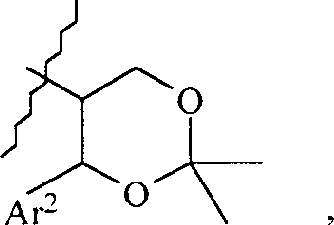


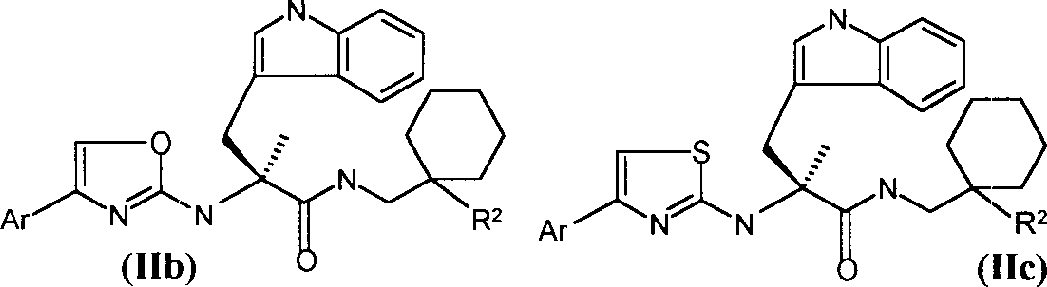


Applications Claiming Priority (6)
| Application Number | Priority Date | Filing Date | Title |
|---|---|---|---|
| GBPCT/GB00/04380 | 2000-11-17 | ||
| PCT/GB2000/004380 WO2002040022A1 (en) | 2000-11-17 | 2000-11-17 | Treatment of sexual dysfunction using bombesin antagonist |
| GB0109910A GB0109910D0 (en) | 2001-04-23 | 2001-04-23 | Treatment of sexual dysfunction |
| GB0109910.0 | 2001-04-23 | ||
| GB0111037A GB0111037D0 (en) | 2001-05-04 | 2001-05-04 | Treatment of sexual dysfunction |
| GB0111037.8 | 2001-05-04 |
Publications (1)
| Publication Number | Publication Date |
|---|---|
| CN1518445A true CN1518445A (en) | 2004-08-04 |
Family
ID=28043375
Family Applications (1)
| Application Number | Title | Priority Date | Filing Date |
|---|---|---|---|
| CNA018219519A Pending CN1518445A (en) | 2000-11-17 | 2001-11-14 | Treatment of Sexual Dysfunction |
Country Status (5)
| Country | Link |
|---|---|
| US (1) | US20040087561A1 (en) |
| CN (1) | CN1518445A (en) |
| BR (1) | BR0115364A (en) |
| PL (1) | PL362980A1 (en) |
| TW (1) | TWI220650B (en) |
Cited By (1)
| Publication number | Priority date | Publication date | Assignee | Title |
|---|---|---|---|---|
| CN103230588A (en) * | 2013-05-10 | 2013-08-07 | 陶国良 | Application of cholinesterase capable of hydrolyzing P substance at C terminal in preparation of tachykinin antagonist |
Families Citing this family (7)
| Publication number | Priority date | Publication date | Assignee | Title |
|---|---|---|---|---|
| DE10123163A1 (en) * | 2001-05-09 | 2003-01-16 | Gruenenthal Gmbh | Substituted cyclohexane-1,4-diamine derivatives |
| US7244743B2 (en) * | 2002-06-05 | 2007-07-17 | Solvay Pharmaceuticals Gmbh | Non-peptidic BRS-3 agonists |
| US20040202717A1 (en) | 2003-04-08 | 2004-10-14 | Mehta Atul M. | Abuse-resistant oral dosage forms and method of use thereof |
| US20050267072A1 (en) * | 2004-05-14 | 2005-12-01 | Solvay Pharmaceuticals Gmbh | Pharmaceutical compositions containing dually acting inhibitors of neutral endopeptidase for the treatment of sexual dysfunction |
| US20050267124A1 (en) * | 2004-05-14 | 2005-12-01 | Solvay Pharmaceuticals Gmbh | Pharmaceutical compositions comprising NEP-inhibitors, inhibitors of the endogenous producing system and PDEV inhibiitors |
| JP2009514969A (en) | 2005-11-09 | 2009-04-09 | コンビナトアールエックス インコーポレーティッド | Methods, compositions, and kits for treating medical conditions |
| WO2017096049A1 (en) | 2015-12-03 | 2017-06-08 | The University Of North Carolina At Pembroke | Materials for cathepsin b enhancement and methods of use |
-
2001
- 2001-11-14 CN CNA018219519A patent/CN1518445A/en active Pending
- 2001-11-14 BR BR0115364-1A patent/BR0115364A/en not_active IP Right Cessation
- 2001-11-14 PL PL01362980A patent/PL362980A1/en not_active Application Discontinuation
- 2001-11-14 US US10/416,934 patent/US20040087561A1/en not_active Abandoned
- 2001-11-16 TW TW090128451A patent/TWI220650B/en not_active IP Right Cessation
Cited By (1)
| Publication number | Priority date | Publication date | Assignee | Title |
|---|---|---|---|---|
| CN103230588A (en) * | 2013-05-10 | 2013-08-07 | 陶国良 | Application of cholinesterase capable of hydrolyzing P substance at C terminal in preparation of tachykinin antagonist |
Also Published As
| Publication number | Publication date |
|---|---|
| TWI220650B (en) | 2004-09-01 |
| BR0115364A (en) | 2003-09-23 |
| US20040087561A1 (en) | 2004-05-06 |
| PL362980A1 (en) | 2004-11-02 |
Similar Documents
| Publication | Publication Date | Title |
|---|---|---|
| EP1333824B1 (en) | Treatment of sexual dysfunction with bombesin receptor antagonists | |
| JP7062643B2 (en) | Compounds and their use as PDE4 activators | |
| US20020169101A1 (en) | Treatment of sexual dysfunction | |
| US10793531B2 (en) | Triazole derivatives and their use as PDE4 activators | |
| Moulin et al. | New trisubstituted 1, 2, 4-triazole derivatives as potent ghrelin receptor antagonists. 3. Synthesis and pharmacological in vitro and in vivo evaluations | |
| CN1438991A (en) | Cyclopentyl-substituted glutaramide derivatives as inhibitors of neutral endopeptidase | |
| TWI339205B (en) | Pyrazole compounds and pharmaceutical composition | |
| US20210032231A1 (en) | Compounds and Their Use as PDE4 Activators | |
| US9206154B2 (en) | Inverse agonists and neutral antagonists for the TSH receptor | |
| CN102271679A (en) | Sulfonamide containing compounds and uses thereof | |
| JP7316216B2 (en) | Delta-opioid receptor modulating compounds containing 5-membered azaheterocycles, methods of use and preparation thereof | |
| CN1518445A (en) | Treatment of Sexual Dysfunction | |
| CN106562951B (en) | Furan D-3-phosphoglycerate dehydrogenase allosteric inhibitor and its application | |
| CN1617727A (en) | Selective dopamine D3 receptor agonists for the treatment of sexual dysfunction | |
| CN101076331A (en) | Compositions for treating flushing and lipid-associated disorders comprising niacin receptor partial agonists | |
| JP2004515449A (en) | Small molecule modulator of 6G protein-coupled receptor | |
| ZA200303250B (en) | Treatment of sexual dysfunction. | |
| HK1063743A (en) | Treatment of sexual dysfunction | |
| He et al. | Discovery of New Nanomolar Selective IRAP Inhibitors | |
| US20020058606A1 (en) | Treatment of sexual dysfunction | |
| HK1059570A (en) | Treatment of sexual dysfunction using bombesin antagonist | |
| EP3878447A1 (en) | Beta adrenergic receptor antagonists | |
| ZA200303249B (en) | Treatment of sexual dysfunction using bombesin antagonist. |
Legal Events
| Date | Code | Title | Description |
|---|---|---|---|
| C06 | Publication | ||
| PB01 | Publication | ||
| C10 | Entry into substantive examination | ||
| SE01 | Entry into force of request for substantive examination | ||
| REG | Reference to a national code |
Ref country code: HK Ref legal event code: DE Ref document number: 1063743 Country of ref document: HK |
|
| C02 | Deemed withdrawal of patent application after publication (patent law 2001) | ||
| WD01 | Invention patent application deemed withdrawn after publication | ||
| REG | Reference to a national code |
Ref country code: HK Ref legal event code: WD Ref document number: 1063743 Country of ref document: HK |