CN1537101A - Pyridine Matrix Metalloproteinase Inhibitors - Google Patents
Pyridine Matrix Metalloproteinase Inhibitors Download PDFInfo
- Publication number
- CN1537101A CN1537101A CNA028049454A CN02804945A CN1537101A CN 1537101 A CN1537101 A CN 1537101A CN A028049454 A CNA028049454 A CN A028049454A CN 02804945 A CN02804945 A CN 02804945A CN 1537101 A CN1537101 A CN 1537101A
- Authority
- CN
- China
- Prior art keywords
- pyridine
- dicarboxylic acid
- acid bis
- amide
- ethyl
- Prior art date
- Legal status (The legal status is an assumption and is not a legal conclusion. Google has not performed a legal analysis and makes no representation as to the accuracy of the status listed.)
- Pending
Links
Classifications
-
- C—CHEMISTRY; METALLURGY
- C07—ORGANIC CHEMISTRY
- C07D—HETEROCYCLIC COMPOUNDS
- C07D213/00—Heterocyclic compounds containing six-membered rings, not condensed with other rings, with one nitrogen atom as the only ring hetero atom and three or more double bonds between ring members or between ring members and non-ring members
- C07D213/02—Heterocyclic compounds containing six-membered rings, not condensed with other rings, with one nitrogen atom as the only ring hetero atom and three or more double bonds between ring members or between ring members and non-ring members having three double bonds between ring members or between ring members and non-ring members
- C07D213/04—Heterocyclic compounds containing six-membered rings, not condensed with other rings, with one nitrogen atom as the only ring hetero atom and three or more double bonds between ring members or between ring members and non-ring members having three double bonds between ring members or between ring members and non-ring members having no bond between the ring nitrogen atom and a non-ring member or having only hydrogen or carbon atoms directly attached to the ring nitrogen atom
- C07D213/60—Heterocyclic compounds containing six-membered rings, not condensed with other rings, with one nitrogen atom as the only ring hetero atom and three or more double bonds between ring members or between ring members and non-ring members having three double bonds between ring members or between ring members and non-ring members having no bond between the ring nitrogen atom and a non-ring member or having only hydrogen or carbon atoms directly attached to the ring nitrogen atom with hetero atoms or with carbon atoms having three bonds to hetero atoms with at the most one bond to halogen, e.g. ester or nitrile radicals, directly attached to ring carbon atoms
- C07D213/78—Carbon atoms having three bonds to hetero atoms, with at the most one bond to halogen, e.g. ester or nitrile radicals
- C07D213/79—Acids; Esters
- C07D213/80—Acids; Esters in position 3
-
- A—HUMAN NECESSITIES
- A61—MEDICAL OR VETERINARY SCIENCE; HYGIENE
- A61K—PREPARATIONS FOR MEDICAL, DENTAL OR TOILETRY PURPOSES
- A61K31/00—Medicinal preparations containing organic active ingredients
- A61K31/33—Heterocyclic compounds
- A61K31/395—Heterocyclic compounds having nitrogen as a ring hetero atom, e.g. guanethidine or rifamycins
- A61K31/435—Heterocyclic compounds having nitrogen as a ring hetero atom, e.g. guanethidine or rifamycins having six-membered rings with one nitrogen as the only ring hetero atom
- A61K31/44—Non condensed pyridines; Hydrogenated derivatives thereof
-
- A—HUMAN NECESSITIES
- A61—MEDICAL OR VETERINARY SCIENCE; HYGIENE
- A61P—SPECIFIC THERAPEUTIC ACTIVITY OF CHEMICAL COMPOUNDS OR MEDICINAL PREPARATIONS
- A61P19/00—Drugs for skeletal disorders
-
- A—HUMAN NECESSITIES
- A61—MEDICAL OR VETERINARY SCIENCE; HYGIENE
- A61P—SPECIFIC THERAPEUTIC ACTIVITY OF CHEMICAL COMPOUNDS OR MEDICINAL PREPARATIONS
- A61P19/00—Drugs for skeletal disorders
- A61P19/02—Drugs for skeletal disorders for joint disorders, e.g. arthritis, arthrosis
-
- A—HUMAN NECESSITIES
- A61—MEDICAL OR VETERINARY SCIENCE; HYGIENE
- A61P—SPECIFIC THERAPEUTIC ACTIVITY OF CHEMICAL COMPOUNDS OR MEDICINAL PREPARATIONS
- A61P29/00—Non-central analgesic, antipyretic or antiinflammatory agents, e.g. antirheumatic agents; Non-steroidal antiinflammatory drugs [NSAID]
-
- A—HUMAN NECESSITIES
- A61—MEDICAL OR VETERINARY SCIENCE; HYGIENE
- A61P—SPECIFIC THERAPEUTIC ACTIVITY OF CHEMICAL COMPOUNDS OR MEDICINAL PREPARATIONS
- A61P35/00—Antineoplastic agents
-
- A—HUMAN NECESSITIES
- A61—MEDICAL OR VETERINARY SCIENCE; HYGIENE
- A61P—SPECIFIC THERAPEUTIC ACTIVITY OF CHEMICAL COMPOUNDS OR MEDICINAL PREPARATIONS
- A61P43/00—Drugs for specific purposes, not provided for in groups A61P1/00-A61P41/00
-
- A—HUMAN NECESSITIES
- A61—MEDICAL OR VETERINARY SCIENCE; HYGIENE
- A61P—SPECIFIC THERAPEUTIC ACTIVITY OF CHEMICAL COMPOUNDS OR MEDICINAL PREPARATIONS
- A61P9/00—Drugs for disorders of the cardiovascular system
-
- A—HUMAN NECESSITIES
- A61—MEDICAL OR VETERINARY SCIENCE; HYGIENE
- A61P—SPECIFIC THERAPEUTIC ACTIVITY OF CHEMICAL COMPOUNDS OR MEDICINAL PREPARATIONS
- A61P9/00—Drugs for disorders of the cardiovascular system
- A61P9/04—Inotropic agents, i.e. stimulants of cardiac contraction; Drugs for heart failure
-
- C—CHEMISTRY; METALLURGY
- C07—ORGANIC CHEMISTRY
- C07D—HETEROCYCLIC COMPOUNDS
- C07D213/00—Heterocyclic compounds containing six-membered rings, not condensed with other rings, with one nitrogen atom as the only ring hetero atom and three or more double bonds between ring members or between ring members and non-ring members
- C07D213/02—Heterocyclic compounds containing six-membered rings, not condensed with other rings, with one nitrogen atom as the only ring hetero atom and three or more double bonds between ring members or between ring members and non-ring members having three double bonds between ring members or between ring members and non-ring members
- C07D213/04—Heterocyclic compounds containing six-membered rings, not condensed with other rings, with one nitrogen atom as the only ring hetero atom and three or more double bonds between ring members or between ring members and non-ring members having three double bonds between ring members or between ring members and non-ring members having no bond between the ring nitrogen atom and a non-ring member or having only hydrogen or carbon atoms directly attached to the ring nitrogen atom
- C07D213/60—Heterocyclic compounds containing six-membered rings, not condensed with other rings, with one nitrogen atom as the only ring hetero atom and three or more double bonds between ring members or between ring members and non-ring members having three double bonds between ring members or between ring members and non-ring members having no bond between the ring nitrogen atom and a non-ring member or having only hydrogen or carbon atoms directly attached to the ring nitrogen atom with hetero atoms or with carbon atoms having three bonds to hetero atoms with at the most one bond to halogen, e.g. ester or nitrile radicals, directly attached to ring carbon atoms
- C07D213/78—Carbon atoms having three bonds to hetero atoms, with at the most one bond to halogen, e.g. ester or nitrile radicals
- C07D213/81—Amides; Imides
-
- C—CHEMISTRY; METALLURGY
- C07—ORGANIC CHEMISTRY
- C07D—HETEROCYCLIC COMPOUNDS
- C07D213/00—Heterocyclic compounds containing six-membered rings, not condensed with other rings, with one nitrogen atom as the only ring hetero atom and three or more double bonds between ring members or between ring members and non-ring members
- C07D213/02—Heterocyclic compounds containing six-membered rings, not condensed with other rings, with one nitrogen atom as the only ring hetero atom and three or more double bonds between ring members or between ring members and non-ring members having three double bonds between ring members or between ring members and non-ring members
- C07D213/04—Heterocyclic compounds containing six-membered rings, not condensed with other rings, with one nitrogen atom as the only ring hetero atom and three or more double bonds between ring members or between ring members and non-ring members having three double bonds between ring members or between ring members and non-ring members having no bond between the ring nitrogen atom and a non-ring member or having only hydrogen or carbon atoms directly attached to the ring nitrogen atom
- C07D213/60—Heterocyclic compounds containing six-membered rings, not condensed with other rings, with one nitrogen atom as the only ring hetero atom and three or more double bonds between ring members or between ring members and non-ring members having three double bonds between ring members or between ring members and non-ring members having no bond between the ring nitrogen atom and a non-ring member or having only hydrogen or carbon atoms directly attached to the ring nitrogen atom with hetero atoms or with carbon atoms having three bonds to hetero atoms with at the most one bond to halogen, e.g. ester or nitrile radicals, directly attached to ring carbon atoms
- C07D213/78—Carbon atoms having three bonds to hetero atoms, with at the most one bond to halogen, e.g. ester or nitrile radicals
- C07D213/81—Amides; Imides
- C07D213/82—Amides; Imides in position 3
-
- C—CHEMISTRY; METALLURGY
- C07—ORGANIC CHEMISTRY
- C07D—HETEROCYCLIC COMPOUNDS
- C07D231/00—Heterocyclic compounds containing 1,2-diazole or hydrogenated 1,2-diazole rings
- C07D231/02—Heterocyclic compounds containing 1,2-diazole or hydrogenated 1,2-diazole rings not condensed with other rings
- C07D231/10—Heterocyclic compounds containing 1,2-diazole or hydrogenated 1,2-diazole rings not condensed with other rings having two or three double bonds between ring members or between ring members and non-ring members
- C07D231/12—Heterocyclic compounds containing 1,2-diazole or hydrogenated 1,2-diazole rings not condensed with other rings having two or three double bonds between ring members or between ring members and non-ring members with only hydrogen atoms, hydrocarbon or substituted hydrocarbon radicals, directly attached to ring carbon atoms
-
- C—CHEMISTRY; METALLURGY
- C07—ORGANIC CHEMISTRY
- C07D—HETEROCYCLIC COMPOUNDS
- C07D233/00—Heterocyclic compounds containing 1,3-diazole or hydrogenated 1,3-diazole rings, not condensed with other rings
- C07D233/54—Heterocyclic compounds containing 1,3-diazole or hydrogenated 1,3-diazole rings, not condensed with other rings having two double bonds between ring members or between ring members and non-ring members
- C07D233/56—Heterocyclic compounds containing 1,3-diazole or hydrogenated 1,3-diazole rings, not condensed with other rings having two double bonds between ring members or between ring members and non-ring members with only hydrogen atoms or radicals containing only hydrogen and carbon atoms, attached to ring carbon atoms
-
- C—CHEMISTRY; METALLURGY
- C07—ORGANIC CHEMISTRY
- C07D—HETEROCYCLIC COMPOUNDS
- C07D249/00—Heterocyclic compounds containing five-membered rings having three nitrogen atoms as the only ring hetero atoms
- C07D249/02—Heterocyclic compounds containing five-membered rings having three nitrogen atoms as the only ring hetero atoms not condensed with other rings
- C07D249/08—1,2,4-Triazoles; Hydrogenated 1,2,4-triazoles
-
- C—CHEMISTRY; METALLURGY
- C07—ORGANIC CHEMISTRY
- C07D—HETEROCYCLIC COMPOUNDS
- C07D401/00—Heterocyclic compounds containing two or more hetero rings, having nitrogen atoms as the only ring hetero atoms, at least one ring being a six-membered ring with only one nitrogen atom
- C07D401/14—Heterocyclic compounds containing two or more hetero rings, having nitrogen atoms as the only ring hetero atoms, at least one ring being a six-membered ring with only one nitrogen atom containing three or more hetero rings
-
- C—CHEMISTRY; METALLURGY
- C07—ORGANIC CHEMISTRY
- C07D—HETEROCYCLIC COMPOUNDS
- C07D405/00—Heterocyclic compounds containing both one or more hetero rings having oxygen atoms as the only ring hetero atoms, and one or more rings having nitrogen as the only ring hetero atom
- C07D405/14—Heterocyclic compounds containing both one or more hetero rings having oxygen atoms as the only ring hetero atoms, and one or more rings having nitrogen as the only ring hetero atom containing three or more hetero rings
-
- C—CHEMISTRY; METALLURGY
- C07—ORGANIC CHEMISTRY
- C07D—HETEROCYCLIC COMPOUNDS
- C07D409/00—Heterocyclic compounds containing two or more hetero rings, at least one ring having sulfur atoms as the only ring hetero atoms
- C07D409/14—Heterocyclic compounds containing two or more hetero rings, at least one ring having sulfur atoms as the only ring hetero atoms containing three or more hetero rings
Landscapes
- Chemical & Material Sciences (AREA)
- Organic Chemistry (AREA)
- Health & Medical Sciences (AREA)
- Veterinary Medicine (AREA)
- Public Health (AREA)
- General Health & Medical Sciences (AREA)
- Animal Behavior & Ethology (AREA)
- Life Sciences & Earth Sciences (AREA)
- Medicinal Chemistry (AREA)
- Pharmacology & Pharmacy (AREA)
- Chemical Kinetics & Catalysis (AREA)
- General Chemical & Material Sciences (AREA)
- Nuclear Medicine, Radiotherapy & Molecular Imaging (AREA)
- Bioinformatics & Cheminformatics (AREA)
- Engineering & Computer Science (AREA)
- Cardiology (AREA)
- Rheumatology (AREA)
- Heart & Thoracic Surgery (AREA)
- Physical Education & Sports Medicine (AREA)
- Hospice & Palliative Care (AREA)
- Immunology (AREA)
- Orthopedic Medicine & Surgery (AREA)
- Pain & Pain Management (AREA)
- Epidemiology (AREA)
- Pharmaceuticals Containing Other Organic And Inorganic Compounds (AREA)
- Pyridine Compounds (AREA)
Abstract
Description
发明领域field of invention
本发明涉及吡啶衍生物,它们抑制基质金属蛋白酶,因而可用于治疗由组织衰变导致的疾病,例如心脏病、多发性硬化、骨关节炎、类风湿性关节炎、动脉粥样硬化和骨质疏松。The present invention relates to pyridine derivatives which inhibit matrix metalloproteinases and are therefore useful in the treatment of diseases resulting from tissue decay such as heart disease, multiple sclerosis, osteoarthritis, rheumatoid arthritis, atherosclerosis and osteoporosis .
发明背景Background of the invention
基质金属蛋白酶(有时称为MMP)是天然存在于大多数哺乳动物中的酶。MMP的过度表达与活化或MMP与MMP抑制剂之间的失衡已经提示是以细胞外基质或结缔组织衰变为特征的疾病的发病因素。Matrix metalloproteinases (sometimes referred to as MMPs) are enzymes that occur naturally in most mammals. Overexpression and activation of MMPs or an imbalance between MMPs and MMP inhibitors has been implicated as a causative factor in diseases characterized by extracellular matrix or connective tissue decay.
溶基质素-1和明胶酶A是基质金属蛋白酶(MMP)家族的成员。其他成员包括成纤维细胞胶原酶(MMP-1)、嗜中性白细胞胶原酶(MMP-8)、明胶酶B(92kDa的明胶酶)(MMP-9)、溶基质素-2(MMP-10)、溶基质素-3(MMP-11)、间质溶素(MMP-7)、胶原酶3(MMP-13)、TNF-α转化酶(TACE)和其他新发现的膜缔合类基质金属蛋白酶(Sato H.,Takino T.,Okada Y.,Cao J.,Shinagawa A.,Yamamoto E.,and Seiki M.,Nature,1994;370:61-65)。这些酶已经与大量疾病有牵连,这些疾病是由结缔组织衰变所导致的,例如包括类风湿性关节炎、骨关节炎、骨质疏松、牙周炎、多发性硬化、齿龈炎、角膜表皮与胃溃疡、动脉粥样硬化、引起再狭窄与缺血性心力衰竭的新生内膜增生、和肿瘤转移。预防和治疗这些和其他疾病的方法现被公认为抑制基质金属蛋白酶,由此减少和/或消除导致这些疾病状态的结缔组织衰变。Stromelysin-1 and gelatinase A are members of the matrix metalloproteinase (MMP) family. Other members include fibroblast collagenase (MMP-1), neutrophil collagenase (MMP-8), gelatinase B (92 kDa gelatinase) (MMP-9), stromelysin-2 (MMP-10 ), stromelysin-3 (MMP-11), stromalysin (MMP-7), collagenase 3 (MMP-13), TNF-α converting enzyme (TACE) and other newly discovered membrane-associated substrates Metalloproteases (Sato H., Takino T., Okada Y., Cao J., Shinagawa A., Yamamoto E., and Seiki M., Nature, 1994; 370:61-65). These enzymes have been implicated in a large number of diseases caused by the decay of connective tissue, including rheumatoid arthritis, osteoarthritis, osteoporosis, periodontitis, multiple sclerosis, gingivitis, corneal epidermis and Gastric ulcer, atherosclerosis, neointimal hyperplasia leading to restenosis and ischemic heart failure, and tumor metastasis. Methods of preventing and treating these and other diseases are now recognized as inhibiting matrix metalloproteinases, thereby reducing and/or eliminating the decay of connective tissue that leads to these disease states.
在基质金属蛋白酶中存在一个催化性锌结构域,它通常是抑制剂设计的焦点。通过引入锌螯合性基团来修饰底物,已经生成了有力的抑制剂,例如肽的异羟肟酸酯和含有巯基的肽。肽的异羟肟酸酯和MMP的天然内源性抑制剂(TIMP)已经成功地用于治疗癌症和炎症的动物模型。MMP抑制剂还已经用于预防和治疗充血性心力衰竭和其他心血管疾病,参见美国专利No.5,948,780。In matrix metalloproteinases there is a catalytic zinc domain that is often the focus of inhibitor design. Modification of substrates by introducing zinc-chelating groups has generated potent inhibitors, such as peptide hydroxamates and sulfhydryl-containing peptides. Peptide hydroxamates and natural endogenous inhibitors of MMPs (TIMPs) have been successfully used to treat cancer and animal models of inflammation. MMP inhibitors have also been used in the prevention and treatment of congestive heart failure and other cardiovascular diseases, see US Patent No. 5,948,780.
目前已知的MMP抑制剂的使用上的主要限制是它们缺乏对任意特定酶的特异性。最近的数据已经确立了特异性MMP酶是与一些疾病有关的,但是对其他疾病没有明显效果。MMP一般是根据它们的底物特异性加以分类的;事实上,胶原酶亚家族的MMP-1、MMP-8和MMP-13选择性裂解天然的间质胶原,因而仅与与这类间质胶原组织有联系的疾病有关。这一点得到了最近一个发现的证实,单独的MMP-13在乳腺癌中被过度表达,而单独的MMP-1在乳头状癌中被过度表达(Chen等,J.Am.Chem.Soc.,2000;122:9648-9654)。A major limitation in the use of currently known MMP inhibitors is their lack of specificity for any particular enzyme. Recent data have established that specific MMP enzymes are associated with some diseases but have no apparent effect on others. MMPs are generally classified according to their substrate specificity; in fact, MMP-1, MMP-8, and MMP-13 of the collagenase subfamily selectively cleave native interstitial collagen and are thus only compatible with this type of interstitial collagen. Collagen tissue has been linked to diseases. This is confirmed by a recent finding that MMP-13 alone is overexpressed in breast cancer, while MMP-1 alone is overexpressed in papillary carcinoma (Chen et al., J. Am. Chem. Soc., 2000;122:9648-9654).
似乎鲜有选择性MMP-13抑制剂的报道。一种名为WAY-170523的化合物已经被Chen等所报道,出处同上,一些其他化合物报道在PCT国际申请公开号WO 01/63244 A1中,据称为选择性MMP-13抑制剂。进而,美国专利No.6,008,243公开了MMP-13抑制剂。不过,尚没有选择性或非选择性MMP-13抑制剂被批准上市用于任意哺乳动物任意疾病的治疗。因此,仍然需要发现新的小分子化合物,它们是有力的选择性MMP抑制剂,具有可接受的毒性/效力的治疗指数,使它们能够在临床上用于有关疾病状态的预防和治疗。本发明的目的是提供一类选择性MMP-13抑制剂化合物,它们被鉴别为间苯二甲酸衍生物。There appear to be few reports of selective MMP-13 inhibitors. A compound named WAY-170523 has been reported by Chen et al., supra, and some other compounds are reported in PCT International Application Publication No. WO 01/63244 A1, which are said to be selective MMP-13 inhibitors. Further, US Patent No. 6,008,243 discloses MMP-13 inhibitors. However, no selective or non-selective MMP-13 inhibitors have been approved for the treatment of any disease in any mammal. Therefore, there remains a need to discover new small molecule compounds that are potent and selective MMP inhibitors with an acceptable toxicity/efficacy therapeutic index, enabling their clinical use in the prevention and treatment of relevant disease states. It is an object of the present invention to provide a class of selective MMP-13 inhibitor compounds which have been identified as derivatives of isophthalic acid.
发明概述Summary of the invention
本发明提供使用一种吡啶化合物抑制基质金属蛋白酶、尤其是MMP-13的方法。本发明更确切地涉及抑制MMP酶的方法,包含对宿主给以MMP抑制量的由式I所定义的化合物The present invention provides methods of inhibiting matrix metalloproteinases, particularly MMP-13, using a pyridine compound. The present invention relates more precisely to the method for inhibiting MMP enzyme, comprises the compound defined by formula I to host giving MMP inhibitory amount

或其药学上可接受的盐,or a pharmaceutically acceptable salt thereof,
其中:in:
R1和R2独立地是氢、卤代、羟基、C1-C6烷基、C1-C6烷氧基、C2-C6链烯基、C2-C6炔基、NO2、NR4R5、CN或CF3;R 1 and R 2 are independently hydrogen, halo, hydroxyl, C 1 -C 6 alkyl, C 1 -C 6 alkoxy, C 2 -C 6 alkenyl, C 2 -C 6 alkynyl, NO 2. NR 4 R 5 , CN or CF 3 ;
E独立地是O或S;E is independently O or S;
A和B独立地是OR4或NR4R5;A and B are independently OR 4 or NR 4 R 5 ;
R4和R5独立地是H、C1-C6烷基、C2-C6链烯基、C2-C6炔基、(CH2)n芳基、(CH2)n环烷基、(CH2)n杂芳基,或者R4和R5与它们所连接的氮一起构成3至8元环,含有碳原子,可选地含有选自O、S或NH的杂原子,并且可选地是取代或未取代的;R 4 and R 5 are independently H, C 1 -C 6 alkyl, C 2 -C 6 alkenyl, C 2 -C 6 alkynyl, (CH 2 ) n aryl, (CH 2 ) n cycloalkane radical, (CH 2 ) n heteroaryl, or R 4 and R 5 together with the nitrogen to which they are attached form a 3- to 8-membered ring containing carbon atoms, optionally containing heteroatoms selected from O, S or NH, and is optionally substituted or unsubstituted;
n是0至6的整数。n is an integer of 0 to 6.
优选的抑制宿主MMP酶的方法包含给以式II化合物A preferred method of inhibiting a host MMP enzyme comprises administering a compound of formula II

或其药学上可接受的盐,其中R1和R2是如上所定义的,每个R4独立地是如上所定义的。or a pharmaceutically acceptable salt thereof, wherein R 1 and R 2 are as defined above, and each R 4 is independently as defined above.
另一种优选的抑制MMP酶的方法包含给以式III化合物Another preferred method of inhibiting MMP enzymes comprises administering a compound of formula III

或其药学上可接受的盐,其中R1和R2是如上所定义的,每个R4和R5独立地是如上所定义的。or a pharmaceutically acceptable salt thereof, wherein R 1 and R 2 are as defined above, and each R 4 and R 5 is independently as defined above.
尤其优选的方法包含给以式IV的MMP抑制剂A particularly preferred method comprises administering an MMP inhibitor of formula IV

或其药学上可接受的盐,其中n、R1和R2是如上所定义的,R6、R7、R8和R9独立地是氢、卤代、C1-C6烷基、C1-C6烷氧基、硝基或NH2。or a pharmaceutically acceptable salt thereof, wherein n, R 1 and R 2 are as defined above, R 6 , R 7 , R 8 and R 9 are independently hydrogen, halo, C 1 -C 6 alkyl, C 1 -C 6 alkoxy, nitro or NH 2 .
进而另一种优选的方法包含给以式V的MMP抑制剂Yet another preferred method comprises administering an MMP inhibitor of formula V
或其药学上可接受的盐,其中n、R1和R2是如上所定义的,每个Ar独立地是芳基或Het,其中芳基是苯基或取代的苯基,Het是未取代或取代的杂芳基。or a pharmaceutically acceptable salt thereof, wherein n, R and R are as defined above, each Ar is independently aryl or Het, wherein aryl is phenyl or substituted phenyl, and Het is unsubstituted or a substituted heteroaryl.
式I、II、III、IV和V化合物是作为本发明进一步的实施方式而提供的。优选的化合物是式I的酰胺,其中A和B之一或之二是NR4R5。更优选的本发明化合物选自:Compounds of formulas I, II, III, IV and V are provided as further embodiments of the present invention. Preferred compounds are amides of formula I wherein one or both of A and B is NR4R5 . More preferred compounds of the invention are selected from:
吡啶-3,5-二羧酸,(4-氯-苄酰胺),[(1,3-苯并二氧杂环戊烯-5-基甲基)酰胺];Pyridine-3,5-dicarboxylic acid, (4-chloro-benzamide), [(1,3-benzodioxol-5-ylmethyl)amide];
吡啶-3,5-二羧酸,(4-羧基-苄酰胺),[(1,3-苯并二氧杂环戊烯-5-基甲基)酰胺];Pyridine-3,5-dicarboxylic acid, (4-carboxy-benzamide), [(1,3-benzodioxol-5-ylmethyl)amide];
吡啶-3,5-二羧酸,(4-羧基-苄酰胺),(4-甲氧基苄酰胺);Pyridine-3,5-dicarboxylic acid, (4-carboxy-benzamide), (4-methoxybenzamide);
吡啶-3,5-二羧酸,(4-羧基-苄酰胺),(3-甲氧基苄酰胺);Pyridine-3,5-dicarboxylic acid, (4-carboxy-benzamide), (3-methoxybenzamide);
吡啶-3,5-二羧酸,(4-甲酯基-苄酰胺),(3-甲氧基-苄酰胺);Pyridine-3,5-dicarboxylic acid, (4-methoxy-benzylamide), (3-methoxy-benzylamide);
吡啶-3,5-二羧酸,(4-羧基-苄酰胺),(3-吡啶甲基酰胺);Pyridine-3,5-dicarboxylic acid, (4-carboxy-benzamide), (3-pyridinemethylamide);
吡啶-3,5-二羧酸,(4-羧基-苄酰胺),(3-噻吩甲基酰胺);Pyridine-3,5-dicarboxylic acid, (4-carboxy-benzylamide), (3-thiophenemethylamide);
吡啶-3,5-二羧酸,(2,1,3-苯并噻二唑-5-基甲基)酰胺,[(1,3-苯并二氧杂环戊烯-5-基甲基)酰胺];Pyridine-3,5-dicarboxylic acid, (2,1,3-benzothiadiazol-5-ylmethyl)amide, [(1,3-benzodioxol-5-ylmethyl) base) amides];
吡啶-3,5-二羧酸,(2,1,3-苯并噁二唑-5-基甲基)酰胺,[(1,3-苯并二氧杂环戊烯-5-基甲基)酰胺];Pyridine-3,5-dicarboxylic acid, (2,1,3-benzoxadiazol-5-ylmethyl)amide, [(1,3-benzodioxol-5-ylmethyl) base) amides];
吡啶-3,5-二羧酸,(2,1,3-苯并噻二唑-5-基甲基)酰胺,(4-甲氧基-苄酰胺);Pyridine-3,5-dicarboxylic acid, (2,1,3-benzothiadiazol-5-ylmethyl)amide, (4-methoxy-benzylamide);
吡啶-3,5-二羧酸,(2,1,3-苯并噻二唑-5-基甲基)酰胺,(3-甲氧基-苄酰胺);Pyridine-3,5-dicarboxylic acid, (2,1,3-benzothiadiazol-5-ylmethyl)amide, (3-methoxy-benzylamide);
吡啶-3,5-二羧酸双-(1,3-苯并二氧杂环戊烯-5-基甲基)酯;Pyridine-3,5-dicarboxylic acid bis-(1,3-benzodioxol-5-ylmethyl)ester;
2-甲氧基-吡啶-3,5-二羧酸双-[(1,3-苯并二氧杂环戊烯-5-基甲基)酰胺];2-Methoxy-pyridine-3,5-dicarboxylic acid bis-[(1,3-benzodioxol-5-ylmethyl)amide];
2-乙氧基-吡啶-3,5-二羧酸双-[(1,3-苯并二氧杂环戊烯-5-基甲基)酰胺];2-Ethoxy-pyridine-3,5-dicarboxylic acid bis-[(1,3-benzodioxol-5-ylmethyl)amide];
2-氨基-吡啶-3,5-二羧酸双-[(1,3-苯并二氧杂环戊烯-5-基甲基)酰胺];和2-Amino-pyridine-3,5-dicarboxylic acid bis-[(1,3-benzodioxol-5-ylmethyl)amide]; and
2-氧代-1,2-二氢-吡啶-3,5-二羧酸双-苄酰胺,2-oxo-1,2-dihydro-pyridine-3,5-dicarboxylic acid bis-benzylamide,
2-甲氧基-吡啶-3,5-二羧酸双-苄酰胺,2-methoxy-pyridine-3,5-dicarboxylic acid bis-benzylamide,
(3,5-双-苄基氨基甲酰基-吡啶-2-基氧基)-乙酸叔丁基酯,(3,5-bis-benzylcarbamoyl-pyridin-2-yloxy)-tert-butyl acetate,
(3,5-双-苄基氨基甲酰基-吡啶-2-基氧基)-乙酸,(3,5-bis-benzylcarbamoyl-pyridin-2-yloxy)-acetic acid,
吡啶-2,4-二羧酸双-(3-甲氧基-苄酰胺),Pyridine-2,4-dicarboxylic acid bis-(3-methoxy-benzylamide),
吡啶-2,4-二羧酸双-[(1,3-苯并二氧杂环戊烯-5-基甲基)酰胺],Pyridine-2,4-dicarboxylic acid bis-[(1,3-benzodioxol-5-ylmethyl)amide],
吡啶-2,4-二羧酸双-(2,4-二甲氧基-苄酰胺),Pyridine-2,4-dicarboxylic acid bis-(2,4-dimethoxy-benzylamide),
吡啶-2,4-二羧酸双-(4-氯-苄酰胺),Pyridine-2,4-dicarboxylic acid bis-(4-chloro-benzylamide),
吡啶-2,4-二羧酸双-苄酰胺,Pyridine-2,4-dicarboxylic acid bis-benzylamide,
吡啶-2,4-二羧酸双-[(萘-1-基甲基)酰胺],Pyridine-2,4-dicarboxylic acid bis-[(naphthalene-1-ylmethyl)amide],
吡啶-2,4-二羧酸双-[(2-对-甲苯基-乙基)酰胺],Pyridine-2,4-dicarboxylic acid bis-[(2-p-tolyl-ethyl)amide],
吡啶-2,4-二羧酸双-(4-甲氧基-苄酰胺),Pyridine-2,4-dicarboxylic acid bis-(4-methoxy-benzylamide),
吡啶-2,4-二羧酸双-(3-氟-苄酰胺),Pyridine-2,4-dicarboxylic acid bis-(3-fluoro-benzylamide),
吡啶-2,4-二羧酸双-(苄基-乙基酰胺),Pyridine-2,4-dicarboxylic acid bis-(benzyl-ethylamide),
吡啶-2,4-二羧酸双-{[2-(3,4-二甲氧基-苯基)-乙基]酰胺},Pyridine-2,4-dicarboxylic acid bis-{[2-(3,4-dimethoxy-phenyl)-ethyl]amide},
吡啶-2,4-二羧酸双-{[2-(2-苯氧基-苯基)-乙基]酰胺],Pyridine-2,4-dicarboxylic acid bis-{[2-(2-phenoxy-phenyl)-ethyl]amide],
吡啶-2,4-二羧酸双-[(4-苯基-丁基)酰胺],Pyridine-2,4-dicarboxylic acid bis-[(4-phenyl-butyl)amide],
吡啶-2,4-二羧酸双-{[2-(4-甲氧基-苯基)-乙基]酰胺},Pyridine-2,4-dicarboxylic acid bis-{[2-(4-methoxy-phenyl)-ethyl]amide},
吡啶-2,4-二羧酸双-{[2-(2-氟-苯基)-乙基]酰胺},Pyridine-2,4-dicarboxylic acid bis-{[2-(2-fluoro-phenyl)-ethyl]amide},
吡啶-2,4-二羧酸双-{[2-(3-氯-苯基)-乙基]酰胺},Pyridine-2,4-dicarboxylic acid bis-{[2-(3-chloro-phenyl)-ethyl]amide},
吡啶-2,4-二羧酸双-{[2-(2,4-二甲基-苯基)-乙基]酰胺},Pyridine-2,4-dicarboxylic acid bis-{[2-(2,4-dimethyl-phenyl)-ethyl]amide},
吡啶-2,4-二羧酸双-[(2-邻-甲苯基-乙基)酰胺],Pyridine-2,4-dicarboxylic acid bis-[(2-o-tolyl-ethyl)amide],
吡啶-2,4-二羧酸双-{[2-(4-乙基-苯基)-乙基]酰胺},Pyridine-2,4-dicarboxylic acid bis-{[2-(4-ethyl-phenyl)-ethyl]amide},
吡啶-2,4-二羧酸双-[(2-苯基-丙基)酰胺],Pyridine-2,4-dicarboxylic acid bis-[(2-phenyl-propyl)amide],
吡啶-2,4-二羧酸双-[(1,2-二苯基-乙基)酰胺],Pyridine-2,4-dicarboxylic acid bis-[(1,2-diphenyl-ethyl)amide],
吡啶-2,4-二羧酸双-(2,4-二氯-苄酰胺),Pyridine-2,4-dicarboxylic acid bis-(2,4-dichloro-benzylamide),
吡啶-2,4-二羧酸双-[(联苯-2-基甲基)酰胺],Pyridine-2,4-dicarboxylic acid bis-[(biphenyl-2-ylmethyl)amide],
吡啶-2,4-二羧酸双-(3,4,5-三甲氧基-苄酰胺),Pyridine-2,4-dicarboxylic acid bis-(3,4,5-trimethoxy-benzylamide),
吡啶-2,4-二羧酸双-(3-氯-苄酰胺),Pyridine-2,4-dicarboxylic acid bis-(3-chloro-benzylamide),
吡啶-2,4-二羧酸双-(3,5-二甲氧基-苄酰胺),Pyridine-2,4-dicarboxylic acid bis-(3,5-dimethoxy-benzylamide),
吡啶-2,4-二羧酸双-(3,4-二甲氧基-苄酰胺),Pyridine-2,4-dicarboxylic acid bis-(3,4-dimethoxy-benzylamide),
吡啶-2,4-二羧酸双-(乙基-吡啶-4-基甲基酰胺),Pyridine-2,4-dicarboxylic acid bis-(ethyl-pyridin-4-ylmethylamide),
吡啶-2,4-二羧酸双-[(2-吡啶-4-基-乙基)酰胺],Pyridine-2,4-dicarboxylic acid bis-[(2-pyridin-4-yl-ethyl)amide],
吡啶-2,4-二羧酸双-[(2-吡啶-3-基-乙基)酰胺],Pyridine-2,4-dicarboxylic acid bis-[(2-pyridin-3-yl-ethyl)amide],
吡啶-2,4-二羧酸双-{[2-(4-氯-苯基)-乙基]酰胺},Pyridine-2,4-dicarboxylic acid bis-{[2-(4-chloro-phenyl)-ethyl]amide},
吡啶-2,4-二羧酸双-[(吡啶-4-基甲基)酰胺],Pyridine-2,4-dicarboxylic acid bis-[(pyridin-4-ylmethyl)amide],
吡啶-2,4-二羧酸双-(3,5-双-三氟甲基-苄酰胺),Pyridine-2,4-dicarboxylic acid bis-(3,5-bis-trifluoromethyl-benzamide),
吡啶-2,4-二羧酸双-(2,3-二甲氧基-苄酰胺),Pyridine-2,4-dicarboxylic acid bis-(2,3-dimethoxy-benzylamide),
吡啶-2,4-二羧酸双-(3-三氟甲基-苄酰胺),Pyridine-2,4-dicarboxylic acid bis-(3-trifluoromethyl-benzamide),
吡啶-2,4-二羧酸双-(2-三氟甲氧基-苄酰胺),Pyridine-2,4-dicarboxylic acid bis-(2-trifluoromethoxy-benzylamide),
吡啶-2,4-二羧酸双-(3-二氟甲氧基-苄酰胺),Pyridine-2,4-dicarboxylic acid bis-(3-difluoromethoxy-benzylamide),
吡啶-2,4-二羧酸双-(2-二氟甲氧基-苄酰胺),Pyridine-2,4-dicarboxylic acid bis-(2-difluoromethoxy-benzylamide),
吡啶-2,4-二羧酸双-(4-氟-3-三氟甲基-苄酰胺),Pyridine-2,4-dicarboxylic acid bis-(4-fluoro-3-trifluoromethyl-benzamide),
吡啶-2,4-二羧酸双-(2-甲氧基-苄酰胺),Pyridine-2,4-dicarboxylic acid bis-(2-methoxy-benzylamide),
吡啶-2,4-二羧酸双-{[2-(3-乙氧基-苯基)-乙基]酰胺},Pyridine-2,4-dicarboxylic acid bis-{[2-(3-ethoxy-phenyl)-ethyl]amide},
吡啶-2,4-二羧酸双-(3-氯-4-氟-苄酰胺),Pyridine-2,4-dicarboxylic acid bis-(3-chloro-4-fluoro-benzylamide),
吡啶-2,4-二羧酸双-(2,4-二氟-苄酰胺),Pyridine-2,4-dicarboxylic acid bis-(2,4-difluoro-benzylamide),
吡啶-2,4-二羧酸双-(4-氨基-苄酰胺),Pyridine-2,4-dicarboxylic acid bis-(4-amino-benzylamide),
吡啶-2,4-二羧酸双-(2-甲基-苄酰胺),Pyridine-2,4-dicarboxylic acid bis-(2-methyl-benzamide),
吡啶-2,4-二羧酸双-{[双-(4-甲氧基-苯基)-甲基]-酰胺},Pyridine-2,4-dicarboxylic acid bis-{[bis-(4-methoxy-phenyl)-methyl]-amide},
吡啶-2,4-二羧酸双-[(3,3-二苯基-丙基)酰胺],Pyridine-2,4-dicarboxylic acid bis-[(3,3-diphenyl-propyl)amide],
吡啶-2,4-二羧酸双-[(1-甲基-3-苯基-丙基)酰胺],Pyridine-2,4-dicarboxylic acid bis-[(1-methyl-3-phenyl-propyl)amide],
吡啶-2,4-二羧酸双-[(3,4-二甲氧基-苯基)酰胺],Pyridine-2,4-dicarboxylic acid bis-[(3,4-dimethoxy-phenyl)amide],
吡啶-2,4-二羧酸双-(2-氟-苄酰胺),Pyridine-2,4-dicarboxylic acid bis-(2-fluoro-benzylamide),
吡啶-2,4-二羧酸双-[(3-咪唑-1-基-丙基)酰胺],Pyridine-2,4-dicarboxylic acid bis-[(3-imidazol-1-yl-propyl)amide],
吡啶-2,4-二羧酸双-(2-氯-苄酰胺),Pyridine-2,4-dicarboxylic acid bis-(2-chloro-benzamide),
吡啶-2,4-二羧酸双-(2-三氟甲基-苄酰胺),Pyridine-2,4-dicarboxylic acid bis-(2-trifluoromethyl-benzamide),
吡啶-2,4-二羧酸双-(4-甲基-苄酰胺),Pyridine-2,4-dicarboxylic acid bis-(4-methyl-benzamide),
吡啶-2,4-二羧酸双-{[2-(3-甲氧基-苯基)-乙基]酰胺},Pyridine-2,4-dicarboxylic acid bis-{[2-(3-methoxy-phenyl)-ethyl]amide},
吡啶-2,4-二羧酸双-[(1-苯基-乙基)酰胺],Pyridine-2,4-dicarboxylic acid bis-[(1-phenyl-ethyl)amide],
吡啶-2,4-二羧酸双-[(吡啶-3-基甲基)酰胺],Pyridine-2,4-dicarboxylic acid bis-[(pyridin-3-ylmethyl)amide],
吡啶-2,4-二羧酸双-[(4-乙氧基-苯基)酰胺],Pyridine-2,4-dicarboxylic acid bis-[(4-ethoxy-phenyl)amide],
吡啶-2,4-二羧酸双-(苯乙基酰胺),Pyridine-2,4-dicarboxylic acid bis-(phenylethylamide),
吡啶-2,4-二羧酸双-[(噻吩-2-基甲基)酰胺],Pyridine-2,4-dicarboxylic acid bis-[(thiophen-2-ylmethyl)amide],
吡啶-2,4-二羧酸双-(4-三氟甲基-苄酰胺),Pyridine-2,4-dicarboxylic acid bis-(4-trifluoromethyl-benzamide),
吡啶-2,4-二羧酸双-[(5-甲基-呋喃-2-基甲基)酰胺],Pyridine-2,4-dicarboxylic acid bis-[(5-methyl-furan-2-ylmethyl)amide],
吡啶-2,4-二羧酸双-{[1-(4-氟-苯基)-乙基]酰胺},Pyridine-2,4-dicarboxylic acid bis-{[1-(4-fluoro-phenyl)-ethyl]amide},
吡啶-2,4-二羧酸双-(2-氨基-苄酰胺),Pyridine-2,4-dicarboxylic acid bis-(2-amino-benzylamide),
吡啶-2,4-二羧酸双-[(1-萘-1-基-乙基)酰胺],Pyridine-2,4-dicarboxylic acid bis-[(1-naphthalen-1-yl-ethyl)amide],
吡啶-2,4-二羧酸双-{[2-(4-羟基-苯基)-乙基]酰胺},Pyridine-2,4-dicarboxylic acid bis-{[2-(4-hydroxy-phenyl)-ethyl]amide},
吡啶-2,4-二羧酸双-(3-三氟甲氧基-苄酰胺),Pyridine-2,4-dicarboxylic acid bis-(3-trifluoromethoxy-benzylamide),
吡啶-2,4-二羧酸双-{[1-(3-甲氧基-苯基)-乙基]酰胺},Pyridine-2,4-dicarboxylic acid bis-{[1-(3-methoxy-phenyl)-ethyl]amide},
吡啶-2,4-二羧酸双-[(1-苯基-丙基)酰胺],Pyridine-2,4-dicarboxylic acid bis-[(1-phenyl-propyl)amide],
吡啶-2,4-二羧酸双-{[2-(2-甲氧基-苯基)-乙基]酰胺},Pyridine-2,4-dicarboxylic acid bis-{[2-(2-methoxy-phenyl)-ethyl]amide},
吡啶-2,4-二羧酸双-{[2-(3-三氟甲基-苯基)-乙基]-酰胺},Pyridine-2,4-dicarboxylic acid bis-{[2-(3-trifluoromethyl-phenyl)-ethyl]-amide},
吡啶-2,4-二羧酸双-二氢茚-1-基酰胺,Pyridine-2,4-dicarboxylic acid bis-inden-1-ylamide,
吡啶-2,4-二羧酸双-二氢茚-1-基酰胺,Pyridine-2,4-dicarboxylic acid bis-inden-1-ylamide,
吡啶-2,4-二羧酸双-(3,4-二氯-苄酰胺),Pyridine-2,4-dicarboxylic acid bis-(3,4-dichloro-benzylamide),
吡啶-2,4-二羧酸双-[(2-乙氧基-乙基)酰胺],Pyridine-2,4-dicarboxylic acid bis-[(2-ethoxy-ethyl)amide],
吡啶-2,4-二羧酸双-{[2-(4-溴-苯基)-乙基]酰胺},Pyridine-2,4-dicarboxylic acid bis-{[2-(4-bromo-phenyl)-ethyl]amide},
吡啶-2,4-二羧酸双-[(2-吡啶-2-基-乙基)酰胺],Pyridine-2,4-dicarboxylic acid bis-[(2-pyridin-2-yl-ethyl)amide],
吡啶-2,4-二羧酸双-[(2-噻吩-2-基-乙基)酰胺],Pyridine-2,4-dicarboxylic acid bis-[(2-thiophen-2-yl-ethyl)amide],
吡啶-2,4-二羧酸双-{[2-(5-甲氧基-1H-吲哚-3-基)-乙基]-酰胺),Pyridine-2,4-dicarboxylic acid bis-{[2-(5-methoxy-1H-indol-3-yl)-ethyl]-amide),
吡啶-2,4-二羧酸双-{[2-(1H-吲哚-3-基)-乙基]酰胺},和Pyridine-2,4-dicarboxylic acid bis-{[2-(1H-indol-3-yl)-ethyl]amide}, and
吡啶-2,4-二羧酸双-(3,5-二氯-苄酰胺)。Pyridine-2,4-dicarboxylic acid bis-(3,5-dichloro-benzylamide).
本发明进一步的实施方式是药物组合物,包含式I化合物或其药学上可接受的盐,它是与药学上可接受的载体、赋形剂或稀释剂混合的。优选的组合物包含式II、III、IV或V化合物或其药学上可接受的盐。更优选的组合物包含选自下列的化合物:A further embodiment of the present invention is a pharmaceutical composition, comprising a compound of formula I or a pharmaceutically acceptable salt thereof, in admixture with a pharmaceutically acceptable carrier, excipient or diluent. Preferred compositions comprise a compound of formula II, III, IV or V, or a pharmaceutically acceptable salt thereof. More preferred compositions comprise compounds selected from the group consisting of:
吡啶-3,5-二羧酸,(4-氯-苄酰胺),[(1,3-苯并二氧杂环戊烯-5-基甲基)酰胺];Pyridine-3,5-dicarboxylic acid, (4-chloro-benzamide), [(1,3-benzodioxol-5-ylmethyl)amide];
吡啶-3,5-二羧酸,(4-羧基-苄酰胺),[(1,3-苯并二氧杂环戊烯-5-基甲基)酰胺];Pyridine-3,5-dicarboxylic acid, (4-carboxy-benzamide), [(1,3-benzodioxol-5-ylmethyl)amide];
吡啶-3,5-二羧酸,(4-羧基-苄酰胺),(4-甲氧基苄酰胺);Pyridine-3,5-dicarboxylic acid, (4-carboxy-benzamide), (4-methoxybenzamide);
吡啶-3,5-二羧酸,(4-羧基-苄酰胺),(3-甲氧基苄酰胺);Pyridine-3,5-dicarboxylic acid, (4-carboxy-benzamide), (3-methoxybenzamide);
吡啶-3,5-二羧酸,(4-甲酯基-苄酰胺),(3-甲氧基-苄酰胺);Pyridine-3,5-dicarboxylic acid, (4-methoxy-benzylamide), (3-methoxy-benzylamide);
吡啶-3,5-二羧酸,(4-羧基-苄酰胺),(3-吡啶甲基酰胺);Pyridine-3,5-dicarboxylic acid, (4-carboxy-benzamide), (3-pyridinemethylamide);
吡啶-3,5-二羧酸,(4-羧基-苄酰胺),(3-噻吩甲基酰胺);Pyridine-3,5-dicarboxylic acid, (4-carboxy-benzylamide), (3-thiophenemethylamide);
吡啶-3,5-二羧酸,(2,1,3-苯并噻二唑-5-基甲基)酰胺,[(1,3-苯并二氧杂环戊烯-5-基甲基)酰胺];Pyridine-3,5-dicarboxylic acid, (2,1,3-benzothiadiazol-5-ylmethyl)amide, [(1,3-benzodioxol-5-ylmethyl) base) amides];
吡啶-3,5-二羧酸,(2,1,3-苯并噁二唑-5-基甲基)酰胺,[(1,3-苯并二氧杂环戊烯-5-基甲基)酰胺];Pyridine-3,5-dicarboxylic acid, (2,1,3-benzoxadiazol-5-ylmethyl)amide, [(1,3-benzodioxol-5-ylmethyl) base) amides];
吡啶-3,5-二羧酸,(2,1,3-苯并噻二唑-5-基甲基)酰胺,(4-甲氧基-苄酰胺);Pyridine-3,5-dicarboxylic acid, (2,1,3-benzothiadiazol-5-ylmethyl)amide, (4-methoxy-benzylamide);
吡啶-3,5-二羧酸,(2,1,3-苯并噻二唑-5-基甲基)酰胺,(3-甲氧基-苄酰胺);Pyridine-3,5-dicarboxylic acid, (2,1,3-benzothiadiazol-5-ylmethyl)amide, (3-methoxy-benzylamide);
吡啶-3,5-二羧酸双-(1,3-苯并二氧杂环戊烯-5-基甲基)酯;Pyridine-3,5-dicarboxylic acid bis-(1,3-benzodioxol-5-ylmethyl)ester;
2-甲氧基-吡啶-3,5-二羧酸双-[(1,3-苯并二氧杂环戊烯-5-基甲基)酰胺];2-Methoxy-pyridine-3,5-dicarboxylic acid bis-[(1,3-benzodioxol-5-ylmethyl)amide];
2-乙氧基-吡啶-3,5-二羧酸双-[(1,3-苯并二氧杂环戊烯-5-基甲基)酰胺];2-Ethoxy-pyridine-3,5-dicarboxylic acid bis-[(1,3-benzodioxol-5-ylmethyl)amide];
2-氨基-吡啶-3,5-二羧酸双-[(1,3-苯并二氧杂环戊烯-5-基甲基)酰胺];和2-Amino-pyridine-3,5-dicarboxylic acid bis-[(1,3-benzodioxol-5-ylmethyl)amide]; and
2-氧代-1,2-二氢-吡啶-3,5-二羧酸双-苄酰胺,2-oxo-1,2-dihydro-pyridine-3,5-dicarboxylic acid bis-benzylamide,
2-甲氧基-吡啶-3,5-二羧酸双-苄酰胺,2-methoxy-pyridine-3,5-dicarboxylic acid bis-benzylamide,
(3,5-双-苄基氨基甲酰基-吡啶-2-基氧基)-乙酸叔丁基酯,(3,5-bis-benzylcarbamoyl-pyridin-2-yloxy)-tert-butyl acetate,
(3,5-双-苄基氨基甲酰基-吡啶-2-基氧基)-乙酸,(3,5-bis-benzylcarbamoyl-pyridin-2-yloxy)-acetic acid,
吡啶-2,4-二羧酸双-(3-甲氧基-苄酰胺),Pyridine-2,4-dicarboxylic acid bis-(3-methoxy-benzylamide),
吡啶-2,4-二羧酸双-[(1,3-苯并二氧杂环戊烯-5-基甲基)酰胺],Pyridine-2,4-dicarboxylic acid bis-[(1,3-benzodioxol-5-ylmethyl)amide],
吡啶-2,4-二羧酸双-(2,4-二甲氧基-苄酰胺),Pyridine-2,4-dicarboxylic acid bis-(2,4-dimethoxy-benzylamide),
吡啶-2,4-二羧酸双-(4-氯-苄酰胺),Pyridine-2,4-dicarboxylic acid bis-(4-chloro-benzylamide),
吡啶-2,4-二羧酸双-苄酰胺,Pyridine-2,4-dicarboxylic acid bis-benzylamide,
吡啶-2,4-二羧酸双-[(萘-1-基甲基)酰胺],Pyridine-2,4-dicarboxylic acid bis-[(naphthalene-1-ylmethyl)amide],
吡啶-2,4-二羧酸双-[(2-对-甲苯基-乙基)酰胺],Pyridine-2,4-dicarboxylic acid bis-[(2-p-tolyl-ethyl)amide],
吡啶-2,4-二羧酸双-(4-甲氧基-苄酰胺),Pyridine-2,4-dicarboxylic acid bis-(4-methoxy-benzylamide),
吡啶-2,4-二羧酸双-(3-氟-苄酰胺),Pyridine-2,4-dicarboxylic acid bis-(3-fluoro-benzylamide),
吡啶-2,4-二羧酸双-(苄基-乙基酰胺),Pyridine-2,4-dicarboxylic acid bis-(benzyl-ethylamide),
吡啶-2,4-二羧酸双-{[2-(3,4-二甲氧基-苯基)-乙基]酰胺},Pyridine-2,4-dicarboxylic acid bis-{[2-(3,4-dimethoxy-phenyl)-ethyl]amide},
吡啶-2,4-二羧酸双-{[2-(2-苯氧基-苯基)-乙基]酰胺},Pyridine-2,4-dicarboxylic acid bis-{[2-(2-phenoxy-phenyl)-ethyl]amide},
吡啶-2,4-二羧酸双-[(4-苯基-丁基)酰胺],Pyridine-2,4-dicarboxylic acid bis-[(4-phenyl-butyl)amide],
吡啶-2,4-二羧酸双-{[2-(4-甲氧基-苯基)-乙基]酰胺},Pyridine-2,4-dicarboxylic acid bis-{[2-(4-methoxy-phenyl)-ethyl]amide},
吡啶-2,4-二羧酸双-{[2-(2-氟-苯基)-乙基]酰胺},Pyridine-2,4-dicarboxylic acid bis-{[2-(2-fluoro-phenyl)-ethyl]amide},
吡啶-2,4-二羧酸双-{[2-(3-氯-苯基)-乙基]酰胺},Pyridine-2,4-dicarboxylic acid bis-{[2-(3-chloro-phenyl)-ethyl]amide},
吡啶-2,4-二羧酸双-[[2-(2,4-二甲基-苯基)-乙基]酰胺},Pyridine-2,4-dicarboxylic acid bis-[[2-(2,4-dimethyl-phenyl)-ethyl]amide},
吡啶-2,4-二羧酸双-[(2-邻-甲苯基-乙基)酰胺],Pyridine-2,4-dicarboxylic acid bis-[(2-o-tolyl-ethyl)amide],
吡啶-2,4-二羧酸双-{[2-(4-乙基-苯基)-乙基]酰胺},Pyridine-2,4-dicarboxylic acid bis-{[2-(4-ethyl-phenyl)-ethyl]amide},
吡啶-2,4-二羧酸双-[(2-苯基-丙基)酰胺],Pyridine-2,4-dicarboxylic acid bis-[(2-phenyl-propyl)amide],
吡啶-2,4-二羧酸双-[(1,2-二苯基-乙基)酰胺],Pyridine-2,4-dicarboxylic acid bis-[(1,2-diphenyl-ethyl)amide],
吡啶-2,4-二羧酸双-(2,4-二氯-苄酰胺),Pyridine-2,4-dicarboxylic acid bis-(2,4-dichloro-benzylamide),
吡啶-2,4-二羧酸双-[(联苯-2-基甲基)酰胺],Pyridine-2,4-dicarboxylic acid bis-[(biphenyl-2-ylmethyl)amide],
吡啶-2,4-二羧酸双-(3,4,5-三甲氧基-苄酰胺),Pyridine-2,4-dicarboxylic acid bis-(3,4,5-trimethoxy-benzylamide),
吡啶-2,4-二羧酸双-(3-氯-苄酰胺),Pyridine-2,4-dicarboxylic acid bis-(3-chloro-benzylamide),
吡啶-2,4-二羧酸双-(3,5-二甲氧基-苄酰胺),Pyridine-2,4-dicarboxylic acid bis-(3,5-dimethoxy-benzylamide),
吡啶-2,4-二羧酸双-(3,4-二甲氧基-苄酰胺),Pyridine-2,4-dicarboxylic acid bis-(3,4-dimethoxy-benzylamide),
吡啶-2,4-二羧酸双-(乙基-吡啶-4-基甲基酰胺),Pyridine-2,4-dicarboxylic acid bis-(ethyl-pyridin-4-ylmethylamide),
吡啶-2,4-二羧酸双-[(2-吡啶4-基-乙基)酰胺],Pyridine-2,4-dicarboxylic acid bis-[(2-pyridin 4-yl-ethyl)amide],
吡啶-2,4-二羧酸双-[(2-吡啶-3-基-乙基)酰胺],Pyridine-2,4-dicarboxylic acid bis-[(2-pyridin-3-yl-ethyl)amide],
吡啶-2,4-二羧酸双-{[2-(4-氯-苯基)-乙基]酰胺},Pyridine-2,4-dicarboxylic acid bis-{[2-(4-chloro-phenyl)-ethyl]amide},
吡啶-2,4-二羧酸双-[(吡啶-4-基甲基)酰胺],Pyridine-2,4-dicarboxylic acid bis-[(pyridin-4-ylmethyl)amide],
吡啶-2,4-二羧酸双-(3,5-双-三氟甲基-苄酰胺),Pyridine-2,4-dicarboxylic acid bis-(3,5-bis-trifluoromethyl-benzamide),
吡啶-2,4-二羧酸双-(2,3-二甲氧基-苄酰胺),Pyridine-2,4-dicarboxylic acid bis-(2,3-dimethoxy-benzylamide),
吡啶-2,4-二羧酸双-(3-三氟甲基-苄酰胺),Pyridine-2,4-dicarboxylic acid bis-(3-trifluoromethyl-benzamide),
吡啶-2,4-二羧酸双-(2-三氟甲氧基-苄酰胺),Pyridine-2,4-dicarboxylic acid bis-(2-trifluoromethoxy-benzylamide),
吡啶-2,4-二羧酸双-(3-二氟甲氧基-苄酰胺),Pyridine-2,4-dicarboxylic acid bis-(3-difluoromethoxy-benzylamide),
吡啶-2,4-二羧酸双-(2-二氟甲氧基-苄酰胺),Pyridine-2,4-dicarboxylic acid bis-(2-difluoromethoxy-benzylamide),
吡啶-2,4-二羧酸双-(4-氟-3-三氟甲基-苄酰胺),Pyridine-2,4-dicarboxylic acid bis-(4-fluoro-3-trifluoromethyl-benzamide),
吡啶-2,4-二羧酸双-(2-甲氧基-苄酰胺),Pyridine-2,4-dicarboxylic acid bis-(2-methoxy-benzylamide),
吡啶-2,4-二羧酸双-{[2-(3-乙氧基-苯基)-乙基]酰胺},Pyridine-2,4-dicarboxylic acid bis-{[2-(3-ethoxy-phenyl)-ethyl]amide},
吡啶-2,4-二羧酸双-(3-氯-4-氟-苄酰胺),Pyridine-2,4-dicarboxylic acid bis-(3-chloro-4-fluoro-benzylamide),
吡啶-2,4-二羧酸双-(2,4-二氟-苄酰胺),Pyridine-2,4-dicarboxylic acid bis-(2,4-difluoro-benzylamide),
吡啶-2,4-二羧酸双-(4-氨基-苄酰胺),Pyridine-2,4-dicarboxylic acid bis-(4-amino-benzylamide),
吡啶-2,4-二羧酸双-(2-甲基-苄酰胺),Pyridine-2,4-dicarboxylic acid bis-(2-methyl-benzamide),
吡啶-2,4-二羧酸双-{[双-(4-甲氧基-苯基)-甲基]-酰胺},Pyridine-2,4-dicarboxylic acid bis-{[bis-(4-methoxy-phenyl)-methyl]-amide},
吡啶-2,4-二羧酸双-[(3,3-二苯基-丙基)酰胺],Pyridine-2,4-dicarboxylic acid bis-[(3,3-diphenyl-propyl)amide],
吡啶-2,4-二羧酸双-[(1-甲基-3-苯基-丙基)酰胺],Pyridine-2,4-dicarboxylic acid bis-[(1-methyl-3-phenyl-propyl)amide],
吡啶-2,4-二羧酸双-[(3,4-二甲氧基-苯基)酰胺],Pyridine-2,4-dicarboxylic acid bis-[(3,4-dimethoxy-phenyl)amide],
吡啶-2,4-二羧酸双-(2-氟-苄酰胺),Pyridine-2,4-dicarboxylic acid bis-(2-fluoro-benzylamide),
吡啶-2,4-二羧酸双-[(3-咪唑-1-基-丙基)酰胺],Pyridine-2,4-dicarboxylic acid bis-[(3-imidazol-1-yl-propyl)amide],
吡啶-2,4-二羧酸双-(2-氯-苄酰胺),Pyridine-2,4-dicarboxylic acid bis-(2-chloro-benzamide),
吡啶-2,4-二羧酸双-(2-三氟甲基-苄酰胺),Pyridine-2,4-dicarboxylic acid bis-(2-trifluoromethyl-benzamide),
吡啶-2,4-二羧酸双-(4-甲基-苄酰胺),Pyridine-2,4-dicarboxylic acid bis-(4-methyl-benzamide),
吡啶-2,4-二羧酸双-{[2-(3-甲氧基-苯基)-乙基]酰胺},Pyridine-2,4-dicarboxylic acid bis-{[2-(3-methoxy-phenyl)-ethyl]amide},
吡啶-2,4-二羧酸双-[(1-苯基-乙基)酰胺],Pyridine-2,4-dicarboxylic acid bis-[(1-phenyl-ethyl)amide],
吡啶-2,4-二羧酸双-[(吡啶-3-基甲基)酰胺],Pyridine-2,4-dicarboxylic acid bis-[(pyridin-3-ylmethyl)amide],
吡啶-2,4-二羧酸双-[(4-乙氧基-苯基)酰胺],Pyridine-2,4-dicarboxylic acid bis-[(4-ethoxy-phenyl)amide],
吡啶-2,4-二羧酸双-(苯乙基酰胺),Pyridine-2,4-dicarboxylic acid bis-(phenylethylamide),
吡啶-2,4-二羧酸双-[(噻吩-2-基甲基)酰胺],Pyridine-2,4-dicarboxylic acid bis-[(thiophen-2-ylmethyl)amide],
吡啶-2,4-二羧酸双-(4-三氟甲基-苄酰胺),Pyridine-2,4-dicarboxylic acid bis-(4-trifluoromethyl-benzamide),
吡啶-2,4-二羧酸双-[(5-甲基-呋喃-2-基甲基)酰胺],Pyridine-2,4-dicarboxylic acid bis-[(5-methyl-furan-2-ylmethyl)amide],
吡啶-2,4-二羧酸双-{[1-(4-氟-苯基)-乙基]酰胺},Pyridine-2,4-dicarboxylic acid bis-{[1-(4-fluoro-phenyl)-ethyl]amide},
吡啶-2,4-二羧酸双-(2-氨基-苄酰胺),Pyridine-2,4-dicarboxylic acid bis-(2-amino-benzylamide),
吡啶-2,4-二羧酸双-[(1-萘-1-基-乙基)酰胺],Pyridine-2,4-dicarboxylic acid bis-[(1-naphthalen-1-yl-ethyl)amide],
吡啶-2,4-二羧酸双-{[2-(4-羟基-苯基)-乙基]酰胺},Pyridine-2,4-dicarboxylic acid bis-{[2-(4-hydroxy-phenyl)-ethyl]amide},
吡啶-2,4-二羧酸双-(3-三氟甲氧基-苄酰胺),Pyridine-2,4-dicarboxylic acid bis-(3-trifluoromethoxy-benzylamide),
吡啶-2,4-二羧酸双-{[1-(3-甲氧基-苯基)-乙基]酰胺},Pyridine-2,4-dicarboxylic acid bis-{[1-(3-methoxy-phenyl)-ethyl]amide},
吡啶-2,4-二羧酸双-[(1-苯基-丙基)酰胺],Pyridine-2,4-dicarboxylic acid bis-[(1-phenyl-propyl)amide],
吡啶-2,4-二羧酸双-{[2-(2-甲氧基-苯基)-乙基]酰胺},Pyridine-2,4-dicarboxylic acid bis-{[2-(2-methoxy-phenyl)-ethyl]amide},
吡啶-2,4-二羧酸双-{[2-(3-三氟甲基-苯基)-乙基]酰胺},Pyridine-2,4-dicarboxylic acid bis-{[2-(3-trifluoromethyl-phenyl)-ethyl]amide},
吡啶-2,4-二羧酸双-二氢茚-1-基酰胺,Pyridine-2,4-dicarboxylic acid bis-inden-1-ylamide,
吡啶-2,4-二羧酸双-二氢茚-1-基酰胺,Pyridine-2,4-dicarboxylic acid bis-inden-1-ylamide,
吡啶-2,4-二羧酸双-(3,4-二氯-苄酰胺),Pyridine-2,4-dicarboxylic acid bis-(3,4-dichloro-benzylamide),
吡啶-2,4-二羧酸双-[(2-乙氧基-乙基)酰胺],Pyridine-2,4-dicarboxylic acid bis-[(2-ethoxy-ethyl)amide],
吡啶-2,4-二羧酸双-{[2-(4-溴-苯基)-乙基]酰胺},Pyridine-2,4-dicarboxylic acid bis-{[2-(4-bromo-phenyl)-ethyl]amide},
吡啶-2,4-二羧酸双-[(2-吡啶-2-基-乙基)酰胺],Pyridine-2,4-dicarboxylic acid bis-[(2-pyridin-2-yl-ethyl)amide],
吡啶-2,4-二羧酸双-[(2-噻吩-2-基-乙基)酰胺],Pyridine-2,4-dicarboxylic acid bis-[(2-thiophen-2-yl-ethyl)amide],
吡啶-2,4-二羧酸双-{[2-(5-甲氧基-1H-吲哚-3-基)-乙基]-酰胺),Pyridine-2,4-dicarboxylic acid bis-{[2-(5-methoxy-1H-indol-3-yl)-ethyl]-amide),
吡啶-2,4-二羧酸双-{[2-(1H-吲哚-3-基)-乙基]酰胺},和Pyridine-2,4-dicarboxylic acid bis-{[2-(1H-indol-3-yl)-ethyl]amide}, and
吡啶-2,4-二羧酸双-(3,5-二氯-苄酰胺)。Pyridine-2,4-dicarboxylic acid bis-(3,5-dichloro-benzylamide).
进一步的实施方式是治疗由MMP-13酶介导的疾病的方法,包含对患有这样一种疾病的患者给以有效量的式I化合物或其药学上可接受的盐。优选的方法采用式I化合物或其药学上可接受的盐,其中A和B之一或之二是NR4R5。A further embodiment is a method of treating a disease mediated by MMP-13 enzyme, comprising administering to a patient suffering from such a disease an effective amount of a compound of formula I or a pharmaceutically acceptable salt thereof. A preferred method employs a compound of formula I, or a pharmaceutically acceptable salt thereof, wherein one or both of A and B is NR 4 R 5 .
按照本发明进一步优选的治疗方法是治疗选自癌症——尤其是乳腺癌——、炎症和心力衰竭的疾病,包含给以式I化合物或其药学上可接受的盐。按照本发明所要治疗的具体疾病包括骨关节炎和类风湿性关节炎。A further preferred method of treatment according to the invention is the treatment of a disease selected from cancer, especially breast cancer, inflammation and heart failure, comprising administering a compound of formula I or a pharmaceutically acceptable salt thereof. Particular diseases to be treated in accordance with the present invention include osteoarthritis and rheumatoid arthritis.
进一步的实施方式是式I化合物或其药学上可接受的盐在药剂制造中的用途,该药剂用于治疗由MMP-13酶介导的疾病。优选的是式I化合物或其药学上可接受的盐的用途,其中A和B之一或之二是NR4R5,其中R4和R5是如上所定义的。还优选的是式II、III、IV或V化合物或其药学上可接受的盐的用途。A further embodiment is the use of the compound of formula I or a pharmaceutically acceptable salt thereof in the manufacture of a medicament for treating diseases mediated by MMP-13 enzymes. Preferred is the use of a compound of formula I, or a pharmaceutically acceptable salt thereof, wherein one or both of A and B is NR 4 R 5 , wherein R 4 and R 5 are as defined above. Also preferred is the use of a compound of formula II, III, IV or V or a pharmaceutically acceptable salt thereof.
发明的详细说明Detailed Description of the Invention
用在由本发明提供的抑制MMP酶的方法中的化合物是由式I所定义的那些。式I中,R1至R9包括“C1-C6烷基”。它们是具有1至6个碳原子的直链和支链碳链。这类烷基的实例包括甲基、乙基、异丙基、叔丁基、新戊基和正己基。如果需要的话,烷基可以是被取代的,取代基例如羟基、氨基、烷基、芳基、二烷基氨基、卤代、三氟甲基、羧基、硝基和氰基。Compounds for use in the methods of inhibiting MMP enzymes provided by the present invention are those defined by formula I. In formula I, R 1 to R 9 include "C 1 -C 6 alkyl". They are straight and branched carbon chains with 1 to 6 carbon atoms. Examples of such alkyl groups include methyl, ethyl, isopropyl, t-butyl, neopentyl and n-hexyl. Alkyl groups may be substituted, if desired, with substituents such as hydroxy, amino, alkyl, aryl, dialkylamino, halo, trifluoromethyl, carboxy, nitro and cyano.
“链烯基”表示具有2至6个碳原子和一条双键的直链和支链烃原子团,包括乙烯基、3-丁烯-1-基、2-乙烯基丁基、3-己烯-1-基等。"Alkenyl" means straight and branched chain hydrocarbon radicals having 2 to 6 carbon atoms and a double bond, including vinyl, 3-buten-1-yl, 2-vinylbutyl, 3-hexene -1-base etc.
“炔基”表示具有2至6个碳原子和一条叁键的直链和支链烃原子团,包括乙炔基、3-丁炔-1-基、丙炔基、2-丁炔-1-基、3-戊炔-1-基等。"Alkynyl" means straight and branched hydrocarbon radicals having 2 to 6 carbon atoms and a triple bond, including ethynyl, 3-butyn-1-yl, propynyl, 2-butyn-1-yl , 3-pentyn-1-yl, etc.
“环烷基”表示单环或多环的烃基,例如环丙基、环庚基、环辛基、环癸基、环丁基、金刚烷基、降蒎烷基、十氢萘基、降冰片基、环己基和环戊基。这类基团例如可以被羟基、酮基等取代。环烷基还可以借助两个连接点与其他基团稠合,例如芳基和杂芳基。还包括这样的环,其中1至3个杂原子代替了碳。这类基团被称为“杂环基”,它表示还携带至少一个选自O、S或NR2的杂原子的环烷基,实例是环氧乙烷基、吡咯烷基、哌啶基、四氢吡喃基和吗啉基。"Cycloalkyl" means a monocyclic or polycyclic hydrocarbon group, such as cyclopropyl, cycloheptyl, cyclooctyl, cyclodecyl, cyclobutyl, adamantyl, norpinyl, decahydronaphthyl, norpinyl, Bornyl, cyclohexyl and cyclopentyl. Such groups may be substituted, for example, by hydroxyl, keto, and the like. Cycloalkyl groups can also be fused to other groups, such as aryl and heteroaryl, via two points of attachment. Also included are rings in which 1 to 3 heteroatoms replace carbon. Such groups are referred to as "heterocyclyls", which denote cycloalkyl groups which also carry at least one heteroatom selected from O, S or NR , examples being oxiranyl, pyrrolidinyl, piperidinyl , tetrahydropyranyl and morpholinyl.
“烷氧基”表示通过氧键合的上述烷基,其实例包括甲氧基、乙氧基、异丙氧基、叔丁氧基等。另外,烷氧基还表示聚醚,例如-O-(CH2)2-O-CH3等。"Alkoxy" means the above-mentioned alkyl group bonded through oxygen, and examples thereof include methoxy, ethoxy, isopropoxy, tert-butoxy and the like. In addition, the alkoxy group also represents polyether, such as -O-(CH 2 ) 2 -O-CH 3 and the like.
“酰基”表示这样一种R基团,它是通过羰基键合的烷基或芳基(Ar),即R-C(O)-,其中R是烷基或芳基。例如,酰基包括C1-C6烷酰基,包括取代的烷酰基,其中的烷基部分可以被NR4R5或羧基或杂环基取代。典型的酰基包括乙酰基、苯甲酰基、异烟酰基等。"Acyl"means an R group that is an alkyl or aryl group (Ar) bonded through a carbonyl group, ie, RC(O)-, where R is an alkyl or aryl group. For example, acyl includes C 1 -C 6 alkanoyl, including substituted alkanoyl, wherein the alkyl portion may be substituted with NR 4 R 5 or carboxy or heterocyclyl. Typical acyl groups include acetyl, benzoyl, isonicotinoyl, and the like.
上述烷基、链烯基、烷氧基和炔基是可选被取代的,优选地被1至3个基团取代,取代基选自NR4R5、苯基、取代的苯基、萘基、硫代C1-C6烷基、C1-C6烷氧基、羟基、羧基、C1-C6烷氧基羰基、酰基、卤代、腈、环烷基、和5-或6-元碳环或具有1或2个杂原子的杂环,杂原子选自氮、取代的氮、氧和硫。“取代的氮”表示携带C1-C6烷基或(CH2)nPh的氮,其中n是1、2或3。全卤代和多卤代也涵盖其中。The above-mentioned alkyl, alkenyl, alkoxy and alkynyl groups are optionally substituted, preferably substituted by 1 to 3 groups selected from NR 4 R 5 , phenyl, substituted phenyl, naphthalene group, thio C 1 -C 6 alkyl, C 1 -C 6 alkoxy, hydroxyl, carboxyl, C 1 -C 6 alkoxycarbonyl, acyl, halo, nitrile, cycloalkyl, and 5-or 6-membered carbocyclic or heterocyclic rings having 1 or 2 heteroatoms selected from nitrogen, substituted nitrogen, oxygen and sulfur. "Substituted nitrogen" means nitrogen bearing C 1 -C 6 alkyl or (CH 2 ) n Ph, where n is 1 , 2 or 3. Perhalogenated and polyhalogenated are also contemplated.
取代的烷基的实例包括2-氨基乙基、乙酰基甲基、五氯乙基、三氟甲基、2-二乙氨基乙基、2-二甲氨基丙基、乙氧羰基甲基、3-苯基丁基、甲硫基甲基、甲氧基甲基、3-羟基戊基、2-羧基丁基、4-氯丁基、3-环丙基丙基、五氟乙基、3-吗啉代丙基、哌嗪甲基、4-苯甲酰基丁基和2-(4-甲基哌嗪基)乙基。Examples of substituted alkyl groups include 2-aminoethyl, acetylmethyl, pentachloroethyl, trifluoromethyl, 2-diethylaminoethyl, 2-dimethylaminopropyl, ethoxycarbonylmethyl, 3-phenylbutyl, methylthiomethyl, methoxymethyl, 3-hydroxypentyl, 2-carboxybutyl, 4-chlorobutyl, 3-cyclopropylpropyl, pentafluoroethyl, 3-morpholinopropyl, piperazinylmethyl, 4-benzoylbutyl and 2-(4-methylpiperazinyl)ethyl.
取代的炔基的实例包括2-甲氧基乙炔基、2-苯甲酰基乙炔基、2-乙硫基乙炔基、4-(1-哌嗪基)-3-丁炔基、3-苯基-5-己炔基、3-二乙氨基-3-丁炔基、4-氯-3-丁炔基、4-环丁基-4-己炔基等。Examples of substituted alkynyl groups include 2-methoxyethynyl, 2-benzoylethynyl, 2-ethylthioethynyl, 4-(1-piperazinyl)-3-butynyl, 3-benzene Base-5-hexynyl, 3-diethylamino-3-butynyl, 4-chloro-3-butynyl, 4-cyclobutyl-4-hexynyl and the like.
典型的取代的烷氧基包括氨基甲氧基、乙酰氧基甲氧基、三氟甲氧基、2-二乙氨基乙氧基、2-乙氧羰基乙氧基、3-羟基丙氧基、6-己酯基等。Typical substituted alkoxy groups include aminomethoxy, acetoxymethoxy, trifluoromethoxy, 2-diethylaminoethoxy, 2-ethoxycarbonylethoxy, 3-hydroxypropoxy , 6-hexyl ester group, etc.
进而,取代的烷基、链烯基和炔基的实例包括二甲氨基甲基、羧甲基、4-二甲氨基-3-丁烯-1-基、5-乙基甲氨基-3-戊炔-1-基、4-吗啉代丁基、4-四氢吡啶丁基、3-咪唑烷-1-基丙基、4-四氢噻唑-3-基丁基、苯甲基、3-氯苯甲基等。Furthermore, examples of substituted alkyl, alkenyl and alkynyl groups include dimethylaminomethyl, carboxymethyl, 4-dimethylamino-3-buten-1-yl, 5-ethylmethylamino-3- Pentyn-1-yl, 4-morpholinobutyl, 4-tetrahydropyridylbutyl, 3-imidazolidin-1-ylpropyl, 4-tetrahydrothiazol-3-ylbutyl, benzyl, 3-chlorobenzyl, etc.
术语“Ar”和“芳基”表示未取代和取代的芳族基团。杂芳基(Het)具有4至9个环原子,其中1至4个独立地选自由O、S和N组成的组。优选的杂芳基在5-或6-元芳族环中具有1或2个杂原子。在芳基和杂芳基的定义中包括单环与二环的芳族环系。优选的取代基包括烷基、烷氧基、芳氧基、卤代、氨基、烷基氨基、二烷基氨基、CN、CF3、硫代烷基、酰基和羟基。典型的芳基和杂芳基包括苯基、3-氯苯基、2,6-二溴苯基、吡啶、3-甲基吡啶基、苯并噻吩基、2,4,6-三溴苯基、4-乙基苯并噻吩基、呋喃基、3,4-二乙基呋喃基、萘基、4,7-二氯萘基、吗啉基、吲哚基、苯并三唑基、吲唑基、吡咯基、吡唑基、咪唑基、噻唑基、亚甲二氧基苯基、苯并-2,1,3-噻二唑基、苯并-2,1,3-噁二唑基等。The terms "Ar" and "aryl" denote unsubstituted and substituted aromatic groups. Heteroaryl (Het) has 4 to 9 ring atoms, of which 1 to 4 are independently selected from the group consisting of O, S and N. Preferred heteroaryls have 1 or 2 heteroatoms in the 5- or 6-membered aromatic ring. Both monocyclic and bicyclic aromatic ring systems are included within the definition of aryl and heteroaryl. Preferred substituents include alkyl, alkoxy, aryloxy, halo, amino, alkylamino, dialkylamino, CN, CF3 , thioalkyl, acyl and hydroxy. Typical aryl and heteroaryl groups include phenyl, 3-chlorophenyl, 2,6-dibromophenyl, pyridine, 3-picoline, benzothienyl, 2,4,6-tribromobenzene Base, 4-ethylbenzothienyl, furyl, 3,4-diethylfuryl, naphthyl, 4,7-dichloronaphthyl, morpholinyl, indolyl, benzotriazolyl, Indazolyl, pyrrolyl, pyrazolyl, imidazolyl, thiazolyl, methylenedioxyphenyl, benzo-2,1,3-thiadiazolyl, benzo-2,1,3-oxadi Azolyl, etc.
优选的Ar基团是苯基和被1、2或3个基团取代的苯基,取代基独立地选自由烷基、烷氧基、硫代、硫代烷基、卤代、羟基、-COOR7、三氟甲基、硝基、式-NR4R5氨基、和T(CH2)mQR4或T(CH2)mCO2R4,其中m是1至6,T是O、S、NR4、N(O)R4、NR4R6Y或CR4R5,Q是O、S、NR5、N(O)R5或NR5R6Y,其中R4和R5是如上所述的,R7是氢、烷基或取代的烷基,例如甲基、三氯乙基、二苯甲基等。烷基和烷氧基可以是被取代的,如上所定义。例如,典型的基团是羧基烷基、烷氧基羰基烷基、羟基烷基、羟基烷氧基和烷氧基烷基。典型的取代的芳基包括2,6-二氯苯基、3-羟基苯基、1,3-苯并二氧杂环戊烯基、4-二甲氨基苯基、2,4,6-三乙氧基苯基、3-氰基苯基、4-甲硫基苯基和3,5-二硝基苯基。Preferred Ar groups are phenyl and phenyl substituted by 1, 2 or 3 groups independently selected from the group consisting of alkyl, alkoxy, thio, thioalkyl, halo, hydroxy, - COOR 7 , trifluoromethyl, nitro, amino of the formula -NR 4 R 5 , and T(CH 2 ) m QR 4 or T(CH 2 ) m CO 2 R 4 , where m is 1 to 6 and T is O , S, NR 4 , N(O)R 4 , NR 4 R 6 Y or CR 4 R 5 , Q is O, S, NR 5 , N(O)R 5 or NR 5 R 6 Y, wherein R 4 and R5 is as described above, and R7 is hydrogen, alkyl or substituted alkyl, such as methyl, trichloroethyl, benzhydryl, and the like. Alkyl and alkoxy groups may be substituted, as defined above. Typical groups are, for example, carboxyalkyl, alkoxycarbonylalkyl, hydroxyalkyl, hydroxyalkoxy and alkoxyalkyl. Typical substituted aryl groups include 2,6-dichlorophenyl, 3-hydroxyphenyl, 1,3-benzodioxolyl, 4-dimethylaminophenyl, 2,4,6- Triethoxyphenyl, 3-cyanophenyl, 4-methylthiophenyl and 3,5-dinitrophenyl.
NR4R5基团的实例包括氨基、甲氨基、二异丙氨基、乙酰氨基、丙酰氨基、3-氨基丙氨基、3-乙氨基丁氨基、3-二正丙氨基丙氨基、4-二乙氨基丁氨基和3-羧基丙酰氨基。R4和R5可以与它们所连接的氮一起构成具有3至7个碳原子和1、2或3个杂原子的环,杂原子选自由氮、取代的氮、氧和硫组成的组。这类环状NR4R5基团的实例包括吡咯烷基、哌嗪基、4-甲基哌嗪基、4-苄基哌嗪基、吡啶基、哌啶基、吡嗪基、吗啉基等。Examples of NR 4 R 5 groups include amino, methylamino, diisopropylamino, acetylamino, propionylamino, 3-aminopropylamino, 3-ethylaminobutylamino, 3-di-n-propylaminopropylamino, 4- Diethylaminobutylamino and 3-carboxypropionylamino. R4 and R5 may together with the nitrogen to which they are attached form a ring having 3 to 7 carbon atoms and 1, 2 or 3 heteroatoms selected from the group consisting of nitrogen, substituted nitrogen, oxygen and sulfur. Examples of such cyclic NR4R5 groups include pyrrolidinyl, piperazinyl, 4-methylpiperazinyl, 4-benzylpiperazinyl, pyridyl, piperidinyl, pyrazinyl, morpholine Base etc.
“卤代”包括氟、氯、溴和碘。"Halo" includes fluoro, chloro, bromo and iodo.
术语“包含”与术语“包括”、“含有”或“以……为特征”是同义的,是包括的或开放式的,不从该术语后续所述发明范围中排除另外未列举的元素或方法步骤。The term "comprises" is synonymous with the terms "comprises", "comprises" or "characterized by", is inclusive or open-ended and does not exclude otherwise unrecited elements from the scope of the invention described subsequently by the term or method steps.
措辞“由……组成”是封闭式的,排除在该措辞后续发明的说明中没有指定的任意元素、步骤或成分。The expression "consisting of" is closed to the exclusion of any element, step or ingredient not specified in the description of the invention following that expression.
措辞“本质上由……组成”限制后续发明于所指定的元素、步骤或成分,以及那些进一步的、不从实质上影响本发明的基本与新颖特征的元素、步骤或成分。The phrase "consisting essentially of" limits subsequent inventions to the named elements, steps or ingredients, and to those further elements, steps or ingredients that do not materially affect the basic and novel characteristics of the invention.
术语“患者”表示哺乳动物。优选的患者包括人、猫、狗、牛、马、猪和羊。The term "patient" means a mammal. Preferred patients include humans, cats, dogs, cattle, horses, pigs and sheep.
术语“动物”表示哺乳动物。优选的动物包括人、大鼠、小鼠、豚鼠、兔、猴、猫、狗、牛、马、猪和羊。The term "animal" means a mammal. Preferred animals include humans, rats, mice, guinea pigs, rabbits, monkeys, cats, dogs, cows, horses, pigs and sheep.
措辞“治疗有效量”和“有效量”是同义的,除非有相反指示,它们表示本发明化合物足以改善所治疗的病症、疾病或障碍的量。治疗有效量、以及其他涉及本发明化合物对需要治疗的患者有效给药的因素——包括剂型、给药途径和给药频率——可以取决于所面对的特定病症,包括所治疗的患者与病症、该病症在特定患者中的严重性、所采用的特定化合物、所采用的特定给药途径、给药的频率和所采用的特定制剂。The expressions "therapeutically effective amount" and "effective amount" are synonymous and, unless indicated to the contrary, indicate an amount of a compound of the invention sufficient to ameliorate the condition, disease or disorder being treated. The therapeutically effective amount, as well as other factors involved in the effective administration of the compounds of the present invention to a patient in need thereof - including dosage form, route of administration and frequency of administration - may depend on the particular condition being confronted, including the patient being treated and the The condition, the severity of the condition in the particular patient, the particular compound employed, the particular route of administration employed, the frequency of administration and the particular formulation employed.
治疗上有效的患者治疗方案的确定属于医学或兽医领域的普通技术水平。在临床使用时,有效量可以是由美国食品与药品管理局或相当的外国机构所推荐的量。Determination of a therapeutically effective patient treatment regimen is within the ordinary skill of the medical or veterinary arts. In clinical use, the effective amount may be the amount recommended by the US Food and Drug Administration or an equivalent foreign agency.
措辞“混合”或“与……混合”表示所混合的成分包含异种的或同种的混合物。优选的是同种的混合物。The phrase "combined" or "mixed with" means that the components being mixed comprise a heterogeneous or homogeneous mixture. Preference is given to homogeneous mixtures.
措辞“药物制剂”和“制剂”是同义的,除非有相反指示,它们包括活性化合物与作为载体的包封材料的制剂,得到胶囊剂,其中活性组分——以及或者没有其他载体——被一种载体所包围,因而与之缔合。同样包括扁囊剂和锭剂。药物制剂充分描述如下。The words "pharmaceutical preparation" and "preparation" are synonymous and, unless indicated to the contrary, include the formulation of the active compound with encapsulating material as carrier, resulting in a capsule in which the active ingredient—with or without other carriers— Surrounded by a carrier, and thus associated with it. Also included are cachets and lozenges. Pharmaceutical formulations are fully described below.
措辞“抗癌有效量”表示本发明化合物或其药学上可接受的盐足以抑制、终止所治疗的特定患者或患者群体的癌症或者导致其消退。例如对人或其他哺乳动物而言,抗癌有效量可以通过实验方法在实验室或临床环境中加以确定,或者可以是由美国食品与药品管理局或相当的外国机构所指导的量,因所治疗的特定癌症和患者而异。The phrase "anticancer effective amount" means that the compound of the present invention, or a pharmaceutically acceptable salt thereof, is sufficient to inhibit, terminate or cause regression of cancer in the particular patient or patient population being treated. For example, for humans or other mammals, an anticancer effective amount may be determined experimentally in a laboratory or clinical setting, or may be an amount directed by the U.S. Food and Drug Administration or an equivalent foreign agency, as the Treatment varies by specific cancer and patient.
措辞“MMP-13抑制量”表示本发明化合物或其药学上可接受的盐足以抑制特定动物或动物群体的基质金属蛋白酶-13的量,该酶包括其截头形式、包括其催化性结构域。例如对人或其他哺乳动物而言,MMP-13抑制量可以通过实验方法在实验室或临床环境中加以确定,或者可以是由美国食品与药品管理局或相当的外国机构所指导的量,因所治疗的特定MMP-13酶和患者而异。The expression "MMP-13 inhibitory amount" means an amount of a compound of the present invention, or a pharmaceutically acceptable salt thereof, sufficient to inhibit matrix metalloproteinase-13, including its truncated form, including its catalytic domain, in a particular animal or population of animals. . For example, for humans or other mammals, the MMP-13 inhibitory amount may be determined experimentally in a laboratory or clinical setting, or may be an amount directed by the U.S. Food and Drug Administration or an equivalent foreign agency, therefore The specific MMP-13 enzyme being treated varies with the patient.
应当领会到的是,基质金属蛋白酶包括下列酶:It should be appreciated that matrix metalloproteases include the following enzymes:
MMP-1,也已知为间质胶原酶、胶原酶-1或成纤维细胞型胶原酶;MMP-1, also known as interstitial collagenase, collagenase-1 or fibroblast-type collagenase;
MMP-2,也已知为明胶酶A或72kDa的IV型胶原酶;MMP-2, also known as gelatinase A or collagenase type IV of 72 kDa;
MMP-3,也已知为溶基质素或溶基质素-1;MMP-3, also known as stromelysin or stromelysin-1;
MMP-7,也已知为间质溶素或PUMP-1;MMP-7, also known as stromalysin or PUMP-1;
MMP-8,也已知为胶原酶-2、嗜中性白细胞胶原酶或多形核型(“PMN-型”)胶原酶;MMP-8, also known as collagenase-2, neutrophil collagenase, or polymorphonuclear ("PMN-type") collagenase;
MMP-9,也已知为明胶酶B或92kDa的IV型胶原酶;MMP-9, also known as gelatinase B or collagenase type IV of 92 kDa;
MMP-10,也已知为溶基质素-2;MMP-10, also known as stromelysin-2;
MMP-11,也已知为溶基质素-3;MMP-11, also known as stromelysin-3;
MMP-12,也已知为金属弹性酶;MMP-12, also known as metalloelastase;
MMP-13,也已知为胶原酶-3MMP-13, also known as collagenase-3
MMP-14,也已知为膜型(″MT″)1-MMP或MT1-MMP;MMP-14, also known as membrane type ("MT") 1-MMP or MT1-MMP;
MMP-15,也已知为MT2-MMP;MMP-15, also known as MT2-MMP;
MMP-16,也已知为MT3-MMP;MMP-16, also known as MT3-MMP;
MMP-17,也已知为MT4-MMP;MMP-17, also known as MT4-MMP;
MMP-18;和MMP-18; and
MMP-19。MMP-19.
其他MMP是已知的,包括MMP-26,它也已知为间质溶素-2。Other MMPs are known, including MMP-26, which is also known as stromalysin-2.
本发明的一个方面是式I化合物或其药学上可接受的盐,它是选择性MMP-13酶抑制剂。本发明所用的选择性MMP-13抑制剂是这样一种化合物,它对MMP-13的体外效力是对至少一种其他基质金属蛋白酶——例如MMP-1、MMP-2、MMP-3、MMP-7、MMP-8、MMP-9或MMP-14——或肿瘤坏死因子-α转化酶(TACE)的体外效力的≥5倍。本发明的优选方面是这样一种化合物,相对于MMP-1而言,它是选择性MMP-13抑制剂。One aspect of the present invention is a compound of formula I, or a pharmaceutically acceptable salt thereof, which is a selective MMP-13 enzyme inhibitor. A selective MMP-13 inhibitor for use in the present invention is a compound whose in vitro potency against MMP-13 is at least one other matrix metalloprotease - e.g. MMP-1, MMP-2, MMP-3, MMP - 7, MMP-8, MMP-9 or MMP-14 - or ≥ 5-fold in vitro potency of tumor necrosis factor-alpha converting enzyme (TACE). A preferred aspect of the invention is a compound which is a selective inhibitor of MMP-13 relative to MMP-1.
本发明的其他方面是式I化合物或其药学上可接受的盐,相对于2、3、4、5、6或7种其他MMP酶而言,或者相对于TACE和1、2、3、4、5、6或7种其他MMP酶而言,它们是选择性MMP-13抑制剂。本发明的其他方面是式I化合物或其药学上可接受的盐,它们对MMP-13的效力是对至少一种任意其他MMP酶或TACE的效力的≥10倍、≥20倍、≥50倍、≥100倍或≥1000倍。Other aspects of the present invention are compounds of formula I, or pharmaceutically acceptable salts thereof, relative to 2, 3, 4, 5, 6 or 7 other MMP enzymes, or relative to TACE and 1, 2, 3, 4 , 5, 6 or 7 other MMPases, they are selective MMP-13 inhibitors. Other aspects of the present invention are compounds of formula I, or pharmaceutically acceptable salts thereof, which are ≥10 times, ≥20 times, ≥50 times more potent to MMP-13 than to at least one other MMP enzyme or TACE , ≥100 times or ≥1000 times.
应当领会到的是,恰当的剂型、剂量和给药途径的确定属于医药领域的普通技术水平,如下所述。It will be appreciated that determination of proper dosage forms, dosages and routes of administration is within the ordinary skill of the medical arts, as described below.
术语“IC50”表示抑制生物靶、例如受体或酶的活性达50%所需供试化合物的浓度。The term " IC50 " denotes the concentration of a test compound required to inhibit the activity of a biological target, such as a receptor or an enzyme, by 50%.
措辞“催化性结构域”表示含有MMP酶的催化性锌阳离子的结构域,其中该MMP酶含有2个或更多结构域。催化性结构域包括其截头形式,它们保留了MMP-13或MMP-13CD的至少一些催化活性。例如,胶原酶——MMP-13是其一个成员——据报道含有一个信号肽结构域、一个前肽结构域、一个催化性结构域和一个血红素结合蛋白样结构域(Ye Qi-Zhuang,Hupe D.,Johnson L.,Current MedicinalChemistry,1996;3:407-418)。The expression "catalytic domain" denotes a domain containing the catalytic zinc cation of an MMPase, wherein the MMPase contains 2 or more domains. Catalytic domains include truncated forms thereof that retain at least some of the catalytic activity of MMP-13 or MMP-13CD. For example, collagenases, of which MMP-13 is a member, have been reported to contain a signal peptide domain, a propeptide domain, a catalytic domain, and a hemopexin-like domain (Ye Qi-Zhuang, Hupe D., Johnson L., Current Medicinal Chemistry, 1996; 3:407-418).
措辞“抑制MMP-13的方法”包括抑制全长MMP-13、保留催化活性的其截头形式——包括含有MMP-13的催化性结构域的形式以及单独的MMP-13的催化性结构域——和保留至少一些催化活性的MMP-13的催化性结构域的截头形式的方法。The expression "method of inhibiting MMP-13" includes inhibition of full-length MMP-13, truncated forms thereof that retain catalytic activity - including forms containing the catalytic domain of MMP-13 as well as the catalytic domain of MMP-13 alone - and a method of truncating the catalytic domain of MMP-13 retaining at least some catalytic activity.
应当领会到的是,前人已经指出(Ye Qi-Zhuang等,1996,出处同上)抑制剂对抗MMP的催化性结构域的活性是抑制剂对抗各全长酶的活性的预兆。It should be appreciated that it has been previously indicated (Ye Qi-Zhuang et al., 1996, supra) that the activity of an inhibitor against the catalytic domain of an MMP is predictive of the activity of the inhibitor against the respective full-length enzyme.
用在本发明中的化合物能够以非溶剂化形式以及溶剂化形式存在,包括水合形式。一般而言,溶剂化形式、包括水合形式,等同于非溶剂化形式,都打算涵盖在本发明的范围内。The compounds used in the present invention can exist in unsolvated forms as well as solvated forms, including hydrated forms. In general, solvated forms, including hydrated forms, are intended to be within the scope of the present invention as well as unsolvated forms.
式I化合物可以具有手性中心,因而能够存在外消旋混合物和单独的对映体。所有这类异构形式都能够用在本发明的方法中,并且作为新的化合物出现。Compounds of formula I may possess chiral centers and thus can exist as racemic mixtures as well as individual enantiomers. All such isomeric forms can be used in the methods of the invention and emerge as novel compounds.
本发明化合物能够进一步构成药学上可接受的制剂,包含盐、溶剂和本发明化合物的N-氧化物,盐包括但不限于酸加成盐和/或碱盐。本发明还提供药物制剂,包含本发明化合物以及其药学上可接受的载体、稀释剂或赋形剂。所有这些形式都可以用在本发明的方法中。The compounds of the present invention can further constitute pharmaceutically acceptable preparations, including salts, solvents and N-oxides of the compounds of the present invention, salts include but not limited to acid addition salts and/or base salts. The present invention also provides a pharmaceutical preparation, comprising the compound of the present invention and its pharmaceutically acceptable carrier, diluent or excipient. All of these forms can be used in the methods of the invention.
本发明化合物的药学上可接受的酸加成盐包括从无机酸衍生的盐以及从有机酸衍生的盐,无机酸例如盐酸、硝酸、磷酸、硫酸、氢溴酸、氢碘酸、磷等,有机酸例如脂族一元与二元羧酸、苯基取代的链烷酸、羟基链烷酸、链烷二酸、芳族酸、脂族与芳族磺酸等。这类盐因而包括硫酸盐、焦硫酸盐、硫酸氢盐、亚硫酸盐、亚硫酸氢盐、硝酸盐、磷酸盐、磷酸一氢盐、磷酸二氢盐、偏磷酸盐、焦磷酸盐、氯化物、溴化物、碘化物、乙酸盐、丙酸盐、辛酸盐、异丁酸盐、草酸盐、丙二酸盐、琥珀酸盐、辛二酸盐、癸二酸盐、富马酸盐、马来酸盐、扁桃酸盐、苯甲酸盐、氯苯甲酸盐、甲基苯甲酸盐、二硝基苯甲酸盐、邻苯二甲酸盐、苯磺酸盐、甲苯磺酸盐、苯乙酸盐、柠檬酸盐、乳酸盐、马来酸盐、酒石酸盐、甲磺酸盐等。还值得关注的是氨基酸的盐,例如精氨酸盐、葡萄糖酸盐、半乳糖醛酸盐等;例如参见Berge等,″PharmaceuticalSalts,″J.of Pharmaceutical Science,1977;66:1-19。The pharmaceutically acceptable acid addition salts of the compounds of the present invention include salts derived from inorganic acids such as hydrochloric acid, nitric acid, phosphoric acid, sulfuric acid, hydrobromic acid, hydroiodic acid, phosphorus, etc., as well as salts derived from organic acids, Organic acids such as aliphatic monobasic and dibasic carboxylic acids, phenyl-substituted alkanoic acids, hydroxyalkanoic acids, alkanedioic acids, aromatic acids, aliphatic and aromatic sulfonic acids, and the like. Such salts thus include sulfates, pyrosulfates, bisulfates, sulfites, bisulfites, nitrates, phosphates, monohydrogenphosphates, dihydrogenphosphates, metaphosphates, pyrophosphates, chlorine Amide, bromide, iodide, acetate, propionate, caprylate, isobutyrate, oxalate, malonate, succinate, suberate, sebacate, fumarate salt, maleate, mandelate, benzoate, chlorobenzoate, methyl benzoate, dinitrobenzoate, phthalate, benzenesulfonate, Tosylate, phenylacetate, citrate, lactate, maleate, tartrate, methanesulfonate, etc. Also of interest are salts of amino acids such as arginine salts, gluconate salts, galacturonate salts, etc.; see for example Berge et al., "Pharmaceutical Salts," J. of Pharmaceutical Science, 1977;66:1-19.
碱性化合物的酸加成盐是这样制备的,按常规方式,使游离碱形式与足量所需的酸接触,以生成盐。游离碱形式可以这样再生,按常规方式,使盐形式与碱接触,再分离游离碱。游离碱形式在某些物理性质上多少不同于它们各自的盐形式,例如在极性溶剂中的溶解度,但是出于本发明的目的,盐等同于它们各自的游离碱。Acid addition salts of basic compounds are prepared by contacting the free base form with a sufficient amount of the desired acid to produce the salt, in conventional manner. The free base form can be regenerated by contacting the salt form with a base and isolating the free base in a conventional manner. The free base forms differ somewhat from their respective salt forms in certain physical properties, such as solubility in polar solvents, but the salts are equivalent to their respective free bases for the purposes of the present invention.
药学上可接受的碱加成盐是与金属或胺生成的,例如碱金属与碱土金属氢氧化物或有机胺。用作阳离子的金属的实例是钠、钾、镁、钙等。适合的胺的实例是N,N’-二苄基乙二胺、氯普鲁卡因、胆碱、二乙醇胺、乙二胺、N-甲基葡糖胺和普鲁卡因;例如参见Berge等,出处同上,1977。Pharmaceutically acceptable base addition salts are formed with metals or amines, for example alkali and alkaline earth metal hydroxides or organic amines. Examples of metals used as cations are sodium, potassium, magnesium, calcium and the like. Examples of suitable amines are N,N'-dibenzylethylenediamine, chloroprocaine, choline, diethanolamine, ethylenediamine, N-methylglucamine and procaine; see for example Berge et al., cited above, 1977.
酸性化合物的碱加成盐是这样制备的,按常规方式,使游离酸形式与足量所需的碱接触,以生成盐。游离酸形式可以这样再生,按常规方式,使盐形式与酸接触,再分离游离酸。游离酸形式在某些物理性质上多少不同于它们各自的盐形式,例如在极性溶剂中的溶解度,但是出于本发明的目的,盐等同于它们各自的游离酸。Base addition salts of acidic compounds are prepared by contacting the free acid form with a sufficient amount of the desired base to produce the salt, in conventional manner. The free acid form can be regenerated by contacting the salt form with an acid and isolating the free acid in a conventional manner. The free acid forms differ somewhat from their respective salt forms in certain physical properties, such as solubility in polar solvents, but the salts are equivalent to their respective free acids for the purposes of the present invention.
本发明化合物可以配制成多种口服与肠胃外剂型给药,包括透皮和直肠给药。所需要的是对患有疾病的哺乳动物给以有效量的MMP抑制剂,有效量是导致疾病和/或与该疾病有关的症状的改善所需的量。将为本领域技术人员所公认的是,下列剂型既可以包含本发明化合物也可以包含本发明化合物的相应药学上可接受的盐或溶剂化物作为活性组分。The compounds of this invention can be formulated for administration in a variety of oral and parenteral dosage forms, including transdermal and rectal administration. All that is required is to administer to a mammal suffering from a disease an effective amount of a MMP inhibitor, the effective amount being that amount required to result in amelioration of the disease and/or symptoms associated with the disease. It will be recognized by those skilled in the art that the following dosage forms may contain as active ingredients either a compound of the invention or a corresponding pharmaceutically acceptable salt or solvate of a compound of the invention.
本发明化合物是通过有机化学领域技术人员所熟知的方法制备的。本发明化合物是利用商业上可得到的原料或容易通过标准有机合成技术制备的反应物制备的。本发明式I化合物的典型合成如下流程1所示。流程1中的第一步包含在非质子溶剂中,例如二氯甲烷(DCM),使二酸与氯化试剂反应,例如亚硫酰氯或草酰氯,得到二酰氯。该酰氯然后可以与胺NHR4R5反应,在过量的有机碱中或者也与有机碱反应,例如三乙胺,得到式I的双酰胺。作为替代选择,在非质子溶剂中,例如二氯甲烷,该酰氯可以与醇R4OH以及有机或无机碱反应,例如三乙胺或碳酸钾,得到式I的双酯。该双酯可以在有些环境中与胺NHR4R5在高温下反应,得到式I的双酰胺。二酸还可以与烷基卤化物在含有有机或无机碱的非质子溶剂中反应,得到式I的双酯。第三种工艺涉及二酸与羟基苯并三唑HOBt、二环己基碳二亚胺DCC和胺NHR4R5在溶剂中的反应,例如二甲基甲酰胺DMF或二氯甲烷,得到式I的双酰胺。The compounds of the present invention are prepared by methods well known to those skilled in the art of organic chemistry. The compounds of the present invention are prepared using commercially available starting materials or reactants readily prepared by standard organic synthesis techniques. A typical synthesis of compounds of formula I of the present invention is shown in Scheme 1 below. The first step in Scheme 1 involves reacting the diacid with a chlorinating reagent, such as thionyl chloride or oxalyl chloride, in an aprotic solvent such as dichloromethane (DCM) to give the diacid chloride. The acid chloride can then be reacted with the amine NHR 4 R 5 in excess or also with an organic base, such as triethylamine, to give the bisamide of formula I. Alternatively, the acid chloride can be reacted with an alcohol R4OH and an organic or inorganic base, such as triethylamine or potassium carbonate, in an aprotic solvent such as dichloromethane to give diesters of formula I. This diester can react under some circumstances with the amine NHR4R5 at elevated temperature to give the bisamide of formula I. Diacids can also be reacted with alkyl halides in aprotic solvents containing organic or inorganic bases to give diesters of formula I. The third process involves the reaction of the diacid with hydroxybenzotriazole HOBt , dicyclohexylcarbodiimide DCC and the amine NHR4R5 in a solvent such as dimethylformamide DMF or dichloromethane to give the formula I of bisamides.
式I化合物还可以利用组合的技术合成,即流程2。使二酰氯与树脂键合,例如Marshall树脂,得到所键合的酰氯。然后在三乙胺的存在下,在溶剂中,例如DCM,与胺NHR4R5反应,得到与树脂键合的酰胺。然后在二噁烷中,在有机碱的存在下,通过与胺NHR4R5的反应裂解树脂,得到式I的双酰胺,其中每个R4和R5独立地是如上所定义的。Compounds of formula I can also be synthesized using combinatorial techniques, Scheme 2. Bonding the diacid chloride to a resin, such as Marshall resin, yields the bonded acid chloride. This is then reacted with the amine NHR4R5 in the presence of triethylamine in a solvent such as DCM to give the resin-bonded amide. The resin is then cleaved by reaction with the amine NHR4R5 in dioxane in the presence of an organic base to give the bisamide of formula I, wherein each R4 and R5 is independently as defined above.
流程1Process 1
流程2Process 2
下列详细实施例进一步阐述典型的本发明式I化合物的合成。实施例仅仅是代表性的,不被解释为在任何方面限制本发明。The following detailed examples further illustrate the synthesis of typical compounds of formula I of this invention. The examples are representative only and are not to be construed as limiting the invention in any respect.
实施例1Example 1
吡啶-2,4-二羧酸双-(3-甲氧基-苄酰胺)Pyridine-2,4-dicarboxylic acid bis-(3-methoxy-benzylamide)
向2,4-吡啶二羧酸(1.0g,6.0mmol)的二氯甲烷(40ml)溶液加入1-羟基苯并三唑水合物(HOBt)(2.03g,15mmol)、3-甲氧基苄胺(1.53ml,12.0mmol)和盐酸1-(3-二甲氨基丙基)-3-乙基碳二亚胺(EDAC)(2.88g,15mmol)。将溶液在室温下搅拌24小时,然后在减压下蒸发,得到油。使该油在热乙酸乙酯与热水之间分配。有机相然后用饱和碳酸氢钠、水、最后用盐水洗涤。有机相经硫酸镁干燥,在减压下蒸发,得到橙色的油。经过硅胶MPLC色谱纯化,用1∶1己烷∶乙酸乙酯洗脱。合并如薄层色谱(tlc)所示含有主要产物的油部分,在减压下蒸发除去溶剂,得到1.85g(76%)标题化合物,为澄清的油。MS:M+1=406.1;微量分析(C23H23N3O4):计算值:C=68.13,H=5.97,N=10.36.实测值:C=68.05,H=5.97,N=10.23.To a solution of 2,4-pyridinedicarboxylic acid (1.0 g, 6.0 mmol) in dichloromethane (40 ml) was added 1-hydroxybenzotriazole hydrate (HOBt) (2.03 g, 15 mmol), 3-methoxybenzyl Amine (1.53ml, 12.0mmol) and 1-(3-dimethylaminopropyl)-3-ethylcarbodiimide hydrochloride (EDAC) (2.88g, 15mmol). The solution was stirred at room temperature for 24 hours, then evaporated under reduced pressure to give an oil. The oil was partitioned between hot ethyl acetate and hot water. The organic phase was then washed with saturated sodium bicarbonate, water and finally brine. The organic phase was dried over magnesium sulfate and evaporated under reduced pressure to give an orange oil. Purified by MPLC chromatography on silica gel, eluting with 1:1 hexane:ethyl acetate. The oil fractions containing the major product as shown by thin layer chromatography (tlc) were combined and the solvent was evaporated under reduced pressure to give 1.85 g (76%) of the title compound as a clear oil. MS: M+1 = 406.1; Microanalysis (C 23 H 23 N 3 O 4 ): Calculated: C = 68.13, H = 5.97, N = 10.36. Found: C = 68.05, H = 5.97, N = 10.23 .
按照实施例1所述相同通用工艺制备实施例2-9。Examples 2-9 were prepared following the same general procedure as described in Example 1.
实施例2Example 2
吡啶-3,5-二羧酸双-(4-氯-苄酰胺);mp224-225℃.Pyridine-3,5-dicarboxylic acid bis-(4-chloro-benzamide); mp224-225℃.
实施例3Example 3
吡啶-3,5-二羧酸双-(3-氯-苄酰胺);mp185-186℃.Pyridine-3,5-dicarboxylic acid bis-(3-chloro-benzylamide); mp185-186℃.
实施例4Example 4
2-甲氧基-吡啶-3,5-二羧酸双-[(1,3-苯并二氧杂环戊烯-5-基甲基)-酰胺];MS:M+1=464.1;微量分析(C24H21N3O7·0.52H2O):计算值:C=60.97,H=4.70,N=8.89.实测值:C=60.92,H=4.33,N=8.83.2-Methoxy-pyridine-3,5-dicarboxylic acid bis-[(1,3-benzodioxol-5-ylmethyl)-amide]; MS: M+1=464.1; Microanalysis (C 24 H 21 N 3 O 7 ·0.52 H 2 O): Calculated: C=60.97, H=4.70, N=8.89. Found: C=60.92, H=4.33, N=8.83.
实施例5Example 5
吡啶-3,5-二羧酸双-(1,3-苯并二氧杂环戊烯-5-基甲基)酯;mp113-114℃.Pyridine-3,5-dicarboxylic acid bis-(1,3-benzodioxol-5-ylmethyl)ester; mp113-114℃.
实施例6Example 6
吡啶-3,5-二羧酸双(4-甲氧基-苄酰胺);mp224-225℃.Pyridine-3,5-dicarboxylic acid bis(4-methoxy-benzylamide); mp224-225℃.
实施例7Example 7
吡啶-3,5-二羧酸双-[(1,3-苯并二氧杂环戊烯-5-基甲基)-酰胺];mp194-195℃.Pyridine-3,5-dicarboxylic acid bis-[(1,3-benzodioxol-5-ylmethyl)-amide]; mp194-195℃.
实施例8Example 8
吡啶-2,4-二羧酸双-[(1,3-苯并二氧杂环戊烯-5-基甲基)-酰胺];MS:M+1=434.1;微量分析(C23H19N3O6·1.06H2O):计算值:C=61.05,H=4.70,N=9.29.实测值:C=61.01,H=4.64,N=9.39.Pyridine-2,4-dicarboxylic acid bis-[(1,3-benzodioxol-5-ylmethyl)-amide]; MS: M+1=434.1; trace analysis (C 23 H 19 N 3 O 6 ·1.06H 2 O): Calculated: C=61.05, H=4.70, N=9.29. Found: C=61.01, H=4.64, N=9.39.
实施例9Example 9
吡啶-3,5-二羧酸双-(4-氟-苄酰胺);mp 216-218℃.Pyridine-3,5-dicarboxylic acid bis-(4-fluoro-benzylamide); mp 216-218℃.
实施例10Example 10
2-氧代-1,2-二氢-吡啶-3,5-二羧酸双-苄酰胺2-oxo-1,2-dihydro-pyridine-3,5-dicarboxylic acid bis-benzylamide
(a)5-苄基氨基甲酰基-6-羟基-烟酸(a) 5-Benzylcarbamoyl-6-hydroxy-nicotinic acid

向5-苄基氨基甲酰基-6-羟基-烟酸的甲醇悬液(20ml)加入5.2ml(5.2mmol)1N NaOH。将混合物加热至50℃,搅拌过夜。加入另外的1N NaOH(8.0ml,8.0mmol)。将混合物加热至回流6小时。待混合物冷却,搅拌过夜。在减压下浓缩除去甲醇。将所得残余物溶于H2O,用二乙醚萃取。含水层用1M HCl酸化,过滤。将固体产物用水洗涤,在55℃减压下干燥过夜。1.2g(85%产率).MS:m/z(APCI,AP+)373.0[M]+.CHN分析:计算值:C,61.76;H,4.44;N,10.29.实测值:C,61.41;H,4.42;N,9.98.To a suspension of 5-benzylcarbamoyl-6-hydroxy-nicotinic acid in methanol (20 ml) was added 5.2 ml (5.2 mmol) of 1 N NaOH. The mixture was heated to 50 °C and stirred overnight. Additional 1N NaOH (8.0ml, 8.0mmol) was added. The mixture was heated to reflux for 6 hours. Allow the mixture to cool and stir overnight. Concentrate under reduced pressure to remove methanol. The resulting residue was dissolved in H2O and extracted with diethyl ether. The aqueous layer was acidified with 1M HCl and filtered. The solid product was washed with water and dried overnight at 55°C under reduced pressure. 1.2 g (85% yield). MS: m/z (APCI, AP+) 373.0 [M] + .CHN Analysis: Calculated: C, 61.76; H, 4.44; N, 10.29. Found: C, 61.41; H, 4.42; N, 9.98.
(b)5-苄基氨基甲酰基-6-羟基-烟酸甲酯(b) 5-Benzylcarbamoyl-6-hydroxy-nicotinic acid methyl ester

向2-羟基-吡啶-3,5-二羧酸5-甲基酯、盐酸1-(3-二甲氨基)-3-乙基碳二亚胺(EDAC HCl,0.49g,2.6mmol)、1-羟基苯并三唑水合物(HOBT,0.35g,2.6mmol)在二甲基甲酰胺(10ml)中的混合物加入苄胺0.27g,(2.6mmol)。将混合物在室温下搅拌过夜。加入水(20ml),过滤混合物。将固体产物悬浮在热乙酸乙酯中,得到0.17g(28%产率)标题化合物。To 2-hydroxy-pyridine-3,5-dicarboxylic acid 5-methyl ester, 1-(3-dimethylamino)-3-ethylcarbodiimide hydrochloride (EDAC HCl, 0.49g, 2.6mmol), To a mixture of 1-hydroxybenzotriazole hydrate (HOBT, 0.35g, 2.6mmol) in dimethylformamide (10ml) was added benzylamine 0.27g, (2.6mmol). The mixture was stirred overnight at room temperature. Water (20ml) was added and the mixture was filtered. The solid product was suspended in hot ethyl acetate to afford 0.17 g (28% yield) of the title compound.
MS:m/z(APCI,AP+)287[M]+.CHN分析:C15H14N2O4·0.47H2O;计算值:C,61.12;H,5.11;N,9.50.实测值:C,61.17;H,4.81;N,9.71.MS: m/z (APCI, AP+) 287 [M] + .CHN Analytical: C 15 H 14 N 2 O 4 ·0.47H 2 O; Calcd: C, 61.12; H, 5.11; N, 9.50. Found : C, 61.17; H, 4.81; N, 9.71.
(c)2-羟基-吡啶-3,5-二羧酸5-甲基酯(c) 5-methyl 2-hydroxy-pyridine-3,5-dicarboxylate

在300立方厘米(cc)特氟隆-垫圈密封的不锈钢反应釜内,向5.23g(24.0mmol)5-溴-2-羟基-烟酸的100ml甲醇悬液加入三乙胺(16.6ml),然后加入乙酸钯(0.75g,3.31mmol)和二苯膦基丙烷(DPPP,2.13g,5.1mmol)。将反应釜用一氧化碳冲洗,然后加压至500psi。混合物在100℃下保温39.5小时。然后将混合物冷却至室温,使用甲醇作为洗脱剂过滤反应混合物。在减压下浓缩滤液。使残余物在乙酸乙酯与饱和碳酸氢钠水溶液之间分配。有机层再次用饱和碳酸氢钠水溶液萃取。合并含水层,用浓HCl酸化。将所得固体过滤,用水洗涤两次,悬浮在热乙酸乙酯中,过滤。将产物在55℃真空烘箱内干燥过夜。2.8g(59%产率)。MS:m/z(APCI,AP+)198[M]+.CHN分析:计算值:C,48.74;H,3.58;N,7.10.实测值:C,48.99;H,3.45;N,7.35.To a suspension of 5.23 g (24.0 mmol) of 5-bromo-2-hydroxy-nicotinic acid in 100 ml of methanol was added triethylamine (16.6 ml) in a 300 cubic centimeter (cc) Teflon-gasket-sealed stainless steel reaction vessel, Palladium acetate (0.75 g, 3.31 mmol) and diphenylphosphinopropane (DPPP, 2.13 g, 5.1 mmol) were then added. The autoclave was flushed with carbon monoxide and then pressurized to 500 psi. The mixture was incubated at 100°C for 39.5 hours. The mixture was then cooled to room temperature and the reaction mixture was filtered using methanol as eluent. The filtrate was concentrated under reduced pressure. The residue was partitioned between ethyl acetate and saturated aqueous sodium bicarbonate. The organic layer was extracted again with saturated aqueous sodium bicarbonate solution. The combined aqueous layers were acidified with conc. HCl. The resulting solid was filtered, washed twice with water, suspended in hot ethyl acetate and filtered. The product was dried overnight in a vacuum oven at 55°C. 2.8 g (59% yield). MS: m/z (APCI, AP+) 198[M] + .CHN Analysis: Calculated: C, 48.74; H, 3.58; N, 7.10. Found: C, 48.99; H, 3.45; N, 7.35.
(d)5-溴-2-羟基-烟酸(d) 5-bromo-2-hydroxy-nicotinic acid
向5.0g(35.9mmol)2-羟基-烟酸的30ml乙酸悬液滴加7.5g(46.7mmol)溴。混合物在70-80℃下保温过夜。将混合物冷却,在减压下除去乙酸。加入水(100ml),将产物过滤,用水洗涤(3×100ml)。将固体在65℃真空烘箱内干燥48小时,得到6.1g(78%产率)标题化合物。MS:m/z(APCI,AP+)219.0[M]+.CHN分析:计算值:C,33.06;H,1.85;N,6.42.实测值:C,32.91;H,1.78;N,6.23.To a suspension of 5.0 g (35.9 mmol) of 2-hydroxy-nicotinic acid in 30 ml of acetic acid was added dropwise 7.5 g (46.7 mmol) of bromine. The mixture was incubated overnight at 70-80°C. The mixture was cooled and the acetic acid was removed under reduced pressure. Water (100ml) was added and the product was filtered and washed with water (3 x 100ml). The solid was dried in a vacuum oven at 65°C for 48 hours to afford 6.1 g (78% yield) of the title compound. MS: m/z (APCI, AP+) 219.0 [M] + .CHN Analysis: Calculated: C, 33.06; H, 1.85; N, 6.42. Found: C, 32.91; H, 1.78; N, 6.23.
(e)2-氧代-1,2-二氢-吡啶-3,5-二羧酸双-苄酰胺(e) 2-oxo-1,2-dihydro-pyridine-3,5-dicarboxylic acid bis-benzylamide
向5-苄基氨基甲酰基-6-羟基-烟酸(1.0g,3.67mmol)、EDAC HCl(0.84g,4.4mmol)、HOBT0.59g(4.4mmol)在二甲基甲酰胺(20ml)中的悬液加入苄胺(0.47g,4.4mmol)。将混合物在室温下搅拌过夜。加入水(20ml),过滤反应混合物。然后将固体产物悬浮在热乙酸乙酯中。1.1g(81%产率).MS:m/z(APCI,AP+)362.2[M]+.CHN分析:计算值:C,69.79;H,5.30;N,11.63.实测值:C,69.49;H,5.38;N,11.64.To 5-benzylcarbamoyl-6-hydroxy-nicotinic acid (1.0g, 3.67mmol), EDAC HCl (0.84g, 4.4mmol), HOBT0.59g (4.4mmol) in dimethylformamide (20ml) Benzylamine (0.47 g, 4.4 mmol) was added to the suspension. The mixture was stirred overnight at room temperature. Water (20ml) was added and the reaction mixture was filtered. The solid product was then suspended in hot ethyl acetate. 1.1 g (81% yield). MS: m/z (APCI, AP+) 362.2 [M] + .CHN Analysis: Calculated: C, 69.79; H, 5.30; N, 11.63. Found: C, 69.49; H, 5.38; N, 11.64.
实施例11Example 11
2-甲氧基-吡啶-3,5-二羧酸双-苄酰胺2-Methoxy-pyridine-3,5-dicarboxylic acid bis-benzylamide
向0.5g(1.4mmol)2-氧代-1,2-二氢-吡啶-3,5-二羧酸双-苄酰胺的10ml N,N-二甲基甲酰胺(DMF)溶液加入0.25g(1.9mmol)二异丙基乙胺,然后加入0.19g(1.4mmol)碘代甲烷。将所得混合物在室温下搅拌过夜。将反应混合物用水稀释,用乙酸乙酯萃取(2×20ml)。合并有机萃取液,用饱和NaCl水溶液洗涤,经MgSO4干燥。使产物从乙酸乙酯中结晶,得到0.24g(46%)标题化合物。MS:m/z(APCI,AP+)376.3[M]+.CHN分析:计算值:C,70.38;H,5.64;N,11.19.实测值:C,70.05;H,5.49;N,10.89.To a solution of 0.5 g (1.4 mmol) 2-oxo-1,2-dihydro-pyridine-3,5-dicarboxylic acid bis-benzylamide in 10 ml N,N-dimethylformamide (DMF) was added 0.25 g (1.9 mmol) diisopropylethylamine, then 0.19 g (1.4 mmol) iodomethane was added. The resulting mixture was stirred overnight at room temperature. The reaction mixture was diluted with water and extracted with ethyl acetate (2 x 20ml). The combined organic extracts were washed with saturated aqueous NaCl and dried over MgSO4 . The product was crystallized from ethyl acetate to afford 0.24 g (46%) of the title compound. MS: m/z (APCI, AP+) 376.3 [M] + .CHN Analysis: Calculated: C, 70.38; H, 5.64; N, 11.19. Found: C, 70.05; H, 5.49; N, 10.89.
实施例12Example 12
(3,5-双-苄基氨基甲酰基-吡啶-2-基氧基)-乙酸叔丁酯(3,5-Bis-benzylcarbamoyl-pyridin-2-yloxy)-tert-butyl acetate

向0.5g(1.4mmol)2-氧代-1,2-二氢-吡啶-3,5-二羧酸双-苄酰胺的10ml DMF溶液加入0.25g(1.9mmol)二异丙基乙胺,然后加入0.27g(1.4mmol)溴乙酸叔丁酯。将所得混合物在室温下搅拌过夜,然后用水稀释,用乙酸乙酯萃取(2×20ml)。合并有机萃取液,用饱和NaCl水溶液洗涤,经MgSO4干燥。使产物从乙酸乙酯中结晶,得到0.37g(56%产率)标题化合物。MS:m/z(APCI,AP+)476.3[M]+.CHN分析:计算值:C,68.20;H,6.15;N,8.84.实测值:C,67.81;H,6.18;N,8.69.To a solution of 0.5 g (1.4 mmol) of 2-oxo-1,2-dihydro-pyridine-3,5-dicarboxylic acid bis-benzylamide in 10 ml of DMF was added 0.25 g (1.9 mmol) of diisopropylethylamine, Then 0.27 g (1.4 mmol) tert-butyl bromoacetate was added. The resulting mixture was stirred overnight at room temperature, then diluted with water and extracted with ethyl acetate (2 x 20ml). The combined organic extracts were washed with saturated aqueous NaCl and dried over MgSO4 . The product was crystallized from ethyl acetate to afford 0.37 g (56% yield) of the title compound. MS: m/z (APCI, AP+) 476.3 [M] + .CHN Analysis: Calculated: C, 68.20; H, 6.15; N, 8.84. Found: C, 67.81; H, 6.18; N, 8.69.
实施例13Example 13
(3,5-双-苄基氨基甲酰基-吡啶-2-基氧基)-乙酸(3,5-bis-benzylcarbamoyl-pyridin-2-yloxy)-acetic acid

将0.25g(0.53mmol)(3,5-双-苄基氨基甲酰基-吡啶-2-基氧基)-乙酸叔丁酯的10ml 50%三氟乙酸CHCl3溶液在室温下搅拌3小时。然后在减压下浓缩反应混合物,得到固体。将固体悬浮在乙酸乙酯中,过滤,用乙酸乙酯洗涤,然后在55℃减压下干燥过夜。得到0.15g(68%产率)标题化合物。MS:m/z(APCI,AP+)420[M]+.CHN分析:计算值:C,65.86;H,5.05;N,10.02.实测值:C,65.73;H,5.08;N,9.86.A solution of 0.25 g (0.53 mmol) (3,5-bis-benzylcarbamoyl-pyridin-2-yloxy)-tert-butyl acetate in 10 ml 50% trifluoroacetic acid CHCl 3 was stirred at room temperature for 3 hours. The reaction mixture was then concentrated under reduced pressure to obtain a solid. The solid was suspended in ethyl acetate, filtered, washed with ethyl acetate, and dried under reduced pressure at 55°C overnight. This gave 0.15 g (68% yield) of the title compound. MS: m/z (APCI, AP+) 420[M] + .CHN Analysis: Calculated: C, 65.86; H, 5.05; N, 10.02. Found: C, 65.73; H, 5.08; N, 9.86.
实施例14Example 14
以组合的排列方式制备本发明化合物的通用工艺General Process for the Preparation of Compounds of the Invention in Combinatorial Arrangements
树脂加载resin loading
在500ml树脂管内,在二氯甲烷(DCM)(300ml)中溶胀Marshall树脂(15.2g,21.25mmol)。该过程是轻微放热的,导致DCM几乎沸腾。一旦混合物冷却,将管子盖住,缓慢搅拌5分钟,并频繁地放气。然后滗出DCM。这种洗涤过程再重复两次。然后再将树脂悬浮在DCM(300ml)中,缓慢加入三乙胺(TEA)(3.2g,32mmol,1.5eq)。使所得混合物涡旋5分钟,然后一次性加入间苯二甲酸二氯化物(17.2g,85mmol,4eq)。将树脂管盖住,小心地固定在腕式摇动器中,反复颠倒36小时。Marshall resin (15.2 g, 21.25 mmol) was swollen in dichloromethane (DCM) (300 ml) in a 500 ml resin tube. The process was slightly exothermic, causing the DCM to nearly boil. Once the mixture has cooled, the tube is capped and stirred gently for 5 minutes with frequent degassing. The DCM was then decanted. This washing process was repeated two more times. The resin was then resuspended in DCM (300ml) and triethylamine (TEA) (3.2g, 32mmol, 1.5eq) was added slowly. The resulting mixture was vortexed for 5 min, then isophthalic acid dichloride (17.2 g, 85 mmol, 4 eq) was added in one portion. The resin tube was capped, carefully secured in a wrist shaker, and inverted repeatedly for 36 hours.
36小时后,注意到树脂有轻微的颜色变深。排出反应溶剂,将树脂用DCM(200ml)洗涤三次,用二乙醚(200ml)洗涤两次。将树脂在真空中干燥24小时。通过重量增加和总氯化物测定来测定加载率。(氮含量显示<0.05%N,因此不存在TEA·Cl)。典型的加载率为1.1mmol/g。After 36 hours, a slight darkening of the resin was noted. The reaction solvent was drained and the resin was washed three times with DCM (200ml) and twice with diethyl ether (200ml). The resin was dried under vacuum for 24 hours. Loading ratios were determined by weight gain and total chloride determination. (Nitrogen content shows <0.05% N, so no TEA·Cl present). A typical loading rate is 1.1 mmol/g.
树脂分配resin distribution
利用Miniblock树脂加载器对用在该方案中的每份树脂进行校准。记录每孔加入的树脂毫克数,计算每孔间苯二甲酸二氯化物的毫摩尔数。利用该校准结果和每份树脂的加载率,向每支反应管分配0.15mmol与树脂键合的间苯二甲酸二氯化物。然后关闭阀门。Calibration was performed for each resin used in this protocol using the Miniblock resin loader. Record the number of milligrams of resin added to each well, and calculate the number of millimoles of isophthalic acid dichloride per well. Using this calibration and the loading ratio for each resin, 0.15 mmol of resin-bound isophthalic acid dichloride was dispensed to each reaction tube. Then close the valve.
胺溶液制备Amine solution preparation
将“A”组胺(NHR4R5)在DCM中稀释至0.5M。制备0.2-M TEA的DCM溶液(1.5ml每次反应)。还制备0.2-M TEA的二噁烷溶液(1.5ml每次反应)。将“B”组胺(NHR4R5)在二噁烷中稀释至0.5M。"A" Histamine ( NHR4R5 ) was diluted to 0.5M in DCM. A 0.2-M TEA solution in DCM was prepared (1.5 ml per reaction). A 0.2-M TEA solution in dioxane was also prepared (1.5 ml per reaction). "B" histamine ( NHR4R5 ) was diluted to 0.5M in dioxane.
“A”胺的加入"A" Amine Addition
向每支反应管加入TEA的DCM溶液(1.5ml)。下面,利用Miniblock Map作为指导,加入适当的“A”胺溶液(315μl,1.05eq)。将混合物摇动24小时,然后放置在过滤台上,无需收集,排放。关闭阀门,加入2ml DCM。将混合物摇动2分钟,再次排放。将反应混合物贮存在真空下备用。A solution of TEA in DCM (1.5 ml) was added to each reaction tube. Next, using the Miniblock Map as a guide, add the appropriate "A" amine solution (315 μl, 1.05 eq). The mixture was shaken for 24 hours and then placed on a filter stand without collection and drained. The valve was closed and 2ml of DCM was added. The mixture was shaken for 2 minutes and drained again. The reaction mixture was stored under vacuum until use.
“B”胺的加入和树脂裂解"B" Amine Addition and Resin Cleavage
向每支反应管加入TEA/二噁烷溶液(1.5ml)。下面,利用MiniblockMap作为指导,分配适当的B胺溶液(300μl,1.05eq)。将反应混合物摇动72小时,然后放置在过滤台上,并标记性收集,排放。关闭阀门,加入2ml DCM。将反应混合物摇动2分钟,然后排入收集管内。A TEA/dioxane solution (1.5 ml) was added to each reaction tube. Next, the appropriate B amine solution (300 μl, 1.05 eq) was dispensed using the MiniblockMap as a guide. The reaction mixture was shaken for 72 hours, then placed on a filter stand, and markedly collected and drained. The valve was closed and 2ml of DCM was added. The reaction mixture was shaken for 2 minutes, then drained into a collection tube.
分析analyze
先从质谱样本中蒸发DCM后,可以通过循环质谱法鉴别试管内的产物。After first evaporating the DCM from the mass spec sample, the product in the test tube can be identified by cycle mass spectrometry.
浓缩concentrate
在Genevac中浓缩粗样本。Crude samples were concentrated in Genevac.
按照上述组合的合成方案制备下列实施例14.1至14.80化合物,其结构得到质谱法的确认。The following compounds of Examples 14.1 to 14.80 were prepared according to the combined synthetic scheme described above, the structures of which were confirmed by mass spectrometry.
14.1 吡啶-2,4-二羧酸双-(3-甲氧基-苄酰胺)APCI-(MS+1)406.452.14.1 Pyridine-2,4-dicarboxylic acid bis-(3-methoxy-benzylamide) APCI-(MS+1) 406.452.
14.2 吡啶-2,4-二羧酸双-[(1,3-苯并二氧杂环戊烯-5-基甲基)-酰胺],APCI-(MS+1)434.418.14.2 Pyridine-2,4-dicarboxylic acid bis-[(1,3-benzodioxol-5-ylmethyl)-amide], APCI-(MS+1) 434.418.
14.3 吡啶-2,4-二羧酸双-(2,4-二甲氧基-苄酰胺)APCI-(MS+1)466.503.14.3 Pyridine-2,4-dicarboxylic acid bis-(2,4-dimethoxy-benzylamide) APCI-(MS+1)466.503.
14.4 吡啶-2,4-二羧酸双-(4-氯-苄酰胺)APCI-(MS+1)415.29.14.4 Pyridine-2,4-dicarboxylic acid bis-(4-chloro-benzylamide) APCI-(MS+1) 415.29.
14.5 吡啶-2,4-二羧酸双-苄酰胺APCI-(MS+1)346.4.14.5 Pyridine-2,4-dicarboxylic acid bis-benzylamide APCI-(MS+1) 346.4.
14.6 吡啶-2,4-二羧酸双-[(萘-1-基甲基)-酰胺],APCI-(MS+1)446.52.14.6 Pyridine-2,4-dicarboxylic acid bis-[(naphthalene-1-ylmethyl)-amide], APCI-(MS+1) 446.52.
14.7 吡啶-2,4-二羧酸双-[(2-对-甲苯基-乙基)-酰胺],APCI-(MS+1)402.507.14.7 Pyridine-2,4-dicarboxylic acid bis-[(2-p-tolyl-ethyl)-amide], APCI-(MS+1) 402.507.
14.8 吡啶-2,4-二羧酸双-(4-甲氧基-苄酰胺)APCI-(MS+1)406.452.14.8 Pyridine-2,4-dicarboxylic acid bis-(4-methoxy-benzylamide) APCI-(MS+1) 406.452.
14.9 吡啶-2,4-二羧酸双-(3-氟-苄酰胺)APCI-(MS+1)382.38.14.9 Pyridine-2,4-dicarboxylic acid bis-(3-fluoro-benzylamide) APCI-(MS+1) 382.38.
14.10 吡啶-2,4-二羧酸双-(苄基-乙基-酰胺)APCI-(MS+1)402.507.14.10 Pyridine-2,4-dicarboxylic acid bis-(benzyl-ethyl-amide) APCI-(MS+1) 402.507.
14.11 吡啶-2,4-二羧酸双-{[2-(3,4-二甲氧基-苯基)-乙基]-酰胺},APCI-(MS+1)494.557.14.11 Pyridine-2,4-dicarboxylic acid bis-{[2-(3,4-dimethoxy-phenyl)-ethyl]-amide}, APCI-(MS+1) 494.557.
14.12 吡啶-2,4-二羧酸双-{[2-(2-苯氧基-苯基)-乙基]-酰胺},APCI-(MS+1)558.647.14.12 Pyridine-2,4-dicarboxylic acid bis-{[2-(2-phenoxy-phenyl)-ethyl]-amide}, APCI-(MS+1)558.647.
14.13 吡啶-2,4-二羧酸双-[(4-苯基-丁基)-酰胺],APCI-(MS+1)430.561.14.13 Pyridine-2,4-dicarboxylic acid bis-[(4-phenyl-butyl)-amide], APCI-(MS+1) 430.561.
14.14 吡啶-2,4-二羧酸双-{[2-(4-甲氧基-苯基)-乙基]酰胺},APCI-(MS+1)434.505.14.14 Pyridine-2,4-dicarboxylic acid bis-{[2-(4-methoxy-phenyl)-ethyl]amide}, APCI-(MS+1) 434.505.
14.15 吡啶-2,4-二羧酸双-{[2-(2-氟-苯基)-乙基]-酰胺},APCI-(MS+1)410.434.14.15 Pyridine-2,4-dicarboxylic acid bis-{[2-(2-fluoro-phenyl)-ethyl]-amide}, APCI-(MS+1) 410.434.
14.16 吡啶-2,4-二羧酸双-{[2-(3-氯-苯基)-乙基]-酰胺},APCI-(MS+1)443.344.14.16 Pyridine-2,4-dicarboxylic acid bis-{[2-(3-chloro-phenyl)-ethyl]-amide}, APCI-(MS+1) 443.344.
14.17 吡啶-2,4-二羧酸双-{[2-(2,4-二甲基-苯基)-乙基]酰胺},APCI-(MS+1)430.561.14.17 Pyridine-2,4-dicarboxylic acid bis-{[2-(2,4-dimethyl-phenyl)-ethyl]amide}, APCI-(MS+1) 430.561.
14.18 吡啶-2,4-二羧酸双-[(2-邻-甲苯基-乙基)-酰胺],APCI-(MS+1)402.507.14.18 Pyridine-2,4-dicarboxylic acid bis-[(2-o-tolyl-ethyl)-amide], APCI-(MS+1) 402.507.
14.19 吡啶-2,4-二羧酸双-{[2-(4-乙基-苯基)-乙基]-酰胺},APCI-(MS+1)430.561.14.19 Pyridine-2,4-dicarboxylic acid bis-{[2-(4-ethyl-phenyl)-ethyl]-amide}, APCI-(MS+1) 430.561.
14.20 吡啶-2,4-二羧酸双-[(2-苯基-丙基)-酰胺],APCI-(MS+1)402.507.14.20 Pyridine-2,4-dicarboxylic acid bis-[(2-phenyl-propyl)-amide], APCI-(MS+1) 402.507.
14.21 吡啶-2,4-二羧酸双-[(1,2-二苯基-乙基)-酰胺],APCI-(MS+1)526.649.14.21 Pyridine-2,4-dicarboxylic acid bis-[(1,2-diphenyl-ethyl)-amide], APCI-(MS+1)526.649.
14.22 吡啶-2,4-二羧酸双-(2,4-二氯-苄酰胺),APCI-(MS+1)484.181.14.22 Pyridine-2,4-dicarboxylic acid bis-(2,4-dichloro-benzylamide), APCI-(MS+1) 484.181.
14.23 吡啶-2,4-二羧酸双-[(联苯-2-基甲基)-酰胺],APCI-(MS+1)498.595.14.23 Pyridine-2,4-dicarboxylic acid bis-[(biphenyl-2-ylmethyl)-amide], APCI-(MS+1) 498.595.
14.24 吡啶-2,4-二羧酸双-(3,4,5-三甲氧基-苄酰胺),APCI-(MS+1)526.555.14.24 Pyridine-2,4-dicarboxylic acid bis-(3,4,5-trimethoxy-benzylamide), APCI-(MS+1)526.555.
14.25 吡啶-2,4-二羧酸双-(3-氯-苄酰胺),APCI-(MS+1)415.29.14.25 Pyridine-2,4-dicarboxylic acid bis-(3-chloro-benzylamide), APCI-(MS+1) 415.29.
14.26 吡啶-2,4-二羧酸双-(3,5-二甲氧基-苄酰胺),APCI-(MS+1)466.503.14.26 Pyridine-2,4-dicarboxylic acid bis-(3,5-dimethoxy-benzylamide), APCI-(MS+1) 466.503.
14.27 吡啶-2,4-二羧酸双-(3,4-二甲氧基-苄酰胺),APCI(MS+1)466.503.14.27 Pyridine-2,4-dicarboxylic acid bis-(3,4-dimethoxy-benzylamide), APCI (MS+1) 466.503.
14.28 吡啶-2,4-二羧酸双-(乙基-吡啶-4-基甲基-酰胺),APCI-(MS+1)404.483.14.28 Pyridine-2,4-dicarboxylic acid bis-(ethyl-pyridin-4-ylmethyl-amide), APCI-(MS+1) 404.483.
14.29 吡啶-2,4-二羧酸双-[(2-吡啶-4-基-乙基)-酰胺],APCI-(MS+1)376.43.14.29 Pyridine-2,4-dicarboxylic acid bis-[(2-pyridin-4-yl-ethyl)-amide], APCI-(MS+1) 376.43.
14.30 吡啶-2,4-二羧酸双-[(2-吡啶-3-基-乙基)-酰胺],APCI-(MS+1)376.43.14.30 Pyridine-2,4-dicarboxylic acid bis-[(2-pyridin-3-yl-ethyl)-amide], APCI-(MS+1) 376.43.
14.31 吡啶-2,4-二羧酸双-{[2-(4-氯-苯基)-乙基]-酰胺},APCI-(MS+1)443.344.14.31 Pyridine-2,4-dicarboxylic acid bis-{[2-(4-chloro-phenyl)-ethyl]-amide}, APCI-(MS+1) 443.344.
14.32 吡啶-2,4-二羧酸双-[(吡啶-4-基甲基)-酰胺],APCI-(MS+1)348.376.14.32 Pyridine-2,4-dicarboxylic acid bis-[(pyridin-4-ylmethyl)-amide], APCI-(MS+1) 348.376.
14.33 吡啶-2,4-二羧酸双-(3,5-双-三氟甲基-苄酰胺),APCI-(MS+1)618.389.14.33 Pyridine-2,4-dicarboxylic acid bis-(3,5-bis-trifluoromethyl-benzylamide), APCI-(MS+1)618.389.
14.34 吡啶-2,4-二羧酸双-(2,3-二甲氧基-苄酰胺),APCI(MS+1)466.503.14.34 Pyridine-2,4-dicarboxylic acid bis-(2,3-dimethoxy-benzylamide), APCI (MS+1) 466.503.
14.35 吡啶-2,4-二羧酸双-(3-三氟甲基-苄酰胺),APCI-(MS+1)482.394.14.35 Pyridine-2,4-dicarboxylic acid bis-(3-trifluoromethyl-benzamide), APCI-(MS+1) 482.394.
14.36 吡啶-2,4-二羧酸双-(2-三氟甲氧基-苄酰胺),APCI-(MS+1)514.392.14.36 Pyridine-2,4-dicarboxylic acid bis-(2-trifluoromethoxy-benzylamide), APCI-(MS+1)514.392.
14.37 吡啶-2,4-二羧酸双-(3-二氟甲氧基-苄酰胺),APCI-(MS+1)478.412.14.37 Pyridine-2,4-dicarboxylic acid bis-(3-difluoromethoxy-benzylamide), APCI-(MS+1) 478.412.
14.38 吡啶-2,4-二羧酸双-(2-二氟甲氧基-苄酰胺),APCI-(MS+1)478.412.14.38 Pyridine-2,4-dicarboxylic acid bis-(2-difluoromethoxy-benzylamide), APCI-(MS+1) 478.412.
14.39 吡啶-2,4-二羧酸双-(4-氟-3-三氟甲基-苄酰胺),APCI-(MS+1)518.375.14.39 Pyridine-2,4-dicarboxylic acid bis-(4-fluoro-3-trifluoromethyl-benzylamide), APCI-(MS+1)518.375.
14.40 吡啶-2,4-二羧酸双-(2-甲氧基-苄酰胺),APCI-(MS+1)406.452.14.40 Pyridine-2,4-dicarboxylic acid bis-(2-methoxy-benzylamide), APCI-(MS+1) 406.452.
14.41 吡啶-2,4-二羧酸双-{[2-(3-乙氧基-苯基)-乙基]-酰胺},APCI-(MS+1)462.559.14.41 Pyridine-2,4-dicarboxylic acid bis-{[2-(3-ethoxy-phenyl)-ethyl]-amide}, APCI-(MS+1) 462.559.
14.42 吡啶-2,4-二羧酸双-(3-氯-4-氟-苄酰胺),APCI-(MS+1)451.27.14.42 Pyridine-2,4-dicarboxylic acid bis-(3-chloro-4-fluoro-benzylamide), APCI-(MS+1) 451.27.
14.43 吡啶-2,4-二羧酸双-(2,4-二氟-苄酰胺),APCI-(MS+1)418.361.14.43 Pyridine-2,4-dicarboxylic acid bis-(2,4-difluoro-benzylamide), APCI-(MS+1) 418.361.
14.44 吡啶-2,4-二羧酸双-(4-氨基-苄酰胺),APCI-(MS+1)376.43.14.44 Pyridine-2,4-dicarboxylic acid bis-(4-amino-benzylamide), APCI-(MS+1) 376.43.
14.45 吡啶-2,4-二羧酸双-(2-甲基-苄酰胺),APCI-(MS+1)374.454.14.45 Pyridine-2,4-dicarboxylic acid bis-(2-methyl-benzylamide), APCI-(MS+1) 374.454.
14.46 吡啶-2,4-二羧酸双-{[双-(4-甲氧基-苯基)-甲基]-酰胺},APCI-(MS+1)618.698.14.46 Pyridine-2,4-dicarboxylic acid bis-{[bis-(4-methoxy-phenyl)-methyl]-amide}, APCI-(MS+1)618.698.
14.47 吡啶-2,4-二羧酸双-[(3,3-二苯基-丙基)-酰胺],APCI-(MS+1)554.702.14.47 Pyridine-2,4-dicarboxylic acid bis-[(3,3-diphenyl-propyl)-amide], APCI-(MS+1)554.702.
14.48 吡啶-2,4-二羧酸双-[(1-甲基-3-苯基-丙基)-酰胺],APCI-(MS+1)430.561.14.48 Pyridine-2,4-dicarboxylic acid bis-[(1-methyl-3-phenyl-propyl)-amide], APCI-(MS+1) 430.561.
14.49 吡啶-2,4-二羧酸双-[(3,4-二甲氧基-苯基)-酰胺],APCI(MS+1)438.45.14.49 Pyridine-2,4-dicarboxylic acid bis-[(3,4-dimethoxy-phenyl)-amide], APCI(MS+1) 438.45.
14.50 吡啶-2,4-二羧酸双-(2-氟-苄酰胺),APCI-(MS+1)382.38.14.50 Pyridine-2,4-dicarboxylic acid bis-(2-fluoro-benzylamide), APCI-(MS+1) 382.38.
14.51 吡啶-2,4-二羧酸双-[(3-咪唑-1-基-丙基)-酰胺],APCI-(MS+1)382.438.14.51 Pyridine-2,4-dicarboxylic acid bis-[(3-imidazol-1-yl-propyl)-amide], APCI-(MS+1)382.438.
14.52 吡啶-2,4-二羧酸双-(2-氯-苄酰胺),APCI-(MS+1)415.29.14.52 Pyridine-2,4-dicarboxylic acid bis-(2-chloro-benzylamide), APCI-(MS+1) 415.29.
14.53 吡啶-2,4-二羧酸双-(2-三氟甲基-苄酰胺),APCI-(MS+1)482.394.14.53 Pyridine-2,4-dicarboxylic acid bis-(2-trifluoromethyl-benzamide), APCI-(MS+1) 482.394.
14.54 吡啶-2,4-二羧酸双-(4-甲基-苄酰胺),APCI-(MS+1)374.454.14.54 Pyridine-2,4-dicarboxylic acid bis-(4-methyl-benzamide), APCI-(MS+1) 374.454.
14.55 吡啶-2,4-二羧酸双-{[2-(3-甲氧基-苯基)-乙基]-酰胺},APCI-(MS+1)434.505.14.55 Pyridine-2,4-dicarboxylic acid bis-{[2-(3-methoxy-phenyl)-ethyl]-amide}, APCI-(MS+1) 434.505.
14.56 吡啶-2,4-二羧酸双-[(1-苯基-乙基)-酰胺],APCI-(MS+1)374.454.14.56 Pyridine-2,4-dicarboxylic acid bis-[(1-phenyl-ethyl)-amide], APCI-(MS+1)374.454.
14.57 吡啶-2,4-二羧酸双-[(吡啶-3-基甲基)-酰胺],APCI-(MS+1)348.376.14.57 Pyridine-2,4-dicarboxylic acid bis-[(pyridin-3-ylmethyl)-amide], APCI-(MS+1)348.376.
14.58 吡啶-2,4-二羧酸双-[(4-乙氧基-苯基)-酰胺],APCI-(MS+1)406.452.14.58 Pyridine-2,4-dicarboxylic acid bis-[(4-ethoxy-phenyl)-amide], APCI-(MS+1) 406.452.
14.59 吡啶-2,4-二羧酸双-(苯乙基-酰胺),APCI-(MS+1)374.454.14.59 Pyridine-2,4-dicarboxylic acid bis-(phenethyl-amide), APCI-(MS+1) 374.454.
14.60 吡啶-2,4-二羧酸双-[(噻吩-2-基甲基)-酰胺],APCI-(MS+1)358.456.14.60 Pyridine-2,4-dicarboxylic acid bis-[(thiophen-2-ylmethyl)-amide], APCI-(MS+1)358.456.
14.61 吡啶-2,4-二羧酸双-(4-三氟甲基-苄酰胺),APCI-(MS+1)482.394.14.61 Pyridine-2,4-dicarboxylic acid bis-(4-trifluoromethyl-benzamide), APCI-(MS+1) 482.394.
14.62 吡啶-2,4-二羧酸双-[(5-甲基-呋喃-2-基甲基)-酰胺],APCI-(MS+1)354.376.14.62 Pyridine-2,4-dicarboxylic acid bis-[(5-methyl-furan-2-ylmethyl)-amide], APCI-(MS+1) 354.376.
14.63 吡啶-2,4-二羧酸双-{[1-(4-氟-苯基)-乙基]-酰胺},APCI-(MS+1)410.434.14.63 Pyridine-2,4-dicarboxylic acid bis-{[1-(4-fluoro-phenyl)-ethyl]-amide}, APCI-(MS+1) 410.434.
14.64 吡啶-2,4-二羧酸双-(2-氨基-苄酰胺),APCI-(MS+1)376.43.14.64 Pyridine-2,4-dicarboxylic acid bis-(2-amino-benzylamide), APCI-(MS+1) 376.43.
14.65 吡啶-2,4-二羧酸双-[(1-萘-1-基-乙基)-酰胺],APCI-(MS+1)474.573.14.65 Pyridine-2,4-dicarboxylic acid bis-[(1-naphthalen-1-yl-ethyl)-amide], APCI-(MS+1)474.573.
14.66 吡啶-2,4-二羧酸双-{[2-(4-羟基-苯基)-乙基]-酰胺},APCI-(MS+1)406.452.14.66 Pyridine-2,4-dicarboxylic acid bis-{[2-(4-hydroxy-phenyl)-ethyl]-amide}, APCI-(MS+1) 406.452.
14.67 吡啶-2,4-二羧酸双-(3-三氟甲氧基-苄酰胺),APCI-(MS+1)514.392.14.67 Pyridine-2,4-dicarboxylic acid bis-(3-trifluoromethoxy-benzylamide), APCI-(MS+1)514.392.
14.68 吡啶-2,4-二羧酸双-{[1-(3-甲氧基-苯基)-乙基]-酰胺},APCI-(MS+1)434.505.14.68 Pyridine-2,4-dicarboxylic acid bis-{[1-(3-methoxy-phenyl)-ethyl]-amide}, APCI-(MS+1) 434.505.
14.69 吡啶-2,4-二羧酸双-[(1-苯基-丙基)-酰胺],APCI-(MS+1)402.507.14.69 Pyridine-2,4-dicarboxylic acid bis-[(1-phenyl-propyl)-amide], APCI-(MS+1) 402.507.
14.70 吡啶-2,4-二羧酸双-{[2-(2-甲氧基-苯基)-乙基]-酰胺},APCI-(MS+1)434.505.14.70 Pyridine-2,4-dicarboxylic acid bis-{[2-(2-methoxy-phenyl)-ethyl]-amide}, APCI-(MS+1) 434.505.
14.71 吡啶-2,4-二羧酸双-{[2-(3-三氟甲基-苯基)-乙基]-酰胺},APCI-(MS+1)510.448.14.71 Pyridine-2,4-dicarboxylic acid bis-{[2-(3-trifluoromethyl-phenyl)-ethyl]-amide}, APCI-(MS+1) 510.448.
14.72 吡啶-2,4-二羧酸双-二氢茚-1-基酰胺APCI-(MS+1)398.476.14.72 Pyridine-2,4-dicarboxylic acid bis-inden-1-ylamide APCI-(MS+1)398.476.
14.73 吡啶-2,4-二羧酸双-(3,4-二氯-苄酰胺),APCI-(MS+1)484.18.14.73 Pyridine-2,4-dicarboxylic acid bis-(3,4-dichloro-benzylamide), APCI-(MS+1) 484.18.
14.74 吡啶-2,4-二羧酸双-[(2-乙氧基-乙基)-酰胺],APCI-(MS+1)310.364.14.74 Pyridine-2,4-dicarboxylic acid bis-[(2-ethoxy-ethyl)-amide], APCI-(MS+1) 310.364.
14.75 吡啶-2,4-二羧酸双-{[2-(4-溴-苯基)-乙基]-酰胺},APCI-(MS+1)532.246.14.75 Pyridine-2,4-dicarboxylic acid bis-{[2-(4-bromo-phenyl)-ethyl]-amide}, APCI-(MS+1) 532.246.
14.76 吡啶-2,4-二羧酸双-[(2-吡啶-2-基-乙基)-酰胺],APCI-(MS+1)376.43.14.76 Pyridine-2,4-dicarboxylic acid bis-[(2-pyridin-2-yl-ethyl)-amide], APCI-(MS+1) 376.43.
14.77 吡啶-2,4-二羧酸双-[(2-噻吩-2-基-乙基)-酰胺],APCI-(MS+1)386.51.14.77 Pyridine-2,4-dicarboxylic acid bis-[(2-thiophen-2-yl-ethyl)-amide], APCI-(MS+1)386.51.
14.78 吡啶-2,4-二羧酸双-{[2-(5-甲氧基-1H-吲哚-3-基)-乙基]-酰胺},APCI-(MS+1)512.579.14.78 Pyridine-2,4-dicarboxylic acid bis-{[2-(5-methoxy-1H-indol-3-yl)-ethyl]-amide}, APCI-(MS+1)512.579.
14.79 吡啶-2,4-二羧酸双-{[2-(1H-吲哚-3-基)-乙基]-酰胺},APCI-(MS+1)452.527.14.79 Pyridine-2,4-dicarboxylic acid bis-{[2-(1H-indol-3-yl)-ethyl]-amide}, APCI-(MS+1) 452.527.
14.80 吡啶-2,4-二羧酸双-(3,5-二氯-苄酰胺),APCI-(MS+1)484.18.14.80 Pyridine-2,4-dicarboxylic acid bis-(3,5-dichloro-benzylamide), APCI-(MS+1) 484.18.
在标准测定法中评价本发明式I化合物抑制各种MMP酶的催化活性的能力。用于评价本发明化合物生物活性的测定法是技术人员在研究MMP抑制剂和用于治疗临床病症时所熟知的和惯用的。Compounds of formula I according to the invention were evaluated for their ability to inhibit the catalytic activity of various MMP enzymes in standard assays. Assays for assessing the biological activity of the compounds of the invention are well known and routine to the skilled artisan in the study of MMP inhibitors and for use in the treatment of clinical conditions.
这些测定法测量供试化合物减少被基质金属蛋白酶催化的硫缩肽底物水解的量。这类测定法详细描述在Ye等,Biochemistry,1992;31(45):11231-11235中,引用在此作为参考。These assays measure the amount by which a test compound reduces the hydrolysis of a thiopeptide substrate catalyzed by a matrix metalloproteinase. Such assays are described in detail in Ye et al., Biochemistry, 1992;31(45):11231-11235, incorporated herein by reference.
硫缩肽底物事实上在没有基质金属蛋白酶的存在下在中性pH或低于中性pH下不分解或水解。常用于测定的典型硫缩肽底物是Ac-Pro-Leu-GIy-硫代酸酯-Leu-Leu-Gly-OEt。100μl测定混合物将含有50mM N-2-羟乙基哌嗪-N’-2-乙磺酸缓冲液(HEPES)pH7.0、10mMCaCl2、100μM硫缩肽底物和1mM 5,5’-二硫-双-(2-硝基苯甲酸)(DTNB)。硫缩肽底物浓度例如可以从10至800μM不等,得到Km和Kcat值。在室温(22℃)下,在Thermo Max微量平板读数器(MolecularDevices,Menlo Park,CA)上监测在405nm下的吸光度变化。硫缩肽底物水解量的计算基于DTNB类产物3-羧基-4-硝基硫酚盐的E412=13600M-1cm-1。在有和没有基质金属蛋白酶抑制剂化合物的存在下进行测定,比较水解量,作为供试化合物抑制活性的量度。Thiopeptide substrates are virtually not decomposed or hydrolyzed at neutral pH or below neutral pH in the absence of matrix metalloproteases. A typical thiopeptide substrate commonly used in the assay is Ac-Pro-Leu-GIy-thioester-Leu-Leu-Gly-OEt. 100 μl assay mix will contain 50 mM N-2-hydroxyethylpiperazine-N'-2-ethanesulfonic acid buffer (HEPES) pH 7.0, 10 mM CaCl 2 , 100 μM thiopeptide substrate and 1 mM 5,5'-di Thio-bis-(2-nitrobenzoic acid) (DTNB). Thiopeptide substrate concentrations may vary, for example, from 10 to 800 [mu]M, resulting in Km and Kcat values. Changes in absorbance at 405 nm were monitored on a Thermo Max microplate reader (Molecular Devices, Menlo Park, CA) at room temperature (22°C). The calculation of the amount of hydrolysis of the thiopeptide substrate is based on E 412 =13600M -1 cm -1 of DTNB product 3-carboxy-4-nitrothiophenate. Assays are performed in the presence and absence of MMP inhibitor compounds and the amount of hydrolysis is compared as a measure of the inhibitory activity of the test compound.
评价了代表性化合物抑制各种基质金属蛋白酶的能力。结果总结在下表1和2中。下表1提供各类化合物的抑制活性。表2总结按照实施例14所述组合方案制备的化合物的数据。表中,MMP-1表示全长间质胶原酶;MMP-3表示溶基质素-1的催化性结构域;MMP-13表示胶原酶3的催化性结构域。在各种浓度下评价供试化合物,以测定它们各自的IC50值。表1和2中,IC50值分别是导致各酶水解活性50%抑制所需化合物的纳摩尔浓度和毫摩尔浓度。Representative compounds were evaluated for their ability to inhibit various matrix metalloproteases. The results are summarized in Tables 1 and 2 below. Table 1 below provides the inhibitory activity of various compounds. Table 2 summarizes the data for compounds prepared according to the combination protocol described in Example 14. In the table, MMP-1 represents full-length interstitial collagenase; MMP-3 represents the catalytic domain of stromelysin-1; MMP-13 represents the catalytic domain of collagenase 3. Test compounds were evaluated at various concentrations to determine their respective IC50 values. In Tables 1 and 2, IC50 values are nanomolar and millimolar concentrations of the compound required to cause 50% inhibition of the hydrolytic activity of each enzyme, respectively.
表1Table 1
实施例No. MMP-1 IC50(nM) MMP-3 IC50(nM) MMP-13 IC50(nM)Example No. MMP-1 IC 50 (nM) MMP-3 IC 50 (nM) MMP-13 IC 50 (nM)
1 Nt Nt 351 Nt Nt Nt 35
2 Nt Nt 100,0002 Nt Nt Nt 100,000
3 Nt Nt 30,0003 Nt Nt Nt 30,000
4 Nt Nt 2304 Nt Nt 230
5 Nt Nt 4705 Nt Nt 470
6 Nt Nt 8,7006 Nt Nt 8,700
7 30,000 100,000 2,3007 30,000 100,000 2,300
8 Nt Nt 148 Nt Nt Nt 14
9 Nt Nt 100,0009 Nt Nt Nt 100,000
Nt=未试验Nt = not tested
表2Table 2
实施例化合物与对应的IC50数据Example compounds and corresponding IC 50 data
实施例No. MMP-13 IC50 CD/人(μM)Example No. MMP-13 IC 50 CD/human (μM)
14.1 0.03814.1 0.038
14.2 0.03314.2 0.033
14.3 10014.3 100
14.4 0.314.4 0.3
14.5 0.2914.5 0.29
14.6 3014.6 30
14.7 10014.7 100
14.8 0.1314.8 0.13
14.9 0.1814.9 0.18
14.10 10014.10 100
14.11 10014.11 100
14.12 3014.12 30
14.13 10014.13 100
14.14 10014.14 100
14.15 10014.15 100
14.16 10014.16 100
14.17 10014.17 100
14.18 10014.18 100
14.19 3014.19 30
14.20 10014.20 100
14.21 3014.21 30
14.22 3014.22 30
14.23 3014.23 30
14.24 10014.24 100
14.25 0.07414.25 0.074
14.26 10014.26 100
14.27 10014.27 100
14.28 10014.28 100
14.29 10014.29 100
14.30 10014.30 100
14.31 10014.31 100
14.32 214.32 2
14.33 10014.33 100
14.34 10014.34 100
14.35 0.3114.35 0.31
14.36 10014.36 100
14.37 0.2614.37 0.26
14.38 10014.38 100
14.39 0.2814.39 0.28
14.40 10014.40 100
14.41 10014.41 100
14.42 0.0414.42 0.04
14.43 10014.43 100
14.44 7014.44 70
14.45 10014.45 100
14.46 3014.46 30
14.47 3014.47 30
14.48 10014.48 100
14.49 10014.49 100
14.50 8414.50 84
14.51 10014.51 100
14.52 10014.52 100
14.53 10014.53 100
14.54 1.514.54 1.5
14.55 10014.55 100
14.56 10014.56 100
14.57 3414.57 34
14.58 10014.58 100
14.59 10014.59 100
14.60 1314.60 13
14.61 3014.61 30
14.62 8814.62 88
14.63 10014.63 100
14.64 10014.64 100
14.65 3014.65 30
14.66 3014.66 30
14.67 414.67 4
14.68 10014.68 100
14.69 10014.69 100
14.71 10014.71 100
14.72 10014.72 100
14.73 0.4414.73 0.44
14.74 10014.74 100
14.75 10014.75 100
14.76 10014.76 100
14.77 10014.77 100
14.78 3014.78 30
14.79 3014.79 30
14.80 3014.80 30
上述数据确立了本发明化合物是有力的MMP酶抑制剂,它们尤其对MMP-13具有选择性抑制作用。由于这种有力的选择性抑制活性,本发明化合物尤其可用于治疗由MMP酶介导的疾病,特别是由MMP-13介导的那些。The above data establish that the compounds of the present invention are potent inhibitors of MMPases, and that they are particularly selective against MMP-13. Because of this potent and selective inhibitory activity, the compounds of the invention are especially useful in the treatment of diseases mediated by MMPases, especially those mediated by MMP-13.
本发明式I化合物或其药学上可接受的盐对哺乳动物给药治疗由MMP酶介导的疾病优选地——尽管不是必要地——是通过给以化合物或其盐的药物剂型来实现的。The compound of formula I of the present invention or its pharmaceutically acceptable salt is administered to mammals and the treatment of diseases mediated by MMP enzymes is preferably—although not necessarily—realized by giving the compound or its salt a pharmaceutical dosage form .
本发明化合物可以被制成多种口服和肠胃外疾病给药。因而,本发明化合物可以通过注射给药,也就是静脉内、肌内、皮内、皮下、十二指肠内或腹膜内注射。而且,本发明化合物还可以通过吸入给药,例如鼻内方式。另外,本发明化合物还可以透皮给药。对本领域技术人员而言将显而易见的是,下列剂型可以包含式I化合物或式I化合物对应的药学上可接受的盐作为活性组分。活性化合物的浓度一般占制剂重量的约5%至约95%。The compounds of the present invention can be formulated for a variety of oral and parenteral disease administrations. Thus, the compounds of the present invention may be administered by injection, ie intravenous, intramuscular, intradermal, subcutaneous, intraduodenal or intraperitoneal injection. Furthermore, the compounds of the present invention may also be administered by inhalation, for example intranasally. In addition, the compounds of the present invention may also be administered transdermally. It will be apparent to those skilled in the art that the following dosage forms may contain a compound of formula I or a corresponding pharmaceutically acceptable salt of a compound of formula I as an active ingredient. The active compound concentration will generally be from about 5% to about 95% by weight of the formulation.
关于从本发明化合物制备药物组合物,药学上可接受的载体可以是固体或液体。固体制剂包括粉剂、片剂、丸剂、胶囊剂、扁囊剂、栓剂和可分散的颗粒剂。固体载体可以是一种或多种物质,它们还可以充当稀释剂、矫味剂、增溶剂、润滑剂、悬浮剂、粘合剂、防腐剂、片剂崩解剂或包封材料。For preparing pharmaceutical compositions from the compounds of this invention, pharmaceutically acceptable carriers can be either solid or liquid. Solid formulations include powders, tablets, pills, capsules, cachets, suppositories and dispersible granules. A solid carrier can be one or more substances, which may also act as diluents, flavoring agents, solubilizers, lubricants, suspending agents, binders, preservatives, tablet disintegrating agents, or an encapsulating material.
粉剂中,载体是微细粉碎的固体,它是与微细粉碎的活性组分的混合物。In powders, the carrier is a finely divided solid, which is in a mixture with the finely divided active component.
片剂中,将活性组分与载体按适当比例混合,压制成所需形状和大小,载体具有必要的粘合性质。In tablets, the active component is mixed with the carrier in suitable proportions and compacted in the shape and size desired, the carrier having the necessary binding properties.
粉剂和片剂优选地含有5%或10%至约70%活性化合物。适合的载体是碳酸镁、硬脂酸镁、滑石、糖、乳糖、果胶、糊精、淀粉、明胶、黄蓍胶、甲基纤维素、羧甲基纤维素钠、低熔点蜡、可可脂等。术语“制剂”打算包括活性化合物与作为载体的包封材料的制剂,得到胶囊剂,其中活性组分——以及或者没有其他载体——被载体所包围,从而与之缔合。类似地,包括扁囊剂和锭剂。片剂、粉剂、胶囊剂、丸剂、扁囊剂和锭剂可以用作适合口服给药的固体剂型。Powders and tablets preferably contain from 5% or 10% to about 70% active compound. Suitable carriers are magnesium carbonate, magnesium stearate, talc, sugar, lactose, pectin, dextrin, starch, gelatin, tragacanth, methylcellulose, sodium carboxymethylcellulose, a low melting wax, cocoa butter wait. The term "preparation" is intended to include the formulation of the active compound with encapsulating material as carrier, resulting in a capsule in which the active component, with or without other carriers, is surrounded by a carrier, which is in association with it. Similarly, cachets and lozenges are included. Tablets, powders, capsules, pills, cachets, and lozenges can be used as solid dosage forms suitable for oral administration.
关于制备栓剂,首先熔化低熔点蜡,例如脂肪酸甘油酯或可可脂的混合物,再通过搅拌将活性组分均匀分散其中。然后将熔化了的均匀混合物倒入适宜大小的模具内,冷却,继而固化。For preparing suppositories, a low-melting wax such as a mixture of fatty acid glycerides or cocoa butter is first melted and the active ingredient is dispersed uniformly therein by stirring. The molten homogeneous mixture is then poured into suitably sized molds, allowed to cool, and then solidified.
液体制剂包括溶液、悬液和乳液,例如水或水-丙二醇溶液。关于肠胃外注射,液体制剂可以配制成聚乙二醇水溶液。Liquid preparations include solutions, suspensions and emulsions, for example water or water-propylene glycol solutions. For parenteral injection, liquid preparations can be formulated in aqueous polyethylene glycol solution.
适合于口用的水溶液可以这样制备,将活性组分溶于水,再根据需要加入适当的着色剂、矫味剂、稳定剂和增稠剂。Aqueous solutions suitable for oral use can be prepared by dissolving the active component in water and adding suitable colorants, flavors, stabilizing and thickening agents, as desired.
适合于口用的水悬液可以这样制备,将微细粉碎的活性组分分散在水中,其中含有粘性材料,例如天然或合成的树胶、树脂、甲基纤维素、羧甲基纤维素钠和其他熟知的悬浮剂。Aqueous suspensions suitable for oral use can be prepared by dispersing the finely divided active ingredient in water with viscous material, such as natural or synthetic gums, resins, methylcellulose, sodium carboxymethylcellulose, and other well-known suspending agents.
还包括这样的固体制剂,它们打算在使用前不久转化为用于口服给药的液体制剂。这类液体剂型包括溶液、悬液和乳液。除了活性组分以外,这些制剂还可以含有着色剂、矫味剂、稳定剂、缓冲剂、人工与天然甜味剂、分散剂、增稠剂、增溶剂等。Also included are solid preparations which are intended to be converted, shortly before use, to liquid preparations for oral administration. Such liquid dosage forms include solutions, suspensions and emulsions. These preparations may contain, in addition to the active ingredient, coloring agents, flavoring agents, stabilizers, buffers, artificial and natural sweeteners, dispersants, thickeners, solubilizers, and the like.
药物制剂优选地是单元剂型。这类剂型中,制剂被细分为含有适量活性组分的单元剂量。单元剂型可以是带包装的制剂,包装含有离散量的制剂,例如小瓶或安瓿装的片剂、胶囊剂和粉剂。而且,单元剂型可以是胶囊剂、片剂、扁囊剂或锭剂本身,或者可以是适当数量的任意这些包装形式。The pharmaceutical formulations are preferably in unit dosage form. In such form, the preparation is subdivided into unit doses containing appropriate quantities of the active component. The unit dosage form can be a packaged preparation, the package containing discrete quantities of preparation, such as vials or ampoules of tablets, capsules, and powders. Also, the unit dosage form can be a capsule, tablet, cachet, or lozenge itself, or it can be the appropriate number of any of these in packaged form.
根据特定的应用和活性组分的效力,活性组分在单元剂量制剂中的含量可以从1至1000mg不等,优选10至100mg。如果需要的话,组合物还可以含有其他相容性治疗剂。Depending on the specific application and the potency of the active ingredient, the content of the active ingredient in a unit dosage formulation may vary from 1 to 1000 mg, preferably 10 to 100 mg. The compositions can also contain other compatible therapeutic agents, if desired.
在抑制基质金属蛋白酶、治疗动脉粥样硬化斑破裂、主动脉瘤、心力衰竭、再狭窄、牙周疾病、角膜溃疡、癌转移、肿瘤血管生成、关节炎或其他依赖于结缔组织衰变的自体免疫或炎性障碍的治疗用途中,用在本发明药学方法中的化合物的给药剂量有效抑制一种或多种基质金属蛋白酶的水解活性。约1mg/kg至约100mg/kg每天的起始剂量将是有效的。约25mg/kg至约75mg/kg的每日剂量范围是优选的。不过,剂量可以因患者的需要、所治疗病症的严重性和所采用的化合物而异。根据特定的情形确定恰当的剂量,属于本领域的技术范畴。一般而言,治疗开始于小于化合物最佳剂量的剂量。然后逐渐增加剂量,直至在该环境下达到最佳效果。如果需要的话,为方便起见,划分总的每日剂量,在当天内分批给药。典型的剂量将从约0.1mg/kg至约500mg/kg,理想地从约25mg/kg至约250mg/kg,以便有效治疗所预防或控制的特定疾病。In the inhibition of matrix metalloproteinases, the treatment of atherosclerotic plaque rupture, aortic aneurysm, heart failure, restenosis, periodontal disease, corneal ulcer, cancer metastasis, tumor angiogenesis, arthritis or other autoimmunity dependent on connective tissue decay or inflammatory disorders, the compound used in the pharmaceutical method of the invention is administered in an amount effective to inhibit the hydrolytic activity of one or more matrix metalloproteinases. A starting dose of about 1 mg/kg to about 100 mg/kg per day will be effective. A daily dosage range of about 25 mg/kg to about 75 mg/kg is preferred. However, dosage may vary depending on the needs of the patient, the severity of the condition being treated and the compound employed. It is within the technical scope of this field to determine the appropriate dosage according to the specific situation. Generally, treatment is initiated with doses which are less than the optimum dose of the compound. The dosage is then gradually increased until the optimum effect under the circumstances is achieved. For convenience, if necessary, divide the total daily dosage and administer it in portions during the day. A typical dosage will be from about 0.1 mg/kg to about 500 mg/kg, desirably from about 25 mg/kg to about 250 mg/kg, for effective treatment of the particular disease being prevented or managed.
下列实施例阐述由本发明提供的典型药物组合物。The following examples illustrate typical pharmaceutical compositions provided by the present invention.
组合物实施例1Composition Example 1
片剂tablet
成分 量(mg)Ingredients Quantity (mg)
实施例1化合物 25Compound of Example 1 25
乳糖 50Lactose 50
玉米淀粉(用于混合) 10cornstarch (for mixing) 10
玉米淀粉(糊) 10cornstarch (paste) 10
硬脂酸镁(1%) 5Magnesium Stearate (1%) 5
总计 100Total 100
将实施例1的吡啶酰胺、乳糖和玉米淀粉(用于混合)掺合至均匀。将玉米淀粉(糊)悬浮在200ml水中,在搅拌下加热至形成糊。糊用于使混合的粉末造粒。使湿颗粒穿过No.8手筛,在80℃下干燥。将干颗粒用1%硬脂酸镁润滑,压制成片。这样的片剂可以对人给药,每天一至四次,治疗动脉粥样硬化和关节炎。Blend the picolinamide from Example 1, lactose and cornstarch (for mixing) until homogeneous. Suspend cornstarch (paste) in 200ml of water and heat with stirring until a paste is formed. Pastes are used to granulate the mixed powders. Pass the wet granules through a No. 8 hand sieve and dry at 80°C. The dry granules are lubricated with 1% magnesium stearate and compressed into tablets. Such tablets can be administered to humans one to four times daily for the treatment of atherosclerosis and arthritis.
组合物实施例2Composition Example 2
口服液oral liquid
成分 量Ingredients Quantity
实施例4化合物 400mgCompound of Example 4 400mg
山梨糖醇溶液(70%N.F.) 40mlSorbitol solution (70% N.F.) 40ml
苯甲酸钠 20mgSodium Benzoate 20mg
糖精 5mgSaccharin 5mg
染剂红 10mgDye red 10mg
樱桃味剂 20mgCherry Flavor 20mg
蒸馏水加至 100mlAdd distilled water to 100ml
向40ml蒸馏水加入山梨糖醇溶液,将实施例4的吡啶酰胺溶解其中。加入糖精、苯甲酸钠、矫味剂和染剂,溶解。用蒸馏水调整体积至100ml。每毫升糖浆含有4mg本发明化合物。The sorbitol solution was added to 40 ml of distilled water, and the picolinamide of Example 4 was dissolved therein. Add saccharin, sodium benzoate, flavor and dye, dissolve. Adjust volume to 100ml with distilled water. The syrup contains 4 mg of the compound of the invention per ml.
组合物实施例3Composition Example 3
肠胃外溶液parenteral solution
在700ml丙二醇与200ml注射用水的溶液中悬浮20g实施例9化合物。悬浮完全后,用1N氢氧化钠调整pH至6.5,用注射用水加至体积1000ml。将制剂灭菌,灌入5.0ml安瓿,每支2.0ml,在氮下密封。20 g of the compound of Example 9 were suspended in a solution of 700 ml of propylene glycol and 200 ml of water for injection. After the suspension is complete, adjust the pH to 6.5 with 1N sodium hydroxide, and add water for injection to a volume of 1000 ml. The preparation was sterilized, filled into 5.0ml ampoules, 2.0ml each, and sealed under nitrogen.
作为基质金属蛋白酶抑制剂,本发明化合物可用作药物治疗多发性硬化。它们还可用作药物治疗动脉粥样硬化斑破裂、再狭窄、牙周疾病、角膜溃疡、灼伤处理、褥疮溃疡、伤口恢复、心力衰竭、癌转移、肿瘤血管生成、关节炎和其他依赖于白细胞侵袭组织的炎性障碍。As matrix metalloproteinase inhibitors, the compounds of the present invention can be used as drugs for the treatment of multiple sclerosis. They can also be used as drugs in the treatment of atherosclerotic plaque rupture, restenosis, periodontal disease, corneal ulcer, burn management, decubitus ulcer, wound recovery, heart failure, cancer metastasis, tumor angiogenesis, arthritis and other leukocyte-dependent Inflammatory disorders that invade tissue.
Claims (11)


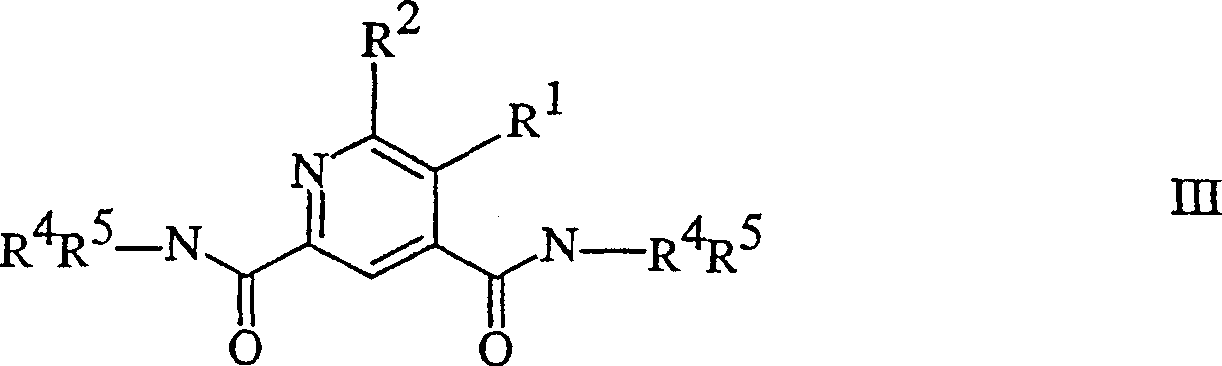
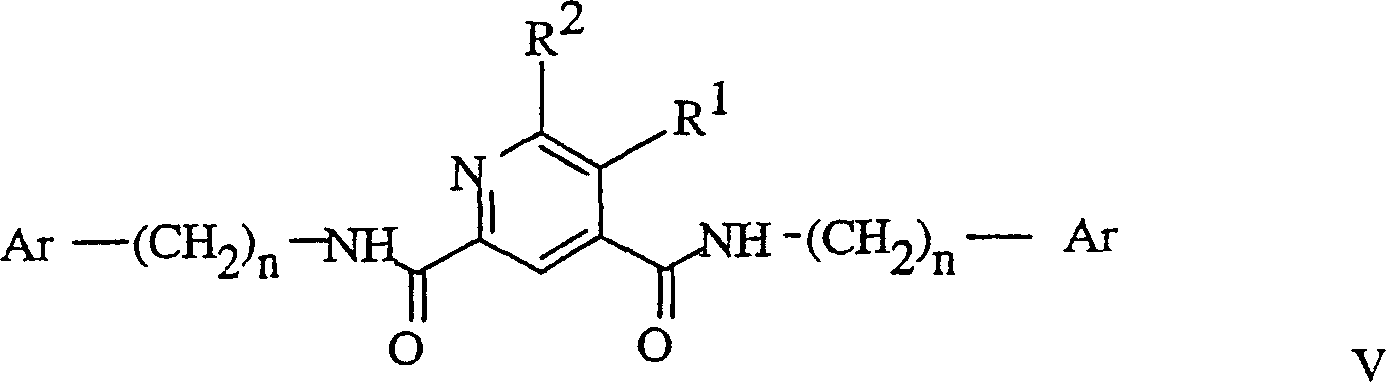
Applications Claiming Priority (2)
| Application Number | Priority Date | Filing Date | Title |
|---|---|---|---|
| US26878101P | 2001-02-14 | 2001-02-14 | |
| US60/268,781 | 2001-02-14 |
Publications (1)
| Publication Number | Publication Date |
|---|---|
| CN1537101A true CN1537101A (en) | 2004-10-13 |
Family
ID=23024446
Family Applications (1)
| Application Number | Title | Priority Date | Filing Date |
|---|---|---|---|
| CNA028049454A Pending CN1537101A (en) | 2001-02-14 | 2002-02-04 | Pyridine Matrix Metalloproteinase Inhibitors |
Country Status (36)
| Country | Link |
|---|---|
| US (2) | US6881743B2 (en) |
| EP (1) | EP1362033B1 (en) |
| JP (1) | JP4249981B2 (en) |
| KR (1) | KR20030075196A (en) |
| CN (1) | CN1537101A (en) |
| AP (1) | AP2003002840A0 (en) |
| AR (1) | AR035936A1 (en) |
| AT (1) | ATE358667T1 (en) |
| BG (1) | BG108089A (en) |
| BR (1) | BR0207863A (en) |
| CA (1) | CA2434982A1 (en) |
| CR (1) | CR7048A (en) |
| CZ (1) | CZ20032143A3 (en) |
| DE (1) | DE60219286T2 (en) |
| DO (1) | DOP2002000332A (en) |
| EA (1) | EA200300763A1 (en) |
| EC (1) | ECSP034691A (en) |
| EE (1) | EE200300391A (en) |
| ES (1) | ES2283540T3 (en) |
| GT (1) | GT200200014A (en) |
| HN (2) | HN2002000025A (en) |
| HU (1) | HUP0303152A2 (en) |
| IL (1) | IL156912A0 (en) |
| IS (1) | IS6871A (en) |
| MA (1) | MA26989A1 (en) |
| MX (1) | MXPA03006204A (en) |
| NO (1) | NO20033570L (en) |
| OA (1) | OA12544A (en) |
| PA (1) | PA8538201A1 (en) |
| PE (1) | PE20020995A1 (en) |
| PL (1) | PL365098A1 (en) |
| SK (1) | SK10022003A3 (en) |
| TN (1) | TNSN02012A1 (en) |
| UY (1) | UY27167A1 (en) |
| WO (1) | WO2002064568A1 (en) |
| ZA (1) | ZA200306041B (en) |
Cited By (1)
| Publication number | Priority date | Publication date | Assignee | Title |
|---|---|---|---|---|
| CN102365550A (en) * | 2009-04-01 | 2012-02-29 | 高露洁-棕榄公司 | Anti-bone loss and anti-attachment loss effects of oral compositions |
Families Citing this family (48)
| Publication number | Priority date | Publication date | Assignee | Title |
|---|---|---|---|---|
| EP1368323B1 (en) | 2001-02-14 | 2010-06-30 | Warner-Lambert Company LLC | Pyrimidine matrix metalloproteinase inhibitors |
| DOP2002000333A (en) | 2001-02-14 | 2002-09-30 | Warner Lambert Co | DERIVATIVES OF ISOFTALIC ACID AS INHIBITORS OF METALOPROTEINASES OF THE MATRIX |
| US6924276B2 (en) | 2001-09-10 | 2005-08-02 | Warner-Lambert Company | Diacid-substituted heteroaryl derivatives as matrix metalloproteinase inhibitors |
| US6962922B2 (en) | 2001-10-12 | 2005-11-08 | Warner-Lambert Company Llc | Alkynylated quinazoline compounds |
| EP1434585A1 (en) | 2001-10-12 | 2004-07-07 | Warner-Lambert Company LLC | Alkyne matrix metalloproteinase inhibitors |
| US6933298B2 (en) | 2001-12-08 | 2005-08-23 | Aventis Pharma Deutschland Gmbh | Pyridine-2,4-dicarboxylic acid diamides and pyrimidine-4,6-dicarboxylic acid diamides and the use thereof for selectively inhibiting collagenases |
| DE10160357A1 (en) * | 2001-12-08 | 2003-06-18 | Aventis Pharma Gmbh | Use of pyridine-2,4-dicarboxylic acid diamides and pyrimidine-4,6-dicarboxylic acid diamides for the selective inhibition of collagenases |
| US6894057B2 (en) | 2002-03-08 | 2005-05-17 | Warner-Lambert Company | Oxo-azabicyclic compounds |
| US6747147B2 (en) | 2002-03-08 | 2004-06-08 | Warner-Lambert Company | Oxo-azabicyclic compounds |
| US20040006077A1 (en) * | 2002-06-25 | 2004-01-08 | Bernard Gaudilliere | Thiazine and oxazine derivatives as MMP-13 inhibitors |
| WO2004006913A1 (en) * | 2002-07-17 | 2004-01-22 | Warner-Lambert Company Llc | Combination of an allosteric inhibitor of matrix metalloproteinase-13 with celecoxib or valdecoxib |
| BR0312943A (en) * | 2002-07-17 | 2005-07-12 | Warner Lambert Co | Combination of an allosteric matrix metalloproteinase-13 inhibitor with a selective cyclooxygenase-2 inhibitor that is not celecoxib or valdecoxib |
| AU2003281169A1 (en) * | 2002-07-17 | 2004-02-02 | Warner-Lambert Company Llc | Combination of an allosteric carboxylic inhibitor of matrix metalloproteinase-13 with celecoxib or valdecoxib |
| BR0312708A (en) * | 2002-07-17 | 2005-04-26 | Warner Lambert Co | Combination of a matrix allosteric alkaline metalloproteinase-13 inhibitor with celecoxib or valdecoxib |
| CA2497658A1 (en) | 2002-08-13 | 2004-02-19 | Warner-Lambert Company Llc | Chromone derivatives as matrix metalloproteinase inhibitors |
| ES2283851T3 (en) | 2002-08-13 | 2007-11-01 | Warner-Lambert Company Llc | DERIVATIVES OF PIRIMIDIN-2,4-DIONA AS INHIBITORS OF METALOPROTEINASES OF MATRIX. |
| WO2004014375A2 (en) | 2002-08-13 | 2004-02-19 | Warner-Lambert Company Llc | Fused bicyclic metalloproteinase inhibitors |
| BR0313727A (en) * | 2002-08-13 | 2005-07-12 | Warner Lambert Co | Isoquinoline derivatives as matrix metalloproteinase inhibitors |
| WO2004014923A1 (en) | 2002-08-13 | 2004-02-19 | Warner-Lambert Company Llc | Pyrimidinone fused bicyclic metalloproteinase inhibitors |
| AU2003253186A1 (en) | 2002-08-13 | 2004-02-25 | Warner-Lambert Company Llc | Fused tetrahydropyridine derivatives as matrix metalloproteinase inhibitors |
| AU2003249477A1 (en) * | 2002-08-13 | 2004-02-25 | Warner-Lambert Company Llc | Heterobicylcic metalloproteinase inhibitors |
| MXPA05001603A (en) | 2002-08-13 | 2005-04-25 | Warner Lambert Co | Monocyclic derivatives as matrix metalloproteinase inhibitors. |
| BR0313724A (en) | 2002-08-13 | 2005-06-28 | Warner Lambert Co | Azaisoquinoline derivatives as matrix metalloproteinase inhibitors |
| AU2003250482A1 (en) * | 2002-08-13 | 2004-02-25 | Warner-Lambert Company Llc | Phthalimide derivatives as matrix metalloproteinase inhibitors |
| WO2004014378A1 (en) | 2002-08-13 | 2004-02-19 | Warner-Lambert Company Llc | 3-isoquinolinone derivatives as matrix metalloproteinase inhiitors |
| AU2003249535A1 (en) * | 2002-08-13 | 2004-02-25 | Warner-Lambert Company Llc | 1,6-fused uracil derivatives as matrix metalloproteinase inhibitors |
| WO2004014869A2 (en) * | 2002-08-13 | 2004-02-19 | Warner-Lambert Company Llc | 5,6-fused 3,4-dihydropyrimidine-2-one derivatives as matrix metalloproteinase inhibitors |
| AU2003249539A1 (en) * | 2002-08-13 | 2004-02-25 | Warner-Lambert Company Llc | Cyclic compounds containing zinc binding groups as matrix metalloproteinase inhibitors |
| PA8578101A1 (en) * | 2002-08-13 | 2004-05-07 | Warner Lambert Co | HETEROBIARILO DERIVATIVES AS METALOPROTEINASE IN MATRIX INHIBITORS |
| AU2003253165A1 (en) * | 2002-08-13 | 2004-02-25 | Warner-Lambert Company Llc | Pyrimidine fused bicyclic metalloproteinase inhibitors |
| ES2298621T3 (en) * | 2002-11-02 | 2008-05-16 | Sanofi-Aventis Deutschland Gmbh | NEW DIAMIDES OF THE PYRIMIDIN-4,6-DICARBOXILIC ACID FOR THE SELECTIVE INHIBITION OF COLAGENASES. |
| US20040142950A1 (en) * | 2003-01-17 | 2004-07-22 | Bunker Amy Mae | Amide and ester matrix metalloproteinase inhibitors |
| MXPA06003951A (en) | 2003-10-07 | 2006-06-27 | Renovis Inc | Amide derivatives as ion-channel ligands and pharmaceutical compositions and methods of using the same. |
| US20060247231A1 (en) * | 2003-12-18 | 2006-11-02 | Warner-Lambert Company Llc | Amide and ester matrix metalloproteinase inhibitors |
| BR122015015718B1 (en) | 2004-01-28 | 2016-05-10 | Mitsui Chemicals Inc | amide derivatives |
| US7576099B2 (en) | 2005-02-28 | 2009-08-18 | Renovis, Inc. | Amide derivatives as ion-channel ligands and pharmaceutical compositions and methods of using the same |
| US20070155738A1 (en) | 2005-05-20 | 2007-07-05 | Alantos Pharmaceuticals, Inc. | Heterobicyclic metalloprotease inhibitors |
| CA2658362A1 (en) * | 2006-06-29 | 2008-01-03 | Alantos Pharmaceuticals Holding, Inc. | Metalloprotease inhibitors |
| US20110105602A2 (en) | 2007-03-08 | 2011-05-05 | Daria Mochly-Rosen | Mitochondrial Aldehyde Dehydrogenase-2 Modulators and Methods of Use Thereof |
| US8354435B2 (en) * | 2008-09-08 | 2013-01-15 | The Board Of Trustees Of The Leland Stanford Junior University | Modulators of aldehyde dehydrogenase activity and methods of use thereof |
| JP5657201B2 (en) * | 2008-09-30 | 2015-01-21 | サンメディカル株式会社 | Dental composition having enzyme inhibitory action or enzyme inhibitory action and antibacterial action |
| CN102202669A (en) | 2008-10-28 | 2011-09-28 | 利兰·斯坦福青年大学托管委员会 | Aldehyde dehydrogenase modulators and methods of use thereof |
| GB201021103D0 (en) | 2010-12-13 | 2011-01-26 | Univ Leuven Kath | New compounds for the treatment of neurodegenerative diseases |
| US10457659B2 (en) | 2011-04-29 | 2019-10-29 | The Board Of Trustees Of The Leland Stanford Junior University | Compositions and methods for increasing proliferation of adult salivary stem cells |
| WO2014160185A2 (en) | 2013-03-14 | 2014-10-02 | The Board Of Trustees Of The Leland Stanford Junior University | Mitochondrial aldehyde dehydrogenase-2 modulators and methods of use thereof |
| JP6885968B2 (en) * | 2016-05-24 | 2021-06-16 | グラクソスミスクライン、インテレクチュアル、プロパティー、(ナンバー2)、リミテッドGlaxosmithkline Intellectual Property (No.2) Limited | Pyridine dicarboxamide derivative as a bromodomain inhibitor |
| GB201703282D0 (en) * | 2017-03-01 | 2017-04-12 | Glaxosmithkline Intellectual Property (No 2) Ltd | Compounds |
| GB201908453D0 (en) * | 2019-06-12 | 2019-07-24 | Enterprise Therapeutics Ltd | Compounds for treating respiratory disease |
Family Cites Families (33)
| Publication number | Priority date | Publication date | Assignee | Title |
|---|---|---|---|---|
| DE1149356B (en) * | 1955-03-24 | 1963-05-30 | Bayer Ag | Process for the preparation of N-substituted thiosaeuramides |
| US4971986A (en) * | 1988-03-25 | 1990-11-20 | Ciba-Geigy Corporation | Arylhydrazones useful as SAMDC inhibitors |
| US5219847A (en) * | 1989-06-12 | 1993-06-15 | Shiseido Company, Ltd. | Antipruritic composition |
| US5425289A (en) * | 1993-10-21 | 1995-06-20 | Snap-On Incorporated | Bung tool |
| DE3924093A1 (en) * | 1989-07-20 | 1991-02-07 | Hoechst Ag | N, N'-BIS (ALKOXY-ALKYL) -PYRIDINE-2,4-DICARBONESAUREDIAMIDES, METHOD FOR THE PRODUCTION AND USE THEREOF |
| DE3931432A1 (en) * | 1989-09-21 | 1991-04-04 | Hoechst Ag | PYRIMIDIN-4,6-DICARBONSAEUREDIAMIDE, METHOD FOR THE PRODUCTION AND USE THEREOF AND MEDICINAL PRODUCTS BASED ON THESE COMPOUNDS |
| DE4020570A1 (en) * | 1990-06-28 | 1992-01-02 | Hoechst Ag | 2,4- AND 2,5-SUBSTITUTED PYRIDINE-N-OXIDES, METHOD FOR THE PRODUCTION AND USE THEREOF |
| US5260323A (en) * | 1990-06-28 | 1993-11-09 | Hoechst Aktiengesellschaft | 2,4- and 2,5-substituted pyridine-N-oxides, processes for their preparation and their use |
| PL171921B1 (en) * | 1991-05-22 | 1997-06-30 | Pfizer | Method for the preparation of new derivatives of substituted 3-aminoquinuclidine |
| US5716965A (en) * | 1991-05-22 | 1998-02-10 | Pfizer Inc. | Substituted 3-aminoquinuclidines |
| EP0541042A1 (en) * | 1991-11-05 | 1993-05-12 | Hoechst Aktiengesellschaft | 2,4- and 2,5-pyridine-dicarboxylic acid derivatives, process for their preparation and their use |
| US6008243A (en) * | 1996-10-24 | 1999-12-28 | Agouron Pharmaceuticals, Inc. | Metalloproteinase inhibitors, pharmaceutical compositions containing them, and their use |
| WO1998021207A1 (en) * | 1996-11-12 | 1998-05-22 | Byk Gulden Lomberg Chemische Fabrik Gmbh | (2,3-dihydrobenzofuranyl)-thiazoles as phosphodiesterase inhibitors |
| KR20000057444A (en) | 1996-12-09 | 2000-09-15 | 로즈 암스트롱, 크리스틴 에이. 트러트웨인 | Method for treating and preventing heart failure and ventricular dilatation |
| JPH11199512A (en) | 1997-10-24 | 1999-07-27 | Pfizer Prod Inc | Use of mmp-13 selective inhibitor for the treatment of arthrosis deformans and other mmp-mediated disease |
| UA59453C2 (en) | 1998-08-12 | 2003-09-15 | Пфайзер Продактс Інк. | HYDROXYPIPECOLATE HYDROXAMIC ACID DERIVATIVES AS matrix metalloproteinase inhibitors |
| US6307049B1 (en) * | 1998-09-30 | 2001-10-23 | The Procter & Gamble Co. | Heterocyclic 2-substituted ketoamides |
| US6300341B1 (en) * | 1998-09-30 | 2001-10-09 | The Procter & Gamble Co. | 2-substituted heterocyclic sulfonamides |
| CA2368703A1 (en) * | 1999-03-31 | 2000-10-12 | Basf Aktiengesellschaft | Substituted aniline compounds |
| PA8498701A1 (en) | 1999-08-12 | 2002-08-26 | Pfizer Prod Inc | PYRIMIDINE-2,4,6-METALOPROTEINASE INHIBITING TRIONES |
| US6307490B1 (en) * | 1999-09-30 | 2001-10-23 | The Engineering Consortium, Inc. | Digital to analog converter trim apparatus and method |
| US6934639B1 (en) | 2000-02-25 | 2005-08-23 | Wyeth | Methods for designing agents that interact with MMP-13 |
| EP1138680A1 (en) | 2000-03-29 | 2001-10-04 | Pfizer Products Inc. | Gem substituted sulfonyl hydroxamic acids as MMP inhibitors |
| US6916846B2 (en) * | 2000-05-12 | 2005-07-12 | Merck & Co. Inc. | Coumermycin analogs as chemical dimerizers of chimeric proteins |
| IL154946A0 (en) | 2000-10-26 | 2003-10-31 | Pfizer Prod Inc | Pyrimidine-2,4,6-trione metalloproteinase inhibitors |
| BR0114913A (en) | 2000-10-26 | 2003-07-01 | Pfizer Prod Inc | Spiro-pyrimidine-2,4,6-trione metalloproteinase inhibitors |
| PA8539301A1 (en) | 2001-02-14 | 2002-09-30 | Warner Lambert Co | INHIBITORS OF THE METALOPROTEINASE OF THE MATRIX |
| EP1368323B1 (en) | 2001-02-14 | 2010-06-30 | Warner-Lambert Company LLC | Pyrimidine matrix metalloproteinase inhibitors |
| DOP2002000333A (en) | 2001-02-14 | 2002-09-30 | Warner Lambert Co | DERIVATIVES OF ISOFTALIC ACID AS INHIBITORS OF METALOPROTEINASES OF THE MATRIX |
| US6924276B2 (en) * | 2001-09-10 | 2005-08-02 | Warner-Lambert Company | Diacid-substituted heteroaryl derivatives as matrix metalloproteinase inhibitors |
| US6933298B2 (en) * | 2001-12-08 | 2005-08-23 | Aventis Pharma Deutschland Gmbh | Pyridine-2,4-dicarboxylic acid diamides and pyrimidine-4,6-dicarboxylic acid diamides and the use thereof for selectively inhibiting collagenases |
| DE10160357A1 (en) | 2001-12-08 | 2003-06-18 | Aventis Pharma Gmbh | Use of pyridine-2,4-dicarboxylic acid diamides and pyrimidine-4,6-dicarboxylic acid diamides for the selective inhibition of collagenases |
| US20050004111A1 (en) * | 2003-01-03 | 2005-01-06 | Aventis Pharma Deutschland Gmbh | Selective MMP-13 inhibitors |
-
2002
- 2002-01-24 DO DO2002000332A patent/DOP2002000332A/en unknown
- 2002-02-01 PA PA20028538201A patent/PA8538201A1/en unknown
- 2002-02-04 CA CA002434982A patent/CA2434982A1/en not_active Abandoned
- 2002-02-04 JP JP2002564501A patent/JP4249981B2/en not_active Expired - Fee Related
- 2002-02-04 ES ES02716263T patent/ES2283540T3/en not_active Expired - Lifetime
- 2002-02-04 DE DE60219286T patent/DE60219286T2/en not_active Expired - Lifetime
- 2002-02-04 OA OA1200300180A patent/OA12544A/en unknown
- 2002-02-04 PL PL02365098A patent/PL365098A1/en not_active Application Discontinuation
- 2002-02-04 IL IL15691202A patent/IL156912A0/en unknown
- 2002-02-04 CZ CZ20032143A patent/CZ20032143A3/en unknown
- 2002-02-04 SK SK1002-2003A patent/SK10022003A3/en unknown
- 2002-02-04 WO PCT/IB2002/000345 patent/WO2002064568A1/en not_active Ceased
- 2002-02-04 KR KR10-2003-7010682A patent/KR20030075196A/en not_active Ceased
- 2002-02-04 BR BR0207863-5A patent/BR0207863A/en not_active IP Right Cessation
- 2002-02-04 EP EP02716263A patent/EP1362033B1/en not_active Expired - Lifetime
- 2002-02-04 AP APAP/P/2003/002840A patent/AP2003002840A0/en unknown
- 2002-02-04 HU HU0303152A patent/HUP0303152A2/en unknown
- 2002-02-04 MX MXPA03006204A patent/MXPA03006204A/en active IP Right Grant
- 2002-02-04 EA EA200300763A patent/EA200300763A1/en unknown
- 2002-02-04 EE EEP200300391A patent/EE200300391A/en unknown
- 2002-02-04 CN CNA028049454A patent/CN1537101A/en active Pending
- 2002-02-04 AT AT02716263T patent/ATE358667T1/en not_active IP Right Cessation
- 2002-02-04 GT GT200200014A patent/GT200200014A/en unknown
- 2002-02-08 US US10/071,073 patent/US6881743B2/en not_active Expired - Fee Related
- 2002-02-11 HN HN2002000025A patent/HN2002000025A/en unknown
- 2002-02-11 HN HN2002000028A patent/HN2002000028A/en unknown
- 2002-02-13 TN TNTNSN02012A patent/TNSN02012A1/en unknown
- 2002-02-13 UY UY27167A patent/UY27167A1/en not_active Application Discontinuation
- 2002-02-13 AR ARP020100478A patent/AR035936A1/en unknown
- 2002-02-13 PE PE2002000119A patent/PE20020995A1/en not_active Application Discontinuation
-
2003
- 2003-07-10 IS IS6871A patent/IS6871A/en unknown
- 2003-07-16 EC EC2003004691A patent/ECSP034691A/en unknown
- 2003-08-05 CR CR7048A patent/CR7048A/en not_active Application Discontinuation
- 2003-08-05 ZA ZA200306041A patent/ZA200306041B/en unknown
- 2003-08-05 MA MA27263A patent/MA26989A1/en unknown
- 2003-08-12 NO NO20033570A patent/NO20033570L/en not_active Application Discontinuation
- 2003-08-13 BG BG108089A patent/BG108089A/en unknown
-
2004
- 2004-05-10 US US10/842,863 patent/US7015237B2/en not_active Expired - Fee Related
Cited By (1)
| Publication number | Priority date | Publication date | Assignee | Title |
|---|---|---|---|---|
| CN102365550A (en) * | 2009-04-01 | 2012-02-29 | 高露洁-棕榄公司 | Anti-bone loss and anti-attachment loss effects of oral compositions |
Also Published As
Similar Documents
| Publication | Publication Date | Title |
|---|---|---|
| CN1537101A (en) | Pyridine Matrix Metalloproteinase Inhibitors | |
| CN1296346C (en) | Acylated 6,7,8,9-tetrahydro-5H-benzocycloheptenyl amines and their use as pharmaceutical | |
| CN1142912C (en) | Amide derivatives useful as inhibitors of cytokine production | |
| CN1211362C (en) | New benzothiophene, benzofuran and indole compounds, process for their preparation and pharmaceutical compounds containing them | |
| CN1179945C (en) | Indole derivatives, their preparation methods and uses | |
| CN1117077C (en) | 6-phenylpyridyl-2-amine derivatives useful as NOS inhibitors | |
| CN1192773C (en) | Cyclic amine CCR3 antagonisis | |
| CN1158281C (en) | 1-aryl-1,8-naphthylidin-4-one derivative as type IV phosphodiesterase inhibitor | |
| CN1142910C (en) | Amide compound | |
| CN1031376A (en) | Pyrazolopyridine compound and preparation method thereof | |
| CN1378537A (en) | Pyrimidine derivatives | |
| CN1118595A (en) | Anthranilic acid derivatives | |
| CN1087904A (en) | Carboxylic acid derivatives, pharmaceutical compositions containing these compounds and processes for their preparation | |
| CN1519240A (en) | Substituted nitrogen contg. heterocycles as inhibitors of P38 progein kinase | |
| CN1094028A (en) | Selective PDE enzyme (IV) inhibitor catechol diether class | |
| CN1238761A (en) | Benzamide aldehydes and their use as cysteine protease inhibitors | |
| CN1131665A (en) | Piperazine derivatives, medicines containing such compounds, uses and preparation methods thereof | |
| CN1082545A (en) | Imidazopyridine | |
| CN1069025A (en) | Aryl, amide, imide and carbamate pyridine antagonists of platelet activating factor | |
| CN1030450C (en) | Preparation of analgesic carboxylic acid amides derivative | |
| CN1656086A (en) | Benzofuran derivative | |
| CN1039228C (en) | Novel substituted tert-amino compund | |
| CN1064273A (en) | The new NGF that has generates the active benzene derivative of promotion | |
| CN1152879C (en) | Naphthyridine derivatives | |
| CN1520402A (en) | Asymmetric Cyclic Diamine Compounds |
Legal Events
| Date | Code | Title | Description |
|---|---|---|---|
| C06 | Publication | ||
| PB01 | Publication | ||
| C10 | Entry into substantive examination | ||
| SE01 | Entry into force of request for substantive examination | ||
| REG | Reference to a national code |
Ref country code: HK Ref legal event code: DE Ref document number: 1066543 Country of ref document: HK |
|
| C02 | Deemed withdrawal of patent application after publication (patent law 2001) | ||
| WD01 | Invention patent application deemed withdrawn after publication | ||
| REG | Reference to a national code |
Ref country code: HK Ref legal event code: WD Ref document number: 1066543 Country of ref document: HK |