CN1574416A - Gasket for fuel cell and fabrication method of the same - Google Patents
Gasket for fuel cell and fabrication method of the same Download PDFInfo
- Publication number
- CN1574416A CN1574416A CNA2003101238080A CN200310123808A CN1574416A CN 1574416 A CN1574416 A CN 1574416A CN A2003101238080 A CNA2003101238080 A CN A2003101238080A CN 200310123808 A CN200310123808 A CN 200310123808A CN 1574416 A CN1574416 A CN 1574416A
- Authority
- CN
- China
- Prior art keywords
- rubber
- fuel cell
- gasket
- rubber powder
- rigid plate
- Prior art date
- Legal status (The legal status is an assumption and is not a legal conclusion. Google has not performed a legal analysis and makes no representation as to the accuracy of the status listed.)
- Granted
Links
Images


Classifications
-
- H—ELECTRICITY
- H01—ELECTRIC ELEMENTS
- H01M—PROCESSES OR MEANS, e.g. BATTERIES, FOR THE DIRECT CONVERSION OF CHEMICAL ENERGY INTO ELECTRICAL ENERGY
- H01M8/00—Fuel cells; Manufacture thereof
- H01M8/02—Details
-
- B—PERFORMING OPERATIONS; TRANSPORTING
- B29—WORKING OF PLASTICS; WORKING OF SUBSTANCES IN A PLASTIC STATE IN GENERAL
- B29C—SHAPING OR JOINING OF PLASTICS; SHAPING OF MATERIAL IN A PLASTIC STATE, NOT OTHERWISE PROVIDED FOR; AFTER-TREATMENT OF THE SHAPED PRODUCTS, e.g. REPAIRING
- B29C67/00—Shaping techniques not covered by groups B29C39/00 - B29C65/00, B29C70/00 or B29C73/00
- B29C67/24—Shaping techniques not covered by groups B29C39/00 - B29C65/00, B29C70/00 or B29C73/00 characterised by the choice of material
-
- H—ELECTRICITY
- H01—ELECTRIC ELEMENTS
- H01M—PROCESSES OR MEANS, e.g. BATTERIES, FOR THE DIRECT CONVERSION OF CHEMICAL ENERGY INTO ELECTRICAL ENERGY
- H01M8/00—Fuel cells; Manufacture thereof
- H01M8/02—Details
- H01M8/0271—Sealing or supporting means around electrodes, matrices or membranes
- H01M8/0273—Sealing or supporting means around electrodes, matrices or membranes with sealing or supporting means in the form of a frame
-
- H—ELECTRICITY
- H01—ELECTRIC ELEMENTS
- H01M—PROCESSES OR MEANS, e.g. BATTERIES, FOR THE DIRECT CONVERSION OF CHEMICAL ENERGY INTO ELECTRICAL ENERGY
- H01M8/00—Fuel cells; Manufacture thereof
- H01M8/02—Details
- H01M8/0271—Sealing or supporting means around electrodes, matrices or membranes
- H01M8/028—Sealing means characterised by their material
- H01M8/0284—Organic resins; Organic polymers
-
- H—ELECTRICITY
- H01—ELECTRIC ELEMENTS
- H01M—PROCESSES OR MEANS, e.g. BATTERIES, FOR THE DIRECT CONVERSION OF CHEMICAL ENERGY INTO ELECTRICAL ENERGY
- H01M8/00—Fuel cells; Manufacture thereof
- H01M8/02—Details
- H01M8/0271—Sealing or supporting means around electrodes, matrices or membranes
- H01M8/0286—Processes for forming seals
-
- B—PERFORMING OPERATIONS; TRANSPORTING
- B29—WORKING OF PLASTICS; WORKING OF SUBSTANCES IN A PLASTIC STATE IN GENERAL
- B29K—INDEXING SCHEME ASSOCIATED WITH SUBCLASSES B29B, B29C OR B29D, RELATING TO MOULDING MATERIALS OR TO MATERIALS FOR MOULDS, REINFORCEMENTS, FILLERS OR PREFORMED PARTS, e.g. INSERTS
- B29K2021/00—Use of unspecified rubbers as moulding material
-
- B—PERFORMING OPERATIONS; TRANSPORTING
- B29—WORKING OF PLASTICS; WORKING OF SUBSTANCES IN A PLASTIC STATE IN GENERAL
- B29L—INDEXING SCHEME ASSOCIATED WITH SUBCLASS B29C, RELATING TO PARTICULAR ARTICLES
- B29L2031/00—Other particular articles
- B29L2031/26—Sealing devices, e.g. packaging for pistons or pipe joints
- B29L2031/265—Packings, Gaskets
-
- H—ELECTRICITY
- H01—ELECTRIC ELEMENTS
- H01M—PROCESSES OR MEANS, e.g. BATTERIES, FOR THE DIRECT CONVERSION OF CHEMICAL ENERGY INTO ELECTRICAL ENERGY
- H01M8/00—Fuel cells; Manufacture thereof
- H01M8/10—Fuel cells with solid electrolytes
- H01M2008/1095—Fuel cells with polymeric electrolytes
-
- Y—GENERAL TAGGING OF NEW TECHNOLOGICAL DEVELOPMENTS; GENERAL TAGGING OF CROSS-SECTIONAL TECHNOLOGIES SPANNING OVER SEVERAL SECTIONS OF THE IPC; TECHNICAL SUBJECTS COVERED BY FORMER USPC CROSS-REFERENCE ART COLLECTIONS [XRACs] AND DIGESTS
- Y02—TECHNOLOGIES OR APPLICATIONS FOR MITIGATION OR ADAPTATION AGAINST CLIMATE CHANGE
- Y02E—REDUCTION OF GREENHOUSE GAS [GHG] EMISSIONS, RELATED TO ENERGY GENERATION, TRANSMISSION OR DISTRIBUTION
- Y02E60/00—Enabling technologies; Technologies with a potential or indirect contribution to GHG emissions mitigation
- Y02E60/30—Hydrogen technology
- Y02E60/50—Fuel cells
-
- Y—GENERAL TAGGING OF NEW TECHNOLOGICAL DEVELOPMENTS; GENERAL TAGGING OF CROSS-SECTIONAL TECHNOLOGIES SPANNING OVER SEVERAL SECTIONS OF THE IPC; TECHNICAL SUBJECTS COVERED BY FORMER USPC CROSS-REFERENCE ART COLLECTIONS [XRACs] AND DIGESTS
- Y02—TECHNOLOGIES OR APPLICATIONS FOR MITIGATION OR ADAPTATION AGAINST CLIMATE CHANGE
- Y02P—CLIMATE CHANGE MITIGATION TECHNOLOGIES IN THE PRODUCTION OR PROCESSING OF GOODS
- Y02P70/00—Climate change mitigation technologies in the production process for final industrial or consumer products
- Y02P70/50—Manufacturing or production processes characterised by the final manufactured product
Landscapes
- Engineering & Computer Science (AREA)
- Life Sciences & Earth Sciences (AREA)
- Manufacturing & Machinery (AREA)
- Sustainable Development (AREA)
- Sustainable Energy (AREA)
- Chemical & Material Sciences (AREA)
- Chemical Kinetics & Catalysis (AREA)
- Electrochemistry (AREA)
- General Chemical & Material Sciences (AREA)
- Mechanical Engineering (AREA)
- Fuel Cell (AREA)
- Gasket Seals (AREA)
Abstract
本发明涉及燃料电池用密封垫及其制造方法,它是将两种以上具有不同硬度的橡胶粉末与液状橡胶以喷涂方式一起喷射到刚性板上,利用橡胶部分的反弹性可确保密封性,同时将刚性板用作隔离物,不仅能保持恒定的单元间隙,而且在层积接合时,适于用作刚性骨架,从而提高了可操作性和生产率。
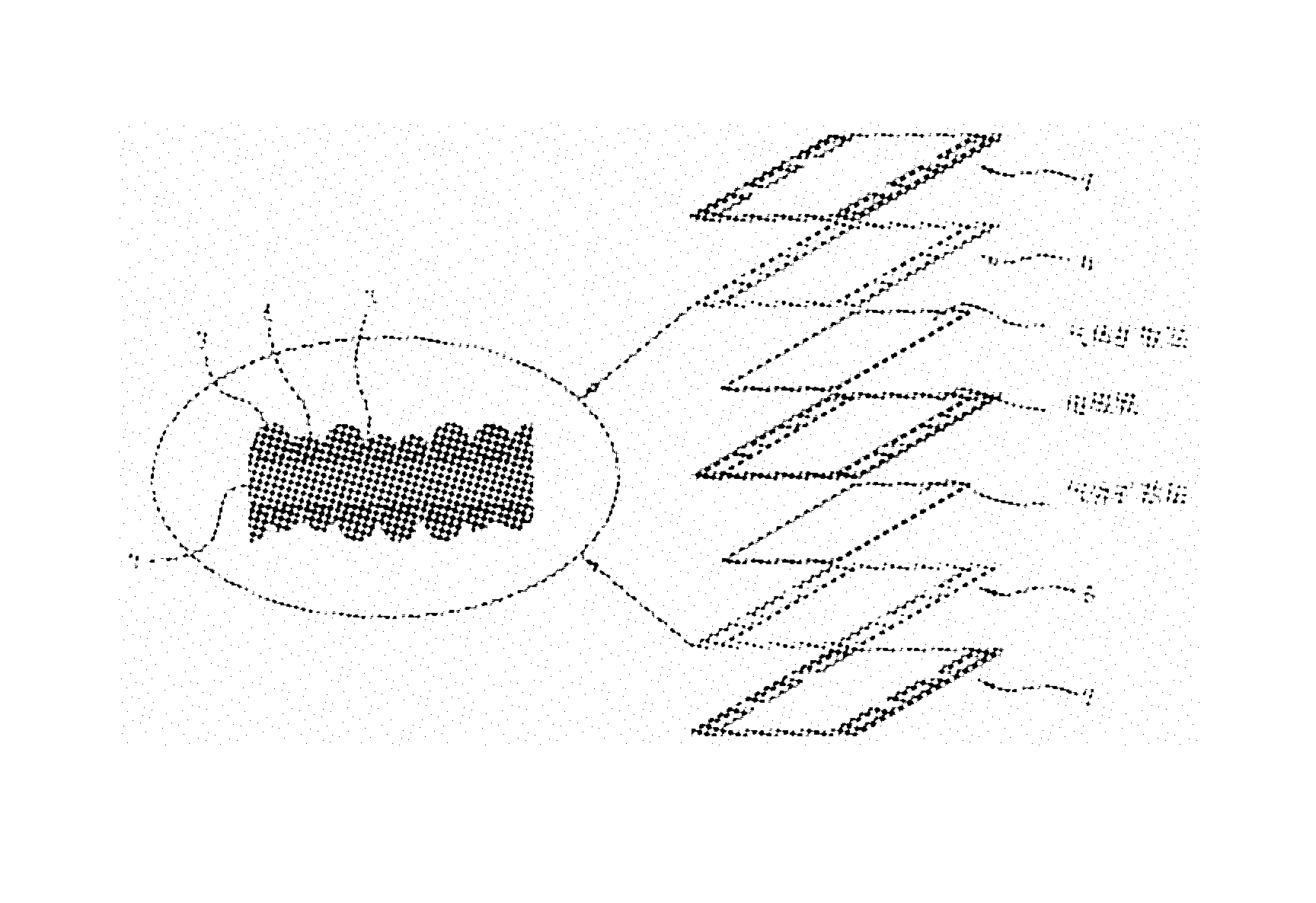
The invention relates to a sealing gasket for a fuel cell and a manufacturing method thereof. It sprays two or more rubber powders with different hardnesses and liquid rubber onto a rigid plate in a spraying manner, and utilizes the resilience of the rubber part to ensure sealing performance. At the same time The use of a rigid plate as a spacer not only maintains a constant cell gap, but also serves as a rigid skeleton when laminating and joining, thereby improving operability and productivity.
Description
技术领域technical field
本发明涉及燃料电池用密封垫及其制造方法,通过以喷涂方式将两种以上具有不同硬度的橡胶粉末与液状橡胶一起用于刚性(rigid)板上,从而提高密封垫的密封性、可操作性和生产率。The present invention relates to a gasket for a fuel cell and a manufacturing method thereof. By spraying two or more rubber powders with different hardness and liquid rubber on a rigid (rigid) plate, the sealing performance and operability of the gasket are improved. sex and productivity.
背景技术Background technique
一般讲,燃料电池是将从燃料中提取的氢和空气中的氧进行化学反应生成的能量转变成电能、清洁地分散所产生的电能的装置,它与电池(battery)的不同点在于,不需要再充电,只供给燃料,就能持续产生电能的发电装置。Generally speaking, a fuel cell is a device that converts the energy generated by the chemical reaction of hydrogen extracted from fuel and oxygen in the air into electrical energy and cleanly disperses the generated electrical energy. It differs from a battery in that it does not A power generating device that can continuously generate electricity only by supplying fuel without recharging.
因此,燃料电池作为有利于环境的动力源,在所有的产业界中,作为取代当前内燃机的下一代动力源,受到了广泛注目。Therefore, fuel cells are attracting attention as a next-generation power source to replace the current internal combustion engine in all industrial circles as an environmentally friendly power source.
其中,高分子电解质燃料电池(PEMFC,Proton Exchange MembraneFuel Cell),在将具有氢离子交换性质的高分子膜用于电解质的燃料电池中,有以各种名称命名的燃料电池,如固体高分子电解质燃料电池(SPEFC,Solid Polymer Electrolyte Fuel Cells)、氢离子交换膜燃料电池(PEMFC,Proton Exchange Membrane Fuel Cell)等等。Among them, the polymer electrolyte fuel cell (PEMFC, Proton Exchange Membrane Fuel Cell), in the fuel cell that uses the polymer membrane with hydrogen ion exchange properties as the electrolyte, there are fuel cells named after various names, such as solid polymer electrolyte Fuel cells (SPEFC, Solid Polymer Electrolyte Fuel Cells), hydrogen ion exchange membrane fuel cells (PEMFC, Proton Exchange Membrane Fuel Cell), etc.
高分子电解质燃料电池与其它形态的燃料电池相比,工作温度低到80℃,效率很高,电流密度和功率密度很大,同时还具有启动时间短、负荷变化产生的响应快等特性。Compared with other forms of fuel cells, polymer electrolyte fuel cells have a working temperature as low as 80°C, high efficiency, high current density and power density, and also have the characteristics of short start-up time and fast response to load changes.
尤其是当以高分子膜用作电解质时,不会腐蚀,所以也不需要电解质调节,对反应气体的压力变化也不会过于敏感。Especially when the polymer membrane is used as the electrolyte, it will not corrode, so there is no need for electrolyte adjustment, and it will not be too sensitive to the pressure change of the reaction gas.
由于高分子电解质燃料电池设计简单、易于制作、且能输出多种范围的功率,所以可应用于多种技术领域,如无公害车辆的动力源、现场设置发电、移动用电源、军事用电源等,由此,当今世界上,在汽车行业中,对此的研究相当活跃。Because the polymer electrolyte fuel cell is simple in design, easy to manufacture, and can output power in various ranges, it can be applied to various technical fields, such as power sources for pollution-free vehicles, on-site power generation, mobile power supplies, military power supplies, etc. , thus, in today's world, in the automotive industry, the research on this is quite active.
以下说明这种高分子电解质燃料电池的电能产生原理。The principle of power generation in such a polymer electrolyte fuel cell will be described below.
当氢流到阴极(anode)侧上时,氢由催化剂层分解成电子和氢离子(Proton),氢离子通过位于燃料电池中心处的高分子电解质膜(membrane)移动,这样移动的氢离子在阴极(Cathode)上与电子和氧离子相遇,在催化剂的作用下生成水。When hydrogen flows to the cathode (anode) side, the hydrogen is decomposed into electrons and hydrogen ions (Proton) by the catalyst layer, and the hydrogen ions move through the polymer electrolyte membrane (membrane) located at the center of the fuel cell, so that the moved hydrogen ions are On the cathode (Cathode), electrons and oxygen ions meet, and water is generated under the action of a catalyst.
此处,在阴极上生成的电子,不能通过电解质膜移动,而通过外部电路移动到阳极上,经过这一过程,生成电能和水。Here, the electrons generated on the cathode cannot move through the electrolyte membrane, but move to the anode through an external circuit, and through this process, electricity and water are generated.
如图4所示,作为构成高分子电解质燃料电池的构成要素,有以下部分,即,形成用于将从外部供给的燃料气(氢、氧)有效导入电极的流路,起到使所产生的电子移动到外部电路的作用的分离板(separator)100;起到使导入的燃料气均匀分散在电极膜101上、有效排出由电化学反应生成的水的作用的气体扩散膜(Gas DiffusionMedia)102;载持用于引发燃料气进行电化学反应的催化剂层的电极(Electrode,未图示);形成氢离子移动的介质、防止燃料气穿透(CrossOver),防止产生电短路(short circuit)的电解质膜(Membrane,未图示);从外部保护燃料电池单元(Cell)、起到防止电池内燃料气及其它有害物质流出到外部的作用的密封垫104等。As shown in Fig. 4, as a constituent element of a polymer electrolyte fuel cell, there is a part that forms a flow path for efficiently introducing fuel gas (hydrogen, oxygen) supplied from the outside The separation plate (separator) 100 that moves the electrons to the external circuit; the gas diffusion membrane (Gas Diffusion Media) that functions to uniformly disperse the introduced fuel gas on the electrode film 101 and effectively discharge the water generated by the electrochemical reaction 102; An electrode (Electrode, not shown) carrying a catalyst layer for initiating an electrochemical reaction of fuel gas; forming a medium for hydrogen ion movement, preventing fuel gas penetration (CrossOver), and preventing electrical short circuit (short circuit) The electrolyte membrane (Membrane, not shown); the gasket 104 that protects the fuel cell unit (Cell) from the outside and prevents the fuel gas and other harmful substances in the battery from flowing out to the outside.
未说明符号103表示连接栓,105表示连接端板。The unexplained symbol 103 represents a connection bolt, and 105 represents a connection end plate.
高分子电解质燃料电池是在单元电池内利用燃料气的电化学反应产生电力的装置,特别是必须通过与外环境隔绝防止任何杂物流入,必须确实密封(Sealing),以防止因燃料气氢气流到外部以致发生安全事故。The polymer electrolyte fuel cell is a device that uses the electrochemical reaction of fuel gas to generate electricity in the unit cell. In particular, it must be isolated from the external environment to prevent any debris from flowing in, and it must be sealed to prevent hydrogen flow caused by fuel gas. to the outside to cause a safety accident.
燃料电池用密封垫104,在分离板100和电极膜101之间保持一定的间隙,使流入的燃料气均匀分配在分离板上,使反应生成物易于去除,特别是使气体扩散膜102与分离板100保持一定的电接触,对由电化学反应生成的电子起到使其稳定流动的作用。The fuel cell gasket 104 maintains a certain gap between the separation plate 100 and the electrode film 101, so that the inflowing fuel gas is evenly distributed on the separation plate, so that the reaction product is easy to remove, especially the gas diffusion membrane 102 and the separation plate. The plate 100 maintains a certain electrical contact and plays a role in stabilizing the flow of electrons generated by the electrochemical reaction.
作为上述高分子电解质燃料电池用密封垫所要求的性能,首先,即使燃料电池内部处于严酷的环境条件下,即PH1-2左右的酸性(Acidic)环境条件下,物性也不会降低,不会由材质内溶出低分子量、添加剂和其它离子等,以致妨碍燃料电池的电化学反应,进而可在很宽的温度范围内,即-40℃~120℃范围内使用。As the performance required for the gasket for the above-mentioned polymer electrolyte fuel cell, first, even if the inside of the fuel cell is under severe environmental conditions, that is, under acidic environmental conditions around pH 1-2, the physical properties will not be reduced, and there will be no Low molecular weight, additives, and other ions are dissolved from the material, which hinders the electrochemical reaction of the fuel cell, and can be used in a wide temperature range, that is, -40°C to 120°C.
因优良的持久性能,能使由使用时间造成的间隙经常保持一定,并能防止燃料电池的性能降低。Due to the excellent durability, the gap caused by the use time can always be kept constant, and the performance of the fuel cell can be prevented from deteriorating.
现有高分子电解质燃料电池用密封垫,大致分成两种。Conventional gaskets for polymer electrolyte fuel cells are roughly classified into two types.
即,分成固体形(Solid)密封垫和液体形(Liquid)密封垫。固体形密封垫适于将氟橡胶和硅橡胶压缩成型后粘接在分离板上使用。液体形密封垫适于涂布在分离板或电极膜上,固化后,用于燃料电池的形态,它与固体形密封垫相比,生产过程简便,具有节省成本的效果,其适用趋势正在扩大。That is, it is divided into a solid type (Solid) gasket and a liquid type (Liquid) gasket. The solid-shaped gasket is suitable for bonding fluorine rubber and silicone rubber to the separation plate after compression molding. Liquid-shaped gaskets are suitable for coating on separator plates or electrode membranes. After curing, they are used in the form of fuel cells. Compared with solid-shaped gaskets, the production process is simple and cost-effective. The trend of its application is expanding. .
现有的固体形密封垫是在模具内制成一定厚度的橡胶密封垫,然后脱模,是适用于附着在燃料电池分离板上的方式。The existing solid-shaped gasket is made into a rubber gasket with a certain thickness in a mold, and then demoulded, which is suitable for being attached to the fuel cell separation plate.
这种固体形密封垫,例如有揭示于日本特表平9-507802号公报中的、利用一种在刚性的氟聚物(fluoropolymers)层上结合软性聚四氟乙烯层(polytetrafluoroethylene)的复合材料制成的密封垫,还有韩国登记的实用新型第229074号公报中所揭示的,为了提高多孔性碳板与插入的密封材料的结合力,在密封材料表面上形成结合用突起。This solid-shaped gasket, for example, is disclosed in Japanese Patent Application No. 9-507802, using a composite material combining a soft polytetrafluoroethylene layer (polytetrafluoroethylene) on a rigid fluoropolymer (fluoropolymers) layer. Gaskets made of materials, as disclosed in Korean Registered Utility Model No. 229074, in order to improve the bonding force between the porous carbon plate and the inserted sealing material, protrusions for bonding are formed on the surface of the sealing material.
然而利用这种方式,当由模具生产橡胶制品时,难以制作公差达到0.011mm以下的精密尺寸,在制作厚度为0.5mm以下橡胶密封垫时,生产公差的影响会增大,由此很难得到均匀的密封性。However, using this method, when producing rubber products by molds, it is difficult to produce precision dimensions with a tolerance of less than 0.011mm. When making rubber gaskets with a thickness of less than 0.5mm, the influence of production tolerances will increase, so it is difficult to obtain Uniform tightness.
当难以从模具中取出制成的密封垫时,即,难以脱模时,就难以制成硬度Shore A在50(HS)以下的软性(Soft)密封垫,而不可能使密封垫硬度达到最适于燃料电池结构的硬度值。When it is difficult to take out the finished gasket from the mold, that is, when it is difficult to demould, it is difficult to make a soft (Soft) gasket with a Shore A hardness below 50 (HS), and it is impossible to make the gasket hardness reach The hardness value most suitable for fuel cell construction.
因此,由于固体形密封垫太硬,所以接合时会导致软性形态的分离板的变形,为了必须保持高的接合压力,在燃料电池层积(stacking)时,会形成很大的接合器具,从而减少燃料电池的输出密度。Therefore, since the solid gasket is too hard, it will cause deformation of the soft separator plate during bonding. In order to maintain a high bonding pressure, a large bonding device will be formed during fuel cell stacking. Thereby reducing the output density of the fuel cell.
为了提高密封性,在密封垫的接触部位形成多种形态的结构,在这种情况下,上下板配列的密封垫会产生偏移,在形成数十到数百枚燃料电池单元层积结构时,每个单元的密封性都会产生差异,很难获得可信度高的性能。In order to improve the sealing performance, various forms of structures are formed at the contact parts of the gaskets. In this case, the gaskets arranged on the upper and lower plates will be offset. When forming a stacked structure of tens to hundreds of fuel cell units , the airtightness of each unit will vary, and it is difficult to obtain reliable performance.
而作为液体密封垫,例如有揭示于日本特开2000-12054号公报中的,利用了向具有105泊(poises)以下粘度的液状全氟(perfluoro)橡胶中添加混合PTFE微细粉末的液状物质。And as a liquid gasket, for example, there is disclosed in Japanese Patent Application Laid-Open No. 2000-12054, which utilizes a liquid substance of adding and mixing PTFE fine powder to a liquid perfluoro rubber having a viscosity below 10 5 poises. .
然而,尽管这种液体形密封垫适用于FIPG(Formed-in-place-gasket)的形态,但这种情况是直接涂布在分离板上,接合过程简单、过程单纯、生产率高。但在涂布于下板的分离板上后,有在没有固化的状态下,层积气体扩散膜、电极膜等的方式,层积时需要特别注意,同时也很难保持恒定的单元间隙,且由于单元电池的形态为经过固化的形态,所以存在高温固化时离子交换膜性能降低的问题。However, although this liquid-shaped gasket is suitable for the form of FIPG (Formed-in-place-gasket), in this case, it is directly coated on the separation plate, and the joining process is simple, the process is simple, and the productivity is high. However, after coating on the separation plate of the lower plate, there is a method of laminating a gas diffusion film, an electrode film, etc. in an uncured state. Special care is required when laminating, and it is also difficult to maintain a constant cell gap. Furthermore, since the form of the unit cell is a cured form, there is a problem that the performance of the ion-exchange membrane decreases during high-temperature curing.
发明内容Contents of the invention
本发明的目的就在于解决上述各种问题,其目的是提供一种燃料电池用密封垫及其制造方法,将两种以上具有不同硬度的橡胶粉末与液状橡胶一起,以喷涂方式适用于刚性板上,可利用橡胶部分的反弹性确保密封性,与此同时,将刚性板用作隔离物,不仅能保持恒定的单元间隙,而且层积接合时,可用作刚性骨架,从而可提高可操作性和生产率。The purpose of the present invention is to solve the above-mentioned various problems, and its purpose is to provide a fuel cell gasket and its manufacturing method. Two or more rubber powders with different hardness and liquid rubber are applied to the rigid plate by spraying. In addition, the resiliency of the rubber part can be used to ensure airtightness. At the same time, the use of a rigid plate as a spacer can not only maintain a constant cell gap, but also can be used as a rigid skeleton when stacking and bonding, thereby improving operability. sex and productivity.
作为燃料电池用密封垫的制造方法,本发明的特征是由以下阶段构成,即,将具有不同硬度的两种橡胶粉碎成一定大小的第一、第二橡胶粉末的阶段;将上述粉碎的橡胶粉末与液状橡胶一起混合的阶段;通过容器,以喷涂方式,向移动的刚性板表面上喷射一定厚度的上述橡胶粉末的阶段;对橡胶粉末涂布处理的刚性板进行加硫的阶段;和将加硫橡胶粉末的刚性板进行切割的阶段。As a method of manufacturing a gasket for a fuel cell, the present invention is characterized by the following stages, that is, the stage of pulverizing two types of rubber with different hardness into first and second rubber powders of a certain size; The stage of mixing the powder with liquid rubber; the stage of spraying a certain thickness of the above-mentioned rubber powder on the surface of the moving rigid plate by spraying through the container; the stage of vulcanizing the rigid plate treated with rubber powder coating; and Rigid plate with vulcanized rubber powder for cutting stage.
其特征在于,上述第一橡胶粉末是硬度shore A 25~50(HS)的材质,具有0.15~0.3mm的直径,第二橡胶粉末是硬度shore A 60~80(HS)的材质,具有0.1~0.15mm的直径。It is characterized in that the above-mentioned first rubber powder is a material with a shore A hardness of 25 to 50 (HS) and has a diameter of 0.15 to 0.3 mm, and the second rubber powder is a material with a hardness of shore A 60 to 80 (HS) and has a diameter of 0.1 to 0.3 mm. 0.15mm diameter.
其特征在于,上述刚性板是0.2~0.3mm厚的、由玻璃化转移温度(Tg)为120~150℃、熔融温度(Tm)为200~250℃的纤维形成的纤维体系,或塑料膜或金属板。It is characterized in that the above-mentioned rigid plate is a fiber system with a thickness of 0.2-0.3mm, formed of fibers with a glass transition temperature (Tg) of 120-150°C and a melting temperature (Tm) of 200-250°C, or a plastic film or Metal plate.
其特征在于,以6~7∶4~3的容积比,将上述第一橡胶粉末和第二橡胶粉末进行混合。It is characterized in that the first rubber powder and the second rubber powder are mixed at a volume ratio of 6-7:4-3.
其特征在于,上述液状橡胶粘度为1,000,000~3,000,000(cp)的材质,涂布在上述刚性板上的厚度为0.05mm~0.1mm。It is characterized in that the liquid rubber has a viscosity of 1,000,000 to 3,000,000 (cp), and is coated on the rigid plate to a thickness of 0.05 mm to 0.1 mm.
其特征在于,上述第二橡胶粉末是具有Shore D 30~60(HS)材质的塑料粉末。It is characterized in that the above-mentioned second rubber powder is a plastic powder having a Shore D 30-60 (HS) material.
其特征在于,燃料电池用密封垫构中,是由对刚性板表面,用不同硬度和直径的第一和第二橡胶粉末与液状橡胶的混合物进行涂布处理及加硫处理而形成的。It is characterized in that the gasket structure for the fuel cell is formed by coating and vulcanizing the surface of the rigid plate with a mixture of first and second rubber powders and liquid rubber with different hardness and diameter.
附图说明Description of drawings
图1是本发明燃料电池用密封垫构造的示意图。Fig. 1 is a schematic diagram of the structure of the fuel cell gasket of the present invention.
图2是本发明燃料电池用密封垫制造方法的流程示意图。Fig. 2 is a schematic flow chart of the manufacturing method of the fuel cell gasket of the present invention.
图3是本发明燃料电池用密封垫制造过程的示意图。Fig. 3 is a schematic diagram of the manufacturing process of the fuel cell gasket of the present invention.
图4是现有燃料电池的构造示意图。Fig. 4 is a schematic diagram of the structure of a conventional fuel cell.
符号说明:Symbol Description:
2刚性板;3第一橡胶粉末;4第二橡胶粉末;5液状橡胶;6密封垫;7分离板;20混合器;21喷涂装置;22喷枪;23烘箱;24切割机2 rigid plate; 3 first rubber powder; 4 second rubber powder; 5 liquid rubber; 6 sealing pad; 7 separation plate; 20 mixer; 21 spraying device; 22 spray gun; 23 oven;
具体实施方式Detailed ways
以下一边参照附图一面详细说明本发明。Hereinafter, the present invention will be described in detail with reference to the accompanying drawings.
图1是本发明燃料电池用密封垫构造的示意图。Fig. 1 is a schematic diagram of the structure of the fuel cell gasket of the present invention.
如图1所示,本发明的燃料电池用密封垫是适于在刚性板2上使用橡胶的一种混合形态的密封垫(Gasket)6,是适用于兼具有两种以上不同硬度的橡胶粉末3、4与液状橡胶5一起以喷涂(spray)方式喷射到刚性板(Rigid Plate)2上后进行固化的燃料电池技术。As shown in Figure 1, the fuel cell gasket of the present invention is a hybrid gasket (Gasket) 6 suitable for using rubber on the rigid plate 2, and is suitable for rubber with two or more different hardnesses. Fuel cell technology in which powders 3 and 4 are sprayed onto a rigid plate (Rigid Plate) 2 together with
即,上述刚性板2起到了一种保持单元间隙的隔离物(spacer)的作用,使燃料电池层积体(Stack)的各单元间隙保持恒定,减少了各单元的性能偏差,同时,即使长期使用也能保持恒定的间隙,从而提高了燃料电池层积体的寿命,进而,通过使用多种材质的橡胶粉末,使接合力降到最低,形成极大的密封性,即可使密封性与接合力相比达到最佳。That is, the above-mentioned rigid plate 2 plays a role of a spacer for maintaining the cell gap, keeps the cell gap of the fuel cell stack (Stack) constant, reduces the performance variation of each cell, and at the same time, even for a long time The use of a constant gap can also be maintained, thereby improving the life of the fuel cell laminate. Furthermore, by using rubber powder of various materials, the joint force is minimized to form a great seal, which can make the seal and The joining force is compared to achieve the best.
由于现有密封垫软软的,呈下垂状,可操作性极差,密封垫自身不能保持良好的形状,所以必须在密封垫上涂布大量的粘接剂,然后粘接在分离板7上,才能保持一定的形状。Because the existing sealing pad is soft and drooping, the operability is extremely poor, and the sealing pad itself cannot maintain a good shape, so a large amount of adhesive must be coated on the sealing pad, and then bonded on the
因此,现有密封垫需花费大量的作业时间,同时,过量使用粘接剂会引起电化学反应的副反应,从而存在导致性能降低的问题。Therefore, the conventional gasket requires a lot of working time, and at the same time, there is a problem that excessive use of the adhesive causes a side reaction of an electrochemical reaction, thereby deteriorating performance.
本发明中,密封垫6的刚性板2部分,保持着密封垫6的形状,所以层积接合时,不需要粘接剂,简单适用,从而解决了现有密封垫存在的问题。In the present invention, the rigid plate 2 part of the sealing
以下对上述刚性板2及以喷涂方式涂布在其上的橡胶粉末3、4作出更详细说明。The above-mentioned rigid plate 2 and the rubber powders 3 and 4 sprayed on it will be described in more detail below.
作为上述刚性板2,可使用由玻璃化转移温度(Tg,Glass transitionTemperature)为120~150℃,熔融温度(Tm,Melting Temperature)为200~250℃的纤维形成的纤维体系,或塑料膜,或金属板,该刚性板2的厚度优选为0.2~0.3mm。As the above-mentioned rigid board 2, a fiber system formed of fibers having a glass transition temperature (Tg, Glass transition Temperature) of 120 to 150° C. and a melting temperature (Tm, Melting Temperature) of 200 to 250° C., or a plastic film, or Metal plate, the thickness of the rigid plate 2 is preferably 0.2-0.3 mm.
此时,上述刚性板2的厚度不到0.2mm时,不能发挥其原有的作用,即,硬度不够。若刚性板2的厚度超过0.3mm时,会减少涂布在该刚性板2上的橡胶粉末3、4的量,以致不能获得最适宜的密封性,而在燃料电池单元层积时,存在必须以较高负荷层积的问题。At this time, if the thickness of the rigid plate 2 is less than 0.2 mm, it cannot exhibit its original function, that is, its hardness is insufficient. If the thickness of the rigid plate 2 exceeds 0.3 mm, the amount of rubber powder 3 and 4 coated on the rigid plate 2 will be reduced, so that the optimum sealing performance cannot be obtained, and when the fuel cell unit is laminated, there must be Cascading problems with higher loads.
为了使密封垫6具有密封性,以喷涂方式向刚性板2的外部喷射上述橡胶粉末3、4。在此,上述橡胶粉末3、4在刚性板2上形成很强的接合,所以层积接合时,必须防止橡胶粉末3、4脱离,因此,在本发明中,作为溶剂,使用了与橡胶粉末3、4同种材质的液状橡胶5,从而提高了粘接性。The rubber powders 3 and 4 are sprayed to the outside of the rigid plate 2 by spraying in order to make the
另一方面,在喷涂过程中,当喷射性不好时,不同喷射位置的喷射量和成分会产生偏差,不能实现均匀性。On the other hand, in the spraying process, when the sprayability is not good, the spray amount and composition of different spray positions will deviate, and uniformity cannot be achieved.
即,喷射性受液状橡胶5的粘度影响,所以在本发明中,使用了粘度(cp,centipoises,厘泊)为1,000,000~3,000,000的液状橡胶5。That is, the sprayability is affected by the viscosity of the
即,当液状橡胶5的粘度低于1,000,000时,喷涂和喷射性很好,但存在物性差的问题,当液状橡胶5的粘度高于3,000,000时,物性很好,但存在喷涂和喷射性降低的问题。That is, when the viscosity of the
上述液状橡胶5加硫(Vulcanization)后的硬度为Shore A 45~50(HS),可保持弹性。The hardness of the
当液状橡胶5加硫后的硬度低于Shore A 45(HS)时,不能保持橡胶粉末3、4的形状,超过Shore A 50(HS)时,会变得太硬,需要很强的接合力,不仅导致分离板7挠曲,而且,接合器具变重,结果导致层积体的重量增加及单位容积的电流减少,即电流密度的减少。When the hardness of
上述液状橡胶5的涂布厚度优选为0.05~0.1mmThe coating thickness of the
液状橡胶5的涂布厚度小于0.05mm时,会产生橡胶粉末3、4脱落的问题,当液状橡胶5的涂布厚度超过0.1mm时,橡胶粉末3、4调节密封性时,液状橡胶5会对密封产生很大影响,存在不能根据本发明的设定接合力达到最优密封性的问题。When the coating thickness of the
另一方面,下表1中表示本发明所用液状橡胶5的物性。On the other hand, the physical properties of the
表1Table 1
在本发明中,为降低层积接合时的接合压力,使用了软性(Soft)材质的第一橡胶粉末3,而上述第一橡胶粉末3的适用形态,是在压缩到规定大小的形态时,可增大其变位量,同时,使密封垫6和分离板7的间隙整体扩展,从而可提高密封性,尤其是可适用于与分离板7表面的粗糙形状相应的形态,由此可降低分离板7扁平度的需求值。In the present invention, in order to reduce the bonding pressure during lamination bonding, the first rubber powder 3 of soft material is used, and the application form of the above-mentioned first rubber powder 3 is when it is compressed to a predetermined size. , the amount of displacement can be increased, and at the same time, the gap between the
然而,当上述第一橡胶粉末3的材质过软时,对分离板7的反弹性差,存在着在分离板7和密封垫6之间发生泄露的可能,所以在本发明中,同时使用硬材质的第二橡胶粉末4与软材质的第一橡胶粉末3,就可调节密封垫6所要求的反弹性。However, when the material of the above-mentioned first rubber powder 3 is too soft, the rebound to the
即,本发明中,对于分离板7上要求反弹性的部分,可使用硬材质的第二橡胶粉末4进行调节,对于分离板7和密封垫6之间的间隙部分,可使用软的第一橡胶粉末3的变位性和扩展性进行调节。That is, in the present invention, the second rubber powder 4 of hard material can be used to adjust the part requiring resilience on the
上述软的第一橡胶粉末3,以Shore A 25~50(HS)的低硬度材质使用,其直径为0.15~0.3mm,在层积压缩接合时,可引起很多变形。The above-mentioned soft first rubber powder 3 is made of low-hardness material of Shore A 25-50 (HS), and its diameter is 0.15-0.3 mm, which can cause a lot of deformation during lamination compression bonding.
作为上述第一橡胶粉末3的材质,特别优选为玻璃化转移温度(Tg)在室温以下(RT,Room Temperature)以下的弹性体(Elastomer,天然橡胶/合成橡胶)。The material of the first rubber powder 3 is particularly preferably an elastomer (Elastomer, natural rubber/synthetic rubber) having a glass transition temperature (Tg) below room temperature (RT, Room Temperature).
作为上述第二橡胶粉末4的材质,可使用Shore A 60~80(HS)的弹性体或Shore D 30~60(HS)的塑料(plastic)中的任一种,第二橡胶粉末4的直径优选为0.1~0.15mm。As the material of the above-mentioned second rubber powder 4, any one of Shore A 60-80 (HS) elastomer or Shore D 30-60 (plastic) can be used, and the diameter of the second rubber powder 4 is Preferably it is 0.1 to 0.15 mm.
因此,层积压缩接合时,软材质的第一橡胶粉末3首先变形,形成膜形态,在密封垫6上扩展,当压缩到某种程度以上时,对硬材质的第二橡胶粉末4被压缩的分离板7发挥出一定数值以上的弹性,呈现出非常优良的密封性。Therefore, during lamination compression bonding, the first rubber powder 3 of soft material is deformed first, forms a film form, spreads on the
尤其是在本发明中以6~7∶4~3的容积比率使用第一橡胶粉末3和第二橡胶粉末4时,可获得最佳的密封性。Especially in the present invention, when the first rubber powder 3 and the second rubber powder 4 are used at a volume ratio of 6-7:4-3, the best sealing performance can be obtained.
在上述内容中,本发明仅是利用了两种不同材质橡胶粉末3、4的技术,但本发明也可以粉末形态使用两种以上不同的材质。In the above content, the present invention only utilizes the technology of rubber powders 3 and 4 of two different materials, but the present invention can also use two or more different materials in powder form.
另一方面,本发明所用的橡胶粉末3、4,可将经废弃处理的橡胶和其它非金属类粉碎后使用,由此可大幅度降低制品的生产成本。On the other hand, the rubber powders 3 and 4 used in the present invention can be used after pulverizing discarded rubber and other non-metals, thereby greatly reducing the production cost of the product.
如图2所示,本发明燃料电池用密封垫的制造方法包括以下阶段,即,将具有不同硬度的橡胶粉碎成一定大小橡胶粉末3、4的阶段;将上述橡胶粉末3、4与液状橡胶5混合的阶段;利用喷涂方式,通过容器向移动的刚性板2上喷射上述橡胶粉末3、4的阶段;对喷射到刚性板2上的橡胶粉末3、4用加硫烘箱23加硫的阶段;以及将加硫的橡胶粉末3、4的刚性板2切割成一定大小密封垫6的阶段。As shown in Figure 2, the manufacturing method of fuel cell sealing gasket of the present invention comprises the following stages, that is, the stage of pulverizing rubbers with different hardness into certain size rubber powders 3,4; 5. The stage of mixing; the stage of spraying the above-mentioned rubber powders 3 and 4 onto the moving rigid board 2 through the container by means of spraying; the stage of vulcanizing the rubber powders 3 and 4 sprayed onto the rigid board 2 with a vulcanizing oven 23 ; and the stage of cutting the rigid plate 2 of the vulcanized rubber powder 3, 4 into a
即,当参照图3作更详细说明时,使两种橡胶粉末3、4,即,ShoreA 25~50(HS)的橡胶和Shore A 60~80(HS)的弹性体或Shore D 30~60(HS)的塑料(plastic),分别通过粉碎机(未图示),将低硬度的橡胶粉碎成直径0.15~0.3mm的粉末,将其它橡胶或塑料粉碎成直径0.1~0.15mm的粉末,将它们与液状橡胶5在混合器内混合。That is, when referring to Fig. 3 for more detailed description, two kinds of rubber powders 3, 4, i.e., rubber of Shore A 25-50 (HS) and elastomer of Shore A 60-80 (HS) or Shore D 30-60 (HS) plastics are respectively passed through a pulverizer (not shown) to pulverize low-hardness rubber into powders with a diameter of 0.15-0.3mm, and crush other rubber or plastics into powders with a diameter of 0.1-0.15mm. They are mixed with
使用喷射装置21的喷枪(gun)22,将混合好的橡胶粉末3、4和液状橡胶5,喷射到由输送机(Conveyer)使之移动的刚性板2上,使其通过烘箱(Oven)23加硫,最后利用切割机24将其切割成规定大小的密封垫6,从而完成密封垫6的制作过程。Using the spray gun (gun) 22 of the injection device 21, the mixed rubber powder 3, 4 and
即,由上述过程构成的本发明,可以连续过程制作密封垫6,所以,与现在利用压缩成形的制造方法比较,缩短了制作时间,提高了生产率。That is, the present invention constituted by the above process can manufacture the
另一方面,上述喷射装置21的喷枪22,其内径为0.4~0.5mm。On the other hand, the spray gun 22 of the spraying device 21 has an inner diameter of 0.4 to 0.5 mm.
上述生产过程的速度优选为8~15m/分,作为上述烘箱23,可适用UHF(Ultra High Frequency)类型的加硫区,可根据生产过程的速度调节加硫速度。The speed of the above-mentioned production process is preferably 8-15m/min. As the above-mentioned oven 23, a UHF (Ultra High Frequency) type vulcanization zone can be applied, and the vulcanization speed can be adjusted according to the speed of the production process.
此时,上述UHF加硫区的尺寸,优选为L=3~5m、H=30~60cm、W=20~50cm。At this time, the size of the above-mentioned UHF sulfuration zone is preferably L=3-5m, H=30-60cm, W=20-50cm.
以下根据实验例更详细地说明本发明,但本发明不受这些实验例的限定。Hereinafter, the present invention will be described in more detail based on experimental examples, but the present invention is not limited to these experimental examples.
实验例Experimental example
即,如上述实验例所示可知,本发明的燃料电池用密封垫,与现有的利用压缩成形制造密封垫的方法制得的密封垫相比,提高了生产率、耐久性和可操作性。That is, as shown in the above experimental examples, it can be seen that the fuel cell gasket of the present invention has improved productivity, durability, and workability compared with gaskets produced by conventional methods of producing gaskets by compression molding.
尤其是明显减小了单元间隙的偏差,由此可确保各单元性能的可靠性。In particular, the deviation of the unit gap is significantly reduced, thereby ensuring the reliability of the performance of each unit.
如上所述,本发明的燃料电池用密封垫,是以喷涂方式将两种以上具有不同硬度的橡胶粉末与液状橡胶一起喷射到刚性板上的适用技术,具有如下效果。As described above, the fuel cell gasket of the present invention is an applicable technique of spraying two or more rubber powders with different hardnesses together with liquid rubber onto the rigid plate, and has the following effects.
1)通过经常保持一定的单元间隙,不同单元的各性能不会产生偏差,从而确保了燃料电池各单元性能的可靠性。1) By maintaining a certain unit gap, the performance of different units will not deviate, thereby ensuring the reliability of the performance of each unit of the fuel cell.
2)由于可降低接合力,所以可使接合器具轻、薄、简单化。2) Since the bonding force can be reduced, the bonding tool can be light, thin, and simplified.
3)由于硬度易于调节,所以燃料电池的构成部件其设计自由度也很高。3) Since the hardness can be easily adjusted, the degree of freedom in the design of the constituent parts of the fuel cell is also high.
4)软的材质,在层积压缩接合时,能扩展变形成薄膜的形态,所以可降低对分离板及其它压缩部件表面扁平度的要求值。4) The soft material can be expanded and deformed into a film form during lamination compression bonding, so it can reduce the required value for the flatness of the surface of the separation plate and other compression parts.
5)由于可使用废橡胶类和非金属类,从而使工业废弃物得到再利用,由于能使用多种形态的材质,所以可节省制品的生产成本。5) Since waste rubber and non-metal materials can be used, industrial waste can be reused, and since various materials can be used, the production cost of the product can be saved.
6)由于制造过程可连续进行,所以生产率极高,各个制品之间几乎没有偏差。6) Since the manufacturing process can be carried out continuously, the productivity is extremely high, and there is almost no deviation between each product.
7)由于刚性板可保持密封垫的形状,所以在层积接合时,可操作性很好。7) Since the rigid plate can maintain the shape of the gasket, it is easy to handle when laminating and joining.
8)由于刚性板起到了隔离物的作用,所以与使用期限无关,单元间隙可经常保持恒定,从而可确保优良的耐久性。8) Since the rigid plate functions as a spacer, the cell gap can always be kept constant regardless of the lifespan, thereby ensuring excellent durability.
Claims (8)
Applications Claiming Priority (3)
| Application Number | Priority Date | Filing Date | Title |
|---|---|---|---|
| KR10-2003-0039982 | 2003-06-20 | ||
| KR1020030039982 | 2003-06-20 | ||
| KR10-2003-0039982A KR100501682B1 (en) | 2003-06-20 | 2003-06-20 | Structure and manufacturing method of gasket for fuel cell |
Publications (2)
| Publication Number | Publication Date |
|---|---|
| CN1574416A true CN1574416A (en) | 2005-02-02 |
| CN1266784C CN1266784C (en) | 2006-07-26 |
Family
ID=33536174
Family Applications (1)
| Application Number | Title | Priority Date | Filing Date |
|---|---|---|---|
| CNB2003101238080A Expired - Fee Related CN1266784C (en) | 2003-06-20 | 2003-12-30 | Gasket for fuel cell and fabrication method of the same |
Country Status (5)
| Country | Link |
|---|---|
| US (1) | US7121558B2 (en) |
| JP (1) | JP3831925B2 (en) |
| KR (1) | KR100501682B1 (en) |
| CN (1) | CN1266784C (en) |
| DE (1) | DE10361669B4 (en) |
Cited By (4)
| Publication number | Priority date | Publication date | Assignee | Title |
|---|---|---|---|---|
| CN101371389B (en) * | 2006-01-19 | 2011-11-30 | 东洋制罐株式会社 | Elastic member for methanol fuel cell cartridge |
| CN101797553B (en) * | 2009-10-19 | 2012-07-18 | 河北新华橡胶密封件集团柳州密封件有限公司 | Technology for spraying rubber sealing strip on line |
| CN103443513A (en) * | 2011-03-31 | 2013-12-11 | 日本华尔卡工业株式会社 | Seal material for thin plate members |
| CN113677502A (en) * | 2019-02-11 | 2021-11-19 | Ppg工业俄亥俄公司 | Method of making chemically resistant seal assembly |
Families Citing this family (15)
| Publication number | Priority date | Publication date | Assignee | Title |
|---|---|---|---|---|
| KR101584378B1 (en) * | 2007-08-20 | 2016-01-21 | 마이에프씨 에이비 | An arrangement for interconnecting electrochemical cells, a fuel cell assembly and method of manufacturing a fuel cell device |
| KR101405377B1 (en) * | 2008-04-21 | 2014-06-27 | 현대자동차 주식회사 | Unit cell manufacturing device for fuel cell |
| KR101028278B1 (en) | 2008-08-14 | 2011-04-11 | 한국타이어 주식회사 | Gasket for fuel cell separator, manufacturing method thereof and separator comprising same |
| KR101050306B1 (en) * | 2009-06-29 | 2011-07-19 | 삼성에스디아이 주식회사 | Secondary battery |
| CN106147430A (en) * | 2016-07-07 | 2016-11-23 | 无锡市宝来电池有限公司 | Alkaline battery environment-friendly type sealed coating material |
| EP3829666B1 (en) | 2018-08-01 | 2023-08-30 | Boston Scientific Scimed Inc. | Drug release coating compositions |
| JP7258683B2 (en) * | 2019-07-17 | 2023-04-17 | 株式会社Screenホールディングス | MEMBRANE ELECTRODE ASSEMBLY WITH SUBGASKET, MANUFACTURING APPARATUS AND SUBGASKET BASE MATERIAL |
| JP7254192B2 (en) * | 2019-09-04 | 2023-04-07 | Nok株式会社 | Gasket manufacturing method |
| KR102312860B1 (en) | 2020-05-08 | 2021-10-18 | 주식회사 하이센도 | Modular gaskets for fuel cell, membrane electrode assembly having the modular gaskets, and method for manufacturing the modular gaskets |
| KR102506689B1 (en) * | 2021-05-11 | 2023-03-03 | 동의대학교 산학협력단 | Gasket finishing machine |
| KR102666059B1 (en) * | 2021-11-19 | 2024-05-14 | 테라릭스 주식회사 | A Manofold Gasket for Fuel Cell |
| DE102022200797A1 (en) | 2022-01-25 | 2023-07-27 | Robert Bosch Gesellschaft mit beschränkter Haftung | Membrane-electrode assembly, arrangement of electrochemical cells and method for producing a membrane-electrode assembly |
| DE102022213475A1 (en) | 2022-12-12 | 2024-06-13 | Robert Bosch Gesellschaft mit beschränkter Haftung | Membrane electrode assembly and method for producing a membrane electrode assembly |
| DE102023200374A1 (en) | 2023-01-18 | 2024-07-18 | Robert Bosch Gesellschaft mit beschränkter Haftung | Membrane electrode assembly, arrangement of electrochemical cells and method for producing a membrane electrode assembly |
| DE102023122491A1 (en) | 2023-08-22 | 2025-02-27 | Schaeffler Technologies AG & Co. KG | Electrolyzer and method for producing a plate of a stacked electrolyzer |
Family Cites Families (26)
| Publication number | Priority date | Publication date | Assignee | Title |
|---|---|---|---|---|
| JPS5938999B2 (en) * | 1980-03-14 | 1984-09-20 | ニチアス株式会社 | joint seat |
| JPH07119334B2 (en) * | 1987-06-29 | 1995-12-20 | 日本ゼオン株式会社 | Rubber composition |
| CA2005746C (en) * | 1988-12-19 | 1994-05-31 | Minoru Yoshinaka | Soundproofing materials |
| DE4137173A1 (en) * | 1991-11-12 | 1993-05-13 | Walter Iten | METHOD AND DEVICE FOR POWDERING OLD TIRES AND OTHER RUBBER AND PLASTIC ITEMS |
| US5217797A (en) * | 1992-02-19 | 1993-06-08 | W. L. Gore & Associates, Inc. | Chemically resistant diaphragm |
| EP0644918B1 (en) * | 1992-06-11 | 1999-11-10 | Zeon Chemicals Usa, Inc. | Curable halobutyl rubber/poly-epihalohydrin rubber blends |
| JP3257104B2 (en) * | 1992-12-25 | 2002-02-18 | 株式会社スリーボンド | Liquid gasket composition |
| CA2192336C (en) * | 1993-12-07 | 1999-10-26 | Klementina Khait | Reconstituted polymeric materials |
| AU1400995A (en) | 1994-10-31 | 1996-05-23 | W.L. Gore & Associates, Inc. | Rigid sheet polytetrafluoroethylene material |
| CA2151183C (en) * | 1995-06-07 | 2005-05-17 | Slawomir Jonasz | Composite compression molded article, composition therefor and process for manufacture thereof, and use |
| US6646052B2 (en) * | 1996-11-01 | 2003-11-11 | General Electric Company | Solid polymer dispersions and method for their preparation |
| DE19735390A1 (en) * | 1997-08-14 | 1999-02-25 | Reinz Dichtungs Gmbh | Sealant coating useful in ventilation joints, oil tanks, gear flanges, compressors and axles |
| US6384145B1 (en) * | 1997-12-17 | 2002-05-07 | Cooper Technology Services Llc | Method for manufacture of elastomeric alloys using recycled rubbers |
| US6207723B1 (en) * | 1998-01-26 | 2001-03-27 | Kabushiki Kaisha Toyota Chuo Kenkyusho | Rubber composition and method for producing the same |
| US6337120B1 (en) * | 1998-06-26 | 2002-01-08 | Nok Corporation | Gasket for layer-built fuel cells and method for making the same |
| JP3620294B2 (en) * | 1998-06-26 | 2005-02-16 | Nok株式会社 | Sealing material for stacked fuel cell |
| WO2000064995A1 (en) * | 1999-04-27 | 2000-11-02 | Nok Corporation | Gasket |
| JP4066117B2 (en) * | 1999-06-11 | 2008-03-26 | Nok株式会社 | Gasket for fuel cell |
| US6967221B2 (en) * | 2000-06-29 | 2005-11-22 | Shin-Etsu Chemical Co., Ltd. | Hollow filler-containing silicone rubber and method of production |
| JP2002054745A (en) * | 2000-08-07 | 2002-02-20 | Ishikawa Gasket Co Ltd | Head gasket |
| US6573303B2 (en) * | 2000-09-21 | 2003-06-03 | University Of Massachusetts | Thermoplastic elastomers and polymers derived from recycled rubber and plastics |
| US6861171B1 (en) * | 2000-11-27 | 2005-03-01 | Freudenberg-Nok General Partnership | Gasket assembly |
| KR200229074Y1 (en) | 2001-01-26 | 2001-07-19 | 한국에너지기술연구원 | Carbon sealant with concave-convex joint for phospheric acid fuel cell |
| US6852439B2 (en) * | 2001-05-15 | 2005-02-08 | Hydrogenics Corporation | Apparatus for and method of forming seals in fuel cells and fuel cell stacks |
| US6838499B2 (en) * | 2002-02-19 | 2005-01-04 | Shin-Etsu Chemical Co., Ltd. | Curable compositions |
| DE10302122A1 (en) * | 2003-01-21 | 2004-07-29 | Elringklinger Ag | Multi cell fuel stack has sealing between cells provided by layer of insulation and layer of sealing material |
-
2003
- 2003-06-20 KR KR10-2003-0039982A patent/KR100501682B1/en not_active Expired - Fee Related
- 2003-12-08 JP JP2003409670A patent/JP3831925B2/en not_active Expired - Fee Related
- 2003-12-30 DE DE10361669A patent/DE10361669B4/en not_active Expired - Fee Related
- 2003-12-30 CN CNB2003101238080A patent/CN1266784C/en not_active Expired - Fee Related
- 2003-12-31 US US10/750,664 patent/US7121558B2/en not_active Expired - Fee Related
Cited By (7)
| Publication number | Priority date | Publication date | Assignee | Title |
|---|---|---|---|---|
| CN101371389B (en) * | 2006-01-19 | 2011-11-30 | 东洋制罐株式会社 | Elastic member for methanol fuel cell cartridge |
| CN101797553B (en) * | 2009-10-19 | 2012-07-18 | 河北新华橡胶密封件集团柳州密封件有限公司 | Technology for spraying rubber sealing strip on line |
| CN103443513A (en) * | 2011-03-31 | 2013-12-11 | 日本华尔卡工业株式会社 | Seal material for thin plate members |
| US9077010B2 (en) | 2011-03-31 | 2015-07-07 | Nippon Valqua Industries, Ltd. | Sealing material for thin plate member |
| CN103443513B (en) * | 2011-03-31 | 2016-05-04 | 日本华尔卡工业株式会社 | Thin-plate member seal |
| CN113677502A (en) * | 2019-02-11 | 2021-11-19 | Ppg工业俄亥俄公司 | Method of making chemically resistant seal assembly |
| CN113677502B (en) * | 2019-02-11 | 2024-04-12 | Ppg工业俄亥俄公司 | Method of making a chemically resistant seal assembly |
Also Published As
| Publication number | Publication date |
|---|---|
| US7121558B2 (en) | 2006-10-17 |
| KR100501682B1 (en) | 2005-07-18 |
| US20050006856A1 (en) | 2005-01-13 |
| DE10361669B4 (en) | 2005-08-25 |
| JP2005011796A (en) | 2005-01-13 |
| KR20040110606A (en) | 2004-12-31 |
| CN1266784C (en) | 2006-07-26 |
| DE10361669A1 (en) | 2005-01-13 |
| JP3831925B2 (en) | 2006-10-11 |
Similar Documents
| Publication | Publication Date | Title |
|---|---|---|
| CN1266784C (en) | Gasket for fuel cell and fabrication method of the same | |
| CN1186840C (en) | Polymer electrolyte fuel cell and its manufacturing method | |
| JP5363335B2 (en) | Gas diffusion layer with built-in gasket | |
| CN1416604A (en) | Polymer electrolyte fuel cell and method of mfg. same | |
| CN1316659C (en) | Separator for solid polymer fuel cell and preparation method thereof | |
| CN1288782C (en) | polymer electrolyte fuel cell | |
| US20110045380A1 (en) | Membrane Electrode Joint Product and Solid Polymer Electrolyte Fuel Battery | |
| US11431002B2 (en) | Fuel cell microseal and a method of manufacture thereof | |
| WO1999005737A1 (en) | Separator for fuel cells | |
| JP2016127021A (en) | Fuel cell separation plate and method of manufacturing the same | |
| JPWO2013171939A1 (en) | Fuel cell and manufacturing method thereof | |
| CN1906000A (en) | Molded multi-part flow field structure | |
| EP2015384B1 (en) | A method for producing recyclable bipolar plate and bipolar plates produced by this method | |
| CN1300882C (en) | Fuel cell element, fuel cell, fuel cell generation system and their manufacturing method | |
| CN1879241A (en) | Separator and production method for separator | |
| KR20080074455A (en) | Bipolar Plates for Fuel Cells | |
| JP2007157387A (en) | Fuel cell manufacturing method and fuel cell | |
| KR101743924B1 (en) | Carbon fiber felt integrated bipolar plate for batteries and method for manufacturing same | |
| CN1507665A (en) | Flow field plates and method of forming a seal between flow field plates | |
| JP5033269B2 (en) | Composition for molding fuel cell separator, fuel cell separator, method for producing fuel cell separator, and fuel cell | |
| JP2003197215A (en) | Fuel cell separator and fuel cell using fuel cell separator | |
| JP5266304B2 (en) | Fuel cell separator and method of manufacturing the same | |
| KR20170054689A (en) | Separator for fuel cell, method for manufacturing the same and fuel cell comprising the same | |
| US20180131014A1 (en) | Composite Material Separation Plate for Fuel Cell and Method for Manufacturing Same | |
| KR101779528B1 (en) | Elastomer bipolar plate for batteries and method for manufacturing same |
Legal Events
| Date | Code | Title | Description |
|---|---|---|---|
| C06 | Publication | ||
| PB01 | Publication | ||
| C10 | Entry into substantive examination | ||
| SE01 | Entry into force of request for substantive examination | ||
| C14 | Grant of patent or utility model | ||
| GR01 | Patent grant | ||
| C17 | Cessation of patent right | ||
| CF01 | Termination of patent right due to non-payment of annual fee |
Granted publication date: 20060726 Termination date: 20100201 |