CN1617864A - Thiadiazoline Derivatives - Google Patents
Thiadiazoline Derivatives Download PDFInfo
- Publication number
- CN1617864A CN1617864A CNA028279840A CN02827984A CN1617864A CN 1617864 A CN1617864 A CN 1617864A CN A028279840 A CNA028279840 A CN A028279840A CN 02827984 A CN02827984 A CN 02827984A CN 1617864 A CN1617864 A CN 1617864A
- Authority
- CN
- China
- Prior art keywords
- substituted
- unsubstituted
- compound
- unsubstituted lower
- mmol
- Prior art date
- Legal status (The legal status is an assumption and is not a legal conclusion. Google has not performed a legal analysis and makes no representation as to the accuracy of the status listed.)
- Granted
Links
Classifications
-
- C—CHEMISTRY; METALLURGY
- C07—ORGANIC CHEMISTRY
- C07D—HETEROCYCLIC COMPOUNDS
- C07D285/00—Heterocyclic compounds containing rings having nitrogen and sulfur atoms as the only ring hetero atoms, not provided for by groups C07D275/00 - C07D283/00
- C07D285/01—Five-membered rings
- C07D285/02—Thiadiazoles; Hydrogenated thiadiazoles
- C07D285/04—Thiadiazoles; Hydrogenated thiadiazoles not condensed with other rings
- C07D285/12—1,3,4-Thiadiazoles; Hydrogenated 1,3,4-thiadiazoles
- C07D285/125—1,3,4-Thiadiazoles; Hydrogenated 1,3,4-thiadiazoles with oxygen, sulfur or nitrogen atoms, directly attached to ring carbon atoms, the nitrogen atoms not forming part of a nitro radical
- C07D285/135—Nitrogen atoms
-
- A—HUMAN NECESSITIES
- A61—MEDICAL OR VETERINARY SCIENCE; HYGIENE
- A61K—PREPARATIONS FOR MEDICAL, DENTAL OR TOILETRY PURPOSES
- A61K31/00—Medicinal preparations containing organic active ingredients
- A61K31/33—Heterocyclic compounds
- A61K31/395—Heterocyclic compounds having nitrogen as a ring hetero atom, e.g. guanethidine or rifamycins
- A61K31/41—Heterocyclic compounds having nitrogen as a ring hetero atom, e.g. guanethidine or rifamycins having five-membered rings with two or more ring hetero atoms, at least one of which being nitrogen, e.g. tetrazole
- A61K31/433—Thidiazoles
-
- A—HUMAN NECESSITIES
- A61—MEDICAL OR VETERINARY SCIENCE; HYGIENE
- A61K—PREPARATIONS FOR MEDICAL, DENTAL OR TOILETRY PURPOSES
- A61K31/00—Medicinal preparations containing organic active ingredients
- A61K31/33—Heterocyclic compounds
- A61K31/395—Heterocyclic compounds having nitrogen as a ring hetero atom, e.g. guanethidine or rifamycins
- A61K31/435—Heterocyclic compounds having nitrogen as a ring hetero atom, e.g. guanethidine or rifamycins having six-membered rings with one nitrogen as the only ring hetero atom
- A61K31/44—Non condensed pyridines; Hydrogenated derivatives thereof
- A61K31/4427—Non condensed pyridines; Hydrogenated derivatives thereof containing further heterocyclic ring systems
- A61K31/4439—Non condensed pyridines; Hydrogenated derivatives thereof containing further heterocyclic ring systems containing a five-membered ring with nitrogen as a ring hetero atom, e.g. omeprazole
-
- A—HUMAN NECESSITIES
- A61—MEDICAL OR VETERINARY SCIENCE; HYGIENE
- A61K—PREPARATIONS FOR MEDICAL, DENTAL OR TOILETRY PURPOSES
- A61K31/00—Medicinal preparations containing organic active ingredients
- A61K31/33—Heterocyclic compounds
- A61K31/395—Heterocyclic compounds having nitrogen as a ring hetero atom, e.g. guanethidine or rifamycins
- A61K31/495—Heterocyclic compounds having nitrogen as a ring hetero atom, e.g. guanethidine or rifamycins having six-membered rings with two or more nitrogen atoms as the only ring heteroatoms, e.g. piperazine or tetrazines
- A61K31/4965—Non-condensed pyrazines
- A61K31/497—Non-condensed pyrazines containing further heterocyclic rings
-
- A—HUMAN NECESSITIES
- A61—MEDICAL OR VETERINARY SCIENCE; HYGIENE
- A61K—PREPARATIONS FOR MEDICAL, DENTAL OR TOILETRY PURPOSES
- A61K31/00—Medicinal preparations containing organic active ingredients
- A61K31/33—Heterocyclic compounds
- A61K31/395—Heterocyclic compounds having nitrogen as a ring hetero atom, e.g. guanethidine or rifamycins
- A61K31/535—Heterocyclic compounds having nitrogen as a ring hetero atom, e.g. guanethidine or rifamycins having six-membered rings with at least one nitrogen and one oxygen as the ring hetero atoms, e.g. 1,2-oxazines
- A61K31/5375—1,4-Oxazines, e.g. morpholine
- A61K31/5377—1,4-Oxazines, e.g. morpholine not condensed and containing further heterocyclic rings, e.g. timolol
-
- A—HUMAN NECESSITIES
- A61—MEDICAL OR VETERINARY SCIENCE; HYGIENE
- A61P—SPECIFIC THERAPEUTIC ACTIVITY OF CHEMICAL COMPOUNDS OR MEDICINAL PREPARATIONS
- A61P35/00—Antineoplastic agents
-
- A—HUMAN NECESSITIES
- A61—MEDICAL OR VETERINARY SCIENCE; HYGIENE
- A61P—SPECIFIC THERAPEUTIC ACTIVITY OF CHEMICAL COMPOUNDS OR MEDICINAL PREPARATIONS
- A61P43/00—Drugs for specific purposes, not provided for in groups A61P1/00-A61P41/00
-
- A—HUMAN NECESSITIES
- A61—MEDICAL OR VETERINARY SCIENCE; HYGIENE
- A61P—SPECIFIC THERAPEUTIC ACTIVITY OF CHEMICAL COMPOUNDS OR MEDICINAL PREPARATIONS
- A61P7/00—Drugs for disorders of the blood or the extracellular fluid
-
- C—CHEMISTRY; METALLURGY
- C07—ORGANIC CHEMISTRY
- C07D—HETEROCYCLIC COMPOUNDS
- C07D285/00—Heterocyclic compounds containing rings having nitrogen and sulfur atoms as the only ring hetero atoms, not provided for by groups C07D275/00 - C07D283/00
- C07D285/01—Five-membered rings
- C07D285/02—Thiadiazoles; Hydrogenated thiadiazoles
- C07D285/04—Thiadiazoles; Hydrogenated thiadiazoles not condensed with other rings
- C07D285/12—1,3,4-Thiadiazoles; Hydrogenated 1,3,4-thiadiazoles
Landscapes
- Health & Medical Sciences (AREA)
- Chemical & Material Sciences (AREA)
- Organic Chemistry (AREA)
- Life Sciences & Earth Sciences (AREA)
- Pharmacology & Pharmacy (AREA)
- Animal Behavior & Ethology (AREA)
- General Health & Medical Sciences (AREA)
- Public Health (AREA)
- Veterinary Medicine (AREA)
- Medicinal Chemistry (AREA)
- Epidemiology (AREA)
- Chemical Kinetics & Catalysis (AREA)
- General Chemical & Material Sciences (AREA)
- Nuclear Medicine, Radiotherapy & Molecular Imaging (AREA)
- Bioinformatics & Cheminformatics (AREA)
- Engineering & Computer Science (AREA)
- Diabetes (AREA)
- Hematology (AREA)
- Pharmaceuticals Containing Other Organic And Inorganic Compounds (AREA)
- Nitrogen- Or Sulfur-Containing Heterocyclic Ring Compounds With Rings Of Six Or More Members (AREA)
- Plural Heterocyclic Compounds (AREA)
Abstract
(式中,R1和R4相同或不同,表示氢原子、取代或未取代的低级烷基、取代或未取代的低级炔基、取代或未取代的低级烯基等、R5表示取代或未取代的杂环基、取代或未取代的芳基等,R2表示-C(=W)R6等,R3表示氢原子或-C(=WA)R6A等)提供由上述通式表示的噻二唑啉衍生物或其可药用盐作为有效成分的抗肿瘤剂。
(wherein, R1 and R4 are the same or different and represent a hydrogen atom, a substituted or unsubstituted lower alkyl group, a substituted or unsubstituted lower alkynyl group, a substituted or unsubstituted lower alkenyl group, etc., R5 represents a substituted or unsubstituted heterocyclic group, a substituted or unsubstituted aryl group, etc., R2 represents -C(=W) R6 , etc., and R3 represents a hydrogen atom or -C(= WA ) R6A , etc.) An antitumor agent comprising a thiadiazoline derivative represented by the above general formula or a pharmaceutically acceptable salt thereof as an active ingredient is provided.
Description
技术领域technical field
本发明涉及含有噻二唑啉衍生物或其可药用盐作为有效成分的抗肿瘤剂以及可用于治疗肿瘤的噻二唑啉衍生物或其可药用盐。The present invention relates to an antitumor agent containing a thiadiazoline derivative or a pharmaceutically acceptable salt thereof as an active ingredient, and a thiadiazoline derivative or a pharmaceutically acceptable salt thereof useful for treating tumors.
背景技术Background technique
在癌的化学疗法中,使用了紫杉烷、长春花碱等各种微血管作用剂、异构酶抑制剂、烷基化剂等抗癌剂。这些药物具有骨髓毒性或神经障碍等副作用或者出现耐药性等问题。经常需要改善这些问题的新型抗癌剂。In cancer chemotherapy, various microvascular agents such as taxanes and vinblastine, anticancer agents such as isomerase inhibitors and alkylating agents are used. These drugs have side effects such as bone marrow toxicity or neurological disorders, or problems such as drug resistance. New anticancer agents that ameliorate these problems are often required.
已知噻二唑啉衍生物具有复制因子生长抑制剂6(STAT6)活化抑制活性或整合素拮抗剂作用、防治和杀害有害生物的作用(特开2000-229,959、WO 01/56,994、US-6,235,762)。还已知其具有抗菌活性、抑制ACE活性等[J.Bangladesh Chem.Soc.,第5卷,127页(1992年)、WO 93/22,311、特开昭62-53,976]。It is known that thiadiazoline derivatives have replication factor growth inhibitor 6 (STAT6) activation inhibitory activity or integrin antagonist effect, control and kill harmful organisms (Japanese patent open 2000-229,959, WO 01/56,994, US -6,235,762). It is also known to have antibacterial activity, ACE inhibitory activity, etc. [J. Bangladesh Chem. Soc., Vol. 5, p. 127 (1992), WO 93/22,311, JP-A 62-53, 976].
发明的内容content of the invention
本发明的目的是提供用于治疗人类恶性肿瘤,比如乳腺癌、胃癌、卵巢癌、直肠癌、肺癌、脑癌、喉癌、血液系统癌、包括膀胱癌和前列腺癌的泌尿生殖系统癌、肾癌、皮肤癌、肝癌、胰腺癌、子宫癌等的噻二唑啉衍生物及其可药用盐。本发明的另一个目的是提供含有噻二唑啉衍生物或其可药用盐作为有效成份的抗肿瘤药物。The object of the present invention is to provide a method for treating human malignant tumors, such as breast cancer, gastric cancer, ovarian cancer, rectal cancer, lung cancer, brain cancer, laryngeal cancer, blood system cancer, genitourinary system cancer including bladder cancer and prostate cancer, kidney cancer, etc. Thiadiazoline derivatives and pharmaceutically acceptable salts thereof for cancer, skin cancer, liver cancer, pancreatic cancer, uterine cancer, etc. Another object of the present invention is to provide an antitumor drug containing a thiadiazoline derivative or a pharmaceutically acceptable salt thereof as an active ingredient.
本发明涉及如下的(1)~(43)。The present invention relates to the following (1) to (43).
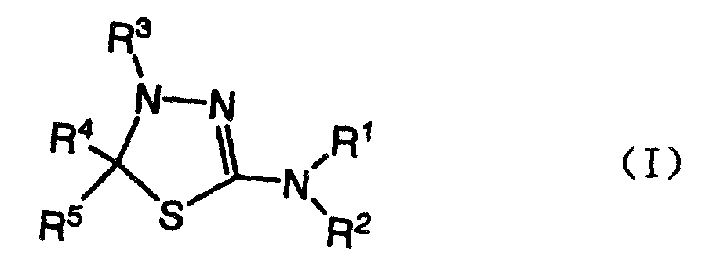
(1)含有由如下通式(I)表示的噻二唑啉衍生物或其可药用盐作为有效成分的抗肿瘤剂,(1) An antineoplastic agent comprising a thiadiazoline derivative represented by the following general formula (I) or a pharmaceutically acceptable salt thereof as an active ingredient,

<式中,< where,
R1和R4相同或不同,表示氢原子、取代的或未取代的低级烷基、取代的或未取代的低级炔基、取代的或未取代的低级烯基、取代的或未取代的环烷基、取代的或未取代的杂环基或取代的或未取代的芳基;R 1 and R 4 are the same or different, representing a hydrogen atom, a substituted or unsubstituted lower alkyl group, a substituted or unsubstituted lower alkynyl group, a substituted or unsubstituted lower alkenyl group, a substituted or unsubstituted ring Alkyl, substituted or unsubstituted heterocyclyl or substituted or unsubstituted aryl;
R2表示氢原子、取代的或未取代的低级烷基、取代的或未取代的低级炔基、取代的或未取代的低级烯基、取代的或未取代的环烷基、 R represents a hydrogen atom, a substituted or unsubstituted lower alkyl group, a substituted or unsubstituted lower alkynyl group, a substituted or unsubstituted lower alkenyl group, a substituted or unsubstituted cycloalkyl group,
-C(=W)R6 -C(=W)R 6
[式中,[where,
W表示氧原子或硫原子;W represents an oxygen atom or a sulfur atom;
R6表示氢原子、取代的或未取代的低级烷基、取代的或未取代的低级烯基、取代的或未取代的环烷基、取代的或未取代的芳基、取代的或未取代的杂环基、R 6 represents a hydrogen atom, a substituted or unsubstituted lower alkyl group, a substituted or unsubstituted lower alkenyl group, a substituted or unsubstituted cycloalkyl group, a substituted or unsubstituted aryl group, a substituted or unsubstituted the heterocyclic group,
-NR7R8 -NR 7 R 8
(式中,(where,
R7和R8相同或不同,表示氢原子、取代的或未取代的低级烷基、取代的或未取代的低级烯基、取代的或未取代的环烷基、取代的或未取代的芳基或取代的或未取代的杂环基,或者R 7 and R 8 are the same or different, representing a hydrogen atom, substituted or unsubstituted lower alkyl, substituted or unsubstituted lower alkenyl, substituted or unsubstituted cycloalkyl, substituted or unsubstituted aryl or substituted or unsubstituted heterocyclyl, or
R7和R8与相邻的氮原子一起形成取代的或未取代的杂环基)、R 7 and R 8 form a substituted or unsubstituted heterocyclic group together with adjacent nitrogen atoms),
-OR9 -OR 9
(式中,(where,
R9表示取代的或未取代的低级烷基、取代的或未取代的低级烯基、取代的或未取代的环烷基或取代的或未取代的芳基),或者 R represents substituted or unsubstituted lower alkyl, substituted or unsubstituted lower alkenyl, substituted or unsubstituted cycloalkyl or substituted or unsubstituted aryl), or
-SR10,-SR 10 ,
(式中,(where,
R10表示取代的或未取代的低级烷基、取代的或未取代的低级烯基或取代的或未取代的芳基)]、 R represents substituted or unsubstituted lower alkyl, substituted or unsubstituted lower alkenyl or substituted or unsubstituted aryl)],
-NR11R12 -NR 11 R 12
{式中,{where,
R11和R12相同或不同,表示氢原子、取代的或未取代的低级烷基、取代的或未取代的低级烯基、取代的或未取代的环烷基,或者R 11 and R 12 are the same or different, represent a hydrogen atom, a substituted or unsubstituted lower alkyl, a substituted or unsubstituted lower alkenyl, a substituted or unsubstituted cycloalkyl, or
-C(=O)R13[式中,-C(=O)R 13 [wherein,
R13表示R 13 means
取代的或未取代的低级烷基、取代的或未取代的低级烯基、取代的或未取代的芳基、取代的或未取代的杂环基、Substituted or unsubstituted lower alkyl, substituted or unsubstituted lower alkenyl, substituted or unsubstituted aryl, substituted or unsubstituted heterocyclic group,
-NR7AR8A(式中R7A和R8A各与前面的R7和R8具有同样的意义),或者-NR 7A R 8A (in the formula, R 7A and R 8A each have the same meaning as the preceding R 7 and R 8 ), or
-OR9A(式中R9A和前面的R9具有同样的意义)]}或者-OR 9A (wherein R 9A has the same meaning as the previous R 9 )]} or
-SO2R14(式中,-SO 2 R 14 (wherein,
R14表示取代的或未取代的低级烷基、取代的或未取代的低级烯基、取代的或未取代的芳基和取代的或未取代的杂环基) R represents substituted or unsubstituted lower alkyl, substituted or unsubstituted lower alkenyl, substituted or unsubstituted aryl and substituted or unsubstituted heterocyclyl)
或者R1R2与相邻的氮原子一起形成取代的或未取代的杂环基、Or R 1 R 2 forms a substituted or unsubstituted heterocyclic group together with adjacent nitrogen atoms,
R5表示取代的或未取代的低级烷基、取代的或未取代的低级炔基、取代的或未取代的低级烯基、取代的或未取代的环烷基、取代的或未取代的杂环基或取代的或未取代的芳基,或者 R represents substituted or unsubstituted lower alkyl, substituted or unsubstituted lower alkynyl, substituted or unsubstituted lower alkenyl, substituted or unsubstituted cycloalkyl, substituted or unsubstituted hetero Cyclic or substituted or unsubstituted aryl, or
R4和R5一起表示-(CR28R29)m1-Q-(CR28AR29A)m2-R 4 and R 5 together represent -(CR 28 R 29 ) m1 -Q-(CR 28A R 29A ) m2 -
{式中,{where,
Q表示单键、取代的或未取代的亚苯基或亚环烷基,Q represents a single bond, substituted or unsubstituted phenylene or cycloalkylene,
m1和m2相同或不同,表示0~4的整数,但m1和m2不能同时为0,m1 and m2 are the same or different, representing an integer from 0 to 4, but m1 and m2 cannot be 0 at the same time,
R28、R29、R28A和R29A相同或不同R 28 , R 29 , R 28A and R 29A are the same or different
表示氢原子、取代的或未取代的低级烷基、represents a hydrogen atom, a substituted or unsubstituted lower alkyl group,
-OR30[式中,R30表示氢原子、取代的或未取代的低级烷基、取代的或未取代的低级烯基、-OR 30 [wherein, R 30 represents a hydrogen atom, a substituted or unsubstituted lower alkyl group, a substituted or unsubstituted lower alkenyl group,
-CONR31R32(式中R31和R32相同或不同,表示氢原子、取代的或未取代的低级烷基、取代的或未取代的杂环基或取代的或未取代的芳基)、-CONR 31 R 32 (where R 31 and R 32 are the same or different, representing a hydrogen atom, a substituted or unsubstituted lower alkyl group, a substituted or unsubstituted heterocyclic group or a substituted or unsubstituted aryl group) ,
-SO2NR33R34(式中R33和R34相同或不同,表示氢原子、取代的或未取代的低级烷基、取代的或未取代的杂环基或取代的或未取代的芳基)或-SO 2 NR 33 R 34 (where R 33 and R 34 are the same or different, representing hydrogen atom, substituted or unsubstituted lower alkyl, substituted or unsubstituted heterocyclic group or substituted or unsubstituted aryl base) or
-COR35(式中R35表示氢原子、取代的或未取代的低级烷基、取代的或未取代的杂环基或取代的或未取代的芳基)]-COR 35 (wherein R 35 represents a hydrogen atom, a substituted or unsubstituted lower alkyl group, a substituted or unsubstituted heterocyclic group or a substituted or unsubstituted aryl group)]
-NR36R37[式中,-NR 36 R 37 [where,
R36和R37相同或不同,表示氢原子、取代的或未取代的低级烷基、R 36 and R 37 are the same or different, representing a hydrogen atom, a substituted or unsubstituted lower alkyl group,
-COR38(式中R38表示氢原子、取代的或未取代的低级烷基、取代的或未取代的杂环基、取代的或未取代的芳基、取代的或未取代的低级烷氧基、取代的或未取代的芳氧基、氨基、取代的或未取代的低级烷基氨基、取代的或未取代的二低级烷基氨基或取代的或未取代的芳基氨基)或-COR 38 (where R 38 represents a hydrogen atom, substituted or unsubstituted lower alkyl, substituted or unsubstituted heterocyclic group, substituted or unsubstituted aryl, substituted or unsubstituted lower alkoxy substituted or unsubstituted aryloxy, amino, substituted or unsubstituted lower alkylamino, substituted or unsubstituted di-lower alkylamino or substituted or unsubstituted arylamino) or
-SO2R39(式中R39表示取代的或未取代的低级烷基、取代的或未取代的杂环基或取代的或未取代的芳基)]或者-SO 2 R 39 (wherein R 39 represents a substituted or unsubstituted lower alkyl group, a substituted or unsubstituted heterocyclic group or a substituted or unsubstituted aryl group)] or
-CO2R40(式中,-CO 2 R 40 (where,
R40表示氢原子、取代的或未取代的低级烷基或取代的或未取代的芳基)R 40 represents a hydrogen atom, a substituted or unsubstituted lower alkyl group or a substituted or unsubstituted aryl group)
当m1或m2是2以上的整数时,R28、R29、R28A和R29A可以分别相同或不同,也可以与相邻的两个碳原子结合的各个R28、R29、R28A和R29A一起形成键},When m 1 or m 2 is an integer of 2 or more, R 28 , R 29 , R 28A and R 29A may be the same or different, and each of R 28 , R 29 , R 29 combined with adjacent two carbon atoms may be 28A and R 29A together form a bond},
R3表示氢原子或-C(=WA)R6A(式中,WA和R6A分别与前面的W和R6具有同样的意义)>。R 3 represents a hydrogen atom or -C(= WA )R 6A (wherein, WA and R 6A have the same meanings as W and R 6 above respectively)>.
(2)如上(1)中所述的抗肿瘤剂,其中R4表示取代的或未取代的低级烷基、取代的或未取代的低级炔基、取代的或未取代的低级烯基、取代的或未取代的环烷基、取代的或未取代的杂环基或取代的或未取代的芳基,R5表示取代的或未取代的环烷基、取代的或未取代的杂环基或取代的或未取代的芳基,或者R4与R5一起表示-(CR28R29)m1-Q-(CR28AR29A)m2-。(2) The antineoplastic agent as described in (1) above, wherein R represents a substituted or unsubstituted lower alkyl, a substituted or unsubstituted lower alkynyl, a substituted or unsubstituted lower alkenyl, a substituted or unsubstituted cycloalkyl, substituted or unsubstituted heterocyclic group or substituted or unsubstituted aryl, R 5 represents substituted or unsubstituted cycloalkyl, substituted or unsubstituted heterocyclic group Or a substituted or unsubstituted aryl group, or R 4 and R 5 together represent -(CR 28 R 29 ) m1 -Q-(CR 28A R 29A ) m2 -.
(3)如上述(1)中所述的抗肿瘤剂,其中R5是取代的或未取代的低级烷基、取代的或未取代的低级炔基、取代的或未取代的低级烯基或取代的或未取代的环烷基。(3) The antineoplastic agent as described in (1) above, wherein R is substituted or unsubstituted lower alkyl, substituted or unsubstituted lower alkynyl, substituted or unsubstituted lower alkenyl, or Substituted or unsubstituted cycloalkyl.
(4)如上述(1)或(2)中所述的抗肿瘤剂,其中R5是取代的或未取代的芳基或取代的或未取代的杂环基。(4) The antitumor agent as described in (1) or (2) above, wherein R 5 is a substituted or unsubstituted aryl group or a substituted or unsubstituted heterocyclic group.
(5)如上述(1)或(2)中所述的抗肿瘤剂,其中R5是取代的或未取代的苯基或取代的或未取代的噻嗯基(チエニル)。(5) The antitumor agent as described in (1) or (2) above, wherein R 5 is a substituted or unsubstituted phenyl group or a substituted or unsubstituted thienyl group.
(6)如上述(1)~(5)中任何一项中所述的抗肿瘤剂,其中R4是取代的或未取代的低级烷基。(6) The antitumor agent as described in any one of (1) to (5) above, wherein R 4 is a substituted or unsubstituted lower alkyl.
(7)如上述(1)中所述的抗肿瘤剂,其中R4和R5一起表示-(CR28R29)m1-Q-(CR28AR29A)m2-。(7) The antitumor agent as described in (1) above, wherein R 4 and R 5 together represent -(CR 28 R 29 ) m1 -Q-(CR 28A R 29A ) m2 -.
(8)如上述(1)中所述的抗肿瘤剂,其中R4和R5一起表示-(CH2)m1-Q-(CH2)m2-。(8) The antitumor agent as described in (1) above, wherein R 4 and R 5 together represent -(CH 2 ) m1 -Q-(CH 2 ) m2 -.
(9)如上(7)或(8)中所述的抗肿瘤剂,其中Q是取代的或未取代的亚苯基。(9) The antitumor agent as described in (7) or (8) above, wherein Q is a substituted or unsubstituted phenylene group.
(10)如上述(1)~(9)中任何一项中所述的抗肿瘤剂,其中R1是氢原子或取代的或未取代的低级烷基。(10) The antitumor agent as described in any one of (1) to (9) above, wherein R 1 is a hydrogen atom or a substituted or unsubstituted lower alkyl group.
(11)如上述(1)~(9)中任何一项中所述的抗肿瘤剂,其中R1是氢原子。(11) The antitumor agent as described in any one of (1) to (9) above, wherein R 1 is a hydrogen atom.
(12)如上述(1)~(11)中任何一项中所述的抗肿瘤剂,其中R2是-C(=W)R6。(12) The antitumor agent as described in any one of (1) to (11) above, wherein R 2 is -C(=W)R 6 .
(13)如上述(12)中所述的抗肿瘤剂,其中R6是取代的或未取代的低级烷基、取代的或未取代的低级炔基、取代的或未取代的低级烯基或取代的或未取代的环烷基。(13) The antitumor agent as described in (12) above, wherein R is substituted or unsubstituted lower alkyl, substituted or unsubstituted lower alkynyl, substituted or unsubstituted lower alkenyl, or Substituted or unsubstituted cycloalkyl.
(14)如上述(12)或(13)中所述的抗肿瘤剂,其中W是氧原子。(14) The antitumor agent as described in (12) or (13) above, wherein W is an oxygen atom.
(15)如上述(1)~(9)中任何一项中所述的抗肿瘤剂,其中R1和R2与相邻的氮原子一起形成取代的或未取代的杂环基。(15) The antitumor agent as described in any one of (1) to (9) above, wherein R 1 and R 2 together with adjacent nitrogen atoms form a substituted or unsubstituted heterocyclic group.
(16)如上述(1)~(15)中任何一项中所述的抗肿瘤剂,其中R3是-C(=WA)R6A。(16) The antitumor agent as described in any one of (1) to (15) above, wherein R 3 is -C(= WA )R 6A .
(17)如上述(16)中所述的抗肿瘤剂,其中R6A是取代的或未取代的低级烷基、取代的或未取代的低级炔基、取代的或未取代的低级烯基或取代的或未取代的环烷基。(17) The antitumor agent as described in (16) above, wherein R 6A is a substituted or unsubstituted lower alkyl, a substituted or unsubstituted lower alkynyl, a substituted or unsubstituted lower alkenyl, or Substituted or unsubstituted cycloalkyl.
(18)如上述(16)中所述的抗肿瘤剂,其中R6A是低级烷基。(18) The antitumor agent as described in (16) above, wherein R 6A is lower alkyl.
(19)如上述(16)~(18)中任何一项中所述的抗肿瘤剂,其中WA是氧原子。(19) The antitumor agent as described in any one of (16) to (18) above, wherein WA is an oxygen atom.
(20)如通式(IA)表示的噻二唑啉衍生物或其可药用盐:(20) A thiadiazoline derivative represented by the general formula (IA) or a pharmaceutically acceptable salt thereof:

{式中,{where,
R1A、R2A、R3A、R4A和R5A分别与上述R1、R2、R3、R4和R5具有同样的意义,但是R 1A , R 2A , R 3A , R 4A and R 5A have the same meanings as above R 1 , R 2 , R 3 , R 4 and R 5 respectively, but
R2A和R3A是同样的,是-CONHR8B(式中R8B表示取代的或未取代的低级烷基或取代的或未取代的芳基)而且R 2A and R 3A are the same and are -CONHR 8B (where R8B represents substituted or unsubstituted lower alkyl or substituted or unsubstituted aryl) and
(i)当R4A是氢原子时,或(i) when R 4A is a hydrogen atom, or
(ii)当R4A或R5A中的一个是取代的或未取代的低级烷基时,(ii) when one of R 4A or R 5A is a substituted or unsubstituted lower alkyl group,
R4A或R5A中的另外一个就是取代的或未取代的环烷基、取代的或未取代的低级炔基或取代的或未取代的低级烯基,The other of R 4A or R 5A is substituted or unsubstituted cycloalkyl, substituted or unsubstituted lower alkynyl or substituted or unsubstituted lower alkenyl,
[但是[but
(a)当R1A、R2A和R3A是氢原子,而且R4A或R5A中的一个是甲基时,(a) when R 1A , R 2A and R 3A are hydrogen atoms, and one of R 4A or R 5A is a methyl group,
R4A或R5A中的另外一个不是苯基、4-硝基苯基、4-氨基苯基、4-溴苯基、3-硝基苯基或4-甲氧基-3-硝基苯基;The other of R 4A or R 5A is not phenyl, 4-nitrophenyl, 4-aminophenyl, 4-bromophenyl, 3-nitrophenyl or 4-methoxy-3-nitrobenzene base;
(b)当R1A和R2A是氢原子,R3A是乙酰基,(b) when R 1A and R 2A are hydrogen atoms, R 3A is an acetyl group,
(i)而且R4A和R5A中的一个是甲基时,(i) and when one of R 4A and R 5A is methyl,
R4A或R5A中的另外一个不是甲基、乙基、苯基、4-甲氧基苯基、2-萘磺酰基甲基、4-溴苯磺酰基甲基或4-氯苯磺酰基甲基;The other one of R 4A or R 5A is not methyl, ethyl, phenyl, 4-methoxyphenyl, 2-naphthalenesulfonylmethyl, 4-bromobenzenesulfonylmethyl or 4-chlorobenzenesulfonyl methyl;
(ii)而且R4A是氢原子时,(ii) and when R 4A is a hydrogen atom,
R5A不是苯基、4-硝基苯基、4-氯苯基、4-甲氧基苯基、4-二甲基氨基苯基或吡啶基;R 5A is not phenyl, 4-nitrophenyl, 4-chlorophenyl, 4-methoxyphenyl, 4-dimethylaminophenyl or pyridyl;
(c)当R1A是氢原子,R2A和R3A是乙酰基,(c) when R 1A is a hydrogen atom, R 2A and R 3A are acetyl groups,
(i)而且当R4A或R5A中的一个是甲基时,R4A或R5A中的另外一个不是甲基、乙基、丙基、丁基、己基、戊基、苯基、苄基、乙酰基甲基、叔丁氧羰基甲基、乙氧羰基甲基、4-溴苯磺酰基甲基、4-溴苯磺酰基乙基、4-氯苯磺酰基甲基、3,4-二氯苯磺酰基甲基、3,4-二氯苯磺酰基乙基、3,4-二甲基苯磺酰基甲基、苯磺酰基甲基、4-甲基苯磺酰基甲基、4-甲基苯磺酰基乙基、4-(乙酰基氨基)苯磺酰基乙基、4-溴苯磺酰基乙基、2-(4-甲基苯磺酰基)-2-苯基乙基、2-(4-甲基苯硫基)-2-苯基乙基、2-萘磺酰基乙基、2-萘磺酰基甲基、苯乙基、3-苯甲酰氧基苯基、2-氧代-2H-1-苯并吡喃-3-基、2-呋喃基、5-硝基-2-呋喃基、5-甲基-2-呋喃基、2-噻嗯基(チエニル)、5-氯-2-噻嗯基、3-乙酰氧基苯基、3-硝基苯基、4-硝基苯基、4-氟苯基、3-乙酰基氨基苯基、4-甲氧基苯基、3-甲氧基苯基、4-乙基苯基、4-甲基苯基、4-溴苯基、4-壬氧基苯基、4-苯基苯基、3,4-二甲氧基苯基、1,3-苯并二噁唑-5-基、4-(苯并咪唑-2-基氨基)苯基、4-(1-甲基苯并咪唑-2-基氨基)苯基、3-吡啶基、2-萘基、2-乙酰基氨基-4-乙酰基-1,3,4-噻二唑啉-5-基或4-乙酰基氨基苯磺酰基甲基;(i) and when one of R 4A or R 5A is methyl, the other one of R 4A or R 5A is not methyl, ethyl, propyl, butyl, hexyl, pentyl, phenyl, benzyl , Acetylmethyl, tert-butoxycarbonylmethyl, ethoxycarbonylmethyl, 4-bromobenzenesulfonylmethyl, 4-bromobenzenesulfonylethyl, 4-chlorobenzenesulfonylmethyl, 3,4- Dichlorobenzenesulfonylmethyl, 3,4-dichlorobenzenesulfonylethyl, 3,4-dimethylbenzenesulfonylmethyl, benzenesulfonylmethyl, 4-methylbenzenesulfonylmethyl, 4 -Methylbenzenesulfonylethyl, 4-(acetylamino)benzenesulfonylethyl, 4-bromobenzenesulfonylethyl, 2-(4-methylbenzenesulfonyl)-2-phenylethyl, 2-(4-Methylphenylthio)-2-phenylethyl, 2-naphthalenesulfonylethyl, 2-naphthalenesulfonylmethyl, phenethyl, 3-benzoyloxyphenyl, 2 -Oxo-2H-1-benzopyran-3-yl, 2-furyl, 5-nitro-2-furyl, 5-methyl-2-furyl, 2-thienyl (Chienyl) , 5-chloro-2-thienyl, 3-acetoxyphenyl, 3-nitrophenyl, 4-nitrophenyl, 4-fluorophenyl, 3-acetylaminophenyl, 4-methyl Oxyphenyl, 3-methoxyphenyl, 4-ethylphenyl, 4-methylphenyl, 4-bromophenyl, 4-nonyloxyphenyl, 4-phenylphenyl, 3, 4-dimethoxyphenyl, 1,3-benzobisoxazol-5-yl, 4-(benzimidazol-2-ylamino)phenyl, 4-(1-methylbenzimidazol-2 -ylamino)phenyl, 3-pyridyl, 2-naphthyl, 2-acetylamino-4-acetyl-1,3,4-thiadiazolin-5-yl or 4-acetylaminobenzenesulfonyl Acylmethyl;
(ii)而且当R4A或R5A中的一个是苯基时,(ii) and when one of R 4A or R 5A is phenyl,
R4A或R5A中的另外一个不是苯基、4-甲氧基苯基、3,4-二甲氧基苯基、4-硝基苯基、乙氧羰基甲基、异丁基、仲丁基、正丁基或乙酰基氨基甲基;The other one of R 4A or R 5A is not phenyl, 4-methoxyphenyl, 3,4-dimethoxyphenyl, 4-nitrophenyl, ethoxycarbonylmethyl, isobutyl, sec Butyl, n-butyl or acetylaminomethyl;
(iii)而且当R4A或R5A中的一个是2-乙酰氧基苯基时,(iii) and when one of R 4A or R 5A is 2-acetoxyphenyl,
R4A或R5A中的另外一个不是2-苯基乙烯基;The other of R 4A or R 5A is not 2-phenylethenyl;
(iv)而且当R4A是氢原子或4-甲氧基苯基时,(iv) and when R 4A is a hydrogen atom or 4-methoxyphenyl,
R5A不是4-甲氧基苯基;R 5A is not 4-methoxyphenyl;
(v)而且当R4A是氢原子时,(v) and when R 4A is a hydrogen atom,
R5A不是苯基、4-硝基苯基、4-氯苯基、4-二甲基氨基苯基或吡啶基;R 5A is not phenyl, 4-nitrophenyl, 4-chlorophenyl, 4-dimethylaminophenyl or pyridyl;
(vi)而且当R4A和R5A一起表示-(CH2)m1-Q-(CH2)m2-(式中m1、m2和Q分别具有如上所述相同的意义)时,(vi) and when R 4A and R 5A together represent -(CH 2 ) m1 -Q-(CH 2 ) m2 - (where m1, m2 and Q respectively have the same meaning as above),
Q是单键,而且m1和m2之和不是5;Q is a single bond, and the sum of m1 and m2 is not 5;
(vii)而且当R4A或R5A中的一个是1,2,3-三乙酰氧基丙基时,(vii) and when one of R 4A or R 5A is 1,2,3-triacetoxypropyl,
R4A或R5A中的另外一个不是3,4-二氢-3-氧代-2-喹噁啉基;The other one of R 4A or R 5A is not 3,4-dihydro-3-oxo-2-quinoxalinyl;
(viii)而且当R4A或R5A中的一个是乙基时,(viii) and when one of R 4A or R 5A is ethyl,
R4A或R5A中的另外一个不是乙基;The other of R 4A or R 5A is not ethyl;
(d)当R1A和R4A是氢原子,而且(d) when R 1A and R 4A are hydrogen atoms, and
(i)R2A和R3A同样都是丙酰基或苯甲酰基时,或者(i) R 2A and R 3A are both propionyl or benzoyl, or
(ii)R2A是丙酰基,R3A是乙酰基时,(ii) R 2A is a propionyl group, and R 3A is an acetyl group,
R5A不是苯基;R 5A is not phenyl;
(e)当R1A和R3A是氢原子,(e) when R 1A and R 3A are hydrogen atoms,
R2A是乙酰基,而且R 2A is acetyl, and
R4A或R5A中的一个是甲基时,When one of R 4A or R 5A is a methyl group,
R4A或R5A中的另外一个不是苯基或3,4-二氯苯磺酰基乙基;The other of R 4A or R 5A is not phenyl or 3,4-dichlorobenzenesulfonylethyl;
(f)当R1A是苯基,R2A和R3A是乙酰基,而且(f) when R 1A is phenyl, R 2A and R 3A are acetyl, and
(i)R4A或R5A中的一个是甲基时,(i) When one of R 4A or R 5A is a methyl group,
R4A或R5A中的另外一个不是4-乙酰氧基-6-甲基-2-氧代-2H-吡喃-3-基或2-氧代-2H-1-苯并吡喃-3-基;The other one of R 4A or R 5A is not 4-acetoxy-6-methyl-2-oxo-2H-pyran-3-yl or 2-oxo-2H-1-benzopyran-3 -base;
(ii)R4A是苯基时,(ii) when R 4A is phenyl,
R5A不是苯基;R 5A is not phenyl;
(g)当R1A是甲基,R2A和R3A是乙酰基,而且(g) when R 1A is methyl, R 2A and R 3A are acetyl, and
(i)R4A是氢原子时,(i) R When 4A is a hydrogen atom,
R5A不是苯基;R 5A is not phenyl;
(ii)R4A或R5A中的一个是甲基时,(ii) When one of R 4A or R 5A is a methyl group,
R4A或R5A中的另外一个不是乙氧羰基乙基或乙氧羰基丙基;The other of R 4A or R 5A is not ethoxycarbonylethyl or ethoxycarbonylpropyl;
(h)当R1A、R2A和R4A是甲基,而且R5A是吡啶基时,(h) when R 1A , R 2A and R 4A are methyl, and R 5A is pyridyl,
R3A不是-CORC(式中RC表示甲基、氯甲基、甲氧基、乙氧羰基甲基或乙氧羰基乙烯基);R 3A is not -CORC (where R C represents methyl, chloromethyl, methoxy, ethoxycarbonylmethyl or ethoxycarbonylvinyl);
(j)当R1A或R2A中的一个是氢原子,(j) when one of R 1A or R 2A is a hydrogen atom,
R1A或R2A中的另外一个是乙基,而且The other of R 1A or R 2A is ethyl, and
R3A是氢原子或乙酰基时,When R 3A is a hydrogen atom or an acetyl group,
R4A和R5A不能同时是甲基;R 4A and R 5A cannot be methyl at the same time;
(k)当R1A是4-氯苯基,(k) when R 1A is 4-chlorophenyl,
R2A是氢原子,而且R 2A is a hydrogen atom, and
R4A或R5A中的一个是甲基时,When one of R 4A or R 5A is a methyl group,
R4A或R5A中的另外一个不是(1-甲基苯并咪唑-2-基氨基)苯基,而且The other of R 4A or R 5A is not (1-methylbenzimidazol-2-ylamino)phenyl, and
R3A不是乙酰基;R 3A is not acetyl;
(m)当R1A是苯基、4-氯苯基、4-甲基苯基或4-甲氧基苯基,(m) when R 1A is phenyl, 4-chlorophenyl, 4-methylphenyl or 4-methoxyphenyl,
R2A是氢原子,而且R 2A is a hydrogen atom, and
R4A和R5A是甲基时,When R 4A and R 5A are methyl groups,
R3A不是乙酰基、4-氯苯氧基乙酰基、2-氯苯氧基乙酰基、3-甲基苯氧基乙酰基或苯基氨基羰基;R 3A is not acetyl, 4-chlorophenoxyacetyl, 2-chlorophenoxyacetyl, 3-methylphenoxyacetyl or phenylaminocarbonyl;
(n)当R2A和R3A是乙酰基,(n) when R 2A and R 3A are acetyl,
R4A或R5A中的一个是甲基,one of R4A or R5A is methyl,
(i)而且当R4A或R5A中的另外一个是1H-苯并三唑-1-基甲基时,(i) and when the other of R 4A or R 5A is 1H-benzotriazol-1-ylmethyl,
R1A不是环己基、苄基、苯基、2-甲基苯基或4-甲氧基苯基,R 1A is not cyclohexyl, benzyl, phenyl, 2-methylphenyl or 4-methoxyphenyl,
(ii)而且当R4A或R5A中的另外一个是2-甲基苯并咪唑-1-基甲基或2-乙基苯并咪唑-1-基甲基时,(ii) and when the other of R 4A or R 5A is 2-methylbenzimidazol-1-ylmethyl or 2-ethylbenzimidazol-1-ylmethyl,
R1A不是环己基、苯基或4-溴苯基;R 1A is not cyclohexyl, phenyl or 4-bromophenyl;
(o)当R1A是氢原子,(o) when R 1A is a hydrogen atom,
R2A是乙酰基,而且R 2A is acetyl, and
R4A和R5A是甲基时,When R 4A and R 5A are methyl groups,
R3A不是苯甲酰基;R 3A is not benzoyl;
(p)当R1A或R2A中的一个是氢原子,(p) when one of R 1A or R 2A is a hydrogen atom,
R1A或R2A中的另外一个是甲基,而且The other of R 1A or R 2A is methyl, and
R4A和R5A都是甲基或乙基时,When R 4A and R 5A are both methyl or ethyl,
R3A不是乙酰基、苯甲酰基、特戊酰基(三甲基乙酰)、3-硝基苯甲酰基、2-氟苯甲酰基、4-氟苯甲酰基、2-三氟甲基苯甲酰基或3-三氟甲基苯甲酰基;R 3A is not acetyl, benzoyl, pivaloyl (trimethylacetyl), 3-nitrobenzoyl, 2-fluorobenzoyl, 4-fluorobenzoyl, 2-trifluoromethylbenzoyl Acyl or 3-trifluoromethylbenzoyl;
(q)当R1A是甲基,(q) when R 1A is methyl,
R2A是甲基氨基羰基,而且R 2A is methylaminocarbonyl, and
R4A和R5A都是甲基或乙基时,When R 4A and R 5A are both methyl or ethyl,
R3A不是乙酰基、苯甲酰基、特戊酰基、2-氟苯甲酰基、4-氟苯甲酰基、2-三氟甲基苯甲酰基、3-三氟甲基苯甲酰基或4-三氟甲基苯甲酰基]}。R 3A is not acetyl, benzoyl, pivaloyl, 2-fluorobenzoyl, 4-fluorobenzoyl, 2-trifluoromethylbenzoyl, 3-trifluoromethylbenzoyl or 4- Trifluoromethylbenzoyl]}.
(21)如上述(20)中所述的噻二唑啉衍生物或其可药用盐,其中R4A是取代的或未取代的低级烷基、取代的或未取代的低级炔基、取代的或未取代的低级烯基,R5A是取代的或未取代的环烷基、取代的或未取代的杂环基或取代的或未取代的芳基,或者R4A和R5A一起表示-(CR28R29)m1-Q-(CR28AR29A)m2-(式中R28、R29、R28A、R29A、m1、m2和Q分别与前面具有相同的意义)。(21) The thiadiazoline derivative or a pharmaceutically acceptable salt thereof as described in (20) above, wherein R 4A is substituted or unsubstituted lower alkyl, substituted or unsubstituted lower alkynyl, substituted or unsubstituted lower alkenyl, R 5A is substituted or unsubstituted cycloalkyl, substituted or unsubstituted heterocyclyl or substituted or unsubstituted aryl, or R 4A and R 5A together represent - (CR 28 R 29 ) m1 -Q-(CR 28 AR 29 A) m2 - (wherein R 28 , R 29 , R 28A , R 29A , m1, m2 and Q have the same meanings as above).
(22)如上述(20)中所述的抗肿瘤剂,其中R5A是取代的或未取代的低级烷基、取代的或未取代的低级炔基、取代的或未取代的低级烯基、取代的或未取代的环烷基。(22) The antitumor agent as described in (20) above, wherein R 5A is a substituted or unsubstituted lower alkyl, a substituted or unsubstituted lower alkynyl, a substituted or unsubstituted lower alkenyl, Substituted or unsubstituted cycloalkyl.
(23)如上述(20)或(21)中所述的噻二唑啉衍生物或其可药用盐,其中R5A是取代的或未取代的芳基或取代的或未取代的杂环基。(23) The thiadiazoline derivative or a pharmaceutically acceptable salt thereof as described in (20) or (21) above, wherein R 5A is substituted or unsubstituted aryl or substituted or unsubstituted heterocycle base.
(24)如上述(20)或(21)中所述的噻二唑啉衍生物或其可药用盐,其中R5A是取代的或未取代的苯基或取代的或未取代的噻嗯基。(24) The thiadiazoline derivative or a pharmaceutically acceptable salt thereof as described in (20) or (21) above, wherein R 5A is substituted or unsubstituted phenyl or substituted or unsubstituted thien base.
(25)如上述(20)~(24)中任何一项中所述的噻二唑啉衍生物或其可药用盐,其中R4A是取代的或未取代的低级烷基。(25) The thiadiazoline derivative or a pharmaceutically acceptable salt thereof as described in any one of (20) to (24) above, wherein R 4A is a substituted or unsubstituted lower alkyl.
(26)如上述(20)~(24)中任何一项中所述的噻二唑啉衍生物或其可药用盐,其中R4A是取代的低级烷基。(26) The thiadiazoline derivative or a pharmaceutically acceptable salt thereof as described in any one of (20) to (24) above, wherein R 4A is a substituted lower alkyl.
(27)如上述(20)中所述的噻二唑啉衍生物或其可药用盐,其中R4A和R5A一起表示-(CR28R29)m1-Q-(CR28AR29A)m2-(式中R28、R29、R28A、R29A、m1、m2和Q都与前面具有同样的意义)。(27) The thiadiazoline derivative or a pharmaceutically acceptable salt thereof as described in (20) above, wherein R 4A and R 5A together represent -(CR 28 R 29 ) m1 -Q-(CR 28A R 29A ) m2 - (in the formula, R 28 , R 29 , R 28A , R 29A , m1, m2 and Q all have the same meanings as above).
(28)如上述(20)中所述的噻二唑啉衍生物或其可药用盐,其中R4A和R5A一起表示-(CH2)m1-Q-(CH2)m2-(式中m1、m2和Q都具有和前面同样的意义)。(28) The thiadiazoline derivative or a pharmaceutically acceptable salt thereof as described in (20) above, wherein R 4A and R 5A together represent -(CH 2 ) m1 -Q-(CH 2 ) m2 -(formula m1, m2 and Q all have the same meaning as before).
(29)如上述(27)或(28)中所述的噻二唑啉衍生物或其可药用盐,其中Q是取代的或未取代的亚苯基。(29) The thiadiazoline derivative or a pharmaceutically acceptable salt thereof as described in (27) or (28) above, wherein Q is a substituted or unsubstituted phenylene group.
(30)如上述(20)~(29)中任何一项中所述的噻二唑啉衍生物或其可药用盐,其中R1A是氢原子或取代的或未取代的低级烷基。(30) The thiadiazoline derivative or a pharmaceutically acceptable salt thereof as described in any one of (20) to (29) above, wherein R 1A is a hydrogen atom or a substituted or unsubstituted lower alkyl group.
(31)如上述(20)~(29)中任何一项中所述的噻二唑啉衍生物或其可药用盐,其中R1A是氢原子。(31) The thiadiazoline derivative or a pharmaceutically acceptable salt thereof as described in any one of (20) to (29) above, wherein R 1A is a hydrogen atom.
(32)如上述(20)~(31)中任何一项中所述的噻二唑啉衍生物或其可药用盐,其中R2A是-C(=W)R6(式中W和R6分别与前面的具有同样的意义)。(32) The thiadiazoline derivative or a pharmaceutically acceptable salt thereof as described in any one of (20) to (31) above, wherein R 2A is -C(=W)R 6 (where W and R 6 respectively have the same meaning as above).
(33)如上述(32)中所述的噻二唑啉衍生物或其可药用盐,其中R6是取代的或未取代的低级烷基、取代的或未取代的低级炔基、取代的或未取代的低级烯基或取代的或未取代的环烷基。(33) The thiadiazoline derivative or a pharmaceutically acceptable salt thereof as described in (32) above, wherein R is substituted or unsubstituted lower alkyl, substituted or unsubstituted lower alkynyl, substituted or unsubstituted lower alkenyl or substituted or unsubstituted cycloalkyl.
(34)如上述(32)或(33)中所述的噻二唑啉衍生物或其可药用盐,其中W是氧原子。(34) The thiadiazoline derivative or a pharmaceutically acceptable salt thereof as described in (32) or (33) above, wherein W is an oxygen atom.
(35)如上述(20)~(29)中任何一项中所述的噻二唑啉衍生物或其可药用盐,其中R1A和R2A与相邻的氮原子一起形成取代的或未取代的杂环基。(35) The thiadiazoline derivative or a pharmaceutically acceptable salt thereof as described in any one of (20) to (29) above, wherein R 1A and R 2A together with adjacent nitrogen atoms form a substituted or unsubstituted heterocyclyl.
(36)如上述(20)~(35)中任何一项中所述的噻二唑啉衍生物或其可药用盐,其中R3A是-C(=WA)R6A(式中WA和R6A分别与前面的具有同样的意义)。(36) The thiadiazoline derivative or a pharmaceutically acceptable salt thereof as described in any one of (20) to (35) above, wherein R 3A is -C(=WA ) R 6A (where W A and R 6A respectively have the same meaning as above).
(37)如上述(36)中所述的噻二唑啉衍生物或其可药用盐,其中R6A是取代的或未取代的低级烷基、取代的或未取代的低级炔基、取代的或未取代的低级烯基或取代的或未取代的环烷基。(37) The thiadiazoline derivative or a pharmaceutically acceptable salt thereof as described in (36) above, wherein R 6A is substituted or unsubstituted lower alkyl, substituted or unsubstituted lower alkynyl, substituted or unsubstituted lower alkenyl or substituted or unsubstituted cycloalkyl.
(38)如上述(36)中所述的噻二唑啉衍生物或其可药用盐,其中R6A是低级烷基。(38) The thiadiazoline derivative or a pharmaceutically acceptable salt thereof as described in (36) above, wherein R 6A is lower alkyl.
(39)如上述(36)~(38)中任何一项中所述的噻二唑啉衍生物或其可药用盐,其中WA是氧原子。(39) The thiadiazoline derivative or a pharmaceutically acceptable salt thereof as described in any one of (36) to (38) above, wherein W A is an oxygen atom.
(40)含有如上述(20)~(39)中任何一项的噻二唑啉衍生物或其可药用盐作为有效成分的药物。(40) A medicament containing the thiadiazoline derivative or a pharmaceutically acceptable salt thereof as any one of the above (20) to (39) as an active ingredient.
(41)含有如上述(20)~(39)中任何一项的噻二唑啉衍生物或其可药用盐作为有效成分的抗肿瘤剂。(41) An antineoplastic agent comprising the thiadiazoline derivative or a pharmaceutically acceptable salt thereof according to any one of the above (20) to (39) as an active ingredient.
(42)如上述(20)~(39)中任何一项的噻二唑啉衍生物或其可药用盐在制造抗肿瘤剂中的应用。(42) Use of the thiadiazoline derivative or a pharmaceutically acceptable salt thereof according to any one of the above (20) to (39) for the production of an antitumor agent.
(43)恶性肿瘤的治疗方法,其特征在于,给予有效量的如上述(20)~(39)中任何一项的噻二唑啉衍生物或其可药用盐。(43) A method for treating malignant tumors, characterized by administering an effective amount of the thiadiazoline derivative or a pharmaceutically acceptable salt thereof according to any one of (20) to (39) above.
下面把用通式(I)和通式(IA)表示的化合物分别称为化合物(I)和化合物(IA)。对于其他通式序号的化合物也是同样的。Hereinafter, the compounds represented by general formula (I) and general formula (IA) are referred to as compound (I) and compound (IA), respectively. The same applies to compounds of other general formula numbers.
在化合物(I)和化合物(IA)中的各基团的定义中,In the definition of each group in compound (I) and compound (IA),
(i)作为低级烷基、低级烷氧基、低级烷基氨基和二低级烷基氨基中的低级烷基部分,可以举出比如直链或支链的碳原子数1~10的烷基,具体有甲基、乙基、丙基、异丙基、丁基、异丁基、仲丁基、叔丁基、戊基、异戊基、新戊基、己基、庚基、辛基、壬基、癸基等。(i) Examples of the lower alkyl moiety in lower alkyl, lower alkoxy, lower alkylamino and di-lower alkylamino include linear or branched alkyl groups having 1 to 10 carbon atoms, Specifically methyl, ethyl, propyl, isopropyl, butyl, isobutyl, sec-butyl, tert-butyl, pentyl, isopentyl, neopentyl, hexyl, heptyl, octyl, nonyl base, decyl, etc.
二低级烷基的两个低级烷基部分可以是相同的,也可以是不同的。The two lower alkyl moieties of a di-lower alkyl may be the same or different.
(ii)作为环烷基,可以举出比如碳原子数3~8的环烷基,具体有环丙基、环丁基、环戊基、环己基、环庚基、环辛基等。(ii) Cycloalkyl groups include, for example, cycloalkyl groups having 3 to 8 carbon atoms, specifically cyclopropyl, cyclobutyl, cyclopentyl, cyclohexyl, cycloheptyl, and cyclooctyl.
作为亚环烷基,可以举出比如碳原子数3~8的亚环烷基,具体有亚环丙基、亚环丁基、亚环戊基、亚环己基、亚环庚基、亚环辛基等。The cycloalkylene group includes, for example, a cycloalkylene group having 3 to 8 carbon atoms, specifically, a cyclopropylene group, a cyclobutylene group, a cyclopentylene group, a cyclohexylene group, a cycloheptylene group, a cyclo Hinkie et al.
(iii)作为低级烯基,可以举出比如直链或支链的碳原子数2~8的烯基,具体有乙烯基、烯丙基、丁烯基、戊烯基、己烯基、庚烯基、辛烯基等。(iii) Examples of the lower alkenyl group include linear or branched alkenyl groups having 2 to 8 carbon atoms, specifically vinyl, allyl, butenyl, pentenyl, hexenyl, and heptenyl. alkenyl, octenyl, etc.
(iv)作为低级炔基,可以举出比如直链或支链的碳原子数2~8的炔基,具体有乙炔基、丙炔基、丁炔基、戊炔基、己炔基、庚炔基、辛炔基等。(iv) Examples of the lower alkynyl group include, for example, straight-chain or branched alkynyl groups having 2 to 8 carbon atoms, specifically ethynyl, propynyl, butynyl, pentynyl, hexynyl, and heptynyl. Alkynyl, Octynyl, etc.
(v)作为芳基、芳氧基和芳基氨基的芳基部分,可以举出比如苯基、萘基等。(v) Examples of the aryl moiety of the aryl group, aryloxy group and arylamino group include phenyl, naphthyl and the like.
(vi)作为杂环基,可以举出比如脂肪族杂环基、芳香族杂环基等。作为脂肪族杂环基,可以举出由含有比如选自氮原子、氧原子或硫原子中至少一个原子的5元或6元的单环脂肪族杂环基、由3~8个环缩合的二环或三环的含有选自氮原子、氧原子和硫原子中至少一个原子的缩合环脂肪族杂环基,具体有吡咯烷基、咪唑烷基、哌啶烷基、哌嗪烷基、吗啉基、硫代吗啉基、1-哌啶基、吗啉代、噁唑基、二氧戊环基、四氢吡喃基等。作为芳香族杂环基,可以举出比如含有由选自比如氮原子、氧原子和硫原子的至少一个原子的5元或6元单环芳香族杂环基、3~8元环缩合的二环或三环含有选自氮原子、氧原子和硫原子中至少一个原子的缩合环芳香族杂环基等,具体有呋喃基、噻嗯基、苯并噻吩基、吡咯基、吡啶基、哌啶基、咪唑基、吡唑基、三唑基、噻唑基、异噻唑基、噻二唑基、噁唑基、噁二唑基、嘧啶基、吲哚基、异吲哚基、苯并噻唑基、苯并咪唑基、苯并三唑基、喹啉基、异喹啉基、喹唑基、吡喃基等。(vi) As a heterocyclic group, an aliphatic heterocyclic group, an aromatic heterocyclic group, etc. are mentioned, for example. As the aliphatic heterocyclic group, for example, a 5-membered or 6-membered monocyclic aliphatic heterocyclic group containing at least one atom selected from a nitrogen atom, an oxygen atom or a sulfur atom, condensed from 3 to 8 rings can be mentioned. Bicyclic or tricyclic condensed cycloaliphatic heterocyclic groups containing at least one atom selected from nitrogen atoms, oxygen atoms and sulfur atoms, specifically pyrrolidinyl, imidazolidinyl, piperidinyl, piperazinyl, Morpholinyl, thiomorpholinyl, 1-piperidinyl, morpholino, oxazolyl, dioxolanyl, tetrahydropyranyl, etc. As the aromatic heterocyclic group, for example, a 5-membered or 6-membered monocyclic aromatic heterocyclic group containing at least one atom selected from, for example, a nitrogen atom, an oxygen atom and a sulfur atom; A ring or tricyclic ring containing at least one condensed ring aromatic heterocyclic group selected from nitrogen atom, oxygen atom and sulfur atom, specifically furyl, thienyl, benzothienyl, pyrrolyl, pyridyl, piperyl Pyridyl, imidazolyl, pyrazolyl, triazolyl, thiazolyl, isothiazolyl, thiadiazolyl, oxazolyl, oxadiazolyl, pyrimidinyl, indolyl, isoindolyl, benzothiazole base, benzimidazolyl, benzotriazolyl, quinolinyl, isoquinolyl, quinazolyl, pyranyl, etc.
(vii)作为与相邻的氮原子一起形成的杂环基,可以举出比如含有至少一个氮原子的脂肪族杂环基等。含有该至少一个氮原子的杂环基,还可以含有氧原子、硫原子或另外的氮原子,可以举出比如吡咯烷基、吗啉代、硫代吗啉代、吡唑烷基、哌啶子基、哌嗪基、高哌啶基、氮丙啶基、氮杂环丁烷基、azolidinyl、全氢氮杂基、全氢azosinyl、琥珀酰亚胺基、吡咯烷基、戊二酰亚胺基、哌啶烷基等。(vii) Examples of the heterocyclic group formed together with adjacent nitrogen atoms include aliphatic heterocyclic groups containing at least one nitrogen atom. The heterocyclic group containing at least one nitrogen atom may also contain an oxygen atom, a sulfur atom or another nitrogen atom, such as pyrrolidinyl, morpholino, thiomorpholino, pyrazolidinyl, piperidine Subgroup, piperazinyl, homopiperidinyl, aziridinyl, azetidinyl, azolidinyl, perhydroazepine, perhydroazosinyl, succinimide, pyrrolidinyl, glutaryl Amino, piperidinyl, etc.
(viii)作为在取代的低级烷基、取代的低级烷氧基、取代的低级烯基、取代的低级炔基、取代的环烷基、取代的低级烷基氨基和取代的二低级烷基氨基中的取代基,可以举出相同或不同的比如取代数1~3的卤素、氧代、羟基、硝基、叠氮基、环烷基、芳基、杂环基、(viii) As in substituted lower alkyl, substituted lower alkoxy, substituted lower alkenyl, substituted lower alkynyl, substituted cycloalkyl, substituted lower alkylamino and substituted di-lower alkylamino The substituents in can include the same or different ones such as halogen, oxo, hydroxyl, nitro, azido, cycloalkyl, aryl, heterocyclic,
取代的芳基(在该取代的芳基中的取代基与在下面的取代的芳基中的取代基(xii)具有同样的意义)、a substituted aryl group (the substituents in the substituted aryl group have the same meaning as the substituent (xii) in the following substituted aryl group),
取代的杂环基(在该取代的杂环基中的取代基与在下面的取代的杂环基中的取代基(xiii)具有同样的意义)、a substituted heterocyclic group (the substituent in the substituted heterocyclic group has the same meaning as the substituent (xiii) in the following substituted heterocyclic group),
-CONR15R16<式中,-CONR 15 R 16 < where,
R15和R16相同或不同,表示氢原子、羟基、环烷基、低级烷基、低级烯基、芳基、杂环基、R 15 and R 16 are the same or different, representing a hydrogen atom, hydroxyl, cycloalkyl, lower alkyl, lower alkenyl, aryl, heterocyclic,
取代的芳基(在该取代的芳基中的取代基与在下面的取代的芳基中的取代基(xii)具有同样的意义)、a substituted aryl group (the substituents in the substituted aryl group have the same meaning as the substituent (xii) in the following substituted aryl group),
取代的杂环基(在该杂环基中的取代基与在下面的取代的杂环基中的取代基(xiii)具有同样的意义)或a substituted heterocyclic group (the substituents in this heterocyclic group have the same meaning as the substituent (xiii) in the following substituted heterocyclic group) or
取代的低级烷基{作为该取代的低级烷基中的取代基,可以举出相同或不同的比如取代数1~3的羟基、低级烷基、氧代、羧基、低级烷氧羰基、芳基、杂环基、Substituted lower alkyl {As the substituent in the substituted lower alkyl, the same or different ones such as hydroxyl, lower alkyl, oxo, carboxyl, lower alkoxycarbonyl, aryl with a substitution number of 1 to 3 can be mentioned. , heterocyclyl,
-CONR15AR16A[式中,-CONR 15A R 16A [where,
R15A和R16A相同或不同,表示氢原子、羟基、低级烷基或取代的低级烷基(作为在该取代的低级烷基中的取代基(a),可以举出相同或不同的取代数1~3的羟基、低级烷氧基、氧代、羧基、低级烷氧羰基、芳基、杂环基、氨基、低级烷基氨基、二低级烷基氨基等),或者R 15A and R 16A are the same or different, and represent a hydrogen atom, a hydroxyl group, a lower alkyl group or a substituted lower alkyl group (as the substituent (a) in the substituted lower alkyl group, the same or different substituent numbers can be mentioned. 1 to 3 hydroxyl, lower alkoxy, oxo, carboxyl, lower alkoxycarbonyl, aryl, heterocyclic, amino, lower alkylamino, di-lower alkylamino, etc.), or
R15A和R16A与相邻的氮原子一起形成杂环基]R 15A and R 16A together with adjacent nitrogen atoms form a heterocyclyl]
-NR41R42[式中,-NR 41 R 42 [where,
R41和R42相同或不同,表示R 41 and R 42 are the same or different, indicating that
氢原子、低级烷基、低级烷酰基、芳酰基、芳基、杂环基、Hydrogen atom, lower alkyl group, lower alkanoyl group, aroyl group, aryl group, heterocyclic group,
取代的低级烷基(在该取代的低级烷基中的取代基与在上述取代的低级烷基中的取代基(a)具有同样的意义)、substituted lower alkyl (the substituent in the substituted lower alkyl has the same meaning as the substituent (a) in the above-mentioned substituted lower alkyl),
取代的低级烷酰基(作为在该取代的低级烷酰基中的取代基(b),可以举出相同或不同的取代数1~3的羟基、低级烷氧基、氧代、羧基、低级烷氧羰基、氨基、低级烷基氨基、二低级烷基氨基等)、Substituted lower alkanoyl (as the substituent (b) in the substituted lower alkanoyl group, the same or different hydroxy, lower alkoxy, oxo, carboxyl, lower alkoxy, etc. carbonyl, amino, lower alkylamino, di-lower alkylamino, etc.),
取代的芳酰基(在该取代的芳酰基中的取代基与在上面的取代的低级烷酰基中的取代基(b)具有同样的意义)、a substituted aroyl group (the substituents in the substituted aroyl group have the same meaning as the substituent (b) in the above substituted lower alkanoyl group),
取代的芳基(在该取代的芳基中的取代基与在下面的取代的芳基中的取代基(xii)具有同样的意义)或Substituted aryl (the substituents in this substituted aryl have the same meaning as the substituent (xii) in the following substituted aryl) or
取代的杂环基(在该取代的杂环基中的取代基与在下面的取代的杂环基中的取代基(xiii)具有同样的意义),或者a substituted heterocyclic group (the substituents in the substituted heterocyclic group have the same meaning as the substituent (xiii) in the following substituted heterocyclic group), or
R41和R42与相邻的氮原子一起形成杂环基或取代的杂环基(在该与相邻的氮原子一起形成的杂环基中的取代基和下面的与相邻的氮原子一起形成的取代的杂环基中的取代基(xiii)具有同样的意义)]}或者R 41 and R 42 form a heterocyclic group or a substituted heterocyclic group together with adjacent nitrogen atoms (the substituents in the heterocyclic group formed together with adjacent nitrogen atoms and the following adjacent nitrogen atoms The substituents (xiii) in the substituted heterocyclyl formed together have the same meaning)]} or
R15和R16与相邻的氮原子一起形成杂环基或取代的杂环基(在该与相邻的氮原子一起形成的取代的杂环基中的取代基和下面的与相邻的氮原子一起形成的取代的杂环基中的取代基(xiii)具有同样的意义)>、R 15 and R 16 form a heterocyclic group or a substituted heterocyclic group together with adjacent nitrogen atoms (the substituents in the substituted heterocyclic group formed together with adjacent nitrogen atoms and the following and adjacent The substituent (xiii) in the substituted heterocyclic group formed together by the nitrogen atoms has the same meaning)>,
-CO2R26{式中,-CO 2 R 26 {wherein,
R26表示R 26 means
氢原子、低级烷基、环烷基、低级烯基、低级炔基、芳基、Hydrogen atom, lower alkyl, cycloalkyl, lower alkenyl, lower alkynyl, aryl,
取代的芳基(在该取代的芳基中的取代基和在下面的取代的芳基中的取代基(xii)具有同样的意义)或Substituted aryl (the substituent in this substituted aryl has the same meaning as the substituent (xii) in the following substituted aryl) or
取代的低级烷基[作为在该取代的低级烷基中的取代基(c)可以举出相同或不同的,例如取代数1~3的Substituted lower alkyl [As the substituent (c) in the substituted lower alkyl, the same or different ones can be mentioned, for example, those with a substitution number of 1 to 3
羟基、卤素、低级烷基、氧代、羧基、低级烷氧羰基、芳基、杂环基、Hydroxy, halogen, lower alkyl, oxo, carboxyl, lower alkoxycarbonyl, aryl, heterocyclic,
-CONR15BR16B(式中R15B和R16B分别与前面的R15和R16具有同样的意义)、-CONR 15 BR 16 B (where R 15B and R 16B have the same meaning as the previous R 15 and R 16 respectively),
-NR41AR42A(式中,R41A和R42A分别与前面的R41和R42具有同样的意义)等]}、-NR 41 AR 42A (wherein, R 41A and R 42A have the same meanings as the preceding R 41 and R 42 respectively) etc.]},
-COR26A(式中,R26A与前面的R26具有同样的意义)、-COR 26A (wherein, R 26A has the same meaning as the preceding R 26 ),
-NR17R18<式中,-NR 17 R 18 < where,
R17和R18相同或不同,表示R 17 and R 18 are the same or different, indicating that
氢原子、低级烷基、低级烯基、芳酰基、芳基、杂环基、环烷基、芳烷氧羰基、Hydrogen atom, lower alkyl, lower alkenyl, aroyl, aryl, heterocyclic, cycloalkyl, aralkoxycarbonyl,
取代的低级烷基{作为在该取代的低级烷基中的取代基(d),可以举出同样和不同的比如取代数1~3的Substituted lower alkyl {As the substituent (d) in the substituted lower alkyl, there may be mentioned the same and different ones such as those with a substitution number of 1 to 3
羟基、低级烷氧基、氧代、羧基、低级烷氧羰基、芳基、杂环基、Hydroxy, lower alkoxy, oxo, carboxyl, lower alkoxycarbonyl, aryl, heterocyclic,
取代的芳基(在该取代的芳基中的取代基与下面的取代的芳基中的取代基(xii)具有同样的意义)、a substituted aryl group (the substituents in the substituted aryl group have the same meaning as the substituent (xii) in the substituted aryl group below),
取代的杂环基(在该取代的杂环基中的取代基与下面的取代的杂环基中的取代基(xiii)具有同样的意义)、a substituted heterocyclic group (the substituent in the substituted heterocyclic group has the same meaning as the substituent (xiii) in the following substituted heterocyclic group),
-O(CH2CH2O)nR19(式中,n表示1~15的整数,R19表示低级烷基)、-O(CH 2 CH 2 O) n R 19 (where n represents an integer of 1 to 15, and R 19 represents a lower alkyl group),
-CONR15CR16C(式中,R15C和R16C分别与前面的R15和R16相同)、-CONR 15C R 16C (wherein, R 15C and R 16C are the same as the previous R 15 and R 16 respectively),
-SO2R24[式中,R24表示低级烷基、芳基或-SO 2 R 24 [wherein, R 24 represents lower alkyl, aryl or
取代的芳基(在该取代的芳基中的取代基与在下面的取代的芳基中的取代基(xii)具有同样的意义)]、a substituted aryl group (the substituents in the substituted aryl group have the same meaning as the substituent (xii) in the following substituted aryl group)],
-NR41BR42B(式中,R41B和R42B与前面的R41和R42具有同样的意义)}、-NR 41B R 42B (wherein, R 41B and R 42B have the same meaning as the preceding R 41 and R 42 )},
取代的芳基(在该取代的芳基中的取代基与下面的取代的芳基中的取代基(xii)具有同样的意义)、a substituted aryl group (the substituents in the substituted aryl group have the same meaning as the substituent (xii) in the substituted aryl group below),
取代的杂环基(在该取代的杂环基中的取代基与在下面的取代的杂环基中的取代基(xiii)具有同样的意义)、a substituted heterocyclic group (the substituent in the substituted heterocyclic group has the same meaning as the substituent (xiii) in the following substituted heterocyclic group),
-COR26B{式中,-COR 26B {where,
R26B表示R 26B said
低级烷基、低级烯基、低级炔基、芳基、Lower alkyl, lower alkenyl, lower alkynyl, aryl,
取代的低级烷基(在该取代的低级烷基中的取代基与前面的取代的低级烷基中的取代基(c)具有同样的意义)、Substituted lower alkyl (the substituent in the substituted lower alkyl has the same meaning as the substituent (c) in the preceding substituted lower alkyl),
取代的芳基(在该取代的芳基中的取代基与在下面的取代的芳基中的取代基(xii)具有同样的意义)、a substituted aryl group (the substituents in the substituted aryl group have the same meaning as the substituent (xii) in the following substituted aryl group),
-NR26CR26D(式中R26C和R26D相同或不同,分别与上述R26具有同样的意义)或-NR 26C R 26D (in the formula, R 26C and R 26D are the same or different, and have the same meaning as the above-mentioned R 26 respectively) or
-OR27[式中,R27表示-OR 27 [wherein, R 27 represents
低级烷基、芳基、lower alkyl, aryl,
取代的低级烷基(在该取代的低级烷基中的取代基与前面的取代的低级烷基中的取代基(c)具有同样的意义)或Substituted lower alkyl (the substituent in the substituted lower alkyl has the same meaning as the substituent (c) in the preceding substituted lower alkyl) or
取代的芳基(在该取代的芳基中的取代基与下面的取代的芳基中的取代基(xii)具有同样的意义)]}或者Substituted aryl (the substituents in this substituted aryl have the same meaning as the substituent (xii) in the following substituted aryl)]} or
-SO2R26E(式中,R26E和前面的R26具有同样的意义)或者-SO 2 R 26E (wherein, R 26E has the same meaning as the preceding R 26 ) or
R17和R18与相邻的氮原子一起形成杂环基或取代的杂环基(在该与相邻的氮原子一起形成的取代的杂环基中的取代基与在下面的与氮原子一起形成的取代的杂环基中的取代基(xiii)具有同样的意义)>、R 17 and R 18 form a heterocyclic group or a substituted heterocyclic group together with the adjacent nitrogen atom (the substituent in the substituted heterocyclic group formed with the adjacent nitrogen atom is the same as the following nitrogen atom The substituents (xiii) in the substituted heterocyclyl formed together have the same meaning)>,
-N+R20R21R22X(式中,-N + R 20 R 21 R 22 X (where,
R20和R21相同或不同,表示低级烷基,或者R20和R21与相邻的氮原子一起形成杂环基,R 20 and R 21 are the same or different, represent lower alkyl, or R 20 and R 21 form a heterocyclic group together with adjacent nitrogen atoms,
R22表示低级烷基,R 22 represents lower alkyl,
X表示氯、溴和碘等各种原子)、X represents various atoms such as chlorine, bromine and iodine),
-OR23{式中,-OR 23 {where,
R23表示R 23 means
低级烷基、环烷基、芳基、杂环基、Lower alkyl, cycloalkyl, aryl, heterocyclyl,
取代的芳基(在该取代的芳基中的取代基与下面的取代的芳基中的取代基(xii)具有同样的意义)、a substituted aryl group (the substituents in the substituted aryl group have the same meaning as the substituent (xii) in the substituted aryl group below),
取代的杂环基(在该取代的杂环基中的取代基与下面的取代的杂环基中的取代基(xiii)具有同样的意义)、a substituted heterocyclic group (the substituent in the substituted heterocyclic group has the same meaning as the substituent (xiii) in the following substituted heterocyclic group),
取代的低级烷基[作为该取代的低级烷基中的取代基(e),相同或不同,可以举出比如取代数1~3的Substituted lower alkyl [As the substituent (e) in the substituted lower alkyl, the same or different, for example, those with a substitution number of 1 to 3 can be mentioned.
羟基、卤素、低级烷氧基、氧代、羧基、低级烷氧羰基、芳基、杂环基、Hydroxy, halogen, lower alkoxy, oxo, carboxyl, lower alkoxycarbonyl, aryl, heterocyclic,
取代的芳基(在该取代的芳基中的取代基与下面的取代的芳基中的取代基(xii)具有同样的意义)、a substituted aryl group (the substituents in the substituted aryl group have the same meaning as the substituent (xii) in the substituted aryl group below),
取代的杂环基(在该取代的杂环基中的取代基与下面的取代的杂环基中的取代基(xiii)具有同样的意义)、a substituted heterocyclic group (the substituent in the substituted heterocyclic group has the same meaning as the substituent (xiii) in the following substituted heterocyclic group),
-O(CH2CH2O)nAR19A(式中,nA和R19A分别与前面的n和R19具有同样的意义)、-O(CH 2 CH 2 O) nA R 19A (in the formula, nA and R 19A have the same meaning as the previous n and R 19 respectively),
-CONR15DR16D(式中,R15D和R16D分别与前面的R15和R16具有同样的意义)、-CONR 15D R 16D (wherein, R 15D and R 16D have the same meaning as the previous R 15 and R 16 respectively),
-NR41CR42C(式中,R41C和R42C分别与前面的R41和R42具有同样的意义)]、-NR 41C R 42C (wherein, R 41C and R 42C have the same meanings as the preceding R 41 and R 42 respectively)],
-COR26F(式中,R26F与前面的R26具有同样的意义)或者-COR 26F (wherein, R 26F has the same meaning as R 26 above) or
-CONR15ER16E(式中,R15E和R16E分别与前面的R15和R16具有同样的意义)}-CONR 15E R 16E (in the formula, R 15E and R 16E have the same meaning as the previous R 15 and R 16 respectively)}
-SR23A(式中,R23A与前面的R23具有同样的意义)、-SR 23A (wherein, R 23A has the same meaning as R 23 above),
-SO2R25[式中,-SO 2 R 25 [wherein,
R25表示R 25 means
低级烷基、环烷基、芳基、Lower alkyl, cycloalkyl, aryl,
取代的低级烷基(在该取代的低级烷基中的取代基与前面的取代的低级烷基中的取代基(c)具有同样的意义)、Substituted lower alkyl (the substituent in the substituted lower alkyl has the same meaning as the substituent (c) in the preceding substituted lower alkyl),
取代的芳基(在该取代的芳基中的取代基与前面的取代的芳基中的取代基(xii)具有同样的意义)或substituted aryl (the substituents in the substituted aryl have the same meaning as the substituent (xii) in the preceding substituted aryl) or
-NR15FR16F(式中,R15F和R16F与前面的R15和R16具有同样的意义)]、-NR 15F R 16F (wherein, R 15F and R 16F have the same meaning as the preceding R 15 and R 16 )],
-OSO2R25A(式中,R25A与前面的R25具有同样的意义)等。-OSO 2 R 25A (wherein, R 25A has the same meaning as R 25 above), etc.
在这里表示的低级烷基、低级烷氧基、低级烷氧羰基、低级烷基氨基和二低级烷基氨基中的低级烷基部分、芳基和芳酰基中的芳基部分、环烷基、低级烯基、低级炔基、杂环基和与相邻的氮原子一起形成的杂环基,分别与前面的低级烷基(i)、芳基(v)、环烷基(ii)、低级烯基(iii)、低级炔基(iv)、杂环基(vi)和与相邻的氮原子一起形成的杂环基(vii)具有同样的意义。而在这里表示的低级烷酰基中的低级烷基部分与前面的低级烷基(i)具有同样的意义,卤素(ix)表示氟、氯、溴或碘等各种原子,作为芳烷氧羰基中的芳烷基部分(xi),可以举出比如碳原子数7~15的芳烷基,具体有苄基、苯乙基、联苯甲基、萘甲基等。Lower alkyl, lower alkoxy, lower alkoxycarbonyl, lower alkylamino and lower alkyl moieties in di-lower alkylamino, aryl and aryl moieties in aroyl, cycloalkyl, Lower alkenyl, lower alkynyl, heterocyclyl and heterocyclyl formed with adjacent nitrogen atoms, respectively with the previous lower alkyl (i), aryl (v), cycloalkyl (ii), lower Alkenyl (iii), lower alkynyl (iv), heterocyclyl (vi) and heterocyclyl (vii) formed together with adjacent nitrogen atoms have the same meaning. And the lower alkyl part in the lower alkanoyl represented here has the same meaning as the lower alkyl (i) above, the halogen (ix) represents various atoms such as fluorine, chlorine, bromine or iodine, and as aralkoxycarbonyl The aralkyl moiety (xi) in the moiety includes, for example, an aralkyl group having 7 to 15 carbon atoms, specifically benzyl, phenethyl, biphenylmethyl, naphthylmethyl and the like.
(xii)作为取代的芳基、取代的芳氧基、取代的芳基氨基和取代的亚苯基中的取代基,是相同和不同的,可以举出比如取代数1~3的(xii) The substituents in the substituted aryl group, substituted aryloxy group, substituted arylamino group, and substituted phenylene group are the same or different, for example, those with a substitution number of 1 to 3
卤素、低级烷基、硝基、氧代、羟基、低级烷氧基、氨基、低级烷基氨基、二低级烷基氨基、低级烷基氨基羰氧基、二低级烷基氨基羰氧基、低级烷酰基、低级烷酰胺基、低级烷酰氧基、芳基、芳磺酰基、杂环胺基、芳酰基、羧基、低级烷氧羰基、氰基、亚甲基二氧、Halogen, lower alkyl, nitro, oxo, hydroxy, lower alkoxy, amino, lower alkylamino, di-lower alkylamino, lower alkylaminocarbonyloxy, di-lower alkylaminocarbonyloxy, lower Alkanoyl, lower alkanoyl, lower alkanoyloxy, aryl, arylsulfonyl, heterocyclic amine, aroyl, carboxyl, lower alkoxycarbonyl, cyano, methylenedioxy,
取代的低级烷基(作为在该取代的低级烷基中的取代基(f)可以举出比如相同或不同的,取代数1~3的卤素、氧代、羧基、低级烷氧羰基、氨基、低级烷基氨基、二低级烷基氨基、羟基、低级烷氧基等)、Substituted lower alkyl (as the substituent (f) in the substituted lower alkyl, for example, the same or different, halogen, oxo, carboxyl, lower alkoxycarbonyl, amino, lower alkylamino, di-lower alkylamino, hydroxyl, lower alkoxy, etc.),
取代的芳磺酰基(在该取代的芳磺酰基中的取代基与前面的取代基(f)具有同样的意义)、a substituted arylsulfonyl group (the substituents in the substituted arylsulfonyl group have the same meaning as the preceding substituent (f)),
取代的杂环胺基(在该杂环胺基中的取代基与前面的取代基(f)具有同样的意义)。A substituted heterocyclic amine group (the substituents in the heterocyclic amine group have the same meanings as the substituent (f) above).
在这里表示的低级烷基、低级烷基氨基、二低级烷基氨基、低级烷基氨基羰氧基、二低级烷基氨基羰氧基(该二低级烷基氨基羰氧基中的两个低级烷基部分可以是相同的,也可以是不同的)、低级烷氧羰基和低级烷氧基中的低级烷基部分、杂环胺基的杂环基部分、芳基、芳磺酰基和芳酰基中的芳基部分和卤素分别与上述低级烷基(i)、杂环基(vi)、芳基(v)和卤素(ix)具有同样的意义。而作为在这里表示的低级烷酰基、低级烷酰胺基和低级烷酰氧基中的低级烷酰基部分(x),可以举出比如直链或支链的碳原子数2~9的烷酰基,具体有乙酰基、丙酰基、丁酰基、异丁酰基、戊酰基、异烷酰基、特戊酰基、己酰基、庚酰基、辛酰基、壬酰基等。The lower alkyl, lower alkylamino, di-lower alkylamino, lower alkylaminocarbonyloxy, and di-lower alkylaminocarbonyloxy represented here (two lower The alkyl moieties may be the same or different), lower alkoxycarbonyl and lower alkyl moieties in lower alkoxy, heterocyclyl moieties of heterocyclic amine groups, aryl, arylsulfonyl and aroyl The aryl moiety and halogen in have the same meanings as the above-mentioned lower alkyl (i), heterocyclyl (vi), aryl (v) and halogen (ix), respectively. As the lower alkanoyl moiety (x) in the lower alkanoyl group, lower alkanoyl amido group and lower alkanoyloxy group shown here, for example, linear or branched alkanoyl groups having 2 to 9 carbon atoms, Specifically, there are acetyl, propionyl, butyryl, isobutyryl, pentanoyl, isoalkanoyl, pivaloyl, hexanoyl, heptanoyl, octanoyl, nonanoyl and the like.
(xiii)作为在取代的杂环基和与相邻的氮原子一起形成的杂环基中的取代基,除了在前面的取代芳基中取代基(xii)所定义的基团以外,还可以举出氧代等基团。(xiii) As a substituent in a substituted heterocyclic group and a heterocyclic group formed together with an adjacent nitrogen atom, in addition to the group defined in the substituent (xii) in the aforementioned substituted aryl group, Examples include groups such as oxo.
化合物(I)和化合物(IA)的可药用盐包括比如可药用的酸加合盐、金属盐、铵盐、有机胺加合盐、氨基酸加合盐等。作为酸加合盐,可以举出比如盐酸盐、硫酸盐、磷酸盐等无机酸盐、醋酸盐、马来酸盐、富马酸盐、酒石酸盐、柠檬酸盐、乳酸盐、天门冬氨酸盐、谷氨酸盐、琥珀酸盐等有机酸盐;作为金属盐,可以举出比如钠盐、钾盐等碱金属盐、镁盐、钙盐等碱土金属盐、铝盐、锌盐等;作为铵盐,可以举出铵、四甲铵等的盐;作为有机胺加合盐,可以举出比如吗啉、哌啶盐等加合盐;作为氨基酸加合盐,可以举出比如赖氨酸、甘氨酸、苯基甘氨酸等的加合盐。The pharmaceutically acceptable salts of Compound (I) and Compound (IA) include, for example, pharmaceutically acceptable acid addition salts, metal salts, ammonium salts, organic amine addition salts, amino acid addition salts and the like. Examples of acid addition salts include inorganic acid salts such as hydrochloride, sulfate, and phosphate, acetate, maleate, fumarate, tartrate, citrate, lactate, Organic acid salts such as aspartic acid salt, glutamic acid salt, and succinic acid salt; examples of metal salts include alkali metal salts such as sodium salts and potassium salts, alkaline earth metal salts such as magnesium salts and calcium salts, aluminum salts, and zinc salts. Salts, etc.; as ammonium salts, salts such as ammonium and tetramethylammonium can be mentioned; as organic amine addition salts, addition salts such as morpholine and piperidine salts can be mentioned; as amino acid addition salts, there can be mentioned Such as addition salts of lysine, glycine, phenylglycine, etc.
下面说明化合物(I)和化合物(IA)的制造方法。The production methods of Compound (I) and Compound (IA) will be described below.
在如下所示的制造方法当中,在实施方法的条件下所定义的基团要发生变化或者对于实施方法不适当的情况下,要通过使用导入和脱离在有机化学中经常使用的保护基团的方法[在比如T.W.Greene等的《有机合成中的保护基团》(ProtectiveGroups in Organic Synthesis),Wiley & Sons Inc.1981年版],得到目的化合物。根据需要还可以变更导入取代基等的反应工序的顺序。In the production method shown below, in the case where the defined group is changed under the conditions of carrying out the method or is inappropriate for carrying out the method, it is necessary to introduce and remove a protecting group which is often used in organic chemistry Method [in eg T.W.Greene et al. "Protective Groups in Organic Synthesis" (Protective Groups in Organic Synthesis), Wiley & Sons Inc. 1981 edition], obtain the target compound. The order of the reaction steps for introducing substituents and the like can also be changed as necessary.
化合物(I)可以按照如下的反应工序制造。Compound (I) can be produced according to the following reaction procedure.
对于化合物(IA)也可以使用与如下所示的化合物(I)相同的制造方法制造。Compound (IA) can also be produced by the same production method as that of compound (I) shown below.
制造法1Manufacturing method 1
在化合物(I)当中,作为R2是氢原子、取代的或未取代的低级烷基、取代的或未取代的低级炔基、取代的或未取代的低级烯基或取代的或未取代的环烷基,或者R1和R2与相邻的氮原子一起形成取代的或未取代的杂环基,R3是-C(=O)R6A的化合物(Ia),能够按照公知的方法[比如J.Heterocyclic Chem.第21卷,599页(1984年)等],由化合物(II)和化合物(III),经由化合物(IV)合成。In the compound (I), as R 2 is a hydrogen atom, a substituted or unsubstituted lower alkyl, a substituted or unsubstituted lower alkynyl, a substituted or unsubstituted lower alkenyl or a substituted or unsubstituted Cycloalkyl, or R 1 and R 2 form a substituted or unsubstituted heterocyclic group together with adjacent nitrogen atoms, R 3 is a compound (Ia) of -C(=O)R 6A , which can be obtained according to known methods [For example, J. Heterocyclic Chem. Vol. 21, p. 599 (1984), etc.], synthesized from compound (II) and compound (III) via compound (IV).
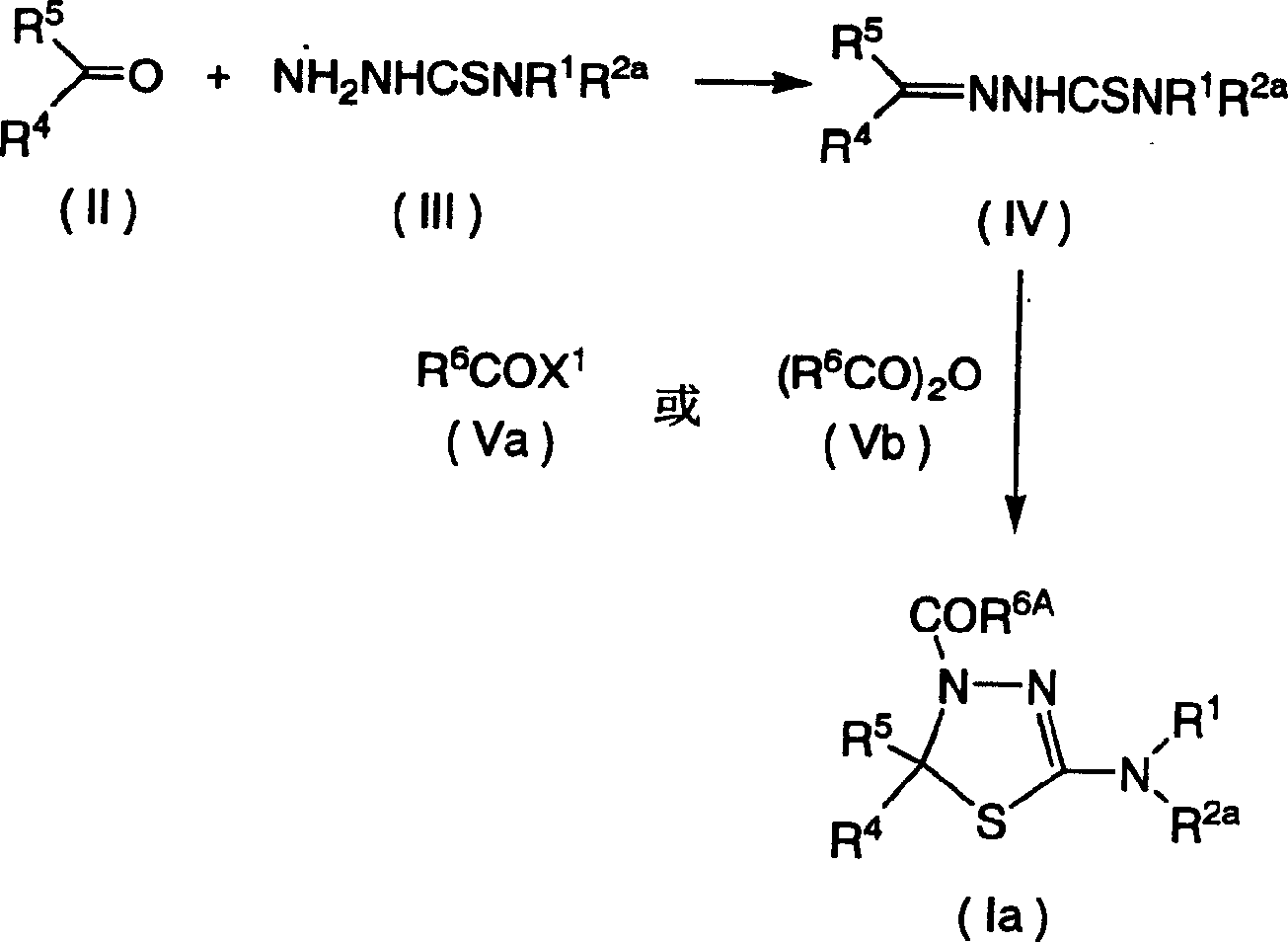
(式中,R1、R4、R5、R6和R6A分别与前面的具有同样的意义,X1与前面的X具有同样的意义,R2a表示前面的R2定义中的氢原子、取代的或未取代的低级烷基、取代的或未取代的低级炔基、取代的或未取代的低级烯基或取代的或未取代的环烷基,或者R1和R2a与相邻的氮原子一起形成取代的或未取代的杂环基)。(wherein, R 1 , R 4 , R 5 , R 6 and R 6A have the same meaning as the previous ones respectively, X 1 has the same meaning as the previous X, and R 2a represents the hydrogen atom in the definition of the previous R 2 , substituted or unsubstituted lower alkyl, substituted or unsubstituted lower alkynyl, substituted or unsubstituted lower alkenyl or substituted or unsubstituted cycloalkyl, or R 1 and R 2a are adjacent to nitrogen atoms together to form a substituted or unsubstituted heterocyclic group).
制造法2Manufacturing method 2
在化合物(I)当中,作为R2和R3同样是-C(=O)R6B(式中R6B和前面的R6具有同样的意义)的化合物(Ib),可以按照公知的方法[比如J.Bangladesh Chem.Soc.,第5卷,127页(1992年)、J.Org.Chem.,第45卷,1473页(1980年)、东德专利243,930等]由在制造法1中得到的化合物(IV)中R2a是氢原子的化合物(IVa)和化合物(Va)合成或化合物(Vb)合成。Among the compounds (I), the compound (Ib) in which R 2 and R 3 are also -C(=O)R 6B (where R 6B has the same meaning as the preceding R 6 ) can be obtained according to the known method [ Such as J.Bangladesh Chem.Soc., volume 5, page 127 (1992), J.Org.Chem., volume 45, page 1473 (1980), East German patent 243,930, etc.] by manufacturing method 1 In the compound (IV) obtained, R 2a is a hydrogen atom, compound (IVa) and compound (Va) are synthesized or compound (Vb) is synthesized.

(式中,R1、R4、R5和R6B分别与前面具有同样的意义)。(In the formula, R 1 , R 4 , R 5 and R 6B have the same meanings as above, respectively).
制造法3Manufacturing method 3
在化合物(Ia)中,作为R2是氢原子,R3是-C(=O)R6A的化合物(Ic),可以由在制造法2中得到的化合物(Ib)通过如下的工序来合成。In compound (Ia), compound (Ic) in which R 2 is a hydrogen atom and R 3 is -C(=O)R 6A can be synthesized from compound (Ib) obtained in Production Method 2 by the following procedure .

(式中,R1、R4、R5、R6A和R6B都与前面的具有同样的意义)。(In the formula, R 1 , R 4 , R 5 , R 6A and R 6B all have the same meaning as above).
可以通过在N,N-二甲基甲酰胺等反应惰性溶剂中,在适当的碱,比如氢氧化钠存在下,在0~80℃的温度下,将化合物(Ib)进行10min~10h的处理,得到化合物(Ic)。相对于化合物(Ib),优选使用1~5当量的碱。The compound (Ib) can be treated for 10 min to 10 h at a temperature of 0 to 80°C in a reaction inert solvent such as N,N-dimethylformamide, in the presence of a suitable base, such as sodium hydroxide , to obtain compound (Ic). It is preferable to use 1 to 5 equivalents of the base relative to the compound (Ib).
化合物(Ic)还可以通过如下的方法合成。Compound (Ic) can also be synthesized by the following method.
可以在比如含水或无水甲醇、乙腈、氯仿等反应惰性溶剂中,在适当的碱比如水合肼、氢氧化钠水溶液存在下,在0~50℃的温度下,将化合物(Ib)处理1~10h,就可以得到化合物(Ic)。相对于化合物(Ib),碱的用量优选为2~10当量。Compound (Ib) can be treated in a reaction inert solvent such as aqueous or anhydrous methanol, acetonitrile, chloroform, etc., in the presence of a suitable base such as hydrazine hydrate, aqueous sodium hydroxide solution, at a temperature of 0 to 50 ° C. 10h, compound (Ic) can be obtained. The amount of the base used is preferably 2 to 10 equivalents based on the compound (Ib).
还可以通过如下的方法合成化合物(Ic)。Compound (Ic) can also be synthesized by the following method.
在比如甲醇、叔丁醇等溶剂中,在还原剂比如硼氢化钠等存在下,根据需要在七水合氯化铈存在下,在-10~100℃的温度下,将化合物(Ib)处理0.1~15h,就可以得到化合物(Ic)。相对于化合物(Ib),还原剂的用量优选为1~200当量。In a solvent such as methanol, tert-butanol, etc., in the presence of a reducing agent such as sodium borohydride, etc., as required, in the presence of cerium chloride heptahydrate, at a temperature of -10 to 100 ° C, the compound (Ib) is treated for 0.1 ~15h, compound (Ic) can be obtained. The reducing agent is preferably used in an amount of 1 to 200 equivalents relative to the compound (Ib).
制造法4Manufacturing method 4
在化合物(I)当中,作为R2是-C(=O)6、R3是-C(=O)R6A的化合物(Ie),可以通过如下的工序,由在制造法1或制造法3中得到的化合物(Ic)合成。Among the compounds (I), the compound (Ie) in which R 2 is -C(=O) 6 and R 3 is -C(=O)R 6A can be obtained from Production Method 1 or Production Method 1 by the following steps: Compound (Ic) obtained in 3 was synthesized.
(式中,R1、R4、R5、R6和R6A分别与前面的具有同样的意义,X2与前面的X具有同样的意义)。(In the formula, R 1 , R 4 , R 5 , R 6 and R 6A have the same meanings as above, and X 2 has the same meaning as X above).
可以在比如丙酮、乙酸乙酯、乙腈、N,N-二甲基甲酰胺、二氯甲烷等活性或惰性溶剂中,在适当的碱,比如吡啶、4-(二甲基氨基)吡啶(DMAP)、氢氧化钠等存在下,将化合物(Ic)与化合物(VA)或化合物(VB)一起,在0~120℃的温度下反应2~12h,而得到化合物(Ie)。相对于化合物(Ic),碱和化合物(VA)或化合物(VB)的用量优选分别为1~3当量。In active or inert solvents such as acetone, ethyl acetate, acetonitrile, N,N-dimethylformamide, dichloromethane, etc., in a suitable base, such as pyridine, 4-(dimethylamino)pyridine (DMAP ), sodium hydroxide, etc., react compound (Ic) with compound (VA) or compound (VB) at a temperature of 0-120° C. for 2-12 hours to obtain compound (Ie). The base and the compound (VA) or the compound (VB) are preferably used in an amount of 1 to 3 equivalents, respectively, based on the compound (Ic).
制造法5Manufacturing method 5
在化合物(I)当中,作为R2是-SO2R14,R3是-C(=O)R6A的化合物(If),可以按照比如在《新实验化学讲座》,第14卷,1803页(丸善株式会社,1978年发行)中所述的方法,由在制造法1或制造法3中得到的化合物(Ic)合成。Among compounds (I), compounds (If) in which R 2 is -SO 2 R 14 and R 3 is -C(=O)R 6A can be obtained according to, for example, "Lectures on New Experimental Chemistry", Vol. 14, 1803 Synthesized from the compound (Ic) obtained in Production Method 1 or Production Method 3 by the method described on the page (Maruzen Co., Ltd., published in 1978).
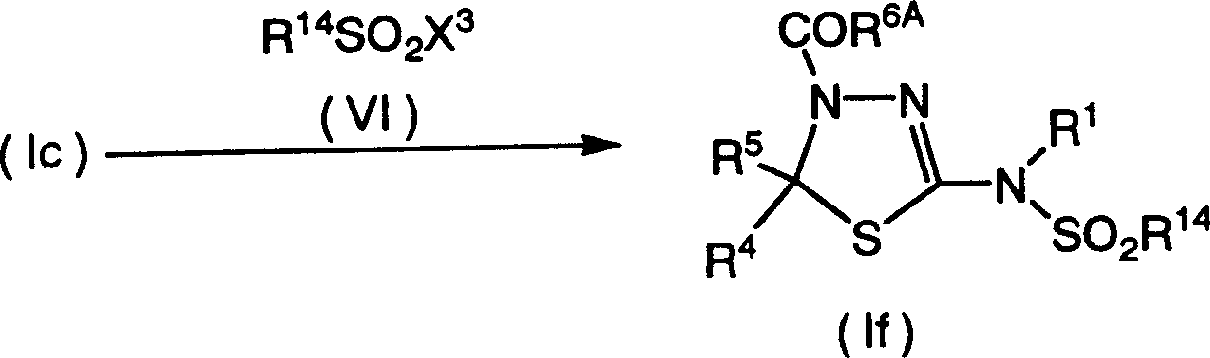
(式中,R1、R4、R5、R6A和R14分别与前面的具有同样的意义,X3与前面的X具有同样的意义)(In the formula, R 1 , R 4 , R 5 , R 6A and R 14 have the same meanings as the previous ones, and X 3 has the same meanings as the previous Xs)
制造法6Manufacturing method 6
在化合物(I)当中,作为R2是-NR11R12,R3是-C(=O)R6A的化合物(Ig),可以按照比如在Indian J.Chem.,B集,31B(8)卷,547页(1992年)、PhosphorusSulfur & Silicon & Related Elements,第122卷,307页(1997年)中所述的方法,由按照在Indian J.Chem.,B集,31B(8)卷,547页(1992年)中所述的方法得到的化合物(VII)合成。Among compounds (I), compounds (Ig) in which R 2 is -NR 11 R 12 and R 3 is -C(=O)R 6A can be obtained according to, for example, Indian J.Chem., Collection B, 31B(8 ), 547 (1992), PhosphorusSulfur & Silicon & Related Elements, 122, 307 (1997), by following the method described in Indian J.Chem., Collection B, 31B(8) , 547 pages (1992) obtained by the method described in the compound (VII) synthesis.
(式中,R1、R4、R5、R6A、R11和R12分别与前面的具有同样的意义)(In the formula, R 1 , R 4 , R 5 , R 6A , R 11 and R 12 have the same meanings as above respectively)
制造法7Manufacturing method 7
在化合物(Ie)当中,作为R1是取代的或未取代的低级烷基、取代的或未取代的低级炔基、取代的或未取代的低级烯基或取代的或未取代的环烷基的化合物(Ie-b),可以通过如下的工序,由在制造法4中得到的化合物(Ie)中R1是氢原子的化合物(Ie-a)合成。In compound (Ie), as R 1 is substituted or unsubstituted lower alkyl, substituted or unsubstituted lower alkynyl, substituted or unsubstituted lower alkenyl or substituted or unsubstituted cycloalkyl The compound (Ie-b) can be synthesized from the compound (Ie-a) in which R 1 is a hydrogen atom in the compound (Ie) obtained in Production Method 4 by the following procedure.
(式中,R4、R5、R6和R6A分别与前面的具有同样的意义,X4与前面的X具有同样的意义,R1a表示前面的R1定义中的取代的或未取代的低级烷基、取代的或未取代的低级炔基、取代的或未取代的低级烯基或取代的或未取代的环烷基)(In the formula, R 4 , R 5 , R 6 and R 6A have the same meanings as the previous ones, X 4 has the same meanings as the previous X , R 1a represents the substituted or unsubstituted in the definition of the previous R 1 lower alkyl, substituted or unsubstituted lower alkynyl, substituted or unsubstituted lower alkenyl or substituted or unsubstituted cycloalkyl)
在比如N,N-二甲基甲酰胺等反应惰性溶剂中,在适当的碱比如氢氧化钠存在下,在0℃~室温之间,将化合物(Ie-a)与化合物(VIII)一起反应1~24h,就能够得到化合物(Ie-b)。相对于化合物(Ie-a),碱和化合物(VIII)的用量优选分别是2~5当量和2~3当量。In a reaction inert solvent such as N,N-dimethylformamide, in the presence of a suitable base such as sodium hydroxide, react compound (Ie-a) with compound (VIII) between 0°C and room temperature After 1-24 hours, compound (Ie-b) can be obtained. The base and compound (VIII) are preferably used in amounts of 2 to 5 equivalents and 2 to 3 equivalents, respectively, relative to compound (Ie-a).
制造法8Manufacturing method 8
在化合物(I)当中,作为R3是氢原子的化合物(Ih),可以按照在PhosphorusSulfer & Silicone & the Related Elements,第122卷,307页(1997年)、Chem.Ber.,第123卷,691页(1990)中所述的方法合成。Among the compounds (I), the compound (Ih) in which R 3 is a hydrogen atom can be obtained according to Phosphorus Sulfer & Silicone & the Related Elements, Vol. 122, p. 307 (1997), Chem. Ber., Vol. 123, Synthesized by the method described on page 691 (1990).
制造法9Manufacturing method 9
在化合物(I)当中,作为R2和/或R3分别是-C(=S)R6和/或-C(=S)R6A的化合物(Ij),可以通过将在上述制造法1~7中得到的化合物(Ia)~化合物(Ih)中分别对应的R2和/或R3分别是-C(=O)R6和/或-C(=O)R6A的化合物(Ik)硫化来合成。Among compounds (I), compounds (Ij) in which R 2 and/or R 3 are -C(=S)R 6 and/or -C(=S)R 6A , respectively, can be obtained by adding Compounds (Ik) in which R 2 and/or R 3 respectively corresponding to compounds (Ia)-compounds (Ih) obtained in ~7 are -C(=O)R 6 and/or -C(=O)R 6A ) to be synthesized by vulcanization.
比如在甲苯、四氢呋喃等溶剂中,在室温~溶剂的沸点之间的温度下,用适当的硫化剂,比如2,4-二(4-甲氧基苯基)-1,3-二硫代-2,4-二磷酸乙烷-2,4-二硫化物(Lawesson′s试剂)、五硫化磷等处理化合物(Ik)得到化合物(Ij)。相对于化合物(Ik),硫化剂的用量优选为2~10当量。For example, in solvents such as toluene and tetrahydrofuran, at a temperature between room temperature and the boiling point of the solvent, use an appropriate vulcanizing agent, such as 2,4-bis(4-methoxyphenyl)-1,3-dithio Compound (Ij) is obtained by treating compound (Ik) with 2,4-diphosphoethane-2,4-disulfide (Lawesson's reagent), phosphorus pentasulfide, and the like. The amount of the vulcanizing agent used is preferably 2 to 10 equivalents relative to the compound (Ik).
制造法10Manufacturing method 10
在化合物(I)当中,作为R3是-C(=O)R6A、R1和R2与相邻的氮原子一起形成取代的或未取代的杂环基的化合物(Im),可以通过如下的工序,由在制造法1中得到的化合物(Ia)中的R1和R2a是氢原子的化合物(In)或在制造法3中得到的化合物(Ic)中R1是氢原子的化合物(In)合成。Among compounds (I), compounds (Im) in which R 3 is -C(=O)R 6A , R 1 and R 2 together with adjacent nitrogen atoms form a substituted or unsubstituted heterocyclic group can be obtained by The following process, from the compound (In) in which R 1 and R 2a in the compound (Ia) obtained in Production method 1 are hydrogen atoms or in the compound (Ic) obtained in Production method 3 in which R 1 is a hydrogen atom Compound (In) synthesis.

(式中,R4、R5和R6A分别与前面的具有同样的意义,X5与X具有同样的意义,R1b和R2b与相邻的氮原子一起形成取代的或未取代的杂环基,该与相邻的氮原子一起形成的杂环基,与前面的与相邻的氮原子一起形成的杂环基(vii)具有同样的意义,在与相邻的氮原子一起形成的取代杂环基中的取代基与前面的杂环基中的取代基(xiii)具有同样的意义)(In the formula, R 4 , R 5 and R 6A have the same meaning as the previous ones, X 5 has the same meaning as X, R 1b and R 2b together with adjacent nitrogen atoms form a substituted or unsubstituted hetero Cyclic group, the heterocyclic group formed with adjacent nitrogen atoms has the same meaning as the previous heterocyclic group (vii) formed with adjacent nitrogen atoms, and the heterocyclic group formed with adjacent nitrogen atoms The substituent in the substituted heterocyclic group has the same meaning as the substituent (xiii) in the preceding heterocyclic group)
化合物(Ip)可以按照在比如Chem.Commun.,第8卷,873页(1998年)等中所述的方法等由化合物(In)得到。Compound (Ip) can be obtained from compound (In) according to the method described in, for example, Chem. Commun., Vol. 8, p. 873 (1998) and the like.
比如可以在二氯甲烷等反应惰性溶剂中,在0~60℃之间的温度下,将化合物(Ip)与化合物(IX)一起反应10min~24h,得到化合物(Im)。相对于化合物(Ip),化合物(IX)的用量优选为2~50当量。For example, compound (Ip) can be reacted with compound (IX) in a reaction inert solvent such as dichloromethane at a temperature between 0-60° C. for 10 min-24 h to obtain compound (Im). The compound (IX) is preferably used in an amount of 2 to 50 equivalents relative to the compound (Ip).
化合物(Im)可以按照比如在Synthesis-Stuttgart,第5卷,420页(1991年)中所述的方法等,由在制造法4中得到的化合物(Ie)中,R1是氢原子、R6是被羧基取代的烷基的化合物(Ie-c)合成。Compound (Im) can be obtained, for example, according to the method described in Synthesis-Stuttgart, vol. 5, p. 420 (1991), from compound (Ie) obtained in Production Method 4, R 1 is a hydrogen atom, R Synthesis of the compound (Ie-c) in which 6 is an alkyl group substituted by a carboxyl group.
化合物(Im)可以按照在比如《新实验化学讲座》,第14卷,1174页(丸善株式会社,1978年发行)中所述的方法等,由在化合物(Ie)中R1是氢原子,R6是被卤素取代的烷基的化合物(Ie-d)合成。The compound (Im) can be obtained according to the method described in, for example, "New Experimental Chemistry Lecture", Vol. 14, page 1174 (Maruzen Co., Ltd., issued in 1978), in which R in the compound (Ie) is a hydrogen atom, Synthesis of compound (Ie-d) in which R 6 is alkyl substituted by halogen.
在化合物(I)当中,R3是-C(=S)R6A,R1和R2和相邻的氮原子一起形成取代的或未取代的杂环基的化合物(Ij-a)可以由化合物(Im)与上述制造法9同样得到。Among the compound (I), R 3 is -C(=S)R 6A , and the compound (Ij-a) in which R 1 and R 2 form a substituted or unsubstituted heterocyclic group together with adjacent nitrogen atoms can be obtained by Compound (Im) was obtained in the same manner as in Production Method 9 above.
在化合物(I)中,可以根据除了上述工序以外的其他公知方法[比如R.C.Larock等著的《综合有机变换》(Comprehensive Organic Transformations)(1989年)等]进行在R1、R2、R3、R4和R5中所含官能团的变换。In compound (I), the conversion of R 1 , R 2 , R 3 , Transformation of functional groups contained in R4 and R5 .
通过实施适当组合的上述方法,能够得到在所需位置具有所需官能团的化合物(I)。Compound (I) having a desired functional group at a desired position can be obtained by performing an appropriate combination of the above methods.
在上述制造方法中的中间体和目的化合物,能够通过在有机合成化学中经常使用的精制方法,比如过滤、萃取、洗涤、干燥、浓缩、重结晶、高速液相色谱、薄层色谱、硅凝胶色谱等各种色谱等进行精制分离。在中间体中,可以不经精制就供下一步反应使用。The intermediates and target compounds in the above-mentioned production methods can be purified by purification methods often used in organic synthetic chemistry, such as filtration, extraction, washing, drying, concentration, recrystallization, high-speed liquid chromatography, thin-layer chromatography, silica gel, etc. Gel chromatography and other chromatography for refined separation. Among the intermediates, they can be used in the next reaction without purification.
在化合物(I)中,存在着空间异构体、几何异构体、光学异构体和互变异构体等,但只要含有此化合物,其所有可能的异构体及其混合物都可用作本发明的抗肿瘤剂。In compound (I), there are stereoisomers, geometric isomers, optical isomers, tautomers, etc., but as long as this compound is contained, all possible isomers and their mixtures are usable As the antitumor agent of the present invention.
在取得化合物(I)的盐时,在以盐的形式得到化合物(I)的情况下,可以就地进行精制,而在以游离的形式得到的情况下,可以把化合物(I)溶解或悬浮在适当的溶剂中,通过添加酸或碱形成盐而分离。When obtaining a salt of compound (I), in the case of obtaining compound (I) in the form of a salt, it can be purified in situ, and in the case of obtaining it in a free form, compound (I) can be dissolved or suspended Isolation is by addition of acid or base to form a salt in a suitable solvent.
化合物(I)或其可药用盐也可以以和水或各种溶剂的加合物的形式存在,这样的聚合物也可以用于本发明的抗肿瘤剂。Compound (I) or a pharmaceutically acceptable salt thereof may also exist in the form of an adduct with water or various solvents, and such a polymer may also be used for the antitumor agent of the present invention.
在表1~表10中显示出按照本发明得到的化合物(IA)的具体例子。但是,本发明的化合物并不限于这些。Specific examples of the compound (IA) obtained according to the present invention are shown in Tables 1 to 10. However, the compounds of the present invention are not limited to these.
在本发明的抗肿瘤剂中使用了表1~表10中所举例的化合物,但在此以外在本发明中使用的化合物的具体例子显示在表11~表13中。但是在本发明中使用的化合物并不限于这些。The compounds listed in Tables 1 to 10 are used in the antitumor agent of the present invention, but specific examples of compounds used in the present invention are shown in Tables 11 to 13. But the compounds used in the present invention are not limited to these.
表1Table 1
实施例 化合物Example Compound
R1A R2A R4A R 1A R 2A R 4A
序号 序号serial number serial number
2 2 -H -COCH3 -CH2CH3 2 2 -H -COCH 3 -CH 2 CH 3
4 4 -H -COCH3 -CH(CH3)2 4 4 -H -COCH 3 -CH(CH 3 ) 2
5 5 -H -COCH3 5 5 -H -COCH 3
7 7 -CH3 -COCH3 -CH3 7 7 -CH 3 -COCH 3 -CH 3
8 8 -CH2CH3 -CH2CH3 -CH3 8 8 -CH 2 CH 3 -CH 2 CH 3 -CH 3
8 9 -CH2CH3 -COCH3 -CH3 8 9 -CH 2 CH 3 -COCH 3 -CH 3
9 10 -(CH2)2CH3 -(CH2)2CH3 -CH3 9 10 -(CH 2 ) 2 CH 3 -(CH 2 ) 2 CH 3 -CH 3
9 11 -(CH2)2CH3 -COCH3 -CH3 9 11 -(CH 2 ) 2 CH 3 -COCH 3 -CH 3
129 136 -H -CO2C(CH3)3 -CH3 129 136 -H -CO 2 C(CH 3 ) 3 -CH 3
130 137 -H -CON(CH3)2 -CH3 130 137 -H -CON(CH 3 ) 2 -CH 3
131 138 -CH3 131 138 -CH 3
132 139 -CH3 132 139 -CH 3
133 140 -H -CO(CH2)4CH3 -CH2NHSO2CH3 133 140 -H -CO(CH 2 ) 4 CH 3 -CH 2 NHSO 2 CH 3
134 141 -H -COCH=CHCH3 -CH2NHSO2CH3 134 141 -H -COCH=CHCH 3 -CH 2 NHSO 2 CH 3
135 142 -H

136 143 -H -COC(CH3)2OCOCH3 -CH2NHSO2CH3 136 143 -H -COC(CH 3 ) 2 OCOCH 3 -CH 2 NHSO 2 CH 3
137 144 -H -COC(CH3)2OH -CH2NHSO2CH3 137 144 -H -COC(CH 3 ) 2 OH -CH 2 NHSO 2 CH 3
138 145 -H -COCH2OCH3 -CH2NHSO2CH3 138 145 -H -COCH 2 OCH 3 -CH 2 NHSO 2 CH 3
第1表(继续)Form 1 (continued)
实施例 化合物Example Compound
R1A R2A R4A R 1A R 2A R 4A
序号 序号serial number serial number
139 146 -H -COCH2Cl -CH2NHSO2CH3 139 146 -H -COCH 2 Cl -CH 2 NHSO 2 CH 3
140 147 -H -COCH2N(CH3)2 -CH2NHSO2CH3 140 147 -H -COCH 2 N(CH 3 ) 2 -CH 2 NHSO 2 CH 3
141 148 -H -CO(CH2)3CO2CH3 -CH2NHSO2CH3 141 148 -H -CO(CH 2 ) 3 CO 2 CH 3 -CH 2 NHSO 2 CH 3
142 149 -H -CO(CH2)3CO2H -CH2NHSO2CH3 142 149 -H -CO(CH 2 ) 3 CO 2 H -CH 2 NHSO 2 CH 3
143 150 -CH2NHSO2CH3 143 150 -CH 2 NHSO 2 CH 3
144 151 -H -CO(CH2)3Br -CH2NHSO2CH3 144 151 -H -CO(CH 2 ) 3 Br -CH 2 NHSO 2 CH 3
145 152

146 153 -H -CO(CH2)4Br -CH2NHSO2CH3 146 153 -H -CO(CH 2 ) 4 Br -CH 2 NHSO 2 CH 3
147 154

148 155 -H -CO(CH2)5Br -CH2NHSO2CH3 148 155 -H -CO(CH 2 ) 5 Br -CH 2 NHSO 2 CH 3
149 156 -CH2NHSO2CH3 149 156 -CH 2 NHSO 2 CH 3
表2Table 2
实施例 化合物Example Compound
R1A R2A R3A R 1A R 2A R 3A
序号 序号serial number serial number
10 12 -CH2Ph -CH2Ph -COCH3 10 12 -CH 2 Ph -CH 2 Ph -COCH 3
10 13 -CH2Ph -COCH3 -COCH3 10 13 -CH 2 Ph -COCH 3 -COCH 3
12 15 -CH3 -H -COCH3 12 15 -CH 3 -H -COCH 3
13 16 -CH3 -CH3 -COCH3 13 16 -CH 3 -CH 3 -COCH 3
14 17 -CH3 -H -COCH2CH3 14 17 -CH 3 -H -COCH 2 CH 3
15 18 -CH3 -COCH3 -COCH2CH3 15 18 -CH 3 -COCH 3 -COCH 2 CH 3
16 19 -CH3 -COCH2CH3 -COCH2CH3 16 19 -CH 3 -COCH 2 CH 3 -COCH 2 CH 3
17 20 -CH3 -CO(CH2)2CH3 -CO(CH2)2CH3 17 20 -CH 3 -CO(CH 2 ) 2 CH 3 -CO(CH 2 ) 2 CH 3
18 21 -CH3 -COCH(CH3)2 -COCH(CH3)2 18 21 -CH 3 -COCH(CH 3 ) 2 -COCH(CH 3 ) 2
76 79 -CH2CH=CH2 -COCH3 -COCH3 76 79 -CH 2 CH=CH 2 -COCH 3 -COCH 3
77 80 -CH2CH=CH2 -H -COCH(CH3)2 77 80 -CH 2 CH=CH 2 -H -COCH(CH 3 ) 2
77 81 -CH2CH=CH2 -COCH3 -COCH(CH3)2 77 81 -CH 2 CH=CH 2 -COCH 3 -COCH(CH 3 ) 2
78 82 -H -COC(CH3)3 -COC(CH3)3 78 82 -H -COC(CH 3 ) 3 -COC(CH 3 ) 3
79 83 -CH3 -H -COCH(CH3)2 79 83 -CH 3 -H -COCH(CH 3 ) 2
79 84 -CH3 -COCH3 -COCH(CH3)2 79 84 -CH 3 -COCH 3 -COCH(CH 3 ) 2
80 85 -H -COCH(CH3)2 -COCH(CH3)2 80 85 -H -COCH(CH 3 ) 2 -COCH(CH 3 ) 2
81 86 -H -H -COCH(CH3)2 81 86 -H -H -COCH(CH 3 ) 2
81 87 -H -COCH3 -COCH(CH3)2 81 87 -H -COCH 3 -COCH(CH 3 ) 2
*Ph:苯基*Ph: phenyl
第2表(继续)Form 2 (continued)
实施例 化合物Example Compound
R1A R2A R3A R 1A R 2A R 3A
序号 序号serial number serial number
82 88 -H -COCH(CH3)2 -COCH3 82 88 -H -COCH(CH 3 ) 2 -COCH 3
83 89 -H
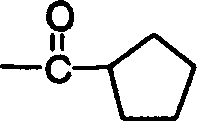
84 90 -H -H -COCH2CH(CH3)2 84 90 -H -H -COCH 2 CH(CH 3 ) 2
84 91 -H -COCH(CH3)2 -COCH2CH(CH3)2 84 91 -H -COCH(CH 3 ) 2 -COCH 2 CH(CH 3 ) 2
85 92 -H -COCH3 -COC(CH3)3 85 92 -H -COCH 3 -COC(CH 3 ) 3
86 93 -H -COC(CH3)3 -COCH3 86 93 -H -COC(CH 3 ) 3 -COCH 3
表3table 3

实施例 化合物Example Compound
R1A R4A R5A R 1A R 4A R 5A
序号 序号serial number serial number
22 25 -H -CH3 -CH=CHPh22 25 -H -CH 3 -CH=CHPh
23 26 -H -(CH2)3CH3 -(CH2)3CH3 23 26 -H -(CH 2 ) 3 CH 3 -(CH 2 ) 3 CH 3
24 27 -H

25 28 -H 25 28 -H
26 29 -H 26 29 -H
28 31 -H

29 32 -H -CH3

30 33 -H -CH3

31 34 -H -CH3 31 34 -H -CH 3
32 35 -H -CH3 32 35 -H -CH 3
33 36 -H -CH3 33 36 -H -CH 3
34 37 -H -CH3

35 38 -H -CH3 35 38 -H -CH 3
*Ph:苯基*Ph: phenyl
第3表(继续)Form 3 (continued)
实施例 化合物Example Compound
R1A R4A R5A R 1A R 4A R 5A
序号 序号serial number serial number
38 41 -CH2CH3 -CH3 38 41 -CH 2 CH 3 -CH 3
39 42 -H -CH3 39 42 -H -CH 3
40 43 -H -CH3

41 44 -H -CH3

42 45 -H -CH3

125 132 -H -CH3 125 132 -H -CH 3
126 133 -H -CH3

127 134 -H -CH3

表4Table 4

实施例 化合物Example Compound
R1A R4A R1A R 1A R 4A R 1A
序号 序号 (取代位置)Serial Number Serial Number (replaces position)
43 46 -H -CH3 -CH3(2)43 46 -H -CH 3 -CH 3 (2)
44 47 -H -CH3 -CH3(3)44 47 -H -CH 3 -CH 3 (3)
45 48 -H -CH3 -CH3(4)45 48 -H -CH 3 -CH 3 (4)
46 49 -H -CH2CH3 -CH2CH3(2)46 49 -H -CH 2 CH 3 -CH 2 CH 3 (2)
47 50 -H -CH3 -OCH3(2)47 50 -H -CH 3 -OCH 3 (2)
48 51 -H -CH3 -OCH3(3)48 51 -H -CH 3 -OCH 3 (3)
50 53 -H -CH3 -F(2)50 53 -H -CH 3 -F(2)
51 54 -H -CH3 -F(3)51 54 -H -CH 3 -F(3)
52 55 -H -CH3 -F(4)52 55 -H -CH 3 -F(4)
53 56 -H -CH3 -Cl(2)53 56 -H -CH 3 -Cl(2)
54 57 -CH2CH3 -CH3 -Cl(2)54 57 -CH 2 CH 3 -CH 3 -Cl(2)
55 58 -H -CH3 -Cl(3)55 58 -H -CH 3 -Cl(3)
56 59 -H -CH3 -Cl(4)56 59 -H -CH 3 -Cl(4)
57 60 -H -CH3 -Br(2)57 60 -H -CH 3 -Br(2)
58 61 -H -CH3 -OCOCH3(2)58 61 -H -CH 3 -OCOCH 3 (2)
60 63 -H -H -OCOCH3(3)60 63 -H -H -OCOCH 3 (3)
61 64 -H -CH3 -OCOCH3(4)61 64 -H -CH 3 -OCOCH 3 (4)
62 65 -H -CH3 -NO2(2)62 65 -H -CH 3 -NO 2 (2)
第4表(继续)Form 4 (continued)
实施例 化合物Example Compound
R1A R4A R1A R 1A R 4A R 1A
序号 序号 (取代位置)Serial Number Serial Number (replaces position)
65 68 -H -CH3 -OH(2)65 68 -H -CH 3 -OH(2)
66 69 -H -CH3 -OH(3)66 69 -H -CH 3 -OH(3)
67 70 -H -CH3 -OH(4)67 70 -H -CH 3 -OH(4)
68 71 -H -CH3 -CN(3)68 71 -H -CH 3 -CN(3)
69 72 -H -CH3 -CN(4)69 72 -H -CH 3 -CN (4)
70 73 -H -CH3 -CF3(3)70 73 -H -CH 3 -CF 3 (3)
71 74 -H -CH3 -COOH(2)71 74 -H -CH 3 -COOH(2)
118 125 -CH2CH3 -CH3 -OCOCH3(3)118 125 -CH 2 CH 3 -CH 3 -OCOCH 3 (3)
119 126 -CH2CH3 -CH3 -OH(3)119 126 -CH 2 CH 3 -CH 3 -OH(3)
120 127 -H -CH3 -OCONHCH2CH3(3)120 127 -H -CH 3 -OCONHCH 2 CH 3 (3)
表5table 5

实施例 化合物 Y1A Y2A Example Compound Y 1A Y 2A
序号 序号 (取代位置) (取代位置)Serial Number Serial Number (Replaces Position) (Replaces Position)
72 75 -OCH3(2) -OCH3(6)72 75 -OCH 3 (2) -OCH 3 (6)
73 76 -OH(3) -OH(5)73 76 -OH(3) -OH(5)
74 77 -OH(3) -OH(4)74 77 -OH(3) -OH(4)
75 78 -CH3(2) -CH3(4)75 78 -CH 3 (2) -CH 3 (4)
表6Table 6
实施例 化合物Example Compound
R1A R4A R5A R 1A R 4A R 5A
序号 序号serial number serial number
87 94 -H -CH2CH3 -Ph87 94 -H -CH 2 CH 3 -Ph
88 95 -H -CH2NHSO2CH3 -Ph88 95 -H -CH 2 NHSO 2 CH 3 -Ph
89 96 -CH3 -CH2NHSO2CH3 -Ph89 96 -CH 3 -CH 2 NHSO 2 CH 3 -Ph
90 97 -H -CH2NHSO2CH2CH3 -Ph90 97 -H -CH 2 NHSO 2 CH 2 CH 3 -Ph
91 98 -H -CH2OCH3 -Ph91 98 -H -CH 2 OCH 3 -Ph
92 99 -H -(CH2)2NHSO2CH3 -Ph92 99 -H -(CH 2 ) 2 NHSO 2 CH 3 -Ph
94 101 -H -CH2NHCOCF3 -Ph94 101 -H -CH 2 NHCOCF 3 -Ph
97 104 -H -(CH2)2N(CH3)2 -Ph97 104 -H -(CH 2 ) 2 N(CH 3 ) 2 -Ph
98 105 -H -(CH2)2COOCH3 -Ph98 105 -H -(CH 2 ) 2 COOCH 3 -Ph
99 106 -H -(CH2)2COOH -Ph99 106 -H -(CH 2 ) 2 COOH -Ph
100 107 -H -(CH2)2CONH2 -Ph100 107 -H -(CH 2 ) 2 CONH 2 -Ph
101 108 -H -(CH2)2CONHOH -Ph101 108 -H -(CH 2 ) 2 CONHOH -Ph
102 109 -H -(CH2)2CONHCH3 -Ph102 109 -H -(CH 2 ) 2 CONHCH 3 -Ph
103 110 -H -(CH2)2CON(CH3)2 -Ph103 110 -H -(CH 2 ) 2 CON(CH 3 ) 2 -Ph
104 111 -H -(CH2)2CONH(CH2)2OH -Ph104 111 -H -(CH 2 ) 2 CONH(CH 2 ) 2 OH -Ph
*Ph:苯基*Ph: phenyl
第6表(继续)Form 6 (continued)
实施例 化合物序Example Compound sequence
R1A R4A R5A R 1A R 4A R 5A
序号 号serial number
105 112 -H -(CH2)2CONH(CH2)3CH3 -Ph105 112 -H -(CH 2 ) 2 CONH(CH 2 ) 3 CH 3 -Ph
106 113 -H -Ph106 113 -H -Ph
107 114 -H -(CH2)3COOCH3 -Ph107 114 -H -(CH 2 ) 3 COOCH 3 -Ph
108 115 -H -(CH2)3COOH -Ph108 115 -H -(CH 2 ) 3 COOH -Ph
109 116 -H -(CH2)3CONHCH3 -Ph109 116 -H -(CH 2 ) 3 CONHCH 3 -Ph
110 117 -H -(CH2)3CONH2 -Ph110 117 -H -(CH 2 ) 3 CONH 2 -Ph
123 130 -H -CH3

128 135 -H -CH3 128 135 -H -CH 3
154 161 -H

155 162 -H -Ph155 162-H -Ph
156 163 -H -Ph156 163-H -Ph
156 164 -H

157 165 -H -Ph157 165-H -Ph
158 166 -H -(CH2)3OH -Ph158 166 -H -(CH 2 ) 3 OH -Ph
159 167 -H -(CH2)3OSO2NH2 -Ph159 167 -H -(CH 2 ) 3 OSO 2 NH 2 -Ph
*Ph:苯基、化合物164:化合物163的异构体*Ph: phenyl, compound 164: isomer of compound 163
表7Table 7

实施例序 化合物Example sequence Compound
R1A R4A R5A R 1A R 4A R 5A
号 序号No. Serial No.
93 100 -H -(CH2)2NHSO2CH3 -Ph93 100 -H -(CH 2 ) 2 NHSO 2 CH 3 -Ph
95 102 -COCH(CH3)2 -CH2NHSO2CH3 -Ph95 102 -COCH(CH 3 ) 2 -CH 2 NHSO 2 CH 3 -Ph
96 103 -H -CH2NHSO2CH3 -Ph96 103 -H -CH 2 NHSO 2 CH 3 -Ph
121 128 -H -CH3

122 129 -H -CH3 122 129 -H -CH 3
124 131 -H -CH3 124 131 -H -CH 3
*Ph:苯基*Ph: phenyl
表8Table 8

实施例序 化合物Example sequence Compound
R2A R3A R4A R 2A R 3A R 4A
号 序号No. Serial No.
111 118 -H -COCH3 -CH2NHSO2CH3 111 118 -H -COCH 3 -CH 2 NHSO 2 CH 3
112 119 -COC(CH3)3 -COCH3 -CH2NHSO2CH3 112 119 -COC(CH 3 ) 3 -COCH 3 -CH 2 NHSO 2 CH 3
113 120 -H -COC(CH3)3 -CH2NHSO2CH3 113 120 -H -COC(CH 3 ) 3 -CH 2 NHSO 2 CH 3
114 121 -CO(CH2)5Br -COC(CH3)3 -CH2NHSO2CH3 114 121 -CO(CH 2 ) 5 Br -COC(CH 3 ) 3 -CH 2 NHSO 2 CH 3
115 122 -CO(CH2)5N3 -COC(CH3)3 -CH2NHSO2CH3 115 122 -CO(CH 2 ) 5 N 3 -COC(CH 3 ) 3 -CH 2 NHSO 2 CH 3
116 123 -CO(CH2)5NH2 -COC(CH3)3 -CH2NHSO2CH3 116 123 -CO(CH 2 ) 5 NH 2 -COC(CH 3 ) 3 -CH 2 NHSO 2 CH 3
117 124 -CO(CH2)5NHCOCH3 -COC(CH3)3 -CH2NHSO2CH3 117 124 -CO(CH 2 ) 5 NHCOCH 3 -COC(CH 3 ) 3 -CH 2 NHSO 2 CH 3
150 157 -H -COC(CH3)3 -(CH2)2NHSO2CH3 150 157 -H -COC(CH 3 ) 3 -(CH 2 ) 2 NHSO 2 CH 3
151 158 -CO(CH2)3Br -COC(CH3)3 -(CH2)2NHSO2CH3 151 158 -CO(CH 2 ) 3 Br -COC(CH 3 ) 3 -(CH 2 ) 2 NHSO 2 CH 3
153 160 -COC(CH3)3 -CSCH3 -CH2NHSO2CH3 153 160 -COC(CH 3 ) 3 -CSCH 3 -CH 2 NHSO 2 CH 3
160 168 -COC(CH3)3 -COCH3 -CH2NHSO2CH2Cl160 168 -COC(CH 3 ) 3 -COCH 3 -CH 2 NHSO 2 CH 2 Cl
160 169 -COCH3 -COCH3 -CH2NHSO2CH2Cl160 169 -COCH 3 -COCH 3 -CH 2 NHSO 2 CH 2 Cl
161 170 -COC(CH3)3 -COCH3 -CH2NHSO2CH=CH2 161 170 -COC(CH 3 ) 3 -COCH 3 -CH 2 NHSO 2 CH=CH 2
161 171 -COC(CH3)3 -COC(CH3)3 -CH2NHSO2CH=CH2 161 171 -COC(CH 3 ) 3 -COC(CH 3 ) 3 -CH 2 NHSO 2 CH=CH 2
第8表(继续)Form 8 (continued)
实施例 化合物Example Compound
R2A R3A R4A R 2A R 3A R 4A
序号 序号serial number serial number
162 172 -COC(CH3)3 -COCH3 162 172 -COC(CH 3 ) 3 -COCH 3
163 173 -COC(CH3)3 -COCH3 -CH2NHSO2(CH2)2NHCH2CH3 163 173 -COC(CH 3 ) 3 -COCH 3 -CH 2 NHSO 2 (CH 2 ) 2 NHCH 2 CH 3
164 174 -COC(CH3)3 -COCH3 -CH2NHSO2(CH2)2N(CH3)2 164 174 -COC(CH 3 ) 3 -COCH 3 -CH 2 NHSO 2 (CH 2 ) 2 N(CH 3 ) 2
-CH2NHSO2(CH2)2NH(CH2)2 -CH 2 NHSO 2 (CH 2 ) 2 NH(CH 2 ) 2
165 175 -COC(CH3)3 -COCH3 165 175 -COC(CH 3 ) 3 -COCH 3
OHOH OH
166 176 -COC(CH3)3 -COC(CH3)3 -CH2NHSO2(CH2)2NHCH2CH3 166 176 -COC(CH 3 ) 3 -COC(CH 3 ) 3 -CH 2 NHSO 2 (CH 2 ) 2 NHCH 2 CH 3
167 177 -COC(CH3)3 -COC(CH3)3 -CH2NHSO2(CH2)2N(CH3)2 167 177 -COC(CH 3 ) 3 -COC(CH 3 ) 3 -CH 2 NHSO 2 (CH 2 ) 2 N(CH 3 ) 2
168 178 -H -COCH3 -(CH2)2CO2CH3 168 178 -H -COCH 3 -(CH 2 ) 2 CO 2 CH 3
169 179 -COC(CH3)3 -COCH3 -(CH2)2CO2CH3 169 179 -COC(CH 3 ) 3 -COCH 3 -(CH 2 ) 2 CO 2 CH 3
170 180 -H -COCH(CH3)2 -(CH2)2NHSO2CH3 170 180 -H -COCH(CH 3 ) 2 -(CH 2 ) 2 NHSO 2 CH 3
171 181 -COC(CH3)3 -COCH(CH3)2 -(CH2)2NHSO2CH3 171 181 -COC(CH 3 ) 3 -COCH(CH 3 ) 2 -(CH 2 ) 2 NHSO 2 CH 3
174 184 -COCH(CH3)2 -(CH2)2NHSO2CH3 174 184 -COCH(CH 3 ) 2 -(CH 2 ) 2 NHSO 2 CH 3
175 185 -COCH2CH3 -COCH2CH3 -(CH2)2NHSO2CH3 175 185 -COCH 2 CH 3 -COCH 2 CH 3 -(CH 2 ) 2 NHSO 2 CH 3
176 186 -H -COCH2CH3 -(CH2)2NHSO2CH3 176 186 -H -COCH 2 CH 3 -(CH 2 ) 2 NHSO 2 CH 3
177 187 -COC(CH3)3 -COCH2CH3 -(CH2)2NHSO2CH3 177 187 -COC(CH 3 ) 3 -COCH 2 CH 3 -(CH 2 ) 2 NHSO 2 CH 3
180 190 -H -COC(CH3)3 -(CH2)2COOCH3 180 190 -H -COC(CH 3 ) 3 -(CH 2 ) 2 COOCH 3
181 191 -COC(CH3)3 -(CH2)2COOCH3 181 191 -COC(CH 3 ) 3 -(CH 2 ) 2 COOCH 3
表9Table 9
实施例序 化合物Example sequence Compound
R1A R2A R3A R4A R 1A R 2A R 3A R 4A
号 序号No. Serial No.
152 159

172 182

173 183

178 188

179 189 -COCH2CH3 -(CH2)2NHSO2CH3 179 189 -COCH 2 CH 3 -(CH 2 ) 2 NHSO 2 CH 3
182 192 -COC(CH3)3 -(CH2)2COOCH3 182 192 -COC(CH 3 ) 3 -(CH 2 ) 2 COOCH 3
183 193 -COC(CH3)3 -(CH2)2COOH183 193 -COC(CH 3 ) 3 -(CH 2 ) 2 COOH
184 194

表10Table 10
实施例序 化合物Example sequence Compound
R2A R28 Y3A R 2A R 28 Y 3A
号 序号No. Serial No.
185 195 -COC(CH3)3 -OCOCH3 -H185 195 -COC(CH 3 ) 3 -OCOCH 3 -H
186 196 -COC(CH3)3 -OH -H186 196 -COC(CH 3 ) 3 -OH -H
187 197 -H -H -OCOCH3 187 197 -H -H -OCOCH 3
188 198 -COC(CH3)3 -H -OCOCH3 188 198 -COC(CH 3 ) 3 -H -OCOCH 3
189 199 -COC(CH3)3 -H -OH189 199 -COC(CH 3 ) 3 -H -OH
表11Table 11
实施例 化合物Examples Compounds
R2 R4 R 2 R 4
序号 序号serial number serial number
1 1 -COCH3 -CH3 1 1 -COCH 3 -CH 3
3 3 -COCH3 -(CH2)3CH3 3 3 -COCH 3 -(CH 2 ) 3 CH 3
6 6 -COCH3 -Ph6 6 -COCH 3 -Ph
11 14 -H -CH3 11 14 -H -CH 3
*Ph:苯基*Ph: phenyl
表12Table 12
实施例序 化合物Example sequence Compound
R1 R4 R5 R 1 R 4 R 5
号 序号No. Serial No.
19 22 -H -CH3 -CH3 19 22 -H -CH 3 -CH 3
20 23 -H -CH3 -(CH2)3CH3 20 23 -H -CH 3 -(CH 2 ) 3 CH 3
21 24 -H -CH3 -(CH2)2Ph21 24 -H -CH 3 -(CH 2 ) 2 Ph
27 30 -H 27 30 -H
36 39 -H -CH3 36 39 -H -CH 3
37 40 -H -CH3 37 40 -H -CH 3
*Ph:苯基*Ph: phenyl
表13Table 13
实施例 化合物Example Compound
R1 R4 Y1(取代位置)R 1 R 4 Y 1 (substitution position)
序号 序号serial number serial number
49 52 -H -CH3 -OCH3(4)49 52 -H -CH 3 -OCH 3 (4)
59 62 -H -CH3 -OCOCH3(3)59 62 -H -CH 3 -OCOCH 3 (3)
63 66 -H -CH3 -NO2(3)63 66 -H -CH 3 -NO 2 (3)
64 67 -H -CH3 -NO2(4)64 67 -H -CH 3 -NO 2 (4)
下面用试验例说明代表性化合物(I)的药理活性。The pharmacological activity of the representative compound (I) will be described below using test examples.
试验例1:对人类直肠癌细胞HCT116的增殖抑制作用Test Example 1: Proliferation inhibitory effect on human rectal cancer cell HCT116
以每穴1×10³个的比例,在96穴滴定板(ヌンク社制造,167008)上分别注入HCT116细胞(ATCC序号:CCL-247)。在5%的二氧化碳培养器内,在37℃下培养该板24h以后,在其中加入分阶段稀释的试验化合物,合计为100mL/穴,再在5%二氧化碳培养器内,在37℃下培养72h。在此培养基中以50mL/穴分别注入XTT[3’-[1-(苯基氨基羰基)-3,4-四唑盐]-二(4-甲氧基-6-硝基)苯磺酸钠水合物]标识混和液(ロシュ·ダイアグノステイツクス社制造,1465015)以后,在5%二氧化碳的培养器中,在37℃下培养1h,使用小平板分光光度计(バイオラツド社制造,型号550)测定在490nm和655nm处的吸光度。以抑制50%增殖的浓度GI50表示抑制细胞增殖的活性。HCT116 cells (ATCC serial number: CCL-247) were each injected into a 96-well titer plate (manufactured by Hink Corporation, 167008) at a rate of 1×10 3 cells per well. After incubating the plate at 37°C for 24 hours in a 5% carbon dioxide incubator, add test compounds diluted in stages to a total of 100 mL/hole, and then incubate at 37°C for 72 hours in a 5% carbon dioxide incubator . Inject XTT[3'-[1-(phenylaminocarbonyl)-3,4-tetrazolium salt]-bis(4-methoxy-6-nitro)benzenesulfonate at 50mL/hole respectively in this medium Sodium acid hydrate] labeling mixed solution (manufactured by Rosh Diagnosteikes, 1465015), in an incubator with 5% carbon dioxide, cultivated at 37° C. for 1 h, and using a small plate spectrophotometer (manufactured by Biorad, model 550) Measure the absorbance at 490nm and 655nm. The activity of inhibiting cell proliferation is represented by the concentration GI 50 which inhibits the proliferation by 50%.
GI50的计算方法:计算出各个穴在490nm处的吸光度减去在655nm处吸光度(吸光度差)的值。以没有用试验化合物处理的细胞得到的吸光度差作为100%,通过与用已知浓度的化合物处理的细胞得到的吸光度差进行比较,计算出抑制50%的细胞增殖的化合物浓度,作为GI50。Calculation method of GI 50 : Calculate the absorbance of each hole at 490nm minus the absorbance at 655nm (absorbance difference). The concentration of the compound that inhibits cell proliferation by 50% was calculated as GI50 by comparing the difference in absorbance obtained by cells treated with a known concentration of the compound with the difference in absorbance obtained by cells not treated with the test compound as 100% .
在表14中显示出在试验例1中得到的化合物的结果。显示出化合物138、152、165、170、173和199的GI50值都不到10μmol/L。Table 14 shows the results of the compounds obtained in Test Example 1. It was shown that compounds 138, 152, 165, 170, 173 and 199 had GI 50 values of less than 10 μmol/L.
表14Table 14
化合物序号 GI50(μmol/L)Compound No. GI 50 (μmol/L)
1 1.01 1.0
7 0.487 0.48
18 0.6218 0.62
41 0.6041 0.60
46 0.5746 0.57
57 0.5357 0.53
69 0.2369 0.23
82 0.1882 0.18
99 0.06399 0.063
104 0.074104 0.074
107 0.061107 0.061
134 0.40134 0.40
化合物(I)或化合物(IA)或其可药用盐,可以以原样单独给药,但通常希望以各种医药制剂的形式提供。它们的医药制剂可以给动物或者人使用。Compound (I) or compound (IA) or a pharmaceutically acceptable salt thereof can be administered alone as it is, but usually it is desirable to provide it in the form of various pharmaceutical preparations. Their pharmaceutical preparations can be administered to animals or humans.
涉及本发明的医药制剂,可以单独含有作为活性成份的化合物(I)或化合物(IA)或其可药用盐,或者含有它们与任意的其他用于治疗的有效成分的混合物。这样的医药制剂,可以通过在制剂学中已知的任何方法,将活性成份与可药用的一种或几种载体混和来制造。The pharmaceutical preparation of the present invention may contain Compound (I) or Compound (IA) or a pharmaceutically acceptable salt thereof as an active ingredient alone, or in admixture with any other therapeutic active ingredient. Such pharmaceutical preparations can be produced by mixing the active ingredient with one or more pharmaceutically acceptable carriers by any method known in pharmacy.
作为给药途径,在治疗时希望使用的最有效的,可以举出经口服,或者经静脉等肠道外的途径。As the route of administration, the most effective ones to be used in the treatment include oral route or parenteral route such as intravenous route.
作为给药的形态,可以举出比如锭剂、注射剂等。Examples of administration forms include lozenges, injections and the like.
作为使用的制剂载体,可以举出比如乳糖、甘露糖醇、葡萄糖、羟丙基纤维素、淀粉、硬脂酸镁、脂肪酸缩水山梨糖醇酯、酸的甘油酯、聚乙烯醇、注射用蒸馏水、生理盐水、丙二醇、聚乙二醇、乙醇等。涉及本发明的医药制剂还可以含有其他各种赋形剂、润滑剂、粘结剂、崩解剂、表面张力调节剂、乳化剂等。As the preparation carrier used, for example, lactose, mannitol, glucose, hydroxypropyl cellulose, starch, magnesium stearate, fatty acid sorbitan ester, acid glyceride, polyvinyl alcohol, distilled water for injection , saline, propylene glycol, polyethylene glycol, ethanol, etc. The pharmaceutical preparations related to the present invention may also contain various other excipients, lubricants, binders, disintegrants, surface tension regulators, emulsifiers, and the like.
在用于上述目的的情况下,化合物(I)或化合物(IA)或其可药用盐,通常是全身或局部,以经口或非经口的方式给药。给药量和给药次数,因给药方式、患者年龄、体重、应该治疗的症状的性质或严重程度不同而异,但对于成人,通常每人每次在0.1~1000mg/kg,优选在0.5~500mg/kg的范围内,每日一次至数次经口或非经口给药,或者每日1~24小时的范围内经经脉内连续给药。但是有关它们的给药量和给药次数要根据上述各种条件而变动。In the case of the above-mentioned purposes, compound (I) or compound (IA) or a pharmaceutically acceptable salt thereof is usually administered systemically or locally, orally or parenterally. Dosage and times of administration vary depending on the way of administration, patient age, body weight, and the nature or severity of the symptoms to be treated, but for adults, it is usually 0.1-1000 mg/kg per person each time, preferably 0.5 In the range of ~500mg/kg, it is administered orally or parenterally once to several times a day, or administered continuously through the meridian within the range of 1 to 24 hours a day. However, their dosage and frequency of administration vary according to the above-mentioned various conditions.
具体实施方式Detailed ways
实施本发明的最佳形态Best Mode for Carrying Out the Invention
下面通过实施例详细说明本发明。The present invention will be described in detail below by way of examples.
在实施例中使用的核磁共振波谱(1H NMR)是在270MHz或300MHz下测定的,根据化合物和测定条件不同,有时不能明确地观察到交换性氢。作为信号多重度的标记,使用通常使用的标记,而br表示见到的宽信号。The nuclear magnetic resonance spectrum ( 1 H NMR) used in Examples is measured at 270 MHz or 300 MHz, and exchangeable hydrogen may not be clearly observed depending on the compound and measurement conditions. As a marker for signal multiplicity, commonly used markers were used, and br indicates a broad signal seen.
实施例1(化合物1) Example 1 (compound 1)
工序1:将苯乙酮(4.00g,33.3mmol)和氨基硫脲(3.15g,34.6mmol)溶解于甲醇(30mL)中。在此溶液中加入盐酸(0.1mL),在室温下剧烈搅拌15h。在反应液中加入水(30mL),过滤析出的结晶。用水、二异丙醚洗涤过滤的结晶,然后干燥,得到苯乙酮=氨基硫脲(5.64g,88%)。Step 1: Acetophenone (4.00 g, 33.3 mmol) and thiosemicarbazide (3.15 g, 34.6 mmol) were dissolved in methanol (30 mL). Hydrochloric acid (0.1 mL) was added to this solution, which was vigorously stirred at room temperature for 15 h. Water (30 mL) was added to the reaction solution, and the precipitated crystals were filtered. The filtered crystals were washed with water, diisopropyl ether, and dried to give acetophenone=thiosemicarbazide (5.64 g, 88%).
1H NMR(270MHz,DMSO-d6)δ(ppm):2.30(s,3H),7.37-7.40(m,3H),7.91-7.94(m,3H),8.27(br s,1H),10.21(br s,1H) 1 H NMR (270MHz, DMSO-d 6 )δ(ppm): 2.30(s, 3H), 7.37-7.40(m, 3H), 7.91-7.94(m, 3H), 8.27(br s, 1H), 10.21 (br s, 1H)
工序2:将如上所述得到的苯乙酮-氨基硫脲(300mg,0.889mmol)溶解于无水乙酸(1.0mL,11mmol)中,回流加热1h,然后边剧烈搅拌边冷却到室温。在反应液中加入二异丙基醚(3mL),过滤析出的结晶。将过滤的结晶悬浮在二异丙基醚中,在搅拌3h以后过滤出结晶,干燥得到化合物1(195mg,72%)。Step 2: The acetophenone-thiosemicarbazide (300 mg, 0.889 mmol) obtained above was dissolved in anhydrous acetic acid (1.0 mL, 11 mmol), heated under reflux for 1 h, and then cooled to room temperature while vigorously stirring. Diisopropyl ether (3 mL) was added to the reaction solution, and the precipitated crystals were filtered. The filtered crystals were suspended in diisopropyl ether, and after stirring for 3 h, the crystals were filtered out and dried to obtain compound 1 (195 mg, 72%).
1H NMR(270MHz,CDCl3)δ(ppm):2.01(s,3H),2.19(s,3H),2.28(s,3H),7.24-7.36(br s,5H),11.63(br s,1H) 1 H NMR (270MHz, CDCl 3 ) δ (ppm): 2.01(s, 3H), 2.19(s, 3H), 2.28(s, 3H), 7.24-7.36(br s, 5H), 11.63(br s, 1H)
实施例2(化合物2)Example 2 (Compound 2)
工序1:与实施例1的工序1同样,由苯丙酮(541mg,3.92mmol)和氨基硫脲(382mg,4.18mmol)得到苯丙酮=缩氨基硫脲(759mg,88%)。Step 1: In the same manner as Step 1 of Example 1, propiophenone=thiosemicarbazone (759 mg, 88%) was obtained from propiophenone (541 mg, 3.92 mmol) and thiosemicarbazide (382 mg, 4.18 mmol).
1H NMR(270MHz,DMSO-d6)δ(ppm):1.01(t,J=7.4Hz,3H),2.85(br q,J=7.4Hz,2H),7.39(m,3H),7.89(m,3H),8.24(br s,1H),10.30(br s,1H) 1 H NMR (270 MHz, DMSO-d 6 ) δ (ppm): 1.01 (t, J = 7.4 Hz, 3H), 2.85 (br q, J = 7.4 Hz, 2H), 7.39 (m, 3H), 7.89 ( m, 3H), 8.24 (br s, 1H), 10.30 (br s, 1H)
工序2:与实施例1的工序2同样,由上述得到的苯丙酮=缩氨基硫脲(559mg,2.70mmol)得到化合物2(601mg,76%)。Step 2: Similar to Step 2 of Example 1, Compound 2 (601 mg, 76%) was obtained from the above-obtained propiophenone=thiosemicarbazone (559 mg, 2.70 mmol).
1H NMR(270MHz,DMSO-d6)δ(ppm):1.02(t,J=7.1Hz,3H),2.00(s,3H),2.21(s,3H),2.38(dt,J=7.1,7.3Hz,1H),2.85(dt,J=7.1,7.3Hz,1H),7.23-7.38(m,5H),11.59(br s,1H) 1 H NMR (270 MHz, DMSO-d 6 ) δ (ppm): 1.02 (t, J = 7.1 Hz, 3H), 2.00 (s, 3H), 2.21 (s, 3H), 2.38 (dt, J = 7.1, 7.3Hz, 1H), 2.85(dt, J=7.1, 7.3Hz, 1H), 7.23-7.38(m, 5H), 11.59(br s, 1H)
实施例3(化合物3) Example 3 (compound 3)
工序1:与实施例1的工序1同样,由正丁基(苯基)甲酮(649mg,4.00mmol)和氨基硫脲(367mg,4.03mmol)得到正丁基(苯基)甲酮=缩氨基硫脲(589mg,63%)。Step 1: Same as Step 1 of Example 1, from n-butyl (phenyl) ketone (649 mg, 4.00 mmol) and thiosemicarbazide (367 mg, 4.03 mmol) to obtain n-butyl (phenyl) ketone = Thiosemicarbazide (589 mg, 63%).
1H NMR(270MHz,DMSO-d6)δ(ppm):0.99(t,J=7.3Hz,3H),1.38-1.49(m,4H),2.96-2.99(m,2H),7.37-7.39(m,3H),7.87-7.91(m,3H),8.26(br s,1H),10.36(br s,1H) 1 H NMR (270 MHz, DMSO-d 6 ) δ (ppm): 0.99 (t, J=7.3 Hz, 3H), 1.38-1.49 (m, 4H), 2.96-2.99 (m, 2H), 7.37-7.39 ( m, 3H), 7.87-7.91 (m, 3H), 8.26 (br s, 1H), 10.36 (br s, 1H)
工序2:与实施例1的工序2同样,由上面得到的正丁基(苯基)甲酮=缩氨基硫脲(200mg,0.850mmol)得到化合物3(168mg,62%)。Step 2: Similar to Step 2 of Example 1, Compound 3 (168 mg, 62%) was obtained from n-butyl(phenyl)methanone=thiosemicarbazone (200 mg, 0.850 mmol) obtained above.
1H NMR(270MHz,CDCl3)δ(ppm):0.96(t,J=7.3Hz,3H),1.25-1.34(m,1H),1.36-1.54(m,2H),1.68-1.80(m,1H),2.18(s,3H),2.20-2.26(m,1H),2.26(s,3H),2.99-3.10(m,1H),7.22-7.40(m,5H),8.22(br s,1H) 1 H NMR (270MHz, CDCl 3 ) δ (ppm): 0.96 (t, J=7.3Hz, 3H), 1.25-1.34 (m, 1H), 1.36-1.54 (m, 2H), 1.68-1.80 (m, 1H), 2.18(s, 3H), 2.20-2.26(m, 1H), 2.26(s, 3H), 2.99-3.10(m, 1H), 7.22-7.40(m, 5H), 8.22(br s, 1H )
实施例4(化合物4) Embodiment 4 (compound 4)
工序1:与实施例1的工序1同样,由异丙基(苯基)甲酮(608mg,4.10mmol)和氨基硫脲(364mg,3.99mmol)得到异丙基(苯基)甲酮=缩氨基硫脲(613mg,68%)。Step 1: Same as step 1 of Example 1, from isopropyl (phenyl) ketone (608 mg, 4.10 mmol) and thiosemicarbazide (364 mg, 3.99 mmol) to obtain isopropyl (phenyl) ketone = ketone Thiosemicarbazide (613 mg, 68%).
1H NMR(270MHz,DMSO-d6)δ(ppm):1.07(d,J=6.9Hz,6H),2.82(m,1H),7.28(br d,J=6.3Hz,2H),7.51-7.60(m,3H),7.78(br s,1H),8.23(br s,1H),8.43(br s,1H) 1 H NMR (270MHz, DMSO-d 6 ) δ (ppm): 1.07 (d, J=6.9Hz, 6H), 2.82 (m, 1H), 7.28 (br d, J=6.3Hz, 2H), 7.51- 7.60 (m, 3H), 7.78 (br s, 1H), 8.23 (br s, 1H), 8.43 (br s, 1H)
工序2:与实施例1的工序2同样,由上面得到的异丙基(苯基)甲酮=缩氨基硫脲(300mg,1.36mmol)得到化合物4(217mg,52%)。Step 2: Similar to Step 2 of Example 1, Compound 4 (217 mg, 52%) was obtained from isopropyl(phenyl)methanone=thiosemicarbazone (300 mg, 1.36 mmol) obtained above.
1H NMR(270MHz,CDCl3)δ(ppm):1.04(d,J=6.9Hz,3H),1.13(d,J=6.9Hz,3H),2.09(s,3H),2.19(s,3H),3.86(m,1H),7.25-7.36(m,3H),7.75(br d,J=7.3Hz,2H),8.08(br s,1H) 1 H NMR (270MHz, CDCl 3 ) δ(ppm): 1.04(d, J=6.9Hz, 3H), 1.13(d, J=6.9Hz, 3H), 2.09(s, 3H), 2.19(s, 3H ), 3.86(m, 1H), 7.25-7.36(m, 3H), 7.75(br d, J=7.3Hz, 2H), 8.08(br s, 1H)
实施例5(化合物5) Example 5 (compound 5)
与实施例1的工序1和工序2同样,由环丙基(苯基)甲酮(649mg,4.00mmol)和氨基硫脲(367mg,4.03mmol)得到化合物5(130mg,10%)。Compound 5 (130 mg, 10%) was obtained from cyclopropyl(phenyl)methanone (649 mg, 4.00 mmol) and thiosemicarbazide (367 mg, 4.03 mmol) in the same manner as in Step 1 and Step 2 of Example 1.
1H NMR(270MHz,CDCl3)δ(ppm):0.60-0.98(m,4H),1.84(s,3H),2.34(s,3H),2.45(m,1H),7.20-7.35(m,3H),7.54(br d,J=8.7Hz,2H),9.40(br s,1H) 1 H NMR (270MHz, CDCl 3 ) δ (ppm): 0.60-0.98 (m, 4H), 1.84 (s, 3H), 2.34 (s, 3H), 2.45 (m, 1H), 7.20-7.35 (m, 3H), 7.54 (br d, J=8.7Hz, 2H), 9.40 (br s, 1H)
实施例6(化合物6) Embodiment 6 (compound 6)
与实施例1的工序1和工序2同样,由苯甲酮(0.20g,2.19mmol)和缩氨基硫脲(400mg,2.20mmol)得到化合物6(150mg,29%)。Compound 6 (150 mg, 29%) was obtained from benzophenone (0.20 g, 2.19 mmol) and thiosemicarbazone (400 mg, 2.20 mmol) in the same manner as in Step 1 and Step 2 of Example 1.
1H NMR(270MHz,CDCl3)δ(ppm):1.89(s,3H),2.32(s,3H),7.25-7.52(m,10H),9.13(br s,1H) 1 H NMR (270MHz, CDCl 3 ) δ (ppm): 1.89 (s, 3H), 2.32 (s, 3H), 7.25-7.52 (m, 10H), 9.13 (br s, 1H)
实施例7(化合物7) Example 7 (compound 7)
工序1:与实施例1的工序1同样,由4-甲基氨基硫脲(1.00g,9.51mmol)和苯乙酮(1.33mL,11.4mmol)得到苯乙酮=4-甲基缩氨基硫脲(1.51g,77%)。Step 1: Same as Step 1 of Example 1, obtain acetophenone=4-methylthiosemicarbazide from 4-methylthiosemicarbazide (1.00g, 9.51mmol) and acetophenone (1.33mL, 11.4mmol) Urea (1.51 g, 77%).
工序2:与实施例1的工序2同样,由上面得到的苯乙酮=4-甲基氨基硫脲(1.00g,9.51mmol)得到化合物7(1.03g,47%)。Step 2: In the same manner as Step 2 of Example 1, compound 7 (1.03 g, 47%) was obtained from acetophenone=4-methylthiosemicarbazide (1.00 g, 9.51 mmol) obtained above.
1H NMR(270MHz,DMSO-d6)δ(ppm):2.21(s,3H),2.23(s,3H),2.26(s,3H),3.41(s,3H),7.28-7.36(m,5H) 1 H NMR (270MHz, DMSO-d 6 ) δ(ppm): 2.21(s, 3H), 2.23(s, 3H), 2.26(s, 3H), 3.41(s, 3H), 7.28-7.36(m, 5H)
实施例8Example 8
在60%的氢化钠(110mg,2.70mmol)在N,N-二甲基甲酰胺(10.0mL)中的溶液里加入在实施例1中得到的化合物1(50.0mg,1.80mmol),再在室温下搅拌30min。在反应液中加入乙基碘(0.22mL,2.70mmol),再在室温下搅拌12h。在反应液中加入5%的氯化铵水溶液,用乙酸乙酯萃取。用饱和氯化钠水溶液洗涤有机层以后,用无水硫酸钠干燥,减压蒸出溶剂。用乙酸乙酯/正己烷=1/1将残渣进行硅凝胶色谱提纯,得到化合物8(120mg,22%)和化合物9(330mg,60%)。In a solution of 60% sodium hydride (110 mg, 2.70 mmol) in N, N-dimethylformamide (10.0 mL), compound 1 (50.0 mg, 1.80 mmol) obtained in Example 1 was added, and then Stir at room temperature for 30 min. Ethyl iodide (0.22 mL, 2.70 mmol) was added to the reaction solution, and stirred at room temperature for 12 h. A 5% aqueous ammonium chloride solution was added to the reaction liquid, followed by extraction with ethyl acetate. After washing the organic layer with a saturated aqueous sodium chloride solution and drying over anhydrous sodium sulfate, the solvent was distilled off under reduced pressure. The residue was purified by silica gel chromatography with ethyl acetate/n-hexane=1/1 to obtain Compound 8 (120 mg, 22%) and Compound 9 (330 mg, 60%).
化合物8Compound 8
1H NMR(270MHz,CDCl3)δ(ppm):1.19(t,J=7.0Hz,6H),2.23(s,3H),2.41(s,3H),3.26(q,J=7.0Hz,4H),7.21-7.45(m,5H) 1 H NMR (270MHz, CDCl 3 ) δ(ppm): 1.19(t, J=7.0Hz, 6H), 2.23(s, 3H), 2.41(s, 3H), 3.26(q, J=7.0Hz, 4H ), 7.21-7.45 (m, 5H)
化合物9Compound 9
1H NMR(270MHz,CDCl3)δ(ppm):1.36(t,J=7.2Hz,3H),2.24(s,6H),2.37(s,3H),3.91(q,J=7.2Hz,2H),7.22-7.41(m,5H) 1 H NMR (270MHz, CDCl 3 ) δ(ppm): 1.36(t, J=7.2Hz, 3H), 2.24(s, 6H), 2.37(s, 3H), 3.91(q, J=7.2Hz, 2H ), 7.22-7.41(m, 5H)
实施例9(化合物10和化合物11) Embodiment 9 (compound 10 and compound 11)
与实施例8同样,由在实施例1得到的化合物1(0.50g,1.80mmol)和正丙基碘(0.26mL,2.70mmol)得到化合物10(0.15g,26%)和化合物11(0.27g,48%)。In the same manner as in Example 8, compound 10 (0.15 g, 26%) and compound 11 (0.27 g, 48%).
化合物10Compound 10
1H NMR(270MHz,CDCl3)δ(ppm):0.89(t,J=7.6Hz,6H),1.61(br q,J=7.6Hz,4H),2.27(s,3H),2.40(s,3H),3.14(br t,J=7.3Hz,4H),7.21-7.47(m,5H) 1 H NMR (270MHz, CDCl 3 ) δ(ppm): 0.89(t, J=7.6Hz, 6H), 1.61(br q, J=7.6Hz, 4H), 2.27(s, 3H), 2.40(s, 3H), 3.14(br t, J=7.3Hz, 4H), 7.21-7.47(m, 5H)
化合物11Compound 11
1H NMR(270MHz,CDCl3)δ(ppm):1.00(t,J=7.3Hz,3H),1.74-1.82(m,2H),2.28(s,6H),2.36(s,3H),3.75-3.86(m,2H),7.21-7.44(m,5H) 1 H NMR (270MHz, CDCl 3 ) δ(ppm): 1.00(t, J=7.3Hz, 3H), 1.74-1.82(m, 2H), 2.28(s, 6H), 2.36(s, 3H), 3.75 -3.86(m, 2H), 7.21-7.44(m, 5H)
实施例10(化合物12和化合物13) Embodiment 10 (compound 12 and compound 13)
与实施例8同样,由在实施例1中得到的化合物1(500mg,1.80mmol)和苄基溴(0.32mL,2.70mmol)得到化合物12(120mg,16%)和化合物13(0.22g,33%)。Similar to Example 8, Compound 12 (120 mg, 16%) and Compound 13 (0.22 g, 33 %).
化合物12Compound 12
1H NMR(270MHz,CDCl3)δ(ppm):2.24(s,3H),2.46(s,3H),4.43(s,4H),7.14-7.49(m,15H) 1 H NMR (270MHz, CDCl 3 ) δ (ppm): 2.24 (s, 3H), 2.46 (s, 3H), 4.43 (s, 4H), 7.14-7.49 (m, 15H)
化合物13Compound 13
1H NMR(270MHz,CDCl3)δ(ppm):2.16(s,3H),2.26(s,3H),2.36(s,3H),5.11(br s,2H),7.22-7.38(m,10H) 1 H NMR (270MHz, CDCl 3 ) δ(ppm): 2.16(s, 3H), 2.26(s, 3H), 2.36(s, 3H), 5.11(br s, 2H), 7.22-7.38(m, 10H )
实施例11(化合物14) Example 11 (compound 14)
在实施例1的工序1中得到的苯乙酮=缩氨基硫脲(10.0g,51.8mmol)中加入无水醋酸(4.90mL,51.9mmol)和吡啶(8.40mL,104mmol),在室温下搅拌12h。将反应液减压浓缩以后,加入乙酸乙酯、2mol/L的氢氧化钠水溶液进行分液。用饱和氯化铵水溶液、饱和氯化钠水溶液洗涤有机层,用无水硫酸钠干燥以后,减压蒸出溶剂。用乙酸乙酯/正己烷=1/1将残渣进行硅凝胶色谱提纯,得到化合物14(9.22g,76%)。Add anhydrous acetic acid (4.90 mL, 51.9 mmol) and pyridine (8.40 mL, 104 mmol) to acetophenone=thiosemicarbazone (10.0 g, 51.8 mmol) obtained in step 1 of Example 1, and stir at room temperature 12h. After concentrating the reaction solution under reduced pressure, ethyl acetate and 2 mol/L aqueous sodium hydroxide solution were added for liquid separation. The organic layer was washed with saturated aqueous ammonium chloride solution and saturated aqueous sodium chloride solution, dried over anhydrous sodium sulfate, and the solvent was distilled off under reduced pressure. The residue was purified by silica gel chromatography using ethyl acetate/n-hexane=1/1 to obtain compound 14 (9.22 g, 76%).
1H NMR(270MHz,DMSO-d6)δ(ppm):2.12(s,3H),2.31(s,3H),6.49(br s,2H),7.21-7.41(m,5H) 1 H NMR (270MHz, DMSO-d 6 )δ(ppm): 2.12(s, 3H), 2.31(s, 3H), 6.49(br s, 2H), 7.21-7.41(m, 5H)
实施例12(化合物15) Example 12 (compound 15)
在N,N-二甲基甲酰胺(10.0mL)中溶解在实施例7中得到的化合物7(550mg,1.89mmol),加入60%的氢化钠(0.23g,5.75mmol),在室温下搅拌30min。在反应液中加入水,由乙酸乙酯进行萃取。用饱和氯化铵水溶液洗涤有机层,用无水硫酸钠干燥,减压蒸出溶剂。用乙酸乙酯/正己烷=1/1将残渣进行硅凝胶色谱提纯,得到化合物15(0.31g,66%)。Dissolve the compound 7 (550 mg, 1.89 mmol) obtained in Example 7 in N, N-dimethylformamide (10.0 mL), add 60% sodium hydride (0.23 g, 5.75 mmol), and stir at room temperature 30min. Water was added to the reaction liquid, followed by extraction with ethyl acetate. The organic layer was washed with saturated aqueous ammonium chloride, dried over anhydrous sodium sulfate, and the solvent was distilled off under reduced pressure. The residue was purified by silica gel chromatography using ethyl acetate/n-hexane=1/1 to obtain compound 15 (0.31 g, 66%).
1H NMR(270MHz,CDCl3)δ(ppm):2.17(s,3H),2.41(s,3H),2.91(br d,J=5.0Hz,3H),3.92(br s,1H),7.25-7.47(m,5H) 1 H NMR (270MHz, CDCl 3 ) δ(ppm): 2.17(s, 3H), 2.41(s, 3H), 2.91(br d, J=5.0Hz, 3H), 3.92(br s, 1H), 7.25 -7.47(m, 5H)
实施例13(化合物16) Example 13 (compound 16)
在60%的氢化钠(50.0mg,1.20mmol)在N,N-二甲基甲酰胺(2.0mL)中的溶液里加入在实施例11中得到的化合物14(100mg,0.41mmol),在室温下搅拌30min。在反应液中加入甲基碘(0.08mL,1.24mmol),再在室温下搅拌12h。在反应液中加入5%的氯化铵水溶液,用乙酸乙酯萃取。用饱和氯化钠水溶液洗涤有机层,然后用无水硫酸钠干燥,减压蒸出溶剂。用乙酸乙酯/正己烷=1/1将残渣进行硅凝胶色谱提纯,得到化合物16(70.0mg,67%)。Add compound 14 (100 mg, 0.41 mmol) obtained in Example 11 to a solution of 60% sodium hydride (50.0 mg, 1.20 mmol) in N, N-dimethylformamide (2.0 mL), and Stir for 30min. Methyl iodide (0.08 mL, 1.24 mmol) was added to the reaction solution, and stirred at room temperature for 12 h. A 5% aqueous ammonium chloride solution was added to the reaction liquid, followed by extraction with ethyl acetate. The organic layer was washed with saturated aqueous sodium chloride, then dried over anhydrous sodium sulfate, and the solvent was distilled off under reduced pressure. The residue was purified by silica gel chromatography using ethyl acetate/n-hexane=1/1 to obtain Compound 16 (70.0 mg, 67%).
1H NMR(270MHz,CDCl3)δ(ppm):2.26(s,3H),2.41(s,3H),2.91(s,6H),7.23-7.48(m,5H) 1 H NMR (270MHz, CDCl 3 ) δ(ppm): 2.26(s, 3H), 2.41(s, 3H), 2.91(s, 6H), 7.23-7.48(m, 5H)
实施例14(化合物17) Example 14 (compound 17)
与实施例12同样由下面所述的实施例16中得到的化合物19(1.00g,3.13mmol)得到化合物17(580mg,71%)。Compound 17 (580 mg, 71%) was obtained from Compound 19 (1.00 g, 3.13 mmol) obtained in Example 16 described below in the same manner as in Example 12.
1H NMR(270MHz,CDCl3)δ(ppm):1.13(t,J=7.2Hz,3H),2.39(s,3H),2.61(q,J=7.2Hz,2H),2.88(d,J=6.3Hz,3H),4.02(br d,J=6.3Hz,1H),7.22-7.38(m,5H) 1 H NMR (270MHz, CDCl 3 ) δ (ppm): 1.13(t, J=7.2Hz, 3H), 2.39(s, 3H), 2.61(q, J=7.2Hz, 2H), 2.88(d, J =6.3Hz, 3H), 4.02(br d, J=6.3Hz, 1H), 7.22-7.38(m, 5H)
实施例15(化合物18) Example 15 (Compound 18)
在丙酮(2.0mL)中溶解在实施例14中得到的化合物17(100mg,0.38mmol),加入氯乙酰基(0.15mL,2.11mmol)、吡啶(0.15mL,1.85mmol),在室温下搅拌2h。在反应液中加入乙酸乙酯、2mol/L的氢氧化钠水溶液然后进行分液。用饱和氯化铵水溶液、饱和氯化钠水溶液洗涤有机层,在用无水硫酸钠干燥以后,减压蒸出溶剂。用乙酸乙酯/正己烷=1/2将残渣进行硅凝胶色谱提纯,得到化合物18(0.07g,58%)。Dissolve compound 17 (100 mg, 0.38 mmol) obtained in Example 14 in acetone (2.0 mL), add chloroacetyl (0.15 mL, 2.11 mmol), pyridine (0.15 mL, 1.85 mmol), and stir at room temperature for 2 h . Ethyl acetate and 2 mol/L sodium hydroxide aqueous solution were added to the reaction solution, followed by liquid separation. The organic layer was washed with saturated aqueous ammonium chloride solution, saturated aqueous sodium chloride solution, and after drying over anhydrous sodium sulfate, the solvent was distilled off under reduced pressure. The residue was purified by silica gel chromatography using ethyl acetate/n-hexane=1/2 to obtain compound 18 (0.07 g, 58%).
1H NMR(270MHz,CDCl3)δ(ppm):1.12(t,J=7.6Hz,3H),2.27(s,3H),2.35(s,3H),2.65(q,J=7.6Hz,2H),3.45(s,3H),7.23-7.42(m,5H) 1 H NMR (270MHz, CDCl 3 ) δ (ppm): 1.12(t, J=7.6Hz, 3H), 2.27(s, 3H), 2.35(s, 3H), 2.65(q, J=7.6Hz, 2H ), 3.45(s, 3H), 7.23-7.42(m, 5H)
实施例16(化合物19) Example 16 (Compound 19)
在实施例7的工序1中得到的苯乙酮=4-甲基缩氨基硫脲(2.00g,9.66mmol)中加入无水丙酸(8.67mL,67.6mmol),在100℃下加热搅拌3h。在反应液中加入乙酸乙酯、2mol/L的氢氧化钠水溶液,在室温下搅拌30min后进行分液。用饱和氯化铵水溶液和饱和氯化钠水溶液洗涤有机层,在用无水硫酸钠干燥以后,减压蒸出溶剂。用乙酸乙酯/正己烷=1/2将残渣进行硅凝胶色谱提纯,得到化合物19(1.39g,45%)。Add anhydrous propionic acid (8.67mL, 67.6mmol) to acetophenone=4-methylthiosemicarbazone (2.00g, 9.66mmol) obtained in step 1 of Example 7, and heat and stir at 100°C for 3h . Ethyl acetate and 2 mol/L aqueous sodium hydroxide solution were added to the reaction solution, and the solution was stirred at room temperature for 30 min before liquid separation. The organic layer was washed with saturated aqueous ammonium chloride and saturated aqueous sodium chloride, and after drying over anhydrous sodium sulfate, the solvent was distilled off under reduced pressure. The residue was purified by silica gel chromatography using ethyl acetate/n-hexane=1/2 to obtain Compound 19 (1.39 g, 45%).
1H NMR(270MHz,CDCl3)δ(ppm):1.12(t,J=7.3Hz,3H),1.17(t,J=7.5Hz,3H),2.36(s,3H),2.54(q,J=7.3Hz,2H),2.66(q,J=7.5Hz,2H),3.45(s,3H),7.21-7.42(m,5H) 1 H NMR (270MHz, CDCl 3 ) δ (ppm): 1.12(t, J=7.3Hz, 3H), 1.17(t, J=7.5Hz, 3H), 2.36(s, 3H), 2.54(q, J =7.3Hz, 2H), 2.66(q, J=7.5Hz, 2H), 3.45(s, 3H), 7.21-7.42(m, 5H)
实施例17(化合物20) Example 17 (compound 20)
与实施例16同样,由在实施例7的工序1中得到的苯乙酮=4-甲基缩氨基硫脲(2.00g,9.66mmol)和无水丁酸(11.1mL,67.8mmol)得到化合物20(1.55g,46%)。In the same manner as in Example 16, a compound was obtained from acetophenone=4-methylthiosemicarbazone (2.00 g, 9.66 mmol) and anhydrous butyric acid (11.1 mL, 67.8 mmol) obtained in Step 1 of Example 7 20 (1.55 g, 46%).
1H NMR(270MHz,CDCl3)δ(ppm):0.95(t,J=7.3Hz,3H),0.98(t,J=7.4Hz,3H),1.15-1.78(m,4H),2.35(s,3H),2.49(t,J=7.3Hz,2H),2.61(t,J=7.4Hz,2H),3.45(s,3H),7.21-7.42(m,5H) 1 H NMR (270MHz, CDCl 3 ) δ(ppm): 0.95(t, J=7.3Hz, 3H), 0.98(t, J=7.4Hz, 3H), 1.15-1.78(m, 4H), 2.35(s , 3H), 2.49(t, J=7.3Hz, 2H), 2.61(t, J=7.4Hz, 2H), 3.45(s, 3H), 7.21-7.42(m, 5H)
实施例18(化合物21) Example 18 (Compound 21)
与实施例16同样,由在实施例7个工序1中得到的苯乙酮=4-甲基缩氨基硫脲(2.00g,9.66mmol)和无水异丁酸(11.2mL,67.5mmol)得到化合物21(1.43g,43%)。In the same manner as in Example 16, obtained from acetophenone=4-methylthiosemicarbazone (2.00 g, 9.66 mmol) and anhydrous isobutyric acid (11.2 mL, 67.5 mmol) obtained in Step 1 of Example 7 Compound 21 (1.43 g, 43%).
1H NMR(270MHz,CDCl3)δ(ppm):1.05-1.25(m,12H),2.34(s,3H),2.99(q,J=7.3Hz,1H),3.25(q,J=7.5Hz,1H),3.50(s,3H),7.21-7.45(m,5H) 1 H NMR (270MHz, CDCl 3 ) δ(ppm): 1.05-1.25(m, 12H), 2.34(s, 3H), 2.99(q, J=7.3Hz, 1H), 3.25(q, J=7.5Hz , 1H), 3.50(s, 3H), 7.21-7.45(m, 5H)
实施例19(化合物22) Example 19 (Compound 22)
工序1:与实施例1的工序1同样,由丙酮(4.8g,40mmol)和氨基硫脲(364mg,3.99mmol)得到苯乙酮=缩氨基硫脲(215mg,41%)。Step 1: In the same manner as Step 1 of Example 1, acetophenone=thiosemicarbazone (215 mg, 41%) was obtained from acetone (4.8 g, 40 mmol) and thiosemicarbazide (364 mg, 3.99 mmol).
1H NMR(270MHz,DMSO-d6)δ(ppm):1.89(s,3H),1.91(s,3H),7.51(br s,1H),7.98(br s,1H),9.90(br s,1H) 1 H NMR (270MHz, DMSO-d 6 ) δ (ppm): 1.89(s, 3H), 1.91(s, 3H), 7.51(br s, 1H), 7.98(br s, 1H), 9.90(br s , 1H)
工序2:与实施例1的工序2同样,由在上面得到的丙酮=缩氨基硫脲(150mg,1.14mmol)得到化合物22(151mg,61%)。Step 2: Similar to Step 2 of Example 1, Compound 22 (151 mg, 61%) was obtained from the acetone=thiosemicarbazone (150 mg, 1.14 mmol) obtained above.
1H NMR(270MHz,CDCl3)δ(ppm):1.98(s,6H),2.19(s,3H),2.20(s,3H),9.06(br s,1H) 1 H NMR (270MHz, CDCl 3 ) δ(ppm): 1.98(s, 6H), 2.19(s, 3H), 2.20(s, 3H), 9.06(br s, 1H)
实施例20(化合物23) Example 20 (compound 23)
工序1:与实施例1的工序1同样,由2-己酮(401mg,4.00mmol)和氨基硫脲(364mg,3.99mmol)得到2-己酮=缩氨基硫脲(671mg,97%)。Step 1: In the same manner as Step 1 of Example 1, 2-hexanone=thiosemicarbazone (671 mg, 97%) was obtained from 2-hexanone (401 mg, 4.00 mmol) and thiosemicarbazide (364 mg, 3.99 mmol).
1H NMR(270MHz,DMSO-d6)δ(ppm):0.88(t,J=6.9Hz,3H),1.23-1.31(m,2H),1.41-1.50(m,2H),1.88(s,3H),2.17-2.23(m,2H),7.44(br s,1H),8.02(br s,1H),9.88(br s,1H) 1 H NMR (270MHz, DMSO-d 6 )δ(ppm): 0.88(t, J=6.9Hz, 3H), 1.23-1.31(m, 2H), 1.41-1.50(m, 2H), 1.88(s, 3H), 2.17-2.23(m, 2H), 7.44(br s, 1H), 8.02(br s, 1H), 9.88(br s, 1H)
工序2:与实施例1的工序2同样,由在上面得到的2-己酮=缩氨基硫脲(300mg,1.73mmol)得到化合物23(255mg,57%)。Step 2: Similar to Step 2 of Example 1, Compound 23 (255 mg, 57%) was obtained from 2-hexanone=thiosemicarbazone (300 mg, 1.73 mmol) obtained above.
1H NMR(270MHz,CDCl3)δ(ppm):0.90(t,J=6.9Hz,3H),1.23-1.38(m,3H),1.52-1.56(m,1H),1.84-2.18(m,1H),1.97(s,3H),2.18(s,3H),2.19(s,3H),2.44-2.55(m,1H),8.68(br s,1H) 1 H NMR (270MHz, CDCl 3 ) δ(ppm): 0.90(t, J=6.9Hz, 3H), 1.23-1.38(m, 3H), 1.52-1.56(m, 1H), 1.84-2.18(m, 1H), 1.97(s, 3H), 2.18(s, 3H), 2.19(s, 3H), 2.44-2.55(m, 1H), 8.68(br s, 1H)
实施例21(化合物24) Example 21 (Compound 24)
工序1:与实施例1的工序1同样,由苄基丙酮(593mg,4.00mmol)和氨基硫脲(367mg,4.03mmol)得到苄基丙酮=缩氨基硫脲(788mg,89%)。Step 1: In the same manner as Step 1 of Example 1, benzylacetone=thiosemicarbazone (788mg, 89%) was obtained from benzylacetone (593mg, 4.00mmol) and thiosemicarbazide (367mg, 4.03mmol).
1H NMR(270MHz,DMSO-d6)δ(ppm):1.92(s,3H),2.52(m,2H),2.84(m,2H),7.14-7.30(m,5H),7.43(br s,1H),8.03(br s,1H),9.94(br s,1H) 1 H NMR (270MHz, DMSO-d 6 ) δ (ppm): 1.92 (s, 3H), 2.52 (m, 2H), 2.84 (m, 2H), 7.14-7.30 (m, 5H), 7.43 (br s , 1H), 8.03 (br s, 1H), 9.94 (br s, 1H)
工序2:与实施例1的工序2同样,由上面得到的苄基丙酮=缩氨基硫脲(300mg,1.36mmol)得到化合物24(382mmg,92%)。Step 2: Similar to Step 2 of Example 1, Compound 24 (382 mg, 92%) was obtained from the benzylacetone=thiosemicarbazone (300 mg, 1.36 mmol) obtained above.
1H NMR(270MHz,CDCl3)δ(ppm):2.00(s,3H),2.17(s,3H),2.13(dd,J=2.3,10.2Hz,1H),2.19(s,3H),2.59(dd,J=2.2,10.2Hz,1H),2.87(br d,J=12.2Hz,1H),2.95(br s,J=11.8Hz,1H),7.14-7.29(m,5H),8.39(br s,1H) 1 H NMR (270MHz, CDCl 3 ) δ(ppm): 2.00(s, 3H), 2.17(s, 3H), 2.13(dd, J=2.3, 10.2Hz, 1H), 2.19(s, 3H), 2.59 (dd, J=2.2, 10.2Hz, 1H), 2.87(br d, J=12.2Hz, 1H), 2.95(br s, J=11.8Hz, 1H), 7.14-7.29(m, 5H), 8.39( br s, 1H)
实施例22(化合物25) Example 22 (Compound 25)
工序1:与实施例1的工序1同样,由亚苄基丙酮(610mg,4.17mmol)和氨基硫脲(371mg,4.07mmol)得到亚苄基丙酮=缩氨基硫脲(730mg,80%)。Step 1: In the same manner as Step 1 of Example 1, benzylideneacetone=thiosemicarbazone (730mg, 80%) was obtained from benzylideneacetone (610mg, 4.17mmol) and thiosemicarbazide (371mg, 4.07mmol).
1H NMR(300MHz,CDCl3)δ(ppm):2.13(s,3H),6.89(d,J=16.8Hz,1H),7.10(d,J=16.8Hz,1H),7.27-7.41(m,3H),7.43-7.56(m,2H),7.78(br s,1H),8.26(br s,1H),10.27(br s,1H) 1 H NMR (300MHz, CDCl 3 ) δ(ppm): 2.13(s, 3H), 6.89(d, J=16.8Hz, 1H), 7.10(d, J=16.8Hz, 1H), 7.27-7.41(m , 3H), 7.43-7.56(m, 2H), 7.78(br s, 1H), 8.26(br s, 1H), 10.27(br s, 1H)
工序2:与实施例1的工序2同样,由上面得到的亚苄基丙酮=缩氨基硫脲(300mg,0.889mmol)得到化合物25(195mg,72%)。Step 2: Similar to Step 2 of Example 1, Compound 25 (195 mg, 72%) was obtained from the benzylideneacetone=thiosemicarbazone (300 mg, 0.889 mmol) obtained above.
1H NMR(300MHz,DMSO-d6)δ(ppm):2.13(s,3H),2.15(s,3H),2.23(s,3H),6.62(d,J=12.2Hz,1H),6.65(d,J=12.2Hz,1H),7.20-7.39(m,5H),8.57(brs,1H) 1 H NMR (300MHz, DMSO-d 6 )δ(ppm): 2.13(s, 3H), 2.15(s, 3H), 2.23(s, 3H), 6.62(d, J=12.2Hz, 1H), 6.65 (d, J=12.2Hz, 1H), 7.20-7.39(m, 5H), 8.57(brs, 1H)
实施例23(化合物26) Example 23 (Compound 26)
工序1:与实施例1的工序1同样,由5-壬酮(569mg,4.00mmol)和氨基硫脲(364mg,3.99mmol)得到5-壬酮=缩氨基硫脲(553mg,64%)。Step 1: In the same manner as Step 1 of Example 1, 5-nonanone=thiosemicarbazone (553 mg, 64%) was obtained from 5-nonanone (569 mg, 4.00 mmol) and thiosemicarbazide (364 mg, 3.99 mmol).
1H NMR(270MHz,DMSO-d6)δ(ppm):0.87(t,J=6.9Hz,6H),1.20-1.53(m,8H),2.17-2.22(m,2H),2.31-2.37(m,2H),7.40(br s,1H),8.00(br s,1H),10.03(br s,1H) 1 H NMR (270 MHz, DMSO-d 6 ) δ (ppm): 0.87 (t, J=6.9 Hz, 6H), 1.20-1.53 (m, 8H), 2.17-2.22 (m, 2H), 2.31-2.37 ( m, 2H), 7.40 (br s, 1H), 8.00 (br s, 1H), 10.03 (br s, 1H)
工序2:与实施例1的工序2同样,由上面得到的5-壬酮=缩氨基硫脲(300mg,1.39mmol)得到化合物26(245mg,59%)。Step 2: In the same manner as Step 2 of Example 1, compound 26 (245 mg, 59%) was obtained from 5-nonanone=thiosemicarbazone (300 mg, 1.39 mmol) obtained above.
1H NMR(270MHz,CDCl3)δ(ppm):0.90(t,J=6.9Hz,6H),1.18-1.37(m,6H),1.55-1.63(m,2H),1.77-1.88(m,2H),2.18(s,3H),2.19(s,3H),2.45-2.56(m,2H),8.90(br s,1H) 1 H NMR (270MHz, CDCl 3 ) δ(ppm): 0.90(t, J=6.9Hz, 6H), 1.18-1.37(m, 6H), 1.55-1.63(m, 2H), 1.77-1.88(m, 2H), 2.18(s, 3H), 2.19(s, 3H), 2.45-2.56(m, 2H), 8.90(br s, 1H)
实施例24(化合物27) Example 24 (compound 27)
工序1:与实施例1的工序1同样,由α-萘满酮(604mg,4.13mmol)和氨基硫脲(368mg,4.04mmol)得到α-萘满酮=缩氨基硫脲(797mg,88%)。Step 1: Same as Step 1 of Example 1, α-tetralone=thiosemicarbazone (797mg, 88% ).
1H NMR(270MHz,DMSO-d6)δ(ppm):1.78-1.82(m,2H),2.65-2.75(m,4H),7.15-7.27(m,3H),7.97(br s,1H),8.20-8.40(m,2H),10.10(br s,1H) 1 H NMR (270MHz, DMSO-d 6 ) δ (ppm): 1.78-1.82 (m, 2H), 2.65-2.75 (m, 4H), 7.15-7.27 (m, 3H), 7.97 (br s, 1H) , 8.20-8.40(m, 2H), 10.10(br s, 1H)
工序2:与实施例1的工序2同样,由上面得到的α-萘满酮=缩氨基硫脲(300mg,1.37mmol)得到化合物27(324mg,78%)。Step 2: Similar to Step 2 of Example 1, Compound 27 (324 mg, 78%) was obtained from the α-tetralone=thiosemicarbazone (300 mg, 1.37 mmol) obtained above.
1H NMR(270MHz,CDCl3)δ(ppm):1.89(s,3H),2.09-2.22(m,2H),2.28(s,3H),2.36-2.41(m,1H),2.80-2.86(m,2H),2.97-3.08(m,1H),7.01(br d,J=8.6Hz,1H),7.08-7.18(m,2H),7.40(br d,J=7.3Hz,1H),9.24(br s,1H) 1 H NMR (270 MHz, CDCl 3 ) δ (ppm): 1.89 (s, 3H), 2.09-2.22 (m, 2H), 2.28 (s, 3H), 2.36-2.41 (m, 1H), 2.80-2.86 ( m, 2H), 2.97-3.08(m, 1H), 7.01(br d, J=8.6Hz, 1H), 7.08-7.18(m, 2H), 7.40(br d, J=7.3Hz, 1H), 9.24 (br s, 1H)
实施例25(化合物28) Example 25 (Compound 28)
工序1:与实施例1的工序1同样,由β-萘满酮(607mg,4.15mmol)和氨基硫脲(379mg,4.16mmol)得到β-萘满酮=缩氨基硫脲(684mg,75%)。Step 1: Same as Step 1 of Example 1, β-tetralone=thiosemicarbazone (684mg, 75% ).
工序2:与实施例1的工序2同样,由上面得到的β-萘满酮=缩氨基硫脲(334mg,1.53mmol)得到化合物28(301mg,65%)。Step 2: Similar to Step 2 of Example 1, Compound 28 (301 mg, 65%) was obtained from β-tetralone=thiosemicarbazone (334 mg, 1.53 mmol) obtained above.
1H NMR(270MHz,DMSO-d6)δ(ppm):2.12(s,3H),2.15-2.30(m,1H),2.24(s,3H),3.05-3.09(m,2H),3.14(br d,J=15.8Hz,1H),3.23-3.41(m,1H),4.38(br d,J=15.8Hz,1H),6.99-7.00(m,1H),7.02-7.25(m,3H),8.42(br s,1H) 1 H NMR (270 MHz, DMSO-d 6 ) δ (ppm): 2.12 (s, 3H), 2.15-2.30 (m, 1H), 2.24 (s, 3H), 3.05-3.09 (m, 2H), 3.14 ( br d, J=15.8Hz, 1H), 3.23-3.41(m, 1H), 4.38(br d, J=15.8Hz, 1H), 6.99-7.00(m, 1H), 7.02-7.25(m, 3H) , 8.42 (br s, 1H)
实施例26(化合物29) Example 26 (compound 29)
工序1:与实施例1的工序1同样,由1-茚酮(1.06g,8.00mmol)和氨基硫脲(740mg,8.12mmol)得到1-茚酮=缩氨基硫脲(1.54g,94%)。Step 1: Same as Step 1 of Example 1, 1-indanone=thiosemicarbazone (1.54g, 94% ).
1H NMR(270MHz,DMSO-d6)δ(ppm):2.85-2.89(m,2H),3.03-3.08(m,2H),7.28-7.38(m,3H),7.87(br d,J=7.6Hz,1H),7.92(br s,1H),8.17(br s,1H),10.2(br s,1H) 1 H NMR (270MHz, DMSO-d 6 ) δ (ppm): 2.85-2.89 (m, 2H), 3.03-3.08 (m, 2H), 7.28-7.38 (m, 3H), 7.87 (br d, J= 7.6Hz, 1H), 7.92(br s, 1H), 8.17(br s, 1H), 10.2(br s, 1H)
工序2:与实施例1的工序2同样,由上面得到的1-茚酮=缩氨基硫脲(300mg,1.46mmol)得到化合物29(184mg,44%)。Step 2: Similar to Step 2 of Example 1, Compound 29 (184 mg, 44%) was obtained from 1-indanone=thiosemicarbazone (300 mg, 1.46 mmol) obtained above.
1H NMR(270MHz,CDCl3)δ(ppm):2.17(s,3H),2.24(s,3H),2.58-2.65(m,1H),2.96-3.07(m,1H),3.13-3.21(m,2H),7.15-7.27(m,3H),7.32-7.37(m,1H),9.60(br s,1H) 1 H NMR (270 MHz, CDCl 3 ) δ (ppm): 2.17 (s, 3H), 2.24 (s, 3H), 2.58-2.65 (m, 1H), 2.96-3.07 (m, 1H), 3.13-3.21 ( m, 2H), 7.15-7.27(m, 3H), 7.32-7.37(m, 1H), 9.60(br s, 1H)
实施例27(化合物30) Example 27 (compound 30)
工序1:与实施例1的工序1同样,由环己酮(393mg,4.00mmol)和氨基硫脲(364mg,3.99mmol)得到环己酮=缩氨基硫脲(479mg,70%)。Step 1: In the same manner as Step 1 of Example 1, cyclohexanone=thiosemicarbazone (479 mg, 70%) was obtained from cyclohexanone (393 mg, 4.00 mmol) and thiosemicarbazide (364 mg, 3.99 mmol).
1H NMR(270MHz,DMSO-d6)δ(ppm):1.55(br s,6H),2.19-2.23(m,2H),2.38(br s,2H),7.50(br s,1H),7.93(br s,1H),10.13(br s,1H) 1 H NMR (270MHz, DMSO-d 6 ) δ (ppm): 1.55 (br s, 6H), 2.19-2.23 (m, 2H), 2.38 (br s, 2H), 7.50 (br s, 1H), 7.93 (br s, 1H), 10.13 (br s, 1H)
工序2:与实施例1的工序2同样,由上面得到的环己酮=缩氨基硫脲(200mg,1.17mmol)得到化合物30(214mg,72%)。Step 2: Similar to Step 2 of Example 1, Compound 30 (214 mg, 72%) was obtained from cyclohexanone=thiosemicarbazone (200 mg, 1.17 mmol) obtained above.
1H NMR(300MHz,CDCl3)δ(ppm):1.25-1.53(m,3H),1.58-1.68(m,1H),1.81-1.86(m,2H),2.03-2.08(m,2H),2.16(s,3H),2.17(s,3H),2.90-3.01(m,2H),7.95(br s,1H) 1 H NMR (300MHz, CDCl 3 ) δ (ppm): 1.25-1.53 (m, 3H), 1.58-1.68 (m, 1H), 1.81-1.86 (m, 2H), 2.03-2.08 (m, 2H), 2.16(s, 3H), 2.17(s, 3H), 2.90-3.01(m, 2H), 7.95(br s, 1H)
实施例28(化合物31) Example 28 (compound 31)
与实施例1的工序1和工序2同样,由2-降冰片烷酮(452mg,4.10mmol)和氨基硫脲(377mg,4.14mmol)得到化合物31(214mg,20%)。Compound 31 (214 mg, 20%) was obtained from 2-norbornanone (452 mg, 4.10 mmol) and thiosemicarbazide (377 mg, 4.14 mmol) in the same manner as in Step 1 and Step 2 of Example 1.
1H NMR(270MHz,CDCl3)δ(ppm):1.32-1.67(m,5H),1.76-1.89(m,2H),2.18(s,3H),2.19(br s,1H),2.21(s,3H),2.26(br s,1H),3.60(br d,J=13.9Hz,1H),8.20(br s,1H) 1 H NMR (270MHz, CDCl 3 ) δ(ppm): 1.32-1.67(m, 5H), 1.76-1.89(m, 2H), 2.18(s, 3H), 2.19(br s, 1H), 2.21(s , 3H), 2.26 (br s, 1H), 3.60 (br d, J=13.9Hz, 1H), 8.20 (br s, 1H)
实施例29(化合物32) Example 29 (compound 32)
与实施例1的工序1和工序2同样,由1’-萘乙酮(344mg,2.02mmol)和氨基硫脲(190mg,2.08mmol)得到化合物32(214mg,32%)。Compound 32 (214 mg, 32%) was obtained from 1'-naphthylenone (344 mg, 2.02 mmol) and thiosemicarbazide (190 mg, 2.08 mmol) in the same manner as in Step 1 and Step 2 of Example 1.
1H NMR(270MHz,CDCl3)δ(ppm):2.06(s,3H),2.07(s,3H),2.33(s,3H),7.45-7.65(m,4H),7.89-7.99(m,3H),11.50(br s,1H) 1 H NMR (270MHz, CDCl 3 ) δ(ppm): 2.06(s, 3H), 2.07(s, 3H), 2.33(s, 3H), 7.45-7.65(m, 4H), 7.89-7.99(m, 3H), 11.50 (br s, 1H)
实施例30(化合物33) Example 30 (compound 33)
工序1:与实施例1的工序1同样,由2’-萘乙酮(342mg,2.10mmol)和氨基硫脲(189mg,2.07mmol)得到2’-萘乙酮=缩氨基硫脲(448mg,92%)。Step 1: Same as Step 1 of Example 1, 2'-naphthylethanone=thiosemicarbazone (448 mg, 92%).
1H NMR(270MHz,DMSO-d6)δ(ppm):2.42(s,3H),7.53(m,2H),7.86-8.05(m,4H),8.28-8.34(m,3H),10.28(br s,1H) 1 H NMR (270 MHz, DMSO-d 6 ) δ (ppm): 2.42 (s, 3H), 7.53 (m, 2H), 7.86-8.05 (m, 4H), 8.28-8.34 (m, 3H), 10.28 ( br s, 1H)
工序2:与实施例1的工序2同样,由上面得到的2’-萘乙酮=缩氨基硫脲(250mg,1.03mmol)得到化合物33(302mg,90%)。Step 2: In the same manner as in Step 2 of Example 1, Compound 33 (302 mg, 90%) was obtained from 2'-naphthylethanone=thiosemicarbazone (250 mg, 1.03 mmol) obtained above.
1H NMR(270MHz,DMSO-d6)δ(ppm):2.02(s,3H),2.22(s,3H),2.38(s,3H),7.51-7.55(m,3H),7.85-7.95(m,4H),11.68(br s,1H) 1 H NMR (270 MHz, DMSO-d 6 ) δ (ppm): 2.02 (s, 3H), 2.22 (s, 3H), 2.38 (s, 3H), 7.51-7.55 (m, 3H), 7.85-7.95 ( m, 4H), 11.68 (br s, 1H)
实施例31(化合物34) Example 31 (compound 34)
工序1:与实施例1的工序1同样,由2-乙酰基吡啶(485mg,4.00mmol)和氨基硫脲(369mg,4.05mmol)得到1-(2-吡啶)乙酮=缩氨基硫脲(694mg,88%)。Step 1: Same as Step 1 of Example 1, 1-(2-pyridine)ethanone=thiosemicarbazone ( 694 mg, 88%).
1H NMR(270MHz,DMSO-d6)δ(ppm):2.38(s,3H),7.37(br t,J=6.3Hz,1H),7.78(br t,J=7.2Hz,1H),8.13(br s,1H),8.40(br s,1H),8.41(br d,J=8.2Hz,1H),8.56(br d,J=6.6Hz,1H),10.31(br s,1H) 1 H NMR (270MHz, DMSO-d 6 ) δ (ppm): 2.38 (s, 3H), 7.37 (br t, J=6.3Hz, 1H), 7.78 (br t, J=7.2Hz, 1H), 8.13 (br s, 1H), 8.40 (br s, 1H), 8.41 (br d, J=8.2Hz, 1H), 8.56 (br d, J=6.6Hz, 1H), 10.31 (br s, 1H)
工序2:与实施例1的工序2同样,由上面得到的1-(2-吡啶基)乙酮=缩氨基硫脲(304mg,1.56mmol)得到化合物34(160mg,37%)。Step 2: Similar to Step 2 of Example 1, Compound 34 (160 mg, 37%) was obtained from 1-(2-pyridyl)ethanone=thiosemicarbazone (304 mg, 1.56 mmol) obtained above.
1H NMR(270MHz,CDCl3)δ(ppm):2.09(s,3H),2.26(s,3H),2.42(s,3H),7.17(br t,J=6.9Hz,1H),7.38(br d,J=8.2Hz,1H),7.68(br t,J=7.7Hz,1H),8.44(br s,1H),8.58(br d,J=6.3Hz,1H) 1 H NMR (270MHz, CDCl 3 ) δ(ppm): 2.09(s, 3H), 2.26(s, 3H), 2.42(s, 3H), 7.17(br t, J=6.9Hz, 1H), 7.38( br d, J = 8.2Hz, 1H), 7.68 (br t, J = 7.7Hz, 1H), 8.44 (br s, 1H), 8.58 (br d, J = 6.3Hz, 1H)
实施例32(化合物35) Example 32 (compound 35)
工序1:与实施例1的工序1同样,由3-乙酰基吡啶(484mg,4.00mmol)和氨基硫脲(388mg,4.00mmol)得到1-(3-吡啶基)乙酮=缩氨基硫脲(722mg,93%)。Step 1: Same as Step 1 of Example 1, 1-(3-pyridyl)ethanone=thiosemicarbazone was obtained from 3-acetylpyridine (484mg, 4.00mmol) and thiosemicarbazide (388mg, 4.00mmol) (722 mg, 93%).
1H NMR(270MHz,DMSO-d6)δ(ppm):2.32(s,3H),7.32-7.42(m,1H),8.07(br s,1H),8.29-8.34(m,2H),8.54-8.57(m,1H),9.09(br s,1H),10.32(br s,1H) 1 H NMR (270MHz, DMSO-d 6 ) δ (ppm): 2.32 (s, 3H), 7.32-7.42 (m, 1H), 8.07 (br s, 1H), 8.29-8.34 (m, 2H), 8.54 -8.57(m, 1H), 9.09(br s, 1H), 10.32(br s, 1H)
工序2:与实施例1的工序2同样,由上面得到的1-(3-吡啶基)乙酮=缩氨基硫脲(205mg,1.05mmol)得到化合物35(213mg,72%)。Step 2: Similar to Step 2 of Example 1, Compound 35 (213 mg, 72%) was obtained from 1-(3-pyridyl)ethanone=thiosemicarbazone (205 mg, 1.05 mmol) obtained above.
1H NMR(270MHz,CDCl3)δ(ppm):2.14(s,3H),2.21(s,3H),2.39(s,3H),7.31(br dd,J=5.4,7.9Hz,1H),7.75(br d,J=7.9Hz,1H),8.52(br d,J=5.4Hz,1H),8.72(br s,1H),9.08(br s,1H) 1 H NMR (270 MHz, CDCl 3 ) δ (ppm): 2.14 (s, 3H), 2.21 (s, 3H), 2.39 (s, 3H), 7.31 (br dd, J=5.4, 7.9 Hz, 1H), 7.75(br d, J=7.9Hz, 1H), 8.52(br d, J=5.4Hz, 1H), 8.72(br s, 1H), 9.08(br s, 1H)
实施例33(化合物36) Example 33 (compound 36)
工序1:与实施例1的工序1同样,由4-乙酰基吡啶(507mg,4.19mmol)和氨基硫脲(408mg,4.46mmol)得到1-(4-吡啶基)乙酮=缩氨基硫脲(722mg,95%)。Step 1: Same as Step 1 of Example 1, 1-(4-pyridyl)ethanone=thiosemicarbazone was obtained from 4-acetylpyridine (507mg, 4.19mmol) and thiosemicarbazide (408mg, 4.46mmol) (722 mg, 95%).
工序2:与实施例1的工序2同样,由上面得到的1-(4-吡啶基)乙酮=缩氨基硫脲(318mg,1.64mmol)得到化合物36(389mg,85%)。Step 2: Similar to Step 2 of Example 1, Compound 36 (389 mg, 85%) was obtained from 1-(4-pyridyl)ethanone=thiosemicarbazone (318 mg, 1.64 mmol) obtained above.
1H NMR(270MHz,CDCl3)δ(ppm):2.16(s,3H),2.25(s,3H),2.35(s,3H),7.30(d,J=6.3Hz,2H),8.46(br s,1H),8.60(d,J=6.3Hz,2H) 1 H NMR (270MHz, CDCl 3 ) δ (ppm): 2.16(s, 3H), 2.25(s, 3H), 2.35(s, 3H), 7.30(d, J=6.3Hz, 2H), 8.46(br s, 1H), 8.60 (d, J=6.3Hz, 2H)
实施例34(化合物37) Example 34 (compound 37)
工序1:与实施例1的工序1同样,由乙酰基吡嗪(489mg,4.00mmol)和氨基硫脲(366mg,4.00mmol)得到1-吡嗪基乙酮=缩氨基硫脲(714mg,92%)。Step 1: Same as Step 1 of Example 1, 1-pyrazinyl ethyl ketone = thiosemicarbazone (714 mg, 92 %).
工序2:与实施例1的工序2同样,由上面得到的1-哌嗪基乙酮=缩氨基硫脲(400mg,2.05mmol)得到化合物37(489mg,85%)。Step 2: In the same manner as Step 2 of Example 1, Compound 37 (489 mg, 85%) was obtained from 1-piperazinoethanone=thiosemicarbazone (400 mg, 2.05 mmol) obtained above.
1H NMR(270MHz,CDCl3)δ(ppm):2.16(s,3H),2.26(s,3H),2.42(s,3H),8.06(br s,1H),8.46(d,J=2.7Hz,1H),8.52(dd,J=1.7,2.7Hz,1H),8.71(d,J=1.7Hz,1H) 1 H NMR (270MHz, CDCl 3 ) δ(ppm): 2.16(s, 3H), 2.26(s, 3H), 2.42(s, 3H), 8.06(br s, 1H), 8.46(d, J=2.7 Hz, 1H), 8.52(dd, J=1.7, 2.7Hz, 1H), 8.71(d, J=1.7Hz, 1H)
实施例35(化合物38) Example 35 (compound 38)
工序1:与实施例1的工序1同样,由2-乙酰基吡咯(437mg,4.00mmol)和氨基硫脲(374mg,4.09mmol)得到1-(2-吡咯基)乙酮=缩氨基硫脲(408mg,55%)。Step 1: Same as Step 1 of Example 1, 1-(2-pyrrolyl)ethanone=thiosemicarbazone was obtained from 2-acetylpyrrole (437mg, 4.00mmol) and thiosemicarbazide (374mg, 4.09mmol) (408 mg, 55%).
工序2:与实施例1的工序2同样,由上面得到的1-(2-吡咯基)乙酮=缩氨基硫脲(314mg,1.72mmol)得到化合物38(504mg,95%)。Step 2: Similar to Step 2 of Example 1, Compound 38 (504 mg, 95%) was obtained from 1-(2-pyrrolyl)ethanone=thiosemicarbazone (314 mg, 1.72 mmol) obtained above.
1H NMR(270MHz,CDCl3)δ(ppm):2.12(s,3H),2.21(s,3H),2.38(s,3H),2.55(s,3H),6.17-6.22(m,2H),7.11(br s,1H),8.13(br s,1H) 1 H NMR (270MHz, CDCl 3 ) δ(ppm): 2.12(s, 3H), 2.21(s, 3H), 2.38(s, 3H), 2.55(s, 3H), 6.17-6.22(m, 2H) , 7.11 (br s, 1H), 8.13 (br s, 1H)
实施例36(化合物39) Example 36 (compound 39)
工序1:与实施例1的工序1同样,由2-乙酰基呋喃(444mg,4.00mmol)和氨基硫脲(368mg,4.03mmol)得到1-(2-呋喃基)乙酮=缩氨基硫脲(441mg,60%)。Step 1: Same as Step 1 of Example 1, 1-(2-furyl)ethanone=thiosemicarbazone was obtained from 2-acetylfuran (444mg, 4.00mmol) and thiosemicarbazide (368mg, 4.03mmol) (441 mg, 60%).
工序2:与实施例1的工序2同样,由上面得到的1-(2-呋喃基)乙酮=缩氨基硫脲(180mg,0.982mmol)得到化合物39(217mg,83%)。Step 2: Similar to Step 2 of Example 1, Compound 39 (217 mg, 83%) was obtained from 1-(2-furyl)ethanone=thiosemicarbazone (180 mg, 0.982 mmol) obtained above.
1H NMR(270MHz,CDCl3)δ(ppm):2.13(s,3H),2.22(s,3H),2.30(s,3H),6.31(m,2H),7.36(br s,1H),8.43(brs,1H) 1 H NMR (270MHz, CDCl 3 ) δ (ppm): 2.13 (s, 3H), 2.22 (s, 3H), 2.30 (s, 3H), 6.31 (m, 2H), 7.36 (br s, 1H), 8.43 (brs, 1H)
实施例37(化合物40) Example 37 (compound 40)
工序1:与实施例1的工序1同样,由2-乙酰基噻吩(521mg,4.13mmol)和氨基硫脲(376mg,4.11mmol)得到1-(2-噻嗯基)乙酮=缩氨基硫脲(636mg,78%)。Step 1: Same as Step 1 of Example 1, 1-(2-thienyl)ethanone=sulfuramide was obtained from 2-acetylthiophene (521mg, 4.13mmol) and thiosemicarbazide (376mg, 4.11mmol) Urea (636 mg, 78%).
工序2:与实施例1的工序2同样,由上面得到的1-(2-噻嗯基)乙酮=缩氨基硫脲(498mg,2.50mmol)得到化合物40(549mg,78%)。Step 2: Similar to Step 2 of Example 1, Compound 40 (549 mg, 78%) was obtained from 1-(2-thienyl)ethanone=thiosemicarbazone (498 mg, 2.50 mmol) obtained above.
1H NMR(300MHz,CDCl3)δ(ppm):2.07(s,3H),2.24(s,3H),2.42(s,3H),6.89(br t,J=7.2Hz,1H),7.06(dd,J=6.9,7.2Hz 1H),7.24(br d,J=6.9Hz,1H),8.81(br s,1H) 1 H NMR (300MHz, CDCl 3 ) δ(ppm): 2.07(s, 3H), 2.24(s, 3H), 2.42(s, 3H), 6.89(br t, J=7.2Hz, 1H), 7.06( dd, J=6.9, 7.2Hz 1H), 7.24(br d, J=6.9Hz, 1H), 8.81(br s, 1H)
实施例38(化合物41) Example 38 (compound 41)
与实施例8同样,由在实施例37中得到的化合物40(260mg,0.918mmol)得到化合物41(148mg,52%)。Compound 41 (148 mg, 52%) was obtained from Compound 40 (260 mg, 0.918 mmol) obtained in Example 37 in the same manner as in Example 8.
1H NMR(270MHz,CDCl3)δ(ppm):1.36(t,J=7.0Hz,3H),2.25(s,3H),2.30(s,3H),2.43(s,3H),3.92(br q,J=7.0Hz,2H),6.91(br t,J=5.2Hz,1H),7.06(br d,J=5.2Hz,1H),7.24(br d,J=5.2Hz,1H) 1 H NMR (270MHz, CDCl 3 ) δ(ppm): 1.36(t, J=7.0Hz, 3H), 2.25(s, 3H), 2.30(s, 3H), 2.43(s, 3H), 3.92(br q, J=7.0Hz, 2H), 6.91(br t, J=5.2Hz, 1H), 7.06(br d, J=5.2Hz, 1H), 7.24(br d, J=5.2Hz, 1H)
实施例39(化合物42) Example 39 (compound 42)
工序1:与实施例1的工序1同样,由2-乙酰基-3-甲基噻吩(561mg,4.00mmol)和氨基硫脲(374mg,4.09mmol)得到1-(3-甲基-2-噻嗯基)乙酮=缩氨基硫脲(410mg,48%)。Step 1: Same as Step 1 of Example 1, 1-(3-methyl-2- Thienyl)ethanone = thiosemicarbazone (410 mg, 48%).
工序2:与实施例1的工序2同样,由上面得到的1-(3-甲基-2-噻嗯基)乙酮=缩氨基硫脲(260mg,1.22mmol)得到化合物42(335mg,93%)。Step 2: Same as Step 2 of Example 1, compound 42 (335 mg, 93 %).
1H NMR(270MHz,CDCl3)δ(ppm):2.02(s,3H),2.19(s,3H),2.24(s,3H),2.38(s,3H)6.78(d,J=5.0Hz,1H),7.07(d,J=5.0Hz,1H),9.37(br s,1H) 1 H NMR (270 MHz, CDCl 3 ) δ (ppm): 2.02 (s, 3H), 2.19 (s, 3H), 2.24 (s, 3H), 2.38 (s, 3H) 6.78 (d, J=5.0Hz, 1H), 7.07(d, J=5.0Hz, 1H), 9.37(br s, 1H)
实施例40(化合物43) Example 40 (compound 43)
工序1:与实施例1的工序1同样,由1-(苯并[b]噻吩-2-基)乙酮(705mg,4.00mmol)和氨基硫脲(370mg,4.05mmol)得到1-(苯并[b]噻吩-2-基)乙酮=缩氨基硫脲(990mg,99%)。Step 1: Same as Step 1 of Example 1, from 1-(benzo[b]thiophen-2-yl)ethanone (705mg, 4.00mmol) and thiosemicarbazide (370mg, 4.05mmol) to obtain 1-(benzene And[b]thiophen-2-yl)ethanone = thiosemicarbazone (990 mg, 99%).
1H NMR(270MHz,DMSO-d6)δ(ppm):2.40(s,3H),7.36-7.41(m,2H),7.45(br s,1H),7.81-7.90(m,3H),8.42(br s,1H),10.56(br s,1H) 1 H NMR (270MHz, DMSO-d 6 ) δ (ppm): 2.40 (s, 3H), 7.36-7.41 (m, 2H), 7.45 (br s, 1H), 7.81-7.90 (m, 3H), 8.42 (br s, 1H), 10.56 (br s, 1H)
工序2:与实施例1的工序2同样,由上面得到的1-(苯并[b]噻吩-2-基)乙酮=缩氨基硫脲(500mg,2.01mmol)得到化合物43(599mg,90%)。Step 2: Same as Step 2 of Example 1, compound 43 (599 mg, 90 %).
1H NMR(270MHz,DMSO-d6)δ(ppm):2.04(s,3H),2.17(s,3H),2.38(s,3H),7.31-7.40(m,3H),7.79(br d,J=7.6Hz,1H),7.89(br d,J=7.8Hz,1H),11.75(br s,1H) 1 H NMR (270MHz, DMSO-d 6 ) δ (ppm): 2.04 (s, 3H), 2.17 (s, 3H), 2.38 (s, 3H), 7.31-7.40 (m, 3H), 7.79 (br d , J=7.6Hz, 1H), 7.89(br d, J=7.8Hz, 1H), 11.75(br s, 1H)
实施例41(化合物44)Example 41 (compound 44)
工序1:与实施例1的工序1同样,由3-乙酰基噻吩(520mg,4.12mmol)和氨基硫脲(366mg,4.00mmol)得到1-(3-噻嗯基)乙酮=缩氨基硫脲(839mg,98%)。Step 1: Same as Step 1 of Example 1, 1-(3-thienyl)ethanone=sulfuramide was obtained from 3-acetylthiophene (520mg, 4.12mmol) and thiosemicarbazide (366mg, 4.00mmol) Urea (839 mg, 98%).
1H NMR(270MHz,DMSO-d6)δ(ppm):2.27(s,3H),7.52(br d,J=5.3Hz,1H),7.83(br d,J=5.3Hz,1H),7.95(br s,1H),8.22(br s,1H),10.08(br s,1H) 1 H NMR (270MHz, DMSO-d 6 ) δ (ppm): 2.27 (s, 3H), 7.52 (br d, J=5.3Hz, 1H), 7.83 (br d, J=5.3Hz, 1H), 7.95 (br s, 1H), 8.22 (br s, 1H), 10.08 (br s, 1H)
工序2:与实施例1的工序2同样,由上面得到的1-(3-噻嗯基)乙酮=缩氨基硫脲(458mg,2.30mmol)得到化合物44(540mg,83%)。Step 2: Similar to Step 2 of Example 1, Compound 44 (540 mg, 83%) was obtained from 1-(3-thienyl)ethanone=thiosemicarbazone (458 mg, 2.30 mmol) obtained above.
1H NMR(270MHz,DMSO-d6)δ(ppm):2.02(s,3H),2.15(s,3H),2.25(s,3H),7.05(br d,J=6.0Hz,1H),7.37(br s,1H),7.47(br d,J=6.0Hz,1H) 1 H NMR (270 MHz, DMSO-d 6 ) δ (ppm): 2.02 (s, 3H), 2.15 (s, 3H), 2.25 (s, 3H), 7.05 (br d, J=6.0Hz, 1H), 7.37(br s, 1H), 7.47(br d, J=6.0Hz, 1H)
实施例42(化合物45)Example 42 (compound 45)
工序1:与实施例1的工序1同样,由2-乙酰基噻唑(379mg,4.15mmol)和氨基硫脲(366mg,4.00mmol)得到1-(2-噻唑基)乙酮=缩氨基硫脲(711mg,90%)。Step 1: In the same manner as Step 1 of Example 1, 1-(2-thiazolyl)ethanone=thiosemicarbazone was obtained from 2-acetylthiazole (379 mg, 4.15 mmol) and thiosemicarbazide (366 mg, 4.00 mmol) (711 mg, 90%).
1H NMR(270MHz,DMSO-d6)δ(ppm):2.42(s,3H),7.67(br s,1H),7.79(brd,J=4.3Hz,1H),7.87(br d,J=4.3Hz,1H),8.51(br s,1H),10.65(br s,1H) 1 H NMR (270 MHz, DMSO-d 6 ) δ (ppm): 2.42 (s, 3H), 7.67 (br s, 1H), 7.79 (brd, J=4.3Hz, 1H), 7.87 (br d, J= 4.3Hz, 1H), 8.51(br s, 1H), 10.65(br s, 1H)
工序2:与实施例1的工序2同样,由上面得到的1-(2-噻唑基)乙酮=缩氨基硫脲(374mg,1.87mmol)得到化合物45(374mg,45%)。Step 2: Similar to Step 2 of Example 1, Compound 45 (374 mg, 45%) was obtained from 1-(2-thiazolyl)ethanone=thiosemicarbazone (374 mg, 1.87 mmol) obtained above.
1H NMR(270MHz,DMSO-d6)δ(ppm):2.03(s,3H),2.18(s,3H),2.31(s,3H),7.74-7.79(m,2H),11.70(br s,1H) 1 H NMR (270MHz, DMSO-d 6 ) δ (ppm): 2.03 (s, 3H), 2.18 (s, 3H), 2.31 (s, 3H), 7.74-7.79 (m, 2H), 11.70 (br s , 1H)
实施例43(化合物46)Example 43 (compound 46)
与实施例1的工序1和工序2同样,由2’-甲基苯乙酮(627mg,4.67mmol)和氨基硫脲(374mg,4.09mmol)得到化合物46(141mg,10%)。Compound 46 (141 mg, 10%) was obtained from 2'-methylacetophenone (627 mg, 4.67 mmol) and thiosemicarbazide (374 mg, 4.09 mmol) in the same manner as in Step 1 and Step 2 of Example 1.
1H NMR(270MHz,CDCl3)δ(ppm):1.99(br s,1H),2.21(s,3H),2.33(s,3H),2.38(s,3H),7.15-7.20(m,3H),7.38(m,1H),8.90(br s,1H) 1 H NMR (270MHz, CDCl 3 ) δ (ppm): 1.99 (br s, 1H), 2.21 (s, 3H), 2.33 (s, 3H), 2.38 (s, 3H), 7.15-7.20 (m, 3H ), 7.38(m, 1H), 8.90(br s, 1H)
实施例44(化合物47)Example 44 (compound 47)
工序1:与实施例1的工序1同样,由3’-甲基苯乙酮(540mg,4.02mmol)和氨基硫脲(369mg,4.04mmol)得到3’-甲基苯乙酮=缩氨基硫脲(791mg,89%)。Step 1: Same as Step 1 of Example 1, 3'-methylacetophenone=sulfuramide was obtained from 3'-methylacetophenone (540mg, 4.02mmol) and thiosemicarbazide (369mg, 4.04mmol) Urea (791 mg, 89%).
工序2:与实施例1的工序2同样,由上面得到的3’-甲基苯乙酮=缩氨基硫脲(300mg,1.36mmol)得到化合物47(316mg,79%)。Step 2: In the same manner as Step 2 of Example 1, Compound 47 (316 mg, 79%) was obtained from 3'-methylacetophenone=thiosemicarbazone (300 mg, 1.36 mmol) obtained above.
1H NMR(270MHz,CDCl3)δ(ppm):2.15(s,3H),2.23(s,3H),2.34(s,3H),2.37(s,3H),7.01-7.09(m,1H),7.19-7.30(m,3H),7.90(br s,1H) 1 H NMR (270MHz, CDCl 3 ) δ(ppm): 2.15(s, 3H), 2.23(s, 3H), 2.34(s, 3H), 2.37(s, 3H), 7.01-7.09(m, 1H) , 7.19-7.30 (m, 3H), 7.90 (br s, 1H)
实施例45(化合物48)Example 45 (compound 48)
工序1:与实施例1的工序1同样,由4’-甲基苯乙酮(536mg,3.99mmol)和氨基硫脲(382mg,4.19mmol)得到4’-甲基苯乙酮=缩氨基硫脲(767mg,93%)。Step 1: Same as Step 1 of Example 1, 4'-methylacetophenone=sulfuramide was obtained from 4'-methylacetophenone (536mg, 3.99mmol) and thiosemicarbazide (382mg, 4.19mmol) Urea (767 mg, 93%).
1H NMR(270MHz,DMSO-d6)δ(ppm):2.27(s,3H),2.32(s,3H),7.18(d,J=7.9Hz,2H),7.82(d,J=7.9Hz,2H),7.88(br s,1H),8.23(br s,1H),10.15(brs,1H) 1 H NMR (270MHz, DMSO-d 6 ) δ (ppm): 2.27(s, 3H), 2.32(s, 3H), 7.18(d, J=7.9Hz, 2H), 7.82(d, J=7.9Hz , 2H), 7.88 (br s, 1H), 8.23 (br s, 1H), 10.15 (br s, 1H)
工序2:与实施例1的工序2同样,由上面得到的4’-甲基苯乙酮=缩氨基硫脲(200mg,0.965mmol)得到化合物48(224mg,80%)。Step 2: In the same manner as Step 2 of Example 1, Compound 48 (224 mg, 80%) was obtained from 4'-methylacetophenone=thiosemicarbazone (200 mg, 0.965 mmol) obtained above.
1H NMR(270MHz,DMSO-d6)δ(ppm):2.06(s,3H),2.24(s,3H),2.31(s,3H),2.36(s,3H),7.13(d,J=8.3Hz,2H),7.31(d,J=8.3Hz,2H),8.40(br s,1H) 1 H NMR (270 MHz, DMSO-d 6 ) δ (ppm): 2.06 (s, 3H), 2.24 (s, 3H), 2.31 (s, 3H), 2.36 (s, 3H), 7.13 (d, J= 8.3Hz, 2H), 7.31(d, J=8.3Hz, 2H), 8.40(br s, 1H)
实施例46(化合物49)Example 46 (compound 49)
工序1:与实施例1的工序1同样,由2’-乙基苯丙酮(649mg,4.00mmol)和氨基硫脲(378mg,4.14mmol)得到2’-乙基苯丙酮=缩氨基硫脲(672mg,71%)。Step 1: Same as Step 1 of Example 1, obtain 2'-ethylpropiophenone=thiosemicarbazone ( 672 mg, 71%).
工序2:与实施例1的工序2同样,由上面得到的2’-乙基苯丙酮=缩氨基硫脲(300mg,1.27mmol)得到化合物49(759mg,88%)。Step 2: In the same manner as Step 2 of Example 1, Compound 49 (759 mg, 88%) was obtained from 2'-ethylpropiophenone=thiosemicarbazone (300 mg, 1.27 mmol) obtained above.
1H NMR(270MHz,CDCl3)δ(ppm):1.13(t,J=6.9Hz,3H),1.24(t,J=7.3Hz,3H),1.96(s,3H),2.20(m,1H),2.24(s,3H),2.71(m,2H),3.14(m,1H),7.13(br t,J=7.1Hz,1H),7.21-7.26(m,2H),7.51(br d,J=7.9Hz,1H),8.87(br s,1H) 1 H NMR (270MHz, CDCl 3 ) δ(ppm): 1.13(t, J=6.9Hz, 3H), 1.24(t, J=7.3Hz, 3H), 1.96(s, 3H), 2.20(m, 1H ), 2.24(s, 3H), 2.71(m, 2H), 3.14(m, 1H), 7.13(br t, J=7.1Hz, 1H), 7.21-7.26(m, 2H), 7.51(br d, J=7.9Hz, 1H), 8.87(br s, 1H)
实施例47(化合物50)Example 47 (compound 50)
工序1:与实施例1的工序1同样,由2’-甲氧基苯乙酮(601mg,4.00mmol)和氨基硫脲(366mg,4.00mmol)得到2’-甲氧基苯乙酮=缩氨基硫脲(891mg,92%)。Step 1: Same as step 1 of Example 1, 2'-methoxyacetophenone = acetophenone was obtained from 2'-methoxyacetophenone (601mg, 4.00mmol) and thiosemicarbazide (366mg, 4.00mmol) Thiosemicarbazide (891 mg, 92%).
工序2:与实施例1的工序2同样,由上面得到的2’-甲氧基苯乙酮=缩氨基硫脲(50.0mg,0.224mmol)得到化合物50(64.0mg,93%)。Step 2: In the same manner as Step 2 of Example 1, Compound 50 (64.0 mg, 93%) was obtained from 2'-methoxyacetophenone=thiosemicarbazone (50.0 mg, 0.224 mmol) obtained above.
1H NMR(270MHz,CDCl3)δ(ppm):2.08(s,3H),2.29(s,3H),2.45(s,3H),3.87(s,3H),6.90(br t,J=7.3Hz,1H),6.91(br d,J=7.3Hz,1H),7.06(br d,J=7.3Hz,1H),7.27(br t,J=7.3Hz,1H),8.31(br s,1H) 1 H NMR (270 MHz, CDCl 3 ) δ (ppm): 2.08 (s, 3H), 2.29 (s, 3H), 2.45 (s, 3H), 3.87 (s, 3H), 6.90 (br t, J=7.3 Hz, 1H), 6.91(br d, J=7.3Hz, 1H), 7.06(br d, J=7.3Hz, 1H), 7.27(br t, J=7.3Hz, 1H), 8.31(br s, 1H )
实施例48(化合物51)Example 48 (compound 51)
工序1:与实施例1的工序1同样,由3’-甲氧基苯乙酮(601mg,4.00mmol)和氨基硫脲(377mg,4.12mmol)得到3’-甲氧基苯乙酮=缩氨基硫脲(713mg,58%)。Step 1: Same as Step 1 of Example 1, 3'-methoxyacetophenone = acetophenone was obtained from 3'-methoxyacetophenone (601mg, 4.00mmol) and thiosemicarbazide (377mg, 4.12mmol) Thiosemicarbazide (713 mg, 58%).
1H NMR(270MHz,DMSO-d6)δ(ppm):2.29(s,3H),3.80(s,3H),6.96(br d,J=7.9Hz,1H),7.30(br t,J=7.9Hz,1H),7.44(br s,1H),7.46(br d,J=7.9Hz,1H),7.94(br s,1H),8.28(br s,1H),10.18(br s,1H) 1 H NMR (270MHz, DMSO-d 6 ) δ (ppm): 2.29(s, 3H), 3.80(s, 3H), 6.96(br d, J=7.9Hz, 1H), 7.30(br t, J= 7.9Hz, 1H), 7.44(br s, 1H), 7.46(br d, J=7.9Hz, 1H), 7.94(br s, 1H), 8.28(br s, 1H), 10.18(br s, 1H)
工序2:与实施例1的工序2同样,由上面得到的3’-甲氧基苯乙酮=缩氨基硫脲(500mg,2.24mmol)得到化合物51(419mg,71%)。Step 2: In the same manner as Step 2 of Example 1, Compound 51 (419 mg, 71%) was obtained from 3'-methoxyacetophenone=thiosemicarbazone (500 mg, 2.24 mmol) obtained above.
1H NMR(270MHz,CDCl3)δ(ppm):2.10(s,3H),2.30(s,3H),2.34(s,3H),3.78(s,3H),6.78(br d,J=7.9Hz,1H),6.94(br s,1H),7.01(br d,J=7.9Hz,1H),7.25(br t,J=7.9Hz,1H),9.48(br s,1H) 1 H NMR (270 MHz, CDCl 3 ) δ (ppm): 2.10 (s, 3H), 2.30 (s, 3H), 2.34 (s, 3H), 3.78 (s, 3H), 6.78 (br d, J=7.9 Hz, 1H), 6.94(br s, 1H), 7.01(br d, J=7.9Hz, 1H), 7.25(br t, J=7.9Hz, 1H), 9.48(br s, 1H)
实施例49(化合物52)Example 49 (compound 52)
工序1:与实施例1的工序1同样,由4’-甲氧基苯乙酮(362mg,2.41mmol)和氨基硫脲(225mg,2.46mmol)得到4’-甲氧基苯乙酮=缩氨基硫脲(448mg,83%)。Step 1: Same as step 1 of Example 1, 4'-methoxyacetophenone = acetophenone was obtained from 4'-methoxyacetophenone (362mg, 2.41mmol) and thiosemicarbazide (225mg, 2.46mmol) Thiosemicarbazide (448 mg, 83%).
工序2:与实施例1的工序2同样,由上面得到的4’-甲氧基苯乙酮=缩氨基硫脲(200mg,0.896mmol)得到化合物52(248mg,90%)。Step 2: In the same manner as Step 2 of Example 1, Compound 52 (248 mg, 90%) was obtained from 4'-methoxyacetophenone=thiosemicarbazone (200 mg, 0.896 mmol) obtained above.
1H NMR(270MHz,CDCl3)δ(ppm):2.06(s,3H),2.24(s,3H),2.35(s,3H),3.78(s,3H),6.84(d,J=8.6Hz,2H),7.36(d,J=8.6Hz,2H),8.56(br s,1H) 1 H NMR (270MHz, CDCl 3 ) δ(ppm): 2.06(s, 3H), 2.24(s, 3H), 2.35(s, 3H), 3.78(s, 3H), 6.84(d, J=8.6Hz , 2H), 7.36 (d, J=8.6Hz, 2H), 8.56 (br s, 1H)
实施例50(化合物53)Example 50 (compound 53)
工序1:与实施例1的工序1同样,由2’-氟苯乙酮(558mg,4.04mmol)和氨基硫脲(385mg,4.12mmol)得到2’-氟苯乙酮=缩氨基硫脲(704mg,83%)。Step 1: Same as step 1 of Example 1, obtain 2'-fluoroacetophenone=thiosemicarbazone ( 704 mg, 83%).
1H NMR(270MHz,DMSO-d6)δ(ppm):2.29(s,3H),7.19-7.28(m,2H),7.40-7.48(m,1H),7.74-7.80(m,2H),8.30(br s,1H),10.34(brs,1H) 1 H NMR (270MHz, DMSO-d 6 ) δ (ppm): 2.29 (s, 3H), 7.19-7.28 (m, 2H), 7.40-7.48 (m, 1H), 7.74-7.80 (m, 2H), 8.30 (br s, 1H), 10.34 (br s, 1H)
工序2:与实施例1的工序2同样,由上面得到的2’-氟苯乙酮=缩氨基硫脲(200mg,0.948mmol)得到化合物53(199mg,71%)。Step 2: In the same manner as in Step 2 of Example 1, Compound 53 (199 mg, 71%) was obtained from 2'-fluoroacetophenone=thiosemicarbazone (200 mg, 0.948 mmol) obtained above.
1H NMR(270MHz,CDCl3)δ(ppm):2.05(s,3H),2.26(s,3H),2.40(s,3H),7.01-7.12(m,2H),7.23-7.31(m,2H),8.68(br s,1H) 1 H NMR (270MHz, CDCl 3 ) δ(ppm): 2.05(s, 3H), 2.26(s, 3H), 2.40(s, 3H), 7.01-7.12(m, 2H), 7.23-7.31(m, 2H), 8.68 (br s, 1H)
实施例51(化合物54)Example 51 (compound 54)
工序1:与实施例1的工序1同样,由3’-氟苯乙酮(553mg,4.00mmol)和氨基硫脲(372mg,4.07mmol)得到3’-氟苯乙酮=缩氨基硫脲(772mg,92%)。Step 1: Same as Step 1 of Example 1, 3'-fluoroacetophenone=thiosemicarbazone ( 772 mg, 92%).
1H NMR(270MHz,DMSO-d6)δ(ppm):2.29(s,3H),7.17-7.24(m,1H),7.38-7.46(m,1H),7.69(br d,J=8.9Hz,1H),7.88(br d,J=11.2Hz,1H),8.09(br s,1H),8.31(br s,1H),10.24(br s,1H) 1 H NMR (270MHz, DMSO-d 6 ) δ (ppm): 2.29 (s, 3H), 7.17-7.24 (m, 1H), 7.38-7.46 (m, 1H), 7.69 (br d, J = 8.9Hz , 1H), 7.88 (br d, J=11.2Hz, 1H), 8.09 (br s, 1H), 8.31 (br s, 1H), 10.24 (br s, 1H)
工序2:与实施例1的工序2同样,用上面得到的3’-氟苯乙酮=缩氨基硫脲(233mg,1.10mmol)得到化合物54(242mg,74%)。Step 2: In the same manner as in Step 2 of Example 1, Compound 54 (242 mg, 74%) was obtained using the 3'-fluoroacetophenone=thiosemicarbazone (233 mg, 1.10 mmol) obtained above.
1H NMR(270MHz,CDCl3)δ(ppm):2.08(s,3H),2.26(s,3H),2.35(s,3H),6.92-6.99(m,1H),7.07-7.13(m,1H),7.18-7.22(m,1H),7.28-7.34(m,1H),8.54(br s,1H) 1 H NMR (270MHz, CDCl 3 ) δ(ppm): 2.08(s, 3H), 2.26(s, 3H), 2.35(s, 3H), 6.92-6.99(m, 1H), 7.07-7.13(m, 1H), 7.18-7.22(m, 1H), 7.28-7.34(m, 1H), 8.54(br s, 1H)
实施例52(化合物55)Example 52 (compound 55)
工序1:与实施例1的工序1同样,由4’-氟苯乙酮(553mg,4.00mmol)和氨基硫脲(376mg,4.11mmol)得到4’-氟苯乙酮=缩氨基硫脲(769mg,91%)。Step 1: Same as Step 1 of Example 1, 4'-fluoroacetophenone=thiosemicarbazone ( 769 mg, 91%).
工序2:与实施例1的工序2同样,由上面得到的4’-氟苯乙酮=缩氨基硫脲(208mg,0.986mmol)得到化合物55(251mg,86%)。Step 2: In the same manner as Step 2 of Example 1, Compound 55 (251 mg, 86%) was obtained from 4'-fluoroacetophenone=thiosemicarbazone (208 mg, 0.986 mmol) obtained above.
1H NMR(270MHz,CDCl3)δ(ppm):2.14(s,3H),2.22(s,3H),2.36(s,3H),6.98-7.05(m,2H),7.38-7.44(m,2H),8.09(br s,1H) 1 H NMR (270MHz, CDCl 3 ) δ (ppm): 2.14 (s, 3H), 2.22 (s, 3H), 2.36 (s, 3H), 6.98-7.05 (m, 2H), 7.38-7.44 (m, 2H), 8.09 (br s, 1H)
实施例53(化合物56)Example 53 (compound 56)
工序1:与实施例1的工序1同样,用2’-氯苯乙酮(344mg,2.23mmol)和氨基硫脲(194mg,2.12mmol)得到2’-氯苯乙酮=缩氨基硫脲(362mg,58%)。Step 1: Same as Step 1 of Example 1, obtain 2'-chloroacetophenone=thiosemicarbazone ( 362 mg, 58%).
工序2:与实施例1的工序2同样,由上面得到的2’-氯苯乙酮=缩氨基硫脲(200mg,1.14mmol)得到化合物56(347mg,97%)。Step 2: In the same manner as Step 2 of Example 1, Compound 56 (347 mg, 97%) was obtained from 2'-chloroacetophenone=thiosemicarbazone (200 mg, 1.14 mmol) obtained above.
1H NMR(270MHz,CDCl3)δ(ppm):1.98(s,3H),2.23(s,3H),2.38(s,3H),7.22-7.27(m,2H),7.37-7.45(m,2H),9.05(br s,1H) 1 H NMR (270MHz, CDCl 3 ) δ(ppm): 1.98(s, 3H), 2.23(s, 3H), 2.38(s, 3H), 7.22-7.27(m, 2H), 7.37-7.45(m, 2H), 9.05 (br s, 1H)
实施例54(化合物57)Example 54 (compound 57)
与实施例8同样,用在实施例53中得到的化合物56(200mg,1.14mmol)得到化合物57(347mg,97%)。Compound 57 (347 mg, 97%) was obtained from Compound 56 (200 mg, 1.14 mmol) obtained in Example 53 in the same manner as in Example 8.
1H NMR(270MHz,CDCl3)δ(ppm):1.35(t,J=6.9Hz,3H),2.25(s,3H),2.30(s,3H),2.40(s,3H),3.91-3.93(br s,2H),7.22-7.28(m,2H),7.38-7.42(m,2H) 1 H NMR (270MHz, CDCl 3 ) δ(ppm): 1.35(t, J=6.9Hz, 3H), 2.25(s, 3H), 2.30(s, 3H), 2.40(s, 3H), 3.91-3.93 (br s, 2H), 7.22-7.28(m, 2H), 7.38-7.42(m, 2H)
实施例55(化合物58)Example 55 (compound 58)
工序1:与实施例1的工序1同样,由3’-氯苯乙酮(319mg,2.06mmol)和氨基硫脲(188mg,2.06mmol)得到3’-氯苯乙酮=缩氨基硫脲(211mg,45%)。Step 1: Same as Step 1 of Example 1, 3'-chloroacetophenone=thiosemicarbazone (3'-chloroacetophenone=thiosemicarbazone ( 211 mg, 45%).
工序2:与实施例1的工序2同样,用上面得到的3’-氯苯乙酮=缩氨基硫脲(200mg,1.14mmol)得到化合物58(347mg,97%)。Step 2: In the same manner as Step 2 of Example 1, Compound 58 (347 mg, 97%) was obtained using the 3'-chloroacetophenone=thiosemicarbazone (200 mg, 1.14 mmol) obtained above.
1H NMR(270MHz,CDCl3)δ(ppm):2.01(s,3H),2.19(s,3H),2.25(s,3H),7.29-7.41(m,4H),11.68(br s,1H) 1 H NMR (270MHz, CDCl 3 ) δ(ppm): 2.01(s, 3H), 2.19(s, 3H), 2.25(s, 3H), 7.29-7.41(m, 4H), 11.68(br s, 1H )
实施例56(化合物59)Example 56 (compound 59)
工序1:与实施例1的工序1同样,由4’-氯苯乙酮(344mg,2.23mmol)和氨基硫脲(194mg,2.06mmol)得到4’-氯苯乙酮=缩氨基硫脲(362mg,58%)。Step 1: Same as step 1 of Example 1, obtain 4'-chloroacetophenone=thiosemicarbazone ( 362 mg, 58%).
工序2:与实施例1的工序2同样,由上面得到的4’-氯苯乙酮=缩氨基硫脲(164mg,0.720mmol)得到化合物59(193mg,86%)。Step 2: In the same manner as Step 2 of Example 1, Compound 59 (193 mg, 86%) was obtained from 4'-chloroacetophenone=thiosemicarbazone (164 mg, 0.720 mmol) obtained above.
1H NMR(270MHz,CDCl3)δ(ppm):2.11(s,3H),2.23(s,3H),2.24(s,3H),7.30(d,J=8.6Hz,2H),7.36(d,J=8.6Hz,2H),8.34(br s,1H) 1 H NMR (270MHz, CDCl 3 ) δ (ppm): 2.11(s, 3H), 2.23(s, 3H), 2.24(s, 3H), 7.30(d, J=8.6Hz, 2H), 7.36(d , J=8.6Hz, 2H), 8.34(br s, 1H)
实施例57(化合物60)Example 57 (compound 60)
工序1:与实施例1的工序1同样,由2’-溴苯乙酮(415mg,2.08mmol)和氨基硫脲(190mg,2.08mmol)得到2’-溴苯乙酮=缩氨基硫脲(392mg,69%)。Step 1: Same as step 1 of Example 1, obtain 2'-bromoacetophenone=thiosemicarbazone ( 392 mg, 69%).
1H NMR(270MHz,DMSO-d6)δ(ppm):2.28(s,3H),7.29-7.76(m,5H),8.25(br s,1H),10.35(br s,1H) 1 H NMR (270MHz, DMSO-d 6 ) δ (ppm): 2.28 (s, 3H), 7.29-7.76 (m, 5H), 8.25 (br s, 1H), 10.35 (br s, 1H)
工序2:与实施例1的工序2同样,由上面得到的2’-溴苯乙酮=缩氨基硫脲(254mg,0.933mmol)得到化合物60(328mg,99%)。Step 2: In the same manner as Step 2 of Example 1, Compound 60 (328 mg, 99%) was obtained from 2'-bromoacetophenone=thiosemicarbazone (254 mg, 0.933 mmol) obtained above.
1H NMR(270MHz,CDCl3)δ(ppm):2.01(s,3H),2.23(s,3H),2.38(s,3H),7.13(br t,J=7.6Hz,1H),7.30(br t,J=7.6Hz,1H),7.47(br d,J=7.6Hz,1H),7.62(br s,J=7.6Hz,1H),8.86(br s,1H) 1 H NMR (270 MHz, CDCl 3 ) δ (ppm): 2.01 (s, 3H), 2.23 (s, 3H), 2.38 (s, 3H), 7.13 (br t, J=7.6Hz, 1H), 7.30 ( br t, J=7.6Hz, 1H), 7.47(br d, J=7.6Hz, 1H), 7.62(br s, J=7.6Hz, 1H), 8.86(br s, 1H)
实施例58(化合物61)Example 58 (Compound 61)
工序1:与实施例1的工序1同样,由2’-羟基苯乙酮(544mg,4.00mmol)和氨基硫脲(377mg,4.12mmol)得到2’-羟基苯乙酮=缩氨基硫脲(649mg,78%)。Step 1: Same as step 1 of Example 1, obtain 2'-hydroxyacetophenone=thiosemicarbazone ( 649 mg, 78%).
1H NMR(270MHz,DMSO-d6)δ(ppm):2.31(s,3H),6.85(br t,J=7.0Hz,1H),6.88(br d,J=7.0Hz,1H),7.25(br t,J=7.0Hz,1H),7.50(br s,1H),7.53(br d,J=7.0Hz,1H),7.81(br s,1H),8.10(br s,1H),10.35(br s,1H) 1 H NMR (270MHz, DMSO-d 6 ) δ (ppm): 2.31 (s, 3H), 6.85 (br t, J=7.0Hz, 1H), 6.88 (br d, J=7.0Hz, 1H), 7.25 (br t, J = 7.0Hz, 1H), 7.50 (br s, 1H), 7.53 (br d, J = 7.0Hz, 1H), 7.81 (br s, 1H), 8.10 (br s, 1H), 10.35 (br s, 1H)
工序2:与实施例1的工序2同样,由上面得到的2’-羟基苯乙酮=缩氨基硫脲(233mg,1.10mmol)得到化合物61(322mg,70%)。Step 2: In the same manner as Step 2 of Example 1, Compound 61 (322 mg, 70%) was obtained from 2'-hydroxyacetophenone=thiosemicarbazone (233 mg, 1.10 mmol) obtained above.
1H NMR(270MHz,DMSO-d6)δ(ppm):2.04(s,3H),2.06(s,3H),2.23(s,3H),2.24(s,3H),7.12(br d,J=7.6Hz,1H),7.23(br t,J=7.6Hz,1H),7.35(br t,J=7.6Hz,1H),7.39(br d,J=7.6Hz,1H),10.20(br s,1H) 1 H NMR (270 MHz, DMSO-d 6 ) δ (ppm): 2.04 (s, 3H), 2.06 (s, 3H), 2.23 (s, 3H), 2.24 (s, 3H), 7.12 (br d, J =7.6Hz, 1H), 7.23(br t, J=7.6Hz, 1H), 7.35(br t, J=7.6Hz, 1H), 7.39(br d, J=7.6Hz, 1H), 10.20(br s , 1H)
实施例59(化合物62)Example 59 (compound 62)
工序1:与实施例1的工序1同样,由3’-羟基苯乙酮(546mg,4.01mmol)和氨基硫脲(379mg,4.15mmol)得到3’-羟基苯乙酮=缩氨基硫脲(654mg,78%)。Step 1: Same as step 1 of Example 1, obtain 3'-hydroxyacetophenone=thiosemicarbazone ( 654 mg, 78%).
工序2:与实施例1的工序2同样,由上面得到的3’-羟基苯乙酮=缩氨基硫脲(262mg,1.25mmol)得到化合物62(351mg,84%)。Step 2: In the same manner as in Step 2 of Example 1, Compound 62 (351 mg, 84%) was obtained from 3'-hydroxyacetophenone=thiosemicarbazone (262 mg, 1.25 mmol) obtained above.
1H NMR(270MHz,DMSO-d6)δ(ppm):1.96(s,3H),2.27(s,3H),2.28(s,3H),2.34(s,3H),7.07(br d,J=8.4Hz,1H),7.15(br s,1H),7.32(br d,J=8.4Hz,1H),7.33(br t,J=8.4Hz,1H),9.24(br s,1H) 1 H NMR (270 MHz, DMSO-d 6 ) δ (ppm): 1.96 (s, 3H), 2.27 (s, 3H), 2.28 (s, 3H), 2.34 (s, 3H), 7.07 (br d, J =8.4Hz, 1H), 7.15(br s, 1H), 7.32(br d, J=8.4Hz, 1H), 7.33(br t, J=8.4Hz, 1H), 9.24(br s, 1H)
实施例60(化合物63)Embodiment 60 (compound 63)
工序1:与实施例1的工序1同样,由3’-羟基苯甲醛(488mg,4.00mmol)和氨基硫脲(378mg,4.15mmol)得到3’-羟基苯甲醛=缩氨基硫脲(732mg,88%)。Step 1: Same as Step 1 of Example 1, obtain 3'-hydroxybenzaldehyde=thiosemicarbazone (732mg, 88%).
1H NMR(270MHz,DMSO-d6)δ(ppm):6.80(m,1H),7.13(br s,1H),7.19(m,2H),7.87(br s,1H),7.96(s,1H),8.14(br s,1H),9.56(br s,1H),11.35(br s,1H) 1 H NMR (270MHz, DMSO-d 6 ) δ (ppm): 6.80 (m, 1H), 7.13 (br s, 1H), 7.19 (m, 2H), 7.87 (br s, 1H), 7.96 (s, 1H), 8.14 (br s, 1H), 9.56 (br s, 1H), 11.35 (br s, 1H)
工序2:与实施例1的工序2同样,由上面得到的3’-羟基苯甲醛=缩氨基硫脲(300mg,1.43mmol)得到化合物63(322mg,70%)。Step 2: In the same manner as in Step 2 of Example 1, Compound 63 (322 mg, 70%) was obtained from 3'-hydroxybenzaldehyde=thiosemicarbazone (300 mg, 1.43 mmol) obtained above.
1H NMR(270MHz,DMSO-d6)δ(ppm):2.18(s,3H),2.25(s,3H),2.28(s,3H),6.86(s,1H),7.04(br d,J=7.4Hz,1H),7.05(s,1H),7.19(br d,J=7.4Hz,1H),7.31(br t,J=7.4Hz,1H),8.16(br s,1H) 1 H NMR (270 MHz, DMSO-d 6 ) δ (ppm): 2.18 (s, 3H), 2.25 (s, 3H), 2.28 (s, 3H), 6.86 (s, 1H), 7.04 (br d, J =7.4Hz, 1H), 7.05(s, 1H), 7.19(br d, J=7.4Hz, 1H), 7.31(br t, J=7.4Hz, 1H), 8.16(br s, 1H)
实施例61(化合物64)Example 61 (compound 64)
工序1:与实施例1的工序1同样,由4’-羟基苯乙酮(544mg,4.00mmol)和氨基硫脲(387mg,4.25mmol)得到4’-羟基苯乙酮=缩氨基硫脲(830mg,99%)。Step 1: Same as Step 1 of Example 1, obtain 4'-hydroxyacetophenone=thiosemicarbazone ( 830 mg, 99%).
1H NMR(270MHz,DMSO-d6)δ(ppm):2.23(s,3H),6.75(d,J=8.5Hz,2H),7.76(d,J=8.5Hz,2H),7.78(br s,1H),8.14(br s,1H),9.75(s,1H),10.05(s,1H) 1 H NMR (270MHz, DMSO-d 6 )δ(ppm): 2.23(s, 3H), 6.75(d, J=8.5Hz, 2H), 7.76(d, J=8.5Hz, 2H), 7.78(br s, 1H), 8.14 (br s, 1H), 9.75 (s, 1H), 10.05 (s, 1H)
工序2:与实施例1的工序2同样,由上面得到的4’-羟基苯乙酮=缩氨基硫脲(202mg,0.965mmol)得到化合物64(199mg,61%).Step 2: Same as step 2 of Example 1, compound 64 (199 mg, 61%) was obtained from the 4'-hydroxyacetophenone=thiosemicarbazone (202 mg, 0.965 mmol) obtained above.
1H NMR(270MHz,CDCl3)δ(ppm):2.15(s,3H),2.22(s,3H),2.23(s,3H),2.29(s,3H),7.07(br d,J=8.6Hz,2H),7.43(br d,J=8.6Hz,2H),7.99(br s,1H) 1 H NMR (270MHz, CDCl 3 ) δ(ppm): 2.15(s, 3H), 2.22(s, 3H), 2.23(s, 3H), 2.29(s, 3H), 7.07(br d, J=8.6 Hz, 2H), 7.43 (br d, J=8.6Hz, 2H), 7.99 (br s, 1H)
实施例62(化合物65)Embodiment 62 (compound 65)
工序1:与实施例1的工序1同样,由2’-硝基苯乙酮(673mg,4.08mmol)和氨基硫脲(365mg,3.99mmol)得到2’-硝基苯乙酮=缩氨基硫脲(785mg,81%)。Step 1: Same as step 1 of Example 1, obtain 2'-nitroacetophenone=thiosamide from 2'-nitroacetophenone (673mg, 4.08mmol) and thiosemicarbazide (365mg, 3.99mmol) Urea (785 mg, 81%).
1H NMR(270MHz,DMSO-d6)δ(ppm):2.27(s,3H),7.32(br s,1H),7.60-7.68(m,1H),7.72-7.79(m,2H),7.96(br d,J=7.9Hz,1H),8.31(br s,1H),10.52(br s,1H) 1 H NMR (270MHz, DMSO-d 6 ) δ (ppm): 2.27 (s, 3H), 7.32 (br s, 1H), 7.60-7.68 (m, 1H), 7.72-7.79 (m, 2H), 7.96 (br d, J = 7.9Hz, 1H), 8.31 (br s, 1H), 10.52 (br s, 1H)
工序2:与实施例1的工序2同样,由上面得到的2’-硝基苯乙酮=缩氨基硫脲(431mg,1.81mmol)得到化合物65(548mg,94%)。Step 2: In the same manner as Step 2 of Example 1, Compound 65 (548 mg, 94%) was obtained from 2'-nitroacetophenone=thiosemicarbazone (431 mg, 1.81 mmol) obtained above.
1H NMR(270MHz,CDCl3)δ(ppm):2.04(s,3H),2.07(s,3H),2.23(s,3H),7.49-7.71(m,4H),11.73(br s,1H) 1 H NMR (270MHz, CDCl 3 )δ(ppm): 2.04(s, 3H), 2.07(s, 3H), 2.23(s, 3H), 7.49-7.71(m, 4H), 11.73(br s, 1H )
实施例63(化合物66)Embodiment 63 (compound 66)
工序1:与实施例1的工序1同样,由3’-硝基苯乙酮(661mg,4.00mmol)和氨基硫脲(370mg,4.05mmol)得到3’-硝基苯乙酮=缩氨基硫脲(910mg,75%)。Step 1: Same as step 1 of Example 1, obtain 3'-nitroacetophenone=thiosamide from 3'-nitroacetophenone (661mg, 4.00mmol) and thiosemicarbazide (370mg, 4.05mmol) Urea (910 mg, 75%).
1H NMR(270MHz,DMSO-d6)δ(ppm):2.37(s,3H),7.67(br t,J=7.9Hz,1H),8.16(br s,1H),8.23(br d,J=7.9Hz,1H),8.40(br s,1H),8.43(br s,J=7.9Hz,1H),8.61(br s,1H),10.40(bt s,1H) 1 H NMR (270MHz, DMSO-d 6 ) δ (ppm): 2.37 (s, 3H), 7.67 (br t, J=7.9Hz, 1H), 8.16 (br s, 1H), 8.23 (br d, J =7.9Hz, 1H), 8.40(br s, 1H), 8.43(br s, J=7.9Hz, 1H), 8.61(br s, 1H), 10.40(bt s, 1H)
工序2:与实施例1的工序2同样,由上面得到的3’-硝基苯乙酮=缩氨基硫脲(506mg,2.12mmol)得到化合物66(409mg,60%)。Step 2: In the same manner as Step 2 of Example 1, Compound 66 (409 mg, 60%) was obtained from 3'-nitroacetophenone=thiosemicarbazone (506 mg, 2.12 mmol) obtained above.
1H NMR(270MHz,CDCl3)δ(ppm):2.15(s,3H),2.25(s,3H),2.40(s,3H),7.53(br t,J=8.3Hz,1H),7.73(br d,J=8.3Hz,1H),8.15(br d,J=8.3Hz,1H),8.30(br s,2H) 1 H NMR (270MHz, CDCl 3 ) δ(ppm): 2.15(s, 3H), 2.25(s, 3H), 2.40(s, 3H), 7.53(br t, J=8.3Hz, 1H), 7.73( br d, J = 8.3Hz, 1H), 8.15 (br d, J = 8.3Hz, 1H), 8.30 (br s, 2H)
实施例64(化合物67)Embodiment 64 (compound 67)
工序1:与实施例1的工序1同样,由4’-硝基苯乙酮(350mg,2.12mmol)和氨基硫腺(195mg,2.13mmol)得到4’-硝基苯乙酮=缩氨基硫脲(475mg,94%)。Step 1: Same as step 1 of Example 1, obtain 4'-nitroacetophenone=sulfaminamide from 4'-nitroacetophenone (350mg, 2.12mmol) and thiamidine (195mg, 2.13mmol) Urea (475 mg, 94%).
工序2:与实施例1的工序2同样,由上面得到的4’-硝基苯乙酮=缩氨基硫脲(397mg,1.67mmol)得到化合物67(216mg,40%)。Step 2: In the same manner as Step 2 of Example 1, Compound 67 (216 mg, 40%) was obtained from 4'-nitroacetophenone=thiosemicarbazone (397 mg, 1.67 mmol) obtained above.
1H NMR(270MHz,CDCl3)δ(ppm):2.15(s,3H),2.24(s,3H),2.38(s,3H),7.59(d,J=8.6Hz,2H),8.20(d,J=8.6Hz,2H),8.30(br s,1H) 1 H NMR (270MHz, CDCl 3 ) δ (ppm): 2.15(s, 3H), 2.24(s, 3H), 2.38(s, 3H), 7.59(d, J=8.6Hz, 2H), 8.20(d , J=8.6Hz, 2H), 8.30(br s, 1H)
实施例65(化合物68)Embodiment 65 (compound 68)
将在实施例58中得到的化合物61(118mg,0.352mmol)溶解于甲醇(5mL)中,加入碳酸钾(200mg,1.48mmol),在室温下搅拌10min。将反应液过滤,减压浓缩过滤液。将残渣溶解于乙酸乙酯,然后加入水和1mol/L盐酸进行分液。用饱和氯化钠水溶液洗涤有机层,用无水硫酸钠干燥,然后减压蒸出溶剂。将得到的黄色油状物溶解于甲醇(3mL),加入二异丙基醚(10mL),过滤产生的结晶,得到干燥的化合物68(96.9mg,94%)。Compound 61 (118 mg, 0.352 mmol) obtained in Example 58 was dissolved in methanol (5 mL), potassium carbonate (200 mg, 1.48 mmol) was added, and stirred at room temperature for 10 min. The reaction solution was filtered, and the filtrate was concentrated under reduced pressure. The residue was dissolved in ethyl acetate, and water and 1 mol/L hydrochloric acid were added for liquid separation. The organic layer was washed with saturated aqueous sodium chloride, dried over anhydrous sodium sulfate, and the solvent was distilled off under reduced pressure. The obtained yellow oil was dissolved in methanol (3 mL), diisopropyl ether (10 mL) was added, and the resulting crystals were filtered to obtain dry compound 68 (96.9 mg, 94%).
1H NMR(270MHz,DMSO-d6)δ(ppm):1.98(s,3H),2.23(s,3H),2.35(s,3H),6.72(br t,J=7.6Hz,1H),6.83(br d,J=7.6Hz,1H),6.88(br d,J=7.6Hz,1H),7.10(br t,J=7.6Hz,1H),9.95(br s,1H),11.45(br s,1H) 1 H NMR (270 MHz, DMSO-d 6 ) δ (ppm): 1.98 (s, 3H), 2.23 (s, 3H), 2.35 (s, 3H), 6.72 (br t, J=7.6Hz, 1H), 6.83(br d, J=7.6Hz, 1H), 6.88(br d, J=7.6Hz, 1H), 7.10(br t, J=7.6Hz, 1H), 9.95(br s, 1H), 11.45(br s, 1H)
实施例66(化合物69)Embodiment 66 (compound 69)
与实施例65同样,由在实施例59中得到的化合物62(140mg,0.417mmol)得到化合物69(101mg,82%)。Compound 69 (101 mg, 82%) was obtained from Compound 62 (140 mg, 0.417 mmol) obtained in Example 59 in the same manner as in Example 65.
1H NMR(270MHz,DMSO-d6)δ(ppm):2.01(s,3H),2.18(s,3H),2.23(s,3H),6.66(br t,J=7.9Hz,1H),6.69(br s,1H),6.76(br d,J=7.9Hz,1H),7.13(brt,J=7.9Hz,1H),9.46(br s,1H),11.60(br s,1H) 1 H NMR (270MHz, DMSO-d 6 ) δ (ppm): 2.01 (s, 3H), 2.18 (s, 3H), 2.23 (s, 3H), 6.66 (br t, J=7.9Hz, 1H), 6.69 (br s, 1H), 6.76 (br d, J=7.9Hz, 1H), 7.13 (brt, J=7.9Hz, 1H), 9.46 (br s, 1H), 11.60 (br s, 1H)
实施例67(化合物70)Embodiment 67 (compound 70)
与实施例65同样,由在实施例61中得到的化合物64(110mg,0.328mmol)得到化合物70(88mg,91%)。Compound 70 (88 mg, 91%) was obtained from Compound 64 (110 mg, 0.328 mmol) obtained in Example 61 in the same manner as in Example 65.
1H NMR(270MHz,CDCl3)δ(ppm):2.00(s,3H),2.16(s,3H),2.23(s,3H),6.71(d,J=8.6Hz,2H),7.15(d,J=8.6Hz,2H),9.48(br s,1H),11.6(br s,1H) 1 H NMR (270MHz, CDCl 3 ) δ (ppm): 2.00(s, 3H), 2.16(s, 3H), 2.23(s, 3H), 6.71(d, J=8.6Hz, 2H), 7.15(d , J=8.6Hz, 2H), 9.48(br s, 1H), 11.6(br s, 1H)
实施例68(化合物71)Example 68 (Compound 71)
工序1:与实施例1的工序1同样,由3-乙酰基苄腈(581mg,4.00mmol)和氨基硫脲(370mg,4.05mmol)得到3’-氰基苯乙酮=缩氨基硫脲(863mg,99%)。Step 1: Same as Step 1 of Example 1, 3'-cyanoacetophenone=thiosemicarbazone ( 863 mg, 99%).
工序2:与实施例1的工序2同样,由上面得到的3’-氰基苯乙酮=缩氨基硫脲(300mg,1.34mmol)得到化合物71(274mg,68%)。Step 2: In the same manner as Step 2 of Example 1, Compound 71 (274 mg, 68%) was obtained from 3'-cyanoacetophenone=thiosemicarbazone (300 mg, 1.34 mmol) obtained above.
1H NMR(270MHz,CDCl3)δ(ppm):2.08(s,3H),2.26(s,3H),2.36(s,3H),7.46(m,1H),7.56(m,1H),7.68(m,1H),7.71(br s,1H),8.73(br s,1H) 1 H NMR (270MHz, CDCl 3 ) δ (ppm): 2.08(s, 3H), 2.26(s, 3H), 2.36(s, 3H), 7.46(m, 1H), 7.56(m, 1H), 7.68 (m, 1H), 7.71 (br s, 1H), 8.73 (br s, 1H)
实施例69(化合物72)Example 69 (compound 72)
工序1:与实施例1的工序1同样,由4-乙酰基苄腈(290mg,2.0mmol)和氨基硫脲(185mg,2.02mmol)得到4’-氰基苯乙酮=缩氨基硫脲(430mg,98%)。Step 1: Same as Step 1 of Example 1, obtain 4'-cyanoacetophenone=thiosemicarbazone ( 430 mg, 98%).
1H NMR(270MHz,DMSO-d6)δ(ppm):2.30(s,3H),7.82(d,J=8.4Hz,2H),8.12(br s,1H),8.14(d,J=8.4Hz,2H),8.40(br s,1H),10.51(br s,1H) 1 H NMR (270MHz, DMSO-d 6 )δ(ppm): 2.30(s, 3H), 7.82(d, J=8.4Hz, 2H), 8.12(br s, 1H), 8.14(d, J=8.4 Hz, 2H), 8.40 (br s, 1H), 10.51 (br s, 1H)
工序2:与实施例1的工序2同样,由上面得到的4’-氰基苯乙酮=缩氨基硫脲(380mg,1.74mmol)得到化合物72(494mg,94%)。Step 2: In the same manner as Step 2 of Example 1, Compound 72 (494 mg, 94%) was obtained from 4'-cyanoacetophenone=thiosemicarbazone (380 mg, 1.74 mmol) obtained above.
1H NMR(270MHz,DMSO-d6)δ(ppm):2.01(s,3H),2.18(s,3H),2.31(s,3H),7.54(d,J=11.7Hz,2H),7.81(d,J=11.7Hz,2H),11.73(br s,1H) 1 H NMR (270MHz, DMSO-d 6 ) δ (ppm): 2.01(s, 3H), 2.18(s, 3H), 2.31(s, 3H), 7.54(d, J=11.7Hz, 2H), 7.81 (d, J=11.7Hz, 2H), 11.73(br s, 1H)
实施例70(化合物73)Example 70 (compound 73)
工序1:与实施例1的工序1同样,由3’-三氟甲基苯乙酮(765mg,4.07mmol)和氨基硫脲(370mg,4.05mmol)得到3’-三氟甲基苯乙酮=缩氨基硫脲(888mg,63%)。Step 1: Same as Step 1 of Example 1, 3'-trifluoromethylacetophenone was obtained from 3'-trifluoromethylacetophenone (765mg, 4.07mmol) and thiosemicarbazide (370mg, 4.05mmol) = Thiosemicarbazone (888 mg, 63%).
工序2:与实施例1的工序2同样,由上面得到的3’-三氟甲基苯乙酮=缩氨基硫脲(300mg,1.15mmol)得到化合物73(270mg,68%)。Step 2: In the same manner as Step 2 of Example 1, Compound 73 (270 mg, 68%) was obtained from 3'-trifluoromethylacetophenone=thiosemicarbazone (300 mg, 1.15 mmol) obtained above.
1H NMR(270MHz,CDCl3)δ(ppm):2.01(s,3H),2.27(s,3H),2.37(s,3H),7.43(br t,J=7.6Hz,1H),7.52(br d,J=7.6Hz,1H),7.63(br d,J=7.6Hz,1H),7.65(br s,1H),8.89(br s,1H) 1 H NMR (270 MHz, CDCl 3 ) δ (ppm): 2.01 (s, 3H), 2.27 (s, 3H), 2.37 (s, 3H), 7.43 (br t, J=7.6Hz, 1H), 7.52 ( br d, J = 7.6Hz, 1H), 7.63 (br d, J = 7.6Hz, 1H), 7.65 (br s, 1H), 8.89 (br s, 1H)
实施例71(化合物74)Example 71 (compound 74)
工序1:与实施例1的工序1同样,由2-乙酰基苯甲酸(381mg,4.17mmol)和氨基硫脲(381mg,4.17mmol)得到2’-羧基苯乙酮=缩氨基硫脲(489mg,52%)。Step 1: Same as Step 1 of Example 1, 2'-carboxyacetophenone=thiosemicarbazone (489mg , 52%).
工序2:与实施例1的工序2同样,由上面得到的2’-羧基苯乙酮=缩氨基硫脲(363mg,1.53mmol)得到化合物74(313mg,64%)。Step 2: In the same manner as in Step 2 of Example 1, Compound 74 (313 mg, 64%) was obtained from 2'-carboxyacetophenone=thiosemicarbazone (363 mg, 1.53 mmol) obtained above.
1H NMR(270MHz,CDCl3)δ(ppm):2.04(s,3H),2.29(s,3H),2.38(s,3H),3.20-3.30(br s,1H),7.88-8.15(m,3H),8.32-8.33(br m,1H) 1 H NMR (270MHz, CDCl 3 ) δ(ppm): 2.04(s, 3H), 2.29(s, 3H), 2.38(s, 3H), 3.20-3.30(br s, 1H), 7.88-8.15(m , 3H), 8.32-8.33 (br m, 1H)
实施例72(化合物75)Example 72 (compound 75)
工序1:与实施例1的工序1同样,由2’,6’-二甲氧基苯乙酮(606mg,3.98mmol)和氨基硫脲(374mg,4.09mmol)得到2’,6’-二甲氧基苯乙酮=缩氨基硫脲(747mg,83%)。Step 1: Same as Step 1 of Example 1, 2', 6'-dimethoxyacetophenone (606 mg, 3.98 mmol) and thiosemicarbazide (374 mg, 4.09 mmol) were obtained from 2', 6'-dimethoxyacetophenone (606 mg, 4.09 mmol). Methoxyacetophenone = thiosemicarbazone (747 mg, 83%).
1H NMR(270MHz,DMSO-d6)δ(ppm):2.09(s,3H),3.77(s,6H),6.80(d,J=8.2Hz,2H),7.44(t,J=8.2Hz,1H),7.83(br s,1H),8.04(br s,1H),8.31(br s,1H) 1 H NMR (270MHz, DMSO-d 6 ) δ (ppm): 2.09(s, 3H), 3.77(s, 6H), 6.80(d, J=8.2Hz, 2H), 7.44(t, J=8.2Hz , 1H), 7.83 (br s, 1H), 8.04 (br s, 1H), 8.31 (br s, 1H)
工序2:与实施例1的工序2同样,由上面得到的2’,6’-二甲氧基苯乙酮=缩氨基硫脲(363mg,1.61mmol)得到化合物75(441mg,89%)。Step 2: Similar to Step 2 of Example 1, Compound 75 (441 mg, 89%) was obtained from 2',6'-dimethoxyacetophenone=thiosemicarbazone (363 mg, 1.61 mmol) obtained above.
1H NMR(270MHz,CDCl3)δ(ppm):2.02(s,3H),2.21(s,3H),2.51(s,3H),3.78(s,6H),6.53(d,J=8.5Hz,2H),7.15(t,J=8.5Hz,1H),8.70(br s,1H) 1 H NMR (270MHz, CDCl 3 ) δ (ppm): 2.02(s, 3H), 2.21(s, 3H), 2.51(s, 3H), 3.78(s, 6H), 6.53(d, J=8.5Hz , 2H), 7.15(t, J=8.5Hz, 1H), 8.70(br s, 1H)
实施例73(化合物76)Example 73 (compound 76)
工序1:与实施例1的工序1同样,由3’,5’-二羟基苯乙酮(613mg,4.03mmol)和氨基硫脲(376mg,4.11mmol)得到3’,5’-二羟基苯乙酮=缩氨基硫脲(707mg,78%)。Step 1: In the same manner as Step 1 of Example 1, 3', 5'-dihydroxybenzene was obtained from 3', 5'-dihydroxyacetophenone (613 mg, 4.03 mmol) and thiosemicarbazide (376 mg, 4.11 mmol) Ethanone = thiosemicarbazone (707 mg, 78%).
1H NMR(270MHz,DMSO-d6)δ(ppm):2.20(s,3H),6.25(br s,1H),6.69(brs,2H),7.64(br s,1H),8.26(br s,1H),9.29(br s,2H),10.19(br s,1H) 1 H NMR (270MHz, DMSO-d 6 )δ(ppm): 2.20(s, 3H), 6.25(br s, 1H), 6.69(brs, 2H), 7.64(br s, 1H), 8.26(br s , 1H), 9.29 (br s, 2H), 10.19 (br s, 1H)
工序2:与实施例1的工序2同样,由上面得到的3’,5’-二羟基苯乙酮=缩氨基硫脲(622mg,2.76mmol)得到化合物76(591mg,69%)。Step 2: Similar to Step 2 of Example 1, Compound 76 (591 mg, 69%) was obtained from 3',5'-dihydroxyacetophenone=thiosemicarbazone (622 mg, 2.76 mmol) obtained above.
1H NMR(270MHz,CDCl3)δ(ppm):2.01(s,3H),2.17(s,3H),2.18(s,3H),6.10(br s,1H),6.16(br s,2H),9.27(br s,2H),11.59(br s,1H) 1 H NMR (270MHz, CDCl 3 ) δ (ppm): 2.01(s, 3H), 2.17(s, 3H), 2.18(s, 3H), 6.10(br s, 1H), 6.16(br s, 2H) , 9.27 (br s, 2H), 11.59 (br s, 1H)
实施例74(化合物77)Example 74 (compound 77)
工序1:与实施例1的工序1同样,由3’,4’-二羟基苯乙酮(606mg,3.98mmol)和氨基硫脲(374mg,4.09mmol)得到3’,4’-二羟基苯乙酮=缩氨基硫脲(747mg,83%)。Step 1: Same as Step 1 of Example 1, 3', 4'-dihydroxybenzene was obtained from 3', 4'-dihydroxyacetophenone (606mg, 3.98mmol) and thiosemicarbazide (374mg, 4.09mmol) Ethanone = thiosemicarbazone (747 mg, 83%).
1H NMR(270MHz,DMSO-d6)δ(ppm):2.20(s,3H),6.72(br d,J=8.3Hz,1H),7.18(br d,J=8.3Hz,1H),7.29(br s,1H),7.65(br s,1H),8.18(br s,2H),9.09(br s,2H),10.09(br s,1H) 1 H NMR (270MHz, DMSO-d 6 ) δ (ppm): 2.20 (s, 3H), 6.72 (br d, J=8.3Hz, 1H), 7.18 (br d, J=8.3Hz, 1H), 7.29 (br s, 1H), 7.65 (br s, 1H), 8.18 (br s, 2H), 9.09 (br s, 2H), 10.09 (br s, 1H)
工序2:与实施例1的工序2同样,由上面得到的3’,4’-二羟基苯乙酮=缩氨基硫脲(363mg,1.61mmol)得到化合物77(441mg,89%)。Step 2: Similar to Step 2 of Example 1, Compound 77 (441 mg, 89%) was obtained from 3',4'-dihydroxyacetophenone=thiosemicarbazone (363 mg, 1.61 mmol) obtained above.
1H NMR(270MHz,CDCl3)δ(ppm):2.01(s,3H),2.06(s,3H),2.20(s,3H),6.62(br t,J=7.6Hz,1H),6.66(br d,J=8.2Hz,1H),6.71(br s,1H),8.93(s,1H),8.97(s,1H),11.56(br s,1H) 1 H NMR (270 MHz, CDCl 3 ) δ (ppm): 2.01 (s, 3H), 2.06 (s, 3H), 2.20 (s, 3H), 6.62 (br t, J=7.6Hz, 1H), 6.66 ( br d, J=8.2Hz, 1H), 6.71(br s, 1H), 8.93(s, 1H), 8.97(s, 1H), 11.56(br s, 1H)
实施例75(化合物78)Example 75 (compound 78)
工序1:与实施例1的工序1同样,由2’,4’-二甲基苯乙酮(598mg,4.04mmol)和氨基硫脲(366mg,4.00mmol)得到2’,4’-二甲基苯乙酮=缩氨基硫脲(110mg,12%)。Step 1: Same as Step 1 of Example 1, 2', 4'-dimethylacetate was obtained from 2', 4'-dimethylacetophenone (598mg, 4.04mmol) and thiosemicarbazide (366mg, 4.00mmol) Acetophenone = thiosemicarbazone (110 mg, 12%).
工序2:与实施例1的工序2同样,由上面得到的2’,4’-二甲基苯乙酮=缩氨基硫脲(100mg,0.452mmol)得到化合物78(107mg,77%)。Step 2: Similar to Step 2 of Example 1, Compound 78 (107 mg, 77%) was obtained from 2',4'-dimethylacetophenone=thiosemicarbazone (100 mg, 0.452 mmol) obtained above.
1H NMR(270MHz,CDCl3)δ(ppm):2.16(s,3H),2.21(s,3H),2.35(s,3H),6.92(d,J=7.9Hz,1H),7.07(d,J=7.9Hz,1H),8.22(br s,1H) 1 H NMR (270MHz, CDCl 3 ) δ (ppm): 2.16(s, 3H), 2.21(s, 3H), 2.35(s, 3H), 6.92(d, J=7.9Hz, 1H), 7.07(d , J=7.9Hz, 1H), 8.22(br s, 1H)
实施例76(化合物79)Example 76 (compound 79)
工序1:在水合肼(1.00mL,20.6mmol)的乙腈(5.00mL)溶液里加入异硫氰酸烯丙酯(2.00mL,20.4mmol),在60℃下搅拌30min。在反应液中加入二乙醚(50mL),过滤出析出的固体。干燥过滤出的固体,得到4-烯丙基氨基硫脲(1.22g,46%)。Step 1: Add allyl isothiocyanate (2.00 mL, 20.4 mmol) to a solution of hydrazine hydrate (1.00 mL, 20.6 mmol) in acetonitrile (5.00 mL), and stir at 60° C. for 30 min. Diethyl ether (50 mL) was added to the reaction solution, and the precipitated solid was filtered out. The filtered solid was dried to give 4-allylthiosemicarbazide (1.22 g, 46%).
1H NMR(270MHz,DMSO-d6)δ(ppm):4.11(t,J=5.3Hz,2H),4.47(br s,2H),5.03(d,J=12.3Hz,1H),5.08(d,J=19.1Hz,1H),5.86(m,1H),7.88(brs,1H),8.70(br s,1H) 1 H NMR (270MHz, DMSO-d 6 ) δ (ppm): 4.11 (t, J = 5.3Hz, 2H), 4.47 (br s, 2H), 5.03 (d, J = 12.3Hz, 1H), 5.08 ( d, J=19.1Hz, 1H), 5.86(m, 1H), 7.88(brs, 1H), 8.70(brs, 1H)
工序2:与实施例1的工序1同样,由苯乙酮(1.09mL,9.34mmol)和上面得到的4-烯丙基氨基硫脲(1.22g,9.31mmol)得到苯乙酮=4-烯丙基缩氨基硫脲(1.74g,80%)。Step 2: In the same manner as in Step 1 of Example 1, acetophenone=4-ene was obtained from acetophenone (1.09 mL, 9.34 mmol) and 4-allylthiosemicarbazide (1.22 g, 9.31 mmol) obtained above Propylthiosemicarbazone (1.74 g, 80%).
1H NMR(270MHz,DMSO-d6)δ(ppm):2.31(s,3H),4.25(t,J=5.8Hz,2H),5.10(d,J=10.5Hz,1H),5.18(d,J=17.5Hz,1H),5.91(m,1H),7.37-7.42(m,3H),7.91-7.94(m,2H),8.61(t,J=6.0Hz,1H),10.3(br s,1H) 1 H NMR (270MHz, DMSO-d 6 ) δ (ppm): 2.31(s, 3H), 4.25(t, J=5.8Hz, 2H), 5.10(d, J=10.5Hz, 1H), 5.18(d , J=17.5Hz, 1H), 5.91(m, 1H), 7.37-7.42(m, 3H), 7.91-7.94(m, 2H), 8.61(t, J=6.0Hz, 1H), 10.3(br s , 1H)
工序3:将上面得到的苯乙酮=4-烯丙基缩氨基硫脲(30mg,0.11mmol)溶解于氯仿(0.5mL),加入乙酰氯(0.17mL,2.32mmol)、吡啶(0.190mL,2.31mmol),在室温下搅拌5h。在反应液中加入2mol/L的氢氧化钠水溶液,用乙酸乙酯萃取。用饱和氯化铵水溶液和饱和氯化钠水溶液洗涤有机层,然后用无水硫酸钠干燥,蒸出溶剂。用乙酸乙酯/正己烷=1/2将残渣进行硅凝胶色谱提纯,得到化合物79(25mg,89%)。Step 3: Dissolve the acetophenone=4-allylthiosemicarbazone (30mg, 0.11mmol) obtained above in chloroform (0.5mL), add acetyl chloride (0.17mL, 2.32mmol), pyridine (0.190mL, 2.31mmol), stirred at room temperature for 5h. A 2 mol/L aqueous sodium hydroxide solution was added to the reaction solution, followed by extraction with ethyl acetate. The organic layer was washed with saturated aqueous ammonium chloride solution and saturated aqueous sodium chloride solution, then dried over anhydrous sodium sulfate, and the solvent was distilled off. The residue was purified by silica gel chromatography using ethyl acetate/n-hexane=1/2 to obtain Compound 79 (25 mg, 89%).
1H NMR(270MHz,CDCl3)δ(ppm):2.26(s,3H),2.27(s,3H),2.36(s,3H),4.47-4.53(m,2H),5.24(d,J=17.3Hz,1H),5.29(d,J=10.5Hz,1H),5.91(m,1H),7.20-7.45(m,5H) 1 H NMR (270MHz, CDCl 3 ) δ(ppm): 2.26(s, 3H), 2.27(s, 3H), 2.36(s, 3H), 4.47-4.53(m, 2H), 5.24(d, J= 17.3Hz, 1H), 5.29(d, J=10.5Hz, 1H), 5.91(m, 1H), 7.20-7.45(m, 5H)
FAB-MS(m/z):318(M++1)FAB-MS (m/z): 318 (M + +1)
实施例77(化合物80和81)Example 77 (Compounds 80 and 81)
工序1:与实施例76的工序3同样,由在实施例76的工序2中得到的苯乙酮=4-烯丙基缩氨基硫脲(694mg,2.97mmol)、异丁酰氯(0.63mL,5.97mmol)和吡啶(0.43mL,5.26mmol)得到化合物80(42mg,5%)。Step 1: Same as Step 3 of Example 76, from acetophenone=4-allylthiosemicarbazone (694mg, 2.97mmol) obtained in Step 2 of Example 76, isobutyryl chloride (0.63mL, 5.97 mmol) and pyridine (0.43 mL, 5.26 mmol) gave compound 80 (42 mg, 5%).
1H NMR(270MHz,CDCl3)δ(ppm):1.10(d,J=6.8Hz,3H),1.13(d,J=6.9Hz,3H),2.39(s,3H),3.25(quin.,J=7.0Hz,1H),3.84-4.00(m,3H),5.19(d,J=10.2Hz,1H),5.26(d,J=17.2Hz,1H),5.93(m,1H),7.20-7.49(m,5H) 1 H NMR (270MHz, CDCl 3 ) δ(ppm): 1.10(d, J=6.8Hz, 3H), 1.13(d, J=6.9Hz, 3H), 2.39(s, 3H), 3.25(quin., J=7.0Hz, 1H), 3.84-4.00(m, 3H), 5.19(d, J=10.2Hz, 1H), 5.26(d, J=17.2Hz, 1H), 5.93(m, 1H), 7.20- 7.49 (m, 5H)
工序2:与实施例15同样,由上面得到的化合物80(623mg,2.05mmol)、乙酰氯(0.59mL,8.30mmol)和吡啶(0.77mL,8.28mmol)得到化合物81(527mg,74%)。Step 2: In the same manner as in Example 15, compound 81 (527 mg, 74%) was obtained from compound 80 (623 mg, 2.05 mmol), acetyl chloride (0.59 mL, 8.30 mmol) and pyridine (0.77 mL, 8.28 mmol) obtained above.
1H NMR(270MHz,CDCl3)δ(ppm):1.10(d,J=6.9Hz,3H),1.12(d,J=6.9Hz,3H),2.27(s,3H),2.34(s,3H),3.21(quin.,J=6.9Hz,1H),4.51(br s,2H),5.25(d,J=17.2Hz,1H),5.30(d,J=10.7Hz,1H),5.93(m,1H),7.20-7.42(m,5H) 1 H NMR (270MHz, CDCl 3 ) δ(ppm): 1.10(d, J=6.9Hz, 3H), 1.12(d, J=6.9Hz, 3H), 2.27(s, 3H), 2.34(s, 3H ), 3.21(quin., J=6.9Hz, 1H), 4.51(br s, 2H), 5.25(d, J=17.2Hz, 1H), 5.30(d, J=10.7Hz, 1H), 5.93(m , 1H), 7.20-7.42(m, 5H)
AP-MS(m/z):346(M++1)AP-MS (m/z): 346 (M + +1)
实施例78(化合物82)Example 78 (compound 82)
与实施例76的工序同样,由在实施例1的工序1中得到的苯乙酮=缩氨基硫脲(306mg,1.59mmol)、特戊酰氯(0.40mL,3.21mmol)和吡啶(0.26mL,3.22mmol)得到化合物82(269mg,47%)。Similar to the procedure of Example 76, from the acetophenone=thiosemicarbazone (306mg, 1.59mmol), pivaloyl chloride (0.40mL, 3.21mmol) and pyridine (0.26mL, 3.22 mmol) yielded compound 82 (269 mg, 47%).
1H NMR(270MHz,CDCl3)δ(ppm):1.29(s,9H),1.30(s,9H),2.35(s,3H),7.20-7.46(m,5H),7.90(m,1H) 1 H NMR (270MHz, CDCl 3 ) δ(ppm): 1.29(s, 9H), 1.30(s, 9H), 2.35(s, 3H), 7.20-7.46(m, 5H), 7.90(m, 1H)
AP-MS(m/z):360(M+-1)AP-MS (m/z): 360 (M + -1)
实施例79(化合物83和84)Example 79 (Compounds 83 and 84)
工序1:与实施例12同样,由在实施例18中得到的化合物21(1.00g,2.88mmol)得到化合物83(537mg,67%)。Step 1: Compound 83 (537 mg, 67%) was obtained from Compound 21 (1.00 g, 2.88 mmol) obtained in Example 18 in the same manner as in Example 12.
1H NMR(270MHz,CDCl3)δ(ppm):1.12(d,J=6.9Hz,3H),1.14(d,J=6.9Hz,3H),2.39(s,3H),2.91(d,J=4.9Hz,3H),3.30(m,1H),3.90(br,1H),7.20-7.43(m,5H) 1 H NMR (270 MHz, CDCl 3 ) δ (ppm): 1.12 (d, J=6.9 Hz, 3H), 1.14 (d, J=6.9 Hz, 3H), 2.39 (s, 3H), 2.91 (d, J =4.9Hz, 3H), 3.30(m, 1H), 3.90(br, 1H), 7.20-7.43(m, 5H)
工序2:与实施例15同样,由上面得到的化合物83(536mg,1.93mmol)、乙酰氯(0.28mL,3.87mmol)和吡啶(0.32mL,3.90mmol)得到化合物84(233mg,38%)。Step 2: In the same manner as in Example 15, compound 84 (233 mg, 38%) was obtained from compound 83 (536 mg, 1.93 mmol), acetyl chloride (0.28 mL, 3.87 mmol) and pyridine (0.32 mL, 3.90 mmol) obtained above.
1H NMR(270MHz,CDCl3)δ(ppm):1.12(d,J=6.9Hz,3H),1.14(d,J=6.9Hz,3H),2.28(s,3H),2.34(s,3H),3.28(quin.,J=6.9Hz,1H),3.46(br s,3H),7.20-7.43(m,5H) 1 H NMR (270MHz, CDCl 3 ) δ(ppm): 1.12(d, J=6.9Hz, 3H), 1.14(d, J=6.9Hz, 3H), 2.28(s, 3H), 2.34(s, 3H ), 3.28 (quin., J=6.9Hz, 1H), 3.46 (br s, 3H), 7.20-7.43 (m, 5H)
FAB-MS(m/z):320(M++1)FAB-MS (m/z): 320 (M + +1)
元素分析(C16H21N3O2S):实测值(%)C:60.16;H:6.63;N:13.15。计算值(%):C:60.27;H:6.73;N:13.20。Elemental analysis (C 16 H 21 N 3 O 2 S): Found (%) C: 60.16; H: 6.63; N: 13.15. Calculated values (%): C: 60.27; H: 6.73; N: 13.20.
实施例80(化合物85)Embodiment 80 (compound 85)
工序1:与实施例1的工序2同样,由在实施例1的工序1中得到的苯乙酮=缩氨基硫脲(517mg,2.68mmol)和无水异丁酸(2.22mL,13.4mmol)得到化合物85(176mg,20%)。Step 1: Same as Step 2 of Example 1, from acetophenone=thiosemicarbazone (517mg, 2.68mmol) obtained in Step 1 of Example 1 and anhydrous isobutyric acid (2.22mL, 13.4mmol) Compound 85 (176 mg, 20%) was obtained.
1H NMR(270MHz,CDCl3)δ(ppm):1.09(d,J=2.6Hz,3H),1.12(d,J=2.6Hz,3H),1.21(d,J=2.6Hz,3H),1.23(d,J=2.6Hz,3H),2.37(s,3H),2.50(quin.,J=6.9Hz,1H),3.20(quin.,J=6.9Hz,1H),7.20-7.48(m,5H),7.98(br s,1H) 1 H NMR (270MHz, CDCl 3 ) δ (ppm): 1.09 (d, J=2.6Hz, 3H), 1.12 (d, J=2.6Hz, 3H), 1.21 (d, J=2.6Hz, 3H), 1.23(d, J=2.6Hz, 3H), 2.37(s, 3H), 2.50(quin., J=6.9Hz, 1H), 3.20(quin., J=6.9Hz, 1H), 7.20-7.48(m , 5H), 7.98 (br s, 1H)
AP-MS(m/z):334(M++1)AP-MS (m/z): 334 (M + +1)
元素分析(C17H23N3O2S):实测值(%)C:61.23;H:6.95;N:12.60。计算值(%):C:61.22;H:6.93;N:12.63。Elemental analysis (C 17 H 23 N 3 O 2 S): Found (%) C: 61.23; H: 6.95; N: 12.60. Calculated values (%): C: 61.22; H: 6.93; N: 12.63.
实施例81(化合物86和87)Example 81 (Compounds 86 and 87)
工序1:与实施例11同样,由在实施例1的工序1中得到的苯乙酮=缩氨基硫脲(1.01g,5.22mmol)无水异丁酸(1.73mL,10.4mmol)和吡啶(0.84mL,10.4mmol)得到化合物86(588mg,43%)。Step 1: Same as Example 11, from acetophenone=thiosemicarbazone (1.01g, 5.22mmol) anhydrous isobutyric acid (1.73mL, 10.4mmol) and pyridine ( 0.84 mL, 10.4 mmol) yielded compound 86 (588 mg, 43%).
1H NMR(270MHz,CDCl3)δ(ppm):1.09(d,J=6.9Hz,3H),1.11(d,J=6.9Hz,3H),2.40(s,3H),3.21(quin.,J=6.9Hz,1H),4.12(br s,2H),7.20-7.40(m,5H) 1 H NMR (270MHz, CDCl 3 ) δ(ppm): 1.09(d, J=6.9Hz, 3H), 1.11(d, J=6.9Hz, 3H), 2.40(s, 3H), 3.21(quin., J=6.9Hz, 1H), 4.12(br s, 2H), 7.20-7.40(m, 5H)
工序2:与实施例15同样,由上面得到的化合物86(256mg,0.97mmol)和无水醋酸(0.46mL,4.88mmol)得到化合物87(47mg,16%)。Step 2: In the same manner as in Example 15, Compound 87 (47 mg, 16%) was obtained from Compound 86 (256 mg, 0.97 mmol) obtained above and anhydrous acetic acid (0.46 mL, 4.88 mmol).
1H NMR(270MHz,CDCl3)δ(ppm):1.19(d,J=6.9Hz,3H),1.20(d,J=6.9Hz,3H),2.25(s,3H),2.38(s,3H),2.47(quin.,J=6.9Hz,1H),7.20-7.50(m,5H) 1 H NMR (270MHz, CDCl 3 ) δ(ppm): 1.19(d, J=6.9Hz, 3H), 1.20(d, J=6.9Hz, 3H), 2.25(s, 3H), 2.38(s, 3H ), 2.47 (quin., J=6.9Hz, 1H), 7.20-7.50 (m, 5H)
实施例82(化合物88)Embodiment 82 (compound 88)
与实施例15同样,由在实施例11中得到的化合物14(502mg,2.14mmol)和无水异丁酸(1.77mL,10.7mmol)得到化合物88(53mg,8%)。Compound 88 (53 mg, 8%) was obtained from Compound 14 (502 mg, 2.14 mmol) obtained in Example 11 and anhydrous isobutyric acid (1.77 mL, 10.7 mmol) in the same manner as in Example 15.
1H NMR(270MHz,CDCl3)δ(ppm):1.20(d,J=6.9Hz,3H),1.22(d,J=6.9Hz,3H),2.24(s,3H),2.38(s,3H),2.48(quin.,J=6.9Hz,1H),7.20-7.46(m,5H),8.08(br s,1H) 1 H NMR (270MHz, CDCl 3 ) δ(ppm): 1.20(d, J=6.9Hz, 3H), 1.22(d, J=6.9Hz, 3H), 2.24(s, 3H), 2.38(s, 3H ), 2.48 (quin., J=6.9Hz, 1H), 7.20-7.46 (m, 5H), 8.08 (br s, 1H)
AP-MS(m/z):306(M++1)AP-MS (m/z): 306 (M + +1)
实施例83(化合物89)Embodiment 83 (compound 89)
与实施例15同样,由在实施例11中得到的化合物14(303mg,1.29mmol)、环戊烷羰基氯(0.32mL,2.59mmol)和吡啶(0.21mL,2.60mmol)得到化合物89(274mg,64%)。In the same manner as in Example 15, compound 89 (274 mg, 64%).
1H NMR(270MHz,CDCl3)δ(ppm):1.50-1.95(m,8H),2.24(s,3H),2.38(s,3H),2.65(quin.,J=7.9Hz,1H),7.20-7.45(m,5H),8.04(br s,1H) 1 H NMR (270MHz, CDCl 3 ) δ (ppm): 1.50-1.95 (m, 8H), 2.24 (s, 3H), 2.38 (s, 3H), 2.65 (quin., J=7.9Hz, 1H), 7.20-7.45(m, 5H), 8.04(br s, 1H)
AP-MS(m/z):330(M+-1)AP-MS (m/z): 330 (M + -1)
元素分析(C17H21N3O2S·0.4H2O):实测值(%)C:60.30;H:6.49;N:12.41。计算值(%):C:60.45;H:6.49;N:12.05。Elemental analysis (C 17 H 21 N 3 O 2 S·0.4H 2 O): Found (%) C: 60.30; H: 6.49; N: 12.41. Calculated values (%): C: 60.45; H: 6.49; N: 12.05.
实施例84(化合物90和91)Example 84 (Compounds 90 and 91)
工序1:与实施例11同样,由在实施例1的工序1中得到的苯乙酮=缩氨基硫脲(507mg,2.63mmol)、无水异戊酸(1.05mL,5.30mmol)和吡啶(0.43mL,5.26mmol)得到化合物90(123mg,13%)。Step 1: Same as Example 11, from acetophenone=thiosemicarbazone (507mg, 2.63mmol), anhydrous isovaleric acid (1.05mL, 5.30mmol) and pyridine ( 0.43 mL, 5.26 mmol) yielded compound 90 (123 mg, 13%).
1H NMR(270MHz,CDCl3)δ(ppm):0.82-1.00(m,6H),2.12(quin.,J=6.6Hz,1H),2.38(s,3H),2.45(d,J=7.7Hz,2H),4.34(br,2H),7.20-7.48(m,5H) 1 H NMR (270MHz, CDCl 3 ) δ (ppm): 0.82-1.00 (m, 6H), 2.12 (quin., J = 6.6Hz, 1H), 2.38 (s, 3H), 2.45 (d, J = 7.7 Hz, 2H), 4.34(br, 2H), 7.20-7.48(m, 5H)
工序2:与实施例15同样,由上面得到的化合物90(105mg,0.38mmol)、异丁酰氯(0.08mL,0.76mmol)和吡啶(0.06mL,0.80mmol)得到化合物91(128mg,98%)。Step 2: Similar to Example 15, Compound 91 (128 mg, 98%) was obtained from Compound 90 (105 mg, 0.38 mmol), isobutyryl chloride (0.08 mL, 0.76 mmol) and pyridine (0.06 mL, 0.80 mmol) obtained above. .
1H NMR(270MHz,CDCl3)δ(ppm):0.92(d,J=6.6Hz,1H),0.93(d,J=6.6Hz,1H),1.18(d,J=3.3Hz,1H),1.21(d,J=3.3Hz,1H),2.13(quin.,J=6.6Hz,1H),2.38(s,3H),2.39-2.56(m,4H),7.20-7.48(m,5H),8.15(br s,1H) 1 H NMR (270MHz, CDCl 3 ) δ (ppm): 0.92 (d, J=6.6Hz, 1H), 0.93 (d, J=6.6Hz, 1H), 1.18 (d, J=3.3Hz, 1H), 1.21(d, J=3.3Hz, 1H), 2.13(quin., J=6.6Hz, 1H), 2.38(s, 3H), 2.39-2.56(m, 4H), 7.20-7.48(m, 5H), 8.15 (br s, 1H)
实施例85(化合物92)Example 85 (Compound 92)
工序1:在苯乙酮(4.00mL,34.3mmol)的乙醇(15mL)溶液中加入水合肼(6.67mL,138mmol),回流加热4h。将反应液冷却后加入水,用乙酸乙酯萃取。用饱和氯化钠水溶液洗涤有机层以后,用无水硫酸钠干燥,蒸出溶剂。用乙酸乙酯/正己烷=1/2将残渣进行硅凝胶色谱提纯,得到苯乙酮=腙(5.39g,~100%)。Step 1: Add hydrazine hydrate (6.67 mL, 138 mmol) to a solution of acetophenone (4.00 mL, 34.3 mmol) in ethanol (15 mL), and heat under reflux for 4 h. After cooling the reaction solution, water was added, followed by extraction with ethyl acetate. After washing the organic layer with a saturated aqueous sodium chloride solution, it was dried over anhydrous sodium sulfate, and the solvent was distilled off. The residue was purified by silica gel chromatography with ethyl acetate/n-hexane=1/2 to obtain acetophenone=hydrazone (5.39 g, ~100%).
1H NMR(300MHz,CDCl3)δ(ppm):2.00(s,3H),5.34(br s,2H),7.22-7.60(m,5H) 1 H NMR (300MHz, CDCl 3 ) δ (ppm): 2.00 (s, 3H), 5.34 (br s, 2H), 7.22-7.60 (m, 5H)
13C NMR(300MHz,CDCl3)δ(ppm):11.3,125.1,127.7,127.9,139.1,146.7 13 C NMR (300MHz, CDCl 3 ) δ (ppm): 11.3, 125.1, 127.7, 127.9, 139.1, 146.7
工序2:在硫氰酸铵(3.40g,44.6mmol)的丙酮(20mL)溶液中加入乙酰氯(2.80mL,37.1mmol),在70℃下搅拌10min。在反应液中加入在上面得到的苯乙酮=腙(5.36g,40.0mmol),回流加热20min。在反应液冷却后,加入饱和氯化铵水溶液,用氯仿萃取。用饱和氯化钠水溶液洗涤有机层,然后用无水硫酸钠干燥并蒸出溶剂。用乙酸乙酯/正己烷=1/2将残渣进行硅凝胶色谱提纯,得到苯乙酮=4-乙酰基缩氨基硫脲(148mg,2%)。Step 2: Acetyl chloride (2.80 mL, 37.1 mmol) was added to a solution of ammonium thiocyanate (3.40 g, 44.6 mmol) in acetone (20 mL), and stirred at 70° C. for 10 min. The acetophenone=hydrazone (5.36 g, 40.0 mmol) obtained above was added to the reaction liquid, and heated under reflux for 20 min. After the reaction liquid was cooled, saturated aqueous ammonium chloride solution was added, followed by extraction with chloroform. The organic layer was washed with a saturated aqueous sodium chloride solution, then dried over anhydrous sodium sulfate and the solvent was distilled off. The residue was purified by silica gel chromatography using ethyl acetate/n-hexane=1/2 to obtain acetophenone=4-acetylthiosemicarbazone (148 mg, 2%).
1H NMR(300MHz,DMSO-d6)δ(ppm):2.15(s,3H),2.28(s,3H),7.47-7.51(m,3H),7.56-7.59(m,2H),11.6(br s,1H),13.6(br s,1H) 1 H NMR (300 MHz, DMSO-d 6 ) δ (ppm): 2.15 (s, 3H), 2.28 (s, 3H), 7.47-7.51 (m, 3H), 7.56-7.59 (m, 2H), 11.6 ( br s, 1H), 13.6 (br s, 1H)
工序3:与实施例76的工序3同样,由上面得到的苯乙酮=4-乙酰基缩氨基硫脲(30mg,0.13mmol)、特戊酰氯(32μL,0.26mmol)和吡啶(20μL,0.26mmol)得到化合物92(36mg,88%)。Step 3: Same as Step 3 of Example 76, acetophenone = 4-acetylthiosemicarbazone (30mg, 0.13mmol), pivaloyl chloride (32μL, 0.26mmol) and pyridine (20μL, 0.26mmol) obtained above mmol) gave compound 92 (36 mg, 88%).
1H NMR(300MHz,CDCl3)δ(ppm):1.27(s,9H),2.25(s,3H),2.38(s,3H),7.23-7.46(m,5H),8.13(br s,1H) 1 H NMR (300MHz, CDCl 3 ) δ(ppm): 1.27(s, 9H), 2.25(s, 3H), 2.38(s, 3H), 7.23-7.46(m, 5H), 8.13(br s, 1H )
13C NMR(300MHz,CDCl3)δ(ppm):24.0,27.2,39.4,80.5,125.1,128.0,128.6,143.0,143.1,169.0,176.7 13 C NMR (300MHz, CDCl 3 ) δ (ppm): 24.0, 27.2, 39.4, 80.5, 125.1, 128.0, 128.6, 143.0, 143.1, 169.0, 176.7
AP-MS(m/z):318(M++1)AP-MS (m/z): 318 (M + +1)
实施例86(化合物93)Embodiment 86 (compound 93)
与实施例1的工序2同样,由在实施例11中得到的化合物14、(201mg,0.853mmol)和特戊酰氯(0.21mL,1.71mmol)得到化合物93(123mg,45%)。Compound 93 (123 mg, 45%) was obtained from Compound 14 (201 mg, 0.853 mmol) obtained in Example 11 and pivaloyl chloride (0.21 mL, 1.71 mmol) in the same manner as in Step 2 of Example 1.
1H NMR(270MHz,CDCl3)δ(ppm):1.26(s,9H),2.24(s,3H),2.38(s,3H),7.20-7.51(m,5H),8.10(br s,1H) 1 H NMR (270MHz, CDCl 3 ) δ(ppm): 1.26(s, 9H), 2.24(s, 3H), 2.38(s, 3H), 7.20-7.51(m, 5H), 8.10(br s, 1H )
AP-MS(m/z):319(M++1)AP-MS (m/z): 319 (M + +1)
实施例87(化合物94)Embodiment 87 (compound 94)
工序1:与实施例1的工序1同样,由苯丙酮(382mg,4.18mmol)和氨基硫脲(541mg,3.92mmol)得到苯丙酮=缩氨基硫脲(759mg,88%)。Step 1: In the same manner as Step 1 of Example 1, propiophenone=thiosemicarbazone (759 mg, 88%) was obtained from propiophenone (382 mg, 4.18 mmol) and thiosemicarbazide (541 mg, 3.92 mmol).
工序2:与实施例76的工序3同样,由上面得到的苯丙酮=缩氨基硫脲(256mg,1.24mmol)、特戊酰氯(597μL,4.84mmol)和吡啶(391μL,4.84mmol)得到化合物94(270mg,58%)。Step 2: Same as Step 3 of Example 76, compound 94 was obtained from the above-obtained propiophenone = thiosemicarbazone (256 mg, 1.24 mmol), pivaloyl chloride (597 μL, 4.84 mmol) and pyridine (391 μL, 4.84 mmol) (270 mg, 58%).
1H NMR(270MHz,CDCl3)δ(ppm):1.15(dd,J=7.1,7.3Hz,3H),1.29(s,9H),1.34(s,9H),2.29(qd,J=7.3,14.6Hz,1H),3.10(qd,J=7.1,14.6Hz,1H),7.21-7.40(m,5H),8.31(br s,1H) 1 H NMR (270MHz, CDCl 3 ) δ(ppm): 1.15(dd, J=7.1, 7.3Hz, 3H), 1.29(s, 9H), 1.34(s, 9H), 2.29(qd, J=7.3, 14.6Hz, 1H), 3.10(qd, J=7.1, 14.6Hz, 1H), 7.21-7.40(m, 5H), 8.31(br s, 1H)
AP-MS(m/z):377(M++1)AP-MS (m/z): 377 (M + +1)
实施例88(化合物95)Embodiment 88 (compound 95)
工序1:将2-氨基苯乙酮盐酸盐(6.10g,35.5mmol)溶解于二氯甲烷(60mL),加入三乙胺(7.56g,74.9mmol)。将此溶液冷却到0℃,然后加入甲磺酰氯(2.84mL,36.5mmol),在同样温度下搅拌5min,再在室温下搅拌2h。在反应液中加入水、1mol/L的盐酸,用氯仿萃取。用无水硫酸钠干燥有机层以后,减压蒸出溶剂。将残渣悬浮在氯仿(5mL)中,在搅拌以后过滤出结晶,得到2-(甲磺酰胺基)苯乙酮(4.58g,57%)。Step 1: 2-Aminoacetophenone hydrochloride (6.10 g, 35.5 mmol) was dissolved in dichloromethane (60 mL), and triethylamine (7.56 g, 74.9 mmol) was added. The solution was cooled to 0°C, then methanesulfonyl chloride (2.84 mL, 36.5 mmol) was added, stirred at the same temperature for 5 min, and then at room temperature for 2 h. Water and 1 mol/L hydrochloric acid were added to the reaction solution, followed by extraction with chloroform. After drying the organic layer over anhydrous sodium sulfate, the solvent was distilled off under reduced pressure. The residue was suspended in chloroform (5 mL), and after stirring, the crystals were filtered off to obtain 2-(methylsulfonamido)acetophenone (4.58 g, 57%).
工序2:与实施例1的工序1同样,由上面得到的2-(甲磺酰胺基)苯乙酮(4.58g,20.2mmol)和氨基硫脲(1.84g,20.2mmol)得到2-(甲磺酰胺基)苯乙酮=缩氨基硫脲(3.08g,51%)。Step 2: Same as Step 1 of Example 1, 2-(methylsulfonylamino)acetophenone (4.58g, 20.2mmol) and thiosemicarbazide (1.84g, 20.2mmol) obtained above obtained 2-(methylsulfonamide) Sulfonamido)acetophenone = thiosemicarbazone (3.08 g, 51%).
工序3:与实施例76的工序3同样,由上面得到的2-(甲磺酰胺基)苯乙酮=缩氨基硫脲(1.31g,4.36mmol)、特戊酰氯(2.10g,17.4mmol)和吡啶(1.38g,17.4mmol)得到化合物95(1.81g,91%)。Step 3: Same as Step 3 of Example 76, 2-(methylsulfonamido)acetophenone=thiosemicarbazone (1.31g, 4.36mmol), pivaloyl chloride (2.10g, 17.4mmol) obtained above and pyridine (1.38 g, 17.4 mmol) gave compound 95 (1.81 g, 91%).
1H NMR(270MHz,CDCl3)δ(ppm):1.30(s,9H),1.36(s,9H),2.97(s,3H),3.98(dd,J=5.3,13.8Hz,1H),4.64(dd,J=8.5,13.8Hz,1H),5.10(br dd,J=5.3,8.5Hz,1H),7.25-7.39(m,5H),7.93(br s,1H) 1 H NMR (270MHz, CDCl 3 ) δ(ppm): 1.30(s, 9H), 1.36(s, 9H), 2.97(s, 3H), 3.98(dd, J=5.3, 13.8Hz, 1H), 4.64 (dd, J=8.5, 13.8Hz, 1H), 5.10(br dd, J=5.3, 8.5Hz, 1H), 7.25-7.39(m, 5H), 7.93(br s, 1H)
AP-MS(m/z):453(M+-1)AP-MS (m/z): 453 (M + -1)
实施例89(化合物96)Embodiment 89 (compound 96)
工序1:与实施例1的工序1同样,由在实施例88中得到的2-(甲磺酰胺基)苯乙酮(209mg,0.98mmol))和4-甲基氨基硫脲(106mg,1.00mmol)得到2-(甲磺酰胺基)苯乙酮=缩4-甲基氨基硫脲(122mg)。Step 1: In the same manner as in Step 1 of Example 1, 2-(methylsulfonamido)acetophenone (209 mg, 0.98 mmol) obtained in Example 88 and 4-methylthiosemicarbazide (106 mg, 1.00 mmol) gave 2-(methylsulfonamido)acetophenone=4-methylthiosemicarbazide (122 mg).
工序2:与实施例76的工序3同样,由上面得到的2-(甲磺酰胺基)苯乙酮=缩4-甲基氨基硫脲(122mg,0.41mmol)、特戊酰氯(128μL,1.04mmol)和吡啶(80μL,1.04mmol)得到化合物96(68mg,15%)。Step 2: Same as Step 3 of Example 76, 2-(methylsulfonamido)acetophenone=4-methylthiosemicarbazide (122mg, 0.41mmol), pivaloyl chloride (128μL, 1.04 mmol) and pyridine (80 μL, 1.04 mmol) gave compound 96 (68 mg, 15%).
1H NMR(300MHz,DMSO-d6)δ(ppm):1.27(s,3H),1.28(s,3H),2.95(s,3H),3.53(s,3H),3.94(dd,J=13.9,6.4Hz,1H),4.27(dd,J=13.9,7.9Hz,1H),7.11(t,J=7.2Hz,1H),7.21-7.38(m,5H) 1 H NMR (300 MHz, DMSO-d 6 ) δ (ppm): 1.27 (s, 3H), 1.28 (s, 3H), 2.95 (s, 3H), 3.53 (s, 3H), 3.94 (dd, J= 13.9, 6.4Hz, 1H), 4.27(dd, J=13.9, 7.9Hz, 1H), 7.11(t, J=7.2Hz, 1H), 7.21-7.38(m, 5H)
AP-MS(m/z):467(M+-1)AP-MS (m/z): 467 (M + -1)
实施例90(化合物97)Embodiment 90 (compound 97)
工序1:与实施例88的工序1同样,由2-氨基苯乙酮盐酸盐(714mg,4.16mmol)、三乙胺(1.45mL,10.4mmol)和乙磺酰氯(0.434mL,4.58mmol)得到2-(乙磺酰胺基)苯乙酮(367mg,39%)。Step 1: Same as Step 1 of Example 88, from 2-aminoacetophenone hydrochloride (714mg, 4.16mmol), triethylamine (1.45mL, 10.4mmol) and ethanesulfonyl chloride (0.434mL, 4.58mmol) 2-(Ethylsulfonamido)acetophenone (367 mg, 39%) was obtained.
工序2:与实施例1的工序1同样,由上面得到的2-(乙磺酰胺基)苯乙酮(367mg,1.61mmol)和氨基硫脲(147mg,1.6lmmol)得到2-(乙磺酰胺基)苯乙酮=缩氨基硫脲(327mg,43%)。Step 2: Same as step 1 of Example 1, obtain 2-(ethanesulfonamide base) acetophenone = thiosemicarbazone (327 mg, 43%).
工序3:与实施例1的工序2同样,由2-(乙磺酰胺基)苯乙酮=缩氨基硫脲(99mg,0.330mmol)、特戊酰氯(162μL,1.32mmol)和吡啶(130μL,1.58mmol)得到化合物97(39mg,25%)。Step 3: Same as Step 2 of Example 1, from 2-(ethanesulfonamido)acetophenone=thiosemicarbazone (99 mg, 0.330 mmol), pivaloyl chloride (162 μL, 1.32 mmol) and pyridine (130 μL, 1.58 mmol) yielded compound 97 (39 mg, 25%).
1H NMR(270MHz,CDCl3)δ(ppm):1.26(s,9H),1.28(t,J=7.8Hz,3H),1.29(s,9H),3.09(m,2H),3.97(dd,J=5.1,13.5Hz,1H),4.60(dd,J=8.1,13.5Hz,1H),4.99(br dd,J=5.1,8.1Hz,1H),7.25-7.38(br s,5H),7.93(br s,1H) 1 H NMR (270MHz, CDCl 3 ) δ(ppm): 1.26(s, 9H), 1.28(t, J=7.8Hz, 3H), 1.29(s, 9H), 3.09(m, 2H), 3.97(dd , J=5.1, 13.5Hz, 1H), 4.60 (dd, J=8.1, 13.5Hz, 1H), 4.99 (br dd, J=5.1, 8.1Hz, 1H), 7.25-7.38 (br s, 5H), 7.93 (br s, 1H)
实施例91(化合物98)Example 91 (compound 98)
工序1:与实施例1的工序1同样,由2-甲氧基苯乙酮(288mg,1.92mmol)和氨基硫脲(179mg,1.96mmol)得到2-甲氧基苯乙酮=缩氨基硫脲(367mg,62%)。Step 1: Same as Step 1 of Example 1, obtain 2-methoxyacetophenone=sulfuramide from 2-methoxyacetophenone (288mg, 1.92mmol) and thiosemicarbazide (179mg, 1.96mmol) Urea (367mg, 62%).
工序2:与实施例1的工序2同样,由上面得到的2-甲氧基苯乙酮=缩氨基硫脲(128mg,0.573mmol)、特戊酰氯(211μL,1.72mmol)和吡啶(152μL,1.88mmol)得到化合物98(132mg,59%)。Step 2: Same as Step 2 of Example 1, 2-methoxyacetophenone=thiosemicarbazone (128 mg, 0.573 mmol), pivaloyl chloride (211 μL, 1.72 mmol) and pyridine (152 μL, 1.88 mmol) yielded compound 98 (132 mg, 59%).
1H NMR(270MHz,CDCl3)δ(ppm):1.28(s,9H),1.32(s,9H),3.51(s,3H),4.36(d,J=9.6Hz,1H),4.48(d,J=9.6Hz,1H),7.24-7.38(m,5H),7.88(s,1H) 1 H NMR (270MHz, CDCl 3 ) δ (ppm): 1.28(s, 9H), 1.32(s, 9H), 3.51(s, 3H), 4.36(d, J=9.6Hz, 1H), 4.48(d , J=9.6Hz, 1H), 7.24-7.38(m, 5H), 7.88(s, 1H)
AP-MS(m/z):392(M++1)AP-MS (m/z): 392 (M + +1)
实施例92(化合物99)Embodiment 92 (compound 99)
工序1:将甲磺酰胺(0.476g,5.00mmol)溶解于N,N-二甲基甲酰胺(10mL),加入60%的氢化钠(0.275g,5.00mmol),在水冷却下搅拌20min。在反应液中加入3-氯苯丙酮(843mg,5.00mol),在水冷却下搅拌1h,再在室温下搅拌15h。在反应液中加入水,用乙酸乙酯萃取。用饱和氯化钠水溶液洗涤有机层,在用无水硫酸钠干燥以后,减压蒸出溶剂。用氯仿/甲醇=20/1将残渣进行硅凝胶色谱提纯,得到3-(甲磺酰胺基)苯丙酮(240mg,21%)。Step 1: Dissolve methanesulfonamide (0.476g, 5.00mmol) in N,N-dimethylformamide (10mL), add 60% sodium hydride (0.275g, 5.00mmol), and stir for 20min under water cooling. 3-Chloropropiophenone (843 mg, 5.00 mol) was added to the reaction liquid, stirred under water cooling for 1 h, and then stirred at room temperature for 15 h. Water was added to the reaction liquid, followed by extraction with ethyl acetate. The organic layer was washed with a saturated aqueous sodium chloride solution, and after drying over anhydrous sodium sulfate, the solvent was distilled off under reduced pressure. The residue was purified by silica gel chromatography using chloroform/methanol=20/1 to obtain 3-(methylsulfonamido)propiophenone (240 mg, 21%).
工序2:与实施例1的工序1同样,由上面得到的3-(甲磺酰胺基)苯丙酮(388mg,1.71mmol)和氨基硫脲(156mg,1.71mmol)得到3-(甲磺酰胺基)苯丙酮=缩氨基硫脲(219mg,45%)。Step 2: Same as Step 1 of Example 1, 3-(methylsulfonylamino)propiophenone (388mg, 1.71mmol) and thiosemicarbazide (156mg, 1.71mmol) obtained above obtained 3-(methylsulfonylamino) ) propiophenone = thiosemicarbazone (219 mg, 45%).
工序3:与实施例1的工序2同样,由上面得到的3-(甲磺酰胺基)苯丙酮=缩氨基硫脲(200mg,0.696mmol)、特戊酰氯(342μL,2.78mmol)和吡啶(219μL,2.78mmol)得到化合物99(218mg,86%)。Step 3: Same as Step 2 of Example 1, 3-(methylsulfonamido)propiophenone=thiosemicarbazone (200mg, 0.696mmol), pivaloyl chloride (342μL, 2.78mmol) and pyridine ( 219 μL, 2.78 mmol) to obtain compound 99 (218 mg, 86%).
1H NMR(300MHz,CDCl3)δ(ppm):1.30(s,9H),1.34(s,9H),2.56-2.65(m,1H),2.94(s,3H),3.21-3.44(m,2H),3.58-3.70(m,1H),4.45(br s,1H),7.28-7.37(m,5H),7.97(br s,1H) 1 H NMR (300MHz, CDCl 3 ) δ(ppm): 1.30(s, 9H), 1.34(s, 9H), 2.56-2.65(m, 1H), 2.94(s, 3H), 3.21-3.44(m, 2H), 3.58-3.70(m, 1H), 4.45(br s, 1H), 7.28-7.37(m, 5H), 7.97(br s, 1H)
AP-MS(m/z):467(M--1)AP-MS (m/z): 467 (M - -1)
实施例93(化合物100)Embodiment 93 (compound 100)
与实施例76的工序3同样,由在实施例92的工序2中得到的3-(甲磺酰胺基)苯丙酮=缩氨基硫脲(173mg,0.604mmol)、异丁酰氯(316μL,3.02mmol)和吡啶(292μL,3.62mmol)得到油状化合物。将此油状化合物溶解于甲醇(10mL),加入碳酸钾(1.00g,7.24mmol),剧烈搅拌1h。然后过滤反应液,将过滤液浓缩以后,加入氯仿、水和1.0mol/L的盐酸,用氯仿进行萃取。用饱和氯化钠水溶液洗涤有机层,用无水硫酸钠干燥,减压蒸出溶剂。将残渣由分离薄层色谱(氯仿/甲醇=20/1)进行精制,得到化合物100(111mg,41%)。In the same manner as in step 3 of Example 76, 3-(methylsulfonamido)propiophenone=thiosemicarbazone (173 mg, 0.604 mmol), isobutyryl chloride (316 μL, 3.02 mmol) obtained in step 2 of Example 92, ) and pyridine (292 μL, 3.62 mmol) gave the compound as an oil. The oily compound was dissolved in methanol (10 mL), potassium carbonate (1.00 g, 7.24 mmol) was added, and stirred vigorously for 1 h. Then, the reaction solution was filtered, and after the filtrate was concentrated, chloroform, water and 1.0 mol/L hydrochloric acid were added, and extraction was performed with chloroform. The organic layer was washed with saturated aqueous sodium chloride, dried over anhydrous sodium sulfate, and the solvent was distilled off under reduced pressure. The residue was purified by thin-layer chromatography (chloroform/methanol=20/1) to obtain Compound 100 (111 mg, 41%).
1H NMR(270MHz,DMSO-d6)δ(ppm):0.99-1.07(m,12H),2.55-2.66(m,2H),2.80-3.00(m,1H),2.89(s,3H),3.05-3.17(m,1H),3.24-3.38(m,2H),7.15(brt,J=5.9Hz,1H),7.24-7.39(m,5H),11.6(br s,1H) 1 H NMR (270MHz, DMSO-d 6 ) δ (ppm): 0.99-1.07 (m, 12H), 2.55-2.66 (m, 2H), 2.80-3.00 (m, 1H), 2.89 (s, 3H), 3.05-3.17(m, 1H), 3.24-3.38(m, 2H), 7.15(brt, J=5.9Hz, 1H), 7.24-7.39(m, 5H), 11.6(br s, 1H)
实施例94(化合物101)Example 94 (compound 101)
工序1:与实施例88的工序1同样,由2-氨基苯乙酮盐酸盐(5.47g,31.9mmol)、三乙胺(11.1mL,80.0mmol)和无水三氟乙酸(4.96mL,35.1mmol)得到2-(三氟乙酰胺基)苯乙酮(4.38g,59%)。Step 1: Same as Step 1 of Example 88, from 2-aminoacetophenone hydrochloride (5.47g, 31.9mmol), triethylamine (11.1mL, 80.0mmol) and anhydrous trifluoroacetic acid (4.96mL, 35.1 mmol) gave 2-(trifluoroacetamido)acetophenone (4.38 g, 59%).
工序2:与实施例1的工序1同样,由上面得到的2-(三氟乙酰胺基)苯乙酮(3.00g,13.0mmol)和氨基硫脲(1.18g,13.0mmol)得到2-(三氟乙酰胺基)苯乙酮=缩氨基硫脲。Step 2: Same as Step 1 of Example 1, obtain 2-( Trifluoroacetamido) acetophenone = thiosemicarbazone.
工序3:与实施例76的工序3同样,由上面得到的2-(三氟乙酰胺基)苯乙酮=缩氨基硫脲、特戊酰氯(50mmol,6.16mL)和吡啶(60.0mmol,4.85mL)得到化合物101(1.72g,28%)。Step 3: Same as Step 3 of Example 76, 2-(trifluoroacetamido)acetophenone=thiosemicarbazone obtained above, pivaloyl chloride (50mmol, 6.16mL) and pyridine (60.0mmol, 4.85 mL) yielded compound 101 (1.72 g, 28%).
1H NMR(270MHz,CDCl3)δ(ppm):1.27(s,9H),1.38(s,9H),3.95(dd,J=3.0,13.5Hz,1H),4.89(dd,J=3.7,13.5Hz,1H),7.15(br d,J=7.3Hz,2H),7.30-7.40(m,3H),7.92(br s,1H),8.27(br s,1H) 1 H NMR (270MHz, CDCl 3 ) δ(ppm): 1.27(s, 9H), 1.38(s, 9H), 3.95(dd, J=3.0, 13.5Hz, 1H), 4.89(dd, J=3.7, 13.5Hz, 1H), 7.15(br d, J=7.3Hz, 2H), 7.30-7.40(m, 3H), 7.92(br s, 1H), 8.27(br s, 1H)
AP-MS(m/z):471(M--1)AP-MS (m/z): 471 (M - -1)
实施例95(化合物102)Example 95 (compound 102)
与实施例76的工序3同样,由在实施例88的工序2中得到的2-(甲磺酰胺基)苯乙酮=缩氨基硫脲(100mg,0.333mmol)、异丁酰氯(140μL,1.33mmol)和吡啶(108μL,1.33mmol)得到化合物102(64.6mg,39%)。In the same manner as in step 3 of Example 76, 2-(methylsulfonamido)acetophenone=thiosemicarbazone (100 mg, 0.333 mmol) obtained in step 2 of Example 88, isobutyryl chloride (140 μL, 1.33 mmol) and pyridine (108 μL, 1.33 mmol) afforded compound 102 (64.6 mg, 39%).
1H NMR(270MHz,CDCl3)δ(ppm):1.17(d,J=6.9Hz,3H),1.19(d,J=6.9Hz,3H),1.25(d,J=6.9Hz,6H),1.29(d,J=6.9Hz,6H),3.05(s,3H),3.10-3.30(m,3H),4.01(dd,J=4.8,14.2Hz,1H),4.74(dd,J=7.8,14.2Hz,1H),5.37(br s,1H),7.26-7.40(m,5H) 1 H NMR (270MHz, CDCl 3 ) δ (ppm): 1.17 (d, J=6.9Hz, 3H), 1.19 (d, J=6.9Hz, 3H), 1.25 (d, J=6.9Hz, 6H), 1.29(d, J=6.9Hz, 6H), 3.05(s, 3H), 3.10-3.30(m, 3H), 4.01(dd, J=4.8, 14.2Hz, 1H), 4.74(dd, J=7.8, 14.2Hz, 1H), 5.37(br s, 1H), 7.26-7.40(m, 5H)
实施例96(化合物103)Example 96 (compound 103)
将在实施例95中得到的化合物102(40.0mg,0.0805mmol)溶解于甲醇(10mL)中。在此溶液里加入碳酸钾(1.00g,7.24mmol),剧烈搅拌1h、过滤反应液,将反应液浓缩,然后加入氯仿、1mol/L的盐酸和水,用氯仿萃取。用饱和氯化钠水溶液洗涤有机层,用无水硫酸钠干燥。减压蒸出溶剂,将残渣由分离薄层色谱(氯仿/甲醇=20/1)进行精制,得到化合物103(24.2mg,84%)。Compound 102 (40.0 mg, 0.0805 mmol) obtained in Example 95 was dissolved in methanol (10 mL). Potassium carbonate (1.00 g, 7.24 mmol) was added to the solution, stirred vigorously for 1 h, the reaction liquid was filtered, and the reaction liquid was concentrated, then added with chloroform, 1 mol/L hydrochloric acid and water, and extracted with chloroform. The organic layer was washed with saturated aqueous sodium chloride, and dried over anhydrous sodium sulfate. The solvent was distilled off under reduced pressure, and the residue was purified by thin-layer chromatography (chloroform/methanol=20/1) to obtain Compound 103 (24.2 mg, 84%).
1H NMR(270MHz,CDCl3)δ(ppm):1.13(d,J=6.9Hz,3H),1.18(d,J=6.9Hz,3H),1.21(d,J=6.9Hz,3H),1.23(d,J=6.9Hz,3H),2.50(m,1H),2.90(s,3H),3.27(m,1H),3.98(dd,J=5.0,13.9Hz,1H),4.60(dd,J=8.2,13.9Hz,1H),5.35(br dd,J=5.0,8.2Hz,1H),7.26-7.40(m,5H),8.02(br s,1H) 1 H NMR (270MHz, CDCl 3 ) δ (ppm): 1.13 (d, J=6.9Hz, 3H), 1.18 (d, J=6.9Hz, 3H), 1.21 (d, J=6.9Hz, 3H), 1.23(d, J=6.9Hz, 3H), 2.50(m, 1H), 2.90(s, 3H), 3.27(m, 1H), 3.98(dd, J=5.0, 13.9Hz, 1H), 4.60(dd , J=8.2, 13.9Hz, 1H), 5.35(br dd, J=5.0, 8.2Hz, 1H), 7.26-7.40(m, 5H), 8.02(br s, 1H)
实施例97(化合物104)Example 97 (compound 104)
工序1:与实施例1的工序1同样,由3-(二甲基氨基)苯丙酮(910mg,4.26mmol)和氨基硫脲(387mg,4.25mmol)得到3-(二甲基氨基)苯丙酮=缩氨基硫脲(491mg,46%)。Step 1: Same as step 1 of Example 1, obtain 3-(dimethylamino)propiophenone from 3-(dimethylamino)propiophenone (910mg, 4.26mmol) and thiosemicarbazide (387mg, 4.25mmol) = Thiosemicarbazone (491 mg, 46%).
工序2:与实施例76的工序3同样,由上面得到的3-(二甲基氨基)苯丙酮=缩氨基硫脲(210mg,0.839mmol)、特戊酰氯(496μL,3.78mmol)和吡啶(326μL,3.78mmol)得到化合物104(116mg,33%)。Step 2: Same as Step 3 of Example 76, 3-(dimethylamino)propiophenone=thiosemicarbazone (210 mg, 0.839 mmol), pivaloyl chloride (496 μL, 3.78 mmol) and pyridine ( 326 μL, 3.78 mmol) yielded compound 104 (116 mg, 33%).
1H NMR(270MHz,CDCl3)δ(ppm):1.29(s,9H),1.31(s,9H),2.23-2.29(m,1H),2.26(br s,3H),2.27(br s,3H),2.46(ddd,J=8.8,4.3,11.3Hz,1H),2.87(m,1H),3.31(m,1H),7.20-7.36(m,5H),7.90(br s,1H) 1 H NMR (270MHz, CDCl 3 ) δ (ppm): 1.29 (s, 9H), 1.31 (s, 9H), 2.23-2.29 (m, 1H), 2.26 (br s, 3H), 2.27 (br s, 3H), 2.46(ddd, J=8.8, 4.3, 11.3Hz, 1H), 2.87(m, 1H), 3.31(m, 1H), 7.20-7.36(m, 5H), 7.90(br s, 1H)
实施例98(化合物105)Embodiment 98 (compound 105)
工序1:与实施例1的工序2同样,由3-甲氧甲酰基苯丙酮(8.13g,42.3mmol)和氨基硫脲(3.86g,42.3mmol)得到3-甲氧甲酰基苯丙酮=缩氨基硫脲(10.6g,94%)。Step 1: Same as Step 2 of Example 1, obtain 3-methoxyformylpropiophenone = condensate Thiosemicarbazide (10.6 g, 94%).
工序2:与实施例76的工序3同样,由上面得到的3-甲氧甲酰基苯丙酮=缩氨基硫脲(7.76g,29.2mmol)、特戊酰氯(14.4mL,117mmol)和吡啶(11.3mL,140mmol)得到化合物105(9.70g,77%)。Step 2: Same as Step 3 of Example 76, 3-methoxyformylpropiophenone=thiosemicarbazone (7.76g, 29.2mmol), pivaloyl chloride (14.4mL, 117mmol) and pyridine (11.3 mL, 140 mmol) afforded compound 105 (9.70 g, 77%).
1H NMR(270MHz,CDCl3)δ(ppm):1.29(s,9H),1.32(s,9H),2.37(m,1H),2.67(m,1H),2.79(m,1H),3.42(m,1H),3.70(s,3H),7.22-7.40(m,5H),7.89(br s,1H) 1 H NMR (270MHz, CDCl 3 ) δ (ppm): 1.29 (s, 9H), 1.32 (s, 9H), 2.37 (m, 1H), 2.67 (m, 1H), 2.79 (m, 1H), 3.42 (m, 1H), 3.70(s, 3H), 7.22-7.40(m, 5H), 7.89(br s, 1H)
实施例99(化合物106)Embodiment 99 (compound 106)
将氢氧化钠(2.7g,67mmol)溶解于水(23mL)中,然后加入甲醇(30mL)进行搅拌。在此溶液中加入在实施例98中得到的化合物105(9.65g,22.3mmol),在室温下搅拌5h。在反应液中加入1mol/L的盐酸(20mL)、水(30mL),过滤出析出的白色结晶。用水和二异丙基醚洗涤得到的结晶,然后减压干燥,得到化合物106(8.92g,96%)。Sodium hydroxide (2.7 g, 67 mmol) was dissolved in water (23 mL), and methanol (30 mL) was added and stirred. Compound 105 (9.65 g, 22.3 mmol) obtained in Example 98 was added to this solution, and stirred at room temperature for 5 h. 1 mol/L hydrochloric acid (20 mL) and water (30 mL) were added to the reaction solution, and the precipitated white crystals were filtered out. The obtained crystals were washed with water and diisopropyl ether, and then dried under reduced pressure to obtain compound 106 (8.92 g, 96%).
1H NMR(270MHz,CDCl3)δ(ppm):1.30(s,9H),1.33(s,9H),2.00-2.51(br s,1H),2.44(m,1H),2.66(m,1H),2.88(m,1H),3.44(m,1H),7.23-7.40(m,5H),7.92(br s,1H) 1 H NMR (270MHz, CDCl 3 ) δ(ppm): 1.30(s, 9H), 1.33(s, 9H), 2.00-2.51(br s, 1H), 2.44(m, 1H), 2.66(m, 1H ), 2.88(m, 1H), 3.44(m, 1H), 7.23-7.40(m, 5H), 7.92(br s, 1H)
实施例100(化合物107)Example 100 (compound 107)
将在实施例99得到的化合物106(1.21g,2.88mmol)冷却到0℃,加入草酰氯(5mL),在0℃下反应1h。从反应液中减压蒸出溶剂,将残渣真空干燥。在残渣中加入四氢呋喃,在0℃下搅拌以后,加入4mol/L的氨-甲醇溶液(5mL,20mmol),在室温下搅拌3h。在反应液中加入1mol/L的盐酸(20mL)和水(30mL),由氯仿进行萃取。用饱和氯化钠水溶液洗涤有机层,由无水硫酸钠干燥。减压蒸出溶剂,在得到的残渣中加入二异丙基醚,过滤出析出的白色结晶。用水和二异丙基醚洗涤得到的结晶以后,减压干燥,得到化合物107(8.92g,96%)。Compound 106 (1.21 g, 2.88 mmol) obtained in Example 99 was cooled to 0°C, oxalyl chloride (5 mL) was added, and reacted at 0°C for 1 h. The solvent was distilled off from the reaction solution under reduced pressure, and the residue was vacuum-dried. Tetrahydrofuran was added to the residue, and after stirring at 0°C, 4 mol/L ammonia-methanol solution (5 mL, 20 mmol) was added, and stirred at room temperature for 3 h. 1 mol/L hydrochloric acid (20 mL) and water (30 mL) were added to the reaction liquid, followed by extraction with chloroform. The organic layer was washed with saturated aqueous sodium chloride, and dried over anhydrous sodium sulfate. The solvent was distilled off under reduced pressure, diisopropyl ether was added to the obtained residue, and the precipitated white crystals were filtered off. The obtained crystals were washed with water and diisopropyl ether, and dried under reduced pressure to obtain Compound 107 (8.92 g, 96%).
1H NMR(270MHz,DMSO-d6)δ(ppm):1.17(s,9H),1.28(s,9H),1.81-2.03(m,1H),2.15-2.30(m,1H),2.49-2.75(m,1H),2.95-3.20(m,1H),6.80(br s,1H),7.20-7.41(m,5H),10.93(br s,2H) 1 H NMR (270MHz, DMSO-d 6 ) δ (ppm): 1.17 (s, 9H), 1.28 (s, 9H), 1.81-2.03 (m, 1H), 2.15-2.30 (m, 1H), 2.49- 2.75(m, 1H), 2.95-3.20(m, 1H), 6.80(br s, 1H), 7.20-7.41(m, 5H), 10.93(br s, 2H)
实施例101(化合物108)Example 101 (compound 108)
与实施例100同样,由在实施例99中得到的化合物106(0.104g,0.248mmol)、草酰氯(5mL)、羟基胺盐酸盐(0.017g,0.245mmol)和三乙胺(0.062g,0.614mmol)得到化合物108(65mg,60%)。In the same manner as in Example 100, compound 106 (0.104 g, 0.248 mmol), oxalyl chloride (5 mL), hydroxylamine hydrochloride (0.017 g, 0.245 mmol) and triethylamine (0.062 g, 0.614 mmol) to obtain compound 108 (65 mg, 60%).
APCI-MS(m/z):433(M--1)APCI-MS (m/z): 433 (M - -1)
实施例102(化合物109)Example 102 (compound 109)
与实施例100同样,由在实施例99中得到的化合物106(1.20g,2.86mmol)、草酰氯(5mL)和4mol/L的甲胺-甲醇溶液(10mL,40mmol)得到化合物109(1.08g,87%)。Same as Example 100, compound 109 (1.08g , 87%).
AP-MS(m/z):431(M--1)AP-MS (m/z): 431 (M - -1)
实施例103(化合物110)Example 103 (compound 110)
工序1:与实施例1的工序1同样,由3-(二甲基氨基羰基)苯丙酮(4.00g,18.7mmol)和氨基硫脲(1.70g,18.7mmol)得到3-(二甲基氨基羰基)苯丙酮=缩氨基硫脲(3.67g,79%)。Step 1: Same as Step 1 of Example 1, 3-(dimethylaminocarbonyl)propiophenone (4.00g, 18.7mmol) and thiosemicarbazide (1.70g, 18.7mmol) were obtained from 3-(dimethylaminocarbonyl) Carbonyl)propiophenone=thiosemicarbazone (3.67g, 79%).
工序2:与实施例76的工序3同样,由上面得到的3-(二甲基氨基羰基)苯丙酮=缩氨基硫脲(2.00g,7.99mmol)、特戊酰氯(3.94mL,32.0mmol)和吡啶(3.11mL,38.4mmol)得到化合物110(1.64g,49%)。Step 2: Same as Step 3 of Example 76, 3-(dimethylaminocarbonyl)propiophenone=thiosemicarbazone (2.00g, 7.99mmol), pivaloyl chloride (3.94mL, 32.0mmol) obtained above and pyridine (3.11 mL, 38.4 mmol) afforded compound 110 (1.64 g, 49%).
AP-MS(m/z):447(M++1)AP-MS (m/z): 447 (M + +1)
实施例104(化合物111)Example 104 (compound 111)
与实施例100同样,由在实施例99中得到的化合物106(51.8mg,0.124mmol)、草酰氯(0.5mL)、乙醇胺(7.58mg,0.248mmol)和三乙胺(18.8mg,0.186mmol)得到化合物111(480mg,84%)。Same as Example 100, from compound 106 (51.8mg, 0.124mmol), oxalyl chloride (0.5mL), ethanolamine (7.58mg, 0.248mmol) and triethylamine (18.8mg, 0.186mmol) obtained in Example 99 Compound 111 (480 mg, 84%) was obtained.
1H NMR(270MHz,CDCl3)δ(ppm):1.29(s,9H),1.33(s,9H),2.16-2.25(m,1H),2.65-2.79(m,2H),3.33-3.44(m,3H),3.72(m,2H),6.18(br s,1H),7.22-7.35(m,6H),8.01(br s,1H) 1 H NMR (270 MHz, CDCl 3 ) δ (ppm): 1.29 (s, 9H), 1.33 (s, 9H), 2.16-2.25 (m, 1H), 2.65-2.79 (m, 2H), 3.33-3.44 ( m, 3H), 3.72 (m, 2H), 6.18 (br s, 1H), 7.22-7.35 (m, 6H), 8.01 (br s, 1H)
实施例105(化合物112)Example 105 (compound 112)
与实施例100同样,由在实施例99中得到的化合物106(51.8mg,0.124mmol)、草酰氯(0.5mL)、正丁胺(18.14mg,0.248mmol)和三乙胺(18.8mg,0.186mmol)得到化合物112(400mg,68%)。Same as Example 100, from compound 106 (51.8mg, 0.124mmol), oxalyl chloride (0.5mL), n-butylamine (18.14mg, 0.248mmol) and triethylamine (18.8mg, 0.186mmol) obtained in Example 99 mmol) gave compound 112 (400 mg, 68%).
1H NMR(300MHz,CDCl3)δ(ppm):0.92(t,J=7.1Hz,3H),1.25-1.60(m,4H),1.29(s,9H),1.33(s,9H),2.16(m,1H),2.69(m,2H),3.25(m,2H),3.67(m,1H),5.62(br s,1H),7.23-7.34(m,5H),7.94(br s,1H) 1 H NMR (300MHz, CDCl 3 ) δ(ppm): 0.92(t, J=7.1Hz, 3H), 1.25-1.60(m, 4H), 1.29(s, 9H), 1.33(s, 9H), 2.16 (m, 1H), 2.69(m, 2H), 3.25(m, 2H), 3.67(m, 1H), 5.62(br s, 1H), 7.23-7.34(m, 5H), 7.94(br s, 1H )
实施例106(化合物113)Example 106 (compound 113)
与实施例100同样,由在实施例99中得到的化合物106(51.8mg,0.124mmol)、草酰氯(0.5mL)、环己胺(24.6mg,0.248mmol)和三乙胺(18.8mg,0.186mmol)得到化合物113(50mg,81%)。Same as in Example 100, compound 106 (51.8mg, 0.124mmol), oxalyl chloride (0.5mL), cyclohexylamine (24.6mg, 0.248mmol) and triethylamine (18.8mg, 0.186mmol) obtained in Example 99 mmol) gave compound 113 (50 mg, 81%).
1H NMR(270MHz,CDCl3)δ(ppm):1.05-1.50(m,6H),1.28(s,9H),1.33(s,9H),1.65-1.80(m,2H),1.85-1.95(m,2H),2.14(m,1H),2.65(m,2H),3.37(m,1H),3.38(m,1H),5.50(br s,1H),7.10-7.38(m,5H),7.93(br s,1H) 1 H NMR (270 MHz, CDCl 3 ) δ (ppm): 1.05-1.50 (m, 6H), 1.28 (s, 9H), 1.33 (s, 9H), 1.65-1.80 (m, 2H), 1.85-1.95 ( m, 2H), 2.14(m, 1H), 2.65(m, 2H), 3.37(m, 1H), 3.38(m, 1H), 5.50(br s, 1H), 7.10-7.38(m, 5H), 7.93 (br s, 1H)
实施例107(化合物114)Example 107 (compound 114)
工序1:与实施例1的工序1同样,由4-甲氧甲酰基苯丁酮(0.588g,2.85mmol)和氨基硫脲(0.260g,2.85mmol)得到4-甲氧甲酰基苯丁酮=缩氨基硫脲(0.700g,88%)。Step 1: Same as Step 1 of Example 1, 4-methoxyformylbutyrophenone was obtained from 4-methoxyformylbutyrophenone (0.588g, 2.85mmol) and thiosemicarbazide (0.260g, 2.85mmol) = Thiosemicarbazone (0.700 g, 88%).
工序2:与实施例76的工序3同样,由上面得到的4-甲氧甲酰基苯丁酮=缩氨基硫脲、特戊酰氯(0.549mL,4.45mmol)和吡啶(0.431mL,5.34mmol)得到化合物114(318mg,64%)。Step 2: Same as Step 3 of Example 76, 4-methoxyformylbutyrophenone=thiosemicarbazone obtained above, pivaloyl chloride (0.549mL, 4.45mmol) and pyridine (0.431mL, 5.34mmol) Compound 114 (318 mg, 64%) was obtained.
1H NMR(300MHz,CDCl3)δ(ppm):1.29(s,9H),1.32(s,9H),1.51-1.60(m,1H),2.10-2.30(m,2H),2.44(m,2H),3.03-3.17(m,1H),3.68(s,3H),7.20-7.36(m,5H),7.95(br s,1H) 1 H NMR (300MHz, CDCl 3 ) δ (ppm): 1.29 (s, 9H), 1.32 (s, 9H), 1.51-1.60 (m, 1H), 2.10-2.30 (m, 2H), 2.44 (m, 2H), 3.03-3.17(m, 1H), 3.68(s, 3H), 7.20-7.36(m, 5H), 7.95(br s, 1H)
实施例108(化合物115)Example 108 (compound 115)
与实施例99同样,由在实施例107中得到的化合物114(254mg,0.567mmol)、氢氧化钠(70.0mg,1.75mmol)、水(2mL)和乙醇(4mL)得到化合物115(234mg,95%)。In the same manner as in Example 99, compound 115 (234 mg, 95 %).
1H NMR(270MHz,CDCl3)δ(ppm):1.29(s,9H),1.32(s,9H),1.65-1.75(m,1H),2.10-2.35(m,2H),2.50(m,2H),3.10-3.20(m,1H),7.23-7.35(m,6H),7.92(br s,1H) 1 H NMR (270MHz, CDCl 3 ) δ (ppm): 1.29 (s, 9H), 1.32 (s, 9H), 1.65-1.75 (m, 1H), 2.10-2.35 (m, 2H), 2.50 (m, 2H), 3.10-3.20(m, 1H), 7.23-7.35(m, 6H), 7.92(br s, 1H)
实施例109(化合物116)Example 109 (compound 116)
与实施例100同样,由在实施例108中得到的化合物115(50.0mg,0.115mmol)、草酰氯(0.5mL)和40%的甲胺-甲醇溶液(5mL)得到化合物116(0.028g,55%)。Similar to Example 100, Compound 116 (0.028g, 55 %).
1H NMR(270MHz,CDCl3)δ(ppm):1.29(s,9H),1.32(s,9H),1.50.1.65(m,1H),2.21-2.35(m,4H),2.80(d,J=4.8Hz,3H),3.13(m,1H),5.71(br s,1H),7.20-7.35(m,5H),7.97(br s,1H) 1 H NMR (270MHz, CDCl 3 ) δ(ppm): 1.29(s, 9H), 1.32(s, 9H), 1.50.1.65(m, 1H), 2.21-2.35(m, 4H), 2.80(d, J=4.8Hz, 3H), 3.13(m, 1H), 5.71(br s, 1H), 7.20-7.35(m, 5H), 7.97(br s, 1H)
实施例110(化合物117)Embodiment 110 (compound 117)
与实施例100同样,由在实施例108中得到的化合物115(51.5mg,0.119mmol)、草酰氯(0.5mL)和4mol/L的氨-甲醇溶液(5mL)得到化合物117(0.024g,47%)。Same as in Example 100, Compound 117 (0.024g, 47 %).
AP-MS(m/z):431(M--1)AP-MS (m/z): 431 (M - -1)
实施例111(化合物118)Example 111 (compound 118)
与实施例76的工序3同样,由在实施例88的工序2中得到的2-(甲磺酰胺基)苯乙酮=缩氨基硫脲(1.00g,3.49mmol)、无水醋酸(659μL,6.98mmol)和吡啶(565μL,6.98mmol)得到化合物118(302mg,26%)。In the same manner as in step 3 of Example 76, 2-(methylsulfonamido)acetophenone=thiosemicarbazone (1.00 g, 3.49 mmol) obtained in step 2 of Example 88, anhydrous acetic acid (659 μL, 6.98 mmol) and pyridine (565 μL, 6.98 mmol) gave compound 118 (302 mg, 26%).
1H NMR(270MHz,CDCl3)δ(ppm):2.29(s,3H),2.99(s,3H),4.04(d,J=14.0Hz,1H),4.55(d,J=14.0Hz,1H),7.30-7.41(m,5H) 1 H NMR (270MHz, CDCl 3 ) δ (ppm): 2.29(s, 3H), 2.99(s, 3H), 4.04(d, J=14.0Hz, 1H), 4.55(d, J=14.0Hz, 1H ), 7.30-7.41(m, 5H)
AP-MS(m/z):329(M++1)AP-MS (m/z): 329 (M + +1)
实施例112(化合物119)Example 112 (compound 119)
将在实施例111中得到的化合物118(10.6mg,0.0323mmol)溶解于四氢呋喃(80mL)中,在此溶液中加入二甲基氮基吡啶(7.9mg,0.0646mmol)、吡啶(7.8μL,0.0969mmol),冷却到0℃。在此溶液中加入特戊酰氯(20μL,0.162mmol),在0℃下搅拌5min,再在室温下搅拌4h。在反应液中加入水、1mol/L盐酸,用乙酸乙酯萃取。用无水硫酸钠干燥有机层,减压蒸出溶剂。用分离薄层色谱(氯仿/甲醇=12/1)精制残渣,得到化合物119(5.3mg,40%)。Compound 118 (10.6 mg, 0.0323 mmol) obtained in Example 111 was dissolved in tetrahydrofuran (80 mL), and dimethylazinopyridine (7.9 mg, 0.0646 mmol), pyridine (7.8 μL, 0.0969 mmol), cooled to 0°C. Add pivaloyl chloride (20 μL, 0.162 mmol) to this solution, stir at 0° C. for 5 min, and then at room temperature for 4 h. Water and 1 mol/L hydrochloric acid were added to the reaction solution, followed by extraction with ethyl acetate. The organic layer was dried over anhydrous sodium sulfate, and the solvent was distilled off under reduced pressure. The residue was purified by thin-layer separation chromatography (chloroform/methanol=12/1) to obtain Compound 119 (5.3 mg, 40%).
1H-NMR(270MHz,CDCl3)δ(ppm):1.27(s,9H),2.32(s,3H),2.95(s,3H),3.98(dd,J=5.2,14.0Hz,1H),4.60(dd,J=8.1,13.9Hz,1H),5.40(m,1H),7.29-7.40(m,5H),8.11(br s,1H) 1 H-NMR (270MHz, CDCl 3 ) δ (ppm): 1.27 (s, 9H), 2.32 (s, 3H), 2.95 (s, 3H), 3.98 (dd, J=5.2, 14.0Hz, 1H), 4.60(dd, J=8.1, 13.9Hz, 1H), 5.40(m, 1H), 7.29-7.40(m, 5H), 8.11(br s, 1H)
实施例113(化合物120)Example 113 (compound 120)
将在实施例88的工序2中得到的2-(甲磺酰胺基)苯乙酮=缩氨基硫脲(300mg,1.05mmol)溶解于四氢呋喃(18mL)中,加入4-二甲基氨基吡啶(641mg,5.25mmol)和特戊酰氯(0.13mL,1.1mmol),在室温下搅拌。然后分别在1h以后和2h以后分别加入特戊酰氯(0.065mL,0.53mmol),总共搅拌3.6h。在反应液中加入水,用乙酸乙酯萃取,用饱和氯化钠水溶液洗涤有机层以后,用无水硫酸钠干燥。减压蒸出溶剂,用分离薄层色谱(氯仿/甲醇=20/1)精制残渣,得到化合物120(88mg,收率22%)。2-(Methanesulfonamido)acetophenone=thiosemicarbazone (300 mg, 1.05 mmol) obtained in step 2 of Example 88 was dissolved in tetrahydrofuran (18 mL), and 4-dimethylaminopyridine ( 641mg, 5.25mmol) and pivaloyl chloride (0.13mL, 1.1mmol), stirred at room temperature. Then pivaloyl chloride (0.065 mL, 0.53 mmol) was added after 1 h and 2 h respectively, and stirred for a total of 3.6 h. Water was added to the reaction liquid, extracted with ethyl acetate, and the organic layer was washed with saturated aqueous sodium chloride solution and dried over anhydrous sodium sulfate. The solvent was distilled off under reduced pressure, and the residue was purified by separation thin-layer chromatography (chloroform/methanol=20/1) to obtain compound 120 (88 mg, yield 22%).
1H NMR(270MHz,CDCl3)δ(ppm):1.34(s,9H),2.96(s,3H),4.06(dd,J=6.2,13.7Hz,1H),4.19(br s,2H),4.58(dd,J=7.0,13.7Hz,1H),5.20(t,J=6.4Hz,1H),7.27-7.55(m,5H) 1 H NMR (270MHz, CDCl 3 ) δ (ppm): 1.34 (s, 9H), 2.96 (s, 3H), 4.06 (dd, J=6.2, 13.7Hz, 1H), 4.19 (br s, 2H), 4.58(dd, J=7.0, 13.7Hz, 1H), 5.20(t, J=6.4Hz, 1H), 7.27-7.55(m, 5H)
AP-MS(m/z):371(M++1)AP-MS (m/z): 371 (M + +1)
实施例114(化合物121)Example 114 (compound 121)
将6-溴己酸(469mg,2.41mmol)溶解于二氯甲烷(15mL)中,加入草酰氯(0.28mL,3.2mmol),在室温下搅拌2h。由反应液中减压蒸出溶剂,将得到的残渣溶解于二氯甲烷(15mL)中,加入在实施例113中得到的化合物120(297mg,0.802mmol)、吡啶(0.20mL,2.4mmol),在室温下搅拌1h。将反应液减压浓缩以后,加入水,用乙酸乙酯萃取。用饱和氯化钠水溶液洗涤有机层以后,用无水硫酸钠干燥。减压蒸出溶剂,用分离薄层色谱(氯仿/甲醇=30/1)精制残渣,得到化合物121(315mg,收率72%)。Dissolve 6-bromohexanoic acid (469 mg, 2.41 mmol) in dichloromethane (15 mL), add oxalyl chloride (0.28 mL, 3.2 mmol), and stir at room temperature for 2 h. The solvent was distilled off from the reaction solution under reduced pressure, and the obtained residue was dissolved in dichloromethane (15 mL), and compound 120 (297 mg, 0.802 mmol) and pyridine (0.20 mL, 2.4 mmol) obtained in Example 113 were added, Stir at room temperature for 1 h. After concentrating the reaction liquid under reduced pressure, water was added and extracted with ethyl acetate. After washing the organic layer with a saturated aqueous sodium chloride solution, it was dried over anhydrous sodium sulfate. The solvent was distilled off under reduced pressure, and the residue was purified by separation thin-layer chromatography (chloroform/methanol=30/1) to obtain compound 121 (315 mg, yield 72%).
1H NMR(270MHz,CDCl3)δ(ppm):1.32(s,9H),1.50(m,2H),1.67(m,2H),1.86(q,J=6.7Hz,2H),2.34(t,J=7.3Hz,2H),2.98(s,3H),3.40(t,J=6.6Hz,2H),3.99(dd,J=5.2,13.6Hz,1H),4.63(dd,J=8.2,13.6Hz,1H),5.24(dd,J=5.5,7.9Hz,1H),7.26-7.38(m,5H),8.40(br s,1H) 1 H NMR (270MHz, CDCl 3 ) δ(ppm): 1.32(s, 9H), 1.50(m, 2H), 1.67(m, 2H), 1.86(q, J=6.7Hz, 2H), 2.34(t , J=7.3Hz, 2H), 2.98(s, 3H), 3.40(t, J=6.6Hz, 2H), 3.99(dd, J=5.2, 13.6Hz, 1H), 4.63(dd, J=8.2, 13.6Hz, 1H), 5.24(dd, J=5.5, 7.9Hz, 1H), 7.26-7.38(m, 5H), 8.40(br s, 1H)
AP-MS(m/z):547(M++1)AP-MS (m/z): 547 (M + +1)
实施例115(化合物122)Example 115 (compound 122)
将在实施例114中得到的化合物121(315mg,0.575mmol)溶解于N,N-二甲基甲酰胺(9.5mL)中,加入迭氮钠(187mg,2.88mmol),在80℃下搅拌2h。在反应液中加入水,用乙酸乙酯萃取,用饱和氯化钠水溶液洗涤有机层以后,用无水硫酸钠干燥。减压蒸出溶剂,用分离薄层色谱(己烷/乙酸乙酯=1/2)精制残渣,得到化合物122(211mg,收率72%)。Compound 121 (315mg, 0.575mmol) obtained in Example 114 was dissolved in N,N-dimethylformamide (9.5mL), sodium azide (187mg, 2.88mmol) was added, and stirred at 80°C for 2h . Water was added to the reaction liquid, extracted with ethyl acetate, and the organic layer was washed with saturated aqueous sodium chloride solution and dried over anhydrous sodium sulfate. The solvent was distilled off under reduced pressure, and the residue was purified by separation thin-layer chromatography (hexane/ethyl acetate=1/2) to obtain compound 122 (211 mg, yield 72%).
1H NMR(270MHz,CDCl3)δ(ppm):1.32(s,9H),1.42(m,2H),1.55-1.74(m,4H),2.35(t,J=7.3Hz,2H),2.97(s,3H),3.28(t,J=6.7Hz,2H),4.13(dd,J=7.2,14.3Hz,1H),4.63(dd,J=8.3,13.5Hz,1H),5.21(dd,J=5.2,8.0Hz,1H),7.26-7.38(m,5H),8.37(s,1H) 1 H NMR (270MHz, CDCl 3 ) δ (ppm): 1.32 (s, 9H), 1.42 (m, 2H), 1.55-1.74 (m, 4H), 2.35 (t, J=7.3Hz, 2H), 2.97 (s, 3H), 3.28(t, J=6.7Hz, 2H), 4.13(dd, J=7.2, 14.3Hz, 1H), 4.63(dd, J=8.3, 13.5Hz, 1H), 5.21(dd, J=5.2, 8.0Hz, 1H), 7.26-7.38(m, 5H), 8.37(s, 1H)
AP-MS(m/z):510(M++1)AP-MS (m/z): 510 (M + +1)
实施例116(化合物123)Example 116 (compound 123)
将在实施例115中得到的化合物122(23.6mg,0.0463mmol)溶解于四氢呋喃(1.0mL)中,加入三苯基膦(36.4mg,0.139mmol),在室温下搅拌25min。在反应液中加入水,用乙酸乙酯萃取,用饱和氯化钠水溶液洗涤有机层,然后用无水硫酸钠干燥。减压蒸出溶剂,用分离薄层色谱(氯仿/甲醇/氨=5/0.8/0.2)精制残渣,得到化合物123(7.1mg,收率32%)。Compound 122 (23.6 mg, 0.0463 mmol) obtained in Example 115 was dissolved in tetrahydrofuran (1.0 mL), triphenylphosphine (36.4 mg, 0.139 mmol) was added, and stirred at room temperature for 25 min. Water was added to the reaction liquid, extracted with ethyl acetate, the organic layer was washed with saturated aqueous sodium chloride solution, and dried over anhydrous sodium sulfate. The solvent was distilled off under reduced pressure, and the residue was purified by separation thin-layer chromatography (chloroform/methanol/ammonia=5/0.8/0.2) to obtain compound 123 (7.1 mg, yield 32%).
1H-NMR(270MHz,CDCl3)δ(ppm):1.31(s,9H),1.47(m,2H),1.57(m,2H),1.70(m,2H),2.39(m,2H),2.82(m,2H),2.97(s,3H),3.95(d,J=13.7Hz,1H),4.14(br s,3H),4.65(d,J=13.5Hz,1H),7.24-7.35(m,5H) 1 H-NMR (270MHz, CDCl 3 ) δ (ppm): 1.31 (s, 9H), 1.47 (m, 2H), 1.57 (m, 2H), 1.70 (m, 2H), 2.39 (m, 2H), 2.82(m, 2H), 2.97(s, 3H), 3.95(d, J=13.7Hz, 1H), 4.14(br s, 3H), 4.65(d, J=13.5Hz, 1H), 7.24-7.35( m, 5H)
AP-MS(m/z):484(M++1)AP-MS (m/z): 484 (M + +1)
实施例117(化合物124)Example 117 (compound 124)
将在实施例116中得到的化合物123(5.0mg,0.010mmol)溶解于二氯甲烷(0.4mL)中,加入吡啶(0.0025mL,0.031mmol)、乙酰氯(0.0015mL,0.021mmol),在室温下搅拌0.8h。在反应液中加入水,用乙酸乙酯萃取,用饱和氯化钠水溶液洗涤有机层,然后用无水硫酸钠干燥。减压蒸出溶剂,用分离薄层色谱(氯仿/甲醇=20/1)精制残渣,得到化合物124(3.9mg,收率72%)。Compound 123 (5.0mg, 0.010mmol) obtained in Example 116 was dissolved in dichloromethane (0.4mL), added pyridine (0.0025mL, 0.031mmol), acetyl chloride (0.0015mL, 0.021mmol), at room temperature Stir for 0.8h. Water was added to the reaction liquid, extracted with ethyl acetate, the organic layer was washed with saturated aqueous sodium chloride solution, and dried over anhydrous sodium sulfate. The solvent was distilled off under reduced pressure, and the residue was purified by separation thin-layer chromatography (chloroform/methanol=20/1) to obtain compound 124 (3.9 mg, yield 72%).
1H NMR(270MHz,CDCl3)δ(ppm):1.32(s,9H),1.37(m,2H),1.53(m,2H),1.69(m,2H),1.98(s,3H),2.39(t,J=7.4Hz,2H),2.97(s,3H),3.24(m,2H),3.98(dd,J=5.2,13.6Hz,1H),4.64(dd,J=8.2,13.5Hz,1H),5.22(dd,J=5.4,8.2Hz,1H),5.68(m,1H),7.24-7.38(m,5H),9.08(s,1H) 1 H NMR (270MHz, CDCl 3 ) δ(ppm): 1.32(s, 9H), 1.37(m, 2H), 1.53(m, 2H), 1.69(m, 2H), 1.98(s, 3H), 2.39 (t, J=7.4Hz, 2H), 2.97(s, 3H), 3.24(m, 2H), 3.98(dd, J=5.2, 13.6Hz, 1H), 4.64(dd, J=8.2, 13.5Hz, 1H), 5.22(dd, J=5.4, 8.2Hz, 1H), 5.68(m, 1H), 7.24-7.38(m, 5H), 9.08(s, 1H)
FAB-MS(m/z):526(M++1)FAB-MS (m/z): 526 (M + +1)
实施例118(化合物125)Example 118 (compound 125)
工序1:与实施例1的工序1同样,由3’-羟基苯乙酮(279mg,2.05mmol)和4-乙基氨基硫脲(242mg,2.03mmol)得到3’-羟基苯乙酮=4-乙基缩氨基硫脲(342mg,70%)。Step 1: Same as Step 1 of Example 1, 3'-hydroxyacetophenone=4 was obtained from 3'-hydroxyacetophenone (279 mg, 2.05 mmol) and 4-ethylthiosemicarbazide (242 mg, 2.03 mmol) - Ethylthiosemicarbazone (342 mg, 70%).
工序2:与实施例1的工序2同样,由上面得到的3’-羟基苯乙酮=4-乙基缩氨基硫脲(200mg,0.843mmol)、无水醋酸(260mg,2.53mmol)和吡啶(108μL,1.34mmol)得到化合物125(90mg,60%)。Step 2: Same as Step 2 of Example 1, 3'-hydroxyacetophenone=4-ethylthiosemicarbazone (200mg, 0.843mmol), anhydrous acetic acid (260mg, 2.53mmol) and pyridine obtained above (108 μL, 1.34 mmol) yielded compound 125 (90 mg, 60%).
1H NMR(270MHz,CDCl3)δ(ppm):2.02(s,3H),2.20(s,3H),2.28(s,3H),2.30(t,J=8.4Hz,3H),2.36(s,3H),3.30-3.47(br s,2H),7.20-7.40(m,5H) 1 H NMR (270MHz, CDCl 3 ) δ (ppm): 2.02(s, 3H), 2.20(s, 3H), 2.28(s, 3H), 2.30(t, J=8.4Hz, 3H), 2.36(s , 3H), 3.30-3.47(br s, 2H), 7.20-7.40(m, 5H)
实施例119(化合物126)Example 119 (compound 126)
与实施例65同样,由在实施例118中得到的化合物125(187mg,0.515mmol)、甲醇(10mL)和碳酸钾(1.00g,7.24mmol)得到化合物126(81mg,49%)。Compound 126 (81 mg, 49%) was obtained from Compound 125 (187 mg, 0.515 mmol) obtained in Example 118, methanol (10 mL) and potassium carbonate (1.00 g, 7.24 mmol) in the same manner as in Example 65.
1H NMR(270MHz,DMSO-d6)δ(ppm):2.01(s,3H),2.18(s,3H),2.23(s,3H),2.29(t,J=8.4Hz,3H),3.40(br s,2H),6.65-6.80(m,3H),7.13(m,1H),11.6(br s,1H) 1 H NMR (270 MHz, DMSO-d 6 ) δ (ppm): 2.01 (s, 3H), 2.18 (s, 3H), 2.23 (s, 3H), 2.29 (t, J=8.4Hz, 3H), 3.40 (br s, 2H), 6.65-6.80 (m, 3H), 7.13 (m, 1H), 11.6 (br s, 1H)
实施例120(化合物127)Embodiment 120 (compound 127)
将在实施例66中得到的化合物69(50.5mg,0.172mmol)溶解于二氯甲烷(0.5mL)。在此溶液中加入三乙胺(17.4mg,0.172mmol)、异氰酸乙酯(13.6μL,0.172mmol),在室温下搅拌12h。在反应液中加入1mol/L的盐酸、水,进行分液。用饱和氯化钠水溶液洗涤有机层,用无水硫酸钠干燥。减压蒸出溶剂,用薄层色谱(氯仿/甲醇/水=90/10/1)精制残渣,得到化合物127(53.3mg,85%)。Compound 69 (50.5 mg, 0.172 mmol) obtained in Example 66 was dissolved in dichloromethane (0.5 mL). Triethylamine (17.4 mg, 0.172 mmol) and ethyl isocyanate (13.6 μL, 0.172 mmol) were added to this solution, and stirred at room temperature for 12 h. 1 mol/L of hydrochloric acid and water were added to the reaction solution for liquid separation. The organic layer was washed with saturated aqueous sodium chloride, and dried over anhydrous sodium sulfate. The solvent was distilled off under reduced pressure, and the residue was purified by thin-layer chromatography (chloroform/methanol/water=90/10/1) to obtain Compound 127 (53.3 mg, 85%).
1H NMR(270MHz,CDCl3)δ(ppm):1.21(t,J=7.0Hz,3H),2.09(s,3H),2.22(s,3H),2.35(s,3H),3.31(m,2H),5.03(br s,1H),7.06(br d,J=8.4Hz,1H),7.24-7.35(m,3H),8.41(br s,1H) 1 H NMR (270MHz, CDCl 3 ) δ(ppm): 1.21(t, J=7.0Hz, 3H), 2.09(s, 3H), 2.22(s, 3H), 2.35(s, 3H), 3.31(m , 2H), 5.03 (br s, 1H), 7.06 (br d, J=8.4Hz, 1H), 7.24-7.35 (m, 3H), 8.41 (br s, 1H)
实施例121(化合物128)Embodiment 121 (compound 128)
与实施例76的工序3同样,由在实施例59的工序1中得到的3’-羟基苯乙酮=缩氨基硫脲(398mg,1.90mmol)、异丁酰氯(1.56mL,7.60mmol)和吡啶(721mg,9.12mmol)得到化合物128(500mg,63%)。In the same manner as in Step 3 of Example 76, 3'-hydroxyacetophenone=thiosemicarbazone (398 mg, 1.90 mmol), isobutyryl chloride (1.56 mL, 7.60 mmol) obtained in Step 1 of Example 59, and Pyridine (721 mg, 9.12 mmol) afforded compound 128 (500 mg, 63%).
1H NMR(270MHz,CDCl3)δ(ppm):1.09(d,J=6.8Hz,3H),1.10(d,J=6.8Hz,3H),1.21(d,J=6.8Hz,3H),1.22(d,J=6.8Hz,3H),1.29(d,J=7.3Hz,6H),2.34(s,3H),2.51(m,1H),2.78(m,1H),3.18(m,1H),7.00(br d,J=7.3Hz,1H),7.13(br s,1H),7.25-7.33(m,2H),7.93(br s,1H) 1 H NMR (270MHz, CDCl 3 ) δ (ppm): 1.09 (d, J=6.8Hz, 3H), 1.10 (d, J=6.8Hz, 3H), 1.21 (d, J=6.8Hz, 3H), 1.22(d, J=6.8Hz, 3H), 1.29(d, J=7.3Hz, 6H), 2.34(s, 3H), 2.51(m, 1H), 2.78(m, 1H), 3.18(m, 1H ), 7.00 (br d, J=7.3Hz, 1H), 7.13 (br s, 1H), 7.25-7.33 (m, 2H), 7.93 (br s, 1H)
实施例122(化合物129)Example 122 (compound 129)
与实施例65同样,由在实施例121中得到的化合物128(420mg,1.00mmol)和碳酸钾(1.00g,7.24mmol)得到化合物129(298mg,85%)。Compound 129 (298 mg, 85%) was obtained from Compound 128 (420 mg, 1.00 mmol) obtained in Example 121 and potassium carbonate (1.00 g, 7.24 mmol) in the same manner as in Example 65.
1H NMR(270MHz,CDCl3)δ(ppm):1.11(d,J=7.0Hz,3H),1.12(d,J=7.0Hz,3H),1.22(d,J=7.0Hz,3H),1.23(d,J=7.0Hz,3H),2.23(s,3H),2.51(m,1H),3.20(m,1H),5.60(br s,1H),6.63(br d,J=7.3Hz,1H),6.85(br s,1H),6.94(br d,J=7.9Hz,1H),7.15(br t,J=7.9Hz,1H),8.00(br s,1H) 1 H NMR (270MHz, CDCl 3 ) δ (ppm): 1.11 (d, J=7.0Hz, 3H), 1.12 (d, J=7.0Hz, 3H), 1.22 (d, J=7.0Hz, 3H), 1.23(d, J=7.0Hz, 3H), 2.23(s, 3H), 2.51(m, 1H), 3.20(m, 1H), 5.60(br s, 1H), 6.63(br d, J=7.3Hz , 1H), 6.85 (br s, 1H), 6.94 (br d, J=7.9Hz, 1H), 7.15 (br t, J=7.9Hz, 1H), 8.00 (br s, 1H)
实施例123(化合物130)Example 123 (compound 130)
与实施例76的工序3同样,由在实施例53的工序1中得到的2’-氯苯乙酮=缩氨基硫脲(253mg,1.11mmol)、特戊酰氯(546μL,4.44mmol)和吡啶(389μL,4.80mmol)得到化合物130(389mg,88%)。In the same manner as in Step 3 of Example 76, 2'-chloroacetophenone=thiosemicarbazone (253 mg, 1.11 mmol), pivaloyl chloride (546 μL, 4.44 mmol) and pyridine obtained in Step 1 of Example 53 were (389 μL, 4.80 mmol) yielded compound 130 (389 mg, 88%).
1H NMR(270MHz,CDCl3)δ(ppm):1.29(s,9H),1.30(s,9H),2.35(s,3H),7.20-7.27(m,2H),7.35-7.43(m,2H),7.95(br s,1H) 1 H NMR (270MHz, CDCl 3 ) δ (ppm): 1.29 (s, 9H), 1.30 (s, 9H), 2.35 (s, 3H), 7.20-7.27 (m, 2H), 7.35-7.43 (m, 2H), 7.95 (br s, 1H)
实施例124(化合物131)Example 124 (compound 131)
与实施例76的工序3同样,由在实施例53的工序1中得到的2’-氯苯乙酮=缩氨基硫脲(400mg,1.89mmol)、异丁酰氯(594μL,5.67mmol)和吡啶(538mg,6.80mmol)得到化合物131(389mg,86%)。In the same manner as in step 3 of Example 76, 2'-chloroacetophenone=thiosemicarbazone (400 mg, 1.89 mmol), isobutyryl chloride (594 μL, 5.67 mmol) and pyridine obtained in step 1 of Example 53 were (538 mg, 6.80 mmol) yielded compound 131 (389 mg, 86%).
1H NMR(270MHz,CDCl3)δ(ppm):1.10(d,J=6.6Hz,3H),1.12(d,J=6.6Hz,3H),1.23(d,J=6.9Hz,2H),1.25(d,J=6.9Hz,3H),2.39(s,3H),2.52(m,1H),3.18(m,1H),7.22-7.28(m,2H),7.37-7.45(m,2H),7.96(br s,1H) 1 H NMR (270MHz, CDCl 3 ) δ (ppm): 1.10 (d, J=6.6Hz, 3H), 1.12 (d, J=6.6Hz, 3H), 1.23 (d, J=6.9Hz, 2H), 1.25(d, J=6.9Hz, 3H), 2.39(s, 3H), 2.52(m, 1H), 3.18(m, 1H), 7.22-7.28(m, 2H), 7.37-7.45(m, 2H) , 7.96 (br s, 1H)
实施例125(化合物132)Example 125 (compound 132)
工序1:与实施例1的工序1同样,由1-(5-溴-2-噻嗯基)乙酮(630mg,3.07mmol)和氨基硫脲(281mg,3.07mmol)得到1-(5-溴-2-噻嗯基)乙酮=缩氨基硫脲(7.33mg,86%)。Step 1: Same as Step 1 of Example 1, 1-(5- Bromo-2-thienyl)ethanone = thiosemicarbazone (7.33 mg, 86%).
工序2:与实施例1的工序2同样,由上面得到的1-(5-溴-2-噻嗯基)乙酮=缩氨基硫脲(2.11mg,0.758mmol)和无水醋酸(10mL)得到化合物132(158mg,58%)。Step 2: Same as Step 2 of Example 1, 1-(5-bromo-2-thienyl)ethanone=thiosemicarbazone (2.11mg, 0.758mmol) and anhydrous acetic acid (10mL) obtained above Compound 132 (158 mg, 58%) was obtained.
1H NMR(270MHz,CDCl3)δ(ppm):2.15(s,3H),2.19(s,3H),2.36(s,3H),6.84(br s,1H),6.86(br s,1H),8.29(br s,1H) 1 H NMR (270MHz, CDCl 3 ) δ (ppm): 2.15(s, 3H), 2.19(s, 3H), 2.36(s, 3H), 6.84(br s, 1H), 6.86(br s, 1H) , 8.29 (br s, 1H)
实施例126(化合物133)Example 126 (compound 133)
工序1:与实施例1的工序1同样,由1-(3-溴-2-噻嗯基)乙酮(108mg,0.388mmol)和氨基硫脲(36.5mg,0.399mmol)得到1-(3-溴-2-噻嗯基)乙酮=缩氨基硫脲。Step 1: Same as Step 1 of Example 1, 1-(3 -Bromo-2-thienyl)ethanone=thiosemicarbazone.
工序2:与实施例1的工序2同样,由上面得到的1-(3-溴-2-噻嗯基)乙酮=缩氨基硫脲和无水醋酸(10mL)得到化合物133(139mg,99%)。Step 2: Same as Step 2 of Example 1, compound 133 (139 mg, 99 %).
1H NMR(270MHz,CDCl3)δ(ppm):2.04(s,3H),2.14(s,3H),2.23(s,3H),2.41(s,3H),6.96(br s,1H),7.17(br s,1H),9.08(br s,1H) 1 H NMR (270MHz, CDCl 3 ) δ (ppm): 2.04(s, 3H), 2.14(s, 3H), 2.23(s, 3H), 2.41(s, 3H), 6.96(br s, 1H), 7.17 (br s, 1H), 9.08 (br s, 1H)
实施例127(化合物134)Example 127 (compound 134)
工序1:与实施例1的工序1同样,由1-(3-氯-2-噻嗯基)乙酮(137mg,0.853mmol)和氨基硫脲(78mg,0.853mmol)得到1-(3-氯-2-噻嗯基)乙酮=缩氨基硫脲。Step 1: Same as step 1 of Example 1, 1-(3- Chloro-2-thienyl)ethanone=thiosemicarbazone.
工序2:与实施例1的工序2同样,由上面得到的1-(3-氯-2-噻嗯基)乙酮=缩氨基硫脲和无水醋酸(10mL)得到化合物134(158mg,58%)。Step 2: Same as step 2 of Example 1, compound 134 (158 mg, 58 %).
1H NMR(270MHz,CDCl3)δ(ppm):2.14(s,3H),2.21(s,3H),2.43(s,3H),6.89(d,J=5.3Hz,1H),7.18(d,J=5.3Hz,1H),8.28(br s,1H) 1 H NMR (270MHz, CDCl 3 ) δ (ppm): 2.14(s, 3H), 2.21(s, 3H), 2.43(s, 3H), 6.89(d, J=5.3Hz, 1H), 7.18(d , J=5.3Hz, 1H), 8.28(br s, 1H)
实施例128(化合物135)Example 128 (compound 135)
工序1:与实施例1的工序1同样,由1-(3-氯-2-噻嗯基)乙酮(92.9mg,0.578mmol)和氨基硫脲(52.9mg,0.578mmol)得到1-(3-氯-2-噻嗯基)乙酮=缩氨基硫脲(96.1mg,71%)。Step 1: Same as Step 1 of Example 1, 1-( 3-Chloro-2-thienyl)ethanone = thiosemicarbazone (96.1 mg, 71%).
工序2:与实施例76的工序3同样,由上面得到的1-(3-氯-2-噻嗯基)乙酮=缩氨基硫脲(86.9mg,0.372mmol)、特戊酰氯(138μL,1.12mmol)和吡啶(108μL,1.34mmol)得到化合物134(90mg,60%)。Step 2: Same as Step 3 of Example 76, 1-(3-chloro-2-thienyl)ethanone=thiosemicarbazone (86.9 mg, 0.372 mmol), pivaloyl chloride (138 μL, 1.12 mmol) and pyridine (108 μL, 1.34 mmol) gave compound 134 (90 mg, 60%).
1H NMR(270MHz,CDCl3)δ(ppm):1.33(s,9H),1.35(s,9H),2.43(s,3H),6.90(d,J=6.3Hz,1H),7.20(d,J=6.3Hz,1H),7.97(br s,1H) 1 H NMR (270MHz, CDCl 3 ) δ (ppm): 1.33(s, 9H), 1.35(s, 9H), 2.43(s, 3H), 6.90(d, J=6.3Hz, 1H), 7.20(d , J=6.3Hz, 1H), 7.97(br s, 1H)
实施例129(化合物136)Example 129 (compound 136)
将在实施例11中得到的化合物14(41mg,0.17mmol)溶解于乙腈(0.5mL)中,加入二碳酸二叔丁酯(0.114mg,0.522mmol)、DMAP(43mg,0.35mmol),在室温下搅拌1h。在反应液中加入水,用乙酸乙酯萃取。用饱和氯化钠水溶液洗涤有机层,然后用无水硫酸钠干燥,减压蒸出溶剂。用分离薄层色谱(氯仿/甲醇=20/1)精制残渣,得到化合物136(24mg,41%)。Compound 14 (41mg, 0.17mmol) obtained in Example 11 was dissolved in acetonitrile (0.5mL), di-tert-butyl dicarbonate (0.114mg, 0.522mmol) and DMAP (43mg, 0.35mmol) were added, and the Stir for 1h. Water was added to the reaction liquid, followed by extraction with ethyl acetate. The organic layer was washed with saturated aqueous sodium chloride, then dried over anhydrous sodium sulfate, and the solvent was distilled off under reduced pressure. The residue was purified by thin-layer separation chromatography (chloroform/methanol=20/1) to obtain compound 136 (24 mg, 41%).
1H NMR(270MHz,CDCl3)δ(ppm):1.47(s,9H),2.21(s,3H),2.40(s,3H),7.14-7.48(m,6H) 1 H NMR (270MHz, CDCl 3 ) δ(ppm): 1.47(s, 9H), 2.21(s, 3H), 2.40(s, 3H), 7.14-7.48(m, 6H)
AP-MS(m/z):334(M--1)AP-MS (m/z): 334 (M - -1)
实施例130(化合物137)Example 130 (compound 137)
将在实施例11中得到的化合物14(74mg,0.31mmol)溶解于N,N-二甲基甲酰胺(2mL),加入60%的氢化钠(50mg,1.3mmol)、二甲基氨基甲酰氯(0.116mL,1.26mmol),在室温下搅拌1h。在反应液中加入水,用乙酸乙酯萃取。用饱和氯化钠水溶液洗涤有机层,用无水硫酸钠干燥,减压蒸出溶剂。由分离薄层色谱(氯仿/甲醇=40/1,然后乙酸乙酯/正己烷=3/1)精制残渣,得到化合物137(44mg,46%)。Compound 14 (74 mg, 0.31 mmol) obtained in Example 11 was dissolved in N, N-dimethylformamide (2 mL), and 60% sodium hydride (50 mg, 1.3 mmol), dimethylcarbamoyl chloride were added (0.116 mL, 1.26 mmol), stirred at room temperature for 1 h. Water was added to the reaction liquid, followed by extraction with ethyl acetate. The organic layer was washed with saturated aqueous sodium chloride, dried over anhydrous sodium sulfate, and the solvent was distilled off under reduced pressure. The residue was purified by thin layer chromatography (chloroform/methanol=40/1, then ethyl acetate/n-hexane=3/1) to obtain compound 137 (44 mg, 46%).
1H NMR(270MHz,CDCl3)δ(ppm):2.23(s,3H),2.37(s,3H),3.00(s,6H),7.20-7.45(m,5H) 1 H NMR (270MHz, CDCl 3 )δ(ppm): 2.23(s, 3H), 2.37(s, 3H), 3.00(s, 6H), 7.20-7.45(m, 5H)
AP-MS(m/z):307(M++1)AP-MS (m/z): 307 (M + +1)
实施例131(化合物138)Example 131 (compound 138)
工序1:将溴化铜(II)(130mg,0.583mmol)溶解于乙腈(5.4mL)中,加入冰冷的亚硝酸叔丁酯(0.093mL,0.78mmol),在搅拌10min后,加入在实施例11中得到的化合物14(180mg,0.486mmol),缓慢地将温度升至室温,同时搅拌1h。在反应液中加入水,用乙酸乙酯萃取。用饱和氯化钠水溶液洗涤有机层以后,用无水硫酸钠干燥,减压蒸出溶剂。由硅凝胶色谱提纯(乙酸乙酯/正己烷=1/18)残渣,得到3-乙酰基-5-溴-2-甲基-2-苯基-1,3,4-噻二唑啉(145mg,84%)。Step 1: Dissolve copper(II) bromide (130mg, 0.583mmol) in acetonitrile (5.4mL), add ice-cold tert-butyl nitrite (0.093mL, 0.78mmol), and after stirring for 10min, add Compound 14 (180 mg, 0.486 mmol) obtained in 11 was slowly raised to room temperature while stirring for 1 h. Water was added to the reaction liquid, followed by extraction with ethyl acetate. After washing the organic layer with a saturated aqueous sodium chloride solution and drying over anhydrous sodium sulfate, the solvent was distilled off under reduced pressure. The residue was purified by silica gel chromatography (ethyl acetate/n-hexane=1/18) to give 3-acetyl-5-bromo-2-methyl-2-phenyl-1,3,4-thiadiazoline (145 mg, 84%).
工序2:将在上面得到的3-乙酰基-5-溴-2-甲基-2-苯基-1,3,4-噻二唑啉(50mg,0.17mmol)溶解于二氯甲烷(0.5mL)中,加入哌啶(0.033mL,0.33mmol),在室温下搅拌20min。再在反应液中加入哌啶(0.165mL,1.67mmol),在相同温度下搅拌5.5h。在反应液中加入水,用用乙酸乙酯萃取。由饱和氯化钠水溶液洗涤有机层,然后用无水硫酸钠干燥,减压蒸出溶剂。由分离薄层色谱(氯仿)精制残渣,得到化合物138(12mg,24%)。Step 2: 3-acetyl-5-bromo-2-methyl-2-phenyl-1,3,4-thiadiazoline (50 mg, 0.17 mmol) obtained above was dissolved in dichloromethane (0.5 mL), piperidine (0.033 mL, 0.33 mmol) was added, and stirred at room temperature for 20 min. Then piperidine (0.165 mL, 1.67 mmol) was added to the reaction liquid, and stirred at the same temperature for 5.5 h. Water was added to the reaction liquid, followed by extraction with ethyl acetate. The organic layer was washed with a saturated aqueous sodium chloride solution, then dried over anhydrous sodium sulfate, and the solvent was distilled off under reduced pressure. The residue was purified by separation thin layer chromatography (chloroform) to obtain Compound 138 (12 mg, 24%).
1H NMR(270MHz,CDCl3)δ(ppm):1.60(m,6H),2.25(s,3H),2.40(s,3H),3.24(m,4H),7.20-7.39(m,3H),7.45(m,2H) 1 H NMR (270MHz, CDCl 3 ) δ (ppm): 1.60 (m, 6H), 2.25 (s, 3H), 2.40 (s, 3H), 3.24 (m, 4H), 7.20-7.39 (m, 3H) , 7.45(m, 2H)
AP-MS(m/z):304(M++1)AP-MS (m/z): 304 (M + +1)
实施例132(化合物139)Example 132 (compound 139)
与实施例131的工序2同样,由在实施例131的工序1中得到的3-乙酰基-5-溴-2-甲基-2-苯基-1,3,4-噻二唑啉(61mg,0.20mmol)和4-甲基哌啶(0.483mL,4.08mmol)得到化合物139(38mg,59%)。In the same manner as in Step 2 of Example 131, from 3-acetyl-5-bromo-2-methyl-2-phenyl-1,3,4-thiadiazoline obtained in Step 1 of Example 131 ( 61 mg, 0.20 mmol) and 4-methylpiperidine (0.483 mL, 4.08 mmol) gave compound 139 (38 mg, 59%).
1H NMR(270MHz,CDCl3)δ(ppm):0.96(d,J=6.4Hz,3H),1.25(m,2H),1.44-1.71(m,3H),2.25(s,3H),2.40(s,3H),2.88(m,2H),3.61(m,2H),7.20-7.49(m,3H),7.46(m,2H) 1 H NMR (270MHz, CDCl 3 ) δ (ppm): 0.96 (d, J=6.4Hz, 3H), 1.25 (m, 2H), 1.44-1.71 (m, 3H), 2.25 (s, 3H), 2.40 (s, 3H), 2.88(m, 2H), 3.61(m, 2H), 7.20-7.49(m, 3H), 7.46(m, 2H)
AP-MS(m/z):318(M++1)AP-MS (m/z): 318 (M + +1)
实施例133(化合物140)Example 133 (compound 140)
将在实施例111中得到的化合物118(50mg,0.15mmol)溶解于二氯甲烷(2mL)中,加入吡啶(0.031mL,0.38mmol)、己酰氯(0.053mL,0.38mmol),在室温下搅拌2.5h。在反应液中加入吡啶(0.012mL,0.15mmol)和己酰氯(0.021mL,0.15mmol),在同样温度下搅拌1h。在反应液中加入水,用乙酸乙酯萃取。用饱和氯化钠水溶液洗涤有机层后,用无水硫酸钠干燥,减压蒸出溶剂。由分离薄层色谱(氯仿/甲醇=15/1)精制残渣,得到化合物140(52mg,80%)。Compound 118 (50 mg, 0.15 mmol) obtained in Example 111 was dissolved in dichloromethane (2 mL), added pyridine (0.031 mL, 0.38 mmol), hexanoyl chloride (0.053 mL, 0.38 mmol), and stirred at room temperature 2.5h. Pyridine (0.012 mL, 0.15 mmol) and hexanoyl chloride (0.021 mL, 0.15 mmol) were added to the reaction solution, and stirred at the same temperature for 1 h. Water was added to the reaction liquid, followed by extraction with ethyl acetate. After washing the organic layer with a saturated aqueous sodium chloride solution, it was dried over anhydrous sodium sulfate, and the solvent was distilled off under reduced pressure. The residue was purified by separation thin layer chromatography (chloroform/methanol=15/1) to obtain compound 140 (52 mg, 80%).
1H NMR(270MHz,CDCl3)δ(ppm):0.90(t,J=6.6Hz,3H),1.22-1.41(m,4H),1.64(m,2H),2.31(s,3H),2.32(t,J=7.5Hz,2H),2.96(s,3H),3.98(dd,J=5.4,13.9Hz,1H),4.60(dd,J=8.1,13.9Hz,1H),5.38(dd,J=5.4,8.1Hz,1H),7.20-7.44(m,5H),8.02(s,1H) 1 H NMR (270MHz, CDCl 3 ) δ(ppm): 0.90(t, J=6.6Hz, 3H), 1.22-1.41(m, 4H), 1.64(m, 2H), 2.31(s, 3H), 2.32 (t, J=7.5Hz, 2H), 2.96(s, 3H), 3.98(dd, J=5.4, 13.9Hz, 1H), 4.60(dd, J=8.1, 13.9Hz, 1H), 5.38(dd, J=5.4, 8.1Hz, 1H), 7.20-7.44(m, 5H), 8.02(s, 1H)
AP-MS(m/z):427(M++1)AP-MS (m/z): 427 (M + +1)
实施例134(化合物141)Example 134 (compound 141)
与实施例133同样,由在实施例111中得到的化合物118(100mg,0.305mmol)、吡啶(0.062mL,0.78mmol)和巴豆酰氯(0.075mL,0.78mmol)得到化合物141(22mg,18%)。In the same manner as in Example 133, Compound 141 (22 mg, 18%) was obtained from Compound 118 (100 mg, 0.305 mmol), pyridine (0.062 mL, 0.78 mmol) and crotonyl chloride (0.075 mL, 0.78 mmol) obtained in Example 111. .
1H NMR(270MHz,CDCl3)δ(ppm):1.91(dd,J=1.7,7.0Hz,3H),2.32(s,3H),2.97(s,3H),3.99(dd,J=5.6,13.9Hz,1H),4.61(dd,J=7.6,13.9Hz,1H),5.51(dd,J=5.6,7.6Hz,1H),5.86(dd,J=1.7,15.2Hz,1H),7.03(dd,J=7.0,15.2Hz,1H),7.22-7.41(m,5H),8.49(s,1H) 1 H NMR (270MHz, CDCl 3 ) δ(ppm): 1.91(dd, J=1.7, 7.0Hz, 3H), 2.32(s, 3H), 2.97(s, 3H), 3.99(dd, J=5.6, 13.9Hz, 1H), 4.61(dd, J=7.6, 13.9Hz, 1H), 5.51(dd, J=5.6, 7.6Hz, 1H), 5.86(dd, J=1.7, 15.2Hz, 1H), 7.03( dd, J=7.0, 15.2Hz, 1H), 7.22-7.41(m, 5H), 8.49(s, 1H)
AP-MS(m/z):397(M++1)AP-MS (m/z): 397 (M + +1)
实施例135(化合物142)Example 135 (compound 142)
与实施例133同样,由在实施例111中得到的化合物118(50mg,0.15mmol)、吡啶(0.062mL,0.76mmol)和环丙基甲酰氯(0.070mL,0.76mmol)得到化合物142(42mg,70%)。In the same manner as in Example 133, compound 142 (42 mg, 70%).
1H NMR(270MHz,CD3OD)δ(ppm):0.87-0.98(m,4H),1.77(m,1H),2.28(s,3H),3.01(s,3H),3.97(d,J=14.0Hz,1H),4.55(d,J=14.0Hz,1H),7.22-7.42(m,5H) 1 H NMR (270 MHz, CD 3 OD) δ (ppm): 0.87-0.98 (m, 4H), 1.77 (m, 1H), 2.28 (s, 3H), 3.01 (s, 3H), 3.97 (d, J =14.0Hz, 1H), 4.55(d, J=14.0Hz, 1H), 7.22-7.42(m, 5H)
AP-MS(m/z):397(M++1)AP-MS (m/z): 397 (M + +1)
实施例136(化合物143)Example 136 (compound 143)
与实施例133同样,由在实施例111中得到的化合物118(80mg,0.24mmol)、吡啶(0.069mL,0.85mmol)和2-乙酰氧基异丁酰氯(0.12mL,0.85mmol)得到化合物143(24mg,22%)。In the same manner as in Example 133, Compound 143 was obtained from Compound 118 (80 mg, 0.24 mmol), pyridine (0.069 mL, 0.85 mmol) and 2-acetoxyisobutyryl chloride (0.12 mL, 0.85 mmol) obtained in Example 111. (24 mg, 22%).
1H NMR(270MHz,CDCl3)δ(ppm):1.65(s,3H),1.67(s,3H),2.15(s,3H),2.32(s,3H),2.97(s,3H),3.99(dd,J=5.5,14.0Hz,1H),4.61(dd,J=8.1,14.0Hz,1H),5.39(dd,J=5.5,8.1Hz,1H),7.29-7.46(m,5H),8.53(s,1H) 1 H NMR (270MHz, CDCl 3 ) δ (ppm): 1.65(s, 3H), 1.67(s, 3H), 2.15(s, 3H), 2.32(s, 3H), 2.97(s, 3H), 3.99 (dd, J=5.5, 14.0Hz, 1H), 4.61(dd, J=8.1, 14.0Hz, 1H), 5.39(dd, J=5.5, 8.1Hz, 1H), 7.29-7.46(m, 5H), 8.53(s, 1H)
AP-MS(m/z):457(M++1)AP-MS (m/z): 457 (M + +1)
实施例137(化合物144)Example 137 (compound 144)
将在实施例136中得到的化合物143(21mg,0.045mmol)溶解于甲醇(1.6mL)和水(0.8mL)的混和溶剂中,加入氢氧化锂(11mg,0.45mmol),在室温下搅拌3.5h。在反应液中加入水,用乙酸乙酯萃取。用饱和氯化钠水溶液洗涤有机层后,用无水硫酸钠干燥,减压蒸出溶剂。由分离薄层色谱(氯仿/甲醇=9/1)精制残渣,得到化合物144(11mg,56%)。Compound 143 (21mg, 0.045mmol) obtained in Example 136 was dissolved in a mixed solvent of methanol (1.6mL) and water (0.8mL), lithium hydroxide (11mg, 0.45mmol) was added, and stirred at room temperature for 3.5 h. Water was added to the reaction liquid, followed by extraction with ethyl acetate. After washing the organic layer with a saturated aqueous sodium chloride solution, it was dried over anhydrous sodium sulfate, and the solvent was distilled off under reduced pressure. The residue was purified by thin layer chromatography (chloroform/methanol=9/1) to obtain compound 144 (11 mg, 56%).
1H NMR(270MHz,CDCl3)δ(ppm):1.44(s,3H),1.48(s,3H),2.32(s,3H),2.85(br s,1H),2.97(s,3H),3.98(dd,J=5.6,13.9Hz,1H),4.63(dd,J=7.8,13.9Hz,1H),5.53(dd,J=5.6,7.8Hz,1H),7.25-7.42(m,5H),9.36(s,1H)AP-MS(m/z):415(M++1) 1 H NMR (270MHz, CDCl 3 ) δ(ppm): 1.44(s, 3H), 1.48(s, 3H), 2.32(s, 3H), 2.85(br s, 1H), 2.97(s, 3H), 3.98(dd, J=5.6, 13.9Hz, 1H), 4.63(dd, J=7.8, 13.9Hz, 1H), 5.53(dd, J=5.6, 7.8Hz, 1H), 7.25-7.42(m, 5H) , 9.36 (s, 1H) AP-MS (m/z): 415 (M + +1)
实施例138(化合物145)Example 138 (compound 145)
与实施例133同样,由在实施例111中得到的化合物118(50mg,0.15mmol)、吡啶(0.031mL,0.38mmol)和甲氧基乙酰氯(0.035mL,0.38mmol)得到化合物145(53mg,86%)。In the same manner as in Example 133, compound 145 (53 mg, 86%).
1H NMR(270MHz,CDCl3)δ(ppm):2.32(s,3H),2.96(s,3H),3.49(s,3H),4.00(s,2H),4.00(dd,J=5.8,13.9Hz,1H),4.61(dd,J=7.8,13.9Hz,1H),5.46(dd,J=5.8,7.8Hz,1H),7.25-7.44(m,5H),8.94(s,1H) 1 H NMR (270 MHz, CDCl 3 ) δ (ppm): 2.32 (s, 3H), 2.96 (s, 3H), 3.49 (s, 3H), 4.00 (s, 2H), 4.00 (dd, J=5.8, 13.9Hz, 1H), 4.61(dd, J=7.8, 13.9Hz, 1H), 5.46(dd, J=5.8, 7.8Hz, 1H), 7.25-7.44(m, 5H), 8.94(s, 1H)
AP-MS(m/z):401(M++1)AP-MS (m/z): 401 (M + +1)
实施例139(化合物146)Example 139 (compound 146)
与实施例133同样,由在实施例111中得到的化合物118(100mg,0.305mmol)、吡啶(0.062mL,0.76mmol)和氯乙酰氯(0.061mL,0.76mmol)得到化合物146(105mg,85%)。In the same manner as in Example 133, compound 146 (105 mg, 85% ).
1H NMR(270MHz,CDCl3)δ(ppm):2.34(s,3H),2.97(s,3H),4.02(dd,J=5.6,14.0Hz,1H),4.11(d,J=15.9Hz,1H),4.18(d,J=15.9Hz,1H),4.62(dd,J=7.8,14.0Hz,1H),5.28(dd,J=5.6,7.8Hz,1H),7.22-7.43(m,5H),8.87(s,1H) 1 H NMR (270MHz, CDCl 3 )δ(ppm): 2.34(s, 3H), 2.97(s, 3H), 4.02(dd, J=5.6, 14.0Hz, 1H), 4.11(d, J=15.9Hz , 1H), 4.18(d, J=15.9Hz, 1H), 4.62(dd, J=7.8, 14.0Hz, 1H), 5.28(dd, J=5.6, 7.8Hz, 1H), 7.22-7.43(m, 5H), 8.87(s, 1H)
AP-MS(m/z):405(M++1)AP-MS (m/z): 405 (M + +1)
实施例140(化合物147)Example 140 (compound 147)
将在实施例139中得到的化合物146(50mg,0.12mmol)溶解于甲醇(1mL)中,加入50%的二甲胺水溶液(0.033mL),在室温下搅拌1h。再加入50%的二甲胺水溶液(0.033mL),在相同温度下搅拌1.5h。在反应液中加入水,用乙酸乙酯萃取。用饱和氯化钠水溶液洗涤有机层后,用无水硫酸钠干燥,减压蒸出溶剂。用分离薄层色谱(氯仿/丙酮=1/1)精制残渣,得到化合物147(20mg,39%)Compound 146 (50 mg, 0.12 mmol) obtained in Example 139 was dissolved in methanol (1 mL), added with 50% aqueous dimethylamine (0.033 mL), and stirred at room temperature for 1 h. A 50% aqueous solution of dimethylamine (0.033 mL) was added and stirred at the same temperature for 1.5 h. Water was added to the reaction liquid, followed by extraction with ethyl acetate. After washing the organic layer with a saturated aqueous sodium chloride solution, it was dried over anhydrous sodium sulfate, and the solvent was distilled off under reduced pressure. The residue was purified by separation thin-layer chromatography (chloroform/acetone=1/1) to obtain compound 147 (20 mg, 39%)
1H NMR(270MHz,CDCl3)δ(ppm):2.34(s,3H),2.38(s,6H),2.96(s,3H),3.06(d,J=17.3Hz,1H),3.10(d,J=17.3Hz,1H),4.00(d,J=13.9Hz,1H),4.61(d,J=13.9Hz,1H),5.36(br,1H),7.25-7.41(m,5H) 1 H NMR (270MHz, CDCl 3 ) δ (ppm): 2.34(s, 3H), 2.38(s, 6H), 2.96(s, 3H), 3.06(d, J=17.3Hz, 1H), 3.10(d , J=17.3Hz, 1H), 4.00(d, J=13.9Hz, 1H), 4.61(d, J=13.9Hz, 1H), 5.36(br, 1H), 7.25-7.41(m, 5H)
AP-MS(m/z):414(M++1)AP-MS (m/z): 414 (M + +1)
实施例141(化合物148)Example 141 (compound 148)
与实施例133同样,由在实施例111中得到的化合物118(297mg,0.903mmol)、吡啶(0.183mL,2.26mmol)和4-(氯甲酰基)丁酸甲酯(0.312mL,2.26mmol)得到化合物148(304mg,74%)。Same as Example 133, from compound 118 (297mg, 0.903mmol), pyridine (0.183mL, 2.26mmol) and 4-(chloroformyl) butyric acid methyl ester (0.312mL, 2.26mmol) obtained in Example 111 Compound 148 (304 mg, 74%) was obtained.
1H NMR(270MHz,CDCl3)δ(ppm):2.00(m,2H),2.32-2.56(m,4H),2.34(s,3H),2.99(s,3H),3.71(s,3H),4.01(dd,J=5.4,13.9Hz,1H),4.63(dd,J=7.9,13.9Hz,1H),5.45(m,1H),7.21-7.49(m,5H),8.54(s,1H) 1 H NMR (270MHz, CDCl 3 ) δ(ppm): 2.00(m, 2H), 2.32-2.56(m, 4H), 2.34(s, 3H), 2.99(s, 3H), 3.71(s, 3H) , 4.01(dd, J=5.4, 13.9Hz, 1H), 4.63(dd, J=7.9, 13.9Hz, 1H), 5.45(m, 1H), 7.21-7.49(m, 5H), 8.54(s, 1H )
AP-MS(m/z):457(M++1)AP-MS (m/z): 457 (M + +1)
实施例142(化合物149)Example 142 (compound 149)
与实施例137同样,用一水合氢氧化锂(206mg,4.91mmol)处理在实施例141中得到的化合物148(262mg,0.573mmol)以后,在反应液中加入冰和0.5mol/L的盐酸,用氯仿和甲醇的混和溶剂进行萃取。将萃取液浓缩以后,用硅凝胶色谱(氯仿/甲醇=43/7)精制残渣,得到化合物149(222mg,88%)。In the same manner as in Example 137, after the compound 148 (262 mg, 0.573 mmol) obtained in Example 141 was treated with lithium hydroxide monohydrate (206 mg, 4.91 mmol), ice and 0.5 mol/L hydrochloric acid were added to the reaction solution, Extraction was performed with a mixed solvent of chloroform and methanol. After concentrating the extract, the residue was purified by silica gel chromatography (chloroform/methanol=43/7) to obtain Compound 149 (222 mg, 88%).
1H NMR(270MHz,CD3OD)δ(ppm):1.89(m,2H),2.28(s,3H),2.33(t,J=7.3Hz,2H),2.43(t,J=7.5Hz,2H),3.01(s,3H),3.99(d,J=14.0Hz,1H),4.56(d,J=14.0Hz,1H),7.20-7.45(m,5H) 1 H NMR (270MHz, CD 3 OD) δ (ppm): 1.89(m, 2H), 2.28(s, 3H), 2.33(t, J=7.3Hz, 2H), 2.43(t, J=7.5Hz, 2H), 3.01(s, 3H), 3.99(d, J=14.0Hz, 1H), 4.56(d, J=14.0Hz, 1H), 7.20-7.45(m, 5H)
AP-MS(m/z):441(M--1)AP-MS (m/z): 441 (M - -1)
实施例143(化合物150)Example 143 (compound 150)
将在实施例142中得到的化合物149(83mg,0.19mmol)溶解于1,2-二氯乙烷(3.2mL)中,加入亚硫酰(チオニル)氯(3.2mL),在60℃下搅拌2.5h。将反应液减压浓缩以后,用分离薄层色谱(氯仿/甲醇=20/1)精制残渣,得到化合物150(61mg,76%)。Compound 149 (83mg, 0.19mmol) obtained in Example 142 was dissolved in 1,2-dichloroethane (3.2mL), added thionyl chloride (3.2mL), stirred at 60°C 2.5h. After the reaction solution was concentrated under reduced pressure, the residue was purified by thin-layer separation chromatography (chloroform/methanol=20/1) to obtain Compound 150 (61 mg, 76%).
1H NMR(270MHz,CDCl3)δ(ppm):2.09(m,2H),2.29(s,3H),2.80(t,J=6.5Hz,4H),3.05(s,3H),3.95(dd,J=3.7,13.9Hz,1H),4.82(dd,J=9.6,13.9Hz,1H),5.70(dd,J=3.7,9.6Hz,1H),7.29-7.47(m,3H),7.58(m,2H) 1 H NMR (270MHz, CDCl 3 ) δ (ppm): 2.09 (m, 2H), 2.29 (s, 3H), 2.80 (t, J=6.5Hz, 4H), 3.05 (s, 3H), 3.95 (dd , J=3.7, 13.9Hz, 1H), 4.82(dd, J=9.6, 13.9Hz, 1H), 5.70(dd, J=3.7, 9.6Hz, 1H), 7.29-7.47(m, 3H), 7.58( m, 2H)
AP-MS(m/z):425(M++1)AP-MS (m/z): 425 (M + +1)
实施例144(化合物151)Example 144 (compound 151)
与实施例133同样,由在实施例111中得到的化合物118(100mg,0.305mmol)、吡啶(0.062mL,0.76mmol)和4-溴丁酰氯(0.088mL,0.76mmol)得到化合物151(113mg,78%)。In the same manner as in Example 133, compound 151 (113 mg, 78%).
1H NMR(270MHz,CDCl3)δ(ppm):2.20(m,2H),2.31(s,3H),2.55(t,J=6.9Hz,2H),2.96(s,3H),3.47(t,J=6.2Hz,2H),3.99(dd,J=5.5,13.9Hz,1H),4.61(dd,J=7.9,13.9Hz,1H),5.37(dd,J=5.5,7.9Hz,1H),7.23-7.42(m,5H),8.18(s,1H) 1 H NMR (270MHz, CDCl 3 ) δ(ppm): 2.20(m, 2H), 2.31(s, 3H), 2.55(t, J=6.9Hz, 2H), 2.96(s, 3H), 3.47(t , J=6.2Hz, 2H), 3.99 (dd, J=5.5, 13.9Hz, 1H), 4.61 (dd, J=7.9, 13.9Hz, 1H), 5.37 (dd, J=5.5, 7.9Hz, 1H) , 7.23-7.42(m, 5H), 8.18(s, 1H)
AP-MS(m/z):476(M--1)AP-MS (m/z): 476 (M - -1)
实施例145(化合物152)Example 145 (compound 152)
将在实施例144中得到的化合物151(70mg,0.15mmol)溶解于N,N-二甲基甲酰胺(1.8mL),加入60%的氢化钠(9mg,0.2mmol),在室温下搅拌2h。在反应液中加入水,用乙酸乙酯萃取。用饱和氯化钠水溶液洗涤有机层以后,用无水硫酸钠干燥,减压蒸出溶剂。用分离薄层色谱(氯仿/甲醇=9/1)精制残渣,得到化合物152(51mg,88%)。Compound 151 (70 mg, 0.15 mmol) obtained in Example 144 was dissolved in N,N-dimethylformamide (1.8 mL), added with 60% sodium hydride (9 mg, 0.2 mmol), and stirred at room temperature for 2 h . Water was added to the reaction liquid, followed by extraction with ethyl acetate. After washing the organic layer with a saturated aqueous sodium chloride solution and drying over anhydrous sodium sulfate, the solvent was distilled off under reduced pressure. The residue was purified by thin-layer separation chromatography (chloroform/methanol=9/1) to obtain Compound 152 (51 mg, 88%).
1H NMR(270MHz,CDCl3)δ(ppm):2.20(m,2H),2.35(s,3H),2.57(m,2H),2.95(s,3H),3.93(m,2H),3.99(dd,J=5.5,13.9Hz,1H),4.61(dd,J=8.1,13.9Hz,1H),5.33(dd,J=5.5,8.1Hz,1H),7.25-7.44(m,5H) 1 H NMR (270MHz, CDCl 3 ) δ (ppm): 2.20 (m, 2H), 2.35 (s, 3H), 2.57 (m, 2H), 2.95 (s, 3H), 3.93 (m, 2H), 3.99 (dd, J=5.5, 13.9Hz, 1H), 4.61(dd, J=8.1, 13.9Hz, 1H), 5.33(dd, J=5.5, 8.1Hz, 1H), 7.25-7.44(m, 5H)
AP-MS(m/z):397(M++1)AP-MS (m/z): 397 (M + +1)
实施例146(化合物153)Example 146 (compound 153)
与实施例133同样,由在实施例111中得到的化合物118(100mg,0.305mmol)、吡啶(0.087mL,1.1mmol)和5-溴戊酰氯(0.143mL,1.07mmol)得到化合物153(120mg,80%)。In the same manner as in Example 133, compound 153 (120 mg, 80%).
1H NMR(270MHz,CDCl3)δ(ppm):1.75-1.98(m,4H),2.31(s,3H),2.36(t,J=7.0Hz,2H),2.96(s,3H),3.40(t,J=6.2Hz,2H),3.99(dd,J=5.5,13.9Hz,1H),4.61(dd,J=7.9,13.9Hz,1H),5.40(dd,J=5.5,7.9Hz,1H),7.23-7.42(m,5H),8.22(s,1H) 1 H NMR (270MHz, CDCl 3 ) δ (ppm): 1.75-1.98 (m, 4H), 2.31 (s, 3H), 2.36 (t, J=7.0Hz, 2H), 2.96 (s, 3H), 3.40 (t, J=6.2Hz, 2H), 3.99(dd, J=5.5, 13.9Hz, 1H), 4.61(dd, J=7.9, 13.9Hz, 1H), 5.40(dd, J=5.5, 7.9Hz, 1H), 7.23-7.42(m, 5H), 8.22(s, 1H)
AP-MS(m/z):491,493(M++1)AP-MS (m/z): 491, 493 (M + +1)
实施例147(化合物154)Example 147 (compound 154)
与实施例145同样,由在实施例146中得到的化合物153(60mg,0.12mmol)和60%的氢化钠(7mg,0.2mmol)和得到化合物154(36mg,72%)。Compound 154 (36 mg, 72%) was obtained from Compound 153 (60 mg, 0.12 mmol) obtained in Example 146 and 60% sodium hydride (7 mg, 0.2 mmol) in the same manner as in Example 145.
1H NMR(270MHz,CDCl3)δ(ppm):1.81-2.02(m,4H),2.36(s,3H),2.54(m,2H),2.94(s,3H),3.85(m,2H),3.95(dd,J=4.8,13.8Hz,1H),4.56(dd,J=8.4,13.8Hz,1H),5.41(dd,J=4.8,8.4Hz,1H),7.25-7.41(m,5H) 1 H NMR (270MHz, CDCl 3 ) δ (ppm): 1.81-2.02 (m, 4H), 2.36 (s, 3H), 2.54 (m, 2H), 2.94 (s, 3H), 3.85 (m, 2H) , 3.95(dd, J=4.8, 13.8Hz, 1H), 4.56(dd, J=8.4, 13.8Hz, 1H), 5.41(dd, J=4.8, 8.4Hz, 1H), 7.25-7.41(m, 5H )
AP-MS(m/z):411(M++1)AP-MS (m/z): 411 (M + +1)
实施例148(化合物155)Example 148 (compound 155)
与实施例133同样,由在实施例111中得到的化合物118(99mg,0.30mmol)、吡啶(0.061mL,0.75mmol)和6-溴己酰氯(0.115mL,0.754mmol)得到化合物155(122mg,80%)。In the same manner as in Example 133, compound 155 (122 mg, 80%).
1H NMR(270MHz,CDCl3)δ(ppm):1.40-1.77(m,4H),1.87(m,2H),2.31(s,3H),2.35(t,J=7.4Hz,2H),2.96(s,3H),3.40(t,J=6.6Hz,2H),3.99(dd,J=5.4,14.0Hz,1H),4.60(dd,J=7.9,14.0Hz,1H),5.36(dd,J=5.4,7.9Hz,1H),7.20-7.43(m,5H),8.06(s,1H) 1 H NMR (270MHz, CDCl 3 ) δ (ppm): 1.40-1.77 (m, 4H), 1.87 (m, 2H), 2.31 (s, 3H), 2.35 (t, J=7.4Hz, 2H), 2.96 (s, 3H), 3.40(t, J=6.6Hz, 2H), 3.99(dd, J=5.4, 14.0Hz, 1H), 4.60(dd, J=7.9, 14.0Hz, 1H), 5.36(dd, J=5.4, 7.9Hz, 1H), 7.20-7.43(m, 5H), 8.06(s, 1H)
AP-MS(m/z):505,507(M++1)AP-MS (m/z): 505, 507 (M + +1)
实施例149(化合物156)Example 149 (compound 156)
与实施例145同样,由在实施例148中得到的化合物155(63mg,0.12mmol)和60%的氢化钠(7mg,0.2mmol)得到化合物156(17mg,32%)。Compound 156 (17 mg, 32%) was obtained from Compound 155 (63 mg, 0.12 mmol) obtained in Example 148 and 60% sodium hydride (7 mg, 0.2 mmol) in the same manner as in Example 145.
1H NMR(270MHz,DMSO-d6)δ(ppm):1.55-1.78(m,6H),2.19(s,3H),2.68(m,2H),2.95(s,3H),3.87(dd,J=7.9,13.7Hz,1H),4.12(m,2H),4.29(dd,J=5.6,13.7Hz,1H),7.20-7.41(m,6H) 1 H NMR (270 MHz, DMSO-d 6 ) δ (ppm): 1.55-1.78 (m, 6H), 2.19 (s, 3H), 2.68 (m, 2H), 2.95 (s, 3H), 3.87 (dd, J=7.9, 13.7Hz, 1H), 4.12(m, 2H), 4.29(dd, J=5.6, 13.7Hz, 1H), 7.20-7.41(m, 6H)
AP-MS(m/z):425(M++1)AP-MS (m/z): 425 (M + +1)
实施例150(化合物157)Example 150 (compound 157)
将在实施例92中得到的化合物99(1.50g,3.21mmol)溶解于甲醇(30mL)中,在50℃下缓慢地加入硼氢化钠(1.21g,32.0mmol),在同样温度下搅拌1.5h。在反应液中加入水,用乙酸乙酯萃取。用饱和氯化钠水溶液洗涤有机层后,用无水硫酸钠干燥,减压蒸出溶剂。用硅凝胶色谱(氯仿/甲醇=20/1)精制残渣,得到化合物157(0.26g,21%)。Compound 99 (1.50 g, 3.21 mmol) obtained in Example 92 was dissolved in methanol (30 mL), and sodium borohydride (1.21 g, 32.0 mmol) was slowly added at 50° C., and stirred at the same temperature for 1.5 h . Water was added to the reaction liquid, followed by extraction with ethyl acetate. After washing the organic layer with a saturated aqueous sodium chloride solution, it was dried over anhydrous sodium sulfate, and the solvent was distilled off under reduced pressure. The residue was purified by silica gel chromatography (chloroform/methanol=20/1) to obtain Compound 157 (0.26 g, 21%).
1H NMR(270MHz,CDCl3)δ(ppm):1.31(s,9H),2.62(m,1H),2.94(s,3H),3.22(m,1H),3.41(m,1H),3.61(m,1H),4.21(s,2H),4.79(m,1H),7.19-7.38(m,5H) 1 H NMR (270MHz, CDCl 3 ) δ(ppm): 1.31(s, 9H), 2.62(m, 1H), 2.94(s, 3H), 3.22(m, 1H), 3.41(m, 1H), 3.61 (m, 1H), 4.21(s, 2H), 4.79(m, 1H), 7.19-7.38(m, 5H)
AP-MS(m/z):385(M++1)AP-MS (m/z): 385 (M + +1)
实施例151(化合物158)Example 151 (compound 158)
与实施例133同样,由在实施例150中得到的化合物157(97mg,0.25mmol)、吡啶(0.051mL,0.63mmol)和4-溴丁酰氯(0.073mL,0.63mmol)得到化合物158(114mg,85%)。In the same manner as in Example 133, compound 158 (114 mg, 85%).
1H NMR(270MHz,CDCl3)δ(ppm):1.32(s,9H),2.22(m,2H),2.58(t,J=7.4Hz,2H),2.65(m,1H),2.97(s,3H),3.27(m,1H),3.39(m,1H),3.49(t,J=6.2Hz,2H),3.62(m,1H),4.45(br t,1H),7.21-7.39(m,5H),8.00(s,1H) 1 H NMR (270MHz, CDCl 3 ) δ(ppm): 1.32(s, 9H), 2.22(m, 2H), 2.58(t, J=7.4Hz, 2H), 2.65(m, 1H), 2.97(s , 3H), 3.27(m, 1H), 3.39(m, 1H), 3.49(t, J=6.2Hz, 2H), 3.62(m, 1H), 4.45(br t, 1H), 7.21-7.39(m , 5H), 8.00(s, 1H)
AP-MS(m/z):533,535(M++1)AP-MS (m/z): 533, 535 (M + +1)
实施例152(化合物159)Example 152 (compound 159)
与实施例145同样,由在实施例151中得到的化合物158(110mg,0.206mmol)和60%的氢化钠(12mg,0.31mmol)得到化合物159(64mg,68%)。Compound 159 (64 mg, 68%) was obtained from Compound 158 (110 mg, 0.206 mmol) obtained in Example 151 and 60% sodium hydride (12 mg, 0.31 mmol) in the same manner as in Example 145.
1H NMR(270MHz,CDCl3)δ(ppm):1.34(s,9H),2.23(m,2H),2.56(m,2H),2.61(m,1H),2.97(s,3H),3.27(m,1H),3.40(m,1H),3.63(m,1H),3.98(m,2H),4.01(br t,J=3.5Hz,1H),7.20-7.37(m,5H) 1 H NMR (270MHz, CDCl 3 ) δ (ppm): 1.34 (s, 9H), 2.23 (m, 2H), 2.56 (m, 2H), 2.61 (m, 1H), 2.97 (s, 3H), 3.27 (m, 1H), 3.40(m, 1H), 3.63(m, 1H), 3.98(m, 2H), 4.01(br t, J=3.5Hz, 1H), 7.20-7.37(m, 5H)
AP-MS(m/z):453(M++1)AP-MS (m/z): 453 (M + +1)
实施例153(化合物160)Example 153 (compound 160)
将在实施例112中得到的化合物119(21mg,0.052mmol)溶解于甲苯(1mL)和四氢呋喃(1mL)的混和溶剂中,加入2,4-二(4-甲氧基苯基)-1,3-二硫代-2,4-二(二氧磷基)乙烷-2,4-二硫化物(Lawesson试剂)(43mg,0.11mmol),在90℃下搅拌5h。用分离薄层色谱(氯仿/甲醇=20/1)精制反应液,得到化合物160(15mg,67%)。Compound 119 (21 mg, 0.052 mmol) obtained in Example 112 was dissolved in a mixed solvent of toluene (1 mL) and tetrahydrofuran (1 mL), and 2,4-bis(4-methoxyphenyl)-1 was added, 3-Dithio-2,4-bis(phosphoryl)ethane-2,4-disulfide (Lawesson reagent) (43mg, 0.11mmol), stirred at 90°C for 5h. The reaction solution was purified by thin-layer separation chromatography (chloroform/methanol=20/1) to obtain Compound 160 (15 mg, 67%).
1H NMR(270MHz,CDCl3)δ(ppm):1.30(s,9H),2.76(s,3H),3.08(s,3H),4.08(dd,J=7.3,13.8Hz,1H),5.03(t,J=7.3Hz,1H),5.54(dd,J=7.3,13.8Hz,1H),7.26-7.42(m,5H),8.16(s,1H) 1 H NMR (270MHz, CDCl 3 ) δ (ppm): 1.30 (s, 9H), 2.76 (s, 3H), 3.08 (s, 3H), 4.08 (dd, J=7.3, 13.8Hz, 1H), 5.03 (t, J=7.3Hz, 1H), 5.54(dd, J=7.3, 13.8Hz, 1H), 7.26-7.42(m, 5H), 8.16(s, 1H)
AP-MS(m/z):429(M++1)AP-MS (m/z): 429 (M + +1)
实施例154(化合物161)Example 154 (compound 161)
与实施例100同样,由在实施例99中得到的化合物106(0.165g,0.393mmol)、草酰氯(2mL)、2-(甲基氨基)乙醇(295mg,3.93mmol)和三乙胺(476mg,4.72mmol)得到化合物161(70mg,37%)。Same as in Example 100, from compound 106 (0.165g, 0.393mmol), oxalyl chloride (2mL), 2-(methylamino)ethanol (295mg, 3.93mmol) and triethylamine (476mg) obtained in Example 99 , 4.72 mmol) to obtain compound 161 (70 mg, 37%).
AP-MS(m/z):475(M--1)AP-MS (m/z): 475 (M - -1)
实施例155(化合物162)Example 155 (compound 162)
与实施例100同样,由在实施例99中得到的化合物106(0.165g,0.393mmol)、草酰氯(2mL)和二乙醇胺(413mg,3.93mmol)得到化合物162(135mg,68%)。Compound 162 (135 mg, 68%) was obtained from Compound 106 obtained in Example 99 (0.165 g, 0.393 mmol), oxalyl chloride (2 mL) and diethanolamine (413 mg, 3.93 mmol) in the same manner as in Example 100.
AP-MS(m/z):507(M++1)AP-MS (m/z): 507 (M + +1)
实施例156(化合物163和化合物164)Embodiment 156 (compound 163 and compound 164)
与实施例100同样,由在实施例99中得到的化合物106(0.099g,0.237mmol)、草酰氯(1.25mL)和3-氨基-1,2-丙二醇(92μL,1.19mmol)得到化合物163(6.2mg,5%)和化合物164(36.1mg,31%)。Compound 163 ( 6.2 mg, 5%) and compound 164 (36.1 mg, 31%).
化合物163Compound 163
AP-MS(m/z):493(M++1)AP-MS (m/z): 493 (M + +1)
化合物164Compound 164
AP-MS(m/z):493(M++1)AP-MS (m/z): 493 (M + +1)
实施例157(化合物165)Example 157 (compound 165)
与实施例100同样,由在实施例108中得到的化合物115(0.102g,0.236mmol)、草酰氯(1.25mL)和2-氨基乙醇(144mg,2.36mmol)得到化合物165(37mg,33%)。Similar to Example 100, Compound 165 (37 mg, 33%) was obtained from Compound 115 (0.102 g, 0.236 mmol), oxalyl chloride (1.25 mL) and 2-aminoethanol (144 mg, 2.36 mmol) obtained in Example 108. .
AP-MS(m/z):477(M++1)AP-MS (m/z): 477 (M + +1)
实施例158(化合物166)Example 158 (compound 166)
将在实施例98中得到的化合物105(0.200g,0.461mmol)溶解于四氢呋喃(2mL)中,在0℃下加入氢化锂铝(30mg,0.791mmol),在室温下搅拌2h。在反应液中加入水,在加入30%的氢氧化钠水溶液以后,过滤出不溶物,减压浓缩过滤液。用分离薄层色谱(氯仿/甲醇=9/1)精制残渣,得到化合物166(64.0mg,34%)。Compound 105 (0.200 g, 0.461 mmol) obtained in Example 98 was dissolved in tetrahydrofuran (2 mL), and lithium aluminum hydride (30 mg, 0.791 mmol) was added at 0°C, and stirred at room temperature for 2 h. Water was added to the reaction solution, and after adding a 30% aqueous sodium hydroxide solution, the insoluble matter was filtered off, and the filtrate was concentrated under reduced pressure. The residue was purified by thin-layer separation chromatography (chloroform/methanol=9/1) to obtain Compound 166 (64.0 mg, 34%).
1H NMR(270MHz,CDCl3)δ(ppm):1.29(s,9H),1.32(s,9H),1.65(m,1H),2.08(m,1H),2.33(m,1H),3.16(m,1H),3.78(m,2H),7.21-7.38(m,5H),7.95(br s,1H) 1 H NMR (270MHz, CDCl 3 ) δ (ppm): 1.29 (s, 9H), 1.32 (s, 9H), 1.65 (m, 1H), 2.08 (m, 1H), 2.33 (m, 1H), 3.16 (m, 1H), 3.78(m, 2H), 7.21-7.38(m, 5H), 7.95(br s, 1H)
AP-MS(m/z):404(M--1)AP-MS (m/z): 404 (M - -1)
实施例159(化合物167)Example 159 (compound 167)
将在实施例158中得到的化合物166(0.0448g,0.110mmol)溶解于N,N-二甲基甲酰胺(0.5mL)中,在0℃下一边搅拌一边加入氨基磺酰氯(51.1mg,0.442mmol),在0℃下搅拌20min。在反应液中加入水搅拌以后,过滤析出的晶体,进行减压干燥。用分离薄层色谱(氯仿/甲醇=30/1)精制得到的固体,得到化合物167(30.2mg,57%)。Compound 166 (0.0448 g, 0.110 mmol) obtained in Example 158 was dissolved in N, N-dimethylformamide (0.5 mL), and sulfamoyl chloride (51.1 mg, 0.442 mmol), stirred at 0°C for 20 min. After adding water to the reaction solution and stirring, the precipitated crystals were filtered and dried under reduced pressure. The obtained solid was purified by separation thin layer chromatography (chloroform/methanol=30/1) to obtain Compound 167 (30.2 mg, 57%).
1H NMR(270MHz,CDCl3)δ(ppm):1.29(s,9H),1.33(s,9H),1.89(m,1H),2.14(m,1H),2.38(m,1H),3.32(m,1H),4.28(m,1H),4.43(m,1H),5.08(br s,1H),7.29(m,5H),7.93(br s,1H) 1 H NMR (270MHz, CDCl 3 ) δ (ppm): 1.29 (s, 9H), 1.33 (s, 9H), 1.89 (m, 1H), 2.14 (m, 1H), 2.38 (m, 1H), 3.32 (m, 1H), 4.28(m, 1H), 4.43(m, 1H), 5.08(br s, 1H), 7.29(m, 5H), 7.93(br s, 1H)
AP-MS(m/z):483(M--1)AP-MS (m/z): 483 (M - -1)
实施例160(化合物168和化合物169)Embodiment 160 (compound 168 and compound 169)
工序1:将2-氨基苯乙酮盐酸盐(4.56g,26.6mmol)溶解于二氯甲烷(250mL)中,加入三乙胺(9.30mL,66.7mmol),在室温下搅拌10min。将反应液冷却到0℃以后,加入氯甲烷磺酰氯(纯度90%,3.60mL,36.3mmol),在同样温度下搅拌1h。在反应液中加入2mol/L的盐酸,用氯仿萃取。用饱和氯化钠水溶液洗涤有机层以后,用无水硫酸钠干燥,减压蒸出溶剂。在残渣中加入二乙醚,过滤出析出的结晶,干燥得到2-(氯甲基磺酰胺基)苯乙酮(5.00g,76%)。Step 1: Dissolve 2-aminoacetophenone hydrochloride (4.56 g, 26.6 mmol) in dichloromethane (250 mL), add triethylamine (9.30 mL, 66.7 mmol), and stir at room temperature for 10 min. After the reaction solution was cooled to 0°C, chloromethanesulfonyl chloride (purity 90%, 3.60 mL, 36.3 mmol) was added, and stirred at the same temperature for 1 h. 2 mol/L hydrochloric acid was added to the reaction solution, followed by extraction with chloroform. After washing the organic layer with a saturated aqueous sodium chloride solution and drying over anhydrous sodium sulfate, the solvent was distilled off under reduced pressure. Diethyl ether was added to the residue, and the precipitated crystals were filtered off and dried to obtain 2-(chloromethylsulfonamido)acetophenone (5.00 g, 76%).
1H NMR(300MHz,DMSO-d6)δ(ppm):4.67(s,2H),4.94(s,2H),7.54(t,J=8.1Hz,2H),7.67(t,J=7.5Hz,1H),7.97(d,J=8.1Hz,2H),8.01(br s,1H) 1 H NMR (300MHz, DMSO-d 6 ) δ (ppm): 4.67(s, 2H), 4.94(s, 2H), 7.54(t, J=8.1Hz, 2H), 7.67(t, J=7.5Hz , 1H), 7.97 (d, J=8.1Hz, 2H), 8.01 (br s, 1H)
AP-MS(m/z):247(M+)AP-MS (m/z): 247 (M + )
工序2:将如上所述得到的2-(氯甲基磺酰胺基)苯乙酮(1.00g,4.05mmol)和氨基硫脲盐酸盐(1.03g,8.07mmol)溶解于甲醇(60mL)中。在此溶液中加入浓盐酸(1.00mL),在60℃下搅拌2h。浓缩反应液,在残渣中加入乙酸乙酯、饱和碳酸氢钠水溶液然后进行分液。用饱和氯化钠水溶液洗涤有机层以后,用无水硫酸钠干燥,减压蒸出溶剂。用硅凝胶色谱(乙酸乙酯/正己烷=1/1和2/1)精制残渣,得到2-(氯甲基磺酰胺基)苯乙酮=缩氨基硫脲(0.51g,40%)。Step 2: 2-(Chloromethylsulfonamido)acetophenone (1.00 g, 4.05 mmol) and thiosemicarbazide hydrochloride (1.03 g, 8.07 mmol) obtained above were dissolved in methanol (60 mL) . Concentrated hydrochloric acid (1.00 mL) was added to this solution, and stirred at 60° C. for 2 h. The reaction solution was concentrated, and ethyl acetate and saturated aqueous sodium bicarbonate solution were added to the residue, followed by liquid separation. After washing the organic layer with a saturated aqueous sodium chloride solution and drying over anhydrous sodium sulfate, the solvent was distilled off under reduced pressure. The residue was purified by silica gel chromatography (ethyl acetate/n-hexane=1/1 and 2/1) to give 2-(chloromethylsulfonamido)acetophenone=thiosemicarbazone (0.51g, 40%) .
1H NMR(300MHz,DMSO-d6)δ(ppm):4.17(s,2H),4.93(s,2H),7.37-7.42(m,3H),7.52-7.56(m,2H),8.13(br s,1H),8.48(br,2H),8.85(br s,1H) 1 H NMR (300 MHz, DMSO-d 6 ) δ (ppm): 4.17 (s, 2H), 4.93 (s, 2H), 7.37-7.42 (m, 3H), 7.52-7.56 (m, 2H), 8.13 ( br s, 1H), 8.48 (br, 2H), 8.85 (br s, 1H)
AP-MS(m/z):319(M+)AP-MS (m/z): 319 (M + )
工序3:将如上所述得到的2-(氯甲基磺酰胺基)苯乙酮=缩氨基硫脲(7.48g,23.4mmol)溶解于氯仿(250mL)中,加入吡啶(11.4mL,141mmol)、特戊酰氯(8.70mL,70.6mmol),在室温下搅拌30min。在反应液中加入无水醋酸(4.40mL,46.6mmol),再在室温下搅拌15h。在反应液中加入2mol/L的盐酸,用氯仿萃取。用饱和氯化钠水溶液洗涤有机层以后,用无水硫酸钠干燥,减压蒸出溶剂。用硅凝胶色谱(乙酸乙酯/正己烷=1/1和2/1)精制残渣,得到化合物168(3.56g,25%)和化合物169(1.77g,14%)。Step 3: 2-(chloromethylsulfonamido)acetophenone=thiosemicarbazone (7.48g, 23.4mmol) obtained above was dissolved in chloroform (250mL), and pyridine (11.4mL, 141mmol) was added . Pivaloyl chloride (8.70 mL, 70.6 mmol), stirred at room temperature for 30 min. Anhydrous acetic acid (4.40 mL, 46.6 mmol) was added to the reaction solution, and stirred at room temperature for 15 h. 2 mol/L hydrochloric acid was added to the reaction solution, followed by extraction with chloroform. After washing the organic layer with a saturated aqueous sodium chloride solution and drying over anhydrous sodium sulfate, the solvent was distilled off under reduced pressure. The residue was purified by silica gel chromatography (ethyl acetate/n-hexane=1/1 and 2/1) to obtain Compound 168 (3.56 g, 25%) and Compound 169 (1.77 g, 14%).
化合物168Compound 168
1H NMR(300MHz,DMSO-d6)δ(ppm):1.16(s,9H),2.23(s,3H),4.00(dd,J=11.3,8.0Hz,1H),4.47(dd,J=11.3,2.5Hz,1H),4.91(d,J=12.0Hz,1H),4.97(d,J=12.0Hz,1H),7.28-7.39(m,5H),8.10(br s,1H),11.2(br s,1H) 1 H NMR (300 MHz, DMSO-d 6 ) δ (ppm): 1.16 (s, 9H), 2.23 (s, 3H), 4.00 (dd, J=11.3, 8.0 Hz, 1H), 4.47 (dd, J= 11.3, 2.5Hz, 1H), 4.91(d, J=12.0Hz, 1H), 4.97(d, J=12.0Hz, 1H), 7.28-7.39(m, 5H), 8.10(br s, 1H), 11.2 (br s, 1H)
AP-MS(m/z):446(M+)AP-MS (m/z): 446 (M + )
化合物169Compound 169
1H NMR(300MHz,DMSO-d6)δ(ppm):2.01(s,3H),2.18(s,3H),3.95(d,J=14.3Hz,1H),4.45(d,J=14.3Hz,1H),4.91(d,J=12.0Hz,1H),4.97(d,J=12.0Hz,1H),7.25-7.39(m,5H),8.08(br s,1H),11.6(br s,1H) 1 H NMR (300MHz, DMSO-d 6 ) δ (ppm): 2.01(s, 3H), 2.18(s, 3H), 3.95(d, J=14.3Hz, 1H), 4.45(d, J=14.3Hz , 1H), 4.91(d, J=12.0Hz, 1H), 4.97(d, J=12.0Hz, 1H), 7.25-7.39(m, 5H), 8.08(br s, 1H), 11.6(br s, 1H)
AP-MS(m/z):404(M+)AP-MS (m/z): 404 (M + )
实施例161(化合物170和化合物171)Embodiment 161 (compound 170 and compound 171)
工序1:将2-氨基苯乙酮盐酸盐(1.00g,5.85mmol)溶解于二氯甲烷(50mL)中,加入三乙胺(2.50mL,17.9mmol)在室温下搅拌10min。将反应液冷却到0℃后,加入氯乙磺酰氯(0.92mL,8.80mmol),在同样温度下搅拌15min。在反应液中加入2mol/L的盐酸,用乙酸乙酯萃取。用饱和氯化钠水溶液洗涤有机层之后,用无水硫酸钠干燥,减压蒸出溶剂。将残渣加入到乙酸乙酯和正己烷的混和溶剂中进行结晶,得到2-(乙烯基磺酰胺基)苯乙酮(0.42g,32%)。Step 1: Dissolve 2-aminoacetophenone hydrochloride (1.00 g, 5.85 mmol) in dichloromethane (50 mL), add triethylamine (2.50 mL, 17.9 mmol) and stir at room temperature for 10 min. After the reaction solution was cooled to 0°C, chloroethanesulfonyl chloride (0.92 mL, 8.80 mmol) was added and stirred at the same temperature for 15 min. 2 mol/L hydrochloric acid was added to the reaction liquid, and extracted with ethyl acetate. After the organic layer was washed with a saturated aqueous sodium chloride solution and dried over anhydrous sodium sulfate, the solvent was distilled off under reduced pressure. The residue was crystallized in a mixed solvent of ethyl acetate and n-hexane to obtain 2-(vinylsulfonamido)acetophenone (0.42 g, 32%).
1H NMR(300MHz,CDCl3)δ(ppm):4.54(d,J=4.5Hz,2H),5.42(br s,1H),5.94(d,J=9.9Hz,1H),6.28(d,J=16.5Hz,1H),6.53(br dd,J=16.2,9.9Hz,1H),7.52(t,J=7.5Hz,3H),7.65(t,J=7.8Hz,1H),7.93(t,J=5.1Hz,1H) 1 H NMR (300MHz, CDCl 3 ) δ(ppm): 4.54(d, J=4.5Hz, 2H), 5.42(br s, 1H), 5.94(d, J=9.9Hz, 1H), 6.28(d, J=16.5Hz, 1H), 6.53(br dd, J=16.2, 9.9Hz, 1H), 7.52(t, J=7.5Hz, 3H), 7.65(t, J=7.8Hz, 1H), 7.93(t , J=5.1Hz, 1H)
AP-MS(m/z):225(M+)AP-MS (m/z): 225 (M + )
工序2:将在上面得到的2-(乙烯基磺酰胺基)苯乙酮(0.32g,1.42mmol)和氨基硫脲盐酸盐(0.27g,2.13mmol)溶解于甲醇(20mL)中。在此溶液中加入浓盐酸(2滴),在室温下搅拌3h。浓缩反应液,在残渣中加入乙酸乙酯和饱和碳酸氢钠水溶液进行分液。用饱和氯化钠水溶液洗涤有机层以后,用无水硫酸钠干燥,减压蒸出溶剂。用硅凝胶色谱(乙酸乙酯/正己烷=1/1)精制残渣,得到2-(乙烯基磺酰胺基)苯乙酮=缩氨基硫脲(0.25g,58%)。Step 2: 2-(Vinylsulfonamido)acetophenone (0.32 g, 1.42 mmol) and thiosemicarbazide hydrochloride (0.27 g, 2.13 mmol) obtained above were dissolved in methanol (20 mL). Concentrated hydrochloric acid (2 drops) was added to this solution and stirred at room temperature for 3h. The reaction solution was concentrated, and ethyl acetate and saturated aqueous sodium bicarbonate solution were added to the residue for liquid separation. After washing the organic layer with a saturated aqueous sodium chloride solution and drying over anhydrous sodium sulfate, the solvent was distilled off under reduced pressure. The residue was purified by silica gel chromatography (ethyl acetate/n-hexane=1/1) to obtain 2-(vinylsulfonamido)acetophenone=thiosemicarbazone (0.25 g, 58%).
1H NMR(300MHz,CDCl3)δ(ppm):4.10(s,2H),5.97(d,J=9.9Hz,1H),6.25(d,J=16.8Hz,1H),6.54(dd,J=16.8,9.9Hz,1H),7.24-7.27(m,2H),7.42(br s,1H),7.52-7.53(m,3H),7.81(br s,1H),8.70(m,1H) 1 H NMR (300MHz, CDCl 3 ) δ (ppm): 4.10 (s, 2H), 5.97 (d, J = 9.9Hz, 1H), 6.25 (d, J = 16.8Hz, 1H), 6.54 (dd, J =16.8, 9.9Hz, 1H), 7.24-7.27(m, 2H), 7.42(br s, 1H), 7.52-7.53(m, 3H), 7.81(br s, 1H), 8.70(m, 1H)
AP-MS(m/z):297(M+)AP-MS (m/z): 297 (M + )
工序3:将在上面得到的2-(乙烯基磺酰胺基)苯乙酮=缩氨基硫脲(0.25g,0.83mmol)溶解于丙酮(10mL)中,加入吡啶(0.34mL,4.17mmol)、特戊酰氯(0.31mL,2.50mmol),在室温下搅拌30min。在反应液中加入无水醋酸(0.16mL,1.66mmol),再在室温下搅拌3天。浓缩反应液,在残渣中加入乙酸乙酯和2mol/L的盐酸进行分液。用饱和氯化钠水溶液洗涤有机层之后,用无水硫酸钠干燥,减压蒸出溶剂。用硅凝胶色谱(乙酸乙酯/正己烷=1/1)精制残渣,得到化合物170(0.18g,52%)和化合物171(0.10g,26%)。Step 3: Dissolve the 2-(vinylsulfonamido)acetophenone=thiosemicarbazone (0.25g, 0.83mmol) obtained above in acetone (10mL), add pyridine (0.34mL, 4.17mmol), Pivaloyl chloride (0.31 mL, 2.50 mmol), stirred at room temperature for 30 min. Anhydrous acetic acid (0.16 mL, 1.66 mmol) was added to the reaction solution, followed by stirring at room temperature for 3 days. The reaction solution was concentrated, and ethyl acetate and 2 mol/L hydrochloric acid were added to the residue for liquid separation. After the organic layer was washed with a saturated aqueous sodium chloride solution and dried over anhydrous sodium sulfate, the solvent was distilled off under reduced pressure. The residue was purified by silica gel chromatography (ethyl acetate/n-hexane=1/1) to obtain compound 170 (0.18 g, 52%) and compound 171 (0.10 g, 26%).
化合物170Compound 170
1H NMR(300MHz,CDCl3)δ(ppm):1.27(s,9H),2.31(s,3H),3.87(dd,J=13.4,5.0Hz,1H),4.45(dd,J=13.4,7.9Hz,1H),5.57(br s,1H),5.92(d,J=9.9Hz,1H),6.25(d,J=16.5Hz,1H),6.49(dd,J=16.5,9.9Hz,1H),7.27-7.34(m,5H),8.22(br s,1H) 1 H NMR (300MHz, CDCl 3 ) δ(ppm): 1.27(s, 9H), 2.31(s, 3H), 3.87(dd, J=13.4, 5.0Hz, 1H), 4.45(dd, J=13.4, 7.9Hz, 1H), 5.57(br s, 1H), 5.92(d, J=9.9Hz, 1H), 6.25(d, J=16.5Hz, 1H), 6.49(dd, J=16.5, 9.9Hz, 1H ), 7.27-7.34 (m, 5H), 8.22 (br s, 1H)
AP-MS(m/z):424(M+)AP-MS (m/z): 424 (M + )
化合物171Compound 171
1H NMR(300MHz,CDCl3)δ(ppm):1.29(s,9H),1.33(s,9H),3.85(dd,J=13.5,4.8Hz,1H),4.49(dd,J=13.5,8.1Hz,1H),5.29(br s,1H),5.93(br d,J=9.9Hz,1H),6.27(br d,J=16.5Hz,1H),6.53(br dd,J=16.4,9.6Hz,1H),7.27-7.34(m,5H),8.06(br s,1H) 1 H NMR (300MHz, CDCl 3 )δ(ppm): 1.29(s, 9H), 1.33(s, 9H), 3.85(dd, J=13.5, 4.8Hz, 1H), 4.49(dd, J=13.5, 8.1Hz, 1H), 5.29 (br s, 1H), 5.93 (br d, J=9.9Hz, 1H), 6.27 (br d, J=16.5Hz, 1H), 6.53 (br dd, J=16.4, 9.6 Hz, 1H), 7.27-7.34 (m, 5H), 8.06 (br s, 1H)
AP-MS(m/z):466(M+)AP-MS (m/z): 466 (M + )
实施例162(化合物172)Example 162 (compound 172)
将在实施例161的工序3中得到的化合物170(0.05g,0.11mmol)溶解于乙腈(3mL)中,加入吗啉(0.10mL),在80℃下搅拌2h。浓缩反应液以后,用硅凝胶色谱(氯仿/甲醇=10/1)精制残渣,得到化合物172(0.04g,77%)。Compound 170 (0.05 g, 0.11 mmol) obtained in Step 3 of Example 161 was dissolved in acetonitrile (3 mL), morpholine (0.10 mL) was added, and stirred at 80° C. for 2 h. After concentrating the reaction solution, the residue was purified by silica gel chromatography (chloroform/methanol=10/1) to obtain Compound 172 (0.04 g, 77%).
1H NMR(300MHz,CDCl3)δ(ppm):1.27(s,9H),2.33(s,3H),2.42-2.45(m,4H),2.78(dquin,J=16.5,6.0Hz,2H),3.19(t,J=6.6Hz,2H),3.65-3.68(m,4H),4.04(dd,J=14.1,4.8Hz,1H),4.55(dd,J=14.1,7.5Hz,1H),5.73(br s,1H),7.30-7.38(m,5H),8.05(br s,1H) 1 H NMR (300MHz, CDCl 3 ) δ (ppm): 1.27 (s, 9H), 2.33 (s, 3H), 2.42-2.45 (m, 4H), 2.78 (dquin, J=16.5, 6.0Hz, 2H) , 3.19(t, J=6.6Hz, 2H), 3.65-3.68(m, 4H), 4.04(dd, J=14.1, 4.8Hz, 1H), 4.55(dd, J=14.1, 7.5Hz, 1H), 5.73 (br s, 1H), 7.30-7.38 (m, 5H), 8.05 (br s, 1H)
AP-MS(m/z):511(M+)AP-MS (m/z): 511 (M + )
实施例163(化合物173)Example 163 (Compound 173)
与实施例162同样,由在实施例161的工序3中得到的化合物170(0.05g,0.11mmol)和70%的乙胺水溶液(0.10mL)得到化合物173(0.03g,66%)。Compound 173 (0.03 g, 66%) was obtained from Compound 170 (0.05 g, 0.11 mmol) obtained in Step 3 of Example 161 and 70% ethylamine aqueous solution (0.10 mL) in the same manner as in Example 162.
1H NMR(300MHz,CDCl3)δ(ppm):1.10(t,J=6.9Hz,3H),1.27(s,9H),2.32(s,3H),2.65(quin,J=7.2Hz,2H),3.05-3.09(m,2H),3.18-3.20(m,2H),4.00(d,J=13.5Hz,1H),4.55(d,J=13.8Hz,1H),7.30-7.37(m,5H),8.07(br s,1H) 1 H NMR (300MHz, CDCl 3 ) δ (ppm): 1.10(t, J=6.9Hz, 3H), 1.27(s, 9H), 2.32(s, 3H), 2.65(quin, J=7.2Hz, 2H ), 3.05-3.09(m, 2H), 3.18-3.20(m, 2H), 4.00(d, J=13.5Hz, 1H), 4.55(d, J=13.8Hz, 1H), 7.30-7.37(m, 5H), 8.07 (br s, 1H)
AP-MS(m/z):470(M++1)AP-MS (m/z): 470 (M + +1)
实施例164(化合物174)Example 164 (compound 174)
与实施例162同样,由在实施例161的工序3中得到的化合物170(0.05g,0.11mmol)和2mol/L的二甲胺的甲醇溶液(0.10mL)得到化合物174(0.03g,67%)。Similar to Example 162, Compound 174 (0.03 g, 67% ).
1H NMR(300MHz,CDCl3)δ(ppm):1.26(s,9H),2.24(s,6H),2.31(s,3H),2.71-2.81(m,2H),3.12-3.19(m,2H),4.00(d,J=13.5Hz,1H),4.56(d,J=13.5Hz,1H),6.00(br s,1H),7.31-7.36(m,5H),8.06(br s,1H) 1 H NMR (300MHz, CDCl 3 ) δ(ppm): 1.26(s, 9H), 2.24(s, 6H), 2.31(s, 3H), 2.71-2.81(m, 2H), 3.12-3.19(m, 2H), 4.00(d, J=13.5Hz, 1H), 4.56(d, J=13.5Hz, 1H), 6.00(br s, 1H), 7.31-7.36(m, 5H), 8.06(br s, 1H )
AP-MS(m/z):469(M+)AP-MS (m/z): 469 (M + )
实施例165(化合物175)Example 165 (Compound 175)
与实施例162同样,由在实施例161的工序3中得到的化合物170(0.05g,0.11mmol)和2-氨基乙醇(0.10mL)得到化合物175(0.03g,52%)。Compound 175 (0.03 g, 52%) was obtained from Compound 170 (0.05 g, 0.11 mmol) obtained in Step 3 of Example 161 and 2-aminoethanol (0.10 mL) in the same manner as in Example 162.
1H NMR(300MHz,CDCl3)δ(ppm):1.26(s,9H),2.35(s,3H),2.65-2.78(m,2H),3.08-3.30(m,4H),3.64(t,J=5.1Hz,2H),3.98(d,J=13.5Hz,1H),4.54(d,J=13.5Hz,1H),7.26-7.38(m,5H),8.25(br s,1H) 1 H NMR (300MHz, CDCl 3 ) δ(ppm): 1.26(s, 9H), 2.35(s, 3H), 2.65-2.78(m, 2H), 3.08-3.30(m, 4H), 3.64(t, J=5.1Hz, 2H), 3.98(d, J=13.5Hz, 1H), 4.54(d, J=13.5Hz, 1H), 7.26-7.38(m, 5H), 8.25(br s, 1H)
AP-MS(m/z):485(M+)AP-MS (m/z): 485 (M + )
实施例166(化合物176)Example 166 (compound 176)
与实施例162同样,由在实施例161的工序3中得到的化合物171(0.05g,0.11mmol)和70%的乙胺水溶液(0.10mL)得到化合物176(0.01g,26%)。Compound 176 (0.01 g, 26%) was obtained from Compound 171 (0.05 g, 0.11 mmol) obtained in Step 3 of Example 161 and 70% ethylamine aqueous solution (0.10 mL) in the same manner as in Example 162.
1H NMR(300MHz,CDCl3)δ(ppm):1.18(m,3H),1.28(s,9H),1.34(s,9H),2.63(quin,J=7.0Hz,2H),2.73(br q,J=6.3Hz,1H),2.84(br q,J=6.2Hz,1H),3.18(br t,J=6.6Hz,2H),4.02(d,J=13.2Hz,1H),4.58(d,J=13.2Hz,1H),5.85(br s,1H),7.27-7.35(m,5H),8.02(br s,1H) 1 H NMR (300MHz, CDCl 3 ) δ (ppm): 1.18 (m, 3H), 1.28 (s, 9H), 1.34 (s, 9H), 2.63 (quin, J=7.0Hz, 2H), 2.73 (br q, J=6.3Hz, 1H), 2.84(br q, J=6.2Hz, 1H), 3.18(br t, J=6.6Hz, 2H), 4.02(d, J=13.2Hz, 1H), 4.58( d, J=13.2Hz, 1H), 5.85(br s, 1H), 7.27-7.35(m, 5H), 8.02(br s, 1H)
AP-MS(m/z):512(M++1)AP-MS (m/z): 512 (M + +1)
实施例167(化合物177)Example 167 (compound 177)
与实施例162同样,由在实施例161的工序3中得到的化合物171(0.05g,0.11mmol)和2mol/L的二甲胺的甲醇溶液(0.10mL)得到化合物177(0.02g,39%)。In the same manner as in Example 162, compound 177 (0.02 g, 39% ).
1H NMR(300MHz,CDCl3)δ(ppm):1.28(s,9H),1.34(s,9H),2.25(s,6H),2.73(br q,J=6.3Hz,1H),2.84(br q,J=6.2Hz,1H),3.18(br t,J=6.6Hz,2H),4.02(d,J=13.2Hz,1H),4.58(d,J=13.2Hz,1H),5.85(br s,1H),7.27-7.35(m,5H),8.02(br s,1H) 1 H NMR (300 MHz, CDCl 3 ) δ (ppm): 1.28 (s, 9H), 1.34 (s, 9H), 2.25 (s, 6H), 2.73 (br q, J=6.3Hz, 1H), 2.84 ( br q, J=6.2Hz, 1H), 3.18(br t, J=6.6Hz, 2H), 4.02(d, J=13.2Hz, 1H), 4.58(d, J=13.2Hz, 1H), 5.85( br s, 1H), 7.27-7.35 (m, 5H), 8.02 (br s, 1H)
AP-MS(m/z):512(M++1)AP-MS (m/z): 512 (M + +1)
实施例168(化合物178)Example 168 (compound 178)
与实施例11同样,由在实施例98的工序1中得到的甲氧甲酰基苯丙酮=缩氨基硫脲(0.144g,0.543mmol)、无水醋酸(77μL,0.814mmol)和吡啶(79μL,0.977mmol)得到化合物178(64.0mg,38%)。In the same manner as in Example 11, methoxyformylpropiophenone=thiosemicarbazone (0.144g, 0.543mmol), anhydrous acetic acid (77μL, 0.814mmol) and pyridine (79μL, 0.977 mmol) yielded compound 178 (64.0 mg, 38%).
1H NMR(270MHz,CDCl3)δ(ppm):2.13(s,3H),2.20-2.70(m,4H),3.61(s,3H),6.52(br s,2H),7.20-7.35(m,5H) 1 H NMR (270MHz, CDCl 3 ) δ(ppm): 2.13(s, 3H), 2.20-2.70(m, 4H), 3.61(s, 3H), 6.52(br s, 2H), 7.20-7.35(m , 5H)
实施例169(化合物179)Example 169 (compound 179)
与实施例15同样,由在实施例168中得到的化合物178(0.0200g,0.0650mmol)、特戊酰氯(16μL,0.130mmol)和吡啶(15μL,0.182mmol)得到化合物179(24.0mg,94%)。In the same manner as in Example 15, Compound 179 (24.0 mg, 94% ).
1H NMR(270MHz,CDCl3)δ(ppm):1.30(s,9H),2.10(s,3H),2.17-2.75(m,4H),3.57(s,3H),7.18-7.32(m,5H),8.02(br s,1H) 1 H NMR (270MHz, CDCl 3 ) δ(ppm): 1.30(s, 9H), 2.10(s, 3H), 2.17-2.75(m, 4H), 3.57(s, 3H), 7.18-7.32(m, 5H), 8.02 (br s, 1H)
AP-MS(m/z):390(M--1)AP-MS (m/z): 390 (M - -1)
实施例170(化合物180)Example 170 (compound 180)
将在实施例93中得到的化合物100(304mg,0.0690mmol)和七水合氯化铈(257mg,0.690mmol)溶解于甲醇(800mL)中,每次少量加入硼氢化钠(522mg,13.8mmol),在室温下搅拌20min。减压浓缩反应液,加入1mol/L的盐酸(100mL),用氯仿萃取。用无水硫酸钠干燥有机层,减压蒸出溶剂。用硅凝胶色谱(氯仿/丙酮/乙酸乙酯/正己烷=9/1/1/1)精制残渣,得到化合物180(217mg,85%)。Compound 100 (304 mg, 0.0690 mmol) obtained in Example 93 and cerium chloride heptahydrate (257 mg, 0.690 mmol) were dissolved in methanol (800 mL), and sodium borohydride (522 mg, 13.8 mmol) was added in small amounts each time, Stir at room temperature for 20 min. The reaction solution was concentrated under reduced pressure, 1 mol/L hydrochloric acid (100 mL) was added, and extracted with chloroform. The organic layer was dried over anhydrous sodium sulfate, and the solvent was distilled off under reduced pressure. The residue was purified by silica gel chromatography (chloroform/acetone/ethyl acetate/n-hexane=9/1/1/1) to obtain Compound 180 (217 mg, 85%).
1H NMR(270MHz,CDCl3)δ(ppm):1.14(t,J=7.0Hz,6H),2.68(m,1H),2.98(s,3H),3.27(m,2H),3.44(m,1H),3.63(m,1H),4.18(br s,2H),4.51(brs,1H),7.30(m,5H) 1 H NMR (270MHz, CDCl 3 ) δ(ppm): 1.14(t, J=7.0Hz, 6H), 2.68(m, 1H), 2.98(s, 3H), 3.27(m, 2H), 3.44(m , 1H), 3.63(m, 1H), 4.18(br s, 2H), 4.51(br s, 1H), 7.30(m, 5H)
AP-MS(m/z):371(M++1)AP-MS (m/z): 371 (M + +1)
实施例171(化合物181)Example 171 (compound 181)
与实施例15同样,由在实施例170中得到的化合物180(100mg,0.270mmol)、吡啶(65.4μL,0.810mmol)和特戊酰氯(83.4μL,0.676mmol)得到化合物181(87.3g,71%)。In the same manner as in Example 15, compound 181 (87.3 g, 71 %).
AP-MS(m/z):455(M++1)AP-MS (m/z): 455 (M + +1)
实施例172(化合物182)Example 172 (compound 182)
将在实施例170中得到的化合物180(60.6mg,0.170mmol)溶解于二氯甲烷中,加入吡啶(63.2μL,0.788mmol)和5-溴戊酰氯(23.0μL,0.172mmol),在室温下搅拌5h。在反应液中加入1mol/L的盐酸,用氯仿萃取。用无水硫酸钠干燥有机层,减压蒸出溶剂。将残渣溶解于二甲基硫醚(0.3mL),加入醋酸钠(58.7mg),在100℃下搅拌5min。在反应液中加入水(20mL)和1mol/L的盐酸(20mL),在用氯仿萃取后,用无水硫酸钠干燥有机层,减压蒸出溶剂。用分离薄层色谱(氯仿/丙酮/乙酸乙酯/正己烷=9/1/1/1)精制残渣,得到化合物182(42.5mg,45%)。Compound 180 (60.6 mg, 0.170 mmol) obtained in Example 170 was dissolved in dichloromethane, pyridine (63.2 μL, 0.788 mmol) and 5-bromovaleryl chloride (23.0 μL, 0.172 mmol) were added, and Stir for 5h. 1 mol/L hydrochloric acid was added to the reaction solution, followed by extraction with chloroform. The organic layer was dried over anhydrous sodium sulfate, and the solvent was distilled off under reduced pressure. The residue was dissolved in dimethyl sulfide (0.3 mL), sodium acetate (58.7 mg) was added, and stirred at 100° C. for 5 min. Water (20 mL) and 1 mol/L hydrochloric acid (20 mL) were added to the reaction solution, and after extraction with chloroform, the organic layer was dried over anhydrous sodium sulfate, and the solvent was distilled off under reduced pressure. The residue was purified by thin-layer separation chromatography (chloroform/acetone/ethyl acetate/n-hexane=9/1/1/1) to obtain Compound 182 (42.5 mg, 45%).
AP-MS(m/z):453(M++1)AP-MS (m/z): 453 (M + +1)
实施例173(化合物183)Example 173 (compound 183)
将在实施例170中得到的化合物180(100mg,0.270mmol)和吡啶(31.5μL,0.389mmol)溶解于二氯甲烷(2mL)中,在0℃下加入4-溴丁酰氯(37.5μL,0.324mmol),在室温下搅拌5h。在反应液中加入1mol/L的盐酸,用氯仿萃取后,由无水硫酸钠干燥有机层,减压蒸出溶剂。在残渣中加入甲醇(20mL)和碳酸钾(1.0g),在室温下剧烈搅拌20min。在反应液中加入水和1mol/L的盐酸,在用氯仿萃取后,用无水硫酸钠干燥有机层,减压蒸出溶剂。用硅凝胶色谱(氯仿/丙酮/乙酸乙酯/正己烷=9/1/1/1)精制残渣,得到化合物183(27.6mg,37%)。Compound 180 (100 mg, 0.270 mmol) and pyridine (31.5 μL, 0.389 mmol) obtained in Example 170 were dissolved in dichloromethane (2 mL), and 4-bromobutyryl chloride (37.5 μL, 0.324 mmol), stirred at room temperature for 5h. 1 mol/L hydrochloric acid was added to the reaction liquid, and after extraction with chloroform, the organic layer was dried over anhydrous sodium sulfate, and the solvent was distilled off under reduced pressure. Methanol (20 mL) and potassium carbonate (1.0 g) were added to the residue, and vigorously stirred at room temperature for 20 min. Water and 1 mol/L hydrochloric acid were added to the reaction solution, and after extraction with chloroform, the organic layer was dried over anhydrous sodium sulfate, and the solvent was distilled off under reduced pressure. The residue was purified by silica gel chromatography (chloroform/acetone/ethyl acetate/n-hexane=9/1/1/1) to obtain Compound 183 (27.6 mg, 37%).
1H NMR(270MHz,CDCl3)δ(ppm):1.15(d,J=6.6Hz,6H),2.22(m,2H),2.55-2.67(m,3H),2.94(s,3H),3.31-3.47(m,3H),3.61(m,1H),3.91-3.98(m,2H),5.0(br s,1H),7.20-7.35(m,5H) 1 H NMR (270MHz, CDCl 3 ) δ (ppm): 1.15 (d, J=6.6Hz, 6H), 2.22 (m, 2H), 2.55-2.67 (m, 3H), 2.94 (s, 3H), 3.31 -3.47(m, 3H), 3.61(m, 1H), 3.91-3.98(m, 2H), 5.0(br s, 1H), 7.20-7.35(m, 5H)
AP-MS(m/z):437(M--1)AP-MS (m/z): 437 (M - -1)
实施例174(化合物184)Example 174 (compound 184)
与实施例173同样,用吡啶(88.0μL,1.09mmol)和5-溴戊酰氯(121μL,0.908mmol)处理在实施例170中得到的化合物180(84.1mg,0.227mmol)以后,用甲醇和碳酸钾(1.0g)进行处理,得到化合物184(89.1mg,81%)。In the same manner as in Example 173, after treating compound 180 (84.1 mg, 0.227 mmol) obtained in Example 170 with pyridine (88.0 μL, 1.09 mmol) and 5-bromopentanoyl chloride (121 μL, 0.908 mmol), it was treated with methanol and carbonic acid Potassium (1.0 g) was worked up to give compound 184 (89.1 mg, 81%).
AP-MS(m/z):485(M++1)AP-MS (m/z): 485 (M + +1)
实施例175(化合物185)Example 175 (Compound 185)
与实施例92工序3同样,由3-(甲磺酰胺基)苯丙酮=缩氨基硫脲(14.4g,47.9mmol)、丙酰氯(16.7mL,192mmol)和吡啶(18.6mL,230mmol)得到化合物185(16.7g,85%)。In the same manner as in Example 92, step 3, the compound was obtained from 3-(methylsulfonamido)propiophenone=thiosemicarbazone (14.4g, 47.9mmol), propionyl chloride (16.7mL, 192mmol) and pyridine (18.6mL, 230mmol) 185 (16.7 g, 85%).
1H NMR(270MHz,CDCl3)δ(ppm):1.12(t,J=7.5Hz,3H),1.19(t,J=7.3Hz,3H),2.37(m,2H),2.63(m,3H),2.96(s,3H),3.35(m,2H),3.58(m,1H),4.55(br s,1H),7.20-7.35(m,5H),8.01(br s,1H) 1 H NMR (270MHz, CDCl 3 ) δ(ppm): 1.12(t, J=7.5Hz, 3H), 1.19(t, J=7.3Hz, 3H), 2.37(m, 2H), 2.63(m, 3H ), 2.96(s, 3H), 3.35(m, 2H), 3.58(m, 1H), 4.55(br s, 1H), 7.20-7.35(m, 5H), 8.01(br s, 1H)
实施例176(化合物186)Example 176 (compound 186)
与实施例170同样,由在实施例175中得到的化合物185(16.7g,40.5mmol)、七水合氯化铈(15.1g,40.5mmol)和硼氢化钠(12.8g,338mol)得到化合物186(11.7g,81%)。Same as in Example 170, compound 186 ( 11.7 g, 81%).
1H NMR(270MHz,CDCl3)δ(ppm):1.13(t,J=8.7Hz,3H),2.61-2.71(m,3H),2.97(s,3H),3.27-3.47(m,2H),3.60-3.67(m,1H),4.21(br s,2H),4.65(br s,1H),7.26-7.36(m,5H) 1 H NMR (270MHz, CDCl 3 ) δ(ppm): 1.13(t, J=8.7Hz, 3H), 2.61-2.71(m, 3H), 2.97(s, 3H), 3.27-3.47(m, 2H) , 3.60-3.67(m, 1H), 4.21(br s, 2H), 4.65(br s, 1H), 7.26-7.36(m, 5H)
实施例177(化合物187)Example 177 (compound 187)
与实施例15同样,由在实施例176中得到的化合物186(96.0mg,0.269mmol)、吡啶(65.4μL,0.810mmol)和特戊酰氯(83.4μL,0.676mmol)得到化合物187(90.3mg,76%)。In the same manner as in Example 15, compound 187 (90.3 mg, 76%).
1H NMR(270MHz,CDCl3)δ(ppm):1.13(t,J=6.0Hz,3H),1.28(s,9H),2.66(m,3H),2.97(s,3H),3.35(m,2H),3.61(m,1H),4.58(br s,1H),7.32(m,5H),8.08(br s,1H) 1 H NMR (270MHz, CDCl 3 ) δ(ppm): 1.13(t, J=6.0Hz, 3H), 1.28(s, 9H), 2.66(m, 3H), 2.97(s, 3H), 3.35(m , 2H), 3.61(m, 1H), 4.58(br s, 1H), 7.32(m, 5H), 8.08(br s, 1H)
AP-MS(m/z):441(M++1)AP-MS (m/z): 441 (M + +1)
实施例178(化合物188)Example 178 (compound 188)
与实施例172同样,由在实施例176中得到的化合物186(100mg,0.221mmol)、吡啶(85μL,1.05mmol)、4-溴丁酰氯(110μL,0.949mmol)和碳酸钾(1.0g)得到化合物188(42.5mg,45%)。In the same manner as in Example 172, obtained from Compound 186 (100 mg, 0.221 mmol), pyridine (85 μL, 1.05 mmol), 4-bromobutyryl chloride (110 μL, 0.949 mmol) and potassium carbonate (1.0 g) obtained in Example 176 Compound 188 (42.5 mg, 45%).
1H NMR(270MHz,CDCl3)δ(ppm):1.14(t,J=7.5Hz,3H),2.19(m,2H),2.50-2.81(m,5H),2.96(s,3H),3.35(m,2H),3.59(m,1H),3.93(m,2H),4.52(br s,1H),7.20-7.34(m,5H) 1 H NMR (270MHz, CDCl 3 ) δ(ppm): 1.14(t, J=7.5Hz, 3H), 2.19(m, 2H), 2.50-2.81(m, 5H), 2.96(s, 3H), 3.35 (m, 2H), 3.59(m, 1H), 3.93(m, 2H), 4.52(br s, 1H), 7.20-7.34(m, 5H)
AP-MS(m/z):424(M--1)AP-MS (m/z): 424 (M - -1)
实施例179(化合物189)Example 179 (compound 189)
与实施例172同样,由在实施例176中得到的化合物186(60.6mg,0.170mmol)、吡啶(63.2μL,0.788mmol)、5-溴戊酰氯(110μL,0.949mmol)和碳酸钾(1.0g)得到化合物189(27.6mg,37%)。In the same manner as in Example 172, compound 186 (60.6 mg, 0.170 mmol), pyridine (63.2 μL, 0.788 mmol), 5-bromovaleryl chloride (110 μL, 0.949 mmol) and potassium carbonate (1.0 g) obtained in Example 176 were obtained ) to give compound 189 (27.6 mg, 37%).
1H NMR(270MHz,CDCl3)δ(ppm):1.14(t,J=7.5Hz,3H),1.79-1.99(m,4H),2.54-2.75(m,5H),2.96(s,3H),3.19-3.27(m,2H),3.57-3.68(m,1H),3.83-3.95(m,2H),4.36(br s,1H),7.20-7.37(m,5H) 1 H NMR (270MHz, CDCl 3 ) δ(ppm): 1.14(t, J=7.5Hz, 3H), 1.79-1.99(m, 4H), 2.54-2.75(m, 5H), 2.96(s, 3H) , 3.19-3.27(m, 2H), 3.57-3.68(m, 1H), 3.83-3.95(m, 2H), 4.36(br s, 1H), 7.20-7.37(m, 5H)
AP-MS(m/z):439(M++1)AP-MS (m/z): 439 (M + +1)
实施例180(化合物190)Example 180 (Compound 190)
与实施例170同样,由在实施例98中得到的化合物105(1.01g,2.33mmol)和硼氢化钠(2.20g,58.2mmol)得到化合物190(86.5mg,0.248mmol)。Compound 190 (86.5 mg, 0.248 mmol) was obtained from Compound 105 (1.01 g, 2.33 mmol) obtained in Example 98 and sodium borohydride (2.20 g, 58.2 mmol) in the same manner as in Example 170.
1H NMR(270MHz,CDCl3)δ(ppm):1.30(s,9H),2.37-2.46(m,1H),2.63-2.86(m,2H),3.41-3.51(m,1H),3.71(s,3H),4.09(br s,2H),7.22-7.43(m,5H) 1 H NMR (270 MHz, CDCl 3 ) δ (ppm): 1.30 (s, 9H), 2.37-2.46 (m, 1H), 2.63-2.86 (m, 2H), 3.41-3.51 (m, 1H), 3.71 ( s, 3H), 4.09 (br s, 2H), 7.22-7.43 (m, 5H)
实施例181(化合物191)Example 181 (compound 191)
与实施例133同样,由在实施例180中得到的化合物190(86.5mg,0.248mmol)和4-溴丁酰氯(57μL,0.495mmol)得到化合物191(89.5mg,29%)。Compound 191 (89.5 mg, 29%) was obtained from Compound 190 (86.5 mg, 0.248 mmol) obtained in Example 180 and 4-bromobutyryl chloride (57 μL, 0.495 mmol) in the same manner as in Example 133.
AP-MS(m/z):496(M--1)AP-MS (m/z): 496 (M - -1)
实施例182(化合物192)Example 182 (Compound 192)
将在实施例181中得到的化合物191(89.5mg,0.18mmol)溶解于N,N-二甲基甲酰胺(2.0mL)中,加入60%的氢化钠(14mg,0.359mmol),在室温下搅拌1h。在反应液中加入醋酸和水,用乙酸乙酯萃取。在用饱和氯化钠水溶液洗涤有机层以后,用无水硫酸钠干燥,减压蒸出溶剂。用硅凝胶色谱(乙酸乙酯/正己烷=2/1)精制残渣,得到化合物192(30.2mg,40%)。Compound 191 (89.5 mg, 0.18 mmol) obtained in Example 181 was dissolved in N, N-dimethylformamide (2.0 mL), and 60% sodium hydride (14 mg, 0.359 mmol) was added, and the Stir for 1h. Acetic acid and water were added to the reaction liquid, followed by extraction with ethyl acetate. After the organic layer was washed with a saturated aqueous sodium chloride solution and dried over anhydrous sodium sulfate, the solvent was distilled off under reduced pressure. The residue was purified by silica gel chromatography (ethyl acetate/n-hexane=2/1) to obtain Compound 192 (30.2 mg, 40%).
1H NMR(270MHz,CDCl3)δ(ppm):1.36(s,9H),2.17-2.42(m,3H),2.53-2.84(m,4H),3.38-3.50(s,1H),3.72(s,3H),3.97(m,2H),7.22-7.39(m,5H) 1 H NMR (270 MHz, CDCl 3 ) δ (ppm): 1.36 (s, 9H), 2.17-2.42 (m, 3H), 2.53-2.84 (m, 4H), 3.38-3.50 (s, 1H), 3.72 ( s, 3H), 3.97 (m, 2H), 7.22-7.39 (m, 5H)
实施例183(化合物193)Example 183 (Compound 193)
与实施例99同样,由在实施例182中得到的化合物192(30.2mg,0.723mmol)和氢氧化钠(8.7mg,0.217mmol)得到化合物193(21.7mg,74%)。Compound 193 (21.7 mg, 74%) was obtained from Compound 192 (30.2 mg, 0.723 mmol) obtained in Example 182 and sodium hydroxide (8.7 mg, 0.217 mmol) in the same manner as in Example 99.
AP-MS(m/z):402(M--1)AP-MS (m/z): 402 (M - -1)
实施例184(化合物194)Example 184 (compound 194)
与实施例100同样,由在实施例183中得到的化合物193(21.7mg,0.054mmol)、草酰氯(0.25mL)和2-氨基乙醇(16μL,26.9mmol)得到化合物194(7.3mg,30%)。In the same manner as in Example 100, Compound 194 (7.3 mg, 30% ).
1H NMR(270MHz,CDCl3)δ(ppm):1.34(s,9H),2.17-2.28(m,3H),2.54-2.82(m,2H),3.34-3.46(m,3H),3.72(dd,J=4.0,6.0Hz,2H),3.96(br q,J=7.0Hz,2H),7.32-7.34(m,5H) 1 H NMR (270 MHz, CDCl 3 ) δ (ppm): 1.34 (s, 9H), 2.17-2.28 (m, 3H), 2.54-2.82 (m, 2H), 3.34-3.46 (m, 3H), 3.72 ( dd, J=4.0, 6.0Hz, 2H), 3.96(br q, J=7.0Hz, 2H), 7.32-7.34(m, 5H)
实施例185(化合物195)Example 185 (Compound 195)
工序1:与实施例1的工序1同样,由2-乙酰氧基-1-茚酮(4.1g,21.6mmol)和氨基硫脲盐酸盐(3.0g,23.7mmol)得到2-乙酰氧基-1-茚酮=缩氨基硫脲(3.23g,57%)。Step 1: In the same manner as in Step 1 of Example 1, 2-acetoxy -1-indanone=thiosemicarbazone (3.23 g, 57%).
工序2:与实施例1的工序2同样,由上面得到的2-乙酰氧基-1-茚酮=缩氨基硫脲(335.5mg,1.27mmol)、吡啶(13mL)和无水醋酸(136μL,1.53mmol)得到3-乙酰基-5-氨基螺[1,3,4-噻二唑啉-2,1’-茚]-2’-基乙酸酯(187.4mg,48%)。Step 2: Same as Step 2 of Example 1, 2-acetoxy-1-indanone=thiosemicarbazone (335.5 mg, 1.27 mmol), pyridine (13 mL) and anhydrous acetic acid (136 μL, 1.53 mmol) to give 3-acetyl-5-aminospiro[1,3,4-thiadiazoline-2,1'-indene]-2'-yl acetate (187.4 mg, 48%).
工序3:将在上面得到的3-乙酰基-5-氨基螺[1,3,4-噻二唑啉-2,1’-茚]-2’-基乙酸酯(163.8mg)溶解于二氯甲烷(2.0mL)中,加入吡啶(520μL,6.44mmol)和特戊酰氯(661μL,5.36mmol),在室温下搅拌24h。在反应液中加入水和氯仿,用氯仿萃取。用饱和氯化钠水溶液洗涤有机层以后,用无水硫酸钠干燥,减压蒸出溶剂。用硅凝胶色谱(氯仿/乙酸乙酯=3/2)精制残渣,得到作为非对映体混合物的化合物195(118.0mg,57%)。Step 3: 3-acetyl-5-aminospiro[1,3,4-thiadiazoline-2,1'-indene]-2'-yl acetate (163.8 mg) obtained above was dissolved in To dichloromethane (2.0 mL), add pyridine (520 μL, 6.44 mmol) and pivaloyl chloride (661 μL, 5.36 mmol), and stir at room temperature for 24 h. Water and chloroform were added to the reaction liquid, followed by extraction with chloroform. After washing the organic layer with a saturated aqueous sodium chloride solution and drying over anhydrous sodium sulfate, the solvent was distilled off under reduced pressure. The residue was purified by silica gel chromatography (chloroform/ethyl acetate=3/2) to obtain Compound 195 (118.0 mg, 57%) as a mixture of diastereomers.
AP-MS(m/z):390(M++1)AP-MS (m/z): 390 (M + +1)
实施例186(化合物196)Example 186 (compound 196)
将在实施例185中得到的化合物195(90.3mg,0.233mmol)溶解于10%的氨-甲醇溶液(4.8mL)中,在室温下放置6h。在浓缩反应液以后,用硅凝胶色谱(氯仿/乙酸乙酯=3/2)精制残渣,得到作为非对映体混合物的化合物196(16.6mg,20%)。Compound 195 (90.3 mg, 0.233 mmol) obtained in Example 185 was dissolved in 10% ammonia-methanol solution (4.8 mL), and left at room temperature for 6 h. After concentrating the reaction solution, the residue was purified by silica gel chromatography (chloroform/ethyl acetate=3/2) to obtain Compound 196 (16.6 mg, 20%) as a mixture of diastereomers.
FAB-MS(m/z):348(M++1)FAB-MS (m/z): 348 (M + +1)
实施例187(化合物197)Example 187 (Compound 197)
工序1:与实施例1的工序1同样,由4-乙酰氧基-1-茚酮(2.51g,13.2mmol)和氨基硫脲盐酸盐(1.85g,14.5mmol)得到4-乙酰氧基-1-茚酮=缩氨基硫脲(2.78g,80%)。Step 1: In the same manner as in Step 1 of Example 1, 4-acetoxy - 1-indanone = thiosemicarbazone (2.78 g, 80%).
工序2:与实施例11同样,由上面得到的4-乙酰氧基-1-茚酮=缩氨基硫脲(364.5mg,1.38mmol)、无水醋酸(123μL,1.38mmol)和吡啶(112μL,1.38mmol)得到化合物197(193.9mg,39%)。Step 2: Same as in Example 11, 4-acetoxy-1-indanone=thiosemicarbazone (364.5 mg, 1.38 mmol), anhydrous acetic acid (123 μL, 1.38 mmol) and pyridine (112 μL, 1.38 mmol) yielded compound 197 (193.9 mg, 39%).
1H NMR(300MHz,CDCl3)δ(ppm):2.18(s,3H),2.30(s,3H),2.59-2.68(m,1H),2.76-2.86(m,1H),3.09-3.30(m,2H),4.17(br s,2H),6.99(dd,J=7.7,1.5Hz,1H),7.31(m,2H) 1 H NMR (300 MHz, CDCl 3 ) δ (ppm): 2.18 (s, 3H), 2.30 (s, 3H), 2.59-2.68 (m, 1H), 2.76-2.86 (m, 1H), 3.09-3.30 ( m, 2H), 4.17 (br s, 2H), 6.99 (dd, J=7.7, 1.5Hz, 1H), 7.31 (m, 2H)
实施例188(化合物198)Example 188 (Compound 198)
与实施例15同样,由在实施例187中得到的化合物197(108.8mg,0.356mmol)、吡啶(346μL,4.28mmol)和特戊酰氯(439μL,3.56mmol)得到化合物198(136mg,98%)。Compound 198 (136 mg, 98%) was obtained from Compound 197 (108.8 mg, 0.356 mmol), pyridine (346 μL, 4.28 mmol) and pivaloyl chloride (439 μL, 3.56 mmol) obtained in Example 187 in the same manner as in Example 15. .
1H NMR(270MHz,CDCl3)δ(ppm):1.34(s,9H),2.18(s,3H),2.29(s,3H),2.56-2.63(m,1H),2.79-2.92(m,1H),3.08-3.22(m,2H),6.98-7.03(m,1H),7.28-7.31(m,2H),8.08(br s,1H) 1 H NMR (270MHz, CDCl 3 ) δ (ppm): 1.34 (s, 9H), 2.18 (s, 3H), 2.29 (s, 3H), 2.56-2.63 (m, 1H), 2.79-2.92 (m, 1H), 3.08-3.22(m, 2H), 6.98-7.03(m, 1H), 7.28-7.31(m, 2H), 8.08(br s, 1H)
实施例189(化合物199)Example 189 (Compound 199)
与实施例186同样,由在实施例188中得到的化合物198(83.1mg,0.214mmol)和10%的氨甲醇溶液(4.2mL)得到化合物199(70.0mg,94%)。Compound 199 (70.0 mg, 94%) was obtained from Compound 198 (83.1 mg, 0.214 mmol) obtained in Example 188 and 10% ammonia methanol solution (4.2 mL) in the same manner as in Example 186.
1H NMR(300MHz,CDCl3)δ(ppm):1.34(s,9H),2.21(s,3H),2.58-2.67(m,1H),2.81-2.91(m,1H),3.07-3.27(m,2H),5.25(br s,1H),6.62(d,J=7.7Hz,1H),6.94(d,J=7.7Hz,1H),7.10(t,J=7.7Hz,1H),7.99(br s,1H) 1 H NMR (300 MHz, CDCl 3 ) δ (ppm): 1.34 (s, 9H), 2.21 (s, 3H), 2.58-2.67 (m, 1H), 2.81-2.91 (m, 1H), 3.07-3.27 ( m, 2H), 5.25 (br s, 1H), 6.62 (d, J=7.7Hz, 1H), 6.94 (d, J=7.7Hz, 1H), 7.10 (t, J=7.7Hz, 1H), 7.99 (br s, 1H)
实施例190(锭剂)Example 190 (lozenge)
用通常的方法得到如下组成的锭剂Obtain the lozenge of following composition with usual method
化合物1 5mgCompound 1 5mg
乳糖 60mgLactose 60mg
马铃薯淀粉 30mgPotato starch 30mg
聚乙烯醇 2mgPolyvinyl alcohol 2mg
硬脂酸镁 1mgMagnesium stearate 1mg
焦油色素 微量Tar pigment Trace amount
产业上利用的可能性Possibility of industrial use
按照本发明提供的噻二唑啉衍生物及其可药用盐可以用于治疗人类的恶性肿瘤,比如乳腺癌、胃癌、卵巢癌、直肠癌、肺癌、脑肿瘤、喉癌、血液系统的癌、包括膀胱癌和前列腺癌的泌尿生殖器癌、肾癌、皮肤癌、肝癌、胰腺癌、子宫癌等癌症。提供含有噻二唑啉衍生物或其可药用盐作为有效成分的抗肿瘤剂。The thiadiazoline derivatives and pharmaceutically acceptable salts thereof provided by the present invention can be used to treat human malignant tumors, such as breast cancer, gastric cancer, ovarian cancer, rectal cancer, lung cancer, brain tumor, laryngeal cancer, and cancer of the blood system. , genitourinary cancer including bladder cancer and prostate cancer, kidney cancer, skin cancer, liver cancer, pancreatic cancer, uterine cancer and other cancers. An antitumor agent comprising a thiadiazoline derivative or a pharmaceutically acceptable salt thereof as an active ingredient is provided.
Claims (43)

Applications Claiming Priority (4)
| Application Number | Priority Date | Filing Date | Title |
|---|---|---|---|
| JP2001377456 | 2001-12-11 | ||
| JP377456/2001 | 2001-12-11 | ||
| JP237399/2002 | 2002-08-16 | ||
| JP2002237399 | 2002-08-16 |
Publications (2)
| Publication Number | Publication Date |
|---|---|
| CN1617864A true CN1617864A (en) | 2005-05-18 |
| CN100484928C CN100484928C (en) | 2009-05-06 |
Family
ID=26624996
Family Applications (1)
| Application Number | Title | Priority Date | Filing Date |
|---|---|---|---|
| CNB028279840A Expired - Fee Related CN100484928C (en) | 2001-12-11 | 2002-12-11 | thiadiazoline derivatives |
Country Status (15)
| Country | Link |
|---|---|
| US (4) | US7425636B2 (en) |
| EP (2) | EP1847534B9 (en) |
| JP (1) | JP4272994B2 (en) |
| KR (1) | KR100915287B1 (en) |
| CN (1) | CN100484928C (en) |
| AT (2) | ATE513821T1 (en) |
| AU (1) | AU2002354465B2 (en) |
| CA (1) | CA2469801C (en) |
| CY (2) | CY1112899T1 (en) |
| DE (1) | DE60237637D1 (en) |
| DK (2) | DK1454903T3 (en) |
| ES (1) | ES2350642T3 (en) |
| PT (2) | PT1454903E (en) |
| SI (2) | SI1847534T1 (en) |
| WO (1) | WO2003051854A1 (en) |
Families Citing this family (16)
| Publication number | Priority date | Publication date | Assignee | Title |
|---|---|---|---|---|
| WO2003051854A1 (en) * | 2001-12-11 | 2003-06-26 | Kyowa Hakko Kogyo Co., Ltd. | Thiadiazoline derivative |
| ES2377498T3 (en) | 2003-04-18 | 2012-03-28 | Kyowa Hakko Kirin Co., Ltd. | M-stage kinesin inhibitor |
| CA2528433A1 (en) * | 2003-06-10 | 2004-12-23 | Kyowa Hakko Kogyo Co., Ltd. | Thiadiazoline derivative |
| WO2004111023A1 (en) * | 2003-06-10 | 2004-12-23 | Kyowa Hakko Kogyo Co., Ltd. | Thiadiazoline-1-oxide derivative |
| WO2005035512A1 (en) * | 2003-10-10 | 2005-04-21 | Kyowa Hakko Kogyo Co., Ltd. | Thiadiazoline derivatives |
| JPWO2005061707A1 (en) * | 2003-12-24 | 2007-07-12 | 協和醗酵工業株式会社 | Method for determining sensitivity of cancer cells to Eg5 inhibitor |
| US7449486B2 (en) * | 2004-10-19 | 2008-11-11 | Array Biopharma Inc. | Mitotic kinesin inhibitors and methods of use thereof |
| EP1870404A4 (en) * | 2005-03-22 | 2010-07-14 | Kyowa Hakko Kirin Co Ltd | Agent for treatment of hematopoietic tumor |
| JP5060285B2 (en) * | 2005-03-22 | 2012-10-31 | 協和発酵キリン株式会社 | Solid tumor treatment |
| UA95907C2 (en) * | 2005-05-02 | 2011-09-26 | Эррей Биофарма Инк. | Mitotic kinesin inhibitors and methods of use thereof |
| EP1908755A4 (en) * | 2005-06-24 | 2009-06-24 | Kyowa Hakko Kirin Co Ltd | Therapeutic agent for restenosis |
| DE102005055354A1 (en) | 2005-11-21 | 2007-10-31 | Merck Patent Gmbh | Substituted 5-phenyl-3,6-dihydro-2-oxo-6H- [1,3,4] thiadiazines |
| DE102006002065B4 (en) * | 2006-01-16 | 2007-11-29 | Infineon Technologies Austria Ag | Compensation component with reduced and adjustable on-resistance |
| JP2010505870A (en) * | 2006-10-03 | 2010-02-25 | アレイ バイオファーマ、インコーポレイテッド | Oxadiazole derivatives and thiadiazole derivatives as mitotic kinesin inhibitors and methods for their use |
| JP4875205B2 (en) | 2007-07-12 | 2012-02-15 | イーライ リリー アンド カンパニー | Stable preparation of thiadiazole derivatives |
| TW200934785A (en) | 2007-10-19 | 2009-08-16 | Schering Corp | Compounds for inhibiting KSP kinesin activity |
Family Cites Families (41)
| Publication number | Priority date | Publication date | Assignee | Title |
|---|---|---|---|---|
| DE244989C (en) | ||||
| US4246225A (en) * | 1978-05-25 | 1981-01-20 | Owens-Illinois, Inc. | Method for forming tubular plastic articles |
| US4346225A (en) | 1981-06-15 | 1982-08-24 | Eli Lilly And Company | Herbicidal 2-methylamino thiadiazolines |
| US4338449A (en) * | 1981-06-15 | 1982-07-06 | Eli Lilly And Company | Herbicidal thiadiazolines |
| US4699913A (en) | 1985-06-28 | 1987-10-13 | Ciba-Geigy Corporation | Substituted 4,5-dihydro-1,3,4-thiadiazoles useful as insecticides |
| ATE72431T1 (en) | 1985-08-31 | 1992-02-15 | Fisons Plc | 5-MEMBER HETEROCYCLIC ANGIOTENSIN CONVERSION ENZYME INHIBITORS. |
| DD243930A1 (en) | 1985-12-04 | 1987-03-18 | Akad Wissenschaften Ddr | METHOD OF PREPARING NEW 5,5-DISUBSTITUTED 4-CARBAMOYL-4,5-DIHYDRO-1,3,4-THIADIAZOLE-2-YL-UREA SUBSTANCES |
| AU4288293A (en) * | 1992-04-27 | 1993-11-29 | E.I. Du Pont De Nemours And Company | Fungicidal 1,3,4-oxadiazines and 1,3,4-thiadiazines |
| JP2798005B2 (en) | 1994-05-19 | 1998-09-17 | 三菱化学株式会社 | Agent for treating / preventing diseases caused by smooth muscle cell proliferation |
| ATE157871T1 (en) * | 1994-05-19 | 1997-09-15 | Mitsubishi Chem Corp | MEDICINAL PRODUCTS FOR THE THERAPEUTIC AND PROPHYLACTIC TREATMENT OF DISEASES CAUSED BY HYPERPLASIA OF SMOOTH MUSCLE CELLS |
| US5814647A (en) | 1997-03-04 | 1998-09-29 | Board Of Regents, The University Of Texas System | Use of troglitazone and related compounds for the treatment of the climacteric symptoms |
| US6235762B1 (en) | 1998-11-23 | 2001-05-22 | American Cyanamid Company | 2-aryl-Δ2-1,3,4-(oxa and thia)diazoline insecticidal and acaricidal agents |
| JP2000159756A (en) | 1998-11-23 | 2000-06-13 | American Cyanamid Co | 2-aryl-delta2-1,3,4-(oxa and thia)diazoline insecticide and acariside |
| DE69926914T2 (en) * | 1999-01-13 | 2006-06-29 | Warner-Lambert Co. Llc | 1-HETEROCYCLE SUBSTITUTED DIARYLAMINES |
| JP2000204077A (en) | 1999-01-13 | 2000-07-25 | Warner Lambert Co | Diarylamine |
| JP2000229959A (en) * | 1999-02-04 | 2000-08-22 | Sumitomo Pharmaceut Co Ltd | STAT6 activation inhibitor |
| US6545004B1 (en) | 1999-10-27 | 2003-04-08 | Cytokinetics, Inc. | Methods and compositions utilizing quinazolinones |
| US7230000B1 (en) | 1999-10-27 | 2007-06-12 | Cytokinetics, Incorporated | Methods and compositions utilizing quinazolinones |
| US6617115B1 (en) | 1999-10-27 | 2003-09-09 | Cytokinetics, Inc. | Methods of screening for modulators of cell proliferation |
| CZ20021428A3 (en) | 1999-10-27 | 2002-11-13 | Cytokinetics, Inc. | Processes and compositions employing quinazolines |
| WO2001056994A1 (en) | 2000-02-04 | 2001-08-09 | Biogen, Inc. | Integrin antagonists |
| US6310716B1 (en) | 2000-08-18 | 2001-10-30 | Corning Incorporated | Amplifier system with a discrete Raman fiber amplifier module |
| EP1351671A1 (en) | 2001-01-19 | 2003-10-15 | Cytokinetics, Inc. | Triphenylmethane kinesin inhibitors |
| WO2002057244A1 (en) | 2001-01-19 | 2002-07-25 | Cytokinetics, Inc. | Phenothiazine kinesin inhibitors |
| US20040087548A1 (en) * | 2001-02-27 | 2004-05-06 | Salvati Mark E. | Fused cyclic succinimide compounds and analogs thereof, modulators of nuclear hormone receptor function |
| US6809102B2 (en) | 2001-03-29 | 2004-10-26 | Bristol-Myers Squibb Company | Cyano-substituted dihydropyrimidine compounds and their use to treat diseases |
| US6900214B2 (en) | 2001-03-29 | 2005-05-31 | Bristol-Myers Squibb Company | Cyano-substituted dihydropyrimidine compounds and their use to treat diseases |
| MXPA03008691A (en) | 2001-03-29 | 2003-12-12 | Bristol Myers Squibb Co | A method of treating proliferative diseases using eg5 inhibitors. |
| JP2005511581A (en) * | 2001-11-07 | 2005-04-28 | メルク エンド カムパニー インコーポレーテッド | Mitotic kinesin inhibitor |
| WO2003051854A1 (en) * | 2001-12-11 | 2003-06-26 | Kyowa Hakko Kogyo Co., Ltd. | Thiadiazoline derivative |
| US6561831B1 (en) | 2001-12-27 | 2003-05-13 | Hon Hai Precision Ind. Co., Ltd. | Housing of socket connector and conductive terminal thereof |
| AU2003249597B2 (en) | 2002-03-08 | 2007-06-28 | Merck Sharp & Dohme Corp. | Mitotic kinesin inhibitors |
| EP1517904A4 (en) | 2002-05-23 | 2007-02-21 | Merck & Co Inc | INHIBITORS OF MITOTIC KINESIN |
| ES2377498T3 (en) | 2003-04-18 | 2012-03-28 | Kyowa Hakko Kirin Co., Ltd. | M-stage kinesin inhibitor |
| WO2004111023A1 (en) | 2003-06-10 | 2004-12-23 | Kyowa Hakko Kogyo Co., Ltd. | Thiadiazoline-1-oxide derivative |
| CA2528433A1 (en) * | 2003-06-10 | 2004-12-23 | Kyowa Hakko Kogyo Co., Ltd. | Thiadiazoline derivative |
| WO2005035512A1 (en) | 2003-10-10 | 2005-04-21 | Kyowa Hakko Kogyo Co., Ltd. | Thiadiazoline derivatives |
| US7449486B2 (en) | 2004-10-19 | 2008-11-11 | Array Biopharma Inc. | Mitotic kinesin inhibitors and methods of use thereof |
| EP1870404A4 (en) | 2005-03-22 | 2010-07-14 | Kyowa Hakko Kirin Co Ltd | Agent for treatment of hematopoietic tumor |
| JP5060285B2 (en) | 2005-03-22 | 2012-10-31 | 協和発酵キリン株式会社 | Solid tumor treatment |
| EP1908755A4 (en) | 2005-06-24 | 2009-06-24 | Kyowa Hakko Kirin Co Ltd | Therapeutic agent for restenosis |
-
2002
- 2002-12-11 WO PCT/JP2002/012961 patent/WO2003051854A1/en not_active Ceased
- 2002-12-11 SI SI200230956T patent/SI1847534T1/en unknown
- 2002-12-11 US US10/497,531 patent/US7425636B2/en not_active Expired - Fee Related
- 2002-12-11 PT PT02788786T patent/PT1454903E/en unknown
- 2002-12-11 CA CA2469801A patent/CA2469801C/en not_active Expired - Fee Related
- 2002-12-11 EP EP07015426A patent/EP1847534B9/en not_active Expired - Lifetime
- 2002-12-11 AT AT07015426T patent/ATE513821T1/en active
- 2002-12-11 DE DE60237637T patent/DE60237637D1/en not_active Expired - Lifetime
- 2002-12-11 SI SI200230923T patent/SI1454903T1/en unknown
- 2002-12-11 CN CNB028279840A patent/CN100484928C/en not_active Expired - Fee Related
- 2002-12-11 ES ES02788786T patent/ES2350642T3/en not_active Expired - Lifetime
- 2002-12-11 DK DK02788786.8T patent/DK1454903T3/en active
- 2002-12-11 DK DK07015426.5T patent/DK1847534T3/en active
- 2002-12-11 EP EP02788786A patent/EP1454903B9/en not_active Expired - Lifetime
- 2002-12-11 AU AU2002354465A patent/AU2002354465B2/en not_active Ceased
- 2002-12-11 PT PT07015426T patent/PT1847534E/en unknown
- 2002-12-11 KR KR1020047008915A patent/KR100915287B1/en not_active Expired - Fee Related
- 2002-12-11 AT AT02788786T patent/ATE480527T1/en active
- 2002-12-11 JP JP2003552739A patent/JP4272994B2/en not_active Expired - Fee Related
-
2007
- 2007-05-11 US US11/798,214 patent/US20070213380A1/en not_active Abandoned
-
2008
- 2008-04-07 US US12/098,736 patent/US7759371B2/en not_active Expired - Fee Related
-
2010
- 2010-06-02 US US12/792,448 patent/US7902234B2/en not_active Expired - Fee Related
- 2010-11-04 CY CY20101100996T patent/CY1112899T1/en unknown
-
2011
- 2011-09-07 CY CY20111100863T patent/CY1111816T1/en unknown
Also Published As
Similar Documents
| Publication | Publication Date | Title |
|---|---|---|
| CN1774428A (en) | M phase kinesin inhibitor | |
| CN1617864A (en) | Thiadiazoline Derivatives | |
| CN1058008C (en) | Phenyl heterocyclic compounds as cyclooxygenase-2 inhibitors | |
| CN100339376C (en) | Nitrogen-containing aromatic ring derivatives | |
| CN1267431C (en) | Substituted quinazoline derivatives and their use as inhibitors | |
| CN1902196A (en) | Thiazole derivatives | |
| CN100351253C (en) | Pyrrolo [2,3-d] pyrimidine compounds as immunosuppressive agents | |
| CN1156471C (en) | 5-pyridyl-1, 3-azole compounds, their preparation and use | |
| CN1063430C (en) | Ethanolamine derivatives | |
| CN1602308A (en) | Thiophene derivatives as antiviral agents for flavivirus infection | |
| CN1391563A (en) | Therapeutic quinazoline derivatives | |
| CN1823064A (en) | 2-Arylamino-pyrimidines for use in the treatment of GSK3-associated disorders | |
| CN1432015A (en) | Indazoles substituted with 1,1-dioxoisothiazolidine useful as inhibitors of cell proliferation | |
| CN1671696A (en) | kinase inhibitor | |
| CN1575284A (en) | Substituted triazole diamine derivatives as kinase inhibitors | |
| CN101065358A (en) | 3-arylamino pyridine derivatives | |
| CN1791410A (en) | Methods for treating or preventing an inflammatory or metabolic condition by inhibiting JNK | |
| CN1795190A (en) | Compounds and methods for the treatment or prevention of flavivirus infections | |
| CN1094037A (en) | The N-Benzanilide derivatives | |
| CN1505626A (en) | New Benzylpiperidine Compounds | |
| CN1310179A (en) | Oxamide being as IMPDH inhibitor | |
| CN1720240A (en) | Thiadiazoledioxides and thiadiazoleoxides as CXC- and CC-chemokine receptor ligands | |
| CN1649870A (en) | 7-aryl-3,9-diazabicyclo(3.3.1)non-6-ene derivatives and their use as renin inhibitors in the treatment of hypertension, cardiovascular or renal diseases | |
| CN1665807A (en) | Novel physiolgically active substances | |
| CN1688311A (en) | Composition and antiviral activity of substituted azaindole oxoacetylpiperazine derivatives |
Legal Events
| Date | Code | Title | Description |
|---|---|---|---|
| C06 | Publication | ||
| PB01 | Publication | ||
| C10 | Entry into substantive examination | ||
| SE01 | Entry into force of request for substantive examination | ||
| C14 | Grant of patent or utility model | ||
| GR01 | Patent grant | ||
| C56 | Change in the name or address of the patentee |
Owner name: XIEHE FERMENTATION QILIN CO., LTD. Free format text: FORMER NAME: KYOWA HAKKO KOGYO CO., LTD. |
|
| CP03 | Change of name, title or address |
Address after: Tokyo, Japan Co-patentee after: FUJIFILM Corp. Patentee after: Kyowa Hakko Kirin Co.,Ltd. Address before: Tokyo, Japan Co-patentee before: FUJIFILM Corp. Patentee before: KYOWA HAKKO KOGYO Co.,Ltd. |
|
| C41 | Transfer of patent application or patent right or utility model | ||
| C56 | Change in the name or address of the patentee | ||
| CP03 | Change of name, title or address |
Address after: Tokyo, Japan Co-patentee after: Fujifilm Corp. Patentee after: Kyowa Hakko Kirin Co.,Ltd. Address before: Tokyo, Japan Co-patentee before: FUJIFILM Corp. Patentee before: Kyowa Hakko Kirin Co.,Ltd. |
|
| TR01 | Transfer of patent right |
Effective date of registration: 20090731 Address after: Tokyo, Japan Co-patentee after: FUJIFILM Corp. Patentee after: Kyowa Hakko Kirin Co.,Ltd. Address before: Tokyo, Japan Co-patentee before: Fujifilm Corp. Patentee before: Kyowa Hakko Kirin Co.,Ltd. |
|
| C17 | Cessation of patent right | ||
| CF01 | Termination of patent right due to non-payment of annual fee |
Granted publication date: 20090506 Termination date: 20131211 |