CN1925352A - Realization Method of HSUPA Outer Loop Power Control - Google Patents
Realization Method of HSUPA Outer Loop Power Control Download PDFInfo
- Publication number
- CN1925352A CN1925352A CN 200510098557 CN200510098557A CN1925352A CN 1925352 A CN1925352 A CN 1925352A CN 200510098557 CN200510098557 CN 200510098557 CN 200510098557 A CN200510098557 A CN 200510098557A CN 1925352 A CN1925352 A CN 1925352A
- Authority
- CN
- China
- Prior art keywords
- bler
- error rate
- power control
- outer loop
- block error
- Prior art date
- Legal status (The legal status is an assumption and is not a legal conclusion. Google has not performed a legal analysis and makes no representation as to the accuracy of the status listed.)
- Granted
Links
Images

Landscapes
- Mobile Radio Communication Systems (AREA)
Abstract
本发明公开了一种移动通信系统中的HSUPA外环功率控制方法,无线网络控制器RNC利用DCH的误块率BLER进行外环控制。基站上报的协议数据单元PDU,同时也将测得的小区宽带接收总功率RTWP上报给RNC,RNC利用PDU或重传信息计算E-DCH的BLER和残留BLER;然后RNC利用BLER、残留BLER和RTWP调整功率偏移量和最大重传数;最后RNC通过发送RRC命令给UE重配E-DCH的功率偏移和最大重传数,重配数据协助UE进行TFC选择,UE将选择的E-TFC和功率偏移应用到物理信道,从而完成外环功率控制。
The invention discloses an HSUPA outer loop power control method in a mobile communication system. A radio network controller RNC uses the block error rate BLER of DCH to control the outer loop. The protocol data unit PDU reported by the base station also reports the measured total broadband receiving power RTWP of the cell to the RNC, and the RNC uses the PDU or retransmission information to calculate the BLER and residual BLER of the E-DCH; then the RNC uses the BLER, residual BLER and RTWP Adjust the power offset and the maximum number of retransmissions; finally, the RNC sends the RRC command to the UE to reconfigure the power offset and the maximum number of retransmissions of the E-DCH, and the reconfiguration data assists the UE in TFC selection, and the UE will select the E-TFC and power offset are applied to the physical channel, thereby completing the outer loop power control.
Description
技术领域technical field
本发明属于移动通信系统中上行具有ARQ重传的物理信道的一种外环功率控制方法,特别是针对于WCDMA系统中HSUPA(上行加强型信道)的外环功率控制。The invention belongs to an outer loop power control method of an uplink physical channel with ARQ retransmission in a mobile communication system, and is particularly aimed at the outer loop power control of HSUPA (uplink enhanced channel) in a WCDMA system.
背景技术Background technique
在R99中,外环功控在RNC(无线网络控制器)中进行,用户为不同的业务类型配置不同的目标BLER(误块率),Node B(基站)对DCH(专用信道)的每个TTI(传输时间间隔)做CRC(循环冗余检验)校验并将结果上报给RNC,RNC通过上报信息统计数据信道的BLER,与目标BLER进行比较。In R99, the outer loop power control is carried out in the RNC (Radio Network Controller), and the user configures different target BLER (block error rate) for different service types, and the Node B (base station) controls each DCH (dedicated channel) TTI (Transmission Time Interval) performs CRC (Cyclic Redundancy Check) check and reports the result to RNC, and RNC compares the BLER of the data channel with the target BLER by reporting the information.
如果BLER大于目标BLER,则RNC就对SIRtarget(目标信干比)上调一个步长;如果BLER小于目标BLER,则RNC就对SIRtarget下调一个步长。If the BLER is greater than the target BLER, the RNC increases the SIRtarget (target signal-to-interference ratio) by one step; if the BLER is smaller than the target BLER, the RNC decreases the SIRtarget by one step.
除BLER之外,BER与FER也可以被用来进行外环功率控制。Besides BLER, BER and FER can also be used for outer loop power control.
HSUPA在R6中提出,它使用了一些关键技术:Node B控制的调度技术;结合软合并的HARQ(混合ARQ)技术;更短的TTI技术(2ms TTI)。HSUPA was proposed in R6, and it uses some key technologies: Node B-controlled scheduling technology; HARQ (hybrid ARQ) technology combined with soft combination; shorter TTI technology (2ms TTI).
HSUPA能充分利用UE的发射功率资源进行分组业务的最大化传输,由于上行是干扰受限,如果上行干扰超过一门限时,上行信道的性能将会大大下降。为了避免上行干扰超过门限值,Node B需要对上行干扰进行测量,并上报RNC进行RRM(无线资源管理)控制,在HSUPA中测量值为RTWP(Received total wide band power,宽带接收总功率)。HSUPA can make full use of the UE's transmit power resources to maximize the transmission of packet services. Since uplink interference is limited, if the uplink interference exceeds a threshold, the performance of the uplink channel will be greatly reduced. In order to prevent the uplink interference from exceeding the threshold, the Node B needs to measure the uplink interference and report it to the RNC for RRM (Radio Resource Management) control. In HSUPA, the measured value is RTWP (Received total wide band power, total broadband received power).
HSUPA传输上行数据的信道为E-DCH,由于E-DCH与DCH在TTI长度、目标BLER和激活集大小等方面有差异,所以它们的外环功控是不同的。DCH和E-DCH的TTI长度的不同导致两个信道具有不同的交织增益,TTI较长的DCH具有更大的交织增益。The channel for HSUPA to transmit uplink data is E-DCH. Since E-DCH and DCH are different in TTI length, target BLER and active set size, their outer loop power control is different. The difference in the TTI length of the DCH and the E-DCH leads to different interleaving gains for the two channels, and the DCH with a longer TTI has a greater interleaving gain.
目标BLER的不同需要RNC应该具有分别控制DCH和E-DCH的BLER的能力。在软切换中,E-DCH和DCH的激活集大小有可能不同,所以当DCH和E-DCH都被配置传输数据时,两个信道会有明显不同的宏分集增益。Different target BLERs require that the RNC should have the ability to control the BLERs of DCH and E-DCH respectively. In soft handover, the active set sizes of E-DCH and DCH may be different, so when both DCH and E-DCH are configured to transmit data, the two channels will have significantly different macrodiversity gains.
E-DCH和DCH最明显的差别是E-DCH有HARQ重传,而DCH没有。在外环功控实体与RLC(无线链路控制)实体看来,DCH具有相同的误块率(与实际信道BLER相符)。E-DCH被引入后,由于在MAC层采用HARQ协议,从外环功控实体或RLC实体看到的BLER是残留的BLER,是在软合并之后的误块率,与实际信道的BLER不同。很明显,残留BLER要远小于信道BLER,因此很有可能残留BLER一直保持一个很低的水平,这样外环功控会认为BLER很好而不能有效地进行外环功控操作。The most obvious difference between E-DCH and DCH is that E-DCH has HARQ retransmission, but DCH does not. From the perspective of the outer loop power control entity and the RLC (radio link control) entity, the DCH has the same block error rate (consistent with the actual channel BLER). After E-DCH is introduced, since the MAC layer adopts the HARQ protocol, the BLER seen from the outer loop power control entity or RLC entity is the residual BLER, which is the block error rate after soft combining, which is different from the BLER of the actual channel. Obviously, the residual BLER is much smaller than the channel BLER, so it is very likely that the residual BLER has been kept at a very low level, so that the outer loop power control will think that the BLER is very good and cannot effectively perform the outer loop power control operation.
在R6协议中提到了E-DCH的外环功率控制基本思想:DPCCH(专用控制信道)协助E-DCH进行功率控制,DPCCH功率控制与R99相同。在有DCH存在的条件下,根据DCH的BLER的外环控制DPCCH的SIRtarget,并通过RRC重配E-DCH的功率偏移(PO)来保证E-DCH的服务质量;在不需要DCH的情况下,可能要一个零传输块协助进行E-DCH的外环功率控制。The basic idea of the outer loop power control of E-DCH is mentioned in the R6 agreement: DPCCH (Dedicated Control Channel) assists E-DCH in power control, and the power control of DPCCH is the same as R99. In the presence of DCH, control the SIRtarget of DPCCH according to the outer loop of BLER of DCH, and reconfigure the power offset (PO) of E-DCH through RRC to ensure the service quality of E-DCH; in the case of no need for DCH In this case, a zero transmission block may be required to assist the outer loop power control of the E-DCH.
在Node B提供给RNC的信息中,包含每个传输到RNC的PDU(协议数据单元)和为这个PDU正确解码所需要的传输次数。The information provided by Node B to RNC includes each PDU (protocol data unit) transmitted to RNC and the number of transmissions required for correct decoding of this PDU.
RNC根据Node B提供的信息维持最新的E-DCH功率偏移量,并可能决定向UE传送更新的功率偏移量属性。The RNC maintains the latest E-DCH power offset based on the information provided by the Node B, and may decide to transmit the updated power offset attribute to the UE.
UE接收到RNC的功率偏移量,与之前为不同E-TFCs(传输格式组合)计算出的参考功率偏移量相加。The UE receives the power offset from the RNC, which is added to the reference power offset previously calculated for different E-TFCs (transport format combinations).
然后UE就选择E-TFC,选择时考虑获得的功率偏移量、UE的剩余功率和要发射的数据总量。Then the UE selects the E-TFC, taking into account the obtained power offset, the remaining power of the UE and the total amount of data to be transmitted.
在专利WO 2004/091114提到了可以将重传次数作为权值调整SIRtarget,以进行上行链路的外环功率控制。本专利提供的方法是利用RTWP、最大重传次数和上报的实际重传次数联合进行外环功率控制,可以优化重传次数,提高用户吞吐量。Patent WO 2004/091114 mentions that the number of retransmissions can be used as a weight to adjust the SIRtarget to perform uplink outer loop power control. The method provided by this patent uses RTWP, the maximum number of retransmissions and the reported actual number of retransmissions to jointly perform outer loop power control, which can optimize the number of retransmissions and improve user throughput.
由于ARQ机制的存在,信道性能主要与目标BLER与残留目标BLER有关,过高的残留BLER会引起RLC重传,因此首先要保证残留BLER满足目标值的要求。Due to the existence of the ARQ mechanism, the channel performance is mainly related to the target BLER and the residual target BLER. Excessive residual BLER will cause RLC retransmission. Therefore, it is first necessary to ensure that the residual BLER meets the requirements of the target value.
在保证残留BLER的前提下,如果采用较小的重传次数,虽然降低了信道的传输时延,但增加的信道传输功率会对其它用户产生干扰;如果采用较大的重传次数,虽然降低了信道传输功率,但增加了信道的传输时延。On the premise of ensuring the residual BLER, if a smaller number of retransmissions is used, although the transmission delay of the channel is reduced, the increased channel transmission power will cause interference to other users; if a larger number of retransmissions is used, although the transmission delay of the channel is reduced The transmission power of the channel is increased, but the transmission delay of the channel is increased.
调整信道功率和调整最大重传数都可以改变残留BLER,可以将它们结合起来进行外环功率控制。同时,由于增加功率的方法会增大上行干扰,因此上行干扰也会影响采用何种方式调整残留BLER。Adjusting the channel power and adjusting the maximum number of retransmissions can both change the residual BLER, and they can be combined for outer loop power control. At the same time, since the method of increasing the power will increase the uplink interference, the uplink interference will also affect the way to adjust the residual BLER.
发明内容Contents of the invention
为了克服现有技术中存在的上述问题,本发明提供了一种易于实现,具有良好吞吐量性能的HSUPA外环功率控制方法。In order to overcome the above-mentioned problems in the prior art, the present invention provides an HSUPA outer loop power control method that is easy to implement and has good throughput performance.
本发明所述HSUPA外环功率控制方法利用上报的传输次数、测量上报的RTWP和最大重传次数联合进行HSUPA外环功率控制。The HSUPA outer loop power control method of the present invention utilizes the reported transmission times, the measured and reported RTWP and the maximum retransmission times to jointly control the HSUPA outer loop power.
本发明所述HSUPA外环功率控制实现方法,包括如下步骤:HSUPA outer loop power control realization method of the present invention, comprises the following steps:
步骤1、设置初始值,包括目标误块率、目标残留误块率、干扰门限、初始功率偏移;Step 1. Set initial values, including target block error rate, target residual block error rate, interference threshold, and initial power offset;
步骤2、基站将协议数据单元正确解码所需要的传输次数随协议数据单元一起上报给无线网络控制器,无线网络控制器记录一定时间窗内上报的外环功控参数,Step 2, the base station reports the number of transmissions required for correct decoding of the protocol data unit to the wireless network controller together with the protocol data unit, and the wireless network controller records the outer loop power control parameters reported within a certain time window,
所述外环功控参数包括E-DCH重传次数、宽带接收总功率;The outer loop power control parameters include the number of E-DCH retransmissions and the total broadband receiving power;
步骤3、通过上报的传输次数计算时间窗内的误块率和残留误块率;Step 3. Calculate the block error rate and residual block error rate within the time window through the reported number of transmissions;
步骤4、比较残留误块率和目标残留误块率,Step 4, comparing the residual block error rate with the target residual block error rate,
在残留误块率大于目标残留误块率的情况下,如果上报的宽带接收总功率超过干扰判决门限,则增加最大重传数,否则功率偏移(PO)增加step1;When the residual block error rate is greater than the target residual block error rate, if the reported broadband received total power exceeds the interference judgment threshold, then increase the maximum number of retransmissions, otherwise the power offset (PO) increases by step1;
在残留误块率小于目标残留误块率的情况下,如果上报的RTWP超过干扰判决门限,功率偏移(PO)减少step2;否则减小最大重传数;When the residual block error rate is less than the target residual block error rate, if the reported RTWP exceeds the interference judgment threshold, the power offset (PO) is reduced by step2; otherwise, the maximum number of retransmissions is reduced;
步骤5、将调整后的功率偏移值与最大重传数通过下行命令发送给UE,UE通过TFC选择调整其发射功率。Step 5. Send the adjusted power offset value and the maximum number of retransmissions to the UE through a downlink command, and the UE selects and adjusts its transmit power through the TFC.
所述步骤3,若存在DCH信道,则通过循环冗余检验指示计算DCH的误块率,按照R99的功率控制方法对DCH进行功率控制。In step 3, if there is a DCH channel, calculate the block error rate of the DCH through the cyclic redundancy check instruction, and perform power control on the DCH according to the power control method of R99.
所述误块率和残留误块率可以通过以下公式获得:The block error rate and residual block error rate can be obtained by the following formula:
式中m为时间窗内处理的PDU包数;In the formula, m is the number of PDU packets processed in the time window;
Ni为每个PDU包被传输的次数;N i is the number of times each PDU packet is transmitted;
k为达到最大重传数而没有正确译码的PDU包数。k is the number of PDU packets that have reached the maximum number of retransmissions but have not been correctly decoded.
若达到最大重传数而没有正确译码的协议数据单元,其残留的误块率为1,否则为0。If the maximum number of retransmissions is reached but there are no correctly decoded PDUs, the residual block error rate is 1, otherwise it is 0.
所述step1=k1×ΔBLER,The step1=k1×ΔBLER,
k1为上调系数,可由仿真获得;k1 is the up-regulation coefficient, which can be obtained by simulation;
ΔBLER=BLER-目标BLER;ΔBLER = BLER - target BLER;
所述PO=min(PO+step1,MaxPO),The PO=min(PO+step1, MaxPO),
MaxPO为系统设置的最大功率便移值。MaxPO is the maximum power shift value set by the system.
所述step2=k2×ΔBLER,The step2=k2×ΔBLER,
K2为下调系数,可由仿真获得;K2 is the down-regulation coefficient, which can be obtained by simulation;
ΔBLER=BLER-目标BLER;ΔBLER = BLER - target BLER;
所述PO=max(PO-step2,MinPO),The PO=max(PO-step2, MinPO),
MinPO为系统设置的最小功率偏移值。MinPO is the minimum power offset value set by the system.
所述干扰判决门限设置为小于或等于干扰门限。The interference decision threshold is set to be less than or equal to the interference threshold.
采用本发明所述的方法,不但方法易于实现,具有良好吞吐量性能。By adopting the method of the invention, not only the method is easy to realize, but also has good throughput performance.
附图说明Description of drawings
图1为本发明HSUPA功率控制的总体流程图;Fig. 1 is the overall flowchart of HSUPA power control of the present invention;
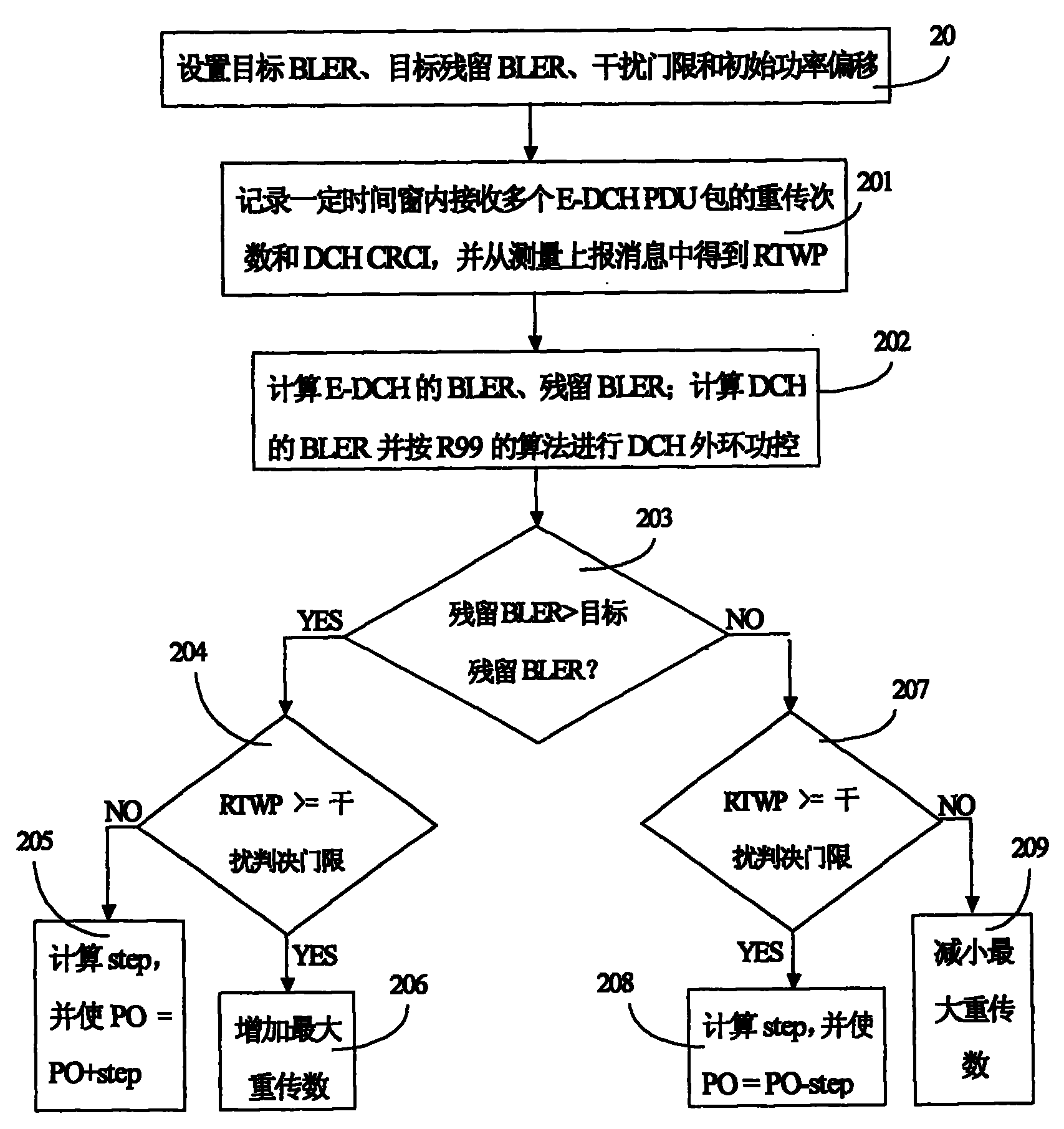
图2为本发明外环功率控制方法流程图。Fig. 2 is a flow chart of the outer loop power control method of the present invention.
具体实施方式Detailed ways
下面结合附图和HSUPA外环功率控制实施例对本发明作进一步详细说明。The present invention will be further described in detail below in conjunction with the accompanying drawings and the embodiment of HSUPA outer loop power control.
附图1说明了HSUPA进行功率控制的总体流程图。Accompanying drawing 1 illustrates the overall flowchart of HSUPA power control.
在本例中,UE传输DCH和E-DCH,DCH按照R99协议进行功率控制:Node B利用DPCCH的SIR进行内环功控,RNC利用DCH的BLER进行外环功控。In this example, the UE transmits DCH and E-DCH, and DCH performs power control according to the R99 protocol: Node B uses the SIR of DPCCH to perform inner-loop power control, and RNC uses DCH BLER to perform outer-loop power control.
Node B上报PDU传输次数给RNC,同时也将测得的小区RTWP上报给RNC,RNC利用PDU和重传信息计算E-DCH的目标BLER和目标残留BLER;然后RNC利用目标BLER、目标残留BLER和RTWP调整功率偏移量和最大重传数;最后RNC通过发送RRC命令给UE重配E-DCH的功率偏移和最大重传数,重配数据协助UE进行TFC选择,UE将选择的E-TFC和功率偏移应用到物理信道,从而完成外环功控。Node B reports the number of PDU transmissions to the RNC, and also reports the measured RTWP of the cell to the RNC, and the RNC uses the PDU and retransmission information to calculate the target BLER and target residual BLER of the E-DCH; then the RNC uses the target BLER, target residual BLER and RTWP adjusts the power offset and the maximum number of retransmissions; finally, the RNC sends an RRC command to the UE to reconfigure the power offset and the maximum number of retransmissions of the E-DCH, and the reconfiguration data assists the UE in TFC selection, and the UE will select the E-DCH TFC and power offset are applied to the physical channel to complete the outer loop power control.
其中,重配的功率偏移是E-DCH所需功率偏移与参考E-TFC功率偏移的差值,这个参考功率偏移是RNC为指定的E-TFC设置的。Wherein, the reconfigured power offset is the difference between the power offset required by the E-DCH and the reference E-TFC power offset, and the reference power offset is set by the RNC for the specified E-TFC.
附图2说明了HSUPA外环功率控制方法流程图,此图具体描述了图1中RNC处理过程:Accompanying drawing 2 has illustrated HSUPA outer loop power control method flow chart, and this figure has specifically described RNC processing procedure among Fig. 1:
步骤20设置目标BLER、目标残留BLER、干扰门限、初始功率偏移,目标残留BLER的设置会影响RLC重传;目标BLER的设置将体现HARQ重传前的链路性能;干扰门限体现了上行干扰的极限情况,在实际情况下可以留有一定的裕量,如果设置的干扰门限为Imax,则干扰判决门限为Imax-ΔI。ΔI≥0,可以通过仿真决定;初始功率偏移是RNC为每个MAC-d流设置的,初始功率偏移是相对于参考E-TFC功率偏移的功率偏移值。以上参数都可以根据仿真和实测进行设置和优化。
步骤201记录一定时间窗中的关于每个E-DCH PDU包用到的重传次数和DCH信道的CRCI(CRC指示),并从Node B测量上报中得到RTWP,RTWP值是周期上报的。Step 201 records the number of retransmissions used by each E-DCH PDU packet and the CRCI (CRC indication) of the DCH channel in a certain time window, and obtains RTWP from the Node B measurement report, and the RTWP value is reported periodically.
步骤202计算E-DCH的BLER、残留BLER。如果存在DCH信道,通过CRCI计算DCH的BLER,并按R99的功控算法进行DCH的内外环功率控制。Step 202 calculates the BLER and residual BLER of the E-DCH. If there is a DCH channel, the BLER of the DCH is calculated through CRCI, and the inner and outer loop power control of the DCH is performed according to the power control algorithm of R99.
E-DCH的BLER和残留BLER可以通过以下公式获得:The BLER and residual BLER of E-DCH can be obtained by the following formula:
式中m为时间窗内处理的PDU包数;In the formula, m is the number of PDU packets processed in the time window;
Ni为每个PDU包正确解码所需的传输次数;N i is the number of transmissions required for correct decoding of each PDU packet;
k为达到最大重传数而没有正确译码的PDU包数。k is the number of PDU packets that have reached the maximum number of retransmissions but have not been correctly decoded.
步骤203判断残留BLER是否大于目标残留BLER,如果残留BLER大于目标残留BLER,则进入步骤204;否则进入步骤207。Step 203 judges whether the residual BLER is greater than the target residual BLER, if the residual BLER is greater than the target residual BLER, go to step 204; otherwise, go to step 207.
步骤204判断RTWP是否大于或等于干扰判决门限,如果RTWP大于或等于干扰判决门限,则进入步骤206;否则进入步骤205。Step 204 judges whether the RTWP is greater than or equal to the interference judgment threshold, and if the RTWP is greater than or equal to the interference judgment threshold, proceed to step 206 ; otherwise, proceed to step 205 .
步骤205计算功率偏移上调步长step1,并使PO=min(PO+step1,MaxPO),MaxPO为系统设置的最大功率偏移值,min为取最小值的函数。Step1可计算如下:Step 205 calculates the power offset upward adjustment step step1, and makes PO=min(PO+step1, MaxPO), where MaxPO is the maximum power offset value set by the system, and min is a function to obtain the minimum value. Step1 can be calculated as follows:
step1=k1×ΔBLERstep1=k1×ΔBLER
式中k1为上调系数,可由仿真获得;In the formula, k1 is the up-regulation coefficient, which can be obtained by simulation;
ΔBLER=BLER-目标BLER。ΔBLER = BLER - target BLER.
步骤206调整最大重传数。如果最大重传数不大于15(HSUPA最大重传数上限),则最大重传数+1。通过增加重传次数获得更高的残留BLER。Step 206 adjusts the maximum number of retransmissions. If the maximum number of retransmissions is not greater than 15 (HSUPA maximum number of retransmissions), then the maximum number of retransmissions +1. A higher residual BLER is obtained by increasing the number of retransmissions.
步骤207判断RTWP是否大于等于干扰判决门限,如果RTWP大于或等于干扰判决门限,则进入步骤208;否则进入步骤209。Step 207 judges whether the RTWP is greater than or equal to the interference judgment threshold, and if the RTWP is greater than or equal to the interference judgment threshold, proceed to step 208 ; otherwise, proceed to step 209 .
步骤208计算功率偏移下调调步长step2,并使PO=max(PO-step2,MinPO),MinPO为系统设置的最小功率偏移值,max为取最大值的函数。Step2可计算如下:Step 208 calculates the power offset down-adjustment step length step2, and makes PO=max(PO-step2, MinPO), where MinPO is the minimum power offset value set by the system, and max is a function to obtain the maximum value. Step2 can be calculated as follows:
step2=k2×ΔBLERstep2=k2×ΔBLER
式中k2为下调系数,可由仿真获得;In the formula, k2 is the down-regulation coefficient, which can be obtained by simulation;
ΔBLER=目标BLER-BLER。ΔBLER = target BLER - BLER.
步骤206调整最大重传数。如果最大重传数不等于0,则最大重传数-1。这样做减小了传输时延。Step 206 adjusts the maximum number of retransmissions. If the maximum number of retransmissions is not equal to 0, then the maximum number of retransmissions -1. Doing so reduces the transmission delay.
最后RNC将计算得到的功率偏移和最大重传数由下行信令发给UE。Finally, the RNC sends the calculated power offset and the maximum number of retransmissions to the UE through downlink signaling.
Claims (7)
Priority Applications (1)
| Application Number | Priority Date | Filing Date | Title |
|---|---|---|---|
| CNB2005100985574A CN100550679C (en) | 2005-09-02 | 2005-09-02 | Realization Method of HSUPA Outer Loop Power Control |
Applications Claiming Priority (1)
| Application Number | Priority Date | Filing Date | Title |
|---|---|---|---|
| CNB2005100985574A CN100550679C (en) | 2005-09-02 | 2005-09-02 | Realization Method of HSUPA Outer Loop Power Control |
Publications (2)
| Publication Number | Publication Date |
|---|---|
| CN1925352A true CN1925352A (en) | 2007-03-07 |
| CN100550679C CN100550679C (en) | 2009-10-14 |
Family
ID=37817851
Family Applications (1)
| Application Number | Title | Priority Date | Filing Date |
|---|---|---|---|
| CNB2005100985574A Expired - Fee Related CN100550679C (en) | 2005-09-02 | 2005-09-02 | Realization Method of HSUPA Outer Loop Power Control |
Country Status (1)
| Country | Link |
|---|---|
| CN (1) | CN100550679C (en) |
Cited By (9)
| Publication number | Priority date | Publication date | Assignee | Title |
|---|---|---|---|---|
| WO2008110104A1 (en) * | 2007-03-09 | 2008-09-18 | Huawei Technologies Co., Ltd. | A method, a base station and a radio access network system for configuring the e-hich power offset value |
| WO2009115043A1 (en) * | 2008-03-21 | 2009-09-24 | 大唐移动通信设备有限公司 | Method, system and apparatus for determining power offset parameters |
| CN101442813B (en) * | 2008-12-25 | 2010-09-22 | 北京天碁科技有限公司 | A method for uplink synchronization and power control in the initial link establishment phase of HSUPA service |
| CN101500265B (en) * | 2008-01-28 | 2010-12-08 | 中兴通讯股份有限公司 | Throughput Evaluation Method |
| CN101986752A (en) * | 2010-11-04 | 2011-03-16 | 杭州市电信规划设计院有限公司 | Control method of uplink power of long term evolution (LTE) system |
| CN102196546A (en) * | 2010-09-30 | 2011-09-21 | 重庆重邮信科通信技术有限公司 | Uplink control method for reducing error rate of TD-HSUPA (Time Division-High Speed Uplink Packet Access) |
| CN101420289B (en) * | 2007-10-22 | 2011-12-14 | 电信科学技术研究院 | Method and apparatus for tuning maximum transmission times |
| CN101577569B (en) * | 2008-05-05 | 2013-01-16 | 鼎桥通信技术有限公司 | Method and devices for power control |
| WO2017219578A1 (en) * | 2016-06-20 | 2017-12-28 | 中兴通讯股份有限公司 | Method and system for adjusting channel power |
-
2005
- 2005-09-02 CN CNB2005100985574A patent/CN100550679C/en not_active Expired - Fee Related
Cited By (11)
| Publication number | Priority date | Publication date | Assignee | Title |
|---|---|---|---|---|
| WO2008110104A1 (en) * | 2007-03-09 | 2008-09-18 | Huawei Technologies Co., Ltd. | A method, a base station and a radio access network system for configuring the e-hich power offset value |
| CN101420289B (en) * | 2007-10-22 | 2011-12-14 | 电信科学技术研究院 | Method and apparatus for tuning maximum transmission times |
| CN101500265B (en) * | 2008-01-28 | 2010-12-08 | 中兴通讯股份有限公司 | Throughput Evaluation Method |
| WO2009115043A1 (en) * | 2008-03-21 | 2009-09-24 | 大唐移动通信设备有限公司 | Method, system and apparatus for determining power offset parameters |
| CN101577569B (en) * | 2008-05-05 | 2013-01-16 | 鼎桥通信技术有限公司 | Method and devices for power control |
| CN101442813B (en) * | 2008-12-25 | 2010-09-22 | 北京天碁科技有限公司 | A method for uplink synchronization and power control in the initial link establishment phase of HSUPA service |
| CN102196546A (en) * | 2010-09-30 | 2011-09-21 | 重庆重邮信科通信技术有限公司 | Uplink control method for reducing error rate of TD-HSUPA (Time Division-High Speed Uplink Packet Access) |
| CN102196546B (en) * | 2010-09-30 | 2012-06-13 | 重庆重邮信科通信技术有限公司 | Uplink control method for reducing error rate of TD-HSUPA (Time Division-High Speed Uplink Packet Access) |
| CN101986752A (en) * | 2010-11-04 | 2011-03-16 | 杭州市电信规划设计院有限公司 | Control method of uplink power of long term evolution (LTE) system |
| CN101986752B (en) * | 2010-11-04 | 2013-03-13 | 杭州市电信规划设计院有限公司 | Control method of uplink power of long term evolution (LTE) system |
| WO2017219578A1 (en) * | 2016-06-20 | 2017-12-28 | 中兴通讯股份有限公司 | Method and system for adjusting channel power |
Also Published As
| Publication number | Publication date |
|---|---|
| CN100550679C (en) | 2009-10-14 |
Similar Documents
| Publication | Publication Date | Title |
|---|---|---|
| CN101874363B (en) | Outer loop power control for e-dch | |
| CN103548397B (en) | Apparatus, method and system for uplink control channel reception in heterogeneous wireless communication network | |
| EP1912345B1 (en) | Method of adjusting transmission power using the uplink power headroom to calculate the uplink path loss | |
| CN1247030C (en) | Determination of uplink transfer channel parameter value | |
| CN1751467A (en) | Systems and methods for uplink rate selection during soft handover | |
| CN1750450A (en) | Method and apparatus for sending user equipment status information for uplink packet transmission | |
| CN1669260A (en) | Method for checking reliability of communication link | |
| CN1934803A (en) | Method and apparatus for channel sensitive scheduling in a communication system | |
| CN1700613A (en) | Method and apparatus for setting power for transmitting signaling information on an E-DCH | |
| CN101494521B (en) | Adaptive HARQ power control for EDCH | |
| CN102160429A (en) | Method and apparatus for determining minimum transmit power gain factor for enhanced uplink data communication | |
| CN101032095A (en) | Outer loop power control with transport block diversity transmission | |
| WO2006104208A1 (en) | Transmission power control method and mobile station | |
| WO2006104211A1 (en) | Transmission power control method and mobile station | |
| CN1925352A (en) | Realization Method of HSUPA Outer Loop Power Control | |
| CN1655472A (en) | Method and apparatus for controlling transmission speed in transmitting power dispatching on a terminal | |
| CN1790939A (en) | Power controlling method for uplink high-speed special physical control channel | |
| CN101047646A (en) | Uplink external ring power control method in high speed uplink link group access application | |
| CN1917393A (en) | Method and device for controlling up going transmission power | |
| CN100388643C (en) | Method for Adjusting Transmission Signal Power of Automatic Repeat Request System | |
| CN1921686A (en) | Method and system for treatment of communication channel quality indication | |
| CN1734967A (en) | The outer-loop power controlling method of ascending reinforced special channel | |
| CN1764081A (en) | A power control method | |
| CN100561887C (en) | An Outer Loop Power Control Method for Uplink Enhanced Channel | |
| CN101388695B (en) | External ring power control method |
Legal Events
| Date | Code | Title | Description |
|---|---|---|---|
| C06 | Publication | ||
| PB01 | Publication | ||
| C10 | Entry into substantive examination | ||
| SE01 | Entry into force of request for substantive examination | ||
| C14 | Grant of patent or utility model | ||
| GR01 | Patent grant | ||
| CF01 | Termination of patent right due to non-payment of annual fee |
Granted publication date: 20091014 Termination date: 20150902 |
|
| EXPY | Termination of patent right or utility model |