CN1925382B - A method for hybrid automatic request retransmission - Google Patents
A method for hybrid automatic request retransmission Download PDFInfo
- Publication number
- CN1925382B CN1925382B CN2005100937354A CN200510093735A CN1925382B CN 1925382 B CN1925382 B CN 1925382B CN 2005100937354 A CN2005100937354 A CN 2005100937354A CN 200510093735 A CN200510093735 A CN 200510093735A CN 1925382 B CN1925382 B CN 1925382B
- Authority
- CN
- China
- Prior art keywords
- sequence
- retransmission
- user equipment
- retransmissions
- transmitted
- Prior art date
- Legal status (The legal status is an assumption and is not a legal conclusion. Google has not performed a legal analysis and makes no representation as to the accuracy of the status listed.)
- Expired - Fee Related
Links
Images

Landscapes
- Detection And Prevention Of Errors In Transmission (AREA)
- Mobile Radio Communication Systems (AREA)
Abstract
本发明的一种混合自动请求重传的方法,其包括如下步骤:在Node B端产生一个待传输序列映射表,将待传输序列按照信噪比进行一定规则的映射;用户设备接收端根据crc校验结果产生反馈确认信息,所述确认信息包括:表示当次译码的结果错误,需要重传;或者表示译码的结果正确,无须重传;所述Node B根据用户设备反馈的译码信息和当前信道质量,自适应地增、减量重发待传输序列,以使得用户设备尽快正确译码。本发明方法使NodeB根据信道变化情况能够进行自适应的增、减量重传,即选择性地重传更有助于UE尽快正确译码的冗余比特;这样在保证译码性能的情况下,减小了重传次数,提高了系统性能。
A hybrid automatic retransmission method of the present invention comprises the following steps: generating a sequence mapping table to be transmitted at the Node B end, mapping the sequence to be transmitted according to a certain rule according to the signal-to-noise ratio; the user equipment receiving end according to the crc The verification result generates feedback confirmation information, and the confirmation information includes: indicating that the current decoding result is wrong and needs to be retransmitted; or indicating that the decoding result is correct and does not need to be retransmitted; Information and current channel quality, adaptively increase or decrease the retransmission sequence, so that the user equipment can decode correctly as soon as possible. The method of the present invention enables NodeB to perform adaptive increase and decrease retransmissions according to channel changes, that is, selective retransmission is more helpful for UE to correctly decode redundant bits as soon as possible; thus, under the condition of ensuring decoding performance , reducing the number of retransmissions and improving system performance.
Description
技术领域technical field
本发明涉及一种数字移动通信领域的自动请求重传的方法,特别涉及一种TD-CDMA和WCDMA系统提供HSDPA业务时的混合自动重传(HARQ hybrid ARQ)方法。The present invention relates to a method for automatically requesting retransmission in the field of digital mobile communications, in particular to a hybrid automatic retransmission (HARQ hybrid ARQ) method when TD-CDMA and WCDMA systems provide HSDPA services.
背景技术Background technique
HSDPA是3GPP在R5协议中为了满足上/下行数据业务不对称的需求而提出的一种调制解调算法,是WCDMA和TD-SCDMA网络建设后期提高下行容量和数据业务速率的一种重要技术。为了达到提高下行分组数据速率和减少时延的目的,HSDPA主要采用了自适应的编码和调制(AMC)、快速混合自动重传(HARQ)和快速小区选择(FCS)和快速调度技术。HSDPA is a modulation and demodulation algorithm proposed by 3GPP in the R5 protocol to meet the asymmetrical requirements of uplink/downlink data services. It is an important technology for improving downlink capacity and data service rate in the later stage of WCDMA and TD-SCDMA network construction. In order to increase the downlink packet data rate and reduce the time delay, HSDPA mainly adopts Adaptive Coding and Modulation (AMC), Fast Hybrid Automatic Repeat (HARQ), Fast Cell Selection (FCS) and fast scheduling technologies.
HARQ技术可以提高系统性能,并可灵活地调整有效编码速率,还可以补偿由于采用链路适配所带来的误码。HSDPA将AMC和HARQ技术结合起来可以达到更好的链路自适应效果。HSDPA先通过AMC提供粗略的数据速率选择方案,然后再使用HARQ技术来提供精确的速率调解,从而提高自适应调节的精度和提高资源利用率。HARQ机制本身的定义是将前向纠错编码(FEC)和自动请求重传(ARQ)结合起来的一种差错控制方案,HARQ机制的形式很多,而目前HSDPA技术中主要是采用三种递增冗余的HARQ机制:TYPE-I HARQ,TYPE-II HARQ,TYPE-III HARQ,可以根据系统性能和设备复杂度来选择相应的HARQ机制。HARQ technology can improve system performance, and can flexibly adjust the effective coding rate, and can also compensate for bit errors caused by link adaptation. HSDPA combines AMC and HARQ technologies to achieve better link adaptation effects. HSDPA first provides a rough data rate selection scheme through AMC, and then uses HARQ technology to provide accurate rate modulation, thereby improving the accuracy of adaptive adjustment and improving resource utilization. The definition of the HARQ mechanism itself is an error control scheme that combines forward error correction coding (FEC) and automatic repeat request (ARQ). Other HARQ mechanisms: TYPE-I HARQ, TYPE-II HARQ, TYPE-III HARQ, the corresponding HARQ mechanism can be selected according to system performance and equipment complexity.
第二类HARQ方案属于递增冗余(Incremental Redundancy)的ARQ方案。TYPE-II HARQ方案考虑了无线传播信道的时差特性。在首次传输数据块时没有或带有较少的冗余。如果传输失败,重传将开始。重传的数据块不是首次所传数据块的复制,而是增加了其中的冗余部分。在接收端将两次收到的数据块进行合并,编码速率会有所降低而提高了编码增益。The second type of HARQ scheme belongs to the ARQ scheme of incremental redundancy (Incremental Redundancy). The TYPE-II HARQ scheme takes into account the time difference characteristics of the wireless propagation channel. No or less redundancy in the first transfer of a block of data. If the transfer fails, a retransmission will start. The retransmitted data block is not a copy of the first transmitted data block, but increases the redundant part of it. The data blocks received twice are combined at the receiving end, the coding rate will be reduced and the coding gain will be improved.
现有技术请参考以下文献:Please refer to the following documents for prior art:
[1]周海军等,TD-SCDMA系统中HARQ方案与仿真分析,重庆邮电学院学报,2004,2。[1] Zhou Haijun et al., HARQ scheme and simulation analysis in TD-SCDMA system, Journal of Chongqing University of Posts and Telecommunications, 2004, 2.
[2]郭磊等,两种HARQ方式在移动通信中的比较,通信技术,2003,No.3。[2] Guo Lei et al., Comparison of two HARQ methods in mobile communication, Communication Technology, 2003, No.3.
[3]任艳颖等,混合ARQ机制的性能分析,计算机工程与应用,2003,3。[3] Ren Yanying et al., Performance Analysis of Hybrid ARQ Mechanism, Computer Engineering and Application, 2003, 3.
[4]王亚峰等,采用Turbo码的type III HARQ性能分析,通信学报,2004,6。[4] Wang Yafeng et al., Performance Analysis of Type III HARQ Using Turbo Codes, Journal of Communications, 2004, 6.
现有的第二类HARQ方案中,在增量冗余重传的时候,不能够根据反馈信息来确定下一次重发的时候需要重发哪些冗余比特;并且不能根据当前信道质量、自适应地增、减量重传;即NodeB知道接收端译码不正确时,只能根据UE反馈的信噪比SNR信息,盲目地对冗余比特在数量上进行增量重传,而不能确定重发哪些冗余比特就可以使接收端更快地正确译码。In the existing second type of HARQ scheme, when the incremental redundancy is retransmitted, it is not possible to determine which redundant bits need to be retransmitted in the next retransmission according to the feedback information; and it cannot be based on the current channel quality, adaptive Incremental and decremental retransmissions; that is, when the NodeB knows that the decoding at the receiving end is incorrect, it can only blindly perform incremental retransmissions on the number of redundant bits based on the SNR information fed back by the UE, and cannot determine the retransmission Which redundant bits are sent can make the receiving end decode correctly faster.
因此,现有技术存有缺陷,而有待于改进和发展。Therefore, there are defects in the prior art and need to be improved and developed.
发明内容Contents of the invention
本发明的目的是提供一种混合自动请求重传的方法,让NodeB可以根据UE反馈的SNR信息,有选择性地进行增、减量重传。The purpose of the present invention is to provide a hybrid automatic retransmission method, so that the NodeB can selectively increase or decrease the retransmission according to the SNR information fed back by the UE.
本发明的技术方案如下:Technical scheme of the present invention is as follows:
一种混合自动请求重传的方法,其包括如下步骤:A method for hybrid automatic request retransmission, comprising the steps of:
A、在Node B端产生一个待传输序列映射表,将待传输序列按照信噪比进行一定规则的映射;A. Generate a sequence mapping table to be transmitted at the Node B side, and map the sequence to be transmitted according to a certain rule according to the signal-to-noise ratio;
B、用户设备接收端根据crc校验结果产生反馈确认信息,所述确认信息包括:表示当次译码的结果错误,需要重传;或者表示译码的结果正确,无须重传;B. The receiving end of the user equipment generates feedback confirmation information according to the CRC verification result, and the confirmation information includes: indicating that the current decoding result is wrong and needs to be retransmitted; or indicating that the decoding result is correct and does not need to be retransmitted;
C、所述Node B根据用户设备反馈的译码信息和当前信道质量,自适应地增、减量重发待传输序列,以使得用户设备尽快正确译码。C. The Node B adaptively increases or decreases the retransmission sequence to be transmitted according to the decoding information fed back by the user equipment and the current channel quality, so that the user equipment can decode correctly as soon as possible.
所述的方法,其中,还包括:The method, which also includes:
A1、传输序列分集;A1. Transmission sequence diversity;
B1、映射:将每一种多径环境下反映其性能的信噪比范围划分为多个级别,所述级别之间的间距不是固定的,根据仿真结果来确定;每一个级别对应映射一个划分的集合编号;B1. Mapping: divide the signal-to-noise ratio range reflecting its performance in each multipath environment into multiple levels, the distance between the levels is not fixed, it is determined according to the simulation results; each level corresponds to a division the collection number of
C1、Node B第一次发送时统一发送位于信噪比范围中点的那个集合;C1. Node B uniformly sends the set at the midpoint of the signal-to-noise ratio range when it sends for the first time;
D1、用户设备对接收序列译码,并计算crc;D1. The user equipment decodes the received sequence and calculates crc;
E1、所述用户设备反馈译码信息,并包含信噪比;在crc为零时反馈表示译码的结果正确,无须重传的信号;当crc不为零时反馈表示当次译码的结果错误,需要重传的信号给Node B;E1. The user equipment feeds back the decoding information, including the signal-to-noise ratio; when the crc is zero, the feedback indicates that the decoding result is correct and no retransmission is required; when the crc is not zero, the feedback indicates the current decoding result Error, the signal needs to be retransmitted to Node B;
F1、所述Node B根据用户设备反馈的信噪比信息查映射表,进行选择性重传;F1, the Node B checks the mapping table according to the signal-to-noise ratio information fed back by the user equipment, and performs selective retransmission;
G1、所述用户设备接收到重传序列,循环所述步骤D1到F1,直到接收端能够正确译码。G1. The user equipment receives the retransmission sequence, and loops the steps D1 to F1 until the receiving end can decode correctly.
所述的方法,其中,还包括步骤:The method, wherein, also includes the steps of:
H1、在所述步骤F1中判断是否达到最大重传次数,所述最大重传次数为系统中预设,如到达最大重传次数,则高层记录并丢弃该数据包。H1. In the step F1, it is judged whether the maximum number of retransmissions is reached. The maximum number of retransmissions is preset in the system. If the maximum number of retransmissions is reached, the high-level layer records and discards the data packet.
本发明所提供的一种混合自动请求重传的方法,与现有技术相比,可以使NodeB根据信道变化情况进行自适应的增、减量重传,即选择性地重传更有助于UE尽快正确译码的冗余比特;这样在保证译码性能的情况下,减小了重传次数,提高了系统性能。Compared with the prior art, a hybrid automatic request retransmission method provided by the present invention can enable NodeB to perform adaptive increase and decrease retransmission according to channel changes, that is, selective retransmission is more helpful The redundant bits that are correctly decoded by the UE as soon as possible; in this way, while ensuring the decoding performance, the number of retransmissions is reduced and the system performance is improved.
附图说明Description of drawings
图1所示为现有技术的第二类HARQ方案的流程图;Fig. 1 shows the flowchart of the second type of HARQ scheme in the prior art;
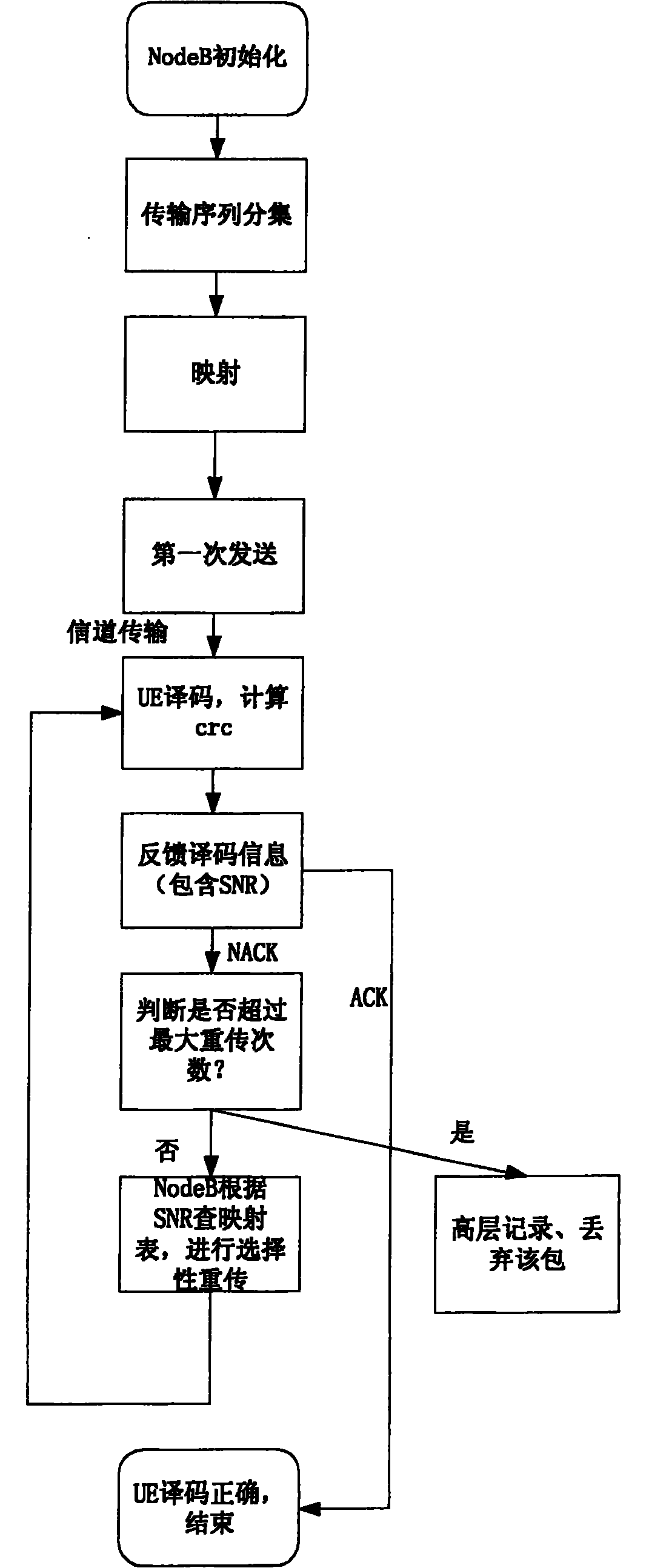
图2为本发明方法的映射选择性HARQ方案的流程图;Fig. 2 is the flowchart of the mapping selective HARQ scheme of the inventive method;
图3为本发明方法的映射过程示意图。Fig. 3 is a schematic diagram of the mapping process of the method of the present invention.
具体实施方式Detailed ways
以下结合附图,将对本发明的各较佳实施例进行较为详细的说明。Various preferred embodiments of the present invention will be described in detail below in conjunction with the accompanying drawings.
本发明所述混合自动请求重传的方法,其核心思想是:在HSDPA第二类HARQ方案中,NodeB端产生一个待传输序列映射表,将待传输序列按照SNR进行一定规则的映射,SNR(信噪比)与BER(误比特率)之间有一定的关系。UE接收端根据crc校验结果产生反馈确认信息NACK,此时表示当次译码的结果错误,需要重传;或者ACK,此时表示译码的结果正确,无须重传。然后NodeB根据UE反馈的译码信息和当前信道质量,自适应地增、减量重发待传输序列,以使得UE尽快正确译码。The method for hybrid automatic retransmission of the present invention, its core idea is: in HSDPA second class HARQ scheme, NodeB side produces a to-be-transmitted sequence mapping table, the to-be-transmitted sequence is mapped according to certain rules according to SNR, SNR( There is a certain relationship between the signal-to-noise ratio) and the BER (bit error rate). The UE receiving end generates feedback confirmation information NACK according to the CRC check result, which means that the current decoding result is wrong and needs to be retransmitted; or ACK, which means that the decoding result is correct and does not need to be retransmitted. Then, according to the decoding information fed back by the UE and the current channel quality, the NodeB adaptively increases or decreases the retransmission of the sequence to be transmitted, so that the UE can decode correctly as soon as possible.
本发明方法实现的步骤如下,如图2所示:The steps that the inventive method realizes are as follows, as shown in Figure 2:
第一步 传输序列分集:Step 1 Transmission sequence diversity:
本步骤又包括下列步骤:This step further includes the following steps:
1、首先将待传输序列分为系统比特和校验比特两个部分,系统比特集合编号始终为A;1. First, the sequence to be transmitted is divided into two parts: system bits and parity bits, and the system bit set number is always A;
2、其次将校验比特集合分为第一校验比特集合,编号为B和第二校验比特集合,编号为C;2. Secondly, the parity bit set is divided into the first parity bit set, numbered as B and the second parity bit set, numbered as C;
3、按照一定的规则将集合B、C分为7个子集合:这里总体准则是相当于对B、C集合再做一次简单的交织,使其尽量更分散一些,进一步降低突发错误的概率,提高译码的效率。这样将集合B、C划分并按照一定规则合并为若干个集合,编号依次由D递增,这些集合可以互不相干,也可以有交集,甚至还可以属于依次包含的关系;3. Divide the sets B and C into 7 sub-sets according to certain rules: the general rule here is to do a simple interleaving on the sets B and C to make them as scattered as possible and further reduce the probability of burst errors. Improve the efficiency of decoding. In this way, the sets B and C are divided and merged into several sets according to certain rules, and the numbers are incremented by D in turn. These sets can be irrelevant to each other, or they can have intersections, and they can even belong to the relationship of sequential inclusion;
第二步 映射:Step 2 Mapping:
将每一种多径环境下反映其性能的信噪比范围划分为7个级别,这7个级别之间的间距不是固定的,而是根据仿真结果来确定的;每一个级别对应映射一个第三步骤划分的集合编号,这里须注意:UE反馈的SNR是估计值、不一定精确等于每一个级别具体的SNR值,处理时采取就近原则;The signal-to-noise ratio range reflecting its performance in each multipath environment is divided into 7 levels. The distance between these 7 levels is not fixed, but determined according to the simulation results; each level corresponds to a first The set number divided by three steps, here it should be noted that the SNR fed back by the UE is an estimated value, and may not be exactly equal to the specific SNR value of each level, and the nearest principle is adopted for processing;
第三步 第一次发送:Step 3 Sending for the first time:
NodeB第一次发送时统一发送位于信噪比范围中点的那个集合;When NodeB sends for the first time, it uniformly sends the set at the midpoint of the signal-to-noise ratio range;
第四步 UE译码、计算crc:The fourth step is UE decoding and calculating crc:
UE对接收序列译码,并计算crc;The UE decodes the received sequence and calculates crc;
第五步 UE反馈译码信息,其中包含SNR:The fifth step UE feedback decoding information, including SNR:
●当crc为零时,反馈ACK,此时译码正确结束;●When the crc is zero, ACK is fed back, and the decoding ends correctly at this time;
●当crc不为零时,反馈NACK给NodeB;●When crc is not zero, feedback NACK to NodeB;
第六步 判断是否达到最大重传次数:Step 6 Determine whether the maximum number of retransmissions has been reached:
由于重传不能无休止的进行下去、所以会在系统中预先设定一个最大重传次数。当NodeB判断已经达到最大重传次数时,则高层记录并丢弃该包;否则继续第七步;Since the retransmission cannot go on endlessly, a maximum number of retransmissions will be preset in the system. When NodeB judges that the maximum number of retransmissions has been reached, the upper layer records and discards the packet; otherwise, continue to the seventh step;
第七步 NodeB根据UE反馈信息(SNR)查映射表,进行选择性重传:Step 7 NodeB checks the mapping table according to the UE feedback information (SNR) and performs selective retransmission:
发送端NodeB根据UE反馈信息(SNR)查映射表,得到需要重传的集合编号,将其重传;The NodeB at the sending end checks the mapping table according to the UE feedback information (SNR), obtains the set number that needs to be retransmitted, and retransmits it;
第八步 UE接收到重传序列,循环第四步~第七步,直到接收端能够正确译码或者达到设定的最高重传次数为止;Step 8 UE receives the retransmission sequence, and repeats steps 4 to 7 until the receiving end can decode correctly or reaches the set maximum number of retransmissions;
整个映射选择性HARQ方案的流程图如图2所示。The flowchart of the whole mapping selective HARQ scheme is shown in FIG. 2 .
下面以HSDPA中VA120环境、1/3turbo编译码为例说明本发明的映射方式,并结合附图对本发明技术方案的实施作进一步的详细描述:Below take VA120 environment, 1/3turbo codec in HSDPA as example to illustrate the mapping mode of the present invention, and in conjunction with accompanying drawing the implementation of technical scheme of the present invention is described in further detail:
第一步 NodeB对待传输序列进行分块并映射,如图3所示:The first step NodeB blocks and maps the sequence to be transmitted, as shown in Figure 3:
1、将待传输序列分为系统比特和校验比特两个部分,系统比特集合编号始终为A;1. Divide the sequence to be transmitted into two parts, the system bit and the parity bit, and the system bit set number is always A;
2、将校验比特集合分为第一校验比特集合,编号为B和第二校验比特集合,编号为C;2. Divide the parity bit set into a first parity bit set, numbered B and a second parity bit set, numbered C;
3、将集合B、C划分、合并为若干个子集合,每个子集合的编号依次由D递增:3. Divide and merge sets B and C into several sub-sets, and the number of each sub-set is incremented by D in turn:
●首先对集合B、C再作一次简单的交织、使突发错误的概率进一步减小,具体交织方式可以选择按行写入、按列读出的简单方式,如图3所示:这里仅仅是个示意图、直观地表示交织后B、C集合被分割、不涉及具体分割方式;实际应用中可以按照上面说的按行写入、按列读出的原则;也可以使用其它原则;●First, perform a simple interleaving on sets B and C to further reduce the probability of burst errors. The specific interleaving method can be a simple method of writing by row and reading by column, as shown in Figure 3: here only It is a schematic diagram, intuitively indicating that the B and C sets are divided after interleaving, and does not involve the specific division method; in practical applications, the above-mentioned principle of writing by row and reading by column can be used; other principles can also be used;
●其次将交织后的比特分段收集起来,这里收集时将B、C中对应的比特段合并在一起;●Secondly, the interleaved bit segments are collected, where the corresponding bit segments in B and C are merged together;
●最后对这些集合依次由D开始编号;●Finally, these collections are numbered sequentially from D;
●每一个集合编号对应一个SNR下应该重传的校验比特集合;●Each set number corresponds to a check bit set that should be retransmitted under a SNR;
第二步 NodeB进行第一次发送:The second step NodeB sends for the first time:
NodeB第一次发送时统一发送集合G+D+J+E;NodeB uniformly sends the set G+D+J+E when sending for the first time;
第三步 UE对接收序列译码、计算crc:The third step UE decodes the received sequence and calculates crc:
●UE根据接收序列进行译码,计算crc;The UE decodes according to the received sequence and calculates the crc;
●当crc不为零时,反馈NACK回NodeB;反之则反馈ACK,●When crc is not zero, feedback NACK back to NodeB; otherwise, feedback ACK,
停止当前序列的重传;Stop the retransmission of the current sequence;
第四步 NodeB判断是否达到最大重传次数:Step 4 NodeB judges whether the maximum number of retransmissions is reached:
若达到最大重传次数,则高层记录并丢弃该包;否则NodeB根据UE反馈信息,查映射表得到需要重传的集合编号,将其重传;If the maximum number of retransmissions is reached, the upper layer records and discards the packet; otherwise, the NodeB checks the mapping table to obtain the set number that needs to be retransmitted according to the feedback information of the UE, and retransmits it;
第五步 UE接收到重传序列,循环第三步和第四步,直到接收端能够正确译码或者达到设定的最高重传次数为止。Step 5 UE receives the retransmission sequence, and repeats steps 3 and 4 until the receiving end can decode correctly or reaches the set maximum number of retransmissions.
本发明方法通过NodeB对传输序列分块进行一定规则的映射,做成映射表;并根据UE反馈的译码信息查映射表,对应地进行有选择性地增、减量重传,这样避免了NodeB盲目地进行增量重传,有效地减少了重传次数、保证了译码性能。The method of the present invention uses the NodeB to map the transmission sequence blocks with certain rules to form a mapping table; and check the mapping table according to the decoding information fed back by the UE, and selectively increase and decrease retransmissions accordingly, thus avoiding NodeB blindly performs incremental retransmissions, effectively reducing the number of retransmissions and ensuring decoding performance.
应当理解的是,上述针对具体实施例的描述较为具体,并不能因此而认为是对本发明专利保护范围的限制,本发明的专利保护范围应以所附权利要求为准。It should be understood that the above descriptions for specific embodiments are relatively specific, and should not therefore be considered as limiting the scope of the patent protection of the present invention, and the scope of protection of the patent protection of the present invention should be determined by the appended claims.
Claims (3)
Priority Applications (1)
| Application Number | Priority Date | Filing Date | Title |
|---|---|---|---|
| CN2005100937354A CN1925382B (en) | 2005-08-29 | 2005-08-29 | A method for hybrid automatic request retransmission |
Applications Claiming Priority (1)
| Application Number | Priority Date | Filing Date | Title |
|---|---|---|---|
| CN2005100937354A CN1925382B (en) | 2005-08-29 | 2005-08-29 | A method for hybrid automatic request retransmission |
Publications (2)
| Publication Number | Publication Date |
|---|---|
| CN1925382A CN1925382A (en) | 2007-03-07 |
| CN1925382B true CN1925382B (en) | 2010-06-16 |
Family
ID=37817876
Family Applications (1)
| Application Number | Title | Priority Date | Filing Date |
|---|---|---|---|
| CN2005100937354A Expired - Fee Related CN1925382B (en) | 2005-08-29 | 2005-08-29 | A method for hybrid automatic request retransmission |
Country Status (1)
| Country | Link |
|---|---|
| CN (1) | CN1925382B (en) |
Families Citing this family (4)
| Publication number | Priority date | Publication date | Assignee | Title |
|---|---|---|---|---|
| KR101241908B1 (en) * | 2007-01-30 | 2013-03-12 | 엘지전자 주식회사 | Method For Retransmitting According To Receiving Channel Environment, Transmitter For The Same, Method And Apparatus For Generating Feedback Information |
| CN101471756B (en) * | 2007-12-27 | 2011-05-25 | 上海无线通信研究中心 | Centralization type scheduling HARQ method for multi-hop relay downward system |
| US20130308544A1 (en) * | 2011-02-07 | 2013-11-21 | C/O Nec Corporation | Radio communication system, radio communication method, radio communication device, control method therefor, and storage medium storing control program therefor |
| CN105827416B (en) * | 2016-05-10 | 2019-03-05 | 中国农业银行股份有限公司 | A kind of data pack transmission method, sending ending equipment and receiving device |
Citations (5)
| Publication number | Priority date | Publication date | Assignee | Title |
|---|---|---|---|---|
| CN1336049A (en) * | 1998-10-08 | 2002-02-13 | 艾利森电话股份有限公司 | Data communication method and system using an adaptive hybrid-ARQ scheme |
| CN1422032A (en) * | 2001-11-28 | 2003-06-04 | 华为技术有限公司 | Mixed automatic retransmitting method |
| CN1433183A (en) * | 2002-01-17 | 2003-07-30 | 杨大成 | Hybrid automatic request retransmission technology |
| CN1533105A (en) * | 2003-03-26 | 2004-09-29 | �ձ�������ʽ���� | Radio communication syste, base station and method for correcting radio link quality information |
| US6865233B1 (en) * | 1999-02-19 | 2005-03-08 | Telefonaktiebolaget Lm Ericsson (Publ) | Method and system for control signalling enabling flexible link adaptation in a radiocommunication system |
-
2005
- 2005-08-29 CN CN2005100937354A patent/CN1925382B/en not_active Expired - Fee Related
Patent Citations (5)
| Publication number | Priority date | Publication date | Assignee | Title |
|---|---|---|---|---|
| CN1336049A (en) * | 1998-10-08 | 2002-02-13 | 艾利森电话股份有限公司 | Data communication method and system using an adaptive hybrid-ARQ scheme |
| US6865233B1 (en) * | 1999-02-19 | 2005-03-08 | Telefonaktiebolaget Lm Ericsson (Publ) | Method and system for control signalling enabling flexible link adaptation in a radiocommunication system |
| CN1422032A (en) * | 2001-11-28 | 2003-06-04 | 华为技术有限公司 | Mixed automatic retransmitting method |
| CN1433183A (en) * | 2002-01-17 | 2003-07-30 | 杨大成 | Hybrid automatic request retransmission technology |
| CN1533105A (en) * | 2003-03-26 | 2004-09-29 | �ձ�������ʽ���� | Radio communication syste, base station and method for correcting radio link quality information |
Also Published As
| Publication number | Publication date |
|---|---|
| CN1925382A (en) | 2007-03-07 |
Similar Documents
| Publication | Publication Date | Title |
|---|---|---|
| TWI392268B (en) | Method and arrangement for harq in wireless multi-carrier systems | |
| JP5180273B2 (en) | Method and apparatus for effective automatic repeat request | |
| RU2236091C2 (en) | Method for data transmission/reception in data transfer system using hybrid automatic repetition request | |
| CN101981850B (en) | Method and apparatus for storing log-likelihood ratios in an interleaved form to reduce hardware memory | |
| US6700867B2 (en) | Method and system for reduced memory hybrid automatic repeat request | |
| CN1427568B (en) | Wireless transceiving apparatus and method for efficiently retransmitting high-speed information packet data | |
| US8745470B2 (en) | Method and system for data transmission in a data network | |
| CN101621367B (en) | HARQ decoding method based on packet check information | |
| CN102318254A (en) | Method for requesting retransmission, method for retransmission and devices thereof | |
| CN101843025A (en) | Method of data transmission using HARQ | |
| EP2272210A1 (en) | Method and apparatus for spectrally efficient link adaptation using harq in ofdma systems | |
| CN1496051A (en) | Method and device for adaptive hybrid automatic repeat request | |
| CN1771675A (en) | Power Control and Automatic Repeat Request (ARQ) in Radio Communication Systems | |
| CN1976268A (en) | Adaptive modulation and coding method | |
| US7895504B2 (en) | NAK-to-ACK error detection and recovery | |
| CN102684818A (en) | Data retransmission method, relay station, base station and communication system | |
| US8386892B1 (en) | Partial packet recovery for wireless networks | |
| CN102546131B (en) | Softer combination method and equipment for radio link signals | |
| US20110145674A1 (en) | High-efficiency dynamic transmission that has a high speed and reliability | |
| CN1925382B (en) | A method for hybrid automatic request retransmission | |
| CN114499764A (en) | A rate matching and dematching method, device, mobile terminal and storage medium | |
| CN101242234B (en) | Data interleaving method and device | |
| CN101420289A (en) | Method and apparatus for tuning maximum transmission times | |
| JP2008053854A (en) | Data retransmission method, communication apparatus, and computer program | |
| CN102833039B (en) | Large iteration receiving method used in hybrid automatic repeat request system |
Legal Events
| Date | Code | Title | Description |
|---|---|---|---|
| C06 | Publication | ||
| PB01 | Publication | ||
| C10 | Entry into substantive examination | ||
| SE01 | Entry into force of request for substantive examination | ||
| C14 | Grant of patent or utility model | ||
| GR01 | Patent grant | ||
| CF01 | Termination of patent right due to non-payment of annual fee | ||
| CF01 | Termination of patent right due to non-payment of annual fee |
Granted publication date: 20100616 |