Online dressing device for titanium oxide photocatalyst auxiliary metal bond superhard grinding wheel
Technical Field
The utility model relates to a grinding machine technical field, a titanium oxide photocatalyst auxiliary metal bond superhard grinding wheel device of dressing on line that specifically says so.
Background
The super-hard abrasive grinding wheel is a main tool for grinding semiconductor materials, ceramics and super-hard alloys. The metal bond grinding wheel has the advantages of high strength, high hardness, good contour retentivity of the grinding wheel and the like, and is widely applied to ultra-precise grinding of hard and brittle materials which are difficult to process. The metal bond has the characteristics of large holding force on abrasive particles, good wear resistance and the like, so that the dressing of the metal bond superhard grinding wheel is difficult. As the grinding process progresses, the friction between the grinding wheel and the workpiece generates a large amount of heat, most of which stays on the surface of the grinding wheel and the workpiece. When the holding force of the grinding wheel binder to the abrasive particles is larger, the passivated abrasive particles are not easy to fall off, and the efficiency of the grinding wheel for processing the workpiece is lowered; the reduced grinding ability of the grinding wheel also results in a reduced surface quality of the machined workpiece. Dressing of the grinding wheel is therefore critical for the grinding process.
At present, the dressing method of the super-hard abrasive grinding wheel mainly adopts the traditional mechanical dressing method, such as diamond roller dressing, diamond pen dressing, elastic dressing, free abrasive grinding wheel dressing and the like. In order to further improve the accuracy and efficiency of grinding, the requirements for dressing accuracy of the grinding wheel have also begun to increase. Novel trimming methods such as electric spark trimming, electrolytic trimming, ultrasonic trimming, laser trimming and the like are also proposed. With electrolytic trimming techniques being the most typical. Generally, the thickness of the oxide film generated by electrolysis in the electrolytic dressing grinding process is from tens of micrometers to hundreds of micrometers, and a part of abrasive grains are separated from the grinding wheel before the workpiece is not machined (worn), so that the ineffective loss of the grinding wheel is increased. In addition, due to the nonlinearity of the electrolytic finishing process, the grinding force is unstable due to the damage of the insulating layer on the surface of the grinding wheel in the grinding process; when the electrolytic current is small, the formation and destruction processes of the oxide layer are long, and the grinding force is unstable. When the current is larger, the excessive dressing of the grinding wheel is caused, and the loss is overlarge. Meanwhile, a special electrolysis power supply and an electrode system are needed, the equipment is complex, and the use cost is high.
Disclosure of Invention
In order to overcome the not enough of prior art, the utility model provides a supplementary metal bond superhard grinding wheel of titanium oxide photocatalyst sharpens device on line uses ultraviolet ray and titanium dioxide catalytic reaction to produce the oxidant and sharpens the superhard grinding wheel of metal bond on line, can realize the sharpening of workpiece surface high efficiency, high-quality grinding and emery wheel working face.
The utility model provides a scheme that technical problem adopted is:
an online dressing device for a titanium oxide photocatalyst auxiliary metal bond superhard grinding wheel comprises a grinding machine, a grinding fluid circulating device, a grinding fluid filtering device, an ultraviolet reaction cavity and an oxide layer online monitoring device, wherein the grinding fluid circulating device comprises a pressure pump, a nozzle, a pipeline, a grinding fluid box and a single-phase electric pump, the outlet of the nozzle is aligned to the working surface of the grinding wheel of the grinding machine, the pressure pump is installed on a fluid supply pipeline connected with the nozzle, the other end of the fluid supply pipeline extends into a reaction cavity of the ultraviolet reaction cavity, the inlet of the reaction cavity of the ultraviolet reaction cavity is communicated with the grinding fluid box through the single-phase electric pump, the grinding fluid box is communicated with a fluid return port of the grinding machine through a recovery pipeline, and the grinding fluid filtering device is arranged in the recovery pipeline; the oxide layer on-line monitoring device comprises a pressure sensor, a vibration sensor, a signal collector and a computer, wherein the pressure sensor is located on the grinding machine, the vibration sensor is located on a workpiece, the pressure sensor and the vibration sensor are both connected with the signal collector, and the signal collector is connected with the computer for realizing the on-line monitoring of the oxide layer.
Further, the grinding fluid filtering device comprises a filter screen, a quartz sand filtering layer and a reverse osmosis membrane filtering layer which are sequentially connected.
Still further, the ultraviolet ray reaction chamber includes ultraviolet regulator, ultraviolet generator, floating platform and reaction cavity, and ultraviolet regulator and ultraviolet generator are connected the ultraviolet generator and are located the top of reaction cavity, and floating platform is located the reaction cavity, and the other end of liquid supply pipe is connected with floating platform.
Preferably, the online oxide layer monitoring device further comprises a display, and the computer is connected with the display.
In the utility model, the grinding fluid circulating system conveys the unreacted grinding fluid in the grinding fluid tank to the ultraviolet reaction chamber, and the grinding fluid is sprayed to the surface of the grinding wheel through the pressure pump and the nozzle after reaction to oxidize and sharpen the working surface of the grinding wheel; and the grinding fluid containing the grinding impurities after processing flows back to the grinding fluid filtering device to be filtered and then returns to the grinding fluid box. The grinding fluid filtering device is connected with the grinding machine and the grinding fluid box through a pipeline, the processed grinding fluid is filtered to remove impurities such as grinding scraps, the grinding fluid firstly passes through a fine and dense wire mesh at the opening of the pipeline to prevent external impurities from entering the pipeline, the grinding fluid in the filter firstly passes through a layer of quartz sand to remove impurities, and then the grinding fluid returns to the grinding fluid box after free ions of the grinding fluid are absorbed by a reverse osmosis membrane.
In the ultraviolet reaction cavity, grinding fluid enters the reaction cavity from a bottom pipeline, surface layer grinding fluid starts to react under the irradiation of ultraviolet rays, and the generation speed of an oxidant in the grinding fluid is regulated and controlled by regulating the intensity of the ultraviolet rays; and the floating platform in the ultraviolet reaction cavity sucks the grinding fluid reacted on the surface layer into the grinding fluid circulating device. In the oxide layer on-line monitoring device, the contact state and the oxide film state of the grinding wheel and the workpiece in the machining process are represented by a pressure signal and a vibration signal together. The pressure sensor is positioned below the machined workpiece and used for monitoring the grinding force change during workpiece machining. The vibration sensor is arranged on the workpiece and the grinding wheel shaft to monitor vibration signals during processing. And after the computer receives the vibration signal and the pressure signal, the computer processes the signals and represents the contact state and the oxidation layer state of the workpiece and the grinding wheel during machining.
The utility model has the advantages that: (1) the novel grinding wheel dressing device can realize high-quality processing of the surface of a workpiece; (2) the oxide film in the processing process of the grinding wheel is monitored on line, and the processing process is controlled more accurately;
drawings
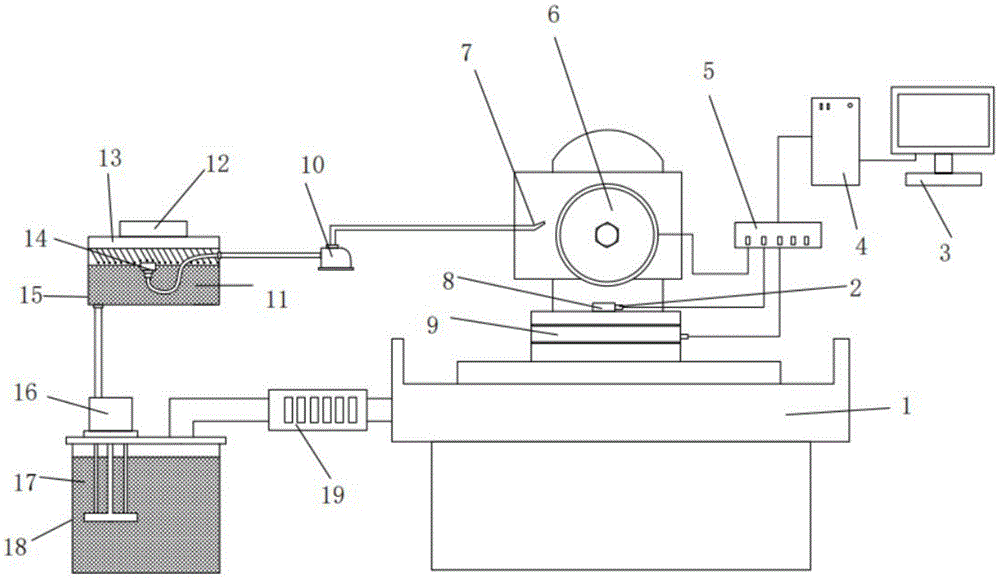
FIG. 1 is a schematic diagram of an online dressing device for a titanium oxide photocatalyst auxiliary metal bond superhard grinding wheel;
wherein: 1-grinding machine, 2-vibration sensor, 3-display, 4-computer, 5-signal collector, 6-grinding wheel, 7-nozzle, 8-workpiece, 9-pressure sensor, 10-pump, 11-reacted grinding fluid, 12-ultraviolet light regulator, 13-ultraviolet light generator, 14-floating platform, 15-ultraviolet light reaction cavity, 16-single-phase electric pump, 17-grinding fluid, 18-grinding fluid box and 19-grinding fluid filtering device.
Detailed Description
The present invention will be further described with reference to the accompanying drawings.
Referring to fig. 1, an online dressing device for a titanium oxide photocatalyst auxiliary metal bond superhard grinding wheel comprises a grinding machine 1, a grinding fluid circulating device, a grinding fluid filtering device 19, an ultraviolet reaction cavity 15 and an oxide layer online monitoring device, wherein the grinding fluid circulating device comprises a pressure pump 10, a nozzle 7, a pipeline, a grinding fluid tank 18 and a single-phase electric pump 17, an outlet of the nozzle 7 is aligned with a working surface of a grinding wheel 6 of the grinding machine 1, the pressure pump 10 is installed on a liquid supply pipeline connected with the nozzle 7, the other end of the liquid supply pipeline extends into a reaction cavity of the ultraviolet reaction cavity 15, an inlet of the reaction cavity of the ultraviolet reaction cavity 15 is communicated with the grinding fluid tank 18 through the single-phase electric pump 17, the grinding fluid tank 18 is communicated with a liquid return port of the grinding machine 1 through a recovery pipeline, and the grinding fluid filtering device 19 is arranged in the recovery pipeline; the oxide layer on-line monitoring device comprises a pressure sensor 9, a vibration sensor 2, a signal collector 5 and a computer 4, wherein the pressure sensor 9 is located on the grinding machine 1, the vibration sensor 2 is located on a workpiece, the pressure sensor 9 and the vibration sensor 2 are both connected with the signal collector 5, and the signal collector 5 is connected with the computer 4 used for realizing the oxide layer on-line monitoring.
Further, the grinding fluid filtering device comprises a filter screen, a quartz sand filtering layer and a reverse osmosis membrane filtering layer which are sequentially connected.
Still further, the ultraviolet reaction chamber comprises an ultraviolet regulator 12, an ultraviolet generator 13, a floating platform 14 and a reaction chamber, the ultraviolet regulator 12 and the ultraviolet generator 13 are connected, the ultraviolet generator 13 is located at the top of the reaction chamber, the floating platform 14 is located in the reaction chamber, and the other end of the liquid supply pipeline is connected with the floating platform 14.
The oxide layer on-line monitoring device also comprises a display 3, and a computer 4 is connected with the display.
The working process of the embodiment is as follows: firstly, adding prepared grinding fluid into a grinding fluid box 18, clamping a workpiece 8, fixing the workpiece on a pressure sensor 9, and connecting a vibration sensor 2; opening the grinding machine 1, and adjusting the grinding wheel 6 to a proper machining position; turning on the single-phase electric pump 16 and the ultraviolet generator 13 to enable the grinding fluid 17 to enter the ultraviolet reaction chamber 15, and starting to react to generate an oxidant; after the grinding fluid 11 in the ultraviolet reaction cavity 15 reaches a proper liquid level, the pressure pump 10 is started, and the reacted grinding fluid 10 is sprayed to the surface of the grinding wheel 6 through the nozzle 7; adjusting the machining parameters of the grinding machine 1, starting the grinding wheel to rotate, moving the workpiece platform, opening the online oxide layer monitoring device, and starting to acquire pressure signals and vibration signals; the radial feed of the grinding wheel 6 is adjusted to start machining the surface of the workpiece 8. And observing a vibration signal and a pressure signal of the online oxide film monitoring device, regulating the flow of the ultraviolet regulator 12 and the pressure pump 10 according to the state of the oxide film processed by the algorithm module, and balancing the dressing rate of the oxidant to the grinding wheel, the oxide film generation rate and the mechanical removal rate. The grinding fluid reacted with the grinding wheel 6 enters a grinding fluid circulating device 19 through a recovery pipeline on the grinding machine 1, and returns to a grinding fluid box 18 after impurities and free ions are filtered. And after the machining process is finished, the grinding machine 1, the single-phase electric pump 16, the booster pump 10 and the oxide film on-line monitoring device are sequentially closed. And (4) removing the vibration sensor 2 on the workpiece 8 to finish the machining of the workpiece 8.
The embodiments described in this specification are merely examples of implementations of the inventive concepts, which are intended for illustrative purposes only. The scope of the present invention should not be construed as being limited to the specific forms set forth in the following description, but rather should be construed as encompassing all the equivalent technical means which may be conceived by one of ordinary skill in the art based on the teachings of the present invention.