Background
The scale on the surface of the hot rolled steel strip is secondary scale generated at high temperature when the steel strip is rolled on a hot continuous rolling mill. The structure and structure of the surface scale are different due to the difference of the chemical composition, rolling temperature, finish rolling temperature, cooling speed after rolling and coiling temperature of the steel. The iron oxide scales on the surface of the steel strip must be removed before cold rolling.
The method for removing the scale on the surface of the steel strip is commonly called descaling, and the descaling modes are generally divided into three types of mechanical descaling, chemical descaling and mixed descaling combining machinery and chemistry.
At present, the descaling of silicon steel generally adopts a method combining mechanical shot blasting and hydrochloric acid pickling (cooling the strip steel to room temperature, pre-descaling the strip steel at room temperature through a shot blasting machine, heating and pickling the strip steel at room temperature by using a high-temperature hydrochloric acid solution, and removing residual iron oxide scales on the surface of the strip steel), the descaling effect is good, but the production cost is high: on one hand, the shot blasting machine has high energy consumption, and on the other hand, the hydrochloric acid has the characteristic of volatility, and the higher the acid liquid temperature is, the higher the acid consumption is.
SUMMERY OF THE UTILITY MODEL
The utility model aims to provide a strip steel temperature-rising normalized pickling device which is good in descaling effect, low in energy consumption, low in acid consumption and low in production cost.
In order to solve the problem, the utility model provides the following technical scheme:
the utility model provides a belted steel intensification normalizing acid dip pickle, includes the descaling bath, the descaling bath is used for carrying out the pickling to belted steel when belted steel passes through from the descaling bath, belted steel intensification normalizing acid dip pickle still includes belted steel heating cavity, and belted steel heating cavity and descaling bath set gradually along belted steel direction of delivery, all are equipped with belted steel entry and belted steel export corresponding to belted steel delivery path on belted steel heating cavity and the descaling bath, and the internal heating device and the bearing roller that are equipped with of belted steel heating cavity, heating device are used for heating belted steel when the internal through of belted steel heating cavity, and the bearing roller is used for supporting belted steel.
Preferably, a first plate temperature detection device and a second plate temperature detection device are respectively arranged at a strip steel inlet and a strip steel outlet of the strip steel heating cavity, the first plate temperature detection device is used for detecting the strip steel temperature at the strip steel inlet of the strip steel heating cavity, the second plate temperature detection device is used for detecting the strip steel temperature at the strip steel outlet of the strip steel heating cavity, and the first plate temperature detection device and the second plate temperature detection device are respectively connected with the heating device so as to feed back detection results to the heating device.
Preferably, the top of the strip steel heating cavity is provided with a first air exhaust device for exhausting smoke generated by heating strip steel and preventing the smoke from overflowing from a strip steel outlet of the strip steel heating cavity.
Preferably, the pickling tank comprises a first conical bottom tank and a turbulent flow type shallow tank which are sequentially arranged along the conveying direction of the strip steel.
Preferably, the number of the first conical bottom grooves is 1, the number of the turbulent flow type shallow grooves is more than 2, the first conical bottom grooves and the turbulent flow type shallow grooves and corresponding acid tanks form an acid liquor circulating system through circulating pumps, and a heat exchanger is arranged between the last turbulent flow type shallow groove in the conveying direction of the strip steel and the corresponding acid tank and used for heating acid liquor supplied from the acid tanks to the turbulent flow type shallow grooves.
Preferably, the front end and/or the rear end in the strip steel output direction in the first conical bottom groove and the turbulent flow type shallow groove are/is provided with a wringing roller.
Preferably, the pickling tank further comprises a second conical bottom tank arranged between the first conical bottom tank and the strip steel heating cavity, the gradient of the conical bottom of the second conical bottom tank is steeper than that of the first conical bottom tank, the tank bottom of the second conical bottom tank is connected with the settling tank, and the settling tank is arranged at a position lower than that of the second conical bottom tank and used for collecting acid sludge.
Preferably, the top of the pickling tank is provided with a second air pumping and exhausting device for pumping acid mist in the pickling tank and preventing the acid mist from overflowing from a strip steel inlet of the pickling tank.
Preferably, a reverse spraying desalted water device is arranged at the strip steel inlet of the pickling tank and is used for reverse spraying and washing the acid liquor on the surface of the strip steel.
Preferably, the material of belted steel heating cavity is the heat preservation material.
The strip steel temperature-rising normalizing pickling device provided by the utility model does not contain a shot blasting machine, is low in energy consumption, does not need to cool the strip steel to room temperature, directly heats the strip steel to a high temperature (for example, 80-120 ℃) through the heating device in the strip steel heating cavity before the strip steel enters the pickling tank, does not need to heat the strip steel by using the acid liquor in the pickling tank, and therefore, the acid liquor does not need to be heated to the high temperature (for example, 80 ℃), the volatilization of the acid liquor is less, and the acid consumption is low.
Detailed Description
The utility model is described in further detail below with reference to the figures and the embodiments.
The first embodiment is as follows:
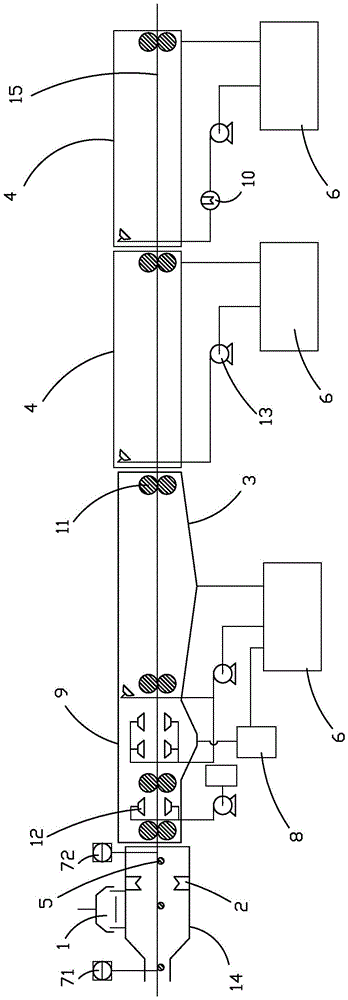
as shown in fig. 1, a strip steel temperature-rising normalizing pickling device comprises a strip steel heating cavity 14 and a pickling tank which are sequentially arranged along the strip steel conveying direction, wherein a strip steel inlet and a strip steel outlet are arranged on the strip steel heating cavity 14 and the pickling tank corresponding to the strip steel conveying path, the pickling tank is used for pickling strip steel 15 when the strip steel 15 passes through the pickling tank, a heating device 2 and a carrier roller 5 are arranged in the strip steel heating cavity 14, the heating device 2 is used for heating the strip steel 15 when the strip steel 15 passes through the strip steel heating cavity 14, and the carrier roller 5 is used for supporting the strip steel 15.
The strip steel 15 directly enters the strip steel heating cavity 14 without being cooled, the heating device 2 in the strip steel heating cavity 14 heats the strip steel 15 to a high temperature (for example, 80 ℃ to 120 ℃), the heated strip steel 15 enters a pickling tank, acid liquid (for example, hydrochloric acid) in the pickling tank reacts with the strip steel 15 violently, so that iron scales on the surface of the strip steel 15 drop off greatly, and the descaling effect is equivalent to that of a shot blasting machine; the strip steel 15 is hot when entering the pickling tank, and can be largely descaled without high-temperature acid liquor. Compared with the existing descaling device combining mechanical shot blasting and hydrochloric acid pickling, the strip steel temperature-rising normalizing pickling device provided by the utility model has the advantages of lower energy consumption, lower acid liquor temperature, less volatilization and lower acid consumption.
The heating mode of the heating device 2 can be open fire, radiation, etc., in this embodiment, the strip steel outlet end at the top of the strip steel heating cavity 14 is provided with the first air exhaust device 1 for exhausting the smoke generated by the heating strip steel 15, and preventing the smoke from overflowing from the strip steel outlet of the strip steel heating cavity 14 and entering the pickling tank to cause danger. The first air exhausting device 1 is also used for controlling the temperature in the strip heating cavity 14, and in this embodiment, the strip heating cavity is made of heat insulation material, such as heat insulation cotton or rock wool.
In this embodiment, a first plate temperature detecting device 71 and a second plate temperature detecting device 72 are respectively disposed at a strip steel inlet and a strip steel outlet of the strip steel heating chamber 14, the first plate temperature detecting device 71 is used for detecting the strip steel temperature at the strip steel inlet of the strip steel heating chamber 14, the second plate temperature detecting device 72 is used for detecting the strip steel temperature at the strip steel outlet of the strip steel heating chamber 14, and the first plate temperature detecting device 71 and the second plate temperature detecting device 72 are respectively connected to the heating device 2 to feed back the detection results to the heating device 2. The heating device 2 may: calculating heating power based on the detection result of the first plate temperature detecting means 71, the transport speed of the strip steel 15, and the target temperature (e.g., 80 ℃ to 120 ℃) of the strip steel 15; heating the strip steel 15 according to the calculated heating power; the heating of the strip steel 15 is continued or stopped according to the detection result of the second plate temperature detecting means 72. In other embodiments, the second plate temperature detecting device 72 and/or the first plate temperature detecting device 71 may not be provided, and the strip steel 15 may be heated based on empirical data.
In the embodiment, the pickling tank comprises a first conical bottom tank 3 and a turbulent flow type shallow tank 4 which are arranged in sequence along the conveying direction of the strip steel. The acid sludge amount is reduced from the strip steel inlet of the pickling tank to the strip steel outlet of the pickling tank, and the conical bottom structure of the first conical bottom tank 3 is convenient for discharging the acid sludge; the space above and below the strip steel 15 in the turbulent flow type shallow slot 4 is small, the acid liquor fluidity is good, and the acid washing effect is good. The number of the first conical bottom grooves 3 and the turbulent flow type shallow grooves 4 is set according to the acid sludge amount, and can be 1, 2 or more.
In the embodiment, the number of the first conical bottom grooves 3 is 1, the number of the turbulent flow type shallow grooves 4 is 2, the first conical bottom grooves 3 and the turbulent flow type shallow grooves 4 respectively form an acid liquor circulating system with the corresponding acid tanks 6 through circulating pumps 13, a heat exchanger 10 is arranged between the last turbulent flow type shallow groove 4 and the corresponding acid tank 6 along the conveying direction of the strip steel, and the heat exchanger 10 is used for heating the acid liquor supplied from the acid tank 6 to the turbulent flow type shallow grooves 4 so as to solve the problem of temperature reduction of the acid liquor caused by acid liquor supplementation.
The acid liquor temperature of the existing pickling device is generally 80 ℃, the strip steel is at normal temperature (20 ℃), and the strip steel is heated by the acid liquor. After the strip steel is heated to a high temperature (for example, 80 ℃ to 120 ℃), the acid liquor in the second conical bottom groove 9, the first conical bottom groove 3 and the first turbulent flow type shallow groove 4 in the strip steel conveying direction cannot be cooled and can be pickled without heating, and the last turbulent flow type shallow groove 4 in the strip steel conveying direction needs to be heated because fresh acid liquor (generally, 30 ℃ to 50 ℃) can be supplemented.
Acid liquor concentrations between adjacent tank bodies are different, in the embodiment, the front end and/or the rear end in the strip steel output direction in the first conical bottom groove 3 and the turbulent flow type shallow groove 4 are/is provided with a wringing roller 11, so that the mutual influence of the acid liquor concentrations between the adjacent tank bodies is prevented. In other embodiments, PPH panels may also be used for partitioning.
In this embodiment, the descaling bath is still including establishing second cone kerve 9 between first cone kerve 3 and belted steel heating cavity 14 for wash in advance belted steel 15, different with conventional pickling process, the pickling behind the heating belted steel, the oxidation iron sheet is peeled off earlier and is generated acid mud, it is big to wash acid mud volume in advance, for preventing the deposit of acid mud in the second cone kerve 9, the cone bottom slope of second cone kerve 9 is steeper than first cone kerve 3, the tank bottom and the gunbarrel 8 of second cone kerve 9 are connected, gunbarrel 8 establishes the position that is less than second cone kerve 9 tank bottom, be used for collecting acid mud.
In this embodiment, the strip inlet end at the top of the pickling tank is provided with a second air exhaust device (not shown) for exhausting the acid mist in the pickling tank to prevent the acid mist from overflowing from the strip inlet end of the pickling tank.
In the embodiment, a strip steel inlet of the pickling tank is provided with a rewinding spraying desalting water device 12 for rewinding spraying and washing the acid liquor on the surface of the strip steel 15.
In this embodiment, in order to prevent a large amount of acid solution from overflowing, a compressed air injection port (not shown) is provided at the strip inlet of the pickling tank.
In this embodiment, the second cone bottom groove 9 is made of a thermal insulation material, such as thermal insulation lining brick, thick PPH, PVDF or PTFE.
The above description is only for the purpose of illustrating the preferred embodiments of the present invention and is not to be construed as limiting the utility model. It should be understood that any modification, equivalent replacement, improvement, etc. made by those skilled in the art after reading the specification, which are within the spirit and principle of the present invention, should be included in the protection scope of the present invention.