Movable steel plate surface coating applied to aged solar silicon wafer
Technical Field
The utility model relates to an anticorrosive technical field in ageing steel sheet surface of solar energy silicon chip especially relates to a be applied to movable steel sheet surface coating of ageing solar energy silicon chip.
Background
At present, a TIN film layer is usually used on the surface of carbon steel on the market, TIN (titanium nitride) is a synthetic ceramic material, is a cubic crystal system, is extremely hard, has hardness close to diamond, has Mohs hardness of 8-9, has good thermal shock resistance, and does not react with metals such as iron, chromium, calcium, magnesium and the like at high temperature. TIN is an attractive golden yellow structural material with high melting point, high hardness, good chemical stability, small wetting with metal, higher conductivity and superconductivity, and can be applied to high-temperature structural materials and superconducting materials.
The most commonly used methods for TIN film synthesis are physical vapor deposition (PVD, usually with sputter deposition, cathodic arc deposition or electron beam heating) and Chemical Vapor Deposition (CVD). Both methods sublime pure titanium and react with nitrogen in a high energy vacuum environment.
TIN is chemically stable at room temperature but is attacked by hot concentrated acids, and is oxidized at 800 ℃ under normal pressure, and the coating changes color by high-temperature impact after being coated on a steel plate. The simulation product in-service use scene is turned off after 360 ℃ heating 1H in the muffle furnace, and cooling 1H heats again, and the coating has the phenomenon of discolouration after lasting a week, and resistance rise simultaneously, and the product back corrosion is serious.
FIG. 1 shows a high temperature resistance table of similar products, and the reasons for front discoloration and resistance increase are as follows: iron atoms in the carbon steel diffuse to the film layer under the action of high temperature, so that the optical property of the film is changed, and a small amount of iron atoms which diffuse to the surface are oxidized at high temperature, so that the surface resistance of the product is increased.
The reasons for backside corrosion are: since the material is carbon steel, surface oxidation is accelerated at high temperature.
SUMMERY OF THE UTILITY MODEL
The utility model aims at overcoming the not enough of prior art, provide a be applied to movable steel sheet surface coating of ageing solar energy silicon chip.
The technical scheme of the utility model as follows: a movable steel plate surface coating applied to an aged solar silicon wafer comprises: a barrier and oxidation resistant film layer electroplated on the front surface of the carbon steel substrate and an anti-rust layer electroplated on the back surface of the carbon steel substrate;
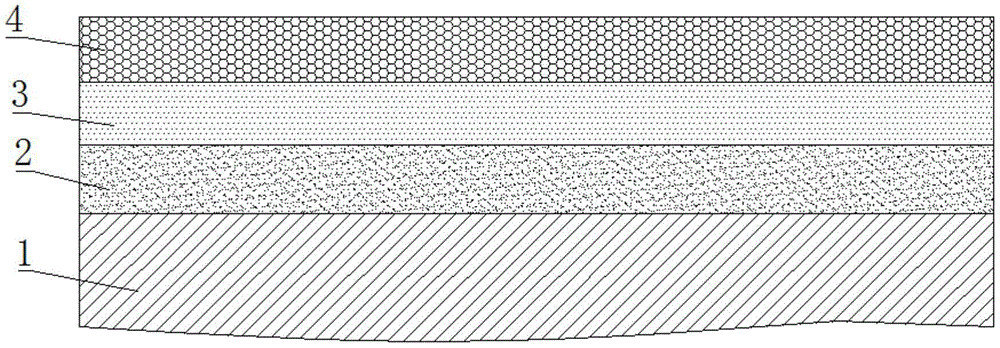
the positive separation and oxidation resistant film layer of the carbon steel substrate comprises from inside to outside: a metal priming layer, a metal bonding layer and a nitriding treatment coating;
the rust-proof layer on the back of the carbon steel substrate is a metal rust-proof layer.
Further, the metal bottom layer is Cr.
Further, the metal adhesion layer is Cr.
Further, the nitrided coating is CrN.
Further, the metal anti-rust layer is Cr.
Further, the thickness of the metal base layer is 5-10nm, the thickness of the metal bonding layer is 30-50nm, and the thickness of the nitriding treatment coating is 450-500nm.
Further, the thickness of the metal antirust layer is 30-50nm.
Adopt above-mentioned scheme, the utility model discloses plated separation and anti-oxidant rete in the front of carbon steel product, have high temperature resistant impact and anti-oxidant effect, plated metal antirust coat at the back of carbon steel product, prevent carbon steel surface oxidation.
Drawings
FIG. 1 is a statistical table of high temperature resistance performance of similar products.
Fig. 2 is a schematic structural view of the front barrier and oxidation resistant film layer of the present invention.
FIG. 3 is a schematic structural view of the back surface anti-rust layer of the present invention.
FIG. 4 is a statistical table of the high temperature resistance of CrN film.
Detailed Description
The present invention will be described in detail below with reference to the accompanying drawings and specific embodiments.
Referring to fig. 2 and 3, the present invention provides a movable steel plate surface coating applied to an aged solar silicon wafer, including: a barrier and oxidation resistant film layer electroplated on the front surface of the carbon steel substrate 1 and an anti-rust layer 2 electroplated on the back surface of the carbon steel substrate 1.
Run into high temperature impact to carbon steel product front coating and can discolour and resistance risees, the utility model discloses a solution be change separation material and thickening barrier layer, separation iron atom to rete diffusion, specifically, separation and anti-oxidant rete include from inside to outside: the metal base coat 2, the metal adhesive layer 3, the nitriding treatment coating 4, the metal base coat 2 is close to the carbon steel substrate 1.
The metal priming layer 2 is Cr (low current), the metal bonding layer 3 is Cr (high current), the nitriding treatment coating 4 is CrN, the CrN coating has the advantages of high toughness, good wear resistance, high coating bonding strength, better high-temperature oxidation resistance, corrosion resistance, low internal stress and the like, and as can be seen from figure 4, the CrN film layer has the advantages of no discoloration and rustiness due to high-temperature impact and no rise of impedance through a high-temperature resistance test.
The thickness of the metal base layer 2 is 5-10nm, the thickness of the metal bonding layer 3 is 30-50nm, and the thickness of the nitriding treatment coating 4 is 450-500nm.
To the corrosion of the carbon steel product back, the utility model discloses a solution be at the back plating antirust coat, separation carbon steel and air contact. The anti-rust layer on the back of the carbon steel substrate is a metal anti-rust layer 5, the metal anti-rust layer 5 is Cr, and the thickness of the metal anti-rust layer 5 is 30-50nm.
The above description is only exemplary of the present invention and should not be construed as limiting the present invention, and any modifications, equivalents and improvements made within the spirit and principles of the present invention are intended to be included within the scope of the present invention.