DE102017128564A1 - Sensor membrane, sensor cap, optical sensor and method for producing a sensor membrane - Google Patents
Sensor membrane, sensor cap, optical sensor and method for producing a sensor membrane Download PDFInfo
- Publication number
- DE102017128564A1 DE102017128564A1 DE102017128564.4A DE102017128564A DE102017128564A1 DE 102017128564 A1 DE102017128564 A1 DE 102017128564A1 DE 102017128564 A DE102017128564 A DE 102017128564A DE 102017128564 A1 DE102017128564 A1 DE 102017128564A1
- Authority
- DE
- Germany
- Prior art keywords
- layer
- sensor
- sensor membrane
- superhydrophilic
- units
- Prior art date
- Legal status (The legal status is an assumption and is not a legal conclusion. Google has not performed a legal analysis and makes no representation as to the accuracy of the status listed.)
- Withdrawn
Links
Images

Classifications
-
- B—PERFORMING OPERATIONS; TRANSPORTING
- B01—PHYSICAL OR CHEMICAL PROCESSES OR APPARATUS IN GENERAL
- B01D—SEPARATION
- B01D69/00—Semi-permeable membranes for separation processes or apparatus characterised by their form, structure or properties; Manufacturing processes specially adapted therefor
- B01D69/02—Semi-permeable membranes for separation processes or apparatus characterised by their form, structure or properties; Manufacturing processes specially adapted therefor characterised by their properties
-
- B—PERFORMING OPERATIONS; TRANSPORTING
- B01—PHYSICAL OR CHEMICAL PROCESSES OR APPARATUS IN GENERAL
- B01D—SEPARATION
- B01D67/00—Processes specially adapted for manufacturing semi-permeable membranes for separation processes or apparatus
- B01D67/0079—Manufacture of membranes comprising organic and inorganic components
-
- B—PERFORMING OPERATIONS; TRANSPORTING
- B01—PHYSICAL OR CHEMICAL PROCESSES OR APPARATUS IN GENERAL
- B01D—SEPARATION
- B01D67/00—Processes specially adapted for manufacturing semi-permeable membranes for separation processes or apparatus
- B01D67/0079—Manufacture of membranes comprising organic and inorganic components
- B01D67/00793—Dispersing a component, e.g. as particles or powder, in another component
-
- B—PERFORMING OPERATIONS; TRANSPORTING
- B01—PHYSICAL OR CHEMICAL PROCESSES OR APPARATUS IN GENERAL
- B01D—SEPARATION
- B01D69/00—Semi-permeable membranes for separation processes or apparatus characterised by their form, structure or properties; Manufacturing processes specially adapted therefor
- B01D69/12—Composite membranes; Ultra-thin membranes
-
- B—PERFORMING OPERATIONS; TRANSPORTING
- B01—PHYSICAL OR CHEMICAL PROCESSES OR APPARATUS IN GENERAL
- B01D—SEPARATION
- B01D69/00—Semi-permeable membranes for separation processes or apparatus characterised by their form, structure or properties; Manufacturing processes specially adapted therefor
- B01D69/14—Dynamic membranes
- B01D69/141—Heterogeneous membranes, e.g. containing dispersed material; Mixed matrix membranes
-
- B—PERFORMING OPERATIONS; TRANSPORTING
- B01—PHYSICAL OR CHEMICAL PROCESSES OR APPARATUS IN GENERAL
- B01D—SEPARATION
- B01D69/00—Semi-permeable membranes for separation processes or apparatus characterised by their form, structure or properties; Manufacturing processes specially adapted therefor
- B01D69/14—Dynamic membranes
- B01D69/141—Heterogeneous membranes, e.g. containing dispersed material; Mixed matrix membranes
- B01D69/1411—Heterogeneous membranes, e.g. containing dispersed material; Mixed matrix membranes containing dispersed material in a continuous matrix
-
- B—PERFORMING OPERATIONS; TRANSPORTING
- B01—PHYSICAL OR CHEMICAL PROCESSES OR APPARATUS IN GENERAL
- B01D—SEPARATION
- B01D69/00—Semi-permeable membranes for separation processes or apparatus characterised by their form, structure or properties; Manufacturing processes specially adapted therefor
- B01D69/14—Dynamic membranes
- B01D69/141—Heterogeneous membranes, e.g. containing dispersed material; Mixed matrix membranes
- B01D69/1411—Heterogeneous membranes, e.g. containing dispersed material; Mixed matrix membranes containing dispersed material in a continuous matrix
- B01D69/14111—Heterogeneous membranes, e.g. containing dispersed material; Mixed matrix membranes containing dispersed material in a continuous matrix with nanoscale dispersed material, e.g. nanoparticles
-
- B—PERFORMING OPERATIONS; TRANSPORTING
- B01—PHYSICAL OR CHEMICAL PROCESSES OR APPARATUS IN GENERAL
- B01D—SEPARATION
- B01D69/00—Semi-permeable membranes for separation processes or apparatus characterised by their form, structure or properties; Manufacturing processes specially adapted therefor
- B01D69/14—Dynamic membranes
- B01D69/141—Heterogeneous membranes, e.g. containing dispersed material; Mixed matrix membranes
- B01D69/142—Heterogeneous membranes, e.g. containing dispersed material; Mixed matrix membranes with "carriers"
-
- B—PERFORMING OPERATIONS; TRANSPORTING
- B01—PHYSICAL OR CHEMICAL PROCESSES OR APPARATUS IN GENERAL
- B01D—SEPARATION
- B01D69/00—Semi-permeable membranes for separation processes or apparatus characterised by their form, structure or properties; Manufacturing processes specially adapted therefor
- B01D69/14—Dynamic membranes
- B01D69/141—Heterogeneous membranes, e.g. containing dispersed material; Mixed matrix membranes
- B01D69/148—Organic/inorganic mixed matrix membranes
-
- B—PERFORMING OPERATIONS; TRANSPORTING
- B01—PHYSICAL OR CHEMICAL PROCESSES OR APPARATUS IN GENERAL
- B01D—SEPARATION
- B01D71/00—Semi-permeable membranes for separation processes or apparatus characterised by the material; Manufacturing processes specially adapted therefor
- B01D71/02—Inorganic material
- B01D71/024—Oxides
-
- B—PERFORMING OPERATIONS; TRANSPORTING
- B01—PHYSICAL OR CHEMICAL PROCESSES OR APPARATUS IN GENERAL
- B01D—SEPARATION
- B01D71/00—Semi-permeable membranes for separation processes or apparatus characterised by the material; Manufacturing processes specially adapted therefor
- B01D71/02—Inorganic material
- B01D71/028—Molecular sieves
- B01D71/0281—Zeolites
-
- B—PERFORMING OPERATIONS; TRANSPORTING
- B01—PHYSICAL OR CHEMICAL PROCESSES OR APPARATUS IN GENERAL
- B01D—SEPARATION
- B01D2313/00—Details relating to membrane modules or apparatus
- B01D2313/20—Specific housing
- B01D2313/205—Specific housing characterised by the shape
-
- B—PERFORMING OPERATIONS; TRANSPORTING
- B01—PHYSICAL OR CHEMICAL PROCESSES OR APPARATUS IN GENERAL
- B01D—SEPARATION
- B01D2325/00—Details relating to properties of membranes
- B01D2325/02—Details relating to pores or porosity of the membranes
- B01D2325/022—Asymmetric membranes
- B01D2325/0233—Asymmetric membranes with clearly distinguishable layers
-
- B—PERFORMING OPERATIONS; TRANSPORTING
- B01—PHYSICAL OR CHEMICAL PROCESSES OR APPARATUS IN GENERAL
- B01D—SEPARATION
- B01D2325/00—Details relating to properties of membranes
- B01D2325/36—Hydrophilic membranes
-
- B—PERFORMING OPERATIONS; TRANSPORTING
- B01—PHYSICAL OR CHEMICAL PROCESSES OR APPARATUS IN GENERAL
- B01D—SEPARATION
- B01D2325/00—Details relating to properties of membranes
- B01D2325/43—Specific optical properties
-
- B—PERFORMING OPERATIONS; TRANSPORTING
- B01—PHYSICAL OR CHEMICAL PROCESSES OR APPARATUS IN GENERAL
- B01D—SEPARATION
- B01D2325/00—Details relating to properties of membranes
- B01D2325/43—Specific optical properties
- B01D2325/44—Specific light transmission
-
- B—PERFORMING OPERATIONS; TRANSPORTING
- B01—PHYSICAL OR CHEMICAL PROCESSES OR APPARATUS IN GENERAL
- B01D—SEPARATION
- B01D71/00—Semi-permeable membranes for separation processes or apparatus characterised by the material; Manufacturing processes specially adapted therefor
- B01D71/06—Organic material
- B01D71/30—Polyalkenyl halides
- B01D71/32—Polyalkenyl halides containing fluorine atoms
- B01D71/36—Polytetrafluoroethylene
-
- B—PERFORMING OPERATIONS; TRANSPORTING
- B01—PHYSICAL OR CHEMICAL PROCESSES OR APPARATUS IN GENERAL
- B01D—SEPARATION
- B01D71/00—Semi-permeable membranes for separation processes or apparatus characterised by the material; Manufacturing processes specially adapted therefor
- B01D71/06—Organic material
- B01D71/54—Polyureas; Polyurethanes
-
- G—PHYSICS
- G01—MEASURING; TESTING
- G01N—INVESTIGATING OR ANALYSING MATERIALS BY DETERMINING THEIR CHEMICAL OR PHYSICAL PROPERTIES
- G01N21/00—Investigating or analysing materials by the use of optical means, i.e. using sub-millimetre waves, infrared, visible or ultraviolet light
- G01N21/75—Systems in which material is subjected to a chemical reaction, the progress or the result of the reaction being investigated
- G01N21/77—Systems in which material is subjected to a chemical reaction, the progress or the result of the reaction being investigated by observing the effect on a chemical indicator
- G01N2021/7796—Special mountings, packaging of indicators
Landscapes
- Chemical & Material Sciences (AREA)
- Chemical Kinetics & Catalysis (AREA)
- Inorganic Chemistry (AREA)
- Dispersion Chemistry (AREA)
- Engineering & Computer Science (AREA)
- Manufacturing & Machinery (AREA)
- Life Sciences & Earth Sciences (AREA)
- Geology (AREA)
- Nanotechnology (AREA)
- Investigating Or Analysing Materials By The Use Of Chemical Reactions (AREA)
Abstract
Eine Sensormembran (13) für einen optischen Sensor (1), mit einem mehrschichtigen Aufbau umfassend zumindest zwei Schichten (17-20) dadurch gekennzeichnet, dass zumindest eine erste der beiden Schichten (17-20) der Sensormembran (13) als eine äußere medienberührende Schicht ausgebildet ist, welche mindestens eine hierarchisch strukturierte superhydrophile Oberfläche aufweist, wobei die mediumsberührende Schicht eine Polymermatrix aufweist in welcher Einheiten mit einer mittleren Teilchengröße von weniger als 100 µm mit superhydrophiler Oberfläche nur teilweise eingebettet in der Polymermatrix der ersten Schicht sind, derart dass der von der Polymermatrix der ersten Schicht freiliegende Bereich der superhydrophilen Oberflächen Teil der Oberfläche der als mediumsberührend ausgebildeten Schicht ist,
sowie eine Sensorkappe (3), ein optischer Sensor (1) und ein Verfahren zu deren Herstellung.

and a sensor cap (3), an optical sensor (1) and a method of manufacturing the same.
Description
Die vorliegende Erfindung betrifft eine Sensormembran, eine Sensorkappe, einen optischen Sensor und ein Verfahren zur Herstellung einer Sensormembran.The present invention relates to a sensor membrane, a sensor cap, an optical sensor and a method for producing a sensor membrane.
Es gibt eine Vielzahl von Sensorspots für amperometrische und optische Sensoren. Alle bisher verwendeten Sensorspots bestehen fast ausschließlich auf Silikonen oder Fluoropolymerbasis. Der Grund für die Verwendung dieser Polymere ist a) die Gasdurchlässigkeit, b) die lonensperrwirkung und c) die mäßig (Silikon) bis sehr gute (vollständig fluorierte Polymer) chemische Beständigkeit dieser Materialien gegenüber aggressiven Medien wie starken Laugen und Säuren bei Temperaturen bis 90°C. Des Weiteren sind diese Materialien sterilisierbar was bei optischen Sensoren in Pharmaapplikationen von besonderer Bedeutung ist.There are a variety of sensor spots for amperometric and optical sensors. All previously used sensor spots consist almost exclusively of silicones or fluoropolymers. The reason for using these polymers is a) the gas permeability, b) the ion barrier effect and c) the moderate (silicone) to very good (fully fluorinated polymer) chemical resistance of these materials to aggressive media such as strong lyes and acids at temperatures up to 90 ° C. Furthermore, these materials are sterilizable, which is of particular importance in optical sensors in pharmaceutical applications.
Eine Sensormembran eines optischen Sensors auf Basis von Silikon oder einem Fluoropolymer wird in der
In der
Die
Ein Nachteil insbesondere bei porösen Membranen wie sie häufig bei amperometrischen Sensoren wie zum Beispiel Chlor, Chlordioxide, Wasserstoffperoxid Sensoren Verwendung finden, ist jedoch das Auftreten von Biofilmen insbesondere nach Lagerung in der Aufbewahrungskappe. Durch die unpolare Oberfläche und gleichzeitig großer Oberflächenrauigkeit können sich auf der Oberfläche leicht Keime und Mikroorganischen ablagern und vermehren. Dies kann unter günstigen Bedingungen schon nach einigen Tagen auftreten.However, a disadvantage in particular in the case of porous membranes, which are frequently used in amperometric sensors, for example chlorine, chlorine dioxide or hydrogen peroxide sensors, is the occurrence of biofilms, in particular after storage in the storage cap. Due to the non-polar surface and at the same time large surface roughness, germs and microorganisms can easily deposit and multiply on the surface. This can occur under favorable conditions after a few days.
Ein weiterer Nachteil dieser Membranen ist die sehr gute Sauerstoffpermeabilität in Hinblick auf Anwendungen in sogenannten Benchtop-Fermentern. Einerseits ist bei der Sauerstoffmessung diese gute Permeabilität gewünscht, andererseits können sich leicht Blasen an der Oberfläche dieser Membranen anlagern. Bei Benchtop-Fermentern und allen Sensoreinbaupositionen in einer senkrechten oder nur leicht geneigten Position zur Lotrechten des Reaktorbehälters ist ein Entfernen der Blasen nicht mehr möglich. Die Messergebnisse insbesondere bei Sauerstoffsensoren, werden nachhaltig beeinträchtigt. In der Vergangenheit wurden diese Probleme nur notdürftig durch a) Zugabe eines Antischaummittels oder b) Spülen versucht zu lösen. Keine Methode ist jedoch zufriedenstellend. Während das Antischaummittel mögliche Fermentationsprozesse beeinträchtigt, ist ein Abspülen der Blasen oft auch nur eine temporäre Lösung.Another disadvantage of these membranes is the very good oxygen permeability with regard to applications in so-called benchtop fermenters. On the one hand, in the measurement of oxygen, this good permeability is desired, on the other hand, bubbles can easily accumulate on the surface of these membranes. For benchtop fermenters and all sensor installation positions in a vertical or only slightly inclined position to the vertical of the reactor vessel, removal of the bubbles is no longer possible. The measurement results, especially with oxygen sensors, are permanently impaired. In the past, these problems were only attempted by a) adding an antifoaming agent or b) rinsing tried to solve. No method is satisfactory. While the defoamer interferes with possible fermentation processes, rinsing the bubbles is often just a temporary solution.
Die Aufgabe der Erfindung ist es eine Verbesserung von Biofouling-Tendenzen und Blasenablagerung auf hydrophoben MembranenThe object of the invention is to improve biofouling tendencies and bubble deposition on hydrophobic membranes
Die vorliegende Erfindung löst diese Aufgabe durch das Bereitstellen einer Sensormembran mit den Merkmalen des Anspruchs 1.The present invention solves this problem by providing a sensor membrane having the features of
Eine erfindungsgemäße Sensormembran kann in einem optischen Sensor eingesetzt werden. Sie weist einen mehrschichtigen Aufbau mit zumindest zwei Schichten auf. Die Sensormembran kann allerdings auch mehrere weitere Schichten, vorzugsweise jedoch weniger als zehn Schichten, aufweisen. Zumindest eine der zumindest zwei Schichten der Sensormembran ist als eine äußere medienberührende Schicht ausgebildet.A sensor membrane according to the invention can be used in an optical sensor. It has a multilayer structure with at least two layers. However, the sensor membrane can also have several further layers, but preferably less than ten layers. At least one of the at least two layers of the sensor membrane is formed as an outer media-contacting layer.
In seiner Ausbildung als mediumsberührende Schicht ist die erste Schicht bei bestimmungsgemäßer Verwendung des Sensors in direktem Kontakt mit dem Messmedium.In its design as a medium-contacting layer, the first layer is in direct contact with the measuring medium when the sensor is used as intended.
Optional kann unterhalb der ersten Schicht eine Opferschicht vorgesehen sein, welche sich im Kontakt mit dem Messmedium abbaut. Unterhalb der Opferschicht kann abermals eine zur ersten Schicht identische Schicht angeordnet sein. Entsprechend ist ein alternierender Aufbau aus ersten Schichten und Opferschichten realisierbar.Optionally, a sacrificial layer may be provided below the first layer, which degrades in contact with the measured medium. Below the sacrificial layer, a layer identical to the first layer can again be arranged. Accordingly, an alternating structure of first layers and sacrificial layers can be realized.
Falls Opferschichten verwendet werden, sind sie stets die zweitäußerste Schicht, welche z.B. bei einer CIP- Reinigung ebenfalls wieder hydrophilisiert wird, z.B. durch Ablösen vom Polymermatrixbestandteilen. If sacrificial layers are used, they are always the second outermost layer which, for example, is also hydrophilized again in a CIP cleaning, for example by detachment from the polymer matrix constituents.
Die erste Schicht weist mindestens eine hierarchisch strukturierte superhydrophile Oberfläche auf. Die hierarchische Strukturierung bezieht sich auf die Hydrophobie bzw. Hydrophilie der Oberfläche. Die hierarchische Struktur kann beispielsweise derart erfolgen, dass eine die erste Schicht im Wesentlichen ausbildende Polymermatrix eine Oberfläche zum Messmedium hin bildet und dass aus dieser Oberfläche abschnittsweise, z.B. punktuell, Bereiche von Einheiten herausragen, welche eine zur Polymermatrix stark verschiedene Hydrophilie aufweisen.The first layer has at least one hierarchically structured superhydrophilic surface. Hierarchical structuring refers to the hydrophobicity or hydrophilicity of the surface. The hierarchical structure may, for example, be such that a polymer matrix essentially forming the first layer forms a surface towards the measurement medium and that from this surface, in sections, e.g. punctuate, areas of units that have a very different to the polymer matrix hydrophilicity.
In einer bevorzugten Variante der Erfindung weisen die Einheiten
- a) eine Nanostrukturierte Oberfläche wie z.B. Seitenketten auf, welche vorzugsweise superhydrophil ausgebildet sein können; und
- b) eine Mikrostrukturierte Einheit z.B. eine Kugel und/oder eine Hohlkugel mit superhydrophilen bis hydrophoben Eigenschaften auf
- a) a nanostructured surface such as side chains, which may be formed preferably superhydrophilic; and
- b) a microstructured unit such as a ball and / or a hollow sphere with superhydrophilic to hydrophobic properties
Das Polymer, in welchem die Einheiten teilweise eingebettet sind ist vorzugsweise
- c) ein Polymer mit superhydrophilen bis hydrophoben Eigenschaften.
- c) a polymer with superhydrophilic to hydrophobic properties.
So kann es sich bei der Oberfläche der Polymermatrix um eine hydrophobe Oberfläche handeln und bei der Oberfläche der bereichsweise herausragenden Einheiten um eine superhydrophile Oberfläche.Thus, the surface of the polymer matrix may be a hydrophobic surface and the surface of the partially protruding units may be a superhydrophilic surface.
Die zweite Schicht kann z.B. bei einem optischen Sensor eine Reflektor- und/oder Diffusionsbarriereschicht oder eine Haftvermittlerschicht zur Verbindung der ersten schicht mit einer Reflektor- und/oder Diffusionsbarriereschicht sein.The second layer may e.g. in the case of an optical sensor, a reflector and / or diffusion barrier layer or a bonding agent layer for bonding the first layer to a reflector and / or diffusion barrier layer.
Als hydrophob in Rahmen der vorliegenden Erfindung wird im Rahmen des sogenannten Sessile Drop Verfahren eine Oberfläche bezeichnet, welche einen Kontaktwinkel gegenüber Wasser von mehr als 90° bei Raumtemperatur und Normdruck aufweisen. Der Begriff hydrophob umfasst dabei auch superhydrophobe Oberflächen.As hydrophobic in the context of the present invention, a surface is referred to in the context of the so-called sessile drop method, which have a contact angle with respect to water of more than 90 ° at room temperature and standard pressure. The term hydrophobic also encompasses superhydrophobic surfaces.
Als superhydrophil in Rahmen der vorliegenden Erfindung wird im Rahmen des sogenannten Sessile Drop Verfahren eine Oberfläche bezeichnet, welche einen Kontaktwinkel gegenüber Wasser von weniger als 10° bei Raumtemperatur und Normdruck aufweisen.As superhydrophilic in the context of the present invention, in the context of the so-called sessile drop method, a surface is designated which has a contact angle with respect to water of less than 10 ° at room temperature and standard pressure.
Die vorgenannten Einheiten weisen eine mittlere Teilchengröße von weniger als 50 µm auf. Die mittlere Teilchengröße bezieht sich auf eine Durchschnittsverteilung und bezieht sich auf die Gesamtzahl an Einheiten in der ersten Schicht.The aforementioned units have an average particle size of less than 50 microns. The mean particle size refers to an average distribution and refers to the total number of units in the first layer.
Die Einheiten mit superhydrophiler Oberfläche sind nur teilweise eingebettet in der Polymermatrix der ersten Schicht, so dass sie über einen freiliegenden Bereich verfügen, welcher entweder direkt in Kontakt mit dem Messmedium oder mit der Opferschicht steht.The superhydrophilic surface units are only partially embedded in the polymer matrix of the first layer so that they have an exposed region which either directly contacts the measurement medium or the sacrificial layer.
Somit ist dieser freiliegende Bereich der Einheiten Teil der zum Messmedium hin gewandten Oberfläche der als mediumsberührend ausgebildeten Schicht.Thus, this exposed area of the units is part of the surface of the medium-contacting surface facing the measuring medium.
Die Gesamtheit der äußersten Oberfläche sollte besonders bevorzugt superhydrophil sein.The entirety of the outermost surface should most preferably be superhydrophilic.
Durch die Kombination aus hydrophilen und hydrophoben Eigenschaften auf der Oberfläche der ersten Schicht werden sowohl die Stärken hydrophober als auch hydrophiler Materialien genutzt, so dass es weder zu einer Blasenablagerung noch zu einem Biofouling oder einem anderweitigen schnellen Abbau der Sensormembran-Schicht kommt.The combination of hydrophilic and hydrophobic properties on the surface of the first layer utilizes both the strengths of hydrophobic and hydrophilic materials so that neither bubble deposition nor biofouling or other rapid degradation of the sensor membrane layer occurs.
Vorteilhafte Eigenschaften sind Gegenstand der Unteransprüche.Advantageous properties are the subject of the dependent claims.
Es ist von Vorteil, wenn die Einheiten jeweils einen Trägerkörper, vorzugsweise eine Naturstoffkapsel, aufweist und auf dem Trägerkörper polare Gruppen angeordnet sind.It is advantageous if the units each have a carrier body, preferably a natural substance capsule, and polar groups are arranged on the carrier body.
Der Trägerkörper muss nicht zwingend eine Naturstoffkapsel sein, sondern kann auch als ein Polymerkörper, z.B. eine Kapsel, Hohlkugel, Mikrosphäre, Knäulstruktur, als Massivkörper mit runder, ovaler oder ringartiger Form ausgebildet sein. Bei dem Trägerkörper kann es sich auch aus einem Verbund mehrerer Naturstoffkapseln (Kieselalgen) handeln. The carrier body does not necessarily have to be a natural substance capsule, but can also be designed as a polymer body, for example a capsule, hollow sphere, microsphere, nodule structure, as a solid body with a round, oval or ring-like shape. The carrier body can also be a composite of several natural substance capsules (diatoms).
Die Einheiten können vorzugsweise als sogenannte mikro-nanostrukturierte Einheiten ausgebildet sein. Dabei handelt es sich um einen Trägerkörper mit 0,1 bis 100 µm Größe und um eine oder mehrere auf der Trägeroberfläche angeordnete Nanostrukturen, z.B. molekulare Seitenketten oder eine Schicht im Bereich von weniger als 80 nm, vorzugsweise weniger als 50 nm.The units may preferably be designed as so-called micro-nanostructured units. It is a carrier body of 0.1 to 100 microns in size and about one or more arranged on the support surface nanostructures, e.g. molecular side chains or a layer in the range of less than 80 nm, preferably less than 50 nm.
Der Trägerkörper weist dabei vorzugsweise eine andere Hydrophobie bzw. Hydrophilie auf als die auf dem Trägerkörper angeordnete Nanostruktur. Bevorzugt ist der Trägerkörper hydrophob und die Nanostruktur superhydrophil ausgebildet.The carrier body preferably has a different hydrophobicity or hydrophilicity than the nanostructure arranged on the carrier body. The carrier body is preferably hydrophobic and the nanostructure is superhydrophilic.
Bei den hierarchischen Oberflächen, also den durch die Einheiten auf der Polymermatrix gebildeten Oberflächen, kann es sich bevorzugt um Oberflächen mit „Pincushion“ Struktur und/oder „Honeycomb“ Struktur handeln. Diese Strukturtypen haben sich als besonders optimal zur Ausbildung einer Oberfläche mit einheitlichen Oberflächeneigenschaften erwiesen.The hierarchical surfaces, that is to say the surfaces formed by the units on the polymer matrix, can preferably be surfaces with "pincushion" structure and / or "honeycomb" structure. These types of structures have proven to be particularly optimal for forming a surface with uniform surface properties.
Die mindestens teilweise in die Polymermatrix der als medienberührend ausgebildeten Schicht eintauchenden Einheiten können als nanostrukturierte mikrosphärische Strukturen wie superhydrophile modifizierte Exine ausgebildet sein.The units immersed at least partially into the polymer matrix of the layer in contact with the media may be in the form of nanostructured microspherical structures such as superhydrophilic modified exine.
Die mindestens teilweise in die medienberührende Schicht eintauchenden Einheiten können als nanostrukturierte superhydrophile modifizierte Exine ausgebildet sein, alternativ können die Trägerkörper der Einheiten auf anderen Polystyrolderivaten, Siliziumoxid, Titanoxid, Zeolith und/oder MOF (metall-organic framework) basieren. Diese Materialien sind gegenüber einer Vielzahl von Chemikalien besonders stabil und lassen sich gut in eine Polymermatrix einbinden.The at least partially submerged in the media-contacting layer units may be formed as a nanostructured superhydrophilic modified exine, alternatively, the support body of the units based on other polystyrene derivatives, silica, titanium oxide, zeolite and / or MOF (metal-organic framework). These materials are particularly stable to a variety of chemicals and can be incorporated well into a polymer matrix.
Nanostrukturierte Gruppen auf dem Trägerkörper sind beispielsweise PEG-Gruppen, Polyamin-Gruppen und/oder Spermine.Nanostructured groups on the carrier body are, for example, PEG groups, polyamine groups and / or spermines.
Die Einheiten können auch als Pentagel und/oder Aragel ausgebildet sein.The units can also be designed as pentagel and / or aragel.
Die Sensormembran kann vorteilhaft eine Opferschicht enthalten, welche zunächst den hydrolytischen Abbau verhindert und dann nach hydrolytischer Spaltung eine hydrophile oder superhydrophile Oberfläche medienberührend bereitstellt. So kann die sensible Sensormembran zunächst vor Inbetriebnahme durch die Opferschicht geschützt werden. Eine Opferschicht kann im einfachsten Fall ein Silikon sein.The sensor membrane may advantageously contain a sacrificial layer which initially prevents the hydrolytic degradation and then, after hydrolytic cleavage, provides a hydrophilic or superhydrophilic surface in contact with the medium. Thus, the sensitive sensor membrane can first be protected from being put into operation by the sacrificial layer. A sacrificial layer can be a silicone in the simplest case.
Vorteilhaft kann die Membran eine topographisch strukturierte Oberfläche aufweisen. Hier kann das Substrat beispielsweise eine konische Form aufweisen. Bei der formgebenden Substratkontur handelt es sich aber nicht um eine Mikro- oder Nanostruktur welche die Hydrophilie beeinflusst. Die Kontur dient vielmehr um Blasen abweisende Eigenschaften zu erzeugen, welche neben der Oberflächenhydrophilie auch durch Geometrie der Kappe erzeugt werden können.Advantageously, the membrane may have a topographically structured surface. Here, for example, the substrate may have a conical shape. However, the shaping substrate contour is not a microstructure or nanostructure which influences the hydrophilicity. Rather, the contour serves to create blister-repellent properties which, in addition to surface hydrophilicity, can also be generated by the geometry of the cap.
Die Membran kann vorzugsweise blasenabweisend ausgebildet sein. Sie kann zudem belagabweisend, Antifouling-Eigenschaften aufweisen, temperatur- und hydrolysestabil sein und dauerhaft superhydrophil ausgebildet sein.The membrane may preferably be formed bubble-repellent. In addition, it can have anti-fouling, anti-fouling properties, be stable against temperature and hydrolysis and be permanently superhydrophilic.
Eine Sensormembran gilt im Rahmen der vorliegenden Erfindung als Temperatur stabil, wenn Sie
Eine Oberfläche gilt Im Rahmen der vorliegenden Erfindung als blasenabweisend wenn eine Oberfläche kleiner 5% mit Blasen bedeckt ist, bzw. die Blasen, auch bei schwacher oder keiner Strömung, nicht länger wie 30 Sekunden an der Oberfläche verbleiben.In the context of the present invention, a surface is considered to be bubble-repellent if a surface of less than 5% is covered with bubbles, or the bubbles remain on the surface for no longer than 30 seconds, even with weak or no flow.
Die Sensormembran gilt im Rahmen der vorliegenden Erfindung als belagabweisend wenn der EHEDG Testkriterien erfüllt sind „A Method for Assessment of In-Place Cleanability of Food Processing Equipment (EHEDG Document
Die Sensormembran sollte als Beleg der Hydrolysestabilität
Die erste Schicht der Sensormembran umfasst vorteilhaft zumindest zu 50 Gew.-% eines oder mehrere Polyurethane, eines oder mehrere Fluoropolymere, eines oder mehrere Hybrid-Verbindungen mit Siloxanen (polymer-coated SiNPs) und/oder eines oder mehrere Silikone. Die Polymermatrix der ersten Schicht der Sensormembran ist aus einem der vorgenannten Polymere aufgebaut, welche zudem als Haftvermittler für die eingebetteten Einheiten dienen.The first layer of the sensor membrane advantageously comprises at least 50% by weight of one or more polyurethanes, one or more fluoropolymers, one or more hybrid compounds with siloxanes (polymer-coated SiNPs) and / or one or more silicones. The polymer matrix of the first layer of the sensor membrane is constructed from one of the abovementioned polymers, which also serve as adhesion promoters for the embedded units.
Die Sensormembran kann vorteilhaft als Sensormembran eines optischen Sensors ausgebildet sein und aus mindestens drei Schichten aufgebaut sein. Diese drei Schichten umfassen zumindest die erste Schicht, welche als mediumsberührende Schicht ausgebildet ist; sowie eine zweite Schicht umfassend einen optischen Isolator, eine Reflektorsubstanz und/oder ein Diffusionsbarriere-Material, wobei zweite Schicht eine Polymermatrix aufweist, welche vorzugsweise hydrophob, insbesondere superhydrophob, ausgebildet ist; und eine dritte Schicht umfassend eine sensitive Substanz, insbesondere ein oder mehrere Luminophore, für die spezifische Bestimmung eines Analyten, wobei die dritte Schicht zudem ein Polymermaterial aufweist, in welches die sensitive Substanz eingebettet ist.The sensor membrane may advantageously be formed as a sensor membrane of an optical sensor and be composed of at least three layers. These three layers comprise at least the first layer, which is formed as a medium-contacting layer; and a second layer comprising an optical isolator, a reflector substance and / or a diffusion barrier material, wherein the second layer has a polymer matrix, which is preferably hydrophobic, in particular superhydrophobic; and a third layer comprising a sensitive substance, in particular one or more luminophores, for the specific determination of an analyte, wherein the third layer additionally comprises a polymer material in which the sensitive substance is embedded.
Ein erfindungsgemäßes Verfahren zum Herstellen der erfindungsgemäßen Sensormembran, umfasst die folgenden Schritte
- A Bereitstellen zumindest der zweiten Schicht als Trägermaterial der als mediumsberührend ausgebildeten ersten Schicht;
- B Bereitstellen eines Polymermatrix-Materials zur Aufbringung als erste Schicht;
- C Bereitstellen von Trägerkörpern, vorzugsweise hydrophoben Naturstoff-Kapseln, insbesondere Exine von Pollen und/oder Sporen, durch Hydrolyse und Herauswaschen von Abbauprodukten;
- D Hydrophilisierung der Trägerkörper, insbesondere der Naturstoffkapseln, durch Reaktion der Naturstoffkapseln mit Verbindungen ausgesucht aus einer Gruppe bestehend aus Polyethylenglykol, Polyglycerol, vorzugsweise mit n (Kettenlänge) =1-500, Polypropylenglykol, Oligomere der Bausteine Ethylenglykol und Glycerol, hochverzweigte oder dendrimetrische Polyglycerole, Dextrane und deren Derivate und/oder polare Polyol-Polymere, insbesondere Polyvinylalkohol unter Ausbildung von hydrophilisierten Einheiten; und
- E Aufbringen und/oder Einbringen der hydrophilisierten Einheiten in das Polymermatrix-Material, derart, dass zumindest 20 Gew.-% der hydrophilisierten Einheiten bereichsweise in Kontakt mit dem Medium stehen können.
- Providing at least the second layer as a carrier material of the first layer formed as contacting the medium;
- B providing a polymeric matrix material for application as a first layer;
- C Provision of carrier bodies, preferably hydrophobic natural substance capsules, in particular exines of pollen and / or spores, by hydrolysis and washing out of degradation products;
- D Hydrophilization of the carrier bodies, in particular the natural product capsules, by reaction of the natural substance capsules with compounds selected from a group consisting of polyethylene glycol, polyglycerol, preferably with n (chain length) = 1-500, polypropylene glycol, oligomers of the building blocks ethylene glycol and glycerol, highly branched or dendrimetric polyglycerols, Dextranes and their derivatives and / or polar polyol polymers, in particular polyvinyl alcohol to form hydrophilized units; and
- E application and / or introduction of the hydrophilized units into the polymer matrix material, such that at least 20% by weight of the hydrophilized units can be in area contact with the medium.
Das Polymermatrix-Material kann bereits vor dem Schritt
Als Trägerkörper kommen Naturkapseln in Betracht.Suitable carrier capsules are natural capsules.
Das Trägermaterial ist das Material der zweiten Schicht. Die zweite Schicht kann Teil eines Schichtpakets sein, welches eine analyt-sensitive Schicht, vorzugsweise als luminophorhaltige Schicht, und eine optisch-isolierenden Schicht aufweist. Die zweite Schicht kann aber auch eine Reflektor- und/oder Diffusionsbarriereschicht oder eine Haftvermittlerschicht ausgebildet sein.The carrier material is the material of the second layer. The second layer may be part of a layer package which has an analyte-sensitive layer, preferably as a luminophore-containing layer, and an optically insulating layer. However, the second layer can also be formed as a reflector and / or diffusion barrier layer or an adhesion promoter layer.
Das Polymermatrix-Material kann nach dem schichtweisen Auftrag zusätzlich auf dem Trägermaterial aushärten. Dies kann durch Trocknung erfolgen.The polymer matrix material can additionally harden on the carrier material after the layered application. This can be done by drying.
Weiterhin kann in einem Folgeschritt der Auftrag einer Opferschicht auf die erste Schicht erfolgen.Furthermore, in a subsequent step, the application of a sacrificial layer to the first layer can take place.
Die Sensormembran kann insbesondere die folgenden Schichten aufweisen:
- die mediumsberührende Schicht und
- eine erste Zwischenschicht und/oder
- eine optisch-isolierende Schicht und/oder
- eine zweite migrationsinhibierende Zwischenschicht und
- eine analyt-sensitive, insbesondere luminophorhaltige, Schicht aufweist und,
- vorzugsweise eine sechste als Haftvermittler gegenüber einem Substrat fungierende Schicht
- the medium contacting layer and
- a first intermediate layer and / or
- an optically insulating layer and / or
- a second migration inhibiting intermediate layer and
- has an analyte-sensitive, in particular luminophorhaltige, layer and,
- preferably a sixth layer acting as adhesion promoter relative to a substrate
Die sechste Schicht, die als Haftvermittler-Schicht ausgebildet ist, ist lediglich eine optionale Schicht. Es ist auch denkbar, dass die fünf vorhergehenden Schichten ohne zusätzliche Haftvermittlerschicht auf einem Substrat angeordnet sind.The sixth layer, which is designed as a primer layer, is merely an optional layer. It is also conceivable that the five preceding layers are arranged on a substrate without additional adhesion promoter layer.
Die Funktionalität der ebenfalls optionalen migrationsinhibierenden Zwischenschicht kann auch durch eine andere Schicht übernommen werden.The functionality of the likewise optional migration-inhibiting intermediate layer can also be taken over by another layer.
Substrate auf welche die erfindungsgemäße Sensormembran oder eine bevorzugte Variante anordnenbar sind, können beispielsweise aus Quarz, Borsilikat, und/oder einem thermoplastischen Kunststoff, z.B Polymethylmethakrylat (PMMA), ausgebildet sein.Substrates on which the sensor membrane according to the invention or a preferred variant can be arranged can be formed, for example, from quartz, borosilicate, and / or a thermoplastic, for example polymethyl methacrylate (PMMA).
Bei der Zwischenschicht kann es sich um eine reine Polymerschicht ohne oder mit Kapseln aufweist.The intermediate layer may be a pure polymer layer with or without capsules.
Die optisch-isolierende Schicht kann vorteilhaft farbige Substanzen, z.B. Pigmente oder andersartige farbige Partikel, aufweisen.The optically insulating layer may advantageously be colored substances, e.g. Pigments or other colored particles.
Weiterhin erfindungsgemäß ist eine Sensorkappe zum Aufsatz auf einen optischen Sensor umfassend die Sensormembran nach einem der vorhergehenden Ansprüche. Diese Sensorkappe ermöglicht vorteilhaft ein Nachrüsten bereits bestehender optischer Sensoren.Furthermore, according to the invention, a sensor cap for attachment to an optical sensor comprising the sensor membrane according to one of the preceding claims. This sensor cap advantageously makes it possible to retrofit existing optical sensors.
Alternativ oder zusätzlich umfasst ein erfindungsgemäßer optischer Sensor eine Empfangs- und Sendeeinheit mit einer Lichtquelle, zum Aussenden eines luminophorspezifischen Anregungssignals, und eine erfindungsgemäße Sensormembran umfassend das Luminophor, welches durch das Anregungssignal zum Aussenden eines Emissionssignals angeregt wird.Alternatively or additionally, an optical sensor according to the invention comprises a receiving and transmitting unit with a light source for emitting a luminophore-specific excitation signal, and a sensor membrane according to the invention comprising the luminophore, which is excited by the excitation signal for emitting an emission signal.
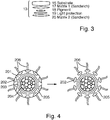
Nachfolgend wird die Erfindung anhand eines Ausführungsbeispiels unter Zuhilfenahme der beiliegenden Zeichnungen näher erläutert. Die Zeichnungen enthalten dabei auch mehrere Merkmale, welche für sich genommen in naheliegender Weise mit anderen nicht dargestellten Ausführungsbeispielen kombinierbar sind. Die Ausführungsbeispiele in ihrer Gesamtheit sind dabei keineswegs beschränkend für den Schutzumfang der vorliegenden Erfindung zu verstehen. Es zeigen:
-
1 eine schematische Explosionsdarstellung eines Ausführungsbeispiels eines erfindungsgemäßen optischen Sensors; -
2 Teilausschnitt einer Schnittansicht einer Sensorkappe des optischenSensors der 1 -
3 schematische Darstellung des Aufbaus der Sensormembran der Sensorkappe der2 und -
4 schematische Darstellung der Bereitstellung eines Exins bzw. einer Naturstoffkapsel
-
1 a schematic exploded view of an embodiment of an optical sensor according to the invention; -
2 Part of a sectional view of a sensor cap of the optical sensor of1 -
3 schematic representation of the structure of the sensor membrane of the sensor cap the2 and -
4 schematic representation of the provision of an exins or a natural substance capsule
Als hierarchisch strukturiert im Sinne der vorliegenden Erfindung wird eine Oberfläche bezeichnet, welche eine zunehmende Polarität oder abnehmende Polarität entlang ihrer Schichtdicke aufweist. Ein typisches Beispiel für eine solche hierarchisch strukturierte Oberfläche ist eine hydrophobe Oberfläche, welche aufgrund oberflächlich verteilter superhydrophiler Einheiten, z.B. natürlichen Kapseln mit polaren Gruppen eine superhydrophile Oberfläche aufweist.As a hierarchical structure in the context of the present invention, a surface is referred to, which has an increasing polarity or decreasing polarity along its layer thickness. A typical example of such a hierarchically structured surface is a hydrophobic surface which due to superficially distributed superhydrophilic moieties, e.g. natural capsules with polar groups has a superhydrophilic surface.
Eine mikro-nanostrukturierte Einheit im Sinne der vorliegenden Erfindung ist eine idealerweise mikrosphärische Kapsel, also eine Hohlkugel, oder eine Kugel, welche mit feinen flexiblen hydrophilen Seitenketten versehen sind. Idealerweise beträgt der Abstand der Seitenketten 0,1nm-1000nm. Bei der Kapsel kann es sich erfindungsgemäß um eine kompakte oder poröse kugelartige Struktur (SiO2), als auch um eine Hohlstruktur (modifizierte Exine) handeln. Beides ist erfindungsgemäß geeignet, sofern eine rundliche Oberflächenstruktur sich an der Oberfläche ergibt. Die mikrosphärische Oberfläche kann aber auch durch die Seitenketten resultierend entstehen (z.B. durch dichte Seitenkettenbelegung). Bei der erfindungsgemäßen Mikronanostruktur gibt es eine chemisch kovalente Bindung zwischen Nanostrukturierten Seitenketten und der kugel/hohlkugelartigen Einheit. Die Form des Gebildes ist rund ringförmig oder oval.
Ein typisches Beispiel für eine mikro-nanostrukturierte Einheit ist eine Kugel/Hohlkugelartige Struktur mit einer bevorzugten Größe zwischen 1-40 µm und mehrere auf der Hülsen- oder Kugeloberfläche ausgebildete fadenartigausgebildete Molekülketten mit 20-350 nm LängeA micro-nanostructured unit in the sense of the present invention is an ideally microspherical capsule, ie a hollow sphere, or a sphere, which are provided with fine flexible hydrophilic side chains. Ideally, the distance of the side chains is 0.1nm-1000nm. According to the invention, the capsule can be a compact or porous spherical structure (SiO 2 ) as well as a hollow structure (modified exine). Both are suitable according to the invention, provided that a roundish surface structure results on the surface. The microspherical surface can also result from the side chains resulting (eg by dense side chain occupancy). In the case of the micronanostructure according to the invention it is a chemically covalent bond between nanostructured side chains and the ball / hollow sphere-like unit. The shape of the structure is round or oval.
A typical example of a micro-nanostructured unit is a ball / hollow sphere-like structure with a preferred size between 1-40 μm and a plurality of thread-like formed molecular chains of 20-350 nm length formed on the sleeve or ball surface
Als superhydrophil in Rahmen der vorliegenden Erfindung wird im Rahmen des sogenannten Sessile Drop Verfahren eine Oberfläche bezeichnet, welche einen Kontaktwinkel gegenüber Wasser von weniger als 10° bei Raumtemperatur und Normdruck aufweisen.As superhydrophilic in the context of the present invention, in the context of the so-called sessile drop method, a surface is designated which has a contact angle with respect to water of less than 10 ° at room temperature and standard pressure.
Der optische Sensor
Der optische Sensor
An den hülsenförmigen Gehäuseabschnitt
Auf das die Lichtwellenleiterhalterung
Die Sensormembran
Entsprechend ist die Sensormembran
Das Messprinzip des optischen Sensors
Die Konzentration an Sauerstoffmolekülen der Sensormembran
Beim Messvorgang erfolgt zunächst das Aussenden eines ersten Lichtsignals mit zumindest einer entsprechenden ersten Wellenlänge zum Anregen der Luminophor-Moleküle durch die Lichtquelle.During the measurement process, first of all the emission of a first light signal with at least one corresponding first wavelength takes place to excite the luminophore molecules through the light source.
Trifft das Lichtsignal auf die Luminophor-Moleküle so werden diese angeregt und emittieren ein zweites Lichtsignal.If the light signal hits the luminophore molecules, these are excited and emit a second light signal.
Sind Sauerstoffmoleküle in der Sensormembran
Die Intensität des Emissionslichtsignals ist abhängig von der Konzentration an Quencher-Molekülen. Selbstverständlich können nicht nur Sauerstoffmoleküle, sondern auch andere Moleküle, je nachdem welches Luminophor eingesetzt wird, auf diese Weise ermittelt werden.The intensity of the emission light signal depends on the concentration of quencher molecules. Of course, not only oxygen molecules but also other molecules, depending on which luminophore is used, can be determined in this way.
Die Sensormembran
Optional kann zwischen der Substratschicht
Weiterhin optional kann zwischen der luminophorhaltigen Schicht
Die einzelnen Schichten der Sensormembran
Die Deckschicht
Die Deckschicht
Die Deckschicht weist Einheiten auf, welche bereichsweise aus dem Polymermaterial, welches die Deckschicht bildet, hervorstehen. Diese Einheiten können Naturstoffkapseln sein, so z.B. pflanzliche oder fungizide Zellwände, welche zusätzlich durch Nanostrukturierung eine superhydrophile Oberfläche aufweisen.The cover layer has units which partially protrude from the polymer material which forms the cover layer. These units may be natural capsules, e.g. vegetable or fungicidal cell walls which additionally have a superhydrophilic surface by nanostructuring.
Da die vorzugsweise pflanzlichen oder fungiziden Zellwände / Kapselmaterialien genetisches Material, sowie Proteine, Lignin, Zellulose enthalten muss dieses zunächst entfernt werden. Dieses kann durch Hydrolyse und Herauswaschen der degradierten weniger stabilen Biopolymere erfolgen. Der Pollenzement, die Intine (Proteine) und das genetische Material sollten hierbei möglichst vollumfänglich entfernt werden, um keine instabilen Materialien mehr vorzufinden. Die äußerst stabilen Zellwände bzw. Naturkapselmaterialien bleiben nach der Behandlungsprozedur zurück und können direkt oder nach einer Aufhellung für die Verarbeitung als Füllmaterial oder Einkapselungsmaterial für die Sensormembran
Weiterhin erkennt man auf der Oberfläche der Naturstoffkapseln angeordnete superhydrophile Seitenketten
In einer weiteren Variante der vorliegenden Erfindung können auch Kieselalgen als Basis für Naturstoffkapseln genutzt werden. Kieselalgen haben je nach Aufzuchtort eine unterschiedliche charakteristische Struktur, meist jedoch eine Siliziumdioxid-Schale und darin enthaltene organische Bestandteile. Durch Behandlung mit Schwefelsäure, Wasserstoffperoxid, Kaliumdichromat und/oder einem anderen Oxidationsmittel können alle organischen Bestandteile der Probe aufgelöst werden. Es bleiben nur noch die reinen Siliziumdioxid-Schalen übrig. Diese können sodann mit einer superhydrophilen Verbindung zur Ausbildung von Seitenketten
Die Haftschicht
An die Haftschicht
Die Schicht
Die Substratschicht
Einzelne oder sämtliche der Schichten
Vorzugsweise weist äußere medienberührende Schicht der Sensormembran mindestens eine hierarchisch strukturierte superhydrophile Oberfläche auf, wobei mikro-nanostrukturierten Einheiten an der Oberfläche nur teilweise in eine Matrix des Schichtmaterials eingebettet sind.Preferably, the outer media-contacting layer of the sensor membrane has at least one hierarchically structured superhydrophilic surface, whereby micro-nanostructured units are only partially embedded on the surface in a matrix of the layer material.
Die in
Die mediumsberührenden Schicht weist eine superhydrophile Oberfläche aufweist, wobei die Schicht mikro-nanostrukturierte Einheiten aufweist welche lediglich teilweise in die Materialmatrix eingebettet sind.The wetted layer has a superhydrophilic surface, the layer comprising micro-nanostructured units which are only partially embedded in the material matrix.
Eine mikro-nanostrukturierte Einheit umfasst ein 1-25 Mikrometer großes Teilchen, z.B. ein Kapselmaterial, wobei das Teilchen oberflächlich über molekulare polare Seitenketten mit 20 bis 350 nm Länge verfügt, welche aus der Teilchenoberfläche hervorstehen.A micro-nanostructured unit comprises a 1-25 micron particle, e.g. a capsule material wherein the particle has superficial molecular side chains of 20 to 350 nm in length protruding from the particle surface.
In der medienberührenden Schicht und gegebenenfalls der darunterliegenden Schicht kann eine „Pincushion“ (Nadelkissen) oder „Honeycomb“ (Bienenwaben) Struktur ausgebildet sein. Dabei bildet ein hydrophobes Polymer die Matrix, wobei die mikro-nanostrukturierten Einheiten punktuell, wie ein Nadelkissen, oder als Bahnen, wie bei einer Bienenwabe, aus der Oberfläche hervorstehen und der eigentlich hydrophoben Oberfläche einen superhydrophilen Charakter verleihen.A "pincushion" or "honeycomb" structure may be formed in the media-contacting layer and optionally the underlying layer. In this case, a hydrophobic polymer forms the matrix, wherein the micro-nanostructured units project punctually, such as a pincushion, or as webs, as in a honeycomb, from the surface and give the actually hydrophobic surface a superhydrophilic character.
Die Oberflächenstruktur ist somit als eine superhydrophile Struktur mit einem Kontaktwinkel nach der Messmethode „Sessil Drop“ mit Wasser von kleiner 10° aufweisen. Der Kontaktwinkel hat vorzugsweise eine geringe Hysterese CA <5.The surface structure is thus as a super hydrophilic structure with a contact angle according to the measurement method "Sessil Drop" with water of less than 10 °. The contact angle preferably has a low hysteresis CA <5.
Die Sensormembran ist vorzugsweise FDA-konform (food & drug administration).The sensor membrane is preferably FDA compliant (food & drug administration).
Die Vorteile der neuen der superhydrophilen Membran sind die blasenabweisende Eigenschaften kombiniert mit einer geringen Tendenz zum Biofouling. The advantages of the new hydrophilic membrane are the blister-repellent properties combined with a low biofouling tendency.
Die Oberfläche ist zudem aufgrund ihrer superhydrophilen Eigenschaften sehr gut reinigbar. Die Ausbildung von Ablagerungen z.B. durch Proteine wird vorteilhaft verhindert.The surface is also very easy to clean due to its superhydrophilic properties. The formation of deposits e.g. Proteins are advantageously prevented.
Die Matrix des Polymers der mediumsberührenden Schicht kann auf Basis von Silikonen, Fluoropolymeren, Polyurethanen und/oder Hybride mit Siloxanen (polymer-coated SiNPs) gebildet sein.The matrix of the polymer of the medium-contacting layer can be formed on the basis of silicones, fluoropolymers, polyurethanes and / or hybrids with siloxanes (polymer-coated SiNPs).
Es sind aber auch andere Matrizes denkbar, wie Polymer Blends, Block Kopolymere, Hybridpolymere, Naturstoff-Kapseln eingebettet in einem Polymer, insbesondere in einem Thermoplasten.But there are also other matrices conceivable, such as polymer blends, block copolymers, hybrid polymers, natural substance capsules embedded in a polymer, in particular in a thermoplastic.
Naturstoffkapseln können z.B. Pollenkapseln sein. Die Naturstoff-Kapseln können vorteilhaft kovalent gebundenen Seitenketten mit polaren Endgruppen aufweisen. Die Gesamtheit aus Naturstoffkapseln und Seitenketten mit polaren Endgruppen bildet ein Beispiel für eine mikro-nanostrukturierte Einheit.Natural capsules may e.g. Be pollen capsules. The natural substance capsules can advantageously have covalently bonded side chains with polar end groups. The set of natural capsules and side chains with polar end groups is an example of a micro-nanostructured unit.
Als Trägerkörper, welcher teilweise in der Polymermatrix eingebettet ist und teilweise die mediumsberührende Oberfläche bilden, kann neben den vorgenannten Naturstoff-Kapseln auch folgende Substanzen genutzt werden: As a carrier body, which is partially embedded in the polymer matrix and partially form the medium-contacting surface, the following substances can be used in addition to the aforementioned natural substance capsules:
Als anorganische Materialien für einen Trägerkörper eignen sich insbesondere Titanoxid, Siliziumoxide, Bariumsulfat. Die mittlere Teilchengröße sollte vorzugsweise im Bereich 0,1-10 µm liegen. Ein Teil der Partikel, vorzugsweise mehr als 30 Gew.-%, liegt mindestens halbseitig in die Polymermatrix eingebettet vor.Suitable inorganic materials for a carrier body are in particular titanium oxide, silicon oxides, barium sulfate. The average particle size should preferably be in the range of 0.1-10 μm. A portion of the particles, preferably more than 30 wt .-%, is at least half embedded in the polymer matrix.
Beispiele für komplett anorganische Materialien können wie folgt hergestellt werden:
- A) Herstellung von Mikro-Nano Partikeln durch Kalzinieren:
- 1. Aufnahme von anorganischen Füllkörpern z.B. Tetraethyl orthosilikat (TEOS) und Tetraisopropyl titanat (TIPT) mit Butanol in strukturgebende organische Komponenten (z.B. Polystyrolbeads), Abreaktion mit Feuchtigkeit, Trocknung im Ofen bei 120°C für eine Stunde und Verkohlung im Ofen bei > 500°C.
- 2. Aufbringen von Nanokristalliten an der Oberfläche durch gezielte Nanokristalline Fällung und Ablagerung an der Oberfläche.
- B) Aufbringen von Nanostrukturen auf Kieselalgen
Vorbehandlung Eine weitere erfindungsmäßige Variante wären Kieselalgen:
- Kieselalgen haben je nach Aufzuchtort eine unterschiedliche charakteristische Struktur, meist jedoch eine Siliziumdioxid-Schale und darin enthaltene organische Bestandteile. Durch Behandlung mit Schwefelsäure, Wasserstoffperoxid, Kaliumdichromat und/oder einem anderen Oxidationsmittel können alle organischen Bestandteile der Probe aufgelöst werden. Es bleiben nur noch die reinen Siliziumdioxid-Schalen übrig. Diese reine Gerüststruktur wird eine Nanostruktur aufgebracht. Diese Strukturierung erfolgt durch Ausfällung von Nanokristallite (z.B. Titanate) auf Oberfläche Reaktion + Ultraschallbehandlung + Waschen.
- C) Schnelle Hydrolyse und Autoklavierung Zinkazetylazetonat monohydrat (0,5g) wird in Ethanol/Wasser (40ml, 1:1) und dann Ammoniak (0,3ml,25%) zugesetzt. Die Suspension wird homogenisiert und im Ultraschallbad behandelt. Die Probe wird dann in ein innen Teflon beschichtetes Autoklaviergefäß gegeben und im Autoklaven bei 150°C für 3h autoklaviert. Anschließend wird die Mutterlösung abdekantiert und das entstandene Zinkoxid Nano-Mikroträgerkörper mit Ethanol / Wasser gewaschen. Die Prozedur kann in ähnlicher Manier z.B. mit Titanazetylazetonat durchgeführt werden.
- A) Preparation of micro-nano particles by calcination:
- 1. Ingestion of inorganic fillers such as tetraethyl orthosilicate (TEOS) and tetraisopropyl titanate (TIPT) with butanol in structuring organic components (eg polystyrene beads), Abreaktion with moisture, drying in an oven at 120 ° C for one hour and charring in the oven at> 500 ° C.
- 2. Application of nanocrystallites on the surface by targeted nanocrystalline precipitation and deposition on the surface.
- B) Application of Nanostructures on Diatoms Pretreatment A further variant according to the invention would be diatoms:
- Diatoms have a different characteristic structure depending on the growing place, but usually a silica shell and organic components contained therein. By treatment with sulfuric acid, hydrogen peroxide, potassium dichromate and / or another oxidizing agent, all organic components of the sample can be dissolved. Only the pure silicon dioxide shells remain. This pure framework structure is applied to a nanostructure. This structuring is carried out by precipitation of nanocrystallites (eg titanates) on surface reaction + ultrasound treatment + washing.
- C) Rapid Hydrolysis and Autoclaving Zinc acetylacetonate monohydrate (0.5 g) is added in ethanol / water (40 mL, 1: 1) and then ammonia (0.3 mL, 25%). The suspension is homogenized and treated in an ultrasonic bath. The sample is then placed in an autoclave internally coated with Teflon and autoclaved in an autoclave at 150 ° C for 3 hours. The mother liquor is then decanted off and the resulting zinc oxide nano-microcarrier body is washed with ethanol / water. The procedure can be carried out in a similar manner, for example with titanazetylazetonate.
Als Materialien der Polymermaterials, in welchem die Trägerkörper eingebettet sind, kommen Materialien in Frage, welche eine möglichst hohe Temperaturstabilität bis mindestens 121°C aufweisen, eine Hydrolysestabilität gegenüber heißen Laugen (5% ige NaOH, 30 min bei 90°C, über mindestens 30 Zyklen), eine Stabilität gegenüber Gammastrahlung (zumindest 4 Wochen stabil bei einer Bestrahlung von 25kGray); ein geringes Quellverhalten und/oder eine Abrasionsstabilität aufweisen, welches sich dadurch ergibt, dass keine optische Änderung oder wesentliche messtechnische Veränderung (Messwertänderung >10%) auftritt. Die Membran gilt im Rahmen der vorliegenden Erfindung als abrasionsstabil, wenn die Oberfläche bei einer Anströmung mit einer Pumpe mit einer Anströmungsgeschwindigkeit von 3 m/s senkrecht für 12 h mit Siliziumcarbid (5%) angeströmt wird und keine Abrasionserscheinungen zeigt, welche eine Messung unmöglich macht.Suitable materials of the polymer material in which the carrier bodies are embedded are materials which have the highest possible temperature stability up to at least 121 ° C., hydrolysis stability to hot alkalis (5% NaOH, 30 min at 90 ° C., at least 30) Cycles), stability to gamma radiation (stable for at least 4 weeks with irradiation of 25kGray); have a low swelling behavior and / or an abrasion stability, which results from the fact that no optical change or significant metrological change (measured value change> 10%) occurs. In the context of the present invention, the membrane is considered to be resistant to abrasion when the surface is flowed perpendicular to silicon carbide (5%) for 12 hours during an inflow with a pump having a flow velocity of 3 m / s and shows no abrasion phenomena which makes a measurement impossible ,
Ein erstes bevorzugtes Beispiel sind Naturstoff-Kapseln eingebettet in einen Thermoplasten allerdings sind auch andere Polymere denkbar in welche die Naturstoff-Kapseln eingebettet sind. Eine zweite Variante ist das Aufbringen einer Mikrostruktur und das anschließende Aufbringen einer Nanostruktur auf der Oberfläche. A first preferred example are natural substance capsules embedded in a thermoplastic but other polymers are also conceivable in which the natural substance capsules are embedded. A second variant is the application of a microstructure and the subsequent application of a nanostructure on the surface.
Ein zweites bevorzugtes Beispiel sind Naturstoff-Kapseln mit kovalent gebundenen Seitenketten mit polaren Endgruppen als Nanostrukturen oder unpolaren Gruppen welche später oxidiert werden.A second preferred example is natural product capsules having covalently attached side chains with polar end groups as nanostructures or nonpolar groups which are later oxidized.
Eine Variante zur Herstellung Trägerkörper kann wie folgt erfolgen:A variant for producing carrier body can be carried out as follows:
Um Exine, also die vorgenannten Naturstoffkapseln, als Grundmaterial für eine mikrostrukturierte Oberfläche herzustellen, werden die zersetzlichen Bestandteile wie Proteine, Lipide, Nukleinsäuren und Kohlenhydrate durch Hydrolyse der Sporen wie Lycopodium Clavatum entnommen. Hierzu werden Lycopodium clavatum Sporen (250g) in Azeton suspendiert und unter Rückfluss 4 h gekocht.In order to produce exine, ie the aforementioned natural product capsules, as a base material for a microstructured surface, the decomposable components such as proteins, lipids, nucleic acids and carbohydrates are removed by hydrolysis of spores such as Lycopodium clavatum. For this purpose, Lycopodium clavatum spores (250 g) are suspended in acetone and boiled under reflux for 4 h.
Die Dispersion wird zentrifugiert und der Überstand abdekantiert. Die entfetteten Sporen werden in 4%-iger Kaliumhydroxidlösung (Vol.%) unter Rückfluss über Nacht gerührt, dann filtriert, mit heißem Wasser neutral gewaschen und dann mit Ethanol farblos gewaschen. Die Basen hydrolysierten Sporopollenine werden dann über Nacht im Exsikkator an Phosphorpentoxid getrocknet. 150g des so gewonnenen Produktes werden in Orthophosphat (85%, 600ml) suspendiert und eine Woche unter Rückfluss gerührt. Die entfetteten, und Base und Säure hydrolysierte Sporopollenine werden filtriert mit Wasser neutral gewaschen und erneut mit Salzsäure (200ml), Azeton (200ml) und Ethanol gewaschen und 1h refluxiert, filtriert und im Exsikkator mit Phosphorpentoxid getrocknet. Es erfolgt eine erneute basische Hydrolyse mit Kaliumhydroxid und ein Waschen mit heißem Wasser und Trocknen der Exine.The dispersion is centrifuged and the supernatant decanted off. The degreased spores are stirred in 4% potassium hydroxide solution (vol.%) Under reflux overnight, then filtered, washed neutral with hot water and then washed with ethanol until colorless. The bases hydrolyzed sporopollenins are then dried overnight in the desiccator of phosphorus pentoxide. 150 g of the product thus obtained are suspended in orthophosphate (85%, 600 ml) and stirred under reflux for one week. The defatted, and base and acid hydrolyzed sporopollenins are filtered, washed neutral with water and washed again with hydrochloric acid (200 ml), acetone (200 ml) and ethanol and refluxed for 1 hour, filtered and dried in a desiccator with phosphorus pentoxide. It is again basic hydrolysis with potassium hydroxide and washing with hot water and drying the exine.
Anschließend können die Exine modifiziert werden. Hierzu werden diese in Toluol vermengt und in einer Deanstarkapparatur mit Methanol und einigen Tropfen konzentrierte Schwefelsäure unter Rückfluss gekocht.Subsequently, the exines can be modified. For this purpose, they are mixed in toluene and boiled in a Deanstarkapparatur with methanol and a few drops of concentrated sulfuric acid under reflux.
Die Exine gehen infolge dieser Behandlung durch Modifikation der Oberfläche chemische Bindungen mit der Polymermatrix oder mit sich selbst eingehen. Im Rahmen der Erfindung können auch interpenetrierende Netzwerke mit einer zweiten Polymermatrix realisiert werden.As a result of this treatment, the exins undergo chemical bonds with the polymer matrix or with themselves by modification of the surface. In the context of the invention, interpenetrating networks with a second polymer matrix can also be realized.
Die anorganischen und/oder organischen Mikrostrukturen können, falls nicht ausreichend chemisch reaktive Gruppen vorhanden sind, mit einem weiteren Polymer ummantelt werden.The inorganic and / or organic microstructures can, if not sufficiently chemically reactive groups are present, are coated with a further polymer.
Diese Ummantelung kann durch drei bevorzugte Arten erzielt werden:
- a) Emulsionspolymerisation im Monomerzustand bei der alle Komponenten Monomere sind,
- b) Einkapselung einer Komponente in die Mikrostruktur, welche in einem organischen Lösungsmittel dispergiert vorliegt und zum Beispiel ungesättigte organische Verbindungen in demselben Lösungsmittel gelöst durch Quellen aufnimmt und anschließend vernetzt wird.
- c) Einkapselung von Komponenten wie unvernetzte Monomere wie Styrol und Divinylbenzol in die Mikrostruktur, welche in einem organischen Lösungsmittel dispergiert vorliegt anschließendes Vernetzen der Monomere.
- a) emulsion polymerization in the monomer state in which all components are monomers,
- b) encapsulation of a component in the microstructure which is dispersed in an organic solvent and, for example, takes up unsaturated organic compounds dissolved in the same solvent by swelling and is subsequently crosslinked.
- c) Encapsulation of components such as uncrosslinked monomers such as styrene and divinylbenzene into the microstructure which is dispersed in an organic solvent, followed by crosslinking of the monomers.
Weiterhin können im Rahmen der vorliegenden Erfindung Wang-Resins (Harze) und/oder Merrifield Resins zur Oberflächenstrukturierung und/oder Hydrophilisierung der Oberfläche geeignet. Es können auch Agragel und Pentagel verwendet werden.Furthermore, in the context of the present invention, Wang Resins (Resins) and / or Merrifield Resins may be suitable for surface structuring and / or hydrophilization of the surface. Agragel and Pentagel can also be used.
Die Umsetzung der Trägerkröper zu mikro-nanostrukturierten Einheiten kann wie folgt erfolgen:The conversion of the carrier bodies into micro-nanostructured units can be carried out as follows:
Durch Vorbehandlung und/oder Hydrophilisierung der bereitgestellten Exine kann eine Polarisierung deren Oberfläche erfolgen.Pretreatment and / or hydrophilization of the provided exins can polarize their surface.
Dies kann insbesondere durch:
- a) Ozonisierung, Wasserstoffperoxid-Behandlung, Oxidation vorzugsweise durch Ozone, Wasserstoffperoxide, HOCI und/oder HOBr (modifizierte Exine, s.o.)
- b) Bromierung, Azidisierung, Amidisierung, Veresterung und/oder Silanisierung und/oder Reaktion mit PEG (polyethylenglycol) und/oder
- c) Oxidation durch Kaliumpermanganat (modifizierte Exine, s.o.)
- a) ozonization, hydrogen peroxide treatment, oxidation preferably by ozone, hydrogen peroxides, HOCl and / or HOBr (modified exine, see above)
- b) bromination, azidation, amidation, esterification and / or silanization and / or reaction with PEG (polyethylene glycol) and / or
- c) oxidation by potassium permanganate (modified exine, see above)
Polare Gruppen auf den teilweise eingelagerten Einheiten können durch eine Vielzahl von Reaktionen zur Erzeugung von stabilen kovalenten Bindungen wie Veresterung, Veretherung, Amidisierung, Heckreaktion, Clickreaktion oder durch Reaktionen mit Alkinen, Aziden, Thiolen und/oder Vinylthiolen ermöglicht werden.Polar groups on the partially embedded units can be made possible by a variety of reactions to produce stable covalent bonds such as esterification, etherification, amidation, Heck reaction, click reaction, or by reactions with alkynes, azides, thiols, and / or vinyl thiols.
Idealerweise sind die Bindungen zwischen dem Trägerkörper und den polaren Seitenketten und/oder Gruppen bei stark basischen und/oder sauren heißen Laugen hydrolysestabil. Alternativ kann die Hydrolysestabilität auch durch Matrixeinkapselung erreicht werden. Matrixeinkapselung im Kontext der vorliegenden Erfindung kann vorzugsweise Folgendes bedeuten:Ideally, the bonds between the carrier body and the polar side chains and / or groups are hydrolysis-stable in the case of strongly basic and / or acidic bases. Alternatively, the hydrolytic stability can also be achieved by matrix encapsulation. Matrix encapsulation in the context of the present invention may preferably mean:
Schutz durch KapselProtection by capsule
In diesem Fall wird eine bevorzugt anorganische Precurser-Substanz in einer organischen aufgenommen und in eine Emulsionspolymerisation in Wasser vernetzt. Die polaren Gruppen verbleiben hier an der Oberfläche die unpolaren Gruppen und hydrolyseempfindliche Bindungen bleiben im Grenzbereich und werden durch die unpolare Mikrostruktur geschützt.In this case, a preferably inorganic precursor substance is taken up in an organic and crosslinked in an emulsion polymerization in water. The polar groups remain here on the surface, the non-polar groups and hydrolysis-sensitive bonds remain in the boundary region and are protected by the nonpolar microstructure.
Schutz durch MatrixProtection by matrix
Die Matrix kann die Nano-Mikro-Partikel auch komplett umhüllen. (z.B. Silikon). Hierdurch sind die Partikel vor Hydrolyse geschützt. Es wenn das Silikon z.B. durch CIP degradiert wird es freigelegt und bekommt die Superhydrophilie. Idealerweise sind Matrix und Mikro- und Nanostrukturerzeuger hydrolysestabil, wobei die Gesamthydrophilie im Wesentlichen durch die Seitenketten bestimmt wird.The matrix can also completely encase the nano-micro particles. (e.g., silicone). As a result, the particles are protected from hydrolysis. If the silicone is e.g. degraded by CIP it is exposed and gets the superhydrophilia. Ideally, the matrix and microstructure and nanostructure generators are stable to hydrolysis, the total hydrophilicity being essentially determined by the side chains.
Auch der umgekehrte Fall ist möglich, wenn zum Beispiel durch gezielte Hydrolyse eine Honey-Comb oder Pin-Cushion Struktur erzeugt wird. Die puffernden Gruppen werden geendkappt. Die Puffergruppen sind dabei vorzugsweise nicht vorhanden, da die Säuregruppen von Exinen durch Amidisierung/ Veresterung / Veretherung und dergleichen umgewandelt werden oder einfach nur eine Endgruppe angebracht wird um die Kapsel besser in die Matrix einzubinden. Dies ist unter dem Begriff geendkappt zu verstehenThe reverse case is also possible if, for example, a honey-comb or pin-cushion structure is produced by targeted hydrolysis. The buffering groups are capped. The buffer groups are preferably not present, since the acid groups of exynes are converted by amidation / esterification / etherification and the like, or simply an end group is attached to better integrate the capsule into the matrix. This is to be understood by the term geckkappt
Nachfolgend wird ein Verfahren zur Herstellung einer erfindungsgemäßen Sensormembran näher erläutert:A method for producing a sensor membrane according to the invention is explained in more detail below:
Die Sensormembran weist mindestens eine Analyt-sensitive Schicht und die Schicht mit den mikro-nanostrukturierten Einheiten auf, welche die superhydrophile Oberfläche hervorruft.The sensor membrane has at least one analyte-sensitive layer and the layer with the micro-nanostructured units which causes the superhydrophilic surface.
Idealerweise ist zwischen Substrat und Analyt sensitiver Schicht ein Haftvermittler wie
Auf den eigentlichen Sensorspot wird die Mikro-Nanostruktur als mediumsberührende Schicht aufgebracht. Hierbei sind folgende Varianten denkbar:
- Variante 1:
- a) Aufsprühen von Mikrostrukturbildnern auf Oberfläche und Reaktion hydrophiler Gruppen mit Silikon und Hydrophilisierung der nicht mit Silikon benetzen freien Oberfläche der Mikrostrukturbildner.
- b) Siehe a + Aufbringen von Nanostrukturierten Seitenketten (Nadelkissenstruktur / Pin Cushion structure))
- Variante 2:
- a) Aufbringen von Exinen ohne funktionelle hydrophile Gruppe auf Membran Oberfläche durch den Fachmann bekannte Verfahren wie Spraycoaten. Exine können zum Beispiel mit Ölen oder anderen inerten nicht reaktiven Bestandteilen gefüllt sein. Die Exine geben der Membranmatrix an der Oberfläche eine Mikrostruktur vor, reagieren aber nicht mit der Oberfläche. Als Matrixmaterial eignen sich vernetzende raumhärtende Silikone welche beispielsweise Essigsäure oder Alkohole abspalten und eine Netzwerkbilden oder fluorierte Polymere welche ebenfalls chemisch reagieren können oder auch nur physikalisch formbildend sind (Kleben durch Lösungsmittelverdampfung.). Honigwabenstruktur (Honeycombstructure) durch Abziehen der Schicht.
- b) Die idealerweise mit oder ohne Ölen oder anderen hydrophoben nicht reaktiven Komponenten beladenen Exine werden nach der Oberflächenformgebung durch ein raues Tuch oder eine weiche Bürste von der Oberfläche entfernt und eine Mikrostruktur bleibt zurück.
- c) Es wird eine nanostrukturierte Oberfläche durch Abreaktion mit funktionellen Gruppen der
- - PEO 5000 Allyl (PEO=Polyethylenglycol)
- - PEO BIS BROMOETHYL ETHER n=46
- - MPEO Thiol
- - PEO 44 Oxirane
- - PEO Bis Amine
- - MPEO Amine
- - PEO Bis Azide
- - PEO Azide
- - POLYPROPYLENE GLYCOL
- - Polytetrahydrofuran- BIS BENZALDEHYDE
- - PEO Methyl Dimethoxysilane
- -
PEO 21 Methyl Diethoxysilane - - PEO 20-25 Bis Dimethyl Methoxysilane
- - PEO 18 Triethoxysilane
- -
PEO 11 Triethoxysilane - -
PEO 7 Triethoxysilane - - PEO Carbonate
- - PEO AMIDO MALEIC ACID
- - PEO 44 Maleimide
- - Poly(ethylene glycol) divinyl ether
- - Mono-methyl polyethylene glycol 2-maleimidoethyl ether erzeugt.
- Variante 3a:
- Die Exine oder eine Beschichtung werden mit hydrophilen Gruppen abreagiert und danach direkt auf eine Membranoberfläche durch den dem Fachmann bekannten Verfahren (Sprühen, Rakeln, ...) aufgetragen.
- Variante 3b:
- Eine Mischung aus Pentagel (Polyethylenglykol aufgepfropftes Polystyrol Harz) und E41 wird auf die Oberfläche aufgesprüht. Zusätzlich wird auf das noch nicht gehärtete Silikon reines Pentagel und / oder Agrogel (
2 PEG pro Einheit) in Cyclohexane / Ethanol aufgesprüht.
- Eine Mischung aus Pentagel (Polyethylenglykol aufgepfropftes Polystyrol Harz) und E41 wird auf die Oberfläche aufgesprüht. Zusätzlich wird auf das noch nicht gehärtete Silikon reines Pentagel und / oder Agrogel (
- Variante 4:
- Die Exine oder eine Beschichtung werden mit Hydropilegruppen mit Schutzgruppen abreagiert und danach direkt auf eine Membranoberfläche durch den dem Fachmann bekannten Verfahren aufgetragen (Sprühen, Rakeln,..). Die Schutzgruppen werden nach dem Austragen und ggf. der Aushärtung der Membran wieder abgetrennt, so dass die Membran die superhydrophilen Eigenschaften erlangt. (z.B. Abspalten von Schutzgruppen.) Die geschützten modifizierten Exine können auch in einer der Oberfläche unterschichteten Lage der Membran vorhanden sein und bei Mediumskontakt (z.B. einem CIP-Zyklen in Natronlauge oder Salpetersäure) freigesetzt werden
- Idealerweise ist die Bindung von Exine und hydrophiler Gruppe nicht leicht hydrolisierbar. Besonders geeignet sind erfindungsgemäß Amid-, Ether-, Kohlenstoff-Kohlenstoffbindungen, sterisch gehinderte Ester, Kohlenstoff-Stickstoffbindungen (z.B. Triazole), Schwefelkohlenstoffbindungen, Urethane.
- Bevorzugt ist auch die Bindung von Exine und zur Polymermatrix nicht leicht hydrolisierbar. Besonders geeignet sind erfindungsgemäß Amid-, Ether-, Kohlenstoff-Kohlenstoffbindungen, sterisch gehinderte Ester, Kohlenstoff-Stickstoffbindungen (z.B. Triazole), Schwefelkohlenstoffbindungen, Urethane.
- Die Polymermatrix selbst kann hingegen im Sinne der Erfindung aus einem mäßig hydrolysestabilen Material bestehen.
- Variante 5:
- Die Exine oder eine Beschichtung werden mit hydrophilen Gruppen abreagiert und danach direkt auf eine Membranoberfläche durch den dem Fachmann bekannten Verfahren (Sprühen, Rakeln) aufgetragen. Es wird eine - Poly(ethylene glycol) divinyl ether und /oder - PEO
44 Maleimide aufgebracht und durch einen kleinen Initiatorzusatz z.B: AIBN thermische mit der mikrostrukturierten Oberfläche vernetzt.
- Die Exine oder eine Beschichtung werden mit hydrophilen Gruppen abreagiert und danach direkt auf eine Membranoberfläche durch den dem Fachmann bekannten Verfahren (Sprühen, Rakeln) aufgetragen. Es wird eine - Poly(ethylene glycol) divinyl ether und /oder - PEO
- Variante 6a:
- Aufsprühen von Mikrostrukturbildnern auf Oberflächen wie beispielsweise hydrophilisiertes Polystyrol in einer Silikonmatrix. Die freie Oberfläche wird mit einer dünnen Schicht Polyepichlorhydrin beschichtet und die Schicht anschließend mit einem Polyglycerol PG4 abreagiert.
- Alternativ können auch andere reaktive hydrophile Gruppen aus der Reihe der Polyethylenglykole und der Polyglycerole (n=1-30), Polypropylenglykole oder Oligomere der Bausteine Ethylenglykol und Glycerol, hochverzweigte oder dendrimetrische Polyglycerole, Dextrane, und deren Derivate und / oder polare Polyol-Polymere wie Polyvinylalkohol verwendet werden, welche auf die Mikrostruktur aufgebracht und chemisch vernetzt werden.
- Variante 6b:
- Aufsprühen von Mikrostrukturbildnern auf Oberflächen wie beispielsweise hydrophilisiertes Polystyrol in einer Silikonmatrix. Die freie Oberfläche wird mit einer dünnen Schicht Epichlorhydrin und - Poly(ethylene glycol) divinyl ether beschichtet und die Schicht anschließend mit einem Polyglycerol-4 und/oder Ethyleneglykolvinylether abreagiert.
- Alternativ können auch andere reaktive hydrophile Gruppen wie Vinyl isocyanat, Vinyl-1,3-dioxolane + später hydrolytisch spalten und mit anderen hydrophilen funktionellen Gruppen Alkoholen, Phenolen, Amine abreagieren.
- Version 1:
- a) spraying of microstructure formers on the surface and reaction of hydrophilic groups with silicone and hydrophilization of the non-silicone-wetted free surface of the microstructure formers.
- b) See a + Nanostructured Side Chain Deposition (Pin Cushion structure))
- Variant 2:
- a) application of exins without functional hydrophilic group on membrane surface by methods known in the art such as spraycoats. For example, exines may be filled with oils or other inert non-reactive ingredients. The exins give the membrane matrix a microstructure on the surface, but do not react with the surface. Suitable matrix materials are crosslinking room-hardening silicones which, for example, cleave acetic acid or alcohols and form a network or fluorinated polymers which can also react chemically or are only physically forming (adhesive bonding by solvent evaporation). Honeycomb structure (honeycomb structure) by peeling off the layer.
- b) The exins, ideally loaded with or without oils or other hydrophobic non-reactive components, are removed from the surface after surface shaping by a rough cloth or a soft brush and a microstructure remains.
- c) It is a nanostructured surface by Abreaction with functional groups of
- - PEO 5000 allyl (PEO = polyethylene glycol)
- - PEO BIS BROMOETHYL ETHER n = 46
- - MPEO Thiol
- - PEO 44 oxiranes
- - PEO bis amines
- - MPEO Amines
- - PEO to azides
- - PEO azides
- - POLYPROPYLENE GLYCOL
- Polytetrahydrofuran BIS BENZALDEHYDE
- - PEO methyl dimethoxysilane
-
PEO 21 methyl diethoxysilane - - PEO 20-25 bis dimethyl methoxysilanes
- - PEO 18 triethoxysilane
- -
PEO 11 triethoxysilane - -
PEO 7 triethoxysilane - - PEO carbonates
- - PEO AMIDO MALEIC ACID
- - PEO 44 maleimides
- - Poly (ethylene glycol) divinyl ether
- - Mono-methyl polyethylene glycol 2-maleimidoethyl ether produced.
- Variant 3a:
- The exines or a coating are reacted with hydrophilic groups and then applied directly to a membrane surface by the methods known to those skilled in the art (spraying, knife coating, etc.).
- Variant 3b:
- A mixture of pentagel (polyethylene glycol grafted polystyrene resin) and E41 is sprayed onto the surface. In addition, pure Pentagel and / or Agrogel (
2 PEG per unit) in cyclohexanes / ethanol.
- A mixture of pentagel (polyethylene glycol grafted polystyrene resin) and E41 is sprayed onto the surface. In addition, pure Pentagel and / or Agrogel (
- Variant 4:
- The exines or a coating are reacted with hydroxyl groups with protective groups and then applied directly to a membrane surface by the method known to the person skilled in the art (spraying, knife coating, etc.). The protective groups are separated again after the discharge and, if appropriate, the curing of the membrane, so that the membrane acquires the superhydrophilic properties. (For example, removal of protective groups.) The protected modified exins may also be present in a surface of the membrane underlayered and released in the medium contact (eg a CIP cycles in sodium hydroxide or nitric acid)
- Ideally, the binding of exine and hydrophilic group is not readily hydrolyzable. According to the invention, amide, ether, carbon-carbon bonds, sterically hindered esters, carbon-nitrogen bonds (eg triazoles), carbon disulfide bonds, urethanes are particularly suitable.
- Preferably, the binding of exine and the polymer matrix is not readily hydrolyzed. According to the invention, amide, ether, carbon-carbon bonds, sterically hindered esters, carbon-nitrogen bonds (eg triazoles), carbon disulfide bonds, urethanes are particularly suitable.
- By contrast, the polymer matrix itself may consist of a moderately hydrolysis-stable material in the sense of the invention.
- Variant 5:
- The exines or a coating are reacted with hydrophilic groups and then applied directly to a membrane surface by the methods known to those skilled in the art (spraying, knife coating). It becomes a - poly (ethylene glycol) divinyl ether and / or - PEO
44 Maleimide applied and crosslinked by a small initiator addition, for example: AIBN thermal with the microstructured surface.
- The exines or a coating are reacted with hydrophilic groups and then applied directly to a membrane surface by the methods known to those skilled in the art (spraying, knife coating). It becomes a - poly (ethylene glycol) divinyl ether and / or - PEO
- Variant 6a:
- Spraying microstructure formers on surfaces such as hydrophilized polystyrene in a silicone matrix. The free surface is coated with a thin layer of polyepichlorohydrin and the layer is then reacted with a polyglycerol PG4.
- Alternatively, other reactive hydrophilic groups from the series of polyethylene glycols and polyglycerols (n = 1-30), polypropylene glycols or oligomers of the building blocks ethylene glycol and glycerol, highly branched or dendrimetric polyglycerols, dextrans, and their derivatives and / or polar polyol polymers such Polyvinyl alcohol can be used, which are applied to the microstructure and chemically crosslinked.
- Variant 6b:
- Spraying microstructure formers on surfaces such as hydrophilized polystyrene in a silicone matrix. The free surface is coated with a thin layer of epichlorohydrin and - poly (ethylene glycol) divinyl ether and the layer is then reacted with a polyglycerol-4 and / or ethylene glycol vinyl ether.
- Alternatively, other reactive hydrophilic groups such as vinyl isocyanate, vinyl-1,3-dioxolanes + later hydrolytically cleave and react with other hydrophilic functional groups alcohols, phenols, amines.
BezugszeichenlisteREFERENCE LIST
- 11
- optischer Sensoroptical sensor
- 22
- Gehäuseabschnitthousing section
- 33
- Sensorkappesensor cap
- 44
- LichtwellenleiterhalterungOptical fiber holder
- 55
- Gewindethread
- 66
- Gewindethread
- 77
- Empfangs- und SendeeinheitReceiving and transmitting unit
- 1010
- Kopplungsstellecoupling site
- 1111
- Lichtleiteroptical fiber
- 1212
- Stirnseitefront
- 13 13
- Sensormembransensor diaphragm
- 1414
- Gehäusemantelhousing jacket
- 1515
- ringförmiger Einsatz annular insert
- 1616
- Substratschichtsubstrate layer
- 1717
- luminophorhaltige SchichtLuminophore-containing layer
- 1818
- LichtschutzschichtLight protective layer
- 1919
- Haftschichtadhesive layer
- 2020
- Deckschichttopcoat
- 2121
- randseitige Dichtung edge seal
- 201201
- Pollenzementpollen cement
- 202202
- NaturstoffkapselNatural substance capsule
- 203203
- Intineintine
- 204204
- genetisches Materialgenetic material
- 205205
- NanospaltenNano columns
- 206206
- Seitenketten side chains
- AA
- Längsachse SensorLongitudinal axis sensor
- BB
- Längsachse SensorhülseLongitudinal axis sensor sleeve
ZITATE ENTHALTEN IN DER BESCHREIBUNG QUOTES INCLUDE IN THE DESCRIPTION
Diese Liste der vom Anmelder aufgeführten Dokumente wurde automatisiert erzeugt und ist ausschließlich zur besseren Information des Lesers aufgenommen. Die Liste ist nicht Bestandteil der deutschen Patent- bzw. Gebrauchsmusteranmeldung. Das DPMA übernimmt keinerlei Haftung für etwaige Fehler oder Auslassungen.This list of the documents listed by the applicant has been generated automatically and is included solely for the better information of the reader. The list is not part of the German patent or utility model application. The DPMA assumes no liability for any errors or omissions.
Zitierte PatentliteraturCited patent literature
- DE 102014112972 A1 [0003]DE 102014112972 A1 [0003]
- US 6653148 B2 [0003]US 6653148 B2 [0003]
- EP 0124818 B1 [0004]EP 0124818 B1 [0004]
- US 8241487 B2 [0005]US 8241487 B2 [0005]
Claims (12)
Priority Applications (1)
| Application Number | Priority Date | Filing Date | Title |
|---|---|---|---|
| DE102017128564.4A DE102017128564A1 (en) | 2017-12-01 | 2017-12-01 | Sensor membrane, sensor cap, optical sensor and method for producing a sensor membrane |
Applications Claiming Priority (1)
| Application Number | Priority Date | Filing Date | Title |
|---|---|---|---|
| DE102017128564.4A DE102017128564A1 (en) | 2017-12-01 | 2017-12-01 | Sensor membrane, sensor cap, optical sensor and method for producing a sensor membrane |
Publications (1)
| Publication Number | Publication Date |
|---|---|
| DE102017128564A1 true DE102017128564A1 (en) | 2019-06-06 |
Family
ID=66548159
Family Applications (1)
| Application Number | Title | Priority Date | Filing Date |
|---|---|---|---|
| DE102017128564.4A Withdrawn DE102017128564A1 (en) | 2017-12-01 | 2017-12-01 | Sensor membrane, sensor cap, optical sensor and method for producing a sensor membrane |
Country Status (1)
| Country | Link |
|---|---|
| DE (1) | DE102017128564A1 (en) |
Cited By (4)
| Publication number | Priority date | Publication date | Assignee | Title |
|---|---|---|---|---|
| DE102023101839A1 (en) * | 2022-12-20 | 2024-06-20 | Endress+Hauser Conducta Gmbh+Co. Kg | Sensor element, optical sensor and method for checking the sensor element |
| DE102023133695A1 (en) * | 2023-12-01 | 2025-06-05 | Endress+Hauser Conducta Gmbh+Co. Kg | Sensor spot, sensor cap and sensor with improved light output of the excitation light |
| DE102024105481A1 (en) * | 2024-02-27 | 2025-08-28 | Endress+Hauser Conducta Gmbh+Co. Kg | Sensor cap for a sensor and manufacturing method of the sensor cap |
| DE102024120774A1 (en) * | 2024-07-22 | 2026-01-22 | Pyroscience Gmbh | Optochemical ion sensor with antifouling coating |
Citations (20)
| Publication number | Priority date | Publication date | Assignee | Title |
|---|---|---|---|---|
| US3992158A (en) * | 1973-08-16 | 1976-11-16 | Eastman Kodak Company | Integral analytical element |
| US4214968A (en) * | 1978-04-05 | 1980-07-29 | Eastman Kodak Company | Ion-selective electrode |
| US4356149A (en) * | 1979-07-02 | 1982-10-26 | Fuji Photo Film Co., Ltd. | Multi-layer chemical analytical materials |
| EP0124818A2 (en) | 1983-05-10 | 1984-11-14 | ORBISPHERE CORPORATION Wilmington Succursale de Collonge-Bellerive | Electroanalytical method and sensor for hydrogen determination |
| EP0125554A2 (en) * | 1983-05-12 | 1984-11-21 | Miles Inc. | Ion test means having a hydrophilic carrier matrix |
| EP0175990A2 (en) * | 1984-09-22 | 1986-04-02 | Miles Inc. | Membrane for carrying reagents, method for its preparation and its use as an analytical means and in analytical methods |
| EP0300990A2 (en) * | 1987-07-20 | 1989-01-25 | AVL Medical Instruments AG | Protective coating for the part of an optical ion sensor in contact with the sample |
| EP0461392A2 (en) * | 1990-05-15 | 1991-12-18 | Roche Diagnostics GmbH | Test carrier for the determination of ions |
| DE68917399T2 (en) * | 1988-09-30 | 1994-12-22 | Miles Inc | Test device and method for protein analysis. |
| EP0873517A2 (en) * | 1995-11-22 | 1998-10-28 | Minnesota Mining And Manufacturing Company | Novel emulsion for robust sensing of gases |
| EP1346220A2 (en) * | 2000-12-29 | 2003-09-24 | F. Hoffmann-La Roche Ag | Sensor for luminescence optical determination of an analyte |
| US6653148B2 (en) | 2000-10-16 | 2003-11-25 | Mettler-Toledo Gmbh | Optical sensor for determining an analyte, and method of manufacturing the optical sensor |
| DE69731000T2 (en) * | 1997-02-27 | 2005-10-06 | Terumo Cardiovascular Systems Corp. | DEVICE FOR MEASURING BLOOD PARAMETERS |
| DE69734401T2 (en) * | 1997-02-27 | 2006-07-27 | Terumo Cardiovascular Systems Corp. | CASSETTE FOR MEASURING BLOOD PARAMETERS |
| US20100311856A1 (en) * | 2009-06-02 | 2010-12-09 | The Regents Of The University Of California | Molecular optimization of multiply-functionalized mesostructured materials |
| US8241487B2 (en) | 2005-07-14 | 2012-08-14 | Abbott Point Of Care Inc. | Photoformed silicone sensor membrane |
| US8829062B1 (en) * | 2006-04-07 | 2014-09-09 | Clarkson University | Stimuli-responsive polymer membrane and method of making the same |
| DE102014112972A1 (en) | 2013-09-12 | 2015-03-12 | Endress + Hauser Conducta Gesellschaft für Mess- und Regeltechnik mbH + Co. KG | Measuring diaphragm for an optochemical or amperometric sensor |
| DE102015122463A1 (en) * | 2015-12-21 | 2017-06-22 | Endress+Hauser Conducta Gmbh+Co. Kg | Membrane and method of making a membrane |
| WO2017210774A1 (en) * | 2016-06-08 | 2017-12-14 | The Governors Of The University Of Alberta | Carbon nanotube membranes and methods of making and using same |
-
2017
- 2017-12-01 DE DE102017128564.4A patent/DE102017128564A1/en not_active Withdrawn
Patent Citations (23)
| Publication number | Priority date | Publication date | Assignee | Title |
|---|---|---|---|---|
| US3992158A (en) * | 1973-08-16 | 1976-11-16 | Eastman Kodak Company | Integral analytical element |
| US4214968A (en) * | 1978-04-05 | 1980-07-29 | Eastman Kodak Company | Ion-selective electrode |
| US4356149A (en) * | 1979-07-02 | 1982-10-26 | Fuji Photo Film Co., Ltd. | Multi-layer chemical analytical materials |
| EP0124818A2 (en) | 1983-05-10 | 1984-11-14 | ORBISPHERE CORPORATION Wilmington Succursale de Collonge-Bellerive | Electroanalytical method and sensor for hydrogen determination |
| EP0125554A2 (en) * | 1983-05-12 | 1984-11-21 | Miles Inc. | Ion test means having a hydrophilic carrier matrix |
| EP0175990A2 (en) * | 1984-09-22 | 1986-04-02 | Miles Inc. | Membrane for carrying reagents, method for its preparation and its use as an analytical means and in analytical methods |
| EP0300990A2 (en) * | 1987-07-20 | 1989-01-25 | AVL Medical Instruments AG | Protective coating for the part of an optical ion sensor in contact with the sample |
| DE68917399T2 (en) * | 1988-09-30 | 1994-12-22 | Miles Inc | Test device and method for protein analysis. |
| EP0461392A2 (en) * | 1990-05-15 | 1991-12-18 | Roche Diagnostics GmbH | Test carrier for the determination of ions |
| EP0461392B1 (en) | 1990-05-15 | 1996-01-10 | Roche Diagnostics GmbH | Test carrier for the determination of ions |
| EP0873517A2 (en) * | 1995-11-22 | 1998-10-28 | Minnesota Mining And Manufacturing Company | Novel emulsion for robust sensing of gases |
| EP0873517B1 (en) | 1995-11-22 | 2001-03-07 | Terumo Cardiovascular Systems Corporation | Emulsion for robust sensing of gases |
| DE69731000T2 (en) * | 1997-02-27 | 2005-10-06 | Terumo Cardiovascular Systems Corp. | DEVICE FOR MEASURING BLOOD PARAMETERS |
| DE69734401T2 (en) * | 1997-02-27 | 2006-07-27 | Terumo Cardiovascular Systems Corp. | CASSETTE FOR MEASURING BLOOD PARAMETERS |
| US6653148B2 (en) | 2000-10-16 | 2003-11-25 | Mettler-Toledo Gmbh | Optical sensor for determining an analyte, and method of manufacturing the optical sensor |
| EP1346220A2 (en) * | 2000-12-29 | 2003-09-24 | F. Hoffmann-La Roche Ag | Sensor for luminescence optical determination of an analyte |
| EP1346220B1 (en) | 2000-12-29 | 2009-08-19 | F. Hoffmann-La Roche Ag | Sensor for luminescence optical determination of an analyte |
| US8241487B2 (en) | 2005-07-14 | 2012-08-14 | Abbott Point Of Care Inc. | Photoformed silicone sensor membrane |
| US8829062B1 (en) * | 2006-04-07 | 2014-09-09 | Clarkson University | Stimuli-responsive polymer membrane and method of making the same |
| US20100311856A1 (en) * | 2009-06-02 | 2010-12-09 | The Regents Of The University Of California | Molecular optimization of multiply-functionalized mesostructured materials |
| DE102014112972A1 (en) | 2013-09-12 | 2015-03-12 | Endress + Hauser Conducta Gesellschaft für Mess- und Regeltechnik mbH + Co. KG | Measuring diaphragm for an optochemical or amperometric sensor |
| DE102015122463A1 (en) * | 2015-12-21 | 2017-06-22 | Endress+Hauser Conducta Gmbh+Co. Kg | Membrane and method of making a membrane |
| WO2017210774A1 (en) * | 2016-06-08 | 2017-12-14 | The Governors Of The University Of Alberta | Carbon nanotube membranes and methods of making and using same |
Cited By (4)
| Publication number | Priority date | Publication date | Assignee | Title |
|---|---|---|---|---|
| DE102023101839A1 (en) * | 2022-12-20 | 2024-06-20 | Endress+Hauser Conducta Gmbh+Co. Kg | Sensor element, optical sensor and method for checking the sensor element |
| DE102023133695A1 (en) * | 2023-12-01 | 2025-06-05 | Endress+Hauser Conducta Gmbh+Co. Kg | Sensor spot, sensor cap and sensor with improved light output of the excitation light |
| DE102024105481A1 (en) * | 2024-02-27 | 2025-08-28 | Endress+Hauser Conducta Gmbh+Co. Kg | Sensor cap for a sensor and manufacturing method of the sensor cap |
| DE102024120774A1 (en) * | 2024-07-22 | 2026-01-22 | Pyroscience Gmbh | Optochemical ion sensor with antifouling coating |
Similar Documents
| Publication | Publication Date | Title |
|---|---|---|
| Ielo et al. | Development of antibacterial and antifouling innovative and eco-sustainable sol–gel based materials: From marine areas protection to healthcare applications | |
| Yong et al. | Photoinduced switchable underwater superoleophobicity–superoleophilicity on laser modified titanium surfaces | |
| DE69212606T2 (en) | ANTI-REFLECTIVE, HYDROPHOBIC AND WEAR-RESISTANT MATERIAL AND METHOD FOR APPLYING AN ANTI-REFLECTIVE, HYDROPHOBIC AND WEAR-RESISTANT MATERIAL | |
| US8568834B2 (en) | Superhydrophilic coating compositions and their preparation | |
| DE10239071A1 (en) | Process for the production of surfaces on which liquids do not adhere | |
| EP2865443A1 (en) | Capsule, namely nanocapsule, microcapsule or macrocapsule, having a very low oxygen permeability | |
| EP2457951A1 (en) | Urethane resin composition, coating material, adhesive, cured product obtained using same, and process for production of cured product | |
| EP1446362B1 (en) | Method for the production of borosilicate glass with a surface suitable for modification, glass obtained according to said method and the use thereof | |
| EP1560010A1 (en) | Load cell with strain gauge with adhesive layer of inorganic-organic hybrid-polymer (ORMOCER) | |
| EP2051808B1 (en) | Self-cleaning surface coating (photocatalysis) | |
| DE102008012895B4 (en) | Micromechanical component, and method for its manufacture | |
| CN115487687B (en) | Submerged double lyophobic oil-water separation membrane and preparation method and application thereof | |
| KR20170016317A (en) | Photocatalyst coating liquid and photocatalyst film using same | |
| CN113370603B (en) | Super-hydrophobic biological composite membrane and preparation method and application thereof | |
| DE102012100933A1 (en) | Detention system for connection of two subject matters, has adhesive layer comprising bionic structure that is present in form of spatulas and producible over embossing method, where adhesive layer is applied on substrate | |
| DE102017114537A1 (en) | Sensor membrane, sensor cap and optical sensor | |
| EP2524012B1 (en) | Surface coatings with anti-ice characteristics | |
| DE102019120658A1 (en) | Sensor membrane, sensor cap and / or optical sensor and method for producing a sensor membrane | |
| EP2898111B1 (en) | Hydrophilic film, preparation method and applications thereof | |
| DE102010032780A1 (en) | Coating composition, useful for producing hydrophilic layer, which is used as anti-fog coating to prevent calcium deposits, protein- or fat-containing dirt and adhering of bacteria, comprises polyanion, polycation and a solvent | |
| EP3536402A1 (en) | Sample chamber | |
| DE112008002441B4 (en) | Metal materials with hybrid-stabilized oxide layer, process for the production and their use | |
| DE102011082983A1 (en) | Membrane and sensor with membrane | |
| DE102015015535A1 (en) | Microstructured polymer body, microbioreactor and process for its preparation | |
| KR102693488B1 (en) | Water Dispersed Polyurethane-Acrylate Resin Composite Containing BNNT and Manufacturing Method of the Same |
Legal Events
| Date | Code | Title | Description |
|---|---|---|---|
| R082 | Change of representative |
Representative=s name: KOSLOWSKI, CHRISTINE, DIPL.-CHEM. DR. RER. NAT, DE |
|
| R163 | Identified publications notified | ||
| R005 | Application deemed withdrawn due to failure to request examination |