DE60009263T2 - 2-adamantanmethanamin-verbindungen zur behandlung von anomalien bei glutamerger übertragung - Google Patents
2-adamantanmethanamin-verbindungen zur behandlung von anomalien bei glutamerger übertragung Download PDFInfo
- Publication number
- DE60009263T2 DE60009263T2 DE60009263T DE60009263T DE60009263T2 DE 60009263 T2 DE60009263 T2 DE 60009263T2 DE 60009263 T DE60009263 T DE 60009263T DE 60009263 T DE60009263 T DE 60009263T DE 60009263 T2 DE60009263 T2 DE 60009263T2
- Authority
- DE
- Germany
- Prior art keywords
- alkyl
- hydrogen
- aryl
- disease
- compounds
- Prior art date
- Legal status (The legal status is an assumption and is not a legal conclusion. Google has not performed a legal analysis and makes no representation as to the accuracy of the status listed.)
- Expired - Fee Related
Links
- 238000011282 treatment Methods 0.000 title claims abstract description 19
- 230000005540 biological transmission Effects 0.000 title description 4
- UIIZRVWVFJSCHN-UHFFFAOYSA-N 2-adamantylmethanamine Chemical class C1C(C2)CC3CC1C(CN)C2C3 UIIZRVWVFJSCHN-UHFFFAOYSA-N 0.000 title 1
- 150000001875 compounds Chemical class 0.000 claims abstract description 104
- 125000000217 alkyl group Chemical group 0.000 claims abstract description 61
- 125000003118 aryl group Chemical group 0.000 claims abstract description 44
- 229910052739 hydrogen Inorganic materials 0.000 claims abstract description 34
- 239000001257 hydrogen Substances 0.000 claims abstract description 31
- 150000003839 salts Chemical class 0.000 claims abstract description 19
- 125000002496 methyl group Chemical group [H]C([H])([H])* 0.000 claims abstract description 17
- 239000003814 drug Substances 0.000 claims abstract description 13
- 125000000623 heterocyclic group Chemical group 0.000 claims abstract description 13
- 238000004519 manufacturing process Methods 0.000 claims abstract description 3
- -1 chloro, methoxy Chemical group 0.000 claims description 29
- UFHFLCQGNIYNRP-UHFFFAOYSA-N Hydrogen Chemical compound [H][H] UFHFLCQGNIYNRP-UHFFFAOYSA-N 0.000 claims description 22
- 108090001041 N-Methyl-D-Aspartate Receptors Proteins 0.000 claims description 22
- 102000004868 N-Methyl-D-Aspartate Receptors Human genes 0.000 claims description 21
- 208000037265 diseases, disorders, signs and symptoms Diseases 0.000 claims description 18
- 208000002193 Pain Diseases 0.000 claims description 13
- 150000002431 hydrogen Chemical class 0.000 claims description 11
- 125000001997 phenyl group Chemical group [H]C1=C([H])C([H])=C(*)C([H])=C1[H] 0.000 claims description 11
- 201000010099 disease Diseases 0.000 claims description 10
- 229940079593 drug Drugs 0.000 claims description 10
- 208000024827 Alzheimer disease Diseases 0.000 claims description 9
- 208000035475 disorder Diseases 0.000 claims description 8
- 206010012289 Dementia Diseases 0.000 claims description 7
- 208000018737 Parkinson disease Diseases 0.000 claims description 7
- 230000001225 therapeutic effect Effects 0.000 claims description 7
- 208000030886 Traumatic Brain injury Diseases 0.000 claims description 6
- 201000004810 Vascular dementia Diseases 0.000 claims description 6
- 125000001495 ethyl group Chemical group [H]C([H])([H])C([H])([H])* 0.000 claims description 6
- 230000000302 ischemic effect Effects 0.000 claims description 6
- 125000001424 substituent group Chemical group 0.000 claims description 6
- 230000009529 traumatic brain injury Effects 0.000 claims description 6
- 208000023105 Huntington disease Diseases 0.000 claims description 5
- 208000028017 Psychotic disease Diseases 0.000 claims description 5
- 230000001154 acute effect Effects 0.000 claims description 5
- 208000000094 Chronic Pain Diseases 0.000 claims description 4
- 208000010412 Glaucoma Diseases 0.000 claims description 4
- 208000016988 Hemorrhagic Stroke Diseases 0.000 claims description 4
- 208000032382 Ischaemic stroke Diseases 0.000 claims description 4
- 206010028570 Myelopathy Diseases 0.000 claims description 4
- 208000003435 Optic Neuritis Diseases 0.000 claims description 4
- 208000017442 Retinal disease Diseases 0.000 claims description 4
- 206010038923 Retinopathy Diseases 0.000 claims description 4
- 208000020339 Spinal injury Diseases 0.000 claims description 4
- 208000005298 acute pain Diseases 0.000 claims description 4
- 206010015037 epilepsy Diseases 0.000 claims description 4
- 125000000040 m-tolyl group Chemical group [H]C1=C([H])C(*)=C([H])C(=C1[H])C([H])([H])[H] 0.000 claims description 4
- 201000006417 multiple sclerosis Diseases 0.000 claims description 4
- 208000033808 peripheral neuropathy Diseases 0.000 claims description 4
- 230000000472 traumatic effect Effects 0.000 claims description 4
- 208000030507 AIDS Diseases 0.000 claims description 3
- 208000019901 Anxiety disease Diseases 0.000 claims description 3
- 206010003591 Ataxia Diseases 0.000 claims description 3
- 208000006096 Attention Deficit Disorder with Hyperactivity Diseases 0.000 claims description 3
- 208000036864 Attention deficit/hyperactivity disease Diseases 0.000 claims description 3
- 208000020925 Bipolar disease Diseases 0.000 claims description 3
- 239000004215 Carbon black (E152) Substances 0.000 claims description 3
- 206010008027 Cerebellar atrophy Diseases 0.000 claims description 3
- 206010008874 Chronic Fatigue Syndrome Diseases 0.000 claims description 3
- 208000016192 Demyelinating disease Diseases 0.000 claims description 3
- 208000032131 Diabetic Neuropathies Diseases 0.000 claims description 3
- 208000026331 Disruptive, Impulse Control, and Conduct disease Diseases 0.000 claims description 3
- 208000001914 Fragile X syndrome Diseases 0.000 claims description 3
- 201000011240 Frontotemporal dementia Diseases 0.000 claims description 3
- 208000010496 Heart Arrest Diseases 0.000 claims description 3
- 208000030990 Impulse-control disease Diseases 0.000 claims description 3
- 201000009906 Meningitis Diseases 0.000 claims description 3
- 208000026072 Motor neurone disease Diseases 0.000 claims description 3
- 208000005314 Multi-Infarct Dementia Diseases 0.000 claims description 3
- 208000001089 Multiple system atrophy Diseases 0.000 claims description 3
- 206010028923 Neonatal asphyxia Diseases 0.000 claims description 3
- 208000037212 Neonatal hypoxic and ischemic brain injury Diseases 0.000 claims description 3
- 201000005625 Neuroleptic malignant syndrome Diseases 0.000 claims description 3
- 206010029333 Neurosis Diseases 0.000 claims description 3
- 206010029350 Neurotoxicity Diseases 0.000 claims description 3
- 208000000609 Pick Disease of the Brain Diseases 0.000 claims description 3
- 102000029797 Prion Human genes 0.000 claims description 3
- 108091000054 Prion Proteins 0.000 claims description 3
- 208000024777 Prion disease Diseases 0.000 claims description 3
- 206010039966 Senile dementia Diseases 0.000 claims description 3
- 208000032851 Subarachnoid Hemorrhage Diseases 0.000 claims description 3
- 208000002667 Subdural Hematoma Diseases 0.000 claims description 3
- 206010044221 Toxic encephalopathy Diseases 0.000 claims description 3
- 208000026911 Tuberous sclerosis complex Diseases 0.000 claims description 3
- 208000029650 alcohol withdrawal Diseases 0.000 claims description 3
- 230000008485 antagonism Effects 0.000 claims description 3
- 208000015802 attention deficit-hyperactivity disease Diseases 0.000 claims description 3
- 230000003542 behavioural effect Effects 0.000 claims description 3
- 125000001797 benzyl group Chemical group [H]C1=C([H])C([H])=C(C([H])=C1[H])C([H])([H])* 0.000 claims description 3
- 208000028683 bipolar I disease Diseases 0.000 claims description 3
- 206010008129 cerebral palsy Diseases 0.000 claims description 3
- 210000004351 coronary vessel Anatomy 0.000 claims description 3
- 230000006837 decompression Effects 0.000 claims description 3
- 230000035622 drinking Effects 0.000 claims description 3
- 239000003937 drug carrier Substances 0.000 claims description 3
- 206010013663 drug dependence Diseases 0.000 claims description 3
- 206010014599 encephalitis Diseases 0.000 claims description 3
- 239000013505 freshwater Substances 0.000 claims description 3
- 208000037870 generalized anxiety Diseases 0.000 claims description 3
- 229930195733 hydrocarbon Natural products 0.000 claims description 3
- 125000004029 hydroxymethyl group Chemical group [H]OC([H])([H])* 0.000 claims description 3
- 208000035231 inattentive type attention deficit hyperactivity disease Diseases 0.000 claims description 3
- 208000020658 intracerebral hemorrhage Diseases 0.000 claims description 3
- 208000029766 myalgic encephalomeyelitis/chronic fatigue syndrome Diseases 0.000 claims description 3
- 208000015238 neurotic disease Diseases 0.000 claims description 3
- 230000007135 neurotoxicity Effects 0.000 claims description 3
- 231100000228 neurotoxicity Toxicity 0.000 claims description 3
- 229940127240 opiate Drugs 0.000 claims description 3
- 208000019906 panic disease Diseases 0.000 claims description 3
- 208000033300 perinatal asphyxia Diseases 0.000 claims description 3
- 208000019899 phobic disease Diseases 0.000 claims description 3
- 201000002212 progressive supranuclear palsy Diseases 0.000 claims description 3
- 125000001436 propyl group Chemical group [H]C([*])([H])C([H])([H])C([H])([H])[H] 0.000 claims description 3
- 201000000980 schizophrenia Diseases 0.000 claims description 3
- 208000011117 substance-related disease Diseases 0.000 claims description 3
- 125000002023 trifluoromethyl group Chemical group FC(F)(F)* 0.000 claims description 3
- 208000009999 tuberous sclerosis Diseases 0.000 claims description 3
- LAGRSZUHYGUEDR-UHFFFAOYSA-N (2-phenyl-2-adamantyl)methanamine Chemical compound C1C2CC(C3)CC1CC3C2(CN)C1=CC=CC=C1 LAGRSZUHYGUEDR-UHFFFAOYSA-N 0.000 claims description 2
- 206010003805 Autism Diseases 0.000 claims description 2
- 208000020706 Autistic disease Diseases 0.000 claims description 2
- XZZMRWKMFHHUCE-UHFFFAOYSA-N [2-(3-ethylphenyl)-2-adamantyl]methanamine Chemical compound CCC1=CC=CC(C2(CN)C3CC4CC(C3)CC2C4)=C1 XZZMRWKMFHHUCE-UHFFFAOYSA-N 0.000 claims description 2
- UOQAPRSNEKTPDA-UHFFFAOYSA-N [2-(3-methylphenyl)-2-adamantyl]methanamine Chemical compound CC1=CC=CC(C2(CN)C3CC4CC(C3)CC2C4)=C1 UOQAPRSNEKTPDA-UHFFFAOYSA-N 0.000 claims description 2
- CYAUNWPGALMQFI-UHFFFAOYSA-N [2-(4-methylphenyl)-2-adamantyl]methanamine Chemical compound C1=CC(C)=CC=C1C1(CN)C(C2)CC3CC2CC1C3 CYAUNWPGALMQFI-UHFFFAOYSA-N 0.000 claims description 2
- 125000004202 aminomethyl group Chemical group [H]N([H])C([H])([H])* 0.000 claims description 2
- 208000022531 anorexia Diseases 0.000 claims description 2
- 206010061428 decreased appetite Diseases 0.000 claims description 2
- 208000005264 motor neuron disease Diseases 0.000 claims description 2
- 125000001037 p-tolyl group Chemical group [H]C1=C([H])C(=C([H])C([H])=C1*)C([H])([H])[H] 0.000 claims description 2
- 239000008194 pharmaceutical composition Substances 0.000 claims description 2
- 238000001356 surgical procedure Methods 0.000 claims description 2
- 125000001153 fluoro group Chemical group F* 0.000 claims 1
- 125000004435 hydrogen atom Chemical group [H]* 0.000 abstract description 13
- 230000005856 abnormality Effects 0.000 abstract description 4
- 229910018828 PO3H2 Inorganic materials 0.000 abstract 1
- 229910006074 SO2NH2 Inorganic materials 0.000 abstract 1
- 229910006069 SO3H Inorganic materials 0.000 abstract 1
- 125000004397 aminosulfonyl group Chemical group NS(=O)(=O)* 0.000 abstract 1
- 125000000020 sulfo group Chemical group O=S(=O)([*])O[H] 0.000 abstract 1
- 230000024587 synaptic transmission, glutamatergic Effects 0.000 abstract 1
- 238000000034 method Methods 0.000 description 26
- 239000007787 solid Substances 0.000 description 23
- 238000004458 analytical method Methods 0.000 description 22
- 230000000694 effects Effects 0.000 description 16
- 150000002825 nitriles Chemical class 0.000 description 15
- 150000001412 amines Chemical class 0.000 description 13
- 238000010561 standard procedure Methods 0.000 description 13
- GXLWIPMGEIPOCC-UHFFFAOYSA-N 2-(3-ethylphenyl)adamantan-2-ol Chemical compound CCC1=CC=CC(C2(O)C3CC4CC(C3)CC2C4)=C1 GXLWIPMGEIPOCC-UHFFFAOYSA-N 0.000 description 12
- KAWZTPJJNJIPIF-UHFFFAOYSA-N 2-(3-ethylphenyl)adamantane-2-carbonitrile Chemical compound CCC1=CC=CC(C2(C#N)C3CC4CC(C3)CC2C4)=C1 KAWZTPJJNJIPIF-UHFFFAOYSA-N 0.000 description 12
- 239000000047 product Substances 0.000 description 12
- 102000005962 receptors Human genes 0.000 description 12
- 108020003175 receptors Proteins 0.000 description 12
- HOKKHZGPKSLGJE-GSVOUGTGSA-N N-Methyl-D-aspartic acid Chemical compound CN[C@@H](C(O)=O)CC(O)=O HOKKHZGPKSLGJE-GSVOUGTGSA-N 0.000 description 10
- 239000005557 antagonist Substances 0.000 description 10
- 230000027455 binding Effects 0.000 description 10
- 125000005842 heteroatom Chemical group 0.000 description 10
- 239000000243 solution Substances 0.000 description 10
- HEDRZPFGACZZDS-MICDWDOJSA-N Trichloro(2H)methane Chemical compound [2H]C(Cl)(Cl)Cl HEDRZPFGACZZDS-MICDWDOJSA-N 0.000 description 8
- 239000000203 mixture Substances 0.000 description 8
- XLYOFNOQVPJJNP-UHFFFAOYSA-N water Substances O XLYOFNOQVPJJNP-UHFFFAOYSA-N 0.000 description 8
- 239000002253 acid Substances 0.000 description 7
- 150000002576 ketones Chemical class 0.000 description 7
- 239000000556 agonist Substances 0.000 description 6
- 230000008901 benefit Effects 0.000 description 6
- 125000001072 heteroaryl group Chemical group 0.000 description 6
- 230000004770 neurodegeneration Effects 0.000 description 6
- 210000003169 central nervous system Anatomy 0.000 description 5
- 150000002466 imines Chemical class 0.000 description 5
- 239000008188 pellet Substances 0.000 description 5
- 230000008569 process Effects 0.000 description 5
- 230000002385 psychotomimetic effect Effects 0.000 description 5
- 230000009467 reduction Effects 0.000 description 5
- 238000006722 reduction reaction Methods 0.000 description 5
- 125000001544 thienyl group Chemical group 0.000 description 5
- XKRFYHLGVUSROY-UHFFFAOYSA-N Argon Chemical compound [Ar] XKRFYHLGVUSROY-UHFFFAOYSA-N 0.000 description 4
- 108091006146 Channels Proteins 0.000 description 4
- VEXZGXHMUGYJMC-UHFFFAOYSA-N Hydrochloric acid Chemical compound Cl VEXZGXHMUGYJMC-UHFFFAOYSA-N 0.000 description 4
- WHUUTDBJXJRKMK-VKHMYHEASA-N L-glutamic acid Chemical compound OC(=O)[C@@H](N)CCC(O)=O WHUUTDBJXJRKMK-VKHMYHEASA-N 0.000 description 4
- 239000004480 active ingredient Substances 0.000 description 4
- 150000001408 amides Chemical class 0.000 description 4
- 239000007900 aqueous suspension Substances 0.000 description 4
- 210000004556 brain Anatomy 0.000 description 4
- 239000002775 capsule Substances 0.000 description 4
- 230000002490 cerebral effect Effects 0.000 description 4
- 238000006243 chemical reaction Methods 0.000 description 4
- 239000000460 chlorine Substances 0.000 description 4
- 230000006870 function Effects 0.000 description 4
- 125000002541 furyl group Chemical group 0.000 description 4
- 229930195712 glutamate Natural products 0.000 description 4
- RWSXRVCMGQZWBV-WDSKDSINSA-N glutathione Chemical compound OC(=O)[C@@H](N)CCC(=O)N[C@@H](CS)C(=O)NCC(O)=O RWSXRVCMGQZWBV-WDSKDSINSA-N 0.000 description 4
- BUGYDGFZZOZRHP-UHFFFAOYSA-N memantine Chemical compound C1C(C2)CC3(C)CC1(C)CC2(N)C3 BUGYDGFZZOZRHP-UHFFFAOYSA-N 0.000 description 4
- 229960004640 memantine Drugs 0.000 description 4
- 239000012528 membrane Substances 0.000 description 4
- JTJMJGYZQZDUJJ-UHFFFAOYSA-N phencyclidine Chemical compound C1CCCCN1C1(C=2C=CC=CC=2)CCCCC1 JTJMJGYZQZDUJJ-UHFFFAOYSA-N 0.000 description 4
- 125000004076 pyridyl group Chemical group 0.000 description 4
- 238000012360 testing method Methods 0.000 description 4
- 238000002560 therapeutic procedure Methods 0.000 description 4
- NEAQRZUHTPSBBM-UHFFFAOYSA-N 2-hydroxy-3,3-dimethyl-7-nitro-4h-isoquinolin-1-one Chemical group C1=C([N+]([O-])=O)C=C2C(=O)N(O)C(C)(C)CC2=C1 NEAQRZUHTPSBBM-UHFFFAOYSA-N 0.000 description 3
- LSNNMFCWUKXFEE-UHFFFAOYSA-M Bisulfite Chemical group OS([O-])=O LSNNMFCWUKXFEE-UHFFFAOYSA-M 0.000 description 3
- ABLZXFCXXLZCGV-UHFFFAOYSA-N Phosphorous acid Chemical group OP(O)=O ABLZXFCXXLZCGV-UHFFFAOYSA-N 0.000 description 3
- 229910004298 SiO 2 Inorganic materials 0.000 description 3
- 150000007513 acids Chemical class 0.000 description 3
- 150000001298 alcohols Chemical class 0.000 description 3
- 125000003545 alkoxy group Chemical group 0.000 description 3
- DKNWSYNQZKUICI-UHFFFAOYSA-N amantadine Chemical compound C1C(C2)CC3CC2CC1(N)C3 DKNWSYNQZKUICI-UHFFFAOYSA-N 0.000 description 3
- 229960003805 amantadine Drugs 0.000 description 3
- 239000007864 aqueous solution Substances 0.000 description 3
- 239000001913 cellulose Chemical class 0.000 description 3
- 229920002678 cellulose Chemical class 0.000 description 3
- 229910052801 chlorine Inorganic materials 0.000 description 3
- 238000004587 chromatography analysis Methods 0.000 description 3
- 239000012153 distilled water Substances 0.000 description 3
- 239000000839 emulsion Substances 0.000 description 3
- 239000000284 extract Substances 0.000 description 3
- 239000011737 fluorine Substances 0.000 description 3
- 229910052731 fluorine Inorganic materials 0.000 description 3
- 238000009472 formulation Methods 0.000 description 3
- 229910052736 halogen Inorganic materials 0.000 description 3
- 150000002367 halogens Chemical class 0.000 description 3
- 238000001990 intravenous administration Methods 0.000 description 3
- 208000015122 neurodegenerative disease Diseases 0.000 description 3
- 239000002674 ointment Substances 0.000 description 3
- 229940124530 sulfonamide Drugs 0.000 description 3
- 150000003456 sulfonamides Chemical group 0.000 description 3
- 239000000725 suspension Substances 0.000 description 3
- ZNVMAAPHFJBLFB-UHFFFAOYSA-N (2-butyl-2-adamantyl)methanamine;hydrochloride Chemical compound Cl.C1C(C2)CC3CC1C(CCCC)(CN)C2C3 ZNVMAAPHFJBLFB-UHFFFAOYSA-N 0.000 description 2
- KBADRLYVUAQHIW-UHFFFAOYSA-N (2-phenyl-2-adamantyl)methanamine;hydrochloride Chemical compound Cl.C1C2CC(C3)CC1CC3C2(CN)C1=CC=CC=C1 KBADRLYVUAQHIW-UHFFFAOYSA-N 0.000 description 2
- VBICKXHEKHSIBG-UHFFFAOYSA-N 1-monostearoylglycerol Chemical compound CCCCCCCCCCCCCCCCCC(=O)OCC(O)CO VBICKXHEKHSIBG-UHFFFAOYSA-N 0.000 description 2
- OZUZBXMNYORADB-UHFFFAOYSA-N 2-(2-methylphenyl)adamantane-2-carbonitrile Chemical compound CC1=CC=CC=C1C1(C#N)C(C2)CC3CC2CC1C3 OZUZBXMNYORADB-UHFFFAOYSA-N 0.000 description 2
- CBPFCOYFBPBQAA-UHFFFAOYSA-N 2-(3-methylphenyl)adamantane-2-carbonitrile Chemical compound CC1=CC=CC(C2(C#N)C3CC4CC(C3)CC2C4)=C1 CBPFCOYFBPBQAA-UHFFFAOYSA-N 0.000 description 2
- XKVSXMSKXXUSED-UHFFFAOYSA-N 2-(4-chlorophenyl)adamantane-2-carbonitrile Chemical compound C1=CC(Cl)=CC=C1C1(C#N)C(C2)CC3CC2CC1C3 XKVSXMSKXXUSED-UHFFFAOYSA-N 0.000 description 2
- WGAAVKZZRSJUGC-UHFFFAOYSA-N 2-(4-fluorophenyl)adamantane-2-carbonitrile Chemical compound C1=CC(F)=CC=C1C1(C#N)C(C2)CC3CC2CC1C3 WGAAVKZZRSJUGC-UHFFFAOYSA-N 0.000 description 2
- KPIGYRMBJRZZEJ-UHFFFAOYSA-N 2-(4-methoxyphenyl)adamantane-2-carbonitrile Chemical compound C1=CC(OC)=CC=C1C1(C#N)C(C2)CC3CC2CC1C3 KPIGYRMBJRZZEJ-UHFFFAOYSA-N 0.000 description 2
- LEVQZCMGZOYYGD-UHFFFAOYSA-N 2-(4-methylphenyl)adamantane-2-carbonitrile Chemical compound C1=CC(C)=CC=C1C1(C#N)C(C2)CC3CC2CC1C3 LEVQZCMGZOYYGD-UHFFFAOYSA-N 0.000 description 2
- GDEDXARENMZHFW-UHFFFAOYSA-N 2-[4-(trifluoromethyl)phenyl]adamantane-2-carbonitrile Chemical compound C1=CC(C(F)(F)F)=CC=C1C1(C#N)C(C2)CC3CC2CC1C3 GDEDXARENMZHFW-UHFFFAOYSA-N 0.000 description 2
- QKNYBSVHEMOAJP-UHFFFAOYSA-N 2-amino-2-(hydroxymethyl)propane-1,3-diol;hydron;chloride Chemical compound Cl.OCC(N)(CO)CO QKNYBSVHEMOAJP-UHFFFAOYSA-N 0.000 description 2
- DQEFFZYFLMPTDH-UHFFFAOYSA-N 2-butyladamantane-2-carbonitrile Chemical compound C1C(C2)CC3CC1C(CCCC)(C#N)C2C3 DQEFFZYFLMPTDH-UHFFFAOYSA-N 0.000 description 2
- IZHVBANLECCAGF-UHFFFAOYSA-N 2-hydroxy-3-(octadecanoyloxy)propyl octadecanoate Chemical compound CCCCCCCCCCCCCCCCCC(=O)OCC(O)COC(=O)CCCCCCCCCCCCCCCCC IZHVBANLECCAGF-UHFFFAOYSA-N 0.000 description 2
- YDQVNDNLLAGFHV-UHFFFAOYSA-N 2-phenyladamantane-2-carbonitrile Chemical compound C1C2CC(C3)CC1CC3C2(C#N)C1=CC=CC=C1 YDQVNDNLLAGFHV-UHFFFAOYSA-N 0.000 description 2
- ZZVPDHHRCOGYQD-UHFFFAOYSA-N 2-thiophen-2-yladamantane-2-carbonitrile Chemical compound C1C2CC(C3)CC1CC3C2(C#N)C1=CC=CS1 ZZVPDHHRCOGYQD-UHFFFAOYSA-N 0.000 description 2
- ZCYVEMRRCGMTRW-UHFFFAOYSA-N 7553-56-2 Chemical compound [I] ZCYVEMRRCGMTRW-UHFFFAOYSA-N 0.000 description 2
- COVZYZSDYWQREU-UHFFFAOYSA-N Busulfan Chemical compound CS(=O)(=O)OCCCCOS(C)(=O)=O COVZYZSDYWQREU-UHFFFAOYSA-N 0.000 description 2
- VTYYLEPIZMXCLO-UHFFFAOYSA-L Calcium carbonate Chemical class [Ca+2].[O-]C([O-])=O VTYYLEPIZMXCLO-UHFFFAOYSA-L 0.000 description 2
- KZBUYRJDOAKODT-UHFFFAOYSA-N Chlorine Chemical compound ClCl KZBUYRJDOAKODT-UHFFFAOYSA-N 0.000 description 2
- XEKOWRVHYACXOJ-UHFFFAOYSA-N Ethyl acetate Chemical compound CCOC(C)=O XEKOWRVHYACXOJ-UHFFFAOYSA-N 0.000 description 2
- PXGOKWXKJXAPGV-UHFFFAOYSA-N Fluorine Chemical compound FF PXGOKWXKJXAPGV-UHFFFAOYSA-N 0.000 description 2
- 108010010803 Gelatin Proteins 0.000 description 2
- 108010024636 Glutathione Proteins 0.000 description 2
- DHMQDGOQFOQNFH-UHFFFAOYSA-N Glycine Chemical compound NCC(O)=O DHMQDGOQFOQNFH-UHFFFAOYSA-N 0.000 description 2
- 208000004454 Hyperalgesia Diseases 0.000 description 2
- DGAQECJNVWCQMB-PUAWFVPOSA-M Ilexoside XXIX Chemical class C[C@@H]1CC[C@@]2(CC[C@@]3(C(=CC[C@H]4[C@]3(CC[C@@H]5[C@@]4(CC[C@@H](C5(C)C)OS(=O)(=O)[O-])C)C)[C@@H]2[C@]1(C)O)C)C(=O)O[C@H]6[C@@H]([C@H]([C@@H]([C@H](O6)CO)O)O)O.[Na+] DGAQECJNVWCQMB-PUAWFVPOSA-M 0.000 description 2
- 0 N*C1(C2)CC3C=CCC2C3C1 Chemical compound N*C1(C2)CC3C=CCC2C3C1 0.000 description 2
- NBIIXXVUZAFLBC-UHFFFAOYSA-N Phosphoric acid Chemical compound OP(O)(O)=O NBIIXXVUZAFLBC-UHFFFAOYSA-N 0.000 description 2
- 241000700159 Rattus Species 0.000 description 2
- QAOWNCQODCNURD-UHFFFAOYSA-N Sulfuric acid Chemical compound OS(O)(=O)=O QAOWNCQODCNURD-UHFFFAOYSA-N 0.000 description 2
- VRIFUWAODHORNP-UHFFFAOYSA-N [2-(3-ethylphenyl)-2-adamantyl]methanamine;hydrochloride Chemical compound Cl.CCC1=CC=CC(C2(CN)C3CC4CC(C3)CC2C4)=C1 VRIFUWAODHORNP-UHFFFAOYSA-N 0.000 description 2
- NXKGTOFCUBZUBZ-UHFFFAOYSA-N [2-(3-methylphenyl)-2-adamantyl]methanamine;hydrochloride Chemical compound Cl.CC1=CC=CC(C2(CN)C3CC4CC(C3)CC2C4)=C1 NXKGTOFCUBZUBZ-UHFFFAOYSA-N 0.000 description 2
- KOHXMORPKDCNOD-UHFFFAOYSA-N [2-(4-fluorophenyl)-2-adamantyl]methanamine;hydrochloride Chemical compound Cl.C1C2CC(C3)CC1CC3C2(CN)C1=CC=C(F)C=C1 KOHXMORPKDCNOD-UHFFFAOYSA-N 0.000 description 2
- RLTJRXWLRNCLRY-UHFFFAOYSA-N [2-(4-methoxyphenyl)-2-adamantyl]methanamine;hydrochloride Chemical compound Cl.C1=CC(OC)=CC=C1C1(CN)C(C2)CC3CC2CC1C3 RLTJRXWLRNCLRY-UHFFFAOYSA-N 0.000 description 2
- 125000002015 acyclic group Chemical group 0.000 description 2
- ORILYTVJVMAKLC-UHFFFAOYSA-N adamantane Chemical group C1C(C2)CC3CC1CC2C3 ORILYTVJVMAKLC-UHFFFAOYSA-N 0.000 description 2
- IYKFYARMMIESOX-UHFFFAOYSA-N adamantanone Chemical class C1C(C2)CC3CC1C(=O)C2C3 IYKFYARMMIESOX-UHFFFAOYSA-N 0.000 description 2
- 125000003342 alkenyl group Chemical group 0.000 description 2
- 125000000304 alkynyl group Chemical group 0.000 description 2
- 238000010171 animal model Methods 0.000 description 2
- 229910052786 argon Inorganic materials 0.000 description 2
- 239000011230 binding agent Substances 0.000 description 2
- UORVGPXVDQYIDP-UHFFFAOYSA-N borane Chemical compound B UORVGPXVDQYIDP-UHFFFAOYSA-N 0.000 description 2
- GDTBXPJZTBHREO-UHFFFAOYSA-N bromine Chemical compound BrBr GDTBXPJZTBHREO-UHFFFAOYSA-N 0.000 description 2
- 210000001638 cerebellum Anatomy 0.000 description 2
- 208000010877 cognitive disease Diseases 0.000 description 2
- 125000004122 cyclic group Chemical group 0.000 description 2
- 125000000392 cycloalkenyl group Chemical group 0.000 description 2
- 230000001419 dependent effect Effects 0.000 description 2
- 239000007884 disintegrant Substances 0.000 description 2
- 239000006185 dispersion Substances 0.000 description 2
- DEQYTNZJHKPYEZ-UHFFFAOYSA-N ethyl acetate;heptane Chemical compound CCOC(C)=O.CCCCCCC DEQYTNZJHKPYEZ-UHFFFAOYSA-N 0.000 description 2
- 231100000318 excitotoxic Toxicity 0.000 description 2
- 230000003492 excitotoxic effect Effects 0.000 description 2
- 230000002349 favourable effect Effects 0.000 description 2
- 229920000159 gelatin Polymers 0.000 description 2
- 239000008273 gelatin Substances 0.000 description 2
- 239000007903 gelatin capsule Substances 0.000 description 2
- 235000019322 gelatine Nutrition 0.000 description 2
- 235000011852 gelatine desserts Nutrition 0.000 description 2
- 229960003180 glutathione Drugs 0.000 description 2
- 150000004795 grignard reagents Chemical class 0.000 description 2
- 125000001188 haloalkyl group Chemical group 0.000 description 2
- 125000002887 hydroxy group Chemical group [H]O* 0.000 description 2
- 125000002883 imidazolyl group Chemical group 0.000 description 2
- 238000001727 in vivo Methods 0.000 description 2
- 125000003453 indazolyl group Chemical group N1N=C(C2=C1C=CC=C2)* 0.000 description 2
- 125000001041 indolyl group Chemical group 0.000 description 2
- 239000003701 inert diluent Substances 0.000 description 2
- 238000001802 infusion Methods 0.000 description 2
- 238000002347 injection Methods 0.000 description 2
- 239000007924 injection Substances 0.000 description 2
- 125000001786 isothiazolyl group Chemical group 0.000 description 2
- 239000000314 lubricant Substances 0.000 description 2
- HQKMJHAJHXVSDF-UHFFFAOYSA-L magnesium stearate Chemical compound [Mg+2].CCCCCCCCCCCCCCCCCC([O-])=O.CCCCCCCCCCCCCCCCCC([O-])=O HQKMJHAJHXVSDF-UHFFFAOYSA-L 0.000 description 2
- 239000003703 n methyl dextro aspartic acid receptor blocking agent Substances 0.000 description 2
- 125000001715 oxadiazolyl group Chemical group 0.000 description 2
- 239000006187 pill Substances 0.000 description 2
- 229920000642 polymer Polymers 0.000 description 2
- 239000001267 polyvinylpyrrolidone Substances 0.000 description 2
- 235000013855 polyvinylpyrrolidone Nutrition 0.000 description 2
- 229920000036 polyvinylpyrrolidone Polymers 0.000 description 2
- 239000000843 powder Substances 0.000 description 2
- 238000002360 preparation method Methods 0.000 description 2
- 239000003755 preservative agent Substances 0.000 description 2
- QELSKZZBTMNZEB-UHFFFAOYSA-N propylparaben Chemical compound CCCOC(=O)C1=CC=C(O)C=C1 QELSKZZBTMNZEB-UHFFFAOYSA-N 0.000 description 2
- 210000004129 prosencephalon Anatomy 0.000 description 2
- 125000003373 pyrazinyl group Chemical group 0.000 description 2
- 125000003226 pyrazolyl group Chemical group 0.000 description 2
- 125000002098 pyridazinyl group Chemical group 0.000 description 2
- 125000000168 pyrrolyl group Chemical group 0.000 description 2
- 125000002294 quinazolinyl group Chemical group N1=C(N=CC2=CC=CC=C12)* 0.000 description 2
- 230000002829 reductive effect Effects 0.000 description 2
- 229920006395 saturated elastomer Polymers 0.000 description 2
- 238000007920 subcutaneous administration Methods 0.000 description 2
- 239000006228 supernatant Substances 0.000 description 2
- 125000004299 tetrazol-5-yl group Chemical group [H]N1N=NC(*)=N1 0.000 description 2
- 125000001113 thiadiazolyl group Chemical group 0.000 description 2
- 125000000335 thiazolyl group Chemical group 0.000 description 2
- JOXIMZWYDAKGHI-UHFFFAOYSA-N toluene-4-sulfonic acid Chemical compound CC1=CC=C(S(O)(=O)=O)C=C1 JOXIMZWYDAKGHI-UHFFFAOYSA-N 0.000 description 2
- LEIMLDGFXIOXMT-UHFFFAOYSA-N trimethylsilyl cyanide Chemical compound C[Si](C)(C)C#N LEIMLDGFXIOXMT-UHFFFAOYSA-N 0.000 description 2
- HFVMEOPYDLEHBR-UHFFFAOYSA-N (2-fluorophenyl)-phenylmethanol Chemical compound C=1C=CC=C(F)C=1C(O)C1=CC=CC=C1 HFVMEOPYDLEHBR-UHFFFAOYSA-N 0.000 description 1
- QVUQISQEYJZIGX-UHFFFAOYSA-N (2-thiophen-2-yl-2-adamantyl)methanamine;hydrochloride Chemical compound Cl.C1C2CC(C3)CC1CC3C2(CN)C1=CC=CS1 QVUQISQEYJZIGX-UHFFFAOYSA-N 0.000 description 1
- 125000004169 (C1-C6) alkyl group Chemical group 0.000 description 1
- CKAKVKWRMCAYJD-UHFFFAOYSA-N 1-(3-ethylphenyl)-1-methyl-2-naphthalen-1-ylguanidine;hydrochloride Chemical compound Cl.CCC1=CC=CC(N(C)C(N)=NC=2C3=CC=CC=C3C=CC=2)=C1 CKAKVKWRMCAYJD-UHFFFAOYSA-N 0.000 description 1
- IXPNQXFRVYWDDI-UHFFFAOYSA-N 1-methyl-2,4-dioxo-1,3-diazinane-5-carboximidamide Chemical compound CN1CC(C(N)=N)C(=O)NC1=O IXPNQXFRVYWDDI-UHFFFAOYSA-N 0.000 description 1
- IIZPXYDJLKNOIY-JXPKJXOSSA-N 1-palmitoyl-2-arachidonoyl-sn-glycero-3-phosphocholine Chemical compound CCCCCCCCCCCCCCCC(=O)OC[C@H](COP([O-])(=O)OCC[N+](C)(C)C)OC(=O)CCC\C=C/C\C=C/C\C=C/C\C=C/CCCCC IIZPXYDJLKNOIY-JXPKJXOSSA-N 0.000 description 1
- LKWUONFQYOAKEU-UHFFFAOYSA-N 2-(2-methylphenyl)adamantan-2-ol Chemical compound CC1=CC=CC=C1C1(O)C(C2)CC3CC2CC1C3 LKWUONFQYOAKEU-UHFFFAOYSA-N 0.000 description 1
- LTGKVVQSMOKCAQ-UHFFFAOYSA-N 2-(3-methylphenyl)adamantan-2-ol Chemical compound CC1=CC=CC(C2(O)C3CC4CC(C3)CC2C4)=C1 LTGKVVQSMOKCAQ-UHFFFAOYSA-N 0.000 description 1
- UXTWTDIUEQFWKE-UHFFFAOYSA-N 2-(4-chlorophenyl)adamantan-2-ol Chemical compound C1C2CC(C3)CC1CC3C2(O)C1=CC=C(Cl)C=C1 UXTWTDIUEQFWKE-UHFFFAOYSA-N 0.000 description 1
- VEJDERDUSQOCKA-UHFFFAOYSA-N 2-(4-fluorophenyl)adamantan-2-ol Chemical compound C1C2CC(C3)CC1CC3C2(O)C1=CC=C(F)C=C1 VEJDERDUSQOCKA-UHFFFAOYSA-N 0.000 description 1
- INOOBQFOYKCLRS-UHFFFAOYSA-N 2-(4-methoxyphenyl)adamantan-2-ol Chemical compound C1=CC(OC)=CC=C1C1(O)C(C2)CC3CC2CC1C3 INOOBQFOYKCLRS-UHFFFAOYSA-N 0.000 description 1
- ZNJVYRRDQOXNOZ-UHFFFAOYSA-N 2-(4-methylphenyl)adamantan-2-ol Chemical compound C1=CC(C)=CC=C1C1(O)C(C2)CC3CC2CC1C3 ZNJVYRRDQOXNOZ-UHFFFAOYSA-N 0.000 description 1
- ZFSWHZIAPGBMEI-UHFFFAOYSA-N 2-[4-(trifluoromethyl)phenyl]adamantan-2-ol Chemical compound C1C2CC(C3)CC1CC3C2(O)C1=CC=C(C(F)(F)F)C=C1 ZFSWHZIAPGBMEI-UHFFFAOYSA-N 0.000 description 1
- PXRAOOXXPGRCJZ-UHFFFAOYSA-N 2-butyladamantan-2-ol Chemical compound C1C(C2)CC3CC1C(CCCC)(O)C2C3 PXRAOOXXPGRCJZ-UHFFFAOYSA-N 0.000 description 1
- FSVUOZUVEZBKGB-UHFFFAOYSA-N 2-phenyladamantan-2-ol Chemical compound C1C2CC(C3)CC1CC3C2(O)C1=CC=CC=C1 FSVUOZUVEZBKGB-UHFFFAOYSA-N 0.000 description 1
- WMPPDTMATNBGJN-UHFFFAOYSA-N 2-phenylethylbromide Chemical compound BrCCC1=CC=CC=C1 WMPPDTMATNBGJN-UHFFFAOYSA-N 0.000 description 1
- AFIZVXHJSFHQPB-UHFFFAOYSA-N 2-thiophen-2-yladamantan-2-ol Chemical compound C1C2CC(C3)CC1CC3C2(O)C1=CC=CS1 AFIZVXHJSFHQPB-UHFFFAOYSA-N 0.000 description 1
- BMYNFMYTOJXKLE-UHFFFAOYSA-N 3-azaniumyl-2-hydroxypropanoate Chemical compound NCC(O)C(O)=O BMYNFMYTOJXKLE-UHFFFAOYSA-N 0.000 description 1
- QISOBCMNUJQOJU-UHFFFAOYSA-N 4-bromo-1h-pyrazole-5-carboxylic acid Chemical compound OC(=O)C=1NN=CC=1Br QISOBCMNUJQOJU-UHFFFAOYSA-N 0.000 description 1
- 244000144725 Amygdalus communis Species 0.000 description 1
- 235000011437 Amygdalus communis Nutrition 0.000 description 1
- 208000000103 Anorexia Nervosa Diseases 0.000 description 1
- WKBOTKDWSSQWDR-UHFFFAOYSA-N Bromine atom Chemical compound [Br] WKBOTKDWSSQWDR-UHFFFAOYSA-N 0.000 description 1
- OKTJSMMVPCPJKN-UHFFFAOYSA-N Carbon Chemical compound [C] OKTJSMMVPCPJKN-UHFFFAOYSA-N 0.000 description 1
- ZAMOUSCENKQFHK-UHFFFAOYSA-N Chlorine atom Chemical compound [Cl] ZAMOUSCENKQFHK-UHFFFAOYSA-N 0.000 description 1
- 229920002261 Corn starch Polymers 0.000 description 1
- YCKRFDGAMUMZLT-UHFFFAOYSA-N Fluorine atom Chemical compound [F] YCKRFDGAMUMZLT-UHFFFAOYSA-N 0.000 description 1
- 102000018899 Glutamate Receptors Human genes 0.000 description 1
- 108010027915 Glutamate Receptors Proteins 0.000 description 1
- 239000004471 Glycine Substances 0.000 description 1
- 239000007818 Grignard reagent Substances 0.000 description 1
- 208000004547 Hallucinations Diseases 0.000 description 1
- 206010020674 Hypermetabolism Diseases 0.000 description 1
- 206010021143 Hypoxia Diseases 0.000 description 1
- 206010065390 Inflammatory pain Diseases 0.000 description 1
- 102000004310 Ion Channels Human genes 0.000 description 1
- 108090000862 Ion Channels Proteins 0.000 description 1
- YQEZLKZALYSWHR-UHFFFAOYSA-N Ketamine Chemical compound C=1C=CC=C(Cl)C=1C1(NC)CCCCC1=O YQEZLKZALYSWHR-UHFFFAOYSA-N 0.000 description 1
- GUBGYTABKSRVRQ-QKKXKWKRSA-N Lactose Natural products OC[C@H]1O[C@@H](O[C@H]2[C@H](O)[C@@H](O)C(O)O[C@@H]2CO)[C@H](O)[C@@H](O)[C@H]1O GUBGYTABKSRVRQ-QKKXKWKRSA-N 0.000 description 1
- FYYHWMGAXLPEAU-UHFFFAOYSA-N Magnesium Chemical compound [Mg] FYYHWMGAXLPEAU-UHFFFAOYSA-N 0.000 description 1
- 235000019759 Maize starch Nutrition 0.000 description 1
- 208000019695 Migraine disease Diseases 0.000 description 1
- 229940127523 NMDA Receptor Antagonists Drugs 0.000 description 1
- 229940099433 NMDA receptor antagonist Drugs 0.000 description 1
- 206010028980 Neoplasm Diseases 0.000 description 1
- 208000001294 Nociceptive Pain Diseases 0.000 description 1
- 206010033864 Paranoia Diseases 0.000 description 1
- 208000027099 Paranoid disease Diseases 0.000 description 1
- 208000037273 Pathologic Processes Diseases 0.000 description 1
- 235000019483 Peanut oil Nutrition 0.000 description 1
- 208000001431 Psychomotor Agitation Diseases 0.000 description 1
- 206010038743 Restlessness Diseases 0.000 description 1
- FAPWRFPIFSIZLT-UHFFFAOYSA-M Sodium chloride Chemical compound [Na+].[Cl-] FAPWRFPIFSIZLT-UHFFFAOYSA-M 0.000 description 1
- 229920002472 Starch Polymers 0.000 description 1
- 235000021355 Stearic acid Nutrition 0.000 description 1
- 208000006011 Stroke Diseases 0.000 description 1
- 229930006000 Sucrose Natural products 0.000 description 1
- CZMRCDWAGMRECN-UGDNZRGBSA-N Sucrose Chemical compound O[C@H]1[C@H](O)[C@@H](CO)O[C@@]1(CO)O[C@@H]1[C@H](O)[C@@H](O)[C@H](O)[C@@H](CO)O1 CZMRCDWAGMRECN-UGDNZRGBSA-N 0.000 description 1
- NINIDFKCEFEMDL-UHFFFAOYSA-N Sulfur Chemical compound [S] NINIDFKCEFEMDL-UHFFFAOYSA-N 0.000 description 1
- 208000027418 Wounds and injury Diseases 0.000 description 1
- LYBSZEDVXOYHJA-UHFFFAOYSA-N [2-(2-methylphenyl)-2-adamantyl]methanamine;hydrochloride Chemical compound Cl.CC1=CC=CC=C1C1(CN)C(C2)CC3CC2CC1C3 LYBSZEDVXOYHJA-UHFFFAOYSA-N 0.000 description 1
- OYNBHOKSODBVSY-UHFFFAOYSA-N [2-(4-chlorophenyl)-2-adamantyl]methanamine;hydrochloride Chemical compound Cl.C1C2CC(C3)CC1CC3C2(CN)C1=CC=C(Cl)C=C1 OYNBHOKSODBVSY-UHFFFAOYSA-N 0.000 description 1
- HXFLXRXFMUDDKO-UHFFFAOYSA-N [2-(4-methylphenyl)-2-adamantyl]methanamine;hydrochloride Chemical compound Cl.C1=CC(C)=CC=C1C1(CN)C(C2)CC3CC2CC1C3 HXFLXRXFMUDDKO-UHFFFAOYSA-N 0.000 description 1
- GVMAPTRMMNTUOK-UHFFFAOYSA-N [2-[4-(trifluoromethyl)phenyl]-2-adamantyl]methanamine;hydrochloride Chemical compound Cl.C1C2CC(C3)CC1CC3C2(CN)C1=CC=C(C(F)(F)F)C=C1 GVMAPTRMMNTUOK-UHFFFAOYSA-N 0.000 description 1
- 238000010521 absorption reaction Methods 0.000 description 1
- 230000003213 activating effect Effects 0.000 description 1
- 230000010933 acylation Effects 0.000 description 1
- 238000005917 acylation reaction Methods 0.000 description 1
- 125000005073 adamantyl group Chemical group C12(CC3CC(CC(C1)C3)C2)* 0.000 description 1
- 230000016571 aggressive behavior Effects 0.000 description 1
- 150000001299 aldehydes Chemical class 0.000 description 1
- 235000010443 alginic acid Nutrition 0.000 description 1
- 239000000783 alginic acid Substances 0.000 description 1
- 229920000615 alginic acid Polymers 0.000 description 1
- 229960001126 alginic acid Drugs 0.000 description 1
- 150000004781 alginic acids Chemical class 0.000 description 1
- 125000004183 alkoxy alkyl group Chemical group 0.000 description 1
- 125000004453 alkoxycarbonyl group Chemical group 0.000 description 1
- 125000005078 alkoxycarbonylalkyl group Chemical group 0.000 description 1
- 125000004466 alkoxycarbonylamino group Chemical group 0.000 description 1
- 125000005093 alkyl carbonyl alkyl group Chemical group 0.000 description 1
- 125000004448 alkyl carbonyl group Chemical group 0.000 description 1
- 125000005197 alkyl carbonyloxy alkyl group Chemical group 0.000 description 1
- 125000005196 alkyl carbonyloxy group Chemical group 0.000 description 1
- 150000001350 alkyl halides Chemical class 0.000 description 1
- 125000004687 alkyl sulfinyl alkyl group Chemical group 0.000 description 1
- 125000004644 alkyl sulfinyl group Chemical group 0.000 description 1
- 125000004688 alkyl sulfonyl alkyl group Chemical group 0.000 description 1
- 125000004390 alkyl sulfonyl group Chemical group 0.000 description 1
- 125000006350 alkyl thio alkyl group Chemical group 0.000 description 1
- 125000004414 alkyl thio group Chemical group 0.000 description 1
- 230000029936 alkylation Effects 0.000 description 1
- 238000005804 alkylation reaction Methods 0.000 description 1
- 235000020224 almond Nutrition 0.000 description 1
- 125000004103 aminoalkyl group Chemical group 0.000 description 1
- 125000005097 aminocarbonylalkyl group Chemical group 0.000 description 1
- 238000002266 amputation Methods 0.000 description 1
- 239000003443 antiviral agent Substances 0.000 description 1
- 239000008365 aqueous carrier Substances 0.000 description 1
- 125000005099 aryl alkyl carbonyl group Chemical group 0.000 description 1
- 125000003710 aryl alkyl group Chemical group 0.000 description 1
- 125000005100 aryl amino carbonyl group Chemical group 0.000 description 1
- 125000005129 aryl carbonyl group Chemical group 0.000 description 1
- 150000001502 aryl halides Chemical class 0.000 description 1
- 125000005160 aryl oxy alkyl group Chemical group 0.000 description 1
- 125000005162 aryl oxy carbonyl amino group Chemical group 0.000 description 1
- 125000005135 aryl sulfinyl group Chemical group 0.000 description 1
- 125000004391 aryl sulfonyl group Chemical group 0.000 description 1
- 125000005110 aryl thio group Chemical group 0.000 description 1
- 125000005164 aryl thioalkyl group Chemical group 0.000 description 1
- 125000004104 aryloxy group Chemical group 0.000 description 1
- 239000012131 assay buffer Substances 0.000 description 1
- QVGXLLKOCUKJST-UHFFFAOYSA-N atomic oxygen Chemical compound [O] QVGXLLKOCUKJST-UHFFFAOYSA-N 0.000 description 1
- 125000002393 azetidinyl group Chemical group 0.000 description 1
- 150000001540 azides Chemical class 0.000 description 1
- 125000004069 aziridinyl group Chemical group 0.000 description 1
- 125000003785 benzimidazolyl group Chemical group N1=C(NC2=C1C=CC=C2)* 0.000 description 1
- 125000004604 benzisothiazolyl group Chemical group S1N=C(C2=C1C=CC=C2)* 0.000 description 1
- 125000000499 benzofuranyl group Chemical group O1C(=CC2=C1C=CC=C2)* 0.000 description 1
- WPYMKLBDIGXBTP-UHFFFAOYSA-N benzoic acid group Chemical group C(C1=CC=CC=C1)(=O)O WPYMKLBDIGXBTP-UHFFFAOYSA-N 0.000 description 1
- 125000004619 benzopyranyl group Chemical group O1C(C=CC2=C1C=CC=C2)* 0.000 description 1
- 125000001164 benzothiazolyl group Chemical group S1C(=NC2=C1C=CC=C2)* 0.000 description 1
- 125000004196 benzothienyl group Chemical group S1C(=CC2=C1C=CC=C2)* 0.000 description 1
- 125000004622 benzoxazinyl group Chemical group O1NC(=CC2=C1C=CC=C2)* 0.000 description 1
- 230000015572 biosynthetic process Effects 0.000 description 1
- 230000037396 body weight Effects 0.000 description 1
- 229910000085 borane Inorganic materials 0.000 description 1
- 230000003925 brain function Effects 0.000 description 1
- 208000029028 brain injury Diseases 0.000 description 1
- 229910052794 bromium Inorganic materials 0.000 description 1
- 125000000484 butyl group Chemical group [H]C([*])([H])C([H])([H])C([H])([H])C([H])([H])[H] 0.000 description 1
- 229910000019 calcium carbonate Inorganic materials 0.000 description 1
- FUFJGUQYACFECW-UHFFFAOYSA-L calcium hydrogenphosphate Chemical class [Ca+2].OP([O-])([O-])=O FUFJGUQYACFECW-UHFFFAOYSA-L 0.000 description 1
- 239000001506 calcium phosphate Chemical class 0.000 description 1
- 229910000389 calcium phosphate Inorganic materials 0.000 description 1
- 235000011010 calcium phosphates Nutrition 0.000 description 1
- 150000004657 carbamic acid derivatives Chemical class 0.000 description 1
- 235000013877 carbamide Nutrition 0.000 description 1
- 125000003917 carbamoyl group Chemical group [H]N([H])C(*)=O 0.000 description 1
- 125000004623 carbolinyl group Chemical group 0.000 description 1
- 229910052799 carbon Inorganic materials 0.000 description 1
- 125000003178 carboxy group Chemical group [H]OC(*)=O 0.000 description 1
- 125000004181 carboxyalkyl group Chemical group 0.000 description 1
- 230000003197 catalytic effect Effects 0.000 description 1
- 206010007776 catatonia Diseases 0.000 description 1
- 125000002091 cationic group Chemical group 0.000 description 1
- 230000008859 change Effects 0.000 description 1
- 125000003016 chromanyl group Chemical group O1C(CCC2=CC=CC=C12)* 0.000 description 1
- 125000004230 chromenyl group Chemical group O1C(C=CC2=CC=CC=C12)* 0.000 description 1
- 125000000259 cinnolinyl group Chemical group N1=NC(=CC2=CC=CC=C12)* 0.000 description 1
- 230000001149 cognitive effect Effects 0.000 description 1
- 239000003086 colorant Substances 0.000 description 1
- 239000012230 colorless oil Substances 0.000 description 1
- 238000013270 controlled release Methods 0.000 description 1
- 230000001054 cortical effect Effects 0.000 description 1
- 125000000332 coumarinyl group Chemical group O1C(=O)C(=CC2=CC=CC=C12)* 0.000 description 1
- 230000008878 coupling Effects 0.000 description 1
- 238000010168 coupling process Methods 0.000 description 1
- 238000005859 coupling reaction Methods 0.000 description 1
- 239000006071 cream Substances 0.000 description 1
- 125000004093 cyano group Chemical group *C#N 0.000 description 1
- 125000004966 cyanoalkyl group Chemical group 0.000 description 1
- 125000000753 cycloalkyl group Chemical group 0.000 description 1
- 230000006378 damage Effects 0.000 description 1
- 238000000354 decomposition reaction Methods 0.000 description 1
- 239000000850 decongestant Substances 0.000 description 1
- 229940124581 decongestants Drugs 0.000 description 1
- 125000004985 dialkyl amino alkyl group Chemical group 0.000 description 1
- 125000004663 dialkyl amino group Chemical group 0.000 description 1
- 125000004473 dialkylaminocarbonyl group Chemical group 0.000 description 1
- 125000005202 dialkylaminocarbonyloxy group Chemical group 0.000 description 1
- 235000019700 dicalcium phosphate Nutrition 0.000 description 1
- 239000003085 diluting agent Substances 0.000 description 1
- 230000003292 diminished effect Effects 0.000 description 1
- LBOJYSIDWZQNJS-CVEARBPZSA-N dizocilpine Chemical compound C12=CC=CC=C2[C@]2(C)C3=CC=CC=C3C[C@H]1N2 LBOJYSIDWZQNJS-CVEARBPZSA-N 0.000 description 1
- 229950004794 dizocilpine Drugs 0.000 description 1
- 238000005516 engineering process Methods 0.000 description 1
- 150000002148 esters Chemical class 0.000 description 1
- 150000002170 ethers Chemical class 0.000 description 1
- 235000019439 ethyl acetate Nutrition 0.000 description 1
- UREBWPXBXRYXRJ-UHFFFAOYSA-N ethyl acetate;methanol Chemical compound OC.CCOC(C)=O UREBWPXBXRYXRJ-UHFFFAOYSA-N 0.000 description 1
- 239000003257 excitatory amino acid Substances 0.000 description 1
- 230000002461 excitatory amino acid Effects 0.000 description 1
- 230000009540 excitatory neurotransmission Effects 0.000 description 1
- 238000001914 filtration Methods 0.000 description 1
- 239000012530 fluid Substances 0.000 description 1
- 235000003599 food sweetener Nutrition 0.000 description 1
- 239000012458 free base Substances 0.000 description 1
- 239000001530 fumaric acid Substances 0.000 description 1
- 210000001035 gastrointestinal tract Anatomy 0.000 description 1
- 239000000499 gel Substances 0.000 description 1
- YQEMORVAKMFKLG-UHFFFAOYSA-N glycerine monostearate Natural products CCCCCCCCCCCCCCCCCC(=O)OC(CO)CO YQEMORVAKMFKLG-UHFFFAOYSA-N 0.000 description 1
- SVUQHVRAGMNPLW-UHFFFAOYSA-N glycerol monostearate Natural products CCCCCCCCCCCCCCCCC(=O)OCC(O)CO SVUQHVRAGMNPLW-UHFFFAOYSA-N 0.000 description 1
- 229940074045 glyceryl distearate Drugs 0.000 description 1
- 125000005843 halogen group Chemical group 0.000 description 1
- 230000002008 hemorrhagic effect Effects 0.000 description 1
- 125000004634 hexahydroazepinyl group Chemical group N1(CCCCCC1)* 0.000 description 1
- 150000003840 hydrochlorides Chemical class 0.000 description 1
- 230000007062 hydrolysis Effects 0.000 description 1
- 238000006460 hydrolysis reaction Methods 0.000 description 1
- 125000002768 hydroxyalkyl group Chemical group 0.000 description 1
- 230000001146 hypoxic effect Effects 0.000 description 1
- 125000002632 imidazolidinyl group Chemical group 0.000 description 1
- 125000002636 imidazolinyl group Chemical group 0.000 description 1
- 238000011534 incubation Methods 0.000 description 1
- 125000003387 indolinyl group Chemical group N1(CCC2=CC=CC=C12)* 0.000 description 1
- 125000003406 indolizinyl group Chemical group C=1(C=CN2C=CC=CC12)* 0.000 description 1
- 208000014674 injury Diseases 0.000 description 1
- 238000007918 intramuscular administration Methods 0.000 description 1
- 238000010255 intramuscular injection Methods 0.000 description 1
- 239000007927 intramuscular injection Substances 0.000 description 1
- 238000007912 intraperitoneal administration Methods 0.000 description 1
- 229910052740 iodine Inorganic materials 0.000 description 1
- 239000011630 iodine Substances 0.000 description 1
- 125000001977 isobenzofuranyl group Chemical group C=1(OC=C2C=CC=CC12)* 0.000 description 1
- 125000000959 isobutyl group Chemical group [H]C([H])([H])C([H])(C([H])([H])[H])C([H])([H])* 0.000 description 1
- 125000003384 isochromanyl group Chemical group C1(OCCC2=CC=CC=C12)* 0.000 description 1
- 125000003151 isocoumarinyl group Chemical group C1(=O)OC(=CC2=CC=CC=C12)* 0.000 description 1
- 125000000904 isoindolyl group Chemical group C=1(NC=C2C=CC=CC12)* 0.000 description 1
- 125000001449 isopropyl group Chemical group [H]C([H])([H])C([H])(*)C([H])([H])[H] 0.000 description 1
- 125000002183 isoquinolinyl group Chemical group C1(=NC=CC2=CC=CC=C12)* 0.000 description 1
- 125000000842 isoxazolyl group Chemical group 0.000 description 1
- 229960003299 ketamine Drugs 0.000 description 1
- 239000008101 lactose Substances 0.000 description 1
- 239000000787 lecithin Substances 0.000 description 1
- 235000010445 lecithin Nutrition 0.000 description 1
- 229940067606 lecithin Drugs 0.000 description 1
- 239000003446 ligand Substances 0.000 description 1
- 238000012417 linear regression Methods 0.000 description 1
- 150000002632 lipids Chemical class 0.000 description 1
- 239000002502 liposome Substances 0.000 description 1
- 239000007788 liquid Substances 0.000 description 1
- 239000008263 liquid aerosol Substances 0.000 description 1
- 229940057995 liquid paraffin Drugs 0.000 description 1
- 230000007774 longterm Effects 0.000 description 1
- 235000019359 magnesium stearate Nutrition 0.000 description 1
- 210000005171 mammalian brain Anatomy 0.000 description 1
- 239000000463 material Substances 0.000 description 1
- 239000011159 matrix material Substances 0.000 description 1
- 230000007246 mechanism Effects 0.000 description 1
- 230000001404 mediated effect Effects 0.000 description 1
- AFVFQIVMOAPDHO-UHFFFAOYSA-N methanesulfonic acid Substances CS(O)(=O)=O AFVFQIVMOAPDHO-UHFFFAOYSA-N 0.000 description 1
- 229940098779 methanesulfonic acid Drugs 0.000 description 1
- 125000000956 methoxy group Chemical group [H]C([H])([H])O* 0.000 description 1
- 239000003094 microcapsule Substances 0.000 description 1
- 206010027599 migraine Diseases 0.000 description 1
- 150000007522 mineralic acids Chemical class 0.000 description 1
- 230000004048 modification Effects 0.000 description 1
- 238000012986 modification Methods 0.000 description 1
- 239000001788 mono and diglycerides of fatty acids Substances 0.000 description 1
- 125000002757 morpholinyl group Chemical group 0.000 description 1
- 125000004108 n-butyl group Chemical group [H]C([H])([H])C([H])([H])C([H])([H])C([H])([H])* 0.000 description 1
- 125000000740 n-pentyl group Chemical group [H]C([H])([H])C([H])([H])C([H])([H])C([H])([H])C([H])([H])* 0.000 description 1
- 125000004123 n-propyl group Chemical group [H]C([H])([H])C([H])([H])C([H])([H])* 0.000 description 1
- 125000001624 naphthyl group Chemical group 0.000 description 1
- 125000004593 naphthyridinyl group Chemical group N1=C(C=CC2=CC=CN=C12)* 0.000 description 1
- 239000007922 nasal spray Substances 0.000 description 1
- 229940097496 nasal spray Drugs 0.000 description 1
- 208000004296 neuralgia Diseases 0.000 description 1
- 210000002569 neuron Anatomy 0.000 description 1
- 208000021722 neuropathic pain Diseases 0.000 description 1
- 239000002858 neurotransmitter agent Substances 0.000 description 1
- 239000002547 new drug Substances 0.000 description 1
- 125000000449 nitro group Chemical group [O-][N+](*)=O 0.000 description 1
- QJGQUHMNIGDVPM-UHFFFAOYSA-N nitrogen group Chemical group [N] QJGQUHMNIGDVPM-UHFFFAOYSA-N 0.000 description 1
- 230000036963 noncompetitive effect Effects 0.000 description 1
- 230000009871 nonspecific binding Effects 0.000 description 1
- 231100000252 nontoxic Toxicity 0.000 description 1
- 230000003000 nontoxic effect Effects 0.000 description 1
- GYCKQBWUSACYIF-UHFFFAOYSA-N o-hydroxybenzoic acid ethyl ester Natural products CCOC(=O)C1=CC=CC=C1O GYCKQBWUSACYIF-UHFFFAOYSA-N 0.000 description 1
- QIQXTHQIDYTFRH-UHFFFAOYSA-N octadecanoic acid Chemical compound CCCCCCCCCCCCCCCCCC(O)=O QIQXTHQIDYTFRH-UHFFFAOYSA-N 0.000 description 1
- OQCDKBAXFALNLD-UHFFFAOYSA-N octadecanoic acid Natural products CCCCCCCC(C)CCCCCCCCC(O)=O OQCDKBAXFALNLD-UHFFFAOYSA-N 0.000 description 1
- 239000003921 oil Substances 0.000 description 1
- 235000019198 oils Nutrition 0.000 description 1
- 239000004006 olive oil Substances 0.000 description 1
- 235000008390 olive oil Nutrition 0.000 description 1
- 150000007524 organic acids Chemical class 0.000 description 1
- 235000005985 organic acids Nutrition 0.000 description 1
- 125000002971 oxazolyl group Chemical group 0.000 description 1
- 239000001301 oxygen Substances 0.000 description 1
- 229910052760 oxygen Inorganic materials 0.000 description 1
- 238000007911 parenteral administration Methods 0.000 description 1
- 230000001575 pathological effect Effects 0.000 description 1
- 230000009054 pathological process Effects 0.000 description 1
- 230000007170 pathology Effects 0.000 description 1
- 230000007310 pathophysiology Effects 0.000 description 1
- 239000000312 peanut oil Substances 0.000 description 1
- 239000003961 penetration enhancing agent Substances 0.000 description 1
- 125000001147 pentyl group Chemical group C(CCCC)* 0.000 description 1
- 230000008447 perception Effects 0.000 description 1
- 229950010883 phencyclidine Drugs 0.000 description 1
- 125000004592 phthalazinyl group Chemical group C1(=NN=CC2=CC=CC=C12)* 0.000 description 1
- 125000004193 piperazinyl group Chemical group 0.000 description 1
- 125000005936 piperidyl group Chemical group 0.000 description 1
- 229920000193 polymethacrylate Polymers 0.000 description 1
- 235000020004 porter Nutrition 0.000 description 1
- 230000002265 prevention Effects 0.000 description 1
- 125000002924 primary amino group Chemical group [H]N([H])* 0.000 description 1
- 238000011321 prophylaxis Methods 0.000 description 1
- 238000000159 protein binding assay Methods 0.000 description 1
- 125000004309 pyranyl group Chemical group O1C(C=CC=C1)* 0.000 description 1
- 125000003072 pyrazolidinyl group Chemical group 0.000 description 1
- 125000004590 pyridopyridyl group Chemical group N1=C(C=CC2=C1C=CC=N2)* 0.000 description 1
- 125000000714 pyrimidinyl group Chemical group 0.000 description 1
- 125000000719 pyrrolidinyl group Chemical group 0.000 description 1
- 125000001422 pyrrolinyl group Chemical group 0.000 description 1
- 125000002943 quinolinyl group Chemical group N1=C(C=CC2=CC=CC=C12)* 0.000 description 1
- 125000005493 quinolyl group Chemical group 0.000 description 1
- 125000001567 quinoxalinyl group Chemical group N1=C(C=NC2=CC=CC=C12)* 0.000 description 1
- 238000005932 reductive alkylation reaction Methods 0.000 description 1
- 238000006268 reductive amination reaction Methods 0.000 description 1
- 230000004044 response Effects 0.000 description 1
- 230000035938 sexual maturation Effects 0.000 description 1
- 239000000661 sodium alginate Substances 0.000 description 1
- 235000010413 sodium alginate Nutrition 0.000 description 1
- 229940005550 sodium alginate Drugs 0.000 description 1
- CDBYLPFSWZWCQE-UHFFFAOYSA-L sodium carbonate Substances [Na+].[Na+].[O-]C([O-])=O CDBYLPFSWZWCQE-UHFFFAOYSA-L 0.000 description 1
- 229910000029 sodium carbonate Inorganic materials 0.000 description 1
- 239000001488 sodium phosphate Chemical class 0.000 description 1
- 229910000162 sodium phosphate Inorganic materials 0.000 description 1
- 210000000278 spinal cord Anatomy 0.000 description 1
- 208000020431 spinal cord injury Diseases 0.000 description 1
- 239000008107 starch Substances 0.000 description 1
- 235000019698 starch Nutrition 0.000 description 1
- 239000008117 stearic acid Substances 0.000 description 1
- 230000000638 stimulation Effects 0.000 description 1
- 239000012258 stirred mixture Substances 0.000 description 1
- 238000005556 structure-activity relationship Methods 0.000 description 1
- 238000010254 subcutaneous injection Methods 0.000 description 1
- 239000007929 subcutaneous injection Substances 0.000 description 1
- 125000005017 substituted alkenyl group Chemical group 0.000 description 1
- 125000000547 substituted alkyl group Chemical group 0.000 description 1
- 125000004426 substituted alkynyl group Chemical group 0.000 description 1
- 125000005346 substituted cycloalkyl group Chemical group 0.000 description 1
- 238000006467 substitution reaction Methods 0.000 description 1
- 239000001384 succinic acid Substances 0.000 description 1
- 239000005720 sucrose Substances 0.000 description 1
- 150000003457 sulfones Chemical class 0.000 description 1
- 150000003462 sulfoxides Chemical class 0.000 description 1
- 229910052717 sulfur Inorganic materials 0.000 description 1
- 239000011593 sulfur Substances 0.000 description 1
- 239000000829 suppository Substances 0.000 description 1
- 239000000375 suspending agent Substances 0.000 description 1
- 239000003765 sweetening agent Substances 0.000 description 1
- 238000002636 symptomatic treatment Methods 0.000 description 1
- 230000003977 synaptic function Effects 0.000 description 1
- 230000003956 synaptic plasticity Effects 0.000 description 1
- 238000003786 synthesis reaction Methods 0.000 description 1
- 239000003826 tablet Substances 0.000 description 1
- 125000000999 tert-butyl group Chemical group [H]C([H])([H])C(*)(C([H])([H])[H])C([H])([H])[H] 0.000 description 1
- 125000003718 tetrahydrofuranyl group Chemical group 0.000 description 1
- 239000010409 thin film Substances 0.000 description 1
- 150000003568 thioethers Chemical class 0.000 description 1
- 150000003573 thiols Chemical class 0.000 description 1
- 230000037317 transdermal delivery Effects 0.000 description 1
- 125000004306 triazinyl group Chemical group 0.000 description 1
- 125000001425 triazolyl group Chemical group 0.000 description 1
- QORWJWZARLRLPR-UHFFFAOYSA-H tricalcium bis(phosphate) Chemical class [Ca+2].[Ca+2].[Ca+2].[O-]P([O-])([O-])=O.[O-]P([O-])([O-])=O QORWJWZARLRLPR-UHFFFAOYSA-H 0.000 description 1
- 206010044652 trigeminal neuralgia Diseases 0.000 description 1
- 150000003672 ureas Chemical class 0.000 description 1
- 239000000080 wetting agent Substances 0.000 description 1
- 239000012224 working solution Substances 0.000 description 1
Classifications
-
- A—HUMAN NECESSITIES
- A61—MEDICAL OR VETERINARY SCIENCE; HYGIENE
- A61K—PREPARATIONS FOR MEDICAL, DENTAL OR TOILETRY PURPOSES
- A61K31/00—Medicinal preparations containing organic active ingredients
- A61K31/13—Amines
-
- A—HUMAN NECESSITIES
- A61—MEDICAL OR VETERINARY SCIENCE; HYGIENE
- A61K—PREPARATIONS FOR MEDICAL, DENTAL OR TOILETRY PURPOSES
- A61K31/00—Medicinal preparations containing organic active ingredients
- A61K31/13—Amines
- A61K31/135—Amines having aromatic rings, e.g. ketamine, nortriptyline
-
- A—HUMAN NECESSITIES
- A61—MEDICAL OR VETERINARY SCIENCE; HYGIENE
- A61K—PREPARATIONS FOR MEDICAL, DENTAL OR TOILETRY PURPOSES
- A61K31/00—Medicinal preparations containing organic active ingredients
- A61K31/33—Heterocyclic compounds
- A61K31/38—Heterocyclic compounds having sulfur as a ring hetero atom
- A61K31/381—Heterocyclic compounds having sulfur as a ring hetero atom having five-membered rings
-
- A—HUMAN NECESSITIES
- A61—MEDICAL OR VETERINARY SCIENCE; HYGIENE
- A61K—PREPARATIONS FOR MEDICAL, DENTAL OR TOILETRY PURPOSES
- A61K31/00—Medicinal preparations containing organic active ingredients
- A61K31/33—Heterocyclic compounds
- A61K31/395—Heterocyclic compounds having nitrogen as a ring hetero atom, e.g. guanethidine or rifamycins
- A61K31/41—Heterocyclic compounds having nitrogen as a ring hetero atom, e.g. guanethidine or rifamycins having five-membered rings with two or more ring hetero atoms, at least one of which being nitrogen, e.g. tetrazole
-
- A—HUMAN NECESSITIES
- A61—MEDICAL OR VETERINARY SCIENCE; HYGIENE
- A61K—PREPARATIONS FOR MEDICAL, DENTAL OR TOILETRY PURPOSES
- A61K31/00—Medicinal preparations containing organic active ingredients
- A61K31/33—Heterocyclic compounds
- A61K31/395—Heterocyclic compounds having nitrogen as a ring hetero atom, e.g. guanethidine or rifamycins
- A61K31/41—Heterocyclic compounds having nitrogen as a ring hetero atom, e.g. guanethidine or rifamycins having five-membered rings with two or more ring hetero atoms, at least one of which being nitrogen, e.g. tetrazole
- A61K31/4245—Oxadiazoles
-
- A—HUMAN NECESSITIES
- A61—MEDICAL OR VETERINARY SCIENCE; HYGIENE
- A61K—PREPARATIONS FOR MEDICAL, DENTAL OR TOILETRY PURPOSES
- A61K31/00—Medicinal preparations containing organic active ingredients
- A61K31/33—Heterocyclic compounds
- A61K31/395—Heterocyclic compounds having nitrogen as a ring hetero atom, e.g. guanethidine or rifamycins
- A61K31/41—Heterocyclic compounds having nitrogen as a ring hetero atom, e.g. guanethidine or rifamycins having five-membered rings with two or more ring hetero atoms, at least one of which being nitrogen, e.g. tetrazole
- A61K31/433—Thidiazoles
-
- A—HUMAN NECESSITIES
- A61—MEDICAL OR VETERINARY SCIENCE; HYGIENE
- A61P—SPECIFIC THERAPEUTIC ACTIVITY OF CHEMICAL COMPOUNDS OR MEDICINAL PREPARATIONS
- A61P1/00—Drugs for disorders of the alimentary tract or the digestive system
- A61P1/14—Prodigestives, e.g. acids, enzymes, appetite stimulants, antidyspeptics, tonics, antiflatulents
-
- A—HUMAN NECESSITIES
- A61—MEDICAL OR VETERINARY SCIENCE; HYGIENE
- A61P—SPECIFIC THERAPEUTIC ACTIVITY OF CHEMICAL COMPOUNDS OR MEDICINAL PREPARATIONS
- A61P15/00—Drugs for genital or sexual disorders; Contraceptives
- A61P15/06—Antiabortive agents; Labour repressants
-
- A—HUMAN NECESSITIES
- A61—MEDICAL OR VETERINARY SCIENCE; HYGIENE
- A61P—SPECIFIC THERAPEUTIC ACTIVITY OF CHEMICAL COMPOUNDS OR MEDICINAL PREPARATIONS
- A61P19/00—Drugs for skeletal disorders
- A61P19/08—Drugs for skeletal disorders for bone diseases, e.g. rachitism, Paget's disease
-
- A—HUMAN NECESSITIES
- A61—MEDICAL OR VETERINARY SCIENCE; HYGIENE
- A61P—SPECIFIC THERAPEUTIC ACTIVITY OF CHEMICAL COMPOUNDS OR MEDICINAL PREPARATIONS
- A61P25/00—Drugs for disorders of the nervous system
-
- A—HUMAN NECESSITIES
- A61—MEDICAL OR VETERINARY SCIENCE; HYGIENE
- A61P—SPECIFIC THERAPEUTIC ACTIVITY OF CHEMICAL COMPOUNDS OR MEDICINAL PREPARATIONS
- A61P25/00—Drugs for disorders of the nervous system
- A61P25/02—Drugs for disorders of the nervous system for peripheral neuropathies
-
- A—HUMAN NECESSITIES
- A61—MEDICAL OR VETERINARY SCIENCE; HYGIENE
- A61P—SPECIFIC THERAPEUTIC ACTIVITY OF CHEMICAL COMPOUNDS OR MEDICINAL PREPARATIONS
- A61P25/00—Drugs for disorders of the nervous system
- A61P25/04—Centrally acting analgesics, e.g. opioids
-
- A—HUMAN NECESSITIES
- A61—MEDICAL OR VETERINARY SCIENCE; HYGIENE
- A61P—SPECIFIC THERAPEUTIC ACTIVITY OF CHEMICAL COMPOUNDS OR MEDICINAL PREPARATIONS
- A61P25/00—Drugs for disorders of the nervous system
- A61P25/06—Antimigraine agents
-
- A—HUMAN NECESSITIES
- A61—MEDICAL OR VETERINARY SCIENCE; HYGIENE
- A61P—SPECIFIC THERAPEUTIC ACTIVITY OF CHEMICAL COMPOUNDS OR MEDICINAL PREPARATIONS
- A61P25/00—Drugs for disorders of the nervous system
- A61P25/08—Antiepileptics; Anticonvulsants
-
- A—HUMAN NECESSITIES
- A61—MEDICAL OR VETERINARY SCIENCE; HYGIENE
- A61P—SPECIFIC THERAPEUTIC ACTIVITY OF CHEMICAL COMPOUNDS OR MEDICINAL PREPARATIONS
- A61P25/00—Drugs for disorders of the nervous system
- A61P25/14—Drugs for disorders of the nervous system for treating abnormal movements, e.g. chorea, dyskinesia
-
- A—HUMAN NECESSITIES
- A61—MEDICAL OR VETERINARY SCIENCE; HYGIENE
- A61P—SPECIFIC THERAPEUTIC ACTIVITY OF CHEMICAL COMPOUNDS OR MEDICINAL PREPARATIONS
- A61P25/00—Drugs for disorders of the nervous system
- A61P25/14—Drugs for disorders of the nervous system for treating abnormal movements, e.g. chorea, dyskinesia
- A61P25/16—Anti-Parkinson drugs
-
- A—HUMAN NECESSITIES
- A61—MEDICAL OR VETERINARY SCIENCE; HYGIENE
- A61P—SPECIFIC THERAPEUTIC ACTIVITY OF CHEMICAL COMPOUNDS OR MEDICINAL PREPARATIONS
- A61P25/00—Drugs for disorders of the nervous system
- A61P25/18—Antipsychotics, i.e. neuroleptics; Drugs for mania or schizophrenia
-
- A—HUMAN NECESSITIES
- A61—MEDICAL OR VETERINARY SCIENCE; HYGIENE
- A61P—SPECIFIC THERAPEUTIC ACTIVITY OF CHEMICAL COMPOUNDS OR MEDICINAL PREPARATIONS
- A61P25/00—Drugs for disorders of the nervous system
- A61P25/22—Anxiolytics
-
- A—HUMAN NECESSITIES
- A61—MEDICAL OR VETERINARY SCIENCE; HYGIENE
- A61P—SPECIFIC THERAPEUTIC ACTIVITY OF CHEMICAL COMPOUNDS OR MEDICINAL PREPARATIONS
- A61P25/00—Drugs for disorders of the nervous system
- A61P25/24—Antidepressants
-
- A—HUMAN NECESSITIES
- A61—MEDICAL OR VETERINARY SCIENCE; HYGIENE
- A61P—SPECIFIC THERAPEUTIC ACTIVITY OF CHEMICAL COMPOUNDS OR MEDICINAL PREPARATIONS
- A61P25/00—Drugs for disorders of the nervous system
- A61P25/28—Drugs for disorders of the nervous system for treating neurodegenerative disorders of the central nervous system, e.g. nootropic agents, cognition enhancers, drugs for treating Alzheimer's disease or other forms of dementia
-
- A—HUMAN NECESSITIES
- A61—MEDICAL OR VETERINARY SCIENCE; HYGIENE
- A61P—SPECIFIC THERAPEUTIC ACTIVITY OF CHEMICAL COMPOUNDS OR MEDICINAL PREPARATIONS
- A61P25/00—Drugs for disorders of the nervous system
- A61P25/30—Drugs for disorders of the nervous system for treating abuse or dependence
-
- A—HUMAN NECESSITIES
- A61—MEDICAL OR VETERINARY SCIENCE; HYGIENE
- A61P—SPECIFIC THERAPEUTIC ACTIVITY OF CHEMICAL COMPOUNDS OR MEDICINAL PREPARATIONS
- A61P25/00—Drugs for disorders of the nervous system
- A61P25/30—Drugs for disorders of the nervous system for treating abuse or dependence
- A61P25/32—Alcohol-abuse
-
- A—HUMAN NECESSITIES
- A61—MEDICAL OR VETERINARY SCIENCE; HYGIENE
- A61P—SPECIFIC THERAPEUTIC ACTIVITY OF CHEMICAL COMPOUNDS OR MEDICINAL PREPARATIONS
- A61P25/00—Drugs for disorders of the nervous system
- A61P25/30—Drugs for disorders of the nervous system for treating abuse or dependence
- A61P25/34—Tobacco-abuse
-
- A—HUMAN NECESSITIES
- A61—MEDICAL OR VETERINARY SCIENCE; HYGIENE
- A61P—SPECIFIC THERAPEUTIC ACTIVITY OF CHEMICAL COMPOUNDS OR MEDICINAL PREPARATIONS
- A61P25/00—Drugs for disorders of the nervous system
- A61P25/30—Drugs for disorders of the nervous system for treating abuse or dependence
- A61P25/36—Opioid-abuse
-
- A—HUMAN NECESSITIES
- A61—MEDICAL OR VETERINARY SCIENCE; HYGIENE
- A61P—SPECIFIC THERAPEUTIC ACTIVITY OF CHEMICAL COMPOUNDS OR MEDICINAL PREPARATIONS
- A61P27/00—Drugs for disorders of the senses
-
- A—HUMAN NECESSITIES
- A61—MEDICAL OR VETERINARY SCIENCE; HYGIENE
- A61P—SPECIFIC THERAPEUTIC ACTIVITY OF CHEMICAL COMPOUNDS OR MEDICINAL PREPARATIONS
- A61P27/00—Drugs for disorders of the senses
- A61P27/02—Ophthalmic agents
-
- A—HUMAN NECESSITIES
- A61—MEDICAL OR VETERINARY SCIENCE; HYGIENE
- A61P—SPECIFIC THERAPEUTIC ACTIVITY OF CHEMICAL COMPOUNDS OR MEDICINAL PREPARATIONS
- A61P27/00—Drugs for disorders of the senses
- A61P27/02—Ophthalmic agents
- A61P27/06—Antiglaucoma agents or miotics
-
- A—HUMAN NECESSITIES
- A61—MEDICAL OR VETERINARY SCIENCE; HYGIENE
- A61P—SPECIFIC THERAPEUTIC ACTIVITY OF CHEMICAL COMPOUNDS OR MEDICINAL PREPARATIONS
- A61P29/00—Non-central analgesic, antipyretic or antiinflammatory agents, e.g. antirheumatic agents; Non-steroidal antiinflammatory drugs [NSAID]
-
- A—HUMAN NECESSITIES
- A61—MEDICAL OR VETERINARY SCIENCE; HYGIENE
- A61P—SPECIFIC THERAPEUTIC ACTIVITY OF CHEMICAL COMPOUNDS OR MEDICINAL PREPARATIONS
- A61P3/00—Drugs for disorders of the metabolism
- A61P3/08—Drugs for disorders of the metabolism for glucose homeostasis
- A61P3/10—Drugs for disorders of the metabolism for glucose homeostasis for hyperglycaemia, e.g. antidiabetics
-
- A—HUMAN NECESSITIES
- A61—MEDICAL OR VETERINARY SCIENCE; HYGIENE
- A61P—SPECIFIC THERAPEUTIC ACTIVITY OF CHEMICAL COMPOUNDS OR MEDICINAL PREPARATIONS
- A61P31/00—Antiinfectives, i.e. antibiotics, antiseptics, chemotherapeutics
- A61P31/12—Antivirals
- A61P31/14—Antivirals for RNA viruses
- A61P31/18—Antivirals for RNA viruses for HIV
-
- A—HUMAN NECESSITIES
- A61—MEDICAL OR VETERINARY SCIENCE; HYGIENE
- A61P—SPECIFIC THERAPEUTIC ACTIVITY OF CHEMICAL COMPOUNDS OR MEDICINAL PREPARATIONS
- A61P31/00—Antiinfectives, i.e. antibiotics, antiseptics, chemotherapeutics
- A61P31/12—Antivirals
- A61P31/20—Antivirals for DNA viruses
- A61P31/22—Antivirals for DNA viruses for herpes viruses
-
- A—HUMAN NECESSITIES
- A61—MEDICAL OR VETERINARY SCIENCE; HYGIENE
- A61P—SPECIFIC THERAPEUTIC ACTIVITY OF CHEMICAL COMPOUNDS OR MEDICINAL PREPARATIONS
- A61P41/00—Drugs used in surgical methods, e.g. surgery adjuvants for preventing adhesion or for vitreum substitution
-
- A—HUMAN NECESSITIES
- A61—MEDICAL OR VETERINARY SCIENCE; HYGIENE
- A61P—SPECIFIC THERAPEUTIC ACTIVITY OF CHEMICAL COMPOUNDS OR MEDICINAL PREPARATIONS
- A61P43/00—Drugs for specific purposes, not provided for in groups A61P1/00-A61P41/00
-
- A—HUMAN NECESSITIES
- A61—MEDICAL OR VETERINARY SCIENCE; HYGIENE
- A61P—SPECIFIC THERAPEUTIC ACTIVITY OF CHEMICAL COMPOUNDS OR MEDICINAL PREPARATIONS
- A61P9/00—Drugs for disorders of the cardiovascular system
-
- A—HUMAN NECESSITIES
- A61—MEDICAL OR VETERINARY SCIENCE; HYGIENE
- A61P—SPECIFIC THERAPEUTIC ACTIVITY OF CHEMICAL COMPOUNDS OR MEDICINAL PREPARATIONS
- A61P9/00—Drugs for disorders of the cardiovascular system
- A61P9/10—Drugs for disorders of the cardiovascular system for treating ischaemic or atherosclerotic diseases, e.g. antianginal drugs, coronary vasodilators, drugs for myocardial infarction, retinopathy, cerebrovascula insufficiency, renal arteriosclerosis
-
- C—CHEMISTRY; METALLURGY
- C07—ORGANIC CHEMISTRY
- C07C—ACYCLIC OR CARBOCYCLIC COMPOUNDS
- C07C211/00—Compounds containing amino groups bound to a carbon skeleton
- C07C211/01—Compounds containing amino groups bound to a carbon skeleton having amino groups bound to acyclic carbon atoms
- C07C211/26—Compounds containing amino groups bound to a carbon skeleton having amino groups bound to acyclic carbon atoms of an unsaturated carbon skeleton containing at least one six-membered aromatic ring
- C07C211/27—Compounds containing amino groups bound to a carbon skeleton having amino groups bound to acyclic carbon atoms of an unsaturated carbon skeleton containing at least one six-membered aromatic ring having amino groups linked to the six-membered aromatic ring by saturated carbon chains
-
- C—CHEMISTRY; METALLURGY
- C07—ORGANIC CHEMISTRY
- C07C—ACYCLIC OR CARBOCYCLIC COMPOUNDS
- C07C211/00—Compounds containing amino groups bound to a carbon skeleton
- C07C211/01—Compounds containing amino groups bound to a carbon skeleton having amino groups bound to acyclic carbon atoms
- C07C211/26—Compounds containing amino groups bound to a carbon skeleton having amino groups bound to acyclic carbon atoms of an unsaturated carbon skeleton containing at least one six-membered aromatic ring
- C07C211/29—Compounds containing amino groups bound to a carbon skeleton having amino groups bound to acyclic carbon atoms of an unsaturated carbon skeleton containing at least one six-membered aromatic ring the carbon skeleton being further substituted by halogen atoms or by nitro or nitroso groups
-
- C—CHEMISTRY; METALLURGY
- C07—ORGANIC CHEMISTRY
- C07C—ACYCLIC OR CARBOCYCLIC COMPOUNDS
- C07C217/00—Compounds containing amino and etherified hydroxy groups bound to the same carbon skeleton
- C07C217/54—Compounds containing amino and etherified hydroxy groups bound to the same carbon skeleton having etherified hydroxy groups bound to carbon atoms of at least one six-membered aromatic ring and amino groups bound to acyclic carbon atoms or to carbon atoms of rings other than six-membered aromatic rings of the same carbon skeleton
- C07C217/56—Compounds containing amino and etherified hydroxy groups bound to the same carbon skeleton having etherified hydroxy groups bound to carbon atoms of at least one six-membered aromatic ring and amino groups bound to acyclic carbon atoms or to carbon atoms of rings other than six-membered aromatic rings of the same carbon skeleton with amino groups linked to the six-membered aromatic ring, or to the condensed ring system containing that ring, by carbon chains not further substituted by singly-bound oxygen atoms
- C07C217/60—Compounds containing amino and etherified hydroxy groups bound to the same carbon skeleton having etherified hydroxy groups bound to carbon atoms of at least one six-membered aromatic ring and amino groups bound to acyclic carbon atoms or to carbon atoms of rings other than six-membered aromatic rings of the same carbon skeleton with amino groups linked to the six-membered aromatic ring, or to the condensed ring system containing that ring, by carbon chains not further substituted by singly-bound oxygen atoms linked by carbon chains having two carbon atoms between the amino groups and the six-membered aromatic ring or the condensed ring system containing that ring
-
- C—CHEMISTRY; METALLURGY
- C07—ORGANIC CHEMISTRY
- C07D—HETEROCYCLIC COMPOUNDS
- C07D333/00—Heterocyclic compounds containing five-membered rings having one sulfur atom as the only ring hetero atom
- C07D333/02—Heterocyclic compounds containing five-membered rings having one sulfur atom as the only ring hetero atom not condensed with other rings
- C07D333/04—Heterocyclic compounds containing five-membered rings having one sulfur atom as the only ring hetero atom not condensed with other rings not substituted on the ring sulphur atom
- C07D333/06—Heterocyclic compounds containing five-membered rings having one sulfur atom as the only ring hetero atom not condensed with other rings not substituted on the ring sulphur atom with only hydrogen atoms, hydrocarbon or substituted hydrocarbon radicals, directly attached to the ring carbon atoms
- C07D333/14—Radicals substituted by singly bound hetero atoms other than halogen
- C07D333/20—Radicals substituted by singly bound hetero atoms other than halogen by nitrogen atoms
-
- C—CHEMISTRY; METALLURGY
- C07—ORGANIC CHEMISTRY
- C07C—ACYCLIC OR CARBOCYCLIC COMPOUNDS
- C07C2603/00—Systems containing at least three condensed rings
- C07C2603/56—Ring systems containing bridged rings
- C07C2603/58—Ring systems containing bridged rings containing three rings
- C07C2603/70—Ring systems containing bridged rings containing three rings containing only six-membered rings
- C07C2603/74—Adamantanes
Landscapes
- Health & Medical Sciences (AREA)
- Chemical & Material Sciences (AREA)
- Organic Chemistry (AREA)
- Life Sciences & Earth Sciences (AREA)
- Veterinary Medicine (AREA)
- Public Health (AREA)
- General Health & Medical Sciences (AREA)
- Animal Behavior & Ethology (AREA)
- Pharmacology & Pharmacy (AREA)
- Medicinal Chemistry (AREA)
- Engineering & Computer Science (AREA)
- Bioinformatics & Cheminformatics (AREA)
- Nuclear Medicine, Radiotherapy & Molecular Imaging (AREA)
- General Chemical & Material Sciences (AREA)
- Chemical Kinetics & Catalysis (AREA)
- Neurology (AREA)
- Neurosurgery (AREA)
- Biomedical Technology (AREA)
- Epidemiology (AREA)
- Psychiatry (AREA)
- Addiction (AREA)
- Virology (AREA)
- Pain & Pain Management (AREA)
- Ophthalmology & Optometry (AREA)
- Diabetes (AREA)
- Psychology (AREA)
- Endocrinology (AREA)
- Cardiology (AREA)
- Heart & Thoracic Surgery (AREA)
- Physical Education & Sports Medicine (AREA)
- Rheumatology (AREA)
- Molecular Biology (AREA)
- Communicable Diseases (AREA)
- Oncology (AREA)
- Obesity (AREA)
- Gynecology & Obstetrics (AREA)
- Hematology (AREA)
- Biotechnology (AREA)
- Vascular Medicine (AREA)
- Tropical Medicine & Parasitology (AREA)
Description
- Die vorliegende Erfindung betrifft Verbindungen und Zusammensetzungen zur Verwendung bei der Behandlung von Zuständen, die allgemein mit Anomalien bei der glutamergen Übertragung zusammenhängen.
- Die exzitatorische Neurotransmission, die der Gehirnfunktion zugrunde liegt, ist vorwiegend (etwa 80%) von der Wirkung von Glutamat und anderen verwandten Neurotransmittern auf spezifische Rezeptoren abhängig, die durch die exzitatorischen Aminosäuren aktiviert werden. Diese Rezeptoren fallen in verschiedene Kategorien, wobei eine dieser Kategorien der Glutamatrezeptor ist, der spezifisch bezüglich des Agonisten N-Methyl-D-aspartat sensibel ist (der NMDA-Rezeptor). NMDA-Rezeptor-Subtypen werden überall im Säugergehirn exprimiert und weisen einzigartige Eigenschaften auf, die ihrer Rolle bei der synaptischen Funktion und der synaptischen Plastizität zugrunde liegen. Im Hinblick auf die zentrale Rolle dieser Rezeptoren bei der normalen Funktion des zentralen Nervensystems wurden bezüglich des Nutzens von Arzneistoffen, die an diesem Rezeptor wirken, zur Modulierung der Prozesse, die verschiedenen Krankheitszuständen zugrunde liegen, zahlreiche Vorschläge gemacht. Der NMDA-Rezeptor wurde mit besonderem Interesse bezüglich seiner offensichtlichen Beteiligung bei der Pathophysiologie neurodegenerativer Erkrankungen untersucht.
- Nicht-kompetitive Antagonisten an diesem Rezeptor sollten bei der Behandlung von Krankheiten besonders vorteilhaft sein, da solche Verbindungen eine Aktivität aufweisen würden, die nicht durch hohe Konzentrationen endogener Agonisten überwunden werde sollte und die gleichermaßen gut unabhängig von dem endogenen Agonisten wirken sollten, der den Rezeptor aktiviert. Dies ist wichtig, da hohe Konzentrationen von endogenem Glutamat bei bestimmten pathologischen Prozessen vorkommen können und es viele verschiedene endogene Agonisten gibt, die mittels vieler spezifischer modulierender Agonistenbindungsstellen an dem Rezeptor wirken können.
- Es wurde eine Anzahl von NMDA-Antagonisten beschrieben, die durch Binden an den Ionenkanal des NMDA-Rezeptors wirken. Der Vorteil von Kanalblockiermitteln besteht darin, dass sie nur am "offenen" Kanal wirken und daher nicht aktivierte Rezeptoren nicht beeinflussen. Darüber hinaus sind sie ungeachtet des Mechanismus der Rezeptorstimulation wirksam und ihre Wirkung wird nicht durch hohe Konzentrationen eines endogenen Agonisten vermindert.
- Unter der Annahme, dass der NMDA-Rezeptor eine primäre Rolle bei der normalen Funktion des zentralen Nervensystems spielt, ist es nicht überraschend, dass bestimmte Arzneistoffe, die dahingehend wirken, dass sie die Funktion dieses Rezeptors blockieren oder der Funktion dieses Rezeptors entgegenwirken, die normale Funktion innerhalb des Gehirns beeinflussen. Die kann sich durch Nebenwirkungen im zentralen Nervensystem wie z. B. Halluzinationen, Verwirrung, Paranoia, Agression, Unruhe und Katatonie zeigen. Diese Nebenwirkungen können als psychotische Zustände beschrieben werden und die Arzneistoffe, die diese induzieren, sind als psychotomimetische NMDA-Antagonisten bekannt. Solche Nebenwirkungen beschränken den Nutzen dieser Verbindungen bei der Behandlung von Krankheitszuständen. NMDA-Rezeptorantagonisten, die bei der Behandlung von Störungen des zentralen Nervensystems wirksam sind, jedoch keine derartigen psychotomimetischen Nebenwirkungen aufweisen, hätten einen klaren therapeutischen Vorteil. Folglich ist es im Hinblick auf die entscheidende Rolle, die der NMDA-Rezeptor bei der Progression oder der Expression der Krankheitspathologie und des Krankheitsprozesses spielt, eine Aufgabe der vorliegenden Erfindung, Verbindungen zur Behandlung von Störungen des zentralen Nervensystems bereitzustellen, welche die Aktivität des NMDA-Rezeptors modulieren, die jedoch dahingehend, dass sie eine beträchtlich verminderte Neigung zur Induktion psychotomimetischer Nebenwirkungen haben, gut verträglich sind.
- Die vorliegende Erfindung betrifft insbesondere die Behandlung neurodegenerativer Störungen. Es gibt viele Beweise, die nahe legen, dass entweder eine exzitotoxische oder eine langsame exzitotoxische pathologische Überaktivierung des NMDA-Rezeptors das Absterben von Neuronen in vielen verschiedenen Störungen induziert, wie z. B. bei ischämischem Schlag, anderen Formen einer hypoxischen Verletzung, einer hämorrhagischen Gehirnverletzung, einer traumatischen Gehirnverletzung, Alzheimer-Krankheit, Parkinson-Krankheit, Huntington-Krankheit und anderen Demenzerkrankungen. Es gibt folglich klare Beweise dafür, dass der Antagonismus des NMDA-Rezeptors die Neurodegeneration, die dem Krankheitsprozess bei diesen und verwandten Zuständen zugrunde liegt, vermindern oder verhindern kann. Es gibt auch Beweise, die nahe legen, dass eine gut verträgliche Verbindung eine wirksame symptomatische Behandlung der Manifestationen des Krankheitsprozesses bei diesen Störungen sowie eine Verminderung des primär zugrunde liegenden neurodegenerativen Prozesses ermöglicht. Es ist auch bekannt, dass Störungen, die bisher so beschrieben wurden, dass sie eine akute Neurodegeneration umfassen, eine länger als erwartete Erhöhung der Glutamatfreisetzung aufweisen und folglich eine länger als erwartete Behandlung mit NMDA-Antagonisten erfordern. Es bestünde daher ein therapeutischer Vorteil für neue Arzneistoffe, die gut verträglich sind und die daher dauerhaft verabreicht werden können.
- Die veröffentlichte Literatur enthält Verweise auf eine Anzahl von Verbindungen und Verbindungsklassen, die wahrscheinlich als NMDA-Antagonisten geeignet sind.
- Die Verbindungen Amantadin und Memantin und verwandte antivirale Mittel sind seit vielen Jahren bekannt.
-
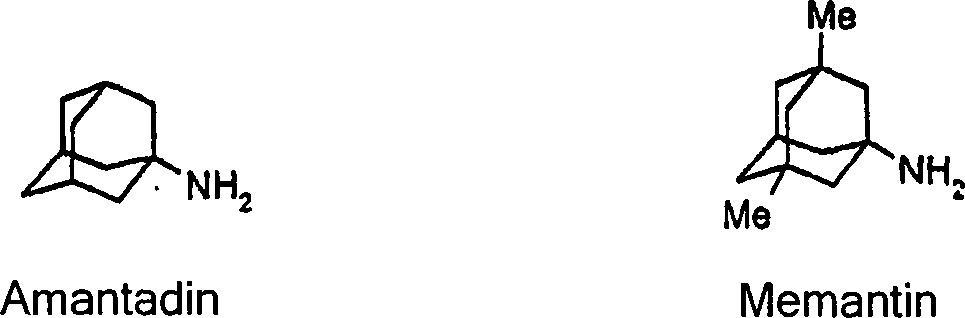
- Es wurden Patentanmeldungen eingereicht, die in den 1970er Jahren auf die Verwendung von Memantin bei der Behandlung der Parkinson-Krankheit und in den 1990er Jahren auf die Verwendung von Memantin als NMDA-Antagonist gerichtet waren (vgl. die
EP-A-0392059 US-PS 5,061,703 ). Ferner schlägt die internationale PatentanmeldungWO 94/05275 - Wie es vorstehend diskutiert worden ist, werden psychotomimetische Nebenwirkungen während der Verwendung einer Anzahl bekannter NMDA-Kanalblockiermittel beobachtet und daher wird es von beträchtlichem Vorteil sein, klinisch gut verträgliche Antagonisten zu identifizieren, bei denen solche Nebenwirkungen minimiert sind. Porter und Greenamyre (J. Neurochem. 64, 614–623, 1995, die unter Bezugnahme einbezogen wird) zeigten, dass gut verträgliche und psychotomimetische NMDA-Rezeptorkanalblockiermittel auf der Basis ihrer relativen Affinitäten für Vorderhirn- und Kleinhirnrezeptoren ungeachtet der absoluten Affinitäten differenziert werden können. Bei gut verträglichen Verbindungen wird eine Selektivität für Kleinhirn-NMDA-Rezeptoren gegenüber Vorderhirn-NMDA-Rezeptoren beobachtet. Die Basis dieser Beobachtung kann mit verschiedenen Populationen von NMDA-Rezeptor-Subtypen in diesen Gehirnregionen in Beziehung gebracht werden.
- Die Verwendung einer Anzahl der bekannten NMDA-Antagonisten wie z. B. Dizocilpin, PCP, Cerestat und Ketamin führt zu einer Anzahl von Nebenwirkungen, welche diese Verbindungen zur Verwendung bei der Behandlung ungeeignet machen. Insbesondere ist die Verabreichung der Verbindungen mit Wahrnehmungsstörungen und kognitiven Störungen einer Art verbunden, die natürlich vorkommenden psychotischen Zuständen ähnlich sind.
- Darüber hinaus werden die Nebenwirkungen bezüglich der Wahrnehmung und kognitive Nebenwirkungen der Verbindungen nach dem Einsetzen der Pubertät und der sexuellen Reifung stärker und diese Verbindungen sind daher besonders zur Behandlung von Erwachsenen ungeeignet. Diese auf die Entwicklung bezogene Veränderung wurde empirisch sowohl bei Versuchstieren als auch beim Menschen gezeigt und geht bei Versuchstieren mit einem Gehirn-Hypermetabolismus einher.
- Daraus ergibt sich zusammenfassend, dass ein Bedarf für einen NMDA-Rezeptorantagonisten besteht, der gut verträglich ist und keinen Anlass zu Nebenwirkungen gibt, die mit bisherigen, klinisch untersuchten NMDA-Antagonisten verbunden sind.
- Nunmehr wurde eine Anzahl von Verbindungen gefunden, die eine Affinität für den NMDA-Rezeptor zeigen und die bei der Behandlung von Zuständen geeignet sind, die allgemein mit Anomalien bei der glutamergen Übertragung verbunden sind, wie z. B. eines Schlags, einer traumatischen Gehirnverletzung und neurodegenerativer Erkrankungen wie z. B. Parkinson-Krankheit und Alzheimer-Krankheit. Es wurde auch gefunden, dass die Verbindungen ein überraschend günstiges Verhältnis von Cortex-Bindungsaffinität zu Kleinhirn-Bindungsaffinität aufweisen, was zeigt, dass diese Verbindungen in vivo gut vertragen werden.
- Erfindungsgemäß wird die Verwendung einer Verbindung der Formel (1)bereitgestellt, worin R1, R2, R3, R4, R5 und R6 unabhängig voneinander aus Wasserstoff, Alkyl und Aryl ausgewählt sind, oder pharmazeutisch verträgliche Salze davon, mit der Maßgabe, dass dann, wenn R1 bis R4 und R6 Wasserstoff sind, R5 nicht aus CH2CH2NHSO2CH3, CH2CH2NHSO2CF3 und Methyl, substituiert mit SO2NH2, SO3H, PO3H2, CONHOH oder einer heterocyclischen Gruppe, ausgewählt aus
 ausgewählt ist, zur Herstellung eines Medikaments zur Verwendung bei der Behandlung eines Zustandes, in welchem Antagonismus des N-Methyl-D-Aspartat-Rezeptors vorteilhaft ist, ausgewählt aus ischämischem Schlag, hämorrhagischem Schlag, Subarachnoidalblutung, subduralem Hämatom, Koronararterie-Bypasschirurgie, Neurochirurgie, traumatischer Gehirnverletzung, traumatischer Spinalverletzung, Alzheimer-Krankheit, Parkinson-Krankheit, Huntington-Krankheit, Picks-Krankheit, Lewy-Korpuskeikrankheit, seniler Demenz, spongiformen Enzephalopathien, Prionprotein-induzierte Neurotoxizität, perinataler Asphyxie, Entmarkungskrankheit, Multiinfarktdemenz, vaskulärer Demenz, Dementia pugilans, Drogenabhängigkeit, Alkoholentzug, Opiatentzug, Motorneuronerkrankung, Multipler Sklerose, akutem und chronischem Schmerz, diabetischer Neuropathie, Epilepsie, AIDS-Demenz, Multisystem-Atrophie, progressiver supranukleärer Lähmung, Friedrich-Ataxie, Auutismus, fragiler-X-Syndrom, Bourneville-Syndrom, Aufmerksamkeitsmangelstörung, Olivio-ponto-zerebellärer Atrophie, Zerebralparese, Wirkstoff-induziertem Optikusneuritis, peripherer Neuropathie, Myelopathie, ischämischer Retinopathie, Glaukom, Herzstillstand, Meningitis, Enzephalitis, Depression, manisch-depressiver Psychose, Schizophrenie, Psychose, Verhaltensstörungen, Impulskontrollstörungen, Voreklampsie, neuroleptischem malignem Syndrom, chronischem Ermüdungssyndrom, Magersucht, Angstneurosen, generalisierter Angstneurose, Panikstörung, Phobien, Frischwasserertrinken und Dekompression.
- Der Begriff "Alkyl" steht hier für einen verzweigten oder unverzweigten, cyclischen oder acyclischen, gesättigten oder ungesättigten (z. B. Alkenyl oder Alkinyl) Kohlenwasserstoffrest, der substituiert oder unsubstituiert sein kann. Wenn die Alkylgruppe cyclisch ist, dann ist die Alkylgruppe vorzugsweise eine C3–C12-, mehr bevorzugt eine C5–C10- und insbesondere eine C5-C7-Gruppe. Wenn die Alkylgruppe acyclisch ist, dann ist die Alkylgruppe vorzugsweise eine C1–C10-, mehr bevorzugt eine C1–C6-Alkylgruppe, mehr bevorzugt eine Methyl-, Ethyl-, Propyl- (n-Propyl- oder Isopropyl-), Butyl- (n-Butyl-, Isobutyl- oder tert-Butyl-) oder Pentylgruppe (einschließlich n-Pentyl- und Isopentyl-), und insbesondere eine Methylgruppe. Es sollte daher beachtet werden, dass der hier verwendete Begriff "Alkyl" Alkyl- (verzweigt oder unverzweigt), substituierte Alkyl- (verzweigt oder unverzweigt), Alkenyl- (verzweigt oder unverzweigt), substituierte Alkenyl- (verzweigt oder unverzweigt), Alkinyl- (verzweigt oder unverzweigt), substituierte Alkinyl- (verzweigt oder unverzweigt), Cycloalkyl-, substituierte Cyc loalkyl-, Cycloalkenyl-, substituierte Cycloalkenyl, Cycloaulkinyl- und substituierte Cycloalkinylgruppen umfasst.
- Der Begriff "Aryl" steht hier für eine substituierte oder unsubstituierte carbocyclische aromatische Gruppe, wie z. B. eine Phenyl- oder Naphthylgruppe, oder eine substituierte oder unsubstituierte heteroaromatische Gruppe, die ein oder mehrere Heteroatom(e), vorzugsweise ein Heteroatom enthält, wie z. B. eine Pyridyl-, Pyrrolyl-, Furanyl-, Thienyl-, Thiazolyl-, Isothiazolyl-, Oxazolyl-, Isoxazolyl-, Oxadiazolyl-, Thiadiazolyl-, Pyrazolyl-, Imidazolyl-, Triazolyl-, Pyrimidinyl-, Pyridazinyl-, Pyrazinyl-, Triazinyl-, Indolyl-, Indazolyl-, Chinolyl-, Chinazolyl-, Benzimidazolyl-, Benzothiazolyl-, Benzisouxazolyl- und Benzisothiazolylgruppe. In einer Ausführungsform umfasst die Arylgruppe eine Phenylgruppe.
- Die Alkyl- und Arylgruppen können substituiert oder unsubstituiert sein. Wenn sie substituiert sind, liegen im Allgemeinen 1 bis 3 Substituenten, vorzugsweise 1 Substituent vor. Die Substituenten können umfassen:
Kohlenstoff-enthaltende Gruppen, wie z. B. Alkyl-, Aryl-, Arylalkylgruppen (z. B. substituiertes und unsubstituiertes Phenyl, substituiertes und unsubstituiertes Benzyl);
Halogenatome und Halogen-enthaltende Gruppen, wie z. B. Halogenalkylgruppen (z. B. Trifluormethyl);
Sauerstoff-enthaltende Gruppen, wie z. B. Alkohole (z. B. Hydroxy, Hydroxyalkyl, Aryl(hydroxy)alkyl), Ether (z. B. Alkoxy, Aryloxy, Alkoxyalkyl, Aryloxyalkyl), Aldehyde (z. B. Carboxyaldehyde), Ketone (z. B. Alkylcarbonyl, Alkylcarbonylalkyl, Arylcarbonyl, Arylalkylcarbonyl, Arylcarbonylalkyl), Säuren (z. B. Carboxy, Carboxyalkyl), Säurederivate wie z. B. Ester (z. B. Alkoxycarbonyl, Alkoxycarbonylalkyl, Alkylcarbonyloxy, Alkylcarbonyloxyalkyl), Amide (z. B. Aminocarbonyl, Mono- oder Dialkylaminocarbonyl, Aminocarbonylalkyl, Mono- oder Dialkylaminocarbonylalkyl, Arylaminocarbonyl), Carbamate (z. B. Alkoxycarbonylamino. Aryloxycarbonyl-amino, Aminocarbonyloxy, Mono- oder Dialkylaminocarbonyloxy, Arylaminocarbonyloxy) und Harnstoffe (z. B. Mono- oder Dialkylaminocarbonylamino oder Arylaminocarbonylamino);
Stickstoff-enthaltende Gruppen, wie z. B. Amine (z. B. Amino, Mono- oder Dialkylamino, Aminoalkyl, Mono- oder Dialkylaminoalkyl), Azide, Nitrile (z.B. Cyano, Cyanoalkyl), Nitro; Schwefel-enthaltende Gruppen, wie z. B. Thiole, Thioether, Sulfoxide und Sulfone (z. B. Alkylthio, Alkylsulfinyl, Alkylsulfonyl, Alkylthioalkyl, Alkylsulfinylalkyl, Alkylsulfonylalkyl, Arylthio, Arylsulfinyl, Arylsulfonyl, Arylthioalkyl, Arylsulfinylalkyl, Arylsulfonylalkyl); und
heterocyclische Gruppen, die ein oder mehrere Heteroatom(e), vorzugsweise ein Heteroatom enthalten (z. B. Thienyl, Furanyl, Pyrrolyl, Imidazolyl, Pyrazolyl, Thiazolyl, Isothiazolyl, Oxazol-yl, Oxadiazolyl, Thiadiazolyl, Aziridinyl, Azetidinyl, Pyrrolidinyl, Pyrrolinyl, Imidazolidinyl, Imidazolinyl, Pyrazolidinyl, Tetrahydrofuranyl, Pyranyl, Pyronyl, Pyridyl, Pyrazinyl, Pyridazinyl, Piperidyl, Hexahydroazepinyl, Piperazinyl, Morpholinyl, Benzothienyl, Benzofuranyl, Isobenzofuranyl, Indolyl, Oxyindolyl, Isoindolyl, Indazolyl, Indolinyl, 7-Azaindolyl, Indolizinyl, Benzopyranyl, Cumarinyl, Isocumarinyl, Chinolinyl, Isochinolinyl, Naphthyridinyl, Cinnolinyl, Chinazolinyl, Pyridopyridyl, Benzoxazinyl, Chinoxalinyl, Chromenyl, Chromanyl, Isochromanyl, Phthalazinyl und Carbolinyl). - Der Begriff "Alkoxy" steht hier für Alkyl-O- und der Begriff "Alkoyl" steht hier für Alkyl-CO-, wobei Alkyl die vorstehend angegebene Bedeutung hat.
- Der Begriff "Halogen" steht hier für einen Fluor-, Chlor-, Brom- oder Jodrest, vorzugsweise für einen Fluor-, Chlor- oder Bromrest.
- Der Ausdruck "Zustände, die allgemein mit Anomalien bei der glutamergen Übertragung verbunden sind" umfasst in erster Linie ischämischen Schlag, hämorrhagischen Schlag, Subarachnoidalblutung, subdurales Hämatom, Koronararterie-Bypasschirurgie, Neurochirurgie, traumatische Gehirnverletzung, traumatische Spinalverletzung, Alzheimer-Krankheit, Parkinson-Krankheit, Huntington-Krankheit, Picks-Krankheit, Lewy-Korpuskelkrankheit, senile Demenz, spongiforme Enzephalopathien, Prionprotein-induzierte Neurotoxizität, perinatale Asphyxie, Entmarkungskrankheit, Multiinfarktdemenz, vaskuläre Demenz, Dementia pugilans, Drogenabhängigkeit, Alkoholentzug, Opiatentzug, Motorneuronerkrankung, Multiple Sklerose, akuten und chronischen Schmerz, einschließlich neuropathischen Schmerz, Schmerz bei Krebserkrankungen, Trigeminusneuralgie, Migräne, primäre und sekundäre Hyperalgesie, Entzündungsschmerzen, nozizeptiven Schmerz, Rückenmarksschwindsucht, Amputationstäuschung, Rückenmarksverletzungsschmerz, zentraler Schmerz, Post-Herpes-Schmerz, HIV-Schmerz und diabetische Neuropathie. Darüber hinaus umfasst der Ausdruck auch die folgenden Zustände: Epilepsie, AIDS-Demenz, Multisystem-Atrophie, progressive supranukleäre Lähmung, Friedrich-Ataxie, Autismus, fragiler-X-Syndrom, Bourneville-Syndrom, Aufmerksamkeitsmangelstörung, Olivio-ponto-zerebellärer Atrophie, Zerebralparese, Wirkstoff-induzierte Optikusneuritis, periphere Neuropathie, Myelopathie, ischämische Retinopathie, Glaukom, Herzstillstand, Meningitis, Enzephalitis, Depression, manisch-depressive Psychose, Schizophrenie, Psychose, Verhaltensstörungen, Impulskontrollstörungen, Voreklampsie, neuroleptisches malignes Syndrom, chronisches Ermüdungssyndrom, Magersucht, Angstneurosen, generalisierte Angstneurose, Panikstörung, Phobien, Frischwasserertrinken und Dekompression.
- Der Begriff "Behandlung" umfasst hier eine prophylaktische Behandlung.
- Der Ausdruck "pharmazeutisch verträgliches Salz" steht für ein beliebiges pharmazeutisch verträgliches Salz der Verbindung der Formel (1). Die Salze können aus pharmazeutisch verträglichen nicht-toxischen Säuren einschließlich anorganischen und organischen Säuren hergestellt werden. Solche Säuren umfassen Essig-, Benzolsulfon-, Benzoe-, Camphersulfon-, Zitronen-, Dichloressig-, Ethensulfon-, Fumar-, Glucon-, Glutamin-, Hippur-, Bromwasserstoff-, Chlorwasserstoff-, Isethion-, Milch-, Malein-, Äpfel-, Mandel-, Methansulfon-, Schleim-, Salpeter-, Pamoa-, Pantothen-, Phosphor-, Bernstein-, Schwefel-, Wein-, Oxal-, p-Toluolsulfonsäure und dergleichen. Besonders bevorzugt sind Chlorwasserstoff-, Bromwasserstoff-, Phosphor-, Fumar-, Bernstein-, Methansulfon- und Schwefelsäure und das Chlorwasserstoffsäuresalz ist ganz besonders bevorzugt.
- Die Verbindungen der Formel (1) können in einer Anzahl diastereomerer und/oder enantiomerer Formen vorliegen. Wenn in der vorliegenden Beschreibung auf "eine Verbindung der Formel (1)" Bezug genommen wird, dann ist dies eine Bezugnahme auf alle stereoisomeren Formen der Verbindung und umfasst eine Bezugnahme auf die nicht getrennten Stereoisomere in einem Gemisch, das racemisch oder nicht-racemisch sein kann, und auf jedes Stereoisomer in seiner optisch reinen Form.
- Die erfindungsgemäßen Verbindungen sind als NMDA-Antagonisten wirksam und dahingehend gut verträglich, dass Nebenwirkungen minimiert sind. Experimentelle Daten sind in der Tabelle 1 gezeigt.
- In den Verbindungen der Formel (1) ist bzw. sind vorzugsweise einer oder mehrere der Reste R1, R2, R3, R4 und R6 ein Wasserstoffatom. In einer bevorzugten erfindungsgemäßen Ausführungsform ist einer oder sind beide von R1 und R2 ein Wasserstoffatom. In einer weiteren bevorzugten Ausführungsform ist einer oder sind beide von R3 und R4 ein Wasserstoffatom. In einer weiteren bevorzugten Ausführungsform sind R1, R2, R3, R4 und R6 alle Wasserstoffatome.
- In den Verbindungen der Formel (1) ist R5 vorzugsweise eine Alkyl- oder Arylgruppe und mehr bevorzugt ist R5 eine Arylgruppe.
- Wenn R5 eine Alkylgruppe ist, dann ist R5 vorzugsweise ein acyclischer Kohlenwasserstoffrest, der vorzugsweise gesättigt, vorzugsweise unverzweigt und vorzugsweise unsubstituiert ist. In einer Ausführungsform ist R5 eine Alkylgruppe, die mit einer substituierten oder unsubstituierten carbocyclischen aromatischen Gruppe, vorzugsweise mit einer Phenylgruppe, oder mit einer substituierten oder unsubstituierten heteroaromatischen Gruppe substituiert ist, die 1 oder 2 Heteroatome, vorzugsweise 1 Heteroatom enthält, und vorzugsweise mit einer Thienyl-, Pyridyl- oder Furanylgruppe.
- Wenn R5 eine Arylgruppe ist, dann ist R5 vorzugsweise eine substituierte oder unsubstituierte carbocyclische aromatische Gruppe oder eine substituierte oder unsubstituierte heteroaromatische Gruppe, die 1 oder 2 Heteroatome, vorzugsweise 1 Heteroatom enthält. Mehr bevorzugt ist R5 eine carbocyclische aromatische Gruppe, vorzugsweise eine Phenylgruppe, die substituiert oder unsubstituiert ist. Wenn R5 substituiert ist, dann ist R5 vorzugsweise monosubstituiert. Wenn R5 eine monosubstituierte Phenylgruppe ist, dann liegt der Substituent vorzugsweise in der meta- oder para-Position und mehr bevorzugt in der meta-Position des Phenylrings bezogen auf die Adamantangruppe vor. Bevorzugte Substituenten sind aus C1–C4-Alkyl, vorzugsweise Methyl und Ethyl; Halogen, vorzugsweise Fluor und Chlor; Alkoxy, vorzugsweise Methoxy; und Halogenalkyl, vorzugsweise Trifluormethyl ausgewählt. Vorzugsweise ist R5 aus Phenyl, 3-Methylphenyl, 4-Methylphenyl und 3-Ethylphenyl ausgewählt. Mehr bevorzugt ist R5 aus 3-Methylphenyl und 3-Ethylphenyl ausgewählt. Insbesondere ist R5 3-Methylphenyl. In der Ausführungsform, bei der R5 eine heteroaromatische Gruppe ist, ist es bevorzugt, dass R5 aus Thienyl-, Pyridyl- und Furanylgruppen und insbesondere aus einer substituierten oder unsubstituierten Thienylgruppe ausgewählt ist.
- In einer Ausführungsform der Erfindung sind die Verbindungen aus Verbindungen ausgewählt, die von denjenigen verschieden sind, bei denen R1, R2, R3, R4 und R6 Wasserstoffatome sind und R5 entweder eine C1–2-Alkylgruppe ist, die mit Sulfonamid, Amid, Phosphonsäure, Sulfonsäure, Hydroxamsäure oder einer heterocyclischen Gruppe substituiert ist, oder R5 eine heterocyclische Gruppe ist, insbesondere wobei die heterocyclische Gruppe eine heteroaromatische Gruppe ist und insbesondere wobei die heterocyclische Gruppe 3 oder mehr Heteroatome enthält.
- In einer weiteren Ausführungsform der Erfindung sind die Verbindungen aus Verbindungen ausgewählt, die von denjenigen verschieden sind, bei denen R1, R2, R3, R4 und R6 Wasser stoffatome sind und R5 eine Gruppe umfasst, die eine Sulfonamid-, Amid-, Phosphonsäure-, Sulfonsäure-, Hydroxamsäuregruppe oder heterocyclische Gruppe ist, insbesondere wobei die heterocyclische Gruppe eine heteroaromatische Gruppe ist und insbesondere wobei die heterocyclische Gruppe 3 oder mehr Heteroatome enthält.
- In einer alternativen Ausführungsform der Erfindung sind die Verbindungen aus Verbindungen ausgewählt, die von denjenigen verschieden sind, bei denen R1, R2, R3, R4 und R6 Wasserstoffatome sind, und bei denen R5 nicht aus CH2CH2NHSO2CH3, CH2CH2NHSO2CF3 und Methyl, das mit SO2NH2, SO3H, PO3H2, CONHOH substituiert ist, oder einer heterocyclischen Gruppe ausgewählt ist, die aus Tetrazol-5-yl, 5-Oxo-4H-[1,2,4]oxadiazol-3-yl, 5-Thioxo-4H-[1,2,4]oxadiazol-3-yl, 5-Oxo-4H-[1,2,4]thiadiazol-3-yl und 2-Oxo-2,3-dihydro-[1,2,3,5]oxathiadiazol-4-yl ausgewählt ist. In einer weiteren alternativen Ausführungsform der Erfindung sind die Verbindungen aus Verbindungen ausgewählt, die von denjenigen verschieden sind, bei denen R1, R2, R3, R4 und R6 Wasserstoffatome sind und R5 eine Gruppe umfasst, die eine Sulfonamid-, Amid-, Phosphonsäure-, Sulfonsäure-, Hydroxamsäuregruppe oder eine heterocyclische Gruppe ist, die aus Tetrazol-5-yl, 5-Oxo-4H-[1,2,4]oxadiazol-3-yl, 5-Thioxo-4H-[1,2,4]oxadiazol-3-yl, 5-Oxo-4H-]1,2,4]thiadiazol-3-yl und 2-Oxo-2,3-dihydro-[1,2,3,5]oxathiadiazol-4-yl ausgewählt ist.
- Besonders bevorzugte Verbindungen sind 2-(3-Ethylphenyl)-2-adamantanmethanamin, 2-(3-Methylphenyl)-2-adamantanmethanamin, 2-Phenyl-2-adamantanmethanamin und 2-(4-Methylphenyl)-2-adamantanmethanamin und die Hydrochloridsalze davon.
- Die vorliegende Erfindung stellt auch eine Verbindung der Formel (1), wie sie vorstehend definiert worden ist, und pharmazeutisch verträgliche Salze davon zur Verwendung in der Therapie bereit, die von Verbindungen verschieden ist, bei denen R3, R4, R5 und R6 Wasserstoffatome sind und einer von R1 und R2 ein Wasserstoffatom, eine Methyl- oder Benzylgruppe ist und einer von R1 und R2 eine substituierte Methyl-, Ethyl- oder Propylgruppe ist, und die von Verbindungen verschieden ist, bei denen R1, R2, R5 und R6 Wasserstoffatome sind und R3 und R4 aus Methyl und Aminomethyl ausgewählt sind.
- In einer bevorzugten Ausführungsform stellt die vorliegende Erfindung auch Verbindungen der Formel (1), wie sie vorstehend definiert worden ist, und pharmazeutisch verträgliche Salze davon zur Verwendung in der Therapie bereit, die von Verbindungen verschieden sind, bei denen R3, R4, R5 und R6 Wasserstoffatome sind und R1 und R2 unabhängig aus Alkylgruppen ausgewählt sind, und die von Verbindungen verschieden sind, bei denen R1, R2, R5 und R6 Wasserstoffatome sind und R3 und R4 unabhängig aus Alkylgruppen ausgewählt sind.
- In einer alternativen bevorzugten Ausführungsform stellt die vorliegende Erfindung Verbindungen der Formel (1), wie sie vorstehend definiert worden ist, und pharmazeutisch verträgliche Salze davon zur therapeutischen Verwendung bereit, wobei
- i) R3, R4, R5 und R6 unabhängig voneinander aus Wasserstoff, Alkyl und Aryl ausgewählt sind, und R1 und R2 unabhängig voneinander aus Wasserstoff und Aryl ausgewählt sind, oder
- (ii) R3, R4, R5 und R6 unabhängig voneinander aus Alkyl und Aryl ausgewählt sind, und R1 und R2 unabhängig voneinander aus Alkyl ausgewählt sind, oder
- (iii) R1, R2, R5 und R6 unabhängig voneinander aus Wasserstoff, Alkyl und Aryl ausgewählt sind, und R3 und R4 unabhängig voneinander aus Wasserstoff und Aryl ausgewählt sind, oder
- (iv) R1, R2, R5 und R6 unabhängig voneinander aus Alkyl und Aryl ausgewählt sind, und R3 und R4 unabhängig voneinander aus Alkyl ausgewählt sind.
- In einer weiteren bevorzugten Ausführungsform stellt die vorliegende Erfindung Verbindungen der Formel (1), wie sie vorstehend definiert worden ist, und pharmazeutisch verträgliche Salze davon zur Verwendung in der Therapie bereit, bei denen R5 und R6 unabhängig aus Alkyl- und Arylgruppen ausgewählt sind.
- In einer besonders bevorzugten Ausführungsform stellt die vorliegende Erfindung Verbindungen der Formel (1), wie sie vorstehend definiert worden ist, und pharmazeutisch verträgliche Salze davon zur Verwendung in der Therapie bereit, bei denen R5 aus Alkyl- und Arylgruppen ausgewählt ist.
- Die vorliegende Erfindung stellt auch eine Verbindung der Formel (1), wie sie vorstehend definiert worden ist, und pharmazeutisch verträgliche Salze davon bereit, bei denen R5 aus Alkyl- und Arylgruppen ausgewählt ist, mit der Maßgabe, dass dann, wenn R1 und R2 eine Methylgruppe und R3, R4 und R6 Wasserstoffatome sind, R5 keine Hydroxymethylgruppe ist.
- Gemäß eines weiteren Aspekts der vorliegenden Erfindung wird ein Verfahren zur Herstellung der Verbindungen der Formel (1) bereitgestellt, wie sie vorstehend definiert worden ist, worin R5 aus Alkyl- und Arylgruppen ausgewählt ist, die von Verbindungen verschieden sind, bei denen R1 und R2 eine Methylgruppe sind, R3, R4 und R6 Wasserstoffatome sind und R5 eine Hydroxymethylgruppe ist.
- Die Verbindungen der Formel (1) können mit herkömmlichen Synthesewegen hergestellt werden. Beispielsweise können Verbindungen, bei denen R3, R2, R3 und R4 alle Wasserstoffatome sind, so hergestellt werden, wie es im Reaktionsschema 1 veranschaulicht ist. Reaktionsschema 1

- Die Amine (5) werden durch Reduktion des entsprechenden Nitrils (4) mittels Standardverfahren wie z. B. Boran hergestellt. Die Nitrile (4) werden aus den Alkoholen (3) mittels Standardverfahren wie z. B. TMSCN in Gegenwart von BF3 hergestellt. Die Alkohole (3) werden durch Zusetzen von beispielsweise Grignard-Reagenzien zu den entsprechenden 2-Adamantanonen (2) hergestellt, die käuflich sind oder mittels Standardverfahren synthetisiert werden.
- Die Verbindungen der Formel (1), bei denen R1 und/oder R2 eine Alkylgruppe ist bzw. sind, können aus Aminen (5) mittels Standardverfahren einschließlich Alkylierung, reduktive Alkylierung oder Acylierung/Reduktion hergestellt werden.
- Die Verbindungen der Formel (1), bei denen R1 und/oder R2 eine Arylgruppe ist bzw. sind, können aus Aminen (5) mittels Standardverfahren wie z. B. einer Palladium-katalysierten Kupplung an Arylhalogenide hergestellt werden.
- Die Verbindungen der Formel (1), bei denen R3 und/oder R4 eine Alkylgruppe oder Arylgruppe ist bzw. sind, können aus Nitrilen (4) mittels Standardverfahren wie z. B. der Zugabe von metallierten Alkyl- oder Arylanionen hergestellt werden.
- Verbindungen der Formel (1), bei denen R1, R2, R3 und R4 nicht alle Wasserstoffatome sind, können auch so hergestellt werden, wie es im Reaktionsschema 2 veranschaulicht ist. Reaktionsschema 2

- Die Amine (6), bei denen R3 eine Alkyl- oder Arylgruppe ist, können aus den Nitrilen (4) mittels Standardverfahren wie z. B. der Zugabe eines metallierten Alkyl- oder Arylanions und anschließender Reduktion hergestellt werden.
- Die Amine (8), bei denen R3 ein Wasserstoffatom, eine Alkyl- oder Arylgruppe ist, können aus den Ketonen (7) mittels Standardverfahren wie z. B. einer reduktiven Aminierung hergestellt werden. Die Ketone (7), bei denen R3 eine Alkyl- oder Arylgruppe ist, können aus den Nitrilen (4) mittels Standardverfahren wie z. B. der Zugabe eines metallierten Alkyl- oder Arylanions und anschließender Hydrolyse hergestellt werden. Die Ketone (7), bei denen R3 ein Wasserstoffatom ist, können aus den Nitrilen (4) mittels Standardverfahren wie z. B. durch eine Reduktion hergestellt werden.
- Die Amine (10), bei denen R3 und R4 Alkyl- oder Arylgruppen sind, können aus den Iminen (9) mittels Standardverfahren wie z. B. durch Zugabe eines Grignard-Reagenzes hergestellt werden. Die Amine (10) können in weitere Verbindungen der vorstehend beschriebenen Formel (1) umgewandelt werden. Die Imine (9), bei denen R3 eine Alkyl- oder Arylgruppe ist und R1 eine Alkyl- oder Arylgruppe ist, können aus den Ketonen (7) mittels Standardverfahren wie z. B. durch eine Behandlung mit einem Amin hergestellt werden. Alternativ können Imine (9), bei denen R1 eine Alkylgruppe ist, aus den Nitrilen (4) durch die Zugabe eines metallierten Alkyl- oder Arylanions und anschließender Behandlung z. B. mit einem Alkylhalogenid hergestellt werden.
- Die vorliegende Erfindung stellt ferner eine pharmazeutische Zusammensetzung bereit, welche die Verbindung der Formel (1) oder ein pharmazeutisch verträgliches Salz davon in Kombination mit einem pharmazeutisch verträglichen Träger umfasst.
- Die Verbindung der Formel (1) kann in einer Form verabreicht werden, die für eine orale Anwendung, wie z. B. als Tablette, Kapsel, Pille, wässrige oder ölige Lösung, Suspension oder Emulsion; für eine lokale Anwendung, einschließlich einer transmukosalen und transdermalen Anwendung, wie z. B. als Creme, Salbe, Gel, wässrige oder ölige Lösung oder Suspension, Unguentum, Pflaster oder Breiauflage; für eine nasale Anwendung, z. B. als Schnupfpulver, Nasenspray, Nasenpulver oder Nasentropfen; für eine vaginale oder rektale Anwendung, z. B. als Zäpfchen oder Pessar; für eine Verabreichung durch Einatmen, z. B. als fein verteiltes Pulver oder als flüssiges Aerosol; für eine sublinguale oder bukkale Anwendung, wie z. B. als Tablette oder Kapsel; für eine okulare Anwendung, wie z. B. als sterile wässrige Lösung oder sterile Salbe; oder für eine parenterale Anwendung geeignet ist (einschließlich intravenös, subkutan, intramuskulär, intravaskulär oder als Infusion), wie z. B. als sterile wässrige oder ölige Lösung oder Suspension oder Emulsion, oder als Depotinjektionsformulierung. Im Allgemeinen können die vorstehend genannten Zusammensetzungen in herkömmlicher Weise unter Verwendung gebräuchlicher Träger unter Verwendung von Standardtechniken hergestellt werden, einschließlich Technologien für eine gesteuerte Freisetzung, wie z. B. Systemen auf Gelatine-, Lipid-, Geldepot-, Liposom- und Mikrokapselbasis, die dem Fachmann auf dem Gebiet der Pharmazie bekannt sind.
- Für eine orale Verabreichung werden die erfindungsgemäßen Verbindungen im Allgemeinen in Form von Tabletten oder Kapseln oder als wässrige Lösung oder Suspension bereitgestellt.
- Tabletten oder Pillen zur oralen Anwendung können den Wirkstoff gemischt mit pharmazeutisch verträglichen Trägern enthalten, wie z. B. inerten Verdünnungsmitteln, Sprengmitteln, Bindemitteln, Gleitmitteln, Süßungsmitteln, Geschmacksstoffen, Farbmitteln und Konservierungsmitteln. Geeignete inerte Verdünnungsmittel umfassen Natrium- und Calciumcarbonat, Natrium- und Calciumphosphat, Calciumhydrogenphosphat, Ceilulosederivate und Lactose, während Maisstärke und Alginsäure geeignete Sprengmittel sind. Bindemittel können Stärke, Gelatine und Polyvinylpyrrolidonderivate umfassen, während das Gleitmittel, falls dieses vorliegt, gewöhnlich Magnesiumstearat, Stearinsäure oder Talk sein wird. Gegebenenfalls können die Tabletten mit einem Material wie z. B. Glycerinmonostearat oder Glycerindistearat oder Polymethacrylatpolymeren, Cellulosederivaten oder einem anderen pharmazeutisch verträglichen Polymer formuliert oder beschichtet sein, um die Absorption im Gastrointestinaltrakt zu verzögern.
- Kapseln für eine orale Anwendung umfassen Hartgelatinekapseln, bei denen der Wirkstoff mit einem festen Verdünnungsmittel gemischt ist, und Weichgelatinekapseln, bei denen der Wirkstoff mit Wasser oder einem Öl wie z. B. Erdnussöl, flüssigem Paraffin oder Olivenöl gemischt ist.
- Für eine intramuskuläre, intraperitoneale, subkutane und intravenöse Anwendung werden die erfindungsgemäßen Verbindungen im Allgemeinen in sterilen wässrigen Lösungen oder Suspensionen oder Emulsionen bereitgestellt, die auf einen geeigneten pH-Wert und eine geeignete Isotonie gepuffert sind. Geeignete wässrige Träger umfassen Ringer's Lösung und isotonische Natriumchloridlösung. Erfindungsgemäße wässrige Suspensionen können Suspendiermittel, wie z. B. Cellulosederivate, Natriumalginat, Polyvinylpyrrolidon und Tragantgummi, und ein Benetzungsmittel wie z. B. Lecithin umfassen. Geeignete Konservierungsmittel für wässrige Suspensionen umfassen Ethyl- und n-Propyl-p-hydroxybenzoat.
- Transdermale Formulierungen umfassen Membranpermeationssysteme, Multilaminat-Haftdispersionssysteme und Matrixdispersionssysteme. Die transdermale Abgabe umfasst auch die Verwendung eines elektrisch unterstützten Transports und Hautpenetrationsverstärker und nadellose Injektionsvorrichtungen.
- Der bevorzugte Verabreichungsweg wird eine intravenöse Infusion, vorzugsweise über einen Zeitraum von bis zu 7 Tagen, oder eine orale Formulierung oder eine intramuskuläre Injektion mittels einer Styrette oder eine subkutane Injektion sein.
- Es sollte beachtet werden, dass die Höhe der eingesetzten Dosierungen abhängig von der verwendeten Verbindung, der Schwere des Zustands, in dem sich der Patient befindet und dem Körpergewicht des Patienten über einem ziemlich weiten Bereich variieren kann. Ohne an eine strenge Definition der Dosierungen gebunden sein zu wollen beträgt eine tägliche Dosis des Wirkstoffs (als freie Base abgeschätzt) 100 μg bis 800 mg. Insbesondere können die bevorzugten Verbindungen bei einer bevorzugten Dosis von 50 bis 800 mg täglich in einer einzelnen oder in aufgeteilten Dosierungen verabreicht werden.
- Die Erfindung wird nachstehend detailliert beschrieben. Es sollte beachtet werden, dass die Erfindung lediglich mit Beispielen beschrieben wird und dass Detailmodifizierungen vorgenommen werden können, ohne vom Schutzbereich der Erfindung abzuweichen. Experimenteller Teil 1. Synthese Beispiel 1 2-(3-Ethylphenyl)-2-adamantanmethanaminhydrochlorid
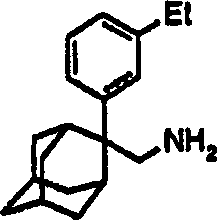
- 2-(3-Ethylphenyl)-2-adamantanol
- Ein gerührtes Gemisch aus Magnesiumspänen (0,89 g, 36,6 mmol) und Iod (katalytische Menge) in trockenem THF (60 ml) wurde mit 3-Bromethylbenzol (5 ml, 36,6 mmol) behandelt, 3 Stunden unter Rückfluss gehalten, auf Raumtemperatur abgekühlt, mit einer Lösung von 2-Adamantanon (5,0 g, 33,3 mmol) in trockenem THF (20 ml) behandelt und 2 Stunden unter Rückfluss gehalten. Das Gemisch wurde auf Raumtemperatur gekühlt, mit 3 M HCl (20 ml) behandelt, mit EtOAc (2 × 20 ml) extrahiert, die vereinigten Extrakte wurden mit Wasser (10 ml) gewaschen, getrocknet (MgSO4), unter vermindertem Druck konzentriert und mittels Chromatographie [SiO2; Heptan-EtOAc (9 : 1)] gereinigt, wobei das Produkt (7,84 g, 92%) als weißer Feststoff erhalten wurde: Schmp.: 63–65°C; IR Vmax (Nujol)/cm–1 3442, 3281, 2921, 2855, 1604, 1451, 1101, 1043, 1009, 803 und 708; NMR δH (400 MHz, CDCl3) 1,23 (3H, t, J 7,5 Hz), 1,61–1,70 (9N, m), 1,89 (1H, s), 2,38–2,41 (2H, m), 2,56 (2H, s), 2,65 (2H, q, J 7,5 Hz), 3,46 (1H, s), 7,11 (1H, d, J 7,5 Hz) und 7,24–7,36 (3H, m); Analyse: Berechnet für C18H24O: C, 84,32; H, 9,43, gefunden: C, 84,24; H, 9,28.
- 2-(3-Ethylphenyl)-2-adamantancarbonitril
- Eine Lösung von 2-(3-Ethylphenyl)-2-adamantanol (1,82 g, 7,14 mmol) in trockenem CHCl3 (5 ml) unter Argon wurde mit Trimethylsilylcyanid (1,00 ml, 7,5 mmol) behandelt, auf 0°C gekühlt, mit BF3-Etherat (1,10 ml, 8,57 mmol) behandelt, auf Raumtemperatur erwärmen gelassen und 2 Stunden gerührt. Das Gemisch wurde mit verdünnter NaHCO3-Lösung (10 ml) behandelt, mit CHCl3 (2 × 10 ml) extrahiert, die vereinigten Extrakte wurden mit Wasser (10 ml) gewaschen, getrocknet (MgSO4), unter vermindertem Druck konzentriert und mittels Chromatographie [SiO2; Heptan-EtOAc (9 : 1)] gereinigt, wobei das Produkt (1,54 g, 82%) als farbloses Öl erhalten wurde: IR νmax (Dünnfilm)/cm–1 2922, 2860, 2226, 1604, 1487, 1453, 1105, 799 und 704; NMR δH (400 MHz, CDCl3) 1,24 (3H, t, J 7,5 Hz), 1,62-1,65 (2H, m), 1,70–1,82 (5H, m), 1,98–2,04 (3H, m), 2,45–2,48 (2H, m), 2,66 (2H, q, J 7,5 Hz), 2,79 (2H, s), 7,15 (1H, d, J 7,5 Hz) und 7,25–7,34 (3H, m); Analyse: Berechnet für C19H23N: C, 85,99; H, 8,73; N, 5,28, gefunden: C, 85,85; H, 8,77; H, 5,23.
- 2-(3-Ethylphenyl)-2-adamantanmethanaminhydrochlorid
- Eine Lösung von 2-(3-Ethylphenyl)-2-adamantancarbonitril (265 mg, 1 mmol) in trockenem THF (5 ml) unter Argon wurde mit 1 M BH3 in THF (3,3 ml, 3,3 mmol) behandelt, 2 Stunden unter Rückfluss gehalten, auf Raumtemperatur gekühlt, mit 6 M HCl (10 ml) behandelt, 0,25 Stunden unter Rückfluss gehalten, auf Raumtemperatur gekühlt und mit CHCl3 (2 × 10 ml) extrahiert. Die vereinigten Extrakte wurden mit Wasser (2 × 5 ml) gewaschen, getrocknet (MgSO4), unter vermindertem Druck konzentriert und mittels Chromatographie [SiO2; EtOAc-McOH (9 : 1)] gereinigt, wobei die Titelverbindung (258 mg, 85%) als weißer Feststoff erhalten wurde: Schmp.: 89-90°C; IR νmax (Nujol)/cm–1 3395, 2922, 1603, 1489, 1458, 1376, 1100, 797, 734 und 713; NMR δH (400 MHz, DMSO-d6) 1,19 (3H, d, J 7,5 Hz), 1,41–1,57 (2H, m), 1,60–1,75 (6H, m), 1,89 (1H, s), 2,06–2,15 (2H, m), 2,46–2,64 (5H, m), 3,05 (2H, s) und 7,02–7,33 (7H, m); Analyse: Berechnet für C19H28ClN·0,2 H2O: C, 73,74; H, 9,25; N, 4,53, gefunden: C, 73,90; H, 9,28; N, 4,53. Beispiel 2 2-(3-Methylphenyl)-2-adamantanmethanaminhydrochlorid
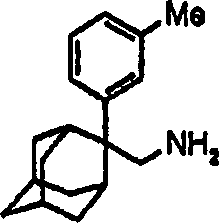
- 2-(3-Methylphenyl)-2-adamantancarbonitril
- Diese Verbindung wurde mit dem Verfahren von Beispiel 1 unter Verwendung von 2-(3-Methylphenyl)-2-adamantanol anstelle von 2-(3-Ethylphenyl)-2-adamantanol hergestellt und das Produkt (1,16 g, 66%) wurde als weißer Feststoff isoliert: Schmp.: 85–86°C; IR vmax (Nujol)/cm–1 2924, 2858, 2225, 1604, 1455, 1378, 1103, 783 und 705; NMR δH (400 MHz, CDCl3) 1,63–1,66 (2H, m), 1,76–1,82 (5H, m), 1,99–2,05 (3H, m), 2,38 (3H, s), 2,45–2,48 (2H, m), 2,78 (2H, s), 7,10 (1H, d, J 8,0 Hz) und 7,26–7,30 (3H, m); Analyse: Berechnet für C18H21N: C, 86,01; H, 8,42; N, 5,57, gefunden: C, 85,82; H, 8,50; N, 5,54.
- 2-(3-Methylphenyl)-2-adamantanmethanaminhydrochlorid
- Diese Verbindung wurde mit dem Verfahren von Beispiel 1 unter Verwendung von 2-(3-Methylphenyl)-2-adamantancarbonitril anstelle von 2-(3-Ethylphenyl)-2-adamantancarbonitril hergestellt und die Titelverbindung (261 mg, 90%) wurde als weißer Feststoff isoliert: Schmp.: 242–243°C; IR νmax(Nujol)/cm–1 2923, 1591, 1511, 1493, 1457, 1376, 1355, 1130, 1099, 778 und 710; NMR δH (400 MHz, DMSO-ds) 1,52 (2H, d, J 11,5 Hz), 1,64–1,72 (7H, m), 1,89 (1H, s), 2,10 (2H, d, J 11,5 Hz), 2,31 (3H, s), 2,53 (2H, s), 3,06 (2H, s), 7,07 (1H, d, J 7,5 Hz), 7,14–7,18 (2H, m), 7,26–7,28 (1H, m) und 7,50 (3H, br s); Analyse: Berechnet für C18H26ClN: C, 74,08; H, 8,98; N, 4,80, gefunden: C, 73,97; N, 9,14; N, 4,80. Beispiel 3 2-Phenyl-2-adamantanmethanaminhydrochlorid
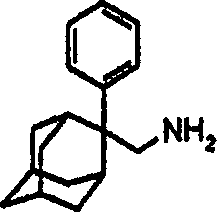
- 2-Phenyl-2-adamantancarbonitril
- Diese Verbindung wurde mit dem Verfahren von Beispiel 1 unter Verwendung von 2-Phenyl-2-adamantanol anstelle von 2-(3-Ethylphenyl)-2-adamantanol hergestellt und das Produkt (900 mg, 97%) wurde als weißer Feststoff isoliert: Schmp.: 120–122°C; IR νmax (Nujol)/cm–1 2924, 2852, 2221, 1598, 1494, 1453, 1376, 1363, 1108, 761 und 704; NMR δH (400 MHz, CDCl3) 1,65 (2H, m), 1,73–1,83 (5H, m), 2,04 (3H, m), 2,48 (2H, m), 2,80 (2H, s), 7,32 (1 H, m), 7,42 (2H, m) und 7,47 (2H, m); Analyse: Berechnet für C17H19N: C, 86,03; H, 8,07; N, 5,90, gefunden: C, 85,89; H, 8,15; N, 5,85.
- 2-Phenyl-2-adamantanmethanaminhydrochlorid
- Diese Verbindung wurde mit dem Verfahren von Beispiel 1 unter Verwendung von 2-Phenyl-2-adamantancarbonitril anstelle von 2-(3-Ethylphenyl)-2-adamantancarbonitril hergestellt und die Titelverbindung (249 mg, 90%) wurde als weißer Feststoff isoliert: Schmp.: 253–255°C; IR νmax (Nujol)/cm–1 2920, 1593, 1498, 1458, 1377, 1097, 761 und 698; NMR δH (400 MHz, DMSO-d6) 1,52 (2H, d, J 12,5 Hz), 1,64–1,72 (7H, m), 1,89 (1H, s), 2,10 (2H, d, J 12,5 Hz), 2,48 (3H, s), 3,05 (2H, s), 7,0 (3H, br s), 7,23 (1H, m) und 7,36–7,41 (3H, m); Analyse: Berechnet für C17H24ClN: C, 73,49; H, 8,71; N, 5,04, gefunden: C, 73,73; H, 8,82; N, 5,05. Beispiel 4 2-(4-Methylphenyl)-2-adamantanmethanaminhydrochlorid

- 2-(4-Methylphenyl)-2-adamantancarbonitril
- Diese Verbindung wurde mit dem Verfahren von Beispiel 1 unter Verwendung von 2-(4-Methylphenyl)-2-adamantanol anstelle von 2-(3-Ethylphenyl)-2-adamantanol hergestellt und das Produkt (933 mg, 54%) wurde als weißer kristalliner Feststoff isoliert: Schmp.: 99–100°C; IR νmax (Nujol)/cm–1 2921, 2855, 2221, 1514, 1453, 1377, 1194, 1100 und 813; NMR δH (400 MHz, CDCl3) 1,64 (2H, d, J 13 Hz), 1,76–1,82 (5H, m), 1,99–2,05 (3H, m), 2,36 (3H, s), 2,46 (2H, d, J 13 Hz), 2,77 (2H, s), 7,23 (2H, d, J 8 Hz) und 7,36 (2H, d, J 8 Hz); Analyse: Berechnet für C18H21N: C, 86,01; H, 8,42; N, 5,57, gefunden: C, 86,11; H, 8,48; N, 5,57.
- 2-(4-Methylphenyl)-2-adamantanmethanaminhydrochlorid
- Diese Verbindung wurde mit dem Verfahren von Beispiel 1 unter Verwendung von 2-(4-Methylphenyl)-2-adamantancarbonitril anstelle von 2-(3-Ethylphenyl)-2-adamantancarbonitril hergestellt und die Titelverbindung (261 mg, 90%) wurde als weißer Feststoff isoliert: Schmp.: 261–263°C; IR νmax (Nujol)/cm–1 3408, 3259, 2923, 1603, 1501, 1457, 1377, 1096 und 812; NMR δH (400 MHz, DMSO-d6) 1,48–1,51 (2H, m), 1,63–1,71 (7H, m), 1,88 (1H, br s), 2,07–2,10 (2H, m), 2,28 (3H, s), 2,48 (2H, m), 3,04 (2H, s), 7,15–7,30 (4H, m) und 7,41 (3H, br s); Analyse: Berechnet für C18H26ClN·0,85 H2O: C, 70,38; H, 9,09; N, 4,56, gefunden: C, 70,41; H, 8,87; N, 4,44. Beispiel 5 2-(2-Methylphenyl)-2-adamantanmethanaminhydrochlorid
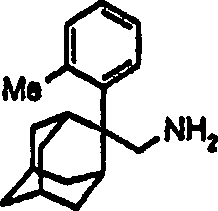
- 2-(2-Methylphenyl)-2-adamantancarbonitril
- Diese Verbindung wurde mit dem Verfahren von Beispiel 1 unter Verwendung von 2-(2-Methylphenyl)-2-adamantanol anstelle von 2-(3-Ethylphenyl)-2-adamantanol hergestellt und das Produkt (580 mg, 34%) wurde als weißer Feststoff isoliert: Schmp.: 80–81°C; IR νmax (Nujol)/cm–1 2922, 2854, 2220, 1487, 1451, 1378, 1365, 762 und 729; NMR δH (400 MHz, CDCl3) 1,59–1,77 (6H, m), 1,97–2,03 (4H, m), 2,51–2,60 (5H, m), 2,90 (2H, br s), 7,21–7,26 (3H, m) und 7,40–7,43 (1H, m); Analyse: Berechnet für C18H21N: C, 86,01; H, 8,42; N, 5,57, gefunden: C, 85,97; H, 8,48; N, 5,56.
- 2-(2-Methylphenyl)-2-adamantanmethanaminhydrochlorid
- Diese Verbindung wurde mit dem Verfahren von Beispiel 1 unter Verwendung von 2-(2-Methylphenyl)-2-adamantancarbonitril anstelle von 2-(3-Ethylphenyl)-2-adamantancarbonitril hergestellt und die Titelverbindung (174 mg, 60%) wurde als weißer Feststoff isoliert: Schmp.: 270–271°C; IR νmax (Nujol)/cm–1 2921, 1592, 1487, 1459, 1377, 759 und 733; NMR δH (400 MHz, DMSO-d6) 1,43 (1H, d, J 12,5 Hz), 1,55–1,76 (7H, m), 1,86 (2H, s), 2,11–2,16 (2H, m), 2,41 (3H, s), 2,69 (1H, s), 2,83 (1H, s), 2,95 (1H, d, J 12,5 Hz), 3,44 (1H, d, J 13,0 Hz), 6,90 (3H, br s) und 7,10–7,34 (4H, m); Analyse: Berechnet für C18H26ClN: C, 74,08; H, 8,98; N, 4,80, gefunden: C, 74,48; H, 9,07; N, 4,79. Beispiel 6 2-(4-Fluorphenyl)-2-adamantanmethanaminhydrochlorid
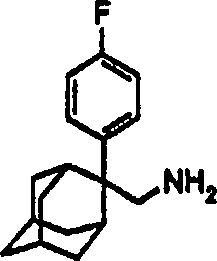
- 2-(4-Fluorphenyl)-2-adamantancarbonitril
- Diese Verbindung wurde mit dem Verfahren von Beispiel 1 unter Verwendung von 2-(4-Fluorphenyl)-2-adamantanol anstelle von 2-(3-Ethylphenyl)-2-adamantanol hergestellt und das Produkt (163 mg, 64%) wurde als weißer Feststoff isoliert: Schmp.: 81–82°C; IR νmax (Nujol)/cm–1 2924, 2861, 2223, 1601, 1510, 1502, 1467, 1454, 1242, 1166, 1104 und 835; NMR δH (400 MHz, CDCl3) 1,62–1,65 (2H, m), 1,74 (5H, s), 1,97–2,03 (3H, m), 2,44 (2H, d, J 12,5 Hz), 2,73 (2H, s), 7,07–7,11 (2H, m) und 7,41–7,44 (2H, m); Analyse: Berechnet für C17H18FN: C, 79,97; H, 7,11; N, 5,48, gefunden: C, 80,02; H, 7,21; N 5,47.
- 2-(4-Fluorphenyl)-2-adamantanmethanaminhydrochlorid
- Diese Verbindung wurde mit dem Verfahren von Beispiel 1 unter Verwendung von 2-(4-Fluorphenyl)-2-adamantancarbonitril anstelle von 2-(3-Ethylphenyl)-2-adamantancarbonitril hergestellt und die Titelverbindung (251 mg, 85%) wurde als weißer Feststoff isoliert: Schmp.: 262–263°C; IR νmax (Nujol)/cm–1 2923, 2855, 1605, 1511, 1458, 1377, 1237, 1213, 1164 und 826; NMR δH (400 MHz, DMSO-d6) 1,50–1,74 (9H, m), 1,90 (1H, s), 2,09–2,14 (2H, m), 2,46–2,56 (2H, m), 3,04 (2H, s), 7,01 (3H, br s), 7,10–7,21 (2H, m) und 7,30–7,40 (2H, m); Analyse: Berechnet für C17H23ClFN: C, 69,02; H, 7,84; N, 4,73, gefunden: C, 68,89; H, 7,93; N, 4,67. Beispiel 7 2-(4-Chlorphenyl)-2-adamantanmethanaminhydrochlorid

- 2-(4-Chlorphenyl)-2-adamantancarbonitril
- Diese Verbindung wurde mit dem Verfahren von Beispiel 1 unter Verwendung von 2-(4-Chlorphenyl)-2-adamantanol anstelle von 2-(3-Ethylphenyl)-2-adamantanol hergestellt und das Produkt (1,15 g, 60%) wurde als weißer Feststoff isoliert: Schmp.: 131,5–133°C; IR νmax (Nujol)/cm–1 2926, 2852, 2223, 1490, 1454, 1401, 1108, 1092, 1015 und 824; NMR δH (400 MHz, CDCl3) 1,63–1,76 (7H, m), 1,99–2,05 (3H, m), 2,02–2,05 (2H, m), 2,74 (2H, s) und 7,38–7,42 (4H, m); Analyse: Berechnet für C17H18ClN: C, 75,13; H, 6,68; N, 5,15, gefunden: C, 74,96; H, 6,71; N, 5,13.
- 2-(4-Chlorphenyl)-2-adamantanmethanaminhydrochlorid
- Diese Verbindung wurde mit dem Verfahren von Beispiel 1 unter Verwendung von 2-(4-Chlorphenyl)-2-adamantancarbonitril anstelle von 2-(3-Ethylphenyl)-2-adamantancarbonitril hergestellt und die Titelverbindung (280 mg, 90%) wurde als weißer Feststoff isoliert: Schmp.: > 300°C; IR νmax (Nujol)/cm–1 2927, 1517, 1509, 1494, 1455, 1377, 1102, 1092, 1010, 974, 821 und 720; NMR 6H (400 MHz, DMSO-d6) 1,52–1,77 (7H, m), 1,90 (1H, s), 2,10–2,13 (2H, m), 2,51–2,56 (3H, m), 3,10 (2H, br s), 3,65–3,67 (1H, m), 7,39–7,46 (4H, m) und 7,58–7,64 (3H, m); Analyse: Berechnet für C17H23Cl2N: C, 65,39; H, 7,42; N, 4,48, gefunden: C, 65,11; H, 7,46; N, 4,40. Beispiel 8 2-(4-Methoxyphenyl)-2-adamantanmethanaminhydrochlorid

- 2-(4-Methoxyphenyl)-2-adamantancarbonitril
- Diese Verbindung wurde mit dem Verfahren von Beispiel 1 unter Verwendung von 2-(4-Methoxyphenyl)-2-adamantanol anstelle von 2-(3-Ethylphenyl)-2-adamantanol hergestellt und das Produkt (601 mg, 58%) wurde als schwach gelber Feststoff isoliert: Schmp.: 165–166,5°C; IR νmax (Nujol)/cm–1 2918, 2855, 2220, 1609, 1512, 1458, 1377, 1298, 1260, 1183 und 1029; NMR δH (400 MHz, CDCl3) 1,63 (2H, d, J 13,0 Hz), 1,75–1,81 (5H, m), 1,98–2,04 (3H, m), 2,45 (2H, d, J 13,0 Hz), 2,74 (2H, s), 3,82 (3H, s), 6,94 (2H, d, J 8,5 Hz) und 7,38 (2H, d, J 8,5 Hz); Analyse: Berechnet für C18H21NO: C, 80,86; H, 7,92; N, 5,24, gefunden: C, 80,60; H, 7,94; N, 5,20.
- 2-(4-Methoxyphenyl)-2-adamantanmethanaminhydrochlorid
- Diese Verbindung wurde mit dem Verfahren von Beispiel 1 unter Verwendung von 2-(4-Methoxyphenyl)-2-adamantancarbonitril anstelle von 2-(3-Ethylphenyl)-2-adamantancarbonitril hergestellt und die Titelverbindung (215 mg, 70%) wurde als weißer Feststoff isoliert: Schmp.: 234-235°C; IR νmax (Nujol)/cm–1 2922, 2854, 1610, 1515, 1465, 1377, 1259, 1188 und 1040; NMR δH (400 MHz, DMSO-d6) 1,50 (2H, d, J 12,0 Hz), 1,63–1,71 (7H, m), 1,88 (1H, br s), 2,09 (2H, d, J 12,0 Hz), 2,49–2,50 (2H, m), 3,04 (2H, s), 3,74 (3H, s), 6,92 (2H, d, J 8,5 Hz), 7,24 (2H, d, J 8,5 Hz) und 7,55 (3H, br s); Analyse: Berechnet für C18H26ClNO: C, 70,23; H, 8,51; N, 4,55, gefunden: C, 70,06; H, 8,74; N, 4,45. Beispiel 9 2-(4-Trifluormethylphenyl)-2-adamantanmethanaminhydrochlorid
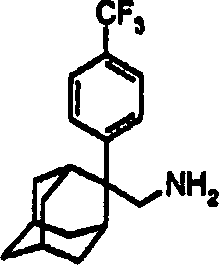
- 2-(4-Trifluormethylphenyl)-2-adamantancarbonitril
- Diese Verbindung wurde mit dem Verfahren von Beispiel 1 unter Verwendung von 2-(4-Trifluormethylphenyl)-2-adamantanol anstelle von 2-(3-Ethylphenyl)-2-adamantanol hergestellt und das Produkt (1,0 g, 46%) wurde als weißer Feststoff isoliert: Schmp.: 122–123,5°C; IR νmax (Nujol)/cm–1 2924, 2855, 2227, 1615, 1455, 1328, 1309, 1166, 1124, 1069 und 832; NMR δH (400 MHz, CDCl3) 1,70–1,78 (7H, m), 2,02–2,06 (3H, m), 2,47–2,50 (2H, m), 2,81 (2H, s), 7,62 (2H, d, J 8,5 Hz) und 7,69 (2H, d, J 8,5 Hz); Analyse: Berechnet für C18H18F3N: C, 70,81; H, 5,94; N, 4,59, gefunden: C, 70,71; H, 5,97; N, 4,55.
- 2-(4-Trifluormethylphenyl)-2-adamantanmethanaminhydrochlorid
- Diese Verbindung wurde mit dem Verfahren von Beispiel 1 unter Verwendung von 2-(4-Trifluormethylphenyl)-2-adamantancarbonitril anstelle von 2-(3-Ethylphenyl)-2-adamantancarbonitril hergestellt und die Titelverbindung (310 mg, 90%) wurde als weißer Feststoff isoliert: Schmp.: 279–281°C; IR νmax (Nujol)/cm–1 2921, 1618, 1460, 1377, 1328, 1161, 1126, 1070, 1014 und 845; NMR δH (400 MHz, DMSO-d6) 1,56–1,74 (9H, m), 1,80 (1H, br s), 2,10–2,14 (2H, m), 2,60 (2H, s), 3,13 (2H, s), 7,587,60 (5H, m) und 7,73–7,75 (2H, m); Analyse: Berechnet für C18H23ClF3N·0,75 H2O: C, 60,16; H, 6,87; N, 3,90, gefunden: C, 60,09; H, 6,76; N, 3,85. Beispiel 10 2-(2-Thienyl)-2-adamantanmethanaminhydrochlorid
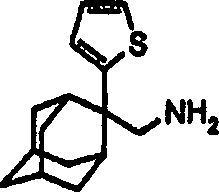
- 2-(2-Thienyl)-2-adamantancarbonitril
- Diese Verbindung wurde mit dem Verfahren von Beispiel 1 unter Verwendung von 2-(2-Thienyl)-2-adamantanol anstelle von 2-(3-Ethylphenyl)-2-adamantanol hergestellt und das Produkt (1,34 g, 78%) wurde als hellbrauner Feststoff isoliert: Schmp.: 108–109,5°C; IR νmax (Nujol)/cm–1 2921, 2855, 2227, 1454, 1377, 1240, 1104, 820 und 728; NMR δH (400 MHz, CDCl3) 1,70 (2H, d, J 12,5 Hz), 1,78 (3H, s), 1,97–2,05 (5H, m), 2,46 (2H, d, J 12,5 Hz), 2,64 (2H, s), 7,01–7,06 (2H, m) und 7,33 (1 H, d, J 6,5 Hz); Analyse: Berechnet für C15H17NS: C, 74,03; H, 7,04; N, 5,75, gefunden: C, 74,19; H, 7,09; N, 5,73.
- 2-(2-Thienyl)-2-adamantanmethanaminhydrochlorid
- Diese Verbindung wurde mit dem Verfahren von Beispiel 1 unter Verwendung von 2-(2-Thienyl)-2-adamantancarbonitril anstelle von 2-(3-Ethylphenyl)-2-adamantancarbonitril hergestellt und die Titelverbindung (236 mg, 84%) wurde als weißer Feststoff isoliert: Schmp.: 255–257°C; IR νmax (Nujol)/cm–1 2924, 1592, 1570, 1516, 1457, 1377, 1248, 1100 Und 690; NMR δH (400 MHz, CDCl3) 1,65 (5H, s), 1,75–1,99 (7H, m), 3,19 (2H, s), 5,39 (3H, br s), 6,97–6,98 (1H, m) und 7,27–7,29 (2H, m); Analyse: Berechnet für C15H22ClNS: C, 63,47; H, 7,81; N, 4,93, gefunden: C, 63,64; H, 7,78; N, 4,89. Beispiel 11 2-n-Butyl-2-adamantanmethanaminhydrochlorid

- 2-n-Butyl-2-adamantancarbonitril
- Diese Verbindung wurde mit dem Verfahren von Beispiel 1 unter Verwendung von 2-n-Butyl-2-adamantanol anstelle von 2-(3-Ethylphenyl)-2-adamantanol hergestellt und das Produkt (675 mg, 44%) wurde als weißer Feststoff isoliert: Schmp.: 48–50°C; IR νmax (Nujol)/cm–1 2922, 2228, 1460, 1356 und 1098; NMR δH (400 MHz, CDCl3) 0,95 (3H, t, J 7 Hz), 1,37–1,48 (4H, m), 1,60–1,65 (2H, m), 1,74–1,83 (7H, m), 1,90–1,94 (5H, m) und 2,26 (2H, d, J 13 Hz).
- 2-n-Butyl-2-adamantanmethanaminhydrochlorid
- Diese Verbindung wurde mit dem Verfahren von Beispiel 1 unter Verwendung von 2-n-Butyl-2-adamantancarbonitril anstelle von 2-(3-Ethylphenyl)-2-adamantancarbonitril hergestellt und die Titelverbindung (172 mg, 53%) wurde als blasser Feststoff isoliert: Schmp.: > 250°C, Zersetzung; IR νmax (Nujol)/cm–1 3386, 2924, 1984, 1606, 1527, 1490, 1465, 1378, 1099 und 722; NMR δH (400 MHz, CDCl3) 0,90 (3H, t, J 7,5 Hz), 1,07–1,09 (2H, m), 1,29–1,31 (2H, m), 1,51–1,58 (8H, m), 1,64 (2H, s), 1,82 (2H, s), 1,97 (4H, m), 2,96–2,98 (2H, m) und 7,76 (3H, br s); Analyse: Berechnet für C15H28NC1: C, 69,87; H, 10,94; N, 5,43, gefunden: C, 69,35; H, 10,81; N, 5,39.
- II. NMDA-Rezeptorbindung
- Der NMDA-Rezeptor enthält mehrere unterscheidbare Bindungsdomänen, die das Öffnen des kationischen Kanals regulieren können. Die Phencyclidin-Stelle (PCP-Stelle) des NMDA-Rezeptors kann mit [3H]-(+)-5-Methyl-10,11-dihydro-5H-dibenzo[a,d]cyclohepten-5,10-iminhydrogenmaleat, [3H-MK-801], radioaktiv markiert werden. Nachstehend ist das Verfahren zur Bestimmung der Affinität der Verbindungen für die PCP-Stelle in Cortex- oder Kleinhirnmembranen von Ratten beschrieben.
- Gefrorenes Cortex oder Kleinhirn von Ratten, das in 10 Volumenteilen eiskalter 0,32 M Saccharoselösung homogenisiert worden ist, wird 12 min bei 1000 g zentrifugiert und der Überstand wird auf Eis gelagert, während das Pellet zwei weitere Male resuspendiert, rehomogenisiert und rezentrifugiert wird. Die schließlich erhaltenen drei Überstände werden vereinigt und 40 min bei 4°C und 30000 g zentrifugiert, um P2-Pellets zu erhalten. Diese werden in eiskaltem destillierten Wasser resuspendiert und 50 min bei 4°C und 30000 g zentrifugiert. Nach drei weiteren Waschvorgängen in destilliertem Wasser werden die P2-Pellets mindestens 18 Stunden bei –20°C gelagert. Am Tag des Tests werden die Membranpellets bei Raumtemperatur aufgetaut, in eiskaltem destillierten Wasser resuspendiert und 20 min bei 30000 g zentrifugiert. Die Pellets werden in 50 mM Tris-HCl (pH: 7,4) resuspendiert und zwei weitere Male zentrifugiert, bevor sie für den sofortigen Gebrauch in Tris-HCl resuspendiert werden. Die Bindungstests werden im Gleichgewicht in einem Gesamtvolumen von 200 μl durchgeführt, das [3H-MK-801] (Endkonzentration 5 nM), 10 μM Glutamat, 10 μm Glycin, 160 μl Membranzubereitung und gegebenenfalls zusätzlich Arzneistoffe enthält. Die nichtspezifische Bindung wird unter Verwendung von MK-801 (10 μM) durchgeführt. Der Test wird bei Raumtemperatur 120 min inkubiert. Die Inkubation wird durch eine Schnellfiltration durch Whatman GF/B-Filter (in 0,1%iger PEI-Lösung vorgetränkt) beendet. Die Teströhrchen und Filter werden fünfmal mit 1 ml eiskaltem Testpuffer gewaschen. Die Filter werden mit etwa 5 ml Szintillationsfluid in poly-Q-Minifläschchen eingebracht. Die Fläschchen werden dann geschüttelt und mindestens 8 Stunden stehen gelassen, bevor sie auf einem Flüssigszintillationszähler gezählt werden. Zur Bestimmung der Konzentration des freien Liganden werden auch 3 Aliquots (20 μl) der [3H-MK-801]-Arbeitslösung gezählt. Die Konzentrations-Antwortdaten für die Arzneistoffe werden unter Verwendung einer 4-Parametergleichung analysiert, die mit einer nicht-linearen Regression gefittet wurde. Dadurch werden die halbmaximal wirksame Arzneistoffkonzentration (IC50) und der Hill-Koeffizient erhalten. Die aus diesen Tests erhaltenen Daten sind in der Tabelle 1 angegeben. Die Daten zeigen deutlich, dass die erfindungsgemäßen Verbindungen als NMDA-Antagonisten wirksam sind und günstige Verhältnisse der Cortex-Bindungsaffinität zur Kleinhirnbindungsaffinität aufweisen, was zeigt, dass die Verbindungen in vivo gut verträglich sein werden. Tabelle 1 Bindungsaffinitäten an Cortex- und Kleinhirn-NMDA-Rezeptoren

Claims (19)
- Verwendung einer Verbindung der Formel (1):worin R1, R2, R3, R4, R5 und R6 unabhängig voneinander aus Wasserstoff, Alkyl und Aryl ausgewählt sind, oder pharmazeutisch verträgliche Salze davon, mit der Maßgabe, daß wenn R1 bis R4 und R6 Wasserstoff sind, R5 nicht aus CH2CH2NHSO2CH3, CH2CH2NHSO2CF3 und Methyl, substituiert mit SO2NH2, SO3H, PO3H2, CONHOH oder einer heterocyclischen Gruppe, ausgewählt aus
 ausgewählt ist, zur Herstellung eines Medikaments zur Verwendung bei der Behandlung eines Zustandes, in welchem Antagonismus des N-Methyl-D-Aspartat-Rezeptors vorteilhaft ist, ausgewählt aus ischämischem Schlag, hämorrhagischem Schlag, Subarachnoidalblutung, subduralem Hämatom, Koronararterie-Bypasschirurgie, Neurochirurgie, traumatischer Gehirnverletzung, traumatischer Spinalverletzung, Alzheimer-Krankheit, Parkinson-Krankheit, Huntington-Krankheit, Picks-Krankheit, Lewy-Korpuskelkrankheit, seniler De menz, spongiformen Enzephalopathien, Prionprotein-induzierte Neurotoxizität, perinataler Asphyxie, Entmarkungskrankheit, Multiinfarktdemenz, vaskulärer Demenz, Dementia pugilans, Drogenabhängigkeit, Alkoholentzug, Opiatentzug, Motorneuronerkrankung, Multipler Sklerose, akutem und chronischem Schmerz, diabetischer Neuropathie, Epilepsie, AIDS-Demenz, Multisystem Atrophie, progressiver supranukleärer Lähmung, Friedrich Ataxie, Autismus, fragiler-X-Syndrom, Bourneville-Syndrom, Aufmerksamkeitsmangelstörung, Olivio-ponto-zerebellärer Atrophie, Zerebralparese, Wirkstoff-induzierter Optikusneuritis, peripherer Neuropathie, Myelopathie, ischämischer Retinopathie, Glaukom, Herzstillstand, Meningitis, Enzephalitis, Depression, manischdepressiver Psychose, Schizophrenie, Psychose, Verhaltensstörungen, Impulskontrollstörungen, Voreklampsie, neuroleptischem malignem Syndrom, chronischem Ermüdungssyndrom, Magersucht, Angstneurosen, generalisierter Angstneurose, Panikstörung, Phobien, Frischwasserertrinken und Dekompression.
- Verwendung nach Anspruch 1, wobei eines oder mehrere von R1, R2, R3, R4 und R6 Wasserstoff sind.
- Verwendung nach Anspruch 1 oder 2, wobei eines oder beide von R1 und R2 Wasserstoff sind.
- Verwendung nach Anspruch 1, 2 oder 3, wobei eines oder beide von R3 und R4 Wasserstoff sind.
- Verwendung nach Anspruch 1, 2, 3 oder 4, wobei R5 Alkyl ist.
- Verwendung nach Anspruch 1, 2, 3 oder 4, wobei R5 ein acyclischer Kohlenwasserstoffrest ist.
- Verwendung nach Anspruch 1, 2, 3 oder 4, wobei R5 Aryl ist.
- Verwendung nach Anspruch 1, 2, 3 oder 4, wobei R5 substituiertes oder unsubstituiertes Phenyl ist.
- Verwendung nach Anspruch 8, wobei R5 Phenyl ist, welches mit einem Substituenten, ausgewählt aus Methyl, Ethyl, Fluor, Chlor, Methoxy und Trifluormethyl, substituiert ist.
- Verwendung nach Anspruch 8 oder 9, wobei das Phenyl meta-substituiert ist.
- Verwendung nach Anspruch 1, 2, 3 oder 4, wobei R5 3-Methylphenyl, 4-Methylphenyl oder 3-Ethylphenyl ist.
- Verwendung nach Anspruch 1, wobei die Verbindung ausgewählt ist aus: 2-(3-Ethylphenyl)-2-adamantanmethanamin, 2-(3-Methylphenyl)-2-adamantanmethanamin, 2-Phenyl-2-adamantanmethanamin und 2-(4-Methylphenyl)-2-adamantanmethanamin.
- Verwendung nach einem der vorhergehenden Ansprüche, wobei der Zustand aus ischämischem Schlag, hämorrhagischem Schlag, traumatischer Gehirnverletzung, traumatischer Spinalverletzung, Alzheimer-Erkrankung, Parkinson-Erkrankung, Huntington-Erkrankung, Multipler Sklerose, akutem und chronischem Schmerz, Epilepsie, Wirkstoff-induzierter Optikusneuritis, peripherer Neuropathie, Myelopathie, ischämischer Retinopathie und Glaukom ausgewählt ist.
- Verbindung nach einem der Ansprüche 1 bis 12 und pharmazeutisch verträgliche Salze davon zur therapeutischen Verwendung, anders als die Verbindungen, in welchen R3, R4, R5 und R6 Wasserstoff sind und eines von R1 und R2 Wasserstoff, Methyl oder Benzyl und eines von R1 und R2 eine substituierte Methyl-, Ethyl- oder Propyl-Gruppe ist, und anders als die Verbindungen, in welchen R1, R2, R5 und R6 Wasserstoff sind, und R3 und R4 aus Methyl und Aminomethyl ausgewählt sind.
- Verbindung nach Anspruch 14 zur therapeutischen Verwendung, anders als die Verbindungen, in welchen R3, R4, R5 und R6 Wasserstoff sind und R1 und R2 unabhängig voneinander aus Alkyl ausgewählt sind, und anders als die Verbindungen, in welchen R1, R2, R5 und R6 Wasserstoff sind und R3 und R4 unabhängig voneinander aus Alkyl ausgewählt sind, und pharmazeutisch verträgliche Salze davon.
- Verbindung nach Anspruch 14 zur therapeutischen Verwendung, wobei (i) R3, R4, R5 und R6 unabhängig voneinander aus Wasserstoff, Alkyl und Aryl ausgewählt sind, und R1 und R2 unabhängig voneinander aus Wasserstoff und Aryl ausgewählt sind, oder (ii) R3, R4, R5 und R6 unabhängig voneinander aus Alkyl und Aryl ausgewählt sind, und R1 und R2 unabhängig voneinander aus Alkyl ausgewählt sind, oder (iii) R1, R2, R5 und R6 unabhängig voneinander aus Wasserstoff, Alkyl und Aryl ausgewählt sind, und R3 und R4 unabhängig voneinander aus Wasserstoff und Aryl ausgewählt sind, oder (iv) R1, R2, R5 und R6 unabhängig voneinander aus Alkyl und Aryl ausgewählt sind, und R3 und R4 unabhängig voneinander aus Alkyl ausgewählt sind, und pharmazeutisch verträgliche Salze davon.
- Verbindung nach Anspruch 14 zur therapeutischen Verwendung, wobei R5 aus Alkyl und Aryl ausgewählt ist, und pharmazeutisch verträgliche Salze davon.
- Verbindung per se nach einem der Ansprüche 1 bis 12, wobei R5 aus Alkyl und Aryl ausgewählt ist, anders als die Verbindungen, in welchen R1 und R2 Methyl sind, R3, R4 und R6 Wasserstoff sind und R5 Hydroxymethyl ist, und pharmazeutisch verträgliche Salze davon.
- Pharmazeutische Zusammensetzung, welche eine Verbindung nach Anspruch 18 oder ein pharmazeutisch verträgliches Salz davon in Kombination mit einem pharmazeutisch verträglichen Träger umfaßt.
Applications Claiming Priority (3)
| Application Number | Priority Date | Filing Date | Title |
|---|---|---|---|
| GBGB9901691.7A GB9901691D0 (en) | 1999-01-26 | 1999-01-26 | Chemical compounds |
| GB9901691 | 1999-01-26 | ||
| PCT/GB2000/000207 WO2000044371A1 (en) | 1999-01-26 | 2000-01-26 | 2-adamantanemethanamine compounds for treating abnormalities in glutamatergic transmission |
Publications (2)
| Publication Number | Publication Date |
|---|---|
| DE60009263D1 DE60009263D1 (de) | 2004-04-29 |
| DE60009263T2 true DE60009263T2 (de) | 2005-02-24 |
Family
ID=10846525
Family Applications (1)
| Application Number | Title | Priority Date | Filing Date |
|---|---|---|---|
| DE60009263T Expired - Fee Related DE60009263T2 (de) | 1999-01-26 | 2000-01-26 | 2-adamantanmethanamin-verbindungen zur behandlung von anomalien bei glutamerger übertragung |
Country Status (10)
| Country | Link |
|---|---|
| US (1) | US6531511B1 (de) |
| EP (1) | EP1143964B1 (de) |
| JP (1) | JP2002535360A (de) |
| AT (1) | ATE262326T1 (de) |
| AU (1) | AU2116900A (de) |
| CA (1) | CA2360674A1 (de) |
| DE (1) | DE60009263T2 (de) |
| ES (1) | ES2216852T3 (de) |
| GB (1) | GB9901691D0 (de) |
| WO (1) | WO2000044371A1 (de) |
Families Citing this family (7)
| Publication number | Priority date | Publication date | Assignee | Title |
|---|---|---|---|---|
| GB0018272D0 (en) * | 2000-07-25 | 2000-09-13 | Vernalis Research Limited | Chemical compounds IV |
| WO2002100434A1 (en) | 2001-06-07 | 2002-12-19 | The General Hospital Corporation | Treatment of neuropathic pain with n-methyl-d-aspartate (nmda) receptor antagonists |
| US7283414B1 (en) * | 2006-05-24 | 2007-10-16 | Sandisk 3D Llc | Method for improving the precision of a temperature-sensor circuit |
| WO2008035049A1 (en) * | 2006-09-18 | 2008-03-27 | Merz Pharma Gmbh & Co. Kgaa | Adamantanyl-(cyclopropyl)-ketones as metabotropic glutamate receptor modulators |
| ES2341517B1 (es) * | 2008-03-28 | 2011-01-25 | Farmalider, S.A | Utilizacion de un compuesto inhibidor de la activacion de la enzima erk 1/2 en el tratamiento de enfermedades neurodegenerativas. |
| PL2578212T3 (pl) * | 2010-05-24 | 2017-01-31 | Farmalider Sa | Związek hamujący aktywację enzymu Erk 1/2 do zastosowania w leczeniu chorób neurodegeneracyjnych |
| US11274100B2 (en) | 2017-06-21 | 2022-03-15 | Daiichi Sankyo Company, Limited | EP300/CREBBP inhibitor |
Family Cites Families (13)
| Publication number | Priority date | Publication date | Assignee | Title |
|---|---|---|---|---|
| NL6804065A (de) * | 1968-03-22 | 1969-09-24 | ||
| YU36365B (en) * | 1974-05-16 | 1983-06-30 | Pliva Pharm & Chem Works | Process for preparing alpha-amino-2-adamantyl acetic acid |
| YU30589A (en) * | 1989-02-09 | 1991-10-31 | Imunoloski Z Zagreb | New adamantyl containing tripeptides and it's hydrochloride and process for preparing and use |
| US5334618A (en) * | 1991-04-04 | 1994-08-02 | The Children's Medical Center Corporation | Method of preventing NMDA receptor-mediated neuronal damage |
| WO1992017168A1 (en) | 1991-04-04 | 1992-10-15 | The Children's Medical Center Corporation | Method of preventing nmda receptor-mediated neuronal damage |
| US6011155A (en) | 1996-11-07 | 2000-01-04 | Novartis Ag | N-(substituted glycyl)-2-cyanopyrrolidines, pharmaceutical compositions containing them and their use in inhibiting dipeptidyl peptidase-IV |
| GB9726388D0 (en) | 1997-12-12 | 1998-02-11 | Cerebrus Ltd | Chemical compounds |
| US6008240A (en) | 1997-12-15 | 1999-12-28 | Gliatech, Inc. | 2-(1H-4(5)-imidazoyl) cyclopropyl derivatives |
| US6518289B1 (en) | 1997-12-16 | 2003-02-11 | Pfizer, Inc. | 1-substituted-1-aminomethyl-cycloalkane derivatives (=gabapentin analogues), their preparation and their use in the treatment of neurological disorders |
| GB9802225D0 (en) | 1998-02-02 | 1998-04-01 | Cerebrus Ltd | Chemical compounds |
| WO2001012189A1 (en) | 1999-08-12 | 2001-02-22 | Pharmacia Italia S.P.A. | 3(5)-amino-pyrazole derivatives, process for their preparation and their use as antitumor agents |
| CA2318004A1 (en) | 1999-09-15 | 2001-03-15 | Oridigm Corporation | Novel polyamine analogues as therapeutic and diagnostic agents |
| MY125533A (en) | 1999-12-06 | 2006-08-30 | Bristol Myers Squibb Co | Heterocyclic dihydropyrimidine compounds |
-
1999
- 1999-01-26 GB GBGB9901691.7A patent/GB9901691D0/en not_active Ceased
-
2000
- 2000-01-26 WO PCT/GB2000/000207 patent/WO2000044371A1/en not_active Ceased
- 2000-01-26 ES ES00901207T patent/ES2216852T3/es not_active Expired - Lifetime
- 2000-01-26 EP EP00901207A patent/EP1143964B1/de not_active Expired - Lifetime
- 2000-01-26 JP JP2000595674A patent/JP2002535360A/ja active Pending
- 2000-01-26 AU AU21169/00A patent/AU2116900A/en not_active Abandoned
- 2000-01-26 US US09/890,061 patent/US6531511B1/en not_active Expired - Fee Related
- 2000-01-26 CA CA002360674A patent/CA2360674A1/en not_active Abandoned
- 2000-01-26 DE DE60009263T patent/DE60009263T2/de not_active Expired - Fee Related
- 2000-01-26 AT AT00901207T patent/ATE262326T1/de not_active IP Right Cessation
Also Published As
| Publication number | Publication date |
|---|---|
| DE60009263D1 (de) | 2004-04-29 |
| GB9901691D0 (en) | 1999-03-17 |
| EP1143964A1 (de) | 2001-10-17 |
| ES2216852T3 (es) | 2004-11-01 |
| WO2000044371A1 (en) | 2000-08-03 |
| ATE262326T1 (de) | 2004-04-15 |
| JP2002535360A (ja) | 2002-10-22 |
| US6531511B1 (en) | 2003-03-11 |
| AU2116900A (en) | 2000-08-18 |
| EP1143964B1 (de) | 2004-03-24 |
| CA2360674A1 (en) | 2000-08-03 |
Similar Documents
| Publication | Publication Date | Title |
|---|---|---|
| DE60107435T2 (de) | 2-adamantylethylamine und deren verwendung bei der behandlung von abnormalitäten in der glutamat transmission | |
| DE69919142T2 (de) | Bicyclo [2.2.1] heptane und verwandte verbindungen | |
| DE60102581T2 (de) | Azabizyklische carbamate und ihre anwendung als antagonisten des alpha-7 nikotinischen acetylcholin rezeptors | |
| DE69533408T2 (de) | Chinolinderivate als Tachykinin NK3 Rezeptor Antagonisten | |
| DE69432984T2 (de) | Therapeutische substituierte guanidine | |
| DE69804273T2 (de) | 5h-Thiazolo[3,2-a]pyrimidinderivate | |
| JP3099072B2 (ja) | (1s,2s)−1−(4−ヒドロキシフェニル)−2−(4−ヒドロキシ−4−フェニルピペリジン−1−イル)−1−プロパノールメタンスルホン酸塩三水和物 | |
| DE9290063U1 (de) | Chinuclidin-Derivate | |
| TW201329050A (zh) | Trpv1拮抗劑 | |
| EP2260022B1 (de) | Substituierte cyclohexyldiamine | |
| DE60009263T2 (de) | 2-adamantanmethanamin-verbindungen zur behandlung von anomalien bei glutamerger übertragung | |
| EP0569333B1 (de) | Neue N-Aralkyl- und N-Heteroaralkylaminoalkanphosphinsäuren | |
| DE69606165T2 (de) | Bizyclische isothioharnstoff-derivate mit therapeutischer wirkung | |
| DE10038007A1 (de) | Neue Amino-und Amido-Diphenylether für Arzneimittel | |
| DE69808669T2 (de) | 1-(adamantyl)amidine und ihre verwendung bei der behandlung von zuständen, die zusammenhängen mit abweichungen bei glutamatergischen übertragungen | |
| DE4341402A1 (de) | N-substituierte Azabicycloheptan-Derivate, ihre Herstellung und Verwendung | |
| EP1051392B1 (de) | Adamantancarboximidamid-derivate und ihre anwendung als nmda-antagonisten | |
| DE10053813A1 (de) | Neue Verwendung von Sulfonamiden | |
| US10487045B2 (en) | Adamantane derivative and use thereof | |
| EP0646110A1 (de) | N-substituierte 3-azabicyclo 3.2.0]heptan-derivate als neuroleptika usw. | |
| DE69911373T2 (de) | Azetidincarboxamidderivate zur behandlung von zns-erkrankungen | |
| DE69902142T2 (de) | Azetidincarboxamidderivate zur behandlung von zns-erkrankungen | |
| JP3727791B2 (ja) | 二環式[3.1.0]ヘキサン及び関連化合物 | |
| DE602004008103T2 (de) | Cyclopentylderivate | |
| DE69329994T2 (de) | Arylalkoxyphenoxyimidazolinverbindungen |
Legal Events
| Date | Code | Title | Description |
|---|---|---|---|
| 8364 | No opposition during term of opposition | ||
| 8339 | Ceased/non-payment of the annual fee |