DE60117618T2 - Initial viewing period for authorizing multimedia content - Google Patents
Initial viewing period for authorizing multimedia content Download PDFInfo
- Publication number
- DE60117618T2 DE60117618T2 DE60117618T DE60117618T DE60117618T2 DE 60117618 T2 DE60117618 T2 DE 60117618T2 DE 60117618 T DE60117618 T DE 60117618T DE 60117618 T DE60117618 T DE 60117618T DE 60117618 T2 DE60117618 T2 DE 60117618T2
- Authority
- DE
- Germany
- Prior art keywords
- key
- program content
- content
- customer
- customers
- Prior art date
- Legal status (The legal status is an assumption and is not a legal conclusion. Google has not performed a legal analysis and makes no representation as to the accuracy of the status listed.)
- Expired - Fee Related
Links
Classifications
-
- H—ELECTRICITY
- H04—ELECTRIC COMMUNICATION TECHNIQUE
- H04N—PICTORIAL COMMUNICATION, e.g. TELEVISION
- H04N21/00—Selective content distribution, e.g. interactive television or video on demand [VOD]
- H04N21/20—Servers specifically adapted for the distribution of content, e.g. VOD servers; Operations thereof
- H04N21/23—Processing of content or additional data; Elementary server operations; Server middleware
- H04N21/234—Processing of video elementary streams, e.g. splicing of video streams or manipulating encoded video stream scene graphs
- H04N21/2347—Processing of video elementary streams, e.g. splicing of video streams or manipulating encoded video stream scene graphs involving video stream encryption
- H04N21/23473—Processing of video elementary streams, e.g. splicing of video streams or manipulating encoded video stream scene graphs involving video stream encryption by pre-encrypting
-
- G—PHYSICS
- G06—COMPUTING OR CALCULATING; COUNTING
- G06F—ELECTRIC DIGITAL DATA PROCESSING
- G06F17/00—Digital computing or data processing equipment or methods, specially adapted for specific functions
-
- G—PHYSICS
- G06—COMPUTING OR CALCULATING; COUNTING
- G06F—ELECTRIC DIGITAL DATA PROCESSING
- G06F21/00—Security arrangements for protecting computers, components thereof, programs or data against unauthorised activity
-
- H—ELECTRICITY
- H04—ELECTRIC COMMUNICATION TECHNIQUE
- H04N—PICTORIAL COMMUNICATION, e.g. TELEVISION
- H04N21/00—Selective content distribution, e.g. interactive television or video on demand [VOD]
- H04N21/20—Servers specifically adapted for the distribution of content, e.g. VOD servers; Operations thereof
- H04N21/21—Server components or server architectures
- H04N21/222—Secondary servers, e.g. proxy server, cable television Head-end
- H04N21/2225—Local VOD servers
-
- H—ELECTRICITY
- H04—ELECTRIC COMMUNICATION TECHNIQUE
- H04N—PICTORIAL COMMUNICATION, e.g. TELEVISION
- H04N21/00—Selective content distribution, e.g. interactive television or video on demand [VOD]
- H04N21/20—Servers specifically adapted for the distribution of content, e.g. VOD servers; Operations thereof
- H04N21/23—Processing of content or additional data; Elementary server operations; Server middleware
- H04N21/231—Content storage operation, e.g. caching movies for short term storage, replicating data over plural servers, prioritizing data for deletion
- H04N21/23106—Content storage operation, e.g. caching movies for short term storage, replicating data over plural servers, prioritizing data for deletion involving caching operations
-
- H—ELECTRICITY
- H04—ELECTRIC COMMUNICATION TECHNIQUE
- H04N—PICTORIAL COMMUNICATION, e.g. TELEVISION
- H04N21/00—Selective content distribution, e.g. interactive television or video on demand [VOD]
- H04N21/20—Servers specifically adapted for the distribution of content, e.g. VOD servers; Operations thereof
- H04N21/23—Processing of content or additional data; Elementary server operations; Server middleware
- H04N21/234—Processing of video elementary streams, e.g. splicing of video streams or manipulating encoded video stream scene graphs
- H04N21/2347—Processing of video elementary streams, e.g. splicing of video streams or manipulating encoded video stream scene graphs involving video stream encryption
-
- H—ELECTRICITY
- H04—ELECTRIC COMMUNICATION TECHNIQUE
- H04N—PICTORIAL COMMUNICATION, e.g. TELEVISION
- H04N21/00—Selective content distribution, e.g. interactive television or video on demand [VOD]
- H04N21/20—Servers specifically adapted for the distribution of content, e.g. VOD servers; Operations thereof
- H04N21/25—Management operations performed by the server for facilitating the content distribution or administrating data related to end-users or client devices, e.g. end-user or client device authentication, learning user preferences for recommending movies
- H04N21/254—Management at additional data server, e.g. shopping server, rights management server
- H04N21/2541—Rights Management
-
- H—ELECTRICITY
- H04—ELECTRIC COMMUNICATION TECHNIQUE
- H04N—PICTORIAL COMMUNICATION, e.g. TELEVISION
- H04N21/00—Selective content distribution, e.g. interactive television or video on demand [VOD]
- H04N21/20—Servers specifically adapted for the distribution of content, e.g. VOD servers; Operations thereof
- H04N21/25—Management operations performed by the server for facilitating the content distribution or administrating data related to end-users or client devices, e.g. end-user or client device authentication, learning user preferences for recommending movies
- H04N21/254—Management at additional data server, e.g. shopping server, rights management server
- H04N21/2543—Billing, e.g. for subscription services
-
- H—ELECTRICITY
- H04—ELECTRIC COMMUNICATION TECHNIQUE
- H04N—PICTORIAL COMMUNICATION, e.g. TELEVISION
- H04N21/00—Selective content distribution, e.g. interactive television or video on demand [VOD]
- H04N21/20—Servers specifically adapted for the distribution of content, e.g. VOD servers; Operations thereof
- H04N21/25—Management operations performed by the server for facilitating the content distribution or administrating data related to end-users or client devices, e.g. end-user or client device authentication, learning user preferences for recommending movies
- H04N21/266—Channel or content management, e.g. generation and management of keys and entitlement messages in a conditional access system, merging a VOD unicast channel into a multicast channel
- H04N21/26606—Channel or content management, e.g. generation and management of keys and entitlement messages in a conditional access system, merging a VOD unicast channel into a multicast channel for generating or managing entitlement messages, e.g. Entitlement Control Message [ECM] or Entitlement Management Message [EMM]
-
- H—ELECTRICITY
- H04—ELECTRIC COMMUNICATION TECHNIQUE
- H04N—PICTORIAL COMMUNICATION, e.g. TELEVISION
- H04N21/00—Selective content distribution, e.g. interactive television or video on demand [VOD]
- H04N21/20—Servers specifically adapted for the distribution of content, e.g. VOD servers; Operations thereof
- H04N21/25—Management operations performed by the server for facilitating the content distribution or administrating data related to end-users or client devices, e.g. end-user or client device authentication, learning user preferences for recommending movies
- H04N21/266—Channel or content management, e.g. generation and management of keys and entitlement messages in a conditional access system, merging a VOD unicast channel into a multicast channel
- H04N21/26606—Channel or content management, e.g. generation and management of keys and entitlement messages in a conditional access system, merging a VOD unicast channel into a multicast channel for generating or managing entitlement messages, e.g. Entitlement Control Message [ECM] or Entitlement Management Message [EMM]
- H04N21/26609—Channel or content management, e.g. generation and management of keys and entitlement messages in a conditional access system, merging a VOD unicast channel into a multicast channel for generating or managing entitlement messages, e.g. Entitlement Control Message [ECM] or Entitlement Management Message [EMM] using retrofitting techniques, e.g. by re-encrypting the control words used for pre-encryption
-
- H—ELECTRICITY
- H04—ELECTRIC COMMUNICATION TECHNIQUE
- H04N—PICTORIAL COMMUNICATION, e.g. TELEVISION
- H04N21/00—Selective content distribution, e.g. interactive television or video on demand [VOD]
- H04N21/40—Client devices specifically adapted for the reception of or interaction with content, e.g. set-top-box [STB]; Operations thereof
- H04N21/41—Structure of client; Structure of client peripherals
- H04N21/414—Specialised client platforms, e.g. receiver in car or embedded in a mobile appliance
- H04N21/4143—Specialised client platforms, e.g. receiver in car or embedded in a mobile appliance embedded in a Personal Computer [PC]
-
- H—ELECTRICITY
- H04—ELECTRIC COMMUNICATION TECHNIQUE
- H04N—PICTORIAL COMMUNICATION, e.g. TELEVISION
- H04N21/00—Selective content distribution, e.g. interactive television or video on demand [VOD]
- H04N21/40—Client devices specifically adapted for the reception of or interaction with content, e.g. set-top-box [STB]; Operations thereof
- H04N21/43—Processing of content or additional data, e.g. demultiplexing additional data from a digital video stream; Elementary client operations, e.g. monitoring of home network or synchronising decoder's clock; Client middleware
- H04N21/44—Processing of video elementary streams, e.g. splicing a video clip retrieved from local storage with an incoming video stream or rendering scenes according to encoded video stream scene graphs
- H04N21/4405—Processing of video elementary streams, e.g. splicing a video clip retrieved from local storage with an incoming video stream or rendering scenes according to encoded video stream scene graphs involving video stream decryption
-
- H—ELECTRICITY
- H04—ELECTRIC COMMUNICATION TECHNIQUE
- H04N—PICTORIAL COMMUNICATION, e.g. TELEVISION
- H04N21/00—Selective content distribution, e.g. interactive television or video on demand [VOD]
- H04N21/40—Client devices specifically adapted for the reception of or interaction with content, e.g. set-top-box [STB]; Operations thereof
- H04N21/43—Processing of content or additional data, e.g. demultiplexing additional data from a digital video stream; Elementary client operations, e.g. monitoring of home network or synchronising decoder's clock; Client middleware
- H04N21/442—Monitoring of processes or resources, e.g. detecting the failure of a recording device, monitoring the downstream bandwidth, the number of times a movie has been viewed, the storage space available from the internal hard disk
- H04N21/44204—Monitoring of content usage, e.g. the number of times a movie has been viewed, copied or the amount which has been watched
-
- H—ELECTRICITY
- H04—ELECTRIC COMMUNICATION TECHNIQUE
- H04N—PICTORIAL COMMUNICATION, e.g. TELEVISION
- H04N21/00—Selective content distribution, e.g. interactive television or video on demand [VOD]
- H04N21/40—Client devices specifically adapted for the reception of or interaction with content, e.g. set-top-box [STB]; Operations thereof
- H04N21/45—Management operations performed by the client for facilitating the reception of or the interaction with the content or administrating data related to the end-user or to the client device itself, e.g. learning user preferences for recommending movies, resolving scheduling conflicts
- H04N21/462—Content or additional data management e.g. creating a master electronic programme guide from data received from the Internet and a Head-end or controlling the complexity of a video stream by scaling the resolution or bit-rate based on the client capabilities
- H04N21/4627—Rights management associated to the content
-
- H—ELECTRICITY
- H04—ELECTRIC COMMUNICATION TECHNIQUE
- H04N—PICTORIAL COMMUNICATION, e.g. TELEVISION
- H04N21/00—Selective content distribution, e.g. interactive television or video on demand [VOD]
- H04N21/40—Client devices specifically adapted for the reception of or interaction with content, e.g. set-top-box [STB]; Operations thereof
- H04N21/47—End-user applications
- H04N21/472—End-user interface for requesting content, additional data or services; End-user interface for interacting with content, e.g. for content reservation or setting reminders, for requesting event notification, for manipulating displayed content
- H04N21/47202—End-user interface for requesting content, additional data or services; End-user interface for interacting with content, e.g. for content reservation or setting reminders, for requesting event notification, for manipulating displayed content for requesting content on demand, e.g. video on demand
-
- H—ELECTRICITY
- H04—ELECTRIC COMMUNICATION TECHNIQUE
- H04N—PICTORIAL COMMUNICATION, e.g. TELEVISION
- H04N21/00—Selective content distribution, e.g. interactive television or video on demand [VOD]
- H04N21/40—Client devices specifically adapted for the reception of or interaction with content, e.g. set-top-box [STB]; Operations thereof
- H04N21/47—End-user applications
- H04N21/472—End-user interface for requesting content, additional data or services; End-user interface for interacting with content, e.g. for content reservation or setting reminders, for requesting event notification, for manipulating displayed content
- H04N21/47211—End-user interface for requesting content, additional data or services; End-user interface for interacting with content, e.g. for content reservation or setting reminders, for requesting event notification, for manipulating displayed content for requesting pay-per-view content
-
- H—ELECTRICITY
- H04—ELECTRIC COMMUNICATION TECHNIQUE
- H04N—PICTORIAL COMMUNICATION, e.g. TELEVISION
- H04N21/00—Selective content distribution, e.g. interactive television or video on demand [VOD]
- H04N21/60—Network structure or processes for video distribution between server and client or between remote clients; Control signalling between clients, server and network components; Transmission of management data between server and client, e.g. sending from server to client commands for recording incoming content stream; Communication details between server and client
- H04N21/63—Control signaling related to video distribution between client, server and network components; Network processes for video distribution between server and clients or between remote clients, e.g. transmitting basic layer and enhancement layers over different transmission paths, setting up a peer-to-peer communication via Internet between remote STB's; Communication protocols; Addressing
- H04N21/633—Control signals issued by server directed to the network components or client
- H04N21/6332—Control signals issued by server directed to the network components or client directed to client
- H04N21/6334—Control signals issued by server directed to the network components or client directed to client for authorisation, e.g. by transmitting a key
- H04N21/63345—Control signals issued by server directed to the network components or client directed to client for authorisation, e.g. by transmitting a key by transmitting keys
-
- H—ELECTRICITY
- H04—ELECTRIC COMMUNICATION TECHNIQUE
- H04N—PICTORIAL COMMUNICATION, e.g. TELEVISION
- H04N21/00—Selective content distribution, e.g. interactive television or video on demand [VOD]
- H04N21/60—Network structure or processes for video distribution between server and client or between remote clients; Control signalling between clients, server and network components; Transmission of management data between server and client, e.g. sending from server to client commands for recording incoming content stream; Communication details between server and client
- H04N21/63—Control signaling related to video distribution between client, server and network components; Network processes for video distribution between server and clients or between remote clients, e.g. transmitting basic layer and enhancement layers over different transmission paths, setting up a peer-to-peer communication via Internet between remote STB's; Communication protocols; Addressing
- H04N21/637—Control signals issued by the client directed to the server or network components
- H04N21/6377—Control signals issued by the client directed to the server or network components directed to server
- H04N21/63775—Control signals issued by the client directed to the server or network components directed to server for uploading keys, e.g. for a client to communicate its public key to the server
-
- H—ELECTRICITY
- H04—ELECTRIC COMMUNICATION TECHNIQUE
- H04N—PICTORIAL COMMUNICATION, e.g. TELEVISION
- H04N21/00—Selective content distribution, e.g. interactive television or video on demand [VOD]
- H04N21/60—Network structure or processes for video distribution between server and client or between remote clients; Control signalling between clients, server and network components; Transmission of management data between server and client, e.g. sending from server to client commands for recording incoming content stream; Communication details between server and client
- H04N21/63—Control signaling related to video distribution between client, server and network components; Network processes for video distribution between server and clients or between remote clients, e.g. transmitting basic layer and enhancement layers over different transmission paths, setting up a peer-to-peer communication via Internet between remote STB's; Communication protocols; Addressing
- H04N21/64—Addressing
- H04N21/6405—Multicasting
-
- H—ELECTRICITY
- H04—ELECTRIC COMMUNICATION TECHNIQUE
- H04N—PICTORIAL COMMUNICATION, e.g. TELEVISION
- H04N21/00—Selective content distribution, e.g. interactive television or video on demand [VOD]
- H04N21/60—Network structure or processes for video distribution between server and client or between remote clients; Control signalling between clients, server and network components; Transmission of management data between server and client, e.g. sending from server to client commands for recording incoming content stream; Communication details between server and client
- H04N21/65—Transmission of management data between client and server
- H04N21/658—Transmission by the client directed to the server
- H04N21/6587—Control parameters, e.g. trick play commands, viewpoint selection
-
- H—ELECTRICITY
- H04—ELECTRIC COMMUNICATION TECHNIQUE
- H04N—PICTORIAL COMMUNICATION, e.g. TELEVISION
- H04N21/00—Selective content distribution, e.g. interactive television or video on demand [VOD]
- H04N21/80—Generation or processing of content or additional data by content creator independently of the distribution process; Content per se
- H04N21/83—Generation or processing of protective or descriptive data associated with content; Content structuring
- H04N21/835—Generation of protective data, e.g. certificates
- H04N21/8355—Generation of protective data, e.g. certificates involving usage data, e.g. number of copies or viewings allowed
-
- H—ELECTRICITY
- H04—ELECTRIC COMMUNICATION TECHNIQUE
- H04N—PICTORIAL COMMUNICATION, e.g. TELEVISION
- H04N21/00—Selective content distribution, e.g. interactive television or video on demand [VOD]
- H04N21/80—Generation or processing of content or additional data by content creator independently of the distribution process; Content per se
- H04N21/85—Assembly of content; Generation of multimedia applications
- H04N21/854—Content authoring
- H04N21/8549—Creating video summaries, e.g. movie trailer
-
- H—ELECTRICITY
- H04—ELECTRIC COMMUNICATION TECHNIQUE
- H04N—PICTORIAL COMMUNICATION, e.g. TELEVISION
- H04N7/00—Television systems
- H04N7/16—Analogue secrecy systems; Analogue subscription systems
- H04N7/162—Authorising the user terminal, e.g. by paying; Registering the use of a subscription channel, e.g. billing
- H04N7/165—Centralised control of user terminal ; Registering at central
-
- H—ELECTRICITY
- H04—ELECTRIC COMMUNICATION TECHNIQUE
- H04N—PICTORIAL COMMUNICATION, e.g. TELEVISION
- H04N7/00—Television systems
- H04N7/16—Analogue secrecy systems; Analogue subscription systems
- H04N7/167—Systems rendering the television signal unintelligible and subsequently intelligible
- H04N7/1675—Providing digital key or authorisation information for generation or regeneration of the scrambling sequence
-
- H—ELECTRICITY
- H04—ELECTRIC COMMUNICATION TECHNIQUE
- H04N—PICTORIAL COMMUNICATION, e.g. TELEVISION
- H04N7/00—Television systems
- H04N7/16—Analogue secrecy systems; Analogue subscription systems
- H04N7/173—Analogue secrecy systems; Analogue subscription systems with two-way working, e.g. subscriber sending a programme selection signal
- H04N7/17309—Transmission or handling of upstream communications
- H04N7/17336—Handling of requests in head-ends
Landscapes
- Engineering & Computer Science (AREA)
- Multimedia (AREA)
- Signal Processing (AREA)
- Databases & Information Systems (AREA)
- Computer Security & Cryptography (AREA)
- Human Computer Interaction (AREA)
- Computer Networks & Wireless Communication (AREA)
- General Engineering & Computer Science (AREA)
- Theoretical Computer Science (AREA)
- Physics & Mathematics (AREA)
- General Physics & Mathematics (AREA)
- Software Systems (AREA)
- Mathematical Physics (AREA)
- Data Mining & Analysis (AREA)
- Computer Hardware Design (AREA)
- Two-Way Televisions, Distribution Of Moving Picture Or The Like (AREA)
- Management, Administration, Business Operations System, And Electronic Commerce (AREA)
- Television Signal Processing For Recording (AREA)
- Data Exchanges In Wide-Area Networks (AREA)
- Storage Device Security (AREA)
Abstract
Description
Diese Erfindung bezieht sich im Allgemeinen auf den Bereich von Sammelsendenetzen. Genauer bezieht sich die Erfindung auf das Bereitstellen eines Vorschauabschnitts eines Programms, der an die Kunden im Netz verteilt wird.These This invention relates generally to the field of collective nets. More particularly, the invention relates to providing a preview section a program that is distributed to customers in the network.
HINTERGRUNDBACKGROUND
Es gibt eine Vielfalt von Systemen zur Verteilung von Inhalt, wie etwa audiovisuellem Inhalt, an Benutzer über Netze. Ein Beispiel ist die Per-Sendung-Bezahl-TV-Programmierung, bei der ein Benutzer für ein Programm zahlt, bevor er es anschaut. Ein anderes Beispiel ist eine Programmierung auf Abonnement-Basis, bei der ein Benutzer einen Dienstanbieter für ein Abonnement zahlt, um die Programmierung für einen bestimmten Kanal für einen vorarrangierten Zeitraum zu empfangen. Zum Beispiel sind HBOTM oder SHOWTIMETM Beispiele für Programme auf Abonnement-Basis, bei denen ein Benutzer eine monatliche Gebühr zahlt, um jegliche auf dem bezeichneten Kanal für diese Programme rundgesendeten Programme zu empfangen. Daher muss der Benutzer nicht für jede einzelne Sendung oder jedes einzelne Ereignis, die/das auf diesen bestimmten Kanälen vorkommt, zahlen. Statt dessen deckt die Abonnementzahlung die gesamte Programmierung ab.There are a variety of systems for distributing content, such as audiovisual content, to users via networks. An example is per-program pay-TV programming, where a user pays for a program before looking at it. Another example is subscription-based programming in which a user pays a subscription service provider to receive programming for a particular channel for a pre-arranged time period. For example, HBO ™ or SHOWTIME ™ are examples of subscription-based programs in which a user pays a monthly fee to receive any programs broadcast on the designated channel for those programs. Therefore, the user does not have to pay for each individual broadcast or event occurring on those particular channels. Instead, the subscription payment covers all programming.
Mit dem Aufkommen von Sammelsendenetzen kann Programminhalt, wie etwa Filme und Musik, nun in Sammelsendeübertragungen über Netze verteilt werden. Zum Beispiel kann ein Server über das Internet einen Film an Kundencomputer sammelsenden. Dies kann dadurch erreicht werden, dass der Inhalt gleichzeitig an die Adresse jedes Kunden verteilt wird. Es scheint jedoch kein kryptographisches System vorhanden zu sein, um die Kommerzialisierung solcher Übertragungen zu erleichtern. Und zwar scheint kein kryptographisches System in Gebrauch zu sein, das es einem Benutzer ermöglicht, eine Vorschau auf ein Programm, das später verschlüsselt werden und für den Benutzer nicht verfügbar sein wird, zu sehen.With The advent of ghostnets may contain program content, such as Movies and music, now in multicast broadcasts via networks be distributed. For example, a server can watch a movie over the internet to collect at customer computers. This can be achieved by that the content is distributed to the address of each customer at the same time becomes. However, there does not seem to be a cryptographic system to facilitate the commercialization of such transfers. And while no cryptographic system seems to be in use, that allows a user a preview of a program that will be encrypted later and for the user not available will be to see.
In Folge dessen müssen die meisten Sammelsendeübertragungen an eine Gruppe von Kunden übertragen werden, die im Voraus als an dem Programminhalt interessiert bekannt sind. Dies reduziert den kommerziellen Nutzen des Programminhaltanbieters dadurch, dass der Programminhaltanbieter keine anderen interessierten Zuschauer zum Erwerb des Programms verführen kann, indem er eine kostenlose Vorschau des Programms bereitstellt.In Consequence of which must most multicast broadcasts transferred to a group of customers are known in advance as interested in the program content are. This reduces the commercial benefits of the program content provider in that the content provider did not interest others Can seduce viewers to acquire the program by giving a free Preview of the program provides.
Das Dokument WO9907150 offenbart ein Kabelfernsehsystem, das bedingten Zugriff auf Dienste bereitstellt. Die Dienstobjekte werden unter Verwendung von öffentlichen und/oder privaten Schlüsseln, die von Dienstanbietern oder zentralen Autorisierungsvermittlern bereitgestellt werden, verschlüsselt. Schlüssel, die von den Set-Tops zur selektiven Entschlüsselung verwendet werden, können auch von öffentlicher oder privater Beschaffenheit sein, und derartige Schlüssel können zu unterschiedlichen Zeiten neu zugewiesen werden, um ein Kabelfernsehsystem bereitzustellen, in dem Bedenken hinsichtlich Piraterie minimiert sind.The Document WO9907150 discloses a cable television system, the conditional Provides access to services. The service objects are under Use of public and / or private keys, that of service providers or centralized authorization brokers be provided, encrypted. Key, which can be used by the set-tops for selective decryption, too from public or private nature, and such keys may be used reassigned to different times to a cable television system to minimize piracy concerns are.
Bis zu einem gewissen Betrag können interaktive Dienste ohne Autorisierung verwendet werden. „Kostenlose Vorschauen" sind möglich.To to a certain amount interactive services are used without authorization. "Free Previews "are possible.
ZUSAMMENFASSUNGSUMMARY
Der Gegenstand der vorliegenden Anmeldung ist in den beigefügten Ansprüchen definiert.Of the The subject of the present application is defined in the appended claims.
KURZE BESCHREIBUNG DER ZEICHNUNGENSHORT DESCRIPTION THE DRAWINGS
BESCHREIBUNG DER SPEZIFISCHEN AUSFÜHRUNGSFORMENDESCRIPTION THE SPECIFIC EMBODIMENTS
Unter
Bezugnahme auf
Bei
einigen Ausführungsformen
bestimmen die Ursprungsserver
Inhaltsobjekte
eines externen Ursprungsservers
Das
System
Das
Netz aus
Die folgenden Begriffe, die in diesem Patent verwendet werden, verstehen sich wie folgt:
- Inhaltanbieter – eine Instanz, die Inhalt z. B. an die Caching-Server verteilt, ohne notwendigerweise Inhalt zu verbrauchen.
- Verbraucher – eine Instanz, die einen von einem Caching-Server erhaltenen Inhalt verbraucht und wahlweise Inhalt an andere Verbraucher in dem System weiterverteilt. Die Rollen des Verbrauchers, des Caching- Servers und des Inhaltanbieters können als eine Matrix von Inhaltsquellen und -senken angesehen werden, die durch erlaubte Verhaltensweisen und Transfers miteinander in Beziehung stehen.
- Programm – ein Stück spezifisch gekennzeichneten Inhalts mit einem Anfang und einem Ende.
- Dienst – eine fortwährende Sammlung von Programmen auf demselben Strom.
- Laufendes Programm – ein Programm, das keinen spezifisch definierten Anfang und kein spezifisch definiertes Ende hat, welches Zuschauer üblicherweise zu jeder beliebigen Zeit aufnehmen oder verlassen. Dies ist für „TV-Shopping", „Modeschauen", laufenden Sportinhalt usw. geeignet.
- Erwerbsoption – ein Mechanismus, der es einem Kunden ermöglicht, Inhalt zu erwerben.
- Abonnement – ein Erwerbsmechanismus, bei dem sich der Kunde für den Inhalt im Wesentlichen im Voraus anmeldet und möglicherweise dafür im Voraus zahlt. Der Kunde wird typischerweise für mehr als ein Programm (z. B. den ganzen Dienst) autorisiert. Wenn nur ein einziges Programm autorisiert wird, ist es als Buch-im-Voraus-PPV bekannt.
- Per-Sendung-Bezahl-TV (PPV = Pay-Per-View) – ein Erwerbsmechanismus, bei dem sich der Kunde für ein einzelnes Programm oder Programmbündel anmeldet und gleichzeitig dafür zahlt. Dieser Mechanismus kann über das Netz oder lokal freigegeben werden. In dem über das Netz freigegebenen Fall kontaktiert der Kunde die Infrastruktur, wenn er den Erwerb wünscht, und die Infrastruktur gibt den Erwerb frei. Dieser Ansatz weist aufgrund von Höchstnachfragen vor einem Programm häufig Skalierprobleme auf. In dem lokal freigegebenen Fall, häufig „IPPV" oder „Impuls"-PPV genannt, nimmt der Kunde den Erwerb selbst lokal vor und speichert eine Aufzeichnung des Erwerbs. Zu einem späteren Zeitpunkt wird die Aufzeichnung den Infrastruktursystemen zur Rechnungsstellung mitgeteilt. Dieser Ansatz ist effektiv, wenn Ereignisse sammelgesendet werden, beispielsweise, da das Netz vor dem Programmbeginn keinen plötzlichen Anstieg der Nachfrage erlebt. In dem lokal freigegebenen Fall kann der Kunde außerdem den Inhalt sofort sehen, da es keine Netzlatenz oder Nachrichtenaustauschverzögerungen gibt. In beiden Fällen gelten PPV-Erwerbungen typischerweise für ein ganzes Programm, unabhängig davon, wieviel tatsächlich angesehen wird.
- Per-Zeit-Bezahl-TV (PBT = Pay-Per-Time) – ein Erwerbsmechanismus, bei dem der Kunde für die Zeitdauer, über die der Inhalt tatsächlich angesehen wurde, zahlt. Bei unterschiedlichen Programmen oder Diensten können die einzelnen Zeitinkremente unterschiedliche Dauern aufweisen. PBT ist auf einen kleinen Satz von Programmen und Diensten beschränkt, bei denen ein Zuschauer einen wahllosen Zugang ohne Verlust des wahrgenommenen Wertes tolerieren kann. Einige Sport- und Musikereignisse gehören zu diesem Typ.
- Per-Qualität-Bezahl-TV (PBQ = Pay-Per-Quality) – Inhalt kann mit einer unterschiedlichen Qualität (d. h. Bitraten) angeboten werden, entweder als getrennte Ströme oder als geschichtete Ströme, wobei jede zusätzliche Schicht dem Inhalt zusätzliche Qualität verleiht. Der Kunde kann die höchste Bitrate mitteilen, die er verbrauchen kann, und ihm kann angeboten werden, das Programm mit dieser oder einer geringeren Qualität zu erwerben. Der Server kann auch die Rate in Echtzeit auf der Basis des unmittelbaren Zustandes des Netzes einstellen. Wenn eine vorübergehende Netzüberlastung erkannt wird, kann die Qualität des Inhalts für einen gewissen Zeitraum vermindert werden und dann wieder auf die bekanntgemachte Qualität zurückgehen. Der Server kann solche Vorkommnisse verfolgen und sie dem Rechnungszentrum mitteilen, das dem Benutzer weniger als den ursprünglichen Preis berechnen könnte. Der Kunde kann auch die von dem Benutzer wahrgenommene Bitrate gemäß der Benutzerwahl einstellen. Zum Beispiel hat ein Miniaturbildprogramm für den Benutzer einen Wert, aber nicht, wenn seine Kosten gleich denen für ein Programm sind, das auf dem vollen Bildschirm im Wohnzimmer anschaubar ist.
- Content provider - an instance containing content such as B. distributed to the caching servers without necessarily consuming content.
- Consumer - an instance that consumes content received from a caching server and optionally redistributes content to other consumers in the system. The roles of the consumer, the caching server, and the content provider can be viewed as a matrix of content sources and sinks that are related by allowed behaviors and transfers.
- Program - a piece of specifically marked content with a beginning and an end.
- Service - an ongoing collection of programs on the same stream.
- Ongoing Program - a program that does not have a specifically defined start and end, which viewers usually pick up or leave at any time. This is suitable for "TV shopping", "fashion shows", ongoing sports content, etc.
- Purchase option - a mechanism that enables a customer to acquire content.
- Subscription - an acquisition mechanism whereby the customer essentially signs up for the content in advance and may pay in advance. The customer is typically authorized for more than one program (eg the whole service). If only a single program is authorized, it is known as a book-in-advance PPV.
- Per-Pay-Per-View (PPV) - a purchase mechanism whereby the customer signs up for and pays for a single program or bundle of programs. This mechanism can be shared over the network or locally. In the case released over the network, the customer contacts the infrastructure if he wishes to purchase, and the infrastructure releases the purchase. This approach often has scaling problems due to high demand for a program. In the locally released case, often called "IPPV" or "Pulse" PPV, the customer locally makes the purchase himself and stores a record of the purchase. At a later date, the record will be communicated to the billing infrastructure systems. This approach is effective when events are sent collectively, for example because the network does not experience a sudden increase in demand before the program starts. In the locally shared case, the customer can also see the content immediately because there is no network latency or message exchange delays. In both cases, PPV acquisitions typically apply to a whole program, regardless of how much is actually viewed.
- Pay-Per-Time (PBT) - an acquisition mechanism whereby the customer pays for the amount of time the content was actually viewed. For different programs or services, the individual time increments may have different durations. PBT is limited to a small set of programs and services where a viewer can tolerate random access without loss of perceived value. Some sports and music events belong to this type.
- Pay-Per-Quality (PBQ) content may be offered at a different quality (ie, bit rates), either as separate streams or as stratified streams, with each additional layer giving the content additional quality. The customer can communicate the highest bitrate he can consume, and he can be offered to purchase the program at this or lower quality. The server can also set the rate in real time based on the immediate state of the network. If a temporary network congestion is detected, the quality of the content may be reduced for a period of time and then back to the quality advertised. The server can track such occurrences and notify them to the billing center, which could charge the user less than the original price. The customer can also take care of the user set the bit rate according to the user's choice. For example, a thumbnail image program has value to the user, but not if its cost is equal to that for a program that is viewable on the full screen in the living room.
Zeitpunkt des Erwerbs-Kunden können Inhalt zu unterschiedlichen Zeiten erwerben:
- Im Voraus – der Kunde entscheidet sich, den Inhalt auf beträchtliche Zeit im Voraus zu erwerben. Solch ein Erwerb kann zu dem gesamten Dienst wie etwa einem Abonnement statt zu einem einzelnen Programm zugehörig sein.
- Knapp vor oder während des Programms – der Kunde entscheidet sich, den Inhalt kurz vor dem Anfang des Inhalts oder während des Inhalts, sehr nahe zum Beginn hin, zu erwerben.
- Videoabruf (VOD = Video On Demand) – VOD ist ein Punkt-zu-Punkt-Liefersystem, das einen einzelnen Verbraucher mit einem Strom auf der Basis seiner individuellen Auswahl gespeicherten Inhalts bedient. Der Verbraucher kann solche Funktionen wie eine ,Pause', ,Schnellvorlauf' und ,Rücklauf' aufrufen, um das Anschauerlebnis auf seine unmittelbaren Bedürfnisse zuzuschneiden.
- Sammelsenden – Sammelsenden ist dem bestehenden TV-Rundfunk ähnlich. Es liefert denselben Inhalt zur gleichen Zeit an einen oder mehrere Verbraucher. Dies ist üblicherweise planmäßig und kann Live-Inhalt sein.
- Kostenlose Vorschau – die kostenlose Vorschau ist ein Mechanismus, der es Dem Verbraucher ermöglicht, ein kleines Stück (z. B. mehrere Minuten) anzusehen, bevor er für den Inhalt zahlen muss. Dies wird verwendet, um Benutzer zu dem Inhalt zu locken. Eine andere Verwendung liegt darin, Perioden dichten Serververkehrs, wie etwa den Anfang eines PPV-Ereignisses, wenn die meisten Verbraucher für den Inhalt angemeldet werden, auszugleichen. Der Verbraucher darf sie sich möglicherweise ansehen, während seine Berechtigungsnachweise validiert werden. (Nach dem Ende der kostenlosen Vorschauperiode, oder wenn es keine Vorschau gibt, ist es möglich, Perioden dichten Serververkehrs weiter dadurch auszugleichen, dass ein separater Gruppenschlüssel benutzt wird, der angemeldeten Kunden im Voraus bekannt ist.) Die kostenlose Vorschau kann mit einer geringeren Qualität angeboten werden.
- Ursprungsinhaltsserver (OCS = Origin Content Server) – Server auf einem Computer eines Inhaltanbieters, der z. B. einem Caching-Speicher Inhalt bereitstellt.
- In advance - the customer decides to acquire the content in advance in considerable time. Such an acquisition may be associated with the entire service, such as a subscription, rather than a single program.
- Just before or during the program - the customer decides to purchase the content just before the beginning of the content or during the content, very close to the beginning.
- Video On Demand (VOD) - VOD is a point-to-point delivery system that services a single consumer with a stream based on its individual selection of stored content. Consumers can invoke such functions as a 'pause', 'fast forward' and 'rewind' to tailor the viewing experience to their immediate needs.
- Multicast - multicast is similar to existing TV broadcasting. It delivers the same content to one or more consumers at the same time. This is usually scheduled and can be live content.
- Free preview - the free preview is a mechanism that allows the consumer to view a small piece (eg several minutes) before paying for the content. This is used to lure users to the content. Another use is to balance periods of heavy server traffic, such as the beginning of a PPV event, when most consumers are logged in for content. The consumer may be allowed to view them while validating their credentials. (After the end of the free preview period, or if there is no preview, it is possible to further balance periods of dense server traffic by using a separate group key that is known in advance to registered customers.) The free preview may be of a lower quality Tobe offered.
- Origin Content Server (OCS) - server on a content provider's computer, such as a content provider. B. a caching memory content provides.
Erwerbsmodelleacquisition models
Bei dem Modell der Punkt-zu-Punkt-VOD-Lieferung von Inhalt sind die Erwerbsoptionen relativ einfach, da über jedes Stück Inhalt (ein Ereignis) separat verhandelt wird. Daher ist das Per-Sendung-Bezahl-Modell zur Punkt-zu-Punkt-VOD-Lieferung geeignet. Da die Kommunikation zwischen Verbraucher und Server typischerweise eine Zweiwegeverbindung ist, erfolgt der primäre Mechanismus zur Verhandlung über den Zugang zu dem Inhalt des Weiteren vor dem Anschauen des Inhalts (im Gegensatz zu dem Speicher-und-Weiterleit-IPPV-Mechanismus, der in traditionellen Systemen eingesetzt wird).at The model of point-to-point VOD delivery of content is the Purchase options relatively simple, because about every piece of content (an event) is negotiated separately. Therefore, the per-shipment pay model suitable for point-to-point VOD delivery. Because the communication between consumer and server typically a two-way connection is, the primary takes place Mechanism for negotiation over access to the content further before viewing the content (in contrast to the store-and-forward IPPV mechanism, the used in traditional systems).
Das
Sammelsendemodell bietet unterschiedliche Mechanismen an, um Inhalt
auf der Basis (
Per-Sendung-Bezahl-TVPer-shipment payment TV
Per-Sendung-Bezahl-TV (PPV) in dem Sammelsendemodell kann darin dem Punkt-zu-Punkt-VOD-Modell ähnlich sein, dass ein Kunde ein einzelnes Ereignis erwirbt. Ein Unterschied liegt darin, dass das Ereignis einmal verschlüsselt und von mehrere Kunden geteilt wird; daher verhandeln ein Computer eines Benutzers und der Caching-Server über keinen eindeutigen Inhaltverschlüsselungscode pro Benutzer.Per-shipment payment TV (PPV) in the multicast model may be similar to the point-to-point VOD model that a customer buys a single event. There is a difference that the event is encrypted once and shared by multiple customers; therefore, a computer negotiate a user and the caching server do not have a unique content encryption key per user.
Ein anderer Unterschied liegt darin, dass eine große Anzahl Kunden Zugang zu demselben Ereignis zur gleichen Zeit – dem Anfang dieses Ereignisses – anfordern werden. Dies erzeugt eine hohe Belastung des Systems innerhalb eines relativ kleinen Zeitfensters. Zur Befähigung der Skalierbarkeit ist es möglich, eine kostenlose Vorschauperiode aufzusetzen, um dem Caching-Server genügend Zeit zu geben, den Inhaltverschlüsselungscode an alle Teilnehmer zu verteilen.One Another difference is that a large number of customers have access to request the same event at the same time - the beginning of this event become. This creates a high load on the system within one relatively small time window. To enable scalability it is possible Set up a free preview period to the caching server enough Give time, the content encryption code to distribute to all participants.
Das folgende Beispiel veranschaulicht eine Ausführungsform der Implementierung des Per-Sendung-Bezahl-Modells. Dieses PPV-Szenario ist dem „Inhalt auf Abruf"-Fall ähnlich, in dem der Benutzer bestimmt, welchen Inhalt er wann erhalten möchte. Wenn der Ursprungsinhaltsserver (OCS) erkennt, dass der Kunde kein Abonnent ist, führt er den Kunden durch einen Satz Erwerbsoptionen und andere Inhaltszugangsregeln und -einschränkungen. Sobald der Kunde die Erwerbsoption auswählt, wird sie in dem gesicherten Objekt eingeschlossen. Das gesicherte Objekt kann auch alle Regeln, die zu dem gegebenen Stück Inhalt zugehörig sind, oder einen Untersatz davon einschließen.The following example illustrates one embodiment of the implementation of the per-shipment pay-model. This PPV scenario is similar to the "content on demand" case in which the user determines what content he wants to receive and when, and when the origin content server (OCS) recognizes that the customer is not a subscriber, it leads the customer through a sentence Purchase Options and Other Content Access Rules and Restrictions Once the customer selects the purchase option, they will be in the secured Ob project included. The saved object may also include all rules associated with the given piece of content or a subset thereof.
Der Kunde liefert das gesicherte Objekt und ein Etikett mit seinen eigenen Berechtigungsdaten (z. B. eine Liste abonnierter Dienste, Standort, Fähigkeit, für den Inhalt zu zahlen, usw.) an den Caching-Server. Der Caching-Server untersucht das von dem Kunden präsentierte gesicherte Objekt und Etikett, um zu bestimmen, dass die Kundenauswahl aus dem gesicherten Objekt und die Berechtigungsinformationen aus dem Etikett mit den Inhaltszugangsregeln übereinstimmen. Wenn alle Regeln eingehalten werden, gewährt der Caching-Server Zugang zu dem angeforderten Inhalt, indem er den Inhaltverschlüsselungscode über den Programmschlüssel liefert, z. B. wird der Programmschlüssel unter Verwendung seines eindeutigen Schlüssels an den Kunden geliefert, während der Inhaltsschlüssel unter dem Programmschlüssel verschlüsselt ist.Of the Customer delivers the secured object and a label with its own Authorization data (for example, a list of subscribed services, location, Ability, for the Content, etc.) to the caching server. The caching server examines the presented by the customer secured object and label to determine that the customer selection from the secured object and the permission information match the content access rules label. If all the rules be respected the caching server accesses the requested content by the content encryption code over the program key provides, for. For example, the program key is written using its unique key delivered to the customer while the content key under the program key encoded is.
Abonnementsubscription
In einer Ausführungsform lässt es sich annehmen, dass es eine große Anzahl (Tausende oder Zehntausende) von Videoabruf-Servern und eine relativ kleinere Anzahl (Hunderte, möglicherweise Tausende) von Servern, die Sammelsendeinhalt anbieten, gibt. Das Abonnement-Modell ist sinnvoll, wenn es einen kontinuierlichen Strom von Inhalt gibt, der die meiste Zeit verfügbar ist und zu dem ein Verbraucher zurückzukommen tendiert.In an embodiment lets it suppose that it is a big one Number (thousands or tens of thousands) of video-on-demand servers and one relatively smaller number (hundreds, possibly thousands) of servers, which offer multicast content, there. The subscription model is useful if there is a continuous stream of content, which is available most of the time is and to which a consumer tends to come back.
Wenn der Zuschauer den Dienst abonniert, kann dem Zuschauer bei seinem ersten Zugang zu dem Dienst ein Dienstschlüssel gegeben werden, der eine längere Nutzungsdauer aufweist als ein Programmschlüssel, welcher einem einzelnen Programmereignis zugewiesen werden würde. Mit diesem Schlüssel kann der Zuschauer zu dem Dienst zurückkommen und den Inhalt ansehen, ohne über irgendwelche neuen Schlüssel zu verhandeln. Dies trägt dazu bei, das Erlebnis des Fernsehkanalhüpfens zu kreieren.If the viewer subscribes to the service, the viewer at his first access to the service will be given a service key, which is a longer Useful as a program key, which a single Program event would be assigned. With this key can the Spectators return to the service and view the content without over any new keys to negotiate. This carries to create the experience of TV channel hopping.
Ein Ziel einer verwandten Ausführungsform für ein solches Modell ist es, dass der Caching-Server verfolgt, wie viele Kunden sich den Inhalt und wann tatsächlich ansehen. Wenn für Buchführungszwecke eine gewisse Gesamtheit von Verbrauchern dazu aufgefordert wird, den Server jedesmal, wenn sie einen solchen Dienst aufsucht, zu kontaktieren (wie bei der Nielsen-Zuschauer-Verfolgung für terrestrisches Fernsehen), darf diesen Verbrauchercomputern kein Dienstschlüssel gegeben werden, sondern nur ein neuer Programmschlüssel. Dies wäre eine Konfiguration oder eine Abonnement-Option, die in dem Etikett eingeschlossen wäre.One Aim of a related embodiment for a such a model is that the caching server keeps track of how many Customers are actually looking at the content and when. If for accounting purposes a certain number of consumers are invited to the server every time she visits such a service contact (as with the Nielsen viewer tracking for terrestrial Television), these consumer computers may not be given a service key but only a new program key. This would be one Configuration or a subscription option included in the label would.
Es ist zu beachten, das das Abonnement-Modell auch für das Punkt-zu-Punkt-VOD-Szenario als monatlicher Festpreis zur Videoausleihe sinnvoll ist.It Note that the subscription model also applies to the point-to-point VOD scenario as a monthly fixed price for video rental makes sense.
Das folgende Beispiel veranschaulicht eine Ausführungsform einer Implementierung des Abonnement-Modells. Wenn ein Ursprungsinhaltsserver (OCS) Teil des Verteilungsnetzes wird, zeigt er an, ob er VOD-Inhalt oder Sammelsendeinhalt bereitstellen wird. Wenn eine Option zum Abonnieren angeboten wird, teilt ein Bereitstellungszentrum dem OCS eine oder mehrere Dienst-Kennungen zu.The The following example illustrates an embodiment of an implementation of the subscription model. If a source content server (OCS) part of the distribution network, it indicates whether it has VOD content or multicast content will provide. If an option to subscribe is offered, shares a provisioning center gives the OCS one or more service identifiers to.
Wenn der Kunde/Verbraucher diesen Dienst abonnieren möchte, muss er eine Kreditkartennummer oder ein anderes geeignetes Verfahren zur Rechnungsstellung bereitstellen, und sein Serveretikett wird, zum Beispiel in einer Kerberosumgebung, mit der Liste der abonnierten Dienste und anderen Autorisierungsdaten wie etwa Autorisierung, Zahlungsfähigkeit usw. aktualisiert.If the customer / consumer wants to subscribe to this service, he must have a credit card number or provide another suitable method of invoicing, and its server label becomes, for example, in a Kerberos environment, with the list of subscribed services and other authorization data like about authorization, solvency updated.
Wenn der Kunde/Verbraucher eine Verbindung mit einem OCS initiiert, stellt er die folgenden Informationen bereit: seine eindeutige Verbraucherkennung, sein Erwerbsvermögen (ein Anzeichen dafür, dass die Kreditkartennummer aufgezeichnet und verifiziert worden ist) und eine Liste der Dienste, die er abonniert hat. Wenn der OCS Zahlungsinhalt anbietet, überprüft er zunächst, ob der Kunde/Verbraucher für den Inhalt zahlen kann. Wenn der Inhalt auf einer Abonnement-Basis verfügbar ist, wird die Liste abonnierter Dienste mit der/den Dienst-Kennung(en) des OCS verglichen. Wenn der OCS auf der Liste steht, werden die Erwerbsmenüs umgangen und der Kunde wird zu dem richtigen Caching-Server umgeleitet. Wenn der Kunde den Dienst nicht abonniert hat, werden ihm die Erwerbsoptionen präsentiert. In beiden Fällen erstellt der OCS ein gesichertes Objekt, das die OCS-Dienst-Kennung, die Quellenkennung, das ausgewählte Erwerbsverfahren (z. B. Abonnement, PPV, PBT usw.) und ein Anzeichen, ob es ein kostenloser oder zahlungspflichtiger Inhalt ist, und andere Zugangsregeln einschließen kann.If the customer / consumer initiates a connection with an OCS he provides the following information: his unique consumer identifier, his earning capacity (a sign that the credit card number has been recorded and verified is) and a list of the services he has subscribed to. If the OCS offers payment content, he first checks whether the customer / consumer for pay the content. If the content is on a subscription basis available If the list of subscribed services becomes the service identifier (s) compared to the OCS. If the OCS is on the list, the acquisition menus bypassed and the customer is redirected to the correct caching server. If the customer has not subscribed to the service, they will be given the purchase options presents. In both cases The OCS creates a secured object that contains the OCS service identifier, the source identifier, the selected one Acquisition process (eg subscription, PPV, PBT, etc.) and a sign whether it's a free or paid content, and others Include access rules can.
Wenn sich der Kunde/Verbraucher mit dem Caching-Server, der den ausgewählten Inhalt zur Verfügung stellen kann, verbindet, präsentiert er das Caching-Server-Etikett, das Informationen über die Identität des Kunden, sein Erwerbsvermögen und eine Liste abonnierter Dienste zusammen mit dem von dem OCS erhaltenen gesicherten Objekt einschließt. Es ist zu beachten, dass der Kunde weder das Etikett noch das gesicherte Objekt von dem OCS lesen oder verändern kann.When the customer / consumer connects to the caching server that can provide the selected content, he presents the caching server label, which provides information about the identity of the customer, his or her earning capacity and a list of subscribed services together with the secured object obtained from the OCS. It should be noted that the customer can neither read nor modify the label or the secured object from the OCS.
Der Caching-Server vergleicht die Informationen von dem gesicherten Objekt und dem Etikett. Wenn die Informationen übereinstimmen, wird dem Kunden Zugang zu dem Inhalt gewährt (ihm wird der Inhaltverschlüsselungscode gegeben – direkt oder indirekt in diesem Fall unter Benutzung eines Dienstschlüssels geliefert). Ansonsten wird ein Zugang zu dem Inhalt verweigert. Der Caching-Server teilt auch die ausgewählte Erwerbsoption in den an den Rechnungsstellungsdienst gelieferten Nutzungs- und Rechnungsdaten mit.Of the Caching server compares the information from the backed up object and the label. If the information matches, the customer will Granted access to the content (it becomes the content encryption code given - directly or indirectly supplied in this case using a service key). Otherwise, access to the content is denied. The caching server also shares the selected purchase option in the usage and delivery to the invoicing service Billing data with.
Der Kunde kann das gesicherte Objekt und den Dienstschlüssel cachen, so dass er den OCS oder den Caching-Server nicht noch einmal kontaktieren muss, wenn er den Dienst verlässt und anschließend wieder zu ihm zurückkommt (obwohl dies für den Benutzer transparent ist, führt dies zu einer Verzögerung der Akquisitionszeit).Of the Customer can cache the secured object and the service key, so he does not contact the OCS or the caching server again must when he leaves the service and subsequently comes back to him again (though this is for the user is transparent leads this to a delay the acquisition time).
Es ist zu beachten, dass der Abonnement-Modus von dem unten beschriebenen PPV-Modus ohne Verwendung des Dienstschlüssels simuliert werden kann. Der Caching-Server oder das Rechnungsstellungssystem erkennt, dass dieser Kunde ein Abonnent ist, und wird daher keine Rechnung für individuelle Ereignisse auf diesem Dienst erstellen.It Please note that the subscription mode is the one described below PPV mode can be simulated without using the service key. The caching server or billing system recognizes that This customer is a subscriber, and therefore will not charge for individual Create events on this service.
Per-Zeit-Bezahl-TVPer-time payment TV
Per-Zeit-Bezahl-TV (PBT) ist für Inhalt geeignet, der keine gut definierte Start- oder Endzeit oder einen in sich geschlossenen Handlungsablauf aufweist, wie etwa Modeschauen oder anhaltende Sportereignisse (z. B. die Olympiade).Per-time payment TV (PBT) is for Content suitable, no well-defined start or end time or has a self-contained action, such as fashion shows or continuing sporting events (eg the Olympics).
Einige bestehende Alternativen zu dieser Erfindung basieren auf einer Baumhierarchie von Schlüsseln und einem Algorithmus zum Umschlüsseln von Unterbäumen der Hierarchie, wenn ein Verbraucher die Gruppe verlässt. Diese bestehenden Alternativen können große Sammelsendegruppen bewältigen, aber nur, wenn die Häufigkeit, mit der Verbraucher die Gruppe verlassen, relativ gering und zeitlich gut verteilt ist. Eine Ausführungsform der Erfindung andererseits ist entworfen, um große Steilanstiege der Anzahl von Verbrauchern, die eine Sammelsendung verlassen, zu bewältigen.Some Existing alternatives to this invention are based on a tree hierarchy of keys and an algorithm for transcoding of sub-trees hierarchy when a consumer leaves the group. These existing alternatives size Master multicast groups, but only if the frequency, leave the group with the consumer, relatively low and in time is well distributed. An embodiment On the other hand, the invention is designed to increase the number of steep ascents to cope with consumers leaving a collective consignment.
Für einen Quasi-PBT-Ansatz kann ein Caching-Server den Inhalt in Zahlungssegmente unterteilen und ihnen Segmentschlüssel zuweisen. Alle Verbrauchercomputer würden über einen Schlüssel für jedes Segment verhandeln, um zu verfolgen, wie viele Segmente sie angesehen haben. Dies erzeugt eine große Belastung des Caching-Servers an den Segmentgrenzen. Dies kann durch einen Schlüsselverwaltungsansatz abgemildert werden, bei dem jedem Kundencomputer Schlüssel für das gegenwärtige wie auch für das nächste Segment gegeben werden. Dies gibt dem Caching-Server genügend Zeit, um die Schlüssel für das nächste Segment während des gegenwärtigen Segments zu verteilen.For one Quasi-PBT approach can be a caching server's content in payment segments subdivide and assign segment keys to them. All consumer computers would about one key for each Negotiate segment to keep track of how many segments you are viewing to have. This creates a big one Load the caching server at the segment boundaries. This can be done by a key management approach be mitigated, where every customer computer key for the current like also for the next segment are given. This gives the caching server enough time to get the keys for the next segment while of the present Distribute segments.
Das folgende Beispiel veranschaulicht eine Ausführungsform der Implementierung des Per-Zeit-Bezahl-Modells. Gewisser Inhalt eignet sich möglicherweise nicht zum Verkauf als PPV. Ein Beispiel hierfür ist Inhalt, der keinen gut definierten Anfang und kein gut definiertes Ende oder einen spezifischen Handlungsablauf hat. Dies kann Inhalt wie etwa Modeschauen, gewisse Arten von Sportereignissen usw. einschließen. Zu dem Zeitpunkt, zu dem der Zuschauer mit dem OCS über die Erwerbsoptionen verhandelt, kann es sich der Zuschauer aussuchen, die Per-Zeit-Bezahl-TV-Option auszuwählen, wenn sie angeboten wird. Der Zuschauer wird darüber aufgeklärt, welche die Zahlungsperioden sind und welche Kosten jede Zahlungsperiode trägt. Die Auswahl des Zuschauers wird in ein gesichertes Objekt eingeschlossen.The The following example illustrates one embodiment of the implementation the per-time payment model. Certain content may be appropriate not for sale as PPV. An example of this is content that is not good defined beginning and no well-defined ending or specific Action has. This may be content such as fashion shows, certain Include types of sporting events and so on. At the time, to the the viewer with the OCS over Negotiate the purchase options, the viewer can choose select the Per Time Pay TV option when offered. The viewer is about it enlightened, which are the payment periods and which costs each payment period wearing. The viewer's selection is included in a secured object.
Wenn der Kunde mit dem Caching-Server über Verschlüsselungscodes verhandelt, beginnt er, den Sammelsendeinhalt zu empfangen. Der Kunde überwacht die Ablaufzeit für jede Zahlungsperiode und fordert einen neuen Satz Schlüssel von dem Caching-Server an. Wenn der Zuschauer das Ansehen beendet oder sich zu einem anderen Dienst begibt, fordert der Kunde keine neuen Schlüssel an oder benachrichtigt den Caching-Server aktiv, dass er die gegenwärtige Sammelsendesitzung verlassen möchte. Der Caching-Server zeichnet die Zeit, wenn jeder Kunde die Sammelsendung aufnimmt oder verlässt, für Rechnungsstellungszwecke auf.If the customer is negotiating encryption keys with the caching server he to receive the multicast content. The customer monitors the expiry time for every payment period and requests a new set of keys from the caching server. When the viewer stops watching or himself to another service, the customer does not request new keys or notifies the caching server active, that he is the present one Want to leave the group end meeting. The caching server records the time when each customer collects absorbs or leaves, for billing purposes on.
Kostenlose VorschauFree preview
In
einer Ausführungsform
der Erfindung kann den Kundencomputern in dem Sammelsendesystem eine
kostenlose Vorschau eines Programms bereitgestellt werden. Unter
Bezugnahme auf
Der Dienstanbieter könnte es einem Benutzer auf diese Weise ermöglichen, einen ersten Abschnitt des Programmmaterials zu erhalten, indem er über einen vorbestimmten Zeitbetrag davon absieht, den Code der Verschlüsselung zu ändern. Dies würde es einem Benutzer ermöglichen, die Vorschau durch die Verwendung des Verschlüsselungscodes anzuschauen.Of the Service provider could allow a user in this way to view a first section of the Program material obtained by him over a predetermined amount of time does not change the code of the encryption. This would be one Enable users to preview by using the encryption key.
Statt der Lieferung eines Inhaltsschlüssels, der mit einem Schlüssel zur kostenlosen Vorschau (FPK = Free Preview Key) verschlüsselt ist, kann der FPK als Alternative auch verwendet werden, um den anfänglichen Abschnitt des Inhalts direkt zu verschlüsseln, in welchem Fall der anfängliche Inhaltsschlüssel den gleichen Wert aufweist wie der FPK.Instead of the delivery of a content key, the one with a key is encrypted for free preview (FPK = Free Preview Key), The FPK can also be used as an alternative to the initial one Directly encrypt the content section, in which case the initial content key the same value as the FPK.
Noch eine andere Alternative ist es, einen Programmsegmentschlüssel (PSK = Program Segment Key) zu verteilen, der mit dem FPK verschlüsselt ist. Der PSK wird dann benutzt, um den Inhaltsschlüssel, der mit dem PSK verschlüsselt ist, zu liefern.Yet Another alternative is to use a program segment key (PSK = Program Segment Key), which is encrypted with the FPK. The PSK is then used to store the content key that is encrypted with the PSK, to deliver.
Es
sollte sich verstehen, dass die verschiedenen in diesem Patent beschriebenen
Ausführungsformen zum
Beispiel mit wiederholten Vorgängen
während
einer Programmsammelsendung erreicht werden können. Auf diese Weise können in
Unter
Bezugnahme auf
Unten
in
Beispielsweise
kann der Schlüssel
0 ein wohl bekannter Schlüssel
zur kostenlosen Vorschau sein, ein Inhaltverschlüsselungscode, der unter dem
Schlüssel
zur kostenlosen Vorschau verschlüsselt
ist, oder der Inhalt kann in der kostenlosen Vorschauperiode gar
nicht verschlüsselt
sein. Der Schlüssel
1 würde
einen Gruppenschlüssel
selbst oder einen Inhaltverschlüsselungscode,
der unter dem in der anfänglichen
Anschauperiode verwendeten Gruppenschlüssel verschlüsselt ist,
darstellen. (Im letzteren Fall dient Block
Schlüsselverteilungkey distribution
Unter verschiedenen Verteilungsverfahren wie etwa Per-Zeit-Bezahl-TV, Per-Sendung-Bezahl-TV, auf Abonnement-Basis usw. können Verschlüsselungscodes an Kunden verteilt werden, um den Empfang des Programminhalts zu erleichtern. Eine Ausführungsform der Erfindung stellt eine Mehrebenen-Schlüsselhierarchie bereit, um die verschiedenen Erwerbsoptionen wie etwa Per-Sendung-Bezahl-TV oder Per-Zeit-Bezahl- TV unterzubringen. In einer Ausführungsform der Erfindung können die unterschiedlichen Arten von Schlüsseln und ihre Beziehungen wie folgt konfiguriert sein:
- Eindeutiger Schlüssel (UK = Unique Key): Dies könnte zum Beispiel ein Sitzungsschlüssel sein, der einem Kunden in einer Kerberosumgebung von dem Kerberos-Schlüsselverteilungszentrum (KDC = Key Distribution Center) während des Etikettanforderungsnachrichtenaustausches gegeben wird. Dieser Schlüssel ist für jeden Zuschauer und jede Sitzung eindeutig. Der Kunde behält eine Liste mehrerer UK, einen für jeden Caching-Server. Jeder UK wird verwendet, um den Schlüsselanforderungsnachrichtenaustausch mit einem bestimmten Caching-Server zu initiieren. Der UK kann ebenfalls benutzt werden, um einen verschlüsselten Inhaltsschlüssel (CK = Content Key), Dienstschlüssel (SK = Service Key), Programmschlüssel (PK = Program Key) oder Programmsegmentschlüssel (PSK = Program Segment Key) zu liefern.
- Dienstschlüssel (SK = Service Key): Dieser Schlüssel überspannt mehr als eine Programmspanne und wird als Abonnement-Schlüssel mit einer Dauer von mehreren Tagen bis mehreren Monaten verwendet. Er wird von allen Abonnenten des Dienstes geteilt, kann sich aber von Caching-Server zu Caching-Server unterscheiden. Wenn ein Kunde einen von einem bestimmten Caching-Server angeforderten Dienst abonniert hat, wird ihm beim ersten Mal, an dem der Caching-Server von dem Kunden aufgesucht wird, während des Schlüsselanforderungsnachrichtenaustausches der SK gegeben, der unter Verwendung des UK des Kunden verschlüsselt wurde. Sobald der Kunde den Schlüssel hat, kann der Kunde den Inhalt dieses Dienstes entschlüsseln, bis der SK abläuft. Zu dem Zeitpunkt (oder vorzugsweise angemessen lange genug im Voraus, um ein Überladen des Servers zu vermeiden), fordert der Kunde die nächste Version des SK von dem Caching-Server an.
- Unique key (UK): This could be, for example, a session key given to a customer in a Kerberos environment by the Kerberos Key Distribution Center (KDC) during label request message exchange. This key is unique to each viewer and session. The customer keeps a list of several UK, one for each caching server. Each UK is used to initiate the key request message exchange with a particular caching server. The UK can also be used to provide an encrypted content key (CK), service key (SK), program key (PK), or program segment key (PSK).
- Service Key: This key spans more than one program span and is used as a subscription key lasting from several days to several months. It is shared by all subscribers to the service, but may vary from caching server to caching server. When a customer subscribes to a service requested by a particular caching server, the first time that the caching server is visited by the customer, during the key request message exchange, it is given the SK that was encrypted using the customer's UK. Once the customer has the key, the customer can decrypt the contents of that service until the SK expires. At the time (or preferably long enough in advance to avoid overloading the server), the customer requests the next version of the SK from the caching server.
Dieser Mechanismus ermöglicht es Kunden mit Abonnements, den Dienst schnell zu erlangen, ohne mit dem Caching-Server über Schlüssel zu verhandeln, so dass die Belastung des Caching-Servers reduziert wird. Dies setzt voraus, dass der Inhaltverschlüsselungscode, der Programmsegmentschlüssel und der Programmschlüssel häufig verteilt werden.This Mechanism allows It subscribes customers to quickly get the service without having to the caching server over key to negotiate so that the load on the caching server is reduced. This assumes that the content encryption key, the program segment key and the program key often be distributed.
Programmschlüssel (PK = Program Key): Dieser Schlüssel ist für eine Programmspanne gültig. Er wird verwendet, um Zugang zu einem individuellen Programmereignis, das unter Verwendung der Per-Sendung-Bezahl-TV-Option erworben wurde, zu gewähren. Ähnlich dem SK wird er dem Kunden während des Schlüsselanforderungsnachrichtenaustausches gegeben. Der PK kann auch mit dem SK verschlüsselt werden und an alle Kunden, die den SK besitzen, verteilt werden.Program key (PK = Program Key): This key is for a program span is valid. It is used to access an individual program event, that was purchased using the Per-Broadcast Pay-TV Option grant. Similar to SK will he the customer during key request message exchange given. The PK can also be encrypted with the SK and sent to all customers, who own the SK, be distributed.
Programmsegmentschlüssel (PSK = Program Segment Key): Dieser Schlüssel wird verwendet, um ein einzelnes Programmereignis oder einen ganzen Dienst in erwerbliche Segmente zu unterteilen. Die PSK werden unter Verwendung von entweder Einzelsende- oder Sammelsendeverteilung geliefert. Kunden, die die Per-Zeit-Bezahl-TV-Erwerbsoption verwenden, erhalten den PSK unter Verwendung des Schlüsselanforderungsnachrichtenaustausches. Kunden, die die PPV-Erwerbsoption verwenden, empfangen den PSK verschlüsselt unter dem PK unter Verwendung der Sammelsendeverteilung. Kunden mit einem Abonnement können den PSK verschlüsselt unter dem SK oder PK unter Verwendung der Sammelsendeverteilung empfangen. (Alternativ dazu können Kunden mit einem Abonnement einen direkt unter dem SK verschlüsselten CK empfangen.) Diese Segmente können sich überschneiden, um die Skalierbarkeit zu fördern. Zu jedem gegebenen Zeitpunkt werden zwei PSK verteilt: der gegenwärtige PSK und der nächste. Dies ermöglicht es Kunden, den Inhalt weiter zu empfangen, während sie den nächsten Satz PSK von dem Caching-Server anfordern.Program Segment Key (PSK = Program Segment Key): This key is used to create a single Program event or a whole service in working segments to divide. The PSKs are constructed using either single-ended or multicast distribution. Customers using the Per Time Pay TV Acquisition Option get the PSK using the key request message exchange. Customers using the PPV purchase option use the PSK encrypted under the PK using the multicast distribution. Customers with a subscription can PSK encrypted under the SK or PK using the multicast distribution receive. (Alternatively, you can Customers with a subscription one directly encrypted under the SK CK received.) These segments can overlap, to promote scalability. At any given time, two PSK are distributed: the current PSK and the next one. this makes possible It allows customers to continue receiving the content while they are following the next sentence Request PSK from the caching server.
Inhaltsschlüssel (CK = Content Key): Dieser Schlüssel wird verwendet, um den Inhalt selbst zu verschlüsseln. Er sollte sich mindestens so häufig wie der PSK ändern. Er kann auf verschiedenen Wegen verteilt werden, z. B.: (1) verschlüsselt unter dem PSK für diejenigen Zuschauer, die die Per-Zeit-Bezahl-TV-Option auswählen, (2) verschlüsselt unter dem PK oder UK für Benutzer, die die PPV-Option auswählen, oder (3) verschlüsselt unter einem SK für diejenigen, die den Dienst abonniert haben.Content Key (CK = Content Key): This key is used to encrypt the content itself. He should at least so often how to change the PSK. It can be distributed in different ways, eg. B .: (1) encrypted under the PSK for those viewers who choose the per-time pay TV option (2) encoded under the PK or UK for Users who choose the PPV option or (3) encrypted as a SK for those who subscribed to the service.
Gruppenschlüssel (GK = Group Key): Dieser Schlüssel wird verwendet, um den CK oder den PSK, der wiederum den CK für die anfängliche Anschauperiode verschlüsselt, zu verteilen. Kunden erhalten den GK vor den auf PPV- oder PBT-Basis verkauften Programmereignissen, zum Beispiel während der Bereitstellung. Das gibt dem Zuschauer die Option, den Anfang des Inhalts anzusehen, während der Kunde mit dem Caching-Server über den (die) anderen Schlüssel verhandelt.Group Key (GK = Group Key): This key is used to get the CK or the PSK, which in turn is the CK for the initial one Display period encrypted, to distribute. Customers receive the GC before PPV or PBT sold program events, for example, during deployment. Which gives the viewer the option to watch the beginning of the content while the Customer with the caching server over the (the) other keys negotiated.
Schlüssel zur kostenlosen Vorschau (FPK = Free Preview Key): Dieser Schlüssel wird verwendet, um den CK oder den PSK, der wiederum den CK für den Inhalt in der anfänglichen kostenlosen Vorschauperiode verschlüsselt, zu verteilen. Dies kann ein fester Schlüssel sein, der allen Kunden bekannt ist oder während der Bereitstellung verteilt wird.Free Preview Key (FPK) key: This key is used to distribute the CK or PSK, which in turn encrypts the CK for content in the initial free preview period. This can be a solid key that is known to all customers or during the Deployment is distributed.
Tabelle 1 zeigt verschiedene Ausführungsformen der Erfindung zur Verteilung der verschiedenen Schlüssel an Kunden. Wie in Tabelle 1 gezeigt, werden nur Schlüssel, die an individuelle Kunden unter Verwendung des UK verteilt werden (gezeigt als unter dem UK verschlüsselte Schlüssel), auf eine Einzelsendeweise geliefert. Diese einheitenaddressierten Nachrichten erfüllen die Funktion der Freigabemeldung (EMM = Entitlement Management Message). Als Alternative dazu können mehrere EMM, die mit unterschiedlichen UK verschlüsselt sind, zur verbesserten Effizienz in eine einzelne Sammelsendenachricht kombiniert werden. Andere Schlüssel können nur einmal pro Gruppe autorisierter Kunden verschlüsselt und sammelgesendet werden, da sie nur von denjenigen Kunden, die die Schlüssel höherer Ordnung besitzen, entschlüsselt werden können. Diese gruppenadressierten Sammelsendenachrichten übernehmen die Rolle von Steuermeldungsnachrichten (ECM-Nachrichten, ECM = Entitlement Control Message).table 1 shows various embodiments of the invention for distributing the various keys Customers. As shown in Table 1, only keys that are distributed to individual customers using the UK (shown as encrypted under the UK Key), Delivered in an individual way. This unit-adressed Meet news the function of the Entitlement Management Message (EMM). As an alternative, you can multiple EMM encrypted with different UK for improved efficiency in a single multicast message be combined. Other keys can encrypted only once per group of authorized customers and be sent as they are only from those customers who key higher Own order, decode can be. Apply these group-addressed multicast messages the role of control message messages (ECM messages, ECM = Entitlement Control Message).
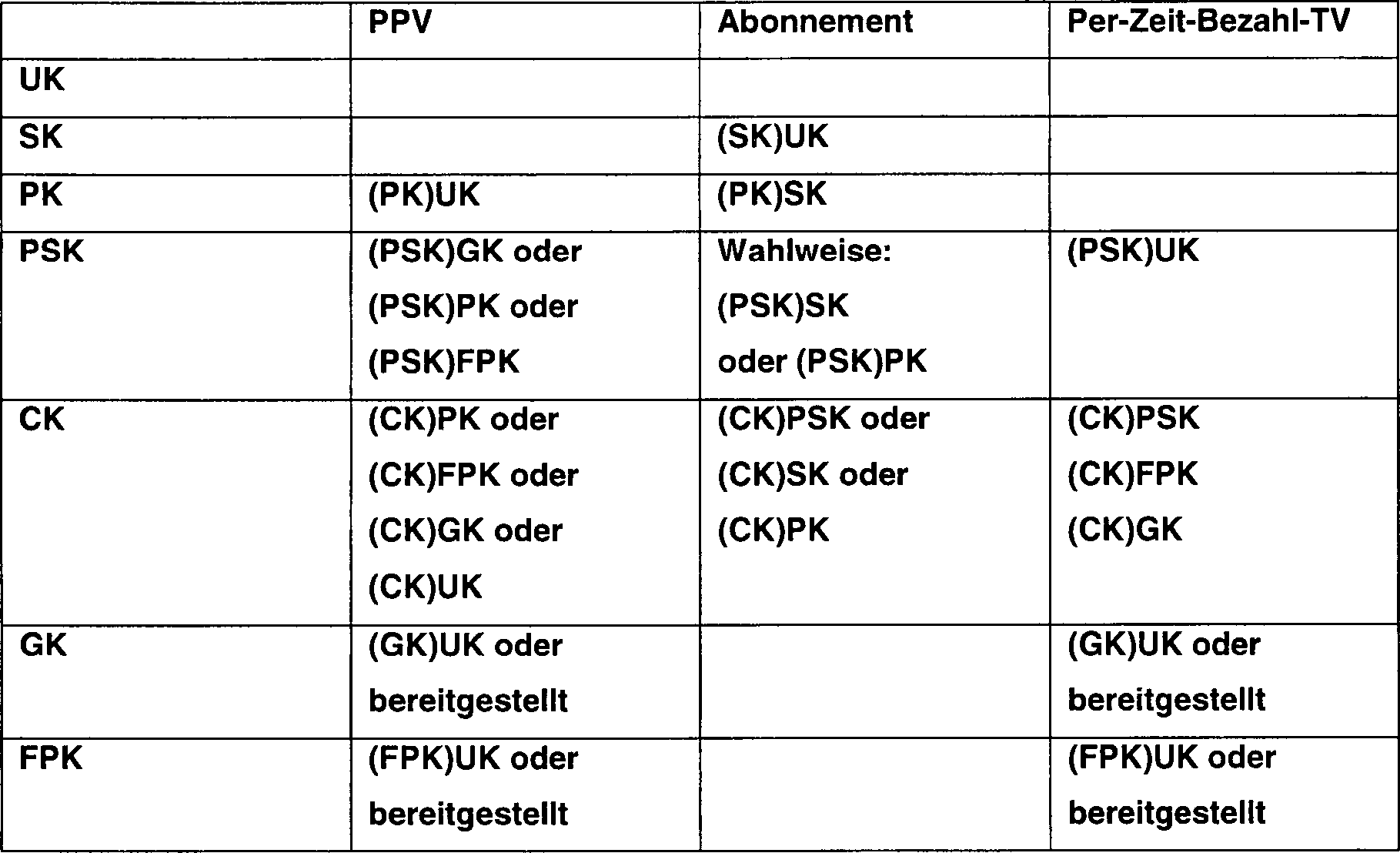
Die unterschiedlichen Ausführungsformen der Erfindung stellen Modelle zur Verteilung der Schlüssel bereit, die oben umrissen sind. Zum Beispiel könnten ein „Anfrage"-Modell („Pull"-Modell), ein „Abgabe"-Modell („Push"-Modell) und ein kombiniertes „Anfrage-Abgabe"-Modell („Push-Pull"-Modell) benutzt werden. Dem Anfrage-Modell zu Folge verfolgt jeder Kunde die Schlüssel und ihre Ablaufzeiten und fordert neue Schlüssel aktiv an, bevor die gegenwärtigen Schlüssel ablaufen, um Dienstunterbrechungen zu vermeiden. Alternativ dazu überträgt das Abgabe-Modell die Verantwortung auf den Server, der aktive Kunden verfolgt und neue Schlüssel an sie verteilt, bevor die gegenwärtigen Schlüssel ablaufen. Reine Abgabe-Modelle können auch eine Form wiederholter Verteilung aus Verlässlichkeitsgründen einschließen. Zum Beispiel kann das Per-Sendung-Bezahl-TV-Erwerbsmodell den Anfrage-Modus zur Schlüsselverteilung benutzen, da der Server wissen muss, welcher Kunde das Programm erwirbt, um diesen Kunden eine Rechnung zu erstellen. Inhaltsschlüssel, d. h. die Schlüssel, die zum Verschlüsseln des Programminhalts selbst verwendet werden, müssen während eines Per-Sendung-Bezahl-TV-Ereignisses nicht geändert werden. Ein Kunde kann einen Programmschlüssel anfragen, der zum Verschlüsseln des Inhaltsschlüssels für das Per-Sendung-Bezahl-TV-Programm verwendet wird. Auf diese Weise sind während des Per-Sendung-Bezahl-TV-Ereignisses keine anderen Schlüssel erforderlich; der Server kann jedoch verfolgen, welcher Kunde den Schlüssel zum Empfangen des Per-Sendung-Bezahl-TV-Ereignisses angefragt hat. Auf ähnliche Weise kann das Abonnement-Zahlungsmodell, bei dem ein Benutzer einen Abonnement-Preis zahlt, um ein Programm über einen längeren Zeitraum zu empfangen, ebenfalls den Anfrage-Modus benutzen. In der anfänglichen Anforderung nach dem Abonnement-Modell fordert der Kunde zum Beispiel das Abonnement an und fragt einen Dienstschlüssel an, der unter dem eindeutigen Schlüssel für diesen Kunden verschlüsselt ist. Das Abonnement-Modell ermöglicht es dann, den Abgabe-Modus zu benutzen, indem Programmschlüssel für Per-Sendung-Bezahl-TV-Ereignisse oder Programmsegmentschlüssel für Per-Zeit-Bezahl-TV- Ereignisse unter dem Dienstschlüssel verschlüsselt an den Kunden abgegeben werden. Auf ähnliche Weise wird der Inhaltsschlüssel unter dem Programmsegmentschlüssel verschlüsselt an den Kunden abgegeben. Das Abonnement-Modell kann somit sowohl den Anfrage- als auch den Abgabe-Modus benutzen. Das Schlüsselverteilungs-Anfrage-Modell, das Schlüsselverteilungs-Abgabe-Modell und die kombinierten Schlüsselverteilungs-Anfrage-/Abgabe-Modelle werden unten ausführlicher erläutert.The different embodiments of the invention provide models for distributing the keys outlined above. For example, a "pull" model, a "push" model, and a "push-pull" model might be used become. As a result of the request model, each customer keeps track of the keys and their expiration times and actively requests new keys before the current keys expire to avoid service interruptions. Alternatively, the delivery model delegates responsibility to the server, which tracks active customers and distributes new keys to them before the current keys expire. Pure dispensing models may also include a form of repeated distribution for reliability. For example, the per-shipment pay-TV purchase model may use the key distribution request mode because the server needs to know which customer is purchasing the program to bill that customer. Content keys, that is, the keys used to encrypt the program content itself, need not be changed during a per-pass pay-TV event. A customer may request a program key used to encrypt the content key for the pay-per-view TV program. In this way, no other keys are required during the per-broadcast pay-TV event; however, the server can keep track of which customer has requested the key to receive the pay-per-view pay-TV event. Similarly, the subscription payment model where a user pays a subscription price to receive a program for an extended period of time may also use the request mode. For example, in the initial request for the subscription model, the customer requests the subscription and requests a service key that is encrypted under the unique key for that customer. The subscription model then makes it possible to use the delivery mode by encrypting program keys for per-broadcast pay-TV events or program segment keys for per-time pay-TV events under the service key to the customer be delivered. Similarly, the content key under the program segment key is encrypted to the customer. The subscription model can thus use both the request and the delivery mode. The key distribution request model, the key distribution delivery model, and the combined key distribution request / delivery models are explained in more detail below.
Das
Schlüsselverteilungs-Anfrage-Modell
ermöglicht
es, dass jeder Kunde Schlüssel
aktiv von dem Server anfordert. In
In
Block
Beim Protokollieren der Anforderung eines Schlüssels kann ein Server eine Vielfalt an Informationen über die Anforderung protokollieren. Beispielsweise können die Zeit und das Segment, für die der angeforderte Schlüssel galt, aufgezeichnet werden. Diese Aufzeichnungen können dann später an das Rechnungsstellungssystem weitergeleitet werden, um sie zum Bestimmen der Länge des von jedem Kunden angesehenen Inhalts auszuwerten. Der Server muss Schlüssel an Kunden nicht verfolgen und aktiv verteilen; stattdessen kann er einfach darauf warten, dass der Kunde einen neuen Schlüssel anfordert.At the A server can log a request for a key Variety of information about log the request. For example, the time and segment, for the the requested key was recorded. These records can then later be forwarded to the billing system in order to get them to Determine the length evaluate the content viewed by each customer. The server must have keys do not track and actively distribute to customers; instead can he just waits for the customer to request a new key.
Unter einem Schlüsselverteilungs-Anfrage-Modell fordert jeder Kunde einen neuen Schlüssel an, und ihm wird individuell von dem Schlüsselverteilungsserver geantwortet. Der Server kann eine Liste aktiver Teilnehmer in einer Sammelsendesitzung auf der Basis dieser ersten Schlüsselanforderung unterhalten. Allen Kunden auf dieser Liste können dann periodisch neue Schlüssel gegeben werden, wobei eine Sammelsende-UDP-Nachricht verwendet wird, die einen neuen Programmsegmentschlüssel aufweist, der für jeden Teilnehmer unter Verwendung des eindeutigen Schlüssels des Teilnehmers verschlüsselt ist. Wenn sich ein Kunde entscheidet, die Sammelsendesitzung zu verlassen, sendet der Kunde eine authentifizierte Anforderung an den Server mit dem Antrag, von der Liste gestrichen zu werden. Dies signalisiert dem Server, die Zeit, zu der der Kunde aufhörte, den Inhalt zu empfangen, zu protokollieren, damit dem Kunde für späteren Inhalt keine Rechnung erstellt wird. Auf diese Weise kann der Kunde von der Liste aktiver Teilnehmer gestrichen werden und empfängt die nächste Schlüsselaktualisierungsnachricht nicht. Theoretisch könnte der Kunde zwar den Schlüssel besitzen und somit den Inhalt entschlüsseln; der Server kann jedoch in regelmäßigen Abständen neue Schlüssel an die aktiven Teilnehmer ausgeben, um zu verhindern, dass der gestrichene Kunde weiteren Inhalt entschlüsselt.Under a key distribution request model, each customer requests a new key and is individually answered by the key distribution server. The server may maintain a list of active participants in a multicast session based on this first key request. All customers on this list can then be periodically given new keys using a multicast UDP message having a new program segment key encrypted for each subscriber using the subscriber's unique key. When a customer decides to leave the multicast session, the customer sends an authenticated request the server with the request to be deleted from the list. This signals to the server the time at which the customer stopped receiving the content, logging it so that the customer will not be billed for later content. In this way, the customer can be removed from the list of active subscribers and not receive the next key update message. Theoretically, the customer could own the key and thus decrypt the content; however, the server may periodically issue new keys to the active participants to prevent the defunct client from decrypting any further content.
Nach
einer weiteren Ausführungsform
der Erfindung kann ein Schlüsselverteilungs-Abgabe-Modell implementiert
werden, um Schlüssel
von einem Server an einen Kunden zu verteilen.
Das
Schlüssel-Abgabe-Modell
und das Schlüssel-Anfrage-Modell
können
in einem kombinierten Modell zur Verteilung von Schlüsseln an
Kunden kombiniert werden. Wie in
Ein Verfahren, um dies zu erreichen, besteht darin, dass jeder Kunde mindestens einmal während jedes Programmsegments eine „Am-Lebenerhalten"-Nachricht sendet. Der Server erhält eine Liste aktiver Teilnehmer und verteilt an sie neue Segmentschlüssel über eine Sammelsende-UDP-Nachricht mit dem neuen Schlüssel, der für jeden Kunden unter den verschiedenen individuellen eindeutigen Schlüsseln verschlüsselt ist. Wenn ein Server über die Dauer eines Segments keine „Am-Leben-erhalten"-Nachricht wahrnimmt, streicht er den Kunden von der aktiven Liste. Wenn der Kunde aus irgendeinem Grund keine „Am-Leben-erhalten"-Nachricht sendet, aber die Inhalte weiter empfangen möchte, kann er die Ablaufzeit des Programmsegmentschlüssels überwachen und eine individuelle Schlüsselaktualisierungsanforderung senden, bevor der Schlüssel abläuft. Dies ist wiederum ein Weg zum Implementieren des „Anfrage"-Aspektes des kombinierten Modells. (Es ist auch möglich, das „Am-Leben-erhalten"-Intervall als länger als ein einziges Programmsegment zu definieren.)One Procedure to achieve this is that every customer at least once during Each segment of the program sends an "Am Lived" message. The server receives A list of active participants and distributes new segment keys to them via a multicast UDP message with the new key, the for each customer is encrypted under the different individual unique keys. If a server over the duration of a segment does not perceive an "as-received" message, He deletes the customer from the active list. When the customer is out For some reason, do not send a "received alive" message, but want to receive the content further, he can set the expiration time monitor the program segment key and an individual key update request send before the key expires. This again is a way of implementing the "request" aspect of the combined model. (It is also possible, the "keep alive" interval as longer than to define a single program segment.)
Als Teil des Schlüsselverteilungssystems wird der Inhaltsschlüssel zum Entschlüsseln des Programminhalts über den ganzen Verlauf der Verteilung des Programminhalts benutzt. Wenn ein neuer Inhaltsschlüssel implementiert wird, wird die Implementierung somit den Kunden signalisiert, damit die Kunden damit anfangen können, den neuen Inhaltsschlüssel, mit dem sie versehen wurden, zu benutzen. Oftmals werden die Kunden mit einer verschlüsselten Version des Inhaltsschlüssels versehen, der zum Beispiel mit einem Programmsegmentschlüssel entschlüsselt wird. Auf ähnliche Weise könnte dieser Programmsegmentschlüssel mit einem Dienstschlüssel oder sogar einem eindeutigen Schlüssel verschlüsselt sein.When Part of the key distribution system becomes the content key to decrypt of the program content the whole course of the distribution of the program content used. If a new content key implemented, the implementation is thus signaled to the customer, so that customers can start using the new content key, with which they were provided to use. Often the customers become with an encrypted Version of the content key which is decrypted, for example, with a program segment key. On similar Way could this program segment key with a service key or even encrypted with a unique key.
Es
kann ein Signalisierungsverfahren verwendet werden, um die Implementierung
eines neuen Schlüssels
anzuzeigen. Zum Beispiel kann ein vorbestimmtes Bit verwendet werden,
um anzuzeigen, ob ein alter oder gegenwärtiger Inhaltsschlüssel statt
eines neuen Inhaltsschlüssels,
der kürzlich
an den Kunden verteilt worden ist, verwendet werden sollte. Auf
diese Weise kann ein Kunde das vorbestimmte Bit in einem Paket überprüfen und
den richtigen Inhaltsschlüssel
zur Verwendung bestimmen. Beispielsweise könnte, wenn ein einziges Bit
verwendet wird, eine „1" verwendet werden,
um den gegenwärtigen
Inhaltsschlüssel,
der bereits verwendet wird, anzuzeigen, während eine „0" verwendet werden könnte, um anzuzeigen, dass der
neue Inhaltsschlüssel
verwendet werden sollte.
Es könnten auch andere Signalisierungsverfahren benutzt werden. Zum Beispiel könnte eine RTP-Kopf-Erweiterung benutzt werden. Auf diesem Weg könnte der erweiterte Abschnitt des Kopfes mindestens das Inhaltsschlüssel-Paritätsbit einschließen, um Schlüsseländerungen anzuzeigen.It could also other signaling methods are used. For example could an RTP header extension can be used. On this way could the extended portion of the header include at least the content key parity bit key changes display.
Auf ähnliche Weise könne ein Nutzlast spezifisches Markerbit benutzt werden. Dieses Bit wird bereits bei einigen Nutzlastarten wie etwa der MPEG-4-Nutzlast, die das Markerbit verwendet, um den Anfang eines Einzelbildes anzuzeigen, benutzt.On similar Way could a payload specific marker bit can be used. This bit will already with some payload types such as the MPEG-4 payload, that uses the markerbit to indicate the beginning of a frame, used.
Des Weiteren könnte zum Beispiel ein Auffüllbit benutzt werden. Das Auffüllbit in dem RTP-Kopf könnte benutzt werden, um die Schlüsseländerung anzuzeigen. Dies setzt voraus, dass das auf die RTP-Pakete angewendete Verschlüsselungsverfahren keinerlei Auffüllen verwendet.Of Further could for example, a padding bit to be used. The fill bit in the RTP header could used to change the key display. This assumes that this is applied to the RTP packets encryption method no filling up used.
Beim Sammelsenden von Programminhalt wie etwa Audio- und visuellem Material können Freigabemeldungen und Steuermeldungen von einem Server an einen Kundencomputer gesendet werden. Eine Ausführungsform der Erfindung stellt ein Format für solche Nachrichten bereit. Unter diesem Format wird eine Folgenummer oder ein Zeitstempel zum Schutz gegen Angriffe durch Wiedereinspielung bereitgestellt. Des Weiteren wird in einem anderen Feld der EMM- und ECM-Nachrichten ein chiffrierter Nachrichtenauthentifizierungscode (MAC = Message Authentication Code) oder eine digitale Signatur eines öffentlichen Schlüssels zur Authentifizierung bereitgestellt. Es ist zu beachten, dass weder die chiffrierte Hash-Codierung zur Authentifizierung der Nachrichtenquelle (HMAC) noch die Signatur verifiziert werden können, bis ein Kunde den Schlüsselanforderungsaustausch durchführt. Noch ein weiteres Feld würde die Art von in der Nachricht eingeschlossenem Schlüssel, wie etwa Inhaltsschlüssel, Gruppenschlüssel, Programmsegmentschlüssel, Dienstschlüssel usw., einschließen. Des Weiteren würde ein Feld für die Art von Schlüssel, der zum Verschlüsseln des Schlüssels in der Nachricht verwendet wird, bereitgestellt werden. Auf diese Weise könnte ein eindeutiger Schlüssel für zum Beispiel eine Nachricht, die einen Dienstschlüssel überträgt, angezeigt werden. Ein weiteres Feld kann für die von der Nutzungsdauer des Schlüssels verbleibende Zeit bereitgestellt werden. Des Weiteren kann ein Schlüsselparitätsbit, das mit dem Paritätsbit in dem RTP-Paket übereinstimmt, bereitgestellt werden. Außerdem kann eine Benutzerkennzeichnung, die häufig benötigt wird, wenn mehrere EMM in einer einzelnen Sammelsendenachricht geliefert werden, bereitgestellt werden. Jedes Feld der Datenstruktur gilt für jedes dieser Felder. Auf diese Weise können sie in einer beliebigen Reihenfolge angeordnet werden, so dass die Datenstruktur eines oder mehrere dieser Felder einschließt.When multicasting program content such as audio and visual material, release messages and control messages may be sent from a server to a customer computer. An embodiment of the invention provides a format for such messages. This format provides a sequence number or timestamp to protect against replay attacks. Further, in another field of the EMM and ECM messages, a ciphered Message Authentication Code (MAC) or a public key digital signature is provided for authentication. It should be noted that neither the encrypted message source authentication (HMAC) hash encoding nor the signature can be verified until a customer makes the key request exchange. Yet another field would be the type of key included in the message, such as content key, group key, program segment key, service key etc. include. Furthermore, a field would be provided for the type of key used to encrypt the key in the message. In this way, a unique key for, for example, a message transmitting a service key could be displayed. An additional field may be provided for the time remaining from the useful life of the key. Furthermore, a key parity bit that matches the parity bit in the RTP packet may be provided. In addition, a user identifier, which is often needed when delivering multiple EMMs in a single multicast message, can be provided. Each field of the data structure applies to each of these fields. In this way, they can be arranged in any order so that the data structure includes one or more of these fields.
Alternativ dazu muss CK0 nicht in einer ECM verteilt werden. Der Wert des von der Vielzahl von Kunden bereits besessenen FPK kann als CK0 genommen werden.alternative CK0 does not have to be distributed in an ECM. The value of the The variety of customer already owned FPK can be taken as CK0 become.
Alternativ dazu muss CK1 nicht in einer ECM verteilt werden. Der Wert des von der Vielzahl von Kunden bereits besessenen GK kann als CK1 genommen werden.alternative CK1 does not have to be distributed in an ECM. The value of the GK already owned by the multitude of customers can be taken as CK1 become.
Alternativ dazu kann CK2 mit dem UK verschlüsselt und in der Form einer EMM direkt an den Kunden geliefert werden, anstatt der ECM-Form, die in der Figur gezeigt ist.alternative CK2 can be encrypted with the UK and delivered directly to the customer in the form of an EMM, instead of the ECM shape shown in the figure.
Anfängliche Anschauperiodeinitial viewing period
Bei
einigen Sammelsendeereignissen, wie etwa Per-Sendung-Bezahl-TV- Ereignissen, steht
zu erwarten, dass ein System die größte Belastung, also den schwersten
Verkehr der Anforderung von Programmschlüsseln, sehr nahe dem geplanten
Anfang eines Programms erfahren wird. Wenn die Gesamtheit von Kunden,
die eine Sammelsendesitzung aufnehmen, sehr groß ist, ist ein Server nicht
in der Lage, sofort Schlüssel an
alle Teilnehmer zu verteilen. Es wird daher ein System benötigt, das
es Zuschauern ermöglicht,
den Anfang eines Programms während
dieser Periode, in der der Server Schlüssel an diejenigen verteilt,
die das Programmmaterial erworben haben, anzuschauen.
Ein
Verfahren zum Implementieren einer anfänglichen Anschauperiode ist
das Verteilen eines gemeinsamen Schlüssels an mögliche Teilnehmer im Voraus,
z. B. vor der Verteilung des Programminhalts. Ein solcher Schlüssel wird
hier als Gruppenschlüssel
bezeichnet. Ein Gruppenschlüssel
kann Kunden gegeben werden, wenn sie einen bestimmten Caching-Server
anfordern, oder es kann ein wirklich globaler Schlüssel sein, den
Kunden erhalten, wenn sie während
der Bereitstellung in dem Verteilungssystem initialisiert werden.
Da jeder Kunde in einer solchen Situation einen Gruppenschlüssel empfangen
würde,
könnten
theoretisch alle Kunden den ersten Teil des Inhalts kostenlos empfangen.
Wenn ein Sammelsendeereignis anfängt, kann der anfängliche Inhaltsschlüssel unter dem Gruppenschlüssel sowie dem Programmschlüssel für Per-Sendung-Bezahl-TV-Ereignisse oder einem ersten Programmsegmentschlüssel für Per-Zeit-Bezahl-TV-Ereignisse (der PSK kann auch unter dem GK verschlüsselt sein) verteilt werden. Da der Gruppenschlüssel im Voraus verteilt wird, müssen die Kunden nicht darauf warten, den Programmschlüssel oder den Programmsegmentschlüssel, die später an sie verteilt werden, zu empfangen. Stattdessen setzt der Server die Dauer der anfänglichen Anschauperiode auf der Basis der erwarteten Nachfrage nach dem Programminhalt seitens der Kunden fest, was auch auf der Basis der momentanen Belastung von Kunden, die das Programm im Zeitablauf erwerben, dynamisch eingestellt werden kann. Auf diese Weise kann sich der Server auf der Basis der Nachfrage nach einem bestimmten Programm in Echtzeit einstellen. Es ist zu beachten, dass eine anfängliche Anschauperiode aus „N" Inhaltsschlüsselperioden zusammengesetzt sein kann, statt als ein einziges Intervall bestimmt zu sein. In diesem Fall kann der Server N dynamisch einstellen.If a multicurrency event begins, can the initial content key under the group key as well as the program key for per-broadcast pay-TV events or a first program segment key for per-time pay TV events (the PSK can also be encrypted under the GK). Because the group key must be distributed in advance Customers do not wait to see the program key or program segment key later be distributed to them to receive. Instead, the server continues the duration of the initial one Display period on the basis of the expected demand for the program content on the part of the customers, which also on the basis of the current load of customers who purchase the program over time, set dynamically can be. That way the server can be based on to adjust the demand for a particular program in real time. It should be noted that an initial display period consists of "N" content key periods may be composed rather than determined as a single interval to be. In this case, the server can set N dynamically.
Um ein zufriedenstellendes Benutzererlebnis zu bieten, wird allen Kunden, die in der „garantierten Periode" Zugang zu einem Ereignis anfordern (z. B. fordern sie einen Programmschlüssel für ein Per-Sendung-Bezahl-TV-Ereignis an), der Empfang des Inhalts ohne Unterbrechung garantiert. Dies bedeutet, dass der Server nicht aufhört, Inhaltsschlüssel unter dem Gruppenschlüssel zu verteilen, bis der Programmschlüssel an alle Kunden, deren Anforderungen in der garantierten Periode empfangen wurden, verteilt worden ist. Dies wird wiederum die anfängliche Anschauperiode oder gleichwertig auch die anfängliche Schlüsselverteilungsperiode genannt.Around to provide a satisfying user experience, will appeal to all customers, those in the "guaranteed Period "access to request an event (for example, they request a program key for a pay-per-view pay-TV event) Receipt of content guaranteed without interruption. This means, that the server does not stop, content key under the group key to distribute the program key to all customers whose Requirements in the guaranteed period were received, distributed has been. This in turn will be the initial viewing period or equivalent also the initial one Key distribution period called.
Kunden, die den Inhalt nach der garantierten Periode anfordern, haben bereits den Anfang des Films, zum Beispiel, verpasst; daher ist die Lieferung des Programmschlüssels oder des Programmsegmentschlüssels nicht gleichermaßen entscheidend, und diese Zuschauer können eine geringfügige Verzögerung tolerieren. In der Tat ist es wahrscheinlich vorzuziehen, dass ein Benutzer ein kontinuierliches Anschauerlebnis zu einem späteren Zeitpunkt beginnt, als dass er zu einem früheren Zeitpunkt ein Anschauerlebnis beginnt, das vorübergehend unterbrochen werden wird.Customers who request content after the guaranteed period already have the beginning of the movie, for example, missed; therefore, the delivery of the program key or program segment key is not equally critical, and these viewers can tolerate a slight delay. In fact, it is probably preferable for a user to start a continuous viewing experience at a later time than to begin a viewing experience at an earlier time, which will be temporarily suspended.
Wie
zuvor angemerkt, kann die anfängliche
Schlüsselverteilungsperiode
auf der Basis der vorhergesagten Beliebtheit eines bestimmten Programms
anfänglich
festgesetzt und dann von dem Server modifiziert werden, um sich
auf die gegenwärtige
Belastung einzustellen. Auf diese Weise kann die Verteilungsperiode auf
der Basis der Anzahl von Anforderungen oder des Leistungsvermögens des
Servercomputers verlängert werden.
Inhaltsrechte und -konditionencontent right and conditions
Unter
Bezugnahme auf
In
einer Ausführungsform
der Erfindung meldet sich ein Kunde an dem Autorisierungszentrum
In dem Fall, dass der Ursprungsinhaltsserver die Überprüfung durchführt, wertet der Ursprungsinhaltsserver die Anforderung des Kunden von Programminhalt aus und überprüft am Autorisierungszentrum, um zu bestimmen, ob der Kunde für diesen bestimmten Inhalt autorisiert ist. Dieses Verfahren ermöglicht es, eine frühe Entscheidung zu fällen, insbesondere, ob dem Kunden der Zugang verwehrt werden sollte, was weitere Verarbeitung und möglicherweise eine Frustration des Zuschauers, dass ihm der Zugang zu dem Inhalt verwehrt wird, eliminiert.In In case the source content server checks, the source content server evaluates the request of the customer from program content and checked at the authorization center, to determine if the customer is for this particular content is authorized. This procedure makes it possible an early one Make a decision in particular, whether the customer should be denied access, what further processing and possibly a frustration of the viewer that gives him access to the content is denied, eliminated.
Alternativ dazu könnte das Überprüfen an dem Kunden selbst durchgeführt werden. Zum Beispiel könnte der Kunde mit einer Hardwaresicherheitsvorrichtung oder einem Sicherheitschip ausgestattet werden, die/der die an jeden individuellen Kunden verteilten Regeln durchsetzen könnte. Auf diese Weise könnten die von dieser Hardwaresicherheitsvorrichtung verwendeten Regeln mit den Anschauberechtigungen des Kunden oder anderen Merkmalen wie dem physikalischen Standort des Kunden, wie etwa dem Land, in dem sich der Kunde befindet, verglichen werden. Ein solcher physikalischer Standort kann wichtig sein, da unterschiedliche Länder verschiedene Gesetze hinsichtlich dessen, welche Art von Programminhalt verteilt werden darf, haben.alternative could do this checking on that Customer self-made become. For example, could the customer with a hardware security device or security chip which they distribute to each individual customer Could enforce rules. That way the rules used by this hardware security device with the rights of the customer or other characteristics like the physical location of the customer, such as the country, in the customer is located. Such a physical one Location can be important because different countries are different Laws regarding what type of program content is distributed may have.
Noch eine andere Ausführungsform der Erfindung ermöglicht es, dass das Überprüfen an dem Caching-Server durchgeführt wird. Der Caching-Server kann die Inhaltsregeln mit den Berechtigungen des Kunden vergleichen und die Regeln sicher durchsetzen. Die Berechtigungen des Kunden können sicher in einem Datensatz (Etikett) enthalten sein, den der Kunde dem Caching-Server präsentiert oder den der Caching-Server über andere Mittel empfängt. Die Regeln können von dem Ursprungsserver an den Caching-Server verteilt werden. Des Weiteren kann die Erwerbsoption von dem Ursprungsserver an den Kunden verteilt werden, und der Kunde kann die Erwerbsoption dann zu dem Caching-Server befördern.Yet another embodiment allows the invention it that checking on the Caching server performed becomes. The caching server can compare the content rules with the customer's permissions and enforce the rules safely. The permissions of the customer can Be sure to be included in a record (label) that the customer presented to the caching server or the caching server over receiving other funds. The rules can distributed from the source server to the caching server. Of Further, the purchase option may be from the origin server to the customer then the customer can then redistribute the purchase option to the Transport caching server.
Zusätzlich zu dem Vergleichen von Inhaltsregeln mit den Berechtigungen eines Benutzers (Kunden) kann die von dem Benutzer ausgewählte Erwerbsoption auch mit den Regeln beim Treffen der Autorisierungsentscheidung verglichen werden.In addition to comparing content rules with a user's permissions (Customer) can also use the purchase option selected by the user compared to the rules when making the authorization decision become.
Eine
andere Ausführungsform
der Erfindung, die aus der Perspektive des Caching-Servers veranschaulicht
ist, ist in
Der Caching-Server kann die Inhaltsregeln für Programmmaterial mit den Berechtigungen jedes Kunden vergleichen und die Regeln sicher durchsetzen. Die Berechtigungen des Kunden können in einem Datensatz, den der Kunde dem Caching-Server präsentiert, wenn er spezifischen Inhalt anfordert, sicher enthalten sein. Inhaltsregeln können auf mindestens zwei Wegen geliefert werden. Beispielsweise können Inhaltsregeln direkt an den Caching-Server geliefert werden, z. B. zusammen mit dem Inhalt. Auf diesem Weg werden die Regeln nur einmal an jeden Caching-Server gesendet. In dem Fall des Abonnement-Erwerbs von Programmmaterial muss ein Zuschauer nicht über jedes Stück Inhalt individuell verhandeln, da es in seiner oder ihrer Abonnement-Vereinbarung eingeschlossen ist. Wenn ein Zuschauer Erwerbsoptionen, wie etwa Per-Sendung-Bezahl-TV oder Per-Zeit-Bezahl-TV, auswählen muss, verhandelt der Zuschauer über sie mit dem Ursprungsinhaltsserver. Die ausgewählten Erwerbsoptionen werden, zum Beispiel, signiert und verschlüsselt und an den Kunden geliefert (unabhängig von dem Liefermechanismus für Inhaltsregeln) und dann in der von dem Kunden an den Caching-Server gesendeten Anforderung eingeschlossen. Da die ausgewählten Erwerbsoptionen unter einem Schlüssel verschlüsselt sind, der dem Caching-Server, aber nicht dem Kunden, bekannt ist, werden sie von dem Kunden nicht modifiziert. Alternativ dazu können Inhaltsregeln von dem Inhaltanbieter, d. h. dem Ursprungsinhaltsserver, erstellt werden, wenn der Kunde über den Zugang zu dem Inhalt mit dem Ursprungsinhaltsserver verhandelt. Solche Regeln können mit den spezifischen Erwerbsoptionen, die der Zuschauer ausgewählt hat, wie etwa Per-Sendung-Bezahl-TV oder Per-Zeit-Bezahl-TV, kombiniert werden. Die Inhaltsregeln in Kombination mit den ausgewählten Erwerbsoptionen können dann zum Beispiel signiert und verschlüsselt und an den Kunden geliefert und dann in der von dem Kunden an den Caching-Server gesendeten Anforderung eingeschlossen werden. Da die Inhaltsregeln unter einem Schlüssel verschlüsselt sind, der dem Caching-Server, aber nicht dem Kunden, bekannt ist, werden sie von dem Kunden nicht modifiziert. Dieser Ansatz macht eine direkte Schnittstelle zwischen einem Ursprungsinhaltsserver und einem Caching-Server für die Lieferung der Inhaltsregeln unnötig.Of the Caching server can use the content rules for program material with the Compare each customer's permissions and enforce the rules securely. The permissions of the customer can in a record that the customer presents to the caching server, if he requires specific content, be sure to be included. content rules can be delivered in at least two ways. For example, content rules can be direct delivered to the caching server, e.g. B. along with the content. In this way, the rules only once to each caching server Posted. In the case of subscription purchase of program material a viewer does not have to every piece Negotiate content individually as it is included in his or her subscription agreement is. When a viewer purchase options, such as pay-per-view TV or per-time pay TV must, the viewer negotiates them with the source content server. The selected purchase options become, for example, signed and encrypted and delivered to the customer (independently from the delivery mechanism for Content Rules) and then in the customer's to the caching server sent request included. Because the selected purchase options under a key encoded that is known to the caching server, but not to the customer, they are not modified by the customer. Alternatively, content rules can be used from the content provider, d. H. the source content server be when the customer over negotiated access to the content with the source content server. Such rules can with the specific acquisition options the viewer has selected such as pay-per-view pay TV or per-time pay TV. The content rules in combination with the selected purchase options can then for example, signed and encrypted and delivered to the customer and then in the one sent by the customer to the caching server Requirement to be included. Because the content rules are under one key encoded that is known to the caching server, but not to the customer, they are not modified by the customer. This approach makes a direct interface between a source content server and a caching server for delivery the content rules unnecessary.
Beim
Verhandeln über
einen Erwerb zwischen dem Ursprungsinhaltsserver und dem Kunden
unterhält der
Ursprungsinhaltsserver die Regeln und Erwerbsoptionsinformationen
lokal. Er kann dem Kunden dann alle unterschiedlichen Erwerbsoptionen
anbieten, damit der Kunde eine Entscheidung treffen kann. Auf diese
Weise kann die Erwerbsoption in den gesicherten Datensatz eingekapselt
werden, der zu dem Kunden zurückgeleitet
wird. Der Kunde kann dann den gesicherten Datensatz zusammen mit
dem Kundenetikett, das die Berechtigungsinformationen des Kunden
einschließt
(z. B. das Erwerbsvermögen,
die Liste abonnierter Dienste usw.), an den richtigen Caching-Server
weiterleiten. Der Kunde in
Während verschiedene Ausführungsformen der Erfindung als Verfahren oder Einrichtungen zur Implementierung der Erfindung beschrieben worden sind, versteht es sich, dass die Erfindung durch einen mit einem Computer gekoppelten Code, z. B. einem auf einem Computer residenten oder dem Computer zugänglichen Code, implementiert werden kann. Zum Beispiel könnten Software und Datenbanken benutzt werden, um viele der oben erörterten Verfahren zu implementieren. Zusätzlich zu Ausführungsformen, bei denen die Erfindung durch Hardware erreicht wird, wird es somit auch angemerkt, dass diese Ausführungsformen durch die Verwendung eines Manufakturartikels erreicht werden können, der ein Computer nutzbares Medium mit einem darin ausgeführten maschinenlesbaren Programmcode, welcher die Aktivierung der in dieser Beschreibung offenbarten Funktionen bewirkt, umfasst. Es ist daher wünschenswert, dass Ausführungsformen der Erfindung auch mit ihrem Programmcodemittel als durch dieses Patent geschützt betrachtet werden.While different embodiments of the invention as methods or means of implementation of the invention, it is understood that the Invention by a coupled with a computer code, eg. B. a resident of a computer or accessible to the computer Code that can be implemented. For example, software and databases can be used to implement many of the methods discussed above. additionally to embodiments, where the invention is achieved by hardware, it will thus also noted that these embodiments can be achieved through the use of a manufactured article, the a computer usable medium having a machine readable therein Program code which activates the in this description revealed functions includes. It is therefore desirable that embodiments the invention also with its program code means as by this Patent protected to be viewed as.
Es ist auch vorgesehen, dass Ausführungsformen der Erfindung als in einer Trägerschwingung ausgeführte Computersignale erreicht werden könnten, sowie als Signale (z. B. elektrische und optische), die durch ein Übertragungsmedium verbreitet würden. Somit könnten die verschiedenen oben diskutierten Informationen in einer Struktur, wie etwa einer Datenstruktur, formatiert und als ein elektrisches Signal über ein Übertragungsmedium übertragen oder auf einem maschinenlesbaren Medium gespeichert werden.It is also provided that embodiments the invention as in a carrier vibration executed Computer signals could be achieved, as well as signals (eg. B. electrical and optical), which propagates through a transmission medium would. Thus could the various information discussed above in a structure, like a data structure, formatted and as an electrical one Signal over transmit a transmission medium or stored on a machine-readable medium.
Es sei auch bemerkt, dass viele der hierin vorgetragenen Strukturen, Materialien und Vorgänge als Mittel zur Durchführung einer Funktion oder als Schritte zur Durchführung einer Funktion vorgetragen werden können. Daher versteht es sich, dass eine derartige Sprache berechtigt ist, alle solchen Strukturen, Materialien oder Vorgänge, die in dieser Beschreibung offenbart werden, und ihre Entsprechungen abzudecken.It It should also be noted that many of the structures recited herein, Materials and operations as a means of implementation a function or as steps to perform a function can be. Therefore, it is understood that such a language is legitimate, any such structures, materials or operations described in this description and to cover their equivalents.
Claims (18)
Applications Claiming Priority (3)
| Application Number | Priority Date | Filing Date | Title |
|---|---|---|---|
| US24392500P | 2000-10-26 | 2000-10-26 | |
| US243925P | 2000-10-26 | ||
| PCT/US2001/051051 WO2002062054A2 (en) | 2000-10-26 | 2001-10-26 | Initial viewing period for authorization of multimedia content |
Publications (2)
| Publication Number | Publication Date |
|---|---|
| DE60117618D1 DE60117618D1 (en) | 2006-04-27 |
| DE60117618T2 true DE60117618T2 (en) | 2006-12-14 |
Family
ID=22920677
Family Applications (1)
| Application Number | Title | Priority Date | Filing Date |
|---|---|---|---|
| DE60117618T Expired - Fee Related DE60117618T2 (en) | 2000-10-26 | 2001-10-26 | Initial viewing period for authorizing multimedia content |
Country Status (10)
| Country | Link |
|---|---|
| US (4) | US20020174366A1 (en) |
| EP (4) | EP1371205B1 (en) |
| JP (2) | JP2004529538A (en) |
| KR (4) | KR20030094216A (en) |
| CN (3) | CN1633794A (en) |
| AT (1) | ATE319256T1 (en) |
| CA (4) | CA2427136A1 (en) |
| DE (1) | DE60117618T2 (en) |
| TW (4) | TW545052B (en) |
| WO (4) | WO2002063850A2 (en) |
Families Citing this family (287)
| Publication number | Priority date | Publication date | Assignee | Title |
|---|---|---|---|---|
| US6697489B1 (en) | 1999-03-30 | 2004-02-24 | Sony Corporation | Method and apparatus for securing control words |
| US7730300B2 (en) | 1999-03-30 | 2010-06-01 | Sony Corporation | Method and apparatus for protecting the transfer of data |
| US7565546B2 (en) | 1999-03-30 | 2009-07-21 | Sony Corporation | System, method and apparatus for secure digital content transmission |
| US7039614B1 (en) | 1999-11-09 | 2006-05-02 | Sony Corporation | Method for simulcrypting scrambled data to a plurality of conditional access devices |
| JP2003533075A (en) * | 1999-12-22 | 2003-11-05 | コーニンクレッカ フィリップス エレクトロニクス エヌ ヴィ | Conditional access system to control access to data content |
| US7225164B1 (en) | 2000-02-15 | 2007-05-29 | Sony Corporation | Method and apparatus for implementing revocation in broadcast networks |
| JP2002132614A (en) * | 2000-10-18 | 2002-05-10 | Nec Corp | Data distributing system |
| US7058815B2 (en) * | 2001-01-22 | 2006-06-06 | Cisco Technology, Inc. | Method and system for digitally signing MPEG streams |
| US7039803B2 (en) * | 2001-01-26 | 2006-05-02 | International Business Machines Corporation | Method for broadcast encryption and key revocation of stateless receivers |
| US9520993B2 (en) | 2001-01-26 | 2016-12-13 | International Business Machines Corporation | Renewable traitor tracing |
| JP4420571B2 (en) * | 2001-02-22 | 2010-02-24 | ソニー株式会社 | Transmission device and method, reception device and method, information transmission / reception system and method, recording medium, and program |
| KR100406630B1 (en) * | 2001-03-13 | 2003-11-20 | 엘지전자 주식회사 | Method for recording and reproducing a demo data, and medium thereof |
| KR20020072934A (en) | 2001-03-13 | 2002-09-19 | 엘지전자 주식회사 | Read only optical disc recorded demo data, and method for reproducing them |
| US8275716B2 (en) | 2001-05-31 | 2012-09-25 | Contentguard Holdings, Inc. | Method and system for subscription digital rights management |
| US6876984B2 (en) * | 2001-05-31 | 2005-04-05 | Contentguard Holdings, Inc. | Method and apparatus for establishing usage rights for digital content to be created in the future |
| US7895616B2 (en) | 2001-06-06 | 2011-02-22 | Sony Corporation | Reconstitution of program streams split across multiple packet identifiers |
| US7127619B2 (en) | 2001-06-06 | 2006-10-24 | Sony Corporation | Decoding and decryption of partially encrypted information |
| US7350082B2 (en) | 2001-06-06 | 2008-03-25 | Sony Corporation | Upgrading of encryption |
| US7747853B2 (en) | 2001-06-06 | 2010-06-29 | Sony Corporation | IP delivery of secure digital content |
| KR100430158B1 (en) * | 2001-06-18 | 2004-05-04 | 지은묵 | A contents consignment sale system of the internet broadcasting and a method thereof |
| US7237108B2 (en) * | 2001-09-26 | 2007-06-26 | General Instrument Corporation | Encryption of streaming control protocols and their headers |
| US8255989B2 (en) * | 2001-09-26 | 2012-08-28 | General Instrument Corporation | Access control and key management system for streaming media |
| US20030059053A1 (en) * | 2001-09-26 | 2003-03-27 | General Instrument Corporation Motorola, Inc. | Key management interface to multiple and simultaneous protocols |
| WO2003036857A1 (en) * | 2001-10-24 | 2003-05-01 | Nokia Corporation | Ciphering as a part of the multicast cencept |
| JP2005512170A (en) * | 2001-11-12 | 2005-04-28 | ネットワーク リサーチ ラブ リミテッド | Information protection method and apparatus against unauthorized use |
| US7243366B2 (en) * | 2001-11-15 | 2007-07-10 | General Instrument Corporation | Key management protocol and authentication system for secure internet protocol rights management architecture |
| US7243230B2 (en) * | 2001-11-16 | 2007-07-10 | Microsoft Corporation | Transferring application secrets in a trusted operating system environment |
| US7765567B2 (en) | 2002-01-02 | 2010-07-27 | Sony Corporation | Content replacement by PID mapping |
| US7302059B2 (en) | 2002-01-02 | 2007-11-27 | Sony Corporation | Star pattern partial encryption |
| US7242773B2 (en) | 2002-09-09 | 2007-07-10 | Sony Corporation | Multiple partial encryption using retuning |
| US7376233B2 (en) | 2002-01-02 | 2008-05-20 | Sony Corporation | Video slice and active region based multiple partial encryption |
| US7155012B2 (en) | 2002-01-02 | 2006-12-26 | Sony Corporation | Slice mask and moat pattern partial encryption |
| US7039938B2 (en) | 2002-01-02 | 2006-05-02 | Sony Corporation | Selective encryption for video on demand |
| US7218738B2 (en) | 2002-01-02 | 2007-05-15 | Sony Corporation | Encryption and content control in a digital broadcast system |
| US7823174B2 (en) | 2002-01-02 | 2010-10-26 | Sony Corporation | Macro-block based content replacement by PID mapping |
| US7215770B2 (en) | 2002-01-02 | 2007-05-08 | Sony Corporation | System and method for partially encrypted multimedia stream |
| US7233669B2 (en) | 2002-01-02 | 2007-06-19 | Sony Corporation | Selective encryption to enable multiple decryption keys |
| US7292691B2 (en) | 2002-01-02 | 2007-11-06 | Sony Corporation | Progressive video refresh slice detection |
| JP2005517363A (en) * | 2002-02-07 | 2005-06-09 | コーニンクレッカ フィリップス エレクトロニクス エヌ ヴィ | Method for delivering video divided into spatial pieces |
| US6937872B2 (en) | 2002-04-15 | 2005-08-30 | Qualcomm Incorporated | Methods and apparatuses for measuring frequencies of basestations in cellular networks using mobile GPS receivers |
| US7890771B2 (en) * | 2002-04-17 | 2011-02-15 | Microsoft Corporation | Saving and retrieving data based on public key encryption |
| US7487365B2 (en) | 2002-04-17 | 2009-02-03 | Microsoft Corporation | Saving and retrieving data based on symmetric key encryption |
| JP2005523502A (en) * | 2002-04-18 | 2005-08-04 | コーニンクレッカ フィリップス エレクトロニクス エヌ ヴィ | Testing content in a conditional access system |
| KR100956273B1 (en) * | 2002-04-19 | 2010-05-10 | 이르데토 아인드호벤 비.브이. | Conditional Access Systems and Devices |
| US7356687B2 (en) * | 2002-05-21 | 2008-04-08 | General Instrument Corporation | Association of security parameters for a collection of related streaming protocols |
| US7530084B2 (en) | 2002-05-28 | 2009-05-05 | Sony Corporation | Method and apparatus for synchronizing dynamic graphics |
| WO2003107670A1 (en) * | 2002-06-12 | 2003-12-24 | Koninklijke Philips Electronics N.V. | Conditional access apparatus and method |
| US20030236975A1 (en) * | 2002-06-20 | 2003-12-25 | International Business Machines Corporation | System and method for improved electronic security credentials |
| CN100431359C (en) * | 2002-06-21 | 2008-11-05 | 汤姆森许可贸易公司 | Method for wirelessly downloading programs to mobile terminals |
| US7260601B1 (en) | 2002-06-28 | 2007-08-21 | Cisco Technology, Inc. | Methods and apparatus for transmitting media programs |
| JP3864867B2 (en) * | 2002-07-23 | 2007-01-10 | ソニー株式会社 | Information processing apparatus, information processing method, and computer program |
| JP2004096478A (en) * | 2002-08-30 | 2004-03-25 | Fujitsu Ltd | Content viewing history service program |
| US8818896B2 (en) | 2002-09-09 | 2014-08-26 | Sony Corporation | Selective encryption with coverage encryption |
| ATE378748T1 (en) * | 2002-09-13 | 2007-11-15 | Ericsson Telefon Ab L M | SECURE BROADCAST/MULTICAST SERVICE |
| US20040205811A1 (en) * | 2002-09-23 | 2004-10-14 | Grandy Leslie L. | System and method for providing integrated media |
| US7349921B2 (en) * | 2002-09-27 | 2008-03-25 | Walgreen Co. | Information distribution system |
| US7222185B1 (en) * | 2002-10-03 | 2007-05-22 | Cisco Technology, Inc. | Methods and apparatus for distributing content within a content delivery system |
| GB2394386A (en) * | 2002-10-16 | 2004-04-21 | Nokia Corp | Multicast data transfer |
| US8572408B2 (en) | 2002-11-05 | 2013-10-29 | Sony Corporation | Digital rights management of a digital device |
| US7724907B2 (en) | 2002-11-05 | 2010-05-25 | Sony Corporation | Mechanism for protecting the transfer of digital content |
| SG111978A1 (en) * | 2002-11-20 | 2005-06-29 | Victor Company Of Japan | An mpeg-4 live unicast video streaming system in wireless network with end-to-end bitrate-based congestion control |
| US20040107443A1 (en) * | 2002-12-03 | 2004-06-03 | Clancy Paul Andrew | Method and apparatus for proxy Pay-Per-View |
| US8667525B2 (en) | 2002-12-13 | 2014-03-04 | Sony Corporation | Targeted advertisement selection from a digital stream |
| US7450722B2 (en) * | 2002-12-13 | 2008-11-11 | General Instrument Corporation | Subset difference method for multi-cast rekeying |
| US8645988B2 (en) | 2002-12-13 | 2014-02-04 | Sony Corporation | Content personalization for digital content |
| KR100456162B1 (en) * | 2002-12-14 | 2004-11-09 | 한국전자통신연구원 | Method of Key update in DCATV Conditional Access System |
| US7849016B2 (en) * | 2002-12-18 | 2010-12-07 | Vincent So | Internet-based data content rental system and method |
| KR100464336B1 (en) * | 2002-12-28 | 2005-01-03 | 삼성전자주식회사 | Method of Advertising VOD Service for Mobile Terminal |
| US8010688B2 (en) * | 2003-01-15 | 2011-08-30 | Panasonic Corporation | Content use management system, content use management method, and client device |
| EP1439697A1 (en) * | 2003-01-20 | 2004-07-21 | Thomson Licensing S.A. | Digital broadcast data reception system with digital master terminal ,and at least one digital slave terminal |
| IL154739A0 (en) * | 2003-03-04 | 2003-10-31 | Bamboo Mediacasting Ltd | Segmented data delivery over non-reliable link |
| US7089425B2 (en) * | 2003-03-18 | 2006-08-08 | Ci4 Technologies, Inc. | Remote access authorization of local content |
| US7409702B2 (en) | 2003-03-20 | 2008-08-05 | Sony Corporation | Auxiliary program association table |
| US8712942B2 (en) * | 2003-03-24 | 2014-04-29 | AEMEA Inc. | Active element machine computation |
| US8019705B2 (en) * | 2003-03-24 | 2011-09-13 | Fiske Software, LLC. | Register and active element machines: commands, programs, simulators and translators |
| US7292692B2 (en) | 2003-03-25 | 2007-11-06 | Sony Corporation | Content scrambling with minimal impact on legacy devices |
| EP1463309A1 (en) * | 2003-03-26 | 2004-09-29 | THOMSON Licensing S.A. | Data stream format processing for mobile audio/video reception |
| JP4482380B2 (en) * | 2003-06-19 | 2010-06-16 | パナソニック株式会社 | Viewing control device, viewing control program, secure module |
| US7610485B1 (en) * | 2003-08-06 | 2009-10-27 | Cisco Technology, Inc. | System for providing secure multi-cast broadcasts over a network |
| IL157885A0 (en) * | 2003-09-11 | 2004-03-28 | Bamboo Mediacasting Ltd | Iterative forward error correction |
| IL157886A0 (en) * | 2003-09-11 | 2009-02-11 | Bamboo Mediacasting Ltd | Secure multicast transmission |
| US7286667B1 (en) | 2003-09-15 | 2007-10-23 | Sony Corporation | Decryption system |
| US7853980B2 (en) | 2003-10-31 | 2010-12-14 | Sony Corporation | Bi-directional indices for trick mode video-on-demand |
| US7263187B2 (en) | 2003-10-31 | 2007-08-28 | Sony Corporation | Batch mode session-based encryption of video on demand content |
| US7343013B2 (en) | 2003-12-16 | 2008-03-11 | Sony Corporation | Composite session-based encryption of video on demand content |
| US7346163B2 (en) | 2003-10-31 | 2008-03-18 | Sony Corporation | Dynamic composition of pre-encrypted video on demand content |
| US7620180B2 (en) | 2003-11-03 | 2009-11-17 | Sony Corporation | Preparation of content for multiple conditional access methods in video on demand |
| US7568111B2 (en) | 2003-11-11 | 2009-07-28 | Nokia Corporation | System and method for using DRM to control conditional access to DVB content |
| JP2005149129A (en) * | 2003-11-14 | 2005-06-09 | Sony Corp | License management method, information processing apparatus and method, and program |
| FR2862835B1 (en) * | 2003-11-24 | 2006-04-14 | Medialive | SECURED AND CUSTOMIZED DIFFUSION OF AUDIOVISUAL FLOWS BY A UNICAST / MULTICAST HYBRID SYSTEM |
| US7239705B2 (en) * | 2003-12-10 | 2007-07-03 | Motorola Inc. | Apparatus and method for broadcast services transmission and reception |
| US20050129236A1 (en) * | 2003-12-15 | 2005-06-16 | Nokia, Inc. | Apparatus and method for data source authentication for multicast security |
| JP2005184640A (en) * | 2003-12-22 | 2005-07-07 | Fujitsu Ltd | Information distribution apparatus and information distribution method |
| US7734042B2 (en) * | 2003-12-22 | 2010-06-08 | Aol Inc. | System and method for using a streaming protocol |
| US20050138655A1 (en) * | 2003-12-22 | 2005-06-23 | Randy Zimler | Methods, systems and storage medium for managing digital rights of segmented content |
| US20050177618A1 (en) * | 2003-12-22 | 2005-08-11 | Randy Zimler | Methods, systems and storage medium for managing bandwidth of segmented content |
| KR100556829B1 (en) * | 2003-12-26 | 2006-03-10 | 한국전자통신연구원 | How to provide paid broadcasting service using session key |
| KR100977042B1 (en) * | 2003-12-30 | 2010-08-19 | 주식회사 케이티 | Device and method for sharing multimedia content license |
| JP2005198043A (en) * | 2004-01-07 | 2005-07-21 | Nec Corp | Content distribution system, its method, server, user terminal, encryption apparatus, managing apparatus, and streaming apparatus |
| WO2005081523A1 (en) * | 2004-01-22 | 2005-09-01 | Thomson Licensing | Broadcast conditional access system with impulse purchase capability in a two-way network |
| US20050172132A1 (en) * | 2004-01-30 | 2005-08-04 | Chen Sherman (. | Secure key authentication and ladder system |
| US9461825B2 (en) | 2004-01-30 | 2016-10-04 | Broadcom Corporation | Method and system for preventing revocation denial of service attacks |
| US9094699B2 (en) | 2004-02-05 | 2015-07-28 | Broadcom Corporation | System and method for security key transmission with strong pairing to destination client |
| US7464266B2 (en) * | 2004-02-13 | 2008-12-09 | Microsoft Corporation | Cheap signatures for synchronous broadcast communication |
| FR2866772B1 (en) * | 2004-02-20 | 2006-04-28 | Viaccess Sa | METHOD FOR MATCHING A RECEIVER TERMINAL WITH A PLURALITY OF ACCESS CONTROL CARDS |
| US20050188078A1 (en) * | 2004-02-23 | 2005-08-25 | Kotzin Michael D. | System and method for managing and associating dynamic containers of a content providing device |
| FR2868654B1 (en) | 2004-04-06 | 2007-06-22 | Medialive | METHOD AND SYSTEM FOR SECURE DIFFUSION OF AUDIOVISUAL FLOWS PROTECTED AT A DYNAMIC GROUP OF RECEIVERS |
| JP3761557B2 (en) * | 2004-04-08 | 2006-03-29 | 株式会社日立製作所 | Key distribution method and system for encrypted communication |
| US8010783B1 (en) * | 2004-04-15 | 2011-08-30 | Aol Inc. | Service provider invocation |
| US20050240535A1 (en) * | 2004-04-23 | 2005-10-27 | John Grooms | Web-based data content distribution system |
| US7818444B2 (en) | 2004-04-30 | 2010-10-19 | Move Networks, Inc. | Apparatus, system, and method for multi-bitrate content streaming |
| US7966218B1 (en) * | 2004-06-08 | 2011-06-21 | Time Warner, Inc | Apparatus, method and system for broadcast content expiration after recorded by a user |
| KR100608594B1 (en) * | 2004-07-01 | 2006-08-03 | 삼성전자주식회사 | Payment information notification method in a broadcast receiver and the broadcast receiver |
| US7617501B2 (en) | 2004-07-09 | 2009-11-10 | Quest Software, Inc. | Apparatus, system, and method for managing policies on a computer having a foreign operating system |
| US20060031873A1 (en) * | 2004-08-09 | 2006-02-09 | Comcast Cable Holdings, Llc | System and method for reduced hierarchy key management |
| US8712377B2 (en) | 2004-08-19 | 2014-04-29 | Sk Planet Co., Ltd. | Managing method and apparatus for servicing contents provided by content provider |
| US7620185B2 (en) * | 2004-09-15 | 2009-11-17 | Nokia Corporation | Preview of payable broadcasts |
| US7404082B2 (en) * | 2004-09-16 | 2008-07-22 | General Instrument Corporation | System and method for providing authorized access to digital content |
| CN100440966C (en) * | 2004-09-23 | 2008-12-03 | 华为技术有限公司 | Method for Realizing Multicast Video Program Preview in Broadband Access Network |
| CN100468435C (en) | 2004-10-07 | 2009-03-11 | 株式会社Ntt都科摩 | server |
| WO2006045014A2 (en) * | 2004-10-20 | 2006-04-27 | John Kevin Markey | Application of asymmetric digital signature scheme to broadcast system |
| JP2008517396A (en) * | 2004-10-22 | 2008-05-22 | エルジー エレクトロニクス インコーポレイティド | Server determining method and system having control function |
| US20060093139A1 (en) * | 2004-10-28 | 2006-05-04 | Macrovision Corporation | Defeat method and apparatus for content management for high definition television |
| US7266198B2 (en) * | 2004-11-17 | 2007-09-04 | General Instrument Corporation | System and method for providing authorized access to digital content |
| EP1662789A1 (en) * | 2004-11-29 | 2006-05-31 | Nagracard S.A. | Conditional access method to conditional access data |
| US7657033B2 (en) * | 2004-12-10 | 2010-02-02 | Fiske Software Llc | Cryptography related to keys |
| US8041190B2 (en) | 2004-12-15 | 2011-10-18 | Sony Corporation | System and method for the creation, synchronization and delivery of alternate content |
| US7895617B2 (en) | 2004-12-15 | 2011-02-22 | Sony Corporation | Content substitution editor |
| KR100811046B1 (en) * | 2005-01-14 | 2008-03-06 | 엘지전자 주식회사 | Method for managing digital rights of broadcast/multicast service |
| US7477740B2 (en) * | 2005-01-19 | 2009-01-13 | International Business Machines Corporation | Access-controlled encrypted recording system for site, interaction and process monitoring |
| US7721005B2 (en) * | 2005-01-19 | 2010-05-18 | Iona Technologies Limited | Data bus between middleware layers |
| US20060159068A1 (en) * | 2005-01-20 | 2006-07-20 | Nokia Corporation | Supporting service requests during media data transfer |
| GB2422754B (en) * | 2005-01-27 | 2007-04-04 | Pccw Hkt Datacom Services Ltd | Digital multicast system |
| US8438297B1 (en) | 2005-01-31 | 2013-05-07 | At&T Intellectual Property Ii, L.P. | Method and system for supplying media over communication networks |
| US20060174025A1 (en) * | 2005-02-01 | 2006-08-03 | John H. Larue, Jr. | System and method for streaming content utilizing client upstream communication bandwidth capacity over a network |
| EP1691507B1 (en) * | 2005-02-14 | 2010-08-18 | Irdeto Access B.V. | Method of controlling communication between a head-end system and a plurality of client systems |
| CN1838766B (en) * | 2005-03-22 | 2010-08-25 | 华为技术有限公司 | IP broadband video service charging method |
| US7792293B2 (en) | 2005-05-06 | 2010-09-07 | Rovi Solutions Corporation | Method and apparatus for modifying a subsequently generated control command in a content control system |
| CN1881924B (en) * | 2005-06-16 | 2011-05-25 | 松下电器产业株式会社 | Method and device for secure distribution of media recording and retrieval in group communication |
| KR20070001712A (en) * | 2005-06-29 | 2007-01-04 | 엘지전자 주식회사 | Right to use content in digital rights management, its issuance method, and content control method using the same |
| GB0514492D0 (en) * | 2005-07-14 | 2005-08-17 | Ntnu Technology Transfer As | Secure media streaming |
| EP1760619A1 (en) * | 2005-08-19 | 2007-03-07 | STMicroelectronics Ltd. | System for restricting data access |
| CN1863041A (en) | 2005-09-28 | 2006-11-15 | 华为技术有限公司 | Method for implementing network television programme preview |
| US7748034B2 (en) * | 2005-10-12 | 2010-06-29 | Cisco Technology, Inc. | Strong anti-replay protection for IP traffic sent point to point or multi-cast to large groups |
| US8805775B1 (en) * | 2005-10-13 | 2014-08-12 | Sprint Communications Company L.P. | Management of requested or pushed content in communications client devices |
| US8001217B1 (en) | 2005-10-13 | 2011-08-16 | Sprint Communications Company L.P. | Prediction-based adaptive content broadcasting over a network |
| KR100736080B1 (en) * | 2005-10-27 | 2007-07-06 | 삼성전자주식회사 | Method and device for managing copyrights of multi-layered multimedia streams by layer |
| US20070130594A1 (en) * | 2005-12-01 | 2007-06-07 | Murray Hidary | Method and system for distributing content using podcasting |
| JP4843449B2 (en) | 2005-12-02 | 2011-12-21 | ソニー株式会社 | Content transmission / reception playback method and reception playback terminal |
| FR2894745B1 (en) * | 2005-12-13 | 2008-02-08 | Viaccess Sa | SECURITY PROCESSOR AND METHODS FOR REGISTERING ACCESS SECTIONS AND CRYPTOGRAPHIC KEYS |
| US7904949B2 (en) | 2005-12-19 | 2011-03-08 | Quest Software, Inc. | Apparatus, systems and methods to provide authentication services to a legacy application |
| CN100525434C (en) * | 2005-12-31 | 2009-08-05 | 华为技术有限公司 | Method for granting power to user in receiving system under digital TV condition |
| KR100765774B1 (en) | 2006-01-03 | 2007-10-12 | 삼성전자주식회사 | Method and apparatus for managing domain |
| JP4167688B2 (en) * | 2006-01-12 | 2008-10-15 | 松下電器産業株式会社 | Mobile terminal, encrypted content playback method, and plaintext data generation method used therefor |
| US8087075B2 (en) | 2006-02-13 | 2011-12-27 | Quest Software, Inc. | Disconnected credential validation using pre-fetched service tickets |
| US8011012B2 (en) * | 2006-02-17 | 2011-08-30 | Microsoft Corporation | Program substitution |
| EP1827019A1 (en) | 2006-02-23 | 2007-08-29 | Nagravision S.A. | Conditional access method to conditional access data |
| US8185921B2 (en) | 2006-02-28 | 2012-05-22 | Sony Corporation | Parental control of displayed content using closed captioning |
| US7555464B2 (en) | 2006-03-01 | 2009-06-30 | Sony Corporation | Multiple DRM management |
| US20090275349A1 (en) * | 2006-03-24 | 2009-11-05 | Ktreetel Co., Ltd. | Method and apparatus for providing idle mode service |
| CN101047956B (en) * | 2006-03-30 | 2010-10-27 | 华为技术有限公司 | A multimedia broadcasting service system and method |
| WO2007132165A1 (en) * | 2006-05-04 | 2007-11-22 | Nds Limited | Scrambled digital data item |
| KR100812381B1 (en) * | 2006-05-12 | 2008-03-11 | 주식회사 케이티프리텔 | Application service free trial support method and device |
| DE102006023775A1 (en) * | 2006-05-20 | 2007-11-22 | Bayerische Motoren Werke Ag | Data e.g. digital data, transmitting method for e.g. digital rights management system, involves encrypting data packets with user-group-specific group key when user group is changed, where user group is formed by receivers |
| US8429712B2 (en) | 2006-06-08 | 2013-04-23 | Quest Software, Inc. | Centralized user authentication system apparatus and method |
| CN101094057A (en) * | 2006-06-20 | 2007-12-26 | 国际商业机器公司 | Content dividing method, device and system |
| CN101098445B (en) * | 2006-06-30 | 2010-05-12 | 株式会社日立制作所 | TV program receiving device and method for receiving and playing TV program |
| KR101282946B1 (en) * | 2006-07-19 | 2013-08-23 | 엘지전자 주식회사 | Digital rights management method for providing content preview and system thereof |
| KR101314271B1 (en) * | 2006-07-25 | 2013-10-02 | 엘지전자 주식회사 | Digital rights management method and system thereof |
| KR101300427B1 (en) * | 2006-08-28 | 2013-08-26 | 삼성전자주식회사 | Method and system for transmitting encryption key message through interaction channel in broadcasting system |
| US8412947B2 (en) * | 2006-10-05 | 2013-04-02 | Ceelox Patents, LLC | System and method of secure encryption for electronic data transfer |
| CN1946173A (en) * | 2006-10-10 | 2007-04-11 | 华为技术有限公司 | IPTV direct broadcast service control method, system and device |
| DE102006048980B4 (en) * | 2006-10-17 | 2013-04-25 | Nokia Siemens Networks Gmbh & Co. Kg | Arrangement and method for providing data |
| US7895332B2 (en) | 2006-10-30 | 2011-02-22 | Quest Software, Inc. | Identity migration system apparatus and method |
| US8086710B2 (en) | 2006-10-30 | 2011-12-27 | Quest Software, Inc. | Identity migration apparatus and method |
| US8739304B2 (en) * | 2006-11-10 | 2014-05-27 | Sony Computer Entertainment Inc. | Providing content using hybrid media distribution scheme with enhanced security |
| US8752199B2 (en) | 2006-11-10 | 2014-06-10 | Sony Computer Entertainment Inc. | Hybrid media distribution with enhanced security |
| KR100816561B1 (en) * | 2006-11-24 | 2008-03-25 | 한국정보보호진흥원 | Mobile Multicast Key Management Using Foreign Keys |
| FR2910671B1 (en) * | 2006-12-21 | 2009-04-03 | Viaccess Sa | METHOD FOR MANAGING THE NUMBER OF VISUALIZATIONS, SECURITY PROCESSOR AND TERMINAL FOR THIS METHOD |
| JP4953801B2 (en) * | 2006-12-25 | 2012-06-13 | パナソニック株式会社 | Password setting method, video receiving system, program, and recording medium |
| US8588420B2 (en) * | 2007-01-18 | 2013-11-19 | Panasonic Corporation | Systems and methods for determining a time delay for sending a key update request |
| US20080194233A1 (en) * | 2007-02-12 | 2008-08-14 | Bridgewater Systems Corp. | Systems and methods for context-aware service subscription management |
| RU2339077C1 (en) * | 2007-03-13 | 2008-11-20 | Олег Вениаминович Сахаров | Method of operating conditional access system for application in computer networks and system for its realisation |
| CN100551044C (en) * | 2007-04-06 | 2009-10-14 | 华为技术有限公司 | Method, device and system for realizing live video broadcast |
| US7895341B2 (en) * | 2007-04-11 | 2011-02-22 | The Directv Group, Inc. | Method and apparatus for file sharing between a group of user devices with separately sent crucial portions and non-crucial portions |
| US8345869B2 (en) * | 2007-04-11 | 2013-01-01 | The Directv Group, Inc. | Method and apparatus for file sharing of missing content between a group of user devices in a peer-to-peer network |
| US8417939B2 (en) * | 2007-04-11 | 2013-04-09 | The DIRECTV Goup, Inc. | Method and apparatus for file sharing between a group of user devices with encryption-decryption information sent via satellite and the content sent separately |
| US8244884B2 (en) * | 2007-04-11 | 2012-08-14 | The Directv Group, Inc. | Method and apparatus for file sharing between a group of user devices with crucial portions sent via satellite and non-crucial portions sent using a peer-to-peer network |
| JP2008271256A (en) * | 2007-04-20 | 2008-11-06 | Matsushita Electric Ind Co Ltd | Transmission-side apparatus, viewing control system including the same, and viewing control method |
| US8621093B2 (en) * | 2007-05-21 | 2013-12-31 | Google Inc. | Non-blocking of head end initiated revocation and delivery of entitlements non-addressable digital media network |
| US7743116B2 (en) * | 2007-05-28 | 2010-06-22 | Apple Inc. | Method and user interface for accessing groups of media assets |
| US20080309816A1 (en) * | 2007-06-15 | 2008-12-18 | Macrovision Corporation | Television content control system and method with cross-platform capability |
| KR20090011152A (en) * | 2007-07-25 | 2009-02-02 | 삼성전자주식회사 | Content delivery method and system |
| US8280057B2 (en) * | 2007-09-04 | 2012-10-02 | Honeywell International Inc. | Method and apparatus for providing security in wireless communication networks |
| CN101127878B (en) * | 2007-09-13 | 2013-07-03 | 深圳市融创天下科技股份有限公司 | An encryption and decryption method for video stream media programs |
| US8036598B1 (en) | 2007-09-19 | 2011-10-11 | Sprint Communications Company L.P. | Peer-to-peer transfer of files with back-office completion |
| US7957691B1 (en) * | 2007-11-26 | 2011-06-07 | Sprint Communications Company L.P. | Distributing content to mobile devices |
| US20090182999A1 (en) * | 2008-01-16 | 2009-07-16 | Scott Krig | Method And System For Security Certificate Properties For Protocol Exchange |
| WO2009100420A2 (en) * | 2008-02-07 | 2009-08-13 | Realnetworks, Inc. | Selective advertising in media content |
| WO2009112966A2 (en) * | 2008-03-10 | 2009-09-17 | Nds Limited | Key distribution system |
| CN101547108B (en) * | 2008-03-28 | 2011-06-22 | 华为技术有限公司 | Method for switching streaming media service, playing device and server |
| EP2124439A1 (en) | 2008-05-21 | 2009-11-25 | Nagravision S.A. | Method for assigning and managing subscriptions to receive remotely broadcast products |
| JP2009296554A (en) * | 2008-06-09 | 2009-12-17 | Sony Corp | Server device, license distributing method and content receiving device |
| US8595486B2 (en) * | 2008-07-15 | 2013-11-26 | Industrial Technology Research Institute | Systems and methods for authorization and data transmission for multicast broadcast services |
| US8848904B2 (en) * | 2008-10-24 | 2014-09-30 | University Of Maryland, College Park | Method and implementation for information exchange using Markov models |
| US20100131650A1 (en) * | 2008-11-26 | 2010-05-27 | Chou Lan Pok | Methods and Apparatus to Support Network Policy Managers |
| KR101547554B1 (en) * | 2008-11-27 | 2015-08-26 | 삼성전자주식회사 | System and method for providing to digital contents service |
| US20100178944A1 (en) * | 2009-01-15 | 2010-07-15 | Nicolas Philippe Fodor | Automatic Email Account Creation |
| JP2010192944A (en) * | 2009-02-13 | 2010-09-02 | Sony Corp | Content distribution apparatus, content use apparatus, content distribution system, content distribution method and program |
| US20100218207A1 (en) * | 2009-02-23 | 2010-08-26 | Advanced Micro Devices, Inc. | Method and apparatus to detect preview of encrypted content |
| US9185443B1 (en) * | 2009-04-06 | 2015-11-10 | The Directv Group, Inc. | Method and system for determining a channel service |
| US8930278B2 (en) * | 2009-04-13 | 2015-01-06 | International Business Machines Corporation | Method and system of preserving purchased on-demand transportation entertainment services across different journey segments or separate trips |
| CN101583083B (en) * | 2009-06-01 | 2011-11-30 | 中兴通讯股份有限公司 | Implementation method of real-time data service and real-time data service system |
| US9954875B2 (en) | 2009-06-26 | 2018-04-24 | International Business Machines Corporation | Protecting from unintentional malware download |
| US9846789B2 (en) | 2011-09-06 | 2017-12-19 | International Business Machines Corporation | Protecting application programs from malicious software or malware |
| US9298894B2 (en) | 2009-06-26 | 2016-03-29 | International Business Machines Corporation | Cache structure for a computer system providing support for secure objects |
| US8819446B2 (en) * | 2009-06-26 | 2014-08-26 | International Business Machines Corporation | Support for secure objects in a computer system |
| US8578175B2 (en) | 2011-02-23 | 2013-11-05 | International Business Machines Corporation | Secure object having protected region, integrity tree, and unprotected region |
| US8954752B2 (en) | 2011-02-23 | 2015-02-10 | International Business Machines Corporation | Building and distributing secure object software |
| US8255984B1 (en) | 2009-07-01 | 2012-08-28 | Quest Software, Inc. | Single sign-on system for shared resource environments |
| US8737610B1 (en) * | 2009-10-07 | 2014-05-27 | Imdb.Com, Inc. | Restricted in situ previews for electronic advertising |
| KR101115204B1 (en) * | 2009-10-14 | 2012-06-12 | 주식회사 퓨쳐시스템 | Apparatus and method for controlling distributed denial of service |
| US8150993B2 (en) * | 2009-10-29 | 2012-04-03 | At&T Intellectual Property I, Lp | Synchronization of clients to maximize multicast opportunities |
| US9043827B1 (en) * | 2009-12-16 | 2015-05-26 | Prime Research Alliance E, Inc. | Method and system for providing conditional access to encrypted content |
| US8769614B1 (en) | 2009-12-29 | 2014-07-01 | Akamai Technologies, Inc. | Security framework for HTTP streaming architecture |
| JP5093331B2 (en) * | 2010-04-02 | 2012-12-12 | オンキヨー株式会社 | Content reproduction apparatus and program thereof |
| US8713592B2 (en) * | 2010-06-29 | 2014-04-29 | Google Inc. | Self-service channel marketplace |
| CN102143133B (en) * | 2010-08-05 | 2013-12-18 | 华为技术有限公司 | Method, device and system for supporting advertisement content in hyper text transport protocol (HTTP) stream playing manner |
| CN102025520A (en) * | 2010-11-26 | 2011-04-20 | 中兴通讯股份有限公司 | Method for limiting multicast preview of terminal and access equipment |
| WO2012092423A2 (en) * | 2010-12-31 | 2012-07-05 | Akamai Technologies, Inc. | Extending data confidentiality into a player application |
| GB2487727A (en) * | 2011-01-28 | 2012-08-08 | Sony Europe Ltd | Module for extracting decryption seed, generating a key and providing a secure host channel |
| US10268843B2 (en) | 2011-12-06 | 2019-04-23 | AEMEA Inc. | Non-deterministic secure active element machine |
| EP2487904A1 (en) * | 2011-02-10 | 2012-08-15 | Thomson Licensing | Method and device for excerpt licensing |
| US9042555B2 (en) * | 2011-02-10 | 2015-05-26 | Sony Corporation | On-demand download of partial encrypted content for partial super distributed content |
| EP2566157A1 (en) | 2011-09-02 | 2013-03-06 | Nagravision S.A. | Method to optimize reception of entitlement management messages in a Pay-TV system |
| US9864853B2 (en) | 2011-02-23 | 2018-01-09 | International Business Machines Corporation | Enhanced security mechanism for authentication of users of a system |
| US9154815B2 (en) * | 2011-05-06 | 2015-10-06 | Disney Enterprises, Inc. | Method and system for securing multimedia data streamed over a network |
| US9137104B2 (en) | 2011-05-26 | 2015-09-15 | Kaseya Limited | Method and apparatus of performing remote management of a managed machine |
| EP2530944A1 (en) * | 2011-05-31 | 2012-12-05 | Alcatel-Lucent España, S.A. | Method for authorising |
| US9646141B2 (en) * | 2011-06-22 | 2017-05-09 | Netflix, Inc. | Fast start of streaming digital media playback with deferred license retrieval |
| US8751807B2 (en) | 2011-06-23 | 2014-06-10 | Azuki Systems Inc. | Method and system for secure over-the-top live video delivery |
| US8387084B1 (en) * | 2011-09-28 | 2013-02-26 | United Video Properties, Inc. | Systems and methods for detecting unauthorized use of a user equipment device |
| US8811886B2 (en) * | 2011-10-07 | 2014-08-19 | At&T Intellectual Property I, L.P. | Apparatus and method for providing media services subject to viewing restrictions |
| KR101273142B1 (en) * | 2011-10-21 | 2013-06-17 | 주식회사 캐스트이즈 | Apparatus and Method for Creating List of Files to Stream for Video On-Demand Services Through the Use of a Service Key |
| US8751800B1 (en) | 2011-12-12 | 2014-06-10 | Google Inc. | DRM provider interoperability |
| WO2013126880A1 (en) * | 2012-02-23 | 2013-08-29 | Applied Communication Sciences | Privacy-preserving publish-subscribe protocol in a cloud-assisted model |
| US8806529B2 (en) | 2012-04-06 | 2014-08-12 | Time Warner Cable Enterprises Llc | Variability in available levels of quality of encoded content |
| US11349699B2 (en) * | 2012-08-14 | 2022-05-31 | Netflix, Inc. | Speculative pre-authorization of encrypted data streams |
| US20140108616A1 (en) * | 2012-10-17 | 2014-04-17 | Dell Products L.P. | System and method for entitling digital assets |
| US10095663B2 (en) | 2012-11-14 | 2018-10-09 | Amazon Technologies, Inc. | Delivery and display of page previews during page retrieval events |
| US20140181653A1 (en) * | 2012-12-26 | 2014-06-26 | Johannes P. Schmidt | Content presentation with enhanced user experience |
| US20140256420A1 (en) * | 2013-03-11 | 2014-09-11 | Microsoft Corporation | Univied game preview |
| DE102013106121A1 (en) * | 2013-06-12 | 2014-12-18 | Appbyyou Gmbh | Method for encrypting data |
| EP2869578A1 (en) * | 2013-11-01 | 2015-05-06 | Nagravision S.A. | Method and apparatus for distributing media licenses within a distribution system of a secure multimedia service |
| US9223965B2 (en) | 2013-12-10 | 2015-12-29 | International Business Machines Corporation | Secure generation and management of a virtual card on a mobile device |
| US9235692B2 (en) | 2013-12-13 | 2016-01-12 | International Business Machines Corporation | Secure application debugging |
| JP6599864B2 (en) | 2014-04-27 | 2019-11-06 | エルジー エレクトロニクス インコーポレイティド | Broadcast signal transmitting apparatus, broadcast signal receiving apparatus, broadcast signal transmitting method, and broadcast signal receiving method |
| US10042521B1 (en) | 2014-05-22 | 2018-08-07 | Amazon Technologies, Inc. | Emulation of control resources for use with converted content pages |
| US9922007B1 (en) | 2014-05-22 | 2018-03-20 | Amazon Technologies, Inc. | Split browser architecture capable of determining whether to combine or split content layers based on the encoding of content within each layer |
| US11169666B1 (en) | 2014-05-22 | 2021-11-09 | Amazon Technologies, Inc. | Distributed content browsing system using transferred hardware-independent graphics commands |
| US9454515B1 (en) | 2014-06-17 | 2016-09-27 | Amazon Technologies, Inc. | Content browser system using graphics commands and native text intelligence |
| US11159837B2 (en) * | 2014-08-07 | 2021-10-26 | DISH Technologies L.L.C. | Value point-based conditional authorization for a media content receiver device |
| JP2016063233A (en) * | 2014-09-12 | 2016-04-25 | 株式会社東芝 | Communication control device |
| US10257176B2 (en) * | 2015-03-04 | 2019-04-09 | Ssh Communications Security Oyj | Replacing keys in a computer system |
| JP6532601B2 (en) * | 2015-09-21 | 2019-06-19 | スイス リインシュランス カンパニー リミテッド | System and method for secure digital sharing based on exchange between systems of two layer dual encryption digital information key |
| CA3031531A1 (en) | 2016-09-15 | 2018-03-22 | Nuts Holdings, Llc | Encrypted userdata transit and storage |
| US10754970B2 (en) | 2017-01-27 | 2020-08-25 | International Business Machines Corporation | Data masking |
| US10749692B2 (en) | 2017-05-05 | 2020-08-18 | Honeywell International Inc. | Automated certificate enrollment for devices in industrial control systems or other systems |
| US10674189B2 (en) * | 2017-06-22 | 2020-06-02 | At&T Intellectual Property I, L.P. | Methods, systems, and devices for providing a video trailer for media content during a voice communication session |
| US10929826B2 (en) * | 2017-10-13 | 2021-02-23 | Dish Network L.L.C. | Paywall-enabled streaming content onto social platforms from application window |
| WO2019224241A1 (en) * | 2018-05-23 | 2019-11-28 | Koninklijke Kpn N.V. | Inserting secondary content in primary content in iptv |
| US10419786B1 (en) | 2018-07-20 | 2019-09-17 | Fubotv Inc. | Systems and methods for securely generating live previews |
| US11025424B2 (en) * | 2019-02-19 | 2021-06-01 | Arris Enterprises Llc | Entitlement management message epoch as an external trusted time source |
| US11520915B2 (en) * | 2020-03-26 | 2022-12-06 | Synamedia Limited | Secure fast channel change |
| WO2021206934A1 (en) | 2020-04-09 | 2021-10-14 | Nuts Holdings, Llc | Nuts: flexible hierarchy object graphs |
| US12413825B2 (en) * | 2020-09-29 | 2025-09-09 | Qualcomm Incorporated | Synchronous content presentation |
| CN114363139B (en) * | 2020-09-30 | 2024-05-03 | 北京金山云网络技术有限公司 | Planning bandwidth determining method, planning bandwidth determining device, electronic equipment and readable storage medium |
| US11778250B2 (en) * | 2022-01-19 | 2023-10-03 | Dish Network Technologies India Private Limited | Techniques for reducing streaming start latency |
| US12587452B2 (en) | 2022-04-15 | 2026-03-24 | Boost SubscriberCo L.L.C. | Containerization of telecommunication network functions |
| US12581353B2 (en) | 2022-04-15 | 2026-03-17 | Boost SubscriberCo L.L.C. | Utilization of virtualized distributed units at cell sites |
| US12126455B2 (en) | 2022-04-15 | 2024-10-22 | Dish Wireless L.L.C. | Management of redundant links |
| US20240147260A1 (en) | 2022-10-26 | 2024-05-02 | Dish Wireless L.L.C. | Atomic deterministic next action manager |
| US12483909B2 (en) | 2022-10-26 | 2025-11-25 | Dish Wireless L.L.C. | Repair atomic deterministic next action |
| US12445955B2 (en) | 2022-10-27 | 2025-10-14 | Dish Wireless L.L.C. | Backup site identification |
| US12538194B2 (en) | 2022-10-27 | 2026-01-27 | Dish Wireless L.L.C. | Antenna identification tool |
| US12177092B2 (en) | 2022-12-12 | 2024-12-24 | Dish Wireless L.L.C. | AI driven 5G network and service management solution |
| US12549964B2 (en) | 2022-12-30 | 2026-02-10 | Boost SubscriberCo L.L.C. | Utilization of probes to detect anomalies and dynamically adjust network parameters |
Family Cites Families (29)
| Publication number | Priority date | Publication date | Assignee | Title |
|---|---|---|---|---|
| US4736422A (en) * | 1983-06-30 | 1988-04-05 | Independent Broadcasting Authority | Encrypted broadcast television system |
| US5003384A (en) * | 1988-04-01 | 1991-03-26 | Scientific Atlanta, Inc. | Set-top interface transactions in an impulse pay per view television system |
| JPH03214834A (en) * | 1990-01-19 | 1991-09-20 | Canon Inc | Multi-medium network system |
| US5790198A (en) * | 1990-09-10 | 1998-08-04 | Starsight Telecast, Inc. | Television schedule information transmission and utilization system and process |
| JPH06141004A (en) * | 1992-10-27 | 1994-05-20 | Mitsubishi Corp | Billing system |
| US6323894B1 (en) * | 1993-03-12 | 2001-11-27 | Telebuyer, Llc | Commercial product routing system with video vending capability |
| US6279029B1 (en) * | 1993-10-12 | 2001-08-21 | Intel Corporation | Server/client architecture and method for multicasting on a computer network |
| JPH07283809A (en) * | 1994-04-08 | 1995-10-27 | Mitsubishi Corp | Encryption key system |
| US6041316A (en) * | 1994-07-25 | 2000-03-21 | Lucent Technologies Inc. | Method and system for ensuring royalty payments for data delivered over a network |
| US5594794A (en) * | 1994-10-18 | 1997-01-14 | General Instrument Corporation Of Delaware | Method and apparatus for free previews of communication network services |
| US5740246A (en) * | 1994-12-13 | 1998-04-14 | Mitsubishi Corporation | Crypt key system |
| US5659615A (en) * | 1994-11-14 | 1997-08-19 | Hughes Electronics | Secure satellite receive-only local area network with address filter |
| US5642418A (en) * | 1995-02-21 | 1997-06-24 | Bell Atlantic Network Services, Inc. | Satellite television system and method |
| EP0735459B1 (en) * | 1995-03-30 | 2003-09-17 | Consorzio per la Ricerca sulla Microelettronica nel Mezzogiorno - CoRiMMe | Fuzzy processor with improved architecture |
| US5758068A (en) * | 1995-09-19 | 1998-05-26 | International Business Machines Corporation | Method and apparatus for software license management |
| WO1997030397A1 (en) * | 1996-02-16 | 1997-08-21 | Cyber Marketing, Inc. | Remote interactive multimedia preview and data collection kiosk system |
| US5748736A (en) * | 1996-06-14 | 1998-05-05 | Mittra; Suvo | System and method for secure group communications via multicast or broadcast |
| US5878135A (en) * | 1996-11-27 | 1999-03-02 | Thomson Consumer Electronics, Inc. | Decoding system for processing encrypted broadcast, cable or satellite video data |
| US5790196A (en) * | 1997-02-14 | 1998-08-04 | Mitsubishi Electric Information Technology Center America, Inc. | Adaptive video coding method |
| AU754166B2 (en) * | 1997-03-21 | 2002-11-07 | Nagra France Sas | Broadcast and reception system, and conditional access system therefor |
| EP1000509B1 (en) * | 1997-08-01 | 2002-11-27 | Scientific-Atlanta, Inc. | Encryption device for use in a conditional access system |
| US6067623A (en) * | 1997-11-21 | 2000-05-23 | International Business Machines Corp. | System and method for secure web server gateway access using credential transform |
| US6385596B1 (en) * | 1998-02-06 | 2002-05-07 | Liquid Audio, Inc. | Secure online music distribution system |
| US6141753A (en) * | 1998-02-10 | 2000-10-31 | Fraunhofer Gesellschaft | Secure distribution of digital representations |
| US6510515B1 (en) * | 1998-06-15 | 2003-01-21 | Telefonaktlebolaget Lm Ericsson | Broadcast service access control |
| US6295361B1 (en) * | 1998-06-30 | 2001-09-25 | Sun Microsystems, Inc. | Method and apparatus for multicast indication of group key change |
| JP2002529025A (en) * | 1998-10-27 | 2002-09-03 | コーニンクレッカ フィリップス エレクトロニクス エヌ ヴィ | Broadcast network with interactive services |
| US6684331B1 (en) * | 1999-12-22 | 2004-01-27 | Cisco Technology, Inc. | Method and apparatus for distributing and updating group controllers over a wide area network using a tree structure |
| AU2001271704A1 (en) * | 2000-06-29 | 2002-01-14 | Cachestream Corporation | Digital rights management |
-
2001
- 2001-10-26 EP EP01997164A patent/EP1371205B1/en not_active Expired - Lifetime
- 2001-10-26 KR KR10-2003-7005759A patent/KR20030094216A/en not_active Withdrawn
- 2001-10-26 CN CNA018180477A patent/CN1633794A/en active Pending
- 2001-10-26 CA CA002427136A patent/CA2427136A1/en not_active Abandoned
- 2001-10-26 KR KR10-2003-7005761A patent/KR20030060923A/en not_active Withdrawn
- 2001-10-26 US US10/007,121 patent/US20020174366A1/en not_active Abandoned
- 2001-10-26 DE DE60117618T patent/DE60117618T2/en not_active Expired - Fee Related
- 2001-10-26 AT AT01997164T patent/ATE319256T1/en not_active IP Right Cessation
- 2001-10-26 KR KR10-2003-7005760A patent/KR20040007409A/en not_active Withdrawn
- 2001-10-26 TW TW090126589A patent/TW545052B/en not_active IP Right Cessation
- 2001-10-26 WO PCT/US2001/051362 patent/WO2002063850A2/en not_active Ceased
- 2001-10-26 JP JP2002568572A patent/JP2004529538A/en active Pending
- 2001-10-26 EP EP01270175A patent/EP1329072A2/en not_active Withdrawn
- 2001-10-26 CA CA002425159A patent/CA2425159A1/en not_active Abandoned
- 2001-10-26 CN CNA018212832A patent/CN1483263A/en active Pending
- 2001-10-26 TW TW090126564A patent/TW540245B/en not_active IP Right Cessation
- 2001-10-26 WO PCT/US2001/050360 patent/WO2002069567A2/en not_active Ceased
- 2001-10-26 KR KR10-2003-7005763A patent/KR20040005848A/en not_active Withdrawn
- 2001-10-26 JP JP2002563678A patent/JP2004533735A/en active Pending
- 2001-10-26 CA CA002427181A patent/CA2427181A1/en not_active Abandoned
- 2001-10-26 US US10/007,120 patent/US20020172368A1/en not_active Abandoned
- 2001-10-26 CA CA002426159A patent/CA2426159A1/en not_active Abandoned
- 2001-10-26 WO PCT/US2001/051649 patent/WO2002096024A2/en not_active Ceased
- 2001-10-26 EP EP01273983A patent/EP1352496A2/en not_active Withdrawn
- 2001-10-26 WO PCT/US2001/051051 patent/WO2002062054A2/en not_active Ceased
- 2001-10-26 US US10/007,339 patent/US20020172366A1/en not_active Abandoned
- 2001-10-26 TW TW090126590A patent/TW550949B/en not_active IP Right Cessation
- 2001-10-26 EP EP01273863A patent/EP1334583A2/en not_active Withdrawn
- 2001-10-26 CN CNB018179363A patent/CN1251442C/en not_active Expired - Lifetime
- 2001-10-26 US US10/007,520 patent/US20020170053A1/en not_active Abandoned
- 2001-10-26 TW TW090126565A patent/TW548983B/en not_active IP Right Cessation
Also Published As
Similar Documents
| Publication | Publication Date | Title |
|---|---|---|
| DE60117618T2 (en) | Initial viewing period for authorizing multimedia content | |
| DE60214799T2 (en) | System for securing a system for renewing encryption and for detecting and remotely activating an encryption device | |
| DE60210938T2 (en) | ADMINISTRATION OF ENCRYPTED MEDIA KEYS | |
| DE69719084T2 (en) | CHIP CARD AND RECEIVER FOR RECEIVING ENCRYPTED BROADCASTING SIGNALS | |
| DE69717502T2 (en) | Signal generation and broadcast | |
| DE112011103333T5 (en) | Media convergence platform | |
| EP2146285A1 (en) | Method for operating a conditional access system to be used in computer networks and a system for carrying out said method | |
| DE102006044299B4 (en) | Device and method for secure distribution of content in a telecommunication network | |
| DE60020245T2 (en) | SYSTEM AND METHOD FOR SECURING ON-REQUEST DELIVERY OF PRE-CLOSED CONTENTS WITH ECM SUPPRESSION | |
| DE60105155T2 (en) | ARRANGEMENT OF A VIDEO INTERFACE, DISTRIBUTION SYSTEM AND METHOD FOR TRANSMITTING CODED VIDEO PROGRAMS AND SEQUENCES THROUGH AN EXTENSIVE NETWORK | |
| DE112015000738B4 (en) | Method, computer program product and network for the transmission of a data stream in real time | |
| DE60126329T2 (en) | data distribution system | |
| WO2005004391A1 (en) | Enforcement of content rights and conditions for multimedia content | |
| AU2002253848A1 (en) | ECM And EMM Distribution for Multimedia Multicast Content | |
| AU2001297985A1 (en) | Initial free preview for multimedia multicast content | |
| AU2001297621A1 (en) | Enforcement of rights and conditions for multimedia content | |
| AU2002248283A1 (en) | Initial viewing period for authorization of multimedia content |
Legal Events
| Date | Code | Title | Description |
|---|---|---|---|
| 8364 | No opposition during term of opposition | ||
| 8339 | Ceased/non-payment of the annual fee |