DE69813402T2 - Manufacture of alkyl halosilanes - Google Patents
Manufacture of alkyl halosilanes Download PDFInfo
- Publication number
- DE69813402T2 DE69813402T2 DE69813402T DE69813402T DE69813402T2 DE 69813402 T2 DE69813402 T2 DE 69813402T2 DE 69813402 T DE69813402 T DE 69813402T DE 69813402 T DE69813402 T DE 69813402T DE 69813402 T2 DE69813402 T2 DE 69813402T2
- Authority
- DE
- Germany
- Prior art keywords
- boron
- reaction
- metallic silicon
- reactor
- metallic
- Prior art date
- Legal status (The legal status is an assumption and is not a legal conclusion. Google has not performed a legal analysis and makes no representation as to the accuracy of the status listed.)
- Expired - Lifetime
Links
- 125000000217 alkyl group Chemical group 0.000 title claims description 7
- 238000004519 manufacturing process Methods 0.000 title claims description 7
- XUIMIQQOPSSXEZ-UHFFFAOYSA-N Silicon Chemical compound [Si] XUIMIQQOPSSXEZ-UHFFFAOYSA-N 0.000 claims description 74
- 229910052796 boron Inorganic materials 0.000 claims description 74
- ZOXJGFHDIHLPTG-UHFFFAOYSA-N Boron Chemical compound [B] ZOXJGFHDIHLPTG-UHFFFAOYSA-N 0.000 claims description 73
- RYGMFSIKBFXOCR-UHFFFAOYSA-N Copper Chemical compound [Cu] RYGMFSIKBFXOCR-UHFFFAOYSA-N 0.000 claims description 44
- 239000011863 silicon-based powder Substances 0.000 claims description 42
- NEHMKBQYUWJMIP-UHFFFAOYSA-N chloromethane Chemical group ClC NEHMKBQYUWJMIP-UHFFFAOYSA-N 0.000 claims description 40
- 229910052710 silicon Inorganic materials 0.000 claims description 32
- 239000010703 silicon Substances 0.000 claims description 32
- 238000000034 method Methods 0.000 claims description 28
- 239000003054 catalyst Substances 0.000 claims description 27
- 229910052802 copper Inorganic materials 0.000 claims description 21
- 239000010949 copper Substances 0.000 claims description 21
- 230000015572 biosynthetic process Effects 0.000 claims description 20
- 150000001639 boron compounds Chemical class 0.000 claims description 20
- 229940050176 methyl chloride Drugs 0.000 claims description 20
- 230000008569 process Effects 0.000 claims description 16
- 238000003786 synthesis reaction Methods 0.000 claims description 16
- 150000001350 alkyl halides Chemical class 0.000 claims description 15
- 238000002360 preparation method Methods 0.000 claims description 9
- BLRPTPMANUNPDV-UHFFFAOYSA-N Silane Chemical compound [SiH4] BLRPTPMANUNPDV-UHFFFAOYSA-N 0.000 claims description 5
- 229910000077 silane Inorganic materials 0.000 claims description 5
- 125000004432 carbon atom Chemical group C* 0.000 claims description 2
- 238000011049 filling Methods 0.000 claims description 2
- 125000005843 halogen group Chemical group 0.000 claims description 2
- 239000012495 reaction gas Substances 0.000 claims description 2
- 238000006243 chemical reaction Methods 0.000 description 64
- 229910052739 hydrogen Inorganic materials 0.000 description 20
- 229910000975 Carbon steel Inorganic materials 0.000 description 17
- 239000010962 carbon steel Substances 0.000 description 17
- 230000001186 cumulative effect Effects 0.000 description 17
- 239000012530 fluid Substances 0.000 description 14
- 239000000203 mixture Substances 0.000 description 14
- 239000011261 inert gas Substances 0.000 description 9
- 229910052718 tin Inorganic materials 0.000 description 8
- ATJFFYVFTNAWJD-UHFFFAOYSA-N Tin Chemical compound [Sn] ATJFFYVFTNAWJD-UHFFFAOYSA-N 0.000 description 7
- 229910052787 antimony Inorganic materials 0.000 description 7
- 229910052785 arsenic Inorganic materials 0.000 description 7
- RQNWIZPPADIBDY-UHFFFAOYSA-N arsenic atom Chemical compound [As] RQNWIZPPADIBDY-UHFFFAOYSA-N 0.000 description 7
- 229910052725 zinc Inorganic materials 0.000 description 7
- 239000011701 zinc Substances 0.000 description 7
- 229910052582 BN Inorganic materials 0.000 description 6
- PZNSFCLAULLKQX-UHFFFAOYSA-N Boron nitride Chemical compound N#B PZNSFCLAULLKQX-UHFFFAOYSA-N 0.000 description 6
- HCHKCACWOHOZIP-UHFFFAOYSA-N Zinc Chemical compound [Zn] HCHKCACWOHOZIP-UHFFFAOYSA-N 0.000 description 6
- WATWJIUSRGPENY-UHFFFAOYSA-N antimony atom Chemical compound [Sb] WATWJIUSRGPENY-UHFFFAOYSA-N 0.000 description 6
- -1 phosphorus compound Chemical class 0.000 description 6
- 239000000047 product Substances 0.000 description 6
- 238000007670 refining Methods 0.000 description 6
- XEEYBQQBJWHFJM-UHFFFAOYSA-N Iron Chemical compound [Fe] XEEYBQQBJWHFJM-UHFFFAOYSA-N 0.000 description 5
- 239000003426 co-catalyst Substances 0.000 description 5
- LIKFHECYJZWXFJ-UHFFFAOYSA-N dimethyldichlorosilane Chemical compound C[Si](C)(Cl)Cl LIKFHECYJZWXFJ-UHFFFAOYSA-N 0.000 description 5
- 239000007789 gas Substances 0.000 description 5
- IJGRMHOSHXDMSA-UHFFFAOYSA-N Atomic nitrogen Chemical compound N#N IJGRMHOSHXDMSA-UHFFFAOYSA-N 0.000 description 4
- 239000001257 hydrogen Substances 0.000 description 4
- 239000002245 particle Substances 0.000 description 4
- 229910052698 phosphorus Inorganic materials 0.000 description 4
- 239000011574 phosphorus Substances 0.000 description 4
- 239000002994 raw material Substances 0.000 description 4
- 230000009257 reactivity Effects 0.000 description 4
- 239000007787 solid Substances 0.000 description 4
- QPLDLSVMHZLSFG-UHFFFAOYSA-N Copper oxide Chemical compound [Cu]=O QPLDLSVMHZLSFG-UHFFFAOYSA-N 0.000 description 3
- 229910000881 Cu alloy Inorganic materials 0.000 description 3
- OAICVXFJPJFONN-UHFFFAOYSA-N Phosphorus Chemical compound [P] OAICVXFJPJFONN-UHFFFAOYSA-N 0.000 description 3
- 238000009835 boiling Methods 0.000 description 3
- 229910052804 chromium Inorganic materials 0.000 description 3
- 230000000052 comparative effect Effects 0.000 description 3
- PZPGRFITIJYNEJ-UHFFFAOYSA-N disilane Chemical compound [SiH3][SiH3] PZPGRFITIJYNEJ-UHFFFAOYSA-N 0.000 description 3
- 229910052742 iron Inorganic materials 0.000 description 3
- 229910052748 manganese Inorganic materials 0.000 description 3
- 229910052751 metal Inorganic materials 0.000 description 3
- 239000002184 metal Substances 0.000 description 3
- 229910052758 niobium Inorganic materials 0.000 description 3
- 239000010955 niobium Substances 0.000 description 3
- 238000006722 reduction reaction Methods 0.000 description 3
- 229910052715 tantalum Inorganic materials 0.000 description 3
- XKRFYHLGVUSROY-UHFFFAOYSA-N Argon Chemical compound [Ar] XKRFYHLGVUSROY-UHFFFAOYSA-N 0.000 description 2
- 229910052580 B4C Inorganic materials 0.000 description 2
- 229910004835 Na2B4O7 Inorganic materials 0.000 description 2
- 229910045601 alloy Inorganic materials 0.000 description 2
- 239000000956 alloy Substances 0.000 description 2
- PNEYBMLMFCGWSK-UHFFFAOYSA-N aluminium oxide Inorganic materials [O-2].[O-2].[O-2].[Al+3].[Al+3] PNEYBMLMFCGWSK-UHFFFAOYSA-N 0.000 description 2
- FFBGYFUYJVKRNV-UHFFFAOYSA-N boranylidynephosphane Chemical compound P#B FFBGYFUYJVKRNV-UHFFFAOYSA-N 0.000 description 2
- KGBXLFKZBHKPEV-UHFFFAOYSA-N boric acid Chemical compound OB(O)O KGBXLFKZBHKPEV-UHFFFAOYSA-N 0.000 description 2
- 239000004327 boric acid Substances 0.000 description 2
- INAHAJYZKVIDIZ-UHFFFAOYSA-N boron carbide Chemical compound B12B3B4C32B41 INAHAJYZKVIDIZ-UHFFFAOYSA-N 0.000 description 2
- 229910052810 boron oxide Inorganic materials 0.000 description 2
- YZYDPPZYDIRSJT-UHFFFAOYSA-K boron phosphate Chemical class [B+3].[O-]P([O-])([O-])=O YZYDPPZYDIRSJT-UHFFFAOYSA-K 0.000 description 2
- GZUXJHMPEANEGY-UHFFFAOYSA-N bromomethane Chemical compound BrC GZUXJHMPEANEGY-UHFFFAOYSA-N 0.000 description 2
- 230000003197 catalytic effect Effects 0.000 description 2
- 239000003610 charcoal Substances 0.000 description 2
- YGZSVWMBUCGDCV-UHFFFAOYSA-N chloro(methyl)silane Chemical class C[SiH2]Cl YGZSVWMBUCGDCV-UHFFFAOYSA-N 0.000 description 2
- BERDEBHAJNAUOM-UHFFFAOYSA-N copper(i) oxide Chemical compound [Cu]O[Cu] BERDEBHAJNAUOM-UHFFFAOYSA-N 0.000 description 2
- JKWMSGQKBLHBQQ-UHFFFAOYSA-N diboron trioxide Chemical compound O=BOB=O JKWMSGQKBLHBQQ-UHFFFAOYSA-N 0.000 description 2
- UQGFMSUEHSUPRD-UHFFFAOYSA-N disodium;3,7-dioxido-2,4,6,8,9-pentaoxa-1,3,5,7-tetraborabicyclo[3.3.1]nonane Chemical compound [Na+].[Na+].O1B([O-])OB2OB([O-])OB1O2 UQGFMSUEHSUPRD-UHFFFAOYSA-N 0.000 description 2
- 230000009969 flowable effect Effects 0.000 description 2
- 125000004435 hydrogen atom Chemical class [H]* 0.000 description 2
- 238000011068 loading method Methods 0.000 description 2
- 229910052750 molybdenum Inorganic materials 0.000 description 2
- 229910052759 nickel Inorganic materials 0.000 description 2
- 229910052757 nitrogen Inorganic materials 0.000 description 2
- 239000002574 poison Substances 0.000 description 2
- 231100000614 poison Toxicity 0.000 description 2
- 239000000843 powder Substances 0.000 description 2
- 150000004756 silanes Chemical class 0.000 description 2
- 229920002050 silicone resin Polymers 0.000 description 2
- 229910052719 titanium Inorganic materials 0.000 description 2
- 239000010936 titanium Substances 0.000 description 2
- 229910052721 tungsten Inorganic materials 0.000 description 2
- XLYOFNOQVPJJNP-UHFFFAOYSA-N water Substances O XLYOFNOQVPJJNP-UHFFFAOYSA-N 0.000 description 2
- 229910052726 zirconium Inorganic materials 0.000 description 2
- OFEAOSSMQHGXMM-UHFFFAOYSA-N 12007-10-2 Chemical compound [W].[W]=[B] OFEAOSSMQHGXMM-UHFFFAOYSA-N 0.000 description 1
- 229910000967 As alloy Inorganic materials 0.000 description 1
- BTBUEUYNUDRHOZ-UHFFFAOYSA-N Borate Chemical compound [O-]B([O-])[O-] BTBUEUYNUDRHOZ-UHFFFAOYSA-N 0.000 description 1
- OKTJSMMVPCPJKN-UHFFFAOYSA-N Carbon Chemical compound [C] OKTJSMMVPCPJKN-UHFFFAOYSA-N 0.000 description 1
- 239000005749 Copper compound Substances 0.000 description 1
- 229910017518 Cu Zn Inorganic materials 0.000 description 1
- 229910017755 Cu-Sn Inorganic materials 0.000 description 1
- 229910017752 Cu-Zn Inorganic materials 0.000 description 1
- 229910017927 Cu—Sn Inorganic materials 0.000 description 1
- 229910017943 Cu—Zn Inorganic materials 0.000 description 1
- 244000166124 Eucalyptus globulus Species 0.000 description 1
- DGAQECJNVWCQMB-PUAWFVPOSA-M Ilexoside XXIX Chemical compound C[C@@H]1CC[C@@]2(CC[C@@]3(C(=CC[C@H]4[C@]3(CC[C@@H]5[C@@]4(CC[C@@H](C5(C)C)OS(=O)(=O)[O-])C)C)[C@@H]2[C@]1(C)O)C)C(=O)O[C@H]6[C@@H]([C@H]([C@@H]([C@H](O6)CO)O)O)O.[Na+] DGAQECJNVWCQMB-PUAWFVPOSA-M 0.000 description 1
- 241000530268 Lycaena heteronea Species 0.000 description 1
- ZLMJMSJWJFRBEC-UHFFFAOYSA-N Potassium Chemical compound [K] ZLMJMSJWJFRBEC-UHFFFAOYSA-N 0.000 description 1
- 206010040007 Sense of oppression Diseases 0.000 description 1
- 229910000676 Si alloy Inorganic materials 0.000 description 1
- RTAQQCXQSZGOHL-UHFFFAOYSA-N Titanium Chemical compound [Ti] RTAQQCXQSZGOHL-UHFFFAOYSA-N 0.000 description 1
- QCWXUUIWCKQGHC-UHFFFAOYSA-N Zirconium Chemical compound [Zr] QCWXUUIWCKQGHC-UHFFFAOYSA-N 0.000 description 1
- 229910007610 Zn—Sn Inorganic materials 0.000 description 1
- MKOYQDCOZXHZSO-UHFFFAOYSA-N [Cu].[Cu].[Cu].[As] Chemical compound [Cu].[Cu].[Cu].[As] MKOYQDCOZXHZSO-UHFFFAOYSA-N 0.000 description 1
- YTMOKLWZZZBFDC-UHFFFAOYSA-N [Si].[Cu].[P] Chemical compound [Si].[Cu].[P] YTMOKLWZZZBFDC-UHFFFAOYSA-N 0.000 description 1
- 230000004913 activation Effects 0.000 description 1
- 239000000654 additive Substances 0.000 description 1
- 238000005275 alloying Methods 0.000 description 1
- 229910052782 aluminium Inorganic materials 0.000 description 1
- 229910052786 argon Inorganic materials 0.000 description 1
- 229910052797 bismuth Inorganic materials 0.000 description 1
- JCXGWMGPZLAOME-UHFFFAOYSA-N bismuth atom Chemical compound [Bi] JCXGWMGPZLAOME-UHFFFAOYSA-N 0.000 description 1
- VDZMENNHPJNJPP-UHFFFAOYSA-N boranylidyneniobium Chemical compound [Nb]#B VDZMENNHPJNJPP-UHFFFAOYSA-N 0.000 description 1
- 229910021538 borax Inorganic materials 0.000 description 1
- FZQBLSFKFKIKJI-UHFFFAOYSA-N boron copper Chemical compound [B].[Cu] FZQBLSFKFKIKJI-UHFFFAOYSA-N 0.000 description 1
- 150000001642 boronic acid derivatives Chemical class 0.000 description 1
- RDHPKYGYEGBMSE-UHFFFAOYSA-N bromoethane Chemical compound CCBr RDHPKYGYEGBMSE-UHFFFAOYSA-N 0.000 description 1
- 239000006227 byproduct Substances 0.000 description 1
- 229910052791 calcium Inorganic materials 0.000 description 1
- 229910052799 carbon Inorganic materials 0.000 description 1
- 150000001805 chlorine compounds Chemical class 0.000 description 1
- NEHMKBQYUWJMIP-NJFSPNSNSA-N chloro(114C)methane Chemical compound [14CH3]Cl NEHMKBQYUWJMIP-NJFSPNSNSA-N 0.000 description 1
- HRYZWHHZPQKTII-UHFFFAOYSA-N chloroethane Chemical compound CCCl HRYZWHHZPQKTII-UHFFFAOYSA-N 0.000 description 1
- 238000004140 cleaning Methods 0.000 description 1
- 239000003245 coal Substances 0.000 description 1
- 239000000571 coke Substances 0.000 description 1
- 229910021540 colemanite Inorganic materials 0.000 description 1
- 238000010959 commercial synthesis reaction Methods 0.000 description 1
- 238000010924 continuous production Methods 0.000 description 1
- 238000001816 cooling Methods 0.000 description 1
- 150000001880 copper compounds Chemical class 0.000 description 1
- WCCJDBZJUYKDBF-UHFFFAOYSA-N copper silicon Chemical compound [Si].[Cu] WCCJDBZJUYKDBF-UHFFFAOYSA-N 0.000 description 1
- KUNSUQLRTQLHQQ-UHFFFAOYSA-N copper tin Chemical compound [Cu].[Sn] KUNSUQLRTQLHQQ-UHFFFAOYSA-N 0.000 description 1
- TVZPLCNGKSPOJA-UHFFFAOYSA-N copper zinc Chemical compound [Cu].[Zn] TVZPLCNGKSPOJA-UHFFFAOYSA-N 0.000 description 1
- KTQYJQFGNYHXMB-UHFFFAOYSA-N dichloro(methyl)silicon Chemical compound C[Si](Cl)Cl KTQYJQFGNYHXMB-UHFFFAOYSA-N 0.000 description 1
- 238000009826 distribution Methods 0.000 description 1
- 229960003750 ethyl chloride Drugs 0.000 description 1
- 229910052735 hafnium Inorganic materials 0.000 description 1
- 238000010438 heat treatment Methods 0.000 description 1
- 230000006872 improvement Effects 0.000 description 1
- 229910052500 inorganic mineral Inorganic materials 0.000 description 1
- 239000007788 liquid Substances 0.000 description 1
- 238000002844 melting Methods 0.000 description 1
- 230000008018 melting Effects 0.000 description 1
- 229940102396 methyl bromide Drugs 0.000 description 1
- 239000005048 methyldichlorosilane Substances 0.000 description 1
- 239000011707 mineral Substances 0.000 description 1
- 238000002156 mixing Methods 0.000 description 1
- 238000012986 modification Methods 0.000 description 1
- 230000004048 modification Effects 0.000 description 1
- SNMVRZFUUCLYTO-UHFFFAOYSA-N n-propyl chloride Chemical compound CCCCl SNMVRZFUUCLYTO-UHFFFAOYSA-N 0.000 description 1
- 239000012299 nitrogen atmosphere Substances 0.000 description 1
- 239000011591 potassium Substances 0.000 description 1
- 229910052700 potassium Inorganic materials 0.000 description 1
- 238000010298 pulverizing process Methods 0.000 description 1
- 239000010453 quartz Substances 0.000 description 1
- 239000000376 reactant Substances 0.000 description 1
- 230000009467 reduction Effects 0.000 description 1
- 238000005029 sieve analysis Methods 0.000 description 1
- VYPSYNLAJGMNEJ-UHFFFAOYSA-N silicon dioxide Inorganic materials O=[Si]=O VYPSYNLAJGMNEJ-UHFFFAOYSA-N 0.000 description 1
- 239000002893 slag Substances 0.000 description 1
- 239000011734 sodium Substances 0.000 description 1
- 229910052708 sodium Inorganic materials 0.000 description 1
- 239000004328 sodium tetraborate Substances 0.000 description 1
- 235000010339 sodium tetraborate Nutrition 0.000 description 1
- 239000007858 starting material Substances 0.000 description 1
- 238000003756 stirring Methods 0.000 description 1
- 239000012974 tin catalyst Substances 0.000 description 1
- 229910052720 vanadium Inorganic materials 0.000 description 1
- 239000002699 waste material Substances 0.000 description 1
- 239000002023 wood Substances 0.000 description 1
Classifications
-
- C—CHEMISTRY; METALLURGY
- C07—ORGANIC CHEMISTRY
- C07F—ACYCLIC, CARBOCYCLIC OR HETEROCYCLIC COMPOUNDS CONTAINING ELEMENTS OTHER THAN CARBON, HYDROGEN, HALOGEN, OXYGEN, NITROGEN, SULFUR, SELENIUM OR TELLURIUM
- C07F7/00—Compounds containing elements of Groups 4 or 14 of the Periodic Table
- C07F7/02—Silicon compounds
- C07F7/08—Compounds having one or more C—Si linkages
- C07F7/12—Organo silicon halides
- C07F7/16—Preparation thereof from silicon and halogenated hydrocarbons direct synthesis
Landscapes
- Chemical & Material Sciences (AREA)
- Organic Chemistry (AREA)
- Low-Molecular Organic Synthesis Reactions Using Catalysts (AREA)
Description
Herstellung von Alkylhalogensilanenmanufacturing of alkyl halosilanes
Die vorliegende Erfindung betrifft ein Verfahren zur Herstellung eines Alkylhalogensilans durch direkte Synthese, insbesondere ein kontinuierliches Verfahren zur Herstellung eines Alkylhalogensilans durch Auslösen einer Gas-Feststoff-Kontaktreaktion zwischen metallischem Silizium und einem Alkylhalogenid in Gegenwart eines Kupferkatalysators.The present invention relates to a process for the preparation of an alkylhalosilane by direct synthesis, in particular a continuous process for producing a Alkyl halosilane by triggering a gas-solid contact reaction between metallic silicon and an alkyl halide in the presence of a copper catalyst.
Zur Synthese von Alkylhalogensilanen offenbarte Rochow in US-A-2.380.995 als erster die direkte Synthesereaktion zwischen metallischem Silizium und einem Alkylhalogenid in Gegenwart eines Kupferkatalysators. Seit damals ist über eine Reihe von Forschungsarbeiten zu verschiedenen Co-Katalysatoren, welche zusammen mit Kupferkatalysatoren verwendet werden, verschiedenen Kupferkatalysatoren und ihre Behandlung, Reaktoren, während der Reaktion eingesetzten Additiven und dergleichen berichtet worden.For the synthesis of alkylhalosilanes Rochow was the first to disclose the direct synthesis reaction in US-A-2,380,995 between metallic silicon and an alkyl halide in the presence a copper catalyst. Since then there has been a number of research projects to various co-catalysts, which together with copper catalysts used various copper catalysts and their treatment, Reactors while additives used in the reaction and the like have been reported.
Das direkte Syntheseverfahren umfasst die Aktivierung einer Kontaktmasse, die metallisches Silizium und einen Kupferkatalysator enthält, und das Zuführen eines Alkylhalogenids in die aktivierte Kontaktmasse, um einen direkten Gas-Feststoff-Kontakt zwischen metallischem Silizium und Alkylhalogenid zu erhalten, wobei ein Alkylhalogensilan gebildet wird.The direct synthetic process includes the activation of a contact mass, the metallic silicon and contains a copper catalyst, and feeding of an alkyl halide in the activated contact mass to a direct Gas-solid contact between metallic silicon and alkyl halide to obtain, whereby an alkylhalosilane is formed.
Bei der gewerblichen Synthese von Alkylhalogensilanen sind die Selektivität von Dialkyldihalogensilan und die Bildungsrate von Silanen wesentlich, weil das Dialkyldihalogensilan am häufigsten in Silikonharzen verwendet wird. Die Selektivität des Dialkylhalogensilans wird als Gewichts- oder Molverhältnis zwischen dem Dialkyldihalogensilan und den gebildeten Silanen und in Form eines T/D-Verhältnisses ausgedrückt. Alkylhalogensilanprodukte enthalten Dialkyldihalogensilan (D), Trialkylhalogensilan (M), Alkyltrihalogensilan (T) usw. sowie andere Nebenprodukte, wie z. B. Alkylhydrodihalogensilan (H) und Alkylhalogendisilan. Insbesondere Disilane sind unter Silan-Herstellern als Rückstände oder Abfall bekannt, weil nur sehr wenige Verfahren zur effekti ven Nutzung von Disilanen bekannt sind und die meisten Disilane verworfen werden. Das T/D-Verhältnis ist ein Zusammensetzungsverhältnis zwischen Alkyltrihalogensilan und Dialkyldihalogensilan im gesamten gebildeten Alkylhalogensilan, wobei ein niedrigeres T/D-Verhältnis bevorzugt wird. Die Bildungsrate des Alkylhalogensilans wird durch eine Raum-Zeit-Ausbeute (RZA) ausgedrückt, welche als Gewicht des Roh-Alkylhalogensilans, das pro Zeiteinheit gebildet wird, bezogen auf das Gewicht des metallischen Siliziumpulvers im Reaktor definiert ist. Um den Gehalt des gebildeten Dialkyldihalogensilans zu verbessern, das T/D-Verhältnis zu reduzieren oder die RZA zu erhöhen, wurden verschiedene Forschungsarbeiten mit dem Fokus auf dem Katalysator und dem Beschleuniger durchgeführt.In the commercial synthesis of Alkylhalosilanes are the selectivity of dialkyldihalosilane and the rate of formation of silanes is significant because of the dialkyldihalosilane most frequently is used in silicone resins. The selectivity of the dialkyl halosilane is called the weight or molar ratio between the dialkyldihalosilane and the silanes formed and in the form of a T / D ratio expressed. Alkylhalosilane products contain dialkyldihalosilane (D), trialkylhalosilane (M), alkyltrihalosilane (T) etc. and other by-products such as z. B. alkylhydrodihalosilane (H) and alkylhalodisilane. Disilane in particular are known as residues or waste among silane manufacturers because Very few methods for the effective use of disilanes are known and most disilanes are discarded. The T / D ratio is a compositional relationship between alkyltrihalosilane and dialkyldihalosilane as a whole alkyl halosilane formed, with a lower T / D ratio preferred becomes. The rate of formation of the alkylhalosilane is determined by a space-time yield (RZA) expressed, which is the weight of the crude alkylhalosilane per unit time is formed, based on the weight of the metallic silicon powder is defined in the reactor. The content of the dialkyldihalosilane formed to improve the T / D ratio Various research projects have been carried out to reduce or increase the RZA performed with the focus on the catalyst and the accelerator.
In der Beschreibung der UdSSR-Anmeldung Nr. 617.569 (Erfinderzertifikat Nr. 122.749) vom 24.1.1959 ist eine Reaktion in Gegenwart einer metallischen Silizium-Kupfer-Legierung mit 20 bis 40 ppm zugesetztem Antimon offenbart. Es heißt, der Dimethyldichlorsilan-Gehalt werde von 40% auf 60% verbessert. Die US-A-4.500.724 offenbart den Einsatz eines Kupfer-/Zink/Zinn-Katalysators mit 200 bis 3.000 ppm Zinn, wodurch eine Verbesserung von T/D auf 0,037 erzielt wird. Die japanische Patentveröffentlichung (JP-B) Nr. 92421/1994 offenbart eine Reaktion unter Einsatz von Kupferarsenid mit einer Arsenkonzentration von zumindest 50 ppm. In diesen Patenten wird beschrieben, dass die Reaktivität, genauer gesagt die Reaktionsgeschwindigkeit von metallischem Silizium durch Zusatz dieses Zinn-, Antimon- und Arsen-Cokatalysators zu einer metallisches Silizium und Kupfer umfassenden Reaktionskontaktmasse verbessert wird.In the description of the USSR application No. 617.569 (certificate of inventor No. 122.749) from January 24, 1959 is one Reaction in the presence of a metallic silicon-copper alloy with 20 to 40 ppm antimony added. It's called the Dimethyldichlorosilane content is improved from 40% to 60%. The US-A-4,500,724 discloses the use of a copper / zinc / tin catalyst with 200 to 3,000 ppm tin, causing an improvement in T / D 0.037 is achieved. Japanese Patent Publication (JP-B) No. 92421/1994 discloses a reaction using copper arsenide with a Arsenic concentration of at least 50 ppm. In these patents described that the reactivity, more precisely, the reaction rate of metallic silicon by adding this tin, antimony and arsenic cocatalyst a reaction contact mass comprising metallic silicon and copper is improved.
In der Beschreibung der UdSSR-Anmeldung Nr. 903.369 (Erfinderzertifikat Nr. 178.817) vom 2.6.1964 wird offenbart, dass ein aus der aus Zink, Wismut, Phosphor (200 ppm), Arsen, Zinn und Eisen bestehenden Gruppe ausgewählter Co-Katalysator den Dimethyldichlorsilan-Gehalt vom Wert, der in der oben erwähnten Beschreibung der Anmeldung Nr. 617.569 (Erfinderzertifikat Nr. 122.749) erzielt wurde, auf 72,1% verbessert wird. Außerdem offenbart die Beschreibung der UdSSR-Anmeldung Nr. 1.152.943 (Erfinderzertifikat Nr. 237.892) vom 20.11.1969 das Zusetzen einer Phosphor-Kupfer-Silizium- Legierung zu einer Kontaktmasse, um 2.500 bis 30.000 ppm Phosphor zu erhalten, wodurch der Dimethyldichlorsilan-Gehalt auf 82,3% verbessert wird. U5-A-4.602.101, die der JP-B 51596/1993 entspricht, offenbart darüber hinaus das Zugeben von 25 bis 2.500 ppm einer Phosphorverbindung, die zur Bildung von elementarem Phosphor im Reaktor fähig ist, zu einer Kontaktmasse.In the description of the USSR application No. 903.369 (certificate of inventor No. 178.817) from 2.6.1964 is disclosed, that one made of zinc, bismuth, phosphorus (200 ppm), arsenic, tin and iron existing group of selected co-catalyst the dimethyldichlorosilane content from the value given in the description mentioned above Application No. 617,569 (certificate of inventor No. 122,749) was improved to 72.1%. The description also discloses USSR Application No. 1.152.943 (Inventor Certificate No. 237.892) from November 20, 1969 adding a phosphor-copper-silicon alloy to a Contact mass to obtain 2,500 to 30,000 ppm phosphorus, whereby the dimethyldichlorosilane content is improved to 82.3%. U5-A-4602101, which corresponds to JP-B 51596/1993, also discloses adding 25 to 2,500 ppm of a phosphorus compound used to Formation of elemental phosphorus in the reactor is able to make a contact mass.
Die Aufmerksamkeit der Anmelden wurde auf die EP-A-617.039 und EP-A-372.341 gelenkt, die Herstellungsverfahren für metallisches Siliziumpulver zur Verwendung in der direkten Synthese von Alkylhalogensilanen beschreiben. Ein Liste von möglichen sekundären Komponenten im Silizium umfasst 0 bis 0,5% Bor. Al, Ca und Fe sind erwünschte Komponenten im Silizium. Die EP-A-372.918 beschreibt außerdem die Herstellung eines Siliziumpulvers zur direkten Synthese, wobei die Liste möglicher Komponenten auch 0 bis 0,5% Bor umfasst.The attention of the logins has been directed to EP-A-617.039 and EP-A-372.341, the manufacturing process for metallic Silicon powder for use in the direct synthesis of alkylhalosilanes describe. A list of possible ones secondary Components in silicon include 0 to 0.5% boron. Al, Ca and Fe are desirable Components in silicon. EP-A-372.918 also describes the Production of a silicon powder for direct synthesis, the List of possible Components also includes 0 to 0.5% boron.
Das allgemeine Ziel hierin ist die Bereitstellung von neuen und nützlichen Verfahren zur Herstellung eines Alkylhalogensilans durch direkte Synthese, und vorzugsweise die Bereitstellung eines Verfahrens zur Herstellung eines Alkylhalogensilan durch direkte Synthese, wobei das Verfahren die Menge des in einer gewünschten RZA gebildeten Dialkyldihalogensilans erhöhen und gleichzeitig die Menge von unnötigem Hydrogensilan und Disilan minimieren kann.The general aim herein is to provide new and useful processes for the preparation of an alkylhalosilane by direct synthesis, and preferably to provide a process for the preparation of an alkylhalosilane by direct synthesis, which process measures the amount of a desired RZA formed dialkyldihalosilane can increase and at the same time minimize the amount of unnecessary hydrogen silane and disilane.
Die vorliegende Erfindung betrifft die Herstellung eines Alkylhalogensilans durch ein kommerziell vorteilhaftes direktes Verfahren, insbesondere ein Verfahren zur direkten Herstellung von Alkylhalogensilan, das die Menge des in einer gewünschten RZA gebildeten Dialkyldihalogensilans erhöhen und gleichzeitig die Menge von unnötigem Hydrogensilan und Disilan minimieren kann. Die Erfinder haben herausgefunden, dass durch Zusetzen von Bor zu einer Kontaktmasse, die metallisches Silizium umfasst, die Bildung von Hydrogensilanen und Disilanen unter Beibehaltung der Reaktivität kontrolliert werden kann. Dann kann die Menge des gebildeten Dialkyldihalogensilans erhöht werden. Die vorliegende Erfindung basiert auf dieser Erkenntnis.The present invention relates to the preparation of an alkylhalosilane by a commercially advantageous direct process, in particular a process for direct production of alkylhalosilane, which is the amount of the desired in a RZA formed dialkyldihalosilane increase and at the same time the amount of unnecessary Hydrogen silane and disilane can minimize. The inventors found that by adding boron to a contact mass that is metallic Silicon includes the formation of hydrogen silanes and disilanes while maintaining reactivity can be controlled. Then the amount of dialkyldihalosilane formed elevated become. The present invention is based on this finding.
Obwohl, wie oben erwähnt wurde, eine Reihe von Co-Katalysatoren untersucht wurde, erwähnten nur wenige Berichte Borverbindungen, auf welche sich die Erfindung konzentriert. Beispielsweise beschreibt J. K. Tuset in Int. Sem. on Refining and Alloying of Liquid Al & Fernoalloys, Trondheim (1985), dass herkömmliches metallisches Silizium eine Borkonzentration von höchstens 50 ppm aufweist, und dass metallisches Silizium, das für die Verwendung in der direkten Synthese gereinigt wurde, eine Borkonzentration von höchstens 40 ppm aufweist. In vielen allgemeinen Beschreibungen wird angenommen, dass Bor nur geringe oder keine Reaktivität in der direkten Synthese aufweist, und dass es, wenn es in großen Mengen eingesetzt wird, zu einem Katalysatorgift wird. Die Borkonzentration in metallischem Silizium, das in der Praxis eingesetzt wird, variiert je nach Gebiet, in dem Tonerde als Ausgangsmaterial abgebaut werden. Die Borkonzentration ist ursprünglich niedrig und wird im Schritt der Raffination zu metallischem Silizium weiter reduziert. Die meisten Kontaktmassen sind im Wesentlichen frei von Bor. Analysen der Erfindung ergaben, dass die meisten metallischen Siliziumpulver, die aus in Südamerika, China und Australien abgebauten Erzen raffiniert werden, eine Borkonzentration von weniger als etwa 10 ppm aufweisen, und dass die meisten metallischen Siliziumpulver, die aus in Europa abgebauten Erzen raffiniert werden, eine Borkonzentration von etwa 10 bis 30 ppm aufweisen.Although, as mentioned above, a number of co-catalysts have been investigated, only a few mentioned Report boron compounds on which the invention focuses. For example, J.K. Tuset in Int. Sem. On Refining and Alloying of Liquid Al & Fernoalloys, Trondheim (1985) that conventional metallic Silicon has a boron concentration of at most 50 ppm, and that metallic silicon that is for use in direct Synthesis was purified, a maximum boron concentration 40 ppm. Many general descriptions assume that boron has little or no reactivity in direct synthesis and that when used in large quantities, becomes a catalyst poison. The boron concentration in metallic Silicon used in practice varies depending on the area, in which alumina is mined as a starting material. The boron concentration is originally low and becomes metallic silicon in the refining step reduced. Most of the contact masses are essentially free of Boron. Analyzes of the invention showed that most metallic Silicon powder coming from in south america, China and Australia mined ores are refined, a boron concentration of less than about 10 ppm and that most metallic Silicon powder refined from ores mined in Europe have a boron concentration of about 10 to 30 ppm.
Im Gegensatz zur auf dem Gebiet der Erfindung weit verbreiteten Annahme, dass Bor zu einem Katalysatorgift wird, haben die Erfinder herausgefunden, dass Bor ein wirksamer Co-Katalysator ist, und dass das Zusetzen von Bor zur Kontaktmasse ein wirksamer Weg zur Unterdrückung der Bildung von unnötigen Hydrogensilanen und Disilanen unter Beibehaltung der Reaktivität ist, wodurch der Durchsatz an Dialkyldihalogensilan erhöht wird.In contrast to in the field of Invention widely accepted assumption that boron becomes a catalyst poison the inventors have found that boron is an effective Co-catalyst is, and that the addition of boron to the contact mass an effective way of oppression the formation of unnecessary Hydrogen silanes and disilanes while maintaining reactivity is what the throughput of dialkyldihalosilane is increased.
Ein Verfahren zur Herstellung eines
Alkylhalogensilans der allgemeinen Formel (1):
Befüllung
eines Reaktors mit einer Kontaktmasse, die metallisches Siliziumpulver
und einen Kupferkatalysator umfasst, und
Zufuhr eines Reaktionsgases,
das ein Alkylhalogenid umfasst, in den Reaktor, wodurch das Silan
durch direkte Synthese gebildet wird;
gekennzeichnet durch
die Verwendung von 50 bis 10.000 ppm Bor (berechnet als Element)
in der Kontaktmasse, um die proportionale Ausbeute an Dialkyldihalogensilan
im Alkylhalogensilan-Produkt zu erhöhen.A process for the preparation of an alkylhalosilane of the general formula (1):
Filling a reactor with a contact mass, which comprises metallic silicon powder and a copper catalyst, and
Supplying a reaction gas comprising an alkyl halide to the reactor, whereby the silane is formed by direct synthesis;
characterized by the use of 50 to 10,000 ppm boron (calculated as the element) in the contact mass to increase the proportional yield of dialkyldihalosilane in the alkylhalosilane product.
Kurz gesagt ist das Ziel des Verfahrens gemäß vorliegender Erfindung die Herstellung eines Alkylhalogensilans durch direkte Synthese aus einem metallischen Siliziumpulver und eines Alkylhalogenids in Gegenwart eines Kupferkatalysators.In short, the goal of the process is according to the present Invention the preparation of an alkylhalosilane by direct Synthesis of a metallic silicon powder and an alkyl halide in the presence of a copper catalyst.
Das hierin verwendete metallische Silizium sollte vorzugsweise eine Reinheit von zumindest 97 Gew.-%, insbesondere zumindest 98 Gew.-% aufweisen. Bevorzugt wird metallisches Siliziumpulver, das durch das Pulverisieren von metallischem Silizium zu einer geeigneten Teilchengröße erhalten wird. Wenn der verwendete Reaktor ein Fließbettreaktor oder Rührreaktor ist, wird metallisches Siliziumpulver mit einer Teilchengröße von 5 bis 150 μm bevorzugt, damit das metallische Siliziumpulver im Reaktor angemessen frei fließen kann. Es ist anzumerken, dass der Begriff "Teilchengröße" sich hierin auf eine Teilchengröße bezieht, die 50% einer Rückstands-Verteilungskurve einer Siebanalyse auf Massenbasis entspricht.The metallic used herein Silicon should preferably have a purity of at least 97% by weight, in particular have at least 98% by weight. Metallic is preferred Silicon powder obtained by pulverizing metallic silicon obtained to a suitable particle size becomes. If the reactor used is a fluidized bed reactor or stirred reactor metallic silicon powder with a particle size of 5 up to 150 μm preferred so that the metallic silicon powder in the reactor is adequate flow freely can. It should be noted that the term "particle size" changes herein refers to a particle size the 50% of a residue distribution curve corresponds to a sieve analysis on a mass basis.
Als Kupferkatalysator kann jede Art von Kupfer eingesetzt werden, beispielsweise elementares Kupfer, wie z. B. Kupferpulver oder zerstampftes Kupfer, und Kupferverbindungen, wie z. B. Kupfer(I)-oxid, Kupfer(II)-oxid und Kupferhalogenide. Ein Beschleuniger, wie z. B. Zink, Zinn, Antimon und Arsen, kann als Co-Katalysator verwendet werden. Diese Beschleuniger können separat oder als Legierung mit Kupfer eingesetzt werden. Beispiele für Beschleuniger sind metallisches Zink-, Zinn-, Antimon- und Arsenpulver, Chloride und Oxide von Zink, Zinn, Antimon und Arsen sowie Kupferlegierungen, wie z. B. Cu-Zn, Cu-Sn und Cu-Zn-Sn oder Varianten davon, worin Sb oder As anstelle von Zn oder Sn verwendet wird. Der Kupferkatalysator kann alleine oder als Legierung mit metallischem Siliziumpulver in den Reaktor gefüllt werden. Die Beladung an Kupferkatalysator beträgt vorzugsweise etwa 0,1 bis 10 Gewichtsteile, insbesondere etwa 2 bis 8 Gewichtsteile, Kupfer pro 100 Gewichtsteile metallisches Siliziumpulver. Wenn der Co-Katalysator eingesetzt wird, liegt die Beladung an Zink vorzugsweise bei 0,05 bis 1 Gewichtsteilen pro 100 Gewichtsteile metallisches Siliziumpulver, und die Beladung an Zinn, Antimon und Arsen alleine oder als Gemisch bei vorzugsweise 0,001 bis 0,05 Gewichtsteilen, insbesondere 0,005 bis 0,01 Gewichtsteilen, pro 100 Gewichtsteile metallisches Siliziumpulver.Any type of copper can be used as the copper catalyst, for example elemental copper, such as, for. As copper powder or crushed copper, and copper compounds, such as. B. copper (I) oxide, copper (II) oxide and copper halides. An accelerator, such as B. zinc, tin, antimony and arsenic can be used as co-catalyst. These accelerators can be used separately or as an alloy with copper. Examples of accelerators are metallic zinc, tin, antimony and arsenic powder, chlorides and oxides of zinc, tin, antimony and arsenic and copper alloys such as B. Cu-Zn, Cu-Sn and Cu-Zn-Sn or variants thereof, wherein Sb or As is used instead of Zn or Sn. The copper catalyst can be filled into the reactor alone or as an alloy with metallic silicon powder. The copper catalyst loading is preferably about 0.1 to 10 parts by weight, in particular about 2 to 8 parts by weight, of copper per 100 parts by weight of metallic silicon powder. When the cocatalyst is used, the load is on of zinc preferably at 0.05 to 1 part by weight per 100 parts by weight of metallic silicon powder, and the loading of tin, antimony and arsenic alone or as a mixture at preferably 0.001 to 0.05 parts by weight, in particular 0.005 to 0.01 parts by weight, per 100 parts by weight of metallic silicon powder.
Die hierin verwendete Kontaktmasse enthält 50 bis 10.000 Gewichtsteile elementares Bor pro Million Gewichtsteile der Kontaktmasse (im Folgenden ppm). Die Kontaktmasse enthält vorzugsweise 50 bis 8.000 ppm, noch bevorzugter 55 bis 6.000, und insbesondere 200 bis 5.000 ppm Bor.The contact mass used herein contains 50 to 10,000 parts by weight of elemental boron per million parts by weight the contact mass (hereinafter ppm). The contact mass preferably contains 50 to 8,000 ppm, more preferably 55 to 6,000, and especially 200 to 5,000 ppm boron.
Damit das Bor in der Kontaktmasse in der oben definierten Konzentration vorhanden ist, können verschiedene Verfahren eingesetzt werden. Beispielsweise kann metallisches Siliziumpulver mit einer hohen Borkonzentration als metallisches Siliziumpulver zur Herstellung der Kontaktmasse verwendet werden. Bei einem anderen Verfahren wird eine Borverbindung, die sich bei der Schmelztemperatur des metallischen Siliziums kaum verflüchtigt, während der Herstellung des metallischen Siliziums zugesetzt, wodurch metallisches Silizium mit einer hohen Borkonzentration erhalten wird. Andererseits kann auch eine Borverbindung zur Reaktionskontaktmasse im Reaktor für die direkte Synthese zugesetzt werden.So that the boron in the contact mass is present in the concentration defined above, different Procedures are used. For example, metallic silicon powder with a high boron concentration as metallic silicon powder be used to produce the contact mass. Another one Process is a boron compound that changes at the melting temperature of the metallic silicon hardly evaporated during the manufacture of the metallic Silicon added, which makes metallic silicon with a high Boron concentration is obtained. On the other hand, a boron compound can also be used added to the reaction contact mass in the reactor for direct synthesis become.
Bor enthaltendes metallisches Silizium kann erhalten werden, indem eine Borverbindung während eines Vorgangs, der den Schritt der Reinigung von Silizium-Rohmaterial umfasst, zugegeben wird. Genauer gesagt wird während eines Verfahrens, das einen Silizium-Raffinationsschritt umfasst, eine nichtflüchtige Borverbindung zu Silizium im geschmolzenen Zustand zugesetzt. Beispiele für die hierin verwendbare Borverbindung umfassen natürlich vorkommende Mineralien, die Bor enthalten, wie z. B. Borax (Na2B4O7·10H2O), Kernit (Na2B4O7·14H2O) und Colemanit (Ca2B6O11·5H2O); Boride, dargestellt durch M1 2B, worin M1 = Fe, Co, Ni, Mn, Mo, W, Ta oder dergleichen ist, M2 3B2, worin M2 = Mg oder dergleichen ist, M3B, worin M3 = Fe, Co, Ni, Mn, Cr, Mo, W, Nb, Ta oder dergleichen ist, M4 3B4, worin M4 = Ta, Nb, Mn, Cr oder dergleichen ist, M5B 2, worin M5 = Ti, Zr, Hf, V, Nb, Ta, Cr oder dergleichen ist, und M6 2B5, worin M6 = Mo, W oder dergleichen ist; Bornitrid, Borcarbid, Borphosphid und Borphosphate. Darüber hinaus sollte vorzugsweise Bor enthaltendes Silizium verwendet werden, das durch Zusetzen einer Borverbindung unter Silizium-Raffinationsbedingungen erhalten wird, wodurch die Borverbindung reduziert wird. Die zuzusetzenden Borverbindungen sind Borsäure, Metallborate und Boroxid. Es können auch Borverbindungen in der Gasphase oder solche, die sich leicht verflüchtigen, eingesetzt werden.Metallic silicon containing boron can be obtained by using a boron compound during an operation that removes the Includes step of cleaning silicon raw material becomes. More specifically, during a process that includes a silicon refining step a non-volatile Boron compound added to silicon in the molten state. Examples for the Boron compounds useful herein include naturally occurring minerals, which contain boron, such as. B. Borax (Na2B4O7· 10H2O), Kernit (Na2B4O7· 14H2O) and colemanite (ca2B6O11.5H2O); Boride represented by M1 2B, where M1 = Fe, Is Co, Ni, Mn, Mo, W, Ta or the like, M2 3B2, where M2 = Mg or the like, M3B where M3 = Fe, Co, Ni, Mn, Cr, Mo, W, Nb, Ta or the like, M4 3B4, where M4 = Ta, Is Nb, Mn, Cr or the like, M5B 2, where M5 = Ti, Zr, Hf, V, Nb, Ta, Cr or the like is, and M6 2B5, where M6 = Mon, W or the like; Boron nitride, boron carbide, boron phosphide and boron phosphates. About that silicon containing boron should preferably be used, by adding a boron compound under silicon refining conditions is obtained, whereby the boron compound is reduced. The ones to be added Boron compounds are boric acid, Metal borates and boron oxide. It can also boron compounds in the gas phase or those that are easily volatilize be used.
Ein weiteres Verfahren zum Einführen von Bor in Silizium ist die Verwendung von borhältigem Quarz, borhältiger Kohle, borhältigem Koks, borhältiger Holzkohle oder borhältigem Eukalyptus als Rohmaterial, das zu Silizium raffiniert werden soll. Außerdem ist es möglich, borhältigen Kohlenstoff als Elektroden für die Silizium-Raffination einzusetzen.Another method of introducing Boron in silicon is the use of boron-containing quartz, boron-containing coal, boron-containing Coke, containing boron Charcoal or boron Eucalyptus as raw material to be refined to silicon. Moreover Is it possible, borhältigen Carbon as electrodes for to use silicon refining.
Beim anderen Verfahren zum Zusetzen einer Borverbindung zur Reaktionskontaktmasse umfassen die Beispiele für die Borverbindung elementares Bor, wie z. B. amorphes Bor, das durch die Reduktion von Oxiden erhalten wird, Bor-Kupfer-Legierungen, Boride, dargestellt durch M1 2B, M2 3B2, M3B , M4 3B4, M5B2 und M6 2B5, die wie oben definiert sind, Bornitrid, Borcarbid, Borphosphid und Borphosphate. Da diese Borverbindungen im Allgemeinen eine Spurenmenge Wasser enthalten, sollte die Borverbindung vorzugsweise bei etwa 200°C wärmebehandelt werden, um das Wasser zu entfernen, bevor die Borverbindung in den Reaktor für die direkte Synthese zugesetzt wird. Auch Bor halogenide und andere Borverbindungen in der Gasphase oder solche, sich leicht verflüchtigen, können verwendet werden.In the other method of clogging a boron compound to the reaction contact mass include the examples for the Boron compound elemental boron, such as. B. amorphous boron the reduction of oxides is obtained, boron-copper alloys, Boride represented by M1 2B M2 3B2. M3B , M4 3B4, M5B2 and M6 2B5which are defined as above, boron nitride, Boron carbide, boron phosphide and boron phosphates. Because these boron compounds generally contain a trace amount of water, the boron compound should preferably at about 200 ° C heat treated to remove the water before the boron compound enters the Reactor for the direct synthesis is added. Boron halides and others Boron compounds in the gas phase or those that evaporate easily, can be used.
Alkylhalogenide werden mit metallischem Silizium umgesetzt, um Alkylhalogensilane zu bilden. Beispiele für Alkylhalogenide umfassen Methylchlorid, Ethylchlorid, Propylchlorid, Methylbromid und Ethylbromid. Davon ist Methylchlorid vom kommerziellen Standpunkt gesehen am geeignetsten. Dimethyldichlorsilan, das unter Einsatz von Methylchlorid hergestellt wird, findet eine Vielzahl von Anwendungen als Rohmaterial für eine Reihe von Silikonharzen. Vorzugsweise wird der Alkylhalogenid-Reaktand erhitzt und vergast, bevor er in den Reaktor zugeführt wird. Das Alkylhalogenidgas kann alleine oder als Gemisch mit einem Inertgas verwendet werden. Die zugeführte Menge des Alkylhalogenidgases wird als Menge (zusammen mit dem Inertgas) berechnet, die notwendig ist, um die Kontaktmasse fließfähig zu machen, und kann daher durch den Durchmesser des verwendeten Reaktors und die Oberflächengasgeschwindigkeit im Turm bestimmt werden.Alkyl halides are made with metallic Silicon reacted to form alkylhalosilanes. Examples of alkyl halides include methyl chloride, ethyl chloride, propyl chloride, methyl bromide and ethyl bromide. Of these, methyl chloride is from a commercial point of view most appropriate seen. Dimethyldichlorosilane that used Manufactured from methyl chloride has a variety of uses as raw material for a Series of silicone resins. Preferably the alkyl halide reactant heated and gasified before it is fed into the reactor. The alkyl halide gas can be used alone or as a mixture with an inert gas be used. The fed Amount of alkyl halide gas is given as an amount (along with the inert gas) calculated, which is necessary to make the contact mass flowable, and can therefore by the diameter of the reactor used and the surface gas velocity be determined in the tower.
Beim Schritt, bei dem die Kontaktmasse erhitzt wird oder der Kontaktmasse katalytische Aktivität verliehen wird, wird im Allgemeinen ein Inertgas eingesetzt, um die Kontaktmasse im Reaktor fließfähig zu machen. Das hierin verwendete Inertgas umfasst Argon und Stickstoff, wobei Stockstoff vom wirtschaftlichen Standpunkt gesehen zu bevorzugen ist. Die Strömungsgeschwindigkeit des Inertgases kann zumindest die Geschwindigkeit sein, bei der die Kontaktmasse beginnt, fließfähig zu werden, insbesondere 5 mal die Fluidifikations-Startgeschwindigkeit. Wenn die Strömungsgeschwindigkeit des Inertgases unter diesem Bereich liegt, wäre eine gleichmäßige Fluidifikation der Kontaktmasse schwierig. Wenn die Strömungsgeschwindigkeit des Inertgases über diesem Bereich liegt, würde mehr metallisches Siliziumpulver verstreut werden, und der Verlust an Inertgas und Wärme würde zunehmen. Vorzugsweise sollte das Inertgas zirkuliert werden.At the step where the contact mass is heated or imparted catalytic activity to the contact mass an inert gas is generally used around the contact mass to make it flowable in the reactor. The inert gas used herein includes argon and nitrogen, wherein Preferred from the economic point of view is. The flow rate of the inert gas can be at least the speed at which the contact mass begins to flow, especially 5 times the fluidification start rate. If the flow rate of the inert gas is below this range, an even fluidification would be the contact mass difficult. If the flow rate of the inert gas is above this Area would more metallic silicon powder will be scattered, and the loss of inert gas and heat would increase. The inert gas should preferably be circulated.
Nachdem der Kontaktmasse wie oben erwähnt katalytische Aktivität verliehen wurde, wird das Alkylhalogenid in den Reaktor zugeführt, wodurch eine Gas-Feststoff-Kontaktreaktion zwischen dem Alkylhalogenid und dem metallischen Silizium stattfindet und ein Alkylhalogensilan gebildet wird. Die Bedingungen dieser Gas-Feststoff-Kontaktreaktion können dieselben wie in herkömmlichen Verfahren sein. Beispielsweise beträgt die Reaktionstemperatur 280 bis 300 °C. In Bezug auf die Reaktionsform, ist es möglich, eine Reaktion in einer fluidifizierten Schicht unter kontinuierlichen Bedingungen, in einer Rührschicht oder in einer unbewegten Schicht durchzuführen.After the contact mass has been given catalytic activity as mentioned above, the alkyl halide is fed into the reactor, whereby a gas-solid contact reaction takes place between the alkyl halide and the metallic silicon and an alkyl halosilane is formed. The conditions of this Gas-solid contact reaction can be the same as in conventional processes. For example, the reaction temperature is 280 to 300 ° C. Regarding the reaction form, it is possible to carry out a reaction in a fluidized layer under continuous conditions, in a stirring layer or in a still layer.
BEISPIELEEXAMPLES
Im Folgenden werden zur Illustration, keineswegs aber als Einschränkung, Beispiele für die vorliegende Erfindung angeführt. Alle Teile sind Gewichtsteile.In the following, for illustration, by no means as a limitation, examples for cited the present invention. All parts are parts by weight.
Beispiele 1–2Examples 1-2
Ein Fließbettneaktor aus Kohlenstoffstahl mit einem Durchmesser von 50 mm und einer Höhe von 300 mm wurde mit 100 Teilen metallischem Siliziumpulver und 4 Teilen eines Katalysatorgemischs, das metallisches Kupferpulver enthielt, befüllt. Die in Tabelle 1 aufgeführt Borverbindung wurde ebenfalls in unterschiedlichen Mengen zugegeben.A fluid bed reactor made of carbon steel with a diameter of 50 mm and a height of 300 mm was 100 Parts of metallic silicon powder and 4 parts of a catalyst mixture, that contained metallic copper powder. The boron compound listed in Table 1 was also added in different amounts.
Danach wurde Methylchlorid mit einer Strömungsgeschwindigkeit von 1,3 m/s in den Reaktor zugeführt, und die Temperatur im Reaktor wurde auf 330°C erhöht, um die Reaktion fortzusetzen. Nach 6 Stunden war die Reaktion beendet. Tabelle 1 zeigt die kumulative RZA vom Beginn bis zum Ende der Reaktion. RZA, das die Bildungsrate von Alkylhalogensilan darstellt, _ [Gewicht (g) der Alkylhalogensilane]/[Gewicht (kg) des metallischen Siliziums x Zeit (Std.)].Thereafter, methyl chloride with a flow rate of 1.3 m / s fed into the reactor, and the temperature in the reactor was raised to 330 ° C to continue the reaction. The reaction was complete after 6 hours. Table 1 shows the cumulative RZA from the beginning to the end of the reaction. RZA, which is the rate of education of alkylhalosilane, _ [weight (g) of alkylhalosilanes] / [weight (kg) of metallic silicon x time (hours)].
Tabelle 1 zeigt auch den Anteil an Dimethyldichlorsilan (D), den Anteil an Methyldichlorsilan (H) und den Anteil hochsiedender Produkte (R) in Bezug auf die Gesamtmenge der gebildeten Methylchlorsilane. Es ist anzumerken, dass die hochsiedenden Produkte Produkte mit einem Siedepunkt (unter Atmosphärendruck) von mehr als 70°C sind, wie z. B. Hydrosilane und Disilane in den gebildeten Methylchlorsilanen.Table 1 also shows the proportion Dimethyldichlorosilane (D), the proportion of methyldichlorosilane (H) and the Proportion of high-boiling products (R) in relation to the total amount of formed methylchlorosilanes. It should be noted that the high-boiling Products Products with a boiling point (under atmospheric pressure) of more than 70 ° C are, such as B. hydrosilanes and disilanes in the methylchlorosilanes formed.
Tabelle
1 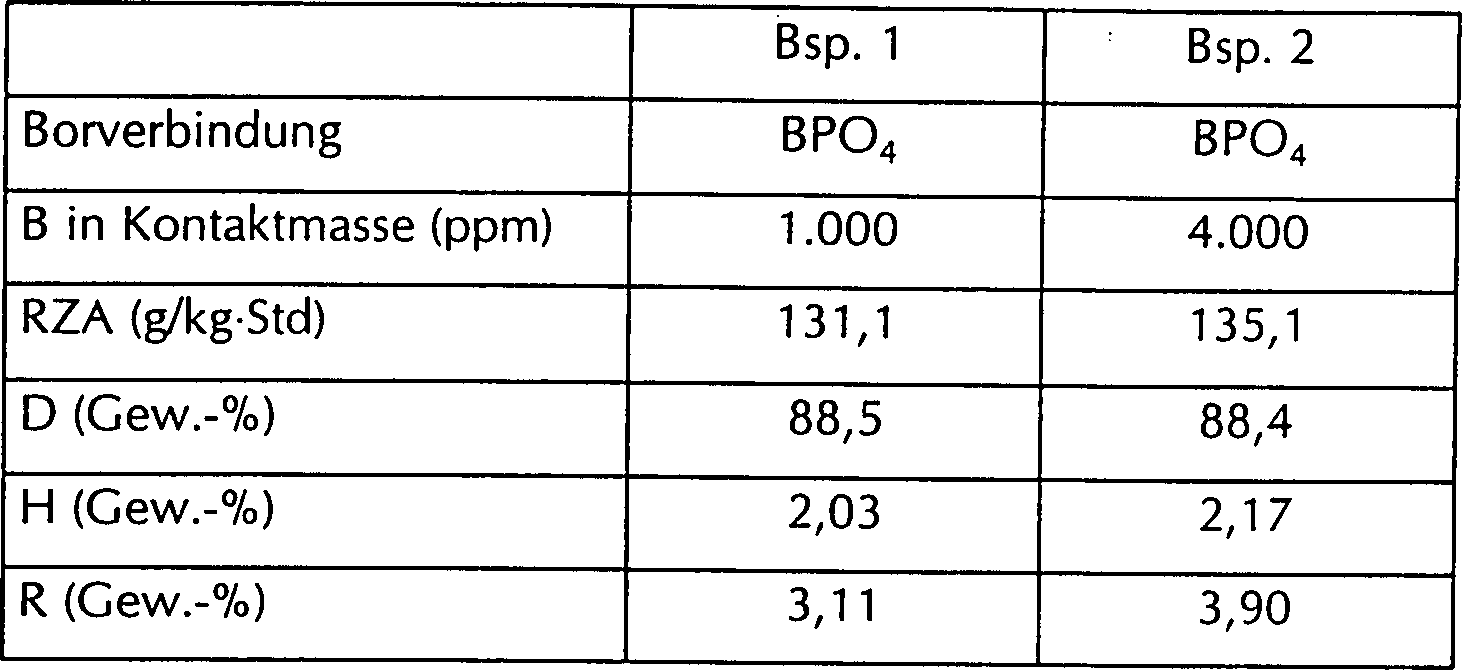
Beispiel 3Example 3
Ein Fließbettreaktor aus Kohlenstoffstahl mit einem Durchmesser von 50 mm und einer Höhe von 300 mm wurde mit 100 Teilen metallischem Siliziumpulver, das 74 ppm Bor enthielt, und 4 Teilen eines Katalysatorgemischs, das metallisches Kupferpulver enthielt, befüllt. Die Borkonzentration der Kontaktmasse ist in Tabelle 2 aufgeführt.A fluid bed reactor made of carbon steel with a diameter of 50 mm and a height of 300 mm was 100 Parts metallic silicon powder containing 74 ppm boron and 4 parts of a catalyst mixture, the metallic copper powder contained, filled. The boron concentration of the contact mass is listed in Table 2.
Danach wurde Methylchlorid mit einer Strömungsgeschwindigkeit von 1,3 m/s in den Reaktor zugeführt, und die Temperatur im Reaktor wurde auf 330°C erhöht, um die Reaktion fortzusetzen. Nach 6 Stunden war die Reaktion beendet. Tabelle 2 zeigt die kumulative RZA vom Beginn bis zum Ende der Reaktion sowie die Anteile von D, H und R.Thereafter, methyl chloride with a flow rate of 1.3 m / s fed into the reactor, and the temperature in the reactor was raised to 330 ° C to continue the reaction. The reaction was complete after 6 hours. Table 2 shows the cumulative RZA from the beginning to the end of the reaction and the proportions of D, H and R.
Beispiel 4Example 4
Ein Fließbettreaktor aus Kohlenstoffstahl mit einem Durchmesser von 50 mm und einer Höhe von 300 mm wurde mit 100 Teilen metallischem Siliziumpulver, das 148 ppm Bor enthielt, und 4 Teilen eines Katalysatorgemischs, das metallisches Kupferpulver enthielt, befüllt. Die Borkonzentration der Kontaktmasse ist in Tabelle 2 aufgeführt.A fluidized bed reactor made of carbon steel with a diameter of 50 mm and a height of 300 mm was charged with 100 parts of metallic silicon powder containing 148 ppm boron and 4 parts of a catalyst gate mixture containing metallic copper powder. The boron concentration of the contact mass is listed in Table 2.
Danach wurde Methylchlorid mit einer Strömungsgeschwindigkeit von 1,3 m/s in den Reaktor zugeführt, und die Temperatur im Reaktor wurde auf 330°C erhöht, um die Reaktion fortzusetzen. Nach 6 Stunden war die Reaktion beendet. Tabelle 2 zeigt die kumulative RZA vom Beginn bis zum Ende der Reaktion sowie die Anteile von D, H und R.Thereafter, methyl chloride with a flow rate of 1.3 m / s fed into the reactor, and the temperature in the reactor was raised to 330 ° C to continue the reaction. The reaction was complete after 6 hours. Table 2 shows the cumulative RZA from the beginning to the end of the reaction and the proportions of D, H and R.
Beispiel 5Example 5
Ein Fließbettreaktor aus Kohlenstoffstahl mit einem Durchmesser von 50 mm und einer Höhe von 300 mm wurde mit 100 Teilen metallischem Siliziumpulver, das 2.200 ppm Bor enthielt, und 4 Teilen eines Katalysatorgemischs, das metallisches Kupferpulver enthielt, befüllt. Die Borkonzentration der Kontaktmasse ist in Tabelle 2 aufgeführt.A fluid bed reactor made of carbon steel with a diameter of 50 mm and a height of 300 mm was 100 Parts of metallic silicon powder containing 2,200 ppm boron and 4 parts of a catalyst mixture, the metallic copper powder contained, filled. The boron concentration of the contact mass is listed in Table 2.
Danach wurde Methylchlorid mit einer Strömungsgeschwindigkeit von 1,3 m/s in den Reaktor zugeführt, und die Temperatur im Reaktor wurde auf 330°C erhöht, um die Reaktion fortzusetzen. Nach 6 Stunden war die Reaktion beendet. Tabelle 2 zeigt die kumulative RZA vom Beginn bis zum Ende der Reaktion sowie die Anteile von D, H und R.Thereafter, methyl chloride with a flow rate of 1.3 m / s fed into the reactor, and the temperature in the reactor was raised to 330 ° C to continue the reaction. The reaction was complete after 6 hours. Table 2 shows the cumulative RZA from the beginning to the end of the reaction and the proportions of D, H and R.
Vergleichsbeispiel 1Comparative Example 1
Ein Fließbettreaktor aus Kohlenstoffstahl mit einem Durchmesser von 50 mm und einer Höhe von 300 mm wurde mit 100 Teilen metallischem Siliziumpulver, das 0,032 ppm Bor enthielt, und 4 Teilen eines Katalysatorgemischs, das metallisches Kupferpulver enthielt, befüllt. Die Borkonzentration der Kontaktmasse ist in Tabelle 2 aufgeführt.A fluid bed reactor made of carbon steel with a diameter of 50 mm and a height of 300 mm was 100 Parts of metallic silicon powder containing 0.032 ppm boron and 4 parts of a catalyst mixture, the metallic copper powder contained, filled. The boron concentration of the contact mass is listed in Table 2.
Danach wurde Methylchlorid mit einer Strömungsgeschwindigkeit von 1,3 m/s in den Reaktor zugeführt, und die Temperatur im Reaktor wurde auf 330°C erhöht, um die Reaktion fortzusetzen. Nach 6 Stunden war die Reaktion beendet. Tabelle 2 zeigt die kumulative RZA vom Beginn bis zum Ende der Reaktion sowie die Anteile von D, H und R.Thereafter, methyl chloride with a flow rate of 1.3 m / s fed into the reactor, and the temperature in the reactor was raised to 330 ° C to continue the reaction. The reaction was complete after 6 hours. Table 2 shows the cumulative RZA from the beginning to the end of the reaction and the proportions of D, H and R.
Vergleichsbeispiel 2Comparative Example 2
Ein Fließbettreaktor aus Kohlenstoffstahl mit einem Durchmesser von 50 mm und einer Höhe von 300 mm wurde mit 100 Teilen metallischem Siliziumpulver, das 0,50 ppm Bor enthielt, und 4 Teilen eines Katalysatorgemischs, das metallisches Kupferpulver enthielt, befüllt. Die Borkonzentration der Kontaktmasse ist in Tabelle 2 aufgeführt.A fluid bed reactor made of carbon steel with a diameter of 50 mm and a height of 300 mm was 100 Parts of metallic silicon powder containing 0.50 ppm boron and 4 parts of a catalyst mixture, the metallic copper powder contained, filled. The boron concentration of the contact mass is listed in Table 2.
Danach wurde Methylchlorid mit einer Strömungsgeschwindigkeit von 1,3 m/s in den Reaktor zugeführt, und die Temperatur im Reaktor wurde auf 330 °C erhöht, um die Reaktion fortzusetzen. Nach 6 Stunden war die Reaktion beendet. Tabelle 2 zeigt die kumulative RZA vom Beginn bis zum Ende der Reaktion sowie die Anteile von D, H und R.Thereafter, methyl chloride with a flow rate of 1.3 m / s fed into the reactor, and the temperature in the reactor was raised to 330 ° C to continue the reaction. The reaction was complete after 6 hours. Table 2 shows the cumulative RZA from the beginning to the end of the reaction and the proportions of D, H and R.
In den Beispielen 3–5 und den Vergleichsbeispielen 1–2 wurden die vorbestimmten Mengen Bor unter Einsatz von Borsäure, eines Metallborats (worin das Metall Natrium oder Kalium ist) oder Boroxid in das metallische Siliziumpulver eingeführt. Die Borver bindung wurde vor der Reduktionsreaktion in einem Verfahren zur Raffination des Silizium-Rohmaterials zugesetzt. Genauer gesagt wurden Tonerde, Holzkohle, Holzstücke zusammen mit der Borverbindung in einen Elektroofen gegeben. Dann wurde ein Bogen über 1.500 °C gebildet, um die Reduktionsreaktion durchzuführen. Das Produkt wurde in einen Behälter überführt, in dem Stickstoff und Luft 1 bis 20 Stunden lang hindurchperlen gelassen wurden. Nachdem die Oxidschlacke entfernt worden war, wurde das schlussendlich erhaltene Pulver abgekühlt.In Examples 3-5 and Comparative Examples 1-2 were the predetermined amounts of boron using boric acid, one Metal borate (wherein the metal is sodium or potassium) or boron oxide introduced into the metallic silicon powder. The borver bond was before the reduction reaction in a process for refining the Silicon raw material added. More specifically, alumina, Charcoal, pieces of wood together placed in an electric furnace with the boron compound. Then a Arch over 1,500 ° C formed to carry out the reduction reaction. The product was in transferred a container into bubbled with nitrogen and air for 1 to 20 hours were. After the oxide slag was removed, that became finally obtained powder cooled.
Tabelle
2 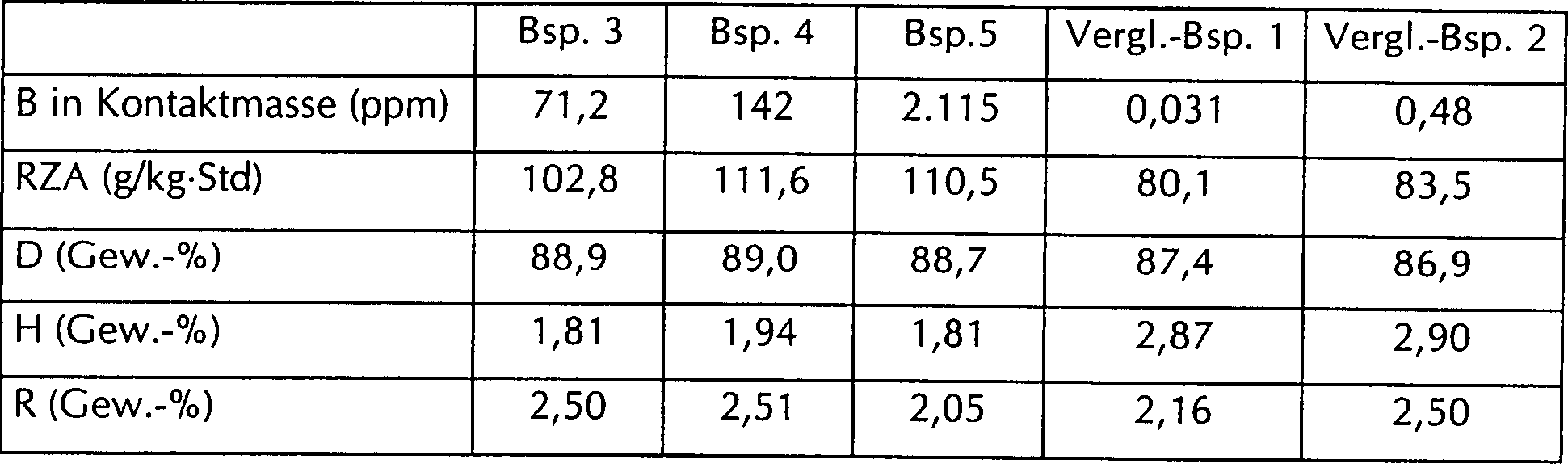
Beispiel 6Example 6
Ein Fließbettreaktor aus Kohlenstoffstahl mit einem Durchmesser von 50 mm und einer Höhe von 300 mm wurde mit 100 Teilen metallischem Siliziumpulver, das 7,0 ppm Bor enthielt, 3,7 Teilen metallischem Kupferpulver und 0,3 Teilen metallischem Kupferpulver, das 2,0 Gew.-% Bor enthielt, befüllt. Die Borkonzentration der Kontaktmasse ist in Tabelle 3 aufgeführt.A fluid bed reactor made of carbon steel with a diameter of 50 mm and a height of 300 mm was 100 Parts of metallic silicon powder containing 7.0 ppm of boron 3.7 Parts of metallic copper powder and 0.3 parts of metallic copper powder, containing 2.0% by weight boron. The boron concentration of the contact mass is listed in Table 3.
Danach wurde Methylchlorid mit einer Strömungsgeschwindigkeit von 1,3 m/s in den Reaktor zugeführt, und die Temperatur im Reaktor wurde auf 330°C erhöht, um die Reaktion fortzusetzen. Nach 6 Stunden war die Reaktion beendet. Tabelle 3 zeigt die kumulative RZA vom Beginn bis zum Ende der Reaktion sowie die Anteile von D, H und R.Thereafter, methyl chloride with a flow rate of 1.3 m / s fed into the reactor, and the temperature in the reactor was raised to 330 ° C to continue the reaction. The reaction was complete after 6 hours. Table 3 shows the cumulative RZA from the beginning to the end of the reaction and the proportions of D, H and R.
Beispiel 7Example 7
Ein Fließbettreaktor aus Kohlenstoffstahl mit einem Durchmesser von 50 mm und einer Höhe von 300 mm wurde mit 100 Teilen metallischem Siliziumpulver, das 500 ppm Bor enthielt, 3,5 Teilen metallischem Kupferpulver und 0,5 Teilen metallischem Kupferpulver, das 2,0 Gew.-% Bor enthielt, befüllt. Die Borkonzentration der Kontaktmasse ist in Tabelle 3 aufgeführt.A fluid bed reactor made of carbon steel with a diameter of 50 mm and a height of 300 mm was 100 Parts of metallic silicon powder containing 500 ppm boron 3.5 Parts of metallic copper powder and 0.5 parts of metallic copper powder, containing 2.0% by weight boron. The boron concentration of the contact mass is listed in Table 3.
Danach wurde Methylchlorid mit einer Strömungsgeschwindigkeit von 1,3 m/s in den Reaktor zugeführt, und die Temperatur im Reaktor wurde auf 330°C erhöht, um die Reaktion fortzusetzen. Nach 6 Stunden war die Reaktion beendet. Tabelle 3 zeigt die kumulative RZA vom Beginn bis zum Ende der Reaktion sowie die Anteile von D, H und R.Thereafter, methyl chloride with a flow rate of 1.3 m / s fed into the reactor, and the temperature in the reactor was raised to 330 ° C to continue the reaction. The reaction was complete after 6 hours. Table 3 shows the cumulative RZA from the beginning to the end of the reaction and the proportions of D, H and R.
Beispiel 8Example 8
Ein Fließbettreaktor aus Kohlenstoffstahl mit einem Durchmesser von 50 mm und einer Höhe von 300 mm wurde mit 100 Teilen metallischem Siliziumpulver, das 148 ppm Bor enthielt, 4,0 Teilen metallischem Kupferpulver und 1,2 Teilen Titanborid befüllt. Die Borkonzentration der Kontaktmasse ist in Tabelle 3 aufgeführt.A fluid bed reactor made of carbon steel with a diameter of 50 mm and a height of 300 mm was 100 Share metallic silicon powder containing 148 ppm boron 4.0 Parts of metallic copper powder and 1.2 parts of titanium boride filled. The Boron concentration of the contact mass is listed in Table 3.
Danach wurde Methylchlorid mit einer Strömungsgeschwindigkeit von 1,3 m/s in den Reaktor zugeführt, und die Temperatur im Reaktor wurde auf 330°C erhöht, um die Reaktion fortzusetzen. Nach 6 Stunden war die Reaktion beendet. Tabelle 3 zeigt die kumulative RZA vom Beginn bis zum Ende der Reaktion sowie die Anteile von D, H und R.Thereafter, methyl chloride with a flow rate of 1.3 m / s fed into the reactor, and the temperature in the reactor was raised to 330 ° C to continue the reaction. The reaction was complete after 6 hours. Table 3 shows the cumulative RZA from the beginning to the end of the reaction and the proportions of D, H and R.
Beispiel 9Example 9
Ein Fließbettreaktor aus Kohlenstoffstahl mit einem Durchmesser von 50 mm und einer Höhe von 300 mm wurde mit 100 Teilen metallischem Siliziumpulver, das 550 ppm Bor enthielt, 4,0 Teilen metallischem Kupferpulver und 0,5 Teilen Zirconiumborid befüllt. Die Borkonzentration der Kontaktmasse ist in Tabelle 3 aufgeführt.A fluid bed reactor made of carbon steel with a diameter of 50 mm and a height of 300 mm was 100 Parts of metallic silicon powder containing 550 ppm boron 4.0 Parts of metallic copper powder and 0.5 parts of zirconium boride filled. The Boron concentration of the contact mass is listed in Table 3.
Danach wurde Methylchlorid mit einer Strömungsgeschwindigkeit von 1,3 m/s in den Reaktor zugeführt, und die Temperatur im Reaktor wurde auf 330°C erhöht, um die Reaktion fortzusetzen. Nach 6 Stunden war die Reaktion beendet. Tabelle 3 zeigt die kumulative RZA vom Beginn bis zum Ende der Reaktion sowie die Anteile von D, H und R.Thereafter, methyl chloride with a flow rate of 1.3 m / s fed into the reactor, and the temperature in the reactor was raised to 330 ° C to continue the reaction. The reaction was complete after 6 hours. Table 3 shows the cumulative RZA from the beginning to the end of the reaction and the proportions of D, H and R.
Beispiel 10Example 10
Ein Fließbettreaktor aus Kohlenstoffstahl mit einem Durchmesser von 50 mm und einer Höhe von 300 mm wurde mit 100 Teilen metallischem Siliziumpulver, das 74 ppm Bor enthielt, 4,0 Teilen metallischem Kupferpulver und 0,5 Teilen Niobiumborid befüllt. Die Borkonzentration der Kontaktmasse ist in Tabelle 3 aufgeführt.A fluidized bed reactor made of carbon steel with a diameter of 50 mm and a height of 300 mm was filled with 100 parts of metallic silicon powder containing 74 ppm boron, 4.0 parts of metallic copper powder and 0.5 parts of niobium boride. The boron concentration of the contact mass is listed in Table 3.
Danach wurde Methylchlorid mit einer Strömungsgeschwindigkeit von 1,3 m/s in den Reaktor zugeführt, und die Temperatur im Reaktor wurde auf 330°C erhöht, um die Reaktion fortzusetzen. Nach 6 Stunden war die Reaktion beendet. Tabelle 3 zeigt die kumulative RZA vom Beginn bis zum Ende der Reaktion sowie die Anteile von D, H und R.Thereafter, methyl chloride with a flow rate of 1.3 m / s fed into the reactor, and the temperature in the reactor was raised to 330 ° C to continue the reaction. The reaction was complete after 6 hours. Table 3 shows the cumulative RZA from the beginning to the end of the reaction and the proportions of D, H and R.
Beispiel 11Example 11
Ein Fließbettreaktor aus Kohlenstoffstahl mit einem Durchmesser von 50 mm und einer Höhe von 300 mm wurde mit 100 Teilen metallischem Siliziumpulver, das 148 ppm Bor enthielt, 3,5 Teilen metallischem Kupferpulver und 1,0 Teilen Wolframborid befüllt. Die Borkonzentration der Kontaktmasse ist in Tabelle 3 aufgeführt.A fluid bed reactor made of carbon steel with a diameter of 50 mm and a height of 300 mm was 100 Parts of metallic silicon powder containing 148 ppm boron 3.5 Parts of metallic copper powder and 1.0 parts of tungsten boride filled. The Boron concentration of the contact mass is listed in Table 3.
Danach wurde Methylchlorid mit einer Strömungsgeschwindigkeit von 1,3 m/s in den Reaktor zugeführt, und die Temperatur im Reaktor wurde auf 330°C erhöht, um die Reaktion fortzusetzen. Nach 6 Stunden war die Reaktion beendet. Tabelle 3 zeigt die kumulative RZA vom Beginn bis zum Ende der Reaktion sowie die Anteile von D, H und R.Thereafter, methyl chloride with a flow rate of 1.3 m / s fed into the reactor, and the temperature in the reactor was raised to 330 ° C to continue the reaction. The reaction was complete after 6 hours. Table 3 shows the cumulative RZA from the beginning to the end of the reaction and the proportions of D, H and R.
Es ist anzumerken, dass die in den Beispielen 6–11 eingesetzten metallischen Siliziumpulver, die 7 bis 550 ppm Bor enthalten, wie in den Beispielen 3–5 hergestellt wurden. Die metallischen Kupferpulver, die 2 Gew.-% Bor enthalten, wurden durch Vermischen von Bor- und Kupferpulver, 2-stündiges Erhitzen des Gemischs unter Stickstoffatmosphäre von Raumtemperatur auf hohe Temperaturen von 1.800 bis 2.200°C, Halten der geschmolzenen Masse bei der hohen Temperatur für 1 Stunde und Abkühlen der geschmolzenen Masse hergestellt.It should be noted that those in the Examples 6-11 used metallic silicon powder, the 7 to 550 ppm boron included as prepared in Examples 3-5. The metallic copper powder containing 2% by weight of boron was obtained by Mixing of boron and copper powder, heating the mixture for 2 hours under nitrogen atmosphere from room temperature to high temperatures of 1,800 to 2,200 ° C, hold the melted mass at high temperature for 1 hour and cooling of the molten mass.
Tabelle
3 
Beispiel 12Example 12
Ein Fließbettreaktor aus Kohlenstoffstahl mit einem Durchmesser von 50 mm und einer Höhe von 300 mm wurde mit 100 Teilen metallischem Siliziumpulver, das 7,0 ppm Bor enthielt, 4 Teilen eines Katalysatorgemischs, das metallisches Kupferpulver enthielt, und 0,2 Teilen Bornitrid befüllt. Die Borkonzentration der Kontaktmasse ist in Tabelle 4 aufgeführt.A fluid bed reactor made of carbon steel with a diameter of 50 mm and a height of 300 mm was 100 Parts of metallic silicon powder containing 7.0 ppm boron 4 Share a catalyst mixture, the metallic copper powder contained, and filled 0.2 parts of boron nitride. The boron concentration of the Contact mass is listed in Table 4.
Danach wurde Methylchlorid mit einer Strömungsgeschwindigkeit von 1,3 m/s in den Reaktor zugeführt, und die Temperatur im Reaktor wurde auf 330°C erhöht, um die Reaktion fortzusetzen. Nach 6 Stunden war die Reaktion beendet. Tabelle 4 zeigt die kumulative RZA vom Beginn bis zum Ende der Reaktion sowie die Anteile von D, H und R.Thereafter, methyl chloride with a flow rate of 1.3 m / s fed into the reactor, and the temperature in the reactor was raised to 330 ° C to continue the reaction. The reaction was complete after 6 hours. Table 4 shows the cumulative RZA from the beginning to the end of the reaction and the proportions of D, H and R.
Beispiel 13Example 13
Ein Fließbettreaktor aus Kohlenstoffstahl mit einem Durchmesser von 50 mm und einer Höhe von 300 mm wurde mit 100 Teilen metallischem Siliziumpulver, das 7,0 ppm Bor enthielt, 4 Teilen eines Katalysatorgemischs, das metallisches Kupferpulver enthielt, und 0,7 Teilen Bornitrid befüllt. Die Bonkonzentration der Kontaktmasse ist in Tabelle 4 aufgeführt.A fluidized bed reactor made of carbon steel with a diameter of 50 mm and a height of 300 mm was filled with 100 parts of metallic silicon powder containing 7.0 ppm boron, 4 parts of a catalyst mixture containing metallic copper powder and 0.7 parts of boron nitride. The receipt concentration of the contact mass is listed in Table 4.
Danach wurde Methylchlorid mit einer Strömungsgeschwindigkeit von 1,3 m/s in den Reaktor zugeführt, und die Temperatur im Reaktor wurde auf 330°C erhöht, um die Reaktion fortzusetzen. Nach 6 Stunden war die Reaktion beendet. Tabelle 4 zeigt die kumulative RZA vom Beginn bis zum Ende der Reaktion sowie die Anteile von D, H und R.Thereafter, methyl chloride with a flow rate of 1.3 m / s fed into the reactor, and the temperature in the reactor was raised to 330 ° C to continue the reaction. The reaction was complete after 6 hours. Table 4 shows the cumulative RZA from the beginning to the end of the reaction and the proportions of D, H and R.
Beispiel 14Example 14
Ein Fließbettreaktor aus Kohlenstoffstahl mit einem Durchmesser von 50 mm und einer Höhe von 300 mm wurde mit 100 Teilen metallischem Siliziumpulver, das 7,0 ppm Bor enthielt, 4 Teilen eines Katalysatorgemischs, das metallisches Kupferpulver enthielt, und 1,4 Teilen Bornitrid befüllt. Die Borkonzentration der Kontaktmasse ist in Tabelle 4 aufgeführt.A fluid bed reactor made of carbon steel with a diameter of 50 mm and a height of 300 mm was 100 Parts of metallic silicon powder containing 7.0 ppm boron 4 Share a catalyst mixture, the metallic copper powder contained, and 1.4 parts of boron nitride filled. The boron concentration of the Contact mass is listed in Table 4.
Danach wurde Methylchlorid mit einer Strömungsgeschwindigkeit von 1,3 m/s in den Reaktor zugeführt, und die Temperatur im Reaktor wurde auf 330°C erhöht, um die Reaktion fortzusetzen. Nach 6 Stunden war die Reaktion beendet. Tabelle 4 zeigt die kumulative RZA vom Beginn bis zum Ende der Reaktion sowie die Anteile von D, H und R.Thereafter, methyl chloride with a flow rate of 1.3 m / s fed into the reactor, and the temperature in the reactor was raised to 330 ° C to continue the reaction. The reaction was complete after 6 hours. Table 4 shows the cumulative RZA from the beginning to the end of the reaction and the proportions of D, H and R.
Beispiel 15Example 15
Ein Fließbettreaktor aus Kohlenstoffstahl mit einem Durchmesser von 50 mm und einer Höhe von 300 mm wurde mit 100 Teilen metallischem Siliziumpulver, das 7,0 ppm Bor enthielt, 4 Teilen eines Katalysatorgemischs, das metallisches Kupferpulver enthielt, und 0,5 Teilen Bornitrid befüllt. Die Borkonzentration der Kontaktmasse ist in Tabelle 4 aufgeführt.A fluid bed reactor made of carbon steel with a diameter of 50 mm and a height of 300 mm was 100 Parts of metallic silicon powder containing 7.0 ppm boron 4 Share a catalyst mixture, the metallic copper powder contained, and filled 0.5 parts of boron nitride. The boron concentration of the Contact mass is listed in Table 4.
Danach wurde Methylchlorid mit einer Strömungsgeschwindigkeit von 1,3 m/s in den Reaktor zugeführt, und die Temperatur im Reaktor wurde auf 330°C erhöht, um die Reaktion fortzusetzen. Nach 6 Stunden war die Reaktion beendet. Tabelle 4 zeigt die kumulative RZA vom Beginn bis zum Ende der Reaktion sowie die Anteile von D, H und R.Thereafter, methyl chloride with a flow rate of 1.3 m / s fed into the reactor, and the temperature in the reactor was raised to 330 ° C to continue the reaction. The reaction was complete after 6 hours. Table 4 shows the cumulative RZA from the beginning to the end of the reaction and the proportions of D, H and R.
Beispiel 16Example 16
Ein Fließbettreaktor aus Kohlenstoffstahl mit einem Durchmesser von 50 mm und einer Höhe von 300 mm wurde mit 100 Teilen metallischem Siliziumpulver, das 78 ppm Bor enthielt, 4 Teilen eines Katalysatorgemischs, das metallisches Kupferpulver enthielt, und 3,0 Teilen Bormetaphosphat befüllt. Die Borkonzentration der Kontaktmasse ist in Tabelle 4 aufgeführt.A fluid bed reactor made of carbon steel with a diameter of 50 mm and a height of 300 mm was 100 Parts of metallic silicon powder containing 78 ppm boron, 4 parts a catalyst mixture containing metallic copper powder and 3.0 parts of bormetaphosphate filled. The boron concentration of the Contact mass is listed in Table 4.
Danach wurde Methylchlorid mit einer Strömungsgeschwindigkeit von 1,3 m/s in den Reaktor zugeführt, und die Temperatur im Reaktor wurde auf 330°C erhöht, um die Reaktion fortzusetzen. Nach 6 Stunden war die Reaktion beendet. Tabelle 4 zeigt die kumulative RZA vom Beginn bis zum Ende der Reaktion sowie die Anteile von D, H und R.Thereafter, methyl chloride with a flow rate of 1.3 m / s fed into the reactor, and the temperature in the reactor was raised to 330 ° C to continue the reaction. The reaction was complete after 6 hours. Table 4 shows the cumulative RZA from the beginning to the end of the reaction and the proportions of D, H and R.
Tabelle
4 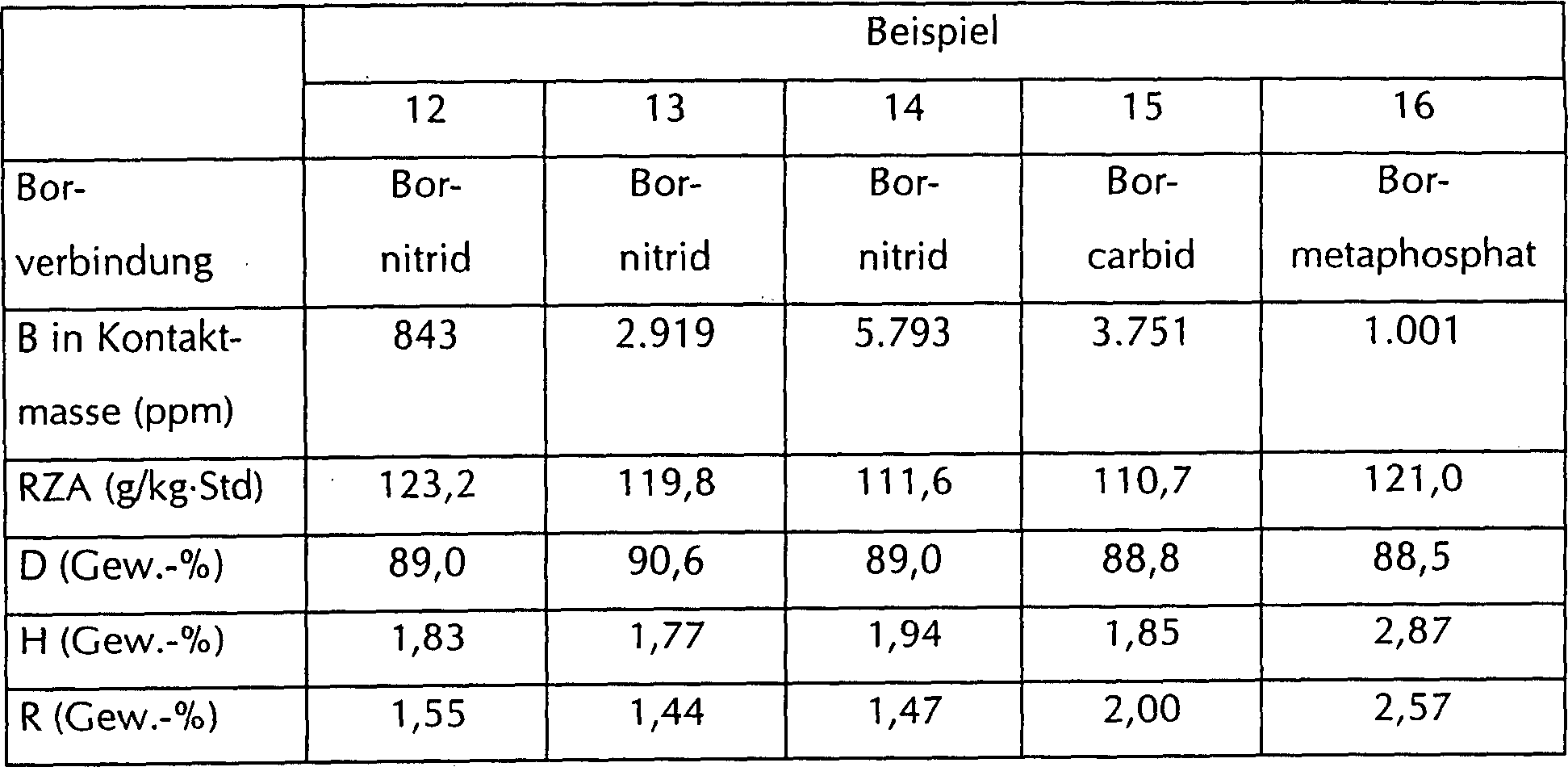
Durch die kostengünstige Möglichkeit des Zusetzens einer wirksamen Menge Bor zu einer herkömmlichen Kontaktmasse in einem Verfahren zur Herstellung eines Alkylhalogensilans durch direkte Synthese, konnten die Erfinder die Menge des in einer gewünschten RZA gebildeten Dialkyldihalogensilans erhöhen und gleichzeitig die Menge der unnötigen Hydrosilane und Disilane minimieren. Die Ergiebigkeit eines Verfahrens zur Herstellung eines Alkylhalogensilans durch direkte Synthese wird dadurch bedeutend verbessert.Due to the inexpensive possibility of adding one effective amount of boron to a conventional contact mass in one Process for the preparation of an alkylhalosilane by direct Synthesis, the inventors were able to find the amount of one desired RZA formed dialkyldihalosilane increase and at the same time the amount the unnecessary Minimize hydrosilanes and disilanes. The productivity of a process for Preparation of an alkylhalosilane by direct synthesis thereby significantly improved.
Obwohl einige bevorzugte Ausführungsformen beschrieben wurden, können im Lichte der Lehren hierin viele Modifikationen und Variationen vorgenommen werden. Das bedeutet, dass die Erfindung im Rahmen des Schutzumfangs der beiliegenden Ansprüche auch anders in die Praxis umgesetzt werden kann als hier spezifiziert wurde.Although some preferred embodiments have been described many modifications and variations in the light of the teachings herein be made. This means that the invention within the The scope of protection of the attached claims is also different in practice can be implemented as specified here.
Claims (9)
Applications Claiming Priority (2)
| Application Number | Priority Date | Filing Date | Title |
|---|---|---|---|
| JP18757497 | 1997-06-27 | ||
| JP18757497 | 1997-06-27 |
Publications (2)
| Publication Number | Publication Date |
|---|---|
| DE69813402D1 DE69813402D1 (en) | 2003-05-22 |
| DE69813402T2 true DE69813402T2 (en) | 2004-03-04 |
Family
ID=16208491
Family Applications (1)
| Application Number | Title | Priority Date | Filing Date |
|---|---|---|---|
| DE69813402T Expired - Lifetime DE69813402T2 (en) | 1997-06-27 | 1998-06-29 | Manufacture of alkyl halosilanes |
Country Status (3)
| Country | Link |
|---|---|
| US (1) | US6025513A (en) |
| EP (1) | EP0893448B1 (en) |
| DE (1) | DE69813402T2 (en) |
Families Citing this family (12)
| Publication number | Priority date | Publication date | Assignee | Title |
|---|---|---|---|---|
| JP3812642B2 (en) | 2001-02-14 | 2006-08-23 | 信越化学工業株式会社 | Method for producing organohalosilane |
| JP3775491B2 (en) | 2001-08-30 | 2006-05-17 | 信越化学工業株式会社 | Method for producing organohalosilane |
| JP4174655B2 (en) * | 2002-04-23 | 2008-11-05 | 信越化学工業株式会社 | Method for producing organohalosilane |
| JP4407805B2 (en) * | 2004-03-18 | 2010-02-03 | 信越化学工業株式会社 | Method for producing organohalosilane |
| JP4407804B2 (en) * | 2004-03-18 | 2010-02-03 | 信越化学工業株式会社 | Method for producing organohalosilane |
| DE102005005052A1 (en) * | 2005-02-03 | 2006-08-10 | Wacker Chemie Ag | Process for the preparation of methylchlorosilanes |
| US7652164B2 (en) | 2005-09-13 | 2010-01-26 | Momentive Performance Materials Inc. | Process for the direct synthesis of trialkoxysilane |
| DE102006044372A1 (en) * | 2006-09-20 | 2008-04-03 | Wacker Chemie Ag | Process for the preparation of methylchlorosilanes |
| KR101630552B1 (en) * | 2011-12-19 | 2016-06-14 | 블루스타 실리콘즈 프랑스 에스에이에스 | Method for the direct synthesis of alkylhalogenosilanes |
| CN113996298B (en) * | 2021-11-30 | 2023-07-14 | 新特能源股份有限公司 | Supported catalyst and preparation method thereof |
| CN121127478A (en) | 2023-03-14 | 2025-12-12 | 迈图高新材料公司 | Improved direct synthesis of alkenyl halosilanes |
| KR20260002708A (en) | 2023-04-19 | 2026-01-06 | 모멘티브 퍼포먼스 머티리얼즈 인크. | Direct synthesis of alkoxysilanes using copper-aluminum alloy catalysts |
Family Cites Families (5)
| Publication number | Priority date | Publication date | Assignee | Title |
|---|---|---|---|---|
| US4864044A (en) * | 1985-02-15 | 1989-09-05 | Union Carbide Corporation | Tin containing activated silicon for the direct reaction |
| DE3610267A1 (en) * | 1986-03-26 | 1987-10-01 | Wacker Chemie Gmbh | METHOD FOR PRODUCING ORGANOHALOGENSILANES |
| NO165288C (en) * | 1988-12-08 | 1991-01-23 | Elkem As | SILICONE POWDER AND PROCEDURE FOR THE PREPARATION OF SILICONE POWDER. |
| DE3841417A1 (en) * | 1988-12-08 | 1990-06-13 | Bayer Ag | METHOD FOR PRODUCING ORGANOSILANES |
| AU669255B2 (en) * | 1993-03-24 | 1996-05-30 | Ge Bayer Silicones Gmbh & Co. Kg | Process for the preparation of organochlorosilanes |
-
1998
- 1998-06-29 US US09/106,145 patent/US6025513A/en not_active Expired - Lifetime
- 1998-06-29 DE DE69813402T patent/DE69813402T2/en not_active Expired - Lifetime
- 1998-06-29 EP EP98305149A patent/EP0893448B1/en not_active Expired - Lifetime
Also Published As
| Publication number | Publication date |
|---|---|
| EP0893448A2 (en) | 1999-01-27 |
| US6025513A (en) | 2000-02-15 |
| EP0893448B1 (en) | 2003-04-16 |
| EP0893448A3 (en) | 1999-12-22 |
| DE69813402D1 (en) | 2003-05-22 |
Similar Documents
| Publication | Publication Date | Title |
|---|---|---|
| DE3689628T2 (en) | Process for the preparation of alkyl halosilanes. | |
| DE3851692T2 (en) | Process for the preparation of alkyl halosilanes. | |
| DD232278A5 (en) | PROCESS FOR THE PREPARATION OF ALKYLHALOGENILANES | |
| DE69809117T2 (en) | Preparation of contact materials for alkyl halosilane production and process for the production of alkyl halosilane | |
| DE10336545B3 (en) | Process for the preparation of chlorosilanes | |
| EP0372341A2 (en) | Method for the preparation of chloro-organosilanes | |
| DE3782151T3 (en) | Process for the production of alkyl halosilanes and silicon therefor. | |
| DD233128A5 (en) | METHOD FOR THE CATALYTIC MANUFACTURE OF ORGANOHALOGENILANES | |
| DE69402201T2 (en) | PHOSPHORUS-CONTAINING METALLURGICAL SILICON FOR THE PRODUCTION OF ORGANOHALOSILANES | |
| DE69019788T2 (en) | Process for the production of organohalosilanes. | |
| EP0893448B1 (en) | Preparation of alkylhalosilanes | |
| EP0671402B1 (en) | Process for the preparation of methylchlorosilanes | |
| DE69013482T2 (en) | Process for the preparation of organohalosilanes. | |
| DE3425424C2 (en) | ||
| EP0963991A2 (en) | Process for preparing organochlorosilanes | |
| DE602004013179T2 (en) | DIRECT PROCESS FOR SYNTHESIS OF ALKYLHALOGENILANES | |
| DE4037021C2 (en) | Iron, aluminum and optionally calcium-containing silicon for use in the conversion to chlorosilanes or to organosilanes and processes for the production thereof | |
| DE19937908C1 (en) | Continuous direct production of methyl chlorosilanes by Mueller-Rochow alternating catalyst method to give increased productivity while retaining selectivity | |
| DE69029373T2 (en) | Process for the production of organohalosilanes | |
| DE19621306C1 (en) | Process for the preparation of alkylhalosilanes | |
| DE2308805C3 (en) | Process for the preparation of phenylchlorosilanes | |
| EP1086110B1 (en) | Method for producing alkyl halogenosilanes | |
| DE4312494A1 (en) | Process for the preparation of methylchlorosilanes | |
| JP3729236B2 (en) | Method for producing alkylhalosilane | |
| WO2012136487A1 (en) | Method for producing a contact mass |
Legal Events
| Date | Code | Title | Description |
|---|---|---|---|
| 8364 | No opposition during term of opposition |