DE69920357T2 - Thermally conductive lubricant composition and semiconductor device equipped therewith - Google Patents
Thermally conductive lubricant composition and semiconductor device equipped therewith Download PDFInfo
- Publication number
- DE69920357T2 DE69920357T2 DE69920357T DE69920357T DE69920357T2 DE 69920357 T2 DE69920357 T2 DE 69920357T2 DE 69920357 T DE69920357 T DE 69920357T DE 69920357 T DE69920357 T DE 69920357T DE 69920357 T2 DE69920357 T2 DE 69920357T2
- Authority
- DE
- Germany
- Prior art keywords
- group
- lubricant composition
- groups
- thermally conductive
- composition according
- Prior art date
- Legal status (The legal status is an assumption and is not a legal conclusion. Google has not performed a legal analysis and makes no representation as to the accuracy of the status listed.)
- Expired - Lifetime
Links
Classifications
-
- H—ELECTRICITY
- H10—SEMICONDUCTOR DEVICES; ELECTRIC SOLID-STATE DEVICES NOT OTHERWISE PROVIDED FOR
- H10W—GENERIC PACKAGES, INTERCONNECTIONS, CONNECTORS OR OTHER CONSTRUCTIONAL DETAILS OF DEVICES COVERED BY CLASS H10
- H10W40/00—Arrangements for thermal protection or thermal control
- H10W40/20—Arrangements for cooling
- H10W40/25—Arrangements for cooling characterised by their materials
- H10W40/251—Organics
-
- C—CHEMISTRY; METALLURGY
- C10—PETROLEUM, GAS OR COKE INDUSTRIES; TECHNICAL GASES CONTAINING CARBON MONOXIDE; FUELS; LUBRICANTS; PEAT
- C10M—LUBRICATING COMPOSITIONS; USE OF CHEMICAL SUBSTANCES EITHER ALONE OR AS LUBRICATING INGREDIENTS IN A LUBRICATING COMPOSITION
- C10M101/00—Lubricating compositions characterised by the base-material being a mineral or fatty oil
- C10M101/02—Petroleum fractions
-
- C—CHEMISTRY; METALLURGY
- C10—PETROLEUM, GAS OR COKE INDUSTRIES; TECHNICAL GASES CONTAINING CARBON MONOXIDE; FUELS; LUBRICANTS; PEAT
- C10M—LUBRICATING COMPOSITIONS; USE OF CHEMICAL SUBSTANCES EITHER ALONE OR AS LUBRICATING INGREDIENTS IN A LUBRICATING COMPOSITION
- C10M107/00—Lubricating compositions characterised by the base-material being a macromolecular compound
- C10M107/50—Lubricating compositions characterised by the base-material being a macromolecular compound containing silicon
-
- C—CHEMISTRY; METALLURGY
- C10—PETROLEUM, GAS OR COKE INDUSTRIES; TECHNICAL GASES CONTAINING CARBON MONOXIDE; FUELS; LUBRICANTS; PEAT
- C10M—LUBRICATING COMPOSITIONS; USE OF CHEMICAL SUBSTANCES EITHER ALONE OR AS LUBRICATING INGREDIENTS IN A LUBRICATING COMPOSITION
- C10M113/00—Lubricating compositions characterised by the thickening agent being an inorganic material
- C10M113/06—Metals; Alloys
-
- C—CHEMISTRY; METALLURGY
- C10—PETROLEUM, GAS OR COKE INDUSTRIES; TECHNICAL GASES CONTAINING CARBON MONOXIDE; FUELS; LUBRICANTS; PEAT
- C10M—LUBRICATING COMPOSITIONS; USE OF CHEMICAL SUBSTANCES EITHER ALONE OR AS LUBRICATING INGREDIENTS IN A LUBRICATING COMPOSITION
- C10M125/00—Lubricating compositions characterised by the additive being an inorganic material
- C10M125/04—Metals; Alloys
-
- C—CHEMISTRY; METALLURGY
- C10—PETROLEUM, GAS OR COKE INDUSTRIES; TECHNICAL GASES CONTAINING CARBON MONOXIDE; FUELS; LUBRICANTS; PEAT
- C10M—LUBRICATING COMPOSITIONS; USE OF CHEMICAL SUBSTANCES EITHER ALONE OR AS LUBRICATING INGREDIENTS IN A LUBRICATING COMPOSITION
- C10M169/00—Lubricating compositions characterised by containing as components a mixture of at least two types of ingredient selected from base-materials, thickeners or additives, covered by the preceding groups, each of these compounds being essential
-
- C—CHEMISTRY; METALLURGY
- C10—PETROLEUM, GAS OR COKE INDUSTRIES; TECHNICAL GASES CONTAINING CARBON MONOXIDE; FUELS; LUBRICANTS; PEAT
- C10M—LUBRICATING COMPOSITIONS; USE OF CHEMICAL SUBSTANCES EITHER ALONE OR AS LUBRICATING INGREDIENTS IN A LUBRICATING COMPOSITION
- C10M2201/00—Inorganic compounds or elements as ingredients in lubricant compositions
- C10M2201/04—Elements
- C10M2201/05—Metals; Alloys
-
- C—CHEMISTRY; METALLURGY
- C10—PETROLEUM, GAS OR COKE INDUSTRIES; TECHNICAL GASES CONTAINING CARBON MONOXIDE; FUELS; LUBRICANTS; PEAT
- C10M—LUBRICATING COMPOSITIONS; USE OF CHEMICAL SUBSTANCES EITHER ALONE OR AS LUBRICATING INGREDIENTS IN A LUBRICATING COMPOSITION
- C10M2201/00—Inorganic compounds or elements as ingredients in lubricant compositions
- C10M2201/04—Elements
- C10M2201/05—Metals; Alloys
- C10M2201/056—Metals; Alloys used as thickening agents
-
- C—CHEMISTRY; METALLURGY
- C10—PETROLEUM, GAS OR COKE INDUSTRIES; TECHNICAL GASES CONTAINING CARBON MONOXIDE; FUELS; LUBRICANTS; PEAT
- C10M—LUBRICATING COMPOSITIONS; USE OF CHEMICAL SUBSTANCES EITHER ALONE OR AS LUBRICATING INGREDIENTS IN A LUBRICATING COMPOSITION
- C10M2203/00—Organic non-macromolecular hydrocarbon compounds and hydrocarbon fractions as ingredients in lubricant compositions
- C10M2203/06—Well-defined aromatic compounds
-
- C—CHEMISTRY; METALLURGY
- C10—PETROLEUM, GAS OR COKE INDUSTRIES; TECHNICAL GASES CONTAINING CARBON MONOXIDE; FUELS; LUBRICANTS; PEAT
- C10M—LUBRICATING COMPOSITIONS; USE OF CHEMICAL SUBSTANCES EITHER ALONE OR AS LUBRICATING INGREDIENTS IN A LUBRICATING COMPOSITION
- C10M2203/00—Organic non-macromolecular hydrocarbon compounds and hydrocarbon fractions as ingredients in lubricant compositions
- C10M2203/10—Petroleum or coal fractions, e.g. tars, solvents, bitumen
- C10M2203/1006—Petroleum or coal fractions, e.g. tars, solvents, bitumen used as base material
-
- C—CHEMISTRY; METALLURGY
- C10—PETROLEUM, GAS OR COKE INDUSTRIES; TECHNICAL GASES CONTAINING CARBON MONOXIDE; FUELS; LUBRICANTS; PEAT
- C10M—LUBRICATING COMPOSITIONS; USE OF CHEMICAL SUBSTANCES EITHER ALONE OR AS LUBRICATING INGREDIENTS IN A LUBRICATING COMPOSITION
- C10M2203/00—Organic non-macromolecular hydrocarbon compounds and hydrocarbon fractions as ingredients in lubricant compositions
- C10M2203/10—Petroleum or coal fractions, e.g. tars, solvents, bitumen
- C10M2203/102—Aliphatic fractions
- C10M2203/1025—Aliphatic fractions used as base material
-
- C—CHEMISTRY; METALLURGY
- C10—PETROLEUM, GAS OR COKE INDUSTRIES; TECHNICAL GASES CONTAINING CARBON MONOXIDE; FUELS; LUBRICANTS; PEAT
- C10M—LUBRICATING COMPOSITIONS; USE OF CHEMICAL SUBSTANCES EITHER ALONE OR AS LUBRICATING INGREDIENTS IN A LUBRICATING COMPOSITION
- C10M2203/00—Organic non-macromolecular hydrocarbon compounds and hydrocarbon fractions as ingredients in lubricant compositions
- C10M2203/10—Petroleum or coal fractions, e.g. tars, solvents, bitumen
- C10M2203/104—Aromatic fractions
- C10M2203/1045—Aromatic fractions used as base material
-
- C—CHEMISTRY; METALLURGY
- C10—PETROLEUM, GAS OR COKE INDUSTRIES; TECHNICAL GASES CONTAINING CARBON MONOXIDE; FUELS; LUBRICANTS; PEAT
- C10M—LUBRICATING COMPOSITIONS; USE OF CHEMICAL SUBSTANCES EITHER ALONE OR AS LUBRICATING INGREDIENTS IN A LUBRICATING COMPOSITION
- C10M2203/00—Organic non-macromolecular hydrocarbon compounds and hydrocarbon fractions as ingredients in lubricant compositions
- C10M2203/10—Petroleum or coal fractions, e.g. tars, solvents, bitumen
- C10M2203/106—Naphthenic fractions
- C10M2203/1065—Naphthenic fractions used as base material
-
- C—CHEMISTRY; METALLURGY
- C10—PETROLEUM, GAS OR COKE INDUSTRIES; TECHNICAL GASES CONTAINING CARBON MONOXIDE; FUELS; LUBRICANTS; PEAT
- C10M—LUBRICATING COMPOSITIONS; USE OF CHEMICAL SUBSTANCES EITHER ALONE OR AS LUBRICATING INGREDIENTS IN A LUBRICATING COMPOSITION
- C10M2203/00—Organic non-macromolecular hydrocarbon compounds and hydrocarbon fractions as ingredients in lubricant compositions
- C10M2203/10—Petroleum or coal fractions, e.g. tars, solvents, bitumen
- C10M2203/108—Residual fractions, e.g. bright stocks
- C10M2203/1085—Residual fractions, e.g. bright stocks used as base material
-
- C—CHEMISTRY; METALLURGY
- C10—PETROLEUM, GAS OR COKE INDUSTRIES; TECHNICAL GASES CONTAINING CARBON MONOXIDE; FUELS; LUBRICANTS; PEAT
- C10M—LUBRICATING COMPOSITIONS; USE OF CHEMICAL SUBSTANCES EITHER ALONE OR AS LUBRICATING INGREDIENTS IN A LUBRICATING COMPOSITION
- C10M2205/00—Organic macromolecular hydrocarbon compounds or fractions, whether or not modified by oxidation as ingredients in lubricant compositions
- C10M2205/02—Organic macromolecular hydrocarbon compounds or fractions, whether or not modified by oxidation as ingredients in lubricant compositions containing acyclic monomers
- C10M2205/026—Butene
-
- C—CHEMISTRY; METALLURGY
- C10—PETROLEUM, GAS OR COKE INDUSTRIES; TECHNICAL GASES CONTAINING CARBON MONOXIDE; FUELS; LUBRICANTS; PEAT
- C10M—LUBRICATING COMPOSITIONS; USE OF CHEMICAL SUBSTANCES EITHER ALONE OR AS LUBRICATING INGREDIENTS IN A LUBRICATING COMPOSITION
- C10M2205/00—Organic macromolecular hydrocarbon compounds or fractions, whether or not modified by oxidation as ingredients in lubricant compositions
- C10M2205/02—Organic macromolecular hydrocarbon compounds or fractions, whether or not modified by oxidation as ingredients in lubricant compositions containing acyclic monomers
- C10M2205/028—Organic macromolecular hydrocarbon compounds or fractions, whether or not modified by oxidation as ingredients in lubricant compositions containing acyclic monomers containing aliphatic monomers having more than four carbon atoms
-
- C—CHEMISTRY; METALLURGY
- C10—PETROLEUM, GAS OR COKE INDUSTRIES; TECHNICAL GASES CONTAINING CARBON MONOXIDE; FUELS; LUBRICANTS; PEAT
- C10M—LUBRICATING COMPOSITIONS; USE OF CHEMICAL SUBSTANCES EITHER ALONE OR AS LUBRICATING INGREDIENTS IN A LUBRICATING COMPOSITION
- C10M2207/00—Organic non-macromolecular hydrocarbon compounds containing hydrogen, carbon and oxygen as ingredients in lubricant compositions
- C10M2207/28—Esters
- C10M2207/281—Esters of (cyclo)aliphatic monocarboxylic acids
-
- C—CHEMISTRY; METALLURGY
- C10—PETROLEUM, GAS OR COKE INDUSTRIES; TECHNICAL GASES CONTAINING CARBON MONOXIDE; FUELS; LUBRICANTS; PEAT
- C10M—LUBRICATING COMPOSITIONS; USE OF CHEMICAL SUBSTANCES EITHER ALONE OR AS LUBRICATING INGREDIENTS IN A LUBRICATING COMPOSITION
- C10M2207/00—Organic non-macromolecular hydrocarbon compounds containing hydrogen, carbon and oxygen as ingredients in lubricant compositions
- C10M2207/28—Esters
- C10M2207/282—Esters of (cyclo)aliphatic oolycarboxylic acids
-
- C—CHEMISTRY; METALLURGY
- C10—PETROLEUM, GAS OR COKE INDUSTRIES; TECHNICAL GASES CONTAINING CARBON MONOXIDE; FUELS; LUBRICANTS; PEAT
- C10M—LUBRICATING COMPOSITIONS; USE OF CHEMICAL SUBSTANCES EITHER ALONE OR AS LUBRICATING INGREDIENTS IN A LUBRICATING COMPOSITION
- C10M2207/00—Organic non-macromolecular hydrocarbon compounds containing hydrogen, carbon and oxygen as ingredients in lubricant compositions
- C10M2207/28—Esters
- C10M2207/283—Esters of polyhydroxy compounds
-
- C—CHEMISTRY; METALLURGY
- C10—PETROLEUM, GAS OR COKE INDUSTRIES; TECHNICAL GASES CONTAINING CARBON MONOXIDE; FUELS; LUBRICANTS; PEAT
- C10M—LUBRICATING COMPOSITIONS; USE OF CHEMICAL SUBSTANCES EITHER ALONE OR AS LUBRICATING INGREDIENTS IN A LUBRICATING COMPOSITION
- C10M2207/00—Organic non-macromolecular hydrocarbon compounds containing hydrogen, carbon and oxygen as ingredients in lubricant compositions
- C10M2207/28—Esters
- C10M2207/286—Esters of polymerised unsaturated acids
-
- C—CHEMISTRY; METALLURGY
- C10—PETROLEUM, GAS OR COKE INDUSTRIES; TECHNICAL GASES CONTAINING CARBON MONOXIDE; FUELS; LUBRICANTS; PEAT
- C10M—LUBRICATING COMPOSITIONS; USE OF CHEMICAL SUBSTANCES EITHER ALONE OR AS LUBRICATING INGREDIENTS IN A LUBRICATING COMPOSITION
- C10M2207/00—Organic non-macromolecular hydrocarbon compounds containing hydrogen, carbon and oxygen as ingredients in lubricant compositions
- C10M2207/28—Esters
- C10M2207/34—Esters having a hydrocarbon substituent of thirty or more carbon atoms, e.g. substituted succinic acid derivatives
-
- C—CHEMISTRY; METALLURGY
- C10—PETROLEUM, GAS OR COKE INDUSTRIES; TECHNICAL GASES CONTAINING CARBON MONOXIDE; FUELS; LUBRICANTS; PEAT
- C10M—LUBRICATING COMPOSITIONS; USE OF CHEMICAL SUBSTANCES EITHER ALONE OR AS LUBRICATING INGREDIENTS IN A LUBRICATING COMPOSITION
- C10M2209/00—Organic macromolecular compounds containing oxygen as ingredients in lubricant compositions
- C10M2209/10—Macromolecular compoundss obtained otherwise than by reactions only involving carbon-to-carbon unsaturated bonds
- C10M2209/103—Polyethers, i.e. containing di- or higher polyoxyalkylene groups
- C10M2209/104—Polyethers, i.e. containing di- or higher polyoxyalkylene groups of alkylene oxides containing two carbon atoms only
-
- C—CHEMISTRY; METALLURGY
- C10—PETROLEUM, GAS OR COKE INDUSTRIES; TECHNICAL GASES CONTAINING CARBON MONOXIDE; FUELS; LUBRICANTS; PEAT
- C10M—LUBRICATING COMPOSITIONS; USE OF CHEMICAL SUBSTANCES EITHER ALONE OR AS LUBRICATING INGREDIENTS IN A LUBRICATING COMPOSITION
- C10M2209/00—Organic macromolecular compounds containing oxygen as ingredients in lubricant compositions
- C10M2209/10—Macromolecular compoundss obtained otherwise than by reactions only involving carbon-to-carbon unsaturated bonds
- C10M2209/103—Polyethers, i.e. containing di- or higher polyoxyalkylene groups
- C10M2209/105—Polyethers, i.e. containing di- or higher polyoxyalkylene groups of alkylene oxides containing three carbon atoms only
-
- C—CHEMISTRY; METALLURGY
- C10—PETROLEUM, GAS OR COKE INDUSTRIES; TECHNICAL GASES CONTAINING CARBON MONOXIDE; FUELS; LUBRICANTS; PEAT
- C10M—LUBRICATING COMPOSITIONS; USE OF CHEMICAL SUBSTANCES EITHER ALONE OR AS LUBRICATING INGREDIENTS IN A LUBRICATING COMPOSITION
- C10M2211/00—Organic non-macromolecular compounds containing halogen as ingredients in lubricant compositions
- C10M2211/04—Organic non-macromolecular compounds containing halogen as ingredients in lubricant compositions containing carbon, hydrogen, halogen, and oxygen
- C10M2211/042—Alcohols; Ethers; Aldehydes; Ketones
-
- C—CHEMISTRY; METALLURGY
- C10—PETROLEUM, GAS OR COKE INDUSTRIES; TECHNICAL GASES CONTAINING CARBON MONOXIDE; FUELS; LUBRICANTS; PEAT
- C10M—LUBRICATING COMPOSITIONS; USE OF CHEMICAL SUBSTANCES EITHER ALONE OR AS LUBRICATING INGREDIENTS IN A LUBRICATING COMPOSITION
- C10M2211/00—Organic non-macromolecular compounds containing halogen as ingredients in lubricant compositions
- C10M2211/06—Perfluorinated compounds
-
- C—CHEMISTRY; METALLURGY
- C10—PETROLEUM, GAS OR COKE INDUSTRIES; TECHNICAL GASES CONTAINING CARBON MONOXIDE; FUELS; LUBRICANTS; PEAT
- C10M—LUBRICATING COMPOSITIONS; USE OF CHEMICAL SUBSTANCES EITHER ALONE OR AS LUBRICATING INGREDIENTS IN A LUBRICATING COMPOSITION
- C10M2213/00—Organic macromolecular compounds containing halogen as ingredients in lubricant compositions
-
- C—CHEMISTRY; METALLURGY
- C10—PETROLEUM, GAS OR COKE INDUSTRIES; TECHNICAL GASES CONTAINING CARBON MONOXIDE; FUELS; LUBRICANTS; PEAT
- C10M—LUBRICATING COMPOSITIONS; USE OF CHEMICAL SUBSTANCES EITHER ALONE OR AS LUBRICATING INGREDIENTS IN A LUBRICATING COMPOSITION
- C10M2213/00—Organic macromolecular compounds containing halogen as ingredients in lubricant compositions
- C10M2213/04—Organic macromolecular compounds containing halogen as ingredients in lubricant compositions obtained from monomers containing carbon, hydrogen, halogen and oxygen
-
- C—CHEMISTRY; METALLURGY
- C10—PETROLEUM, GAS OR COKE INDUSTRIES; TECHNICAL GASES CONTAINING CARBON MONOXIDE; FUELS; LUBRICANTS; PEAT
- C10M—LUBRICATING COMPOSITIONS; USE OF CHEMICAL SUBSTANCES EITHER ALONE OR AS LUBRICATING INGREDIENTS IN A LUBRICATING COMPOSITION
- C10M2213/00—Organic macromolecular compounds containing halogen as ingredients in lubricant compositions
- C10M2213/06—Perfluoro polymers
-
- C—CHEMISTRY; METALLURGY
- C10—PETROLEUM, GAS OR COKE INDUSTRIES; TECHNICAL GASES CONTAINING CARBON MONOXIDE; FUELS; LUBRICANTS; PEAT
- C10M—LUBRICATING COMPOSITIONS; USE OF CHEMICAL SUBSTANCES EITHER ALONE OR AS LUBRICATING INGREDIENTS IN A LUBRICATING COMPOSITION
- C10M2223/00—Organic non-macromolecular compounds containing phosphorus as ingredients in lubricant compositions
- C10M2223/02—Organic non-macromolecular compounds containing phosphorus as ingredients in lubricant compositions having no phosphorus-to-carbon bonds
- C10M2223/04—Phosphate esters
- C10M2223/041—Triaryl phosphates
-
- C—CHEMISTRY; METALLURGY
- C10—PETROLEUM, GAS OR COKE INDUSTRIES; TECHNICAL GASES CONTAINING CARBON MONOXIDE; FUELS; LUBRICANTS; PEAT
- C10M—LUBRICATING COMPOSITIONS; USE OF CHEMICAL SUBSTANCES EITHER ALONE OR AS LUBRICATING INGREDIENTS IN A LUBRICATING COMPOSITION
- C10M2229/00—Organic macromolecular compounds containing atoms of elements not provided for in groups C10M2205/00, C10M2209/00, C10M2213/00, C10M2217/00, C10M2221/00 or C10M2225/00 as ingredients in lubricant compositions
- C10M2229/02—Unspecified siloxanes; Silicones
- C10M2229/025—Unspecified siloxanes; Silicones used as base material
-
- C—CHEMISTRY; METALLURGY
- C10—PETROLEUM, GAS OR COKE INDUSTRIES; TECHNICAL GASES CONTAINING CARBON MONOXIDE; FUELS; LUBRICANTS; PEAT
- C10M—LUBRICATING COMPOSITIONS; USE OF CHEMICAL SUBSTANCES EITHER ALONE OR AS LUBRICATING INGREDIENTS IN A LUBRICATING COMPOSITION
- C10M2229/00—Organic macromolecular compounds containing atoms of elements not provided for in groups C10M2205/00, C10M2209/00, C10M2213/00, C10M2217/00, C10M2221/00 or C10M2225/00 as ingredients in lubricant compositions
- C10M2229/04—Siloxanes with specific structure
- C10M2229/0405—Siloxanes with specific structure used as base material
-
- C—CHEMISTRY; METALLURGY
- C10—PETROLEUM, GAS OR COKE INDUSTRIES; TECHNICAL GASES CONTAINING CARBON MONOXIDE; FUELS; LUBRICANTS; PEAT
- C10M—LUBRICATING COMPOSITIONS; USE OF CHEMICAL SUBSTANCES EITHER ALONE OR AS LUBRICATING INGREDIENTS IN A LUBRICATING COMPOSITION
- C10M2229/00—Organic macromolecular compounds containing atoms of elements not provided for in groups C10M2205/00, C10M2209/00, C10M2213/00, C10M2217/00, C10M2221/00 or C10M2225/00 as ingredients in lubricant compositions
- C10M2229/04—Siloxanes with specific structure
- C10M2229/041—Siloxanes with specific structure containing aliphatic substituents
- C10M2229/0415—Siloxanes with specific structure containing aliphatic substituents used as base material
-
- C—CHEMISTRY; METALLURGY
- C10—PETROLEUM, GAS OR COKE INDUSTRIES; TECHNICAL GASES CONTAINING CARBON MONOXIDE; FUELS; LUBRICANTS; PEAT
- C10M—LUBRICATING COMPOSITIONS; USE OF CHEMICAL SUBSTANCES EITHER ALONE OR AS LUBRICATING INGREDIENTS IN A LUBRICATING COMPOSITION
- C10M2229/00—Organic macromolecular compounds containing atoms of elements not provided for in groups C10M2205/00, C10M2209/00, C10M2213/00, C10M2217/00, C10M2221/00 or C10M2225/00 as ingredients in lubricant compositions
- C10M2229/04—Siloxanes with specific structure
- C10M2229/042—Siloxanes with specific structure containing aromatic substituents
-
- C—CHEMISTRY; METALLURGY
- C10—PETROLEUM, GAS OR COKE INDUSTRIES; TECHNICAL GASES CONTAINING CARBON MONOXIDE; FUELS; LUBRICANTS; PEAT
- C10M—LUBRICATING COMPOSITIONS; USE OF CHEMICAL SUBSTANCES EITHER ALONE OR AS LUBRICATING INGREDIENTS IN A LUBRICATING COMPOSITION
- C10M2229/00—Organic macromolecular compounds containing atoms of elements not provided for in groups C10M2205/00, C10M2209/00, C10M2213/00, C10M2217/00, C10M2221/00 or C10M2225/00 as ingredients in lubricant compositions
- C10M2229/04—Siloxanes with specific structure
- C10M2229/042—Siloxanes with specific structure containing aromatic substituents
- C10M2229/0425—Siloxanes with specific structure containing aromatic substituents used as base material
-
- C—CHEMISTRY; METALLURGY
- C10—PETROLEUM, GAS OR COKE INDUSTRIES; TECHNICAL GASES CONTAINING CARBON MONOXIDE; FUELS; LUBRICANTS; PEAT
- C10M—LUBRICATING COMPOSITIONS; USE OF CHEMICAL SUBSTANCES EITHER ALONE OR AS LUBRICATING INGREDIENTS IN A LUBRICATING COMPOSITION
- C10M2229/00—Organic macromolecular compounds containing atoms of elements not provided for in groups C10M2205/00, C10M2209/00, C10M2213/00, C10M2217/00, C10M2221/00 or C10M2225/00 as ingredients in lubricant compositions
- C10M2229/04—Siloxanes with specific structure
- C10M2229/043—Siloxanes with specific structure containing carbon-to-carbon double bonds
- C10M2229/0435—Siloxanes with specific structure containing carbon-to-carbon double bonds used as base material
-
- C—CHEMISTRY; METALLURGY
- C10—PETROLEUM, GAS OR COKE INDUSTRIES; TECHNICAL GASES CONTAINING CARBON MONOXIDE; FUELS; LUBRICANTS; PEAT
- C10M—LUBRICATING COMPOSITIONS; USE OF CHEMICAL SUBSTANCES EITHER ALONE OR AS LUBRICATING INGREDIENTS IN A LUBRICATING COMPOSITION
- C10M2229/00—Organic macromolecular compounds containing atoms of elements not provided for in groups C10M2205/00, C10M2209/00, C10M2213/00, C10M2217/00, C10M2221/00 or C10M2225/00 as ingredients in lubricant compositions
- C10M2229/04—Siloxanes with specific structure
- C10M2229/044—Siloxanes with specific structure containing silicon-to-hydrogen bonds
- C10M2229/0445—Siloxanes with specific structure containing silicon-to-hydrogen bonds used as base material
-
- C—CHEMISTRY; METALLURGY
- C10—PETROLEUM, GAS OR COKE INDUSTRIES; TECHNICAL GASES CONTAINING CARBON MONOXIDE; FUELS; LUBRICANTS; PEAT
- C10M—LUBRICATING COMPOSITIONS; USE OF CHEMICAL SUBSTANCES EITHER ALONE OR AS LUBRICATING INGREDIENTS IN A LUBRICATING COMPOSITION
- C10M2229/00—Organic macromolecular compounds containing atoms of elements not provided for in groups C10M2205/00, C10M2209/00, C10M2213/00, C10M2217/00, C10M2221/00 or C10M2225/00 as ingredients in lubricant compositions
- C10M2229/04—Siloxanes with specific structure
- C10M2229/045—Siloxanes with specific structure containing silicon-to-hydroxyl bonds
- C10M2229/0455—Siloxanes with specific structure containing silicon-to-hydroxyl bonds used as base material
-
- C—CHEMISTRY; METALLURGY
- C10—PETROLEUM, GAS OR COKE INDUSTRIES; TECHNICAL GASES CONTAINING CARBON MONOXIDE; FUELS; LUBRICANTS; PEAT
- C10M—LUBRICATING COMPOSITIONS; USE OF CHEMICAL SUBSTANCES EITHER ALONE OR AS LUBRICATING INGREDIENTS IN A LUBRICATING COMPOSITION
- C10M2229/00—Organic macromolecular compounds containing atoms of elements not provided for in groups C10M2205/00, C10M2209/00, C10M2213/00, C10M2217/00, C10M2221/00 or C10M2225/00 as ingredients in lubricant compositions
- C10M2229/04—Siloxanes with specific structure
- C10M2229/046—Siloxanes with specific structure containing silicon-oxygen-carbon bonds
- C10M2229/0465—Siloxanes with specific structure containing silicon-oxygen-carbon bonds used as base material
-
- C—CHEMISTRY; METALLURGY
- C10—PETROLEUM, GAS OR COKE INDUSTRIES; TECHNICAL GASES CONTAINING CARBON MONOXIDE; FUELS; LUBRICANTS; PEAT
- C10M—LUBRICATING COMPOSITIONS; USE OF CHEMICAL SUBSTANCES EITHER ALONE OR AS LUBRICATING INGREDIENTS IN A LUBRICATING COMPOSITION
- C10M2229/00—Organic macromolecular compounds containing atoms of elements not provided for in groups C10M2205/00, C10M2209/00, C10M2213/00, C10M2217/00, C10M2221/00 or C10M2225/00 as ingredients in lubricant compositions
- C10M2229/04—Siloxanes with specific structure
- C10M2229/047—Siloxanes with specific structure containing alkylene oxide groups
- C10M2229/0475—Siloxanes with specific structure containing alkylene oxide groups used as base material
-
- C—CHEMISTRY; METALLURGY
- C10—PETROLEUM, GAS OR COKE INDUSTRIES; TECHNICAL GASES CONTAINING CARBON MONOXIDE; FUELS; LUBRICANTS; PEAT
- C10M—LUBRICATING COMPOSITIONS; USE OF CHEMICAL SUBSTANCES EITHER ALONE OR AS LUBRICATING INGREDIENTS IN A LUBRICATING COMPOSITION
- C10M2229/00—Organic macromolecular compounds containing atoms of elements not provided for in groups C10M2205/00, C10M2209/00, C10M2213/00, C10M2217/00, C10M2221/00 or C10M2225/00 as ingredients in lubricant compositions
- C10M2229/04—Siloxanes with specific structure
- C10M2229/048—Siloxanes with specific structure containing carboxyl groups
- C10M2229/0485—Siloxanes with specific structure containing carboxyl groups used as base material
-
- C—CHEMISTRY; METALLURGY
- C10—PETROLEUM, GAS OR COKE INDUSTRIES; TECHNICAL GASES CONTAINING CARBON MONOXIDE; FUELS; LUBRICANTS; PEAT
- C10M—LUBRICATING COMPOSITIONS; USE OF CHEMICAL SUBSTANCES EITHER ALONE OR AS LUBRICATING INGREDIENTS IN A LUBRICATING COMPOSITION
- C10M2229/00—Organic macromolecular compounds containing atoms of elements not provided for in groups C10M2205/00, C10M2209/00, C10M2213/00, C10M2217/00, C10M2221/00 or C10M2225/00 as ingredients in lubricant compositions
- C10M2229/04—Siloxanes with specific structure
- C10M2229/05—Siloxanes with specific structure containing atoms other than silicon, hydrogen, oxygen or carbon
- C10M2229/0505—Siloxanes with specific structure containing atoms other than silicon, hydrogen, oxygen or carbon used as base material
-
- C—CHEMISTRY; METALLURGY
- C10—PETROLEUM, GAS OR COKE INDUSTRIES; TECHNICAL GASES CONTAINING CARBON MONOXIDE; FUELS; LUBRICANTS; PEAT
- C10M—LUBRICATING COMPOSITIONS; USE OF CHEMICAL SUBSTANCES EITHER ALONE OR AS LUBRICATING INGREDIENTS IN A LUBRICATING COMPOSITION
- C10M2229/00—Organic macromolecular compounds containing atoms of elements not provided for in groups C10M2205/00, C10M2209/00, C10M2213/00, C10M2217/00, C10M2221/00 or C10M2225/00 as ingredients in lubricant compositions
- C10M2229/04—Siloxanes with specific structure
- C10M2229/05—Siloxanes with specific structure containing atoms other than silicon, hydrogen, oxygen or carbon
- C10M2229/051—Siloxanes with specific structure containing atoms other than silicon, hydrogen, oxygen or carbon containing halogen
- C10M2229/0515—Siloxanes with specific structure containing atoms other than silicon, hydrogen, oxygen or carbon containing halogen used as base material
-
- C—CHEMISTRY; METALLURGY
- C10—PETROLEUM, GAS OR COKE INDUSTRIES; TECHNICAL GASES CONTAINING CARBON MONOXIDE; FUELS; LUBRICANTS; PEAT
- C10M—LUBRICATING COMPOSITIONS; USE OF CHEMICAL SUBSTANCES EITHER ALONE OR AS LUBRICATING INGREDIENTS IN A LUBRICATING COMPOSITION
- C10M2229/00—Organic macromolecular compounds containing atoms of elements not provided for in groups C10M2205/00, C10M2209/00, C10M2213/00, C10M2217/00, C10M2221/00 or C10M2225/00 as ingredients in lubricant compositions
- C10M2229/04—Siloxanes with specific structure
- C10M2229/05—Siloxanes with specific structure containing atoms other than silicon, hydrogen, oxygen or carbon
- C10M2229/052—Siloxanes with specific structure containing atoms other than silicon, hydrogen, oxygen or carbon containing nitrogen
- C10M2229/0525—Siloxanes with specific structure containing atoms other than silicon, hydrogen, oxygen or carbon containing nitrogen used as base material
-
- C—CHEMISTRY; METALLURGY
- C10—PETROLEUM, GAS OR COKE INDUSTRIES; TECHNICAL GASES CONTAINING CARBON MONOXIDE; FUELS; LUBRICANTS; PEAT
- C10M—LUBRICATING COMPOSITIONS; USE OF CHEMICAL SUBSTANCES EITHER ALONE OR AS LUBRICATING INGREDIENTS IN A LUBRICATING COMPOSITION
- C10M2229/00—Organic macromolecular compounds containing atoms of elements not provided for in groups C10M2205/00, C10M2209/00, C10M2213/00, C10M2217/00, C10M2221/00 or C10M2225/00 as ingredients in lubricant compositions
- C10M2229/04—Siloxanes with specific structure
- C10M2229/05—Siloxanes with specific structure containing atoms other than silicon, hydrogen, oxygen or carbon
- C10M2229/053—Siloxanes with specific structure containing atoms other than silicon, hydrogen, oxygen or carbon containing sulfur
- C10M2229/0535—Siloxanes with specific structure containing atoms other than silicon, hydrogen, oxygen or carbon containing sulfur used as base material
-
- C—CHEMISTRY; METALLURGY
- C10—PETROLEUM, GAS OR COKE INDUSTRIES; TECHNICAL GASES CONTAINING CARBON MONOXIDE; FUELS; LUBRICANTS; PEAT
- C10M—LUBRICATING COMPOSITIONS; USE OF CHEMICAL SUBSTANCES EITHER ALONE OR AS LUBRICATING INGREDIENTS IN A LUBRICATING COMPOSITION
- C10M2229/00—Organic macromolecular compounds containing atoms of elements not provided for in groups C10M2205/00, C10M2209/00, C10M2213/00, C10M2217/00, C10M2221/00 or C10M2225/00 as ingredients in lubricant compositions
- C10M2229/04—Siloxanes with specific structure
- C10M2229/05—Siloxanes with specific structure containing atoms other than silicon, hydrogen, oxygen or carbon
- C10M2229/054—Siloxanes with specific structure containing atoms other than silicon, hydrogen, oxygen or carbon containing phosphorus
- C10M2229/0545—Siloxanes with specific structure containing atoms other than silicon, hydrogen, oxygen or carbon containing phosphorus used as base material
-
- C—CHEMISTRY; METALLURGY
- C10—PETROLEUM, GAS OR COKE INDUSTRIES; TECHNICAL GASES CONTAINING CARBON MONOXIDE; FUELS; LUBRICANTS; PEAT
- C10N—INDEXING SCHEME ASSOCIATED WITH SUBCLASS C10M RELATING TO LUBRICATING COMPOSITIONS
- C10N2020/00—Specified physical or chemical properties or characteristics, i.e. function, of component of lubricating compositions
- C10N2020/01—Physico-chemical properties
-
- C—CHEMISTRY; METALLURGY
- C10—PETROLEUM, GAS OR COKE INDUSTRIES; TECHNICAL GASES CONTAINING CARBON MONOXIDE; FUELS; LUBRICANTS; PEAT
- C10N—INDEXING SCHEME ASSOCIATED WITH SUBCLASS C10M RELATING TO LUBRICATING COMPOSITIONS
- C10N2040/00—Specified use or application for which the lubricating composition is intended
-
- C—CHEMISTRY; METALLURGY
- C10—PETROLEUM, GAS OR COKE INDUSTRIES; TECHNICAL GASES CONTAINING CARBON MONOXIDE; FUELS; LUBRICANTS; PEAT
- C10N—INDEXING SCHEME ASSOCIATED WITH SUBCLASS C10M RELATING TO LUBRICATING COMPOSITIONS
- C10N2040/00—Specified use or application for which the lubricating composition is intended
- C10N2040/30—Refrigerators lubricants or compressors lubricants
-
- C—CHEMISTRY; METALLURGY
- C10—PETROLEUM, GAS OR COKE INDUSTRIES; TECHNICAL GASES CONTAINING CARBON MONOXIDE; FUELS; LUBRICANTS; PEAT
- C10N—INDEXING SCHEME ASSOCIATED WITH SUBCLASS C10M RELATING TO LUBRICATING COMPOSITIONS
- C10N2040/00—Specified use or application for which the lubricating composition is intended
- C10N2040/32—Wires, ropes or cables lubricants
-
- C—CHEMISTRY; METALLURGY
- C10—PETROLEUM, GAS OR COKE INDUSTRIES; TECHNICAL GASES CONTAINING CARBON MONOXIDE; FUELS; LUBRICANTS; PEAT
- C10N—INDEXING SCHEME ASSOCIATED WITH SUBCLASS C10M RELATING TO LUBRICATING COMPOSITIONS
- C10N2040/00—Specified use or application for which the lubricating composition is intended
- C10N2040/34—Lubricating-sealants
-
- C—CHEMISTRY; METALLURGY
- C10—PETROLEUM, GAS OR COKE INDUSTRIES; TECHNICAL GASES CONTAINING CARBON MONOXIDE; FUELS; LUBRICANTS; PEAT
- C10N—INDEXING SCHEME ASSOCIATED WITH SUBCLASS C10M RELATING TO LUBRICATING COMPOSITIONS
- C10N2040/00—Specified use or application for which the lubricating composition is intended
- C10N2040/36—Release agents or mold release agents
-
- C—CHEMISTRY; METALLURGY
- C10—PETROLEUM, GAS OR COKE INDUSTRIES; TECHNICAL GASES CONTAINING CARBON MONOXIDE; FUELS; LUBRICANTS; PEAT
- C10N—INDEXING SCHEME ASSOCIATED WITH SUBCLASS C10M RELATING TO LUBRICATING COMPOSITIONS
- C10N2040/00—Specified use or application for which the lubricating composition is intended
- C10N2040/38—Conveyors or chain belts
-
- C—CHEMISTRY; METALLURGY
- C10—PETROLEUM, GAS OR COKE INDUSTRIES; TECHNICAL GASES CONTAINING CARBON MONOXIDE; FUELS; LUBRICANTS; PEAT
- C10N—INDEXING SCHEME ASSOCIATED WITH SUBCLASS C10M RELATING TO LUBRICATING COMPOSITIONS
- C10N2040/00—Specified use or application for which the lubricating composition is intended
- C10N2040/40—Generators or electric motors in oil or gas winning field
-
- C—CHEMISTRY; METALLURGY
- C10—PETROLEUM, GAS OR COKE INDUSTRIES; TECHNICAL GASES CONTAINING CARBON MONOXIDE; FUELS; LUBRICANTS; PEAT
- C10N—INDEXING SCHEME ASSOCIATED WITH SUBCLASS C10M RELATING TO LUBRICATING COMPOSITIONS
- C10N2040/00—Specified use or application for which the lubricating composition is intended
- C10N2040/42—Flashing oils or marking oils
-
- C—CHEMISTRY; METALLURGY
- C10—PETROLEUM, GAS OR COKE INDUSTRIES; TECHNICAL GASES CONTAINING CARBON MONOXIDE; FUELS; LUBRICANTS; PEAT
- C10N—INDEXING SCHEME ASSOCIATED WITH SUBCLASS C10M RELATING TO LUBRICATING COMPOSITIONS
- C10N2040/00—Specified use or application for which the lubricating composition is intended
- C10N2040/44—Super vacuum or supercritical use
-
- C—CHEMISTRY; METALLURGY
- C10—PETROLEUM, GAS OR COKE INDUSTRIES; TECHNICAL GASES CONTAINING CARBON MONOXIDE; FUELS; LUBRICANTS; PEAT
- C10N—INDEXING SCHEME ASSOCIATED WITH SUBCLASS C10M RELATING TO LUBRICATING COMPOSITIONS
- C10N2040/00—Specified use or application for which the lubricating composition is intended
- C10N2040/50—Medical uses
-
- H—ELECTRICITY
- H10—SEMICONDUCTOR DEVICES; ELECTRIC SOLID-STATE DEVICES NOT OTHERWISE PROVIDED FOR
- H10W—GENERIC PACKAGES, INTERCONNECTIONS, CONNECTORS OR OTHER CONSTRUCTIONAL DETAILS OF DEVICES COVERED BY CLASS H10
- H10W90/00—Package configurations
- H10W90/701—Package configurations characterised by the relative positions of pads or connectors relative to package parts
- H10W90/731—Package configurations characterised by the relative positions of pads or connectors relative to package parts of die-attach connectors
- H10W90/736—Package configurations characterised by the relative positions of pads or connectors relative to package parts of die-attach connectors between a chip and a stacked lead frame, conducting package substrate or heat sink
-
- Y—GENERAL TAGGING OF NEW TECHNOLOGICAL DEVELOPMENTS; GENERAL TAGGING OF CROSS-SECTIONAL TECHNOLOGIES SPANNING OVER SEVERAL SECTIONS OF THE IPC; TECHNICAL SUBJECTS COVERED BY FORMER USPC CROSS-REFERENCE ART COLLECTIONS [XRACs] AND DIGESTS
- Y10—TECHNICAL SUBJECTS COVERED BY FORMER USPC
- Y10T—TECHNICAL SUBJECTS COVERED BY FORMER US CLASSIFICATION
- Y10T428/00—Stock material or miscellaneous articles
- Y10T428/25—Web or sheet containing structurally defined element or component and including a second component containing structurally defined particles
-
- Y—GENERAL TAGGING OF NEW TECHNOLOGICAL DEVELOPMENTS; GENERAL TAGGING OF CROSS-SECTIONAL TECHNOLOGIES SPANNING OVER SEVERAL SECTIONS OF THE IPC; TECHNICAL SUBJECTS COVERED BY FORMER USPC CROSS-REFERENCE ART COLLECTIONS [XRACs] AND DIGESTS
- Y10—TECHNICAL SUBJECTS COVERED BY FORMER USPC
- Y10T—TECHNICAL SUBJECTS COVERED BY FORMER US CLASSIFICATION
- Y10T428/00—Stock material or miscellaneous articles
- Y10T428/25—Web or sheet containing structurally defined element or component and including a second component containing structurally defined particles
- Y10T428/256—Heavy metal or aluminum or compound thereof
-
- Y—GENERAL TAGGING OF NEW TECHNOLOGICAL DEVELOPMENTS; GENERAL TAGGING OF CROSS-SECTIONAL TECHNOLOGIES SPANNING OVER SEVERAL SECTIONS OF THE IPC; TECHNICAL SUBJECTS COVERED BY FORMER USPC CROSS-REFERENCE ART COLLECTIONS [XRACs] AND DIGESTS
- Y10—TECHNICAL SUBJECTS COVERED BY FORMER USPC
- Y10T—TECHNICAL SUBJECTS COVERED BY FORMER US CLASSIFICATION
- Y10T428/00—Stock material or miscellaneous articles
- Y10T428/26—Web or sheet containing structurally defined element or component, the element or component having a specified physical dimension
-
- Y—GENERAL TAGGING OF NEW TECHNOLOGICAL DEVELOPMENTS; GENERAL TAGGING OF CROSS-SECTIONAL TECHNOLOGIES SPANNING OVER SEVERAL SECTIONS OF THE IPC; TECHNICAL SUBJECTS COVERED BY FORMER USPC CROSS-REFERENCE ART COLLECTIONS [XRACs] AND DIGESTS
- Y10—TECHNICAL SUBJECTS COVERED BY FORMER USPC
- Y10T—TECHNICAL SUBJECTS COVERED BY FORMER US CLASSIFICATION
- Y10T428/00—Stock material or miscellaneous articles
- Y10T428/29—Coated or structually defined flake, particle, cell, strand, strand portion, rod, filament, macroscopic fiber or mass thereof
- Y10T428/2982—Particulate matter [e.g., sphere, flake, etc.]
-
- Y—GENERAL TAGGING OF NEW TECHNOLOGICAL DEVELOPMENTS; GENERAL TAGGING OF CROSS-SECTIONAL TECHNOLOGIES SPANNING OVER SEVERAL SECTIONS OF THE IPC; TECHNICAL SUBJECTS COVERED BY FORMER USPC CROSS-REFERENCE ART COLLECTIONS [XRACs] AND DIGESTS
- Y10—TECHNICAL SUBJECTS COVERED BY FORMER USPC
- Y10T—TECHNICAL SUBJECTS COVERED BY FORMER US CLASSIFICATION
- Y10T428/00—Stock material or miscellaneous articles
- Y10T428/29—Coated or structually defined flake, particle, cell, strand, strand portion, rod, filament, macroscopic fiber or mass thereof
- Y10T428/2982—Particulate matter [e.g., sphere, flake, etc.]
- Y10T428/2991—Coated
-
- Y—GENERAL TAGGING OF NEW TECHNOLOGICAL DEVELOPMENTS; GENERAL TAGGING OF CROSS-SECTIONAL TECHNOLOGIES SPANNING OVER SEVERAL SECTIONS OF THE IPC; TECHNICAL SUBJECTS COVERED BY FORMER USPC CROSS-REFERENCE ART COLLECTIONS [XRACs] AND DIGESTS
- Y10—TECHNICAL SUBJECTS COVERED BY FORMER USPC
- Y10T—TECHNICAL SUBJECTS COVERED BY FORMER US CLASSIFICATION
- Y10T428/00—Stock material or miscellaneous articles
- Y10T428/31504—Composite [nonstructural laminate]
- Y10T428/3154—Of fluorinated addition polymer from unsaturated monomers
-
- Y—GENERAL TAGGING OF NEW TECHNOLOGICAL DEVELOPMENTS; GENERAL TAGGING OF CROSS-SECTIONAL TECHNOLOGIES SPANNING OVER SEVERAL SECTIONS OF THE IPC; TECHNICAL SUBJECTS COVERED BY FORMER USPC CROSS-REFERENCE ART COLLECTIONS [XRACs] AND DIGESTS
- Y10—TECHNICAL SUBJECTS COVERED BY FORMER USPC
- Y10T—TECHNICAL SUBJECTS COVERED BY FORMER US CLASSIFICATION
- Y10T428/00—Stock material or miscellaneous articles
- Y10T428/31504—Composite [nonstructural laminate]
- Y10T428/3154—Of fluorinated addition polymer from unsaturated monomers
- Y10T428/31544—Addition polymer is perhalogenated
Landscapes
- Chemical & Material Sciences (AREA)
- Oil, Petroleum & Natural Gas (AREA)
- Chemical Kinetics & Catalysis (AREA)
- General Chemical & Material Sciences (AREA)
- Organic Chemistry (AREA)
- Engineering & Computer Science (AREA)
- Metallurgy (AREA)
- Inorganic Chemistry (AREA)
- Lubricants (AREA)
- Compositions Of Macromolecular Compounds (AREA)
- Cooling Or The Like Of Semiconductors Or Solid State Devices (AREA)
Description
Die vorliegende Erfindung bezieht sich auf ein wärmeleitendes Material und insbesondere auf eine Schmiermittelzusammensetzung mit hoher thermischer Gleitfähigkeit, die ein effektives Ableiten von Hitze von elektronischen Teilen ermöglicht und darüber hinaus auf eine Halbleitervorrichtung bei der die vorerwähnte wärmeleitende Schmiermittelzusammensetzung verwendet wird, um wirksam die Hitze von den elektronischen Bauteilen der Halbleitervorrichtung abzuleiten und auf diese Art und Weise zu verhindern, dass die elektronischen Bauteile einen beträchtlichen Abfall ihres Leistungsvermögens erleiden und Schäden verursachen, infolge eines Ansteigens ihrer Temperatur.The The present invention relates to a thermally conductive material, and more particularly to a lubricant composition with high thermal lubricity, the effective dissipation of heat from electronic parts allows and above on a semiconductor device in which the aforementioned heat conductive Lubricant composition is used to effectively heat derive from the electronic components of the semiconductor device and in this way to prevent the electronic Components a considerable Waste of their capacity suffer and damage cause as a result of their temperature rising.
Die meisten elektronischen Bauteile erzeugen bei jeder Benutzung Wärme, sodass die Entfernung dieser erzeugten Wärme für ihre normale Betriebsfunktion notwendig ist. Mit der Absicht, die von elektronischen Bauteilen erzeugte Wärme zu entfernen, sind bereits viele Maßnahmen vorgeschlagen worden. Bei elektronischen Miniaturbauteilen, speziell elektronischen Vorrichtungen mit integrierten Schaltkreiselementen sind bereits thermisch leitfähige Materialien, wie beispielsweise wärmeleitende Schmiermittelzusammensetzungen und eine wärmeleitende Schicht als Wärmeableitmittel vorgeschlagen worden (japanische Tokkai Sho 56-28264 und japanische Tokkai Sho 61-157587, wobei der Ausdruck „Tokkai" eine „nicht geprüfte veröffentlichte Patentanmeldung" bedeutet).The Most electronic components generate heat with each use, so that the removal of this generated heat for its normal operation necessary is. With the intention of electronic components generated heat Many measures have already been proposed. For electronic miniature components, especially electronic devices with integrated circuit elements are already thermally conductive materials, such as thermally conductive Lubricating compositions and a heat conductive layer as a heat sink have been proposed (Japanese Tokkai Sho 56-28264 and Japanese Tokkai Sho 61-157587, where the term "Tokkai" means "not tested published Patent application "means).
Im
allgemeinen umfasst eine elektronische Vorrichtung integrierte Schaltkreiselemente
und kappenförmige
Bauteile um diese zu schützen
und darüber
hinaus ist ein thermisch leitendes Material vorgesehen, sodass dieses
im Kontakt mit dem Schaltkreiselement und dem Wärmeableitenden Teil oder indirekt über gewisse
Materialien (siehe
Im Zusammenhang mit wärmeleitenden Materialien wie sie oben angesprochen worden sind, ist bereits eine wärmereduzierende Schmiermittelzusammensetzung von einem Typ, der Silikonöl als Basismaterial und Zinkoxid oder Tonerdepulver als Verdickungsmittel verwendet, bekannt (japanische Tokko Sho 52-33272 und japanische Tokko Sho 59-52195, wobei der Ausdruck „Tokko" eine „geprüfte Patentveröffentlichung" bedeutet). In den letzten Jahren ist Aluminiumnitrid als Verdickungsmittel entwickelt worden, das eine weitere Verbesserung der Wärmeleitfähigkeit ermöglicht (so beschrieben beispielsweise in japanischer Tokkai Sho 52-125506).in the Connection with thermally conductive Materials as mentioned above are already one heat reducing A lubricant composition of one type, the silicone oil as a base material and Zinc oxide or clay powder used as a thickener known (Japanese Tokko Sho 52-33272 and Japanese Tokko Sho 59-52195, wherein the term "Tokko" means a "tested patent publication"). In the Aluminum nitride has been developed as a thickening agent in recent years has been described which allows a further improvement of the thermal conductivity (described for example in Japanese Tokkai Sho 52-125506).
Der zulässige Gehalt an Aluminiumnitrid in einem Silikonöl als Basisöl ist jedoch innerhalb sehr enger Grenzen beschränkt, und liegt in der Größenordnung von 50–95 Gewichtsteile pro 100 Gewichtsteile des Silikonöls, infolge seiner unzureichenden Ölhaltefähigkeit, sodass die daraus resultierende Schmiermittelzusammensetzung keine große Verbesserung der Wärmeleitfähigkeit erfährt durch die Verwendung von Aluminiumnitrid anstelle eines anderen bekannten Verdickungsmittels, obgleich das Aluminiumnitrid selbst eine hohe Wärmeleitfähigkeit aufweist.Of the allowed However, the content of aluminum nitride in a silicone oil as a base oil is very high confined to narrow boundaries, and is of the order of magnitude from 50-95 Parts by weight per 100 parts by weight of the silicone oil due to its insufficient oil holding capacity, so that the resulting lubricant composition no size Improvement of the thermal conductivity learns by using aluminum nitride instead of another known thickening agent, although the aluminum nitride itself a high thermal conductivity having.
In der japanischen Tokkai Sho 56-28264 ist ein wärmeleitendes thixotropisches Material beschrieben, umfassend einen flüssigen Organosilikonträger, Kieselerdefasern in einer wirksamen Menge zur Verhinderung des Ausschwitzens des flüssigen Trägers und ein wärmeleitungsförderndes Pulver, ausgewählt aus einer Gruppe bestehend aus dendritischem Zinkoxid, dünnblättrigem Aluminiumnitrid, dünnblättrigem Bornitrid und einer Mischung aus zwei oder mehr dieser Stoffe. Von diesem Material kann aber eine ausreichende Verbesserung der Wärmeleitfähigkeit nicht erwartet werden, da es unvermeidlich ist, den Aluminiumnitridpulvergehalt zu reduzieren, infolge der Beimischung von sphärischen Kieselerdefasern als wesentliche Komponente zur Erhöhung der Ölhaltigkeit.In The Japanese Tokkai Sho 56-28264 is a thermally conductive thixotropic A material comprising a liquid organosilicone carrier, silica fibers in an effective amount to prevent the exudation of the liquid carrier and a heat conduction promoting Powder, selected from a group consisting of dendritic zinc oxide, dünnblättrigem Aluminum nitride, thin-leaved Boron nitride and a mixture of two or more of these substances. From However, this material can provide sufficient improvement in thermal conductivity not expected to increase the aluminum nitride powder content reduce, due to the admixture of spherical silica fibers as essential component to increase the oil content.
Dieser Nachteil kann durch Verwendung einer Kombination eines speziellen Organopolysiloxans mit einem sphärischen Aluminiumnitridpulver mit hexagonaler Kristallform und Korngrößen in einem spezifischen Rahmen zur Ermöglichung eines sehr hohen Anteils von Aluminiumnitrid im Silikonöl verringert werden (japanische Tokkai Hei 2-153995). Aluminiumnitrid ist jedoch ein sehr hartes Material mit einer Mohshärte von 7 bis 9 und es liegen daher Zwischenräume zwischen Aluminiumnitridkörnern vor, wenn diese raue Körner sind. Aus diesem Grund ist der durch ein solches Erhöhen des Aluminiumnitridpulvergehalts erzielte Effekt der Verbesserung der Wärmeleitfähigkeit kleiner als erwartet. Speziell ist die Wärmeleitfähigkeit, die dabei erreicht wird, in der Größenordnung von 2,3 W/mK, was immer noch unbefriedigend ist.This Disadvantage can be by using a combination of a special Organopolysiloxane with a spherical Aluminum nitride powder with hexagonal crystal form and grain sizes in one specific framework for enabling a very high proportion of aluminum nitride in silicone oil decreases (Japanese Tokkai Hei 2-153995). Aluminum nitride is however a very hard material with a Mohs hardness of 7 to 9 and it is therefore spaces between between aluminum nitride grains before, when these rough grains are. For this reason, by such an increase of the Aluminum nitride powder content achieved effect of improving the thermal conductivity smaller than expected. Specifically, the thermal conductivity is achieved here will, on the order of magnitude of 2.3 W / mK, which is still unsatisfactory.
Als eine Maßnahme um dieses Problem zu lösen ist die kombinierte Verwendung von feinem und grobem Aluminiumnitridpulver vorgeschlagen worden (japanische Tokkai Hei 3-14873). Während die Wärmeleitfähigkeit in diesem Fall erhöht ist, ist die resultierende Zusammensetzung zu schlecht in ihrer Konsistenz (zu hart) als Schmiermittelzusammensetzung, sodass es im Ergebnis ungeeignet ist für einen praktischen Gebrauch.As a measure to solve this problem is the combined use of fine and large Aluminum nitride powder has been proposed (Japanese Tokkai Hei 3-14873). While the thermal conductivity is increased in this case, the resulting composition is too poor in consistency (too hard) as a lubricant composition, so that it is in effect unsuitable for practical use.
Darüber hinaus existieren Vorschläge dahingehend, dass Organopolysiloxane, die anorganische Füllstoffe in großen Mengen erhalten können, als Basisölverwendet werden und dass sie kombiniert werden mit wenigstens einem anorganischen Füllmittel, ausgewählt aus der Gruppe bestehend aus ZnO, Al2O3, AlN und Si3N4 (zum Beispiel japanische Tokkai Hei 2-212556 und japanische Tikkai Hei 3-162493). Diese Zusammensetzungen sind jedoch nach wie vor unbefriedigend im Hinblick auf die Erreichung eines zufriedenstellenden Niveaus eines wärmeleitenden Schmiermittels.In addition, there are proposals that organopolysiloxanes capable of obtaining inorganic fillers in large amounts are used as the base oil and that they are combined with at least one inorganic filler selected from the group consisting of ZnO, Al 2 O 3 , AlN and Si 3 N 4 (for example, Japanese Tokkai Hei 2-212556 and Japanese Tikkai Hei 3-162493). However, these compositions are still unsatisfactory in terms of achieving a satisfactory level of thermally conductive lubricant.
Die Erfinder haben bereits eine wärmeleitende Zusammensetzung entwickelt, die eine Kombination eines Aluminiumnitridpulvers mit einem Zinkoxidpulver benutzt, um hohe Wärmeleitfähigkeit und ausgezeichnete Dispensiereigenschaften zu erzielen und dies auch zum Patent angemeldet. Nun aber besteht ein steigender Bedarf für Zusammensetzungen mit höherer Wärmeleitfähigkeit als diese Zusammensetzungen.The Inventors already have a heat-conducting Composition developed using a combination of an aluminum nitride powder used with a zinc oxide powder to provide high thermal conductivity and excellent To achieve dispensing characteristics and patent pending. But now there is an increasing demand for compositions with higher thermal conductivity as these compositions.
In den vergangenen Jahren sind auf der anderen Seite elektronische Geräte mit ungesiegelten Siliziumchips verwendet worden. In einem Fall, in dem eine wärmeleitende Zusammensetzung unter Verwendung von Aluminiumnitridpulver als hartes Füllmittel auf die Siliziumoberfläche solcher Chips angewendet worden ist, hat es sich herausgestellt, dass die harten Füllmittel in Verbindung mit der Silizi umoberfläche Schwierigkeiten verursachen. Aus diesem Grund ist die Forderung nach Zusammensetzungen aufgetaucht, welche keine Beschädigung der Siliziumoberfläche zur Folgen haben.In The past few years are on the other side electronic equipment used with unsealed silicon chips. In one case, in which a thermally conductive Composition using aluminum nitride powder as hard fillers on the silicon surface has been applied to such chips, it has been found that the hard fillers in connection with the silicon surface cause problems. For this reason, the demand for compositions has emerged which no damage the silicon surface to follow.
EP-A-696630 beschreibt eine Zusammensetzung, umfassend ein organisches Material und bis zu 50 Vol.-% eines feinen Pulvers aus hochwärmeleitfähigem Material, wobei ein bevorzugtes feines Pulver Aluminiumpulver ist. Die GB-A-1441433 und GP-A-1480931 beschreiben wärmeleitende Schmiermittelzusammensetzungen.EP-A-696 630 describes a composition comprising an organic material and up to 50% by volume of a fine powder of highly thermally conductive material, wherein a preferred fine powder is aluminum powder. GB-A-1441433 and GP-A-1480931 describe thermally conductive Lubricant compositions.
Zusammenfassung der ErfindungSummary the invention
Als Ergebnis unserer intensiven Studien wärmeleitender Zusammensetzungen mit verbesserten Verteileigenschaften und verbesserter Wärmeleitung die darüber hinaus keine Beschädigungen der Oberfläche der Siliziumchips verursachen, wurde herausgefunden, dass gute Resultate erhalten werden können durch Kombinieren eines speziellen Basisöls mit bestimmten Mengen einer besonderen metallischen Aluminiumpulvermischung, wodurch die vorliegende Erfindung erreicht wird.When Result of our intensive studies of thermoconductive compositions with improved distribution properties and improved heat conduction the above no damage the surface of the Silicon chips were found to have good results can be obtained by combining a specific base oil with certain amounts of a special metallic aluminum powder mixture, making the present Invention is achieved.
Ein erstes Ziel der vorliegenden Erfindung ist die Schaffung einer wärmeleitenden weichen Schmiermittelzusammensetzung mit hoher Wärmeleitfähigkeit und ausgezeichneter Verteilfähigkeit und der zusätzlichen Eigenschaft, dass sie keine zusätzliche Beschädigung der Siliziumoberfläche verursacht.One The first object of the present invention is to provide a heat conductive soft lubricant composition with high thermal conductivity and excellent Verteilfähigkeit and the extra Property that they have no extra damage the silicon surface caused.
Ein zweites Ziel der vorliegenden Erfindung besteht darin, dass bei einer hochwirksamen Halbleitervorrichtung verhindert wird, dass die Wärme erzeugenden elektronischen Bauteile überhitzt werden können.One second object of the present invention is that in a highly efficient semiconductor device is prevented the heat generating electronic components can be overheated.
Die vorstehend angesprochenen Ziele der vorliegenden Erfindung werden erreicht mit einer wärmeleitenden Schmiermittelzusammensetzung, umfassend (A)100 Gewichtsteile eines Basisöls und (B) 500 bis 1200 Gewichtsteile von metallischem Aluminiumpulver, wobei das genannte Aluminiumpulver eine 9:1 bis 1:9 Gewichtsmischung von feinem metallischem Aluminiumpulver mit einer durchschnitt lichen Partikelgröße von 0,5 bis 5 μm und grobem metallischem Aluminiumpulver mit einer durchschnittlichen Partikelgröße von 10 bis 40 μm ist, sowie einer Halbleitervorrichtung, die die vorbeschriebene Schmiermittelzusammensetzung be nutzt.The to the above-mentioned objects of the present invention achieved with a thermally conductive A lubricant composition comprising (A) 100 parts by weight of a base oil and (B) 500 to 1200 parts by weight of metallic aluminum powder, wherein said aluminum powder is a 9: 1 to 1: 9 weight mixture of fine metallic aluminum powder with an average union Particle size from 0.5 to 5 μm and coarse metallic aluminum powder with an average Particle size of 10 up to 40 μm and a semiconductor device which are as described above Lubricant composition be uses.
Gemäß der vorliegenden Erfindung weist die erhaltene Schmiermittelzusammensetzung eine hohe Wärmeleitfähigkeit auf und kann sicher auf empfindliche Halbleitermaterialien aufgebracht werden ohne die Oberfläche des mit dieser Zusammensetzung in Kontakt kommenden Materials zu beschädigen, da der verwendete anorganische Füllstoff die nötige Sanftheit der Schmiermittelzusammensetzung sicherstellt. Wenn die erfindungsgemäße wärmeleitenden Schmiermittelzusammensetzung auf Wärme erzeugende elektronische Bauteile aufgebracht wird, die nicht abgedeckte Siliziumoberflächen aufweisen, erhalten die Halbleitervorrichtungen ausgezeichnete Wärmeabführeigenschaften.According to the present Invention comprises the obtained lubricant composition high thermal conductivity and can be safely applied to sensitive semiconductor materials be without the surface of the material coming into contact with this composition to damage, since the inorganic filler used the necessary Gentleness of the lubricant composition ensures. When the heat-conducting according to the invention Lubricant composition on heat generating electronic components is applied, which have uncovered silicon surfaces, For example, the semiconductor devices obtain excellent heat dissipation characteristics.
Kurze Beschreibung der ZeichnungShort description the drawing
Ausführliche Beschreibung der ErfindungFull Description of the invention
Die im Rahmen der vorliegenden Erfindung verwendeten Basisöle müssen folgende Eigenschaften aufweisen:
- 1) Geeignete Viskosität, einschließlich eines leichten Veränderns der Viskosität mit der Temperatur und eine Verfestigung bei niedrigen Temperaturen (niedriger Gießpunkt),
- 2) geringe Flüchtigkeit bei hohen Temperaturen und eine hohe Entzündungstemperatur,
- 3) hohe Stabilität gegen Oxidation und befriedigende thermische Stabilität, insbesondere gute Verträglichkeiten mit Antioxidantien und keine Veränderungen in Farbe und Eigenschaften beim Aufheizen auf etwa 200°C,
- 4) gute Schmierfähigkeit,
- 5) nahezu keine schlechten Einflüsse auf umgebende Materialien, insbesondere keine Zerstörungswirkung auf Abdichtmaterialien, einen Harz- oder Keramikdeckel oder dergleichen und
- 6) eine gute Affinität gegenüber Füllstoffen (Verdickungsmitteln).
- 1) Suitable viscosity, including a slight change in viscosity with temperature and solidification at low temperatures (low pour point),
- 2) low volatility at high temperatures and a high ignition temperature,
- 3) high stability against oxidation and satisfactory thermal stability, especially good compatibility with antioxidants and no changes in color and properties during heating to about 200 ° C,
- 4) good lubricity,
- 5) almost no bad influences on surrounding materials, in particular no destructive effect on sealing materials, a resin or ceramic cover or the like and
- 6) good affinity to fillers (thickeners).
Von den Basisölen mit den vorstehend angesprochenen Eigenschaften sind Mineralöle, wie sie im Allgemeinen als Schmieröle eingeschätzt werden wie z.B. Na-Naphtheneöl und Paraffinöl für die erfindungsgemäße Zwecke einsetzbar. Speziell sind synthetische Silikonöle, wie beispielsweise Silikonöle mit Methylgruppen und solche mit Phenylgruppen als Basisöle des Schmiermittels geeignet, das bei Temperaturen verwendet werden soll, die einen weiten Bereich überdecken. Darüber hinaus können auch synthetische Öle wie fluorinierte Hydrocarbonöle als Basisöle verwendet werden wegen ihrer verbesserten Eigenschaften hinsichtlich Fluidität, Viskositätsindex und thermischer Stabilität gegenüber Mineralölen.From the base oils with the above-mentioned properties are mineral oils, such as They are generally used as lubricating oils estimated be like Na-naphthene oil and paraffin oil for the purposes of the invention used. Specifically, synthetic silicone oils, such as silicone oils with methyl groups and those having phenyl groups as base oils of the lubricant are suitable, to be used at temperatures that cover a wide range. About that can out also synthetic oils like fluorinated hydrocarbon oils as base oils be used because of their improved fluidity, viscosity index properties and thermal stability across from Mineral oils.
Das flüssige Silikon als Basisöl für die vorliegende Erfindung kann aus bekannten Silikonen ausgewählt werden, die bei Raumtemperatur flüssig sind, wie beispielsweise Organopolysiloxane, Polyorganosilalkylene, Polyorganosilane und Copolymere davon. Jedoch ist die Verwendung von Organopolysiloxanen vorteilhaft vom Standpunkt der Sicherstellung der Wärmebeständigkeit, der Stabilität und der elektrischen Isolation. Speziell sind Organopolysiloxane, wiedergegeben durch die Formel R1 aSiO(4-a)/2, gegenüber anderen Organopolysiloxanen bevorzugt. R1 in dieser Formel bedeutet ein Wasserstoffatom, eine Hydroxylgruppe oder eine Gruppe ausgewählt aus monovalenten organischen Gruppen und alle R1-Gruppen können entweder die gleiche oder auch verschiedene Gruppen sein.The liquid silicone as the base oil for the present invention may be selected from known silicones which are liquid at room temperature, such as organopolysiloxanes, polyorganosilalkylenes, polyorganosilanes and copolymers thereof. However, the use of organopolysiloxanes is advantageous from the standpoint of ensuring heat resistance, stability and electrical insulation. Specifically, organopolysiloxanes represented by the formula R 1 a SiO (4-a) / 2 are preferred over other organopolysiloxanes. R 1 in this formula means a hydrogen atom, a hydroxyl group or a group selected from monovalent organic groups and all R 1 groups may be either the same or different groups.
Beispiele einer monovalenten organischen Gruppe für den Bestandteil R1 umfassend substituierte oder nichtsubstituierte monovalente Hydrocarbongruppen mit 1 bis 30 Kohlenstoffatomen, wie beispielsweise Alkylgruppen (z.B. Methyl, Ethyl, Propyl, Buthyl, Pentyl, Hexyl, Octyl, Decyl, Dodecyl, Tetradecyl, Hexadecyl und Octadecyl), Zykloalkylgruppen (z.B. Zyklohexl), Alkenylgruppen (z.B. Vinyl und Allyl), Arylgruppen (z.B. Phenyl, Naphtenyl und Tolyl) und Gruppen die gebildet sind durch Substituieren eines oder mehrerer Hylogenatome, Cyanogruppen, Hydroxylgruppen und/oder anstelle eines oder aller Wasserstoffatome, die an Kohlenstoffatomen in den oben angesprochenen Gruppen hängen (z.B. Chloromethyl, 3,3,3-Trifluoropropyl, Cyanopropyl, Phenol und behinderte Phenolgruppen), und Aminogruppen enthaltend Hydrocarbongruppen, Polyether, Gruppen mit Hydrocarbongruppen und Epoxy gruppenenhaltende Hydrocarbongruppen. Von diesen Gruppen sind eine Methylgruppe, eine Phenyl- und eine Alkylgruppe mit 6 bis 14 Kohlenstoffatomen über alle anderen im Sinne der vorliegenden Erfindung bevorzugt. Darüber hinaus ist "a" in der obigen Formel eine Zahl zwischen 1.8– 2.3.Examples of a monovalent organic group for the component R 1 comprising substituted or unsubstituted monovalent hydrocarbon groups having 1 to 30 carbon atoms, such as alkyl groups (eg, methyl, ethyl, propyl, butyl, pentyl, hexyl, octyl, decyl, dodecyl, tetradecyl, hexadecyl and octadecyl ), Cycloalkyl groups (eg, cyclohexl), alkenyl groups (eg, vinyl and allyl), aryl groups (eg, phenyl, naphthenyl, and tolyl) and groups formed by substituting one or more hylogene atoms, cyano groups, hydroxyl groups, and / or one or all of hydrogen atoms to carbon atoms in the above-mentioned groups (eg, chloromethyl, 3,3,3-trifluoropropyl, cyanopropyl, phenol, and hindered phenol groups), and amino groups containing hydrocarbon groups, polyethers, groups having hydrocarbon groups, and epoxy group-containing hydrocarbon groups. Of these groups, a methyl group, a phenyl group and an alkyl group having 6 to 14 carbon atoms are preferred over all others within the meaning of the present invention. In addition, "a" in the above formula is a number between 1.8 - 2.3.
Zum Erhalt befriedigender Schmiereigenschaften ist es wünschenswert, dass die Viskosität der vorstehenden Organoplysiloxane zwischen 50 und 500,000 cs, speziell zwischen 50 und 300,000 cs bei 25° C liegt. Liegt die Viskosität unter 50 cs bei 25° C, so zeigt das erhaltene Schmiermittel eine starke Neigung zur Ölseparation. Ist dagegen die Viskosität oberhalb 500,000 cs bei 25° C, so weist das hergestellte Schmiermittel eine so hohe Viskosität auf, dass es hinsichtlich der Verteileigenschaften auf einem Substrat beträchtlich verschlechtert ist.To the Obtaining satisfactory lubricating properties it is desirable that the viscosity of the above organopolysiloxanes between 50 and 500,000 cs, especially between 50 and 300,000 cs at 25 ° C. Is the viscosity below 50 cs at 25 ° C, Thus, the resulting lubricant shows a strong tendency to oil separation. On the other hand, is the viscosity above 500,000 cs at 25 ° C, Thus, the lubricant produced has such a high viscosity that It is considerable in terms of distribution properties on a substrate is deteriorating.
Die vorstehend erwähnten Organopolysiloxane können lineare, verzweigte als auch zyklische Strukturen aufweisen. Bei Verwendung als Basisöl müssen sie nicht notwendigerweise alleine verwendet werden, sondern können auch als eine Mischung von zwei oder mehr Organopolysiloxanen eingesetzt werden. Obgleich "a" einen Wert zwischen 1.8 und 2.3 ist, ist es für das Organopolysiloxan bevorzugt, dass "a" im Bereich 1.9 bis 2.1 liegt, da dieser Bereich es gestattet, dass das Organopolysiloxan eine lineare Struktur oder eine dieser nahe kommenden Struktur aufweist.The mentioned above Organopolysiloxanes can have linear, branched as well as cyclic structures. at Use as base oil have to They may not necessarily be used alone, but may as well used as a mixture of two or more organopolysiloxanes become. Although "a" has a value between 1.8 and 2.3, it is for the organopolysiloxane prefers that "a" in the Range 1.9 to 2.1 is because this range allows the organopolysiloxane is close to, or close to, a linear structure having upcoming structure.
Geeignete Beispiele für solch ein Organopolysiloxan umfassen Dimethylpolysiloxan, Diethylpolysiloxan, Methylphenylpolysiloxan, Dimethylsiloxane-Diphenylsiloxan Copolymer und Alkyl-modifizierte Methylpolysiloxane. Speziell Homopolymere und Copolymere bestehend aus Dimethylsiloxaneinheiten, Alkylmethylsiloxaneinheiten, Methylphenylsiloxaneinheiten und/oder Diphenylsiloxaneinheiten, die an ihren Molekülkettenenden durch Trimethylsilyl oder Dimethylhydrosilylgruppen blockiert sind, sind gegenüber allen anderen bevorzugt.suitable examples for such an organopolysiloxane include dimethylpolysiloxane, diethylpolysiloxane, Methylphenylpolysiloxane, dimethylsiloxane-diphenylsiloxane copolymer and alkyl-modified Methylpolysiloxane. Specifically consisting of homopolymers and copolymers from dimethylsiloxane units, alkylmethylsiloxane units, methylphenylsiloxane units and / or diphenylsiloxane units ending at their molecular chains are blocked by trimethylsilyl or dimethylhydrosilyl groups, are opposite all others preferred.
Insbesondere
werden solche Organopolysiloxane wiedergegeben durch die nachfolgende
Formel (I): 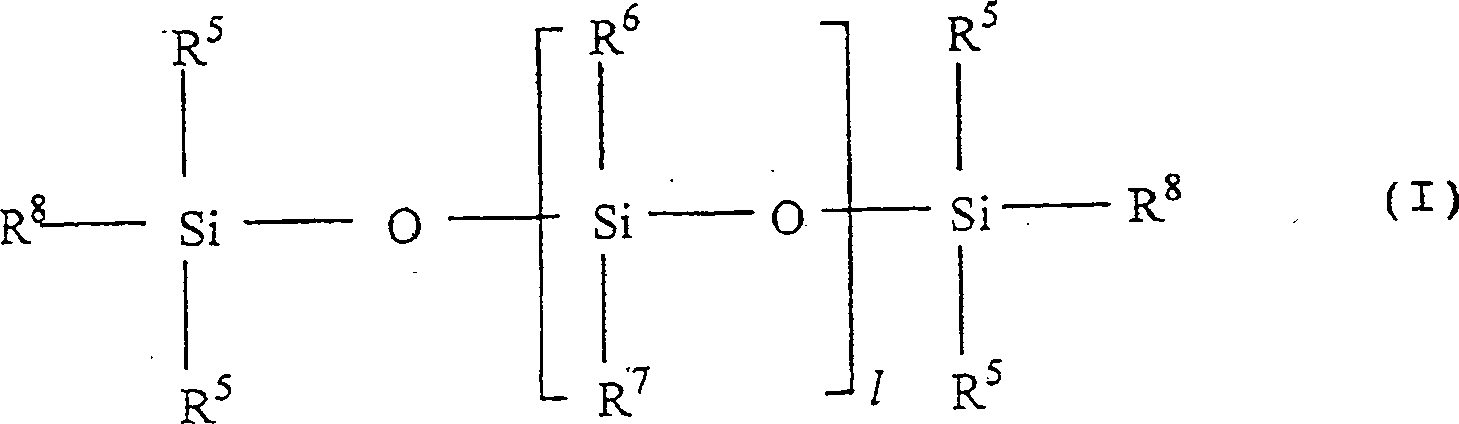
Darin bedeuten R5-Gruppen Gruppen die ausgewählt sind aus monovalenten nichtsubstituierten oder substituierten Hydrocarbongruppen mit 1 bis 30 Kohlenstoffatomen, wie beispielsweise Alkylgruppen (z.B. Methyl, Ethyl, Propyl, Butyl, Amyl, Octyl, u.s.w.), Alkenylgruppen (z.B. Vinyl, Allyl, u.s.w.), Arylgruppen (z.B. Phenyl, Tolyl u.s.w.) und Gruppen gebildet durch Substituieren von Halogenatomen, Cyanogruppen, Hydroxylgruppen und/oder Gestelle von Wasserstoffatomen, die an Kohlenstoffatomen der oben angesprochenen Gruppen gebunden sind (z.B. Chloromethyl, 3,3,3-Trifluoropropyl, Cyanopropyl, Phenol, behinderte Phenol u.s.w.); R6 und R7-Gruppen können jeweils die gleiche Gruppe oder auch verschiedene Gruppen sein und jede von ihnen steht für die gleichen monovalenten Hydrocarbongruppen, wie sie R5 repräsentiert, eine Aminogruppen enthaltende Carbongruppe, eine Polyethergruppen enthaltende Hydrocarbongruppe oder eine Epoxygruppen enthaltende Hydrocarbongruppe; R8 ist ein Wasserstoffatom einer Hydroxylgruppe, die gleiche monovalente Hydrocarbongruppe wie sie R5 wiedergibt oder die gleiche monovalente Hydrocarbongruppe, wie sie R6 oder R7 wiedergibt; und I ist eine positive Zahl zur Sicherstellung der Viskosität zwischen 50 und 500,000 cs bei 25° C.Therein R 5 groups denote groups selected from monovalent unsubstituted or substituted hydrocarbon groups of 1 to 30 carbon atoms, such as alkyl groups (eg, methyl, ethyl, propyl, butyl, amyl, octyl, etc.), alkenyl groups (eg vinyl, allyl, etc ), Aryl groups (eg, phenyl, tolyl, etc.) and groups formed by substituting halogen atoms, cyano groups, hydroxyl groups, and / or racks of hydrogen atoms bonded to carbon atoms of the above-mentioned groups (eg, chloromethyl, 3,3,3-trifluoropropyl, cyanopropyl , Phenol, hindered phenol, etc.); R 6 and R 7 groups may each be the same group or different groups and each of them represents the same monovalent hydrocarbon groups as R 5 represents, an amino group-containing carbon group, a polyether group-containing hydrocarbon group or an epoxy group-containing hydrocarbon group; R 8 is a hydrogen atom of a hydroxyl group, the same monovalent hydrocarbon group as R 5 or the same monovalent hydrocarbon group as R 6 or R 7 represents; and I is a positive number to ensure viscosity between 50 and 500,000 cs at 25 ° C.
Es ist wünschenswert, dass die im Rahmen der vorliegenden Erfindung verwendeten Organopolysiloxane an den Molekülkettenenden durch Trimethylsilylgruppen blockiert sind. Für R5, R6 und R7 ist jeweils eine Alkylgruppe wie Methyl oder Ethyl, eine Arylgruppe wie beispielsweise Phenyl oder Tolyl oder eine Gruppe, gebildet durch Substituierung von Hydroxylgruppen anstelle eines oder mehrerer Wasserstoffatome der oben angesprochenen Gruppen, speziell einer Methylgruppe, einer Phenylgruppe oder einer Alkylgruppe mit 6 bis 14 Kohlenstoffatomen, bevorzugt im Hinblick auf die Einfachheit der Synthese, der thermischen Beständigkeit und der elektrischen Isoliereigenschaften des erhaltenen Öls.It is desirable that the organopolysiloxanes used in the present invention are blocked at the molecular chain terminals by trimethylsilyl groups. For R 5 , R 6 and R 7 , each is an alkyl group such as methyl or ethyl, an aryl group such as phenyl or tolyl or a group formed by substituting hydroxyl groups for one or more hydrogen atoms of the above-mentioned groups, especially a methyl group, a phenyl group or an alkyl group having 6 to 14 carbon atoms, preferably in view of the ease of synthesis, thermal stability and electrical insulating properties of the resulting oil.
Diese Organoplysiloxanöle enthalten jedoch im Allgemeinen Siloxane mit niedrigem Molekulargewicht, die höchstens 12 Siloxaneinheiten in einem Verhältnis von 10 % aufweisen, da sie als Gleichgewichtsmischung von Polysiloxanen mit verschiedenen Polymerisationsgraden während des Polymerisationsprozesses erhalten werden. Aus diesem Grund werden diese Siloxane mit niedrigem Molekulargewicht im Allgemeinen aus den Syntheseprodukten durch eine Trennbehandlung bei einer Temperatur von 120–250° C unter reduziertem Druck entfernt.These Organoplysiloxanöle however, generally contain low molecular weight siloxanes, the maximum 12 siloxane units in a ratio of 10%, since they as an equilibrium mixture of polysiloxanes with different Degrees of polymerization during of the polymerization process. For this reason will be these low molecular weight siloxanes in general the synthesis products by a separation treatment at a temperature from 120-250 ° C below removed reduced pressure.
Auch nach der Trennbehandlung bleiben jedoch die Siloxane mit niedrigem Molekulargewicht in einer Menge von 500 bis 20,000 ppm zurück. Diese Siloxane mit niedrigem Molekulargewicht haben eine starke Absorptionskraft, verglichen mit nicht polaren brennbaren Gasen, sodass ihre Dämpfe von verschiedenen elektri schen Kontaktteilen stark absorbiert werden. Die Siloxane mit niedrigem Molekulargewicht, die an elektrischen Kontaktteilen absorbiert werden, werden umgewandelt in SiO2 × nH2O durch einen Oxidationsprozess und sammelt sich weiter an in Form von αSiO2 an der Oberfläche der Kontaktteile, was zu Kontaktschwierigkeiten führt. Daher ist die Anwesenheit von Siloxanen mit niedrigem Molekulargewicht in Organopolysiloxanöl bereits als unerwünscht erkannt worden.However, even after the separation treatment, the low molecular weight siloxanes remain in an amount of 500 to 20,000 ppm. These low molecular weight siloxanes have a strong absorption power compared to non-polar combustible gases, so that their vapors are strongly absorbed by various electrical contact parts. The siloxanes of low molecular weight, which are absorbed on the electrical contact parts are converted into SiO 2 x nH 2 O by an oxidation process and accumulates more in the form of αSiO 2 on the surface of the contact parts, leading to contact problems. Therefore, the presence of low molecular weight siloxanes in organopolysiloxane oil already been recognized as undesirable.
Darüber hinaus ist es auch bekannt, dass solche Schwierigkeiten verhindert werden können, wenn man den Gehalt von Siloxanen mit niedrigem Molekulargewicht mit nicht mehr als 12 Siloxaneinheiten auf höchstens 50 ppm reduziert.Furthermore It is also known that such difficulties are prevented can, considering the content of low molecular weight siloxanes with not more than 12 siloxane units reduced to a maximum of 50 ppm.
Das Entfernen der vorstehend angesprochenen Siloxanen mit niedrigem Molekulargewicht kann bewerkstelligt werden dadurch, dass man das Organopolysiloxanöl einer Ausdämpfbehandlung bei hohen Temperaturen von 150–300°C unter verringertem Druck von 50 mmHg oder darunter in einer Art Atmosphäre von getrocknetem Stickstoffgas unterwirft oder durch Extrahieren der im Organopolysiloxanölprodukt enthaltende Siloxane mit niedrigem Molekulargewicht mit einem Alkohol- oder Ketonlösungsmittel. Auf diese Art und Weise kann der Gehalt jedes niedrigmolekulargewichtigen Siloxans im Organopolysiloxanölprodukt auf weniger als 50 ppm reduziert werden und der Gesamtgehalt an Siloxanen mit niedrigem Molekulargewicht 2–12 Siloxaneinheiten kann auf weniger als 500 ppm reduziert werden.The Removing the above-mentioned siloxanes with low Molecular weight can be accomplished by doing that organopolysiloxane a steaming treatment at high temperatures of 150-300 ° C under reduced Pressure of 50 mmHg or below in a kind of atmosphere of dried Nitrogen gas is subjected to or by extracting the organopolysiloxane oil product containing low molecular weight siloxanes with an alcohol or ketone solvent. In this way, the content of each low molecular weight Siloxane in the organopolysiloxane oil product reduced to less than 50 ppm and the total content Low molecular weight siloxanes 2-12 siloxane units can be up less than 500 ppm can be reduced.
Das Organopolysiloxanölprodukt, das oben erwähnt wurde, kann durch bereits bekannte Verfahren erhalten werden. So kann beispielsweise Dimethylpolysiloxanöl dadurch produziert werden, dass man ein niedermolekulares zyklisches Siloxan wie Oktumethylcyklotetrasiloxan oder Dekamethylcyclopentasiloxan einer Ringöffnungsreaktion in Anwesenheit eines sauren Katalysators unterwirft, wie beispielsweise Schwefelsäure, Chlorschwefelsäure, Salpetersäure, Phosphorsäure, aktivierter Ton, saurer Ton oder Trifluoressigsäure oder einem alkalischen Katalysator wie beispielsweise Kaliumhydroxid, Natriumhydroxid, Rubidiumhyddroxid, Cesiumhydroxid, Kaliumoxid, Kaliumacetat oder Kaliumsilanolat, und dann das Reaktionsprodukt polymerisiert.The Organopolysiloxanölprodukt, the above mentioned can be obtained by already known methods. So For example, dimethylpolysiloxane oil can be produced thereby that is a low molecular weight cyclic siloxane such as Oktumethylcyklotetrasiloxan or decamethylcyclopentasiloxane of a ring-opening reaction in the presence an acidic catalyst, such as sulfuric acid, chlorosulfuric acid, nitric acid, phosphoric acid, activated Clay, acid clay or trifluoroacetic acid or an alkaline Catalyst such as potassium hydroxide, sodium hydroxide, Rubidiumhyddroxid, cesium hydroxide, potassium oxide, potassium acetate or Potassium silanolate, and then polymerizing the reaction product.
Um ein Dimethylpolysiloxanöl zu produzieren das die beabsichtigte Viskosität durch Steuerung des Polymerisationsgrades beim vorherstehend beschriebenen Verfahren aufweist, kann ein Siloxan mit niedrigem Molekulargewischt mit einer thermischen Blockiergruppe, wie beispielsweise Hexamethyldisiloxan, Octamethyltrisiloxan oder Decamethyltetrasiloxan, bei Stufe der Polymerisation beigefügt werden.Around a dimethylpolysiloxane oil to produce the intended viscosity by controlling the degree of polymerization in the method described above, a siloxane low molecular wipe with a thermal blocking group, such as hexamethyldisiloxane, octamethyltrisiloxane or Decamethyltetrasiloxane, to be added at the stage of polymerization.
Zur Produktion von Organopolysiloxanen mit funktionalen Gruppen können andererseits die Aminogruppen enthaltenden Organopolysiloxane durch eine Dealkoholisierungskondensationsreaktion zwischen Organopolysiloxanen mit wenigstens einer Silanolgruppe und Aminogruppen enthaltenden Alkoxysilanen produziert werden und die Epoxygruppen- oder Polyethergruppen-enthaltenden Organopolysiloxane können hergestellt werden durch die Additionsreaktion zwischen Verbindungen, die beide eine Epoxy- oder Polyethergruppe und eine ungesättigte Gruppe wie eine Vinylgruppe im gleichen Molekühl enthalten, und Organohydrogenpolysiloxanen mit hydrogengebundenen Siliziumatomen in Anwesenheit eines Platinkatalysators.to On the other hand, production of organopolysiloxanes having functional groups can be achieved the organopolysiloxanes containing amino groups by a dealcoholization condensation reaction between organopolysiloxanes having at least one silanol group and amino group-containing alkoxysilanes are produced and the epoxy group or polyether group-containing organopolysiloxanes can be prepared by the addition reaction between compounds, both an epoxy or polyether group and an unsaturated group such as a vinyl group in the same molecule, and organohydrogenpolysiloxanes with hydrogen bonded silicon atoms in the presence of a platinum catalyst.
Vom
Standpunkt der Verbesserung, das heißt einer thermische Widerstandsfähigkeit,
kann R5 in Formel (I) eine monovalente substituierte
Hydrocarbongruppe sein mit einer behinderten Phenolstruktur wie
sie in der japanischen Tokko Hei 3-131692 beschrieben ist. Spezielle Beispiele
von Organopolysiloxanen mit solchen R5-Gruppen
umfassen Organopolysiloxane, die durch die nachfolgende Formel (II)
wiedergegeben sind, wobei aber diese Beispiele keinerlei Beschränkung hinsichtlich
des Schutzumfangs der vorliegenden Erfindung darstellen soll: 
Dabei
ist R9 -C4H9, -C6H13,
-C8H17, -C10H21, -C12H25, -C15H31 oder -C18H37; R10-(CH2)s-Q; s ist eine ganze Zahl von 1 bis 6; Q
ist eine Gruppe, ausgewählt
aus den nachfolgenden monovalenten organischen Gruppen mit behinderten
Phenolstrukturen, 
Vom Standpunkt der Konsistenz und der Verteilgeeignetheit die notwendig ist für eine Siliconschmiermittelzusammensetzung ist es wünschenswert, dass das bei der vorliegenden Erfindung verwendete flüssige Silicon eine Viskosität im Bereich von 50 bis 500.000 cs, insbesondere 50 bis 300.000 cs bei 25°C aufweist.from Standpoint of consistency and distribution suitability necessary is for a silicone lubricant composition it is desirable that the liquid silicone used in the present invention a viscosity in the range of 50 to 500,000 cs, in particular 50 to 300,000 cs at 25 ° C having.
Beispiele von Mineralöl und synthetischem Öl, das als Basisöl für die vorliegende Erfindung verwendbar ist, umfassen Paraffinöl, Naphthenöl, α-Olifinoligomere (Poly-α-Olefine), Polybutenen (Polyisobutylene), Alkylbenzen, Polyalkylenglykole (Polyglykol, Polyether, Polyalkylenoxide), Diester (dibasischer Säureester), Polyolester (Neopentylpolyolester und behinderte Ester), Phosphorsäureester (Phosphatester), fluorierte Verbindungen, wie beispielsweise Chlorfluorcarbon, Fluorester und Perfluoralkylether (Fluorpolyglykol, Perfluorpolyether, Polyperfluoralkylether), und Polyphenylether.Examples of mineral oil and synthetic oil, as a base oil for the usable herein include paraffin oil, naphthenic oil, α-olefin oligomers (poly-α-olefins), Polybutenes (polyisobutylenes), alkylbenzene, polyalkylene glycols (polyglycol, Polyethers, polyalkylene oxides), diesters (dibasic acid esters), polyol esters (Neopentyl polyol ester and hindered esters), phosphoric acid esters (Phosphate ester), fluorinated compounds such as chlorofluorocarbon, Fluoroesters and perfluoroalkyl ethers (fluoropolyglycol, perfluoropolyether, Polyperfluoroalkyl ethers), and polyphenyl ethers.
Was
die oben angesprochenen synthetischen Öle anlangt, so umfassen die α-Olefinoligomere solche, die
wiedergegeben sind durch die nachfolgende Formel (III), die Polybutene
umfassen solche, wiedergegeben durch die nachfolgende Formel (IV),
die Alkylbenzene umfassen solche, die wiedergegeben sind durch die nachfolgende
Formel (V) und die Polyalkylenglykole umfassen solche, wie sie wiedergegeben
sind durch die nachfolgende Formel (VI): 
In der obigen Formel (VI) sind R und R'' jeweils ein Wasserstoffatom oder eine C1_2 0 Alkylgruppe, R' ist H oder CH3 und n liegt zwischen 5 und 100. Im allgemeinen ist der Polyalkylenglykol in Formel (VI) Polyethylen oder Polypropylenglykol mit Wasserstoffatomen oder Methylgruppen wie R und R''. Darüber hinaus kann ein Copolymer dieser beiden Glykole sein.In the above formula (VI), R and R '' are each a hydrogen atom or a C 1 _ 2 0 alkyl group, R 'is H or CH 3 and n is between 5 and 100. In general, the polyalkylene glycol in formula (VI) Polyethylene or polypropylene glycol having hydrogen atoms or methyl groups such as R and R ''. In addition, may be a copolymer of these two glycols.
Die
Diester (dibasische Säureester)
werden im allgemeinen hergestellt durch eine Veresterungsreaktion
zwischen Alkohol und dibasischem Säuren wie nachfolgend gezeigt:
Die zweibasischen Säuren, die als Startermaterial verwendet werden, sind im allgemeinen solche, wie sie wiedergegeben werden durch die Formel HOOC(CH2)nCOOH, wobei diese Beispiele umfassen Adipinsäure (n = 4), Azelainsäure (n = 7), Sebacinsäure (C = 8) und Dodecandiacid (n = 10). Die in Verwendung mit diesen Säuren verwendeten Alkohol sind C7-13 primäre Alkohole mit einer Seitenkette, darunter als Beispiel 2-Ethylhexanol (C8), Isodecanol (C10) und Tridecanol (C13).The dibasic acids used as starter material are generally those represented by the formula HOOC (CH 2 ) n COOH, which examples include adipic acid (n = 4), azelaic acid (n = 7), sebacic acid ( C = 8) and dodecandiacide (n = 10). The alcohol used in use with these acids are C 7-13 primary alcohols having a side chain including, for example, 2-ethylhexanol (C 8 ), isodecanol (C 10 ) and tridecanol (C 13 ).
Durch Verwendung dieser Säuren und Alkohole in verschiedenen Kombinationen können verschiedene Diester erhalten werden. Beispiele solcher Diester umfassen Diisodecylphthalat, Di-2-Ethylhexylphthalat, Dibutylphthalat, Diisodecyladipat, Diisononyladipat, Diisobutyladipat, gemischte Säureester von 2-Ethylhexanol, Di-2-Hexylsebacat, Dibutylsebacat, Di-2-Ethylhexylazelat, Di-n-Hexylazelat, Di-2-Hexyldodecanoat und Dibutoxyethoxyethyladipat.By Use of these acids and alcohols in various combinations can be given different diesters become. Examples of such diesters include diisodecyl phthalate, di-2-ethylhexyl phthalate, dibutyl phthalate, Diisodecyl adipate, diisononyl adipate, diisobutyl adipate, mixed Säureester of 2-ethylhexanol, di-2-hexyl sebacate, Dibutyl sebacate, di-2-ethylhexyl azelate, di-n-hexyl azelate, di-2-hexyl dodecanoate and dibutoxyethoxyethyl adipate.
Die Polyolester, einschließlich Neopentylpolyolester und behinderte Ester, sind monobasische Fettsäureester poyhydrischer Alkohole, wie beispielsweise Neopentylpolyole.The Polyolester, including Neopentyl polyol esters and hindered esters are monobasic fatty acid esters polyhydric alcohols, such as neopentyl polyols.
Beim Herstellen der Polyolester können Neopentylpolyole, die anstatt der Materialien für die Synthese von Alkydharz und oberflächenaktiven Mitteln Massen hergestellt werden, als Rohmaterialien von polhydrischen Alkohol verwendet werden. Speziell Neopentylglykol (NPG), Trimethylolpropan (TMP), Trimethylolethan (TME), Pentaerithritol (PE) und Dipentaerithritol (DPE) können als Neopentylpolyole verwendet werden.At the Making the polyol ester can Neopentyl polyols, which instead of the materials for the synthesis of alkyd resin and surface active Means masses are produced as raw materials of polhydric Alcohol can be used. Especially neopentylglycol (NPG), trimethylolpropane (TMP), trimethylolethane (TME), pentaerythritol (PE) and dipentaerythritol (DPE) can be used as Neopentylpolyole.
Die
als die anderen Ausgangsmaterialien in der Polyolestersynthese verwendbaren
monobasischen Fettsäuren
umfassen geradkettige und verzweigte C3-13 Carboxylsäuren. Z.B.
sind als C9 Carboxylsäuren die nachfolgenden Säuren beispielhaft
aufgeführt,
die eine gerade Kettstruktur aufweisen, eine verzweigte Struktur
und eine Struktur mit einem Neopentyltyp der Verzweigung: 
Durch verschiedenes Kombinieren der oben aufgeführten Verbindungen als Ausgangsmaterialien kann eine große Bandbreite von Polyolestern synthetisiert werden. Speziell die Ester, die durch eine Reaktion einer Säure mit einer Verzwei gung des Neopentyltyps mit einem Alkohol erzeugt werden, der eine Verzweigung des Neopentyltyps besitzt, haben den Vorteil einer hohen thermischen Stabilität.By variously combining the compounds listed above as starting materials a big Bandwidth of polyol esters are synthesized. Especially the esters, by a reaction of an acid with a branching of the neopentyl type with an alcohol having a branch of the neopentyl type have the Advantage of a high thermal stability.
Zusätzlich ist es bekannt durch ein Vergleichsexperiment zur Stabilität gegen Pyrolyse zwischen Di(Isooctyl)Azelat als Ester, hergestellt aus Alkohol der keine Verzweigung von Neopentyltyp aufweist und einer Säure, die ebenfalls keine Verzweigung von Neopentyltyp aufweist, bis (2,2-Dimethyloctyl)Azelat als ein Ester, der hergestellt worden ist aus einem Alkohol mit einer Verzweigung vom Neopentyltyp und einer Säure ohne Verzweigung vom Neopentyltyp, und bis(2,2-Diemthylpentyl)-2,2,8,8-Tetraethylazelat als einen Ester, hergestellt aus einem Alkohol mit einer Verzweigung vom Neopentyltyp und einer Säure mit einer Verzweigung vom Neopentyltyp, dass die Neopentyltyp-Neopentyltyp-Kombination die höchste thermische Stabilität aufweist. In addition is it is known by a comparative experiment for stability against Pyrolysis between di (isooctyl) azelate as ester, prepared from Alcohol having no branching of neopentyl type and one Acid, which also has no branching of neopentyl type to (2,2-dimethyloctyl) azelate as an ester made from an alcohol with a neopentyl-type branching and a neopentyl-type branching acid, and bis (2,2-dimethylpentyl) -2,2,8,8-tetraethyl azelate as an ester made from an alcohol with a branching of the neopentyl type and an acid with a neopentyl type branching that the neopentyl type neopentyl type combination the highest thermal stability having.
Die Phosphorsäureester, umfassen Ester, die hergestellt wurden aus Phosphorsäure als anorganische Säure und Phenol oder Alkohol. Was Phenylphosphat anlangt – Triphenylphosphat ist bei gewöhnlichen Temperaturen ein Feststoff – so können Phenylphosphate im flüssigen Zustand im Allgemeinen durch Verwendung von Phenolen mit Alkylsubstituenten hergestellt werden. Beispiele solcher flüssiger Phenylphosphate umfassen Tricrsylphosphat (TCP), Trixylenylphosphat, Tripropylphenylphosphat und Tributylphenylphosphat. Beispiele von Alkylphosphaten umfassen Tributylphosphat (TBP) und Tri-2-Ethylhexylphosphat (TOP).The organophosphate, include esters made from phosphoric acid as inorganic acid and phenol or alcohol. As far as phenylphosphate is concerned - triphenyl phosphate is at ordinary Temperatures a solid - so can Phenyl phosphates in the liquid Condition generally by use of phenols with alkyl substituents getting produced. Examples of such liquid phenylphosphates include Tricrsyl phosphate (TCP), trixylenyl phosphate, tripropylphenyl phosphate and tributylphenyl phosphate. Examples of alkyl phosphates include Tributyl phosphate (TBP) and tri-2-ethylhexyl phosphate (TOP).
Die
Chlorofluorcarbone haben eine Struktur derart, dass Wasserstoffatome
von n-Paraffin ersetzt
sind durch Fluoratome oder Chloratome und können hergestellt durch Polymerisierung
von Chlortrifluorethylen in einem niedrigen Polymerisationsgrad,
wie es in dem im folgenden Reaktionsschema gezeigt ist: 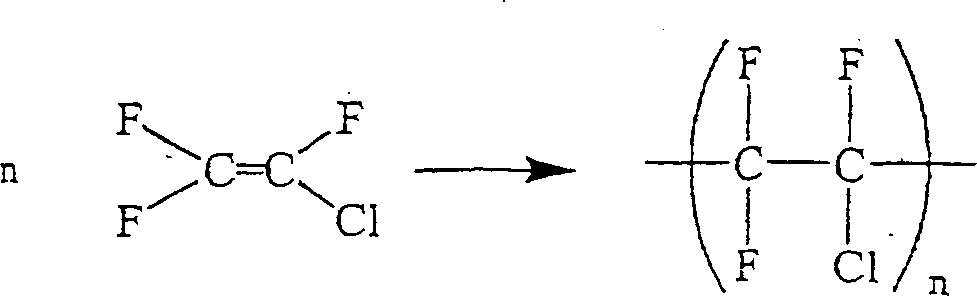
Das hergestellte Chlorfluorcarbon hat eine Viskosität die abhängt vom Polymerisationsgrad und die Viskosität kann in weitem Umfang variiert werden.The Chlorofluorocarbon produced has a viscosity which depends on the degree of polymerization and the viscosity can be varied to a great extent.
Beispiele eines Fluoresters der für die vorliegende Erfindung geeignet ist, umfasst Sebacinsäureester von C7 Perfluoralkoholen, Pyromellitsäureester von Perfluoralkoholen und Camphorsäure ist davon Perfluoralkohol.Examples of a fluoro ester suitable for the present invention include sebacic acid esters of C 7 perfluoroalcohols, pyromellitic acid esters of perfluoroalcohols, and camphoric acid thereof is perfluoroalcohol.
Die
Perfluoralkylether werden im Allgemeinen wiedergegeben durch nachfolgende
Formeln (VII) oder (VIII): 
Es ist möglich, Perfluoralkylether mit niedriger bis hoher Viskosität durch Veränderung des Polymerisationsgrades zu erzeugen.It is possible, Perfluoroalkyl ethers with low to high viscosity change of the degree of polymerization.
Vom Standpunkt der Konsistenz und der Verteilgeeignetheit wie sie für wärmeleitende Schmiermittel benötigt werden ist es wünschenswert, dass die flüssigen Hydrocarbone und/oder das fluorierte Hydrocarbonöl, das gemäß der vorliegenden Erfindung verwendet wird, eine Viskosität aufweisen, die im Bereich von 50 bis 500.000 cs, speziell 100 bis 100.000 cs, bei 25°C liegt.from Standpoint of consistency and distribution suitability as for heat conducting Lubricant needed it is desirable that the liquid Hydrocarbons and / or the fluorinated hydrocarbon oil, according to the present invention is used, a viscosity which range from 50 to 500,000 cs, specifically 100 to 100,000 cs, at 25 ° C lies.
Das metallische Aluminiumpulver als Komponente (B) in der vorliegenden Erfindung kann jede beliebige Form haben, einschließlich körnig, kugelförmig und na delförmig, sofern es eine durchschnittliche Partikelgröße zwischen 0,5 und 50 μm besitzt.The metallic aluminum powder as component (B) in the present The invention may be of any shape, including granular, spherical and na deliform, if it has an average particle size between 0.5 and 50 microns.
Das Aluminiumpulver kann durch Pulverisieren des geschmolzenen Aluminiums unter Verwendung eines Atomisierungsverfahrens produziert werden, durch ein Granulierverfahren, wobei geschmolzenes Aluminium in Wasser getropft wird, sodass es zerstreut und verfestigt wird durch ein Verfahren, bei dem geschmolzenes Aluminium auf einen nach außen fließenden flüchtigen Kühlfilm getropft wird, der über die Oberfläche einer rasch rotierenden Scheibe ausgebildet ist oder ein Verdampfungsverfahren oder durch Reduzieren von Aluminiumfolie oder Körnern zu Schuppen durch Vermahlen mit einer Kugelmühle oder durch Verstampfen.The Aluminum powder can be made by pulverizing the molten aluminum be produced using an atomization process, by a granulation process, wherein molten aluminum in water is dripped so that it is scattered and solidified by a Process in which molten aluminum is applied to an outflowing volatile cooling film is dripped over the surface of a rapidly rotating disk is formed or an evaporation process or by reducing aluminum foil or grains to flakes by milling with a ball mill or by steaming.
Die meisten der industriell hergestellten Materialien sind atomisiertes Pulver, granuliertes Pulver und geschupptes Pulver und diese Pulver werden gesiebt, beispielsweise durch einen Cyklon oder ein Siebprozess, um die gewünschte Partikelgrößenfraktion zu erhalten. Was die allgemeinen Eigenschaften von Aluminiumpulver anlangt, so ist das spezifische Gewicht bei 20°C 2,71, der Schmelzpunkt ist 657°C, die Brinellhärte ist 17 und die thermische Leitfähigkeit 204 W/mK in der Theorie.The Most of the industrially manufactured materials are atomized Powder, granulated powder and scaled powder and these powders are sieved, for example by a cyclone or a sieving process, to the desired Particle size fraction to obtain. As for the general properties of aluminum powder at 20 ° C, the specific gravity is 2.71, which is the melting point 657 ° C, the Brinell hardness is 17 and the thermal conductivity 204 W / mK in theory.
Bei der vorliegenden Erfindung wird Aluminiumpulver mit einer durchschnittlichen Partikelgröße von 0,5–50 μm verwendet. Wenn das Aluminiumpulver eine durchschnittliche Partikelgröße kleiner als 0,5 μm aufweist, ist der Verdickungseffekt so groß, dass das erhaltene Schmiermittel in seiner Konsistenz schlecht ist (nämlich hart und mit einer geringen Verteilgeeignetheit), während dann, wenn die durchschnittliche Partikelgröße größer ist als 50 μm, das Schmiermittel hinsichtlich seiner Uniformität und seiner Stabilität ausfällt und dass sehr schwerwiegende Separation des Basisöls stattfindet (mit anderen Worten, ein höherer Grad an Ölabscheidung).at The present invention is aluminum powder with an average Particle size of 0.5-50 microns used. If the aluminum powder has an average particle size smaller than 0.5 μm has, the thickening effect is so great that the resulting lubricant in its consistency is bad (namely hard and with a low Distribution suitability) while when the average particle size is larger than 50 μm, the lubricant in terms of his uniformity and its stability fails and that very serious separation of the base oil takes place (in other words, a higher one Degree of oil separation).
Aus diesem Grund kann ein zufriedenstellendes Schmiermittel nicht erhalten werden, sofern man Aluminiumpulver verwendet, dessen durchschnittliche Partikelgröße außerhalb der angegebenen Grenzwerte liegt. Auf der anderen Seite kann die Wärmeleitfähigkeit von Aluminiumpulver zusätzlich dadurch erhöht werden, dass man feines Pulver mit einer durchschnittlichen Partikelgröße von 0,5–5 μm mit groben Pulver mit einer Partikelgröße von 10–40 μm vermischt. In diesem Fall liegt das zweckmäßige Verhältnis von feinem Pulver zu groben Pulver von 9/1 zu 1/9 Gewichtsprozent.Out For this reason, a satisfactory lubricant can not be obtained If aluminum powder is used, its average Particle size outside the specified limits. On the other hand, the thermal conductivity of aluminum powder in addition thereby increased be that one coarsely fine powder with an average particle size of 0.5-5 microns Powder mixed with a particle size of 10-40 microns. In this case, the appropriate ratio of fine powder to coarse powder of 9/1 to 1/9 weight percent.
Alle kommerziell produzierten metallischen Aluminiumpulver, z.B. die Pulver von Toyo Aluminium Co., Ltd., Yamaishi Metal Co., Ltd., Urushi Alumi Co., Ltd., Nitto Atomize Industry Co., Ltd. Seiwa Kogyo Co., Ltd., Yamato Metal Co., Ltd., Nakatsuka Metal Co., Ltd. und Asahi Metal Smelting Co., Ltd., können für die vorliegende Erfindung verwendet werden.All commercially produced metallic aluminum powder, e.g. the Powder of Toyo Aluminum Co., Ltd., Yamaishi Metal Co., Ltd., Urushi Alumi Co., Ltd., Nitto Atomize Industry Co., Ltd. Seiwa Kogyo Co., Ltd., Yamato Metal Co., Ltd., Nakatsuka Metal Co., Ltd. and Asahi Metal Smelting Co., Ltd., can for the present invention can be used.
Da metallisches Aluminiumpulver hochaktiv ist, unterliegt es nicht nur einer Luftoxidation, sondern auch anderen Reaktionen mit Wasser, Säuren und Alkali. Aus diesem Grund kann die Pulveroberfläche durch Behandlung mit einem Organosilan der Formel R2 bSiY4-b oder deren teilweise Hydrolysekondensationsprodukte geschützt werden. In der vorstehenden Formel repräsentiert R2 eine Hydrocarbongruppe mit 1 bis 20 Kohlenstoffatomen oder eine Gruppe die man erhält durch Substituieren von Halogenatomen für einen Teil oder alle Wasserstoffatome darin, Y bezeichnet eine hydrolisierbare Gruppe und b ist eine ganze Zahl von 1 bis 3.Since metallic aluminum powder is highly active, it is not only subject to air oxidation, but also to other reactions with water, acids and alkalis. For this reason, the powder surface can be protected by treatment with an organosilane of the formula R 2 b SiY 4-b or its partial hydrolysis condensation products. In the above formula, R 2 represents a hydrocarbon group having 1 to 20 Koh or a group obtained by substituting halogen atoms for a part or all of hydrogen atoms therein, Y denotes a hydrolyzable group, and b is an integer of 1 to 3.
Speziell ist die Hydrocarbongruppe, die durch R2 repräsentiert ist, eine Alkylgruppe, eine Cycloalkylgruppe, eine Alkenylgruppe, eine Arylgruppe oder eine Aralkylgruppe. Beispiele einer solchen Alkylgruppe umfassen Methyl-, Ethyl-, Propyl-, Hexyl-, Octyl-, Decyl-, Dodecyl-, Tetradecyl-, Hexadexyl- und Octadecylgruppen. Beispiele solcher Cycloalkylgruppen umfassen Cyclopentyl- und Cyclohexyl-Gruppen. Beispiele für eine solche Alkenylgruppe umfassen Vinyl- und Allylgruppen. Beispiele für eine Arylgruppe umfassen Phenyl- und Tolylgruppen. Beispiele für eine Aralkylgruppe umfassen 2-Phenylethyl und 2-Methyl-2-Phenylethyl. Beispiele für eine substituierte Hydrocarbongruppe umfassen 3,3,3-Trifluorpropyl-, 2-(Perfluorbutyl)Ethyl-, 2-(Perfluoroctyl(Ethyl)- und p-Chlorophenylgruppen.Specifically, the hydrocarbon group represented by R 2 is an alkyl group, a cycloalkyl group, an alkenyl group, an aryl group or an aralkyl group. Examples of such an alkyl group include methyl, ethyl, propyl, hexyl, octyl, decyl, dodecyl, tetradecyl, hexadecyl and octadecyl groups. Examples of such cycloalkyl groups include cyclopentyl and cyclohexyl groups. Examples of such an alkenyl group include vinyl and allyl groups. Examples of an aryl group include phenyl and tolyl groups. Examples of an aralkyl group include 2-phenylethyl and 2-methyl-2-phenylethyl. Examples of a substituted hydrocarbon group include 3,3,3-trifluoropropyl, 2- (perfluorobutyl) ethyl, 2- (perfluorooctyl (ethyl) and p-chlorophenyl groups.
Was den Wert für „b" anlangt, so ist 1 der bevorzugte Wert.What is the value for "b", so is 1 is the preferred value.
Die hydrolisierbare Gruppe, wiedergegeben durch Y, ist eine Hydroxylgruppe oder eine funktionale Gruppe, enthaltend 1 bis 6 Kohlenstoffatome, und ausgewählt aus Alkoxygruppen, Acyloxygruppen und Alkenyloxygruppen, mit Beispielen wie Methoxy-, Ethoxy-, Propoxy-, Butoxy-, Acetoxy- und Propenoxygruppen. Von diesen Gruppen sind Hydroxyl- und Alkoxygruppen besonders bevorzugt.The hydrolyzable group represented by Y is a hydroxyl group or a functional group containing 1 to 6 carbon atoms, and selected from alkoxy groups, acyloxy groups and alkenyloxy groups, with examples such as methoxy, ethoxy, propoxy, butoxy, acetoxy and propenoxy groups. From Hydroxyl and alkoxy groups are particularly preferred in these groups.
Es ist wünschenswert, dass ein solches Oberflächenbehandlungsmittel in einer Menge von 0,01 bis 5,0 Gewichtsteile pro 100 Gewichtsteile des metallischen Aluminiumpulvers verwendet wird. Ist das Verhältnis kleiner als 0,01 Gewichtsprozent, so kann die Behandlung nicht zu dem gewünschten Erfolg führen. Ist andererseits das Verhältnis über 5 Gewichtsteile erhöht, so führt die Behandlung zu einem gegensätzlichen Effekt auf das erhaltene Schmiermittel, da dadurch die Menge der flüchtigen Stoffe vergrößert wird.It is desirable that such a surface treatment agent in an amount of 0.01 to 5.0 parts by weight per 100 parts by weight of the metallic aluminum powder is used. Is the ratio smaller? than 0.01% by weight, treatment may not be as desired Lead success. On the other hand, the ratio is over 5 parts by weight elevated, so leads the treatment to a contrary Effect on the obtained lubricant, since thereby the amount of volatile Substances is enlarged.
Obgleich ein ausgezeichnetes wärmeleitendes Schmiermittel erhalten werden kann, indem man lediglich die Komponente (A) und die Komponente (B) verwendet oder indem man die Komponente (A) und die Komponente (B) verwendet, die einer Oberflächenbehandlung mit einem Organosilan, repräsentiert durch die Formel R''bSiY4-b oder eines ihrer teilweisen Hydrolysekondensationsprodukte, unterzogen worden ist, ist es vom Standpunkt einer weiteren Verbesserung der thermischen Leitfähigkeit wünschenswert, das Zinkoxidpulver und/oder Bornitridpulver als Komponente (C) den vorerwähnten Komponenten (A) und (B) zugefügt werden.Although an excellent thermally conductive lubricant can be obtained by using only the component (A) and the component (B) or by using the component (A) and the component (B) which is a surface treatment with an organosilane represented by Formula R " b SiY 4-b or one of its partial hydrolysis condensation products, it is desirable from the standpoint of further improving the thermal conductivity, the zinc oxide powder and / or boron nitride powder as component (C) the above-mentioned components (A) and ( B) are added.
Das als Komponente (C) verwendete Zinkoxid ist ein weißes Pulver mit einer Hexagonal- oder Wurtzitkristallstruktur und ist allgemein bekannt unter dem Namen „Zinkweiß". Ein solches Zinkoxidpulver kann unter Verwendung bekannter Verfahren hergestellt werden. Beispielsweise ist ein bekanntes Verfahren ein indirektes Verfahren, bei dem Zinkdampf wie er im Allgemeinen durch Erhitzen von metallischem Zink auf 1000°C erhalten wird, mit heißer Luft oxidiert wird und ein anderes bekanntes Verfahren ist ein direktes Verfahren, bei dem das durch Rösten von Zinkerz erhaltene Zinkoxid durch Kohle oder dergleichen reduziert wird und der erhaltene Zinkdampf mit heißer Luft oxidiert wird, oder bei dem die durch das Auslaugen von Zinkerz mit Schwefelsäure erhaltene Schlacke mit Koks gemischt und in einem elektrischen Ofen erhitzt wird und der entstehende Zinkdampf mit heißer Luft oxidiert wird.The Zinc oxide used as component (C) is a white powder with a hexagonal or wurtzite crystal structure and is general known as "zinc white." Such a zinc oxide powder can be prepared using known methods. For example For example, one known method is an indirect method involving zinc vapor as generally obtained by heating metallic zinc to 1000 ° C will, with hotter Air is oxidized and another known process is a direct one Method in which by roasting zinc oxide obtained by zinc ore reduced by coal or the like and the resulting zinc vapor is oxidized with hot air, or in which the obtained by the leaching of zinc ore with sulfuric acid Slag mixed with coke and heated in an electric oven and the resulting zinc vapor is oxidized with hot air.
Das Zinkoxid, das mit einem der vorstehend beschriebenen Verfahren produziert wurde, wird über einen Luftkondensator mit einem Gebläse gekühlt und entsprechend der Korngröße fraktioniert. Als weitere Herstellmöglichkeit für Zinkoxid ist ein Nassverfahren bekannt, bei welchem eine Zinksalzlösung mit einer Alkalicarbonatlösung gemischt wird, um Zinkhydroxycarbonat auszufällen und das Zinkhydroxycarbonat wird dann geröstet. Die Zinkoxidpulver die durch solche Methoden hergestellt werden, sind definiert in den japanischen Industriestandards, JIS K1410 und K5102 und die amerikanischen Standards ASTM-D79.The Zinc oxide produced by any of the methods described above was, is about cooled an air condenser with a fan and fractionated according to the grain size. As another production possibility for zinc oxide a wet process is known in which a zinc salt solution with an alkali carbonate solution to precipitate zinc hydroxycarbonate and the zinc hydroxycarbonate is then roasted. The zinc oxide powders produced by such methods are defined in Japanese Industrial Standards, JIS K1410 and K5102 and the American standards ASTM-D79.
Bei der vorliegenden Erfindung können die nach einem der vorstehenden Verfahren hergestellten Zinkpulver alleine oder als Mischung mit in anderer Weise hergestellten Zinkpulvern benutzt werden.at of the present invention the zinc powder prepared by any of the above methods alone or as a mixture with otherwise prepared zinc powders to be used.
Im Allgemeinen wird das Zinkoxidpulver nicht nur als Vulkanisierbeschleuniger für Gummi, sondern auch in den Bereichen Beschichtungsfarben, Keramiken, Emailwaren, Glas, Ferrit, Kosmetik und Medizin eingesetzt. Darüber hinaus ist es bekannt, Zinkoxidpulver als eine thermische Leitfähigkeit bewirkendes Füllmittel in wärmeleitende Schmiermittel einzubringen [japanische Tokkai Sho 51-55870, Sho 54-116055, Sho 55-45770, Sho 56-28264, Sho 61-157587, Hei 2-212556 (U.S. Patent Nr. 5.221.339), Hei 3-162493 (U.S. Patent Nr. 5.100.568) und Hei 4-202496].in the Generally, the zinc oxide powder is not just used as a vulcanization accelerator for rubber, but also in the areas of coating colors, ceramics, enamelware, Glass, ferrite, cosmetics and medicine used. Furthermore It is known to use zinc oxide powder as a thermal conductivity effecting filler in thermally conductive Lubricating [Japanese Tokkai Sho 51-55870, Sho 54-116055, Sho 55-45770, Sho 56-28264, Sho 61-157587, Hei 2-212556 (U.S. Patent No. 5,221,339), Hei 3-162493 (U.S. Patent No. 5,100,568) and Hei 4-202496].
Die durchschnittliche Partikelgröße des Zinkoxidpulvers, das im Rahmen der vorliegenden Erfindung verwendet werden kann, liegt im Bereich von 0,2 bis 5 μm. Im Hinblick auf die Dispersibilität im Basisöl und das Verhältnis zum in Kombination verwendeten Aluminiumpulvers ist es jedoch wünschenswert, dass das Zinkoxidpulver eine durchschnittliche Partikelgröße von 0,3 bis 4 μm, speziell 0,3 bis 3 μm aufweist. Durch Einstellen der Partikelgröße in einen solchen Bereich kann der Ölseparationsgrad des erhaltenen wärmeleitenden Schmiermittels auf 0,01 % oder darunter abgesenkt werden.The average particle size of the zinc oxide powder, which can be used in the context of the present invention, is in the range of 0.2 to 5 microns. With regard to the dispersibility in the base oil and the relationship to the however, it is desirable to use aluminum powder used in combination the zinc oxide powder has an average particle size of 0.3 up to 4 μm, specifically 0.3 to 3 microns having. By adjusting the particle size in such area can the degree of oil separation the obtained thermally conductive lubricant be lowered to 0.01% or below.
Das im Rahmen der vorliegenden Erfindung verwendbare Bornitridpulver ist ein hexagonales Bornitridpulver mit einer hexagonalen Netzwerklaminatstruktur, ähnlich der von Graphit, das durch Erhitzen von Borsäure oder einem Borat zusammen mit einer Stickstoffverbindung wie beispielsweise Stickstoff enthaltenden organischen Verbindungen oder Ammoniak hergestellt werden kann. Das Bornitrid vom hexagonalen System hat Eigenschaften, sodass es eine hohe Schmierfähigkeit selbst in hohen Temperaturbereichen aufweist, es besitzt eine hohe thermische Leitfähigkeit ebenso wie hohe elektrische Isolationsfähigkeit und es ist darüber hinaus chemisch stabil und wird kaum benetzt mit geschmolzenem Metall oder Glas. Demzufolge wird es als elektrisch isolierender Füllstoff mit hoher thermischer Leitfähigkeit, als fester Schmierstoff oder als Füllmittel zur Modifizierung von Harzen oder dergleichen eingesetzt.The boron nitride powders usable in the context of the present invention is a hexagonal boron nitride powder having a hexagonal network laminate structure similar to that of FIG of graphite, which is composed by heating boric acid or a borate with a nitrogen compound such as nitrogen-containing organic Compounds or ammonia can be produced. The boron nitride from the hexagonal system has properties, so it has a high lubricity Even in high temperature ranges, it has a high thermal conductivity as well as high electrical isolation capability and it is beyond chemically stable and is hardly wetted with molten metal or Glass. As a result, it becomes an electrically insulating filler with high thermal conductivity, as a solid lubricant or as a filler for modification used by resins or the like.
Das Bornitritpulver mit einer hexagonalen Kristallstruktur ist weiß, hat eine durchschnittliche Partikelgröße von 1 bis 10 μm und ist im Allgemeinen weiß.The Boron nitrite powder with a hexagonal crystal structure is white, has one average particle size of 1 up to 10 μm and is generally white.
Das für die vorliegende Erfindung eingesetzte Bornitritpulver hat eine durchschnittliche Partikelgröße in einem weiten Bereich von 1 bis 10 μm. Unter Berücksichtigung der Dispersibilität im Basisöl und der angestrebten Verhinderung einer Ölseparation ist es doch wünschenswert, dass das für die vorliegende Erfindung verwendete Pulver eine durchschnittliche Partikelgröße im Bereich von 1 bis 5 μm aufweist.The for the Bornite powder powder used in the present invention has an average Particle size in one wide range of 1 to 10 microns. Considering of dispersibility in base oil and the desired prevention of oil separation, it is desirable that for the present invention used an average of powders Particle size in the range from 1 to 5 μm having.
Um eine hohe thermische Leitfähigkeit zu erreichen, wie es die vorliegende Erfindung anstrebt, ist es notwendig, die Füllrate des Aluminiumpulvers als Komponente (B) vor dem Einsatz jedes anderen Füllmittels zu erhöhen. Durch Erhöhen der Füllrate eines Aluminiumpulvers ohne Verschlechterung der Schmiermitteleigenschaften spielen die Form, die Größe und die Größenverteilung der Füllmittelpartikel eine wichtige Rolle. Eine Erhöhung der Füllrate führt zu einem hochvisko sen Schmiermittel und daher zu einer Verschlechterung der Verteilgeeignetheit des Schmiermittels.Around a high thermal conductivity to achieve, as the present invention seeks, it is necessary the fill rate of the aluminum powder as component (B) before the use of each other To filler increase. By elevating the fill rate an aluminum powder without deterioration of the lubricant properties play the shape, the size and the size distribution the filler particle an important role. An increase the fill rate leads to a hochvisko sen lubricant and therefore to a deterioration of Distribution suitability of the lubricant.
Der Ausdruck „Verteilgeeignetheit", wie er hier verwendet wird, gibt die Schwierigkeit beim Beschichten eines Schmiermittels auf einem Substrat an. Wenn das Schmiermittel eine geringe Verteilgeeignetheit aufweist, so ist die Wirksamkeit beim Beschichten unter Verwendung eines zylinderförmigen Geräts mit einer Schmiermittelextruktionsvorrichtung reduziert und darüber hinaus wird es schwierig einen dünnen Beschichtungsfilm des Schmiermittels auf dem Substrat auszubilden. Daher stellt die Form und die Größenverteilung ebenso wie die durchschnittliche Größe der Füllpartikel einen wichtigen Faktor bei der Ereichung einer hohen Füllrate dar, wenn man gleichzeitig eine ausreichende Verteilgeeignetheit sicherstellen will.Of the Term "distribution appropriateness" as used herein There is the difficulty in coating a lubricant on a substrate. If the lubricant has a low distribution suitability has the effectiveness in coating using a cylindrical equipment reduced with a Schmiermittelextruktionsvorrichtung and beyond it gets difficult a thin one Form coating film of the lubricant on the substrate. Therefore, the shape and size distribution is the same like the average size of the filler particles an important factor in achieving a high fill rate, if at the same time ensuring sufficient distribution suitability want.
In der vorliegenden Erfindung ist es für die Komponente (B) notwendig, dass sie in einem Verhältnis von 500–1200 Gewichtsteile pro 100 Gewichtsteile der Komponente (A) verwendet wird oder es ist notwendig für die Kombination der Komponenten (B) und (C), dass sie in einem Verhältnis von 500–1200 Gewichtsteilen pro 100 Gewichtsteilen der Komponente (A) verwendet werden. Ist das Verhältnis der verwendeten Füllstoffe kleiner als 500 Gewichtsteile, so kann das erhaltene Schmiermittel die hohe thermische Leitfähigkeit, die das Hauptziel der vorliegenden Erfindung ist, nicht erreichen. Ist das Verhältnis höher als 1200 Gewichtsteile, so wird das erhaltene Schmiermittel so hart (geringer in der Konsistenz), dass es nicht verteilt werden kann oder eine geringe Verteilgeeignetheit und Gleichförmigkeit aufweist.In it is necessary for component (B) of the present invention that they are in a ratio of 500-1200 Parts by weight per 100 parts by weight of component (A) used or it is necessary for the combination of components (B) and (C) that they are in a ratio of 500-1200 Parts by weight per 100 parts by weight of component (A) used become. Is the ratio the fillers used smaller than 500 parts by weight, so the obtained lubricant, the high thermal conductivity, which is the main object of the present invention. Is the ratio higher than 1200 parts by weight, the resulting lubricant becomes so hard (lower in consistency) that it can not be distributed or a low distribution suitability and uniformity having.
Im Falle der Verwendung der Kombination von Komponente (B) und Komponente (C) ist es wünschenswert, dass das Verhältnis der Komponente (C) zur Summe der Komponenten (B) und (C) nicht größer ist als 0,5 bezogen auf das Gewicht. Wenn das Verhältnis über 0,5 erhöht wird, kann die hohe thermische Leitfähigkeit, wie durch die vorliegende Erfindung angestrebt wird, nicht erreicht werden, da die thermische Leitfähigkeit der Komponente (C) theoretisch 20–60 W/mK ist, während die der Komponente (B) theoretisch 204 W/mK ist.in the Case of using the combination of component (B) and component (C) it is desirable that the ratio component (C) to the sum of components (B) and (C) is not greater as 0.5 by weight. If the ratio is increased above 0.5, the high thermal Conductivity, as desired by the present invention, not achieved because of the thermal conductivity the component (C) is theoretically 20-60 W / mK, while the the component (B) is theoretically 204 W / mK.
Eine hervorstechende Eigenschaft der erfindungsgemäßen wärmeleitenden Schmiermittel ist, dass, obgleich verwendete Füllstoffe weiche Füllstoffe sind, nämlich die Komponente (B) eine Brinellhärte von 17, Zinkweiß als Komponente (C) eine Mohshärte von 4–5 und hexagonales Bornitrit als Komponente (C) eine Mohshärte von 2 hat, die thermische Leitfähigkeit, die dadurch auf das Schmiermittel übertragen wird, gleich oder sogar noch höher ist als die hohe thermische Leitfähigkeit, die durch Einbringung konventioneller Füllstoffe mit hoher Mohshärte erreicht wird, wie beispielsweise AlN, Diamant und SiC. Infolge der Verwendung dieser weichen Füllstoffe kann das erfindungsgemäße Schmiermittel auf Halbleiteroberflächen aufgebracht werden, ohne Schäden zu verursachen.A salient feature of the heat-conductive lubricants of the present invention is that although fillers used are soft fillers, namely component (B) has a Brinell hardness of 17, zinc white as component (C) has a Mohs hardness of 4-5 and hexagonal boron nitrite as component (C) Mohs hardness of 2, the thermal conductivity, which is thereby transferred to the lubricant, equal or even higher than the high thermal conductivity achieved by incorporation of conventional high Mohs hardness fillers such as AlN, diamond and SiC. Due to the use of these soft fillers, the lubricant of the invention can be applied to semiconductor surfaces without causing damage.
Beim Präparieren der wärmeleitenden Silikonzusammensetzung gemäß der vorliegenden Erfindung werden die Komponenten (A) und (B), oder die Komponenten (A), (B) und (C) wie vorstehend erwähnt, mit Hilfe einer Mischmaschine gemischt, z.B. TRIMIX, TWINMIX oder PLANETARY MIXER (Handelsnamen von Mischern der Firma INOUE MFG., INC.), ULTRA MIXER (Handelsname der Firma MIZUHO INDUSTRIAL CO., LTD.) oder HIVISDISPERMIX (Handelsname der Firma TOKUSHU KIKA KOGYO CO., LTD.).At the Prepare the heat-conducting Silicone composition according to the present Invention will be the components (A) and (B), or the components (A), (B) and (C) as mentioned above, by means of a mixing machine mixed, e.g. TRIMIX, TWINMIX or PLANETARY MIXER (trade names mixers from INOUE MFG., INC.), ULTRA MIXER (trade name MIZUHO INDUSTRIAL CO., LTD.) or HIVISDISPERMIX (trade name TOKUSHU KIKA KOGYO CO., LTD.).
Darin können den vorerwähnten Komponenten, falls nötig, Organoalkoxysilane, Antioxidantia und andere Additive beigemischt werden. Das Mischen kann dabei erfolgen während einer Erhitzung auf 50 bis 150°C vorgenommen wird, falls dies gewünscht ist. Um die so hergestellte Mischung homogen zu machen ist es zweckmäßig, dass die Mischung einem Knetverfahren unterworfen wird. Beispiele für Knetmaschinen die für dieses Verfahren geeignet sind, umfassen einen Dreistabrollkneter, eine Kolloidmühle und eine Sandmühle. Unter all diesen Knetern ist der Dreistabrollkneter besonders bevorzugt.In this can the aforesaid Components if necessary Organoalkoxysilane, Antioxidantia and other additives added become. The mixing can take place during a heating to 50 up to 150 ° C made if desired is. In order to make the mixture thus prepared homogeneous, it is appropriate that the mixture is subjected to a kneading process. Examples of kneading machines the for this Methods include a three-roll kneader, a colloid mill and a sand mill. Under In all these kneaders, the three-roll kneader is particularly preferred.
Ähnlich zu
konventionellen wärmeleitenden
Schmiermitteln kann das erfindungsgemäße Schmiermittel, wie in
Das erfindungsgemäße die Hitze reduzierende Schmiermittel wird zwischen einen Fühler und den wärmeerzeugenden elektronischen Bauteilen (Halbleiterelemente) gehalten und durch Zusammendrücken dieser Bauteile mittels Klammern zusammengepresst. Die geeignete Dicke der hitzereduzierenden Schmiermittelzusammensetzung zwischen den wärmeerzeugenden elektronischen Bauteilen und einem Kühler liegt zwischen 50 und 500 μm insbesondere zwischen 100 und 200 μm. Es ist in der Furcht begründet, dass bei einer Dicke kleiner 50 μm Zwischenräume zwischen den wärmeerzeugenden elektronischen Bauteilen und dem Kühler infolge von Druckdifferenzen in Abhängigkeit von dem Ort auftreten können, während bei Dicken oberhalb 500 μm der hitzereduzierende Effekt durch ein Ansteigen des Wärmewiederstands in Proportion zur Dicke herabgesetzt wird.The according to the invention the heat Reducing lubricant is between a sensor and the heat-generating electronic components (semiconductor elements) held and by Squeezing this Components pressed together by means of clamps. The appropriate thickness the heat-reducing lubricant composition between the heat-generating electronic components and a radiator is between 50 and 500 μm in particular between 100 and 200 μm. It is based on the fear that at a thickness less than 50 microns interspaces between the heat-producing electronic components and the radiator due to pressure differences dependent on can occur from the place while at thicknesses above 500 μm the heat-reducing effect due to an increase in thermal resistance is reduced in proportion to the thickness.
Die vorliegende Erfindung soll nunmehr mit mehr Einzelheiten unter Bezugnahme auf die folgenden Beispiele beschrieben werden. Die Erfindung ist jedoch nicht auf diese Beispiele beschränkt. Wenn nichts anderes angegeben ist, so bedeuten alle „Teile" und „%" Gewichtsanteile und Gewichtsprozente.The The present invention will now be described in more detail with reference to FIG to the following examples. The invention is however, not limited to these examples. Unless otherwise stated is, all "parts" and "%" mean by weight and percent by weight.
Die gesamte Beschreibung aller Anmeldungen, Patente und Veröffentlichungen, die vorstehend und nachstehend zitiert worden sind, sowie der korrespondierenden japanischen Anmeldung Nr. Hei 10-235731, eingereicht am 21. August 1998, wird hiermit bezugnehmend in die vorliegende Anmeldung eingeschlossen.The complete description of all applications, patents and publications, which have been cited above and below, as well as the corresponding Japanese Application No. Hei 10-235731 filed on August 21 1998, incorporated herein by reference.
Zusätzlich wird darauf verwiesen, dass die Konsistenzwerte und die Öltrennraten, die in den Tabellen 2 und 3 angegeben sind, gemessen wurden mit dem Testverfahren in JIS K-2220 und die thermische Leitfähigkeit der Schmiermittelzusammensetzung wurde gemessen bei 25°C mit einem Wärmeleitschnellmesser Modell QTM-500 (Handelsname der Firma KYOTO ELECTRONICS MFG. CO., LTD.).In addition will pointed out that the consistency values and the oil separation rates, which are shown in Tables 2 and 3, were measured with the test procedure in JIS K-2220 and the thermal conductivity The lubricant composition was measured at 25 ° C with a Wärmeleitschnellmesser model QTM-500 (trade name of KYOTO ELECTRONICS MFG., CO., LTD.).
Beispiele 1 bis 7 und Vergleichsbeispiele 9 bis 13Examples 1 to 7 and Comparative Examples 9 to 13
Flüssige Silikone A-1 bis I-5, wiedergegeben durch die nachfolgende Formel (IX) und mit einer Viskosität gemäß Tabelle 1 sowie ein Hydrocarbon A-6 und ein Fluorhydrocarbon A-7, wie sie weiter unten angegeben sind, wurden jeweils als Basisöl benutzt (Komponente (A)) in einer Menge von 100 Teilen.Liquid silicones A-1 to I-5 represented by the following formula (IX) and with a viscosity according to the table 1 and a hydrocarbon A-6 and a fluorohydrocarbon A-7, as they are below, were each used as the base oil (Component (A)) in an amount of 100 parts.

Tabelle
1 

Thermisch leitende Schmiermittelzusammensetzungen gemäß der vorliegenden Erfindung werden jeweils wie folgt hergestellt: Füllstoffe als Komponente (B) und Komponente (C), deren Art und Duchschnittspartikelgröße in Tabelle 2 wiedergegeben sind, wurden in ihren in Tabelle 2 angegebenen relativen Mengen ausgewogen und jeweils den angegebenen Basisölen zugeführt. Dann wurden diese drei Komponenten innig 20 Minuten lang mit Hilfe eines Planetenmischers gemischt und darüber hinaus einem dreimaligen Knetprozess mit Hilfe eines Dreistangenrollkneters unterworfen.Thermally conductive lubricant compositions according to the present invention are each as follows: Fillers as component (B) and component (C), the nature and average particle size of which are given in Table 2, were weighed out in their relative amounts shown in Table 2 and fed respectively to the base oils indicated. Then, these three components were intimately mixed for 20 minutes by means of a planetary mixer, and further subjected to a three-time kneading process by means of a three-bar roller kneader.
Die Proben der wärmeleitenden Zusammensetzungen die so hergestellt wurden, wurden jeweils hinsichtlich der Konsistenz und des Ölseparationsgrades entsprechend JIS-K-2220 untersucht mit der Absicht, sie als Schmiermittel zu verwenden und darüber hinaus wurde die thermische Leitfähigkeit mit einem Heißdrahtwärmeleitfähigkeitsmesser gemessen, Modell QTM-500 (Handelsname von KYOTO ELECTRONICS MFG. CO., LTD.). Die Ergebnisse sind in der Tabelle 2 zusammengestellt.The Samples of thermally conductive Compositions thus prepared were each regarding the consistency and the degree of oil separation according to JIS-K-2220, with the intention of using it as a lubricant to use and above In addition, the thermal conductivity became with a hot wire Wärmeleitfähigkeitsmesser measured, model QTM-500 (trade name of KYOTO ELECTRONICS MFG. CO., LTD.). The results are summarized in Table 2.
Die Öltrennrate in Tabelle 2 wurde bestimmt, nachdem jede Schmiermittelzusammensetzung 24 Stunden lang bei einer Temperatur von 150°C gestanden hatte und das Behandlungsmittel (D) in Tabelle 2 ist ein Additiv, wie es für die Oberflächenbehandlung metallischen Aluminiumpulvers der Komponente (B) verwendet wird und die nachfolgenden Verbindungen wurden jeweils als Mittel (D) verwendet:
- D-1:
- C10H21Si(OCH3)3
- D-2:
- C12H25Si(OCH3)3
- D-3:
- C6H13Si(OCH3)3
- D-4:
- C10H21Si(CH3)(OCH3)2
- D-5:
- CH3Si(OCH3)3
- D-1:
- C 10 H 21 Si (OCH 3 ) 3
- D-2:
- C 12 H 25 Si (OCH 3 ) 3
- D-3:
- C 6 H 13 Si (OCH 3 ) 3
- D-4:
- C 10 H 21 Si (CH 3 ) (OCH 3 ) 2
- D-5:
- CH 3 Si (OCH 3 ) 3
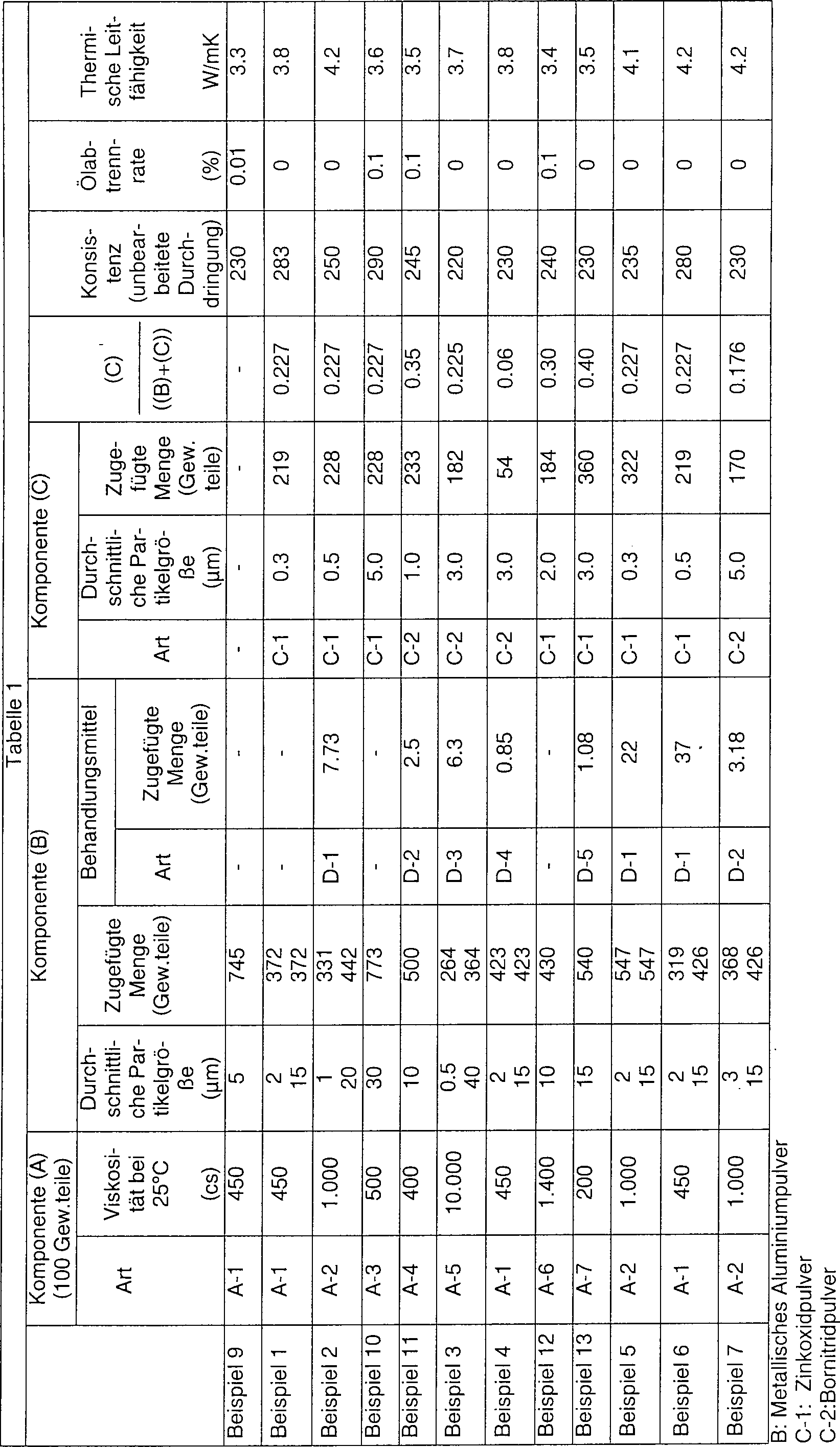
Vergleichsbeispiele 1-8Comparative Examples 1-8
Wärmeleitende Schmiermittelzusammensetzungen wurden in gleicher Weise wie die vorstehenden beispiele hergestellt mit der Ausnahme, dass die Bestandteile 5 der Tabelle 3 mit den jeweiligen Mengen wie sie dort angegeben sind, benutzt wurden.Thermally conductive lubricant compositions were prepared in the same way as the above Examples were prepared with the exception that the components 5 of Table 3 were used with the respective amounts as indicated there.
Die Konsistenz, die Öltrennrate und die thermische Leitfähigkeit jeder Schmiermittelzusammensetzung wurde durch die gleichen Verfahren beschrieben, wie bei 10 den Beispielen. Die erhaltenen Resultate sind in Tabelle 3 zusammengestellt.The Consistency, the oil separation rate and the thermal conductivity Each lubricant composition was prepared by the same procedures described as in the examples. The results obtained are in Table 3.
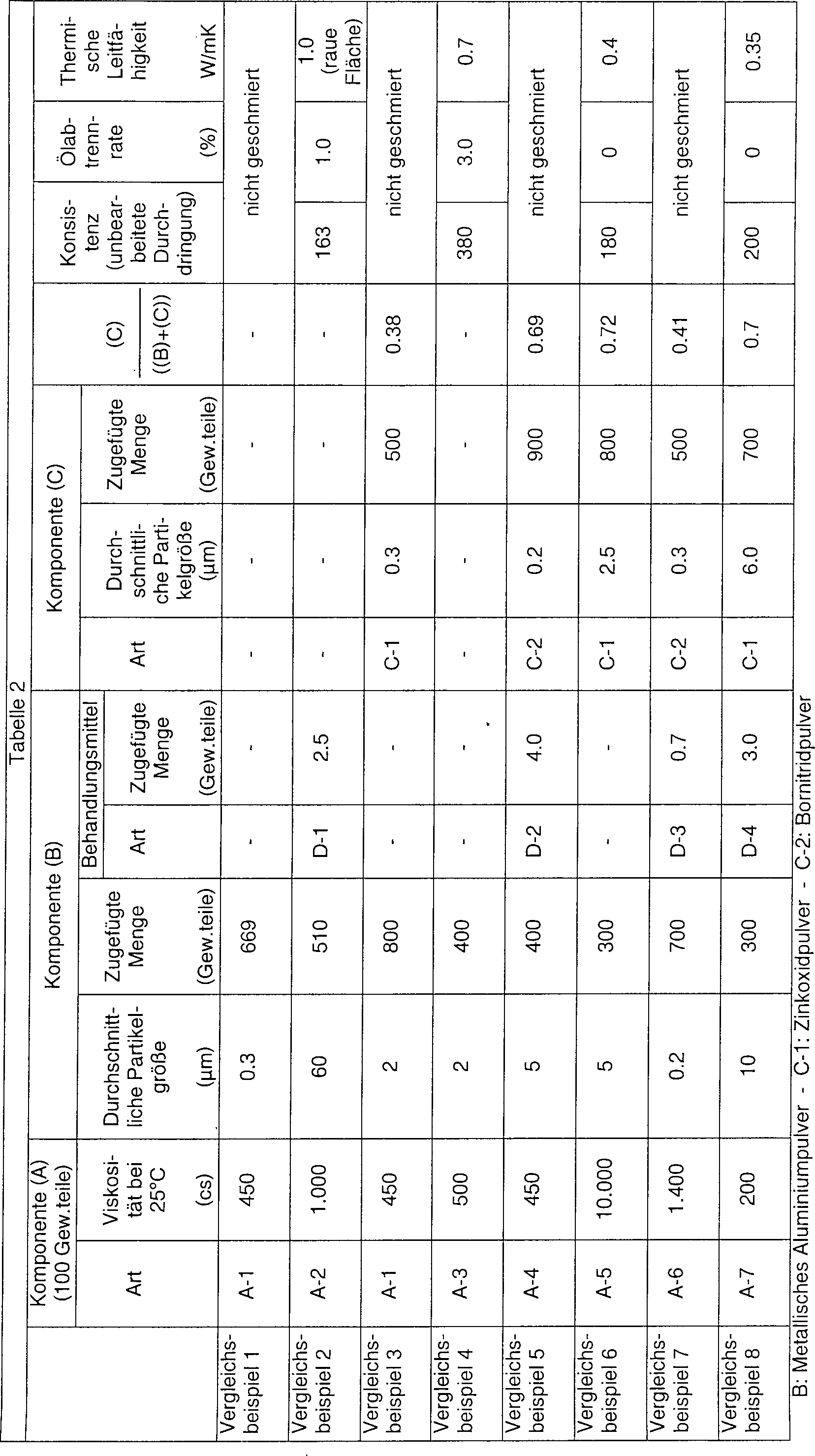
Claims (14)
Applications Claiming Priority (2)
| Application Number | Priority Date | Filing Date | Title |
|---|---|---|---|
| JP23573198A JP3948642B2 (en) | 1998-08-21 | 1998-08-21 | Thermally conductive grease composition and semiconductor device using the same |
| JP23573198 | 1998-08-21 |
Publications (2)
| Publication Number | Publication Date |
|---|---|
| DE69920357D1 DE69920357D1 (en) | 2004-10-28 |
| DE69920357T2 true DE69920357T2 (en) | 2006-02-23 |
Family
ID=16990402
Family Applications (1)
| Application Number | Title | Priority Date | Filing Date |
|---|---|---|---|
| DE69920357T Expired - Lifetime DE69920357T2 (en) | 1998-08-21 | 1999-06-04 | Thermally conductive lubricant composition and semiconductor device equipped therewith |
Country Status (4)
| Country | Link |
|---|---|
| US (1) | US6372337B2 (en) |
| EP (1) | EP0982392B1 (en) |
| JP (1) | JP3948642B2 (en) |
| DE (1) | DE69920357T2 (en) |
Cited By (2)
| Publication number | Priority date | Publication date | Assignee | Title |
|---|---|---|---|---|
| WO2009144135A1 (en) * | 2008-05-28 | 2009-12-03 | Siemens Aktiengesellschaft | Thermally conductive composite material comprising aluminum powder, process for producing the composite material and use of the composite material |
| DE102019209657A1 (en) * | 2019-07-02 | 2021-01-07 | Continental Automotive Gmbh | Cooling arrangement |
Families Citing this family (115)
| Publication number | Priority date | Publication date | Assignee | Title |
|---|---|---|---|---|
| JP3757636B2 (en) * | 1998-08-26 | 2006-03-22 | 松下電工株式会社 | Method for producing heat conductive silicone rubber composition for forming heat radiating sheet and heat conductive silicone rubber composition for forming heat radiating sheet |
| JP2000114438A (en) * | 1998-09-30 | 2000-04-21 | Shin Etsu Chem Co Ltd | Semiconductor device |
| JP3504882B2 (en) * | 1999-05-24 | 2004-03-08 | 富士高分子工業株式会社 | Thermally conductive and electrically insulating silicone composition and silicone molding using the same |
| US6605238B2 (en) * | 1999-09-17 | 2003-08-12 | Honeywell International Inc. | Compliant and crosslinkable thermal interface materials |
| US6589918B2 (en) | 2000-06-22 | 2003-07-08 | Nsk Ltd. | Conductive grease and rolling apparatus packed with the same |
| JP3580358B2 (en) * | 2000-06-23 | 2004-10-20 | 信越化学工業株式会社 | Thermal conductive silicone composition and semiconductor device |
| US6724078B1 (en) | 2000-08-31 | 2004-04-20 | Intel Corporation | Electronic assembly comprising solderable thermal interface |
| US6475962B1 (en) * | 2000-09-14 | 2002-11-05 | Aos Thermal Compounds, Llc | Dry thermal grease |
| JP4629847B2 (en) * | 2000-10-06 | 2011-02-09 | 古河電気工業株式会社 | Overhead power line |
| JP4603700B2 (en) * | 2001-01-04 | 2010-12-22 | 株式会社日立製作所 | High thermal conductive grease composition and cooling device using the same |
| JP3580366B2 (en) * | 2001-05-01 | 2004-10-20 | 信越化学工業株式会社 | Thermal conductive silicone composition and semiconductor device |
| JP4130091B2 (en) * | 2002-04-10 | 2008-08-06 | 信越化学工業株式会社 | Silicone grease composition for heat dissipation |
| US6805753B2 (en) * | 2002-10-15 | 2004-10-19 | Schott Corporation | Method to separate silicone seal by thermal degradation |
| JP4587636B2 (en) * | 2002-11-08 | 2010-11-24 | 東レ・ダウコーニング株式会社 | Thermally conductive silicone composition |
| US7399734B2 (en) * | 2003-07-22 | 2008-07-15 | Crompton Corporation | Polysiloxane additives for lubricants and fuels |
| JP3932125B2 (en) * | 2003-08-14 | 2007-06-20 | 信越化学工業株式会社 | Thermosoftening heat conductive member |
| US7550097B2 (en) * | 2003-09-03 | 2009-06-23 | Momentive Performance Materials, Inc. | Thermal conductive material utilizing electrically conductive nanoparticles |
| US7695817B2 (en) * | 2003-11-05 | 2010-04-13 | Dow Corning Corporation | Thermally conductive grease and methods and devices in which said grease is used |
| JP4729296B2 (en) * | 2003-12-11 | 2011-07-20 | パナソニック株式会社 | Heat dissipation structure for electronic equipment |
| TWI385246B (en) | 2004-05-21 | 2013-02-11 | 信越化學工業股份有限公司 | Polyoxane lubricating oil composition |
| JP4652085B2 (en) * | 2004-09-06 | 2011-03-16 | コスモ石油ルブリカンツ株式会社 | High thermal conductivity compound |
| US7351360B2 (en) * | 2004-11-12 | 2008-04-01 | International Business Machines Corporation | Self orienting micro plates of thermally conducting material as component in thermal paste or adhesive |
| JP4667882B2 (en) * | 2005-01-25 | 2011-04-13 | コスモ石油ルブリカンツ株式会社 | High thermal conductivity compound |
| US20070031684A1 (en) * | 2005-08-03 | 2007-02-08 | Anderson Jeffrey T | Thermally conductive grease |
| CN1916105A (en) * | 2005-08-19 | 2007-02-21 | 鸿富锦精密工业(深圳)有限公司 | Thermolysis cream, and prepartion method |
| JP4860229B2 (en) * | 2005-10-11 | 2012-01-25 | モメンティブ・パフォーマンス・マテリアルズ・ジャパン合同会社 | Thermally conductive grease composition |
| CN1978583A (en) * | 2005-12-09 | 2007-06-13 | 富准精密工业(深圳)有限公司 | Thermal interface material |
| CN1978582A (en) * | 2005-12-09 | 2007-06-13 | 富准精密工业(深圳)有限公司 | Heat-conductive cream and electronic device using same |
| JP2007161862A (en) * | 2005-12-13 | 2007-06-28 | Momentive Performance Materials Japan Kk | Cold storage kit |
| JP4933094B2 (en) * | 2005-12-27 | 2012-05-16 | 信越化学工業株式会社 | Thermally conductive silicone grease composition |
| EP1983568B1 (en) | 2006-01-26 | 2014-07-16 | Momentive Performance Materials Japan LLC | Heat dissipating member and semiconductor device using same |
| TWI449137B (en) * | 2006-03-23 | 2014-08-11 | 製陶技術創新製陶工程股份公司 | Carrier for components or circuits |
| JP2007277387A (en) * | 2006-04-06 | 2007-10-25 | Shin Etsu Chem Co Ltd | Thermally conductive silicone grease composition |
| TWI419931B (en) * | 2006-06-16 | 2013-12-21 | 信越化學工業股份有限公司 | Thermal conductive polyoxygen grease composition |
| US20080004191A1 (en) * | 2006-06-29 | 2008-01-03 | Polymatech Co., Ltd. | Thermal conductive grease |
| JP4841341B2 (en) * | 2006-07-11 | 2011-12-21 | コスモ石油ルブリカンツ株式会社 | High thermal conductivity compound |
| EP1878767A1 (en) * | 2006-07-12 | 2008-01-16 | Shin-Etsu Chemical Co., Ltd. | Heat conductive silicone grease composition and cured product thereof |
| US20080028969A1 (en) * | 2006-08-02 | 2008-02-07 | Jean Marie Massie | Lubricant for an Image Forming Apparatus |
| TW200833752A (en) * | 2006-10-23 | 2008-08-16 | Lord Corp | Highly filled polymer materials |
| US20080166552A1 (en) * | 2006-11-06 | 2008-07-10 | Arlon, Inc. | Silicone based compositions for thermal interface materials |
| JP2007150349A (en) * | 2007-02-09 | 2007-06-14 | Shin Etsu Chem Co Ltd | Thermosoftening heat conductive member |
| JP2008222776A (en) * | 2007-03-09 | 2008-09-25 | Shin Etsu Chem Co Ltd | Thermally conductive silicone grease composition |
| US20100075135A1 (en) * | 2007-04-02 | 2010-03-25 | Kendall Philip E | Thermal grease article and method |
| JP5489409B2 (en) * | 2007-04-10 | 2014-05-14 | コスモ石油ルブリカンツ株式会社 | High thermal conductivity compound |
| JP2008274036A (en) | 2007-04-26 | 2008-11-13 | Shin Etsu Chem Co Ltd | Silicone grease composition for heat dissipation |
| JP2008291069A (en) * | 2007-05-22 | 2008-12-04 | Momentive Performance Materials Japan Kk | Thermally conductive silicone grease composition |
| JP2009043914A (en) * | 2007-08-08 | 2009-02-26 | Ishida Yukio | Wiring board manufacturing method and wiring board |
| US20090143522A1 (en) * | 2007-12-04 | 2009-06-04 | Sea-Fue Wang | Thermally Conductive Silicone Composition |
| US8106119B2 (en) * | 2007-12-04 | 2012-01-31 | Sea-Fue Wang | Thermally conductive silicone composition |
| WO2009131913A2 (en) * | 2008-04-21 | 2009-10-29 | Honeywell International Inc. | Thermal interconnect and interface materials, methods of production and uses thereof |
| JP6014299B2 (en) * | 2008-09-01 | 2016-10-25 | 東レ・ダウコーニング株式会社 | Thermally conductive silicone composition and semiconductor device |
| JP2012502139A (en) * | 2008-09-05 | 2012-01-26 | オーエムジー、アメリカズ、インク | Overbased metal carboxylate complex grease and manufacturing method |
| JP2010106209A (en) * | 2008-10-31 | 2010-05-13 | Eishindo:Kk | Lubricant |
| EP2408860B1 (en) * | 2009-03-16 | 2020-03-18 | Dow Silicones Corporation | Thermally conductive grease and methods and devices in which said grease is used |
| US8258346B2 (en) * | 2009-05-13 | 2012-09-04 | E I Du Pont De Nemours And Company | Surface modified hexagonal boron nitride particles |
| US8784980B2 (en) * | 2009-05-13 | 2014-07-22 | E I Du Pont De Nemours And Company | Film prepared from a casting composition comprising a polymer and surface modified hexagonal boron nitride particles |
| US8440292B2 (en) * | 2009-05-13 | 2013-05-14 | E I Du Pont De Nemours And Company | Multi-layer article for flexible printed circuits |
| US8288466B2 (en) * | 2009-05-13 | 2012-10-16 | E I Du Pont De Nemours And Company | Composite of a polymer and surface modified hexagonal boron nitride particles |
| JP5375466B2 (en) * | 2009-09-11 | 2013-12-25 | 信越化学工業株式会社 | Thermally conductive grease composition |
| JP5534837B2 (en) * | 2010-01-28 | 2014-07-02 | 東レ・ダウコーニング株式会社 | Thermally conductive silicone rubber composition |
| JP2011157428A (en) * | 2010-01-29 | 2011-08-18 | Jsr Corp | Thermally conductive paste and heat dissipation material |
| JP5593578B2 (en) | 2010-03-23 | 2014-09-24 | スタンレー電気株式会社 | Vehicle lighting |
| JP2011204376A (en) | 2010-03-24 | 2011-10-13 | Stanley Electric Co Ltd | Semiconductor light-emitting device |
| WO2011125636A1 (en) * | 2010-04-08 | 2011-10-13 | 電気化学工業株式会社 | Thermally conductive moisture curable resin composition |
| CN102893391B (en) * | 2010-04-30 | 2017-08-29 | 铟泰公司 | Thermal interfacial material with good reliability |
| EP2703352B1 (en) * | 2011-04-28 | 2020-03-18 | Sakai Chemical Industry Co., Ltd. | Hexagonal-plate-shaped zinc oxide particles, production method therefor, and cosmetic material, heat-dissipating filler, heat-dissipating resin composition, heat-dissipating grease, and heat-dissipating coating composition having same blended therein |
| WO2013051721A1 (en) * | 2011-10-06 | 2013-04-11 | 電気化学工業株式会社 | Thermally conductive composition for low outgassing |
| KR20140083001A (en) * | 2011-10-07 | 2014-07-03 | 쓰리엠 이노베이티브 프로퍼티즈 컴파니 | Thermal grease having low thermal resistance |
| US20130267448A1 (en) | 2012-04-10 | 2013-10-10 | Lubrication Technology, Inc. | Lubricant for oxygen - enriched environments |
| US9434870B2 (en) | 2012-09-19 | 2016-09-06 | Momentive Performance Materials Inc. | Thermally conductive plastic compositions, extrusion apparatus and methods for making thermally conductive plastics |
| US20140080951A1 (en) | 2012-09-19 | 2014-03-20 | Chandrashekar Raman | Thermally conductive plastic compositions, extrusion apparatus and methods for making thermally conductive plastics |
| WO2015022563A1 (en) * | 2013-08-12 | 2015-02-19 | 三星电子株式会社 | Thermal interface material layer and package-on-package device comprising thermal interface material layer |
| CN105899714B (en) | 2013-12-05 | 2018-09-21 | 霍尼韦尔国际公司 | Stannous methanesulfonate solution with pH after the adjustment |
| PL3166999T3 (en) | 2014-07-07 | 2023-07-03 | Honeywell International Inc. | Thermal conductive material with ion scavenger |
| JP6149831B2 (en) * | 2014-09-04 | 2017-06-21 | 信越化学工業株式会社 | Silicone composition |
| CN107075400B (en) | 2014-09-22 | 2020-06-23 | 陶氏环球技术有限责任公司 | Thermally conductive grease based on hyperbranched olefin fluids |
| EP3227399B1 (en) | 2014-12-05 | 2021-07-14 | Honeywell International Inc. | High performance thermal interface materials with low thermal impedance |
| JP2016162929A (en) * | 2015-03-03 | 2016-09-05 | 株式会社デンソー | Radiation grease and semiconductor cooling structure using the same |
| KR102570177B1 (en) | 2015-04-30 | 2023-08-24 | 신에쓰 가가꾸 고교 가부시끼가이샤 | Thermally conductive silicone grease composition |
| JP6436035B2 (en) * | 2015-09-25 | 2018-12-12 | 信越化学工業株式会社 | Thermally softening thermally conductive silicone grease composition, thermal conductive film forming method, heat dissipation structure and power module device |
| EP3150672B1 (en) | 2015-10-02 | 2018-05-09 | Shin-Etsu Chemical Co., Ltd. | Thermal conductive silicone composition and semiconductor device |
| US10312177B2 (en) | 2015-11-17 | 2019-06-04 | Honeywell International Inc. | Thermal interface materials including a coloring agent |
| EP3426746B1 (en) | 2016-03-08 | 2021-07-14 | Honeywell International Inc. | Phase change material |
| CN108603033B (en) | 2016-03-18 | 2021-02-19 | 信越化学工业株式会社 | Thermally conductive silicone composition and semiconductor device |
| CN109476843A (en) * | 2016-05-20 | 2019-03-15 | 美利肯公司 | Compositions comprising silicone compounds and methods of using the same |
| US10501671B2 (en) | 2016-07-26 | 2019-12-10 | Honeywell International Inc. | Gel-type thermal interface material |
| JP6879690B2 (en) | 2016-08-05 | 2021-06-02 | スリーエム イノベイティブ プロパティズ カンパニー | Resin composition for heat dissipation, its cured product, and how to use them |
| JP6607166B2 (en) | 2016-10-31 | 2019-11-20 | 信越化学工業株式会社 | Thermally conductive silicone composition and semiconductor device |
| CN107286663A (en) * | 2017-07-03 | 2017-10-24 | 湖南宁乡吉唯信金属粉体有限公司 | A kind of heat-conducting silicone grease and its preparation method and application |
| US11041103B2 (en) | 2017-09-08 | 2021-06-22 | Honeywell International Inc. | Silicone-free thermal gel |
| US10428256B2 (en) | 2017-10-23 | 2019-10-01 | Honeywell International Inc. | Releasable thermal gel |
| CN111315825B (en) | 2017-11-09 | 2021-12-14 | 信越化学工业株式会社 | Thermally conductive silicone grease composition |
| US11072706B2 (en) | 2018-02-15 | 2021-07-27 | Honeywell International Inc. | Gel-type thermal interface material |
| WO2019181713A1 (en) | 2018-03-23 | 2019-09-26 | 信越化学工業株式会社 | Silicone composition |
| JP6866877B2 (en) | 2018-05-31 | 2021-04-28 | 信越化学工業株式会社 | Low heat resistance silicone composition |
| JP7136203B2 (en) | 2018-06-08 | 2022-09-13 | 信越化学工業株式会社 | Thermally conductive silicone composition and method for producing the same |
| WO2020129555A1 (en) | 2018-12-21 | 2020-06-25 | 信越化学工業株式会社 | Heat-conductive silicone composition and semiconductor device |
| JP7001071B2 (en) | 2019-01-10 | 2022-01-19 | 信越化学工業株式会社 | Thermally conductive silicone composition |
| US20210403785A1 (en) | 2019-01-24 | 2021-12-30 | Shin-Etsu Chemical Co., Ltd. | Highly thermally conductive silicone composition and method for producing same |
| US11373921B2 (en) | 2019-04-23 | 2022-06-28 | Honeywell International Inc. | Gel-type thermal interface material with low pre-curing viscosity and elastic properties post-curing |
| JP7076400B2 (en) | 2019-05-27 | 2022-05-27 | 信越化学工業株式会社 | Thermally conductive silicone composition, semiconductor device and its manufacturing method |
| KR102861271B1 (en) | 2019-10-24 | 2025-09-18 | 신에쓰 가가꾸 고교 가부시끼가이샤 | Thermally conductive silicone composition and method for producing the same |
| RU2727401C1 (en) * | 2019-11-11 | 2020-07-21 | Акционерное общество "Авиаавтоматика"имени В.В. Тарасова" | Polymer heat-conducting highly elastic composite material |
| JP7467925B2 (en) * | 2020-01-17 | 2024-04-16 | 住友金属鉱山株式会社 | Filler for thermally conductive grease, thermally conductive grease, and manufacturing method thereof |
| JP6872089B1 (en) * | 2020-03-27 | 2021-05-19 | 日本航空電子工業株式会社 | Manufacturing method of contact members, connectors, compositions, contact members |
| CN111286398A (en) * | 2020-04-18 | 2020-06-16 | 沈阳名华时代科技有限公司 | Formula and production process of automotive forged graphite type release agent |
| WO2022049902A1 (en) | 2020-09-03 | 2022-03-10 | 富士高分子工業株式会社 | Thermally conductive silicone heat dissipation material |
| JP6988023B1 (en) | 2020-09-03 | 2022-01-05 | 富士高分子工業株式会社 | Thermally conductive silicone heat dissipation material |
| WO2022107558A1 (en) | 2020-11-20 | 2022-05-27 | Jnc株式会社 | Organopolysiloxane and production method therefor, and dispersion containing organopolysiloxane as dispersant |
| US12480725B2 (en) * | 2021-04-21 | 2025-11-25 | Mitsubishi Electric Corporation | Radiator and heat sink |
| WO2023276846A1 (en) | 2021-07-02 | 2023-01-05 | 信越化学工業株式会社 | Heat-conductive silicone composition, semiconductor device, and method for manufacturing same |
| TW202307187A (en) | 2021-07-08 | 2023-02-16 | 日商捷恩智股份有限公司 | Silicone resin composition |
| WO2023149175A1 (en) | 2022-02-02 | 2023-08-10 | 信越化学工業株式会社 | Thermally conductive silicone composition and production method therefor |
| EP4563662A1 (en) | 2022-07-29 | 2025-06-04 | Shin-Etsu Chemical Co., Ltd. | Thermally conductive silicone composition and production method therefor |
| JP2024148978A (en) | 2023-04-07 | 2024-10-18 | 信越化学工業株式会社 | Silicone Composition |
Family Cites Families (24)
| Publication number | Priority date | Publication date | Assignee | Title |
|---|---|---|---|---|
| FR1121942A (en) * | 1953-12-24 | 1956-08-28 | Texaco Development Corp | Improvements to processes for incorporating solids into an oil |
| GB1441433A (en) * | 1973-09-18 | 1976-06-30 | Ind Instr Ltd | Heat conductive pastes |
| JPS50134006A (en) * | 1974-04-15 | 1975-10-23 | ||
| US4659613A (en) * | 1983-12-29 | 1987-04-21 | Sermatech International, Inc. | Parts coated with thick coating compositions of uni- and polymodal types |
| JPH01242693A (en) * | 1988-03-25 | 1989-09-27 | Hitachi Ltd | Heat-conductive grease |
| US5094769A (en) * | 1988-05-13 | 1992-03-10 | International Business Machines Corporation | Compliant thermally conductive compound |
| US5011870A (en) * | 1989-02-08 | 1991-04-30 | Dow Corning Corporation | Thermally conductive organosiloxane compositions |
| JPH03106996A (en) * | 1989-09-20 | 1991-05-07 | Hitachi Ltd | Thermally conductive grease composition and computer cooling structure made by using it |
| US5098609A (en) * | 1989-11-03 | 1992-03-24 | The Research Foundation Of State Univ. Of N.Y. | Stable high solids, high thermal conductivity pastes |
| JP2580348B2 (en) * | 1989-11-20 | 1997-02-12 | 信越化学工業 株式会社 | Grease composition for heat radiation |
| JP2559901B2 (en) * | 1990-10-30 | 1996-12-04 | 東芝シリコーン株式会社 | Lubrication / sealant for key cylinder |
| JP2925721B2 (en) * | 1990-11-30 | 1999-07-28 | 東芝シリコーン株式会社 | Thermal conductive silicone grease composition |
| US5317061A (en) * | 1993-02-24 | 1994-05-31 | Raychem Corporation | Fluoropolymer compositions |
| US5510174A (en) * | 1993-07-14 | 1996-04-23 | Chomerics, Inc. | Thermally conductive materials containing titanium diboride filler |
| JP2796931B2 (en) * | 1994-01-24 | 1998-09-10 | 株式会社住友金属エレクトロデバイス | Ceramic package and package base for semiconductor device storage |
| US5411077A (en) * | 1994-04-11 | 1995-05-02 | Minnesota Mining And Manufacturing Company | Flexible thermal transfer apparatus for cooling electronic components |
| JPH0853664A (en) | 1994-08-10 | 1996-02-27 | Fujitsu Ltd | Thermally conductive material and its manufacturing method, electronic component cooling method, circuit board cooling method, and electronic component mounting method |
| JPH08145210A (en) * | 1994-11-17 | 1996-06-07 | Kurimoto Ltd | Light check valve |
| US5730803A (en) * | 1996-02-23 | 1998-03-24 | Applied Materials, Inc. | Apparatus and method for transferring heat from a hot electrostatic chuck to an underlying cold body |
| JP3406776B2 (en) * | 1996-05-24 | 2003-05-12 | 東レ・ダウコーニング・シリコーン株式会社 | Silicone rubber composition for electrical insulation materials |
| JP3142800B2 (en) * | 1996-08-09 | 2001-03-07 | 信越化学工業株式会社 | Thermal conductive silicone composition, thermal conductive material, and thermal conductive silicone grease |
| US6037658A (en) * | 1997-10-07 | 2000-03-14 | International Business Machines Corporation | Electronic package with heat transfer means |
| US5945217A (en) * | 1997-10-14 | 1999-08-31 | Gore Enterprise Holdings, Inc. | Thermally conductive polytrafluoroethylene article |
| EP0939115A1 (en) | 1998-02-27 | 1999-09-01 | Shin-Etsu Chemical Co., Ltd. | Thermally conductive grease composition |
-
1998
- 1998-08-21 JP JP23573198A patent/JP3948642B2/en not_active Expired - Lifetime
-
1999
- 1999-05-26 US US09/318,736 patent/US6372337B2/en not_active Expired - Lifetime
- 1999-06-04 DE DE69920357T patent/DE69920357T2/en not_active Expired - Lifetime
- 1999-06-04 EP EP99304369A patent/EP0982392B1/en not_active Expired - Lifetime
Cited By (2)
| Publication number | Priority date | Publication date | Assignee | Title |
|---|---|---|---|---|
| WO2009144135A1 (en) * | 2008-05-28 | 2009-12-03 | Siemens Aktiengesellschaft | Thermally conductive composite material comprising aluminum powder, process for producing the composite material and use of the composite material |
| DE102019209657A1 (en) * | 2019-07-02 | 2021-01-07 | Continental Automotive Gmbh | Cooling arrangement |
Also Published As
| Publication number | Publication date |
|---|---|
| DE69920357D1 (en) | 2004-10-28 |
| US6372337B2 (en) | 2002-04-16 |
| JP3948642B2 (en) | 2007-07-25 |
| EP0982392B1 (en) | 2004-09-22 |
| JP2000063873A (en) | 2000-02-29 |
| EP0982392A1 (en) | 2000-03-01 |
| US20020018885A1 (en) | 2002-02-14 |
Similar Documents
| Publication | Publication Date | Title |
|---|---|---|
| DE69920357T2 (en) | Thermally conductive lubricant composition and semiconductor device equipped therewith | |
| JP2938428B1 (en) | Thermal conductive grease composition | |
| DE69808999T2 (en) | Thermally conductive silicone composition | |
| US6136758A (en) | Aluminum nitride powder and thermally conductive grease composition using the same | |
| EP0939115A1 (en) | Thermally conductive grease composition | |
| DE602004005493T2 (en) | HEAT-RESISTANT LUBRICATING GREASE AND METHOD AND DEVICES USING THE LUBRICATING GREASE | |
| DE60104944T2 (en) | Thermally conductive silicone composition and semiconductor device | |
| EP2257616B1 (en) | Thermally conductive silicone grease composition | |
| US6174841B1 (en) | Heat-reducing silicone grease composition and semiconductor device using the same | |
| KR102288665B1 (en) | Thermally Conductive Silicone Composition, Semiconductor Device, and Method for Manufacturing Semiconductor Device | |
| EP3150672B1 (en) | Thermal conductive silicone composition and semiconductor device | |
| DE69730271T2 (en) | Semisolide, thermal liner with low flow resistance | |
| US20070149834A1 (en) | Heat conductive silicone grease compositions | |
| JP5318733B2 (en) | Thermally conductive grease | |
| JP5269366B2 (en) | Heat-resistant thermal grease | |
| CN103772991B (en) | Silicone composition and lubricating grease | |
| JP2002201483A (en) | High thermal conductive grease composition and cooling device using the same | |
| JP2000063872A (en) | Thermal conductive grease composition | |
| CN101657528A (en) | Highly thermal conductive compound | |
| DE69125917T2 (en) | Electrical device containing a lubricant or a thermally conductive composition. | |
| KR20230008034A (en) | Thermally conductive silicone composition | |
| US5250209A (en) | Thermal coupling with water-washable thermally conductive grease | |
| JP4652085B2 (en) | High thermal conductivity compound | |
| JP4667882B2 (en) | High thermal conductivity compound | |
| DE69916548T2 (en) | Vibration-damping composition |
Legal Events
| Date | Code | Title | Description |
|---|---|---|---|
| 8364 | No opposition during term of opposition | ||
| 8328 | Change in the person/name/address of the agent |
Representative=s name: LINDNER BLAUMEIER PATENT- UND RECHTSANWAELTE, 9040 |