DE69920472T2 - THERAPEUTIC USES AS HISTAMINE H3 RECEPTOR LIGANDS OF ALKYLAMINES THAT DO NOT CONTAIN IMIDAZOLE - Google Patents
THERAPEUTIC USES AS HISTAMINE H3 RECEPTOR LIGANDS OF ALKYLAMINES THAT DO NOT CONTAIN IMIDAZOLE Download PDFInfo
- Publication number
- DE69920472T2 DE69920472T2 DE69920472T DE69920472T DE69920472T2 DE 69920472 T2 DE69920472 T2 DE 69920472T2 DE 69920472 T DE69920472 T DE 69920472T DE 69920472 T DE69920472 T DE 69920472T DE 69920472 T2 DE69920472 T2 DE 69920472T2
- Authority
- DE
- Germany
- Prior art keywords
- propyl
- piperidine
- group
- use according
- pyrrolidine
- Prior art date
- Legal status (The legal status is an assumption and is not a legal conclusion. Google has not performed a legal analysis and makes no representation as to the accuracy of the status listed.)
- Expired - Lifetime
Links
- 239000003446 ligand Substances 0.000 title claims abstract description 17
- RAXXELZNTBOGNW-UHFFFAOYSA-N imidazole Natural products C1=CNC=N1 RAXXELZNTBOGNW-UHFFFAOYSA-N 0.000 title abstract description 14
- 230000001225 therapeutic effect Effects 0.000 title description 4
- 150000003973 alkyl amines Chemical class 0.000 title description 3
- 102000004384 Histamine H3 receptors Human genes 0.000 title 1
- 108090000981 Histamine H3 receptors Proteins 0.000 title 1
- RAXXELZNTBOGNW-UHFFFAOYSA-O Imidazolium Chemical compound C1=C[NH+]=CN1 RAXXELZNTBOGNW-UHFFFAOYSA-O 0.000 title 1
- -1 imidazole alkylamine Chemical class 0.000 claims abstract description 149
- NTYJJOPFIAHURM-UHFFFAOYSA-N Histamine Chemical compound NCCC1=CN=CN1 NTYJJOPFIAHURM-UHFFFAOYSA-N 0.000 claims abstract description 42
- 229960001340 histamine Drugs 0.000 claims abstract description 21
- 239000003814 drug Substances 0.000 claims abstract description 13
- RTZKZFJDLAIYFH-UHFFFAOYSA-N ether Substances CCOCC RTZKZFJDLAIYFH-UHFFFAOYSA-N 0.000 claims description 427
- LFQSCWFLJHTTHZ-UHFFFAOYSA-N Ethanol Chemical compound CCO LFQSCWFLJHTTHZ-UHFFFAOYSA-N 0.000 claims description 301
- MUBZPKHOEPUJKR-UHFFFAOYSA-N Oxalic acid Chemical compound OC(=O)C(O)=O MUBZPKHOEPUJKR-UHFFFAOYSA-N 0.000 claims description 149
- 150000001875 compounds Chemical class 0.000 claims description 108
- 125000000217 alkyl group Chemical group 0.000 claims description 100
- 125000004432 carbon atom Chemical group C* 0.000 claims description 59
- VEXZGXHMUGYJMC-UHFFFAOYSA-N Hydrochloric acid Chemical compound Cl VEXZGXHMUGYJMC-UHFFFAOYSA-N 0.000 claims description 40
- 125000001997 phenyl group Chemical group [H]C1=C([H])C([H])=C(*)C([H])=C1[H] 0.000 claims description 40
- NQRYJNQNLNOLGT-UHFFFAOYSA-N Piperidine Chemical compound C1CCNCC1 NQRYJNQNLNOLGT-UHFFFAOYSA-N 0.000 claims description 39
- 125000003118 aryl group Chemical group 0.000 claims description 30
- 150000003839 salts Chemical class 0.000 claims description 30
- 230000009021 linear effect Effects 0.000 claims description 28
- RWRDLPDLKQPQOW-UHFFFAOYSA-N tetrahydropyrrole Substances C1CCNC1 RWRDLPDLKQPQOW-UHFFFAOYSA-N 0.000 claims description 26
- 125000000753 cycloalkyl group Chemical group 0.000 claims description 25
- 229920006395 saturated elastomer Polymers 0.000 claims description 23
- ISWSIDIOOBJBQZ-UHFFFAOYSA-N Phenol Chemical compound OC1=CC=CC=C1 ISWSIDIOOBJBQZ-UHFFFAOYSA-N 0.000 claims description 18
- 239000000556 agonist Substances 0.000 claims description 18
- 238000011282 treatment Methods 0.000 claims description 16
- 239000005557 antagonist Substances 0.000 claims description 15
- 125000001436 propyl group Chemical group [H]C([*])([H])C([H])([H])C([H])([H])[H] 0.000 claims description 15
- 229910052757 nitrogen Inorganic materials 0.000 claims description 14
- 125000005843 halogen group Chemical group 0.000 claims description 13
- 125000004430 oxygen atom Chemical group O* 0.000 claims description 13
- 125000001424 substituent group Chemical group 0.000 claims description 13
- IJGRMHOSHXDMSA-UHFFFAOYSA-N Atomic nitrogen Chemical compound N#N IJGRMHOSHXDMSA-UHFFFAOYSA-N 0.000 claims description 12
- 125000003710 aryl alkyl group Chemical group 0.000 claims description 12
- 150000002576 ketones Chemical class 0.000 claims description 12
- 125000002485 formyl group Chemical group [H]C(*)=O 0.000 claims description 11
- 150000004677 hydrates Chemical class 0.000 claims description 11
- 230000003287 optical effect Effects 0.000 claims description 11
- 125000004434 sulfur atom Chemical group 0.000 claims description 11
- 150000001336 alkenes Chemical class 0.000 claims description 10
- 125000002947 alkylene group Chemical group 0.000 claims description 10
- HBAQYPYDRFILMT-UHFFFAOYSA-N 8-[3-(1-cyclopropylpyrazol-4-yl)-1H-pyrazolo[4,3-d]pyrimidin-5-yl]-3-methyl-3,8-diazabicyclo[3.2.1]octan-2-one Chemical class C1(CC1)N1N=CC(=C1)C1=NNC2=C1N=C(N=C2)N1C2C(N(CC1CC2)C)=O HBAQYPYDRFILMT-UHFFFAOYSA-N 0.000 claims description 9
- 208000037265 diseases, disorders, signs and symptoms Diseases 0.000 claims description 9
- 125000005842 heteroatom Chemical group 0.000 claims description 9
- QJGQUHMNIGDVPM-UHFFFAOYSA-N nitrogen group Chemical group [N] QJGQUHMNIGDVPM-UHFFFAOYSA-N 0.000 claims description 9
- 229910052717 sulfur Chemical group 0.000 claims description 9
- 125000003435 aroyl group Chemical group 0.000 claims description 8
- 201000010099 disease Diseases 0.000 claims description 8
- 125000004433 nitrogen atom Chemical group N* 0.000 claims description 8
- 125000002777 acetyl group Chemical class [H]C([H])([H])C(*)=O 0.000 claims description 7
- 125000000468 ketone group Chemical group 0.000 claims description 7
- 238000004519 manufacturing process Methods 0.000 claims description 7
- 125000002496 methyl group Chemical group [H]C([H])([H])* 0.000 claims description 7
- 229910052760 oxygen Inorganic materials 0.000 claims description 7
- 239000001301 oxygen Substances 0.000 claims description 7
- DHKHKXVYLBGOIT-UHFFFAOYSA-N acetaldehyde Diethyl Acetal Natural products CCOC(C)OCC DHKHKXVYLBGOIT-UHFFFAOYSA-N 0.000 claims description 6
- 150000001345 alkine derivatives Chemical class 0.000 claims description 6
- 125000001183 hydrocarbyl group Chemical group 0.000 claims description 6
- 239000004031 partial agonist Substances 0.000 claims description 6
- 125000004417 unsaturated alkyl group Chemical group 0.000 claims description 6
- 125000003342 alkenyl group Chemical group 0.000 claims description 5
- 125000003545 alkoxy group Chemical group 0.000 claims description 5
- 125000000304 alkynyl group Chemical group 0.000 claims description 5
- 150000001412 amines Chemical class 0.000 claims description 5
- 125000004104 aryloxy group Chemical group 0.000 claims description 5
- 125000000484 butyl group Chemical group [H]C([*])([H])C([H])([H])C([H])([H])C([H])([H])[H] 0.000 claims description 5
- 125000001589 carboacyl group Chemical group 0.000 claims description 5
- 125000004093 cyano group Chemical group *C#N 0.000 claims description 5
- 125000004122 cyclic group Chemical group 0.000 claims description 5
- 229910052739 hydrogen Inorganic materials 0.000 claims description 5
- 125000005936 piperidyl group Chemical group 0.000 claims description 5
- 125000002023 trifluoromethyl group Chemical group FC(F)(F)* 0.000 claims description 5
- 208000024827 Alzheimer disease Diseases 0.000 claims description 4
- UFHFLCQGNIYNRP-UHFFFAOYSA-N Hydrogen Chemical compound [H][H] UFHFLCQGNIYNRP-UHFFFAOYSA-N 0.000 claims description 4
- 208000008589 Obesity Diseases 0.000 claims description 4
- 125000005093 alkyl carbonyl alkyl group Chemical group 0.000 claims description 4
- 125000004397 aminosulfonyl group Chemical group NS(=O)(=O)* 0.000 claims description 4
- 125000005518 carboxamido group Chemical group 0.000 claims description 4
- 230000002490 cerebral effect Effects 0.000 claims description 4
- 208000002173 dizziness Diseases 0.000 claims description 4
- 125000001495 ethyl group Chemical group [H]C([H])([H])C([H])([H])* 0.000 claims description 4
- 230000002496 gastric effect Effects 0.000 claims description 4
- 125000000623 heterocyclic group Chemical group 0.000 claims description 4
- 239000001257 hydrogen Substances 0.000 claims description 4
- 235000020824 obesity Nutrition 0.000 claims description 4
- 125000003544 oxime group Chemical group 0.000 claims description 4
- 125000001147 pentyl group Chemical group C(CCCC)* 0.000 claims description 4
- 125000000719 pyrrolidinyl group Chemical group 0.000 claims description 4
- 206010061218 Inflammation Diseases 0.000 claims description 3
- 230000000172 allergic effect Effects 0.000 claims description 3
- QVGXLLKOCUKJST-UHFFFAOYSA-N atomic oxygen Chemical compound [O] QVGXLLKOCUKJST-UHFFFAOYSA-N 0.000 claims description 3
- 239000012965 benzophenone Substances 0.000 claims description 3
- 150000008366 benzophenones Chemical class 0.000 claims description 3
- 150000001602 bicycloalkyls Chemical group 0.000 claims description 3
- 210000003169 central nervous system Anatomy 0.000 claims description 3
- 230000004054 inflammatory process Effects 0.000 claims description 3
- 206010025482 malaise Diseases 0.000 claims description 3
- 125000004573 morpholin-4-yl group Chemical group N1(CCOCC1)* 0.000 claims description 3
- 125000001624 naphthyl group Chemical group 0.000 claims description 3
- 125000000449 nitro group Chemical group [O-][N+](*)=O 0.000 claims description 3
- 125000000951 phenoxy group Chemical group [H]C1=C([H])C([H])=C(O*)C([H])=C1[H] 0.000 claims description 3
- 125000002924 primary amino group Chemical group [H]N([H])* 0.000 claims description 3
- 208000020016 psychiatric disease Diseases 0.000 claims description 3
- 230000028327 secretion Effects 0.000 claims description 3
- ZXIQZCPJDICLNA-UHFFFAOYSA-N 1-(5-phenoxypentyl)-2,5-dihydropyrrole;1-[5-(3-phenylphenoxy)pentyl]pyrrolidine Chemical compound C1C=CCN1CCCCCOC1=CC=CC=C1.C1CCCN1CCCCCOC(C=1)=CC=CC=1C1=CC=CC=C1 ZXIQZCPJDICLNA-UHFFFAOYSA-N 0.000 claims description 2
- QSHSUPUUQNVVTB-UHFFFAOYSA-N 1-[4-(5-pyrrolidin-1-ylpentoxy)phenyl]ethanol Chemical compound C1=CC(C(O)C)=CC=C1OCCCCCN1CCCC1 QSHSUPUUQNVVTB-UHFFFAOYSA-N 0.000 claims description 2
- HOAGMZZKOJIDLM-UHFFFAOYSA-N 1-[4-[3-(3,6-dihydro-2h-pyridin-1-yl)propoxy]phenyl]ethanone Chemical compound C1=CC(C(=O)C)=CC=C1OCCCN1CC=CCC1 HOAGMZZKOJIDLM-UHFFFAOYSA-N 0.000 claims description 2
- FWWOWPGPERBCNJ-UHFFFAOYSA-N 2-hydroxy-4-(2-hydroxyethoxy)-4-oxobutanoic acid Chemical compound OCCOC(=O)CC(O)C(O)=O FWWOWPGPERBCNJ-UHFFFAOYSA-N 0.000 claims description 2
- PFHGPNGSWIHVIR-XAEMHTEYSA-N 4-[3-[(3r,5s)-3,5-dimethylpiperidin-1-yl]propoxy]benzonitrile;1-[4-[3-(2-methylpiperidin-1-yl)propoxy]phenyl]propan-1-one;1-[4-[3-(4-methylpiperidin-1-yl)propoxy]phenyl]propan-1-one Chemical compound C1[C@@H](C)C[C@@H](C)CN1CCCOC1=CC=C(C#N)C=C1.C1=CC(C(=O)CC)=CC=C1OCCCN1CCC(C)CC1.C1=CC(C(=O)CC)=CC=C1OCCCN1C(C)CCCC1 PFHGPNGSWIHVIR-XAEMHTEYSA-N 0.000 claims description 2
- 125000002373 5 membered heterocyclic group Chemical group 0.000 claims description 2
- BJHRYRUSBLZQIB-UMNHINIKSA-N C(#N)C1=CC=C(OCCCN2[C@H](CC[C@@H](C2)CC)C)C=C1.C(#N)C1=CC=C(OCCCN2[C@H](CC[C@H](C2)CC)C)C=C1.C1(CCCC1)C(=O)C1=CC=C(OCCCN2CCCCC2)C=C1 Chemical compound C(#N)C1=CC=C(OCCCN2[C@H](CC[C@@H](C2)CC)C)C=C1.C(#N)C1=CC=C(OCCCN2[C@H](CC[C@H](C2)CC)C)C=C1.C1(CCCC1)C(=O)C1=CC=C(OCCCN2CCCCC2)C=C1 BJHRYRUSBLZQIB-UMNHINIKSA-N 0.000 claims description 2
- CXQDCBYSIVZIFD-TYIJTUDGSA-N C(=CC)C1=CC=C(OCCCN2C(CCCC2)C)C=C1.C(=O)(OC)C1=CC=C(OCCCN2CCCCC2)C=C1.C1(CC1)C(=O)C1=CC=C(OCCCN2C[C@H](C[C@H](C2)C)C)C=C1 Chemical compound C(=CC)C1=CC=C(OCCCN2C(CCCC2)C)C=C1.C(=O)(OC)C1=CC=C(OCCCN2CCCCC2)C=C1.C1(CC1)C(=O)C1=CC=C(OCCCN2C[C@H](C[C@H](C2)C)C)C=C1 CXQDCBYSIVZIFD-TYIJTUDGSA-N 0.000 claims description 2
- CRZCUZNOGADYHN-UHFFFAOYSA-N C(C)(=O)N1CCN(CC1)CCCCCOC1=CC=CC=C1.O(C1=CC=CC=C1)CCCCCN1CC(CCC1)C.O(C1=CC=CC=C1)CCCCCN1CCC(CC1)C.O(C1=CC=CC=C1)CCCCCN1CCC(CC1)CCC Chemical compound C(C)(=O)N1CCN(CC1)CCCCCOC1=CC=CC=C1.O(C1=CC=CC=C1)CCCCCN1CC(CCC1)C.O(C1=CC=CC=C1)CCCCCN1CCC(CC1)C.O(C1=CC=CC=C1)CCCCCN1CCC(CC1)CCC CRZCUZNOGADYHN-UHFFFAOYSA-N 0.000 claims description 2
- KCHIGZSQXJTXKL-RLGPXSRBSA-N C1(CC1)C(=O)C1=CC=C(OCCCN2C[C@H](C[C@@H](C2)C)C)C=C1.C(#N)C1=CC=C(OCCCN2C[C@H](C[C@@H](C2)C)C)C=C1 Chemical compound C1(CC1)C(=O)C1=CC=C(OCCCN2C[C@H](C[C@@H](C2)C)C)C=C1.C(#N)C1=CC=C(OCCCN2C[C@H](C[C@@H](C2)C)C)C=C1 KCHIGZSQXJTXKL-RLGPXSRBSA-N 0.000 claims description 2
- 206010010741 Conjunctivitis Diseases 0.000 claims description 2
- 208000011231 Crohn disease Diseases 0.000 claims description 2
- MYMOFIZGZYHOMD-UHFFFAOYSA-N Dioxygen Chemical compound O=O MYMOFIZGZYHOMD-UHFFFAOYSA-N 0.000 claims description 2
- 208000034347 Faecal incontinence Diseases 0.000 claims description 2
- 206010019233 Headaches Diseases 0.000 claims description 2
- CPELXLSAUQHCOX-UHFFFAOYSA-N Hydrogen bromide Chemical compound Br CPELXLSAUQHCOX-UHFFFAOYSA-N 0.000 claims description 2
- 208000019695 Migraine disease Diseases 0.000 claims description 2
- SIYQBUGIHQHGBU-UHFFFAOYSA-N O(C1=CC=CC=C1)CCCN1CCCC1.C1(=CC=CC=C1)SCCCCN1CCCC1.C1(=CC=CC=C1)SCCCCCN1CCCC1.O(C1=CC=CC=C1)CCCCCCN1CCCC1.O(C1=CC=CC=C1)CCCCN1CCCC1 Chemical compound O(C1=CC=CC=C1)CCCN1CCCC1.C1(=CC=CC=C1)SCCCCN1CCCC1.C1(=CC=CC=C1)SCCCCCN1CCCC1.O(C1=CC=CC=C1)CCCCCCN1CCCC1.O(C1=CC=CC=C1)CCCCN1CCCC1 SIYQBUGIHQHGBU-UHFFFAOYSA-N 0.000 claims description 2
- 206010036618 Premenstrual syndrome Diseases 0.000 claims description 2
- 208000003251 Pruritus Diseases 0.000 claims description 2
- 206010039424 Salivary hypersecretion Diseases 0.000 claims description 2
- 208000007107 Stomach Ulcer Diseases 0.000 claims description 2
- 206010044302 Tracheitis Diseases 0.000 claims description 2
- 206010046543 Urinary incontinence Diseases 0.000 claims description 2
- 208000024780 Urticaria Diseases 0.000 claims description 2
- 206010046793 Uterine inflammation Diseases 0.000 claims description 2
- IPRWWZOILIXHKD-UHFFFAOYSA-N [N+](=O)([O-])C1=CC=C(OCCCN2CCCCC2)C=C1.BrC1=CC=C(OCCCN2CCCCC2)C=C1.C(CC)(=O)C1=CC=C(OCCCN2CCC(CC2)C)C=C1 Chemical compound [N+](=O)([O-])C1=CC=C(OCCCN2CCCCC2)C=C1.BrC1=CC=C(OCCCN2CCCCC2)C=C1.C(CC)(=O)C1=CC=C(OCCCN2CCC(CC2)C)C=C1 IPRWWZOILIXHKD-UHFFFAOYSA-N 0.000 claims description 2
- 125000002355 alkine group Chemical group 0.000 claims description 2
- 206010003246 arthritis Diseases 0.000 claims description 2
- 208000006673 asthma Diseases 0.000 claims description 2
- 208000010668 atopic eczema Diseases 0.000 claims description 2
- 125000002619 bicyclic group Chemical group 0.000 claims description 2
- 125000006267 biphenyl group Chemical group 0.000 claims description 2
- 206010006451 bronchitis Diseases 0.000 claims description 2
- 150000003857 carboxamides Chemical class 0.000 claims description 2
- 125000000392 cycloalkenyl group Chemical group 0.000 claims description 2
- 201000003146 cystitis Diseases 0.000 claims description 2
- 230000003001 depressive effect Effects 0.000 claims description 2
- RXKJFZQQPQGTFL-UHFFFAOYSA-N dihydroxyacetone Chemical compound OCC(=O)CO RXKJFZQQPQGTFL-UHFFFAOYSA-N 0.000 claims description 2
- 208000000718 duodenal ulcer Diseases 0.000 claims description 2
- 231100000869 headache Toxicity 0.000 claims description 2
- 125000004435 hydrogen atom Chemical group [H]* 0.000 claims description 2
- 230000004968 inflammatory condition Effects 0.000 claims description 2
- 208000002551 irritable bowel syndrome Diseases 0.000 claims description 2
- 230000007803 itching Effects 0.000 claims description 2
- 206010027599 migraine Diseases 0.000 claims description 2
- 150000002923 oximes Chemical class 0.000 claims description 2
- NNACHAUCXXVJSP-UHFFFAOYSA-N pitolisant Chemical compound C1=CC(Cl)=CC=C1CCCOCCCN1CCCCC1 NNACHAUCXXVJSP-UHFFFAOYSA-N 0.000 claims description 2
- 125000003367 polycyclic group Chemical group 0.000 claims description 2
- 210000002307 prostate Anatomy 0.000 claims description 2
- 230000000506 psychotropic effect Effects 0.000 claims description 2
- 230000000241 respiratory effect Effects 0.000 claims description 2
- 206010039083 rhinitis Diseases 0.000 claims description 2
- 150000003457 sulfones Chemical class 0.000 claims description 2
- 125000003854 p-chlorophenyl group Chemical group [H]C1=C([H])C(*)=C([H])C([H])=C1Cl 0.000 claims 3
- 208000013738 Sleep Initiation and Maintenance disease Diseases 0.000 claims 2
- NPVXLUHYUQOLJJ-UHFFFAOYSA-N 1-(5-naphthalen-1-yloxypentyl)pyrrolidine;1-(5-naphthalen-2-yloxypentyl)pyrrolidine Chemical compound C=1C=C2C=CC=CC2=CC=1OCCCCCN1CCCC1.C=1C=CC2=CC=CC=C2C=1OCCCCCN1CCCC1 NPVXLUHYUQOLJJ-UHFFFAOYSA-N 0.000 claims 1
- SSTRJBMRSNBIGU-UHFFFAOYSA-N 1-(5-phenoxypentyl)piperidine Chemical compound C1CCCCN1CCCCCOC1=CC=CC=C1 SSTRJBMRSNBIGU-UHFFFAOYSA-N 0.000 claims 1
- AMBUQMCWAYKITR-UHFFFAOYSA-N 1-(5-phenoxypentyl)pyrrolidine Chemical compound C1CCCN1CCCCCOC1=CC=CC=C1 AMBUQMCWAYKITR-UHFFFAOYSA-N 0.000 claims 1
- PYBVHKIENNJVSY-GASCZTMLSA-N 1-[4-[3-[(3s,5r)-3,5-dimethylpiperidin-1-yl]propoxy]phenyl]ethanone Chemical compound C1[C@@H](C)C[C@@H](C)CN1CCCOC1=CC=C(C(C)=O)C=C1 PYBVHKIENNJVSY-GASCZTMLSA-N 0.000 claims 1
- ORPONTZKLQPKSS-UHFFFAOYSA-N 1-[5-(4-methoxyphenoxy)pentyl]pyrrolidine;1-[5-(4-methylphenoxy)pentyl]pyrrolidine Chemical compound C1=CC(C)=CC=C1OCCCCCN1CCCC1.C1=CC(OC)=CC=C1OCCCCCN1CCCC1 ORPONTZKLQPKSS-UHFFFAOYSA-N 0.000 claims 1
- KKKPCESTVUBKGD-UHFFFAOYSA-N 1-[5-(4-phenoxyphenoxy)pentyl]pyrrolidine Chemical compound C1CCCN1CCCCCOC(C=C1)=CC=C1OC1=CC=CC=C1 KKKPCESTVUBKGD-UHFFFAOYSA-N 0.000 claims 1
- FJCHOUQUXLXIOF-UHFFFAOYSA-N 4-[4-(diethylamino)butoxy]benzonitrile 4-[3-(diethylamino)propoxy]benzonitrile 1-[4-[3-(diethylamino)propoxy]phenyl]ethanone 1-[4-(3-piperidin-1-ylpropoxy)phenyl]propan-1-one Chemical compound C(#N)C1=CC=C(OCCCCN(CC)CC)C=C1.C(C)(=O)C1=CC=C(OCCCN(CC)CC)C=C1.C(#N)C1=CC=C(OCCCN(CC)CC)C=C1.C(CC)(=O)C1=CC=C(OCCCN2CCCCC2)C=C1 FJCHOUQUXLXIOF-UHFFFAOYSA-N 0.000 claims 1
- 206010003550 Asthenic conditions Diseases 0.000 claims 1
- BFPXSRUYRXXIAZ-FUOAXNOOSA-N C(=O)(OCC)C1CCN(CC1)CCCCCOC1=CC=CC=C1.O(C1=CC=CC=C1)CCCCCN1[C@H](CCC[C@H]1C)C.O(C1=CC=CC=C1)CCCCCN1C[C@H](C[C@H](C1)C)C.O(C1=CC=CC=C1)CCCCCN1C[C@H](C[C@@H](C1)C)C Chemical compound C(=O)(OCC)C1CCN(CC1)CCCCCOC1=CC=CC=C1.O(C1=CC=CC=C1)CCCCCN1[C@H](CCC[C@H]1C)C.O(C1=CC=CC=C1)CCCCCN1C[C@H](C[C@H](C1)C)C.O(C1=CC=CC=C1)CCCCCN1C[C@H](C[C@@H](C1)C)C BFPXSRUYRXXIAZ-FUOAXNOOSA-N 0.000 claims 1
- BTOMYKSORLKZMU-UHFFFAOYSA-N C(C)C1=CC=C(OCCCN2CCCCC2)C=C1.C(CC)C1=CC=C(OCCCN2CCCCC2)C=C1.C(C)(CC)C1=CC=C(OCCCN2CCCCC2)C=C1.C(C)(C)C1=CC=C(OCCCN2CCCCC2)C=C1.N1CCCCC1 Chemical compound C(C)C1=CC=C(OCCCN2CCCCC2)C=C1.C(CC)C1=CC=C(OCCCN2CCCCC2)C=C1.C(C)(CC)C1=CC=C(OCCCN2CCCCC2)C=C1.C(C)(C)C1=CC=C(OCCCN2CCCCC2)C=C1.N1CCCCC1 BTOMYKSORLKZMU-UHFFFAOYSA-N 0.000 claims 1
- CYIRCXHYQNTICT-UHFFFAOYSA-N C(C1=CC=CC=C1)(=O)C1=CC=C(OCCCCCN2CCCC2)C=C1.C(#N)C1=CC=C(OCCCN(CC)CC)C=C1.[N+](=O)([O-])C1=CC=C(OCCCN(CC)CC)C=C1.C(#N)C=1C=C(OCCCCCN2CCCC2)C=CC1 Chemical compound C(C1=CC=CC=C1)(=O)C1=CC=C(OCCCCCN2CCCC2)C=C1.C(#N)C1=CC=C(OCCCN(CC)CC)C=C1.[N+](=O)([O-])C1=CC=C(OCCCN(CC)CC)C=C1.C(#N)C=1C=C(OCCCCCN2CCCC2)C=CC1 CYIRCXHYQNTICT-UHFFFAOYSA-N 0.000 claims 1
- BRPGXLSXLQVVCJ-WVFPUEBHSA-N C(CC)(=O)C1=CC=C(OCCCN2CCCCC2)C=C1.C(C)(=O)C1=CC=C(OCCCN2CCC(CC2)C)C=C1.C(C)(=O)C1=CC=C(OCCCN2C[C@H](C[C@@H](C2)C)C)C=C1 Chemical compound C(CC)(=O)C1=CC=C(OCCCN2CCCCC2)C=C1.C(C)(=O)C1=CC=C(OCCCN2CCC(CC2)C)C=C1.C(C)(=O)C1=CC=C(OCCCN2C[C@H](C[C@@H](C2)C)C)C=C1 BRPGXLSXLQVVCJ-WVFPUEBHSA-N 0.000 claims 1
- BGEKMTDHOYEGGO-UHFFFAOYSA-N ClC1=CC=C(OCCCCCN2CCCC2)C=C1.[N+](=O)([O-])C1=CC=C(OCCCCCN2CCCC2)C=C1.O(C1=CC=CC=C1)CCCCCN1CCC=CC1.C(=O)(OCC)C1CN(CCC1)CCCCCOC1=CC=CC=C1 Chemical compound ClC1=CC=C(OCCCCCN2CCCC2)C=C1.[N+](=O)([O-])C1=CC=C(OCCCCCN2CCCC2)C=C1.O(C1=CC=CC=C1)CCCCCN1CCC=CC1.C(=O)(OCC)C1CN(CCC1)CCCCCOC1=CC=CC=C1 BGEKMTDHOYEGGO-UHFFFAOYSA-N 0.000 claims 1
- 206010010904 Convulsion Diseases 0.000 claims 1
- 208000018522 Gastrointestinal disease Diseases 0.000 claims 1
- 208000022555 Genital disease Diseases 0.000 claims 1
- 208000026139 Memory disease Diseases 0.000 claims 1
- 208000019022 Mood disease Diseases 0.000 claims 1
- 208000022873 Ocular disease Diseases 0.000 claims 1
- 208000002193 Pain Diseases 0.000 claims 1
- 208000035755 Psychosomatic disease Diseases 0.000 claims 1
- 208000008630 Sialorrhea Diseases 0.000 claims 1
- 238000010719 annulation reaction Methods 0.000 claims 1
- ZSIQJIWKELUFRJ-UHFFFAOYSA-N azepane Chemical compound C1CCCNCC1 ZSIQJIWKELUFRJ-UHFFFAOYSA-N 0.000 claims 1
- 206010009887 colitis Diseases 0.000 claims 1
- 230000036461 convulsion Effects 0.000 claims 1
- 208000035475 disorder Diseases 0.000 claims 1
- 208000019622 heart disease Diseases 0.000 claims 1
- 125000002768 hydroxyalkyl group Chemical group 0.000 claims 1
- 208000026278 immune system disease Diseases 0.000 claims 1
- 206010022437 insomnia Diseases 0.000 claims 1
- QUSNBJAOOMFDIB-UHFFFAOYSA-N monoethyl amine Natural products CCN QUSNBJAOOMFDIB-UHFFFAOYSA-N 0.000 claims 1
- 230000008447 perception Effects 0.000 claims 1
- 125000005420 sulfonamido group Chemical group S(=O)(=O)(N*)* 0.000 claims 1
- 230000002485 urinary effect Effects 0.000 claims 1
- 210000002229 urogenital system Anatomy 0.000 claims 1
- NLKNQRATVPKPDG-UHFFFAOYSA-M potassium iodide Substances [K+].[I-] NLKNQRATVPKPDG-UHFFFAOYSA-M 0.000 description 160
- YMWUJEATGCHHMB-UHFFFAOYSA-N Dichloromethane Chemical compound ClCCl YMWUJEATGCHHMB-UHFFFAOYSA-N 0.000 description 153
- OKKJLVBELUTLKV-UHFFFAOYSA-N Methanol Chemical compound OC OKKJLVBELUTLKV-UHFFFAOYSA-N 0.000 description 153
- ZMANZCXQSJIPKH-UHFFFAOYSA-N Triethylamine Chemical compound CCN(CC)CC ZMANZCXQSJIPKH-UHFFFAOYSA-N 0.000 description 153
- CSCPPACGZOOCGX-UHFFFAOYSA-N Acetone Chemical compound CC(C)=O CSCPPACGZOOCGX-UHFFFAOYSA-N 0.000 description 125
- 239000002904 solvent Substances 0.000 description 119
- 229960004132 diethyl ether Drugs 0.000 description 118
- XEKOWRVHYACXOJ-UHFFFAOYSA-N Ethyl acetate Chemical compound CCOC(C)=O XEKOWRVHYACXOJ-UHFFFAOYSA-N 0.000 description 91
- 239000000047 product Substances 0.000 description 90
- BWHMMNNQKKPAPP-UHFFFAOYSA-L potassium carbonate Chemical compound [K+].[K+].[O-]C([O-])=O BWHMMNNQKKPAPP-UHFFFAOYSA-L 0.000 description 62
- 238000010992 reflux Methods 0.000 description 62
- 239000003480 eluent Substances 0.000 description 57
- 239000000243 solution Substances 0.000 description 56
- 230000003197 catalytic effect Effects 0.000 description 53
- 238000004440 column chromatography Methods 0.000 description 53
- VYPSYNLAJGMNEJ-UHFFFAOYSA-N Silicium dioxide Chemical compound O=[Si]=O VYPSYNLAJGMNEJ-UHFFFAOYSA-N 0.000 description 49
- 235000006408 oxalic acid Nutrition 0.000 description 49
- WYURNTSHIVDZCO-UHFFFAOYSA-N Tetrahydrofuran Chemical compound C1CCOC1 WYURNTSHIVDZCO-UHFFFAOYSA-N 0.000 description 48
- 239000000741 silica gel Substances 0.000 description 48
- 229910002027 silica gel Inorganic materials 0.000 description 48
- 238000000034 method Methods 0.000 description 47
- 239000000203 mixture Substances 0.000 description 45
- HEMHJVSKTPXQMS-UHFFFAOYSA-M Sodium hydroxide Chemical compound [OH-].[Na+] HEMHJVSKTPXQMS-UHFFFAOYSA-M 0.000 description 42
- FYSNRJHAOHDILO-UHFFFAOYSA-N thionyl chloride Chemical compound ClS(Cl)=O FYSNRJHAOHDILO-UHFFFAOYSA-N 0.000 description 37
- XLYOFNOQVPJJNP-UHFFFAOYSA-N water Substances O XLYOFNOQVPJJNP-UHFFFAOYSA-N 0.000 description 32
- QGZKDVFQNNGYKY-UHFFFAOYSA-N Ammonia Chemical compound N QGZKDVFQNNGYKY-UHFFFAOYSA-N 0.000 description 31
- 229910000027 potassium carbonate Inorganic materials 0.000 description 31
- CSNNHWWHGAXBCP-UHFFFAOYSA-L Magnesium sulfate Chemical compound [Mg+2].[O-][S+2]([O-])([O-])[O-] CSNNHWWHGAXBCP-UHFFFAOYSA-L 0.000 description 30
- 239000003921 oil Substances 0.000 description 27
- 239000003208 petroleum Substances 0.000 description 22
- 102000005962 receptors Human genes 0.000 description 21
- 108020003175 receptors Proteins 0.000 description 21
- WEVYAHXRMPXWCK-UHFFFAOYSA-N Acetonitrile Chemical compound CC#N WEVYAHXRMPXWCK-UHFFFAOYSA-N 0.000 description 20
- KFZMGEQAYNKOFK-UHFFFAOYSA-N Isopropanol Chemical compound CC(C)O KFZMGEQAYNKOFK-UHFFFAOYSA-N 0.000 description 20
- ZMXDDKWLCZADIW-UHFFFAOYSA-N N,N-Dimethylformamide Chemical compound CN(C)C=O ZMXDDKWLCZADIW-UHFFFAOYSA-N 0.000 description 19
- YXFVVABEGXRONW-UHFFFAOYSA-N Toluene Chemical compound CC1=CC=CC=C1 YXFVVABEGXRONW-UHFFFAOYSA-N 0.000 description 19
- 230000015572 biosynthetic process Effects 0.000 description 16
- 239000000284 extract Substances 0.000 description 16
- 239000002244 precipitate Substances 0.000 description 16
- 238000003756 stirring Methods 0.000 description 15
- 238000003786 synthesis reaction Methods 0.000 description 15
- YLQBMQCUIZJEEH-UHFFFAOYSA-N tetrahydrofuran Natural products C=1C=COC=1 YLQBMQCUIZJEEH-UHFFFAOYSA-N 0.000 description 15
- 229910052943 magnesium sulfate Inorganic materials 0.000 description 14
- 235000019341 magnesium sulphate Nutrition 0.000 description 14
- 239000012298 atmosphere Substances 0.000 description 13
- WYACBZDAHNBPPB-UHFFFAOYSA-N diethyl oxalate Chemical group CCOC(=O)C(=O)OCC WYACBZDAHNBPPB-UHFFFAOYSA-N 0.000 description 13
- 238000001704 evaporation Methods 0.000 description 13
- 230000008020 evaporation Effects 0.000 description 13
- 238000003818 flash chromatography Methods 0.000 description 13
- 239000007787 solid Substances 0.000 description 13
- HEDRZPFGACZZDS-UHFFFAOYSA-N Chloroform Chemical compound ClC(Cl)Cl HEDRZPFGACZZDS-UHFFFAOYSA-N 0.000 description 12
- 229910021529 ammonia Inorganic materials 0.000 description 12
- 239000003153 chemical reaction reagent Substances 0.000 description 12
- 150000003891 oxalate salts Chemical class 0.000 description 12
- VEXZGXHMUGYJMC-UHFFFAOYSA-M Chloride anion Chemical compound [Cl-] VEXZGXHMUGYJMC-UHFFFAOYSA-M 0.000 description 11
- 239000012044 organic layer Substances 0.000 description 11
- 238000000746 purification Methods 0.000 description 11
- HXEWMTXDBOQQKO-UHFFFAOYSA-N 4,7-dichloroquinoline Chemical compound ClC1=CC=NC2=CC(Cl)=CC=C21 HXEWMTXDBOQQKO-UHFFFAOYSA-N 0.000 description 10
- IRPVABHDSJVBNZ-RTHVDDQRSA-N 5-[1-(cyclopropylmethyl)-5-[(1R,5S)-3-(oxetan-3-yl)-3-azabicyclo[3.1.0]hexan-6-yl]pyrazol-3-yl]-3-(trifluoromethyl)pyridin-2-amine Chemical compound C1=C(C(F)(F)F)C(N)=NC=C1C1=NN(CC2CC2)C(C2[C@@H]3CN(C[C@@H]32)C2COC2)=C1 IRPVABHDSJVBNZ-RTHVDDQRSA-N 0.000 description 10
- 238000001816 cooling Methods 0.000 description 10
- 230000000694 effects Effects 0.000 description 10
- 239000012467 final product Substances 0.000 description 9
- 150000002460 imidazoles Chemical class 0.000 description 9
- VFTFKUDGYRBSAL-UHFFFAOYSA-N 15-crown-5 Chemical compound C1COCCOCCOCCOCCO1 VFTFKUDGYRBSAL-UHFFFAOYSA-N 0.000 description 8
- SUTWPJHCRAITLU-UHFFFAOYSA-N 6-aminohexan-1-ol Chemical compound NCCCCCCO SUTWPJHCRAITLU-UHFFFAOYSA-N 0.000 description 7
- VHUUQVKOLVNVRT-UHFFFAOYSA-N Ammonium hydroxide Chemical compound [NH4+].[OH-] VHUUQVKOLVNVRT-UHFFFAOYSA-N 0.000 description 7
- DPKBAXPHAYBPRL-UHFFFAOYSA-M tetrabutylazanium;iodide Chemical compound [I-].CCCC[N+](CCCC)(CCCC)CCCC DPKBAXPHAYBPRL-UHFFFAOYSA-M 0.000 description 7
- IDWRJRPUIXRFRX-UHFFFAOYSA-N 3,5-dimethylpiperidine Chemical compound CC1CNCC(C)C1 IDWRJRPUIXRFRX-UHFFFAOYSA-N 0.000 description 6
- TXFPEBPIARQUIG-UHFFFAOYSA-N 4'-hydroxyacetophenone Chemical compound CC(=O)C1=CC=C(O)C=C1 TXFPEBPIARQUIG-UHFFFAOYSA-N 0.000 description 6
- 125000002252 acyl group Chemical group 0.000 description 6
- 230000001270 agonistic effect Effects 0.000 description 6
- 125000002883 imidazolyl group Chemical group 0.000 description 6
- 229940079865 intestinal antiinfectives imidazole derivative Drugs 0.000 description 6
- 239000000725 suspension Substances 0.000 description 6
- OBOBUDMMFXRNDO-UHFFFAOYSA-N 1-(3-chloropropyl)piperidine;hydron;chloride Chemical compound Cl.ClCCCN1CCCCC1 OBOBUDMMFXRNDO-UHFFFAOYSA-N 0.000 description 5
- QCQCHGYLTSGIGX-GHXANHINSA-N 4-[[(3ar,5ar,5br,7ar,9s,11ar,11br,13as)-5a,5b,8,8,11a-pentamethyl-3a-[(5-methylpyridine-3-carbonyl)amino]-2-oxo-1-propan-2-yl-4,5,6,7,7a,9,10,11,11b,12,13,13a-dodecahydro-3h-cyclopenta[a]chrysen-9-yl]oxy]-2,2-dimethyl-4-oxobutanoic acid Chemical compound N([C@@]12CC[C@@]3(C)[C@]4(C)CC[C@H]5C(C)(C)[C@@H](OC(=O)CC(C)(C)C(O)=O)CC[C@]5(C)[C@H]4CC[C@@H]3C1=C(C(C2)=O)C(C)C)C(=O)C1=CN=CC(C)=C1 QCQCHGYLTSGIGX-GHXANHINSA-N 0.000 description 5
- 239000004480 active ingredient Substances 0.000 description 5
- 239000012043 crude product Substances 0.000 description 5
- TYJJADVDDVDEDZ-UHFFFAOYSA-M potassium hydrogencarbonate Chemical compound [K+].OC([O-])=O TYJJADVDDVDEDZ-UHFFFAOYSA-M 0.000 description 5
- 238000001953 recrystallisation Methods 0.000 description 5
- 239000011734 sodium Substances 0.000 description 5
- RYHBNJHYFVUHQT-UHFFFAOYSA-N 1,4-Dioxane Chemical compound C1COCCO1 RYHBNJHYFVUHQT-UHFFFAOYSA-N 0.000 description 4
- UZOFELREXGAFOI-UHFFFAOYSA-N 4-methylpiperidine Chemical compound CC1CCNCC1 UZOFELREXGAFOI-UHFFFAOYSA-N 0.000 description 4
- KCBWAFJCKVKYHO-UHFFFAOYSA-N 6-(4-cyclopropyl-6-methoxypyrimidin-5-yl)-1-[[4-[1-propan-2-yl-4-(trifluoromethyl)imidazol-2-yl]phenyl]methyl]pyrazolo[3,4-d]pyrimidine Chemical compound C1(CC1)C1=NC=NC(=C1C1=NC=C2C(=N1)N(N=C2)CC1=CC=C(C=C1)C=1N(C=C(N=1)C(F)(F)F)C(C)C)OC KCBWAFJCKVKYHO-UHFFFAOYSA-N 0.000 description 4
- WTDHULULXKLSOZ-UHFFFAOYSA-N Hydroxylamine hydrochloride Chemical compound Cl.ON WTDHULULXKLSOZ-UHFFFAOYSA-N 0.000 description 4
- DGAQECJNVWCQMB-PUAWFVPOSA-M Ilexoside XXIX Chemical compound C[C@@H]1CC[C@@]2(CC[C@@]3(C(=CC[C@H]4[C@]3(CC[C@@H]5[C@@]4(CC[C@@H](C5(C)C)OS(=O)(=O)[O-])C)C)[C@@H]2[C@]1(C)O)C)C(=O)O[C@H]6[C@@H]([C@H]([C@@H]([C@H](O6)CO)O)O)O.[Na+] DGAQECJNVWCQMB-PUAWFVPOSA-M 0.000 description 4
- JUJWROOIHBZHMG-UHFFFAOYSA-N Pyridine Chemical compound C1=CC=NC=C1 JUJWROOIHBZHMG-UHFFFAOYSA-N 0.000 description 4
- 230000003042 antagnostic effect Effects 0.000 description 4
- 230000003110 anti-inflammatory effect Effects 0.000 description 4
- 239000012300 argon atmosphere Substances 0.000 description 4
- 239000000460 chlorine Substances 0.000 description 4
- 239000012458 free base Substances 0.000 description 4
- LQNUZADURLCDLV-UHFFFAOYSA-N nitrobenzene Chemical compound [O-][N+](=O)C1=CC=CC=C1 LQNUZADURLCDLV-UHFFFAOYSA-N 0.000 description 4
- KDLHZDBZIXYQEI-UHFFFAOYSA-N palladium Substances [Pd] KDLHZDBZIXYQEI-UHFFFAOYSA-N 0.000 description 4
- 230000002093 peripheral effect Effects 0.000 description 4
- FYRHIOVKTDQVFC-UHFFFAOYSA-M potassium phthalimide Chemical compound [K+].C1=CC=C2C(=O)[N-]C(=O)C2=C1 FYRHIOVKTDQVFC-UHFFFAOYSA-M 0.000 description 4
- 150000003335 secondary amines Chemical class 0.000 description 4
- 229910052708 sodium Inorganic materials 0.000 description 4
- VCBSCJXWLSZOFE-UHFFFAOYSA-N sodium;3-piperidin-1-ylpropan-1-olate Chemical compound [Na+].[O-]CCCN1CCCCC1 VCBSCJXWLSZOFE-UHFFFAOYSA-N 0.000 description 4
- RIOQSEWOXXDEQQ-UHFFFAOYSA-N triphenylphosphine Chemical compound C1=CC=CC=C1P(C=1C=CC=CC=1)C1=CC=CC=C1 RIOQSEWOXXDEQQ-UHFFFAOYSA-N 0.000 description 4
- BSQLQMLFTHJVKS-UHFFFAOYSA-N 2-chloro-1,3-benzothiazole Chemical compound C1=CC=C2SC(Cl)=NC2=C1 BSQLQMLFTHJVKS-UHFFFAOYSA-N 0.000 description 3
- BAZVFQBTJPBRTJ-UHFFFAOYSA-N 2-chloro-5-nitropyridine Chemical compound [O-][N+](=O)C1=CC=C(Cl)N=C1 BAZVFQBTJPBRTJ-UHFFFAOYSA-N 0.000 description 3
- LQGKDMHENBFVRC-UHFFFAOYSA-N 5-aminopentan-1-ol Chemical compound NCCCCCO LQGKDMHENBFVRC-UHFFFAOYSA-N 0.000 description 3
- ZAMOUSCENKQFHK-UHFFFAOYSA-N Chlorine atom Chemical compound [Cl] ZAMOUSCENKQFHK-UHFFFAOYSA-N 0.000 description 3
- KEAYESYHFKHZAL-UHFFFAOYSA-N Sodium Chemical compound [Na] KEAYESYHFKHZAL-UHFFFAOYSA-N 0.000 description 3
- 239000002253 acid Substances 0.000 description 3
- VSCWAEJMTAWNJL-UHFFFAOYSA-K aluminium trichloride Chemical compound Cl[Al](Cl)Cl VSCWAEJMTAWNJL-UHFFFAOYSA-K 0.000 description 3
- 230000001262 anti-secretory effect Effects 0.000 description 3
- RWCCWEUUXYIKHB-UHFFFAOYSA-N benzophenone Chemical compound C=1C=CC=CC=1C(=O)C1=CC=CC=C1 RWCCWEUUXYIKHB-UHFFFAOYSA-N 0.000 description 3
- 125000003236 benzoyl group Chemical group [H]C1=C([H])C([H])=C(C([H])=C1[H])C(*)=O 0.000 description 3
- 210000004556 brain Anatomy 0.000 description 3
- 238000006243 chemical reaction Methods 0.000 description 3
- 229910052801 chlorine Inorganic materials 0.000 description 3
- 238000001914 filtration Methods 0.000 description 3
- 239000003395 histamine H3 receptor antagonist Substances 0.000 description 3
- 229910052500 inorganic mineral Inorganic materials 0.000 description 3
- 230000003993 interaction Effects 0.000 description 3
- 239000012280 lithium aluminium hydride Substances 0.000 description 3
- 235000010755 mineral Nutrition 0.000 description 3
- 239000011707 mineral Substances 0.000 description 3
- 230000036651 mood Effects 0.000 description 3
- 239000000932 sedative agent Substances 0.000 description 3
- 230000001624 sedative effect Effects 0.000 description 3
- 239000012312 sodium hydride Substances 0.000 description 3
- 229910000104 sodium hydride Inorganic materials 0.000 description 3
- 235000015096 spirit Nutrition 0.000 description 3
- JOXIMZWYDAKGHI-UHFFFAOYSA-M toluene-4-sulfonate Chemical compound CC1=CC=C(S([O-])(=O)=O)C=C1 JOXIMZWYDAKGHI-UHFFFAOYSA-M 0.000 description 3
- DNIAPMSPPWPWGF-VKHMYHEASA-N (+)-propylene glycol Chemical compound C[C@H](O)CO DNIAPMSPPWPWGF-VKHMYHEASA-N 0.000 description 2
- ASGMFNBUXDJWJJ-JLCFBVMHSA-N (1R,3R)-3-[[3-bromo-1-[4-(5-methyl-1,3,4-thiadiazol-2-yl)phenyl]pyrazolo[3,4-d]pyrimidin-6-yl]amino]-N,1-dimethylcyclopentane-1-carboxamide Chemical compound BrC1=NN(C2=NC(=NC=C21)N[C@H]1C[C@@](CC1)(C(=O)NC)C)C1=CC=C(C=C1)C=1SC(=NN=1)C ASGMFNBUXDJWJJ-JLCFBVMHSA-N 0.000 description 2
- YQOLEILXOBUDMU-KRWDZBQOSA-N (4R)-5-[(6-bromo-3-methyl-2-pyrrolidin-1-ylquinoline-4-carbonyl)amino]-4-(2-chlorophenyl)pentanoic acid Chemical compound CC1=C(C2=C(C=CC(=C2)Br)N=C1N3CCCC3)C(=O)NC[C@H](CCC(=O)O)C4=CC=CC=C4Cl YQOLEILXOBUDMU-KRWDZBQOSA-N 0.000 description 2
- XNQIOISZPFVUFG-RXMQYKEDSA-N (R)-alpha-methylhistamine Chemical compound C[C@@H](N)CC1=CN=CN1 XNQIOISZPFVUFG-RXMQYKEDSA-N 0.000 description 2
- GTQHJCOHNAFHRE-UHFFFAOYSA-N 1,10-dibromodecane Chemical compound BrCCCCCCCCCCBr GTQHJCOHNAFHRE-UHFFFAOYSA-N 0.000 description 2
- KGKAYWMGPDWLQZ-UHFFFAOYSA-N 1,2-bis(bromomethyl)benzene Chemical compound BrCC1=CC=CC=C1CBr KGKAYWMGPDWLQZ-UHFFFAOYSA-N 0.000 description 2
- VEFLKXRACNJHOV-UHFFFAOYSA-N 1,3-dibromopropane Chemical compound BrCCCBr VEFLKXRACNJHOV-UHFFFAOYSA-N 0.000 description 2
- YPFDHNVEDLHUCE-UHFFFAOYSA-N 1,3-propanediol Substances OCCCO YPFDHNVEDLHUCE-UHFFFAOYSA-N 0.000 description 2
- QDVBKXJMLILLLB-UHFFFAOYSA-N 1,4'-bipiperidine Chemical compound C1CCCCN1C1CCNCC1 QDVBKXJMLILLLB-UHFFFAOYSA-N 0.000 description 2
- FWXLNKDIPIOIEW-UHFFFAOYSA-N 1-[4-(3-piperidin-1-ylpropoxy)phenyl]butan-1-one Chemical compound C1=CC(C(=O)CCC)=CC=C1OCCCN1CCCCC1 FWXLNKDIPIOIEW-UHFFFAOYSA-N 0.000 description 2
- TUIAJXLMUYOPDF-UHFFFAOYSA-N 1-[4-[3-(3-methylpiperidin-1-yl)propoxy]phenyl]propan-1-one Chemical compound C1=CC(C(=O)CC)=CC=C1OCCCN1CC(C)CCC1 TUIAJXLMUYOPDF-UHFFFAOYSA-N 0.000 description 2
- ZLRUSXDTLFJORH-UHFFFAOYSA-N 1-[6-phenyl-1-(6-phenyl-3-pyrrolidin-1-ylhexoxy)hexan-3-yl]pyrrolidine Chemical compound C=1C=CC=CC=1CCCC(N1CCCC1)CCOCCC(N1CCCC1)CCCC1=CC=CC=C1 ZLRUSXDTLFJORH-UHFFFAOYSA-N 0.000 description 2
- AKERQKJNZITBHR-UHFFFAOYSA-N 1-cyclohexyl-3-(3-pyrrolidin-1-ylpropyl)urea Chemical compound C1CCCCC1NC(=O)NCCCN1CCCC1 AKERQKJNZITBHR-UHFFFAOYSA-N 0.000 description 2
- VZGBGKHEMQIUPH-UHFFFAOYSA-N 2-(3-piperidin-1-ylpropoxy)-1,3-benzothiazole Chemical compound N=1C2=CC=CC=C2SC=1OCCCN1CCCCC1 VZGBGKHEMQIUPH-UHFFFAOYSA-N 0.000 description 2
- UUOLETYDNTVQDY-UHFFFAOYSA-N 2-chloro-3-nitropyridine Chemical compound [O-][N+](=O)C1=CC=CN=C1Cl UUOLETYDNTVQDY-UHFFFAOYSA-N 0.000 description 2
- XMZQWZJMTBCUFT-UHFFFAOYSA-N 3-bromopropylbenzene Chemical compound BrCCCC1=CC=CC=C1 XMZQWZJMTBCUFT-UHFFFAOYSA-N 0.000 description 2
- OIBSLXVQMNELOL-UHFFFAOYSA-N 3-cyclopentyl-n-(3-pyrrolidin-1-ylpropyl)propanamide Chemical compound C1CCCN1CCCNC(=O)CCC1CCCC1 OIBSLXVQMNELOL-UHFFFAOYSA-N 0.000 description 2
- JEGMWWXJUXDNJN-UHFFFAOYSA-N 3-methylpiperidine Chemical compound CC1CCCNC1 JEGMWWXJUXDNJN-UHFFFAOYSA-N 0.000 description 2
- SMYXDBZBEKVLPQ-UHFFFAOYSA-N 3-nitro-n-(6-piperidin-1-ylhexyl)pyridin-2-amine Chemical compound [O-][N+](=O)C1=CC=CN=C1NCCCCCCN1CCCCC1 SMYXDBZBEKVLPQ-UHFFFAOYSA-N 0.000 description 2
- VPBWZBGZWHDNKL-UHFFFAOYSA-N 3-pyrrolidin-1-ylpropan-1-amine Chemical compound NCCCN1CCCC1 VPBWZBGZWHDNKL-UHFFFAOYSA-N 0.000 description 2
- RHMNKKOAWUCDRK-UHFFFAOYSA-N 4-(3-piperidin-1-ylpropoxy)benzonitrile Chemical compound C1=CC(C#N)=CC=C1OCCCN1CCCCC1 RHMNKKOAWUCDRK-UHFFFAOYSA-N 0.000 description 2
- HQAIROMRVBVWSK-UHFFFAOYSA-N 4-chloro-2-methylquinoline Chemical compound C1=CC=CC2=NC(C)=CC(Cl)=C21 HQAIROMRVBVWSK-UHFFFAOYSA-N 0.000 description 2
- WNGRHTGNGQSCTL-UHFFFAOYSA-N 5-bromopentoxybenzene Chemical compound BrCCCCCOC1=CC=CC=C1 WNGRHTGNGQSCTL-UHFFFAOYSA-N 0.000 description 2
- OGUHVGSVBPJFMU-UHFFFAOYSA-N 5-nitro-2-(6-piperidin-1-ylhexyl)pyridine Chemical compound N1=CC([N+](=O)[O-])=CC=C1CCCCCCN1CCCCC1 OGUHVGSVBPJFMU-UHFFFAOYSA-N 0.000 description 2
- PXENHTLQNXTYRL-UHFFFAOYSA-N 5-piperidin-1-ylpentan-1-amine Chemical compound NCCCCCN1CCCCC1 PXENHTLQNXTYRL-UHFFFAOYSA-N 0.000 description 2
- KWOLFJPFCHCOCG-UHFFFAOYSA-N Acetophenone Chemical compound CC(=O)C1=CC=CC=C1 KWOLFJPFCHCOCG-UHFFFAOYSA-N 0.000 description 2
- NLXLAEXVIDQMFP-UHFFFAOYSA-N Ammonia chloride Chemical compound [NH4+].[Cl-] NLXLAEXVIDQMFP-UHFFFAOYSA-N 0.000 description 2
- WKBOTKDWSSQWDR-UHFFFAOYSA-N Bromine atom Chemical compound [Br] WKBOTKDWSSQWDR-UHFFFAOYSA-N 0.000 description 2
- 241000700199 Cavia porcellus Species 0.000 description 2
- 229940127007 Compound 39 Drugs 0.000 description 2
- IAZDPXIOMUYVGZ-UHFFFAOYSA-N Dimethylsulphoxide Chemical compound CS(C)=O IAZDPXIOMUYVGZ-UHFFFAOYSA-N 0.000 description 2
- PXGOKWXKJXAPGV-UHFFFAOYSA-N Fluorine Chemical compound FF PXGOKWXKJXAPGV-UHFFFAOYSA-N 0.000 description 2
- FHQDWPCFSJMNCT-UHFFFAOYSA-N N(tele)-methylhistamine Chemical compound CN1C=NC(CCN)=C1 FHQDWPCFSJMNCT-UHFFFAOYSA-N 0.000 description 2
- 108090000189 Neuropeptides Proteins 0.000 description 2
- NINIDFKCEFEMDL-UHFFFAOYSA-N Sulfur Chemical compound [S] NINIDFKCEFEMDL-UHFFFAOYSA-N 0.000 description 2
- 230000009471 action Effects 0.000 description 2
- 230000036626 alertness Effects 0.000 description 2
- 239000007864 aqueous solution Substances 0.000 description 2
- GDTBXPJZTBHREO-UHFFFAOYSA-N bromine Substances BrBr GDTBXPJZTBHREO-UHFFFAOYSA-N 0.000 description 2
- 229910052794 bromium Inorganic materials 0.000 description 2
- 239000003054 catalyst Substances 0.000 description 2
- 239000003795 chemical substances by application Substances 0.000 description 2
- 238000004587 chromatography analysis Methods 0.000 description 2
- QZUDBNBUXVUHMW-UHFFFAOYSA-N clozapine Chemical compound C1CN(C)CCN1C1=NC2=CC(Cl)=CC=C2NC2=CC=CC=C12 QZUDBNBUXVUHMW-UHFFFAOYSA-N 0.000 description 2
- 229960004170 clozapine Drugs 0.000 description 2
- 239000012230 colorless oil Substances 0.000 description 2
- 229940125844 compound 46 Drugs 0.000 description 2
- 125000000113 cyclohexyl group Chemical group [H]C1([H])C([H])([H])C([H])([H])C([H])(*)C([H])([H])C1([H])[H] 0.000 description 2
- PAFZNILMFXTMIY-UHFFFAOYSA-N cyclohexylamine Chemical compound NC1CCCCC1 PAFZNILMFXTMIY-UHFFFAOYSA-N 0.000 description 2
- 125000001511 cyclopentyl group Chemical group [H]C1([H])C([H])([H])C([H])([H])C([H])(*)C1([H])[H] 0.000 description 2
- GVBHKNVCIKUPCZ-UHFFFAOYSA-N cyclopropyl-(4-hydroxyphenyl)methanone Chemical compound C1=CC(O)=CC=C1C(=O)C1CC1 GVBHKNVCIKUPCZ-UHFFFAOYSA-N 0.000 description 2
- GEURKKDLGWDNKE-UHFFFAOYSA-N cyclopropyl-[4-(3-piperidin-1-ylpropoxy)phenyl]methanone Chemical compound C=1C=C(OCCCN2CCCCC2)C=CC=1C(=O)C1CC1 GEURKKDLGWDNKE-UHFFFAOYSA-N 0.000 description 2
- YAUKNAMQCYYNID-HOTGVXAUSA-N cyclopropyl-[4-[3-[(3s,5s)-3,5-dimethylpiperidin-1-yl]propoxy]phenyl]methanone Chemical compound C1[C@@H](C)C[C@H](C)CN1CCCOC1=CC=C(C(=O)C2CC2)C=C1 YAUKNAMQCYYNID-HOTGVXAUSA-N 0.000 description 2
- 125000001664 diethylamino group Chemical group [H]C([H])([H])C([H])([H])N(*)C([H])([H])C([H])([H])[H] 0.000 description 2
- 229940079593 drug Drugs 0.000 description 2
- 238000001035 drying Methods 0.000 description 2
- LBAQSKZHMLAFHH-UHFFFAOYSA-N ethoxyethane;hydron;chloride Chemical compound Cl.CCOCC LBAQSKZHMLAFHH-UHFFFAOYSA-N 0.000 description 2
- 239000011737 fluorine Substances 0.000 description 2
- 229910052731 fluorine Inorganic materials 0.000 description 2
- 229910052736 halogen Inorganic materials 0.000 description 2
- 150000002367 halogens Chemical class 0.000 description 2
- 239000011874 heated mixture Substances 0.000 description 2
- 125000001072 heteroaryl group Chemical group 0.000 description 2
- 239000003382 histamine H3 receptor agonist Substances 0.000 description 2
- 238000000338 in vitro Methods 0.000 description 2
- 230000005764 inhibitory process Effects 0.000 description 2
- 239000000543 intermediate Substances 0.000 description 2
- 239000012046 mixed solvent Substances 0.000 description 2
- 230000000897 modulatory effect Effects 0.000 description 2
- QOWOXBFFQOXPHM-UHFFFAOYSA-O oxo-[[1-[[4-(oxoazaniumylmethylidene)pyridin-1-yl]methyl]pyridin-4-ylidene]methyl]azanium;chloride Chemical compound [Cl-].C1=CC(=C[NH+]=O)C=CN1CN1C=CC(=C[NH+]=O)C=C1 QOWOXBFFQOXPHM-UHFFFAOYSA-O 0.000 description 2
- JTJMJGYZQZDUJJ-UHFFFAOYSA-N phencyclidine Chemical compound C1CCCCN1C1(C=2C=CC=CC=2)CCCCC1 JTJMJGYZQZDUJJ-UHFFFAOYSA-N 0.000 description 2
- 229950010883 phencyclidine Drugs 0.000 description 2
- 229920000166 polytrimethylene carbonate Polymers 0.000 description 2
- UMJSCPRVCHMLSP-UHFFFAOYSA-N pyridine Natural products COC1=CC=CN=C1 UMJSCPRVCHMLSP-UHFFFAOYSA-N 0.000 description 2
- 230000001105 regulatory effect Effects 0.000 description 2
- 239000012047 saturated solution Substances 0.000 description 2
- 239000012258 stirred mixture Substances 0.000 description 2
- 238000006467 substitution reaction Methods 0.000 description 2
- 239000011593 sulfur Substances 0.000 description 2
- 210000001519 tissue Anatomy 0.000 description 2
- JOXIMZWYDAKGHI-UHFFFAOYSA-N toluene-4-sulfonic acid Chemical compound CC1=CC=C(S(O)(=O)=O)C=C1 JOXIMZWYDAKGHI-UHFFFAOYSA-N 0.000 description 2
- DZGWFCGJZKJUFP-UHFFFAOYSA-N tyramine Chemical compound NCCC1=CC=C(O)C=C1 DZGWFCGJZKJUFP-UHFFFAOYSA-N 0.000 description 2
- AOSZTAHDEDLTLQ-AZKQZHLXSA-N (1S,2S,4R,8S,9S,11S,12R,13S,19S)-6-[(3-chlorophenyl)methyl]-12,19-difluoro-11-hydroxy-8-(2-hydroxyacetyl)-9,13-dimethyl-6-azapentacyclo[10.8.0.02,9.04,8.013,18]icosa-14,17-dien-16-one Chemical compound C([C@@H]1C[C@H]2[C@H]3[C@]([C@]4(C=CC(=O)C=C4[C@@H](F)C3)C)(F)[C@@H](O)C[C@@]2([C@@]1(C1)C(=O)CO)C)N1CC1=CC=CC(Cl)=C1 AOSZTAHDEDLTLQ-AZKQZHLXSA-N 0.000 description 1
- SZUVGFMDDVSKSI-WIFOCOSTSA-N (1s,2s,3s,5r)-1-(carboxymethyl)-3,5-bis[(4-phenoxyphenyl)methyl-propylcarbamoyl]cyclopentane-1,2-dicarboxylic acid Chemical compound O=C([C@@H]1[C@@H]([C@](CC(O)=O)([C@H](C(=O)N(CCC)CC=2C=CC(OC=3C=CC=CC=3)=CC=2)C1)C(O)=O)C(O)=O)N(CCC)CC(C=C1)=CC=C1OC1=CC=CC=C1 SZUVGFMDDVSKSI-WIFOCOSTSA-N 0.000 description 1
- YJLIKUSWRSEPSM-WGQQHEPDSA-N (2r,3r,4s,5r)-2-[6-amino-8-[(4-phenylphenyl)methylamino]purin-9-yl]-5-(hydroxymethyl)oxolane-3,4-diol Chemical compound C=1C=C(C=2C=CC=CC=2)C=CC=1CNC1=NC=2C(N)=NC=NC=2N1[C@@H]1O[C@H](CO)[C@@H](O)[C@H]1O YJLIKUSWRSEPSM-WGQQHEPDSA-N 0.000 description 1
- VIJSPAIQWVPKQZ-BLECARSGSA-N (2s)-2-[[(2s)-2-[[(2s)-2-[[(2s)-2-[[(2s)-2-[[(2s)-2-acetamido-5-(diaminomethylideneamino)pentanoyl]amino]-4-methylpentanoyl]amino]-4,4-dimethylpentanoyl]amino]-4-methylpentanoyl]amino]propanoyl]amino]-5-(diaminomethylideneamino)pentanoic acid Chemical compound NC(=N)NCCC[C@@H](C(O)=O)NC(=O)[C@H](C)NC(=O)[C@H](CC(C)C)NC(=O)[C@H](CC(C)(C)C)NC(=O)[C@H](CC(C)C)NC(=O)[C@H](CCCNC(N)=N)NC(C)=O VIJSPAIQWVPKQZ-BLECARSGSA-N 0.000 description 1
- UDQTXCHQKHIQMH-KYGLGHNPSA-N (3ar,5s,6s,7r,7ar)-5-(difluoromethyl)-2-(ethylamino)-5,6,7,7a-tetrahydro-3ah-pyrano[3,2-d][1,3]thiazole-6,7-diol Chemical compound S1C(NCC)=N[C@H]2[C@@H]1O[C@H](C(F)F)[C@@H](O)[C@@H]2O UDQTXCHQKHIQMH-KYGLGHNPSA-N 0.000 description 1
- HUWSZNZAROKDRZ-RRLWZMAJSA-N (3r,4r)-3-azaniumyl-5-[[(2s,3r)-1-[(2s)-2,3-dicarboxypyrrolidin-1-yl]-3-methyl-1-oxopentan-2-yl]amino]-5-oxo-4-sulfanylpentane-1-sulfonate Chemical compound OS(=O)(=O)CC[C@@H](N)[C@@H](S)C(=O)N[C@@H]([C@H](C)CC)C(=O)N1CCC(C(O)=O)[C@H]1C(O)=O HUWSZNZAROKDRZ-RRLWZMAJSA-N 0.000 description 1
- MPDDTAJMJCESGV-CTUHWIOQSA-M (3r,5r)-7-[2-(4-fluorophenyl)-5-[methyl-[(1r)-1-phenylethyl]carbamoyl]-4-propan-2-ylpyrazol-3-yl]-3,5-dihydroxyheptanoate Chemical compound C1([C@@H](C)N(C)C(=O)C2=NN(C(CC[C@@H](O)C[C@@H](O)CC([O-])=O)=C2C(C)C)C=2C=CC(F)=CC=2)=CC=CC=C1 MPDDTAJMJCESGV-CTUHWIOQSA-M 0.000 description 1
- MAYZWDRUFKUGGP-VIFPVBQESA-N (3s)-1-[5-tert-butyl-3-[(1-methyltetrazol-5-yl)methyl]triazolo[4,5-d]pyrimidin-7-yl]pyrrolidin-3-ol Chemical compound CN1N=NN=C1CN1C2=NC(C(C)(C)C)=NC(N3C[C@@H](O)CC3)=C2N=N1 MAYZWDRUFKUGGP-VIFPVBQESA-N 0.000 description 1
- YMVFJGSXZNNUDW-UHFFFAOYSA-N (4-chlorophenyl)methanamine Chemical compound NCC1=CC=C(Cl)C=C1 YMVFJGSXZNNUDW-UHFFFAOYSA-N 0.000 description 1
- ZGYIXVSQHOKQRZ-COIATFDQSA-N (e)-n-[4-[3-chloro-4-(pyridin-2-ylmethoxy)anilino]-3-cyano-7-[(3s)-oxolan-3-yl]oxyquinolin-6-yl]-4-(dimethylamino)but-2-enamide Chemical compound N#CC1=CN=C2C=C(O[C@@H]3COCC3)C(NC(=O)/C=C/CN(C)C)=CC2=C1NC(C=C1Cl)=CC=C1OCC1=CC=CC=N1 ZGYIXVSQHOKQRZ-COIATFDQSA-N 0.000 description 1
- MOWXJLUYGFNTAL-DEOSSOPVSA-N (s)-[2-chloro-4-fluoro-5-(7-morpholin-4-ylquinazolin-4-yl)phenyl]-(6-methoxypyridazin-3-yl)methanol Chemical compound N1=NC(OC)=CC=C1[C@@H](O)C1=CC(C=2C3=CC=C(C=C3N=CN=2)N2CCOCC2)=C(F)C=C1Cl MOWXJLUYGFNTAL-DEOSSOPVSA-N 0.000 description 1
- STBMZSJLFYGOJU-UHFFFAOYSA-N 1,1-dibromooctane Chemical compound CCCCCCCC(Br)Br STBMZSJLFYGOJU-UHFFFAOYSA-N 0.000 description 1
- ZJJATABWMGVVRZ-UHFFFAOYSA-N 1,12-dibromododecane Chemical compound BrCCCCCCCCCCCCBr ZJJATABWMGVVRZ-UHFFFAOYSA-N 0.000 description 1
- KKHFRAFPESRGGD-UHFFFAOYSA-N 1,3-dimethyl-7-[3-(n-methylanilino)propyl]purine-2,6-dione Chemical compound C1=NC=2N(C)C(=O)N(C)C(=O)C=2N1CCCN(C)C1=CC=CC=C1 KKHFRAFPESRGGD-UHFFFAOYSA-N 0.000 description 1
- RBZMSGOBSOCYHR-UHFFFAOYSA-N 1,4-bis(bromomethyl)benzene Chemical group BrCC1=CC=C(CBr)C=C1 RBZMSGOBSOCYHR-UHFFFAOYSA-N 0.000 description 1
- LIBYGKUWXRBMPA-UHFFFAOYSA-N 1-(3-bromopropoxy)-4-nitrobenzene Chemical compound [O-][N+](=O)C1=CC=C(OCCCBr)C=C1 LIBYGKUWXRBMPA-UHFFFAOYSA-N 0.000 description 1
- BKTCNDPODPBNQJ-UHFFFAOYSA-N 1-(5-bromopentoxy)-4-phenoxybenzene Chemical compound C1=CC(OCCCCCBr)=CC=C1OC1=CC=CC=C1 BKTCNDPODPBNQJ-UHFFFAOYSA-N 0.000 description 1
- MOKRAETYWIJTQY-UHFFFAOYSA-N 1-(6-phenylhexyl)piperidine Chemical compound C1CCCCN1CCCCCCC1=CC=CC=C1 MOKRAETYWIJTQY-UHFFFAOYSA-N 0.000 description 1
- QAFHHHREKJVPQL-UHFFFAOYSA-N 1-[(4-chlorophenyl)methyl]-1-cyclohexyl-3-(3-piperidin-1-ylpropyl)thiourea Chemical compound ClC1=CC=C(CN(C(S)=NCCCN2CCCCC2)C2CCCCC2)C=C1 QAFHHHREKJVPQL-UHFFFAOYSA-N 0.000 description 1
- ABDDQTDRAHXHOC-QMMMGPOBSA-N 1-[(7s)-5,7-dihydro-4h-thieno[2,3-c]pyran-7-yl]-n-methylmethanamine Chemical compound CNC[C@@H]1OCCC2=C1SC=C2 ABDDQTDRAHXHOC-QMMMGPOBSA-N 0.000 description 1
- ZTYVJNYCCVFJGR-UHFFFAOYSA-N 1-[3-(3,3-dimethylbutoxy)propyl]piperidine Chemical compound CC(C)(C)CCOCCCN1CCCCC1 ZTYVJNYCCVFJGR-UHFFFAOYSA-N 0.000 description 1
- JTFKZNNGGRFTBY-UHFFFAOYSA-N 1-[3-(diethylamino)propyl]-3-phenylurea Chemical compound CCN(CC)CCCNC(=O)NC1=CC=CC=C1 JTFKZNNGGRFTBY-UHFFFAOYSA-N 0.000 description 1
- DAYUONWXAFBWGE-UHFFFAOYSA-N 1-[4-(3-bromopropoxy)phenyl]ethanone Chemical compound CC(=O)C1=CC=C(OCCCBr)C=C1 DAYUONWXAFBWGE-UHFFFAOYSA-N 0.000 description 1
- KDGVHAIXFWZDBW-UHFFFAOYSA-N 1-[4-(3-bromopropoxy)phenyl]propan-1-one Chemical compound CCC(=O)C1=CC=C(OCCCBr)C=C1 KDGVHAIXFWZDBW-UHFFFAOYSA-N 0.000 description 1
- LTAJHAFDPKOAJV-UHFFFAOYSA-N 1-[4-(3-piperidin-1-ylpropoxy)phenyl]propan-1-one Chemical compound C1=CC(C(=O)CC)=CC=C1OCCCN1CCCCC1 LTAJHAFDPKOAJV-UHFFFAOYSA-N 0.000 description 1
- HCMMAEVUARIPLB-SECBINFHSA-N 1-[4-[(2r)-3-hydroxy-2-methylpropoxy]phenyl]ethanone Chemical compound OC[C@@H](C)COC1=CC=C(C(C)=O)C=C1 HCMMAEVUARIPLB-SECBINFHSA-N 0.000 description 1
- HCMMAEVUARIPLB-VIFPVBQESA-N 1-[4-[(2s)-3-hydroxy-2-methylpropoxy]phenyl]ethanone Chemical compound OC[C@H](C)COC1=CC=C(C(C)=O)C=C1 HCMMAEVUARIPLB-VIFPVBQESA-N 0.000 description 1
- WIFMRWGDUJOZFS-UHFFFAOYSA-N 1-[4-[3-(2-methylpiperidin-1-yl)propoxy]phenyl]propan-1-one Chemical compound C1=CC(C(=O)CC)=CC=C1OCCCN1C(C)CCCC1 WIFMRWGDUJOZFS-UHFFFAOYSA-N 0.000 description 1
- AFLNEOSXJRFKJB-UHFFFAOYSA-N 1-[4-[3-(4-methylpiperidin-1-yl)propoxy]phenyl]propan-1-one Chemical compound C1=CC(C(=O)CC)=CC=C1OCCCN1CCC(C)CC1 AFLNEOSXJRFKJB-UHFFFAOYSA-N 0.000 description 1
- PYBVHKIENNJVSY-GJZGRUSLSA-N 1-[4-[3-[(3s,5s)-3,5-dimethylpiperidin-1-yl]propoxy]phenyl]ethanone Chemical compound C1[C@@H](C)C[C@H](C)CN1CCCOC1=CC=C(C(C)=O)C=C1 PYBVHKIENNJVSY-GJZGRUSLSA-N 0.000 description 1
- BFYGTUXTIUICRI-UHFFFAOYSA-N 1-[5-(3-chlorophenoxy)pentyl]pyrrolidine Chemical compound ClC1=CC=CC(OCCCCCN2CCCC2)=C1 BFYGTUXTIUICRI-UHFFFAOYSA-N 0.000 description 1
- RPZVPCNZFPBCRU-UHFFFAOYSA-N 1-[5-(4-phenoxyphenoxy)pentyl]pyrrolidine;n-[4-(5-pyrrolidin-1-ylpentoxy)phenyl]acetamide Chemical compound C1=CC(NC(=O)C)=CC=C1OCCCCCN1CCCC1.C1CCCN1CCCCCOC(C=C1)=CC=C1OC1=CC=CC=C1 RPZVPCNZFPBCRU-UHFFFAOYSA-N 0.000 description 1
- ARXUNWQEEIWRFV-UHFFFAOYSA-N 1-[6-phenyl-1-(6-phenyl-3-piperidin-1-ylhexoxy)hexan-3-yl]piperidine Chemical compound C=1C=CC=CC=1CCCC(N1CCCCC1)CCOCCC(N1CCCCC1)CCCC1=CC=CC=C1 ARXUNWQEEIWRFV-UHFFFAOYSA-N 0.000 description 1
- WFJFGMLKAISFOZ-UHFFFAOYSA-N 1-amino-3-iminourea Chemical compound NN=C(O)N=N WFJFGMLKAISFOZ-UHFFFAOYSA-N 0.000 description 1
- XGCKOSFYXBAPQM-UHFFFAOYSA-N 1-chloro-3,3-dimethylbutane Chemical compound CC(C)(C)CCCl XGCKOSFYXBAPQM-UHFFFAOYSA-N 0.000 description 1
- DEHXIHUIYSXZNH-UHFFFAOYSA-N 1-chloro-4-(isothiocyanatomethyl)benzene Chemical compound ClC1=CC=C(CN=C=S)C=C1 DEHXIHUIYSXZNH-UHFFFAOYSA-N 0.000 description 1
- VRVUKQWNRPNACD-UHFFFAOYSA-N 1-isocyanatopentane Chemical compound CCCCCN=C=O VRVUKQWNRPNACD-UHFFFAOYSA-N 0.000 description 1
- BDERNNFJNOPAEC-UHFFFAOYSA-N 1-propanol Substances CCCO BDERNNFJNOPAEC-UHFFFAOYSA-N 0.000 description 1
- QGQNOAVSCDLCOU-UHFFFAOYSA-N 10-piperidin-1-yldecan-1-amine Chemical compound NCCCCCCCCCCN1CCCCC1 QGQNOAVSCDLCOU-UHFFFAOYSA-N 0.000 description 1
- SMWYKMRBONXMAV-UHFFFAOYSA-N 2-(cyclohexylmethyl)-1-(3-piperidin-1-ylpropyl)guanidine Chemical compound C1CCCCC1CNC(=N)NCCCN1CCCCC1 SMWYKMRBONXMAV-UHFFFAOYSA-N 0.000 description 1
- PYRKKGOKRMZEIT-UHFFFAOYSA-N 2-[6-(2-cyclopropylethoxy)-9-(2-hydroxy-2-methylpropyl)-1h-phenanthro[9,10-d]imidazol-2-yl]-5-fluorobenzene-1,3-dicarbonitrile Chemical compound C1=C2C3=CC(CC(C)(O)C)=CC=C3C=3NC(C=4C(=CC(F)=CC=4C#N)C#N)=NC=3C2=CC=C1OCCC1CC1 PYRKKGOKRMZEIT-UHFFFAOYSA-N 0.000 description 1
- UNCQVRBWJWWJBF-UHFFFAOYSA-N 2-chloropyrimidine Chemical compound ClC1=NC=CC=N1 UNCQVRBWJWWJBF-UHFFFAOYSA-N 0.000 description 1
- OFUFXTHGZWIDDB-UHFFFAOYSA-N 2-chloroquinoline Chemical compound C1=CC=CC2=NC(Cl)=CC=C21 OFUFXTHGZWIDDB-UHFFFAOYSA-N 0.000 description 1
- NCMKNTLGCPBCPD-UHFFFAOYSA-N 2-methyl-n-(3-piperidin-1-ylpropyl)quinolin-4-amine Chemical compound C=12C=CC=CC2=NC(C)=CC=1NCCCN1CCCCC1 NCMKNTLGCPBCPD-UHFFFAOYSA-N 0.000 description 1
- WHESPJMBODVNGE-UHFFFAOYSA-N 2-methyl-n-(6-piperidin-1-ylhexyl)quinolin-4-amine Chemical compound C=12C=CC=CC2=NC(C)=CC=1NCCCCCCN1CCCCC1 WHESPJMBODVNGE-UHFFFAOYSA-N 0.000 description 1
- RGHPCLZJAFCTIK-UHFFFAOYSA-N 2-methylpyrrolidine Chemical compound CC1CCCN1 RGHPCLZJAFCTIK-UHFFFAOYSA-N 0.000 description 1
- VSWICNJIUPRZIK-UHFFFAOYSA-N 2-piperideine Chemical compound C1CNC=CC1 VSWICNJIUPRZIK-UHFFFAOYSA-N 0.000 description 1
- CJNRGSHEMCMUOE-UHFFFAOYSA-N 2-piperidin-1-ylethanamine Chemical compound NCCN1CCCCC1 CJNRGSHEMCMUOE-UHFFFAOYSA-N 0.000 description 1
- 125000003903 2-propenyl group Chemical group [H]C([*])([H])C([H])=C([H])[H] 0.000 description 1
- HCDMJFOHIXMBOV-UHFFFAOYSA-N 3-(2,6-difluoro-3,5-dimethoxyphenyl)-1-ethyl-8-(morpholin-4-ylmethyl)-4,7-dihydropyrrolo[4,5]pyrido[1,2-d]pyrimidin-2-one Chemical compound C=1C2=C3N(CC)C(=O)N(C=4C(=C(OC)C=C(OC)C=4F)F)CC3=CN=C2NC=1CN1CCOCC1 HCDMJFOHIXMBOV-UHFFFAOYSA-N 0.000 description 1
- BYHQTRFJOGIQAO-GOSISDBHSA-N 3-(4-bromophenyl)-8-[(2R)-2-hydroxypropyl]-1-[(3-methoxyphenyl)methyl]-1,3,8-triazaspiro[4.5]decan-2-one Chemical compound C[C@H](CN1CCC2(CC1)CN(C(=O)N2CC3=CC(=CC=C3)OC)C4=CC=C(C=C4)Br)O BYHQTRFJOGIQAO-GOSISDBHSA-N 0.000 description 1
- NPANKSZVBOAPFP-UHFFFAOYSA-N 3-(4-chlorophenyl)propyl methanesulfonate Chemical compound CS(=O)(=O)OCCCC1=CC=C(Cl)C=C1 NPANKSZVBOAPFP-UHFFFAOYSA-N 0.000 description 1
- WKCYFSZDBICRKL-UHFFFAOYSA-N 3-(diethylamino)propan-1-ol Chemical compound CCN(CC)CCCO WKCYFSZDBICRKL-UHFFFAOYSA-N 0.000 description 1
- STSUBJWQKKSZQX-UHFFFAOYSA-N 3-[(4-chlorophenyl)methyl]-5-(2-piperidin-1-ylethyl)-1,2,4-oxadiazole Chemical compound C1=CC(Cl)=CC=C1CC1=NOC(CCN2CCCCC2)=N1 STSUBJWQKKSZQX-UHFFFAOYSA-N 0.000 description 1
- WNEODWDFDXWOLU-QHCPKHFHSA-N 3-[3-(hydroxymethyl)-4-[1-methyl-5-[[5-[(2s)-2-methyl-4-(oxetan-3-yl)piperazin-1-yl]pyridin-2-yl]amino]-6-oxopyridin-3-yl]pyridin-2-yl]-7,7-dimethyl-1,2,6,8-tetrahydrocyclopenta[3,4]pyrrolo[3,5-b]pyrazin-4-one Chemical compound C([C@@H](N(CC1)C=2C=NC(NC=3C(N(C)C=C(C=3)C=3C(=C(N4C(C5=CC=6CC(C)(C)CC=6N5CC4)=O)N=CC=3)CO)=O)=CC=2)C)N1C1COC1 WNEODWDFDXWOLU-QHCPKHFHSA-N 0.000 description 1
- SRVXSISGYBMIHR-UHFFFAOYSA-N 3-[3-[3-(2-amino-2-oxoethyl)phenyl]-5-chlorophenyl]-3-(5-methyl-1,3-thiazol-2-yl)propanoic acid Chemical compound S1C(C)=CN=C1C(CC(O)=O)C1=CC(Cl)=CC(C=2C=C(CC(N)=O)C=CC=2)=C1 SRVXSISGYBMIHR-UHFFFAOYSA-N 0.000 description 1
- AGMZSYQMSHMXLT-UHFFFAOYSA-N 3-aminobutan-1-ol Chemical compound CC(N)CCO AGMZSYQMSHMXLT-UHFFFAOYSA-N 0.000 description 1
- YZOKDOZIDBMHOK-UHFFFAOYSA-N 3-aminohexan-1-ol Chemical compound CCCC(N)CCO YZOKDOZIDBMHOK-UHFFFAOYSA-N 0.000 description 1
- NIDWUZTTXGJFNN-UHFFFAOYSA-N 3-bromopropoxybenzene Chemical compound BrCCCOC1=CC=CC=C1 NIDWUZTTXGJFNN-UHFFFAOYSA-N 0.000 description 1
- SZQVEGOXJYTLLB-UHFFFAOYSA-N 3-cyclopentylpropanoyl chloride Chemical compound ClC(=O)CCC1CCCC1 SZQVEGOXJYTLLB-UHFFFAOYSA-N 0.000 description 1
- YQADPICFWYQTNO-UHFFFAOYSA-N 3-phenylpropyl methanesulfonate Chemical compound CS(=O)(=O)OCCCC1=CC=CC=C1 YQADPICFWYQTNO-UHFFFAOYSA-N 0.000 description 1
- 125000005977 3-phenylpropyloxy group Chemical group 0.000 description 1
- PLRXAFVBCHEMGD-UHFFFAOYSA-N 3-piperidin-1-ylpropan-1-ol Chemical compound OCCCN1CCCCC1 PLRXAFVBCHEMGD-UHFFFAOYSA-N 0.000 description 1
- LPDGWMLCUHULJF-UHFFFAOYSA-N 3-piperidin-1-ylpropanoic acid Chemical compound OC(=O)CCN1CCCCC1 LPDGWMLCUHULJF-UHFFFAOYSA-N 0.000 description 1
- JAMVCGAZAQZAJS-UHFFFAOYSA-N 3-piperidin-1-ylpropyl n'-[(4-chlorophenyl)methyl]carbamimidothioate Chemical compound C1=CC(Cl)=CC=C1CNC(=N)SCCCN1CCCCC1 JAMVCGAZAQZAJS-UHFFFAOYSA-N 0.000 description 1
- IQWYZGFQBIUUMV-UHFFFAOYSA-N 4-[3-(azepan-1-yl)propoxy]benzonitrile Chemical compound C1=CC(C#N)=CC=C1OCCCN1CCCCCC1 IQWYZGFQBIUUMV-UHFFFAOYSA-N 0.000 description 1
- WYFCZWSWFGJODV-MIANJLSGSA-N 4-[[(1s)-2-[(e)-3-[3-chloro-2-fluoro-6-(tetrazol-1-yl)phenyl]prop-2-enoyl]-5-(4-methyl-2-oxopiperazin-1-yl)-3,4-dihydro-1h-isoquinoline-1-carbonyl]amino]benzoic acid Chemical compound O=C1CN(C)CCN1C1=CC=CC2=C1CCN(C(=O)\C=C\C=1C(=CC=C(Cl)C=1F)N1N=NN=C1)[C@@H]2C(=O)NC1=CC=C(C(O)=O)C=C1 WYFCZWSWFGJODV-MIANJLSGSA-N 0.000 description 1
- KVCQTKNUUQOELD-UHFFFAOYSA-N 4-amino-n-[1-(3-chloro-2-fluoroanilino)-6-methylisoquinolin-5-yl]thieno[3,2-d]pyrimidine-7-carboxamide Chemical compound N=1C=CC2=C(NC(=O)C=3C4=NC=NC(N)=C4SC=3)C(C)=CC=C2C=1NC1=CC=CC(Cl)=C1F KVCQTKNUUQOELD-UHFFFAOYSA-N 0.000 description 1
- PLIKAWJENQZMHA-UHFFFAOYSA-N 4-aminophenol Chemical compound NC1=CC=C(O)C=C1 PLIKAWJENQZMHA-UHFFFAOYSA-N 0.000 description 1
- IVYMIRMKXZAHRV-UHFFFAOYSA-N 4-chlorophenylacetonitrile Chemical compound ClC1=CC=C(CC#N)C=C1 IVYMIRMKXZAHRV-UHFFFAOYSA-N 0.000 description 1
- KNDOFJFSHZCKGT-UHFFFAOYSA-N 4-chloroquinoline Chemical compound C1=CC=C2C(Cl)=CC=NC2=C1 KNDOFJFSHZCKGT-UHFFFAOYSA-N 0.000 description 1
- 229940073735 4-hydroxy acetophenone Drugs 0.000 description 1
- YYROPELSRYBVMQ-UHFFFAOYSA-N 4-toluenesulfonyl chloride Chemical compound CC1=CC=C(S(Cl)(=O)=O)C=C1 YYROPELSRYBVMQ-UHFFFAOYSA-N 0.000 description 1
- JSAWFGSXRPCFSW-UHFFFAOYSA-N 5-chloropentanenitrile Chemical compound ClCCCCC#N JSAWFGSXRPCFSW-UHFFFAOYSA-N 0.000 description 1
- YMAKVGWKPFQUHJ-UHFFFAOYSA-N 5-nitro-n-(5-piperidin-1-ylpentyl)pyridin-2-amine Chemical compound N1=CC([N+](=O)[O-])=CC=C1NCCCCCN1CCCCC1 YMAKVGWKPFQUHJ-UHFFFAOYSA-N 0.000 description 1
- HBPVGJGBRWIVSX-UHFFFAOYSA-N 6-bromohexanoyl chloride Chemical compound ClC(=O)CCCCCBr HBPVGJGBRWIVSX-UHFFFAOYSA-N 0.000 description 1
- FDXBUMXUJRZANT-UHFFFAOYSA-N 6-phenylhexan-1-ol Chemical compound OCCCCCCC1=CC=CC=C1 FDXBUMXUJRZANT-UHFFFAOYSA-N 0.000 description 1
- JDCVXQRTHIGPRX-UHFFFAOYSA-N 6-piperidin-1-yl-1-[4-(3-piperidin-1-ylpropoxy)phenyl]hexan-1-one Chemical compound C=1C=C(OCCCN2CCCCC2)C=CC=1C(=O)CCCCCN1CCCCC1 JDCVXQRTHIGPRX-UHFFFAOYSA-N 0.000 description 1
- HBQMAHGGHPNVQS-UHFFFAOYSA-N 7-chloro-n-(10-piperidin-1-yldecyl)quinolin-4-amine Chemical compound C=1C=NC2=CC(Cl)=CC=C2C=1NCCCCCCCCCCN1CCCCC1 HBQMAHGGHPNVQS-UHFFFAOYSA-N 0.000 description 1
- CTBQWSSPGINCLL-UHFFFAOYSA-N 7-chloro-n-(12-piperidin-1-yldodecyl)quinolin-4-amine Chemical compound C=1C=NC2=CC(Cl)=CC=C2C=1NCCCCCCCCCCCCN1CCCCC1 CTBQWSSPGINCLL-UHFFFAOYSA-N 0.000 description 1
- XFJHUZRGYVDSES-UHFFFAOYSA-N 7-chloro-n-(3-piperidin-1-ylpropyl)quinolin-4-amine Chemical compound C=1C=NC2=CC(Cl)=CC=C2C=1NCCCN1CCCCC1 XFJHUZRGYVDSES-UHFFFAOYSA-N 0.000 description 1
- BVJHQKCCYXTXLO-UHFFFAOYSA-N 7-chloro-n-(4-piperidin-1-ylbutyl)quinolin-4-amine Chemical compound C=1C=NC2=CC(Cl)=CC=C2C=1NCCCCN1CCCCC1 BVJHQKCCYXTXLO-UHFFFAOYSA-N 0.000 description 1
- KFFMRYQMDWYABB-UHFFFAOYSA-N 7-chloro-n-[2-[4-(3-piperidin-1-ylpropoxy)phenyl]ethyl]quinolin-4-amine Chemical compound C=1C=NC2=CC(Cl)=CC=C2C=1NCCC(C=C1)=CC=C1OCCCN1CCCCC1 KFFMRYQMDWYABB-UHFFFAOYSA-N 0.000 description 1
- KQQJOBYYDOVVTN-UHFFFAOYSA-N 7-chloro-n-[4-(3-piperidin-1-ylpropoxy)phenyl]quinolin-4-amine Chemical compound C=1C=NC2=CC(Cl)=CC=C2C=1NC(C=C1)=CC=C1OCCCN1CCCCC1 KQQJOBYYDOVVTN-UHFFFAOYSA-N 0.000 description 1
- CYJRNFFLTBEQSQ-UHFFFAOYSA-N 8-(3-methyl-1-benzothiophen-5-yl)-N-(4-methylsulfonylpyridin-3-yl)quinoxalin-6-amine Chemical compound CS(=O)(=O)C1=C(C=NC=C1)NC=1C=C2N=CC=NC2=C(C=1)C=1C=CC2=C(C(=CS2)C)C=1 CYJRNFFLTBEQSQ-UHFFFAOYSA-N 0.000 description 1
- BVKZGUZCCUSVTD-UHFFFAOYSA-M Bicarbonate Chemical compound OC([O-])=O BVKZGUZCCUSVTD-UHFFFAOYSA-M 0.000 description 1
- XRNWFXAERSRAGM-UHFFFAOYSA-N C(#N)C1=CC=C(OCCCN(CC)CC)C=C1.[N+](=O)([O-])C1=CC=C(OCCCN(CC)CC)C=C1.C(#N)C=1C=C(OCCCCCN2CCCC2)C=CC1.NC1=CC=C(OCCCCCN2CCCC2)C=C1 Chemical compound C(#N)C1=CC=C(OCCCN(CC)CC)C=C1.[N+](=O)([O-])C1=CC=C(OCCCN(CC)CC)C=C1.C(#N)C=1C=C(OCCCCCN2CCCC2)C=CC1.NC1=CC=C(OCCCCCN2CCCC2)C=C1 XRNWFXAERSRAGM-UHFFFAOYSA-N 0.000 description 1
- ZJECUTJEYMYITR-FMOMHUKBSA-N C(#N)C1=CC=C(OCCCN2CC(CCC2)C)C=C1.C(#N)C1=CC=C(OCCCN2CCC(CC2)C)C=C1.C(C)(=O)C1=CC=C(OC[C@@H](CN2CCCCC2)C)C=C1 Chemical compound C(#N)C1=CC=C(OCCCN2CC(CCC2)C)C=C1.C(#N)C1=CC=C(OCCCN2CCC(CC2)C)C=C1.C(C)(=O)C1=CC=C(OC[C@@H](CN2CCCCC2)C)C=C1 ZJECUTJEYMYITR-FMOMHUKBSA-N 0.000 description 1
- JDSDGFQNXYLCLO-UHFFFAOYSA-N C(C)(=O)C1=CC=C(OCCCCCN2CCCC2)C=C1.[N+](=O)([O-])C1=CC=C(OCCCCCN2CC(CCC2)C)C=C1.FC1=CC=C(OCCCCCN2CCCC2)C=C1.[N+](=O)([O-])C=1C=C(OCCCCCN2CCCC2)C=CC1 Chemical compound C(C)(=O)C1=CC=C(OCCCCCN2CCCC2)C=C1.[N+](=O)([O-])C1=CC=C(OCCCCCN2CC(CCC2)C)C=C1.FC1=CC=C(OCCCCCN2CCCC2)C=C1.[N+](=O)([O-])C=1C=C(OCCCCCN2CCCC2)C=CC1 JDSDGFQNXYLCLO-UHFFFAOYSA-N 0.000 description 1
- DVMLROIZDAEVEU-UHFFFAOYSA-N C(C)C1=CC=C(OCCCN2CCCCC2)C=C1.C(CC)C1=CC=C(OCCCN2CCCCC2)C=C1.C(C)(CC)C1=CC=C(OCCCN2CCCCC2)C=C1.C(C)(C)C1=CC=C(OCCCN2CCCCC2)C=C1 Chemical compound C(C)C1=CC=C(OCCCN2CCCCC2)C=C1.C(CC)C1=CC=C(OCCCN2CCCCC2)C=C1.C(C)(CC)C1=CC=C(OCCCN2CCCCC2)C=C1.C(C)(C)C1=CC=C(OCCCN2CCCCC2)C=C1 DVMLROIZDAEVEU-UHFFFAOYSA-N 0.000 description 1
- JQUCWIWWWKZNCS-LESHARBVSA-N C(C1=CC=CC=C1)(=O)NC=1SC[C@H]2[C@@](N1)(CO[C@H](C2)C)C=2SC=C(N2)NC(=O)C2=NC=C(C=C2)OC(F)F Chemical compound C(C1=CC=CC=C1)(=O)NC=1SC[C@H]2[C@@](N1)(CO[C@H](C2)C)C=2SC=C(N2)NC(=O)C2=NC=C(C=C2)OC(F)F JQUCWIWWWKZNCS-LESHARBVSA-N 0.000 description 1
- WTNAKBBPXCGXED-UHFFFAOYSA-N C1(=CC=CC2=CC=CC=C12)OCCCCCN1CCCC1.C1=C(C=CC2=CC=CC=C12)OCCCCCN1CCCC1.C(#N)C1=CC=C(OCCCCCN2CCCC2)C=C1.CC1=CC=C(OCCCCCN2CCCC2)C=C1 Chemical compound C1(=CC=CC2=CC=CC=C12)OCCCCCN1CCCC1.C1=C(C=CC2=CC=CC=C12)OCCCCCN1CCCC1.C(#N)C1=CC=C(OCCCCCN2CCCC2)C=C1.CC1=CC=C(OCCCCCN2CCCC2)C=C1 WTNAKBBPXCGXED-UHFFFAOYSA-N 0.000 description 1
- FWVFQDBJLRVXEN-UHFFFAOYSA-N C1(CCC1)C(=O)C1=CC=C(OCCCN2CCCCC2)C=C1.C(CC)(=O)C1=CC=C(OCCCN2CC(CCC2)C)C=C1.C(#N)C1=CC=C(OCCCN2C(CCCC2C)C)C=C1 Chemical compound C1(CCC1)C(=O)C1=CC=C(OCCCN2CCCCC2)C=C1.C(CC)(=O)C1=CC=C(OCCCN2CC(CCC2)C)C=C1.C(#N)C1=CC=C(OCCCN2C(CCCC2C)C)C=C1 FWVFQDBJLRVXEN-UHFFFAOYSA-N 0.000 description 1
- XECQIHAUZSJKSI-UHFFFAOYSA-N CN(CCCCCOC1=CC=CC=C1)CC.O(C1=CC=CC=C1)CCCCCN1CCCC1.O(C1=CC=CC=C1)CCCCCN1CCCCC1 Chemical compound CN(CCCCCOC1=CC=CC=C1)CC.O(C1=CC=CC=C1)CCCCCN1CCCC1.O(C1=CC=CC=C1)CCCCCN1CCCCC1 XECQIHAUZSJKSI-UHFFFAOYSA-N 0.000 description 1
- OKTJSMMVPCPJKN-UHFFFAOYSA-N Carbon Chemical compound [C] OKTJSMMVPCPJKN-UHFFFAOYSA-N 0.000 description 1
- 206010009900 Colitis ulcerative Diseases 0.000 description 1
- 229940126657 Compound 17 Drugs 0.000 description 1
- 102000002004 Cytochrome P-450 Enzyme System Human genes 0.000 description 1
- 108010015742 Cytochrome P-450 Enzyme System Proteins 0.000 description 1
- 206010017943 Gastrointestinal conditions Diseases 0.000 description 1
- 102000000543 Histamine Receptors Human genes 0.000 description 1
- 108010002059 Histamine Receptors Proteins 0.000 description 1
- AVXURJPOCDRRFD-UHFFFAOYSA-N Hydroxylamine Chemical compound ON AVXURJPOCDRRFD-UHFFFAOYSA-N 0.000 description 1
- 206010061216 Infarction Diseases 0.000 description 1
- 229930194542 Keto Natural products 0.000 description 1
- GMPKIPWJBDOURN-UHFFFAOYSA-N Methoxyamine Chemical compound CON GMPKIPWJBDOURN-UHFFFAOYSA-N 0.000 description 1
- 241001072332 Monia Species 0.000 description 1
- 241000699670 Mus sp. Species 0.000 description 1
- LVDRREOUMKACNJ-BKMJKUGQSA-N N-[(2R,3S)-2-(4-chlorophenyl)-1-(1,4-dimethyl-2-oxoquinolin-7-yl)-6-oxopiperidin-3-yl]-2-methylpropane-1-sulfonamide Chemical compound CC(C)CS(=O)(=O)N[C@H]1CCC(=O)N([C@@H]1c1ccc(Cl)cc1)c1ccc2c(C)cc(=O)n(C)c2c1 LVDRREOUMKACNJ-BKMJKUGQSA-N 0.000 description 1
- QOVYHDHLFPKQQG-NDEPHWFRSA-N N[C@@H](CCC(=O)N1CCC(CC1)NC1=C2C=CC=CC2=NC(NCC2=CN(CCCNCCCNC3CCCCC3)N=N2)=N1)C(O)=O Chemical compound N[C@@H](CCC(=O)N1CCC(CC1)NC1=C2C=CC=CC2=NC(NCC2=CN(CCCNCCCNC3CCCCC3)N=N2)=N1)C(O)=O QOVYHDHLFPKQQG-NDEPHWFRSA-N 0.000 description 1
- IDRGFNPZDVBSSE-UHFFFAOYSA-N OCCN1CCN(CC1)c1ccc(Nc2ncc3cccc(-c4cccc(NC(=O)C=C)c4)c3n2)c(F)c1F Chemical compound OCCN1CCN(CC1)c1ccc(Nc2ncc3cccc(-c4cccc(NC(=O)C=C)c4)c3n2)c(F)c1F IDRGFNPZDVBSSE-UHFFFAOYSA-N 0.000 description 1
- 206010061137 Ocular toxicity Diseases 0.000 description 1
- OFOBLEOULBTSOW-UHFFFAOYSA-N Propanedioic acid Natural products OC(=O)CC(O)=O OFOBLEOULBTSOW-UHFFFAOYSA-N 0.000 description 1
- WUGQZFFCHPXWKQ-UHFFFAOYSA-N Propanolamine Chemical compound NCCCO WUGQZFFCHPXWKQ-UHFFFAOYSA-N 0.000 description 1
- 208000012545 Psychophysiologic disease Diseases 0.000 description 1
- 208000025747 Rheumatic disease Diseases 0.000 description 1
- RAHZWNYVWXNFOC-UHFFFAOYSA-N Sulphur dioxide Chemical compound O=S=O RAHZWNYVWXNFOC-UHFFFAOYSA-N 0.000 description 1
- 241001061127 Thione Species 0.000 description 1
- 206010044245 Toxic optic neuropathy Diseases 0.000 description 1
- 201000006704 Ulcerative Colitis Diseases 0.000 description 1
- LXRZVMYMQHNYJB-UNXOBOICSA-N [(1R,2S,4R)-4-[[5-[4-[(1R)-7-chloro-1,2,3,4-tetrahydroisoquinolin-1-yl]-5-methylthiophene-2-carbonyl]pyrimidin-4-yl]amino]-2-hydroxycyclopentyl]methyl sulfamate Chemical compound CC1=C(C=C(S1)C(=O)C1=C(N[C@H]2C[C@H](O)[C@@H](COS(N)(=O)=O)C2)N=CN=C1)[C@@H]1NCCC2=C1C=C(Cl)C=C2 LXRZVMYMQHNYJB-UNXOBOICSA-N 0.000 description 1
- LNUFLCYMSVYYNW-ZPJMAFJPSA-N [(2r,3r,4s,5r,6r)-2-[(2r,3r,4s,5r,6r)-6-[(2r,3r,4s,5r,6r)-6-[(2r,3r,4s,5r,6r)-6-[[(3s,5s,8r,9s,10s,13r,14s,17r)-10,13-dimethyl-17-[(2r)-6-methylheptan-2-yl]-2,3,4,5,6,7,8,9,11,12,14,15,16,17-tetradecahydro-1h-cyclopenta[a]phenanthren-3-yl]oxy]-4,5-disulfo Chemical compound O([C@@H]1[C@@H](COS(O)(=O)=O)O[C@@H]([C@@H]([C@H]1OS(O)(=O)=O)OS(O)(=O)=O)O[C@@H]1[C@@H](COS(O)(=O)=O)O[C@@H]([C@@H]([C@H]1OS(O)(=O)=O)OS(O)(=O)=O)O[C@@H]1[C@@H](COS(O)(=O)=O)O[C@H]([C@@H]([C@H]1OS(O)(=O)=O)OS(O)(=O)=O)O[C@@H]1C[C@@H]2CC[C@H]3[C@@H]4CC[C@@H]([C@]4(CC[C@@H]3[C@@]2(C)CC1)C)[C@H](C)CCCC(C)C)[C@H]1O[C@H](COS(O)(=O)=O)[C@@H](OS(O)(=O)=O)[C@H](OS(O)(=O)=O)[C@H]1OS(O)(=O)=O LNUFLCYMSVYYNW-ZPJMAFJPSA-N 0.000 description 1
- PSLUFJFHTBIXMW-WYEYVKMPSA-N [(3r,4ar,5s,6s,6as,10s,10ar,10bs)-3-ethenyl-10,10b-dihydroxy-3,4a,7,7,10a-pentamethyl-1-oxo-6-(2-pyridin-2-ylethylcarbamoyloxy)-5,6,6a,8,9,10-hexahydro-2h-benzo[f]chromen-5-yl] acetate Chemical compound O([C@@H]1[C@@H]([C@]2(O[C@](C)(CC(=O)[C@]2(O)[C@@]2(C)[C@@H](O)CCC(C)(C)[C@@H]21)C=C)C)OC(=O)C)C(=O)NCCC1=CC=CC=N1 PSLUFJFHTBIXMW-WYEYVKMPSA-N 0.000 description 1
- CGPJTFJHJDRGOU-UHFFFAOYSA-N [4-(3-bromopropoxy)phenyl]-cyclopropylmethanone Chemical compound C1=CC(OCCCBr)=CC=C1C(=O)C1CC1 CGPJTFJHJDRGOU-UHFFFAOYSA-N 0.000 description 1
- BWVAOONFBYYRHY-UHFFFAOYSA-N [4-(hydroxymethyl)phenyl]methanol Chemical compound OCC1=CC=C(CO)C=C1 BWVAOONFBYYRHY-UHFFFAOYSA-N 0.000 description 1
- QXZVKSCQTUGUMQ-UHFFFAOYSA-N [N+](=O)([O-])C1=CC=C(OCCCN2CC(CCC2)C)C=C1.C(#N)C1=C(C=C(OCCCN2CCCCC2)C=C1)F.O=C(CCC1=CC=C(OCCCN2CCCCC2)C=C1)C.N1CCCCC1 Chemical compound [N+](=O)([O-])C1=CC=C(OCCCN2CC(CCC2)C)C=C1.C(#N)C1=C(C=C(OCCCN2CCCCC2)C=C1)F.O=C(CCC1=CC=C(OCCCN2CCCCC2)C=C1)C.N1CCCCC1 QXZVKSCQTUGUMQ-UHFFFAOYSA-N 0.000 description 1
- KVVGLQRULVIAPP-UHFFFAOYSA-N [N+](=O)([O-])C1=CC=C(OCCCN2CCC(CC2)C)C=C1.[N+](=O)([O-])C1=CC=C(OCCCN2C(CCCC2)C)C=C1.C(#N)C1=CC=C(OCCCN2C(CCCC2)C)C=C1 Chemical compound [N+](=O)([O-])C1=CC=C(OCCCN2CCC(CC2)C)C=C1.[N+](=O)([O-])C1=CC=C(OCCCN2C(CCCC2)C)C=C1.C(#N)C1=CC=C(OCCCN2C(CCCC2)C)C=C1 KVVGLQRULVIAPP-UHFFFAOYSA-N 0.000 description 1
- 150000007513 acids Chemical class 0.000 description 1
- 239000013543 active substance Substances 0.000 description 1
- 150000001335 aliphatic alkanes Chemical class 0.000 description 1
- 125000002009 alkene group Chemical group 0.000 description 1
- 125000006193 alkinyl group Chemical group 0.000 description 1
- 208000026935 allergic disease Diseases 0.000 description 1
- 150000007854 aminals Chemical class 0.000 description 1
- 235000019270 ammonium chloride Nutrition 0.000 description 1
- 230000000202 analgesic effect Effects 0.000 description 1
- 238000000137 annealing Methods 0.000 description 1
- 230000008485 antagonism Effects 0.000 description 1
- 230000003266 anti-allergic effect Effects 0.000 description 1
- 230000001760 anti-analgesic effect Effects 0.000 description 1
- 230000001430 anti-depressive effect Effects 0.000 description 1
- 230000002460 anti-migrenic effect Effects 0.000 description 1
- 230000003502 anti-nociceptive effect Effects 0.000 description 1
- 230000002921 anti-spasmodic effect Effects 0.000 description 1
- 239000008346 aqueous phase Substances 0.000 description 1
- 239000002585 base Substances 0.000 description 1
- 125000001164 benzothiazolyl group Chemical group S1C(=NC2=C1C=CC=C2)* 0.000 description 1
- PASDCCFISLVPSO-UHFFFAOYSA-N benzoyl chloride Chemical compound ClC(=O)C1=CC=CC=C1 PASDCCFISLVPSO-UHFFFAOYSA-N 0.000 description 1
- CPEKAXYCDKETEN-UHFFFAOYSA-N benzoyl isothiocyanate Chemical compound S=C=NC(=O)C1=CC=CC=C1 CPEKAXYCDKETEN-UHFFFAOYSA-N 0.000 description 1
- 125000001797 benzyl group Chemical group [H]C1=C([H])C([H])=C(C([H])=C1[H])C([H])([H])* 0.000 description 1
- UUQMNUMQCIQDMZ-UHFFFAOYSA-N betahistine Chemical compound CNCCC1=CC=CC=N1 UUQMNUMQCIQDMZ-UHFFFAOYSA-N 0.000 description 1
- 229960004536 betahistine Drugs 0.000 description 1
- 230000008499 blood brain barrier function Effects 0.000 description 1
- 210000001218 blood-brain barrier Anatomy 0.000 description 1
- 238000009835 boiling Methods 0.000 description 1
- 125000004063 butyryl group Chemical group O=C([*])C([H])([H])C([H])([H])C([H])([H])[H] 0.000 description 1
- 238000004364 calculation method Methods 0.000 description 1
- 230000001914 calming effect Effects 0.000 description 1
- 229910052799 carbon Inorganic materials 0.000 description 1
- 125000005392 carboxamide group Chemical group NC(=O)* 0.000 description 1
- 230000000747 cardiac effect Effects 0.000 description 1
- 210000004027 cell Anatomy 0.000 description 1
- 208000015114 central nervous system disease Diseases 0.000 description 1
- 238000012512 characterization method Methods 0.000 description 1
- 238000013375 chromatographic separation Methods 0.000 description 1
- 230000019771 cognition Effects 0.000 description 1
- 208000010877 cognitive disease Diseases 0.000 description 1
- 230000001149 cognitive effect Effects 0.000 description 1
- 230000000052 comparative effect Effects 0.000 description 1
- 229940126543 compound 14 Drugs 0.000 description 1
- 229940125782 compound 2 Drugs 0.000 description 1
- 229940127573 compound 38 Drugs 0.000 description 1
- 229940125936 compound 42 Drugs 0.000 description 1
- 229940125898 compound 5 Drugs 0.000 description 1
- 229940126545 compound 53 Drugs 0.000 description 1
- 238000009833 condensation Methods 0.000 description 1
- 230000005494 condensation Effects 0.000 description 1
- 230000008602 contraction Effects 0.000 description 1
- 238000010411 cooking Methods 0.000 description 1
- 230000001054 cortical effect Effects 0.000 description 1
- 238000002425 crystallisation Methods 0.000 description 1
- 230000008025 crystallization Effects 0.000 description 1
- JFWMYCVMQSLLOO-UHFFFAOYSA-N cyclobutanecarbonyl chloride Chemical compound ClC(=O)C1CCC1 JFWMYCVMQSLLOO-UHFFFAOYSA-N 0.000 description 1
- KHPIHQGLFDFCIG-UHFFFAOYSA-N cyclobutyl-(4-hydroxyphenyl)methanone Chemical compound C1=CC(O)=CC=C1C(=O)C1CCC1 KHPIHQGLFDFCIG-UHFFFAOYSA-N 0.000 description 1
- KQWGXHWJMSMDJJ-UHFFFAOYSA-N cyclohexyl isocyanate Chemical compound O=C=NC1CCCCC1 KQWGXHWJMSMDJJ-UHFFFAOYSA-N 0.000 description 1
- WEPUZBYKXNKSDH-UHFFFAOYSA-N cyclopentanecarbonyl chloride Chemical compound ClC(=O)C1CCCC1 WEPUZBYKXNKSDH-UHFFFAOYSA-N 0.000 description 1
- VGULCIARSYSASL-UHFFFAOYSA-N cyclopentyl-(4-hydroxyphenyl)methanone Chemical compound C1=CC(O)=CC=C1C(=O)C1CCCC1 VGULCIARSYSASL-UHFFFAOYSA-N 0.000 description 1
- MHKHJIJXMVHRAJ-UHFFFAOYSA-N cyclopropyl-(4-fluorophenyl)methanone Chemical compound C1=CC(F)=CC=C1C(=O)C1CC1 MHKHJIJXMVHRAJ-UHFFFAOYSA-N 0.000 description 1
- 229910052805 deuterium Inorganic materials 0.000 description 1
- FAMRKDQNMBBFBR-BQYQJAHWSA-N diethyl azodicarboxylate Substances CCOC(=O)\N=N\C(=O)OCC FAMRKDQNMBBFBR-BQYQJAHWSA-N 0.000 description 1
- HPNMFZURTQLUMO-UHFFFAOYSA-N diethylamine Chemical compound CCNCC HPNMFZURTQLUMO-UHFFFAOYSA-N 0.000 description 1
- OLHQOJYVQUNWPL-UHFFFAOYSA-N dimaprit Chemical compound CN(C)CCCSC(N)=N OLHQOJYVQUNWPL-UHFFFAOYSA-N 0.000 description 1
- 231100000673 dose–response relationship Toxicity 0.000 description 1
- 230000004064 dysfunction Effects 0.000 description 1
- 238000000921 elemental analysis Methods 0.000 description 1
- 238000005516 engineering process Methods 0.000 description 1
- 206010015037 epilepsy Diseases 0.000 description 1
- 238000011067 equilibration Methods 0.000 description 1
- 150000002148 esters Chemical class 0.000 description 1
- MVEAAGBEUOMFRX-UHFFFAOYSA-N ethyl acetate;hydrochloride Chemical compound Cl.CCOC(C)=O MVEAAGBEUOMFRX-UHFFFAOYSA-N 0.000 description 1
- FAMRKDQNMBBFBR-UHFFFAOYSA-N ethyl n-ethoxycarbonyliminocarbamate Chemical compound CCOC(=O)N=NC(=O)OCC FAMRKDQNMBBFBR-UHFFFAOYSA-N 0.000 description 1
- 239000000706 filtrate Substances 0.000 description 1
- 125000003983 fluorenyl group Chemical group C1(=CC=CC=2C3=CC=CC=C3CC12)* 0.000 description 1
- 230000037406 food intake Effects 0.000 description 1
- 235000012631 food intake Nutrition 0.000 description 1
- 239000007789 gas Substances 0.000 description 1
- 230000002440 hepatic effect Effects 0.000 description 1
- UCVODTZQZHMTPN-UHFFFAOYSA-N heptanoyl chloride Chemical compound CCCCCCC(Cl)=O UCVODTZQZHMTPN-UHFFFAOYSA-N 0.000 description 1
- HNDVDQJCIGZPNO-UHFFFAOYSA-N histidine Natural products OC(=O)C(N)CC1=CN=CN1 HNDVDQJCIGZPNO-UHFFFAOYSA-N 0.000 description 1
- DKAGJZJALZXOOV-UHFFFAOYSA-N hydrate;hydrochloride Chemical compound O.Cl DKAGJZJALZXOOV-UHFFFAOYSA-N 0.000 description 1
- 150000007857 hydrazones Chemical class 0.000 description 1
- 125000002887 hydroxy group Chemical group [H]O* 0.000 description 1
- TUJKJAMUKRIRHC-UHFFFAOYSA-N hydroxyl Chemical compound [OH] TUJKJAMUKRIRHC-UHFFFAOYSA-N 0.000 description 1
- 210000003405 ileum Anatomy 0.000 description 1
- 210000000987 immune system Anatomy 0.000 description 1
- 230000006872 improvement Effects 0.000 description 1
- 238000001727 in vivo Methods 0.000 description 1
- 125000003392 indanyl group Chemical group C1(CCC2=CC=CC=C12)* 0.000 description 1
- 230000001939 inductive effect Effects 0.000 description 1
- 230000007574 infarction Effects 0.000 description 1
- 208000027866 inflammatory disease Diseases 0.000 description 1
- 125000001449 isopropyl group Chemical group [H]C([H])([H])C([H])(*)C([H])([H])[H] 0.000 description 1
- 125000002183 isoquinolinyl group Chemical group C1(=NC=CC2=CC=CC=C12)* 0.000 description 1
- MZSJGCPBOVTKHR-UHFFFAOYSA-N isothiocyanatocyclohexane Chemical compound S=C=NC1CCCCC1 MZSJGCPBOVTKHR-UHFFFAOYSA-N 0.000 description 1
- 239000010410 layer Substances 0.000 description 1
- VZCYOOQTPOCHFL-UPHRSURJSA-N maleic acid Chemical compound OC(=O)\C=C/C(O)=O VZCYOOQTPOCHFL-UPHRSURJSA-N 0.000 description 1
- 239000011976 maleic acid Substances 0.000 description 1
- 238000005259 measurement Methods 0.000 description 1
- 230000007246 mechanism Effects 0.000 description 1
- 229940127554 medical product Drugs 0.000 description 1
- 238000002483 medication Methods 0.000 description 1
- 238000002844 melting Methods 0.000 description 1
- 230000008018 melting Effects 0.000 description 1
- 230000007087 memory ability Effects 0.000 description 1
- YECBIJXISLIIDS-UHFFFAOYSA-N mepyramine Chemical compound C1=CC(OC)=CC=C1CN(CCN(C)C)C1=CC=CC=N1 YECBIJXISLIIDS-UHFFFAOYSA-N 0.000 description 1
- 229960000582 mepyramine Drugs 0.000 description 1
- 229940087646 methanolamine Drugs 0.000 description 1
- VSUPXUIIYYFQDG-UHFFFAOYSA-N methyl 4-(piperidin-1-ylmethyl)benzoate Chemical compound C1=CC(C(=O)OC)=CC=C1CN1CCCCC1 VSUPXUIIYYFQDG-UHFFFAOYSA-N 0.000 description 1
- 150000007522 mineralic acids Chemical class 0.000 description 1
- 230000004048 modification Effects 0.000 description 1
- 238000012986 modification Methods 0.000 description 1
- 125000002950 monocyclic group Chemical group 0.000 description 1
- 201000003152 motion sickness Diseases 0.000 description 1
- 210000003205 muscle Anatomy 0.000 description 1
- 230000002107 myocardial effect Effects 0.000 description 1
- YCJZWBZJSYLMPB-UHFFFAOYSA-N n-(2-chloropyrimidin-4-yl)-2,5-dimethyl-1-phenylimidazole-4-carboxamide Chemical compound CC=1N(C=2C=CC=CC=2)C(C)=NC=1C(=O)NC1=CC=NC(Cl)=N1 YCJZWBZJSYLMPB-UHFFFAOYSA-N 0.000 description 1
- SLDOBMOFHWAPFE-UHFFFAOYSA-N n-(2-piperidin-1-ylethyl)-1,3-benzothiazol-2-amine Chemical compound N=1C2=CC=CC=C2SC=1NCCN1CCCCC1 SLDOBMOFHWAPFE-UHFFFAOYSA-N 0.000 description 1
- KERNFNWKGULLHH-UHFFFAOYSA-N n-(6-piperidin-1-ylhexyl)-1,3-benzothiazol-2-amine Chemical compound N=1C2=CC=CC=C2SC=1NCCCCCCN1CCCCC1 KERNFNWKGULLHH-UHFFFAOYSA-N 0.000 description 1
- DCIQMRJRQKSXBY-UHFFFAOYSA-N n-(6-piperidin-1-ylhexyl)pyrimidin-2-amine Chemical compound N=1C=CC=NC=1NCCCCCCN1CCCCC1 DCIQMRJRQKSXBY-UHFFFAOYSA-N 0.000 description 1
- GBSBRAZZNVAKLD-UHFFFAOYSA-N n-(6-piperidin-1-ylhexyl)quinolin-2-amine Chemical compound C=1C=C2C=CC=CC2=NC=1NCCCCCCN1CCCCC1 GBSBRAZZNVAKLD-UHFFFAOYSA-N 0.000 description 1
- VREKMFZBCCQMDZ-UHFFFAOYSA-N n-(6-piperidin-1-ylhexyl)quinolin-4-amine Chemical compound C=1C=NC2=CC=CC=C2C=1NCCCCCCN1CCCCC1 VREKMFZBCCQMDZ-UHFFFAOYSA-N 0.000 description 1
- IOMMMLWIABWRKL-WUTDNEBXSA-N nazartinib Chemical compound C1N(C(=O)/C=C/CN(C)C)CCCC[C@H]1N1C2=C(Cl)C=CC=C2N=C1NC(=O)C1=CC=NC(C)=C1 IOMMMLWIABWRKL-WUTDNEBXSA-N 0.000 description 1
- 239000003176 neuroleptic agent Substances 0.000 description 1
- 230000000701 neuroleptic effect Effects 0.000 description 1
- 239000002858 neurotransmitter agent Substances 0.000 description 1
- 231100000252 nontoxic Toxicity 0.000 description 1
- 230000003000 nontoxic effect Effects 0.000 description 1
- 230000001777 nootropic effect Effects 0.000 description 1
- 238000010606 normalization Methods 0.000 description 1
- 231100000327 ocular toxicity Toxicity 0.000 description 1
- PIDFDZJZLOTZTM-KHVQSSSXSA-N ombitasvir Chemical compound COC(=O)N[C@@H](C(C)C)C(=O)N1CCC[C@H]1C(=O)NC1=CC=C([C@H]2N([C@@H](CC2)C=2C=CC(NC(=O)[C@H]3N(CCC3)C(=O)[C@@H](NC(=O)OC)C(C)C)=CC=2)C=2C=CC(=CC=2)C(C)(C)C)C=C1 PIDFDZJZLOTZTM-KHVQSSSXSA-N 0.000 description 1
- 210000000056 organ Anatomy 0.000 description 1
- 150000007524 organic acids Chemical class 0.000 description 1
- 235000005985 organic acids Nutrition 0.000 description 1
- WCPAKWJPBJAGKN-UHFFFAOYSA-N oxadiazole Chemical compound C1=CON=N1 WCPAKWJPBJAGKN-UHFFFAOYSA-N 0.000 description 1
- MUBZPKHOEPUJKR-UHFFFAOYSA-M oxalate(1-) Chemical compound OC(=O)C([O-])=O MUBZPKHOEPUJKR-UHFFFAOYSA-M 0.000 description 1
- VWMVAQHMFFZQGD-UHFFFAOYSA-N p-Hydroxybenzyl acetone Natural products CC(=O)CC1=CC=C(O)C=C1 VWMVAQHMFFZQGD-UHFFFAOYSA-N 0.000 description 1
- 229910052763 palladium Inorganic materials 0.000 description 1
- 230000035515 penetration Effects 0.000 description 1
- 239000008194 pharmaceutical composition Substances 0.000 description 1
- 239000000546 pharmaceutical excipient Substances 0.000 description 1
- 230000000144 pharmacologic effect Effects 0.000 description 1
- DGTNSSLYPYDJGL-UHFFFAOYSA-N phenyl isocyanate Chemical compound O=C=NC1=CC=CC=C1 DGTNSSLYPYDJGL-UHFFFAOYSA-N 0.000 description 1
- UZBLXALFCUTCPW-UHFFFAOYSA-N phenyl(3-piperidin-1-ylpropyl)carbamic acid Chemical compound C=1C=CC=CC=1N(C(=O)O)CCCN1CCCCC1 UZBLXALFCUTCPW-UHFFFAOYSA-N 0.000 description 1
- 150000003053 piperidines Chemical class 0.000 description 1
- 125000003386 piperidinyl group Chemical group 0.000 description 1
- 229910052700 potassium Inorganic materials 0.000 description 1
- AVTYONGGKAJVTE-OLXYHTOASA-L potassium L-tartrate Chemical compound [K+].[K+].[O-]C(=O)[C@H](O)[C@@H](O)C([O-])=O AVTYONGGKAJVTE-OLXYHTOASA-L 0.000 description 1
- 239000001472 potassium tartrate Substances 0.000 description 1
- 229940111695 potassium tartrate Drugs 0.000 description 1
- 235000011005 potassium tartrates Nutrition 0.000 description 1
- LPNYRYFBWFDTMA-UHFFFAOYSA-N potassium tert-butoxide Chemical compound [K+].CC(C)(C)[O-] LPNYRYFBWFDTMA-UHFFFAOYSA-N 0.000 description 1
- 238000002360 preparation method Methods 0.000 description 1
- 230000000750 progressive effect Effects 0.000 description 1
- 230000002035 prolonged effect Effects 0.000 description 1
- VVWRJUBEIPHGQF-UHFFFAOYSA-N propan-2-yl n-propan-2-yloxycarbonyliminocarbamate Chemical compound CC(C)OC(=O)N=NC(=O)OC(C)C VVWRJUBEIPHGQF-UHFFFAOYSA-N 0.000 description 1
- 125000001501 propionyl group Chemical group O=C([*])C([H])([H])C([H])([H])[H] 0.000 description 1
- 229940124811 psychiatric drug Drugs 0.000 description 1
- 230000002385 psychotomimetic effect Effects 0.000 description 1
- 239000004089 psychotropic agent Substances 0.000 description 1
- 125000002943 quinolinyl group Chemical group N1=C(C=CC2=CC=CC=C12)* 0.000 description 1
- NJGBTKGETPDVIK-UHFFFAOYSA-N raspberry ketone Chemical compound CC(=O)CCC1=CC=C(O)C=C1 NJGBTKGETPDVIK-UHFFFAOYSA-N 0.000 description 1
- 239000011541 reaction mixture Substances 0.000 description 1
- 229940044601 receptor agonist Drugs 0.000 description 1
- 239000000018 receptor agonist Substances 0.000 description 1
- 230000009467 reduction Effects 0.000 description 1
- 230000002040 relaxant effect Effects 0.000 description 1
- 230000000552 rheumatic effect Effects 0.000 description 1
- 208000026451 salivation Diseases 0.000 description 1
- XIIOFHFUYBLOLW-UHFFFAOYSA-N selpercatinib Chemical compound OC(COC=1C=C(C=2N(C=1)N=CC=2C#N)C=1C=NC(=CC=1)N1CC2N(C(C1)C2)CC=1C=NC(=CC=1)OC)(C)C XIIOFHFUYBLOLW-UHFFFAOYSA-N 0.000 description 1
- 150000007659 semicarbazones Chemical group 0.000 description 1
- 238000000926 separation method Methods 0.000 description 1
- 229930004725 sesquiterpene Natural products 0.000 description 1
- 150000004354 sesquiterpene derivatives Chemical class 0.000 description 1
- 210000000813 small intestine Anatomy 0.000 description 1
- 210000002460 smooth muscle Anatomy 0.000 description 1
- 239000001433 sodium tartrate Substances 0.000 description 1
- 229960002167 sodium tartrate Drugs 0.000 description 1
- 235000011004 sodium tartrates Nutrition 0.000 description 1
- 230000000638 stimulation Effects 0.000 description 1
- 125000000446 sulfanediyl group Chemical group *S* 0.000 description 1
- 125000001174 sulfone group Chemical group 0.000 description 1
- 210000000225 synapse Anatomy 0.000 description 1
- 238000010189 synthetic method Methods 0.000 description 1
- 150000003512 tertiary amines Chemical class 0.000 description 1
- 229940124597 therapeutic agent Drugs 0.000 description 1
- 125000000335 thiazolyl group Chemical group 0.000 description 1
- 230000000699 topical effect Effects 0.000 description 1
- VZCYOOQTPOCHFL-UHFFFAOYSA-N trans-butenedioic acid Natural products OC(=O)C=CC(O)=O VZCYOOQTPOCHFL-UHFFFAOYSA-N 0.000 description 1
- 125000000876 trifluoromethoxy group Chemical group FC(F)(F)O* 0.000 description 1
- 229960003732 tyramine Drugs 0.000 description 1
- 230000012043 vestibular reflex Effects 0.000 description 1
Classifications
-
- C—CHEMISTRY; METALLURGY
- C07—ORGANIC CHEMISTRY
- C07D—HETEROCYCLIC COMPOUNDS
- C07D213/00—Heterocyclic compounds containing six-membered rings, not condensed with other rings, with one nitrogen atom as the only ring hetero atom and three or more double bonds between ring members or between ring members and non-ring members
- C07D213/02—Heterocyclic compounds containing six-membered rings, not condensed with other rings, with one nitrogen atom as the only ring hetero atom and three or more double bonds between ring members or between ring members and non-ring members having three double bonds between ring members or between ring members and non-ring members
- C07D213/04—Heterocyclic compounds containing six-membered rings, not condensed with other rings, with one nitrogen atom as the only ring hetero atom and three or more double bonds between ring members or between ring members and non-ring members having three double bonds between ring members or between ring members and non-ring members having no bond between the ring nitrogen atom and a non-ring member or having only hydrogen or carbon atoms directly attached to the ring nitrogen atom
- C07D213/60—Heterocyclic compounds containing six-membered rings, not condensed with other rings, with one nitrogen atom as the only ring hetero atom and three or more double bonds between ring members or between ring members and non-ring members having three double bonds between ring members or between ring members and non-ring members having no bond between the ring nitrogen atom and a non-ring member or having only hydrogen or carbon atoms directly attached to the ring nitrogen atom with hetero atoms or with carbon atoms having three bonds to hetero atoms with at the most one bond to halogen, e.g. ester or nitrile radicals, directly attached to ring carbon atoms
- C07D213/72—Nitrogen atoms
- C07D213/74—Amino or imino radicals substituted by hydrocarbon or substituted hydrocarbon radicals
-
- A—HUMAN NECESSITIES
- A61—MEDICAL OR VETERINARY SCIENCE; HYGIENE
- A61K—PREPARATIONS FOR MEDICAL, DENTAL OR TOILETRY PURPOSES
- A61K31/00—Medicinal preparations containing organic active ingredients
- A61K31/33—Heterocyclic compounds
- A61K31/395—Heterocyclic compounds having nitrogen as a ring hetero atom, e.g. guanethidine or rifamycins
- A61K31/396—Heterocyclic compounds having nitrogen as a ring hetero atom, e.g. guanethidine or rifamycins having three-membered rings, e.g. aziridine
-
- A—HUMAN NECESSITIES
- A61—MEDICAL OR VETERINARY SCIENCE; HYGIENE
- A61K—PREPARATIONS FOR MEDICAL, DENTAL OR TOILETRY PURPOSES
- A61K31/00—Medicinal preparations containing organic active ingredients
- A61K31/33—Heterocyclic compounds
- A61K31/395—Heterocyclic compounds having nitrogen as a ring hetero atom, e.g. guanethidine or rifamycins
- A61K31/397—Heterocyclic compounds having nitrogen as a ring hetero atom, e.g. guanethidine or rifamycins having four-membered rings, e.g. azetidine
-
- A—HUMAN NECESSITIES
- A61—MEDICAL OR VETERINARY SCIENCE; HYGIENE
- A61K—PREPARATIONS FOR MEDICAL, DENTAL OR TOILETRY PURPOSES
- A61K31/00—Medicinal preparations containing organic active ingredients
- A61K31/33—Heterocyclic compounds
- A61K31/395—Heterocyclic compounds having nitrogen as a ring hetero atom, e.g. guanethidine or rifamycins
- A61K31/40—Heterocyclic compounds having nitrogen as a ring hetero atom, e.g. guanethidine or rifamycins having five-membered rings with one nitrogen as the only ring hetero atom, e.g. sulpiride, succinimide, tolmetin, buflomedil
-
- A—HUMAN NECESSITIES
- A61—MEDICAL OR VETERINARY SCIENCE; HYGIENE
- A61K—PREPARATIONS FOR MEDICAL, DENTAL OR TOILETRY PURPOSES
- A61K31/00—Medicinal preparations containing organic active ingredients
- A61K31/33—Heterocyclic compounds
- A61K31/395—Heterocyclic compounds having nitrogen as a ring hetero atom, e.g. guanethidine or rifamycins
- A61K31/435—Heterocyclic compounds having nitrogen as a ring hetero atom, e.g. guanethidine or rifamycins having six-membered rings with one nitrogen as the only ring hetero atom
- A61K31/44—Non condensed pyridines; Hydrogenated derivatives thereof
- A61K31/445—Non condensed piperidines, e.g. piperocaine
-
- A—HUMAN NECESSITIES
- A61—MEDICAL OR VETERINARY SCIENCE; HYGIENE
- A61K—PREPARATIONS FOR MEDICAL, DENTAL OR TOILETRY PURPOSES
- A61K31/00—Medicinal preparations containing organic active ingredients
- A61K31/33—Heterocyclic compounds
- A61K31/395—Heterocyclic compounds having nitrogen as a ring hetero atom, e.g. guanethidine or rifamycins
- A61K31/55—Heterocyclic compounds having nitrogen as a ring hetero atom, e.g. guanethidine or rifamycins having seven-membered rings, e.g. azelastine, pentylenetetrazole
-
- A—HUMAN NECESSITIES
- A61—MEDICAL OR VETERINARY SCIENCE; HYGIENE
- A61P—SPECIFIC THERAPEUTIC ACTIVITY OF CHEMICAL COMPOUNDS OR MEDICINAL PREPARATIONS
- A61P1/00—Drugs for disorders of the alimentary tract or the digestive system
-
- A—HUMAN NECESSITIES
- A61—MEDICAL OR VETERINARY SCIENCE; HYGIENE
- A61P—SPECIFIC THERAPEUTIC ACTIVITY OF CHEMICAL COMPOUNDS OR MEDICINAL PREPARATIONS
- A61P1/00—Drugs for disorders of the alimentary tract or the digestive system
- A61P1/04—Drugs for disorders of the alimentary tract or the digestive system for ulcers, gastritis or reflux esophagitis, e.g. antacids, inhibitors of acid secretion, mucosal protectants
-
- A—HUMAN NECESSITIES
- A61—MEDICAL OR VETERINARY SCIENCE; HYGIENE
- A61P—SPECIFIC THERAPEUTIC ACTIVITY OF CHEMICAL COMPOUNDS OR MEDICINAL PREPARATIONS
- A61P1/00—Drugs for disorders of the alimentary tract or the digestive system
- A61P1/08—Drugs for disorders of the alimentary tract or the digestive system for nausea, cinetosis or vertigo; Antiemetics
-
- A—HUMAN NECESSITIES
- A61—MEDICAL OR VETERINARY SCIENCE; HYGIENE
- A61P—SPECIFIC THERAPEUTIC ACTIVITY OF CHEMICAL COMPOUNDS OR MEDICINAL PREPARATIONS
- A61P11/00—Drugs for disorders of the respiratory system
-
- A—HUMAN NECESSITIES
- A61—MEDICAL OR VETERINARY SCIENCE; HYGIENE
- A61P—SPECIFIC THERAPEUTIC ACTIVITY OF CHEMICAL COMPOUNDS OR MEDICINAL PREPARATIONS
- A61P11/00—Drugs for disorders of the respiratory system
- A61P11/02—Nasal agents, e.g. decongestants
-
- A—HUMAN NECESSITIES
- A61—MEDICAL OR VETERINARY SCIENCE; HYGIENE
- A61P—SPECIFIC THERAPEUTIC ACTIVITY OF CHEMICAL COMPOUNDS OR MEDICINAL PREPARATIONS
- A61P11/00—Drugs for disorders of the respiratory system
- A61P11/06—Antiasthmatics
-
- A—HUMAN NECESSITIES
- A61—MEDICAL OR VETERINARY SCIENCE; HYGIENE
- A61P—SPECIFIC THERAPEUTIC ACTIVITY OF CHEMICAL COMPOUNDS OR MEDICINAL PREPARATIONS
- A61P13/00—Drugs for disorders of the urinary system
-
- A—HUMAN NECESSITIES
- A61—MEDICAL OR VETERINARY SCIENCE; HYGIENE
- A61P—SPECIFIC THERAPEUTIC ACTIVITY OF CHEMICAL COMPOUNDS OR MEDICINAL PREPARATIONS
- A61P13/00—Drugs for disorders of the urinary system
- A61P13/10—Drugs for disorders of the urinary system of the bladder
-
- A—HUMAN NECESSITIES
- A61—MEDICAL OR VETERINARY SCIENCE; HYGIENE
- A61P—SPECIFIC THERAPEUTIC ACTIVITY OF CHEMICAL COMPOUNDS OR MEDICINAL PREPARATIONS
- A61P15/00—Drugs for genital or sexual disorders; Contraceptives
-
- A—HUMAN NECESSITIES
- A61—MEDICAL OR VETERINARY SCIENCE; HYGIENE
- A61P—SPECIFIC THERAPEUTIC ACTIVITY OF CHEMICAL COMPOUNDS OR MEDICINAL PREPARATIONS
- A61P17/00—Drugs for dermatological disorders
-
- A—HUMAN NECESSITIES
- A61—MEDICAL OR VETERINARY SCIENCE; HYGIENE
- A61P—SPECIFIC THERAPEUTIC ACTIVITY OF CHEMICAL COMPOUNDS OR MEDICINAL PREPARATIONS
- A61P19/00—Drugs for skeletal disorders
- A61P19/02—Drugs for skeletal disorders for joint disorders, e.g. arthritis, arthrosis
-
- A—HUMAN NECESSITIES
- A61—MEDICAL OR VETERINARY SCIENCE; HYGIENE
- A61P—SPECIFIC THERAPEUTIC ACTIVITY OF CHEMICAL COMPOUNDS OR MEDICINAL PREPARATIONS
- A61P21/00—Drugs for disorders of the muscular or neuromuscular system
-
- A—HUMAN NECESSITIES
- A61—MEDICAL OR VETERINARY SCIENCE; HYGIENE
- A61P—SPECIFIC THERAPEUTIC ACTIVITY OF CHEMICAL COMPOUNDS OR MEDICINAL PREPARATIONS
- A61P25/00—Drugs for disorders of the nervous system
-
- A—HUMAN NECESSITIES
- A61—MEDICAL OR VETERINARY SCIENCE; HYGIENE
- A61P—SPECIFIC THERAPEUTIC ACTIVITY OF CHEMICAL COMPOUNDS OR MEDICINAL PREPARATIONS
- A61P25/00—Drugs for disorders of the nervous system
- A61P25/04—Centrally acting analgesics, e.g. opioids
-
- A—HUMAN NECESSITIES
- A61—MEDICAL OR VETERINARY SCIENCE; HYGIENE
- A61P—SPECIFIC THERAPEUTIC ACTIVITY OF CHEMICAL COMPOUNDS OR MEDICINAL PREPARATIONS
- A61P25/00—Drugs for disorders of the nervous system
- A61P25/06—Antimigraine agents
-
- A—HUMAN NECESSITIES
- A61—MEDICAL OR VETERINARY SCIENCE; HYGIENE
- A61P—SPECIFIC THERAPEUTIC ACTIVITY OF CHEMICAL COMPOUNDS OR MEDICINAL PREPARATIONS
- A61P25/00—Drugs for disorders of the nervous system
- A61P25/18—Antipsychotics, i.e. neuroleptics; Drugs for mania or schizophrenia
-
- A—HUMAN NECESSITIES
- A61—MEDICAL OR VETERINARY SCIENCE; HYGIENE
- A61P—SPECIFIC THERAPEUTIC ACTIVITY OF CHEMICAL COMPOUNDS OR MEDICINAL PREPARATIONS
- A61P25/00—Drugs for disorders of the nervous system
- A61P25/22—Anxiolytics
-
- A—HUMAN NECESSITIES
- A61—MEDICAL OR VETERINARY SCIENCE; HYGIENE
- A61P—SPECIFIC THERAPEUTIC ACTIVITY OF CHEMICAL COMPOUNDS OR MEDICINAL PREPARATIONS
- A61P25/00—Drugs for disorders of the nervous system
- A61P25/24—Antidepressants
-
- A—HUMAN NECESSITIES
- A61—MEDICAL OR VETERINARY SCIENCE; HYGIENE
- A61P—SPECIFIC THERAPEUTIC ACTIVITY OF CHEMICAL COMPOUNDS OR MEDICINAL PREPARATIONS
- A61P25/00—Drugs for disorders of the nervous system
- A61P25/28—Drugs for disorders of the nervous system for treating neurodegenerative disorders of the central nervous system, e.g. nootropic agents, cognition enhancers, drugs for treating Alzheimer's disease or other forms of dementia
-
- A—HUMAN NECESSITIES
- A61—MEDICAL OR VETERINARY SCIENCE; HYGIENE
- A61P—SPECIFIC THERAPEUTIC ACTIVITY OF CHEMICAL COMPOUNDS OR MEDICINAL PREPARATIONS
- A61P27/00—Drugs for disorders of the senses
- A61P27/02—Ophthalmic agents
-
- A—HUMAN NECESSITIES
- A61—MEDICAL OR VETERINARY SCIENCE; HYGIENE
- A61P—SPECIFIC THERAPEUTIC ACTIVITY OF CHEMICAL COMPOUNDS OR MEDICINAL PREPARATIONS
- A61P29/00—Non-central analgesic, antipyretic or antiinflammatory agents, e.g. antirheumatic agents; Non-steroidal antiinflammatory drugs [NSAID]
-
- A—HUMAN NECESSITIES
- A61—MEDICAL OR VETERINARY SCIENCE; HYGIENE
- A61P—SPECIFIC THERAPEUTIC ACTIVITY OF CHEMICAL COMPOUNDS OR MEDICINAL PREPARATIONS
- A61P3/00—Drugs for disorders of the metabolism
- A61P3/04—Anorexiants; Antiobesity agents
-
- A—HUMAN NECESSITIES
- A61—MEDICAL OR VETERINARY SCIENCE; HYGIENE
- A61P—SPECIFIC THERAPEUTIC ACTIVITY OF CHEMICAL COMPOUNDS OR MEDICINAL PREPARATIONS
- A61P37/00—Drugs for immunological or allergic disorders
- A61P37/08—Antiallergic agents
-
- A—HUMAN NECESSITIES
- A61—MEDICAL OR VETERINARY SCIENCE; HYGIENE
- A61P—SPECIFIC THERAPEUTIC ACTIVITY OF CHEMICAL COMPOUNDS OR MEDICINAL PREPARATIONS
- A61P43/00—Drugs for specific purposes, not provided for in groups A61P1/00-A61P41/00
-
- A—HUMAN NECESSITIES
- A61—MEDICAL OR VETERINARY SCIENCE; HYGIENE
- A61P—SPECIFIC THERAPEUTIC ACTIVITY OF CHEMICAL COMPOUNDS OR MEDICINAL PREPARATIONS
- A61P9/00—Drugs for disorders of the cardiovascular system
- A61P9/04—Inotropic agents, i.e. stimulants of cardiac contraction; Drugs for heart failure
-
- C—CHEMISTRY; METALLURGY
- C07—ORGANIC CHEMISTRY
- C07C—ACYCLIC OR CARBOCYCLIC COMPOUNDS
- C07C217/00—Compounds containing amino and etherified hydroxy groups bound to the same carbon skeleton
- C07C217/02—Compounds containing amino and etherified hydroxy groups bound to the same carbon skeleton having etherified hydroxy groups and amino groups bound to acyclic carbon atoms of the same carbon skeleton
- C07C217/04—Compounds containing amino and etherified hydroxy groups bound to the same carbon skeleton having etherified hydroxy groups and amino groups bound to acyclic carbon atoms of the same carbon skeleton the carbon skeleton being acyclic and saturated
- C07C217/06—Compounds containing amino and etherified hydroxy groups bound to the same carbon skeleton having etherified hydroxy groups and amino groups bound to acyclic carbon atoms of the same carbon skeleton the carbon skeleton being acyclic and saturated having only one etherified hydroxy group and one amino group bound to the carbon skeleton, which is not further substituted
- C07C217/14—Compounds containing amino and etherified hydroxy groups bound to the same carbon skeleton having etherified hydroxy groups and amino groups bound to acyclic carbon atoms of the same carbon skeleton the carbon skeleton being acyclic and saturated having only one etherified hydroxy group and one amino group bound to the carbon skeleton, which is not further substituted the oxygen atom of the etherified hydroxy group being further bound to a carbon atom of a six-membered aromatic ring
- C07C217/16—Compounds containing amino and etherified hydroxy groups bound to the same carbon skeleton having etherified hydroxy groups and amino groups bound to acyclic carbon atoms of the same carbon skeleton the carbon skeleton being acyclic and saturated having only one etherified hydroxy group and one amino group bound to the carbon skeleton, which is not further substituted the oxygen atom of the etherified hydroxy group being further bound to a carbon atom of a six-membered aromatic ring the six-membered aromatic ring or condensed ring system containing that ring not being further substituted
-
- C—CHEMISTRY; METALLURGY
- C07—ORGANIC CHEMISTRY
- C07C—ACYCLIC OR CARBOCYCLIC COMPOUNDS
- C07C217/00—Compounds containing amino and etherified hydroxy groups bound to the same carbon skeleton
- C07C217/02—Compounds containing amino and etherified hydroxy groups bound to the same carbon skeleton having etherified hydroxy groups and amino groups bound to acyclic carbon atoms of the same carbon skeleton
- C07C217/04—Compounds containing amino and etherified hydroxy groups bound to the same carbon skeleton having etherified hydroxy groups and amino groups bound to acyclic carbon atoms of the same carbon skeleton the carbon skeleton being acyclic and saturated
- C07C217/06—Compounds containing amino and etherified hydroxy groups bound to the same carbon skeleton having etherified hydroxy groups and amino groups bound to acyclic carbon atoms of the same carbon skeleton the carbon skeleton being acyclic and saturated having only one etherified hydroxy group and one amino group bound to the carbon skeleton, which is not further substituted
- C07C217/14—Compounds containing amino and etherified hydroxy groups bound to the same carbon skeleton having etherified hydroxy groups and amino groups bound to acyclic carbon atoms of the same carbon skeleton the carbon skeleton being acyclic and saturated having only one etherified hydroxy group and one amino group bound to the carbon skeleton, which is not further substituted the oxygen atom of the etherified hydroxy group being further bound to a carbon atom of a six-membered aromatic ring
- C07C217/18—Compounds containing amino and etherified hydroxy groups bound to the same carbon skeleton having etherified hydroxy groups and amino groups bound to acyclic carbon atoms of the same carbon skeleton the carbon skeleton being acyclic and saturated having only one etherified hydroxy group and one amino group bound to the carbon skeleton, which is not further substituted the oxygen atom of the etherified hydroxy group being further bound to a carbon atom of a six-membered aromatic ring the six-membered aromatic ring or condensed ring system containing that ring being further substituted
- C07C217/20—Compounds containing amino and etherified hydroxy groups bound to the same carbon skeleton having etherified hydroxy groups and amino groups bound to acyclic carbon atoms of the same carbon skeleton the carbon skeleton being acyclic and saturated having only one etherified hydroxy group and one amino group bound to the carbon skeleton, which is not further substituted the oxygen atom of the etherified hydroxy group being further bound to a carbon atom of a six-membered aromatic ring the six-membered aromatic ring or condensed ring system containing that ring being further substituted by halogen atoms, by trihalomethyl, nitro or nitroso groups, or by singly-bound oxygen atoms
-
- C—CHEMISTRY; METALLURGY
- C07—ORGANIC CHEMISTRY
- C07C—ACYCLIC OR CARBOCYCLIC COMPOUNDS
- C07C217/00—Compounds containing amino and etherified hydroxy groups bound to the same carbon skeleton
- C07C217/02—Compounds containing amino and etherified hydroxy groups bound to the same carbon skeleton having etherified hydroxy groups and amino groups bound to acyclic carbon atoms of the same carbon skeleton
- C07C217/04—Compounds containing amino and etherified hydroxy groups bound to the same carbon skeleton having etherified hydroxy groups and amino groups bound to acyclic carbon atoms of the same carbon skeleton the carbon skeleton being acyclic and saturated
- C07C217/06—Compounds containing amino and etherified hydroxy groups bound to the same carbon skeleton having etherified hydroxy groups and amino groups bound to acyclic carbon atoms of the same carbon skeleton the carbon skeleton being acyclic and saturated having only one etherified hydroxy group and one amino group bound to the carbon skeleton, which is not further substituted
- C07C217/14—Compounds containing amino and etherified hydroxy groups bound to the same carbon skeleton having etherified hydroxy groups and amino groups bound to acyclic carbon atoms of the same carbon skeleton the carbon skeleton being acyclic and saturated having only one etherified hydroxy group and one amino group bound to the carbon skeleton, which is not further substituted the oxygen atom of the etherified hydroxy group being further bound to a carbon atom of a six-membered aromatic ring
- C07C217/18—Compounds containing amino and etherified hydroxy groups bound to the same carbon skeleton having etherified hydroxy groups and amino groups bound to acyclic carbon atoms of the same carbon skeleton the carbon skeleton being acyclic and saturated having only one etherified hydroxy group and one amino group bound to the carbon skeleton, which is not further substituted the oxygen atom of the etherified hydroxy group being further bound to a carbon atom of a six-membered aromatic ring the six-membered aromatic ring or condensed ring system containing that ring being further substituted
- C07C217/22—Compounds containing amino and etherified hydroxy groups bound to the same carbon skeleton having etherified hydroxy groups and amino groups bound to acyclic carbon atoms of the same carbon skeleton the carbon skeleton being acyclic and saturated having only one etherified hydroxy group and one amino group bound to the carbon skeleton, which is not further substituted the oxygen atom of the etherified hydroxy group being further bound to a carbon atom of a six-membered aromatic ring the six-membered aromatic ring or condensed ring system containing that ring being further substituted by carbon atoms having at least two bonds to oxygen atoms
-
- C—CHEMISTRY; METALLURGY
- C07—ORGANIC CHEMISTRY
- C07C—ACYCLIC OR CARBOCYCLIC COMPOUNDS
- C07C251/00—Compounds containing nitrogen atoms doubly-bound to a carbon skeleton
- C07C251/32—Oximes
- C07C251/34—Oximes with oxygen atoms of oxyimino groups bound to hydrogen atoms or to carbon atoms of unsubstituted hydrocarbon radicals
- C07C251/48—Oximes with oxygen atoms of oxyimino groups bound to hydrogen atoms or to carbon atoms of unsubstituted hydrocarbon radicals with the carbon atom of at least one of the oxyimino groups bound to a carbon atom of a six-membered aromatic ring
-
- C—CHEMISTRY; METALLURGY
- C07—ORGANIC CHEMISTRY
- C07C—ACYCLIC OR CARBOCYCLIC COMPOUNDS
- C07C255/00—Carboxylic acid nitriles
- C07C255/49—Carboxylic acid nitriles having cyano groups bound to carbon atoms of six-membered aromatic rings of a carbon skeleton
- C07C255/54—Carboxylic acid nitriles having cyano groups bound to carbon atoms of six-membered aromatic rings of a carbon skeleton containing cyano groups and etherified hydroxy groups bound to the carbon skeleton
-
- C—CHEMISTRY; METALLURGY
- C07—ORGANIC CHEMISTRY
- C07D—HETEROCYCLIC COMPOUNDS
- C07D207/00—Heterocyclic compounds containing five-membered rings not condensed with other rings, with one nitrogen atom as the only ring hetero atom
- C07D207/02—Heterocyclic compounds containing five-membered rings not condensed with other rings, with one nitrogen atom as the only ring hetero atom with only hydrogen or carbon atoms directly attached to the ring nitrogen atom
- C07D207/18—Heterocyclic compounds containing five-membered rings not condensed with other rings, with one nitrogen atom as the only ring hetero atom with only hydrogen or carbon atoms directly attached to the ring nitrogen atom having one double bond between ring members or between a ring member and a non-ring member
- C07D207/20—Heterocyclic compounds containing five-membered rings not condensed with other rings, with one nitrogen atom as the only ring hetero atom with only hydrogen or carbon atoms directly attached to the ring nitrogen atom having one double bond between ring members or between a ring member and a non-ring member with only hydrogen atoms, hydrocarbon or substituted hydrocarbon radicals, directly attached to ring carbon atoms
-
- C—CHEMISTRY; METALLURGY
- C07—ORGANIC CHEMISTRY
- C07D—HETEROCYCLIC COMPOUNDS
- C07D211/00—Heterocyclic compounds containing hydrogenated pyridine rings, not condensed with other rings
- C07D211/04—Heterocyclic compounds containing hydrogenated pyridine rings, not condensed with other rings with only hydrogen or carbon atoms directly attached to the ring nitrogen atom
- C07D211/06—Heterocyclic compounds containing hydrogenated pyridine rings, not condensed with other rings with only hydrogen or carbon atoms directly attached to the ring nitrogen atom having no double bonds between ring members or between ring members and non-ring members
- C07D211/36—Heterocyclic compounds containing hydrogenated pyridine rings, not condensed with other rings with only hydrogen or carbon atoms directly attached to the ring nitrogen atom having no double bonds between ring members or between ring members and non-ring members with hetero atoms or with carbon atoms having three bonds to hetero atoms with at the most one bond to halogen, e.g. ester or nitrile radicals, directly attached to ring carbon atoms
- C07D211/56—Nitrogen atoms
- C07D211/58—Nitrogen atoms attached in position 4
-
- C—CHEMISTRY; METALLURGY
- C07—ORGANIC CHEMISTRY
- C07D—HETEROCYCLIC COMPOUNDS
- C07D211/00—Heterocyclic compounds containing hydrogenated pyridine rings, not condensed with other rings
- C07D211/04—Heterocyclic compounds containing hydrogenated pyridine rings, not condensed with other rings with only hydrogen or carbon atoms directly attached to the ring nitrogen atom
- C07D211/06—Heterocyclic compounds containing hydrogenated pyridine rings, not condensed with other rings with only hydrogen or carbon atoms directly attached to the ring nitrogen atom having no double bonds between ring members or between ring members and non-ring members
- C07D211/36—Heterocyclic compounds containing hydrogenated pyridine rings, not condensed with other rings with only hydrogen or carbon atoms directly attached to the ring nitrogen atom having no double bonds between ring members or between ring members and non-ring members with hetero atoms or with carbon atoms having three bonds to hetero atoms with at the most one bond to halogen, e.g. ester or nitrile radicals, directly attached to ring carbon atoms
- C07D211/60—Carbon atoms having three bonds to hetero atoms with at the most one bond to halogen, e.g. ester or nitrile radicals
-
- C—CHEMISTRY; METALLURGY
- C07—ORGANIC CHEMISTRY
- C07D—HETEROCYCLIC COMPOUNDS
- C07D211/00—Heterocyclic compounds containing hydrogenated pyridine rings, not condensed with other rings
- C07D211/04—Heterocyclic compounds containing hydrogenated pyridine rings, not condensed with other rings with only hydrogen or carbon atoms directly attached to the ring nitrogen atom
- C07D211/06—Heterocyclic compounds containing hydrogenated pyridine rings, not condensed with other rings with only hydrogen or carbon atoms directly attached to the ring nitrogen atom having no double bonds between ring members or between ring members and non-ring members
- C07D211/36—Heterocyclic compounds containing hydrogenated pyridine rings, not condensed with other rings with only hydrogen or carbon atoms directly attached to the ring nitrogen atom having no double bonds between ring members or between ring members and non-ring members with hetero atoms or with carbon atoms having three bonds to hetero atoms with at the most one bond to halogen, e.g. ester or nitrile radicals, directly attached to ring carbon atoms
- C07D211/60—Carbon atoms having three bonds to hetero atoms with at the most one bond to halogen, e.g. ester or nitrile radicals
- C07D211/62—Carbon atoms having three bonds to hetero atoms with at the most one bond to halogen, e.g. ester or nitrile radicals attached in position 4
-
- C—CHEMISTRY; METALLURGY
- C07—ORGANIC CHEMISTRY
- C07D—HETEROCYCLIC COMPOUNDS
- C07D211/00—Heterocyclic compounds containing hydrogenated pyridine rings, not condensed with other rings
- C07D211/04—Heterocyclic compounds containing hydrogenated pyridine rings, not condensed with other rings with only hydrogen or carbon atoms directly attached to the ring nitrogen atom
- C07D211/68—Heterocyclic compounds containing hydrogenated pyridine rings, not condensed with other rings with only hydrogen or carbon atoms directly attached to the ring nitrogen atom having one double bond between ring members or between a ring member and a non-ring member
- C07D211/70—Heterocyclic compounds containing hydrogenated pyridine rings, not condensed with other rings with only hydrogen or carbon atoms directly attached to the ring nitrogen atom having one double bond between ring members or between a ring member and a non-ring member with only hydrogen atoms, hydrocarbon or substituted hydrocarbon radicals, directly attached to ring carbon atoms
-
- C—CHEMISTRY; METALLURGY
- C07—ORGANIC CHEMISTRY
- C07D—HETEROCYCLIC COMPOUNDS
- C07D215/00—Heterocyclic compounds containing quinoline or hydrogenated quinoline ring systems
- C07D215/02—Heterocyclic compounds containing quinoline or hydrogenated quinoline ring systems having no bond between the ring nitrogen atom and a non-ring member or having only hydrogen atoms or carbon atoms directly attached to the ring nitrogen atom
- C07D215/16—Heterocyclic compounds containing quinoline or hydrogenated quinoline ring systems having no bond between the ring nitrogen atom and a non-ring member or having only hydrogen atoms or carbon atoms directly attached to the ring nitrogen atom with hetero atoms or with carbon atoms having three bonds to hetero atoms with at the most one bond to halogen, e.g. ester or nitrile radicals, directly attached to ring carbon atoms
- C07D215/38—Nitrogen atoms
-
- C—CHEMISTRY; METALLURGY
- C07—ORGANIC CHEMISTRY
- C07D—HETEROCYCLIC COMPOUNDS
- C07D215/00—Heterocyclic compounds containing quinoline or hydrogenated quinoline ring systems
- C07D215/02—Heterocyclic compounds containing quinoline or hydrogenated quinoline ring systems having no bond between the ring nitrogen atom and a non-ring member or having only hydrogen atoms or carbon atoms directly attached to the ring nitrogen atom
- C07D215/16—Heterocyclic compounds containing quinoline or hydrogenated quinoline ring systems having no bond between the ring nitrogen atom and a non-ring member or having only hydrogen atoms or carbon atoms directly attached to the ring nitrogen atom with hetero atoms or with carbon atoms having three bonds to hetero atoms with at the most one bond to halogen, e.g. ester or nitrile radicals, directly attached to ring carbon atoms
- C07D215/38—Nitrogen atoms
- C07D215/42—Nitrogen atoms attached in position 4
- C07D215/46—Nitrogen atoms attached in position 4 with hydrocarbon radicals, substituted by nitrogen atoms, attached to said nitrogen atoms
-
- C—CHEMISTRY; METALLURGY
- C07—ORGANIC CHEMISTRY
- C07D—HETEROCYCLIC COMPOUNDS
- C07D239/00—Heterocyclic compounds containing 1,3-diazine or hydrogenated 1,3-diazine rings
- C07D239/02—Heterocyclic compounds containing 1,3-diazine or hydrogenated 1,3-diazine rings not condensed with other rings
- C07D239/24—Heterocyclic compounds containing 1,3-diazine or hydrogenated 1,3-diazine rings not condensed with other rings having three or more double bonds between ring members or between ring members and non-ring members
- C07D239/28—Heterocyclic compounds containing 1,3-diazine or hydrogenated 1,3-diazine rings not condensed with other rings having three or more double bonds between ring members or between ring members and non-ring members with hetero atoms or with carbon atoms having three bonds to hetero atoms with at the most one bond to halogen, directly attached to ring carbon atoms
- C07D239/32—One oxygen, sulfur or nitrogen atom
- C07D239/42—One nitrogen atom
-
- C—CHEMISTRY; METALLURGY
- C07—ORGANIC CHEMISTRY
- C07D—HETEROCYCLIC COMPOUNDS
- C07D271/00—Heterocyclic compounds containing five-membered rings having two nitrogen atoms and one oxygen atom as the only ring hetero atoms
- C07D271/02—Heterocyclic compounds containing five-membered rings having two nitrogen atoms and one oxygen atom as the only ring hetero atoms not condensed with other rings
- C07D271/06—1,2,4-Oxadiazoles; Hydrogenated 1,2,4-oxadiazoles
-
- C—CHEMISTRY; METALLURGY
- C07—ORGANIC CHEMISTRY
- C07D—HETEROCYCLIC COMPOUNDS
- C07D277/00—Heterocyclic compounds containing 1,3-thiazole or hydrogenated 1,3-thiazole rings
- C07D277/60—Heterocyclic compounds containing 1,3-thiazole or hydrogenated 1,3-thiazole rings condensed with carbocyclic rings or ring systems
- C07D277/62—Benzothiazoles
- C07D277/68—Benzothiazoles with hetero atoms or with carbon atoms having three bonds to hetero atoms with at the most one bond to halogen, e.g. ester or nitrile radicals, directly attached in position 2
- C07D277/82—Nitrogen atoms
-
- C—CHEMISTRY; METALLURGY
- C07—ORGANIC CHEMISTRY
- C07D—HETEROCYCLIC COMPOUNDS
- C07D295/00—Heterocyclic compounds containing polymethylene-imine rings with at least five ring members, 3-azabicyclo [3.2.2] nonane, piperazine, morpholine or thiomorpholine rings, having only hydrogen atoms directly attached to the ring carbon atoms
- C07D295/02—Heterocyclic compounds containing polymethylene-imine rings with at least five ring members, 3-azabicyclo [3.2.2] nonane, piperazine, morpholine or thiomorpholine rings, having only hydrogen atoms directly attached to the ring carbon atoms containing only hydrogen and carbon atoms in addition to the ring hetero elements
- C07D295/027—Heterocyclic compounds containing polymethylene-imine rings with at least five ring members, 3-azabicyclo [3.2.2] nonane, piperazine, morpholine or thiomorpholine rings, having only hydrogen atoms directly attached to the ring carbon atoms containing only hydrogen and carbon atoms in addition to the ring hetero elements containing only one hetero ring
- C07D295/03—Heterocyclic compounds containing polymethylene-imine rings with at least five ring members, 3-azabicyclo [3.2.2] nonane, piperazine, morpholine or thiomorpholine rings, having only hydrogen atoms directly attached to the ring carbon atoms containing only hydrogen and carbon atoms in addition to the ring hetero elements containing only one hetero ring with the ring nitrogen atoms directly attached to acyclic carbon atoms
-
- C—CHEMISTRY; METALLURGY
- C07—ORGANIC CHEMISTRY
- C07D—HETEROCYCLIC COMPOUNDS
- C07D295/00—Heterocyclic compounds containing polymethylene-imine rings with at least five ring members, 3-azabicyclo [3.2.2] nonane, piperazine, morpholine or thiomorpholine rings, having only hydrogen atoms directly attached to the ring carbon atoms
- C07D295/04—Heterocyclic compounds containing polymethylene-imine rings with at least five ring members, 3-azabicyclo [3.2.2] nonane, piperazine, morpholine or thiomorpholine rings, having only hydrogen atoms directly attached to the ring carbon atoms with substituted hydrocarbon radicals attached to ring nitrogen atoms
- C07D295/08—Heterocyclic compounds containing polymethylene-imine rings with at least five ring members, 3-azabicyclo [3.2.2] nonane, piperazine, morpholine or thiomorpholine rings, having only hydrogen atoms directly attached to the ring carbon atoms with substituted hydrocarbon radicals attached to ring nitrogen atoms substituted by singly bound oxygen or sulfur atoms
- C07D295/084—Heterocyclic compounds containing polymethylene-imine rings with at least five ring members, 3-azabicyclo [3.2.2] nonane, piperazine, morpholine or thiomorpholine rings, having only hydrogen atoms directly attached to the ring carbon atoms with substituted hydrocarbon radicals attached to ring nitrogen atoms substituted by singly bound oxygen or sulfur atoms with the ring nitrogen atoms and the oxygen or sulfur atoms attached to the same carbon chain, which is not interrupted by carbocyclic rings
- C07D295/088—Heterocyclic compounds containing polymethylene-imine rings with at least five ring members, 3-azabicyclo [3.2.2] nonane, piperazine, morpholine or thiomorpholine rings, having only hydrogen atoms directly attached to the ring carbon atoms with substituted hydrocarbon radicals attached to ring nitrogen atoms substituted by singly bound oxygen or sulfur atoms with the ring nitrogen atoms and the oxygen or sulfur atoms attached to the same carbon chain, which is not interrupted by carbocyclic rings to an acyclic saturated chain
-
- C—CHEMISTRY; METALLURGY
- C07—ORGANIC CHEMISTRY
- C07D—HETEROCYCLIC COMPOUNDS
- C07D295/00—Heterocyclic compounds containing polymethylene-imine rings with at least five ring members, 3-azabicyclo [3.2.2] nonane, piperazine, morpholine or thiomorpholine rings, having only hydrogen atoms directly attached to the ring carbon atoms
- C07D295/04—Heterocyclic compounds containing polymethylene-imine rings with at least five ring members, 3-azabicyclo [3.2.2] nonane, piperazine, morpholine or thiomorpholine rings, having only hydrogen atoms directly attached to the ring carbon atoms with substituted hydrocarbon radicals attached to ring nitrogen atoms
- C07D295/08—Heterocyclic compounds containing polymethylene-imine rings with at least five ring members, 3-azabicyclo [3.2.2] nonane, piperazine, morpholine or thiomorpholine rings, having only hydrogen atoms directly attached to the ring carbon atoms with substituted hydrocarbon radicals attached to ring nitrogen atoms substituted by singly bound oxygen or sulfur atoms
- C07D295/096—Heterocyclic compounds containing polymethylene-imine rings with at least five ring members, 3-azabicyclo [3.2.2] nonane, piperazine, morpholine or thiomorpholine rings, having only hydrogen atoms directly attached to the ring carbon atoms with substituted hydrocarbon radicals attached to ring nitrogen atoms substituted by singly bound oxygen or sulfur atoms with the ring nitrogen atoms and the oxygen or sulfur atoms separated by carbocyclic rings or by carbon chains interrupted by carbocyclic rings
-
- C—CHEMISTRY; METALLURGY
- C07—ORGANIC CHEMISTRY
- C07D—HETEROCYCLIC COMPOUNDS
- C07D295/00—Heterocyclic compounds containing polymethylene-imine rings with at least five ring members, 3-azabicyclo [3.2.2] nonane, piperazine, morpholine or thiomorpholine rings, having only hydrogen atoms directly attached to the ring carbon atoms
- C07D295/04—Heterocyclic compounds containing polymethylene-imine rings with at least five ring members, 3-azabicyclo [3.2.2] nonane, piperazine, morpholine or thiomorpholine rings, having only hydrogen atoms directly attached to the ring carbon atoms with substituted hydrocarbon radicals attached to ring nitrogen atoms
- C07D295/12—Heterocyclic compounds containing polymethylene-imine rings with at least five ring members, 3-azabicyclo [3.2.2] nonane, piperazine, morpholine or thiomorpholine rings, having only hydrogen atoms directly attached to the ring carbon atoms with substituted hydrocarbon radicals attached to ring nitrogen atoms substituted by singly or doubly bound nitrogen atoms
- C07D295/125—Heterocyclic compounds containing polymethylene-imine rings with at least five ring members, 3-azabicyclo [3.2.2] nonane, piperazine, morpholine or thiomorpholine rings, having only hydrogen atoms directly attached to the ring carbon atoms with substituted hydrocarbon radicals attached to ring nitrogen atoms substituted by singly or doubly bound nitrogen atoms with the ring nitrogen atoms and the substituent nitrogen atoms attached to the same carbon chain, which is not interrupted by carbocyclic rings
- C07D295/13—Heterocyclic compounds containing polymethylene-imine rings with at least five ring members, 3-azabicyclo [3.2.2] nonane, piperazine, morpholine or thiomorpholine rings, having only hydrogen atoms directly attached to the ring carbon atoms with substituted hydrocarbon radicals attached to ring nitrogen atoms substituted by singly or doubly bound nitrogen atoms with the ring nitrogen atoms and the substituent nitrogen atoms attached to the same carbon chain, which is not interrupted by carbocyclic rings to an acyclic saturated chain
-
- C—CHEMISTRY; METALLURGY
- C07—ORGANIC CHEMISTRY
- C07D—HETEROCYCLIC COMPOUNDS
- C07D295/00—Heterocyclic compounds containing polymethylene-imine rings with at least five ring members, 3-azabicyclo [3.2.2] nonane, piperazine, morpholine or thiomorpholine rings, having only hydrogen atoms directly attached to the ring carbon atoms
- C07D295/16—Heterocyclic compounds containing polymethylene-imine rings with at least five ring members, 3-azabicyclo [3.2.2] nonane, piperazine, morpholine or thiomorpholine rings, having only hydrogen atoms directly attached to the ring carbon atoms acylated on ring nitrogen atoms
- C07D295/18—Heterocyclic compounds containing polymethylene-imine rings with at least five ring members, 3-azabicyclo [3.2.2] nonane, piperazine, morpholine or thiomorpholine rings, having only hydrogen atoms directly attached to the ring carbon atoms acylated on ring nitrogen atoms by radicals derived from carboxylic acids, or sulfur or nitrogen analogues thereof
- C07D295/182—Radicals derived from carboxylic acids
- C07D295/185—Radicals derived from carboxylic acids from aliphatic carboxylic acids
-
- C—CHEMISTRY; METALLURGY
- C07—ORGANIC CHEMISTRY
- C07B—GENERAL METHODS OF ORGANIC CHEMISTRY; APPARATUS THEREFOR
- C07B2200/00—Indexing scheme relating to specific properties of organic compounds
- C07B2200/07—Optical isomers
-
- C—CHEMISTRY; METALLURGY
- C07—ORGANIC CHEMISTRY
- C07C—ACYCLIC OR CARBOCYCLIC COMPOUNDS
- C07C2602/00—Systems containing two condensed rings
- C07C2602/02—Systems containing two condensed rings the rings having only two atoms in common
- C07C2602/04—One of the condensed rings being a six-membered aromatic ring
- C07C2602/10—One of the condensed rings being a six-membered aromatic ring the other ring being six-membered, e.g. tetraline
Landscapes
- Chemical & Material Sciences (AREA)
- Organic Chemistry (AREA)
- Health & Medical Sciences (AREA)
- Pharmacology & Pharmacy (AREA)
- Public Health (AREA)
- General Health & Medical Sciences (AREA)
- Animal Behavior & Ethology (AREA)
- Veterinary Medicine (AREA)
- Medicinal Chemistry (AREA)
- Life Sciences & Earth Sciences (AREA)
- Engineering & Computer Science (AREA)
- Bioinformatics & Cheminformatics (AREA)
- General Chemical & Material Sciences (AREA)
- Nuclear Medicine, Radiotherapy & Molecular Imaging (AREA)
- Chemical Kinetics & Catalysis (AREA)
- Epidemiology (AREA)
- Neurology (AREA)
- Biomedical Technology (AREA)
- Neurosurgery (AREA)
- Pulmonology (AREA)
- Pain & Pain Management (AREA)
- Hospice & Palliative Care (AREA)
- Psychiatry (AREA)
- Rheumatology (AREA)
- Immunology (AREA)
- Physical Education & Sports Medicine (AREA)
- Orthopedic Medicine & Surgery (AREA)
- Urology & Nephrology (AREA)
- Otolaryngology (AREA)
- Cardiology (AREA)
- Endocrinology (AREA)
- Ophthalmology & Optometry (AREA)
- Heart & Thoracic Surgery (AREA)
- Dermatology (AREA)
- Obesity (AREA)
- Reproductive Health (AREA)
- Hematology (AREA)
- Diabetes (AREA)
- Child & Adolescent Psychology (AREA)
- Pharmaceuticals Containing Other Organic And Inorganic Compounds (AREA)
Abstract
Description
Die vorliegende Erfindung betrifft Alkylamine der Formel (A), wie nachstehend definiert, deren Herstellung und deren therapeutische Anwendungen.The The present invention relates to alkylamines of the formula (A) as follows defined, their production and their therapeutic applications.
Es ist bekannt, daß Antagonisten des Histamin-H3-Rezeptors insbesondere die Synthese und die Freisetzung von cerebralem Histamin erhöhen. Über diesen Mechanismus induzieren sie eine längere Wachheit, eine Verbesserung bei kognitiven Prozessen, eine Verringerung der Nahrungsaufnahme und eine Normalisierung von vestibulären Reflexen (Schwartz et al., Physiol. Rev. 71 (1991), 1-51).It is known that antagonists of the histamine H 3 receptor in particular increase the synthesis and the release of cerebral histamine. Through this mechanism, they induce prolonged alertness, improvement in cognitive processes, reduction in food intake, and normalization of vestibular reflexes (Schwartz et al., Physiol., Rev. 71 (1991), 1-51).
Aus diesem Grund sind diese Mittel möglicherweise bei mehreren Erkrankungen des Zentralnervensystems, z.B. der Alzheimer-Krankheit, bei Stimmungs- und Bewußtseinsänderungen, Wahrnehmungsverlusten bei psychiatrischen Erkrankungen, Fettleibigkeit, Schwindel und Bewegungsübelkeit nützlich.Out That's why these remedies may be in several diseases of the central nervous system, e.g. Alzheimer's disease, in mood and consciousness changes, Perceptual losses in psychiatric disorders, obesity, Dizziness and movement sickness useful.
Histamin-H3-Rezeptor-Agonisten hemmen bekanntermaßen die Freisetzung von mehreren Neurotransmittern, einschließlich Histamin, Monoamine und Neuropeptide, und üben auf diese Weise eine beruhigende und schlaffördernde Wirkung im Gehirn aus. In peripheren Geweben üben H3-Rezeptor-Agonisten nämlich eine entzündungshemmende, antinozizeptive, gastrointestinale, antisekretorische und eine die glatte Muskulatur entspannende Aktivität aus.Histamine H 3 receptor agonists are known to inhibit the release of multiple neurotransmitters, including histamine, monoamines and neuropeptides, thereby exerting a calming and sleep-inducing effect in the brain. In peripheral tissues, H 3 receptor agonists exert an anti-inflammatory, antinociceptive, gastrointestinal, antisecretory and smooth muscle relaxing activity.
Sämtliche der als H3-Rezeptor-Antagonisten oder -Agonisten wirksamen Verbindungen, welche bisher bekannt sind, ähneln Histamin insofern, als sie einen Imidazolring besitzen, der im allgemeinen in der 4(5)-Position monosubstituiert ist (Ganellin et al., Ars Pharmaceutica 36 (3) (1995), 455-468; Stark et al., Drug of the Future 21 (5) (1996), 507-520).All of the H 3 receptor antagonist or agonist active compounds heretofore known are similar to histamine in that they possess an imidazole ring that is generally monosubstituted in the 4 (5) position (Ganellin et al., Ars Pharmaceutica 36 (3) (1995), 455-468; Stark et al., Drug of the Future 21 (5) (1996), 507-520).
Zahlreiche
Patente und Patentanmeldungen betreffen Verbindungen mit einer solchen
Struktur, welche als Antagonisten und/oder Agonisten wirksam sind,
insbesondere
In der Literatur können in dieser Hinsicht auch Plazzi et al., Eur. J. Med. Chem. 30 (1995), 881; Clitherow et al., Bioorg. & Med. Chem. Lett. 6 (7) (1996), 833-838; Wolin et al., Bioorg. & Med. Chem. Lett. 8 (1998), 2157, erwähnt werden.In the literature can Plazzi et al., Eur. J. Med. Chem. 30 (1995), in this regard, 881; Clitherow et al., Bioorg. & Med. Chem. Lett. 6 (7) (1996), 833-838; Wolin et al., Bioorg. & Med. Chem. Lett. 8 (1998), 2157 become.
Dennoch können solche Imidazolderivate Nachteile aufweisen, z.B. eine unzureichende Durchdringung der Blut-Hirn-Schranke, eine Wechselwirkung mit Cytochrom P-450-Proteinen und/oder eine hepatische und okulare Toxizität.Yet can such imidazole derivatives have disadvantages, e.g. an inadequate Penetration of the blood-brain barrier, an interaction with cytochrome P-450 proteins and / or hepatic and ocular toxicity.
Es
wurde behauptet, daß bekannte
neuroaktive Nicht-Imidazolverbindungen, wie Betahistin (Arrang J.-M.
et al., Eur. J. Pharmacol. 111 (1980. 72-84), Phencyclidin (Arrang
J.-M. et al., Eur. J. Pharmacol. 11 157 (1988), 31-35), Dimaprit
(Schwartz J.-C. et al., Agents Actions 30 (1990), 13-23), Clozapin
(Kathmann M. et al., Psychopharmacology 116 (1994), 464-468) und
Sesquiterpene (Takigawa M. et al.,
Diese Verbindungen waren vor der Entdeckung und Charakterisierung des Histamin-H3-Rezeptors bereits als therapeutische Mittel, insbesondere als neuroaktive Mittel, zum Beispiel als ein Neuroleptikum (Clozapin) oder Psychotomimetikum (Phencyclidin), bekannt.These compounds were previously known as therapeutic agents, particularly as neuroactive agents, for example as a neuroleptic (clozapine) or psychotomimetic (phencyclidine) prior to the discovery and characterization of the histamine H 3 receptor.
Für diese Verbindungen wurde bei einem Test in Verbindung mit dem H3-Rezeptor gezeigt, daß sie eine viel geringere Wirksamkeit als die einen Imidazolring enthaltenden Verbindungen zeigen, welche in den oben angeführten Patentanmeldungen beschrieben sind.For these compounds, a test in conjunction with the H 3 receptor has been shown to exhibit much lower potency than the compounds containing an imidazole ring described in the above referenced patent applications.
Versuche im Hinblick auf eine Substitution des Imidazolrings waren im allgemeinen nicht erfolgreich, und in der Literatur wurde bis jetzt nicht über wirksame H3-Rezeptor-Liganden berichtet, welche keinen solchen Ring enthalten.Efforts to substitute the imidazole ring have generally not been successful, and the literature has not yet reported effective H 3 receptor ligands which do not contain such a ring.
Diese Untersuchungen zeigten die Wichtigkeit der 4(5)-Imidazoleinheit.These Studies showed the importance of the 4 (5) imidazole moiety.
Das Ziel der Erfindung ist, neue wirksame H3-Rezeptor-Liganden vorzusehen, welche die oben erwähnten Nachteile verringern können.The object of the invention is to provide novel effective H 3 receptor ligands which can reduce the above-mentioned disadvantages.
Die vorliegende Erfindung stellt neue Verbindungen bereit, deren Struktur keine Imidazoleinheit enthält, welche als Histamin-H3-Rezeptor-Liganden nützlich sind.The present invention provides novel compounds whose structure does not contain an imidazole moiety useful as histamine H 3 receptor ligands.
Gemäß einem
ersten Ziel, sieht die vorliegende Erfindung die Verwendung der
Verbindungen mit der folgenden allgemeinen Formel (I) vor: 
- – CnH2n eine lineare oder verzweigte Kohlenwasserstoffkette ist, worin n von 2 bis 8 reicht;
- – X ein Sauerstoff- oder Schwefelatom ist;
- – R1 und R2 identisch
oder verschieden sein können
und jeweils unabhängig
voneinander darstellen:
• eine
lineare oder verzweigte Alkylgruppe mit 1 bis 6 Kohlenstoffatomen
oder einen gesättigten
Carbocyclus, enthaltend 3 bis 6 Kohlenstoffatome,
oder zusammengenommen
mit dem Stickstoffatom, an welches sie gebunden sind,
• einen gesättigten
stickstoffhaltigen Ring worin m von 2 bis 6 reicht, oder • einen nichtaromatischen ungesättigten sticktoffhaltigen Ring
 worin p und q unabhängig voneinander 0 bis 3 sind, und r 0 bis 4 ist, vorausgesetzt, daß p und q nicht gleichzeitig 0 sind und daß 2 ≤ p + q + r ≤ 8 gilt, worin Ra-d unabhängig ein Wasserstoffatom oder eine lineare oder verzweigte Alkylgruppe mit 1 bis 6 Kohlenstoffatomen oder ein gesättigter Carbocyclus, enthaltend 3 bis 6 Kohlenstoffatome, oder eine Carboalkoxygruppe ist, oder • eine Morpholinogruppe, oder • eine N-substituierte Piperazinogruppe: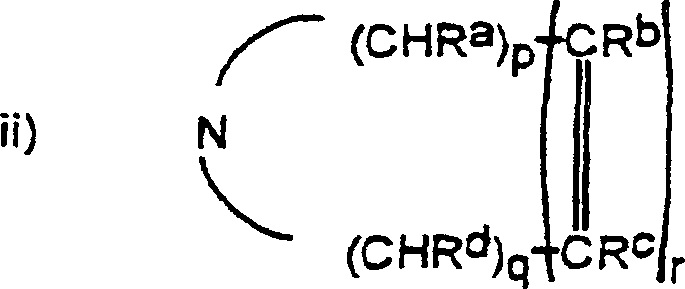
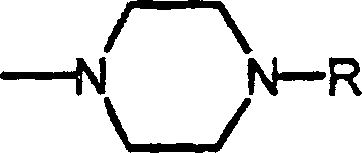
- – worin R eine lineare oder verzweigte Alkylgruppe mit 1 bis 6 Kohlenstoffatomen oder ein gesättigter Carbocyclus, enthaltend 3 bis 6 Kohlenstoffatome, eine Carboalkoxy-, Aryl-, Arylalkyl-, Alkanoyl- oder Aroylgruppe ist;
- – n3 eine ganze Zahl von 0 bis 5 ist; und
- – R3 jeweils unabhängig bedeutet • ein Halogenatom, • eine lineare oder verzweigte Alkylgruppe mit 1 bis 6 Kohlenstoffatomen oder einen gesättigten Carbocyclus, enthaltend 3 bis 6 Kohlenstoffatome, eine Trifluormethyl-, Aryl-, Alkoxy-, α-Alkyloxyalkyl-, Aryloxy-, Nitro-, Formyl-, Alkanoyl-, Aroyl-, Arylalkanoyl, Amino-, Carboxamido-, Cyano-, Alkyloximino-, Aryloximino-, Alkylalkoximino-, α-Hydroxyalkyl-, Alkenyl-, Alkinyl-, Sulfamido-, Sulfamoyl, Sulfonamido-, Carboxamid-, Carbonylcycloalkyl-, Alkylcarbonylalkyl-, Carboalkoxy-, Arylalkyl- oder eine Oximgruppe, oder zusammengenommen mit den Kohlenstoffatomen des Phenylrings, an welches es gebunden ist, einen 5- oder 6-gliedrigen gesättigten oder ungesättigten Ring oder einen Benzolring; sowie deren pharmazeutisch annehmbaren Salze, deren Hydrate, deren hydratisierte Salze, die polymorphen kristallinen Strukturen dieser Verbindungen und deren optische Isomere, Racemate, Diastereoisomere und Enantiomere, zur Herstellung eines Medikaments, welches als ein Ligand der Histamin-H3-Rezeptoren wirksam ist.
- C n H 2n is a linear or branched hydrocarbon chain, wherein n ranges from 2 to 8;
- X is an oxygen or sulfur atom;
- - R 1 and R 2 may be identical or different and each independently represent: • a linear or branched alkyl group having 1 to 6 carbon atoms or a saturated carbocycle containing 3 to 6 carbon atoms, or taken together with the nitrogen atom to which they are attached , • a saturated nitrogen-containing ring wherein m ranges from 2 to 6, or • a non-aromatic unsaturated nitrogen-containing ringwherein p and q are independently 0 to 3, and r is 0 to 4, provided that p and q are not 0 simultaneously and 2 ≤ p + q + r ≤ 8 where R ad is independently hydrogen or linear or branched alkyl group having 1 to 6 carbon atoms or a saturated carbocycle containing 3 to 6 carbon atoms, or a carboalkoxy group, or • a morpholino group, or • an N-substituted piperazino group:
- Wherein R is a linear or branched alkyl group having 1 to 6 carbon atoms or a saturated carbocycle containing 3 to 6 carbon atoms, a carboalkoxy, aryl, arylalkyl, alkanoyl or aroyl group;
- - n 3 is an integer from 0 to 5; and
- Each R 3 independently represents a halogen atom, a linear or branched alkyl group having 1 to 6 carbon atoms or a saturated carbocycle containing 3 to 6 carbon atoms, a trifluoromethyl, aryl, alkoxy, α-alkyloxyalkyl, aryloxy, Nitro, formyl, alkanoyl, aroyl, arylalkanoyl, amino, carboxamido, cyano, alkyloximino, aryloximino, alkylalkoximino, α-hydroxyalkyl, alkenyl, alkynyl, sulfamido, sulfamoyl, sulfonamido Carboxamide, carbonylcycloalkyl, alkylcarbonylalkyl, carboalkoxy, arylalkyl or oxime group, or taken together with the carbon atoms of the phenyl ring to which it is attached, a 5- or 6-membered saturated or unsaturated ring or a benzene ring; and their pharmaceutically acceptable salts, their hydrates, their hydrated salts, the polymorphic crystalline structures of these compounds and their optical isomers, racemates, diastereoisomers and enantiomers, for the manufacture of a medicament which is effective as a ligand of histamine H 3 receptors.
Die Erifnder haben überraschend festgestellt, daß Verbindungen erhalten werden können, welche als Antagonisten und/oder Agonisten wirksam sind, indem ein Di(alkyl) oder (Cycloalkyl)amin oder ein nichtaromatischer stickstoffhaltiger Ring, -NR1R2, wie oben für den Imidazolring definiert, in bekannten Imidazolderivaten, welche als Antagonisten und/oder Agonisten wirksam sind, substituiert wird.The inventors have surprisingly found that compounds can be obtained which are effective as antagonists and / or agonists, by a di (alkyl) or (cycloalkyl) amine or a non-aromatic nitrogen-containing ring, -NR 1 R 2 , as above for the imidazole defined in known imidazole derivatives, which are effective as antagonists and / or agonists substituted.
Man nimmt auch an, daß in gleicher Weise eine antagonistische und/oder agonistische Aktivität für Verbindungen der Formel (I), welche einen Rest der Imidazolderivate besitzen, die gemäß dem Stand der Technik als H3-Antagonisten oder -Agonisten vorgeschlagen wurden, und ferner für solche Reste; welche zu künftigen Imidazolderivaten mit einer wesentlichen Aktivität als ein H3-Antagonist oder -Agonist gehören würden, angenommen werden kann.It is also believed that an antagonistic and / or agonistic activity for compounds of formula (I) possessing a residue of the imidazole derivatives proposed as H 3 antagonists or agonists in the prior art, and further for such radicals; which may be associated with future imidazole derivatives having a substantial activity as an H 3 antagonist or agonist.
Außerdem haben die Erfinder festgestellt, daß solche Nicht-Imidazolanaloga eine wirksame antagonistische und/oder agonistische Aktivität vorsehen können.Besides, have the inventors found that such Non-imidazole analogues have an effective antagonistic and / or agonistic activity can provide.
Im Hinblick darauf haben sie Nichtimidazol-Alkylaminanaloga der Formel (I) hergestellt, welche bekannten Imidazolderivaten, insbesondere den oben erwähnten gemäß dem Stand der Technik, entsprechen.in the In view of this, they have nonimidazole alkylamine analogs of the formula (I), which known imidazole derivatives, in particular the above mentioned according to the state the technology.
Die Erfindung betrifft auch die Verwendung von Additionssalzen, welche die Verbindungen mit pharmazeutisch annehmbaren Säuren bilden. Die pharmazeutisch annehmbaren Salze umfassen das nichttoxische Salz von anorganischen und organischen Säuren. Beispiele dieser Salze schließen das Hydrochlorid, das Hydrobromid oder das Hydrogenmaleat oder Hydrogenoxalat ein.The The invention also relates to the use of addition salts, which which form compounds with pharmaceutically acceptable acids. The pharmaceutically acceptable salts include the non-toxic Salt of inorganic and organic acids. Examples of these salts shut down the hydrochloride, the hydrobromide or the hydrogen maleate or hydrogen oxalate one.
Die vorliegende Erfindung umfaßt auch die Verwendung der Hydrate der Verbindungen, der hydratisierten Salze dieser Verbindungen und der polymorphen kristallinen Strukturen.The present invention also the use of hydrates of the compounds hydrated Salts of these compounds and the polymorphic crystalline structures.
Wenn die Verbindungen in einer oder mehreren isomeren Formen entsprechend der Anzahl der asymmetrischen Zentren in dem Molekül vorliegen können, betrifft die Erfindung sowohl alle optischen Isomere als auch deren racemische Modifikationen und die korrespondierenden Diastereoisomere. Die Trennung der Diastereoisomere und/oder der optischen Isomere kann gemäß den per se bekannten Verfahren ausgeführt werden.If the compounds corresponding to one or more isomeric forms the number of asymmetric centers in the molecule can, The invention relates to all optical isomers as well as their racemic modifications and the corresponding diastereoisomers. The separation of the diastereoisomers and / or the optical isomers can according to the per carried out the known methods become.
Die vorliegende Erfindung umfaßt auch die Verwendung aller möglichen tautomeren Formen der Verbindungen, unabhängig davon, ob diese Tautomere in einer isolierten Form oder in Form von Mischungen vorliegen.The present invention also the use of all possible tautomeric forms of the compounds, regardless of whether these tautomers in an isolated form or in the form of mixtures.
Erfindungsgemäß soll der Begriff Niederalkyl oder Cycloalkyl eine lineare oder verzweigte Alkylgruppe mit 1 bis 6 Kohlenstoffatomen oder einen gesättigten Carbocyclus, enthaltend 3 bis 6 Kohlenstoffatome, bedeuten.According to the invention of Term lower alkyl or cycloalkyl is a linear or branched one Alkyl group having 1 to 6 carbon atoms or a saturated Carbocycle containing 3 to 6 carbon atoms, mean.
Typische Beispiele für eine Niederalkylgruppe sind Methyl-, Ethyl-, Propyl-, Isopropyl- und Butylgruppen.typical examples for a lower alkyl group are methyl, ethyl, propyl, isopropyl and butyl groups.
Eine bevorzugte Gruppe von erfindungsgemäßen Verbindungen umfaßt solche, worin R1 und R2 unabhängig voneinander eine Niederalkylgruppe, besonders eine Ethylgruppe, bedeuten.A preferred group of compounds of the invention comprises those wherein R 1 and R 2 independently represent a lower alkyl group, especially an ethyl group.
Bevorzugte
Verbindungen sind auch solche der Formel (I), worin R1 und
R2 zusammengenommen mit dem Stickstoffatom,
an welches sie gebunden sind, einen gesättigten stickstoffhaltigen
Ring bilden: 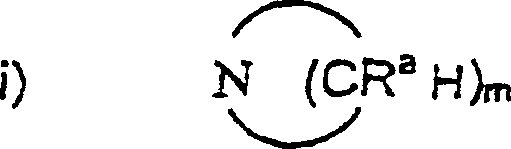
Piperidyl- und Pyrrolidinylgruppen werden besonders bevorzugt.piperidyl and pyrrolidinyl groups are particularly preferred.
Eine
andere bevorzugte Gruppe von Verbindungen umfaßt die Verbindungen (A), worin
R1 und R2 zusammengenommen
mit dem Stickstoffatom, an welches sie gebunden sind, einen nichtaromatischen
ungesättigten
stickstoffhaltigen Ring bilden: 
In dieser Gruppe sind die stärker bevorzugten Verbindungen solche, worin p den Wert 2 hat, und q und r jeweils 1 sind.In This group is the stronger preferred compounds are those in which p has the value 2, and q and r each are 1.
Eine Unterklasse dieser Gruppe umfaßt Verbindungen, worin Ra-d jeweils ein Wasserstoffatom bedeuten.A subclass of this group includes compounds wherein R ad each represents a hydrogen atom.
Wenn NR1R2 ein stickstoffhaltiger Ring i) oder ii) ist, wie oben definiert, dann ist der Ring vorzugsweise mit einer oder zwei Niederalkylgruppen substituiert.When NR 1 R 2 is a nitrogen-containing ring i) or ii) as defined above, then the ring is preferably substituted with one or two lower alkyl groups.
Die
Position für
die Substitution wird vorzugsweise gemäß der folgenden Reihenfolge
ausgewählt:
In dieser Gruppe gilt für einen stickstoffhaltigen Ring, welcher nur einen Substituenten trägt, daß der Substituent vorzugsweise im Hinblick auf das Stickstoffatom in der meta-Position vorliegt.In this group applies to a nitrogen-containing ring bearing only a substituent that the substituent preferably with respect to the nitrogen atom in the meta position is present.
Für einen stickstoffhaltigen Ring, welcher zwei Substituenten trägt, wird die meta-meta-Substitution bevorzugt, insbesondere, wenn die zwei Substituenten in einem trans-Verhältnis zueinander vorliegen.For one nitrogen-containing ring bearing two substituents the meta-meta substitution is preferred, especially when the two Substituents in a trans ratio to each other.
Erfindungsgemäß ergibt eine Piperidyl- oder Pyrrolidinyleinheit, welche in der meta- oder meta-meta-Position, insbesondere mit einer Methylgruppe, substituiert ist, besonders bevorzugte Verbindungen.According to the invention a piperidyl or pyrrolidinyl moiety which is in the meta or substituted meta-meta position, in particular with a methyl group is, particularly preferred compounds.
Wenn NR1R2 eine N-substituierte Piperazinogruppe darstellt, kann R ein Niederalkyl, z.B. Methyl, bedeuten.When NR 1 R 2 represents an N-substituted piperazino group, R may represent a lower alkyl, eg, methyl.
Typische Beispiele für die Gruppe R, welche eine Aryl- oder Arylalkyleinheit ist, sind Phenyl und Benzyl.typical examples for the group R, which is an aryl or arylalkyl moiety, are Phenyl and benzyl.
R kann auch eine Alkanoyl- oder Aroylgruppe, z.B. Acetyl oder Benzoyl, bedeuten.R may also be an alkanoyl or aroyl group, e.g. Acetyl or benzoyl, mean.
In allen Gruppen, welche für R möglich sind, verweist die Alkyleinheit auf eine lineare oder verzweigte Kette, welche 1 bis 6 Kohlenstoffatome enthält.In all groups, which for R possible the alkyl moiety refers to a linear or branched chain, which contains 1 to 6 carbon atoms.
Die Cycloalkylgruppe verweist auf einen gesättigten Carbocyclus, welcher 3 bis 7 Kohlenstoffatome enthält.The Cycloalkyl group refers to a saturated carbocycle which Contains 3 to 7 carbon atoms.
Wenn R eine Aryl- oder Arylalkylgruppe darstellt, dann ist die Aryleinheit insbesondere eine Phenylgruppe, welche wahlweise substituiert ist mit einem oder mehreren Substituenten, gewählt aus Halogenatomen, vorteilhafterweise gewählt aus Fluor, Chlor und Brom, oder einem Niederalkyl oder Cycloalkyl, einer Trifluormethyl-, Aryl-, Alkoxy-, Aryloxy-, Nitro-, Formyl-, Alkanoyl-, Aroyl-, Arylalkanoyl, Amino-, Carboxamido-, Cyano-, Alkyloximino-, Aryloximino-, α-Hydroxyalkyl-, Alkenyl-, Alkinyl-, Sulfamido-, Sulfamoyl, Carboxamid-, Carboalkoxy-, Arylalkyl- oder Oximgruppe.If R represents an aryl or arylalkyl group, then the aryl moiety in particular a phenyl group which is optionally substituted with one or more substituents selected from halogen atoms, advantageously chosen from fluorine, chlorine and bromine, or a lower alkyl or cycloalkyl, a trifluoromethyl, aryl, alkoxy, aryloxy, nitro, formyl, Alkanoyl, aroyl, arylalkanoyl, amino, carboxamido, cyano, alkyloximino, Aryloximino, α-hydroxyalkyl, Alkenyl, alkynyl, sulfamido, sulfamoyl, carboxamide, carboalkoxy, Arylalkyl or oxime group.
R kann auch ein wahlweise substituiertes Benzoyl sein, wobei der Substituent wie oben unter Bezugnahme auf die Phenylgruppe definiert ist.R may also be an optionally substituted benzoyl, wherein the substituent as defined above with reference to the phenyl group.
Ein typisches Beispiel für -NR1R2, welches eine N-substituierte Piperazinogruppe darstellt, ist N-Acetylpiperazino.A typical example of -NR 1 R 2 , which is an N-substituted piperazino group, is N-acetylpiperazino.
Eine bevorzugte Gruppe von erfindungsgemäßen Verbindungen ist die Gruppe, bestehend aus Verbindungen der Formel (I), worin X ein Sauerstoffatom ist.A preferred group of compounds according to the invention is the group consisting of compounds of formula (I) wherein X is an oxygen atom is.
Eine andere bevorzugte Gruppe von Verbindungen umfaßt die Verbindungen (I), worin -CnH2n- eine lineare Kette -(CH2)n ist, wobei n wie oben definiert ist.Another preferred group of compounds comprises compounds (I) wherein -C n H 2n - is a linear chain - (CH 2 ) n , where n is as defined above.
Bevorzugte Verbindungen sind auch solche Verbindungen, worin n von 3 bis 5 variiert, und worin n mehr bevorzugt 3 ist.preferred Compounds are also those compounds wherein n is from 3 to 5 varies, and where n is more preferably 3.
Eine Unterklasse der erfindungsgemäßen Verbindungen umfaßt die Verbindungen der Formel (I), worin n3 Null ist, d.h. solche, welche eine unsubstituierte Phenyleinheit besitzen.A subclass of the compounds of the invention comprises the compounds of formula (I) wherein n 3 is zero, ie those having an unsubstituted phenyl moiety.
Eine andere Gruppe von erfindungsgemäßen Verbindungen besteht aus Verbindungen, enthaltend einen oder mehrere Substituenten R3, welche identisch oder voneinander verschieden sein können. In dieser Gruppe werden Verbindungen mit einer mono- oder disubstituierten (n3 = 1 oder 2) Phenyleinheit bevorzugt, und monosubstituierte Verbindungen mit einer Gruppe R3, wie oben definiert, in der para-Position werden besonders bevorzugt.Another group of compounds of the invention consists of compounds containing one or more substituents R 3 , which may be identical or different. In this group, compounds having a mono- or disubstituted (n 3 = 1 or 2) phenyl moiety are preferred, and monosubstituted compounds having a group R 3 as defined above in the para position are particularly preferred.
In diesen Verbindungen (worin n3 den Wert 1 hat) bedeutet R3 vorzugsweise ein Halogenatom oder eine Cyano-, Nitro-, Alkanoyl-, Allyloximino- oder α-Hydroxyalkylgruppe.In these compounds (where n 3 is 1), R 3 is preferably a halogen atom or a cyano, nitro, alkanoyl, allyloximino or α-hydroxyalkyl group.
Noch stärker bevorzugte Verbindungen sind solche, worin R3 die Bedeutung CN, NO2, COCH3, COC2H5, H3C-C=N-OH, H3C-CH-OH und Cycloalkyl-CO, wie Cyclopropyl-CO, hat.Even more preferred compounds are those wherein R 3 is CN, NO 2 , COCH 3 , COC 2 H 5 , H 3 CC = N-OH, H 3 C-CH-OH and cycloalkyl-CO, such as cyclopropyl-CO, Has.
Falls R3 ein Halogenatom ist, kann es vorteilhafterweise aus Fluor, Chlor und Brom gewählt sein.If R 3 is a halogen atom, it may be advantageously selected from fluorine, chlorine and bromine.
Falls R3 eine Arylgruppe ist, kann es insbesondere eine Phenylgruppe sein.In particular, when R 3 is an aryl group, it may be a phenyl group.
In den anderen Substituenten R3 ist die Aryleinheit vorteilhafterweise eine Phenyleinheit.In the other substituents R 3 , the aryl moiety is advantageously a phenyl moiety.
Falls R3 eine Aryloxygruppe ist, kann es insbesondere eine Phenoxygruppe sein. Erfindungsgemäß soll Alkanoyl auf eine Gruppe verweisen, welche eine Alkyleinheit, wie oben definiert, enthält.In particular, when R 3 is an aryloxy group, it may be a phenoxy group. According to the invention, alkanoyl is intended to refer to a group which contains an alkyl moiety as defined above.
Typische Beispiele für R3, welches eine Alkanoyl-, Aroyl- oder Arylalkanoylgruppe ist, sind Acetyl-, Butyryl- und Propionylgruppen, eine Benzoylgruppe oder eine Phenylacetylgruppe.Typical examples of R 3 which is an alkanoyl, aroyl or arylalkanoyl group are acetyl, butyryl and propionyl groups, a benzoyl group or a phenylacetyl group.
Typische Beispiele für R3, welches zusammen mit den Kohlenstoffatomen des Phenylrings, an welches es gebunden ist, einen gesättigten Ring bildet, ergeben ein 5,6,7,8-Tetrahydronaphthyl, oder ergeben bei der Bildung eines Benzolrings eine Naphthyleinheit.Typical examples of R 3 , which forms a saturated ring together with the carbon atoms of the phenyl ring to which it is attached, give a 5,6,7,8-tetrahydronaphthyl, or give a naphthyl moiety in the formation of a benzene ring.
Erfindungsgemäß kann eine Alkenyl- oder Alkinylgruppe vorteilhafterweise 1 bis 8 Kohlenstoffatome, insbesondere 1 bis 6 Kohlenstoffatome und vorzugsweise 1 bis 4 Kohlenstoffatome enthalten.According to the invention, a Alkenyl or alkynyl group advantageously 1 to 8 carbon atoms, in particular 1 to 6 carbon atoms and preferably 1 to 4 carbon atoms contain.
In den Carboalkoxy-, Carboxyamido-, Carbonylcycioalkyl-, Alkylcarbonylalkyl- oder Carboxamidgruppen ist die Kohlenwasserstoffkette gesättigt, linear oder verzweigt und enthält eine Alkyleinheit, wie oben definiert.In the carboalkoxy, carboxyamido, carbonylcycloalkyl, alkylcarbonylalkyl or carboxamide groups the hydrocarbon chain is saturated, linear or branched and contains an alkyl moiety as defined above.
In den Alkoxy-, Alkylalkoximino-, Alkyloximino-, α-Alkyloxyalkyl-, Arylalkyl- oder α-Hydroxyalkylgruppen ist die Alkyleinheit ebenfalls wie oben definiert.In the alkoxy, alkylalkoximino, alkyloximino, α-alkyloxyalkyl, arylalkyl or α-hydroxyalkyl groups the alkyl moiety is also as defined above.
Besonders
bevorzugte Verbindungen sind:
1-(5-Phenoxypentyl)-piperidin
1-(5-Phenoxypentyl)-pyrrolidin
N-Methyl-N-(5-phenoxypentyl)-ethylamin
1-(5-Phenoxypentyl)-morpholin
N-(5-Phenoxypentyl)-hexamethylenimin
N-Ethyl-N-(5-phenoxypentyl)-propylamin
1-(5-Phenoxypentyl)-2-methyl-piperidin
1-(5-Phenoxypentyl)-4-propyl-piperidin
1-(5-Phenoxypentyl)-4-methyl-piperidin
1-(5-Phenoxypentyl)-3-methyl-piperidin
1-Acetyl-4-(5-phenoxypentyl)-piperazin
1-(5-Phenoxypentyl)-3,5-trans-dimethyl-piperidin
1-(5-Phenoxypentyl)-3,5-cis-dimethyl-piperidin
1-(5-Phenoxypentyl)-2,6-cis-dimethyl-piperidin
4-Carboethoxy-1-(5-phenoxypentyl)-piperidin
3-Carboethoxy-1-(5-phenoxypentyl)-piperidin
1-[3-(4-Cyclopropylcarbonylphenoxy)propyl]-piperidin
1-[3-(4-Acetylphenoxy)-2-R-methylpropyl]-piperidin
1-[3-(4-Cyanophenoxy)propyl]-4-methylpiperidin
1-[3-(4-Cyanophenoxy)propyl]-3-methylpiperidin
1-[3-(4-Acetylphenoxy)-2-S-methylpropyl]-piperidin
1-{3-[4-(3-Oxobutyl)phenoxy]propyl}-piperidin
1-[3-(4-Cyano-3-fluorphenoxy)propyl]-piperidin
1-[3-(4-Nitrophenoxy)propyl]-3-methylpiperidin
1-[3-(4-Cyanophenoxy)propyl]-2-methylpiperidin
1-[3-(4-Nitrophenoxy)propyl]-2-methylpiperidin
1-[3-(4-Nitrophenoxy)propyl]-4-methylpiperidin
1-[3-(4-Cyanophenoxy)propyl]-2,6-dimethylpiperidin
1-[3-(4-Propionylphenoxy)propyl]-3-methylpiperidin
1-[3-(4-Cyclobutylcarbonylphenoxy)propyl]-piperidin
1-[3-(4-Cyclopentylcarbonylphenoxy)propyl]-piperidin
1-[3-(4-Cyanophenoxy)propyl]-cis-2-methyl-5-ethylpiperidin
1-[3-(4-Cyanophenoxy)propyl]-trans-2-methyl-5-ethylpiperidin
1-[3-(4-Cyanophenoxy)propyl]-cis-3,5-dimethylpiperidin
1-[3-(4-Propionylphenoxy)propyl]-4-methylpiperidin
1-[3-(4-Propionylphenoxy)propyl]-2-methylpiperidin
1-{3-[4-(1-Hydroxypropyl)phenoxy]propyl}-3-methylpiperidin
1-{3-[4-(1-Hydroxypropyl)phenoxy]propyl}-4-methylpiperidin
1-[3-(4-Propionylphenoxy)propyl]-2-methylpiperidin-oxim
1-[3-(4-Propionylphenoxy)propyl]-4-methylpiperidin-methoxim
1-[3-(4-Cyanophenoxy)propyl]-trans-3,5-dimethylpiperidin
1-[3-(4-Cyclopropylcarbonylphenoxy)propyl]-trans-3,5-dimethylpiperidin
1-[3-(4-Cyclopropylcarbonylphenoxy)propyl]-cis-3,5-dimethylpiperidin
1-[3-(4-Carbomethoxyphenoxy)propyl]-piperidin
1-[3-(4-Propenylphenoxy)propyl]-2-methylpiperidin
1-[3-(4-Propionylphenoxy)propyl]-2-methylpiperidin-methoxim
1-{3-[4-(1-Ethoxypropyl)phenoxy]propyl}-2-methylpiperidin-oxim
1-[3-(4-Propionylphenoxy)propyl]-4-methylpiperidin
1-[3-(4-Bromphenoxy)propyl]-piperidin
1-[3-(4-Nitrophenoxy)propyl]-piperidin
1-[3-(4-N,N-Dimethylsulfonamidophenoxy)propyl]-piperidin
1-[3-(4-Isopropylphenoxy)propyl]-piperidin
1-[3-(4-sec-Butylphenoxy)propyl]-piperidin
1-[3-(4-Propylphenoxy)propyl]-piperidin
1-[3-(4-Ethylphenoxy)propyl]-piperidin
1-(5-Phenoxypentyl)-1,2,3,6-tetrahydropyridin
1-[5-(4-Nitrophenoxy)pentyl]-pyrrolidin
1-[5-(4-Chlorphenoxy)pentyl]-pyrrolidin
1-[5-(4-Methoxyphenoxy)pentyl]-pyrrolidin
1-[5-(4-Methylphenoxy)pentyl]-pyrrolidin
1-[5-(4-Cyanophenoxy)pentyl]-pyrrolidin
1-[5-(2-Naphthyloxy)pentyl]-pyrrolidin
1-[5-(1-Naphthyloxy)pentyl]-pyrrolidin
1-[5-(3-Chlorphenoxy)pentyl]-pyrrolidin
1-[5-(4-Phenylphenoxy)pentyl]-pyrrolidin
1-{5-[2-(5,6,7,8-Tetrahydronaphthyl)oxy]pentyl}-pyrrolidin
1-[5-(3-Phenylphenoxy)pentyl]-pyrrolidin
1-(5-Phenoxypentyl)-2,5-dihydropyrrol
1-{5-[1-(5,6,7,8-Tetrahydronaphthyl)oxy]pentyl}-pyrrolidin
1-(4-Phenoxybutyl)-pyrrolidin
1-(6-Phenoxyhexyl)-pyrrolidin
1-(5-Phenylthiopentyl)-pyrrolidin
1-(4-Phenylthiobutyl)-pyrrolidin
1-(3-Phenoxypropyl)-pyrrolidin
1-[5-(3-Nitrophenoxy)pentyl]-pyrrolidin
1-[5-(4-Fluorphenoxy)pentyl]-pyrrolidin
1-[5-(4-Nitrophenoxy)pentyl]-3-methyl-piperidin
1-[5-(4-Acetylphenoxy)pentyl]-pyrrolidin
1-[5-(4-Aminophenoxy)pentyl]-pyrrolidin
1-[5-(3-Cyanophenoxy)pentyl]-pyrrolidin
N-[3-(4-Nitrophenoxy)propyl]-diethylamin
N-[3-(4-Cyanophenoxy)propyl]-diethylamin
1-[5-(4-Benzoylphenoxy)pentyl]-pyrrolidin
1-{5-[4-(Phenylacetyl)phenoxy]pentyl}-pyrrolidin
N-[3-(4-Acetylphenoxy)propyl]-diethylamin
1-[5-(4-Acetamidophenoxy)pentyl]-pyrrolidin
1-[5-(4-Phenoxyphenoxy)pentyl]-pyrrolidin
1-[5-(4-N-Benzamidophenoxy)pentyl]-pyrrolidin
1-{5-[4-(1-Hydroxyethyl)phenoxy]pentyl}-pyrrolidin
1-[5-(4-Cyanophenoxy)pentyl]-diethylamin
1-[5-(4-Cyanophenoxy)pentyl]-piperidin
N-[5-(4-Cyanophenoxy)pentyl]-dimethylamin
N-[2-(4-Cyanophenoxy)ethyl]-diethylamin
N-[3-(4-Cyanophenoxy)propyl]-dimethylamin
N-[4-(4-Cyanophenoxy)butyl]-diethylamin
N-[5-(4-Cyanophenoxy)pentyl]-dipropylamin
1-[3-(4-Cyanophenoxy)propyl]-pyrrolidin
1-[3-(4-Cyanophenoxy)propyl]-piperidin
1-[3-(4-Cyanophenoxy)propyl]-hexamethylenimin
N-[6-(4-Cyanophenoxy)hexyl]-diethylamin
N-[3-(4-Cyanophenoxy)propyl]-dipropylamin
N-3-[4-(1-Hydroxyethyl)phenoxy]-propyl-diethylamin
4-(3-Diethylaminopropoxy)-acetophenon-oxim
1-[3-(4-Acetylphenoxy)propyl]-piperidin
1-[3-(4-Acetylphenoxy)propyl]-3-methyl-piperidin
1-[3-(4-Acetylphenoxy)propyl]-3,5-trans-dimethyl-piperidin
1-[3-(4-Acetyllphenoxy)propyl]-4-methyl-piperidin
1-[3-(4-Propionylphenoxy)propyl]-piperidin
1-[3-(4-Acetylphenoxy)propyl]-3,5-cis-dimethyl-piperidin
1-[3-(4-Formylphenoxy)propyl]-piperidin
1-[3-(4-Isobutyrylphenoxy)propyl]-piperidin
N-[3-(4-Propionylphenoxy)propyl]-diethylamin
1-[3-(4-Butyrylphenoxy)propyl]-piperidin
1-[3-(4-Acetylphenoxy)propyl]-1,2,3,6-tetrahydropyridinParticularly preferred compounds are:
1- (5-phenoxypentyl) -piperidine
1- (5-phenoxypentyl) -pyrrolidine
N-Methyl-N- (5-phenoxypentyl) -ethylamine
1- (5-phenoxypentyl) -morpholine
N- (5-phenoxypentyl) -hexamethylenimin
N-ethyl-N- (5-phenoxypentyl) -propylamine
1- (5-phenoxypentyl) -2-methyl-piperidine
1- (5-phenoxypentyl) -4-propyl-piperidine
1- (5-phenoxypentyl) -4-methyl-piperidine
1- (5-phenoxypentyl) -3-methyl-piperidine
1-Acetyl-4- (5-phenoxypentyl) -piperazine
1- (5-phenoxypentyl) -3,5-trans-dimethyl-piperidine
1- (5-phenoxypentyl) -3,5-cis-dimethyl-piperidine
1- (5-phenoxypentyl) -2,6-cis-dimethyl-piperidine
4-carboethoxy-1- (5-phenoxypentyl) -piperidine
3-carboethoxy-1- (5-phenoxypentyl) -piperidine
1- [3- (4-Cyclopropylcarbonylphenoxy) propyl] -piperidine
1- [3- (4-acetylphenoxy) -2-R-methylpropyl] piperidine
1- [3- (4-cyanophenoxy) propyl] -4-methylpiperidine
1- [3- (4-cyanophenoxy) propyl] -3-methylpiperidine
1- [3- (4-acetylphenoxy) -2-S-methylpropyl] piperidine
1- {3- [4- (3-oxobutyl) phenoxy] propyl} -piperidine
1- [3- (4-Cyano-3-fluorophenoxy) propyl] piperidine
1- [3- (4-nitrophenoxy) propyl] -3-methylpiperidine
1- [3- (4-cyanophenoxy) propyl] -2-methylpiperidine
1- [3- (4-nitrophenoxy) propyl] -2-methylpiperidine
1- [3- (4-nitrophenoxy) propyl] -4-methylpiperidine
1- [3- (4-cyanophenoxy) propyl] -2,6-dimethylpiperidine
1- [3- (4-propionylphenoxy) propyl] -3-methylpiperidine
1- [3- (4-Cyclobutylcarbonylphenoxy) propyl] -piperidine
1- [3- (4-Cyclopentylcarbonylphenoxy) propyl] -piperidine
1- [3- (4-cyanophenoxy) propyl] -cis-2-methyl-5-ethylpiperidine
1- [3- (4-cyanophenoxy) propyl] -trans-2-methyl-5-ethylpiperidine
1- [3- (4-cyanophenoxy) propyl] -cis-3,5-dimethylpiperidine
1- [3- (4-propionylphenoxy) propyl] -4-methylpiperidine
1- [3- (4-propionylphenoxy) propyl] -2-methylpiperidine
1- {3- [4- (1-hydroxypropyl) phenoxy] propyl} -3-methylpiperidine
1- {3- [4- (1-hydroxypropyl) phenoxy] propyl} -4-methylpiperidine
1- [3- (4-propionylphenoxy) propyl] -2-methylpiperidine oxime
1- [3- (4-propionylphenoxy) propyl] -4-methylpiperidine methoxime
1- [3- (4-cyanophenoxy) propyl] -trans-3,5-dimethylpiperidine
1- [3- (4-Cyclopropylcarbonylphenoxy) propyl] -trans-3,5-dimethylpiperidine
1- [3- (4-Cyclopropylcarbonylphenoxy) propyl] -cis-3,5-dimethylpiperidine
1- [3- (4-carbomethoxyphenoxy) propyl] piperidine
1- [3- (4-propenylphenoxy) propyl] -2-methylpiperidine
1- [3- (4-propionylphenoxy) propyl] -2-methylpiperidine methoxime
1- {3- [4- (1-ethoxypropyl) phenoxy] propyl} -2-methylpiperidine oxime
1- [3- (4-propionylphenoxy) propyl] -4-methylpiperidine
1- [3- (4-bromophenoxy) propyl] piperidine
1- [3- (4-nitrophenoxy) propyl] piperidine
1- [3- (4-N, N-Dimethylsulfonamidophenoxy) propyl] -piperidine
1- [3- (4-isopropylphenoxy) propyl] piperidine
1- [3- (4-sec-butylphenoxy) propyl] piperidine
1- [3- (4-propylphenoxy) propyl] piperidine
1- [3- (4-ethylphenoxy) propyl] piperidine
tetrahydropyridine -1,2,3,6-1- (5-phenoxypentyl)
1- [5- (4-nitrophenoxy) -pentyl] -pyrrolidine
1- [5- (4-chlorophenoxy) pentyl] -pyrrolidine
1- [5- (4-methoxyphenoxy) pentyl] -pyrrolidine
1- [5- (4-methylphenoxy) pentyl] -pyrrolidine
1- [5- (4-cyanophenoxy) pentyl] -pyrrolidine
1- [5- (2-naphthyloxy) -pentyl] -pyrrolidine
1- [5- (1-naphthyloxy) pentyl] -pyrrolidine
1- [5- (3-chlorophenoxy) -pentyl] -pyrrolidine
1- [5- (4-phenylphenoxy) -pentyl] -pyrrolidine
1- {5- [2- (5,6,7,8-tetrahydronaphthyl) -oxy] -pentyl} -pyrrolidine
1- [5- (3-phenylphenoxy) -pentyl] -pyrrolidine
1- (5-phenoxypentyl) -2,5-dihydropyrrole
1- {5- [1- (5,6,7,8-tetrahydronaphthyl) -oxy] -pentyl} -pyrrolidine
1- (4-phenoxybutyl) -pyrrolidine
1- (6-phenoxyhexyl) -pyrrolidine
1- (5-Phenylthiopentyl) -pyrrolidine
1- (4-Phenylthiobutyl) -pyrrolidine
1- (3-phenoxypropyl) pyrrolidine
1- [5- (3-nitrophenoxy) pentyl] -pyrrolidine
1- [5- (4-fluorophenoxy) pentyl] -pyrrolidine
1- [5- (4-nitrophenoxy) pentyl] -3-methyl-piperidine
1- [5- (4-acetylphenoxy) -pentyl] -pyrrolidine
1- [5- (4-aminophenoxy) pentyl] -pyrrolidine
1- [5- (3-cyanophenoxy) pentyl] -pyrrolidine
N- [3- (4-nitrophenoxy) propyl] -diethylamine
N- [3- (4-cyanophenoxy) propyl] -diethylamine
1- [5- (4-benzoylphenoxy) -pentyl] -pyrrolidine
1- {5- [4- (phenylacetyl) -phenoxy] -pentyl} -pyrrolidine
N- [3- (4-acetylphenoxy) -propyl] -diethylamine
1- [5- (4-acetamidophenoxy) -pentyl] -pyrrolidine
1- [5- (4-phenoxyphenoxy) pentyl] -pyrrolidine
1- [5- (4-N-Benzamidophenoxy) pentyl] -pyrrolidine
1- {5- [4- (1-hydroxyethyl) phenoxy] pentyl} -pyrrolidine
1- [5- (4-cyanophenoxy) pentyl] -diethylamine
1- [5- (4-cyanophenoxy) pentyl] -piperidine
N- [5- (4-cyanophenoxy) pentyl] -dimethyl-amine
N- [2- (4-cyanophenoxy) ethyl] -diethylamine
N- [3- (4-cyanophenoxy) propyl] -dimethyl-amine
N- [4- (4-cyanophenoxy) butyl] -diethylamine
N- [5- (4-cyanophenoxy) pentyl] -dipropylamin
1- [3- (4-cyanophenoxy) propyl] -pyrrolidine
1- [3- (4-cyanophenoxy) propyl] -piperidine
1- [3- (4-cyanophenoxy) propyl] -hexamethylenimin
N- [6- (4-cyanophenoxy) hexyl] -diethylamine
N- [3- (4-cyanophenoxy) propyl] -dipropylamin
N-3- [4- (1-hydroxyethyl) phenoxy] -propyl-diethylamine
4- (3-diethylaminopropoxy) -acetophenone-oxime
1- [3- (4-acetylphenoxy) propyl] -piperidine
1- [3- (4-acetylphenoxy) propyl] -3-methyl-piperidine
1- [3- (4-acetylphenoxy) propyl] -3,5-trans-dimethyl-piperidine
1- [3- (4-Acetyllphenoxy) propyl] -4-methyl-piperidine
1- [3- (4-propionylphenoxy) propyl] -piperidine
1- [3- (4-acetylphenoxy) -propyl] -3,5-cis-dimethyl-piperidine
1- [3- (4-formylphenoxy) -propyl] -piperidine
1- [3- (4-Isobutyrylphenoxy) propyl] -piperidine
N- [3- (4-propionylphenoxy) propyl] -diethylamine
1- [3- (4-Butyrylphenoxy) propyl] -piperidine
1- [3- (4-acetylphenoxy) propyl] -1,2,3,6-tetrahydropyridine
Stärker bevorzugte
Verbindungen sind:
1-[5-(4-Nitrophenoxy)-pentyl]-pyrrolidin
N-[3-(4-Cyanophenoxy)-propyl]-diethylamin
N-[3-(4-Acetylphenoxy)-propyl]-diethylamin
1-{5-[4-(1-Hydroxyethyl)-phenoxy]-pentyl}-pyrrolidin
N-[4-(4-Cyanophenoxy)-butyl]-diethylamin
1-[3-(4-Cyanophenoxy)-propyl]-piperidin
N-[3-(4-Cyanophenoxy)-propyl]-hexamethylenimin
N-3-[4-(1-Hydroxyethyl)-phenoxy]-propyl-diethylamin
4-(3-Diethylaminopropoxy)-acetophenon-oxim
1-[3-(4-Acetylphenoxy)-propyl]-3-methyl-piperidin
1-[3-(4-Acetylphenoxy)-propyl]-4-methyl-piperidin
1-[3-(4-Propionylphenoxy)-propyl]-piperidinMore preferred compounds are:
1- [5- (4-nitrophenoxy) -pentyl] -pyrrolidine
N- [3- (4-cyanophenoxy) -propyl] -diethylamine
N- [3- (4-acetylphenoxy) -propyl] -diethylamine
1- {5- [4- (1-hydroxyethyl) -phenoxy] -pentyl} -pyrrolidine
N- [4- (4-cyanophenoxy) -butyl] -diethylamine
1- [3- (4-cyanophenoxy) -propyl] -piperidine
N- [3- (4-cyanophenoxy) propyl] -hexamethylenimin
N-3- [4- (1-hydroxyethyl) -phenoxy] -propyl-diethylamine
4- (3-diethylaminopropoxy) -acetophenone-oxime
1- [3- (4-acetylphenoxy) -propyl] -3-methyl-piperidine
1- [3- (4-acetylphenoxy) -propyl] -4-methyl-piperidine
1- [3- (4-propionylphenoxy) -propyl] -piperidine
Verbindungen der Formel (I), worin:
- • -NR1R2 eine Pyrrolidinylgruppe ist, CnH2n eine lineare Kette -(CH2)n- ist und n3 Null ist, und X ein Sauerstoffatom ist, wobei n von 3 bis 5 reicht, oder X ein Schwefelatom ist, wobei n 4 oder 5 ist;
- • -NR1R2 eine Piperidinylgruppe ist, CnH2n eine lineare Kette -(CH2)n- ist und X ein Sauerstoffatom ist, worin n3 Null ist, wobei n 2, 5 oder 8 ist, oder worin n3 den Wert 1 hat, wobei R3 die Bedeutung 4-CN hat und n 5 ist;
- • -NR1R2 eine Diethylamingruppe ist, X ein Sauerstoffatom ist, CnH2n eine lineare Kette -(CH2)n- ist und n3 den Wert 1 hat, wobei R3 die Bedeutung 4-NO2 oder 4-COCH3 hat, wobei n 3 ist, oder R3 die Bedeutung 4-CN hat, wobei n 2 bis 4 ist;
- • -NR1R2 eine Diethylamingruppe ist, X ein Sauerstoffatom ist, CnH2n eine lineare Kette -(CH2)n- ist und n3 1 ist, wobei R3 die Bedeutung 4-CN hat, wobei n 3 ist,
- • NR 1 R 2 is a pyrrolidinyl group, C n H 2n is a linear chain - (CH 2 ) n - and n 3 is zero, and X is an oxygen atom, where n ranges from 3 to 5, or X is a sulfur atom where n is 4 or 5;
- • NR 1 R 2 is a piperidinyl group, C n H 2n is a linear chain - (CH 2 ) n - and X is an oxygen atom, where n 3 is zero, where n is 2, 5 or 8, or where n is 3 is 1, where R 3 is 4-CN and n is 5;
- • NR 1 R 2 is a diethylamine group, X is an oxygen atom, C n H 2n is a linear chain - (CH 2 ) n - and n 3 has the value 1, where R 3 is 4-NO 2 or COCH 3 , where n is 3, or R 3 is 4-CN, where n is 2 to 4;
- • NR 1 R 2 is a diethylamine group, X is an oxygen atom, C n H 2n is a linear chain - (CH 2 ) n - and n is 3 1, where R 3 is 4-CN, where n is 3 .
Ein Gegenstand der Erfindung ist folglich die Verwendung dieser Verbindungen als Liganden der Histamin-H3-Rezeptoren, insbesondere als H3-Antagonisten, -Agonisten und/oder -Teilagonisten, insbesondere zur Herstellung von Medikamenten, welche als Liganden für die Histamin-H3-Rezeptoren, besonders als H3-Antagonisten und/oder -Agonisten, welche für die nachstehend ausführlich beschriebenen Behandlungen bestimmt sind, wirksam sind.An object of the invention is therefore the use of these compounds as ligands of the histamine H 3 receptors, in particular as H 3 antagonists, agonists and / or partial agonists, in particular for the production of medicaments which serve as ligands for the histamine H 3 Receptors, especially as H 3 antagonists and / or agonists, which are intended for the treatments described in detail below, are effective.
Gemäß einem zweiten Aspekt ist das Ziel der vorliegenden Erfindung der Erhalt von Nicht-Imidazolverbindungen, welche zu den in WO 96/29315 und WO 93/14070 offenbarten Verbindungen analog sind.According to one second aspect, the object of the present invention is the receipt non-imidazole compounds which are as described in WO 96/29315 and WO 93/14070 are analogous compounds disclosed.
Folglich
betrifft ein anderer Aspekt der Erfindung die Verwendung der Verbindungen
der folgenden allgemeinen Formel (IIa): 
- – R1 und R2 wie unter Bezugnahme auf die allgemeine Formel (I) definiert sind;
- – die Kette AII eine gesättigte oder ungesättigte, gerade oder verzweigte Kohlenwasserstoffkette mit 1 bis 6 Kohlenstoffatomen ist, welche wahlweise durch ein Heteroatom, wie ein Schwefelatom, unterbrochen ist;
- – XII ein Sauerstoff- oder Schwefelatom, -NH-, -NHCO-, -N(Alkyl)CO-, -NHCONH-, -NH-CS-NH-, -NHCS-, -O-CO-, -CO-O-, -OCONH-, -OCON(Alkyl)-, -OCON(Alken), -OCONH-CO-, -CONH-, -CON(Alkyl)-, -SO-, -CO-, -CHOH- oder -N-(gesättigtes oder ungesättigtes Alkyl) darstellt;
- – die Kette BII eine Aryl-, Arylalkyl-, Arylalkanoyl- oder eine gerade Alkylenkette mit 1 bis 5 Kohlenstoffatomen oder eine verzweigte Alkylenkette mit 2 bis 8Kohlenstoffatomen ist, wobei die Alkylenkette wahlweise durch ein oder mehrere Sauerstoff- oder Schwefelatome unterbrochen ist;
- – YII eine gerade oder verzweigte Alkylgruppe mit 1 bis 8 Kohlenstoffatomen; ein Cyc1oalkyl mit 3 bis 6 Kohlenstoffatomen; eine Bicycloalkylgruppe; eine Cycloalkenylgruppe; eine Arylgruppe; ein 5- oder 6-gliedriger heterocyclischer Rest, enthaltend ein oder zwei Stickstoff- oder Schwefelatome; oder ein bicyclischer Rest, erhalten durch die Annelierung eines Benzolrings an einen heterocyclischen Rest, wie oben definiert, darstellt; sowie deren pharmazeutisch annehmbare Salze, deren Hydrate, deren hydratisierte Salze, die polymorphen kristallinen Strukturen dieser Verbindungen und deren optische Isomere, Racemate, Diastereoisomere und Enantiomere, zur Herstellung eines Medikaments, das als ein Ligand der Histamin-H3-Rezeptoren wirksam ist.
- R 1 and R 2 are as defined with reference to the general formula (I);
- The chain A II is a saturated or unsaturated, straight or branched hydrocarbon chain having from 1 to 6 carbon atoms, which is optionally interrupted by a heteroatom, such as a sulfur atom;
- X II is an oxygen or sulfur atom, -NH-, -NHCO-, -N (alkyl) CO-, -NHCONH-, -NH-CS-NH-, -NHCS-, -O-CO-, -CO- O, -OCONH, -OCON (alkyl), -OCON (alkene), -OCONH-CO-, -CONH-, -CON (alkyl) -, -SO-, -CO-, -CHOH- or - Represents N- (saturated or unsaturated alkyl);
- - The chain B II is an aryl, arylalkyl, arylalkanoyl or straight alkylene chain having 1 to 5 carbon atoms or a branched alkylene chain having 2 to 8 carbon atoms, wherein the alkylene chain is optionally interrupted by one or more oxygen or sulfur atoms;
- Y II is a straight or branched alkyl group having 1 to 8 carbon atoms; a cycloalkyl of 3 to 6 carbon atoms; a bicycloalkyl group; a cycloalkenyl group; an aryl group; a 5- or 6-membered heterocyclic radical containing one or two nitrogen or sulfur atoms; or a bicyclic radical obtained by annealing a benzene ring to a heterocyclic radical as defined above; and their pharmaceutically acceptable salts, their hydrates, their hydrated salts, the polymorphic crystalline structures of these compounds and their optical isomers, racemates, diastereoisomers and enantiomers, for the manufacture of a medicament effective as a ligand of histamine H 3 receptors.
Die Kette A kann eine gerade Alkylenkette -(CH2)nII-, worin nII eine ganze Zahl zwischen 1 und 6 Kohlenstoffatomen und vorzugsweise zwischen 1 und 4 Kohlenstoffatomen darstellt, oder eine verzweigte Alkylenkette, vorzugsweise eine Kette, welche durch einen oder mehrere Methyl- oder Ethylreste substituiert ist, bedeuten.The chain A may be a straight alkylene chain - (CH 2 ) nII -, wherein n II is an integer between 1 and 6 carbon atoms, and preferably between 1 and 4 carbon atoms, or a branched alkylene chain, preferably a chain, represented by one or more methyl - Is substituted or ethyl radicals.
Die Kette AII kann auch eine gerade oder verzweigte, ungesättigte Alkylenkette, wie zum Beispiel eine Allylgruppe, sein.The chain A II may also be a straight or branched, unsaturated alkylene chain, such as an allyl group.
Wenn YII eine Cycloalkylgruppe darstellt, kann diese zum Beispiel eine Cyclopentyl-, Cyclohexyl- oder eine Bicycloalkylgruppe sein.When Y II represents a cycloalkyl group, it may be, for example, a cyclopentyl, cyclohexyl or a bicycloalkyl group.
Wenn YII eine substituierte Phenylgruppe bedeutet, kann die Phenylgruppe zum Beispiel durch ein Halogen, durch ein Niederalkyl, zum Beispiel CH3, durch CF3, CN, COCH3, COORII 1 oder ORII 1, wobei RII 1 ein Niederalkyl, zum Beispiel COOCH3, die NO2-Gruppe oder die Gruppe NRII 2RII 3 ist, worin RII 2 und RII 3 ein Wasserstoffatom und/oder einen Niederalkylrest darstellen ("Niederalkyl" bedeutet einen Alkylrest, welcher meistens 6 Kohlenstoffatome enthält), mono- oder polysubstituiert sein.When Y II represents a substituted phenyl group, the phenyl group may, for example, by a halogen, by a lower alkyl, for example CH 3, by CF 3, CN, COCH 3, COOR II 1 or OR II 1, R II 1 is a lower alkyl, for example, COOCH 3 , the NO 2 group or the group NR II 2 R II 3 , wherein R II 2 and R II 3 is a water represent a nitrogen atom and / or a lower alkyl radical ("lower alkyl" means an alkyl radical which usually contains 6 carbon atoms), be mono- or polysubstituiert.
Wenn YII einen heterocyclischen Rest darstellt, kann dieser zum Beispiel den Pyridylrest, den Pyridyl-N-oxid-Rest oder den Pyrazinylrest, welcher wahlweise durch NO2, CF3, CH3, NH2 oder ein Halogen, wie Cl, mono- oder polysubstituiert ist, die COOCH3-Gruppe oder auch den Thiazolylrest darstellen.When Y II represents a heterocyclic radical, it may, for example, be the pyridyl radical, the pyridyl-N-oxide radical or the pyrazinyl radical, which may optionally be monosubstituted by NO 2 , CF 3 , CH 3 , NH 2 or a halogen, such as Cl. or polysubstituted, the COOCH 3 group or the thiazolyl.
Wenn YII einen polycyclischen Rest darstellt, welcher aus der Kondensation von aromatischen oder heteroaromatischen Einheiten erhalten wird, kann der Rest zum Beispiel der Benzothiazolyl-, Chinolinyl-, Isochinolinyl- oder ein anderer verwandte Rest sein.When Y II represents a polycyclic radical obtained from the condensation of aromatic or heteroaromatic moieties, the radical may be, for example, the benzothiazolyl, quinolinyl, isoquinolinyl or other related radical.
Ein weiterer Aspekt der Erfindung betrifft die Verwendung von Verbindungen der obigen Formel (IIa), worin:
- – R1 und R2 wie unter Bezugnahme auf die allgemeine Formel (A) definiert sind;
- – die Kette AII eine unverzweigte, verzweigte oder ungesättigte Alkylgruppe -(CH2)nII-, worin nII eine ganze Zahl ist, welche zwischen 1 und 8 und vorzugsweise zwischen 1 und 4 variieren kann; eine unverzweigte oder verzweigte Alkengruppe, umfassend 1 bis 8 Kohlenstoffatome und vorzugsweise 1 bis 4 Kohlenstoffatome; oder eine unverzweigte oder verzweigte Alkingruppe, umfassend 1 bis 4 Kohlenstoffatome, darstellt;
- – die Gruppe XII -OCONH-; -OCON(Alkyl)-; -OCON(Alken)-; -OCO-; -OCSNH-; -CH2-; -O-; -OCH2CO-; -S-; -CO-; -CS-; Amin; oder gesättigtes oder ungesättigtes Alkyl darstellt;
- – die Kette BII ein unverzweigtes, verzweigtes, gesättigtes oder ungesättigtes Niederalkyl, umfassend 1 bis 8 Kohlenstoffatome und vorzugsweise 1 bis 5 Kohlenstoffatome; oder -(CH2)nII(Heteroatom), worin das Heteroatom vorzugsweise ein Schwefel- oder Sauerstoffatom ist, und nII eine ganze Zahl ist, welche zwischen 1 und 5, vorzugsweise zwischen 1 und 4, variieren kann. darstellt;
- – die Gruppe YII eine Phenylgruppe, welche unsubstituiert oder mono- oder polysubstituiert ist mit einem oder mehreren identischen oder voneinander verschiedenen Substituenten, gewählt aus Halogenatomen, OCF3, CHO, CF3, SO2N(Alkyl)2, wie SO2N(CH3)2, NO2, S(Alkyl), S(Aryl), SCH2(Phenyl), einem unverzweigten oder verzweigten Alken, einem unverzweigten oder verzweigten Alkin, wahlweise substituiert mit einem Trialkylsilylrest, -O(Alkyl), -O(Aryl), -CH2CN, einem Keton, einem Aldehyd, einem Sulfon; einem Acetal. einem Alkohol, einem Niederalkyl, -CH=CH-CHO, -C(Alkyl)=N-OH, -C(Alkyl)=N-O(Alkyl), -CH=NOH, -CH=NO(Alkyl), -C(Alkyl)=NH-NH-CONH2, einer O-Phenyl- oder -OCH2(Phenyl)-Gruppe, -C(Cycloalkyl)=NOH, -C(Cycloalkyl)=N-O(Alkyl), oder einem wahlweise substituierten Heterocyclus; ein Cycloalkyl; eine bicyclische Gruppe; ein unverzweigtes oder verzweigtes Niederalkyl mit 1 bis 8 Kohlenstoffatomen; ein unverzweigtes oder verzweigtes Alkin mit 1 bis 8 Kohlenstoffatomen und vorzugsweise 1 bis 5 Kohlenstoffatomen; ein lineares oder verzweigtes Alkyl, substituiert mit Phenylgruppen, welche entweder unsubstituiert oder substituiert sind; ein Phenylalkylketon, worin die Alkylgruppe verzweigt oder unverzweigt oder cyclisch ist; ein substituiertes oder unsubstituiertes Benzophenon; ein substituierter oder unsubstituierter, unverzweigter oder verzweigter oder cyclischer Phenylalkohol; ein unverzweigtes oder verzweigtes Alken; eine Piperidylgruppe; eine Phenylcycloalkylgruppe; eine polycyclische Gruppe, insbesondere eine Fluorenylgruppe, eine Naphthyl- oder Polyhydronaphthylgruppe oder eine Indanylgruppe; eine Phenolgruppe; ein Keton oder Ketoderivat; eine Diphenylgruppe; eine Phenoxyphenylgruppe; oder eine Benzyloxyphenylgruppe darstellt.
- R 1 and R 2 are as defined with reference to the general formula (A);
- The chain A II is an unbranched, branched or unsaturated alkyl group - (CH 2 ) nII -, in which n II is an integer which may vary between 1 and 8 and preferably between 1 and 4; a straight or branched alkene group comprising 1 to 8 carbon atoms and preferably 1 to 4 carbon atoms; or a straight or branched alkyne group comprising 1 to 4 carbon atoms;
- - the group X II -OCONH-; -OCON (alkyl) -; -OCON (alkene) -; -OCO-; -OCSNH-; -CH 2 -; -O-; -OCH 2 CO-; -S-; CO-; -CS-; amine; or saturated or unsaturated alkyl;
- The chain B II is an unbranched, branched, saturated or unsaturated lower alkyl comprising 1 to 8 carbon atoms and preferably 1 to 5 carbon atoms; or - (CH 2) nII (hetero atom), wherein the heteroatom is preferably a sulfur or oxygen atom, and n II is an integer which can vary between 1 and 5, preferably 1 to 4 represents;
- - The group Y II is a phenyl group which is unsubstituted or mono- or polysubstituted with one or more identical or different substituents selected from halogen atoms, OCF 3 , CHO, CF 3 , SO 2 N (alkyl) 2 , such as SO 2 N (CH 3 ) 2 , NO 2 , S (alkyl), S (aryl), SCH 2 (phenyl), an unbranched or branched alkene, an unbranched or branched alkyne, optionally substituted with a trialkylsilyl radical, -O (alkyl), - O (aryl), -CH 2 CN, a ketone, an aldehyde, a sulfone; an acetal. an alcohol, a lower alkyl, -CH = CH-CHO, -C (alkyl) = N-OH, -C (alkyl) = NO (alkyl), -CH = NOH, -CH = NO (alkyl), -C ( Alkyl) = NH-NH-CONH 2 , an O-phenyl or -OCH 2 (phenyl) group, -C (cycloalkyl) = NOH, -C (cycloalkyl) = NO (alkyl), or an optionally substituted heterocycle; a cycloalkyl; a bicyclic group; an unbranched or branched lower alkyl having 1 to 8 carbon atoms; an unbranched or branched alkyne having 1 to 8 carbon atoms and preferably 1 to 5 carbon atoms; a linear or branched alkyl substituted with phenyl groups which are either unsubstituted or substituted; a phenylalkyl ketone wherein the alkyl group is branched or unbranched or cyclic; a substituted or unsubstituted benzophenone; a substituted or unsubstituted, unbranched or branched or cyclic phenyl alcohol; an unbranched or branched alkene; a piperidyl group; a phenylcycloalkyl group; a polycyclic group, especially a fluorenyl group, a naphthyl or polyhydronaphthyl group or an indanyl group; a phenol group; a ketone or keto derivative; a diphenyl group; a phenoxyphenyl group; or a benzyloxyphenyl group.
Im Einklang mit der Erfindung ist selbstverständlich, daß die Gruppe XII, welche ein Amin darstellt, ein sekundäres oder tertiäres Amin bedeutet.In accordance with the invention, it is to be understood that the group X II , which is an amine, is a secondary or tertiary amine.
Die Alkyl-, Alken-, Alkin-, Keto-, Aldehyd-, Cycloalkyl-, S-Alkyl-, O-Alkyl-, Phenylalkohol- und Phenylcycloalkylgruppen, welche vorstehend sowie in der restlichen Beschreibung und in den Ansprüchen des vorliegenden Patents erwähnt werden. umfassen 1 bis 8 und vorzugsweise 1 bis 5 Kohlenstoffatome.The Alkyl, alkene, alkyne, keto, aldehyde, cycloalkyl, S-alkyl, O-alkyl, phenylalcohol and phenylcycloalkyl groups which are mentioned above and in the remainder of the description and in the claims of mentioned in this patent become. include 1 to 8 and preferably 1 to 5 carbon atoms.
Desgleichen ist selbstverständlich, daß Ketoderivate irgendwelche Oxim-, Alkyloxim-, Hydrazon-, Acetal-, Aminal-, Ketal-, Thion-, Carbazon- oder Semicarbazongruppen und die Thioanaloga dieser Derivate bedeuten.Similarly is self-evident, that ketone derivatives any oxime, alkyloxime, hydrazone, acetal, aminal, ketal, Thione, carbazone or semicarbazone groups and the thio analogs of these Derivatives mean.
Ebenso ist selbstverständlich; daß substituierte Phenyl- und/oder Benzophenongruppen bedeutet, daß diese Gruppen mit einem oder mehreren identischen oder voneinander verschiedenen Substituenten, gewählt aus Halogenatomen, OCF3, CHO, CF3, SO2N(Alkyl)2, NO2, S(Alkyl), S(Aryl), SCH2(Phenyl), einem unverzweigten oder verzweigten Alken, einem unverzweigten oder verzweigten Alkin, wahlweise substituiert mit einem Trialkylsilylrest, -O(Alkyl), -O(Aryl), -CH2CN, einem Keton, einem Aldehyd, einem Sulfon, einem Acetal, einem Alkohol, einem Niederalkyl, -CH=CH-CHO, -C(Alkyl)=N-OH, -C(Alkyl)=N-O(Alkyl) oder einem anderen Ketoderivat, -CH=NOH, -CH=NO(Alkyl) oder einem anderen Aldehydderivat, -C(Alkyl)=NH-NH-CONH2, einer O-Phenyl- oder -OCH2(Phenyl)-Gruppe, -C(Cycloalkyl)=NOH, -C(Cycloalkyl)=N-O(Alkyl), und einem wahlweise substituierten Heterocyclus, substituiert sind.It is also natural; that substituted phenyl and / or benzophenone groups means that these groups have one or more identical or different substituents selected from halogen atoms, OCF 3 , CHO, CF 3 , SO 2 N (alkyl) 2 , NO 2 , S (alkyl) , S (aryl), SCH 2 (phenyl), an unbranched or branched alkene, an unbranched or branched alkyne, optionally substituted with a trialkylsilyl radical, -O (alkyl), -O (aryl), -CH 2 CN, a ketone, an aldehyde, a sulphone, an acetal, an alcohol, a lower alkyl, -CH = CH-CHO, -C (alkyl) = N-OH, -C (alkyl) = NO (alkyl) or another Ketoderivat, -CH = NOH, -CH = NO (alkyl) or another aldehyde derivative, -C (alkyl) = NH-NH-CONH 2 , an O-phenyl or -OCH 2 (phenyl) group, -C ( Cycloalkyl) = NOH, -C (cycloalkyl) = NO (alkyl), and an optionally substituted heterocycle.
Der Ketosubstituent ist vorzugsweise aus einem linearen oder verzweigtkettigen, aliphatischen Keton, wobei es möglich ist, daß die Kette 1 bis 8 Kohlenstoffatome umfaßt und wahlweise eine Hydroxylgruppe trägt; einem Cycloalkylketon; einem Arylalkylketon oder Arylalkenylketon, worin die Arylgruppe unsubstituiert oder mono- oder polysubstituiert ist; oder einem Heteroarylketon, worin die Heteroaryleinheit vorzugsweise monocyclisch ist, ausgewählt.Of the Keto substituent is preferably of a linear or branched chain, Aliphatic ketone, where possible is that the Chain comprises 1 to 8 carbon atoms and optionally a hydroxyl group wearing; one cycloalkylketone; an arylalkyl ketone or aryl alkenyl ketone, in which the aryl group is unsubstituted or mono- or polysubstituted; or a heteroaryl ketone, wherein the heteroaryl moiety is preferably monocyclic is selected.
Der Acetalsubstituent besteht vorzugsweise aus einem aliphatischen Acetal, welches 1 bis 8 Kohlenstoffatome umfaßt und wahlweise einen Hydroxylrest trägt.Of the Acetalsubstituent preferably consists of an aliphatic acetal, which comprises 1 to 8 carbon atoms and optionally a hydroxyl radical wearing.
Falls die Gruppe YII ein Keton darstellt, ist selbstverständlich, daß insbesondere ein Keton gemeint ist, welches mit einer Alkyl- oder Arylgruppe substituiert ist, wobei diese Gruppen substituiert oder unsubstituiert sein können.If the group Y II represents a ketone, is of course, that in particular a ketone is meant which is substituted with an alkyl or aryl group, which groups may be substituted or unsubstituted.
Die Heterocyclen umfassen 1 bis 3 Heteroatome, vorzugsweise Schwefel-, Sauerstoff- oder Stickstoffatome.The Heterocycles comprise 1 to 3 heteroatoms, preferably sulfur, Oxygen or nitrogen atoms.
Der Heterocyclus-Substituent ist vorzugsweise aus einem Oxadiazol oder einem Imidazol ausgewählt.Of the Heterocycle substituent is preferably an oxadiazole or an imidazole selected.
Bevorzugte Verbindungen (IIa) sind solche, worin XII aus -O-, -NH-, -CH2-, -OCONH-, -NHCO- oder -NHCONH- ausgewählt ist. XII bedeutet mehr bevorzugt ein Sauerstoffatom.Preferred compounds (IIa) are those wherein X II is selected from -O-, -NH-, -CH 2 -, -OCONH-, -NHCO- or -NHCONH-. X II more preferably represents an oxygen atom.
Bevorzugte Verbindungen (IIa) sind auch solche, worin YII aus einer linearen oder verzweigten Alkylgruppe, wie oben definiert; einer Cycloalkylgruppe, wie oben definiert, insbesondere einer Cyclopentyl- oder Cyclohexylgruppe; einer Phenylgruppe, welche unsubstituiert oder monosubstituiert ist, wobei ein bevorzugter Substituent ein Halogenatom ist, insbesondere Chlor; einem heterocyclischen Rest, insbesondere Pyridyl-N-oxid- oder Pyrazinylresten; oder einem bicyclischen Rest, wie ein Benzothiazolylrest, ausgewählt ist.Preferred compounds (IIa) are also those in which Y II is selected from a linear or branched alkyl group as defined above; a cycloalkyl group as defined above, in particular a cyclopentyl or cyclohexyl group; a phenyl group which is unsubstituted or monosubstituted, a preferred substituent being a halogen atom, especially chlorine; a heterocyclic radical, in particular pyridyl-N-oxide or pyrazinyl radicals; or a bicyclic radical such as a benzothiazolyl radical.
YII ist vorzugsweise eine Phenylgruppe, welche mit -CHO, einem Keton, einem Aldehyd, -CH=CH-CHO, -C(Alkyl)=N-OH, -C(Alkyl)=N-O(Alkyl), -CH=N-OH, -CH=NO(Alkyl), -C(Cycloalkyl)=NOH oder -C(Cycloalkyl)=N-O(Alkinyl) substituiert ist.Y II is preferably a phenyl group which is substituted by -CHO, a ketone, an aldehyde, -CH = CH-CHO, -C (alkyl) = N-OH, -C (alkyl) = NO (alkyl), -CH = N -OH, -CH = NO (alkyl), -C (cycloalkyl) = NOH or -C (cycloalkyl) = NO (alkynyl).
Im Einklang mit der Erfindung bedeutet YII insbesondere eine Phenylgruppe, welche mindestens mit einem Ketosubstituenten oder einem Oximsubstituenten oder einem Halogenatom monosubstituiert ist.In accordance with the invention, Y II represents especially a phenyl group which is mono-substituted with a keto substituent, or an oxime substituent or a halogen atom at least.
Ein besonders bevorzugter Ketosubstituent ist ein Cycloalkylketon.One Particularly preferred keto substituent is a cycloalkyl ketone.
Andere bevorzugte Verbindungen sind solche, worin YII eine Phenylgruppe darstellt, welche an einen Carbocyclus anneliert ist, der eine Keto-Funktion trägt.Other preferred compounds are those wherein Y II represents a phenyl group fused to a carbocycle bearing a keto function.
Eine noch andere bevorzugte YII-Gruppe ist ein Phenylalkylketon, worin die Alkylgruppe verzweigt oder unverzweigt oder cyclisch ist; ein wahlweise substituiertes Benzophenon; oder ein Keton.Yet another preferred Y II group is a phenylalkyl ketone wherein the alkyl group is branched or unbranched or cyclic; an optionally substituted benzophenone; or a ketone.
Eine besonders bevorzugte YII-Gruppe ist eine Phenylgruppe, welche, wie oben definiert, substituiert oder monosubstituiert ist.A particularly preferred Y II group is a phenyl group which is substituted or monosubstituted as defined above.
Die Kette AII ist vorzugsweise eine Kette -(CH2)nII, worin nII von 1 bis 6, vorzugsweise von 1 bis 4, variiert. Die Kette AII bedeutet insbesondere -(CH2)3-.The chain A II is preferably a chain - (CH 2) nII where II n is 1 to 6, preferably from 1 to 4, varies. The chain A II means in particular - (CH 2 ) 3 -.
Eine bevorzugte Kette BII ist -(CH2)2 oder -(CH2)3-.A preferred chain B II is - (CH 2 ) 2 or - (CH 2 ) 3 -.
Unter den Verbindungen (IIa) sind besonders bevorzugte Verbindungen solche, worin XII ein Sauerstoffatom ist, die Kette AII -(CH2)3- bedeutet, und die Kette BII -(CH2)3- darstellt.Among the compounds (IIa), particularly preferred compounds are those wherein X II is an oxygen atom, the chain A II is - (CH 2 ) 3 -, and the chain B II is - (CH 2 ) 3 -.
In dieser Gruppe ist YII vorzugsweise eine Arylgruppe.In this group, Y II is preferably an aryl group.
Bevorzugte Gruppen R1 und R2 sind wie oben unter Bezugnahme auf die Formel (A) definiert.Preferred groups R 1 and R 2 are as defined above with reference to the formula (A).
Beispiele für die Verbindungen (IIa) sind:
- – 3,3-Dimethylbutyl-3-piperidinopropylether
- – 3-Phenylpropyl-3-piperidinopropylether
- – 3-(4-Chlorphenyl)propyl-3-piperidinopropylether
- – 2-Benzothiazolyl-3-piperidinopropylether
- – 3-Phenylpropyl-3-(4-methylpiperidino)propylether
- – 3-Phenylpropyl-3-(3,5-cis-dimethylpiperidino)propylether
- – 3-Phenylpropyl-3-(3,5-trans-dimethylpiperidino)propylether
- – 3-Phenylpropyl-3-(3-methylpiperidino)propylether
- – 3-Phenylpropyl-3-pyrrolidinopropylether
- – 3-(4-Chlorphenyl)propyl-3-(4-methylpiperidino)propylether
- – 3-(4-Chlorphenyl)propyl-3-(3,5-cis-dimethylpiperidino)propylether
- – 3-(4-Chlorphenyl)propyl-3-(3,5-trans-dimethylpiperidino)propylether
- – 3-Phenylpropyl-3-(N,N-diethylamino)propylether
- – N-Phenyl-3-piperidinopropylcarbamat
- – N-Pentyl-3-piperidinopropylcarbamat
- – (S)-(+)-N-[2-(3,3-Dimethyl)butyl]-3-piperidinopropylcarbamat
- – 3-Cyclopentyl-N-(3-(1-pyrrolidinyl)propyl)propanamid
- – N-Cyclohexyl-N'-(1-pyrrolidinyl-3-propyl)harnstoff
- – 2-((2-Piperidinoethyl)amino)benzothiazol
- – 5-Piperidinopentylamin
- – 5-Nitro-2-(6-piperidinohexyl)pyridin
- – 3-Nitro-2-(6-piperidinohexylamino)pyridin
- – 2-(6-Piperidinohexylamino)pyrimidin
- – N-6-(Phenylhexyl)piperidin
- – N-(3-(N,N-Diethylamino)propyl)-N'-phenylharnstoff
- – N-Cyclohexylmethyl-N'-(3-piperidinopropyl)guanidin
- 3,3-dimethylbutyl-3-piperidinopropyl ether
- 3-Phenylpropyl-3-piperidinopropyl ether
- - 3- (4-chlorophenyl) propyl-3-piperidinopropyl ether
- 2-benzothiazolyl-3-piperidinopropyl ether
- 3-phenylpropyl-3- (4-methylpiperidino) propyl ether
- 3-Phenylpropyl-3- (3,5-cis-dimethylpiperidino) propyl ether
- 3-Phenylpropyl-3- (3,5-trans-dimethylpiperidino) propyl ether
- 3-phenylpropyl-3- (3-methylpiperidino) propyl ether
- 3-Phenylpropyl-3-pyrrolidinopropyl ether
- - 3- (4-chlorophenyl) propyl-3- (4-methylpiperidino) propyl ether
- - 3- (4-chlorophenyl) propyl-3- (3,5-cis-dimethylpiperidino) propyl ether
- - 3- (4-chlorophenyl) propyl-3- (3,5-trans-dimethylpiperidino) propyl ether
- 3-phenylpropyl-3- (N, N-diethylamino) propyl ether
- - N-phenyl-3-piperidinopropylcarbamate
- N-pentyl-3-piperidinopropylcarbamate
- - (S) - (+) - N - [2- (3,3-dimethyl) butyl] -3-piperidinopropylcarbamate
- 3-cyclopentyl-N- (3- (1-pyrrolidinyl) propyl) propanamide
- N-cyclohexyl-N '- (1-pyrrolidinyl-3-propyl) urea
- - 2 - ((2-piperidinoethyl) amino) benzothiazole
- 5-piperidinopentylamine
- 5-nitro-2- (6-piperidinohexyl) pyridine
- 3-nitro-2- (6-piperidinohexylamino) pyridine
- - 2- (6-piperidinohexylamino) pyrimidine
- N-6- (phenylhexyl) piperidine
- N- (3- (N, N-diethylamino) propyl) -N'-phenylurea
- N-cyclohexylmethyl-N '- (3-piperidinopropyl) guanidine
Im Einklang mit der Erfindung enthalten die Verbindungen der Formeln (I) und (IIa) vorzugsweise keine Imidazoleinheit, welche in der 4(5)-Position gebunden ist, und mehr bevorzugt enthalten sie keine Imidazoleinheit.in the Consistent with the invention contain the compounds of the formulas (I) and (IIa) preferably no imidazole unit, which in the 4 (5) position, and more preferably they contain none Imidazole.
Die erfindungsgemäßen Verbindungen können gemäß einem der folgenden Schemata hergestellt werden.The Compounds of the invention can according to one the following schemes are produced.
Genauer können die Verbindungen der Formel (I) durch die Schemata 1 bis 5 erhalten werden.More accurate can the compounds of the formula (I) are obtained by the schemes 1 to 5 become.
In diesen Schemata sind R1, R2, R3, X und n wie in der allgemeinen Formel (I) definiert.In these schemes, R 1 , R 2 , R 3 , X and n are as defined in general formula (I).
Me und Et sollen Methyl und Ethyl bedeuten.me and Et shall mean methyl and ethyl.
Schema
1 (Verfahren A, B, C, D, H und K): 
Schema
2 (Verfahren F und L) 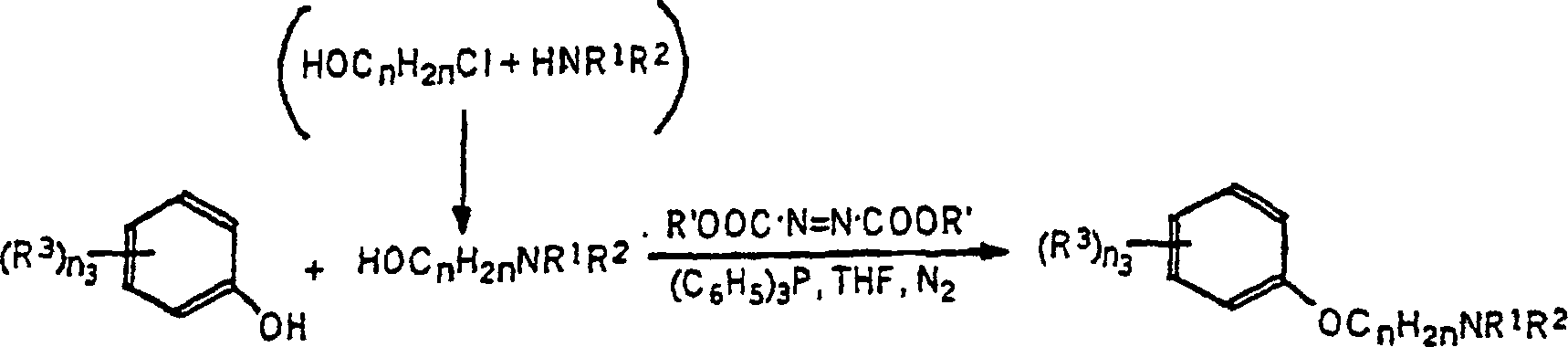
Schema
3 (Verfahren E): 
Schema
4 (Verfahren G): 
Schema
5 (Verfahren I): 

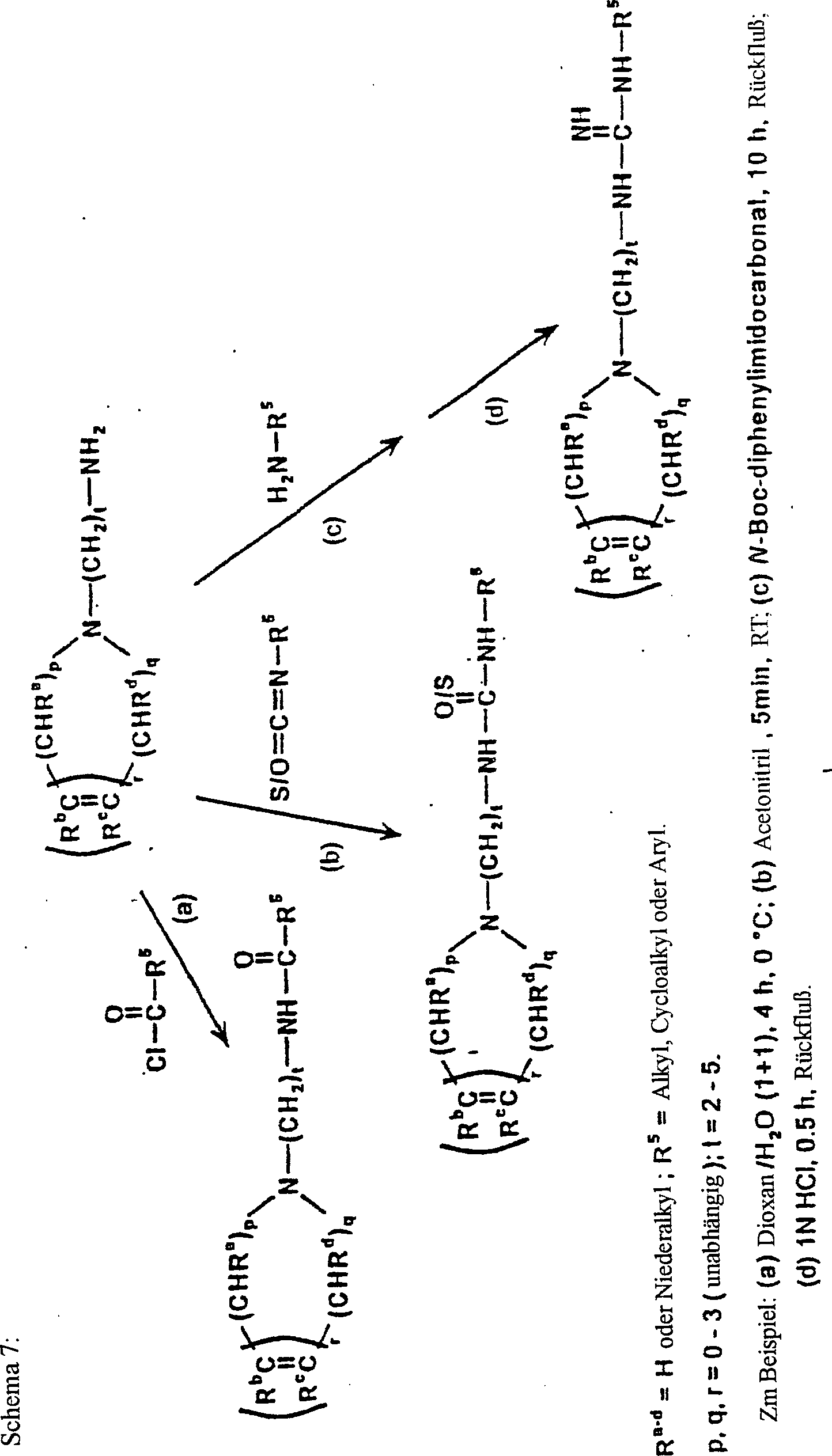

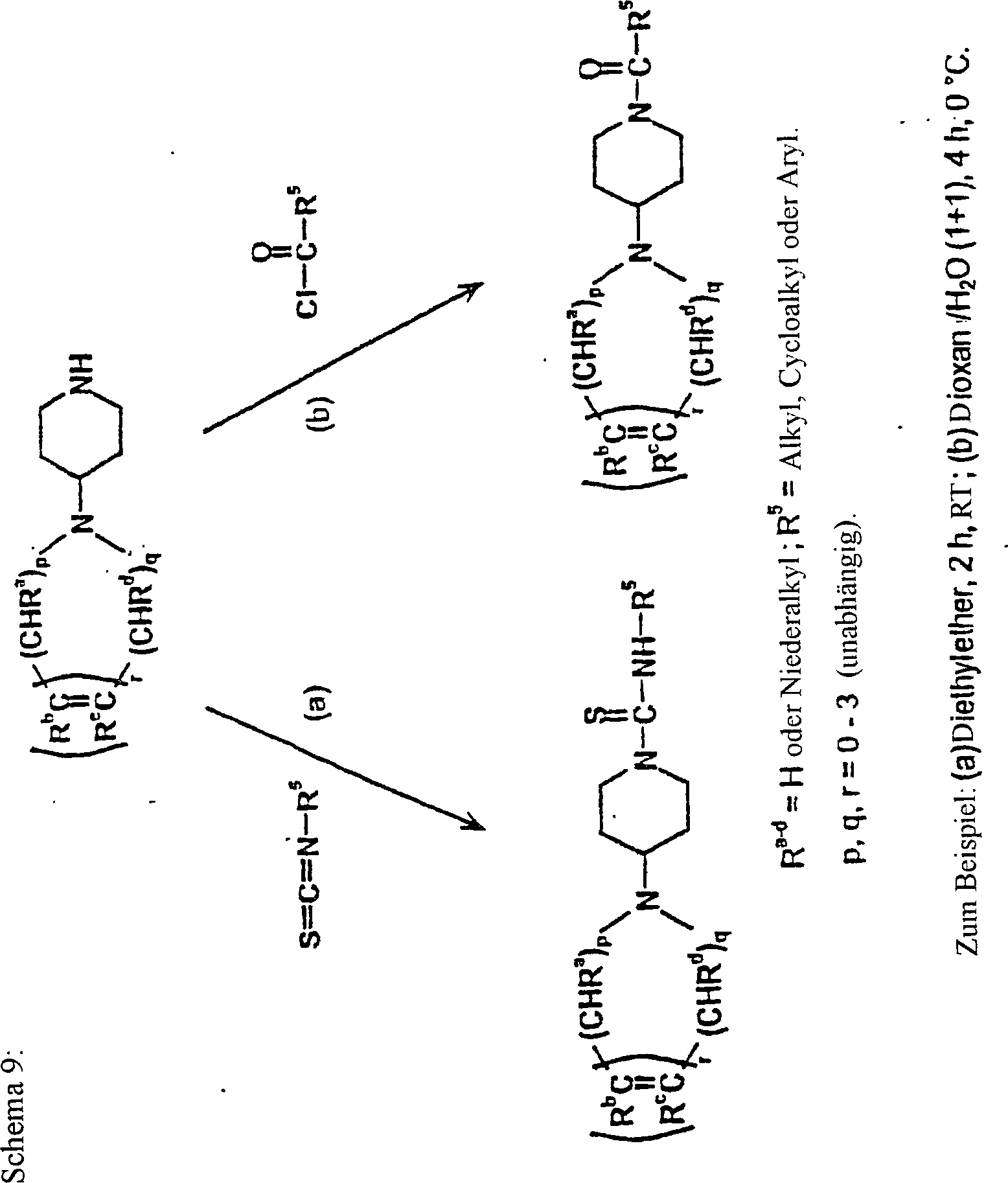


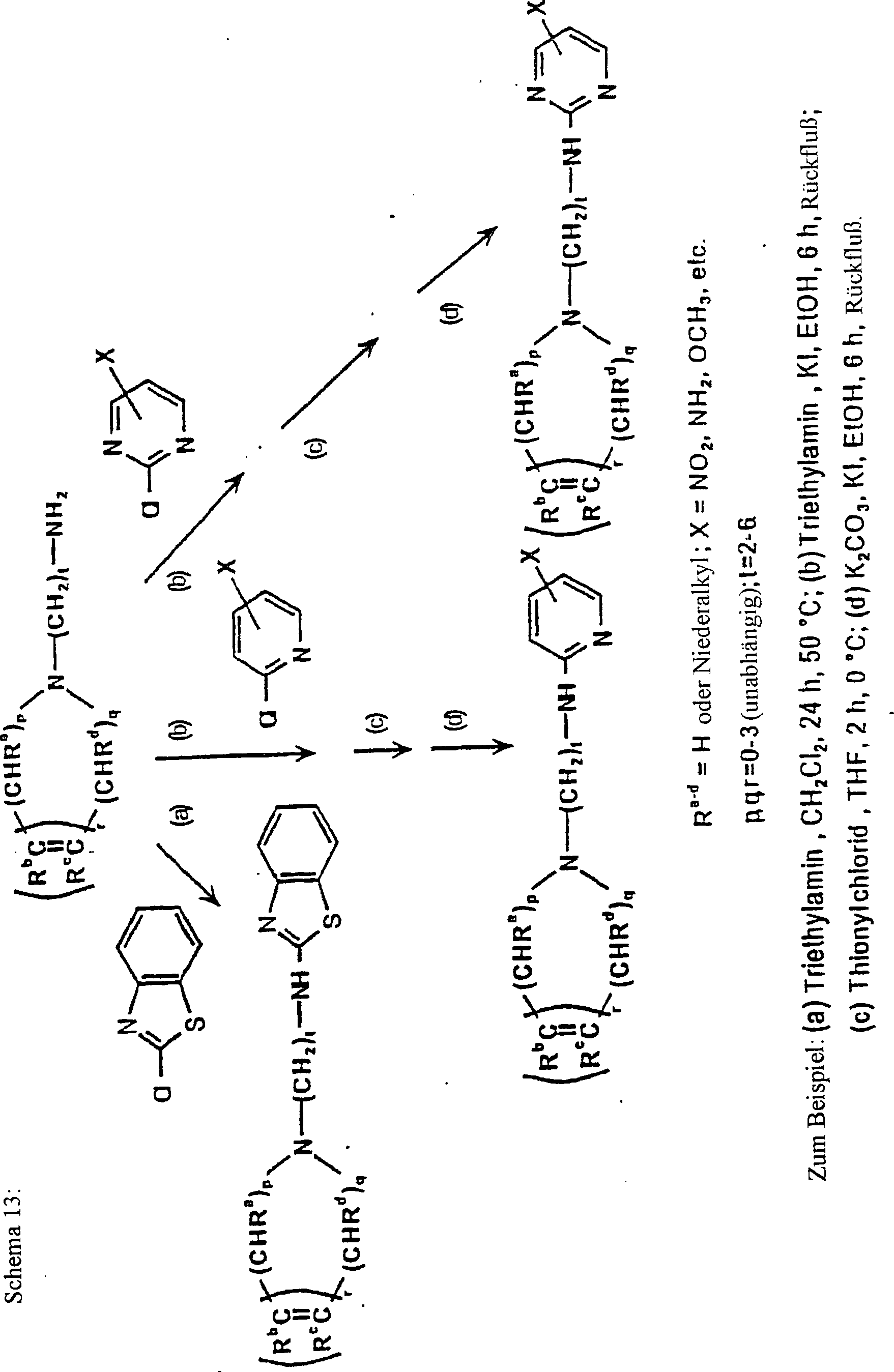
Schema
14: 
Die ausführlichen Syntheseverfahren werden in den Beispielen angegeben.The detailed Synthetic methods are given in the examples.
Die erfindungsgemäßen Verbindungen der Formeln (I) und (IIa) besitzen im Hinblick auf die Histamin-H3-Rezeptoren antagonistische und/oder agonistische Eigenschaften. Sie beeinflussen die Synthese und die Freisetzung von Histamin, Monoaminen oder Neuropeptiden im Gehirn und in peripheren Geweben.The compounds of the formulas (I) and (IIa) according to the invention have antagonistic and / or agonistic properties with regard to the histamine H 3 receptors. They influence the synthesis and release of histamine, monoamine or neuropeptides in the brain and peripheral tissues.
Diese Eigenschaft macht die erfindungsgemäßen Verbindungen zu nützlichen Derivaten in der Human- und Veterinärmedizin.This property makes the compounds of the invention useful derivatives in Hu man and veterinary medicine.
Ihre therapeutischen Anwendungen entsprechen solchen, welche für Verbindungen mit einer Aktivität als ein H3-Antagonist und/oder -Agonist bekannt sind, und betreffen insbesondere Erkrankungen des Zentralnervensystems.Their therapeutic applications correspond to those known for compounds having activity as an H 3 antagonist and / or agonist and, in particular, concern diseases of the central nervous system.
Im Hinblick auf eine antagonistische Aktivität können die erfindungsgemäßen Verbindungen bei der Behandlung der Alzheimer-Krankheit, von Stimmungs- und Bewußtseinsänderungen, kognitiven Ausfällen bei psychiatrischen Erkrankungen, Fettleibigkeit, Schwindel und Bewegungsübelkeit verwendet werden.in the In view of an antagonistic activity, the compounds of the invention in the treatment of Alzheimer's disease, mood and consciousness changes, cognitive failures in psychiatric disorders, obesity, dizziness and motion sickness be used.
Im Hinblick auf eine agonistische Aktivität können die erfindungsgemäßen Verbindungen bei der Behandlung von verschiedenen allergischen und entzündlichen Erkrankungen und als ein Beruhigungsmittel verwendet werden.in the With regard to an agonistic activity, the compounds of the invention in the treatment of various allergic and inflammatory Diseases and used as a sedative.
Daher werden die erfindungsgemäßen Verbindungen der Formeln (I) und (IIa) vorteilhafterweise als ein Wirkstoffbestandteil von Medikamenten verwendet, welche als ein Ligand für H3-Rezeptoren von Histamin und insbesondere als ein Antagonist und/oder Agonist für H3-Rezeptoren von Histamin wirksam sind.Therefore, the compounds of formulas (I) and (IIa) according to the invention are advantageously used as an active ingredient of medicaments which acts as a ligand for H 3 receptors of histamine and in particular as an antagonist and / or agonist for histamine H 3 receptors are.
Die Antagonisten werden vorteilhafterweise insbesondere als ein Wirkstoffbestandteil von Medikamenten, welche psychotrope Wirkungen besitzen, die Wachheit, Aufmerksamkeit und Erinnerung fördern sowie die Stimmung verbessern, und bei der Behandlung von Erkrankungen wie der Alzheimer-Krankheit und anderen kognitiven Erkrankungen bei älteren Menschen, depressiven oder ausschließlich asthenischen Zuständen verwendet.The Antagonists are advantageously especially as an active ingredient medications that have psychotropic effects, alertness, Promote attention and memory as well as improve mood, and in the treatment of diseases such as Alzheimer's disease and other cognitive disorders in older People who used depressive or exclusively asthenic states.
Ihre nootropen Wirkungen können nützlich sein, um die Aufmerksamkeit und die Erinnerungsfähigkeit bei gesunden Menschen zu stimulieren.Your nootropic effects can useful be to the attention and the memory ability of healthy people to stimulate.
Zusätzlich können diese Mittel bei der Behandlung von Fettleibigkeit, Schwindel und Bewegungsübelkeit nützlich sein.In addition, these can Means in the treatment of obesity, dizziness and movement sickness useful be.
Es kann auch nützlich sein, die erfindungsgemäßen Verbindungen mit anderen psychiatrischen Mitteln wie Neuroleptika zu kombinieren, um deren Wirksamkeit zu erhöhen und ihre Nebenwirkungen zu verringern.It can also be useful be, the compounds of the invention to combine with other psychiatric drugs such as neuroleptics to increase their effectiveness and to reduce their side effects.
Die Anwendung bei einer bestimmten Form der Epilepsie ist auch denkbar.The Use in a particular form of epilepsy is also feasible.
Die therapeutischen Anwendungen hiervon schließen auch periphere Organe ein, und zwar hauptsächlich als ein Stimulans der Sekretion oder der Magen-Darm-Tätigkeit. Die erfindungsgemäßen Verbindungen sind insbesondere zur Behandlung von CNS-Störungen bei älteren Menschen nützlich.The therapeutic applications thereof also include peripheral organs, mainly as a stimulant of secretion or gastrointestinal activity. The compounds of the invention are particularly useful for the treatment of CNS disorders in the elderly.
Die Verbindungen können auch als ein Wirkstoff mit einer agonistischen oder partiellen agonistischen Aktivität auf die Histamin-Rezeptoren verwendet werden.The Connections can also as an active substance with an agonistic or partial agonistic activity on the Histamine receptors are used.
Agonisten und partielle Agonisten des H3-Rezeptors üben durch ihre cerebralen Wirkungen hauptsächlich eine beruhigende, sedierende, streßabbauende und schmerzstillende Aktivität aus, was ihre Verwendung als milde, beruhigende Psychotropika, insbesondere bei verschiedenen psychosomatischen Erkrankungen, zeigt.Agonists and partial agonists of the H 3 receptor mainly exert a sedative, sedative, stress-relieving and analgesic activity through their cerebral effects, demonstrating their use as mild soothing psychotropic agents, particularly in various psychosomatic disorders.
Agonisten und partielle Agonisten des H3-Rezeptors sind auch bei der Behandlung von Migränezuständen und anderen Formen des Kopfschmerzes indiziert.Agonists and partial agonists of the H 3 receptor are also indicated in the treatment of migraine conditions and other forms of headache.
Durch ihre peripheren Wirkungen sind Agonisten und partielle Agonisten des H3-Rezeptors vorwiegend bei der Behandlung von respiratorischen, allergischen oder entzündlichen Zuständen (Asthma, Bronchitis, Rhinitis, Tracheitis und dergleichen), kardialen Zuständen (myocardiale Dysfunktion und Infarkt), gastrointestinalen Zuständen als ein Ergebnis ihrer antisekretorischen und entzündungshemmenden Wirkungen (Magen- und Zwölffingerdarmgeschwüre, ulzerative Kolitis, Crohn-Krankheit, Reizkolon, Stuhlinkontinenz und dergleichen), Zuständen des Urogenitaltrakts (Blasenentzündung, Uterusentzündung, prämenstruelles Syndrom, Prostataentzündungen, Harninkontinenz, Geschlechtskrankheiten) und Zuständen des Hautsystems (Nesselsucht, Juckreiz) indiziert. Diese entzündungshemmende und schmerzstillende Wirkung kann auch bei der Behandlung von Arthritis und anderen rheumatischen Zuständen, einer Bindehautentzündung und anderen Augenentzündungen sowie Speichelfluß einen nützlichen Beitrag leisten.Due to their peripheral effects, agonists and partial agonists of the H 3 receptor are predominantly used in the treatment of respiratory, allergic or inflammatory conditions (asthma, bronchitis, rhinitis, tracheitis and the like), cardiac conditions (myocardial dysfunction and infarct), gastrointestinal conditions Result of their antisecretory and anti-inflammatory effects (gastric and duodenal ulcers, ulcerative colitis, Crohn's disease, irritable bowel syndrome, faecal incontinence and the like), conditions of the genitourinary tract (cystitis, uterine inflammation, premenstrual syndrome, prostate inflammation, urinary incontinence, venereal diseases) and conditions of the skin system (hives, Itching). This anti-inflammatory and analgesic action may also be useful in the treatment of arthritis and other rheumatic conditions, conjunctivitis and other ocular inflammation, as well as salivation.
Verbindungen, welche Agonisten oder partielle Agonisten des Histamin-H3-Rezeptors sind, werden vorteilhafterweise als ein Wirkstoffbestandteil von medizinischen Produkten verwendet, welche insbesondere milde, beruhigende, antisekretorische, entzündungshemmende, den Salzgehalt regulierende und krampflösende Wirkungen, regulatorische Wirkungen auf die hypothalamohypophysäre Sekretion, antidepressive Wirkungen, modulatorische Wirkungen auf die Gehirndurchblutung, modulatorische Wirkungen auf das Immunsystem sowie antiallergische und anti-Migräne-Wirkungen besitzen.Compounds which are agonists or partial agonists of the histamine H 3 receptor are advantageously used as an active ingredient of medical products, which in particular have mild, soothing, antisecretory, anti-inflammatory, salinity-regulating and antispasmodic effects, regulatory effects on hypothalamohypophysial secretion, have antidepressant effects, modulatory effects on cerebral circulation, modulatory effects on the immune system, and antiallergic and anti-migraine effects.
Die erfindungsgemäßen Medikamente oder pharmazeutischen Zusammensetzungen können über orale, parenterale oder topische Wege verabreicht werden, wobei der Wirkstoffbestandteil mit einem therapeutisch geeigneten Excipienten oder Vehikel kombiniert ist.The medicaments of the invention or pharmaceutical compositions can be administered via oral, parenteral or topical routes are administered, wherein the active ingredient combined with a therapeutically suitable excipient or vehicle is.
Erfindungsgemäß wird vorteilhafterweise die orale Verabreichung verwendet. Für jede der obigen Indikationen hängt die Menge des Wirkstoffbestandteils von dem Zustand des Patienten ab.According to the invention is advantageously used the oral administration. For each of the above indications depends on that Amount of the active ingredient from the condition of the patient.
Jedoch liegt eine geeignete wirksame Dosis im allgemeinen im Bereich von 10 bis 500 mg pro Tag und von 1 bis 10 mg/Tag für besonders wirksame Verbindungen. Diese Dosen sind bezogen auf die Verbindung angegeben und sollten für die Salze, Hydrate oder hydratisierten Salze hiervon angepaßt werden.however a suitable effective dose is generally in the range of 10 to 500 mg per day and from 1 to 10 mg / day for particularly effective compounds. These doses are given and should be based on the compound for the Salts, hydrates or hydrated salts thereof are adapted.
Die Erfindung wird nun durch die folgenden Beispiele veranschaulicht.The Invention will now be illustrated by the following examples.
BeispieleExamples
Die
Struktur der synthetisierten Verbindungen und das Herstellungsverfahren
hiervon sowie der Schmelzpunkt, das Umkristallisierungssolvens und
die Elementaranalyse hiervon sind in der folgenden Tabelle I zusammnengefaßt: Tabelle
1: 


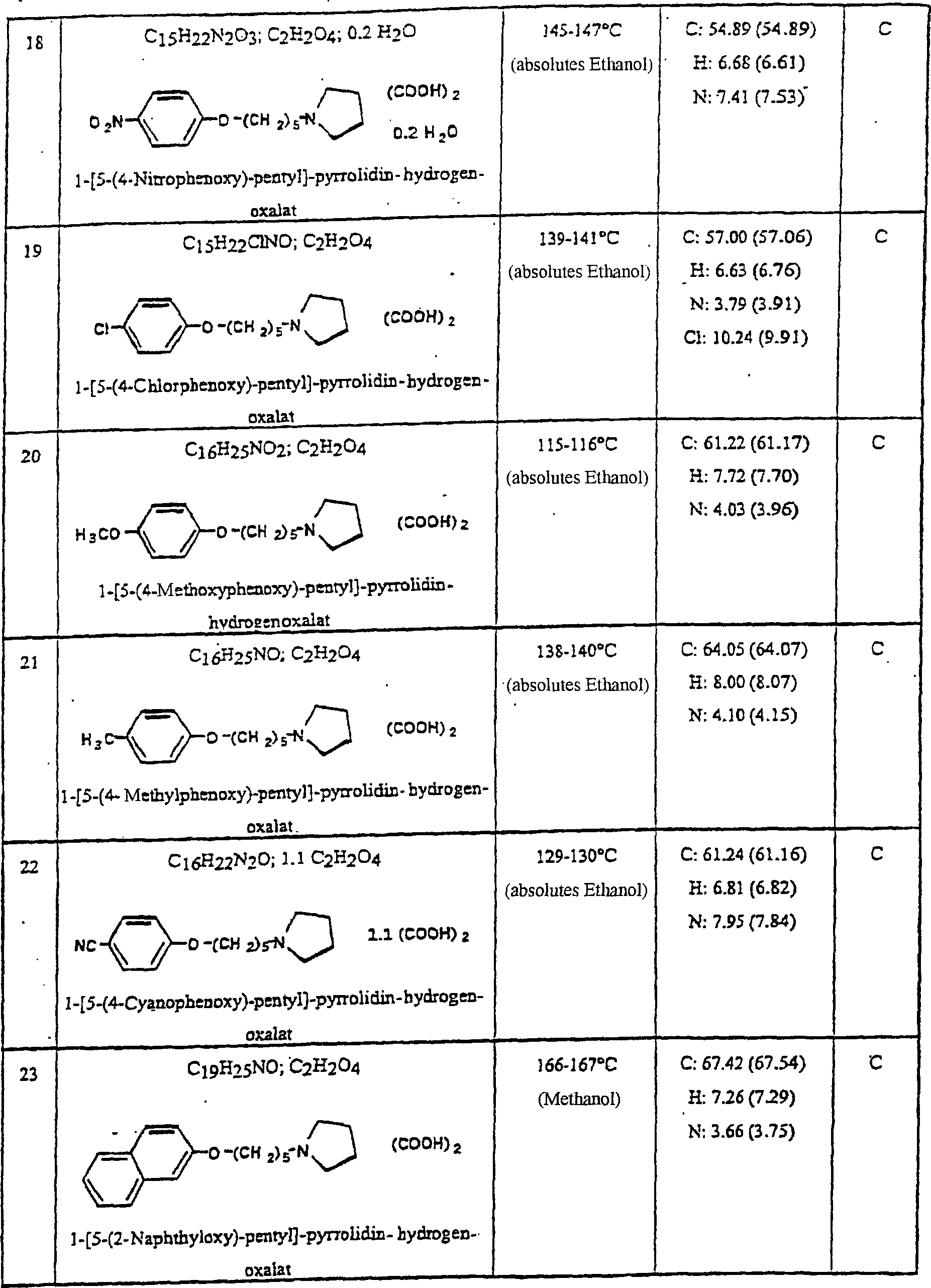

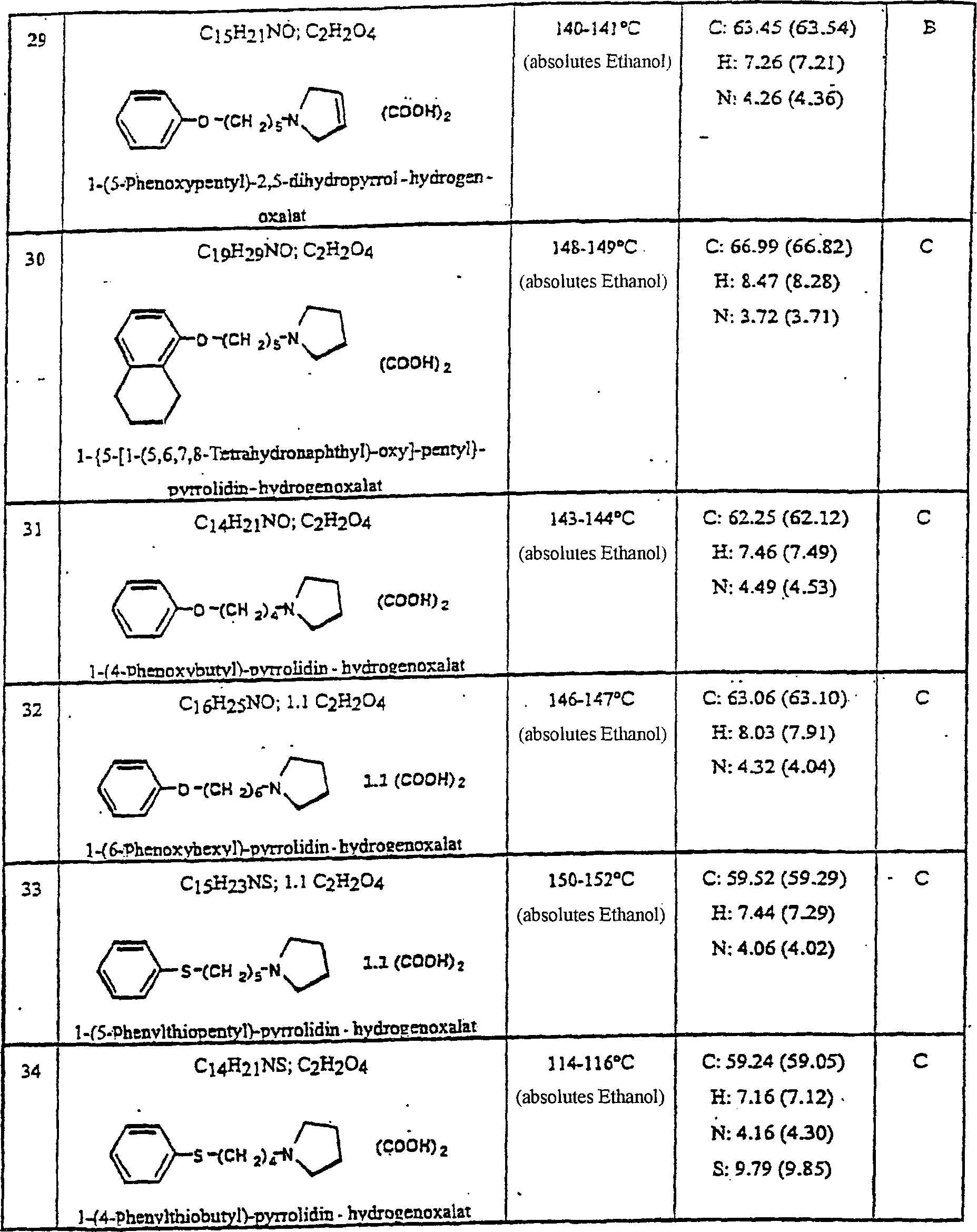
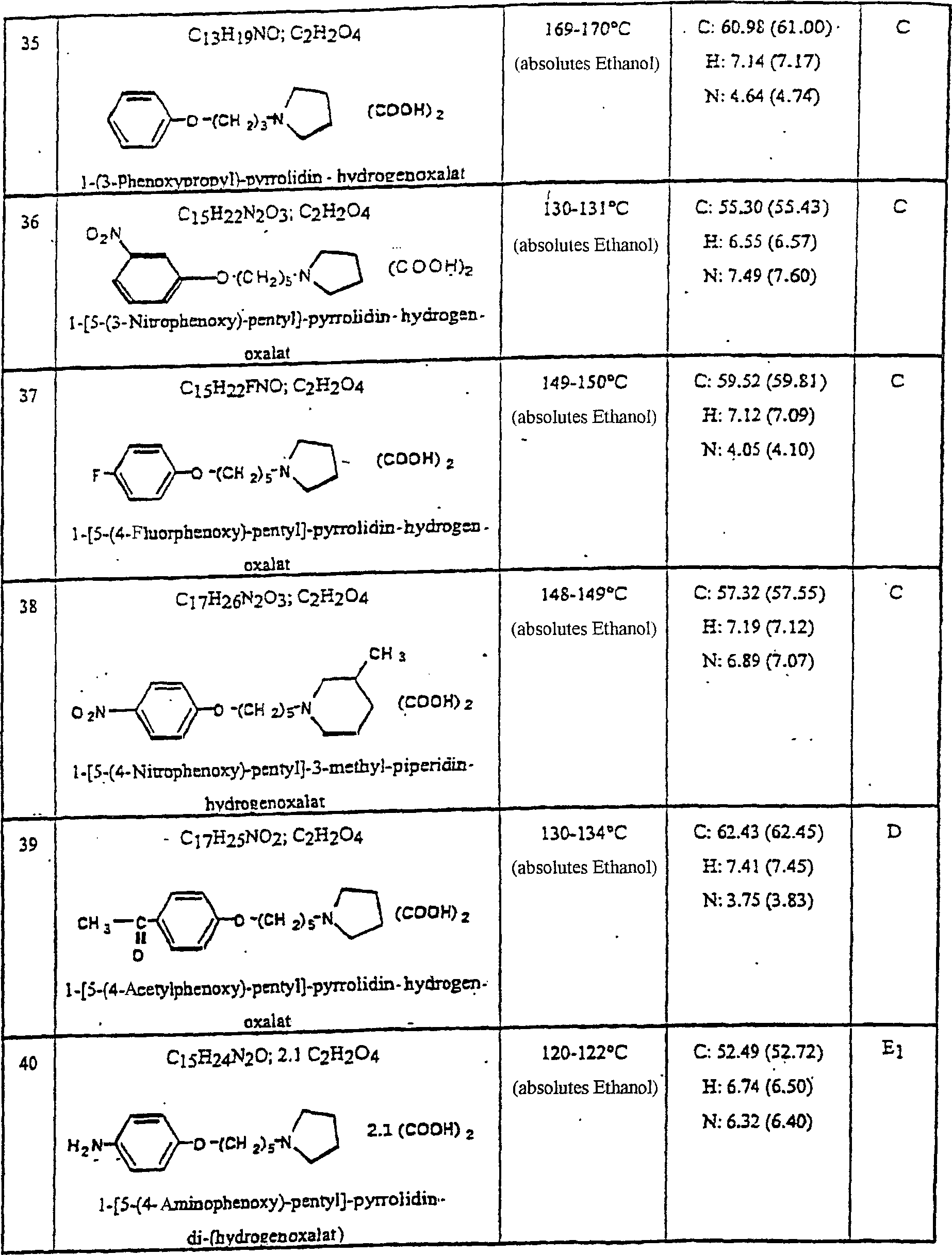

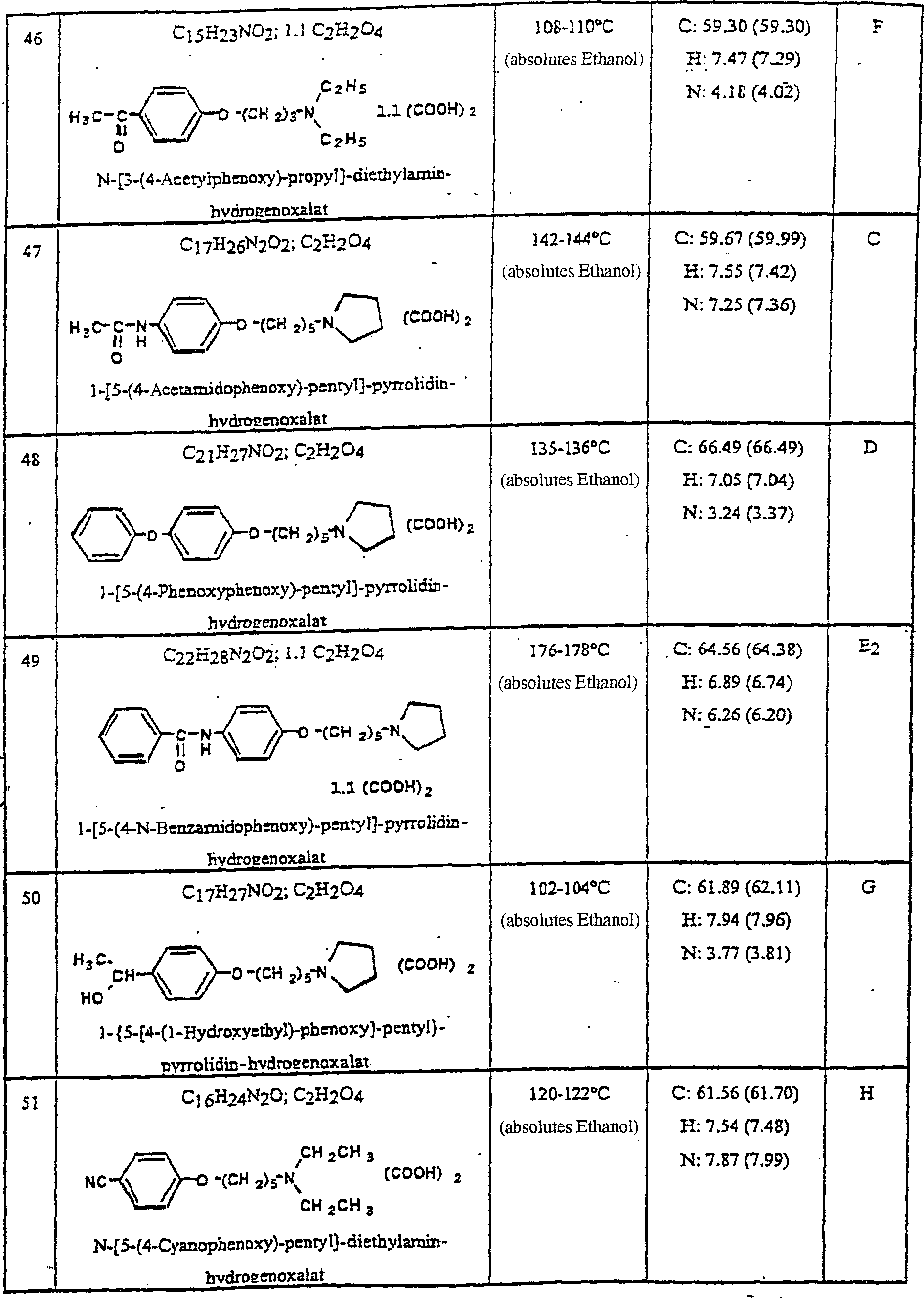
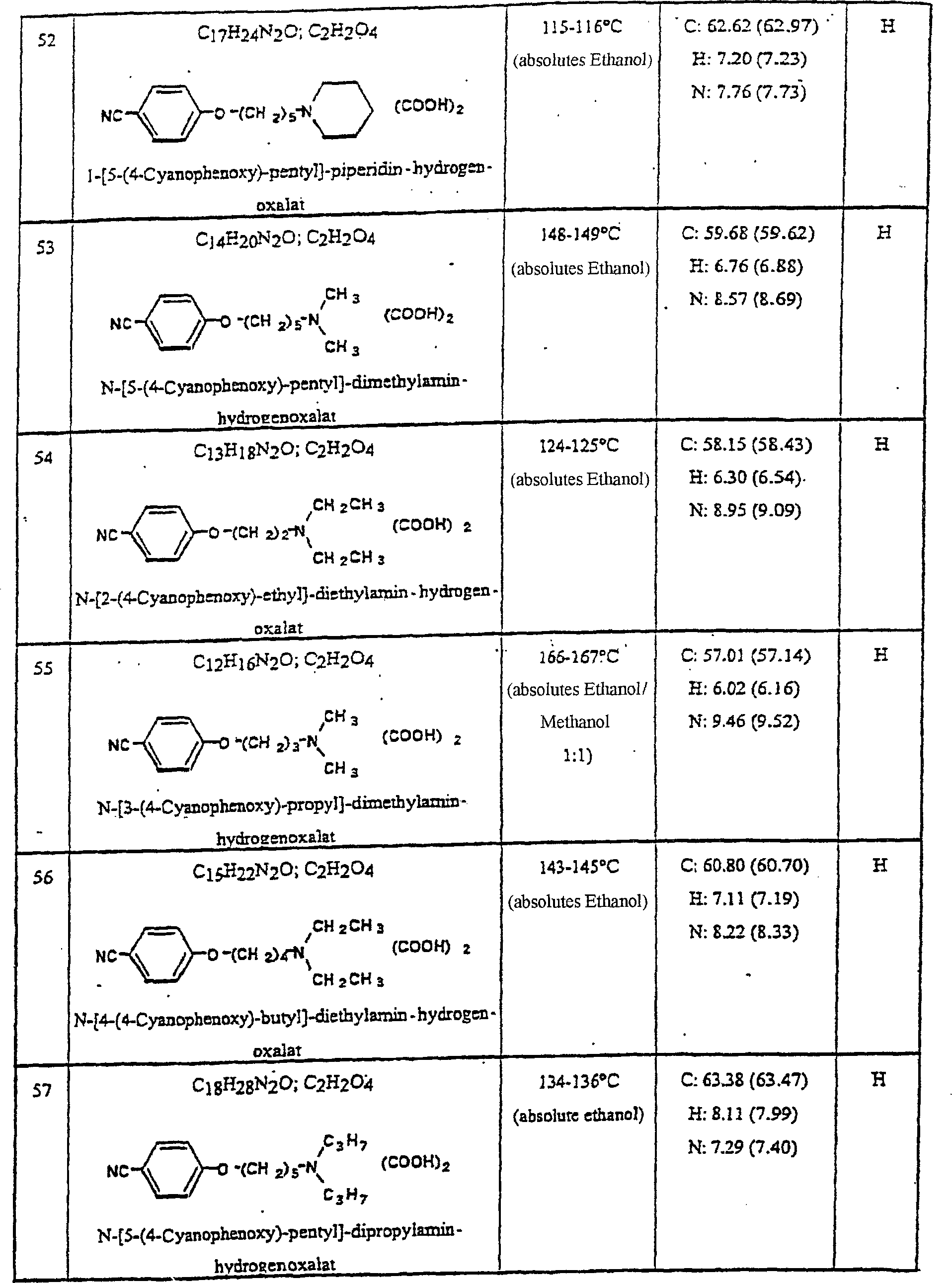

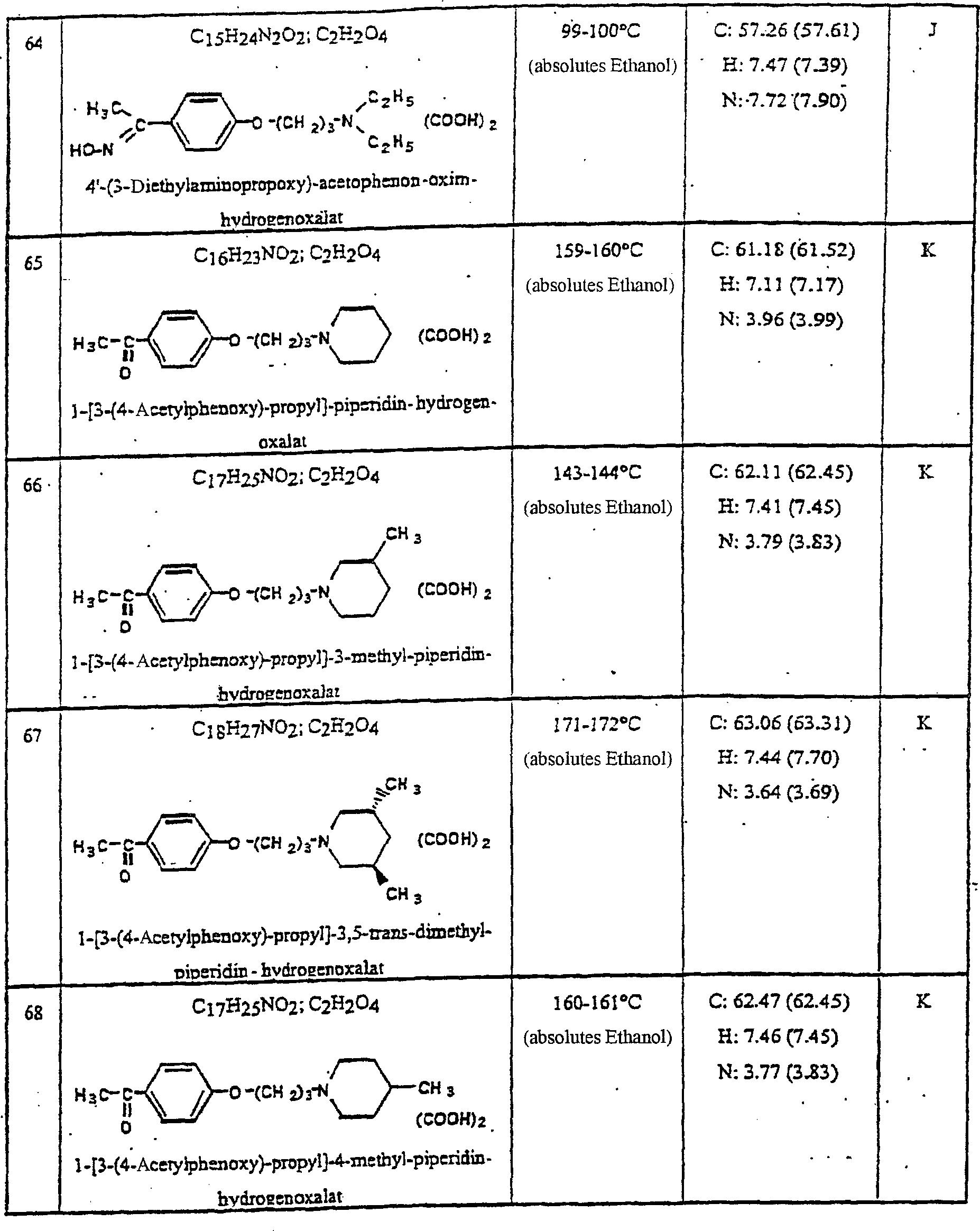
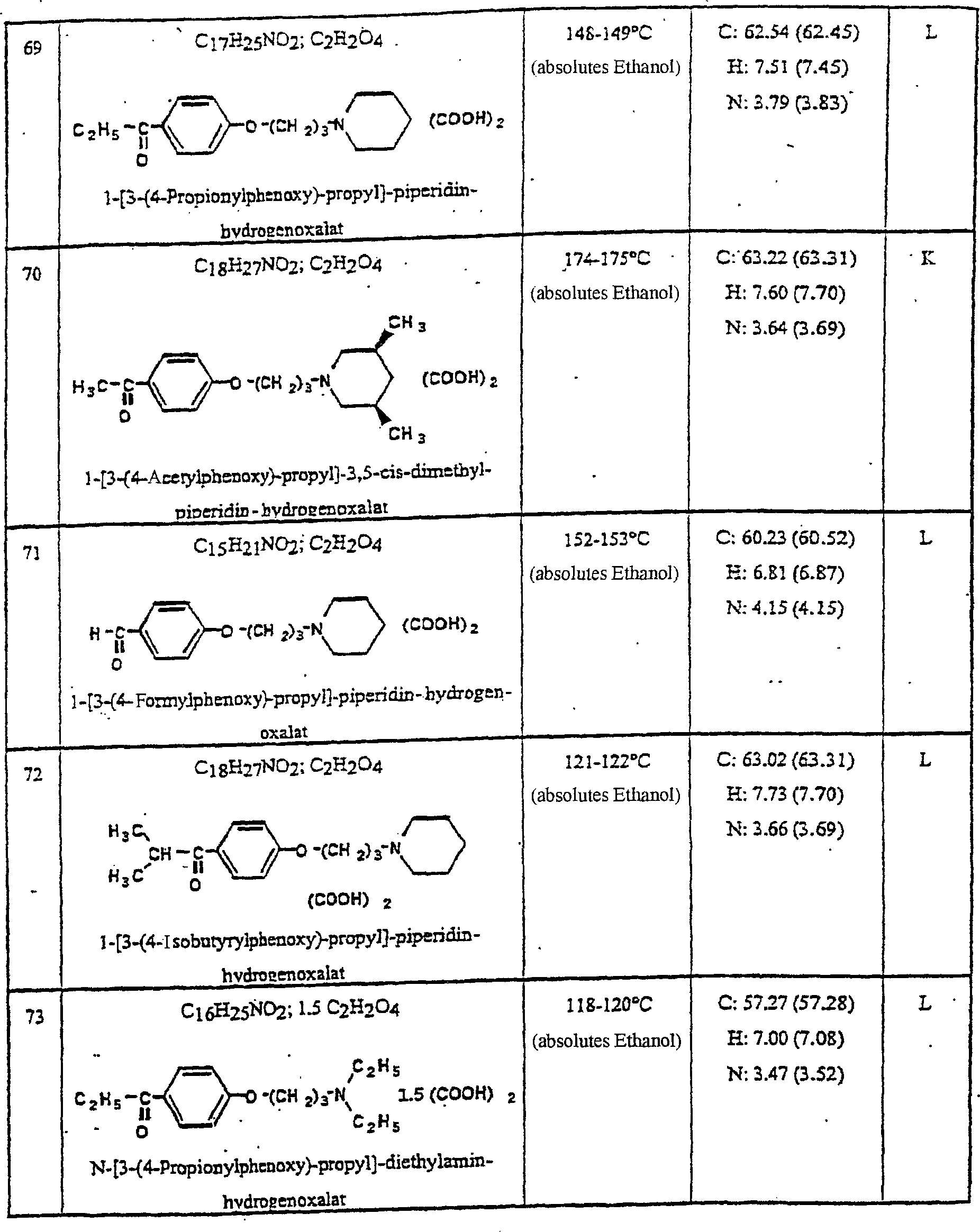
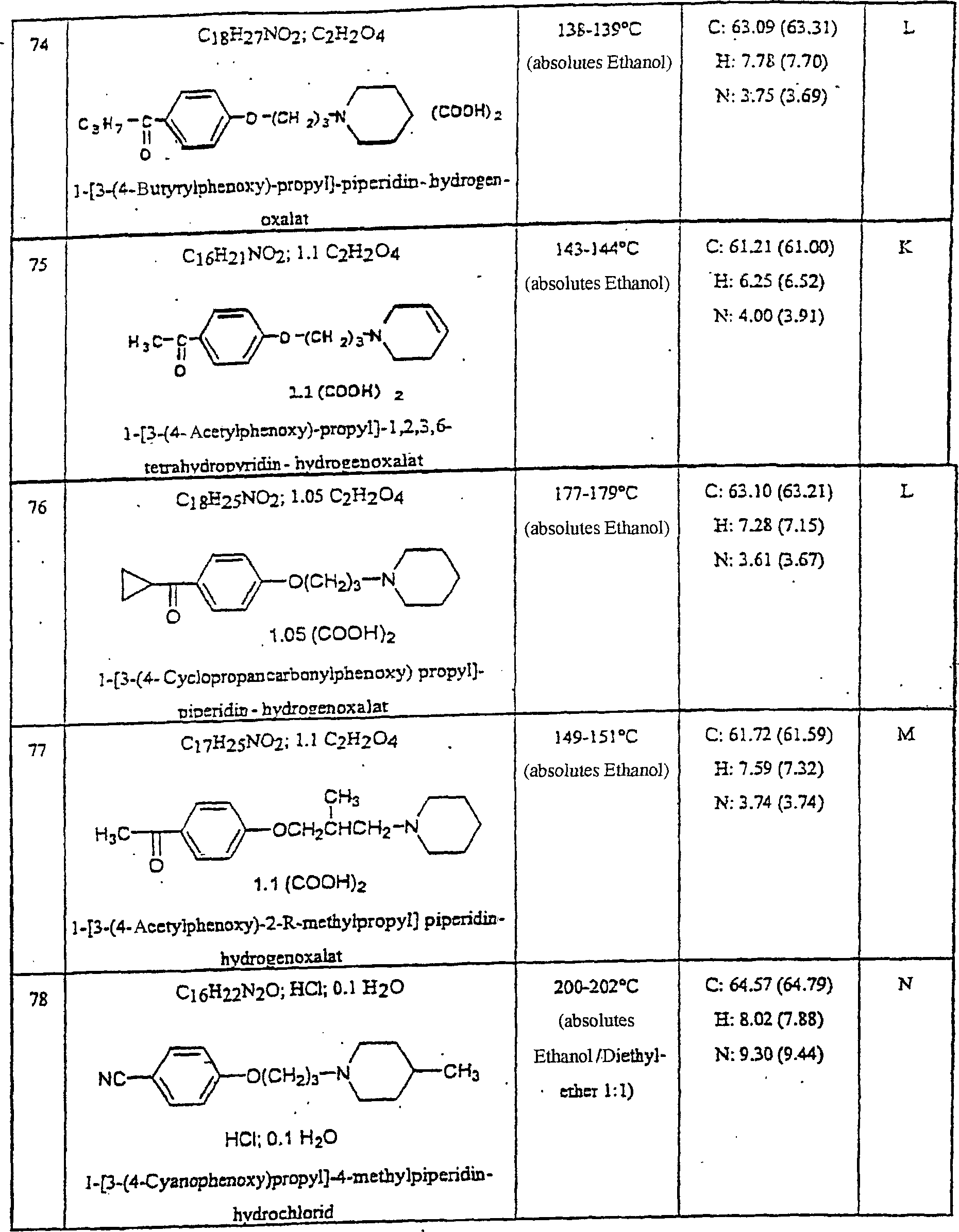
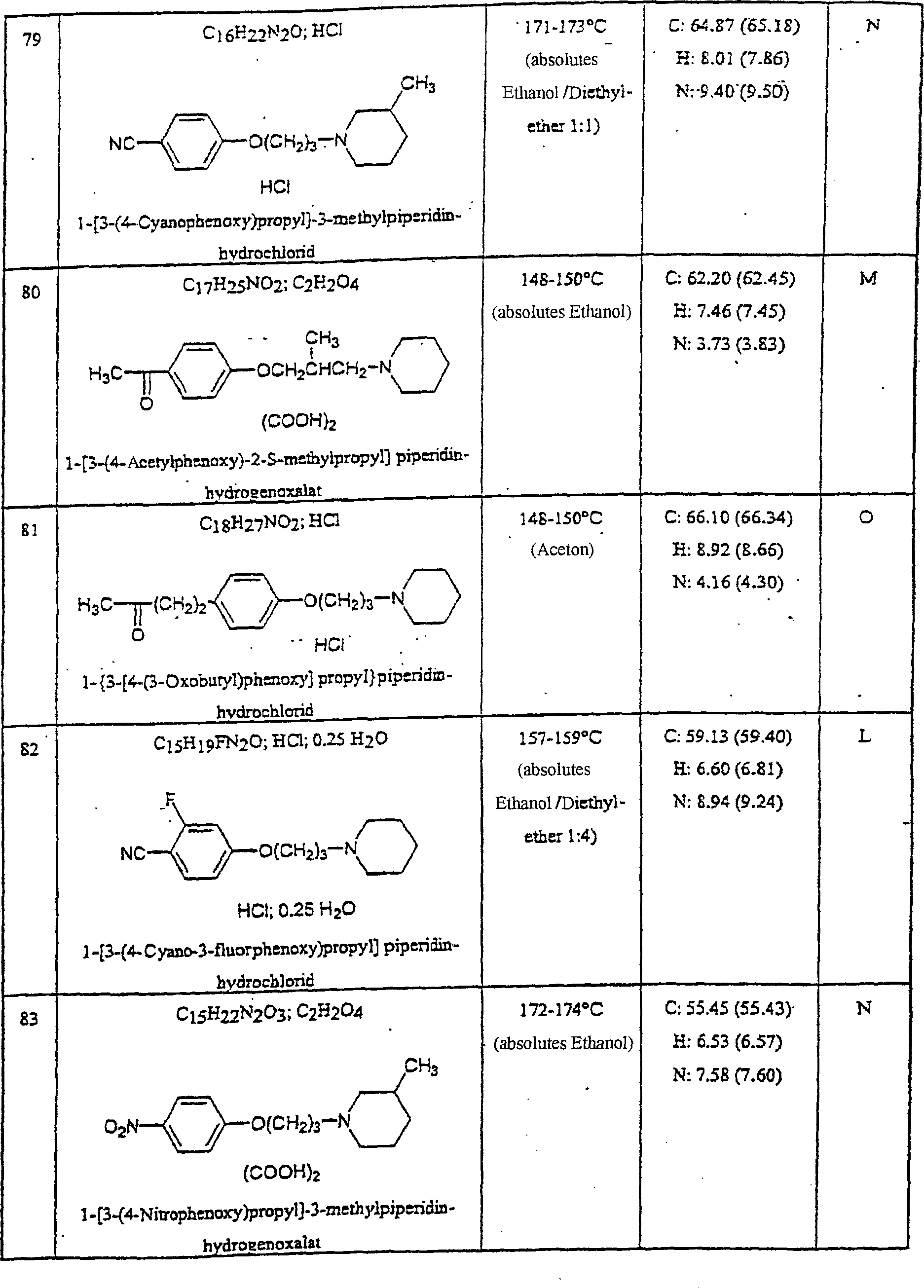


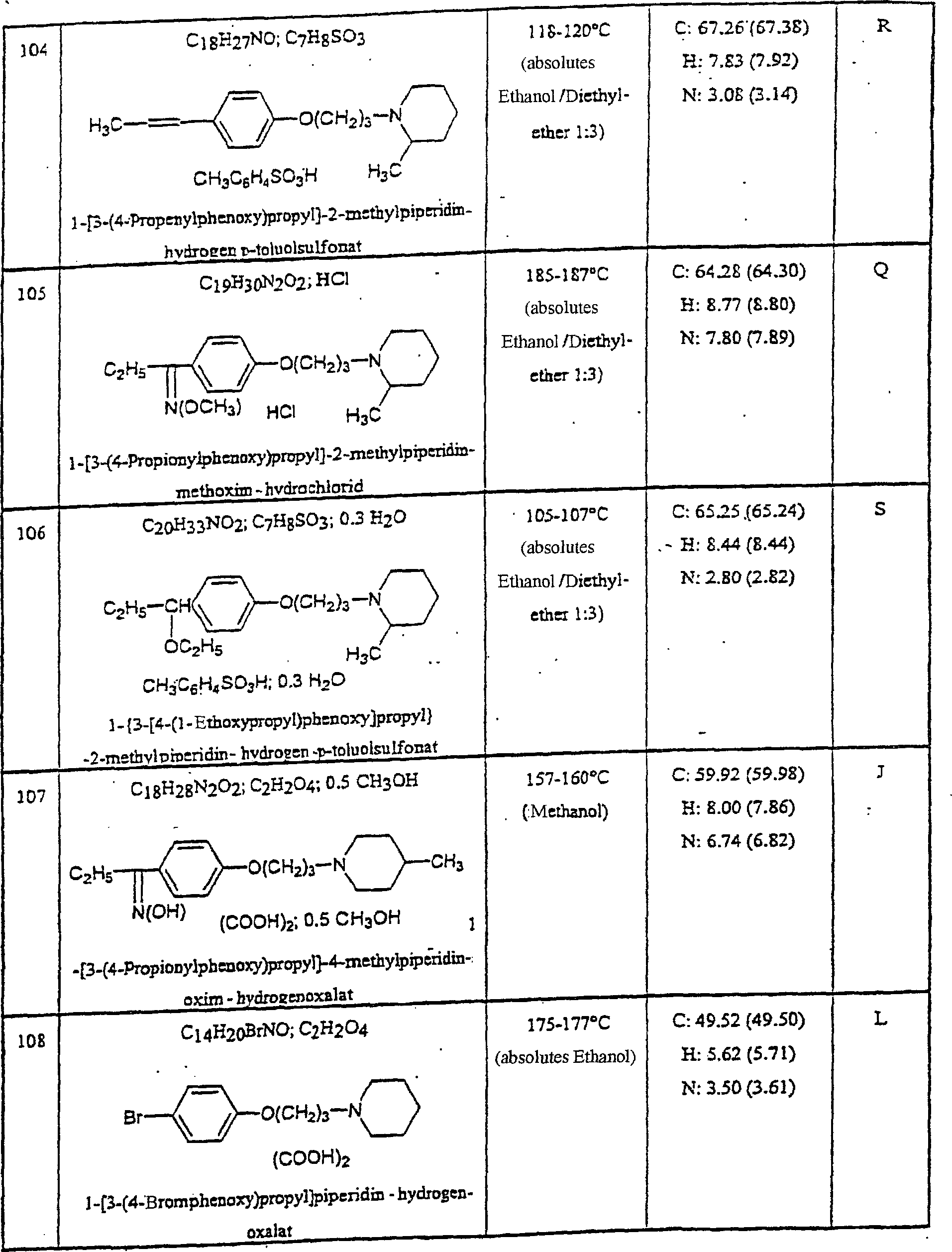
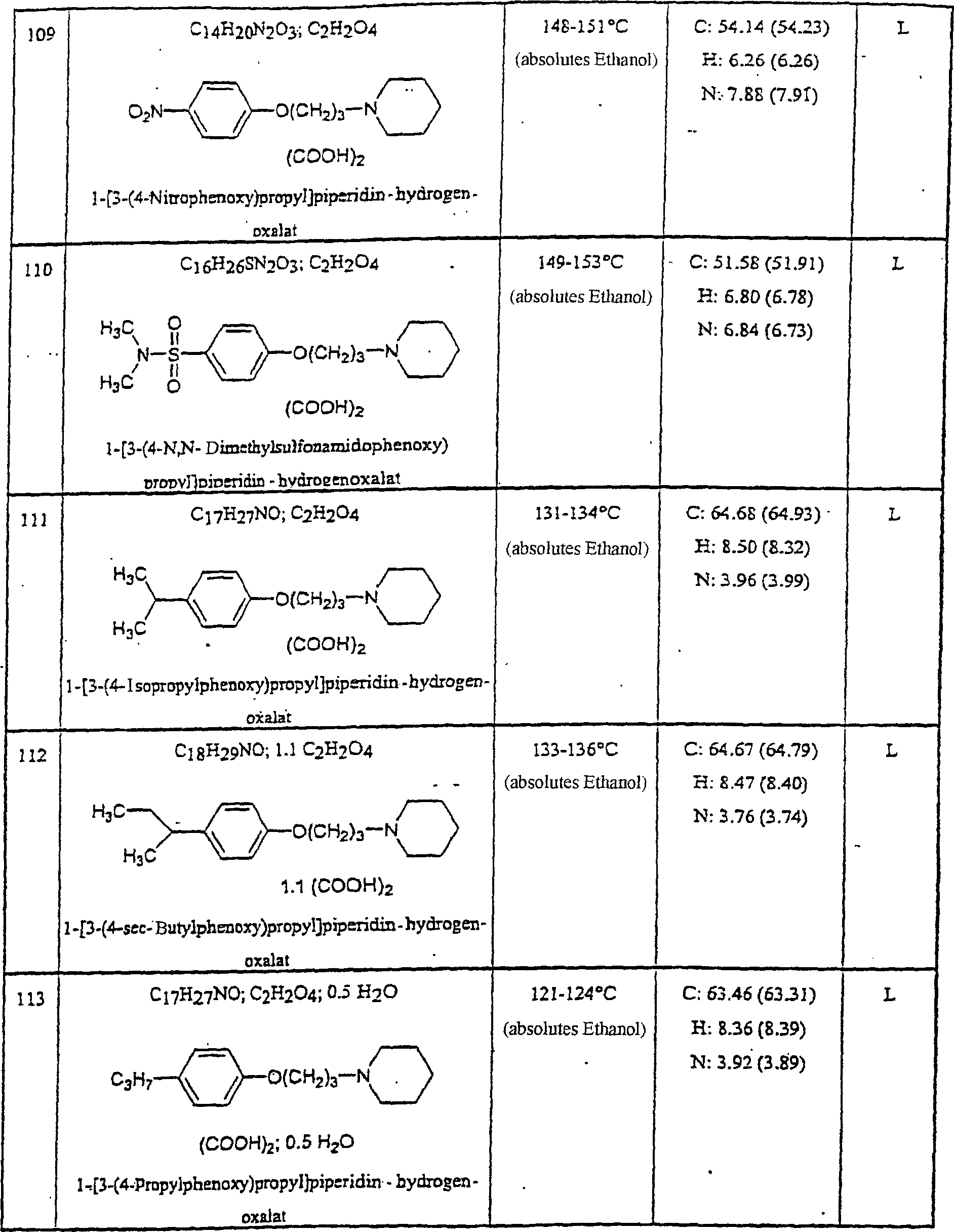
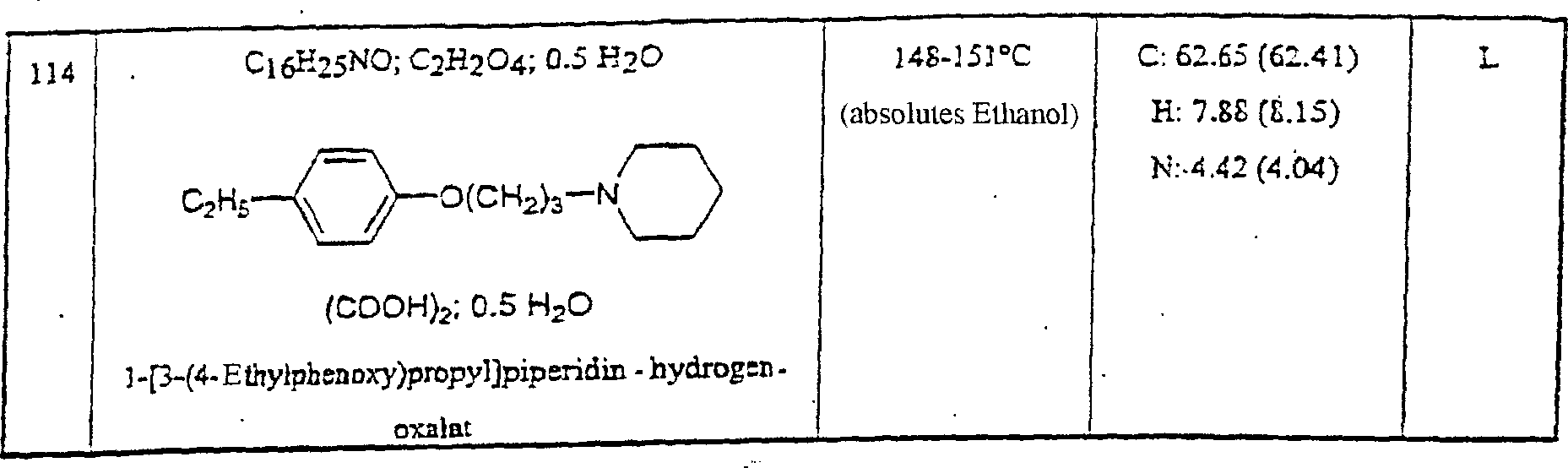
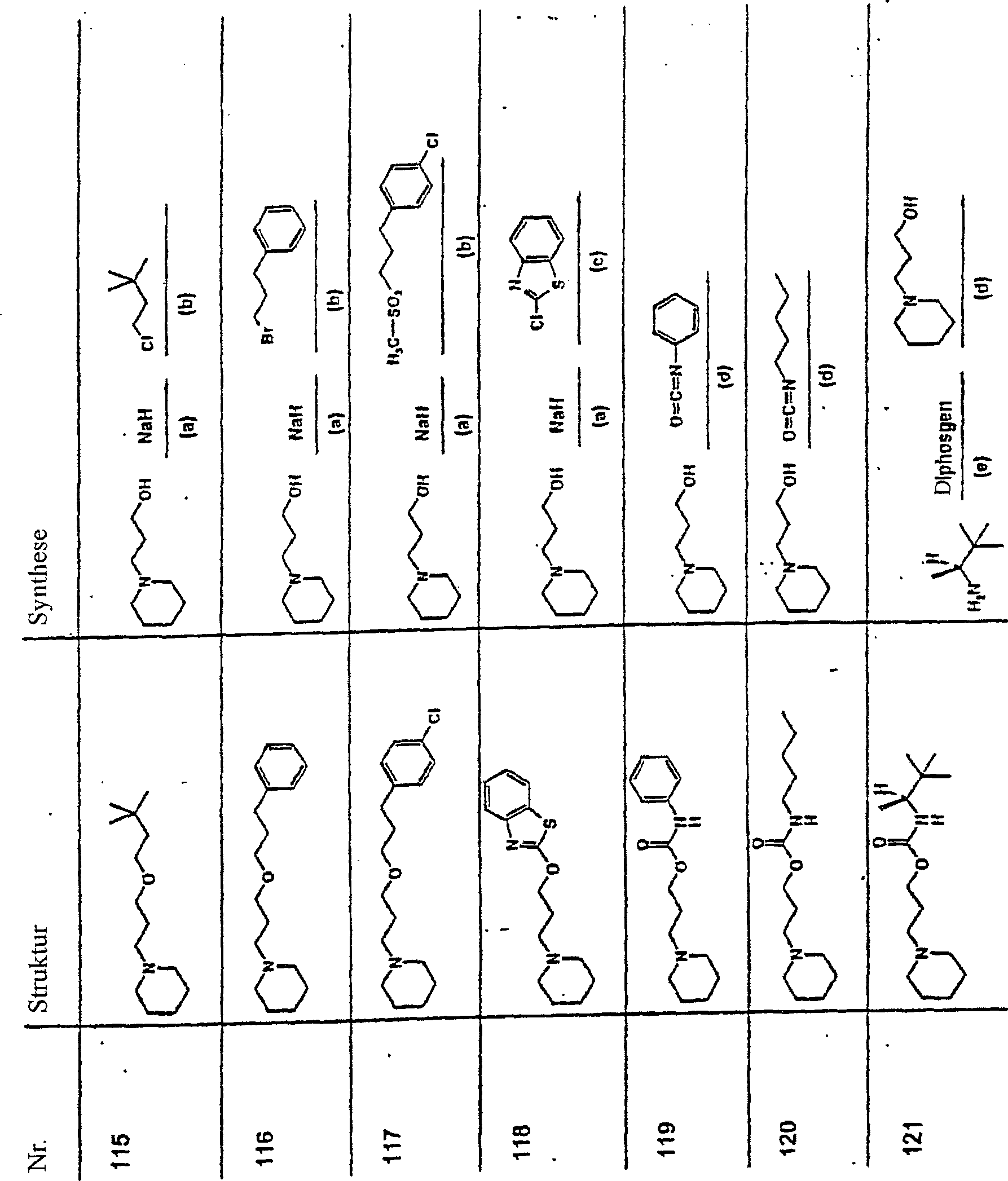

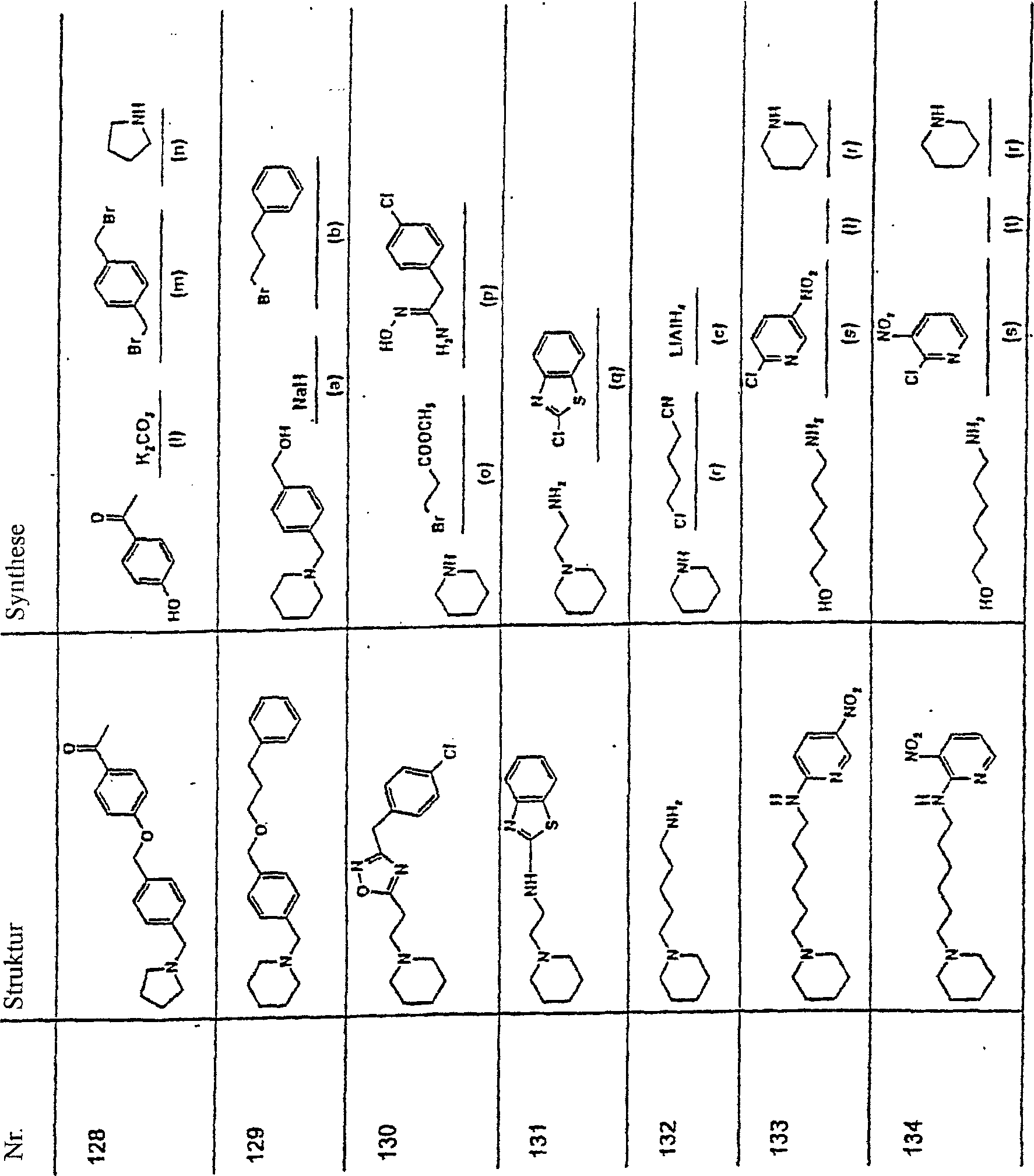
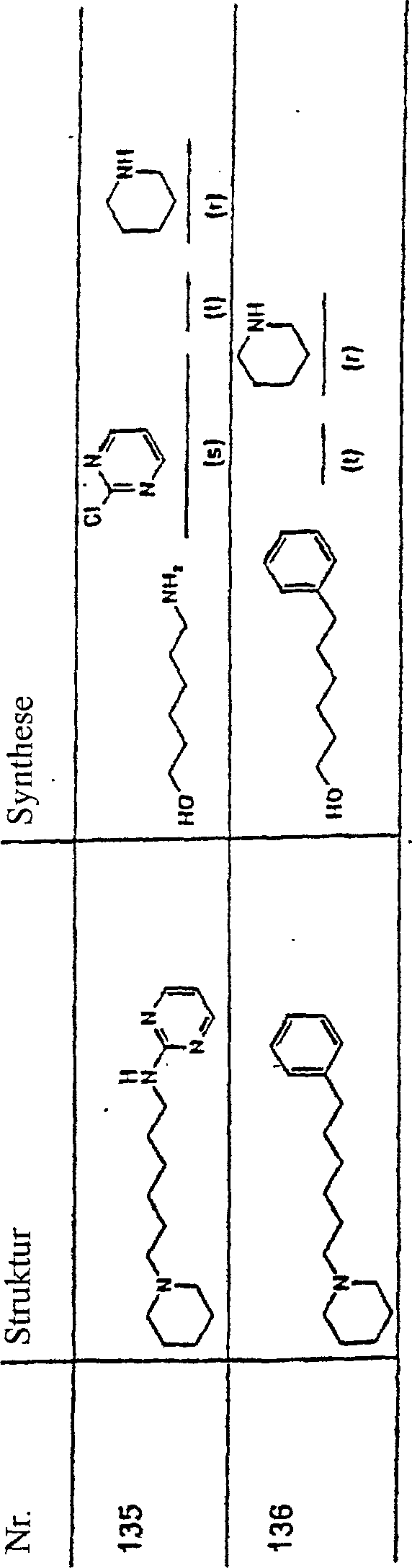
- (a) Toluol, 12 h RT.
- (b) Toluol, Tetrabutylammoniumiodid, 15-Crown-5, 12 80°C.
- (c) THF, 12 h, Rückfluß.
- (d) Acetonitril, 4 h, 60°C.
- (e) Ethylacetat, 3 h, 60°C.
- (f) Diethylether, 2 h, RT.
- (g) H2O/EtOH, 2 h, Rückfluß.
- (h) KI, EtOH, 2 T, Rückfluß.
- (i) Dioxan/H2O (1+1), 4 h, 0°C.
- (k) Acetonitril, 5 min, RT.
- (l) Aceton/DMF (10:1), 10 min, RT.
- (m) 12 h, RT.
- (n) 1 h, Rückfluß.
- (o) Triethylamin, Aceton, 8 h, 50°C.
- (p) Na, MeOH, DMF, 6 h, 80°C.
- (q) Triethylamin, MeOH, 24 h, 50°C.
- (r) K2CO3, KI, EtOH, 6 h, Rückfluß.
- (s) Triethylamin, KI, EtOH, 12 h, Rückfluß.
- (t) Thionylchlorid, THF, 2 h, 0°C.
- (a) toluene, 12h RT.
- (b) toluene, tetrabutylammonium iodide, 15-crown-5, 12 80 ° C.
- (c) THF, 12 h, reflux.
- (d) acetonitrile, 4h, 60 ° C.
- (e) ethyl acetate, 3h, 60 ° C.
- (f) diethyl ether, 2h, RT.
- (g) H 2 O / EtOH, 2h, reflux.
- (h) KI, EtOH, 2T, reflux.
- (i) dioxane / H 2 O (1 + 1), 4h, 0 ° C.
- (k) acetonitrile, 5 min, RT.
- (l) acetone / DMF (10: 1), 10 min, RT.
- (m) 12 h, RT.
- (n) 1 h, reflux.
- (o) triethylamine, acetone, 8h, 50 ° C.
- (p) Na, MeOH, DMF, 6h, 80 ° C.
- (q) Triethylamine, MeOH, 24h, 50 ° C.
- (r) K 2 CO 3 , KI, EtOH, 6h, reflux.
- (s) triethylamine, KI, EtOH, 12h, reflux.
- (t) thionyl chloride, THF, 2h, 0 ° C.
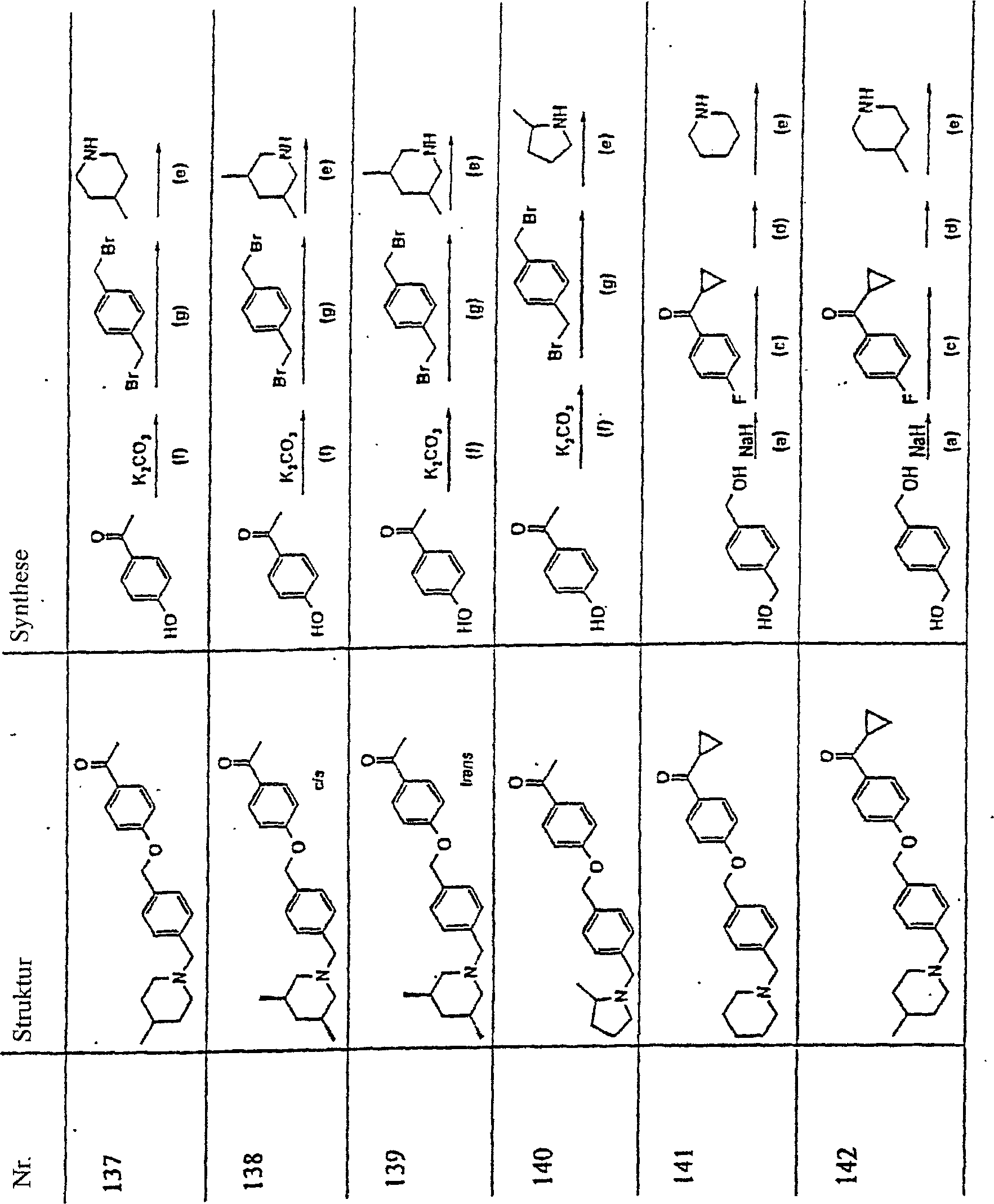
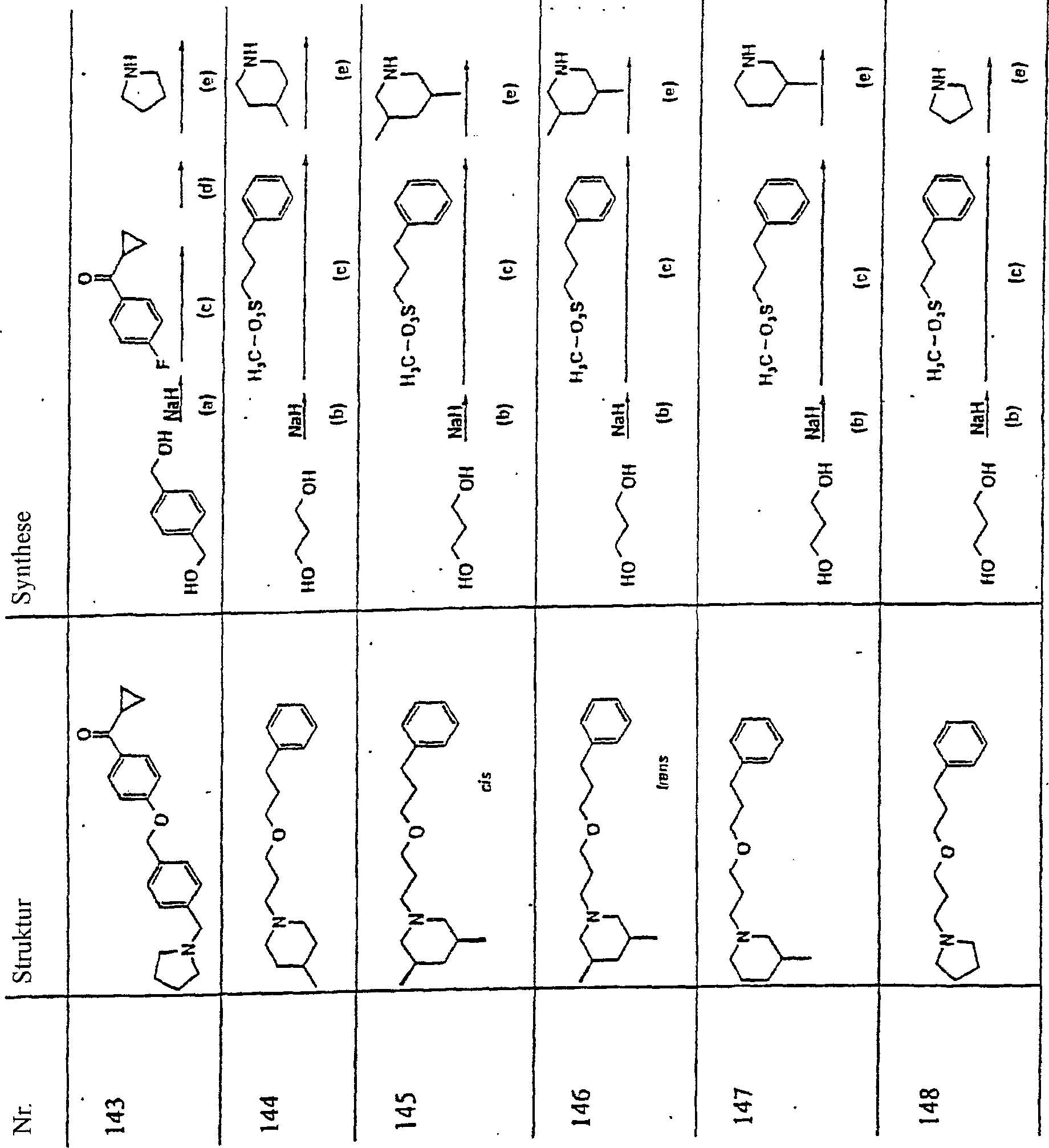
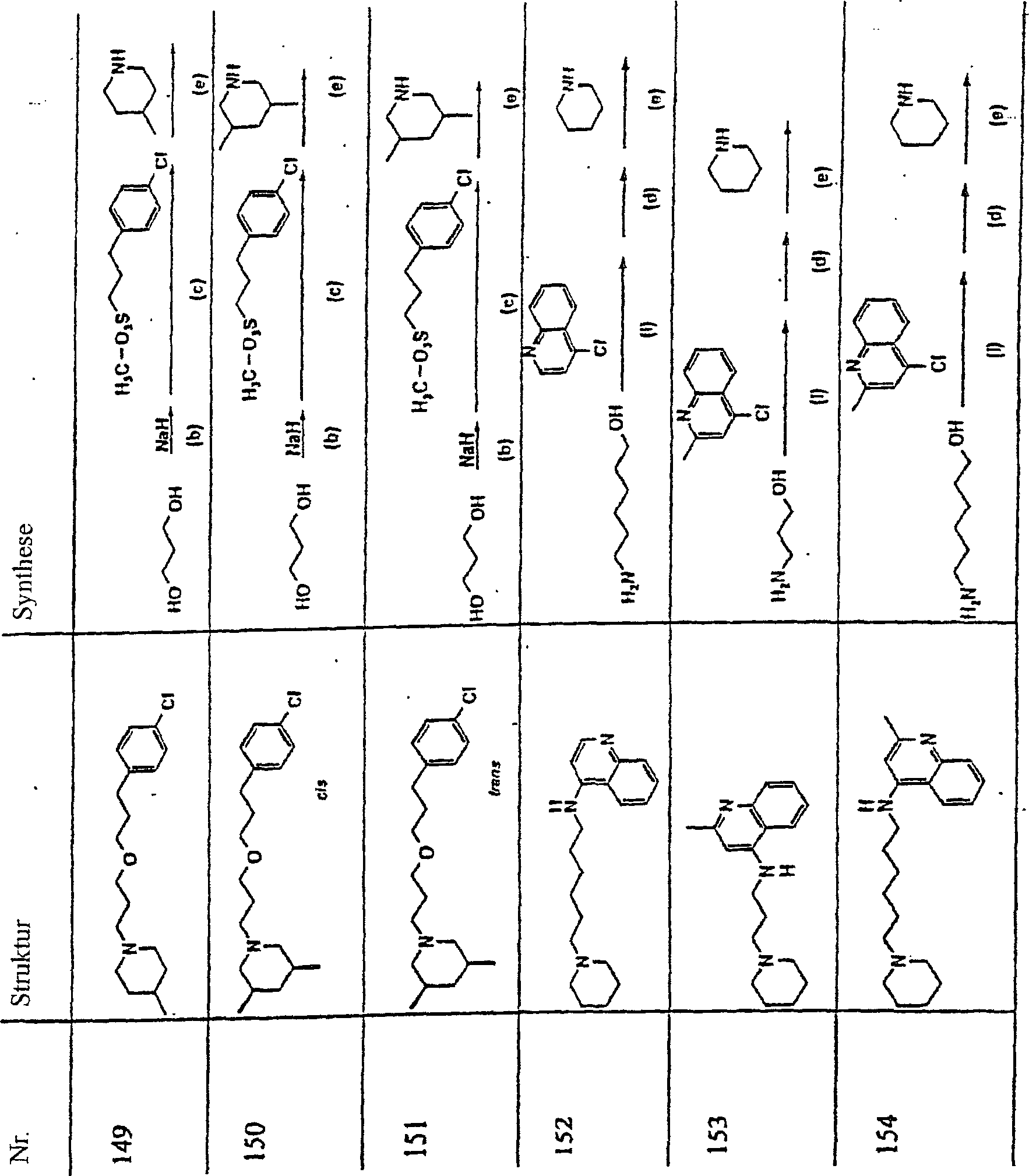
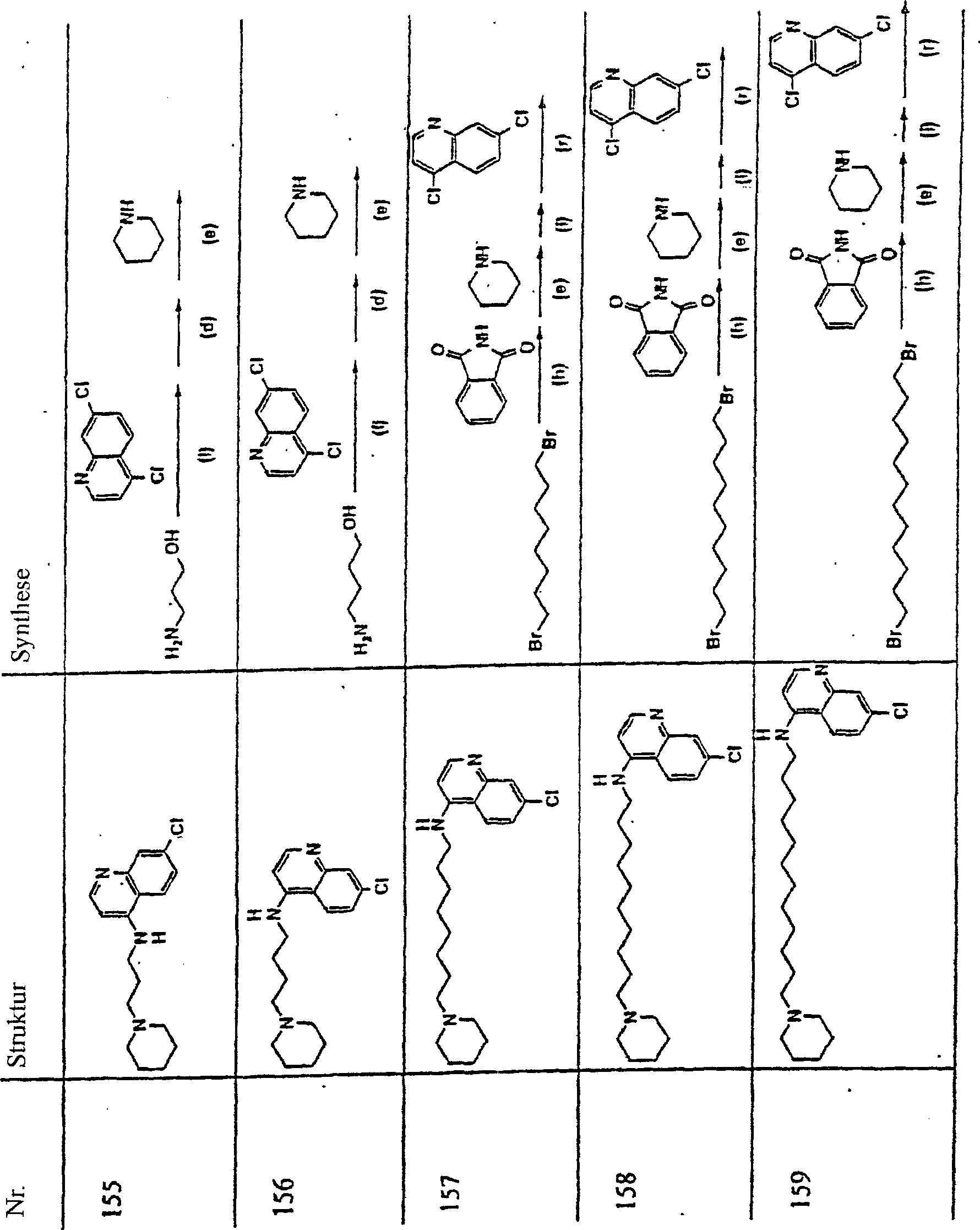
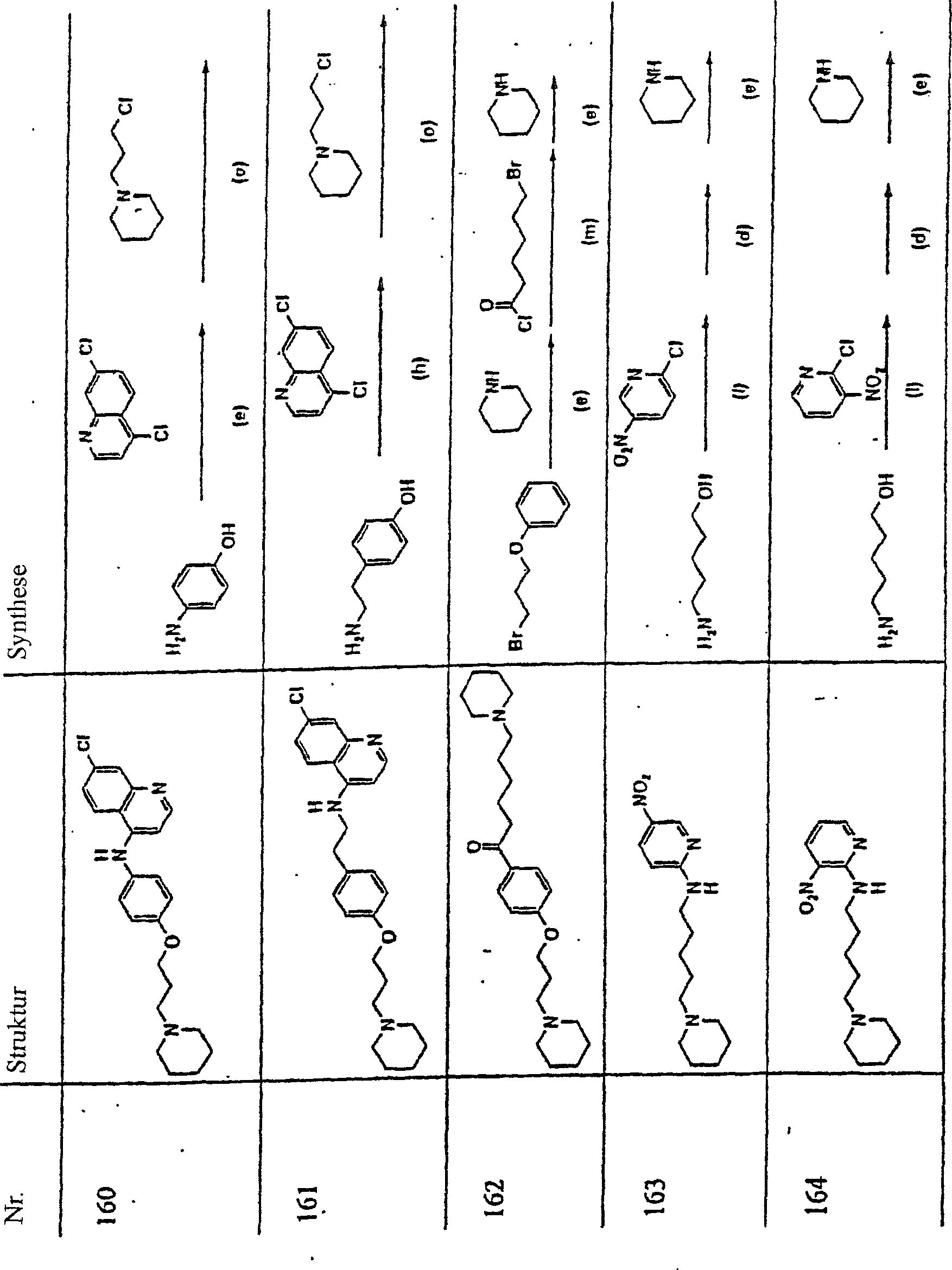
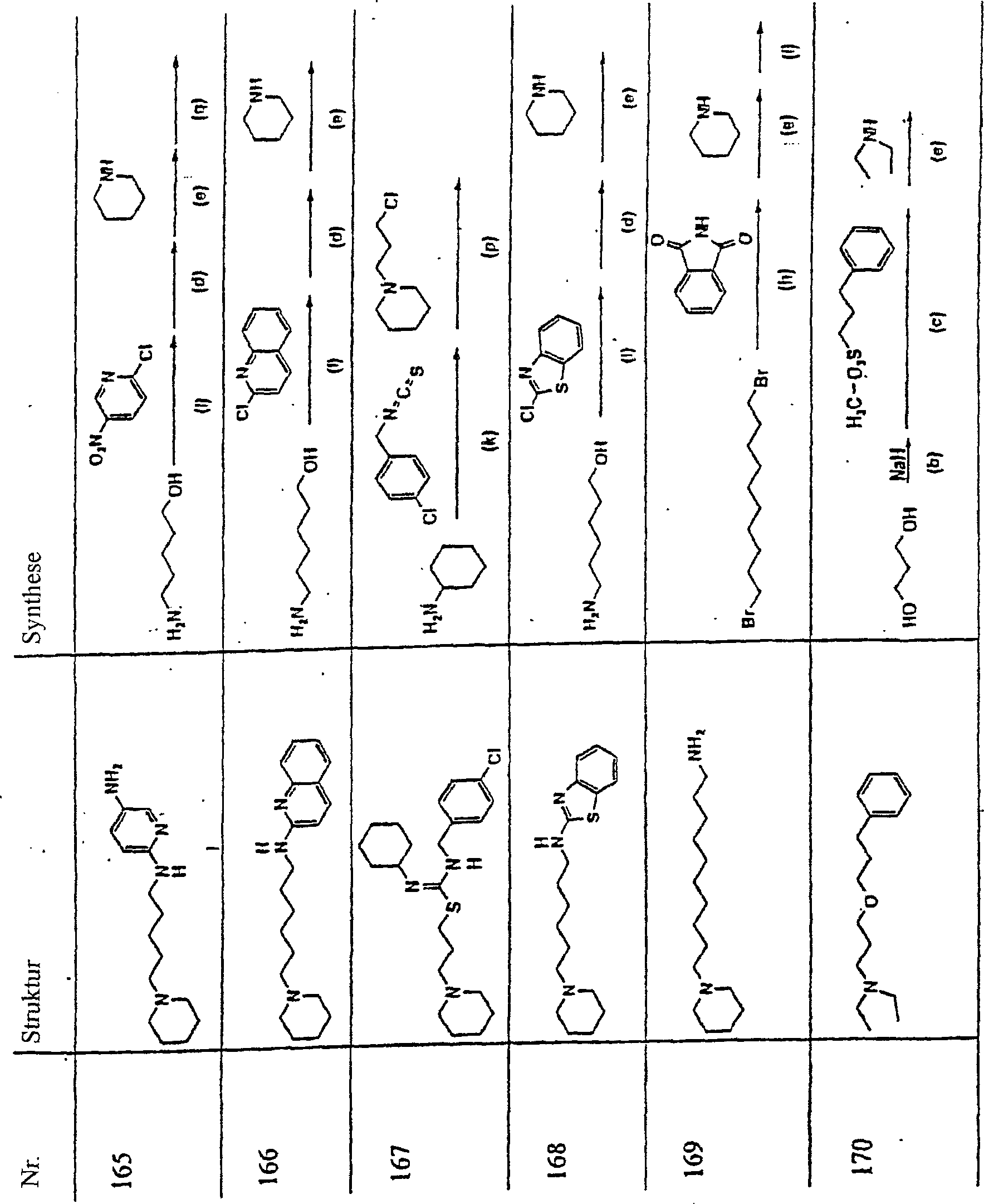
- a) THF, 10 h, RT.a) THF, 10 h, RT.
- b) THF, 10 h, Rückfluß.b) THF, 10 h, reflux.
- c) THF, Tetrabutylammoniumiodid, 15-Crown-5, 24 h, Rückfluß.c) THF, tetrabutylammonium iodide, 15-crown-5, 24 h, reflux.
- d) Thionylchlorid, 3 h, 0°C-70°C.d) Thionyl chloride, 3h, 0 ° C-70 ° C.
- e) Aceton, KI, 12 h, Rückfluß.e) acetone, KI, 12 h, reflux.
- f) Aceton, 10 min, RT.f) acetone, 10 min, RT.
- g) Aceton, 12 h, Rückfluß.g) acetone, 12 h, reflux.
- h) Aceton, KI, 3 T, Rückfluß.h) acetone, KI, 3 T, reflux.
- i) 6N HCl, 12 h, Rückfluß.i) 6N HCl, 12 h, reflux.
- k) Ether, 2 h, RT.k) ether, 2 h, RT.
- l) Ethanol, KI, Triethylamin, 12 h, Rückfluß.l) ethanol, KI, triethylamine, 12 h, reflux.
- m) Nitrobenzol, AlCl3, 3 T., RT.m) nitrobenzene, AlCl 3 , 3 T., RT.
- n) DMF, KI, K2CO3, 22 h. Rückfluß.n) DMF, KI, K 2 CO 3 , 22 h. Reflux.
- o) Aceton, KI, K2CO3, 22 h, Rückfluß.o) acetone, KI, K 2 CO 3 , 22 h, reflux.
- p) Ethanol, KI, 6 T, Rückfluß.p) ethanol, KI, 6 T, reflux.
- q) THF, Pd/C, 1 bar, 12 h.q) THF, Pd / C, 1 bar, 12 h.
- r) Phenol, KI, 12 h, 150°C.r) phenol, KI, 12 h, 150 ° C.
Die folgenden Verbindungen können gemäß den Syntheseschemata hergestellt werden.The following compounds can according to the synthesis schemes getting produced.
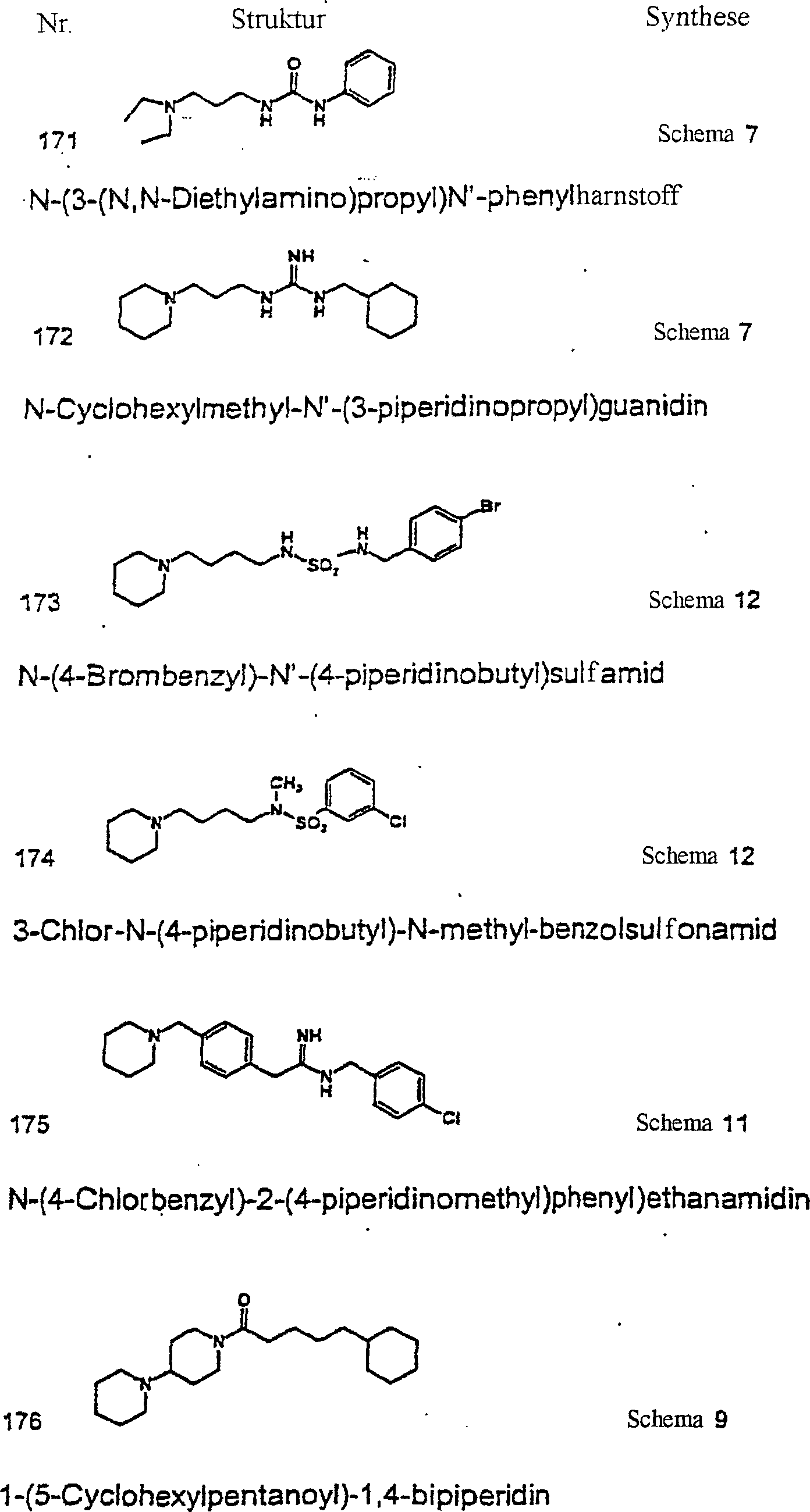

- (u) Kalium-tert-butanolat, THF, 24 h, 0-50°C; (v) Chromatographische Trennung; (w) NH3 (fl.), MeOH, -78-0°C.(u) Potassium tert-butoxide, THF, 24h, 0-50 ° C; (v) chromatographic separation; (w) NH 3 (fl.), MeOH, -78-0 ° C.
Die Verbindungen 1 bis 114 werden gemäß den folgenden Verfahren hergestellt.The Compounds 1 to 114 are prepared according to the following methods.
Verfahren A:Method A:
Eine Lösung von 1-Brom-5-phenoxypentan (1,4 bis 3,5 mmol) in 10 Äquivalenten des geeigneten sekundären Amins wurde unter Rühren für 48 Stunden (Verbindungen 1, 3 und 4), 24 Stunden (Verbindung 2) oder 4 Stunden (Verbindung 5) auf Rückflußtemperatur erhitzt. Nach dem Abkühlen wurde die überschüssige Base unter vermindertem Druck entfernt, und der Rückstand wurde mit wäßrigem Natriumhydroxid verdünnt. Das Produkt wurde mit Diethylether extrahiert. Die organischen Extrakte wurden mit Wasser gewaschen, über Magnesiumsulfat getrocknet, filtriert und unter vermindertem Druck eingeengt. Das zurückbleibende Öl wurde durch das Lösen in einer kleinen Menge an absolutem Ethanol und das Zugeben einer Lösung von 2 Äquivalenten an Oxalsäure in absolutem Ethanol in das Oxalatsalz umgewandelt. Der gebildete Niederschlag wurde mit Diethylether gewaschen und aus absolutem Ethanol umkristallisiert.A solution of 1-bromo-5-phenoxypentane (1.4 to 3.5 mmol) in 10 equivalents the appropriate secondary Amines were stirred for 48 Hours (compounds 1, 3 and 4), 24 hours (compound 2) or 4 hours (compound 5) at reflux temperature heated. After cooling became the excess base removed under reduced pressure and the residue was washed with aqueous sodium hydroxide diluted. The Product was extracted with diethyl ether. The organic extracts were washed with water, over magnesium sulfate dried, filtered and concentrated under reduced pressure. The Residual oil was through the release in a small amount of absolute ethanol and adding one solution of 2 equivalents of oxalic acid converted into the oxalate salt in absolute ethanol. The educated one Precipitate was washed with diethyl ether and absolute Recrystallized ethanol.
Verfahren B:Method B:
Eine Lösung aus 1-Brom-5-phenoxypentan (0,9 bis 1,7 mmol) und einem Überschuß des geeigneten sekundären Amins (2,3 bis in 10 Äquivalente) in 10 ml absolutem Ethanol wurde unter Rühren für 48 Stunden (Verbindung 6) oder 24 Stunden (Verbindungen 7, 8, 9, 10, 11, 12 & 13, 14, 15, 16, 17 und 29) auf Rückflußtemperatur erhitzt. Nach dem Abkühlen wurde das Lösungsmittel unter vermindertem Druck entfernt, und der Rückstand wurde mit wäßrigem Natriumhydroxid verdünnt. Das Produkt wurde mit Diethylether extrahiert. Die organischen Extrakte wurden mit Wasser gewaschen, über Magnesiumsulfat getrocknet, filtriert und unter vermindertem Druck eingeengt. Die cis- und trans-Isomeren 12 und 13 wurden mittels Säulenchromatographie auf Silicagel unter Eluieren mit einem Lösungsmittelgemisch aus Lösungsbenzin (Siedepunkt 60-80°C), Diethylether und Triethylamin im Verhältnis von 66:33:1 getrennt, und das Elutionsmittel wurde unter vermindertem Druck entfernt, wobei ein Öl zurückblieb. Die Verbindungen 14 und 16 wurden mittels Säulenchromatographie auf Silicagel unter Eluieren mit Diethylether und Triethylamin im Verhältnis von 99:1 gereinigt, und das Elutionsmittel wurde unter vermindertem Druck entfernt, wobei ein Öl zurückblieb. Das Öl wurde durch das Lösen in einer kleinen Menge an absolutem Ethanol und das Zugeben einer Lösung von 2 Äquivalenten an Oxalsäure in absolutem Ethanol in das Oxalatsalz umgewandelt (Verbindungen 6, 7, 8, 9, 11, 12, 13, 15, 16, 17 und 29). Falls sich kein Niederschlag zeigte, wurde Diethylether zugegeben, um einen Niederschlag zu bilden. Der Feststoff wurde mit Diethylether gewaschen und aus Isopropylalkohol (Verbindungen 6, 7, 10, 13 und 16), absolutem Ethanol (Verbindungen 8, 9, 11, 12, 15 und 29) oder Methanol (Verbindung 17) umkristallisiert. Das Öl wurde durch Zugabe von 2 N HCl in das Hydrochloridsalz umgewandelt (Verbindung 14). Der Niederschlag wurde in einer Mischung aus Chloroform und Diethylether (1:1) gebildet und aus Aceton umkristallisiert.A solution of 1-bromo-5-phenoxypentane (0.9 to 1.7 mmol) and an excess of the appropriate secondary amine (2.3 to 10 equivalents) in 10 ml of absolute ethanol was added with stirring for 48 hours (Compound 6) ) or 24 hours (Compounds 7, 8, 9, 10, 11, 12 & 13, 14, 15, 16, 17 and 29) are heated to reflux temperature. After cooling, the solvent was removed under reduced pressure and the residue was diluted with aqueous sodium hydroxide. The product was extracted with diethyl ether. The organic extracts were washed with water, dried over magnesium sulfate, filtered and concentrated under reduced pressure. The cis and trans isomers 12 and 13 were separated by column chromatography on silica gel eluting with a mixed solvent of mineral spirits (b.p. 60-80 ° C), diethyl ether and triethylamine in the ratio 66: 33: 1 and the eluent was concentrated under reduced pressure Pressure removed, leaving an oil behind. Compounds 14 and 16 were purified by column chromatography on silica gel eluting with diethyl ether and triethylamine in the ratio of 99: 1, and the eluent was removed under reduced pressure to leave an oil. The oil was converted to the oxalate salt by dissolving in a small amount of absolute ethanol and adding a solution of 2 equivalents of oxalic acid in absolute ethanol (Compounds 6, 7, 8, 9, 11, 12, 13, 15, 16, 17 and 29). If no precipitate appeared, diethyl ether was added to form a precipitate. The solid was washed with diethyl ether and recrystallized from isopropyl alcohol (Compounds 6, 7, 10, 13 and 16), absolute ethanol (Compounds 8, 9, 11, 12, 15 and 29) or methanol (Compound 17). The oil was converted to the hydrochloride salt by the addition of 2N HCl (Compound 14). The precipitate was formed in a mixture of chloroform and diethyl ether (1: 1) and recrystallized from acetone.
Verfahren C:Method C:
Eine Lösung von dem geeigneten α-Brom-ω-aryloxyalkan (0,4 bis 1,4 mmol} oder ω-Bromalkylphenylsulfid (1 mmol, Verbindungen 33 und 34) und einem Überschuß an Pyrrolidin (10 bis 15 Äquivalente) oder 3-Methylpiperidin (10 Äquivalente, Verbindung 38) in 10 ml absolutem Ethanol wurde unter Rühren für 24 Stunden oder 16 Stunden (Verbindung 47) auf Rückflußtemperatur erhitzt. Nach dem Abkühlen wurde das Lösungsmittel unter vermindertem Druck entfernt, und der Rückstand wurde mit wäßrigem Natriumhydroxid verdünnt. Das Produkt wurde mit Diethylether extrahiert. Die organischen Extrakte wurden mit Wasser gewaschen, über Magnesiumsulfat getrocknet, filtriert und unter vermindertem Druck eingeengt. Das zurückbleibende Öl wurde durch das Lösen in einer kleinen Menge an absolutem Ethanol und das Zugeben einer Lösung von 2 Äqui valenten an Oxalsäure in absolutem Ethanol in das Oxalatsalz umgewandelt. Falls sich kein Niederschlag zeigte, wurde Diethylether zugegeben., um einen Niederschlag zu bilden. Der Feststoff wurde mit Diethylether gewaschen und aus absolutem Ethanol umkristallisiert.A solution from the appropriate α-bromo-ω-aryloxyalkane (0.4 to 1.4 mmol) or ω-Bromalkylphenylsulfid (1 mmol, compounds 33 and 34) and an excess of pyrrolidine (10 to 15 equivalents) or 3-methylpiperidine (10 equivalents, Compound 38) in 10 ml of absolute ethanol was added with stirring for 24 hours or 16 hours (compound 47) heated to reflux temperature. After this cooling down became the solvent removed under reduced pressure and the residue was washed with aqueous sodium hydroxide diluted. The product was extracted with diethyl ether. The organic extracts were washed with water, over Dried magnesium sulfate, filtered and under reduced pressure concentrated. The remaining oil was by releasing in a small amount of absolute ethanol and adding one Solution of 2 equi valents of oxalic acid converted into the oxalate salt in absolute ethanol. If no Diethyl ether was added to a precipitate to build. The solid was washed with diethyl ether and extracted recrystallized from absolute ethanol.
Verfahren D:Method D:
Eine Lösung von dem geeigneten 4'-(S-Brompentoxy)phenylketon (0,7 bis 1 mmol, Verbindungen 39, 44 und 45) oder 1-Brom-5-(4-phenoxyphenoxy)pentan (0,6 mmol, Verbindung 48) und einem Überschuß an Pyrrolidin (10 bis 15 Äquivalente) in 10 ml absolutem Ethanol wurde unter Rühren für 16 Stunden (Verbindungen 39, 44 und 48) oder 24 Stunden (Verbindung 45) auf Rückflußtemperatur erhitzt. Nach dem Abkühlen wurde das Lösungsmittel unter vermindertem Druck entfernt, und der Rückstand wurde mit wäßrigem Natriumhydroxid verdünnt. Das Produkt wurde mit Chloroform (Verbindungen 39, 45 und 48) oder Dichlormethan (Verbindung 44) extrahiert. Die organischen Extrakte wurden über Magnesiumsulfat getrocknet, filtriert und unter vermindertem Druck eingeengt. Das zurückbleibende Öl wurde durch das Lösen in einer kleinen Menge an absolutem Ethanol und das Zugeben einer Lösung von 2 Äquivalenten an Oxalsäure in absolutem Ethanol in das Oxalatsalz umgewandelt. Der Niederschlag wurde mit Diethylether gewaschen und aus absolutem Ethanol umkristallisiert (im Falle der Verbindung 39 wurde zweimal aus absolutem Ethanol umkristallisiert).A solution from the appropriate 4 '- (S-bromopentoxy) phenyl ketone (0.7 to 1 mmol, compounds 39, 44 and 45) or 1-bromo-5- (4-phenoxyphenoxy) pentane (0.6 mmol, compound 48) and an excess of pyrrolidine (10 to 15 equivalents) in 10 ml of absolute ethanol was added with stirring for 16 hours (compounds 39, 44 and 48) or 24 hours (compound 45) at reflux temperature heated. After cooling became the solvent removed under reduced pressure and the residue was washed with aqueous sodium hydroxide diluted. The product was treated with chloroform (compounds 39, 45 and 48) or Dichloromethane (compound 44) extracted. The organic extracts were over Dried magnesium sulfate, filtered and under reduced pressure concentrated. The remaining oil was by releasing in a small amount of absolute ethanol and adding one solution of 2 equivalents of oxalic acid converted into the oxalate salt in absolute ethanol. The rainfall was washed with diethyl ether and recrystallized from absolute ethanol (in the case of compound 39 was twice from absolute ethanol recrystallized).
Verfahren E:Method E:
- 1. Das Oxalat 18 wurde gemäß dem Verfahren C hergestellt. Eine Lösung von Verbindung 18 (0,57 mmol) in 10 ml Methanol und 10 ml absolutem Ethanol wurde zusammen mit 100 mg Palladium (5%) auf einem Kohlenstoffkatalysator in einen Zweihalsrundkolben, ausgestattet mit einer Gaszelle, welche mit Wasserstoff gefüllt ist, eingebracht. Die Mischung wurde bei Raumtemperatur stark gerührt, und der Kolben wurde von Luft gereinigt und mit Wasserstoff gefüllt. Nach 3 Stunden wurde der Katalysator auf Celit abfiltriert, und das Lösungsmittel wurde unter vermindertem Druck entfernt. Der zurückbleibende Feststoff wurde durch das Lösen in Methanol und das Zugeben einer Lösung von Oxalsäure (2 Äquivalente) an in absolutem Ethanol in das Oxalatsalz umgewandelt. Diethylether wurde zugegeben, um einen Niederschlag zu bilden. Das Produkt wurde aus absolutem Ethanol umkristallisiert.1. Oxalate 18 was prepared according to Method C. A solution of compound 18 (0.57 mmol) in 10 ml of methanol and 10 ml of absolute Ethanol was combined with 100 mg of palladium (5%) on a carbon catalyst in a two-necked round bottom flask equipped with a gas cell, which filled with hydrogen is introduced. The mixture was stirred vigorously at room temperature, and the flask was purged of air and filled with hydrogen. To The catalyst was filtered off on celite for 3 hours, and the solvent was removed under reduced pressure. The residual solid became by releasing in methanol and adding a solution of oxalic acid (2 equivalents) converted to the oxalate salt in absolute ethanol. diethyl ether was added to form a precipitate. The product was recrystallized from absolute ethanol.
- 2. Zu einer Lösung von Verbindung 40 (0,35 mmol) in Pyridin, welche bei 0°C stark gerührt wurde, wurde ein leichter Überschuß an Benzoylchlorid (0,4 mmol) zugetropft. Das Rühren wurde nach Beendigung der Zugabe für 20 Minuten fortgesetzt. Danach wurde die Mischung über Nacht (16 Stunden) in den Kühlschrank gestellt. Das Lösungsmittel wurde unter vermindertem Druck entfernt, und der Rückstand wurde mit wäßrigem Natriumhydroxid verdünnt. Das Produkt wurde mit Chloroform extrahiert. Die organischen Extrakte wurden über Magnesiumsulfat getrocknet, filtriert und unter vermindertem Druck eingeengt. Das zurückbleibende Öl wurde durch das Lösen in einer kleinen Menge an absolutem Ethanol und das Zugeben einer Lösung von 2 Äquivalenten an Oxalsäure in absolutem Ethanol in das Oxalatsalz umgewandelt. Der Niederschlag wurde in Methanol gelöst, filtriert und unter vermindertem Druck eingeengt. Der Feststoff wurde aus absolutem Ethanol umkristallisiert.2. To a solution of compound 40 (0.35 mmol) in pyridine, which was stirred vigorously at 0 ° C, was a slight excess of benzoyl chloride (0.4 mmol) was added dropwise. Stirring was continued for 20 minutes after the addition was complete. After that the mixture was over Night (16 hours) in the fridge posed. The solvent was removed under reduced pressure, and the residue was washed with aqueous sodium hydroxide diluted. The product was extracted with chloroform. The organic extracts were over Dried magnesium sulfate, filtered and under reduced pressure concentrated. The remaining oil was by releasing in a small amount of absolute ethanol and adding one solution of 2 equivalents of oxalic acid converted into the oxalate salt in absolute ethanol. The rainfall was dissolved in methanol, filtered and concentrated under reduced pressure. The solid was recrystallized from absolute ethanol.
Verfahren F:Method F:
In einem unter Stickstoff gehaltenen Dreihalsrundkolben wurde eine Lösung von dem geeigneten Phenol (1,6 mmol), 3-(Diethylamino)propanol (1,5 mmol) und Triphenylphosphin (1,9 mmol) in 10 ml frisch destilliertem Tetrahydrofuran eingebracht. Die Mischung wurde gerührt und mit einem Eis-Salz-Bad auf 0°C gekühlt. Eine Lösung von Diisopropylazodicarboxylat (2 mmol) in 10 ml Tetrahydrofuran wurde sehr langsam zugegeben (typischerweise über 40 Minuten), und man ließ die Mischung sich auf Raumtemperatur erwärmen. Anschließend wurde die Mischung bei Raumtemperatur über Nacht (16 Stunden) gerührt. Das Lösungsmittel wurde dann unter vermindertem Druck entfernt. der Rückstand wurde in Ethylacetat (20 ml) gelöst, und das Produkt wurde mit 2 N HCl (2 × 10 ml) extrahiert. Die wäßrige Lösung wurde mit Natriumhydroxid neutralisiert, und das Produkt wurde mit Dichlormethan extrahiert. Nach dem Trocknen über Magnesiumsulfat und einer Filtration wurde das Lösungsmittel unter vermindertem Druck entfernt. Der Rückstand wurde durch das Lösen in einer kleinen Menge an absolutem Ethanol und das Zugeben einer Lösung von 2 Äquivalenten an Oxalsäure in absolutem Ethanol in das Oxalatsalz umgewandelt. Falls sich kein Niederschlag zeigte, wurde Diethylether zugegeben, um einen Niederschlag zu bilden. Der Feststoff wurde mit Diethylether gewaschen und aus absolutem Ethanol (Verbindungen 43 und 46) oder aus einer 1:1-Mischung von Methanol und absolutem Ethanol (Verbindung 42) unkristallisiert.In a three-necked round bottom flask maintained under nitrogen became a solution of the appropriate phenol (1.6 mmol), 3- (diethylamino) propanol (1.5 mmol) and triphenylphosphine (1.9 mmol) in 10 ml of freshly distilled Tetrahydrofuran introduced. The mixture was stirred and with an ice-salt bath at 0 ° C cooled. A solution of diisopropyl azodicarboxylate (2 mmol) in 10 ml tetrahydrofuran was added very slowly (typically over 40 minutes) and the mixture was left warm to room temperature. Subsequently The mixture was stirred at room temperature overnight (16 hours). The solvent was then removed under reduced pressure. the residue was dissolved in ethyl acetate (20 ml), and the product was extracted with 2N HCl (2 x 10 mL). The aqueous solution became neutralized with sodium hydroxide, and the product was dichloromethane extracted. After drying over Magnesium sulfate and filtration, the solvent was concentrated under reduced Pressure removed. The residue was by solving in a small amount of absolute ethanol and adding one solution of 2 equivalents of oxalic acid in absolute ethanol converted to the oxalate salt. If no Diethyl ether was added to a precipitate to build. The solid was washed with diethyl ether and extracted absolute ethanol (compounds 43 and 46) or from a 1: 1 mixture of methanol and absolute ethanol (Compound 42).
Verfahren G:Method G:
Eine Lösung der freien Base von Verbindung 39 (0,6 mmol) oder Verbindung 46 (0,8 mmol) in 20 ml trockenem Diethylether wurde zu einer unter Stickstoff gehaltenen gerührten Suspension von Lithiumaluminiumhydrid (0,6 oder 0,8 mmol) in 20 ml trockenem Diethylether zugetropft. Die Mischung wurde Raumtemperatur unter Stickstoff für 2 Stunden gerührt. Eiskaltes Wasser wurde vorsichtig zugegeben, und die organische Schicht wurde dekantiert. Die wäßrige Phase wurde mit Diethylether extrahiert. Die vereinigten organischen Lösungen wurden über Magnesiumsulfat getrocknet, filtriert und unter vermindertem Druck eingeengt, wobei ein gelbes Öl zurückblieb. Das Öl wurde durch das Lösen in einer kleinen Menge an absolutem Ethanol und das Zugeben einer Lösung von 2 Äquivalenten an Oxalsäure in absolutem Ethanol in das Oxalatsalz umgewandelt. Der Niederschlag wurde mit Diethylether gewaschen und aus absolutem Ethanol (Verbindung 50) oder aus Isopropylalkohol, wobei ein sehr hygroskopischer Feststoff erhalten wurde (Verbindung 63), umkristallisiert.A solution the free base of compound 39 (0.6 mmol) or compound 46 (0.8 mmol) in 20 ml of dry diethyl ether was added to a Nitrogen held stirred Suspension of lithium aluminum hydride (0.6 or 0.8 mmol) in 20 ml of dry diethyl ether was added dropwise. The mixture became room temperature under nitrogen for Stirred for 2 hours. Ice-cold water was added cautiously and the organic layer was decanted. The aqueous phase was extracted with diethyl ether. The combined organic solutions were over magnesium sulfate dried, filtered and concentrated under reduced pressure, with a yellow oil remained. The oil was by solving in a small amount of absolute ethanol and adding one solution of 2 equivalents of oxalic acid converted into the oxalate salt in absolute ethanol. The rainfall was washed with diethyl ether and from absolute ethanol (Compound 50) or isopropyl alcohol, with a very hygroscopic solid was obtained (compound 63), recrystallized.
Verfahren H:Method H:
Eine Lösung von dem geeigneten α-Brom-ω-(4-cyanophenoxy)alkan (0,5 bis 0,7 mmol) und einem Überschuß des geeigneten sekundären Amins (8 bis 12 Äquivalente) in 10 ml absolutem Ethanol wurde unter Rühren für 24 Stunden (Verbindungen 54, 55, 57 und 60), 20 Stunden (Verbindung 52), 16 Stunden (Verbindungen 56, 58, 59 und 61) oder 8 Stunden (Verbindung 51) auf Rückflußtemperatur erhitzt oder wurde bei Raumtemperatur für 48 Stunden (Verbindung 53) oder 24 Stunden (Verbindung 60) gerührt. Nach dem Abkühlen wurde das Lösungsmittel unter vermindertem Druck entfernt, und der Rückstand wurde mit wäßrigem Natriumhydroxid verdünnt. Das Produkt wurde mit Diethylether extrahiert. Die organischen Extrakte wurden mit Wasser gewaschen, über Magnesiumsulfat getrocknet, filtriert und unter vermindertem Druck eingeengt. Die Verbindung 62 wurde mittels Säulenchromatographie auf Silicagel unter Eluieren mit Ethylacetat gereinigt und unter vermindertem Druck eingeengt. Für alle Verbindungen von Verfahren H wurde das zurückbleibende Öl durch das Lösen in einer kleinen Menge an absolutem Ethanol und das Zugeben einer Lösung von 2 Äquivalenten an Oxalsäure in absolutem Ethanol in das Oxalatsalz umgewandelt. Falls sich kein Niederschlag zeigte, wurde Diethylether zugegeben, um einen Niederschlag zu bilden. Der Feststoff wurde mit Diethylether gewaschen und aus absolutem Ethanol (für die Verbindungen 58 und 59 waren zwei Umkristallisierungen erforderlich) oder aus einer 1:1-Mischung von Methanol und absolutem Ethanol (Verbindung 55) umkristallisiert.A solution from the appropriate α-bromo-ω- (4-cyanophenoxy) alkane (0.5 to 0.7 mmol) and an excess of the appropriate secondary Amines (8 to 12 equivalents) in 10 ml of absolute ethanol was added with stirring for 24 hours (compounds 54, 55, 57 and 60), 20 hours (compound 52), 16 hours (compounds 56, 58, 59 and 61) or 8 hours (compound 51) at reflux temperature heated or at room temperature for 48 hours (compound 53) or 24 hours (compound 60). After cooling it was the solvent removed under reduced pressure and the residue was washed with aqueous sodium hydroxide diluted. The product was extracted with diethyl ether. The organic extracts were washed with water, over Dried magnesium sulfate, filtered and under reduced pressure concentrated. Compound 62 was purified by column chromatography on silica gel purified with ethyl acetate and concentrated under reduced pressure Concentrated pressure. For all compounds of Method H were the residual oil the release in a small amount of absolute ethanol and adding one solution of 2 equivalents of oxalic acid converted into the oxalate salt in absolute ethanol. If no Diethyl ether was added to a precipitate to build. The solid was washed with diethyl ether and extracted absolute ethanol (for compounds 58 and 59 required two recrystallizations) or from a 1: 1 mixture of methanol and absolute ethanol (Compound 55) recrystallized.
Verfahren J:Method J:
Eine Lösung von Verbindung 46 (1 mmol) in 10 ml Methanol wurde bei Raumtemperatur gerührt, und eine Lösung von Hydroxylaminhydrochlorid (2 Äquivalente) in 2 ml Wasser wurde zugegeben. Die Mischung wurde bei 50-70°C in einem Wasserbad für 20 Minuten gerührt. Das Methanol wurde unter vermindertem Druck entfernt. Der Rückstand wurde mit wäßrigem Natriumhydroxid verdünnt. Das Produkt wurde mit Diethylether extrahiert. Die organischen Extrakte wurden mit Wasser gewaschen, über Magnesiumsulfat getrocknet, filtriert und unter vermindertem Druck eingeengt. Die Verbindung 64 wurde mittels Säulenchromatographie auf Silicagel unter Eluieren mit Ethylacetat gereinigt und unter vermindertem Druck eingeengt. Das zurückbleibende Öl wurde durch das Lösen in einer kleinen Menge an absolutem Ethanol und das Zugeben einer Lösung von 2 Äquivalenten an Oxalsäure in absolutem Ethanol in das Oxalatsalz umgewandelt. Diethylether wurde zugegeben, um einen Niederschlag zu bilden. Der Feststoff wurde mit Diethylether gewaschen und aus absolutem Ethanol umkristallisiert.A solution of compound 46 (1 mmol) in 10 ml of methanol was stirred at room temperature and a solution of hydroxylamine hydrochloride (2 equivalents) in 2 ml of water was added. The mixture was stirred at 50-70 ° C in a water bath for 20 minutes. The methanol was removed under reduced pressure. The residue was diluted with aqueous sodium hydroxide. The product was extracted with diethyl ether. The organic extracts were washed with water, dried over magnesium sulfate, filtered and concentrated under reduced pressure. Compound 64 was purified by column chromatography on silica gel eluting with ethyl acetate and concentrated under reduced pressure. The residual oil was dissolved by dissolving in a small amount of absolute ethanol and adding a solution converted from 2 equivalents of oxalic acid in absolute ethanol into the oxalate salt. Diethyl ether was added to form a precipitate. The solid was washed with diethyl ether and recrystallized from absolute ethanol.
Für Beispiel 98 wurde das Produkt durch Zugabe von 2 N HCl in das Hydrochloridsalz umgewandelt. Das Salz wurde aus absolutem Ethanol/Diethylether (1:1) umkristallisiert.For example 98, the product was converted to the hydrochloride salt by addition of 2N HCl transformed. The salt was made up of absolute ethanol / diethyl ether (1: 1) recrystallized.
Verfahren K:Method K:
Eine Lösung von 4'-(3-Brompropoxy)acetophenon (0,8 bis 1,9 mmol) und einem Überschuß des geeigneten Piperidins (3 bis 10 Äquivalente) in 10 ml absolutem Ethanol wurden unter Rühren für 16 Stunden auf Rückflußtemperatur erhitzt. Nach dem Abkühlen wurde das Lösungsmittel unter vermindertem Druck entfernt, und der Rückstand wurde mit wäßrigem Natriumhydroxid verdünnt. Das Produkt wurde mit Diethylether extrahiert. Die organischen Extrakte wurden mit Wasser gewaschen, über Magnesiumsulfat getrocknet, filtriert und unter vermindertem Druck eingeengt. Die cis- und trans-Isomeren 67 und 70 wurden mittels Säulenchromatographie auf Silicagel unter Eluieren mit einem Lösungsmittelgemisch aus Diethylether, Lösungsbenzin (Siedepunkt 60-80°C) und Triethylamin im Verhältnis von 66:33:1 getrennt, und das Elutionsmittel wurde unter vermindertem Druck entfernt, wobei ein Öl zurückbleibt. Die Verbindung 75 wurde mittels Säulenchromatographie auf Silicagel unter Eluieren mit Chloroform und Methanol (1:1) gereinigt und unter vermindertem Druck eingeengt. Das zurückbleibende Öl wurde durch das Lösen in einer kleinen Menge an absolutem Ethanol und das Zugeben einer Lösung von 2 Äquivalenten an Oxalsäure in absolutem Ethanol in das Oxalatsalz umgewandelt. Falls sich kein Niederschlag zeigte, wurde Diethylether zugegeben, um einen Niederschlag zu bilden. Der Feststoff wurde mit Diethylether gewaschen und aus absolutem Ethanol umkristallisiert.A solution of 4 '- (3-bromopropoxy) acetophenone (0.8 to 1.9 mmol) and an excess of the appropriate Piperidine (3 to 10 equivalents) in 10 ml of absolute ethanol were refluxed with stirring for 16 hours heated. After cooling became the solvent removed under reduced pressure and the residue was washed with aqueous sodium hydroxide diluted. The product was extracted with diethyl ether. The organic extracts were washed with water, over Dried magnesium sulfate, filtered and under reduced pressure concentrated. The cis and trans isomers 67 and 70 were used by column on silica gel eluting with a mixed solvent of diethyl ether, mineral spirits (Boiling point 60-80 ° C) and triethylamine in the ratio of 66: 33: 1 and the eluent was concentrated under reduced pressure Pressure removed, taking an oil remains. Compound 75 was purified by column chromatography on silica gel while eluting with chloroform and methanol (1: 1) and purified concentrated reduced pressure. The remaining oil was by releasing in a small amount of absolute ethanol and adding one solution of 2 equivalents of oxalic acid converted into the oxalate salt in absolute ethanol. If no Diethyl ether was added to a precipitate to build. The solid was washed with diethyl ether and extracted recrystallized from absolute ethanol.
Verfahren L:Method L:
In einem unter Stickstoff gehaltenen Dreihalsrundkolben wurde eine Lösung aus dem geeigneten 4'-Hydroxyphenylketon (0.9 bis 3 mmol), 3-(1-Piperidinyl)propanol (0,9 bis 3 mmol) und Triphenylphosphin (1 bis 3,5 mmol) in 10 ml frisch destilliertem Tetrahydrofuran eingebracht. Die Mischung wurde gerührt und mit einem Eis-Salz-Bad auf 0°C gekühlt. Eine Lösung von Diethylazodicarboxylat (1 bis 3,6 mmol) in 10 ml Tetrahydrofuran wurde sehr langsam zugegeben (typischerweise über 40 Minuten), und die Mischung ließ man sich auf Raumtemperatur erwärmen. Anschließend wurde die Mischung bei Raumtemperatur über Nacht (16 Stunden) gerührt. Das Lösungsmittel wurde dann unter vermindertem Druck entfernt, der Rückstand wurde in Ethylacetat (20 ml) gelöst, und das Produkt wurde mit 2 N HCl (2 × 10 ml) extrahiert. Die wäßrige Lösung wurde mit Natriumhydroxid neutralisiert, und das Produkt wurde mit Dichlormethan extrahiert. Nach dem Trocknen über Magnesiumsulfat und einer Filtration wurde das Lösungsmittel unter vermindertem Druck entfernt. Das Rohprodukt wurde mittels Säulenchromatographie auf Silicagel unter Eluieren mit Diethylether, enthaltend 1 % Triethylamin, gereinigt und unter vermindertem Druck eingeengt. Der Rückstand wurde durch das Lösen in einer kleinen Menge an absolutem Ethanol und das Zugeben einer Lösung von 2 Äquivalenten an Oxalsäure in absolutem Ethanol in das Oxalatsalz umgewandelt. Falls sich kein Niederschlag zeigte, wurde Diethylether zugegeben, um einen Niederschlag zu bilden. Der Feststoff wurde mit Diethylether gewaschen und aus absolutem Ethanol umkristallisiert.In a three-necked round bottom flask maintained under nitrogen became a solution from the appropriate 4'-hydroxyphenyl ketone (0.9 to 3 mmol), 3- (1-piperidinyl) propanol (0.9 to 3 mmol) and Triphenylphosphine (1 to 3.5 mmol) in 10 ml freshly distilled Tetrahydrofuran introduced. The mixture was stirred and with an ice-salt bath at 0 ° C cooled. A solution of diethyl azodicarboxylate (1 to 3.6 mmol) in 10 ml of tetrahydrofuran was added very slowly (typically over 40 minutes) and the mixture one left warm to room temperature. Subsequently The mixture was stirred at room temperature overnight (16 hours). The solvent was then removed under reduced pressure, the residue was dissolved in ethyl acetate (20 ml), and the product was extracted with 2N HCl (2 x 10 mL). The aqueous solution became neutralized with sodium hydroxide, and the product was dichloromethane extracted. After drying over magnesium sulfate and a filtration became the solvent removed under reduced pressure. The crude product was by means of column on silica gel eluting with diethyl ether containing 1% triethylamine, cleaned and concentrated under reduced pressure. The residue was by solving in a small amount of absolute ethanol and adding one solution of 2 equivalents of oxalic acid converted into the oxalate salt in absolute ethanol. If no Diethyl ether was added to a precipitate to build. The solid was washed with diethyl ether and extracted recrystallized from absolute ethanol.
Für Beispiel 82 wurde das Amin durch Zugabe von 2 N HCl in das Hydrochloridsalz umgewandelt. Das Salz wurde aus absolutem Ethanol/Diethylether (1:14) umkristallisiert.For example In 82, the amine was added to the hydrochloride salt by addition of 2N HCl transformed. The salt was extracted from absolute ethanol / diethyl ether (1:14) recrystallized.
Verfahren M:Method M:
Eine Lösung von 3-(4-(Acetylphenoxy)-2-(R oder S)-methylpropyl-para-toluolsulfonat (0,55 bis 0,66 mmol) und Piperidin (5 bis 6 mmol) in 10 ml absolutem Ethanol wurde gerührt und für 2 Stunden unter Rückfluß erhitzt. Nach dem Abkühlen wurde das Lösungsmittel unter vermindertem Druck entfernt, der Rückstand wurde mit wäßrigem NaOH (10 ml) verdünnt, und das Öl wurde mit Diethylether (3 × 10 ml) extrahiert. Die vereinigten Extrakte wurden über Magnesiumsulfat getrocknet, und das Lösungsmittel unter vermindertem Druck entfernt. Das gelbe Öl wurde mittels Säulenchromatographie auf Silicagel unter Eluieren mit einer 1:1-Mischung von Chloroform und absolutem Ethanol gereinigt (Beispiel 80). Nach dem Einengen wurde das Öl in etwa 2 ml absolutem Ethanol gelöst, und eine Lösung von Oxalsäure (1 bis 1,1 mmol) in 2 ml absolutem Ethanol wurde zugegeben. Der Niederschlag wurde aus absolutem Ethanol umkristallisiert.A solution of 3- (4- (acetylphenoxy) -2- (R or S) -methylpropyl para-toluenesulfonate (0.55 to 0.66 mmol) and piperidine (5 to 6 mmol) in 10 ml of absolute Ethanol was stirred and for Heated under reflux for 2 hours. After cooling became the solvent removed under reduced pressure, the residue was washed with aqueous NaOH Diluted (10 ml), and the oil was washed with diethyl ether (3 x 10 ml). The combined extracts were dried over magnesium sulfate, and the solvent removed under reduced pressure. The yellow oil was purified by column chromatography on silica gel eluting with a 1: 1 mixture of chloroform and absolute ethanol (Example 80). After concentration became the oil Dissolved in about 2 ml of absolute ethanol, and a solution of oxalic acid (1 to 1.1 mmol) in 2 ml of absolute ethanol was added. Of the Precipitate was recrystallized from absolute ethanol.
Verfahren N:Method N:
Eine Lösung von 1-Brom-3-(4-substituiertes phenoxy)propan (0,4 bis 2 mmol) und dem geeignet substituierten Piperidin (2,5 bis 8 mmol) in 10 ml absolutem Ethanol wurde gerührt und für 6 bis 24 Stunden unter Rückfluß erhitzt. Nach dem Abkühlen wurde das Lösungsmittel unter vermindertem Druck entfernt, der Rückstand wurde mit wäßrigem NaOH (10 ml} verdünnt, und das Öl wurde mit Diethylether (3 × 10 ml) extrahiert. Die vereinigten Extrakte wurden über Magnesiumsulfat getrocknet, und das Lösungsmittel unter vermindertem Druck entfernt. Das zurückbleibende Öl wurde in etwa 5 ml Diethylether gelöst, und eine Lösung von HCl in 10 ml Diethylether wurde zugegeben. Der Niederschlag wurde aus einer 1:1- oder 1:5-Mischung aus absolutem Ethanol und Diethylether umkristallisiert (Beispiele 78, 79, 84, 87). Das Öl wurde mittels Säulenchromatographie auf Silicagel unter Eluieren mit einer Mischung aus 33% Petrolether (60-80°C), 66% Diethylether und 1 % Triethylamin (Beispiele 101 und 102) oder mit 99% Diethylether und 1% Triethylamin (Beispiele 88, 94 und 95) gereinigt und eingeengt. Das zurückbleibende Öl wurde in etwa 5 ml absolutem Ethanol gelöst, und eine Lösung von Oxalsäure (1 bis 1,6 mmol) in 5 ml absolutem Ethanol wurde zugegeben. Der Niederschlag wurde aus absolutem Ethanol oder aus einer 1:1-Mischung von Methanol und absolutem Ethanol umkristallisiert (Beispiele 83, 85, 86, 91, 93, 100, 101 und 102). Das Produkt wurde nach der Entfernung des absoluten Ethanols in Form eines klebrigen Öls erhalten (Beispiel 92).A solution of 1-bromo-3- (4-substituted phenoxy) propane (0.4 to 2 mmol) and the appropriately substituted piperidine (2.5 to 8 mmol) in 10 ml absolute ethanol was stirred and for Heated under reflux for 6 to 24 hours. After cooling became the solvent removed under reduced pressure, the residue was washed with aqueous NaOH Diluted (10 ml), and the oil was washed with diethyl ether (3 x 10 ml). The combined extracts were dried over magnesium sulfate, and the solvent removed under reduced pressure. The remaining oil was dissolved in about 5 ml of diethyl ether, and a solution HCl in 10 ml of diethyl ether was added. The rainfall was made from a 1: 1 or 1: 5 mixture of absolute ethanol and Recrystallized diethyl ether (Examples 78, 79, 84, 87). The oil was by column chromatography on silica gel eluting with a 33% petroleum ether mixture (60-80 ° C), 66% diethyl ether and 1% triethylamine (Examples 101 and 102) or with 99% diethyl ether and 1% triethylamine (Examples 88, 94 and 95) and concentrated. The remaining oil was Dissolved in about 5 ml of absolute ethanol, and a solution of oxalic acid (1 to 1.6 mmol) in 5 ml of absolute ethanol was added. Of the Precipitate was from absolute ethanol or from a 1: 1 mixture recrystallized from methanol and absolute ethanol (Examples 83, 85, 86, 91, 93, 100, 101 and 102). The product was after removal of the absolute ethanol in the form of a sticky oil (Example 92).
Verfahren O:Method O:
Eine Mischung von 4-(4-Hydroxyphenyl)-2-butanon (200 mg, 1,2 mmol), 3-Chlorpropylpiperidinhydrochlorid (200 mg, 1 mmol) und Kaliumcarbonat (630 mg. 6 mmol) in 10 ml absolutem Ethanol wurde gerührt und für 8 Stunden unter Rückfluß erhitzt. Nach dem Abkühlen wurde das Reaktionsgemisch filtriert und unter vermindertem Druck eingeengt. Der Rückstand wurde mit wäßrigem Natriumhydroxid verdünnt und mit Diethylether (3 × 10 ml) extrahiert. Die vereinigten Extrakte wurden über Magnesiumsulfat getrocknet, und das Lösungsmittel wurde unter vermindertem Druck entfernt. Die freie Base wurde in Diethylether gelöst, und eine Lösung von HCl in Diethylether wurde zugegeben. Der Niederschlag wurde aus Aceton umkristallisiert.A Mixture of 4- (4-hydroxyphenyl) -2-butanone (200 mg, 1.2 mmol), 3-chloropropylpiperidine hydrochloride (200 mg, 1 mmol) and potassium carbonate (630 mg, 6 mmol) in 10 ml absolute Ethanol was stirred and for Heated under reflux for 8 hours. After cooling The reaction mixture was filtered and concentrated under reduced pressure concentrated. The residue was washed with aqueous sodium hydroxide dilute and with diethyl ether (3 x 10 ml). The combined extracts were dried over magnesium sulfate, and the solvent was removed under reduced pressure. The free base was in Diethyl ether dissolved, and a solution of HCl in diethyl ether was added. The rainfall was recrystallized from acetone.
Verfahren P:Method P:
sEine Lösung des Ketons (0,4 mmol) in 10 ml Methanol wurde bei 0°C in einem Eisbad gerührt. Zu dieser Lösung wurde NaBH4 (1 mmol) portionsweise zugegeben. Die Mischung ließ man bei Raumtemperatur für 16 Stunden rühren. Das Lösungsmittel wurde entfernt. Zu dem Rückstand wurde Wasser (10 ml) zugegeben, und das Produkt wurde mit Chloroform (4 × 10 ml) extrahiert. Die vereinigten Extrakte wurden über Magnesiumsulfat getrocknet, und das Lösungsmittel wurde unter vermindertem Druck entfernt. Die freie Base wurde in absolutem Ethanol (5 ml) gelöst, und eine Lösung von Oxalsäure (1 mmol) in 5 ml absolutem Ethanol wurde zugegeben. Der Niederschlag wurde aus absolutem Ethanol umkristallisiert.A solution of the ketone (0.4 mmol) in 10 mL of methanol was stirred at 0 ° C in an ice bath. To this solution was added NaBH 4 (1 mmol) in portions. The mixture was allowed to stir at room temperature for 16 hours. The solvent was removed. To the residue was added water (10 ml) and the product was extracted with chloroform (4 × 10 ml). The combined extracts were dried over magnesium sulfate and the solvent was removed under reduced pressure. The free base was dissolved in absolute ethanol (5 ml) and a solution of oxalic acid (1 mmol) in 5 ml of absolute ethanol was added. The precipitate was recrystallized from absolute ethanol.
Verfahren Q:method Q:
Ähnlich wie Verfahren J, außer daß Methoxylamin anstelle von Hydroxylamin verwendet wurde. Für Beispiel 105 wurde das Produkt durch Zugabe von 2 N HCl in das Hydrochloridsalz umgewandelt. Das Salz wurde aus absolutem Ethanol/Diethylether (1:3) umkristallisiert.Similar to Procedure J, except that methoxylamine instead of hydroxylamine was used. For example 105, the product became converted into the hydrochloride salt by addition of 2N HCl. The Salt was recrystallized from absolute ethanol / diethyl ether (1: 3).
Verfahren R:Method R:
sÄhnlich wie Verfahren P. Das reduzierte Produkt wurde durch Zugabe von 2 N HCl in das Hydrochloridsalz umgewandelt. Anschließend wurde das Produkt durch Zugabe von 10% wäßrigem NaOH in die freie Base umgewandelt. Im Anschluß daran wurde das Produkt durch Zugabe einer Lösung von para-Toluolsulfonsäure (1 mmol) in 5 ml absolutem Ethanol in das para-Toluolsulfonat umgewandelt. Der Niederschlag wurde aus absolutem Ethanol/Diethylether (1:3) umkristallisiert.Similar to Method P. The reduced product was made by adding 2N HCl converted into the hydrochloride salt. Subsequently, the product was passed through Add 10% aqueous NaOH converted to the free base. Subsequently, the product was through Add a solution of para-toluenesulfonic acid (1 mmol) in 5 ml of absolute ethanol into the para-toluenesulfonate. The precipitate was made up of absolute ethanol / diethyl ether (1: 3) recrystallized.
Verfahren S:Method S:
Ähnlich wie Verfahren P. Das reduzierte Produkt wurde durch Zugabe einer Lösung von para-Toluolsulfonsäure (1 mmol) in 5 ml absolutem Ethanol in das para- Toluolsulfonat umgewandelt. Der Niederschlag wurde aus absolutem Ethanol/Diethylether (1:3) umkristallisiert.Similar to Method P. The reduced product was prepared by adding a solution of para-toluene sulfonic acid (1 mmol) in 5 ml of absolute ethanol in the para-toluenesulfonate. The rainfall was from absolute ethanol / diethyl ether (1: 3) recrystallized.
Zwischenverbindungen:Intermediates:
(4-Hydroxyphenyl)cyclopropylketon, Zwischenverbindung für Beispiele 76, 101 und 102. Rastogi S.N. et al., J. Med. Chem. 15 (1972), 286-291.(4-hydroxyphenyl) cyclopropyl ketone, Interconnection for Examples 76, 101 and 102. Rastogi S.N. et al., J. Med. Chem. 15 (1972), 286-291.
4'-(3-Hydroxy-2-(R)-methylpropoxy)acetophenon und 4'-(3-Hydroxy-2-(S)-methylpropoxy)acetophenon, Zwischenverbindungen für Beispiele 77 und 80.4 '- (3-hydroxy-2- (R) -methylpropoxy) acetophenone and 4 '- (3-hydroxy-2- (S) -methylpropoxy) acetophenone, Interconnections for Examples 77 and 80.
Eine
Mischung von 4'-Hydroxyacetophenon
(1,3 bis 2,8 mmol), 3-Brom-2-(R oder S)-methyl-1-propanol (1,3 bis
2,6 mmol) und Kaliumcarbonat (1,7 bis 3,6 mmol) in Aceton (20 ml)
wurde gerührt
und für
24 Stunden unter Rückfluß erhitzt.
Die Suspension wurde heiß filtriert,
und das Lösungsmittel
wurde unter vermindertem Druck entfernt, wobei ein Öl zurückbleibt,
welches mittels Säulenchromatographie
auf Silicagel unter Eluieren mit einer Mischung von Diethylether
und Petrolether (60-80°C)
gereinigt wurde. Nach dem Einengen wurde ein farbloses Öl erhalten.
NMR:
7,91 (m, 2H); 6,92 (m, 2H); 4,01 (m, 2H); 3,71 (br, 2H); 2,54 (s,
3H); 2,21 (m, 1H); 2,10 (br, 1H); 1,06 (d, 3H)
NMR: 7,91 (m,
2H); 6,93 (m, 2H); 4,01 (m. 2H); 3,71 (br, 2H); 2,55 (s, 3H); 2,23
(m, 1H); 2,09 (br, 1H); 1,06 (d, 3H)A mixture of 4'-hydroxyacetophenone (1.3 to 2.8 mmol), 3-bromo-2- (R or S) -methyl-1-propanol (1.3 to 2.6 mmol) and potassium carbonate (1, 7 to 3.6 mmoles) in acetone (20 ml) was stirred and heated at reflux for 24 hours. The suspension was filtered hot and the solvent was removed under reduced pressure to leave an oil which was purified by column chromatography on silica gel eluting with a mixture of diethyl ether and petroleum ether (60-80 ° C). After concentration, a colorless oil was obtained.
NMR: 7.91 (m, 2H); 6.92 (m, 2H); 4.01 (m, 2H); 3.71 (br, 2H); 2.54 (s, 3H); 2.21 (m, 1H); 2.10 (br, 1H); 1.06 (d, 3H)
NMR: 7.91 (m, 2H); 6.93 (m, 2H); 4.01 (m.sup.2H); 3.71 (br, 2H); 2.55 (s, 3H); 2.23 (m, 1H); 2.09 (br, 1H); 1.06 (d, 3H)
3-(4-Acetylphenoxy)-2-(S)-methylpropyl-para-toluolsulfonat und 3-(4-Acetylphenoxy)-2-(R)-methylpropyl-para-toluolsulfonat, Zwischenverbindungen für Beispiele 77 und 80.3- (4-acetylphenoxy) -2- (S) -methylpropyl para-toluene sulfonate and 3- (4-acetylphenoxy) -2- (R) -methylpropyl para-toluenesulfonate, Interconnections for Examples 77 and 80.
Eine
Lösung
von 4'-(3-Hydroxy-2-(R
oder S)-methylpropoxy)acetophenon (0,7 bis 1,2 mmol) in Pyridin (5
ml) wurde bei 0°C
gerührt,
und para-Toluolsulfonylchlorid (1 bis 1,6 mmol) wurde portionsweise
zugegeben. Die Mischung wurde anschließend über Nacht in den Kühlschrank
gestellt. Das Lösungsmittel
wurde dann unter vermindertem Druck entfernt, und der Rückstand
wurde mittels Säulenchromatographie
auf Silicagel unter Eluieren mit einer Mischung von 50% Diethylether
und 50% Petrolether (60-80°C)
gereinigt. Nach dem Einengen wurde ein farbloses Öl erhalten.
Im Falle des R-Isomeren bildete das Öl eine weißen Feststoff, welcher aus
absolutem Ethanol umkristallisiert wurde.
NMR: 7,91 (m, 2H);
7,74 (m, 2H); 7,23 (m, 2H); 6,79 (m, 2H); 4,11 (m, 2H); 3,87 (m,
2H); 2,57 (s, 3H); 2,38 (s, 3H); 2,33 (m, 1H); 1,07 (d, 3H)
NMR:
7,88 (m, 2H); 7,71 (m, 2H); 7,21 (m, 2H); 6,75 (m, 2H); 4,07 (m,
2H); 3,83 (m, 2H); 2,53 (s, 3H); 2,34 (s, 3H); 2,30 (m, 1H); 1,04
(d, 3H)A solution of 4 '- (3-hydroxy-2- (R or S) -methylpropoxy) acetophenone (0.7 to 1.2 mmol) in pyridine (5 ml) was stirred at 0 ° C, and para-toluenesulfonyl chloride ( 1 to 1.6 mmol) was added portionwise. The mixture was then placed in the refrigerator overnight. The solvent was then removed under reduced pressure and the residue was purified by column chromatography on silica gel eluting with a mixture of 50% diethyl ether and 50% petroleum ether (60-80 ° C). After concentration, a colorless oil was obtained. In the case of the R isomer, the oil formed a white solid which was recrystallized from absolute ethanol.
NMR: 7.91 (m, 2H); 7.74 (m, 2H); 7.23 (m, 2H); 6.79 (m, 2H); 4.11 (m, 2H); 3.87 (m, 2H); 2.57 (s, 3H); 2.38 (s, 3H); 2.33 (m, 1H); 1.07 (d, 3H)
NMR: 7.88 (m, 2H); 7.71 (m, 2H); 7.21 (m, 2H); 6.75 (m, 2H); 4.07 (m, 2H); 3.83 (m, 2H); 2.53 (s, 3H); 2.34 (s, 3H); 2.30 (m, 1H); 1.04 (d, 3H)
1-Brom-3-(4-nitrophenoxy)propan, Zwischenverbindung für Beispiele 83, 85 und 86. Ashley J.N. et al., J. Chem. Soc. (1958), 3298-3304.1-bromo-3- (4-nitrophenoxy) propane, Interconnection for Examples 83, 85 and 86. Ashley J.N. et al., J. Chem. Soc. (1958) 3,298 to 3,304.
1-Brom-3-(4-propionylphenoxy)propan, Zwischenverbindung für Beispiele 88, 94 und 95.1-bromo-3- (4-propionylphenoxy) propane, Interconnection for Examples 88, 94 and 95.
Zu
einer gerührten
und erhitzten Mischung von 1,3-Dibrompropan (80 mmol) und Kaliumcarbonat
(50 mmol) in Aceton (200 ml) wurde eine Lösung des Hydroalketons (40
mmol) in Aceton (80 ml) zugetropft. Die Umsetzung ließ über Nacht
voranschreiten. Die Mischung wurde heiß filtriert, und das Lösungsmittel
wurde unter vermindertem Druck entfernt, wobei ein Öl zurückbleibt,
welches in Ethylacetat gelöst
wurde. Durch die Zugabe von Lösungsbenzin
(60-80°C)
bildete sich ein Niederschlag. Der Feststoff wurde abfiltriert und
unter vermindertem Druck getrocknet.
NMR: 7,96 (m, 2H); 6,93
(m, 2H); 4,18 (t. 2H); 3,62 (t, 2H); 2,96 (q, 2H); 2,34 (m, 2H);
1,22 (t, 2H)To a stirred and heated mixture of 1,3-dibromopropane (80 mmol) and potassium carbonate (50 mmol) in acetone (200 ml) was added dropwise a solution of the hydroalketone (40 mmol) in acetone (80 ml). The implementation allowed to proceed overnight. The mixture was filtered hot and the solvent was removed under reduced pressure leaving an oil which was dissolved in ethyl acetate. The addition of mineral spirits (60-80 ° C) formed a precipitate. The solid was filtered off and dried under reduced pressure.
NMR: 7.96 (m, 2H); 6.93 (m, 2H); 4:18 (t 2H); 3.62 (t, 2H); 2.96 (q, 2H); 2.34 (m, 2H); 1.22 (t, 2H)
(4-Hydroxyphenyl)cyclobutylketon und (4-Hydroxyphenyl)cyclopentylketon, Zwischenverbindungen für Beispiele 89 und 90.(4-hydroxyphenyl) cyclobutylketon and (4-hydroxyphenyl) cyclopentyl ketone, intermediates for examples 89 and 90.
Eine
Mischung von Cyclobutylcarbonylchlorid (5 mmol) oder Cyclopentylcarbonylchlorid
(7 mmol) und Aluminiumchlorid (15 mmol) in trockenem Dichlormethan
(40 ml) wurde bei 0°C
gerührt,
und eine Lösung
von Phenol (8 mmol) in trockenem Dichlormethan (20 ml) wurde zugetropft.
Die Mischung wurde dann gerührt
und unter Rückfluß für 3 Stunden
erhitzt. Nach dem Abkühlen
auf 0°C
wurde Wasser unter starkem Rühren
zugegeben. Die organische Schicht wurde dekantiert, über Magnesiumsulfat
getrocknet und eingeengt. Das Rohprodukt wurde mittels Säulenchromatographie
auf Silicagel unter Eluieren mit Petrolether/Diethylether (2:1) gereinigt.
NMR:
7,72 (m, 2H); 6,80 (m, 2H); 3,95 (m, 1H); 2,45 (m, 2H); 2,15 (m,
4H)
NMR: 7,92 (m, 2H); 7,25 (s, 1H); 6,92 (m, 2H); 3,70 (m,
1H); 2,00 (m, 4H); 1,75 (m, 4H)A mixture of cyclobutylcarbonyl chloride (5 mmol) or cyclopentylcarbonyl chloride (7 mmol) and aluminum chloride (15 mmol) in dry dichloromethane (40 ml) was stirred at 0 ° C and a solution of phenol (8 mmol) in dry dichloromethane (20 ml). was dropped. The mixture was then stirred and heated at reflux for 3 hours. After cooling to 0 ° C, water was added with vigorous stirring. The organic layer was decanted, dried over magnesium sulfate and concentrated. The crude product was purified by column chromatography on silica gel eluting with petroleum ether / diethyl ether (2: 1).
NMR: 7.72 (m, 2H); 6.80 (m, 2H); 3.95 (m, 1H); 2.45 (m, 2H); 2.15 (m, 4H)
NMR: 7.92 (m, 2H); 7.25 (s, 1H); 6.92 (m, 2H); 3.70 (m, 1H); 2.00 (m, 4H); 1.75 (m, 4H)
1-Brom-3-(4-cyclopropancarbonylphenoxy)propan, Zwischenverbindung für Beispiele 101 und 102.1-bromo-3- (4-cyclopropancarbonylphenoxy) propane, Interconnection for Examples 101 and 102.
Zu einer gerührten und erhitzten Mischung von 1,3-Dibrompropan (5 mmol) und Kaliumcarbonat (3,4 mmol) in Aceton (40 ml) wurde eine Lösung von 4-Cyclopropancarbonylphenol (5 mmol) in Aceton (20 ml) zugetropft. Die Umsetzung ließ man über Nacht voranschreiten. Die Mischung wurde heiß filtriert, und das Lösungsmittel wurde unter vermindertem Druck entfernt, wobei ein Öl zurückbleibt. Das Öl wurde mittels Säulenchromatographie auf Silicagel unter Eluieren mit Petrolether/Ethylacetat (15:1) gereinigt.To a stirred and heated mixture of 1,3-dibromopropane (5 mmol) and potassium carbonate (3.4mmol) in acetone (40ml) was added a solution of 4-cyclopropanecarbonylphenol (5 mmol) in acetone (20 ml) was added dropwise. The reaction was allowed overnight progress. The mixture was filtered hot, and the solvent was removed under reduced pressure leaving an oil. The oil was purified by column chromatography on silica gel eluting with petroleum ether / ethyl acetate (15: 1) cleaned.
4-(N,N-Dimethylsulfonamido)phenol, Zwischenverbindung für Beispiel 110. Eliel N., J. Org. Chem. 20 (1955), 1657-1660.4- (N, N-Dimethylsulfonamido) phenol, Interconnection for Example 110. Eliel N., J. Org. Chem. 20 (1955), 1657-1660.
Die Verbindungen 115 bis 170 wurden gemäß den folgenden Verfahren hergestellt: The Compounds 115 to 170 were prepared according to the following procedures:
Beispiel 115Example 115
3,3-Dimethylbutyl-3-piperidinopropylether3,3-dimethylbutyl-3-piperidinopropyl
Natrium-3-piperidinopropanolat (5 mmol), 5 mmol 3,3-Dimethylbutylchlorid, eine katalytische Menge an Tetrabutylammoniumiodid und 0,5 mmol 15-Crown-5 in 10 ml trockenem Dimethylsulfoxid wurden für 12 Stunden unter Rückfluß gekocht. Wasser wurde zugegeben, und die Mischung wurde mit Diethylether extrahiert. Die organische Schicht wurde mittels Säulenchromatographie auf Silicagel gereinigt (Elutionsmittel: Methylenchlorid/Methanol (90/10), Ammoniak-Atmosphäre). Das Lösungsmittel wurde unter vermindertem Druck entfernt, und der Rückstand wurde mit Oxalsäure aus Diethylether/Ethanol auskristallisiert.Sodium 3-piperidinopropanolat (5 mmol), 5 mmol of 3,3-dimethylbutyl chloride, a catalytic amount of Tetrabutylammonium iodide and 0.5 mmol 15-Crown-5 in 10 ml dry Dimethyl sulfoxide was used for Boiled under reflux for 12 hours. Water was added and the mixture was washed with diethyl ether extracted. The organic layer was purified by column chromatography purified on silica gel (eluent: methylene chloride / methanol (90/10), ammonia atmosphere). The solvent was removed under reduced pressure, and the residue was with oxalic acid crystallized from diethyl ether / ethanol.

Beispiel 116Example 116
3-Phenylpropyl-3-piperidinopropylether3-phenylpropyl-3-piperidinopropyl
Natrium-3-piperidinopropanolat (20 mmol), 20 mmol 3-Phenylpropylbromid und 0,5 mmol 15-Crowm-5 in 30 ml trockenem Toluol wurden für 4 Stunden unter Rückfluß gekocht. Das Lösungsmittel wurde abgedampft, und der Rückstand wurde mittels Säulenchromatographie auf Silicagel gereinigt (Elutionsmittel: Methylenchlorid/Methanol/wäßriges Ammoniak (90/10/0,5)). Nach dem Entfernen des Lösungsmittels unter vermindertem Druck wurde der Rückstand mit Oxalsäure aus Diethylether/Ethanol auskristallisiert.Sodium 3-piperidinopropanolat (20 mmol), 20 mmol 3-phenylpropylbromide and 0.5 mmol 15-Crowm-5 in 30 ml of dry toluene were used for Boiled under reflux for 4 hours. The solvent was evaporated, and the residue was purified by column chromatography purified on silica gel (eluent: methylene chloride / methanol / aqueous ammonia (90/10 / 0.5)). After removal of the solvent under reduced Pressure became the residue with oxalic acid crystallized from diethyl ether / ethanol.

Beispiel 117Example 117
3-(4-Chlorphenyl)propyl-3-piperidinopropylether3- (4-chlorophenyl) propyl-3-piperidinopropyl ether
Natrium-3-piperidinopropanolat (20 mmol), 7 mmol 3-(4-Chlorphenyl)propylmesylat und 0,5 mmol 15-Crown-5 in 30 ml trockenem Toluol wurden für 4 Stunden unter Rückfluß gekocht. Das Lösungsmittel wurde abgedampft, und der Rückstand wurde mittels Säulenchromatographie auf Silicagel gereinigt (Elutionsmittel: Methylenchlorid/Methanol (90/10)). Nach dem Entfernen des Lösungsmittels unter vermindertem Druck wurde der Rückstand mit Oxalsäure aus Diethylether/Ethanol auskristallisiert.Sodium 3-piperidinopropanolat (20 mmol), 7 mmol of 3- (4-chlorophenyl) propyl mesylate and 0.5 mmol of 15-crown-5 in 30 ml of dry toluene were refluxed for 4 hours. The solvent was evaporated, and the residue was purified by column chromatography purified on silica gel (eluent: methylene chloride / methanol (90/10)). After removal of the solvent under reduced Pressure became the residue with oxalic acid crystallized from diethyl ether / ethanol.

Beispiel 118Example 118
2-Benzothiazolyl-3-piperidinopropylether2-benzothiazolyl-3-piperidinopropyl ether
Natrium-3-piperidinopropanolat (5 mmol) und 5 mmol 2-Chlorbenzothiazol in 20 ml trockenem Tetrahydrofuran wurden für 12 Stunden unter Rückfluß gekocht. Die Suspension wurde filtriert, und das Lösungsmittel wurde unter vermindertem Druck abgedampft. Das Produkt wurde mit Oxalsäure aus Diethylether/Ethanol auskristallisiert.Sodium 3-piperidinopropanolat (5 mmol) and 5 mmol of 2-chlorobenzothiazole in 20 ml of dry tetrahydrofuran were for Boiled under reflux for 12 hours. The suspension was filtered and the solvent was removed under reduced pressure Pressure evaporated. The product was treated with oxalic acid from diethyl ether / ethanol crystallized.

Beispiel 119Example 119
N-Phenyl-3-piperidinopropylcarbamatN-phenyl-3-piperidinopropylcarbamat
3-Piperidinopropanolhydrochlorid (10 mmol) und 10 mmol Phenylisocyanat in 40 ml trockenem Acetonitril wurden für 3 Stunden unter Rückfluß gekocht. Das Lösungsmittel wurde abgedampft, und anschließend wurde der Rückstand in trockenem Ethanol umkristallisiert.3-Piperidinopropanolhydrochlorid (10 mmol) and 10 mmol of phenyl isocyanate in 40 ml of dry acetonitrile were for Boiled under reflux for 3 hours. The solvent was evaporated, and then became the residue recrystallized in dry ethanol.
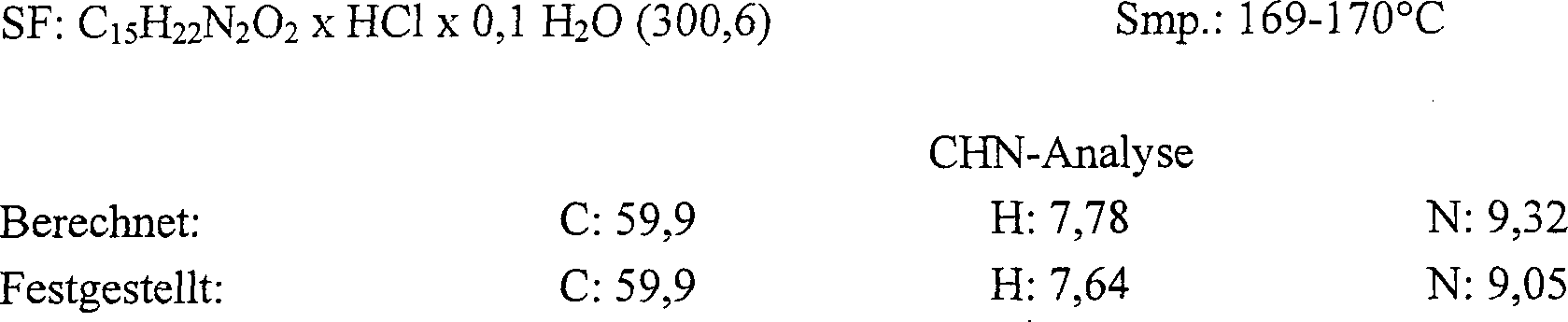
Beispiel 120Example 120
N-Pentyl-3-piperidinopropylcarbamatN-pentyl-3-piperidinopropylcarbamat
3-Piperidinopropanolhydrochlorid (4 mmol) und 4 mmol Pentylisocyanat in 20 ml trockenem Acetonitril wurden für 3 Stunden unter Rückfluß gekocht. Das Lösungsmittel wurde abgedampft, und der Rückstand wurde mittels Säulenchromatographie auf Silicagel gereinigt (Elutionsmittel: Methylenchlorid/Methanol/wäßriges Ammoniak (90/10/0,5)). Nach dem Entfernen des Lösungsmittels unter vermindertem Druck wurde der Rückstand mit Salzsäure in 2-Propanol auskristallisiert.3-Piperidinopropanolhydrochlorid (4 mmol) and 4 mmol of pentyl isocyanate in 20 ml of dry acetonitrile for 3 hours cooked under reflux. The solvent was evaporated, and the residue was purified by column chromatography purified on silica gel (eluent: methylene chloride / methanol / aqueous ammonia (90/10 / 0.5)). After removal of the solvent under reduced Pressure became the residue with hydrochloric acid crystallized in 2-propanol.


Beispiel 121Example 121
(S)-(+)-N-[2-(3,3-Dimethyl)butyl]-3-piperidinopropylcarbamat(S) - (+) - N- [2- (3,3-Dimethyl) butyl] -3-piperidinopropylcarbamat
3-Piperidinopropanolhydrochlorid (5 mmol) und 5 mmol (S)-2-(3,3-Dimethyl)-butylisocyanat in 10 ml trockenem Acetonitril wurden für 12 Stunden unter Rückfluß gekocht. Das Lösungsmittel wurde abgedampft, und der Rückstand wurde mittels Säulenchromatographie auf Silicagel gereinigt (Elutionsmittel: Methylenchlorid/Methanol (90/10), Ammoniak-Atmosphäre). Das Lösungsmittel wurde entfernt, und der Rückstand wurde mit Oxasäure aus Diethylether/Ethanol auskristallisiert.3-Piperidinopropanolhydrochlorid (5 mmol) and 5 mmol of (S) -2- (3,3-dimethyl) -butylisocyanate in 10 ml of dry acetonitrile were for Boiled under reflux for 12 hours. The solvent was evaporated, and the residue was purified by column chromatography purified on silica gel (eluent: methylene chloride / methanol (90/10), ammonia atmosphere). The solvent was removed, and the residue was with oxic acid crystallized from diethyl ether / ethanol.

Beispiel 122Example 122
N-(4-Chlorbenzyl)-S-(3-piperidinopropyl)isothioharnstoffN- (4-chlorobenzyl) -S- (3-piperidinopropyl) isothiourea
4-Chlorbenzylamin (10 mmol) wurde zu 10 mmol Benzoylisothiocyanat, gelöst in 20 ml trockenem Ether, zugetropft, gefolgt durch Rühren für 2 Stunden. Das ausgefallene Produkt wurde abfiltriert und aus Ethylacetat auskristallisiert (Ausbeute: 60%). Kaliumcarbonat (10 mmol) in 30 ml Wasser wurde zu 5 mmol des Produkts in 20 ml Ethanol zugetropft, und die Mischung wurde für 2 Stunden unter Rückfluß gekocht. Das ausgefallene Produkt wurde abfiltriert und aus Ethylacetat/Petrolether auskristallisiert (Ausbeute: 65%). 3-Piperidinopropylchlorid-Hydrochlorid (3 mmol), 3 mmol des Produkts und eine katalytische Menge an Kaliumiodid wurden in 20 ml Ethanol für 2 Tage unter Rückfluß gekocht. Anschließend wurde das Ethanol abgedampft, und der Rückstand wurde mittels Säulenchromatographie unter Verwendung von Methanol/Ethylacetat (2/8) als Elutionsmittel gereinigt. Nach dem Abdampfen des Lösungsmittels wurde das Produkt mit Salzsäure aus Diethylether/Ethanol auskristallisiert.4-chlorobenzylamine (10 mmol) became 10 mmol benzoylisothiocyanate dissolved in 20 ml of dry ether, added dropwise, followed by stirring for 2 hours. The failed one Product was filtered off and crystallized from ethyl acetate (Yield: 60%). Potassium carbonate (10 mmol) in 30 ml of water added dropwise to 5 mmol of the product in 20 ml of ethanol, and the mixture was for Boiled under reflux for 2 hours. The precipitated product was filtered off and from ethyl acetate / petroleum ether crystallized out (yield: 65%). 3-Piperidinopropylchlorid hydrochloride (3 mmol), 3 mmol of the product and a catalytic amount of potassium iodide in 20 ml of ethanol for Cooked under reflux for 2 days. Subsequently The ethanol was evaporated and the residue was purified by column chromatography using methanol / ethyl acetate (2/8) as eluent cleaned. After evaporation of the solvent, the product became with hydrochloric acid crystallized from diethyl ether / ethanol.

Beispiel 123Example 123
N'-Cyclohexylthiocarbamoy1-N-1,4'-bipiperidinN'-Cyclohexylthiocarbamoy1-N-1,4'-bipiperidine
1,4'-Bipiperidin (5 mmol) in 10 ml trockenem Ether wurde zu 5 mmol Cyclohexylisothiocyanat in 30 ml trockenem Ether zugetropft, gefolgt durch Rühren für 2 Stunden. Die Filtration ergab einen Rückstand, welcher in Ethanol gelöst und mit Oxalsäure auskristallisiert wurde. Eine Umkristallisierung ergab das reine Produkt.1,4'-bipiperidine (5 mmol) in 10 ml of dry ether was added to 5 mmol Cyclohexylisothiocyanat in 30 ml of dry ether, followed by stirring for 2 hours. The filtration gave a residue, which dissolved in ethanol and with oxalic acid crystallized out. Recrystallization gave the pure Product.

Beispiel 124Example 124
N-Heptanoyl-1,4'-bipiperidinN-heptanoyl-1,4'-bipiperidine
1,4'-Bipiperidin (10 mmol) in 5 ml Wasser wurde zu einer Lösung von 5 mmol n-Heptanoylchlorid in 20 ml Dioxan zugetropft. Nach Rühren für 15 Minuten wurde das Lösungsmittel unter vermindertem Druck abgedampft, und der Rückstand wurde mittels Säulenchromatographie auf Silicagel gereinigt (Elutionsmittel: Methylenchlorid/Methanol/wäßriges Ammoniak (90/10/0,5)). Das Lösungsmittel wurde unter vermindertem Druck entfernt, und der Rückstand wurde mit Oxalsäure auskristallisiert.1,4'-bipiperidine (10 mmol) in 5 ml of water became a solution of 5 mmol of n-heptanoyl chloride in 20 ml of dioxane added dropwise. After stirring for 15 minutes, the solvent became evaporated under reduced pressure, and the residue was purified by column chromatography purified on silica gel (eluent: methylene chloride / methanol / aqueous ammonia (90/10 / 0.5)). The solvent was removed under reduced pressure, and the residue was with oxalic acid crystallized.

Beispiel 125Example 125
3-Cyclopentyl-N-(3-(1-pyrrolidinyl)propyl)propanamid3-Cyclopentyl-N- (3- (1-pyrrolidinyl) propyl) propanamide
3-Cyclopentylpropionylchlorid (5 mmol) in 10 ml Dioxan wurde zu einer Lösung von 10 mmol 1-(3-Aminopropyl)pyrrolidin in Wasser zugetropft. Nach Rühren für 4 Stunden wurde das Lösungsmittel unter vermindertem Druck abgedampft, und der Rückstand wurde mittels Säulenchromatographie auf Silicagel gereinigt (Elutionsmittel: Methylenchlorid/Methanol/wäßriges Ammoniak (90/10/1)). Das Lösungsmittel wurde unter vermindertem Druck entfernt, und der Rückstand wurde mit Oxalsäure aus Diethylether/Ethanol auskristallisiert.3-cyclopentylpropionyl chloride (5 mmol) in 10 ml of dioxane was added to a solution of 10 mmol of 1- (3-aminopropyl) pyrrolidine added dropwise in water. After stirring for 4 hours became the solvent evaporated under reduced pressure, and the residue was purified by column chromatography purified on silica gel (eluent: methylene chloride / methanol / aqueous ammonia (90/10/1)). The solvent was removed under reduced pressure, and the residue was with oxalic acid crystallized from diethyl ether / ethanol.


Beispiel 126Example 126
N-Cyclohexyl-N'-(1-pyrrolidinyl-3-propyl)harnstoffN-cyclohexyl-N '- (1-pyrrolidinyl-3-propyl) urea
Unter einer Argon-Atmosphäre wurden 10 mmol Cyclohexylisocyanat langsam zu 10 mmol 1-(3-Aminopropyl)pyrrolidin in 10 ml Acetonitril zugegeben. Das Produkt fiel sofort als ein reinweißer Feststoff aus. Das Lösungsmittel wurde unter vermindertem Druck entfernt, und das Produkt wurde mit Oxalsäure aus Diethylether/Ethanol auskristallisiert.Under an argon atmosphere 10 mmol of cyclohexylisocyanate were slowly added to 10 mmol of 1- (3-aminopropyl) pyrrolidine in 10 ml of acetonitrile. The product immediately came in as one pure white Solid off. The solvent was removed under reduced pressure and the product was washed with oxalic acid crystallized from diethyl ether / ethanol.

Beispiel 127Example 127
α-(4-Acetylphenoxy)-α'-piperidino-p-xylolα- (4-Acetylphenoxy) -α'-piperidino-p-xylene
Hydroxyacetophenon (2 mmol) und 5 mmol K2CO3 wurden in 20 ml Aceton mit 2 ml DMF für 10 Minuten gerührt. Die Reaktion wurde nach Zugabe von 3,5 mmol α,α'-Dibromxylol bei Umgebungstemperatur für 12 Stunden gerührt und nach Zugabe von 7 mmol Piperidin für 1 Stunde unter Rückfluß gekocht. Das Lösungsmittel wurde unter vermindertem Druck abgedampft. Der Rückstand wurde in Wasser suspendiert und mit Methylenchlorid extrahiert. Die vereinigten organischen Extrakte wurden mit Oxalsäure auskristallisiert. Eine Umkristallisierung ergab das reine Produkt.Hydroxyacetophenone (2 mmol) and 5 mmol K 2 CO 3 were stirred in 20 ml of acetone with 2 ml of DMF for 10 minutes. The reaction was stirred after addition of 3.5 mmol α, α'-dibromoxylol at ambient temperature for 12 hours and boiled after addition of 7 mmol of piperidine for 1 hour under reflux. The solvent was evaporated under reduced pressure. The residue was suspended in water and extracted with methylene chloride. The combined organic extracts were crystallized with oxalic acid. One Um crystallization gave the pure product.

Beispiel 128Example 128
α-(4-Acetylphenoxy)-α'-(1-pyrrolidinyl)-p-xylolα- (4-Acetylphenoxy) -α '- (1-pyrrolidinyl) -p-xylene
Hydroxyacetophenon (2 mmol) und 5 mmol K2CO3 wurden in 20 ml Aceton mit 2 ml DMF für 10 Minuten gerührt. Die Reaktion wurde nach Zugabe von 3,5 mmol α,α'-Dibromxylol bei Umgebungstemperatur für 12 Stunden gerührt und nach Zugabe von 7 mmol Pyrrolidin für 1 Stunde unter Rückfluß gekocht. Das Lösungsmittel wurde unter vermindertem Druck abgedampft. Der Rückstand wurde in Wasser suspendiert und mit Methylenchlorid extrahiert. Die vereinigten organischen Extrakte wurden mit Oxalsäure auskristallisiert. Eine Umkristallisierung ergab das reine Produkt.Hydroxyacetophenone (2 mmol) and 5 mmol K 2 CO 3 were stirred in 20 ml of acetone with 2 ml of DMF for 10 minutes. The reaction was stirred after addition of 3.5 mmol of α, α'-dibromoxylol at ambient temperature for 12 hours and boiled after addition of 7 mmol of pyrrolidine for 1 hour under reflux. The solvent was evaporated under reduced pressure. The residue was suspended in water and extracted with methylene chloride. The combined organic extracts were crystallized with oxalic acid. Recrystallization gave the pure product.

Beispiel 129Example 129
α-(3-Phenylpropoxy)-α'-piperidino-p-xylolα- (3-phenylpropoxy) -α'-piperidino-p-xylene
4-(Piperidinomethyl)benzoesäuremethylester (22 mmol) in trockenem Tetrahydrofuran wurde zu einer Suspension von 44 mmol Lithiumaluminiumhydrid in 30 ml trockenem Tetrahydrofuran bei 0°C zugetropft. Nach dem Kochen unter Rückfluß für 2 Stunden wurde eine gesättigte Lösung von Ammoniumchlorid in Wasser zugetropft. Nach Rühren für 12 Stunden bei Umgebungstemperatur wurde die organische Schicht isoliert, und die wäßrige Schicht wurde mit Methylenchlorid extrahiert. Die organischen Extrakte wurden vereinigt, und das Lösungsmittel wurde unter vermindertem Druck abgedampft. Der Rückstand wurde mit Maleinsäure aus Diethylether/2-Propanol auskristallisiert (Ausbeute: 91 %). Natrium-4-(piperidinomethyl)benzylalkoholat (5 mmol) und 6 mmol 3-Phenylpropylbromid in 10 ml trockenem Toluol wurden für 6 Stunden unter Rückfluß gekocht. Das Lösungsmittel wurde unter vermindertem Druck abgedampft. Der Rückstand wurde mittels Rotationschromatographie auf Silicagel unter Verwendung von Methylenchlorid/Ammoniak-Atmosphäre als Elutionsmittel gereinigt. Das Produkt wurde mit Oxalsäure aus Diethylether/Ethanol auskristallisiert.4- (piperidinomethyl) -benzoic acid methyl ester (22 mmol) in dry tetrahydrofuran became a suspension of 44 mmol lithium aluminum hydride in 30 ml dry tetrahydrofuran at 0 ° C dropwise. After refluxing for 2 hours, a saturated solution of Ammonium chloride added dropwise in water. After stirring for 12 hours at ambient temperature The organic layer was isolated and the aqueous layer was washed with methylene chloride extracted. The organic extracts were combined, and the solvent was evaporated under reduced pressure. The residue was treated with maleic acid from diethyl ether / 2-propanol crystallized out (yield: 91%). Sodium 4- (piperidinomethyl) benzylalkoxide (5 mmol) and 6 mmol 3-Phenylpropylbromid in 10 ml of dry toluene were for Boiled under reflux for 6 hours. The solvent was evaporated under reduced pressure. The residue was purified by rotary chromatography on silica gel using methylene chloride / ammonia atmosphere as eluent cleaned. The product was treated with oxalic acid from diethyl ether / ethanol crystallized.

Beispiel 130Example 130
3-(4-Chlorbenzyl)-5-(2-piperidinoethyl)-1,2,4-oxadiazol3- (4-chlorobenzyl) -5- (2-piperidinoethyl) -1,2,4-oxadiazole
Hydroxylaminhydrochlorid (20 mmol) wurde zu einer Lösung von 20 mmol Natrium in 50 ml Methanol bei 0°C zugetropft. Nach Rühren für 30 Minuten bei Umgebungstemperatur wurden 10 mmol 4-Chlorbenzylcyanid bei 0°C zugetropft. Nach dem Kochen unter Rückfluß für 6 Stunden wurde die Suspension filtriert, und das Lösungsmittel wurde unter vermindertem Druck abgedampft. Der Rückstand wurde aus Diethylether auskristallisiert (Ausbeute: 41 %). Zu einer Lösung von 4 mmol des Produkts und 6 mmol 3-Piperidinopropionsäuremethylester in 15 ml trockenem Methanol wurden 5 mmol Natrium in 20 ml Methanol bei 0°C zugetropft. Nach Rühren für 1 Stunde unter einer Argon-Atmosphäre, gefolgt durch das Kochen unter Rückfluß für 18 Stunden, wurde das Lösungsmittel unter vermindertem Druck abgedampft. Der Rückstand wurde in DMF suspendiert und für 6 Stunden bei 80°C gerührt. Das Lösungsmittel wurde unter vermindertem Druck abgedampft. Der Rückstand wurde in Wasser suspendiert und mit Methylenchlorid extrahiert. Der Rückstand der organischen Schicht wurde mittels Rotationschromatographie auf Silicagel unter Verwendung von Methylenchlorid/Ammoniak-Atmosphäre als Elutionsmittel gereinigt. Das Produkt wurde mit Oxasäure aus Diethylether/Ethanol auskristallisiert.Hydroxylamine hydrochloride (20 mmol) was added dropwise to a solution of 20 mmol of sodium in 50 ml of methanol at 0 ° C. After stirring for 30 minutes at ambient temperature, 10 mmol of 4-chlorobenzyl cyanide was added dropwise at 0 ° C. After refluxing for 6 hours, the suspension was filtered and the solvent was evaporated under reduced pressure. The residue was crystallized from diethyl ether (yield: 41%). To a solution of 4 mmol of the product and 6 mmol of 3-piperidinopropionic acid remethyl ester in 15 ml of dry methanol, 5 mmol of sodium in 20 ml of methanol were added dropwise at 0 ° C. After stirring for 1 hour under an argon atmosphere, followed by refluxing for 18 hours, the solvent was evaporated under reduced pressure. The residue was suspended in DMF and stirred at 80 ° C for 6 hours. The solvent was evaporated under reduced pressure. The residue was suspended in water and extracted with methylene chloride. The residue of the organic layer was purified by rotary chromatography on silica gel using methylene chloride / ammonia atmosphere as eluent. The product was crystallized with oxic acid from diethyl ether / ethanol.

Beispiel 131Example 131
2-((-Piperidinoethyl)amino)benzothiazol2 - ((- piperidinoethyl) amino) benzothiazole
2-Chlorbenzothiazol (10 mmol), 10 mmol 2-Piperidinoethanamin und 30 mmol Triethylamin in 50 ml trockenem Ethanol wurden für 6 Stunden unter Rückfluß gekocht. Das Produkt wurde mit Salzsäure in 2-Propanol auskristallisiert und in Methanol umkristallisiert.2-Chloro-benzothiazole (10 mmol), 10 mmol 2-piperidinoethanamine and 30 mmol triethylamine in 50 ml of dry ethanol was refluxed for 6 hours. The product was washed with hydrochloric acid crystallized in 2-propanol and recrystallized in methanol.

Beispiel 132Example 132
5-Piperidinopentylamin5-Piperidinopentylamin
5-Chlorvaleronitril (10 mmol), 20 mmol Piperidin, 20 mmol Kaliumcarbonat und eine katalytische Menge an Kaliumiodid in 50 ml Ethanol wurden für 6 Stunden unter Rückfluß gekocht. Das Lösungsmittel wurde unter vermindertem Druck entfernt. Der Rückstand wurde in Wasser suspendiert und mit Methylenchlorid extrahiert. Die organische Schicht wurde mittels Säulenchromatographie auf Silicagel unter Verwendung von Methylenchlorid/Methanol/wäßriges Ammoniak (90/10/1) als Elutionsmittel gereinigt (Ausbeute: 59%). Das Produkt wurde zu einer Suspension von 25 mmol Lithiumaluminiumhydrid in 25 ml trockenem Tetrahydrofuran bei 0°C zugetropft. Nach dem Kochen unter Rückfluß für 1 Stunde wurden 10 ml einer gesättigten Lösung von Natrium/Kaliumtartrat in Wasser zugetropft. Der Rückstand wurde abfiltriert, und das Filtrat wurde mittels Säulenchromatographie auf Silicagel unter Verwendung von Methylenchlorid/Methanol/wäßriges Ammoniak (90/10/1) als Elutionsmittel gereinigt. Der Rückstand wurde mit Salzsäure aus Diethylether/2-Propanol auskristallisiert.5-chlorovaleronitrile (10 mmol), 20 mmol piperidine, 20 mmol potassium carbonate and a catalytic The amount of potassium iodide in 50 ml of ethanol was refluxed for 6 hours. The solvent was removed under reduced pressure. The residue was suspended in water and extracted with methylene chloride. The organic layer was by column chromatography on silica gel using methylene chloride / methanol / aqueous ammonia (90/10/1) as eluent (yield: 59%). The product was added to a suspension of 25 mmol lithium aluminum hydride in 25 ml of dry tetrahydrofuran was added dropwise at 0 ° C. After cooking under reflux for 1 hour 10 ml of a saturated solution of sodium / potassium tartrate in water. The residue was filtered off, and the filtrate was purified by column chromatography on silica gel using methylene chloride / methanol / aqueous ammonia (90/10/1) as eluent. The residue was extracted with hydrochloric acid Diethyl ether / 2-propanol crystallized.

Beispiel 133Example 133
5-Nitro-2-(6-piperidinohexyl)pyridin5-Nitro-2- (6-piperidinohexyl) pyridine
6-Aminohexanol (15 mmol), 15 mmol 2-Chlor-5-nitropyridin, 5 ml Triethylamin und eine katalytische Menge an Kaliumiodid wurden in 30 ml Ethanol für 12 Stunden unter Rückfluß gekocht. Das Lösungsmittel wurde abgedampft, und der Rückstand wurde mittels Säulenchromatographie auf Silicagel gereinigt (Elutionsmittel: Methylenchlorid/Methanol (95/5), Ammoniak-Atmosphäre). Das Lösungsmittel wurde unter vermindertem Druck entfernt (Ausbeute: 66%). Das Produkt (5 mmol) wurde in Tetrahydrofuran gelöst und bei 0°C gerührt, und 10 mmol Thionylchlorid wurden zugetropft. Nach 1 Stunde bei Umgebungstemperatur wurde die Mischung für 2 Stunden auf 60°C erwärmt. Das Lösungsmittel und der Überschuß an Thionylchlorid wurden abgedampft. Der ölige Rückstand wurde mit Salzsäure aus Diethylether/Ethanol auskristallisiert (Ausbeute: 95%). Das Produkt (5 mmol), 10 mmol Piperidin, 15 mmol Kaliumcarbonat und eine katalytische Menge an Kaliumiodid wurden in 30 ml Ethanol für 12 Stunden unter Rückfluß gekocht. Das Lösungsmittel wurde abgedampft, und der Rückstand wurde mittels Säulenchromatographie gereinigt (Elutionsmittel: Methylenchlorid/Methanol (95/5), Ammoniak-Atmosphäre). Das Lösungsmittel wurde unter vermindertem Druck entfernt, und der Rückstand wurde mit Oxasäure aus Diethylether/Ethanol auskristallisiert.6-Aminohexanol (15 mmol), 15 mmol of 2-chloro-5-nitropyridine, 5 ml of triethylamine and a catalytic amount of potassium iodide were refluxed in 30 ml of ethanol for 12 hours. The solvent became evaporated and the residue was purified by column chromatography on silica gel (eluent: methylene chloride / methanol (95/5), ammonia atmosphere). The solvent was removed under reduced pressure (yield: 66%). The product (5 mmol) was dissolved in tetrahydrofuran and stirred at 0 ° C, and 10 mmol of thionyl chloride was added dropwise. After 1 hour at ambient temperature, the mixture was heated to 60 ° C for 2 hours. The solvent and excess of thionyl chloride were evaporated. The oily residue was crystallized from diethyl ether / ethanol with hydrochloric acid (yield: 95%). The product (5 mmol), 10 mmol of piperidine, 15 mmol of potassium carbonate and a catalytic amount of potassium iodide were refluxed in 30 ml of ethanol for 12 hours. The solvent was evaporated and the residue was purified by column chromatography (eluent: methylene chloride / methanol (95/5), ammonia atmosphere). The solvent was removed under reduced pressure and the residue was crystallized from diethyl ether / ethanol with oxalic acid.

Beispiel 134Example 134
3-Nitro-2-(6-piperidinohexylamino)pyridin3-Nitro-2- (6-piperidinohexylamino) pyridine
6-Aminohexanol (15 mmol), 15 mmol 2-Chlor-3-nitropyridin, 5 ml Triethylamin und eine katalytische Menge an Kaliumiodid wurden in 30 ml Ethanol für 12 Stunden unter Rückfluß gekocht. Das Lösungsmittel wurde abgedampft, und der Rückstand wurde mittels Säulenchromatographie auf Silicagel gereinigt (Elutionsmittel: Methylenchlo rid/Methanol (98/2), Ammoniak-Atmosphäre). Das Lösungsmittel wurde unter vermindertem Druck entfernt (Ausbeute: 55%). Das Produkt (5 mmol) wurde in Tetrahydrofuran gelöst und bei 0°C gerührt, und 10 mmol Thionylchlorid wurden zugetropft. Nach 1 Stunde bei Umgebungstemperatur wurde die Mischung für 2 Stunden auf 60°C erwärmt. Das Lösungsmittel und der Überschuß an Thionylchlorid wurden abgedampft. Der ölige Rückstand wurde mit Salzsäure aus Diethylether/Ethanol auskristallisiert (Ausbeute: 95%). Das Produkt (5 mmol), 10 mmol Piperidin, 15 mmol Kaliumcarbonat und eine katalytische Menge an Kaliumiodid wurden in 30 ml Ethanol wurden für 12 Stunden unter Rückfluß gekocht. Das Lösungsmittel wurde abgedampft, und der Rückstand wurde mittels Säulenchromatographie gereinigt (Elutionsmittel: Methylenchlorid/Methanol (95/5), Ammoniak-Atmosphäre). Das Lösungsmittel wurde unter vermindertem Druck entfernt, und der Rückstand wurde mit Oxalsäure aus Diethylether/Ethanol auskristallisiert.6-aminohexanol (15 mmol), 15 mmol of 2-chloro-3-nitropyridine, 5 ml of triethylamine and a catalytic amount of potassium iodide was added in 30 ml of ethanol for 12 hours cooked under reflux. The solvent was evaporated, and the residue was purified by column chromatography purified on silica gel (eluant: methylene chloride / methanol (98/2), ammonia atmosphere). The solvent was removed under reduced pressure (yield: 55%). The product (5 mmol) was dissolved in tetrahydrofuran and stirred at 0 ° C, and 10 mmol of thionyl chloride were added dropwise. After 1 hour at ambient temperature was the mix for 2 hours at 60 ° C heated. The solvent and the excess of thionyl chloride were evaporated. The oily Residue was with hydrochloric acid crystallized from diethyl ether / ethanol (yield: 95%). The Product (5 mmol), 10 mmol of piperidine, 15 mmol of potassium carbonate and a catalytic amount of potassium iodide was added in 30 ml of ethanol for 12 Cooked under reflux for hours. The solvent was evaporated, and the residue was purified by column chromatography purified (eluent: methylene chloride / methanol (95/5), ammonia atmosphere). The solvent was removed under reduced pressure, and the residue was with oxalic acid crystallized from diethyl ether / ethanol.

Beispiel 135Example 135
2-(6-Piperidinohexylamino)pyrimidin2- (6-Piperidinohexylamino) pyrimidine
6-Aminohexanol (15 mmol), 15 mmol 2-Chlorpyrimidin, 5 ml Triethylamin und eine katalytische Menge an Kaliumiodid wurden in 30 ml Ethanol für 12 Stunden unter Rückfluß gekocht. Das Lösungsmittel wurde abgedampft, und der Rückstand wurde mittels Säulenchromatographie auf Silicagel gereinigt (Elutionsmittel: Methylenchlorid/Methanol (98/2), Ammoniak-Atmosphäre). Das Lösungsmittel wurde unter vermindertem Druck entfernt (Ausbeute: 40%). Das Produkt (5 mmol) wurde in Tetrahydrofuran gelöst und bei 0°C gerührt, und 10 mmol Thionylchlorid wurden zugetropft. Nach 1 Stunde bei Umgebungstemperatur wurde die Mischung für 2 Stunden auf 60°C erwärmt. Das Lösungsmittel und der Überschuß an Thionylchlorid wurden abgedampft. Der ölige Rückstand wurde mit Salzsäure aus Diethylether/Ethanol auskristallisiert (Ausbeute: 95%). Das Produkt (5 mmol), 10 mmol Piperidin, 15 mmol Kaliumcarbonat und eine katalytische Menge an Kaliumiodid wurden in 30 ml Ethanol für 12 Stunden unter Rückfluß gekocht. Das Lösungsmittel wurde abgedampft, und der Rückstand wurde mittels Säulenchromatographie gereinigt (Elutionsmittel: Methylenchlorid/Methanol (95/5), Ammoniak-Atmosphäre}. Das Lösungsmittel wurde unter vermindertem Druck entfernt, und der Rückstand wurde mit Oxasäure aus Diethylether/Ethanol auskristallisiert.6-Aminohexanol (15 mmol), 15 mmol of 2-chloropyrimidine, 5 ml of triethylamine and a catalytic amount of potassium iodide were refluxed in 30 ml of ethanol for 12 hours. The solvent was evaporated and the residue was purified by column chromatography on silica gel (eluent: methylene chloride / methanol (98/2), ammonia atmosphere). The solvent was removed under reduced pressure (yield: 40%). The product (5 mmol) was dissolved in tetrahydrofuran and stirred at 0 ° C, and 10 mmol of thionyl chloride was added dropwise. After 1 hour at ambient temperature, the mixture was heated to 60 ° C for 2 hours. The solvent and excess of thionyl chloride were evaporated. The oily residue was crystallized from diethyl ether / ethanol with hydrochloric acid (yield: 95%). The product (5 mmol), 10 mmol of piperidine, 15 mmol of potassium carbonate and a catalytic amount of potassium iodide were refluxed in 30 ml of ethanol for 12 hours. The solvent was evaporated and the residue was purified by column chromatography (eluant: methylene chloride / methanol (95/5), Am monia atmosphere}. The solvent was removed under reduced pressure and the residue was crystallized from diethyl ether / ethanol with oxalic acid.


Beispiel 136Example 136
N-(6-Phenylhexyl)piperidinN- (6-phenylhexyl) piperidine
6-Phenylhexanol (5 mmol) wurde bei 0°C gerührt, und Thionylchlorid (10 mmol) wurde zugetropft. Nach 1 Stunde bei Umgebungstemperatur wurde die Mischung für 2 Stunden auf 60°C erwärmt. Der Überschuß an Thionylchlorid wurden abgedampft. Der ölige Rückstand wurde mittels Säulenchromatographie gereinigt (Elutionsmittel: Methylenchlorid)(Ausbeute: 98%). Das Produkt wurde in 50 ml Ethanol gelöst, und 10 mmol K2CO3, 1 mmol Kl und 10 mmol Piperidin wurden zugegeben. Nach dem Kochen unter Rückfluß für 6 Stunden wurde das Lösungsmittel unter vermindertem Druck abgedampft. Der Rückstand wurde in Wasser suspendiert und mit Methylenchlorid extrahiert. Die organischen Extrakte wurden vereinigt und mit MgSO4 getrocknet, und der Rückstand wurde mittels Säulenchromatographie auf Silicagel gereinigt (Elutionsmittel: Methylenchlorid/Methanol/wäßriges Ammoniak (90/10/1)). Der Rückstand wurde mit Oxalsäure aus Diethylether/Methanol auskristallisiert.6-Phenylhexanol (5 mmol) was stirred at 0 ° C and thionyl chloride (10 mmol) was added dropwise. After 1 hour at ambient temperature, the mixture was heated to 60 ° C for 2 hours. The excess of thionyl chloride was evaporated. The oily residue was purified by column chromatography (eluent: methylene chloride) (yield: 98%). The product was dissolved in 50 ml of ethanol, and 10 mmol K 2 CO 3 , 1 mmol Kl and 10 mmol piperidine were added. After refluxing for 6 hours, the solvent was evaporated under reduced pressure. The residue was suspended in water and extracted with methylene chloride. The organic extracts were combined and dried with MgSO 4 , and the residue was purified by column chromatography on silica gel (eluent: methylene chloride / methanol / aqueous ammonia (90/10/1)). The residue was crystallized from diethyl ether / methanol with oxalic acid.

Beispiel 137Example 137
α-(4-Acetylphenoxy)-α'-(4-methylpiperidino)-p-xylolα- (4-Acetylphenoxy) -α '- (4-methylpiperidino) -p-xylene
α,α'-Dibrom-para-xylol (30 mmol), 4-Hydroxyacetophenon (20 mmol) und Kaliumcarbonat (50 mmol) wurden in 50 ml Aceton für 12 Stunden unter Rückfluß gekocht. Das Lösungsmittel wurde unter vermindertem Druck entfernt, und der Rückstand wurde mittels Säulenchromatographie auf Silicagel gereinigt (Elutionsmittel: Methylenchlorid/Petrolether/Methanol (60/38/2)). Das Produkt (2 mmol), 4-Methylpiperidin (6 mmol), Kaliumcarbonat (8 mmol) und katalytische Mengen an Kaliumiodid wurden in Aceton für 12 Stunden unter Rückfluß gekocht. Das Lösungsmittel wurde abgedampft. Der Rückstand wurde mit Wasser gewaschen und mit Ethylacetat extrahiert. Das Lösungsmittel wurde unter vermindertem Druck entfernt. Das Produkt wurde mit Oxalsäure aus Diethylether/Ethanol auskristallisiert.α, α'-Dibromo-para-xylene (30 mmol), 4-hydroxyacetophenone (20 mmol) and potassium carbonate (50 mmol) were dissolved in 50 ml of acetone for Boiled under reflux for 12 hours. The solvent was removed under reduced pressure, and the residue was purified by column chromatography purified on silica gel (eluent: methylene chloride / petroleum ether / methanol (60/38/2)). The product (2 mmol), 4-methylpiperidine (6 mmol), potassium carbonate (8 mmol) and catalytic amounts of potassium iodide were dissolved in acetone for 12 Cooked under reflux for hours. The solvent was evaporated. The residue was washed with water and extracted with ethyl acetate. The solvent was removed under reduced pressure. The product was made with oxalic acid Diethyl ether / ethanol crystallized.


Beispiel 138Example 138
α-(4-Acetylphenoxy)-α'-(3,5-cis-dimethylpiperidino)-p-xylolα- (4-Acetylphenoxy) -α '- (3,5-cis-dimethylpiperidino) -p-xylene
Gemäß dem in Beispiel 137 beschriebenen Verfahren wurden der erhaltene Ether (2 mmol), 3,5-Dimethylpiperidin (Mischung von cis und trans, 8 mmol), Kaliumcarbonat (8 mmol) und katalytische Mengen an Kaliumiodid in Aceton für 12 Stunden unter Rückfluß gekocht. Nach dem Abdampfen des Lösungsmittels wurde das Produkt mittels Säulenchromatographie auf Silicagel gereinigt und auf diese Weise von dem korrespondierenden Diastereomer getrennt (Elutionsmittel: Diethylether/Petrolether/Triethylamin (66/33/1)). Das Produkt wurde mit Oxalsäure aus Diethylether/Ethanol auskristallisiert.According to the procedure described in Example 137, the obtained ether (2 mmol), 3,5-dimethylpiperidine (mixture of cis and trans, 8 mmol), potassium carbonate (8 mmol) and catalytic amounts of potassium iodide in acetone were refluxed for 12 hours , After evaporation of the solvent, the product was purified by column chromatography on silica gel and thus purified from the corres separating diastereomer (eluent: diethyl ether / petroleum ether / triethylamine (66/33/1)). The product was crystallized from diethyl ether / ethanol with oxalic acid.

Beispiel 139Example 139
α-(4-Acetylphenoxy)-α'-(3,5-trans-dimethylpiperidino)-p-xylolα- (4-Acetylphenoxy) -α '- (3,5-trans-dimethylpiperidino) -p-xylene
Gemäß dem in Beispiel 137 beschriebenen Verfahren wurden der erhaltene Ether (2 mmol), 3,5-Dimethylpiperidin (Mischung von cis und trans, 8 mmol), Kaliumcarbonat (8 mmol) und katalytische Mengen an Kaliumiodid in Aceton für 12 Stunden unter Rückfluß gekocht. Nach dem Abdampfen des Lösungsmittels wurde das Produkt mittels Säulenchromatographie auf Silicagel gereinigt und auf diese Weise von dem korrespondierenden Diastereomer getrennt (Elutionsmittel: Diethylether/Petrolether/Triethylamin (66/33/1)). Das Produkt wurde mit Oxalsäure aus Diethylether/Ethanol auskristallisiert.According to the in Example 137 described the obtained ether (2 mmol), 3,5-dimethylpiperidine (mixture of cis and trans, 8 mmol), Potassium carbonate (8 mmol) and catalytic amounts of potassium iodide in Acetone for Boiled under reflux for 12 hours. After evaporation of the solvent the product was purified by column chromatography purified on silica gel and in this way from the corresponding Diastereomer separated (eluent: diethyl ether / petroleum ether / triethylamine (66/33/1)). The product was treated with oxalic acid from diethyl ether / ethanol crystallized.

Beispiel 140Example 140
α-(4-Acetylphenoxy)-α'-(2-methylpyrrolidino)-p-xylolα- (4-Acetylphenoxy) -α '- (2-methylpyrrolidino) -p-xylene
Gemäß dem in Beispiel 137 beschriebenen Verfahren wurden der erhaltene Ether (2 mmol), 2-Methylpyrrolidin (6 mmol), Kaliumcarbonat (8 mmol) und katalytische Mengen an Kaliumiodid in Aceton für 12 Stunden unter Rückfluß gekocht. Das Lösungs mittel wurde abgedampft. Der Rückstand wurde mit Wasser gewaschen und mit Ethylacetat extrahiert. Das Lösungsmittel wurde unter vermindertem Druck entfernt. Das Produkt wurde mit Salzsäure aus Diethylether/Ethanol auskristallisiert. Eine Umkristallisierung ergab das reine Produkt.According to the in Example 137 described the obtained ether (2 mmol), 2-methylpyrrolidine (6 mmol), potassium carbonate (8 mmol) and catalytic amounts of potassium iodide in acetone refluxed for 12 hours. The solvent was evaporated. The residue was washed with water and extracted with ethyl acetate. The solvent was removed under reduced pressure. The product was made up with hydrochloric acid Diethyl ether / ethanol crystallized. A recrystallization gave the pure product.

Beispiel 141Example 141
α-(4-Cyclopropylcarbonylphenoxy)-α'-piperidino-p-xylolα- (4-Cyclopropylcarbonylphenoxy) -α'-piperidino-p-xylene
Eine Lösung, enthaltend 1,4-Benzoldimethanol (30 mmol), Natriumhydrid (25, mmol), katalytische Mengen an Tetrabutylammoniumiodid und 15-Crown-5 (0,5 mmol) in Tetrahydrofuran, wurde für 10 Minuten gerührt. Cyclopropyl-4-fluorphenylketon (20 mmol) wurde zugetropft, und die Lösung wurde für 24 Stunden unter Rückfluß gekocht. Das Lösungsmittel wurde unter vermindertem Druck entfernt. Der Rückstand wurde mittels Säulenchromatographie auf Silicagel gereinigt (Elutionsmittel: Methylenchlorid/Methanol (98/2)). Das Produkt (4 mmol) wurde bei 0°C zu Thionylchlorid (8 mmol) zugegeben. Die Temperatur wurde für 3 Stunden auf 70°C erhöht. Überschüssiges Thionylchlorid wurde abgedampft, und der Rückstand wurde mittels Säulenchromatographie auf Silicagel gereinigt (Elutionsmittel: Methylenchlorid/Methanol (95/5)). Das Produkt (2 mmol), Piperidin (4 mmol), katalytische Mengen an Kaliumiodid und Kaliumcarbonat (6 mmol), gelöst in Aceton, wurden für 12 Stunden unter Rückfluß gekocht. Das Lösungsmittel wurde abgedampft. Das Rohprodukt wurde mit Wasser gewaschen und mit Ethylacetat extrahiert. Die organische Schicht wurde unter vermindertem Druck entfernt. Der Rückstand wurde mit Oxalsäure aus Diethylether/Ethanol auskristallisiert.A solution containing 1,4-benzenedimethanol (30 mmol), sodium hydride (25 mmol), catalytic amounts of tetrabutylammonium iodide and 15-crown-5 (0.5 mmol) in tetrahydrofuran was stirred for 10 minutes. Cyclopropyl 4-fluorophenyl ketone (20 mmol) was added dropwise and the solution was refluxed for 24 hours. The solvent was removed under reduced pressure. The residue was purified by column chromatography on silica gel (eluant: methylene chloride / methanol (98/2)). The product (4 mmol) was added at 0 ° C to thionyl chloride (8 mmol). The temperature was raised to 70 ° C for 3 hours. Excess thionyl chloride was evaporated and the residue was purified by column chromatography on silica gel (eluent: methylene chloride / methanol (95/5)). The product (2 mmol), Piperidine (4 mmol), catalytic amounts of potassium iodide and potassium carbonate (6 mmol) dissolved in acetone were refluxed for 12 hours. The solvent was evaporated. The crude product was washed with water and extracted with ethyl acetate. The organic layer was removed under reduced pressure. The residue was crystallized from diethyl ether / ethanol with oxalic acid.
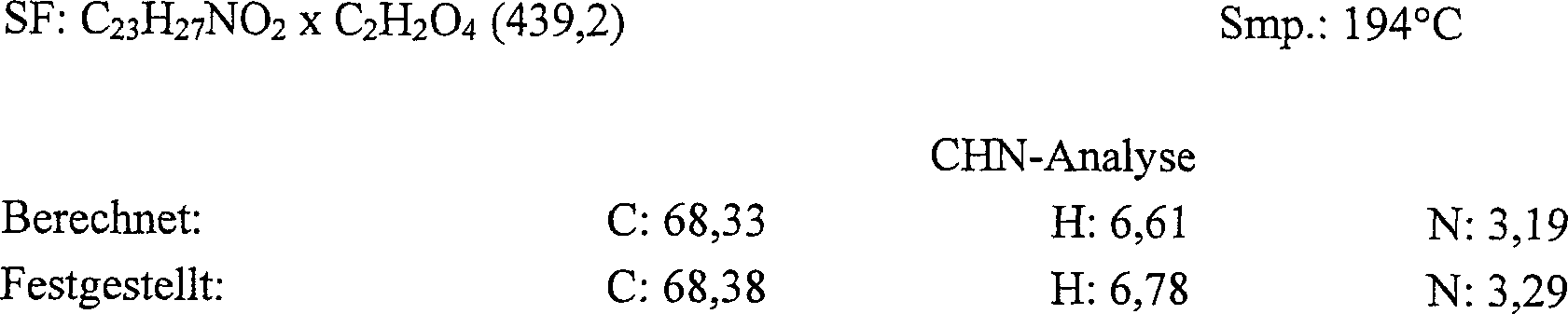
Beispiel 142Example 142
α-(4-Cyclopropylcarbonylphenoxy)-α'-(4-methylpiperidino)-p-xylolα- (4-Cyclopropylcarbonylphenoxy) -α '- (4-methylpiperidino) -p-xylene
Gemäß dem in Beispiel 141 beschriebenen Verfahren wurden das erhaltene Chlorid (2 mmol), 4-Methylpiperidin (4 mmol), Kaliumcarbonat (6 mmol) und katalytische Mengen an Kaliumiodid in Aceton für 12 Stunden unter Rückfluß gekocht. Das Lösungsmittel wurde abgedampft. Das Rohprodukt wurde mit Wasser gewaschen und mit Ethyl acetat extrahiert. Die organische Schicht wurde unter vermindertem Druck entfernt, und der Rückstand wurde mit Oxalsäure aus Diethylether/Ethanol auskristallisiert.According to the in Example 141 described the obtained chloride (2 mmol), 4-methylpiperidine (4 mmol), potassium carbonate (6 mmol) and catalytic amounts of potassium iodide in acetone refluxed for 12 hours. The solvent was evaporated. The crude product was washed with water and extracted with ethyl acetate. The organic layer was concentrated under reduced pressure Pressure removed, and the residue was with oxalic acid crystallized from diethyl ether / ethanol.

Beispiel 143Example 143
α-(4-Cyclopropylcarbonylphenoay)-α'-pyrrolidino-p-xylolα- (4-Cyclopropylcarbonylphenoay) -α'-pyrrolidino-p-xylene
Gemäß dem in Beispiel 141 beschriebenen Verfahren wurden das erhaltene Chlorid (2 mmol), Pyrrolidin (4 mmol), katalytische Mengen an Kaliumiodid und Kaliumcarbonat (6 mmol) in Aceton für 12 Stunden unter Rückfluß gekocht. Das Lösungsmittel wurde abgedampft. Das Rohprodukt wurde mit Wasser gewaschen und mit Ethylacetat extrahiert. Die organische Schicht wurde unter vermindertem Druck entfernt, und der Rückstand wurde mit Oxalsäure aus Diethylether/Ethanol auskristallisiert.According to the in Example 141 described the obtained chloride (2 mmol), pyrrolidine (4 mmol), catalytic amounts of potassium iodide and potassium carbonate (6 mmol) in acetone refluxed for 12 hours. The solvent was evaporated. The crude product was washed with water and extracted with ethyl acetate. The organic layer was concentrated under reduced pressure Pressure removed, and the residue was with oxalic acid crystallized from diethyl ether / ethanol.

Beispiel 144Example 144
3-Phenylpropyl-3-(4-methylpiperidino)propylether3-phenylpropyl-3- (4-methylpiperidino) propyl ether
3-Phenylpropylmesilat (18 mmol), katalytische Mengen an Tetrabutylammoniumiodid und 15-Crown-5 (0,5 mmol) wurden unter einer Argon-Atmosphäre zu einer Lösung von 1,3-Propandiol (25 mmol) und Natriumhydrid (25 mmol) in Tetrahydrofuran, welches über Nacht gerührt worden war, zugegeben. Die Mischung wurde für 24 Stunden unter Rückfluß gekocht. Das Lösungsmittel wurde abgedampft, und der ölige Rückstand wurde mittels Säulenchromatographie gereinigt (Elutionsmittel: Methylenchlorid/Methanol (95/5)). Das Produkt (8 mmol) wurde bei 0°C zu Thionylchlorid (16 mmol) zugegeben. Die Temperatur wurde für 3 Stunden auf 70°C erhöht. Überschüssiges Thionylchlorid wurde abgedampft. Der Rückstand wurde mittels Säulenchromatographie auf Silicagel gereinigt (Elutionsmittel: Methylenchlorid), und das Lösungsmittel wurde unter vermindertem Druck abgedampft. Das erhaltene Chlorid (5 mmol), 4-Methylpiperidin (10 mmol), Kaliumcarbonat (15 mmol) und katalytische Mengen an Kaliumiodid wurden in Aceton gelöst und für 12 Stunden unter Rückfluß gekocht. Nach dem Abdampfen des Lösungsmittels wurde das Produkt mittels Säulenchromatographie auf Silicagel gereinigt (Elutions mittel: Diethylether/Petrolether/Triethylamin (66/33/1) und mit Oxalsäure aus Diethylether/Ethanol auskristallisiert.3-Phenylpropyl mesylate (18 mmol), catalytic amounts of tetrabutylammonium iodide and 15-crown-5 (0.5 mmol) were added to a solution of 1,3-propanediol (25 mmol) and sodium hydride (25 mmol) in an argon atmosphere Tetrahydrofuran, which had been stirred overnight. The mixture was refluxed for 24 hours. The solvent was evaporated and the oily residue was purified by column chromatography (eluent: methylene chloride / methanol (95/5)). The product (8 mmol) was added at 0 ° C to thionyl chloride (16 mmol). The temperature was raised to 70 ° C for 3 hours. Excess thionyl chloride was evaporated. The residue was purified by column chromatography on silica gel (eluent: methylene chloride) and the solvent was removed under reduced pressure Pressure evaporated. The resulting chloride (5 mmol), 4-methylpiperidine (10 mmol), potassium carbonate (15 mmol) and catalytic amounts of potassium iodide were dissolved in acetone and refluxed for 12 hours. After evaporation of the solvent, the product was purified by column chromatography on silica gel (eluent: diethyl ether / petroleum ether / triethylamine (66/33/1) and crystallized with oxalic acid from diethyl ether / ethanol.

Beispiel 145Example 145
3-Phenylpropyl-3-(3,5-cis-dimethylpiperidino)propylether3-Phenylpropyl-3- (3,5-cis-dimethylpiperidino) propyl ether
Gemäß dem in Beispiel 144 beschriebenen Verfahren wurden das erhaltene Chlorid (5 mmol), 3,5-Dimethylpiperidin (Mischung von cis und trans, 10 mmol), Kaliumcarbonat (15 mmol) und katalytische Mengen an Kaliumiodid in Aceton gelöst und für 12 Stunden unter Rückfluß gekocht. Nach dem Abdampfen des Lösungsmittels wurde das Produkt mittels Säulenchromatographie auf Silicagel gereinigt und auf diese Weise von dem korrespondierenden Diastereomer getrennt (Elutionsmittel: Diethylether/Petrolether/Triethylamin (66/33/1)). Das Produkt wurde mit Oxalsäure aus Diethylether/Ethanol auskristallisiert.According to the in Example 144 described the obtained chloride (5 mmol), 3,5-dimethylpiperidine (mixture of cis and trans, 10 mmol), potassium carbonate (15 mmol) and catalytic amounts of potassium iodide dissolved in acetone and for Boiled under reflux for 12 hours. After evaporation of the solvent the product was purified by column chromatography purified on silica gel and in this way from the corresponding Diastereomer separated (eluent: diethyl ether / petroleum ether / triethylamine (66/33/1)). The product was oxalic acid crystallized from diethyl ether / ethanol.

Beispiel 146Example 146
3-Phenylpropyl-3-(3,5-trans-dimethylpiperidino)propylether3-Phenylpropyl-3- (3,5-trans-dimethylpiperidino) propyl ether
Gemäß dem in Beispiel 143 beschriebenen Verfahren wurden das erhaltene Chlorid (5 mmol), 3,5-Dimethylpiperidin (Mischung von cis und trans, 10 mmol), Kaliumcarbonat (15 mmol) und katalytische Mengen an Kaliumiodid in Aceton gelöst und für 12 Stunden unter Rückfluß gekocht. Nach dem Abdampfen des Lösungsmittels wurde das Produkt mittels Säulenchromatographie auf Silicagel gereinigt und auf diese Weise von dem korrespondierenden Diastereomer getrennt (Elutionsmittel: Diethylether/Petrolether/Triethylamin (66/33/1)). Das Produkt wurde mit Oxalsäure aus Diethylether/Ethanol auskristallisiert.According to the in Example 143 described the obtained chloride (5 mmol), 3,5-dimethylpiperidine (mixture of cis and trans, 10 mmol), potassium carbonate (15 mmol) and catalytic amounts of potassium iodide dissolved in acetone and for Boiled under reflux for 12 hours. After evaporation of the solvent the product was purified by column chromatography purified on silica gel and in this way from the corresponding Diastereomer separated (eluent: diethyl ether / petroleum ether / triethylamine (66/33/1)). The product was oxalic acid crystallized from diethyl ether / ethanol.

Beispiel 147Example 147
3-Phenylpropyl-3-(3-methylpiperidino)propylether3-phenylpropyl-3- (3-methylpiperidino) propyl ether
Gemäß dem in Beispiel 143 beschriebenen Verfahren wurden das erhaltene Chlorid (5 mmol), 3-Methylpiperidin (10 mmol), Kaliumcarbonat (15 mmol) und katalytische Mengen an Kaliumiodid in Aceton gelöst und für 12 Stunden unter Rückfluß gekocht. Nach dem Abdampfen des Lösungsmittels wurde das Produkt mittels Säulenchromatographie auf Silicagel gereinigt (Elutionsmittel: Diethylether/Petrolether/Triethylamin (66/33/1)). Das Produkt wurde mit Oxalsäure aus Diethylether/Ethanol auskristallisiert.According to the in Example 143 described the obtained chloride (5 mmol), 3-methylpiperidine (10 mmol), potassium carbonate (15 mmol) and catalytic amounts of potassium iodide dissolved in acetone and for 12 hours cooked under reflux. After evaporation of the solvent the product was purified by column chromatography purified on silica gel (eluent: diethyl ether / petroleum ether / triethylamine (66/33/1)). The product was oxalic acid crystallized from diethyl ether / ethanol.

Beispiel 148Example 148
3-Phenylpropyl-3-pyrrolidinopropylether3-phenylpropyl-3-pyrrolidinopropylether
Gemäß dem in Beispiel 143 beschriebenen Verfahren wurden das erhaltene Chlorid (5 mmol), Pyrrolidin (10 mmol), Kaliumcarbonat (15 mmol) und katalytische Mengen an Kaliumiodid in Aceton gelöst und für 12 Stunden unter Rückfluß gekocht. Nach dem Abdampfen des Lösungsmittels wurde das Produkt mittels Säulenchromatographie auf Silicagel gereinigt (Elutionsmittel: Diethylether/Petrolether/Triethylamin (66/33/1)). Das Produkt wurde mit Oxalsäure aus Diethylether/Ethanol auskristallisiert.According to the in Example 143 described the obtained chloride (5 mmol), pyrrolidine (10 mmol), potassium carbonate (15 mmol) and catalytic Dissolved amounts of potassium iodide in acetone and refluxed for 12 hours. After evaporation of the solvent the product was purified by column chromatography purified on silica gel (eluent: diethyl ether / petroleum ether / triethylamine (66/33/1)). The product was treated with oxalic acid from diethyl ether / ethanol crystallized.

Beispiel 149Example 149
3-(4-Chlorphenyl)propyl-3-(4-methylpiperidino)propylether3- (4-chlorophenyl) propyl-3- (4-methylpiperidino) propyl ether
3-(4-Chlorphenyl)propylmesilat (18 mmol), katalytische Mengen an Tetrabutylammoniumiodid und 15-Crown-5 (0,5 mmol) wurden unter einer Argon-Atmosphäre zu einer Lösung von 1,3-Propandiol (25 mmol) und Natriumhydrid (25 mmol) in Tetrahydrofuran, welches über Nacht gerührt worden war, zugegeben. Die Mischung wurde für 24 Stunden unter Rückfluß gekocht. Das Lösungsmittel wurde abgedampft, und der ölige Rückstand wurde mittels Säulenchromatographie gereinigt (Elutionsmittel: Methylenchlorid/Methanol (95/5)). Das Produkt (8 mmol) wurde bei 0°C zu Thionylchlorid (16 mmol) zugegeben. Die Temperatur wurde für 3 Stunden auf 70°C erhöht. Überschüssiges Thionylchlorid wurde abgedampft. Der Rückstand wurde mittels Säulenchromatographie auf Silicagel gereinigt (Elutionsmittel: Methylenchlorid), und das Lösungsmittel wurde unter vermindertem Druck abgedampft. Das erhaltene Chlorid (5 mmol), 4-Methylpiperidin (10 mmol), Kaliumcarbonat (15 mmol} und katalytische Mengen an Kaliumiodid wurden in Aceton gelöst und für 12 Stunden unter Rückfluß gekocht. Nach dem Abdampfen des Lösungsmittels wurde das Produkt mittels Säulenchromatographie auf Silicagel gereinigt (Elutionsmittel: Diethylether/Petrolether/Triethylamin (66/33/1) und mit Oxalsäure aus Diethylether/Ethanol auskristallisiert.3- (4-chlorophenyl) propylmesilat (18 mmol), catalytic amounts of tetrabutylammonium iodide and 15-crown-5 (0.5 mmol) were added under argon atmosphere to a solution of 1,3-propanediol (25 mmol) and sodium hydride (25 mmol) in tetrahydrofuran, which over Night stirred had been added. The mixture was refluxed for 24 hours. The solvent was evaporated, and the oily residue was purified by column chromatography purified (eluent: methylene chloride / methanol (95/5)). The Product (8 mmol) was at 0 ° C to thionyl chloride (16 mmol). The temperature was for 3 hours to 70 ° C elevated. Excess thionyl chloride was evaporated. The residue was purified by column chromatography Silica gel purified (eluent: methylene chloride), and the solvent was evaporated under reduced pressure. The resulting chloride (5 mmol), 4-methylpiperidine (10 mmol), potassium carbonate (15 mmol) and catalytic amounts of potassium iodide were dissolved in acetone and for 12 hours cooked under reflux. After evaporation of the solvent the product was purified by column chromatography purified on silica gel (eluent: diethyl ether / petroleum ether / triethylamine (66/33/1) and with oxalic acid Diethyl ether / ethanol crystallized.

Beispiel 150Example 150
3-(4-Chlorphenyl)propyl-3-(3,5-cis-dimethylpiperidino)propylether3- (4-chlorophenyl) propyl-3- (3,5-cis-dimethylpiperidino) propyl ether
Gemäß dem in Beispiel 149 beschriebenen Verfahren wurden das erhaltene Chlorid (5 mmol), 3,5-Dimethylpiperidin (Mischung von cis und trans, 10 mmol), Kaliumcarbonat (15 mmol) und katalytische Mengen an Kaliumiodid in Aceton gelöst und für 12 Stunden unter Rückfluß gekocht. Nach dem Abdampfen des Lösungsmittels wurde das Produkt mittels Säulenchromatographie auf Silicagel gereinigt und auf diese Weise von dem korrespondierenden Diastereomer getrennt (Elutionsmittel: Diethylether/Petrolether/Triethylamin (66/33/1)). Das Produkt wurde mit Oxalsäure aus Diethylether/Ethanol auskristallisiert.According to the procedure described in Example 149, the obtained chloride (5 mmol), 3,5-dimethylpiperidine (mixture of cis and trans, 10 mmol), potassium carbonate (15 mmol) and catalytic amounts of potassium iodide were dissolved in acetone and allowed to stand for 12 hours Reflux cooked. After evaporation of the solvent, the product was purified by column chromatography on silica gel and thus separated from the corresponding diastereomer (eluent: diethyl ether / petroleum ether / triethylamine (66/33/1)). The product was crystallized from diethyl ether / ethanol with oxalic acid.

Beispiel 151Example 151
3-(4-Chlorphenyl)propyl-3-(3,5-trans-dimethylpiperidino)propylether3- (4-chlorophenyl) propyl-3- (3,5-trans-dimethylpiperidino) propyl ether
Gemäß dem in Beispiel 149 beschriebenen Verfahren wurden das erhaltene Chlorid (5 mmol), 3,5-Dimethylpiperidin (Mischung von cis und trans, 10 mmol), Kaliumcarbonat (15 mmol) und katalytische Mengen an Kaliumiodid in Aceton gelöst und für 12 Stunden unter Rückfluß gekocht. Nach dem Abdampfen des Lösungsmittels wurde das Produkt mittels Säulenchromatographie auf Silicagel gereinigt und auf diese Weise von dem korrespondierenden Diastereomer getrennt (Elutionsmittel: Diethylether/Petrolether/Triethylamin (66/33/1)). Das Produkt wurde mit Oxalsäure aus Diethylether/Ethanol auskristallisiert.According to the in Example 149 described the obtained chloride (5 mmol), 3,5-dimethylpiperidine (mixture of cis and trans, 10 mmol), potassium carbonate (15 mmol) and catalytic amounts of potassium iodide dissolved in acetone and for Boiled under reflux for 12 hours. After evaporation of the solvent the product was purified by column chromatography purified on silica gel and in this way from the corresponding Diastereomer separated (eluent: diethyl ether / petroleum ether / triethylamine (66/33/1)). The product was oxalic acid crystallized from diethyl ether / ethanol.

Beispiel 152Example 152
4-(6-Piperidinohexylamino)chinolin4- (6-Piperidinohexylamino) quinoline
6-Aminohexanol (15 mmol), 4-Chlorchinolin (15 mmol), 5 ml Triethylamin und katalytische Mengen an Kaliumiodid wurden in Ethanol für 12 Stunden unter Rückfluß gekocht. Das Lösungsmittel wurde abgedampft, und der Rückstand wurde mittels Flashchromatographie auf Silicagel gereinigt (Elutionsmittel: Methylenchlorid/Methanol (98/2), Ammoniak-Atmosphäre). Das Lösungsmittel wurde unter vermindertem Druck entfernt. Das Produkt (5 mmol) wurde bei 0°C zu Thionylchlorid (10 mmol) zugegeben. Die Temperatur wurde für 3 Stunden auf 70°C erhöht. Überschüssiges Thionylchlorid wurde abgedampft. Der Rückstand wurde aus Diethylether/Ethanol auskristallisiert. Das Produkt (5 mmol), Piperidin (10 mmol), Kaliumcarbonat (15 mmol) und katalytische Mengen an Kaliumiodid wurden in Aceton für 12 Stunden unter Rückfluß gekocht. Das Lösungsmittel wurde abgedampft, und der Rückstand wurde mittels Flashchromatographie gereinigt (Elutionsmittel: Ethylacetat/Methanol/Triethylamin (95/5/2)). Das Lösungsmittel wurde unter vermindertem Druck entfernt. Der Rückstand wurde mit Oxalsäure aus Diethylether/Ethanol auskristallisiert.6-aminohexanol (15 mmol), 4-chloroquinoline (15 mmol), 5 ml triethylamine and catalytic Amounts of potassium iodide were refluxed in ethanol for 12 hours. The solvent was evaporated, and the residue was purified by flash chromatography on silica gel (eluent: Methylene chloride / methanol (98/2), ammonia atmosphere). The solvent was removed under reduced pressure. The product (5 mmol) was at 0 ° C to thionyl chloride (10 mmol). The temperature was for 3 hours to 70 ° C elevated. Excess thionyl chloride was evaporated. The residue was crystallized from diethyl ether / ethanol. The product (5 mmol), piperidine (10 mmol), potassium carbonate (15 mmol) and catalytic Amounts of potassium iodide were refluxed in acetone for 12 hours. The solvent was evaporated, and the residue was purified by flash chromatography (eluent: ethyl acetate / methanol / triethylamine (95/5/2)). The solvent was removed under reduced pressure. The residue was precipitated with oxalic acid Diethyl ether / ethanol crystallized.

Beispiel 153Example 153
2-Methyl-4-(3-piperidinopropylamino)chinolin2-methyl-4- (3-piperidinopropylamino) quinoline
sDie Synthese und die Reinigung wurden gemäß dem in Beispiel 152 angegebenen Verfahren unter Verwendung der Reagenzien 3-Aminopropanol (15 mmol), 4-Chlor-2-methylchinolin (15 mmol), 5 ml Triethylamin und katalytischen Mengen an Kaliumiodid im ersten Schritt durchgeführt. Das Endprodukt wurde mittels Flashchromatographie gereinigt (Elutionsmittel: Ethylacetat/Triethylamin (95/5}). Das Lösungsmittel wurde unter vermindertem Druck entfernt. Der Rückstand wurde mit Oxalsäure aus Diethylether/Ethanol auskristallisiert.The synthesis and purification were carried out according to the procedure given in Example 152 using the reagents 3-aminopropanol (15 mmol), 4-chloro-2-methylquinoline (15 mmol), 5 ml triethylamine and catalytic amounts of potassium iodide in the first step. The final product was purified by flash chromatography (eluent: ethyl acetate / triethylamine (95/5}) Removed reduced pressure. The residue was crystallized from diethyl ether / ethanol with oxalic acid.


Beispiel 154Example 154
2-Methyl-4-(6-piperidinohexylamino)chinolin2-Methyl-4- (6-piperidinohexylamino) quinoline
Die Synthese und die Reinigung wurden gemäß dem in Beispiel 152 angegebenen Verfahren unter Verwendung der Reagenzien 6-Aminohexanol (15 mmol), 4-Chlor-2-methylchinolin (15 mmol), 5 ml Triethylamin und katalytischen Mengen an Kaliumiodid im ersten Schritt durchgeführt. Das Endprodukt wurde mittels Säulenchromatographie gereinigt (Elutionsmittel: Ethylacetat/Triethylamin (95/5)). Das Lösungsmittel wurde unter vermindertem Druck entfernt. Der Rückstand wurde mit Oxalsäure aus Diethylether/Ethanol auskristallisiert.The Synthesis and purification were according to that given in Example 152 Procedure using the reagents 6-aminohexanol (15 mmol), 4-chloro-2-methylquinoline (15 mmol), 5 ml of triethylamine and catalytic amounts of potassium iodide performed in the first step. The final product was purified by column chromatography purified (eluant: ethyl acetate / triethylamine (95/5)). The solvent was removed under reduced pressure. The residue was precipitated with oxalic acid Diethyl ether / ethanol crystallized.

Beispiel 155Example 155
7-Chlor-4-(3-piperidinopropylamino)chinolin7-chloro-4- (3-piperidinopropylamino) quinoline
Die Synthese und die Reinigung wurden gemäß dem in Beispiel 152 angegebenen Verfahren unter Verwendung der Reagenzien 3-Aminohexanol (15 mmol), 4,7-Dichlorchinolin (15 mmol), 5 ml Triethylamin und katalytischen Mengen an Kaliumiodid im ersten Schritt durchgeführt. Das Endprodukt wurde mittels Säulenchromatographie gereinigt (Elutionsmittel: Ethylacetat/Triethylamin (90/10)). Das Lösungsmittel wurde unter vermindertem Druck entfernt. Der Rückstand wurde mit Oxalsäure aus Diethylether/Ethanol auskristallisiert.The Synthesis and purification were according to that given in Example 152 Procedure using the reagents 3-aminohexanol (15 mmol), 4,7-dichloroquinoline (15 mmol), 5 ml triethylamine and catalytic Quantities of potassium iodide carried out in the first step. The final product was by means of column purified (eluent: ethyl acetate / triethylamine (90/10)). The solvent was removed under reduced pressure. The residue was precipitated with oxalic acid Diethyl ether / ethanol crystallized.

Beispiel 156Example 156
7-Chlor-4-(4-piperidinobutylamino)chinolin7-chloro-4- (4-piperidinobutylamino) quinoline
Die Synthese und die Reinigung wurden gemäß dem in Beispiel 152 angegebenen Verfahren unter Verwendung der Reagenzien 3-Aminobutanol (15 mmol), 4,7-Dichlorchinolin (15 mmol), 5 ml Triethylamin und katalytischen Mengen an Kaliumiodid im ersten Schritt durchgeführt. Das Endprodukt wurde mittels Säulenchromatographie gereinigt (Elutionsmittel: Ethylacetat/Triethylamin (90/10)). Das Lösungsmittel wurde unter vermindertem Druck entfernt. Der Rückstand wurde mit Oxasäure aus Diethylether/Ethanol auskristallisiert.The Synthesis and purification were according to that given in Example 152 Procedure using the reagents 3-aminobutanol (15 mmol), 4,7-dichloroquinoline (15 mmol), 5 ml triethylamine and catalytic Quantities of potassium iodide carried out in the first step. The final product was by means of column purified (eluent: ethyl acetate / triethylamine (90/10)). The solvent was removed under reduced pressure. The residue was precipitated with oxalic acid Diethyl ether / ethanol crystallized.

Beispiel 157Example 157
7-Chlor-4-(6-piperidinooctylamino)chinolin7-chloro-4- (6-piperidinooctylamino) quinoline
1.8-Dibromoctan (30 mmol), Kaliumphthalimid (15 mmol) und katalytische Mengen an Kaliumiodid wurden in Aceton für 3 Tage unter Rückfluß gekocht. Das Lösungsmittel wurde abgedampft, und der Rückstand wurde mittels Flashchromatographie auf Silicagel gereinigt (Elutionsmittel: Methylenchlorid/Petrolether (60/40)). Das Lösungsmittel wurde unter vermindertem Druck entfernt. Das Produkt (12,5 mmol), Piperidin (50 mmol) und katalytische Mengen an Kaliumiodid wurden in Aceton für 12 Stunden unter Rückfluß gekocht. Das Lösungsmittel und das Piperidin wurden abgedampft. Der Rückstand wurde mit Salzsäure (2 N) und mit einer Kaliumcarbonatlösung behandelt und dann mit Methylenchlorid extrahiert. Das Lösungsmittel wurde unter vermindertem Druck entfernt, und der Rückstand wurde in Salzsäure (6 N) für 12 Stunden unter Rückfluß gekocht. Die Lösung wurde mit einer Kaliumcarbonatlösung neutralisiert und mit Methylenchlorid extrahiert. Die organische Schicht wurde abgedampft, und das Produkt wurde mittels Flashchromatographie auf Silicagel gereinigt (Elutionsmittel: Methylenchlorid//Triethylamin/Methanol (90/10/2)). Das Produkt (5 mmol), 4,7-Dichlorchinolin (5 mmol) und katalytischen Mengen an Kaliumiodid wurden mit 10 g Phenol für 12 Stunden zum Schmelzen gebracht. Der Rückstand wurde mittels Flashchromatographie gereinigt (Elutionsmittel: Ethylacetat/Triethylamin (95/5)). Das Lösungsmittel wurde unter vermindertem Druck entfernt. Der Rückstand wurde mit Oxalsäure aus Diethylether/Ethanol auskristallisiert.1.8 dibromooctane (30 mmol), potassium phthalimide (15 mmol) and catalytic amounts Potassium iodide was dissolved in acetone for Boiled for 3 days under reflux. The solvent was evaporated, and the residue was purified by flash chromatography on silica gel (eluent: Methylene chloride / petroleum ether (60/40)). The solvent was concentrated under reduced pressure Pressure removed. The product (12.5 mmol), piperidine (50 mmol) and Catalytic amounts of potassium iodide were dissolved in acetone for 12 hours cooked under reflux. The solvent and the piperidine were evaporated. The residue was washed with hydrochloric acid (2N) and with a potassium carbonate solution treated and then extracted with methylene chloride. The solvent was removed under reduced pressure, and the residue was in hydrochloric acid (6 N) for Boiled under reflux for 12 hours. The solution was with a potassium carbonate solution neutralized and extracted with methylene chloride. The organic Layer was evaporated and the product was purified by flash chromatography purified on silica gel (eluent: methylene chloride // triethylamine / methanol (90/10/2)). The product (5 mmol), 4,7-dichloroquinoline (5 mmol) and catalytic amounts of potassium iodide were mixed with 10 g of phenol for 12 hours melted. The residue was purified by flash chromatography (eluent: ethyl acetate / triethylamine (95/5)). The solvent was removed under reduced pressure. The residue was precipitated with oxalic acid Diethyl ether / ethanol crystallized.
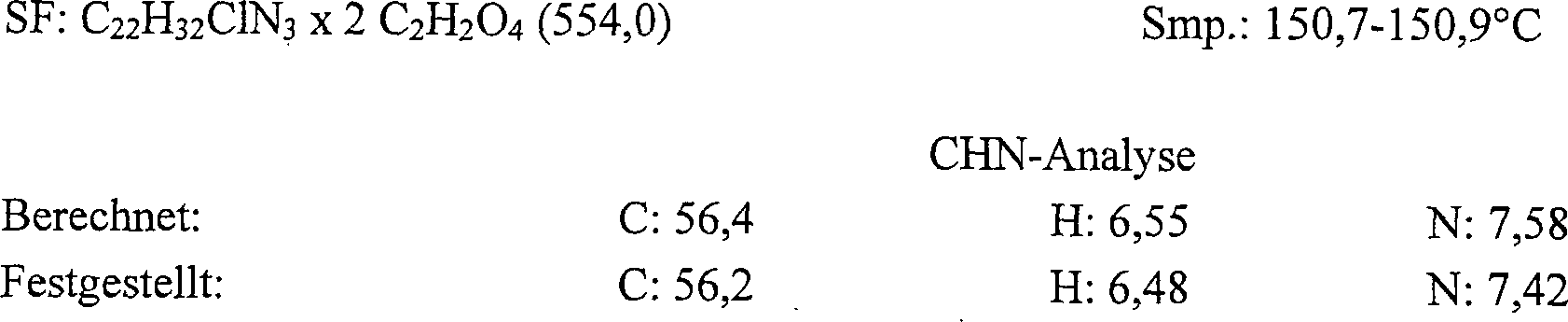
Beispiel 156Example 156
7-Chlor-4-(10-piperidinodecylamino)chinolin7-Chloro-4- (10-piperidinodecylamino) quinoline
Die Synthese und die Reinigung wurden gemäß dem in Beispiel 157 beschriebenen Verfahren unter Verwendung der Reagenzien 1,10-Dibromdecan (30 mmol), Kaliumphthalimid (15 mmol) und katalytischen Mengen an Kaliumiodid im ersten Schritt durchgeführt. Das Endprodukt wurde mittels Säulenchromatographie gereinigt (Elutionsmittel: Ethylacetat/Triethylamin (95/5)). Das Lösungsmittel wurde unter vermindertem Druck entfernt. Der Rückstand wurde mit Oxalsäure aus Diethylether/Ethanol auskristallisiert.The Synthesis and purification were carried out according to the procedure described in Example 157 Procedure using the reagents 1,10-dibromodecane (30 mmol), Potassium phthalimide (15 mmol) and catalytic amounts of potassium iodide performed in the first step. The final product was purified by column chromatography (Eluent: ethyl acetate / triethylamine (95/5)). The solvent was removed under reduced pressure. The residue was precipitated with oxalic acid Diethyl ether / ethanol crystallized.

Beispiel 159Example 159
7-Chlor-4-(12-piperidinododecylamino)chinolin7-Chloro-4- (12-piperidinododecylamino) quinoline
Die Synthese und die Reinigung wurden gemäß dem in Beispiel 157 beschriebenen Verfahren unter Verwendung der Reagenzien 1,12-Dibromdodecan (30 mmol), Kaliumphthalimid (15 mmol) und katalytischen Mengen an Kaliumiodid im ersten Schritt durchgeführt. Der Rückstand wurde mittels Flashchromatographie gereinigt (Elutionsmittel: Ethylacetat/Triethylamin (95/5)). Das Lösungsmittel wurde unter vermindertem Druck entfernt. Der Rückstand wurde mit Oxasäure aus Diethylether/Ethanol auskristallisiert.The synthesis and purification were carried out according to the procedure described in Example 157 using the reagents 1,12-dibromododecane (30 mmol), potassium phthalimide (15 mmol) and catalytic amounts of potassium iodide in the first step. The residue was purified by flash chromatography purified (eluant: ethyl acetate / triethylamine (95/5)). The solvent was removed under reduced pressure. The residue was crystallized from diethyl ether / ethanol with oxalic acid.

Beispiel 160Example 160
7-Chlor-4-(4-(3-piperidinopropoxy)phenylamino)chinolin7-chloro-4- (4- (3-piperidinopropoxy) phenylamino) quinoline
4-Hydroxyanilin (11 mmol), 4,7-Dichlorchinolin (10 mmol), 1 ml 2 N Salzsäure und katalytische Mengen an Kaliumiodid wurden in Aceton für 12 Stunden unter Rückfluß gekocht. Das Produkt wurde filtriert. Das Produkt (5 mmol), 3-Piperidinopropylchlorid-Hydrochlorid (5 mmol), Kaliumcarbonat (15 mmol) und katalytische Mengen an Kaliumiodid wurden in Aceton für 22 Stunden unter Rückfluß gekocht. Das Produkt wurde filtriert und mittels Flashchromatographie gereinigt (Elutionsmittel: Methylenchlorid/Pe trolether/Triethylamin (95/25/5)). Das Lösungsmittel wurde unter vermindertem Druck entfernt. Der Rückstand wurde mit Oxalsäure aus Diethylether/Ethanol auskristallisiert.4-hydroxyaniline (11 mmol), 4,7-dichloroquinoline (10 mmol), 1 ml of 2N hydrochloric acid and Catalytic amounts of potassium iodide were dissolved in acetone for 12 hours cooked under reflux. The product was filtered. The product (5 mmol), 3-piperidinopropyl chloride hydrochloride (5 mmol), Potassium carbonate (15 mmol) and catalytic amounts of potassium iodide were in acetone for Boiled under reflux for 22 hours. The product was filtered and purified by flash chromatography (Eluent: methylene chloride / petroleum ether / triethylamine (95/25/5)). The solvent was removed under reduced pressure. The residue was precipitated with oxalic acid Diethyl ether / ethanol crystallized.

Beispiel 161Example 161
7-Chlor-4-(2-(4-(3-piperidinopropoxy)phenyl)ethylamino)chinolin7-chloro-4- (2- (4- (3-piperidinopropoxy) phenyl) ethylamino) quinoline
Tyramin (10 mmol), 4,7-Dichlorchinolin und katalytische Mengen an Kaliumiodid wurden in 10 g Phenol bei 150°C für 12 Stunden zum Schmelzen gebracht. Der Rückstand wurde mit Salzsäure aus Ethylacetat/Wasser auskristallisiert. Das Produkt (5 mmol), 3-Piperidinopropylchlorid-Hydrochlorid (5 mmol), Kaliumcarbonat (15 mmol) und katalytische Mengen an Kaliumiodid wurden in N,N-Dimethylformamid für 22 Stunden unter Rückfluß gekocht. Das Lösungsmittel wurde abgedampft, und der Rückstand wurde mittels Flashchromatographie gereinigt (Elutionsmittel: Ethylacetat/Petrolether/Triethylamin (95/50/5)). Das Lösungsmittel wurde unter vermindertem Druck entfernt. Der Rückstand wurde mit Oxasäure aus Diethylether/Ethanol auskristallisiert.tyramine (10 mmol), 4,7-dichloroquinoline and catalytic amounts of potassium iodide were dissolved in 10 g of phenol at 150 ° C for 12 Hours melted. The residue was extracted with hydrochloric acid Ethyl acetate / water crystallized. The product (5 mmol), 3-piperidinopropyl chloride hydrochloride (5 mmol), potassium carbonate (15 mmol) and catalytic amounts of potassium iodide were in N, N-dimethylformamide for Boiled under reflux for 22 hours. The solvent was evaporated, and the residue was purified by flash chromatography (eluent: ethyl acetate / petroleum ether / triethylamine (95/50/5)). The solvent was removed under reduced pressure. The residue was precipitated with oxalic acid Diethyl ether / ethanol crystallized.

Beispiel 162Example 162
4-(6-Piperidinohexanoyl)phenyl-3-piperidinopropylether4- (6-Piperidinohexanoyl) phenyl-3-piperidinopropyl ether
3-Phenoxypropylbromid (10 mmol), Piperidin (20 mmol) und katalytische Mengen an Kaliumiodid wurden in Aceton für 12 Stunden unter Rückfluß gekocht. Das Lösungsmittel wurde abgedampft. Der Rückstand wurde mit Ethylacetat behandelt. Das Lösungsmittel wurde unter vermindertem Druck entfernt, und das Produkt wurde mit Salzsäure aus Isopropanol/Diethylether auskristallisiert. Das Produkt (5 mmol) wurde zu einer Lösung von 6-Bromhexanoylchlorid (7,5 mmol) und Aluminiumtrichlorid (22,5 mmol) in 10 ml Nitrobenzol zugegeben. Die Mischung wurde bei Raumtemperatur für 3 Tage gerührt. Ethylacetat wurde zugegeben, und die Mischung wurde mit Salzsäure (6 N) extrahiert. Die Lösung wurde mit einer Kaliumcarbonatlösung neutralisiert und mit Methylenchlorid extrahiert. Das Lösungsmittel wurde unter vermindertem Druck entfernt. Das Produkt (2,5 mmol), Piperidin (5 mmol), Kaliumcarbonat (7,5 mmol) und katalytische Mengen an Kaliumiodid wurden in Aceton für 12 Stunden unter Rückfluß gekocht. Das Lösungsmittel wurde abgedampft, und der Rückstand wurde mittels Flashchromatographie gereinigt (Elutionsmittel: Methylenchlorid/Petrolether/Methanol (96/3/3)). Das Lösungsmittel wurde unter vermindertem Druck entfernt. Der Rückstand wurde mit Oxalsäure aus Diethylether/Ethanol auskristallisiert.3-Phenoxypropyl bromide (10 mmol), piperidine (20 mmol) and catalytic amounts of potassium iodide were refluxed in acetone for 12 hours. The solvent was evaporated. The residue was treated with ethyl acetate. The solvent was removed under reduced pressure and the product was crystallized from isopropanol / diethyl ether with hydrochloric acid. The product (5 mmol) was added to a solution of 6-bromohexanoyl chloride (7.5 mmol) and aluminum trichloride (22.5 mmol) in 10 ml of nitrobenzene. The mixture was stirred at room temperature for 3 days. Ethyl acetate was added and the Mixture was extracted with hydrochloric acid (6N). The solution was neutralized with a potassium carbonate solution and extracted with methylene chloride. The solvent was removed under reduced pressure. The product (2.5 mmol), piperidine (5 mmol), potassium carbonate (7.5 mmol) and catalytic amounts of potassium iodide were refluxed in acetone for 12 hours. The solvent was evaporated and the residue was purified by flash chromatography (eluent: methylene chloride / petroleum ether / methanol (96/3/3)). The solvent was removed under reduced pressure. The residue was crystallized from diethyl ether / ethanol with oxalic acid.

Beispiel 163Example 163
5-Nitro-2-(5-piperidinopentylamino)pyridin5-nitro-2- (5-piperidinopentylamino) pyridine
Die Synthese und die Reinigung wurden gemäß dem in Beispiel 152 angegebenen Verfahren unter Verwendung der Reagenzien 5-Aminopentanol (15 mmol), 2-Chlor-5-nitropyridin (15 mmol), 5 ml Triethylamin und katalytischen Mengen an Kaliumiodid im ersten Schritt durchgeführt. Das Endprodukt wurde mittels Säulenchromatographie gereinigt (Elutionsmittel: Ethylacetat/Triethylamin (90/10)). Das Lösungsmittel wurde unter vermindertem Druck entfernt. Der Rückstand wurde mit Oxalsäure aus Diethylether/Ethanol auskristallisiert.The Synthesis and purification were according to that given in Example 152 Procedure using the reagents 5-aminopentanol (15 mmol), 2-chloro-5-nitropyridine (15 mmol), 5 ml of triethylamine and catalytic amounts of potassium iodide performed in the first step. The final product was purified by column chromatography purified (eluent: ethyl acetate / triethylamine (90/10)). The solvent was removed under reduced pressure. The residue was precipitated with oxalic acid Diethyl ether / ethanol crystallized.

Beispiel 164Example 164
3-Nitro-2-(6-piperidinopentylamino)pyridin3-Nitro-2- (6-piperidinopentylamino) pyridine
Die Synthese und die Reinigung wurden gemäß dem in Beispiel 152 angegebenen Verfahren unter Verwendung der Reagenzien 5-Aminopentanol (15 mmol), 2-Chlor-3-nitropyridin (15 mmol), 5 ml Triethylamin und katalytischen Mengen an Kaliumiodid im ersten Schritt durchgeführt. Das Endprodukt wurde mittels Säulenchromatographie gereinigt (Elutionsmittel: Ethylacetat/Triethylamin (95/5), Ammoniak-Atmosphäre). Das Lösungsmittel wurde unter vermindertem Druck entfernt. Der Rückstand wurde mit Oxalsäure aus Diethylether/Ethanol auskristallisiert.The Synthesis and purification were according to that given in Example 152 Procedure using the reagents 5-aminopentanol (15 mmol), 2-chloro-3-nitropyridine (15 mmol), 5 ml of triethylamine and catalytic amounts of potassium iodide performed in the first step. The final product was purified by column chromatography purified (eluent: ethyl acetate / triethylamine (95/5), ammonia atmosphere). The solvent was removed under reduced pressure. The residue was precipitated with oxalic acid Diethyl ether / ethanol crystallized.

Beispiel 165Example 165
5-Amino-2-(6-piperidinopentylamino)pyridin5-amino-2- (6-piperidinopentylamino) pyridine
Die Synthese und die Reinigung wurden gemäß dem in Beispiel 152 angegebenen Verfahren unter Verwendung der Reagenzien 5-Aminopentanol (15 mmol). 2-Chlor-5-nitropyridin (15 mmol), 5 ml Triethylamin und katalytischen Mengen an Kaliumiodid im ersten Schrift durchgeführt. Das Produkt wurde mittels Säulenchromatographie auf Silicagel gereinigt (Elutionsmittel: Methylenchlorid/Methanol (95/5), Ammoniak-Atmosphäre) und in 20 ml Tetrahydrofuran gelöst. 100 mg Palladium/Aktivkohle (10%) wurden zugegeben, und die Mischung wurde bei 1 bar H2 für 12 Stunden hydriert. Das Lösungsmittel wurde unter vermindertem Druck entfernt, und der Rückstand wurde mit Oxalsäure aus Diethylether/Ethanol auskristallisiert.The synthesis and purification were carried out according to the procedure given in Example 152 using the reagents 5-aminopentanol (15 mmol). 2-chloro-5-nitropyridine (15 mmol), 5 ml of triethylamine and catalytic amounts of potassium iodide in the first writing performed. The product was purified by column chromatography on silica gel (eluent: methylene chloride / methanol (95/5), ammonia-atmos phäre) and dissolved in 20 ml of tetrahydrofuran. 100 mg of palladium / charcoal (10%) was added and the mixture was hydrogenated at 1 bar H 2 for 12 hours. The solvent was removed under reduced pressure and the residue was crystallized from diethyl ether / ethanol with oxalic acid.

Beispiel 166Example 166
2-(6-Piperidinohexylamino)chinolin2- (6-Piperidinohexylamino) quinoline
Die Synthese und die Reinigung wurden gemäß dem in Beispiel 152 angegebenen Verfahren unter Verwendung der Reagenzien 6-Aminohexanol (15 mmol), 2-Chlorchinolin (15 mmol), 5 ml Triethylamin und katalytischen Mengen an Kaliumiodid im ersten Schritt durchgeführt. Das Endprodukt wurde mittels Flashchromatographie gereinigt (Elutionsmittel: Ethylacetat/Triethylamin (95/5)). Das Lösungsmittel wurde unter vermindertem Druck entfernt, und der Rückstand wurde mit Oxalsäure aus Diethylether/Ethanol auskristallisiert.The Synthesis and purification were according to that given in Example 152 Procedure using the reagents 6-aminohexanol (15 mmol), 2-chloroquinoline (15 mmol), 5 ml triethylamine and catalytic amounts carried out on potassium iodide in the first step. The final product was by means of Purified by flash chromatography (eluent: ethyl acetate / triethylamine (95/5)). The solvent was removed under reduced pressure, and the residue was with oxalic acid crystallized from diethyl ether / ethanol.

Beispiel 167Example 167
N-(4-Chlorbenzyl)-N-cyclohexyl-3-piperidinopropyl-isothioharnstoffN- (4-chlorobenzyl) -N-cyclohexyl-3-piperidinopropyl isothiourea
Cyclohexylamin (10 mmol) wurde zu 4-Chlorbenzylisothiocyanat (10 mmol), gelöst in 20 ml trockenem Ether, zugetropft. Die Lösung wurde bei Raumtemperatur für 2 Stunden gerührt. Das ausgefallene Produkt wurde abfiltriert und aus Ethylacetat auskristallisiert. 3-Piperidinopropylchlorid-Hydrochlorid (3 mmol), das Produkt (3 mmol) und katalytische Mengen an Kaliumiodid wurden in Ethanol für 6 Tage unter Rückfluß gekocht. Anschließend wurde das Ethanol abgedampft, und der Rückstand wurde mittels Säulenchromatographie gereinigt (Elutionsmittel: Methylenchlorid/Methanol (95/5)). Nach dem Abdampfen des Lösungsmittels wurde das Produkt mit Salzsäure aus Diethylether/Ethanol auskristallisiert.cyclohexylamine (10 mmol) was added to 4-chlorobenzyl isothiocyanate (10 mmol) dissolved in 20 ml of dry ether, added dropwise. The solution was at room temperature for 2 hours touched. The precipitated product was filtered off and crystallized from ethyl acetate. 3-piperidinopropyl chloride hydrochloride (3 mmol), the product (3 mmol) and catalytic amounts of potassium iodide were added in ethanol for 6 days cooked under reflux. Subsequently was the ethanol was evaporated and the residue was purified by column chromatography purified (eluent: methylene chloride / methanol (95/5)). To evaporation of the solvent was the product with hydrochloric acid crystallized from diethyl ether / ethanol.

Beispiel 168Example 168
2-(6-Piperidinohexylamino)benzothiazol2- (6-Piperidinohexylamino) benzothiazole
Die Synthese und die Reinigung wurden gemäß dem in Beispiel 152 angegebenen Verfahren unter Verwendung der Reagenzien 6-Aminohexanol (15 mmol), 2-Chlorbenzothiazol (15 mmol), 5 ml Triethylamin und katalytischen Mengen an Kaliumiodid im ersten Schritt durchgeführt. Das Endprodukt wurde mittels Flashchromatographie gereinigt (Elutionsmittel: Methylenchlorid/Methanol (95/5), Ammoniak-Atmosphäre). Das Lösungsmittel wurde unter vermindertem Druck entfernt, und der Rückstand wurde mit Oxalsäure aus Diethylether/Ethanol auskristallisiert.The Synthesis and purification were according to that given in Example 152 Procedure using the reagents 6-aminohexanol (15 mmol), 2-chlorobenzothiazole (15 mmol), 5 ml triethylamine and catalytic Quantities of potassium iodide carried out in the first step. The final product was by means of Purified by flash chromatography (eluent: methylene chloride / methanol (95/5), ammonia atmosphere). The solvent was removed under reduced pressure, and the residue was with oxalic acid crystallized from diethyl ether / ethanol.

Beispiel 169Example 169
10-Piperidinodecylamin10 Piperidinodecylamin
Die Synthese wurde gemäß dem in Beispiel 157 beschriebenen Verfahren unter Verwendung der Reagenzien 1,10-Dibromdecan (30 mmol), Kaliumphthalimid (15 mmol) und katalytischen Mengen an Kaliumiodid im ersten Schritt durchgeführt. Das Produkt (12,5 mmol), Piperidin (50 mmol) und katalytische Mengen an Kaliumiodid wurden in Aceton für 12 Stunden unter Rückfluß gekocht. Das Lösungsmittel und das Piperidin wurden abgedampft. Der Rückstand wurde mit Salzsäure (2 N) und mit einer Kaliumcarbonatlösung behandelt und dann mit Methylenchlorid extrahiert. Das Lösungsmittel wurde unter vermindertem Druck entfernt, und der Rückstand wurde in Salzsäure (6 N) für 12 Stunden unter Rückfluß gekocht. Die Lösung wurde mit einer Kaliumcarbonatlösung neutralisiert und mit Methylenchlorid extrahiert. Die organische Schicht wurde abgedampft, und das Produkt wurde mittels Flashchromatographie gereinigt (Elutionsmittel: Methylenchlorid//Triethylamin/Methanol (90/10/2)). Das Lösungsmittel wurde unter ver mindertem Druck entfernt. Der Rückstand wurde mit Oxalsäure aus Diethylether/Ethanol auskristallisiert.The Synthesis was carried out according to the method described in Example 157 using the reagents 1,10-Dibromodecane (30 mmol), potassium phthalimide (15 mmol) and catalytic Quantities of potassium iodide carried out in the first step. The product (12.5 mmol), Piperidine (50 mmol) and catalytic amounts of potassium iodide in acetone for Boiled under reflux for 12 hours. The solvent and the piperidine were evaporated. The residue was washed with hydrochloric acid (2N) and with a potassium carbonate solution treated and then extracted with methylene chloride. The solvent was removed under reduced pressure, and the residue was in hydrochloric acid (6 N) for Boiled under reflux for 12 hours. The solution was with a potassium carbonate solution neutralized and extracted with methylene chloride. The organic Layer was evaporated and the product was purified by flash chromatography purified (eluent: methylene chloride // triethylamine / methanol (90/10/2)). The solvent was removed under reduced pressure. The residue was precipitated with oxalic acid Diethyl ether / ethanol crystallized.

Beispiel 170Example 170
3-Phenylpropyl-3-(N,N-diethylamino)propylether3-Phenylpropyl 3- (N, N-diethylamino) propyl ether
Gemäß dem in Beispiel 144 beschriebenen Verfahren wurden das erhaltene Chlorid (5 mmol), Diethylamin (10 mmol), Kaliumcarbonat (15 mmol) und katalytische Mengen an Kaliumiodid in Aceton gelöst und für 12 Stunden unter Rückfluß gekocht. Nach dem Abdampfen des Lösungsmittels wurde das Produkt mittels Säulenchromatographie auf Silicagel gereinigt (Elutionsmittel: Diethylether/Petrolether/Triethylamin (66/33/1)). Das Produkt wurde mit Oxalsäure aus Diethylether/Ethanol auskristallisiert.According to the in Example 144 described the obtained chloride (5 mmol), diethylamine (10 mmol), potassium carbonate (15 mmol) and catalytic Dissolved amounts of potassium iodide in acetone and refluxed for 12 hours. After evaporation of the solvent the product was purified by column chromatography purified on silica gel (eluent: diethyl ether / petroleum ether / triethylamine (66/33/1)). The product was treated with oxalic acid from diethyl ether / ethanol crystallized.

Pharmakologische StudiePharmacological study
Die Wechselwirkung von Verbindungen mit dem H3-Rezeptor wird in vitro durch die Messung der Freisetzung von neu synthetisiertem, tritiummarkiertem Histamin aus Synaptosomen der Hirnrinde einer Ratte, welche mit tritiummarkiertem Histidin vorinkubiert wurden, nachgewiesen (Garbarg et al., J. Pharmacol. Exp. Ther. 263 (1992), 304-310). Die H3-Wirksamkeit von Agonisten wird durch die Hemmung der Freisetzung von tritiummarkiertem Histamin gemessen, und die Wirksamkeit von Antagonisten wird durch die progressive Aufhebung der Hemmung der Freisetzung durch den selektiven H3-Agonisten (R)-α-Methylhistamin gemessen (Arrang et al., Nature 327 (1987}, 117-123).The interaction of compounds with the H 3 receptor is demonstrated in vitro by measuring the release of newly synthesized, tritiated histamine from rat cortical synapse of a rat preincubated with tritiated histidine (Garbarg et al., J. Pharmacol. Exp Ther. 263 (1992), 304-310). The H 3 activity of agonists is measured by the inhibition of the release of tritiated histamine and the efficacy of antagonists is measured by the progressive abolition of the inhibition of release by the selective H 3 agonist (R) -α-methylhistamine (Arrang et al., Nature 327 (1987), 117-123).
Die Wechselwirkung von Verbindungen mit dem H3-Rezeptor wird in vitro durch das von Ligneau et al., J. Pharmacol. Exp. Ther. 271 (1994), 452-459, beschriebene Verfahren am Ileum eines Meerschweinchens nachgewiesen.Interaction of compounds with the H 3 receptor is performed in vitro by the method described by Ligneau et al., J. Pharmacol. Exp. Ther. 271 (1994), 452-459, described in the ileum of a guinea pig demonstrated.
Kurz zusammengefaßt wurden longitudinale Muskelstreifen aus dem Dünndarm eines Meerschweinchens freipräpariert und in einem mit O2/CO2 (95%/5%) begasten, modifizierten Krebs-Ringer-Bicarbonatmedium bei +37°C in Gegenwart von 1 μM Mepyramin inkubiert, um den H1-Rezeptor zu blockieren. Nach der Gleichgewichtsein stellung wurde die Kontraktionsaktivität unter Stimulation (Rechteckimpulse von 15 V, 0,5 msec, 0,1 Hz) aufgezeichnet.Briefly, longitudinal muscle strips were dissected out of the guinea pig small intestine and incubated in a O 2 / CO 2 (95% / 5%) fumigated modified Krebs-Ringer bicarbonate medium at + 37 ° C in the presence of 1 μM mepyramine Block H 1 receptor. After equilibration, the contraction activity under stimulation (rectangular pulses of 15 V, 0.5 msec, 0.1 Hz) was recorded.
Konzentration-Antwort-Kurven der Wirkung von (R)-α-Methylhistamin allein oder zusammen mit dem Antagonisten wurden erstellt.Concentration-response curves the action of (R) -α-methylhistamine alone or together with the antagonist were created.
Die Wirkungen von Agonisten und Antagonisten wurden in vivo durch die Messung der Telemethylhistamin-Konzentrationsvariationen im Gehirn von Mäusen abgeschätzt (Garbarg et al., J. Neurochem. 53 (1989), 1724-1730). Zu verschiedenen Zeitpunkten nach der p.o.-Verabreichung der Verbindungen wird die Wirkung von Agonisten und Antagonisten durch die Erniedrigung bzw. Erhöhung des induzierten Telemethylhistamin-Spiegels nachgewiesen.The Effects of agonists and antagonists have been demonstrated in vivo by the Measurement of telemethyl histamine concentration variations in the brain of mice estimated (Garbarg et al., J. Neurochem 53 (1989), 1724-1730). To different Time points after the p.o. administration of the compounds is the Effect of agonists and antagonists by humiliation or increase of the induced telemethyl histamine level.
Die Veränderungen werden mit denjenigen verglichen, welche durch Referenzverbindungen induziert wurden, die in einer hohen Dosierung verabreicht worden waren, und dies ermöglicht die Berechnung des ED50-Werts für jede Verbindung, welcher der Dosis entspricht, die für eine halbe maximale Wirkung verantwortlich ist.The changes are compared to those induced by reference compounds administered at a high dose and this allows the calculation of the ED 50 value for each compound corresponding to the dose responsible for a half maximal effect.
Die Ergebnisse sind nachstehend aufgeführt oder in den folgenden Tabellen II und II aufgeführt:
- – Beispiel 59: 1-[3-(4-Cyanophenoxy)propyl]piperidin, ED50 = 0,02 mg/kg
- – Beispiel 74: 1-[3-(4-Butyrylphenoxy)propyl]piperidin, ED50 = 0,21 mg/kg
- – Beispiel 76: 1-[3-(4-Cyclopropancarbonylphenoxy)propyl]piperidin, ED50 = 0,18 mg/kg
- – Beispiel 88: 1-[3-(4-Propionylphenoxy)propyl]-3-methylpiperidin, ED50 = 0,14 mg/kg
- – Beispiel 101: 1-[3-(4-Cyclopropancarbonylphenoxy)propyl]-trans-3,5-dimethylpiperidin, ED50 = 0,17 mg/kg
- Example 59: 1- [3- (4-cyanophenoxy) propyl] piperidine, ED 50 = 0.02 mg / kg
- Example 74: 1- [3- (4-Butyrylphenoxy) propyl] piperidine, ED 50 = 0.21 mg / kg
- Example 76: 1- [3- (4-Cyclopropanecarbonylphenoxy) propyl] piperidine, ED 50 = 0.18 mg / kg
- Example 88: 1- [3- (4-propionylphenoxy) propyl] -3-methylpiperidine, ED 50 = 0.14 mg / kg
- Example 101: 1- [3- (4-Cyclopropanecarbonylphenoxy) propyl] trans-3,5-dimethylpiperidine, ED 50 = 0.17 mg / kg
Tabelle
II 
Tabelle
III 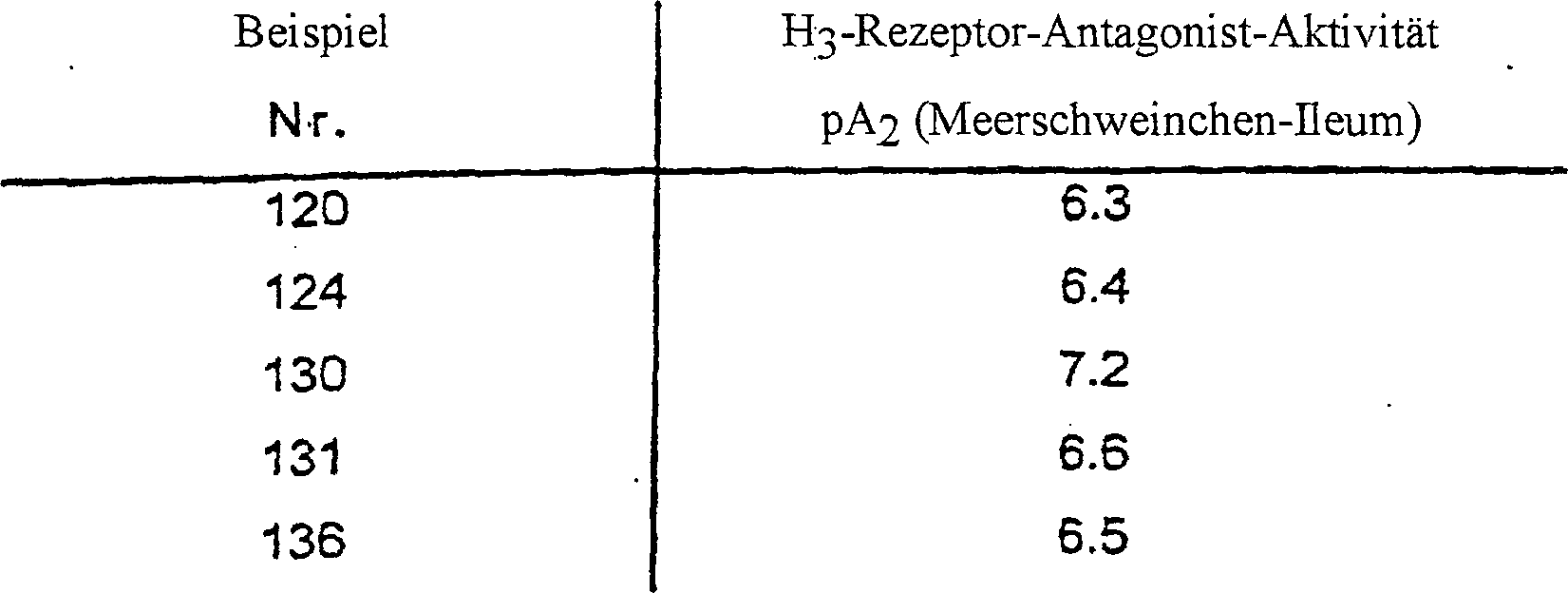
Es wurde festgestellt, daß sämtliche der obigen Verbindungen H3-Antagonisten sind.It has been found that all of the above compounds are H 3 antagonists.
Vergleichsdaten, welche die Aktivität von Imidazolderivaten und der erfindungsgemäßen Nicht-Imidazolanaloga betreffen, sind nachstehend in Tabelle IV aufgeführt.Comparative data which the activity of imidazole derivatives and the non-imidazole analogs of the invention, are listed in Table IV below.
Tabelle
III 
Claims (48)
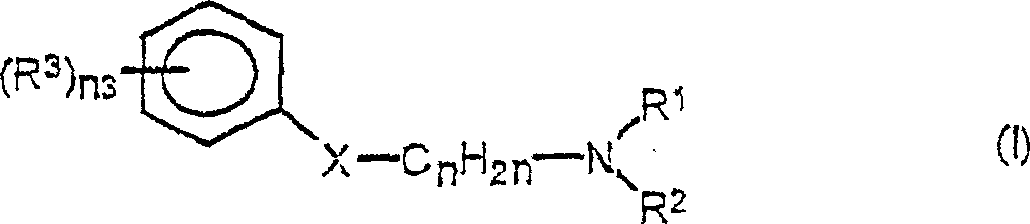
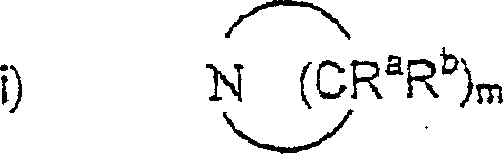
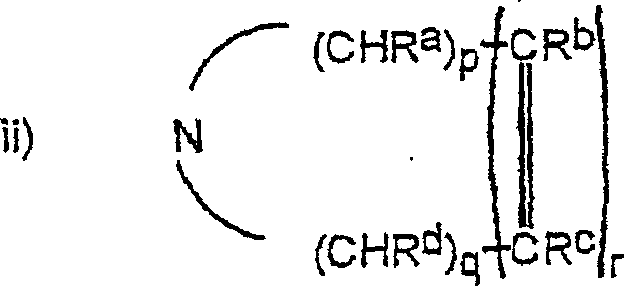
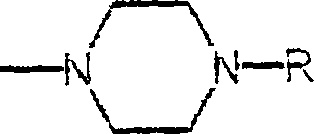
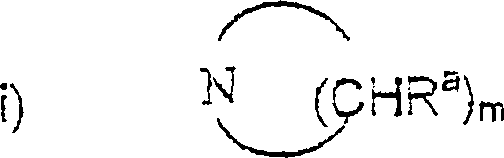
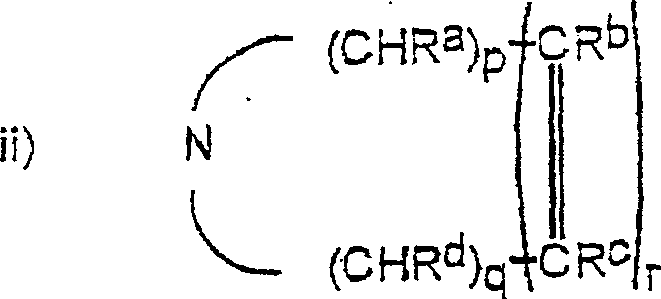


Applications Claiming Priority (5)
| Application Number | Priority Date | Filing Date | Title |
|---|---|---|---|
| EP98401944 | 1998-07-29 | ||
| EP98401944A EP0978512A1 (en) | 1998-07-29 | 1998-07-29 | Non-imidazole aryloxy (or arylthio) alkylamines as histamine H3-receptor antagonists and their therapeutic applications |
| EP98403351 | 1998-12-31 | ||
| EP98403351A EP0982300A3 (en) | 1998-07-29 | 1998-12-31 | Non-imidazole alkylamines as histamine H3 - receptor ligands and their therapeutic applications |
| PCT/EP1999/005744 WO2000006254A2 (en) | 1998-07-29 | 1999-07-29 | Non-imidazole alkylamines as histamine h3-receptor ligands and their therapeutic applications |
Publications (2)
| Publication Number | Publication Date |
|---|---|
| DE69920472D1 DE69920472D1 (en) | 2004-10-28 |
| DE69920472T2 true DE69920472T2 (en) | 2005-10-06 |
Family
ID=26151677
Family Applications (2)
| Application Number | Title | Priority Date | Filing Date |
|---|---|---|---|
| DE69920472T Expired - Lifetime DE69920472T2 (en) | 1998-07-29 | 1999-07-29 | THERAPEUTIC USES AS HISTAMINE H3 RECEPTOR LIGANDS OF ALKYLAMINES THAT DO NOT CONTAIN IMIDAZOLE |
| DE69931409T Expired - Lifetime DE69931409T2 (en) | 1998-07-29 | 1999-07-29 | Therapeutic use as histamine H3 receptor Ligands of alkylamines containing no imidazoles |
Family Applications After (1)
| Application Number | Title | Priority Date | Filing Date |
|---|---|---|---|
| DE69931409T Expired - Lifetime DE69931409T2 (en) | 1998-07-29 | 1999-07-29 | Therapeutic use as histamine H3 receptor Ligands of alkylamines containing no imidazoles |
Country Status (15)
| Country | Link |
|---|---|
| US (4) | US7138413B1 (en) |
| EP (4) | EP0982300A3 (en) |
| JP (2) | JP4553487B2 (en) |
| AT (2) | ATE326446T1 (en) |
| AU (1) | AU5511999A (en) |
| BE (1) | BE2016C048I2 (en) |
| CA (1) | CA2321881C (en) |
| CY (1) | CY2016032I2 (en) |
| DE (2) | DE69920472T2 (en) |
| DK (2) | DK1100503T3 (en) |
| ES (2) | ES2260703T3 (en) |
| FR (1) | FR16C0038I2 (en) |
| LU (1) | LU93229I2 (en) |
| PT (2) | PT1428820E (en) |
| WO (1) | WO2000006254A2 (en) |
Families Citing this family (69)
| Publication number | Priority date | Publication date | Assignee | Title |
|---|---|---|---|---|
| EP0982300A3 (en) * | 1998-07-29 | 2000-03-08 | Societe Civile Bioprojet | Non-imidazole alkylamines as histamine H3 - receptor ligands and their therapeutic applications |
| US6515013B2 (en) | 2000-07-13 | 2003-02-04 | Abbott Laboratories | 1,3-disubstituted and 1,3,3-trisubstituted pyrrolidines as histamine-3 receptor ligands and their therapeutic applications |
| US6620839B2 (en) | 2000-07-13 | 2003-09-16 | Abbott Laboratories | 1,3-disubstituted and 1,3,3-trisubstituted pyrrolidines as histamine-3 receptor ligands and their therapeutic applications |
| ATE319696T1 (en) * | 2000-08-08 | 2006-03-15 | Ortho Mcneil Pharm Inc | NON-IMIDAZOLE ARYLOXYALKYLAMINES AS H3 RECEPTOR LIGANDS |
| CZ2003686A3 (en) | 2000-08-08 | 2003-08-13 | Ortho Mcneil Pharmaceutical, Inc. | Non-imidazole aryloxypiperidines |
| US6638967B2 (en) | 2000-08-08 | 2003-10-28 | Ortho-Mcneil Phamraceutical, Inc. | Thiophene of furan pyrrolidine compounds |
| DE60144284D1 (en) | 2000-11-01 | 2011-05-05 | Millennium Pharm Inc | NITROGENIC HETEROCYCLIC COMPOUNDS AND METHOD FOR THE PRODUCTION THEREOF |
| US6316475B1 (en) * | 2000-11-17 | 2001-11-13 | Abbott Laboratories | Aminoalkoxybiphenylcarboxamides as histamine-3 receptor ligands and their therapeutic applications |
| WO2002074758A2 (en) * | 2001-03-16 | 2002-09-26 | Abbott Laboratories | Novel amines as histamine-3 receptor ligands and their therapeutic applications |
| US6969730B2 (en) | 2001-03-16 | 2005-11-29 | Abbott Laboratories | Amines as histamine-3 receptor ligands and their therapeutic applications |
| JP2004532834A (en) * | 2001-03-23 | 2004-10-28 | イーライ・リリー・アンド・カンパニー | Non-imidazole arylalkylamine compounds that are histamine H3 receptor antagonists, their production and therapeutic use |
| US7064135B2 (en) | 2001-10-12 | 2006-06-20 | Novo Nordisk Inc. | Substituted piperidines |
| EP2243776A1 (en) * | 2001-10-12 | 2010-10-27 | High Point Pharmaceuticals, LLC | Substituted piperidines and their use for the treatment of diseases related to the histamine H3 receptor |
| AU2002352868A1 (en) * | 2001-11-27 | 2003-06-10 | Merck & Co., Inc. | 4-aminoquinoline compounds |
| US7314937B2 (en) | 2002-03-21 | 2008-01-01 | Eli Lilly And Company | Non-imidazole aryl alkylamines compounds as histamine H3 receptor antagonists, preparation and therapeutic uses |
| EP1539704A1 (en) * | 2002-08-20 | 2005-06-15 | Eli Lilly And Company | Substituted azepines as histamine h3 receptor antagonists, preparation and therapeutic uses |
| US20060052597A1 (en) * | 2002-10-22 | 2006-03-09 | Best Desmond J | Aryloxyalkylamine derivatives as h3 receptor ligands |
| GB0224557D0 (en) * | 2002-10-22 | 2002-11-27 | Glaxo Group Ltd | Novel compounds |
| US7153889B2 (en) | 2002-11-12 | 2006-12-26 | Abbott Laboratories | Bicyclic-substituted amines as histamine-3 receptor ligands |
| JP4820094B2 (en) * | 2002-11-12 | 2011-11-24 | アボット・ラボラトリーズ | Bicyclic substituted amines as histamine-3 receptor ligands |
| EP2133340B1 (en) | 2002-12-20 | 2013-01-16 | Glaxo Group Limited | Novel benzazepine derivatives |
| GB0229820D0 (en) * | 2002-12-20 | 2003-01-29 | Glaxo Group Ltd | Novel compounds |
| EP1603884A4 (en) * | 2003-02-28 | 2008-05-28 | Encysive Pharmaceuticals Inc | Pyridine, pyrimidine, quinoline, quinazoline, and naphthalene urotensin-ii receptor antagonists. |
| WO2004089410A1 (en) * | 2003-04-03 | 2004-10-21 | Kyowa Hakko Kogyo Co., Ltd. | Preventive and/or remedy for neuropathic pain |
| US7094790B2 (en) | 2003-05-07 | 2006-08-22 | Abbott Laboratories | Fused bicyclic-substituted amines as histamine-3 receptor ligands |
| FR2856596B1 (en) * | 2003-06-27 | 2007-04-27 | Bioprojet Soc Civ | NOVEL PSYCHIATRIC DRUG ASSOCIATION AND THE USE OF AN INVERSE HISTAMINE H3 RECEPTOR ANTAGONIST OR AGONIST TO PREPARE A MEDICAMENT PREVENTING ADVERSE EFFECTS OF PSYCHOTROPES. |
| FR2874215B1 (en) * | 2004-08-11 | 2006-09-29 | Sanofi Synthelabo | CYCLOPROPYLMETHANONES DERIVATIVES, PREPARATION THEREOF AND THERAPEUTIC USE THEREOF |
| US7902191B2 (en) | 2004-02-25 | 2011-03-08 | Eli Lilly And Company | Histamine H3 receptor antagonists, preparation and therapeutic uses |
| US7456164B2 (en) | 2004-05-07 | 2008-11-25 | Pfizer, Inc | 3- or 4-monosubtituted phenol and thiophenol derivatives useful as H3 ligands |
| US20050256309A1 (en) * | 2004-05-12 | 2005-11-17 | Altenbach Robert J | Tri-and bi-cyclic heteroaryl histamine-3 receptor ligands |
| US7205316B2 (en) | 2004-05-12 | 2007-04-17 | Abbott Laboratories | Tri- and bi-cyclic heteroaryl histamine-3 receptor ligands |
| EP1595881A1 (en) | 2004-05-12 | 2005-11-16 | Pfizer Limited | Tetrahydronaphthyridine derivates useful as histamine H3 receptor ligands |
| US7098222B2 (en) | 2004-05-12 | 2006-08-29 | Abbott Laboratories | Bicyclic-substituted amines having cyclic-substituted monocyclic substituents |
| US7145005B2 (en) | 2004-05-12 | 2006-12-05 | Abbott Laboratories | 2-(6-{2-[(2R)-2-Methyl-1-pyrrolidin-1-yl]-ethyl}-2-naphthalen-2-yl)-2H-pyridazin-3-one salts and their preparation |
| WO2005123723A1 (en) * | 2004-06-18 | 2005-12-29 | Glaxo Group Limited | 3-cycloalkylbenzazepines as histamine h3 antagonists |
| MX2007002136A (en) * | 2004-09-01 | 2007-04-02 | Pfizer Prod Inc | Azabicyclic histamine-3 receptor antagonists. |
| US20060141072A1 (en) * | 2004-12-29 | 2006-06-29 | Arvanitidou Evangelia S | Oxidation resistant dentifrice compositions |
| ATE391716T1 (en) | 2005-02-10 | 2008-04-15 | Bioprojet Soc Civ | MONOHYDROCHLORIDE SALT OF 1-(3-(3-(4- CHLOROPHENYL)PROPOXY)PROPYL)-PIPERIDINE |
| EP1707203A1 (en) * | 2005-04-01 | 2006-10-04 | Bioprojet | Treatment of parkinson's disease obstructive sleep apnea, dementia with lewy bodies, vascular dementia with non-imidazole alkylamines histamine H3- receptor ligands |
| EP1707204A1 (en) * | 2005-04-01 | 2006-10-04 | Bioprojet | Treatment of epilepsy with non-imidazole alkylamines histamine H3-receptor ligands |
| EP1877761A4 (en) * | 2005-04-29 | 2010-03-24 | Rel S Ambrozy | Stimulus indication employing polymer gels |
| EP1717233A1 (en) * | 2005-04-29 | 2006-11-02 | Bioprojet | Histamine H3-receptor ligands and their therapeutic application |
| EP1717235A3 (en) * | 2005-04-29 | 2007-02-28 | Bioprojet | Phenoxypropylpiperidines and -pyrrolidines and their use as histamine H3-receptor ligands |
| EP1717234A1 (en) * | 2005-04-29 | 2006-11-02 | Bioprojet | Phenoxypropylpiperidines and -pyrrolidines and their use as histamine H3-receptor ligands |
| AR054530A1 (en) * | 2005-07-08 | 2007-06-27 | Ferrer Int | PROCEDURE FOR THE PREPARATION OF 1- [3- [3- (4-CHLOROPHENYL) -PROPOXI] PROPIL] -PIPERIDINE |
| US9108948B2 (en) | 2006-06-23 | 2015-08-18 | Abbvie Inc. | Cyclopropyl amine derivatives |
| CN103382174A (en) | 2006-06-23 | 2013-11-06 | 雅培制药有限公司 | Cyclopropyl amine derivatives as histamin h3 receptor modulators |
| US9186353B2 (en) | 2009-04-27 | 2015-11-17 | Abbvie Inc. | Treatment of osteoarthritis pain |
| EP2459529A1 (en) * | 2009-07-02 | 2012-06-06 | Cephalon, Inc. | Substituted phenoxypropylcycloamine derivatives as histamine-3 (h3) receptor ligands |
| WO2013151982A1 (en) | 2012-04-03 | 2013-10-10 | Arena Pharmaceuticals, Inc. | Methods and compounds useful in treating pruritus, and methods for identifying such compounds |
| MX350443B (en) | 2012-05-17 | 2017-09-06 | Genentech Inc | Process for making amino acid compounds. |
| HRP20200992T1 (en) | 2012-05-17 | 2020-10-16 | Genentech, Inc. | Amorphous form of an akt inhibiting pyrimidinyl - cyclopentane compound, compositions and methods thereof |
| AU2013262505B2 (en) | 2012-05-17 | 2017-09-21 | Array Biopharma Inc. | Process for making hydroxylated cyclopentylpyrimidine compounds |
| RU2014151017A (en) | 2012-05-17 | 2016-07-10 | Аррэй Байофарма Инк. | METHOD FOR PRODUCING HYDROXYLATED CYCLOPENTYLPYRIMIDINES |
| CN104471070B (en) | 2012-05-17 | 2018-09-25 | 基因泰克公司 | Process for preparing hydroxylated cyclopentapyrimidine compounds and salts thereof |
| DK2950649T3 (en) * | 2013-02-01 | 2020-05-04 | Wellstat Therapeutics Corp | AMINE COMPOUNDS WITH ANTI-INFLAMMATION, ANTI-FUNGI, ANTIPARASITY AND ANTICANCER ACTIVITY |
| CN103435575A (en) * | 2013-08-06 | 2013-12-11 | 中国人民解放军军事医学科学院毒物药物研究所 | The preparation method of 1-(3-(3-(4-chlorophenyl)propoxy)propyl)piperidine hydrochloride |
| EP3239138A1 (en) * | 2016-04-25 | 2017-11-01 | Sandoz Ag | Hydrogen fumarate salt of 1-[3-[3-(4-chlorophenyl)propoxy]propyl]piperidine |
| EP3378477A1 (en) * | 2017-03-21 | 2018-09-26 | BIOPROJET Pharma | New therapeutical use of h3-ligands |
| HUE052652T2 (en) | 2018-07-27 | 2021-05-28 | Bioprojet Soc Civ | Novel combinations of a h3 antagonist and a noradrenaline reuptake inhibitor, and the therapeutical uses thereof |
| WO2020092604A1 (en) * | 2018-10-30 | 2020-05-07 | Concert Pharmaceuticals, Inc. | Deuterated pitolisant |
| KR102669877B1 (en) * | 2019-12-19 | 2024-05-29 | 삼성전자주식회사 | apparatus and method for communication |
| US20230257350A1 (en) * | 2020-07-02 | 2023-08-17 | The Cleveland Clinic Foundation | Compounds and methods of promoting oligodendrocyte precursor differentiation |
| WO2022113008A1 (en) | 2020-11-27 | 2022-06-02 | Richter Gedeon Nyrt. | Histamine h3 receptor antagonists/inverse agonists for the treatment of autism spectrum disorder |
| US11945788B2 (en) | 2021-06-07 | 2024-04-02 | Nuray Chemicals Private Limited | Process for preparing pitolisant hydrochloride and solid-state forms thereof |
| US11623920B2 (en) | 2021-06-07 | 2023-04-11 | Nuray Chemicals Private Limited | Process for preparing pitolisant hydrochloride and solid-state forms thereof |
| EP4374854A1 (en) | 2022-11-28 | 2024-05-29 | Alfred E. Tiefenbacher (GmbH & Co. KG) | Pharmaceutical mixture comprising amorphous pitolisant |
| CN121175294A (en) | 2023-03-31 | 2025-12-19 | 生物计划制药公司 | Polymorphic forms of telithromycin hydrochloride |
| WO2025082972A1 (en) | 2023-10-16 | 2025-04-24 | Bioprojet Pharma | Enteric coated pitolisant formulations and methods of use |
Family Cites Families (16)
| Publication number | Priority date | Publication date | Assignee | Title |
|---|---|---|---|---|
| US2870151A (en) * | 1959-01-20 | Mqrpholine -ethers | ||
| DE184968C (en) * | ||||
| DE965813C (en) * | 1950-09-29 | 1957-06-19 | Abbott Lab | Process for the preparation of ethers of morpholinoalkanols |
| DE1007774B (en) * | 1954-09-08 | 1957-05-09 | Hoffmann La Roche | Process for the preparation of substituted therapeutically active 2, 6, 6-trimethylcyclohexen- (1) -yl- (1) -propyl- or -butylamines or their salts or quaternary ammonium compounds |
| BE588558A (en) * | 1959-03-13 | 1960-09-12 | ||
| DE1269134B (en) * | 1962-12-18 | 1968-05-30 | Hydrierwerk Rodleben Veb | Process for the preparation of dialkylaminoalkyl ethers of phenols |
| US3312696A (en) * | 1964-02-20 | 1967-04-04 | Turbanti Luigi | 2-tertiary amino alkoxy-betaphenyl-propiophenones |
| US3947434A (en) * | 1973-06-06 | 1976-03-30 | Morton-Norwich Products, Inc. | 9-(P-phenylazoanilino)-7-methyl-1H-imidazo[4,5-f]quinolines |
| DE2408530A1 (en) * | 1974-02-22 | 1975-09-04 | Basf Ag | PROCESS FOR THE PREPARATION OF BETAHALOGENALKYLAMINOSULFONYLHALOGENIDES |
| GB1513092A (en) * | 1975-06-05 | 1978-06-07 | Bottu | O-aminophenol derivatives |
| SE430156B (en) * | 1975-06-19 | 1983-10-24 | Mitsubishi Chem Ind | SET TO MAKE 2-SUBST-1- (OMEGA-AMINOAL COCOY) BENZENER |
| DE3381617D1 (en) * | 1982-03-17 | 1990-07-05 | Asahi Chemical Ind | INDAZOL DERIVATIVES. |
| DK368687A (en) * | 1986-11-21 | 1988-05-22 | Cheminova As | AMINOALCYLED HYDROXY COMPOUNDS AND THEIR USE AS FUNGICIDES |
| US5348964A (en) * | 1990-07-25 | 1994-09-20 | Merrell Dow Pharmaceuticals Inc. | Piperidyl ethers and thioethers as inhibitors of cholesterol biosynthesis |
| EP0982300A3 (en) * | 1998-07-29 | 2000-03-08 | Societe Civile Bioprojet | Non-imidazole alkylamines as histamine H3 - receptor ligands and their therapeutic applications |
| FR2788775B1 (en) * | 1999-01-22 | 2001-04-13 | Pf Medicament | NEWS N-ALCOYL-N- [1- (OMEGA- (ARYLALCOYLOXY) ALCOYL] PIPERIDIN-4-YL] -4H-3,1-BENZO (THIA / OXA) ZINES-2-AMINES SUBSTITUTED, THEIR PREPARATION AND THEIR APPLICATION THERAPEUTIC |
-
1998
- 1998-12-31 EP EP98403351A patent/EP0982300A3/en not_active Withdrawn
-
1999
- 1999-07-29 DE DE69920472T patent/DE69920472T2/en not_active Expired - Lifetime
- 1999-07-29 EP EP99941543A patent/EP1100503B1/en not_active Expired - Lifetime
- 1999-07-29 US US09/622,199 patent/US7138413B1/en not_active Expired - Lifetime
- 1999-07-29 AT AT04003944T patent/ATE326446T1/en active
- 1999-07-29 AU AU55119/99A patent/AU5511999A/en not_active Abandoned
- 1999-07-29 PT PT04003944T patent/PT1428820E/en unknown
- 1999-07-29 ES ES04003944T patent/ES2260703T3/en not_active Expired - Lifetime
- 1999-07-29 AT AT99941543T patent/ATE276751T1/en active
- 1999-07-29 DE DE69931409T patent/DE69931409T2/en not_active Expired - Lifetime
- 1999-07-29 DK DK99941543T patent/DK1100503T3/en active
- 1999-07-29 CA CA2321881A patent/CA2321881C/en not_active Expired - Lifetime
- 1999-07-29 DK DK04003944T patent/DK1428820T3/en active
- 1999-07-29 ES ES99941543T patent/ES2226423T3/en not_active Expired - Lifetime
- 1999-07-29 EP EP04003944A patent/EP1428820B1/en not_active Expired - Lifetime
- 1999-07-29 EP EP06002726A patent/EP2000462A3/en not_active Withdrawn
- 1999-07-29 WO PCT/EP1999/005744 patent/WO2000006254A2/en not_active Ceased
- 1999-07-29 JP JP2000562103A patent/JP4553487B2/en not_active Expired - Lifetime
- 1999-07-29 PT PT99941543T patent/PT1100503E/en unknown
-
2004
- 2004-06-01 US US10/856,838 patent/US7169928B2/en not_active Expired - Lifetime
-
2006
- 2006-07-03 US US11/478,682 patent/US7910605B2/en not_active Expired - Fee Related
-
2010
- 2010-06-02 JP JP2010127067A patent/JP5301501B2/en not_active Expired - Lifetime
- 2010-12-15 US US12/968,807 patent/US20110281844A1/en not_active Abandoned
-
2016
- 2016-09-21 LU LU93229C patent/LU93229I2/en unknown
- 2016-09-23 BE BE2016C048C patent/BE2016C048I2/fr unknown
- 2016-09-26 FR FR16C0038C patent/FR16C0038I2/en active Active
- 2016-09-28 CY CY2016032C patent/CY2016032I2/en unknown
Also Published As
Similar Documents
| Publication | Publication Date | Title |
|---|---|---|
| DE69920472T2 (en) | THERAPEUTIC USES AS HISTAMINE H3 RECEPTOR LIGANDS OF ALKYLAMINES THAT DO NOT CONTAIN IMIDAZOLE | |
| DE69103206T2 (en) | New derivatives of aminopiperidine, aminopyrrolidine and aminoperhydroazepine, process for their preparation and medicaments containing them. | |
| DE602004005886T2 (en) | DERIVATIVES OF N-ÄPHENYL (ALKYLPIPERIDIN-2-YL) METHYLUBENZAMIDE, METHOD FOR THE PRODUCTION THEREOF AND THEIR APPLICATION IN THERAPEUTICS | |
| DE69619512T2 (en) | DIARYL DIAMINE DERIVATIVES AND THEIR USE AS AGONISTS / ANTAGONISTS OF THE DELTA OPIOID RECEPTOR | |
| DE3889133T2 (en) | N-heterocyclic N- (4-piperidyl) amides. | |
| EP0978512A1 (en) | Non-imidazole aryloxy (or arylthio) alkylamines as histamine H3-receptor antagonists and their therapeutic applications | |
| DE69411949T2 (en) | DIHYDROBENZOFURANYL BIPHENYL CARBOXAMIDES WITH 5HT1D ANTAGONISTIC EFFECT | |
| DD283377A5 (en) | METHOD FOR THE PRODUCTION OF CYCLIC AMINE COMPOUND | |
| DE69622246T2 (en) | New naphthamide derivatives and their therapeutic use as D3 receptor agonists | |
| DE60315704T2 (en) | TETRAHYDRONAPHALIN DERIVATIVES | |
| DE3854077T2 (en) | Piperidine derivatives. | |
| DE69705035T2 (en) | N-Azacycloalkylalkyldibenzothiophencarboxamide: specific ligands for dopamine receptor subtypes | |
| DE69820103T2 (en) | SUBSTITUTED CHROME DERIVATIVES | |
| DE2363052A1 (en) | 3-PHENYL-3-AMINOALKYL-2,6-DIOXO-TETRAUND -HEXAHYDROPYRIDINE, METHOD FOR THEIR PRODUCTION AND THEIR USE IN PHARMACEUTICAL PREPARATIONS | |
| DE3781174T2 (en) | USE OF AROMATIC DIAMINES FOR THE TREATMENT OF ANGINA PECTORIS AND DIAMINE DAFUER. | |
| DE69628200T2 (en) | DIARYLALKENYLAMIN DERIVATIVES | |
| DE2167193C2 (en) | 4- (4-Hydroxypiperidino) -N, N, 3-trimethyl-2,2-diphenylbutyramides and processes for their preparation | |
| DE69119282T2 (en) | Aminobenzene compounds, manufacture and use | |
| DE2412520A1 (en) | TRICYCLIC LINKS | |
| DE69024385T2 (en) | Connection for the treatment of disorders of the neurotransmitter system in the brain | |
| EP1363885B1 (en) | Substituted propane-1,3-diamine derivatives and the pharmaceutical use thereof | |
| US4333930A (en) | Orthoarylideneaminophenethylamines and pharmaceutical compositions | |
| DE69707504T2 (en) | DIPHENYLALKYL-TETRAHYDROPYRIDINE, METHOD FOR THE PRODUCTION THEREOF, AND MEDICINAL PRODUCTS CONTAINING THE SAME | |
| DD202547A5 (en) | PROCESS FOR PREPARING BASIC ACYLAMIDES OF (5-AMINO-1,3-DIALKYLPYRAZOL-4-YL) (ARYL) METHANOES | |
| WO2002032865A1 (en) | Novel neurokinin antagonists, method for the production thereof and pharmaceutical compositions containing said compounds |
Legal Events
| Date | Code | Title | Description |
|---|---|---|---|
| 8364 | No opposition during term of opposition |