EP0000154A1 - Neue Benz(f)isoindoline, ihre Herstellung und Heilmittel welche diese Verbindungen enthalten - Google Patents
Neue Benz(f)isoindoline, ihre Herstellung und Heilmittel welche diese Verbindungen enthalten Download PDFInfo
- Publication number
- EP0000154A1 EP0000154A1 EP78100169A EP78100169A EP0000154A1 EP 0000154 A1 EP0000154 A1 EP 0000154A1 EP 78100169 A EP78100169 A EP 78100169A EP 78100169 A EP78100169 A EP 78100169A EP 0000154 A1 EP0000154 A1 EP 0000154A1
- Authority
- EP
- European Patent Office
- Prior art keywords
- formula
- alkyl
- compounds
- mit
- hydrogen
- Prior art date
- Legal status (The legal status is an assumption and is not a legal conclusion. Google has not performed a legal analysis and makes no representation as to the accuracy of the status listed.)
- Granted
Links
Classifications
-
- C—CHEMISTRY; METALLURGY
- C07—ORGANIC CHEMISTRY
- C07D—HETEROCYCLIC COMPOUNDS
- C07D209/00—Heterocyclic compounds containing five-membered rings, condensed with other rings, with one nitrogen atom as the only ring hetero atom
- C07D209/56—Ring systems containing three or more rings
- C07D209/58—[b]- or [c]-condensed
- C07D209/62—Naphtho [c] pyrroles; Hydrogenated naphtho [c] pyrroles
Definitions
- R 2 as an alkyl group is especially ethyl or methyl, very particularly methyl.
- R 2 and R 3 are independently hydrogen or methyl.
- the compounds of the formula Ia are obtained wherein R3 stands for alkyl with 1 - 2 C atoms, and their acid addition salts, by using compounds of formula II dehydrated and, if desired, the compounds of formula Ia obtained are converted into their acid addition salts.
- This dehydration can be carried out by methods known per se, for example in the presence of a mineral acid such as hydrochloric acid or a strong organic acid such as trifluoroacetic acid or with acetic anhydride, thionyl chloride or phosphorus oxychloride, if appropriate at elevated temperature, for example at the boiling point of the reaction mixture.
- the compounds of formula Ib are obtained and their acid addition salts by preparing compounds of formula III in which Z stands for a cleavable acyl group, removes this protective group and, if desired, converts the compounds of the formula Ib obtained into their acid addition salts.
- Z is preferably an R 4 SO 2 or R 5 CO group, in which R 4 is alkyl having 1 to 4 carbon atoms, phenyl or p-tolyl and R 5 for hydrogen, alkyl with 1 to 4 carbon atoms, CF 3 , phenyl, alkoxy with 1 to 4 carbon atoms, phenoxy or benzyloxy stand.
- R S CO group is preferably cleaved off by acidic or basic hydrolysis.
- the basic hydrolysis can be carried out, for example, with the aid of a 1 to about 5N solution of an alkali metal hydroxide, such as sodium or potassium hydroxide.
- a suitable solvent is, for example, a lower alkanol; methanol and ethanol in particular are suitable.
- R 5 CO stands for an easily removable acyl group, for example the trifluoroacetyl group or the benzyloxycarbonyl group
- the hydrolysis at room temperature or slightly increased Temperature.
- the hydrolysis is then complete after about 1/2 to about 2 hours.
- R S CO stands for a less easily removable acyl group, for example for the ethoxycarbonyl group, it is expedient to work with heating, preferably under the reflux temperature of the reaction mixture.
- Acid hydrolysis may, for example with the aid of 2N hydrochloric acid, AIDS bugsssi g at elevated temperature, preferably at the reflux temperature of the reaction mixture.
- Z represents an R 4 S0 2 group, this group can be used under reductive conditions - analogously to known methods - for example with sodium dihydro-bis (2-methoxyethoxy) aluminate, or hydrolytically, for example with phenol in 40% hydrobromic acid / Acetic acid, split.
- the compounds of the formula I obtained according to the invention may be in the form of the free bases or their acid addition salts.
- the free bases can be converted into their acid addition salts in a manner known per se and vice versa.
- the compounds of formula I according to the invention can e.g. form acid addition salts with inorganic acids such as hydrochloric acid or with organic acids such as maleic acid.
- the compounds of the formulas IV and V are known or. can be produced by methods known per se.
- the starting compounds of formula III can, for example, by thermal cycloaddition of a compound of formula Xa or Xb be preserved.
- This thermal cyclization can take place in an inert organic solvent, preferably with a high boiling point, for example dichlorobenzene. It is useful to work in the absence of oxygen at 160 to 190 ° C.
- the compounds of the formulas Xa and Xb can be obtained, for example, by using a compound of the formula XI with a compound of formula XIIa or the formula XIIb alkylated, for example in the presence of NaH in hexamethylphosphoric triamide.
- the compounds of the formula I and their pharmacologically acceptable acid addition salts are distinguished by interesting pharmacodynamic properties and can therefore be used as medicines.
- the compounds show anti-aggressive properties.
- the anti-aggressive effects are evident in the animal try, for example, on mice to dampen the aggressive behavior caused by isolation.
- the substances can be used to treat aggressive arousal states, for example to dampen aggressive behavior of psychopaths and feeble-minded people.
- the doses to be used naturally vary depending on the type of substance, the administration and the condition to be treated. In general, however, satisfactory results are obtained with a dose of approximately 0.015 to 10 mg / kg body weight. This dose can be divided into two or four portions if necessary. can also be administered as a slow release form. For larger mammals, the daily dose is around 1 to 30 mg. For example, for oral applications, the partial doses of about 0.25 to 15 mg of the compounds of the formula I in addition to solid or liquid carriers.
- the substances in higher doses also have central damping properties.
- the central damping effects are shown in animal experiments, for example on mice, when measuring motor activity in the climbing test. Due to their central depressant effects, the substances can be used in psychiatry to treat arousal.
- the doses to be used naturally vary depending on the type of substance, the administration and the condition to be treated. In general, however, satisfactory results are obtained with a dose of approximately 0.15 to 100 mg / kg of body weight. If necessary, this dose can be administered in two to four portions or as a slow-release form. For larger mammals, the daily dose is around 10 to 200 mg. Included for example for oral applications the partial doses about 2.5 to 100 mg of the compounds of formula I in addition to solid or liquid carriers.
- the invention also relates to medicaments which contain a compound of the formula I.
- These remedies for example a solution or a tablet. can be prepared by known methods using the usual auxiliaries and carriers.
Landscapes
- Chemical & Material Sciences (AREA)
- Organic Chemistry (AREA)
- Indole Compounds (AREA)
- Pharmaceuticals Containing Other Organic And Inorganic Compounds (AREA)
Abstract

- worin R1 für Wasserstoff, Fluor, Chlor, Brom, Alkyl mit 1-4 C-Atomen oder Alkoxy mit 1 -4 C-Atomen,
- R2 für Wasserstoff oder Alkyl mit 1 -4 C-Atomen und
- R3 für Wasserstoff oder Alkyl mit 1-2 C-Atomen
stehen, und ein Verfahren zu ihrer Herstellung.
Description
- Die Erfindung betrifft neue Verbindungen der Formel I

- worin R1 für Wasserstoff, Fluor, Chlor, Brom, Alkyl mit 1 - 4 C-Atomen oder Alkoxy mit l - 4 C-Atomen,
- R2 für Wasserstoff oder Alkyl mit 1 - 4 C-Atomen und
- R3 für Wasserstoff oder Alkyl mit 1 - 2 C-Atomen stehen, und ihre Säureadditionssalze sowie Verfahren zu ihrer Herstellung.
- In der obigen Formel steht R2 als Alkylgruppe besonders für Aethyl oder Methyl, ganz besonders für Methyl. Vorzugsweise bedeuten R2 und R3 unabhängig voneinander Wasserstoff oder Methyl.
- Erfindungsgemäss gelangt man zu den Verbindungen der Formel Ia


- Erfindungsgemäss gelangt man zu den Verbindungen der Formel Ib


- Z bedeutet vorzugsweise eine R4SO2- oder R5CO-Gruppe, worin R4 für Alkyl mit 1 - 4 C-Atomen, Phenyl oder p-Tolyl und
R5 für Wasserstoff, Alkyl mit 1 - 4 C-Atomen, CF3, Phenyl, Alkoxy mit 1 - 4 C-Atomen, Phenoxy oder Benzyloxy
stehen. - Die erfindungsgemässe Abspaltung der Gruppe Z aus den Verbindungen der Formel III kann nach an sich bekannten Methoden durchgeführt werden.
- Die Abspaltung einer RSCO-Gruppe erfolgt vorzugsweise durch saure oder basische Hydrolyse.
- Die basische Hydrolyse kann z.B. mit Hilfe einer 1- bis etwa 5N-Lösung eines Alkalimetallhydroxids wie Natrium-oder Kaliumhydroxid durchgeführt werden. Ein geeignetes Lösungsmittel ist z.B. ein niederes Alkanol; insbesondere Methanol und Aethanol sind geeignet. Steht R5CO für eine leicht abspaltbare Acylgruppe, z.B. die Trifluoracetylgruppe oder die Benzyloxycarbonylgruppe, so kann die Hydrolyse bei Raumtemperatur bzw. leicht erhöhter Temperatur erfolgen. Die Hydrolyse ist dann nach etwa 1/2 bis etwa 2 Stunden vollendet. Steht RSCO für eine weniger leicht abspaltbare Acylgruppe, z.B. für die Aethoxycarbonylgruppe, so arbeitet man zweckmässig unter Erwärmung, vorzugsweise unter Rückflusstemperatur des Reaktionsgemisches. Die Reaktion dauert dann etwa 10 bis 20 Stunden. Die saure Hydrolyse kann beispielsweise mit Hilfe von 2N Chlorwasserstoffsäure, zweckmässig bei erhöhter Temperatur, vorzugsweise bei Rückflusstemperatur des Reaktionsgemisches erfolgen. Steht Z für eine R4S02-Gruppe, so kann diese Gruppe unter reduktiven Bedingungen - analog zu bekannten Methoden -, beispielsweise mit Natriumdihydro-bis-(2-methoxyäthoxy)-aluminat, oder hydrolytisch, beispielsweise mit Phenol in 40% Bromwasserstoffsäure/Essigsäure, gespalten werden.
- Die erfindungsgemäss erhaltenen Verbindungen der Formel I können in Form der freien Basen oder ihrer Säureadditionssalze vorliegen. Die freien Basen können auf an sich bekannte Weise in ihre Säureadditionssalze überführt werden und umgekehrt. So können die erfindungsgemässen Verbindungen der Formel I z.B. mit anorganischen Säuren wie Chlorwasserstoffsäure oder mit organischen Säuren wie Maleinsäure Säureadditionssalze bilden.
- Die Ausgangsverbindungen der Formel II können beispielsweise wie folgt erhalten werden:
- a) Alkylierung eines Amins der Formel IV


- b) Cyclisierung der erhaltenen Verbindung der Formel VI


- c) Hydrolyse und Cyclisierung der Verbindung der Formel VII in Gegenwart einer Säure wie z.B. Polyphosphorsäure zu einer Verbindung der Formel VIII
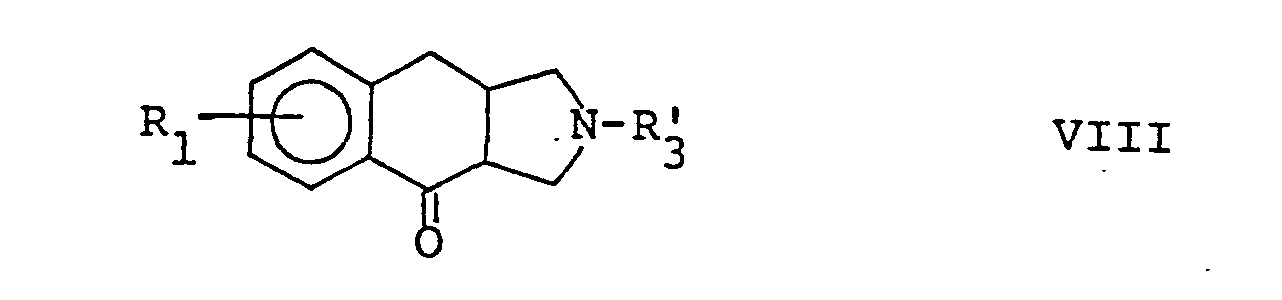
- d) 1) falls R2 für Wasserstoff steht: Reduktion des Ketons der Formel VIII zu dem Alkohol der Formel IXa

- 2) falls R2 für Alkyl steht: Umsetzung mit einer metallorganischen Verbindung, z.B.


- Die Verbindungen der Formeln IV und V sind bekannt oder . können nach an sich bekannten Methoden hergestellt werden.
- Die Ausgangsverbindungen der Formel III können z.B. durch thermische Cycloaddition einer Verbindung der Formel Xa oder Xb


- Diese thermische Cyclisierung kann in einem inerten organischen Lösungsmittel mit vorzugsweise hohem Siedepunkt, beispielsweise Dichlorbenzol, erfolgen. Man arbeitet zweckmässig unter Sauerstoffausschluss bei 160 bis 190°C.
- Zu den Verbindungen der Formeln Xa und Xb gelangt man z.B., indem man eine Verbindung der Formel XI


- Die Verbindungen der Formeln XI, XIIa und XIIb sind bekannt oder nach an sich bekannten Methoden herstellbar.
- Die Verbindungen der Formel I und ihre pharmakologisch verträglichen Säureadditionssalze zeichnen sich durch interessante pharmakodynamische Eigenschaften aus und können daher als Heilmittel verwendet werden. Insbesondere zeigen die Verbindungen antiaggressive Eigenschaften. Die antiaggressiven Wirkungen zeigen sich im Tierversuch z.B. an Mäusen in einer Dämpfung des durch Isolation bedingten aggressiven Verhaltens.
- Aufgrund ihrer aggressionshemmenden Eigenschaften können die Substanzen zur Behandlung von aggressiven Erregungszuständen, beispielsweise zur Dämpfung von aggres- .sivem Verhalten von Psychopathen und Schwachsinnigen, - Verwendung finden. Die zu verwendenden Dosen variieren naturgemäss je nach Art der Substanz, der Administration und des zu behandelnden Zustandes. Im allgemeinen werden jedoch befriedigende Resultate mit einer Dosis von ca. 0,015 bis 10 mg/kg Körpergewicht erhalten. Diese Dosis kann nötigenfalls in zwei bis vier Anteilen oder. auch als Retardform verabreicht werden. Für grössere Säugetiere liegt die Tagesdosis bei etwa 1 bis 30 mg. So enthalten z.B. für orale Applikationen die Teildosen etwa 0,25 bis 15 mg der Verbindungen der Formel I neben festen oder flüssigen Trägersubstanzen.
- Ausserdem besitzen die Substanzen in höheren Dosen auch zentraldämpfende Eigenschaften. Die zentraldämpfenden Wirkungen zeigen sich im Tierversuch z.B. an Mäusen bei der Messung der motorischen Aktivität im Klettertest. Aufgrund ihrer zentraldämpfenden Wirkungen können die Substanzen in der Psychiatrie zur Behandlung von Erregungszuständen Verwendung finden. Die zu verwendenden Dosen variieren naturgemäss je nach Art der Substanz, der Administration und des zu behandelnden Zustandes. Im allgemeinen werden jedoch befriedigende Resultate - mit einer Dosis von ca. 0,15 bis 100 mg/kg Körpergewicht erhalten. Diese Dosis kann nötigenfalls in zwei bis vier Anteilen oder auch als Retardform verabreicht werden. Für grössere Säugetiere liegt die Tagesdosis bei etwa 10 bis 200 mg. So enthalten z.B. für orale Applikationen die Teildosen etwa 2,5 bis 100 mg der Verbindungen der Formel I neben festen oder flüssigen Trägersubstanzen.
- Die Erfindung betrifft auch Heilmittel, die eine Verbindung der Formel I enthalten. Diese Heilmittel, beispielsweise eine Lösung oder eine Tablette,. können nach bekannten Methoden, unter Verwendung der üblichen Hilfs-und Trägerstoffe, hergestellt werden.
- In den nachfolgenden Beispielen erfolgen alle Temperaturangaben in Celsiusgraden.
- Eine Lösung von 14 g 6-Chlor-3a,4,9,9a-tetrahydro-2,4-dimethylbenz[f]isoindolin-4-ol in 140 ml Trifluoressigsäure wird eine Stunde bei Raumtemperatur gerührt und anschliessend eingedampft. Der Rückstand wird in eiskalte wässrige Natronlauge aufgenommen, mit Methylenchlorid extrahiert, die organische Phase über Natriumsulfat getrocknet und eingedampft. Durch Kristallisation des Rückstandes aus methanolischer Salzsäure-Aether erhält man die Titelverbindung; Smp. 253 - 255°.
- Analog erhält man unter Verwendung der entsprechenden Ausgangsverbindungen:
- Smp. 219 - 229° (Zers.)
- Smp. 205 - 206°
- Smp. 211 - 212°
- Smp. 237 - 239° (Zers.)
- Smp. 185 - 187° (Zers.)
- Die im Beispiel 1 verwendete Ausgangsverbindung kann auf folgende Weise hergestellt werden:
- a) Zu einem Gemisch von 42 g 3-Methylamino-propionitril und 8,9 g Benzyl-tri-(n-butyl)ammoniumbromid in 1 Li-ter Methylenchlorid und 500 ml 2N Natronlauge wird unter Rühren in einer Stickstoffatmosphäre bei Raumtemperatur eine Lösung von 116 g p-Chlorcinnamylbromid in 500 ml Methylenchlorid getropft und die Emulsion 65 Stunden bei Raumtemperatur gerührt. Die organische Phase wird abgetrennt, mit Wasser gewaschen, über Natriumsulfat getrocknet und eingedampft. Man erhält 3-[N-(p-Chlorcinnamyi)-methylamino]propionitril; smp. des Hydrogenoxalats 143°.
- b) Zu einer Suspension von 36 g Natriumhydrid (80% in Mineralöl) in 2 1 Hexamethylphosphorsäuretriamid (HMPT) werden bei 0 - 5° unter Rühren und in einer Stickstoffatmosphäre innert 1 1/4 Stunden 252 g 3-[N-(p-Chlorcinnamyl)-methylamino]propionitril in 1 Liter HMPT getropft und das Gemisch bei Raumtemperatur 16 Stunden gerührt. Dann wird das Gemisch unter Eiskühlung mit Wasser versetzt, mit Aether extrahiert, die organische Phase mit Wasser gewaschen, über Natriumsulfat getrocknet und eingedampft. Man erhält 4-(p-Chlorbenzyly-1-methylpyrrolidin-3-carbonitril; Smp. des Hydrogenoxalats 170 - 172°.
- c) Zu 500 g Polyphosphorsäure werden bei 50° 25 ml Wasser, dann 50 g 4-(p-Chlorbenzyl)-1-methylpyrrolidin-3-carbonitril getropft und das Gemisch 1 Stunde bei 125°, dann 2 1/2.Stunden bei 160° gerührt. Das abgekühlte Gemisch wird dann mit Eis und 1 Liter 50%-iger Natronlauge versetzt und mit Essigsäureäthylester extrahiert. Die organische Phase wird mit Wasser gewaschen, über Natriumsulfat getrocknet und eingedampft. Man erhält 6-Chlor-3a,4,9,9a-tetrahydro-2-methylbenz-[f]isoindolin-4-on; Smp. des Hydrogenmaleinats 148 bis 150°.
- d) Zu 170 ml einer ca. 5%-igen Lösung von Methyllithium 'in Aether wird bei Raumtemperatur unter Rühren in einer Stickstoffatmosphäre eine Lösung von 43 g 6-Chlor-3a,4,9,9a-tetrahydro-2-methylbenz[f]isoindolin-4-on in 430 ml Tetrahydrofuran getropft, das Gemisch 5 1/2 Stunden bei Raumtemperatur gerührt, dann mit gesättigter wässriger Ammonchloridlösung und.Wasser versetzt und mit Methylenchlorid extrahiert. Die organische Phase wird über Natriumsulfat getrocknet und eingedampft. Beim Kristallisieren des Rückstandes aus Aether-Petroläther erhält man 6-Chlor-3a,4,9,9a-tetra- hydro-2,4-dimethylbenz[f.]isoindolin-4-ol; Smp. 125 bis 130°.
- Die für die Verbindung des Beispiels 4 benötigte Ausgangsverbindung kann folgendermassen hergestellt werden:
- e) Eine Lösung von 10 g 6-Chlor-3a,4,9,9a-tetrahydro-2-methylbenz[f]isoindolin-4-on in 100 ml Aethanol wird bei 0 - 5° mit 1,6 g Natriumborhydrid in 20 ml Aethanol versetzt, 1 Stunde bei Raumtemperatur weitergerührt und dann mit Wasser versetzt und eingedampft. Der Rückstand wird in 10%-iger Weinsäure aufgenommen, die wässrige Phase mit Aether extrahiert, mit 2N Natronlauge gestellt und mit Essigsäureäthylester extrahiert. Die Essigesterphase wird über Natriumsulfat getrocknet und eingedampft. Durch Kristallisation des Rückstandes aus Methylenchlorid-Pentan erhält man 6-Chlor-3a,4,9,9a-tetrahydro-2-methylben[f]isoindolin-4-ol; Smp. 178 - 182°..
- Ein Gemisch von 10 g 9,9a-Dihydrobenz[f]isoindolin-2-trifluoracetamid und 50 ml 3N Kaliumhydroxid in Methanol wird 16 Stunden bei Raumtemperatur stehen gelassen, die Lösung eingedampft, der Rückstand in Wasser aufgenommen und mit Aether extrahiert. Die Aetherphase wird über Natriumsulfat getrocknet und eingedampft. Der Rückstand wird mit methanolischer Salzsäure eingedampft und aus Methanol-Aether kristallisiert. Man erhält die Titelverbindung vom Smp. 240 - 248° (Zers.).
- Analog erhält man unter Verwendung der entsprechenden Ausgangsverbindungen:
- Smp. 224 - 226°
- Das im Beispiel 6 verwendete 9,9a-Dihydrobenz[f]isoindolin-2-trifluoracetamid kann auf folgende Art hergestellt werden:
- a) Zu einer Suspension von:27 g Natriumhydrid in 400 ml Hexamethylphosphorsäuretriamid (HMPT) wird unter Eiskühlung und Rühren in einer Stickstoffatmosphäre eine Lösung von 250 g N-Cinnamyltrifluoracetamid in 1 Liter HMPT getropft. Nach Beendigung der Gasentwicklung wird eine Lösung von 130 g 1,3-Dichlorpropen und l g Natriumjodid in 1 Liter HMPT zugetropft und das Gemisch 16 Stunden bei Raumtemperatur gerührt. Dann wird das Reaktionsgemisch auf Wasser gegossen und mit Aether extrahiert. Die über Natriumsulfat getrocknete Aetherlösung wird eingedampft und der ölige Rückstand mit Toluol an 3,5 kg Kieselgel chromatographiert. Man erhält N-(3-Chlor-2-propenyl)-N-cinnamyltrifluoracetamid als Oel.
- b) Eine Lösung von 267 g N-(3-Chlor-2-propenyl)-N-cinnamyltrifluoracetamid in 5,5 Liter o-Dichlorbenzol wird 30 Stunden in einer Argonatmosphäre am Rückfluss zum Sieden erhitzt und anschliessend eingedampft. Der Rückstand wird mit Toluol an 6 kg Kieselgel chromatographiert. Nach Umkristallisation aus Methylenchlorid-Aether erhält man 9,9a-Dihydrobenz[f]isoindolin-2-trifluoracetamid vom Smp. 150 - 155°.
Claims (3)

stehen, und ihre Säureadditionssalze.


und gewünschtenfalls die erhaltenen Verbindungen der Formel Ia bzw. Ib in ihre Säureadditionssalze überführt.
Applications Claiming Priority (4)
| Application Number | Priority Date | Filing Date | Title |
|---|---|---|---|
| CH791777 | 1977-06-28 | ||
| CH7917/77 | 1977-06-28 | ||
| CH791677 | 1977-06-28 | ||
| CH7916/77 | 1977-06-28 |
Publications (2)
| Publication Number | Publication Date |
|---|---|
| EP0000154A1 true EP0000154A1 (de) | 1979-01-10 |
| EP0000154B1 EP0000154B1 (de) | 1981-07-29 |
Family
ID=25702452
Family Applications (1)
| Application Number | Title | Priority Date | Filing Date |
|---|---|---|---|
| EP78100169A Expired EP0000154B1 (de) | 1977-06-28 | 1978-06-15 | Neue Benz(f)isoindoline, ihre Herstellung und Heilmittel welche diese Verbindungen enthalten |
Country Status (13)
| Country | Link |
|---|---|
| US (1) | US4164583A (de) |
| EP (1) | EP0000154B1 (de) |
| JP (1) | JPS5412370A (de) |
| AU (1) | AU3747078A (de) |
| CA (1) | CA1088949A (de) |
| DE (1) | DE2860878D1 (de) |
| DK (1) | DK275578A (de) |
| FI (1) | FI781948A7 (de) |
| IL (1) | IL55007A (de) |
| IT (1) | IT1097289B (de) |
| NZ (1) | NZ187676A (de) |
| PH (1) | PH14178A (de) |
| PT (1) | PT68218A (de) |
Families Citing this family (2)
| Publication number | Priority date | Publication date | Assignee | Title |
|---|---|---|---|---|
| US4622405A (en) * | 1984-07-25 | 1986-11-11 | Abbott Laboratories | 1,2,3,3a,8,8a-hexahydro-indeno[1,2-c]pyrroles useful in the treatment of hypertension |
| US5571929A (en) * | 1994-12-07 | 1996-11-05 | The United States Of America As Represented By The Department Of Health And Human Services | Resolution and reduction of physostigmine intermediates and derivatives |
Citations (2)
| Publication number | Priority date | Publication date | Assignee | Title |
|---|---|---|---|---|
| FR2201092A1 (de) * | 1972-09-29 | 1974-04-26 | Sandoz Sa | |
| US3973030A (en) * | 1973-10-29 | 1976-08-03 | Ciba-Geigy Corporation | Antiasthmatic 5,6-benzoisoindoline compositions |
Family Cites Families (4)
| Publication number | Priority date | Publication date | Assignee | Title |
|---|---|---|---|---|
| US2740795A (en) * | 1956-04-03 | Isoindolineicompounds | ||
| BE792374A (fr) * | 1971-12-08 | 1973-06-06 | Allen & Hanburys Ltd | Nouveaux derives d'isoindoline |
| US4014899A (en) * | 1973-10-29 | 1977-03-29 | Ciba-Geigy Corporation | 5,6-Benzoisoindolines |
| SE7503007L (de) | 1974-03-26 | 1975-09-29 | Sandoz Ag |
-
1978
- 1978-06-15 DE DE7878100169T patent/DE2860878D1/de not_active Expired
- 1978-06-15 EP EP78100169A patent/EP0000154B1/de not_active Expired
- 1978-06-19 DK DK275578A patent/DK275578A/da not_active Application Discontinuation
- 1978-06-19 FI FI781948A patent/FI781948A7/fi not_active Application Discontinuation
- 1978-06-22 US US05/917,948 patent/US4164583A/en not_active Expired - Lifetime
- 1978-06-26 PH PH21303A patent/PH14178A/en unknown
- 1978-06-26 PT PT68218A patent/PT68218A/pt unknown
- 1978-06-26 AU AU37470/78A patent/AU3747078A/en active Pending
- 1978-06-26 NZ NZ187676A patent/NZ187676A/xx unknown
- 1978-06-26 IL IL55007A patent/IL55007A/xx unknown
- 1978-06-27 JP JP7708678A patent/JPS5412370A/ja active Pending
- 1978-06-27 CA CA306,325A patent/CA1088949A/en not_active Expired
- 1978-06-27 IT IT25029/78A patent/IT1097289B/it active
Patent Citations (2)
| Publication number | Priority date | Publication date | Assignee | Title |
|---|---|---|---|---|
| FR2201092A1 (de) * | 1972-09-29 | 1974-04-26 | Sandoz Sa | |
| US3973030A (en) * | 1973-10-29 | 1976-08-03 | Ciba-Geigy Corporation | Antiasthmatic 5,6-benzoisoindoline compositions |
Also Published As
| Publication number | Publication date |
|---|---|
| JPS5412370A (en) | 1979-01-30 |
| CA1088949A (en) | 1980-11-04 |
| US4164583A (en) | 1979-08-14 |
| IL55007A0 (en) | 1978-08-31 |
| DK275578A (da) | 1978-12-29 |
| IT7825029A0 (it) | 1978-06-27 |
| AU3747078A (en) | 1980-01-03 |
| PH14178A (en) | 1981-03-19 |
| PT68218A (fr) | 1978-07-01 |
| NZ187676A (en) | 1981-01-23 |
| FI781948A7 (fi) | 1978-12-29 |
| DE2860878D1 (en) | 1981-10-29 |
| EP0000154B1 (de) | 1981-07-29 |
| IT1097289B (it) | 1985-08-31 |
| IL55007A (en) | 1981-03-31 |
Similar Documents
| Publication | Publication Date | Title |
|---|---|---|
| DE69011628T2 (de) | 1,2-Benzisoxazolderivate, Verfahren zu deren Herstellung, und sie enthaltende pharmazeutische Zusammensetzungen. | |
| DE2461604C2 (de) | ||
| CH648553A5 (de) | Neue 3,4-dihydro-5h-2,3-benzodiazepin-derivate und verfahren zur herstellung derselben. | |
| CH462835A (de) | Verfahren zur Herstellung von neuen Triazaspirodecanen und ihren Säureadditionssalzen | |
| DE2148551A1 (de) | Verfahren zur Herstellung neuer carbocyclischer Verbindungen | |
| EP0234173B1 (de) | Phenoxy-substituierte beta-Carbolinderivate, ihre Herstellung und ihre Verwendung als Arzneimittel | |
| DE2225765A1 (de) | 3- eckige Klammer auf 2-(4-Phenyl-lpiperazinyl)-äthyl eckige Klammer zu -indoline | |
| EP0000154B1 (de) | Neue Benz(f)isoindoline, ihre Herstellung und Heilmittel welche diese Verbindungen enthalten | |
| DE3209304C2 (de) | ||
| DE2933636A1 (de) | Neue n-phenylindolinderivate, ihre herstellung und pharmazeutische praeparate, welche diese verbindungen enthalten | |
| DE3300522C2 (de) | ||
| DE3888811T2 (de) | Tricyclische Carbamate, Verfahren zu ihrer Herstellung und ihre therapeutische Verwendung. | |
| DE934651C (de) | Verfahren zur Herstellung von tetrasubstituierten Diaminoalkanen | |
| DE2230154A1 (de) | N-(heteroaryl-methyl)-6,14-endoaetheno7alpha-hydroxyalkyl-tetrahydro-nororipavine und -thebaine, deren hydrierungsprodukte und saeureadditionssalze sowie verfahren zu deren herstellung | |
| DE2318329A1 (de) | Verfahren zur herstellung neuer heterocyclischer verbindungen | |
| EP0037990A1 (de) | Phenyl-chinolizidine, entsprechende pharmazeutische Präparate, die Herstellung der Wirkstoffe sowie entsprechende Ausgangsverbindungen | |
| DE2624967A1 (de) | Neue organische verbindungen, ihre herstellung und verwendung | |
| DE1795105A1 (de) | Neues Verfahren zur Herstellung von 5-Hydroxy-5-phenyl-2,3-dihydro-5H-imidazo[2,1-a]isoindolen | |
| AT225712B (de) | Verfahren zur Herstellung einer neuen N-heterocyclischen Verbindung | |
| AT276383B (de) | Verfahren zur Herstellung von neuen Phenylisoindolderivaten und deren Salzen | |
| DE2503156A1 (de) | Verfahren zur herstellung neuer heterocyclischer verbindungen | |
| AT229292B (de) | Verfahren zur Herstellung von neuen basisch substituierten Diphenylalkanderivaten und ihren Salzen | |
| AT222128B (de) | Verfahren zur Herstellung von neuen N-heterocyclischen Verbindungen | |
| DE1545950A1 (de) | Verfahren zur Herstellung von substituierten Propan-Verbindungen | |
| CH532014A (de) | Verfahren zur Herstellung neuer, in Stellung 5 substituierter 5H-Dibenzo(a,d)cycloheptene |
Legal Events
| Date | Code | Title | Description |
|---|---|---|---|
| PUAI | Public reference made under article 153(3) epc to a published international application that has entered the european phase |
Free format text: ORIGINAL CODE: 0009012 |
|
| AK | Designated contracting states |
Kind code of ref document: A1 Designated state(s): BE CH DE FR GB LU NL SE |
|
| 17P | Request for examination filed | ||
| GRAA | (expected) grant |
Free format text: ORIGINAL CODE: 0009210 |
|
| AK | Designated contracting states |
Kind code of ref document: B1 Designated state(s): BE CH DE FR GB LU NL SE |
|
| PG25 | Lapsed in a contracting state [announced via postgrant information from national office to epo] |
Ref country code: SE Free format text: THE PATENT HAS BEEN ANNULLED BY A DECISION OF A NATIONAL AUTHORITY Effective date: 19810729 Ref country code: NL Effective date: 19810729 Ref country code: FR Free format text: THE PATENT HAS BEEN ANNULLED BY A DECISION OF A NATIONAL AUTHORITY Effective date: 19810729 Ref country code: BE Effective date: 19810729 |
|
| REF | Corresponds to: |
Ref document number: 2860878 Country of ref document: DE Date of ref document: 19811029 |
|
| NLV1 | Nl: lapsed or annulled due to failure to fulfill the requirements of art. 29p and 29m of the patents act | ||
| PG25 | Lapsed in a contracting state [announced via postgrant information from national office to epo] |
Ref country code: LU Free format text: LAPSE BECAUSE OF NON-PAYMENT OF DUE FEES Effective date: 19820630 Ref country code: CH Effective date: 19820630 |
|
| REG | Reference to a national code |
Ref country code: CH Ref legal event code: PL |
|
| PG25 | Lapsed in a contracting state [announced via postgrant information from national office to epo] |
Ref country code: DE Effective date: 19830301 |
|
| GBPC | Gb: european patent ceased through non-payment of renewal fee | ||
| PG25 | Lapsed in a contracting state [announced via postgrant information from national office to epo] |
Ref country code: GB Effective date: 19881117 |
|
| EUG | Se: european patent has lapsed |
Ref document number: 78100169.0 Effective date: 19850612 |
|
| PLBE | No opposition filed within time limit |
Free format text: ORIGINAL CODE: 0009261 |
|
| STAA | Information on the status of an ep patent application or granted ep patent |
Free format text: STATUS: NO OPPOSITION FILED WITHIN TIME LIMIT |