EP0001075A1 - Teilgeschützte Human-Insulin-A-Kette und Verfahren zu ihrer Herstellung - Google Patents
Teilgeschützte Human-Insulin-A-Kette und Verfahren zu ihrer Herstellung Download PDFInfo
- Publication number
- EP0001075A1 EP0001075A1 EP78100747A EP78100747A EP0001075A1 EP 0001075 A1 EP0001075 A1 EP 0001075A1 EP 78100747 A EP78100747 A EP 78100747A EP 78100747 A EP78100747 A EP 78100747A EP 0001075 A1 EP0001075 A1 EP 0001075A1
- Authority
- EP
- European Patent Office
- Prior art keywords
- cys
- trt
- mmol
- tyr
- ddz
- Prior art date
- Legal status (The legal status is an assumption and is not a legal conclusion. Google has not performed a legal analysis and makes no representation as to the accuracy of the status listed.)
- Granted
Links
- 238000000034 method Methods 0.000 title claims abstract description 9
- 238000002360 preparation method Methods 0.000 title claims abstract description 5
- 101500025353 Homo sapiens Insulin A chain Proteins 0.000 title abstract description 4
- YMWUJEATGCHHMB-UHFFFAOYSA-N Dichloromethane Chemical compound ClCCl YMWUJEATGCHHMB-UHFFFAOYSA-N 0.000 claims abstract description 44
- DTQVDTLACAAQTR-UHFFFAOYSA-N Trifluoroacetic acid Chemical compound OC(=O)C(F)(F)F DTQVDTLACAAQTR-UHFFFAOYSA-N 0.000 claims abstract description 35
- QOSSAOTZNIDXMA-UHFFFAOYSA-N Dicylcohexylcarbodiimide Chemical compound C1CCCCC1N=C=NC1CCCCC1 QOSSAOTZNIDXMA-UHFFFAOYSA-N 0.000 claims abstract description 17
- 125000006239 protecting group Chemical group 0.000 claims abstract description 9
- 125000002924 primary amino group Chemical group [H]N([H])* 0.000 claims abstract description 5
- 108090000765 processed proteins & peptides Proteins 0.000 claims description 14
- 102000004877 Insulin Human genes 0.000 abstract description 3
- 108090001061 Insulin Proteins 0.000 abstract description 3
- 108010033276 Peptide Fragments Proteins 0.000 abstract 2
- 102000007079 Peptide Fragments Human genes 0.000 abstract 2
- XEKOWRVHYACXOJ-UHFFFAOYSA-N Ethyl acetate Chemical compound CCOC(C)=O XEKOWRVHYACXOJ-UHFFFAOYSA-N 0.000 description 180
- OKKJLVBELUTLKV-UHFFFAOYSA-N Methanol Chemical compound OC OKKJLVBELUTLKV-UHFFFAOYSA-N 0.000 description 144
- ZMXDDKWLCZADIW-UHFFFAOYSA-N N,N-Dimethylformamide Chemical compound CN(C)C=O ZMXDDKWLCZADIW-UHFFFAOYSA-N 0.000 description 104
- RTZKZFJDLAIYFH-UHFFFAOYSA-N Diethyl ether Chemical compound CCOCC RTZKZFJDLAIYFH-UHFFFAOYSA-N 0.000 description 81
- 239000000243 solution Substances 0.000 description 67
- XLYOFNOQVPJJNP-UHFFFAOYSA-N water Substances O XLYOFNOQVPJJNP-UHFFFAOYSA-N 0.000 description 52
- 239000000203 mixture Substances 0.000 description 51
- KRKNYBCHXYNGOX-UHFFFAOYSA-N citric acid Chemical compound OC(=O)CC(O)(C(O)=O)CC(O)=O KRKNYBCHXYNGOX-UHFFFAOYSA-N 0.000 description 30
- 239000012071 phase Substances 0.000 description 20
- 239000007979 citrate buffer Substances 0.000 description 18
- 239000011734 sodium Substances 0.000 description 17
- 239000000126 substance Substances 0.000 description 17
- ASOKPJOREAFHNY-UHFFFAOYSA-N 1-Hydroxybenzotriazole Chemical compound C1=CC=C2N(O)N=NC2=C1 ASOKPJOREAFHNY-UHFFFAOYSA-N 0.000 description 16
- NPZTUJOABDZTLV-UHFFFAOYSA-N hydroxybenzotriazole Substances O=C1C=CC=C2NNN=C12 NPZTUJOABDZTLV-UHFFFAOYSA-N 0.000 description 16
- 239000002244 precipitate Substances 0.000 description 15
- LHSGPCFBGJHPCY-UHFFFAOYSA-N L-leucine-L-tyrosine Natural products CC(C)CC(N)C(=O)NC(C(O)=O)CC1=CC=C(O)C=C1 LHSGPCFBGJHPCY-UHFFFAOYSA-N 0.000 description 14
- JUJWROOIHBZHMG-UHFFFAOYSA-N Pyridine Chemical compound C1=CC=NC=C1 JUJWROOIHBZHMG-UHFFFAOYSA-N 0.000 description 14
- 239000000706 filtrate Substances 0.000 description 14
- 108010012058 leucyltyrosine Proteins 0.000 description 14
- 239000003208 petroleum Substances 0.000 description 14
- HVCNXQOWACZAFN-UHFFFAOYSA-N 4-ethylmorpholine Chemical compound CCN1CCOCC1 HVCNXQOWACZAFN-UHFFFAOYSA-N 0.000 description 12
- HEMHJVSKTPXQMS-UHFFFAOYSA-M Sodium hydroxide Chemical compound [OH-].[Na+] HEMHJVSKTPXQMS-UHFFFAOYSA-M 0.000 description 12
- 238000004458 analytical method Methods 0.000 description 12
- RDOXTESZEPMUJZ-UHFFFAOYSA-N anisole Chemical compound COC1=CC=CC=C1 RDOXTESZEPMUJZ-UHFFFAOYSA-N 0.000 description 12
- 238000003756 stirring Methods 0.000 description 12
- 239000012634 fragment Substances 0.000 description 11
- 235000001014 amino acid Nutrition 0.000 description 10
- 150000001413 amino acids Chemical class 0.000 description 10
- 125000000956 methoxy group Chemical group [H]C([H])([H])O* 0.000 description 10
- GCACQYDBDHRVGE-LKXGYXEUSA-N Asp-Thr-Ser Chemical compound OC[C@@H](C(O)=O)NC(=O)[C@H]([C@H](O)C)NC(=O)[C@@H](N)CC(O)=O GCACQYDBDHRVGE-LKXGYXEUSA-N 0.000 description 8
- 230000015572 biosynthetic process Effects 0.000 description 7
- 125000000896 monocarboxylic acid group Chemical group 0.000 description 7
- 239000000047 product Substances 0.000 description 7
- 238000000746 purification Methods 0.000 description 7
- UMJSCPRVCHMLSP-UHFFFAOYSA-N pyridine Natural products COC1=CC=CN=C1 UMJSCPRVCHMLSP-UHFFFAOYSA-N 0.000 description 7
- 238000003786 synthesis reaction Methods 0.000 description 7
- OUYCCCASQSFEME-QMMMGPOBSA-N L-tyrosine Chemical compound OC(=O)[C@@H](N)CC1=CC=C(O)C=C1 OUYCCCASQSFEME-QMMMGPOBSA-N 0.000 description 6
- FAPWRFPIFSIZLT-UHFFFAOYSA-M Sodium chloride Chemical compound [Na+].[Cl-] FAPWRFPIFSIZLT-UHFFFAOYSA-M 0.000 description 6
- 239000003054 catalyst Substances 0.000 description 6
- 238000004140 cleaning Methods 0.000 description 6
- UZKWTJUDCOPSNM-UHFFFAOYSA-N methoxybenzene Substances CCCCOC=C UZKWTJUDCOPSNM-UHFFFAOYSA-N 0.000 description 6
- 238000007254 oxidation reaction Methods 0.000 description 6
- 229920006395 saturated elastomer Polymers 0.000 description 6
- LHJGJYXLEPZJPM-UHFFFAOYSA-N 2,4,5-trichlorophenol Chemical compound OC1=CC(Cl)=C(Cl)C=C1Cl LHJGJYXLEPZJPM-UHFFFAOYSA-N 0.000 description 5
- QTBSBXVTEAMEQO-UHFFFAOYSA-N Acetic acid Chemical compound CC(O)=O QTBSBXVTEAMEQO-UHFFFAOYSA-N 0.000 description 5
- WHUUTDBJXJRKMK-VKHMYHEASA-N L-glutamic acid Chemical compound OC(=O)[C@@H](N)CCC(O)=O WHUUTDBJXJRKMK-VKHMYHEASA-N 0.000 description 5
- 238000006243 chemical reaction Methods 0.000 description 5
- KJOZJSGOIJQCGA-UHFFFAOYSA-N dichloromethane;2,2,2-trifluoroacetic acid Chemical compound ClCCl.OC(=O)C(F)(F)F KJOZJSGOIJQCGA-UHFFFAOYSA-N 0.000 description 5
- 230000003647 oxidation Effects 0.000 description 5
- ADFXKUOMJKEIND-UHFFFAOYSA-N 1,3-dicyclohexylurea Chemical compound C1CCCCC1NC(=O)NC1CCCCC1 ADFXKUOMJKEIND-UHFFFAOYSA-N 0.000 description 4
- RATOMFTUDRYMKX-ACZMJKKPSA-N Asp-Glu-Cys Chemical compound C(CC(=O)O)[C@@H](C(=O)N[C@@H](CS)C(=O)O)NC(=O)[C@H](CC(=O)O)N RATOMFTUDRYMKX-ACZMJKKPSA-N 0.000 description 4
- ZAFNJMIOTHYJRJ-UHFFFAOYSA-N Diisopropyl ether Chemical compound CC(C)OC(C)C ZAFNJMIOTHYJRJ-UHFFFAOYSA-N 0.000 description 4
- XKPOCESCRTVRPL-KBIXCLLPSA-N Glu-Cys-Ile Chemical compound [H]N[C@@H](CCC(O)=O)C(=O)N[C@@H](CS)C(=O)N[C@@H]([C@@H](C)CC)C(O)=O XKPOCESCRTVRPL-KBIXCLLPSA-N 0.000 description 4
- LYCDZGLXQBPNQU-WDSKDSINSA-N Glu-Gly-Cys Chemical compound OC(=O)CC[C@H](N)C(=O)NCC(=O)N[C@@H](CS)C(O)=O LYCDZGLXQBPNQU-WDSKDSINSA-N 0.000 description 4
- FXHOOIRPVKKKFG-UHFFFAOYSA-N N,N-Dimethylacetamide Chemical compound CN(C)C(C)=O FXHOOIRPVKKKFG-UHFFFAOYSA-N 0.000 description 4
- WYURNTSHIVDZCO-UHFFFAOYSA-N Tetrahydrofuran Chemical compound C1CCOC1 WYURNTSHIVDZCO-UHFFFAOYSA-N 0.000 description 4
- FTKXYXACXYOHND-XUXIUFHCSA-N Val-Ile-Leu Chemical compound CC(C)[C@H](N)C(=O)N[C@@H]([C@@H](C)CC)C(=O)N[C@@H](CC(C)C)C(O)=O FTKXYXACXYOHND-XUXIUFHCSA-N 0.000 description 4
- 238000009903 catalytic hydrogenation reaction Methods 0.000 description 4
- 239000005457 ice water Substances 0.000 description 4
- 230000007935 neutral effect Effects 0.000 description 4
- 239000000725 suspension Substances 0.000 description 4
- MTCFGRXMJLQNBG-REOHCLBHSA-N (2S)-2-Amino-3-hydroxypropansäure Chemical compound OC[C@H](N)C(O)=O MTCFGRXMJLQNBG-REOHCLBHSA-N 0.000 description 3
- ZMANZCXQSJIPKH-UHFFFAOYSA-N Triethylamine Chemical compound CCN(CC)CC ZMANZCXQSJIPKH-UHFFFAOYSA-N 0.000 description 3
- DTQVDTLACAAQTR-UHFFFAOYSA-M Trifluoroacetate Chemical compound [O-]C(=O)C(F)(F)F DTQVDTLACAAQTR-UHFFFAOYSA-M 0.000 description 3
- XSQUKJJJFZCRTK-UHFFFAOYSA-N Urea Chemical compound NC(N)=O XSQUKJJJFZCRTK-UHFFFAOYSA-N 0.000 description 3
- 239000004202 carbamide Substances 0.000 description 3
- 239000003153 chemical reaction reagent Substances 0.000 description 3
- 238000009833 condensation Methods 0.000 description 3
- 230000005494 condensation Effects 0.000 description 3
- 238000005984 hydrogenation reaction Methods 0.000 description 3
- 239000011780 sodium chloride Substances 0.000 description 3
- 239000002904 solvent Substances 0.000 description 3
- RYHBNJHYFVUHQT-UHFFFAOYSA-N 1,4-Dioxane Chemical compound C1COCCO1 RYHBNJHYFVUHQT-UHFFFAOYSA-N 0.000 description 2
- BRRPVTUFESPTCP-ACZMJKKPSA-N Asp-Ser-Glu Chemical compound OC(=O)C[C@H](N)C(=O)N[C@@H](CO)C(=O)N[C@H](C(O)=O)CCC(O)=O BRRPVTUFESPTCP-ACZMJKKPSA-N 0.000 description 2
- OXFOKRAFNYSREH-BJDJZHNGSA-N Cys-Ile-Leu Chemical compound CC[C@H](C)[C@@H](C(=O)N[C@@H](CC(C)C)C(=O)O)NC(=O)[C@H](CS)N OXFOKRAFNYSREH-BJDJZHNGSA-N 0.000 description 2
- XTHFKEDIFFGKHM-UHFFFAOYSA-N Dimethoxyethane Chemical compound COCCOC XTHFKEDIFFGKHM-UHFFFAOYSA-N 0.000 description 2
- LFQSCWFLJHTTHZ-UHFFFAOYSA-N Ethanol Chemical compound CCO LFQSCWFLJHTTHZ-UHFFFAOYSA-N 0.000 description 2
- PWUMCBLVWPCKNO-MGHWNKPDSA-N Ile-Leu-Tyr Chemical compound CC[C@H](C)[C@H](N)C(=O)N[C@@H](CC(C)C)C(=O)N[C@H](C(O)=O)CC1=CC=C(O)C=C1 PWUMCBLVWPCKNO-MGHWNKPDSA-N 0.000 description 2
- 238000005684 Liebig rearrangement reaction Methods 0.000 description 2
- GYXVUTAOICLGKJ-ACZMJKKPSA-N Ser-Glu-Cys Chemical compound C(CC(=O)O)[C@@H](C(=O)N[C@@H](CS)C(=O)O)NC(=O)[C@H](CO)N GYXVUTAOICLGKJ-ACZMJKKPSA-N 0.000 description 2
- LDKDGDIWEUUXSH-UHFFFAOYSA-N Thymophthalein Chemical compound C1=C(O)C(C(C)C)=CC(C2(C3=CC=CC=C3C(=O)O2)C=2C(=CC(O)=C(C(C)C)C=2)C)=C1C LDKDGDIWEUUXSH-UHFFFAOYSA-N 0.000 description 2
- 239000008346 aqueous phase Substances 0.000 description 2
- 238000009835 boiling Methods 0.000 description 2
- 238000000160 carbon, hydrogen and nitrogen elemental analysis Methods 0.000 description 2
- 238000005859 coupling reaction Methods 0.000 description 2
- XVOYSCVBGLVSOL-UHFFFAOYSA-N cysteic acid Chemical compound OC(=O)C(N)CS(O)(=O)=O XVOYSCVBGLVSOL-UHFFFAOYSA-N 0.000 description 2
- -1 however Chemical compound 0.000 description 2
- NOESYZHRGYRDHS-UHFFFAOYSA-N insulin Chemical compound N1C(=O)C(NC(=O)C(CCC(N)=O)NC(=O)C(CCC(O)=O)NC(=O)C(C(C)C)NC(=O)C(NC(=O)CN)C(C)CC)CSSCC(C(NC(CO)C(=O)NC(CC(C)C)C(=O)NC(CC=2C=CC(O)=CC=2)C(=O)NC(CCC(N)=O)C(=O)NC(CC(C)C)C(=O)NC(CCC(O)=O)C(=O)NC(CC(N)=O)C(=O)NC(CC=2C=CC(O)=CC=2)C(=O)NC(CSSCC(NC(=O)C(C(C)C)NC(=O)C(CC(C)C)NC(=O)C(CC=2C=CC(O)=CC=2)NC(=O)C(CC(C)C)NC(=O)C(C)NC(=O)C(CCC(O)=O)NC(=O)C(C(C)C)NC(=O)C(CC(C)C)NC(=O)C(CC=2NC=NC=2)NC(=O)C(CO)NC(=O)CNC2=O)C(=O)NCC(=O)NC(CCC(O)=O)C(=O)NC(CCCNC(N)=N)C(=O)NCC(=O)NC(CC=3C=CC=CC=3)C(=O)NC(CC=3C=CC=CC=3)C(=O)NC(CC=3C=CC(O)=CC=3)C(=O)NC(C(C)O)C(=O)N3C(CCC3)C(=O)NC(CCCCN)C(=O)NC(C)C(O)=O)C(=O)NC(CC(N)=O)C(O)=O)=O)NC(=O)C(C(C)CC)NC(=O)C(CO)NC(=O)C(C(C)O)NC(=O)C1CSSCC2NC(=O)C(CC(C)C)NC(=O)C(NC(=O)C(CCC(N)=O)NC(=O)C(CC(N)=O)NC(=O)C(NC(=O)C(N)CC=1C=CC=CC=1)C(C)C)CC1=CN=CN1 NOESYZHRGYRDHS-UHFFFAOYSA-N 0.000 description 2
- 235000015110 jellies Nutrition 0.000 description 2
- 239000008274 jelly Substances 0.000 description 2
- 239000002243 precursor Substances 0.000 description 2
- 159000000000 sodium salts Chemical class 0.000 description 2
- YLQBMQCUIZJEEH-UHFFFAOYSA-N tetrahydrofuran Natural products C=1C=COC=1 YLQBMQCUIZJEEH-UHFFFAOYSA-N 0.000 description 2
- OUYCCCASQSFEME-UHFFFAOYSA-N tyrosine Natural products OC(=O)C(N)CC1=CC=C(O)C=C1 OUYCCCASQSFEME-UHFFFAOYSA-N 0.000 description 2
- DLMYFMLKORXJPO-FQEVSTJZSA-N (2R)-2-amino-3-[(triphenylmethyl)thio]propanoic acid Chemical compound C=1C=CC=CC=1C(C=1C=CC=CC=1)(SC[C@H](N)C(O)=O)C1=CC=CC=C1 DLMYFMLKORXJPO-FQEVSTJZSA-N 0.000 description 1
- MCRMUCXATQAAMN-HNNXBMFYSA-N (2s)-3-(4-hydroxyphenyl)-2-(phenylmethoxycarbonylamino)propanoic acid Chemical compound C([C@@H](C(=O)O)NC(=O)OCC=1C=CC=CC=1)C1=CC=C(O)C=C1 MCRMUCXATQAAMN-HNNXBMFYSA-N 0.000 description 1
- PJUPKRYGDFTMTM-UHFFFAOYSA-N 1-hydroxybenzotriazole;hydrate Chemical compound O.C1=CC=C2N(O)N=NC2=C1 PJUPKRYGDFTMTM-UHFFFAOYSA-N 0.000 description 1
- HIXDQWDOVZUNNA-UHFFFAOYSA-N 2-(3,4-dimethoxyphenyl)-5-hydroxy-7-methoxychromen-4-one Chemical compound C=1C(OC)=CC(O)=C(C(C=2)=O)C=1OC=2C1=CC=C(OC)C(OC)=C1 HIXDQWDOVZUNNA-UHFFFAOYSA-N 0.000 description 1
- HJBLUNHMOKFZQX-UHFFFAOYSA-N 3-hydroxy-1,2,3-benzotriazin-4-one Chemical compound C1=CC=C2C(=O)N(O)N=NC2=C1 HJBLUNHMOKFZQX-UHFFFAOYSA-N 0.000 description 1
- 229910018072 Al 2 O 3 Inorganic materials 0.000 description 1
- XBPCUCUWBYBCDP-UHFFFAOYSA-N Dicyclohexylamine Chemical compound C1CCCCC1NC1CCCCC1 XBPCUCUWBYBCDP-UHFFFAOYSA-N 0.000 description 1
- QKCZZAZNMMVICF-DCAQKATOSA-N Gln-Leu-Glu Chemical compound NC(=O)CC[C@H](N)C(=O)N[C@@H](CC(C)C)C(=O)N[C@@H](CCC(O)=O)C(O)=O QKCZZAZNMMVICF-DCAQKATOSA-N 0.000 description 1
- NQTADLQHYWFPDB-UHFFFAOYSA-N N-Hydroxysuccinimide Chemical compound ON1C(=O)CCC1=O NQTADLQHYWFPDB-UHFFFAOYSA-N 0.000 description 1
- 241000282941 Rangifer tarandus Species 0.000 description 1
- 240000004808 Saccharomyces cerevisiae Species 0.000 description 1
- UIIMBOGNXHQVGW-UHFFFAOYSA-M Sodium bicarbonate Chemical class [Na+].OC([O-])=O UIIMBOGNXHQVGW-UHFFFAOYSA-M 0.000 description 1
- 239000002253 acid Substances 0.000 description 1
- 239000003929 acidic solution Substances 0.000 description 1
- 239000000654 additive Substances 0.000 description 1
- 230000000996 additive effect Effects 0.000 description 1
- 150000001540 azides Chemical class 0.000 description 1
- TZCXTZWJZNENPQ-UHFFFAOYSA-L barium sulfate Inorganic materials [Ba+2].[O-]S([O-])(=O)=O TZCXTZWJZNENPQ-UHFFFAOYSA-L 0.000 description 1
- 125000001797 benzyl group Chemical group [H]C1=C([H])C([H])=C(C([H])=C1[H])C([H])([H])* 0.000 description 1
- 238000006555 catalytic reaction Methods 0.000 description 1
- 238000012512 characterization method Methods 0.000 description 1
- 229940061631 citric acid acetate Drugs 0.000 description 1
- 238000003776 cleavage reaction Methods 0.000 description 1
- 150000001875 compounds Chemical class 0.000 description 1
- 239000012141 concentrate Substances 0.000 description 1
- 238000010276 construction Methods 0.000 description 1
- 230000008878 coupling Effects 0.000 description 1
- 238000010168 coupling process Methods 0.000 description 1
- XUJNEKJLAYXESH-UHFFFAOYSA-N cysteine Natural products SCC(N)C(O)=O XUJNEKJLAYXESH-UHFFFAOYSA-N 0.000 description 1
- 235000018417 cysteine Nutrition 0.000 description 1
- 238000000354 decomposition reaction Methods 0.000 description 1
- IJKVHSBPTUYDLN-UHFFFAOYSA-N dihydroxy(oxo)silane Chemical compound O[Si](O)=O IJKVHSBPTUYDLN-UHFFFAOYSA-N 0.000 description 1
- 238000004821 distillation Methods 0.000 description 1
- 150000002019 disulfides Chemical class 0.000 description 1
- 239000002024 ethyl acetate extract Substances 0.000 description 1
- FWQHNLCNFPYBCA-UHFFFAOYSA-N fluoran Chemical compound C12=CC=CC=C2OC2=CC=CC=C2C11OC(=O)C2=CC=CC=C21 FWQHNLCNFPYBCA-UHFFFAOYSA-N 0.000 description 1
- 238000010438 heat treatment Methods 0.000 description 1
- 229940125396 insulin Drugs 0.000 description 1
- 239000004026 insulin derivative Substances 0.000 description 1
- 239000000463 material Substances 0.000 description 1
- DODCBMODXGJOKD-RGMNGODLSA-N methyl (2s)-2-amino-4-methylpentanoate;hydrochloride Chemical compound Cl.COC(=O)[C@@H](N)CC(C)C DODCBMODXGJOKD-RGMNGODLSA-N 0.000 description 1
- 125000000325 methylidene group Chemical group [H]C([H])=* 0.000 description 1
- 150000004682 monohydrates Chemical class 0.000 description 1
- 238000006386 neutralization reaction Methods 0.000 description 1
- 125000006502 nitrobenzyl group Chemical group 0.000 description 1
- 239000002798 polar solvent Substances 0.000 description 1
- 230000007017 scission Effects 0.000 description 1
- 238000004809 thin layer chromatography Methods 0.000 description 1
- 125000003396 thiol group Chemical group [H]S* 0.000 description 1
- 125000002221 trityl group Chemical group [H]C1=C([H])C([H])=C([H])C([H])=C1C([*])(C1=C(C(=C(C(=C1[H])[H])[H])[H])[H])C1=C([H])C([H])=C([H])C([H])=C1[H] 0.000 description 1
Classifications
-
- C—CHEMISTRY; METALLURGY
- C07—ORGANIC CHEMISTRY
- C07K—PEPTIDES
- C07K14/00—Peptides having more than 20 amino acids; Gastrins; Somatostatins; Melanotropins; Derivatives thereof
- C07K14/435—Peptides having more than 20 amino acids; Gastrins; Somatostatins; Melanotropins; Derivatives thereof from animals; from humans
- C07K14/575—Hormones
- C07K14/62—Insulins
-
- Y—GENERAL TAGGING OF NEW TECHNOLOGICAL DEVELOPMENTS; GENERAL TAGGING OF CROSS-SECTIONAL TECHNOLOGIES SPANNING OVER SEVERAL SECTIONS OF THE IPC; TECHNICAL SUBJECTS COVERED BY FORMER USPC CROSS-REFERENCE ART COLLECTIONS [XRACs] AND DIGESTS
- Y02—TECHNOLOGIES OR APPLICATIONS FOR MITIGATION OR ADAPTATION AGAINST CLIMATE CHANGE
- Y02P—CLIMATE CHANGE MITIGATION TECHNOLOGIES IN THE PRODUCTION OR PROCESSING OF GOODS
- Y02P20/00—Technologies relating to chemical industry
- Y02P20/50—Improvements relating to the production of bulk chemicals
- Y02P20/55—Design of synthesis routes, e.g. reducing the use of auxiliary or protecting groups
Definitions
- the synthesis of insulins is carried out particularly advantageously with the aid of bridging reagents which link the ⁇ -amine group in A 1 to the ⁇ -amino group in B 29 (Biochem. Biophys. Comm. 55, 60-66 (1973)).
- the subsequent oxidation of the mercapto groups to disulfides and cleavage of the back reagent gives a significantly better yield of insulin than the oxidation of isolated chains.
- they In order to be able to link the chains in a targeted manner, they must be in a suitably protected form.
- the sequence of the human insulin A chain was according to J. Am. Chem. Soc. 89, 4505 (1967) already synthesized; however, this peptide is less suitable for coupling with bridging reagents.
- the invention relates to a partially protected human insulin A chain of the formula I.
- the invention further relates to a process for the preparation of the peptide of the formula I, which is characterized in that the peptide of the formula II
- X is an amino protective group which can be split off by 5 trifluoroacetic acid in 95% methylene chloride, condenses according to the dicyclohexylcarbodiimide method with the addition of N-hydroxy compounds and the N-terminal protective group X from the peptide obtained selectively with about 5% trifluoroacetic acid in methylene chloride splits off.
- 1-Hydroxybenzotriazole is particularly suitable as an N-hydroxy compound as an additive in the condensation with dicyclohexylcarbodiimide (DCC).
- DCC dicyclohexylcarbodiimide
- N-hydroxysuccinimide, 3-hydroxy-4-oxo-3,4-dihydro-1,2,3-benzotriazine or 2-hydroxy-imino-2-cyano-acetic acid ethyl ester can also be used.
- the coupling reactions are carried out at 0 ° C to room temperature in polar solvents such as Dimethylformamide or dimethylacetamide, as well as in mixtures of these solvents.
- Suitable N-terminal protective groups X are the 3,5-dimethoxy- ⁇ , ⁇ -dimethylbenzyloxycarbonyl group (Ddz), the diphenylisopropyloxycarbonyl group (Bpoc) and the trityl group.
- this protective group X is described in approximately 5% trifluoroacetic acid-methylene chloride solution, to which a little water (approx. 1%) and anisole (approx. 10%) or similar compounds can also be added.
- the preparation of the peptide of the formula II and its further conversion by the process according to the invention to the peptide of the formula I can be carried out according to the reaction scheme I.
- the Ddz group is preferably used as a protective group at the amino end, after removal of which the condensation with the next Ddz peptide takes place.
- the Ddz group which is already known from Annalen der Chemie 763, pp. 162 to 172 (1972), is particularly suitable for the synthesis of the precursors, since on the one hand it can be easily split off in a weakly acidic solution, but on the other hand it is surprisingly opposite catalytic hydrogenation is stable.
- benzyl or nitrobenzyl esters can be selectively cleaved by catalytic hydrogenation in the presence of the Ddz group.
- the individual required according to Scheme I Peptidbruchstoothe be prepared as follows: H-Cys (Trt) -Asn-OBu t (fragment 20-21) was prepared analogously to Helv. Chim. Acta 54, 398-422 (1971):
- Ddz-Tyr (Bu t ) -Gln-OH fragment 14-15 was obtained by catalytic hydrogenation of Ddz-Tyr (Bu t ) -Gln-ONb.
- Ddz-Ile-Cys (Trt) -Ser-Leu-OH (fragment 10-13) is obtained by reacting Ddz-Ile-OTcp with the already known H-Cys (Trt) -Ser-Leu-OH (Chem. Ber. 103, 2034-2040 (1970)).
- Verfahl reindeer the fragment 1-5 of the formula III Ddz-Gly-Ile-Val-Glu (OBu t) -Gln-OH can be prepared by two different methods (Scheme IV or V).
- the dicyclohexylurea is filtered off and washed with 20 ml of dimethylformamide.
- the filtrate is carefully poured into about 350 ml with stirring cooled NaHCO 3 solution and extracted with 600 ml of ethyl acetate.
- the trif-uoroacetic acid is neutralized with 17.75 ml (220 mmol) of pyridine and concentrated in vacuo.
- the residue is dissolved in 250 ml of ethyl acetate and extracted 3 times with 25 ml of water.
- the ethyl acetate phase is steeped in without being dried beforehand.
- the residue is dried in a high vacuum and triturated with ether. (Diisopropyl ether can also be used instead of ether.)
- the precipitate is filtered off, washed with ether and dried. Educ. 25.2 g.
Landscapes
- Health & Medical Sciences (AREA)
- Chemical & Material Sciences (AREA)
- Organic Chemistry (AREA)
- Life Sciences & Earth Sciences (AREA)
- Biochemistry (AREA)
- Genetics & Genomics (AREA)
- Gastroenterology & Hepatology (AREA)
- Toxicology (AREA)
- Endocrinology (AREA)
- Biophysics (AREA)
- General Health & Medical Sciences (AREA)
- Zoology (AREA)
- Medicinal Chemistry (AREA)
- Molecular Biology (AREA)
- Proteomics, Peptides & Aminoacids (AREA)
- Diabetes (AREA)
- Peptides Or Proteins (AREA)
- Medicines That Contain Protein Lipid Enzymes And Other Medicines (AREA)
Abstract
Description
- Die Synthese von Insulinen, ausgehend von den beiden Peptidketten A- bzw. B-Kette wird besonders vorteilhaft mit Hilfe von Brückenreagenzien die die α-Amincgruppe in A 1 mit der ε-Aminogruppe in B 29 verknüpfen, durchgeführt (Biochem. Biophys. Comm. 55, 60 - 66 (1973)). Die anschließende Oxydation der Mercaptogruppen zu Disulfiden und Abspaltung des Rückenreagenzes ergibt eine wesentlich bessere Ausbeute an Insulin als die Oxydation isoliert vorliegender Ketten. Um die Ketten gezielt verknüpfen zu können, müssen sie in geeignet geschützter Form vorliegen.
- Die Sequenz der Human-Insulin-A-Kette wurde gemäß J. Am. Chem. Soc. 89, 4505 (1967) bereits synthetisch aufgebaut; dieses Peptid ist jedoch für die Kupplung mit Brückenreagentien weniger geeignet.
- Gegenstand der Erfindung ist eine partiell geschützte Humaninsulin-A-Kette der Formel I
- H-Gly-Ile-Val-Glu(OBut)-Gln-Cys(Trt)-Cys(Trt)-Thr(But)-Ser(But)-Ile-Cys(Trt)-Ser-Leu-Tyr(But)Gln-Leu-Glu(OBut)-Asn-Tyr(But)-Cys(Trt)-Asn-OBut.
- Gegenstand der Erfindung ist weiterhin ein Verfahren zur Herstellung des Peptides der Formel I, das dadurch gekennzeichnet ist, daß man das Peptid der Formel II
- H-Cys(Trt)-Cys(Trt)-Thr(But)-Ser(But)-Ile-Cys(Trt)-Ser-Leu-Tyr(But)-Gln-Leu-Glu(OBut)-Asn-Tyr(But)-Cys(Trt)-Asn-OBut
- mit dem Peptid der Formel III
- X-Gly-Ile-Val-Glu(OBut)-Gln-OH
- worin X eine Aminoschutzgruppe bedeutet, die durch 5 Trifluoressigsäure in 95 % Methylenchlorid abspaltbar ist, nach der Dicyclohexylcarbodiimid-Methode unter Zusatz von N-Hydroxyverbindungen kondensiert und die N-terminale Schutzgruppe X aus dem erhaltenen Peptid selektiv mit ca. 5 %iger Trifluoressigsäure in Methylenchlorid abspaltet.
- Als N-Hydroxyverbindung als Zusatz bei der Kondensation mit Dicyclohexylcarbodiimid (DCC) kommt insbesondere 1-Hydroxybenzotriazol (HOBt) in Betracht. Anstelle von HOBt können jedoch auch N-Hydroxysuccinimid, 3-Hydroxy-4-oxo-3,4-dihydro-1,2,3-benzotriazin oder 2-Hydroxy-imino-2-cyano-essigsäureäthylester verwendet werden. Die Kupplungsreaktionen werden bei 0°C bis Raumtemperatur in polaren Lösungsmitteln wie z.B. Dimethylformamid oder Dimethylacetamid, sowie in Mischungen dieser Lösungsmittel durchgeführt. Als verwendbare N-terminale Schutzgruppe X kommen in Betracht die 3,5-Dimethoxy-α,α-dimethylbenzyl- oxycarbonylgruppe (Ddz) die Diphenyl-isopropyloxycarbonylgruppe (Bpoc) sowie die Tritylgruppe.
- Die selektive Abspaltung dieser Schutzgruppe X wird in ungefähr 5 %iger Triflüoressigsäure-Methylenchlorid-Lösung durchgeführt, der auch etwas Wasser (ca. 1 %) und Anisol (ca. 10 %) oder ähnlich wirkende Verbindungen zugesetzt werden kann.
- Die Herstellung des Peptides der Formel II und dessen weitere Umsetzung nach dem erfindungsgemäßen Verfahren zum Peptid der Formel I kann nach dem Reaktionschema I erfolgen. Hierbei wird in allen Vorstufen bevorzugt die Ddz-Gruppe als Schutzgruppe am Aminoende verwendet, nach deren Entfernung die Kondensation mit dem nächsten Ddz-Peptid erfolgt.
- Bei der Synthese der Vorstufen eignet sich die Ddz-Gruppe, die aus Annalen der Chemie 763, S. 162 bis 172 (1972) bereits bekannt ist, in besonderer Weise, da sie einerseits in schwach saurer Lösung leicht abspaltbar ist, andererseits aber überraschenderweise gegenüber katalytischer Hydrierung stabil ist. So können z.B. Benzyl oder Nitrobenzylester selektiv durch katalytische Hydrierung in Anwesenheit der Ddz-Gruppe gespalten werden.

- Ddz-Leu-Glu(OBut)-Asn-Tyr(But)-OH (Fragment 16-19) wurde nach Reaktionsschema II durch schrittweisen Aufbau mit Z- bzw. Ddz-Aminosäure-2,4,5-trichlorphenylester unter HOBt-Katalyse aufgebaut. Die intermediären Z-Schutzgruppen werden durch katalytische Hydrierung entfernt.
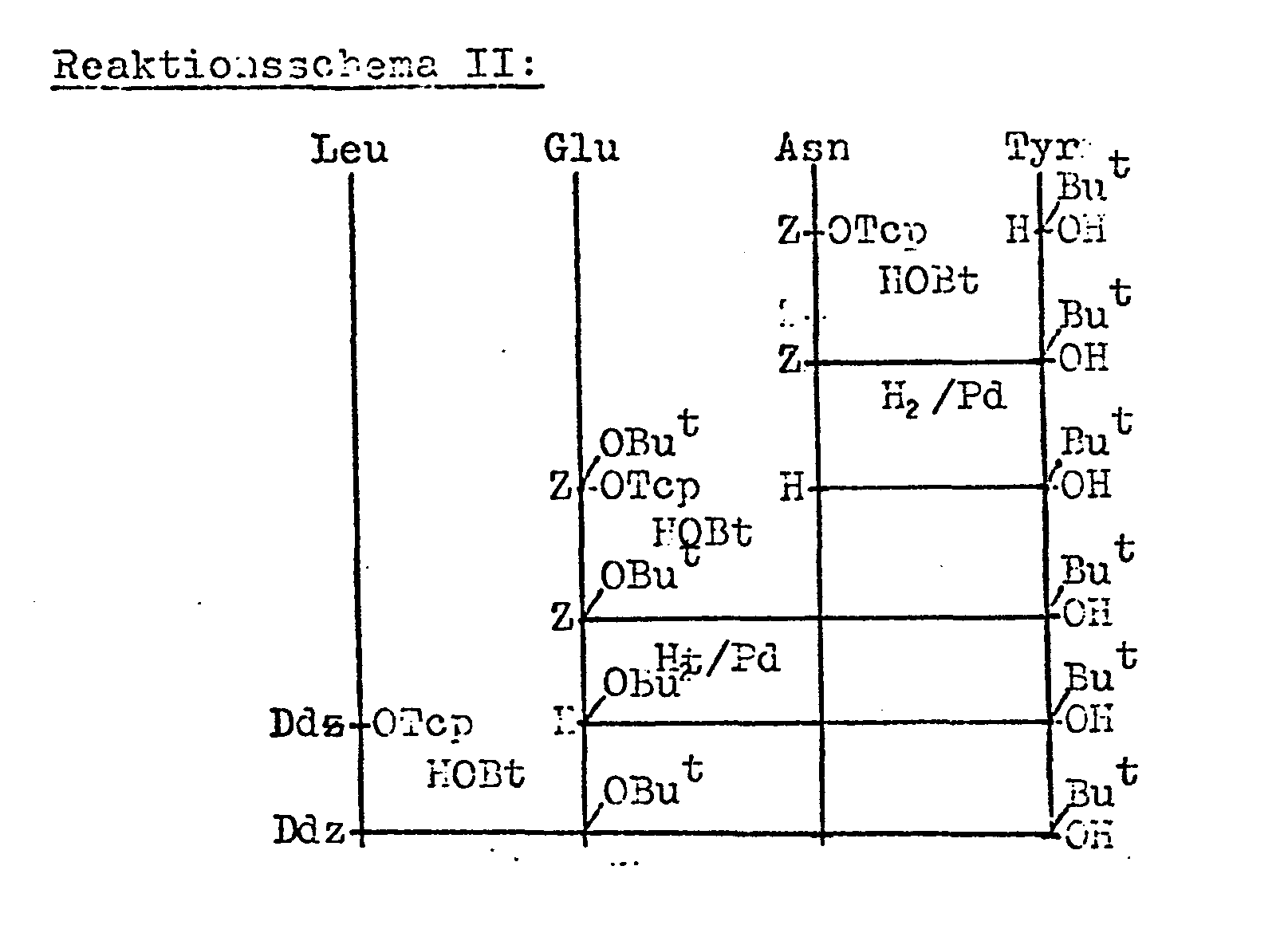
- Ddz-Tyr(But)-Gln-OH (Fragment 14-15) wurde durch katalytische Hydrierung von Ddz-Tyr(But)-Gln-ONb gewonnen.
- Ddz-Ile-Cys(Trt)-Ser-Leu-OH (Fragment 10-13) wird durch Umsetzung von Ddz-Ile-OTcp mit dem bereits bekannten H-Cys(Trt)-Ser-Leu-OH (Chem. Ber. 103, 2034-2040 (1970)) erhalten.
- Ddz-Cys(Trt)-Cys(Trt)-Thr(But)-Ser-(But)-OH (Fragment 6 - 9) wird analog Reaktionsschema III synthetisiert.

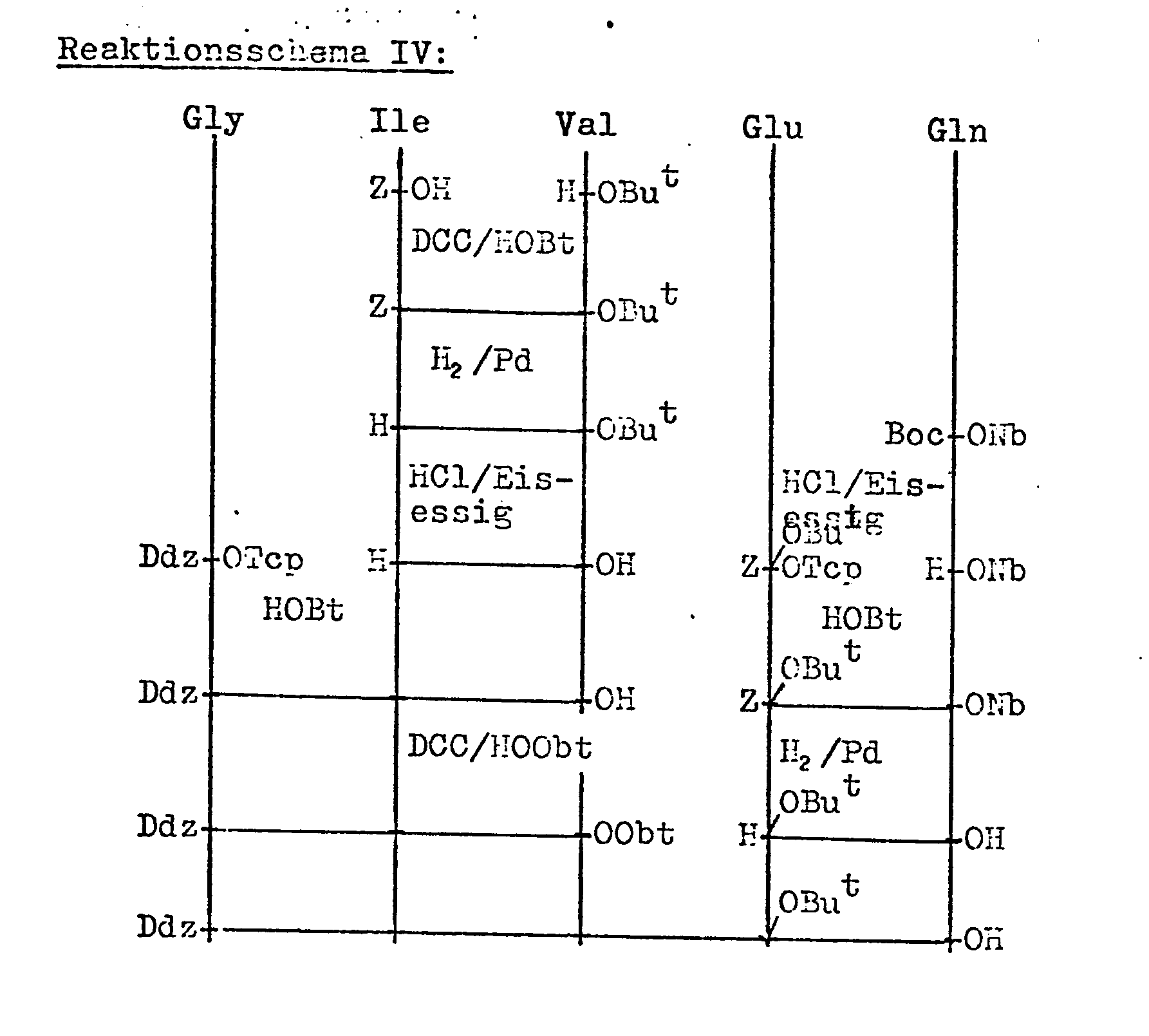
- Die andere Komponente nach dem erfindungsgemäßen Verfahl ren, das Fragment 1 - 5 der Formel III Ddz-Gly-Ile-Val-Glu (OBut)-Gln-OH kann nach zwei verschiedenen Methoden (Schema IV oder V) hergestellt werden.

- 33,3 g Ddz-Leu-OH (Ann. Chem. 1973, 1652 - 1662) 94,3 mMol) werden mit 19,6 g (0,1 Mol) 2,4,5-Trichlorphenol in 350 ml Essigester gelöst. Dazu gibt man bei 0°C eine Lösung von 20,4 g DCC in 60 ml Essigester. Man läßt 3 Stdn. bei 0° und über Nacht bei Raumtemperatur rühren. Der ausgefallene Dicyclohexylharnstoff wird abgesaugt und das Filtrat eingeengt. Der Rückstand kristallisiert mit Petroläther über Nacht im Kühlraum. Ausbeute 39,2 g (73,6 % bezogen auf H-Leu-OMe.HCl). Schmp. 108°, [α]D 29 = - 31,3° (c=1,in Dimethylacetamid) C24H28NO6Cl3 (532,83) Ber. C 54,10 H 5,30 N 2,62 Cl 20,01 Gef. C 54,7 H 5,4 N 2,9 Cl 19,3
- 27,7 g (50 mMol) H-Glu(OBut)-Asn-Tyr(But)-OH (Chem. Ber. 110, 1-11 (1977)) werden in 150 ml Dimethylformamid suspendiert. Nach Zugabe von 6,75 g HOBt (50 mMol) tritt Lösung ein. Man kühlt auf 0°C ab und gibt 6,5 ml (50 mMol) N-Äthylmorpholin und 28 g (52,5 mMol) Ddz-Leu-OTcp zu. Es wird 1 Stdn. bei 0°C und 3 Stdn. bei Raumtemperatur gerührt. Eine Fluoran―probe ergab, daß noch nicht die ganze Aminokomponente abreagiert war. Man gibt nun nochmals 1,3 g Ddz-Leu-OTcp (2,5 mMol) zu und läßt einige Stunden bei Raumtemperatur reagieren. Ist der Ansatz Fluoramnegativ, wird aufgearbeitet. Das Lösungsmittel wird im Hochvakuum abdestilliert und der Rückstand in Essigester gelöst. Es wird mit eiskaltem Citratruffer (pH 3) auf pH 4 eingestellt. Anschliefend wird die Essigesterphase einmal mit Citratpuffer (pH 4 und zwei Mal mit Wasser gewaschen. Man trocknet über Na2SO4 und engt ein. Der Rückstand wird mit einer Mischung aus Äther und Petrcläther wie 1 : 1 verrieben. Man stellt einige Stunden in den Kühlraum und saugt ab. Ausb. 35,35 g (80,25 %), Schmp. 222 - 2230. [α]D 25 = - 23,7° ( c = 1, in Methanol) C44H65N5013.0,5 H2(881,04) Ber. C 60,00 H 7,55 N 7,95 Gef. C 60,0 H 7,6 N 8,0
- 300 g (778 mMol) Z-Tyr(But)-OMe (Ann. Chem. 696, 226 (1966)) werden in 1 Ltr. Methanol gelöst und an der Autobürette (Zugabe von ca 2n methanolischer HCl) bei pH 4,5 katalytisch (Pd/BaS04-Katalysator) hydriert. Nach beendigter Hydrierung wird der Katalysator abgesaugt und das Filtrat eingeengt. Der Rückstand wird mit Äther verrieben.
- Ausb. 189,2 g (84,5 %).
- Schmp. 154 - 156 °, [α]D 22 = + 15,0° (c = 1, in Methanol) C14H22NO3Cl (287,79)
- Ber. C 58,43 H 7,7 N 4,86
- Gef. C 58,6 H 7,6 N 4,8
- Zu einer Lösung von 71,95 g (0,25 Mol) H-Tyr(But-OMe.

- peratur stehen, und wird zwischen 250 ml Essigester und 250 ml Wasser verteilt. Die Essigesterphase wird nach Zugabe von Eis 3 mal mit je 125 ml eiskaltem Citratpuffer (pH 3), 1 mal mit 250 ml ges. NaHCO3-Lösung und 1 mal mit 125 ml Wasser gewaschen, über Na2S04 getrocknet und eingeengt. Am Hochvakuum wird getrocknet. Ausb. 118,2 g Öl (99,8 %).
- Die unter 2) gewonnenen 118,2 g (249,5 mMol) öligen Ddz-Tyr(But)-OMe werden in 500 ml 1,2-Dimethoxyäthan gelöst und mit einer Spatelspitze Thymolphthalein versetzt. Dazu läßt man unter Rühren 250 ml 1n NaOH zutropfen. Man rührt bis die blaue Farbe des Ansatzes verblaßt ist. Nun werden nach und nach in mehreren Portionen noch 120 ml 1n NaOH zugesetzt bis sich die Lösung nicht mehr entfärbt (Der Mehrverbrauch an Natronlauge erklärt sich durch den Essigestergehalt des Ausgangsproduktes). Danach wird mit Citronensäure neutralisiert und die Lösung eingeengt.
- Der Rückstand wird mit Eiswasser versetzt und bei 0°C mit Citronensäure auf pH 3,5 gestellt. Das entstehende Öl wird in Essigester aufgenommen. Die Essigesterphase wird zwei mal mit 200 mlCitratpuffer (pH 4) und zwei mal mit 200 ml Wasser ausgeschüttelt. Die Essigesterphase wird über Na2SO4 getrocknet, abdestilliert und am Hochvakuum getrocknet. Es bleibt eine gelblich-weiße amorphe Substanz zurück. Ausb. 99,5 g (86,8 %) Schmp. ca. 38-40°, [α]D 22 = + 41,5° (c = 1, in Methylenchlorid)
- C25H33NO7 (459,55) Ber. C 65,34 H 7,24 N 3,05 Gef. C 65,0 H 7,3 N 3,0
- Zu einer Lösung von 25,24 g (55 mMol) Ddz-Tyr(But)-OH 15,88 g (50 mMol) H-Gln-ONb.HCl (Chem. ber. 110, 1 - 11 (1977)) und 6,75 g HOBtmonohydrat in 100 ml Dimethylformamid gibt man bei 3°C 6,4 ml (50 mMol) N-Äthylmorpholin und 10,5 g DCC. Man läßt 1 Stdn. bei 0°C und 6 Stdn. bei Raumtemperatur rühren und über Nacht bei Raumtemperatur stehen. Der Niederschlag wird abgesaugt und das Filtrat eingeengt. Das resultierende Öl wird in Essigester gelöst und die Lösung nacheinander mit NaHCO3-Lösung, Citratpuffer (pH 3) und Wasser gewaschen, über Na2SO4 getrocknet und eingeengt. Das Öl wird mit Petroläther pulvrig verrieben und abgesaugt. Zur weiteren Reinigung wird die Suhstanz drei mal mit je 100 ml Diisopropyläther gekocht und abdek ntiert. Zum Schluß wird mit kaltem Diisopropyläther verrieben, abgesaugt und mit Petroläther nachgewaschen.
- Ausb. 32,8 g (91 %., Schmp. 80-90°
- [α]D 22 = + 15,1° = 1, in Methanol)
- C37H46N4O11 (722,81) Ber. C 61,48 H 6,41 N 7,75 Hef. C 61,3 H 6,7 N 7,9
- Zu einer Lösung von 32.5 g (45 mMol) Ddz-Tyr(But)-Gln-ONb in 500 ml Methanol bibt man 5 ml Wasser und Pd/BaSO4-Katalysator und hydrier; 7 Stunden. Dana:h wird vom Katalysator abgesaugt un das Filtrat eingeengt. Das zurückbleibende Öl wird in 250 ml Essigester gelöst. Dazu gibt man 11,3 ml (55 mMol) Dicyclohexylamin. Man läßt einige Stunden im Kühlran stehen und saugs den Niederschlag ab. Der Filterrückitand wird mit Essigester in der Reibschale verrieben, abg saugt und i.Vak. getrocknet. Ausb. 27 g (78 %)
- Schmp. 170-171°, [α]D 23 + 10,2° (c = 1, in Methanol) C42H64N4O9 (769,0) Ber. C 6, 6 H 8,39 N 7, 25 Gef. C 65,4 H 8,5 N 7,
- 2, 9 g (3,77 mMol) Ddz-Tyr(But) n-OH-DCHA we ler zwischen Essigester und Citratpuffer (pH 3) verteilt. Die Essigesterphase wird mit Wasser neutral gewaschen, über Na2S04 getrocknet und eingeengt. Es bleibt ein amorphes Produkt zurück. Ausb. 2 g (90 %)
- Schmp. 110 - 115°, [α]D 22 = + 19,8° (c 0 1, in Methanol) C30H41N3O9 (587,68) Ber. C 61,31 H 7,03 N 7,15 Gef. C 60,6 H 7,2 N 7,0
- Zu einer auf 0°C gekühlten Lösung von 87 g (246 mMol) Ddz-Ile-OH (Ann. Chem. 763, 162-172 (1972)) und 48,6 g (246 mMol) 2,4,5-Trichlorphenol in 700 ml Essigester gibt man eine kalte Lösung von 52 g (252 mMol) DCCI in 175 ml Essigester. Man läßt 3 Stunden bei 0°C rühren und über Nacht bei Raumtemperatur stehen. Der Dicyclohexylharnstoff wird abgesaugt und das Filtrat i. Vak. eingeengt. Der Rückstand kristallisiert mit Petroläther Ausb. 105,6 g (80,5 %)
- Schmp. 92 - 94°, [α]D 22 = - 22,60 (C = 1, in Methanol)
- C24H28NO6Cl3 (532,86) Ber. C 54,10 H 5,30 N 2,63 Cl 19,96 Gef. C 54,4 H 5,4 N 2,8 Cl 19,5
- Zu einer Lösung von 69,8 g (120 mMol) H-Cys(Trt)-Ser-Leu-OH-monohydrat (Chem. Ber. 103, 2034 - 2040 (1970)) und 16,2 g (120 mMol) HOBt in 300 ml Dimethylformamid gibt man bei Raumtemperatur 63,95 g (120 mMol) Ddz-Ile-OTcp und rührt 4 Stunden bei Raumtemperatur. Danach gibt man nochmals 5,33 g (10 mMol) Ddz-Ile-OTcp zu, wenn Tripeptid noch vorhanden ist. Man läßt über Nacht bei Raumtemperatur stehen und destilliert das Lösungsmittel im Vakuum ab. Das zurückbleibende Öl wird zwischen 400 ml Essigester und 250 ml gesättigter Natriumbicarbonatlösung verteilt, wobei das Natriumsalz des Ddz-Tetrapeptids im Essigester bleibt. Die Essigesterphase wird gekühlt und nacheinander mit ca. 120 ml in Citronensäurelösung (wässrige Phase sollte nach dem Ausschütteln etwa pH 3 - 4 haben), 150 ml Citratpuffer (pH 3) und 2 mal mit 200 ml Wasser ausgeschüttelt. Danach wird die Essigesterphase über Na2S04 getrocknet und im Vakuum eingeengt. Der Rückstand wird mit Petroläther verrieben und abgesaugt. Ausb. 99,8 (90 %).
- Schmp. (130) 135 - 140° (Zers.)
- [α]D 22 = 34,1° (C = 1, in Methanol)
- C49H62N4O10S.1 H20 (917,1) Ber. C 62,93 H 7,11 N 6,02 S 3,42 Gef. C 63,0 H 6,8 N 5,8 S 3,4
- Zu einer Suspension von 16,1 g (0,1 mol) H-Ser(But)-OH (Chem. Ber. 97, 2490 (1964) in 100 ml Dimethylformamid gibt man bei 0°C 12,8 ml (0,1 mol) N-Äthylmorpholin und 40,6 g (0,1 mol) Z-Thr(But)-OSu (Hoppe Seyler's Z. Physiol. Chem. 346, 60 (1966)). Man rührt anschließend 5 Stunden bei Raumtemperatur und läßt über Nacht bei Raumtemperatur stehen.
DC-Kontrolle auf H-Ser(But)-OH!
Ist kein H-Ser(But)-OH dünnschichtchromatographisch feststellbar, wird von gegebenenfalls Ungelöstem abgesaugt. Das Filtrat wird eingeengt und der Rückstand zwischen Äther und 110 ml in Zitronensäure verteilt. Die ätherische Phase wird noch einmal mit 100 ml 0,5 n Zitronensäure und anschließend mit Wasser oder NaCl-Lösung neutral gewaschen. Die ätherische Phase wird über Na2SO4 getrocknet, eingeengt und am Hochvakuum ge- trocknet. Ausb. 32.5 g amorphes Produkt (72 %) - [α]D 22D = + 24,1 (c = 1, in Methanol) C22H36N2O7 (452,55) Ber. C 61,04 H 8,02 N 6,19 Gef. C 60,3 H 7,4 N 6,2
- 25 g (55,24 mmol) Z-Thr(But)-Ser(But)OH werden in 200 ml Methanol gelöst und am Autotitrator unter Zugabe von methanol.HCl katalytisch hydriert (pH 4,5). Nach beendigter Hydrierung wird von Pd/BaS04-Katalysator abgesaugt und das Filtrat eingeengt und am Hochvakuum getrocknet. Ausb. 21,1 g amorphes Produkt (19,60 = 100 %)
- [α]D 27 = + 27° (c = 1, in Methanol)
- C15H31N2O5Cl (354,9) Ber. C 50,77 H 8,80 N 7,89 Gef. C 50,9 H 8,8 N 7,8
- Zu einer Suspension von 36,4 g (0,1 mol) H-Cys(Trt)-OH (J. Org. Chem. 30, 1340 (1965)) in 200 ml Dimethylformamid gibt man 28 ml (0,2 mol) Triäthylamin und 26,5 g (0,1 mol) Ddz-azid. Es wird 24 Stunden bei 40°C gerührt. Danach wird die Lösung eingeengt und der Rückstand zwischen 100 ml eisgekühlter in Zitronensäure und Essigester verteilt. Die Essigesterphase wird mit Zitratpuffer (pH 3) und NaCl-Lösung ausgeschüttelt, über Nä2S04 getrocknet und eingeengt. Am Hochvakuum wird getrocknet. Ausb. 37,6 g amorphes Produkt (64 %).
- [α]D 22 = + 27,0° (c = 1, in Methanol)
- C34H35NO6S (585,7) Ber. C 69,72 H 6,02 N 2,39 Gef. 69,3 H 6,3 N 2,6
- Zu einer Lösung von 5,9 g (ca. 10 mMol) Ddz-Cys(Trt)-OH und 2,2 g (11 mMol) 2,4,5-Trichlorphenol in 50 ml absolutem Tetrahydrofuran gibt man bei 0°C 2,3 g DCC, gelöst in 15 ml Tetrahydrofuran, rührt.2 Stunden bei 0°C und läßt über Nacht bei Raumtemperatur stehen. Der DC-Harnstoff wird abgesaugt und die Lösung eingeengt. Der Rückstand wird in Methylenchlorid gelöst und über 100 g Kieselgel 60 filtriert. Man eluiert mit Methylenchlorid. Ausb. 6,2 g amorphes Produkt (81 %).
- [α]D 22 = + 10,3 (c = 1, in Methanol).
-
C 40H 36Cl3NO6S (765,17) Ber. C 62,79 H 4,74 N 1,83 S 4,19 Gef. C 61,0 H 4,7 N 1,7 S 4,2 Laut CHN-Analyse dürfte die Substanz 97 %ig sein. - Zu einer Lösung von 31,8 g (0,1 mol) H-Thr(But)-Ser (But)-OH (oder entsprechend mehr je nach Wasser oder Säuregehalt) und 13,5 g HOBt (0,1 mol) in 100 ml Dimethylformamid gibt man bei o°C 12,8 ml (0,1 mol) N-Äthylmorpholin und 76,5 g (0,1 mol) Ddz-Cys(Trt)-OTcp. Anschließend wird ca. 6 Stunden bei Raumtemperatur gerührt und die Lösung im Hochvakuum eingeengt. Der Rückstand wird zwischen Eis-Wasser und Essigester verteilt. Die Essigesterphase wird mit NaHCO3-Lösung ausgeschüttelt, wobei Ddz-Cys(Trt) -Thr(But)-Ser(But)-OH als Natriumsalz in der Essigesterphase bleibt. Danach wird bei 0°C mit 100 ml 1n Zitronensäure und 100 ml Citratpuffer (pH 3) ausgeschüttelt und mit Wasser neutral gewaschen. Die Essigesterphase wird über Na2SO4 getrocknet, eingeengt und der Rückstand im Hochvakuum getrocknet. Zur weiteren Reinigung wird die Substanz aus Äther/Petroläther umgefällt, wobei die ätherische Lösung in den vorgelegten Petroläther langsam eingetropft wird.
- Ausb. 44,5 g (50 %)
- Schmp. 116-128°(Zers.), [α]D 22 = + 25,5° (c = 1,
- C49H63N3O10S (886,13) Ber. C 66,42 H 7,17 N 4,74 Gef. C 66,1 H 7,4 N 4,7
- 8,8 g (10 mMol) Ddz-Cys(Trt)-Thr(But)-Ser(But)-OH werden bei Raumtemperatur in einer Mischung aus 8,75 ml (0,1 mol) Trifluoressigsäure, 1,75 ml Wasser und 165 ml Methylenchlorid (= ca. 175 ml 5 %ige Trifluoressigsäure in Methylenchlorid mit 1 % Wasser) gelöst. Man läßt 1,5 Stunden bei Raumtemperatur stehen und stellt mit 8,85 ml (0,11 mol) Pyridin neutral. Die Lösung wird eingeengt und der Rückstand zwischen Essigester und Wasser verteilt. Die Essigesterphase wird noch zwei mal mit Wasser gewaschen, über Na2SO4 getrocknet und eingeengt. Der Rückstand wird in wenig Äther gelöst und langsam in Petroläther eingetropft. Ausb. 4,2 g (54 %).
- Schmp. 85-950 (Zersetzung)
- [α]D 22 = + 68,5° (c = 1, in Methanol)
- C37H49N3O6 SCF3COOH (777,9) Ber. C 60,21 H 6,48 N 5,40 S 4,12 Gef. C 60,7 H 6,7 N 5,2 S 4,2
- Zu einer Lösung von 5,3 g (6,8 mmol) H-Cys(Trt)-Thr(But) -Ser(But) OH-trifluoracetat und 0,95 g (0,7 mmol) HOBt in 15 ml Dimethylformamid gibt man bei 0° 0,9 ml (0,7 mmol) N-Äthylmorpholin und 5,35 g (7 mmol) Ddz-Cys(Trt)-OTcp. Man rührt 14 Stunden bei Raumtemperatur und engt die Lösung ein, wenn das Tripeptid abreagiert ist. (Sollte noch unreagiertes Tripeptid nachweisbar sein, muß noch etwas Ddz-Cys(Trt)-OTcp zugesetzt werden.) Den Rückstand nimmt man in Essigester auf. Die Essigesterphase wird nacheinander mit 10-20 ml gesättigter NaHCO3-Lösung, mit 7 ml 1n Zitronensäure und 10 ml Zitratpuffer (pH 3) und mit NaCl-Lösung neutral gewaschen, über Na2SO4 getrocknet und eingeengt. Der Rückstand wird mit Petroläther verrieben. Zur weiteren Reinigung wird aus Äther/Petroläther gefällt oder mit Diisopropylätger verührt. Auch aus Methanol/Wasser kann umgefällt werden.
-
- Ausb. 6 g (71 %)
- Schmp. 118-130° (Zers.), [α]D 22 = + 11,6° (c = 1 in Methanol)
- C71H82N4O11S2(1231,6) Ber. C 69,25 H 6,71 N 4,55 S 5,21 Gef. C 67,2 H 6,3 N 4,1 S 5,3
- Laut CHN-Analyse ist die Substanz nur etwa 97 %ig.
- Zu einer Lösung von 113,3 g (0,334 mmol) Ddz-Val-OH (Liebigs Ann. 763, 162-172 (1972)) und 65,9 g (0,334 mmol) 2,4,5-Trichlorphenol in 300 ml Essigester gibt man bei 0°C eine Lösung von 72,1 g (0,35 mmol) DCC in 100 ml Essigester. Man läßt 1 Stunde bei 0° und 3 Stunden bei Raumtemperatur rühren. Der DC-Harnstoff wird abgesaugt und das Filtrat eingeengt. Der Rückstand wird mit Petroläther kristallisiert. Ausb. 111,45 g (64 %), Schmp. 73-760. [α]D 25 = - 28,70 (c = 1, in Methanol).
- C23H26No6Cl3 (518,84) Ber. C 53,24 H 5,05 N 2,70 Gef. C 53,5 H 5,2 N 2,9
- Zu einer Lösung von 30,5 g (150 mmol) H-Glu(OBut)-OH und 20,25 g (130 mmol) HOBt in 200 ml Dimethylformamid gibt man 19,2 ml (150 mmol) H-Äthylmorpholin und 77,8 g Ddz-Val-OTcp. Man läßt 4 Stunden bei Raumtemperatur rühren. Ist im DC kein H-Glu(OBut)-OH mehr nachweisbar wird, im Hochvakuum eingeengt. (Andernfalls bringt man durch Zusatz von wenig Ddz-Val-OTcp die Reaktion zu Ende). Das resultierende Öl wird zwischen 300 ml Essigester und 300 ml Wasser verteilt. Die Essigesterphase wird zwei mal mit je 150 ml Citratpuffer (pH 3) und ein mal mit 150 ml Wasser ausgeschüttelt, über Na2SO4 getrocknet und eingeengt. Ausb. 138,7 g (78,7 g = 100 %). Das resultierende Öl wird ohne weitere Reinigung und Charakterisierung als 150 mmol weiter umgesetzt.
- C26H40N2O9 (524,6)
- Zu einer Lösung von rohem, verunreinigtem 138,7 g (= 150 mmol) Ddz-Val-Glu(OBut)-OH, 47,65 g (150 mmol) H-Gln-ONb . HCl und 20,25 g (150 mmol) HOBt in 450 ml Dimethylformamid gibt man bei 0°C 19,2 ml (150 mmol) N-Äthylmorpholin und 33 g (160 mmol) DCC. Man läßt 1 Stunde bei 0°C und 4 Stunden bei Raumtemperatur rühren. Man läßt über Nacht bei Raumtemperatur stehen, saugt den Niederschlag ab und engt das Filtrat im Hochvakuum ein. Das resultierende Öl wird zwischen 300 ml Essigester und 300 ml Wasser verteilt. Die Essigesterphase wird nacheinander mit gesättigter NaHCO3-Lösung, Citratpuffer (pH 3), gesättigter NaHCO3-Lösung und Wasser ausgeschüttelt, über Na2S04 getrocknet und eingeengt. Das Öl kristallisiert mit Äther. Mit Äther wird gewaschen. Ausb. 110,95 g (94 %), Schmp. 135-1380, 138-1420.
- [α]D 22 = - 49,40 (c = 1, in Methanol)
- C38H53N5O13 (787,9) Ber. C 57,93 H 6,78 N 8,89 Gef. C 57,8 H 7,0 N 9,2
- 39,4 g (50 mmol) Ddz-Val-Glu(OBut)-Gln-ONb werden in einer Mischung aus 875 ml einer 5 %igen Trifluoressigsäure-Methylenchlorid-Lösung (mit 1 % Wasser) (= 500 mmol Trifluoressigsäure) und 87,5 ml Anisol gelöst. Man läßt 30 Minuten bei Raumtemperatur stehen, neutralisiert mit 50 ml Pyridin und engt ein. Im Hochvakuum wird nachgetrocknet. Der Rückstand wird zwischen Essigester und Wasser verteilt. Die Essigesterphase wird noch zwei mal mit wenig Wasser ausgeschüttelt, über Na2SO4 getrocknet und
- Gef. C 50,8 H 4,3 N 2,95 eingeengt. Der Rückstand wird mit Äther verrieben und im Hochvakuum getrocknet. Ausb. 23,6 g amorphe Substanz (69
- %). [α]D 24 = - 5,3° (c = 1, in Methanol) C26H39N5O9·CF3COOH (679,69) Ber. C 49,48 H 5,93 N 10,30 Gef. C 50,0 H 5,8 N 10,1
- Zu einer Lösung von 23,8 g (ca. 80 mmol) Ddz-Gly-OH (Liebigs Ann. 763, 162-172 (1972)) und 16 g.(ca. 80 mmol) 2,4,5-Trichlorphenol in 150 ml Essigester gibt man bei 0°C eine Lösung von 16,5 g (80 mmol) DCC in 50 ml Essigester. Man läßt über Nacht bei Raumtemperatur stehen, saugt den Niederschlag ab und engt das Filtrat ein. Der Rückstand wird mit Petroläther kristallisiert. Man läßt 6 Stunden im Kühlraum stehen. Der Niederschlag wird abgesaugt und mit Petroläther gewaschen. Ausb. 36,3 g (95 %). Schmp. (111)-115°
- C20H20NO6Cl3 (476,76) Ber. C 50,39 H 4,23 N 2,94 Gef. C 50,8 H 4,3 N 2,95
- Zu einer Lösung von 14,54 g (80 mmol) H-Ile-OMe·HCl und 10,8 g (80 mmol) HOBt in 50 ml Dimethylformamid gibt man bei -3°C 10,3 ml (80 mmol) N-Äthylmorpholin und bei 0°C 40 g (84 mmol) Ddz-Gly-OTcp. Man läßt 3 Stunden bei Raumtemperatur rühren, und läßt über Nacht stehen. (Im DC war andertags noch etwas H-Ile-OMe feststellbar. Es wurden daher nochmals 2,86 g ( 6 mmol) Ddz-Gly-OTep zugegeben und gerührt. Nach 5 Stunden war kein H-Ile-OMe feststellbar.) Die im DC von H-Ile-OMe freie Lösung wird am Hochvakuum eingeengt und das resultierende Öl zwischen Essigester und Wasser verteilt. Die Essigesterlösung wird nacheinander mit gesättigter NaHCO3-Lösung, Citratpuffer (pH 3), NaHCO3-Lösung und Wasser gewaschen und über Na2SO4 getrocknet. Die Essigesterlösung wird über 400 g basisches Al2O3 filtriert, das Eluat eingeengt und am Hochvakuum getrocknet. Ausb. 30,6 g zähes Öl (90 %) [α]D 25 = - 6,8° (c = 1, in Methanol)
- C21H32N2O7 (424,5) Ber. C 59,42 H 7,60 N 6,60 Gef. C 59,1 H 7,7 N 6,3
- 10 g (23,56 mmol) Ddz-Gly-Ile-OHe werden in einer Mischung aus 24 ml Dioxan und 8 ml Wasser gelöst und gegen Thymolphthalein als Indikator mit 1N NaOH titriert. Verbrauch je nach Essigestergehalt mehr als 23 ml. Nach Neutralisation mit Zitronensäure wird das Dioxan abdestilliert. Der Rückstand wird in Wasser aufgenommen und bei 0°C mit 2N Zitronensäure auf pH 3 gestellt. Das ausfallende Öl wird mit Essigester extrahiert. Die wässrige Phase wird, wenn nötig nochmals auf pH 3 angesäuert und mit Essigester extrahiert. Die vereinigten Essigesterextrakte werden mit Wasser ein mal ausgeschüttelt, über Na2SO4 getrocknet und eingeengt. Im Hochvakuum wird getrocknet. Die Substanz wird amorph. Ausb. 8,9 g (92 %). Schmp. 80-90° [α]D 23 = + 4,2° (c = 1, in Methanol)
- C20H30N2O7 (410,48) Ber. C 58,52 H 7,37 N 6,83 Gef. C 58,8 H 7,5 N 6,5
- Zu einer Lösung von 15,8 g (38,5 mmol) Ddz-Gly-Ile-OH, 23,8 g (35 mmol) H-Val-Glu(OBut)-Gln-ONb-trifluoracetat und 5,2 g (38,5 mmol) HOBt in 60 ml Dimethylformamid gibt man bei 0°C 4,48 ml (35 mmol) N-Äthylmorpholin und 8,47 g (41 mmol) DCC. Man läßt eine Stunde bei 0°C, mehrere Stunden bei Raumtemperatur rühren und über Nacht bei Raumtemperatur stehen. Es bildet sich ein Gelee, das in gekühltes NaHCO3-Lösung eingerührt wird. Das Produkt wird abgesaugt und nacheinander mit Citratpuffer (pH 3), NaHCO3-Lösung und Wasser verrieben und jeweils abgesaugt. Über P2O5 wird getrocknet. Ausb. 40,3 g.
- Zur weiteren Reinigung wird aus 500 ml Äthanol umkristallisiert. Ausb. 21,45 g' (64 %), Schmp. 205-2070
- [α]D 25 = - 12,3° (c = 1, in Dimethylformamid.
- C46H67N7015 (958,1) Ber. C 57,67 H 7,05 N 10,23 Gef. C 57,6 H 7,2 N 10,0
- 19,16 g (20 mmol) Ddz-Gly-Ile-Val-Glu(OBut)-Gln-ONb werden in einer Mischung von 100 ml Dimethylformamid und 100 ml Methanol gelöst. Nach Zugabe von Pd/BaS04 wird katalytisch hydriert. Nach 6 Stunden war alles hydriert. Die Suspension wird auf ca. 70°C erhitzt und in der Wärme vom Katalysator abgesaugt. Mit warmem Dimethylformamid wird nachgewaschen. Das Filtrat wird eingeengt und der Rückstand mit 100 ml Methanol verrieben. Man läßt über Nacht im Kühlraum stehen, saugt ab und wäscht mit kaltem Methanol nach. Trocknen im Vakuum über P205. Ausb. 14 g (85 %), Schmp. 238-241° (Zers.)
- [α]D 29 = - 13,3° (c = 1, in Dimethylformamid) C39H62N6O13 (822,97) Ber. C 56,92 H 7,59 N 10,21 Gef. C 56,0 H 7,6 N 10,8
- Zu einer auf 0°C abgekühlten Lösung von 26,4 g (30 mMol) Ddz-Leu-Glu(OBut)-Asn-Tyr(But)-OH-hemihydrat, 16,0 g (30 mMol) H-Cys(Trt)-Asn-OBut und 4,05 g (30 mMol) HOBt in 60 ml Dimethylformamid gibt man eine auf 0°C abgekühlte Lösung von 6,6 g DCC in 20 ml Dimethylformamid. Man läßt den Ansatz 2 Stunden bei 0°C und über Nacht bei Raumtemperatur rühren. Der Dicyclohexylharnstoff wird abgesaugt und mit 20 ml Dimethylformamid gewaschen. Das Filtrat gießt man unter Rühren vorsichtig in ca. 350 ml gekühlte NaHCO3-Lösung und extrahiert mit 600 ml Essigester.
- Die Essigesterphase wird nacheinander 1 x mit 300 ml NaHCO3-Lösung, 1 x mit 300 ml Citratpuffer (pH 4) und 1 x mit 100 ml NaHCO3-Lösung ausgeschüttelt, über Na2SO4 getrocknet und eingeengt. Der Rückstand wird mit Äther verrieben.
- Ausb. 28 - 34 g (67 - 81 %)
- Schmp. 161-1650, [α]D 25 = (c = 1, in CH2Cl2)
- C74H98N8O16S (1387,73) Ber. C 64,05 H 7,12 N 8,07 S 2, 31 Gef. C 63,8 H 7,3. N 8,0 S 4,7
- 27,75 g (20 mmol) Ddz-Leu-Glu(OBut)-Asn-Tyr(But)-Cys (Trt)-Asn-OBut werden bei Raumtemperatur in einer Mischung aus 17,5 ml Trifluoressigsäure (0,2 mol), 3,5 ml Wasser und 330 ml Methylenchlorid (= ca. 350 ml 5 %ige Trifluoressigsäure mit 1 % Wasser in Methylenchloric) eingetragen. Man läßt 2 Stunden bei Raumtemperatur ühren. Darauf kühlt man auf 0°C ab, neutralisiert die Trif-uoressigsäure mit 17,75 ml (220 mmol) Pyridin und engt im Vakuum ein. Der Rückstand wird in 250 ml Essigeste gelöst und 3 mal mit 25 ml Wasser ausgeschüttelt. Die Essigesterphase wird ohne zuvor getrocknet zu werden, eingeeigt. Der Rückstand wird im Hochvakuum getrocknet und mit Äther verrieben. (Statt Äther kann auch Diisopropyläther varwen- det werden.) Der Niederschlag wird abgesaugt, mit Äther gewaschen und getrocknet. Ausb. 25,2 g.
- Zur weiteren Reinigung werden ca. 6 g-Portionen in 30 ml Essigester zum Sieden erhitzt und warm zentrifugiet. Die Niederschläge werden je 2 mal mit Äther verrührt, ventri- fugiert und am Hochvakuum über P205 getrocknet. Arib.
- 22,3 g (86 %).
- Schmp. 178-182°, 161-164°, 166-1710, [α]D 22 = + 3,5 bis + 4,0° (c = 1 in 90-proz. Essigsäure)
- C64H85N8O14SF3(1279,5) Ber. C 60,08 H 6,70 N 8,76 S 2,51 Gef. C 59,4 H 6,5 N 9,1 S 2,9
- Aminosäureanalyse: Asp (2,0), Glu (1,05), Cys (0,87), Leu (0,99), Tyr (1,05)
- 9,7 g (16,5 mmol) Ddz-Tyr(But)-Gln-OH, 19,2 g (15 mmol) H-Leu-Glu(OBut)-Asn-Tyr(But)-Cys(Trt)-Asn-OBut. CF3COOH und 2,025 g (15 mmol) HOBt werden in 30 ml Dimethylformamid unter Rühren bei Raumtemperatur gelöst. Man kühlt dann auf 0°C ab und versetzt mit 1,95 ml (15 mmol) N-Äthylmorpholin und einer Lösung von 3,3 g (16 mmol) DCC in 9 ml Dimethylformamid. Man läßt 1 Stunde bei 0°C und 4 Stunden bei Raumtemperatur rühren, läßt über Nacht bei Raumtemperatur stehen und saugt den Dicyclohexylharnstoff ab. Mit je 4,5 ml Dimethylformamid wird zwei mal nachgewaschen. Das Filtrat läßt man unter Rühren zu 159 ml gesättigter NaHCO3-Lösung einfließen und rührt so lange bis ein pulvriger Niederschlag entsteht. Der Niederschlag wird abgesaugt, mit Citratpuffer (pH 3) verrieben, abgesaugt und mit Wasser neutral gewaschen. Der Niederschlag wird im Hochvakuum getrocknet. Ausb. 23,1 g. Die Rohsubstanz wird auf dem Dampfbad bis fast zum Sieden erwärmt. Die dünne Suspension wird über Nacht in den Kühlraum gestellt und der Niederschlag abgesaugt. Mit Essigester und Äther wird gewaschen. Ausb. 20 g (76,8 [a]D 24 = - 10,2° (c = 1, in Methanol). Die Substanz zersetzt sich ab 205° und verkohlt bei ca. 250°.
- C92H123N11O20S (1735,15)
- Aminosäureanalyse: Asp Glu Cys Leu Tyr Ber: 2,0 2,0 1,0 1,0 2,0 Gef : 2,00 2,01 0,75 0,99 1,95
- 3,5 g (2 mmol) Ddz-Tyr(But)-Gln-Leu-Glu(OBut)-Asn-Tyr (But)-Cys(Trt)-Asn-OBut werden in einer Mischung aus 1,75 ml Trifluoressigsäure (20 mmol), 0,35 ml Wasser und 33 ml Mehtylenchlorid (= ca. 35 ml einer 5 %igen Trifluoressigsäurelösung mit 1 % Wasser) und 3,5 ml Anisol unter Rühren gelöst. Man läßt 3 Stunden bei Raumtemperatur rühren, versetzt anschließend mit 2 ml (24,8 mmol) Pyridin und engt im Hochvakuum ein. Der Rückstand wird mit Äther verrieben, abgesaugt und mit Äther gewaschen und getrocknet. Danach wird die Substanz mit Wasser verrieben, abgesaugt, mit Wasser gewaschen und über P2O5 getrocknet. Ausb. 3,35 g.
- Zur weiteren Reinigung wurde die Substanz mit je 20 ml Essigester kurz zum Sieden erhitzt und heiß abgesaugt. Mit Äther wurde nachgewaschen. Ausb. 3,0 g (92 %), Schmp. 255-2650 (Zers.).
- [α]D 24 = - 23,80 ( c = 1, in Methanol)
- C80H109N11O16S·CF3COOH (1626,9)
- Aminosäureanalyse: Asp Glu Cys Leu Tyr Ber: 2 2 1 1 2 Gef: 1,95 2,08 0,81 1,07 2,04
- Zu einer Lösung von 22,8 g (14 mmol) H-Tyr(But)-Gln-Leu-Glu(OBut)-Asn-Tyr(But)-Cys(Trt)-Asn-OBut, 14,1 g (15,4 mmol) Ddz-Ile-Cys(Trt)-Ser-Leu-OH.1 H20 und 2,08 g (15,4 mmol) HOBt und 1,8 ml (14 mmol) N-Äthylmorpholin in 70 ml Dimethylformamid gibt man bei 0°C 3,4 g (16,4 mmol)verrieben und jeweils abgesaugt. Über P2O5 wird getrocknet. Ausb. 33,18 g (99 %).

- Zur weiteren Reinigung wird die trockene Substanz in 300 ml warmen Essigester suspendiert und kurz auf dem Dampfbad erwärmt. Nach Zugabe von 300 ml Äther wird noch warm abgesaugt. Mit Äther wird nachgewaschen und am Hochvakuum getrocknet. Ausb. 28,1 g (84 %), Schmp. 265-270° (Zers.) [α]D 22 = - 20,3° (c = 1, in Dimethylformamid) Anschließend wurde noch mit 100 ml Methanol erhitzt und nach Stehen im Kühlraum (über Nacht) abgesaugt und getrocknet. Ausb. 23,75 g (71.%),
- [α]D 22 = - 25,40 (c = 1 in Dimethylformamid)
- C129H169N15O25S2 (2394,0)
- Aminosäureanalyse: Asp. Ser Glu Cys Ile Leu Tyr Ber: 2 1 2 2 1 2 2 Gef: 2,10 0,95 1,77 0,49 0,83 2
- 24 g (ca. 10 mmol) Ddz-Ile-Cys(Trt)-Ser-Leu-Tyr(But)-Gln-Leu-Glu(OBut)-Asn-Tyr(But)-Cys(Trt)-Asn-OBut werden in einer Mischung aus 8,75 ml (100 mmol) Trifluoressigsäure, 1,75 ml Wasser und 165 ml Methylenchlorid (= ca. 175 ml einer 5 %igen Trifluoressigsäure-Methylenchlorid-Lösung mit 1 % Wasser) und 17,5 ml Anisol unter Rühren gelöst. Man läßt 4 Stunden bei Raumtemperatur rühren. Danach versetzt man mit 10 ml (124 mmol) Pyridin und engt ein. Der Rückstand wird mit Äther verrieben, abgesaugt und mit Äther gewaschen und im Vakuum getrocknet. Danach wird die Substanz mit Wasser verrieben, abgesaugt, mit Wasser gewaschen und über P205 getrocknet.
- Zur weiteren Reinigung wird die Substanz 2 mal mit je 100 ml Essigester ausgekocht und jeweils heiß abgesaugt. Ausb. 22.7 g (99 %), Schmp. 234° (Zers.)
- [α]D 26 = - 11,7° (c = 1, in Dimethylformamid) C117H155N15O21S2·CF3COOH (2285,8)
- Aminosäureanalyse: Asp Ser Glu Cys Ile Leu Tyr Ber: 2 1 2 2 1 2 2 Gef: 2,05 0,99 1,88 0,43 0,73 2,12 2,05
- Zu einer Lösung von 16 g (7 mmol) H-Ile-Cys(Trt)-Ser-Leu-Tyr(But)-Gln-Leu-Glu(OBut)-Asn-Tyr(But)-Cys(Trt)-Asn-OBut-trifluoracetat, 9,5 g (7,7 mmol) Ddz-Cys(Trt)-Cys(Trt)-Thr(But)-Ser(But)-OH, 1,04 g (7,7 mmol) HOBt und 0,9 ml (7 mmol) N-Äthylmorpholin in 70 ml einer Dimethylformamid/Dimethylacetamid-Mischung (1 : 1) gibt man bei 0°C 1,7 g (8,25 mmol) DCC. Man läßt 2 Stunden bei 0°C und anschließend bei Raumtemperatur rühren. Man läßt über Nacht stehen und rührt anderntags noch einmal 5 Stunden bei Raumtemperatur. Der ausgefallene DC-Harnstoff wird abgesaugt. Das Filtrat wird auf die Hälfte am Hochvakuum eingeengt und anschließend unter Rühren in Eiswasser eingetropft.Der Niederschlag wird abgesaugt und nacheinander mit NaHC03-Lösung, Zitratpuffer (pH 3), NaHCO3-Lösung und Wasser gewaschen und über P205 getrocknet.
- Zur weiteren Renigung wird mit 100 ml Essigester unter Erwärmen verrührt. Nach Zugabe von 200 ml Äther wird der Niederschlag noch warm abgesaugt und getrocknet. Anschließend wird die Substanz mit 220 ml 50-proz. wässrigem Methanol und zum Schluß mit 200 ml Methanol erhitzt und jeweils heiß abgesaugt. Ausb. 19,42 g(81 %), Schmp.
- 250-260° (Zers).
- [α]D 22 = - 14,2° (c = 1, in Dimethylformamid)
- C188H235N19O31S4·2 H20 (3421,4)
- Ber. C 66,00 H 7,04 N 7,78 S 3,75 Gef. C 65,4 H 7,1 N 8,0 S 3,8
- Aminosäureanalyse (nach Oxydation von Cystein zur Cysteinsäure):
- Asp Thr Ser Glu Cys Ile Leu Tyr Ber. 2 1 2 2 4 1 2 2 Gef. 1,99 0,89 1,69 1,92 3,97 0,87 2,07 - Tyrosin fehlt, da es bei der Oxydation zerstört wird.
- Aminosäureanalyse ohne Oxydation:
- Gef. 2,08 0,92 1,87 2,00 1,55 0,88 2,00 1,92
- 10,26 g (3 mmol) Ddz-Cys(Trt)-Cys(Trt)-Thr(But)-Ser (But)-Ile-Cys(Trt)-Ser-Leu-Tyr(But)-Gln-Leu-Glu (OBut)-Asn-Tyr(But)-Cys(Trt)-Asn-OBut werden in einer Mischung aus 5,25 ml (60 mmol) Trifluoressigsäure, 1,05 ml Wasser und 99 ml Methylenchlorid (= ca. 105 ml einer 5-proz. Trifluoressigsäure-Methylenchlorid-Lösung mit 1 % Wasser) und 10,5 ml Anisol unter Rühren gelöst. Man läßt 4 Stunden bei Raumtemperatur rühren. Danach versetzt man mit 10,5 ml Pyridin und engt ein.Im Hochvakuum wird nachdestilliert. Der ölige Rückstand wird mit Äther verrieben und der Niederschlag abgesaugt und getrocknet. Anschließend wird die Substanz mit Wasser gewaschen und über P205 getrocknet. Zur weiteren Reinigung wird die Substanz drei mal mit je 100 ml Essigester aufgekocht und jeweils heiß abgesaugt. Ausb. 7,96 g (81 %)., Schmp. 240-2450 (Zers).
- [α]D 23 = - 10,0° (c = 1, in Dimethylformamid). C176H221N19O27S4·CF3COOH (3277,15) Aminosäureanalyse:
- Asp Thr Ser Glu Cys Ile Leu Tyr Ber. 2 1 2 2 4 1 2 2 Gef. 1,96 0,80 1,49 2,03 3,21 1,10 2,04 1,78
- Zu einer Lösung von 3,28 g (1 mmol) H-Cys(Trt)-Cys(Trt)-Thr(But)-Ser(But)-Ile-Cys(Trt)-Ser-Leu-Tyr(But)-Gln-Leu-Glu(OBut)-Asn-Tyr(But)-Cys(Trt)-Asn-OBut-trifluoracetat, 1 g (ca. 1,2 mmol) Ddz-Gly-Ile-Val-Glu (OBut)-Glu-OH und 162 mg HOBt (1,2 mmol) in 20 ml einer Mischung aus Dimethylformamid und Dimethylacetamid (1 : 1) gibt man 0,13 ml N-Äthylmorpholin und bei 0°C 310mg (1,5 mmol) DCC. Man läßt 1 Stunde bei 0°C und 6 Stunden bei Raumtemperatur rühren und läßt über Nacht stehen. Es entsteht ein dickes Gelee, das mit Eiswasser versetzt wird. Der sich bildende Niederschlag wird abgesaugt und nacheinander mit NaHCO3-Lösung, Citratpuffer (pH 3), NaHC03-Lösung und Wasser verrieben und jeweils abgesaugt. Zur weiteren Reinigung wird 2 mal mit je 25 ml Essigester ausgekocht und heiß abgesaugt. Ausb. 2,87 g (72%). Schmp. 260-278° (Zers.).
- [α]D 24 = -24,50 (c = 1, in Dimethylformamid) C215H281N25O39S4 (3968,07)
- Aminosäureanalyse:
- Asp Thr Ser Glu Gly Cys Val Ile Leu Tyr Ber. 2 1 2 4 1 4 1 2 2 2 Gef.2,06 0,88 2,04 3,97 1,01 2,59 0,60 1,45 1,93 1,93
- 2,78 g (0,7 mmol) Ddz-Gly-Ile-Val-Glu(OBut)-Gln-Cys(Trt)-Cys(Trt)-Thr(But)-Ser(But)-Ile-Cys(Trt)-Ser-Leu-Tyr(But)-Gln-Leu-Glu(OBut)-Asn-Tyr(But)-Cys(Trt)-Asn-OBut werden mit 2,5 ml Anisol in 25 ml einer 5-proz. Trifluoressigsäure-Methylenchlorid-Lösung mit 1 % Wasser (= ca. 14 mmol Trifluoressigsäure) 4 Stunden bei Raumtemperatur gerührt. Danach gibt man 1,4 ml Pyridin zu und engt zuerst am Wasserstrahlpumpenvakuum und zum Schluß am Hochvakuum ein. Der Rückstand wird mit Äther verrieben, abgesaugt und mit Äther gewaschen und getrocknet. Die Substanz wird anschließend mit Wasser verrieben, abgesaugt, mit Wasser gewaschen und über P205 getrocknet. Zur weiteren Reinigung wird zwei mal mit je 30 ml Essigester aufgekocht und heiß abgesaugt. Ausb. 1,85 g (68,5 %), Schmp. 275-280° (Zers.),
- [α]D 23 = - 24,0° (c = 1, in Dimethylformamid) C203H267N25O35S4·CF3COOH (3859,8)
- Aminosäureanalyse:
- Asp Thr Ser Glu Gly Cys Val Ile Leu Tyr Ber. 2 1 2 4 1 4 1 2 2 2 Gef.2,05 1,08 1,80 4,00 0,97 2,40 0,71 1,51 2,06 1,88
Claims (2)
Applications Claiming Priority (2)
| Application Number | Priority Date | Filing Date | Title |
|---|---|---|---|
| DE2740406 | 1977-09-08 | ||
| DE19772740406 DE2740406A1 (de) | 1977-09-08 | 1977-09-08 | Teilgeschuetzte human-insulin-a-kette und verfahren zu ihrer herstellung |
Publications (2)
| Publication Number | Publication Date |
|---|---|
| EP0001075A1 true EP0001075A1 (de) | 1979-03-21 |
| EP0001075B1 EP0001075B1 (de) | 1980-11-26 |
Family
ID=6018374
Family Applications (1)
| Application Number | Title | Priority Date | Filing Date |
|---|---|---|---|
| EP78100747A Expired EP0001075B1 (de) | 1977-09-08 | 1978-08-25 | Teilgeschützte Human-Insulin-A-Kette und Verfahren zu ihrer Herstellung |
Country Status (5)
| Country | Link |
|---|---|
| US (1) | US4215037A (de) |
| EP (1) | EP0001075B1 (de) |
| JP (1) | JPS5448731A (de) |
| DE (2) | DE2740406A1 (de) |
| DK (1) | DK395578A (de) |
Cited By (1)
| Publication number | Priority date | Publication date | Assignee | Title |
|---|---|---|---|---|
| WO2003000795A1 (de) * | 2001-06-21 | 2003-01-03 | Basf Aktiengesellschaft | Dieselkraftstoffbeständige formteile |
Families Citing this family (1)
| Publication number | Priority date | Publication date | Assignee | Title |
|---|---|---|---|---|
| TW227004B (de) * | 1990-12-19 | 1994-07-21 | Hoechst Ag |
Citations (2)
| Publication number | Priority date | Publication date | Assignee | Title |
|---|---|---|---|---|
| FR2060002A1 (de) * | 1969-04-09 | 1971-06-11 | Hoechst Ag | |
| NL7406840A (de) * | 1973-05-24 | 1974-11-26 |
Family Cites Families (1)
| Publication number | Priority date | Publication date | Assignee | Title |
|---|---|---|---|---|
| DE2253327A1 (de) * | 1972-10-31 | 1974-05-09 | Hoechst Ag | Verfahren zur herstellung von insulin, insulin-analogen und -derivaten |
-
1977
- 1977-09-08 DE DE19772740406 patent/DE2740406A1/de not_active Withdrawn
-
1978
- 1978-08-25 DE DE7878100747T patent/DE2860343D1/de not_active Expired
- 1978-08-25 EP EP78100747A patent/EP0001075B1/de not_active Expired
- 1978-09-06 US US05/940,128 patent/US4215037A/en not_active Expired - Lifetime
- 1978-09-07 DK DK395578A patent/DK395578A/da unknown
- 1978-09-08 JP JP10984578A patent/JPS5448731A/ja active Pending
Patent Citations (2)
| Publication number | Priority date | Publication date | Assignee | Title |
|---|---|---|---|---|
| FR2060002A1 (de) * | 1969-04-09 | 1971-06-11 | Hoechst Ag | |
| NL7406840A (de) * | 1973-05-24 | 1974-11-26 |
Cited By (1)
| Publication number | Priority date | Publication date | Assignee | Title |
|---|---|---|---|---|
| WO2003000795A1 (de) * | 2001-06-21 | 2003-01-03 | Basf Aktiengesellschaft | Dieselkraftstoffbeständige formteile |
Also Published As
| Publication number | Publication date |
|---|---|
| DK395578A (da) | 1979-03-09 |
| US4215037A (en) | 1980-07-29 |
| JPS5448731A (en) | 1979-04-17 |
| DE2740406A1 (de) | 1979-03-22 |
| EP0001075B1 (de) | 1980-11-26 |
| DE2860343D1 (en) | 1981-02-12 |
Similar Documents
| Publication | Publication Date | Title |
|---|---|---|
| EP0049500B1 (de) | Tyrosinderivate, Verfahren zu ihrer Herstellung und ihre Verwendung bei der Synthese von Peptiden | |
| DE3428942C2 (de) | (h-pth)-peptidderivate | |
| DE2616399C2 (de) | Desamino-1,7-dicarbacalcitonine und Verfahren zu ihrer Herstellung | |
| EP0056951B1 (de) | Verfahren zur Herstellung von Humaninsulin oder dessen Derivaten aus Schweineinsulin oder dessen Derivaten | |
| Law et al. | Synthesis of 2-p-Methoxyphenylalanine Oxytocin (O-Methyl-oxytocin) and Some Observations on its Pharmacological Behavior1 | |
| CH671229A5 (de) | ||
| DE2256445C3 (de) | Heptapeptide, Verfahren zu ihrer Herstellung und diese Verbindungen enthaltende pharmazeutische Präparate | |
| EP0025897B1 (de) | Neue Peptide und Verfahren zu ihrer Herstellung | |
| EP0014911B1 (de) | Dipeptid (pyro)Glu-His(Dnp)-OH und Verfahren zur Herstellung von LH-RH und LH-RH-Analoga unter Verwendung dieses Dipeptids | |
| CH615904A5 (en) | Process for the preparation of L-leucine-13-motilin | |
| DE3586940T2 (de) | Polypeptid und dessen Verfahren zur Herstellung. | |
| EP0003122B1 (de) | Verfahren zur Herstellung cysteinhaltiger Peptide | |
| EP0001075B1 (de) | Teilgeschützte Human-Insulin-A-Kette und Verfahren zu ihrer Herstellung | |
| DE1518133B1 (de) | Verfahren zur Herstellung eines neuen hypotensiv wirkenden Hendekapeptids | |
| CH658661A5 (de) | Peptidverbindungen. | |
| EP0491361B1 (de) | Kurze Peptide mit Insulinwirkung | |
| DE1922562A1 (de) | Verfahren zur Herstellung von cystinhaltigen Peptiden | |
| CH654841A5 (de) | Appetitzuegelnde tripeptide und verfahren zur herstellung derselben. | |
| DE3202289A1 (de) | Verfahren zur bestimmung der c(pfeil abwaerts)1(pfeil abwaerts)-esterase-inhibitor-aktivitaet von c(pfeil abwaerts)1(pfeil abwaerts)-esterase-inhibitor-haeltigen proben | |
| DE1941511C2 (de) | Calcitonin-Analoga und ihre α-Desamino- und N↑α↑-Acylaminoderivate, diese Peptide enthaltende pharmazeutische Präparate, und synthetische Verfahren zu ihrer Herstellung sowie zur Herstellung von Calcitonin M | |
| DE1965101A1 (de) | Pentadekapeptide mit adrenocorticotroper Wirkung und Verfahren zu ihrer Herstellung | |
| CH628323A5 (de) | Verfahren zur herstellung von cholecystokinin-pancreozymin-octapeptidamid-sulfatester. | |
| CH498805A (de) | Verfahren zur Herstellung von Cystinrest-haltigen Peptiden | |
| DE1643496B2 (de) | Verfahren zur herstellung von menschlichem corticotropin bzw. analoger verbindungen | |
| EP0373545A2 (de) | Kompetitive Gonadoliberin-Antagonisten |
Legal Events
| Date | Code | Title | Description |
|---|---|---|---|
| PUAI | Public reference made under article 153(3) epc to a published international application that has entered the european phase |
Free format text: ORIGINAL CODE: 0009012 |
|
| AK | Designated contracting states |
Designated state(s): BE CH DE FR GB |
|
| 17P | Request for examination filed | ||
| GRAA | (expected) grant |
Free format text: ORIGINAL CODE: 0009210 |
|
| AK | Designated contracting states |
Designated state(s): BE CH DE FR GB |
|
| PG25 | Lapsed in a contracting state [announced via postgrant information from national office to epo] |
Ref country code: CH Effective date: 19801126 |
|
| REF | Corresponds to: |
Ref document number: 2860343 Country of ref document: DE Date of ref document: 19810212 |
|
| PG25 | Lapsed in a contracting state [announced via postgrant information from national office to epo] |
Ref country code: BE Effective date: 19810825 |
|
| PG25 | Lapsed in a contracting state [announced via postgrant information from national office to epo] |
Ref country code: FR Free format text: LAPSE BECAUSE OF NON-PAYMENT OF DUE FEES Effective date: 19820430 |
|
| REG | Reference to a national code |
Ref country code: CH Ref legal event code: PL |
|
| PG25 | Lapsed in a contracting state [announced via postgrant information from national office to epo] |
Ref country code: DE Effective date: 19820701 |
|
| GBPC | Gb: european patent ceased through non-payment of renewal fee | ||
| PG25 | Lapsed in a contracting state [announced via postgrant information from national office to epo] |
Ref country code: GB Effective date: 19881117 |
|
| PLBE | No opposition filed within time limit |
Free format text: ORIGINAL CODE: 0009261 |
|
| STAA | Information on the status of an ep patent application or granted ep patent |
Free format text: STATUS: NO OPPOSITION FILED WITHIN TIME LIMIT |