EP0001122A1 - Verfahren zur Herstellung eines Zuckeralkohols - Google Patents
Verfahren zur Herstellung eines Zuckeralkohols Download PDFInfo
- Publication number
- EP0001122A1 EP0001122A1 EP78100855A EP78100855A EP0001122A1 EP 0001122 A1 EP0001122 A1 EP 0001122A1 EP 78100855 A EP78100855 A EP 78100855A EP 78100855 A EP78100855 A EP 78100855A EP 0001122 A1 EP0001122 A1 EP 0001122A1
- Authority
- EP
- European Patent Office
- Prior art keywords
- pichia
- nrrl
- arabitol
- ethyl alcohol
- haplophila
- Prior art date
- Legal status (The legal status is an assumption and is not a legal conclusion. Google has not performed a legal analysis and makes no representation as to the accuracy of the status listed.)
- Granted
Links
Classifications
-
- C—CHEMISTRY; METALLURGY
- C12—BIOCHEMISTRY; BEER; SPIRITS; WINE; VINEGAR; MICROBIOLOGY; ENZYMOLOGY; MUTATION OR GENETIC ENGINEERING
- C12N—MICROORGANISMS OR ENZYMES; COMPOSITIONS THEREOF; PROPAGATING, PRESERVING, OR MAINTAINING MICROORGANISMS; MUTATION OR GENETIC ENGINEERING; CULTURE MEDIA
- C12N1/00—Microorganisms; Compositions thereof; Processes of propagating, maintaining or preserving microorganisms or compositions thereof; Processes of preparing or isolating a composition containing a microorganism; Culture media therefor
- C12N1/14—Fungi; Culture media therefor
- C12N1/16—Yeasts; Culture media therefor
- C12N1/165—Yeast isolates
-
- C—CHEMISTRY; METALLURGY
- C12—BIOCHEMISTRY; BEER; SPIRITS; WINE; VINEGAR; MICROBIOLOGY; ENZYMOLOGY; MUTATION OR GENETIC ENGINEERING
- C12P—FERMENTATION OR ENZYME-USING PROCESSES TO SYNTHESISE A DESIRED CHEMICAL COMPOUND OR COMPOSITION OR TO SEPARATE OPTICAL ISOMERS FROM A RACEMIC MIXTURE
- C12P7/00—Preparation of oxygen-containing organic compounds
- C12P7/02—Preparation of oxygen-containing organic compounds containing a hydroxy group
- C12P7/04—Preparation of oxygen-containing organic compounds containing a hydroxy group acyclic
- C12P7/18—Preparation of oxygen-containing organic compounds containing a hydroxy group acyclic polyhydric
-
- C—CHEMISTRY; METALLURGY
- C12—BIOCHEMISTRY; BEER; SPIRITS; WINE; VINEGAR; MICROBIOLOGY; ENZYMOLOGY; MUTATION OR GENETIC ENGINEERING
- C12R—INDEXING SCHEME ASSOCIATED WITH SUBCLASSES C12C - C12Q, RELATING TO MICROORGANISMS
- C12R2001/00—Microorganisms ; Processes using microorganisms
- C12R2001/645—Fungi ; Processes using fungi
- C12R2001/84—Pichia
-
- Y—GENERAL TAGGING OF NEW TECHNOLOGICAL DEVELOPMENTS; GENERAL TAGGING OF CROSS-SECTIONAL TECHNOLOGIES SPANNING OVER SEVERAL SECTIONS OF THE IPC; TECHNICAL SUBJECTS COVERED BY FORMER USPC CROSS-REFERENCE ART COLLECTIONS [XRACs] AND DIGESTS
- Y10—TECHNICAL SUBJECTS COVERED BY FORMER USPC
- Y10S—TECHNICAL SUBJECTS COVERED BY FORMER USPC CROSS-REFERENCE ART COLLECTIONS [XRACs] AND DIGESTS
- Y10S435/00—Chemistry: molecular biology and microbiology
- Y10S435/8215—Microorganisms
- Y10S435/911—Microorganisms using fungi
- Y10S435/938—Pichia
Definitions
- the present invention relates to a method for producing a sugar alcohol, namely D-arabite.
- the method according to the invention which is suitable for industrial use, is a fermentation method using a certain yeast.
- yeasts of the genera Candida, Saccharomyces, Hansenula, Debaryomyces, Torulopsis, Pichia or Endomycopsis are used, using nutrient media which contain carbohydrates, such as glucose or sucrose, or glycerol as the main carbon sources.
- nutrient media which contain carbohydrates, such as glucose or sucrose, or glycerol as the main carbon sources.
- these known methods have several disadvantages.
- the substances used as nutrient media such as glucose, glycerin and sucrose are expensive.
- the process according to the invention for the preparation of D-arabitol consists in cultivating microorganisms of the species Pichia haplophila or mutants thereof in a nutrient medium whose carbon source consists essentially of hydrocarbons or ethyl alcohol.
- the arabite obtained in this way can easily be obtained from the culture broth.
- the D-arabitol-producing microorganisms used in the process according to the invention are yeasts of the species Pichia haplophila, which can produce D-arabitol from hydrocarbons or ethyl alcohol, and mutants thereof. Such mutants can be obtained from the parent strains by customary mutation methods, for example by irradiation with ultraviolet radiation, X-rays or gamma radiation or by treatment with suitable mutagens.
- the strains of Pichia haplophila which are preferably used according to the method according to the invention are deposited with NRRL and FRI. These are the strains Pichia haplophila NRRL 11.175 (FERM P-3955) and Pichia haplophila NRRL 11.176 (FERM P-3956). The latter strain was obtained from the Pichia haplophila NRRL 11,175 strain (FERM P-3955) by UV radiation.
- the D-arabitol-producing microorganisms are cultivated in a liquid medium which contains the above-mentioned carbon sources, nitrogen sources, inorganic salts and, if necessary, other organic or inorganic nutrients.
- Liquid or solid paraffins, olefins and isoparaffins with different numbers of carbon or mixtures thereof can be used as hydrocarbons.
- the alternative carbon source is ethyl alcohol.
- concentration of the carbon source depends on the strain used and the culture conditions. Preferred concentrations are in the range from about 3 to about 30% by volume when using hydrocarbons and between about 1 and 20% by volume when using ethyl alcohol, in each case based on the total volume of the culture medium.
- the culture medium may further contain inorganic salts such as calcium carbonate, sodium chloride, sodium phosphate and the like, as well as additives such as vitamins, amino acids and the like.
- the cultivation is expediently carried out under aerobic conditions, in particular by means of shaking culture or submerged. culture carried out.
- the optimal cultivation temperature is in the range between approximately 20 and approximately 40 ° C. and the optimal pH is between approximately 2.0 and 8.0, preferably between about 2.0 and 6.0.
- the fermentation time is generally between about 3 and 10 days.
- the D-arabitol can be isolated from the fermentation broth using methods known per se, for example by means of ion exchange resins or by solvent extraction.
- the polyalcohol D-arabitol thus obtained is suitable as a sweetener and is also used as an intermediate for the preparation of other compounds.
- the number of carbon atoms of the above-mentioned paraffins, isoparaffins and olefins is expediently 10-20, preferably 13-16.
- the two microorganisms (e.g. in the first paragraph on page 3) were deposited on August 22, 1978 with ATCC under the numbers 20518 and 20519.
- This strain is the mutant obtained from Pichia haplophila NRRL 11,175 (FER M P-3955) by irradiating the cell suspension with a UV lamp at a distance of 30 cm for 5 minutes. The fermentation takes place for 6 days at 30 ° C on a rotating shaker. About 10 mg of D-arabitol per ml of culture medium are obtained. After removing the cells by centrifugation, the filtrate is run over a cation exchange resin (Dowex 50W x 4, H + type) and an anion exchange resin (Amberlite IR-45, OH type) and the run is evaporated to dryness under reduced pressure.
- a nutrient medium (2% (w / v) ethyl alcohol; 0.2% ammonium chloride; 0.06% KH 2 P0 4 ; 0.05% MgS0 4 .7H 2 0; 0 , 1% yeast extract and 0.5% calcium carbonate) inoculated with Pichia haplophila NRRL 11,175 (PERM P-3955) and fermented for 6 days at 30 ° C with shaking.
- 6 ml of ethyl alcohol are added to the culture twice, on the 4th and 5th day. 3 mg of D-arabitol per ml of fermentation solution are obtained.
- the Pichia haplophila NRRL 11,176 (FERM P-3956) strain used in Example 1 has the following properties: the cells are round to oval and measure approximately 3.0 to 5.1 ⁇ 2.0 to 3.0 ⁇ m; they occur individually, in pairs or in groups. A sediment forms and a thin, matt, spreading skin. The stitch culture is white and finely pleated. A primitive pseudomycel can form. Ascus formation is observed on gypsum blocks. The spores are semicircular.
Landscapes
- Life Sciences & Earth Sciences (AREA)
- Chemical & Material Sciences (AREA)
- Organic Chemistry (AREA)
- Engineering & Computer Science (AREA)
- Zoology (AREA)
- Health & Medical Sciences (AREA)
- Wood Science & Technology (AREA)
- Genetics & Genomics (AREA)
- Bioinformatics & Cheminformatics (AREA)
- Biotechnology (AREA)
- Biochemistry (AREA)
- Mycology (AREA)
- General Health & Medical Sciences (AREA)
- General Engineering & Computer Science (AREA)
- Microbiology (AREA)
- Medicinal Chemistry (AREA)
- Botany (AREA)
- Tropical Medicine & Parasitology (AREA)
- Biomedical Technology (AREA)
- Virology (AREA)
- Chemical Kinetics & Catalysis (AREA)
- General Chemical & Material Sciences (AREA)
- Preparation Of Compounds By Using Micro-Organisms (AREA)
- Micro-Organisms Or Cultivation Processes Thereof (AREA)
Abstract
Description
- Die vorliegende Erfindung betrifft ein Verfahren zur Herstellung eines Zuckeralkohols, nämlich D-Arabit. Das erfindungsgemässe Verfahren, welches für die industrielle Verwendung geeignet ist, ist ein Fermentationsverfahren, wobei eine bestimmte Hefe verwendet wird.
- Bei bisher bekannten Fermentationsverfahren zur Herstellung von D-Arabit werden Hefen der Gattungen Candida, Saccharomyces, Hansenula, Debaryomyces, Torulopsis, Pichia oder Endomycopsis verwendet, wobei Nährmedien eingesetzt werden, welche Kohlenhydrate, wie Glucose oder Sucrose, oder Glycerin als die hauptsächlichen Kohlenstoffquellen enthalten. Diese bekannten Verfahren haben jedoch verschiedene Nachteile. Die als Nährmedien verwendeten'Substanzen wie Glucose, Glycerin und Sucrose sind teuer. Ferner ist es sehr schwierig, den bei diesen Verfahren gebildeten D-Arabit von den als Kohlenstoffquelle verwendeten Zuckern zu trennen.
- Es ist auch bereits ein Verfahren zur Herstellung-von D-Arabit durch Kultivieren einer Hefe der Gattung Candida oder Torulopsis bekannt, bei welchem wesentlich billigere Ausgangsmaterialien, wie Kohlenwasserstoffe oder Aethylalkohol als die Hauptkohlenstoffquelle verwendet werden (Agricultural and Biological Chemistry, Band 38, 1875-1888, 1974). In diesem Artikel wird berichtet, dass die Hefe Pichia membranfaciens in einem Kohlenwasserstoffe als die Hauptkohlenstoffquelle enthaltenden Nährmedium überhaupt kein D-Arabit erzeugt. Wie in eigenen Versuchen festgestellt wurde, liefern auch andere Mikroorganismen der Gattung Pichia, beispielsweise P. fluxnum, P. fermentans und P. toletana, in Kohlenwasserstoffe enthaltenden Kulturmedien kein D-Arabit.
- Ueberraschenderweise wurde nun festgestellt, dass eine bestimmte Spezies von Pichia, nämlich Pichia haplophila und die davon abgeleiteten Mutanten, aus Kohlenwasserstoffen oder Aethylalkohol D-Arabit in hohen Ausbeuten produzieren.
- Demgemäss besteht das erfindungsgemässe Verfahren zur Herstellung von D-Arabit darin, dass man Mikroorganismen der Spezies Pichia haplophila oder Mutanten hiervon in einem Nährmedium kultiviert, dessen Kohlenstoffquelle im wesentlichen aus Kohlenwasserstoffen oder Aethylalkohol besteht.
- Der so gewonnene Arabit kann in einfacher Weise aus der Kulturbrühe gewonnen werden.
- Die beim erfindungsgemässen Verfahren verwendeten D-Arabit-produzierenden Mikroorganismen sind Hefen der Spezies Pichia haplophila, welche D-Arabit aus Kohlenwasserstoffen oder Aethylalkohol herstellen können, und Mutanten hiervon. Solche Mutanten kann man aus den Elternstämmen nach üblichen Mutierungsmethoden, beispielsweise durch Bestrahlung mit Ultraviolettstrahlung, Röntgenstrahlung oder Gamma-Strahlung oder durch Behandlung mit geeigneten Mutagenen erhalten.
- Die nach dem erfindungsgemässen Verfahren bevorzugt verwendeten Stämme von Pichia haplophila sind bei NRRL und FRI hinterlegt. Es handelt sich hierbei um die Stämme Pichia haplophila NRRL 11,175 (FERM P-3955) und Pichia haplophila NRRL 11,176 (FERM P-3956). Der letztere Stamm wurde vom Stamm Pichia haplophila NRRL 11,175 (FERM P-3955) durch UV-Bestrahlung erhalten.
- Bei Durchführung des erfindungsgemässen Verfahrens werden die D-Arabit-produzierenden Mikroorganismen in einem flüssigen Medium kultiviert, welches die oben angegebenen Kohlenstoffquellen, Stickstoffquellen, anorganische Salze und, falls erforderlich, andere organische oder anorganische Nährstoffe enthält. Als Kohlenwasserstoffe können flüssige oder feste Paraffine, Olefine und Isoparaffine mit verschiedener Kohlenstoffanzahl oder Gemische hiervon verwendet werden. Die alternative Kohlenstoffquelle ist Aetyhlalkohol. Die Konzentration der Kohlenstoffquelle hängt vom verwendeten Stamm und den Kulturbedingungen ab. Bevorzugte Konzentrationen liegen bei der Verwendung von Kohlenwasserstoffen im Bereich zwischen etwa 3 und etwa 30 Vol.% und bei Verwendung von Aethylalkohol zwischen etwa 1 und 20 Vol.%, jeweils bezogen auf das Gesamtvolumen des Kulturmediums.
- Als Stickstoffquelle können verwendet werden Pepton, Maisquellwasser, Hefeextrakt, Fleischextrakt, Ammoniumsulfat, Ammoniumnitrat, Harnstoff und dergleichen, und zwar entweder allein oder in Kombination. Das Kulturmedium kann ferner anorganische Salze, wie beispielsweise Calciumcarbonat, Natriumchlorid, Natriumphosphat und dergleichen, sowie Zusätze wie Vitamine, Aminosäuren und dergleichen enthalten.
- Die Kultivierung wird zweckmässig unter aeroben Bedingungen, insbesondere mittels Schüttelkultur oder Submers-. kultur durchgeführt. Die optimale Kultivierungstemperatur liegt im Bereich zwischen etwa 20 und etwa 40°C und der optimale pH zwischen etwa 2,0 und 8,0, vorzugsweise zwischen etwa 2,0 und 6,0. Die Fermentationszeit beträgt im allgemeinen zwischen etwa 3 und 10 Tagen.
- Die Isolation des D-Arabit aus der Fermentationsbrühe kann unter Verwendung an sich bekannter Verfahren erfolgen, beispielsweise mittels Ionenaustauschharzen oder durch Lösungsmittelextraktion.
- Der so erhaltene Polyalkohol D-Arabit ist als Süssstoff geeignet und findet auch Verwendung als Zwischenprodukt zur Herstellung anderer Verbindungen.
- Die Anzahl der Kohlenstöffatome der oben genannten Paraffine, Isoparaffine und Olefine beträgt zweckmässig 10 - 20, vorzugsweise 13 - 16.
- Die (z.B. im ersten Absatz von seite 3) genannten beiden Mikroorganismen sind am 22. August 1978 bei ATCC unter den Nummern 20518 und 20519 hinterlegt worden.
- Ergänzt gemäss Antrag vom 2.11.1978, eingegangen am 3.11.1978.
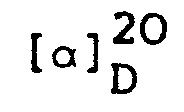
- 30 ml eines Nährmediums, welches 5% (Gew./Vol.) n-Paraffine Zusammensetzung: C13 0,3%, Cl4 50%, C15 49,5% und C16 0,2%), 0,2% (Gew./Vol.) Ammoniumchlorid, 0,05% (Gew./ Vol.) Monokaliumphosphat, 0,05% (Gew./Vol.) MgS04.7H20, 0,1% (Gew./Vol.) Hefeextrakt und 0,5% (Gew./Vol.) Calciumcarbonat in einem 500 ml-Kolben wird mit Pichia haplophila NRRL 11,176 (FERM P-3956) angeimpft. Dieser Stamm ist der von Pichia haplophila NRRL 11,175 (FERM P-3955) durch Bestrahlung der Zellsuspension mit einer UV-Lampe im Abstand von 30 cm, während 5 Minuten erhaltene Mutant. Die Fermentation erfolgt während 6 Tagen bei 30°C auf einer rotierenden Schüttelvorrichtung. Man erhält etwa 10 mg D-Arabit pro ml Kulturmedium. Nach Entfernung der Zellen durch Abzentrifugieren lässt man das Filtrat über ein Kationenaustauschharz (Dowex 50W x 4, H+-Typ) und ein Anionenaustauschharz (Amberlite IR-45, OH -Typ) laufen und dampft den Durchlauf unter vermindertem Druck zur Trockene ein. Der Rückstand wird mit warmem Aethylalkohol versetzt und der Extrakt auf ein kleineres Volumen eingedampft und bei 5°C über Nacht stehen gelassen. Man erhält 170 mg D-Arabit mit einem Schmelzpunkt von 102-103°C,
- Es wird in zu Beispiel 1 analoger Weise vorgegangen, wobei jedoch anstelle von Pichia haplophila NRRL 11,176 der Stamm Pichia haplophila NRRL 11,175 (FERM P-3955) verwendet wird. Man erhält hierbei etwa 4 mg D-Arabit pro ml Nährmedium.
- Wenn man den Versuch unternimmt, die Fermentation mit Pichia fluxuum IFO-0773, Pichia membranfaciens IFO-0864, Pichia membranfacience IFO-1004, Pichia fermentans NRRL y-1619 und Pichia toletana IFO-0950 durchzuführen, erhält man kein D-Arabit.
- In einem 500 ml-Kolben werden 30 ml eines Nährmediums (2% (Gew./Vol.) Aethylalkohol; 0,2% Ammoniumchlorid; 0,06% KH2P04; 0,05% MgS04.7H20; 0,1% Hefeextrakt und 0,5% Calciumcarbonat) mit Pichia haplophila NRRL 11,175 (PERM P-3955) angeimpft und während 6 Tagen bei 30°C unter Schütteln fermentiert. Der Kultur werden zweimal je 6 ml Aethylalkohol zugesetzt, und zwar am 4. und am 5. Tag. Man erhält 3 mg D-Arabit pro ml Gärlösung.
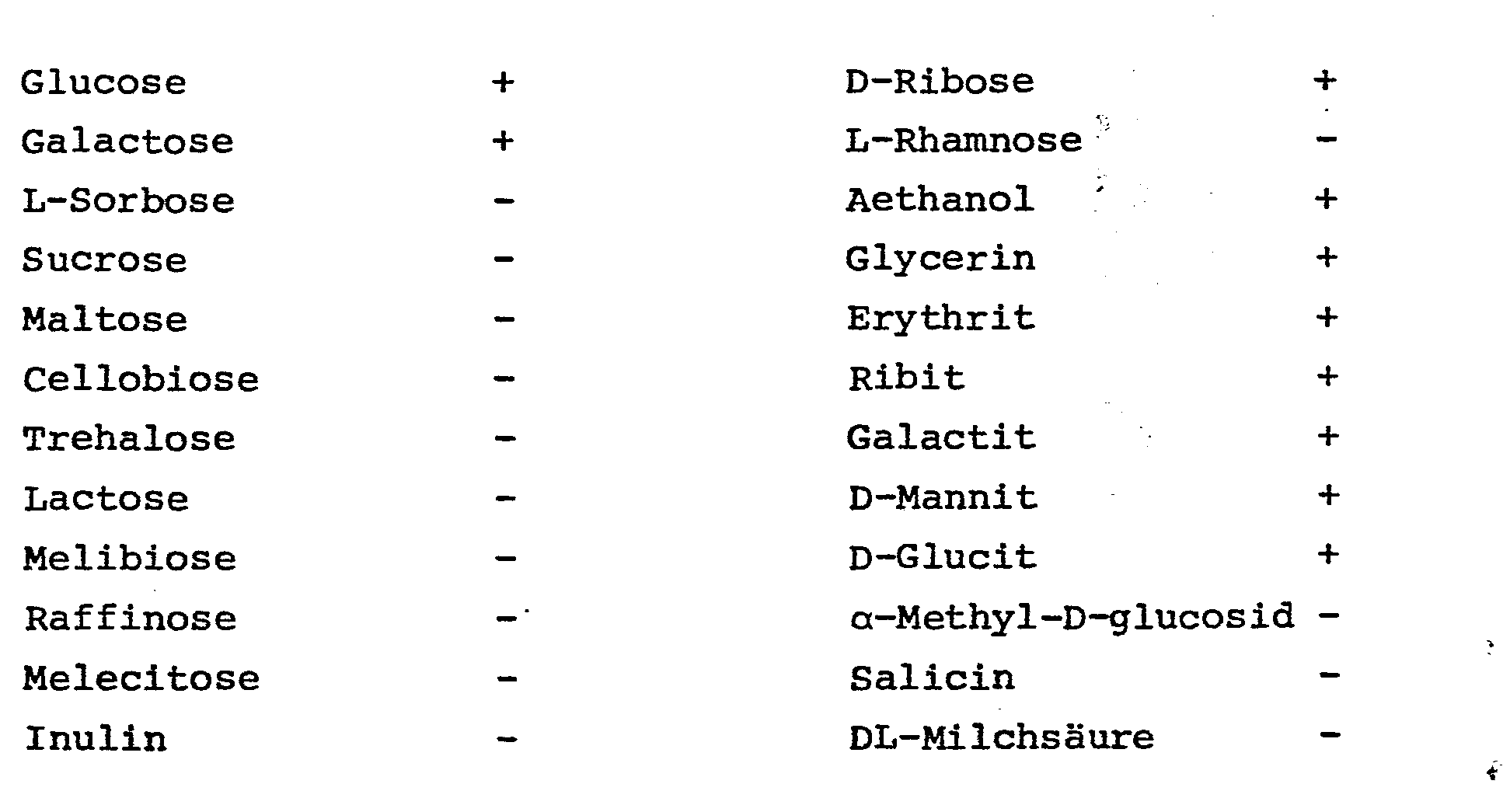
- Der in Beispiel 1 verwendete Stamm Pichia haplophila NRRL 11,176 (FERM P-3956) hat die folgenden Eigenschaften: Die Zellen sind rund bis oval und messen etwa 3,0 bis 5,1 x 2,0 bis 3,0 µm; sie treten einzeln, in Paaren oder in Gruppen auf. Es bildet sich ein Sediment und ein dünnes, mattes, ausgebreitetes Häutchen. Die Stichkultur ist weiss und fein gefältelt. Es kann sich ein primitives Pseudomycel bilden. Auf Gipsblöcken wird eine Ascus-Bildung beobachtet. Die Sporen sind halbkreisförmig.
- Vergärung: negativ.
- Assimilierung von Kohlenstoffverbindungen:

- Spaltung von Arbütin: negativ
- Assimilierung von Kaliumnitrat: negativ
- Wachstum in einem vitaminfreien Medium: negativ
- Wachstum auf einem 50%igen (Gew./w.) Glucose-Hefeextrakt-agar: negativ
- Wachstum bei 37°C: negativ
- Die oben angegebenen Eigenschaften stimmen überein mit denen des Elternstammes Pichia haplophila NRRL 11,175 (FERM P-3955) und auch mit der Beschreibung von Pichia haplophila in "The Yeasts: A taxanomic study" von N.J.W. Kreger-Van Rij, Seiten 492-494, 1970, North-Holland Publishing Company.
Claims (6)
Applications Claiming Priority (2)
| Application Number | Priority Date | Filing Date | Title |
|---|---|---|---|
| LU78114 | 1977-09-12 | ||
| LU78114A LU78114A1 (de) | 1977-09-12 | 1977-09-12 | Verfahren zur herstellung eines zuckeralkohols |
Publications (2)
| Publication Number | Publication Date |
|---|---|
| EP0001122A1 true EP0001122A1 (de) | 1979-03-21 |
| EP0001122B1 EP0001122B1 (de) | 1981-02-25 |
Family
ID=19728693
Family Applications (1)
| Application Number | Title | Priority Date | Filing Date |
|---|---|---|---|
| EP78100855A Expired EP0001122B1 (de) | 1977-09-12 | 1978-09-08 | Verfahren zur Herstellung eines Zuckeralkohols |
Country Status (7)
| Country | Link |
|---|---|
| US (1) | US4271268A (de) |
| EP (1) | EP0001122B1 (de) |
| JP (1) | JPS5495790A (de) |
| DE (2) | DE2860505D1 (de) |
| FR (1) | FR2402705A1 (de) |
| GB (1) | GB2003884B (de) |
| LU (1) | LU78114A1 (de) |
Cited By (1)
| Publication number | Priority date | Publication date | Assignee | Title |
|---|---|---|---|---|
| US4271268A (en) * | 1977-09-12 | 1981-06-02 | Hoffmann-La Roche Inc. | Process for producing D-arabitol |
Families Citing this family (1)
| Publication number | Priority date | Publication date | Assignee | Title |
|---|---|---|---|---|
| CN103981224B (zh) * | 2014-05-21 | 2016-08-17 | 陕西科技大学 | 基于多形汉逊酵母的d-阿拉伯糖醇生产方法 |
Citations (1)
| Publication number | Priority date | Publication date | Assignee | Title |
|---|---|---|---|---|
| DE1926178A1 (de) * | 1968-05-25 | 1970-02-05 | Eisai Co Ltd | Verfahren zur Herstellung von D-Arabit |
Family Cites Families (3)
| Publication number | Priority date | Publication date | Assignee | Title |
|---|---|---|---|---|
| GB822154A (en) | 1957-02-13 | 1959-10-21 | Commercial Solvents Great Brit | Fermentation process for the production of d-arabitol |
| US2986495A (en) * | 1959-02-20 | 1961-05-30 | Noda Ind And Scient Res Lab | Process for the simultaneous production of d-arabitol, erythritol and glycerol |
| LU78114A1 (de) * | 1977-09-12 | 1979-05-23 | Hoffmann La Roche | Verfahren zur herstellung eines zuckeralkohols |
-
1977
- 1977-09-12 LU LU78114A patent/LU78114A1/de unknown
-
1978
- 1978-09-08 US US05/940,690 patent/US4271268A/en not_active Expired - Lifetime
- 1978-09-08 FR FR7825874A patent/FR2402705A1/fr active Granted
- 1978-09-08 EP EP78100855A patent/EP0001122B1/de not_active Expired
- 1978-09-08 DE DE7878100855T patent/DE2860505D1/de not_active Expired
- 1978-09-08 DE DE19782839228 patent/DE2839228A1/de not_active Withdrawn
- 1978-09-11 GB GB7836315A patent/GB2003884B/en not_active Expired
- 1978-09-11 JP JP11081578A patent/JPS5495790A/ja active Pending
Patent Citations (1)
| Publication number | Priority date | Publication date | Assignee | Title |
|---|---|---|---|---|
| DE1926178A1 (de) * | 1968-05-25 | 1970-02-05 | Eisai Co Ltd | Verfahren zur Herstellung von D-Arabit |
Non-Patent Citations (3)
| Title |
|---|
| CHEMICAL ABSTRACTS, vol. 59, 1963, 3288f; & JP-B-35 045 162 (NODA INDUSTRIAL SCIENCE INSTITUTE) * |
| CHEMICAL ABSTRACTS, vol. 69, 1968, 95094v, T. HARADA et al: "Utilization of alcohols by Hansenula miso"; & Agr. Biol. Chem. (Tokyo), vol. 32, (9) 1968, Seiten 1175-1180 * |
| CHEMICAL ABSTRACTS, vol. 82, 1975, 56007f, K. HATTORI et al: "Microbiol production of D-arabitol by n-alkanegrown Candida tropicalis"; & Agr. Biol. Chem. vol. 38, (10) 1974, Seiten 1875-81 * |
Cited By (1)
| Publication number | Priority date | Publication date | Assignee | Title |
|---|---|---|---|---|
| US4271268A (en) * | 1977-09-12 | 1981-06-02 | Hoffmann-La Roche Inc. | Process for producing D-arabitol |
Also Published As
| Publication number | Publication date |
|---|---|
| FR2402705B1 (de) | 1980-09-05 |
| US4271268A (en) | 1981-06-02 |
| DE2860505D1 (en) | 1981-04-02 |
| FR2402705A1 (fr) | 1979-04-06 |
| EP0001122B1 (de) | 1981-02-25 |
| DE2839228A1 (de) | 1979-03-22 |
| JPS5495790A (en) | 1979-07-28 |
| GB2003884B (en) | 1982-03-31 |
| GB2003884A (en) | 1979-03-21 |
| LU78114A1 (de) | 1979-05-23 |
Similar Documents
| Publication | Publication Date | Title |
|---|---|---|
| DE2417337A1 (de) | Verfahren zur biotechnischen herstellung von l-lysin und mutante zur durchfuehrung des verfahrens | |
| DE2408169C2 (de) | Herstellung von Ribonucleinsäure | |
| EP0001122B1 (de) | Verfahren zur Herstellung eines Zuckeralkohols | |
| DE2853847C2 (de) | ||
| DE2938377C2 (de) | Verfahren zur Herstellung von Coenzym Q ↓1↓↓0↓ | |
| DE1926178C3 (de) | Mikrobiologisches Verfahren zur Herstellung von D-Arablt | |
| DE2038693C3 (de) | Verfahren zum Züchten von Hefe | |
| DE1695326A1 (de) | Verfahren zur Herstellung von Nicotinsaeureamidadenindinucleotid | |
| DE2358312A1 (de) | Verfahren zur gewinnung diploider staemme candida lipolytica und verwendung dieser staemme zur herstellung von alphaketo-glutarsaeure durch fermentation | |
| DE1767294C3 (de) | Verfahren zur fermentativen Gewinnung von Orotidin | |
| DE2115514C2 (de) | Herstellung von Citronensäure | |
| DE1901621A1 (de) | Verfahren zur Herstellung von 1-Tryptophan enthaltenden Hefezellen | |
| DE2166090C3 (de) | Verfahren zur Herstellung von d-Threo-2-propionamido- 1-p-nitrophenyl-l,3-propandiol und d-Threo-2-isobutyramido-l-p-nitrophenyl-l,3propandiol. Ausscheidung aus: 2120153 | |
| DE2140133A1 (de) | Verfahren zur herstellung von dicarbonsaeuren durch gaerung | |
| DE1517825C (de) | Verfahren zur biotechnischen Her stellung von L Valin | |
| EP0003524A1 (de) | Verfahren zur Herstellung von D-Arabit | |
| DE2005848C (de) | Gewinnung von Zitronensäure und Isozitronensäure | |
| DE2005848A1 (de) | Verfahren zur Herstellung von Zitronensäure und Isozitronensäure | |
| DE1904265C3 (de) | Biotechnisches Verfahren zur Herstellung von D-Sibose | |
| DE1046834B (de) | Verwertung von Melasseschlempen mit Hilfe von Mikroorganismen | |
| DE1792403C (de) | Verfahren zur biotechnischen Herstellung von L Lysin | |
| DE1795721C2 (de) | Verfahren zur fermentativen Herstellung von Orotidylsäure | |
| DE2203467B2 (de) | Fermentatives verfahren zur herstellung von d-mannit | |
| DE1442207A1 (de) | Verfahren zur Herstellung von L-Glutaminsaeure durch Verwendung von Bakterien | |
| DE1642717B1 (de) | Verfahren zur Herstellung von L-Prolin |
Legal Events
| Date | Code | Title | Description |
|---|---|---|---|
| PUAI | Public reference made under article 153(3) epc to a published international application that has entered the european phase |
Free format text: ORIGINAL CODE: 0009012 |
|
| AK | Designated contracting states |
Designated state(s): CH DE FR GB |
|
| 17P | Request for examination filed | ||
| GRAA | (expected) grant |
Free format text: ORIGINAL CODE: 0009210 |
|
| AK | Designated contracting states |
Designated state(s): CH DE FR GB |
|
| PG25 | Lapsed in a contracting state [announced via postgrant information from national office to epo] |
Ref country code: FR Free format text: THE PATENT HAS BEEN ANNULLED BY A DECISION OF A NATIONAL AUTHORITY Effective date: 19810225 Ref country code: CH Effective date: 19810225 |
|
| REF | Corresponds to: |
Ref document number: 2860505 Country of ref document: DE Date of ref document: 19810402 |
|
| REG | Reference to a national code |
Ref country code: CH Ref legal event code: PL |
|
| PG25 | Lapsed in a contracting state [announced via postgrant information from national office to epo] |
Ref country code: DE Effective date: 19820803 |
|
| GBPC | Gb: european patent ceased through non-payment of renewal fee | ||
| PG25 | Lapsed in a contracting state [announced via postgrant information from national office to epo] |
Ref country code: GB Effective date: 19881117 |
|
| PLBE | No opposition filed within time limit |
Free format text: ORIGINAL CODE: 0009261 |
|
| STAA | Information on the status of an ep patent application or granted ep patent |
Free format text: STATUS: NO OPPOSITION FILED WITHIN TIME LIMIT |