EP0001157A1 - Procédé de préparation en phase liquide de polyamides à haut poids moléculaire et objets façonnés à partir de polyamides ainsi obtenus - Google Patents
Procédé de préparation en phase liquide de polyamides à haut poids moléculaire et objets façonnés à partir de polyamides ainsi obtenus Download PDFInfo
- Publication number
- EP0001157A1 EP0001157A1 EP78300257A EP78300257A EP0001157A1 EP 0001157 A1 EP0001157 A1 EP 0001157A1 EP 78300257 A EP78300257 A EP 78300257A EP 78300257 A EP78300257 A EP 78300257A EP 0001157 A1 EP0001157 A1 EP 0001157A1
- Authority
- EP
- European Patent Office
- Prior art keywords
- diamine
- diacid
- rich component
- dicarboxylic acid
- component
- Prior art date
- Legal status (The legal status is an assumption and is not a legal conclusion. Google has not performed a legal analysis and makes no representation as to the accuracy of the status listed.)
- Granted
Links
- 239000004952 Polyamide Substances 0.000 title claims abstract description 30
- 229920002647 polyamide Polymers 0.000 title claims abstract description 30
- 239000007791 liquid phase Substances 0.000 title claims description 4
- 238000004519 manufacturing process Methods 0.000 title abstract description 6
- 150000004985 diamines Chemical class 0.000 claims abstract description 60
- 230000008018 melting Effects 0.000 claims abstract description 33
- 238000002844 melting Methods 0.000 claims abstract description 33
- 238000000034 method Methods 0.000 claims abstract description 23
- 239000007788 liquid Substances 0.000 claims abstract description 9
- 239000000155 melt Substances 0.000 claims abstract description 5
- NAQMVNRVTILPCV-UHFFFAOYSA-N hexane-1,6-diamine Chemical group NCCCCCCN NAQMVNRVTILPCV-UHFFFAOYSA-N 0.000 claims description 36
- OFOBLEOULBTSOW-UHFFFAOYSA-N Malonic acid Chemical compound OC(=O)CC(O)=O OFOBLEOULBTSOW-UHFFFAOYSA-N 0.000 claims description 26
- WNLRTRBMVRJNCN-UHFFFAOYSA-N adipic acid Chemical compound OC(=O)CCCCC(O)=O WNLRTRBMVRJNCN-UHFFFAOYSA-N 0.000 claims description 24
- XLYOFNOQVPJJNP-UHFFFAOYSA-N water Substances O XLYOFNOQVPJJNP-UHFFFAOYSA-N 0.000 claims description 19
- 239000000203 mixture Substances 0.000 claims description 14
- 239000001361 adipic acid Substances 0.000 claims description 12
- 235000011037 adipic acid Nutrition 0.000 claims description 12
- 239000002253 acid Substances 0.000 claims description 11
- 238000002360 preparation method Methods 0.000 claims description 10
- 239000000126 substance Substances 0.000 claims description 8
- 239000004677 Nylon Substances 0.000 claims description 7
- 150000001412 amines Chemical class 0.000 claims description 7
- 238000010438 heat treatment Methods 0.000 claims description 7
- 229920001778 nylon Polymers 0.000 claims description 7
- 238000006068 polycondensation reaction Methods 0.000 claims description 5
- 150000001875 compounds Chemical class 0.000 claims description 4
- 239000003960 organic solvent Substances 0.000 claims description 4
- -1 polymethylene Polymers 0.000 claims description 4
- 238000013019 agitation Methods 0.000 claims description 3
- 230000015572 biosynthetic process Effects 0.000 claims description 3
- 125000004432 carbon atom Chemical group C* 0.000 claims description 2
- 238000001556 precipitation Methods 0.000 claims description 2
- 239000011343 solid material Substances 0.000 claims description 2
- DJZKNOVUNYPPEE-UHFFFAOYSA-N tetradecane-1,4,11,14-tetracarboxamide Chemical compound NC(=O)CCCC(C(N)=O)CCCCCCC(C(N)=O)CCCC(N)=O DJZKNOVUNYPPEE-UHFFFAOYSA-N 0.000 claims 2
- 229920002302 Nylon 6,6 Polymers 0.000 abstract description 6
- 229920006351 engineering plastic Polymers 0.000 abstract description 2
- 238000007711 solidification Methods 0.000 abstract description 2
- 230000008023 solidification Effects 0.000 abstract description 2
- 150000003839 salts Chemical class 0.000 description 10
- 238000004455 differential thermal analysis Methods 0.000 description 9
- 239000000047 product Substances 0.000 description 7
- 239000007858 starting material Substances 0.000 description 7
- OKKJLVBELUTLKV-UHFFFAOYSA-N Methanol Chemical compound OC OKKJLVBELUTLKV-UHFFFAOYSA-N 0.000 description 6
- 230000018044 dehydration Effects 0.000 description 6
- 238000006297 dehydration reaction Methods 0.000 description 6
- 239000007787 solid Substances 0.000 description 6
- 230000005496 eutectics Effects 0.000 description 5
- 238000006243 chemical reaction Methods 0.000 description 4
- UFFRSDWQMJYQNE-UHFFFAOYSA-N 6-azaniumylhexylazanium;hexanedioate Chemical compound [NH3+]CCCCCC[NH3+].[O-]C(=O)CCCCC([O-])=O UFFRSDWQMJYQNE-UHFFFAOYSA-N 0.000 description 3
- QTBSBXVTEAMEQO-UHFFFAOYSA-N Acetic acid Chemical compound CC(O)=O QTBSBXVTEAMEQO-UHFFFAOYSA-N 0.000 description 3
- 150000001991 dicarboxylic acids Chemical class 0.000 description 3
- 238000004821 distillation Methods 0.000 description 3
- 239000011347 resin Substances 0.000 description 3
- 229920005989 resin Polymers 0.000 description 3
- IJGRMHOSHXDMSA-UHFFFAOYSA-N Atomic nitrogen Chemical compound N#N IJGRMHOSHXDMSA-UHFFFAOYSA-N 0.000 description 2
- 230000015556 catabolic process Effects 0.000 description 2
- 238000006731 degradation reaction Methods 0.000 description 2
- 239000003791 organic solvent mixture Substances 0.000 description 2
- 238000013021 overheating Methods 0.000 description 2
- 239000000376 reactant Substances 0.000 description 2
- 238000000926 separation method Methods 0.000 description 2
- 239000002904 solvent Substances 0.000 description 2
- PWGJDPKCLMLPJW-UHFFFAOYSA-N 1,8-diaminooctane Chemical compound NCCCCCCCCN PWGJDPKCLMLPJW-UHFFFAOYSA-N 0.000 description 1
- VEXZGXHMUGYJMC-UHFFFAOYSA-M Chloride anion Chemical compound [Cl-] VEXZGXHMUGYJMC-UHFFFAOYSA-M 0.000 description 1
- 238000009835 boiling Methods 0.000 description 1
- 239000007859 condensation product Substances 0.000 description 1
- 229920001577 copolymer Polymers 0.000 description 1
- YQLZOAVZWJBZSY-UHFFFAOYSA-N decane-1,10-diamine Chemical compound NCCCCCCCCCCN YQLZOAVZWJBZSY-UHFFFAOYSA-N 0.000 description 1
- 238000010586 diagram Methods 0.000 description 1
- 150000005690 diesters Chemical class 0.000 description 1
- 239000006185 dispersion Substances 0.000 description 1
- QFTYSVGGYOXFRQ-UHFFFAOYSA-N dodecane-1,12-diamine Chemical compound NCCCCCCCCCCCCN QFTYSVGGYOXFRQ-UHFFFAOYSA-N 0.000 description 1
- 230000000694 effects Effects 0.000 description 1
- 238000002474 experimental method Methods 0.000 description 1
- 239000011521 glass Substances 0.000 description 1
- PWSKHLMYTZNYKO-UHFFFAOYSA-N heptane-1,7-diamine Chemical compound NCCCCCCCN PWSKHLMYTZNYKO-UHFFFAOYSA-N 0.000 description 1
- 239000000463 material Substances 0.000 description 1
- 238000002156 mixing Methods 0.000 description 1
- 229910052757 nitrogen Inorganic materials 0.000 description 1
- SXJVFQLYZSNZBT-UHFFFAOYSA-N nonane-1,9-diamine Chemical compound NCCCCCCCCCN SXJVFQLYZSNZBT-UHFFFAOYSA-N 0.000 description 1
- BDJRBEYXGGNYIS-UHFFFAOYSA-N nonanedioic acid Chemical compound OC(=O)CCCCCCCC(O)=O BDJRBEYXGGNYIS-UHFFFAOYSA-N 0.000 description 1
- 239000012071 phase Substances 0.000 description 1
- 239000006069 physical mixture Substances 0.000 description 1
- 229920000642 polymer Polymers 0.000 description 1
- 125000002924 primary amino group Chemical group [H]N([H])* 0.000 description 1
- 238000010926 purge Methods 0.000 description 1
- 239000012265 solid product Substances 0.000 description 1
- KLNPWTHGTVSSEU-UHFFFAOYSA-N undecane-1,11-diamine Chemical compound NCCCCCCCCCCCN KLNPWTHGTVSSEU-UHFFFAOYSA-N 0.000 description 1
Images
Classifications
-
- C—CHEMISTRY; METALLURGY
- C08—ORGANIC MACROMOLECULAR COMPOUNDS; THEIR PREPARATION OR CHEMICAL WORKING-UP; COMPOSITIONS BASED THEREON
- C08G—MACROMOLECULAR COMPOUNDS OBTAINED OTHERWISE THAN BY REACTIONS ONLY INVOLVING UNSATURATED CARBON-TO-CARBON BONDS
- C08G69/00—Macromolecular compounds obtained by reactions forming a carboxylic amide link in the main chain of the macromolecule
- C08G69/02—Polyamides derived from amino-carboxylic acids or from polyamines and polycarboxylic acids
- C08G69/26—Polyamides derived from amino-carboxylic acids or from polyamines and polycarboxylic acids derived from polyamines and polycarboxylic acids
- C08G69/28—Preparatory processes
Definitions
- This invention relates to a process for preparing high molecular weight polyamides, which is carried out in the liquid phase, and in the absence of organic solvents or of large amounts of water.
- a high molecular weight polyamide is prepared by cocondensation of a diacid-rich component and a diamine-rich component which are prepared separately.
- Each of the separately prepared components has a melting temperature below that of the polyamide to be prepared.
- the diacid-rich component and the diamine-rich component are contacted in the liquid state at a temperature high enough as not to result in solidification and in proportions as close to stoichiometric as possible.
- Nylon 66 which is an important fiber-forming polyamide and engineering plastic.
- the acid component is a diacid-rich component prepared by melting together at least one dicarboxylic acid or a chemical equivalent thereof with at least one diamine or with a physical or chemical combination of at least one dicarboxylic acid with at least one diamine in a total diacid to total diamine mole ratio, whether free or chemically combined of about 1.5:1 to 9:1;
- the amine component is a diamine-rich component selected from at least one diamine and a product obtained by melting together at least one diamine or a chemical equivalent thereof with at least one dicarboxylic acid or with a physical or chemical combination of at least one diamine with at least one dicarboxylic acid in a total diamine to total dicarboxylic acid mole ratio whether free or chemically combined, of at least 1.5:1;
- the resulting polyamide will be either a simply polymer, such as poly(hexamethyleneadipamide) or a copolymer containing repeating units of various lengths.
- the preferred dicarboxylic acid-diamine ratio in the diacid-rich component is at least about 3:1
- the diacid-rich component may be made, for example, by melting together the diacid with the diamine in a proper ratio, or with a physical mixture of the diacid with the diamine, or with a salt obtained from stoichiometric amounts of the diacid and the diamine (sometimes referred to in this disclosure as the nylon salt), or with an oligomer made by heating any physical or chemical combination of the diacid and the diamine at sufficiently high temperature to effect substantial dehydration, or with any combination of the above.
- the expression "chemical combination” means any chemical compounds or compositions obtained when a diacid and a diamine react with each other.
- the expression “physical combination” means a mixture or dispersion in each other but not a chemical compound or composition.
- the diacid-rich component is made at a sufficiently low temperature, at which substantial dehydration is'avoided, it will contain mainly salt compositions and excess of dicarboxylic acid; or if an oligomer is used, it also will be present. If the preparation is conducted at a high enough temperature, at which substantial dehydration occurs, a low-molecular weight, carboxyl-terminated polyamide (sometimes referred to in this disclosure as the carboxylic oligomer) will be obtained. A partial condensation product may also be present, for example, an oligomer terminated either at one end or at both ends by an amine-carboxylated salt function.
- the acid-rich component has a relatively low melting point; for the preferred diacid-diamine ratio, below the melting point of the free acid.
- Suitable dicarboxylic acids include adipic, pimelic, suberic, azelaic, sebacic, undecanedioic, and dodecanedioic.
- Suitable diamines include hexamethylenediamine, heptamethylenediamine, octamethylenediamine, nonamethylenediamine, decamethylenediamine, undecamethylenediamine, and dodecamethylenediamine.
- Adipic acid and hexamethylenediamine are the preferred starting materials. When they are used, the final high molecular weight polyamide is the well known Nylon 66. The proportions of the starting materials are preferably so adjusted that the acid-rich component melts below about 150°C.
- Hexamethylenediamine is often sold commercially as an aqueous, rather than anhydrous, product, which contains about 10-15% water. While this aqueous product is suitable in the process of the present invention, anhydrous hexamethylenediamine and other anhydrous diamines and diacids are operable in the present process and are preferred. When the starting materials contain water, this water must be removed during the polyamide preparation, thus requiring additional energy input and causing additional expense. Anhydrous starting materials thus are more advantageous.
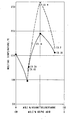
- molar proportions of adipic acid and hexamethylenediamine in their mixtures, as percent of the total mixture, are plotted as the abscissae and the melting temperatures of the mixtures as the ordinates in a plane Cartesian coordinate system.
- the graph contains two experimental curves, the solid curve representing low temperature operations, where substantial dehydration is avoided; and the broken line curve representing a high temperature operation, wherein substantial dehydration occurs and eventually leads to polyamide.
- Data points identified by "EX" followed by a number are based on the corresponding examples. It can be seen that at a molar ratio of approximately 3 moles of the diacid to 1 mole of the diamine there is obtained a minimum melting temperature.
- the diamine As the diamine is added to the diacid, a eutectic depression is observed, without formation of intermediate, high melting acid salts.
- the nylon salt is formed when stoichiometric proportions of both components are present, and the melting temperature reaches a maximum. Continuing addition of hexamethylenediamine to the nylon salt causes a second eutectic depression of the melting temperature.
- the diamine-rich component may be prepared in a similar manner to the diacid-rich component. It may contain free diamine in a mixture with nylon salt, a low molecular weight amine-terminated polyamide (amino oligomer), and/or amine salt-terminated carboxylic oligomer. It is often preferable to use the diamine alone as the diamine-rich component.
- the diamine-rich component will usually melt at moderate temperatures, often well below 150°C.
- the relative proportions of the diamine-rich and diacid-rich components which are combined together in the final phase of the process of this invention should be as nearly as possible stoichiometric, taking into account the total amounts of dicarboxylic acid and diamine, whether bound or free. It is necessary to have equimolar amounts of diacid and diamine to obtain the highest molecular weight polyamide, say, about 20,000 number average or higher.
- the intermediate oligomers present in the diacid-rich and diamine-rich components will themselves normally have molecular weights below about 1,000 number average.
- the preparation of high molecular weight polyamide from the diacid-rich and diamine-rich components merely requires heating these components together in proper proportions as a homogeneous, molten mass to a temperature at which polycondensation accompanied by water evolution takes place and maintaining the required temperature for a sufficient period to drive the polycondensation reaction substantially to completion. As the reaction progresses, the required temperature may have to be gradually increased to avoid solids separation.
- One of the advantages of the present invention is that it provides liquid feed streams since both the diacid-rich component and the diamine-rich component can be molten and metered into the reaction vessel.
- the polycondensation step can be carried out at atmospheric, superatmospheric, or subatmospheric pressure.
- the preferred mole ratio of the diamine to the dicarboxylic acid, whether free or bound, in the total of acid-rich and amine-rich component is 0.97:1 to 1.03:1. Within this range, the highest molecular weignt polyamide is obtained.
- the free dicarboxylic acid that may be present in the diacid-rich component is not degraded under the prccass conditions of the present invention. This is due to the fact that the initial reaction temperatures are sufficiently low, so that overheating is avoiden.
- the mole ratio of these starting materials can be so chosen that the diacid-rich component will melt below the melting point of the diacid alone.
- One skilled in the art can readily determine these ratios without undue experimentation by running at most a few simple tests.
- the product was crushed and twice leached with boiling methanol.
- the methanol-insoluble fraction was tested by differential thermal analysis showing twin melting peaks at 167° and 179°C. This confirmed eutectic depression of oligomeric (methanol-insoluble) melting points by excess adipic acid (methanol-soluble, normal melting point 152°C).
- Equal weights of adipic acid and purified hexamethylenediammonium adipate were intimately mixed and melted together by heating at a programmed rate in an encapsulated differential thermal analysis sample cup. First heating program was terminated at 155°C. The sample was colled and remelted, showing melting peaks at 103° and 127°C before melting program terminated at 195°C. This shows that eutectic depression of melting points occurs not only between adipic acid and oligomer but also between adipic acid and nylon salt.
- Example lA To a resin kettle as in Example lA were charged 0.50 mole hexamethylenediamine, 0.02 mole acetic acid (to regulate molecular weight of the product), and 1.00 mole adipic acid. The charge was cautiously mixed and melted to a clear melt at 182°C. The temperature was slowly raised to 250°C while simultaneously distilling water and adding further 0.25 mole of hexamethylenediamine. The temperature was gradually increased to 285°C, while simultaneously distilling water and adding the last 0.26 mole of hexamethylenediamine. The resulting clear melt was discharged and solidified, then tested by differential thermal analysis, showing a melting peak of 254°C. This example demonstrates the preparation of Nylon 66 with anhydrous feed materials at atmospheric pressure.
Landscapes
- Chemical & Material Sciences (AREA)
- Health & Medical Sciences (AREA)
- Chemical Kinetics & Catalysis (AREA)
- Medicinal Chemistry (AREA)
- Polymers & Plastics (AREA)
- Organic Chemistry (AREA)
- Polyamides (AREA)
Applications Claiming Priority (2)
| Application Number | Priority Date | Filing Date | Title |
|---|---|---|---|
| US05/823,326 US4131712A (en) | 1977-08-10 | 1977-08-10 | Process for preparing polyamide from diacid-rich component and diamine-rich component |
| US823326 | 1992-01-21 |
Publications (2)
| Publication Number | Publication Date |
|---|---|
| EP0001157A1 true EP0001157A1 (fr) | 1979-03-21 |
| EP0001157B1 EP0001157B1 (fr) | 1981-11-25 |
Family
ID=25238445
Family Applications (1)
| Application Number | Title | Priority Date | Filing Date |
|---|---|---|---|
| EP78300257A Expired EP0001157B1 (fr) | 1977-08-10 | 1978-08-08 | Procédé de préparation en phase liquide de polyamides à haut poids moléculaire et objets façonnés à partir de polyamides ainsi obtenus |
Country Status (8)
| Country | Link |
|---|---|
| US (1) | US4131712A (fr) |
| EP (1) | EP0001157B1 (fr) |
| JP (1) | JPS6054328B2 (fr) |
| AR (1) | AR219122A1 (fr) |
| AU (1) | AU519107B2 (fr) |
| CA (1) | CA1091845A (fr) |
| DE (1) | DE2861356D1 (fr) |
| IT (1) | IT1098372B (fr) |
Cited By (4)
| Publication number | Priority date | Publication date | Assignee | Title |
|---|---|---|---|---|
| EP0071000A3 (en) * | 1981-06-04 | 1984-02-22 | Mitsubishi Gas Chemical Company, Inc. | Process for preparing polyamide |
| WO1996016108A1 (fr) * | 1994-11-23 | 1996-05-30 | E.I. Du Pont De Nemours And Company | Procede de fabrication du nylon a basses temperatures |
| FR2794760A1 (fr) * | 1999-06-11 | 2000-12-15 | Rhodianyl | Procede de fabrication de polyamides |
| EP1118630A3 (fr) * | 2000-01-21 | 2003-02-05 | Mitsubishi Gas Chemical Company, Inc. | Procédé de production de polyamide |
Families Citing this family (17)
| Publication number | Priority date | Publication date | Assignee | Title |
|---|---|---|---|---|
| DE2728931A1 (de) * | 1977-06-27 | 1979-01-04 | Basf Ag | Verfahren zur herstellung von polyamiden |
| DE2728817A1 (de) * | 1977-06-27 | 1979-01-04 | Basf Ag | Verfahren zur herstellung von hochkonzentrierten waessrigen loesungen von dicarbonsaeurediaminsalzen und polyamidpraekondensaten |
| US4442260A (en) * | 1983-03-14 | 1984-04-10 | E. I. Du Pont De Nemours & Company | Preparation of salt solution useful for making nylon |
| US5674974A (en) * | 1994-11-23 | 1997-10-07 | E. I. Du Pont De Nemours And Company | Continuous polymerization process for polyamides |
| US5801278A (en) * | 1997-03-07 | 1998-09-01 | E. I. Du Pont De Nemours And Companh | Low water diamine-dicarboxylic acid salt preparation |
| US6169162B1 (en) | 1999-05-24 | 2001-01-02 | Solutia Inc. | Continuous polyamidation process |
| FR2916756B1 (fr) * | 2007-06-04 | 2009-07-17 | Rhodia Recherches & Tech | Procede de fabrication d'une solution de sels de diacides/diamines |
| SG10201606114WA (en) * | 2011-07-26 | 2016-09-29 | Dsm Ip Assets Bv | Process for preparing a diamine/dicarboxylic acid salt |
| HK1199649A1 (en) * | 2011-12-05 | 2015-07-10 | 因温斯特技术公司 | Process for the preparation of polyamides |
| EP2951147B1 (fr) | 2013-01-31 | 2017-08-02 | DSM IP Assets B.V. | Procédé pour la préparation de sels de diamine/acide dicarboxylique et de leurs polyamides |
| TW201443103A (zh) | 2013-05-01 | 2014-11-16 | Invista Tech Sarl | 自部分平衡之酸性溶液製備尼龍鹽溶液的方法 |
| TW201446836A (zh) | 2013-05-01 | 2014-12-16 | Invista Tech Sarl | 用於製備部分平衡之酸性溶液之方法 |
| GB201320520D0 (en) | 2013-11-20 | 2014-01-01 | Invista Tech Sarl | Continuous polyamidation process - I |
| GB201320518D0 (en) * | 2013-11-20 | 2014-01-01 | Invista Tech Sarl | Continuous polyamidation process - II |
| TW201529640A (zh) | 2013-12-17 | 2015-08-01 | Invista Tech Sarl | 以具有分散器桿頭之容器製造供生產尼龍鹽之部分平衡酸溶液之方法 |
| GB2538523A (en) * | 2015-05-19 | 2016-11-23 | Invista Tech Sarl | Pelletisation process |
| BR112021015292A2 (pt) | 2019-02-21 | 2021-10-05 | Invista Textiles (U.K.) Limited | Processo para a preparação de poliamidas |
Citations (4)
| Publication number | Priority date | Publication date | Assignee | Title |
|---|---|---|---|---|
| FR891995A (fr) * | 1942-03-10 | 1944-03-24 | Ig Farbenindustrie Ag | Procédé de fabrication de polyamides linéaires fortement polymères |
| GB794365A (en) * | 1955-10-07 | 1958-04-30 | British Nylon Spinners Ltd | Improvements in or relating to synthetic linear polyterephthalamides |
| FR1371433A (fr) * | 1960-04-21 | 1964-09-04 | Procédé de préparation de compositions de polyamides linéaires fondues | |
| US3300449A (en) * | 1962-10-04 | 1967-01-24 | Monsanto Co | Process for production of polycarbonamides |
Family Cites Families (2)
| Publication number | Priority date | Publication date | Assignee | Title |
|---|---|---|---|---|
| US3884881A (en) * | 1973-05-18 | 1975-05-20 | Du Pont | Preparation of poly(p-phenylene terephthalamide) by mixing solution of p-phenylene diamine with molten terephthaloyl chloride |
| US4009153A (en) * | 1975-03-04 | 1977-02-22 | E. I. Du Pont De Nemours And Co. | Vapor-phase preparation of aromatic polyamides |
-
1977
- 1977-08-10 US US05/823,326 patent/US4131712A/en not_active Expired - Lifetime
-
1978
- 1978-08-08 EP EP78300257A patent/EP0001157B1/fr not_active Expired
- 1978-08-08 CA CA308,879A patent/CA1091845A/fr not_active Expired
- 1978-08-08 JP JP53095896A patent/JPS6054328B2/ja not_active Expired
- 1978-08-08 DE DE7878300257T patent/DE2861356D1/de not_active Expired
- 1978-08-09 AU AU38787/78A patent/AU519107B2/en not_active Expired
- 1978-08-09 AR AR273251A patent/AR219122A1/es active
- 1978-08-09 IT IT26638/78A patent/IT1098372B/it active
Patent Citations (4)
| Publication number | Priority date | Publication date | Assignee | Title |
|---|---|---|---|---|
| FR891995A (fr) * | 1942-03-10 | 1944-03-24 | Ig Farbenindustrie Ag | Procédé de fabrication de polyamides linéaires fortement polymères |
| GB794365A (en) * | 1955-10-07 | 1958-04-30 | British Nylon Spinners Ltd | Improvements in or relating to synthetic linear polyterephthalamides |
| FR1371433A (fr) * | 1960-04-21 | 1964-09-04 | Procédé de préparation de compositions de polyamides linéaires fondues | |
| US3300449A (en) * | 1962-10-04 | 1967-01-24 | Monsanto Co | Process for production of polycarbonamides |
Cited By (7)
| Publication number | Priority date | Publication date | Assignee | Title |
|---|---|---|---|---|
| EP0071000A3 (en) * | 1981-06-04 | 1984-02-22 | Mitsubishi Gas Chemical Company, Inc. | Process for preparing polyamide |
| WO1996016108A1 (fr) * | 1994-11-23 | 1996-05-30 | E.I. Du Pont De Nemours And Company | Procede de fabrication du nylon a basses temperatures |
| FR2794760A1 (fr) * | 1999-06-11 | 2000-12-15 | Rhodianyl | Procede de fabrication de polyamides |
| WO2000077075A1 (fr) * | 1999-06-11 | 2000-12-21 | Rhodianyl | Procede de fabrication de polyamides |
| RU2221820C2 (ru) * | 1999-06-11 | 2004-01-20 | Родианил | Способ получения полиамидов |
| US6696544B1 (en) | 1999-06-11 | 2004-02-24 | Rhodianyl | Method for making polyamides |
| EP1118630A3 (fr) * | 2000-01-21 | 2003-02-05 | Mitsubishi Gas Chemical Company, Inc. | Procédé de production de polyamide |
Also Published As
| Publication number | Publication date |
|---|---|
| AU3878778A (en) | 1980-02-14 |
| IT1098372B (it) | 1985-09-07 |
| DE2861356D1 (en) | 1982-01-28 |
| AU519107B2 (en) | 1981-11-05 |
| CA1091845A (fr) | 1980-12-16 |
| EP0001157B1 (fr) | 1981-11-25 |
| AR219122A1 (es) | 1980-07-31 |
| IT7826638A0 (it) | 1978-08-09 |
| JPS6054328B2 (ja) | 1985-11-29 |
| US4131712A (en) | 1978-12-26 |
| JPS5430294A (en) | 1979-03-06 |
Similar Documents
| Publication | Publication Date | Title |
|---|---|---|
| EP0001157B1 (fr) | Procédé de préparation en phase liquide de polyamides à haut poids moléculaire et objets façonnés à partir de polyamides ainsi obtenus | |
| JP3380654B2 (ja) | 部分結晶性または非晶質、熱可塑加工性、部分芳香族ポリアミド類またはコポリアミド類の初期縮合物の製造方法 | |
| US3454536A (en) | Process for the preparation of polyamides | |
| SE429134B (sv) | Forfarande for framstellning av polyeteresteramider | |
| KR100513189B1 (ko) | 저 함수량의 디아민/디카르복실산 염의 제조 방법 | |
| US20230079764A1 (en) | Polymerization Process | |
| US5030709A (en) | Continuous preparation of copolyamides | |
| US5140098A (en) | Continuous preparation of linear high molecular weight polyamides having regulated amino and carboxyl end group content | |
| JPH0717747B2 (ja) | ポリアミドの製造法 | |
| AU710993B2 (en) | Low temperature manufacturing process for nylon | |
| JP3528875B2 (ja) | 共重合ポリアミドの製造法 | |
| US4463166A (en) | Process for making polytetramethylene adipamide | |
| EP0680987B1 (fr) | Procédé de préparation de copolyamide | |
| KR900008465B1 (ko) | 방향족 폴리아미드의 용액중합용 용매 혼합물 | |
| JPS6120579B2 (fr) | ||
| US5019641A (en) | Polyamide from 1,3 propylene diamine and isophthalic acid compound | |
| CA2026500C (fr) | Preparation en continu de polyamides lineaires a poids moleculaires eleves | |
| KR100347314B1 (ko) | 유연성과투명성이우수한폴리아미드의제조방법 | |
| US3296218A (en) | Preparation of polyamides from substituted diprimary alcohols, ethers or esters and dinitriles |
Legal Events
| Date | Code | Title | Description |
|---|---|---|---|
| PUAI | Public reference made under article 153(3) epc to a published international application that has entered the european phase |
Free format text: ORIGINAL CODE: 0009012 |
|
| AK | Designated contracting states |
Designated state(s): BE DE FR GB NL |
|
| 17P | Request for examination filed | ||
| GRAA | (expected) grant |
Free format text: ORIGINAL CODE: 0009210 |
|
| AK | Designated contracting states |
Designated state(s): BE DE FR GB NL |
|
| REF | Corresponds to: |
Ref document number: 2861356 Country of ref document: DE Date of ref document: 19820128 |
|
| PGFP | Annual fee paid to national office [announced via postgrant information from national office to epo] |
Ref country code: FR Payment date: 19890519 Year of fee payment: 12 |
|
| PGFP | Annual fee paid to national office [announced via postgrant information from national office to epo] |
Ref country code: DE Payment date: 19890524 Year of fee payment: 12 |
|
| PGFP | Annual fee paid to national office [announced via postgrant information from national office to epo] |
Ref country code: BE Payment date: 19890613 Year of fee payment: 12 |
|
| PGFP | Annual fee paid to national office [announced via postgrant information from national office to epo] |
Ref country code: NL Payment date: 19890831 Year of fee payment: 12 Ref country code: GB Payment date: 19890831 Year of fee payment: 12 |
|
| PG25 | Lapsed in a contracting state [announced via postgrant information from national office to epo] |
Ref country code: GB Effective date: 19900808 |
|
| PG25 | Lapsed in a contracting state [announced via postgrant information from national office to epo] |
Ref country code: BE Effective date: 19900831 |
|
| BERE | Be: lapsed |
Owner name: E.I. DU PONT DE NEMOURS AND CY Effective date: 19900831 |
|
| PG25 | Lapsed in a contracting state [announced via postgrant information from national office to epo] |
Ref country code: NL Effective date: 19910301 |
|
| GBPC | Gb: european patent ceased through non-payment of renewal fee | ||
| NLV4 | Nl: lapsed or anulled due to non-payment of the annual fee | ||
| PG25 | Lapsed in a contracting state [announced via postgrant information from national office to epo] |
Ref country code: FR Effective date: 19910430 |
|
| PG25 | Lapsed in a contracting state [announced via postgrant information from national office to epo] |
Ref country code: DE Effective date: 19910501 |
|
| REG | Reference to a national code |
Ref country code: FR Ref legal event code: ST |
|
| PLBE | No opposition filed within time limit |
Free format text: ORIGINAL CODE: 0009261 |
|
| STAA | Information on the status of an ep patent application or granted ep patent |
Free format text: STATUS: NO OPPOSITION FILED WITHIN TIME LIMIT |