EP0001384A1 - Verfahren zur ortho-Alkylierung von Phenolen - Google Patents
Verfahren zur ortho-Alkylierung von Phenolen Download PDFInfo
- Publication number
- EP0001384A1 EP0001384A1 EP78100440A EP78100440A EP0001384A1 EP 0001384 A1 EP0001384 A1 EP 0001384A1 EP 78100440 A EP78100440 A EP 78100440A EP 78100440 A EP78100440 A EP 78100440A EP 0001384 A1 EP0001384 A1 EP 0001384A1
- Authority
- EP
- European Patent Office
- Prior art keywords
- catalyst
- phenols
- alkaline earth
- alkylation
- reaction
- Prior art date
- Legal status (The legal status is an assumption and is not a legal conclusion. Google has not performed a legal analysis and makes no representation as to the accuracy of the status listed.)
- Granted
Links
- 238000000034 method Methods 0.000 title claims abstract description 19
- 150000002989 phenols Chemical class 0.000 title claims abstract description 17
- 238000005804 alkylation reaction Methods 0.000 title claims abstract description 11
- 230000008569 process Effects 0.000 title claims abstract description 10
- 239000003054 catalyst Substances 0.000 claims abstract description 54
- PNEYBMLMFCGWSK-UHFFFAOYSA-N Alumina Chemical compound [O-2].[O-2].[O-2].[Al+3].[Al+3] PNEYBMLMFCGWSK-UHFFFAOYSA-N 0.000 claims abstract description 25
- 229910052784 alkaline earth metal Inorganic materials 0.000 claims abstract description 9
- 239000007788 liquid Substances 0.000 claims abstract description 9
- ISWSIDIOOBJBQZ-UHFFFAOYSA-N Phenol Chemical compound OC1=CC=CC=C1 ISWSIDIOOBJBQZ-UHFFFAOYSA-N 0.000 claims abstract description 8
- -1 alkaline earth metal salt Chemical class 0.000 claims abstract description 8
- 238000001354 calcination Methods 0.000 claims abstract description 7
- TWNQGVIAIRXVLR-UHFFFAOYSA-N oxo(oxoalumanyloxy)alumane Chemical compound O=[Al]O[Al]=O TWNQGVIAIRXVLR-UHFFFAOYSA-N 0.000 claims description 8
- 239000007789 gas Substances 0.000 claims description 5
- 125000000217 alkyl group Chemical group 0.000 claims description 3
- 239000002168 alkylating agent Substances 0.000 claims description 3
- 229940100198 alkylating agent Drugs 0.000 claims description 3
- 125000004432 carbon atom Chemical group C* 0.000 claims description 3
- 125000004435 hydrogen atom Chemical group [H]* 0.000 claims description 3
- 125000001797 benzyl group Chemical group [H]C1=C([H])C([H])=C(C([H])=C1[H])C([H])([H])* 0.000 claims description 2
- 125000001997 phenyl group Chemical group [H]C1=C([H])C([H])=C(*)C([H])=C1[H] 0.000 claims description 2
- 238000006243 chemical reaction Methods 0.000 abstract description 13
- 229910052799 carbon Inorganic materials 0.000 abstract description 2
- 238000005470 impregnation Methods 0.000 abstract description 2
- 150000001342 alkaline earth metals Chemical class 0.000 abstract 1
- 239000007792 gaseous phase Substances 0.000 abstract 1
- OKKJLVBELUTLKV-UHFFFAOYSA-N Methanol Chemical compound OC OKKJLVBELUTLKV-UHFFFAOYSA-N 0.000 description 21
- 239000000203 mixture Substances 0.000 description 15
- IWOUKMZUPDVPGQ-UHFFFAOYSA-N barium nitrate Chemical compound [Ba+2].[O-][N+]([O-])=O.[O-][N+]([O-])=O IWOUKMZUPDVPGQ-UHFFFAOYSA-N 0.000 description 8
- 239000007864 aqueous solution Substances 0.000 description 6
- QWVGKYWNOKOFNN-UHFFFAOYSA-N o-cresol Chemical compound CC1=CC=CC=C1O QWVGKYWNOKOFNN-UHFFFAOYSA-N 0.000 description 6
- 239000007795 chemical reaction product Substances 0.000 description 5
- 230000000694 effects Effects 0.000 description 5
- NXXYKOUNUYWIHA-UHFFFAOYSA-N 2,6-Dimethylphenol Chemical compound CC1=CC=CC(C)=C1O NXXYKOUNUYWIHA-UHFFFAOYSA-N 0.000 description 4
- 239000000047 product Substances 0.000 description 4
- 239000006227 byproduct Substances 0.000 description 3
- CPLXHLVBOLITMK-UHFFFAOYSA-N magnesium oxide Inorganic materials [Mg]=O CPLXHLVBOLITMK-UHFFFAOYSA-N 0.000 description 3
- 239000000395 magnesium oxide Substances 0.000 description 3
- AXZKOIWUVFPNLO-UHFFFAOYSA-N magnesium;oxygen(2-) Chemical compound [O-2].[Mg+2] AXZKOIWUVFPNLO-UHFFFAOYSA-N 0.000 description 3
- 238000004519 manufacturing process Methods 0.000 description 3
- TUAMRELNJMMDMT-UHFFFAOYSA-N 3,5-xylenol Chemical compound CC1=CC(C)=CC(O)=C1 TUAMRELNJMMDMT-UHFFFAOYSA-N 0.000 description 2
- LFQSCWFLJHTTHZ-UHFFFAOYSA-N Ethanol Chemical compound CCO LFQSCWFLJHTTHZ-UHFFFAOYSA-N 0.000 description 2
- UQSXHKLRYXJYBZ-UHFFFAOYSA-N Iron oxide Chemical compound [Fe]=O UQSXHKLRYXJYBZ-UHFFFAOYSA-N 0.000 description 2
- 230000029936 alkylation Effects 0.000 description 2
- RDOXTESZEPMUJZ-UHFFFAOYSA-N anisole Chemical compound COC1=CC=CC=C1 RDOXTESZEPMUJZ-UHFFFAOYSA-N 0.000 description 2
- 230000015572 biosynthetic process Effects 0.000 description 2
- AMWRITDGCCNYAT-UHFFFAOYSA-L hydroxy(oxo)manganese;manganese Chemical compound [Mn].O[Mn]=O.O[Mn]=O AMWRITDGCCNYAT-UHFFFAOYSA-L 0.000 description 2
- 239000012535 impurity Substances 0.000 description 2
- 230000000704 physical effect Effects 0.000 description 2
- 230000009257 reactivity Effects 0.000 description 2
- 230000009467 reduction Effects 0.000 description 2
- 239000000243 solution Substances 0.000 description 2
- RXSHXLOMRZJCLB-UHFFFAOYSA-L strontium;diacetate Chemical compound [Sr+2].CC([O-])=O.CC([O-])=O RXSHXLOMRZJCLB-UHFFFAOYSA-L 0.000 description 2
- BNGXYYYYKUGPPF-UHFFFAOYSA-M (3-methylphenyl)methyl-triphenylphosphanium;chloride Chemical compound [Cl-].CC1=CC=CC(C[P+](C=2C=CC=CC=2)(C=2C=CC=CC=2)C=2C=CC=CC=2)=C1 BNGXYYYYKUGPPF-UHFFFAOYSA-M 0.000 description 1
- 229910018072 Al 2 O 3 Inorganic materials 0.000 description 1
- VHUUQVKOLVNVRT-UHFFFAOYSA-N Ammonium hydroxide Chemical compound [NH4+].[OH-] VHUUQVKOLVNVRT-UHFFFAOYSA-N 0.000 description 1
- BVKZGUZCCUSVTD-UHFFFAOYSA-M Bicarbonate Chemical class OC([O-])=O BVKZGUZCCUSVTD-UHFFFAOYSA-M 0.000 description 1
- DGAQECJNVWCQMB-PUAWFVPOSA-M Ilexoside XXIX Chemical compound C[C@@H]1CC[C@@]2(CC[C@@]3(C(=CC[C@H]4[C@]3(CC[C@@H]5[C@@]4(CC[C@@H](C5(C)C)OS(=O)(=O)[O-])C)C)[C@@H]2[C@]1(C)O)C)C(=O)O[C@H]6[C@@H]([C@H]([C@@H]([C@H](O6)CO)O)O)O.[Na+] DGAQECJNVWCQMB-PUAWFVPOSA-M 0.000 description 1
- 229910000831 Steel Inorganic materials 0.000 description 1
- XHCLAFWTIXFWPH-UHFFFAOYSA-N [O-2].[O-2].[O-2].[O-2].[O-2].[V+5].[V+5] Chemical compound [O-2].[O-2].[O-2].[O-2].[O-2].[V+5].[V+5] XHCLAFWTIXFWPH-UHFFFAOYSA-N 0.000 description 1
- 238000005299 abrasion Methods 0.000 description 1
- 150000001242 acetic acid derivatives Chemical class 0.000 description 1
- 239000002253 acid Substances 0.000 description 1
- 230000002378 acidificating effect Effects 0.000 description 1
- 150000001298 alcohols Chemical class 0.000 description 1
- 229910052782 aluminium Inorganic materials 0.000 description 1
- XAGFODPZIPBFFR-UHFFFAOYSA-N aluminium Chemical compound [Al] XAGFODPZIPBFFR-UHFFFAOYSA-N 0.000 description 1
- WNROFYMDJYEPJX-UHFFFAOYSA-K aluminium hydroxide Chemical compound [OH-].[OH-].[OH-].[Al+3] WNROFYMDJYEPJX-UHFFFAOYSA-K 0.000 description 1
- QGZKDVFQNNGYKY-UHFFFAOYSA-N ammonia Natural products N QGZKDVFQNNGYKY-UHFFFAOYSA-N 0.000 description 1
- 150000003863 ammonium salts Chemical class 0.000 description 1
- 239000003963 antioxidant agent Substances 0.000 description 1
- ITHZDDVSAWDQPZ-UHFFFAOYSA-L barium acetate Chemical compound [Ba+2].CC([O-])=O.CC([O-])=O ITHZDDVSAWDQPZ-UHFFFAOYSA-L 0.000 description 1
- 159000000009 barium salts Chemical class 0.000 description 1
- 230000008901 benefit Effects 0.000 description 1
- 150000004649 carbonic acid derivatives Chemical class 0.000 description 1
- 238000011109 contamination Methods 0.000 description 1
- 238000000354 decomposition reaction Methods 0.000 description 1
- 238000009826 distribution Methods 0.000 description 1
- XXWFDPVOXNJASB-UHFFFAOYSA-N ethanol;phenol Chemical compound CCO.OC1=CC=CC=C1 XXWFDPVOXNJASB-UHFFFAOYSA-N 0.000 description 1
- 125000001495 ethyl group Chemical group [H]C([H])([H])C([H])([H])* 0.000 description 1
- 238000011049 filling Methods 0.000 description 1
- 230000014509 gene expression Effects 0.000 description 1
- 239000004009 herbicide Substances 0.000 description 1
- 230000007062 hydrolysis Effects 0.000 description 1
- 238000006460 hydrolysis reaction Methods 0.000 description 1
- 150000004679 hydroxides Chemical class 0.000 description 1
- 239000011261 inert gas Substances 0.000 description 1
- 239000002917 insecticide Substances 0.000 description 1
- 239000000543 intermediate Substances 0.000 description 1
- AMLYSOSVPIJCJJ-UHFFFAOYSA-N methanol phenol Chemical compound OC.OC.OC1=CC=CC=C1 AMLYSOSVPIJCJJ-UHFFFAOYSA-N 0.000 description 1
- UZKWTJUDCOPSNM-UHFFFAOYSA-N methoxybenzene Substances CCCCOC=C UZKWTJUDCOPSNM-UHFFFAOYSA-N 0.000 description 1
- 125000002496 methyl group Chemical group [H]C([H])([H])* 0.000 description 1
- 239000012022 methylating agents Substances 0.000 description 1
- 238000007069 methylation reaction Methods 0.000 description 1
- 230000004048 modification Effects 0.000 description 1
- 238000012986 modification Methods 0.000 description 1
- 150000002823 nitrates Chemical class 0.000 description 1
- 239000012299 nitrogen atmosphere Substances 0.000 description 1
- 150000003891 oxalate salts Chemical class 0.000 description 1
- 239000000825 pharmaceutical preparation Substances 0.000 description 1
- 229940127557 pharmaceutical product Drugs 0.000 description 1
- 229920001955 polyphenylene ether Polymers 0.000 description 1
- 239000011148 porous material Substances 0.000 description 1
- 239000002244 precipitate Substances 0.000 description 1
- 238000001556 precipitation Methods 0.000 description 1
- 238000002360 preparation method Methods 0.000 description 1
- BDERNNFJNOPAEC-UHFFFAOYSA-N propan-1-ol Chemical compound CCCO BDERNNFJNOPAEC-UHFFFAOYSA-N 0.000 description 1
- 125000001436 propyl group Chemical group [H]C([*])([H])C([H])([H])C([H])([H])[H] 0.000 description 1
- 150000003839 salts Chemical class 0.000 description 1
- 229910052708 sodium Inorganic materials 0.000 description 1
- 239000011734 sodium Substances 0.000 description 1
- 239000007858 starting material Substances 0.000 description 1
- 239000010959 steel Substances 0.000 description 1
- 239000000126 substance Substances 0.000 description 1
- 229910001935 vanadium oxide Inorganic materials 0.000 description 1
- XLYOFNOQVPJJNP-UHFFFAOYSA-N water Substances O XLYOFNOQVPJJNP-UHFFFAOYSA-N 0.000 description 1
- 230000003313 weakening effect Effects 0.000 description 1
Classifications
-
- B—PERFORMING OPERATIONS; TRANSPORTING
- B01—PHYSICAL OR CHEMICAL PROCESSES OR APPARATUS IN GENERAL
- B01J—CHEMICAL OR PHYSICAL PROCESSES, e.g. CATALYSIS OR COLLOID CHEMISTRY; THEIR RELEVANT APPARATUS
- B01J23/00—Catalysts comprising metals or metal oxides or hydroxides, not provided for in group B01J21/00
- B01J23/02—Catalysts comprising metals or metal oxides or hydroxides, not provided for in group B01J21/00 of the alkali- or alkaline earth metals or beryllium
-
- C—CHEMISTRY; METALLURGY
- C07—ORGANIC CHEMISTRY
- C07C—ACYCLIC OR CARBOCYCLIC COMPOUNDS
- C07C37/00—Preparation of compounds having hydroxy or O-metal groups bound to a carbon atom of a six-membered aromatic ring
- C07C37/11—Preparation of compounds having hydroxy or O-metal groups bound to a carbon atom of a six-membered aromatic ring by reactions increasing the number of carbon atoms
- C07C37/16—Preparation of compounds having hydroxy or O-metal groups bound to a carbon atom of a six-membered aromatic ring by reactions increasing the number of carbon atoms by condensation involving hydroxy groups of phenols or alcohols or the ether or mineral ester group derived therefrom
Definitions
- the invention relates to a process for the o-alkylation of phenols.
- Phenol compounds alkylated in the o-position are important intermediates and are e.g. used for the production of insecticides, herbicides, antioxidants, polymeric polyphenylene ethers and pharmaceutical products.
- GB-PS 1 065 337 describes the alkylation of phenol with an alkahol, the reaction components being passed in the gas phase over an optionally activated aluminum oxide catalyst become.
- the conversion to o-cresol is given, which is obtained in yields of an average of 27.3 percent by weight with the simultaneous formation of 12.4 percent by weight of 2,6-dimethylphenol and 5.0 percent by weight of other phenols. (The ratio of the by-products to o-cresol is thus 0, 64).
- GB-PS 1 228 1 74 requires that the aluminum oxide used for the o-methylation of phenol should be completely free of, in particular, basic impurities, while small amounts of acidic contamination can be tolerated: "The presence of basic impurities in the aluminum oxide reduces the Activity of the catalyst and makes it more selective .... However, the overall loss in yield outweighs the advantage resulting from the improved selectivity. "
- GB-PS 1,034,500 describes the alkylation reaction using magnesium oxide as a catalyst. Due to the relatively low reactivity of the magnesium oxide catalyst, however, high reaction temperatures of 475 - 600 ° C are required. in which there is already severe decomposition of the starting materials, for example the phenol and methanol. Another disadvantage is the rapidly declining activity and the short service life of this catalyst.
- the invention is therefore based on the object of developing a process for the o-alkylation of phenols in the gas phase which advantageously combines activity and selectivity. It has now been found that catalysts which are obtained by impregnating a conventional alumina catalyst with a solution of an alkaline earth metal salt and subsequently calcining are very good (ie with the result of improved yield and / or a small proportion of by-products) for o-alkylly tion of phenols in the gas phase.
- the invention relates to a process for the o-alkylation of phenols by reacting a phenol with an alkanol in the gas phase in the presence of a catalyst, characterized in that in the presence of a catalyst obtained by impregnating an alumina catalyst with a solution of alkaline earth metal salts and then calcining works at 450 - 600 ° C.
- the aluminum oxide used for the preparation of the catalyst preferably the ⁇ modification, can be prepared, for example, by calcining Al 2 O 3 .3H 2 0 9 , which is obtainable by precipitation of ammonium salts, hydrolysis of aluminum alcoholate, etc.; in addition, however, it is also possible to use commercially available activated alumina catalysts of high purity (sodium content preferably below 0.1%) and of a large specific inner surface (specific inner surface (BET) between 200-300 m 2 / g). It is known that pure alumina has an inherent acidity, the strength and distribution of which can be determined by known methods (cf. H. Pines, WO Haag, J. Amer. Chem. Soc.
- the alkaline earth metal salts used are, for example, nitrates, carbonates, bicarbonates, oxalates, acetates, hydroxides or oxides.
- the ratio of alkaline earth to alumina catalyst is preferably 0.1 to 0.01 millimoles per g of aluminum oxide.
- the acidity of the modified catalyst after impregnation and calcination is about 0.05 to 0.2 milliequivalents per g.
- a residual acidity of the catalyst is required for the process according to the invention.
- a significantly higher doping with alkaline earth than specified above is therefore disadvantageous and leads to a reduction in the catalyst activity.
- the aluminum oxide catalysts impregnated with a suitable, preferably aqueous solution of the alkaline earth metal salts are carefully dried and then calcined at 450-600 ° C.
- the physical properties, such as specific inner surface, specific pore volume, strength and abrasion are not changed.
- the service life of the Alumina catalysts are not reduced by the stated treatment with alkaline earth metal salts and, depending on the reaction conditions, are between 350 and 1000 hours.
- the inventive method is preferably performed at temperatures of 250 to 400 ° C, in particular 290 -, preferably 360 0 C at a liquid space velocity (LHSV) of about 0.5 - performed.
- LHSV liquid space velocity
- the catalyst can be arranged in the usual form, for example as a fixed bed or a fluidized or fluidized bed.
- the process according to the invention is particularly suitable for the production of monoalkylated phenols, the molar ratio of alkylating agent to phenolic compound being about 0.4 to 2, preferably 0.4 to 0.8.
- Phenols of the general formula I are preferably used as starting products used, in which the radicals R and R 'may be the same or different and denote a hydrogen atom, an alkyl group, or also a phenyl or a benzyl group. R 'is preferably a hydrogen atom.
- the alkyl groups can be branched or preferably straight-chained. They preferably have 1-6, especially 1-3 carbon atoms and are, for example, methyl, ethyl or propyl.
- the phenols of the formula I are known or can be prepared by methods known per se.
- alkanols used as alkylating agents can be branched or preferably straight-chain. They preferably have 1 to 6, in particular 1 to 3, carbon atoms and are, for example, methanol, ethanol or propanol.
- Percentages relate to% by weight.
- Aluminum hydroxide was precipitated by slowly adding aqueous ammonia to an aqueous solution of aluminum nitrate heated to 90 ° C. The precipitate was filtered off, washed thoroughly and dried at 120 ° C. for 30 hours. The mixture was then calcined at 650 ° C. in vacuo for 4 hours. 1000 g of the activated alumina X thus produced and processed into compacts are impregnated with an aqueous solution of 2.61 g (0.01 mol) of barium nitrate. The volume of the aqueous solution is such that it is just completely absorbed by the alumina catalyst. After 15 minutes, the catalyst is dried at 110 ° C. and calcined at 450 to 500 ° C.
- Catalyst A is obtained.
- Catalysts B and C are prepared in the same way from the commercially available activated alumina catalysts Y and Z by using an aqueous solution of 7.66 g (0.03 mol) of barium acetate in the case of B and C an aqueous solution of 5.18 g (0.05 mol) of strontium acetate was used.
- the catalyst composition and physical properties are given in Tables I and II.
- a mixture of methanol and phenol in a molar ratio of 0.5 is passed through a steel flow reactor via a dosing pump at normal pressure and at a liquid space velocity of 1 h -1 via a preheater.
- the catalyst bed has the shape of a cylindrical annulus, formed by the reactor jacket of 30 mm and a centrally attached thermocouple protection tube of 10 mm. It is charged with the alumina catalyst of composition A pretreated with 0.01 mol of barium nitrate, the catalyst filling is 200 ml.
- the reactor is heated by electrical resistance elements and kept at a temperature of 300 ° C., with a maximum temperature of 320 ° at the catalyst C.
- the average composition of the reaction product is given in Table III.
- the reaction products obtained under identical reaction conditions with the untreated alumina catalyst X are also listed in Table III.
- Example 2 In the same way as described in Example 2, a methanol-phenol mixture with a molar ratio of 0.4 is reacted on the ⁇ -alumina catalyst A pretreated with 0.01 mol of barium nitrate.
- the reactor is heated to about 320 ° C, with a maximum temperature of 330 ° C set at the catalyst.
- the liquid space velocity is 1, 5 h -1.
- reaction is also carried out on the untreated alumina catalyst X under identical reaction conditions.
- the reaction products have the following average composition (Table IV):
Landscapes
- Chemical & Material Sciences (AREA)
- Organic Chemistry (AREA)
- Chemical Kinetics & Catalysis (AREA)
- Engineering & Computer Science (AREA)
- Materials Engineering (AREA)
- Organic Low-Molecular-Weight Compounds And Preparation Thereof (AREA)
- Catalysts (AREA)
- Low-Molecular Organic Synthesis Reactions Using Catalysts (AREA)
Abstract
Description
- Die Erfindung betrifft ein Verfahren zur o-Alkylierung von Phenolen.
- In o-Stellung alkylierte Phenolverbindungen sind wichtige Zwischenprodukte und werden z.B. für die Herstellung von Insektiziden, Herbiziden, Antioxidantien, polymeren Polyphenylenäthern und pharmazeutischen Produkten eingesetzt.
- Es sind bereits verschiedene Verfahren zur o-Alkylierung von Phenolen mit Alkoholen bekannt. Als Katalysatoren werden hierfür meist Magnesiumoxid und Aluminiumoxid, daneben jedoch auch Mischkatalysatoren beschrieben (K.-D. Bode, in Houben-Weyl, Methoden der organischen Chemie, Bd. VI/1 c S. 1008 ff, G. Thieme Verlag, Stuttgart 1976).
- So wird in der GB-PS 1 065 337 die Alkylierung von Phenol mit einem Alkahol beschrieben, wobei die Reaktionskomponenten in der Gasphase über einen gegebenenfalls aktivierten Aluminiumoxidkatalysator geleitet werden. Als Beispiel wird die Umsetzung zu o-Kresol angegeben, das in Ausbeuten von durchschnittlich 27,3 Gewichtsprozent erhalten wird unter gleichzeitiger Bildung von 12,4 Gewichtsprozant 2,6-Dimethylphenol und 5,0 Gewichtsprozent anderer Phenole. (Das Verhältnis der Nebenprodukte zu o-Kresol beträgt also 0,64).
- Nach der DT-PS 1 668 880 wird ein Gemisch von Phenol und Methanol (10 Gewichtsprozent Methanol) bei 250 - 3500C und einer Flüssigkeitsraumgeschwindigkeit (LHSV) von 0.5 (h-1) über einen δ-Aluminiumoxid-Kontakt mit einer spezifischen Oberfläche (BET) von 240 m2/g geleitet, wobei ein Produktgemisch von 22 % o-Kresol, 5 % 2,6-Dimethylphenol und Spuren von Anisol erhalten wurde.
- In der GB-PS 1 228 174 wird gefordert, daß das zur o-Methylierung von Phenol verwendete Aluminiumoxid vollständig frei sein soll von insbesondere basischen Verunreinigungen, während geringe Mengen an acider Kontaminierung toleriert werden können: "Die Gegenwart basischer Verunreinigungen im Aluminiumoxid verringert die Aktivität des Katalysators und macht ihn selektiver....Der Gesamtverlust in der Ausbeute überwiegt jedoch den Vorteil, der sich aus der verbesserten Selektivität ergibt."
- Die GB-PS 1.034 500 beschreibt die Alkylierungsreaktion unter Verwendung von Magnesiumoxid als Katalysator. Aufgrund der relativ geringen Reaktivität des Magnesiumoxid-Katalysators sind jedoch hohe Reaktionstemperaturen von 475 - 600°C erforderlich, bei denen schon starke Zersetzung der Ausgangsmaterialien, z.B. des Phenols und Methanols, eintritt. Ein weiterer Nachteil liegt in der rasch nachlassenden Aktivität und in der geringen Standzeit dieses Katalysators.
- Die Verwendung von Mischkatalysatoren wie Vanadinoxid/Eisenoxid u.a. bzw. von Geroxid/Manganoxid für die Alkylierung von Phenolen wird in der DT-PS 2 161 252 und in der DT-AS 2 127 083 vorgeschlagen. Diese Katalysatortypen zeigen jedoch eine relativ geringe Reaktivität, so daß insbesondere auch zur Erzeugung von monoalkylierten Produkten ein hoher Überschuß von Methanol eingesetzt werden muß, wodurch die Ausbeute am Monoalkylierungsprodukt stark vermindert wird.
- Die aufgeführten Verfahren zeigen somit verschiedene Nachteile, da sie entweder nicht genügend selektiv sind, was zur Bildung von unerwünschten Nebenprodukten führt und/oder nicht reaktiv genug sind, was dann höhere Reaktionstemperaturen, einen Überschuß an Methylierungsmittel bzw. geringe Flüssigkeitsraumgeschwindigkeiten erforderlich macht.
- Der Erfindung liegt deshalb die Aufgabe zugrunde, ein Verfahren zur o-Alkylierung von Phenolen in der Gasphase zu entwickeln, das in vorteilhafter Weise Aktivität und Selektivität vereinigt. Es wurde nun gefunden, daß sich Katalysatoren, die durch Imprägnierung eines üblichen Tonerdekatalysators mit einer Lösung eines Erdalkalisalzes und nachträgliche Kalzinierung erhalten werden, sehr gut (d.h. mit dem Resultat verbesserter Ausbeute und/oder einem geringen Anteil an Nebenprodukten) zur o-Alkylierung von Phenolen in der Gasphase eignen. Diese Erkenntnis war insofern überraschend, da bisher angenommen wurde, daß eine Dotierung des Tonerdekatalysators mit basischen Stoffen, wie sie auch durch die erfindungsgemäße Behandlung mit Erdalkalisalzen erfolgt, stets zu einer Verminderung der Katalysatoraktivität und damit der Ausbeute bei der o-Alkylierung von Phenolen führt.
- Gegenstand der Erfindung ist ein Verfahren zur o-Alkylierung von Phenolen durch Umsetzen eines Phenols mit einem Alkanol in der Gasphase in Gegenwart eines Katalysators, dadurch gekennzeichnet, daß man in Gegenwart eines Katalysators, erhalten durch Imprägnierung eines Tonerdekatalysators mit einer Lösung von Erdalkalisalzen und anschließender Kalzinierung bei 450 - 600°C arbeitet.
- Das zur Herstellung des Katalysators verwendete Aluminiumoxid, vorzugsweise die δ-Modifikation, kann beispielsweise durch Kalzinieren von Al2O3 · 3H2 0 9 das durch Ausfällen von Ammoniumsalzen, Hydrolyse von Aluminiumalkoholat usw. zugänglich ist, hergestellt werden; daneben ist jedoch auch der Einsatz von handelsüblichen aktivierten Tonerdekatalysatoren von hoher Reinheit (Natriumgehalt vorzugsweise unter 0,1 %) und von großer spezifischer innerer Oberfläche (spezifische innere Oberfläche (BET) zwischen 200 - 300 m2/g) möglich. Es ist bekannt, daß reine Tonerde eine inhärente Acidität besitzt, deren Stärke und Verteilung sich nach bekannten Methoden bestimmen läßt (vgl. H. Pines, W.O. Haag, J. Amer. Chem. Soc. 82, 2471 (1960) und A.E. Hirschler, J. of Catal. 2, 428 (1963)- Durch die Behandlung mit Erdalkalisalzen und anschließende Kalzinierung wurde die anfänglich etwa 0,2 - 0,3 Milliäquivalent pro g betragende Acidität der eingesetzten Tonerdekatalysatoren verringert, wobei gleichzeitig auch das Verhältnis der Zahl der starken zu den schwachen Säurestellen vermindert wurde. Jedoch verläuft die Abschwächung der Acidität nicht proportional zur Konzentration des Erdalkalis im Tonerdekatalysator.
- Die verwendeten Erdalkalisalze, vorzugsweise Bariumsalze, sind beispielsweise Nitrate, Carbonate, Bicarbonate, Oxalate, Acetate, Hydroxide oder Oxide.
- Das Verhältnis von Erdalkali zum Tonerdekatalysator beträgt vorzugsweise 0,1 bis 0,01 Millimol pro g Aluminiumoxid. Die nach Imprägnieren und Kalzinieren erreichte Acidität des modifizierten Katalysators liegt bei etwa 0,05 bis 0,2 Milliäquivalent pro g. Eine Restacididtät des Katalysators ist für das erfindungsgemäße Verfahren erforderlich. Eine wesentlich höhere Dotierung mit Erdalkali als oben angegeben ist daher unvorteilhaft und führt zur Verringerung der Katalysatoraktivität.
- Die mit einer geeigneten, vorzugsweise wäßrigen Lösung der Erdalkalisalze imprägnierten Aluminiumoxid-Katalysatoren werden sorgfältig getrocknet und anschließend bei 450 - 600°C kalziniert. Die physikalischen Eigenschaften, wie spezifische innere Oberfläche, spezifisches Porenvolumen, Festigkeit und Abrieb werden hierbei nicht verändert. Die Standzeit der Tonerde-Katalysatoren wird durch die angegebene Behandlung mit Erdalkalisalzen nicht verringert und beträgt in Abhängigkeit von den Reaktionsbedingungen zwischen 350 und 1000 Stunden.
- Das erfindungsgemäße Verfahren wird vorzugsweise bei Temperaturen von 250 bis 400°C, insbesondere von 290 - 3600 C, und vorzugsweise bei einer Flüssigkeitsraumgeschwindigkeit (LHSV) von etwa 0.5 - 2 durchgeführt. Dabei kann sowohl bei normalem als auch bei erhöhtem Druck gearbeitet werden; die Durchführung der Reaktion in Gegenwart von Wasserdampf oder Inertgas ist möglich, jedoch nicht unbedingt erforderlich. Der Katalysator kann in der üblichen Form, z.B. als Festbett oder Fließ- bzw. Wirbelbett angeordnet sein. Das erfindungsgemäße Verfahren eignet sich insbesondere für die Herstellung monoalkylierter Phenole, wobei das molare Verhältnis von Alkylierungsmittel zu phenolischer Verbindung etwa 0,4 bis 2, vorzugsweise 0,4 bis 0,8 beträgt.
- Als Ausgangsprodukte werden vorzugsweise Phenole der allgemeinen Formel I

Die Alkylgruppen können verzweigt oder vorzugsweise geradkattig sein. Sie besitzen vorzugsweise 1 - 6, insbesondere 1 - 3 Kohlenstoffatome und sind z.B. Methyl, Äthyl oder Propyl.
Die Phenole der Formel I sind bekannt oder können nach an sich bekannten Methoden hergestellt werden. - Die als Alkylierungsmittel verwendeten Alkanole können verzweigt oder vorzugsweise geradkettig sein. Sie besitzen vorzugsweise 1 - 6, insbesondere 1 bis 3 Kohlenstoffatome und sind z.B. Methanol, Äthanol oder Propanol.
Für die nachstehenden Ausdrücke gelten folgende Definitionen:


- Es wurden drei verschiedene Aluminiumoxid-Katalysatoren A, B, C verwendet; die Zusammensetzung und die physikalischen Daten sind in Tabelle I und II aufgeführt. Als Vergleich werden in Tabelle I und II auch die entsprechenden Daten der unbehandelten Aluminiumoxid-Katalysatoren angegeben.
- Durch langsame Zugabe von wäßrigem Ammoniak zu einer auf 90°C erwärmten wäßrigen Lösung von Aluminiumnitrat wurde Aluminiumhydroxid ausgefällt. Der Niederschlag wurde abfiltriert, sorgfältig gewaschen und 30 Std. bei 120°C getrocknet. Anschließend wurde 4 Stunden im Vakuum bei 650°C kalziniert. 1000 g der so hergestellten und zu Preßlingen verarbeiteten aktivierten Tonerde X werden mit einer wäßrigen Lösung von 2,61 g (0,01 Mol) Bariumnitrat imprägniert. Das Volumen der wäßrigen Lösung ist so bemessen, daß es gerade vollständig von dem Tonerdekatalysator aufgenommen wird. Nach 15 Minuten wird der Katalysator bei 110°C getrocknet und 10 Stunden bei 450 bis 500°C unter Stickstoffatmosphäre kalziniert. Man erhält Katalysator A. In gleicher Weise werden aus den handelsüblichen aktivierten Tonerdekatalysatoren Y und Z die Katalysatoren B und C hergestellt, indem man im Fall von B eine wäßrige Lösung von 7,66 g (0,03 Mol) Bariumacetat und im Fall von C eine wäßrige Lösung von 5,18 g (0,05 Mol) Strontiumacetat verwendet. Die Katalysatorzusammensetzung und die physikalischen Eigenschaften sind in Tabelle I und II angegeben.


- Ein Gemisch aus Methanol und Phenol im molaren Verhältnis 0,5 wird über eine Dosierpumpe bei Normaldruck und mit einer Flüssigkeitsraumgeschwindigkeit von 1 h-1 über einen Vorerhitzer durch einen Stahldurchflußreaktor geführt. Das Katalysatorbett hat die Form eines zylindrischen Kreisrings, gebildet durch den Reaktormantel von 30 mm und einer zentral angebrachten Thermoelementschutzröhre von 10 mm. Es wird mit dem mit 0,01 Mol Bariumnitrat vorbehandelten Tonerdekatalysator der Zusammensetzung A beschickt, die Katalysatorfüllung beträgt 200 ml. Der Reaktor wird durch elektrische Widerstandselemente beheizt und auf einer Temperatur von 300°C gehalten, wobei sich am Katalysator eine maximale Temperatur von 320°C einstellt.
Die durchschnittliche Zusammensetzung des Reaktionsprodukts ist in Tabelle III angegeben.
Zum Vergleich werden die unter identischen Reaktionsbedingungen mit dem unvorbehandelten Tonerdekatalysator X erhaltenen Reaktionsprodukte ebenfalls in Tabelle III aufgeführt. -

- In der gleichen Weise, wie im Beispiel 2 beschrieben, wird ein Methanol-Phenol-Gemisch vom molaren Verhältnis 0,4 an dem mit 0,01 Mol Bariumnitrat vorbehandelten γ-Aluminiumoxid-Katalysator A umgesetzt. Der Reaktor wird auf etwa 320°C geheizt, wobei sich am Katalysator eine maximale Temperatur von 330°C einstellt. Die Flüssigkeitsraumgeschwindigkeit beträgt 1 ,5 h-1.
- Zum Vergleich wird unter identischen Reaktionsbedingungen die Umsetzung auch an dem unvorbehandelten Tonerdekatalysator X durchgeführt.
Die Reaktionsprodukte weisen folgende durchschnittliche Zusammensetzung auf (Tabelle IV):
- Ein Gemisch aus Methanol und 3,5-Dimethylphenol im molaren Verhältnis 0,5 : 1 wird bei einer Flüssigkeitsraumgeschwindigkeit von 1 h-1 in gleicher Weise, wie im Beispiel 2 beschrieben, an dem mit 0,05 Mol Strontiumacetat vorbehandelten Katalysator C umgesetzt.
Die durchschnittliche Zusammensetzung der Reaktionsprodukte sowie die Ergebnisse der unter identischen Bedingungen am unvorbehandelten Tonerdekatalysator Z durchgeführten Umsetzung sind in der nachfolgenden Tab. V angegeben.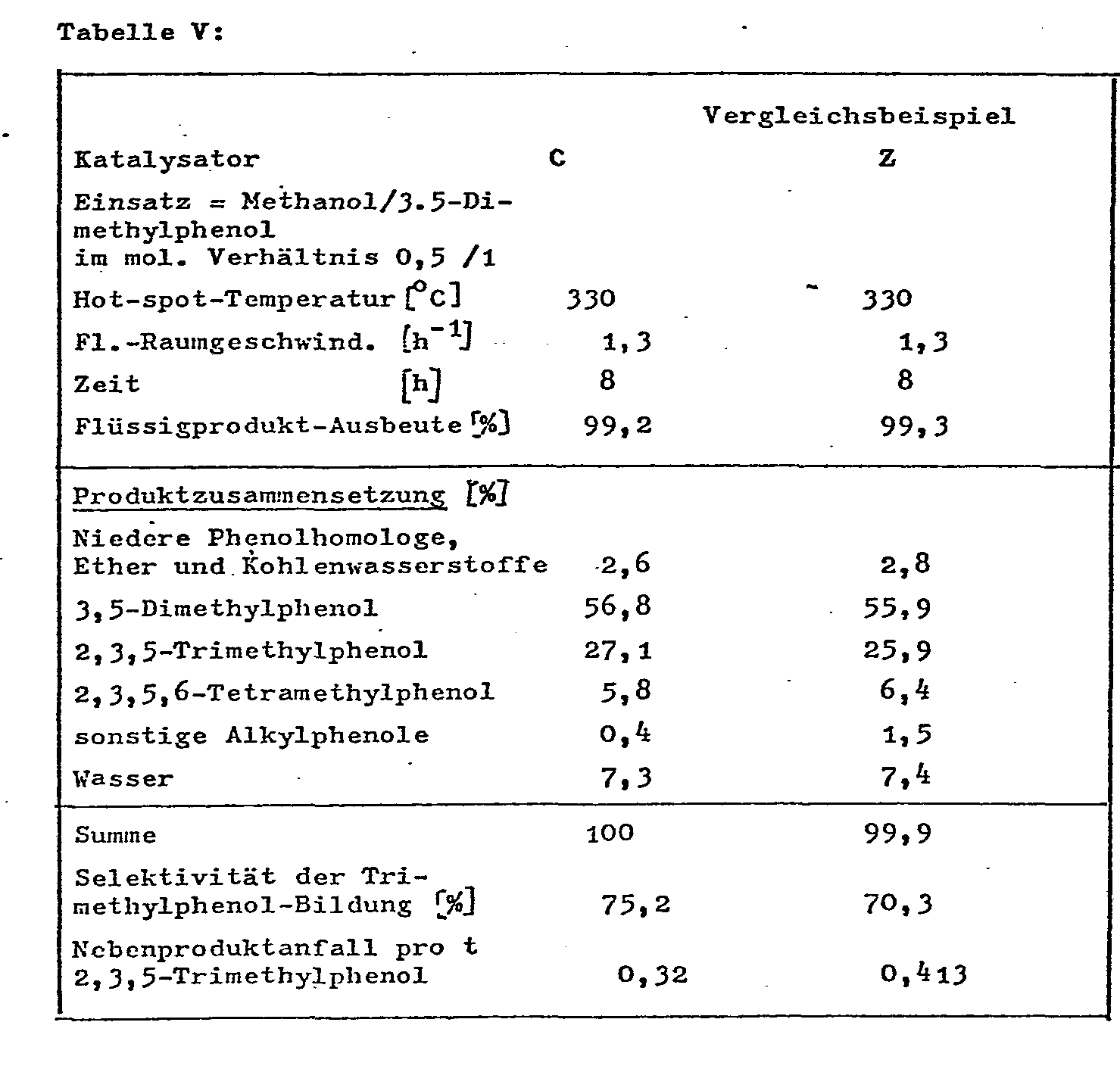
- In der gleichen Weise, wie im Beispiel 2 beschrieben, wird ein Ethanol-Phenol-Gemisch im molaren Verhältnis 0,4 mit einem Wassergehalt von etwa 3 % an dem mit Bariumnitrat vorbehandelten Tonerdekatalysator der Zusammensetzung B umgesetzt.
Die Flüssigkeitsraumgeschwindigkeit beträgt 1 h-1, die maximale Temperatur am Katalysator wird auf 325°C eingestellt.
Das Reaktionsprodukt weist die in Tabelle VI angegebene durchschnittliche Zusammensetzung auf. Zum Vergleich werden ebenfalls die unter identischen Reaktionsbedingungen an dem unvorbehandelten Tonerdekatalysator Y erhaltenen Ergebnisse aufgeführt
Claims (6)
daß man in Gegenwart eines Katalysators, erhalten durch Imprägnierung eines Tonerdekatalysators mit einer Lösung von Erdalkalisalzen und anschließender Kalzinierung bei 450 - 600°C arbeitet.
dadurch gekennzeichnet,
daß der Katalysator pro g Aluminiumoxid 0,1 bis 0,01 Millimol Erdalkali enthält.
daß man bei Temperaturen von 250 bis 400°C, insbesondere 290 - 360°C, arbeitet.
daß man bei einer Flüssigkeitaraumgeschwindigkeit von 0,5 bis 2 arbeitet.
daß man als Ausgangsmaterial Phenole der allgemeinen Formel I

Applications Claiming Priority (2)
| Application Number | Priority Date | Filing Date | Title |
|---|---|---|---|
| DE2745144A DE2745144C2 (de) | 1977-10-07 | 1977-10-07 | Verfahren zur ortho-Alkylierung von Phenolen |
| DE2745144 | 1977-10-07 |
Publications (2)
| Publication Number | Publication Date |
|---|---|
| EP0001384A1 true EP0001384A1 (de) | 1979-04-18 |
| EP0001384B1 EP0001384B1 (de) | 1983-07-27 |
Family
ID=6020911
Family Applications (1)
| Application Number | Title | Priority Date | Filing Date |
|---|---|---|---|
| EP78100440A Expired EP0001384B1 (de) | 1977-10-07 | 1978-07-19 | Verfahren zur ortho-Alkylierung von Phenolen |
Country Status (5)
| Country | Link |
|---|---|
| EP (1) | EP0001384B1 (de) |
| JP (1) | JPS5461129A (de) |
| CS (1) | CS207676B2 (de) |
| DE (1) | DE2745144C2 (de) |
| IT (1) | IT1106119B (de) |
Cited By (1)
| Publication number | Priority date | Publication date | Assignee | Title |
|---|---|---|---|---|
| EP2399936A2 (de) | 2004-07-26 | 2011-12-28 | Biogen Idec MA Inc. | Anti-CD154-Antikörper |
Families Citing this family (1)
| Publication number | Priority date | Publication date | Assignee | Title |
|---|---|---|---|---|
| JPH0764789B2 (ja) * | 1986-08-06 | 1995-07-12 | ダイセル化学工業株式会社 | メタクリル酸エステルの製法 |
Citations (4)
| Publication number | Priority date | Publication date | Assignee | Title |
|---|---|---|---|---|
| FR1063991A (fr) * | 1951-10-01 | 1954-05-10 | Ici Ltd | Fabrication des phénols |
| GB972639A (en) * | 1959-11-23 | 1964-10-14 | Sinclair Refining Co | Isomerization of olefins |
| DE2346498A1 (de) * | 1973-09-15 | 1975-04-03 | Ruetgerswerke Ag | Verfahren zur herstellung von oaethylphenol |
| FR2340296A1 (fr) * | 1976-02-05 | 1977-09-02 | Gen Electric | Procede d'ortho-alkylation des phenols |
Family Cites Families (1)
| Publication number | Priority date | Publication date | Assignee | Title |
|---|---|---|---|---|
| US2678951A (en) * | 1951-12-26 | 1954-05-18 | Shell Dev | Alkylation of phenols |
-
1977
- 1977-10-07 DE DE2745144A patent/DE2745144C2/de not_active Expired
-
1978
- 1978-07-19 EP EP78100440A patent/EP0001384B1/de not_active Expired
- 1978-08-11 JP JP9742178A patent/JPS5461129A/ja active Pending
- 1978-08-30 IT IT50915/78A patent/IT1106119B/it active
- 1978-09-18 CS CS786033A patent/CS207676B2/cs unknown
Patent Citations (4)
| Publication number | Priority date | Publication date | Assignee | Title |
|---|---|---|---|---|
| FR1063991A (fr) * | 1951-10-01 | 1954-05-10 | Ici Ltd | Fabrication des phénols |
| GB972639A (en) * | 1959-11-23 | 1964-10-14 | Sinclair Refining Co | Isomerization of olefins |
| DE2346498A1 (de) * | 1973-09-15 | 1975-04-03 | Ruetgerswerke Ag | Verfahren zur herstellung von oaethylphenol |
| FR2340296A1 (fr) * | 1976-02-05 | 1977-09-02 | Gen Electric | Procede d'ortho-alkylation des phenols |
Cited By (1)
| Publication number | Priority date | Publication date | Assignee | Title |
|---|---|---|---|---|
| EP2399936A2 (de) | 2004-07-26 | 2011-12-28 | Biogen Idec MA Inc. | Anti-CD154-Antikörper |
Also Published As
| Publication number | Publication date |
|---|---|
| DE2745144C2 (de) | 1979-11-15 |
| IT7850915A0 (it) | 1978-08-30 |
| DE2745144B1 (de) | 1979-04-05 |
| IT1106119B (it) | 1985-11-11 |
| EP0001384B1 (de) | 1983-07-27 |
| JPS5461129A (en) | 1979-05-17 |
| CS207676B2 (en) | 1981-08-31 |
Similar Documents
| Publication | Publication Date | Title |
|---|---|---|
| DE2547309C3 (de) | Verfahren zur o-Alkylierung von Phenolen | |
| DE3306907A1 (de) | Katalysator und seine verwendung zur herstellung von methylmethacrylat | |
| DE3017501A1 (de) | Katalysator fuer die herstellung von aethylen | |
| DE2853452C2 (de) | Verfahren zur selektiven o- Alkylierung von Phenolen | |
| DE2810391C2 (de) | Hydrierungskatalysator und seine Verwendung für die Hydrierung von Carbonsäureestern zu Alkoholen | |
| DE2127083A1 (de) | Verfahren zur Ortho-Methylierung von Phenolen | |
| DE2223811C3 (de) | Verfahren zur Herstellung von aliphatischen, alicyclischen oder aromatischen Ketonen | |
| DE1948607A1 (de) | Verfahren zur Herstellung von 2,6-Xylenol | |
| EP0371331B1 (de) | Kupfer-Trägerkatalysator, Verfahren zu seiner Herstellung und Verfahren zur Herstellung von N-alkylierten aromatischen Aminen unter Einsatz dieses Kupfer-Katalysators | |
| DE1950094C3 (de) | Verfahren zur Herstellung von o-Methylphenolen | |
| DE2520893A1 (de) | Verfahren zur herstellung von diphenylamin | |
| EP0494455B1 (de) | Verfahren zur Herstellung von Diphenylaminen | |
| DE3248432C2 (de) | ||
| EP0001384B1 (de) | Verfahren zur ortho-Alkylierung von Phenolen | |
| DE102004061016A1 (de) | Halogenidhaltige Alkaliwolframate enthaltende Katalysatoren zur Synthese von Alkylmercaptan und Verfahren zu ihrer Herstellung | |
| DE2235992C3 (de) | Verfahren zur Herstellung gesättigter aliphatischer Amine | |
| DE2235389B2 (de) | Katalysator, verfahren zu seiner herstellung und seine verwendung | |
| EP0081647B1 (de) | Verfahren zur ortho-Methylierung von Phenolverbindungen | |
| DE3210708A1 (de) | Katalysator und seine verwendung zur herstellung von methylmethacrylat | |
| DE19860489B4 (de) | Verfahren zur Hydrierung von Aldehyden und Verwendung eines Katalysators zur Reduktion eines Aldehyds zu einem Alkohol | |
| DE2756461C2 (de) | Verfahren zur Herstellung von Mono-o-alkylphenolen | |
| DE2745144B2 (de) | ||
| DE2716035A1 (de) | Verfahren zur selektiven ortho-alkylierung eines phenols in anwesenheit eines kupfer-chromoxid-katalysators | |
| DE3132014A1 (de) | Dehydrierungskatalysator, verfahren zur herstellung desselben und verwendung zur dehydrierung von ethylbenzol zu styrol | |
| DE2314950B2 (de) | Verfahren zur herstellung von hydroxydiphenyl |
Legal Events
| Date | Code | Title | Description |
|---|---|---|---|
| PUAI | Public reference made under article 153(3) epc to a published international application that has entered the european phase |
Free format text: ORIGINAL CODE: 0009012 |
|
| AK | Designated contracting states |
Designated state(s): BE FR GB NL |
|
| 17P | Request for examination filed | ||
| GRAA | (expected) grant |
Free format text: ORIGINAL CODE: 0009210 |
|
| AK | Designated contracting states |
Designated state(s): BE FR GB NL |
|
| ET | Fr: translation filed | ||
| PLBE | No opposition filed within time limit |
Free format text: ORIGINAL CODE: 0009261 |
|
| STAA | Information on the status of an ep patent application or granted ep patent |
Free format text: STATUS: NO OPPOSITION FILED WITHIN TIME LIMIT |
|
| PGFP | Annual fee paid to national office [announced via postgrant information from national office to epo] |
Ref country code: FR Payment date: 19840621 Year of fee payment: 7 |
|
| 26N | No opposition filed | ||
| PGFP | Annual fee paid to national office [announced via postgrant information from national office to epo] |
Ref country code: BE Payment date: 19840930 Year of fee payment: 7 |
|
| PGFP | Annual fee paid to national office [announced via postgrant information from national office to epo] |
Ref country code: NL Payment date: 19870731 Year of fee payment: 10 |
|
| PG25 | Lapsed in a contracting state [announced via postgrant information from national office to epo] |
Ref country code: BE Effective date: 19890731 |
|
| BERE | Be: lapsed |
Owner name: RUTGERSWERKE A.G. Effective date: 19890731 |
|
| PG25 | Lapsed in a contracting state [announced via postgrant information from national office to epo] |
Ref country code: NL Effective date: 19900201 |
|
| NLV4 | Nl: lapsed or anulled due to non-payment of the annual fee | ||
| PG25 | Lapsed in a contracting state [announced via postgrant information from national office to epo] |
Ref country code: FR Free format text: LAPSE BECAUSE OF NON-PAYMENT OF DUE FEES Effective date: 19900330 |
|
| REG | Reference to a national code |
Ref country code: FR Ref legal event code: ST |
|
| PGFP | Annual fee paid to national office [announced via postgrant information from national office to epo] |
Ref country code: GB Payment date: 19900709 Year of fee payment: 13 |
|
| PG25 | Lapsed in a contracting state [announced via postgrant information from national office to epo] |
Ref country code: GB Effective date: 19910719 |
|
| GBPC | Gb: european patent ceased through non-payment of renewal fee |