EP0001399A1 - Phenoxy-pyridinyl-alkanole, Verfahren zu ihrer Herstellung sowie ihre Verwendung als Fungizide - Google Patents
Phenoxy-pyridinyl-alkanole, Verfahren zu ihrer Herstellung sowie ihre Verwendung als Fungizide Download PDFInfo
- Publication number
- EP0001399A1 EP0001399A1 EP78100841A EP78100841A EP0001399A1 EP 0001399 A1 EP0001399 A1 EP 0001399A1 EP 78100841 A EP78100841 A EP 78100841A EP 78100841 A EP78100841 A EP 78100841A EP 0001399 A1 EP0001399 A1 EP 0001399A1
- Authority
- EP
- European Patent Office
- Prior art keywords
- phenoxy
- pyridinyl
- pyrimidinyl
- formula
- alkanols
- Prior art date
- Legal status (The legal status is an assumption and is not a legal conclusion. Google has not performed a legal analysis and makes no representation as to the accuracy of the status listed.)
- Granted
Links
- 238000002360 preparation method Methods 0.000 title claims abstract description 14
- 238000000034 method Methods 0.000 title claims abstract description 11
- 239000000417 fungicide Substances 0.000 title claims abstract description 6
- -1 phenoxy-pyridinyl (pyrimidinyl) Chemical group 0.000 claims abstract description 26
- 150000003839 salts Chemical class 0.000 claims abstract description 16
- 239000002253 acid Substances 0.000 claims abstract description 14
- 229910052751 metal Inorganic materials 0.000 claims abstract description 12
- 239000002184 metal Substances 0.000 claims abstract description 12
- 241000233866 Fungi Species 0.000 claims abstract description 8
- 229910052783 alkali metal Inorganic materials 0.000 claims abstract description 8
- 150000001340 alkali metals Chemical class 0.000 claims abstract description 5
- 239000003085 diluting agent Substances 0.000 claims abstract description 5
- ROORDVPLFPIABK-UHFFFAOYSA-N diphenyl carbonate Chemical class C=1C=CC=CC=1OC(=O)OC1=CC=CC=C1 ROORDVPLFPIABK-UHFFFAOYSA-N 0.000 claims abstract description 5
- 125000004076 pyridyl group Chemical group 0.000 claims abstract description 4
- 229910052727 yttrium Inorganic materials 0.000 claims abstract description 3
- 239000000203 mixture Substances 0.000 claims description 19
- 125000000217 alkyl group Chemical group 0.000 claims description 11
- 229910052736 halogen Inorganic materials 0.000 claims description 10
- 150000002367 halogens Chemical class 0.000 claims description 9
- 125000001997 phenyl group Chemical group [H]C1=C([H])C([H])=C(*)C([H])=C1[H] 0.000 claims description 7
- 125000000951 phenoxy group Chemical group [H]C1=C([H])C([H])=C(O*)C([H])=C1[H] 0.000 claims description 5
- 125000003884 phenylalkyl group Chemical group 0.000 claims description 5
- 239000004606 Fillers/Extenders Substances 0.000 claims description 4
- 125000003545 alkoxy group Chemical group 0.000 claims description 4
- 125000004414 alkyl thio group Chemical group 0.000 claims description 4
- 125000003710 aryl alkyl group Chemical group 0.000 claims description 4
- 125000000753 cycloalkyl group Chemical group 0.000 claims description 4
- 230000000855 fungicidal effect Effects 0.000 claims description 4
- 125000001188 haloalkyl group Chemical group 0.000 claims description 4
- 229910052757 nitrogen Inorganic materials 0.000 claims description 4
- 125000002071 phenylalkoxy group Chemical group 0.000 claims description 4
- 125000004433 nitrogen atom Chemical group N* 0.000 claims description 3
- 125000003107 substituted aryl group Chemical group 0.000 claims description 3
- 239000004094 surface-active agent Substances 0.000 claims description 2
- 150000001875 compounds Chemical class 0.000 abstract description 44
- 241000221785 Erysiphales Species 0.000 abstract description 9
- 201000010099 disease Diseases 0.000 abstract description 4
- 208000037265 diseases, disorders, signs and symptoms Diseases 0.000 abstract description 4
- 241001337928 Podosphaera leucotricha Species 0.000 abstract description 3
- 235000013339 cereals Nutrition 0.000 abstract description 3
- 230000002464 fungitoxic effect Effects 0.000 abstract description 3
- 239000011814 protection agent Substances 0.000 abstract description 3
- 241000196324 Embryophyta Species 0.000 description 20
- 239000004480 active ingredient Substances 0.000 description 17
- VEXZGXHMUGYJMC-UHFFFAOYSA-N Hydrochloric acid Chemical compound Cl VEXZGXHMUGYJMC-UHFFFAOYSA-N 0.000 description 14
- 206010061217 Infestation Diseases 0.000 description 14
- RTZKZFJDLAIYFH-UHFFFAOYSA-N Diethyl ether Chemical compound CCOCC RTZKZFJDLAIYFH-UHFFFAOYSA-N 0.000 description 13
- 239000013543 active substance Substances 0.000 description 11
- 230000000694 effects Effects 0.000 description 11
- 239000000243 solution Substances 0.000 description 11
- WYURNTSHIVDZCO-UHFFFAOYSA-N Tetrahydrofuran Chemical compound C1CCOC1 WYURNTSHIVDZCO-UHFFFAOYSA-N 0.000 description 10
- XEKOWRVHYACXOJ-UHFFFAOYSA-N Ethyl acetate Chemical compound CCOC(C)=O XEKOWRVHYACXOJ-UHFFFAOYSA-N 0.000 description 9
- 125000004432 carbon atom Chemical group C* 0.000 description 9
- 238000012360 testing method Methods 0.000 description 9
- XLYOFNOQVPJJNP-UHFFFAOYSA-N water Substances O XLYOFNOQVPJJNP-UHFFFAOYSA-N 0.000 description 9
- MZRVEZGGRBJDDB-UHFFFAOYSA-N N-Butyllithium Chemical compound [Li]CCCC MZRVEZGGRBJDDB-UHFFFAOYSA-N 0.000 description 8
- 238000009472 formulation Methods 0.000 description 8
- 239000007788 liquid Substances 0.000 description 8
- 239000007921 spray Substances 0.000 description 8
- 239000003795 chemical substances by application Substances 0.000 description 7
- 239000000843 powder Substances 0.000 description 7
- ZMXDDKWLCZADIW-UHFFFAOYSA-N N,N-Dimethylformamide Chemical compound CN(C)C=O ZMXDDKWLCZADIW-UHFFFAOYSA-N 0.000 description 6
- 239000008187 granular material Substances 0.000 description 6
- VYPSYNLAJGMNEJ-UHFFFAOYSA-N silicon dioxide Inorganic materials O=[Si]=O VYPSYNLAJGMNEJ-UHFFFAOYSA-N 0.000 description 6
- 240000005979 Hordeum vulgare Species 0.000 description 5
- 150000007513 acids Chemical class 0.000 description 5
- 239000012141 concentrate Substances 0.000 description 5
- 239000001963 growth medium Substances 0.000 description 5
- 239000002689 soil Substances 0.000 description 5
- 239000007787 solid Substances 0.000 description 5
- 239000002904 solvent Substances 0.000 description 5
- 239000000126 substance Substances 0.000 description 5
- YLQBMQCUIZJEEH-UHFFFAOYSA-N tetrahydrofuran Natural products C=1C=COC=1 YLQBMQCUIZJEEH-UHFFFAOYSA-N 0.000 description 5
- LFQSCWFLJHTTHZ-UHFFFAOYSA-N Ethanol Chemical compound CCO LFQSCWFLJHTTHZ-UHFFFAOYSA-N 0.000 description 4
- XEEYBQQBJWHFJM-UHFFFAOYSA-N Iron Chemical compound [Fe] XEEYBQQBJWHFJM-UHFFFAOYSA-N 0.000 description 4
- NBIIXXVUZAFLBC-UHFFFAOYSA-N Phosphoric acid Chemical compound OP(O)(O)=O NBIIXXVUZAFLBC-UHFFFAOYSA-N 0.000 description 4
- QAOWNCQODCNURD-UHFFFAOYSA-N Sulfuric acid Chemical compound OS(O)(=O)=O QAOWNCQODCNURD-UHFFFAOYSA-N 0.000 description 4
- 239000000969 carrier Substances 0.000 description 4
- 150000002170 ethers Chemical class 0.000 description 4
- 150000004820 halides Chemical class 0.000 description 4
- VLKZOEOYAKHREP-UHFFFAOYSA-N n-Hexane Chemical compound CCCCCC VLKZOEOYAKHREP-UHFFFAOYSA-N 0.000 description 4
- 235000015097 nutrients Nutrition 0.000 description 4
- 238000005554 pickling Methods 0.000 description 4
- 239000007858 starting material Substances 0.000 description 4
- ZWEHNKRNPOVVGH-UHFFFAOYSA-N 2-Butanone Chemical compound CCC(C)=O ZWEHNKRNPOVVGH-UHFFFAOYSA-N 0.000 description 3
- QTBSBXVTEAMEQO-UHFFFAOYSA-N Acetic acid Chemical compound CC(O)=O QTBSBXVTEAMEQO-UHFFFAOYSA-N 0.000 description 3
- CSCPPACGZOOCGX-UHFFFAOYSA-N Acetone Chemical compound CC(C)=O CSCPPACGZOOCGX-UHFFFAOYSA-N 0.000 description 3
- 235000001674 Agaricus brunnescens Nutrition 0.000 description 3
- IJGRMHOSHXDMSA-UHFFFAOYSA-N Atomic nitrogen Chemical compound N#N IJGRMHOSHXDMSA-UHFFFAOYSA-N 0.000 description 3
- 241001480061 Blumeria graminis Species 0.000 description 3
- WKBOTKDWSSQWDR-UHFFFAOYSA-N Bromine atom Chemical compound [Br] WKBOTKDWSSQWDR-UHFFFAOYSA-N 0.000 description 3
- ZAMOUSCENKQFHK-UHFFFAOYSA-N Chlorine atom Chemical compound [Cl] ZAMOUSCENKQFHK-UHFFFAOYSA-N 0.000 description 3
- XDTMQSROBMDMFD-UHFFFAOYSA-N Cyclohexane Chemical compound C1CCCCC1 XDTMQSROBMDMFD-UHFFFAOYSA-N 0.000 description 3
- YMWUJEATGCHHMB-UHFFFAOYSA-N Dichloromethane Chemical compound ClCCl YMWUJEATGCHHMB-UHFFFAOYSA-N 0.000 description 3
- PXGOKWXKJXAPGV-UHFFFAOYSA-N Fluorine Chemical compound FF PXGOKWXKJXAPGV-UHFFFAOYSA-N 0.000 description 3
- 235000007340 Hordeum vulgare Nutrition 0.000 description 3
- YXFVVABEGXRONW-UHFFFAOYSA-N Toluene Chemical compound CC1=CC=CC=C1 YXFVVABEGXRONW-UHFFFAOYSA-N 0.000 description 3
- GDTBXPJZTBHREO-UHFFFAOYSA-N bromine Substances BrBr GDTBXPJZTBHREO-UHFFFAOYSA-N 0.000 description 3
- 229910052794 bromium Inorganic materials 0.000 description 3
- 239000000460 chlorine Substances 0.000 description 3
- 229910052801 chlorine Inorganic materials 0.000 description 3
- KRKNYBCHXYNGOX-UHFFFAOYSA-N citric acid Chemical compound OC(=O)CC(O)(C(O)=O)CC(O)=O KRKNYBCHXYNGOX-UHFFFAOYSA-N 0.000 description 3
- 239000002270 dispersing agent Substances 0.000 description 3
- 239000003995 emulsifying agent Substances 0.000 description 3
- 239000000839 emulsion Substances 0.000 description 3
- 238000011156 evaluation Methods 0.000 description 3
- 229910052731 fluorine Inorganic materials 0.000 description 3
- 239000011737 fluorine Substances 0.000 description 3
- 230000002538 fungal effect Effects 0.000 description 3
- 208000015181 infectious disease Diseases 0.000 description 3
- 238000011081 inoculation Methods 0.000 description 3
- 239000003960 organic solvent Substances 0.000 description 3
- 230000001681 protective effect Effects 0.000 description 3
- 239000011541 reaction mixture Substances 0.000 description 3
- 239000011435 rock Substances 0.000 description 3
- 239000000725 suspension Substances 0.000 description 3
- HAGYXNVNFOULKK-UHFFFAOYSA-N 1-trityl-1,2,4-triazole Chemical compound N1=CN=CN1C(C=1C=CC=CC=1)(C=1C=CC=CC=1)C1=CC=CC=C1 HAGYXNVNFOULKK-UHFFFAOYSA-N 0.000 description 2
- CGLXGSYPQYDTDY-UHFFFAOYSA-N 3,3-dimethyl-1-phenoxybutan-2-one Chemical compound CC(C)(C)C(=O)COC1=CC=CC=C1 CGLXGSYPQYDTDY-UHFFFAOYSA-N 0.000 description 2
- BMYNFMYTOJXKLE-UHFFFAOYSA-N 3-azaniumyl-2-hydroxypropanoate Chemical compound NCC(O)C(O)=O BMYNFMYTOJXKLE-UHFFFAOYSA-N 0.000 description 2
- NLXLAEXVIDQMFP-UHFFFAOYSA-N Ammonia chloride Chemical compound [NH4+].[Cl-] NLXLAEXVIDQMFP-UHFFFAOYSA-N 0.000 description 2
- XKRFYHLGVUSROY-UHFFFAOYSA-N Argon Chemical compound [Ar] XKRFYHLGVUSROY-UHFFFAOYSA-N 0.000 description 2
- CURLTUGMZLYLDI-UHFFFAOYSA-N Carbon dioxide Chemical compound O=C=O CURLTUGMZLYLDI-UHFFFAOYSA-N 0.000 description 2
- RYGMFSIKBFXOCR-UHFFFAOYSA-N Copper Chemical compound [Cu] RYGMFSIKBFXOCR-UHFFFAOYSA-N 0.000 description 2
- IAZDPXIOMUYVGZ-UHFFFAOYSA-N Dimethylsulphoxide Chemical compound CS(C)=O IAZDPXIOMUYVGZ-UHFFFAOYSA-N 0.000 description 2
- LYCAIKOWRPUZTN-UHFFFAOYSA-N Ethylene glycol Chemical compound OCCO LYCAIKOWRPUZTN-UHFFFAOYSA-N 0.000 description 2
- VZCYOOQTPOCHFL-OWOJBTEDSA-N Fumaric acid Chemical compound OC(=O)\C=C\C(O)=O VZCYOOQTPOCHFL-OWOJBTEDSA-N 0.000 description 2
- UQSXHKLRYXJYBZ-UHFFFAOYSA-N Iron oxide Chemical compound [Fe]=O UQSXHKLRYXJYBZ-UHFFFAOYSA-N 0.000 description 2
- 229930194542 Keto Natural products 0.000 description 2
- 241001330975 Magnaporthe oryzae Species 0.000 description 2
- 244000141359 Malus pumila Species 0.000 description 2
- LRHPLDYGYMQRHN-UHFFFAOYSA-N N-Butanol Chemical compound CCCCO LRHPLDYGYMQRHN-UHFFFAOYSA-N 0.000 description 2
- PXHVJJICTQNCMI-UHFFFAOYSA-N Nickel Chemical compound [Ni] PXHVJJICTQNCMI-UHFFFAOYSA-N 0.000 description 2
- GRYLNZFGIOXLOG-UHFFFAOYSA-N Nitric acid Chemical compound O[N+]([O-])=O GRYLNZFGIOXLOG-UHFFFAOYSA-N 0.000 description 2
- 229920003171 Poly (ethylene oxide) Polymers 0.000 description 2
- ATUOYWHBWRKTHZ-UHFFFAOYSA-N Propane Chemical compound CCC ATUOYWHBWRKTHZ-UHFFFAOYSA-N 0.000 description 2
- 241000231139 Pyricularia Species 0.000 description 2
- 206010037888 Rash pustular Diseases 0.000 description 2
- PMZURENOXWZQFD-UHFFFAOYSA-L Sodium Sulfate Chemical compound [Na+].[Na+].[O-]S([O-])(=O)=O PMZURENOXWZQFD-UHFFFAOYSA-L 0.000 description 2
- UIIMBOGNXHQVGW-UHFFFAOYSA-M Sodium bicarbonate Chemical compound [Na+].OC([O-])=O UIIMBOGNXHQVGW-UHFFFAOYSA-M 0.000 description 2
- 241001617088 Thanatephorus sasakii Species 0.000 description 2
- HCHKCACWOHOZIP-UHFFFAOYSA-N Zinc Chemical compound [Zn] HCHKCACWOHOZIP-UHFFFAOYSA-N 0.000 description 2
- 150000001338 aliphatic hydrocarbons Chemical class 0.000 description 2
- 125000002877 alkyl aryl group Chemical group 0.000 description 2
- 229910000147 aluminium phosphate Inorganic materials 0.000 description 2
- 239000007900 aqueous suspension Substances 0.000 description 2
- 125000003118 aryl group Chemical group 0.000 description 2
- 150000001721 carbon Chemical group 0.000 description 2
- 229910052802 copper Inorganic materials 0.000 description 2
- 239000010949 copper Substances 0.000 description 2
- JHIVVAPYMSGYDF-UHFFFAOYSA-N cyclohexanone Chemical compound O=C1CCCCC1 JHIVVAPYMSGYDF-UHFFFAOYSA-N 0.000 description 2
- 238000010410 dusting Methods 0.000 description 2
- 239000000975 dye Substances 0.000 description 2
- 238000001914 filtration Methods 0.000 description 2
- 235000013312 flour Nutrition 0.000 description 2
- 229910052742 iron Inorganic materials 0.000 description 2
- JVTAAEKCZFNVCJ-UHFFFAOYSA-N lactic acid Chemical compound CC(O)C(O)=O JVTAAEKCZFNVCJ-UHFFFAOYSA-N 0.000 description 2
- WPBNNNQJVZRUHP-UHFFFAOYSA-L manganese(2+);methyl n-[[2-(methoxycarbonylcarbamothioylamino)phenyl]carbamothioyl]carbamate;n-[2-(sulfidocarbothioylamino)ethyl]carbamodithioate Chemical compound [Mn+2].[S-]C(=S)NCCNC([S-])=S.COC(=O)NC(=S)NC1=CC=CC=C1NC(=S)NC(=O)OC WPBNNNQJVZRUHP-UHFFFAOYSA-L 0.000 description 2
- 238000004519 manufacturing process Methods 0.000 description 2
- 239000002609 medium Substances 0.000 description 2
- 238000002844 melting Methods 0.000 description 2
- 230000008018 melting Effects 0.000 description 2
- XTEGVFVZDVNBPF-UHFFFAOYSA-N naphthalene-1,5-disulfonic acid Chemical compound C1=CC=C2C(S(=O)(=O)O)=CC=CC2=C1S(O)(=O)=O XTEGVFVZDVNBPF-UHFFFAOYSA-N 0.000 description 2
- 229910017604 nitric acid Inorganic materials 0.000 description 2
- 239000012299 nitrogen atmosphere Substances 0.000 description 2
- 230000003071 parasitic effect Effects 0.000 description 2
- 239000006072 paste Substances 0.000 description 2
- 244000052769 pathogen Species 0.000 description 2
- 229920000151 polyglycol Polymers 0.000 description 2
- 239000010695 polyglycol Substances 0.000 description 2
- 208000029561 pustule Diseases 0.000 description 2
- YGSDEFSMJLZEOE-UHFFFAOYSA-N salicylic acid Chemical compound OC(=O)C1=CC=CC=C1O YGSDEFSMJLZEOE-UHFFFAOYSA-N 0.000 description 2
- 229910052938 sodium sulfate Inorganic materials 0.000 description 2
- 235000011152 sodium sulphate Nutrition 0.000 description 2
- 239000011877 solvent mixture Substances 0.000 description 2
- 238000005507 spraying Methods 0.000 description 2
- 125000001424 substituent group Chemical group 0.000 description 2
- 230000009885 systemic effect Effects 0.000 description 2
- 239000000454 talc Substances 0.000 description 2
- 229910052623 talc Inorganic materials 0.000 description 2
- JOXIMZWYDAKGHI-UHFFFAOYSA-N toluene-4-sulfonic acid Chemical compound CC1=CC=C(S(O)(=O)=O)C=C1 JOXIMZWYDAKGHI-UHFFFAOYSA-N 0.000 description 2
- VZCYOOQTPOCHFL-UHFFFAOYSA-N trans-butenedioic acid Natural products OC(=O)C=CC(O)=O VZCYOOQTPOCHFL-UHFFFAOYSA-N 0.000 description 2
- 229910052725 zinc Inorganic materials 0.000 description 2
- 239000011701 zinc Substances 0.000 description 2
- WISVKXCNQOLCJL-UHFFFAOYSA-N 1-(4-chlorophenoxy)-3,3-dimethylbutan-2-one Chemical compound CC(C)(C)C(=O)COC1=CC=C(Cl)C=C1 WISVKXCNQOLCJL-UHFFFAOYSA-N 0.000 description 1
- IMRWILPUOVGIMU-UHFFFAOYSA-N 2-bromopyridine Chemical compound BrC1=CC=CC=N1 IMRWILPUOVGIMU-UHFFFAOYSA-N 0.000 description 1
- CRIDFRMXXPYUBO-UHFFFAOYSA-N 3,3-dimethyl-1-phenoxy-2-pyridin-3-ylbutan-2-ol Chemical compound C=1C=CN=CC=1C(O)(C(C)(C)C)COC1=CC=CC=C1 CRIDFRMXXPYUBO-UHFFFAOYSA-N 0.000 description 1
- SABXOYLTIKYKMB-UHFFFAOYSA-N 3,3-dimethyl-1-phenoxy-2-pyrimidin-5-ylbutan-2-ol Chemical compound C=1N=CN=CC=1C(O)(C(C)(C)C)COC1=CC=CC=C1 SABXOYLTIKYKMB-UHFFFAOYSA-N 0.000 description 1
- NYPYPOZNGOXYSU-UHFFFAOYSA-N 3-bromopyridine Chemical compound BrC1=CC=CN=C1 NYPYPOZNGOXYSU-UHFFFAOYSA-N 0.000 description 1
- GYCPLYCTMDTEPU-UHFFFAOYSA-N 5-bromopyrimidine Chemical compound BrC1=CN=CN=C1 GYCPLYCTMDTEPU-UHFFFAOYSA-N 0.000 description 1
- 244000215068 Acacia senegal Species 0.000 description 1
- 229920001817 Agar Polymers 0.000 description 1
- RGCKGOZRHPZPFP-UHFFFAOYSA-N Alizarin Natural products C1=CC=C2C(=O)C3=C(O)C(O)=CC=C3C(=O)C2=C1 RGCKGOZRHPZPFP-UHFFFAOYSA-N 0.000 description 1
- 239000005995 Aluminium silicate Substances 0.000 description 1
- 241000235349 Ascomycota Species 0.000 description 1
- 241000221198 Basidiomycota Species 0.000 description 1
- ZOXJGFHDIHLPTG-UHFFFAOYSA-N Boron Chemical compound [B] ZOXJGFHDIHLPTG-UHFFFAOYSA-N 0.000 description 1
- 229910021532 Calcite Inorganic materials 0.000 description 1
- 229920002134 Carboxymethyl cellulose Polymers 0.000 description 1
- 241000760356 Chytridiomycetes Species 0.000 description 1
- 244000060011 Cocos nucifera Species 0.000 description 1
- 235000013162 Cocos nucifera Nutrition 0.000 description 1
- FEWJPZIEWOKRBE-JCYAYHJZSA-N Dextrotartaric acid Chemical compound OC(=O)[C@H](O)[C@@H](O)C(O)=O FEWJPZIEWOKRBE-JCYAYHJZSA-N 0.000 description 1
- 206010017533 Fungal infection Diseases 0.000 description 1
- 229920000084 Gum arabic Polymers 0.000 description 1
- 239000005909 Kieselgur Substances 0.000 description 1
- WHXSMMKQMYFTQS-UHFFFAOYSA-N Lithium Chemical compound [Li] WHXSMMKQMYFTQS-UHFFFAOYSA-N 0.000 description 1
- FYYHWMGAXLPEAU-UHFFFAOYSA-N Magnesium Chemical compound [Mg] FYYHWMGAXLPEAU-UHFFFAOYSA-N 0.000 description 1
- NTIZESTWPVYFNL-UHFFFAOYSA-N Methyl isobutyl ketone Chemical compound CC(C)CC(C)=O NTIZESTWPVYFNL-UHFFFAOYSA-N 0.000 description 1
- UIHCLUNTQKBZGK-UHFFFAOYSA-N Methyl isobutyl ketone Natural products CCC(C)C(C)=O UIHCLUNTQKBZGK-UHFFFAOYSA-N 0.000 description 1
- ZOKXTWBITQBERF-UHFFFAOYSA-N Molybdenum Chemical compound [Mo] ZOKXTWBITQBERF-UHFFFAOYSA-N 0.000 description 1
- GXCLVBGFBYZDAG-UHFFFAOYSA-N N-[2-(1H-indol-3-yl)ethyl]-N-methylprop-2-en-1-amine Chemical compound CN(CCC1=CNC2=C1C=CC=C2)CC=C GXCLVBGFBYZDAG-UHFFFAOYSA-N 0.000 description 1
- 244000061176 Nicotiana tabacum Species 0.000 description 1
- 235000002637 Nicotiana tabacum Nutrition 0.000 description 1
- CTQNGGLPUBDAKN-UHFFFAOYSA-N O-Xylene Chemical compound CC1=CC=CC=C1C CTQNGGLPUBDAKN-UHFFFAOYSA-N 0.000 description 1
- 241000233654 Oomycetes Species 0.000 description 1
- 240000007594 Oryza sativa Species 0.000 description 1
- 241001503460 Plasmodiophorida Species 0.000 description 1
- 241000896242 Podosphaera Species 0.000 description 1
- 239000004372 Polyvinyl alcohol Substances 0.000 description 1
- OFOBLEOULBTSOW-UHFFFAOYSA-N Propanedioic acid Natural products OC(=O)CC(O)=O OFOBLEOULBTSOW-UHFFFAOYSA-N 0.000 description 1
- 239000006004 Quartz sand Substances 0.000 description 1
- 239000004113 Sepiolite Substances 0.000 description 1
- FAPWRFPIFSIZLT-UHFFFAOYSA-M Sodium chloride Chemical class [Na+].[Cl-] FAPWRFPIFSIZLT-UHFFFAOYSA-M 0.000 description 1
- KDYFGRWQOYBRFD-UHFFFAOYSA-N Succinic acid Natural products OC(=O)CCC(O)=O KDYFGRWQOYBRFD-UHFFFAOYSA-N 0.000 description 1
- LSNNMFCWUKXFEE-UHFFFAOYSA-N Sulfurous acid Chemical compound OS(O)=O LSNNMFCWUKXFEE-UHFFFAOYSA-N 0.000 description 1
- FEWJPZIEWOKRBE-UHFFFAOYSA-N Tartaric acid Natural products [H+].[H+].[O-]C(=O)C(O)C(O)C([O-])=O FEWJPZIEWOKRBE-UHFFFAOYSA-N 0.000 description 1
- ATJFFYVFTNAWJD-UHFFFAOYSA-N Tin Chemical compound [Sn] ATJFFYVFTNAWJD-UHFFFAOYSA-N 0.000 description 1
- GWEVSGVZZGPLCZ-UHFFFAOYSA-N Titan oxide Chemical compound O=[Ti]=O GWEVSGVZZGPLCZ-UHFFFAOYSA-N 0.000 description 1
- 241000287436 Turdus merula Species 0.000 description 1
- BZHJMEDXRYGGRV-UHFFFAOYSA-N Vinyl chloride Chemical group ClC=C BZHJMEDXRYGGRV-UHFFFAOYSA-N 0.000 description 1
- 240000008042 Zea mays Species 0.000 description 1
- 235000005824 Zea mays ssp. parviglumis Nutrition 0.000 description 1
- 235000002017 Zea mays subsp mays Nutrition 0.000 description 1
- 239000000205 acacia gum Substances 0.000 description 1
- 235000010489 acacia gum Nutrition 0.000 description 1
- 230000000895 acaricidal effect Effects 0.000 description 1
- 239000000642 acaricide Substances 0.000 description 1
- 239000000654 additive Substances 0.000 description 1
- 239000000853 adhesive Substances 0.000 description 1
- 230000001070 adhesive effect Effects 0.000 description 1
- 239000000443 aerosol Substances 0.000 description 1
- 239000008272 agar Substances 0.000 description 1
- 150000001298 alcohols Chemical class 0.000 description 1
- HFVAFDPGUJEFBQ-UHFFFAOYSA-M alizarin red S Chemical compound [Na+].O=C1C2=CC=CC=C2C(=O)C2=C1C=C(S([O-])(=O)=O)C(O)=C2O HFVAFDPGUJEFBQ-UHFFFAOYSA-M 0.000 description 1
- 239000003513 alkali Substances 0.000 description 1
- 150000001339 alkali metal compounds Chemical class 0.000 description 1
- 150000008055 alkyl aryl sulfonates Chemical class 0.000 description 1
- 150000008051 alkyl sulfates Chemical class 0.000 description 1
- 229940045714 alkyl sulfonate alkylating agent Drugs 0.000 description 1
- 150000008052 alkyl sulfonates Chemical class 0.000 description 1
- 235000012211 aluminium silicate Nutrition 0.000 description 1
- 235000019270 ammonium chloride Nutrition 0.000 description 1
- 125000000129 anionic group Chemical group 0.000 description 1
- 150000001450 anions Chemical class 0.000 description 1
- 229910052786 argon Inorganic materials 0.000 description 1
- 229960000892 attapulgite Drugs 0.000 description 1
- 125000001797 benzyl group Chemical group [H]C1=C([H])C([H])=C(C([H])=C1[H])C([H])([H])* 0.000 description 1
- 230000001588 bifunctional effect Effects 0.000 description 1
- 239000011230 binding agent Substances 0.000 description 1
- 230000015572 biosynthetic process Effects 0.000 description 1
- 229910052796 boron Inorganic materials 0.000 description 1
- 239000001273 butane Substances 0.000 description 1
- KDYFGRWQOYBRFD-NUQCWPJISA-N butanedioic acid Chemical compound O[14C](=O)CC[14C](O)=O KDYFGRWQOYBRFD-NUQCWPJISA-N 0.000 description 1
- 229910052799 carbon Inorganic materials 0.000 description 1
- 239000001569 carbon dioxide Substances 0.000 description 1
- 229910002092 carbon dioxide Inorganic materials 0.000 description 1
- 239000001768 carboxy methyl cellulose Substances 0.000 description 1
- 235000010948 carboxy methyl cellulose Nutrition 0.000 description 1
- 150000001735 carboxylic acids Chemical class 0.000 description 1
- 239000008112 carboxymethyl-cellulose Substances 0.000 description 1
- 125000001309 chloro group Chemical group Cl* 0.000 description 1
- 150000008422 chlorobenzenes Chemical class 0.000 description 1
- 239000004927 clay Substances 0.000 description 1
- 238000004140 cleaning Methods 0.000 description 1
- 239000008199 coating composition Substances 0.000 description 1
- 239000010941 cobalt Substances 0.000 description 1
- 229910017052 cobalt Inorganic materials 0.000 description 1
- GUTLYIVDDKVIGB-UHFFFAOYSA-N cobalt atom Chemical compound [Co] GUTLYIVDDKVIGB-UHFFFAOYSA-N 0.000 description 1
- 238000007796 conventional method Methods 0.000 description 1
- 235000005822 corn Nutrition 0.000 description 1
- 125000000113 cyclohexyl group Chemical group [H]C1([H])C([H])([H])C([H])([H])C([H])(*)C([H])([H])C1([H])[H] 0.000 description 1
- GUJOJGAPFQRJSV-UHFFFAOYSA-N dialuminum;dioxosilane;oxygen(2-);hydrate Chemical compound O.[O-2].[O-2].[O-2].[Al+3].[Al+3].O=[Si]=O.O=[Si]=O.O=[Si]=O.O=[Si]=O GUJOJGAPFQRJSV-UHFFFAOYSA-N 0.000 description 1
- 235000014113 dietary fatty acids Nutrition 0.000 description 1
- 238000010790 dilution Methods 0.000 description 1
- 239000012895 dilution Substances 0.000 description 1
- 235000021186 dishes Nutrition 0.000 description 1
- 239000010459 dolomite Substances 0.000 description 1
- 229910000514 dolomite Inorganic materials 0.000 description 1
- 238000001035 drying Methods 0.000 description 1
- 238000005538 encapsulation Methods 0.000 description 1
- 238000005516 engineering process Methods 0.000 description 1
- 150000002148 esters Chemical class 0.000 description 1
- BEFDCLMNVWHSGT-UHFFFAOYSA-N ethenylcyclopentane Chemical compound C=CC1CCCC1 BEFDCLMNVWHSGT-UHFFFAOYSA-N 0.000 description 1
- 239000002024 ethyl acetate extract Substances 0.000 description 1
- 239000000284 extract Substances 0.000 description 1
- 239000000194 fatty acid Substances 0.000 description 1
- 229930195729 fatty acid Natural products 0.000 description 1
- 230000002349 favourable effect Effects 0.000 description 1
- 239000006260 foam Substances 0.000 description 1
- 239000000446 fuel Substances 0.000 description 1
- 239000001530 fumaric acid Substances 0.000 description 1
- 208000024386 fungal infectious disease Diseases 0.000 description 1
- 231100000162 fungitoxic Toxicity 0.000 description 1
- 239000007789 gas Substances 0.000 description 1
- 230000035784 germination Effects 0.000 description 1
- 239000011521 glass Substances 0.000 description 1
- 125000005843 halogen group Chemical group 0.000 description 1
- 239000004009 herbicide Substances 0.000 description 1
- WGCNASOHLSPBMP-UHFFFAOYSA-N hydroxyacetaldehyde Natural products OCC=O WGCNASOHLSPBMP-UHFFFAOYSA-N 0.000 description 1
- 239000011261 inert gas Substances 0.000 description 1
- 239000012442 inert solvent Substances 0.000 description 1
- 239000001023 inorganic pigment Substances 0.000 description 1
- 239000002917 insecticide Substances 0.000 description 1
- NLYAJNPCOHFWQQ-UHFFFAOYSA-N kaolin Chemical compound O.O.O=[Al]O[Si](=O)O[Si](=O)O[Al]=O NLYAJNPCOHFWQQ-UHFFFAOYSA-N 0.000 description 1
- 150000002576 ketones Chemical class 0.000 description 1
- 239000004310 lactic acid Substances 0.000 description 1
- 235000014655 lactic acid Nutrition 0.000 description 1
- 229920000126 latex Polymers 0.000 description 1
- 229920005610 lignin Polymers 0.000 description 1
- 229910052744 lithium Inorganic materials 0.000 description 1
- 239000011777 magnesium Substances 0.000 description 1
- 229910052749 magnesium Inorganic materials 0.000 description 1
- VZCYOOQTPOCHFL-UPHRSURJSA-N maleic acid Chemical compound OC(=O)\C=C/C(O)=O VZCYOOQTPOCHFL-UPHRSURJSA-N 0.000 description 1
- 239000011976 maleic acid Substances 0.000 description 1
- 239000004579 marble Substances 0.000 description 1
- 150000002739 metals Chemical class 0.000 description 1
- 229920000609 methyl cellulose Polymers 0.000 description 1
- 239000001923 methylcellulose Substances 0.000 description 1
- 235000010981 methylcellulose Nutrition 0.000 description 1
- 238000002156 mixing Methods 0.000 description 1
- 229910052750 molybdenum Inorganic materials 0.000 description 1
- 239000011733 molybdenum Substances 0.000 description 1
- 229910052901 montmorillonite Inorganic materials 0.000 description 1
- IJDNQMDRQITEOD-UHFFFAOYSA-N n-butane Chemical compound CCCC IJDNQMDRQITEOD-UHFFFAOYSA-N 0.000 description 1
- OFBQJSOFQDEBGM-UHFFFAOYSA-N n-pentane Natural products CCCCC OFBQJSOFQDEBGM-UHFFFAOYSA-N 0.000 description 1
- 229920005615 natural polymer Polymers 0.000 description 1
- 239000005645 nematicide Substances 0.000 description 1
- 229910052759 nickel Inorganic materials 0.000 description 1
- JCXJVPUVTGWSNB-UHFFFAOYSA-N nitrogen dioxide Inorganic materials O=[N]=O JCXJVPUVTGWSNB-UHFFFAOYSA-N 0.000 description 1
- 230000003287 optical effect Effects 0.000 description 1
- 239000011368 organic material Substances 0.000 description 1
- 150000002902 organometallic compounds Chemical class 0.000 description 1
- TWNQGVIAIRXVLR-UHFFFAOYSA-N oxo(oxoalumanyloxy)alumane Chemical compound O=[Al]O[Al]=O TWNQGVIAIRXVLR-UHFFFAOYSA-N 0.000 description 1
- 229910052625 palygorskite Inorganic materials 0.000 description 1
- FJKROLUGYXJWQN-UHFFFAOYSA-N papa-hydroxy-benzoic acid Natural products OC(=O)C1=CC=C(O)C=C1 FJKROLUGYXJWQN-UHFFFAOYSA-N 0.000 description 1
- 230000001717 pathogenic effect Effects 0.000 description 1
- 239000000575 pesticide Substances 0.000 description 1
- 239000003208 petroleum Substances 0.000 description 1
- 150000002989 phenols Chemical class 0.000 description 1
- 125000005359 phenoxyalkyl group Chemical group 0.000 description 1
- NHKJPPKXDNZFBJ-UHFFFAOYSA-N phenyllithium Chemical compound [Li]C1=CC=CC=C1 NHKJPPKXDNZFBJ-UHFFFAOYSA-N 0.000 description 1
- 239000001007 phthalocyanine dye Substances 0.000 description 1
- 230000008659 phytopathology Effects 0.000 description 1
- 239000002798 polar solvent Substances 0.000 description 1
- 239000011118 polyvinyl acetate Substances 0.000 description 1
- 229920002689 polyvinyl acetate Polymers 0.000 description 1
- 229920002451 polyvinyl alcohol Polymers 0.000 description 1
- 238000012545 processing Methods 0.000 description 1
- 239000001294 propane Substances 0.000 description 1
- 239000003380 propellant Substances 0.000 description 1
- 239000003531 protein hydrolysate Substances 0.000 description 1
- 239000008262 pumice Substances 0.000 description 1
- 125000000714 pyrimidinyl group Chemical group 0.000 description 1
- 239000010453 quartz Substances 0.000 description 1
- 150000003254 radicals Chemical class 0.000 description 1
- 238000001953 recrystallisation Methods 0.000 description 1
- 229960004889 salicylic acid Drugs 0.000 description 1
- 229910052624 sepiolite Inorganic materials 0.000 description 1
- 235000019355 sepiolite Nutrition 0.000 description 1
- 150000004760 silicates Chemical class 0.000 description 1
- 239000000377 silicon dioxide Substances 0.000 description 1
- 239000002002 slurry Substances 0.000 description 1
- 230000000391 smoking effect Effects 0.000 description 1
- 235000017557 sodium bicarbonate Nutrition 0.000 description 1
- 229910000030 sodium bicarbonate Inorganic materials 0.000 description 1
- 239000004334 sorbic acid Substances 0.000 description 1
- 235000010199 sorbic acid Nutrition 0.000 description 1
- 229940075582 sorbic acid Drugs 0.000 description 1
- 238000009331 sowing Methods 0.000 description 1
- 241000894007 species Species 0.000 description 1
- 238000003756 stirring Methods 0.000 description 1
- 150000003460 sulfonic acids Chemical class 0.000 description 1
- 229920001059 synthetic polymer Polymers 0.000 description 1
- 239000011975 tartaric acid Substances 0.000 description 1
- 235000002906 tartaric acid Nutrition 0.000 description 1
- 229910052718 tin Inorganic materials 0.000 description 1
- 239000011135 tin Substances 0.000 description 1
- OGIDPMRJRNCKJF-UHFFFAOYSA-N titanium oxide Inorganic materials [Ti]=O OGIDPMRJRNCKJF-UHFFFAOYSA-N 0.000 description 1
- 238000005406 washing Methods 0.000 description 1
- 239000008096 xylene Substances 0.000 description 1
- QGDIJZMKEQCRBX-UHFFFAOYSA-N zinc;ethene Chemical group [Zn+2].[CH-]=C.[CH-]=C QGDIJZMKEQCRBX-UHFFFAOYSA-N 0.000 description 1
Classifications
-
- C—CHEMISTRY; METALLURGY
- C07—ORGANIC CHEMISTRY
- C07D—HETEROCYCLIC COMPOUNDS
- C07D213/00—Heterocyclic compounds containing six-membered rings, not condensed with other rings, with one nitrogen atom as the only ring hetero atom and three or more double bonds between ring members or between ring members and non-ring members
- C07D213/02—Heterocyclic compounds containing six-membered rings, not condensed with other rings, with one nitrogen atom as the only ring hetero atom and three or more double bonds between ring members or between ring members and non-ring members having three double bonds between ring members or between ring members and non-ring members
- C07D213/04—Heterocyclic compounds containing six-membered rings, not condensed with other rings, with one nitrogen atom as the only ring hetero atom and three or more double bonds between ring members or between ring members and non-ring members having three double bonds between ring members or between ring members and non-ring members having no bond between the ring nitrogen atom and a non-ring member or having only hydrogen or carbon atoms directly attached to the ring nitrogen atom
- C07D213/24—Heterocyclic compounds containing six-membered rings, not condensed with other rings, with one nitrogen atom as the only ring hetero atom and three or more double bonds between ring members or between ring members and non-ring members having three double bonds between ring members or between ring members and non-ring members having no bond between the ring nitrogen atom and a non-ring member or having only hydrogen or carbon atoms directly attached to the ring nitrogen atom with substituted hydrocarbon radicals attached to ring carbon atoms
- C07D213/28—Radicals substituted by singly-bound oxygen or sulphur atoms
- C07D213/30—Oxygen atoms
-
- A—HUMAN NECESSITIES
- A01—AGRICULTURE; FORESTRY; ANIMAL HUSBANDRY; HUNTING; TRAPPING; FISHING
- A01N—PRESERVATION OF BODIES OF HUMANS OR ANIMALS OR PLANTS OR PARTS THEREOF; BIOCIDES, e.g. AS DISINFECTANTS, AS PESTICIDES OR AS HERBICIDES; PEST REPELLANTS OR ATTRACTANTS; PLANT GROWTH REGULATORS
- A01N43/00—Biocides, pest repellants or attractants, or plant growth regulators containing heterocyclic compounds
- A01N43/34—Biocides, pest repellants or attractants, or plant growth regulators containing heterocyclic compounds having rings with one nitrogen atom as the only ring hetero atom
- A01N43/40—Biocides, pest repellants or attractants, or plant growth regulators containing heterocyclic compounds having rings with one nitrogen atom as the only ring hetero atom six-membered rings
-
- A—HUMAN NECESSITIES
- A01—AGRICULTURE; FORESTRY; ANIMAL HUSBANDRY; HUNTING; TRAPPING; FISHING
- A01N—PRESERVATION OF BODIES OF HUMANS OR ANIMALS OR PLANTS OR PARTS THEREOF; BIOCIDES, e.g. AS DISINFECTANTS, AS PESTICIDES OR AS HERBICIDES; PEST REPELLANTS OR ATTRACTANTS; PLANT GROWTH REGULATORS
- A01N43/00—Biocides, pest repellants or attractants, or plant growth regulators containing heterocyclic compounds
- A01N43/48—Biocides, pest repellants or attractants, or plant growth regulators containing heterocyclic compounds having rings with two nitrogen atoms as the only ring hetero atoms
- A01N43/54—1,3-Diazines; Hydrogenated 1,3-diazines
-
- C—CHEMISTRY; METALLURGY
- C04—CEMENTS; CONCRETE; ARTIFICIAL STONE; CERAMICS; REFRACTORIES
- C04B—LIME, MAGNESIA; SLAG; CEMENTS; COMPOSITIONS THEREOF, e.g. MORTARS, CONCRETE OR LIKE BUILDING MATERIALS; ARTIFICIAL STONE; CERAMICS; REFRACTORIES; TREATMENT OF NATURAL STONE
- C04B35/00—Shaped ceramic products characterised by their composition; Ceramics compositions; Processing powders of inorganic compounds preparatory to the manufacturing of ceramic products
- C04B35/515—Shaped ceramic products characterised by their composition; Ceramics compositions; Processing powders of inorganic compounds preparatory to the manufacturing of ceramic products based on non-oxide ceramics
- C04B35/56—Shaped ceramic products characterised by their composition; Ceramics compositions; Processing powders of inorganic compounds preparatory to the manufacturing of ceramic products based on non-oxide ceramics based on carbides or oxycarbides
- C04B35/565—Shaped ceramic products characterised by their composition; Ceramics compositions; Processing powders of inorganic compounds preparatory to the manufacturing of ceramic products based on non-oxide ceramics based on carbides or oxycarbides based on silicon carbide
-
- C—CHEMISTRY; METALLURGY
- C07—ORGANIC CHEMISTRY
- C07D—HETEROCYCLIC COMPOUNDS
- C07D239/00—Heterocyclic compounds containing 1,3-diazine or hydrogenated 1,3-diazine rings
- C07D239/02—Heterocyclic compounds containing 1,3-diazine or hydrogenated 1,3-diazine rings not condensed with other rings
- C07D239/24—Heterocyclic compounds containing 1,3-diazine or hydrogenated 1,3-diazine rings not condensed with other rings having three or more double bonds between ring members or between ring members and non-ring members
- C07D239/26—Heterocyclic compounds containing 1,3-diazine or hydrogenated 1,3-diazine rings not condensed with other rings having three or more double bonds between ring members or between ring members and non-ring members with only hydrogen atoms, hydrocarbon or substituted hydrocarbon radicals, directly attached to ring carbon atoms
Definitions
- the present invention relates to new phenoxy-pyridinyl (pyrimidinyl) alkanols, a process for their preparation and their use as fungicides.
- the compounds of formula (I) have an asymmetric carbon atom; they can therefore exist in the two optical isomers or as a racemate. All isomers are claimed according to the invention.
- the phenoxy-pyridinyl (pyrimidinyl) alkanols according to the invention have a considerably higher fungicidal activity, in particular against mildew species, than the trityl-1,2,4-triazoles known from the prior art, such as triphenyl- (1,2,4- triazol-1-yl) -methane, and as zinc-ethylene-1,2-bisdithiocarbamidate, which are known substances with the same direction of action.
- the active compounds according to the invention thus represent an enrichment of the technology.
- Formula (II) provides a general definition of the phenoxy ketones to be used as starting materials.
- R preferably represents straight-chain or branched alkyl having 1 to 4 carbon atoms and optionally substituted aryl or aralkyl having 6 to 10 carbon atoms in the aryl part and up to 4 carbon atoms in the alkyl part, such as in particular phenyl and benzyl, the radicals preferably being the substituents come into question, which are preferably mentioned for Y.
- Y preferably represents halogen, in particular fluorine, chlorine or bromine, straight-chain or branched alkyl having 1 to 4 carbon atoms, cycloalkyl having 5 to 7 carbon atoms, such as in particular cyclohexyl, haloalkyl having up to 2 carbon atoms and up to 5 identical or different halogen atoms, such as especially fluorine and chlorine atoms; furthermore Y is preferably alkoxy and alkylthio with up to 2 carbon atoms and for optionally substituted phenyl, phenoxy, phenylalkoxy or phenylalkyl, each having 1 or 2 carbon atoms in the alkyl part, the substituents in the phenyl part preferably being: halogen, in particular fluorine, chlorine or bromine and alkyl having up to 4 carbon atoms.
- the index n preferably stands for the integers from 0 to 3.
- the starting materials of the formula (II) are known (cf. DT-OS 2 105 490 [Le A 13 45Q and DT-OS 2 201 063 LLe A 14 118]) or can be easily prepared by the processes described there. They are obtained, for example, by reacting appropriate phenols with appropriate halogen ketones in the presence of an acid binder and a diluent.
- Formula (III) provides a general definition of the pyridinyl or pyrimidinyl halides to be used as starting materials.
- X preferably has the meaning given in the definition of the invention and Z preferably represents the halogens chlorine and bromine.
- the halides of the formula (III) are generally known compounds of organic chemistry.
- Inert organic solvents are preferably suitable as diluents for the reaction according to the invention. These preferably include those which have a low fixed point, such as in particular ethers, such as diethyl ether or tetrahydrofuran. Mixtures of these two ethers are preferably used.
- Alkali metal alkyls such as in particular n-butyl lithium, are preferably used as organic alkali metal compounds in the reaction according to the invention, but alkali metal aryls such as phenyl lithium can also be used.
- reaction temperatures can be varied within a certain range in the process according to the invention. Generally one works between -150 0 C and -50 ° C, preferably between -120 ° C and -80 ° C.
- the reaction according to the invention is preferably carried out under inert gas, such as in particular nitrogen or argon.
- the phenoxy ketones of the formula II and the halides of the formula III are used in approximately equimolar amounts, but undershoots or overshoots of up to about 20 mol percent are possible.
- the alkali metal organic compound is advantageously used in an excess of 5 to 75 mol percent, preferably 10 to 50 mol percent.
- the procedure can be such that the alkali metal-organic compound is first allowed to react with the halide of the formula III and then the keto compound of the formula II is added; but you can also submit the keto compound and the halide and then add the alkali metal organic compound at low temperature (e.g. at -100 to -130 ° C).
- the compounds of the formula I are isolated in such a way that the alkali metal alkoxide (e.g. lithium alkanolate) initially formed in the reaction is hydrolyzed with water. Further processing then takes place in the usual way.
- alkali metal alkoxide e.g. lithium alkanolate
- All physiologically acceptable acids are suitable for the preparation of acid addition salts of the compounds of the formula (I).
- These preferably include the hydrohalic acids, such as, for example, hydrochloric acid and hydrobromic acid, in particular hydrochloric acid, furthermore phosphoric acid, nitric acid, sulfuric acid, mono- and bifunctional carboxylic acids and hydrocarboxylic acids, such as, for example Acetic acid, maleic acid, succinic acid, fumaric acid, tartaric acid, citric acid, salicylic acid, sorbic acid, lactic acid, and sulfonic acids, such as p-toluenesulfonic acid and 1,5-naphthalenedisulfonic acid.
- hydrohalic acids such as, for example, hydrochloric acid and hydrobromic acid, in particular hydrochloric acid, furthermore phosphoric acid, nitric acid, sulfuric acid, mono- and bifunctional carboxylic acids and hydrocarboxylic acids, such as, for example Acetic acid, maleic acid
- the salts of the compounds of formula (I) can be easily prepared by conventional salt formation methods, e.g. by dissolving a compound of formula (I) in a suitable inert solvent and adding the acid, e.g. Hydrochloric acid can be obtained and in a known manner, e.g. by filtration, isolated and, if necessary, cleaned by washing with an inert organic solvent.
- a suitable inert solvent e.g. Hydrochloric acid
- Hydrochloric acid can be obtained and in a known manner, e.g. by filtration, isolated and, if necessary, cleaned by washing with an inert organic solvent.
- Anions of the salts are those which are derived from physiologically acceptable acids. These preferably include the hydrohalic acids, e.g. hydrochloric acid and hydrobromic acid, as well as phosphoric acid, nitric acid and sulfuric acid.
- the metal salt complexes of the compounds of formula (I) can be obtained in a simple manner by conventional methods, e.g. by dissolving the metal salt in alcohol, e.g. Ethanol, and adding to the compound of formula (I).
- Metal salt complexes can be prepared in a known manner, e.g. by filtering, isolating and, if necessary, cleaning by recrystallization.
- the active substances according to the invention have a strong fungitoxic effect. They do not damage crops in the concentrations necessary to control fungi. For these reasons, they are for use as pesticides to control suitable for mushrooms. Fungitoxic agents in crop protection are used to control Plasmodiophoromycetes, Oomycetes, Chytridiomycetes, Zygomycetes, Ascomycetes, Basidiomycetes, Deuteromycetes.
- the active compounds according to the invention have a broad spectrum of activity and can be used against parasitic fungi which attack above-ground parts of plants or attack the plants from the ground, and against seed-borne pathogens. They are particularly effective against parasitic fungi on above-ground parts of plants.
- the active compounds according to the invention can be used with particularly good success as crop protection agents for controlling powdery mildew fungi, for example for controlling powdery mildew (Podosphaera leucotricha) and powdery mildew, and against other cereal diseases; also in particular for combating the fungi Pyricularia and Pellicularia.
- the active compounds according to the invention can be used as crop protection agents for treating seeds or soil and for treating above-ground parts of plants.
- the active ingredients can be converted into the usual formulations, such as solutions, emulsions, wettable powders, suspensions, powders, dusts, foams, pastes, soluble powders, granules, aerosols, suspension emulsion concentrates, seed powders, active ingredient-impregnated natural and synthetic substances, very fine encapsulations in polymeric substances and in coating compositions for seeds, also in formulations with fuel sets, such as smoking cartridges, cans, spirals, etc. as well as ULV cold and warm fog formulations.
- formulations are prepared in a known manner, for example by mixing the active ingredients with extenders, that is to say liquid solvents, pressurized liquefied gases and / or solid carriers, optionally using surface-active agents, that is to say emulsifiers and / or dispersants and / or foam-generating agents. If water is used as an extender, organic solvents can, for example, also be used as auxiliary solvents.
- extenders that is to say liquid solvents, pressurized liquefied gases and / or solid carriers, optionally using surface-active agents, that is to say emulsifiers and / or dispersants and / or foam-generating agents.
- surface-active agents that is to say emulsifiers and / or dispersants and / or foam-generating agents.
- organic solvents can, for example, also be used as auxiliary solvents.
- liquid solvents aromatics, such as xylene, toluene, or alkylnaphthalenes, chlorinated aromatics or chlorinated aliphatic hydrocarbons, such as chlorobenzenes, chloroethylene or methylene chloride, aliphatic hydrocarbons, such as cyclohexane or paraffins, for example petroleum fractions, alcohols, such as butanol or glycol and their ethers and esters, ketones such as acetone, methyl ethyl ketone, methyl isobutyl ketone or cyclohexanone, strongly polar solvents such as dimethylformamide and dimethyl sulfoxide, and water;
- Liquefied gaseous extenders or carriers mean liquids which are gaseous at normal temperature and under normal pressure, for example aerosol propellant such as halogenated carbon substances such as butane, propane, nitrogen and carbon dioxide; as solid carriers: natural rock flour, such as kaolin, clay,
- Adhesives such as carboxymethyl cellulose and natural and synthetic polymers in the form of powders, granules or latices, such as gum arabic, polyvinyl alcohol and polyvinyl acetate, can be used in the formulations.
- Dyes such as inorganic pigments, e.g. Iron oxide, titanium oxide, ferrocyan blue and organic dyes such as alizarin, azo metal phthalocyanine dyes and trace nutrients such as salts of iron, manganese, boron, copper, cobalt, molybdenum and zinc can be used.
- the formulations generally contain between 0.1 and 95 percent by weight of active compound, preferably between 0.5 and 90%.
- the active compounds according to the invention can be present in the formulations in a mixture with other known active compounds, such as fungicides, insecticides, acaricides, nematicides, herbicides, bird repellants, growth agents, plant nutrients and agents which improve soil structure.
- active compounds such as fungicides, insecticides, acaricides, nematicides, herbicides, bird repellants, growth agents, plant nutrients and agents which improve soil structure.
- the active compounds can be used as such, in the form of their formulations or in the use forms prepared therefrom by further dilution, such as ready-to-use solutions, emulsions, suspensions, powders, pastes and granules. They are used in the usual way, e.g. by pouring, spraying, spraying, dusting, scattering, dry pickling, wet pickling, wet pickling, slurry pickling or incrusting.
- the active compound concentrations in the use forms can be varied within a substantial range. They are generally between 0.1 and 0.00001 percent by weight, preferably between 0.05 and 0.001%.
- amounts of active ingredient of 0.001 to 50 g per kilogram of seed, preferably 0.01 to 10 g, are generally required.
- active ingredient For soil treatment, amounts of active ingredient from 1 to 1000 g per cbm of soil, in particular 10 to 200 g, are required.
- Barley powdery mildew test (Erysiphe graminis var. Hordei) / systemic (fungal cereal disease)
- the active ingredients are used as powdered seed treatment agents. They are produced by stretching the respective active ingredient with a mixture of equal parts by weight of talc and kieselguhr to a fine powdery mixture with the desired active ingredient concentration.
- the degree of infestation is expressed as a percentage of the infestation of the untreated control plants. So 0% means no infestation and 100% the same degree of infestation as in the non-infested; acted control. The lower the mildew infestation, the more effective the active ingredient.
- active compound 0.25 part by weight of active compound is taken up in 25 parts by weight of dimethylformamide and 0.06 part by weight of alkylaryl polyglycol ether, and 975 parts by weight of water are added.
- the concentrate is diluted with water to the desired final concentration of the spray mixture.
- the single-leafed barley young plants of the Amsel variety are sprayed with the preparation of active compound as dewy. After drying, the barley plants are dusted with spores from Erysiphe graminis var.hordei.
- the stocking of the plants with mildew pustules is evaluated.
- the degree of infestation is expressed as a percentage of the infestation of the untreated control plants. 0% means no infection and 100% the same degree of infection as in the untreated control. The lower the mildew infestation, the more effective the active ingredient.
- the amount of active ingredient required for the desired active ingredient concentration in the spray liquid is mixed with the stated amount of solvent and the concentrate is diluted with the stated amount of water which contains the additives mentioned.
- the spray liquid is used to spray young apple seedlings that are in the 4- to 6-leaf stage until they drip wet.
- the plants remain in the greenhouse for 24 hours at 20 ° C. and a relative humidity of 70%. Then they are inoculated by dusting with conidia of the powdery mildew pathogen (Podosphaera leucotricha) and placed in a greenhouse with a temperature of 21 to 23 ° C and a relative humidity of approx. 70%.
- the powdery mildew pathogen Podosphaera leucotricha
- the infestation of the seedlings is determined 10 days after the inoculation.
- the rating values received are converted into percent infestation. 0% means no infection, 100% means that the plants are completely infected.
- the amount of active ingredient required for the desired active ingredient concentration in the nutrient medium is mixed with the stated amount of the solvent mixture.
- the concentrate is thoroughly mixed with the liquid nutrient medium cooled to 42 ° C in the stated ratio and poured into Petri dishes with a diameter of 9 cm. Control plates are also set up without admixture of preparations.
- the plates are inoculated with the fungus species listed in the table and incubated at about 21 ° C.
- the evaluation takes place after 4 - 6 days depending on the growth rate of the mushrooms.
- the radial mycelial growth on the treated culture media is compared with the growth on the control culture media. Mushroom growth is rated using the following indicators:
- the amount of active ingredient required for the desired active ingredient concentration in the spray liquid is mixed with the stated amount of solvent and dispersant and the concentrate is diluted with the stated amount of water.
- the spray liquid is used to spray rice plants that are about 2 to 4 weeks old. Dripping wet. The plants remain in a greenhouse at temperatures of 22 to 24 ° C. and a relative humidity of about 70% until they dry off.
- part of the plants are inoculated with an aqueous suspension of 100,000 to 200,000 spores / ml of Pyricularia oryzae and placed in a room at 24 to 26 ° C and 100% relative humidity.
- the other part of the plants is infected with a culture of Pellicularia sasakii grown on malt agar and set up at 28 to 30 ° C. and 100% relative atmospheric humidity.
- the infestation of all leaves present at the time of inoculation with Pyricularia oryzae is determined as a percentage of the untreated but also inoculated control plants.
- the infestation on the leaf sheaths after the same time is also determined in relation to the untreated but infected control.
- the evaluation takes place in value numbers from 1 to 9. 1 means 100% effect, 3 - good effect, 5 - moderate effect and 9 - no effect.
- reaction mixture is extracted three times with In hydrochloric acid.
- the combined hydrochloric acid extracts are washed with ether, poured onto solid sodium bicarbonate and extracted several times with ethyl acetate.
- the ethyl acetate solution is washed with water, dried over sodium sulfate and concentrated.
- the residue is recrystallized from cyclohexane. 15 g (55% of theory) of 3,3-dimethyl-1-phenoxy-2-pyridin-3-yl-butan-2-ol are obtained with a melting point of 89-90.5 ° C.
Landscapes
- Chemical & Material Sciences (AREA)
- Organic Chemistry (AREA)
- Life Sciences & Earth Sciences (AREA)
- Engineering & Computer Science (AREA)
- Zoology (AREA)
- Health & Medical Sciences (AREA)
- Environmental Sciences (AREA)
- Ceramic Engineering (AREA)
- Agronomy & Crop Science (AREA)
- Pest Control & Pesticides (AREA)
- Plant Pathology (AREA)
- Wood Science & Technology (AREA)
- Dentistry (AREA)
- General Health & Medical Sciences (AREA)
- Materials Engineering (AREA)
- Manufacturing & Machinery (AREA)
- Structural Engineering (AREA)
- Agricultural Chemicals And Associated Chemicals (AREA)
- Plural Heterocyclic Compounds (AREA)
- Pyridine Compounds (AREA)
Abstract
Description
- Die vorliegende Erfindung betrifft neue Phenoxy-pyridinyl-(pyrimidinyl)-alkanole, ein Verfahren zu ihrer Herstellung sowie ihre Verwendung als Fungizide.
- Es ist bereits bekannt geworden, daß Trityl-1,2,4-triazole, wie Triphenyl-(1,2,4-triazol-1-yl)-methan, eine gute fungizide Wirksamkeit besitzen (vgl. DT-OS 1 795 249 [LeA 11 704]). Deren Wirkung ist jedoch, insbesondere bei niedrigen Aufwandmengen und -konzentrationen, nicht immer ganz befriedigend. Weiterhin ist allgemein seit längerer Zeit bekannt, daß Zink-äthylen-1,2-bisdithiocarbamidat ein gutes Mittel zur Eekämpfung von pilzlichen Pflanzenkrankheiten ist (vgl. Phytopathology 33, 1113 (1963)). Jedoch ist deren Einsatz als Saatgutbeizmittel nur beschränkt möglich, da es bei niedrigen Aufwandmengen und -konzentrationen wenig wirksam ist.
- Es wurden nun als neue Verbindungen die Phenoxy-pyridinyl-(pyrimidinyl)-alkanole der Formel
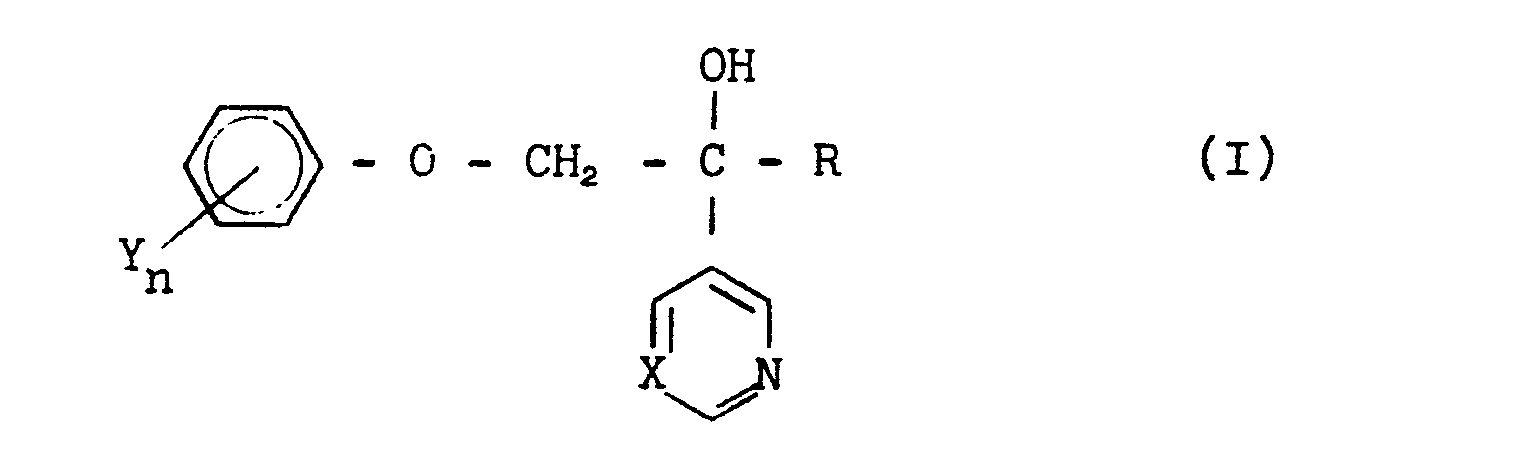
- R für Alkyl, gegebenenfalls substituiertes Aryl oder Aralkyl steht,
- X für ein Stickstoffatom oder die CH-Gruppe steht,
- Y für Halogen, Alkyl, Cycloalkyl, Alkoxy, Halogenalkyl, Alkylthio, gegebenenfalls substituiertes Phenyl, Phenoxy,Phenylalkoxy oder Phenylalkyl steht und
- n für ganze Zahlen von 0 bis 5 steht,
- Die Verbindungen der Formel (I) besitzen ein asymmetrisches Kohlenstoffatom; sie können deshalb in den beiden optischen Isomeren oder als Racemat vorliegen. Sämtliche Isomeren werden erfindungsgemäß beansprucht.
- Weiterhin wurde gefunden, daß man die Phenoxy-pyridinyl(pyrimidinyl)-alkanole der Formel (I) sowie deren Säureadditions-Salze und Metallkomplexe erhält, wenn man Phenoxyketone der Formel

- R, Y und n die oben angegebene Bedeutung haben,
mit einem Pyridinyl- bzw. Pyrimidinyl-halogenid der Formel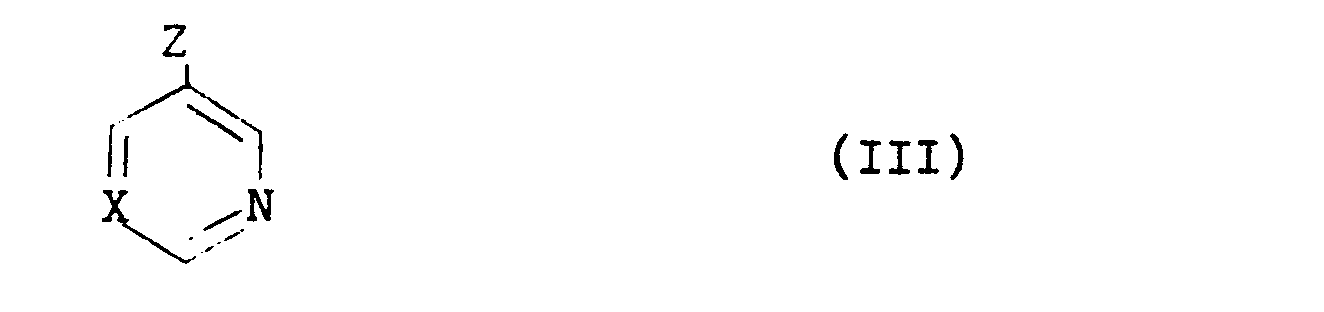
- Z für Halogen steht und
- X die oben angegebene Bedeutung hat,
- Ueberraschenderweise zeigen die erfindungsgemäßen Phenoxy-pyridinyl(pyrimidinyl)-alkanole eine erheblich höhere fungizide Wirksamkeit, insbesondere gegen Mehltauarten, als die aus dem Stand der Technik bekannten Trityl-1,2,4-triazole, wie Triphenyl-(1,2,4-triazol-1-yl)-methan, und als Zink-äthylen-1,2- bisdithiocarbamidat, welche bekannte Stoffe gleicher Wirkungsrichtung sind. Die erfindungsgemäßen Wirkstoffe stellen somit eine Bereicherung der Technik dar.
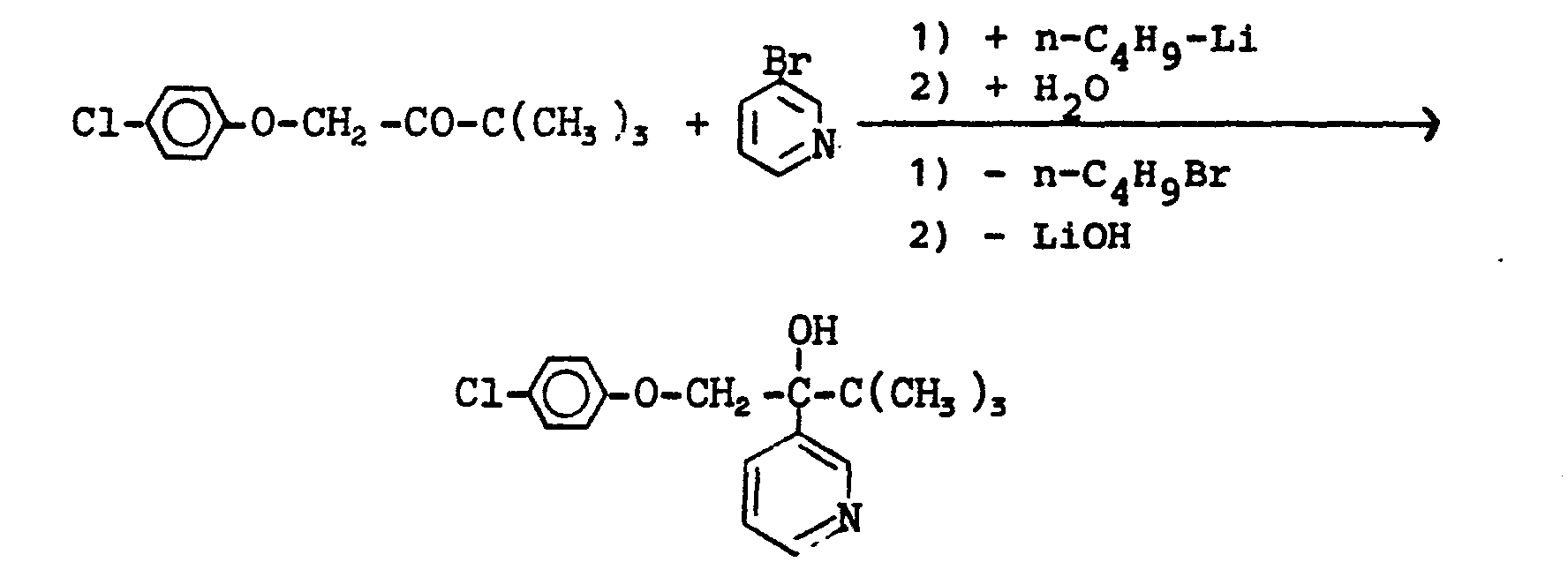
- Verwendet man 1-(4-Chlorphenoxy)-3,3-dimethyl-butan-2-on und 3-Brompyridin in Gegenwart von n-Butyl-lithium als Ausgangsstoffe, so kann der Reaktionsablauf durch das folgende Formelschema wiedergegeben werden:
- Die als Ausgangsstoffe zu verwendenden Phenoxyketone sind durch die Formel (II) allgemein definiert. In dieser Formel steht R vorzugsweise für geradkettiges oder verzweigtes Alkyl mit 1 bis 4 Kohlenstoffatomen sowie für gegebenenfalls substituiertes Aryl oder Aralkyl mit 6 bis 10 Kohlenstoffatomen im Arylteil und bis zu 4 Kohlenstoffatomen im Alkylteil, wie insbesondere Phenyl und Benzyl, wobei als Substituenten vorzugsweise die Reste infrage kommen, die für Y vorzugsweise genannt werden. Y steht vorzugsweise für Halogen, insbesondere Fluor, Chlor oder Brom, geradkettiges oder verzweigtes Alkyl mit 1 bis 4 Kohlenstoffatomen, Cycloalkyl mit 5 bis 7 Kohlenstoffatomen, wie insbesondere Cyclohexyl, Halogenalkyl mit bis zu 2 Kohlenstoff- und bis zu 5 gleichen oder verschiedenen Halogenatomen,wie insbesondere Fluor- und Chloratomen; weiterhin steht Y vorzugsweise für Alkoxy und Alkylthio mit bis zu 2 Kohlenstoffatomen sowie für gegebenenfalls substituiertes Phenyl,Phenoxy, Phenylalkoxy oder Phenylalkyl mit jeweils 1 oder 2 Kohlenstoffatomen im Alkylteil, wobei als Substituenten im Phenylteil vorzugsweise infrage kommen: Halogen, insbesondere Fluor, Chlor oder Brom sowie Alkyl mit bis zu 4 Kohlenstoffatomen. Der Index n steht vorzugsweise für die ganzen Zahlen von 0 bis 3.
- Die Ausgangsstoffe der Formel (II) sind bekannt (vgl. DT-OS 2 105 490 [Le A 13 45Q und DT-OS 2 201 063 LLe A 14 118]) oder lassen sich nach den dort beschriebenen Verfahren leicht herstellen. Man erhält sie zum Beispiel, indem man entsprechende Phenole mit entsprechenden Halogenketonen in Gegenwart eines Säurebinders und eines Verdünnungsmittels umsetzt.
- Die ausserdem als Ausgangsstoffe zu verwendenden Pyridinyl- bzw. Pyrimidinylhalogenide sind durch die Formel (III) allgemein definiert. In dieser Formel hat X vorzugsweise die in der Erfindungsdefinition angegebene Bedeutung und Z steht vorzugsweise für die Halogene Chlor und Brom.
- Die Halogenide der Formel (III) sind allgemein bekannte Verbindungen der organischen Chemie.
- Für die erfindungsgemäße Umsetzung kommen als Verdünnungsmittel vorzugsweise inerte organische Lösungsmittel infrage. Hierzu gehören vorzugsweise solche, die einen tiefen Festpunkt besitzen, wie insbesondere Aether, wie Diäthyläther oder Tetrahydrofuran. Vorzugsweise arbeitet man mit Mischungen aus diesen beiden Aethern.
- Als alkalimetall-organische Verbindungen werden bei der erfindungsgemäßen Umsetzung vorzugsweise Alkalimetall-alkyle, wie insbesondere n-Butyl-lithium, eingesetzt, es können aber auch Alkalimetall-aryle, wie Phenyl-lithium, Verwendung finden.
- Die Reaktionstemperaturen können beim erfindungsgemäßen Verfahren in einem bestimmten Bereich variiert werden. Im allgemeinen arbeitet man zwischen -1500C und -50°C, vorzugsweise zwischen -120°C und -80°C.
- Die erfindungsgemäße Umsetzung wird vorzugsweise unter Inertgas, wie insbesondere Stickstoff oder Argon, vorgenommen.
- Bei der Durchführung des erfindungsgemäßen Verfahrens setzt man die Phenoxiketone der Formel II und die Halogenide der Formel III in etwa äquimolaren Mengen ein, Unter- oder Überschreitungen um bis zu ca. 20 Molprozent sind jedoch möglich. Die alkalimetall-organische Verbindung wird vorteilhaft im Überschuß von 5 bis 75 Molprozent, vorzugsweise von 10 bis 50 Molprozent, verwendet. Es kann dabei so verfahren werden, daß man zunächst die alkalimetall-organische Verbindung mit dem Halogenid der Formel III reagieren läßt und anschließend die Keto-Verbindung der Formel II zufügt; man kann aber auch die Keto-Verbindung und das Halogenid vorlegen und anschließend bei tiefer Temperatur (z.B. bei -100 bis -130°C) die alkalimetall-organische Verbindung zugeben.
- Die Isolierung der Verbindungen der Formel I erfolgt in der Weise, daß das bei der Reaktion zunächst gebildete Alkalialkanolat (z.B. Lithium-alkanolat) mit Wasser hydrolisiert wird. Die weitere Aufarbeitung erfolgt dann in üblicher Weise.
- Zur Herstellung von Säureadditionssalzen der Verbindungen der Formel (I) kommen alle physiologisch verträglichen Säuren infrage. Hierzu gehören vorzugsweise die Halogenwasserstoffsäuren, wie z.B. die Chlorwasserstoffsäure und die Bromwasserstoffsäure, insbesondere die Chlorwasserstoffsäure, ferner Phosphorsäure, Salpetersäure, Schwefelsäure, mono- und bifunktionelle Carbonsäuren und Hydrocarbonsäuren, wie z.B. Essigsäure, Maleinsäure, Bernsteinsäure, Fumarsäure, Weinsäure, Zitronensäure, Salizylsäure, Sorbinsäure, Milchsäure, sowie Sulfonsäuren, wie z.B. p-Toluolsulfonsäure und 1,5-Naphthalindisulfonsäure.
- Die Salze der Verbindungen der Formel (I) können in einfacher Weise nach üblichen Salzbildungsmethoden, z.B. durch Lösen einer Verbindung der Formel (I) in einem geeigneten inerten Lösungsmittel und Hinzufügen der Säure, z.B. Chlorwasserstoffsäure, erhalten werden und in bekannter Weise, z.B. durch Abfiltrieren, isoliert und gegebenenfalls durch Waschen mit einem inerten organischen Lösungsmittel gereinigt werden.
- Zur Herstellung von Metallsalz-Komplexen der Verbindungen der Formel (I) kommen vorzugsweise Salze von Metallen der II. bis IV. Haupt- und der I. und II. sowie IV. bis VIII. Nebengruppe infrage, wobei Kupfer, Zink, Mangan, Magnesium, Zinn, Eisen und Nickel beispielhaft genannt seien. Als Anionen der Salze kommen solche in Betracht, die sich von physiologisch verträglichen Säuren ableiten. Hierzu gehören vorzugsweise die Halogenwasserstoffsäuren, wie z.B. die Chlorwasserstoffsäure und die Bromwasserstoffsäure, ferner Phosphorsäure, Salpetersäure und Schwefelsäure.
- Die Metallsalzkomplexe der Verbindungen der Formel (I) können in einfacher Weise nach üblichen Verfahren erhalten werden, so z.B. durch Lösen des Metallsalzes in Alkohol, z.B. Aethanol, und Hinzufügen zur Verbindung der Formel (I). Man kann Metallsalzkomplexe in bekannter Weise, z.B. durch Abfiltrieren, isolieren und gegebenenfalls durch Umkristallisation reinigen.
- Die erindungsgemäßen Wirkstoffe weisen eine starke fungitoxisch Wirkung auf. Sie schädigen Kulturpflanzen in den zur Bekämpfung von Pilzen notwendigen Konzentrationen nicht. Aus diesen Gründe sind sie für den Gebrauch als Pflanzenschutzmittel zur Bekämpfung von Pilzen geeignet. Fungitoxische Mittel im Pflanzenschutz werden eingesetzt zur Bekämpfung von Plasmodiophoromycetes, Oomycetes, Chytridiomycetes, Zygomycetes, Ascomycetes, Basidiomycetes, Deuteromycetes.
- Die erfindungsgemäßen Wirkstoffe haben ein breites Wirkungsspektrum und können angewandt werden gegen parasitäre Pilze, die oberirdische Pflanzenteile befallen oder die Pflanzen vom Boden her angreifen, sowie gegen samenübertragbare Krankheitserreger. Eine besonders gute Wirksamkeit entfalten sie gegen parasitäre Pilze auf oberirdischen Pflanzenteilen.
- Als Pflanzenschutzmittel können die erfindungsgemäßen Wirkstoffe mit besonders gutem Erfolg zur Bekämpfung von echten Mehltaupilzen, beispielsweise zur Bekämpfung von Apfelmehltau (Podosphaera leucotricha) und Getreidemehltau sowie gegen andere Getreidekrankheiten verwendet werden; außerdem insbesondere zur Bekämpfung der Pilze Pyricularia und Pellicularia.
- Besonders hervorzuheben ist die teilweise systemische Wirkung der Stoffe. So gelingt es, Pflanzen gegen Pilzbefall zu schützen, wenn man den Wirkstoff über den Boden und die Wurzel den oberirdischen Teilen der Pflanze zuführt.
- Als Pflanzenschutzmittel können die erfindungsgemäßen Wirkstoffe zur Saatgut- oder Bodenbehandlung und zur Behandlung oberirdischer Pflanzenteile benutzt werden.
- Von besonderem Interesse sind Verbindungen der Formel (I), in denen X für die CH-Gruppe steht. Von Verbindungen der Formel (I), in denen X für ein Stickstoffatom steht, sind diejenigen Verbindungen besonders interessant, bei denen Y für gegebenenfalls substituiertes Phenyl, Phenoxy, Phenoxyalkyl oder Phenylalkyl steht.
- Die Wirkstoffe können in die üblichen Forsaulierungen übergeführt werden, wie Lösungen, Emulsionen, Spritzpulver, Suspensionen, Pulver, Stäubemittel, Schäume, Pasten, lösliche Pulver, Granulate, Aerosole, Suspensions-Emulsionskonzentrate, Saatgutpuder, Wirkstoff-imprägnierte Natur- und synthetische Stoffe, Feinstverkapselungen in polymeren Stoffen und in Hüllmassen für Saatgut, ferner in Formulierungen mit Brennsätzen, wie Räucherpatronen, -dosen, -spiralen u.ä. sowie ULV-Kalt- und Warmnebel-Formulierungen.
- Diese Formulierungen werden in bekannter Weise hergestellt, z.B. durch Vermischen der Wirkstoffe mit Streckmitteln, also flüssigen Lösungsmitteln, unter Druck stehenden verflüssigten Gasen und/oder festen Trägerstoffen, gegebenenfalls unter Verwendung von oberflächenaktiven Mitteln, also Emulgiermitteln und/oder Dispergiermitteln und/oder schaumerzeugenden Mitteln. Im Falle der Benutzung von Wasser als Streckmittel können z.B. auch organische Lösungsmittel als Hilfslösungsmittel verwendet werden. Als flüssige Lösungsmittel kommen im wesentlichen infrage: Aromaten, wie Xylol, Toluol, oder Alkylnaphthaline, chlorierte Aromaten oder chlorierte aliphatische Kohlenwasserstoffe, wie Chlorbenzole, Chloräthylene oder Methylenchlorid, aliphatische Kohlenwasserstoffe, wie Cyclohexan oder Paraffine, z.B. Erdölfraktionen, Alkohole, wie Butanol oder Glycol sowie deren Äther und Ester, Ketone, wie Aceton, Methyläthylketon, Methylisobutylketon oder Cyclohexanon, stark polare Lösungsmittel, wie Dimethylformamid und Dimethylsulfoxid, sowie Wasser; mit verflüssigten gasförmigen Streckmitteln oder Trägerstoffen sind solche Flüssigkeiten gemeint, welche bei normaler Temperatur und unter Normaldruck gasförmig sind, z.B. Aerosol-Treibgas, wie Halogenkohlenwasserstoffe sowie Butan, Propan, Stickstoff und Kohlendioxid; als feste Trägerstoffe: natürliche Gesteinsmehle, wie Kaoline, Tonerden, Talkum, Kreide, Quarz, Attapulgit, Montmorillonit oder Diatomeenerde und synthetische Gesteinsmehle, wie hochdisperse Kieselsäure, Aluminiumoxid und Silikate; als feste Trägerstoffe für Granulate: gebrochene und fraktionierte natürliche Gesteine wie Calcit, Marmor, Bims, Sepiolith, Dolomit sowie synthetische Granulate aus anorganischen und organischen Mehlen sowie Granulate aus organischem Material wie Sägemehle, Kokosnußschalen, Maiskolben und Tabakstengel; als Emulgier-und/oder schaumerzeugende Mittel: nichtionogene und anionische Emulgatoren, wie Polyoxyäthylen-Fettsäure-Ester, Polyoxyäthylen-Fettalkohol-Äther, z.B. Alkylaryl-polyglykol-äther, Alkylsulfonate, Alkylsulfate, Arylsulfonate sowie Eiweißhydrolysate; als Dispergiermittel: z.B. Lignin-Sulfitablaugen und Methylcellulose.
- Es können in den Formulierungen Haftmittel wie Carboxymethylcellulose, natürliche und synthetische pulverige, körnige oder latexförmige Polymere verwendet werden, wie Gummiarabicum, Polyvinylalkohol, Polyvinylacetat.
- Es können Farbstoffe wie anorganische Pigmente, z.B. Eisenoxid, Titanoxid, Ferrocyanblau und organische Farbstoffe, wie Alizarin-, Azo-Metallphthalocyaninfarbstoffe und Spurennährstoffe wie Salze von Eisen, Mangan, Bor, Kupfer, Kobalt, Molybdän und Zink verwendet werden.
- Die Formulierungen enthalten im allgemeinen zwischen 0,1 und 95 Gewichtsprozent Wirkstoff, vorzugsweise zwischen 0,5 und 90 %.
- Die erfindungsgemäßen Wirkstoffe können in den Formulierungen in Mischung mit anderen bekannten Wirkstoffen vorliegen, wie Fungiziden, Insektiziden, Akariziden, Nematiziden, Herbiziden, Schutzstoffen gegen Vogelfraß, Wuchsstoffen, Pflanzennährstoffen und Bodenstrukturverbesserungsmitteln.
- Die Wirkstoffe können als solche, in Form ihrer Formulierungen oder der daraus durch weiteres Verdünnen bereiteten Anwendungsformen, wie gebrauchsfertige Lösungen, Emulsionen, Suspensionen, Pulver, Pasten und Granulate angewendet werden. Die Anwendung geschieht in üblicher Weise, z.B. durch Gießen Spritzen, Sprühen, Stäuben, Streuen, Trockenbeizen, Feuchtbeizen, Naßbeizen, Schlämmbeizen oder Inkrustieren.
- Bei der Verwendung als Blattfungizide können die Wirkstoffkonzentrationen in den Anwendungsformen in einem größeren Bereich variiert werden. Sie liegen im allgemeinen zwischen 0,1 und 0,00001 Gewichtsprozenten, vorzugsweise zwischen 0,05 und 0,001 %.
- Bei der Saatgutbehandlung werden im allgemeinen Wirkstoffmengen von 0,001 bis 50 g je Kilogramm Saatgut, vorzugsweise 0,01 bis 10 g,benötigt.
- Zur Bodenbehandlung sind Wirkstoffmengen von 1 bis 1000 g je cbm Boden, wie insbesondere 10 bis 200 g, erforderlich.
- Die vielseitigen Verwendungsmöglichkeiten gehen aus den nachfolgenden Beispielen hervor.
- Gerstenmehltau-Test (Erysiphe graminis var. hordei) / systemisch (pilzliche Getreidesproßkrankheit)
- Die Anwendung der Wirkstoffe erfolgt als pulverförmige Saatgutbehandlungsmittel. Sie werden hergestellt durch Abstrecken des jeweiligen Wirkstoffes mit einem Gemisch aus gleichen Gewichtsteilen Talkum und Kieselgur zu einer feinpulverigen Mischung mit der gewünschten Wirkstoffkonzentration.
- ) Zur Saatgutbehandlung schüttelt man Gerstensaatgut mit dem abgestreckten Wirkstoff in einer verschlossenen Glasflasche. Das Saatgut sät man mit 3x12 Korn in Blumentöpfe 2 cm tief in ein Gemisch aus einem Volumteil Fruhstorfer Einheitserde und einem Volumteil Quarzsand ein. Die Keimung und der Auflauf erfolgen unter günstigen Bedingungen im Gewächshaus. 7 Tage nach der Aussaat, wenn die Gerstenpflanzen ihr erstes Blatt entfaltet haben, werden sie mit frischen Sporen von Erysiphe graminis var. hordei bestäubt und bei 21 bis 220 C und 80 bis 90 % rel. Luftfeuchte und 16-stündiger Belichtung weiter kultiviert. Innerhalb von 6 Tagen bilden sich an den Blättern die typischen Mehltaupusteln aus.
- Der Befallsgrad wird in Prozenten des Befalls der unbehandelten Kontrollpflanzen ausgedrückt. So bedeutet 0 % keinen Befall und 100% den gleichen Befallsgrad wie bei der unbe- ; handelten Kontrolle. Der Wirkstoff ist um so wirksamer je geringer der Mehltaubefall ist.
- Wirkstoffe, Wirkstoffkonzentrationen im Saatgutbehandlungsmittel sowie dessen Aufwandmenge und der prozentuale Mehltaubefall werden ermittelt. In diesem Test zeigen z.B. folgende Verbindungen eine sehr gute Wirkung, die derjenigen der aus dem Stande der Technik bekannten Verbindungen deutlich überlegen ist:
- Verbindung gemäß Herstellungsbeispiel 3.
- Sproßbehandlungs-Test / Getreidemehltau / protektiv
- (blattzerstörende Mykose)
- Zur Herstellung einer zweckmäßigen Wirkstoffzubereitung nimmt man 0,25 Gewichtsteile Wirkstoff in 25 Gewichtsteilen Dimethylformamid und 0,06 Gewichtsteilen Alkylaryl-polyglykol-äther auf und gibt 975 Gewichtsteile Wasser hinzu. Das Konzentrat verdünnt man mit Wasser auf die gewünschte Endkonzentration der Spritzbrühe.
- Zur Prüfung auf protektive Wirksamkeit besprüht man die einblättrigen Gerstenjungpflanzen der Sorte Amsel mit der Wirkstoffzubereitung taufeucht. Nach Antrocknen bestäubt man die Gerstenpflanzen mit Sporen von Erysiphe graminis var.hordei.
- Nach 6 Tagen Verweilzeit der Pflanzen bei einer Temperatur von 21 bis 22°C und einer Luftfeuchtigkeit von 80 bis 90 % wertet man den Besatz der Pflanzen mit Mehltaupusteln aus. Der Befallsgrad wird in Prozenten des Befalls der unbehandelten Kontrollpflanzen ausgedrückt. Dabei bedeutet 0 % keinen Befall und 100 % den gleichen Befallsgrad wie bei der unbehandelten Kontrolle. Der Wirkstoff ist umso wirksamer, je geringer der Mehltaubefall ist.
- Wirkstoffe, Wirkstoffkonzentrationen in der Spritzbrühe und Befallsgrade werden ermittelt. In diesem Test zeigen z.B. folgende Verbindungen eine sehr gute Wirkung, die derjenigen der aus dem Stande der Technik bekannten Verbindungen deutlich überlegen ist:
- Verbindungen gemäß Herstellungsbeispielen 3, 9, 4, 27.
- Podosphaera-Test (Apfel) / Protektiv

- Man vermischt die für die gewünschte Wirkstoffkonzentration in der Spritzflüssigkeit nötige Wirkstoffmenge mit der angegebenen Menge des Lösungsmittels und verdünnt das Konzentrat mit der angegebenen Menge Wasser, welches die genannten Zusätze enthält.
- Mit der Spritzflüssigkeit bespritzt man junge Apfelsämlinge, die sich im 4- bis 6-Blattstadium befinden, bis zur Tropfnässe. Die Pflanzen verbleiben 24 Stunden bei 20°C und einer relativen Luftfeuchtigkeit von 70 % im Gewächshaus. Anschließend werden sie durch Bestäuben mit Konidien des Apfelmehltauerregers (Podosphaera leucotricha) inokuliert und in ein Gewächshaus mit einer Temperatur von 21 bis 23 °C und einer relativen Luftfeuchtigkeit von ca. 70% gebracht.
- 10 Tage nach der Inokulation wird der Befall der Sämlinge bestimmt. Die erhaltenen Boniturwerte werden in Prozent Befall umgerechnet. 0% bedeutet keinen Befall, 100 % bedeutet, daß die Pflanzen vollständig befallen sind.
- Wirkstoffe, Wirkstoffkonzentrationen und Ergebnisse werden ermittelt. In diesem Test zeigen z.B. folgende Verbindungen eine sehr gute Wirkung, die derjenigen der aus dem Stande der Technik bekannten Verbindungen deutlich überlegen ist: Verbindungen gemäß Herstellungsbeispielen 3, 4, 9, 27.
- Myzelwachstums-Test
- Verwendeter Nährboden:

- Verhältnis von Lösungsmittelgemisch zum Nährboden:

- Man vermischt die für die gewünschte Wirkstoffkonzentration im Nährboden nötige Wirkstoffmenge mit der angegebenen Menge des Lösungsmittelgemisches. Das Konzentrat wird im genannten Mengenverhältnis mit dem flüssigen, auf 42°C abgekühlten Nährboden gründlich vermischt und in Petrischalen mit einem Durchmesser von 9 cm gegossen. Ferner werden Kontrollplatten ohne , Präparatbeimischung aufgestellt.
- Ist der Nährboden erkaltet und fest, werden die Platten mit den in der Tabelle angegebenen Pilzarten beimpft und bei etwa 21°C inkubiert.
- Die Auswertung erfolgt je nach der Wachstumsgeschwindigkeit der Pilze nach 4 - 6 Tagen. Bei der Auswertung wird das radiale Myzelwachstum auf den behandelten Nährböden mit dem Wachstum auf dem Kontrollnährboden verglichen. Die Bonitierung des Pilzwachstums geschieht mit folgenden Kennzahlen:

- Wirkstoffe, Wirkstoffkonzentrationen und Resultate werden ermittelt. Dabei zeigen z.B. folgende Verbindungen eine sehr gute Wirkung, die derjenigen der aus dem Stand der Technik bekannten Verbindungen deutlich überlegen ist:
- Verbindungen gemäß Herstellungsbeispielen 3, 4, 9, 27.
- Pyricularia- und Pellicularia-Test

- Man vermischt die für die gewünschte Wirkstoffkonzentration in der Spritzflüssigkeit nötige Wirkstoffmenge mit der angegebenen Menge des Lösungsmittels und des Dispergiermittels und verdünnt das Konzentrat mit der angegebenen Menge Wasser.
- Mit der Spritzflüssigkeit bespritzt man etwa 2 bis 4 Wochen alte Reispflanzen bis zur. Tropfnässe. Die Pflanzen verbleiben bis zum Abtrocknen in einem Gewächshaus bei Temperaturen von 22 bis 24°C und einer relativen Luftfeuchtigkeit von etwa 70 %.
- Danach wird der eine Teil der Pflanzen mit einer wässrigen Suspension von 100 000 bis 200 000 Sporen/ml von Pyricularia oryzae inokuliert und in einem Raum bei 24 bis 26°C und 100 % relativer Luftfeuchtigkeit aufgestellt. Der andere Teil der Pflanzen wird mit einer auf Malzagar gezogenen Kultur von Pellicularia sasakii infiziert und bei 28 bis 30°C sowie 100 % relativer Luftfeuchtigkeit aufgestellt.
- 5 bis 8 Tage nach der Inokulation wird der Befall bei allen zur Zeit der Inokulation mit Pyricularia oryzae vprhandenen Blättern in Prozent der unbehandelten, aber ebenfalls inokulierten Kontrollpflanzen bestimmt. Bei den mit Pellicularia sasakii infizierten Pflanzen wird der Befall nach der gleichen Zeit an den Blattscheiden ebenfalls im Verhältnis zur unbehandelten, aber infizierten Kontrolle bestimmt. Die Auswertung erfolgt in Wertzahlen von 1 - 9. 1 bedeutet 100 %ige Wirkung, 3 - gute Wirkung, 5 - mäßige Wirkung und 9 - keine Wirkung.
- Wirkstoffe, Wirkstoffkonzentrationen und Resultate werden ermittelt. Dabei zeigen z.B. folgende Verbindungen eine sehr gute Wirkung, die derjenigen der aus dem Stande der Technik bekannten Verbindungen deutlich überlegen ist:
- Verbindungen gemäß Herstellungsbeispiele 3, 4, 9.
-

- Die Reaktionsmischung wird dreimal mit In-Salzsäure extrahiert. Die vereinigten Salzsäure-Extrakte werden mit Aether gewaschen, auf festes Natriumbicarbonat gegossen und mehrmals mit Essigester extrahiert. Die Essigesterlösung wird mit Wasser gewaschen, über Natriumsulfat getrocknet und eingeengt. Der Rückstand wird aus Cyclohexan umkristallisiert. Man erhält 15g (55 % der Theorie) 3,3-Dimethyl-l-phenoxy-2-pyridin-3-yl-butan-2-ol vom Schmelzpunkt 89-90,5°C.
-

- Analog werden die Verbindungen der allgemeinen Formel


sowie deren physiologisch verträglichen Säureadditions-Salze und Metallkomplexe gefunden. Sie weisen starke fungizide Eigenschaften auf.
in Gegenwart eines Verdünnungsmittels und in Gegenwart einer alkalimetall-organischen Verbindung umsetzt und gegebenenfalls anschließend eine Säure oder ein Metallsalz addiert.
Claims (6)

sowie deren physiologisch verträglichen Säureadditions-Salze und Metallkomplexe.

mit einem Pyridinyl- bzw. Pyrimidinyl-halogenid der Formel

in Gegenwart eines Verdünnungsmittels und in Gegenwart einer alkalimetall-organischen Verbindung umsetzt und gegebenenfalls anschließend eine Säure oder ein Metallsalz addiert.
Priority Applications (1)
| Application Number | Priority Date | Filing Date | Title |
|---|---|---|---|
| DE8181104308T DE2862269D1 (en) | 1977-09-20 | 1978-09-07 | Phenoxy-pyrimidinyl alkanols, process for their preparation and their use as fungicides |
Applications Claiming Priority (2)
| Application Number | Priority Date | Filing Date | Title |
|---|---|---|---|
| DE19772742173 DE2742173A1 (de) | 1977-09-20 | 1977-09-20 | Phenoxy-pyridinyl(pyrimidinyl)-alkanole, verfahren zu ihrer herstellung sowie ihre verwendung als fungizide |
| DE2742173 | 1977-09-20 |
Related Child Applications (1)
| Application Number | Title | Priority Date | Filing Date |
|---|---|---|---|
| EP81104308.2 Division-Into | 1978-09-07 |
Publications (2)
| Publication Number | Publication Date |
|---|---|
| EP0001399A1 true EP0001399A1 (de) | 1979-04-18 |
| EP0001399B1 EP0001399B1 (de) | 1982-11-10 |
Family
ID=6019356
Family Applications (2)
| Application Number | Title | Priority Date | Filing Date |
|---|---|---|---|
| EP78100841A Expired EP0001399B1 (de) | 1977-09-20 | 1978-09-07 | Phenoxy-pyridinyl-alkanole, Verfahren zu ihrer Herstellung sowie ihre Verwendung als Fungizide |
| EP81104308A Expired EP0037591B1 (de) | 1977-09-20 | 1978-09-07 | Phenoxy-pyrimidinyl-alkanole, Verfahren zu ihrer Herstellung sowie ihre Verwendung als Fungizide |
Family Applications After (1)
| Application Number | Title | Priority Date | Filing Date |
|---|---|---|---|
| EP81104308A Expired EP0037591B1 (de) | 1977-09-20 | 1978-09-07 | Phenoxy-pyrimidinyl-alkanole, Verfahren zu ihrer Herstellung sowie ihre Verwendung als Fungizide |
Country Status (13)
| Country | Link |
|---|---|
| US (2) | US4518600A (de) |
| EP (2) | EP0001399B1 (de) |
| JP (1) | JPS5452083A (de) |
| BR (1) | BR7806123A (de) |
| CS (1) | CS203016B2 (de) |
| DD (1) | DD139202A5 (de) |
| DE (3) | DE2742173A1 (de) |
| DK (1) | DK413778A (de) |
| HU (1) | HU180668B (de) |
| IL (1) | IL55587A (de) |
| IT (1) | IT1098845B (de) |
| PH (1) | PH13526A (de) |
| PL (1) | PL110934B1 (de) |
Cited By (12)
| Publication number | Priority date | Publication date | Assignee | Title |
|---|---|---|---|---|
| EP0028755A1 (de) * | 1979-11-07 | 1981-05-20 | Bayer Ag | Mittel zur Regulierung des Pflanzenwachstums, deren Herstellung und deren Verwendung |
| EP0058347A3 (en) * | 1981-02-14 | 1982-10-06 | Bayer Ag | Benzyl-pyrimidinylalkyl ethers, process for their preparation, their use as plant growth regulation agents and fungicides, as well as intermediates and their preparation |
| EP0069330A1 (de) * | 1981-07-08 | 1983-01-12 | BASF Aktiengesellschaft | Pyridincarbinole, Verfahren zu ihrer Herstellung und diese enthaltende Fungizide |
| EP0109299A3 (de) * | 1982-11-16 | 1984-08-15 | Eli Lilly And Company | 1,1-Disubstituierte-2-heterocyclische Ethanolderivate |
| EP0117485A3 (de) * | 1983-02-28 | 1985-01-23 | F. HOFFMANN-LA ROCHE & CO. Aktiengesellschaft | Pyridin-, Pyrazin- und Pyrimidinderivate und deren Verwendung als fungizide Wirkstoffe |
| FR2561239A1 (fr) * | 1984-03-15 | 1985-09-20 | Rhone Poulenc Agrochimie | Arylthio-pyridinyl-alcanols |
| EP0131867A3 (en) * | 1983-07-16 | 1985-10-09 | Bayer Ag | Aryloxy-pyrimidinyl alkanols |
| US4616489A (en) * | 1984-10-29 | 1986-10-14 | Fabcon, Inc. | Stock washer |
| EP0302366A3 (de) * | 1987-08-05 | 1991-05-02 | Bayer Ag | Substituierte Pyridin-Derivate |
| WO2011003528A2 (de) | 2009-07-08 | 2011-01-13 | Bayer Cropscience Aktiengesellschaft | Substituierte phenyl(oxy/thio)alkanol-derivate |
| WO2011003527A1 (de) | 2009-07-08 | 2011-01-13 | Bayer Cropscience Ag | Phenyl(oxy/thio)alkanol-derivate |
| WO2012072547A1 (de) | 2010-11-30 | 2012-06-07 | Bayer Cropscience Ag | Pyrimidin- derivate und ihre verwendung als schädlingsbekämpfungsmittel |
Families Citing this family (20)
| Publication number | Priority date | Publication date | Assignee | Title |
|---|---|---|---|---|
| DD258163A5 (de) * | 1985-10-01 | 1988-07-13 | ����`��@���k�� | Mikrobizide mittel |
| PH23212A (en) * | 1985-10-01 | 1989-06-06 | Ciba Geigy Ag | Phenoxy compounds as microbicides |
| DE3702962A1 (de) * | 1987-01-31 | 1988-08-11 | Bayer Ag | Schaedlingsbekaempfungsmittel auf pyrimidin-derivat basis |
| US4835164A (en) * | 1987-02-20 | 1989-05-30 | A. H. Robins Company, Incorporated | Aryloxymethyl derivatives of nitrogenous heterocyclic methanols and ethers thereof |
| DE3877459T2 (de) * | 1987-08-20 | 1993-05-13 | Ici Plc | Pyrimidinderivate. |
| DE4229643A1 (de) * | 1992-09-04 | 1994-03-10 | Bayer Ag | Substituierte Hydroxyalkylpyridine |
| US5780465A (en) * | 1997-04-03 | 1998-07-14 | Dow Agrosciences Llc | 4-substituted 5-polycyclylpyrimidine herbicides |
| ID29076A (id) | 1998-11-20 | 2001-07-26 | Bayer Ag | Kombinasi senyawa aktif fungisida |
| AR035838A1 (es) | 1999-01-22 | 2004-07-21 | Elan Pharm Inc | Compuestos multiciclicos que inhiben la adhesion de leucocitos mediada por vla-4 y el uso de los mismos para la preparacion de un medicamento |
| TW593284B (en) * | 1999-01-22 | 2004-06-21 | Elan Pharm Inc | Fused ring heteroaryl and heterocyclic compounds which inhibit leukocyte adhesion mediated by VLA-4 |
| HK1045157A1 (zh) * | 1999-01-22 | 2002-11-15 | 依兰制药公司 | 抑制vla-4介导的白细胞粘着的化合物 |
| US6436904B1 (en) * | 1999-01-25 | 2002-08-20 | Elan Pharmaceuticals, Inc. | Compounds which inhibit leukocyte adhesion mediated by VLA-4 |
| AU3246600A (en) | 1999-03-01 | 2000-09-21 | Elan Pharmaceuticals, Inc. | Alpha-aminoacetic acid derivatives useful as alpha 4 beta 7 receptor antagonists |
| TWI281470B (en) * | 2002-05-24 | 2007-05-21 | Elan Pharm Inc | Heterocyclic compounds which inhibit leukocyte adhesion mediated by alpha4 integrins |
| TW200307671A (en) * | 2002-05-24 | 2003-12-16 | Elan Pharm Inc | Heteroaryl compounds which inhibit leukocyte adhesion mediated by α 4 integrins |
| ATE493405T1 (de) * | 2005-09-29 | 2011-01-15 | Elan Pharm Inc | Pyrimidinylamidverbindungen, die die durch vla-4 vermittelte leukozytenadhäsion inhibieren |
| ZA200803016B (en) | 2005-09-29 | 2009-10-28 | Elan Pharmaceuticals Inc Wyeth | Carbamate compounds which inhibit leukocyte adhesion mediated by VLA-4 |
| EA017110B1 (ru) | 2006-02-27 | 2012-09-28 | Элан Фамэсьютикэлс, Инк. | ПИРИМИДИНИЛСУЛЬФОНАМИДНЫЕ СОЕДИНЕНИЯ (ВАРИАНТЫ), СПОСОБ ПОЛУЧЕНИЯ ПИРИМИДИНИЛСУЛЬФОНАМИДНЫХ СОЕДИНЕНИЙ (ВАРИАНТЫ), ФАРМАЦЕВТИЧЕСКАЯ КОМПОЗИЦИЯ, СПОСОБ ЛЕЧЕНИЯ ЗАБОЛЕВАНИЯ, ОПОСРЕДОВАННОГО ИНТЕГРИНОМ α4, СПОСОБ СНИЖЕНИЯ И/ИЛИ ПРЕДУПРЕЖДЕНИЯ ВОСПАЛИТЕЛЬНОГО КОМПОНЕНТА ЗАБОЛЕВАНИЯ ИЛИ АУТОИММУННОГО ОТВЕТА |
| SG10201401836RA (en) * | 2009-04-27 | 2014-10-30 | Elan Pharm Inc | Pyridinone antagonists of alpha-4 integrins |
| JP6485935B1 (ja) | 2018-10-18 | 2019-03-20 | ベルフェイス株式会社 | オンラインコミュニケーションのレビューシステム、方法、及びコンピュータプログラム |
Citations (2)
| Publication number | Priority date | Publication date | Assignee | Title |
|---|---|---|---|---|
| US3869456A (en) * | 1972-03-13 | 1975-03-04 | Lilly Co Eli | Synthesis of 5-pyrimidinecarbinols |
| US4043790A (en) * | 1976-04-02 | 1977-08-23 | Eli Lilly And Company | Method of regulating the growth of aquatic weeds with pyridine derivatives |
Family Cites Families (6)
| Publication number | Priority date | Publication date | Assignee | Title |
|---|---|---|---|---|
| US3085938A (en) * | 1959-03-23 | 1963-04-16 | Carter Prod Inc | Analgesic aryloxypropanolamines |
| US3515788A (en) * | 1966-11-23 | 1970-06-02 | Hoffmann La Roche | Anti-tubercular compositions and methods employing pyridine derivatives |
| US3818009A (en) * | 1969-12-29 | 1974-06-18 | Lilly Co Eli | Alpha, alpha-disubstituted-5-pyrimidinemethanes |
| FR2092895B1 (de) * | 1970-06-29 | 1973-07-13 | Lafon Victor | |
| US4039675A (en) * | 1972-09-15 | 1977-08-02 | Eli Lilly And Company | α,α-Dialkyl-substituted 3-pyridinemethanols as fungicidal agents |
| US4020071A (en) * | 1973-12-20 | 1977-04-26 | Cassella Farbwerke Mainkur Aktiengesellschaft | Derivatives of 1-phenoxy-3-amino-propan-2-ol |
-
1977
- 1977-09-20 DE DE19772742173 patent/DE2742173A1/de not_active Withdrawn
-
1978
- 1978-09-07 EP EP78100841A patent/EP0001399B1/de not_active Expired
- 1978-09-07 EP EP81104308A patent/EP0037591B1/de not_active Expired
- 1978-09-07 DE DE8181104308T patent/DE2862269D1/de not_active Expired
- 1978-09-07 DE DE7878100841T patent/DE2862085D1/de not_active Expired
- 1978-09-14 HU HU78BA3705A patent/HU180668B/hu unknown
- 1978-09-14 DD DD78207829A patent/DD139202A5/de unknown
- 1978-09-15 CS CS785985A patent/CS203016B2/cs unknown
- 1978-09-15 PH PH21612A patent/PH13526A/en unknown
- 1978-09-18 IL IL7855587A patent/IL55587A/xx unknown
- 1978-09-18 IT IT27793/78A patent/IT1098845B/it active
- 1978-09-19 PL PL1978209692A patent/PL110934B1/pl unknown
- 1978-09-19 JP JP11419678A patent/JPS5452083A/ja active Granted
- 1978-09-19 DK DK413778A patent/DK413778A/da not_active Application Discontinuation
- 1978-09-19 BR BR7806123A patent/BR7806123A/pt unknown
-
1980
- 1980-06-20 US US06/161,636 patent/US4518600A/en not_active Expired - Lifetime
-
1982
- 1982-06-24 US US06/391,749 patent/US4438122A/en not_active Expired - Fee Related
Patent Citations (2)
| Publication number | Priority date | Publication date | Assignee | Title |
|---|---|---|---|---|
| US3869456A (en) * | 1972-03-13 | 1975-03-04 | Lilly Co Eli | Synthesis of 5-pyrimidinecarbinols |
| US4043790A (en) * | 1976-04-02 | 1977-08-23 | Eli Lilly And Company | Method of regulating the growth of aquatic weeds with pyridine derivatives |
Cited By (31)
| Publication number | Priority date | Publication date | Assignee | Title |
|---|---|---|---|---|
| US4525204A (en) * | 1979-11-07 | 1985-06-25 | Bayer Aktiengesellschaft | Method and compositions for regulating plant growth using pyrimidine-butanol compounds |
| EP0028755A1 (de) * | 1979-11-07 | 1981-05-20 | Bayer Ag | Mittel zur Regulierung des Pflanzenwachstums, deren Herstellung und deren Verwendung |
| EP0058347A3 (en) * | 1981-02-14 | 1982-10-06 | Bayer Ag | Benzyl-pyrimidinylalkyl ethers, process for their preparation, their use as plant growth regulation agents and fungicides, as well as intermediates and their preparation |
| USRE32796E (en) * | 1981-02-14 | 1988-12-06 | Bayer Aktiengesellschaft | Benzyl-pyrimidinylalkyl-ethers as plant growth regulators and fungicides, and corresponding pyrimidinyl-carbinols |
| US4431812A (en) * | 1981-07-08 | 1984-02-14 | Basf Aktiengesellschaft | Pyridinecarbinols |
| EP0069330A1 (de) * | 1981-07-08 | 1983-01-12 | BASF Aktiengesellschaft | Pyridincarbinole, Verfahren zu ihrer Herstellung und diese enthaltende Fungizide |
| EP0109299A3 (de) * | 1982-11-16 | 1984-08-15 | Eli Lilly And Company | 1,1-Disubstituierte-2-heterocyclische Ethanolderivate |
| EP0117485A3 (de) * | 1983-02-28 | 1985-01-23 | F. HOFFMANN-LA ROCHE & CO. Aktiengesellschaft | Pyridin-, Pyrazin- und Pyrimidinderivate und deren Verwendung als fungizide Wirkstoffe |
| EP0131867A3 (en) * | 1983-07-16 | 1985-10-09 | Bayer Ag | Aryloxy-pyrimidinyl alkanols |
| US4584373A (en) * | 1983-07-16 | 1986-04-22 | Bayer Aktiengesellschaft | 1-(substituted-phenoxy)-3-methyl-2-(pyrimidin-5-yl)-butan-2-ol useful as plant growth regulating agents |
| FR2561239A1 (fr) * | 1984-03-15 | 1985-09-20 | Rhone Poulenc Agrochimie | Arylthio-pyridinyl-alcanols |
| EP0157712A1 (de) * | 1984-03-15 | 1985-10-09 | Rhone-Poulenc Agrochimie | Arylthio-pyridinyl-Alkanole |
| US4677128A (en) * | 1984-03-15 | 1987-06-30 | Rhone-Poulenc Agrochimie | (Arylthio)-pyridylalkanols and their use as fungicides |
| US4616489A (en) * | 1984-10-29 | 1986-10-14 | Fabcon, Inc. | Stock washer |
| EP0302366A3 (de) * | 1987-08-05 | 1991-05-02 | Bayer Ag | Substituierte Pyridin-Derivate |
| US5036073A (en) * | 1987-08-05 | 1991-07-30 | Bayer Aktiengesellschaft | Fungicidal 4-(4-substituted-phenyl)-3,3-dimethyl-2-(3-pyridyl)-butan-2-ol derivatives |
| US5047544A (en) * | 1987-08-05 | 1991-09-10 | Bayer Aktiengesellschaft | Pesticidal substituted pyridine derivatives |
| US9051277B2 (en) | 2009-07-08 | 2015-06-09 | Bayer Intellectual Property Gmbh | Phenyl(oxy/thio)alkanol derivatives |
| US9187431B2 (en) | 2009-07-08 | 2015-11-17 | Bayer Intellectual Property Gmbh | Substituted phenyl(oxy/thio)alkanol derivatives |
| WO2011003528A3 (de) * | 2009-07-08 | 2011-08-25 | Bayer Cropscience Aktiengesellschaft | Substituierte phenyl(oxy/thio)alkanol-derivate |
| CN102471286A (zh) * | 2009-07-08 | 2012-05-23 | 拜耳作物科学公司 | 苯基(氧基/硫基)烷醇衍生物 |
| EA023170B9 (ru) * | 2009-07-08 | 2016-09-30 | Байер Интеллектуэль Проперти Гмбх | Замещенные производные фенил(окси/тио)алканолов |
| EA019612B1 (ru) * | 2009-07-08 | 2014-04-30 | Байер Кропсайенс Аг | Замещенные производные фенил(окси/тио)алканолов |
| WO2011003528A2 (de) | 2009-07-08 | 2011-01-13 | Bayer Cropscience Aktiengesellschaft | Substituierte phenyl(oxy/thio)alkanol-derivate |
| CN102471286B (zh) * | 2009-07-08 | 2015-08-19 | 拜耳作物科学公司 | 苯基(氧基/硫基)烷醇衍生物 |
| AU2010268837B2 (en) * | 2009-07-08 | 2015-09-10 | Bayer Intellectual Property Gmbh | Phenyl(oxy/thio)alkanol derivatives |
| EA021808B1 (ru) * | 2009-07-08 | 2015-09-30 | Байер Интеллектуэль Проперти Гмбх | Производные фенил(окси/тио)алканола, способ борьбы с фитопатогенными вредными грибами, средство для борьбы с фитопатогенными вредными грибами и способы получения производных фенил(окси/тио)алканола |
| WO2011003527A1 (de) | 2009-07-08 | 2011-01-13 | Bayer Cropscience Ag | Phenyl(oxy/thio)alkanol-derivate |
| US9321732B2 (en) | 2009-07-08 | 2016-04-26 | Bayer Intellectual Property Gmbh | Phenyl(oxy/thio)alkanol derivatives |
| EA023170B1 (ru) * | 2009-07-08 | 2016-04-29 | Байер Интеллектуэль Проперти Гмбх | Замещенные производные фенил(окси/тио)алканолов |
| WO2012072547A1 (de) | 2010-11-30 | 2012-06-07 | Bayer Cropscience Ag | Pyrimidin- derivate und ihre verwendung als schädlingsbekämpfungsmittel |
Also Published As
| Publication number | Publication date |
|---|---|
| IL55587A0 (en) | 1978-12-17 |
| EP0037591A1 (de) | 1981-10-14 |
| JPS5452083A (en) | 1979-04-24 |
| CS203016B2 (en) | 1981-02-27 |
| IL55587A (en) | 1981-12-31 |
| HU180668B (en) | 1983-04-29 |
| EP0001399B1 (de) | 1982-11-10 |
| DE2862269D1 (en) | 1983-07-07 |
| JPS6128668B2 (de) | 1986-07-01 |
| BR7806123A (pt) | 1979-04-17 |
| US4518600A (en) | 1985-05-21 |
| PH13526A (en) | 1980-06-19 |
| IT1098845B (it) | 1985-09-18 |
| IT7827793A0 (it) | 1978-09-18 |
| PL110934B1 (en) | 1980-08-30 |
| US4438122A (en) | 1984-03-20 |
| DE2862085D1 (en) | 1982-12-16 |
| EP0037591B1 (de) | 1983-05-25 |
| DD139202A5 (de) | 1979-12-19 |
| DK413778A (da) | 1979-03-21 |
| PL209692A1 (pl) | 1979-06-04 |
| DE2742173A1 (de) | 1979-03-29 |
Similar Documents
| Publication | Publication Date | Title |
|---|---|---|
| EP0001399B1 (de) | Phenoxy-pyridinyl-alkanole, Verfahren zu ihrer Herstellung sowie ihre Verwendung als Fungizide | |
| EP0001414B1 (de) | Diastereomere Formen A von Triazolyl-O,N-acetalen und ihre Verwendung als Fungizide | |
| EP0032200B1 (de) | Substituierte Triazolylmethyl-tert.-butyl-carbinole, Verfahren zu ihrer Herstellung und ihre Verwendung als Pflanzenschutzmittel sowie als Zwischenprodukte | |
| CH625793A5 (de) | ||
| DE2635663C2 (de) | ||
| EP0019131B1 (de) | Fluorierte 1-Triazolyl-butan-Derivate, Verfahren zu ihrer Herstellung und ihre Verwendung als Fungizide | |
| EP0004303A1 (de) | Acylierte 1-Azolyl-2-hydroxy-butan-Derivate, Verfahren zu ihrer Herstellung und ihre Verwendung als Fungizide | |
| EP0000018B1 (de) | Metallsalzkomplexe von 1-Phenyl-2-triazolyl-ethyl-Derivaten, Verfahren zu ihrer Herstellung sowie ihre Verwendung als Fungizide | |
| EP0103798A2 (de) | Substituierte Azolylalkyl-t-butyl-ketone und -carbinole | |
| EP0032561B1 (de) | Triazolylphenacyl-pyridyl-ether-Derivate, Verfahren zu ihrer Herstellung sowie ihre Verwendung als Fungizide | |
| EP0031911A2 (de) | Substituierte Triazolylmethyl-tert.-butyl-ketone, Verfahren zu ihrer Herstellung und ihre Verwendung als Pflanzenschutzmittel sowie als Zwischenprodukte | |
| EP0022975A1 (de) | Triazolyl-alken-Derivate, Verfahren zu ihrer Herstellung und ihre Verwendung als Fungizide | |
| EP0002678B1 (de) | Azolylalkyl-pyridinyl-äther, Verfahren zu ihrer Herstellung sowie ihre Verwendung als Fungizide | |
| EP0009707A1 (de) | Halogenierte 1-Azolyl-1-fluorphenoxy-butan-Derivate, Verfahren zu ihrer Herstellung, sie enthaltende Fungizide Mittel sowie ihre Verwendung als Fungizide | |
| EP0006538B1 (de) | Sulfenylierte Carbamoyl-triazolyl-O,N-acetale, Verfahren zu ihrer Herstellung und ihre Verwendung als Fungizide | |
| EP0040368B1 (de) | Triazolyl-vinyl-ketone und -carbinole, Verfahren zu ihrer Herstellung sowie ihre Verwendung als Fungizide | |
| EP0002679A1 (de) | 1-Halogen-1-propin-3-ole, Verfahren zu ihrer Herstellung sowie ihre Verwendung als Fungizide | |
| EP0040366B1 (de) | Imidazolyl-vinyl-ketone und -carbinole, Verfahren zu ihrer Herstellung sowie ihre Verwendung als Fungizide | |
| EP0057864B1 (de) | 2-Azolylmethyl-1,3-dioxolan- und -dioxan-Derivate, Verfahren zu ihrer Herstellung und ihre Verwendung als Fungizide | |
| EP0045016B1 (de) | Substituierte Triazolylalkyl-pyridyl-ether, Verfahren zu ihrer Herstellung sowie ihre Verwendung als Fungizide | |
| EP0019190B1 (de) | Verwendung von Hydroxyalkyl-imidazolen als Fungizide | |
| EP0019134B1 (de) | Fluorierte 1-Imidazolyl-butan-Derivate, Verfahren zu ihrer Herstellung und ihre Verwendung als Fungizide | |
| EP0047420A2 (de) | Fluorierte 1-Azolyl-butan-Derivate, Verfahren zu ihrer Herstellung und ihre Verwendung als Fungizide | |
| EP0130318A2 (de) | Substituierte 1-Phenyl-2-triazolyl-1-penten-3-ole, Verfahren zu ihrer Herstellung sowie ihre Verwendung als Pflanzenwachstumsregulatoren und Fungizide | |
| EP0024538B1 (de) | 1,2,4-Triazolyl-enolether, Verfahren zu ihrer Herstellung und ihre Verwendung als Fungizide |
Legal Events
| Date | Code | Title | Description |
|---|---|---|---|
| PUAI | Public reference made under article 153(3) epc to a published international application that has entered the european phase |
Free format text: ORIGINAL CODE: 0009012 |
|
| AK | Designated contracting states |
Designated state(s): BE CH DE FR GB NL |
|
| 17P | Request for examination filed | ||
| GRAA | (expected) grant |
Free format text: ORIGINAL CODE: 0009210 |
|
| AK | Designated contracting states |
Designated state(s): BE CH DE FR GB NL |
|
| REF | Corresponds to: |
Ref document number: 2862085 Country of ref document: DE Date of ref document: 19821216 |
|
| PGFP | Annual fee paid to national office [announced via postgrant information from national office to epo] |
Ref country code: DE Payment date: 19840828 Year of fee payment: 7 |
|
| PGFP | Annual fee paid to national office [announced via postgrant information from national office to epo] |
Ref country code: FR Payment date: 19840830 Year of fee payment: 7 |
|
| PGFP | Annual fee paid to national office [announced via postgrant information from national office to epo] |
Ref country code: BE Payment date: 19840930 Year of fee payment: 7 |
|
| PGFP | Annual fee paid to national office [announced via postgrant information from national office to epo] |
Ref country code: CH Payment date: 19841128 Year of fee payment: 7 |
|
| PGFP | Annual fee paid to national office [announced via postgrant information from national office to epo] |
Ref country code: NL Payment date: 19870930 Year of fee payment: 10 |
|
| PG25 | Lapsed in a contracting state [announced via postgrant information from national office to epo] |
Ref country code: GB Effective date: 19880907 |
|
| PG25 | Lapsed in a contracting state [announced via postgrant information from national office to epo] |
Ref country code: CH Effective date: 19880930 Ref country code: BE Effective date: 19880930 |
|
| BERE | Be: lapsed |
Owner name: BAYER A.G. Effective date: 19880930 |
|
| PG25 | Lapsed in a contracting state [announced via postgrant information from national office to epo] |
Ref country code: NL Effective date: 19890401 |
|
| NLV4 | Nl: lapsed or anulled due to non-payment of the annual fee | ||
| PG25 | Lapsed in a contracting state [announced via postgrant information from national office to epo] |
Ref country code: FR Free format text: LAPSE BECAUSE OF NON-PAYMENT OF DUE FEES Effective date: 19890531 |
|
| REG | Reference to a national code |
Ref country code: CH Ref legal event code: PL |
|
| GBPC | Gb: european patent ceased through non-payment of renewal fee | ||
| PG25 | Lapsed in a contracting state [announced via postgrant information from national office to epo] |
Ref country code: DE Effective date: 19890601 |
|
| REG | Reference to a national code |
Ref country code: FR Ref legal event code: ST |
|
| PLBE | No opposition filed within time limit |
Free format text: ORIGINAL CODE: 0009261 |
|
| STAA | Information on the status of an ep patent application or granted ep patent |
Free format text: STATUS: NO OPPOSITION FILED WITHIN TIME LIMIT |