EP0001400A1 - Lufttrocknende Alkydharze - Google Patents
Lufttrocknende Alkydharze Download PDFInfo
- Publication number
- EP0001400A1 EP0001400A1 EP78100859A EP78100859A EP0001400A1 EP 0001400 A1 EP0001400 A1 EP 0001400A1 EP 78100859 A EP78100859 A EP 78100859A EP 78100859 A EP78100859 A EP 78100859A EP 0001400 A1 EP0001400 A1 EP 0001400A1
- Authority
- EP
- European Patent Office
- Prior art keywords
- acids
- parts
- weight
- acid
- drying
- Prior art date
- Legal status (The legal status is an assumption and is not a legal conclusion. Google has not performed a legal analysis and makes no representation as to the accuracy of the status listed.)
- Granted
Links
- 229920005989 resin Polymers 0.000 title claims abstract description 9
- 239000011347 resin Substances 0.000 title claims abstract description 9
- 238000007605 air drying Methods 0.000 title claims abstract description 7
- 239000002253 acid Substances 0.000 claims abstract description 58
- 150000007513 acids Chemical class 0.000 claims abstract description 41
- 235000014113 dietary fatty acids Nutrition 0.000 claims abstract description 40
- 229930195729 fatty acid Natural products 0.000 claims abstract description 40
- 239000000194 fatty acid Substances 0.000 claims abstract description 40
- 150000004665 fatty acids Chemical class 0.000 claims abstract description 39
- 229920000180 alkyd Polymers 0.000 claims abstract description 38
- -1 aromatic monocarboxylic acids Chemical class 0.000 claims abstract description 14
- 229920006395 saturated elastomer Chemical class 0.000 claims abstract 2
- 229920005862 polyol Polymers 0.000 abstract description 4
- 150000003077 polyols Chemical class 0.000 abstract description 4
- 238000001035 drying Methods 0.000 description 21
- 239000000203 mixture Substances 0.000 description 10
- 239000003973 paint Substances 0.000 description 10
- 239000003921 oil Substances 0.000 description 8
- WPYMKLBDIGXBTP-UHFFFAOYSA-N benzoic acid group Chemical group C(C1=CC=CC=C1)(=O)O WPYMKLBDIGXBTP-UHFFFAOYSA-N 0.000 description 7
- 238000004132 cross linking Methods 0.000 description 6
- WXZMFSXDPGVJKK-UHFFFAOYSA-N pentaerythritol Chemical compound OCC(CO)(CO)CO WXZMFSXDPGVJKK-UHFFFAOYSA-N 0.000 description 6
- KDVYCTOWXSLNNI-UHFFFAOYSA-N 4-t-Butylbenzoic acid Chemical compound CC(C)(C)C1=CC=C(C(O)=O)C=C1 KDVYCTOWXSLNNI-UHFFFAOYSA-N 0.000 description 5
- LGRFSURHDFAFJT-UHFFFAOYSA-N Phthalic anhydride Natural products C1=CC=C2C(=O)OC(=O)C2=C1 LGRFSURHDFAFJT-UHFFFAOYSA-N 0.000 description 5
- 235000010233 benzoic acid Nutrition 0.000 description 5
- 239000011230 binding agent Substances 0.000 description 5
- JHIWVOJDXOSYLW-UHFFFAOYSA-N butyl 2,2-difluorocyclopropane-1-carboxylate Chemical compound CCCCOC(=O)C1CC1(F)F JHIWVOJDXOSYLW-UHFFFAOYSA-N 0.000 description 5
- 238000000576 coating method Methods 0.000 description 5
- 239000011521 glass Substances 0.000 description 5
- 238000006317 isomerization reaction Methods 0.000 description 5
- 239000004922 lacquer Substances 0.000 description 5
- 238000000034 method Methods 0.000 description 5
- 239000007787 solid Substances 0.000 description 5
- RTZKZFJDLAIYFH-UHFFFAOYSA-N Diethyl ether Chemical compound CCOCC RTZKZFJDLAIYFH-UHFFFAOYSA-N 0.000 description 4
- 235000010469 Glycine max Nutrition 0.000 description 4
- CTQNGGLPUBDAKN-UHFFFAOYSA-N O-Xylene Chemical compound CC1=CC=CC=C1C CTQNGGLPUBDAKN-UHFFFAOYSA-N 0.000 description 4
- 230000000052 comparative effect Effects 0.000 description 4
- 239000003925 fat Substances 0.000 description 4
- 235000019198 oils Nutrition 0.000 description 4
- 239000000344 soap Substances 0.000 description 4
- 239000008096 xylene Substances 0.000 description 4
- 239000005711 Benzoic acid Substances 0.000 description 3
- PEDCQBHIVMGVHV-UHFFFAOYSA-N Glycerine Chemical compound OCC(O)CO PEDCQBHIVMGVHV-UHFFFAOYSA-N 0.000 description 3
- DNIAPMSPPWPWGF-UHFFFAOYSA-N Propylene glycol Chemical compound CC(O)CO DNIAPMSPPWPWGF-UHFFFAOYSA-N 0.000 description 3
- 150000001298 alcohols Chemical class 0.000 description 3
- 150000001993 dienes Chemical class 0.000 description 3
- 238000004519 manufacturing process Methods 0.000 description 3
- 238000002360 preparation method Methods 0.000 description 3
- 239000002904 solvent Substances 0.000 description 3
- 239000000126 substance Substances 0.000 description 3
- 235000021122 unsaturated fatty acids Nutrition 0.000 description 3
- 150000004670 unsaturated fatty acids Chemical group 0.000 description 3
- OBETXYAYXDNJHR-UHFFFAOYSA-N 2-Ethylhexanoic acid Chemical compound CCCCC(CC)C(O)=O OBETXYAYXDNJHR-UHFFFAOYSA-N 0.000 description 2
- 240000001624 Espostoa lanata Species 0.000 description 2
- 235000009161 Espostoa lanata Nutrition 0.000 description 2
- KKEYFWRCBNTPAC-UHFFFAOYSA-N Terephthalic acid Chemical compound OC(=O)C1=CC=C(C(O)=O)C=C1 KKEYFWRCBNTPAC-UHFFFAOYSA-N 0.000 description 2
- GWEVSGVZZGPLCZ-UHFFFAOYSA-N Titan oxide Chemical compound O=[Ti]=O GWEVSGVZZGPLCZ-UHFFFAOYSA-N 0.000 description 2
- 239000000853 adhesive Substances 0.000 description 2
- 230000001070 adhesive effect Effects 0.000 description 2
- WNLRTRBMVRJNCN-UHFFFAOYSA-N adipic acid Chemical compound OC(=O)CCCCC(O)=O WNLRTRBMVRJNCN-UHFFFAOYSA-N 0.000 description 2
- 150000008064 anhydrides Chemical class 0.000 description 2
- 150000001559 benzoic acids Chemical class 0.000 description 2
- 230000015572 biosynthetic process Effects 0.000 description 2
- 230000003197 catalytic effect Effects 0.000 description 2
- LYCAIKOWRPUZTN-UHFFFAOYSA-N ethylene glycol Substances OCCO LYCAIKOWRPUZTN-UHFFFAOYSA-N 0.000 description 2
- QQVIHTHCMHWDBS-UHFFFAOYSA-N isophthalic acid Chemical compound OC(=O)C1=CC=CC(C(O)=O)=C1 QQVIHTHCMHWDBS-UHFFFAOYSA-N 0.000 description 2
- 239000002184 metal Substances 0.000 description 2
- 229910052751 metal Inorganic materials 0.000 description 2
- 150000002763 monocarboxylic acids Chemical group 0.000 description 2
- XNGIFLGASWRNHJ-UHFFFAOYSA-N phthalic acid Chemical compound OC(=O)C1=CC=CC=C1C(O)=O XNGIFLGASWRNHJ-UHFFFAOYSA-N 0.000 description 2
- WBHHMMIMDMUBKC-QJWNTBNXSA-N ricinoleic acid Chemical compound CCCCCC[C@@H](O)C\C=C/CCCCCCCC(O)=O WBHHMMIMDMUBKC-QJWNTBNXSA-N 0.000 description 2
- 229960003656 ricinoleic acid Drugs 0.000 description 2
- 239000000243 solution Substances 0.000 description 2
- 235000012424 soybean oil Nutrition 0.000 description 2
- 239000003549 soybean oil Substances 0.000 description 2
- 150000005846 sugar alcohols Chemical class 0.000 description 2
- QXJQHYBHAIHNGG-UHFFFAOYSA-N trimethylolethane Chemical compound OCC(C)(CO)CO QXJQHYBHAIHNGG-UHFFFAOYSA-N 0.000 description 2
- WHIVNJATOVLWBW-PLNGDYQASA-N (nz)-n-butan-2-ylidenehydroxylamine Chemical compound CC\C(C)=N/O WHIVNJATOVLWBW-PLNGDYQASA-N 0.000 description 1
- LNETULKMXZVUST-UHFFFAOYSA-N 1-naphthoic acid Chemical class C1=CC=C2C(C(=O)O)=CC=CC2=C1 LNETULKMXZVUST-UHFFFAOYSA-N 0.000 description 1
- JAHNSTQSQJOJLO-UHFFFAOYSA-N 2-(3-fluorophenyl)-1h-imidazole Chemical compound FC1=CC=CC(C=2NC=CN=2)=C1 JAHNSTQSQJOJLO-UHFFFAOYSA-N 0.000 description 1
- XZOYHFBNQHPJRQ-UHFFFAOYSA-N 7-methyloctanoic acid Chemical compound CC(C)CCCCCC(O)=O XZOYHFBNQHPJRQ-UHFFFAOYSA-N 0.000 description 1
- 235000017060 Arachis glabrata Nutrition 0.000 description 1
- 244000105624 Arachis hypogaea Species 0.000 description 1
- 235000010777 Arachis hypogaea Nutrition 0.000 description 1
- 235000018262 Arachis monticola Nutrition 0.000 description 1
- 240000002791 Brassica napus Species 0.000 description 1
- 235000004977 Brassica sinapistrum Nutrition 0.000 description 1
- 244000020518 Carthamus tinctorius Species 0.000 description 1
- 235000003255 Carthamus tinctorius Nutrition 0.000 description 1
- VGGSQFUCUMXWEO-UHFFFAOYSA-N Ethene Chemical compound C=C VGGSQFUCUMXWEO-UHFFFAOYSA-N 0.000 description 1
- 244000068988 Glycine max Species 0.000 description 1
- 244000020551 Helianthus annuus Species 0.000 description 1
- 235000003222 Helianthus annuus Nutrition 0.000 description 1
- OFOBLEOULBTSOW-UHFFFAOYSA-N Propanedioic acid Natural products OC(=O)CC(O)=O OFOBLEOULBTSOW-UHFFFAOYSA-N 0.000 description 1
- 235000019484 Rapeseed oil Nutrition 0.000 description 1
- 108010039491 Ricin Proteins 0.000 description 1
- ZJCCRDAZUWHFQH-UHFFFAOYSA-N Trimethylolpropane Chemical compound CCC(CO)(CO)CO ZJCCRDAZUWHFQH-UHFFFAOYSA-N 0.000 description 1
- 240000008042 Zea mays Species 0.000 description 1
- 235000005824 Zea mays ssp. parviglumis Nutrition 0.000 description 1
- 235000002017 Zea mays subsp mays Nutrition 0.000 description 1
- 235000011037 adipic acid Nutrition 0.000 description 1
- 239000001361 adipic acid Substances 0.000 description 1
- 239000003513 alkali Substances 0.000 description 1
- 125000000217 alkyl group Chemical group 0.000 description 1
- 239000010775 animal oil Substances 0.000 description 1
- CDQSJQSWAWPGKG-UHFFFAOYSA-N butane-1,1-diol Chemical compound CCCC(O)O CDQSJQSWAWPGKG-UHFFFAOYSA-N 0.000 description 1
- 150000001735 carboxylic acids Chemical class 0.000 description 1
- 239000004359 castor oil Substances 0.000 description 1
- 235000019438 castor oil Nutrition 0.000 description 1
- 239000003795 chemical substances by application Substances 0.000 description 1
- 238000004587 chromatography analysis Methods 0.000 description 1
- 239000011248 coating agent Substances 0.000 description 1
- 230000021615 conjugation Effects 0.000 description 1
- 238000001816 cooling Methods 0.000 description 1
- 235000005822 corn Nutrition 0.000 description 1
- 235000012343 cottonseed oil Nutrition 0.000 description 1
- IFDVQVHZEKPUSC-UHFFFAOYSA-N cyclohex-3-ene-1,2-dicarboxylic acid Chemical compound OC(=O)C1CCC=CC1C(O)=O IFDVQVHZEKPUSC-UHFFFAOYSA-N 0.000 description 1
- QSAWQNUELGIYBC-UHFFFAOYSA-N cyclohexane-1,2-dicarboxylic acid Chemical compound OC(=O)C1CCCCC1C(O)=O QSAWQNUELGIYBC-UHFFFAOYSA-N 0.000 description 1
- 230000018044 dehydration Effects 0.000 description 1
- 238000006297 dehydration reaction Methods 0.000 description 1
- 210000003298 dental enamel Anatomy 0.000 description 1
- 150000001991 dicarboxylic acids Chemical class 0.000 description 1
- 238000010790 dilution Methods 0.000 description 1
- 239000012895 dilution Substances 0.000 description 1
- 150000002009 diols Chemical class 0.000 description 1
- 238000004821 distillation Methods 0.000 description 1
- 239000000428 dust Substances 0.000 description 1
- 230000000694 effects Effects 0.000 description 1
- 150000002148 esters Chemical class 0.000 description 1
- 239000000945 filler Substances 0.000 description 1
- 210000004905 finger nail Anatomy 0.000 description 1
- 239000000446 fuel Substances 0.000 description 1
- ZEMPKEQAKRGZGQ-XOQCFJPHSA-N glycerol triricinoleate Natural products CCCCCC[C@@H](O)CC=CCCCCCCCC(=O)OC[C@@H](COC(=O)CCCCCCCC=CC[C@@H](O)CCCCCC)OC(=O)CCCCCCCC=CC[C@H](O)CCCCCC ZEMPKEQAKRGZGQ-XOQCFJPHSA-N 0.000 description 1
- 150000002314 glycerols Chemical class 0.000 description 1
- TZMQHOJDDMFGQX-UHFFFAOYSA-N hexane-1,1,1-triol Chemical class CCCCCC(O)(O)O TZMQHOJDDMFGQX-UHFFFAOYSA-N 0.000 description 1
- ACCCMOQWYVYDOT-UHFFFAOYSA-N hexane-1,1-diol Chemical compound CCCCCC(O)O ACCCMOQWYVYDOT-UHFFFAOYSA-N 0.000 description 1
- 125000002887 hydroxy group Chemical group [H]O* 0.000 description 1
- 239000006115 industrial coating Substances 0.000 description 1
- 238000011835 investigation Methods 0.000 description 1
- VQPKAMAVKYTPLB-UHFFFAOYSA-N lead;octanoic acid Chemical compound [Pb].CCCCCCCC(O)=O VQPKAMAVKYTPLB-UHFFFAOYSA-N 0.000 description 1
- 238000011068 loading method Methods 0.000 description 1
- 230000014759 maintenance of location Effects 0.000 description 1
- VZCYOOQTPOCHFL-UPHRSURJSA-N maleic acid Chemical compound OC(=O)\C=C/C(O)=O VZCYOOQTPOCHFL-UPHRSURJSA-N 0.000 description 1
- 239000011976 maleic acid Substances 0.000 description 1
- 125000002496 methyl group Chemical group [H]C([H])([H])* 0.000 description 1
- LVHBHZANLOWSRM-UHFFFAOYSA-N methylenebutanedioic acid Natural products OC(=O)CC(=C)C(O)=O LVHBHZANLOWSRM-UHFFFAOYSA-N 0.000 description 1
- 238000002156 mixing Methods 0.000 description 1
- 239000003607 modifier Substances 0.000 description 1
- 235000021281 monounsaturated fatty acids Nutrition 0.000 description 1
- 210000000282 nail Anatomy 0.000 description 1
- 239000004006 olive oil Substances 0.000 description 1
- 235000008390 olive oil Nutrition 0.000 description 1
- 238000010422 painting Methods 0.000 description 1
- 235000020232 peanut Nutrition 0.000 description 1
- 239000000049 pigment Substances 0.000 description 1
- 229920000728 polyester Polymers 0.000 description 1
- 230000008929 regeneration Effects 0.000 description 1
- 238000011069 regeneration method Methods 0.000 description 1
- FEUQNCSVHBHROZ-UHFFFAOYSA-N ricinoleic acid Natural products CCCCCCC(O[Si](C)(C)C)CC=CCCCCCCCC(=O)OC FEUQNCSVHBHROZ-UHFFFAOYSA-N 0.000 description 1
- 230000005070 ripening Effects 0.000 description 1
- 150000004671 saturated fatty acids Chemical class 0.000 description 1
- 235000003441 saturated fatty acids Nutrition 0.000 description 1
- 229920002545 silicone oil Polymers 0.000 description 1
- 239000011877 solvent mixture Substances 0.000 description 1
- 125000001424 substituent group Chemical group 0.000 description 1
- UFDHBDMSHIXOKF-UHFFFAOYSA-N tetrahydrophthalic acid Natural products OC(=O)C1=C(C(O)=O)CCCC1 UFDHBDMSHIXOKF-UHFFFAOYSA-N 0.000 description 1
- 210000003813 thumb Anatomy 0.000 description 1
- 239000004408 titanium dioxide Substances 0.000 description 1
- VZCYOOQTPOCHFL-UHFFFAOYSA-N trans-butenedioic acid Natural products OC(=O)C=CC(O)=O VZCYOOQTPOCHFL-UHFFFAOYSA-N 0.000 description 1
- 150000004072 triols Chemical class 0.000 description 1
- 238000010626 work up procedure Methods 0.000 description 1
- 238000004383 yellowing Methods 0.000 description 1
Classifications
-
- C—CHEMISTRY; METALLURGY
- C08—ORGANIC MACROMOLECULAR COMPOUNDS; THEIR PREPARATION OR CHEMICAL WORKING-UP; COMPOSITIONS BASED THEREON
- C08G—MACROMOLECULAR COMPOUNDS OBTAINED OTHERWISE THAN BY REACTIONS ONLY INVOLVING UNSATURATED CARBON-TO-CARBON BONDS
- C08G63/00—Macromolecular compounds obtained by reactions forming a carboxylic ester link in the main chain of the macromolecule
- C08G63/02—Polyesters derived from hydroxycarboxylic acids or from polycarboxylic acids and polyhydroxy compounds
- C08G63/12—Polyesters derived from hydroxycarboxylic acids or from polycarboxylic acids and polyhydroxy compounds derived from polycarboxylic acids and polyhydroxy compounds
- C08G63/46—Polyesters chemically modified by esterification
- C08G63/48—Polyesters chemically modified by esterification by unsaturated higher fatty oils or their acids; by resin acids
-
- C—CHEMISTRY; METALLURGY
- C08—ORGANIC MACROMOLECULAR COMPOUNDS; THEIR PREPARATION OR CHEMICAL WORKING-UP; COMPOSITIONS BASED THEREON
- C08K—Use of inorganic or non-macromolecular organic substances as compounding ingredients
- C08K5/00—Use of organic ingredients
- C08K5/0008—Organic ingredients according to more than one of the "one dot" groups of C08K5/01 - C08K5/59
-
- C—CHEMISTRY; METALLURGY
- C09—DYES; PAINTS; POLISHES; NATURAL RESINS; ADHESIVES; COMPOSITIONS NOT OTHERWISE PROVIDED FOR; APPLICATIONS OF MATERIALS NOT OTHERWISE PROVIDED FOR
- C09D—COATING COMPOSITIONS, e.g. PAINTS, VARNISHES OR LACQUERS; FILLING PASTES; CHEMICAL PAINT OR INK REMOVERS; INKS; CORRECTING FLUIDS; WOODSTAINS; PASTES OR SOLIDS FOR COLOURING OR PRINTING; USE OF MATERIALS THEREFOR
- C09D167/00—Coating compositions based on polyesters obtained by reactions forming a carboxylic ester link in the main chain; Coating compositions based on derivatives of such polymers
- C09D167/08—Polyesters modified with higher fatty oils or their acids, or with natural resins or resin acids
Definitions
- Air-drying alkyd resins modified with unsaturated fatty acids and other monocarboxylic acids have been known for a long time and represent the most important class of binders in the field of car repair and industrial painting.
- New systems and mixing ratios of the binder components are constantly being developed to improve processing and paint quality, such as drying, through-drying, over-sprayability, weather control or whiteness. Despite these improvements, there is still a need for further improved products.
- benzoic acids improve the alkali resistance and hardness of coatings from fatty acid-modified alkyd resins and result in shorter drying times (US Pat. No. 2,915,488 Heyden Newport Chemical).
- p-tert-butylbenzoic acid By using p-tert-butylbenzoic acid, an improvement in the yellowing resistance, gloss retention and solvent compatibility can be achieved (US Pat. No. 2,618,616 Shell).
- a selected ratio of pentaerythritol to Trimethylolethane and the use of ricinic acid In very short-oiled benzoic acid-modified alkyd resins, a selected ratio of pentaerythritol to Trimethylolethane and the use of ricinic acid. a further reduction in drying time can be achieved (US Pat. No. 3,329,634 Commercial Solvents).
- short-oil alkyd resins with less than 40% fatty acids have in the field of air-drying car repair and industrial coatings because of their lack of elasticity, their lower crosslinking capacity and therefore less good chemical or solvent resistance and worse Overmouldability is of little importance as a sole binder.
- a higher fatty acid content in the binder is noticeable in addition to better crosslinking and elasticity through an improved appearance of the coatings produced from it (fullness, flow, brilliance).
- medium-oil alkyd resins with 40 to 50% fatty acid content based on conjugated unsaturated conjuen fatty acids are also known, but they are apparently only recommended for stoving enamels due to insufficient drying q (greases, soaps, paints 68, 1966 (12), 1038; Harburg Fettchemie's company publication "Isomeric Acids", September 1971, p. 5).
- double unsaturated fatty acids are referred to as “diene acids”, double unsaturated fatty acids with conjugated double bonds as “conjuenic acids” and monounsaturated fatty acids as “monoenoic acids”.
- the invention relates to medium-oil air-drying alkyd resins which contain 5 to 15 (preferably 6 to 14) parts by weight of aromatic monocarboxylic acids and 41 to 52 parts by weight (preferably 43 to 49 parts by weight) per 100 parts by weight of solvent-free resin.
- fatty acids in condensed form Contain fatty acids in condensed form, 30 to 95% by weight (preferably 40 to 80% by weight) of the fatty acids being dienic acids and the remainder monoenoic acids and saturated fatty acids with the proviso that the dienic acids contain conjugated double bonds to such an extent that 100 Parts by weight of resin 10 to 33 parts by weight (preferably 15 to 31 parts by weight) contain conjugated acids, and that the ratio by weight of monoenoic acids to conjuenic acids is 0.3 to 1.3 (preferably 0.45 to 1.1).
- the resin contains 22 to 30 parts by weight of conjugate acids and the monoen / conjuen ratio is 0 , 43 to 0.63.
- the total fatty acid content of the alkyd resins according to the invention is in the range from 40 to 52%, based on solid alkyd resin, and is essentially determined by the factors viscosity of the alkyd resin solution or solids content of the ready-to-use lacquers, elasticity, fullness and flow downwards or hardness and drying rate limited above and depends on the intended use of the alkyd resin.
- a content of at least 15% of dienoic acids in the solvent-free alkyd resin is necessary in order to give the coatings produced from the alkyd resins according to the invention adequate crosslinking and thus adequate chemical resistance; due to diene acid contents of more than 40%, there is no longer an increase. If the content of conjugate acids is below 10%, the increase in the rate of crosslinking is barely noticeable, so that alkyd resins result in slower drying and drying; Products with conjuenic acid contents of more than 33%, on the other hand, make the production of the alkyd resins more difficult and lead to undesirably high viscosity.
- alkyd resins with insufficient through-drying, sealability, petrol resistance, over-sprayability and hardening result: if the ratio of manenic acids to conjugate acids exceeds 1.3, this also has a slower drying and through-drying as well poorer tapability, petrol resistance and overmouldability.
- Suitable aromatic monocarboxylic acids which are used to increase the hardness of the coating in amounts of 5 to 15% by weight, based on solid alkyd resin, are e.g. Benzoic acid, p-tert-butylbenzoic acid and other alkylbenzoic acids; to adjust special properties also naphthalene carboxylic acids, benzoic acids with substituents that are not alkyl residues and hydrogenated acids.
- Polyols customary for the production of polyesters are, for example, diols, such as ethylene and propylene glycol, Butanediol and hexanediol and their branched and substituted isomers, triols such as glycerol, trimethylolethane and its higher homologues, but also hexanetriols, tetrafunctional alcohols such as pentraerythritol or trifunctional alcohols dimerized by ether formation, such as bis- (trimethylolpropane), also higher-functional alcohols and sugar alcohols Ether formation di- or trimerized pentraerythritol can be used as polyalcohols.
- diols such as ethylene and propylene glycol
- triols such as glycerol, trimethylolethane and its higher homologues
- the selection of the polyol components depends, among other things, on the desired content of free hydroxyl groups in the finished alkyd resin, on the total amount of monocarboxylic acids or also on criteria such as solubility and thinnability of the alkyd resin; often, certain properties can also be optimized by combining different polyols.
- Aliphatic dicarboxylic acids such as adipic acid, their higher and lower homologues and their alkyl-substituted derivatives, cycloaliphatic dicarboxylic acids such as hexahydrophthalic acid, aromatic dicarboxylic acids such as phthalic acid (anhydride), iso- and terephthalic acid, and also polycyclic aromatic polycarboxylic acids such as benzopheno -dicarboxylic acid.
- olefinic polycarboxylic acids it should be noted that under certain circumstances they can react with the conjugated fatty acids and, as a result, the conjugate content can shift, and, on the other hand, alkyd resins with increased molecular weights may result; considering this loading
- a specialty can also be used, for example, maleic acid (anhydride), itaconic acid, tetrahydrophthalic acid (+ derivatives) and bicyclo-2.2.1-hept-2-ene-5,6-carboxylic acid.
- the fatty acid mixtures are advantageously selected so that - taking into account the degree of isomerization that can be achieved - they already have the proportion of monounsaturated carboxylic acids required for the preparation of the alkyd resins according to the invention before the isomerization. Examples include: The fatty acid mixtures derived from soybean, sunflower, safflower, peanut, cottonseed, rapeseed, corn, olive oil, but also certain - possibly pretreated - animal oils or fats will be incurred or processed.
- Certain fatty acid mixtures which can be prepared by dehydrating castor oil fatty acids - optionally in combination with isomerization and / or distillative and / or other work-up processes - can also be used. Depending on the composition of the fatty acid mixtures, it may also be necessary to add further fatty acid mixtures, if appropriate also those which do not contain conjugate acids, and optionally also pure fatty acids such as ethylhexanoic acid or isononanoic acid in order to comply with the conditions according to the invention.
- a delivery form was prepared from the pre-dissolved alkyd resin, which contained 55 parts of solid, 35 parts of white spirit and 10 parts of xylene.
- this white lacquer was applied to glass plates with 180 / u wet film thickness (resulting in 50-55 / u dry film thickness) or, after further dilution to 20 seconds, sprayed onto metal sheets which were primed with a permaloid-NC combination filler here the layer thickness was 50-55 / u.
- the following criteria were assessed:
- the films were sanded wet with 360-grit sandpaper, after drying the same paint from the first film (“with itself”) was sprayed over and dried at room temperature. The appearance of the new surface created was assessed visually.
- An alkyd resin was prepared from the following components using the process described in Example 1. 1543 parts conjugated soy fatty acid, 515 parts soy fatty acid, 534 parts p-tert-butylbenzoic acid, 1020 parts pentaerythritol, 1132 parts phthalic anhydride.
- the finished alkyd resin had the following key figures: acid number (based on solid resin) 8.5, viscosity (40% in white spirit): 56 sec .; the ratio of monoenoic acids to conjugated dienoic acids is 0.62, the dienoic acid content is 27.5% and the conjugate acid content is 18.5%.
- An alkyd resin was prepared from the following components using the procedure described in Example 1: 2056 parts of a highly conjugated soy fatty acid, 534 parts of p-tert-butylbenzoic acid, 1020 parts of pentaerythritol, 1110 parts of phthalic anhydride.
- the finished alkyd resin had the following key figures: acid number: 12.2; Viscosity (40% in white spirit): 88 sec., The ratio of monoenoic acids to conjugated dienoic acids is 0.51; the diene acid content is 29%, the conjugate acid content is 27.5%.
Landscapes
- Chemical & Material Sciences (AREA)
- Chemical Kinetics & Catalysis (AREA)
- Organic Chemistry (AREA)
- Polymers & Plastics (AREA)
- Health & Medical Sciences (AREA)
- Medicinal Chemistry (AREA)
- Oil, Petroleum & Natural Gas (AREA)
- General Chemical & Material Sciences (AREA)
- Life Sciences & Earth Sciences (AREA)
- Engineering & Computer Science (AREA)
- Materials Engineering (AREA)
- Wood Science & Technology (AREA)
- Polyesters Or Polycarbonates (AREA)
- Paints Or Removers (AREA)
- Organic Low-Molecular-Weight Compounds And Preparation Thereof (AREA)
Abstract
Description
- Lufttrocknende,mit ungesättigten Fettsäuren und weiteren Monocarbonsäuren modifizierte Alkydharze sind seit langem bekannt und stellen im Bereich der Autoreparatur- und Industrielackierung die bedeutendste Bindemittelklasse dar.
- Zur Verbesserung der Verarbeitung und der Lackqualität wie der Antrocknung, der Durchtrocknung, der Uberspritzbarkeit, der Wetterhaltung oder des Weißtons werden ständig neue Systeme und Mischungsverhältnisse der Bindemittelbestandteile entwickelt. Trotz dieser Verbesserungen besteht immer noch ein Bedarf an weiter verbesserten Produkten.
- Es ist bekannt, daß z.B. Benzoesäuren die Alkalifestigkeit und Härte von Überzügen aus Fettsäure-modifizierten Alkydharzen verbessern und kürzere Trockenzeiten ergeben (US-Patent 2 915 488 Heyden Newport Chemical). Durch die Verwendung von p-tert.-Butylbenzoesäure ist eine Verbesserung der Vergilbungsfestikeit, der Glanzhaltung sowie der Lösungsmittelverträglichkeit erreichbar (US 2 618 616 Shell). In sehr kurzöligen Benzoesäure-modifizierten Alkydharzen konnte durch ein ausgewähltes Verhältnis von Pentaerythrit zu Trimethyloläthan sowie die Verwendung von Ricinensäurer. eine weitere Verkürzung der Trockenzeit erzielt werden (US-PS 3 329 634 Commercial Solvents).
- Kurzölige Alkydharze mit weniger als 40 % Fettsäuren, wie sie in den beiden zuletzt zitierten Patentschriften genannt sind, haben jedoch für den Bereich lufttrocknender Autoreparatur- und Industrielackierungen aufgrund ihrer mangelnden Elastizität, ihrer geringeren Vernetzungsfähigkeit und dadurch einer weniger guten Chemikalien- bzw. Lösungsmittelfestigkeit sowie schlechterer Uberspritzbarkeit keine große Bedeutung als Alleinbindemittel erhalten. Ein höherer Fettsäureanteil im Bindemittel macht sich dagegen neben einer besseren Vernetzung und Elastizität durch eine verbesserte Optik der daraus hergestellten Überzüge (Fülle, Verlauf, Brillanz) bemerkbar.
- Konjugierte Doppelbindungen-enthaltende Fettsäuregemische (Konjuen-Säuren) - hergestellt durch Dehydratisierung von Ricinolsäure und/oder durch katalytische Isomerisierung von natürlichen Fettsäuren bzw. deren Ester - wurden wiederholt für die HerstellunglufttrocknenderBindemittel empfohlen (z.B. Paint Manufacture, Mai 1977, S. 28). Genauere Untersuchungen kamen jedoch zu dem Schluß, daß die Konjuen-Fettsäuren ihre optimale Wirkung in einem Alkydharz mit 60 % öllänge entfalten, wobei nur ein geringer Anteil der konjugierten Doppelbindungen trans-trans-Anordnung aufweist, damit eine ausreichende Durchtrocknung erzielt wird (vgl. Paint, Oil and Colour Journal, Mai 1964, S. 1194; Fette, Seifen, Anstrichmittel 68. 1966 (4), S. 279). Rheineck und Zimmermann haben bei der Untersuchung von Glycerinestern der Octadecadiencarbonsäuren gefunden, daß für eine kurze Trocknungszeit 35 bis 45 % der doppelt ungesättigten Reste konjugierte Diene sein müssen (Paint, Oil and Colour Journal, Juli 1964, S. 26; Der Farbenchemiker - Fette, Seifen, Anstrichmittel - 71, 1969, S. 7). Die öle selbst und die langöligen Alkydharze mit über 50 % Fettsäuren trocknen jedoch noch zu langsam und haben nur eine unzureichende Härte und eine unzureichende Wetterfestigkeit.
- Nun sind aber durchaus auch mittelölige Alkydharze mit 40 bis 50 % Fettsäuregehalt auf Basis konjugiert ungesättigter Konjuen-Fettsäuren bekannt, doch werden sie offenbar aufgrund einer unzureichenden Durchtrocknunq nur für Einbrennlacke empfohlen (Fette, Seifen, Anstrichmittel 68, 1966(12), 1038; Firmenschrift der Harburger Fettchemie "lsomerginsäuren", September 1971, S. 5).
- Im folgenden werden doppelt-ungesättigte Fettsäuren als "Diensäuren",doppelt-ungesättigte Fettsäuren mit konjugierten Doppelbindungen als "Konjuen-Säuren" und einfach-ungesättigte Fettsäuren als "Monoensäuren" bezeichnet.
- Gegenstand der Erfindung sind mittelölige lufttrocknende Alkydharze, die pro 100 Gew.-Teile lösungsmittelfreies Harz 5 bis 15 (bevorzugt 6 bis 14) Gew.-Teile aromatische Monocarbonsäuren und 41 bis 52 Gew.-Teile (bevorzugt 43 bis 49 Gew.-Teile) Fettsäuren einkondensiert enthalten, wobei 30 bis 95 Gew.-% (bevorzugt 40 bis 80 Gew.-%) der Fettsäuren Diensäuren sind und der Rest Monoensäuren und gesättigte Fettsäuren mit der Maßgabe, daß die Diensäuren zu einem solchen Teil konjugierte Doppelbindungen enthalten, daß 100 Gew.-Teile Harz 10 bis 33 Gew.-Teile (bevorzugt 15 bis 31 Gew.-Teile) Konjuensäuren enthalten, und daß das Gew.-Verhältnis von Monoensäuren zu Konjuen- Säuren 0,3 bis 1,3 (bevorzugt 0,45 bis 1,1) ist. Besonders bevorzugt liegen pro 100 Gew.-Teile Harz 44 bis 48 Gew.-Teile Fettsäuren und 10 bis 13 Gew.-Teile aromatische Monocarbonsäuren vor, das Harz enthält 22 bis 30 Gew.-Teile Konjuensäuren und das Monoen/Konjuen-Verhältnis ist 0,43 bis 0,63.
- Bei Einhalten dieser Bedingungen erhält man mittelölige Alkydharze,die luftvernetzend sind und gute Eigenschaften besitzen; aufgrund der bisherigen Erkenntnisse war dagegen nur eine unzureichende Luftvernetzung zu erwarten und ein Optimum der Eigenschaften nur bei Verwendung von Konjuenfettsäuren mit wenig trans-trans-Doppelbindungen (Fette, Seifen, Anstrichmittel 68, 1966 (4), S. 279) oder bei Verwendung von Fettsäuregemischen mit einem Konjugationsgrad von 35 bis 45 % (Fette, Seifen, Anstrichmittel 71. 1969, S. 7). Außerdem war ein Einfluß des Monoengehaltes nicht zu erwarten, da die Monoensäuren bislang immer zu den Vernetzungs-inaktiven Modifizierungsmitteln eines Alkydharzes gerechnet wurden (Kittel, Lehrbuch der Lacke und Beschichtungen, Bd. I/1, S. 188, Houben-Weyl XIV/2, S. 45).
- Der Gesamtfettsäuregehalt der erfindungsgemäßen Alkydharze liegt im Bereich von 40 bis 52 %, bezogen auf festes Alkydharz,und wird im wesentlichen durch die Faktoren Viskosität der Alkydharzlösung bzw. Festkörpergehalt der verarbeitungsfertigen Lacke, Elastizität, Fülle und Verlauf nach unten hin bzw. Härte und Trocknungsgeschwindigkeit nach oben hin begrenzt und ist abhängig vom jeweiligen Einsatzzweck des Alkydharzes.
- Ein Gehalt von mindestens 15 % Diensäuren im lösungsmittelfreien Alkydharz ist erforderlich, um den aus den erfindungsgemäßen Alkydharzen hergestellten überzügen eine ausreichende Vernetzung und damit eine ausreichende Chemikalienfestigkeit zu verleihen; durch Dien-Säuregehalte über 40 % wird keine Steigerung mehr bewirkt. Bei einem Gehalt an Konjuensäuren unter 10 % macht sich die Steigerung der Vernetzungsgeschwindigkeit kaum noch bemerkbar, so daß Alkydharze mit langsamerer An- und Durchtrocknung resultieren; Produkte mit Konjuen-Säuregehalten über 33 % dagegen erschweren die Herstellung der Alkydharze und führen zu unerwünscht hoher Viskosität. Liegt das Verhältnis von Monoensäuren zu Konjuensäuren unterhalb der erfindungsgemäßen Grenzen, so resultieren Alkydharze mit unzureichender Durchtrocknung, Abklebbarkeit, Benzinfestigkeit, Uberspritzbarkeit und Härtung: steigt das Verhältnis von Manensäuren zu Konjuensäuren über 1,3, so hat dies ebenfalls eine langsamere An- und Durchtrocknung sowie schlechtere Abklebbarkeit, Benzinfestigkeit und Uberspritzbarkeit zur Folge.
- Geeignete aromatische Monocarbonsäuren, die zur Steigerung der Härte des Überzuges in Mengen von 5 bis 15 Gew.-%, bezogen auf festes Alkydharz, mit eingesetzt werden, sind z.B. Benzoesäure, p-tert.-Butylbenzoesäure und andere Alkylbenzoesäuren; zur Einstellung spezieller Eigenschaften auch Naphthalincarbonsäuren, Benzoesäuren mit Substituenten, die keine Alkylreste darstellen und hydrierte Säuren.
- Für die Herstellung von Polyestern übliche Polyole sind beispielsweise Diole, wie Äthylen- und Propylenglykol, Butandiol und Hexandiol sowie deren verzweigte und substituierte Isomeren, Triole wie Glycerin, Trimethyloläthan und dessen höhere Homologe, aber auch Hexantriole, tetrafunktionelle Alkohole wie z.B. Pentraerythrit oder durch Ätherbildung dimerisierte trifunktionelle Alkohole, etwa Bis-(trimethylolpropan), auch höherfunktionelle Alkohole wie Zuckeralkohole und durch Ätherbildung di- oder trimerisiertes Pentraerythrit können als Polyalkohole eingesetzt werden. Die Auswahl der Polyolkomponenten richtet sich u.a. nach dem gewünschten Gehalt an freien Hydroxylgruppen im fertigen Alkydharz, nach der Gesamtmenge an Monocarbonsäuren oder auch nach Kriterien wie Löslichkeit und Verdünnbarkeit des Alkydharzes;oftmals können auch durch die Kombination von unterschiedlichen Polyolen bestimmte Eigenschaften optimiert werden.
- Als Polycarbonsäuren, die für die Herstellung der erfindungsgemäßen Alkydharze verwendet werden, kommen in Frage:
- Aliphatische Dicarbonsäuren wie z.B. Adipinsäure, deren höhere und niedere Homologen sowie deren Alkyl-substituierte Derivate, cycloaliphatische Dicarbonsäuren wie z.B. Hexahydrophthalsäure, aromatische Dicarbonsäuren wie z.B. Phthalsäure(anhydrid), Iso- und Terephthalsäure, auch polycyclische aromatische Polycarbonsäuren wie z.B. Benzophenon-2,4'-dicarbonsäure. Bei olefinischen Polycarbonsäuren ist zu beachten, daß sie unter Umständen mit den konjugierten Fettsäuren reagieren können und sich einmal dadurch der Konjuengehalt verschieben kann, zum anderen Alkydharze mit unter Umständen erhöhten Molekulargewichten resultieren; unter Berücksichtigung dieser Besonderheit können auch z.B. Maleinsäure(anhydrid), Itaconsäure, Tetrahydrophthalsäure (+ Derivate) sowie Bicyclo-2.2.1-hept-2-en-5,6-carbonsäure verwendet werden.
- Zur Herstellung der Fettsäuregemische, die für die erfindungsgemäßen Alkydharze verwendet werden können, gibt es eine Reihe von Verfahren, die z.B. die katalytische Isomerisierung natürlicher Fettsäuregemische, gegebenenfalls in Form ihrer (Methyl)-ester einschließen. Dabei wählt man die Fettsäuregemische vorteilhafterweise so aus, daß sie - unter Berücksichtigung des erreichbaren Isomerisierungsgrades - bereits vor der Isomerisierung den für die Herstellung der erfindungsgemäßen Alkydharze erforderlichen Anteil an einfach-ungesättigten Carbonsäuren aufweisen. Als Beispiele seien hier genannt: Die Fettsäuregemische, die aus Soja-, Sonnenblumen-, Saflor-, Erdnuß-, Baumwollsaat-, Raps-, Mais-, Olivenöl aber auch be.stimm- ten - evtl. vorbehandelten - tierischen ölen oder Fetten gewonnen werden oder bei deren Verarbeitung anfallen.
- Auch bestimmte, durch Dehydratisierung von Ricinusölfettsäuren - gegebenenfalls in Kombination mit Isomerisierungs-und/oder destillativen und/oder sonstigen Aufarbeitungsverfahren herstellbare Fettsäuregemische sind einsetzbar. Je nach Zusammensetzung der Fettsäuregemische kann es aber auch erforderlich sein, weitere Fettsäuregemische, gegebenenfalls auch solche, die keine Konjuensäuren enthalten, gegebenenfalls auch reine Fettsäuren wie Äthylhexansäure oder Isononansäure zuzusetzen, um die erfindungsgemäßen Bedingungen einzuhalten.
- In den nachfolgenden Beispielen sind Teile immer Gewichtsteile.
- 1339 Tl.konjugierte Sojaöl-Fettsäure, 1150 Tl.Phthalsäureanhydrid 1006 Tl. Pentaerythrit, 754 Tl. Rapsöl-Fettsäure, 361 Tl. Benzoesäure wurden gemeinsam unter Durchleiten von 6 1 Stickstoff in einem 6 1-Remanit-Kessel mit Rührer und Destillationsbrücke in 90 min. auf 140°C, dann in 8 Stdn. auf 220°C erhitzt. Nach weiteren 6 h betrug die Viskosität (DIN 53 211. 50 % FG in Xylol) 31 sec. Die Temperatur wurde auf 200°C gesenkt; nach 3 Stdn. 200°C betrug die Viskosität 50 sec. bei einer Säurezahl von 11. Nach Abkühlen auf 140°C wurde eine 100 %ige Probe gezogen, deren Viskosität 66 sec. und deren Säurezahl 8,5 betrug. Das restliche Alkydharz wurde mit Testbenzin auf 70 % vorverdünnt. Die Viskosität, 40 %ig in Testbenzin, betrug 57 sec.
- Anschließend wurde aus dem vorgelösten Alkydharz eine Lieferform hergestellt, die 55 Tl. Feststoff, 35 Tl. Testbenzin und 10 Tl. Xylol enthielt.
- Durch 2-maliges Anreiben auf einer Einwalze mit Doppelbarren wurde daraus unter Zusatz von 65 % Titandioxid RKB 2(R) (Bayer AG) ein Pigmentteig hergestellt, der eine Kornfeinheit von O-10,u aufwies. Nach Zugabe von 1,5 Tlon Butanonoxim, 55%ig in Benzin,4,2 TlnÄthylglykolacetat, 1 Tl. Cobaltoctoat (6 % Co), 4,2 Tl. Bleioctoat (Pb 24) und 3 Tl. einer 1 %igen Silikonöl - Lösung in Xylol wurde mit einem Lösungsmittelgemisch aus Testbenzin-Xylol 1:1 eine Viskosität (DIN 53 211) von 100 sec. eingestellt. Dieser Weißlack wurde nach 24- stündiger Reifezeit mit 180/u Naßfilmdicke (ergibt 50-55/u Trockenfilmdicke) auf Glasplatten aufgezogen bzw. nach dem Weiterverdünnen auf 20 sec. auf Bleche aufgespritzt, die mit einem Permaloid-NC-Kombifüller grundiert waren, auch hier betrug die Schichtdicke 50-55/u. Beurteilt wurden folgende Kriterien:
- bei 21-22°C und 60-65 % rel. Luftfeuchte wurden im Abstand von jeweils 30 min. die auf Glasplatten aufgezogenen Filme abgemustert; festgehalten ist die Zeit bis zur Klebfreiheit der Filmoberfläche. Bei allen Beispielen u. Vergleichsbeispie len betrug die Zeit bis zur Staubtrocknung (≙ Trocknungsgrad nach DIN 53 150) 30 - 60 Min.
-
- a) nach 16 h bei Raumtemperatur, Glasplatte
- b) nach 45 h " " "
- c) nach 16 h " " auf grundierten Blechen
- Es wurde jeweils die Möglichkeit beurteilt, den Lack mit dem Fingernagel vom Untergrund zu lösen.
- a) 16 h Raumtemperatur b) 45 h Raumtemperatur
- Nach Abheben des Filmes wurde der Trocknungsgrad der Filmunterseite beurteilt:
- a) nach 16 h Raumtemperatur
- b) nach 45 h Raumtemperatur
- Nach 16 h Trocknung bei Raumtemperatur wurde ein Kreppapier-Klebestreifen mit dem Daumen auf den Lackfilm (Glasplatte) mit einem Druck von 700-800 g 1 min. lang angedrückt, danach wurde der Klebestreifen sofort entfernt und der verbleibende Abdruck visuell beurteilt:
- a) nach 15 min. b) nach 30 min.
- Nach 16 h Trocknung bei Raumtemperatur wurde auf den Lackfilm (grundiertes Blech) ein mit Superkraftstoff getränkter Wattebausch gelegt. Nach einer Einwirkungszeit von 1 min. wurde der Wattebausch entfernt und das Aussehen der Filmoberfläche nach einer Regenerationszeit von 30 min. beurteilt.
- Nach 16 h Trockenzeit bei Raumtemperatur wurden die Filme (grundierte Bleche) mit Schleifpapier der Körnung 360 naß geschliffen, nach dem Trocknen mit dem gleichen Lack des ersten Filmes ("mit sich selbst") überspritzt und bei Raumtemperatur getrocknet. Das Aussehen der entstandenen neuen Oberfläche wurde visuell beurteilt.
- Bei der Beurteilung wurde, soweit keine Meßgrößen angegeben sind, in 6 Grobstufen und jeweils 3 Zwischenstufen unterteilt: O = ausgezeichnet; 1 = sehr gut; 2 = gut; 3 = mäßig; 4 = schlecht; 5 = sehr schlecht. Zwischenstufen (als Beispiel) 2,3; 2,5; 2,8.
- Nach dem im Beispiel 1 beschriebenen Verfahren wurde aus den folgenden Komponenten ein Alkydharz hergestellt. 1543 Tl. konjugierte Sojafettsäure, 515 Tl. Sojafettsäure, 534 Tl. p-tert.-Butylbenzoesäure, 1020 Tl. Pentaerythrit, 1132 Tl. Phthalsäureanhydrid.
- Das fertige Alkydharz wies folgende Kennzahlen auf: Säurezahl (bezogen auf Festharz) 8,5, Viskosität (40 %ig in Testbenzin): 56 sec.; das Verhältnis von Monoensäuren zu konjugiertenDiensäuren ist 0,62, der Gehalt an Diensäuren beträgt 27,5 %, der Gehalt an Konjuensäuren beträgt 18,5 %.
- Nach dem im Beispiel 1 beschriebenen Verfahren wurde aus den folgenden Komponenten ein Alkydharz hergestellt: 2056 Tl. einer hochgradig konjugierten Sojafettsäure, 534 Tl. p-tert.-Butylbenzoesäure, 1020 Tl. Pentaerythrit, 1110 Tl. Phthalsäureanhydrid.
- Das fertige Alkydharz wies folgende Kennzahlen auf: Säurezahl: 12,2; Viskosität (40 %ig in Testbenzin): 88 sec., das Verhältnis von Monoensäuren zu konjugierten Diensäuren ist 0,51; der Gehalt an Diensäuren beträgt 29 %, der Gehalt an Konjugensäuren beträgt 27,5 %.
- Nach dem im Beispiel 1 beschriebenen Verfahren wurde aus den folgenden Komponenten ein Alkydharz hergestellt:
- 2056 Tl. Ricinen-Fettsäure, 534 Tl. p-tert.-Butylbenzoesäure, 1130TLPhthalsäureanhydrid, 1020 TL.Pentaerythrit. Das fertige Alkydharz wies folgende Kennzahlen auf:
- Säurezahl: 8,1; Viskosität (40 %ig in Testbenzin): 75 sec.; das Verhältnis von Monoensäuren zu konjugierten Diensäuren ist 0,21; der Gehalt an Diensäuren beträgt 39 %, der Gehalt an Konjuensäuren beträgt 19,5 %.
- Als weiterer Vergleich wurde ein handelsübliches Alkydharz auf Basis Sojaöl-Fettsäuren, Benzoesäure, Pentaerythrit, Phthalsäureanhydrid mit einem Fettsäuregehalt von 46 % herangezogen.
- Gaschromatographische Analyse der für die Beispiele und Vergleichsbeispiele eingesetzten Fettsäuren:
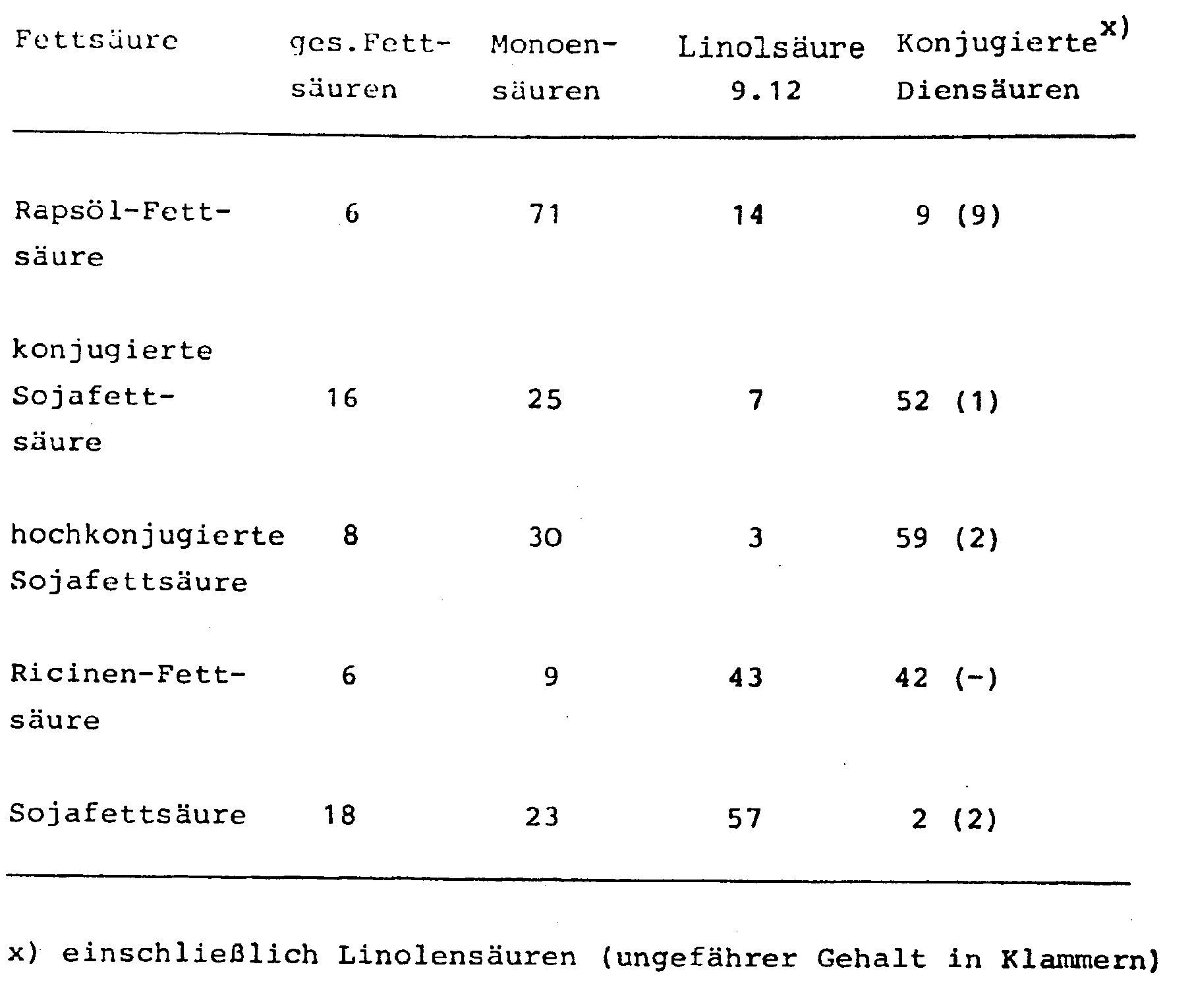

Claims (1)
- Mittelölige, lufttrocknende Alkydharze die pro 100 Gew.-Teile Harz 5 bis 15 Gew.-Teile aromatische Monocarbonsäuren und 41 bis 52 Gew.-Teile Fettsäuren einkondensiert entlialten, wobei 30,0 bis 95,0 Gew.-% der Fettsäuren Diensäuren und der Rest Monoen- und gesättigte Säuren sind mit der Maßgabe, daß die Diensäuren zu einem solchen Teil konjugierte Doppelbindungen enthalten, daß 100 Gew.-Teile 10 bis 33 Gew.-Teile Konjuensäure enthalten und daß das Gewichtsverhältnis von Monoensäuren zu Konjuensäuren 0,3 bis 1,3 ist.
Applications Claiming Priority (2)
| Application Number | Priority Date | Filing Date | Title |
|---|---|---|---|
| DE2742584 | 1977-09-22 | ||
| DE19772742584 DE2742584A1 (de) | 1977-09-22 | 1977-09-22 | Lufttrocknende alkydharze |
Publications (2)
| Publication Number | Publication Date |
|---|---|
| EP0001400A1 true EP0001400A1 (de) | 1979-04-18 |
| EP0001400B1 EP0001400B1 (de) | 1981-02-04 |
Family
ID=6019576
Family Applications (1)
| Application Number | Title | Priority Date | Filing Date |
|---|---|---|---|
| EP78100859A Expired EP0001400B1 (de) | 1977-09-22 | 1978-09-09 | Lufttrocknende Alkydharze |
Country Status (4)
| Country | Link |
|---|---|
| EP (1) | EP0001400B1 (de) |
| DE (2) | DE2742584A1 (de) |
| ES (1) | ES473550A1 (de) |
| IT (1) | IT7851159A0 (de) |
Cited By (2)
| Publication number | Priority date | Publication date | Assignee | Title |
|---|---|---|---|---|
| GB2170373A (en) * | 1984-12-28 | 1986-07-30 | Canon Kk | Image processing method |
| EP0407796A1 (de) * | 1989-07-11 | 1991-01-16 | BASF Lacke + Farben AG | Lufttrocknende Alydharze sowie ihre Verwendung in Beschichtungsmitteln, insbesondere für die Beschichtung von Holz |
Families Citing this family (1)
| Publication number | Priority date | Publication date | Assignee | Title |
|---|---|---|---|---|
| DE2930734A1 (de) | 1979-07-28 | 1981-02-12 | Bayer Ag | Wasserloesliche, lufttrocknende alkydharze, verfahren zu ihrer herstellung und ihre verwendung als grundlage fuer vergilbungsarme lacke |
Citations (3)
| Publication number | Priority date | Publication date | Assignee | Title |
|---|---|---|---|---|
| US2729609A (en) * | 1952-10-16 | 1956-01-03 | Shell Dev | Poly tert-alkyl substituted carbocyclic monocarboxylic acids in alkyd resins |
| DE2637955A1 (de) * | 1976-08-24 | 1978-03-02 | Hoechst Ag | Niedrigviskose alkydharze und verfahren zu ihrer herstellung |
| US4081411A (en) * | 1976-07-30 | 1978-03-28 | Imc Chemical Group, Inc. | Water-dispersed coating composition of short oil alkyd resin and alkanolamine |
-
1977
- 1977-09-22 DE DE19772742584 patent/DE2742584A1/de not_active Withdrawn
-
1978
- 1978-09-09 DE DE7878100859T patent/DE2860392D1/de not_active Expired
- 1978-09-09 EP EP78100859A patent/EP0001400B1/de not_active Expired
- 1978-09-20 IT IT7851159A patent/IT7851159A0/it unknown
- 1978-09-21 ES ES78473550A patent/ES473550A1/es not_active Expired
Patent Citations (3)
| Publication number | Priority date | Publication date | Assignee | Title |
|---|---|---|---|---|
| US2729609A (en) * | 1952-10-16 | 1956-01-03 | Shell Dev | Poly tert-alkyl substituted carbocyclic monocarboxylic acids in alkyd resins |
| US4081411A (en) * | 1976-07-30 | 1978-03-28 | Imc Chemical Group, Inc. | Water-dispersed coating composition of short oil alkyd resin and alkanolamine |
| DE2637955A1 (de) * | 1976-08-24 | 1978-03-02 | Hoechst Ag | Niedrigviskose alkydharze und verfahren zu ihrer herstellung |
Cited By (2)
| Publication number | Priority date | Publication date | Assignee | Title |
|---|---|---|---|---|
| GB2170373A (en) * | 1984-12-28 | 1986-07-30 | Canon Kk | Image processing method |
| EP0407796A1 (de) * | 1989-07-11 | 1991-01-16 | BASF Lacke + Farben AG | Lufttrocknende Alydharze sowie ihre Verwendung in Beschichtungsmitteln, insbesondere für die Beschichtung von Holz |
Also Published As
| Publication number | Publication date |
|---|---|
| DE2742584A1 (de) | 1979-04-05 |
| DE2860392D1 (de) | 1981-03-19 |
| EP0001400B1 (de) | 1981-02-04 |
| ES473550A1 (es) | 1979-04-01 |
| IT7851159A0 (it) | 1978-09-20 |
Similar Documents
| Publication | Publication Date | Title |
|---|---|---|
| EP0708788B1 (de) | Überzugsmittel auf der basis von polyurethanharzen und ihre verwendung | |
| DE1595278C3 (de) | Verfahren zur Herstellung von wasserdispergierbaren Alkydharzen und deren Verwendung | |
| DE3901190A1 (de) | Verfahren zur herstellung von waessrigen, oxidativ trocknenden alkydharzen und ihre verwendung in oder als waessrige lacke und beschichtungsmassen | |
| EP0022518B1 (de) | Wässrige Dispersionen urethanmodifizierter Polyester und Verfahren zu ihrer Herstellung | |
| DE3238864C2 (de) | Wäßrige Harzmasse | |
| EP0264609B1 (de) | Ester- und Ethergruppen enthaltende Polyhydroxylverbindungen als Reaktivverdünner | |
| DE2639491B1 (de) | Einbrennlacke auf der Grundlage von freie Hydroxylgruppen enthaltenden Polyester- und/oder Alkydharzen und blockierten Polyisocyanaten | |
| EP0001400B1 (de) | Lufttrocknende Alkydharze | |
| EP0544722B1 (de) | Verwendung von polyesterharzen als haftschmelzklebstoffe | |
| EP0096196B1 (de) | Methacrylsäureester als Reaktivverdünner für oxidativ vernetzbare Alkydharze und deren Herstellung | |
| EP0002488A1 (de) | Verfahren zur Herstellung von wasseremulgierbaren lufttrocknenden Lackbindemitteln | |
| WO1993005119A1 (de) | Verwendung der fettsäureester von alkadienylethern von polyolen als reaktivverdünner | |
| AT405647B (de) | Thixotrope alkydharz-zusammensetzungen | |
| DE2903022A1 (de) | Feinteilige waessrige polyesterdispersionen, verfahren zu ihrer herstellung und ihre verwendung | |
| DE1077816B (de) | Verfahren zur Herstellung von Elektroisolierlacken | |
| EP0035666B1 (de) | Verfahren zur Herstellung von Zumischharzen zur Thixotropierung von langöligen Alkydharzen | |
| DE3725259A1 (de) | Reaktivverduenner fuer oxidativ trocknende bindemittel | |
| EP0553663A1 (de) | Verfahren zur Herstellung von thixotropen Lackbindemitteln auf Alkydharzbasis | |
| EP0004402A1 (de) | Verwendung von modifiziertem Novolak als Verstärkerharz für Kunststoffe, Kautschuk oder Kautschuk enthaltende Klebstoffe | |
| DE738254C (de) | Verfahren zur Herstellung von trocknenden OElen bzw. zur Verbesserung fetter, trocknender OEle | |
| DE2161253A1 (de) | Verfahren zur herstellung von alkydharzen | |
| DE804017C (de) | Nitrocelluloselack und -Auftragsmasse | |
| AT210138B (de) | Stabile Pasten auf Basis Polyvinylchlorid | |
| DE3922702A1 (de) | Lufttrocknende alkydharze sowie ihre verwendung in beschichtungsmitteln, insbesondere fuer die beschichtung von holz | |
| DE2342879C3 (de) | Anstrichmittelstoffzusammensetzungen |
Legal Events
| Date | Code | Title | Description |
|---|---|---|---|
| PUAI | Public reference made under article 153(3) epc to a published international application that has entered the european phase |
Free format text: ORIGINAL CODE: 0009012 |
|
| 17P | Request for examination filed | ||
| AK | Designated contracting states |
Designated state(s): BE CH DE FR GB NL SE |
|
| GRAA | (expected) grant |
Free format text: ORIGINAL CODE: 0009210 |
|
| AK | Designated contracting states |
Designated state(s): BE CH DE FR GB NL SE |
|
| REF | Corresponds to: |
Ref document number: 2860392 Country of ref document: DE Date of ref document: 19810319 |
|
| PLBI | Opposition filed |
Free format text: ORIGINAL CODE: 0009260 |
|
| 26 | Opposition filed |
Opponent name: UNILEVER N.V. Effective date: 19811104 Opponent name: HOECHST AKTIENGESELLSCHAFT Effective date: 19811028 Opponent name: WORLEE-CHEMIE GMBH Effective date: 19811028 |
|
| PGFP | Annual fee paid to national office [announced via postgrant information from national office to epo] |
Ref country code: DE Payment date: 19840828 Year of fee payment: 7 |
|
| PGFP | Annual fee paid to national office [announced via postgrant information from national office to epo] |
Ref country code: FR Payment date: 19840830 Year of fee payment: 7 |
|
| PGFP | Annual fee paid to national office [announced via postgrant information from national office to epo] |
Ref country code: SE Payment date: 19840930 Year of fee payment: 7 Ref country code: NL Payment date: 19840930 Year of fee payment: 7 Ref country code: BE Payment date: 19840930 Year of fee payment: 7 |
|
| PGFP | Annual fee paid to national office [announced via postgrant information from national office to epo] |
Ref country code: CH Payment date: 19841128 Year of fee payment: 7 |
|
| RDAG | Patent revoked |
Free format text: ORIGINAL CODE: 0009271 |
|
| STAA | Information on the status of an ep patent application or granted ep patent |
Free format text: STATUS: PATENT REVOKED |
|
| 27W | Patent revoked |
Effective date: 19841109 |
|
| GBPR | Gb: patent revoked under art. 102 of the ep convention designating the uk as contracting state | ||
| REG | Reference to a national code |
Ref country code: CH Ref legal event code: PL |
|
| NLR2 | Nl: decision of opposition | ||
| BERE | Be: lapsed |
Owner name: BAYER A.G. Effective date: 19850909 |
|
| REG | Reference to a national code |
Ref country code: FR Ref legal event code: ST |
|
| EUG | Se: european patent has lapsed |
Ref document number: 78100859.4 Effective date: 19860729 |
|
| PLAB | Opposition data, opponent's data or that of the opponent's representative modified |
Free format text: ORIGINAL CODE: 0009299OPPO |