EP0001974A1 - Bande avec tête de fermeture - Google Patents
Bande avec tête de fermeture Download PDFInfo
- Publication number
- EP0001974A1 EP0001974A1 EP78100989A EP78100989A EP0001974A1 EP 0001974 A1 EP0001974 A1 EP 0001974A1 EP 78100989 A EP78100989 A EP 78100989A EP 78100989 A EP78100989 A EP 78100989A EP 0001974 A1 EP0001974 A1 EP 0001974A1
- Authority
- EP
- European Patent Office
- Prior art keywords
- strap
- tongue
- tie
- floor
- locking head
- Prior art date
- Legal status (The legal status is an assumption and is not a legal conclusion. Google has not performed a legal analysis and makes no representation as to the accuracy of the status listed.)
- Withdrawn
Links
- 239000002184 metal Substances 0.000 claims abstract description 11
- 210000002105 tongue Anatomy 0.000 description 37
- 239000004033 plastic Substances 0.000 description 7
- 239000004020 conductor Substances 0.000 description 6
- 238000005266 casting Methods 0.000 description 3
- 230000003321 amplification Effects 0.000 description 2
- 238000005452 bending Methods 0.000 description 2
- 230000018109 developmental process Effects 0.000 description 2
- 230000000977 initiatory effect Effects 0.000 description 2
- 238000009413 insulation Methods 0.000 description 2
- 239000000463 material Substances 0.000 description 2
- 238000003199 nucleic acid amplification method Methods 0.000 description 2
- ATJFFYVFTNAWJD-UHFFFAOYSA-N Tin Chemical compound [Sn] ATJFFYVFTNAWJD-UHFFFAOYSA-N 0.000 description 1
- 230000032683 aging Effects 0.000 description 1
- 235000013405 beer Nutrition 0.000 description 1
- 230000015556 catabolic process Effects 0.000 description 1
- 238000010276 construction Methods 0.000 description 1
- 230000007797 corrosion Effects 0.000 description 1
- 238000005260 corrosion Methods 0.000 description 1
- 238000005520 cutting process Methods 0.000 description 1
- 238000006731 degradation reaction Methods 0.000 description 1
- 238000009434 installation Methods 0.000 description 1
- 238000004519 manufacturing process Methods 0.000 description 1
- 238000004080 punching Methods 0.000 description 1
- 230000005855 radiation Effects 0.000 description 1
- 238000009877 rendering Methods 0.000 description 1
- 230000000717 retained effect Effects 0.000 description 1
- 229910001220 stainless steel Inorganic materials 0.000 description 1
- 239000010935 stainless steel Substances 0.000 description 1
- 230000035882 stress Effects 0.000 description 1
- 230000003319 supportive effect Effects 0.000 description 1
- 239000012815 thermoplastic material Substances 0.000 description 1
- 210000003462 vein Anatomy 0.000 description 1
- 239000011800 void material Substances 0.000 description 1
- 238000003466 welding Methods 0.000 description 1
Images



Classifications
-
- B—PERFORMING OPERATIONS; TRANSPORTING
- B65—CONVEYING; PACKING; STORING; HANDLING THIN OR FILAMENTARY MATERIAL
- B65D—CONTAINERS FOR STORAGE OR TRANSPORT OF ARTICLES OR MATERIALS, e.g. BAGS, BARRELS, BOTTLES, BOXES, CANS, CARTONS, CRATES, DRUMS, JARS, TANKS, HOPPERS, FORWARDING CONTAINERS; ACCESSORIES, CLOSURES, OR FITTINGS THEREFOR; PACKAGING ELEMENTS; PACKAGES
- B65D63/00—Flexible elongated elements, e.g. straps, for bundling or supporting articles
- B65D63/02—Metallic straps, tapes, or bands; Joints between ends thereof
- B65D63/06—Joints produced by application of separate securing members, e.g. by deformation thereof
- B65D63/08—Joints using buckles, wedges, or like locking members attached to the ends of the elements
-
- Y—GENERAL TAGGING OF NEW TECHNOLOGICAL DEVELOPMENTS; GENERAL TAGGING OF CROSS-SECTIONAL TECHNOLOGIES SPANNING OVER SEVERAL SECTIONS OF THE IPC; TECHNICAL SUBJECTS COVERED BY FORMER USPC CROSS-REFERENCE ART COLLECTIONS [XRACs] AND DIGESTS
- Y10—TECHNICAL SUBJECTS COVERED BY FORMER USPC
- Y10T—TECHNICAL SUBJECTS COVERED BY FORMER US CLASSIFICATION
- Y10T24/00—Buckles, buttons, clasps, etc.
- Y10T24/14—Bale and package ties, hose clamps
- Y10T24/1457—Metal bands
- Y10T24/1482—Ratchet and tool tightened band clamp
Definitions
- the present invention relates generally to bundling and attachment apparatus and more specifically to a tie for forming a plurality of elongate objects into a bundle and holding a pair of objects together.
- Cable ties formed of thermoplastic material have beer developed during the last twenty years and such ties have become increasingly popular for a variety of bundling and attachment applications because of their relatively low initial cost and their ease of installation.
- plastic ties have limitations when compared to ties formed of metal. More specifically, plastic straps tend to become brittle when used at low temperature and have less desirable aging characteristics than similar metal straps; e.g., when used in a high temperature, high humidity environment, plastic ties may exhibit some elongation. Additionally, plastic ties are inappropriate for certain nuclear powerplant applications since radi- ation can result in degradation of the plastic material thereby rendering the strap more brittle. Also where it is desired to use the tie as a load carrying member the metal tie is sometimes preferable since it has the greater tensible strength.
- Several self-locking bundling devices formed from metal have been proposed. Typically they include a strap having a plurality of regularly spaced vanes struck from the blank from which the strap is formed and extending at an angle relative to the strap surface. After the strap is positioned to encompass the objects to be held, strap portions must be overlapped so that the vanes of the respective strap portions interleave. Generally a keeper is provided which encircles the overlapped strap portions to hold them in engagement. The locking vanes extend from either one or both surfaces of the strap. If the vanes extend from the surface of the strap disposed adjacent the held objects, the relatively sharp edges of the vanes could damage the objects, particularly if they are insulated electrical conductors.
- Some bundling devices of this class include a keeper which is fixed to the strap. It will be appreciated that with this configuration forces required to thread the free end of the strap through the. keeper are relatively high as a plurality of vanes must be simultaneously deflected. Reference may be made to U.S. Patents Nos. 3,311,957, 3,694,863 and 3,964,133 which show examples of such prior art bundling devices.
- Metallic hose clamps have been proposed which include a locking head joined to one end of the strap and have a locking tongue for reception in apertures spaced along the strap.
- the tongues used in these clamps are in the form of a short beam thus requiring relatively high threading force to deflect the tongue. Additionally, the tongue typically extends outside the locking head making the clamps inappropriate for use with a tool which severs the excess threaded portion of the strap flush with the locking head. Examples of such prior art hose clamps are shown in U.S. Patents Nos. 3,189,961 and 3,748,697.
- an improved self-locking tie for forming objects into a bundle and for holding a pair of objects together; the provision of such a tie which makes it satisfactory for use in high temperature, low temperature and other harsh environments; the provision of such a tie which permits tightening without damaging the held objects; the provision of such a tie which has high tensile strength and relatively low threading force and the provision of such a tie which is lightweight, has long service life and is simple and economical to manufacture.
- the tie of the present invention includes an elongate strap and a metal locking head joined to the strap.
- the strap has a plurality of spaced abutments and the head includes a floor having a strap-receiving aperture and a locking tongue for engaging one of the abutments.
- the tongue and floor are joined by a resilient neck with the tongue extending from the neck towards the floor to at least partially overlie the aperture.
- Tie 20 comprises an elongate strap 22 joined to an elongate locking head 24 for receiving and holding the free end of the strap.
- Tie 20 is preferably made of metal and, more particularly, stainless steel to have high strength, be corrosion resistant, and to be usable over a wide temperature range.
- the strap and head can be integrally formed or can be joined by any suitable means, for example, by spot welding.
- the strap and the head are preferably formed from stock having a thickness of .008 inch.
- locking head 24 includes a floor 26 having a strap-receiving aperture 28 and further includes a locking tongue 30 joined to the floor by a resilient neck 32 with the tongue tapering as it extends from the neck towards the floor to overlie aperture 28 so as to be reflected upon threading of the strap into the head.
- Strap 22 is provided with a plurality of longitudinally spaced apertures 34 for sequentially receiving tongue 30 as the strap is threaded into locking head 24.
- Each aperture 34 is partially defined by a transverse surface 36 serving as an abutment for locking tongue 30.
- a flat metal blank is shown from which locking head 24 is formed.
- the blank or components thereof generally corresponding to the head or components thereof except for punching or bending or folding are designated by applying a prime (') to the reference numeral assigned the locking head or component thereof.
- Blank 24' has an elongate floor portion, 26' from which extend in opposite directions a lip 38 for connection to one end of strap 22, and an extension 40 which is folded back to overlie floor 26 thereby forming neck 32 and tongue 30.
- locking head 24 includes stop means for abutting tongue 30 upon attempted removal of the strap from the locking head.
- the stop means comprises a platform 42 raised relative to floor 26 and including a guide surface 44 for directing the leading end of the strap into strap-receiving aperture 28.
- Platform 42 is. preferably struck from floor portion 26'.
- blank 24' further comprises a pair of arms 46 extending laterally in opposite directions from floor portion 26'.
- Each arm 46 is bent to extend substantially perpendicular to floor 26 to form side walls 48 of the head, as shown in Fig. 3, and bent again so that the distal end of the arms are facing thereby forming a ceiling 50 of locking head 24.
- Floor 26, side walls 48, and ceiling 50 define a strap exit face 52 of the locking head.
- Ceiling 50 includes a surface 54, see Fig. 2, for guiding the leading end of strap 22 toward exit face 52 as the strap is threaded into the locking head.
- Locking tongue 30 is movable between a threading position, shown in Fig. 5, wherein the tongue is deflected away from floor 26 and out of locking engagement with strap 22, and a locking position, shown in Fig. 6, wherein tongue 30 engages platform 42 and extends through one of the strap apertures 34, securely engaging abutment 36 to preclude removal of the strap from the locking head.
- the stop means of locking head 24 alternatively comprises a surface 56 of floor 26 for engaging the end of tongue 30.
- the stop means comprises both platform 42 and surface 56.
- neck 32 functions to bias tongue 30 toward its locking position
- the neck and tongue form a relatively long beam making the tongue easily deflectable toward its threading position thereby providing low force threading of the strap.
- the spring constant of the tongue and neck can be varied by adjusting the dimension of the neck and/or tongue.
- the locking tongue in all its positions, is completely disposed within the chamber defined by the side walls, ceiling and floor thereby making the tie of the present invention susceptible for use with a strap-tightening tool of the well-known type which reacts against the locking head's exit face to tighten the strap and is responsive to the development of a predetermined tension in the strap to sever the excess threaded portion of the strap generally flush with the strap exit face.
- a strap-tightening tool of the well-known type which reacts against the locking head's exit face to tighten the strap and is responsive to the development of a predetermined tension in the strap to sever the excess threaded portion of the strap generally flush with the strap exit face.
- a simple hand tool e.g. a tin snips.
- both sides of strap 22 are relatively flat and smooth.
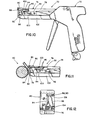
- Tool 70 is a modified version of a tool for tightening and severing the strap of a plastic cable tie, the latter tool being fully shown and described in commonly assigned U.S. Patent No. 3,661,187, the teachings of the patent being incorporated herein by reference.
- Tool 70 includes a butt portion 72 comprising force amplification means for developing a predetermined tension in the strap and further comprising means for initiating cutoff of the excess portion of the strap responsive to the development of the desired strap tension. Butt portion 72 need not further be discussed as it is identical to that shown in the patent.
- Tool 70 further comprises a nose portion 74 including components for gripping the strap and for severing the excess portion of the strap after the desired strap tension has been achieved.
- Nose portion 74 is similar to that shown in the patent so only those components which have been modified or added to accomodate a metal strap, as opposed to a plastic strap, will be fully discussed.
- nose portion 74 terminates in a cutter blade assembly including a cutter blade housing 76 attached to the main casting 78 of the tool.
- housing 76 Affixed to housing 76 is a cutter cap 80 with the housing and cap having spaced walls 82, 84, respectively, defining a void in which a cutter 86 is slidably retained.
- Walls 82 and 84 have respectively aligned slots 88, 90 for receiving strap 22 with cutter 86 underlying the strap.
- Nose portion 74 also includes a tensioning rod 92 attached to the force amplification means in butt portion 72. Pivotally attached to rod 92 is a gripper 94 having a set of spaced teeth 96 for being received in apertures 34 of strap 22. Gripper 94 is spring biased to an engagement position, shown in Fig. 11, wherein teeth 96 are received within strap apertures 34 and is rotatable therefrom to a release or threading position, shown in Fig. 10, wherein teeth 96 are disengaged from the strap. A triangular abutment 98 extending from casting 78 functions to cam the gripper to its release position. Rod 92 carries a laterally extending finger 100 cooperating with gripper 94 to hold the strap 22 therebetween.
- a cutter lever arm 102 underlying rod 92 is pivoally connected to casting 78 by a pin 103 and extends through an opening in wall 82 of cutter blade housing 76. Arm 102 terminates in a pair of spaced, parallel fingers 104, see Fig. 12, received within slots in cutter 86 for controlling movement of the cutter.
- Cutter 86 includes a knife edge 106 for severing the strap, the edge (as shown in Fig. 12) being angled at about three degrees with respect to the lower surface of the strap 22 so that the entire knife edge does not simultaneously engage the strap. Angling the knife edge causes a localized stress concentration in the strap so that cutter 86'severs with a slicing action. It will be appreciated that when the desired strap tension is achieved, the cutoff initiation means causes cutter lever arm 102 to pivot about pin 103 with the result that cutter 86 is driven upwardly to sever strap 22.
- FIG. 7 An alternate embodiment of the present invention is shown in Fig. 7 at reference numeral 20A.
- Components of tie 20A corresponding to components of the embodiment of the tie of the present invention previously described are indicated by the addition of the suffix "A" to the reference numeral.
- Tie 20A is preferable for applications where extremely high tensions are to be developed in the strap.
- Strap 22A and head 24A preferably have thicknesses of .016 inch.
- the free end of tongue 30A of locking head 24A is bifurcated, terminating a pair of parallel tines 60 which are preferably more sharply inclined toward floor 26A than the remainder of tongue 30A, as shown in Fig. 8.
- a pair of spaced apertures 62 are provided in floor 26A for receiving tines 60 as will be described more fully hereinafter.
- Strap 22A includes two parallel rows of spaced apertures 34A with adjacent ones of each row forming pairs for concurrently receiving tines 60 as strap 22A is threaded into locking head 24A.
- tie 20A Operation of tie 20A is similar to that of tie 20 previously described.Note however that after release of a heavily tensioned strap 30A, the strap withdrawal force due to the resiliency of the bundled objects might cause tines 60 to slide along floor support surface 56A in the direction of strap-receiving aperture 28A. But upon the tines' entrance into tine-receiving aperture 62, surfaces partially defining the apertures serve as abutments to restrain further movement of the tines toward the strap-receiving opening 28A. Thus failure of tie 20A due to the tines 60 being deformed about platform 42A so that the tine ends extend through opening 28A is precluded.
- FIG. 9 An alternative embodiment of the locking head of the present invention is shown in Fig. 9 at reference numeral 24B.
- Components of locking head 24B corresponding to components of locking head 24 previously described are indicated by the addition of the suffix "B" to the reference numeral.
- the stop means of head 24B instead of comprising a platform, comprises a well 64 for engaging tongue 30B upon attempted retrograde movement of the strap.
- the free end of the tongue is preferably directed more sharply toward floor 26B than the remainder of the tongue. Operation of head 24B is similar to that of locking head 24 heretofore described.
- Locking head 24C is similar to locking head 24A except that struck from ceiling 50C are a pair of tabs 110 adjacent strap exit face 52C which extend toward the floor 26C. Tabs 110, spaced sufficiently that locking tongue 30C can be deflected therebetween, constitute means for limiting the angle of egress of the excess threaded portion of the strap relative to the exit face of the locking head.
- tie of the present invention has been heretofore described in the context of a conductor bundling application it will be appreciated that such ties are also ideally suited for hose clamp applications or other applications where it is described to hold two objects in telescopic relationship.
Landscapes
- Engineering & Computer Science (AREA)
- Mechanical Engineering (AREA)
- Clamps And Clips (AREA)
- Package Frames And Binding Bands (AREA)
Applications Claiming Priority (2)
| Application Number | Priority Date | Filing Date | Title |
|---|---|---|---|
| US05/836,272 US4128919A (en) | 1977-09-26 | 1977-09-26 | Metal tie |
| US836272 | 1977-09-26 |
Publications (1)
| Publication Number | Publication Date |
|---|---|
| EP0001974A1 true EP0001974A1 (fr) | 1979-05-30 |
Family
ID=25271598
Family Applications (1)
| Application Number | Title | Priority Date | Filing Date |
|---|---|---|---|
| EP78100989A Withdrawn EP0001974A1 (fr) | 1977-09-26 | 1978-09-25 | Bande avec tête de fermeture |
Country Status (2)
| Country | Link |
|---|---|
| US (1) | US4128919A (fr) |
| EP (1) | EP0001974A1 (fr) |
Cited By (3)
| Publication number | Priority date | Publication date | Assignee | Title |
|---|---|---|---|---|
| WO1986007333A1 (fr) * | 1985-06-07 | 1986-12-18 | Bowthorpe-Hellermann Limited | Attache metallique |
| US6076234A (en) * | 1997-03-26 | 2000-06-20 | Thomas & Betts Corporation | In-line cable tie |
| RU2364559C1 (ru) * | 2007-12-06 | 2009-08-20 | Открытое акционерное общество "Синарский трубный завод" (ОАО "СинТЗ") | Способ изготовления замков для скрепления стальной строповочной ленты при обвязке пакетов труб |
Families Citing this family (15)
| Publication number | Priority date | Publication date | Assignee | Title |
|---|---|---|---|---|
| FR2505449B1 (fr) * | 1981-05-05 | 1985-10-25 | Svenningson Ingemar | Collier de serrage |
| US4765032A (en) * | 1987-03-11 | 1988-08-23 | Thomas & Betts Corporation | Environmental bundling tie |
| US4897899A (en) * | 1987-10-09 | 1990-02-06 | All States Inc. | Cable tie |
| US4788751A (en) * | 1987-10-09 | 1988-12-06 | All-States Inc. | Cable tie |
| US6668427B2 (en) | 2002-05-02 | 2003-12-30 | Panduit Corp. | Ball lock cable tie having an aggressive ramp |
| US6647596B1 (en) | 2002-05-02 | 2003-11-18 | Panduit Corp. | Ball lock cable tie having a strap aperture |
| USD530600S1 (en) | 2004-10-18 | 2006-10-24 | Panduit Corp. | Cable tie |
| US7373695B2 (en) * | 2005-05-26 | 2008-05-20 | Panduit Corp. | Displacement lock MLT |
| US7484274B2 (en) * | 2005-06-07 | 2009-02-03 | Band-It-Idex, Inc. | Free end band and seal |
| US8146212B2 (en) * | 2005-06-07 | 2012-04-03 | Band-It-Idex, Inc. | Free end band |
| US8225461B2 (en) * | 2007-05-30 | 2012-07-24 | Panduit Corp. | Cable tie having band thread force reduction |
| MX2010004881A (es) | 2007-11-02 | 2010-08-02 | Band It Idex Inc | Abrazadera de banda de doble seguro y metodo para formar la misma. |
| US8356641B2 (en) | 2007-11-02 | 2013-01-22 | Band-It-Idex, Inc. | Stationary band clamping apparatus |
| US9126732B2 (en) * | 2011-05-06 | 2015-09-08 | Panduit Corp. | Retained tension metal locking tie and pneumatic hand tool |
| US9061807B2 (en) | 2012-05-08 | 2015-06-23 | Thomas & Betts International, Inc. | Cable tie head |
Citations (4)
| Publication number | Priority date | Publication date | Assignee | Title |
|---|---|---|---|---|
| US3261062A (en) * | 1964-03-23 | 1966-07-19 | Frank Holister Co Inc | Clamp assembly for hose, pipe and other articles |
| GB1306175A (fr) * | 1970-07-02 | 1973-02-07 | ||
| GB1439156A (en) * | 1972-06-09 | 1976-06-09 | Dennison Mfg Co | Harnessing devices |
| DE2461338B2 (de) * | 1974-12-24 | 1976-10-07 | Rasmussen Gmbh, 6457 Maintal | Vorrichtung zum einspannen von rohren, schlaeuchen oder dergleichen mit einer bandschelle, sowie werkzeug und bandschelle fuer diese vorrichtung |
Family Cites Families (4)
| Publication number | Priority date | Publication date | Assignee | Title |
|---|---|---|---|---|
| US747811A (en) * | 1903-08-10 | 1903-12-22 | Ward C Walker | Hose-clamp. |
| US811343A (en) * | 1905-07-07 | 1906-01-30 | Ward C Walker | Hose-clamp. |
| US1176181A (en) * | 1914-06-08 | 1916-03-21 | Joseph B Thomas | Leg-band for fowls. |
| US3748697A (en) * | 1971-12-20 | 1973-07-31 | L Marchese | Clamp assembly for hose, pipe and like articles |
-
1977
- 1977-09-26 US US05/836,272 patent/US4128919A/en not_active Expired - Lifetime
-
1978
- 1978-09-25 EP EP78100989A patent/EP0001974A1/fr not_active Withdrawn
Patent Citations (4)
| Publication number | Priority date | Publication date | Assignee | Title |
|---|---|---|---|---|
| US3261062A (en) * | 1964-03-23 | 1966-07-19 | Frank Holister Co Inc | Clamp assembly for hose, pipe and other articles |
| GB1306175A (fr) * | 1970-07-02 | 1973-02-07 | ||
| GB1439156A (en) * | 1972-06-09 | 1976-06-09 | Dennison Mfg Co | Harnessing devices |
| DE2461338B2 (de) * | 1974-12-24 | 1976-10-07 | Rasmussen Gmbh, 6457 Maintal | Vorrichtung zum einspannen von rohren, schlaeuchen oder dergleichen mit einer bandschelle, sowie werkzeug und bandschelle fuer diese vorrichtung |
Cited By (3)
| Publication number | Priority date | Publication date | Assignee | Title |
|---|---|---|---|---|
| WO1986007333A1 (fr) * | 1985-06-07 | 1986-12-18 | Bowthorpe-Hellermann Limited | Attache metallique |
| US6076234A (en) * | 1997-03-26 | 2000-06-20 | Thomas & Betts Corporation | In-line cable tie |
| RU2364559C1 (ru) * | 2007-12-06 | 2009-08-20 | Открытое акционерное общество "Синарский трубный завод" (ОАО "СинТЗ") | Способ изготовления замков для скрепления стальной строповочной ленты при обвязке пакетов труб |
Also Published As
| Publication number | Publication date |
|---|---|
| US4128919A (en) | 1978-12-12 |
Similar Documents
| Publication | Publication Date | Title |
|---|---|---|
| US4128919A (en) | Metal tie | |
| US6076234A (en) | In-line cable tie | |
| EP0065543B1 (fr) | Attache metallique | |
| US3991444A (en) | Releasable cable tie | |
| US7753321B2 (en) | Harness clamp tie | |
| US9334091B2 (en) | Cable lacing tie devices and methods of using the same | |
| US9555943B2 (en) | Cable lacing tie devices and methods of using the same | |
| US4498507A (en) | Cable tie | |
| US5267373A (en) | Cable tie with strap tip guide ramp | |
| US7956285B2 (en) | Floor stand for mounting an electrical box | |
| EP0420452A1 (fr) | Collier de serrage pour câble comportant une bande en forme d'échelle | |
| JPH09189377A (ja) | ケーブル・タイ・ストラップ | |
| WO1996000176A1 (fr) | Bandes de fixation | |
| US3966154A (en) | Cable hanger | |
| US4154418A (en) | One-piece cable strap | |
| US6477746B1 (en) | Releasable ball-lock cable tie | |
| US8365418B2 (en) | Cable tie removal tool | |
| EP0656501A2 (fr) | Dispositif de fixation pour un faisceau de câbles | |
| EP2967201B1 (fr) | Dispositif de lien d'entrelacement de câbles | |
| JP3112249B2 (ja) | 結束バンド | |
| EP0579516A1 (fr) | Elément de fixation d'un câble électrique | |
| GB2089885A (en) | Cable strap | |
| US4694958A (en) | Safety strip for wire hook fasteners | |
| JP3245369U (ja) | ケーブル誤切断防止治具 | |
| AU539762B2 (en) | Metal tie |
Legal Events
| Date | Code | Title | Description |
|---|---|---|---|
| PUAI | Public reference made under article 153(3) epc to a published international application that has entered the european phase |
Free format text: ORIGINAL CODE: 0009012 |
|
| AK | Designated contracting states |
Designated state(s): CH DE FR GB NL SE |
|
| 17P | Request for examination filed | ||
| STAA | Information on the status of an ep patent application or granted ep patent |
Free format text: STATUS: THE APPLICATION IS DEEMED TO BE WITHDRAWN |
|
| 18D | Application deemed to be withdrawn |
Effective date: 19811205 |
|
| RIN1 | Information on inventor provided before grant (corrected) |
Inventor name: BEGITSCHKE, BRUCE A. Inventor name: BULANDA, JOHN J. Inventor name: GUZAY, CASIMIR M. |