EP0001991B1 - Composés de phosphonium, procédé pour leur préparation et procédé de préparation d'azurants optiques à base de stilbènes substitués asymétriquement - Google Patents
Composés de phosphonium, procédé pour leur préparation et procédé de préparation d'azurants optiques à base de stilbènes substitués asymétriquement Download PDFInfo
- Publication number
- EP0001991B1 EP0001991B1 EP78101232A EP78101232A EP0001991B1 EP 0001991 B1 EP0001991 B1 EP 0001991B1 EP 78101232 A EP78101232 A EP 78101232A EP 78101232 A EP78101232 A EP 78101232A EP 0001991 B1 EP0001991 B1 EP 0001991B1
- Authority
- EP
- European Patent Office
- Prior art keywords
- formula
- atoms
- hydrogen
- alkyl
- chlorine
- Prior art date
- Legal status (The legal status is an assumption and is not a legal conclusion. Google has not performed a legal analysis and makes no representation as to the accuracy of the status listed.)
- Expired
Links
- 0 CC(CC1)CCC1C1=CC=*CC1 Chemical compound CC(CC1)CCC1C1=CC=*CC1 0.000 description 6
- GZJJANJCRZOBNU-DWJQMLCTSA-N CC(/C(/C)=N\C)=N Chemical compound CC(/C(/C)=N\C)=N GZJJANJCRZOBNU-DWJQMLCTSA-N 0.000 description 1
- CCWPHJDRQBFVIB-XNTDXEJSSA-N Cc(cc1)ccc1-c1ccc(/C=C/c(cccc2)c2S(O)(=O)=O)cc1 Chemical compound Cc(cc1)ccc1-c1ccc(/C=C/c(cccc2)c2S(O)(=O)=O)cc1 CCWPHJDRQBFVIB-XNTDXEJSSA-N 0.000 description 1
Classifications
-
- C—CHEMISTRY; METALLURGY
- C07—ORGANIC CHEMISTRY
- C07D—HETEROCYCLIC COMPOUNDS
- C07D319/00—Heterocyclic compounds containing six-membered rings having two oxygen atoms as the only ring hetero atoms
- C07D319/04—1,3-Dioxanes; Hydrogenated 1,3-dioxanes
- C07D319/08—1,3-Dioxanes; Hydrogenated 1,3-dioxanes condensed with carbocyclic rings or ring systems
-
- C—CHEMISTRY; METALLURGY
- C07—ORGANIC CHEMISTRY
- C07C—ACYCLIC OR CARBOCYCLIC COMPOUNDS
- C07C309/00—Sulfonic acids; Halides, esters, or anhydrides thereof
-
- C—CHEMISTRY; METALLURGY
- C07—ORGANIC CHEMISTRY
- C07D—HETEROCYCLIC COMPOUNDS
- C07D249/00—Heterocyclic compounds containing five-membered rings having three nitrogen atoms as the only ring hetero atoms
- C07D249/02—Heterocyclic compounds containing five-membered rings having three nitrogen atoms as the only ring hetero atoms not condensed with other rings
- C07D249/04—1,2,3-Triazoles; Hydrogenated 1,2,3-triazoles
- C07D249/06—1,2,3-Triazoles; Hydrogenated 1,2,3-triazoles with aryl radicals directly attached to ring atoms
-
- C—CHEMISTRY; METALLURGY
- C07—ORGANIC CHEMISTRY
- C07D—HETEROCYCLIC COMPOUNDS
- C07D317/00—Heterocyclic compounds containing five-membered rings having two oxygen atoms as the only ring hetero atoms
- C07D317/08—Heterocyclic compounds containing five-membered rings having two oxygen atoms as the only ring hetero atoms having the hetero atoms in positions 1 and 3
- C07D317/44—Heterocyclic compounds containing five-membered rings having two oxygen atoms as the only ring hetero atoms having the hetero atoms in positions 1 and 3 ortho- or peri-condensed with carbocyclic rings or ring systems
- C07D317/46—Heterocyclic compounds containing five-membered rings having two oxygen atoms as the only ring hetero atoms having the hetero atoms in positions 1 and 3 ortho- or peri-condensed with carbocyclic rings or ring systems condensed with one six-membered ring
- C07D317/48—Methylenedioxybenzenes or hydrogenated methylenedioxybenzenes, unsubstituted on the hetero ring
- C07D317/50—Methylenedioxybenzenes or hydrogenated methylenedioxybenzenes, unsubstituted on the hetero ring with only hydrogen atoms, hydrocarbon or substituted hydrocarbon radicals, directly attached to atoms of the carbocyclic ring
- C07D317/56—Radicals substituted by sulfur atoms
-
- C—CHEMISTRY; METALLURGY
- C07—ORGANIC CHEMISTRY
- C07F—ACYCLIC, CARBOCYCLIC OR HETEROCYCLIC COMPOUNDS CONTAINING ELEMENTS OTHER THAN CARBON, HYDROGEN, HALOGEN, OXYGEN, NITROGEN, SULFUR, SELENIUM OR TELLURIUM
- C07F9/00—Compounds containing elements of Groups 5 or 15 of the Periodic Table
- C07F9/02—Phosphorus compounds
- C07F9/28—Phosphorus compounds with one or more P—C bonds
- C07F9/54—Quaternary phosphonium compounds
- C07F9/5449—Polyphosphonium compounds
-
- C—CHEMISTRY; METALLURGY
- C07—ORGANIC CHEMISTRY
- C07F—ACYCLIC, CARBOCYCLIC OR HETEROCYCLIC COMPOUNDS CONTAINING ELEMENTS OTHER THAN CARBON, HYDROGEN, HALOGEN, OXYGEN, NITROGEN, SULFUR, SELENIUM OR TELLURIUM
- C07F9/00—Compounds containing elements of Groups 5 or 15 of the Periodic Table
- C07F9/02—Phosphorus compounds
- C07F9/28—Phosphorus compounds with one or more P—C bonds
- C07F9/54—Quaternary phosphonium compounds
- C07F9/5456—Arylalkanephosphonium compounds
Definitions
- the invention relates to new phosphonium compounds, a process for their preparation and a process for the preparation of asymmetrically substituted stilbene brighteners.
- X is phenylene, 4,4'-biphenylene or 1,4- or 2,6-naphthylene and Y ⁇ S0 3 ⁇ , SO 2 ⁇ or COO ⁇ .
- Preferred alkyl radicals R are those having 1 to 4 carbon atoms, in particular the isopropyl and n-butyl radical.
- the preferred cycloalkyl radical is the cyclohexyl radical.
- the 5- or 6-membered saturated heterocyclic rings ⁇ NX 1 X 2 are preferably the pyrrolidine, morpholine and piperidine radical.
- the compounds of formula (1) are present as internal salts.
- substituents of the radicals R chlorine, bromine, fluorine, C 1 ⁇ C 8 alkyl, C 3 ⁇ C 7 alkenyl, C 5 ⁇ C 7 cycloalkyl , C 1 ⁇ C 8 alkoxy, C 2 ⁇ C 12 alkoxyalkoxy, phenoxy, phenyl, cyano, carboxy, carbalkoxy, sulfo.
- Preferred substituents are in general C 1 -C 4 alkyl or alkoxy, C 3 or C 4 alkenyl, fluorine, chlorine, bromine, C 2 -C 5 -carbalkoxy and sulfo. If R 1 also carries substituents in addition to Y ⁇ , these are preferably 1 or 2 substituents.
- “Sulfo” and “carboxy” are understood to mean the groups ⁇ SO 3 H or ⁇ COOH and their salts, in particular their alkali metal, alkaline earth metal, ammonium or amine salts.
- the group SO 3 die and COOe, in particular the group SO 3 ⁇ , are preferred as group Y ⁇ .
- the phosphonium compounds of the formulas (1) to (8) are produced by a new process which is also an object of the invention
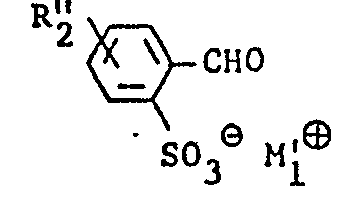
- This process for the preparation of the compounds of the formula (1) is characterized in that a phosphonium compound of the formula wherein R and X have the meaning given in formula (1) and 0 8 is an anion, in the presence of a strongly basic compound and a polar solvent with an aldehyde of the formula wherein R 1 and Y ⁇ have the meaning given in formula (I) and M ⁇ represents a cation.
- Alkali metal alcoholates especially of potassium and sodium, are particularly suitable as such.
- the polar solvents are e.g. aprotic, such as N, N-disubstituted acid amides, sulfoxides, sulfones, nitriles and N, N, N ', N'-tetrasubstituted ureas or protic solvents such as e.g. Carboxylic acids monohydric or polyhydric, primary, secondary or tertiary alcohols, preferably aliphatic, monohydric primary alcohols such as methanol or ethanol.
- aprotic such as N, N-disubstituted acid amides, sulfoxides, sulfones, nitriles and N, N, N ', N'-tetrasubstituted ureas or protic solvents
- protic solvents such as e.g. Carboxylic acids monohydric or polyhydric, primary, secondary or tertiary alcohols, preferably aliphatic, monohydric
- the system basic compound / solvent is therefore preferably a solution of an alkali metal alcoholate in the corresponding alcohol, e.g. is obtained by dissolving Na or K in methanol or ethanol.
- the cations M ⁇ are in general ions of alkaline earth metals, for example Ca, Ba or Mg, and in particular alkali metals, for example Na or K, but also ammonium ions (NH 4 ⁇ ) or amine salt ions.
- alkaline earth metals for example Ca, Ba or Mg
- alkali metals for example Na or K
- ammonium ions NH 4 ⁇
- amino salt ions preference is given to those which are derived from mono-, di- or trialkylamines, it being possible for the alkyl radicals to be substituted by hydroxy, cyano or chlorine.
- Amine salt ions of cyclic amines such as pyridine, morpholine or piperidine are also suitable.
- M ⁇ is preferably a hydrogen, potassium, sodium or ammonium ion.
- Anions Q ⁇ are, in particular, anions of organic or inorganic acids, for example formic acid, acetic acid, lactic acid, a hydrohalic acid, sulfuric acid, carbonic acid and monoalkyl esters of sulfuric acid or arylsulfonic acid, such as toluenesulfonic acid, benzenesulfonic acid or halobenzenesulfonic acid.
- Q ⁇ is preferably a chloride or bromide ion.
- the reaction of the phosphonium compounds of the formula (9) with the aldehydes of the formula (10) is generally carried out at temperatures between 20 and 150 ° C, in particular between 40 and 140 ° C, preferably between 40 and 100 ° C.
- the phosphonium compounds of the formulas (2) to (8) are obtained by reacting the correspondingly substituted bisphosphonium compounds of the type of the formula (9) with the appropriately substituted aldehydes of the type of the formula (10) according to the method described above, the general symbols in each case have the meanings given in the formulas (2) to (8).
- the bis-phosphonium compounds of the formula (9) which can be used as starting materials are prepared in a manner known per se by reacting one mole of a dihalogen compound of the formula wherein shark is halogen, such as chlorine or bromine and X has the meaning given above, with 2 mol of a phosphine of the formula where R has the meaning given above, prepared [cf. A. Merker, Organic Reactions 14, 270 ff (1965) and Drefahl, Plötner and Rudolph, Chem. Ber. 93, 998 (1960)].
- the starting compounds of the formula (11) are known or can easily be prepared by chloromethylation of benzene, 4,4'-biphenyl or naphthalene by customary processes.
- the phosphines of the formula (12) are known.
- aldehydes of formula (10) are also known or can be easily obtained by methods described in the literature.
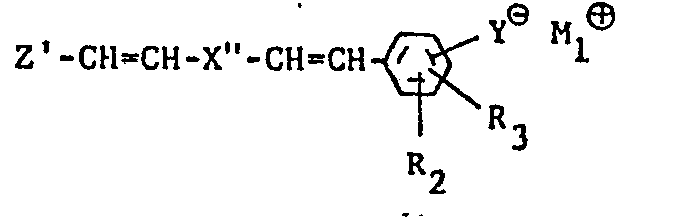
- the phosphonium compounds of the formulas (2) to (8) according to the invention are valuable intermediates for the preparation of asymmetrically substituted optical brighteners of the type wherein X, Y and R are as defined in formula (1) and Z represents an aromatic radical.
- asymmetrically substituted optical brighteners of the type wherein X, Y and R are as defined in formula (1) and Z represents an aromatic radical.
- Such compounds are described, for example, in US Pat. Nos. 4,008,224, 3,984,399, 3,843,633 and 3,849,485.
- asymmetrically substituted brighteners previously had to be prepared by mixed condensation, a bis-phosphonium compound being reacted with a mixture of two different aldehydes. This method naturally led to low yields and not very pure products, since symmetrical compounds always also formed as by-products.
- the unsymmetrically substituted brighteners mentioned can be synthesized selectively and without the occurrence of symmetrical by-products and thus in good yields .
- the intermediate of formula (1) can be isolated, but it can also be reacted with the aldehyde Z-CHO directly in the reaction mixture without isolation, if appropriate after evaporation of the solvent. However, the intermediate is preferably isolated.
- Possible polar solvents are those with a boiling point above 100 ° C, e.g. aprotic such as N, N-disubstituted acid amides, sulfoxides, sulfones, nitriles and N, N, N ', N'-tetrasubstituted ureas, or protic solvents such as e.g. Carboxylic acids or higher boiling alcohols e.g. tertiary, especially secondary alcohols. Ethylene glycol is a preferred solvent.
- biphenylene radical in formula (22) is replaced by a phenylene radical
- preferred brighteners of the formula (21) with a phenyl radical instead of the biphenylene radical are obtained.
- percent means percent by weight and parts by weight.
- 0.253 g of metallic sodium are dissolved in portions in 50 ml of anhydrous methanol in a 200 ml flask with stirring in a nitrogen atmosphere. Then the alcoholate solution with 6.56 g of the phosphonium compound of the formula and 2.53 g of sodium salt of benzaldehyde-2-sulfonic acid (91%) were added. The reaction mixture is heated to 40 to 45 ° C and stirred for 16 hours. The resulting white suspension is mixed with 80 ml of water and stirred at boiling temperature for 1 hour. The white suspension is now filtered off and washed with plenty of boiling water and dried in vacuo at 100 ° C. for 24 hours. 5.48 g (98% of theory) of the compound of the formula are obtained with a ⁇ max 335 nm in dimethylformamide.
Landscapes
- Chemical & Material Sciences (AREA)
- Organic Chemistry (AREA)
- Health & Medical Sciences (AREA)
- Life Sciences & Earth Sciences (AREA)
- Biochemistry (AREA)
- General Health & Medical Sciences (AREA)
- Molecular Biology (AREA)
- Organic Low-Molecular-Weight Compounds And Preparation Thereof (AREA)
Claims (16)






Applications Claiming Priority (2)
| Application Number | Priority Date | Filing Date | Title |
|---|---|---|---|
| LU78449 | 1977-11-04 | ||
| LU78449 | 1977-11-04 |
Publications (2)
| Publication Number | Publication Date |
|---|---|
| EP0001991A1 EP0001991A1 (fr) | 1979-05-30 |
| EP0001991B1 true EP0001991B1 (fr) | 1982-10-13 |
Family
ID=19728751
Family Applications (1)
| Application Number | Title | Priority Date | Filing Date |
|---|---|---|---|
| EP78101232A Expired EP0001991B1 (fr) | 1977-11-04 | 1978-10-26 | Composés de phosphonium, procédé pour leur préparation et procédé de préparation d'azurants optiques à base de stilbènes substitués asymétriquement |
Country Status (5)
| Country | Link |
|---|---|
| US (2) | US4231957A (fr) |
| EP (1) | EP0001991B1 (fr) |
| JP (1) | JPS5481246A (fr) |
| DE (1) | DE2862106D1 (fr) |
| IT (1) | IT7851780A0 (fr) |
Families Citing this family (4)
| Publication number | Priority date | Publication date | Assignee | Title |
|---|---|---|---|---|
| DE3001065A1 (de) * | 1980-01-12 | 1981-07-16 | Basf Ag, 6700 Ludwigshafen | Verfahren zur herstellung von optischen aufhellern |
| US4529556A (en) * | 1983-08-19 | 1985-07-16 | The Dow Chemical Company | Bis((aryl)vinyl)benzenes |
| DE69906181D1 (de) * | 1998-05-13 | 2003-04-30 | Ciba Sc Holding Ag | Verfahren zur Herstellung von sulfonierten Distyrylbiphenylverbindungen |
| US8445176B2 (en) * | 2007-05-25 | 2013-05-21 | Agfa Graphics Nv | Lithographic printing plate precursor |
Family Cites Families (7)
| Publication number | Priority date | Publication date | Assignee | Title |
|---|---|---|---|---|
| CH554848A (de) * | 1967-10-03 | 1974-10-15 | Ciba Geigy Ag | Verfahren zur herstellung neuer stilben-derivate. |
| DE2039993A1 (de) * | 1970-08-12 | 1972-02-17 | Basf Ag | Optische Aufheller der Bisstyrylbenzolreihe |
| DE2209128C3 (de) * | 1971-03-05 | 1981-10-22 | CIBA-GEIGY AG, 4002 Basel | Bis-Stilbenverbindungen, Verfahren zu deren Herstellung und deren Verwendung als optische Aufheller |
| CH561707A5 (fr) * | 1971-12-17 | 1975-05-15 | Sandoz Ag | |
| CH554911A (de) * | 1971-12-30 | 1974-10-15 | Ciba Geigy Ag | Verwendung ausserhalb der textilindustrie von neuen 4,4'divinyldiphenyl-verbindungen als optische aufhellmittel fuer organische materialien. |
| DE2363416A1 (de) * | 1973-12-20 | 1975-07-03 | Hoechst Ag | Neue bis-naphthyl-aethylene, verfahren zu deren herstellung und ihre verwendung als optische aufhellungsmittel |
| FR2258392A1 (en) * | 1974-01-21 | 1975-08-18 | Anvar | (2-Substd vinyl) trihydrocarbyl phosphonium salts prepn - by reacting bis(phosphonio) ethylene salts with active hydrogen cpds |
-
1978
- 1978-10-12 US US05/950,902 patent/US4231957A/en not_active Expired - Lifetime
- 1978-10-26 EP EP78101232A patent/EP0001991B1/fr not_active Expired
- 1978-10-26 DE DE7878101232T patent/DE2862106D1/de not_active Expired
- 1978-11-02 JP JP13568778A patent/JPS5481246A/ja active Pending
- 1978-11-06 IT IT7851780A patent/IT7851780A0/it unknown
-
1980
- 1980-05-15 US US06/150,026 patent/US4316860A/en not_active Expired - Lifetime
Also Published As
| Publication number | Publication date |
|---|---|
| US4316860A (en) | 1982-02-23 |
| JPS5481246A (en) | 1979-06-28 |
| IT7851780A0 (it) | 1978-11-06 |
| EP0001991A1 (fr) | 1979-05-30 |
| DE2862106D1 (en) | 1982-11-18 |
| US4231957A (en) | 1980-11-04 |
Similar Documents
| Publication | Publication Date | Title |
|---|---|---|
| AT291228B (de) | Verfahren zur Herstellung neuer α,α-Dimethyl-ω-phenoxyalkansäuren, ihrer Salze oder Alkylester | |
| CH554821A (de) | Verfahren zur herstellung von bis-stilbenverbindungen. | |
| EP0047877B1 (fr) | Composés du biphényle et procédé pour leur préparation | |
| EP0001991B1 (fr) | Composés de phosphonium, procédé pour leur préparation et procédé de préparation d'azurants optiques à base de stilbènes substitués asymétriquement | |
| CH621107A5 (fr) | ||
| CH597199A5 (en) | 3-Phenyl pyridaz-6-ones prodn. | |
| DE2947734C2 (fr) | ||
| EP0299277B1 (fr) | Procédé pour la préparation de pyridylalkylcétones substituées | |
| DE1112072B (de) | Verfahren zur Herstellung von Verbindungen der 1, 4-Bis-(styryl)-benzolreihe | |
| DE2624344C2 (de) | Verfahren zur Herstellung von in 1-Stellung unsubstituierten 3-(2-Hydroxyäthyl)-indol-Derivaten | |
| EP0302227B1 (fr) | Halogénures d'acide 5-halo-6-amino-nicotinique, leur préparation et leur utilisation | |
| US4390476A (en) | Phosphonium compounds, a process for their preparation and a process for the preparation of asymmetrically substituted stilbene fluorescent brightening agents | |
| EP0289925B1 (fr) | Maléinimides et anhydrides maléiques substitués par des groupes alkoxy, procédé de préparation et utilisation | |
| EP0064953B1 (fr) | Dérivés de stilbène | |
| DE1543326A1 (de) | Verfahren zur Herstellung von halogenierten 1,2-Nitranilinen | |
| US4017509A (en) | Process for producing substituted or unsubstituted 2-phenyl-1.2.3.-triazole-4-carboxaldehyde | |
| DE2652892A1 (de) | Substituierte aminobenzaldehydverbindungen | |
| EP0261668B1 (fr) | Procédé de préparation de 4-alkoxy-2(5H)-thiophénones | |
| DE2539461A1 (de) | Verfahren zur herstellung von carboxygruppenhaltigen 2-stilbenyl- 1,2,3-triazolen | |
| DE3207506C2 (de) | Verfahren zur Herstellung von Arylessigsäurederivaten | |
| SU953980A3 (ru) | Способ получени замещенных производных хинолизидина или индолизидина ,или их солей, или четвертичных солей | |
| DE3515094C2 (fr) | ||
| AT331237B (de) | Verfahren zur herstellung von monoacetalen aromatischer 1,2-diketone | |
| CH638487A5 (en) | Novel substituted di(phenylethyl)amines | |
| EP0396014A2 (fr) | Acides biphénylcarboxyliques substitués, leur procédé de préparation et composés intermédiaires |
Legal Events
| Date | Code | Title | Description |
|---|---|---|---|
| PUAI | Public reference made under article 153(3) epc to a published international application that has entered the european phase |
Free format text: ORIGINAL CODE: 0009012 |
|
| AK | Designated contracting states |
Designated state(s): BE CH DE FR GB LU |
|
| 17P | Request for examination filed | ||
| GRAA | (expected) grant |
Free format text: ORIGINAL CODE: 0009210 |
|
| AK | Designated contracting states |
Designated state(s): CH DE FR GB |
|
| REF | Corresponds to: |
Ref document number: 2862106 Country of ref document: DE Date of ref document: 19821118 |
|
| PGFP | Annual fee paid to national office [announced via postgrant information from national office to epo] |
Ref country code: CH Payment date: 19830901 Year of fee payment: 6 |
|
| PGFP | Annual fee paid to national office [announced via postgrant information from national office to epo] |
Ref country code: DE Payment date: 19840904 Year of fee payment: 7 |
|
| PGFP | Annual fee paid to national office [announced via postgrant information from national office to epo] |
Ref country code: FR Payment date: 19840925 Year of fee payment: 7 |
|
| PG25 | Lapsed in a contracting state [announced via postgrant information from national office to epo] |
Ref country code: CH Effective date: 19851031 |
|
| GBPC | Gb: european patent ceased through non-payment of renewal fee | ||
| PG25 | Lapsed in a contracting state [announced via postgrant information from national office to epo] |
Ref country code: FR Free format text: LAPSE BECAUSE OF NON-PAYMENT OF DUE FEES Effective date: 19860630 |
|
| REG | Reference to a national code |
Ref country code: CH Ref legal event code: PL |
|
| PG25 | Lapsed in a contracting state [announced via postgrant information from national office to epo] |
Ref country code: DE Effective date: 19860701 |
|
| REG | Reference to a national code |
Ref country code: FR Ref legal event code: ST |
|
| PG25 | Lapsed in a contracting state [announced via postgrant information from national office to epo] |
Ref country code: GB Effective date: 19881117 |
|
| PLBE | No opposition filed within time limit |
Free format text: ORIGINAL CODE: 0009261 |
|
| STAA | Information on the status of an ep patent application or granted ep patent |
Free format text: STATUS: NO OPPOSITION FILED WITHIN TIME LIMIT |